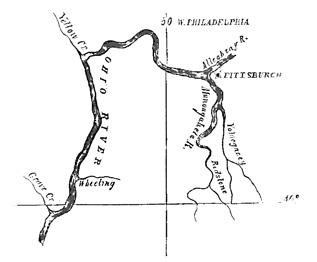
An exact description of the limits and boundaries of the State
of Virginia?
Virginia is bounded on the east by the Atlantic; on the north
by a line of latitude crossing the eastern shore through Watkin's
Point, being about 37° 57' north latitude; from thence by a
straight line to Cinquac, near the mouth of Potomac; thence by
the Potomac, which is common to Virginia and Maryland, to the
first fountain of its northern branch; thence by a meridian line,
passing through that fountain till it intersects a line running
east and west, in latitude 39° 43' 42.4" which divides Maryland
from Pennsylvania, and which was marked by Messrs.
Mason and Dixon; thence by that line, and a continuation of
it westwardly to the completion of five degrees of longitude
from the eastern boundary of Pennsylvania, in the same latitude,
and thence by a meridian line to the Ohio; on the west
by the Ohio and Mississippi, to latitude 36° 30' north, and
on the south by the line of latitude last mentioned. By admeasurements
through nearly the whole of this last line, and
supplying the unmeasured parts from good data, the Atlantic
and Mississippi are found in this latitude to be seven hundred
and fifty-eight miles distant, equal to 30° 38' of longitude,
reckoning fifty-five miles and three thousand one hundred and
forty-four feet to the degree. This being our comprehension
of longitude, that of our latitude, taken between this and Mason
and Dixon's line, is 3° 13' 42.4" equal to two hundred and
twenty-three and one-third miles, supposing a degree of a great
circle to be sixty-nine miles, eight hundred and sixty-four feet,
as computed by Cassini. These boundaries include an area
somewhat triangular of one hundred and twenty-one thousand
five hundred and twenty-five square miles, whereof seventy-nine
thousand six hundred and fifty lie westward of the Alleghany
mountains, and fifty-seven thousand and thirty-four westward of
the meridian of the mouth of the Great Kanhaway. This State
is therefore one-third larger than the islands of Great Britain and
Ireland, which are reckoned at eighty-eight thousand three hundred
and fifty-seven square miles.
These limits result from, 1. The ancient charters from the
crown of England. 2. The grant of Maryland to the Lord
Baltimore, and the subsequent determinations of the British court
as to the extent of that grant. 3. The grant of Pennsylvania
to William Penn, and a compact between the general assemblies
of the commonwealths of Virginia and Pennsylvania as to the
extent of that grant. 4. The grant of Carolina, and actual location
of its northern boundary, by consent of both parties.
5. The treaty of Paris of 1763. 6. The confirmation of the
charters of the neighboring States by the convention of Virginia
at the time of constituting their commonwealth. 7. The
cession made by Virginia to Congress of all the lands to which
they had title on the north side of the Ohio.
A notice of its rivers, rivulets, and how far they are navigable?
An inspection of a map of Virginia, will give a better idea
of the geography of its rivers, than any description in writing.
Their navigation may be imperfectly noted.
Roanoke, so far as it lies within the State, is nowhere
navigable but for canoes, or light batteaux; and even for these
in such detached parcels as to have prevented the inhabitants
from availing themselves of it at all.
James River, and its waters, afford navigation as follows:
The whole of Elizabeth River, the lowest of those which
run into James River, is a harbor, and would contain upwards of
three hundred ships. The channel is from one hundred and fifty
to two hundred fathoms wide, and at common flood tide affords
eighteen feet water to Norfolk. The Stafford, a sixty gun ship,
went there, lightening herself to cross the bar at Sowel's Point.
The Fier Rodrigue, pierced for sixty-four guns, and carrying
fifty, went there without lightening. Craney Island, at the
mouth of this river, commands its channel tolerably well.
Nansemond River is navigable to Sleepy Hole for vessels of
two hundred and fifty tons; to Suffolk for those of one hundred
tons; and to Milner's for those of twenty-five.
Pagan Creek affords eight or ten feet water to Smithfield,
which admits vessels of twenty tons.
Chickahominy has at its mouth a bar, on which is only twelve
feet water at common flood tide. Vessels passing that, may go
eight miles up the river; those of ten feet draught may go four
miles further, and those of six tons burden twenty miles further.
Appomattox may be navigated as far as Broadways, by any vessel
which has crossed Harrison's bar in James River; it keeps eight
or ten feet water a mile or two higher up to Fisher's bar, and four
feet on that and upwards to Petersburg, where all navigation ceases.
James River itself affords a harbor for vessels of any size in
Hampton Road, but not in safety through the whole winter; and
there is navigable water for them as far as Mulberry Island. A
forty gun ship goes to Jamestown, and, lightening herself, may
pass Harrison's bar; on which there is only fifteen feet water.
Vessels of two hundred and fifty tons may go to Warwick;
those of one hundred and twenty-five go to Rocket's, a mile below
Richmond; from thence is about seven feet water to Richmond;
and about the centre of the town, four feet and a half,
where the navigation is interrupted by falls, which in a course
of six miles, descend about eighty-eight feet perpendicular; above
these it is resumed in canoes and batteaux, and is prosecuted
safely and advantageously to within ten miles of the Blue Ridge;
and even through the Blue Ridge a ton weight has been brought;
and the expense would not be great, when compared with its
object, to open a tolerable navigation up Jackson's river and Carpenter's
creek, to within twenty-five miles of Howard's creek of
Green Briar, both of which have then water enough to float vessels
into the Great Kanhaway. In some future state of population
I think it possible that its navigation may also be made to
interlock with that of the Potomac, and through that to communicate
by a short portage with the Ohio. It is to be noted
that this river is called in the maps James River, only to its confluence
with the Rivanna; thence to the Blue Ridge it is called
the Fluvanna; and thence to its source Jackson's river. But in
common speech, it is called James River to its source.
The Rivanna, a branch of James River, is navigable for
canoes and batteaux to its intersection with the South-West mountains,
which is about twenty-two miles; and may easily be
opened to navigation through these mountains to its fork above
Charlottesville.
York River, at Yorktown, affords the best harbor in the State
for vessels of the largest size. The river there narrows to the
width of a mile, and is contained within very high banks, close
under which vessels may ride. It holds four fathom water at
high tide for twenty-five miles above York to the mouth of
Poropotank, where the river is a mile and a half wide, and the
channel only seventy-five fathom, and passing under a high
bank. At the confluence of Pamunkey and Mattapony, it is
reduced to three fathom depth, which continues up Pamunkey
to Cumberland, where the width is one hundred yards, and up
Mattapony to within two miles of Frazier's ferry, where it becomes
two and a half fathom deep, and holds that about five
miles. Pamunkey is then capable of navigation for loaded flats
to Brockman's bridge, fifty miles above Hanover town, and
Mattapony to Downer's bridge, seventy miles above its mouth.
Piankatank, the little rivers making out of Mobjack Bay and
those of the eastern shore, receive only very small vessels, and
these can but enter them.
Rappahannock affords four fathom water to Hobb's hole, and
two fathom from thence to Fredericksburg.
Potomac is seven and a half miles wide at the mouth; four
and a half at Nomony bay; three at Aquia; one and a half at
Hallowing point; one and a quarter at Alexandria. Its soundings
are seven fathom at the mouth; five at St. George's island; four
and a half at Lower Matchodic; three at Swan's point, and
thence up to Alexandria; thence ten feet water to the falls,
which are thirteen miles above Alexandria. These falls are fifteen
miles in length, and of very great descent, and the navigation
above them for batteaux and canoes is so much interrupted
as to be little used. It is, however, used in a small degree up
the Cohongoronta branch as far as fort Cumberland, which was
at the mouth of Willis's creek; and is capable, at no great expense,
of being rendered very practicable. The Shenandoah
branch interlocks with James river about the Blue Ridge, and
may perhaps in future be opened.
The Mississippi will be one of the principal channels of future
commerce for the country westward of the Alleghany.
From the mouth of this river to where it receives the Ohio, is
one thousand miles by water, but only five hundred by land,
passing through the Chickasaw country. From the mouth of
the Ohio to that of the Missouri, is two hundred and thirty miles
by water, and one hundred and forty by land, from thence to the
mouth of the Illinois river, is about twenty-five miles. The
Mississippi, below the mouth of the Missouri, is always muddy,
and abounding with sand bars, which frequently change their
places. However, it carries fifteen feet water to the mouth of
the Ohio, to which place it is from one and a half to two miles
wide, and thence to Kaskaskia from one mile to a mile and a
quarter wide. Its current is so rapid, that it never can be
stemmed by the force of the wind alone, acting on sails. Any
vessel, however, navigated with oars, may come up at any time,
and receive much aid from the wind. A batteau passes from
the mouth of Ohio to the mouth of Mississippi in three weeks,
and is from two to three months getting up again. During its
floods, which are periodical as those of the Nile, the largest vessels
may pass down it, if their steerage can be insured. These
floods begin in April, and the river returns into its banks early
in August. The inundation extends further on the western than
eastern side, covering the lands in some places for fifty miles
from its banks. Above the mouth of the Missouri it becomes
much such a river as the Ohio, like it clear and gentle in its current,
not quite so wide, the period of its floods nearly the same,
but not rising to so great a height. The streets of the village at
Cohoes are not more than ten feet above the ordinary level of
the water, and yet were never overflowed. Its bed deepens
every year. Cohoes, in the memory of many people now living,
was insulated by every flood of the river. What was the eastern
channel has now become a lake, nine miles in length and
one in width, into which the river at this day never flows. This
river yields turtle of a peculiar kind, perch, trout, gar, pike, mullets,
herrings, carp, spatula-fish of fifty pounds weight, cat-fish
of one hundred pounds weight, buffalo fish, and sturgeon. Aligators
or crocodiles have been seen as high up as the Acansas.
It also abounds in herons, cranes, ducks, brant, geese, and swans.
Its passage is commanded by a fort established by this State, five
miles below the mouth of the Ohio, and ten miles above the
Carolina boundary.
The Missouri, since the treaty of Paris, the Illinois and northern
branches of the Ohio, since the cession to Congress, are no
longer within our limits. Yet having been so heretofore, and
still opening to us channels of extensive communication with the
western and north-western country, they shall be noted in their
order.
The Missouri is, in fact, the principal river, contributing more
to the common stream than does the Mississippi, even after its
junction with the Illinois. It is remarkably cold, muddy, and
rapid. Its overflowings are considerable. They happen during
the months of June and July. Their commencement being so
much later than those of the Mississippi, would induce a belief
that the sources of the Missouri are northward of those of the
Mississippi, unless we suppose that the cold increases again with
the ascent of the land from the Mississippi westwardly. That
this ascent is great, is proved by the rapidity of the river. Six
miles above the mouth, it is brought within the compass of a
quarter of a mile's width; yet the Spanish merchants at Pancore,
or St. Louis, say they go two thousand miles up it. It heads far
westward of the Rio Norte, or North River. There is, in the
villages of Kaskaskia, Cohoes, and St. Vincennes, no inconsiderable
quantity of plate, said to have been plundered during the
last war by the Indians from the churches and private houses of
Santa Fé, on the North river, and brought to the villages for
sale. From the mouth of the Ohio to Santa Fé are forty days
journey, or about one thousand miles. What is the shortest distance
between the navigable waters of the Missouri, and those
of the North river, or how far this is navigable above Santa Fé,
I could never learn. From Santa Fé to its mouth in the Gulf
of Mexico is about twelve hundred miles. The road from New
Orleans to Mexico crosses this river at the post of Rio Norte, eight
hundred miles below Santa Fé, and from this post to New Orleans
is about twelve hundred miles; thus making two thousand
miles between Santa Fé and New Orleans, passing down the
North river, Red river, and Mississippi; whereas it is two thousand
two hundred and thirty through the Missouri and Mississippi.
From the same post of Rio Norte, passing near the mines
of La Sierra and Laiguana, which are between the North river,
and the river Salina to Sartilla, is three hundred and seventy-five
miles, and from thence, passing the mines of Charcas, Zaccatecas,
and Potosi, to the city of Mexico, is three hundred and seventy-five
miles; in all, one thousand five hundred and fifty miles from
Santa Fé to the city of Mexico. From New Orleans to the city
of Mexico is about one thousand nine hundred and fifty miles;
the roads after setting out from the Red river, near Natchitoches,
keeping generally parallel with the coast, and about two hundred
miles from it, till it enters the city of Mexico.
The Illinois is a fine river, clear, gentle, and without rapids;
insomuch that it is navigable for batteaux to its source. From
thence is a portage of two miles only to the Chicago, which affords
a batteau navigation of sixteen miles to its entrance into
lake Michigan. The Illinois, about ten miles above its mouth,
is three hundred yards wide.
The Kaskaskia is one hundred yards wide at its entrance into
the Mississippi, and preserves that breadth to the Buffalo plains,
seventy miles above. So far, also, it is navigable for loaded batteaux,
and perhaps much further. It is not rapid.
The Ohio is the most beautiful river on earth. Its current
gentle, waters clear, and bosom smooth and unbroken by rocks
and rapids, a single instance only excepted.
It is one-quarter of a mile wide at Fort Pitt, five hundred
yards at the mouth of the Great Kanhaway, one mile and
twenty-five poles at Louisville, one-quarter of a mile on the
rapids three or four miles below Louisville, half a mile where
the low country begins, which is twenty miles above Green
river, a mile and a quarter at the receipt of the Tennessee, and a
mile wide at the mouth.
Its length, as measured according to its meanders by Captain
Hutchins, is as follows:—
From Fort Pitt
| To Log's Town |
18½ |
| Big Beaver Creek |
10¾ |
| Little Beaver Creek |
13½ |
| Yellow Creek |
11¾ |
| Two Creeks |
21¾ |
| Long Reach |
53¾ |
| End Long Reach |
16½ |
| Muskingum |
25½ |
| Little Kanhaway |
12¼ |
| Hockhocking |
16 |
| Great Kanhaway |
82½ |
| Guiandot |
43¾ |
| Sandy Creek |
14½ |
| Sioto |
48¼ |
| Little Miami |
126¼ |
| Licking Creek |
8 |
| Great Miami |
26¾ |
| Big Bones |
32½ |
| Kentucky |
44¼ |
| Rapids |
77¼ |
| Low Country |
155¾ |
| Buffalo River |
64½ |
| Wabash |
97¼ |
| Big Cave |
42¾ |
| Shawanee River |
52½ |
| Cherokee River |
13 |
| Massac |
11 |
| Mississippi |
46 |
|
1188 |
In common winter and spring tides it affords fifteen feet water
to Louisville, ten feet to Le Tarte's rapids, forty miles above the
mouth of the great Kanhaway, and a sufficiency at all times for
light batteaux and canoes to Fort Pitt. The rapids are in latitude
38° 8'. The inundations of this river begin about the last
of March, and subside in July. During these, a first-rate man-of-war
may be carried from Louisville to New Orleans, if the
sudden turns of the river and the strength of its current will admit
a safe steerage. The rapids at Louisville descend about
thirty feet in a length of a mile and a half. The bed of the
river there is a solid rock, and is divided by an island into two
branches, the southern of which is about two hundred yards
wide, and is dry four months in the year. The bed of the northern
branch is worn into channels by the constant course of the
water, and attrition of the pebble stones carried on with that, so
as to be passable for batteaux through the greater part of the
year. Yet it is thought that the southern arm may be the most
easily opened for constant navigation. The rise of the waters
in these rapids does not exceed ten or twelve feet. A part of
this island is so high as to have been never overflowed, and to
command the settlement at Louisville, which is opposite to it.
The fort, however, is situated at the head of the falls. The
ground on the south side rises very gradually.
The Tennessee, Cherokee, or Hogohege river, is six hundred
yards wide at its mouth, a quarter of a mile at the mouth of
Holston, and two hundred yards at Chotee, which is twenty
miles above Holston, and three hundred miles above the mouth
of the Tennessee. This river crosses the southern boundary of
Virginia, fifty-eight miles from the Mississippi. Its current is moderate.
It is navigable for loaded boats of any burden to the
Muscle shoals, where the river passes through the Cumberland
mountain. These shoals are six or eight miles long, passable
downwards for loaded canoes, but not upwards, unless there be a
swell in the river. Above these the navigation for loaded canoes
and batteaux continues to the Long island. This river has its
inundations also. Above the Chickamogga towns is a whirlpool
called the Sucking-pot, which takes in trunks of trees or boats,
and throws them out again half a mile below. It is avoided by
keeping very close to the bank, on the south side. There are
but a few miles portage between a branch of this river and the
navigable waters of the river Mobile, which runs into the Gulf
of Mexico.
Cumberland, or Shawanee river, intersects the boundary between
Virginia and North Carolina sixty-seven miles from the
Mississippi, and again one hundred and ninety-eight miles from
the same river, a little above the entrance of Obey's river into
the Cumberland. Its Clear fork crosses the same boundary about
three hundred miles from the Mississippi. Cumberland is a very
gentle stream, navigable for loaded batteaux eight hundred miles,
without interruption; then intervene some rapids of fifteen miles
in length, after which it is again navigable seventy miles upwards,
which brings you within ten miles of the Cumberland
mountains. It is about one hundred and twenty yards wide
through its whole course, from the head of its navigation to its
mouth.
The Wabash is a very beautiful river, four hundred yards
wide at the mouth, and three hundred at St. Vincennes, which
is a post one hundred miles above the mouth, in a direct line.
Within this space there are two small rapids, which give very
little obstruction to the navigation. It is four hundred yards
wide at the mouth, and navigable thirty leagues upwards for
canoes and small boats. From the mouth of Maple river to that
of Eel river is about eighty miles in a direct line, the river continuing
navigable, and from one to two hundred yards in width.
The Eel river is one hundred and fifty yards wide, and affords
at all times navigation for periaguas, to within eighteen miles of
the Miami of the Lake. The Wabash, from the mouth of Eel
river to Little river, a distance of fifty miles direct, is interrupted
with frequent rapids and shoals, which obstruct the navigation,
except in a swell. Little river affords navigation during a swell
to within three miles of the Miami, which thence affords a similar
navigation into Lake Erie, one hundred miles distant in a
direct line. The Wabash overflows periodically in correspondence
with the Ohio, and in some places two leagues from its banks.
Green River is navigable for loaded batteaux at all times fifty
miles upwards; but it is then interrupted by impassable rapids,
above which the navigation again commences and continues
good thirty or forty miles to the mouth of Barren river.
Kentucky River is ninety yards wide at the mouth, and also
at Boonsborough, eighty miles above. It affords a navigation
for loaded batteaux one hundred and eighty miles in a direct
line, in the winter tides.
The Great Miami of the Ohio, is two hundred yards wide at
the mouth. At the Piccawee towns, seventy-five miles above, it
is reduced to thirty yards; it is, nevertheless, navigable for loaded
canoes fifty miles above these towns. The portage from its
western branch into the Miami of Lake Erie, is five miles; that
from its eastern branch into Sandusky river, is of nine miles.
Salt River is at all times navigable for loaded batteaux seventy
or eighty miles. It is eighty yards wide at its mouth, and keeps
that width to its fork, twenty-five miles above.
The Little Miami of the Ohio, is sixty or seventy yards wide
at its mouth, sixty miles to its source, and affords no navigation.
The Sioto is two hundred and fifty yards wide at its mouth,
which is in latitude 38° 22', and at the Saltlick towns, two hundred
miles above the mouth, it is yet one hundred yards wide.
To these towns it is navigable for loaded batteaux, and its eastern
branch affords navigation almost to its source.
Great Sandy River is about sixty yards wide, and navigable
sixty miles for loaded batteaux.
Guiandot is about the width of the river last mentioned, but
is more rapid. It may be navigated by canoes sixty miles.
The Great Kanhaway is a river of considerable note for the
fertility of its lands, and still more, as leading towards the head
waters of James river. Nevertheless, it is doubtful whether its
great and numerous rapids will admit a navigation, but at an expense
to which it will require ages to render its inhabitants
equal. The great obstacles begin at what are called the Great
Falls, ninety miles above the mouth, below which are only five
or six rapids, and these passable, with some difficulty, even at
low water. From the falls to the mouth of Greenbriar is one
hundred miles, and thence to the lead mines one hundred and
twenty. It is two hundred and eighty yards wide at its mouth.
Hockhocking is eighty yards wide at its mouth, and yields
navigation for loaded batteaux to the Press-place, sixty miles
above its mouth.
The Little Kanhaway is one hundred and fifty yards wide
at the mouth. It yields a navigation of ten miles only. Perhaps
its northern branch, called Junius' creek, which interlocks
with the western of Monongahela, may one day admit a shorter
passage from the latter into the Ohio.
The Muskingum is two hundred and eighty yards wide at its
mouth, and two hundred yards at the lower Indian towns, one
hundred and fifty miles upwards. It is navigable for small batteaux
to within one mile of a navigable part of Cuyahoga river,
which runs into Lake Erie.
At Fort Pitt the river Ohio loses its name, branching into the
Monongahela and Alleghany.
The Monongahela is four hundred yards wide at its mouth.
From thence is twelve or fifteen miles to the mouth of Yohogany,
where it is three hundred yards wide. Thence to Redstone
by water is fifty miles, by land thirty. Then to the mouth
of Cheat river by water forty miles, by land twenty-eight, the
width continuing at three hundred yards, and the navigation
good for boats. Thence the width is about two hundred yards
to the western fork, fifty miles higher, and the navigation frequently
interrupted by rapids, which, however, with a swell of
two or three feet, become very passable for boats. It then admits
light boats, except in dry seasons, sixty-five miles further
to the head of Tygart's valley, presenting only some small rapids
and falls of one or two feet perpendicular, and lessening in its
width to twenty yards. The Western fork is navigable in the
winter ten or fifteen miles towards the northern of the Little
Kanhaway, and will admit a good wagon road to it. The Yahogany
is the principal branch of this river. It passes through
the Laurel mountain, about thirty miles from its mouth; is so
far from three hundred to one hundred and fifty yards wide, and
the navigation much obstructed in dry weather by rapids and
shoals. In its passage through the mountain it makes very great
falls, admitting no navigation for ten miles to the Turkey Foot.
Thence to the Great Crossing, about twenty miles, it is again
navigable, except in dry seasons, and at this place is two hundred
yards wide. The sources of this river are divided from
those of the Potomac by the Alleghany mountain. From the
falls, where it intersects the Laurel mountain, to Fort Cumberland,
the head of the navigation on the Potomac, is forty miles
of very mountainous road. Wills' creek, at the mouth of which
was Fort Cumberland, is thirty or forty yards wide, but affords
no navigation as yet. Cheat river, another considerable branch
of the Monongahela, is two hundred yards wide at its mouth,
and one hundred yards at the Dunkard's settlement, fifty miles
higher. It is navigable for boats, except in dry seasons. The
boundary between Virginia and Pennsylvania crosses it about
three or four miles above its mouth.
The Alleghany river, with a slight swell, affords navigation
for light batteaux to Venango, at the mouth of French Creek,
where it is two hundred yards wide, and is practised even to Le
Bœuf, from whence there is a portage of fifteen miles to Presque
Isle on the Lake Erie.
The country watered by the Mississippi and its eastern
branches, constitutes five-eighths of the United States, two of
which five-eighths are occupied by the Ohio and its waters; the
residuary streams which run into the Gulf of Mexico, the Atlantic,
and the St. Lawrence, water the remaining three-eighths.
Before we quit the subject of the western waters, we will take
a view of their principal connections with the Atlantic. These
are three; the Hudson river, the Potomac, and the Mississippi
itself. Down the last will pass all heavy commodities. But the
navigation through the Gulf of Mexico is so dangerous, and that
up the Mississippi so difficult and tedious, that it is thought probable
that European merchandise will not return through that
channel. It is most likely that flour, timber, and other heavy
articles will be floated on rafts, which will themselves be an article
for sale as well as their loading, the navigators returning by
land, or in light batteaux. There will, therefore, be a competition
between the Hudson and Potomac rivers for the residue of
the commerce of all the country westward of Lake Erie, on the
waters of the lakes, of the Ohio, and upper parts of the Mississippi.
To go to New York, that part of the trade which comes
from the lakes or their waters, must first be brought into Lake
Erie. Between Lake Superior and its waters and Huron, are the
rapids of St. Mary, which will permit boats to pass, but not larger
vessels. Lakes Huron and Michigan afford communication with
Lake Erie by vessels of eight feet draught. That part of the
trade which comes from the waters of the Mississippi must pass
from them through some portage into the waters of the lakes.
The portage from the Illinois river into a water of Michigan is
of one mile only. From the Wabash, Miami, Muskingum, or
Alleghany, are portages into the waters of Lake Erie, of from one
to fifteen miles. When the commodities are brought into, and
have passed through Lake Erie, there is between that and Ontario
an interruption by the falls of Niagara, where the portage
is of eight miles; and between Ontario and the Hudson river are
portages at the falls of Onondago, a little above Oswego, of a
quarter of a mile; from Wood creek to the Mohawks river two
miles; at the little falls of the Mohawks river half a mile; and
from Schenectady to Albany sixteen miles. Besides the increase
of expense occasioned by frequent change of carriage, there is an
increased risk of pillage produced by committing merchandise
to a greater number of hands successively. The Potomac offers
itself under the following circumstances: For the trade of the
lakes and their waters westward of Lake Erie, when it shall
have entered that lake, it must coast along its southern shore, on
account of the number and excellence of its harbors; the northern,
though shortest, having few harbors, and these unsafe.
Having reached Cuyahoga, to proceed on to New York it will
have eight hundred and twenty-five miles and five portages;
whereas it is but four hundred and twenty-five miles to Alexandria,
its emporium on the Potomac, if it turns into the Cuyahoga,
and passes through that, Big Beaver, Ohio, Yohogany, (or
Monongahela and Cheat,) and Potomac, and there are but two
portages; the first of which, between Cuyahoga and Beaver, may
be removed by uniting the sources of these waters, which are
lakes in the neighborhood of each other, and in a champaign
country; the other from the waters of Ohio to Potomac will be
from fifteen to forty miles, according to the trouble which shall
be taken to approach the two navigations. For the trade of the
Ohio, or that which shall come into it from its own waters or
the Mississippi, it is nearer through the Potomac to Alexandria
than to New York by five hundred and eighty miles, and it is
interrupted by one portage only. There is another circumstance
of difference too. The lakes themselves never freeze, but the
communications between them freeze, and the Hudson river is
itself shut up by the ice three months in the year; whereas the
channel to the Chesapeake leads directly into a warmer climate.
The southern parts of it very rarely freeze at all, and whenever
the northern do, it is so near the sources of the rivers, that the frequent
floods to which they are there liable, break up the ice immediately,
so that vessels may pass through the whole winter,
subject only to accidental and short delays. Add to all this,
that in case of war with our neighbors, the Anglo-Americans or
the Indians, the route to New York becomes a frontier through
almost its whole length, and all commerce through it ceases
from that moment. But the channel to New York is already
known to practice, whereas the upper waters of the Ohio and the
Potomac, and the great falls of the latter, are yet to be cleared
of their fixed obstructions. (A.)
A notice of the best Seaports of the State, and how big are the
vessels they can receive?
Having no ports but our rivers and creeks, this Query has
been answered under the preceding one.
A notice of its Mountains?
For the particular geography of our mountains I must refer
to Fry and Jefferson's map of Virginia; and to Evans' analysis
of this map of America, for a more philosophical view of them
than is to be found in any other work. It is worthy of notice,
that our mountains are not solitary and scattered confusedly over
the face of the country; but that they commence at about one
hundred and fifty miles from the sea-coast, are disposed in
ridges, one behind another, running nearly parallel with the sea-coast,
though rather approaching it as they advance north-eastwardly.
To the south-west, as the tract of country between the
sea-coast and the Mississippi becomes narrower, the mountains
converge into a single ridge, which, as it approaches the Gulf of
Mexico, subsides into plain country, and gives rise to some of
the waters of that gulf, and particularly to a river called the
Apalachicola, probably from the Apalachies, an Indian nation
formerly residing on it. Hence the mountains giving rise to
that river, and seen from its various parts, were called the Appalachian
mountains, being in fact the end or termination only of
the great ridges passing through the continent. European geographers,
however, extended the name northwardly as far as the
mountains extended; some giving it, after their separation into
different ridges, to the Blue Ridge, others to the North Mountain,
others to the Alleghany, others to the Laurel Ridge, as may be
seen by their different maps. But the fact I believe is, that none
of these ridges were ever known by that name to the inhabitants,
either native or emigrant, but as they saw them so called
in European maps. In the same direction, generally, are the
veins of limestone, coal, and other minerals hitherto discovered;
and so range the falls of our great rivers. But the courses of the
great rivers are at right angles with these. James and Potomac
penetrate through all the ridges of mountains eastward of the
Alleghany; that is, broken by no water course. It is in fact the
spine of the country between the Atlantic on one side, and the
Mississippi and St. Lawrence on the other. The passage of the
Potomac through the Blue Ridge is, perhaps, one of the most stupendous
scenes in nature. You stand on a very high point of land.
On your right comes up the Shenandoah, having ranged along the
foot of the mountain an hundred miles to seek a vent. On your left
approaches the Potomac, in quest of a passage also. In the moment
of their junction, they rush together against the mountain,
rend it asunder, and pass off to the sea. The first glance of this
scene hurries our senses into the opinion, that this earth has been
created in time, that the mountains were formed first, that the
rivers began to flow afterwards, that in this place, particularly,
they have been dammed up by the Blue Ridge of mountains,
and have formed an ocean which filled the whole valley; that
continuing to rise they have at length broken over at this spot,
and have torn the mountain down from its summit to its base.
The piles of rock on each hand, but particularly on the Shenandoah,
the evident marks of their disrupture and avulsion from
their beds by the most powerful agents of nature, corroborate the
impression. But the distant finishing which nature has given to
the picture, is of a very different character. It is a true contrast
to the foreground. It is as placid and delightful as that is wild
and tremendous. For the mountain being cloven asunder, she
presents to your eye, through the cleft, a small catch of smooth
blue horizon, at an infinite distance in the plain country, inviting
you, as it were, from the riot and tumult roaring around, to pass
through the breach and participate of the calm below. Here
the eye ultimately composes itself; and that way, too, the road
happens actually to lead. You cross the Potomac above the
junction, pass along its side through the base of the mountain
for three miles, its terrible precipices hanging in fragments over
you, and within about twenty miles reach Fredericktown, and the
fine country round that. This scene is worth a voyage across
the Atlantic. Yet here, as in the neighborhood of the Natural
Bridge, are people who have passed their lives within half a
dozen miles, and have never been to survey these monuments of
a war between rivers and mountains, which must have shaken
the earth itself to its centre. (B.)
The height of our mountains has not yet been estimated with
any degree of exactness. The Alleghany being the great ridge
which divides the waters of the Atlantic from those of the Mississippi,
its summit is doubtless more elevated above the ocean than
that of any other mountain. But its relative height, compared
with the base on which it stands, is not so great as that of some
others, the country rising behind the successive ridges like the
steps of stairs. The mountains of the Blue Ridge, and of these
the Peaks of Otter, are thought to be of a greater height, measured
from their base, than any others in our country, and perhaps
in North America. From data, which may found a tolerable
conjecture, we suppose the highest peak to be about four thousand
feet perpendicular, which is not a fifth part of the height of the
mountains of South America, nor one-third of the height which
would be necessary in our latitude to preserve ice in the open
air unmelted through the year. The ridge of mountains next
beyond the Blue Ridge, called by us the North mountain, is of
the greatest extent; for which reason they were named by the
Indians the endless mountains.
A substance supposed to be Pumice, found floating on the
Mississippi, has induced a conjecture that there is a volcano on
some of its waters; and as these are mostly known to their
sources, except the Missouri, our expectations of verifying the conjecture
would of course be led to the mountains which divide
the waters of the Mexican Gulf from those of the South Sea;
but no volcano having ever yet been known at such a distance
from the sea, we must rather suppose that this floating substance
has been erroneously deemed Pumice.
Its Cascades and Caverns?
The only remarkable cascade in this country is that of the
Falling Spring in Augusta. It is a water of James' river where
it is called Jackson's river, rising in the warm spring mountains,
about twenty miles south west of the warm spring, and flowing
into that valley. About three-quarters of a mile from its source
it falls over a rock two hundred feet into the valley below. The
sheet of water is broken in its breadth by the rock, in two or
three places, but not at all in its height. Between the sheet and
the rock, at the bottom, you may walk across dry. This cataract
will bear no comparison with that of Niagara as to the
quantity of water composing it; the sheet being only twelve or
fifteen feet wide above and somewhat more spread below; but
it is half as high again, the latter being only one hundred and
fifty-six feet, according to the mensuration made by order of
M. Vaudreuil, Governor of Canada, and one hundred and thirty
according to a more recent account.
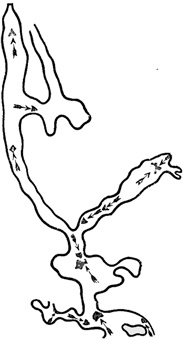
An eye draught of Madison's cave on a scale of
67 feet to the inch. The arrows show
where it descends or ascends.
In the lime-stone country
there are many caverns of
very considerable extent.
The most noted is called
Madison's Cave, and is on
the north side of the Blue
Ridge, near the intersection
of the Rockingham and Augusta
line with the south
fork of the southern river of
Shenandoah. It is in a hill
of about two hundred feet
perpendicular height, the ascent
of which, on one side,
is so steep that you may
pitch a biscuit from its summit
into the river which
washes its base. The entrance
of the cave is, in this
side, about two-thirds of the
way up. It extends into
the earth about three hundred
feet, branching into
subordinate caverns, sometimes
ascending a little, but
more generally descending,
and at length terminates,
in two different places, at basins of water of unknown extent,
and which I should judge to be nearly on a level with
the water of the river; however, I do not think they are
formed by refluent water from that, because they are never turbid;
because they do not rise and fall in correspondence with
that in times of flood or of drought; and because the water is
always cool. It is probably one of the many reservoirs with
which the interior parts of the earth are supposed to abound, and
yield supplies to the fountains of water, distinguished from others
only by being accessible. The vault of this cave is of solid
lime-stone, from twenty to forty or fifty feet high; through which
water is continually percolating. This, trickling down the sides
of the cave, has incrusted them over in the form of elegant drapery;
and dripping from the top of the vault generates on that
and on the base below, stalactites of a conical form, some of
which have met and formed massive columns.
Another of these caves is near the north mountain, in the county
of Frederic, on the lands of Mr. Zane. The entrance into
this is on the top of an extensive ridge. You descend thirty or
forty feet, as into a well, from whence the cave extends, nearly
horizontally, four hundred feet into the earth, preserving a breadth
of from twenty to fifty feet, and a height of from five to twelve
feet. After entering this cave a few feet, the mercury, which in
the open air was 50°, rose to 57° of Fahrenheit's thermometer,
answering to 11° of Reaumur's, and it continued at that to the
remotest parts of the cave. The uniform temperature of the
cellars of the observatory of Paris, which are ninety feet deep,
and of all subterraneous cavities of any depth, where no chemical
agencies may be supposed to produce a factitious heat, has
been found to be 10° of Reaumur, equal to 54½° of Fahrenheit.
The temperature of the cave above mentioned so nearly corresponds
with this, that the difference may be ascribed to a difference
of instruments.
At the Panther gap, in the ridge which divides the waters of
the Crow and the Calf pasture, is what is called the Blowing
Cave. It is in the side of a hill, is of about one hundred feet
diameter, and emits constantly a current of air of such force as
to keep the weeds prostrate to the distance of twenty yards before
it. This current is strongest in dry, frosty weather, and in
long spells of rain weakest. Regular inspirations and expirations
of air, by caverns and fissures, have been probably enough
accounted for by supposing them combined with intermitting
fountains; as they must of course inhale air while their reservoirs
are emptying themselves, and again emit it while they are filling.
But a constant issue of air, only varying in its force as the
weather is drier or damper, will require a new hypothesis. There
is another blowing cave in the Cumberland mountain, about a
mile from where it crosses the Carolina line. All we know of
this is, that it is not constant, and that a fountain of water issues
from it.
The Natural Bridge, the most sublime of nature's works,
though not comprehended under the present head, must not be
pretermitted. It is on the ascent of a hill, which seems to have
been cloven through its length by some great convulsion. The
fissure, just at the bridge, is, by some admeasurements, two hundred
and seventy feet deep, by others only two hundred and five.
It is about forty-five feet wide at the bottom and ninety feet at
the top; this of course determines the length of the bridge,
and its height from the water. Its breadth in the middle is
about sixty feet, but more at the ends, and the thickness of the
mass, at the summit of the arch, about forty feet. A part of
this thickness is constituted by a coat of earth, which gives
growth to many large trees. The residue, with the hill on both
sides, is one solid rock of lime-stone. The arch approaches the
semi-elliptical form; but the larger axis of the ellipsis, which
would be the cord of the arch, is many times longer than the
transverse. Though the sides of this bridge are provided in some
parts with a parapet of fixed rocks, yet few men have resolution
to walk to them, and look over into the abyss. You involuntarily
fall on your hands and feet, creep to the parapet, and peep
over it. Looking down from this height about a minute, gave
me a violent head-ache. If the view from the top be painful
and intolerable, that from below is delightful in an equal extreme.
It is impossible for the emotions arising from the sublime
to be felt beyond what they are here; so beautiful an arch,
so elevated, so light, and springing as it were up to heaven! the
rapture of the spectator is really indescribable! The fissure continuing
narrow, deep, and straight, for a considerable distance
above and below the bridge, opens a short but very pleasing view
of the North mountain on one side and the Blue Ridge on the
other, at the distance each of them of about five miles. This
bridge is in the county of Rockbridge, to which it has given
name, and affords a public and commodious passage over a valley
which cannot be crossed elsewhere for a considerable distance.
The stream passing under it is called Cedar-creek. It is
a water of James' river, and sufficient in the driest seasons to
turn a grist-mill, though its fountain is not more than two miles
above.[2]
A notice of the mines and other subterraneous riches; its trees,
plants, fruits, &c.
I knew a single instance of gold found in this State. It was
interspersed in small specks through a lump of ore of about four
pounds weight, which yielded seventeen pennyweights of gold, of
extraordinary ductility. This ore was found on the north side
of Rappahanoc, about four miles below the falls. I never heard
of any other indication of gold in its neighborhood.
On the Great Kanhaway, opposite to the mouth of Cripple
creek, and about twenty-five miles from our southern boundary,
in the county of Montgomery, are mines of lead. The metal is
mixed, sometimes with earth, and sometimes with rock, which
requires the force of gunpowder to open it; and is accompanied
with a portion of silver too small to be worth separation under
any process hitherto attempted there. The proportion yielded is
from fifty to eighty pounds of pure metal from one hundred
pounds of washed ore. The most common is that of sixty to
one hundred pounds. The veins are sometimes most flattering,
at others they disappear suddenly and totally. They enter
the side of the hill and proceed horizontally. Two of them are
wrought at present by the public, the best of which is one hundred
yards under the hill. These would employ about fifty laborers
to advantage. We have not, however, more than thirty
generally, and these cultivate their own corn. They have produced
sixty tons of lead in the year; but the general quantity
is from twenty to twenty-five tons. The present furnace is a
mile from the ore bank and on the opposite side of the river.
The ore is first wagoned to the river, a quarter of a mile, then
laden on board of canoes and carried across the river, which is
there about two hundred yards wide, and then again taken into
wagons and carried to the furnace. This mode was originally
adopted that they might avail themselves of a good situation on
a creek for a pounding mill; but it would be easy to have
the furnace and pounding mill on the same side of the river,
which would yield water, without any dam, by a canal of about
half a mile in length. From the furnace the lead is transported
one hundred and thirty miles along a good road, leading through
the peaks of Otter to Lynch's ferry, or Winston's on James' river,
from whence it is carried by water about the same distance to
Westham. This land carriage may be greatly shortened, by delivering
the lead on James' river, above the Blue Ridge, from
whence a ton weight has been brought on two canoes. The
Great Kanhaway has considerable falls in the neighborhood of
the mines. About seven miles below are three falls, of three
or four feet perpendicular each; and three miles above is a rapid
of three miles continuance, which has been compared in its descent
to the great falls of James' river. Yet it is the opinion,
that they may be laid open for useful navigation, so as to reduce
very much the portage between the Kanhaway and James'
river.
A valuable lead mine is said to have been lately discovered in
Cumberland, below the mouth of Red river. The greatest,
however, known in the western country, are on the Mississippi,
extending from the mouth of Rock river one hundred and fifty
miles upwards. These are not wrought, the lead used in that
country being from the banks on the Spanish side of the Mississippi,
opposite to Kaskaskia.
A mine of copper was once opened in the county of Amherst,
on the north side of James' river, and another in the opposite
country, on the south side. However, either from bad management
or the poverty of the veins, they were discontinued. We
are told of a rich mine of native copper on the Ouabache, below
the upper Wiaw.
The mines of iron worked at present are Callaway's, Ross's,
and Ballendine's, on the south side of James' river; Old's on the
north side, in Albemarle; Miller's in Augusta, and Zane's in
Frederic. These two last are in the valley between the Blue
Ridge and North mountain. Callaway's, Ross's, Miller's, and
Zane's make about one hundred and fifty tons of bar iron each,
in the year. Ross's makes also about sixteen hundred tons of
pig iron annually; Ballendine's one thousand; Callaway's, Miller's,
and Zane's, about six hundred each. Besides these, a
forge of Mr. Hunter's, at Fredericksburg, makes about three hundred
tons a year of bar iron, from pigs imported from Maryland;
and Taylor's forge on Neapsco of Potomac, works in the same
way, but to what extent I am not informed. The indications
of iron in other places are numerous, and dispersed through all
the middle country. The toughness of the cast iron of Ross's
and Zane's furnaces is very remarkable. Pots and other utensils,
cast thinner than usual, of this iron, may be safely thrown
into, or out of the wagons in which they are transported. Salt-pans
made of the same, and no longer wanted for that purpose,
cannot be broken up, in order to be melted again, unless previously
drilled in many parts.
In the western country, we are told of iron mines between the
Muskingum and Ohio; of others on Kentucky, between the
Cumberland and Barren rivers, between Cumberland and Tennessee,
on Reedy creek, near the Long Island, and on Chesnut
creek, a branch of the Great Kanhaway, near where it crosses
the Carolina line. What are called the iron banks, on the Mississippi,
are believed, by a good judge, to have no iron in them.
In general, from what is hitherto known of that country, it seems
to want iron.
Considerable quantities of black lead are taken occasionally
for use from Winterham in the county of Amelia. I am not
able, however, to give a particular state of the mine. There is
no work established at it; those who want, going and procuring
it for themselves.
The country on James' river, from fifteen to twenty miles
above Richmond, and for several miles northward and southward,
is replete with mineral coal of a very excellent quality.
Being in the hands of many proprietors, pits have been opened,
and, before the interruption of our commerce, were worked to
an extent equal to the demand.
In the western country coal is known to be in so many places,
as to have induced an opinion, that the whole tract between the
Laurel mountain, Mississippi, and Ohio, yields coal. It is also
known in many places on the north side of the Ohio. The
coal at Pittsburg is of very superior quality. A bed of it at that
place has been a-fire since the year 1765. Another coal-hill on
the Pike-run of Monongahela has been a-fire ten years; yet it
has burnt away about twenty yards only.
I have known one instance of an emerald found in this country.
Amethysts have been frequent, and crystals common; yet
not in such numbers any of them as to be worth seeking.
There is very good marble, and in very great abundance, on
James' river, at the mouth of Rockfish. The samples I have
seen, were some of them of a white as pure as one might expect
to find on the surface of the earth; but most of them were variegated
with red, blue, and purple. None of it has been ever
worked. It forms a very large precipice, which hangs over a
navigable part of the river. It is said there is marble at Kentucky.
But one vein of limestone is known below the Blue Ridge.
Its first appearance, in our country, is in Prince William, two
miles below the Pignut ridge of mountains; thence it passes on
nearly parallel with that, and crosses the Rivanna about five
miles below it, where it is called the South-west ridge. It then
crosses Hard-ware, above the mouth of Hudson's creek, James'
river at the mouth of Rockfish, at the marble quarry before
spoken of, probably runs up that river to where it appears again
at Ross's iron-works, and so passes off south-westwardly by Flat
Creek of Otter river. It is never more than one hundred yards
wide. From the Blue Ridge westwardly, the whole country
seems to be founded on a rock of limestone, besides infinite
quantities on the surface, both loose and fixed. This is cut into
beds, which range, as the mountains and sea-coast do, from
south-west to north-east, the lamina of each bed declining from
the horizon towards a parallelism with the axis of the earth.
Being struck with this observation, I made, with a quadrant, a
great number of trials on the angles of their declination, and
found them to vary from 22° to 60°; but averaging all my
trials, the result was within one-third of a degree of the elevation
of the pole or latitude of the place, and much the greatest part
of them taken separately were little different from that; by which
it appears, that these lamina are, in the main, parallel with the
axis of the earth. In some instances, indeed, I found them perpendicular,
and even reclining the other way; but these were
extremely rare, and always attended with signs of convulsion,
or other circumstances of singularity, which admitted a possibility
of removal from their original position. These trials were
made between Madison's cave and the Potomac. We hear of
limestone on the Mississippi and Ohio, and in all the mountainous
country between the eastern and western waters, not on the
mountains themselves, but occupying the valleys between them.
Near the eastern foot of the North mountain are immense bodies
of Schist; containing impressions of shells in a variety of
forms. I have received petrified shells of very different kinds
from the first sources of Kentucky, which bear no resemblance
to any I have ever seen on the tide-waters. It is said that shells
are found in the Andes, in South America, fifteen thousand feet
above the level of the ocean. This is considered by many, both
of the learned and unlearned, as a proof of an universal deluge.
To the many considerations opposing this opinion, the following
may be added: The atmosphere, and all its contents, whether
of water, air, or other matter, gravitate to the earth; that is to
say, they have weight. Experience tells us, that the weight of
all these together never exceeds that of a column of mercury of
thirty-one inches height, which is equal to one of rain water of
thirty-five feet high. If the whole contents of the atmosphere,
then, were water, instead of what they are, it would cover the
globe but thirty-five feet deep; but as these waters, as they fell,
would run into the seas, the superficial measure of which is to
that of the dry parts of the globe, as two to one, the seas would
be raised only fifty-two and a half feet above their present level,
and of course would overflow the lands to that height only. In
Virginia this would be a very small proportion even of the champaign
country, the banks of our tide-waters being frequently, if
not generally, of a greater height. Deluges beyond this extent,
then, as for instance, to the North mountain or to Kentucky,
seem out of the laws of nature. But within it they may have
taken place to a greater or less degree, in proportion to the combination
of natural causes which may be supposed to have produced
them. History renders probably some instances of a partial
deluge in the country lying round the Mediterranean sea.
It has been often[3] supposed, and it is not unlikely, that that sea
was once a lake. While such, let us admit an extraordinary
collection of the waters of the atmosphere from the other parts
of the globe to have been discharged over that and the countries
whose waters run into it. Or without supposing it a lake, admit
such an extraordinary collection of the waters of the atmosphere,
and an influx from the Atlantic ocean, forced by long-continued
western winds. The lake, or that sea, may thus have
been so raised as to overflow the low lands adjacent to it, as
those of Egypt and Armenia, which, according to a tradition of
the Egyptians and Hebrews, were overflowed about two thousand
three hundred years before the Christian era; those of
Attica, said to have been overflowed in the time of Ogyges,
about five hundred years later; and those of Thessaly, in the
time of Deucalion, still three hundred years posterior. But such
deluges as these will not account for the shells found in the
higher lands. A second opinion has been entertained, which is,
that in times anterior to the records either of history or tradition,
the bed of the ocean, the principal residence of the shelled tribe,
has, by some great convulsion of nature, been heaved to the
heights at which we now find shells and other marine animals.
The favorers of this opinion do well to suppose the great events
on which it rests to have taken place beyond all the eras of history;
for within these, certainly, none such are to be found; and
we may venture to say farther, that no fact has taken place, either
in our own days, or in the thousands of years recorded in history,
which proves the existence of any natural agents, within or
without the bowels of the earth, of force sufficient to heave, to
the height of fifteen thousand feet, such masses as the Andes.
The difference between the power necessary to produce such an
effect, and that which shuffled together the different parts of
Calabria in our days, is so immense, that from the existence of
the latter, we are not authorized to infer that of the former.
M. de Voltaire has suggested a third solution of this difficulty.
(Quest. Encycl. Coquilles.) He cites an instance in Touraine,
where, in the space of eighty years, a particular spot of earth
had been twice metamorphosed into soft stone, which had become
hard when employed in building. In this stone shells of
various kinds were produced, discoverable at first only with a
microscope, but afterwards growing with the stone. From this
fact, I suppose, he would have us infer, that, besides the usual
process for generating shells by the elaboration of earth and
water in animal vessels, nature may have provided an equivalent
operation, by passing the same materials through the pores of
calcareous earths and stones; as we see calcareous drop-stones
generating every day, by the percolation of water through limestone,
and new marble forming in the quarries from which the
old has been taken out. And it might be asked, whether is it
more difficult for nature to shoot the calcareous juice into the
form of a shell, than other juices into the forms of crystals, plants,
animals, according to the construction of the vessels through
which they pass? There is a wonder somewhere. Is it greatest
on this branch of the dilemma; on that which supposes the
existence of a power, of which we have no evidence in any
other case; or on the first, which requires us to believe the creation
of a body of water and its subsequent annihilation? The
establishment of the instance, cited by M. de Voltaire, of the
growth of shells unattached to animal bodies, would have been
that of his theory. But he has not established it. He has not
even left it on ground so respectable as to have rendered it an
object of inquiry to the literati of his own country. Abandoning
this fact, therefore, the three hypotheses are equally unsatisfactory;
and we must be contented to acknowledge, that this
great phenomenon is as yet unsolved. Ignorance is preferable
to error; and he is less remote from the truth who believes nothing,
than he who believes what is wrong.
There is great abundance (more especially when you approach
the mountains) of stone, white, blue, brown, &c., fit for the chisel,
good mill-stone, such also as stands the fire, and slate stone. We
are told of flint, fit for gun-flints, on the Meherrin in Brunswick,
on the Mississippi between the mouth of the Ohio and Kaskaskia,
and on others of the western waters. Isinglass or mica is in
several places; loadstone also; and an Asbestos of a ligneous texture,
is sometimes to be met with.
Marle abounds generally. A clay, of which, like the Sturbridge
in England, bricks are made, which will resist long the
violent action of fire, has been found on Tuckahoe creek of
James' river, and no doubt will be found in other places. Chalk
is said to be in Botetourt and Bedford. In the latter county is some
earth believed to be gypseous. Ochres are found in various parts.
In the lime-stone country are many caves, the earthy floors
of which are impregnated with nitre. On Rich creek, a branch
of the Great Kanhaway, about sixty miles below the lead mines,
is a very large one, about twenty yards wide, and entering a hill
a quarter or half a mile. The vault is of rock, from nine to fifteen
or twenty feet above the floor. A Mr. Lynch, who gives
me this account, undertook to extract the nitre. Besides a coat
of the salt which had formed on the vault and floor, he found
the earth highly impregnated to the depth of seven feet in some
places, and generally of three, every bushel yielding on an average
three pounds of nitre. Mr. Lynch having made about ten
hundred pounds of the salt from it, consigned it to some others,
who have since made ten thousand pounds. They have done
this by pursuing the cave into the hill, never trying a second
time the earth they have once exhausted, to see how far or soon
it receives another impregnation. At least fifty of these caves
are worked on the Greenbriar. There are many of them known
on Cumberland river.
The country westward of the Alleghany abounds with springs
of common salt. The most remarkable we have heard of are
at Bullet's-lick, the Big-bones, the Blue-licks, and on the north
fork of Holston. The area of Bullet's-lick is of many acres.
Digging the earth to the depth of three feet the water begins to
boil up, and the deeper you go and the drier the weather, the
stronger is the brine. A thousand gallons of water yield from a
bushel to a bushel and a half of salt, which is about eighty
pounds of water to one pound of salt. So that sea-water is
more than three times as strong as that of these springs. A salt
spring has been lately discovered at the Turkey foot on Yohogany,
by which river it is overflowed, except at very low water.
Its merit is not yet known. Dunning's lick is also as yet untried,
but it is supposed to be the best on this side the Ohio. The salt
springs on the margin of the Onondago lake are said to give a
saline taste to the waters of the lake.
There are several medicinal springs, some of which are indubitably
efficacious, while others seem to owe their reputation
as much to fancy and change of air and regimen, as to their real
virtues. None of them having undergone a chemical analysis
in skilful hands, nor been so far the subject of observations as to
have produced a reduction into classes of the disorders which
they relieve; it is in my power to give little more than an enumeration
of them.
The most efficacious of these are two springs in Augusta near
the first sources of James' river, where it is called Jackson's river.
They rise near the foot of the ridge of mountains generally
called the Warm spring mountains, but in the maps Jackson's
mountains. The one distinguished by the name of the Warm
spring, and the other of the Hot spring. The Warm spring issues
with a very bold stream, sufficient to work a grist mill and
to keep the waters of its basin, which is thirty feet in diameter,
at the vital warmth, viz. 96° of Fahrenheit's thermometer. The
matter with which these waters is allied is very volatile; its
smell indicates it to be sulphureous, as also does the circumstance
of its turning silver black. They relieve rheumatisms. Other
complaints also of very different natures have been removed or
lessened by them. It rains here four or five days in every
week.
The Hot spring is about six miles from the Warm, is much
smaller, and has been so hot as to have boiled an egg. Some
believe its degree of heat to be lessened. It raises the mercury
in Fahrenheit's thermometer to 112 degrees, which is fever heat.
It sometimes relieves where the Warm fails. A fountain of common
water, issuing within a few inches of its margin, gives it a
singular appearance. Comparing the temperature of these with
that of the Hot springs of Kamschatka, of which Krachininnikow
gives an account, the difference is very great, the latter raising
the mercury to 200° which is within 12° of boiling water.
These springs are very much resorted to in spite of a total want
of accommodation for the sick. Their waters are strongest in
the hottest months, which occasions their being visited in July and
August principally.
The Sweet springs are in the county of Botetourt, at the eastern
foot of the Alleghany, about forty-two miles from the Warm
springs. They are still less known. Having been found to relieve
cases in which the others had been ineffectually tried, it is
probable their composition is different. They are different also
in their temperature, being as cold as common water; which is
not mentioned, however, as a proof of a distinct impregnation.
This is among the first sources of James' river.
On Potomac river, in Berkley county, above the North mountain,
are medicinal springs, much more frequented than those of
Augusta. Their powers, however, are less, the waters weakly
mineralized, and scarcely warm. They are more visited, because
situated in a fertile, plentiful, and populous country, better provided
with accommodations, always safe from the Indians, and
nearest to the more populous States.
In Louisa county, on the head waters of the South Ann branch
of York river, are springs of some medicinal virtue. They are
not much used however. There is a weak chalybeate at Richmond;
and many others in various parts of the country, which
are of too little worth, or too little note, to be enumerated after
those before mentioned.
We are told of a sulphur spring on Howard's creek of Greenbriar,
and another at Boonsborough on Kentucky.
In the low grounds of the Great Kanhaway, seven miles above
the mouth of Elk river, and sixty-seven above that of the Kanhaway
itself, is a hole in the earth of the capacity of thirty or
forty gallons, from which issues constantly a bituminous vapor,
in so strong a current as to give to the sand about its orifice the
motion which it has in a boiling spring. On presenting a lighted
candle or torch within eighteen inches of the hole it flames
up in a column of eighteen inches in diameter, and four or five
feet height, which sometimes burns out within twenty minutes,
and at other times has been known to continue three days, and
then has been still left burning. The flame is unsteady, of the
density of that of burning spirits, and smells like burning pit
coal. Water sometimes collects in the basin, which is remarkably
cold, and is kept in ebullition by the vapor issuing through
it. If the vapor be fired in that state, the water soon becomes
so warm that the hand cannot bear it, and evaporates wholly in
a short time. This, with the circumjacent lands, is the property
of His Excellency General Washington and of General Lewis.
There is a similar one on Sandy river, the flame of which is
a column of about twelve inches diameter, and three feet high.
General Clarke, who informs me of it, kindled the vapor, staid
about an hour, and left it burning.
The mention of uncommon springs leads me to that of Syphon
fountains. There is one of these near the intersection of
the Lord Fairfax's boundary with the North mountain, not far
from Brock's gap, on the stream of which is a grist mill, which
grinds two bushel of grain at every flood of the spring; another
near Cow-pasture river, a mile and a half below its confluence
with the Bull-pasture river, and sixteen or seventeen miles from
Hot springs, which intermits once in every twelve hours; one
also near the mouth of the north Holston.
After these may be mentioned the Natural Well, on the lands
of a Mr. Lewis in Frederick county. It is somewhat larger than
a common well; the water rises in it as near the surface of the
earth as in the neighboring artificial wells, and is of a depth as
yet unknown. It is said there is a current in it tending sensibly
downwards. If this be true, it probably feeds some fountain,
of which it is the natural reservoir, distinguished from others,
like that of Madison's cave, by being accessible. It is used
with a bucket and windlass as an ordinary well.
A complete catalogue of the trees, plants, fruits, &c., is probably
not desired. I will sketch out those which would principally
attract notice, as being first, Medicinal; second, Esculent;
third, Ornamental; or four, useful for fabrication; adding the
Linnæan to the popular names, as the latter might not convey
precise information to a foreigner. I shall confine myself too to
native plants.
1.
Senna. Cassia ligustrina.
Arsmart. Polygonum Sagittatum.
Clivers, or goose-grass. Galium spurium.
Lobelia of several species.
Palma Christi. Ricinus.
(3,) Jamestown weed. Datura Stramonium.
Mallow. Malva rotundafolia.
Syrian mallow. Hibiscus moschentos.
Hibiscus Virginicus.
Indian mallow. Sida rhombifolia.
Sida abutilon.
Virginia marshmallow. Napæa hermaphrodita.
Napæa dioica.
Indian physic. Spirea trifoliata.
Euphorbia Ipecacuanhæ.
Pleurisy root. Asclepias decumbens.
Virginia snake-root. Aristolochia serpentaria.
Black snake-root. Actæa racemosa.
Seneca rattlesnake-root. Polygala Senega.
Valerian. Valeriana locusta radiata.
Gentiana, Saponaria, Villosa & Centaurium.
Ginseng. Panax quinquefolius.
Angelica. Angelica sylvestris.
Cassava. Jatropha urens.
2. Tuckahoe. Lycoperdon tuber.
Jerusalem artichoke. Helianthus tuberosus.
Long potatoes. Convolvulus batatas.
Granadillas. Maycocks, Maracocks, Passiflora incarnata.
Panic. Panicum of many species.
Indian millet. Holcus laxus.
Indian millet. Holcus striosus.
Wild oat. Zizania aquatica.
Wild pea. Dolichos of Clayton.
Lupine. Lupinus perennis.
Wild hop. Humulus lupulus.
Wild cherry. Prunus Virginiana.
Cherokee plum. Prunus sylvestris fructu majori. Clayton.
Wild plum. Prunus sylvestris fructu minori. Clayton.
Wild crab apple. Pyrus coronaria.
Red mulberry. Morus rubra.
Persimmon. Diospiros Virginiana.
Sugar maple. Acer saccarinum.
Scaly bark hiccory. Juglans alba cortice squamoso. Clayton.
Common hiccory. Juglans alba, fructu minore rancido. Clayton.
Paccan, or Illinois nut. Not described by Linnæus, Millar, or Clayton.
Were I to venture to describe this, speaking of the fruit from memory,
and of the leaf from plants of two years' growth, I should specify it as
Juglans alba, foliolis lanceolatis, acuminatis, serratis, tomentosis, fructu
minore, ovato, compresso, vix insculpto, dulci, putamine tenerrimo. It
grows on the Illinois, Wabash, Ohio, and Mississippi. It is spoken of
by Don Ulloa under the name of Pacanos, in his Noticias Americanas.
Entret. 6.
Black walnut. Juglans nigra.
White walnut. Juglans alba.
Chesnut. Fagus castanea.
Chinquapin. Fagus pumila.
Hazlenut. Corylus avellana.
Grapes. Vitis. Various kinds; though only three described by Clayton.
Scarlet strawberries. Fragaria Virginiana of Millar.
Whortleberries. Vaccinium uliginosum.
Wild gooseberries. Ribes grossularia.
Cranberries. Vaccinium oxycoccos.
Black raspberries. Rubus occidentalis.
Blackberries. Rubus fruticosus.
Dewberries. Rubus cæsius.
Cloudberries. Rubus Chamæmorus.
3. Plane tree. Platanus occidentalis.
Poplar. Liriodendron tulipifera.
Populus heterophylla.
Black poplar. Populus nigra.
Aspen. Populus tremula.
Linden, or lime. Telia Americana.
Red flowering maple. Acer rubrum.
Horse-chesnut, or buck's-eye. Æsculus pavia.
Catalpa. Bignonia catalpa.
Umbrella. Magnolia tripetala.
Swamp laurel. Magnolia glauca.
Cucumber-tree. Magnolia acuminata.
Portugal bay. Laurus indica.
Red bay. Laurus borbonia.
Dwarf-rose bay. Rhododendron maximum.
Laurel of the western country. Qu. species?
Wild pimento. Laurus benzoin.
Sassafras. Laurus sassafras.
Locust. Robinia pseudo-acacia.
Honey-locust. Gleditsia. 1. b
Dogwood. Cornus florida.
Fringe, or snow-drop tree. Chionanthus Virginica.
Barberry. Barberis vulgaris.
Redbud, or Judas-tree. Cercis Canadensis.
Holly. Ilex aquifolium.
Cockspur hawthorn. Cratægus coccinea.
Spindle-tree. Euonymus Europæus.
Evergreen spindle-tree. Euonymus Americanus.
Itea Virginica.
Elder. Sambucus nigra.
Papaw. Annona triloba.
Candleberry myrtle. Myrica cerifera.
Dwarf laurel. Kalmia angustifolia} called ivy with us.
Kalmia latifolia }
Ivy. Hedera quinquefolia.
Trumpet honeysuckle. Lonicera sempervirens.
Upright honeysuckle. Azalea nudiflora.
Yellow jasmine. Bignonia sempervirens.
Calycanthus floridus.
American aloe. Agave Virginica.
Sumach. Rhus. Qu. species?
Poke. Phytolacca decandra.
Long moss. Tillandsia Usneoides.
4. Reed. Arundo phragmitis.
Virginia hemp. Acnida cannabina.
Flax. Linum Virginianum.
Black, or pitch-pine. Pinus tæda.
White pine. Pinus strobus.
Yellow pine. Pinus Virginica.
Spruce pine. Pinus foliis singularibus. Clayton.
Hemlock spruce Fir. Pinus Canadensis.
Arbor vitæ. Thuya occidentalis.
Juniper. Juniperus Virginica (called cedar with us.)
Cypress. Cupressus disticha.
White cedar. Cupressus Thyoides.
Black oak. Quercus nigra.
White oak. Quercus alba.
Red oak. Quercus rubra.
Willow oak. Quercus phellos.
Chesnut oak. Quercus prinus.
Black jack oak. Quercus aquatica. Clayton.
Ground oak. Quercus pumila. Clayton.
Live oak. Quercus Virginiana. Millar.
Black birch. Betula nigra.
White birch. Betula alba.
Beach. Fagus sylvatica.
Ash. Fraxinus Americana.
Fraxinus Novæ Angliæ. Millar.
Elm. Ulmus Americana.
Willow. Salix. Qu. species?
Sweet gum. Liquidambar styraciflua.
The following were found in Virginia when first visited by
the English; but it is not said whether of spontaneous growth,
or by cultivation only. Most probably they were natives of
more southern climates, and handed along the continent from
one nation to another of the savages.
Tobacco. Nicotiana.
Maize. Zea mays.
Round potatoes. Solanum tuberosum.
Pumpkins. Cucurbita pepo.
Cymlings. Cucurbita verrucosa.
Squashes. Cucurbita melopepo.
There is an infinitude of other plants and flowers, for an
enumeration and scientific description of which I must refer to
the Flora Virginica of our great botanist, Dr. Clayton, published
by Gronovius at Leyden, in 1762. This accurate observer was
a native and resident of this State, passed a long life in exploring
and describing its plants, and is supposed to have enlarged
the botanical catalogue as much as almost any man who has
lived.
Besides these plants, which are native, our farms produce
wheat, rye, barley, oats, buck-wheat, broom corn, and Indian
corn. The climate suits rice well enough, wherever the lands
do. Tobacco, hemp, flax, and cotton, are staple commodities.
Indigo yields two cuttings. The silk-worm is a native, and the
mulberry, proper for its food, grows kindly.
We cultivate, also, potatoes, both the long and the round, turnips,
carrots, parsnips, pumkins, and ground nuts (Arachis.)
Our grasses are lucerne, st. foin, burnet, timothy, ray, and
orchard grass; red, white, and yellow clover; greensward, blue
grass, and crab grass.
The gardens yield musk-melons, water-melons, tomatoes,
okra, pomegranates, figs, and the esculant plants of Europe.
The orchards produce apples, pears, cherries, quinces, peaches,
nectarines, apricots, almonds, and plums.
Our quadrupeds have been mostly described by Linnæus and
Mons. de Buffon. Of these the mammoth, or big buffalo, as
called by the Indians, must certainly have been the largest.
Their tradition is, that he was carnivorous, and still exists in the
northern parts of America. A delegation of warriors from the
Delaware tribe having visited the Governor of Virginia, during
the revolution, on matters of business, after these had been discussed
and settled in council, the Governor asked them some
questions relative to their country, and among others, what they
knew or had heard of the animal whose bones were found at the
Saltlicks on the Ohio. Their chief speaker immediately put
himself into an attitude of oratory, and with a pomp suited to
what he conceived the elevation of his subject, informed him
that it was a tradition handed down from their fathers, "That
in ancient times a herd of these tremendous animals came to the
Big-bone licks, and began an universal destruction of the bear,
deer, elks, buffaloes, and other animals which had been created
for the use of the Indians; that the Great Man above, looking
down and seeing this, was so enraged that he seized his lightning,
descended on the earth, seated himself on a neighboring
mountain, on a rock of which his seat and the print of his feet
are still to be seen, and hurled his bolts among them till the
whole were slaughtered, except the big bull, who presenting his
forehead to the shafts, shook them off as they fell; but missing
one at length, it wounded him in the side; whereon, springing
round, he bounded over the Ohio, over the Wabash, the Illinois,
and finally over the great lakes, where he is living at this day."
It is well known, that on the Ohio, and in many parts of America
further north, tusks, grinders, and skeletons of unparalleled magnitude,
are found in great numbers, some lying on the surface of
the earth, and some a little below it. A Mr. Stanley, taken
prisoner near the mouth of the Tennessee, relates, that after being
transferred through several tribes, from one to another, he was
at length carried over the mountains west of the Missouri to a
river which runs westwardly; that these bones abounded there,
and that the natives described to him the animal to which they
belonged as still existing in the northern parts of their country;
from which description he judged it to be an elephant. Bones
of the same kind have been lately found, some feet below the
surface of the earth, in salines opened on the North Holston, a
branch of the Tennessee, about the latitude of 36½° north. From
the accounts published in Europe, I suppose it to be decided
that these are of the same kind with those found in Siberia.
Instances are mentioned of like animal remains found in the
more southern climates of both hemispheres; but they are either
so loosely mentioned as to leave a doubt of the fact, so inaccurately
described as not to authorize the classing them with the
great northern bones, or so rare as to found a suspicion that they
have been carried thither as curiosities from the northern regions.
So that, on the whole, there seem to be no certain vestiges of
the existence of this animal farther south than the salines just
mentioned. It is remarkable that the tusks and skeletons have
been ascribed by the naturalists of Europe to the elephant, while
the grinders have been given to the hippopotamus, or river horse.
Yet it is acknowledged, that the tusks and skeletons are much
larger than those of the elephant, and the grinders many times
greater than those of the hippopotamus, and essentially different
in form. Wherever these grinders are found, there also we find
the tusks and skeleton; but no skeleton of the hippopotamus nor
grinders of the elephant. It will not be said that the hippopotamus
and elephant came always to the same spot, the former to
deposit his grinders, and the latter his tusks and skeleton. For
what became of the parts not deposited there? We must agree
then, that these remains belong to each other, that they are of
one and the same animal, that this was not a hippopotamus, because
the hippopotamus had no tusks, nor such a frame, and because
the grinders differ in their size as well as in the number
and form of their points. That this was not an elephant, I think
ascertained by proofs equally decisive. I will not avail myself
of the authority of the celebrated[4] anatomist, who, from an examination
of the form and structure of the tusks, has declared
they were essentially different from those of the elephant; because
another[5] anatomist, equally celebrated, has declared, on a
like examination, that they are precisely the same. Between
two such authorities I will suppose this circumstance equivocal.
But, 1. The skeleton of the mammoth (for so the incognitum
has been called) bespeaks an animal of five or six times the cubic
volume of the elephant, as Mons. de Buffon has admitted. 2.
The grinders are five times as large, are square, and the grinding
surface studded with four or five rows of blunt points; whereas those
of the elephant are broad and thin, and their grinding surface flat.
3. I have never heard an instance, and suppose there has been
none, of the grinder of an elephant being found in America. 4.
From the known temperature and constitution of the elephant,
he could never have existed in those regions where the remains
of the mammoth have been found. The elephant is a native
only of the torrid zone and its vicinities; if, with the assistance
of warm apartments and warm clothing, he has been preserved
in the temperate climates of Europe, it has only been for a
small portion of what would have been his natural period, and
no instance of his multiplication in them has ever been known.
But no bones of the mammoth, as I have before observed, have
been ever found further south than the salines of Holston, and
they have been found as far north as the Arctic circle. Those,
therefore, who are of opinion that the elephant and mammoth
are the same, must believe, 1. That the elephant known to us
can exist and multiply in the frozen zone; or, 2. That an eternal
fire may once have warmed those regions, and since abandoned
them, of which, however, the globe exhibits no unequivocal indications;
or, 3. That the obliquity of the ecliptic, when these
elephants lived, was so great as to include within the tropics all
those regions in which the bones are found; the tropics being,
as is before observed, the natural limits of habitation for the elephant.
But if it be admitted that this obliquity has really decreased,
and we adopt the highest rate of decrease yet pretended,
that is, of one minute in a century, to transfer the northern tropic
to the Arctic circle, would carry the existence of these supposed
elephants two hundred and fifty thousand years back; a period
far beyond our conception of the duration of animal bones less
exposed to the open air than these are in many instances. Besides,
though these regions would then be supposed within the
tropics, yet their winters would have been too severe for the
sensibility of the elephant. They would have had, too, but one
day and one night in the year, a circumstance to which we have
no reason to suppose the nature of the elephant fitted. However,
it has been demonstrated, that, if a variation of obliquity
in the ecliptic takes place at all, it is vibratory, and never exceeds
the limits of nine degrees, which is not sufficient to bring
these bones within the tropics. One of these hypotheses, or
some other equally voluntary and inadmissible to cautious philosophy,
must be adopted to support the opinion that these are the
bones of the elephant. For my own part, I find it easier to believe
that an animal may have existed, resembling the elephant
in his tusks, and general anatomy, while his nature was in other
respects extremely different. From the 30th degree of south
latitude to the 30th degree of north, are nearly the limits which
nature has fixed for the existence and multiplication of the elephant
known to us. Proceeding thence northwardly to 36½ degrees,
we enter those assigned to the mammoth. The farther
we advance north, the more their vestiges multiply as far as the
earth has been explored in that direction; and it is as probable
as otherwise, that this progression continues to the pole itself, if
land extends so far. The centre of the frozen zone, then, may
be the acme of their vigor, as that of the torrid is of the elephant.
Thus nature seems to have drawn a belt of separation
between these two tremendous animals, whose breadth, indeed,
is not precisely known, though at present we may suppose it
about 6½ degrees of latitude; to have assigned to the elephant
the regions south of these confines, and those north to the
mammoth, founding the constitution of the one in her extreme
of heat, and that of the other in the extreme of cold.
When the Creator has therefore separated their nature as far as
the extent of the scale of animal life allowed to this planet would
permit, it seems perverse to declare it the same, from a partial
resemblance of their tusks and bones. But to whatever animal
we ascribe these remains, it is certain such a one has existed in
America, and that it has been the largest of all terrestrial beings.
It should have sufficed to have rescued the earth it inhabited,
and the atmosphere it breathed, from the imputation of impotence
in the conception and nourishment of animal life on a large
scale; to have stifled, in its birth, the opinion of a writer, the
most learned, too, of all others in the science of animal history,
that in the new world, "La nature vivante est beaucoup moins
agissante, beaucoup moins forte:"[6] that nature is less active, less
energetic on one side of the globe than she is on the other. As
if both sides were not warmed by the same genial sun; as if a
soil of the same chemical composition was less capable of elaboration
into animal nutriment; as if the fruits and grains from
that soil and sun yielded a less rich chyle, gave less extension
to the solids and fluids of the body, or produced sooner in the
cartilages, membranes, and fibres, that rigidity which restrains all
further extension, and terminates animal growth. The truth is,
that a pigmy and a Patagonian, a mouse and a mammoth, derive
their dimensions from the same nutritive juices. The difference
of increment depends on circumstances unsearchable to beings
with our capacities. Every race of animals seems to have received
from their Maker certain laws of extension at the time of
their formation. Their elaborate organs were formed to produce
this, while proper obstacles were opposed to its further progress.
Below these limits they cannot fall, nor rise above them. What
intermediate station they shall take may depend on soil, on
climate, on food, on a careful choice of breeders. But all the
manna of heaven would never raise the mouse to the bulk of
the mammoth.
The opinion advanced by the Count de Buffon,[7] is 1. That
the animals common both to the old and new world are smaller
in the latter. 2. That those peculiar to the new are on a smaller
scale. 3. That those which have been domesticated in both
have degenerated in America; and 4. That on the whole it exhibits
fewer species. And the reason he thinks is, that the heats
of America are less; that more waters are spread over its surface
by nature, and fewer of these drained off by the hand of man.
In other words, that heat is friendly, and moisture adverse to the
production and development of large quadrupeds. I will not
meet this hypothesis on its first doubtful ground, whether the
climate of America be comparatively more humid? Because
we are not furnished with observations sufficient to decide this
question. And though, till it be decided, we are as free to deny
as others are to affirm the fact, yet for a moment let it be supposed.
The hypothesis, after this supposition, proceeds to another;
that moisture is unfriendly to animal growth. The truth of
this is inscrutable to us by reasonings à priori. Nature has
hidden from us her modus agendi. Our only appeal on such
questions is to experience; and I think that experience is against
the supposition. It is by the assistance of heat and moisture
that vegetables are elaborated from the elements of earth, air,
water, and fire. We accordingly see the more humid climates
produce the greater quantity of vegetables. Vegetables are mediately
or immediately the food of every animal; and in proportion
to the quantity of food, we see animals not only multiplied
in their numbers, but improved in their bulk, as far as the
laws of their nature will admit. Of this opinion is the Count
de Buffon himself in another part of his work;[8] "en general il
paroit ques les pays un peu froids conviennent mieux á nos
boeufs que les pays chauds, et qu'ils sont d'autant plus gross et
plus grands que le climat est plus humide et plus abondans en
paturages. Les boeufs de Danemarck, de la Podolie, de l'Ulkraine
et de la Tartarie qu habitent les Calmouques sont les plus
grands de tous." Here then a race of animals, and one of the
largest too, has been increased in its dimensions by cold and
moisture, in direct opposition to the hypothesis, which supposes
that these two circumstances diminish animal bulk, and that it is
their contraries heat and dryness which enlarge it. But when
we appeal to experience we are not to rest satisfied with a single
fact. Let us, therefore, try our question on more general
ground. Let us take two portions of the earth, Europe and
America for instance, sufficiently extensive to give operation to
general causes; let us consider the circumstances peculiar to
each, and observe their effect on animal nature. America, running
through the torrid as well as temperate zone, has more heat
collectively taken, than Europe. But Europe, according to our
hypothesis, is the dryest. They are equally adapted then to
animal productions; each being endowed with one of those
causes which befriend animal growth, and with one which opposes
it. If it be thought unequal to compare Europe with
America, which is so much larger, I answer, not more so than to
compare America with the whole world. Besides, the purpose
of the comparison is to try an hypothesis, which makes the size
of animals depend on the heat and moisture of climate. If,
therefore, we take a region so extensive as to comprehend a sensible
distinction of climate, and so extensive too as that local accidents,
or the intercourse of animals on its borders, may not
materially affect the size of those in its interior parts, we shall
comply with those conditions which the hypothesis may reasonably
demand. The objection would be the weaker in the present
case, because any intercourse of animals which may take place
on the confines of Europe and Asia, is to the advantage of the
former, Asia producing certainly larger animals than Europe.
Let us then take a comparative view of the quadrupeds of Europe
and America, presenting them to the eye in three different
tables, in one of which shall be enumerated those found in both
countries; in a second, those found in one only; in a third,
those which have been domesticated in both. To facilitate the
comparison, let those of each table be arranged in gradation according
to their sizes, from the greatest to the smallest, so far as
their sizes can be conjectured. The weights of the large animals
shall be expressed in the English avoirdupois and its decimals;
those of the smaller, in the same ounce and its decimals.
Those which are marked thus *, are actual weights of particular
subjects, deemed among the largest of their species. Those
marked thus †, are furnished by judicious persons, well acquainted
with the species, and saying, from conjecture only, what the
largest individual they had seen would probably have weighed.
The other weights are taken from Messrs. Buffon and D'Aubenton,
and are of such subjects as came casually to their hands for
dissection. This circumstance must be remembered where their
weights and mine stand opposed; the latter being stated not to
produce a conclusion in favor of the American species, but to
justify a suspension of opinion until we are better informed, and
a suspicion, in the meantime, that there is no uniform difference
in favor of either; which is all I pretend.
A comparative view of the Quadrupeds of Europe and of
America.
| I. ABORIGINALS OF BOTH. |
|
|
Europe. |
America. |
|
lb. |
lb. |
| Mammoth |
| Buffalo. Bison |
|
*1800 |
| White Bear. Ours blanc |
| Carribou. Renne |
|
|
| Bear. Ours |
153.7 |
*410 |
| Elk. Elan. Original palmated |
| Red deer. Cerf |
288.8 |
*273 |
| Fallow Deer. Daim |
167.8 |
| Wolf. Loup |
69.8 |
| Roe. Chevreuil |
56.7 |
| Glutton. Glouton. Carcajou |
| Wild cat. Chat sauvage |
|
†30 |
| Lynx. Loup cervier |
25. |
| Beaver. Castor |
18.5 |
*45 |
| Badger. Blaireau |
13.6 |
| Red fox. Renard |
13.5 |
| Gray fox. Isatis |
| Otter. Loutre |
8.9 |
†12 |
| Monax. Marmotte |
6.5 |
| Vison. Fouine |
2.8 |
| Hedgehog. Herisson |
2.2 |
| Marten. Marte |
1.9 |
†6 |
|
oz. |
| Water rat. Rat d'eau |
7.5 |
| Weasel. Belette |
2.2 |
oz. |
|
| Flying squirrel. Polatouche |
2.2 |
†4 |
|
| Shrew mouse. Musaraigne |
1. |
|
| II. ABORIGINALS OF ONE ONLY. |
|
| EUROPE. |
|
lb. |
| Sanglier. Wild boar |
280. |
| Mouflon. Wild sheep |
56. |
| Bouquetin. Wild goat |
| Lievre. Hare |
7.6 |
| Lapin. Rabbit |
3.4 |
| Putois. Polecat |
3.3 |
| Genette |
3.1 |
| Desman. Muskrat |
oz. |
| Ecureuil. Squirrel |
12. |
| Hermine. Ermin |
8.2 |
| Rat. Rat |
7.5 |
| Loirs |
3.1 |
| Lerot. Dormouse |
1.8 |
| Taupe. Mole |
1.2 |
| Hampster |
.6 |
| Zisel |
|
| Leming |
| Souris. Mouse |
.6 |
| AMERICA |
|
lb. |
|
| Tapir |
534. |
| Elk, round horned |
†450. |
| Puma |
| Jaguar |
218. |
| Cabiai |
109. |
| Tamanoir |
109. |
| Tammandua |
65.4 |
| Cougar of North-America |
75. |
| Cougar of South-America |
59.4 |
| Ocelot |
| Pecari |
46.3 |
| Jaguaret |
43.6 |
| Alco |
| Lama |
| Paco |
| Paca |
32.7 |
|
|
| Serval |
| Sloth. Unau |
27.25 |
| Saricovienne |
| Kincajou |
| Tatou Kabassou |
21.8 |
| Urson. Urchin |
| Raccoon. Raton |
16.5 |
| Coati |
| Coendou |
16.3 |
| Sloth. Aï |
13. |
| Sapajou Ouarini |
| Sapajou Coaita |
9.8 |
| Tatou Encubert |
| Tatou Apar |
| Tatou Cachiea |
7. |
| Little Coendou |
6.5 |
| Opossum. Sarigu |
| Tapeti |
| Margay |
| Crabier |
| Agouti |
4.2 |
| Sapajou Saï |
3.5 |
| Tatou Cirquinçon |
| Tatou Tatouate |
3.3 |
| Mouffette Squash |
| Mouffette Chinche |
| Mouffette Conepate |
| Scunk |
| Mouffette. Zorilla |
| Whabus. Hare. Rabbit |
| Aperea |
| Akouchi |
| Ondatra. Muskrat |
| Pilori |
| Great gray squirrel |
†2.7 |
| Fox squirrel of Virginia |
†2.625 |
| Surikate |
2. |
| Mink |
†2. |
| Sapajou. Sajou |
1.8 |
| Indian pig. Cochon d'Inde |
1.6 |
| Sapajou Saïmiri |
1.5 |
| Phalanger |
| Coqualain |
| Lesser gray squirrel |
†1.5 |
| Black squirrel |
†1.5 |
|
oz. |
| Red squirrel |
10. |
| Sagoin Saki |
| Sagoin Pinche |
| Sagoin Tamarin |
|
| Sagoin Ouistiti |
4.4 |
| Sagoin Marakine |
| Sagoin Mico |
| Cayopollin |
| Fourmillier |
| Marmose |
| Sarigue of Cayenne |
| Tucan |
| Red mole |
|
| Ground squirrel |
4.
|
| III. DOMESTICATED IN BOTH. |
|
|
Europe. |
America. |
|
lb. |
lb. |
| Cow |
765. |
*2500 |
| Horse |
|
*1366 |
| Ass |
| Hog |
|
*1200 |
| Sheep |
|
*125 |
| Goat |
|
*80 |
| Dog |
67.6 |
| Cat |
7. |
I have not inserted in the first table the Phoca,[9] nor leather-winged
bat, because the one living half the year in the water,
and the other being a winged animal, the individuals of each
species may visit both continents.
Of the animals in the first table, Monsieur de Buffon himself
informs us, [XXVII. 130, XXX. 213,] that the beaver, the
otter, and shrew mouse, though of the same species, are larger
in America than in Europe. This should therefore have corrected
the generality of his expressions, XVIII. 145, and elsewhere,
that the animals common to the two countries, are considerably
less in America than in Europe, "et cela sans aucune
exception." He tells us too, [Quadrup. VIII. 334, edit. Paris,
1777,] that on examining a bear from America, he remarked no
difference, "dans la forme de cet ours d'Amerique comparé a
celui d'Europe," but adds from Bartram's journal, that an American
bear weighed four hundred pounds, English, equal to three
hundred and sixty-seven pounds French; whereas we find the European
bear examined by Mons. D'Aubenton, [XVII. 82,] weighed
but one hundred and forty-one pounds French. That the palmated
elk is larger in America than in Europe, we are informed
by Kalm,[10] a naturalist, who visited the former by public appointment,
for the express purpose of examining the subjects of natural
history. In this fact Pennant concurs with him. [Barrington's
Miscellanies.] The same Kalm tells us[11] that the black moose, or
renne of America, is as high as a tall horse; and Catesby,[12] that it is
about the bigness of a middle-sized ox. The same account of
their size has been given me by many who have seen them.
But Monsieur D'Aubenton says[13] that the renne of Europe is
about the size of a red deer. The weasel is larger in America
than in Europe, as may be seen by comparing its dimensions as
reported by Monsieur D'Aubenton[14] and Kalm. The latter tells
us,[15] that the lynx, badger, red fox, and flying squirrel, are the
same in America as in Europe; by which expression I understand,
they are the same in all material circumstances, in size as
well as others; for if they were smaller, they would differ from
the European. Our gray fox is, by Catesby's account,[16] little
different in size and shape from the European fox. I presume
he means the red fox of Europe, as does Kalm, where he says,[17]
that in size "they do not quite come up to our foxes." For
proceeding next to the red fox of America, he says, "they are
entirely the same with the European sort;" which shows he had
in view one European sort only, which was the red. So that
the result of their testimony is, that the American gray fox is
somewhat less than the European red; which is equally true of
the gray fox of Europe, as may be seen by comparing the measures
of the Count de Buffon and Monsieur D'Aubenton.[18] The
white bear of America is as large as that of Europe. The bones
of the mammoth which has been found in America, are as large
as those found in the old world. It may be asked, why I insert
the mammoth, as if it still existed? I ask in return, why I should
omit it, as if it did not exist? Such is the economy of nature,
that no instance can be produced, of her having permitted any
one race of her animals to become extinct; of her having formed
any link in her great work so weak as to be broken. To add
to this, the traditionary testimony of the Indians, that this animal
still exists in the northern and western parts of America, would
be adding the light of a taper to that of the meridian sun. Those
parts still remain in their aboriginal state, unexplored and undisturbed
by us, or by others for us. He may as well exist there
now, as he did formerly where we find his bones. If he be a
carnivorous animal, as some anatomists have conjectured, and
the Indians affirm, his early retirement may be accounted for
from the general destruction of the wild game by the Indians,
which commences in the first instant of their connection with
us, for the purpose of purchasing match-coats, hatchets, and firelocks,
with their skins. There remain then the buffalo, red
deer, fallow deer, wolf, roe, glutton, wild cat, monax, bison,
hedgehog, marten, and water-rat, of the comparative sizes of
which we have not sufficient testimony. It does not appear
that Messieurs de Buffon and D'Aubenton have measured, weighed,
or seen those of America. It is said of some of them, by some
travellers, that they are smaller than the European. But who
were these travellers? Have they not been men of a very different
description from those who have laid open to us the other
three quarters of the world? Was natural history the object of
their travels? Did they measure or weigh the animals they
speak of? or did they not judge of them by sight, or perhaps
even from report only? Were they acquainted with the animals
of their own country, with which they undertake to compare
them? Have they not been so ignorant as often to mistake the
species? A true answer to these questions would probably lighten
their authority, so as to render it insufficient for the foundation
of an hypothesis. How unripe we yet are, for an accurate comparison
of the animals of the two countries, will appear from the
work of Monsieur de Buffon. The ideas we should have formed
of the sizes of some animals, from the information he had received
at his first publications concerning them, are very different
from what his subsequent communications give us. And indeed
his candor in this can never be too much praised. One sentence
of his book must do him immortal honor. "J'aime autant une
personne qui me releve d'une erreur, qu'une autre qui m'apprend
une verité, parce qu'en effet une erreur corrigée est une verité."[19]
He seems to have thought the cabiai he first examined wanted
little of its full growth. "Il n'etoit pas encore tout-a-fait
adulte."[20] Yet he weighed but forty-six and a half pounds, and
he found afterwards,[21] that these animals, when full grown, weigh
one hundred pounds. He had supposed, from the examination
of a jaguar,[22] said to be two years old, which weighed but sixteen
pounds twelve ounces, that when he should have acquired
his full growth, he would not be larger than a middle-sized dog.
But a subsequent account[23] raises his weight to two hundred
pounds. Further information will, doubtless, produce further
corrections. The wonder is, not that there is yet something in
this great work to correct, but that there is so little. The result
of this view then is, that of twenty-six quadrupeds common to
both countries, seven are said to be larger in America, seven of
equal size, and twelve not sufficiently examined. So that the
first table impeaches the first member of the assertion, that of
the animals common to both countries, the American are smallest,
"et cela sans aucune exception." It shows it is not just, in all the
latitude in which its author has advanced it, and probably not to
such a degree as to found a distinction between the two countries.
Proceeding to the second table, which arranges the animals
found in one of the two countries only, Monsieur de Buffon observes,
that the tapir, the elephant of America, is but of the size
of a small cow. To preserve our comparison, I will add, that
the wild boar, the elephant of Europe, is little more than half
that size. I have made an elk with round or cylindrical horns
an animal of America, and peculiar to it; because I have seen
many of them myself, and more of their horns; and because I
can say, from the best information, that, in Virginia, this kind
of elk has abounded much, and still exists in smaller numbers;
and I could never learn that the palmated kind had been seen
here at all. I suppose this confined to the more northern latitudes.[24]
I have made our hare or rabbit peculiar, believing it
to be different from both the European animals of those denominations,
and calling it therefore by its Algonquin name,
Whabus, to keep it distinct from these. Kalm is of the same
opinion.[25] I have enumerated the squirrels according to our own
knowledge, derived from daily sight of them, because I am not
able to reconcile with that the European appellations and descriptions.
I have heard of other species, but they have never
come within my own notice. These, I think, are the only instances
in which I have departed from the authority of Monsieur
de Buffon in the construction of this table. I take him for my
ground work, because I think him the best informed of any
naturalist who has ever written. The result is, that there are
eighteen quadrupeds peculiar to Europe; more than four times
as many, to wit, seventy four, peculiar to America; that the[26]
first of these seventy-four weighs more than the whole column
of Europeans; and consequently this second table disproves the
second member of the assertion, that the animals peculiar to the
new world are on a smaller scale, so far as that assertion relied
on European animals for support; and it is in full opposition to
the theory which makes the animal volume to depend on the
circumstances of heat and moisture.
The third table comprehends those quadrupeds only which
are domestic in both countries. That some of these, in some
parts of America, have become less than their original stock, is
doubtless true; and the reason is very obvious. In a thinly-peopled
country, the spontaneous productions of the forests, and
waste fields, are sufficient to support indifferently the domestic
animals of the farmer, with a very little aid from him, in the severest
and scarcest season. He therefore finds it more convenient
to receive them from the hand of nature in that indifferent
state, than to keep up their size by a care and nourishment
which would cost him much labor. If, on this low fare, these
animals dwindle, it is no more than they do in those parts of
Europe where the poverty of the soil, or the poverty of the owner,
reduces them to the same scanty subsistence. It is the uniform
effect of one and the same cause, whether acting on this or that
side of the globe. It would be erring, therefore, against this rule
of philosophy, which teaches us to ascribe like effects to like
causes, should we impute this diminution of size in America to
any imbecility or want of uniformity in the operations of nature.
It may be affirmed with truth, that, in those countries, and with
those individuals in America, where necessity or curiosity has
produced equal attention, as in Europe, to the nourishment of
animals, the horses, cattle, sheep, and hogs, of the one continent
are as large as those of the other. There are particular instances,
well attested, where individuals of this country have imported
good breeders from England, and have improved their size by
care in the course of some years. To make a fair comparison
between the two countries, it will not answer to bring together
animals of what might be deemed the middle or ordinary size of
then species; because an error in judging of that middle or ordinary
size, would vary the result of the comparison. Thus Mons.
D'Aubenton[27] considers a horse of 4 feet five inches high and
400 lb. weight French, equal to 4 feet 8.6 inches and 436 lb.
English, as a middle-sized horse. Such a one is deemed a small
horse in America. The extremes must therefore be resorted to.
The same anatomist[28] dissected a horse of 5 feet 9 inches height,
French measure, equal to 6 feet 1.7 English. This is near 6
inches higher than any horse I have seen; and could it be supposed
that I had seen the largest horses in America, the conclusion
would be, that ours have diminished, or that we have bred
from a smaller stock. In Connecticut and Rhode Island, where
the climate is favorable to the production of grass, bullocks have
been slaughtered which weighed 2,500, 2,200, and 2,100 lbs.
nett; and those of 1,800 lbs. have been frequent. I have seen
a hog[29] weigh 1,050 lbs. after the blood, bowels, and hair had
been taken from him. Before he was killed, an attempt was
made to weigh him with a pair of steel yards, graduated to
1,200 lbs., but he weighed more. Yet this hog was probably
not within fifty generations of the European stock. I am well informed
of another which weighed 1,100 lbs. gross. Asses have been
still more neglected than any other domestic animal in America.
They are neither fed or housed in the most rigorous season of
the year. Yet they are larger than those measured by Mons.
D'Aubenton,[30] of 3 feet 7¼ inches, 3 feet 4 inches, and 3 feet
2½ inches, the latter weighing only 215.8 lbs. These sizes, I
suppose, have been produced by the same negligence in Europe,
which has produced a like diminution here. Where care
has been taken of them on that side of the water, they have
been raised to a size bordering on that of the horse; not by the
heat and dryness of the climate, but by good food and shelter.
Goats have been also much neglected in America. Yet they are
very prolific here, bearing twice or three times a year, and from
one to five kids at a birth. Mons. de Buffon has been sensible
of a difference in this circumstance in favor of America.[31] But
what are their greatest weights, I cannot say. A large sheep
here weighs 100 lbs. I observe Mons. D'Aubenton calls a ram
of 62 lbs. one of the middle size.[32] But to say what are the extremes
of growth in these and the other domestic animals of
America, would require information of which no one individual
is possessed. The weights actually known and stated in the
third table preceding will suffice to show, that we may conclude
on probable grounds, that, with equal food and care, the climate
of America will preserve the races of domestic animals as large
as the European stock from which they are derived; and, consequently,
that the third member of Mons. de Buffon's assertion
that the domestic animals are subject to degeneration from the
climate of America, is as probably wrong as the first and second
were certainly so.
That the last part of it is erroneous, which affirms that the
species of American quadrupeds are comparatively few, is evident
from the tables taken together. By these it appears that there
are an hundred species aboriginal in America. Mons. de Buffon
supposes about double that number existing on the whole earth.[33]
Of these Europe, Asia, and Africa, furnish suppose one hundred
and twenty-six; that is, the twenty-six common to Europe and
America, and about one hundred which are not in America at
all. The American species, then, are to those of the rest of the
earth, as one hundred to one hundred and twenty-six, or four to
five. But the residue of the earth being double the extent of
America, the exact proportion would have been but as four to eight.
Hitherto I have considered this hypothesis as applied to brute
animals only, and not in its extension to the man of America,
whether aboriginal or transplanted. It is the opinion of Mons.
de Buffon that the former furnishes no exception to it.[34]
"Quoique le sauvage du nouveau monde soit à peu près de même stature que
l'homme de notre monde, cela ne suffit pas pour qu'il puisse faire une exception
au fait général du rapetissement de la nature vivante dans tout ce continent; le
sauvage est foible et petit par les organes de la génération; il n'a ni poil, ni
barbe, and nulle ardeur pour sa femelle. Quoique plus léger que l'Européen,
parce qu'il a plus d'habitude à courir, il est cependant beaucoup moins fort de
corps; il est aussi bien moins sensible, et cependant plus craintif et plus lâche;
il n'a nulle vivacité, nulle activité dans l'ame; celle du corps est moins un
exercise, un mouvement volontaire qu'une nécessité d'action causée par le besoin;
ôtez lui la faim et la soif, vous détruirez en même tems le principe actif de tous
ses mouvemens; il demeurera stupidement en repos sur ses jambes ou couché pendant
des jours entiers. Il ne faut pas aller chercher plus loin à cause de la vie
dispersée des sauvages et de leur éloignement pour la société; la plus précieuse
étincelle du feu de la nature leur a été refusée; ils manquent d'ardeur pour leur
femelle, et par consequent d'amour pour leur semblables; ne connoissant pas
l'attachment le plus vif, le plus tendre de tous, leurs autres sentimens de ce
genre, sont froids et languissans; ils aiment foiblement leurs pères et leurs enfans;
la société la plus intime de toutes, celle de la même famille, n'a donc chez
eux que de foibles liens; la société d'une famille à l'autre n'en a point de tout;
dès lors nulle réunion, nulle république, nulle état social. La physique de
l'amour fait chez eux le moral des mœurs; leur cœur est glacé, leur societé et
leur empire dur. Ils ne regardent leurs femmes que comme des servantes de
peine ou des bêtes de somme qu'ils chargent, sans ménagement, du fardeau de
leur chasse, et qu'ils forcent, sans pitié, sans reconnoissance, à des ouvrages qui
souvent sont au dessus de leurs forces; ils n'ont que peu d'enfans; ils en out peu
de soin; tout se ressent de leur premier defaut; ils sont indifférents parce qu'ils
sont peu puissants, et cette indifference pour le sexe est la tache originelle qui
flétrit la nature, qui l'empeche de s'épanouir, et qui detruisant les germes de la
vie, coupe en même temps la racine de société. L'homme ne fait donc point
d'exception ici. La nature en lui refusant les puissances de l'amour l'a plus maltraité
et plus rapetissé qu'aucun des animaux."
An afflicting picture, indeed, which for the honor of human
nature, I am glad to believe has no original. Of the Indian of
South America I know nothing; for I would not honor with the
appellation of knowledge, what I derive from the fables published
of them. These I believe to be just as true as the fables
of Æsop. This belief is founded on what I have seen of man,
white, red, and black, and what has been written of him by
authors, enlightened themselves, and writing among an enlightened
people. The Indian of North America being more within
our reach, I can speak of him somewhat from my own knowledge,
but more from the information of others better acquainted
with him, and on whose truth and judgment I can rely. From
these sources I am able to say, in contradiction to this representation,
that he is neither more defective in ardor, nor more impotent
with his female, than the white reduced to the same diet
and exercise; that he is brave, when an enterprise depends on
bravery; education with him making the point of honor consist
in the destruction of an enemy by stratagem, and in the preservation
of his own person free from injury; or, perhaps, this is nature,
while it is education which teaches us to[35] honor force more
than finesse; that he will defend himself against a host of enemies,
always choosing to be killed, rather than to surrender,[36]
though it be to the whites, who he knows will treat him well;
that in other situations, also, he meets death with more deliberation,
and endures tortures with a firmness unknown almost to
religious enthusiasm with us; that he is affectionate to his children,
careful of them, and indulgent in the extreme; that his
affections comprehend his other connections, weakening, as with
us, from circle to circle, as they recede from the centre; that his
friendships are strong and faithful to the uttermost[37] extremity;
that his sensibility is keen, even the warriors weeping most bitterly
on the loss of their children, though in general they endeavor
to appear superior to human events; that his vivacity and
activity of mind is equal to ours in the same situation; hence his
eagerness for hunting, and for games of chance. The women
are submitted to unjust drudgery. This I believe is the case
with every barbarous people. With such, force is law. The
stronger sex imposes on the weaker. It is civilization alone
which replaces women in the enjoyment of their natural equality.
That first teaches us to subdue the selfish passions, and to respect
those rights in others which we value in ourselves. Were
we in equal barbarism, our females would be equal drudges.
The man with them is less strong than with us, but their women
stronger than ours; and both for the same obvious reason; because
our man and their woman is habituated to labor, and
formed by it. With both races the sex which is indulged with
ease is the least athletic. An Indian man is small in the hand
and wrist, for the same reason for which a sailor is large and
strong in the arms and shoulders, and a porter in the legs and
thighs. They raise fewer children than we do. The causes of
this are to be found, not in a difference of nature, but of circumstance.
The women very frequently attending the men in their
parties of war and of hunting, child-bearing becomes extremely
inconvenient to them. It is said, therefore, that they have
learned the practice of procuring abortion by the use of some
vegetable; and that it even extends to prevent conception for a
considerable time after. During these parties they are exposed
to numerous hazards, to excessive exertions, to the greatest extremities
of hunger. Even at their homes the nation depends
for food, through a certain part of every year, on the gleanings
of the forest; that is, they experience a famine once in every
year. With all animals, if the female be badly fed, or not fed at
all, her young perish; and if both male and female be reduced to
like want, generation becomes less active, less productive. To
the obstacles, then, of want and hazard, which nature has opposed
to the multiplication of wild animals, for the purpose of
restraining their numbers within certain bounds, those of labor
and of voluntary abortion are added with the Indian. No wonder,
then, if they multiply less than we do. Where food is
regularly supplied, a single farm will show more of cattle, than
a whole country of forests can of buffaloes. The same Indian
women, when married to white traders, who feed them and their
children plentifully and regularly, who exempt them from excessive
drudgery, who keep them stationary and unexposed to accident,
produce and raise as many children as the white women.
Instances are known, under these circumstances, of their rearing
a dozen children. An inhuman practice once prevailed in this
country, of making slaves of the Indians. It is a fact well
known with us, that the Indian women so enslaved produced
and raised as numerous families as either the whites or blacks
among whom they lived. It has been said that Indians have
less hair than the whites, except on the head. But this is a fact
of which fair proof can scarcely be had. With them it is disgraceful
to be hairy on the body. They say it likens them to
hogs. They therefore pluck the hair as fast as it appears. But
the traders who marry their women, and prevail on them to discontinue
this practice, say, that nature is the same with them as
with the whites. Nor, if the fact be true, is the consequence
necessary which has been drawn from it. Negroes have notoriously
less hair than the whites; yet they are more ardent. But
if cold and moisture be the agents of nature for diminishing the
races of animals, how comes she all at once to suspend their
operation as to the physical man of the new world, whom the
Count acknowledges to be "à peu près de même stature que
l'homme de notre monde," and to let loose their influence on his
moral faculties? How has this "combination of the elements
and other physical causes, so contrary to the enlargement of
animal nature in this new world, these obstacles to the development
and formation of great germs,"[38] been arrested and suspended,
so as to permit the human body to acquire its just dimensions,
and by what inconceivable process has their action
been directed on his mind alone? To judge of the truth of this,
to form a just estimate of their genius and mental powers, more
facts are wanting, and great allowance to be made for those circumstances
of their situation which call for a display of particular
talents only. This done, we shall probably find that they
are formed in mind as well as in body, on the same module with
the[39] "Homo sapiens Europæus." The principles of their society
forbidding all compulsion, they are to be led to duty and
to enterprise by personal influence and persuasion. Hence eloquence
in council, bravery and address in war, become the
foundations of all consequence with them. To these acquirements
all their faculties are directed. Of their bravery and address
in war we have multiplied proofs, because we have been
the subjects on which they were exercised. Of their eminence
in oratory we have fewer examples, because it is displayed
chiefly in their own councils. Some, however, we have, of very
superior lustre. I may challenge the whole orations of Demosthenes
and Cicero, and of any more eminent orator, if Europe
has furnished more eminent, to produce a single passage, superior
to the speech of Logan, a Mingo chief, to Lord Dunmore, then
governor of this State. And as a testimony of their talents in
this line, I beg leave to introduce it, first stating the incidents
necessary for understanding it.
In the spring of the year 1774, a robbery was committed by
some Indians on certain land-adventurers on the river Ohio. The
whites in that quarter, according to their custom, undertook to
punish this outrage in a summary way. Captain Michael Cresap,
and a certain Daniel Greathouse, leading on these parties, surprised,
at different times, travelling and hunting parties of the Indians,
having their women and children with them, and murdered
many. Among these were unfortunately the family of Logan,
a chief celebrated in peace and war, and long distinguished as
the friend of the whites. This unworthy return provoked his
vengeance. He accordingly signalized himself in the war which
ensued. In the autumn of the same year a decisive battle was
fought at the mouth of the Great Kanhaway, between the collected
forces of the Shawanese, Mingoes and Delawares, and a
detachment of the Virginia militia. The Indians were defeated
and sued for peace. Logan, however, disdained to be seen
among the suppliants. But lest the sincerity of a treaty should
be disturbed, from which so distinguished a chief absented himself,
he sent, by a messenger, the following speech, to be delivered
to Lord Dunmore.
"I appeal to any white man to say, if ever he entered Logan's
cabin hungry, and he gave him not meat; if ever he came cold
and naked, and he clothed him not. During the course of the
last long and bloody war Logan remained idle in his cabin, an
advocate for peace. Such was my love for the whites, that my
countrymen pointed as they passed, and said, "Logan is the
friend of white men." I had even thought to have lived with
you, but for the injuries of one man. Colonel Cresap, the last
spring, in cold blood, and unprovoked, murdered all the relations
of Logan, not even sparing my women and children. There
runs not a drop of my blood in the veins of any living creature.
This called on me for revenge. I have sought it: I have killed
many: I have fully glutted my vengeance: for my country I rejoice
at the beams of peace. But do not harbor a thought that
mine is the joy of fear. Logan never felt fear. He will not
turn on his heel to save his life. Who is there to mourn for
Logan?—Not one."[40]
Before we condemn the Indians of this continent as wanting
genius, we must consider that letters have not yet been introduced
among them. Were we to compare them in their present state
with the Europeans, north of the Alps, when the Roman arms
and arts first crossed those mountains, the comparison would be
unequal, because, at that time, those parts of Europe were swarming
with numbers; because numbers produce emulation, and
multiply the chances of improvement, and one improvement begets
another. Yet I may safely ask, how many good poets, how
many able mathematicians, how many great inventors in arts or
sciences, had Europe, north of the Alps, then produced? And
it was sixteen centuries after this before a Newton could be
formed. I do not mean to deny that there are varieties in the
race of man, distinguished by their powers both of body and
mind. I believe there are, as I see to be the case in the races
of other animals. I only mean to suggest a doubt, whether the
bulk and faculties of animals depend on the side of the Atlantic
on which their food happens to grow, or which furnishes the elements
of which they are compounded? Whether nature has
enlisted herself as a Cis- or Trans-Atlantic partisan? I am induced
to suspect there has been more eloquence than sound
reasoning displayed in support of this theory; that it is one of
those cases where the judgment has been seduced by a glowing
pen; and whilst I render every tribute of honor and esteem to
the celebrated zoologist, who has added, and is still adding, so
many precious things to the treasures of science, I must doubt
whether in this instance he has not cherished error also, by lending
her for a moment his vivid imagination and bewitching language. (4.)
So far the Count de Buffon has carried this new theory of the
tendency of nature to belittle her productions on this side the
Atlantic. Its application to the race of whites transplanted from
Europe, remained for the Abbé Raynal. "On doit etre etonné
(he says) que l'Amerique n'ait pas encore produit un bon poëte,
un habile mathematicien, un homme de genie dans un seul art,
ou seule science." Hist. Philos. p. 92, ed. Maestricht, 1774.
"America has not yet produced one good poet." When we shall
have existed as a people as long as the Greeks did before they
produced a Homer, the Romans a Virgil, the French a Racine
and Voltaire, the English a Shakespeare and Milton, should this
reproach be still true, we will inquire from what unfriendly
causes it has proceeded, that the other countries of Europe and
quarters of the earth shall not have inscribed any name in the
roll of poets.[41] But neither has America produced "one able
mathematician, one man of genius in a single art or a single
science." In war we have produced a Washington, whose
memory will be adored while liberty shall have votaries, whose
name shall triumph over time, and will in future ages assume its
just station among the most celebrated worthies of the world,
when that wretched philosophy shall be forgotten which would
have arranged him among the degeneracies of nature. In
physics we have produced a Franklin, than whom no one of the
present age has made more important discoveries, nor has enriched
philosophy with more, or more ingenious solutions of the
phenomena of nature. We have supposed Mr. Rittenhouse
second to no astronomer living; that in genius he must be the
first, because he is self-taught. As an artist he has exhibited as
great a proof of mechanical genius as the world has ever produced.
He has not indeed made a world; but he has by imitation
approached nearer its Maker than any man who has lived
from the creation to this day.[42] As in philosophy and war, so in
government, in oratory, in painting, in the plastic art, we might
show that America, though but a child of yesterday, has already
given hopeful proofs of genius, as well as of the nobler kinds,
which arouse the best feelings of man, which call him into action,
which substantiate his freedom, and conduct him to happiness,
as of the subordinate, which serve to amuse him only. We
therefore suppose, that this reproach is as unjust as it is unkind:
and that, of the geniuses which adorn the present age, America
contributes its full share. For comparing it with those countries
where genius is most cultivated, where are the most excellent
models for art, and scaffoldings for the attainment of science, as
France and England for instance, we calculate thus: The United
States contains three millions of inhabitants; France twenty
millions; and the British islands ten. We produce a Washington,
a Franklin, a Rittenhouse. France then should have half
a dozen in each of these lines, and Great Britain half that number,
equally eminent. It may be true that France has; we are
but just becoming acquainted with her, and our acquaintance so
far gives us high ideas of the genius of her inhabitants. It
would be injuring too many of them to name particularly a Voltaire,
a Buffon, the constellation of Encyclopedists, the Abbé
Raynal himself, &c. &c. We, therefore, have reason to believe
she can produce her full quota of genius. The present war having
so long cut off all communication with Great Britain, we are
not able to make a fair estimate of the state of science in that
country. The spirit in which she wages war, is the only sample
before our eyes, and that does not seem the legitimate offspring
either of science or of civilization. The sun of her
glory is fast descending to the horizon. Her philosophy has
crossed the channel, her freedom the Atlantic, and herself seems
passing to that awful dissolution whose issue is not given human
foresight to scan.[43]
Having given a sketch of our minerals, vegetables, and quadrupeds,
and being led by a proud theory to make a comparison
of the latter with those of Europe, and to extend it to the man
of America, both aboriginal and emigrant, I will proceed to the
remaining articles comprehended under the present query.
Between ninety and a hundred of our birds have been described
by Catesby. His drawings are better as to form and attitude
than coloring, which is generally too high. They are the following:
BIRDS OF VIRGINIA.
| Linnæan Designation. |
Catesby's Designation. |
|
Popular Names. |
Buffon oiseaux. |
| Lanius tyrannus |
Muscicapa coronâ rubrâ |
1.55 |
Tyrant. Field martin |
8.398 |
| Vultur aura |
Buteo specie Gallo pavonis |
1.6 |
Turkey buzzard |
1.246 |
| Falco leucocephalus |
Aquila capite albo |
1.1 |
Bald eagle |
1.138 |
| Falco sparverius |
Accipiter minor |
1.5 |
Little hawk. Sparrow hawk |
| Falco columbarious |
Accipiter palumbarius |
1.3 |
Pigeon hawk |
1.338 |
| Falco furcatus |
Accipiter caudâ furcatâ |
1.4 |
Forked tail hawk |
1.286.312 |
|
Accipiter piscatorius |
1.2 |
Fishing hawk |
1.199 |
| Strix asio |
Noctua aurita minor |
1.7 |
Little owl |
1.141 |
| Psittacus Caroliniensis |
Psittacus Carolinensus |
1.11 |
Parrot of Carolina. Parroquet |
11.383 |
| Corvus cristatus |
Pica glandaria, cærulea, cristata |
1.1 |
Blue jay |
5.164 |
| Oriolus Baltimore |
Icterus ex aureo nigroque varius |
1.48 |
Baltimore bird |
5.318 |
| Oriolus spurius |
Icterus minor |
1.49 |
Bastard Baltimore |
5.321 |
| Gracula quiscula |
Monedula purpurea |
1.12 |
Purple jackdaw. Crow blackbird |
5.134 |
| Cuculus Americanus |
Cuculus Caroliniensis |
1.9 |
Carolina cuckow |
12.62 |
| Picus principalis |
Picus maximus rostro albo |
1.16 |
White bill woodpecker |
13.69 |
| Picus pileatus |
Picus niger maximus, capite rubro |
1.17 |
Larger red-crested woodpecker |
13.72 |
| Picus erythrocephalus |
Picus capite toto rubro |
1.20 |
Red headed woodpecker. |
13.83 |
| Picus auratus |
Picus major alis aureis |
1.18 |
Gold winged woodpecker. Yucker |
13.59 |
| Picus Carolinus |
Picus ventrerubro |
1.19 |
Red-bellied woodpecker |
13.105 |
| Picus pubescens |
Picus varius minimus |
1.21 |
Smallest spotted woodpecker |
13.113 |
| Picus villosus |
Picus medius quasi-villosus |
1.19 |
Hairy woodpecker. Spec. woodpecker |
13.111 |
| Picus varius |
Picus varius minor ventre luteo |
1.21 |
Yellow-bellied woodpecker. |
13.115 |
| Sitta Europæa |
{Sitta capite nigro |
1.22 |
Nuthatch |
10.213 |
|
{Sitta capite fusco |
1.22 |
Small Nuthatch |
10.214 |
|
| Alcedo alcyon |
Ispida |
1.69 |
Kingfisher |
13.310 |
| Certhia pinus |
Parus Americanus lutescens |
1.61 |
Pine-Creeper |
9.433 |
| Trochilus colubris |
Mellivora avis Caroliniensis |
1.65 |
Humming bird |
11.16 |
| Anas Canadensis |
Anser Canadensis |
1.92 |
Wild goose |
17.122 |
| Anas bucephala |
Anas minor purpureo capite |
1.95 |
Buffel's-head duck |
17.356 |
| Anas rustica |
Anas minor ex albo & fusco vario |
1.98 |
Little brown duck |
17.413 |
| Anas discors a |
Querquedula Americana variegata |
1.10 |
White face teal |
17.403 |
| Anas discors b |
Querquedula Americana fusca |
1.99 |
Blue wing teal |
17.405 |
| Anas sponsa |
Anas Americanus cristatus elegans |
1.97 |
Summer duck |
17.351 |
|
Anas Americanus lato rostro |
1.96 |
Blue wing shoveler |
17.275 |
| Mergus cucullatus |
Anas cristatus |
1.94 |
Round crested duck |
15.437 |
|
Columbus podiceps |
Prodicipes minor rostro vario |
1.91 |
Pied bill dopchick |
15.383 |
|
Ardea Herodias |
Ardea cristata maxima Americana |
3.10 |
Largest crested heron |
14.113 |
|
Ardea violacea |
Ardea stellaris cristata Americana |
1.79 |
Crested bittern |
14.134 |
|
Ardea cærulea |
Ardea cærulea |
1.76 |
Blue heron. Crane |
14.131 |
|
Ardea virescens |
Ardea stellaris minima |
1.80 |
Small bittern |
14.142 |
|
Ardea æquinoctialis |
Ardea alba minor Caroliniensis |
1.77 |
Little white heron |
14.136 |
|
Ardea stellaris Americana |
1.78 |
Brown bittern. Indian hen |
14.175 |
|
Tantalus loculator |
Pelicanus Americanus |
1.81 |
Wood pelican |
13.403 |
|
Tantalus alber |
Numenius albus |
1.82 |
White curlew |
15.62 |
|
Tantalus fuscus |
Numenius fuscus |
1.83 |
Brown curlew |
15.64 |
|
Charadrius vociferus |
Pluvialis vociferus |
1.71 |
Chattering plover. Kildee |
15.151 |
|
Hæmatopus ostralegus |
Hæmatopus |
1.85 |
Oyster-catcher |
15.185 |
|
Rallus Virginianus |
Gallinula Americana |
1.70 |
Soree. Ral-bird |
15.256 |
|
Meleagris Gallopavo |
Gallopavo Sylvestris |
xliv. |
Wild Turkey |
3.187.229 |
|
Tetrao Virginianus |
Perdix Sylvestris Virginiana |
3.12 |
American partridge. American quail |
4.237 |
|
Urgallus minor, or kind of Lagopus |
3.1 |
Pheasant. Mountain partridge |
3.409 |
|
Columba passerina |
Turtur minimus guttatus |
1.26 |
Ground dove |
4.404 |
|
Columba migratorio |
Palumbus migratorius |
1.23 |
Pigeon of passage. Wild pigeon |
4.351 |
|
Columba Caroliniensis |
Turtur Caroliniensis |
1.24 |
Turtle. Turtle dove |
4.401 |
|
Alauda alpestris |
Alauda gutture flavo |
1.32 |
Lark. Sky lark |
9.79 |
|
Alauda magna |
Alauda magna |
1.33 |
Field lark. Large lark |
6.59 |
|
Sturnus niger alis supernis rubentibus |
1.13 |
Red wing. Starling. Marsh blackbird |
5.293 |
| Turdus migratorius |
Turdus pilaris migratorius |
1.29 |
Fieldfare of Carolina. Robin redbreast |
{5.426
{9.257 |
|
Turdus rufus |
Turdus rufus |
1.28 |
Fox colored thrush. Thrush |
5.449 |
| Turdus polyglottos |
Turdus minor cinereo albus non maculatus |
1.27 |
Mocking bird |
5.451 |
|
Turdus minimus |
1.31 |
Little thrush |
5.400 |
| Ampelis garrulus b |
Garrulus Caroliniensis |
1.46 |
Chatterer |
6.162 |
|
Loxia Cardinalis |
Coccothraustes rubra |
1.38 |
Red bird. Virginia nightingale |
6.185 |
|
Loxia Cærulea |
Coccothraustes cærulea |
1.39 |
Blue gross beak |
8.125 |
|
Emberiza hyemalis |
Passer nivalis |
1.36 |
Snow bird |
8.47 |
|
Emberiza Oryzivora |
Hortulanus Caroliniensis |
1.14 |
Rice Bird |
8.49 |
| Emberiza Ciris |
Fringilla tricolor |
1.44 |
Painted finch |
7.247 |
|
Tanagra cyanea |
Linaria cærulea |
1.45 |
Blue linnet |
7.122 |
|
Passerculus |
1.35 |
Little sparrow |
7.120 |
|
Passer fuscus |
1.34 |
Cowpen bird |
7.196 |
|
Fringilla erythrophthalma |
Passer niger oculis rubris |
1.34 |
Towhe bird |
7.201 |
| Fringilla tristis |
Carduelis Americanus |
1.43 |
American goldfinch. Lettuce bird |
7.297 |
|
Fringilla purpurea |
1.41 |
Purple finch |
8.129 |
|
Muscicapa crinita |
Muscicapa cristata ventre luteo |
1.52 |
Crested flycatcher |
8.379 |
|
Muscicapa rubra |
Muscicapa rubra |
1.56 |
Summer red bird |
8.410 |
|
Muscicapa ruticilla |
Ruticilla Americana |
1.67 |
Red start |
{ 8.349
{ 9.259 |
|
Muscicapa Caroliniensis |
Muscicapa vertice nigro |
1.66 |
Cat bird |
8.372 |
|
|
Muscicapa nigrescens |
1.53 |
Black cap flycatcher |
8.341 |
|
|
Muscicapa fusca |
1.54 |
Little brown flycatcher |
8.344 |
|
|
Muscicapa oculis rubris |
1.54 |
Red-eyed flycatcher |
8.337 |
|
Motacilla Sialis |
Rubicula Americana cærulea |
1.47 |
Blue bird |
9.308 |
|
Motacilla regulus |
Regulus cristatus |
3.13 |
Wren |
10.58 |
|
Motacilla trochilus b |
Oenanthe Americana pectore luteo |
1.50 |
Yellow breasted chat |
6.96 |
|
Parus bicolor |
Parus cristatus |
1.57 |
Crested titmouse |
10.181 |
|
Parus Americanus |
Parus fringillaris |
1.64 |
Finch creeper |
9.442 |
|
Parus Virginianus |
Parus uropygeo luteo |
1.58 |
Yellow rump |
10.184 |
|
|
Parus cucullo nigro |
1.60 |
Hooded titmouse |
10.183 |
|
|
Parus Americanus gutture luteo |
1.62 |
Yellow throated creeper |
|
|
Parus Caroliniensis |
1.63 |
Yellow titmouse |
9.431 |
|
Hirundo Pelasgia |
Hirundo cauda aculeata Americana |
3.8 |
American swallow |
12.478 |
|
Hirundo purpurea |
Hirundo purpurea |
1.51 |
Purple marten. House marten |
12.445 |
|
Caprimulgus Europæus a |
Caprimulgus |
1.8 |
Goatsucker. Great bat |
12.243 |
|
Caprimulgus Europæus b |
Caprimulgus minor Americanus |
3.16 |
Whip poor Will |
12.246 |
Besides these, we have,
- The Royston crow. Corvus cornix.
- Crane. Ardea Canadensis.
- House swallow, Hirundo rustica.
- Ground swallow. Hirundo riparia.
- Greatest gray eagle.
- Smaller turkey buzzard, with a feathered head.
- Greatest owl, or night hawk.
- Wet hawk, which feeds flying.
- Raven.
- Water Pelican of the Mississippi, whose pouch holds a peck.
- Swan.
- Loon.
- Cormorant.
- Duck and mallard.
- Widgeon.
- Sheldrach, or Canvas back.
- The Black head.
- Ballcoot.
- Sprigtail.
- Didapper, or dopehick.
- Spoon-billed duck.
- Water-witch.
- Water-pheasant.
- Mow-bird.
- Blue Peter.
- Water Wagtail.
- Yellow-legged Snipe.
- Squatting Snipe.
- Small Plover.
- Whistling Plover.
- Woodcock.
- Red bird, with black head, wings and tail.
And doubtless many others which have not yet been described
and classed.
To this catalogue of our indigenous animals, I will add a
short account of an anomaly of nature, taking place sometimes in
the race of negroes brought from Africa, who, though black
themselves, have, in rare instances, white children, called Albinos.
I have known four of these myself, and have faithful accounts
of three others. The circumstances in which all the individuals
agree are these. They are of a pallid cadaverous white, untinged
with red, without any colored spots or seams; their hair
of the same kind of white, short, coarse, and curled as is that of
the negro; all of them well formed, strong, healthy, perfect in
their senses, except that of sight, and born of parents who had
no mixture of white blood. Three of these Albinos were sisters,
having two other full sisters, who were black. The youngest
of the three was killed by lightning, at twelve years of age.
The eldest died at about 27 years of age, in child-bed, with her
second child. The middle one is now alive, in health, and has
issue, as the eldest had, by a black man, which issue was black.
They are uncommonly shrewd, quick in their apprehensions and
in reply. Their eyes are in a perpetual tremulous vibration,
very weak, and much affected by the sun; but they see much
better in the night than we do. They are of the property of
Colonel Skipwith, of Cumberland. The fourth is a negro
woman, whose parents came from Guinea, and had three other
children, who were of their own color. She is freckled, her
eye-sight so weak that she is obliged to wear a bonnet in the
summer; but it is better in the night than day. She had an
Albino child by a black man. It died at the age of a few weeks.
These were the property of Col. Carter, of Albemarle. A sixth
instance is a women the property of a Mr. Butler, near Petersburg.
She is stout and robust, has issue a daughter, jet black,
by a black man. I am not informed as to her eye-sight. The
seventh instance is of a male belonging to a Mr. Lee of Cumberland.
His eyes are tremulous and weak. He is tall of stature,
and now advanced in years. He is the only male of the Albinos
which have come within my information. Whatever be the
cause of the disease in the skin, or in its coloring matter, which
produces this change, it seems more incident to the female than
male sex. To these I may add the mention of a negro man
within my own knowledge, born black, and of black parents;
on whose chin, when a boy, a white spot appeared. This continued
to increase till he became a man, by which time it had
extended over his chin, lips, one cheek, the under jaw, and neck
on that side. It is of the Albino white, without any mixture of
red, and has for several years been stationary. He is robust and
healthy, and the change of color was not accompanied with any
sensible disease, either general or topical.
Of our fish and insects there has been nothing like a full description
or collection. More of them are described in Catesby
than in any other work. Many also are to be found in Sir Hans
Sloane's Jamaica, as being common to that and this country.
The honey-bee is not a native of our continent. Marcgrave, indeed,
mentions a species of honey-bee in Brazil. But this has
no sting, and is therefore different from the one we have, which
resembles perfectly that of Europe. The Indians concur with
us in the tradition that it was brought from Europe; but when,
and by whom, we know not. The bees have generally extended
themselves into the country, a little in advance of the
white settlers. The Indians, therefore, call them the white
man's fly, and consider their approach as indicating the approach
of the settlements of the whites. A question here occurs, How
far northwardly have these insects been found? That they are
unknown in Lapland, I infer from Scheffer's information, that
the Laplanders eat the pine bark, prepared in a certain way, instead
of those things sweetened with sugar. "Hoc comedunt
pro rebus saccharo conditis." Scheff. Lapp. c. 18. Certainly if
they had honey, it would be a better substitute for sugar than
any preparation of the pine bark. Kalm tells us[44] the honey-bee
cannot live through the winter in Canada. They furnish then
an additional fact first observed by the Count de Buffon, and
which has thrown such a blaze of light on the field of natural
history, that no animals are found in both continents, but those
which are able to bear the cold of those regions where they probably
join.
A notice of all that can increase the progress of Human
Knowledge?
Under the latitude of this query, I will presume it not improper
nor unacceptable to furnish some data for estimating the
climate of Virginia. Journals of observations on the quantity
of rain, and degree of heat, being lengthy, confused, and too
minute to produce general and distinct ideas, I have taken five
years' observations, to wit, from 1772 to 1777, made in Williamsburg
and its neighborhood, have reduced them to an average
for every month in the year, and stated those averages in the
following table, adding an analytical view of the winds during
the same period.
The rains of every month, (as of January, for instance,)
through the whole period of years, were added separately, and
an average drawn from them. The coolest and warmest point
of the same day in each year of the period, were added separately,
and an average of the greatest cold and greatest heat of
that day was formed. From the averages of every day in the
month, a general average was formed. The point from which
the wind blew, was observed two or three times in every day.
These observations, in the month of January, for instance,
through the whole period, amounted to three hundred and thirty-seven.
At seventy-three of these, the wind was from the north;
forty-seven from the north-east, &c. So that it will be easy to
see in what proportion each wind usually prevails in each month;
or, taking the whole year, the total of observations through the
whole period having been three thousand six hundred and ninety-eight,
it will be observed that six hundred and eleven of them
were from the north, five hundred and fifty-eight from the
north-east, &c.
|
Fall of rain, etc., in inches. |
Least and greatest daily heat, by Fahrenheit's thermometer. |
WINDS. |
| N. |
N.E. |
E. |
S.E. |
S. |
S.W. |
W. |
N.W. |
Total. |
| Jan. |
3.192 |
38½ to 44 |
73 |
47 |
32 |
10 |
11 |
78 |
40 |
46 |
337 |
| Feb. |
2.049 |
41 .. 47½ |
61 |
52 |
24 |
11 |
4 |
63 |
30 |
31 |
276 |
| March |
3.95 |
48 .. 54½ |
49 |
44 |
38 |
28 |
14 |
83 |
29 |
33 |
318 |
| April |
3.68 |
56 .. 62½ |
35 |
44 |
54 |
19 |
9 |
58 |
18 |
20 |
257 |
| May |
2.871 |
63 .. 70½ |
27 |
36 |
62 |
23 |
7 |
74 |
32 |
20 |
281 |
| June |
3.751 |
71½ .. 78¼ |
22 |
34 |
43 |
24 |
13 |
81 |
25 |
25 |
267 |
| July |
4.497 |
77 .. 82½ |
41 |
44 |
75 |
15 |
7 |
95 |
32 |
19 |
328 |
| August |
9.153 |
76¼ .. 81 |
43 |
52 |
40 |
30 |
9 |
103 |
27 |
30 |
334 |
| Sept. |
4.761 |
69½ .. 74¼ |
70 |
60 |
51 |
18 |
10 |
81 |
18 |
37 |
345 |
| Oct. |
3.633 |
61¼ .. 66½ |
52 |
77 |
64 |
15 |
6 |
56 |
23 |
34 |
327 |
| Nov. |
2.617 |
47¾ .. 53½ |
74 |
21 |
20 |
14 |
9 |
63 |
35 |
58 |
294 |
| Dec. |
2.877 |
43 .. 48¾ |
64 |
37 |
18 |
16 |
10 |
91 |
42 |
56 |
334 |
| Total. |
47.038 |
8 A.M. to 4 P.M. |
611 |
548 |
521 |
223 |
109 |
926 |
351 |
409 |
3,698 |
Though by this table it appears we have on an average forty-seven
inches of rain annually, which is considerably more than
usually falls in Europe, yet from the information I have collected,
I suppose we have a much greater proportion of sunshine
here than there. Perhaps it will be found, there are twice as
many cloudy days in the middle parts of Europe, as in the
United States of America. I mention the middle parts of Europe,
because my information does not extend to its northern or
southern parts.
In an extensive country, it will of course be expected that the
climate is not the same in all its parts. It is remarkable, that
proceeding on the same parallel of latitude westwardly, the
climate becomes colder in like manner as when you proceed
northwardly. This continues to be the case till you attain the
summit of the Alleghany, which is the highest land between the
ocean and the Mississippi. From thence, descending in the
same latitude to the Mississippi, the change reverses; and, if we
may believe travellers, it becomes warmer there than it is in the
same latitude on the sea-side. Their testimony is strengthened
by the vegetables and animals which subsist and multiply there
naturally, and do not on the sea-coast. Thus Catalpas grow
spontaneously on the Mississippi, as far as the latitude of 37°,
and reeds as far as 38°. Parroquets even winter on the Scioto,
in the 39th degree of latitude. In the summer of 1779, when
the thermometer was at 90° at Monticello, and 96° at Williamsburg,
it was 110° at Kaskaskia. Perhaps the mountain,
which overhangs this village on the north side, may, by its reflection,
have contributed somewhat to produce this heat. The
difference of temperature of the air at the sea-coast, or on the
Chesapeake bay, and at the Alleghany, has not been ascertained;
but contemporary observations, made at Williamsburg, or in its
neighborhood, and at Monticello, which is on the most eastern
ridge of the mountains, called the South-West, where they are
intersected by the Rivanna, have furnished a ratio by which that
difference may in some degree be conjectured. These observations
make the difference between Williamsburg and the nearest
mountains, at the position before mentioned, to be on an
average 6⅓° of Fahrenheit's thermometer. Some allowance,
however, is to be made for the difference of latitude between
these two places, the latter being 38° 8' 17", which is 52' 22"
north of the former. By contemporary observations of between
five and six weeks, the averaged and almost unvaried difference
of the height of mercury in the barometer, at those two places,
was .784 of an inch, the atmosphere at Monticello being so
much the lightest, that is to say, about one-thirty-seventh of its
whole weight. It should be observed, however, that the hill of
Monticello is of five hundred feet perpendicular height above the
river which washes its base. This position being nearly central
between our northern and southern boundaries, and between the
bay and Alleghany, may be considered as furnishing the best
average of the temperature of our climate. Williamsburg is
much too near the south-eastern corner to give a fair idea of our
general temperature.
But a more remarkable difference is in the winds which prevail
in the different parts of the country. The following table
exhibits a comparative view of the winds prevailing at Williamsburg,
and at Monticello. It is formed by reducing nine months'
observations at Monticello to four principal points, to wit, the
north-east, south-east, south-west, and north-west; these points
being perpendicular to, or parallel with our coast, mountains, and
rivers; and by reducing in like manner, an equal number of observations,
to wit, four hundred and twenty-one from the preceding
table of winds at Williamsburg, taking them proportionably
from every point:
|
N.E. |
S.E. |
S.W. |
N.W. |
Total. |
| Williamsburg |
127 |
61 |
132 |
101 |
421 |
| Monticello |
32 |
91 |
126 |
172 |
421 |
By this it may be seen that the south-west wind prevails
equally at both places; that the north-east is, next to this, the
principal wind towards the sea-coast, and the north-west is the
predominant wind at the mountains. The difference between
these two winds to sensation, and in fact, is very great. The
north-east is loaded with vapor, insomuch, that the salt-makers
have found that their crystals would not shoot while that blows;
it brings a distressing chill, and is heavy and oppressive to the
spirits. The north-west is dry, cooling, elastic, and animating.
The eastern and south-eastern breezes come on generally in the
afternoon. They have advanced into the country very sensibly
within the memory of people now living. They formerly did
not penetrate far above Williamsburg. They are now frequent
at Richmond, and every now and then reach the mountains.
They deposit most of their moisture, however, before they get
that far. As the lands become more cleared, it is probable they
will extend still further westward.
Going out into the open air, in the temperate, and warm
months of the year, we often meet with bodies of warm air,
which passing by us in two or three seconds, do not afford time
to the most sensible thermometer to seize their temperature.
Judging from my feelings only, I think they approach the ordinary
heat of the human body. Some of them, perhaps, go a
little beyond it. They are of about twenty to thirty feet diameter
horizontally. Of their height we have no experience, but
probably they are globular volumes wafted or rolled along with
the wind. But whence taken, where found, or how generated?
They are not to be ascribed to volcanos, because we have none.
They do not happen in the winter when the farmers kindle large
fires in clearing up their grounds. They are not confined to the
spring season, when we have fires which traverse whole counties,
consuming the leaves which have fallen from the trees. And
they are too frequent and general to be ascribed to accidental
fires. I am persuaded their cause must be sought for in the atmosphere
itself, to aid us in which I know but of these constant
circumstances: a dry air; a temperature as warm, at least, as that
of the spring or autumn; and a moderate current of wind.
They are most frequent about sun-set; rare in the middle parts
of the day; and I do not recollect having ever met with them in
the morning.
The variation in the weight of our atmosphere, as indicated
by the barometer, is not equal to two inches of mercury. During
twelve months' observation at Williamsburg, the extremes
29 and 30.86 inches, the difference being 1.86 of an inch; and
in nine months, during which the height of the mercury was
noted at Monticello, the extremes were 28.48 and 29.69 inches,
the variation being 1.21 of an inch. A gentleman, who has observed
his barometer many years, assures me it has never varied
two inches. Contemporary observations made at Monticello and
Williamsburg, proved the variations in the weight of air to be
simultaneous and corresponding in these two places.
Our changes from heat to cold, and cold to heat, are very sudden
and great. The mercury in Fahrenheit's thermometer has
been known to descend from 92° to 47° in thirteen hours.
It was taken for granted, that the preceding table of average
heat will not give a false idea on this subject, as it proposes to
state only the ordinary heat and cold of each month, and not
those which are extraordinary. At Williamsburg, in August
1766, the mercury in Fahrenheit's thermometer was at 98°, corresponding
with 29⅓ of Reaumur. At the same place in January
1780, it was 6°, corresponding with 11½ below zero of Reaumur.
I believe[45] these may be considered to be nearly the extremes
of heat and cold in that part of the country. The latter
may most certainly, as that time York river, at Yorktown, was
frozen over, so that people walked across it; a circumstance
which proves it to have been colder than the winter of 1740,
1741, usually called the cold winter, when York river did not
freeze over at that place. In the same season of 1780, Chesapeake
bay was solid, from its head to the mouth of Potomac.
At Annapolis, where it is 5¼ miles over between the nearest
points of land, the ice was from five to seven inches thick quite
across, so that loaded carriages went over on it. Those, our extremes
of heat and cold, of 6° and 98°, were indeed very distressing
to us, and were thought to put the extent of the human
constitution to considerable trial. Yet a Siberian would have
considered them as scarcely a sensible variation. At Jenniseitz
in that country, in latitude 58° 27', we are told that the cold in
1735 sunk the mercury by Fahrenheit's scale to 126° below nothing;
and the inhabitants of the same country use stove rooms
two or three times a week, in which they stay two hours at a
time, the atmosphere of which raises the mercury to 135° above
nothing. Late experiments show that the human body will
exist in rooms heated to 140° of Reaumur, equal to 347° of
Fahrenheit's, and 135° above boiling water. The hottest point
of the twenty-four hours is about four o'clock, P. M., and the
dawn of day the coldest.
The access of frost in autumn, and its recess the spring, do
not seem to depend merely on the degree of cold; much less on
the air's being at the freezing point. White frosts are frequent
when the thermometer is at 47°, have killed young plants of
Indian corn at 48°, and have been known at 54°. Black frost,
and even ice, have been produced at 38½°, which is 6½ degrees
above the freezing point. That other circumstances must be
combined with this cold to produce frost, is evident from this
also, on the higher parts of mountains, where it is absolutely
colder than in the plains on which they stand, frosts do not appear
so early by a considerable space of time in autumn, and go
off sooner in the spring, than in the plains. I have known frosts
so severe as to kill the hickory trees round about Monticello, and
yet not injure the tender fruit blossoms then in bloom on the top
and higher parts of the mountain; and in the course of forty
years, during which it had been settled, there have been but
two instances of a general loss of fruit on it; while in the circumjacent
country, the fruit has escaped but twice in the last
seven years. The plants of tobacco, which grow from the roots
of those which have been cut off in the summer, are frequently
green here at Christmas. This privilege against the frost is undoubtedly
combined with the want of dew on the mountains.
That the dew is very rare on their higher parts, I may say with
certainty, from twelve years' observations, having scarcely ever,
during that time, seen an unequivocal proof of its existence on
them at all during summer. Severe frosts in the depth of winter
prove that the region of dews extends higher in that season than
the tops of the mountains; but certainly, in the summer season,
the vapors, by the time they attain that height, are so attenuated
as not to subside and form a dew when the sun retires.
The weavil has not yet ascended the high mountains.
A more satisfactory estimate of our climate to some, may perhaps
be formed, by noting the plants which grow here, subject,
however, to be killed by our severest colds. These are the fig,
pomegranate, artichoke, and European walnut. In mild winters,
lettuce and endive require no shelter; but, generally, they need a
slight covering. I do not know that the want of long moss,
reed, myrtle, swamp laurel, holly, and cypress, in the upper
country proceeds from a greater degree of cold, nor that they
were ever killed with any degree of cold, nor that they were
ever killed with any degree of cold in the lower country. The
aloe lived in Williamsburg, in the open air, through the severe
winter of 1779, 1780.
A change in our climate, however, is taking place very sensibly.
Both heats and colds are become much more moderate
within the memory even of the middle-aged. Snows are less
frequent and less deep. They do not often lie, below the mountains,
more than one, two, or three days, and very rarely a week.
They are remembered to have been formerly frequent, deep, and
of long continuance. The elderly inform me, the earth used to be
covered with snow about three months in every year. The
rivers, which then seldom failed to freeze over in the course of
the winter, scarcely ever do so now. This change has produced
an unfortunate fluctuation between heat and cold, in the spring
of the year, which is very fatal to fruits. From the year 1741
to 1769, an interval of twenty-eight years, there was no instance
of fruit killed by the frost in the neighborhood of Monticello.
An intense cold, produced by constant snows, kept the buds
locked up till the sun could obtain, in the spring of the year, so
fixed an ascendency as to dissolve those snows, and protect the
buds, during their development, from every danger of returning
cold. The accumulated snows of the winter remaining to be
dissolved all together in the spring, produced those overflowings
of our rivers, so frequent then, and so rare now.
Having had occasion to mention the particular situation of
Monticello for other purposes, I will just take notice that its elevation
affords an opportunity of seeing a phenomenon which is
rare at land, though frequent at sea. The seamen call it looming.
Philosophy is as yet in the rear of the seamen, for so far
from having accounted for it, she has not given it a name. Its
principal effect is to make distant objects appear larger, in opposition
to the general law of vision, by which they are diminished.
I knew an instance, at Yorktown, from whence the
water prospect eastwardly is without termination, wherein a
canoe with three men, at a great distance was taken for a ship
with its three masts. I am little acquainted with the phenomenon
as it shows itself at sea; but at Monticello it is familiar.
There is a solitary mountain about forty miles off in the South,
whose natural shape, as presented to view there, is a regular
cone; but by the effect of looming, it sometimes subsides almost
totally in the horizon; sometimes it rises more acute and more
elevated; sometimes it is hemispherical; and sometimes its sides
are perpendicular, its top flat, and as broad as its base. In short,
it assumes at times the most whimsical shapes, and all these perhaps
successively in the same morning. The blue ridge of
mountains comes into view, in the north-east, at about one hundred
miles distance, and approaching in a direct line, passes by
within twenty miles, and goes off to the south-west. This phenomenon
begins to show itself on these mountains, at about
fifty miles distance, and continues beyond that as far as they are
seen. I remark no particular state, either in the weight, moisture,
or heat of the atmosphere, necessary to produce this. The
only constant circumstances are its appearance in the morning
only, and on objects at least forty or fifty miles distant. In this
latter circumstance, if not in both, it differs from the looming on
the water. Refraction will not account for the metamorphosis.
That only changes the proportions of length and breadth, base
and altitude, preserving the general outlines. Thus it may
make a circle appear elliptical, raise or depress a cone, but by
none of its laws, as yet developed, will it make a circle appear a
square, or a cone a sphere.
The number of its inhabitants?
The following table shows the number of persons imported
for the establishment of our colony in its infant state, and the
census of inhabitants at different periods, extracted from our historians
and public records, as particularly as I have had opportunities
and leisure to examine them. Successive lines in the
same year show successive periods of time in that year. I have
stated the census in two different columns, the whole inhabitants
having been sometimes numbered, and sometimes the tythes
only. This term, with us, includes the free males above sixteen
years of age, and slaves above that age of both sexes. A further
examination of our records would render this history of our population
much more satisfactory and perfect, by furnishing a greater
number of intermediate terms. These, however, which are
here stated will enable us to calculate, with a considerable degree
of precision, the rate at which we have increased. During
the infancy of the colony, while numbers were small, wars, importations,
and other accidental circumstances render the progression
fluctuating and irregular. By the year 1654, however,
it becomes tolerably uniform, importations having in a great
measure ceased from the dissolution of the company, and the inhabitants
become too numerous to be sensibly affected by Indian
wars. Beginning at that period, therefore, we find that from
thence to the year 1772, our tythes had increased from 7,209 to
153,000. The whole term being of one hundred and eighteen
years, yields a duplication once in every twenty-seven and a
quarter years. The intermediate enumerations taken in 1700,
1748, and 1759, furnish proofs of the uniformity of this progression.
Should this rate of increase continue, we shall have
between six and seven millions of inhabitants within ninety-five
years. If we suppose our country to be bounded, at some
future day, by the meridian of the mouth of the Great Kanhaway,
(within which it has been before conjectured, are 64,461
square miles) there will then be one hundred inhabitants for
every square mile, which is nearly the state of population in the
British Islands.
| Years. |
Settlers Imported. |
Census of Inhabitants. |
Census of Tythes. |
| 1607 |
100 |
. . . |
. . . |
| . . . |
. . . |
40 |
. . . |
| . . . |
120 |
. . . |
. . . |
| 1608 |
. . . |
130 |
. . . |
| . . . |
70 |
. . . |
. . . |
| 1609 |
. . . |
490 |
. . . |
| . . . |
16 |
. . . |
. . . |
| . . . |
. . . |
60 |
. . . |
| 1610 |
150 |
. . . |
. . . |
| . . . |
. . . |
200 |
. . . |
| 1611 |
3 ship loads. |
. . . |
. . . |
| . . . |
300 |
. . . |
. . . |
| 1612 |
80 |
. . . |
. . . |
| 1617 |
. . . |
400 |
. . . |
| 1618 |
200 |
. . . |
. . . |
| . . . |
40 |
. . . |
. . . |
| . . . |
. . . |
600 |
. . . |
| 1619 |
1,216 |
. . . |
. . . |
| 1621 |
1,300 |
. . . |
. . . |
| 1622 |
. . . |
3,800 |
. . . |
| . . . |
. . . |
2,500 |
. . . |
| 1628 |
. . . |
3,000 |
. . . |
| 1632 |
. . . |
. . . |
2,000 |
| 1644 |
. . . |
. . . |
4,822 |
| 1645 |
. . . |
. . . |
5,000 |
| 1652 |
. . . |
. . . |
7,000 |
| 1654 |
. . . |
. . . |
7,209 |
| 1700 |
. . . |
. . . |
22,000 |
| 1748 |
. . . |
. . . |
82,100 |
| 1759 |
. . . |
. . . |
105,000 |
| 1772 |
. . . |
. . . |
153,000 |
| 1782 |
. . . |
567,614 |
. . . |
Here I will beg leave to propose a doubt. The present desire
of America is to produce rapid population by as great importations
of foreigners as possible. But is this founded in good
policy? The advantage proposed is the multiplication of numbers.
Now let us suppose (for example only) that, in this state,
we could double our numbers in one year by the importation of
foreigners; and this is a greater accession than the most sanguine
advocate for emigration has a right to expect. Then I
say, beginning with a double stock, we shall attain any given
degree of population only twenty-seven years, and three months
sooner than if we proceed on our single stock. If we propose
four millions and a half as a competent population for this State,
we should be fifty-four and a half years attaining it, could we at
once double our numbers; and eighty-one and three quarter
years, if we rely on natural propagation, as may be seen by the
following tablet:
|
Proceeding on our present stock. |
Proceeding on a double stock. |
| 1781 |
567,614 |
1,135,228 |
| 1808¼ |
1,135,228 |
2,270,456 |
|
1835½ |
2,270,456 |
4,540,912 |
| 1862¾ |
4,540,912 |
In the first column are stated periods of twenty-seven and a
quarter years; in the second are our numbers at each period, as
they will be if we proceed on our actual stock; and in the third
are what they would be, at the same periods, were we to set out
from the double of our present stock. I have taken the term of
four million and a half of inhabitants for example's sake only.
Yet I am persuaded it is a greater number than the country
spoken of, considering how much inarable land it contains, can
clothe and feed without a material change in the quality of their
diet. But are there no inconveniences to be thrown into the
scale against the advantage expected from a multiplication of
numbers by the importation of foreigners? It is for the happiness
of those united in society to harmonize as much as possible
in matters which they must of necessity transact together. Civil
government being the sole object of forming societies, its administration
must be conducted by common consent. Every
species of government has its specific principles. Ours perhaps
are more peculiar than those of any other in the universe. It is
a composition of the freest principles of the English constitution,
with others derived from natural right and natural reason. To
these nothing can be more opposed than the maxims of absolute
monarchies. Yet from such we are to expect the greatest number
of emigrants. They will bring with them the principles of
the governments they leave, imbibed in their early youth; or, if
able to throw them off, it will be in exchange for an unbounded
licentiousness, passing, as is usual, from one extreme to another.
It would be a miracle were they to stop precisely at the point of
temperate liberty. These principles, with their language, they
will transmit to their children. In proportion to their numbers,
they will share with us the legislation. They will infuse into it
their spirit, warp and bias its directions, and render it a heterogenous,
incoherent, distracted mass. I may appeal to experience,
during the present contest, for a verification of these conjectures.
But, if they be not certain in event, are they not possible, are
they not probable? Is it not safer to wait with patience twenty-seven
years and three months longer, for the attainment of any
degree of population desired or expected? May not our government
be more homogeneous, more peaceable, more durable?
Suppose twenty millions of republican Americans thrown all of
a sudden into France, what would be the condition of that kingdom?
If it would be more turbulent, less happy, less strong, we
may believe that the addition of half a million of foreigners to
our present numbers would produce a similar effect here. If
they come of themselves they are entitled to all the rights of
citizenship; but I doubt the expediency of inviting them by extraordinary
encouragements. I mean not that these doubts
should be extended to the importation of useful artificers. The
policy of that measure depends on very different considerations.
Spare no expense in obtaining them. They will after a while
go to the plough and the hoe; but, in the mean time, they will
teach us something we do not know. It is not so in agriculture.
The indifferent state of that among us does not proceed from a
want of knowledge merely; it is from our having such quantities
of land to waste as we please. In Europe the object is to
make the most of their land, labor being abundant; here it is to
make the most of our labor, land being abundant.
It will be proper to explain how the numbers for the year
1782 have been obtained; as it was not from a perfect census of
the inhabitants. It will at the same time develope the proportion
between the free inhabitants and slaves. The following return
of taxable articles for that year was given in.
|
53,289 |
free males above twenty-one years of age. |
| 211,698 |
slaves of all ages and sexes. |
| 23,766 |
not distinguished in the returns, but said to be tytheable slaves. |
| 195,439 |
horses. |
| 609,734 |
cattle. |
| 5,126 |
wheels of riding-carriages. |
| 191 |
taverns. |
There were no returns from the eight counties of Lincoln,
Jefferson, Fayette, Monongahela, Yohogania, Ohio, Northampton,
and York. To find the number of slaves which should
have been returned instead of the 23,766 tytheables, we must
mention that some observations on a former census had given
reason to believe that the numbers above and below sixteen
years of age were equal. The double of this number, therefore,
to wit, 47,532 must be added to 211,698, which will give us
259,230 slaves of all ages and sexes. To find the number of
free inhabitants we must repeat the observation that those above
and below sixteen are nearly equal. But as the number 53,289
omits the males below sixteen and twenty-one we must supply
them from conjecture. On a former experiment it had appeared
that about one-third of our militia, that is, of the males between
sixteen and fifty, were unmarried. Knowing how early marriage
takes place here, we shall not be far wrong in supposing
that the unmarried part of our militia are those between sixteen
and twenty-one. If there be young men who do not marry till
after twenty-one, there are many who marry before that age.
But as men above fifty were not included in the militia, we will
suppose the unmarried, or those between sixteen and twenty-one,
to be one-fourth of the whole number above sixteen, then we
have the following calculation:
| 53,289 |
free males above twenty-one years of age. |
| 17,763 |
free males between sixteen and twenty-one. |
| 17,052 |
free males under sixteen. |
| 142,104 |
free males of all ages. |
| 284,208 |
free inhabitants of all ages. |
| 259,230 |
slaves of all ages. |
| 543,438 |
inhabitants, exclusive of the eight counties from
which were no returns. In these eight counties in the years
1779 and 1780, were 3,161 militia. Say then,
|
| 3,161 |
free males above the age of sixteen. |
| 3,161 |
free males under sixteen. |
| 6,322 |
free females. |
| 12,644 |
free inhabitants in these eight counties. To find the
number of slaves, say, as 284,208 to 259,230, so is 12,644 to
11,532. Adding the third of these numbers to the first, and the
fourth to the second, we have, |
| 296,852 |
free inhabitants. |
| 270,762 |
slaves. |
| 567,614 |
inhabitants of every age, sex and condition. |
But
296,852, the number of free inhabitants, are to 270,762, the
number of slaves, nearly as 11 to 10. Under the mild treatment
our slaves experience, and their wholesome, though coarse food,
this blot in our country increases as fast, or faster than the
whites. During the regal government we had at one time obtained
a law which imposed such a duty on the importation of
slaves as amounted nearly to a prohibition, when one inconsiderate
assembly, placed under a peculiarity of circumstance,
repealed the law. This repeal met a joyful sanction from the
then reigning sovereign, and no devices, no expedients, which
could ever be attempted by subsequent assemblies, and they seldom
met without attempting them, could succeed in getting the
royal assent to a renewal of the duty. In the very first session
held under the republican government, the assembly passed a law
for the perpetual prohibition of the importation of slaves. This
will in some measure stop the increase of this great political and
moral evil, while the minds of our citizens may be ripening for
a complete emancipation of human nature.
The number and condition of the Militia and Regular Troops,
and their Pay?
The following is a state of the militia, taken from returns of
1780 and 1781, except in those counties marked with an asterisk,
the returns from which are somewhat older.
Every able-bodied freeman, between the ages of sixteen and
fifty, is enrolled in the militia. Those of every county are
formed into companies, and these again into one or more battalions,
according to the numbers in the county. They are commanded
by colonels, and other subordinate officers, as in the
regular service. In every county is a county-lieutenant, who
commands the whole militia of his county, but ranks only as a
colonel in the field. We have no general officers always existing.
These are appointed occasionally, when an invasion or insurrection
happens, and their commission determines with the
occasion. The governor is head of the military, as well as civil
power. The law requires every militia-man to provide himself
with the arms usual in the regular service. But this injunction
was always indifferently complied with, and the arms they had,
have been so frequently called for to arm the regulars, that in
the lower parts of the country they are entirely disarmed. In
the middle country a fourth or fifth part of them may have such
firelocks as they had provided to destroy the noxious animals
which infest their farms; and on the western side of the Blue
ridge they are generally armed with rifles. The pay of our
militia, as well as of our regulars, is that of the continental regulars.
The condition of our regulars, of whom we have none
but continentals, and part of a battalion of state troops, is so constantly
on the change, that a state of it at this day would not be
its state a month hence. It is much the same with the condition
of the other continental troops, which is well enough
known.
|
Situation. |
Counties. |
Militia. |
| Westward of the Alleghany 4,458. |
Lincoln |
600 |
| Jefferson |
300 |
| Fayette |
156 |
| Ohio |
.. |
| Monongalia |
*1,000 |
| Washington |
*829 |
| Montgomery |
1,071 |
| Greenbriar |
502 |
| Between the Alleghany and Blue Ridge. 7,673. |
Hampshire |
930 |
| Berkeley |
*1,100 |
| Frederick |
1,143 |
| Shenando |
*925 |
| Rockingham |
875 |
| Augusta |
1,375 |
| Rockbridge |
*625 |
| Boutetourt |
*700 |
| Between the Blue Ridge and Tide Waters. 18,828. |
Loudoun |
1,746 |
| Faquier |
1,078 |
| Culpepper |
1,513 |
| Spotsylvania |
480 |
| Orange |
*600 |
| Louisa |
603 |
| Goochland |
*550 |
| Fluvanna |
*296 |
| Albemarle |
873 |
| Amherst |
896 |
| Buckingham |
*625 |
| Bedford |
1,300 |
| Henry |
1,004 |
| Pittsylvania |
*725 |
| Halifax |
*1,139 |
| Charlotte |
612 |
| Prince Edward |
589 |
| Cumberland |
408 |
| Powhatan |
330 |
| Amelia |
*1,125 |
| Lunenburg |
677 |
| Mecklenburg |
1,100 |
| Brunswick |
559 |
| On the Tide Waters, and in that Parallel. 19,012. |
Between James River and Carolina. 6,959. |
Greensville |
500 |
| Dinwiddie |
*750 |
| Chesterfield |
665 |
| Prince George |
328 |
| Surrey |
380 |
| Sussex |
*700 |
| Southampton |
874 |
| Isle of White |
*600 |
| Nansemond |
*644 |
| Norfolk |
*880 |
| Prince Anne |
*594 |
| Between James & York rivers. 3,009. |
Henrico |
619 |
| Hanover |
706 |
| New Kent |
*418 |
| Charles City |
286 |
| James City |
235 |
| Williamsburgh |
129 |
| York |
*244 |
| Warwick |
*100 |
| Elizabeth City |
182 |
| Bet. York & Rappahannock. 3,269. |
Caroline |
805 |
| King William |
436 |
| King and Queen |
500 |
| Essex |
468 |
| Middlesex |
*210 |
| Gloucester |
850 |
| Betw'n Rappahannock and Powtomac. 4,137. |
Fairfax |
652 |
| Prince William |
614 |
| Stafford |
*500 |
| King George |
483 |
| Richmond |
412 |
| Westmoreland |
544 |
| Northumberland |
630 |
| Lancaster |
332 |
| East'n Shore. 1,638. |
Accomac |
*1,208 |
| Northampton |
*430 |
| Whole Militia of the State |
49,971 |
The Marine?
Before the present invasion of this State by the British, under
the command of General Phillips, we had three vessels of sixteen
guns, one of fourteen, five small gallies, and two or three armed
boats. They were generally so badly manned as seldom to be
in a condition for service. Since the perfect possession of our
rivers assumed by the enemy, I believe we are left with a single
armed boat only.
A description of the Indians established in that State?
When the first effectual settlement of our colony was made,
which was in 1607, the country from the sea-coast to the mountains,
and from the Potomac to the most southern waters of James'
river, was occupied by upwards of forty different tribes of Indians.
Of these the Powhatans, the Mannahoacs, and Monacans,
were the most powerful. Those between the seacoast and
falls of the rivers, were in amity with one another, and attached
to the Powhatans as their link of union. Those between the
falls of the rivers and the mountains, were divided into two confederacies;
the tribes inhabiting the head waters of Potomac and
Rappahannock, being attached to the Mannahoacs; and those
on the upper parts of James' river to the Monacans. But the
Monacans and their friends were in amity with the Mannahoacs
and their friends, and waged joint and perpetual war against the
Powhatans. We are told that the Powhatans, Mannahoacs,
and Monacans, spoke languages so radically different, that interpreters
were necessary when they transacted business. Hence
we may conjecture, that this was not the case between all the
tribes, and, probably, that each spoke the language of the nation
to which it was attached; which we know to have been the case
in many particular instances. Very possibly there may have
been anciently three different stocks, each of which multiplying
in a long course of time, had separated into so many little societies.
This practice results from the circumstance of their
having never submitted themselves to any laws, any coercive
power, any shadow of government. Their only controls are
their manners, and that moral sense of right and wrong, which,
like the sense of tasting and feeling in every man, makes a part
of his nature. An offence against these is punished by contempt,
by exclusion from society, or, where the case is serious, as that
of murder, by the individuals whom it concerns. Imperfect as
this species of coercion may seem, crimes are very rare among
them; insomuch that were it made a question, whether no law,
as among the savage Americans, or too much law, as among
the civilized Europeans, submits man to the greatest evil, one
who has seen both conditions of existence would pronounce it
to be the last; and that the sheep are happier of themselves, than
under care of the wolves. It will be said, that great societies
cannot exist without government. The savages, therefore, break
them into small ones.
The territories of the Powhatan confederacy, south of the Potomac,
comprehended about eight thousand square miles, thirty
tribes, and two thousand four hundred warriors. Captain Smith
tells us, that within sixty miles of Jamestown were five thousand
people, of whom one thousand five hundred were warriors.
From this we find the proportion of their warriors to their whole
inhabitants, was as three to ten. The Powhatan confederacy,
then, would consist of about eight thousand inhabitants, which
was one for every square mile; being about the twentieth part
of our present population in the same territory, and the hundredth
of that of the British islands.
Besides these were the Nottoways, living on Nottoway river,
the Meherrins and Tuteloes on Meherrin river, who were connected
with the Indians of Carolina, probably with the Chowanocs.
| WEST |
NORTH |
EAST |
| MANNAHOACS. |
POWHATANS. |
|
Tribes. |
Country. |
Cf. Towns |
Warr's. |
Tribes. |
Country. |
Chief Towns. |
Warriors. |
|
| 1669. |
1607. |
1669. |
| Between Patowinac and Rappahannoc. |
Whonkenties. |
Fauquier. |
|
|
Tauxenents. |
Fairfax. |
About Gen. Washington's |
40 |
|
By the name of Matchotics, U. Matchodic, Nanzaticos, Nauzatico, Appomatox, Matox. |
| Tegninaties. |
Culpepper. |
|
|
Patówomekes. |
Stafford. King George. |
Pawtomac cr. |
200 |
| Ontponies. |
Orange. |
|
|
Cuttatawomans. |
King George. |
About Lamb Creek. |
20 |
60 |
| Tauxitanians. |
Fauquier. |
|
|
Pissasecs. |
King George. Richmond. |
Above Leeds Town. |
|
| Hassinungaes. |
Culpepper. |
|
|
Onaumanients. |
Westmoreland. |
Nomony river. |
100 |
|
|
|
|
Rappahànocs. |
Richmond co. |
Rappahanoc creek. |
100 |
30 |
By the name of Totuskeys. |
|
|
|
|
Moàughtacunds. |
Lancaster. Richmond. |
Moratico river. |
80 |
40 |
|
|
|
|
Secacaconies. |
Northumberland. |
Coan river. |
30 |
|
|
|
|
|
|
Wighcocòmicoes. |
Northumberland. |
Wicocomico river. |
130 |
70 |
|
|
|
|
|
Cuttatawomans. |
Lancaster. |
Corotoman. |
30 |
|
|
| Bet. Rappahannoc & York. |
Stegarakies. |
Orange. |
|
|
Nantaughtacunds. |
Essex. Caroline. |
Port Tobacco creek. |
150 |
60 |
|
| Shackakonies. |
Spotsylvania. |
|
|
Màttapomènts. |
Mattapony river. |
... |
30 |
20 |
|
| Manahoacs. |
Stafford. Spotsylvania. |
|
|
Pamùnkies. |
King William. |
Romuncock |
300 |
50 |
|
|
|
|
|
Wérowocòmicos. |
Gloucester. |
About Rosewell |
40 |
|
|
|
|
|
|
Pay-ankatonks. |
Piankatank river. |
Turk's Ferry. Grimesby. |
55 |
|
|
| Between York and James. |
MONACANS. |
Youghtanunds. |
Pamunkey river. |
|
60 |
|
|
| Chickahòminies. |
Chickahominy r. |
Orapaks. |
250 |
60 |
|
| Powhatans. |
Henrico. |
Powhatan. Mayo's. |
40 |
10 |
|
| Monacans. |
James river above the falls. |
Fork of James river. |
30 |
Arrowhàtocs. |
Henrico. |
Arrohatocs. |
30 |
|
|
| Monasiccapanoes. |
Louisa. Fluvanna. |
|
|
Wèanocs. |
Charles city. |
Weynoke. |
100 |
15 |
|
|
|
|
|
Paspahèghes. |
Charles city. James city. |
Sandy-Point. |
40 |
|
|
|
|
|
|
Chiskiacs. |
York. |
Chiskiac. |
45 |
15 |
|
1699 |
|
|
|
|
Kecoughtáns. |
Elizabeth city. |
Roscows. |
20 |
|
| Between James & Carolina. |
Monahassanoes. |
Bedford. Buckingham. |
|
|
Appamàttocs. |
Chesterfield. |
Bermuda Hundred. |
60 |
50 |
Nottoways.
Meherrics.
Tuteloes. |
....
90
50 |
| Quiocohànoes. |
Surry. |
About Upp. Chipoak. |
25 |
3 Pohics |
| Massinacacs. |
Cumberland. |
|
|
Wàrrasqueaks. |
Isle of Wight. |
Warrasqueoc. |
|
| Mohemenchoes. |
Powhatan. |
|
|
Nasamónds. |
Nansamond. |
A't mouth W. branch. |
200 |
45 |
|
|
|
|
Chèsapeaks. |
Princess Anne. |
About Lynhaven riv. |
100 |
|
|
| Eastern shore. |
|
|
|
|
Accohanocs. |
Accom. Northampton. |
Accohanoc river. |
40 |
|
|
|
|
|
|
Accamàcks. |
Northampton. |
About Cheriton's. |
80 |
|
|
| SOUTH |
The preceding table contains a state of these several tribes,
according to their confederacies and geographical situation, with
their numbers when we first became acquainted with them,
where these numbers are known. The numbers of some of
them are again stated as they were in the year 1669, when an
attempt was made by assembly to enumerate them. Probably
the enumeration is imperfect, and in some measure conjectural,
and that a farther search into the records would furnish many
more particulars. What would be the melancholy sequel of their
history, may, however, be argued from the census of 1669; by
which we discover that the tribes therein enumerated were, in
the space of sixty-two years, reduced to about one-third of their
former numbers. Spirituous liquors, the small-pox, war, and an
abridgement of territory to a people who lived principally on the
spontaneous productions of nature, had committed terrible havoc
among them, which generation, under the obstacles opposed to
it among them, was not likely to make good. That the lands
of this country were taken from them by conquest, is not so
general a truth as is supposed. I find in our historians and
records, repeated proofs of purchase, which cover a considerable
part of the lower country; and many more would doubtless be
found on further search. The upper country, we know, has
been acquired altogether acquired by purchases made in the
most unexceptionable form.
Westward of all these tribes, beyond the mountains, and extending
to the great lakes, were the Maffawomees, a most powerful
confederacy, who harassed unremittingly the Powhatans
and Manahoacs. These were probably the ancestors of tribes
known at present by the name of the Six Nations.
Very little can now be discovered of the subsequent history
of these tribes severally. The Chickahominies removed about
the year 1661, to Mattapony river. Their chief, with one from
each of the Pamunkies and Mattaponies, attended the treaty of
Albany in 1685. This seems to have been the last chapter in
their history. They retained, however, their separate name so
late as 1705, and were at length blended with the Pamunkies
and Mattaponies, and exist at present only under their names.
There remain of the Mattaponies three or four men only, and
have more negro than Indian blood in them. They have lost
their language, have reduced themselves, by voluntary sales, to
about fifty acres of land, which lie on the river of their own
name, and have from time to time, been joining the Pamunkies,
from whom they are distant but ten miles. The Pamunkies are
reduced to about ten or twelve men, tolerably pure from mixture
with other colors. The older ones among them preserve
their language in a small degree, which are the last vestiges on
earth, as far as we know, of the Powhatan language. They
have about three hundred acres of very fertile land, on Pamunkey
river, so encompassed by water that a gate shuts in the
whole. Of the Nottoways, not a male is left. A few women
constitute the remains of that tribe. They are seated on Nottoway
river, in Southampton country, on very fertile lands. At a
very early period, certain lands were marked out and appropriated
to these tribes, and were kept from encroachment by the authority
of the laws. They have usually had trustees appointed,
whose duty was to watch over their interests, and guard them
from insult and injury.
The Monacans and their friends, better known latterly by the
name of Tuscaroras, were probably connected with the Massawomecs,
or Five Nations. For though we are[46] told their languages
were so different that the intervention of interpreters was
necessary between them, yet do we also[47] learn that the Erigas,
a nation formerly inhabiting on the Ohio, were of the same
original stock with the Five Nations, and that they partook also
of the Tuscarora language. Their dialects might, by long separation,
have become so unlike as to be unintelligible to one another.
We know that in 1712, the Five Nations received the
Tuscaroras into their confederacy, and made them the Sixth Nation.
They received the Meherrins and Tuteloes also into their
protection; and it is most probable, that the remains of many
other of the tribes, of whom we find no particular account, retired
westwardly in like manner, and were incorporated with
one or the other of the western tribes. (5.)
I know of no such thing existing as an Indian monument; for
I would not honor with that name arrow points, stone hatchets,
stone pipes, and half-shapen images. Of labor on the large scale,
I think there is no remain as respectable as would be a common
ditch for the draining of lands; unless indeed it would be
the barrows, of which many are to be found all over this country.
These are of different sizes, some of them constructed of
earth, and some of loose stones. That they were repositories of
the dead, has been obvious to all; but on what particular occasion
constructed, was a matter of doubt. Some have thought
they covered the bones of those who have fallen in battles
fought on the spot of interment. Some ascribed them to the
custom, said to prevail among the Indians, of collecting, at certain
periods, the bones of all their dead, wheresoever deposited at
the time of death. Others again supposed them the general
sepulchres for towns, conjectured to have been on or near these
grounds; and this opinion was supported by the quality of the
lands in which they are found, (those constructed of earth being
generally in the softest and most fertile meadow-grounds on river
sides,) and by a tradition, said to be handed down from the aboriginal
Indians, that, when they settled in a town, the first person
who died was placed erect, and earth put about him, so as to
cover and support him; that when another died, a narrow passage
was dug to the first, the second reclined against him, and
the cover of earth replaced, and so on. There being one of
these in my neighborhood, I wished to satisfy myself whether
any, and which of these opinions were just. For this purpose I
determined to open and examine it thoroughly. It was situated
on the low grounds of the Rivanna, about two miles above its
principal fork, and opposite to some hills, on which had been an
Indian town. It was of a spheroidical form, of about forty feet
diameter at the base, and had been of about twelve feet altitude,
though now reduced by the plough to seven and a half, having
been under cultivation about a dozen years. Before this it was
covered with trees of twelve inches diameter, and round the base
was an excavation of five feet depth and width, from whence
the earth had been taken of which the hillock was formed. I
first dug superficially in several parts of it, and came to collections
of human bones, at different depths, from six inches to
three feet below the surface. These were lying in the utmost
confusion, some vertical, some oblique, some horizontal, and directed
to every point of the compass, entangled and held together
in clusters by the earth. Bones of the most distant parts were
found together, as, for instance, the small bones of the foot in
the hollow of a scull; many sculls would sometimes be in contact,
lying on the face, on the side, on the back, top or bottom,
so as, on the whole, to give the idea of bones emptied promiscuously
from a bag or a basket, and covered over with earth,
without any attention to their order. The bones of which the
greatest numbers remained, were sculls, jaw-bones, teeth, the
bones of the arms, thighs, legs, feet and hands. A few ribs remained,
some vertebræ of the neck and spine, without their processes,
and one instance only of the[48] bone which serves as a base
to the vertebral column. The sculls were so tender, that they
generally fell to pieces on being touched. The other bones were
stronger. There were some teeth which were judged to be
smaller than those of an adult; a scull, which on a slight view,
appeared to be that of an infant, but it fell to pieces on being
taken out, so as to prevent satisfactory examination; a rib, and a
fragment of the under-jaw of a person about half grown; another
rib of an infant; and a part of the jaw of a child, which had not
cut its teeth. This last furnishing the most decisive proof of the
burial of children here, I was particular in my attention to it.
It was part of the right half of the under-jaw. The processes,
by which it was attenuated to the temporal bones, were entire, and
the bone itself firm to where it had been broken off, which, as
nearly as I could judge, was about the place of the eye-tooth. Its
upper edge, wherein would have been the sockets of the teeth, was
perfectly smooth. Measuring it with that of an adult, by placing
their hinder processes together, its broken end extended to the
penultimate grinder of the adult. This bone was white, all the
others of a sand color. The bones of infants being soft, they probably
decay sooner, which might be the cause so few were found
here. I proceeded then to make a perpendicular cut through the
body of the barrow, that I might examine its internal structure.
This passed about three feet from its centre, was opened to the
former surface of the earth, and was wide enough for a man to
walk through and examine its sides. At the bottom, that is, on
the level of the circumjacent plain, I found bones; above these
a few stones, brought from a cliff a quarter of a mile off, and
from the river one-eighth of a mile off; then a large interval of
earth, then a stratum of bones, and so on. At one end of the
section were four strata of bones plainly distinguishable; at the
other, three; the strata in one part not ranging with those in another.
The bones nearest the surface were least decayed. No
holes were discovered in any of them, as if made with bullets,
arrows, or other weapons. I conjectured that in this barrow
might have been a thousand skeletons. Every one will readily
seize the circumstances above related, which militate against the
opinion, that it covered the bones only of persons fallen in
battle; and against the tradition also, which would make it the
common sepulchre of a town, in which the bodies were placed
upright, and touching each other. Appearances certainly indicate
that it has derived both origin and growth from the accustomary
collection of bones, and deposition of them together; that
the first collection had been deposited on the common surface
of the earth, a few stones put over it, and then a covering of
earth, that the second had been laid on this, had covered more
or less of it in proportion to the number of bones, and was then
also covered with earth; and so on. The following are the
particular circumstances which give it this aspect. 1. The
number of bones. 2. Their confused position. 3. Their being
in different strata. 4. The strata in one part having no correspondence
with those in another. 5. The different states of decay
in these strata, which seem to indicate a difference in the
time of inhumation. 6. The existence of infant bones among
them.
But on whatever occasion they may have been made, they are
of considerable notoriety among the Indians; for a party passing,
about thirty years ago, through the part of the country where
this barrow is, went through the woods directly to it, without
any instructions or inquiry, and having staid about it for some
time, with expressions which were construed to be those of
sorrow, they returned to the high road, which they had left
about half a dozen miles to pay this visit, and pursued their journey.
There is another barrow much resembling this, in the
low grounds of the south branch of Shenandoah, where it is
crossed by the road leading from the Rockfish gap to Staunton.
Both of these have, within these dozen years, been cleared of
their trees and put under cultivation, are much reduced in their
height, and spread in width, by the plough, and will probably
disappear in time. There is another on a hill in the Blue
Ridge of mountains, a few miles north of Wood's gap, which is
made up of small stones thrown together. This has been opened
and found to contain human bones, as the others do. There are
also many others in other parts of the country.
Great question has arisen from whence came those aboriginals
of America? Discoveries, long ago made, were sufficient to show
that the passage from Europe to America was always practicable,
even to the imperfect navigation of ancient times. In going
from Norway to Iceland, from Iceland to Greenland, from Greenland
to Labrador, the first traject is the widest; and this having
been practised from the earliest times of which we have any account
of that part of the earth, it is not difficult to suppose that
the subsequent trajects may have been sometimes passed. Again,
the late discoveries of Captain Cook, coasting from Kamschatka
to California, have proved that if the two continents of Asia and
America be separated at all, it is only by a narrow strait. So that
from this side also, inhabitants may have passed into America;
and the resemblance between the Indians of America and the
eastern inhabitants of Asia, would induce us to conjecture, that
the former are the descendants of the latter, or the latter of the
former; excepting indeed the Esquimaux, who, from the same
circumstance of resemblance, and from identity of language,
must be derived from the Greenlanders, and these probably from
some of the northern parts of the old continent. A knowledge
of their several languages would be the most certain evidence
of their derivation which could be produced. In fact, it is the
best proof of the affinity of nations which ever can be referred
to. How many ages have elapsed since the English, the Dutch,
the Germans, the Swiss, the Norwegians, Danes and Swedes
have separated from their common stock? Yet how many more
must elapse before the proofs of their common origin, which exist
in their several languages, will disappear? It is to be lamented
then, very much to be lamented, that we have suffered
so many of the Indian tribes already to extinguish, without our
having previously collected and deposited in the records of literature,
the general rudiments at least of the languages they spoke.
Were vocabularies formed of all the languages spoken in North
and South America, preserving their appellations of the most
common objects in nature, of those which must be present to
every nation barbarous or civilized, with the inflections of their
nouns and verbs, their principles of regimen and concord, and
these deposited in all the public libraries, it would furnish opportunities
to those skilled in the languages of the old world to compare
them with these, now, or at any future time, and hence to
construct the best evidence of the derivation of this part of the
human race.
But imperfect as is our knowledge of the tongues spoken in
America, it suffices to discover the following remarkable fact:
Arranging them under the radical ones to which they may be
palpably traced, and doing the same by those of the red men of
Asia, there will be found probably twenty in America, for one
in Asia, of those radical languages, so called because if they
were ever the same they have lost all resemblance to one another.
A separation into dialects may be the work of a few
ages only, but for two dialects to recede from one another till
they have lost all vestiges of their common origin, must require
an immense course of time; perhaps not less than many people
give to the age of the earth. A greater number of those radical
changes of language having taken place among the red men of
America, proves them of greater antiquity than those of Asia.
I will now proceed to state the nations and numbers of the
Aborigines which still exist in a respectable and independent
form. And as their undefined boundaries would render it difficult
to specify those only which may be within any certain
limits, and it may not be unacceptable to present a more general
view of them, I will reduce within the form of a catalogue all
those within, and circumjacent to, the United States, whose
names and numbers have come to my notice. These are taken
from four different lists, the first of which was given in the year
1759 to General Stanwix by George Croghan, deputy agent for
Indian affairs under Sir William Johnson; the second was drawn
up by a French trader of considerable note, resident among the
Indians many years, and annexed to Colonel Bouquet's printed
account of his expedition in 1764. The third was made out by
Captain Hutchins, who visited most of the tribes, by order, for
the purpose of learning their numbers, in 1768; and the fourth
by John Dodge, an Indian trader, in 1779, except the numbers
marked *, which are from other information.
INDIAN TRIBES.
| Northward and Westward of the United States. |
| TRIBES. |
Croghan. |
Bouquet. |
Hutchins. |
Where they reside. |
| 1759. |
1764. |
1768. |
| Oswegatchies |
|
|
100 |
At Swagatchy, on the river St. Laurence. |
| Connasedagoes |
|
|
300 |
Near Montreal. |
| Cohunnewagoes |
|
200 |
| Orondocs |
|
|
100 |
Near Trois Rivieres. |
| Abenakies |
|
350 |
150 |
Near Trois Rivieres. |
| Little Alkonkins |
|
|
100 |
Near Trois Rivieres. |
| Michmacs |
|
700 |
|
River St. Laurence. |
| Amelistes |
|
550 |
|
River St. Laurence. |
| Chalas |
|
130 |
|
River St. Laurence. |
| Nipissins |
|
400 |
|
Towards the heads of the Ottawas river. |
| Algonquins |
|
300 |
|
Towards the heads of the Ottawas river. |
| Round Heads |
|
2,500 |
|
Riviere aux Tetes boules, on the east side of Lake Superior. |
| Messasagues |
|
2,000 |
|
Lakes Huron and Superior. |
| Christianaux—Kris |
|
3,000 |
|
Lake Christianaux. |
| Assinaboes |
|
1,500 |
|
Lake Assinaboes. |
| Blancs, or Barbus |
|
1,500 |
|
|
| Sioux of the Meadows |
10,000 |
2,500 |
10,000 |
On the heads of the Mississippi and westward of that river. |
| Sioux of the Woods |
1,800 |
| Sioux |
|
| Ajoues |
|
1,100 |
|
North of the Padoucas. |
| Panis—White |
|
2,000 |
|
South of the Missouri. |
| Panis—Freckled |
|
1,700 |
|
South of the Missouri. |
| Padoucas |
|
500 |
|
South of the Missouri. |
| Grandes-Eaux |
|
1,000 |
|
|
| Canses |
|
1,600 |
|
South of the Missouri. |
| Osages |
|
600 |
|
South of the Missouri. |
| Missouris |
400 |
3,000 |
|
On the river Missouri. |
| Arkansas |
|
2,000 |
|
On the river Arkansas. |
| Caouitas |
|
700 |
|
East of the Alibamous.
|
| Within the limits of the United States. |
| TRIBES. |
Croghan. |
Bouquet. |
Hutchins. |
Dodge. |
Where they reside. |
| 1759. |
1764. |
1768. |
1779. |
| Mohocks |
|
1,550 |
160 |
100 |
Mohocks river. |
| Onèidas |
|
300 |
400 |
East side of Oneida Lake and head branches of Susquehanna. |
| Tuscoròras |
|
200 |
Between the Oneidas and Onondagoes. |
| Onondàgoes |
|
260 |
230 |
Near Onondago Lake. |
| Cayùgas |
|
200 |
220 |
On the Cayuga Lake, near the north branch of Susquehanna. |
| Senecas |
|
1,000 |
650 |
On the waters of Susquehanna, of Ontario, and the heads of the Ohio. |
| Aughquàgahs |
|
|
150 |
|
East branch of Susquehanna, and on Aughquagah. |
| Nànticoes |
|
|
100 |
|
Utsanango, Chaghnet, and Owegy, on the east branch of Susquehanna. |
| Mohiccons |
|
|
100 |
|
In the same parts. |
| Conòies |
|
|
30 |
|
In the same parts. |
| Sapòonies |
|
|
30 |
|
At Diahago and other villages up the north branch of Susquehanna. |
| Mùnsies |
|
|
150 |
*150 |
At Diahago and other villages up the north branch of Susquehanna. |
| Delawares, or Linnelinopies |
|
|
150 |
*500 |
At Diahago and other villages up the north branch of Susquehanna. |
| Delawares, or Linnelinopies |
600 |
600 |
600 |
Between Ohio and Lake Erie and the branches of Beaver Creek, Cayahoga and Muskingum. |
| Shàwanees |
500 |
400 |
300 |
300 |
Sioto and the branches of Muskingum. |
| Mingoes |
|
|
|
60 |
On a branch of Sioto. |
| Mohiccons |
|
|
300 |
*60 |
|
| Cohunnewagos |
|
|
|
Near Sandusky. |
| Wyandots |
300 |
300 |
180 |
|
| Wyandots |
|
250 |
Near Fort St. Joseph's and Detroit. |
| Twightwees |
300 |
|
250 |
|
Miami river near Fort Miami. |
| Miamis |
|
350 |
|
300 |
Miami river, Fort St. Joseph. |
| Ouiàtonons |
200 |
400 |
300 |
*400 |
On the banks of the Wabash, near Fort Ouiatonon. |
| Piànkishas |
300 |
250 |
300 |
*400 |
On the banks of the Wabash, near Fort Ouiatonon. |
| Shákirs |
|
|
200 |
|
On the banks of the Wabash, near Fort Ouiatonon. |
| Kaskaskias |
|
600 |
300 |
|
Near Kaskaskia. |
| Illinois |
400 |
300 |
|
Near Cahokia. Query, If not the same with the Mitchigamis? |
| Piorias |
|
800 |
|
|
On the Illinois river, called Pianrias, but supposed to mean Piorias. |
| Ponteòtamies |
|
350 |
300 |
450 |
Near Fort St. Joseph's and Fort Detroit.
|
| Ottawas |
|
5,900 |
550 |
*300 |
Near Fort St. Joseph's and Fort Detroit. |
| Chippawas |
|
200 |
5,450 |
On Saguinam bay of Lake Huron. |
| Ottawas |
|
On Saguinam bay of Lake Huron. |
| Chippawas |
|
400 |
Near Michillimackinac. |
| Ottawas |
2,000 |
250 |
Near Michillimackinac. |
| Chippawas |
|
400 |
Near Fort St. Mary's on Lake Superior. Several other villages along the banks of Lake Superior. Numbers unknown. |
| Chippawas |
|
|
| Chippawas |
|
550 |
Near Puans bay on Lake Michigan. |
| Shakies |
200 |
400 |
|
Near Puans bay on Lake Michigan. |
| Mynonàmies |
|
|
|
Near Puans bay on Lake Michigan. |
| Ouisconsings |
|
550 |
|
|
Ouisconsing river. |
| Kickapous |
600 |
300 |
4,000 |
250 |
On Lake Michigan, and between that and the Mississippi. |
| Otogamies—Foxes |
|
|
|
| Màscoutens |
|
500 |
|
| Miscòthins |
|
|
|
| Outimacs |
|
|
|
| Musquakies |
200 |
250 |
250 |
| Sioux. Eastern |
|
|
|
500 |
On the eastern heads of the Mississippi, and the islands of Lake Superior. |
| |
|
|
Galphin.
1678. |
|
|
| Cherokees |
1,500 |
2,500 |
3,000 |
|
Western parts of North Carolina. |
| Chickasaws |
|
750 |
500 |
|
Western parts of Georgia. |
| Catawbas |
|
150 |
|
|
On the Catawba river in South Carolina. |
| Chacktaws |
2,000 |
4,500 |
6,000 |
|
Western parts of Georgia. |
| Upper Creeks |
|
|
3,000 |
|
Western parts of Georgia. |
| Lower Creeks |
|
1,180 |
|
| Natchez |
|
150 |
|
|
|
| Alibamous |
|
600 |
|
|
Alabama river, in the western parts of Georgia. |
The following tribes are also mentioned:
| Croghan's Catal. |
Lezar |
400 |
From the mouth of Ohio to the mouth of Wabash. |
| Webings |
200 |
On the Mississippi below the Shakies. |
| Ousasoys, Grand Tuc |
4,000 |
On the White Creek, a branch of the Mississippi. |
| Linways |
1,000 |
On the Mississippi. |
| Bouquet's. |
Les Puans |
700 |
Near Puans Bay. |
| Folle Avoine |
350 |
Near Puans Bay. |
| Ouanakina |
300 |
Conjectured to be tribes of the Creeks. |
| Chiakanessou |
350 |
| Machecous |
800 |
| Souikilas |
200 |
| Dodge's. |
Minneamis |
2,000 |
North-west of Lake Michigan, to the
heads of Mississippi, and up to Lake
Superior. |
| Piankishas, Mascoutins, Vermillions, |
800 |
On and near the Wabash toward the Illinois. |
But apprehending these might be different appellations for
some of the tribes already enumerated, I have not inserted them
in the table, but state them separately as worthy of further inquiry.
The variations observable in numbering the same tribe
may sometimes be ascribed to imperfect information, and sometimes
to a greater or less comprehension of settlements under the
same name. (7.)
A notice of the counties, cities, townships, and villages?
The counties have been enumerated under Query IX. They
are seventy-four in number, of very unequal size and population.
Of these thirty-five are on the tide waters, or in that parallel;
twenty-three are in the midlands, between the tide waters and
Blue Ridge of mountains; eight between the Blue Ridge and
Alleghany; and eight westward of the Alleghany.
The State, by another division, is formed into parishes, many
of which are commensurate with the counties; but sometimes a
county comprehends more than one parish, and sometimes a
parish more than one county. This division had relation to the
religion of the State, a portion of the Anglican church, with a
fixed salary, having been heretofore established in each parish.
The care of the poor was another object of the parochial division.
We have no townships. Our country being much intersected
with navigable waters, and trade brought generally to our doors,
instead of our being obliged to go in quest of it, has probably been
one of the causes why we have no towns of any consequence.
Williamsburg, which, till the year 1780, was the seat of our
government, never contained above 1,800 inhabitants; and Norfolk,
the most populous town we ever had, contained but 6,000.
Our towns, but more properly our villages and hamlets, are as
follows:
On James River and its waters, Norfolk, Portsmouth, Hampton,
Suffolk, Smithfield, Williamsburg, Petersburg, Richmond,
the seat of our government, Manchester, Charlottesville, New
London.
On York River and its waters, York, Newcastle, Hanover.
On Rappahannock, Urbanna, Port-Royal, Fredericksburg, Falmouth.
On Potomac and its waters, Dumfries, Colchester, Alexandria,
Winchester, Staunton.
On Ohio, Louisville.
There are other places at which, like some of the foregoing,
the laws have said there shall be towns; but nature has said
there shall not, and they remain unworthy of enumeration. Norfolk
will probably be the emporium for all the trade of the
Chesapeake bay and its waters; and a canal of eight or ten
miles will bring to it all that of Albemarle sound and its waters.
Secondary to this place, are the towns at the head of the tide
waters, to wit, Petersburg on Appomattox; Richmond on James
river; Newcastle on York river; Alexandria on Potomac, and
Baltimore on Patapsco. From these the distribution will be to
subordinate situations in the country. Accidental circumstances,
however, may control the indications of nature, and in no instance
do they do it more frequently than in the rise and fall of
towns.
The constitution of the State and its several charters?
Queen Elizabeth by her letters patent, bearing date March 25,
1584, licensed Sir Walter Raleigh to search for remote heathen
lands, not inhabited by Christian people, and granted to him in
fee simple, all the soil within two hundred leagues of the places
where his people should, within six years, make their dwellings
or abidings; reserving only to herself and her successors, their
allegiance and one-fifth part of all the gold and silver ore they
should obtain. Sir Walter immediately sent out two ships, which
visited Wococon island in North Carolina, and the next year despatched
seven with one hundred and seven men, who settled in
Roanoke island, about latitude 35° 50'. Here Okisko, king of the
Weopomeiocs, in a full council of his people is said to have acknowledged
himself the homager of the Queen of England,
and, after her, of Sir Walter Raleigh. A supply of fifty men
were sent in 1586, and one hundred and fifty in 1587. With
these last Sir Walter sent a governor, appointed him twelve
assistants, gave them a charter of incorporation, and instructed
them to settle on Chesapeake bay. They landed, however, at
Hatorask. In 1588, when a fleet was ready to sail with a new
supply of colonists and necessaries, they were detained by the
Queen to assist against the Spanish armada. Sir Walter having
now expended £40,000 in these enterprises, obstructed occasionally
by the crown without a shilling of aid from it, was under
a necessity of engaging others to adventure their money.
He, therefore, by deed bearing date the 7th of March, 1589, by
the name of Sir Walter Raleigh, Chief Governor of Assamàcomòc,
(probably Acomàc,) alias Wingadacoia, alias Virginia, granted
to Thomas Smith and others, in consideration of their adventuring
certain sums of money, liberty to trade to this new
country free from all customs and taxes for seven years, excepting
the fifth part of the gold and silver ore to be obtained; and
stipulated with them and the other assistants, then in Virginia,
that he would confirm the deed of incorporation which he had
given in 1587, with all the prerogatives, jurisdictions, royalties
and privileges granted to him by the Queen. Sir Walter, at different
times, sent five other adventurers hither, the last of which
was in 1602; for in 1603 he was attainted and put into close
imprisonment, which put an end to his cares over his infant
colony. What was the particular fate of the colonists he had
before sent and seated, has never been known; whether they
were murdered, or incorporated with the savages.
Some gentlemen and merchants, supposing that by the attainder
of Sir Walter Raleigh the grant to him was forfeited, not
inquiring over carefully whether the sentence of an English
court could affect lands not within the jurisdiction of that court,
petitioned king James for a new grant of Virginia to them. He
accordingly executed a grant to Sir Thomas Gates and others,
bearing date the 9th of March, 1607, under which, in the same
year, a settlement was effected at Jamestown, and ever after
maintained. Of this grant, however, no particular notice need
be taken, as it was superceded by letters patent of the same king,
of May 23, 1609, to the Earl of Salisbury and others, incorporating
them by the name of "The Treasurer and company of
Adventurers and Planters of the City of London for the first
colony in Virginia," granting to them and their successors all the
lands in Virginia from Point Comfort along the sea-coast, to the
northward two hundred miles, and from the same point along the
sea-coast to the southward two hundred miles, and all the space
from this precinct on the sea-coast up into the land, west and
north-west, from sea to sea, and the islands within one hundred
miles of it, with all the communities, jurisdictions, royalties,
privileges, franchises, and pre-eminencies, within the same, and
thereto and thereabouts, by sea and land, appertaining in as
ample manner as had before been granted to any adventurer; to
be held of the king and his successors, in common soccage,
yielding one-fifth part of the gold and silver ore to be therein
found, for all manner of services; establishing a counsel in England
for the direction of the enterprise, the members of which
were to be chosen and displaced by the voice of the majority of
the company and adventurers, and were to have the nomination
and revocation of governors, officers, and ministers, which by
them should be thought needful for the colony, the power of establishing
laws and forms of government and magistracy, obligatory
not only within the colony, but also on the seas in going
and coming to and from it; authorizing them to carry thither any
persons who should consent to go, freeing them forever from all
taxes and impositions on any goods or merchandise on importations
into the colony, or exportation out of it, except the five per
cent. due for custom on all goods imported into the British dominions,
according to the ancient trade of merchants; which five
per cent. only being paid they might, within thirteen months,
re-export the same goods into foreign parts, without any custom,
tax, or other duty, to the king or any of his officers, or deputies;
with powers of waging war against those who should annoy
them; giving to the inhabitants of the colony all the rights of
natural subjects, as if born and abiding in England; and declaring
that these letters should be construed, in all doubtful parts,
in such manner as should be most for the benefit of the grantees.
Afterwards on the 12th of March, 1612, by other letters patent,
the king added to his former grants, all islands in any part of the
ocean between the 30th and 41st degrees of latitude, and within
three hundred leagues of any of the parts before granted to the
treasurer and company, not being possessed or inhabited by any
other Christian prince or state, nor within the limits of the northern
colony.
In pursuance of the authorities given to the company by these
charters, and more especially of that part in the charter of 1609,
which authorized them to establish a form of government, they
on the 24th of July, 1621, by charter under their common seal,
declared that from thenceforward there should be two supreme
councils in Virginia, the one to be called the council of state, to
be placed and displaced by the treasurer, council in England, and
company from time to time, whose office was to be that of assisting
and advising the governor; the other to be called the
general assembly, to be convened by the governor once yearly or
oftener, which was to consist of the council of state, and two
burgesses out of every town, hundred, or plantation, to be respectively
chosen by the inhabitants. In this all matters were
to be decided by the greater part of the votes present; reserving
to the governor a negative voice; and they were to have power
to treat, consult, and conclude all emergent occasions concerning
the public weal, and to make laws for the behoof and government
of the colony, imitating and following the laws and policy
of England as nearly as might be; providing that these laws
should have no force till ratified in a general court of the company
in England, and returned under their common seal; and
declaring that, after the government of the colony should be
well framed and settled, no orders of the council in England
should bind the colony unless ratified in the said general assembly.
The king and company quarrelled, and by a mixture of
law and force, the latter were ousted of all their rights without retribution,
after having expended one hundred thousand pounds in
establishing the colony, without the smallest aid from government.
King James suspended their powers by proclamation of
July 15, 1624, and Charles I. took the government into his own
hands. Both sides had their partisans in the colony, but, in
truth, the people of the colony in general thought themselves
little concerned in the dispute. There being three parties interested
in these several charters, what passed between the first and
second, it was thought could not affect the third. If the king
seized on the powers of the company, they only passed into other
hands, without increase or diminution, while the rights of the
people remained as they were. But they did not remain so long.
The northern parts of their country were granted away to the
lords Baltimore and Fairfax; the first of these obtaining also the
rights of separate jurisdiction and government. And in 1650 the
parliament, considering itself as standing in the place of their deposed
king, and as having succeeded to all his powers, without
as well as within the realm, began to assume a right over the
colonies, passing an act for inhibiting their trade with foreign nations.
This succession to the exercise of kingly authority gave
the first color for parliamentary interference with the colonies,
and produced that fatal precedent which they continued to follow,
after they had retired, in other respects, within their proper
functions. When this colony, therefore, which still maintained
its opposition to Cromwell and the parliament, was induced in
1651 to lay down their arms, they previously secured their most
essential rights by a solemn convention, which, having never
seen in print, I will here insert literally from the records.
"ARTICLES agreed on and concluded at James Cittie in Virginia for the surrendering
and settling of that plantation under the obedience and government
of the commonwealth of England by the commissioners of the Councill of State by
authoritie of the parliamt of England, and by the Grand assembly of the Governour,
Councill, and Burgesses of that countrey.
"First it is agreed and consted that the plantation of Virginia, and all the inhabitants
thereof, shall be and remain in due obedience and subjection to the Commonwealth
of England, according to the laws there established, and that this submission
and subscription bee acknowledged a voluntary act not forced nor constrained
by a conquest upon the countrey, and that they shall have and enjoy
such freedoms and priviledges as belong to the free borne people of England, and
that the former government by the Commissions and Instructions be void and
null.
"2ly. That the Grand assembly as formerly shall convene and transact the affairs
of Virginia, wherein nothing is to be acted or done contrairie to the government
of the Commonwealth of England and the lawes there established.
"3ly. That there shall be a full and totall remission and indempnitie of all acts,
words, or writeings done or spoken against the parliament of England in relation
to the same.
"4ly. That Virginia shall have and enjoy the antient bounds and lymitts granted
by the charters of the former kings, and that we shall seek a new charter from the
parliament to that purpose against any that have intrencht upon the rights
thereof.
"5ly. That all the pattents of land granted under the colony seal by any of the
precedent governours shall be and remaine in their full force and strength.
"6ly. That the priviledge of haveing ffiftie acres of land for every person transported
in that collonie shall continue as formerly granted.
"7ly. That the people of Virginia have free trade as the people of England do
enjoy to all places and with all nations according to the lawes of that commonwealth,
and that Virginia shall enjoy all priviledges equall with any English
plantations in America.
"8ly. That Virginia shall be free from all taxes, customs and impositions whatsoever,
and none to be imposed on them without consent of the Grand assembly;
and soe that neither fforts nor castle bee erected or garrisons maintained without
their consent.
"9ly. That noe charge shall be required from this country in respect of this
present ffleet.
"10ly. That for the future settlement of the countrey in their due obedience, the
engagement shall be tendred to all the inhabitants according to act of parliament
made to that purpose, that all persons who shall refuse to subscribe the said engagement,
shall have a yeare's time if they please to remove themselves and their
estates out of Virginia, and in the meantime during the said yeare to have equall
justice as formerly.
"11ly. That the use of the booke of common prayer shall be permitted for one
yeare ensueinge with referrence to the consent of the major part of the parishes,
provided that those which relate to kingshipp or that government be not used publiquely,
and the continuance of ministers in their places, they not misdemeaning
themselves, and the payment of their accustomed dues and agreements made
with them respectively shall be left as they now stand dureing this ensueing yeare.
"12ly. That no man's cattell shall be questioned as the companies, unless such
as have been entrusted with them or have disposed of them without order.
"13ly. That all ammunition, powder and armes, other than for private use, shall
be delivered up, securitie being given to make satisfaction for it.
"14ly. That all goods allreadie brought hither by the Dutch or others which are
now on shoar shall be free from surprizall.
"15ly. That the quittrents granted unto us by the late kinge for seaven yeares
bee confirmed.
"16ly. That the commissioners for the parliament subscribeing these articles engage
themselves and the honour of parliament for the full performance thereof;
and that the present governour, and the councill, and the burgesses do likewise
subscribe and engage the whole collony on their parts.
Richard Bennett.—Seale.
William Claiborne.—Seale.
Edmond Curtis.—Seale.
"Theise articles were signed and sealed by the Commissioners of the Councill
of state for the Commonwealth of England the twelveth day of March 1651."
Then follow the articles stipulated by the governor and council,
which relate merely to their own persons and property, and
then the ensuing instrument:
"An act of indempnitie made att the surrender of the countrey.
"Whereas, by the authoritie of the parliament wee the commissioners appointed
by the councill of state authorized thereto, having brought a ffleet and force before
James cittie in Virginia to reduce that collonie under the obedience of the commonwealth
of England, and finding force raised by the Governour and countrey to
make opposition against the said ffleet, whereby assured danger appearinge of the
ruine and destruction of the plantation, for prevention whereof the burgesses of
all the severall plantations being called to advise and assist therein, uppon long and
serious debate, and in sad contemplation of the great miseries and certain destruction
which were soe neerely hovering over the whole countrey; Wee the said
Commissioners have thought fitt and condescending and granted to signe and confirme
under our hands, seales and by our oath, Articles bearinge date with theise
presents, and do further declare that by the authoritie of the parliament and
commonwealth of England derived unto us their commissioners, that according
to the articles in generall wee have granted an act of indempnitie and oblivion to
all the inhabitants of this collonie from all words, actions, or writings that have
been spoken acted or writt against the parliament or commonwealth of England
or any other person from the beginning of the world to this daye. And this we
have done that all the inhabitants of the collonie may live quietly and securely
under the commonwealth of England. And we do promise that the parliament
and commonwealth of England shall confirm and make good all those transactions
of ours. Witness our hands and seales this 12th of March 1651.
Richard Bennett.—Seale.
William Claiborne.—Seale.
Edmond Curtis.—Seale.
The colony supposed, that, by this solemn convention, entered
into with arms in their hands, they had secured the ancient
limits[49] of their country, its free trade,[50] its exemption from taxation[51]
but by their own assembly, and exclusion of military force[52]
from among them. Yet in every of these points was this convention
violated by subsequent kings and parliaments, and other
infractions of their constitution, equally dangerous committed.
Their general assembly, which was composed of the council of
state and burgesses, sitting together and deciding by plurality
of voices, was split into two houses, by which the council obtained
a separate negative on their laws. Appeals from their
supreme court, which had been fixed by law in their general assembly,
were arbitrarily revoked to England, to be there heard
before the king and council. Instead of four hundred miles on
the seacoast, they were reduced, in the space of thirty years, to
about one hundred miles. Their trade with foreigners was totally
suppressed, and when carried to Great Britain, was there
loaded with imposts. It is unnecessary, however, to glean up
the several instances of injury, as scattered through American
and British history, and the more especially as, by passing on to
the accession of the present king, we shall find specimens of
them all, aggravated, multiplied and crowded within a small
compass of time, so as to evince a fixed design of considering
our rights natural, conventional and chartered as mere nullities.
The following is an epitome of the first sixteen years of his
reign: The colonies were taxed internally and externally; their
essential interests sacrificed to individuals in Great Britain; their
legislatures suspended; charters annulled; trials by juries taken
away; their persons subjected to transportation across the Atlantic,
and to trial before foreign judicatories; their supplications
for redress thought beneath answer; themselves published as
cowards in the councils of their mother country and courts of
Europe; armed troops sent among them to enforce submission
to these violences; and actual hostilities commenced against
them. No alternative was presented but resistance, or unconditional
submission. Between these could be no hesitation.
They closed in the appeal to arms. They declared themselves
independent states. They confederated together into one great
republic; thus securing to every State the benefit of an union
of their whole force. In each State separately a new form of
government was established. Of ours particularly the following
are the outlines: The executive powers are lodged in the hands
of a governor, chosen annually, and incapable of acting more
then three years in seven. He is assisted by a council of eight
members. The judiciary powers are divided among several
courts, as will be hereafter explained. Legislation is exercised
by two houses of assembly, the one called the house of Delegates,
composed of two members from each county, chosen annually
by the citizens, possessing an estate for life in one hundred
acres of uninhabited land, or twenty-five acres with a house
on it, or in a house or lot in some town: the other called the
Senate, consisting of twenty-four members, chosen quadrenially
by the same electors, who for this purpose are distributed into
twenty-four districts. The concurrence of both houses is necessary
to the passage of a law. They have the appointment of the
governor and council, the judges of the superior courts, auditors,
attorney-general, treasurer, register of the land office, and delegates
to Congress. As the dismemberment of the State had
never had its confirmation, but, on the contrary, had always
been the subject of protestation and complaint, that it might
never be in our own power to raise scruples on that subject, or to
disturb the harmony of our new confederacy, the grants to Maryland,
Pennsylvania, and the two Carolinas, were ratified.
This constitution was formed when we were new and unexperienced
in the science of government. It was the first, too,
which was formed in the whole United States. No wonder then
that time and trial have discovered very capital defects in it.
1. The majority of the men in the State, who pay and fight
for its support, are unrepresented in the legislature, the roll of
freeholders entitled to vote not including generally the half of
those on the roll of the militia, or of the tax-gatherers.
2. Among those who share the representation, the shares are
very unequal. Thus the county of Warwick, with only one
hundred fighting men, has an equal representation with the
county of Loudon, which has one thousand seven hundred and
forty-six. So that every man in Warwick has as much influence
in the government as seventeen men in Loudon. But lest it
should be thought that an equal interspersion of small among
large counties, through the whole State, may prevent any danger
of injury to particular parts of it, we will divide it into districts,
and show the proportions of land, of fighting men, and of representation
in each:
|
Square miles. |
Fighting men. |
Delegates. |
Senators. |
| Between the sea-coast and falls of the rivers |
[53]11,205 |
19,012 |
71 |
12 |
| Between the falls of the rivers and Blue Ridge of mountains |
18,759 |
18,828 |
46 |
8 |
| Between the Blue Ridge and the Alleghany |
11,911 |
7,673 |
16 |
2 |
| Between the Alleghany and Ohio |
[54]79,650 |
4,458 |
16 |
2 |
| Total |
121,525 |
49,971 |
149 |
24 |
An inspection of this table will supply the place of commentaries
on it. It will appear at once that nineteen thousand men,
living below the falls of the rivers, possess half the senate, and
want four members only of possessing a majority of the house of
delegates; a want more than supplied by the vicinity of their
situation to the seat of government, and of course the greater degree
of convenience and punctuality with which their members
may and will attend in the legislature. These nineteen thousand,
therefore, living in one part of the country, give law to upwards
of thirty thousand living in another, and appoint all their chief
officers, executive and judiciary. From the difference of their
situation and circumstances, their interests will often be very different.
3. The senate is, by its constitution, too homogenous with the
house of delegates. Being chosen by the same electors, at the
same time, and out of the same subjects, the choice falls of course
on men of the same description. The purpose of establishing
different houses of legislation is to introduce the influence of different
interests or different principles. Thus in Great Britain it
is said their constitution relies on the house of commons for honesty,
and the lords for wisdom; which would be a rational reliance,
if honesty were to be bought with money, and if wisdom
were hereditary. In some of the American States, the delegates
and senators are so chosen, as that the first represent the persons,
and the second the property of the State. But with us, wealth
and wisdom have equal chance for admission into both houses.
We do not, therefore, derive from the separation of our legislature
into two houses, those benefits which a proper complication
of principles are capable of producing, and those which alone can
compensate the evils which may be produced by their dissensions.
4. All the powers of government, legislative, executive, and
judiciary, result to the legislative body. The concentrating
these in the same hands is precisely the definition of despotic
government. It will be no alleviation that these powers will be
exercised by a plurality of hands, and not by a single one. One
hundred and seventy-three despots would surely be as oppressive
as one. Let those who doubt it turn their eyes on the republic
of Venice. As little will it avail us that they are chosen by ourselves.
An elective despotism was not the government we fought
for, but one which should not only be founded on free principles,
but in which the powers of government should be so divided and
balanced among several bodies of magistracy, as that no one
could transcend their legal limits, without being effectually
checked and restrained by the others. For this reason that convention
which passed the ordinance of government, laid its foundation
on this basis, that the legislative, executive, and judiciary
departments should be separate and distinct, so that no person
should exercise the powers of more than one of them at the same
time. But no barrier was provided between these several powers.
The judiciary and executive members were left dependent
on the legislative, for their subsistence in office, and some of
them for their continuance in it. If, therefore, the legislature
assumes executive and judiciary powers, no opposition is likely
to be made; nor, if made, can it be effectual; because in that
case they may put their proceedings into the form of an act of
assembly, which will render them obligatory on the other
branches. They have, accordingly, in many instances, decided
rights which should have been left to judiciary controversy; and
the direction of the executive, during the whole time of their
session, is becoming habitual and familiar. And this is done
with no ill intention. The views of the present members are
perfectly upright. When they are led out of their regular province,
it is by art in others, and inadvertence in themselves. And
this will probably be the case for some time to come. But it
will not be a very long time. Mankind soon learn to make interested
uses of every right and power which they possess, or
may assume. The public money and public liberty, intended to
have been deposited with three branches of magistracy, but found
inadvertently to be in the hands of one only, will soon be discovered
to be sources of wealth and dominion to those who hold
them; distinguished, too, by this tempting circumstance, that
they are the instrument, as well as the object of acquisition.
With money we will get men, said Cæsar, and with men we will
get money. Nor should our assembly be deluded by the integrity
of their own purposes, and conclude that these unlimited
powers will never be abused, because themselves are not disposed
to abuse them. They should look forward to a time, and that
not a distant one, when a corruption in this, as in the country
from which we derive our origin, will have seized the heads of
government, and be spread by them through the body of the
people; when they will purchase the voices of the people, and
make them pay the price. Human nature is the same on every
side of the Atlantic, and will be alike influenced by the same
causes. The time to guard against corruption and tyranny, is
before they shall have gotten hold of us. It is better to keep the
wolf out of the fold, than to trust to drawing his teeth and talons
after he shall have entered. To render these considerations the
more cogent, we must observe in addition:
5. That the ordinary legislature may alter the constitution itself.
On the discontinuance of assemblies, it became necessary
to substitute in their place some other body, competent to the
ordinary business of government, and to the calling forth the
powers of the State for the maintenance of our opposition to
Great Britain. Conventions were therefore introduced, consisting
of two delegates from each county, meeting together and
forming one house, on the plan of the former house of burgesses,
to whose places they succeeded. These were at first chosen
anew for every particular session. But in March 1775, they
recommended to the people to choose a convention, which should
continue in office a year. This was done, accordingly, in April
1775, and in the July following that convention passed an ordinance
for the election of delegates in the month of April annually.
It is well known, that in July 1775, a separation from
Great Britain and establishment of republican government, had
never yet entered into any person's mind. A convention, therefore,
chosen under that ordinance, cannot be said to have been
chosen for the purposes which certainly did not exist in the
minds of those who passed it. Under this ordinance, at the
annual election in April 1776, a convention for the year was
chosen. Independence, and the establishment of a new form of
government, were not even yet the objects of the people at large.
One extract from the pamphlet called Common Sense had appeared
in the Virginia papers in February, and copies of the
pamphlet itself had got in a few hands. But the idea had
not been opened to the mass of the people in April, much less
can it be said that they had made up their minds in its favor.
So that the electors of April 1776, no more than the legislators
of July 1775, not thinking of independence and a permanent
republic, could not mean to vest in these delegates powers
of establishing them, or any authorities other than those of the
ordinary legislature. So far as a temporary organization of
government was necessary to render our opposition energetic, so
far their organization was valid. But they received in their creation
no power but what were given to every legislature before
and since. They could not, therefore, pass an act transcendent
to the powers of other legislatures. If the present assembly
pass an act, and declare it shall be irrevocable by subsequent assemblies,
the declaration is merely void, and the act repealable,
as other acts are. So far, and no farther authorized, they organized
the government by the ordinance entitled a constitution
or form of government. It pretends to no higher authority than
the other ordinances of the same session; it does not say that it
shall be perpetual; that it shall be unalterable by other legislatures;
that it shall be transcendent above the powers of those
who they knew would have equal power with themselves. Not
only the silence of the instrument is a proof they thought it
would be alterable, but their own practice also; for this very
convention, meeting as a house of delegates in general assembly
with the Senate in the autumn of that year, passed acts of assembly
in contradiction to their ordinance of government; and
every assembly from that time to this has done the same. I am
safe, therefore, in the position that the constitution itself is alterable
by the ordinary legislature. Though this opinion seems founded
on the first elements of common sense, yet is the contrary maintained
by some persons. 1. Because, say they, the conventions
were vested with every power necessary to make effectual opposition
to Great Britain. But to complete this argument, they
must go on, and say further, that effectual opposition could not
be made to Great Britain without establishing a form of government
perpetual and unalterable by the legislature; which is not
true. An opposition which at some time or other was to come
to an end, could not need a perpetual institution to carry it on;
and a government amendable as its defects should be discovered,
was as likely to make effectual resistance, as one that should be
unalterably wrong. Besides, the assemblies were as much vested
with all powers requisite for resistance as the conventions were.
If, therefore, these powers included that of modelling the form
of government in the one case, they did so in the other. The
assemblies then as well as the conventions may model the government;
that is, they may alter the ordinance of government.
2. They urge, that if the convention had meant that this instrument
should be alterable, as their other ordinances were, they
would have called it an ordinance; but they have called it a
constitution, which, ex vi termini, means "an act above the power
of the ordinary legislature." I answer that constitutio, constitutium,
statutum, lex, are convertible terms. "Constitutio dicitur
jus quod a principe conditure." "Constitutium, quod ab imperatoribus
rescriptum statutumve est." "Statutum, idem quod
lex." Calvini Lexicon juridicum. Constitution and statute
were originally terms of the[55] civil law, and from thence introduced
by ecclesiastics into the English law. Thus in the statute
25 Hen. VIII. c. 19, §. 1, "Constitutions and ordinances" are
used as synonymous. The term constitution has many other
significations in physics and politics; but in jurisprudence, whenever
it is applied to any act of the legislature, it invariably means
a statute, law, or ordinance, which is the present case. No inference
then of a different meaning can be drawn from the
adoption of this title; on the contrary, we might conclude that,
by their affixing to it a term synonymous with ordinance or
statute. But of what consequence is their meaning, where their
power is denied? If they meant to do more than they had power
to do, did this give them power? It is not the name, but the
authority that renders an act obligatory. Lord Coke says, "an
article of the statute, 11 R. II. c. 5, that no person should attempt
to revoke any ordinance then made, is repealed, for that
such restraint is against the jurisdiction and power of the parliament."
4. Inst. 42. And again, "though divers parliaments have
attempted to restrain subsequent parliaments, yet could they
never effect it; for the latter parliament hath ever power to abrogate,
suspend, qualify, explain, or make void the former in the
whole or in any part thereof, notwithstanding any words of restraint,
prohibition, or penalty, in the former; for it is a maxim
in the laws of the parliament, quod leges posteriores priores contrarias
abrogant." 4. Inst. 43. To get rid of the magic supposed
to be in the word constitution, let us translate it into its
definition as given by those who think it above the power of the
law; and let us suppose the convention, instead of saying, "We
the ordinary legislature, establish a constitution," had said, "We
the ordinary legislature, establish an act above the power of the
ordinary legislature." Does not this expose the absurdity of
the attempt? 3. But, say they, the people have acquiesced, and
this has given it an authority superior to the laws. It is true
that the people did not rebel against it; and was that a time for
the people to rise in rebellion? Should a prudent acquiescence,
at a critical time, be construed into a confirmation of every illegal
thing done during that period? Besides, why should they
rebel? At an annual election they had chosen delegates for the
year, to exercise the ordinary powers of legislation, and to manage
the great contest in which they were engaged. These delegates
thought the contest would be best managed by an organized
government. They therefore, among others, passed an ordinance
of government. They did not presume to call it perpetual and
unalterable. They well knew they had no power to make it
so; that our choice of them had been for no such purpose, and
at a time when we could have no such purpose in contemplation.
Had an unalterable form of government been meditated, perhaps
we should have chosen a different set of people. There was no
cause then for the people to rise in rebellion. But to what dangerous
lengths will this argument lead? Did the acquiescence
of the colonies under the various acts of power exercised by
Great Britain in our infant State, confirm these acts, and so far
invest them with the authority of the people as to render them
unalterable, and our present resistance wrong? On every unauthoritative
exercise of power by the legislature must the people
rise in rebellion, or their silence be construed into a surrender
of that power to them? If so, how many rebellions should
we have had already? One certainly for every session of assembly.
The other States in the union have been of opinion
that to render a form of government unalterable by ordinary acts
of assembly, the people must delegate persons with special powers.
They have accordingly chosen special conventions to form
and fix their governments. The individuals then who maintain
the contrary opinion in this country, should have the modesty to
suppose it possible that they may be wrong, and the rest of
America right. But if there be only a possibility of their being
wrong, if only a plausible doubt remains of the validity of the
ordinance of government, is it not better to remove that doubt by
placing it on a bottom which none will dispute? If they be
right we shall only have the unnecessary trouble of meeting once
in convention. If they be wrong, they expose us to the hazard
of having no fundamental rights at all. True it is, this is no
time for deliberating on forms of government. While an enemy
is within our bowels, the first object is to expel him. But when
this shall be done, when peace shall be established, and leisure
given us for intrenching within good forms, the rights for which
we have bled, let no man be found indolent enough to decline a
little more trouble for placing them beyond the reach of question.
If anything more be requisite to produce a conviction of the expediency
of calling a convention at a proper season to fix our
form of government, let it be the reflection:
6. That the assembly exercises a power of determining the
quorum of their own body which may legislate for us. After
the establishment of the new form they adhered to the Lex majoris
partis, founded in[56] common law as well as common right.
It is the[57] natural law of every assembly of men, whose numbers
are not fixed by any other law. They continued for some time
to require the presence of a majority of their whole number, to
pass an act. But the British parliament fixes its own quorum;
our former assemblies fixed their own quorum; and one precedent
in favor of power is stronger than an hundred against it.
The house of delegates, therefore, have[58] lately voted that, during
the present dangerous invasion, forty members shall be a house
to proceed to business. They have been moved to this by the
fear of not being able to collect a house. But this danger could
not authorize them to call that a house which was none; and if
they may fix it at one number, they may at another, till it loses
its fundamental character of being a representative body. As
this vote expires with the present invasion, it is probable the
former rule will be permitted to revive; because at present no ill
is meant. The power, however, of fixing their own quorum has
been avowed, and a precedent set. From forty it may be reduced
to four, and from four to one; from a house to a committee,
from a committee to a chairman or speaker, and thus an
oligarchy or monarchy be substituted under forms supposed to
be regular. "Omnia mala exempla ex bonis orta sunt; sed ubi
imperium ad ignaros aut minus bonos pervenit, novum illud exemplum
ab dignis et idoneis indignos et non idoneos fertur."
When, therefore, it is considered, that there is no legal obstacle
to the assumption by the assembly of all the powers legislative,
executive, and judiciary, and that these may come to the hands
of the smallest rag of delegation, surely the people will say,
and their representatives, while yet they have honest representatives,
will advise them to say, that they will not acknowledge
as laws any acts not considered and assented to by the major
part of their delegates.
In enumerating the defects of the constitution, it would be
wrong to count among them what is only the error of particular
persons. In December 1776, our circumstances being much distressed,
it was proposed in the house of delegates to create a dictator,
invested with every power legislative, executive, and
judiciary, civil and military, of life and of death, over our persons
and over our properties; and in June 1781, again under
calamity, the same proposition was repeated, and wanted a few
votes only of being passed. One who entered into this contest
from a pure love of liberty, and a sense of injured rights, who
determined to make every sacrifice, and to meet every danger, for
the re-establishment of those rights on a firm basis, who did not
mean to expend his blood and substance for the wretched purpose
of changing this matter for that, but to place the powers of
governing him in a plurality of hands of his own choice, so that
the corrupt will of no one man might in future oppress him,
must stand confounded and dismayed when he is told, that a
considerable portion of that plurality had mediated the surrender
of them into a single hand, and, in lieu of a limited monarchy,
to deliver him over to a despotic one! How must we find his
efforts and sacrifices abused and baffled, if he may still, by a
single vote, be laid prostrate at the feet of one man! In God's
name, from whence have they derived this power? Is it from
our ancient laws? None such can be produced. Is it from any
principle in our new constitution expressed or implied? Every
lineament expressed or implied, is in full opposition to it. Its
fundamental principle is, that the State shall be governed as a
commonwealth. It provides a republican organization, proscribes
under the name of prerogative the exercise of all powers
undefined by the laws; places on this basis the whole system of
our laws; and by consolidating them together, chooses that they
should be left to stand or fall together, never providing for any
circumstances, nor admitting that such could arise, wherein
either should be suspended; no, not for a moment. Our ancient
laws expressly declare, that those who are but delegates themselves
shall not delegate to others powers which require judgment
and integrity in their exercise. Or was this proposition
moved on a supposed right in the movers, of abandoning their
posts in a moment of distress? The same laws forbid the abandonment
of that post, even on ordinary occasions; and much
more a transfer of their powers into other hands and other forms,
without consulting the people. They never admit the idea that
these, like sheep or cattle, may be given from hand to hand without
an appeal to their own will. Was it from the necessity of
the case? Necessities which dissolve a government, do not convey
its authority to an oligarchy or a monarchy. They throw
back, into the hands of the people, the powers they had delegated,
and leave them as individuals to shift for themselves. A
leader may offer, but not impose himself, nor be imposed on them.
Much less can their necks be submitted to his sword, their breath
to be held at his will or caprice. The necessity which should
operate these tremendous effects should at least be palpable and
irresistible. Yet in both instances, where it was feared, or pretended
with us, it was belied by the event. It was belied, too,
by the preceding experience of our sister States, several of whom
had grappled through greater difficulties without abandoning
their forms of government. When the proposition was first
made, Massachusetts had found even the government of committees
sufficient to carry them through an invasion. But we at
the time of that proposition, were under no invasion. When the
second was made, there had been added to this example those
of Rhode Island, New York, New Jersey, and Pennsylvania, in
all of which the republican form had been found equal to the
task of carrying them through the severest trials. In this State
alone did there exist so little virtue, that fear was to be fixed in
the hearts of the people, and to become the motive of their exertions,
and principle of their government? The very thought
alone was treason against the people; was treason against mankind
in general; as rivetting forever the chains which bow down
their necks, by giving to their oppressors a proof, which they
would have trumpeted through the universe, of the imbecility of
republican government, in times of pressing danger, to shield
them from harm. Those who assume the right of giving away
the reins of government in any case, must be sure that the herd,
whom they hand on to the rods and hatchet of the dictator, will
lay their necks on the block when he shall nod to them. But if
our assemblies supposed such a recognition in the people, I hope
they mistook their character. I am of opinion, that the government,
instead of being braced and invigorated for greater exertions
under their difficulties, would have been thrown back upon
the bungling machinery of county committees for administration,
till a convention could have been called, and its wheels again
set into regular motion. What a cruel moment was this for creating
such an embarrassment, for putting to the proof the attachment
of our countrymen to republican government! Those who
meant well, of the advocates of this measure, (and most of them
meant well, for I know them personally, had been their fellow-laborer
in the common cause, and had often proved the purity
of their principles,) had been seduced in their judgment by the
example of an ancient republic, whose constitution and circumstances
were fundamentally different. They had sought this
precedent in the history of Rome, where alone it was to be
found, and where at length, too, it had proved fatal. They had
taken it from a republic rent by the most bitter factions and tumults,
where the government was of a heavy-handed unfeeling
aristocracy, over a people ferocious, and rendered desperate by
poverty and wretchedness; tumults which could not be allayed
under the most trying circumstances, but by the omnipotent
hand of a single despot. Their constitution, therefore, allowed
a temporary tyrant to be erected, under the name of a dictator;
and that temporary tyrant, after a few examples, became perpetual.
They misapplied this precedent to a people mild in their
dispositions, patient under their trial, united for the public liberty,
and affectionate to their leaders. But if from the constitution of
the Roman government there resulted to their senate a power of
submitting all their rights to the will of one man, does it follow
that the assembly of Virginia have the same authority? What
clause in our constitution has substituted that of Rome, by way
of residuary provision, for all cases not otherwise provided for?
Or if they may step ad libitum into any other form of government
for precedents to rule us by, for what oppression may not
a precedent be found in this world of the ballum omnium in
omnia? Searching for the foundations of this proposition, I can
find none which may pretend a color of right or reason, but the
defect before developed, that there being no barrier between the
legislative, executive, and judiciary departments, the legislature
may seize the whole; that having seized it, and possessing a right
to fix their own quorum, they may reduce that quorum to one,
whom they may call a chairman, speaker, dictator, or by any
other name they please. Our situation is indeed perilous, and I
hope my countrymen will be sensible of it, and will apply, at a
proper season, the proper remedy; which is a convention to fix
the constitution, to amend its defects, to bind up the several
branches of government by certain laws, which, when they transgress,
their acts shall become nullities; to render unnecessary an
appeal to the people, or in other words a rebellion, on every infraction
of their rights, on the peril that their acquiescence shall
be construed into an intention to surrender those rights.
The administration of justice and the description of the laws?
The State is divided into counties. In every county are appointed
magistrates, called justices of the peace, usually from
eight to thirty or forty in number, in proportion to the size of
the county, of the most discreet and honest inhabitants. They
are nominated by their fellows, but commissioned by the governor,
and act without reward. These magistrates have jurisdiction
both criminal and civil. If the question before them be a
question of law only, they decide on it themselves; but if it be
of fact, or of fact and law combined, it must be referred to a
jury. In the latter case, of a combination of law and fact, it is
usual for the jurors to decide the fact, and to refer the law arising
on it to the decision of the judges. But this division of the
subject lies with their discretion only. And if the question relate
to any point of public liberty, or if it be one of those in
which the judges may be suspected of bias, the jury undertake
to decide both law and fact. If they be mistaken, a decision
against right, which is casual only, is less dangerous to the State,
and less afflicting to the loser, than one which makes part of a
regular and uniform system. In truth, it is better to toss up cross
and pile in a cause, than to refer it to a judge whose mind is
warped by any motive whatever, in that particular case. But
the common sense of twelve honest men gives still a better
chance of just decision, than the hazard of cross and pile. These
judges execute their process by the sheriff or coroner of the
county, or by constables of their own appointment. If any free
person commit an offence against the commonwealth, if it be
below the degree of felony, he is bound by a justice to appear
before their court, to answer it on an indictment or information.
If it amount to felony, he is committed to jail; a court of these
justices is called; if they on examination think him guilty, they
send him to the jail of the general court, before which court he
is to be tried first by a grand jury of twenty-four, of whom
thirteen must concur in opinion; if they find him guilty, he is
then tried by a jury of twelve men of the county where the offence
was committed, and by their verdict, which must be unanimous,
he is acquitted or condemned without appeal. If the
criminal be a slave, the trial by the county court is final. In
every case, however, except that of high treason, there resides
in the governor a power of pardon. In high treason the pardon
can only flow from the general assembly. In civil matters these
justices have jurisdiction in all cases of whatever value, not appertaining
to the department of the admiralty. This jurisdiction
is twofold. If the matter in dispute be of less value than four
dollars and one-sixth, a single member may try it at any time
and place within his county, and may award execution on the
goods of the party cast. If it be of that or greater value, it is
determinable before the county court, which consists of four at
the least of those justices and assembles at the court-house of
the county on a certain day in every month. From their determination,
if the matter be of the value of ten pounds sterling, or
concern the title or bounds of lands, an appeal lies to one of the
superior courts.
There are three or four superior courts, to wit, the high court
of chancery, the general court, and the court of admiralty. The
first and second of these receive appeals from the county courts,
and also have original jurisdiction, where the subject of controversy
is of the value of ten pounds sterling, or where it concerns
the title or bounds of lands. The jurisdiction of the admiralty
is original altogether. The high court of chancery is composed
of three judges, the general court of five, and the court of admiralty
of three. The two first hold their sessions at Richmond
at stated times, the chancery twice in the year, and the general
court twice for business civil and criminal, and twice more for
criminal only. The court of admiralty sits at Williamsburg
whenever a controversy arises.
There is one supreme court, called the court of appeals, composed
of the judges of the three superior courts, assembling
twice a year at stated times at Richmond. This court receives
appeals in all civil cases from each of the superior courts, and
determines them finally. But it has no original jurisdiction.
If a controversy arise between two foreigners of a nation in
alliance with the United States, it is decided by the Consul for
their State, or, if both parties choose it, by the ordinary courts
of justice. If one of the parties only be such a foreigner, it is
triable before the courts of justice of the country. But if it
shall have been instituted in a county court, the foreigner may
remove it into the general court, or court of chancery, who are
to determine it at their first sessions, as they must also do if it
be originally commenced before them. In cases of life and
death, such foreigners have a right to be tried by a jury, the one-half
foreigners, the other natives.
All public accounts are settled with a board of auditors, consisting
of three members appointed by the general assembly, any
two of whom may act. But an individual, dissatisfied with the
determination of that board, may carry his case into the proper
superior court.
A description of the laws.
The general assembly was constituted, as has been already
shown, by letters-patent of March the 9th, 1607, in the fourth
year of the reign of James the first. The laws of England
seem to have been adopted by consent of the settlers, which
might easily enough be done whilst they were few and living
all together. Of such adoption, however, we have no other
proof than their practice till the year 1661, when they were expressly
adopted by an act of the assembly, except so far as "a
difference of condition" rendered them inapplicable. Under this
adoption, the rule, in our courts of judicature was, that the common
law of England, and the general statutes previous to the
fourth of James, were in force here; but that no subsequent
statutes were, unless we were named in them, said the judges
and other partisans of the crown, but named or not named, said
those who reflected freely. It will be unnecessary to attempt a
description of the laws of England, as that may be found in
English publications. To those which were established here,
by the adoption of the legislature, have been since added a number
of acts of assembly passed during the monarchy, and ordinances
of convention and acts of assembly enacted since the establishment
of the republic. The following variations from the
British model are perhaps worthy of being specified:
Debtors unable to pay their debts, and making faithful delivery
of their whole effects, are released from confinement, and
their persons forever discharged from restraint for such previous
debts; but any property they may afterwards acquire will be
subject to their creditors.
The poor unable to support themselves, are maintained by an
assessment on the tytheable persons in their parish. This assessment
is levied and administered by twelve persons in each parish,
called vestrymen, originally chosen by the housekeepers of the
parish, but afterwards filling vacancies in their own body by
their own choice. These are usually the most discreet farmers,
so distributed through their parish, that every part of it may be
under the immediate eye of some one of them. They are well
acquainted with the details and economy of private life, and
they find sufficient inducements to execute their charge well, in
their philanthropy, in the approbation of their neighbors, and the
distinction which that gives them. The poor who have neither
property, friends, nor strength to labor, are boarded in the houses
of good farmers, to whom a stipulated sum is annually paid. To
those who are able to help themselves a little, or have friends
from whom they derive some succors, inadequate however to
their full maintenance, supplementary aids are given which enable
them to live comfortably in their own houses, or in the
houses of their friends. Vagabonds without visible property or
vocation, are placed in work houses, where they are well clothed,
fed, lodged, and made to labor. Nearly the same method of
providing for the poor prevails through all our States; and from
Savannah to Portsmouth you will seldom meet a beggar. In
the large towns, indeed, they sometimes present themselves.
These are usually foreigners, who have never obtained a settlement
in any parish. I never yet saw a native American begging
in the streets or highways. A subsistence is easily gained here;
and if, by misfortunes, they are thrown on the charities of the
world, those provided by their own country are so comfortable
and so certain, that they never think of relinquishing them to become
strolling beggars. Their situation too, when sick, in the
family of a good farmer, where every member is emulous to do
them kind offices, where they are visited by all the neighbors,
who bring them the little rarities which their sickly appetites
may crave, and who take by rotation the nightly watch over
them, when their condition requires it, is without comparison
better than in a general hospital, where the sick, the dying and
the dead are crammed together in the same rooms, and often in
the same beds. The disadvantages, inseparable from general
hospitals, are such as can never be counterpoised by all the regularities
of medicine and regimen. Nature and kind nursing save
a much greater proportion in our plain way, at a smaller expense,
and with less abuse. One branch only of hospital institution is
wanting with us; that is, a general establishment for those laboring
under difficult cases of chirurgery. The aids of this art are
not equivocal. But an able chirurgeon cannot be had in every
parish. Such a receptacle should therefore be provided for those
patients; but no others should be admitted.
Marriages must be solemnized either on special license, granted
by the first magistrate of the county, on proof of the consent
of the parent or guardian of either party under age, or after
solemn publication, on three several Sundays, at some place of
religious worship, in the parishes where the parties reside. The
act of solemnization may be by the minister of any society of
Christians, who shall have been previously licensed for this purpose
by the court of the county. Quakers and Menonists, however,
are exempted from all these conditions, and marriage among
them is to be solemnized by the society itself.
A foreigner of any nation, not in open war with us, becomes
naturalized by removing to the State to reside, and taking an
oath of fidelity; and thereupon acquires every right of a native
citizen; and citizens may divest themselves of that character,
by declaring, by solemn deed, or in open court, that they mean
to expatriate themselves, and no longer to be citizens of this State.
Conveyances of land must be registered in the court of the
county wherein they lie, or in the general court, or they are void,
as to creditors, and subsequent purchasers.
Slaves pass by descent and dower as lands do. Where the
descent is from a parent, the heir is bound to pay an equal
share of their value in money to each of their brothers and sisters.
Slaves, as well as lands, were entailable during the monarchy;
but, by an act of the first republican assembly, all donees in tail,
present and future, were vested with the absolute dominion of
the entailed subject.
Bills of exchange, being protested, carry ten per cent. interest
from their date.
No person is allowed, in any other case, to take more than
five per cent. per annum simple interest for the loan of moneys.
Gaming debts are made void, and moneys actually paid to
discharge such debts (if they exceed forty shillings) may be recovered
by the payer within three months, or by any other person
afterwards.
Tobacco, flour, beef, pork, tar, pitch, and turpentine, must be
inspected by persons publicly appointed, before they can be exported.
The erecting iron-works and mills is encouraged by many
privileges; with necessary cautions however to prevent their
dams from obstructing the navigation of the water-courses. The
general assembly have on several occasions shown a great desire
to encourage the opening the great falls of James and Potomac
rivers. As yet, however, neither of these have been effected.
The laws have also descended to the preservation and improvement
of the races of useful animals, such as horses, cattle,
deer; to the extirpation of those which are noxious, as wolves,
squirrels, crows, blackbirds; and to the guarding our citizens
against infectious disorders, by obliging suspected vessels coming
into the State, to perform quarantine, and by regulating the conduct
of persons having such disorders within the State.
The mode of acquiring lands, in the earliest times of our settlement,
was by petition to the general assembly. If the lands
prayed for were already cleared of the Indian title, and the assembly
thought the prayer reasonable, they passed the property
by their vote to the petitioner. But if they had not yet been
ceded by the Indians, it was necessary that the petitioner should
previously purchase their right. This purchase the assembly
verified, by inquiries of the Indian proprietors; and being satisfied
of its reality and fairness, proceeded further to examine the
reasonableness of the petition, and its consistence with policy;
and according to the result, either granted or rejected the petition.
The company also sometimes, though very rarely, granted
lands, independently of the general assembly. As the colony
increased, and individual applications for land multiplied, it was
found to give too much occupation to the general assembly to
inquire into and execute the grant in every special case. They
therefore thought it better to establish general rules, according to
which all grants should be made, and to leave to the governor
the execution of them, under these rules. This they did by
what have been usually called the land laws, amending them
from time to time, as their defects were developed. According
to these laws, when an individual wished a portion of unappropriated
land, he was to locate and survey it by a public officer,
appointed for that purpose; its breadth was to bear a certain proportion
to its length: the grant was to be executed by the governor;
and the lands were to be improved in a certain manner,
within a given time. From these regulations there resulted to
the State a sole and exclusive power of taking conveyances of
the Indian right of soil; since, according to them an Indian conveyance
alone could give no right to an individual, which the
laws would acknowledge. The State, or the crown, thereafter,
made general purchases of the Indians from time to time, and
the governor parcelled them out by special grants, conformable
to the rules before described, which it was not in his power, or
in that of the crown, to dispense with. Grants, unaccompanied
by their proper legal circumstances, were set aside regularly by
fiere facias, or by bill in chancery. Since the establishment
of our new government, this order of things is but little changed.
An individual, wishing to appropriate to himself lands still unappropriated
by any other, pays to the public treasurer a sum of
money proportioned to the quantity he wants. He carries the
treasurer's receipt to the auditors of public accounts, who thereupon
debit the treasurer with the sum, and order the register of
the land-office to give the party a warrant for his land. With
this warrant from the register, he goes to the surveyor of the
county where the land lies on which he has cast his eye. The
surveyor lays it off for him, gives him its exact description, in
the form of a certificate, which certificate he returns to the land
office, where a grant is made out, and is signed by the governor.
This vests in him a perfect dominion in his lands, transmissible
to whom he pleases by deed or will, or by descent to his heirs,
if he die intestate.
Many of the laws which were in force during the monarchy
being relative merely to that form of government, or inculcating
principles inconsistent with republicanism, the first assembly
which met after the establishment of the commonwealth appointed
a committee to revise the whole code, to reduce it into
proper form and volume, and report it to the assembly. This
work has been executed by three gentlemen, and reported; but
probably will not be taken up till a restoration of peace shall
leave to the legislature leisure to go through such a work.
The plan of the revisal was this. The common law of England,
by which is meant, that part of the English law which
was anterior to the date of the oldest statutes extant, is made the
basis of the work. It was thought dangerous to attempt to reduce
it to a text; it was therefore left to be collected from the
usual monuments of it. Necessary alterations in that, and so
much of the whole body of the British statutes, and of acts of
assembly, as were thought proper to be retained, were digested
into one hundred and twenty-six new acts, in which simplicity
of style was aimed at, as far as was safe. The following are the
most remarkable alterations proposed:
To change the rules of descent, so as that the lands of any
person dying intestate shall be divisible equally among all his
children, or other representatives, in equal degree.
To make slaves distributable among the next of kin, as other
movables.
To have all public expenses, whether of the general treasury,
or of a parish or county, (as for the maintenance of the poor,
building bridges, court-houses, &c.,) supplied by assessment on
the citizens, in proportion to their property.
To hire undertakers for keeping the public roads in repair,
and indemnify individuals through whose lands new roads shall
be opened.
To define with precision the rules whereby aliens should become
citizens, and citizens make themselves aliens.
To establish religious freedom on the broadest bottom.
To emancipate all slaves born after passing the act. The
bill reported by the revisers does not itself contain this proposition;
but an amendment containing it was prepared, to be
offered to the legislature whenever the bill should be taken
up, and farther directing, that they should continue with their
parents to a certain age, then to be brought up, at the public expense,
to tillage, arts, or sciences, according to their geniuses, till
the females should be eighteen, and the males twenty-one years
of age, when they should be colonized to such place as the circumstances
of the time should render most proper, sending them
out with arms, implements of household and of the handicraft
arts, seeds, pairs of the useful domestic animals, &c., to declare
them a free and independent people, and extend to them our alliance
and protection, till they have acquired strength; and to
send vessels at the same time to other parts of the world for an
equal number of white inhabitants; to induce them to migrate
hither, proper encouragements were to be proposed. It will probably
be asked, Why not retain and incorporate the blacks into
the State, and thus save the expense of supplying by importation
of white settlers, the vacancies they will leave? Deep-rooted
prejudices entertained by the whites; ten thousand recollections,
by the blacks, of the injuries they have sustained; new provocations;
the real distinctions which nature has made; and many
other circumstances, will divide us into parties, and produce convulsions,
which will probably never end but in the extermination
of the one or the other race. To these objections, which are
political, may be added others, which are physical and moral.
The first difference which strikes us is that of color. Whether
the black of the negro resides in the reticular membrane between
the skin and scarf-skin, or in the scarf-skin itself; whether it
proceeds from the color of the blood, the color of the bile, or
from that of some other secretion, the difference is fixed in nature,
and is as real as if its seat and cause were better known to
us. And is this difference of no importance? Is it not the
foundation of a greater or less share of beauty in the two races?
Are not the fine mixtures of red and white, the expressions of
every passion by greater or less suffusions of color in the one,
preferable to that eternal monotony, which reigns in the countenances,
that immovable veil of black which covers the emotions
of the other race? Add to these, flowing hair, a more elegant
symmetry of form, their own judgment in favor of the whites,
declared by their preference of them, as uniformly as is the preference
of the Oranootan for the black woman over those of his
own species. The circumstance of superior beauty, is thought
worthy attention in the propagation of our horses, dogs, and
other domestic animals; why not in that of man? Besides those
of color, figure, and hair, there are other physical distinctions
proving a difference of race. They have less hair on the face
and body. They secrete less by the kidneys, and more by the
glands of the skin, which gives them a very strong and disagreeable
odor. This greater degree of transpiration, renders them
more tolerant of heat, and less so of cold than the whites. Perhaps,
too, a difference of structure in the pulminary apparatus,
which a late ingenious[59] experimentalist has discovered to be the
principal regulator of animal heat, may have disabled them from
extricating, in the act of inspiration, so much of that fluid from
the outer air, or obliged them in expiration, to part with more of
it. They seem to require less sleep. A black after hard labor
through the day, will be induced by the slightest amusements
to sit up till midnight, or later, though knowing he must be out
with the first dawn of the morning. They are at least as brave,
and more adventuresome. But this may perhaps proceed from a
want of forethought, which prevents their seeing a danger till it
be present. When present, they do not go through it with more
coolness or steadiness than the whites. They are more ardent
after their female; but love seems with them to be more an eager
desire, than a tender delicate mixture of sentiment and sensation.
Their griefs are transient. Those numberless afflictions, which
render it doubtful whether heaven has given life to us in mercy
or in wrath, are less felt, and sooner forgotten with them. In
general, their existence appears to participate more of sensation
than reflection. To this must be ascribed their disposition to
sleep when abstracted from their diversions, and unemployed in
labor. An animal whose body is at rest, and who does not reflect,
must be disposed to sleep of course. Comparing them
by their faculties of memory, reason, and imagination, it appears
to me that in memory they are equal to the whites; in reason
much inferior, as I think one could scarcely be found capable of
tracing and comprehending the investigations of Euclid; and
that in imagination they are dull, tasteless, and anomalous. It
would be unfair to follow them to Africa for this investigation.
We will consider them here, on the same stage with the whites,
and where the facts are not apochryphal on which a judgment
is to be formed. It will be right to make great allowances for
the difference of condition, of education, of conversation, of the
sphere in which they move. Many millions of them have been
brought to, and born in America. Most of them, indeed, have
been confined to tillage, to their own homes, and their own society;
yet many have been so situated, that they might have
availed themselves of the conversation of their masters; many
have been brought up to the handicraft arts, and from that circumstance
have always been associated with the whites. Some
have been liberally educated, and all have lived in countries
where the arts and sciences are cultivated to a considerable degree,
and all have had before their eyes samples of the best
works from abroad. The Indians, with no advantages of this
kind, will often carve figures on their pipes not destitute of design
and merit. They will crayon out an animal, a plant, or a
country, so as to prove the existence of a germ in their minds
which only wants cultivation. They astonish you with strokes
of the most sublime oratory; such as prove their reason and sentiment
strong, their imagination glowing and elevated. But
never yet could I find that a black had uttered a thought above
the level of plain narration; never saw even an elementary trait
of painting or sculpture. In music they are more generally gifted
than the whites with accurate ears for tune and time, and they
have been found capable of imagining a small catch.[60] Whether
they will be equal to the composition of a more extensive run
of melody, or of complicated harmony, is yet to be proved.
Misery is often the parent of the most affecting touches in
poetry. Among the blacks is misery enough, God knows, but
no poetry. Love is the peculiar œstrum of the poet. Their
love is ardent, but it kindles the senses only, not the imagination.
Religion, indeed, has produced a Phyllis Whately; but it
could not produce a poet. The compositions published under
her name are below the dignity of criticism. The heroes of
the Dunciad are to her, as Hercules to the author of that
poem. Ignatius Sancho has approached nearer to merit in composition;
yet his letters do more honor to the heart than the
head. They breathe the purest effusions of friendship and
general philanthropy, and show how great a degree of the latter
may be compounded with strong religious zeal. He is often
happy in the turn of his compliments, and his style is easy and
familiar, except when he affects a Shandean fabrication of words.
But his imagination is wild and extravagant, escapes incessantly
from every restraint of reason and taste, and, in the course of
its vagaries, leaves a tract of thought as incoherent and eccentric,
as is the course of a meteor through the sky. His subjects
should often have led him to a process of sober reasoning; yet
we find him always substituting sentiment for demonstration.
Upon the whole, though we admit him to the first place among
those of his own color who have presented themselves to the
public judgment, yet when we compare him with the writers of
the race among whom he lived and particularly with the epistolary
class in which he has taken his own stand, we are compelled
to enrol him at the bottom of the column. This criticism supposes
the letters published under his name to be genuine, and to
have received amendment from no other hand; points which
would not be of easy investigation. The improvement of the
blacks in body and mind, in the first instance of their mixture
with the whites, has been observed by every one, and proves
that their inferiority is not the effect merely of their condition
of life. We know that among the Romans, about the Augustan
age especially, the condition of their slaves was much more deplorable
than that of the blacks on the continent of America. The
two sexes were confined in separate apartments, because to raise a
child cost the master more than to buy one. Cato, for a very restricted
indulgence to his slaves in this particular[61], took from them
a certain price. But in this country the slaves multiply as fast as
the free inhabitants. Their situation and manners place the
commerce between the two sexes almost without restraint. The
same Cato, on a principle of economy, always sold his sick and
superannuated slaves. He gives it as a standing precept to a
master visiting his farm, to sell his old oxen, old wagons, old
tools, old and diseased servants, and everything else become useless.
"Vendat boves vetulos, plaustrum vetus, feramenta vetera,
servum senem, servum morbosum, et si quid aliud supersit vendat."
Cato de re rusticâ, c. 2. The American slaves cannot
enumerate this among the injuries and insults they receive. It
was the common practice to expose in the island Æsculapius, in
the Tyber, diseased slaves whose cure was like to become
tedious.[62] The emperor Claudius, by an edict, gave freedom to
such of them as should recover, and first declared that if any
person chose to kill rather than to expose them, it should not be
deemed homicide. The exposing them is a crime of which no
instance has existed with us; and were it to be followed by
death, it would be punished capitally. We are told of a certain
Vedius Pollio, who, in the presence of Augustus, would have
given a slave as food to his fish, for having broken a glass. With
the Romans, the regular method of taking the evidence of their
slaves was under torture. Here it has been thought better never
to resort to their evidence. When a master was murdered, all
his slaves, in the same house, or within hearing, were condemned
to death. Here punishment falls on the guilty only,
and as precise proof is required against him as against a freeman.
Yet notwithstanding these and other discouraging circumstances
among the Romans, their slaves were often their rarest artists.
They excelled too in science, insomuch as to be usually employed
as tutors to their master's children. Epictetus, Terence,
and Phædrus, were slaves. But they were of the race of whites.
It is not their condition then, but nature, which has produced the
distinction. Whether further observation will or will not verify
the conjecture, that nature has been less bountiful to them in
the endowments of the head, I believe that in those of the heart
she will be found to have done them justice. That disposition
to theft with which they have been branded, must be ascribed
to their situation, and not to any depravity of the moral sense.
The man in whose favor no laws of property exist, probably
feels himself less bound to respect those made in favor of others.
When arguing for ourselves, we lay it down as a fundamental,
that laws, to be just, must give a reciprocation of right; that,
without this, they are mere arbitrary rules of conduct, founded
in force, and not in conscience; and it is a problem which I
give to the master to solve, whether the religious precepts against
the violation of property were not framed for him as well as his
slave? And whether the slave may not as justifiably take a
little from one who has taken all from him, as he may slay one
who would slay him? That a change in the relations in which
a man is placed should change his ideas of moral right or wrong,
is neither new, nor peculiar to the color of the blacks. Homer
tells us it was so two thousand six hundred years ago.
'Emisu, ger t' aretes apoainutai euruopa Zeus
Haneros, eut' an min kata doulion ema elesin.
Odd. 17, 323.
Jove fix'd it certain, that whatever day
Makes man a slave, takes half his worth away.
But the slaves of which Homer speaks were whites. Notwithstanding
these considerations which must weaken their respect
for the laws of property, we find among them numerous
instances of the most rigid integrity, and as many as among
their better instructed masters, of benevolence, gratitude, and unshaken
fidelity. The opinion that they are inferior in the faculties
of reason and imagination, must be hazarded with great
diffidence. To justify a general conclusion, requires many observations,
even where the subject may be submitted to the anatomical
knife, to optical glasses, to analysis by fire or by solvents.
How much more then where it is a faculty, not a substance, we
are examining; where it eludes the research of all the senses;
where the conditions of its existence are various and variously
combined; where the effects of those which are present or absent
bid defiance to calculation; let me add too, as a circumstance
of great tenderness, where our conclusion would degrade
a whole race of men from the rank in the scale of beings which
their Creator may perhaps have given them. To our reproach it
must be said, that though for a century and a half we have had
under our eyes the races of black and of red men, they have
never yet been viewed by us as subjects of natural history. I
advance it, therefore, as a suspicion only, that the blacks, whether
originally a distinct race, or made distinct by time and circumstances,
are inferior to the whites in the endowments both
of body and mind. It is not against experience to suppose that
different species of the same genus, or varieties of the same species,
may possess different qualifications. Will not a lover of
natural history then, one who views the gradations in all the
races of animals with the eye of philosophy, excuse an effort to
keep those in the department of man as distinct as nature has
formed them? This unfortunate difference of color, and perhaps
of faculty, is a powerful obstacle to the emancipation of
these people. Many of their advocates, while they wish to vindicate
the liberty of human nature, are anxious also to preserve
its dignity and beauty. Some of these, embarrassed by the question,
"What further is to be done with them?" join themselves
in opposition with those who are actuated by sordid avarice only.
Among the Romans emancipation required but one effort. The
slave, when made free, might mix with, without staining the
blood of his master. But with us a second is necessary, unknown
to history. When freed, he is to be removed beyond the
reach of mixture.
The revised code further proposes to proportion crimes and
punishments. This is attempted on the following scale:
| I. Crimes whose punishment extends to Life. |
|
1. High treason. |
Death by hanging.
Forfeiture of lands and goods to the commonwealth. |
|
2. Petty treason. |
Death by hanging. Dissection.
Forfeiture of half the lands and goods to the representatives of the party slain. |
|
3. Murder. |
1. By poison. |
Death by poison.
Forfeiture of one-half, as before. |
|
|
2. In duel. |
Death by hanging. Gibbeting, if the challenger.
Forfeiture of one-half as before, unless it be the party challenged,
then the forfeiture is to the commonwealth. |
|
|
3. In any other way. |
Death by hanging.
Forfeiture of one-half as before. |
|
4. Manslaughter. |
The second offence is murder. |
| II. Crimes whose punishment goes to Limb. |
|
1. Rape. |
} Dismemberment. |
|
2. Sodomy. |
} |
|
3. Maiming. |
} Retaliation, and the forfeiture of half of the lands and goods to the sufferer. |
|
4. Disfiguring. |
} |
| III. Crimes punishable by Labor. |
|
1. Manslaughter, 1st offence. |
Labor VII. years for the public. |
Forfeiture of half, as in murder. |
|
2. Counterfeiting money. |
Labor VI. years "" |
Forfeiture of lands and goods to the commonwealth. |
|
3. Arson. |
} Labor V. years "" |
Reparation three-fold. |
|
4. Asportation of vessels. |
} |
|
5. Robbery. |
} Labor IV. years "" |
Reparation double. |
|
6. Burglary. |
} |
|
7. House-breaking. |
} Labor III. years "" |
Reparation. |
|
8. Horse-stealing. |
} |
|
9. Grand larceny. |
Labor II. years "" |
Reparation. Pillory. |
|
10. Petty larceny. |
Labor I. year "" |
Reparation. Pillory. Stripes. |
|
11. Pretensions to witchcraft, &c. |
Ducking. |
|
12. Excusable homicide. |
} |
|
13. Suicide. |
} To be pitied, not punished. |
|
14. Apostasy. Heresy. |
} |
Pardon and privilege of clergy are proposed to be abolished;
but if the verdict be against the defendant, the court in their
discretion may allow a new trial. No attainder to cause a corruption
of blood, or forfeiture of dower. Slaves guilty of offences
punishable in others by labor, to be transported to Africa,
or elsewhere, as the circumstances of the time admit, there to
be continued in slavery. A rigorous regimen proposed for those
condemned to labor.
Another object of the revisal is, to diffuse knowledge more
generally through the mass of the people. This bill proposes to
lay off every county into small districts of five or six miles square,
called hundreds, and in each of them to establish a school for
teaching, reading, writing, and arithmetic. The tutor to be supported
by the hundred, and every person in it entitled to send
their children three years gratis, and as much longer as they
please, paying for it. These schools to be under a visitor who
is annually to choose the boy of best genius in the school, of
those whose parents are too poor to give them further education,
and to send him forward to one of the grammar schools, of which
twenty are proposed to be erected in different parts of the country,
for teaching Greek, Latin, Geography, and the higher
branches of numerical arithmetic. Of the boys thus sent in
one year, trial is to be made at the grammar schools one or two
years, and the best genius of the whole selected, and continued
six years, and the residue dismissed. By this means twenty of
the best geniuses will be raked from the rubbish annually, and
be instructed, at the public expense, so far as the grammar schools
go. At the end of six years instruction, one half are to be discontinued
(from among whom the grammar schools will probably
be supplied with future masters); and the other half, who
are to be chosen for the superiority of their parts and disposition,
are to be sent and continued three years in the study of such
sciences as they shall choose, at William and Mary college, the
plan of which is proposed to be enlarged, as will be hereafter
explained, and extended to all the useful sciences. The ultimate
result of the whole scheme of education would be the
teaching all the children of the State reading, writing, and common
arithmetic; turning out ten annually, of superior genius,
well taught in Greek, Latin, Geography, and the higher branches
of arithmetic; turning out ten others annually, of still superior
parts, who, to those branches of learning, shall have added such
of the sciences as their genius shall have led them to; the furnishing
to the wealthier part of the people convenient schools at
which their children may be educated at their own expense.
The general objects of this law are to provide an education
adapted to the years, to the capacity, and the condition of every
one, and directed to their freedom and happiness. Specific details
were not proper for the law. These must be the business
of the visitors entrusted with its execution. The first stage of
this education being the schools of the hundreds, wherein the
great mass of the people will receive their instruction, the principal
foundations of future order will be laid here. Instead,
therefore, of putting the Bible and Testament into the hands of
the children at an age when their judgments are not sufficiently
matured for religious inquiries, their memories may here be stored
with the most useful facts from Grecian, Roman, European and
American history. The first elements of morality too may be
instilled into their minds; such as, when further developed as
their judgments advance in strength, may teach them how to
work out their own greatest happiness, by showing them that it
does not depend on the condition of life in which chance has
placed them, but is always the result of a good conscience, good
health, occupation, and freedom in all just pursuits. Those
whom either the wealth of their parents or the adoption of the
State shall destine to higher degrees of learning, will go on to
the grammar schools, which constitute the next stage, there to
be instructed in the languages. The learning Greek and Latin,
I am told, is going into disuse in Europe. I know not what
their manners and occupations may call for; but it would be
very ill-judged in us to follow their example in this instance.
There is a certain period of life, say from eight to fifteen or sixteen
years of age, when the mind like the body is not yet firm
enough for laborious and close operations. If applied to such, it
falls an early victim to premature exertion; exhibiting, indeed,
at first, in these young and tender subjects, the flattering appearance
of their being men while they are yet children, but ending
in reducing them to be children when they should be men.
The memory is then most susceptible and tenacious of impressions;
and the learning of languages being chiefly a work of
memory, it seems precisely fitted to the powers of this period,
which is long enough too for acquiring the most useful languages,
ancient and modern. I do not pretend that language is science.
It is only an instrument for the attainment of science. But that
time is not lost which is employed in providing tools for future
operation; more especially as in this case the books put into the
hands of the youth for this purpose may be such as will at the
same time impress their minds with useful facts and good principles.
If this period be suffered to pass in idleness, the mind
becomes lethargic and impotent, as would the body it inhabits
if unexercised during the same time. The sympathy between
body and mind during their rise, progress and decline, is too strict
and obvious to endanger our being missed while we reason from
the one to the other. As soon as they are of sufficient age, it is
supposed they will be sent on from the grammar schools to the
university, which constitutes our third and last stage, there to
study those sciences which may be adapted to their views. By
that part of our plan which prescribes the selection of the youths
of genius from among the classes of the poor, we hope to avail
the State of those talents which nature has sown as liberally
among the poor as the rich, but which perish without use, if not
sought for and cultivated. But of the views of this law none is
more important, none more legitimate, than that of rendering the
people the safe, as they are the ultimate, guardians of their own
liberty. For this purpose the reading in the first stage, where
they will receive their whole education, is proposed, as has been
said, to be chiefly historical. History, by apprizing them of the
past, will enable them to judge of the future; it will avail them
of the experience of other times and other nations; it will qualify
them as judges of the actions and designs of men; it will enable
them to know ambition under every disguise it may assume; and
knowing it, to defeat its views. In every government on earth
is some trace of human weakness, some germ of corruption and
degeneracy, which cunning will discover, and wickedness insensibly
open, cultivate and improve. Every government degenerates
when trusted to the rulers of the people alone. The
people themselves therefore are its only safe depositories. And
to render even them safe, their minds must be improved to a
certain degree. This indeed is not all that is necessary, though
it be essentially necessary. An amendment of our constitution
must here come in aid of the public education. The influence
over government must be shared among all the people. If every
individual which composes their mass participates of the ultimate
authority, the government will be safe; because the corrupting
the whole mass will exceed any private resources of wealth;
and public ones cannot be provided but by levies on the people.
In this case every man would have to pay his own price. The
government of Great Britain has been corrupted, because but one
man in ten has a right to vote for members of parliament. The
sellers of the government, therefore, get nine-tenths of their price
clear. It has been thought that corruption is restrained by confining
the right of suffrage to a few of the wealthier of the people;
but it would be more effectually restrained by an extension
of that right to such numbers as would bid defiance to the means
of corruption.
Lastly, it is proposed, by a bill in this revisal, to begin a public
library and gallery, by laying out a certain sum annually in
books, paintings, and statues.
The Colleges and Public Establishments, the Roads, Buildings, &c.
The college of William and Mary is the only public seminary
of learning in this State. It was founded in the time of king
William and queen Mary, who granted to it twenty thousand
acres of land, and a penny a pound duty on certain tobaccoes
exported from Virginia and Maryland, which had been levied by
the statute of 25 Car. II. The assembly also gave it, by temporary
laws, a duty on liquors imported, and skins and furs exported.
From these resources it received upwards of three
thousand pounds communibus annis. The buildings are of
brick, sufficient for an indifferent accommodation of perhaps an
hundred students. By its charter it was to be under the government
of twenty visitors, who were to be its legislators, and to
have a president and six professors, who were incorporated. It
was allowed a representative in the general assembly. Under
this charter, a professorship of the Greek and Latin languages, a
professorship of mathematics, one of moral philosophy, and two
of divinity, were established. To these were annexed, for a
sixth professorship, a considerable donation by Mr. Boyle, of
England, for the instruction of the Indians, and their conversion
to Christianity. This was called the professorship of Brafferton,
from an estate of that name in England, purchased with the
monies given. The admission of the learners of Latin and
Greek filled the college with children. This rendering it disagreeable
and degrading to young gentlemen already prepared for
entering on the sciences, they were discouraged from resorting
to it, and thus the schools for mathematics and moral philosophy,
which might have been of some service, became of very little.
The revenues, too, were exhausted in accommodating those who
came only to acquire the rudiments of science. After the present
revolution, the visitors, having no power to change those circumstances
in the constitution of the college which were fixed
by the charter, and being therefore confined in the number of
the professorships, undertook to change the objects of the professorships.
They excluded the two schools for divinity, and that
for the Greek and Latin languages, and substituted others; so
that at present they stand thus:
- A Professorship for Law and Police;
- Anatomy and Medicine;
- Natural Philosophy and Mathematics;
- Moral Philosophy, the Law of Nature and Nations, the Fine Arts;
- Modern Languages;
- For the Brafferton.
And it is proposed, so soon as the legislature shall have leisure
to take up this subject, to desire authority from them to increase
the number of professorships, as well for the purpose of subdividing
those already instituted, as of adding others for other
branches of science. To the professorships usually established in
the universities of Europe, it would seem proper to add one for the
ancient languages and literature of the north, on account of their
connection with our own language, laws, customs, and history.
The purposes of the Brafferton institution would be better answered
by maintaining a perpetual mission among the Indian
tribes, the object of which, besides instructing them in the principles
of Christianity, as the founder requires, should be to collect
their traditions, laws, customs, languages, and other circumstances
which might lead to a discovery of their relation with one another,
or descent from other nations. When these objects are
accomplished with one tribe, the missionary might pass on to another.
The roads are under the government of the county courts,
subject to be controlled by the general court. They order new
roads to be opened wherever they think them necessary. The
inhabitants of the county are by them laid off into precincts, to
each of which they allot a convenient portion of the public roads
to be kept in repair. Such bridges as may be built without the
assistance of artificers, they are to build. If the stream be such
as to require a bridge of regular workmanship, the court employs
workmen to build it, at the expense of the whole county. If it
be too great for the county, application is made to the general
assembly, who authorize individuals to build it, and to take a
fixed toll from all passengers, or give sanction to such other proposition
as to them appears reasonable.
Ferries are admitted only at such places as are particularly
pointed out by law, and the rates of ferriage are fixed.
Taverns are licensed by the courts, who fix their rates from
time to time.
The private buildings are very rarely constructed of stone or
brick, much the greatest portion being of scantling and boards,
plastered with lime. It is impossible to devise things more ugly,
uncomfortable, and happily more perishable. There are two or
three plans, on one of which, according to its size, most of the
houses in the State are built. The poorest people build huts of
logs, laid horizontally in pens, stopping the interstices with mud.
These are warmer in winter, and cooler in summer, than the
more expensive construction of scantling and plank. The
wealthy are attentive to the raising of vegetables, but very little
so to fruits. The poorer people attend to neither, living principally
on milk and animal diet. This is the more inexcusable,
as the climate requires indispensably a free use of vegetable food,
for health as well as comfort, and is very friendly to the raising
of fruits. The only public buildings worthy mention are the
capitol, the palace, the college, and the hospital for lunatics, all
of them in Williamsburg, heretofore the seat of our government.
The capitol is a light and airy structure, with a portico in front
of two orders, the lower of which, being Doric, is tolerably just
in its proportions and ornaments, save only that the intercolonations
are too large. The upper is Ionic, much too small for that
on which it is mounted, its ornaments not proper to the order,
nor proportioned within themselves. It is crowned with a pediment,
which is too high for its span. Yet, on the whole, it is
the most pleasing piece of architecture we have. The palace is
not handsome without, but it is spacious and commodious within,
is prettily situated, and with the grounds annexed to it, is capable
of being made an elegant seat. The college and hospital
are rude, misshapen piles, which, but that they have roofs, would
be taken for brick-kilns. There are no other public buildings
but churches and court-houses, in which no attempts are made
at elegance. Indeed, it would not be easy to execute such an attempt,
as a workman could scarcely be found capable of drawing
an order. The genius of architecture seems to have shed its
maledictions over this land. Buildings are often erected, by individuals,
of considerable expense. To give these symmetry and
taste, would not increase their cost. It would only change the
arrangement of the materials, the form and combination of the
members. This would often cost less than the burthen of barbarous
ornaments with which these buildings are sometimes
charged. But the first principles of the art are unknown, and
there exists scarcely a model among us sufficiently chaste to give
an idea of them. Architecture being one of the fine arts, and as
such within the department of a professor of the college, according
to the new arrangement, perhaps a spark may fall on some
young subjects of natural taste, kindle up their genius, and produce
a reformation in this elegant and useful art. But all we
shall do in this way will produce no permanent improvement
to our country, while the unhappy prejudice prevails that houses
of brick or stone are less wholesome than those of wood. A dew
is often observed on the walls of the former in rainy weather,
and the most obvious solution is, that the rain has penetrated
through these walls. The following facts, however, are sufficient
to prove the error of this solution: 1. This dew upon the walls
appears when there is no rain, if the state of the atmosphere be
moist. 2. It appears upon the partition as well as the exterior
walls. 3. So, also, on pavements of brick or stone. 4. It is more
copious in proportion as the walls are thicker; the reverse of which
ought to be the case, if this hypothesis were just. If cold water be
poured into a vessel of stone, or glass, a dew forms instantly on
the outside; but if it be poured into a vessel of wood, there is no
such appearance. It is not supposed, in the first case, that the
water has exuded through the glass, but that it is precipitated
from the circumambient air; as the humid particles of vapor,
passing from the boiler of an alembic through its refrigerant, are
precipitated from the air, in which they are suspended, on the internal
surface of the refrigerant. Walls of brick and stone act
as the refrigerant in this instance. They are sufficiently cold to
condense and precipitate the moisture suspended in the air of
the room, when it is heavily charged therewith. But walls of
wood are not so. The question then is, whether the air in
which this moisture is left floating, or that which is deprived of
it, be most wholesome? In both cases the remedy is easy. A
little fire kindled in the room, whenever the air is damp, prevents
the precipitation on the walls; and this practice, found healthy
in the warmest as well as coldest seasons, is as necessary in a
wooden as in a stone or brick house. I do not mean to say, that
the rain never penetrates through walls of brick. On the contrary,
I have seen instances of it. But with us it is only through
the northern and eastern walls of the house, after a north-easterly
storm, this being the only one which continues long enough to
force through the walls. This, however, happens too rarely to
give a just character of unwholesomeness to such houses. In a
house, the walls of which are of well-burnt brick and good mortar,
I have seen the rain penetrate through but twice in a dozen
or fifteen years. The inhabitants of Europe, who dwell chiefly
in houses of stone or brick, are surely as healthy as those of Virginia.
These houses have the advantage, too, of being warmer
in winter and cooler in summer than those of wood; of being
cheaper in their first construction, where lime is convenient, and
infinitely more durable. The latter consideration renders it of
great importance to eradicate this prejudice from the minds of
our countrymen. A country whose buildings are of wood, can
never increase in its improvements to any considerable degree.
Their duration is highly estimated at fifty years. Every half
century then our country becomes a tabula rasa, whereon we
have to set out anew, as in the first moment of seating it.
Whereas when buildings are of durable materials, every new edifice
is an actual and permanent acquisition to the State, adding
to its value as well as to its ornament.
The measures taken with regard to the estates and possessions
of the Rebels, commonly called tories?
A tory has been properly defined to be a traitor in thought but
not in deed. The only description, by which the laws have endeavored
to come at them, was that of non-jurors, or persons refusing
to take the oath of fidelity to the State. Persons of this
description were at one time subjected to double taxation, at another
to treble, and lastly were allowed retribution, and placed
on a level with good citizens. It may be mentioned as a proof,
both of the lenity of our government, and unanimity of its inhabitants,
that though this war has now raged near seven years,
not a single execution for treason has taken place.
Under this query I will state the measures which have been
adopted as to British property, the owners of which stand on a
much fairer footing than the tories. By our laws, the same as
the English as in this respect, no alien can hold lands, nor alien
enemy maintain an action for money, or other movable thing.
Lands acquired or held by aliens become forfeited to the State;
and, on an action by an alien enemy to recover money, or other
movable property, the defendant may plead that he is an alien
enemy. This extinguishes his right in the hands of the debtor
or holder of his movable property. By our separation from
Great Britain, British subjects became aliens, and being at war,
they were alien enemies. Their lands were of course forfeited,
and their debts irrecoverable. The assembly, however, passed
laws at various times, for saving their property. They first sequestered
their lands, slaves, and other property on their farms
in the hands of commissioners, who were mostly the confidential
friends or agents of the owners, and directed their clear profits to
be paid into the treasury; and they gave leave to all persons
owing debts to British subjects to pay them also into the treasury.
The monies so to be brought in were declared to remain the
property of the British subject, and if used by the State, were to
be repaid, unless an improper conduct in Great Britain should
render a detention of it reasonable. Depreciation had at that
time, though unacknowledged and unperceived by the whigs,
begun in some small degree. Great sums of money were paid in
by debtors. At a later period, the assembly, adhering to the political
principles which forbid an alien to hold lands in the State,
ordered all British property to be sold; and, become sensible of
the real progress of depreciation, and of the losses which would
thence occur, if not guarded against, they ordered that the proceeds
of the sales should be converted into their then worth in
tobacco, subject to the future direction of the legislature. This
act has left the question of retribution more problematical. In
May, 1780, another act took away the permission to pay into the
public treasury debts due to British subjects.
The different religions received into that State?
The first settlers in this country were emigrants from England,
of the English Church, just at a point of time when it was
flushed with complete victory over the religious of all other persuasions.
Possessed, as they became, of the powers of making,
administering, and executing the laws, they showed equal intolerance
in this country with their Presbyterian brethren, who had
emigrated to the northern government. The poor Quakers were
flying from persecution in England. They cast their eyes on
these new countries as asylums of civil and religious freedom;
but they found them free only for the reigning sect. Several
acts of the Virginia assembly of 1659, 1662, and 1693, had made
it penal in parents to refuse to have their children baptized; had
prohibited the unlawful assembling of Quakers; had made it
penal for any master of a vessel to bring a Quaker into the State;
had ordered those already here, and such as should come thereafter,
to be imprisoned till they should abjure the country; provided
a milder punishment for their first and second return, but
death for their third; had inhibited all persons from suffering
their meetings in or near their houses, entertaining them individually,
or disposing of books which supported their tenets. If no
execution took place here, as did in New England, it was not
owing to the moderation of the church, or spirit of the legislature,
as may be inferred from the law itself; but to historical
circumstances which have not been handed down to us. The
Anglicans retained full possession of the country about a century.
Other opinions began then to creep in, and the great care of the
government to support their own church, having begotten an equal
degree of indolence in its clergy, two-thirds of the people had become
dissenters at the commencement of the present revolution.
The laws, indeed, were still oppressive on them, but the spirit
of the one party had subsided into moderation, and of the other
had risen to a degree of determination which commanded respect.
The present state of our laws on the subject of religion is this.
The convention of May 1776, in their declaration of rights, declared
it to be a truth, and a natural right, that the exercise of
religion should be free; but when they proceeded to form on
that declaration the ordinance of government, instead of taking
up every principle declared in the bill of rights, and guarding it
by legislative sanction, they passed over that which asserted our
religious rights, leaving them as they found them. The same
convention, however, when they met as a member of the general
assembly in October, 1776, repealed all acts of Parliament which
had rendered criminal the maintaining any opinions in matters
of religion, the forbearing to repair to church, and the exercising
any mode of worship; and suspended the laws giving salaries to
the clergy, which suspension was made perpetual in October,
1779. Statutory oppressions in religion being thus wiped away,
we remain at present under those only imposed by the common
law, or by our own acts of assembly. At the common law,
heresy was a capital offence, punishable by burning. Its definition
was left to the ecclesiastical judges, before whom the conviction
was, till the statute of the 1 El. c. 1 circumscribed it,
by declaring, that nothing should be deemed heresy, but what
had been so determined by authority of the canonical scriptures,
or by one of the four first general councils, or by other
council, having for the grounds of their declaration the express
and plain words of the scriptures. Heresy, thus circumscribed,
being an offence against the common law, our act of assembly
of October 1777, c. 17, gives cognizance of it to the general
court, by declaring that the jurisdiction of that court shall be
general in all matters at the common law. The execution is by
the writ De hæretico comburendo. By our own act of assembly
of 1705, c. 30, if a person brought up in the Christian religion
denies the being of a God, or the Trinity, or asserts there are
more gods than one, or denies the Christian religion to be true,
or the scriptures to be of divine authority, he is punishable on
the first offence by incapacity to hold any office or employment
ecclesiastical, civil, or military; on the second by disability to
sue, to take any gift or legacy, to be guardian, executor, or administrator,
and by three years' imprisonment without bail. A
father's right to the custody of his own children being founded
in law on his right of guardianship, this being taken away, they
may of course be severed from him, and put by the authority of
a court into more orthodox hands. This is a summary view of
that religious slavery under which a people have been willing
to remain, who have lavished their lives and fortunes for the establishment
of their civil freedom. [63]The error seems not sufficiently
eradicated, that the operations of the mind, as well as
the acts of the body, are subject to the coercion of the laws. But
our rulers can have no authority over such natural rights, only
as we have submitted to them. The rights of conscience we
never submitted, we could not submit. We are answerable for
them to our God. The legitimate powers of government extend
to such acts only as are injurious to others. But it does me no
injury for my neighbor to say there are twenty gods, or no God.
It neither picks my pocket nor breaks my leg. If it be said, his
testimony in a court of justice cannot be relied on, reject it then,
and be the stigma on him. Constraint may make him worse by
making him a hypocrite, but it will never make him a truer man.
It may fix him obstinately in his errors, but will not cure them.
Reason and free inquiry are the only effectual agents against
error. Give a loose to them, they will support the true religion
by bringing every false one to their tribunal, to the test of their
investigation. They are the natural enemies of error, and of
error only. Had not the Roman government permitted free inquiry,
Christianity could never have been introduced. Had not
free inquiry been indulged at the era of the reformation, the corruptions
of Christianity could not have been purged away. If it
be restrained now, the present corruptions will be protected, and
new ones encouraged. Was the government to prescribe to us
our medicine and diet, our bodies would be in such keeping as
our souls are now. Thus in France the emetic was once forbidden
as a medicine, and the potato as an article of food. Government
is just as infallible, too, when it fixes systems in physics.
Galileo was sent to the Inquisition for affirming that the earth
was a sphere; the government had declared it to be as flat as a
trencher, and Galileo was obliged to abjure his error. This
error, however, at length prevailed, the earth became a globe, and
Descartes declared it was whirled round its axis by a vortex.
The government in which he lived was wise enough to see that
this was no question of civil jurisdiction, or we should all have
been involved by authority in vortices. In fact, the vortices
have been exploded, and the Newtonian principle of gravitation
is now more firmly established, on the basis of reason, than it
would be were the government to step in, and to make it an
article of necessary faith. Reason and experiment have been
indulged, and error has fled before them. It is error alone which
needs the support of government. Truth can stand by itself.
Subject opinion to coercion: whom will you make your inquisitors?
Fallible men; men governed by bad passions, by private
as well as public reasons. And why subject it to coercion? To
produce uniformity. But is uniformity of opinion desirable?
No more than of face and stature. Introduce the bed of Procrustes
then, and as there is danger that the large men may beat
the small, make us all of a size, by lopping the former and
stretching the latter. Difference of opinion is advantageous in
religion. The several sects perform the office of a censor morum
over such other. Is uniformity attainable? Millions of innocent
men, women, and children, since the introduction of Christianity,
have been burnt, tortured, fined, imprisoned; yet we have not
advanced one inch towards uniformity. What has been the effect
of coercion? To make one half the world fools, and the
other half hypocrites. To support roguery and error all over
the earth. Let us reflect that it is inhabited by a thousand millions
of people. That these profess probably a thousand different
systems of religion. That ours is but one of that thousand.
That if there be but one right, and ours that one, we should
wish to see the nine hundred and ninety-nine wandering sects
gathered into the fold of truth. But against such a majority we
cannot effect this by force. Reason and persuasion are the only
practicable instruments. To make way for these, free inquiry
must be indulged; and how can we wish others to indulge it
while we refuse it ourselves. But every State, says an inquisitor,
has established some religion. No two, say I, have established
the same. Is this a proof of the infallibility of establishments?
Our sister States of Pennsylvania and New York, however, have
long subsisted without any establishment at all. The experiment
was new and doubtful when they made it. It has answered
beyond conception. They flourish infinitely. Religion
is well supported; of various kinds, indeed, but all good enough;
all sufficient to preserve peace and order; or if a sect arises, whose
tenets would subvert morals, good sense has fair play, and reasons
and laughs it out of doors, without suffering the State to be
troubled with it. They do not hang more malefactors than we
do. They are not more disturbed with religious dissensions.
On the contrary, their harmony is unparalleled, and can be ascribed
to nothing but their unbounded tolerance, because there
is no other circumstance in which they differ from every nation
on earth. They have made the happy discovery, that the way
to silence religious disputes, is to take no notice of them. Let
us too give this experiment fair play, and get rid, while we may,
of those tyrannical laws. It is true, we are as yet secured against
them by the spirit of the times. I doubt whether the people of
this country would suffer an execution for heresy, or a three
years' imprisonment for not comprehending the mysteries of the
Trinity. But is the spirit of the people an infallible, a permanent
reliance? Is it government? Is this the kind of protection
we receive in return for the rights we give up? Besides, the
spirit of the times may alter, will alter. Our rulers will become
corrupt, our people careless. A single zealot may commence
persecutor, and better men be his victims. It can never be too
often repeated, that the time for fixing every essential right on a
legal basis is while our rulers are honest, and ourselves united.
From the conclusion of this war we shall be going down hill.
It will not then be necessary to resort every moment to the people
for support. They will be forgotten, therefore, and their
rights disregarded. They will forget themselves, but in the sole
faculty of making money, and will never think of uniting to effect
a due respect for their rights. The shackles, therefore,
which shall not be knocked off at the conclusion of this war,
will remain on us long, will be made heavier and heavier, till
our rights shall revive or expire in a convulsion.
The particular customs and manners that may happen to be
received in that State?
It is difficult to determine on the standard by which the manners
of a nation may be tried, whether catholic or particular.
It is more difficult for a native to bring to that standard the
manners of his own nation, familiarized to him by habit. There
must doubtless be an unhappy influence on the manners of our
people produced by the existence of slavery among us. The
whole commerce between master and slave is a perpetual exercise
of the most boisterous passions, the most unremitting despotism
on the one part, and degrading submissions on the other. Our
children see this, and learn to imitate it; for man is an imitative
animal. This quality is the germ of all education in him. From
his cradle to his grave he is learning to do what he sees others
do. If a parent could find no motive either in his philanthropy
or his self-love, for restraining the intemperance of passion towards
his slave, it should always be a sufficient one that his
child is present. But generally it is not sufficient. The parent
storms, the child looks on, catches the lineaments of wrath, puts
on the same airs in the circle of smaller slaves, gives a loose to
the worst of passions, and thus nursed, educated, and daily exercised
in tyranny, cannot but be stamped by it with odious peculiarities.
The man must be a prodigy who can retain his manners
and morals undepraved by such circumstances. And with
what execration should the statesman be loaded, who, permitting
one half the citizens thus to trample on the rights of the other,
transforms those into despots, and these into enemies, destroys
the morals of the one part, and the amor patriæ of the other.
For if a slave can have a country in this world, it must be any
other in preference to that in which he is born to live and labor
for another; in which he must lock up the faculties of his nature,
contribute as far as depends on his individual endeavors to the
evanishment of the human race, or entail his own miserable condition
on the endless generations proceeding from him. With
the morals of the people, their industry also is destroyed. For
in a warm climate, no man will labor for himself who can make
another labor for him. This is so true, that of the proprietors
of slaves a very small proportion indeed are ever seen to labor.
And can the liberties of a nation be thought secure when we
have removed their only firm basis, a conviction in the minds
of the people that these liberties are of the gift of God? That
they are not to be violated but with his wrath? Indeed I tremble
for my country when I reflect that God is just; that his justice
cannot sleep forever; that considering numbers, nature and natural
means only, a revolution of the wheel of fortune, an exchange
of situation is among possible events; that it may become
probable by supernatural interference! The Almighty
has no attribute which can take side with us in such a contest.
But it is impossible to be temperate and to pursue this subject
through the various considerations of policy, of morals, of history
natural and civil. We must be contented to hope they will force
their way into every one's mind. I think a change already perceptible,
since the origin of the present revolution. The spirit
of the master is abating, that of the slave rising from the dust,
his condition mollifying, the way I hope preparing, under the
auspices of heaven, for a total emancipation, and that this is disposed,
in the order of events, to be with the consent of the masters,
rather than by their extirpation.
The present state of manufactures, commerce, interior and exterior
trade?
We never had an interior trade of any importance. Our exterior
commerce has suffered very much from the beginning of
the present contest. During this time we have manufactured
within our families the most necessary articles of clothing.
Those of cotton will bear some comparison with the same kinds
of manufacture in Europe; but those of wool, flax and hemp are
very coarse, unsightly, and unpleasant; and such is our attachment
to agriculture, and such our preference for foreign manufactures,
that be it wise or unwise, our people will certainly return
as soon as they can, to the raising raw materials, and exchanging
them for finer manufactures than they are able to execute
themselves.
The political economists of Europe have established it as a
principle, that every State should endeavor to manufacture for
itself; and this principle, like many others, we transfer to America,
without calculating the difference of circumstance which
should often produce a difference of result. In Europe the lands
are either cultivated, or locked up against the cultivator. Manufacture
must therefore be resorted to of necessity not of choice
to support the surplus of their people. But we have an immensity
of land courting the industry of the husbandman. Is it
best then that all our citizens should be employed in its improvement,
or that one half should be called off from that to exercise
manufactures and handicraft arts for the other? Those
who labor in the earth are the chosen people of God, if ever He
had a chosen people, whose breasts He has made His peculiar
deposit for substantial and genuine virtue. It is the focus in
which he keeps alive that sacred fire, which otherwise might
escape from the face of the earth. Corruption of morals in the
mass of cultivators is a phenomenon of which no age nor nation
has furnished an example. It is the mark set on those, who,
not looking up to heaven, to their own soil and industry, as does
the husbandman, for their subsistence, depend for it on casualties
and caprice of customers. Dependence begets subservience
and venality, suffocates the germ of virtue, and prepares fit tools
for the designs of ambition. This, the natural progress and consequence
of the arts, has sometimes perhaps been retarded by accidental
circumstances; but, generally speaking, the proportion
which the aggregate of the other classes of citizens bears in any
State to that of its husbandmen, is the proportion of its unsound
to its healthy parts, and is a good enough barometer whereby to
measure its degree of corruption. While we have land to labor
then, let us never wish to see our citizens occupied at a workbench,
or twirling a distaff. Carpenters, masons, smiths, are
wanting in husbandry; but, for the general operations of manufacture,
let our workshops remain in Europe. It is better to
carry provisions and materials to workmen there, than bring
them to the provisions and materials, and with them their manners
and principles. The loss by the transportation of commodities
across the Atlantic will be made up in happiness and
permanence of government. The mobs of great cities add just
so much to the support of pure government, as sores do to the
strength of the human body. It is the manners and spirit of a
people which preserve a republic in vigor. A degeneracy in
these is a canker which soon eats to the heart of its laws and
constitution.
A notice of the commercial productions particular to the State,
and of those objects which the inhabitants are obliged to get
from Europe and from other parts of the world?
Before the present war we exported, communibus annis, according
to the best information I can get, nearly as follows:
| Articles. |
Quantity. |
Dollars. |
Amount in Dollars. |
| Tobacco |
55.000 hhds of 1,000 lbs. |
at 30d. per hhd. |
$1,650,000 |
| Wheat |
800,000 bushels. |
at 5-6d. per bush. |
666,666⅔ |
| Indian corn |
600,000 " |
at ⅓d. per bush. |
200,000 |
| Shipping |
........ |
.... |
100,000 |
| Masts, planks, scantling, shingles, staves |
........ |
.... |
66,666⅔ |
| Tar, pitch, turpentine |
30,000 barrels. |
at 1⅓d. per bbl. |
40,000 |
| Peltry, viz., skins of deer, beavers, otters, musk rats raccoons, foxes |
180 hhds. of 600 lbs. |
at 5-12d. per lb. |
42,000 |
| Pork |
4,000 barrels. |
at 10d. per bbl. |
40,000 |
| Flax-seed, hemp, cotton |
........ |
.... |
8,000 |
| Pit coal, pig iron |
........ |
.... |
6,666⅔ |
| Peas |
5,000 bushels. |
at ⅔d. per bush. |
3,333⅓ |
| Beef |
1,000 barrels. |
at 3⅓d. per bbl. |
3,333⅓ |
| Sturgeon, white shad, herring |
........ |
.... |
3,333⅓ |
| Brandy from peaches and apples, and whiskey |
........ |
.... |
1,666⅔ |
| Horses |
........ |
.... |
1,666⅔ |
|
|
|
[64]$2,833,333⅓ |
In the year 1758 we exported seventy thousand hogsheads of
tobacco, which was the greatest quantity ever produced in this
country in one year. But its culture was fast declining at the
commencement of this war and that of wheat taken its place;
and it must continue to decline on the return of peace. I suspect
that the change in the temperature of our climate has become
sensible to that plant, which to be good, requires an extraordinary
degree of heat. But it requires still more indispensably
an uncommon fertility of soil; and the price which it commands
at market will not enable the planter to produce this by manure.
Was the supply still to depend on Virginia and Maryland alone
as its culture becomes more difficult, the price would rise so as
to enable the planter to surmount those difficulties and to live.
But the western country on the Mississippi, and the midlands of
Georgia, having fresh and fertile lands in abundance, and a hotter
sun, will be able to undersell these two States, and will oblige
them to abandon the raising of tobacco altogether. And a happy
obligation for them it will be. It is a culture productive of
infinite wretchedness. Those employed in it are in a continual
state of exertion beyond the power of nature to support. Little
food of any kind is raised by them; so that the men and animals
on these farms are badly fed, and the earth is rapidly impoverished.
The cultivation of wheat is the reverse in every
circumstance. Besides clothing the earth with herbage, and preserving
its fertility, it feeds the laborers plentifully, requires from
them only a moderate toil, except in the season of harvest, raises
great numbers of animals for food and service, and diffuses plenty
and happiness among the whole. We find it easier to make an
hundred bushels of wheat than a thousand weight of tobacco,
and they are worth more when made. The weavil indeed is a
formidable obstacle to the cultivation of this grain with us. But
principles are already known which must lead to a remedy.
Thus a certain degree of heat, to wit, that of the common air
in summer, is necessary to hatch the eggs. If subterranean granaries,
or others, therefore, can be contrived below that temperature,
the evil will be cured by cold. A degree of heat beyond
that which hatches the egg we know will kill it. But in aiming
at this we easily run into that which produced putrefaction. To
produce putrefaction, however, three agents are requisite, heat,
moisture, and the external air. If the absence of any one of
these be secured, the other two may safely be admitted. Heat is
the one we want. Moisture then, or external air, must be excluded.
The former has been done by exposing the grain in
kilns to the action of fire, which produces heat, and extracts
moisture at the same time; the latter, by putting the grain into
hogsheads, covering it with a coating of lime, and heading it up.
In this situation its bulk produced a heat sufficient to kill the
eggs; the moisture is suffered to remain indeed, but the external
air is excluded. A nicer operation yet has been attempted; that
is, to produce an intermediate temperature of heat between that
which kills the egg, and that which produces putrefaction. The
threshing the grain as soon as it is cut, and laying it in its chaff
in large heaps, has been found very nearly to hit this temperature,
though not perfectly, nor always. The heap generates
heat sufficient to kill most of the eggs, whilst the chaff commonly
restrains it from rising into putrefaction. But all these
methods abridge too much the quantity which the farmer can
manage, and enable other countries to undersell him, which are
not infested with this insect. There is still a desideratum then
to give with us decisive triumph to this branch of agriculture
over that of tobacco. The culture of wheat by enlarging our
pasture, will render the Arabian horse an article of very considerable
profit. Experience has shown that ours is the particular
climate of America where he may be raised without degeneracy.
Southwardly the heat of the sun occasions a deficiency
of pasture, and northwardly the winters are too cold for the short
and fine hair, the particular sensibility and constitution of that
race. Animals transplanted into unfriendly climates, either
change their nature and acquire new senses against the new
difficulties in which they are placed, or they multiply poorly and
become extinct. A good foundation is laid for their propagation
here by our possessing already great numbers of horses of that
blood, and by a decided taste and preference for them established
among the people. Their patience of heat without injury, their
superior wind, fit them better in this and the more southern climates
even for the drudgeries of the plough and wagon. Northwardly
they will become an object only to persons of taste and
fortune, for the saddle and light carriages. To those, and for
these uses, their fleetness and beauty will recommend them. Besides
these there will be other valuable substitutes when the cultivation
of tobacco shall be discontinued such as cotton in the
eastern parts of the State, and hemp and flax in the western.
It is not easy to say what are the articles either of necessity,
comfort, or luxury, which we cannot raise, and which we therefore
shall be under a necessity of importing from abroad, as everything
hardier than the olive, and as hardy as the fig, may be
raised here in the open air. Sugar, coffee and tea, indeed, are
not between these limits; and habit having placed them among
the necessaries of life with the wealthy part of our citizens, as
long as these habits remain we must go for them to those countries
which are able to furnish them.
The weights, measures and the currency of the hard money?
Some details relating to exchange with Europe?
Our weights and measures are the same which are fixed by
acts of parliament in England. How it has happened that in
this as well as the other American States the nominal value of
coin was made to differ from what it was in the country we had
left, and to differ among ourselves too, I am not able to say with
certainty. I find that in 1631 our house of burgesses desired of
the privy council in England, a coin debased to twenty-five per
cent.; that in 1645 they forbid dealing by barter for tobacco,
and established the Spanish piece of eight at six shillings, as the
standard of their currency; that in 1655 they changed it to five
shillings sterling. In 1680 they sent an address to the king, in
consequence of which, by proclamation in 1683, he fixed the
value of French crowns, rix dollars, and pieces of eight, at six
shillings, and the coin of New England at one shilling. That
in 1710, 1714, 1727, and 1762, other regulations were made,
which will be better presented to the eye stated in the form of a
table as follows:
|
1710. |
1714. |
1797. |
1762. |
| Guineas |
.... |
26s. |
|
|
| British gold coin not milled, gold coin of Spain and France, chequins, Arabian gold, moidores of Portugal |
.... |
5s. dwt. |
|
|
| Coined gold of the empire |
.... |
5s. dwt. |
.... |
4s.3d. dwt. |
| English milled silver money, in proportion to the crown, at |
.... |
5s.10d. |
6s.3d. |
|
| Pieces of eight of Mexico,Seville & Pillar, ducatoons of Flanders, French ecus, or silver Louis, crusados of Portugal |
3¾d. dwt. |
.... |
4d.dwt. |
|
| Peru pieces, cross dollars, and old rix dollars of the empire |
3½d. dwt. |
.... |
3¾d. dwt. |
|
| Old British silver not milled |
.... |
3¾d. dwt. |
|
|
The first symptom of the depreciation of our present paper
money, was that of silver dollars selling at six shillings, which
had before been worth but five shilling and ninepence. The
assembly thereupon raised them by law to six shillings. As the
dollar is now likely to become the money-unit of America, as it
passes at this rate in some of our sister States, and as it facilitates
their computation in pounds and shillings, &c., converso, this
seems to be more convenient than its former denomination. But
as this particular coin now stands higher than any other in the
proportion of one hundred and thirty-three and a half to one
hundred and twenty-five, or sixteen to fifteen, it will be necessary
to raise the others in proportion.
The public Income and expenses?
The nominal amount of these varying constantly and rapidly,
with the constant and rapid depreciation of our paper money, it
becomes impracticable to say what they are. We find ourselves
cheated in every essay by the depreciation intervening between
the declaration of the tax and its actual receipt. It will therefore
be more satisfactory to consider what our income may be when
we shall find means of collecting what our people may spare. I
should estimate the whole taxable property of this State at an
hundred millions of dollars, or thirty millions of pounds, our
money. One per cent. on this, compared with anything we
ever yet paid, would be deemed a very heavy tax. Yet I think
that those who manage well, and use reasonable economy, could
pay one and a half per cent., and maintain their household comfortably
in the meantime, without aliening any part of their
principal, and that the people would submit to this willingly for
the purpose of supporting their present contest. We may say,
then, that we could raise, from one million to one million and a
half of dollars annually, that is from three hundred to four hundred
and fifty thousand pounds, Virginia money.
Of our expenses it is equally difficult to give an exact state,
and for the same reason. They are mostly stated in paper
money, which varying continually, the legislature endeavors at
every session, by new corrections, to adapt the nominal sums to
the value it is wished they would bear. I will state them, therefore,
in real coin, at the point at which they endeavor to keep them:
|
Dollars. |
|
The annual expenses of the general assembly are about |
20,000 |
|
| The governor |
3,333 |
⅓ |
| The council of state |
10,666 |
⅔ |
|
Their clerks |
1,166 |
⅔ |
| Eleven judges |
11,000 |
|
The clerk of the chancery |
666 |
⅔ |
| The attorney general |
1,000 |
| Three auditors and a solicitor |
5,333 |
⅓ |
|
Their clerks |
2,000 |
| The treasurer |
2,000 |
|
His clerks |
2,000 |
| The keeper of the public jail |
1,000 |
| The public printer |
1,666 |
⅔ |
| Clerks of the inferior courts |
43,333 |
⅓ |
| Public levy; this is chiefly for the expenses of criminal justice |
40,000 |
| County levy, for bridges, court-houses, prisons, &c. |
40,000 |
| Members of Congress |
7,000 |
| Quota of the federal civil list, supposed one-sixth
of about $78,000 |
13,000 |
| Expenses of collecting, six per cent. on the above |
12,310 |
| The clergy receive only voluntary contributions;
suppose them on an average one-eighth of a dollar a tythe on 200,000 tythes |
25,000 |
| Contingencies, to make round numbers not far from truth |
7,523 |
⅓ |
|
|
$250,000 |
or 53,571 guineas. This estimate is exclusive of the military
expense. That varies with the force actually employed, and in
time of peace will probably be little or nothing. It is exclusive
also of the public debts, which are growing while I am
writing, and cannot therefore be now fixed. So it is of the
maintenance of the poor, which being merely a matter of charity
cannot be deemed expended in the administration of government.
And if we strike out the $25,000 for the services of the
clergy, which neither makes part of that administration, more
than what is paid to physicians, or lawyers, and being voluntary,
is either much or nothing as every one pleases, it leaves $225,000,
equal to 48,208 guineas, the real cost of the apparatus of
government with us. This divided among the actual inhabitants
of our country, comes to about two-fifths of a dollar,
twenty-one pence sterling, or forty-two sols, the price which
each pays annually for the protection of the residue of his property,
and the other advantages of a free government. The
public revenues of Great Britain divided in like manner on its
inhabitants would be sixteen times greater. Deducting even the
double of the expenses of government, as before estimated, from
the million and a half of dollars which we before supposed might
be annually paid without distress, we may conclude that this
State can contribute one million of dollars annually towards supporting
the federal army, paying the federal debt, building a
federal navy, or opening roads, clearing rivers, forming safe ports,
and other useful works.
To this estimate of our abilities, let me add a word as to the
application of them. If, when cleared of the present contest,
and of the debts with which that will charge us, we come to
measure force hereafter with any European power. Such events
are devoutly to be deprecated. Young as we are, and with such
a country before us to fill with people and with happiness, we
should point in that direction the whole generative force of nature,
wasting none of it in efforts of mutual destruction. It
should be our endeavor to cultivate the peace and friendship of
every nation, even of that which has injured us most, when we
shall have carried our point against her. Our interest will be to
throw open the doors of commerce, and to knock off all its
shackles, giving perfect freedom to all persons for the vent of
whatever they may chose to bring into our ports, and asking the
same in theirs. Never was so much false arithmetic employed
on any subject, as that which has been employed to persuade nations
that it is their interest to go to war. Were the money
which it has cost to gain, at the close of a long war, a little town,
or a little territory, the right to cut wood here, or to catch fish
there, expended in improving what they already possess, in making
roads, opening rivers, building ports, improving the arts, and
finding employment for their idle poor, it would render them
much stronger, much wealthier and happier. This I hope will
be our wisdom. And, perhaps, to remove as much as possible
the occasions of making war, it might be better for us to abandon
the ocean altogether, that being the element whereon we
shall be principally exposed to jostle with other nations; to leave
to others to bring what we shall want, and to carry what we can
spare. This would make us invulnerable to Europe, by offering
none of our property to their prize, and would turn all our citizens
to the cultivation of the earth; and, I repeat it again, cultivators
of the earth are the most virtuous and independent citizens.
It might be time enough to seek employment for them
at sea, when the land no longer offers it. But the actual habits
of our countrymen attach them to commerce. They will exercise
it for themselves. Wars then must sometimes be our lot;
and all the wise can do, will be to avoid that half of them which
would be produced by our own follies and our own acts of injustice;
and to make for the other half the best preparations we
can. Of what nature should these be? A land army would be
useless for offence, and not the best nor safest instrument of defence.
For either of these purposes, the sea is the field on
which we should meet an European enemy. On that element
it is necessary we should possess some power. To aim at such
a navy as the greater nations of Europe possess, would be a foolish
and wicked waste of the energies of our countrymen. It
would be to pull on our own heads that load of military expense
which makes the European laborer go supperless to bed, and
moistens his bread with the sweat of his brows. It will be
enough if we enable ourselves to prevent insults from those nations
of Europe which are weak on the sea, because circumstances
exist, which render even the stronger ones weak as to
us. Providence has placed their richest and most defenceless
possessions at our door; has obliged their most precious commerce
to pass, as it were, in review before us. To protect this,
or to assail, a small part only of their naval force will ever be
risked across the Atlantic. The dangers to which the elements
expose them here are too well known, and the greater dangers
to which they would be exposed at home were any general calamity
to involve their whole fleet. They can attack us by detachment
only; and it will suffice to make ourselves equal to
what they may detach. Even a smaller force than they may
detach will be rendered equal or superior by the quickness with
which any check may be repaired with us, while losses with
them will be irreparable till too late. A small naval force then
is sufficient for us, and a small one is necessary. What this
should be, I will not undertake to say. I will only say, it should
by no means be so great as we are able to make it. Suppose
the million of dollars, or three hundred thousand pounds, which
Virginia could annually spare without distress, to be applied to
the creating a navy. A single year's contribution would build,
equip, man, and send to sea a force which should carry three
hundred guns. The rest of the confederacy, exerting themselves
in the same proportion, would equip in the same time fifteen
hundred guns more. So that one year's contributions would set
up a navy of eighteen hundred guns. The British ships of the
line average seventy-six guns; their frigates thirty-eight. Eighteen
hundred guns then would form a fleet of thirty ships, eighteen
of which might be of the line, and twelve frigates. Allowing
eight men, the British average, for every gun, their annual
expense, including subsistence, clothing, pay, and ordinary repairs,
would be about $1,280 for every gun, or $2,304,000 for
the whole. I state this only as one year's possible exertion,
without deciding whether more or less than a year's exertion
should be thus applied.
The value of our lands and slaves, taken conjunctly, doubles
in about twenty years. This arises from the multiplication of
our slaves, from the extension of culture, and increased demand
for lands. The amount of what may be raised will of course
rise in the same proportion.
The histories of the State, the memorials published in its name
in the time of its being a colony, and the pamphlets relating
to its interior or exterior affairs present or ancient?
Captain Smith, who next to Sir Walter Raleigh may be considered
as the founder of our colony, has written its history, from
the first adventures to it, till the year 1624. He was a member
of the council, and afterwards president of the colony; and to
his efforts principally may be ascribed its support against the opposition
of the natives. He was honest, sensible, and well informed;
but his style is barbarous and uncouth. His history,
however, is almost the only source from which we derive any
knowledge of the infancy of our State.
The reverend William Stith, a native of Virginia, and president
of its college, has also written the history of the same
period, in a large octavo volume of small print. He was a man
of classical learning, and very exact, but of no taste in style.
He is inelegant, therefore, and his details often too minute to be
tolerable, even to a native of the country, whose history he
writes.
Beverley, a native also, has run into the other extreme, he has
comprised our history from the first propositions of Sir Walter
Raleigh to the year 1700, in the hundredth part of the space
which Stith employs for the fourth part of the period.
Sir Walter Keith has taken it up at its earliest period, and continued
it to the year 1725. He is agreeable enough in style, and
passes over events of little importance. Of course he is short
and would be preferred by a foreigner.
During the regal government, some contest arose on the exaction
of an illegal fee by governor Dinwiddie, and doubtless there
were others on other occasions not at present recollected. It is
supposed that these are not sufficiently interesting to a foreigner
to merit a detail.
The petition of the council and burgesses of Virginia to the
king, their memorials to the lords, and remonstrance to the commons
in the year 1764, began the present contest; and these
having proved ineffectual to prevent the passage of the stamp-act,
the resolutions of the house of burgesses of 1765 were passed
declaring the independence of the people of Virginia of the parliament
of Great Britain, in matters of taxation. From that
time till the declaration of independence by Congress in 1776,
their journals are filled with assertions of the public rights.
The pamphlets published in this State on the controverted
question, were:
-
1766, An Inquiry into the rights of the British Colonies, by
Richard Bland.
-
1769, The Monitor's Letters, by Dr. Arthur Lee.
-
1774, A summary View of the rights of British America.[65]
-
1774, Considerations, &c., by Robert Carter Nicholas.
Since the declaration of independence this State has had no
controversy with any other, except with that of Pennsylvania,
on their common boundary. Some papers on this subject passed
between the executive and legislative bodies of the two States,
the result of which was a happy accommodation of their rights.
To this account of our historians, memorials, and pamphlets,
it may not be unuseful to add a chronological catalogue of American
state-papers, as far as I have been able to collect their titles.
It is far from being either complete or correct. Where the title
alone, and not the paper itself, has come under my observation,
I cannot answer for the exactness of the date. Sometimes I
have not been able to find any date at all, and sometimes have
not been satisfied that such a paper exists. An extensive collection
of papers of this description has been for some time in a
course of preparation by a gentleman[66] fully equal to the task,
and from whom, therefore, we may hope ere long to receive it.
In the meantime accept this as the result of my labors, and as
closing the tedious detail which you have so undesignedly drawn
upon yourself.
|
Pro Johanne Caboto et filiis suis super terra incognita investiganda
12. Ry. 595. 3. Hakl. 4. 2. Mem. A. 409.
|
1496, Mar. 5.
11. H. 7.
|
|
Billa signata anno 13. Henrici septimi. 3. Hakluyt's voiages 5.
|
1498, Feb. 3.
13. H. 7.
|
|
De potestatibus ad terras incognitas investigandum. 13. Rymer.
37.
|
1502, Dec. 19.
18. H. 7.
|
|
Commission de François I. à Jacques Cartier pour l'establissement
du Canada. L'Escarbot. 397. 2. Mem. Am. 416.
|
1540, Oct. 17.
|
|
An act against the exaction of money, or any other thing, by
any officer for license to traffique into Iseland and New-found-land,
made in An. 2. Edwardi sexti. 3. Hakl. 131.
|
1548, 2. E. 6.
|
|
The letters-patent granted by her Majestie to Sir Humphrey
Gilbert, knight, for the inhabiting and planting of our people
in America. 3. Hakl. 135.
|
1578, June 11.
20. El.
|
|
Letters-patent of Queen Elizabeth to Adrian Gilbert and others,
to discover the northwest passage to China. 3. Hakl. 96.
|
1583, Feb. 6.
|
|
The letters-patent granted by the Queen's majestie to M. Walter
Raleigh, now knight, for the discovering and planting of new
lands and countries, to continue the space of six years and no
more. 3. Hakl. 243.
|
1584, Mar. 25.
26 El.
|
|
An assignment by Sir Walter Raleigh for continuing the action
of inhabiting and planting his people in Virginia. Hakl. 1st.
ed. publ. in 1589. p. 815.
|
Mar. 7.
31. El.
|
|
Lettres de Lieutenant General de l'Acadie et pays circonvoisins
pour le Sieur de Monts. L'Escarbot. 417.
|
1603, Nov. 8.
|
|
Letters-patent to Sir Thomas Gates, Sir George Somers and others
of America. Stith. Apend. No. 1.
|
1606, Apr. 10.
4. Jac. 1.
|
|
An ordinance and constitution enlarging the council of the two
colonies in Virginia and America, and augmenting their authority,
M.S.
|
1607, Mar. 9.
4. Jac. 1.
|
|
The second charter to the treasurer and company for Virginia,
erecting them into a body politick. Stith. Ap. 2.
|
1609, May 23.
7. Jac. 1.
|
|
Letters-patents to the E. of Northampton, granting part of the
island of Newfoundland. 1. Harris. 861.
|
1610, April 10.
Jac. 1.
|
|
A third charter to the treasurer and company for Virginia. Stith.
Ap. 3.
|
1611, Mar. 12.
9. Jac. 1.
|
|
A commission to Sir Walter Raleigh. Qu.
|
1617. Jac. 1.
|
|
Commissio specialis concernens le garbling herbæ Nocotianæ. 17.
Rym. 190.
|
1620. Apr. 7.
18. Jac. 1.
|
|
A proclamation for restraint of the disordered trading of tobacco.
17. Rym. 233.
|
1620. June 29.
18. Jac. 1.
|
|
A grant of New-England to the council of Plymouth.
|
1620. Nov. 3.
Jac. 1.
|
|
An ordinance and constitution of the treasurer, council and company
in England, for a council of state and general assembly
in Virginia. Stith. Ap. 4.
|
1621, July 24.
Jac. 1.
|
|
A grant of Nova Scotia to Sir William Alexander. 2. Mem. de
l'Amerique. 193.
|
1621, Sep. 10.
20 Jac. 1
|
|
A proclamation prohibiting interloping and disorderly trading
to New England in America. 17. Rym. 416.
|
1622, Nov. 6.
20 Jac. 1.
|
|
De commissione speciali Willelmo Jones militi directa. 17. Rym.
490.
|
1623, May 9.
21 Jac. 1.
|
|
A grant to Sir Edmund Ployden, of New Albion. Mentioned in
Smith's examination. 82.
|
1623.
|
|
De commissione Henrico vicecomiti Mandevill et aliis. 17. Rym.
609.
|
1624, July 15.
22. Jac. 1.
|
|
De commissione speciali concernenti gubernationem in Virginia.
17. Rym. 618.
|
1624, Aug. 26.
22 Jac. 1.
|
|
A proclamation concerning tobacco. 17. Rym. 621.
|
1624, Sep. 29.
22 Jac. 1.
|
|
De concessione demiss, Edwardo Ditchfield et aliis. 17. Rym.
633.
|
1624, Nov. 9.
22 Jac. 1.
|
|
A proclamation for the utter prohibiting the importation and
use of all tobacco which is not of the proper growth of the
colony of Virginia and the Somer islands, or one of them. 17.
Rym. 668.
|
1625, Mar. 2.
22 Jac. 1.
|
|
De commissione directa Georgio Yardeley militi et aliis. 18.
Rym. 311.
|
1625, Mar. 4.
1 Car. 1.
|
|
Proclamatio de herba Nicotianâ. 18. Rym. 19.
|
1625, Apr. 9.
1 Car. 1.
|
|
A proclamation for settlinge the plantation of Virginia. 18. Rym.
72.
|
1625, May 13.
1 Car. 1.
|
|
A grant of the soil, barony, and domains of Nova Scotia to Sir
Wm. Alexander of Minstrie. 2. Mem. Am. 226.
|
1625, July 12.
|
|
Commissio directa a Johanni Wolstenholme militi et aliis. 18.
Rym. 831.
|
1626, Jan. 31.
2 Car. 1.
|
|
A proclamation touching tobacco. Rym. 848.
|
1626, Feb. 17.
2 Car. 1.
|
|
A grant of Massachusetts bay by the council of Plymouth to
Sir Henry Roswell and others.
|
1627, Mar. 19.
qu? 2 Car. 1.
|
|
De concessione commissionis specialis proconcilio in Virginia.
18. Rym. 980.
|
1627, Mar. 26.
3 Car. 1.
|
|
De proclamatione de signatione de tobacco. 18. Rym. 886.
|
1627, Mar. 30.
3 Car. 1.
|
|
De proclamatione pro ordinatione de tobacco. 18. Rym. 920.
|
1627, Aug. 9.
3 Car. 1.
|
|
A confirmation of the grant of Massachusetts bay by the
crown.
|
1628, Mar. 4.
3 Car. 1.
|
|
The capitulation of Quebec. Champlain pert. 2. 216. 2. Mem.
Am. 489.
|
1629, Aug. 19.
|
|
A proclamation concerning tobacco. 19. Rym. 235.
|
1630, Jan. 6.
5 Car. 1.
|
|
Conveyance of Nova Scotia (Port-royal excepted) by Sir William
Alexander to Sir Claude St. Etienne Lord of la Tour and
of Uarre and to his son Sir Charles de St. Etienne Lord of St.
Denniscourt, on condition that they continue subjects to the
king of Scotland under the great seal of Scotland.
|
1630, April 30.
|
|
A proclamation forbidding the disorderly trading with the savages
in New England in America, especially the furnishing the
natives in those and other parts of America by the English
with weapons and habiliments of warre. 19. Ry. 210. 3.
Rushw. 82.
|
1630-31, Nov. 24.
6 Car. 1.
|
|
A proclamation prohibiting the selling arms, &c. to the savages
in America. Mentioned 3. Rushw. 75.
|
1630, Dec. 5.
6 Car. 1.
|
|
A grant of Connecticut by the council of Plymouth to the E. of
Warwick.
|
1630, Car. 1.
|
|
A confirmation by the crown of the grant of Connecticut [said
to be in the petty-bag office in England.]
|
1630, Car. 1.
|
|
A conveiance of Connecticut by the E. of Warwick to Lord
Say, and Seal, and others. Smith's examination, Appendix No.
1.
|
1631, Mar. 19.
6 Car. 1.
|
|
A special commission to Edward, Earle of Dorsett, and others,
for the better plantation of the colony of Virginia. 19. Ry.
301.
|
1631, June 27.
7 Car. 1.
|
|
Litere continentes promissionem regis ad tradenum castrum et
habitationem de Kebec in Canada ad regem Francorum. 19.
Ry. 303.
|
1632, June 29.
7 Car. 1.
|
|
Traité entre le roy Louis XIII. et Charles roi d'Angleterre pour
la restitution de la nouvelle France, la Cadie et Canada et des
navires et merchandises pris de part et d'autre. Fait a St. Germain.
19. Ry. 361. 2. Mem. Am. 5.
|
1632, Mar. 29.
8 Car. 1.
|
|
A grant of Maryland to Cæcilius Calvert, baron of Baltimore in
Ireland.
|
1632, June 20.
8 Car. 1.
|
|
A petition of the planters of Virginia against the grant to lord
Baltimore.
|
1633, July 3.
9 Car. 1.
|
|
Order of council upon the dispute between the Virginia planters
and lord Baltimore, Votes of repres. Pennsylvania. V.
|
1633, July 3.
|
|
A proclamation to prevent abuses growing by the unordered retailing
of tobacco. Mentioned 3. Rushw. 191.
|
1633, Aug. 13.
9 Car. 1.
|
|
A special commission to Thomas Young to search, discover and
find out what ports are not yet inhabited in Virginia and
America and other parts thereunto adjoining. 19. Ry. 472.
|
1633, Sept. 23.
9 Car. 1.
|
|
A proclamation for preventing of the abuses growing by the unordered
retailing of tobacco. 19. Ry. 474.
|
1633, Oct. 13.
9 Car. 1.
|
|
A proclamation restraining the abusive venting of tobacco. 19.
Rym. 522.
|
1633. Mar. 13.
Car. 1.
|
|
A proclamation concerning the landing of tobacco, and also forbidding
the planting thereof in the king's dominions. 19. Ry.
553.
|
1634, May 19.
10 Car. 1.
|
|
A commission to the Archbishop of Canterbury and 11 others,
for governing the American colonies.
|
1634, Car. 1.
|
|
A commission concerning tobacco. M.S.
|
1634, June 19.
10 Car. 1.
|
|
A commission from Lord Say, and Seal, and others, to John Winthrop
to be governor of Connecticut. Smith's App.
|
1635, July 18.
11 Car. 1.
|
|
A grant to Duke Hamilton.
|
1635, Car. 1.
|
|
De commissione speciali Johanni Harvey militi to pro meliori
regemine coloniae in Virginia. 20. Ry. 3.
|
1636, Apr. 2.
12 Car. 1.
|
|
A proclamation concerning tobacco. Title in 3. Rush. 617.
|
1637, Mar. 14.
Car. 1.
|
|
De commissione speciali Georgio domino Goring et aliis concessâ
concernente venditionem de tobacco absque licentiâ
regiâ. 20. Ry. 116.
|
1636-7, Mar.
16. 12 Car. 1.
|
|
A proclamation against disorderly transporting his Majesty's
subjects to the plantations within the parts of America. 20.
Ry. 143. 3. Rush. 409.
|
1637, Apr. 30.
13 Car. 1.
|
|
An order of the privy council to stay 8 ships now in the Thames
from going to New England. 3. Rush. 409.
|
1637, May 1.
13 Car. 1.
|
|
A warrant of the Lord Admiral to stop unconformable ministers
from going beyond the sea. 3. Rush. 410.
|
1637, Car. 1.
|
|
Order of council upon Claiborne's petition against Lord Baltimore.
Votes of representatives of Pennsylvania, vi.
|
1638, Apr. 4.
Car. 1.
|
|
An order of the king and council that the attorney general draw
up a proclamation to prohibit transportation of passengers to
New England without license. 3. Rush. 718.
|
1638, Apr. 6.
14 Car. 1.
|
|
A proclamation to restrain the transporting of passengers and
provisions to New England without license. 20. Ry. 223.
|
1638, May 1.
14 Car. 1.
|
|
A proclamation concerning tobacco. Title 4. Rush. 1060.
|
1639, Mar. 25.
Car. 1.
|
|
A proclamation declaring his majesty's pleasure to continue his
commission and letters patents for licensing retailers of tobacco.
20. Ry. 348.
|
1639, Aug. 19.
15 Car. 1.
|
|
De commissione speciali Henrico Ashton armigero ét aliis ad
amovendum Henricum Hawley gubernatorem de Barbadoes.
20. Rym. 357.
|
1639, Dec. 16.
15 Car. 1.
|
|
A proclamation concerning retailers of tobacco. 4. Rush. 966.
|
1639, Car. 1.
|
|
De constitutione gubernatoris et concilii pro Virginia. 20. Ry.
484.
|
1641, Aug. 9.
17 Car. 1.
|
|
Articles of union and confederacy entered into by Massachusetts,
Plymouth, Connecticut and New-haven. 1. Neale. 223.
|
1643, Car. 1.
|
Deed from George Fenwick to the old Connecticut jurisdiction.
An ordinance of the lords and commons assembled in parliament,
for exempting from custom and imposition all commodities exported
for, or imported from New England, which has been
very prosperous and without any public charge to this State,
and is likely to prove very happy for the propagation of the
gospel in those parts. Tit. in Amer, library 90. 5. No date.
But seems by the neighbouring articles to have been in 1644.
|
1644, Car. 1.
|
|
An act for charging of tobacco brought from New England with
custom and excise. Title in American library. 99. 8.
|
1644, June 20.
Car. 2.
|
|
An act for the advancing and regulating the trade of this commonwealth.
Tit. in Amer. libr. 99. 9.
|
1644, Aug. 1.
Car. 2.
|
|
Grant of the Northern neck of Virginia to Lord Hopton, Lord
Jermyn, Lord Culpepper, Sir John Berkley, Sir William Moreton,
Sir Dudley Wyatt, and Thomas Culpepper.
|
Sep. 18.
1 Car. 2.
|
|
An act prohibiting trade with the Barbadoes, Virginia, Bermudas
and Antego Scobell's Acts. 1027.
|
1650, Oct. 3.
2 Car. 2.
|
|
A declaration of Lord Willoughby, governor of Barbadoes, and
of his council, against an act of parliament of 3d of October,
1650. 4. Polit. register. 2. cited from 4 Neal. hist. of the Puritans.
App. No. 12 but not there.
|
1650, Car. 2.
|
|
A final settlement of boundaries between the Dutch New Netherlands
and Connecticut.
|
1650, Car. 2.
|
|
Instructions for Captain Robert Dennis, Mr. Richard Bennet, Mr.
Thomas Stagge, and Captain William Claibourn, appointed
commissioners for the reducing of Virginia and the inhabitants
thereof to their due obedience to the commonwealth of England.
1 Thurloe's state papers, 197.
|
1651, Sept. 26.
3 Car. 2.
|
|
An act for increase of shipping and encouragement of the navigation
of this nation. Scobell's acts, 1449.
|
1651, Oct. 9.
8 Car. 2.
|
|
Articles agreed on and concluded at James citie in Virginia for
the surrendering and settling of that plantation under the
obedience and government of the commonwealth of England,
by the commissioners of the council of state, by authoritie of
the parliament of England, and by the grand assembly of the
governor, council, and burgesse of that state. M.S. [Ante. p.
206.]
|
1651-2, Mar. 12.
4 Car. 2.
|
|
An act of indempnitie made at the surrender of the country [of
Virginia.] [Ante p. 206.]
|
1651, Mar. 12.
4 Car. 1.
|
|
Capitulation de Port Royal. Mem. Am. 507.
|
1654, Aug. 16.
|
|
A proclamation of the protector relating to Jamaica. 3 Thurl. 75.
|
1655, Car. 2.
|
|
The protector to the commissioners of Maryland. A letter. 4
Thurl. 55.
|
1655, Sep. 26.
7 Car. 2.
|
|
An instrument made at the council of Jamaica, Oct. 8, 1655, for
the better carrying on of affairs there. 4 Thurl. 17.
|
1655, Oct. 8.
7 Car. 2.
|
|
Treaty of Westminster between France and England. 6. corps
diplom. part 2. p. 121. 2 Mem. Am. 10.
|
1655, Nov. 3.
|
|
The assembly at Barbadoes to the protector. 4 Thurl. 651.
|
1656, Mar. 27.
8 Car. 2.
|
|
A grant by Cromwell to Sir Charles de Saint Etienne, a baron
of Scotland, Crowne and Temple. A French translation of it.
2 Mem. Am. 511.
|
1656, Aug. 9.
|
|
A paper concerning the advancement of trade, 5 Thurl. 80.
|
1656, Car. 2.
|
|
A brief narration of the English rights to the Northern parts of
America. 5 Thurl. 81.
|
1656, Car. 2.
|
|
Mr. R. Bennet and Mr. S. Matthew to Secretary Thurlow. 5
Thurl. 482.
|
1656, Oct. 12.
8 Car. 2.
|
|
Objections against the Lord Baltimore's patent, and reasons why
the government of Maryland should not be put into his hands.
5 Thurl. 482.
|
1656, Oct. 10.
8 Car. 2.
|
|
A paper relating to Maryland. 5 Thurl. 483.
|
1656, Oct. 10.
8 Car. 2.
|
|
A breviet of the proceedings of the lord Baltimore and his officers
and compliers in Maryland, against the authority of the
parliament of the commonwealth of England and against his
highness the lord protector's authority, laws and government
5 Thurl. 486.
|
1656, Oct. 10.
8 Car. 2.
|
|
The assembly of Virginia to secretary Thurlow. 5 Thurl. 497.
|
1656, Oct. 15.
8 Car. 2.
|
|
The governor of Barbadoes to the protector. 6 Thurl. 69.
|
1657, Apr. 4.
9 Car. 2.
|
|
Petition of the general court at Hartford upon Connecticut for
charter. Smith's exam. App. 4.
|
1661, Car. 2.
|
|
Charter of the colony of Connecticut. Smith's exam. App. 6.
|
1662, Apr. 23.
14 Car. 2.
|
|
The first charter granted by Charles II. to the proprietaries of
Carolina, to wit, to the Earl of Clarendon, Duke of Albemarle,
Lord Craven, Lord Berkeley, Lord Ashley, Sir George Carteret,
Sir William Berkeley, and Sir John Colleton. 4 Mem. Am.
554.
|
1662-2, Mar. 24.
Apr. 4. 15 C. 2.
|
|
The concessions and agreement of the lords proprietors of the
province of New Cæsarea, or New Jersey, to and with all and
every of the adventurers and all such as shall settle or plant
there. Smith's New Jersey. App. 1.
|
1664, Feb. 10.
|
|
A grant of the colony of New York to the Duke of York.
|
1664. Mar. 12.
20 Car. 2.
|
|
A commission to Colonel Nichols and others to settle disputes
in New England. Hutch. Hist. Mass. Bay, App. 537.
|
1664, Apr. 26.
16 Car. 2.
|
The commission to Sir Robert Carre and others to put the Duke
of York in possession of New York, New Jersey, and all other
lands thereunto appertaining.
Sir Robert Carre and others proclamation to the inhabitants of
New York, New Jersey, &c. Smith's N. J. 36.
|
1664, Apr. 26.
|
Deeds of lease and release of New Jersey by the Duke of York
to Lord Berkeley and Sir George Carteret.
A conveiance of the Delaware counties to William Penn.
|
1664, June 23.
24. 16 Car. 2.
|
|
Letters between Stuyvesant and Colonel Nichols on the English
right. Smith's N. J. 37-42.
|
1664, Aug.
19-29, 20-30,
24.
Aug. 25.
Sept. 4.
|
|
Treaty between the English and Dutch for the surrender of the
New Netherlands. Sm. N. J. 42.
|
1664, Aug. 27.
|
Nicoll's commission to Sir Robert Carre to reduce the Dutch on
Delaware bay. Sm. N. J. 47.
Instructions to Sir Robert Carre for reducing of Delaware bay
and settling the people there under his majesty's obedience.
Sm. N. J. 47.
|
Sept. 3.
|
|
Articles of capitulation between Sir Robert Carre and the Dutch
and Swedes on Delaware bay and Delaware river. Sm. N. J. 49.
|
1664, Oct. 1.
|
|
The determination of the commissioners of the boundary between
the Duke of York and Connecticut. Sm. Ex. Ap. 9.
|
1664, Dec. 1.
16 Car. 2.
|
|
The New Haven case. Smith's Ex. Ap. 20.
|
1664.
|
|
The second charter granted by Charles II. to the same proprietors
of Carolina. 4. Mem. Am. 586.
|
1665, June 13.
24. 17 Car. 2.
|
|
Declaration de guerre par la France contre l'Angleterre. 3 Mem.
Am. 123.
|
1666, Jan. 26.
|
|
Declaration of war by the king of England against the king of
France.
|
1666, Feb. 9.
17 Car. 2.
|
|
The treaty of peace between France and England made at Breda.
7 Corps, Dipl. part 1. p. 51 2. Mem. Am. 32.
|
1667, July 31.
|
|
The treaty of peace and alliance between England and the United
Provinces made at Breda. 7. Cor. Dip. p. 1. d. 44. 2. Mem.
Am. 40.
|
1667, July 31.
|
|
Acte de la cession de l'Acadie au roi de France. 2. Mem. Am.
40.
|
1667-8, Feb.
17.
|
|
Directions from the governor and council of New York for a
better settlement of the government on Delaware. Sm. N. J. 51.
|
1668, April 21.
|
|
Lovelace's order for customs at the Hoarkills. Sm. N. J. 55.
|
1668
|
|
A confirmation of the grant of the northern neck of Virginia to
the Earl of St. Albans, Lord Berkeley, Sir William Moreton
and John Tretheway.
|
16— May 8.
21 Car. 2.
|
|
Incorporation of the town of Newcastle or Amstell.
|
1672
|
|
A demise of the colony of Virginia to the Earl of Arlington and
Lord Culpepper for 31 years. M.S.
|
1673, Feb. 25. 25 Car. 2.
|
Treaty at London between king Charles II. and the Dutch. Article VI.
Remonstrance against the two grants of Charles II. of Northern
and Southern Virginia. Mentd. Beverley 65.
|
1673-4
|
|
Sir George Carteret's instructions to Governor Carteret.
|
1674, July 13.
|
|
Governor Andros's proclamation on taking possession of Newcastle
for the Duke of York. Sm. N. J. 78.
|
1674, Nov. 9.
|
|
A proclamation for prohibiting the importation of commodities
of Europe into any of his majesty's plantations in Africa, Asia,
or America, which were not laden in England; and for putting
all other laws relating to the trade of the plantations in
effectual execution.
|
1675, Oct. 1.
27 Car. 2.
|
|
The concessions and agreements of the proprietors, freeholders
and inhabitants of the province of West New Jersey in America.
Sm. N. J. App. 2.
|
1676 Mar. 3.
|
|
A deed quintipartite for the division of New Jersey.
|
1676, July 1.
|
Letter from the proprietors of New Jersey to Richard Hartshorne.
Sm. N. J. 80.
Proprietors instructions to James Wasse and Richard Hartshorne.
Sm. N. J. 83.
|
1676, Aug. 18.
|
|
The charter of king Charles II. to his subjects of Virginia. M.S.
|
1676, Oct. 10.
28 Car. 2.
|
|
Cautionary epistle from the trustees of Byllinge's part of New
Jersey. Sm. N. J. 84.
|
1676
|
|
Indian deed for the lands between Rankokas creek and Timber
creek, in New Jersey.
|
1677, Sept. 10.
|
|
Indian deed for lands from Oldman's creek to Timber creek, in
New Jersey.
|
1677, Sept. 27.
|
|
Indian deed for the lands from Rankokos creek to Assunpink
creek, in New Jersey.
|
1677, Oct. 10.
|
|
The will of Sir George Carteret, sole proprietor of East Jersey
ordering the same to be sold.
|
1678, Dec. 5.
|
|
An order of the king in council for the better encouragement of
all his majesty's subjects in their trade to his majesty's plantations,
and for the better information of all his majesty's loving
subjects in these matters—Lond. Gaz. No. 1596. Title in
Amer. library. 134. 6.
|
1680, Feb. 16.
|
|
Arguments against the customs demanded in New West Jersey
by the governor of New York, addressed to the Duke's commissioners.
Sm. N. J. 117.
|
1680.
|
|
Extracts of proceedings of the committee of trade and plantations;
copies of letters, reports, &c., between the board of
trade, Mr. Penn, Lord Baltimore and Sir John Werden, in the
behalf of the Duke of York and the settlement of the Pennsylvania
boundaries by the L. C. J. North. Votes of Repr.
Pennsyl. vii.-xiii.
|
1680, June 14.
23. 25. Oct. 16.
Nov. 4. 8. 11.
18. 20. 23.
Dec. 16.
1680-1, Jan. 15.
22. Feb. 24. |
|
A grant of Pennsylvania to William Penn. Votes of Represen.
Pennsyl. xviii.
|
1681, Mar. 4.
Car. 2.
|
|
The king's declaration to the inhabitants and planters of the
province of Pennsylvania. Vo. Repr. Penn. xxiv.
|
1681, Apr. 2.
|
|
Certain conditions or concessions agreed upon by William Penn,
proprietary and governor of Pennsylvania, and those who are
the adventurers and purchasers in the same province. Votes
of Rep. Pennsyl. xxiv.
|
1681, July 11.
|
|
Fundamental laws of the province of West New Jersey. Sm.
N. J. 126.
|
1681, Nov. 9.
|
|
The methods of the commissioners for settling and regulation of
lands in New Jersey. Sm. N. J. 130.
|
1681-2, Jan. 14.
|
|
Indentures of lease and release by the executors of Sir George
Carteret to William Penn and 11 others, conveying East Jersey.
|
1681-2, F. 1. 2.
|
|
The Duke of York's fresh grant of East New Jersey to the 24
proprietors.
|
1682, Mar. 14.
|
|
The frame of the government of the province of Pennsylvania, in
America. Votes of Repr. Penn. xxvii.
|
1682, Apr. 25.
|
|
The Duke of York's deed for Pennsylvania. Vo. Repr. Penn. xxxv.
|
1682, Aug. 21.
|
|
The Duke of York's deed for the feoffment of Newcastle and
twelve miles circle to William Penn. Vo. Repr. Penn.
|
1682, Aug. 24.
|
|
The Duke of York's deed of feoffment of a tract of land 12
miles south from Newcastle to the Whorekills, to William
Penn. Vo. Repr. Penn, xxxvii.
|
1682, Aug. 24.
|
|
A commission to Thomas Lord Culpepper to be lieutenant and
governor-general of Virginia. M.S.
|
1682, Nov. 27.
34 Car. 2.
|
|
An act of union for annexing and uniting of the counties of
Newcastle, Jones's and Whorekill's, alias Deal, to the province
of Pennsylvania, and of naturalization of all foreigners in the
province and counties aforesaid.
|
1682, 10th mon.
6th day.
|
|
An act of settlement.
|
1682, Dec. 6.
|
|
The frame of the government of the province of Pennsylvania
and territories thereunto annexed in America.
|
1683, Apr. 2.
|
|
Proceedings of the committee
of trade and Plantations in
the dispute between Lord Baltimore
and Mr. Penn. Vo.
R. P. xiii-xviii.
|
1683, Apr. 17. 27.
May 30.
June 12.
1684, Feb. 12.
July 2, 16, 23,
Sept. 30.
Dec. 9.
1685, Mar. 17.
Aug. 18, 26.
Sept. 2.
Oct. 8, 17, 31.
|
|
A commission by the proprietors of East New Jersey to Robert
Barclay to be governor. Sm. N. J. 166.
|
1683, July 17.
|
|
An order of council for issuing a quo warranto against the charter
of the colony of the Massachusetts bay in New England,
with his majesty's declaration that in case the said corporation
of Massachusetts bay shall before prosecution had upon the
same quo warranto make a full submission and entire resignation
to his royal pleasure, he will then regulate their charter
in such a manner as shall be for his service and the good of
that colony. Title in American library. 139, 6.
|
1683, July 26.
35 Car. 2.
|
|
A commission to Lord Howard of Effingham to be lieutenant and
governor general of Virginia. M.S.
|
1683, Sept. 28.
35 Car. 2.
|
|
The humble address of the chief governor, council and representatives
of the island of Nevis, in the West Indies, presented
to his majesty by Colonel Netheway and Captain Jefferson,
at Windsor, May 3, 1684. Title in Amer. libr. 142. 3. cites
Lond. Gaz. No. 1927.
|
1684, May 3.
|
|
A treaty with the Indians at Albany.
|
1684, Aug. 2.
|
|
A treaty of neutrality for America between France and England.
7 Corps Dipl. part 2, p. 44. 2. Mem. Am. 40.
|
1686, Nov. 16.
|
|
By the king, a proclamation for the more effectual reducing and
suppressing of pirates and privateers in America, as well on
the sea as on the land in great numbers, committing frequent
robberies and piracies, which hath occasioned a great prejudice
and obstruction to trade and commerce, and given a great
scandal and disturbance to our government in those parts.
Title Amer. libr. 147. 2. cites Lond. Gaz. No. 2315.
|
1687, Jan. 20.
|
|
Constitution of the council of proprietors of West Jersey.
Smith's N. Jersey. 199.
|
1687, Feb. 12.
|
|
A confirmation of the grant of the Northern neck of Virginia to
Lord Culpepper.
|
1687, qu. Sept.
27. 4. Jac. 2.
|
|
Governor Coxe's declaration to the council of proprietors of
West Jersey. Sm. N. J. 190.
|
1687, Sept. 5.
|
|
Provisional treaty of Whitehall concerning America between
France and England. 2 Mem. de l'Am. 89.
|
1687, Dec. 16.
|
|
Governor Coxe's narrative relating to the division line, directed
to the council of proprietors of West Jersey. Sm. App. No. 4.
|
1687.
|
The representation of the council of proprietors of West Jersey
to Governor Burnet. Smith. App. No. 5.
The remonstrance and petition of the inhabitants of East New
Jersey to the king. Sm. App. No. 8.
The memorial of the proprietors of East New Jersey to the Lords
of trade. Sm. App. No. 9.
|
1687.
|
|
Agreement of the line of partition between East and West New
Jersey. Smith's N. J. 196.
|
1778, Sept. 5.
|
|
Conveyance of the government of West Jersey and territories,
by Dr. Coxe, to the West Jersey society.
|
1691.
|
|
A charter granted by King William and Queen Mary to the inhabitants
of the province of Massachusetts bay, in New England.
2 Mem. de l'Am. 593.
|
1691, Oct. 7.
|
|
The frame of government of the province of Pennsylvania and
the territories thereunto belonging, passed by Gov. Markham.
Nov. 7, 1696.
|
1696, Nov. 7.
|
|
The treaty of peace between France and England, made at Ryswick.
7 Corps Dipl. part 2. p. 399. 2 Mem. Am. 89.
|
1697, Sept. 20.
|
|
The opinion and answer of the Lords of trade to the memorial
of the proprietors of East N. Jersey. Sm. App. No. 10.
|
1699, July 5.
|
The memorial of the proprietors of East New Jersey to the Lords
of trade. Sm. App. No. 11.
The petition of the proprietors of East and West New Jersey to
the Lords justices of England. Sm. App. No. 12.
|
1700, Jan. 15.
|
|
A confirmation of the boundary between the colonies of New
York and Connecticut, by the crown.
|
1700, W. 3.
|
|
The memorial of the proprietors of East and West New Jersey
to the king. Sm. App. No. 14.
|
1701, Aug. 12.
|
|
Representation of the Lords of trade to the Lords justices. Sm.
App. No. 18.
|
1701, Oct. 2.
|
|
A treaty with the Indians.
|
1701.
|
|
Report of Lords of trade to King William, of draughts of a commission
and instructions for a governor of N. Jersey. Sm. N.
J. 262.
|
1701-2, Jan. 6.
|
|
Surrender from the proprietors of E. and W. N. Jersey, of their
pretended right of government to her majesty Queen Anne.
Sm. N. J. 211.
|
1702, Apr. 15.
|
|
The Queen's acceptance of the surrender of government of East
and West Jersey. Sm. N. J. 219.
|
1702, Apr. 17.
|
|
Instructions to lord Cornbury. Sm. N. J. 230.
|
1702, Nov. 6.
|
|
A commission from Queen Anne to Lord Cornbury, to be captain
general and governor in chief of New Jersey. Sm. N. J.
220.
|
1702, Dec. 5.
|
|
Recognition by the council of proprietors of the true boundary
of the deeds of Sept. 10, and Oct. 10, 1677, (New Jersey.) Sm.
N. J. 96.
|
1703, June 27.
|
Indian deeds for the lands above the falls of the Delaware in
West Jersey.
Indian deed for the lands at the head of Rankokus river, in
West Jersey.
|
1703.
|
|
A proclamation by Queen Anne, for settling and ascertaining
the current rates of foreign coins in America. Sm. N. J. 281.
|
1704, June 18.
|
|
Additional instructions to Lord Cornbury. Sm. N. S. 235.
|
1705, May 3.
|
|
Additional instructions to Lord Cornbury. Sm. N. J. 258.
|
1707, May 3.
|
|
Additional instructions to Lord Cornbury. Sm. N. J. 259.
|
1707, Nov. 20.
|
|
An answer by the council of proprietors for the western division
of N. Jersey, to questions proposed to them by Lord Cornbury.
Sm. N. J. 285.
|
1707.
|
|
Instructions to Colonel Vetch in his negotiations with the governors
of America. Sm. N. J. 364.
|
1708-9, Feb. 28.
|
|
Instructions to the governor of New Jersey and New York. Sm.
J. 361.
|
1708-9, Feb. 28.
|
|
Earl of Dartmouth's letter to governor Hunter.
|
1710, Aug.
|
|
Premiers propositions de la France. 6. Lamberty, 669, 2 Mem.
Am. 341.
|
1711, Apr. 22.
|
|
Réponses de la France aux demandes préliminaries de la Grande
Bretagne. 6 Lamb. 681. 2 Mem. Amer. 344.
|
1711, Oct. 8.
|
|
Demandes préliminaries plus particulieres de la Grande-Bretagne,
avec les réponses. 2 Mem. de l'Am. 346.
|
Sept. 27.
1711, —
Oct. 8. |
|
L'acceptation de la part de la Grande-Bretagne. 2 Mem. Am.
356.
|
Sept. 27.
1711, —
Oct. 8. |
|
The Queen's instructions to the Bishop of Bristol and Earl of
Stafford, her plenipotentiaries, to treat for a general peace. 6
Lamberty, 744. 2. Mem. Am. 358.
|
1711, Dec. 23.
|
|
A memorial of Mr. St. John to the Marquis de Torci, with regard
to North America, to commerce, and to the suspension of arms.
7. Recueil de Lamberty 161, 2 Mem. de l'Amer. 376.
|
May 24.
1712, —
June 10.
|
|
Réponse du roi de France au memoire de Londres. 7. Lamberty,
p. 163. 2. Mem. Am. 380.
|
1712, June 10.
|
|
Traité pour une suspension d'armes entre Louis XIV. roi de
France, and Anne, reign de la Grande-Bretagne, fait à Paris. 8.
Corps Diplom. part 1. p. 308. 2. Mem. d'Am. 104.
|
1712, Aug. 19.
|
|
Offers of France to England, demands of England, and the answers
of France. 7. Rec. de Lamb. 461. 2 Mem. Am. 390.
|
1712, Sept. 10.
|
|
Traité de paix et d'amitié entre Louis XIV. roi de France, et
Anne, reine de la Grande-Bretagne, fait à Utrecht. 15 Corps
Diplomatique de Dumont, 339. id. Latin. 2 Actes et memoires
de la pais d'Utrecht, 457. id. Lat. Fr. 2. Mem. Am. 113.
|
Mar. 31.
1713, —
Apr. 11.
|
|
Traité de navigation et de commerce entre Louis XIV. roi de
France, et Anne, reine de la Grande-Bretagne. Fait à Utrecht.
8 Corps Dipl. part 1. p. 345. 2 Mem. de l'Am. 137.
|
Mar. 31.
1713, —
April 11.
|
|
A treaty with the Indians.
|
1726.
|
|
The petition of the representatives of the province of New Jersey,
to have a distinct governor. Sm. N. J. 421.
|
1728. Jan.
|
|
Deed of release by the government of Connecticut to that of
New York.
|
1732, G. 2.
|
|
The charter granted by George II. for Georgia. 4. Mem. de l'Am. 617.
|
1732, June 9.
20. 5 Geo. 2.
|
|
Petition of Lord Fairfax, that a commission might issue for running
and marking the dividing line between his district and
the province of Virginia.
|
1733.
|
|
Order of the king in council for commissioners to survey and
settle the said dividing line between the proprietary and royal
territory.
|
1733, Nov. 29.
|
|
Report of the Lords of trade relating to the separating the government
of the province of New Jersey from New York. Sm.
N. J. 423.
|
1736, Aug. 5.
|
|
Survey and report of the commissioners appointed on the part
of the crown to settle the line between the crown and Lord
Fairfax.
|
1737, Aug. 10.
|
|
Survey and report of the commissioners appointed on the part
of Lord Fairfax to settle the line between the crown and him.
|
1737, Aug. 11.
|
|
Order of reference of the surveys between the crown and Lord
Fairfax to the council for plantation affairs.
|
1738, Dec. 21.
|
|
Treaty with the Indians of the six nations at Lancaster.
|
1744, June.
|
|
Report of the council for plantation affairs, fixing the head
springs of Rappahanoc and Potomac, and a commission to
extend the line.
|
1745, Apr. 6.
|
|
Order of the king in council confirming the said report of the
council for plantation affairs.
|
1745, Apr. 11.
|
|
Articles préliminaries pour parvenir à la paix, signés à Aix-la-Chapelle
entre les ministres de France, de la Grande-Bretagne,
et des Provinces-Unies des Pays-Bas. 2 Mem. de l'Am. 159.
|
1748, Apr. 30.
|
|
Declaration des ministres de France, de la Grande-Bretagne, et
des Provinces-Unies des Pays-Bas, pour rectifier les articles I.
et II. des préliminaries. 2. Mem. Am. 165.
|
1748, May 21.
|
|
The general and definitive treaty of peace concluded at Aix-la-Chapelle.
Lon. Mag. 1748. 503. French 2. Mem. Am. 169.
|
1748, Oct. 7-18.
22. G. 2.
|
|
A treaty with the Indians.
|
1754.
|
|
A conference between governor Bernard and Indian nations at
Burlington. Sm. N. J. 449.
|
1758, Aug. 7.
|
|
A conference between governor Denny, governor Bernard, and
others, and Indian nations at Easton. Sm. N. J. 455.
|
1758, Oct. 8.
|
|
The capitulation of Niagara.
|
1759, July 25.
33. G. 2.
|
|
The king's proclamation promising lands to soldiers.
|
175—.
|
|
The definitive treaty concluded at Paris. Lon. Mag. 1763. 149.
|
1763, Feb. 10.
3. G. 3.
|
|
A proclamation for regulating the cessions made by the last
treaty of peace. Guth. Geogr. Gram. 623.
|
1763, Oct. 7.
G. 3.
|
|
The king's proclamation against settling on any lands on the
waters westward of the Alleghany.
|
1763.
|
|
Deed from the six nations of Indians to William Trent, and others,
for lands betwixt the Ohio and Monongahela. View of
the title to Indiana. Phil. Steiner and Cist. 1776.
|
1768, Nov. 3.
|
|
Deed from the six nations of Indians to the crown for certain
lands and settling a boundary. M.S.
|
1768, Nov. 5.
|
The preceding sheets have been submitted to my friend Mr.
Charles Thompson, Secretary of Congress; he has furnished me
with the following observations, which have too much merit not
to be communicated:
(A.) p. 262. Besides the three channels of communication
mentioned between the western waters and the Atlantic, there
are two others to which the Pennsylvanians are turning their attention;
one from Presque Isle, on Lake Erie, to Le Bœuf, down
the Alleghany to Kiskiminitas, then up the Kiskiminitas, and
from thence, by a small portage, to Juniata, which falls into the
Susquehanna; the other from Lake Ontario to the East Branch
of the Delaware, and down that to Philadelphia. Both these are
said to be very practicable; and, considering the enterprising
temper of the Pennsylvanians, and particularly of the merchants
of Philadelphia, whose object is concentred in promoting the
commerce and trade of one city, it is not improbable but one or
both of these communications will be opened and improved.
(B.) p. 265. The reflections I was led into on viewing this
passage of the Potomac through the Blue Ridge were, that this
country must have suffered some violent convulsion, and that
the face of it must have been changed from what it probably
was some centuries ago; that the broken and ragged faces of the
mountain on each side the river; the tremendous rocks, which
are left with one end fixed in the precipice, and the other jutting
out, and seemingly ready to fall for want of support, the bed of
the river for several miles below obstructed, and filled with the
loose stones carried from this mound; in short, everything on
which you cast your eye evidently demonstrates a disrupture and
breach in the mountain, and that, before this happened, what is
now a fruitful vale, was formerly a great lake or collection of
water, which possibly might have here formed a mighty cascade,
or had its vent to the ocean by the Susquehanna, where
the Blue Ridge seems to terminate. Besides this, there are other
parts of this country which bear evident traces of a like convulsion.
From the best accounts I have been able to obtain, the
place where the Delaware now flows through the Kittatinney
mountain, which is a continuation of what is called the North
Ridge, or mountain, was not its original course, but that it passed
through what is now called "the Wind-gap," a place several
miles to the westward, and about a hundred feet higher than
the present bed of the river. This Wind-gap is about a mile
broad, and the stones in it such as seem to have been washed
for ages by water running over them. Should this have been
the case, there must have been a large lake behind that mountain,
and by some uncommon swell in the waters, or by some
convulsion of nature, the river must have opened its way through
a different part of the mountain, and meeting there with less obstruction,
carried away with it the opposing mounds of earth,
and deluged the country below with the immense collection of
waters to which this new passage gave vent. There are still
remaining, and daily discovered, innumerable instances of such
a deluge on both sides of the river, after it passed the hills above
the falls of Trenton, and reached the Champaign. On the New
Jersey side, which is flatter than the Pennsylvania side, all the
country below Croswick hills seems to have been overflowed to
the distance of from ten to fifteen miles back from the river, and
to have acquired a new soil by the earth and clay brought down
and mixed with the native sand. The spot on which Philadelphia
stands evidently appears to be made ground. The different
strata through which they pass in digging to water, the
acorns, leaves, and sometimes branches, which are found above
twenty feet below the surface, all seem to demonstrate this. I
am informed that at Yorktown in Virginia, in the bank of York
river, there are different strata of shells and earth, one above another,
which seem to point out that the country there has undergone
several changes; that the sea has, for a succession of ages,
occupied the place where dry land now appears; and that the
ground has been suddenly raised at various periods. What a
change would it make in the country below, should the mountains
at Niagara, by any accident, be cleft asunder, and a passage
suddenly opened to drain off the waters of Erie and the
upper lakes! While ruminating on these subjects, I have often
been hurried away by fancy, and led to imagine, that what is
now the bay of Mexico, was once a champaign country; and
that from the point or cape of Florida, there was a continued
range of mountains through Cuba, Hispaniola, Porto Rico, Martinique,
Guadaloupe, Barbadoes, and Trinidad, till it reached the
coast of America, and formed the shores which bounded the
ocean, and guarded the country behind; that by some convulsion
or shock of nature, the sea had broken through these
mounds, and deluged that vast plain, till it reached the foot of
the Andes; that being there heaped up by the trade winds, always
blowing from one quarter, it had found its way back, as it
continues to do, through the Gulf between Florida and Cuba,
carrying with it the loom and sand it may have scooped from
the country it had occupied, part of which it may have deposited
on the shores of North America, and with part formed the banks
of Newfoundland. But these are only the visions of fancy.
(3.) p. 283. There is a plant, or weed, called the Jamestown
weed,[67] of a very singular quality. The late Dr. Bond informed
me, that he had under his care a patient, a young girl, who had
put the seeds of this plant into her eye, which dilated the pupil
to such a degree, that she could see in the dark, but in the light
was almost blind. The effect that the leaves had when eaten
by a ship's crew that arrived at Jamestown, are well known.[68]
(4.) p. 312. Monsieur Buffon has indeed given an afflicting
picture of human nature in his description of the man of America.
But sure I am there never was a picture more unlike the
original. He grants indeed that his stature is the same as that
of the man of Europe. He might have admitted, that the Iroquois
were larger, and the Lenopi, or Delawares, taller than people
in Europe generally are. But he says their organs of generation
are smaller and weaker than those of Europeans. Is this
a fact? I believe not; at least it is an observation I never heard
before.—"They have no beard." Had he known the pains
and trouble it costs the men to pluck out by the roots the hair
that grows on their faces, he would have seen that nature had
not been deficient in that respect. Every nation has its customs.
I have seen an Indian beau, with a looking-glass in his
hand, examining his face for hours together, and plucking out
by the roots every hair he could discover, with a kind of tweezer
made of a piece of fine brass wire, that had been twisted round
a stick, and which he used with great dexterity.—"They have
no ardor for their females." It is true they do not indulge those
excesses, nor discover that fondness which is customary in Europe;
but this is not owing to a defect in nature but to manners.
Their soul is wholly bent upon war. This is what procures
them glory among the men, and makes them the admiration of
the women. To this they are educated from their earliest youth.
When they pursue game with ardor, when they bear the fatigues
of the chase, when they sustain and suffer patiently hunger and
cold; it is not so much for the sake of the game they pursue, as
to convince their parents and the council of the nation that they
are fit to be enrolled in the number of the warriors. The songs
of the women, the dance of the warriors, the sage counsel of
the chiefs, the tales of the old, the triumphal entry of the warriors
returning with success from battle, and the respect paid to
those who distinguish themselves in war, and in subduing their
enemies; in short, everything they see or hear tends to inspire
them with an ardent desire for military fame. If a young man
were to discover a fondness for women before he has been to
war, he would become the contempt of the men, and the scorn
and ridicule of the women. Or were he to indulge himself with
a captive taken in war, and much more were he to offer violence
in order to gratify his lust, he would incur indelible disgrace.
The seeming frigidity of the men, therefore, is the effect of
manners, and not a defect of nature. Besides, a celebrated warrior
is oftener courted by the females, than he has occasion to
court; and this is a point of honor which the men aim at. Instances
similar to that of Ruth and Boaz[69] are not uncommon
among them. For though the women are modest and diffident,
and so bashful that they seldom lift up their eyes, and scarce
ever look a man full in the face, yet, being brought up in great
subjection, custom and manners reconcile them to modes of acting,
which, judged of by Europeans, would be deemed inconsistent
with the rules of female decorum and propriety. I once
saw a young widow, whose husband, a warrior, had died about
eight days before, hastening to finish her grief, and who, by
tearing her hair, beating her breast, and drinking spirits, made
the tears flow in great abundance, in order that she might grieve
much in a short space of time, and be married that evening to
another young warrior. The manner in which this was viewed
by the men and women of the tribe, who stood round, silent
and solemn spectators of the scene, and the indifference with
which they answered my question respecting it, convinced me
that it was no unusual custom. I have known men advanced
in years, whose wives were old and past child-bearing, take
young wives, and have children, though the practice of polygamy
is not common. Does this savor of frigidity, or want of ardor
for the female? Neither do they seem to be deficient in natural
affection. I have seen both fathers and mothers in the deepest
affliction, when their children have been dangerously ill; though
I believe the affection is stronger in the descending than the ascending
scale, and though custom forbids a father to grieve immoderately
for a son slain in battle. "That they are timorous
and cowardly," is a character with which there is little reason
to charge them, when we recollect the manner in which the
Iroquois met Monsieur ——, who marched into their country;
in which the old men, who scorned to fly, or to survive the capture
of their town, braved death, like the old Romans in the
time of the Gauls, and in which they soon after revenged themselves
by sacking and destroying Montreal. But above all, the
unshaken fortitude with which they bear the most excruciating
tortures and death when taken prisoners, ought to exempt them
from that character. Much less are they to be characterized as a
people of no vivacity, and who are excited to action or motion
only by the calls of hunger and thirst. Their dances in which
they so much delight, and which to an European would be the
most severe exercise, fully contradict this, not to mention their
fatiguing marches, and the toil they voluntarily and cheerfully
undergo in their military expeditions. It is true, that when at
home, they do not employ themselves in labor or the culture of
the soil; but this again is the effect of customs and manners,
which have assigned that to the province of the women. But it
is said, they are averse to society and a social life. Can anything
be more inapplicable than this to a people who always live
in towns or clans? Or can they be said to have no "republic,"
who conduct all their affairs in national councils, who pride
themselves in their national character, who consider an insult
or injury done to an individual by a stranger as done to the
whole, and resent it accordingly? In short, this picture is not
applicable to any nation of Indians I have ever known or heard
of in North America.
(5.) p. 340. As far as I have been able to learn, the country
from the sea coast to the Alleghany, and from the most southern
waters of James river up to Patuxen river, now in the State of
Maryland, was occupied by three different nations of Indians,
each of which spoke a different language, and were under separate
and distinct governments. What the original or real names
of those nations were, I have not been able to learn with certainty;
but by us they are distinguished by the names of Powhatans,
Mannahoacs, and Monacans, now commonly called Tuscaroras.
The Powhatans, who occupied the country from the
sea shore up to the falls of the rivers, were a powerful nation,
and seem to have consisted of seven tribes, five on the western
and two on the eastern shore. Each of these tribes was subdivided
into towns, families, or clans, who lived together. All
the nations of Indians in North America lived in the hunter
state, and depended for subsistence on hunting, fishing, and the
spontaneous fruits of the earth, and a kind of grain which was
planted and gathered by the women, and is now known by the
name of Indian corn. Long potatoes, pumpkins of various kinds,
and squashes, were also found in use among them. They had
no flocks, herds, or tamed animals of any kind. Their government
is a kind of patriarchal confederacy. Every town or family
has a chief, who is distinguished by a particular title, and whom
we commonly call "Sachem." The several towns or families
that compose a tribe, have a chief who presides over it, and the
several tribes composing a nation have a chief who presides over
the whole nation. These chiefs are generally men advanced in
years, and distinguished by their prudence and abilities in council.
The matters which merely regard a town or family are settled
by the chief and principal men of the town; those which
regard a tribe, such as the appointment of head warriors or captains,
and settling differences between different towns and families,
are regulated at a meeting or council of the chiefs from the
several towns; and those which regard the whole nation, such as
the making war, concluding peace, or forming alliances with the
neighboring nations, are deliberated on and determined in a national
council composed of the chiefs of the tribe, attended by
the head warriors and a number of the chiefs from the towns,
who are his counsellors. In every town there is a council house,
where the chief and old men of the town assemble, when occasion
requires, and consult what is proper to be done. Every
tribe has a fixed place for the chiefs of the towns to meet and
consult on the business of the tribe; and in every nation there
is what they call the central council house, or central council
fire, where the chiefs of the several tribes, with the principal
warriors, convene to consult and determine on their national affairs.
When any matter is proposed in the national council, it is
common for the chiefs of the several tribes to consult thereon
apart with their counsellors, and when they have agreed, to deliver
the opinion of the tribe at the national council; and, as
their government seems to rest wholly on persuasion, they endeavor,
by mutual concessions, to obtain unanimity. Such is
the government that still subsists among the Indian nations bordering
upon the United States. Some historians seem to think,
that the dignity of office of Sachem was hereditary. But that
opinion does not appear to be well founded. The sachem or
chief of the tribe seems to be by election. And sometimes persons
who are strangers, and adopted into the tribe, are promoted
to this dignity, on account of their abilities. Thus on the arrival
of Captain Smith, the first founder of the colony of Virginia,
Opechancanough, who was Sachem or chief of the Chickahominies,
one of the tribes of the Powhatans, is said to have
been of another tribe, and even of another nation, so that no certain
account could be obtained of his origin or descent. The
chiefs of the nation seem to have been by a rotation among the
tribes. Thus when Captain Smith, in the year 1609, questioned
Powhatan (who was the chief of the nation, and whose proper
name is said to have been Wahunsonacock) respecting the succession,
the old chief informed him, "that he was very old, and
had seen the death of all his people thrice;[70] that not one of these
generations were then living except himself; that he must soon
die, and the succession descend in order to his brother Opichapan,
Opechancanough, and Catataugh, and then to his two sisters,
and their two daughters." But these were appellations designating
the tribes in the confederacy. For the persons named
are not his real brothers, but the chiefs of different tribes. Accordingly
in 1618, when Powhatan died, he was succeeded by
Opichapan, and after his decease, Opechancanough became chief
of the nation. I need only mention another instance to show
that the chiefs of the tribes claimed this kindred with the head
of the nation. In 1622, when Raleigh Crashaw was with Japazaw,
the Sachem or chief of the Potomacs, Opechancanough,
who had great power and influence, being the second man in
the nation, and next in succession to Opichapan, and who was
a bitter but secret enemy to the English, and wanted to engage
his nation in a war with them, sent two baskets of beads to the
Potomac chief, and desired him to kill the Englishman that was
with him. Japazaw replied, that the English were his friends,
and Opichapan his brother, and that therefore there should be no
blood shed between them by his means. It is also to be observed,
that when the English first came over, in all their conferences
with any of the chiefs, they constantly heard him make
mention of his brother, with whom he must consult, or to whom
he referred them, meaning thereby either the chief of the nation,
or the tribes in confederacy. The Manahoacks are said to have
been a confederacy of four tribes, and in alliance with the Monacans,
in the war which they were carrying on against the
Powhatans.
To the northward of these there was another powerful nation
which occupied the country from the head of the Chesapeake
bay up to the Kittatinney mountain, and as far eastward as Connecticut
river, comprehending that part of New York which lies
between the Highlands and the ocean, all the State of New
Jersey, that part of Pennsylvania which is watered, below the
range of the Kittatinney mountains, by the rivers or streams falling
into the Delaware, and the county of Newcastle in the State
of Delaware, as far as Duck creek. It is to be observed, that
the nations of Indians distinguished their countries one from
another by natural boundaries, such as ranges of mountains or
streams of water. But as the heads of rivers frequently interlock,
or approach near to each other, as those who live upon a
stream claim the country watered by it, they often encroached
on each other, and this is a constant source of war between the
different nations. The nation occupying the tract of country
last described, called themselves Lenopi. The French writers
call them Loups; and among the English they are now commonly
called Delawares. This nation or confederacy consisted
of five tribes, who all spoke one language. 1. The Chihohocki,
who dwelt on the west side of the river now called Delaware, a
name which it took from Lord De la War, who put into it on
his passage from Virginia in the year ——, but which by the
Indians was called Chihohocki. 2. The Wanami, who inhabit
the country called New Jersey, from the Rariton to the sea. 3.
The Munsey, who dwelt on the upper streams of the Delaware,
from the Kittatinney mountains down to the Lehigh or western
branch of the Delaware. 4. The Wabinga, who are sometimes
called River Indians, sometimes Mohickanders, and who had their
dwelling between the west branch of Delaware and Hudson's river,
from the Kittatinney Ridge down to the Rariton; and 5. The
Mahiccon, or Manhattan, who occupied Staten Island, York
Island (which from its being the principal seat of their residence
was formerly called Manhattan), Long Island, and that part of
New York and Connecticut which lies between Hudson and
Connecticut rivers, from the highland, which is a continuation
of the Kittatinney Ridge down to the Sound. This nation had
a close alliance with the Shawanese, who lived on the Susquehanna
and to the westward of that river, as far as the Alleghany
mountains, and carried on a long war with another powerful nation
or confederacy of Indians, which lived to the north of them
between the Kittatinney mountains or highlands, and the Lake
Ontario, and who call themselves Mingoes, and are called by the
French writers Iroquois, by the English the Five Nations, and
by the Indians to the southward, with whom they were at war,
Massawomacs. This war was carrying on in its greatest fury,
when Captain Smith first arrived in Virginia. The Mingo warriors
had penetrated down the Susquehannah to the mouth of
it. In one of his excursions up the bay, at the mouth of Susquehannah,
in 1608, Captain Smith met with six or seven of
their canoes full of warriors, who were coming to attack their
enemies in the rear. In an excursion which he had made a few
weeks before, up the Rappahannock, and in which he had a
skirmish with a party of the Manahoacs, and taken a brother of
one of their chiefs prisoner, he first heard of this nation. For
when he asked the prisoner why his nation attacked the English?
the prisoner said, because his nation had heard that the
English came from under the world to take their world from
them. Being asked, how many worlds he knew? he said, he
knew but one, which was under the sky that covered him, and
which consisted of Powhatans, the Manakins, and the Massawomacs.
Being questioned concerning the latter, he said, they
dwelt on a great water to the North, that they had many boats, and
so many men, that they waged war with all the rest of the world.
The Mingo confederacy then consisted of five tribes; three who
are the elder, to wit, the Senecas, who live to the West, the Mohawks
to the East, and the Onondagas between them; and two
who are called the younger tribes, namely, the Cayugas and
Oneidas. All these tribes speak one language, and were then
united in a close confederacy, and occupied the tract of country
from the east end of Lake Erie to Lake Champlain, and from
the Kittatinney and Highlands to the Lake Ontario and the river
Cadaraqui, or St. Lawrence. They had some time before that,
carried on a war with a nation, who lived beyond the lakes, and
were called Adirondacks. In this war they were worsted; but
having made a peace with them, through the intercession of the
French who were then settling Canada, they turned their arms
against the Lenopi; and as this war was long and doubtful, they,
in the course of it, not only exerted their whole force, but put
in practice every measure which prudence or policy could devise
to bring it to a successful issue. For this purpose they bent
their course down the Susquehannah, and warring with the Indians
in their way, and having penetrated as far as the mouth
of it, they, by the terror of their arms, engaged a nation, now
known by the name of Nanticocks, Conoys, and Tuteloes, and
who lived between Chesapeake and Delaware bays, and bordering
on the tribe of Chihohocki, to enter into an alliance with
them. They also formed an alliance with the Monicans, and
stimulated them to a war with the Lenopi and their confederates.
At the same time the Mohawks carried on a furious war
down the Hudson against the Mohiccons and River Indians, and
compelled them to purchase a temporary and precarious peace,
by acknowledging them to be their superiors, and paying an annual
tribute. The Lenopi being surrounded with enemies, and
hard pressed, and having lost many of their warriors, were at
last compelled to sue for peace, which was granted to them on
the condition that they should put themselves under the protection
of the Mingoes, confine themselves to raising corn, hunting
for the subsistence of their families, and no longer have the
power of making war. This is what the Indians call making
them women. And in this condition the Lenopi were when
William Penn first arrived and began the settlement of Pennsylvania
in 1682.
(6.) p. 342. From the figurative language of the Indians, as
well as from the practice of those we are still acquainted with,
it is evident that it was and still continues to be, a constant custom
among the Indians to gather up the bones of the dead, and
deposit them in a particular place. Thus, when they make
peace with any nation with whom they have been at war, after
burying the hatchet, they take up the belt of wampum, and say,
"We now gather up all the bones of those who have been slain,
and bury them," &c. See all the treaties of peace. Besides,
it is customary when any of them die at a distance from home,
to bury them, and afterwards to come and take up the bones
and carry them home. At a treaty which was held at Lancaster
with the Six Nations, one of them died, and was buried in the
woods a little distance from the town. Some time after a party
came and took up the body, separated the flesh from the bones
by boiling and scraping them clean, and carried them to be deposited
in the sepulchres of their ancestors. The operation was
so offensive and disagreeable, that nobody could come near them
while they were performing it.
(7.) p. 350. The Osweàtchies, Connosedàgoes and Cohunnegagoes,
or, as they are commonly called, Caghnewàgos, are of
the Mingo or Six Nation Indians, who, by the influence of the
French missionaries, have been separated from their nation, and
induced to settle there.
I do not know of what nation the Augquàgahs are, but suspect
they are a family of the Senecas.
The Nanticocks and Conòies were formerly of a nation that
lived at the head of Chesapeake bay, and who, of late years,
have been adopted into the Mingo or Iroquois confederacy, and
make a seventh nation. The Monacans or Tuscaroras, who
were taken into the confederacy in 1712, making the sixth.
The Saponies are families of the Wanamies, who removed
from New Jersey, and with the Mohiccons, Munsies, and Delawares,
belonging to the Lenopi nation. The Mingos are a war
colony from the Six Nations; so are the Cohunnewagos.
Of the rest of the Northern tribes I never have been able to
learn anything certain. But all accounts seem to agree in this,
that there is a very powerful nation, distinguished by a variety
of names taken from the several towns or families, but commonly
called Tàwas or Ottawas, who speak one language, and live
round and on the waters that fall into the western lakes, and extend
from the waters of the Ohio quite to the waters falling into
Hudson's bay.
In the summer of the year 1783, it was expected that the assembly of Virginia
would call a Convention for the establishment of a Constitution. The following
draught of a fundamental Constitution for the Commonwealth of Virginia was
then prepared, with a design of being proposed in such Convention had it taken
place.
To the citizens of the commonwealth of Virginia, and all
others whom it may concern, the delegates for the said commonwealth
in Convention assembled, send greeting:
It is known to you and to the world, that the government of
Great Britain, with which the American States were not long
since connected, assumed over them an authority unwarrantable
and oppressive; that they endeavored to enforce this authority
by arms, and that the States of New Hampshire, Massachusetts,
Rhode Island, Connecticut, New York, New Jersey, Pennsylvania,
Delaware, Maryland, Virginia, North Carolina, South
Carolina, and Georgia, considering resistance, with all its train
of horrors, as a lesser evil than abject submission, closed in the
appeal to arms. It hath pleased the Sovereign Disposer of all
human events to give to this appeal an issue favorable to the
rights of the States; to enable them to reject forever all dependence
on a government which had shown itself so capable of
abusing the trusts reposed in it; and to obtain from that government
a solemn and explicit acknowledgment that they are free,
sovereign, and independent States. During the progress of that
war, through which we had to labor for the establishment of our
rights, the legislature of the commonwealth of Virginia found it
necessary to make a temporary organization of government for
preventing anarchy, and pointing our efforts to the two important
objects of war against our invaders, and peace and happiness
among ourselves. But this, like all other acts of legislation,
being subject to change by subsequent legislatures, possessing
equal powers with themselves; it has been thought expedient,
that it should receive those amendments which time and trial
have suggested, and be rendered permanent by a power superior
to that of the ordinary legislature. The general assembly therefore
of this State recommend it to the good people thereof, to
choose delegates to meet in general convention, with powers to
form a constitution of government for them, and to declare those
fundamentals to which all our laws present and future shall be
subordinate; and, in compliance with this recommendation, they
have thought proper to make choice of us, and to vest us with
powers for this purpose.
We, therefore, the delegates, chosen by the said good people
of this State for the purpose aforesaid, and now assembled in
general convention, do in execution of the authority with which
we are invested, establish the following constitution and fundamentals
of government for the said State of Virginia:
The said State shall forever hereafter be governed as a commonwealth.
The powers of government shall be divided into three distinct
departments, each of them to be confided to a separate body of
magistracy; to wit, those which are legislative to one, those
which are judiciary to another, and those which are executive
to another. No person, or collection of persons, being of one
of these departments, shall exercise any power properly belonging
to either of the others, except in the instances hereinafter
expressly permitted.
The legislature shall consist of two branches, the one to be
called the House of Delegates, the other the Senate, and both
together the General Assembly. The concurrence of both of
these, expressed on three several readings, shall be necessary to
the passage of a law.
Delegates for the general assembly shall be chosen on the last
Monday of November in every year. But if an election cannot
be concluded on that day, it may be adjourned from day to day
till it can be concluded.
The number of delegates which each county may send shall
be in proportion to the number of its qualified electors; and the
whole number of delegates for the State shall be so proportioned
to the whole number of qualified electors in it, that they shall
never exceed three hundred, nor be fewer than one hundred.
Whenever such excess or deficiency shall take place, the House
of Delegates so deficient or excessive shall, notwithstanding this,
continue in being during its legal term; but they shall, during
that term, re-adjust the proportion, so as to bring their number
within the limits before mentioned at the ensuing election. If
any county be reduced in its qualified electors below the number
authorized to send one delegate, let it be annexed to some
adjoining county.
For the election of senators, let the several counties be allotted
by the senate, from time to time, into such and so many districts
as they shall find best; and let each county at the time of electing
its delegates, choose senatorial electors, qualified as themselves
are, and four in number for each delegate their county is
entitled to send, who shall convene, and conduct themselves, in
such manner as the legislature shall direct, with the senatorial
electors from the other counties of their district, and then choose,
by ballot, one senator for every six delegates which their district
is entitled to choose. Let the senatorial districts be divided
into two classes, and let the members elected for one of
them be dissolved at the first ensuing general election of delegates,
the other at the next, and so on alternately forever.
All free male citizens, of full age, and sane mind, who for one
year before shall have been resident in the county, or shall
through the whole of that time have possessed therein real property
of the value of ——; or shall for the same time
have been enrolled in the militia, and no others, shall have a
right to vote for delegates for the said county, and for senatorial
electors for the district. They shall give their votes personally,
and vivâ voce.
The general assembly shall meet at the place to which the
last adjournment was, on the forty-second day after the day of
election of delegates, and thenceforward at any other time or
place on their own adjournment, till their office expires, which
shall be on the day preceding that appointed for the meeting of
the next general assembly. But if they shall at any time adjourn
for more than one year, it shall be as if they had adjourned
for one year precisely. Neither house, without the concurrence
of the other, shall adjourn for more than one week, nor to any
other place than the one at which they are sitting. The governor
shall also have power, with the advice of the council of
State, to call them at any other time to the same place, or to a
different one, if that shall have become, since the last adjournment,
dangerous from an enemy, or from infection.
A majority of either house shall be a quorum, and shall be
requisite for doing business; but any smaller proportion which
from time to time shall be thought expedient by the respective
houses, shall be sufficient to call for, and to punish, their non-attending
members, and to adjourn themselves for any time not
exceeding one week.
The members, during their attendance on the general assembly,
and for so long a time before and after as shall be necessary for
travelling to and from the same, shall be privileged from all personal
restraint and assault, and shall have no other privilege
whatsoever. They shall receive during the same time, daily
wages in gold or silver, equal to the value of two bushels of
wheat. This value shall be deemed one dollar by the bushel
till the year 1790, in which, and in every tenth year thereafter,
the general court, at their first sessions in the year, shall cause a
special jury, of the most respectable merchants and farmers, to
be summoned, to declare what shall have been the averaged
value of wheat during the last ten years; which averaged value
shall be the measure of wages for the ten subsequent years.
Of this general assembly, the treasurer, attorney general, register,
ministers of the gospel, officers of the regular armies of this
State, or of the United States, persons receiving salaries or emoluments
from any power foreign to our confederacy, those who
are not resident in the county for which they are chosen delegates,
or districts for which they are chosen senators, those who
are not qualified as electors, persons who shall have committed
treason, felony, or such other crime as would subject them to infamous
punishment, or who shall have been convicted by due
course of law of bribery or corruption, in endeavoring to procure
an election to the said assembly, shall be incapable of being
members. All others, not herein elsewhere excluded, who may
elect, shall be capable of being elected thereto.
Any member of the said assembly accepting any office of profit
under this State, or the United States, or any of them, shall
thereby vacate his seat, but shall be capable of being re-elected.
Vacancies occasioned by such disqualifications, by death, or
otherwise, shall be supplied by the electors, on a writ from the
speaker of the respective house.
The general assembly shall not have power to infringe this
constitution; to abridge the civil rights of any person on account
of his religious belief; to restrain him from professing and supporting
that belief, or to compel him to contributions, other than
those he shall have personally stipulated for the support of that
or any other; to ordain death for any crime but treason or murder,
or military offences; to pardon, or give a power of pardoning
persons duly convicted of treason or felony, but instead thereof
they may substitute one or two new trials, and no more; to pass
laws for punishing actions done before the existence of such
laws; to pass any bill of attainder of treason or felony; to prescribe
torture in any case whatever; nor to permit the introduction
of any more slaves to reside in this State, or the continuance
of slavery beyond the generation which shall be living on the
thirty-first day of December, one thousand eight hundred; all
persons born after that day being hereby declared free.
The general assembly shall have power to sever from this
State all or any parts of its territory westward of the Ohio, or of
the meridian of the mouth of the Great Kanhaway, and to cede
to Congress one hundred square miles of territory in any other
part of this State, exempted from the jurisdiction and government
of this State so long as Congress shall hold their sessions
therein, or in any territory adjacent thereto, which may be tendered
to them by any other State.
They shall have power to appoint the speakers of their respective
houses, treasurer, auditors, attorney general, register, all
general officers of the military, their own clerks and serjeants,
and no other officers, except where, in other parts of this constitution,
such appointment is expressly given them.
The executive powers shall be exercised by a Governor, who
shall be chosen by joint ballot of both houses of assembly, and
when chosen shall remain in office five years, and be ineligible a
second time. During his term he shall hold no other office or
emolument under this State, or any other State or power whatsoever.
By executive powers, we mean no reference to those
powers exercised under our former government by the crown as
of its prerogative, nor that these shall be the standard of what
may or may not be deemed the rightful powers of the governor.
We give him those powers only, which are necessary to execute
the laws (and administer the government), and which are not in
their nature either legislative or judiciary. The application of
this idea must be left to reason. We do however expressly deny
him the prerogative powers of erecting courts, offices, boroughs,
corporations, fairs, markets, ports, beacons, light-houses, and sea-marks;
of laying embargoes, of establishing precedence, of retaining
within the State, or recalling to it any citizen thereof,
and of making denizens, except so far as he may be authorized
from time to time by the legislature to exercise any of those
powers. The power of declaring war and concluding peace, of
contracting alliances, of issuing letters of marque and reprisal,
of raising and introducing armed forces, of building armed vessels,
forts, or strongholds, of coining money or regulating its
value, of regulating weights and measures, we leave to be exercised
under the authority of the confederation; but in all cases
respecting them which are out of the said confederation, they
shall be exercised by the governor, under the regulation of such
laws as the legislature may think it expedient to pass.
The whole military of the State, whether regular, or of
militia, shall be subject to his directions; but he shall leave the
execution of those directions to the general officers appointed by
the legislature.
His salary shall be fixed by the legislature at the session of
the assembly in which he shall be appointed, and before such
appointment be made; or if it be not then fixed, it shall be the
same which his next predecessor in office was entitled to. In
either case he may demand it quarterly out of any money which
shall be in the public treasury; and it shall not be in the power
of the legislature to give him less or more, either during his continuance
in office, or after he shall have gone out of it. The
lands, houses, and other things appropriated to the use of the
governor, shall remain to his use during his continuance in office.
A Council of State shall be chosen by joint ballot of both
houses of assembly, who shall hold their offices seven years, and
be ineligible a second time, and who, while they shall be of the
said council, shall hold no other office or emolument under this
State, or any other State or power whatsoever. Their duty
shall be to attend and advise the governor when called on by
him, and their advice in any case shall be a sanction to him.
They shall also have power, and it shall be their duty, to meet
at their own will, and to give their advice, though not required
by the governor, in cases where they shall think the public good
calls for it. Their advice and proceedings shall be entered in
books to be kept for that purpose, and shall be signed as approved
or disapproved by the members present. These books shall be
laid before either house of assembly when called for by them.
The said council shall consist of eight members for the present;
but their numbers may be increased or reduced by the legislature,
whenever they shall think it necessary; provided such reduction
be made only as the appointments become vacant by death, resignation,
disqualification, or regular deprivation. A majority of
their actual number, and not fewer, shall be a quorum. They
shall be allowed for the present —— each by the year, payable
quarterly out of any money which shall be in the public treasury.
Their salary, however, may be increased or abated from
time to time, at the discretion of the legislature; provided such
increase or abatement shall not, by any ways or means, be made
to affect either then, or at any future time, any one of those then
actually in office. At the end of each quarter their salary shall
be divided into equal portions by the number of days on which,
during that quarter, a council has been held, or required by the
governor, or by their own adjournment, and one of those portions
shall be withheld from each member for every of the said
days which, without cause allowed good by the board, he failed
to attend, or departed before adjournment without their leave.
If no board should have been held during that quarter, there
shall be no deduction.
They shall annually choose a President, who shall preside in
council in the absence of the governor, and who, in case of his
office becoming vacant by death or otherwise, shall have authority
to exercise all his functions, till a new appointment be
made, as he shall also in any interval during which the governor
shall declare himself unable to attend to the duties of his office.
The Judiciary powers shall be exercised by county courts
and such other inferior courts as the legislature shall think proper
to continue or to erect, by three superior courts, to wit, a Court
of Admiralty, a general Court of Common Law, and a High
Court of Chancery; and by one Supreme Court, to be called the
Court of Appeals.
The judges of the high court of chancery, general court, and
court of admiralty, shall be four in number each, to be appointed
by joint ballot of both houses of assembly, and to hold their
offices during good behavior. While they continue judges, they
shall hold no other office or emolument, under this State, or any
other State or power whatsoever, except that they may be delegated
to Congress, receiving no additional allowance.
These judges, assembled together, shall constitute the Court
of Appeals, whose business shall be to receive and determine appeals
from the three superior courts, but to receive no original
causes, except in the cases expressly permitted herein.
A majority of the members of either of these courts, and not
fewer, shall be a quorum. But in the Court of Appeals nine
members shall be necessary to do business. Any smaller numbers
however may be authorized by the legislature to adjourn
their respective courts.
They shall be allowed for the present —— each by the year,
payable quarterly out of any money which shall be in the public
treasury. Their salaries, however, may be increased or abated,
from time to time, at the discretion of the legislature, provided
such increase or abatement shall not by any ways or means, be
made to affect, either then, or at any future time, any one of
those then actually in office. At the end of each quarter their
salary shall be divided into equal portions by the number of days
on which, during that quarter, their respective courts sat, or should
have sat, and one of these portions shall be withheld from each
member for every of the said days which, without cause allowed
good by his court, he failed to attend, or departed before adjournment
without their leave. If no court should have been
held during the quarter, there shall be no deduction.
There shall, moreover, be a Court of Impeachments, to consist
of three members of the Council of State, one of each of the superior
courts of Chancery, Common Law, and Admiralty, two
members of the house of delegates and one of the Senate, to be
chosen by the body respectively of which they are. Before
this court any member of the three branches of government, that
is to say, the governor, any member of the council, of the two
houses of legislature, or of the superior courts, may be impeached
by the governor, the council, or either of the said houses or
courts, and by no other, for such misbehavior in office as would
be sufficient to remove him therefrom; and the only sentence
they shall have authority to pass shall be that of deprivation and
future incapacity of office. Seven members shall be requisite to
make a court, and two-thirds of those present must concur in the
sentence. The offences cognizable by this court shall be cognizable
by no other, and they shall be triers of the fact as well
as judges of the law.
The justices or judges of the inferior courts already erected,
or hereafter to be erected, shall be appointed by the governor, on
advice of the council of State, and shall hold their offices during
good behavior, or the existence of their courts. For breach
of the good behavior, they shall be tried according to the laws
of the land, before the Court of Appeals, who shall be judges of
the fact as well as of the law. The only sentence they shall
have authority to pass shall be that of deprivation and future incapacity
of office, and two-thirds of the members present must
concur in this sentence.
All courts shall appoint their own clerks, who shall hold their
offices during good behavior, or the existence of their court;
they shall also appoint all other attending officers to continue
during their pleasure. Clerks appointed by the supreme or superior
courts shall be removable by their respective courts.
Those to be appointed by other courts shall have been previously
examined, and certified to be duly qualified, by some two
members of the general court, and shall be removable for breach
of the good behavior by the Court of Appeals only, who shall
be judges of the fact as well as of the law. Two-thirds of the
members present must concur in the sentence.
The justices or judges of the inferior courts may be members
of the legislature.
The judgment of no inferior court shall be final, in any civil
case, of greater value than fifty bushels of wheat, as last rated
in the general court for setting the allowance to the members
of the general assembly, nor in any case of treason, felony, or other
crime which should subject the party to infamous punishment.
In all causes depending before any court, other than those of
impeachments, of appeals, and military courts, facts put in issue
shall be tried by jury, and in all courts whatever witnesses shall
give testimony vivâ voce in open court, wherever their attendance
can be procured; and all parties shall be allowed counsel
and compulsory process for their witnesses.
Fines, amercements, and terms of imprisonment left indefinite
by the law, other than for contempts, shall be fixed by the jury,
triers of the offence.
The governor, two councillors of State, and a judge from each
of the superior Courts of Chancery, Common Law, and Admiralty,
shall be a council to revise all bills which shall have
passed both houses of assembly, in which council the governor,
when present, shall preside. Every bill, before it becomes a law,
shall be represented to this council, who shall have a right to advise
its rejection, returning the bill, with their advice and reasons
in writing, to the house in which it originated, who shall proceed
to reconsider the said bill. But if after such reconsideration,
two-thirds of the house shall be of opinion that the bill should
pass finally, they shall pass and send it, with the advice and
written reasons of the said Council of Revision, to the other
house, wherein if two-thirds also shall be of opinion it should
pass finally, it shall thereupon become law; otherwise it shall
not.
If any bill, presented to the said council, be not, within one
week (exclusive of the day of presenting it) returned by them,
with their advice of rejection and reasons, to the house wherein
it originated, or to the clerk of the said house, in case of its adjournment
over the expiration of the week, it shall be law from
the expiration of the week, and shall then be demandable by
the clerk of the House of Delegates, to be filed of record in his
office.
The bills which they approve shall become law from the time
of such approbation, and shall then be returned to, or demandable
by, the clerk of the House of Delegates, to be filed of record
in his office.
A bill rejected on advice of the Council of Revision may
again be proposed, during the same session of assembly, with
such alterations as will render it conformable to their advice.
The members of the said Council of Revision shall be appointed
from time to time by the board or court of which they
respectively are. Two of the executive and two of the judiciary
members shall be requisite to do business; and to prevent the
evils of non-attendance, the board and courts may at any time
name all, or so many as they will, of their members, in the particular
order in which they would choose the duty of attendance
to devolve from preceding to subsequent members, the preceding
failing to attend. They shall have additionally for their services
in this council the same allowance as members of assembly have.
The confederation is made a part of this constitution, subject
to such future alterations as shall be agreed to by the legislature
of this State, and by all the other confederating States.
The delegates to Congress shall be five in number; any three
of whom, and no fewer, may be a representation. They shall
be appointed by joint ballot of both houses of assembly for any
term not exceeding one year, subject to be recalled, within the
term, by joint vote of both the said houses. They may at the
same time be members of the legislative or judiciary departments,
but not of the executive.
The benefits of the writ of Habeas Corpus shall be extended,
by the legislature, to every person within this State, and without
fee, and shall be so facilitated that no person may be detained in
prison more than ten days after he shall have demanded and
been refused such writ by the judge appointed by law, or if none
be appointed, then by any judge of a superior court, nor more
than ten days after such writ shall have been served on the person
detaining him, and no order given, on due examination, for
his remandment or discharge.
The military shall be subordinate to the civil power.
Printing presses shall be subject to no other restraint than
liableness to legal prosecution for false facts printed and published.
Any two of the three branches of government concurring in
opinion, each by the voice of two-thirds of their whole existing
number, that a convention is necessary for altering this constitution,
or correcting breaches of it, they shall be authorized to
issue writs to every county for the election of so many delegates
as they are authorized to send to the general assembly, which
elections shall be held, and writs returned, as the laws shall have
provided in the case of elections of delegates of assembly, mutatis mutandis,
and the said delegates shall meet at the usual
place of holding assemblies, three months after date of such
writs, and shall be acknowledged to have equal powers with this
present convention. The said writs shall be signed by all the
members approving the same.
To introduce this government, the following special and temporary
provision is made.
This convention being authorized only to amend those laws
which constituted the form of government, no general dissolution
of the whole system of laws can be supposed to have taken
place; but all laws in force at the meeting of this convention,
and not inconsistent with this constitution, remain in full force,
subject to alterations by the ordinary legislature.
The present general assembly shall continue till the forty-second
day after the last Monday of November in this present year.
On the said last Monday of November in this present year, the
several counties shall by their electors qualified as provided
by this constitution, elect delegates, which for the present shall
be, in number, one for every —— militia of the said county,
according to the latest returns in possession of the governor,
and shall also choose senatorial electors in proportion thereto,
which senatorial electors shall meet on the fourteenth day
after the day of their election, at the court house of that county
of their present district which would stand first in an alphabetical
arrangement of their counties, and shall choose senators in
the proportion fixed by this constitution. The elections and returns
shall be conducted, in all circumstances not hereby particularly
prescribed, by the same persons and under the same
forms as prescribed by the present laws in elections of senators
and delegates of assembly. The said senators and delegates
shall constitute the first general assembly of the new government,
and shall specially apply themselves to the procuring an
exact return from every county of the number of its qualified
electors, and to the settlement of the number of delegates to be
elected for the ensuing general assembly.
The present governor shall continue in office to the end of the
term for which he was elected.
All other officers of every kind shall continue in office as they
would have done had their appointment been under this constitution,
and new ones, where new are hereby called for, shall be
appointed by the authority to which such appointment is referred.
One of the present judges of the general court, he consenting
thereto, shall by joint ballot of both houses of assembly,
at their first meeting, be transferred to the High Court of Chancery.
An Act for establishing Religious Freedom, passed in the Assembly of Virginia
in the beginning of the year 1786.
Well aware that Almighty God hath created the mind free;
that all attempts to influence it by temporal punishments or burdens,
or by civil incapacitations, tend only to beget habits of
hypocrisy and meanness, and are a departure from the plan of
the Holy Author of our religion, who being Lord both of body
and mind, yet chose not to propagate it by coercions on either,
as was in his Almighty power to do; that the impious presumption
of legislators and rulers, civil as well as ecclesiastical, who,
being themselves but fallible and uninspired men have assumed
dominion over the faith of others, setting up their own opinions
and modes of thinking as the only true and infallible, and as
such endeavoring to impose them on others, hath established
and maintained false religions over the greatest part of the
world, and through all time; that to compel a man to furnish
contributions of money for the propagation of opinions which he
disbelieves, is sinful and tyrannical; that even the forcing him
to support this or that teacher of his own religious persuasion, is
depriving him of the comfortable liberty of giving his contributions
to the particular pastor whose morals he would make his
pattern, and whose powers he feels most persuasive to righteousness,
and is withdrawing from the ministry those temporal rewards,
which proceeding from an approbation of their personal
conduct, are an additional incitement to earnest and unremitting
labors for the instruction of mankind; that our civil rights
have no dependence on our religious opinions, more than our
opinions in physics or geometry; that, therefore, the proscribing
any citizen as unworthy the public confidence by laying
upon him an incapacity of being called to the offices of trust
and emolument, unless he profess or renounce this or that religious
opinion, is depriving him injuriously of those privileges
and advantages to which in common with his fellow citizens he
has a natural right; that it tends also to corrupt the principles
of that very religion it is meant to encourage, by bribing, with a
monopoly of worldly honors and emoluments, those who will
externally profess and conform to it; that though indeed these
are criminal who do not withstand such temptation, yet neither
are those innocent who lay the bait in their way; that to suffer
the civil magistrate to intrude his powers into the field of opinion
and to restrain the profession or propagation of principles, on
the supposition of their ill tendency, is a dangerous fallacy, which
at once destroys all religious liberty, because he being of course
judge of that tendency, will make his opinions the rule of judgment,
and approve or condemn the sentiments of others only as
they shall square with or differ from his own; that it is time
enough for the rightful purposes of civil government, for its officers
to interfere when principles break out into overt acts
against peace and good order; and finally, that truth is great and
will prevail if left to herself, that she is the proper and sufficient
antagonist to error, and has nothing to fear from the conflict,
unless by human interposition disarmed of her natural weapons,
free argument and debate, errors ceasing to be dangerous when
it is permitted freely to contradict them.
Be it therefore enacted by the General Assembly, That no
man shall be compelled to frequent or support any religious worship,
place or ministry whatsoever, nor shall be enforced, restrained,
molested, or burthened in his body or goods, nor shall
otherwise suffer on account of his religious opinions or belief;
but that all men shall be free to profess, and by argument to
maintain, their opinions in matters of religion, and that the
same shall in nowise diminish, enlarge, or affect their civil capacities.
And though we well know this Assembly, elected by the people
for the ordinary purposes of legislation only, have no power
to restrain the acts of succeeding assemblies, constituted with the
powers equal to our own, and that therefore to declare this act
irrevocable, would be of no effect in law, yet we are free to declare,
and do declare, that the rights hereby asserted are of the
natural rights of mankind, and that if any act shall be hereafter
passed to repeal the present or to narrow its operation, such act
will be an infringement of natural right.
The "Notes on Virginia" were written, in Virginia, in the
years 1781 and 1782, in answer to certain queries proposed to
me by Monsieur de Marbois, then secretary of the French legation
in the United States; and a manuscript copy was delivered
to him. A few copies, with some additions, were afterwards,
in 1784, printed in Paris, and given to particular friends.
In speaking of the animals of America, the theory of M. de Buffon,
the Abbe Raynal, and others presented itself to consideration.
They have supposed there is something in the soil, climate, and
other circumstances of America, which occasions animal nature
to degenerate, not excepting even the man, native or adoptive,
physical or moral. This theory, so unfounded and degrading to
one-third of the globe, was called to the bar of fact and reason.
Among other proofs adduced in contradiction of this hypothesis,
the speech of Logan, an Indian chief, delivered to Lord Dunmore
in 1774, was produced, as a specimen of the talents of the
aboriginals of this country, and particularly of their eloquence;
and it was believed that Europe had never produced anything
superior to this morsel of eloquence. In order to make it intelligible
to the reader, the transaction, on which it was founded,
was stated, as it had been generally related in America at the
time, and as I had heard it myself, in the circle of Lord Dunmore,
and the officers who accompanied him; and the speech itself
was given as it had, ten years before the printing of that
book, circulated in the newspapers through all the then colonies,
through the magazines of Great Britain, and periodical publications
of Europe. For three and twenty years it passed uncontradicted;
nor was it ever suspected that it even admitted contradiction.
In 1797, however, for the first time, not only the
whole transaction respecting Logan was affirmed in the public
papers to be false, but the speech itself suggested to be a forgery,
and even a forgery of mine, to aid me in proving that the man
of America was equal in body and in mind, to the man of Europe.
But wherefore the forgery; whether Logan's or mine, it
would still have been American. I should indeed consult my
own fame if the suggestion, that this speech is mine, were suffered
to be believed. He would have just right to be proud who
could with truth claim that composition. But it is none of mine;
and I yield it to whom it is due.
On seeing then that this transaction was brought into question,
I thought it my duty to make particular inquiry into its
foundation. It was the more my duty, as it was alleged that,
by ascribing to an individual therein named, a participation in
the murder of Logan's family, I had done an injury to his character,
which it had not deserved. I had no knowledge personally
of that individual. I had no reason to aim an injury at
him. I only repeated what I had heard from others, and what
thousands had heard and believed as well as myself; and which
no one indeed, till then, had been known to question. Twenty-three
years had now elapsed, since the transaction took place.
Many of those acquainted with it were dead, and the living dispersed
to very distant parts of the earth. Few of them were
even known to me. To those however of whom I knew, I
made application by letter; and some others, moved by a regard
for truth and justice, were kind enough to come forward, of
themselves, with their testimony. These fragments of evidence,
the small remains of a mighty mass which time has consumed,
are here presented to the public, in the form of letters, certificates,
or affidavits, as they came to me. I have rejected none
of these forms, nor required other solemnities from those whose
motives and characters were pledges of their truth. Historical
transactions are deemed to be well vouched by the simple declarations
of those who have borne a part in them; and especially
of persons having no interest to falsify or disfigure them. The
world will now see whether they, or I, have injured Cresap, by
believing Logan's charge against him; and they will decide between
Logan and Cresap, whether Cresap was innocent, and Logan
a calumniator?
In order that the reader may have a clear conception of the
transactions, to which the different parts of the following declarations
refer, he must take notice that they establish four different
murders. 1. Of two Indians, a little above Wheeling. 2.
Of others at Grave Creek, among whom were some of Logan's
relations. 3. The massacre at Baker's bottom, on the Ohio, opposite
the mouth of Yellow Creek, where were other relations
of Logan. 4. Of those killed at the same place, coming in
canoes to the relief of their friends. I place the numbers 1, 2,
3, 4, against certain paragraphs of the evidence, to indicate the
particular murder to which the paragraph relates, and present
also a small sketch or map of the principal scenes of these butcheries,
for their more ready comprehension.
Extract of a letter from the Honorable Judge Innes, of Frankfort in Kentucky, to
Thomas Jefferson, dated Kentucky, near Frankfort, March 2d, 1799.
I recollect to have seen Logan's speech in 1775, in one of the public prints.
That Logan conceived Cresap to be the author of the murder at Yellow Creek, it
is in my power to give, perhaps, a more particular information, than any other
person you can apply to.
In 1774 I lived in Fincastle county, now divided into Washington, Montgomery
and part of Wythe. Being intimate in Col. Preston's family, I happened in July
to be at his house, when an express was sent to him as County Lieut. requesting
a guard of the militia to be ordered out for the protection of the inhabitants residing
low down on the north fork of Holston river. The express brought with
him a War Club, and a note which was left tied to it at the house of one Robertson,
whose family were cut off by the Indians, and gave rise for the application to
Col. Preston, of which the following is a copy, then taken by me in my memorandum
book.
"Captain Cresap,—What did you kill my people on Yellow Creek for? The
white people killed my kin at Conestoga, a great while ago; and I thought nothing
of that. But you killed my kin again, on Yellow Creek, and took my Cousin
Prisoner. Then I thought I must kill too; and I have been three times to war
since; but the Indians are not angry; only myself.
"July 21st, 1774.
Captain JOHN LOGAN."
With great respect, I am, Dear Sir, your most obedient servant,
HARRY INNES.
Alleghany County, ss. }
State of Pennsylvania.}
Before me, the subscriber, a justice of the peace in and for said county, personally
appeared John Gibson, Esquire, an associate Judge of same county, who
being duly sworn, deposeth and saith that he traded with the Shawanese and other
tribes of Indians then settled on the Siota in the year 1773, and in the beginning
of the year 1774, and that in the month of April of the same year, he left
the same Indian towns, and came to this place, in order to procure some goods
and provisions, that he remained here only a few days, and then set out in company
with a certain Alexander Blaine and M. Elliot by water to return to the
towns on the Siota, and that one evening as they were drifting in their canoes
near the Long Reach on the Ohio, they were hailed by a number of white men
on the South West shore, who requested them to put ashore, as they had disagreeable
news to inform them of; that we then landed on shore; and found
amongst the party, a Major Angus M'Donald from West Chester, a Doctor Woods
from same place, and a party as they said of one hundred and fifty men. We
then asked the news. They informed us that some of the party who had been
taken up, and improving lands near the Big Kanhawa river, had seen another
party of white men, who informed them that they and some others had fell in
with a party of Shawanese, who had been hunting on the South West side of the
Ohio, that they had killed the whole of the Indian party, and that the others had
gone across the country to Cheat river with the horses and plunder, the consequence
of which they apprehended would be an Indian war, and that they were
flying away. On making inquiry of them when this murder should have happened,
we found that it must have been some considerable time before we left the
Indian towns, and that there was not the smallest foundation for the report, as
there was not a single man of the Shawanese, but what returned from hunting
long before this should have happened.
We then informed them that if they would agree to remain at the place we
then were, one of us would go to Hock Hocking river with some of their party,
where we should find some of our people making canoes, and that if we did not
find them there, we might conclude that everything was not right. Doctor
Wood and another person then proposed going with me; the rest of the party
seemed to agree, but said they would send and consult Captain Cresap, who was
about two miles from that place. They sent off for him, and during the greatest
part of the night they behaved in the most disorderly manner, threatening to
kill us, and saying the damned traders were worse than the Indians and ought to
be killed. In the morning Captain Michael Cresap came to the camp. I then
gave him the information as above related. They then met in council, and after
an hour or more Captain Cresap returned to me, and informed that he could not
prevail on them to adopt the proposal I had made to them, that as he had a great
regard for Captain R. Callender, a brother-in-law of mine with whom I was connected
in trade, he advised me by no means to think of proceeding any further,
as he was convinced the present party would fall on and kill every Indian they
met on the river, that for his part he should not continue with them, but go right
across the country to Red-Stone to avoid the consequences. That we then proceeded
to Hocking and went up the same to the canoe place where we found our
people at work, and after some days we proceeded to the towns on Siota by land.
On our arrival there, we heard of the different murders committed by the party
on their way up the Ohio.
This Deponent further saith that in the year 1774, he accompanied Lord Dunmore
on the expedition against the Shawanese and other Indians on the Siota, that
on their arrival within fifteen miles of the towns, they were met by a flag, and a
white man of the name of Elliot, who informed Lord Dunmore that the Chiefs
of the Shawanese had sent to request his Lordship to halt his army and send in
some person, who understood their language; that this Deponent, at the request
of Lord Dunmore and the whole of the officers with him, went in; that on his
arrival at the towns, Logan, the Indian, came to where the deponent was sitting
with the Corn-Stalk, and the other chiefs of the Shawanese, and asked him to
walk out with him; that they went into a copse of wood, where they sat down,
when Logan, after shedding abundance of tears, delivered to him the speech,
nearly as related by Mr. Jefferson in his notes on the State of Virginia; that he
the deponent told him that it was not Col. Cresap who had murdered his relations,
and that although his son Captain Michael Cresap was with the party who
killed a Shawanese chief and other Indians, yet he was not present when his relations
were killed at Baker's, near the mouth of Yellow Creek on the Ohio; that
this Deponent on his return to camp delivered the speech to Lord Dunmore; and
that the murders perpetrated as above were considered as ultimately the cause
of the war of 1774, commonly called Cresap's war.
JOHN GIBSON.
Sworn and subscribed the 4th April, 1800, at Pittsburg, before me,
JER. BARKER.
Extract of a letter from Col. Ebenezer Zane, to the honorable John Brown, one
of the senators in Congress from Kentucky; dated Wheeling, Feb. 4th, 1800.
| 1|
I was myself, with many others, in the practice of making improvements on
lands upon the Ohio, for the purpose of acquiring rights to the same. Being on
the Ohio at the mouth of Sandy Creek, in company with many others, news circulated
that the Indians had robbed some of the Land jobbers. This news
induced the people generally to ascend the Ohio. I was among the number.
On our arrival at the Wheeling, being informed that there were two Indians
with some traders near and above Wheeling, a proposition was made by the then
Captain Michael Cresap to waylay and kill the Indians upon the river. This
measure I opposed with much violence, alleging that the killing of those Indians
might involve the country in a war. But the opposite party prevailed, and
proceeded up the Ohio with Captain Cresap at their head.
In a short time the party returned, and also the traders, in a canoe; but there
were no Indians in the company. I inquired what had become of the Indians,
and was informed by the traders and Cresap's party that they had fallen overboard.
I examined the canoe, and saw much fresh blood and some bullet holes
in the canoe. This fully convinced me that the party had killed the two Indians,
and thrown them into the river.
2
On the afternoon of the day this action happened, a report prevailed that
there was a camp, or party of Indians on the Ohio below and near the Wheeling.
In consequence of this information, Captain Cresap with his party,
joined by a number of recruits, proceeded immediately down the Ohio for the
purpose, as was then generally understood, of destroying the Indians above mentioned.
On the succeeding day, Captain Cresap and his party returned to Wheeling,
and it was generally reported by the party that they had killed a number of
Indians. Of the truth of this report I had no doubt, as one of Cresap's party
was badly wounded, and the party had a fresh scalp, and a quantity of property,
which they called Indian plunder. At the time of the last-mentioned transaction,
it was generally reported that the party of Indians down the Ohio were
Logan and his family; but I have reason to believe that this report was unfounded.
3
Within a few days after the transaction above mentioned, a party of Indians
were killed at Yellow Creek. But I must do the memory of Captain Cresap
the justice to say that I do not believe that he was present at the killing of
the Indians at Yellow Creek. But there is not the least doubt in my mind, that
the massacre at Yellow Creek was brought on by the two transactions first
stated.
All the transactions, which I have related happened in the latter end of April
1774; and there can scarcely be a doubt that they were the cause of the war
which immediately followed, commonly called Dunmore's War.
I am with much esteem, yours, &c,
EBENEZER ZANE.
The certificate of William Huston of Washington county, in the State of Pennsylvania,
communicated by David Riddick, Esquire, Prothonotary of Washington
county, Pennsylvania; who in the letter enclosing it says "Mr. William
Huston is a man of established reputation in point of integrity."
I William Huston of Washington county, in the State of Pennsylvania, do
hereby certify to whom it may concern, that in the year 1774, I resided at Catfishes
camp, on the main path from Wheeling to Redstone; that Michael Cresap,
who resided on or near the Potomac river, on his way up from the river Ohio, at
the head of a party of armed men, lay some time at my cabin.
2
I had previously heard the report of Mr. Cresap having killed some Indians,
said to be the relations of "Logan" an Indian Chief. In a variety of
conversations with several of Cresap's party, they boasted of the deed; and that
in the presence of their chief. They acknowledged they had fired first on
the Indians. They had with them one man on a litter, who was in the skirmish.
3
I do further certify that, from what I learned from the party themselves, I then
formed the opinion, and have not had any reason to change the opinion since,
that the killing, on the part of the whites, was what I deem the grossest
murder. I further certify that some of the party, who afterwards killed some
women and other Indians at Baker's bottom, also lay at my cabin, on their
march to the interior part of the country; they had with them a little girl,
whose life had been spared by the interference of some more humane than the
rest. If necessary I will make affidavit to the above to be true. Certified at
Washington, this 18th day of April, Anno Domini, 1798.
WILLIAM HUSTON.
The certificate of Jacob Newland, of Shelby County, Kentucky, communicated by
the Honorable Judge Innes, of Kentucky.
2
3
In the year 1774, I lived on the waters of Short Creek, a branch of the Ohio,
twelve miles above Wheeling. Some time in June or in July of that year, Capt.
Michael Cresap raised a party of men, and came out under Col. M'Daniel, of
Hampshire County, Virginia, who commanded a detachment against the Wappotommaka
towns on the Muskinghum. I met with Capt. Cresap, at Redstone
fort, and entered his company. Being very well acquainted with him, we conversed
freely; and he, among other conversations, informed me several times
of falling in with some Indians on the Ohio some distance below the mouth
of Yellow Creek, and killed two or three of them; and that this murder was
before that of the Indians by Great-house and others, at Yellow Creek. I do
not recollect the reason which Capt. Cresap assigned for committing the act,
but never understood that the Indians gave any offence. Certified under my
hand this 15th day of November, 1799, being an inhabitant of Shelby county,
and State of Kentucky.
JACOB NEWLAND.
The Certificate of John Anderson, a merchant in Fredericksburg, Virginia; communicated
by Mann Page, Esquire, of Mansfield, near Fredericksburg, who in the letter
accompanying it, says, "Mr. John Anderson has for many years past been settled in
Fredericksburg, in the mercantile line. I have known him in prosperous and adverse
situations. He has always shown the greatest degree of Equanimity, his honesty
and veracity are unimpeachable. These things can be attested by all the respectable
part of the town and neighborhood of Fredericksburg."
1
3
Mr. John Anderson, a merchant in Fredericksburg, says, that in the year 1774,
being a trader in the Indian country, he was at Pittsburg, to which place he
had a cargo brought up the river in a boat navigated by a Delaware Indian
and a white man. That on their return down the river, with a cargo, belonging
to Messrs. Butler, Michael Cresap fired on the boat, and killed the Indian,
after which two men of the name of Gatewood, and others of the name of
Tumblestone,[72] who lived on the opposite side of the river from the Indians,
with whom they were on the most friendly terms, invited a party of them to
come over and drink with them; and that, when the Indians were drunk, they
murdered them to the number of six, among whom was Logan's mother.
4
That five other Indians uneasy at the absence of their friends, came over the
river to inquire after them; when they were fired upon, and two were killed,
and the others wounded. This was the origin of the war.
I certify the above to be true to the best of my recollection.
Attest David Blair, 30th June, 1798.
JOHN ANDERSON.
The Deposition of James Chambers, communicated by David Riddick, Esquire, Prothonotary
of Washington county, Pennsylvania, who, in the letter enclosing it,
shows that he entertains the most perfect confidence in the truth of Mr. Chambers.
Washington County, ss.
Personally came before me Samuel Shannon, Esquire, one of the Commonwealth
Justices for the County of Washington in the State of Pennsylvania, James Chambers,
who, being sworn according to law, deposeth and saith that in the spring
of the year 1774, he resided on the frontier near Baker's bottom on the Ohio; that
he had an intimate companion, with whom he sometimes lived, named Edward
|2|King; that a report reached them that Michael Cresap had killed some Indians
near Grave Creek, friends to an Indian, known by the name of "Logan;" that
other of his friends, following down the river, having received intelligence, and
|3|fearing to proceed, lest Cresap might fall in with them, encamped near the mouth of
Yellow Creek, opposite Baker's bottom; that Daniel Great-house had determined
to kill them; had made the secret known to the deponent's companion, King;
that the deponent was earnestly solicited to be of the party, and, as an inducement,
was told that they would get a great deal of plunder; and further, that
the Indians would be made drunk by Baker, and that little danger would follow
the expedition. The deponent refused having any hand in killing unoffending people.
His companion, King, went with Great-house, with divers others, some of
whom had been collected at a considerable distance under an idea that Joshua Baker's
family was in danger from the Indians, as war had been commenced between
Cresap and them already; that Edward King, as well as others of the party, did not
conceal from the deponent the most minute circumstances of this affair; they informed
him that Great-house, concealing his people, went over to the Indian encampments
and counted their number, and found that they were too large a party
to attack with his strength; that he then requested Joshua Baker, when any of
them came to his house, (which they had been in the habit of,) to give them what
rum they could drink, and to let him know when they were in a proper train,
and that he would then fall on them; that accordingly they found several men
and women at Baker's house; that one of these women had cautioned Great-house,
when over in the Indian camp, that he had better return home, as the Indian men
were drinking, and that having heard of Cresap's attack on their relations down
the river, they were angry, and, in a friendly manner, told him to go home.
Great-house, with his party, fell on them, and killed all except a little girl,
| 4|which the deponent saw with the party after the slaughter; that the Indians
in the camp hearing the firing, manned two canoes, supposing their friends
at Baker's to be attacked, as was supposed; the party under Great-house prevented
their landing by a well-directed fire, which did execution in the canoes;
that Edward King showed the deponent one of the scalps. The deponent further
saith, that the settlements near the river broke up, and he the deponent immediately
repaired to Catfish's camp, and lived some time with Mr. William Huston;
that not long after his arrival, Cresap, with his party, returning from the
Ohio, came to Mr. Huston's and tarried some time; that in various conversations
| 2|
with the party, and in particular with a Mr. Smith, who had one arm
only, he was told that the Indians were acknowledged and known to be Logan's
friends which they had killed, and that he heard the party say, that Logan
would probably avenge their deaths.
They acknowledged that the Indians passed Cresap's encampment on the bank
of the river in a peaceable manner, and encamped below him; that they went
down and fired on the Indians and killed several; that the survivors flew to their
arms and fired on Cresap, and wounded one man, whom the deponent saw
| 2|carried on a litter by the party; that the Indians killed by Cresap were not
only Logan's relations, but of the women killed at Baker's one was said
| 3|and generally believed to be Logan's sister. The deponent further saith, that
on the relation of the attack by Cresap on the unoffending Indians, he exclaimed
in their hearing, that it was an atrocious murder; on which Mr. Smith threatened
the deponent with the tomahawk; so that he was obliged to be cautious, fearing
an injury, as the party appeared to have lost, in a great degree, sentiments of
humanity as well as the effects of civilization. Sworn and subscribed at Washington,
the 20th day of April, Anno Domini 1798.
Before Samuel Shannon.
JAMES CHAMBERS.
Washington County, ss.
Seal.
I, David Reddick, prothonotary of the court of common pleas, for the
county of Washington in the State of Pennsylvania, do certify that Samuel
Shannon, Esq., before whom the within affidavit was made, was, at the time
thereof, and still is, a justice of the peace in and for the county of Washington
aforesaid; and that full credit is due to all his judicial acts as such as well in
courts of justice as thereout.
In testimony whereof I have hereunto set my hand and affixed the seal of my
office at Washington, the 26th day of April, Anno Dom. 1798.
DAVID REDDICK.
The certificate of Charles Polke, of Shelby County, in Kentucky, communicated by
the Hon. Judge Innes, of Kentucky, who in the letter enclosing it, together with
Newland's certificate, and his own declaration of the information given him by
Baker, says, "I am well acquainted with John Newland, he is a man of integrity.
Charles Polke and Joshua Baker both support respectable characters."
About the latter end of April or beginning of May 1774, I lived on the waters
| 3|of Cross creek, about sixteen miles from Joshua Baker, who lived on the Ohio,
opposite the mouth of Yellow Creek. A number of persons collected at my
house, and proceeded to the said Baker's and murdered several Indians, among
whom was a woman said to be the sister of the Indian chief, Logan. The
principal leader of the party was Daniel Great-house. To the best of my recollection
the cause which gave rise to the murder was a general idea that the Indians
| 2|were meditating an attack on the frontiers. Capt. Michael Cresap was not
of the party; but I recollect that some time before the perpetration of the
above fact it was currently reported that Capt. Cresap had murdered some
Indians on the Ohio, one or two, some distance below Wheeling.
Certified by me, an inhabitant of Shelby county and State of Kentucky, this
25th day of November, 1799.
CHARLES POLKE.
The Declaration of the Hon. Judge Innes, of Frankfort, in Kentucky.
On the 14th of November, 1799, I accidentally met upon the road Joshua
| 3|Baker, the person referred to in the certificate signed by Polke, who informed
me that the murder of the Indians in 1774, opposite the mouth of Yellow
Creek, was perpetrated at his house by thirty-two men, led on by Daniel
Great-house; that twelve were killed and six or eight wounded; among the
slain was a sister and other relations of the Indian chief, Logan. Baker says,
Captain Michael Cresap was not of the party; that some days preceding
| 1|the murder at his house two Indians left him and were on their way home;
that they fell in with Capt. Cresap and a party of land improvers on the
Ohio, and were murdered, if not by Cresap himself, with his approbation; he
being the leader of the party, and that he had this information from Cresap.
HARRY INNES.
The Declaration of William Robinson.
William Robinson, of Clarksburg, in the county of Harrison, and State of Virginia,
subscriber to these presents, declares that he was, in the year 1774, a resident
on the west fork of Monongahela river, in the county then called West Augusta,
and being in his field on the 12th of July, with two other men, they were
surprised by a party of eight Indians, who shot down one of the others and made
himself and the remaining one prisoners; this subscriber's wife and four children
having been previously conveyed by him for safety to a fort about twenty-four
miles off; that the principal Indian of the party which took them was Captain
Logan; that Logan spoke English well, and very soon manifested a friendly disposition
to this subscriber, and told him to be of good heart, that he would not be
killed, but must go with him to his town, where he would probably be adopted
in some of their families; but above all things, that he must not attempt to run
away; that in the course of the journey to the Indian town he generally endeavored
to keep close to Logan, who had a great deal of conversation with him,
always encouraging him to be cheerful and without fear; for that he would not
be killed, but should become one of them; and constantly impressing on him not
to attempt to run away; that in these conversations he always charged Capt.
Michael Cresap with the murder of his family; that on his arrival in the town,
which was on the 18th of July, he was tied to a stake and a great debate arose
whether he should not be burnt; Logan insisted on having him adopted, while
others contended to burn him; that at length Logan prevailed, tied a belt of
wampum round him as the mark of adoption, loosed him from the post and carried
him to the cabin of an old squaw, where Logan pointed out a person who he
said was this subscriber's cousin; and he afterwards understood that the old
woman was his aunt, and two others his brothers, and that he now stood in the
place of a warrior of the family who had been killed at Yellow Creek; that
about three days after this Logan brought him a piece of paper, and told him he
must write a letter for him, which he meant to carry and leave in some house
where he should kill somebody; that he made ink with gun powder, and the subscriber
proceeded to write the letter by his direction, addressing Captain Michael
Cresap in it, and that the purport of it was, to ask "why he had killed his people?
That some time before they had killed his people at some place, (the name
of which the subscriber forgets,) which he had forgiven; but since that he had
killed his people again at Yellow Creek, and taken his cousin, a little girl, prisoner;
that therefore he must war against the whites; but that he would exchange
the subscriber for his cousin." And signed it with Logan's name, which
letter Logan took and set out again to war; and the contents of this letter, as
recited by the subscriber, calling to mind that stated by Judge Innes to have
been left, tied to a war club, in a house where a family was murdered, and that
being read to the subscriber, he recognizes it, and declares he verily believes it
to have been the identical letter which he wrote, and supposes he was mistaken
in stating as he has done before from memory, that the offer of exchange was
proposed in the letter; that it is probable that it was only promised him by Logan,
but not put in the letter; while he was with the old woman, she repeatedly
endeavored to make him sensible that she had been of the party at Yellow Creek,
and, by signs, showed him how they decoyed her friends over the river to drink,
and when they were reeling and tumbling about, tomahawked them all, and that
whenever she entered on this subject she was thrown into the most violent agitations,
and that he afterwards understood that, amongst the Indians killed at
Yellow Creek, was a sister of Logan, very big with child, whom they ripped
open, and stuck on a pole; that he continued with the Indians till the month of
November, when he was released in consequence of the peace made by them with
Lord Dunmore; that, while he remained with them, the Indians in general were
very kind to him; and especially those who were his adopted relations; but
above all, the old woman and family in which he lived, who served him with
everything in their power, and never asked, or even suffered him to do any labor,
seeming in truth to consider and respect him as the friend they had lost.
All which several matters and things, so far as they are stated to be of his own
knowledge, this subscriber solemnly declares to be true, and so far as they are
stated on information from others, he believes them to be true. Given and declared
under his hand at Philadelphia, this 28th day of February, 1800.
WILLIAM ROBINSON.
The deposition of Colonel William M'Kee, of Lincoln County, Kentucky, communicated
by the Hon. John Brown, one of the Senators in Congress from Kentucky.
Colonel William M'Kee of Lincoln county, declareth, that in autumn, 1774, he
commanded as a captain in the Bottetourt Regiment under Colonel Andrew
Lewis, afterwards General Lewis; and fought in the battle at the mouth of Kanhaway,
on the 10th of October in that year. That after the battle, Colonel Lewis
marched the militia across the Ohio, and proceeded towards the Shawnee towns
on Sciota; but before they reached the towns, Lord Dunmore, who was Commander-in-Chief
of the army, and had, with a large part thereof, been up the Ohio
about Hockhockin, when the battle was fought, overtook the militia, and informed
them of his having since the battle concluded a treaty with the Indians; upon
which the whole army returned.
And the said William declareth that, on the evening of that day on which the
junction of the troops took place, he was in company with Lord Dunmore and
several of his officers, and also conversed with several who had been with Lord
Dunmore at the treaty; said William, on that evening, heard repeated conversations
concerning an extraordinary speech at the treaty, or sent there by a chieftain
of the Indians named Logan, and heard several attempts at a rehearsal of it.
The speech as rehearsed excited the particular attention of said William, and the
most striking members of it were impressed on his memory.
And he declares that when Thomas Jefferson's "Notes on Virginia" were published,
and he came to peruse the same, he was struck with the speech of Logan
as there set forth, as being substantially the same, and accordant with the speech
he heard rehearsed in the camp as aforesaid.
Signed, WILLIAM M'KEE.
Danville, December 18th, 1799.
We certify that Colonel William M'Kee this day signed the original certificate,
of which the foregoing is a true copy, in our presence.
JAMES SPEED, Junior.
J. H. DEWEES.
The Certificate of the Honorable Stevens Thompson Mason, one of the Senators in
Congress from the State of Virginia.
"Logan's Speech, delivered at the Treaty, after the battle in which Colonel
Lewis was killed in 1774."
[Here follows a copy of the speech agreeing verbatim with that printed in
Dixon and Hunter's Virginia Gazette of February 4, 1775, under the Williamsburg
head. At the foot is this certificate.]
"The foregoing is a copy taken by me, when a boy, at school, in the year 1775,
or at farthest in 1776, and lately found in an old pocket-book, containing papers
and manuscripts of that period.
STEVENS THOMPSON MASON.
"January 20th, 1798."
A copy of Logan's speech, given by the late General Mercer, who fell in the battle
of Trenton, January 1776, to Lewis Willis, Esquire, of Fredericksburg, in Virginia,
upwards of twenty years ago, (from the date of February 1798,) communicated
through Mann Page, Esquire.
"The speech of Logan, a Shawanese chief, to Lord Dunmore."
[Here follows a copy of the speech, agreeing verbatim with that in the Notes
on Virginia.]
A copy of Logan's speech from the Notes on Virginia having been sent to
Captain Andrew Rodgers, of Kentucky, he subjoined the following certificate.
In the year 1774 I was out with the Virginia Volunteers, and was in the battle
at the mouth of Canhawee, and afterwards proceeded over the Ohio to the Indian
towns. I did not hear Logan make the above speech; but from the unanimous
accounts of those in camp, I have reason to think that said speech was delivered
to Dunmore. I remember to have heard the very things contained in the
above speech, related by some of our people in camp at that time.
ANDREW RODGERS.
The declaration of Mr. John Heckewelder, for several years a missionary from the
society of Moravians, among the western Indians.
In the spring of the year 1774, at a time when the interior part of the Indian
country all seemed peace and tranquil, the villagers on the Muskingum were suddenly
alarmed by two runners (Indians), who reported "that the Big Knife
(Virginians) had attacked the Mingo settlement, on the Ohio, and butchered even
the women with their children in their arms, and that Logan's family were
among the slain." A day or two after this several Mingoes made their appearance;
among whom were one or two wounded, who had in this manner effected
their escape. Exasperated to a high degree, after relating the particulars of this
transaction, (which for humanity's sake I forbear to mention,) after resting some
time on the treachery of the Big Knives, of their barbarity to those who are
their friends, they gave a figurative description of the perpetrators; named
Cresap as having been at the head of this murderous act. They made mention
of nine being killed, and two wounded; and were prone to take revenge on any
person of a white color; for which reason the missionaries had to shut themselves
up during their stay. From this time terror daily increased. The exasperated
friends and relations of these murdered women and children, with the
nations to whom they belonged, passed and repassed through the villages of the
quiet Delaware towns, in search of white people, making use of the most abusive
language to these (the Delawares), since they would not join in taking revenge.
Traders had either to hide themselves, or try to get out of the country the best
way they could. And even at this time, they yet found such true friends among
the Indians, who, at the risk of their own lives, conducted them, with the best
part of their property, to Pittsburg; although, (shameful to relate!) these benefactors
were, on their return from this mission, waylaid, and fired upon by whites,
while crossing Big Beaver in a canoe, and had one man, a Shawanese, named
Silverheels, (a man of note in his nation,) wounded in the body. This exasperated
the Shawanese so much, that they, or at least a great part of them, immediately
took an active part in the cause; and the Mingoes, (nearest connected with the
former,) became unbounded in their rage. A Mr. Jones, son to a respectable family
of this neighborhood (Bethlehem), who was then on his passage up Muskinghum,
with two other men, was fortunately espied by a friendly Indian woman, at
the falls of Muskinghum; who through motives of humanity alone, informed
Jones of the nature of the times, and that he was running right in the hands of
the enraged; and put him on the way, where he might perhaps escape the vengeance
of the strolling parties. One of Jones's men, fatigued by travelling in
the woods, declared he would rather die than remain longer in this situation;
and hitting accidentally on a path, he determined to follow the same. A few
hundred yards decided his fate. He was met by a party of about fifteen Mingoes,
(and as it happened, almost within sight of White Eyes town,) murdered,
and cut to pieces; and his limbs and flesh stuck up on the bushes. White Eyes,
on hearing the scalp halloo, ran immediately out with his men, to see what the
matter was; and finding the mangled body in this condition, gathered the
whole and buried it. But next day when some of the above party found on their
return the body interred, they instantly tore up the ground, and endeavored to
destroy or scatter about, the parts at a greater distance. White Eyes, with the
Delawares, watching their motions, gathered and interred the same a second
time. The war party finding this out, ran furiously into the Delaware village,
exclaiming against the conduct of these people, setting forth the cruelty of
Cresap towards women and children, and declaring at the same time, that they
would, in consequence of this cruelty, serve every white man they should meet
with in the same manner. Times grew worse and worse, war parties went out
and took scalps and prisoners, and the latter, in hopes it might be of service in
saving their lives, exclaimed against the barbarous act which gave rise to these
troubles and against the perpetrators. The name of Great-house was mentioned
as having been accomplice to Cresap. So detestable became the latter name
among the Indians, that I have frequently heard them apply it to the worst of
things; also in quieting or stilling their children, I have heard them say, hush!
Cresap will fetch you; whereas otherwise, they name the Owl. The warriors
having afterwards bent their course more toward the Ohio, and down the same,
peace seemed with us already on the return; and this became the case soon after
the decided battle fought on the Kanhaway. Traders, returning now into the
Indian country again, related the story of the above-mentioned massacre, after
the same manner, and with the same words, we have heard it related hitherto.
So the report remained, and was believed by all who resided in the Indian country.
So it was represented numbers of times, in the peaceable Delaware towns,
by the enemy. So the christian Indians were continually told they would one
day be served. With this impression, a petty chief hurried all the way from
Wabash in 1779, to take his relations (who were living with the peaceable Delawares
near Coshachking) out of the reach of the Big Knives, in whose friendship
he never more would place any confidence. And when this man found that
his numerous relations would not break friendship with the Americans, nor be
removed, he took two of his relations (women) off by force, saying, "The whole
crop should not be destroyed; I will have seed out of it for a new crop;" alluding
to, and repeatedly reminding those of the family of Logan, who he said had
been real friends to the whites, and yet were cruelly murdered by them.
In Detroit, where I arrived the same Spring, the report respecting the murder
of the Indians on the Ohio (amongst whom was Logan's family) was the same as
related above; and on my return to the United States in the fall of 1786, and
from that time, whenever and wherever in my presence, this subject was the topic
of conversation, I found the report still the same; viz. that a person, bearing the
name of Cresap, was the author, or perpetrator of this deed.
Logan was the second son of Shikellemus, a celebrated chief of the Cayuga nation.
This chief, on account of his attachment to the English government, was
of great service to the country, having the confidence of all the Six Nations, as
well as that of the English, he was very useful in settling disputes, &c., &c. He
was highly esteemed by Conrad Weisser, Esq., (an officer for government in the
Indian department), with whom he acted conjunctly, and was faithful unto his
death. His residence was at Shamokin, where he took great delight in acts of
hospitality to such of the white people whose business led them that way.[73] His
name and fame were so high on record, that Count Zinzendorf, when in this
country in 1742, became desirous of seeing him, and actually visited him at his
house in Shamokin.[74] About the year 1772, Logan was introduced to me by an
Indian friend, as son to the late reputable chief Shikellemus, and as a friend to
the white people. In the course of conversation I thought him a man of superior
talents than Indians generally were. The subject turning on vice and immorality,
he confessed his too great share of this, especially his fondness for
liquor. He exclaimed against the white people for imposing liquors upon the Indians;
he otherwise admired their ingenuity; spoke of gentlemen, but observed
the Indians unfortunately had but few of these as their neighbors, &c. He spoke
of his friendship to the white people, wished always to be a neighbor to them,
intended to settle on the Ohio, below Big Beaver; was (to the best of my recollection)
then encamped at the mouth of this river, (Beaver,) urged me to pay him
a visit, &c. Note. I was then living at the Moravian town on this river, in the
neighborhood of Cuskuskee. In April 1773, while on my passage down the
Ohio for Muskinghum, I called at Logan's settlement; where I received every
civility I could expect from such of the family as were at home.
Indian reports concerning Logan, after the death of his family, ran to this;
that he exerted himself during the Shawanese war, (then so called,) to take all the
revenge he could, declaring he had lost all confidence in the white people. At
the time of negotiation, he declared his reluctance in laying down the hatchet,
not having (in his opinion) yet taken ample satisfaction; yet, for the sake of the
nation, he would do it. His expressions, from time to time, denoted a deep melancholy.
Life (said he) had become a torment to him: he knew no more what
pleasure was: he thought it had been better if he had never existed, &c., &c.
Report further states, that he became in some measure delirious, declared he would
kill himself, went to Detroit, drank very freely, and did not seem to care what
he did, and what became of himself. In this condition he left Detroit, and on his
way between that place and Miami was murdered. In October, 1781, (while as
prisoner on my way to Detroit,) I was shown the spot where this should have
happened. Having had an opportunity since last June of seeing the Rev. David
Zeisberger, senior, missionary to the Delaware nation of Indians, who had resided
among the same on Muskinghum, at the time when the murder was committed on
the family of Logan, I put the following questions to him; first, who he had understood
it was that had committed the murder on Logan's family? and secondly,
whether he had any knowledge of a speech sent to Lord Dunmore by Logan, in
consequence of this affair, &c. To which Mr. Zeisberger's answer was: That he
had, from that time when this murder was committed to the present day, firmly
believed the common report (which he had never heard contradicted) viz., that
one Cresap was the author of the massacre; or that it was committed by his
orders; and that he had known Logan as a boy, had frequently seen him from
that time, and doubted not in the least, that Logan had sent such a speech to
Lord Dunmore on this occasion, as he understood from me had been published;
that expressions of that kind from Indians were familiar to him; that Logan in
particular was a man of quick comprehension, good judgment and talents. Mr.
Zeisberger has been a missionary upwards of fifty years; his age is about eighty;
speaks both the language of the Onondagoes and the Delawares; resides at present
on the Muskinghum, with his Indian congregation; and is beloved and respected
by all who are acquainted with him.
JOHN HECKEWELDER.
From this testimony the following historical statement results:
In April or May, 1774, a number of people being engaged in looking out for
settlements on the Ohio, information was spread among them, that the Indians
had robbed some of the land-jobbers, as those adventurers were called. Alarmed
for their safety, they collected together at Wheeling Creek. [75]Hearing there that
there were two Indians and some traders a little above Wheeling, Captain
Michael Cresap, one of the party, proposed to waylay and kill them. The proposition,
though opposed, was adopted. A party went up the river, with Cresap
at their head, and killed the two Indians.
[76]The same afternoon it was reported that there was a party of Indians on the
Ohio, a little below Wheeling. Cresap and his party immediately proceeded
down the river, and encamped on the bank. The Indians passed him peaceably,
and encamped at the mouth of Grave Creek, a little below. Cresap and his
party attacked them, and killed several. The Indians returned the fire, and
wounded one of Cresap's party. Among the slain of the Indians were some of
Logan's family. Colonel Zane indeed expresses a doubt of it; but it is affirmed
by Huston and Chambers. Smith, one of the murderers, said they were known
and acknowledged to be Logan's friends, and the party themselves generally said
so; boasted of it in presence of Cresap; pretended no provocation; and expressed
their expectations that Logan would probably avenge their deaths.
Pursuing these examples, [77]Daniel Great-house, and one Tomlinson, who lived
on the opposite side of the river from the Indians, and were in habits of friendship
with them, collected, at the house of Polke, on Cross Creek, about 16 miles
from Baker's Bottom, a party of 32 men. Their object was to attack a hunting
encampment of Indians, consisting of men, women, and children, at the mouth
of Yellow Creek, some distance above Wheeling. They proceeded, and when
arrived near Baker's Bottom, they concealed themselves, and Great-house crossed
the river to the Indian camp. Being among them as a friend, he counted them,
and found them too strong for an open attack with his force. While here, he
was cautioned by one of the women not to stay, for that the Indian men were
drinking, and having heard of Cresap's murder of their relations at Grave Creek,
were angry, and she pressed him in a friendly manner, to go home; whereupon,
after inviting them to come over and drink, he returned to Baker's, which was a
tavern, and desired that when any of them should come to his house he would
give them as much rum as they would drink. When his plot was ripe, and a
sufficient number of them were collected at Baker's, and intoxicated, he and his
party fell on them and massacred the whole, except a little girl, whom they preserved
as a prisoner. Among these was the very woman who had saved his life,
by pressing him to retire from the drunken wrath of her friends, when he was
spying their camp at Yellow Creek. Either she herself, or some other of the
murdered women, was the sister of Logan, very big with child, and inhumanly
and indecently butchered; and there were others of his relations who fell here.
The party on the other side of the river,[78] alarmed for their friends at Baker's,
on hearing the report of the guns, manned two canoes and sent them over.
They were received, as they approached the shore, by a well-directed fire from
Great-house's party, which killed some, wounded others, and obliged the rest to
put back. Baker tells us there were twelve killed, and six or eight wounded.
This commenced the war, of which Logan's war-club and note left in the house
of a murdered family, was the notification. In the course of it, during the ensuing
summer, a great number of innocent men, women, and children, fell victims
to the tomahawk and scalping knife of the Indians, till it was arrested in
the autumn following by the battle at Point Pleasant, and the pacification with
Lord Dunmore, at which the speech of Logan was delivered.
Of the genuineness of that speech nothing need be said. It was known to the
camp where it was delivered; it was given out by Lord Dunmore and his officers;
it ran through the public papers of these States; was rehearsed as an exercise at
schools; published in the papers and periodical works of Europe; and all this, a
dozen years before it was copied into the Notes on Virginia. In fine, General
Gibson concludes the question for ever, by declaring that he received it from
Logan's hand, delivered it to Lord Dunmore, translated it for him, and that the
copy in the Notes on Virginia is a faithful copy.
The popular account of these transactions, as stated in the Notes on Virginia,
appears, on collecting exact information, imperfect and erroneous in its details.
It was the belief of the day; but how far its errors were to the prejudice of
Cresap, the reader will now judge. That he, and those under him, murdered
two Indians above Wheeling; that they murdered a large number at Grave
Creek, among whom were a part of the family and relations of Logan, cannot be
questioned; and as little that this led to the massacre of the rest of the family
at Yellow Creek. Logan imputed the whole to Cresap, in his war-note and
peace-speech: the Indians generally imputed it to Cresap: Lord Dunmore and
his officers imputed it to Cresap: the country, with one accord, imputed it to
him: and whether he were innocent, let the universal verdict now declare.
The declaration of John Sappington, received after the publication of the
preceding Appendix.
I, JOHN SAPPINGTON, declare myself to be intimately acquainted with all the
circumstances respecting the destruction of Logan's family, and do give in the
following narrative, a true statement of that affair:
"Logan's family (if it was his family) was not killed by Cresap, nor with his
knowledge, nor by his consent, but by the Great-houses and their associates.
They were killed 30 miles above Wheeling, near the mouth of Yellow Creek.
Logan's camp was on one side of the river Ohio, and the house, where the
murder was committed, opposite to it on the other side. They had encamped
there only four or five days, and during that time had lived peaceably and
neighbourly with the whites on the opposite side, until the very day the affair
happened. A little before the period alluded to, letters had been received by the
inhabitants from a man of great influence in that country, and who was then,
I believe, at Capteener, informing them that war was at hand, and desiring them
to be on their guard. In consequence of those letters and other rumors of the
same import, almost all the inhabitants fled for safety into the settlements. It
was at the house of one Baker the murder was committed. Baker was a man
who sold rum, and the Indians had made frequent visits at his house, induced,
probably, by their fondness for that liquor. He had been particularly desired
by Cresap to remove and take away his rum, and he was actually preparing to
move at the time of the murder. The evening before, a squaw came over to
Baker's house, and by her crying seemed to be in great distress. The cause of
her uneasiness being asked, she refused to tell; but getting Baker's wife alone,
she told her that the Indians were going to kill her and all her family the next
day, that she loved her, did not wish her to be killed, and therefore told her
what was intended, that she might save herself. In consequence of this information,
Baker got a number of men, to the amount of twenty-one, to come to his
house, and they were all there before morning. A council was held, and it was
determined that the men should lie concealed in the back apartment; that if the
Indians did come, and behaved themselves peaceably, they should not be molested;
but if not, the men were to show themselves, and act accordingly. Early in the
morning, seven Indians, four men and three squaws, came over. Logan's brother
was one of them. They immediately got rum, and all, except Logan's brother,
became very much intoxicated. At this time all the men were concealed, except
the man of the house, Baker, and two others who staid out with him. Those
Indians came unarmed. After some time Logan's brother took down a coat and
hat, belonging to Baker's brother-in-law, who lived with him, and put them on,
and setting his arms a-kimbo, began to strut about, till at length coming up to
one of the men, he attempted to strike him, saying, "White man, son of a bitch."
The white man, whom he treated thus, kept out of his way for some time; but
growing irritated, he jumped to his gun, and shot the Indian as he was making
to the door with the coat and hat on him. The men who lay concealed then
rushed out, and killed the whole of them, excepting one child, which I believe is
alive yet. But before this happened, one with two, the other with five Indians,
all naked, painted, and armed completely for war, were discovered to start from
the shore on which Logan's camp was. Had it not been for this circumstance, the
white men would not have acted as they did; but this confirmed what the squaw
had told before. The white men, having killed, as aforesaid, the Indians in the
house, ranged themselves along the bank of the river, to receive the canoes. The
canoe with the two Indians came near, being the foremost. Our men fired upon
them and killed them both. The other canoe then went back. After this, two
other canoes started, the one containing eleven, the other seven, Indians, painted
and armed as the first. They attempted to land below our men, but were fired
upon; had one killed, and retreated, at the same time firing back. To the best
of my recollection there were three of the Great-houses engaged in this business.
This is a true representation of the affair from beginning to end. I
was intimately acquainted with Cresap, and know he had no hand in that transaction.
He told me himself afterwards, at Redstone Old Fort, that the day before
Logan's people were killed, he, with a small party, had an engagement with
a party of Indians on Capteener, about forty-four miles lower down. Logan's
people were killed at the mouth of Yellow Creek, on the 24th of May, 1774;
and the 23d, the day before, Cresap was engaged as already stated. I know,
likewise, that he was generally blamed for it, and believed by all who were not
acquainted with the circumstances to have been the perpetrator of it. I know
that he despised and hated the Great-houses ever afterwards on account of it.
I was intimately acquainted with General Gibson, and served under him during
the late war, and I have a discharge from him now lying in the land-office at
Richmond, to which I refer any person for my character, who might be disposed
to scruple my veracity. I was likewise at the treaty held by Lord Dunmore with
the Indians, at Chelicothe. As for the speech said to have been delivered by
Logan on that occasion, it might have been, or might not, for anything I know,
as I never heard of it till long afterwards. I do not believe that Logan had any
relations killed, except his brother. Neither of the squaws who were killed was
his wife. Two of them were old women, and the third, with her child, which
was saved, I have the best reason in the world to believe was the wife and child
of General Gibson. I know he educated the child, and took care of it, as if it
had been his own. Whether Logan had a wife or not, I can't say; but it is
probable that as he was a chief, he considered them all as his people. All this I
am ready to be qualified to at any time.
JOHN SAPPINGTON.
Attest, Samuel M'Kee, Junr.
Madison County, Feb. 13th, 1800.
I do certify further, that the above-named John Sappington told me, at the
same time and place at which he gave me the above narrative, that he himself
was the man who shot the brother of Logan in the house, as above-related, and
that he likewise killed one of the Indians in one of the canoes, which came over
from the opposite shore.
He likewise told me, that Cresap never said an angry word to him about the
matter, although he was frequently in company with Cresap, and indeed had
been, and continued to be, in habits of intimacy with that gentleman, and was
always befriended by him on every occasion. He further told me, that after they
had perpetrated the murder, and were flying into the settlement, he met with
Cresap (if I recollect right, at Redstone Old Fort); and gave him a scalp, a very
large fine one, as he expressed it, and adorned with silver. This scalp, I think
he told me, was the scalp of Logan's brother; though as to this I am not absolutely
certain.
Certified by
SAMUEL M'KEE, Junr.
PART II. BIOGRAPHICAL SKETCHES OF DISTINGUISHED MEN. — BIOGRAPHICAL SKETCH OF PEYTON RANDOLPH. — BIOGRAPHICAL SKETCH OF MERIWETHER LEWIS. [79] — BIOGRAPHICAL SKETCH OF GENERAL KOSCIUSKO. — ANECDOTES OF DOCTOR FRANKLIN. [80]
Peyton Randolph was the eldest son of Sir John Randolph,
of Virginia, a barrister at law, and an eminent practitioner at the
bar of the General Court. Peyton was educated at the College
of William and Mary in Williamsburg, and thence went to England,
and studied law at the Temple. At his return he intermarried
with Elizabeth Harrison, sister of the afterwards Governor
Harrison, entered into practice in the General Court, was afterwards
appointed the king's Attorney General for the colony, and
became a representative in the House of Burgesses (then so
called) for the city of Williamsburg.
Governor Dinwiddie having, about this period, introduced the
exaction of a new fee on his signature of grants for lands, without
the sanction of any law, the House of Burgesses remonstrated
against it, and sent Peyton Randolph to England, as their
agent to oppose it before the king and council. The interest of
the governor, as usual, prevailed against that of the colony, and
his new exaction was confirmed by the king.
After Braddock's defeat on the Monongahela, in 1755, the incursions
of the Indians on our frontiers spread panic and dismay
through the whole country, insomuch that it was scarcely possible
to procure men, either as regulars or militia, to go against
them. To counteract this terror and to set good example, a number
of the wealthiest individuals of the colony, and the highest standing
in it, in public as well as in their private relations, associated
under obligations to furnish each of them two able-bodied men,
at their own expense, to form themselves into a regiment under
the denomination of the Virginia Blues, to join the colonial force
on the frontier, and place themselves under its commander,
George Washington, then a colonel. They appointed William
Byrd, a member of the council, colonel of the regiment, and
Peyton Randolph, I think, had also some command. But the
original associators had more the will than the power of becoming
effective soldiers. Born and bred in the lap of wealth, all the
habits of their lives were of ease, indolence and indulgence.
Such men were little fitted to sleep under tents, and often without
them, to be exposed to all the intemperances of the seasons, to
swim rivers, range the woods, climb mountains, wade morasses,
to skulk behind trees, and contend as sharp shooters with the
savages of the wilderness, who in all the scenes and exercises
would be in their natural element. Accordingly, the commander
was more embarrassed with their care, than reinforced by their
service. They had the good fortune to see no enemy, and to
return at the end of the campaign rewarded by the favor of the
public for this proof of their generous patriotism and good will.
When afterwards, in 1764, on the proposal of the Stamp Act,
the House of Burgesses determined to send an address against it
to the king, and memorials to the Houses of Lord and Commons,
Peyton Randolph, George Wythe, and (I think) Robert C. Nicholas,
were appointed to draw these papers. That to the king was
by Peyton Randolph, and the memorial to the Commons was by
George Wythe. It was on the ground of these papers that those
gentlemen opposed the famous resolutions of Mr. Henry in 1765,
to wit, that the principles of these resolutions had been asserted
and maintained in the address and memorials of the year before,
to which an answer was yet to be expected.
On the death of the speaker, Robinson, in 1766, Peyton Randolph
was elected speaker. He resigned his office of Attorney
General, in which he was succeeded by his brother Randolph,
father of the late Edmund Randolph, and retired from the bar.
He now devoted himself solely to his duties as a legislator, and
although sound in his principles, and going steadily with us in
opposition to the British usurpations, he, with the other older
members, yielded the lead to the younger, only tempering their
ardor, and so far moderating their pace as to prevent their going
too far in advance of the public sentiment.
On the establishment of a committee by the legislature, to
correspond with the other colonies, he was named their chairman,
and their first proposition to the other colonies was to appoint
similar committees, who might consider the expediency of
calling a general Congress of deputies in order to procure a harmony
of procedure among the whole. This produced the call
of the first Congress, to which he was chosen a delegate, by the
House of Burgesses, and of which he was appointed, by that
Congress, its president.
On the receipt of what was called Lord North's conciliatory
proposition, in 1775, Lord Dunmore called the General Assembly
and laid it before them. Peyton Randolph quitted the chair of
Congress, in which he was succeeded by Mr. Hancock, and repaired
to that of the House which had deputed him. Anxious
about the tone and spirit of the answer which should be given
(because being the first it might have effect on those of the
other colonies), and supposing that a younger pen would be more
likely to come up to the feelings of the body he had left, he requested
me to draw the answer, and steadily supported and carried
it through the House, with a few softenings only from the
more timid members.
After the adjournment of the House of Burgesses he returned
to Congress, and died there of an apoplexy, on the 22d of October
following, aged, as I should conjecture, about fifty years.
He was indeed a most excellent man; and none was ever
more beloved and respected by his friends. Somewhat cold and
coy towards strangers, but of the sweetest affability when ripened
into acquaintance. Of attic pleasantry in conversation, always
good humored and conciliatory. With a sound and logical head,
he was well read in the law; and his opinions when consulted,
were highly regarded, presenting always a learned and sound
view of the subject, but generally, too, a listlessness to go into its
thorough development; for being heavy and inert in body, he
was rather too indolent and careless for business, which occasioned
him to get a smaller proportion of it at the bar than his
abilities would otherwise have commanded. Indeed, after his
appointment as Attorney General, he did not seem to court, nor
scarcely to welcome business. In that office he considered himself
equally charged with the rights of the colony as with those
of the crown; and in criminal prosecutions exaggerating nothing,
he aimed at a candid and just state of the transaction, believing
it more a duty to save an innocent than to convict a
guilty man. Although not eloquent, his matter was so substantial
that no man commanded more attention, which, joined with
a sense of his great worth, gave him a weight in the House of
Burgesses which few ever attained. He was liberal in his expenses,
but correct also, so as not to be involved in pecuniary
embarrassments; and with a heart always open to the amiable
sensibilities of our nature, he did as many good acts as could
have been done with his fortune, without injuriously impairing
his means of continuing them. He left no issue, and gave his
fortune to his widow and nephew, the late Edmund Randolph.
Meriwether Lewis, late Governor of Louisiana, was born on
the 18th of August, 1774, near the town of Charlottesville, in
the county of Albemarle, in Virginia, of one of the distinguished
families of that State. John Lewis, one of his father's uncles,
was a member of the King's Council before the revolution; another
of them, Fielding Lewis, married a sister of General Washington.
His father, William Lewis, was the youngest of five
sons of Colonel Robert Lewis of Albemarle, the fourth of whom,
Charles, was one of the early patriots who stepped forward in the
commencement of the revolution, and commanded one of the
regiments first raised in Virginia, and placed on continental establishment.
Happily situated at home with a wife and young
family, and a fortune placing him at ease, he left all to aid in
the liberation of his country from foreign usurpations, then first
unmasking their ultimate end and aim. His good sense, integrity,
bravery, enterprise and remarkable bodily powers, marked
him an officer of great promise; but he unfortunately died early
in the revolution. Nicholas Lewis, the second of his father's
brothers, commanded a regiment of militia in the successful expedition
of 1776, against the Cherokee Indians, who, seduced
by the agents of the British government to take up the hatchet
against us, had committed great havoc on our southern frontier,
by murdering and scalping helpless women and children according
to their cruel and cowardly principles of warfare. The chastisement
they then received closed the history of their wars, prepared
them for receiving the elements of civilization, which,
zealously inculcated by the present government of the United
States, have rendered them an industrious, peaceable and happy
people. This member of the family of Lewises, whose bravery
was so usefully proved on this occasion, was endeared to all who
knew him by his inflexible probity, courteous disposition, benevolent
heart, and engaging modesty and manners. He was the
umpire of all the private differences of his county, selected always
by both parties. He was also the guardian of Meriwether
Lewis, of whom we are now to speak, and who had lost his
father at an early age. He continued some years under the
fostering care of a tender mother, of the respectable family of
Meriwethers of the same county, and was remarkable even in
his infancy for enterprise, boldness and discretion. When only
eight years of age, he habitually went out, in the dead of the
night, alone with his dogs, into the forest to hunt the raccoon and
opossum, which, seeking their food in the night, can then only
be taken. In this exercise no season or circumstance could obstruct
his purpose, plunging through the winter's snows and
frozen streams in pursuit of his object. At thirteen, he was put
to the Latin school, and continued at that until eighteen, when
he returned to his mother, and entered on the cares of his farm,
having, as well as a younger brother, been left by his father
with a competency for all the correct and comfortable purposes
of temperate life. His talent for observation, which had led
him to an accurate knowledge of the plants and animals of his
own county, would have distinguished him as a farmer; but at
the age of twenty, yielding to the ardor of youth, and a passion
for more dazzling pursuits, he engaged as a volunteer in the
body of militia which were called out by General Washington,
on occasion of the discontents produced by the excise taxes in
the western parts of the United States; and from that situation
he was removed to the regular service as a lieutenant in the line.
At twenty-three he was promoted to a captaincy; and always
attracting the first attention where punctuality and fidelity were
requisite, he was appointed paymaster to his regiment. About
this time a circumstance occurred which, leading to the transaction
which is the subject of this book, will justify a recurrence
to its original idea. While I resided in Paris, John Ledyard of
Connecticut arrived there, well known in the United States for
energy of body and mind. He had accompanied Captain Cook
in his voyage to the Pacific ocean, and distinguished himself on
that voyage by his intrepidity. Being of a roaming disposition,
he was now panting for some new enterprise. His immediate
object at Paris was to engage a mercantile company in the fur
trade of the western coast of America, in which, however, he
failed. I then proposed to him to go by land to Kamschatka,
cross in some of the Russian vessels to Nootka Sound, fall down
into the latitude of the Missouri, and penetrate to and through
that to the United States. He eagerly seized the idea, and only
asked to be assured of the permission of the Russian government.
I interested in obtaining that M. de Simoulin, M. P. of the
Empress at Paris, but more especially the Baron de Grimm, M.
P. of Saxe-Gotha, her more special agent and correspondent
there, in matters not immediately diplomatic. Her permission
was obtained, and an assurance of protection while the course
of the voyage should be through her territories. Ledyard set
out from Paris and arrived at St. Petersburg after the Empress
had left that place to pass the winter (I think) at Moscow. His
finances not permitting him to make unnecessary stay at St.
Petersburg, he left it with a passport from one of the ministers,
and at two hundred miles from Kamschatka, was obliged to take
up his winter quarters. He was preparing in the spring to resume
his journey, when he was arrested by an officer of the
Empress, who, by this time, had changed her mind, and forbidden
his proceeding. He was put into a close carriage and conveyed
day and night, without ever stopping, till they reached
Poland, where he was set down and left to himself. The fatigue
of this journey broke down his constitution, and when he
returned to Paris, his bodily strength was much impaired. His
mind, however, remained firm; and after this he undertook the
journey to Egypt. I received a letter from him, full of sanguine
hopes, dated at Cairo, the 15th of November, 1788, the day before
he was to set out for the head of the Nile, on which day; however,
he ended his career and life; and thus failed the first attempt
to explore the western part of our northern continent.
In 1792 I proposed to the A. P. S., that we should set on
foot a subscription to engage some competent person to explore
that region in the opposite direction, that is, by ascending
the Missouri, crossing the Stony mountains, and descending the
nearest river to the Pacific. Captain Lewis being then stationed
at Charlottesville on the recruiting service, warmly solicited me
to obtain for him the execution of that object. I told him it
was proposed that the person engaged should be attended by a
single companion only, to avoid exciting alarm among the Indians.
This did not deter him. But Mr. André Michaux, a
professed botanist, author of the "Flora Boreali-Americana,"
and of the "Histoire des chenes d'Amerique," offering his services,
they were accepted. He received his instructions, and
when he had reached Kentucky in the prosecution of his journey,
he was overtaken by an order from the minister of France
then at Philadelphia, to relinquish the expedition, and to pursue
elsewhere the Botanical inquiries on which he was employed by
that government; and thus failed the second attempt for exploring
that region.
In 1803, the act for establishing trading houses with the Indian
tribes being about to expire, some modifications of it were
recommended to Congress by a confidential message of January
18th, and an extension of its views to the Indians on the Missouri.
In order to prepare the way, the message proposed the
sending an exploring party to trace the Missouri to its source, to
cross the highlands and follow the best water communication
which offered itself from thence to the Pacific ocean. Congress
approved the proposition, and voted a sum of money for carrying
it into execution. Captain Lewis, who had then been near two
years with me as private secretary, immediately renewed his solicitations
to have the direction of the party. I had now had
opportunities of knowing him intimately. Of courage undaunted,
possessing a firmness and perseverance of purpose which nothing
but impossibilities could divert from its direction, careful as a
father of those committed to his charge, yet steady in the maintenance
of order and discipline, intimate with the Indian character,
customs and principles. Habituated to the hunting life,
guarded by exact observation of the vegetables and animals of
his own country, against losing time in the description of objects
already possessed, honest, disinterested, liberal, of sound understanding,
and a fidelity to truth so scrupulous that whatever he
should report would be as certain as if seen by ourselves, with
all these qualifications as if selected and implanted by nature in
one body, for this express purpose, I could have no hesitation in
confiding the enterprise to him. To fill up the measure desired,
he wanted nothing but a greater familiarity with the technical
language of the natural sciences, and readiness in the astronomical
observations necessary for the geography of his route.
To acquire these he repaired immediately to Philadelphia, and
placed himself under the tutorage of the distinguished professors
of that place, who, with a zeal and emulation, enkindled by an
ardent devotion to science, communicated to him freely the information
requisite for the purposes of the journey. While attending
to at Lancaster, the fabrication of the arms with which
he chose that his men should be provided, he had the benefit of
daily communication with Mr. Andrew Ellicott, whose experience
in astronomical observation and practice of it in the woods, enabled
him to apprize Captain Lewis of the wants and difficulties
he would encounter, and of the substitutes and resources offered
by a woodland and uninhabited country. Deeming it necessary
he should have some person with him of known competence to
the direction of the enterprise, and to whom he might confide
it, in the event of accident to himself, he proposed William
Clarke, brother of General George Rogers Clarke, who was approved,
and with that view received a commission of captain.
In April, 1803, a draught of his instructions was sent to Captain
Lewis, and on the 20th of June they were signed in the following
form:
"To Meriwether Lewis, Esquire, Captain of the 1st regiment
of infantry of the United States of America:
"Your situation as Secretary of the President of the United
States has made you acquainted with the objects of my confidential
message of January 18th, 1803, to the legislature; you
have seen the act they passed, which, though expressed in general
terms, was meant to sanction those objects, and you are appointed
to carry them into execution.
"Instruments for ascertaining by celestial observations, the
geography of the country through which you will pass, have
been already provided. Light articles for barter and presents
among the Indians, arms for your attendants, say for from ten
to twelve men, boats, tents and other travelling apparatus, with
ammunition, medicine, surgical instruments and provisions, you
will have prepared with such aids as the Secretary at War can
yield in his departments; and from him also you will receive authority
to engage among our troops, by voluntary agreement, the
number of attendants above mentioned, over whom you, as their
commanding officer, are invested with all the powers the laws
give in such a case.
"As your movements while within the limits of the United
States will be better directed by occasional communications,
adapted to circumstances as they arise, they will not be noticed
here. What follows will respect your proceedings after your
departure from the United States.
"Your mission has been communicated to the ministers here
from France, Spain and Great Britain, and through them to their
governments; and such assurances given them as to its objects,
as we trust will satisfy them. The country of Louisiana having
been ceded by Spain to France, the passport you have from
the minister of France, the representative of the present sovereign
of that country, will be a protection with all its subjects;
and that from the minister of England will entitle you to the
friendly aid of any traders of that allegiance with whom you
may happen to meet.
"The object of your mission is to explore the Missouri river,
and such principal streams of it, as, by its course and communication
with the waters of the Pacific ocean, whether the Columbia,
Oregon, Colorado, or any other river, may offer the most direct
and practicable water communication across the continent
for the purposes of commerce.
"Beginning at the mouth of the Missouri, you will take observations
of latitude and longitude at all remarkable points on the
river, and especially at the mouths of rivers, at rapids, at islands,
and other places and objects distinguished by such natural marks
and characters of a durable kind as that they may with certainty
be recognized hereafter. The courses of the river between these
points of observation may be supplied by the compass, the log-line
and by time, corrected by the observations themselves. The
variations of the compass too, in different places, should be
noticed.
"The interesting points of the portage between the heads of
the Missouri, and of the water offering the best communication
with the Pacific ocean, should also be fixed by observation, and
the course of that water to the ocean, in the same manner as
that of the Missouri.
"Your observations are to be taken with great pains and accuracy,
to be entered distinctly and intelligibly for others as well
as yourself, to comprehend all the elements necessary, with the
aid of the usual tables, to fix the latitude and longitude of the
places at which they were taken, and are to be rendered to the
war office, for the purpose of having the calculations made concurrently
by proper persons within the United States. Several
copies of these as well as of your other notes should be made at
leisure times, and put into the care of the most trust-worthy of
your attendants, to guard, by multiplying them, against the accidental
losses to which they will be exposed. A further guard
would be that one of these copies be on the paper of the birch,
as less liable to injury from damp than common paper.
"The commerce which may be carried on with the people inhabiting
the line you will pursue, renders a knowledge of those
people important. You will, therefore, endeavor to make yourself
acquainted, as far as a diligent pursuit of your journey shall
admit, with the names of the nations and their numbers; the
extent of their possessions; their relations with other tribes or
nations; their language, traditions, monuments; their ordinary
occupations in agriculture, fishing, hunting, war, arts, and the
implements for these; their food, clothing and domestic accommodations;
the diseases prevalent among them, and the remedies
they use; moral and physical circumstances which distinguish
them from the tribes we know; peculiarities in their laws, customs
and dispositions; and articles of commerce they may need
or furnish, and to what extent; and, considering the interest
which every nation has in extending and strengthening the authority
of reason and justice among the people around them, it
will be useful to acquire what knowledge you can of the state
of morality, religion, and information among them, as it may
better enable those who may endeavor to civilize and instruct
them, to adopt their measures to the existing notions and practices
of those on whom they are to operate.
"Other objects worthy of notice will be, the soil and face of
the country, its growth and vegetable productions, especially
those not of the United States, the animals of the country generally,
and especially those not known in the United States; the
remains and accounts of any which may be deemed rare or extinct;
the mineral productions of every kind, but particularly
metals, lime-stone, pit-coal and salt-petre; salines and mineral
waters, noting the temperature of the last, and such circumstances
as may indicate their character; volcanic appearances; climate,
as characterized by the thermometer, by the proportion of
rainy, cloudy, and clear days, by lightning, hail, snow, ice, by
the access and recess of frost, by the winds prevailing at different
seasons, the dates at which particular plants put forth or
lose their flower or leaf, times of appearance of particular birds,
reptiles or insects.
"Although your route will be along the channel of the Missouri,
yet you will endeavor to inform yourself, by inquiry, of the
character and extent of the country watered by its branches, and
especially on its southern side. The north river, or Rio Bravo,
which runs into the Gulf of Mexico, and the north river, or Rio
Colorado, which runs into the Gulf of California, are understood
to be the principal streams heading opposite to the waters of
the Missouri, and running southwardly. Whether the dividing
grounds between the Missouri and them are mountains or flat
lands, what are their distance from the Missouri, the character of
the intermediate country, and the people inhabiting it, are
worthy of particular inquiry. The northern waters of the Missouri
are less to be inquired after, because they have been ascertained
to a considerable degree, and are still in a course of ascertainment
by English traders and travellers. But if you can
learn anything certain of the most northern source of the Mississippi,
and of its position relatively to the lake of the woods,
it will be interesting to us. Some account, too, of the path of
the Canadian traders from the Mississippi, at the mouth of the
Ouisconsing to where it strikes the Missouri, and of the soil and
rivers in its course, is desirable.
"In all your intercourse with the natives, treat them in the most
friendly and conciliatory manner which their own conduct will
admit; allay all jealousies as to the object of your journey, satisfy
them of its innocence; make them acquainted with the position,
extent, character, peaceable and commercial dispositions of the
United States, of our wish to be neighborly, friendly and useful
to them, and of our dispositions to a commercial intercourse with
them; confer with them on the points most convenient as mutual
emporiums, and the articles of most desirable interchange
for them and us. If a few of their influential chiefs within practicable
distance, wish to visit us, arrange such a visit with them,
and furnish them with authority to call on our officers, on their
entering the United States, to have them conveyed to this place
at the public expense. If any of them should wish to have some
of their young people brought up with us, and taught such arts
as may be useful to them, we will receive, instruct, and take care
of them. Such a mission, whether of influential chiefs or of
young people, would give some security to your own party.
Carry with you some matter of the kine pox; inform those of
them with whom you may be, of its efficacy as a preservative
from the small pox; and instruct and encourage them in the use
of it. This may be especially done wherever you winter.
"As it is impossible for us to foresee in what manner you will
be received by those people, whether with hospitality or hostility,
so is it impossible to prescribe the exact degree of perseverance
with which you are to pursue your journey. We value
too much the lives of citizens to offer them to probable destruction.
Your numbers will be sufficient to secure you against the
unauthorized opposition of individuals or of small parties; but if
a superior force, authorized or not authorized by a nation, should
be arrayed against your further passage, and inflexibly determined,
to arrest it, you must decline its farther pursuit, and return. In
the loss of yourselves, we should lose also the information you
will have acquired. By returning safely with that, you may enable
us to renew the essay with better calculated means. To
your own discretion, therefore, must be left the degree of danger
you may risk, and the point at which you should decline, only
saying we wish you to err on the side of your safety, and to
bring us back your party safe, even if it be with less information.
"Should you reach the Pacific ocean, inform yourself of the circumstances
which may decide whether the furs of those parts
may not be collected as advantageously at the head of the Missouri
(convenient as is supposed to the waters of the Colorado
and Oregon or Columbia), as at Nootka Sound, or any other point
of that coast; and that trade be consequently conducted through
the Missouri and United States more beneficially than by the
circumnavigation now practised.
"As far up the Missouri as the white settlements extend, an intercourse
will probably be found to exist between them and the
Spanish posts of St. Louis opposite Cahokia, or St. Genevieve
opposite Kaskaskia. From still further up the river, the traders
may furnish a conveyance for letters. Beyond that, you may
perhaps be able to engage Indians to bring letters for the government
to Cahokia or Kaskaskia, on promising that they shall
there receive such special compensation as you shall have stipulated
with them. Avail yourself of these means to communicate
to us, at seasonable intervals, a copy of your journal, notes, and
observations, of every kind, putting into cypher whatever might
do injury if betrayed.
"On your arrival on that coast, endeavor to learn if there be any
post within your reach frequented by the sea vessels of any nation,
and to send two of your trusty people back by sea, in such
way as shall appear practicable, with a copy of your notes; and
should you be of opinion that the return of your party by the
way they went will be imminently dangerous, then ship the whole,
and return by sea, by the way either of Cape Horn or the Cape
of Good Hope, as you shall be able. As you will be without
money, clothes, or provisions, you must endeavor to use the
credit of the United States to obtain them, for which purpose
open letters of credit shall be furnished you, authorizing you to
draw on the executive of the United States, or any of its officers,
in any part of the world, on which draughts can be disposed of,
and to apply with our recommendations to the consuls, agents,
merchants, or citizens of any nation with which we have intercourse,
assuring them in our name, that any aids they may furnish
you, shall be honorably repaid, and on demand. Our consuls,
Thomas Hewes at Batavia in Java, William Buchanan in
the Isles of France and Bourbon, and John Elmslie at the Cape
of Good Hope, will be able to supply your necessities by draughts
on us.
"Should you find it safe to return by the way you go, after
sending two of your party round by sea, or with your whole
party, if no conveyance by sea can be found, do so; making
such observations on your return, as may serve to supply, correct,
or confirm those made on your outward journey.
"On re-entering the United States and reaching a place of safety,
discharge any of your attendants who may desire and deserve
it, procuring for them immediate payment of all arrears of pay
and clothing which may have incurred since their departure, and
assure them that they shall be recommended to the liberality of
the legislature for the grant of a soldier's portion of land each,
as proposed in my message to Congress; and repair yourself with
your papers to the seat of government.
"To provide in the accident of your death, against anarchy,
dispersion and the consequent danger to your party, and total
failure of the enterprise, you are hereby authorized, by any instrument
signed and written in your own hand, to name the person
among them who shall succeed to the command on your
decease, and by like instruments to change the nomination from
time to time as further experience of the characters accompanying
you shall point out superior fitness; and all the powers and
authorities given to yourself are, in the event of your death, transferred
to, and vested in the successor so named, with further
power to him, and his successors in like manner, to name each
his successor, who, on the death of his predecessor, shall be invested
with all the powers and authorities given to yourself.
"Given under my hand at the city of Washington, this 20th
day of June, 1803.
"Thomas Jefferson, President of the U. States of America."
While these things were going on here, the country of Louisiana,
lately ceded by Spain to France, had been the subject of
negotiation between us and this last power; and had actually
been transferred to us by treaties executed at Paris on the 30th
of April. This information, received about the 1st day of July,
increased infinitely the interest we felt in the expedition, and
lessened the apprehensions of interruption from other powers.
Everything in this quarter being now prepared, Captain Lewis
left Washington on the 5th of July, 1803, and proceeded to
Pittsburg, where other articles had been ordered to be provided
for him. The men, too, were to be selected from the military
stations on the Ohio. Delays of preparation, difficulties of navigation
down the Ohio, and other untoward obstructions, retarded
his arrival at Cahokia until the season was so far advanced as to
render it prudent to suspend his entering the Missouri before the
ice should break up in the succeeding spring. From this time
his journal, now published, will give the history of his journey
to and from the Pacific ocean, until his return to St. Louis on
the 23d of September, 1806. Never did a similar event excite
more joy through the United States.
The humblest of its citizens had taken a lively interest in the
issue of this journey, and looked forward with impatience for
the information it would furnish. Their anxieties, too, for the
safety of the corps had been kept in a state of excitement by
lugubrious rumors, circulated from time to time on uncertain authorities,
and uncontradicted by letters or other direct information
from the time they had left the Mandan towns on their ascent
up the river in April of the preceding year, 1805, until their
actual return to St. Louis.
It was the middle of Feb. 1807, before Capt. Lewis with his
companion Clarke reached the city of Washington, where Congress
was then in session. That body granted to the two chiefs
and their followers, the donation of lands which they had been
encouraged to expect in reward of their toils and dangers. Capt.
Lewis was soon after appointed Governor of Louisiana, and Capt.
Clarke a General of its militia, and agent of the United States
for Indian affairs in that department.
A considerable time intervened before the Governor's arrival
at St. Louis. He found the territory distracted by feuds and
contentions among the officers of the government, and the people
themselves divided by these into factions and parties. He
determined at once to take no sides with either, but to use every
endeavor to conciliate and harmonize them. The even-handed
justice he administered to all soon established a respect for his
person and authority, and perseverance and time wore down
animosities, and reunited the citizens again into one family.
Governor Lewis had from early life been subject to hypochondriac
affections. It was a constitutional disposition in all the
nearer branches of the family of his name, and was more immediately
inherited by him from his father. They had not, however,
been so strong as to give uneasiness to his family. While
he lived with me in Washington, I observed at times sensible
depressions of mind, but knowing their constitutional source, I
estimated their course by what I had seen in the family. During
his western expedition, the constant exertion which that required
of all the faculties of body and mind, suspended these
distressing affections; but after his establishment at St. Louis in
sedentary occupations, they returned upon him with redoubled
vigor, and began seriously to alarm his friends. He was in a
paroxysm of one of these when his affairs rendered it necessary
for him to go to Washington. He proceeded to the Chickasaw
bluffs, where he arrived on the 15th of September, 1809, with a
view of continuing his journey thence by water. Mr. Neely,
agent of the United States with the Chickasaw Indians, arriving
there two days after, found him extremely indisposed, and betraying
at times some symptoms of a derangement of mind.
The rumors of a war with England, and apprehensions that he
might lose the papers he was bringing on, among which were
the vouchers of his public accounts, and the journals and papers
of his western expedition, induced him here to change his mind,
and to take his course by land through the Chickasaw country.
Although he appeared somewhat relieved, Mr. Neely kindly determined
to accompany and watch over him. Unfortunately, at
their encampment, after having passed the Tennessee one day's
journey, they lost two horses, which obliging Mr. Neely to halt
for their recovery, the Governor proceeded under a promise to
wait for him at the house of the first white inhabitant on his
road. He stopped at the house of a Mr. Grinder, who, not being
at home, his wife, alarmed at the symptoms of derangement she
discovered, gave him up the house, and retired to rest herself in
an out-house; the Governor's and Neely's servants lodging in
another. About 3 o'clock in the night he did the deed which
plunged his friends into affliction, and deprived his country of one
of her most valued citizens, whose valor and intelligence would
have been now employed in avenging the wrongs of his country,
and in emulating by land the splendid deeds which have
honored her arms on the ocean. It lost, too, to the nation the
benefit of receiving from his own hand the narrative now offered
them of his sufferings and successes in endeavoring to extend
for them the boundaries of science, and to present to their knowledge
that vast and fertile country which their sons are destined
to fill with arts, with science, with freedom and happiness.
To this melancholy close of the life of one whom posterity
will declare not to have lived in vain, I have only to add that
all the facts I have stated, are either known to myself, or communicated
by his family or others, for whose truth I have no
hesitation to make myself responsible; and I conclude with tendering
you the assurances of my respect and consideration.
1. Circumstances relating to General Kosciusko previously
to his joining the American Army. Kosciusko was born in
the Grand Duchy of Silliciania in the year 1752. His family
was noble, and his patrimony considerable; circumstances
which he justly appreciated, for as belonging to himself they
were never matters of boasting, and rarely subjects of notice,
and as the property of others only regarded as advantages
when accompanied by good sense and good morals.
The workings of his mind on the subject of civil liberty were
early and vigorous; before he was twenty the vassalage of his
serfs filled him with abhorrence, and the first act of his manhood
was to break their fetters.
In the domestic quarrel between the king and the dissidents
in 1761, he was too young to take a part, but the partition of
Poland in 1772 (of which this quarrel was one of the pretences),
engaged him in the defence of his country, and soon made him
sensible of the value of military education, which he afterwards
sought in the schools of Paris. It was there and while prosecuting
this object, that he first became acquainted with the name
of America, and the nature of the war in which the British colonies
were then engaged with the mother country. In the summer
of 1776 he embarked for this country, and in October of
that year was appointed by Congress a Colonel of Engineers.
2. Services of the General during the war. In the spring of
1777 he joined the northern army, and in July following the
writer of this notice left him on Lake Champlain engaged in
strengthening our works at Ticonderoga and Mount Independence.
The unfortunate character of the early part of this campaign
is sufficiently known. In the retreat of the American
army Kosciusko was distinguished for activity and courage, and
upon him devolved the choice of camps and posts and everything
connected with fortifications. The last frontier taken by
the army while commanded by Gen. Schuyler was on an island
in the Hudson near the mouth of the Mohawk river, and within
a few miles of Albany. Here Gates, who had superseded
Schuyler, found the army on the —— day of August. Public
feeling and opinion were strikingly affected by the arrival of
this officer, who gave it a full and lasting impression by ordering
the army to advance upon the enemy. The state of things at
that moment are well and faithfully expressed by that distinguished
officer, Col. Udney Hay, in a letter to a friend. "Fortune,"
says he, "as if tired of persecuting us, had began to
change, and Burgoyne had suffered materially on both his flanks.
But these things were not of our doing; the main army, as it
was called, was hunted from post to pillar, and dared not to
measure its strength with the enemy; much was wanting to reinspire
it with confidence in itself, with that self-respect without
which an army is but a flock of sheep, a proof of which is
found in the fact, that we have thanked in general orders a detachment
double the force of that of the enemy, for having
dared to return their fire. From this miserable state of despondency
and terror, Gates' arrival raised us, as if by magic. We
began to hope and then to act. Our first step was to Stillwater,
and we are now on the heights called Bhemus', looking the
enemy boldly in the face. Kosciusko has selected this ground,
and has covered its weak point (its right) with redoubts from the
hill to the river." In front of this camp thus fortified two battles
were fought, which eventuated in the retreat of the enemy
and his surrender at Saratoga!
The value of Colonel Kosciusko's services during this campaign,
and that of 1778, will be found in the following extract
from a letter of General Gates written in the spring of 1780:
"My dear friend: After parting with you at Yorktown, I got
safely to my own fireside, and without inconvenience of any
kind, excepting sometimes cold toes and cold fingers. Of this
sort of punishment, however, I am, it seems, to have no more, as
I am destined by the Congress to command in the South. In
entering on this new and (as Lee says) most difficult theatre of
the war, my first thoughts have been turned to the selections of
an Engineer, an Adjutant-General and a Quarter-Master-General,
Kosciusko, Hay and yourself, if I can prevail upon you all, are
to fill these offices, and will fill them well. The excellent qualities
of the Pole, which no one knows better than yourself, are
now acknowledged at head-quarters, and may induce others to
prevent his joining us. But his promise once given, we are sure
of him."
The —— of Gates, for which the preceding extract had prepared
us, was given and accepted, and though no time was lost
by Kosciusko, his arrival was not early enough to enable him to
give his assistance to his old friend and General. But to Greene
(his successor) he rendered the most important services to the
last moment of the war, and which were such as drew from that
officer the most lively, ardent, repeated acknowledgments, which
induced Congress, in October, 1783, to bestow upon him the
brevet of Brigadier General, and to pass a vote declaratory of their
high sense of his faithful and meritorious conduct.
The war having ended, he now contemplated returning to
Poland, and was determined in this measure by a letter from
Prince Joseph Poniatowski, nephew of the king and generalissimo
of the army. It was, however, ten years after this period (1783)
before Kosciusko drew the sword on the frontiers of Cracovia.
3. Conduct of Kosciusko in France. When Bonaparte created
the Duchy of Warsaw and bestowed it on the King of Saxony,
great pains were taken to induce Kosciusko to lend himself to the
frontier and support of that policy. Having withstood both the
smiles and the frowns of the minister of police, a last attempt
was made through the General's countrywoman and friend, the
Princess Sassiche. The argument she used was founded on the
condition of Poland, which, she said, no change could make worse,
and that of the General which even a small change might make
better. "But on this head I have a carte blanche, Princess," answered
the General (taking her hand and leading her to her carriage),
"it is the first time in my life I have wished to shorten
your visit; but you shall not make me think less respectfully of
you than I now do."
When these attempts had failed, a manifesto in the name of
Kosciusko, dated at Warsaw and addressed to the Poles, was
fabricated and published at Paris. When he complained of this
abuse of his name, &c., the minister of Police advised him to go
to Fontainebleau.
Our revolutionary process, as is well known, commenced by petitions,
memorials, remonstrances, &c., from the old Congress.
These were followed by a non-importation agreement, as a pacific
instrument of coercion. While that was before us, and
sundry exceptions, as of arms, ammunition, &c., were moved
from different quarters of the house, I was sitting by Dr. Franklin
and observed to him that I thought we should except books;
that we ought not to exclude science, even coming from an enemy.
He thought so too, and I proposed the exception, which
was agreed to. Soon after it occurred that medicine should be
excepted, and I suggested that also to the Doctor. "As to that,"
said he, "I will tell you a story. When I was in London, in
such a year, there was a weekly club of physicians, of which
Sir John Pringle was President, and I was invited by my friend
Dr. Fothergill to attend when convenient. Their rule was to
propose a thesis one week and discuss it the next. I happened
there when the question to be considered was whether physicians
had, on the whole, done most good or harm? The young members,
particularly, having discussed it very learnedly and eloquently
till the subject was exhausted, one of them observed to
Sir John Pringle, that although it was not usual for the President
to take part in a debate, yet they were desirous to know his
opinion on the question. He said they must first tell him whether,
under the appellation of physicians, they meant to include
old women, if they did he thought they had done more good
than harm, otherwise more harm than good."
The confederation of the States, while on the carpet before
the old Congress, was strenuously opposed by the smaller States,
under apprehensions that they would be swallowed up by the
larger ones. We were long engaged in the discussion; it produced
great heats, much ill humor, and intemperate declarations
from some members. Dr. Franklin at length brought the debate
to a close with one of his little apologues. He observed that
"at the time of the union of England and Scotland, the Duke
of Argyle was most violently opposed to that measure, and
among other things predicted that, as the whale had swallowed
Jonas, so Scotland would be swallowed by England. However,"
said the Doctor, "when Lord Bute came into the government,
he soon brought into its administration so many of his
countrymen, that it was found in event that Jonas swallowed the
whale." This little story produced a general laugh, and restored
good humor, and the article of difficulty was passed.
When Dr. Franklin went to France, on his revolutionary
mission, his eminence as a philosopher, his venerable appearance,
and the cause on which he was sent, rendered him extremely
popular. For all ranks and conditions of men there, entered
warmly into the American interest. He was, therefore, feasted
and invited to all the court parties. At these he sometimes met
the old Duchess of Bourbon, who, being a chess player of about
his force, they very generally played together. Happening once
to put her king into prize, the Doctor took it. "Ah," says she,
"we do not take kings so." "We do in America," said the Doctor.
At one of these parties the emperor Joseph II. then at Paris,
incog., under the title of Count Falkenstein, was overlooking the
game in silence, while the company was engaged in animated
conversations on the American question. "How happens it M. le
Comte," said the Duchess, "that while we all feel so much interest
in the cause of the Americans, you say nothing for them?"
"I am a king by trade," said he.
When the Declaration of Independence was under the consideration
of Congress, there were two or three unlucky expressions
in it which gave offence to some members. The words
"Scotch and other foreign auxiliaries" excited the ire of a gentleman
or two of that country. Severe strictures on the conduct
of the British king, in negotiating our repeated repeals of the
law which permitted the importation of slaves, were disapproved
by some Southern gentlemen, whose reflections were not yet
matured to the full abhorrence of that traffic. Although the offensive
expressions were immediately yielded, these gentlemen
continued their depredations on other parts of the instrument. I
was sitting by Dr. Franklin, who perceived that I was not insensible
to these mutilations. "I have made it a rule," said he,
"whenever in my power, to avoid becoming the draughtsman of
papers to be reviewed by a public body. I took my lesson from
an incident which I will relate to you. When I was a journeyman
printer, one of my companions, an apprentice hatter, having
served out his time, was about to open shop for himself. His
first concern was to have a handsome sign-board, with a proper
inscription. He composed it in these words, 'John Thompson,
Hatter, makes and sells hats for ready money,' with a figure of
a hat subjoined; but he thought he would submit it to his friends
for their amendments. The first he showed it to thought the
word 'Hatter' tautologous, because followed by the words
'makes hats,' which show he was a hatter. It was struck out.
The next observed that the word 'makes' might as well be
omitted, because his customers would not care who made the
hats. If good and to their mind, they would buy, by whomsoever
made. He struck it out. A third said he thought the words
'for ready money' were useless, as it was not the custom of the
place to sell on credit. Every one who purchased expected to
pay. They were parted with, and the inscription now stood,
'John Thompson sells hats.' 'Sells hats' says his next friend!
Why nobody will expect you to give them away, what then is
the use of that word? It was stricken out, and 'hats' followed
it, the rather as there was one painted on the board. So the inscription
was reduced ultimately to 'John Thompson' with the
figure of a hat subjoined."
The Doctor told me at Paris the two following anecdotes of
the Abbé Raynal. He had a party to dine with him one day
at Passy, of whom one half were Americans, the other half
French, and among the last was the Abbé. During the dinner
he got on his favorite theory of the degeneracy of animals, and
even of man, in America, and urged it with his usual eloquence.
The Doctor at length noticing the accidental stature and position
of his guests, at table, "Come," says he, "M. l'Abbé, let us try
this question by the fact before us. We are here one half Americans,
and one half French, and it happens that the Americans
have placed themselves on one side of the table, and our French
friends are on the other. Let both parties rise, and we will see
on which side nature has degenerated." It happened that his
American guests were Carmichael, Harmer, Humphreys, and
others of the finest stature and form; while those of the other
side were remarkably diminutive, and the Abbé himself particularly,
was a mere shrimp. He parried the appeal, however,
by a complimentary admission of exceptions, among which the
Doctor himself was a conspicuous one.
The Doctor and Silas Deane were in conversation one day at
Passy, on the numerous errors in the Abbé's "Histoire des deux
Indes," when he happened to step in. After the usual salutations,
Silas Deane said to him, "The Doctor and myself, Abbé,
were just speaking of the errors of fact into which you have been
led in your history." "Oh, no, Sir," said the Abbé, "that is impossible.
I took the greatest care not to insert a single fact, for
which I had not the most unquestionable authority." "Why,"
says Deane, "there is the story of Polly Baker, and the eloquent
apology you have put into her mouth, when brought before a
court of Massachusetts to suffer punishment under a law which
you cite, for having had a bastard. I know there never was
such a law in Massachusetts." "Be assured," said the Abbé,
"you are mistaken, and that that is a true story. I do not immediately
recollect indeed the particular information on which I
quote it; but I am certain that I had for it unquestionable authority."
Doctor Franklin, who had been for some time shaking
with unrestrained laughter at the Abbé's confidence in his
authority for that tale, said, "I will tell you, Abbé, the origin
of that story. When I was a printer and editor of a newspaper,
we were sometimes slack of news, and, to amuse our customers,
I used to fill up our vacant columns with anecdotes and fables,
and fancies of my own, and this of Polly Baker is a story of my
making, on one of these occasions." The Abbé, without the
least disconcert, exclaimed with a laugh, "Oh, very well, Doctor,
I had rather relate your stories than other men's truths."