Poplar Forest, August 17, 1811.
Dear Sir,—I write to you from a place ninety miles from
Monticello, near the New London of this State, which I visit
three or four times a year, and stay from a fortnight to a month
at a time. I have fixed myself comfortably, keep some books
here, bring others occasionally, am in the solitude of a hermit,
and quite at leisure to attend to my absent friends. I note this to
show that I am not in a situation to examine the dates of our
letters, whether I have overgone the annual period of asking how
you do? I know that within that time I have received one or
more letters from you, accompanied by a volume of your introductory
lectures, for which accept my thanks. I have read them
with pleasure and edification, for I acknowledge facts in medicine
as far as they go, distrusting only their extension by theory.
Having to conduct my grandson through his course of mathematics,
I have resumed that study with great avidity. It was
ever my favorite one. We have no theories there, no uncertainties
remain on the mind; all is demonstration and satisfaction.
I have forgotten much, and recover it with more difficulty than
when in the vigor of my mind I originally acquired it. It is
wonderful to me that old men should not be sensible that their
minds keep pace with their bodies in the progress of decay. Our
old revolutionary friend Clinton, for example, who was a hero,
but never a man of mind, is wonderfully jealous on this head.
He tells eternally the stories of his younger days to prove his
memory, as if memory and reason were the same faculty. Nothing
betrays imbecility so much as the being insensible of it.
Had not a conviction of the danger to which an unlimited occupation
of the executive chair would expose the republican constitution
of our government, made it conscientiously a duty to
retire when I did, the fear of becoming a dotard and of being
insensible of it, would of itself have resisted all solicitations to
remain. I have had a long attack of rheumatism, without fever
and without pain while I keep myself still. A total prostration
of the muscles of the back, hips and thighs, deprived me of the
power of walking, and leaves it still in a very impaired state.
A pain when I walk, seems to have fixed itself in the hip, and
to threaten permanence. I take moderate rides, without much
fatigue; but my journey to this place, in a hard-going gig, gave
me great sufferings which I expect will be renewed on my return
as soon as I am able. The loss of the power of taking exercise
would be a sore affliction to me. It has been the delight
of my retirement to be in constant bodily activity, looking after
my affairs. It was never damped as the pleasures of reading are,
by the question of cui bono? for what object? I hope your
health of body continues firm. Your works show that of your
mind. The habits of exercise which your calling has given to
both, will tend long to preserve them. The sedentary character
of my public occupations sapped a constitution naturally sound
and vigorous, and draws it to an earlier close. But it will still
last quite as long as I wish it. There is a fulness of time when
men should go, and not occupy too long the ground to which
others have a right to advance. We must continue while here
to exchange occasionally our mutual good wishes. I find friendship
to be like wine, raw when new, ripened with age, the true
old man's milk and restorative cordial. God bless you and preserve
you through a long and healthy old age.
Poplar Forest, August 19, 1811.
Dear Sir,—I am here after a long absence, having been confined
at home a month by rheumatism. I thought myself equal
to the journey when I set out, but I have suffered much coming,
staying, and shall, returning. If I am not better after a little
rest at home, I shall set out for the warm springs. The object
of this letter is to inform Mrs. Burwell that a ring, which she
left where she washed the morning of leaving Fludd's, is safe
and will be delivered to her order or to herself when she passes.
I have not seen the President since he came home, nor do I
know what has passed with Foster from the fountain head; but
through a channel in which I have confidence, I learn he has delivered
a formal note in the name of his government, declaring
that the circumstances of the war oblige them to take possession
of the ocean, and permit no commerce on it but through their
ports. Thus their purpose is at length avowed. They cannot
from their own resources maintain the navy necessary to retain
the dominion of the ocean, and mean that other nations shall be
assessed to maintain their own chains. Should the king die, as
is probable, although the ministry which would come in stand
so committed to repeal the orders of Council, I doubt if the nation
will permit it. For the usurpation of the sea has become a
national disease. This state of things annihilates the culture of
tobacco, except of about 15,000 hhds. on the prime lands.
Wheat and Flour keep up. Wheat was at 9s. 6d. at Richmond
ten days ago. I have sold mine here at the Richmond price,
abating 2s., but 8s. a bushel has been offered for machined
wheat. Present me respectfully to Mrs. Burwell, and accept assurances
of affectionate respect and esteem.
Poplar Forest, August 20, 1811.
It is long, my dear Sir, since we have exchanged a letter.
Our former correspondence had always some little matter of
business interspersed; but this being at an end, I shall still be
anxious to hear from you sometimes, and to know that you are
well and happy. I know indeed that your system is that of
contentment under any situation. I have heard that you have
retired from the city to a farm, and that you give your whole
time to that. Does not the museum suffer? And is the farm
as interesting? Here, as you know, we are all farmers, but not
in a pleasing style. We have so little labor in proportion to our
land that, although perhaps we make more profit from the same
labor, we cannot give to our grounds that style of beauty which
satisfies the eye of the amateur. Our rotations are corn, wheat,
and clover, or corn, wheat, clover and clover, or wheat, corn,
wheat, clover and clover; preceding the clover by a plastering.
But some, instead of clover substitute mere rest, and all are
slovenly enough. We are adding the care of Merino sheep. I
have often thought that if heaven had given me choice of my
position and calling, it should have been on a rich spot of earth,
well watered, and near a good market for the productions of the
garden. No occupation is so delightful to me as the culture of
the earth, and no culture comparable to that of the garden.
Such a variety of subjects, some one always coming to perfection,
the failure of one thing repaired by the success of another,
and instead of one harvest a continued one through the year.
Under a total want of demand except for our family table, I am
still devoted to the garden. But though an old man, I am but a
young gardener.
Your application to whatever you are engaged in I know to
be incessant. But Sundays and rainy days are always days of
writing for the farmer. Think of me sometimes when you have
your pen in hand, and give me information of your health and
occupations; and be always assured of my great esteem and respect.
Poplar Forest, August 23, 1811.
Dear Sir,—While here, and much confined to the house by
my rheumatism, I have amused myself with calculating the hour
lines of an horizontal dial for the latitude of this place, which I
find to be 37° 22´ 26´´. The calculations are for every five
minutes of time, and are always exact to within less than half a
second of a degree. As I do not know that any body here has
taken this trouble before, I have supposed a copy would be acceptable
to you. It may be a good exercise for Master Cyrus to
make you a dial by them. He will need nothing but a protractor,
or a line of chords and dividers. A dial of size, say of from
twelve inches to two feet square, is the cheapest and most accurate
measure of time for general use, and would I suppose be
more common if every one possessed the proper horary lines for
his own latitude. Williamsburg being very nearly in the parallel
of Poplar Forest, the calculations now sent would serve for
all the counties in the line between that place and this, for your
own place, New London, and Lynchburg in this neighborhood.
Slate, as being less affected by the sun, is preferable to wood or
metal, and needs but a saw and plane to prepare it, and a knife
point to mark the lines and figures. If worth the trouble, you
will of course use the paper enclosed; if not, some of your
neighbors may wish to do it, and the effect to be of some use to
you will strengthen the assurances of my great esteem and respect.
Monticello, August 25, 1811.
It is long, my good friend, since we have exchanged a letter;
and yet I demur to all prescription against it. I cannot relinquish
the right of correspondence with those I have learnt to
esteem. If the extension of common acquaintance in public
life be an inconvenience, that with select worth is more than a
counterpoise. Be assured your place is high among those whose
remembrance I have brought with me into retirement, and cherish
with warmth. I was overjoyed when I heard you were appointed
to the supreme bench of national justice, and as much mortified
when I heard you had declined it. You are too young to
be entitled to withdraw your services from your country. You
cannot yet number the quadraginta stipendia of the veteran.
Our friends, whom we left behind, have ceased to be friends
among themselves. I am sorry for it, on their account and on
my own, for I have sincere affection for them all. I hope it
will produce no schisms among us, no desertions from our ranks;
that no Essex man will find matter of triumph in it. The secret
treasons of his heart, and open rebellions on his tongue,
will still be punished, while in fieri, by the detestation of his
country, and by its vengeance in the overt act. What a pity
that history furnishes so many abuses of the punishment by
exile, the most rational of all punishments for meditated treason.
Their great king beyond the water would doubtless receive them
as kindly as his Asiatic prototype did the fugitive aristocracy of
Greece. But let us turn to good-humored things. How do you
do? What are you doing? Does the farm or the study occupy
your time, or each by turns? Do you read law or divinity?
And which affords the most curious and cunning learning?
Which is most disinterested? And which was it that crucified
its Saviour? Or were the two professions united among the
Jews? In that case, what must their Caiaphases have been?
Answer me these questions, or any others you like better, but
let me hear from you and know that you are well and happy.
That you may long continue so is the prayer of yours affectionately.
Monticello, September 5, 1811.
Sir,—Your letter of August 20th has truly surprised me. In
this it is said that, for certain services performed by Mr. James
Lyon and Mr. Samuel Morse, formerly editors of the Savannah
Republican, I promised them the sum of one thousand dollars.
This, Sir, is totally unfounded. I never promised to any printer
on earth the sum of one thousand dollars, nor any other sum, for
certain services performed, or for any services which that expression
would imply. I have had no accounts with printers but for
their newspapers, for which I have paid always the ordinary price
and no more. I have occasionally joined in moderate contributions
to printers, as I have done to other descriptions of persons,
distressed or persecuted, not by promise, but the actual payment
of what I contributed. When Mr. Morse went to Savannah, he
called on me and told me he meant to publish a paper there, for
which I subscribed, and paid him the year in advance. I continued
to take it from his successors, Everett & McLean, and
Everett & Evans, and paid for it at different epochs up to December
31, 1808, when I withdrew my subscription. You say
McLean informed you "he had some expectation of getting the
money, as he had received a letter from me on the subject." If
such a letter exists under my name, it is a forgery. I never wrote
but a single letter to him, that was of the 28th of January, 1810,
and was on the subject of the last payment made for his newspaper,
and on no other subject; and I have two receipts of his,
(the last dated March 9, 1809,) of payments for his paper, both
stating to be in full of all demands, and a letter of the 17th of
April, 1810, in reply to mine, manifestly showing he had no demand
against me of any other nature. The promise is said to
have been made to Morse & Lyon. Were Mr. Morse living, I
should appeal to him with confidence, as I believe him to have
been a very honest man. Mr. Lyon I suppose to be living, and
will, I am sure, acquit me of any such transaction as that alleged.
The truth, then, being that I never made the promise suggested,
nor any one of a like nature to any printer or other person whatever,
every principle of justice and of self-respect requires that I
should not listen to any such demand.
Monticello, September 5, 1811.
Sir,—I enclose you the copy of a letter I have received from
a James L. Edwards, of Boston. You will perceive at once its
swindling object. It appeals to two dead men, and one, (yourself,)
whom he supposes I cannot get at. I have written him an answer
which may perhaps prevent his persevering in the attempt, for the
whole face of his letter betrays a consciousness of its guilt. But
perhaps he may expect that I would sacrifice a sum of money
rather than be disturbed with encountering a bold falsehood. In
this he is mistaken; and to prepare to meet him, should he repeat
his demand, and considering that he has presumed to implicate
your name in this attempt, I take the liberty of requesting a
letter from you bearing testimony to the truth of my never having
made to you, or within your knowledge or information, any such
promise to yourself, your partner Morse, or any other. My confidence
in your character leaves me without a doubt of your honest
aid in repelling this base and bold attempt to fix on me practices
to which no honors or powers in this world would ever have
induced me to stoop. I have solicited none, intrigued for none.
Those which my country has thought proper to confide to me
have been of their own mere motion, unasked by me. Such
practices as this letter-writer imputes to me, would have proved
me unworthy of their confidence.
It is long since I have known anything of your situation or
pursuits. I hope they have been successful, and tender you my
best wishes that they may continue so, and for your own health
and happiness.
Monticello, September 11, 1811.
Dear Sir,—The enclosed work came to me without a scrip
of a pen other than what you see in the title-page—"A Monsieur
le President de la Société." From this I conclude it intended
for the Philosophical Society, and for them I now enclose
it to you. You will find the notes really of value. They embody
and ascertain to us all the scraps of new discoveries which
we have learned in detached articles from less authentic publications.
M. Goudin has generally expressed his measures according
to the old as well as the new standard, which is a convenience
to me, as I do not make a point of retaining the last in my memory.
I confess, indeed, I do not like the new system of French
measures, because not the best, and adapted to a standard accessible
to themselves exclusively, and to be obtained by other nations
only from them. For, on examining the map of the earth,
you will find no meridian on it but the one passing through their
country, offering the extent of land on both sides of the 45th
degree, and terminating at both ends in a portion of the ocean
which the conditions of the problem for an universal standard of
measures require. Were all nations to agree therefore to adopt
this standard, they must go to Paris to ask it; and they might as
well long ago have all agreed to adopt the French foot, the
standard of which they could equally have obtained from Paris.
Whereas the pendulum is equally fixed by the laws of nature, is
in possession of every nation, may be verified everywhere and
by every person, and at an expense within every one's means.
I am not therefore without a hope that the other nations of the
world will still concur, some day, in making the pendulum the
basis of a common system of measures, weights and coins, which
applied to the present metrical systems of France and of other
countries, will render them all intelligible to one another. England
and this country may give it a beginning, notwithstanding
the war they are entering into. The republic of letters is unaffected
by the wars of geographical divisions of the earth.
France, by her power and science, now bears down everything.
But that power has its measure in time by the life of one man.
The day cannot be distant in the history of human revolutions,
when the indignation of mankind will burst forth, and an insurrection
of the universe against the political tyranny of France
will overwhelm all her arrogations. Whatever is most opposite
to them will be most popular, and what is reasonable therefore
in itself, cannot fail to be adopted the sooner from that motive.
But why leave this adoption to the tardy will of governments
who are always, in their stock of information, a century or two
behind the intelligent part of mankind, and who have interests
against touching ancient institutions? Why should not the college
of the literary societies of the world adopt the second pendulum
as the unit of measure on the authorities of reason, convenience
and common consent? And why should not our society
open the proposition by a circular letter to the other learned
institutions of the earth? If men of science, in their publications,
would express measures always in multiples and decimals
of the pendulum, annexing their value in municipal measures as
botanists add the popular to the botanical names of plants, they
would soon become familiar to all men of instruction, and prepare
the way for legal adoptions. At any rate, it would render the
writers of every nation intelligible to the readers of every other,
when expressing the measures of things. The French, I believe,
have given up their Decada Calendar, but it does not appear
that they retire from the centesimal division of the quadrant.
On the contrary, M. Borda has calculated according to that division,
new trigonometrical tables not yet, I believe, printed. In the
excellent tables of Callet, lately published by Didot, in stereotype,
he has given a table of Logarithmic lines and tangents for
the hundred degrees of the quadrant, abridged from Borda's manuscript.
But he has given others for the sexagesimal division,
which being for every 10´´ through the whole table, are
more convenient than Hutton's, Scherwin's, or any of their predecessors.
It cannot be denied that the centesimal division would
facilitate our arithmetic, and that it might have been preferable
had it been originally adopted, as a numeration by eighths would
have been more convenient than by tens. But the advantages
would not now compensate the embarrassments of a change.
I extremely regret the not being provided with a time-piece
equal to the observations of the approaching eclipse of the sun.
Can you tell me what would be the cost in Philadelphia of a
clock, the time-keeping part of which should be perfect? And
what the difference of cost between a wooden and gridiron pendulum?
To be of course without a striking apparatus, as it
would be wanted for astronomical purposes only. Accept assurances
of affectionate esteem and respect.
Monticello, September 16, 1811.
Sir,—Your favor of April 2d was not received till the 23d of
June last, with the volume accompanying it, for which be
pleased to accept my thanks. I have read it with great satisfaction,
and received from it information, the more acceptable as
coming from a source which could be relied on. The retort on
European censors, of their own practices on the liberties of man,
the inculcation on the master of the moral duties which he owes
to the slave, in return for the benefits of his service, that is to
say, of food, clothing, care in sickness, and maintenance under
age and disability, so as to make him in fact as comfortable and
more secure than the laboring man in most parts of the world;
and the idea suggested of substituting free whites in all household
occupations and manual arts, thus lessening the call for the
other kind of labor, while it would increase the public security,
give great merit to the work, and will, I have no doubt, produce
wholesome impressions. The habitual violation of the equal
rights of the colonist by the dominant (for I will not call them
the mother) countries of Europe, the invariable sacrifice of their
highest interests to the minor advantages of any individual trade
or calling at home, are as immoral in principle as the continuance
of them is unwise in practice, after the lessons they have received.
What, in short, is the whole system of Europe towards
America but an atrocious and insulting tyranny? One hemisphere
of the earth, separated from the other by wide seas on
both sides, having a different system of interests flowing from
different climates, different soils, different productions, different
modes of existence, and its own local relations and duties
is made subservient to all the petty interests of the other, to their
laws, their regulations, their passions and wars, and interdicted
from social intercourse, from the interchange of mutual duties
and comforts with their neighbors, enjoined on all men by the
laws of nature. Happily these abuses of human rights are drawing
to a close on both our continents, and are not likely to survive
the present mad contest of the lions and tigers of the other.
Nor does it seem certain that the insular colonies will not soon
have to take care of themselves, and to enter into the general
system of independence and free intercourse with their neighboring
and natural friends. The acknowledged depreciation of
the paper circulation of England, with the known laws of its
rapid progression to bankruptcy, will leave that nation shortly
without revenue, and without the means of supporting the naval
power necessary to maintain dominion over the rights and interests
of different nations. The intention too, which they now
formally avow, of taking possession of the ocean as their exclusive
domain, and of suffering no commerce on it but through
their ports, makes it the interest of all mankind to contribute
their efforts to bring such usurpations to an end. We have
hitherto been able to avoid professed war, and to continue to our
industry a more salutary direction. But the determination to
take all our vessels bound to any other than her ports, amounting
to all the war she can make (for we fear no invasion), it
would be folly in us to let that war be all on one side only,
and to make no effort towards indemnification and retaliation by
reprisal. That a contest thus forced on us by a nation a thousand
leagues from us both, should place your country and mine
in relations of hostility, who have not a single motive or interest
but of mutual friendship and interchange of comforts, shows
the monstrous character of the system under which we live.
But however, in the event of war, greedy individuals on both
sides, availing themselves of its laws, may commit depredations
on each other, I trust that our quiet inhabitants, conscious that
no cause exists but for neighborly good will, and the furtherance
of common interests, will feel only those brotherly affections
which nature has ordained to be those of our situation.
A letter of thanks for a good book has thus run away from its
subject into fields of speculation into which discretion perhaps
should have forbidden me to enter, and for which an apology is
due. I trust that the reflections I hazard will be considered as
no more than what they really are, those of a private individual,
withdrawn from the councils of his country, uncommunicating
with them, and responsible alone for any errors of fact or opinion
expressed; as the reveries, in short, of an old man, who,
looking beyond the present day, looks into times not his own,
and as evidences of confidence in the liberal mind of the person
to whom they are so freely addressed. Permit me, however, to
add to them my best wishes for his personal happiness, and assurances
of the highest consideration and respect.
Monticello, September 29, 1811.
Dear Sir,—The enclosed letter came under cover to me without
any indication from what quarter it came.
Our latest arrival brings information of the death of the king
of England. Its coming from Ireland and not direct from England
would make it little worthy of notice, were not the event
so probable. On the 26th of July the English papers say he
was expected hourly to expire. This vessel sailed from Ireland
the 4th of August, and says an express brought notice the day
before to the government that he died on the 1st; but whether
on that day or not, we may be certain he is dead, and entertain,
therefore, a hope that a change of ministers will produce that
revocation of the orders of council for which they stand so committed.
In this event we may still remain at peace, and that
probably concluded between the other powers. I am so far, in
that case, from believing that our reputation will be tarnished by
our not having mixed in the mad contests of the rest of the
world that, setting aside the ravings of pepper-pot politicians, of
whom there are enough in every age and country, I believe it
will place us high in the scale of wisdom, to have preserved our
country tranquil and prosperous during a contest which prostrated
the honor, power, independence, laws and property of every
country on the other side of the Atlantic. Which of them have
better preserved their honor? Has Spain, has Portugal, Italy,
Switzerland, Holland, Prussia, Austria, the other German powers,
Sweden, Denmark, or even Russia? And would we accept of
the infamy of France or England in exchange for our honest
reputation, or of the result of their enormities, despotism to the
one, and bankruptcy and prostration to the other, in exchange
for the prosperity, the freedom and independence which we have
preserved safely through the wreck? The bottom of my page
warns me it is time to present my homage to Mrs. Eppes, and to
yourself and Francis my affectionate adieux.
Monticello, October 10, 1811.
Dear Sir,—According to promise I send you our observations
of the solar eclipse of September 17th. We had, you know, a
perfect observation of the passage of the sun over the meridian,
and the eclipse began so soon after as to leave little room for error
from the time-piece. Her rate of going, however, was ascertained
by ten days' subsequent observation and comparison with
the sun, and the times, as I now give them to you, are corrected
by these. I have no confidence in the times of the first and ultimate
contacts, because you know we were not early enough
on the watch, deceived by our time-piece which was too slow.
The impression on the sun was too sensible when we first observed
it, to be considered as the moment of commencement, and
the largeness of our conjectural correction (18´´) shows that that
part of the observation should be considered as nothing. The
last contact was well enough observed, but it is on the forming
and breaking of the annulus that I rely with entire confidence.
I am certain there was not an error of an instant of time in either.
I would be governed, therefore, solely by them, and not suffer
their result to be affected by the others. I have not yet entered
on the calculation of our longitude from them. They will enable
you to do it as a college exercise. Affectionately yours.
| First contact, |
0h. 13´ 54´´ |
| Annulus formed, |
1h. 53´ 0´´ |
central time of annulus, 1h. 56´ 12½´ |
central time of the two contacts, 1h. 51´ 28´ |
| Annulus broken, |
1h. 59´ 25´´ |
| Ultimate contact, |
3h. 29´ 2´´ |
| Latitude of Monticello, |
38° 8´ |
Monticello, November 10, 1811.
Dear Sir,—Your favor of September 23d came to hand in
due time, and I thank you for the nautical almanac it covered for
the year 1813. I learn with pleasure that the Philosophical Society
has concluded to take into consideration the subject of a
fixed standard of measures, weights and coins, and you ask my
ideas on it; insulated as my situation is, I am sure I can offer
nothing but what will occur to the committee engaged on it, with
the advantage on their part of correction by an interchange of
sentiments and observations among themselves. I will, however,
hazard some general ideas because you desire it, and if a single
one be useful, the labor will not be lost.
The subject to be referred to as a standard, whether it be matter
or motion, should be fixed by nature, invariable and accessible
to all nations, independently of others, and with a convenience
not disproportioned to its utility. What subject in nature
fulfils best these conditions? What system shall we propose on
this, embracing measures, weights and coins? and in what form
shall we present it to the world? These are the questions before
the committee.
Some other subjects have, at different times, been proposed as
standards, but two only have divided the opinions of men: first,
a direct admeasurement of a line on the earth's surface, or second,
a measure derived from its motion on its axis. To measure directly
such a portion of the earth as would furnish an element of
measure, which might be found again with certainty in all future
times, would be too far beyond the competence of our means to
be taken into consideration. I am free, at the same time, to say
that if these were within our power in the most ample degree,
this element would not meet my preference. The admeasurement
would of course be of a portion of some great circle of the
earth. If of the equator, the countries over which that passes,
their character and remoteness, render the undertaking arduous,
and we may say impracticable for most nations. If of some
meridian, the varying measures of its degrees from the equator to
the pole, require a mean to be sought, of which some aliquot part
may furnish what is desired. For this purpose the 45th degree
has been recurred to, and such a length of line on both sides of
it terminating at each end in the ocean, as may furnish a satisfactory
law for a deduction of the unmeasured part of the quadrant.
The portion resorted to by the French philosophers, (and
there is no other on the globe under circumstances equally satisfactory,)
is the meridian passing through their country and a portion
of Spain, from Dunkirk to Barcelona. The objections to
such an admeasurement as an element of measure, are the labor,
the time, the number of highly-qualified agents, and the great
expense required. All this, too, is to be repeated whenever any
accident shall have destroyed the standard derived from it, or impaired
its dimensions. This portion of that particular meridian
is accessible of right to no one nation on earth. France, indeed,
availing herself of a moment of peculiar relation between Spain
and herself, has executed such an admeasurement. But how
would it be at this moment, as to either France or Spain? and
how is it at all times as to other nations, in point either of right
or of practice? Must these go through the same operation, or
take their measures from the standard prepared by France? Neither
case bears that character of independence which the problem
requires, and which neither the equality nor convenience of nations
can dispense with. How would it now be, were England
the deposit of a standard for the world? At war with all the
world, the standard would be inaccessible to all other nations.
Against this, too, are the inaccuracies of admeasurements over
hills and valleys, mountains and waters, inaccuracies often unobserved
by the agent himself, and always unknown to the world.
The various results of the different measures heretofore attempted,
sufficiently prove the inadequacy of human means to make
such an admeasurement with the exactness requisite.
Let us now see under what circumstances the pendulum offers
itself as an element of measure. The motion of the earth on its
axis from noon to noon of a mean solar day, has been divided
from time immemorial, and by very general consent, into 86,400
portions of time called seconds. The length of a pendulum vibrating
in one of these portions, is determined by the laws of
nature, is invariable under the same parallel, and accessible independently
to all men. Like a degree of the meridian, indeed, it
varies in its length from the equator to the pole, and like it, too,
requires to be reduced to a mean. In seeking a mean in the first
case, the 45th degree occurs with unrivalled preferences. It is
the mid-way of the celestial ark from the equator to the pole. It
is a mean between the two extreme degrees of the terrestrial ark,
or between any two equi-distant from it, and it is also a mean
value of all its degrees. In like manner, when seeking a mean
for the pendulum, the same 45th degree offers itself on the same
grounds, its increments being governed by the same laws which
determine those of the different degrees of the meridian.
In a pendulum loaded with a Bob, some difficulty occurs in
finding the centre of oscillation; and consequently the distance
between that and the point of suspension. To lessen this, it
has been proposed to substitute for the pendulum, a cylindrical
rod of small diameter, in which the displacement of the centre of
oscillation would be lessened. It has also been proposed to prolong
the suspending wire of the pendulum below the Bob, until
their centres of oscillation shall coincide. But these propositions
not appearing to have received general approbation, we recur to
the pendulum, suspended and charged as has been usual. And
the rather as the laws which determine the centre of oscillation
leave no room for error in finding it, other than that minimum
in practice to which all operations are subject in their execution.
The other sources of inaccuracy in the length of the pendulum
need not be mentioned, because easily guarded against. But
the great and decisive superiority of the pendulum, as a standard
of measure, is in its accessibility to all men, at all times and
in all places. To obtain the second pendulum for 45° it is not
necessary to go actually to that latitude. Having ascertained
its length in our own parallel, both theory and observation give
us a law for ascertaining the difference between that and the
pendulum of any other. To make a new measure therefore, or
verify an old one, nothing is necessary in any place but a well-regulated
time-piece, or a good meridian, and such a knowledge
of the subject as is common in all civilized nations.
Those indeed who have preferred the other element, do justice
to the certainty, as well as superior facilities of the pendulum,
by proposing to recur to one of the length of their standard,
and to ascertain its number of vibrations in a day. These
being once known, if any accident impair their standard it is to
be recovered by means of a pendulum which shall make the
requisite number of vibrations in a day. And among the several
commissions established by the Academy of Sciences for the
execution of the several branches of their work on measures and
weights, that respecting the pendulum was assigned to Messrs.
Borda, Coulomb & Cassini, the result of whose labors, however,
I have not learned.
Let our unit of measures then be a pendulum of such length
as in the latitude of 45°, in the level of the ocean, and in a
given temperature, shall perform its vibrations, in small and equal
arcs, in one second of mean time.
What ratio shall we adopt for the parts and multiples of this
unit? The decimal without a doubt. Our arithmetic being
founded in a decimal numeration, the same numeration in a system
of measures, weights and coins, tallies at once with that.
On this question, I believe, there has been no difference of opinion.
In measures of length, then, the pendulum is our unit. It is a
little more than our yard, and less than the ell. Its tenth or
dime, will not be quite 4 inches. Its hundredth, or cent, not
quite .4 of an inch; its thousandth, or mill, not quite .04 of an
inch, and so on. The traveller will count his road by a longer
measure. 1,000 units, or a kiliad, will not be quite two-thirds of
our present mile, and more nearly a thousand paces than that.
For measures of surface, the square unit, equal to about ten
square feet, or one-ninth more than a square yard, will be
generally convenient. But for those of lands a larger measure
will be wanted. A kiliad would be not quite a rood, or quarter
of an acre; a myriad not quite 2½ acres.
For measures of capacity, wet and dry,
| The cubic Unit = |
.1 would be about .35 cubic feet, .28 bushels
dry, or ⅞ of a ton liquid. |
| Dime = |
.1 would be about 3.5 cubic feet, 2.8 bushels,
or about ⅞ of a barrel liquid. |
| Cent = |
.01 about 50 cubic inches, or ⅞ of a quart. |
| Mill = |
.001 = .5 of a cubic inch, or ⅔ of a gill. |
To incorporate into the same system our weights and coins,
we must recur to some natural substance, to be found everywhere,
and of a composition sufficiently uniform. Water has
been considered as the most eligible substance, and rain-water
more nearly uniform than any other kind found in nature. That
circumstance renders it preferable to distilled water, and its variations
in weight may be called insensible.
The cubic unit of this = .1 would weigh about 2,165 lbs. or
a ton between the long and short.
| The |
Dime |
= .1 a little more than 2. kentals. |
|
Cent |
= .01 a little more than 20 lb. |
|
Mill |
= .001 a little more than 2 lb. |
|
Decimmil |
= .0001 about 3½ oz. avoirdupois. |
|
Centimmil |
= .00001 a little more than 6 dwt. |
|
Millionth |
= .000001 about 15 grains. |
|
Decimmillionth |
= .0000001 about 1½ grains. |
|
Centimmillionth |
= .00000001 about .14 of a grain. |
|
Billionth |
= .000000001 about .014 of a grain. |
With respect to our coins, the pure silver in a dollar being
fixed by law at 347¼ grains, and all debts and contracts being
bottomed on that value, we can only state the pure silver in
the dollar, which would be very nearly 23 millionths.
I have used loose and round numbers (the exact unit being
yet undetermined) merely to give a general idea of the measures
and weights proposed, when compared with those we now use.
And in the names of the subdivisions I have followed the metrology
of the ordinance of Congress of 1786, which for their
series below unit adopted the Roman numerals. For that above
unit the Grecian is convenient, and has been adopted in the new
French system.
We come now to our last question, in what form shall we offer
this metrical system to the world? In some one which shall
be altogether unassuming; which shall not have the appearance
of taking the lead among our sister institutions in making a
general proposition. So jealous is the spirit of equality in the
republic of letters, that the smallest excitement of that would
mar our views, however salutary for all. We are in habits of
correspondence with some of these institutions, and identity of
character and of object, authorize our entering into correspondence
with all. Let us then mature our system as far as can be
done at present, by ascertaining the length of the second pendulum
of 45° by forming two tables, one of which shall give the
equivalent of every different denomination of measures, weights
and coins in these States, in the unit of that pendulum, its decimals
and multiples; and the other stating the equivalent of all
the decimal parts and multiples of that pendulum, in the several
denominations of measures, weights and coins of our existing
system. This done, we might communicate to one or more of
these institutions in every civilized country a copy of those
tables, stating as our motive, the difficulty we had experienced,
and often the impossibility of ascertaining the value of the
measures, weights and coins of other countries, expressed in any
standard which we possess; that desirous of being relieved from
this, and of obtaining information which could be relied on for
the purposes of science, as well as of business, we had concluded
to ask it from the learned societies of other nations, who are
especially qualified to give it with the requisite accuracy; that in
making this request we had thought it our duty first to do ourselves,
and to offer to others, what we meant to ask from them,
by stating the value of our own measures, weights and coins, in
some unit of measure already possessed, or easily obtainable, by
all nations; that the pendulum vibrating seconds of mean time,
presents itself as such an unit; its length being determined by the
laws of nature, and easily ascertainable at all times and places;
that we have thought that of 45° would be the most unexceptionable,
as being a mean of all other parallels, and open to
actual trial in both hemispheres. In this, therefore, as an unit,
and in its parts and multiples in the decimal ratio, we have expressed,
in the tables communicated, the value of all the measures,
weights and coins used in the United States, and we ask in
return from their body a table of the weights, measures and
coins in use within their country, expressed in the parts and multiples
of the same unit. Having requested the same favor from
the learned societies of other nations, our object is, with their
assistance, to place within the reach of our fellow citizens at
large a perfect knowledge of the measures, weights and coins of
the countries with which they have commercial or friendly intercourse;
and should the societies of other countries interchange
their respective tables, the learned will be in possession of an
uniform language in measures, weights and coins, which may
with time become useful to other descriptions of their citizens,
and even to their governments. This, however, will rest with
their pleasure, not presuming, in the present proposition, to extend
our views beyond the limits of our own nation. I offer
this sketch merely as the outline of the kind of communication
which I should hope would excite no jealousy or repugnance.
Peculiar circumstances, however, would require letters of a
more special character to the Institute of France, and the Royal
Society of England. The magnificent work which France has
executed in the admeasurement of so large a portion of the meridian,
has a claim to great respect in our reference to it. We
should only ask a communication of their metrical system, expressed
in equivalent values of the second pendulum of 45° as
ascertained by Messrs. Borda, Coulomb and Cassini, adding, perhaps,
the request of an actual rod of the length of that pendulum.
With England, our explanations will be much more delicate.
They are the older country, the mother country, more advanced
in the arts and sciences, possessing more wealth and leisure for
their improvement, and animated by a pride more than laudable.[1]
It is their measures, too, which we undertake to ascertain and
communicate to themselves. The subject should therefore be
opened to them with infinite tenderness and respect, and in some
way which might give them due place in its agency. The parallel
of 45° being within our latitude and not within theirs, the
actual experiments under that would be of course assignable to
us. But as a corrective, I would propose that they should ascertain
the length of the pendulum vibrating seconds in the city of
London, or at the observatory of Greenwich, while we should do
the same in an equidistant parallel to the south of 45°, suppose
in 38° 29´. We might ask of them, too, as they are in possession
of the standards of Guildhall, of which we can have but an
unauthentic account, to make the actual application of those
standards to the pendulum when ascertained. The operation we
should undertake under the 45th parallel, (about Passamaquoddy,)
would give us a happy occasion, too, of engaging our sister society
of Boston in our views, by referring to them the execution
of that part of the work. For that of 38° 29´ we should be at a
loss. It crosses the tide waters of the Potomac, about Dumfries,
and I do not know what our resources there would be unless we
borrow them from Washington, where there are competent persons.
Although I have not mentioned Philadelphia in these operations,
I by no means propose to relinquish the benefit of observations
to be made there. Her science and perfection in the arts
would be a valuable corrective to the less perfect state of them
in the other places of observation. Indeed, it is to be wished that
Philadelphia could be made the point of observation south of
45°, and that the Royal Society would undertake the counterpoint
on the north, which would be somewhere between the
Lizard and Falmouth. The actual pendulums from both of our
points of observation, and not merely the measures of them, should
be delivered to the Philosophical Society, to be measured under
their eye and direction.
As this is really a work of common and equal interest to England
and the United States, perhaps it would be still more respectful
to make our proposition to her Royal Society in the outset,
and to agree with them on a partition of the work. In this
case, any commencement of actual experiments on our part should
be provisional only, and preparatory to the ultimate results. We
might, in the meantime, provisionally also, form a table adapted to
the length of the pendulum of 45°, according to the most approved
estimates, including those of the French commissioners.
This would serve to introduce the subject to the foreign societies,
in the way before proposed, reserving to ourselves the charge
of communicating to them a more perfect one, when that shall
have been completed.
We may even go a step further, and make a general table of
the measures, weights and coins of all nations, taking their value
hypothetically for the present, from the tables in the commercial
dictionary of the encyclopedia methodique, which are very extensive,
and have the appearance of being made with great labor
and exactness. To these I expect we must in the end recur, as
a supplement for the measures which we may fail to obtain from
other countries directly. Their reference is to the foot or inch
of Paris, as a standard, which we may convert into parts of the
second pendulum of 45°.
I have thus, my dear sir, committed to writing my general
ideas on this subject, the more freely as they are intended merely
as suggestions for consideration. It is not probable they offer
anything which would not have occurred to the committee itself.
My apology on offering them must be found in your request.
My confidence in the committee, of which I take for
granted you are one, is too entire to have intruded a single idea
but on that ground.
Be assured of my affectionate and high esteem and respect.
Monticello, November 10, 1811.
Dear Sir,—I write this letter separate, because you may perhaps
think something in the other of the same date, worth communicating
to the committee.
I accept, willingly, Mr. Voigt's offer to make me a time-piece,
and with the kind of pendulum he proposes. I wish it to be as
good as hands can make it, in everything useful, but no unnecessary
labor to be spent on mere ornament. A plain but neat mahogany
case will be preferred.
I have a curiosity to try the length of the pendulum vibrating
seconds here, and would wish Mr. Voigt to prepare one which
could be substituted for that of the clock occasionally, without
requiring anything more than unhanging the one and hanging
the other in its place. The bob should be spherical, of lead, and
its radius, I presume, about one inch. As I should not have the
convenience of a room of uniform temperature, the suspending
rod should be such as not to be affected by heat or cold, nor yet
so heavy as to effect too sensibly the centre of oscillation. Would
not a rod of wood not larger than a large wire, answer this double
view? I remember Mr. Rittenhouse told me he had made experiments
on some occasion, on the expansibility of wood lengthwise
by heat, which satisfied him it was as good as the gridiron
for a suspender of the bob. By the experiments on the strength
of wood and iron in supporting weights appended to them, iron
has been found but about six times as strong as wood, while its
specific gravity is eight times as great. Consequently, a rod of
it of equal strength, will weigh but three-fourths of one of iron,
and disturb the centre of oscillation less in proportion. A rod of
wood of white oak, e. g. not larger than a seine twine, would
probably support a spherical bob of lead of one inch radius. It
might be worked down to that size I suppose, by the cabinet-makers,
who are in the practice of preparing smaller threads of
wood for inlaying. The difficulty would be in making it fast to
the bob at one end, and scapement at the other, so as to regulate
the length with ease and accuracy. This Mr. Voigt's ingenuity
can supply, and in all things I would submit the whole
matter to your direction to him, and be thankful to you to give
it. Yours affectionately.
Monticello, November 15, 1811.
Sir,—Your favor of October 14 was duly received, and with
it Mr. Bowditch's observations on the comet, for which I pray
you to accept my thanks, and be so good as to present them to
Mr. Bowditch also. I am much pleased to find that we have so
able a person engaged in observing the path of this great phenomenon;
and hope that from his observations and those of
others of our philosophical citizens, on its orbit, we shall have
ascertained, on this side of the Atlantic, whether it be one of
those which have heretofore visited us. On the other side of the
water they have great advantages in their well-established observatories,
the magnificent instruments provided for them, and
the leisure and information of their scientific men. The acquirements
of Mr. Bowditch in solitude and unaided by these advantages,
do him great honor.
With respect to the eclipse of September 17. I know of no
observations made in this State but my own, although I had no
doubt that others had observed it. I used myself an equatorial
telescope, and was aided by a friend who happened to be with
me, and observed through an achromatic telescope of Dollard's.
Two others attended the time-pieces. I had a perfect observation
of the passage of the sun over the meridian, and the eclipse
commencing but a few minutes after, left little room for error in
our time. This little was corrected by the known rate of going
of the clock. But we as good as lost the first appulse by a want
of sufficiently early attention to be at our places, and composed.
I have no confidence, therefore, by several seconds, in the time
noted. The last oscillation of the two luminaries was better observed.
Yet even there was a certain term of uncertainty as to
the precise moment at which the indenture on the limb of the
sun entirely vanished. It is therefore the forming of the annulus,
and its breaking, which alone possess my entire and complete
confidence. I am certain there was not an error of an instant
of time in the observation of either of them. Their result
therefore should not be suffered to be affected by either of the
others. The four observations were as follows:
| The 1st. appulse, |
0h. 13´ 54´´ |
| Annulus formed, |
1h. 53´ 0´´ |
central time of annulus 1h. 56´ 12½´´ |
central time of the two contacts 1h. 51´ 28´´ |
| Annulus broken, |
1h. 59´ 25´´ |
| Last oscillation, |
3h. 29´ 2´´ |
| Latitude of Monticello, |
38° 8´ |
I have thus given you, Sir, my observations, with a candid
statement of their imperfections. If they can be of any use to
Mr. Bowditch, it will be more than was in view when they were
made; and should I hear of any other observations made in this
State, I shall not fail to procure and send him a copy of them.
Be so good as to present me affectionately to your much-esteemed
father, and to accept the tender of my respect.
Monticello, November 15, 1811.
Sir,—I duly received your letter of October 24 on the publication
of an Ephemeris. I have long thought it desirable that
something of that kind should be published in the United States,
holding a middle station between the nautical and the common
popular almanacs. It would certainly be acceptable to a numerous
and respectable description of our fellow citizens, who,
without undertaking the higher astronomical operations, for
which the former is calculated, yet occasionally wish for information
beyond the scope of the common almanacs. What you
propose to insert in your Ephemeris is very well so far. But I
think you might give it more of the character desired by the addition
of some other articles, which would not enlarge it more
than a leaf or two. For instance, the equation of time is essential
to the regulation of our clocks and watches, and would only
add a narrow column to your 2d page. The sun's declination is
often desirable, and would add but another narrow column to the
same page. This last would be the more useful as an element
for obtaining the rising and setting of the sun, in every part
of the United States; for your Ephemeris will, I suppose, give it
only for a particular parallel, as of New York, which would in a
great measure restrain its circulation to that parallel. But the
sun's declination would enable every one to calculate sunrise for
himself, with scarcely more trouble than taking it from an Almanac.
If you would add at the end of the work a formula
for that calculation, as, for example, that for Delalande, § 1026, a
little altered. Thus, to the Logarithmic tangent of the latitude (a
constant number) add the Log. tangent of the sun's declination;
taking 10 from the Index, the remainder is the line of an arch
which, turned into time and added to 6 hours, gives sunrise for
the winter half and sunset for the summer half of the year, to
which may be added 3 lines only from the table of refractions,
§ 1028, or, to save even this trouble, and give the calculation
ready made for every parallel, print a table of semi-diurnal
arches, ranging the latitudes from 35° to 45° in a line at top
and the degrees of declination in a vertical line on the left, and
stating, in the line of the declination, the semi-diurnal arch for
each degree of latitude, so that every one knowing the latitude
of his place and the declination of the day, would find his sunrise
or his sunset where their horizontal and vertical lines meet.
This table is to be found in many astronomical books, as, for instance,
in Wakeley's Mariner's Compass Rectified, and more accurately
in the Connoissance des tems, for 1788. It would not
occupy more than two pages at the end of the work, and would
render it an almanac for every part of the United States.
To give novelty, and increase the appetite for continuing to
buy your Ephemeris annually, you might every year select some
one or two useful tables which many would wish to possess and
preserve. These are to be found in the requisite tables, the
Connoissance des tems for different years, and many in Pike's
arithmetic.
I have given these hints because you requested my opinion.
They may extend the plan of your Ephemeris beyond your view,
which will be sufficient reason for not regarding them. In any
event I shall willingly become a subscriber to it, if you should
have any place of deposit for them in Virginia where the price
can be paid. Accept the tender of my respects.
Poplar Forest, December 5, 1811.
Dear Sir,—While at Monticello I am so much engrossed by
business or society, that I can only write on matters of strong urgency.
Here I have leisure, as I have everywhere the disposition
to think of my friends. I recur, therefore, to the subject of your
kind letters relating to Mr. Adams and myself, which a late occurrence
has again presented to me. I communicated to you the
correspondence which had parted Mrs. Adams and myself, in
proof that I could not give friendship in exchange for such sentiments
as she had recently taken up towards myself, and avowed
and maintained in her letters to me. Nothing but a total renunciation
of these could admit a reconciliation, and that could be
cordial only in proportion as the return to ancient opinions was
believed sincere. In these jaundiced sentiments of hers I had
associated Mr. Adams, knowing the weight which her opinions
had with him, and notwithstanding she declared in her letters
that they were not communicated to him. A late incident has
satisfied me that I wronged him as well as her, in not yielding
entire confidence to this assurance on her part. Two of the
Mr. * * * * *, my neighbors and friends, took a tour to the northward
during the last summer. In Boston they fell into company with
Mr. Adams, and by his invitation passed a day with him at Braintree.
He spoke out to them everything which came uppermost,
and as it occurred to his mind, without any reserve; and seemed
most disposed to dwell on those things which happened during
his own administration. He spoke of his masters, as he called
his Heads of departments, as acting above his control, and often
against his opinions. Among many other topics, he adverted to
the unprincipled licentiousness of the press against myself, adding,
"I always loved Jefferson, and still love him."
This is enough for me. I only needed this knowledge to revive
towards him all the affections of the most cordial moments
of our lives. Changing a single word only in Dr. Franklin's
character of him, I knew him to be always an honest man, often
a great one, but sometimes incorrect and precipitate in his judgments;
and it is known to those who have ever heard me speak
of Mr. Adams, that I have ever done him justice myself, and defended
him when assailed by others, with the single exception as
to political opinions. But with a man possessing so many other
estimable qualities, why should we be dissocialized by mere differences
of opinion in politics, in religion, in philosophy, or anything
else. His opinions are as honestly formed as my own. Our
different views of the same subject are the result of a difference
in our organization and experience. I never withdrew from the
society of any man on this account, although many have done it
from me; much less should I do it from one with whom I had
gone through, with hand and heart, so many trying scenes. I
wish, therefore, but for an apposite occasion to express to Mr.
Adams my unchanged affections for him. There is an awkwardness
which hangs over the resuming a correspondence so long
discontinued, unless something could arise which should call for
a letter. Time and chance may perhaps generate such an occasion,
of which I shall not be wanting in promptitude to avail myself.
From this fusion of mutual affections, Mrs. Adams is of
course separated. It will only be necessary that I never name
her. In your letters to Mr. Adams, you can, perhaps, suggest my
continued cordiality towards him, and knowing this, should an
occasion of writing first present itself to him, he will perhaps
avail himself of it, as I certainly will, should it first occur to me.
No ground for jealousy now existing, he will certainly give fair
play to the natural warmth of his heart. Perhaps I may open
the way in some letter to my old friend Gerry, who I know is in
habits of the greatest intimacy with him.
I have thus, my friend, laid open my heart to you, because you
were so kind as to take an interest in healing again revolutionary
affections, which have ceased in expression only, but not in their
existence. God ever bless you, and preserve you in life and
health.
Monticello, January 2, 1812.
Sir,—Your favor of December 17th, has been duly received,
and with it the pamphlet on the cause, seat and cure of diseases,
for which be pleased to accept my thanks. The commencement
which you propose by the natural history of the diseases of the
human body, is a very interesting one, and will certainly be the
best foundation for whatever relates to their cure. While surgery
is seated in the temple of the exact sciences, medicine has
scarcely entered its threshold. Her theories have passed in such
rapid succession as to prove the insufficiency of all, and their fatal
errors are recorded in the necrology of man. For some forms of
disease, well known and well defined, she has found substances
which will restore order to the human system, and it is to be
hoped that observation and experience will add to their number.
But a great mass of diseases remain undistinguished and unknown,
exposed to the random shot of the theory of the day. If
on this chaos you can throw such a beam of light as your celebrated
brother has done on the sources of animal heat, you will,
like him, render great service to mankind.
The fate of England, I think with you, is nearly decided, and
the present form of her existence is drawing to a close. The
ground, the houses, the men will remain; but in what new form
they will revive and stand among nations, is beyond the reach
of human foresight. We hope it may be one of which the predatory
principle may not be the essential characteristic. If her
transformation shall replace her under the laws of moral order, it
is for the general interest that she should still be a sensible and
independent weight in the scale of nations, and be able to contribute,
when a favorable moment presents itself, to reduce under
the same order, her great rival in flagitiousness. We especially
ought to pray that the powers of Europe may be so poised and
counterpoised among themselves, that their own safety may require
the presence of all their force at home, leaving the other
quarters of the globe in undisturbed tranquillity. When our
strength will permit us to give the law of our hemisphere, it should
be that the meridian of the mid-Atlantic should be the line of
demarkation between war and peace, on this side of which no
act of hostility should be committed, and the lion and the lamb
lie down in peace together.
I am particularly thankful for the kind expressions of your letter
towards myself, and tender you in return my best wishes and
the assurances of my great respect and esteem.
Monticello, January 8, 1812.
Sir,—I have duly received your favor of December 22d, informing
me that the society of artists of the United States had
made me an honorary member of their society. I am very
justly sensible of the honor they have done me, and I pray you
to return them my thanks for this mark of their distinction. I
fear that I can be but a very useless associate. Time, which
withers the fancy, as the other faculties of the mind and body,
presses on me with a heavy hand, and distance intercepts all personal
intercourse. I can offer, therefore, but my zealous good
wishes for the success of the institution, and that, embellishing
with taste a country already overflowing with the useful productions,
it may be able to give an innocent and pleasing direction
to accumulations of wealth, which would otherwise be employed
in the nourishment of coarse and vicious habits. With these I
tender to the society and to yourself the assurances of my high
respect and consideration.
Monticello, January 11, 1812.
Dear Sir,—I thank you for your letter of the 6th. It is a proof
of your friendship, and of the sincere interest you take in whatever
concerns me. Of this I have never had a moment's doubt, and
have ever valued it as a precious treasure. The question indeed
whether I knew or approved of General Wilkinson's endeavors
to prevent the restoration of the right of deposit at New Orleans,
could never require a second of time to answer. But it requires
some time for the mind to recover from the astonishment excited
by the boldness of the suggestion. Indeed, it is with difficulty
I can believe he has really made such an appeal; and the rather
as the expression in your letter is that you have "casually heard
it," without stating the degree of reliance which you have in the
source of information. I think his understanding is above an
expedient so momentary and so finally overwhelming. Were
Dearborne and myself dead, it might find credit with some.
But the world at large, even then, would weigh for themselves
the dilemma, whether it was more probable that, in the situation
I then was, clothed with the confidence and power of my
country, I should descend to so unmeaning an act of treason, or
that he, in the wreck now threatening him, should wildly lay
hold of any plank. They would weigh his motives and views
against those of Dearborne and myself, the tenor of his life
against that of ours, his Spanish mysteries against my open
cherishment of the Western interests; and, living as we are, and
ready to purge ourselves by any ordeal, they must now weigh,
in addition, our testimony against his. All this makes me believe
he will never seek this refuge. I have ever and carefully
restrained myself from the expression of any opinion respecting
General Wilkinson, except in the case of Burr's conspiracy,
wherein, after he had got over his first agitations, we believed
his decision firm, and his conduct zealous for the defeat of the
conspiracy, and although injudicious, yet meriting, from sound
intentions, the support of the nation. As to the rest of his life,
I have left it to his friends and his enemies, to whom it furnishes
matter enough for disputation. I classed myself with neither,
and least of all in this time of his distresses, should I be disposed
to add to their pressure. I hope, therefore, he has not been
so imprudent as to write our names in the pannel of his witnesses.
Accept the assurances of my constant affections.
Monticello, January 21, 1812.
Dear Sir,—I thank you before hand (for they are not yet arrived)
for the specimens of homespun you have been so kind as
to forward me by post. I doubt not their excellence, knowing
how far you are advanced in these things in your quarter. Here
we do little in the fine way, but in coarse and middling goods a
great deal. Every family in the country is a manufactory within
itself, and is very generally able to make within itself all the
stouter and middling stuffs for its own clothing and household
use. We consider a sheep for every person in the family as
sufficient to clothe it, in addition to the cotton, hemp and flax
which we raise ourselves. For fine stuff we shall depend on
your northern manufactories. Of these, that is to say, of company
establishments, we have none. We use little machinery.
The spinning jenny, and loom with the flying shuttle, can be
managed in a family; but nothing more complicated. The
economy and thriftiness resulting from our household manufactures
are such that they will never again be laid aside; and nothing
more salutary for us has ever happened than the British obstructions
to our demands for their manufactures. Restore free
intercourse when they will, their commerce with us will have
totally changed its form, and the articles we shall in future want
from them will not exceed their own consumption of our produce.
A letter from you calls up recollections very dear to my mind.
It carries me back to the times when, beset with difficulties and
dangers, we were fellow-laborers in the same cause, struggling
for what is most valuable to man, his right of self-government.
Laboring always at the same oar, with some wave ever ahead,
threatening to overwhelm us, and yet passing harmless under our
bark, we knew not how we rode through the storm with heart
and hand, and made a happy port. Still we did not expect to be
without rubs and difficulties; and we have had them. First, the
detention of the western posts, then the coalition of Pilnitz, outlawing
our commerce with France, and the British enforcement
of the outlawry. In your day, French depredations; in mine,
English, and the Berlin and Milan decrees; now, the English
orders of council, and the piracies they authorize. When these
shall be over, it will be the impressment of our seamen or something
else; and so we have gone on, and so we shall go on, puzzled
and prospering beyond example in the history of man. And
I do believe we shall continue to growl, to multiply and prosper
until we exhibit an association, powerful, wise and happy, beyond
what has yet been seen by men. As for France and England,
with all their preëminence in science, the one is a den of
robbers, and the other of pirates. And if science produces no
better fruits than tyranny, murder, rapine and destitution of national
morality, I would rather wish our country to be ignorant,
honest and estimable, as our neighboring savages are. But
whither is senile garrulity leading me? Into politics, of which
I have taken final leave. I think little of them and say less. I
have given up newspapers in exchange for Tacitus and Thucydides,
for Newton and Euclid, and I find myself much the happier.
Sometimes, indeed, I look back to former occurrences, in
remembrance of our old friends and fellow-laborers, who have
fallen before us. Of the signers of the Declaration of Independence,
I see now living not more than half a dozen on your side
of the Potomac, and on this side, myself alone. You and I have
been wonderfully spared, and myself with remarkable health, and
a considerable activity of body and mind. I am on horseback
three or four hours of every day; visit three or four times a year
a possession I have ninety miles distant, performing the winter
journey on horseback. I walk little, however, a single mile
being too much for me, and I live in the midst of my grand children,
one of whom has lately promoted me to be a great grandfather.
I have heard with pleasure that you also retain good
health, and a greater power of exercise in walking than I do.
But I would rather have heard this from yourself, and that, writing
a letter like mine, full of egotisms, and of details of your
health, your habits, occupations and enjoyments, I should have
the pleasure of knowing that in the race of life, you do not keep,
in its physical decline, the same distance ahead of me which you
have done in political honors and achievements. No circumstances
have lessened the interest I feel in these particulars respecting yourself;
none have suspended for one moment my sincere esteem for
you, and I now salute you with unchanged affection and respect.
Monticello, January 22, 1812.
Dear Sir,—Your favor of the 14th has been duly received,
and I sincerely congratulate you, or rather my country, on the
just testimony of confidence which it has lately manifested to
you. In your hands I know that its affairs will be ably and
honestly administered.
In answer to your inquiry whether, in the early times of our
government, where the council was divided, the practice was for
the Governor to give the deciding vote? I must observe that,
correctly speaking, the Governor not being a counsellor, his vote
could make no part of an advice of council. That would be to
place an advice on their journals which they did not give, and
could not give because of their equal division. But he did what
was equivalent in effect. While I was in the administration, no
doubt was ever suggested that where the council, divided in
opinion, could give no advice, the Governor was free and bound
to act on his own opinion and his own responsibility. Had this
been a change of the practice of my predecessor, Mr. Henry, the
first governor, it would have produced some discussion, which it
never did. Hence, I conclude it was the opinion and practice
from the first institution of the government. During Arnold's and
Cornwallis' invasion, the council dispersed to their several homes,
to take care of their families. Before their separation, I obtained
from them a capitulary of standing advices for my government
in such cases as ordinarily occur: such as the appointment of
militia officers, justices, inspectors, &c., on the recommendations
of the courts; but in the numerous and extraordinary occurrences
of an invasion, which could not be foreseen, I had to act
on my own judgment and my own responsibility. The vote of
general approbation, at the session of the succeeding winter, manifested
the opinion of the Legislature, that my proceedings had
been correct. General Nelson, my successor, staid mostly, I
think, with the army; and I do not believe his council followed
the camp, although my memory does not enable me to affirm the
fact. Some petitions against him for impressment of property
without authority of law, brought his proceedings before the next
Legislature; the questions necessarily involved were whether necessity,
without express law, could justify the impressment, and
if it could, whether he could order it without the advice of council.
The approbation of the Legislature amounted to a decision
of both questions. I remember this case the more especially,
because I was then a member of the Legislature, and was one of
those who supported the Governor's proceedings, and I think
there was no division of the House on the question. I believe
the doubt was first suggested in Governor Harrison's time, by
some member of the council, on an equal division. Harrison, in
his dry way, observed that instead of one governor and eight
counsellors, there would then be eight governors and one counsellor,
and continued, as I understood, the practice of his predecessors.
Indeed, it is difficult to suppose it could be the intention
of those who framed the constitution, that when the council
should be divided the government should stand still; and the
more difficult as to a constitution formed during a war, and for
the purpose of carrying on that war, that so high an officer as
their Governor should be created and salaried, merely to act as
the clerk and authenticator of the votes of the council. No
doubt it was intended that the advice of the council should control
the governor. But the action of the controlling power being
withdrawn, his would be left free to proceed on its own responsibility.
Where from division, absence, sickness or other obstacle,
no advice could be given, they could not mean that their Governor,
the person of their peculiar choice and confidence, should
stand by, an inactive spectator, and let their government tumble
to pieces for want of a will to direct it. In executive cases, where
promptitude and decision are all important, an adherence to the
letter of a law against its probable intentions, (for every law must
intend that itself shall be executed,) would be fraught with incalculable
danger. Judges may await further legislative explanations,
but a delay of executive action might produce irretrievable
ruin. The State is invaded, militia to be called out, an army
marched, arms and provisions to be issued from the public magazines,
the Legislature to be convened, and the council is divided.
Can it be believed to have been the intention of the framers of
the constitution, that the constitution itself and their constituents
with it should be destroyed for want of a will to direct the resources
they had provided for its preservation? Before such
possible consequences all verbal scruples must vanish; construction
must be made secundum arbitrium boni viri, and the constitution
be rendered a practicable thing. That exposition of it must be
vicious, which would leave the nation under the most dangerous
emergencies without a directing will. The cautious maxims of
the bench, to seek the will of the legislator and his words only, are
proper and safer for judicial government. They act ever on an
individual case only, the evil of which is partial, and gives time
for correction. But an instant of delay in executive proceedings
may be fatal to the whole nation. They must not, therefore, be
laced up in the rules of the judiciary department. They must
seek the intention of the legislator in all the circumstances which
may indicate it in the history of the day, in the public discussions,
in the general opinion and understanding, in reason and in
practice. The three great departments having distinct functions
to perform, must have distinct rules adapted to them. Each must
act under its own rules, those of no one having any obligation
on either of the others. When the opinion first begun that a
governor could not act when his council could not or would not
advise, I am uninformed. Probably not till after the war; for,
had it prevailed then, no militia could have been opposed to Cornwallis,
nor necessaries furnished to the opposing army of Lafayette.
These, Sir, are my recollections and thoughts on the subject
of your inquiry, to which I will only add the assurances of
my great esteem and respect.
Monticello, February 2, 1812.
Sir,—I duly received your favor of the 1st inst., together
with the volume accompanying it, for which I pray you to accept
my thanks, and to be so kind as to convey them to Mrs.
Debutts also, to whose obliging care I am indebted for its transmission.
But especially my thanks are due to the author himself
for the honorable mention he has made of me. With the
exception of two or three characters of greater eminence in the
revolution, we formed a group of fellow laborers in the common
cause, animated by a common zeal, and claiming no distinction
of one over another.
The spirit of freedom, breathed through the whole of Mr.
Northmore's composition, is really worthy of the purest times of
Greece and Rome. It would have been received in England, in
the days of Hampden and Sidney, with more favor than at this
time. It marks a high and independent mind in the author, one
capable of rising above the partialities of country, to have seen
in the adversary cause that of justice and freedom, and to have
estimated fairly the motives and actions of those engaged in its
support. I hope and firmly believe that the whole world will,
sooner later, feel benefit from the issue of our assertion of the
rights of man. Although the horrors of the French revolution
have damped for awhile the ardor of the patriots in every
country, yet it is not extinguished—it will never die. The sense
of right has been excited in every breast, and the spark will be
rekindled by the very oppressions of that detestable tyranny employed
to quench it. The errors of the honest patriots of
France, and the crimes of her Dantons and Robespierres, will be
forgotten in the more encouraging contemplation of our sober
example, and steady march to our object. Hope will strengthen
the presumption that what has been done once may be done
again. As you have been the channel of my receiving this
mark of attention from Mr. Northmore, I must pray you to be
that of conveying to him my thanks, and an assurance of the
high sense I have of the merit of his work, and of its tendency
to cherish the noblest virtues of the human character.
On the political events of the day I have nothing to communicate.
I have retired from them, and given up newspapers for
more classical reading. I add, therefore, only the assurances of
my great esteem and respect.
Monticello, February 3, 1812.
Sir,—Observing that you edit the Edinburgh Review, reprinted
in New York, and presuming that your occupations in
that line are not confined to that single work, I take the liberty
of addressing the present letter to you. If I am mistaken, the
obviousness of the inference will be my apology. Mr. Edward
Livingston brought an action against me for having removed his
intrusion on the beach of the river Mississippi opposite to New
Orleans. At the request of my counsel I made a statement of
the facts of the case, and of the law applicable to them, so as to
form a full argument of justification. The case has been dismissed
from court for want of jurisdiction, and the public remain
uninformed whether I had really abused the powers entrusted to
me, as he alleged. I wish to convey to them this information
by publishing the justification. The questions arising in the
case are mostly under the civil law, the laws of Spain and of
France, which are of course couched in French, in Spanish, in
Latin, and some in Greek; and the books being in few hands in
this country, I was obliged to make very long extracts from them.
The correctness with which your edition of the Edinburgh Review
is printed, and of the passages quoted in those languages, induces
me to propose to you the publication of the case I speak
of. It will fill about 65 or 70 pages of the type and size of paper
of the Edinburgh Review. The MS. is in the handwriting
of this letter, entirely fair and correct. It will take between
four and five sheets of paper, of sixteen pages each. I should
want 250 copies struck off for myself, intended principally for
the members of Congress, and the printer would be at liberty to
print as many more as he pleased for sale, but without any copyright,
which I should not propose to have taken out. It is right
that I should add, that the work is not at all for popular reading.
It is merely a law argument, and a very dry one; having been
intended merely for the eye of my counsel. It may be in some
demand perhaps with lawyers, and persons engaged in the public
affairs, but very little beyond that. Will you be so good as to
inform me if you will undertake to edit this, and what would be
the terms on which you can furnish me with 250 copies? I
should want it to be done with as little delay as possible, so that
Congress might receive it before they separate; and I should add
as a condition, that not a copy should be sold until I could receive
my number, and have time to lay them on the desks of the members.
This would require a month from the time they should
leave New York by the stage. In hopes of an early answer I
tender you the assurances of my respect.
Monticello, February 14, 1812.
Thomas Jefferson presents his compliments to Dr. Wheaton,
and his thanks for the address he was so kind as to enclose him
on the advancement in Medicine. Having little confidence in
the theories of that art, which change in their fashion with the
ladies' caps and gowns, he has much in the facts it has established
by observation. The experience of physicians has proved
that in certain forms of disease, certain substances will restore
order to the human system; and he doubts not that continued
observation will enlarge the catalogue, and give relief to our
posterity in cases wherein we are without it. The extirpation
of the small pox by vaccination, is an encouraging proof that the
condition of man is susceptible of amelioration, although we are
not able to fix its extent. He salutes Dr. Wheaton with esteem
and respect.
Monticello, March 21, 1812.
Sir,—I have duly received your favor of the 10th inst. proposing
to me to join in a contribution for the support of the
family of the late Mr. Cheetham of New York. Private charities,
as well as contributions to public purposes in proportion to
every one's circumstances, are certainly among the duties we owe
to society, and I have never felt a wish to withdraw from my
portion of them. The general relation in which I, some time
since, stood to the citizens of all our States, drew on me such
multitudes of these applications as exceeded all resource. Nor
have they much abated since my retirement to the limited duties
of a private citizen, and the more limited resources of a private
fortune. They have obliged me to lay down as a law of conduct
for myself, to restrain my contributions for public institutions
to the circle of my own State, and for private charities to
that which is under my own observation; and these calls I find
more than sufficient for everything I can spare. Nor was there
anything in the case of the late Mr. Cheetham, which could
claim with me to be taken out of a general rule. On these considerations
I must decline the contribution you propose, not
doubting that the efforts of the family, aided by those who stand
in the relation to them of neighbors and friends, in so great a
mart for industry as they are placed in, will save them from all
danger of want or suffering. With this apology for returning
the paper sent me, unsubscribed, be pleased to accept the tender
of my respect.
Monticello, March 22, 1812.
Sir,—I am indebted to you for the communication of the
prospectus of a work embracing the history of civilized man, political
and moral, from the great change produced in his condition
by the extension of the feudal system over Europe through
all the successive effects of the revival of letters, the invention
of printing, that of the compass, the enlargement of science,
and the revolutionary spirit, religious and civil, generated by that.
It presents a vast anatomy of fact and reflection, which if duly
filled up would offer to the human mind a wonderful mass for
contemplation.
Your letter does not ascertain whether this work is already
executed, or only meditated; but it excites a great desire to see
it completed, and a confidence that the author of the analysis is
best able to develop the profound views there only sketched.
It would be a library in itself, and to our country particularly desirable
and valuable, if executed in the genuine republican principles
of our constitution. The only orthodox object of the institution
of government is to secure the greatest degree of happiness
possible to the general mass of those associated under it.
The events which this work proposes to embrace will establish
the fact that unless the mass retains sufficient control over those
intrusted with the powers of their government, these will be perverted
to their own oppression, and to the perpetuation of wealth
and power in the individuals and their families selected for the
trust. Whether our constitution has hit on the exact degree of
control necessary, is yet under experiment; and it is a most encouraging
reflection that distance and other difficulties securing
us against the brigand governments of Europe, in the safe enjoyment
of our farms and firesides, the experiment stands a better
chance of being satisfactorily made here than on any occasion
yet presented by history. To promote, therefore, unanimity and
perseverance in this great enterprise, to disdain despair, encourage
trial, and nourish hope, are the worthiest objects of every
political and philanthropic work; and that this would be the
necessary result of that which you have delineated, the facts it
will review, and the just reflections arising out of them, will
sufficiently answer. I hope, therefore, that it is not in petto
merely, but already completed; and that my fellow citizens,
warned in it of the rocks and shoals on which other political associations
have been wrecked, will be able to direct theirs with
a better knowledge of the dangers in its way.
The enlargement of your observations on the subjects of
natural history, alluded to in your letter, cannot fail to add to
our lights respecting them, and will therefore ever be a welcome
present to every friend of science. Accept, I pray you, the assurance
of my great esteem and respect.
Monticello, April 2d, 1812.
Dear Sir,—Your letter of March 22d has been duly received.
By this time a printed copy of my MS. respecting the Batture
has I hope been laid on your desk, by which you will perceive
that the MS. itself has been received long enough to have been
sent to New York, printed and returned to Washington.
On the subject of the omission of the officers of the Virginia
State line, in the provisions and reservations of the cession of
Congress, my memory enables me to say nothing more than that
it was not through inattention, as I believe, but the result of
compromise. But of this the President, who was in Congress
when the arrangement was settled, can give the best account. I
had nothing to do but execute a deed according to that arrangement,
made previous to my being a member. Colonel Monroe
being a member with me, is more likely to remember what
passed at that time; but the best resource for explanation of everything
we did, is in our weekly correspondence with the Governor
of Virginia, which I suppose is still among the Executive records.
We made it a point to write a letter to him every week, either
jointly, or individually by turns.
You request me to state the public sentiment of our part of
the country as to war and the taxes. You know I do not go
out much. My own house and our court yard are the only
places where I see my fellow citizens. As far as I can judge in
this limited sphere, I think all regret that there is cause for war,
but all consider it as now necessary, and would, I think, disapprove
of a much longer delay of the declaration of it. As to the taxes,
they expect to meet them, would be unwilling to have them
postponed, and are only dissatisfied with some of the subjects
of taxation; that is to say the stamp tax and excise. To
the former I have not seen a man who is not totally irreconcilable.
If the latter could be collected from those who buy to sell
again, so as to prevent domiciliary visits by the officers, I think
it would be acceptable, and I am sure a wholesome tax. I am
persuaded the Secretary of the Treasury is mistaken in supposing
so immense a deduction from the duties on imports. We
shall make little less to sell than we do now, for no one will let
his hands be idle; and consequently we shall export not much
less, and expect returns. Some part will be taken on the export
and some on the import. But taking into account the advance
of prices, that revenue will not fall so far short as he
thinks; and I have no doubt might be counted on to make good
the entire suppression of the stamp tax. Yet, although a very
disgusting pill, I think there can be no question the people will
swallow it, if their representatives determine on it. I get their
sentiments mostly from those who are most in the habit of intercourse
with the people than I am myself. Accept the assurance
of my great esteem and respect.
Monticello, April 17, 1812.
Dear Sir,—The enclosed papers will explain themselves.
Their coming to me is the only thing not sufficiently explained.
Your favor of the 3d came duly to hand. Although something
of the kind had been apprehended, the embargo found the
farmers and planters only getting their produce to market, and
selling as fast as they could get it there. I think it caught them
in this part of the State with one-third of their flour or wheat
and three-quarters of their tobacco undisposed of. If we may
suppose the rest of the middle country in the same situation,
and that the upper and lower country may be judged by that as
a mean, these will perhaps be the proportions of produce remaining
in the hands of the producers. Supposing the objects of the
government were merely to keep our vessels and men out of
harm's way, and that there is no idea that the want of our flour
will starve Great Britain, the sale of the remaining produce will
be rather desirable, and what would be desired even in war, and
even to our enemies. For I am favorable to the opinion which
has been urged by others, sometimes acted on, and now partly
so by France and Great Britain, that commerce, under certain
restrictions and licenses, may be indulged between enemies
mutually advantageous to the individuals, and not to their injury
as belligerents. The capitulation of Amelia Island, if confirmed,
might favor this object, and at any rate get off our produce
now on hand. I think a people would go through a war
with much less impatience if they could dispose of their produce,
and that unless a vent can be provided for them, they will
soon become querulous and clamor for peace. They appear at
present to receive the embargo with perfect acquiescence and
without a murmur, seeing the necessity of taking care of our
vessels and seamen. Yet they would be glad to dispose of their
produce in any way not endangering them, as by letting it go
from a neutral place in British vessels. In this way we lose the
carriage only; but better that than both carriage and cargo.
The rising of the price of flour, since the first panic is passed
away, indicates some prospects in the merchants of disposing of
it. Our wheat had greatly suffered by the winter, but is as remarkably
recovered by the favorable weather of the spring.
Ever affectionately yours.
Monticello, April 20, 1812.
Dear Sir,—I have it now in my power to send you a piece
of homespun in return for that I received from you. Not of the
fine texture, or delicate character of yours, or, to drop our metaphor,
not filled as that was with that display of imagination
which constitutes excellence in Belles Lettres, but a mere sober,
dry and formal piece of logic. Ornari res ipsa negat. Yet
you may have enough left of your old taste for law reading, to
cast an eye over some of the questions it discusses. At any rate,
accept it as the offering of esteem and friendship.
You wish to know something of the Richmond and Wabash
prophets. Of Nimrod Hews I never heard before. Christopher
Macpherson I have known for twenty years. He is a man of
color, brought up as a book-keeper by a merchant, his master,
and afterwards enfranchized. He had understanding enough to
post up his ledger from his journal, but not enough to bear up
against hypochondriac affections, and the gloomy forebodings they
inspire. He became crazy, foggy, his head always in the clouds,
and rhapsodizing what neither himself nor any one else could
understand. I think he told me he had visited you personally
while you were in the administration, and wrote you letters,
which you have probably forgotten in the mass of the correspondences
of that crazy class, of whose complaints, and terrors,
and mysticisms, the several Presidents have been the regular depositories.
Macpherson was too honest to be molested by anybody,
and too inoffensive to be a subject for the mad-house; although,
I believe, we are told in the old book, that "every man
that is mad, and maketh himself a prophet, thou shouldst put
him in prison and in the stocks."
The Wabash prophet is a very different character, more rogue
than fool, if to be a rogue is not the greatest of all follies. He
arose to notice while I was in the administration, and became,
of course, a proper subject of inquiry for me. The inquiry was
made with diligence. His declared object was the reformation
of his red brethren, and their return to their pristine manner of
living. He pretended to be in constant communication with the
Great Spirit; that he was instructed by him to make known to
the Indians that they were created by him distinct from the
whites, of different natures, for different purposes, and placed under
different circumstances, adapted to their nature and destinies;
that they must return from all the ways of the whites to the
habits and opinions of their forefathers; they must not eat the
flesh of hogs, of bullocks, of sheep, &c., the deer and buffalo
having been created for their food; they must not make bread
of wheat but of Indian corn; they must not wear linen nor woollen,
but dress like their fathers in the skins and furs of animals;
they must not drink ardent spirits, and I do not remember whether
he extended his inhibitions to the gun and gunpowder, in favor
of the bow and arrow. I concluded from all this, that he was a
visionary, enveloped in the clouds of their antiquities, and vainly
endeavoring to lead back his brethren to the fancied beatitudes
of their golden age. I thought there was little danger of his
making many proselytes from the habits and comfort they had
learned from the whites, to the hardships and privations of savagism,
and no great harm if he did. We let him go on, therefore,
unmolested. But his followers increased till the English thought
him worth corruption and found him corruptible. I suppose his
views were then changed; but his proceedings in consequence of
them were after I left the administration, and are, therefore, unknown
to me; nor have I ever been informed what were the
particular acts on his part, which produced an actual commencement
of hostilities on ours. I have no doubt, however, that his
subsequent proceedings are but a chapter apart, like that of Henry
and Lord Liverpool, in the book of the kings of England.
Of this mission of Henry, your son had got wind in the time
of the embargo, and communicated it to me. But he had learned
nothing of the particular agent, although, of his workings, the
information he had obtained appears now to have been correct.
He stated a particular which Henry has not distinctly brought
forward, which was that the Eastern States were not to be required
to make a formal act of separation from the Union, and to
take a part in the war against it; a measure deemed much too
strong for their people; but to declare themselves in a state of
neutrality, in consideration of which they were to have peace and
free commerce, the lure most likely to insure popular acquiescence.
Having no indications of Henry as the intermediate in
this negotiation of the Essex junto, suspicions fell on Pickering,
and his nephew Williams, in London. If he was wronged in
this, the ground of the suspicion is to be found in his known
practices and avowed opinions, as that of his accomplices in the
sameness of sentiment and of language with Henry, and subsequently
by the fluttering of the wounded pigeons.
This letter, with what it encloses, has given you enough, I
presume, of law and the prophets. I will only add to it, therefore,
the homage of my respects to Mrs. Adams, and to yourself
the assurances of affectionate esteem and respect.
Monticello, April 25, 1812.
My Dear and ancient Friend and Classmate,—Often has
my heart smote me for delaying acknowledgments to you, receiving,
as I do, such frequent proofs of your kind recollection
in the transmission of papers to me. But instead of acting on
the good old maxim of not putting off to to-morrow what we can
do to-day, we are too apt to reverse it, and not to do to-day what
we can put off to-morrow. But this duty can be no longer put
off. To-day we are at peace; to-morrow, war. The curtain of
separation is drawing between us, and probably will not be withdrawn
till one, if not both of us, will be at rest with our fathers.
Let me now, then, while I may, renew to you the declarations
of my warm attachment, which in no period of life has ever been
weakened, and seems to become stronger as the remaining objects
of our youthful affections are fewer.
Our two countries are to be at war, but not you and I. And
why should our two countries be at war, when by peace we can
be so much more useful to one another? Surely the world will
acquit our government from having sought it. Never before has
there been an instance of a nation's bearing so much as we have
borne. Two items alone in our catalogue of wrongs will forever
acquit us of being the aggressors: the impressment of our seamen,
and the excluding us from the ocean. The first foundations
of the social compact would be broken up, were we definitively
to refuse to its members the protection of their persons
and property, while in their lawful pursuits. I think the war
will not be short, because the object of England, long obvious,
is to claim the ocean as her domain, and to exact transit duties
from every vessel traversing it. This is the sum of her orders
of council, which were only a step in this bold experiment, never
meant to be retracted if it could be permanently maintained.
And this object must continue her in war with all the world. To
this I see no termination, until her exaggerated efforts, so much
beyond her natural strength and resources, shall have exhausted
her to bankruptcy. The approach of this crisis is, I think, visible
in the departure of her precious metals, and depreciation of
her paper medium. We, who have gone through that operation,
know its symptoms, its course, and consequences. In England
they will be more serious than elsewhere, because half the wealth
of her people is now in that medium, the private revenue of her
money-holders, or rather of her paper-holders, being, I believe,
greater than that of her land-holders. Such a proportion of
property, imaginary and baseless as it is, cannot be reduced to
vapor but with great explosion. She will rise out of its ruins,
however, because her lands, her houses, her arts will remain, and
the greater part of her men. And these will give her again that
place among nations which is proportioned to her natural means,
and which we all wish her to hold. We believe that the just
standing of all nations is the health and security of all. We consider
the overwhelming power of England on the ocean, and of
France on the land, as destructive of the prosperity and happiness
of the world, and wish both to be reduced only to the necessity
of observing moral duties. We believe no more in Bonaparte's
fighting merely for the liberty of the seas, than in Great
Britain's fighting for the liberties of mankind. The object of
both is the same, to draw to themselves the power, the wealth and
the resources of other nations. We resist the enterprises of England
first, because they first come vitally home to us. And our
feelings repel the logic of bearing the lash of George the III. for
fear of that of Bonaparte at some future day. When the wrongs
of France shall reach us with equal effect, we shall resist them
also. But one at a time is enough; and having offered a choice
to the champions, England first takes up the gauntlet.
The English newspapers suppose me the personal enemy of
their nation. I am not so. I am an enemy to its injuries, as I am
to those of France. If I could permit myself to have national
partialities, and if the conduct of England would have permitted
them to be directed towards her, they would have been so. I
thought that in the administration of Mr. Addington, I discovered
some dispositions toward justice, and even friendship
and respect for us, and began to pave the way for cherishing
these dispositions, and improving them into ties of mutual good
will. But we had then a federal minister there, whose dispositions
to believe himself, and to inspire others with a belief in our
sincerity, his subsequent conduct has brought into doubt; and
poor Merry, the English minister here, had learned nothing of
diplomacy but its suspicions, without head enough to distinguish
when they were misplaced. Mr. Addington and Mr. Fox passed
away too soon to avail the two countries of their dispositions.
Had I been personally hostile to England, and biased in favor
of either the character or views of her great antagonist, the affair
of the Chesapeake put war into my hand. I had only to open it
and let havoc loose. But if ever I was gratified with the possession
of power, and of the confidence of those who had entrusted
me with it, it was on that occasion when I was enabled
to use both for the prevention of war, towards which the torrent
of passion here was directed almost irresistibly, and when not another
person in the United States, less supported by authority and
favor, could have resisted it. And now that a definitive adherence
to her impressments and orders of council renders war no
longer avoidable, my earnest prayer is that our government may
enter into no compact of common cause with the other belligerent,
but keep us free to make a separate peace, whenever England
will separately give us peace and future security. But Lord
Liverpool is our witness that this can never be but by her removal
from our neighborhood.
I have thus, for a moment, taken a range into the field of politics,
to possess you with the view we take of things here. But
in the scenes which are to ensue, I am to be but a spectator. I
have withdrawn myself from all political intermeddlings, to indulge
the evening of my life with what have been the passions
of every portion of it, books, science, my farms, my family and
friends. To these every hour of the day is now devoted. I retain
a good activity of mind, not quite as much of body, but uninterrupted
health. Still the hand of age is upon me. All my
old friends are nearly gone. Of those in my neighborhood, Mr.
Divers and Mr. Lindsay alone remain. If you could make it a
partie quarrée, it would be a comfort indeed. We would beguile
our lingering hours with talking over our youthful exploits, our
hunts on Peter's mountain, with a long train of et cetera, in addition,
and feel, by recollection at least, a momentary flash of
youth. Reviewing the course of a long and sufficiently successful
life, I find in no portion of it happier moments than those
were. I think the old hulk in which you are, is near her wreck,
and that like a prudent rat, you should escape in time. However,
here, there, and everywhere, in peace or in war, you will
have my sincere affections and prayers for your life, health and
happiness.
Monticello, April 25, 1812.
Thomas Jefferson presents his complements to Mr. Rodman,
and his thanks for the translation of Montgalliard's work which
he has been so kind as to send him. It certainly presents some
new and true views of the situation of England. It is a subject
of deep regret to see a great nation reduced from an unexampled
height of prosperity to an abyss of ruin, by the long-continued
rule of a single chief. All we ought to wish as to
both belligerent parties is to see them forced to disgorge what
their ravenous appetites have taken from others, and reduced to
the necessity of observing moral duties in future. If we read
with regret what concerns England, the fulsome adulation of the
author towards his own chief excites nausea and disgust at the
state of degradation to which the mind of man is reduced by
subjection to the inordinate power of another. He salutes Mr.
Rodman with great respect.
Monticello, May 24, 1812.
Sir,—Your letter of March 14th lingered much on the road,
and a long journey before I could answer it, has delayed its acknowledgment
till now. I am sorry your enterprise for establishing
a factory on the Columbia river, and a commerce through
the line of that river and the Missouri, should meet with the
difficulties stated in your letter. I remember well having invited
your proposition on that subject, and encouraged it with the assurance
of every facility and protection which the government
could properly afford. I considered as a great public acquisition
the commencement of a settlement on that point of the Western
coast of America, and looked forward with gratification to the
time when its descendants should have spread themselves through
the whole length of that coast, covering it with free and independent
Americans, unconnected with us but by the ties of blood
and interest, and employing like us the rights of self-government.
I hope the obstacles you state are not insurmountable; that they
will not endanger, or even delay the accomplishment of so great
a public purpose. In the present state of affairs between Great
Britain and us, the government is justly jealous of contraventions
of those commercial restrictions which have been deemed
necessary to exclude the use of British manufactures in these
States, and to promote the establishment of similar ones among
ourselves. The interests too of the revenue require particular
watchfulness. But in the non-importation of British manufactures,
and the revenue raised on foreign goods, the legislature
could only have in view the consumption of our own citizens,
and the revenue to be levied on that. We certainly did not
mean to interfere with the consumption of nations foreign to us,
as the Indians of the Columbia and Missouri are, or to assume a
right of levying an impost on that consumption; and if the words
of the laws take in their supplies in either view, it was probably
unintentional, and because their case not being under the contemplation
of the legislature, has been inadvertently embraced
by it. The question with them would be not what manufactures
these nations should use, or what taxes they should pay us
on them, but whether we should give a transit for them through
our country. We have a right to say we will not let the British
exercise that transit. But it is our interest as well as a neighborly
duty to allow it when exercised by our own citizens only. To
guard against any surreptitious introduction of British influence
among those nations, we may justifiably require that no Englishman
be permitted to go with the trading parties, and necessary
precautions should also be taken to prevent this covering the
contravention of our own laws and views. But these once securely
guarded, our interest would permit the transit free of duty.
And I do presume that if the subject were fully presented to the
legislature, they would provide that the laws intended to guard
our own concerns only, should not assume the regulation of those
of foreign and independent nations; still less that they should
stand in the way of so interesting an object as that of planting
the germ of an American population on the shores of the Pacific.
From meddling however with these subjects it is my duty as
well as my inclination to abstain. They are in hands perfectly
qualified to direct them, and who knowing better the present
state of things, are better able to decide what is right; and
whatever they decide on a full view of the case, I shall implicitly
confide has been rightly decided. Accept my best wishes for
your success, and the assurances of my great esteem and respect.
Monticello, May 30, 1812.
Dear Sir,—Another communication is enclosed, and the letter
of the applicant is the only information I have of his qualifications.
I barely remember such a person as the secretary of Mr.
Adams, and messenger to the Senate while I was of that body.
It enlarges the sphere of choice by adding to it a strong federalist.
The triangular war must be the idea of the Anglomen and
malcontents, in other words, the federalists and quids. Yet it
would reconcile neither. It would only change the topic of
abuse with the former, and not cure the mental disease of the
latter. It would prevent our eastern capitalists and seamen from
employment in privateering, take away the only chance of conciliating
them, and keep them at home, idle, to swell the discontents;
it would completely disarm us of the most powerful
weapon we can employ against Great Britain, by shutting every
port to our prizes, and yet would not add a single vessel to their
number; it would shut every market to our agricultural productions,
and engender impatience and discontent with that class
which, in fact, composes the nation; it would insulate us in general
negotiations for peace, making all the parties our opposers,
and very indifferent about peace with us, if they have it with the
rest of the world, and would exhibit a solecism worthy of Don
Quixotte only, that of a choice to fight two enemies at a time, rather
than to take them by succession. And the only motive for
all this is a sublimated impartiality, at which the world will
laugh, and our own people will turn upon us in mass as soon as
it is explained to them, as it will be by the very persons who are
now laying that snare. These are the hasty views of one who
rarely thinks on these subjects. Your own will be better, and I
pray to them every success, and to yourself every felicity.
Monticello, June 6, 1812.
Dear Sir,—I have taken the liberty of drawing the attention
of the Secretary at War to a small depôt of military stores at
New London, and leave the letter open for your perusal. Be so
good as to seal it before delivery. I really thought that General
Dearborne had removed them to Lynchburg, undoubtedly a safer
and more convenient deposit.
Our county is the only one I have heard of which has required
a draught; this proceeded from a mistake of the colonel, who
thought he could not receive individual offers, but that the whole
quota, 241, must present themselves at once. Every one, however,
manifests the utmost alacrity; of the 241 there having been
but ten absentees at the first muster called. A further proof is
that Captain Carr's company of volunteer cavalry being specifically
called for by the Governor, though consisting of but 28
when called on, has got up to 50 by new engagements since their
call was known. The only inquiry they make is whether they
are to go to Canada or Florida? Not a man, as far as I have
learned, entertains any of those doubts which puzzle the lawyers
of Congress and astonish common sense, whether it is lawful for
them to pursue a retreating enemy across the boundary line of
the Union?
I hope Barlow's correspondence has satisfied all our Quixottes
who thought we should undertake nothing less than to fight all
Europe at once. I enclose you a letter from Dr. Bruff, a mighty
good and very ingenious man. His method of manufacturing
bullets and shot, has the merit of increasing their specific gravity
greatly, (being made by composition,) and rendering them as
much heavier and better than the common leaden bullet, as that
is than an iron one. It is a pity he should not have the benefit
of furnishing the public when it would be equally to their benefit
also. God bless you.
Monticello, June 11, 1812.
Dear Sir,—By our post preceding that which brought your
letter of May 21st, I had received one from Mr. Malcolm on the
same subject with yours, and by the return of the post had stated
to the President my recollections of him. But both your letters
were probably too late; as the appointment had been already
made, if we may credit the newspapers.
You ask if there is any book that pretends to give any account
of the traditions of the Indians, or how one can acquire
an idea of them? Some scanty accounts of their traditions, but
fuller of their customs and characters, are given us by most of
the early travellers among them; these you know were mostly
French. Lafitan, among them, and Adair an Englishman, have
written on this subject; the former two volumes, the latter one,
all in 4to. But unluckily Lafitan had in his head a preconceived
theory on the mythology, manners, institutions and government
of the ancient nations of Europe, Asia and Africa, and seems to
have entered on those of America only to fit them into the same
frame, and to draw from them a confirmation of his general
theory. He keeps up a perpetual parallel, in all those articles,
between the Indians of America and the ancients of the other
quarters of the globe. He selects, therefore, all the facts and
adopts all the falsehoods which favor his theory, and very
gravely retails such absurdities as zeal for a theory could alone
swallow. He was a man of much classical and scriptural reading,
and has rendered his book not unentertaining. He resided
five years among the Northern Indians, as a Missionary, but collects
his matter much more from the writings of others, than
from his own observation.
Adair too had his kink. He believed all the Indians of America
to be descended from the Jews; the same laws, usages, rites
and ceremonies, the same sacrifices, priests, prophets, fasts and
festivals, almost the same religion, and that they all spoke Hebrew.
For, although he writes particularly of the Southern Indians
only, the Catawbas, Creeks, Cherokees, Chickasaws and
Chocktaws, with whom alone he was personally acquainted, yet
he generalizes whatever he found among them, and brings himself
to believe that the hundred languages of America, differing
fundamentally every one from every other, as much as Greek
from Gothic, yet have all one common prototype. He was a
trader, a man of learning, a self-taught Hebraist, a strong religionist,
and of as sound a mind as Don Quixotte in whatever did not
touch his religious chivalry. His book contains a great deal of
real instruction on its subject, only requiring the reader to be
constantly on his guard against the wonderful obliquities of his
theory.
The scope of your inquiry would scarcely, I suppose, take in
the three folio volumes of Latin of De Bry. In these, facts and
fable are mingled together, without regard to any favorite system.
They are less suspicious, therefore, in their complexion, more
original and authentic, than those of Lafitan and Adair. This
is a work of great curiosity, extremely rare, so as never to be
bought in Europe, but on the breaking up and selling some ancient
library. On one of these occasions a bookseller procured
me a copy, which, unless you have one, is probably the only one
in America.
You ask further, if the Indians have any order of priesthood
among them, like the Druids, Bards or Minstrels of the Celtic
nations? Adair alone, determined to see what he wished to see
in every object, metamorphoses their Conjurers into an order of
priests, and describes their sorceries as if they were the great religious
ceremonies of the nation. Lafitan called them by their
proper names, Jongleurs, Devins, Sortileges; De Bry praestigiatores;
Adair himself sometimes Magi, Archimagi, cunning men,
Seers, rain makers; and the modern Indian interpreters call them
conjurers and witches. They are persons pretending to have
communications with the devil and other evil spirits, to foretell
future events, bring down rain, find stolen goods, raise the dead,
destroy some and heal others by enchantment, lay spells, &c.
And Adair, without departing from his parallel of the Jews and
Indians, might have found their counterpart much more aptly,
among the soothsayers, sorcerers and wizards of the Jews, their
Gannes and Gambres, their Simon Magus, Witch of Endor, and
the young damsel whose sorceries disturbed Paul so much; instead
of placing them in a line with their high-priest, their chief
priests, and their magnificent hierarchy generally. In the solemn
ceremonies of the Indians, the persons who direct or officiate,
are their chiefs, elders and warriors, in civil ceremonies or in
those of war; it is the head of the cabin in their private or particular
feasts or ceremonies; and sometimes the matrons, as in
their corn feasts. And even here, Adair might have kept up his
parallel, with ennobling his conjurers. For the ancient patriarchs,
the Noahs, the Abrahams, Isaacs and Jacobs, and even after the
consecration of Aaron, the Samuels and Elijahs, and we may
say further, every one for himself offered sacrifices on the altars.
The true line of distinction seems to be, that solemn ceremonies,
whether public or private, addressed to the Great Spirit, are conducted
by the worthies of the nation, men or matrons, while
conjurers are resorted to only for the invocation of evil spirits.
The present state of the several Indian tribes, without any public
order of priests, is proof sufficient that they never had such an
order. Their steady habits permit no innovations, not even
those which the progress of science offers to increase the comforts,
enlarge the understanding, and improve the morality of
mankind. Indeed, so little idea have they of a regular order of
priests, that they mistake ours for their conjurers, and call them by
that name.
So much in answer to your inquiries concerning Indians, a
people with whom, in the early part of my life, I was very familiar,
and acquired impressions of attachment and commiseration
for them which have never been obliterated. Before the
revolution, they were in the habit of coming often and in great
numbers to the seat of government, where I was very much with
them. I knew much the great Ontassetè, the warrior and orator
of the Cherokees; he was always the guest of my father, on his
journeys to and from Williamsburg. I was in his camp when he
made his great farewell oration to his people the evening before
his departure for England. The moon was in full splendor, and
to her he seemed to address himself in his prayers for his own
safety on the voyage, and that of his people during his absence;
his sounding voice, distinct articulation, animated action, and
the solemn silence of his people at their several fires, filled me
with awe and veneration, although I did not understand a word
he uttered. That nation, consisting now of about 2,000 warriors,
and the Creeks of about 3,000 are far advanced in civilization.
They have good cabins, enclosed fields, large herds of
cattle and hogs, spin and weave their own clothes of cotton,
have smiths and other of the most necessary tradesmen, write
and read, are on the increase in numbers, and a branch of Cherokees
is now instituting a regular representative government.
Some other tribes are advancing in the same line. On those
who have made any progress, English seductions will have no
effect. But the backward will yield, and be thrown further back.
Those will relapse into barbarism and misery, lose numbers by
war and want, and we shall be obliged to drive them with the
beasts of the forest into the stony mountains. They will be
conquered, however, in Canada. The possession of that country
secures our women and children forever from the tomahawk and
scalping knife, by removing those who excite them; and for
this possession orders, I presume, are issued by this time; taking
for granted that the doors of Congress will re-open with a
declaration of war. That this may end in indemnity for the
past, security for the future, and complete emancipation from
Anglomany, Gallomany, and all the manias of demoralized
Europe, and that you may live in health and happiness to see all
this, is the sincere prayer of yours affectionately.
Monticello, June 11, 1812.
Dear Sir,—It has given me great pleasure to receive a letter
from you. It seems as if, our ancient friends dying off, the whole
mass of the affections of the heart survives undiminished to the
few who remain. I think our acquaintance commenced in 1764,
both then just of age. We happened to take lodgings in the
same house in New York. Our next meeting was in the Congress
of 1775, and at various times afterwards in the exercise of
that and other public functions, until your mission to Europe.
Since we have ceased to meet, we have still thought and acted
together, "et idem velle, atque idem nolle, ea demum amicitia
est." Of this harmony of principle, the papers you enclosed me
are proof sufficient. I do not condole with you on your release
from your government. The vote of your opponents is the most
honorable mark by which the soundness of your conduct could
be stamped. I claim the same honorable testimonial. There
was but a single act of my whole administration of which that
party approved. That was the proclamation on the attack of
the Chesapeake. And when I found they approved of it, I confess
I began strongly to apprehend I had done wrong, and to exclaim
with the Psalmist, "Lord, what have I done that the wicked
should praise me!"
What, then, does this English faction with you mean? Their
newspapers say rebellion, and that they will not remain united
with us unless we will permit them to govern the majority. If
this be their purpose, their anti-republican spirit, it ought to be
met at once. But a government like ours should be slow in believing
this, should put forth its whole might when necessary to
suppress it, and promptly return to the paths of reconciliation.
The extent of our country secures it, I hope, from the vindictive
passions of the petty incorporations of Greece. I rather suspect
that the principal office of the other seventeen States will be to
moderate and restrain the local excitement of our friends with
you, when they (with the aid of their brethren of the other
States, if they need it) shall have brought the rebellious to their
feet. They count on British aid. But what can that avail them
by land? They would separate from their friends, who alone
furnish employment for their navigation, to unite with their only
rival for that employment. When interdicted the harbors of
their quondam brethren, they will go, I suppose to ask a share
in the carrying trade of their rivals, and a dispensation with their
navigation act. They think they will be happier in an association
under the rulers of Ireland, the East and West Indies, than
in an independent government, where they are obliged to put up
with their proportional share only in the direction of its affairs.
But I trust that such perverseness will not be that of the honest
and well-meaning mass of the federalists of Massachusetts; and
that when the questions of separation and rebellion shall be
nakedly proposed to them, the Gores and the Pickerings will find
their levees crowded with silk stocking gentry, but no yeomanry;
an army of officers without soldiers. I hope, then, all will still
end well; the Anglomen will consent to make peace with their
bread and butter, and you and I shall sink to rest, without having
been actors or spectators in another civil war.
How many children have you? You beat me, I expect, in
that count, but I you in that of our grand-children. We have
not timed these things well together, or we might have begun a
re-alliance between Massachusetts and the Old Dominion, faithful
companions in the war of Independence, peculiarly tallied in
interests, by each wanting exactly what the other has to spare;
and estranged to each other in latter times, only by the practices
of a third nation, the common enemy of both. Let us live only
to see this re-union, and I will say with old Simeon, "Lord, now
lettest thou thy servant depart in peace, for mine eyes have seen
thy salvation." In that peace may you long remain, my friend,
and depart only in the fulness of years, all passed in health and
prosperity. God bless you.
P. S. June 13. I did not condole with you on the reprobation
of your opponents, because it proved your orthodoxy. Yesterday's
post brought me the resolution of the republicans of Congress,
to propose you as Vice President. On this I sincerely congratulate
you. It is a stamp of double proof. It is a notification
to the factionaries that their nay is the yea of truth, and its
best test. We shall be almost within striking distance of each
other. Who knows but you may fill up some short recess of
Congress with a visit to Monticello, where a numerous family will
hail you with a hearty country welcome.
Monticello, June 17, 1812.
Dear Sir,—* * * * *
On the other subject of your letter, the application of the common
law to our present situation, I deride with you the ordinary
doctrine, that we brought with us from England the common law
rights. This narrow notion was a favorite in the first moment
of rallying to our rights against Great Britain. But it was that
of men who felt their rights before they had thought of their explanation.
The truth is, that we brought with us the rights of
men; of expatriated men. On our arrival here, the question
would at once arise, by what law will we govern ourselves?
The resolution seems to have been, by that system with which
we are familiar, to be altered by ourselves occasionally, and adapted
to our new situation. The proofs of this resolution are to be
found in the form of the oaths of the judges, 1. Hening's Stat.
169. 187; of the Governor, ib. 504; in the act for a provisional
government, ib. 372; in the preamble to the laws of 1661-2;
the uniform current of opinions and decisions, and in the general
recognition of all our statutes, framed on that basis. But the
state of the English law at the date of our emigration, constituted
the system adopted here. We may doubt, therefore, the propriety
of quoting in our courts English authorities subsequent to that
adoption; still more, the admission of authorities posterior to the
Declaration of Independence, or rather to the accession of that
King, whose reign, ab initio, was the very tissue of wrongs which
rendered the Declaration at length necessary. The reason for it
had inception at least as far back as the commencement of his
reign. This relation to the beginning of his reign, would add
the advantage of getting us rid of all Mansfield's innovations, or
civilizations of the common law. For however I admit the superiority
of the civil over the common law code, as a system of
perfect justice, yet an incorporation of the two would be like
Nebuchadnezzar's image of metals and clay, a thing without cohesion
of parts. The only natural improvement of the common
law, is through its homogeneous ally, the chancery, in which
new principles are to be examined, concocted and digested. But
when, by repeated decisions and modifications, they are rendered
pure and certain, they should be transferred by statute to the
courts of common law, and placed within the pale of juries. The
exclusion from the courts of the malign influence of all authorities
after the Georgium sidus became ascendant, would uncanonize
Blackstone, whose book, although the most elegant and best
digested of our law catalogue, has been perverted more than all
others, to the degeneracy of legal science. A student finds there
a smattering of everything, and his indolence easily persuades
him that if he understands that book, he is master of the whole
body of the law. The distinction between these, and those who
have drawn their stores from the deep and rich mines of Coke
Littleton, seems well understood even by the unlettered common
people, who apply the appellation of Blackstone lawyers to these
ephemeral insects of the law.
Whether we should undertake to reduce the common law,
our own, and so much of the English statutes as we have adopted,
to a text, is a question of transcendent difficulty. It was discussed
at the first meeting of the committee of the revised code,
in 1776, and decided in the negative, by the opinions of Wythe,
Mason and myself, against Pendleton and Thomas Lee. Pendleton
proposed to take Blackstone for that text, only purging him
of what was inapplicable or unsuitable to us. In that case, the
meaning of every word of Blackstone would have become a
source of litigation, until it had been settled by repeated legal
decisions. And to come at that meaning, we should have had
produced, on all occasions, that very pile of authorities from
which it would be said he drew his conclusion, and which, of
course, would explain it, and the terms in which it is couched.
Thus we should have retained the same chaos of law-lore from
which we wished to be emancipated, added to the evils of the
uncertainty which a new text and new phrases would have generated.
An example of this may be found in the old statutes,
and commentaries on them, in Coke's second institute, but more
remarkably in the institute of Justinian, and the vast masses explanatory
or supplementary of that which fill the libraries of the
civilians. We were deterred from the attempt by these considerations,
added to which, the bustle of the times did not admit
leisure for such an undertaking.
Your request of my opinion on this subject has given you the
trouble of these observations. If your firmer mind in encountering
difficulties would have added your vote to the minority of
the committee, you would have had on your side one of the
greatest men of our age, and like him, have detracted nothing
from the sentiments of esteem and respect which I bore to him,
and tender with sincerity the assurance of to yourself.
Monticello, June 28, 1812.
Nous voila donc, mon cher ami, en guerre avec l'Angleterre.
This was declared on the 18th instant, thirty years after the signature
of our peace in 1782. Within these thirty years what a vast
course of growth and prosperity we have had! It is not ten
years since Great Britain began a series of insults and injuries
which would have been met with war in the threshold by any
European power. This course has been unremittingly followed
up by increasing wrongs, with glimmerings indeed of peaceable
redress, just sufficient to keep us quiet, till she has had the impudence
at length to extinguish even these glimmerings by open
avowal. This would not have been borne so long, but that
France has kept pace with England in iniquity of principle, although
not in the power of inflicting wrongs on us. The difficulty
of selecting a foe between them has spared us many years
of war, and enabled us to enter into it with less debt, more
strength and preparation. Our present enemy will have the sea
to herself, while we shall be equally predominant at land, and
shall strip her of all her possessions on this continent. She may
burn New York, indeed, by her ships and congreve rockets, in
which case we must burn the city of London by hired incendiaries,
of which her starving manufacturers will furnish abundance.
A people in such desperation as to demand of their
government aut parcem, aut furcam, either bread or the gallows,
will not reject the same alternative when offered by a foreign
hand. Hunger will make them brave every risk for bread. The
partisans of England here have endeavored much to goad us
into the folly of choosing the ocean instead of the land, for the
theatre of war. That would be to meet their strength with our
own weakness, instead of their weakness with our strength.
I hope we shall confine ourselves to the conquest of their
possessions, and defence of our harbors, leaving the war on the
ocean to our privateers. These will immediately swarm in every
sea, and do more injury to British commerce than the regular
fleets of all Europe would do. The government of France may
discontinue their license trade. Our privateers will furnish them
much more abundantly with colonial produce, and whatever the
license trade has given them. Some have apprehended we
should be overwhelmed by the new improvements of war, which
have not yet reached us. But the British possess them very imperfectly,
and what are these improvements? Chiefly in the
management of artillery, of which our country admits little
use. We have nothing to fear from their armies, and shall put
nothing in prize to their fleets. Upon the whole, I have known
no war entered into under more favorable auspices.
Our manufacturers are now very nearly on a footing with
those of England. She has not a single improvement which we
do not possess, and many of them better adapted by ourselves to
our ordinary use. We have reduced the large and expensive
machinery for most things to the compass of a private family,
and every family of any size is now getting machines on a small
scale for their household purposes. Quoting myself as an example,
and I am much behind many others in this business, my
household manufactures are just getting into operation on the
scale of a carding machine costing $60 only, which may be
worked by a girl of twelve years old, a spinning machine, which
may be made for $10, carrying 6 spindles for wool,to be worked
by a girl also, another which can be made for $25, carrying 12
spindles for cotton, and a loom, with a flying shuttle, weaving
its twenty yards a day. I need 2,000 yards of linen, cotton and
woollen yearly, to clothe my family, which this machinery, costing
$150 only, and worked by two women and two girls, will
more than furnish. For fine goods there are numerous establishments
at work in the large cities, and many more daily growing
up; and of merinos we have some thousands, and these multiplying
fast. We consider a sheep for every person as sufficient
for their woollen clothing, and this State and all to the north
have fully that, and those to the south and west will soon be up
to it. In other articles we are equally advanced, so that nothing
is more certain than that, come peace when it will, we shall never
again go to England for a shilling where we have gone for a
dollar's worth. Instead of applying to her manufacturers there,
they must starve or come here to be employed. I give you
these details of peaceable operations, because they are within my
present sphere. Those of war are in better hands, who know
how to keep their own secrets. Because, too, although a soldier
yourself, I am sure you contemplate the peaceable employment
of man in the improvement of his condition, with more pleasure
than his murders, rapine and devastations.
Mr. Barnes, some time ago, forwarded you a bill of exchange
for 5,500 francs, of which the enclosed is a duplicate. Apprehending
that a war with England would subject the remittances
to you to more casualties, I proposed to Mr. Morson, of Bordeaux,
to become the intermediate for making remittances to you, which
he readily acceded to on liberal ideas arising from his personal
esteem for you, and his desire to be useful to you. If you approve
of this medium I am in hopes it will shield you from the
effect of the accidents to which the increased dangers of the seas
may give birth. It would give me great pleasure to hear from
you oftener. I feel great interest in your health and happiness.
I know your feelings on the present state of the world, and hope
they will be cheered by the successful course of our war, and
the addition of Canada to our confederacy. The infamous intrigues
of Great Britain to destroy our government (of which
Henry's is but one sample), and with the Indians to tomahawk
our women and children, prove that the cession of Canada, their
fulcrum for these Machiavelian levers, must be a sine qua non at
a treaty of peace. God bless you, and give you to see all these
things, and many and long years of health and happiness.
Monticello, June 29, 1812.
Dear Sir,—I duly received your favor of the 22d covering
the declaration of war. It is entirely popular here, the only
opinion being that it should have been issued the moment the
season admitted the militia to enter Canada. * * * * *
To continue the war popular, two things are necessary mainly.
1. To stop Indian barbarities. The conquest of Canada will do
this. 2. To furnish markets for our produce, say indeed for our
flour, for tobacco is already given up, and seemingly without reluctance.
The great profits of the wheat crop have allured
every one to it; and never was such a crop on the ground as
that which we generally begin to cut this day. It would be
mortifying to the farmer to see such an one rot in his barn. It
would soon sicken him to war. Nor can this be a matter of
wonder or of blame on him. Ours is the only country on earth
where war is an instantaneous and total suspension of all the
objects of his industry and support. For carrying our produce to
foreign markets our own ships, neutral ships, and even enemy
ships under neutral flag, which I would wink at, will probably
suffice. But the coasting trade is of double importance, because
both seller and buyer are disappointed, and both are our own
citizens. You will remember that in this trade our greatest distress
in the last war was produced by our own pilot boats taken by
the British and kept as tenders to their larger vessels. These
being the swiftest vessels on the ocean, they took them and selected
the swiftest from the whole mass. Filled with men they
scoured everything along shore, and completely cut up that coasting
business which might otherwise have been carried on within
the range of vessels of force and draught. Why should not we
then line our coast with vessels of pilot-boat construction, filled
with men, armed with cannonades, and only so much larger as
to assure the mastery of the pilot boat? The British cannot
counter-work us by building similar ones, because, the fact is,
however unaccountable, that our builders alone understand that
construction. It is on our own pilot boats the British will depend,
which our larger vessels may thus retake. These, however,
are the ideas of a landsman only, Mr. Hamilton's judgment will
test their soundness.
Our militia are much afraid of being called to Norfolk at this
season. They all declare a preference of a march to Canada.
I trust however that Governor Barbour will attend to circumstances,
and so apportion the service among the counties, that
those acclimated by birth or residence may perform the summer
tour, and the winter service be allotted to the upper counties.
I trouble you with a letter for General Kosciusko. It covers
a bill of exchange from Mr. Barnes for him, and is therefore of
great importance to him. Hoping you will have the goodness
so far to befriend the General as to give it your safest conveyance,
I commit it to you, with the assurance of my sincere affections.
Monticello, July 5, 1812.
Sir,—Your favor of May 19th from New Orleans is just now
received. I have no doubt that the information you will present
to your countrymen on the subject of the Asiatic countries into
which you have travelled, will be acceptable as sources both of
amusement and instruction; and the more so, as the observations
of an American will be more likely to present what are peculiarities
to us, than those of any foreigner on the same countries.
In reading the travels of a Frenchman through the United States
what he remarks as peculiarities in us, prove to us the contrary
peculiarities of the French. We have the accounts of Barbary
from European and American travellers. It would be more amusing
if Melli Melli would give us his observations on the United
States. If, with the fables and follies of the Hindoos, so justly
pointed out to us by yourselves and other travellers, we could
compare the contrast of those which an Hindoo traveller would
imagine he found among us, it might enlarge our instruction.
It would be curious to see what parallel among us he would select
for his Veeshni. What you will have seen in your western
tour will also instruct many who often know least of things
nearest home.
The charitable institution you have proposed to the city of
New Orleans would undoubtedly be valuable, and all such are
better managed by those locally connected with them. The
great wealth of that city will insure its support, and the names
subscribed to it will give it success. For a private individual, a
thousand miles distant, to imagine that his name could add anything
to what exhibits already the patronage of the highest authorities
of the State, would be great presumption. It will certainly
engage my best wishes, to which permit me to add for
yourself the assurances of my respect.
Monticello, July 10, 1812.
Dear Sir,—I received by your last post through Mr. Hall, of
Baltimore, a copy of your introductory lecture to a course of
chemistry, for which accept my thanks. I have just entered on
the reading of it, and perceive that I have a feast before me. I
discover from an error of the binder, that my copy has duplicates
of pages 122, 123, 126, 127, and wants altogether, pages 121,
124, 125, 128, and forseeing that every page will be a real loss,
and that the book has been printed at Carlisle, I will request your
directions to the printer to enclose those four pages under cover
to me at this place, near Milton. You know the just esteem
which attached itself to Dr. Franklin's science, because he always
endeavored to direct it to something useful in private life.
The chemists have not been attentive enough to this. I have
wished to see their science applied to domestic objects, to malting,
for instance, brewing, making cider, to fermentation and distillation
generally, to the making of bread, butter, cheese, soap,
to the incubation of eggs, &c. And I am happy to observe some
of these titles in the syllabus of your lecture. I hope you will
make the chemistry of these subjects intelligible to our good
house-wives. Glancing over the pages of your book, the last
one caught my attention, where you recommend to students the
books on metaphysics. Not seeing De Tutt Tracy's name there,
I suspected you might not have seen his work. His first volume
on Ideology appeared in 1800. I happen to have a duplicate of
this, and will send it to you. Since that, has appeared his second
volume on grammar and his third on logic. They are considered
as holding the most eminent station in that line; and considering
with you that a course of anatomy lays the best foundation
for understanding these subjects, Tracy should be preceded by a
mature study of the most profound of all human compositions,
"Cabanis's Rapports du Physique et du moral de l'homme."
In return for the many richer favors received from you, I send
you my little tract on the batture of New Orleans, and Livingston's
claim to it. I was at a loss where to get it printed, and confided
it to the editor of the Edinburgh Review, re-printed at New York.
But he has not done it immaculately. Although there are typographical
errors in your lecture, I wonder to see so difficult a work
so well done at Carlisle. I am making a fair copy of the catalogue
of my library, which I mean to have printed merely for the
use of the library. It will require correct orthography in so
many languages, that I hardly know where I can get it done.
Have you read the Review of Montesquieu, printed by Duane?
I hope it will become the elementary book of the youth at all our
colleges. Such a reduction of Montesquieu to his true value had
been long wanting in political study. Accept the assurance of
my great and constant esteem and respect.
Monticello, July 12, 1812.
Dear Sir,—Of all the faculties of the human mind, that of
memory is the first which suffers decay from age. Of the commencement
of this decay, I was fully sensible while I lived in
Washington, and it was my earliest monitor to retire from public
business. It has often since been the source of great regret
when applied to by others to attest transactions in which I had
been an agent, to find that they had entirely vanished from my
memory. In no case has it given me more concern than in that
which is the subject of your letter of the 2d instant: the supper
given in 1807 to the workmen on the capitol. Of this supper I
have not the smallest recollection. If it ever was mentioned to
me, not a vestige of it now remains in my mind. This failure
of my memory is no proof the thing did not happen, but only
takes from it the support of my testimony, which cannot be given
for what is obliterated from it. I have looked among my papers
to see if they furnish any trace of the matter, but I find none,
and must therefore acquiesce in my incompetence to administer
to truth on this occasion. I am sorry to learn that Congress has
relinquished the benefit of the engagements of Andrei & Franzoni,
on the sculpture of the capitol. They are artists of a grade
far above what we can expect to get again. I still hope they
will continue to work on the basis of the appropriation made, and
as far as that will go; so that what is done will be well done; and
perhaps a more favorable moment may still preserve them to us.
With respect to yourself, the little disquietudes from individuals
not chosen for their taste in works of art, will be sunk into oblivion,
while the Representatives' chamber will remain a durable
monument of your talents as an architect. I say nothing of the
Senate room, because I have never seen it. I shall live in the
hope that the day will come when an opportunity will be given
you of finishing the middle building in a style worthy of the
two wings, and worthy of the first temple dedicated to the sovereignty
of the people, embellishing with Athenian taste the course
of a nation looking far beyond the range of Athenian destinies.
In every situation, public or private, be assured of my sincere
wishes for your prosperity and happiness, and of the continuance
of my esteem and respect.
Monticello, August 4, 1812.
Dear Sir,—Your favor of the 17th ult. came duly to hand,
and I have to thank you for the military manuals you were so
kind as to send me. This is the sort of book most needed in
our country, where even the elements of tactics are unknown.
The young have never seen service, and the old are past it, and
of those among them who are not superannuated themselves, their
science is become so. I see, as you do, the difficulties and defects
we have to encounter in war, and should expect disasters if
we had an enemy on land capable of inflicting them. But the
weakness of our enemy there will make our first errors innocent,
and the seeds of genius which nature sows with even hand
through every age and country, and which need only soil and
season to germinate, will develop themselves among our military
men. Some of them will become prominent, and seconded by
the native energy of our citizens, will soon, I hope, to our force
add the benefits of skill. The acquisition of Canada this year,
as far as the neighborhood of Quebec, will be a mere matter of
marching, and will give us experience for the attack of Halifax
the next, and the final expulsion of England from the American
continent. Halifax once taken, every cock-boat of hers must return
to England for repairs. Their fleet will annihilate our public
force on the water, but our privateers will eat out the vitals of
their commerce. Perhaps they will burn New York or Boston.
If they do, we must burn the city of London, not by expensive
fleets or congreve rockets, but by employing an hundred or two
Jack-the-painters, whom nakedness, famine, desperation and hardened
vice, will abundantly furnish from among themselves. We
have a rumor now afloat that the orders of council are repeated.
The thing is impossible after Castlereagh's late declaration in
Parliament, and the re-construction of a Percival ministry.
I consider this last circumstance fortunate for us. The repeal
of the orders of council would only add recruits to our minority,
and enable them the more to embarrass our march to thorough
redress of our past wrongs, and permanent security for the future.
This we shall attain if no internal obstacles are raised up.
The exclusion of their commerce from the United States, and
the closing of the Baltic against it, which the present campaign
in Europe will effect, will accomplish the catastrophe already so
far advanced on them. I think your anticipations of the effects
of this are entirely probable, their arts, their science, and what
they have left of virtue, will come over to us, and although their
vices will come also, these, I think, will soon be diluted and
evaporated in a country of plain honesty. Experience will soon
teach the new-comers how much more plentiful and pleasant is the
subsistence gained by wholesome labor and fair dealing, than a
precarious and hazardous dependence on the enterprises of vice
and violence. Still I agree with you that these immigrations
will give strength to English partialities, to eradicate which is
one of the most consoling expectations from the war. But
probably the old hive will be broken up by a revolution, and a
regeneration of its principles render intercourse with it no longer
contaminating. A republic there like ours, and a reduction
of their naval power within the limits of their annual facilities
of payment, might render their existence even interesting to us.
It is the construction of their government, and its principles and
means of corruption, which make its continuance inconsistent
with the safety of other nations. A change in its form might
make it an honest one, and justify a confidence in its faith and
friendship. That regeneration however will take a longer time
than I have to live. I shall leave it to be enjoyed among you,
and make my exit with a bow to it, as the most flagitious of
governments I leave among men. I sincerely wish you may
live to see the prodigy of its renovation, enjoying in the meantime
health and prosperity.
Monticello, August 5, 1812.
Dear General,—* * * * *
I have little to add to my letter of June. We have entered
Upper Canada, and I think there can be no doubt of our soon
having in our possession the whole of the St. Lawrence except
Quebec. We have at this moment about two hundred privateers
on the ocean, and numbers more going out daily. It is believed
we shall fit out about a thousand in the whole. Their
success has been already great, and I have no doubt they will
cut up more of the commerce of England than all the navies of
Europe could do, could those navies venture to sea at all. You
will find that every sea on the globe where England has any
commerce, and where any port can be found to sell prizes, will
be filled with our privateers. God bless you and give you a long
and happy life.
Monticello, August 5, 1812.
Dear Sir,—* * * * *
I am glad of the re-establishment of a Percival ministry. The
opposition would have recruited our minority by half way offers.
With Canada in hand we can go to treaty with an off-set for
spoliation before the war. Our farmers are cheerful in the expectation
of a good price for wheat in Autumn. Their pulse
will be regulated by this, and not by the successes or disasters
of the war. To keep open sufficient markets is the very first
object towards maintaining the popularity of the war, which is
as great at present as could be desired. We have just had a fine
rain of 1¼ inches in the most critical time for our corn. The
weather during the harvest was as advantageous as could be. I
am sorry to find you remaining so long at Washington. The
effect on your health may lose us a great deal of your time; a
couple of months at Montpelier at this season would not lose us
an hour. Affectionate salutations to Mrs. Madison and yourself.
Monticello, August 8, 1812.
Dear Sir,—I receive and return the congratulations of your
letter of July 6 with pleasure, and join the great mass of my
fellow citizens in saying, "Well done, good and faithful servants,
receive the benedictions which your constituents are ready
to give you." The British government seem to be doing late,
what done earlier might have prevented war; to wit: repealing
the orders in Council. But it should take more to make peace
than to prevent war. The sword once drawn, full justice must
be done. "Indemnification for the past and security for the future,"
should be painted on our banners. For 1,000 ships taken,
and 6,000 seamen impressed, give us Canada for indemnification,
and the only security they can give us against their Henrys, and
the savages, and agree that the American flag shall protect the
persons of those sailing under it, both parties exchanging engagements
that neither will receive the seamen of the other on
board their vessels. This done, I should be for peace with England
and then war with France. One at a time is enough, and
in fighting the one we need the harbors of the other for our
prizes. Go on as you have begun, only quickening your pace,
and receive the benedictions and prayers of those who are too
old to offer anything else.
Monticello, August 8, 1812.
Dear Sir,—I duly received your favor of the 14th ult., covering
a paper containing proceedings of the patriots of South
Carolina. It adds another to the many proofs of their steady
devotion to their own country. I can assure you the hearts of
their fellow citizens in this State beat in perfect unison with
them, and with their government. Of this their concurrence in
the election of Mr. Madison and Mr. Gerry, at the ensuing election,
will give sufficient proof. The schism in Massachusetts,
when brought to the crisis of principle, will be found to be
exactly the same as in the Revolutionary war. The monarchists
will be left alone, and will appear to be exactly the tories of the
last war. Had the repeal of the orders of council, which now
seems probable, taken place earlier, it might have prevented war;
but much more is requisite to make peace—"indemnification for
the past, and security for the future," should be the motto of
the war. 1,000 ships taken, 6,000 seamen impressed, savage
butcheries of our citizens, and incendiary machinations against
our union, declare that they and their allies, the Spaniards, must
retire from the Atlantic side of our continent as the only security
or indemnification which will be effectual. Accept the assurances
of my great esteem and respect.
Monticello, October 1, 1812.
Dear Sir,—Your favor of September the 20th, has been duly
received, and I cannot but be gratified by the assurance it expresses,
that my aid in the councils of our government would
increase the public confidence in them; because it admits an inference
that they have approved of the course pursued, when I
heretofore bore a part in those councils. I profess, too, so much
of the Roman principle, as to deem it honorable for the general
of yesterday to act as a corporal to-day, if his services can be
useful to his country; holding that to be false pride, which postpones
the public good to any private or personal considerations.
But I am past service. The hand of age is upon me. The decay
of bodily faculties apprizes me that those of the mind cannot
be unimpaired, had I not still better proofs. Every year
counts by increased debility, and departing faculties keep the
score. The last year it was the sight, this it is the hearing, the
next something else will be going, until all is gone. Of all this
I was sensible before I left Washington, and probably my fellow
laborers saw it before I did. The decay of memory was obvious;
it is now become distressing. But the mind too, is
weakened. When I was young, mathematics was the passion of
my life. The same passion has returned upon me, but with
unequal powers. Processes which I then read off with the
facility of common discourse, now cost me labor, and time, and
slow investigation. When I offered this, therefore, as one of the
reasons deciding my retirement from office, it was offered in sincerity
and a consciousness of its truth. And I think it a great
blessing that I retain understanding enough to be sensible how
much of it I have lost, and to avoid exposing myself as a spectacle
for the pity of my friends; that I have surmounted the difficult
point of knowing when to retire. As a compensation for
faculties departed, nature gives me good health, and a perfect
resignation to the laws of decay which she has prescribed to all
the forms and combinations of matter.
The detestable treason of Hull has, indeed, excited a deep
anxiety in all breasts. The depression was in the first moment
gloomy and portentous. But it has been succeeded by a revived
animation, and a determination to meet the occurrence with increased
efforts; and I have so much confidence in the vigorous
minds and bodies of our countrymen, as to be fearless as to the
final issue. The treachery of Hull, like that of Arnold, cannot
be matter of blame on our government. His character, as an
officer of skill and bravery, was established on the trials of the
last war, and no previous act of his life had led to doubt his
fidelity. Whether the Head of the war department is equal to
his charge, I am not qualified to decide. I knew him only as a
pleasant, gentlemanly man in society; and the indecision of his
character rather added to the amenity of his conversation. But
when translated from the colloquial circle to the great stage of
national concerns, and the direction of the extensive operations
of war, whether he has been able to seize at one glance the long
line of defenceless border presented by our enemy, the masses
of strength which we hold on different points of it, the facility
this gave us of attacking him, on the same day, on all his points,
from the extremity of the lakes to the neighborhood of Quebec,
and the perfect indifference with which this last place, impregnable
as it is, might be left in the hands of the enemy to fall of
itself; whether, I say, he could see and prepare vigorously for
all this, or merely wrapped himself in the cloak of cold defence,
I am uninformed. I clearly think with you on the competence
of Monroe to embrace great views of action. The decision of
his character, his enterprise, firmness, industry, and unceasing
vigilance, would, I believe, secure, as I am sure they would
merit, the public confidence, and give us all the success which
our means can accomplish. If our operations have suffered or
languished from any want of energy in the present head which
directs them, I have so much confidence in the wisdom and conscientious
integrity of Mr. Madison, as to be satisfied, that however
torturing to his feelings, he will fulfil his duty to the public
and to his own reputation, by making the necessary change.
Perhaps he may be preparing it while we are talking about it;
for of all these things I am uninformed. I fear that Hull's surrender
has been more than the mere loss of a year to us. Besides
bringing on us the whole mass of savage nations, whom
fear and not affection has kept in quiet, there is danger that in
giving time to an enemy who can send reinforcements of regulars
faster than we can raise them, they may strengthen Canada
and Halifax beyond the assailment of our lax and divided powers.
Perhaps, however, the patriotic efforts from Kentucky and
Ohio, by recalling the British force to its upper posts, may yet
give time to Dearborne to strike a blow below. Effectual
possession of the river from Montreal to the Chaudiere, which is
practicable, would give us the upper country at our leisure, and
close forever the scenes of the tomahawk and scalping knife.
But these things are for others to plan and achieve. The only
succor from the old must lie in their prayers. These I offer up
with sincere devotion; and in my concern for the great public,
I do not overlook my friends, but supplicate for them, as I do for
yourself, a long course of freedom, happiness and prosperity.
Monticello, October 1, 1812.
Sir,—Your letter of August 29th is just now received, having
lingered long on the road. I owe you much thankfulness
for the favorable opinion you entertain of my services, and the
assurance expressed that they would again be acceptable in the
executive chair. But, sir, I was sincere in stating age as one of
the reasons of my retirement from office, beginning then to
be conscious of its effects, and now much more sensible of them.
Servile inertness is not what is to save our country; the conduct
of a war requires the vigor and enterprise of younger heads. All
such undertakings, therefore, are out of the question with me, and
I say so with the greater satisfaction, when I contemplate the
person to whom the executive powers were handed over. You
probably do not know Mr. Madison personally, or at least intimately,
as I do. I have known him from 1779, when he first
came into the public councils, and from three and thirty years'
trial, I can say conscientiously that I do not know in the world
a man of purer integrity, more dispassionate, disinterested and
devoted to genuine republicanism; nor could I, in the whole
scope of America and Europe, point out an abler head. He may
be illy seconded by others, betrayed by the Hulls and Arnolds
of our country, for such there are in every country, and with sorrow
and suffering we know it. But what man can do will be
done by Mr. Madison. I hope, therefore, there will be no difference
among republicans as to his re-election, and we shall know
his value when we have to give him up, and to look at large
for his successor. With respect to the unfortunate loss of Detroit
and our army, I with pleasure see the animation it has inspired
through our whole country, but especially through the
Western States, and the determination to retrieve our loss and
our honor by increased exertions. I am not without hope that
the Western efforts under General Harrison, may oblige the enemy
to remain at their upper posts, and give Dearborne a fair
opportunity to strike a blow below. A possession of the river
from Montreal to the Chaudiere, gives us the upper country of
course, and closes forever the scenes of the tomahawk and scalping-knife.
Quebec is impregnable, but it is also worthless, and
may be safely left in their hands to fall of itself. The vigorous
minds and bodies of our countrymen leave me no fear as to ultimate
results. In this confidence I resign myself to the care of
those whom in their younger days I assisted in taking care of, and
salute you with assurances of esteem and respect.
Monticello, December 27, 1812.
Dear Sir,—After an absence of five weeks at a distant possession
of mine, to which I pay such visits three or four times a
year, I find here your favor of November 30th. I am very thankful
to you for the description of Redhefer's machine. I had
never before been able to form an idea of what his principle of
deception was. He is the first of the inventors of perpetual motion
within my knowledge, who has had the cunning to put his
visitors on a false pursuit, by amusing them with a sham machinery
whose loose and vibratory motion might impose on them
the belief that it is the real source of the motion they see. To
this device he is indebted for a more extensive delusion than I
have before witnessed on this point. We are full of it as far as
this State, and I know not how much farther. In Richmond
they have done me the honor to quote me as having said that it
was a possible thing. A poor Frenchman who called on me the
other day, with another invention of perpetual motion, assured
me that Dr. Franklin, many years ago, expressed his opinion to
him that it was not impossible. Without entering into contest
on this abuse of the Doctor's name, I gave him the answer I had
given to others before, that the Almighty himself could not construct
a machine of perpetual motion while the laws exist which
he has prescribed for the government of matter in our system;
that the equilibrium established by him between cause and effect
must be suspended to effect that purpose. But Redhefer seems
to be reaping a rich harvest from the public deception. The
office of science is to instruct the ignorant. Would it be unworthy
of some one of its votaries who witness this deception, to
give a popular demonstration of the insufficiency of the ostensible
machinery, and of course of the necessary existence of some
hidden mover? And who could do it with more effect on the
public mind than yourself?
I received, at the same time, the Abbé Rochon's pamphlets and
book on his application of the double refraction of the Iceland
Spath to the measure of small angles. I was intimate with him
in France, and had received there, in many conversations, explanations
of what is contained in these sheets. I possess, too,
one of his lunettes which he had given to Dr. Franklin, and
which came to me through Mr. Hopkinson. You are therefore
probably acquainted with it. The graduated bar on each side is
12 inches long. The one extending to 37´ of angle, the other to
3,438 diameter in distance of the object viewed. On so large a
scale of graduation, a nonias might distinctly enough sub-divide
the divisions of 10´´ to 10´´ each; which is certainly a great degree
of precision. But not possessing the common micrometer
of two semi-lenses, I am not able to judge of their comparative
merit. * * * * *
Monticello, December 28, 1812.
Dear Sir,—An absence of five or six weeks, on a journey I
take three or four times a year, must apologize for my late acknowledgment
of your favor of October 12th. After getting
through the mass of business which generally accumulates during
my absence, my first attention has been bestowed on the
subject of your letter. I turned to the passages you refer to in
Hutchinson and Winthrop, and with the aid of their dates, I examined
our historians to see if Wollaston's migration to this State
was noticed by them. It happens, unluckily, that Smith and
Stith, who alone of them go into minute facts, bring their histories,
the former only to 1623, and the latter to 1624. Wollaston's
arrival in Massachusetts was in 1625, and his removal to
this State was "some time" after. Beverly & Keith, who came
lower down, are nearly superficial, giving nothing but those general
facts which every one knew as well as themselves. If our
public records of that date were not among those destroyed by
the British on their invasion of this State, they may possibly
have noticed Wollaston. What I possessed in this way have
been given out to two gentlemen, the one engaged in writing our
history, the other in collecting our ancient laws; so that none of
these resources are at present accessible to me. Recollecting that
Nathaniel Morton, in his New England memorial, gives with
minuteness the early annals of the colony of New Plymouth, and
occasionally interweaves the occurrences of that on Massachusetts
Bay, I recurred to him, and under the year 1628, I find
he notices both Wollaston and Thomas Morton, and gives with
respect to both, some details which are not in Hutchinson or
Winthrop. As you do not refer to him, and so possibly may not
have his book, I will transcribe from it the entire passage, which
will prove at least my desire to gratify your curiosity as far as
the materials within my power will enable me.
Extract from Nathaniel Morton's New England's Memorial, pp.
93 to 99, Anno 1628. "Whereas, about three years before this
time, there came over one Captain Wollaston,[2] a man of considerable
parts, and with him three or four more of some eminency,
who brought with them a great many servants, with provisions
and other requisites for to begin a plantation, and pitched themselves
in a place within the Massachusetts Bay, which they called
afterwards by their captain's name, Mount Wollaston; which
place is since called by the name of Braintry. And amongst
others that came with him, there was one Mr. Thomas Morton,
who, it should seem, had some small adventure of his own of
other men's amongst them, but had little respect, and was slighted
by the meanest servants they kept. They having continued
some time in New England, and not finding things to answer
their expectation, nor profit to arise as they looked for, the said
Captain Wollaston takes a great part of the servants and transports
them to Virginia, and disposed of them there, and writes back to
one Mr. Rasdale, one of his chief partners, (and accounted then
merchant,) to bring another part of them to Virginia, likewise intending
to put them off there as he had done the rest; and he,
with the consent of the said Rasdale, appointed one whose name
was Filcher, to be his Lieutenant, and to govern the remainder
of the plantation until he or Rasdale should take further order
thereabout. But the aforesaid Morton, (having more craft than
honesty,) having been a petty-fogger at Furnival's-inn, he, in the
other's absence, watches an opportunity, (commons being put
hard among them,) and got some strong drink and other junkets,
and made them a feast, and after they were merry, he began to
tell them he would give them good counsel. You see, (saith he,)
that many of your fellows are carried to Virginia, and if you stay
still until Rasdale's return, you will also be carried away and sold
for slaves with the rest; therefore I would advise you to thrust
out Lieutenant Filcher, and I having a part in the plantation,
will receive you as my partners and consociates, so you may be
free from service, and we will converse, plant, trade and live together
as equals (or to the like effect). This counsel was easily
followed; so they took opportunity, and thrust Lieutenant Filcher
out of doors, and would not suffer him to come any more
amongst them, but forced him to seek bread to eat and other necessaries
amongst his neighbors, till he would get passage for
England. (See the sad effect of want of good government.)
"After this they fell to great licentiousness of life, in all
prophaneness, and the said Morton became lord of misrule, and
maintained (as it were) a school of Atheism, and after they had
got some goods into their hands, and got much by trading with
the Indians, they spent it as vainly, in quaffing and drinking
both wine and strong liquors in great excess, (as some have reported,)
ten pounds worth in a morning, setting up a May pole,
drinking and dancing about like so many fairies, or furies rather,
yea and worse practices, as if they had anew revived and celebrated
the feast of the Roman goddess Flora, or the beastly practices
of the mad Bacchanalians. The said Morton likewise to
show his poetry, composed sundry rythmes and verses, some tending
to licentiousness, and others to the detraction and scandal of
some persons names, which he affixed to his idle or idol May-pole;
they changed also the name of their place, and instead of
calling it Mount Wollaston, they called it the Merry Mount, as
if this jollity would have lasted always. But this continued not
long, for shortly after that worthy gentleman Mr. John Endicot,
who brought over a patent under the broad seal of England for
the government of the Massachusetts, visiting those parts, caused
that May-pole to be cut down, and rebuked them for their prophaneness,
and admonished them to look to it that they walked
better; so the name was again changed and called Mount Dagon.
"Now to maintain this riotous prodigality and profuse expense,
the said Morton thinking himself lawless, and hearing
what gain the fishermen made of trading of pieces, powder, and
shot, he as head of this consortship, began the practice of the
same in these parts; and first he taught the Indians how to use
them, to charge and discharge 'em, and what proportion of powder
to give the piece; according to the size of bigness of the
same, and what shot to use for fowl, and what for deer;
and having instructed them, he employed some of them to
hunt and fowl for him; so as they became somewhat more
active in that imployment than any of the English, by reason
of their swiftness of foot, and nimbleness of body, being
also quick-sighted, and by continual exercise, well knowing the
haunt of all sorts of game; so as when they saw the execution
that a piece would do, and the benefit that might come by the
same, they became very eager after them, and would not stick
to give any price they could attain to for them; accounting their
bows and arrows but baubles in comparison of them.
"And here we may take occasion to bewail the mischief which
came by this wicked man, and others like unto him; in that notwithstanding
laws for the restraint of selling ammunition to the
natives, that so far base covetousness prevailed, and doth still
prevail, as that the Salvages became amply furnished with guns,
powder, shot, rapiers, pistols, and also well skilled in repairing
of defective arms: yea some have not spared to tell them how
gunpowder is made, and all the materials in it, and they are to
be had in their own land; and would (no doubt, in case they
could attain to the making of Saltpeter) teach them to make
powder, and what mischief may fall out unto the English in these
parts thereby, let this pestilent fellow Morton (aforenamed) bear
a great part of the blame and guilt of it to future generations.
But lest I should hold the reader too long in relation to the particulars
of his vile actings; when as the English that then lived
up and down about the Massachusetts, and in other places, perceiving
the sad consequences of his trading, so as the Indians
became furnished with the English arms and ammunition, and
expert in the improving of them, and fearing that they should at
one time or another get a blow thereby; and also taking notice,
that if he were let alone in his way, they should keep no servants
for him, because he would entertain any, how vile soever, sundry
of the chief of the straggling plantations met together, and
agreed by mutual consent to send to Plimouth, who were then
of more strength to join with them, to suppress this mischief
who considering the particulars proposed to them to join together
to take some speedy course to prevent (if it might be) the
evil that was accruing towards them; and resolved first to admonish
him of his wickedness respecting the premises, laying
before him the injury he did to their common safety, and that
his acting considering the same was against the King's proclamation;
but he insolently persisted on in his way, and said the
King was dead, and his displeasure with him, and threatened
them that if they come to molest him, they should look to
themselves; so that they saw that there was no way but to take
him by force; so they resolved to proceed in such a way, and
obtained of the Governor of Plimouth to send Capt. Standish
and some other aid with him, to take the said Morton by force,
the which accordingly was done; but they found him to stand
stiffly on his defence, having made fast his doors, armed his consorts,
set powder and shot ready upon the table; scoffed and
scorned at them, he and his complices being fitted with strong
drink, were desperate in their way; but he himself coming out
of doors to make a shot at Capt. Standish, he stepping to him put
by his piece and took him, and so little hurt was done; and so
he was brought prisoner to Plimouth, and continued in durance
till an opportunity of sending him for England, which was done
at their common charge, and letters also with him, to the honorable
council for New England, and returned again into the country
in some short time, with less punishment than his demerits
deserved (as was apprehended). The year following he was
again apprehended, and sent for England, where he lay a considerable
time in Exeter gaol; for besides his miscarriage here in
New England, he was suspected to have murthered a man that
had ventured monies with him when he came first into New
England; and a warrant was sent over from the Lord Chief Justice
to apprehend him, by virtue whereof, he was by the Governor
of Massachusetts sent into England, and for other of his
misdemeanors amongst them in that government, they demolished
his house, that it might no longer be a roost for such unclean
birds. Notwithstanding he got free in England again, and
wrote an infamous and scurrilous book against many godly and
chief men of the country, full of lies and slanders, and full
fraught with prophane calumnies against their names and persons,
and the way of God. But to the intent I may not trouble
the reader any more with mentioning of him in this history; in
fine, sundry years after he came again into the country, and was
imprisoned at Boston for the aforesaid book and other things,
but denied sundry things therein, affirming his book was adulterated.
And soon after being grown old in wickedness, at last
ended his life at Piscataqua. But I fear I have held the reader
too long about so unworthy a person, but hope it may be useful
to take notice how wickedness was beginning, and would have
further proceeded, had it not been prevented timely."
So far Nathaniel Morton. The copy you have of Thomas
Morton's New English Canaan, printed in 1637 by Stam of Amsterdam,
was a second edition of that "infamous and scurrilous
book against the godly." The first had been printed in 1632,
by Charles Green, in a 4to of 188 pages, and is the one alluded
to by N. Morton. Both of them made a part of the American
library given by White Kennett in 1713 to the Society for the
propagation of the Gospel in foreign parts. This society being
a chartered one, still, as I believe, existing, and probably their
library also, I suppose that these and the other books of that immense
collection, the catalogue of which occupies 275 pages
4to, are still to be found with them. If any research I can hereafter
make should ever bring to my knowledge anything more
of Wollaston, I shall not fail to communicate it to you. Ever
and affectionately yours.
Monticello, January 8, 1813.
Dear Sir,—Your favor of November 25th was a month on
its passage to me. I received with great pleasure this mark of
your recollection, heightened by the assurance that the part I
have acted in public life has met your approbation. Having
seen the people of all other nations bowed down to the earth
under the wars and prodigalities of their rulers, I have cherished
their opposites, peace, economy, and riddance of public debt,
believing that these were the high road to public as well as to
private prosperity and happiness. And, certainly, there never before
has been a state of the world in which such forbearances as
we have exercised would not have preserved our peace. Nothing
but the total prostration of all moral principle could have
produced the enormities which have forced us at length into the
war. On one hand, a ruthless tyrant, drenching Europe in blood
to obtain through future time the character of the destroyer of
mankind; on the other, a nation of buccanniers, urged by sordid
avarice, and embarked in the flagitious enterprise of seizing to
itself the maritime resources and rights of all other nations,
have left no means of peace to reason and moderation. And
yet there are beings among us who think we ought still to have
acquiesced. As if while full war was waging on one side, we
could lose by making some reprisal on the other. The paper
you were so kind as to enclose me is a proof you are not of this
sentiment; it expresses our grievances with energy and brevity,
as well as the feelings they ought to excite. And I see with
pleasure another proof that South Carolina is ever true to the
principles of free government. Indeed it seems to me that in
proportion as commercial avarice and corruption advance on us
from the north and east, the principles of free government are to
retire to the agricultural states of the south and west, as their last
asylum and bulwark. With honesty and self-government for
her portion, agriculture may abandon contentedly to others the
fruits of commerce and corruption. Accept, I pray you, the assurances
of my great esteem and respect.
Monticello, Jan. 12, 1813.
Dear Sir,—Your favor of November 2d arrived a little before
I sat out on a journey on which I was absent between five
and six weeks. I have still therefore to return you my thanks
for the seeds accompanying it, which shall be duly taken care
of, and a communication made to others of such as shall prove
valuable. I have been long endeavoring to procure the Cork
tree from Europe, but without success. A plant which I brought
with me from Paris died after languishing some time, and of
several parcels of acorns received from a correspondent at Marseilles,
not one has ever vegetated. I shall continue my endeavors,
although disheartened by the nonchalance of our southern
fellow citizens, with whom alone they can thrive. It is now
twenty-five years since I sent them two shipments (about 500
plants) of the Olive tree of Aix, the finest Olives in the world.
If any of them still exist, it is merely as a curiosity in their gardens,
not a single orchard of them has been planted. I sent
them also the celebrated species of Sainfoin,[3] from Malta, which
yields good crops without a drop of rain through the season. It
was lost. The upland rice which I procured fresh from Africa
and sent them, has been preserved and spread in the upper parts
of Georgia, and I believe in Kentucky. But we must acknowledge
their services in furnishing us an abundance of cotton, a
substitute for silk, flax and hemp. The ease with which it is
spun will occasion it to supplant the two last, and its cleanliness
the first. Household manufacture is taking deep root with us.
I have a carding machine, two spinning machines, and looms
with the flying shuttle in full operation for clothing my own
family; and I verily believe that by the next winter this State
will not need a yard of imported coarse or middling clothing. I
think we have already a sheep for every inhabitant, which will
suffice for clothing, and one-third more, which a single year will
add, will furnish blanketing. With respect to marine hospitals,
which are one of the subjects of your letter, I presume you
know that such establishments have been made by the general
government in the several States, that a portion of seaman's
wages is drawn for their support, and the government furnishes
what is deficient. Mr. Gallatin is attentive to them, and they
will grow with our growth. You doubt whether we ought
to permit the exportation of grain to our enemies; but Great
Britain, with her own agricultural support, and those she can
command by her access into every sea, cannot be starved by
withholding our supplies. And if she is to be fed at all events,
why may we not have the benefit of it as well as others? I
would not, indeed, feed her armies landed on our territory, because
the difficulty of inland subsistence is what will prevent
their ever penetrating far into the country, and will confine them
to the sea coast. But this would be my only exception. And
as to feeding her armies in the peninsula, she is fighting our
battles there, as Bonaparte is on the Baltic. He is shutting out
her manufactures from that sea, and so far assisting us in her reduction
to extremity. But if she does not keep him out of the
peninsular, if he gets full command of that, instead of the greatest
and surest of all our markets, as that has uniformly been, we
shall be excluded from it, or so much shackled by his tyranny
and ignorant caprices, that it will become for us what France
now is. Besides, if we could, by starving the English armies,
oblige them to withdraw from the peninsular, it would be to send
them here; and I think we had better feed them there for pay, than
feed and fight them here for nothing. A truth, too, not to be lost
sight of is, that no country can pay war taxes if you suppress all
their resources. To keep the war popular, we must keep open
the markets. As long as good prices can be had, the people will
support the war cheerfully. If you should have an opportunity
of conveying to Mr. Heriot my thanks for his book, you will
oblige me by doing it. Accept the assurance of my great esteem
and respect.
Monticello, January 13, 1813.
Dear Sir,—I received duly your favor of December the 15th,
and with it the copies of your map and travels, for which be
pleased to accept my thanks. The book I have read with extreme
satisfaction and information. As to the western States,
particularly, it has greatly edified me; for of the actual condition
of that interesting portion of our country, I had not an adequate
idea. I feel myself now as familiar with it as with the
condition of the maritime States. I had no conception that
manufactures had made such progress there, and particularly of
the number of carding and spinning machines dispersed through
the whole country. We are but beginning here to have them
in our private families. Small spinning jennies of from half a
dozen to twenty spindles, will soon, however, make their way
into the humblest cottages, as well as the richest houses; and
nothing is more certain, than that the coarse and middling clothing
for our families, will forever hereafter continue to be made
within ourselves. I have hitherto myself depended entirely on
foreign manufactures; but I have now thirty-five spindles agoing,
a hand carding machine, and looms with the flying shuttle, for
the supply of my own farms, which will never be relinquished
in my time. The continuance of the war will fix the habit
generally, and out of the evils of impressment and of the orders
of council, a great blessing for us will grow. I have not formerly
been an advocate for great manufactories. I doubted
whether our labor, employed in agriculture, and aided by the
spontaneous energies of the earth, would not procure us more
than we could make ourselves of other necessaries. But other
considerations entering into the question, have settled my doubts.
The candor with which you have viewed the manners and
condition of our citizens, is so unlike the narrow prejudices of
the French and English travellers preceding you, who, considering
each the manners and habits of their own people as the only
orthodox, have viewed everything differing from that test as
boorish and barbarous, that your work will be read here extensively,
and operate great good.
Amidst this mass of approbation which is given to every other
part of the work, there is a single sentiment which I cannot help
wishing to bring to what I think the correct one; and, on a point
so interesting, I value your opinion too highly not to ambition
its concurrence with my own. Stating in volume one, page sixty-three,
the principle of difference between the two great political
parties here, you conclude it to be, 'whether the controlling
power shall be vested in this or that set of men.' That each
party endeavors to get into the administration of the government,
and exclude the other from power, is true, and may be
stated as a motive of action: but this is only secondary; the
primary motive being a real and radical difference of political
principle. I sincerely wish our differences were but personally
who should govern, and that the principles of our constitution
were those of both parties. Unfortunately, it is otherwise; and
the question of preference between monarchy and republicanism,
which has so long divided mankind elsewhere, threatens a permanent
division here.
Among that section of our citizens called federalists, there are
three shades of opinion. Distinguishing between the leaders and
people who compose it, the leaders consider the English constitution
as a model of perfection, some, with a correction of its
vices, others, with all its corruptions and abuses. This last was
Alexander Hamilton's opinion, which others, as well as myself,
have often heard him declare, and that a correction of what are
called its vices, would render the English an impracticable government.
This government they wished to have established
here, and only accepted and held fast, at first, to the present constitution,
as a stepping-stone to the final establishment of their
favorite model. This party has therefore always clung to England
as their prototype, and great auxiliary in promoting and
effecting this change. A weighty minority, however, of these
leaders, considering the voluntary conversion of our government
into a monarchy as too distant, if not desperate, wish to break
off from our Union its eastern fragment, as being, in truth, the
hot-bed of American monarchism, with a view to a commencement
of their favorite government, from whence the other States
may gangrene by degrees, and the whole be thus brought finally
to the desired point. For Massachusetts, the prime mover in this
enterprise, is the last State in the Union to mean a final separation,
as being of all the most dependent on the others. Not
raising bread for the sustenance of her own inhabitants, not having
a stick of timber for the construction of vessels, her principal
occupation, nor an article to export in them, where would she
be, excluded from the ports of the other States, and thrown into
dependence on England, her direct, and natural, but now insidious
rival? At the head of this MINORITY is what is called the
Essex Junto of Massachusetts. But the MAJORITY of these leaders
do not aim at separation. In this, they adhere to the known
principle of General Hamilton, never, under any views, to break
the Union. Anglomany, monarchy, and separation, then, are
the principles of the Essex federalists. Anglomany and monarchy,
those of the Hamiltonians, and Anglomany alone, that
of the portion among the people who call themselves federalists.
These last are as good republicans as the brethren whom they
oppose, and differ from them only in their devotion to England
and hatred of France which they have imbibed from their leaders.
The moment that these leaders should avowedly propose a
separation of the Union, or the establishment of regal government,
their popular adherents would quit them to a man, and
join the republican standard; and the partisans of this change,
even in Massachusetts, would thus find themselves an army of
officers without a soldier.
The party called republican is steadily for the support of the
present constitution. They obtained at its commencement, all
the amendments to it they desired. These reconciled them to
it perfectly, and if they have any ulterior view, it is only, perhaps,
to popularize it further, by shortening the Senatorial term,
and devising a process for the responsibility of judges, more practicable
than that of impeachment. They esteem the people of
England and France equally, and equally detest the governing
powers of both.
This I verily believe, after an intimacy of forty years with the
public councils and characters, is a true statement of the grounds
on which they are at present divided, and that it is not merely
an ambition for power. An honest man can feel no pleasure in
the exercise of power over his fellow citizens. And considering
as the only offices of power those conferred by the people directly,
that is to say, the executive and legislative functions of the
General and State governments, the common refusal of these,
and multiplied resignations, are proofs sufficient that power is
not alluring to pure minds, and is not, with them, the primary
principle of contest. This is my belief of it; it is that on which
I have acted; and had it been a mere contest who should be
permitted to administer the government according to its genuine
republican principles, there has never been a moment of my life
in which I should have relinquished for it the enjoyments of my
family, my farm, my friends and books.
You expected to discover the difference of our party principles
in General Washington's valedictory, and my inaugural address.
Not at all. General Washington did not harbor one principle of
federalism. He was neither an Angloman, a monarchist, nor a
separatist. He sincerely wished the people to have as much self-government
as they were competent to exercise themselves. The
only point on which he and I ever differed in opinion, was, that
I had more confidence than he had in the natural integrity and
discretion of the people, and in the safety and extent to which
they might trust themselves with a control over their government.
He has asseverated to me a thousand times his determination
that the existing government should have a fair trial, and
that in support of it he would spend the last drop of his blood.
He did this the more repeatedly, because he knew General Hamilton's
political bias, and my apprehensions from it. It is a mere
calumny, therefore, in the monarchists, to associate General
Washington with their principles. But that may have happened
in this case which has been often seen in ordinary cases, that,
by oft repeating an untruth, men come to believe it themselves.
It is a mere artifice in this party to bolster themselves up on the
revered name of that first of our worthies. If I have dwelt
longer on this subject than was necessary, it proves the estimation
in which I hold your ultimate opinions, and my desire of placing
the subject truly before them. In so doing, I am certain I risk
no use of the communication which may draw me into contention
before the public. Tranquillity is the summum bonum of a
Septagenaire.
To return to the merits of your work: I consider it as so lively
a picture of the real state of our country, that if I can possibly
obtain opportunities of conveyance, I propose to send a copy to
a friend in France, and another to one in Italy, who, I know, will
translate and circulate it as an antidote to the misrepresentations
of former travellers. But whatever effect my profession of political
faith may have on your general opinion, a part of my object
will be obtained, if it satisfies you as to the principles of my
own action, and of the high respect and consideration with
which I tender you my salutations.
Monticello, January 22, 1813.
Dear Sir,—I do not know how the publication of the Review
turned out in point of profit, whether gainfully or not. I know
it ought to have been a book of great sale. I gave a copy to a
student of William and Mary college, and recommended it to
Bishop Madison, then President of the college, who was so pleased
with it that he established it as a school-book, and as the young
gentleman informed me, every copy which could be had was
immediately bought up, and there was a considerable demand for
more. You probably know best whether new calls for it have
been made. Pr. Madison was a good whig. * * * * *
Your experiment on that work will enable you to decide whether
you ought to undertake another, not of greater but of equal merit.
I have received from France a MS. work on Political Economy,
written by De Tutt Tracy, the most conspicuous writer of the
present day in the metaphysical line. He has written a work entitled
Ideology, which has given him a high reputation in France.
He considers that as having laid a solid foundation for the present
volume on Political Economy, and will follow it by one on
Moral Duties. The present volume is a work of great ability.
It may be considered as a review of the principles of the Economists,
of Smith and of Say, or rather an elementary book on the
same subject. As Smith had corrected some principles of the
Economists, and Say some of Smiths, so Tracy has done as to
the whole. He has, in my opinion, corrected fundamental errors
in all of them, and by simplifying principles, has brought the
subject within a narrow compass. I think the volume would be
of about the size of the Review of Montesquieu. Although he
puts his name to the work, he is afraid to publish it in France,
lest its freedom should bring him into trouble. If translated and
published here, he could disavow it, if necessary. In order to
enable you to form a better judgment of the work, I will subjoin
a list of the chapters or heads, and if you think proper to undertake
the translation and publication, I will send the work itself.
You will certainly find it one of the very first order. It begins
with * * * * *
Our war on the land has commenced most inauspiciously. I
fear we are to expect reverses until we can find out who are
qualified for command, and until these can learn their profession.
The proof of a general, to know whether he will stand fire, costs
a more serious price than that of a cannon; these proofs have already
cost us thousands of good men, and deplorable degradation
of reputation, and as yet have elicited but a few negative
and a few positive characters. But we must persevere till we recover
the rank we are entitled to.
Accept the assurances of my continued esteem and respect.
Monticello, February 5, 1813.
Sir,—The book which you were so kind as to take charge of
at Paris for me, is safely received, and I thank you for your care
of it, and more particularly for the indulgent sentiments you are
so kind as to express towards myself. I am happy at all times to
hear of the welfare of my literary friends in that country; they
have had a hard time of it since I left them. I know nothing
which can so severely try the heart and spirit of man, and especially
of the man of science, as the necessity of a passive acquiescence
under the abominations of an unprincipled tyrant who is
deluging the earth with blood to acquire for himself the reputation
of a Cartouche or a Robin Hood. The petty larcenies of
the Blackbeards and Buccaneers of the ocean, the more immediately
exercised on us, are dirty and grovelling things addressed
to our contempt, while the horrors excited by the Scelerat of
France are beyond all human execrations. With my thanks for
your kind attentions, be pleased to accept the assurance of my
respect.
Monticello, February 6, 1813.
Dear Sir,—Your favor of January 25th is received, and I
have to renew my thanks to you for the map accompanying it.
These proofs of friendly remembrance give additional interest to
the subjects which convey them. The scenes, too, which compose
the map, are become highly interesting. Our first entrance
on them has been peculiarly inauspicious. Our men are good,
but force without conduct is easily baffled. The Creator has not
thought proper to mark those in the forehead who are of stuff to
make good generals. We are first, therefore, to seek them blindfold,
and then let them learn the trade at the expense of great
losses. But our turn of success will come by-and-bye, and we
must submit to the previous misfortunes which are to be the price
of it. I think with you on the subject of privateers. Our ships
of force will undoubtedly be blockaded by the enemy, and we
shall have no means of annoying them at sea but by small, swift-sailing
vessels; these will be better managed and more multiplied
in the hands of individuals than of the government. In
short, they are our true and only weapon in a war against Great
Britain, when once Canada and Nova Scotia shall have been rescued
from them. The opposition to them in Congress is merely
partial. It is a part of the navy fever, and proceeds from the desire
of securing men for the public ships by suppressing all other
employments from them. But I do not apprehend that this ill-judged
principle is that of a majority of Congress. I hope, on
the contrary, they will spare no encouragement to that kind of
enterprise. Our public ships, to be sure, have done wonders.
They have saved our military reputation sacrificed on the shores
of Canada; but in point of real injury and depredation on the
enemy, our privateers without question have been most effectual.
Both species of force have their peculiar value. I salute
you with assurances of friendship and respect.
Monticello, February 8, 1813.
Dear Sir,—Your favor of the 27th ult. has been duly received.
You have had a long holiday from my intrusions. In
truth I have had nothing to write about, and your time should
not be consumed by letters about nothing. The enclosed paper
however makes it a duty to give you the trouble of reading it.
You know the handwriting and the faith due to it. Our intimacy
with the writer leaves no doubt about his facts, and in his
letter to me he pledges himself for their fidelity. He says the
narrative was written at the request of a young friend in Virginia,
and a copy made for my perusal, on the presumption it would be
interesting to me. Whether the word "Confidential" at the
head of the paper was meant only for his young friend or for
myself also, nothing in his letter indicates. I must, therefore,
govern myself by considerations of discretion and of duty combined.
Discretion dictates that I ought not so to use the paper
as to compromit my friend; an effect which would be as fatal
to my peace as it might be to his person. But duty tells me
that the public interest is so deeply concerned in your perfect
knowledge of the characters employed in its high stations, that
nothing should be withheld which can give you useful information.
On these grounds I commit it to yourself and the Secretary
at War, to whose functions it relates more immediately. It
may have effect on your future designation of those to whom
particular enterprises are to be committed, and this is the object
of the communication. If you should think it necessary that
the minds of the other members of the Cabinet should be equally
apprized of its contents, although not immediately respecting
their departments, the same considerations, and an entire confidence
in them personally, would dictate its communication to
them also. But beyond this no sense of duty calls on me for its
disclosure, and fidelity to my friend strongly forbids it. The
paper presents such a picture of indecision in purpose, inattention
to preparation, and imprudence of demeanor, as to fix a total
incompetence for military direction. How greatly we were
deceived in this character, as is generally the case in appointments
not on our own knowledge. I remember when we appointed
him we rejoiced in the acquisition of an officer of so
much understanding and integrity, as we imputed to him; and
placed him as near the head of the army as the commands then
at our disposal admitted. Perhaps, still, you may possess information
giving a different aspect to this case, of which I sincerely
wish it may be susceptible. I will ask the return of the paper
when no longer useful to you.
The accession to your Cabinet meets general approbation.
This is chiefly at present given to the character most known,
but will be equally so to the other when better known. I think
you could not have made better appointments.
The autumn and winter have been most unfriendly to the wheat
in red lands, by continued cold and alternate frosts and thaws.
The late snow of about ten inches now disappearing, have received
it. That grain is got to $2 at Richmond. This is the
true barometer of the popularity of the war. Ever affectionately
yours.
Monticello, February 8, 1813.
Dear General,—I have long ago in my heart congratulated
our country on your call to the place you now occupy. But
with yourself personally it is no subject of congratulation. The
happiness of the domestic fireside is the first boon of heaven;
and it is well it is so, since it is that which is the lot of the mass
of mankind. The duties of office are a Corvée which must be
undertaken on far other considerations than those of personal happiness.
But whether this be a subject of congratulation or of
condolence, it furnishes the occasion of recalling myself to your
recollection, and of renewing the assurances of my friendship
and respect. Whatever you do in office, I know will be
honestly and ably done, and although we who do not see the whole
ground may sometimes impute error, it will be because we, not
you, are in the wrong; or because your views are defeated by
the wickedness or incompetence of those you are obliged to
trust with their execution. An instance of this is the immediate
cause of the present letter. I have enclosed a paper to the President,
with a request to communicate it to you, and if he thinks
it should be known to your associates of the Cabinet, although
not immediately respecting their departments, he will communicate
it to them also. That it should go no further is rendered an
obligation on me by considerations personal to a young friend
whom I love and value, and by the confidence which has induced
him to commit himself to me. I hope, therefore, it will
never be known that such a narrative has been written, and much
less by whom written, and to whom addressed. It is unfortunate
that heaven has not set its stamp on the forehead of those whom
it has qualified for military achievement. That it has left us to
draw for them in a lottery of so many blanks to a prize, and
where the blank is to be manifested only by the public misfortunes.
If nature had planted the fœnum in cornu on the front
of treachery, of cowardice, of imbecility, the unfortunate debut
we have made on the theatre of war would not have sunk our
spirits at home, and our character abroad. I hope you will be
ready to act on the first breaking of the ice, as otherwise we may
despair of wresting Canada from our enemies. Their starving
manufactories can furnish men for its defence much faster than
we can enlist them for its assault.
Accept my prayers for success in all your undertakings, and
the assurance of my affectionate esteem and respect.
Monticello, March 6, 1813.
Dear Sir,—I received some time ago a letter signed "James
Carver," proposing that myself, and my friends in this quarter,
should subscribe and forward a sum of money towards the expenses
of his voyage to London, and maintenance there while
going through a course of education in their Veterinary school,
with a view to his returning to America, and practising the art
in Philadelphia. The name, person and character of the writer,
were equally unknown to me, and unauthenticated, but as self-declared
in the letter. I supposed him an Englishman, from the
style in which he spoke of "His Majesty," and because an
American, without offence to the laws, could not now be going,
nor be sent by private individuals to England. The scheme
did not appear to me either the shortest or surest way of going
to work to accomplish the object. Because, if the Veterinary institution
there be of the celebrity he described, it must already
have produced subjects prepared for entering into practice, and
disposed to come to a good position, claiming nothing till they
should enter into function, or not more than their passage. I
did not receive the letter until the day had elapsed on which the
vessel was to depart wherein he had taken his passage; and his
desire that the answer should go through you, is my only authority
for troubling you with this, addressed to you, whom I know,
love, and revere, and not to him, who, for any evidence I have
but from himself, may be a zealous son of science, or an adventurer
wanting money to carry him to London. I know nothing
of the Veterinary institution of London, yet have no doubt it
merits the high character he ascribes to it. It is a nation which
possesses many learned men. I know well the Veterinary school
of Paris, of long standing, and saw many of its publications
during my residence there. They were classically written, announced
a want of nothing but certainty as to their facts, which
granted, the hypotheses were learned and plausible. The coach-horses
of the rich of Paris were availed of the institution; but
the farmers even of the neighborhood could not afford to call a
Veterinary Doctor to their plough-horses in the country, or to
send them to a livery stable to be attended in the city. On the
whole, I was not a convert to the utility of the Institution. You
know I am so to that of medicine, even in human complaints,
but in a limited degree. That there are certain diseases of the
human body, so distinctly pronounced by well-articulated symptoms,
and recurring so often, as not to be mistaken, wherein experience
has proved that certain substances applied, will restore
order, I cannot doubt. Such are Kinkina in Intermittents, Mercury
in Syphilis, Castor Oil in Dysentery, &c. And so far I go
with the physicians. But there are also a great mass of indistinct
diseases, presenting themselves under no form clearly characterized,
nor exactly recognized as having occurred before, and
to which of course the application of no particular substance can
be known to have been made, nor its effect on the case experienced.
These may be called unknown cases, and they may in
time be lessened by the progress of observation and experiment.
Observing that there are in the construction of the animal system
some means provided unknown to us, which have a tendency to
restore order, when disturbed by accident, called by physicians
the vis medicatrix naturæ, I think it safer to trust to this power
in the unknown cases, than to uncertain conjectures built on the
ever-changing hypothetical systems of medicine. Now, in the
Veterinary department all are unknown cases. Man can tell his
physician the seat of his pain, its nature, history, and sometimes
its cause, and can follow his directions for the curative process—but
the poor dumb horse cannot signify where his pain is, what
it is, or when or whence it came, and resists all process for its
cure. If in the case of man, then, the benefit of medical interference
in such cases admits of question, what must it be in that
of the horse? And to what narrow limits is the real importance
of the Veterinary art reduced? When a boy, I knew a Doctor
Seymour, neighbor to our famous botanist Clayton, who imagined
he could cure the diseases of his tobacco plants; he bled some,
administered lotions to others, sprinkled powders on a third class,
and so on—they only withered and perished the faster. I am
sensible of the presumption of hazarding an opinion to you on
a subject whereon you are so much better qualified for decision,
both by reading and experience. But our opinions are not voluntary.
Every man's own reason must be his oracle. And I
only express mine to explain why I did not comply with Mr.
Carver's request; and to give you a further proof that there are
no bounds to my confidence in your indulgence in matters of
opinion.
Mr. Adams and myself are in habitual correspondence. I owe
him a letter at this time, and shall pay the debt as soon as I have
something to write about: for with the commonplace topic
of politics we do not meddle. Where there are so many others
on which we agree, why should we introduce the only one on
which we differ. Besides the pleasure which our naval successes
have given to every honest patriot, his must be peculiar, because
a navy has always been his hobby-horse. A little further time
will show whether his ideas have been premature, and whether
the little we can oppose on that element to the omnipotence of
our enemy there, would lessen the losses of the war, or contribute
to shorten its duration, the legitimate object of every measure.
On the land, indeed, we have been most unfortunate; so
wretched a succession of generals never before destroyed the
fairest expectations of a nation, counting on the bravery of its
citizens, which has proved itself on all these trials. Our first object
must now be the vindication of our character in the field;
after that, peace with the liberum mare, personal inviolability
there, and ouster from this continent of the incendiaries of savages.
God send us these good things, and to you health and
life here, till you wish to awake to it in another state of being.
Monticello, April 3, 1813.
Sir,—Your letter of the 26th has been received, as had been
that of the 5th. The preceding ones had been complied with
by applications verbal and written to the members of the government,
to which I could expect no specific answers, their
whole time being due to the public, and employed on their concerns.
Had it been my good fortune to preserve at the age of
seventy, all the activity of body and mind which I enjoyed in
earlier life, I should have employed it now, as then, in incessant
labors to serve those to whom I could be useful. But the torpor
of age is weighing heavily on me. The writing table is become
my aversion, and its drudgeries beyond my remaining powers.
I have retired, then, of necessity, from all correspondence not
indispensably called for by some special duty, and I hope that
this necessity will excuse me with you from further interference
in obtaining your passage to France, which requires solicitations
and exertions beyond what I am able to encounter. I request
this the more freely, because I am sure of finding, in your candor
and consideration, an acquiescence in the reasonableness of
my desire to indulge the feeble remains of life in that state of
ease and tranquillity which my condition, physical and moral,
require. Accept, then, with my adieux, my best wishes for a
safe and happy return to your native country, and the assurances
of my respect.
Monticello, April 3, 1813.
Sir,—Your favor of March 24th is received, and nothing could
have been so pleasing to me as to have been able to comply wit
the request therein made, feeling especial motives to become
useful to any person connected with Mr. M'Matron. But I shall
state to you the circumstances which control my will, and rest
on your candor their just estimate. When I retired from the
government four years ago, it was extremely my wish to withdraw
myself from all concern with public affairs, and to enjoy
with my fellow citizens the protection of government, under the
auspices and direction of those to whom it was so worthily committed.
Solicitations from my friends, however, to aid them in
their applications for office, drew from me an unwary compliance,
till at length these became so numerous as to occupy a great
portion of my time in writing letters to the President and heads
of departments, and although these were attended to by them
with great indulgence, yet I was sensible they could not fail of
being very embarrassing. They kept me, at the same time, standing
forever in the attitude of a suppliant before them, daily asking
favors as humiliating and afflicting to my own mind, as they
were unreasonable from their multitude. I was long sensible of
the necessity of putting an end to these unceasing importunities,
when a change in the heads of the two departments to which they
were chiefly addressed, presented me an opportunity. I came to a
resolution, therefore, on that change, never to make another application.
I have adhered to it strictly, and find that on its rigid
observance, my own happiness and the friendship of the government
too much depend, for me to swerve from it in future. On
consideration of these circumstances, I hope you will be sensible
how much they import, both to the government and myself; and
that you do me the justice to be assured of the reluctance with
which I decline an opportunity of being useful to one so nearly
connected with Mr. M'Matron, and that with the assurance of
my regrets, you will accept that of my best wishes for your success,
and of my great respect.
Monticello, April 4, 1813.
Dear Sir,—Your favor of February 14th has been duly received,
and the MS. of the commentary on Montesquieu is also
safe at hand. I now forward to you the work of Tracy, which
you will find a valuable supplement and corrective to those we
already possess on political economy. It is a little unlucky that
its outset is of a metaphysical character, which may damp the
ardor of perusal in some readers. He has been led to this by a
desire to embody this work, as well as a future one he is preparing
on morals, with his former treatise on Ideology. By-the-bye,
it is merely to this work that Bonaparte alludes in his answer to
his Council of State, published not long since, in which he scouts
"the dark and metaphysical doctrine of Ideology, which, diving
into first causes, founds on this basis a legislation of the people,
&c." If, indeed, this answer be not a forgery, for everything is
now forged, even to the fat of our beef and mutton: yet the
speech is not unlike him, and affords scope for an excellent
parody. I wish you may succeed in getting the commentary on
Montesquieu reviewed by the Edinburgh Reviewers. I should
expect from them an able and favorable analysis of it. I sent a
copy of it to a friend in England, in the hope he would communicate
it to them; not, however, expressing that hope, lest the
source of it should have been made known. But the book will
make its way, and will become a standard work. A copy which
I sent to France was under translation by one of the ablest men
of that country.
It is true that I am tired of practical politics, and happier
while reading the history of ancient than of modern times. The
total banishment of all moral principle from the code which governs
the intercourse of nations, the melancholy reflection that after
the mean, wicked and cowardly cunning of the cabinets of the
age of Machiavel had given place to the integrity and good faith
which dignified the succeeding one of a Chatham and Turgot,
that this is to be swept away again by the daring profligacy and
avowed destitution of all moral principle of a Cartouche and a
Blackbeard, sickens my soul unto death. I turn from the contemplation
with loathing, and take refuge in the histories of other
times, where, if they also furnished their Tarquins, their Catalines
and Caligulas, their stories are handed to us under the brand
of a Livy, a Sallust and a Tacitus, and we are comforted with
the reflection that the condemnation of all succeeding generations
has confirmed the censures of the historian, and consigned their
memories to everlasting infamy, a solace we cannot have with
the Georges and Napoleons but by anticipation.
In surveying the scenes of which we make a part, I confess that
three frigates taken by our gallant little navy, do not balance in
my mind three armies lost by the treachery, cowardice, or incapacity
of those to whom they were intrusted. I see that our
men are good, and only want generals. We may yet hope, however,
that the talents which always exist among men will show
themselves with opportunity, and that it will be found that this
age also can produce able and honest defenders of their country,
at what further expense, however, of blood and treasure, is yet
to be seen. Perhaps this Russian mediation may cut short the
history of the present war, and leave to us the laurels of the sea,
while our enemies are bedecked with those of the land. This
would be the reverse of what has been expected, and perhaps of
what was to be wished.
I have never seen the work on Political Economy, of which
you speak. Say and Tracy contain the sum of that science as
far as it has been soundly traced in my judgment. And it is a
pity that Say's work should not, as well as Tracy's, be made
known to our countrymen by a good translation. It would
supplant Smith's book altogether, because shorter, clearer and
sounder.
Accept my friendly salutations and assurances of continued esteem
and respect.
Monticello, May 21, 1813.
Dear Sir,—The enclosed letter from Whit was unquestionably
intended for you. The subject, the address, both of title and
place, prove it, and the mistake of the name only shows the writer
to be a very uninquisitive statesman. Dr. Waterhouse's letter,
too, was intended for your eye, and although the immediate object
fails by previous appointment, yet he seems to entertain further
wishes. I enclose, too, the newspapers he refers to, as some
of their matter may have escaped your notice, and the traitorous
designs fostered in Massachusetts, and explained in them, call for
attention.
We have never seen so unpromising a crop of wheat as that
now growing. The winter killed an unusual proportion of it,
and the fly is destroying the remainder. We may estimate the
latter loss at one-third at present, and fast increasing from the
effect of the extraordinary drought. With such a prospect before
us, the blockade is acting severely on our past labors. It caught
nearly the whole wheat of the middle and upper country in the
hands of the farmers and millers, whose interior situation had
prevented their getting it to an earlier market. From this neighborhood
very little had been sold. When we cast our eyes on
the map, and see the extent of country from New York to North
Carolina inclusive, whose produce is raised on the waters of the
Chesapeake, (for Albemarle sound is, by the canal of Norfolk,
become a water of the Chesapeake,) and consider its productiveness,
in comparison with the rest of the Atlantic States, probably
a full half, and that all this can be shut up by two or three ships
of the line lying at the mouth of the bay, we see that an injury
so vast to ourselves and so cheap to our enemy, must forever be
resorted to by them, and constantly maintained. To defend all
the shores of those waters in detail is impossible. But is there
not a single point where they may be all defended by means to
which the magnitude of the object gives a title? I mean at the
mouth of the Chesapeake. Not by ships of the line, or frigates;
for I know that with our present enemy we cannot contend in
that way. But would not a sufficient number of gun-boats of
small draught, stationed in Lynhaven river, render it unsafe for
ships of war either to ascend the Chesapeake or to lie at its
mouth? I am not unaware of the effect of the ridicule cast on
this instrument of defence by those who wished for engines of
offence. But resort is had to ridicule only when reason is against
us. I know, too, the prejudices of the gentlemen of the navy,
and that these are very natural. No one has been more gratified
than myself by the brilliant achievements of our little navy.
They have deeply wounded the pride of our enemy, and been
balm to ours, humiliated on the land where our real strength was
felt to lie. But divesting ourselves of the enthusiasm these brave
actions have justly excited, it is impossible not to see that all
these vessels must be taken and added to the already overwhelming
force of our enemy; that even while we keep them, they
contribute nothing to our defence, and that so far as we are to be
defended by anything on the water, it must be by such vessels
as can assail under advantageous circumstances, and under adverse
ones withdraw from the reach of the enemy. This, in
shoally waters, is the humble, the ridiculed, but the formidable
gun-boats. I acknowledge that in the case which produces these
reflections, the station of Lynhaven river would not be safe
against land attacks on the boats, and that a retreat for them is
necessary in this event. With a view to this there was a survey
made by Colonel Tatham, which was lodged either in the war
or navy office, showing the depth and length of a canal which
would give them a retreat from Lynhaven river into the eastern
branch of Elizabeth river. I think the distance is not over six
or eight miles, perhaps not so much, through a country entirely
flat, and little above the level of the sea. A cut of ten yards
wide and four yards deep, requiring the removal of forty cubic
yards of earth for every yard in length of the canal, at twenty
cents the cubic yard, would cost about $15,000 a mile. But even
doubling this to cover all errors of estimate, although in a country
offering the cheapest kind of labor, it would be nothing compared
with the extent and productions of the country it is to protect.
It would, for so great a country, bear no proportion to what
has been expended, and justly expended by the Union, to defend
the single spot of New York.
While such a channel of retreat secures effectually the safety
of the gun-boats, it insures also their aid for the defence of Norfolk,
if attacked from the sea. And the Norfolk canal gives them
a further passage into Albemarle sound, if necessary for their
safety, or in aid of the flotilla of that sound, or to receive the aid
of that flotilla either at Norfolk or in Lynhaven river. For such
a flotilla there also will doubtless be thought necessary, that being
the only outlet now, as during the last war, for the waters of the
Chesapeake. Colonel Monroe, I think, is personally intimate
with the face of all that country, and no one, I am certain, is
more able or more disposed than the present Secretary of the
Navy, to place himself above the navy prejudices, and do justice
to the aptitude of these humble and economical vessels to the
shallow waters of the South. On the bold Northern shores they
would be of less account, and the larger vessels will of course
be more employed there. Were they stationed with us, they
would rather attract danger than ward it off. The only service
they can render us would be to come in a body when the occasion
offers, of overwhelming a weaker force of the enemy occupying
our bay, to oblige them to keep their force in a body, leaving
the mass of our coast open.
Although it is probable there may not be an idea here which
has not been maturely weighed by yourself, and with a much
broader view of the whole field, yet I have frankly hazarded
them, because possibly some of the facts or ideas may have escaped
in the multiplicity of the objects engaging your notice, and
because in every event they will cost you but the trouble of reading.
The importance of keeping open a water which covers
wholly or considerably five of the most productive States, containing
three-fifths of the population of the Atlantic portion of
our Union, and of preserving their resources for the support of
the war, as far as the state of war and the means of the confederacy
will admit; and especially if it can be done for less than is
contributed by the Union for more than one single city, will justify
our anxieties to have it effected. And should my views of
the subject be even wrong, I am sure they will find their apology
with you in the purity of the motives of personal and public regard
which induce a suggestion of them. In all cases I am satisfied
you are doing what is for the best, as far as the means put
into your hands will enable you, and this thought quiets me
under every occurrence, and under every occurrence I am sincerely,
affectionately and respectfully yours.
United States of America, May 24, 1813.
I received with great pleasure, my dear Madam and friend,
your letter of November the 10th, from Stockholm, and am sincerely
gratified by the occasion it gives me of expressing to you
the sentiments of high respect and esteem which I entertain for
you. It recalls to my remembrance a happy portion of my life,
passed in your native city; then the seat of the most amiable and
polished society of the world, and of which yourself and your
venerable father were such distinguished members. But of what
scenes has it since been the theatre, and with what havoc has it
overspread the earth! Robespierre met the fate, and his memory
the execration, he so justly merited. The rich were his victims,
and perished by thousands. It is by millions that Bonaparte destroys
the poor, and he is eulogized and deified by the sycophants
even of science. These merit more than the mere oblivion to
which they will be consigned; and the day will come when a
just posterity will give to their hero the only pre-eminence he
has earned, that of having been the greatest of the destroyers of
the human race. What year of his military life has not consigned
a million of human beings to death, to poverty and
wretchedness! What field in Europe may not raise a monument
of the murders, the burnings, the desolations, the famines
and miseries it has witnessed from him! And all this to acquire
a reputation, which Cartouche attained with less injury to mankind,
of being fearless of God or man.
To complete and universalize the desolation of the globe, it
has been the will of Providence to raise up, at the same time, a
tyrant as unprincipled and as overwhelming, for the ocean. Not
in the poor maniac George, but in his government and nation.
Bonaparte will die, and his tyrannies with him. But a nation
never dies. The English government, and its piratical principles
and practices, have no fixed term of duration. Europe feels, and
is writhing under the scorpion whips of Bonaparte. We are assailed
by those of England. The one continent thus placed
under the gripe of England, and the other of Bonaparte, each
has to grapple with the enemy immediately pressing on itself.
We must extinguish the fire kindled in our own house, and leave
to our friends beyond the water that which is consuming theirs.
It was not till England had taken one thousand of our ships, and
impressed into her service more than six thousand of our citizens;
till she had declared, by the proclamation of her Prince Regent,
that she would not repeal her aggressive orders as to us, until
Bonaparte should have repealed his as to all nations; till her
minister, in formal conference with ours, declared, that no proposition
for protecting our seamen from being impressed, under
color of taking their own, was practicable or admissible; that,
the door to justice and to all amicable arrangement being closed,
and negotiation become both desperate and dishonorable, we
concluded that the war she had for years been waging against
us, might as well become a war on both sides. She takes fewer
vessels from us since the declaration of war than before, because
they venture more cautiously; and we now make full reprisals
where before we made none. England is, in principle, the enemy
of all maritime nations, as Bonaparte is of the continental;
and I place in the same line of insult to the human understanding,
the pretension of conquering the ocean, to establish continental
rights, as that of conquering the continent, to restore
maritime rights. No, my dear Madam; the object of England
is the permanent dominion of the ocean, and the monopoly of
the trade of the world. To secure this, she must keep a larger
fleet than her own resources will maintain. The resources of
other nations, then, must be impressed to supply the deficiency
of her own. This is sufficiently developed and evidenced by
her successive strides towards the usurpation of the sea. Mark
them, from her first war after William Pitt, the little, came into
her administration. She first forbade to neutrals all trade with
her enemies in time of war, which they had not in time of
peace. This deprived them of their trade from port to port of
the same nation. Then she forbade them to trade from the port
of one nation to that of any other at war with her, although a
right fully exercised in time of peace. Next, instead of taking
vessels only entering a blockaded port, she took them over the
whole ocean, if destined to that port, although ignorant of the
blockade, and without intention to violate it. Then she took
them returning from that port, as if infected by previous infraction
of blockade. Then came her paper blockades, by which
she might shut up the whole world without sending a ship to
sea, except to take all those sailing on it, as they must, of course,
be bound to some port. And these were followed by her orders
of council, forbidding every nation to go to the port of any other,
without coming first to some port of Great Britain, there paying
a tribute to her, regulated by the cargo, and taking from her a
license to proceed to the port of destination; which operation
the vessel was to repeat with the return cargo on its way home.
According to these orders, we could not send a vessel from St.
Mary's to St. Augustine, distant six hours sail on our own coast,
without crossing the Atlantic four times, twice with the outward
cargo, and twice with the inward. She found this too daring
and outrageous for a single step, retracted as to certain articles
of commerce, but left it in force as to others which constitute
important branches of our exports. And finally, that her views
may no longer rest on inference, in a recent debate her minister
declared in open parliament, that the object of the present war
is a monopoly of commerce.
In some of these atrocities, France kept pace with her fully
in speculative wrong, which her impotence only shortened in
practical execution. This was called retaliation by both; each
charging the other with the initiation of the outrage. As if two
combatants might retaliate on an innocent bystander, the blows
they received from each other. To make war on both would
have been ridiculous. In order, therefore, to single out an enemy,
we offered to both, that if either would revoke its hostile
decrees, and the other should refuse, we would interdict all intercourse
whatever with that other; which would be war of course,
as being an avowed departure from neutrality. France accepted
the offer, and revoked her decrees as to us. England not only
refused, but declared by a solemn proclamation of her Prince
Regent, that she would not revoke her orders even as to us, until
those of France should be annulled as to the whole world. We
thereon declared war, and with abundant additional cause.
In the meantime, an examination before parliament of the ruinous
effects of these orders on her own manufacturers, exposing
them to the nation and to the world, their Prince issued a palinodial
proclamation, suspending the orders on certain conditions,
but claiming to renew them at pleasure, as a matter of
right. Even this might have prevented the war, if done and
known here before its declaration. But the sword being once
drawn, the expense of arming incurred, and hostilities in full
course, it would have been unwise to discontinue them, until effectual
provision should be agreed to by England, for protecting
our citizens on the high seas from impressment by her naval
commanders, through error, voluntary or involuntary; the fact
being notorious, that these officers, entering our ships at sea
under pretext of searching for their seamen, (which they have no
right to do by the law or usage of nations, which they neither
do, nor ever did, as to any other nation but ours, and which no
nation ever before pretended to do in any case,) entering our
ships, I say, under pretext of searching for and taking out their
seamen, they took ours, native as well as naturalized, knowing
them to be ours, merely because they wanted them; insomuch,
that no American could safely cross the ocean, or venture to pass
by sea from one to another of our own ports. It is not long
since they impressed at sea two nephews of General Washington,
returning from Europe, and put them, as common seamen, under
the ordinary discipline of their ships of war. There are certainly
other wrongs to be settled between England and us; but
of a minor character, and such as a proper spirit of conciliation
on both sides would not permit to continue them at war. The
sword, however, can never again be sheathed, until the personal
safety of an American on the ocean, among the most important
and most vital of the rights we possess, is completely provided
for.
As soon as we heard of her partial repeal of her orders of
council, we offered instantly to suspend hostilities by an armistice,
if she would suspend her impressments, and meet us in arrangements
for securing our citizens against them. She refused
to do it, because impracticable by any arrangement, as she pretends;
but, in truth, because a body of sixty to eighty thousand
of the finest seamen in the world, which we possess, is too great
a resource for manning her exaggerated navy, to be relinquished,
as long as she can keep it open. Peace is in her hand, whenever
she will renounce the practice of aggression on the persons
of our citizens. If she thinks it worth eternal war, eternal war
we must have. She alleges that the sameness of language, of
manners, of appearance, renders it impossible to distinguish us
from her subjects. But because we speak English, and look like
them, are we to be punished? Are free and independent men
to be submitted to their bondage?
England has misrepresented to all Europe this ground of the
war. She has called it a new pretension, set up since the repeal
of her orders of council. She knows there has never been a
moment of suspension of our reclamation against it, from General
Washington's time inclusive, to the present day; and that it
is distinctly stated in our declaration of war, as one of its principal
causes. She has pretended we have entered into the war
to establish the principle of "free bottoms, free goods," or to protect
her seamen against her own rights over them. We contend
for neither of these. She pretends we are partial to France;
that we have observed a fraudulent and unfaithful neutrality between
her and her enemy. She knows this to be false, and that
if there has been any inequality in our proceedings towards the
belligerents, it has been in her favor. Her ministers are in
possession of full proofs of this. Our accepting at once, and
sincerely, the mediation of the virtuous Alexander, their greatest
friend, and the most aggravated enemy of Bonaparte, sufficiently
proves whether we have partialities on the side of her enemy.
I sincerely pray that this mediation may produce a just peace.
It will prove that the immortal character, which has first stopped
by war the career of the destroyer of mankind, is the friend of
peace, of justice, of human happiness, and the patron of unoffending
and injured nations. He is too honest and impartial to
countenance propositions of peace derogatory to the freedom of
the seas.
Shall I apologize to you, my dear Madam, for this long political
letter? But yours justifies the subject, and my feelings must
plead for the unreserved expression of them; and they have been
the less reserved, as being from a private citizen, retired from all
connection with the government of his country, and whose ideas,
expressed without communication with any one, are neither
known, nor imputable to them.
The dangers of the sea are now so great, and the possibilities
of interception by sea and land such, that I shall subscribe no
name to this letter. You will know from whom it comes, by its
reference to the date of time and place of yours, as well as by
its subject in answer to that. This omission must not lessen in
your view the assurances of my great esteem, of my sincere
sympathies for the share which you bear in the afflictions of
your country, and the deprivation to which a lawless will has
subjected you. In return, you enjoy the dignified satisfaction of
having met them, rather than be yoked with the abject, to his
car; and that, in withdrawing from oppression, you have followed
the virtuous example of a father whose name will ever be
dear to your country and to mankind. With my prayers that
you may be restored to it, that you may see it re-established in
that temperate portion of liberty which does not infer either
anarchy or licentiousness, in that high degree of prosperity
which would be the consequence of such a government, in that,
in short, which the constitution of 1789 would have insured it,
if wisdom could have stayed at that point the fervid but imprudent
zeal of men, who did not know the character of their own
countrymen, and that you may long live in health and happiness
under it, and leave to the world a well-educated and virtuous
representative and descendant of your honored father, is the ardent
prayer of the sincere and respectful friend who writes this
letter.
Monticello, May 27, 1813.
Another of our friends of seventy-six is gone, my dear Sir,
another of the co-signers of the Independence of our country.
And a better man than Rush could not have left us, more benevolent,
more learned, of finer genius, or more honest. We too must
go; and that ere long. I believe we are under half a dozen at
present; I mean the signers of the Declaration. Yourself, Gerry,
Carroll, and myself, are all I know to be living. I am the only
one south of the Potomac. Is Robert Treat Payne, or Floyd
living? It is long since I heard of them, and yet I do not recollect
to have heard of their deaths.
Moreton's deduction of the origin of our Indians from the fugitive
Trojans, stated in your letter of January the 26th, and his
manner of accounting for the sprinkling of their Latin with
Greek, is really amusing. Adair makes them talk Hebrew.
Reinold Foster derives them from the soldiers sent by Kouli
Khan to conquer Japan. Brerewood, from the Tartars, as well
as our bears, wolves, foxes, &c., which, he says, "must of necessity
fetch their beginning from Noah's ark, which rested, after the
deluge in Asia, seeing they could not proceed by the course of
nature, as the imperfect sort of living creatures do, from putrefaction."
Bernard Romans is of opinion that God created an
original man and woman in this part of the globe. Doctor Barton
thinks they are not specifically different from the Persians;
but, taking afterwards a broader range, he thinks, "that in all
the vast countries of America, there is but one language, nay,
that it may be proven, or rendered highly probable, that all the
languages of the earth bear some affinity together." This reduces
it to a question of definition, in which every one is free to
use his own: to wit, what constitutes identity, or difference in
two things, in the common acceptation of sameness? All languages
may be called the same, as being all made up of the same
primitive sounds, expressed by the letters of the different alphabets.
But, in this sense, all things on earth are the same as consisting
of matter. This gives up the useful distribution into
genera and species, which we form, arbitrarily indeed, for the
relief of our imperfect memories. To aid the question, from
whence our Indian tribes descended, some have gone into their
religion, their morals, their manners, customs, habits, and physical
forms. By such helps it may be learnedly proved, that our
trees and plants of every kind are descended from those of
Europe; because, like them, they have no locomotion, they draw
nourishment from the earth, they clothe themselves with leaves
in spring, of which they divest themselves in autumn for the
sleep of winter, &c. Our animals too must be descended from
those of Europe, because our wolves eat lambs, our deer are gregarious,
our ants hoard, &c. But, when for convenience we distribute
languages, according to common understanding, into
classes originally different, as we choose to consider them, as the
Hebrew, the Greek, the Celtic, the Gothic; and these again into
genera, or families, as the Icelandic, German, Swedish, Danish,
English; and these last into species, or dialects, as English,
Scotch, Irish, we then ascribe other meanings to the terms
"same" and "different." In some one of these senses, Barton,
and Adair, and Foster, and Brerewood, and Moreton, may be
right, every one according to his own definition of what constitutes
"identity." Romans, indeed, takes a higher stand, and
supposes a separate creation. On the same unscriptural ground,
he had but to mount one step higher, to suppose no creation at
all, but that all things have existed without beginning in time,
as they now exist, and may forever exist, producing and reproducing
in a circle, without end. This would very summarily
dispose of Mr. Moreton's learning, and show that the question of
Indian origin, like many others, pushed to a certain height, must
receive the same answer, "Ignoro."
You ask if the usage of hunting in circles has ever been
known among any of our tribes of Indians? It has been practised
by them all; and is to this day, by those still remote from
the settlements of the whites. But their numbers not enabling
them, like Genghis Khan's seven hundred thousand, to form
themselves into circles of one hundred miles diameter, they make
their circle by firing the leaves fallen on the ground, which gradually
forcing the animals to a centre, they there slaughter them
with arrows, darts, and other missiles. This is called fire hunting,
and has been practised in this State within my time, by the
white inhabitants. This is the most probable cause of the origin
and extension of the vast prairies in the western country, where
the grass having been of extraordinary luxuriance, has made a
conflagration sufficient to kill even the old as well as the young
timber.
I sincerely congratulate you on the successes of our little navy;
which must be more gratifying to you than to most men, as having
been the early and constant advocate of wooden walls. If I
have differed with you on this ground, it was not on the principle,
but the time; supposing that we cannot build or maintain a
navy, which will not immediately fall into the same gulf which
has swallowed not only the minor navies, but even those of the
great second-rate powers of the sea. Whenever these can be
resuscitated, and brought so near to a balance with England that
we can turn the scale, then is my epoch for aiming at a navy.
In the meantime, one competent to keep the Barbary States in
order, is necessary; these being the only smaller powers disposed
to quarrel with us. But I respect too much the weighty opinions
of others, to be unyielding on this point, and acquiesce with the
prayer "quod felix faustumque sit;" adding ever a sincere one
for your health and happiness.
Monticello, May 30, 1813.
Dear Sir,—I thank you for the communication of the President's
Message, which has not yet reached us through the public
papers. It is an interesting document, always looked for with
anxiety, and the late one is equally able as interesting. I hope
Congress will act in conformity with it, in all its parts. The unwarrantable
ideas often expressed in the newspapers, and by persons
who ought to know better, that I intermeddle in the Executive
councils, and the indecent expressions, sometimes, of a hope
that Mr. Madison will pursue the principles of my administration,
expressions so disrespectful to his known abilities and dispositions,
have rendered it improper in me to hazard suggestions to
him, on occasions even where ideas might occur to me, that
might accidentally escape him. This reserve has been strengthened,
too, by a consciousness that my views must be very imperfect,
from the want of a correct knowledge of the whole ground.
I lately, however, hazarded to him a suggestion on the defence
of the Chesapeake, because, although decided on provisionally
with the Secretaries of War and the Navy formerly, yet as
it was proposed only in the case of war, which did not actually
arise, and not relating to his department, might not then have
been communicated to him. Of this fact my memory did not
ascertain me. I will now hazard another suggestion to yourself,
which indeed grows out of that one: it is, the policy of keeping
our frigates together in a body, in some place where they can
be defended against a superior naval force, and from whence,
nevertheless, they can easily sally forth on the shortest warning.
This would oblige the enemy to take stations, or to cruise only in
masses equal at least, each of them, to our whole force; and of
course they could be acting only in two or three spots at a time,
and the whole of our coast, except the two or three portions
where they might be present, would be open to exportation and
importation. I think all that part of the United States over
which the waters of the Chesapeake spread themselves, was
blockaded in the early season by a single ship. This would
keep our frigates in entire safety, as they would go out only occasionally
to oppress a blockading force known to be weaker
than themselves, and thus make them a real protection to our
whole commerce. And it seems to me that this would be a
more essential service, than that of going out by ones, or twos,
in search of adventures, which contribute little to the protection
of our commerce, and not at all to the defence of our coast, or
the shores of our inland waters. A defence of these by militia
is most harassing to them. The applications from Maryland,
which I have seen in the papers, and those from Virginia, which
I suspect, merely because I see such masses of the militia called
off from their farms, must be embarrassing to the Executive, not
only from a knowledge of the incompetency of such a mode of
defence, but from the exhausture of funds which ought to be
husbanded for the effectual operations of a long war. I fear, too,
it will render the militia discontented, perhaps clamorous for an
end of the war on any terms. I am happy to see that it is entirely
popular as yet, and that no symptom of flinching from it
appears among the people, as far as I can judge from the public
papers, or from my own observation, limited to the few counties
adjacent to the two branches of James river. I have such confidence
that what I suggest has been already maturely discussed in
the Cabinet, and that for wise and sufficient reasons the present
mode of employing the frigates is the best, that I hesitate about
sending this even after having written. Yet in that case it will
only have given you the trouble of reading it. You will bury
it in your own breast, as non-avenue, and see in it only an unnecessary
zeal on my part, and a proof of the unlimited confidence
of yours ever and affectionately.
Monticello, June 15, 1813.
Dear Sir,—I wrote you a letter on the 27th of May, which
probably would reach you about the 3d instant, and on the 9th
I received yours of the 29th of May. Of Lindsay's Memoirs I
had never before heard, and scarcely indeed of himself. It could
not, therefore, but be unexpected, that two letters of mine should
have anything to do with his life. The name of his editor was
new to me, and certainly presents itself for the first time under
unfavorable circumstances. Religion, I suppose, is the scope of
his book; and that a writer on that subject should usher himself
to the world in the very act of the grossest abuse of confidence,
by publishing private letters which passed between two friends,
with no views to their ever being made public, is an instance of
inconsistency as well as of infidelity, of which I would rather be
the victim than the author.
By your kind quotation of the dates of my two letters, I have
been enabled to turn to them. They had completely vanished
from my memory. The last is on the subject of religion, and by
its publication will gratify the priesthood with new occasion of
repeating their comminations against me. They wish it to be
believed that he can have no religion who advocates its freedom.
This was not the doctrine of Priestley; and I honored him for
the example of liberality he set to his order. The first letter is
political. It recalls to our recollection the gloomy transactions
of the times, the doctrines they witnessed, and the sensibilities
they excited. It was a confidential communication of reflections
on these from one friend to another, deposited in his bosom, and
never meant to trouble the public mind. Whether the character
of the times is justly portrayed or not, posterity will decide.
But on one feature of them they can never decide, the sensations
excited in free yet firm minds by the terrorism of the day. None
can conceive who did not witness them, and they were felt by
one party only. This letter exhibits their side of the medal.
The federalists, no doubt, have presented the other in their private
correspondences as well as open action. If these correspondences
should ever be laid open to the public eye, they will
probably be found not models of comity towards their adversaries.
The readers of my letter should be cautioned not to confine
its view to this country alone. England and its alarmists
were equally under consideration. Still less must they consider
it as looking personally towards you. You happen, indeed, to
be quoted, because you happened to express more pithily than
had been done by themselves, one of the mottos of the party.
This was in your answer to the address of the young men of
Philadelphia. [See Selection of Patriotic Addresses, page 198.]
One of the questions, you know, on which our parties took different
sides, was on the improvability of the human mind in science,
in ethics, in government, &c. Those who advocated reformation
of institutions, pari passu with the progress of science, maintained
that no definite limits could be assigned to that progress.
The enemies of reform, on the other hand, denied improvement,
and advocated steady adherence to the principles, practices and
institutions of our fathers, which they represented as the consummation
of wisdom, and acme of excellence, beyond which
the human mind could never advance. Although in the passage
of your answer alluded to, you expressly disclaim the wish to influence
the freedom of inquiry, you predict that that will produce
nothing more worthy of transmission to posterity than the principles,
institutions and systems of education received from their
ancestors. I do not consider this as your deliberate opinion.
You possess, yourself, too much science, not to see how much is
still ahead of you, unexplained and unexplored. Your own consciousness
must place you as far before our ancestors as in the
rear of our posterity. I consider it as an expression lent to the
prejudices of your friends; and although I happened to cite it
from you, the whole letter shows I had them only in view. In
truth, my dear Sir, we were far from considering you as the author
of all the measures we blamed. They were placed under
the protection of your name, but we were satisfied they wanted
much of your approbation. We ascribed them to their real authors,
the Pickerings, the Wolcotts, the Tracys, the Sedgwicks,
et id genus omne, with whom we supposed you in a state of duress.
I well remember a conversation with you in the morning
of the day on which you nominated to the Senate a substitute
for Pickering, in which you expressed a just impatience under
"the legacy of secretaries which General Washington had left
you," and whom you seemed, therefore, to consider as under public
protection. Many other incidents showed how differently you
would have acted with less impassioned advisers; and subsequent
events have proved that your minds were not together.
You would do me great injustice, therefore, by taking to yourself
what was intended for men who were then your secret, as
they are now your open enemies. Should you write on the subject,
as you propose, I am sure we shall see you place yourself
farther from them than from us.
As to myself, I shall take no part in any discussions. I leave
others to judge of what I have done, and to give me exactly
that place which they shall think I have occupied. Marshall has
written libels on one side; others, I suppose, will be written on
the other side; and the world will sift both and separate the truth
as well as they can. I should see with reluctance the passions
of that day rekindled in this, while so many of the actors are
living, and all are too near the scene not to participate in sympathies
with them. About facts you and I cannot differ; because
truth is our mutual guide. And if any opinions you may express
should be different from mine, I shall receive them with the
liberality and indulgence which I ask for my own, and still
cherish with warmth the sentiments of affectionate respect, of
which I can with so much truth tender you the assurance.
Monticello, June 18, 1813.
Dear Sir,—Yours of the 2d is received, and a copy of Higgenbotham's
mortgage is now enclosed. The journey to Bedford
which I proposed in my last, my engagements here have
obliged me to postpone till after harvest, which is now approaching;
it is the most unpromising one I have seen. We have
been some days in expectation of seeing M. Correa. If he is
on the road, he has had some days of our very hottest weather.
My thermometer has been for two days at 92 and 92½°, the last
being the maximum ever seen here. Although we usually have
the hottest day of the year in June, yet it is soon interrupted by
cooler weather. In July the heat, though not so great, is more
continuous and steady.
On the duration of the war I think there is uncertainty. Ever
since the rupture of the treaty of Amiens, the object of Great
Britain has visibly been the permanent conquest of the ocean,
and levying a tribute on every vessel she permits to sail on it, as
the Barbary powers do on the Mediterranean, which they call
their sea. She must be conscious she cannot from her own resources
maintain the exaggerated fleet she now has, and which
is necessary to maintain her conquest; she must, therefore, levy
the deficiency of duties of transit on other nations. If she
should get another ministry with sense enough to abandon this
senseless scheme, the war with us ought to be short, because
there is no material cause now existing but impressment; and
there our only difference is how to establish a mode of discrimination
between our citizens which she does not claim, and hers
which it is neither our wish or interest ever to employ. The seamen
which our navigation raises had better be of our own. If this
be all she aims at, it may be settled at Saint Petersburg. My
principle has ever been that war should not suspend either exports
or imports. If the piracies of France and England, however,
are to be adopted as the law of nations, or should become
their practice, it will oblige us to manufacture at home all the
material comforts.
This may furnish a reason to check imports until necessary
manufactures are established among us. This offers the advantage,
too, of placing the consumer of our produce near the producer,
but I should disapprove of the prohibition of exports even
to the enemy themselves, except indeed refreshments and water
to their cruisers on our coast, in order to oblige them to intermit
their cruises to go elsewhere for these supplies. The idea of
starving them as to bread, is a very idle one. It is dictated by
passion, not by reason. If the war is lengthened we shall take
Canada, which will relieve us from Indians, and Halifax, which
will put an end to their occupation of the American seas, because
every vessel must then go to England to repair every accident.
To retain these would become objects of first importance to us,
and of great importance to Europe, as the means of curtailing
the British marine. But at present, being merely in posse, they
should not be an impediment to peace. We have a great and a
just claim of indemnifications against them for the thousand
ships they have taken piratically, and six thousand seamen impressed.
Whether we can, on this score, successfully insist on
curtailing their American possessions, by the meridian of Lake
Huron, so as to cut them off from the Indians bordering on us,
would be matter for conversation and experiment at the treaty of
pacification. I sometimes allow my mind to wander thus into
the political field, but rarely, and with reluctance. It is my desire
as well as my duty to leave to the vigor of younger minds
to settle concerns which are no longer mine, but must long be
theirs. Affectionately adieu.
Your kind answer of the 16th entirely satisfies my doubts
as to the employment of the navy, if kept within striking
distance of our coast; and shows how erroneous views are apt
to be with those who have not all in view. Yet as I know
from experience that profitable suggestions sometimes come from
lookers on, they may be usefully tolerated, provided they do not
pretend to the right of an answer. They would cost very dear
indeed were they to occupy the time of a high officer in writing
when he should be acting. I intended no such trouble to you,
my dear Sir, and were you to suppose I expected it, I must cease
to offer a thought on our public affairs. Although my entire
confidence in their direction prevents my reflecting on them but
accidentally, yet sometimes facts, and sometimes ideas occur,
which I hazard as worth the trouble of reading but not of answering.
Of this kind was my suggestion of the facts which I
recollected as to the defence of the Chesapeake, and of what had
been contemplated at the time between the Secretaries of War
and the Navy and myself. If our views were sound, the object
might be effected in one year, even of war, and at an expense
which is nothing compared to the population and productions it
would cover. We are here laboring under the most extreme
drought ever remembered at this season. We have had but one
rain to lay the dust in two months. That was a good one, but
was three weeks ago. Corn is but a few inches high and dying.
Oats will not yield their seed. Of wheat, the hard winter and
fly leave us about two-thirds of an ordinary crop. So that in
the lotteries of human life you see that even farming is but
gambling. We have had three days of excessive heat. The
thermometer on the 16th was at 92°, on the 17th 92½°, and yesterday
at 93°. It had never before exceeded 92½ at this place;
at least within the periods of my observations. Ever and affectionately
yours.
Monticello, June 18, 1813.
Dear Sir,—Your favors of the 7th and 16th are received,
and I now return you the memoir enclosed in the former. I am
much gratified by its communication, because, as the plan appeared
in the newspapers soon after the new Secretary of War
came into office, we had given him the credit of it. Every line
of it is replete with wisdom; and we might lament that our
tardy enlistments prevented its execution, were we not to reflect
that these proceeded from the happiness of our people at home.
It is more a subject of joy that we have so few of the desperate
characters which compose modern regular armies. But it proves
more forcibly the necessity of obliging every citizen to be a soldier;
this was the case with the Greeks and Romans, and must
be that of every free State. Where there is no oppression there
will be no pauper hirelings. We must train and classify the
whole of our male citizens, and make military instruction a regular
part of collegiate education. We can never be safe till this
is done.
I have been persuaded, ab initio, that what we are to do in
Canada must be done quickly; because our enemy, with a little
time, can empty pickpockets upon us faster than we can enlist
honest men to oppose them. If we fail in this acquisition, Hull
is the cause of it. Pike, in his situation, would have swept their
posts to Montreal, because his army would have grown as it went
along. I fear the reinforcements arrived at Quebec will be at
Montreal before General Dearborne, and if so, the game is up.
If the marching of the militia into an enemy's country be once
ceded as unconstitutional (which I hope it never will be), then
will their force, as now strengthened, bid us permanent defiance.
Could we acquire that country, we might perhaps insist successfully
at St. Petersburg on retaining all westward of the meridian
of Lake Huron, or of Ontario, or of Montreal, according to the
pulse of the place, as an indemnification for the past and security
for the future. To cut them off from the Indians even west of
the Huron would be a great future security.
Your kind answer of the 16th, entirely satisfies my doubts as
to the employment of a navy, if kept within striking distance of
our coast, and shows how erroneous views are apt to be with
those who have not all in view. Yet, as I know by experience
that profitable suggestions sometimes come from lookers on, they
may be usefully tolerated, provided they do not pretend to the
right of an answer. They would cost very dear, indeed, were
they to occupy the time of a high officer in writing when he
should be acting. * * * * * * *
Monticello, June 19, 1813.
Sir,—I thank you for the copy of Mr. Clarke's sketches of
the naval history of the United States, which you have been so
kind as to send me. It is a convenient repository of cases of
that class, and has brought to my recollection a number of individual
cases of the Revolutionary war which had escaped me.
I received, also one of Mr. Clarke's circulars, asking supplementary
communications for a second edition. But these things are
so much out of the reach of my inland situation, that I am the
least able of all men to contribute anything to his desire. I will
indulge myself, therefore, in two or three observations, of which
you will make what use you may think they merit. 1. Bushnel's
Turtle is mentioned slightly. Would the description of the
machine be too much for the sale of the work? It may be found
very minutely given in the American Philosophical transactions.
It was excellently contrived, and might perhaps, by improvement,
be brought into real use. I do not know the difference between
this and Mr. Fulton's submarine boat. But an effectual machine
of that kind is not beyond the laws of nature; and whatever is
within these, is not to be despaired of. It would be to the
United States the consummation of their safety. 2. The account
of the loss of the Philadelphia, does not give a fair impression
of the transaction. The proofs may be seen among the records
of the Navy office. After this loss, Capt. Bainbridge had a character
to redeem. He has done it most honorably, and no one
is more gratified by it than myself. But still the transaction
ought to be correctly stated. 3. But why omit all mention of
the scandalous campaigns of Commodore Morris? A two years'
command of an effective squadron, with discretionary instructions,
wasted in sailing from port to port of the Mediterranean,
and a single half day before the port of the enemy against which
he was sent. All this can be seen in the proceedings of the court
on which he was dismissed; and it is due to the honorable truths
with which the book abounds, to publish those which are not
so. A fair and honest narrative of the bad, is a voucher for the
truth of the good. In this way the old Congress set an example
to the world, for which the world amply repaid them, by giving
unlimited credit to whatever was stamped with the name of
Charles Thompson. It is known that this was never put to an
untruth but once, and that where Congress was misled by the
credulity of their General (Sullivan). The first misfortune of
the Revolutionary war, induced a motion to suppress or garble
the account of it. It was rejected with indignation. The whole
truth was given in all its details, and there never was another
attempt in that body to disguise it. These observations are
meant for the good of the work, and for the honor of those whom
it means to honor. Accept the assurance of my esteem and
respect.
Monticello, June 21, 1813.
Dear Sir,—Your favor of the 6th has been received, and I
will beg leave to add a few supplementary observations on the
subject of my former letter. I am not a judge of the best forms
which may be given to the gunboat; and indeed I suppose they
should be of various forms, suited to the various circumstances
to which they would be applied. Among these, no doubt, Commodore
Barney's would find their place. While the largest and
more expensive are fitted for moving from one seaport to another,
coast-wise, to aid in a particular emergency, those of smaller
draught and expense suit shallower waters; and of these shallow
and cheap forms must be those for Lynhaven river. Commodore
Preble, in his lifetime, undertook to build such in the best
manner for two or three thousand dollars. Colonel Monroe, to
whose knowledge of the face of the country I had referred, approves,
in a letter to me, of such a plan of defence as was suggested,
adding to it a fort on the middle grounds; but thinks the
work too great to be executed during a war. Such a fort, certainly,
could not be built during a war, in the face of an enemy. Its
practicability at any time has been doubted, and although a good
auxiliary, is not a necessary member of this scheme of defence.
But the canal of retreat is really a small work, of a few months'
execution; the laborers would be protected by the military guard
on the spot, and many of these would assist in the execution, for
fatigue, rations, and pay. The exact magnitude of the work I
would not affirm, nor do I think we should trust for it to Tatham's
survey: still less would I call in Latrobe, who would immediately
contemplate a canal of Languedoc. I would sooner trust such a
man as Thomas Monroe to take the level, measure the distances,
and estimate the expense. And if the plan were all matured the
ensuing winter, and laborers engaged at the proper season, it
might be executed in time to mitigate the blockade of the next
summer. On recurring to an actual survey of that part of the
country, made in the beginning of the Revolutionary war, under
the orders of the Governor and Council, by Mr. Andrews I think,
a copy of which I took with great care, instead of the half a
dozen miles I had conjectured in my former letter, the canal
would seem to be of not half that length. I send you a copy of
that part of the map, which may be useful to you on other occasions,
and is more to be depended on for minutia, probably,
than any other existing. I have marked on that the conjectured
route of the canal, to wit, from the bridge on Lynhaven river to
King's landing, on the eastern branch. The exact draught of
water into Lynhaven river you have in the Navy office. I think
it is over four feet.
When we consider the population and productions of the
Chesapeake country, extending from the Génissee to the Saura
towns and Albemarle Sound, its safety and commerce seem entitled
even to greater efforts, if greater could secure them. That
a defence at the entrance of the bay can be made mainly effective,
that it will cost less in money, harass the militia less, place
the inhabitants on its interior waters freer from alarm and depredation,
and render provisions and water more difficult to the
enemy, is so possible as to render thorough inquiry certainly
expedient. Some of the larger gun-boats, or vessels better uniting
swiftness with force, would also be necessary to scour the interior,
and cut off any pickaroons which might venture up the
bay or rivers. The loss on James' river alone, this year, is estimated
at two hundred thousand barrels of flour, now on hand,
for which the half price is not to be expected. This then is a
million of dollars levied on a single water of the Chesapeake,
and to be levied every year during the war. If a concentration
of its defence at the entrance of the Chesapeake should be found
inadequate, then we must of necessity submit to the expenses of
detailed defence, to the harassment of the militia, the burnings
of towns and houses, depredations of farms, and the hard trial of
the spirit of the Middle States, the most zealous supporters of the
war, and, therefore, the peculiar objects of the vindictive efforts
of the enemy. Those north of the Hudson need nothing, because
treated by the enemy as neutrals. All their war is concentrated
on the Delaware and Chesapeake; and these, therefore,
stand in principal need of the shield of the Union. The Delaware
can be defended more easily. But I should not think one
hundred gun-boats (costing less than one frigate) an over-proportioned
allotment to the Chesapeake country, against the over-proportioned
hostilities pointed at it.
I am too sensible of the partial and defective state of my information,
to be over-confident, or pertinacious, in the opinion I
have formed. A thorough examination of the ground will settle
it. We may suggest, perhaps it is a duty to do it. But you
alone are qualified for decision, by the whole view which you
can command; and so confident am I in the intentions, as well
as wisdom, of the government, that I shall always be satisfied
that what is not done, either cannot, or ought not to be done.
While I trust that no difficulties will dishearten us, I am anxious
to lessen the trial as much as possible. Heaven preserve you
under yours, and help you through all its perplexities and perversities.
Monticello, June 24, 1813.
Dear Sir,—This letter will be on politics only. For although
I do not often permit myself to think on that subject, it sometimes
obtrudes itself, and suggests ideas which I am tempted to
pursue. Some of these relating to the business of finance, I will
hazard to you, as being at the head of that committee, but intended
for yourself individually, or such as you trust, but certainly
not for a mixed committee.
It is a wise rule, and should be fundamental in a government
disposed to cherish its credit, and at the same time to restrain the
use of it within the limits of its faculties, "never to borrow a
dollar without laying a tax in the same instant for paying the interest
annually, and the principle within a given term; and to
consider that tax as pledged to the creditors on the public faith."
On such a pledge as this, sacredly observed, a government may
always command, on a reasonable interest, all the lendable money
of their citizens, while the necessity of an equivalent tax is a
salutary warning to them and their constituents against oppressions,
bankruptcy, and its inevitable consequence, revolution. But
the term of redemption must be moderate, and at any rate within
the limits of their rightful powers. But what limits, it will be
asked, does this prescribe to their powers? What is to hinder
them from creating a perpetual debt? The laws of nature, I answer.
The earth belongs to the living, not to the dead. The
will and the power of man expire with his life, by nature's law.
Some societies give it an artificial continuance, for the encouragement
of industry; some refuse it, as our aboriginal neighbors,
whom we call barbarians. The generations of men may be considered
as bodies or corporations. Each generation has the
usufruct of the earth during the period of its continuance. When
it ceases to exist, the usufruct passes on to the succeeding generation,
free and unincumbered, and so on, successively, from one
generation to another forever. We may consider each generation
as a distinct nation, with a right, by the will of its majority,
to bind themselves, but none to bind the succeeding generation,
more than the inhabitants of another country. Or the case may
be likened to the ordinary one of a tenant for life, who may hypothecate
the land for his debts, during the continuance of his
usufruct; but at his death, the reversioner (who is also for life
only) receives it exonerated from all burthen. The period of a
generation, or the term of its life, is determined by the laws of
mortality, which, varying a little only in different climates, offer
a general average, to be found by observation. I turn, for instance,
to Buffon's tables, of twenty-three thousand nine hundred
and ninety-four deaths, and the ages at which they happened,
and I find that of the numbers of all ages living at one moment,
half will be dead in twenty-four years and eight months. But
(leaving out minors, who have not the power of self-government)
of the adults (of twenty-one years of age) living at one moment,
a majority of whom act for the society, one half will be dead in
eighteen years and eight months. At nineteen years then from
the date of a contract, the majority of the contractors are dead,
and their contract with them. Let this general theory be applied
to a particular case. Suppose the annual births of the State of
New York to be twenty-three thousand nine hundred and ninety-four,
the whole number of its inhabitants, according to Buffon,
will be six hundred and seventeen thousand seven hundred and
three, of all ages. Of these there would constantly be two hundred
and sixty-nine thousand two hundred and eighty-six minors,
and three hundred and forty-eight thousand four hundred and
seventeen adults, of which last, one hundred and seventy-four
thousand two hundred and nine will be a majority. Suppose
that majority, on the first day of the year 1794, had borrowed a
sum of money equal to the fee-simple value of the State, and to
have consumed it in eating, drinking and making merry in their
day; or, if you please, in quarrelling and fighting with their unoffending
neighbors. Within eighteen years and eight months,
one half of the adult citizens were dead. Till then, being the
majority, they might rightfully levy the interest of their debt annually
on themselves and their fellow-revellers, or fellow-champions.
But at that period, say at this moment, a new majority
have come into place, in their own right, and not under the rights,
the conditions, or laws of their predecessors. Are they bound
to acknowledge the debt, to consider the preceding generation
as having had a right to eat up the whole soil of their country,
in the course of a life, to alienate it from them, (for it would be
an alienation to the creditors,) and would they think themselves
either legally or morally bound to give up their country and emigrate
to another for subsistence? Every one will say no; that
the soil is the gift of God to the living, as much as it had been
to the deceased generation; and that the laws of nature impose
no obligation on them to pay this debt. And although, like
some other natural rights, this has not yet entered into any declaration
of rights, it is no less a law, and ought to be acted on
by honest governments. It is, at the same time, a salutary curb
on the spirit of war and indebtment, which, since the modern
theory of the perpetuation of debt, has drenched the earth with
blood, and crushed its inhabitants under burthens ever accumulating.
Had this principle been declared in the British bill of
rights, England would have been placed under the happy disability
of waging eternal war, and of contracting her thousand
millions of public debt. In seeking, then, for an ultimate term
for the redemption of our debts, let us rally to this principle, and
provide for their payment within the term of nineteen years at
the farthest. Our government has not, as yet, begun to act on
the rule of loans and taxation going hand in hand. Had any
loan taken place in my time, I should have strongly urged a redeeming
tax. For the loan which has been made since the last
session of Congress, we should now set the example of appropriating
some particular tax, sufficient to pay the interest annually,
and the principle within a fixed term, less than nineteen
years. And I hope yourself and your committee will render the
immortal service of introducing this practice. Not that it is expected
that Congress should formally declare such a principle
They wisely enough avoid deciding on abstract questions. But
they may be induced to keep themselves within its limits.
I am sorry to see our loans begin at so exorbitant an interest.
And yet, even at that you will soon be at the bottom of the loan-bag.
We are an agricultural nation. Such an one employs its
sparings in the purchase or improvement of land or stocks. The
lendable money among them is chiefly that of orphans and wards
in the hands of executors and guardians, and that which the
farmer lays by till he has enough for the purchase in view. In
such a nation there is one and one only resource for loans, sufficient
to carry them through the expense of a war; and that will
always be sufficient, and in the power of an honest government,
punctual in the preservation of its faith. The fund I mean, is
the mass of circulating coin. Every one knows, that although
not literally, it is nearly true, that every paper dollar emitted
banishes a silver one from the circulation. A nation, therefore,
making its purchases and payments with bills fitted for circulation,
thrusts an equal sum of coin out of circulation. This is
equivalent to borrowing that sum, and yet the vendor receiving
payment in a medium as effectual as coin for his purchases or
payments, has no claim to interest. And so the nation may continue
to issue its bills as far as its wants require, and the limits
of the circulation will admit. Those limits are understood to
extend with us at present, to two hundred millions of dollars, a
greater sum than would be necessary for any war. But this, the
only resource which the government could command with certainty,
the States have unfortunately fooled away, nay corruptly
alienated to swindlers and shavers, under the cover of private
banks. Say, too, as an additional evil, that the disposal funds
of individuals, to this great amount, have thus been withdrawn
from improvement and useful enterprise, and employed in the
useless, usurious and demoralizing practices of bank directors
and their accomplices. In the war of 1755, our State availed
itself of this fund by issuing a paper money, bottomed on a specific
tax for its redemption, and, to insure its credit, bearing an
interest of five per cent. Within a very short time, not a bill of
this emission was to be found in circulation. It was locked up
in the chests of executors, guardians, widows, farmers, &c. We
then issued bills bottomed on a redeeming tax, but bearing no
interest. These were readily received, and never depreciated
a single farthing. In the revolutionary war, the old Congress and
the States issued bills without interest, and without tax. They
occupied the channels of circulation very freely, till those channels
were overflowed by an excess beyond all the calls of circulation.
But although we have so improvidently suffered the
field of circulating medium to be filched from us by private individuals,
yet I think we may recover it in part, and even in the
whole, if the States will co-operate with us. If treasury bills
are emitted on a tax appropriated for their redemption in fifteen
years, and (to insure preference in the first moments of competition)
bearing an interest of six per cent. there is no one who
would not take them in preference to the bank paper now afloat,
on a principle of patriotism as well as interest; and they would
be withdrawn from circulation into private hoards to a considerable
amount. Their credit once established, others might be
emitted, bottomed also on a tax, but not bearing interest; and if
ever their credit faltered, open public loans, on which these bills
alone should be received as specie. These, operating as a sinking
fund, would reduce the quantity in circulation, so as to maintain
that in an equilibrium with specie. It is not easy to estimate
the obstacles which, in the beginning, we should encounter
in ousting the banks from their possession of the circulation;
but a steady and judicious alternation of emissions and loans,
would reduce them in time. But while this is going on, another
measure should be pressed, to recover ultimately our right to the
circulation. The States should be applied to, to transfer the
right of issuing circulating paper to Congress exclusively, in perpetuum,
if possible, but during the war at least, with a saving of
charter rights. I believe that every State west and South of
Connecticut river, except Delaware, would immediately do it;
and the others would follow in time. Congress would, of course,
begin by obliging unchartered banks to wind up their affairs
within a short time, and the others as their charters expired, forbidding
the subsequent circulation of their paper. This they
would supply with their own, bottomed, every emission, on an
adequate tax, and bearing or not bearing interest, as the state of
the public pulse should indicate. Even in the non-complying
States, these bills would make their way, and supplant the unfunded
paper of their banks, by their solidity, by the universality
of their currency, and by their receivability for customs and
taxes. It would be in their power, too, to curtail those banks
to the amount of their actual specie, by gathering up their paper,
and running it constantly on them. The national paper might
thus take place even in the non-complying States. In this way,
I am not without a hope, that this great, this sole resource for
loans in an agricultural country, might yet be recovered for the
use of the nation during war; and, if obtained in perpetuum, it
would always be sufficient to carry us through any war; provided,
that in the interval between war and war, all the outstanding
paper should be called in, coin be permitted to flow in again, and
to hold the field of circulation until another war should require
its yielding place again to the national medium.
But it will be asked, are we to have no banks? Are merchants
and others to be deprived of the resource of short accommodations,
found so convenient? I answer, let us have
banks; but let them be such as are alone to be found in any
country on earth, except Great Britain. There is not a bank of
discount on the continent of Europe, (at least there was not one
when I was there,) which offers anything but cash in exchange
for discounted bills. No one has a natural right to the trade of
a money lender, but he who has the money to lend. Let those
then among us, who have a monied capital, and who prefer employing
it in loans rather than otherwise, set up banks, and give
cash or national bills for the notes they discount. Perhaps, to
encourage them, a larger interest than is legal in the other cases
might be allowed them, on the condition of their lending for
short periods only. It is from Great Britain we copy the idea
of giving paper in exchange for discounted bills; and while we
have derived from that country some good principles of government
and legislation, we unfortunately run into the most servile
imitation of all her practices, ruinous as they prove to her, and
with the gulph yawning before us into which these very practices
are precipitating her. The unlimited emission of bank paper
has banished all her specie, and is now, by a depreciation acknowledged
by her own statesmen, carrying her rapidly to bankruptcy,
as it did France, as it did us, and will do us again, and
every country permitting paper to be circulated, other than that
by public authority, rigorously limited to the just measure for
circulation. Private fortunes, in the present state of our circulation,
are at the mercy of those self-created money lenders, and
are prostrated by the floods of nominal money with which their
avarice deluges us. He who lent his money to the public or to
an individual, before the institution of the United States Bank,
twenty years ago, when wheat was well sold at a dollar the
bushel, and receives now his nominal sum when it sells at two
dollars, is cheated of half his fortune; and by whom? By the
banks, which, since that, have thrown into circulation ten dollars
of their nominal money where was one at that time.
Reflect, if you please, on these ideas, and use them or not as
they appear to merit. They comfort me in the belief, that they
point out a resource ample enough, without overwhelming war
taxes, for the expense of the war, and possibly still recoverable;
and that they hold up to all future time a resource within ourselves,
ever at the command of government, and competent to
any wars into which we may be forced. Nor is it a slight object
to equalize taxes through peace and war.
* * * * * * * *
Ever affectionately yours
Monticello, June 27, 1813.
Ιδαν ες πολυδενδρον ανηρ ὑλητομος ελθων
Παπταινει, παρεοντος αδην, ποθεν αρξεται εργου
Τι πρατον καταλεξω; επει παρα μυρια ειπην.
And I too, my dear Sir, like the wood-cutter of Ida, should
doubt where to begin, were I to enter the forest of opinions, discussions,
and contentions which have occurred in our day. I
should say with Theocritus, Τι πρατον καταλεξω; επει παρα μυρια ειπην. But I shall not do it. The summum bonum with me is
now truly epicurian, ease of body and tranquillity of mind;
and to these I wish to consign my remaining days. Men have
differed in opinion, and been divided into parties by these opinions,
from the first origin of societies, and in all governments
where they have been permitted freely to think and to speak.
The same political parties which now agitate the United States,
have existed through all time. Whether the power of the people
or that of the αριστοι should prevail, were questions which kept
the States of Greece and Rome in eternal convulsions, as they
now schismatize every people whose minds and mouths are not
shut up by the gag of a despot. And in fact, the terms of whig
and tory belong to natural as well as to civil history. They denote
the temper and constitution of mind of different individuals.
To come to our own country, and to the times when you
and I became first acquainted, we well remember the violent parties
which agitated the old Congress, and their bitter contests.
There you and I were together, and the Jays, and the Dickinsons,
and other anti-independents, were arrayed against us. They
cherished the monarchy of England, and we the rights of our
countrymen. When our present government was in the mew,
passing from Confederation to Union, how bitter was the schism
between the Feds and Antis. Here you and I were together
again. For although, for a moment, separated by the Atlantic
from the scene of action, I favored the opinion that nine States
should confirm the constitution, in order to secure it, and the
others hold off until certain amendments, deemed favorable to
freedom, should be made. I rallied in the first instant to the
wiser proposition of Massachusetts, that all should confirm, and
then all instruct their delegates to urge those amendments. The
amendments were made, and all were reconciled to the government.
But as soon as it was put into motion, the line of division
was again drawn. We broke into two parties, each wishing
to give the government a different direction; the one to strengthen
the most popular branch, the other the more permanent branches,
and to extend their permanence. Here you and I separated for
the first time, and as we had been longer than most others on the
public theatre, and our names therefore were more familiar to our
countrymen, the party which considered you as thinking with
them, placed your name at their head; the other, for the same
reason, selected mine. But neither decency nor inclination permitted
us to become the advocates of ourselves, or to take part
personally in the violent contests which followed. We suffered
ourselves, as you so well expressed it, to be passive subjects of
public discussion. And these discussions, whether relating to
men, measures or opinions, were conducted by the parties with
an animosity, a bitterness and an indecency which had never
been exceeded. All the resources of reason and of wrath were
exhausted by each party in support of its own, and to prostrate
the adversary opinions; one was upbraided with receiving the
anti-federalists, the other the old tories and refugees, into their
bosom. Of this acrimony, the public papers of the day exhibit
ample testimony, in the debates of Congress, of State Legislatures,
of stump-orators, in addresses, answers, and newspaper essays;
and to these, without question, may be added the private
correspondences of individuals; and the less guarded in these,
because not meant for the public eye, not restrained by the respect
due to that, but poured forth from the overflowings of the
heart into the bosom of a friend, as a momentary easement of
our feelings. In this way, and in answers to addresses, you and
I could indulge ourselves. We have probably done it, sometimes
with warmth, often with prejudice, but always, as we believed,
adhering to truth. I have not examined my letters of that day.
I have no stomach to revive the memory of its feelings. But
one of these letters, it seems, has got before the public, by accident
and infidelity, by the death of one friend to whom it was
written, and of his friend to whom it had been communicated,
and by the malice and treachery of a third person, of whom I
had never before heard, merely to make mischief, and in the same
satanic spirit in which the same enemy had intercepted and published,
in 1776, your letter animadverting on Dickinson's character.
How it happened that I quoted you in my letter to Doctor
Priestley, and for whom, and not for yourself, the strictures were
meant, has been explained to you in my letter of the 15th, which
had been committed to the post eight days before I received
yours of the 10th, 11th and 14th. That gave you the reference
which these asked to the particular answer alluded to in the one
to Priestley. The renewal of these old discussions, my friend,
would be equally useless and irksome. To the volumes then
written on these subjects, human ingenuity can add nothing new,
and the rather, as lapse of time has obliterated many of the facts.
And shall you and I, my dear Sir, at our age, like Priam of old,
gird on the arma, diu desueta, trementibus œvo humeris?
Shall we, at our age, become the Athletæ of party, and exhibit
ourselves as gladiators in the arena of the newspapers? Nothing
in the universe could induce me to it. My mind has been long
fixed to bow to the judgment of the world, who will judge by
my acts, and will never take counsel from me as to what that
judgment shall be. If your objects and opinions have been misunderstood,
if the measures and principles of others have been
wrongfully imputed to you, as I believe they have been, that you
should leave an explanation of them, would be an act of justice
to yourself. I will add, that it has been hoped that you would
leave such explanations as would place every saddle on its right
horse, and replace on the shoulders of others the burthens they
shifted on yours.
But all this, my friend, is offered, merely for your consideration
and judgment, without presuming to anticipate what you
alone are qualified to decide for yourself. I mean to express my
own purpose only, and the reflections which have led to it. To
me, then, it appears, that there have been differences of opinion
and party differences, from the first establishment of governments
to the present day, and on the same question which now divides
our own country; that these will continue through all future
time; that every one takes his side in favor of the many, or of
the few, according to his constitution, and the circumstances in
which he is placed; that opinions, which are equally honest on
both sides, should not affect personal esteem or social intercourse;
that as we judge between the Claudii and the Gracchi, the Wentworths
and the Hampdens of past ages, so of those among us
whose names may happen to be remembered for awhile, the
next generations will judge, favorably or unfavorably, according
to the complexion of individual minds, and the side they shall
themselves have taken; that nothing new can be added by you
or me to what has been said by others, and will be said in every
age in support of the conflicting opinions on government; and
that wisdom and duty dictate an humble resignation to the verdict
of our future peers. In doing this myself, I shall certainly
not suffer moot questions to affect the sentiments of sincere friendship
and respect, consecrated to you by so long a course of time,
and of which I now repeat sincere assurances.
Quincy, June 28, 1813.
Dear Sir,—I know not what, unless it were the prophet of
Tippecanoe, had turned my curiosity to inquiries after the metaphysical
science of the Indians, their ecclesiastical establishments,
and theological theories; but your letter, written with all the
accuracy, perpiscuity, and elegance of your youth and middle
age, as it has given me great satisfaction, deserves my best thanks.
It has given me satisfaction, because, while it has furnished
me with information where all the knowledge is to be obtained
that books afford, it has convinced me that I shall never know
much more of the subject than I do now. As I have never
aimed at making my collection of books upon this subject, I
have none of those you abridged in so concise a manner. Lafitan
Adair, and De Bry, were known to me only by name.
The various ingenuity which has been displayed in inventions
of hypothesis, to account for the original population of America,
and the immensity of learning profusely expended to support
them, have appeared to me for a longer time than I can precisely
recollect, what the physicians call the Literæ nihil Sanantes.
Whether serpents teeth were sown here and sprang up men;
whether men and women dropped from the clouds upon this Atlantic
Island; whether the Almighty created them here, or
whether they emigrated from Europe, are questions of no moment
to the present or future happiness of man. Neither agriculture,
commerce, manufactures, fisheries, science, literature,
taste, religion, morals, nor any other good will be promoted, or
any evil averted, by any discoveries that can be made in answer
to these questions.
The opinions of the Indians and their usages, as they are represented
in your obliging letter of the 11th of June, appear to
me to resemble the Platonizing Philo, or the Philonizing Plato,
more than the genuine system of Indianism.
The philosophy both of Philo and Plato are at least as absurd.
It is indeed less intelligible.
Plato borrowed his doctrines from Oriental and Egyptian philosophers,
for he had travelled both in India and Egypt.
The Oriental philosophy, imitated and adopted, in part, if not
the whole, by Plato and Philo, was
1. One God the good.
2. The ideas, the thoughts, the reason, the intellect, the logos,
the ratio of God.
3. Matter, the universe, the production of the logos, or contemplations
of God. This matter was the source of evil.
Perhaps the three powers of Plato, Philo, the Egyptians, and
Indians, cannot be distinctly made out, from your account of the
Indians, but—
1. The great spirit, the good, who is worshipped by the kings,
sachems, and all the great men, in their solemn festivals, as the
Author, the Parent of good.
2. The Devil, or the source of evil. They are not metaphysicians
enough as yet to suppose it, or at least to call it matter,
like the wiscains of Antiquity, and like Frederick the Great
who has written a very silly essay on the origin of evil, in which
he ascribes it all to matter, as if this was an original discovery
of his own.
The watchmaker has in his head an idea of the system of a
watch before he makes it. The mechanician of the universe had
a complete idea of the universe before he made it; and this idea,
this logos, was almighty, or at least powerful enough to produce
the world, but it must be made of matter which was eternal; for
creation out of nothing was impossible. And matter was unmanageable.
It would not, and could not be fashioned into any
system, without a large mixture of evil in it; for matter was essentially
evil.
The Indians are not metaphysicians enough to have discovered
this idea, this logos, this intermediate power between good and
evil, God and matter. But of the two powers, the good and the
evil, they seem to have a full conviction; and what son or
daughter of Adam and Eve has not?
This logos of Plato seems to resemble, if it was not the prototype
of, the Ratio and its Progress of Manilius, the astrologer;
of the Progress of the Mind of Condorcet, and the Age of
Reason of Tom Payne.
I could make a system too. The seven hundred thousand soldiers
of Zingis, when the whole, or any part of them went to
battle, they sent up a howl, which resembled nothing that human
imagination has conceived, unless it be the supposition that all
the devils in hell were let loose at once to set up an infernal
scream, which terrified their enemies, and never failed to obtain
them victory. The Indian yell resembles this; and, therefore,
America was peopled from Asia.
Another system. The armies of Zingis, sometimes two or
three or four hundred thousand of them, surrounded a province
in a circle, and marched towards the centre, driving all the wild
beasts before them, lions, tigers, wolves, bears, and every living
thing, terrifying them with their howls and yells, their drums,
trumpets, &c., till they terrified and tamed enough of them to
victual the whole army. Therefore, the Scotch Highlanders, who
practice the same thing in miniature, are emigrants from Asia.
Therefore, the American Indians, who, for anything I know,
practice the same custom, are emigrants from Asia or Scotland.
I am weary of contemplating nations from the lowest and
most beastly degradations of human life, to the highest refinement
of civilization. I am weary of Philosophers, Theologians,
Politicians, and Historians. They are an immense mass of absurdities,
vices, and lies. Montesquieu had sense enough to
say in jest, that all our knowledge might be comprehended in
twelve pages in duodecimo, and I believe him in earnest. I
could express my faith in shorter terms. He who loves the
workman and his work, and does what he can to preserve and
improve it, shall be accepted of him.
I have also felt an interest in the Indians, and a commiseration
for them from my childhood. Aaron Pomham the priest,
and Moses Pomham the king of the Punkapang and Neponset
tribes, were frequent visitors at my father's house, at least seventy
years ago. I have a distinct remembrance of their forms and
figures. They were very aged, and the tallest and stoutest Indians
I have ever seen. The titles of king and priest, and the
names of Moses and Aaron, were given them no doubt by our
Massachusetts divines and statesmen. There was a numerous
family in this town, whose wigwam was within a mile of this
house. This family were frequently at my father's house, and
I, in my boyish rambles, used to call at their wigwam, where I
never failed to be treated with whortleberries, blackberries,
strawberries or apples, plums, peaches, &c., for they had planted
a variety of fruit trees about them. But the girls went out to
service, and the boys to sea, till not a soul is left. We scarcely
see an Indian in a year. I remember the time when Indian murder,
scalpings, depredations and conflagrations, were as frequent
on the Eastern and Northern frontier of Massachusetts, as they
are now in Indiana, and spread as much terror. But since the
conquest of Canada, all has ceased; and I believe with you that
another conquest of Canada will quiet the Indians forever, and
be as great a blessing to them as to us.
The instance of Aaron Pomham made me suspect that there
was an order of priesthood among them. But, according to your
account, the worship of the good spirit was performed by the
kings, sachems, and warriors, as among the ancient Germans,
whose highest rank of nobility were priests. The worship of
the evil spirit, Αθανατους μὲν πρωτα θεους νομῳ ως διακειται τιμα.
We have war now in earnest. I lament the contumacious
spirit that appears about me. But I lament the cause that has
given too much apology for it; the total neglect and absolute
refusal of all maritime protection and defence. Money, mariners,
and soldiers, would be at the public service, if only a few
frigates had been ordered to be built. Without this, our Union
will be a brittle china vase, a house of ice, or a palace of glass.
I am, Sir, with an affectionate respect, yours
Quincy, June 28, 1813.
Dear Sir,—It is very true that the denunciations of the priesthood
are fulminated against every advocate for a complete freedom
of religion. Comminations, I believe, would be plenteously
pronounced by even the most liberal of them, against Atheism,
Deism, against every man who disbelieved or doubted the resurrection
of Jesus, or the miracles of the New Testament. Priestley
himself would denounce the man who should deny the
Apocalypse, or the Prophecies of Daniel. Priestley and Lindsay
both have denounced as idolaters and blasphemers all the Trinitarians,
and even the Arians.
Poor weak man, when will thy perfection arrive? Thy perfectability
I shall not deny; for a greater character than Priestley
or Godwin has said, "Be ye perfect," &c. For my part I can
not deal damnation round the land on all I judge the foes of
God and man. But I did not intend to say a word on this subject
in this letter. As much of it as you please hereafter, but
let me return to politics.
With some difficulty I have hunted up, or down, the "address
of the young men of the city of Philadelphia, the district of
Southwark, and the Northern Liberties," and the answer.
The addresses say, "Actuated by the same principles on
which our forefathers achieved their independence, the recent attempts
of a foreign power to derogate from the dignity and rights
of our country, awaken our liveliest sensibility, and our strongest
indignation." Huzza my brave boys! Could Thomas Jefferson
or John Adams hear those words with insensibility, and without
emotion? These boys afterwards add, "We regard our
liberty and independence as the richest portion given us by our
ancestors." And who were those ancestors? Among them
were Thomas Jefferson and John Adams. And I very coolly believe
that no two men among those ancestors did more towards
it than those two. Could either hear this like statues? If, one
hundred years hence, your letters and mine should see the light,
I hope the reader will hunt up this address, and read it all; and
remember that we were then engaged, or on the point of engaging,
in a war with France. I shall not repeat the answer till
we come to the paragraph upon which you criticised to Dr.
Priestley, though every word of it is true, and I now rejoice to
see it recorded, and though I had wholly forgotten it.
The paragraph is, "Science and morals are the great pillars
on which this country has been raised to its present population,
opulence and prosperity, and these alone can advance, support,
and preserve it. Without wishing to damp the ardor of curiosity,
or influence the freedom of inquiry, I will hazard a prediction
that, after the most industrious and impartial researches, the longest
liver of you all will find no principles, institutions, or systems
of education more fit, in general, to be transmitted to your
posterity than those you have received from your ancestors."
Now, compare the paragraph in the answer with the paragraph
in the address, as both are quoted above, and see if we can find
the extent and the limits of the meaning of both.
Who composed that army of fine young fellows that was then
before my eyes? There were among them Roman Catholics,
English Episcopalians, Scotch and American Presbyterians,
Methodists, Moravians, Anabaptists, German Lutherans, German
Calvinists, Universalists, Arians, Priestleyans, Socinians, Independents,
Congregationalists, Horse Protestants and House
Protestants, Deists and Atheists; and "Protestans qui ne croyent
rien." Very few however of several of these species. Nevertheless,
all educated in the GENERAL PRINCIPLES of Christianity;
and the general principles of English and American liberty.
Could my answer be understood by any candid reader or hearer,
to recommend to all the others the general principles, institutions,
or systems of education of the Roman Catholics? Or those
of the Quakers? Or those of the Presbyterians? Or those of
the Menonists? Or those of the Methodists? Or those of the
Moravians? Or those of the Universalists? Or those of the
Philosophers? No.
The GENERAL PRINCIPLES on which the fathers achieved independence,
were the only principles in which that beautiful assembly
of young gentlemen could unite, and these principles
only could be intended by them in their address, or by me in
my answer.
And what were these GENERAL PRINCIPLES? I answer, the
general principles of Christianity, in which all those sects were
united; and the GENERAL PRINCIPLES of English and American
liberty, in which all these young men united, and which had
united all parties in America, in majorities sufficient to assert and
maintain her independence.
Now I will avow that I then believed, and now believe, that
those general principles of Christianity are as eternal and immutable
as the existence and attributes of God; and that those
principles of liberty are as unalterable as human nature, and our
terrestrial mundane system. I could therefore safely say, consistently
with all my then and present information, that I believed
they would never make discoveries in contradiction to these
GENERAL PRINCIPLES. In favor of these GENERAL PRINCIPLES in
philosophy, religion and government, I would fill sheets of quotations
from Frederick of Prussia, from Hume, Gibbon, Bolingbroke,
Rousseau and Voltaire, as well as Newton and Locke; not
to mention thousands of divines and philosophers of inferior fame.
I might have flattered myself that my sentiments were sufficiently
known to have protected me against suspicions of narrow
thoughts, contracted sentiments, bigoted, enthusiastic, or superstitious
principles, civil, political, philosophical, or ecclesiastical.
The first sentence of the preface to my defence of the constitution,
vol. 1st, printed in 1787, is in these words: "The arts and
sciences, in general, during the three or four last centuries, have
had a regular course of progressive improvement. The inventions
in mechanic arts, the discoveries in natural philosophy,
navigation, and commerce, and the advancement of civilization
and humanity, have occasioned changes in the condition of the
world and the human character, which would have astonished
the most refined nations of antiquity," &c. I will quote no
farther; but request you to read again that whole page, and then
say whether the writer of it could be suspected of recommending
to youth "to look backward instead of forward" for instruction
and improvement.
This letter is already too long. In my next I shall consider
the Terrorism of the day. Meantime I am, as ever, your friend
Monticello, June 29, 1813.
Sir,—I am very sensible of the honor done me by the Antiquarian
Society of Charleston, in the Rule for the organization
of their Society, which you have been so good as to communicate,
and I pray you to do me the favor of presenting to them
my thanks. Age, and my inland and retired situation, make it
scarcely probable that I shall be able to render them any services.
But, should any occasion occur wherein I can be useful to them,
I shall receive their commands with pleasure, and execute them
with fidelity. While the promotion of the arts and sciences is
interesting to every nation, and at all times, it becomes peculiarly
so to ours, at this time, when the total demoralization of the
governments of Europe, has rendered it safest, by cherishing internal
resources, to lessen the occasions of intercourse with them.
The works of our aboriginal inhabitants have been so perishable,
that much of them must have disappeared already. The antiquarian
researches, therefore, of the Society, cannot be too soon,
or too assiduously directed, to the collecting and preserving what
still remain.
Permit me to place here my particular thankfulness for the
kind sentiments of personal regard which you have been pleased
to express.
I have been in the constant hope of seeing the second volume
of your excellent botanical work. Its alphabetical form and
popular style, its attention to the properties and uses of plants, as
well as to their descriptions, are well calculated to encourage and
instruct our citizens in botanical inquiries.
I avail myself of this occasion, of enclosing you a little of the
fruit of a Capsicum I have just received from the province of
Texas, where it is indigenous and perennial, and is used as
freely as salt by the inhabitants. It is new to me. It differs
from your Capsicum Minimum, in being perennial and probably
hardier; perhaps, too, in its size, which would claim the term of
Minutissimum. This stimulant being found salutary in a visceral
complaint known on the sea-coast, the introduction of a
hardier variety may be of value. Accept the assurance of my
great respect and consideration.
Quincy, June 30, 1813.
Dear Sir,—* * * * *
But to return, for the present, to "The sensations excited in
free, yet firm minds by the Terrorism of the day." You say
none can conceive them who did not witness them; and they
were felt by one party only.
Upon this subject I despair of making myself understood by
posterity, by the present age, and even by you. To collect and
arrange the documents illustrative of it, would require as many
lives as those of a cat. You never felt the terrorism of Chaise's
Rebellion in Massachusetts. I believe you never felt the terrorism
of Gallatin's insurrection in Pennsylvania. You certainly
never realized the terrorism of Tries's most outrageous riot and
rescue, as I call it. Treason, rebellion—as the world, and great
judges, and two juries pronounce it.
You certainly never felt the terrorism excited by Genet in
1793, when ten thousand people in the streets of Philadelphia,
day after day, threatened to drag Washington out of his house,
and effect a revolution in the government, or compel it to declare
war in favor of the French revolution, and against England.
The coolest and the firmest minds, even among the Quakers in
Philadelphia, have given their opinions to me, that nothing but
the yellow fever, which removed Dr. Hutchinson and Jonathan
Dickinson Sargent from this world, could have saved the United
States from a total revolution of government. I have no doubt
you were fast asleep in philosophical tranquillity when ten thousand
people, and perhaps many more, were parading the streets
of Philadelphia, on the evening of my Fast Day. When even
Governor Mifflin himself, thought it his duty to order a patrol of
horse and foot, to preserve the peace; when Market Street was
as full as men could stand by one another, and even before my
door; when some of my domestics, in phrenzy, determined to
sacrifice their lives in my defence; when all were ready to make
a desperate sally among the multitude, and others were with
difficulty and danger dragged back by the others; when I myself
judged it prudent and necessary to order chests of arms
from the war office, to be brought through by lanes and back
doors; determined to defend my house at the expense of my
life, and the lives of the few, very few, domestics and friends
within it. What think you of terrorism, Mr. Jefferson? Shall
I investigate the causes, the motives, the incentives to these terrorisms?
Shall I remind you of Phillip Freneau, of Loyd, of
Ned Church? Of Peter Markoe, of Andrew Brown, of Duane?
Of Callender, of Tom Paine, of Greenleaf, of Cheatham, of
Tennison at New York, of Benjamin Austin at Boston?
But above all, shall I request you to collect circular letters
from members of Congress in the middle and southern States to
their constituents? I would give all I am worth for a complete
collection of all those circular letters. Please to recollect Edward
Livingston's motions and speeches, and those of his associates,
in the case of Jonathan Robbins. The real terrors of both
parties have always been, and now are, the fear that they shall
lose the elections, and consequently the loaves and fishes; and
that their antagonists will obtain them. Both parties have excited
artificial terrors, and if I were summoned as a witness to
say, upon oath, which party had excited, Machiavillialy, the
most terror, and which had really felt the most, I could not give
a more sincere answer than in the vulgar style, put them in a
bag and shake them, and then see which comes out first.
Where is the terrorism now, my friend? There is now more
real terrorism in New England than there ever was in Virginia.
The terror of a civil war, à La Vendee, a division of the States,
&c., &c., &c. How shall we conjure down this damnable
rivalry between Virginia and Massachusetts? Virginia had recourse
to Pennsylvania and New York. Massachusetts has now
recourse to New York. They have almost got New Jersey and
Maryland, and they are aiming at Pennsylvania. And all this
in the midst of a war with England, when all Europe is in
flames.
I will give you a hint or two more on the subject of terrorism.
When John Randolph in the House, and Stephens Thompson
Mason in the Senate, were treating me with the utmost contempt;
when Ned Livingston was threatening me with impeachment for
the murder of Jonathan Robbins, the native of Danvers in
Connecticut; when I had certain information, that the daily
language in an Insurance Office in Boston was, even from the
mouth of Charles Jarvis, "We must go to Philadelphia and drag
that John Adams from his chair;" I thank God that terror never
yet seized on my mind. But I have had more excitements to it,
from 1761 to this day, than any other man. Name the other if
you can. I have been disgraced and degraded, and I have a
right to complain. But as I always expected it, I have always
submitted to it; perhaps often with too much tameness. The
amount of all the speeches of John Randolph in the House, for
two or three years is, that himself and myself are the only two
honest and consistent men in the United States. Himself eternally
in opposition to government, and myself as constantly in
favor of it. He is now in correspondence with his friend Quincy.
What will come of it, let Virginia and Massachusetts judge.
In my next you may find something upon correspondences;
Whig and Tory; Federal and Democratic; Virginian and Novanglian;
English and French; Jacobinic and Despotic, &c.
Meantime I am as ever, your friend.
Quincy, July, 1813.
Dear Sir,—Correspondences! The letters of Bernard and
Hutchinson, and Oliver and Paxton, &c., were detected and
exposed before the Revolution. There are, I doubt not, thousands
of letters now in being, (but still concealed from their
party,) to their friends, which will, one day, see the light. I
have wondered for more than thirty years, that so few have
appeared; and have constantly expected that a Tory History
of the rise and progress of the Revolution would appear;
and wished it. I would give more for it than for Marshall, Gordon,
Ramsay, and all the rest. Private letters of all parties will
be found analogous to the newspapers, pamphlets, and historians
of the times. Gordon's and Marshall's histories were written to
make money; and fashioned and finished to sell high in the
London market. I should expect to find more truth in a history
written by Hutchinson, Oliver, or Sewall; and I doubt not, such
histories will one day appear. Marshall's is a Mausolæum, 100
feet square at the base, and 200 feet high. It will be as durable
as the monuments of the Washington benevolent societies.
Your character in history may easily be foreseen. Your administration
will be quoted by philosophers as a model of profound
wisdom; by politicians, as weak, superficial, and short sighted.
Mine, like Pope's woman, will have no character at all. The
impious idolatry to Washington destroyed all character. His
legacy of ministers was not the worst part of the tragedy; though
by his own express confession to me, and by Pickering's confession
to the world, in his letters to Sullivan, two of them, at least,
were fastened upon him by necessity, because he could get no
other. The truth is, Hamilton's influence over him was so well
known, that no man fit for the office of State or War would accept
either. He was driven to the necessity of appointing such
as would accept; and this necessity was, in my opinion, the real
cause of his retirement from office; for you may depend upon it,
that retirement was not voluntary.
My friend, you and I have passed our lives in serious times.
I know not whether we have ever seen any moments more
serious than the present. The Northern States are now retaliating
upon the Southern States their conduct from 1797 to 1800.
It is a mortification to me to see what servile mimics they are.
Their newspapers, pamphlets, hand-bills, and their legislative
proceedings, are copied from the examples set them, especially
by Virginia and Kentucky. I know not which party has the
most unblushing front, the most lying tongue, or the most impudent
and insolent, not to say the most seditious and rebellious
pen.
If you desire explanation on any of the points in this letter,
you shall have them. This correspondence, I hope, will be concealed
as long as Hutchinson's and Oliver's; but I should have
no personal objection to the publication of it in the National Intelligencer.
I am, and shall be for life, your friend.
Quincy, July 9, 1813.
Lord! Lord! What can I do with so much Greek? When
I was of your age, young man, i. e., seven, or eight, or nine years
ago, I felt a kind of pang of affection for one of the flames of
my youth, and again paid my addresses to Isocrates, and Dionysius
Hallicarnassensis, &c., &c. I collected all my Lexicons
and Grammars, and sat down to περὶ συνθησεως ονοματων, &c. In
this way I amused myself for some time; but I found, that if I
looked a word to-day, in less than a week I had to look it again.
It was to little better purpose than writing letters on a pail of
water.
Whenever I set down to write to you, I am precisely in the
situation of the wood-cutter on Mount Ida. I cannot see wood
for trees. So many subjects crowd upon me, that I know not
with which to begin. But I will begin, at random, with Belsham;
who is, as I have no doubt, a man of merit. He had no
malice against you, nor any thought of doing mischief; nor has
he done any, though he has been imprudent. The truth is, the
dissenters of all denominations in England, and especially the
Unitarians, are cowed, as we used to say at College. They are
ridiculed, insulted, persecuted. They can scarcely hold their
heads above water. They catch at straws and shadows to avoid
drowning. Priestley sent your letter to Linsay, and Belsham
printed it from the same motive, i. e. to derive some countenance
from the name of Jefferson. Nor has it done harm here
Priestley says to Linsay, "You see he is almost one of us, and
he hopes will soon be altogether such as we are." Even in our
New England, I have heard a high Federal Divine say, your letters
had increased his respect for you.
"The same political parties which now agitate the United
States, have existed through all time;" precisely. And this is
precisely the complaint in the preface to the first volume of my
defence. While all other sciences have advanced, that of government
is at a stand; little better understood; little better practiced
now, than three or four thousand years ago. What is the
reason? I say, parties and factions will not suffer, or permit improvements
to be made. As soon as one man hints at an improvement,
his rival opposes it. No sooner has one party
discovered or invented an amelioration of the condition of man,
or the order of society, than the opposite party belies it, misconstrues,
misrepresents it, ridicules it, insults it, and persecutes it.
Records are destroyed. Histories are annihilated, or interpolated,
or prohibited: sometimes by popes, sometimes by emperors,
sometimes by aristocratical, and sometimes by democratical assemblies,
and sometimes by mobs.
Aristotle wrote the history of eighteen hundred republics which
existed before his time. Cicero wrote two volumes of discourses
on government, which, perhaps, were worth all the rest of his
works. The works of Livy and Tacitus, &c., that are lost,
would be more interesting than all that remain. Fifty gospels
have been destroyed, and where are St. Luke's world of books
that have been written? If you ask my opinion who has committed
all the havoc, I will answer you candidly,—Ecclesiastical
and Imperial despotism has done it, to conceal their frauds.
Why are the histories of all nations, more ancient than the
Christian era, lost? Who destroyed the Alexandrian library?
I believe that Christian priests, Jewish rabbis, Grecian sages, and
emperors, had as great a hand in it as Turks and Mahometans.
Democrats, Rebels and Jacobins, when they possessed a momentary
power, have shown a disposition both to destroy and
forge records as vandalical as priests and despots. Such has been
and such is the world we live in.
I recollect, near some thirty years ago, to have said carelessly
to you that I wished I could find time and means to write something
upon aristocracy. You seized upon the idea, and encouraged
me to do it with all that friendly warmth that is natural and
habitual to you. I soon began, and have been writing upon that
subject ever since. I have been so unfortunate as never to be
able to make myself understood.
Your "ἄριστοι" are the most difficult animals to manage of
anything in the whole theory and practice of government. They
will not suffer themselves to be governed. They not only exert
all their own subtlety, industry and courage, but they employ
the commonalty to knock to pieces every plan and model that
the most honest architects in legislation can invent to keep them
within bounds. Both patricians and plebeians are as furious as
the workmen in England, to demolish labor-saving machinery.
But who are these "ἄριστοι"? Who shall judge? Who shall
select these choice spirits from the rest of the congregation?
Themselves? We must first find out and determine who themselves
are. Shall the congregation choose? Ask Xenophon;
perhaps hereafter I may quote you Greek. Too much in a hurry
at present, English must suffice. Xenophon says that the ecclesia
always chooses the worst men they can find, because none others
will do their dirty work. This wicked motive is worse than
birth or wealth. Here I want to quote Greek again. But the
day before I received your letter of June 27th, I gave the book
to George Washington Adams, going to the academy at Hingham.
The title is Ηθικη ποιησις, a collection of moral sentences
from all the most ancient Greek poets. In one of the oldest of
them, I read in Greek, that I cannot repeat, a couplet, the sense
of which was: "Nobility in men is worth as much as it is in
horses, asses, or rams; but the meanest blooded puppy in the
world, if he gets a little money, is as good a man as the best of
them." Yet birth and wealth together have prevailed over virtue
and talents in all ages. The many will acknowledge no
other "ἄριστοι"
Your experience of this truth will not much differ from that of
your best friend.
Quincy, July 13, 1813.
Dear Sir,—Let me allude to one circumstance more in one
of your letters to me, before I touch upon the subject of religion
in your letters to Priestley.
The first time that you and I differed in opinion on any material
question, was after your arrival from Europe, and that point
was the French revolution.
You were well persuaded in your own mind, that the nation
would succeed in establishing a free republican government. I
was as well persuaded in mine, that a project of such a government
over five and twenty millions of people, when four and
twenty millions and five hundred thousand of them could neither
read nor write, was as unnatural, irrational and impracticable as
it would be over the elephants, lions, tigers, panthers, wolves
and bears in the royal menagerie at Versailles. Napoleon has
lately invented a word which perfectly expresses my opinion,
at that time and ever since. He calls the project Ideology;
and John Randolph, though he was, fourteen years ago, as wild
an enthusiast for equality and fraternity as any of them, appears
to be now a regenerated proselyte to Napoleon's opinion and
mine, that it was all madness.
The Greeks, in their allegorical style, said that the two ladies,
Αριστοκρατια and δημοκρατια, always in a quarrel, disturbed every
neighborhood with their brawls. It is a fine observation of yours,
that "Whig and Tory belong to natural history." Inequalities of
mind and body are so established by God Almighty, in his constitution
of human nature, that no art or policy can ever plane them
down to a level. I have never read reasoning more absurd, sophistry
more gross, in proof of the Athanasian creed, or Transubstantiation,
than the subtle labors of Helvetius and Rousseau, to demonstrate
the natural equality of mankind. Jus cuique, the golden
rule, do as you would be done by, is all the equality that can be
supported or defended by reason, or reconciled to common sense.
It is very true, as you justly observe, I can say nothing new
on this or any other subject of government. But when Lafayette
harangued you and me and John Quincy Adams, through
a whole evening in your hotel in the Cul de Sac, at Paris, and
developed the plans then in operation to reform France, though
I was as silent as you were, I then thought I could say something
new to him.
In plain truth, I was astonished at the grossness of his ignorance
of government and history, as I had been for years before,
at that of Turgot, Rochefaucault, Condorcet and Franklin.
This gross Ideology of them all, first suggested to me the thought
and the inclination which I afterwards hinted to you in London,
of writing something upon aristocracy. I was restrained for
years, by many fearful considerations. Who, and what was I?
A man of no name or consideration in Europe. The manual exercise
of writing was painful and distressing to me, almost like a
blow on the elbow or knee. My style was habitually negligent,
unstudied, unpolished; I should make enemies of all the French
patriots, the Dutch patriots, the English republicans, dissenters,
reformers, call them what you will; and what came nearer home
to my bosom than all the rest, I knew I should give offence to
many if not all of my best friends in America, and very probably
destroy all the little popularity I ever had, in a country where
popularity had more omnipotence than the British Parliament
assumed. Where should I get the necessary books? What
printer or bookseller would undertake to print such hazardous
writings?
But when the French assembly of notables met, and I saw
that Turgot's "government in one centre, and that centre the
nation," a sentence as mysterious or as contradictory as the Athanasian
creed, was about to take place, and when I saw that
Shaise's rebellion was about breaking out in Massachusetts, and
when I saw that even my obscure name was often quoted in
France as an advocate for simple democracy, when I saw that
the sympathies in America had caught the French flame, I was
determined to wash my own hands as clean as I could of all this
foulness. I had then strong forebodings that I was sacrificing
all the honors and emoluments of this life, and so it has happened,
but not in so great a degree as I apprehended.
In truth, my defence of the constitutions and "discourses on
Davila," laid the foundation for that immense unpopularity which
fell, like the tower of Siloam, upon me. Your steady defence
of democratical principles, and your invariable favorable opinion
of the French revolution, laid the foundation of your unbounded
popularity.
Sic transit gloria mundi! Now I will forfeit my life, if you
can find one sentence in my defence of the constitutions, or the
discourses on Davila, which, by a fair construction, can favor the
introduction of hereditary monarchy or aristocracy into America.
They were all written to support and strengthen the constitutions
of the United States.
The wood-cutter on Ida, though he was puzzled to find a tree
to chop at first, I presume knew how to leave off when he was
weary. But I never know when to cease when I begin to write
to you.
Monticello, July 14, 1813.
Dear Sir,—Your favor of May 25th and June 13th have been
duly received, as also the first supply of Capsicum, and the second
of the same article with other seeds. I shall set great store
by the Capsicum, if it is hardy enough for our climate, the species
we have heretofore tried being too tender. The Galvance,
too, will be particularly attended to, as it appears very different
from what we cultivate by that name. I have so many grandchildren
and others who might be endangered by the poison
plant, that I think the risk overbalances the curiosity of trying
it. The most elegant thing of that kind known is a preparation
of the Jamestown weed, Datura-Stramonium, invented by the
French in the time of Robespierre. Every man of firmness
carried it constantly in his pocket to anticipate the Guillotine.
It brings on the sleep of death as quietly as fatigue does the ordinary
sleep, without the least struggle or motion. Condorcet,
who had recourse to it, was found lifeless on his bed a few minutes
after his landlady had left him there, and even the slipper
which she had observed half suspended on his foot, was not
shaken off. It seems far preferable to the Venesection of the
Romans, the Hemlock of the Greeks, and the Opium of the
Turks. I have never been able to learn what the preparation is,
other than a strong concentration of its lethiferous principle.
Could such a medicament be restrained to self-administration, it
ought not to be kept secret. There are ills in life as desperate
as intolerable, to which it would be the rational relief, e. g. the
inveterate cancer. As a relief from tyranny indeed, for which
the Romans recurred to it in the times of the emperors, it has
been a wonder to me that they did not consider a poignard in the
breast of the tyrant as a better remedy.
I am sorry to learn that a banditti from our country are taking
part in the domestic contests of the country adjoining you; and
the more so as from the known laxity of execution in our laws,
they cannot be punished, although the law has provided punishment.
It will give a wrongful hue to a rightful act of taking
possession of Mobile, and will be imputed to the national authority
as Meranda's enterprise was, because not punished by it.
I fear, too, that the Spaniards are too heavily oppressed by ignorance
and superstition for self-government, and whether a change
from foreign to domestic despotism will be to their advantage remains
to be seen.
We have been unfortunate in our first military essays by land.
Our men are good, but our generals unqualified. Every failure
we have incurred has been the fault of the general, the men
evincing courage in every instance. At sea we have rescued
our character; but the chief fruit of our victories there is to
prove to those who have fleets, that the English are not invincible
at sea, as Alexander has proved that Bonaparte is not invincible
by land. How much to be lamented that the world cannot
unite and destroy these two land and sea monsters! The one
drenching the earth with human gore, the other ravaging the
ocean with lawless piracies and plunder. Bonaparte will die,
and the nations of Europe will recover their independence with,
I hope, better governments. But the English government never
dies, because their king is no part of it, he is a mere formality,
and the real government is the aristocracy of the country, for
their House of Commons is of that class. Their aim is to claim
the dominion of the ocean by conquest, and to make every vessel
navigating it pay a tribute to the support of the fleet necessary
to maintain that dominion, to which their own resources are
inadequate. I see no means of terminating their maritime dominion
and tyranny but in their own bankruptcy, which I hope
is approaching. But I turn from these painful contemplations to
the more pleasing one of my constant friendship and respect for
you.
Quincy, July 15, 1813.
Never mind it, my dear Sir, if I write four letters to your one,
your one is worth more than my four.
It is true that I can say, and have said, nothing new on the
subject of government. Yet I did say in my defence and in my
discourses on Davila, though in an uncouth style, what was new
to Locke, to Harrington, to Milton, to Hume, to Montesquieu,
to Rousseau, to Turgot, to Condorcet, to Rochefaucault, to
Price, to Franklin, and to yourself; and at that time to almost
all Europe and America. I can prove all this by indisputable
authorities and documents.
Writings on government had been not only neglected, but
discountenanced and discouraged throughout all Europe, from
the restoration of Charles the Second in England, till the French
revolution commenced.
The English commonwealth, the fate of Charles the 1st, and
the military despotism of Cromwell, had sickened mankind with
disquisitions on government to such a degree, that there was
scarcely a man in Europe who had looked into the subject.
David Hume had made himself so fashionable with the aid
of the court and clergy, Atheist, as they called him, and by his
elegant lies against the republicans and gaudy daubings of
the courtiers, that he had nearly laughed into contempt Rapin,
Sydney, and even Locke. It was ridiculous and even criminal
in almost all Europe to speak of constitutions, or writers upon
the principles or the fabrics of them.
In this state of things my poor, unprotected, unpatronized
books appeared; and met with a fate not quite so cruel as I had
anticipated. They were at last, however, overborne by misrepresentations,
and will perish in obscurity, though they have
been translated into German as well as French. The three
emperors of Europe, the Prince Regents, and all the ruling powers,
would no more countenance or tolerate such writings, than
the Pope, the emperor of Haiti, Ben Austin, or Tom Paine.
The nations of Europe appeared to me, when I was among
them, from the beginning of 1778, to 1785, i. e. to the commencement
of the troubles in France, to be advancing by slow
but sure steps towards an amelioration of the condition of man
in religion and government, in liberty, equality, fraternity,
knowledge, civilization and humanity.
The French revolution I dreaded, because I was sure it would
not only arrest the progress of improvement, but give it a retrograde
course, for at least a century, if not many centuries. The
French patriots appeared to me like young scholars from a college,
or sailors flushed with recent pay or prize money, mounted on
wild horses, lashing and spurring till they would kill the horses,
and break their own necks.
Let me now ask you very seriously, my friend, where are
now, in 1813, the perfection and the perfectability of human
nature? Where is now the progress of the human mind?
Where is the amelioration of society? Where the augmentations
of human comforts? Where the diminutions of human
pains and miseries? I know not whether the last day of Dr.
Young can exhibit to a mind unstaid by philosophy and religion
[for I hold there can be no philosophy without religion], more
terrors than the present state of the world. When, where, and
how is the present chaos to be arranged into order? There is
not, there cannot be, a greater abuse of words than to call the
writings of Calender, Paine, Austin and Lowell, or the speeches
of Ned Livingston and John Randolph, public discussions. The
ravings and rantings of Bedlam merit the character as well; and
yet Joel Barlow was about to record Tom Paine as the great
author of the American Revolution! If he was, I desire that
my name may be blotted out forever from its records.
You and I ought not to die before we have explained ourselves
to each other.
I shall come to the subject of religion by-and-bye. Your
friend.
I have been looking for some time for a space in my good husband's
letters to add the regards of an old friend, which are still
cherished and preserved through all the changes and vicissitudes
which have taken place since we first became acquainted, and
will, I trust, remain as long as
A. Adams.
Quincy, July 16, 1813.
Dear Sir,—Your letters to Priestley have increased my grief,
if that were possible, for the loss of Rush. Had he lived, I
would have stimulated him to insist on your promise to him, to
write him on the subject of religion. Your plan I admire.
In your letter to Priestley of March 21st, 1801, dated at Washington,
you call "The Christian Philosophy, the most sublime
and benevolent, but the most perverted system that ever shone
upon man." That it is the most sublime and benevolent, I agree.
But whether it has been more perverted than that of Moses, of
Confucius, of Zoroaster, of Sanchoniathan, of Numa, of Mahomet,
of the Druids, of the Hindoos, &c., &c., I cannot as yet
determine because I am not sufficiently acquainted with those
systems, or the history of their effects, to form a decisive opinion
of the result of the comparison.
In your letter dated Washington, April 9, 1803, you say, "In
consequence of some conversations with Dr. Rush, in the years
1798-99. 1 had promised some day to write to him a letter, giving
him my view of the Christian system. I have reflected often
on it since, and even sketched the outline in my own mind. I
should first take a general view of the moral doctrines of the
most remarkable of the ancient philosophers, of whose ethics we
have sufficient information to make an estimate; say of Pythagoras,
Epicurus, Epictetus, Socrates, Cicero, Seneca, Antonius.
I should do justice to the branches of morality they have treated
well, but point out the importance of those in which they are
deficient. I should then take a view of the Deism and Ethics
of the Jews, and show in what a degraded state they were, and the
necessity they presented of a reformation. I should proceed to
a view of the life, character, and doctrines of Jesus, who, sensible
of the incorrectness of their ideas of the Deity, and of
morality, endeavored to bring them to the principles of a pure
Deism, and juster notions of the attributes of God—to reform
their moral doctrines to the standard of reason, justice, and philanthropy,
and to inculcate the belief of a future state. This
view would purposely omit the question of his Divinity, and even
of his inspiration. To do him justice, it would be necessary to
remark the disadvantages his doctrines have to encounter, not having
been committed to writing by himself, but by the most unlettered
of men, by memory, long after they had heard them from him,
when much was forgotten, much misunderstood, and presented
in very paradoxical shapes; yet such are the fragments remaining,
as to show a master workman, and that his system of morality
was the most benevolent and sublime, probably, that has
been ever taught, and more perfect than those of any of the
ancient philosophers. His character and doctrines have received
still greater injury from those who pretend to be his special disciples,
and who have disfigured and sophisticated his actions and
precepts from views of personal interest, so as to induce the unthinking
part of mankind to throw off the whole system in disgust,
and to pass sentence, as an imposter, on the most innocent,
the most benevolent, the most eloquent and sublime character
that has ever been exhibited to man. This is the outline!"
"Sancte Socrate! ora pro nobis!"—Erasmus.
Priestley in his letter to Linsay, enclosing a copy of your letter
to him, says, "He is generally considered an unbeliever; if
so, however, he cannot be far from us, and I hope in the way
to be not only almost, but altogether what we are. He now attends
public worship very regularly, and his moral conduct was
never impeached."
Now, I see not but you are as good a Christian as Priestley
and Linsay. Piety and morality were the end and object of the
Christian system, according to them, and according to you.
They believed in the resurrection of Jesus, in his miracles, and in
his inspiration; but what inspiration? Not all that is recorded
in the New Testament, nor the Old. They have not yet told
us how much they believe, or how much they doubt or disbelieve.
They have not told us how much allegory, how much
parable, they find, nor how they explain them all, in the Old
Testament or the New.
John Quincy Adams has written for years to his two sons,
boys of ten and twelve, a series of letters, in which he pursues
a plan more extensive than yours; but agreeing in most of the
essential points. I wish these letters could be preserved in the
bosoms of his boys, but women and priests will get them; and
I expect, if he makes a peace, he will be obliged to retire like a
Jay, to study prophecies to the end of his life. I have more to
say on this subject of religion.
Quincy, July 18, 1813.
Dear Sir,—I have more to say on religion. For more than
sixty years I have been attentive to this great subject. Controversies
between Calvinists and Armenians, Trinitarians and Unitarians,
Deists and Christians, Atheists and both, have attracted
my attention, whenever the singular life I have led would admit,
to all these questions. The history of this little village of
Quincy, if it were worth recording, would explain to you how
this happened. I think I can now say I have read away bigotry,
if not enthusiasm. What does Priestley mean by an unbeliever,
when he applies it to you? How much did he "unbelieve"
himself? Gibbon had him right, when he determined
his creed "scanty." We are to understand, no doubt, that he
believed the resurrection of Jesus; some of his miracles; his inspiration,
but in what degree? He did not believe in the inspiration
of the writings that contain his history, yet he believed
in the Apocalyptic beast, and he believed as much as he pleased
in the writings of Daniel and John. This great, excellent, and
extraordinary man, whom I sincerely loved, esteemed, and respected,
was really a phenomenon; a comet in the system, like
Voltaire, Bolingbroke, and Hume. Had Bolingbroke or Voltaire
taken him in hand, what would they have made of him and his
creed.
I do not believe you have read much of Priestley's "corruptions
of Christianity," his history of early opinions of Jesus
Christ, his predestination, his no-soul system, or his controversy
with Horsley.
I have been a diligent student for many years in books whose
titles you have never seen. In Priestley's and Linsay's writings;
in Farmer, in Cappe, in Tucker's or Edwards searches; Light
of Nature pursued; in Edwards and Hopkins, and lately in Ezra
Styles Ely; his reverend and learned panegyrists, and his elegant
and spirited opponents. I am not wholly uninformed of the controversies
in Germany, and the learned researches of universities
and professors, in which the sanctity of the Bible and the inspiration
of its authors are taken for granted, or waived, or admitted,
or not denied. I have also read Condorcet's Progress of the
Human Mind.
Now, what is all this to you? No more, than if I should tell
you that I read Dr. Clark, and Dr. Waterland, and Emlyn, and
Leland's view or review of the Deistical writers more than fifty
years ago; which is a literal truth. I blame you not for reading
Euclid and Newton, Thucydides and Theocrites; for I believe
you will find as much entertainment and instruction in them, as
I have found in my theological and ecclesiastical instructors; or
even as I have found in a profound investigation of the life,
writings, and doctrines of Erastus, whose disciples were Milton,
Harrington, Selden, St. John, the Chief Justice, father of Bolingbroke,
and others, the choicest spirits of their age; or in Le
Harpe's history of the philosophy of the eighteenth century, or
in Vander Kemp's vast map of the causes of the revolutionary
spirit in the same and preceding centuries. These things are to
me, at present, the marbles and nine-pins of old age; I will not
say the beads and prayer-books.
I agree with you, as far as you go, most cordially, and I think
solidly. How much farther I go, how much more I believe than
you, I may explain in a future letter. Thus much I will say at
present, I have found so many difficulties, that I am not astonished
at your stopping where you are; and so far from sentencing
you to perdition, I hope soon to meet you in another country.
Quincy, July 22, 1813.
Dear Sir,—Dr. Priestley, in a letter to Mr. Linsey, Northumberland,
November 4, 1803, says:
"As you were pleased with my comparison of Socrates and
Jesus, I have begun to carry the same comparison to all the heathen
moralists, and I have all the books that I want for the purpose
except Simplicius and Arrian on Epictetus, and them I hope
to get from a library in Philadelphia; lest, however, I should fail
there, I wish you or Mr. Belsham would procure and send them
from London. While I am capable of anything I cannot be idle,
and I do not know that I can do anything better. This, too, is
an undertaking that Mr. Jefferson recommends to me."
In another letter, dated Northumberland, January 16th, 1804,
Dr. Priestley says to Mr. Linsey:
"I have now finished and transcribed for the press, my comparison
of the Grecian philosophers with those of Revelation, and
with more ease and more to my own satisfaction than I expected
They who liked my pamphlet entitled, 'Socrates and Jesus
compared,' will not, I flatter myself, dislike this work. It has
the same object and completes the scheme. It has increased my
own sense of the unspeakable value of revelation, and must, I
think, that of every person who will give due attention to the
subject."
I have now given you all that relates to yourself in Priestley's
letters.
This was possibly and not improbably, the last letter this
great, this learned, indefatigable, most excellent and extraordinary
man ever wrote, for on the 4th of February, 1804, he was
released from his labors and sufferings. Peace, rest, joy and
glory to his soul! For I believe he had one, and one of the
greatest.
I regret, oh how I lament that he did not live to publish this
work! It must exist in manuscript. Cooper must know something
of it. Can you learn from him where it is, and get it
printed?
I hope you will still perform your promise to Doctor Rush.
If Priestley had lived, I should certainly have corresponded
with him. His friend Cooper, who, unfortunately for him and
me and you, had as fatal an influence over him as Hamilton had
over Washington, and whose rash hot head led Priestley into all
his misfortunes and most of his errors in conduct, could not have
prevented explanations between Priestley and me.
I should propose to him a thousand, a million questions. And
no man was more capable or better disposed to answer them candidly
than Dr. Priestley.
Scarcely anything that has happened to me in my curious life,
has made a deeper impression upon me than that such a learned,
ingenious, scientific and talented madcap as Cooper, could have
influence enough to make Priestley my enemy.
I will not yet communicate to you more than a specimen of
the questions I would have asked Priestley.
One is; Learned and scientific, Sir!—You have written largely
about matter and spirit, and have concluded there is no human
soul. Will you please to inform me what matter is? and what
spirit is? Unless we know the meaning of words, we cannot
reason in or about words.
I shall never send you all my questions that I would put to
Priestley, because they are innumerable; but I may hereafter
send you two or three.
I am, in perfect charity, your old friend.
Quincy, August 9, 1813.
I believe I told you in my last that I had given you all in
Linsey's memorial that interested you, but I was mistaken. In
Priestley's letter to Linsey, December 19th, 1803, I find this paragraph:
"With the work I am now composing, I go on much faster
and better than I expected, so that in two or three months, if
my health continues as it now is, I hope to have it ready for the
press, though I shall hardly proceed to print it till we have dispatched
the notes.
"It is upon the same plan with that of Socrates and Jesus compared,
considering all the more distinguished of the Grecian sects
of philosophy, till the establishment of Christianity in the Roman
empire. If you liked that pamphlet, I flatter myself you will like
this.
"I hope it is calculated to show, in a peculiarly striking light,
the great advantage of revelation, and that it will make an impression
on candid unbelievers if they will read.
"But I find few that will trouble themselves to read anything
on the subject, which, considering the great magnitude and interesting
nature of the subject, is a proof of a very improper state
of mind, unworthy of a rational being."
I send you this extract for several reasons. First, because you
set him upon this work. Secondly, because I wish you to endeavor
to bring it to light and get it printed. Thirdly, because
I wish it may stimulate you to pursue your own plan which you
promised to Dr. Rush.
I have not seen any work which expressly compares the morality
of the Old Testament with that of the New, in all their
branches, nor either with that of the ancient philosophers. Comparisons
with the Chinese, the East Indians, the Africans, the
West Indians, &c., would be more difficult; with more ancient
nations impossible. The documents are destroyed.
Monticello, August 13, 1813.
Sir,—Your letter of August 3d asking information on the subject
of Mr. Oliver Evans' exclusive right to the use of what
he calls his Elevators, Conveyers, and Hopper-boys, has been
duly received. My wish to see new inventions encouraged, and
old ones brought again into useful notice, has made me regret
the circumstances which have followed the expiration of his
first patent. I did not expect the retrospection which has been
given to the reviving law. For although the second proviso
seemed not so clear as it ought to have been, yet it appeared
susceptible of a just construction; and the retrospective one being
contrary to natural right, it was understood to be a rule of law
that where the words of a statute admit of two constructions,
the one just and the other unjust, the former is to be given them.
The first proviso takes care of those who had lawfully used
Evans' improvements under the first patent; the second was
meant for those who had lawfully erected and used them after
that patent expired, declaring they "should not be liable to
damages therefor." These words may indeed be restrained to
uses already past, but as there is parity of reason for those to
come, there should be parity of law. Every man should be protected
in his lawful acts, and be certain that no ex post facto law
shall punish or endamage him for them. But he is endamaged,
if forbidden to use a machine lawfully erected, at considerable
expense, unless he will pay a new and unexpected price for it.
The proviso says that he who erected and used lawfully should not
be liable to pay damages. But if the proviso had been omitted,
would not the law, construed by natural equity, have said the
same thing. In truth both provisos are useless. And shall useless
provisos, inserted pro majori cautela only, authorize inferences
against justice? The sentiment that ex post facto laws are against
natural right, is so strong in the United States, that few, if any,
of the State constitutions have failed to proscribe them. The
federal constitution indeed interdicts them in criminal cases only;
but they are equally unjust in civil as in criminal cases, and the
omission of a caution which would have been right, does not
justify the doing what is wrong. Nor ought it to be presumed
that the legislature meant to use a phrase in an unjustifiable
sense, if by rules of construction it can be ever strained to what
is just. The law books abound with similar instances of the
care the judges take of the public integrity. Laws, moreover,
abridging the natural right of the citizen, should be restrained by
rigorous constructions within their narrowest limits.
Your letter, however, points to a much broader question,
whether what have received from Mr. Evans the new and proper
name of Elevators, are of his invention. Because, if they are
not, his patent gives him no right to obstruct others in the use
of what they possessed before. I assume it is a Lemma, that it
is the invention of the machine itself, which is to give a patent
right, and not the application of it to any particular purpose, of
which it is susceptible. If one person invents a knife convenient
for pointing our pens, another cannot have a patent right for
the same knife to point our pencils. A compass was invented
for navigating the sea; another could not have a patent right
for using it to survey land. A machine for threshing wheat has
been invented in Scotland; a second person cannot get a patent
right for the same machine to thresh oats, a third rye, a fourth
peas, a fifth clover, &c. A string of buckets is invented and
used for raising water, ore, &c., can a second have a patent right
to the same machine for raising wheat, a third oats, a fourth rye, a
fifth peas, &c? The question then whether such a string of
buckets was invented first by Oliver Evans, is a mere question
of fact in mathematical history. Now, turning to such books only
as I happen to possess, I find abundant proof that this simple machinery
has been in use from time immemorial. Doctor Shaw,
who visited Egypt and the Barbary coast in the years 1727-8-9,
in the margin of his map of Egypt, gives us the figure of what
he calls a Persian wheel, which is a string of round cups or
buckets hanging on a pulley, over which they revolved, bringing
up water from a well and delivering it into a trough above. He
found this used at Cairo, in a well 264 feet deep, which the inhabitants
believe to have been the work of the patriarch Joseph.
Shaw's travels, 341, Oxford edition of 1738 in folio, and the Universal
History, I. 416, speaking of the manner of watering the
higher lands in Egypt, says, "formerly they made use of Archimedes's
screw, thence named the Egyptian pump, but they now
generally use wheels (wallowers) which carry a rope or chain of
earthen pots holding about seven or eight quarts apiece, and
draw the water from the canals. There are besides a vast number
of wells in Egypt, from which the water is drawn in the
same manner to water the gardens and fruit trees; so that it is
no exaggeration to say, that there are in Egypt above 200,000
oxen daily employed in this labor." Shaw's name of Persian
wheel has been since given more particularly to a wheel with
buckets, either fixed or suspended on pins, at its periphery.
Mortimer's husbandry, I. 18, Duhamel III. II., Ferguson's Mechanic's
plate, XIII; but his figure, and the verbal description of
the Universal History, prove that the string of buckets is meant
under that name. His figure differs from Evans' construction
in the circumstances of the buckets being round, and strung
through their bottom on a chain. But it is the principle, to wit,
a string of buckets, which constitutes the invention, not the form
of the buckets, round, square, or hexagon; nor the manner of
attaching them, nor the material of the connecting band, whether
chain, rope, or leather. Vitruvius, L. x. c. 9, describes this machinery
as a windlass, on which is a chain descending to the
water, with vessels of copper attached to it; the windlass being
turned, the chain moving on it will raise the vessel, which in
passing over the windlass will empty the water they have brought
up into a reservoir. And Perrault, in his edition of Vitruvius,
Paris, 1684, fol. plates 61, 62, gives us three forms of these
water elevators, in one of which the buckets are square, as Mr.
Evans' are. Bossut, Histoire des Mathematiques, i. 86, says,
"the drum wheel, the wheel with buckets and the Chapelets,
are hydraulic machines which come to us from the ancients.
But we are ignorant of the time when they began to be put into
use." The Chapelets are the revolving bands of the buckets
which Shaw calls the Persian wheel, the moderns a chain-pump,
and Mr. Evans elevators. The next of my books in which I
find these elevators is Wolf's Cours de Mathematiques, i. 370, and
plate 1, Paris 1747, 8vo; here are two forms. In one of them
the buckets are square, attached to two chains, passing over a
cylinder or wallower at top, and under another at bottom, by
which they are made to revolve. It is a nearly exact representation
of Evans' Elevators. But a more exact one is to be seen
in Desagulier's Experimental Philosophy, ii. plate 34; in the
Encyclopedie de Diderot et D'Alembert, 8vo edition of Lausanne,
1st volume of plates in the four subscribed Hydraulique.
Norie, is one where round eastern pots are tied by their collars
between two endless ropes suspended on a revolving lantern or
wallower. This is said to have been used for raising ore out of
a mine. In a book which I do not possess, L'Architecture Hydraulique
de Belidor, the 2d volume of which is said [De la Lande's
continuation of Montucla's Historie de Mathematiques, iii. 711]
to contain a detail of all the pumps, ancient and modern, hydraulic
machines, fountains, wells, &c., I have no doubt this
Persian wheel, chain pump, chapelets, elevators, by whichever
name you choose to call it, will be found in various forms. The
last book I have to quote for it is Prony's Architecture Hydraulique
i., Avertissement vii., and § 648, 649, 650. In the latter of
which passages he observes that the first idea which occurs for
raising water is to lift it in a bucket by hand. When the water
lies too deep to be reached by hand, the bucket is suspended by
a chain and let down over a pulley or windlass. If it be desired
to raise a continued stream of water, the simplest means which
offers itself to the mind is to attach to an endless chain or cord
a number of pots or buckets, so disposed that, the chain being
suspended on a lanthorn or wallower above, and plunged in
water below, the buckets may descend and ascend alternately,
filling themselves at bottom and emptying at a certain height
above, so as to give a constant stream. Some years before the
date of Mr. Evans' patent, a Mr. Martin of Caroline county in
this State, constructed a drill-plough, in which he used the band
of buckets for elevating the grain from the box into the funnel,
which let them down into the furrow. He had bands with different
sets of buckets adapted to the size of peas, of turnip seed,
&c. I have used this machine for sowing Benni seed also, and
propose to have a band of buckets for drilling Indian Corn, and
another for wheat. Is it possible that in doing this I shall infringe
Mr. Evans' patent? That I can be debarred of any
use to which I might have applied my drill, when I bought it,
by a patent issued after I bought it?
These verbal descriptions, applying so exactly to Mr. Evans'
elevators, and the drawings exhibited to the eye, flash conviction
both on reason and the senses that there is nothing new in these
elevators but their being strung together on a strap of leather.
If this strap of leather be an invention, entitling the inventor to
a patent right, it can only extend to the strap, and the use of the
string of buckets must remain free to be connected by chains,
ropes, a strap of hempen girthing, or any other substance except
leather. But, indeed, Mr. Martin had before used the strap of
leather.
The screw of Archimedes is as ancient, at least, as the age of
that mathematician, who died more than 2,000 years ago. Diodorus
Siculus speaks of it, L. i., p. 21, and L. v., p. 217, of
Stevens' edition of 1559, folio; and Vitruvius, xii. The cutting
of its spiral worm into sections for conveying flour or grain, seems
to have been an invention of Mr. Evans, and to be a fair subject
of a patent right. But it cannot take away from others the use
of Archimedes' screw with its perpetual spiral, for any purposes
of which it is susceptible.
The hopper-boy is an useful machine, and so far as I know,
original.
It has been pretended by some, (and in England especially,)
that inventors have a natural and exclusive right to their inventions,
and not merely for their own lives, but inheritable to their
heirs. But while it is a moot question whether the origin of any
kind of property is derived from nature at all, it would be singular
to admit a natural and even an hereditary right to inventors.
It is agreed by those who have seriously considered the
subject, that no individual has, of natural right, a separate property
in an acre of land, for instance. By an universal law, indeed,
whatever, whether fixed or movable, belongs to all men
equally and in common, is the property for the moment of him
who occupies it; but when he relinquishes the occupation, the
property goes with it. Stable ownership is the gift of social law,
and is given late in the progress of society. It would be curious
then, if an idea, the fugitive fermentation of an individual brain,
could, of natural right, be claimed in exclusive and stable property.
If nature has made any one thing less susceptible than all
others of exclusive property, it is the action of the thinking power
called an idea, which an individual may exclusively possess as
long as he keeps it to himself; but the moment it is divulged, it
forces itself into the possession of every one, and the receiver
cannot dispossess himself of it. Its peculiar character, too, is that
no one possesses the less, because every other possesses the whole
of it. He who receives an idea from me, receives instruction
himself without lessening mine; as he who lights his taper at
mine, receives light without darkening me. That ideas should
freely spread from one to another over the globe, for the moral
and mutual instruction of man, and improvement of his condition,
seems to have been peculiarly and benevolently designed by
nature, when she made them, like fire, expansible over all space,
without lessening their density in any point, and like the air in
which we breathe, move, and have our physical being, incapable
of confinement or exclusive appropriation. Inventions then cannot,
in nature, be a subject of property. Society may give an
exclusive right to the profits arising from them, as an encouragement
to men to pursue ideas which may produce utility, but this
may or may not be done, according to the will and convenience
of the society, without claim or complaint from any body. Accordingly,
it is a fact, as far as I am informed, that England was,
until we copied her, the only country on earth which ever, by a
general law, gave a legal right to the exclusive use of an idea.
In some other countries it is sometimes done, in a great case, and
by a special and personal act, but, generally speaking, other nations
have thought that these monopolies produce more embarrassment
than advantage to society; and it may be observed that
the nations which refuse monopolies of invention, are as fruitful
as England in new and useful devices.
Considering the exclusive right to invention as given not of
natural right, but for the benefit of society, I know well the difficulty
of drawing a line between the things which are worth to
the public the embarrassment of an exclusive patent, and those
which are not. As a member of the patent board for several
years, while the law authorized a board to grant or refuse patents,
I saw with what slow progress a system of general rules could
be matured. Some, however, were established by that board.
One of these was, that a machine of which we were possessed,
might be applied by every man to any use of which it is susceptible,
and that this right ought not to be taken from him and
given to a monopolist, because the first perhaps had occasion so
to apply it. Thus a screw for crushing plaster might be employed
for crushing corn-cobs. And a chain-pump for raising
water might be used for raising wheat: this being merely a
change of application. Another rule was that a change of material
should not give title to a patent. As the making a plough-share
of cast rather than of wrought iron; a comb of iron instead
of horn or of ivory, or the connecting buckets by a band of
leather rather than of hemp or iron. A third was that a mere
change of form should give no right to a patent, as a high-quartered
shoe instead of a low one; a round hat instead of a three-square;
or a square bucket instead of a round one. But for this
rule, all the changes of fashion in dress would have been under
the tax of patentees. These were among the rules which the
uniform decisions of the board had already established, and under
each of them Mr. Evans' patent would have been refused.
First, because it was a mere change of application of the chain-pump
from raising water to raise wheat. Secondly, because the
using a leathern instead of a hempen band, was a mere change
of material; and thirdly, square buckets instead of round, are
only a change of form, and the ancient forms, too, appear to
have been indifferently square or round. But there were still
abundance of cases which could not be brought under rule, until
they should have presented themselves under all their aspects;
and these investigations occupying more time of the members of
the board than they could spare from higher duties, the whole
was turned over to the judiciary, to be matured into a system,
under which every one might know when his actions were safe
and lawful. Instead of refusing a patent in the first instance, as
the board was authorized to do, the patent now issues of course,
subject to be declared void on such principles as should be established
by the courts of law. This business, however, is but
little analogous to their course of reading, since we might in vain
turn over all the lubberly volumes of the law to find a single ray
which would lighten the path of the mechanic or the mathematician.
It is more within the information of a board of academical
professors, and a previous refusal of patent would better
guard our citizens against harassment by law-suits. But England
had given it to her judges, and the usual predominancy of
her examples carried it to ours.
It happened that I had myself a mill built in the interval between
Mr. Evans' first and second patents. I was living in
Washington, and left the construction to the mill-wright. I did
not even know he had erected elevators, conveyers and hopper-boys,
until I learnt it by an application from Mr. Evans' agent
for the patent price. Although I had no idea he had a right to
it by law, (for no judicial decision had then been given,) yet I
did not hesitate to remit to Mr. Evans the old and moderate patent
price, which was what he then asked, from a wish to encourage
even the useful revival of ancient inventions. But I then
expressed my opinion of the law in a letter, either to Mr. Evans
or to his agent.
I have thus, Sir, at your request, given you the facts and ideas
which occur to me on this subject. I have done it without reserve,
although I have not the pleasure of knowing you personally.
In thus frankly committing myself to you, I trust you will
feel it as a point of honor and candor, to make no use of my
letter which might bring disquietude on myself. And particularly,
I should be unwilling to be brought into any difference
with Mr. Evans, whom, however, I believe too reasonable to take
offence at an honest difference of opinion. I esteem him much,
and sincerely wish him wealth and honor. I deem him a valuable
citizen, of uncommon ingenuity and usefulness. And had
I not esteemed still more the establishment of sound principles,
I should now have been silent. If any of the matter I have
offered can promote that object, I have no objection to its being
so used; if it offers nothing new, it will of course not be used at
all. I have gone with some minuteness into the mathematical
history of the elevator, because it belongs to a branch of science
in which, as I have before observed, it is not incumbent on lawyers
to be learned; and it is possible, therefore, that some of the
proofs I have quoted may have escaped on their former arguments.
On the law of the subject I should not have touched,
because more familiar to those who have already discussed it;
but I wished to state my own view of it merely in justification
of myself, my name and approbation being subscribed to the act.
With these explanations, accept the assurance of my respect.
Monticello, August 16, 1813.
Sir,—Your favor of March 27th came during my absence on
a journey of some length. It covered your "Rudiments of English
Grammar," for which I pray you to accept my thanks. This
acknowledgment of it has been delayed, until I could have time
to give the work such a perusal as the avocations to which I am
subject would permit. In the rare and short intervals which
these have allotted me, I have gone over with pleasure a considerable
part, although not yet the whole of it. But I am entirely
unqualified to give that critical opinion of it which you do me
the favor to ask. Mine has been a life of business, of that kind
which appeals to a man's conscience, as well as his industry,
not to let it suffer, and the few moments allowed me from labor
have been devoted to more attractive studies, that of grammar
having never been a favorite with me. The scanty foundation,
laid in at school, has carried me though a life of much hasty
writing, more indebted for style to reading and memory, than to
rules of grammar. I have been pleased to see that in all cases
you appeal to usage, as the arbiter of language; and justly consider
that as giving law to grammar, and not grammar to usage.
I concur entirely with you in opposition to Purists, who would
destroy all strength and beauty of style, by subjecting it to a
rigorous compliance with their rules. Fill up all the ellipses and
syllepses of Tacitus, Sallust, Livy, &c., and the elegance and
force of their sententious brevity are extinguished.
"Auferre, trucidare, rapere, falsis nominibus, imperium appellant."
"Deorum injurias, diis curæ." "Allieni appetens, sui profusus;
ardens in cupiditatibus; satis loquentiæ, sapientiæ parum."
"Annibal peto pacem." "Per diem Sol non uret te, neque Luna
per noctem." Wire-draw these expressions by filling up the whole
syntax and sense, and they become dull paraphrases on rich sentiments.
We may say then truly with Quinctilian, "Aliud est
Grammaticé, aliud Latiné loqui." I am no friend, therefore, to
what is called Purism, but a zealous one to the Neology which
has introduced these two words without the authority of any
dictionary. I consider the one as destroying the nerve and
beauty of language, while the other improves both, and adds to
its copiousness. I have been not a little disappointed, and made
suspicious of my own judgment, on seeing the Edinburgh Reviews,
the ablest critics of the age, set their faces against the introduction
of new words into the English language; they are
particularly apprehensive that the writers of the United States will
adulterate it. Certainly so great growing a population, spread
over such an extent of country, with such a variety of climates,
of productions, of arts, must enlarge their language, to make it
answer its purpose of expressing all ideas, the new as well as the
old. The new circumstances under which we are placed, call
for new words, new phrases, and for the transfer of old words
to new objects. An American dialect will therefore be formed;
so will a West-Indian and Asiatic, as a Scotch and an Irish are
already formed. But whether will these adulterate, or enrich the
English language? Has the beautiful poetry of Burns, or his
Scottish dialect, disfigured it? Did the Athenians consider the
Doric, the Ionian, the Æolic, and other dialects, as disfiguring
or as beautifying their language? Did they fastidiously disavow
Herodotus, Pindar, Theocritus, Sappho, Alcæus, or Grecian
writers? On the contrary, they were sensible that the variety
of dialects, still infinitely varied by poetical license, constituted
the riches of their language, and made the Grecian Homer the
first of poets, as he must ever remain, until a language equally
ductile and copious shall again be spoken.
Every language has a set of terminations, which make a part
of its peculiar idiom. Every root among the Greeks was permitted
to vary its termination, so as to express its radical idea in
the form of any one of the parts of speech; to wit, as a noun, an
adjective, a verb, participle, or adverb; and each of these parts
of speech again, by still varying the termination, could vary the
shade of idea existing in the mind.
* * * * * * * *
It was not, then, the number of Grecian roots (for some other
languages may have as many) which made it the most copious of
the ancient languages; but the infinite diversification which each
of these admitted. Let the same license be allowed in English,
the roots of which, native and adopted, are perhaps more numerous,
and its idiomatic terminations more various than of the
Greek, and see what the language would become. Its idiomatic
terminations are:—
Subst. Gener-ation—ator; degener-acy; gener-osity—ousness—alship—alissimo;
king-dom—ling; joy-ance; enjoy-er—ment;
herb-age—alist; sanct-uary—imony—itude; royal-ism; lamb-kin;
child-hood; bishop-ric; proceed-ure; horseman-ship; worthi-ness.
Adj. Gener-ant—ative—ic—ical—able—ous—al; joy-ful—less—some;
herb-y; accous-escent—ulent; child-ish; wheat-en.
Verb. Gener-ate—alize.
Part. Gener-ating—ated.
Adv. Gener-al—ly.
I do not pretend that this is a complete list of all the terminations
of the two languages. It is as much so as a hasty recollection
suggests, and the omissions are as likely to be to the disadvantage
of the one as the other. If it be a full, or equally fair
enumeration, the English are the double of the Greek terminations.
But there is still another source of copiousness more abundant
than that of termination. It is the composition of the root, and
of every member of its family, 1, with prepositions, and 2, with
other words. The prepositions used in the composition of Greek
words are:—
* * * * * * * *
Now multiply each termination of a family into every preposition,
and how prolific does it make each root! But the English
language, besides its own prepositions, about twenty in
number, which it compounds with English roots, uses those of
the Greek for adopted Greek roots, and of the Latin for Latin
roots. The English prepositions, with examples of their use, are
a, as in a-long, a-board, a-thirst, a-clock; be, as in be-lie; mis,
as in mis-hap; these being inseparable. The separable, with examples,
are above-cited, after-thought, gain-say, before-hand,
fore-thought, behind-hand, by-law, for-give, fro-ward, in-born,
on-set, over-go, out-go, thorough-go, under-take, up-lift, with-stand.
Now let us see what copiousness this would produce,
were it allowed to compound every root and its family with
every preposition, where both sense and sound would be in its
favor. Try it on an English root, the verb "to place," Anglo
Saxon plæce,[4] for instance, and the Greek and Latin roots, of
kindred meaning, adopted in English, to wit, θεσις and locatio,
with their prepositions.
- mis-place
- after-place
- gain-place
- fore-place
- hind-place
- by-place
- for-place
- fro-place
- in-place
- on-place
- over-place
- out-place
- thorough-place
- under-place
- up-place
- with-place
- amphi-thesis
- ana-thesis
- anti-thesis
- apo-thesis
- dia-thesis
- ek-thesis
- en-thesis
- epi-thesis
- cata-thesis
- para-thesis
- peri-thesis
- pro-thesis
- pros-thesis
- syn-thesis
- hyper-thesis
- hypo-thesis
- a-location
- ab-location
- abs-location
- al-location
- anti-location
- circum-location
- cis-location
- col-location
- contra-location
- de-location
- di-location
- dis-location
- e-location
- ex-location
- extra-location
- il-location
- inter-location
- intro-location
- juxta-location
- ob-location
- per-location
- post-location
- pre-location
- preter-location
- pro-location
- retro-location
- re-location
- se-location
- sub-location
- super-location
- trans-location
- ultra-location
Some of these compounds would be new; but all present distinct
meanings, and the synonisms of the three languages offer a
choice of sounds to express the same meaning; add to this, that
in some instances, usage has authorized the compounding an
English root with a Latin preposition, as in de-place, dis-place,
re-place. This example may suffice to show what the language
would become, in strength, beauty, variety, and every circumstance
which gives perfection to language, were it permitted
freely to draw from all its legitimate sources.
The second source of composition is of one family of roots
with another. The Greek avails itself of this most abundantly,
and beautifully. The English once did it freely, while in its
Anglo-Saxon form, e. g. boc-cræft, book-craft, learning, riht-geleaf-full,
right-belief-ful, orthodox. But it has lost by desuetude
much of this branch of composition, which it is desirable
however to resume.
If we wish to be assured from experiment of the effect of a
judicious spirit of Neology, look at the French language. Even
before the revolution, it was deemed much more copious than the
English; at a time, too, when they had an academy which endeavored
to arrest the progress of their language, by fixing it to
a Dictionary, out of which no word was ever to be sought, used,
or tolerated. The institution of parliamentary assemblies in
1789, for which their language had no opposite terms or phrases,
as having never before needed them, first obliged them to adopt
the Parliamentary vocabulary of England; and other new circumstances
called for corresponding new words; until by the
number of these adopted, and by the analogies for adoption
which they have legitimated, I think we may say with truth that
a Dictionaire Neologique of these would be half as large as the
dictionary of the academy; and that at this time it is the language
in which every shade of idea, distinctly perceived by the
mind, may be more exactly expressed, than in any language at
this day spoken by man. Yet I have no hesitation in saying
that the English language is founded on a broader base, native
and adopted, and capable, with the like freedom of employing
its materials, of becoming superior to that in copiousness and
euphony. Not indeed by holding fast to Johnson's Dictionary;
not by raising a hue and cry against every word he has not
licensed; but by encouraging and welcoming new compositions
of its elements. Learn from Lye and Benson what the language
would now have been if restrained to their vocabularies. Its
enlargement must be the consequence, to a certain degree, of its
transplantation from the latitude of London into every climate
of the globe; and the greater the degree the more precious will
it become as the organ of the development of the human
mind.
These are my visions on the improvement of the English language
by a free use of its faculties. To realize them would require
a course of time. The example of good writers, the approbation
of men of letters, the judgment of sound critics, and
of none more than of the Edinburgh Reviewers, would give it
a beginning, and once begun, its progress might be as rapid as it
has been in France, where we see what a period of only twenty
years has effected. Under the auspices of British science and
example it might commence with hope. But the dread of innovation
there, and especially of any example set by France, has, I
fear, palsied the spirit of improvement. Here, where all is new,
no innovation is feared which offers good. But we have no distinct
class of literati in our country. Every man is engaged in
some industrious pursuit, and science is but a secondary occupation,
always subordinate to the main business of his life. Few
therefore of those who are qualified, have leisure to write. In
time it will be otherwise. In the meanwhile, necessity obliges
us to neologize. And should the language of England continue
stationary, we shall probably enlarge our employment of it, until
its new character may separate it in name as well as in power,
from the mother-tongue.
Although the copiousness of a language may not in strictness
make a part of its grammar, yet it cannot be deemed foreign to
a general course of lectures on its structure and character; and
the subject having been presented to my mind by the occasion
of your letter, I have indulged myself in its speculation, and
hazarded to you what has occurred, with the assurance of my
great respect.
Monticello, August 17, 1813.
Sir,—Your letter of the 3d has been duly received. That
of Mr. Eppes had before come to hand, covering your MS. on
the reformation of the orthography of the plural of nouns ending
in y, and ey, and on orthoepy. A change has been long desired
in English orthography, such as might render it an easy
and true index of the pronunciation of words. The want of
conformity between the combinations of letters, and the sounds
they should represent, increases to foreigners the difficulty
of acquiring the language, occasions great loss of time to children
in learning to read, and renders correct spelling rare but
in those who read much. In England a variety of plans and
propositions have been made for the reformation of their orthography.
Passing over these, two of our countrymen, Dr. Franklin
and Dr. Thornton, have also engaged in the enterprise;
the former proposing an addition of two or three new characters
only, the latter a reformation of the whole alphabet nearly. But
these attempts in England, as well as here, have been without
effect. About the middle of the last century an attempt was
made to banish the letter d from the words bridge, judge, hedge,
knowledge, &c., others of that termination, and to write them as
we write age, cage, sacrilege, privilege; but with little success.
The attempt was also made, which you mention in your second
part, to drop the letter u in words of Latin derivation ending in
our, and to write honor, candor, rigor, &c., instead of honour,
candour, rigour. But the u having been picked up in the passage
of these words from the Latin, through the French, to us,
is still preserved by those who consider it as a memorial of our
title to the words. Other partial attempts have been made by
individual writers, but with as little success. Pluralizing nouns
in y, and ey, by adding s only, as you propose, would certainly
simplify the spelling, and be analogous to the general idiom of
the language. It would be a step gained in the progress of
general reformation, if it could prevail. But my opinion being
requested I must give it candidly, that judging of the future by
the past, I expect no better fortune to this than similar preceding
propositions have experienced. It is very difficult to persuade
the great body of mankind to give up what they have once
learned, and are now masters of, for something to be learnt anew.
Time alone insensibly wears down old habits, and produces
small changes at long intervals, and to this process we must all
accommodate ourselves, and be content to follow those who will
not follow us. Our Anglo-Saxon ancestors had twenty ways of
spelling the word "many." Ten centuries have dropped all of
them and substituted that which we now use. I now return
your MS. without being able, with the gentlemen whose letters
are cited, to encourage hope as to its effect. I am bound, however,
to acknowledge that this is a subject to which I have not
paid much attention; and that my doubts therefore should weigh
nothing against their more favorable expectations. That these
may be fulfilled, and mine prove unfounded, I sincerely wish,
because I am a friend to the reformation generally of whatever
can be made better, and because it could not fail of gratifying
you to be instrumental in this work. Accept the assurance of
my respect.
Monticello, August 22, 1813.
Dear Sir,—Since my letter of June the 27th, I am in your
debt for many; all of which I have read with infinite delight.
They open a wide field for reflection, and offer subjects enough
to occupy the mind and the pen indefinitely. I must follow the
good example you have set, and when I have not time to take
up every subject, take up a single one. Your approbation of my
outline to Dr. Priestley is a great gratification to me; and I very
much suspect that if thinking men would have the courage to
think for themselves, and to speak what they think, it would be
found they do not differ in religious opinions as much as is supposed.
I remember to have heard Dr. Priestley say, that if all
England would candidly examine themselves, and confess, they
would find that Unitarianism was really the religion of all; and
I observe a bill is now depending in parliament for the relief of
Anti-Trinitarians. It is too late in the day for men of sincerity
to pretend they believe in the Platonic mysticisms that three are
one, and one is three; and yet that the one is not three, and the
three are not one; to divide mankind by a single letter into
ομοουσιανς and ὁμοιουσιανς. But this constitutes the craft, the power
and the profit of the priests. Sweep away their gossamer fabrics
of factitious religion, and they would catch no more flies. We
should all then, like the Quakers, live without an order of priests,
moralize for ourselves, follow the oracle of conscience, and say
nothing about what no man can understand, nor therefore believe;
for I suppose belief to be the assent of the mind to an intelligible
proposition.
It is with great pleasure I can inform you, that Priestley
finished the comparative view of the doctrines of the philosophers
of antiquity, and of Jesus, before his death; and that it
was printed soon after. And, with still greater pleasure, that I
can have a copy of his work forwarded from Philadelphia, by a
correspondent there, and presented for your acceptance, by the
same mail which carries you this, or very soon after. The
branch of the work which the title announces, is executed with
learning and candor, as was everything Priestley wrote, but perhaps
a little hastily; for he felt himself pressed by the hand of
death. The Abbé Batteux had, in fact laid the foundation of
this part in his Causes Premieres, with which he has given us
the originals of Ocellus and Timæus, who first committed the
doctrines of Pythagoras to writing, and Enfield, to whom the
Doctor refers, had done it more copiously. But he has omitted
the important branch, which, in your letter of August the 9th,
you say you have never seen executed, a comparison of the morality
of the Old Testament with that of the New. And yet, no
two things were ever more unlike. I ought not to have asked
him to give it. He dared not. He would have been eaten alive
by his intolerant brethren, the Cannibal priests. And yet, this
was really the most interesting branch of the work.
Very soon after my letter to Doctor Priestley, the subject being
still in my mind, I had leisure during an abstraction from business
for a day or two, while on the road, to think a little more
on it, and to sketch more fully than I had done to him, a syllabus
of the matter which I thought should enter into the work.
I wrote it to Doctor Rush, and there ended all my labor on the
subject; himself and Doctor Priestley being the only two depositories
of my secret. The fate of my letter to Priestley, after
his death, was a warning to me on that of Doctor Rush; and at
my request, his family were so kind as to quiet me by returning
my original letter and syllabus. By this, you will be sensible
how much interest I take in keeping myself clear of religious
disputes before the public, and especially of seeing my syllabus
disembowelled by the Aruspices of the modern Paganism. Yet
I enclose it to you with entire confidence, free to be perused by
yourself and Mrs. Adams, but by no one else, and to be returned
to me.
You are right in supposing, in one of yours, that I had not
read much of Priestley's Predestination, his no-soul system, or
his controversy with Horsley. But I have read his Corruptions
of Christianity, and Early Opinions of Jesus, over and over again;
and I rest on them, and on Middleton's writings, especially his
letters from Rome, and to Waterland, as the basis of my own
faith. These writings have never been answered, nor can be
answered by quoting historical proofs, as they have done. For
these facts, therefore, I cling to their learning, so much superior
to my own.
I now fly off in a tangent to another subject. Marshall, in
the first volume of his history, chapter 3, p. 180, ascribes the petition
to the King, of 1774, (1 Journ. Cong. 67) to the pen of
Richard Henry Lee. I think myself certain it was not written
by him, as well from what I recollect to have heard, as from the
internal evidence of style. His was loose, vague, frothy, rhetorical.
He was a poorer writer than his brother Arthur; and Arthur's
standing may be seen in his Monitor's letters, to insure the
sale of which, they took the precaution of tacking to them a new
edition of the Farmer's letters, like Mezentius, who "mortua
jungebat corpora vivis." You were of the committee, and can
tell me who wrote this petition, and who wrote the address to
the inhabitants of the colonies, ib. 45. Of the papers of July
1775, I recollect well that Mr. Dickinson drew the petition to the
King, ib. 149; I think Robert R. Livingston drew the address
to the inhabitants of Great Britain, ib. 152. Am I right in this?
And who drew the address to the people of Ireland, ib. 180?
On these questions I ask of your memory to help mine. Ever
and affectionately yours.
Poplar Forest, September 11, 1813.
Dear Sir,—I turn with great reluctance from the functions
of a private citizen to matters of State. The swaggering on
deck, as a passenger, is so much more pleasant than clambering
the ropes as a seaman, and my confidence in the skill and activity
of those employed to work the vessel is so entire, that I notice
nothing en passant, but how smoothly she moves. Yet I
avail myself of the leisure which a visit to this place procures
me, to revolve again in my mind the subject of my former letter,
and in compliance with the request of yours of ——, to add some
further thoughts on it. Though intended as only supplementary
to that, I may fall into repetitions, not having that with me, nor
paper or book of any sort to supply the default of a memory on
the wane.
The objects of finance in the United States have hitherto
been very simple; merely to provide for the support of the government
on its peace establishment, and to pay the debt contracted
in the revolutionary war, a war which will be sanctioned
by the approbation of posterity through all future ages. The
means provided for these objects were ample, and resting on a
consumption which little affected the poor, may be said to have
been sensibly felt by none. The fondest wish of my heart ever
was that the surplus portion of these taxes, destined for the payment
of that debt, should, when that object was accomplished, be
continued by annual or biennial re-enactments, and applied, in time
of peace, to the improvement of our country by canals, roads and
useful institutions, literary or others; and in time of war to the
maintenance of the war. And I believe that keeping the civil list
within proper bounds, the surplus would have been sufficient for
any war, administered with integrity and judgment. For authority
to apply the surplus to objects of improvement, an amendment
of the constitution would have been necessary. I have
said that the taxes should be continued by annual or biennial re-enactments,
because a constant hold, by the nation, of the strings
of the public purse, is a salutary restraint from which an honest
government ought not to wish, nor a corrupt one to be permitted
to be free. No tax should ever be yielded for a longer term than
that of the congress wanting it, except when pledged for the reimbursement
of a loan. On this system, the standing income
being once liberated from the revolutionary debt, no future loan
nor future tax would ever become necessary, and wars would no
otherwise affect our pecuniary interests than by suspending the
improvements belonging to a state of peace. This happy consummation
would have been achieved by another eight years'
administration, conducted by Mr. Madison, and executed in its
financial department by Mr. Gallatin, could peace have been so
long preserved. So enviable a state in prospect for our country,
induced me to temporize, and to bear with national wrongs which
under no other prospect ought ever to have been unresented or
unresisted. My hope was, that by giving time for reflection, and
retraction of injury, a sound calculation of their own interests
would induce the aggressing nations to redeem their own character
by a return to the practice of right. But our lot happens to
have been cast in an age when two nations to whom circumstances
have given a temporary superiority over others, the one
by land, the other by sea, throwing off all restraints of morality,
all pride of national character, forgetting the mutability of fortune
and the inevitable doom which the laws of nature pronounce
against departure from justice, individual or national,
have dared to treat her reclamations with derision, and to set up
force instead of reason as the umpire of nations. Degrading
themselves thus from the character of lawful societies into lawless
bands of robbers and pirates, they are abusing their brief
ascendency by desolating the world with blood and rapine.
Against such a banditti, war had become less ruinous than peace,
for then peace was a war on one side only. On the final and
formal declarations of England, therefore, that she never would
repeal her orders of council as to us, until those of France should
be repealed as to other nations as well as us, and that no practicable
arrangement against her impressment of our seamen could
be proposed or devised, war was justly declared, and ought to
have been declared. This change of condition has clouded our
prospects of liberation from debt, and of being able to carry on
a war without new loans or taxes. But although deferred, these
prospects are not desperate. We should keep forever in view
the state of 1817, towards which we were advancing, and consider
it as that which we must attain. Let the old funds continue
appropriated to the civil list and revolutionary debt, and
the reversion of the surplus to improvement during peace, and let
us take up this war as a separate business, for which, substantive
and distinct provision is to be made.
That we are bound to defray its expenses within our own
time, and unauthorized to burthen posterity with them, I suppose
to have been proved in my former letter. I will place the question
nevertheless in one additional point of view. The former
regarded their independent right over the earth; this over their
own persons. There have existed nations, and civilized and
learned nations, who have thought that a father had a right to
sell his child as a slave, in perpetuity; that he could alienate
his body and industry conjointly, and à fortiori his industry
separately; and consume its fruits himself. A nation asserting
this fratricide right might well suppose they could burthen with
public as well as private debt their "nati natorum, et qui nascentur
at illis." But we, this age, and in this country especially,
are advanced beyond those notions of natural law. We acknowledge
that our children are born free; that that freedom is
the gift of nature, and not of him who begot them; that though
under our care during infancy, and therefore of necessity under
a duly tempered authority, that care is confided to us to be exercised
for the preservation and good of the child only; and his
labors during youth are given as a retribution for the charges of
infancy. As he was never the property of his father, so when
adult he is sui juris, entitled himself to the use of his own limbs
and the fruits of his own exertions: so far we are advanced,
without mind enough, it seems, to take the whole step. We believe,
or we act as if we believed, that although an individual
father cannot alienate the labor of his son, the aggregate body
of fathers may alienate the labor of all their sons, of their posterity,
in the aggregate, and oblige them to pay for all the enterprises,
just or unjust, profitable or ruinous, into which our vices,
our passions, or our personal interests may lead us. But I trust
that this proposition needs only to be looked at by an American
to be seen in its true point of view, and that we shall all consider
ourselves unauthorized to saddle posterity with our debts,
and morally bound to pay them ourselves; and consequently
within what may be deemed the period of a generation, or the
life of the majority. In my former letter I supposed this to be a
little[5] over twenty years. We must raise then ourselves the
money for this war, either by taxes within the year, or by loans;
and if by loans, we must repay them ourselves, proscribing forever
the English practice of perpetual funding; the ruinous
consequences of which, putting right out of the question, should
be a sufficient warning to a considerate nation to avoid the
example.
The raising money by Tontine, more practised on the continent
of Europe than in England, is liable to the same objection,
of encroachment on the independent rights of posterity; because
the annuities not expiring gradually, with the lives on which
they rest, but all on the death of the last survivor only, they
will of course over-pass the term of a generation, and the more
probably as the subjects on whose lives the annuities depend,
are generally chosen of the ages, constitutions and occupations
most favorable to long life.
Annuities for single lives are also beyond our powers, because
the single life may pass the term of a generation. This last
practice is objectionable too, as encouraging celibacy, and the
disinherison of heirs.
Of the modes which are within the limits of right, that of
raising within the year its whole expenses by taxation, might be
beyond the abilities of our citizens to bear. It, is moreover,
generally desirable that the public contributions should be as uniform
as practicable from year to year, that our habits of industry
and of expense may become adapted to them; and that they may
be duly digested and incorporated with our annual economy.
There remains then for us but the method of limited anticipation,
the laying taxes for a term of years within that of our
right, which may be sold for a present sum equal to the expenses
of the year; in other words, to obtain a loan equal to the expenses
of the year, laying a tax adequate to its interest, and to such
a surplus as will reimburse, by growing instalments, the whole
principal within the term. This is, in fact, what has been called
raising money on the sale of annuities for years. In this way a
new loan, and of course a new tax, is requisite every year during
the continuance of the war; and should that be so long as
to produce an accumulation of tax beyond our ability, in time
of war the resource would be an enactment of the taxes requisite
to ensure good terms, by securing the lender, with a suspension
of the payment of instalments of principal and perhaps of
interest also, until the restoration of peace. This method of
anticipating our taxes, or of borrowing on annuities for years,
insures repayment to the lender, guards the rights of posterity,
prevents a perpetual alienation of the public contributions, and
consequent destitution of every resource even for the ordinary
support of government. The public expenses of England during
the present reign, have amounted to the fee simple value of
the whole island. If its whole soil could be sold, farm by farm,
for its present market price, it would not defray the cost of
governing it during the reign of the present king, as managed
by him. Ought not then the right of each successive generation
to be guarantied against the dissipations and corruptions of those
preceding, by a fundamental provision in our constitution? And,
if that has not been made, does it exist the less; there being between
generation and generation, as between nation and nation,
no other law than that of nature? And is it the less dishonest
to do what is wrong, because not expressly prohibited by written
law? Let us hope our moral principles are not yet in that stage
of degeneracy, and that in instituting the system of finance to
be hereafter pursued, we shall adopt the only safe, the only lawful
and honest one, of borrowing on such short terms of reimbursement
of interest and principal as will fall within the accomplishment
of our own lives.
The question will be asked and ought to be looked at, what is
to be the resource if loans cannot be obtained? There is but
one, "Carthago delenda est." Bank paper must be suppressed,
and the circulating medium must be restored to the nation to
whom it belongs. It is the only fund on which they can rely
for loans; it is the only resource which can never fail them, and
it is an abundant one for every necessary purpose. Treasury
bills, bottomed on taxes, bearing or not bearing interest, as may
be found necessary, thrown into circulation will take the place
of so much gold and silver, which last, when crowded, will find
an efflux into other countries, and thus keep the quantum of
medium at its salutary level. Let banks continue if they please,
but let them discount for cash alone or for treasury notes. They
discount for cash alone in every other country on earth except
Great Britain, and her too often unfortunate copyist, the United
States. If taken in time they may be rectified by degrees, and
without injustice, but if let alone till the alternative forces itself
on us, of submitting to the enemy for want of funds, or the suppression
of bank paper, either by law or by convulsion, we cannot
foresee how it will end. The remaining questions are mathematical
only. How are the taxes and the time of their continuance
to be proportioned to the sum borrowed, and the stipulated
interest?
The rate of interest will depend on the state of the money
market, and the duration of the tax on the will of the legislature.
Let us suppose that (to keep the taxes as low as possible) they
adopt the term of twenty years for reimbursement, which we
call their maximum; and let the interest they last gave of 7½
per cent. be that which they must expect to give. The problem
then will stand in this form. Given the sum borrowed (which
call s,) a million of dollars for example; the rate of interest
.075 or 75/1000; (call it r-i) and the duration of the annuity or
tax, twenty years, (=t,) what will be (a) the annuity or tax,
which will reimburse principal and interest within the given
term? This problem, laborious and barely practicable to common
arithmetic, is readily enough solved, Algebraically and
with the aid of Logarithms. The theorem applied to the case
is a=(tr-1x1)/(1-1/n) the solution of which gives a=$98,684.2, nearly
$100,000, or 1/10 of the sum borrowed.
It maybe satisfactory to see stated in figures the yearly progression
of reimbursement of the million of dollars, and their
interest at 7½ per cent. effected by the regular payment of ——
dollars annually. It will be as follows:
| Borrowed, $1,000,000. |
| Balance after |
1st |
payment, |
$975,000 |
Balance after |
11th |
paym't, |
$594,800 |
| " |
2d |
" |
948,125 |
" |
12th |
" |
539,410 |
| " |
3d |
" |
919,234 |
" |
13th |
" |
479,866 |
| " |
4th |
" |
888,177 |
" |
14th |
" |
415,850 |
| " |
5th |
" |
854,790 |
" |
15th |
" |
347,039 |
| " |
6th |
" |
818,900 |
" |
16th |
" |
273,068 |
| " |
7th |
" |
780,318 |
" |
17th |
" |
193,548 |
| " |
8th |
" |
738,841 |
" |
18th |
" |
108,064 |
| " |
9th |
" |
694,254 |
" |
19th |
" |
16,169 |
| " |
10th |
" |
646,324 |
If we are curious to know the effect of the same annual sum
on loans at lower rates of interest, the following process will
give it:
From the Logarithm of a, subtract the Logarithm r-i, and
from the number of the remaining Logarithm subtract s, then
subtract the Logarithm of this last remainder from the difference
between the Logarithm a and Logarithm r-i as found before,
divide the remainder by Logarithm r, the quotient will be t. It
will be found that —— dollars will reimburse a million,
|
|
|
Years. |
|
|
Dollars. |
| At 7½ |
per cent. |
interest in |
19.17, |
costing |
in the whole |
1,917,000 |
| 7 |
" |
" |
17.82, |
" |
" |
1,782,000 |
| 6½ |
" |
" |
16.67, |
" |
" |
1,667,000 |
| 6 |
" |
" |
15.72, |
" |
" |
1,572,000 |
| 5½ |
" |
" |
14.91, |
" |
" |
1,491,000 |
| 5 |
" |
" |
14. 2, |
" |
" |
1,420,000 |
| 0 |
" |
" |
10. |
" |
" |
1,000,000 |
By comparing the 1st and the last of these articles, we see that
if the United States were in possession of the circulating medium,
as they ought to be, they could redeem what they could borrow
from that, dollar for dollar, and in ten annual instalments;
whereas, the usurpation of that fund by bank paper, obliging them
to borrow elsewhere at 7½ per cent., two dollars are required
to reimburse one. So that it is literally true that the toleration
of banks of paper-discount, costs the United States one-half their
war taxes; or, in other words, doubles the expenses of every war.
Now think, but for a moment, what a change of condition that
would be, which should save half our war expenses, require but
half the taxes, and enthral us in debt but half the time.
Two loans having been authorized, of sixteen and seven and
a half millions, they will require for their due reimbursement
two millions three hundred and fifty thousand dollars of the three
millions expected from the taxes lately imposed. When the produce
shall be known of the several items of these taxes, such of
them as will make up this sum should be selected, appropriated,
and pledged for the reimbursement of these loans. The balance
of six hundred and fifty thousand dollars, will be a provision for
6½ millions of the loan of the next year; and in all future loans,
I would consider it as a rule never to be departed from, to lay a
tax of 1/10, and pledge it for the reimbursement.
In the preceding calculations no account is taken of the increasing
population of the United States, which we know to be
in a compound ratio of more than 3 per cent. per annum; nor
of the increase of wealth, proved to be in a higher ratio by the
increasing productiveness of the imports on consumption. We
shall be safe therefore in considering every tax as growing at
the rate of 3 per cent. compound ratio annually. I say every
tax, for as to those on consumption the fact is known; and the
same growth will be found in the value of real estate, if valued
annually; or, which would be better, 3 per cent. might be assumed
by the law as the average increase, and an addition of
1/33 of the tax paid the preceding year, be annually called for.
Supposing then a tax laid which would bring in $100,000 at the
time it is laid, and that it increases annually at the rate of 3 per
cent. compound, its important effect may be seen in the following
statement:
| The 1st |
year |
103,090, |
and reduces |
the |
million to |
$972,000 |
| 2d |
" |
106,090, |
" |
" |
" |
938,810 |
| 3d |
" |
109,273, |
" |
" |
" |
899,947 |
| 4th |
" |
112,556, |
" |
" |
" |
854,896 |
| 5th |
" |
115,920, |
" |
" |
" |
803,053 |
| 6th |
" |
119,410, |
" |
" |
" |
743,915 |
| 7th |
" |
122,990, |
" |
" |
" |
676,719 |
| 8th |
" |
126,680, |
" |
" |
" |
600,793 |
|
|
915,913 |
| It yields the |
9th |
year |
$130,470, |
and reduces |
it to |
$515,382 |
|
10th |
" |
134,390, |
" |
" |
419,646 |
|
11th |
" |
138,420, |
" |
" |
312,699 |
|
12th |
" |
142,580, |
" |
" |
193,517 |
|
13th |
" |
146,850, |
" |
" |
61,181 |
|
14th |
" |
151,260 |
over pays, |
85,491 |
|
|
|
|
|
1,759,883 |
This estimate supposes a million borrowed at 7½ per cent;
but, if obtained from the circulation without interest, it would
be reimbursed within eight years and eight months, instead of
fourteen years, or of twenty years, on our first estimate.
But this view being in prospect only, should not affect the
quantum of tax which the former circulation pronounces necessary.
Our creditors have a right to certainty, and to consider
these political speculations as make-weights only to that, and at
our risk, not theirs. To us belongs only the comfort of hoping
an earlier liberation than that calculation holds out, and the right
of providing expressly that the tax hypothecated shall cease so
soon as the debt it secures shall be actually reimbursed; and I
will add that to us belongs also the regret that improvident legislators
should have exposed us to a twenty years' thraldom of
debts and taxes, for the necessary defence of our country, where
the same contributions would have liberated us in eight or nine
years; or have reduced us perhaps to an abandonment of our
rights, by their abandonment of the only resource which could
have ensured their maintenance.
I omit many considerations of detail because they will occur
to yourself, and my letter is too long already. I can refer you
to no book as treating of this subject fully and suitably to our
circumstances. Smith gives the history of the public debt of
England, and some views adapted to that; and Dr. Price, in his
book on annuities, has given a valuable chapter on the effects of
a sinking fund. But our business being to make every loan tax
a sinking fund for itself, no general one will be wanting; and if
my confidence is well founded that our original import, when
freed from the revolutionary debt, will suffice to embellish and
improve our country in peace, and defend her in war, the present
may be the only occasion of perplexing ourselves with sinking
funds.
Should the injunctions under which I laid you, as to my former
letter, restrain any useful purpose to which you could apply
it, I remove them; preferring public benefit to all personal considerations.
My original disapprobation of banks circulating paper
is not unknown, nor have I since observed any effects either
on the morals or fortunes of our citizens, which are any counterbalance
for the public evils produced; and a thorough conviction
that, if this war continues, that circulation must be suppressed,
or the government shaken to its foundation by the weight of
taxes, and impracticability to raise funds on them, renders duty
to that paramount to the love of ease and quiet.
When I was here in May last, I left it without knowing that
Francis was at school in this neighborhood. As soon as I returned,
on the present occasion, I sent for him, but his tutor informed
me that he was gone on a visit to you. I shall hope permission
for him always to see me on my visits to this place,
which are three or four times a year.
Quincy, September 14, 1813.
Dear Sir,—I owe you a thousand thanks for your favor of
August 22d and its enclosures, and for Dr. Priestley's doctrines
of Heathen Philosophy compared with those of Revelation.
Your letter to Dr. Rush and the syllabus, I return enclosed with
this according to your injunctions, though with great reluctance.
May I beg a copy of both?
They will do you no harm; me and others much good.
I hope you will pursue your plan, for I am confident you will
produce a work much more valuable than Priestley's, though
that is curious, and considering the expiring powers with which
it was written, admirable.
The bill in Parliament for the relief of Anti-Trinitarians, is
a great event, and will form an epoch in ecclesiastical history.
The motion was made by my friend Smith, of Clapham, a friend
of the Belshams.
I should be very happy to hear that the bill is passed.
The human understanding is a revelation from its Maker which
can never be disputed or doubted. There can be no scepticism,
Pyrrhonism, or incredulity, or infidelity, here. No prophecies,
no miracles are necessary to prove the celestial communication.
This revelation has made it certain that two and one make
three, and that one is not three nor can three be one. We can
never be so certain of any prophecy, or the fulfilment of any
prophecy, or of any miracle, or the design of any miracle, as we
are from the revelation of nature, i. e., Nature's God, that two and
two are equal to four. Miracles or prophecies might frighten us
out of our wits; might scare us to death; might induce us to lie,
to say that we believe that two and two make five. But we
should not believe it. We should know the contrary.
Had you and I been forty days with Moses on Mount Sinai,
and been admitted to behold the divine Shekinah, and there told
that one was three and three one, we might not have had courage
to deny it, but we could not have believed it.
The thunders, and lightnings, and earthquakes, and the transcendent
splendors and glories might have overwhelmed us with
terror and amazement, but we could not have believed the doctrine.
We should be more likely to say in our hearts whatever
we might say with our lips,—This is chance. There is no God,
no truth. This is all delusion, fiction, and a lie, or it is all chance.
But what is chance? It is motion, it is action, it is event, it is
phenomenon without cause.
Chance is no cause at all, it is nothing. And nothing has produced
all this pomp and splendor. And nothing may produce
our eternal damnation in the flames of hell-fire and brimstone,
for what we know, as well as this tremendous exhibition of terror
and falsehood.
God has infinite wisdom, goodness and power. He created
the universe. His duration is eternal, a parte ante and a parte post.
His presence is as extensive as space. What is space? An
infinite spherical vacuum. He created this speck of dirt and the
human species for his glory, and with the deliberate design of
making nine-tenths of our species miserable forever, for his glory.
This is the doctrine of Christian Theologians in general, ten
to one.
Now, my friend, can prophecies or miracles convince you or
me, that infinite benevolence, wisdom and power, created and
preserves for a time, innumerable millions, to make them miserable
forever for his own glory?
Wretch! what is his glory? Is he ambitious? Does he want
promotion? Is he vain-tickled with adulation? Exulting and
triumphing in his power and the sweetness of his vengeance?
Pardon me, my Maker, for these awful questions. My answer
to them is always ready. I believe no such things. My adoration
of the Author of the Universe is too profound and too sincere.
The love of God and his creation, delight, joy, triumph, exultation
in my own existence, though but an atom, a molecule organique
in the universe, are my religion. Howl, snarl, bite, ye
Calvinistic, ye Athanasian divines, if you will. Ye will say I
am no Christian. I say ye are no Christians, and there the account
is balanced.
Yet I believe all the honest men among you are Christians, in
my sense of the word.
When I was at college, I was a metaphysician, at least I
thought myself such. And such men as Lock, Hemenway and
West, thought me so too; for we were forever disputing though
in great good humor.
When I was sworn as an Attorney, in 1758, in Boston, though
I lived in Braintree, I was in a low state of health—thought in
great danger of a consumption; living on milk, vegetable pudding
and water. Not an atom of meat, or a drop of spirit. My
next neighbor, my cousin, my friend Dr. Savil, was my physician.
He was anxious about me, and did not like to take the
sole responsibility of my recovery. He invited me to a ride. I
mounted my horse and rode with him to Hingham, on a visit to
Dr. Ezekiel Hersey, a physician of great fame, who felt my
pulse, looked in my eyes, heard Savil describe my regimen and
course of medicine, and then pronounced his oracle: "Persevere,
and as sure as there is a God in Heaven you will recover."
He was an everlasting talker, and ran out into history, philosophy,
metaphysics, &c., and frequently put questions to me as if
he wanted to sound me, and see if there was anything in me besides
hectic fever. I was young, and then very bashful, however
saucy I may have sometimes been since. I gave him very
modest and very diffident answers. But when I got upon metaphysics,
I seemed to feel a little bolder, and ventured into something
like argument with him. I drove him up, as I thought,
into a corner, from which he could not escape. "Sir, it will follow
from what you have now advanced, that the universe, as
distinct from God, is both infinite and eternal." "Very true,"
said Dr. Hersey, "your inference is just, the consequence is inevitable,
and I believe the universe to be both eternal and infinite."
Here I was brought up! I was defeated. I was not prepared
for this answer. This was fifty-five years ago.
When I was in England, from 1785 to 1788, I may say I was
intimate with Dr. Price. I had much conversation with him at
his own house, at my house, and at the houses and tables of my
friends. In some of our most unreserved conversations, when
we have been alone, he has repeatedly said to me: "I am inclined
to believe that the universe is eternal and infinite. It seems
to me that an eternal and infinite effect must necessarily flow
from an eternal and infinite cause; and an infinite wisdom, goodness
and power, that could have been induced to produce a universe
in time, must have produced it from eternity. It seems to
me the effect must flow from the cause."
Now, my friend Jefferson, suppose an eternal, self-existent
being, existing from eternity, possessed of infinite wisdom, goodness
and power, in absolute, total solitude, six thousand years
ago, conceiving the benevolent project of creating a universe! I
have no more to say at present.
It has been long, very long, a settled opinion in my mind, that
there is now, never will be, and never was but one being who
can understand the universe.
And that it is not only vain, but wicked, for insects to pretend
to comprehend it.
Quincy, September 15, 1813.
Dear Sir,—My last sheet would not admit an observation
that was material to my design.
Dr. Price was inclined to think that infinite wisdom and goodness
could not permit infinite power to be inactive from eternity,
but that an infinite and eternal universe must have necessarily
flowed from these attributes.
Plato's system was "αγαθος" was eternal, self-existent, &c.
His ideas, his word, his reason, his wisdom, his goodness, or in
one word his "Logos" was omnipotent, and produced the universe
from all eternity. Now! as far as you and I can understand
Hersey, Price and Plato, are they not of one theory? Of
one mind? What is the difference? I own an eternal solitude
of a self-existent being, infinitely wise, powerful and good, is to
me altogether incomprehensible and incredible. I could as soon
believe the Athanasian creed.
You will ask me what conclusion I draw from all this? I
answer, I drop into myself, and acknowledge myself to be a
fool. No mind but one can see through the immeasurable system.
It would be presumption and impiety in me to dogmatize
on such subjects. My duties in my little infinitessimal circle I
can understand and feel. The duties of a son, a brother, a
father, a neighbor, a citizen, I can see and feel, but I trust the
Ruler with his skies.
Si quid novisti rectius, istis
Candidus imperti, si non, his utere, mecum.
This world is a mixture of the sublime and the beautiful, the
base and the contemptible, the whimsical and ridiculous, (according
to our narrow sense and trifling feelings.) It is an enigma and
a riddle. You need not be surprised, then, if I should descend
from these heights to the most egregious trifle. But first let me
say, I asked you in a former letter how far advanced we were
in the science of aristocracy since Theognis' Stallions, Jacks and
Rams? Have not Chancellor Livingston and Major General
Humphreys introduced an hereditary aristocracy of Merino
Sheep? How shall we get rid of this aristocracy? It is entailed
upon us forever. And an aristocracy of land jobbers and
stock jobbers is equally and irremediably entailed upon us, to
endless generations.
Now for the odd, the whimsical, the frivolous. I had scarcely
sealed my last letter to you upon Theognis' doctrine of well-born
Stallions, Jacks and Rams, when they brought me from the Post
Office a packet, without post mark, without letter, without name,
date or place. Nicely sealed was a printed copy of eighty or
ninety pages, and in large full octavo, entitled: Section first—Aristocracy.
I gravely composed my risible muscles and read it
through. It is from beginning to end an attack upon me by
name for the doctrines of aristocracy in my three volumes of
Defence, &c. The conclusion of the whole is that an aristocracy
of bank paper is as bad as the nobility of France or England.
I most assuredly will not controvert this point with this man.
Who he is I cannot conjecture. The honorable John Taylor of
Virginia, of all men living or dead, first occurred to me.
Is it Oberon? Is it Queen Mab, that reigns and sports with
us little beings? I thought my books as well as myself were
forgotten. But behold! I am to become a great man in my expiring
moments. Theognis and Plato, and Hersey and Price,
and Jefferson and I, must go down to posterity together; and I
know not, upon the whole, where to wish for better company.
I wish to add Vanderkemp, who has been here to see me, after
an interruption of twenty-four years. I could and ought to add
many others, but the catalogue would be too long. I am, as
ever.
P. S. Why is Plato associated with Theognis, &c.? Because
no man ever expressed so much terror of the power of
birth. His genius could invent no remedy or precaution against
it, but a community of wives; a confusion of families; a total
extinction of all relations of father, son and brother. Did the
French Revolutionists contrive much better against the influence
of birth?
Monticello, September 18, 1813.
Sir,—I have duly received your favor of August 27th, am
sensible of the kind intentions from which it flows, and truly
thankful for them. The more so as they could only be the result
of a favorable estimate of my public course. During a long
life, as much devoted to study as a faithful transaction of the
trusts committed to me would permit, no subject has occupied
more of my consideration than our relations with all the beings
around us, our duties to them, and our future prospects. After
reading and hearing everything which probably can be suggested
respecting them, I have formed the best judgment I could as to
the course they prescribe, and in the due observance of that
course, I have no recollections which give me uneasiness. An
eloquent preacher of your religious society, Richard Motte, in a
discourse of much emotion and pathos, is said to have exclaimed
aloud to his congregation, that he did not believe there was a
Quaker, Presbyterian, Methodist or Baptist in heaven, having
paused to give his hearers time to stare and to wonder. He added,
that in heaven, God knew no distinctions, but considered all
good men as his children, and as brethren of the same family. I
believe, with the Quaker preacher, that he who steadily observes
those moral precepts in which all religions concur, will never be
questioned at the gates of heaven, as to the dogmas in which
they all differ. That on entering there, all these are left behind
us, and the Aristides and Catos, the Penns and Tillotsons, Presbyterians
and Baptists, will find themselves united in all principles
which are in concert with the reason of the supreme mind.
Of all the systems of morality, ancient or modern, which have
come under my observation, none appear to me so pure as that
of Jesus. He who follows this steadily need not, I think, be
uneasy, although he cannot comprehend the subtleties and mysteries
erected on his doctrines by those who, calling themselves
his special followers and favorites, would make him come into
the world to lay snares for all understandings but theirs. These
metaphysical heads, usurping the judgment seat of God, denounce
as his enemies all who cannot perceive the Geometrical
logic of Euclid in the demonstrations of St. Athanasius, that
three are one, and one is three; and yet that the one is not
three nor the three one. In all essential points you and I are of
the same religion; and I am too old to go into inquiries and
changes as to the unessential. Repeating, therefore, my thankfulness
for the kind concern you have been so good as to express,
I salute you with friendship and brotherly esteem.
Monticello, September 18, 1813.
Dear Sir,—Repeated inquiries on the part of Senator Tracy
what has become of his book, (the MS. I last sent you,) oblige
me to ask of you what I shall say to him. I congratulate you
on the brilliant affair of the Enterprise and Boxer. No heart is
more rejoiced than mine at these mortifications of English pride,
and lessons to Europe that the English are not invincible at sea.
And if these successes do not lead us too far into the navy mania,
all will be well. But when are to cease the severe lessons we
receive by land, demonstrating our want of competent officers?
The numbers of our countrymen betrayed into the hands of the
enemy by the treachery, cowardice or incompetence of our high
officers, reduce us to the humiliating necessity of acquiescing in
the brutal conduct observed towards them. When, during the
last war, I put Governor Hamilton and Major Hay into a dungeon
and in irons for having themselves personally done the
same to the American prisoners who had fallen into their hands,
and was threatened with retaliation by Philips, then returned to
New York, I declared to him I would load ten of their Saratoga
prisoners (then under my care and within half a dozen miles
of my house) with double irons for every American they should
misuse under pretence of retaliation, and it put an end to the
practice. But the ten for one are now with them. Our present
hopes of being able to do something by land seem to rest on
Chauncey. Strange reverse of expectations that our land force
should be under the wing of our little navy. Accept the assurance
of my esteem and respect.
Monticello, September 18, 1813.
Sir,—I thank you for the communication of Mr. Jonathan
Ellicot's letter in yours of August 28th, and the information it
conveys. With respect to mine of August 13th, I do not know
that it contains anything but what any man of mathematical
reading may learn from the same sources; however, if it can be
used for the promotion of right, I consent to such an use of it.
Your inquiry as to the date of Martin's invention of the drill
plough, with a leathern band and metal buckets, I cannot precisely
answer; but I received one from him in 1794, and have
used it ever since for sowing various seeds, chiefly peas, turnips,
and benni. I have always had in mind to use it for wheat;
but sowing only a row at a time, I had proposed to him some
years ago to change the construction so that it should sow four
rows at a time, twelve inches apart; and I have been waiting
for this to be done either by him or myself; and have not, therefore,
commenced that use of it. I procured mine at first through
Col. John Taylor of Caroline, who had been long in the use of
it, and my impression was that it was not then a novel thing.
Mr. Martin is still living, I believe. If not, Colonel Taylor, his
neighbor, probably knows its date. If the bringing together
under the same roof various useful things before known, which
you mention as one of the grounds of Mr. Evans' claim, entitles
him to an exclusive use of all these, either separately or combined,
every utensil of life might be taken from us by a patent.
I might build a stable, bring into it a cutting-knife to chop straw,
a hand-mill to grind the grain, a curry comb and brush to clean
the horses, and by a patent exclude every one from ever more
using these things without paying me. The elevator, the conveyer,
the hopper-boy, are distinct things, unconnected but by
juxtaposition. If no patent can be claimed for any one of these
separately, it cannot be for all of them,—several nothings put together
cannot make a something;—this would be going very
wide of the object of the patent laws. I salute you with esteem
and respect.
Monticello, September 20, 1813.
Sir,—Your letter of August 20th, enabled me to turn to mine
of February 23d, 1798, and your former one of February 22d,
1801, and to recall to my memory the oration at Jamaica, which
was the subject of them. I see with pleasure a continuance of the
same sound principles in the address to Mr. Quincy. Your quotation
from the former paper alludes, as I presume, to the term of
office to our Senate; a term, like that of the judges, too long for
my approbation. I am for responsibilities at short periods, seeing
neither reason nor safety in making public functionaries independent
of the nation for life, or even for long terms of years.
On this principle I prefer the Presidential term of four years, to
that of seven years, which I myself had at first suggested, annexing
to it, however, ineligibility forever after; and I wish it
were now annexed to the 2d quadrennial election of President.
The conduct of Massachusetts, which is the subject of your
address to Mr. Quincy, is serious, as embarrassing the operations
of the war, and jeopardizing its issue; and still more so, as an
example of contumacy against the Constitution. One method
of proving their purpose, would be to call a convention of their
State, and to require them to declare themselves members of the
Union, and obedient to its determinations, or not members, and
let them go. Put this question solemnly to their people, and their
answer cannot be doubtful. One half of them are republicans,
and would cling to the Union from principle. Of the other half,
the dispassionate part would consider, 1st. That they do not
raise bread sufficient for their own subsistence, and must look to
Europe for the deficiency, if excluded from our ports, which vital
interests would force us to do. 2d. That they are navigating
people without a stick of timber for the hull of a ship, nor a
pound of anything to export in it, which would be admitted at
any market. 3d. That they are also a manufacturing people,
and left by the exclusive system of Europe without a market
but ours. 4th. That as the rivals of England in manufactures,
in commerce, in navigation, and fisheries, they would meet her
competition in every point. 5th. That England would feel no
scruples in making the abandonment and ruin of such a rival the
price of a treaty with the producing States; whose interest too
it would be to nourish a navigation beyond the Atlantic, rather
than a hostile one at our own door. And 6th. That in case of war
with the Union, which occurrences between coterminous nations
frequently produce, it would be a contest of one against fifteen.
The remaining portion of the Federal moiety of the State would,
I believe, brave all these obstacles, because they are monarchists
in principle, bearing deadly hatred to their republican fellow-citizens,
impatient under the ascendency of republican principles,
devoted in their attachment to England, and preferring to be
placed under her despotism, if they cannot hold the helm of government
here. I see, in their separation, no evil but the example,
and I believe that the effect of that would be corrected by
an early and humiliating return to the Union, after losing much
of the population of their country, insufficient in its own resources
to feed her numerous inhabitants, and inferior in all its
allurements to the more inviting soils, climates, and governments
of the other States. Whether a dispassionate discussion before
the public, of the advantages and disadvantages of separation to
both parties, would be the best medicine for this dialytic fever,
or to consider it as sacrilege ever to touch the question, may be
doubted. I am, myself, generally disposed to indulge, and to
follow reason; and believe that in no case would it be safer than
in the present. Their refractory course, however, will not be
unpunished by the indignation of their co-States, their loss of
influence with them, the censures of history, and the stain on
the character of their State. With my thanks for the paper enclosed,
accept the assurance of my esteem and respect.
Monticello, October 3, 1813.
Dear Sir,—I have duly received your favor of September
18th, and I perceive in it the same spirit of peace which I know
you have ever breathed, and to preserve which you have made
many personal sacrifices. That your efforts did much towards
preventing declared war with France, I am satisfied. Of those
with England, I am not equally informed. I have ever cherished
the same spirit with all nations, from a consciousness that peace,
prosperity, liberty, and morals, have an intimate connection.
During the eight years of my administration, there was not a
year that England did not give us such cause as would have
provoked a war from any European government. But I always
hoped that time and friendly remonstrances would bring her to
a sounder view of her own interests, and convince her that these
would be promoted by a return to justice and friendship towards
us. Continued impressments of our seamen by her naval commanders,
whose interest it was to mistake them for theirs, her
innovations on the law of nations to cover real piracies, could
illy be borne; and perhaps would not have been borne, had not
contraventions of the same law by France, fewer in number but
equally illegal, rendered it difficult to single the object of war.
England, at length, singled herself, and took up the gauntlet,
when the unlawful decrees of France being revoked as to us,
she, by the proclamation of her Prince Regent, protested to the
world that she would never revoke hers until those of France
should be removed as to all nations. Her minister too, about the
same time, in an official conversation with our Chargé, rejected
our substitute for her practice of impressment; proposed no other;
and declared explicitly that no admissible one for this abuse could
be proposed. Negotiation being thus cut short, no alternative
remained but war, or the abandonment of the persons and property
of our citizens on the ocean. The last one, I presume, no
American would have preferred. War was therefore declared,
and justly declared; but accompanied with immediate offers of
peace on simply doing us justice. These offers were made
through Russel, through Admiral Warren, through the government
of Canada, and the mediation proposed by her best friend Alexander,
and the greatest enemy of Bonaparte, was accepted without
hesitation. An entire confidence in the abilities and integrity of
those now administering the government, has kept me from the inclination,
as well as the occasion, of intermeddling in the public
affairs, even as a private citizen may justifiably do. Yet if you
can suggest any conditions which we ought to accept, and which
have not been repeatedly offered and rejected, I would not hesitate
to become the channel of their communication to the administration.
The revocation of the orders of council, and discontinuance
of impressment, appear to me indispensable. And I think a
thousand ships taken unjustifiably in time of peace, and thousands
of our citizens impressed, warrant expectations of indemnification;
such a Western frontier, perhaps, given to Canada, as
may put it out of their power hereafter to employ the tomahawk
and scalping-knife of the Indians on our women and children;
or, what would be nearly equivalent, the exclusive right to the
lakes. The modification, however, of this indemnification must
be effected by the events of the war. No man on earth has
stronger detestation than myself of the unprincipled tyrant who
is deluging the continent of Europe with blood. No one was
more gratified by his disasters of the last campaign; nor wished,
more sincerely, success to the efforts of the virtuous Alexander.
But the desire of seeing England forced to just terms of peace
with us, makes me equally solicitous for her entire exclusion
from intercourse with the rest of the world, until by this peaceable
engine of constraint, she can be made to renounce her views
of dominion over the ocean, of permitting no other nation to
navigate it but with her license, and on tribute to her; and her
aggressions on the persons of our citizens who may choose to
exercise their right of passing over that element. Should the
continental armistice issue in closing Europe against her, she
may become willing to accede to just terms with us; which I
should certainly be disposed to meet, whatever consequences it
might produce on our intercourse with the continental nations.
My principle is to do whatever is right, and leave consequences
to Him who has the disposal of them. I repeat, therefore, that
if you can suggest what may lead to a just peace, I will willingly
communicate it to the proper functionaries. In the meantime, its
object will be best promoted by a vigorous and unanimous prosecution
of the war.
I am happy in this occasion of renewing the interchange of
sentiments between us, which has formerly been a source of
much satisfaction to me; and with the homage of my affectionate
attachment and respect to Mrs. Logan, I pray you to accept
the assurance of my continued friendship and esteem for yourself.
Monticello, October 13, 1813.
Dear Sir,—Since mine of August the 22d, I have received
your favors of August the 16th, September the 2d, 14th, 15th,
and—, and Mrs. Adams' of September the 20th. I now send
you, according to your request, a copy of the syllabus. To fill
up this skeleton with arteries, with veins, with nerves, muscles
and flesh, is really beyond my time and information. Whoever
could undertake it would find great aid in Enfield's judicious
abridgment of Brucker's History of Philosophy, in which he has
reduced five or six quarto volumes, of one thousand pages each
of Latin closely printed, to two moderate octavos of English open
type.
To compare the morals of the Old, with those of the New
Testament, would require an attentive study of the former, a
search through all its books for its precepts, and through all its
history for its practices, and the principles they prove. As commentaries,
too, on these, the philosophy of the Hebrews must be
inquired into, their Mishna, their Gemara, Cabbala, Jezirah, Sohar,
Cosri, and their Talmud, must be examined and understood,
in order to do them full justice. Brucker, it would seem, has
gone deeply into these repositories of their ethics, and Enfield
his epitomizer, concludes in these words: "Ethics were so little
understood among the Jews, that in their whole compilation
called the Talmud, there is only one treatise on moral subjects.
Their books of morals chiefly consisted in a minute enumeration
of duties. From the law of Moses were deduced six hundred
and thirteen precepts, which were divided into two classes,
affirmative and negative, two hundred and forty-eight in the former,
and three hundred and sixty-five in the latter. It may
serve to give the reader some idea of the low state of moral philosophy
among the Jews in the middle age, to add that of the
two hundred and forty-eight affirmative precepts, only three were
considered as obligatory upon women, and that in order to obtain
salvation, it was judged sufficient to fulfil any one single law in
the hour of death; the observance of the rest being deemed necessary,
only to increase the felicity of the future life. What a
wretched depravity of sentiment and manners must have prevailed,
before such corrupt maxims could have obtained credit!
It is impossible to collect from these writings a consistent series
of moral doctrine." Enfield, B. 4, chap. 3. It was the reformation
of this "wretched depravity" of morals which Jesus undertook.
In extracting the pure principles which he taught, we
should have to strip off the artificial vestments in which they
have been muffled by priests, who have travestied them into various
forms, as instruments of riches and power to themselves.
We must dismiss the Platonists and Plotinists, the Stagyrites and
Gamalielites, the Eclectics, the Gnostics and Scholastics, their
essences and emanations, their Logos and Demiurgos, Æons and
Dæmons, male and female, with a long train of &c. &c. &c., or,
shall I say at once, of nonsense. We must reduce our volume to
the simple evangelists, select, even from them, the very words
only of Jesus, paring off the amphiboligisms into which they
have been led, by forgetting often, or not understanding, what
had fallen from him, by giving their own misconceptions as his
dicta, and expressing unintelligibly for others what they had not
understood themselves. There will be found remaining the most
sublime and benevolent code of morals which has ever been
offered to man. I have performed this operation for my own use,
by cutting verse by verse out of the printed book, and arranging
the matter which is evidently his, and which is as easily distinguishable
as diamonds in a dunghill. The result is an octavo
of forty-six pages, of pure and unsophisticated doctrines, such
as were professed and acted on by the unlettered Apostles, the
Apostolic Fathers, and the Christians of the first century. Their
Platonising successors, indeed, in after times, in order to legitimate
the corruptions which they had incorporated into the doctrines
of Jesus, found it necessary to disavow the primitive Christians,
who had taken their principles from the mouth of Jesus
himself, of his Apostles, and the Fathers cotemporary with them.
They excommunicated their followers as heretics, branding them
with the opprobrious name of Ebionites or Beggars.
For a comparison of the Grecian philosophy with that of Jesus,
materials might be largely drawn from the same source. Enfield
gives a history and detailed account of the opinions and principles
of the different sects. These relate to the Gods, their natures,
grades, places and powers; the demi-Gods and Dæmons,
and their agency with man; the universe, its structure, extent
and duration; the origin of things from the elements of fire,
water, air and earth; the human soul, its essence and derivation;
the summum bonum and finis bonorum; with a thousand idle
dreams and fancies on these and other subjects, the knowledge
of which is withheld from man; leaving but a short chapter for
his moral duties, and the principal section of that given to what
he owes himself, to precepts for rendering him impassible, and
unassailable by the evils of life, and for preserving his mind in a
state of constant serenity.
Such a canvas is too broad for the age of seventy, and especially
of one whose chief occupations have been in the practical
business of life. We must leave, therefore, to others, younger
and more learned than we are, to prepare this euthanasia for Platonic
Christianity, and its restoration to the primitive simplicity
of its founder. I think you give a just outline of the theism of
the three religions, when you say that the principle of the Hebrew
was the fear, of the Gentile the honor, and of the Christian
the love of God.
An expression in your letter of September the 14th, that "the
human understanding is a revelation from its maker," gives the
best solution that I believe can be given of the question, "what
did Socrates mean by his Dæmon?" He was too wise to believe,
and too honest to pretend, that he had real and familiar converse
with a superior and invisible being. He probably considered the
suggestions of his conscience, or reason, as revelations or inspirations
from the Supreme mind, bestowed, on important occasions,
by a special superintending Providence.
I acknowledge all the merit of the hymn of Cleanthes to Jupiter,
which you ascribe to it. It is as highly sublime as a chaste
and correct imagination can permit itself to go. Yet in the contemplation
of a being so superlative, the hyperbolic flights of
the Psalmist may often be followed with approbation, even with
rapture; and I have no hesitation in giving him the palm over
all the hymnists of every language and of every time. Turn to
the 148th psalm, in Brady and Tate's version. Have such conceptions
been ever before expressed? Their version of the 15th
psalm is more to be esteemed for its pithiness than its poetry.
Even Sternhold, the leaden Sternhold, kindles, in a single instance,
with the sublimity of his original, and expresses the majesty
of God descending on the earth, in terms not unworthy of
the subject:
"The Lord descended from above,
And underneath his feet he cast
On Cherubim and Seraphim
And on the wings of mighty winds
And bowed the heav'ns most high;
The darkness of the sky.
Full royally he rode;
Came flying all abroad."—Psalm xviii. 9, 10.
The Latin versions of this passage by Buchanan and by Johnston,
are but mediocres. But the Greek of Duport is worthy of
quotation,
Ουρανον αγκλινας κατεβη· υπο πὸσσι δ' εοισιν
Αχλύς αμφι μελαινα χυθη και νυξ ερεβεννη.
Ῥιμφα ποτατο χερουβω οχευμενος, ωσπερ εφ' ιππω·
Ἱπτατο δε πτερυγεσσι πολυπλαγκτου ανεμοιο.
The best collection of these psalms is that of the Octagonian
dissenters of Liverpool, in their printed form of prayer; but
they are not always the best versions. Indeed, bad is the best
of the English versions; not a ray of poetical genius having
ever been employed on them. And how much depends on this,
may be seen by comparing Brady and Tate's 15th psalm with
Blacklock's Justum et tenacem propositi virum of Horace, quoted
in Hume's history, Car. 2, ch. 65. A translation of David in
this style, or in that of Pompei's Cleanthes, might give us some
idea of the merit of the original. The character, too, of the
poetry of these hymns is singular to us; written in monostichs,
each divided into strophe and anti-strophe, the sentiment of the first
member responded with amplification or antithesis in the second.
On the subject of the postscript of yours of August the 16th
and of Mrs. Adams' letter, I am silent. I know the depth of
the affliction it has caused, and can sympathise with it the more
sensibly, inasmuch as there is no degree of affliction, produced
by the loss of those dear to us, which experience has not taught
me to estimate. I have ever found time and silence the only
medicine, and these but assuage, they never can suppress, the deep
drawn sigh which recollection forever brings up, until recollection
and life are extinguished together. Ever affectionately
yours.
Monticello, October 28, 1813.
Dear Sir,—According to the reservation between us, of taking
up one of the subjects of our correspondence at a time, I
turn to your letters of August the 16th and September the 2d.
The passage you quote from Theognis, I think has an ethical
rather than a political object. The whole piece is a moral exhortation,
παραινεσις, and this passage particularly seems to be a
reproof to man, who, while with his domestic animals he is
curious to improve the race, by employing always the finest
male, pays no attention to the improvement of his own race, but
intermarries with the vicious, the ugly, or the old, for considerations
of wealth or ambition. It is in conformity with the principle
adopted afterwards by the Pythagoreans, and expressed by
Ocellus in another form; περι δε τῆς ἐκ τῶν αλληλων ανθρωπων γενεσεως
&c.—ουχ ηδονης ενεκα η μιξις: which, as literally as intelligibility
will admit, may be thus translated: "concerning the interprocreation
of men, how, and of whom it shall be, in a perfect manner,
and according to the laws of modesty and sanctity, conjointly,
this is what I think right. First to lay it down that
we do not commix for the sake of pleasure, but of the procreation
of children. For the powers, the organs and desires for
coition have not been given by God to man for the sake of
pleasure, but for the procreation of the race. For as it were incongruous,
for a mortal born to partake of divine life, the immortality
of the race being taken away, God fulfilled the purpose
by making the generations uninterrupted and continuous.
This, therefore, we are especially to lay down as a principle, that
coition is not for the sake of pleasure." But nature, not trusting
to this moral and abstract motive, seems to have provided more
securely for the perpetuation of the species, by making it the
effect of the oestrum implanted in the constitution of both sexes.
And not only has the commerce of love been indulged on this
unhallowed impulse, but made subservient also to wealth and
ambition by marriage, without regard to the beauty, the healthiness,
the understanding, or virtue of the subject from which we
are to breed. The selecting the best male for a Harem of well
chosen females also, which Theognis seems to recommend from
the example of our sheep and asses, would doubtless improve the
human, as it does the brute animal, and produce a race of veritable
ἄριστοι. For experience proves, that the moral and physical
qualities of man, whether good or evil, are transmissible in a certain
degree from father to son. But I suspect that the equal
rights of men will rise up against this privileged Solomon and
his Haram, and oblige us to continue acquiescence under the
"Αμαυρωσις γενεος αστων" which Theognis complains of, and to content
ourselves with the accidental aristoi produced by the fortuitous
concourse of breeders. For I agree with you that there is
a natural aristocracy among men. The grounds of this are virtue
and talents. Formerly, bodily powers gave place among the
aristoi. But since the invention of gunpowder has armed the
weak as well as the strong with missile death, bodily strength,
like beauty, good humor, politeness and other accomplishments,
has become but an auxiliary ground of distinction. There is
also an artificial aristocracy, founded on wealth and birth, without
either virtue or talents; for with these it would belong to
the first class. The natural aristocracy I consider as the most
precious gift of nature, for the instruction, the trusts, and government
of society. And indeed, it would have been inconsistent
in creation to have formed man for the social state, and not to
have provided virtue and wisdom enough to manage the concerns
of the society. May we not even say, that that form of
government is the best, which provides the most effectually for a
pure selection of these natural aristoi into the offices of government?
The artificial aristocracy is a mischievous ingredient in
government, and provision should be made to prevent its ascendency.
On the question, what is the best provision, you and I
differ; but we differ as rational friends, using the free exercise
of our own reason, and mutually indulging its errors. You
think it best to put the pseudo-aristoi into a separate chamber of
legislation, where they may be hindered from doing mischief by
their co-ordinate branches, and where, also, they may be a protection
to wealth against the Agrarian and plundering enterprises
of the majority of the people. I think that to give them power
in order to prevent them from doing mischief, is arming them
for it, and increasing instead of remedying the evil. For if the
co-ordinate branches can arrest their action, so may they that of
the co-ordinates. Mischief may be done negatively as well as
positively. Of this, a cabal in the Senate of the United States
has furnished many proofs. Nor do I believe them necessary to
protect the wealthy; because enough of these will find their
way into every branch of the legislation, to protect themselves.
From fifteen to twenty legislatures of our own, in action
for thirty years past, have proved that no fears of an equalization
of property are to be apprehended from them. I think
the best remedy is exactly that provided by all our constitutions,
to leave to the citizens the free election and separation of the
aristoi from the pseudo-aristoi, of the wheat from the chaff. In
general they will elect the really good and wise. In some instances,
wealth may corrupt, and birth blind them; but not in
sufficient degree to endanger the society.
It is probable that our difference of opinion may, in some
measure, be produced by a difference of character in those among
whom we live. From what I have seen of Massachusetts and
Connecticut myself, and still more from what I have heard, and
the character given of the former by yourself, (vol. 1, page 111,)
who know them so much better, there seems to be in those two
States a traditionary reverence for certain families, which has
rendered the offices of the government nearly hereditary in those
families. I presume that from an early period of your history,
members of those families happening to possess virtue and
talents, have honestly exercised them for the good of the people,
and by their services have endeared their names to them. In
coupling Connecticut with you, I mean it politically only, not
morally. For having made the Bible the common law of their
land, they seem to have modeled their morality on the story of
Jacob and Laban. But although this hereditary succession to
office with you, may, in some degree, be founded in real family
merit, yet in a much higher degree, it has proceeded from your
strict alliance of Church and State. These families are canonised
in the eyes of the people on common principles, "you tickle
me, and I will tickle you." In Virginia we have nothing of
this. Our clergy, before the revolution, having been secured
against rivalship by fixed salaries, did not give themselves the
trouble of acquiring influence over the people. Of wealth, there
were great accumulations in particular families, handed down
from generation to generation, under the English law of entails.
But the only object of ambition for the wealthy was a seat in
the King's Council. All their court then was paid to the crown
and its creatures; and they Philipised in all collisions between
the King and the people. Hence they were unpopular; and
that unpopularity continues attached to their names. A Randolph,
a Carter, or a Burwell must have great personal superiority
over a common competitor to be elected by the people even at
this day. At the first session of our legislature after the Declaration
of Independence, we passed a law abolishing entails. And
this was followed by one abolishing the privilege of primogeniture,
and dividing the lands of intestates equally among all their
children, or other representatives. These laws, drawn by myself,
laid the axe to the foot of pseudo-aristocracy. And had
another which I prepared been adopted by the legislature, our
work would have been complete. It was a bill for the more general
diffusion of learning. This proposed to divide every county
into wards of five or six miles square, like your townships;
to establish in each ward a free school for reading, writing and
common arithmetic; to provide for the annual selection of the
best subjects from these schools, who might receive, at the public
expense, a higher degree of education at a district school;
and from these district schools to select a certain number of the
most promising subjects, to be completed at an University, where
all the useful sciences should be taught. Worth and genius
would thus have been sought out from every condition of life,
and completely prepared by education for defeating the competition
of wealth and birth for public trusts. My proposition had,
for a further object, to impart to these wards those portions of
self-government for which they are best qualified, by confiding
to them the care of their poor, their roads, police, elections, the
nomination of jurors, administration of justice in small cases,
elementary exercises of militia; in short, to have made them
little republics, with a warden at the head of each, for all those
concerns which, being under their eye, they would better manage
than the larger republics of the county or State. A general call
of ward meetings by their wardens on the same day through the
State, would at any time produce the genuine sense of the people
on any required point, and would enable the State to act in
mass, as your people have so often done, and with so much effect
by their town meetings. The law for religious freedom,
which made a part of this system, having put down the aristocracy
of the clergy, and restored to the citizen the freedom of
the mind, and those of entails and descents nurturing an equality
of condition among them, this on education would have raised
the mass of the people to the high ground of moral respectability
necessary to their own safety, and to orderly government; and
would have completed the great object of qualifying them to select
the veritable aristoi, for the trusts of government, to the exclusion
of the pseudalists; and the same Theognis who has furnished
the epigraphs of your two letters, assures us that "Ουδεμιαν
πω, Κυρν', αγαθοι πολιν ωλεσαν ανδρες." Although this law has not
yet been acted on but in a small and inefficient degree, it is still
considered as before the legislature, with other bills of the revised
code, not yet taken up, and I have great hope that some
patriotic spirit will, at a favorable moment, call it up, and make
it the key-stone of the arch of our government.
With respect to aristocracy, we should further consider, that
before the establishment of the American States, nothing was
known to history but the man of the old world, crowded within
limits either small or overcharged, and steeped in the vices which
that situation generates. A government adapted to such men
would be one thing; but a very different one, that for the man
of these States. Here every one may have land to labor for
himself, if he chooses; or, preferring the exercise of any other
industry, may exact for it such compensation as not only to
afford a comfortable subsistence, but wherewith to provide for a
cessation from labor in old age. Every one, by his property, or
by his satisfactory situation, is interested in the support of law
and order. And such men may safely and advantageously reserve
to themselves a wholesome control over their public affairs,
and a degree of freedom, which, in the hands of the canaille of
the cities of Europe, would be instantly perverted to the demolition
and destruction of everything public and private. The
history of the last twenty-five years of France, and of the last
forty years in America, nay of its last two hundred years, proves
the truth of both parts of this observation.
But even in Europe a change has sensibly taken place in the
mind of man. Science had liberated the ideas of those who read
and reflect, and the American example had kindled feelings of
right in the people. An insurrection has consequently begun, of
science, talents, and courage, against rank and birth, which have
fallen into contempt. It has failed in its first effort, because the
mobs of the cities, the instrument used for its accomplishment,
debased by ignorance, poverty, and vice, could not be restrained
to rational action. But the world will recover from the panic
of this first catastrophe. Science is progressive, and talents and
enterprise on the alert. Resort may be had to the people of the
country, a more governable power from their principles and subordination;
and rank, and birth, and tinsel-aristocracy will finally
shrink into insignificance, even there. This, however, we have
no right to meddle with. It suffices for us, if the moral and
physical condition of our own citizens qualifies them to select
the able and good for the direction of their government, with a
recurrence of elections at such short periods as will enable them
to displace an unfaithful servant, before the mischief he meditates
may be irremediable.
I have thus stated my opinion on a point on which we differ,
not with a view to controversy, for we are both too old to change
opinions which are the result of a long life of inquiry and reflection;
but on the suggestions of a former letter of yours, that we
ought not to die before we have explained ourselves to each
other. We acted in perfect harmony, through a long and perilous
contest for our liberty and independence. A constitution
has been acquired, which, though neither of us thinks perfect,
yet both consider as competent to render our fellow citizens the
happiest and the securest on whom the sun has ever shone. If
we do not think exactly alike as to its imperfections, it matters
little to our country, which, after devoting to it long lives of disinterested
labor, we have delivered over to our successors in life,
who will be able to take care of it and of themselves.
Of the pamphlet on aristocracy which has been sent to you, or
who may be its author, I have heard nothing but through your
letter. If the person you suspect, it may be known from the
quaint, mystical, and hyperbolical ideas, involved in affected,
new-fangled and pedantic terms which stamp his writings.
Whatever it be, I hope your quiet is not to be affected at this
day by the rudeness or intemperance of scribblers; but that you
may continue in tranquillity to live and to rejoice in the prosperity
of our country, until it shall be your own wish to take
your seat among the aristoi who have gone before you. Ever
and affectionately yours.
Monticello, November 6, 1813.
Dear Sir,—I had not expected to have troubled you again
on the subject of finance; but since the date of my last, I have
received from Mr. Law a letter covering a memorial on that subject,
which, from its tenor, I conjecture must have been before
Congress at their two last sessions. This paper contains two
propositions; the one for issuing treasury notes, bearing interest,
and to be circulated as money; the other for the establishment
of a national bank. The first was considered in my former letter;
and the second shall be the subject of the present.
The scheme is for Congress to establish a national bank, suppose
of thirty millions capital, of which they shall contribute ten
millions in new six per cent. stock, the States ten millions, and
individuals ten millions, one half of the two last contributions to
be of similar stock, for which the parties are to give cash to Congress;
the whole, however, to be under the exclusive management
of the individual subscribers, who are to name all the
directors; neither Congress nor the States having any power of
interference in its administration. Discounts are to be at five
per cent., but the profits are expected to be seven per cent.
Congress then will be paying six per cent. on twenty millions,
and receiving seven per cent. on ten millions, being its third of
the institution; so that on the ten millions cash which they receive
from the States and individuals, they will, in fact, have to
pay but five per cent. interest. This is the bait. The charter
is proposed to be for forty or fifty years, and if any future augmentations
should take place, the individual proprietors are to have
the privilege of being the sole subscribers for that. Congress are
further allowed to issue to the amount of three millions of notes,
bearing interest, which they are to receive back in payment for
lands at a premium of five or ten per cent., or as subscriptions for
canals, roads, and bridges, in which undertakings they are, of
course, to be engaged. This is a summary of the case as I understand
it; but it is very possible I may not understand it in all its
parts, these schemes being always made unintelligible for the gulls
who are to enter into them. The advantages and disadvantages
shall be noted promiscuously as they occur; leaving out the
speculation of canals, &c., which, being an episode only in the
scheme, may be omitted, to disentangle it as much as we can.
1. Congress are to receive five millions from the States (if
they will enter into this partnership, which few probably will),
and five millions from the individual subscribers, in exchange for
ten millions of six per cent. stock, one per cent. of which, however,
they will make on their ten millions of stock remaining in
bank, and so reduce it, in effect, to a loan of ten millions at five
per cent. interest. This is good; but
2. They authorize this bank to throw into circulation ninety
millions of dollars, (three times the capital,) which increases our
circulating medium fifty per cent., depreciates proportionably the
present value of a dollar, and raises the price of all future purchases
in the same proportion.
3. This loan of ten millions at five per cent., is to be once for
all, only. Neither the terms of the scheme, nor their own prudence
could ever permit them to add to the circulation in the
same, or any other way, for the supplies of the succeeding years
of the war. These succeeding years then are to be left unprovided
for, and the means of doing it in a great measure precluded.
4. The individual subscribers, on paying their own five millions
of cash to Congress, become the depositories of ten millions
of stock belonging to Congress, five millions belonging to the
States, and five millions to themselves, say twenty millions, with
which, as no one has a right ever to see their books, or to ask a
question, they may choose their time for running away, after
adding to their booty the proceeds of as much of their own notes
as they shall be able to throw into circulation.
5. The subscribers may be one, two, or three, or more individuals,
(many single individuals being able to pay in the five
millions,) whereupon this bank oligarchy or monarchy enters
the field with ninety millions of dollars, to direct and control the
politics of the nation; and of the influence of these institutions
on our politics, and into what scale it will be thrown, we have
had abundant experience. Indeed, England herself may be the
real, while her friend and trustee here shall be the nominal and
sole subscriber.
6. This state of things is to be fastened on us, without the
power of relief, for forty or fifty years. That is to say, the eight
millions of people now existing, for the sake of receiving one
dollar and twenty-five cents apiece, at five per cent. interest, are
to subject the fifty millions of people who are to succeed them
within that term, to the payment of forty-five millions of dollars,
principal and interest, which will be payable in the course of the
fifty years.
7. But the great and national advantage is to be the relief of
the present scarcity of money, which is produced and proved by,
1. The additional industry created to supply a variety of articles
for the troops, ammunition, &c.
2. By the cash sent to the frontiers, and the vacuum occasioned
in the trading towns by that.
3. By the late loans.
4. By the necessity of recurring to shavers with good paper,
which the existing banks are not able to take up; and
5. By the numerous applications of bank charters, showing
that an increase of circulating medium is wanting.
Let us examine these causes and proofs of the want of an increase
of medium, one by one.
1. The additional industry created to supply a variety of articles
for troops, ammunition, &c. Now, I had always supposed
that war produced a diminution of industry, by the number
of hands it withdraws from industrious pursuits for employment
in arms, &c., which are totally unproductive. And if it calls for
new industry in the articles of ammunition and other military
supplies, the hands are borrowed from other branches on which
the demand is slackened by the war; so that it is but a shifting of
these hands from one pursuit to another.
2. The cash sent to the frontiers occasions a vacuum in the
trading towns, which requires a new supply. Let us examine
what are the calls for money to the frontiers. Not for clothing,
tents, ammunition, arms, which are all bought in the trading
towns. Not for provisions; for although these are bought partly
in the immediate country, bank bills are more acceptable there
than even in the trading towns. The pay of the army calls for
some cash, but not a great deal, as bank notes are as acceptable
with the military men, perhaps more so; and what cash is sent
must find its way back again in exchange for the wants of the
upper from the lower country. For we are not to suppose that
cash stays accumulating there forever.
3. This scarcity has been occasioned by the late loans. But
does the government borrow money to keep it in their coffers?
Is it not instantly restored to circulation by payment for its necessary
supplies? And are we to restore a vacuum of twenty
millions of dollars by an emission of ninety millions?
4. The want of medium is proved by the recurrence of
individuals with good paper to brokers at exorbitant interest;
and
5. By the numerous applications to the State governments for
additional banks; New York wanting eighteen millions, Pennsylvania
ten millions, &c. But say more correctly, the speculators
and spendthrifts of New York and Pennsylvania, but never
consider them as being the States of New York and Pennsylvania.
These two items shall be considered together.
It is a litigated question, whether the circulation of paper,
rather than of specie, is a good or an evil. In the opinion of
England and of English writers it is a good; in that of all other
nations it is an evil; and excepting England and her copyist, the
United States, there is not a nation existing, I believe, which
tolerates a paper circulation. The experiment is going on, however,
desperately in England, pretty boldly with us, and at the
end of the chapter, we shall see which opinion experience approves:
for I believe it to be one of those cases where mercantile
clamor will bear down reason, until it is corrected by ruin. In
the meantime, however, let us reason on this new call for a national
bank.
After the solemn decision of Congress against the renewal of
the charter of the bank of the United States, and the grounds of
that decision, (the want of constitutional power,) I had imagined
that question at rest, and that no more applications would be
made to them for the incorporation of banks. The opposition
on that ground to its first establishment, the small majority by
which it was overborne, and the means practiced for obtaining
it, cannot be already forgotten. The law having passed, however,
by a majority, its opponents, true to the sacred principle of
submission to a majority, suffered the law to flow through its
term without obstruction. During this, the nation had time to
consider the constitutional question, and when the renewal was
proposed, they condemned it, not by their representatives in Congress
only, but by express instructions from different organs of
their will. Here then we might stop, and consider the memorial
as answered. But, setting authority apart, we will examine
whether the Legislature ought to comply with it, even if they
had the power.
Proceeding to reason on this subject, some principles must be
premised as forming its basis. The adequate price of a thing
depends on the capital and labor necessary to produce it. [In
the term capital, I mean to include science, because capital as
well as labor has been employed to acquire it.] Two things requiring
the same capital and labor, should be of the same price.
If a gallon of wine requires for its production the same capital
and labor with a bushel of wheat, they should be expressed by
the same price, derived from the application of a common measure
to them. The comparative prices of things being thus to be estimated
and expressed by a common measure, we may proceed
to observe, that were a country so insulated as to have no commercial
intercourse with any other, to confine the interchange of
all its wants and supplies within itself, the amount of circulating
medium, as a common measure for adjusting these exchanges,
would be quite immaterial. If their circulation, for instance,
were of a million of dollars, and the annual produce of their industry
equivalent to ten millions of bushels of wheat, the price
of a bushel of wheat might be one dollar. If, then, by a progressive
coinage, their medium should be doubled, the price of
a bushel of wheat might become progressively two dollars, and
without inconvenience. Whatever be the proportion of the circulating
medium to the value of the annual produce of industry,
it may be considered as the representative of that industry. In
the first case, a bushel of wheat will be represented by one dollar;
in the second, by two dollars. This is well explained by
Hume, and seems admitted by Adam Smith, B. 2. c. 2, 436, 441,
490. But where a nation is in a full course of interchange of
wants and supplies with all others, the proportion of its medium
to its produce is no longer indifferent. Ib. 441. To trade on
equal terms, the common measure of values should be as nearly
as possible on a par with that of its corresponding nations, whose
medium is in a sound state; that is to say, not in an accidental
state of excess or deficiency. Now, one of the great advantages
of specie as a medium is, that being of universal value, it
will keep itself at a general level, flowing out from where it is
too high into parts where it is lower. Whereas, if the medium
be of local value only, as paper money, if too little, indeed, gold
and silver will flow in to supply the deficiency; but if too much,
it accumulates, banishes the gold and silver not locked up in
vaults and hoards, and depreciates itself; that is too say, its proportion
to the annual produce of industry being raised, more of
it is required to represent any particular article of produce than
in the other countries. This is agreed by Smith, (B. 2. c. 2.
437,) the principal advocate for a paper circulation; but advocating
it on the sole condition that it be strictly regulated. He
admits, nevertheless, that "the commerce and industry of a country
cannot be so secure when suspended on the Dædalian wings
of paper money, as on the solid ground of gold and silver; and
that in time of war, the insecurity is greatly increased, and great
confusion possible where the circulation is for the greater part in
paper." B. 2. c. 2. 484. But in a country where loans are uncertain,
and a specie circulation the only sure resource for them,
the preference of that circulation assumes a far different degree
of importance, as is explained in my former letters.
The only advantage which Smith proposes by substituting
paper in the room of gold and silver money, B. 2. c. 2. 434, is
"to replace an expensive instrument with one much less costly,
and sometimes equally convenient;" that is to say, page 437,
"to allow the gold and silver to be sent abroad and converted
into foreign goods," and to substitute paper as being a cheaper
measure. But this makes no addition to the stock or capital of
the nation. The coin sent out was worth as much, while in the
country, as the goods imported and taking its place. It is only,
then, a change of form in a part of the national capital, from
that of gold and silver to other goods. He admits, too, that
while a part of the goods received in exchange for the coin exported
may be materials, tools and provisions for the employment
of an additional industry, a part, also, may be taken back in foreign
wines, silks, &c., to be consumed by idle people who produce
nothing; and so far the substitution promotes prodigality,
increases expense and corruption, without increasing production.
So far also, then, it lessens the capital of the nation. What may
be the amount which the conversion of the part exchanged for
productive goods may add to the former productive mass, it is
not easy to ascertain, because, as he says, page 441, "it is impossible
to determine what is the proportion which the circulating
money of any country bears to the whole value of the annual
produce. It has been computed by different authors, from a
fifth[6] to a thirtieth of that value." In the United States it must
be less than in any other part of the commercial world; because
the great mass of their inhabitants being in responsible circumstances,
the great mass of their exchanges in the country is
effected on credit, in their merchants' ledger, who supplies all
their wants through the year, and at the end of it receives the
produce of their farms, or other articles of their industry. It is
a fact, that a farmer with a revenue of ten thousand dollars a
year, may obtain all his supplies from his merchant, and liquidate
them at the end of the year, by the sale of his produce to him,
without the intervention of a single dollar of cash. This, then,
is merely barter, and in this way of barter a great portion of the
annual produce of the United States is exchanged without the
intermediation of cash. We might safely, then, state our medium
at the minimum of one-thirtieth. But what is one-thirtieth of the
value of the annual produce of the industry of the United States?
Or what is the whole value of the annual produce of the United
States? An able writer and competent judge of the subject, in
1799, on as good grounds as probably could be taken, estimated
it, on the then population of four and a half millions of inhabitants,
to be thirty-seven and a half millions sterling, or one hundred
and sixty-eight and three-fourths millions of dollars. See
Cooper's Political Arithmetic, page 47. According to the same
estimate for our present population, it will be three hundred millions
of dollars, one-thirtieth of which, Smith's minimum, would
be ten millions, and one-fifth, his maximum, would be sixty millions
for the quantum of circulation. But suppose that instead
of our needing the least circulating medium of any nation, from
the circumstance before mentioned, we should place ourselves in
the middle term of the calculation, to-wit: at thirty-five millions.
One-fifth of this, at the least, Smith thinks should be retained in
specie, which would leave twenty-eight millions of specie to be
exported in exchange for other commodities; and if fifteen millions
of that should be returned in productive goods, and not in
articles of prodigality, that would be the amount of capital which
this operation would add to the existing mass. But to what
mass? Not that of the three hundred millions, which is only its
gross annual produce, but to that capital of which the three hundred
millions are but the annual produce. But this being gross,
we may infer from it the value of the capital by considering that
the rent of lands is generally fixed at one-third of the gross produce,
and is deemed its nett profit, and twenty times that its fee
simple value. The profits on landed capital may, with accuracy
enough for our purpose, be supposed on a par with those of other
capital. This would give us then for the United States, a capital
of two thousand millions, all in active employment, and exclusive
of unimproved lands lying in a great degree dormant. Of
this, fifteen millions would be the hundred and thirty-third part.
And it is for this petty addition to the capital of the nation, this
minimum of one dollar, added to one hundred and thirty-three
and a third or three-fourths per cent., that we are to give up our
gold and silver medium, its intrinsic solidity, its universal value,
and its saving powers in time of war, and to substitute for it paper,
with all its train of evils, moral, political and physical, which
I will not pretend to enumerate.
There is another authority to which we may appeal for the
proper quantity of circulating medium for the United States.
The old Congress, when we were estimated at about two millions
of people, on a long and able discussion, June 22d, 1775,
decided the sufficient quantity to be two millions of dollars,
which sum they then emitted.[7] According to this, it should be
eight millions, now that we are eight millions of people. This
differs little from Smith's minimum of ten millions, and strengthens
our respect for that estimate.
There is, indeed, a convenience in paper; its easy transmission
from one place to another. But this may be mainly supplied
by bills of exchange, so as to prevent any great displacement of
actual coin. Two places trading together balance their dealings,
for the most part, by their mutual supplies, and the debtor individuals
of either may, instead of cash, remit the bills of those who
are creditors in the same dealings; or may obtain them through
some third place with which both have dealings. The cases
would be rare where such bills could not be obtained, either directly
or circuitously, and too unimportant to the nation to overweigh
the train of evils flowing from paper circulation.
From eight to thirty-five millions then being our proper circulation,
and two hundred millions the actual one, the memorial
proposes to issue ninety millions more, because, it says, a great
scarcity of money is proved by the numerous applications for
banks; to wit, New York for eighteen millions, Pennsylvania ten
millions, &c. The answer to this shall be quoted from Adam Smith,
B. 2. c. 2. page 462; where speaking of the complaints of the
trader against the Scotch bankers, who had already gone too far
in their issues of paper, he says, "those traders and other undertakers
having got so much assistance from banks, wished to get
still more. The banks, they seem to have thought, could extend
their credits to whatever sum might be wanted, without incurring
any other expense besides that of a few reams of paper.
They complained of the contracted views and dastardly spirit of
the directors of those banks, which did not, they said, extend
their credits in proportion to the extension of the trade of the
country; meaning, no doubt, by the extension of that trade, the
extension of their own projects beyond what they could carry
on, either with their own capital, or with what they had credit to
borrow of private people in the usual way of bond or mortgage.
The banks, they seem to have thought, were in honor bound to
supply the deficiency, and to provide them with all the capital
which they wanted to trade with." And again, page 470:
"when bankers discovered that certain projectors were trading,
not with any capital of their own, but with that which they advanced
them, they endeavored to withdraw gradually, making
every day greater and greater difficulties about discounting.
These difficulties alarmed and enraged in the highest degree
those projectors. Their own distress, of which this prudent and
necessary reserve of the banks was no doubt the immediate occasion,
they called the distress of the country; and this distress
of the country, they said, was altogether owing to the ignorance,
pusillanimity, and bad conduct of the banks, which did not give
a sufficiently liberal aid to the spirited undertakings of those who
exerted themselves in order to beautify, improve and enrich the
country. It was the duty of the banks, they seemed to think,
to lend for as long a time, and to as great an extent, as they
might wish to borrow." It is, probably, the good paper of these
projectors which the memorial says, the bank being unable to
discount, goes into the hands of brokers, who (knowing the risk
of this good paper) discount it at a much higher rate than legal
interest, to the great distress of the enterprising adventurers, who
had rather try trade on borrowed capital, than go to the plough
or other laborious calling. Smith again says, page 478, "that
the industry of Scotland languished for want of money to employ
it, was the opinion of the famous Mr. Law. By establishing
a bank of a particular kind, which, he seems to have
imagined might issue paper to the amount of the whole value
of all the lands in the country, he proposed to remedy this want
of money. It was afterwards adopted, with some variations, by
the Duke of Orleans, at that time Regent of France. The idea
of the possibility of multiplying paper to almost any extent, was
the real foundation of what is called the Mississippi scheme, the
most extravagant project both of banking and stock jobbing,
that perhaps the world ever saw. The principles upon which it
was founded are explained by Mr. Law himself, in a discourse
concerning money and trade, which he published in Scotland
when he first proposed his project. The splendid but visionary
ideas which are set forth in that and some other works upon
the same principles, still continue to make an impression upon
many people, and have perhaps, in part, contributed to that excess
of banking which has of late been complained of both in
Scotland and in other places." The Mississippi scheme, it is
well known, ended in France in the bankruptcy of the public
treasury, the crush of thousands and thousands of private fortunes,
and scenes of desolation and distress equal to those of an
invading army, burning and laying waste all before it.
At the time we were funding our national debt, we heard much
about "a public debt being a public blessing;" that the stock representing
it was a creation of active capital for the aliment of
commerce, manufactures and agriculture. This paradox was
well adapted to the minds of believers in dreams, and the gulls
of that size entered bonâ fide into it. But the art and mystery
of banks is a wonderful improvement on that. It is established
on the principle that "private debts are a public blessing." That
the evidences of those private debts, called bank notes, become
active capital, and aliment the whole commerce, manufactures,
and agriculture of the United States. Here are a set of people,
for instance, who have bestowed on us the great blessing of running
in our debt about two hundred millions of dollars, without
our knowing who they are, where they are, or what property
they have to pay this debt when called on; nay, who have made
us so sensible of the blessings of letting them run in our debt,
that we have exempted them by law from the repayment of
these debts beyond a given proportion, (generally estimated at
one-third.) And to fill up the measure of blessing, instead of
paying, they receive an interest on what they owe from those to
whom they owe; for all the notes, or evidences of what they
owe, which we see in circulation, have been lent to somebody
on an interest which is levied again on us through the medium
of commerce. And they are so ready still to deal out their
liberalities to us, that they are now willing to let themselves run
in our debt ninety millions more, on our paying them the same
premium of six or eight per cent. interest, and on the same legal
exemption from the repayment of more than thirty millions of
the debt, when it shall be called for. But let us look at this
principle in its original form, and its copy will then be equally
understood. "A public debt is a public blessing." That our
debt was juggled from forty-three up to eighty millions, and funded
at that amount, according to this opinion was a great public
blessing, because the evidences of it could be vested in commerce,
and thus converted into active capital, and then the more
the debt was made to be, the more active capital was created.
That is to say, the creditors could now employ in commerce the
money due them from the public, and make from it an annual
profit of five per cent., or four millions of dollars. But observe,
that the public were at the same time paying on it an interest of
exactly the same amount of four millions of dollars. Where
then is the gain to either party, which makes it a public blessing?
There is no change in the state of things, but of persons
only. A has a debt due to him from the public, of which he
holds their certificate as evidence, and on which he is receiving
an annual interest. He wishes, however, to have the money itself,
and to go into business with it. B has an equal sum of
money in business, but wishes now to retire, and live on the
interest. He therefore gives it to A in exchange for A's certificates
of public stock. Now, then, A has the money to employ
in business, which B so employed before. B has the money
on interest to live on, which A. lived on before; and the public
pays the interest to B. which they paid to A. before. Here is
no new creation of capital, no additional money employed, nor
even a change in the employment of a single dollar. The only
change is of place between A and B in which we discover no
creation of capital, nor public blessing. Suppose, again, the
public to owe nothing. Then A not having lent his money to
the public, would be in possession of it himself, and would go
into business without the previous operation of selling stock.
Here again, the same quantity of capital is employed as in the
former case, though no public debt exists. In neither case is
there any creation of active capital, nor other difference than
that there is a public debt in the first case, and none in the last;
and we may safely ask which of the two situations is most truly
a public blessing? If, then, a public debt be no public blessing,
we may pronounce, à fortiori, that a private one cannot be so.
If the debt which the banking companies owe be a blessing to
any body, it is to themselves alone, who are realizing a solid
interest of eight or ten per cent. on it. As to the public, these
companies have banished all our gold and silver medium, which,
before their institution, we had without interest, which never
could have perished in our hands, and would have been our salvation
now in the hour of war; instead of which they have
given us two hundred million of froth and bubble, on which we
are to pay them heavy interest, until it shall vanish into air, as
Morris' notes did. We are warranted, then, in affirming that
this parody on the principle of "a public debt being a public
blessing," and its mutation into the blessing of private instead of
public debts, is as ridiculous as the original principle itself. In
both cases, the truth is, that capital may be produced by industry,
and accumulated by economy; but jugglers only will propose
to create it by legerdemain tricks with paper.
I have called the actual circulation of bank paper in the United
States, two hundred millions of dollars. I do not recollect
where I have seen this estimate; but I retain the impression
that I thought it just at the time. It may be tested, however,
by a list of the banks now in the United States, and the amount
of their capital. I have no means of recurring to such a list for
the present day; but I turn to two lists in my possession for
the years of 1803 and 1804.
| In 1803, there were thirty-four banks, whose capital
was |
$28,902,000 |
| In 1804, there were sixty-six, consequently thirty-two
additional ones. Their capital is not stated, but
at the average of the others, (excluding the highest,
that of the United States, which was of ten
millions,) they would be of six hundred thousand
dollars each, and add |
19,200,000 |
| Making a total of |
$48,102,000 |
or say of fifty millions in round numbers. Now, every one
knows the immense multiplication of these institutions since
1804. If they have only doubled, their capital will be of one
hundred millions, and if trebled, as I think probable, it will be one
hundred and fifty millions, on which they are at liberty to circulate
treble the amount. I should sooner, therefore, believe
two hundred millions to be far below than above the actual circulation.
In England, by a late parliamentary document, (see
Virginia Argus of October the 18th, 1813, and other public papers
of about that date,) it appears that six years ago the Bank
of England had twelve millions of pounds sterling in circulation,
which had increased to forty-two millions in 1812, or to one
hundred and eighty-nine millions of dollars. What proportion
all the other banks may add to this, I do not know; if we were
allowed to suppose they equal it, this would give a circulation
of three hundred and seventy-eight millions, or the double of
ours on a double population. But that nation is essentially commercial,
ours essentially agricultural, and needing, therefore, less
circulating medium, because the produce of the husbandman
comes but once a year, and is then partly consumed at home,
partly exchanged by barter. The dollar, which was of four
shilling and sixpence sterling, was, by the same document, stated
to be then six shillings and nine pence, a depreciation of exactly
fifty per cent. The average price of wheat on the continent of Europe,
at the commencement of its present war with England, was
about a French crown, of one hundred and ten cents, the bushel.
With us it was one hundred cents, and consequently we could
send it there in competition with their own. That ordinary
price has now doubled with us, and more than doubled in England;
and although a part of this augmentation may proceed
from the war demand, yet from the extraordinary nominal rise
in the prices of land and labor here, both of which have nearly
doubled in that period, and are still rising with every new bank,
it is evident that were a general peace to take place to-morrow,
and time allowed for the re-establishment of commerce, justice,
and order, we could not afford to raise wheat for much less than
two dollars, while the continent of Europe, having no paper circulation,
and that of its specie not being augmented, would raise
it at their former price of one hundred and ten cents. It follows,
then, that with our redundancy of paper, we cannot, after peace,
send a bushel of wheat to Europe, unless extraordinary circumstances
double its price in particular places, and that then the
exporting countries of Europe could undersell us.
It is said that our paper is as good as silver, because we may
have silver for it at the bank where it issues. This is not true.
One, two, or three persons might have it; but a general application
would soon exhaust their vaults, and leave a ruinous proportion
of their paper in its intrinsic worthless form. It is a
fallacious pretence, for another reason. The inhabitants of
the banking cities might obtain cash for their paper, as far as
the cash of the vaults would hold out, but distance puts it
out of the power of the country to do this. A farmer having
a note of a Boston or Charleston bank, distant hundreds of miles,
has no means of calling for the cash. And while these calls are
impracticable for the country, the banks have no fear of their
being made from the towns; because their inhabitants are mostly
on their books, and there on sufferance only, and during good
behavior.
In this state of things, we are called on to add ninety millions
more to the circulation. Proceeding in this career, it is infallible,
that we must end where the revolutionary paper ended.
Two hundred millions was the whole amount of all the emissions
of the old Congress, at which point their bills ceased to
circulate. We are now at that sum, but with treble the population,
and of course a longer tether. Our depreciation is, as yet,
but about two for one. Owing to the support its credit receives
from the small reservoirs of specie in the vaults of the banks, it
is impossible to say at what point their notes will stop. Nothing
is necessary to effect it but a general alarm; and that
may take place whenever the public shall begin to reflect on, and
perceive the impossibility that the banks should repay this sum.
At present, caution is inspired no farther than to keep prudent
men from selling property on long payments. Let us suppose
the panic to arise at three hundred millions, a point to which
every session of the legislatures hasten us by long strides. Nobody
dreams that they would have three hundred millions of
specie to satisfy the holders of their notes. Were they even to
stop now, no one supposes they have two hundred millions in
cash, or even the sixty-six and two-third millions, to which
amount alone the law compels them to repay. One hundred and
thirty-three and one-third millions of loss, then, is thrown on the
public by law; and as to the sixty-six and two-thirds, which
they are legally bound to pay, and ought to have in their vaults,
every one knows there is no such amount of cash in the United
States, and what would be the course with what they really have
there? Their notes are refused. Cash is called for. The inhabitants
of the banking towns will get what is in the vaults,
until a few banks declare their insolvency; when, the general
crush becoming evident, the others will withdraw even the cash
they have, declare their bankruptcy at once, and leave an empty
house and empty coffers for the holders of their notes. In this
scramble of creditors, the country gets nothing, the towns but
little. What are they to do? Bring suits? A million of creditors
bring a million of suits against John Nokes and Robert Styles,
wheresoever to be found? All nonsense. The loss is total.
And a sum is thus swindled from our citizens, of seven times the
amount of the real debt, and four times that of the fictitious one
of the United States, at the close of the war. All this they will
justly charge on their legislatures; but this will be poor satisfaction
for the two or three hundred millions they will have lost.
It is time, then, for the public functionaries to look to this. Perhaps
it may not be too late. Perhaps, by giving time to the
banks, they may call in and pay off their paper by degrees. But
no remedy is ever to be expected while it rests with the State
legislatures. Personal motive can be excited through so many
avenues to their will, that, in their hands, it will continue to
go on from bad to worse, until the catastrophe overwhelms us.
I still believe, however, that on proper representations of the subject,
a great proportion of these legislatures would cede to Congress
their power of establishing banks, saving the charter rights
already granted. And this should be asked, not by way of
amendment to the constitution, because until three-fourths should
consent, nothing could be done; but accepted from them one by
one, singly, as their consent might be obtained. Any single
State, even if no other should come into the measure, would find
its interest in arresting foreign bank paper immediately, and its
own by degrees. Specie would flow in on them as paper disappeared.
Their own banks would call in and pay off their
notes gradually, and their constituents would thus be saved from
the general wreck. Should the greater part of the States concede,
as is expected, their power over banks to Congress, besides
insuring their own safety, the paper of the non-conceding States
might be so checked and circumscribed, by prohibiting its receipt
in any of the conceding States, and even in the non-conceding
as to duties, taxes, judgments, or other demands of the
United States, or of the citizens of other States, that it would
soon die of itself, and the medium of gold and silver be universally
restored. This is what ought to be done. But it will not
be done. Carthago non delibitur. The overbearing clamor of
merchants, speculators, and projectors, will drive us before them
with our eyes open, until, as in France, under the Mississippi
bubble, our citizens will be overtaken by the crush of this
baseless fabric, without other satisfaction than that of execrations
on the heads of those functionaries, who, from ignorance,
pusillanimity or corruption, have betrayed the fruits of their industry
into the hands of projectors and swindlers.
When I speak comparatively of the paper emission of the old
Congress and the present banks, let it not be imagined that I
cover them under the same mantle. The object of the former
was a holy one; for if ever there was a holy war, it was that
which saved our liberties and gave us independence. The object
of the latter, is to enrich swindlers at the expense of the
honest and industrious part of the nation.
The sum of what has been said is, that pretermitting the constitutional
question on the authority of Congress, and considering
this application on the grounds of reason alone, it would be best
that our medium should be so proportioned to our produce, as to
be on a par with that of the countries with which we trade, and
whose medium is in a sound state; that specie is the most perfect
medium, because it will preserve its own level; because, having
intrinsic and universal value, it can never die in our hands, and
it is the surest resource of reliance in time of war; that the trifling
economy of paper, as a cheaper medium, or its convenience
for transmission, weighs nothing in opposition to the advantages
of the precious metals; that it is liable to be abused, has been,
is, and forever will be abused, in every country in which it is
permitted; that it is already at a term of abuse in these States,
which has never been reached by any other nation, France excepted,
whose dreadful catastrophe should be a warning against
the instrument which produced it; that we are already at ten or
twenty times the due quantity of medium; insomuch, that no
man knows what his property is now worth, because it is bloating
while he is calculating; and still less what it will be worth
when the medium shall be relieved from its present dropsical
state; and that it is a palpable falsehood to say we can have
specie for our paper whenever demanded. Instead, then, of
yielding to the cries of scarcity of medium set up by speculators,
projectors and commercial gamblers, no endeavors should be
spared to begin the work of reducing it by such gradual means
as may give time to private fortunes to preserve their poise, and
settle down with the subsiding medium; and that, for this purpose,
the States should be urged to concede to the General
Government, with a saving of chartered rights, the exclusive
power of establishing banks of discount for paper.
To the existence of banks of discount for cash, as on the continent
of Europe, there can be no objection, because there can
be no danger of abuse, and they are a convenience both to merchants
and individuals. I think they should even be encouraged,
by allowing them a larger than legal interest on short discounts,
and tapering thence, in proportion as the term of discount is
lengthened, down to legal interest on those of a year or more.
Even banks of deposit, where cash should be lodged, and a paper
acknowledgment taken out as its representative, entitled to a
return of the cash on demand, would be convenient for remittances,
travelling persons, &c. But, liable as its cash would be
to be pilfered and robbed, and its paper to be fraudulently re-issued,
or issued without deposit, it would require skilful and
strict regulation. This would differ from the bank of Amsterdam,
in the circumstance that the cash could be redeemed on
returning the note.
When I commenced this letter to you, my dear Sir, on Mr.
Law's memorial, I expected a short one would have answered
that. But as I advanced, the subject branched itself before me
into so many collateral questions, that even the rapid views I
have taken of each have swelled the volume of my letter beyond
my expectations, and, I fear, beyond your patience. Yet
on a revisal of it, I find no part which has not so much bearing
on the subject as to be worth merely the time of perusal. I
leave it then as it is; and will add only the assurances of my
constant and affectionate esteem and respect.
Monticello, November 9, 1813.
Dear Sir,—Your favor of October 18th has been duly received,
and I learn with great pleasure the progress you have
made towards an establishment on Columbia river. I view it
as the germ of a great, free and independent empire on that side
of our continent, and that liberty and self-government spreading
from that as well as this side, will ensure their complete establishment
over the whole. It must be still more gratifying to
yourself to foresee that your name will be handed down with
that of Columbus and Raleigh, as the father of the establishment
and founder of such an empire. It would be an afflicting thing
indeed, should the English be able to break up the settlement.
Their bigotry to the bastard liberty of their own country, and
habitual hostility to every degree of freedom in any other, will
induce the attempt; they would not lose the sale of a bale of
furs for the freedom of the whole world. But I hope your party
will be able to maintain themselves. If they have assiduously
cultivated the interests and affections of the natives, these will
enable them to defend themselves against the English, and furnish
them an asylum even if their fort be lost. I hope, and have
no doubt our government will do for its success whatever they
have power to do, and especially that at the negotiations for
peace, they will provide, by convention with the English, for the
safety and independence of that country, and an acknowledgment
of our right of patronizing them in all cases of injury from foreign
nations. But no patronage or protection from this quarter
can secure the settlement if it does not cherish the affections of
the natives and make it their interest to uphold it. While you
are doing so much for future generations of men, I sincerely wish
you may find a present account in the just profits you are entitled
to expect from the enterprise. I will ask of the President
permission to read Mr. Stuart's journal. With fervent wishes
for a happy issue to this great undertaking, which promises to
form a remarkable epoch in the history of mankind, I tender you
the assurance of my great esteem and respect.
Quincy, November 12, 1813.
Dear Sir,—As I owe you more for your letters of October
12th and 28th than I shall be able to pay, I shall begin with the
P. S. to the last.
I am very sorry to say that I cannot assist your memory in the
inquiries of your letter of August 22d. I really know not who
was the compositor of any one of the petitions or addresses you
enumerate. Nay, further: I am certain I never did know. I
was so shallow a politician that I was not aware of the importance
of those compositions. They all appeared to me, in the
circumstances of the country, like children's play at marbles or
push-pin, or like misses in their teens, emulating each other in
their pearls, their bracelets, their diamond pins and Brussels
lace.
In the Congress of 1774, there was not one member, except
Patrick Henry, who appeared to me sensible of the precipice, or
rather the pinnacle on which we stood, and had candor and courage
enough to acknowledge it. America is in total ignorance, or
under infinite deception concerning that assembly. To draw the
characters of them all would require a volume, and would now
be considered as a characatured print. One-third Tories, another
Whigs, and the rest Mongrels.
There was a little aristocracy among us of talents and letters.
Mr. Dickinson was primus interpares, the bell-weather, the leader
of the aristocratical flock.
Billy, alias Governor Livingston, and his son-in-law, Mr. Jay,
were of the privileged order. The credit of most if not all those
compositions, was often if not generally given to one or the other
of these choice spirits. Mr. Dickinson, however, was not on any
of the original committees. He came not into Congress till October
17th. He was not appointed till the 15th by his assembly.
Vol. 1, 30. Congress adjourned October 27th, though our correct
secretary has not recorded any final adjournment or dissolution.
Mr. Dickinson was in Congress but ten days. The business
was all prepared, arranged, and even in a manner finished
before his arrival.
R. H. Lee was the chairman of the committee for preparing
the loyal and dutiful address to his majesty. Johnson and Henry
were acute spirits, and understood the controversy very well,
though they had not the advantages of education like Lee and
John Rutledge.
The subject had been near a month under discussion in Congress,
and most of the materials thrown out there. It underwent
another deliberation in committee, after which they made the
customary compliment to their chairman, by requesting him to
prepare and report a draught, which was done, and after examination,
correction, amelioration or pejoration, as usual reported to
Congress. October 3d, 4th and 5th were taken up in debating
and deliberating on matters proper to be contained in the address
to his majesty, vol. 122. October 21st. The address to the
king was, after debate, re-committed, and Mr. John Dickinson
added to the committee. The first draught was made, and all
the essential materials put together by Lee. It might be embellished
and seasoned afterwards with some of Mr. Dickinson's
piety, but I know not that it was. Neat and handsome as the
composition is, having never had any confidence in the utility
of it, I never have thought much about it since it was adopted.
Indeed, I never bestowed much attention on any of those addresses
which were all but repetitions of the same things, the
same facts and arguments, dress and ornament rather than body,
soul or substance. My thoughts and cares were nearly monopolized
by the theory of our rights and wrongs, by measures for the
defence of the country, and the means of governing ourselves.
I was in a great error, no doubt, and am ashamed to confess it;
for those things were necessary to give popularity to our cause
both at home and abroad. And to show my stupidity in a stronger
light, the reputation of any one of those compositions has been
a more splendid distinction than any aristocratical star or garter
in the escutcheon of every man who has enjoyed it. Very sorry
that I cannot give you more satisfactory information, and more
so that I cannot at present give more attention to your two last
excellent letters. I am, as usual, affectionately yours.
N. B. I am almost ready to believe that John Taylor, of Caroline,
or of Hazlewood, Port Royal, Virginia, is the author of
630 pages of printed octavo upon my books that I have received.
The style answers every characteristic that you have intimated.
Within a week I have received and looked into his Arator. They
must spring from the same brain, as Minerva issued from the
head of Jove, or rather as Venus rose from the froth of the sea.
There is, however, a great deal of good sense in Arator, and
there is some in his Aristocracy.
Quincy, November 15, 1813.
Dear Sir,—Accept my thanks for the comprehensive syllabus
in your favor of October 12th.
The Psalms of David, in sublimity, beauty, pathos and originality,
or, in one word, in poetry, are superior to all the odes,
hymns and songs in our language. But I had rather read them
in our prose translation, than in any version I have seen. His
morality, however, often shocks me, like Tristram Shandy's execrations.
Blacklock's translation of Horace's "Justum," is admirable;
superior to Addison's. Could David be translated as well, his
superiority would be universally acknowledged. We cannot compare
the sublime poetry. By Virgil's "Pollio," we may conjecture
there was prophecy as well as sublimity. Why have those
verses been annihilated? I suspect Platonic Christianity, Pharisaical
Judaism or Machiavilian politics, in this case, as in all
other cases, of the destruction of records and literary monuments,
The auri sacra fames, et dominandi sæva cupido.
Among all your researches in Hebrew history and controversy,
have you ever met a book the design of which is to prove that
the ten commandments, as we have them in our Catechisms and
hung up in our churches, were not the ten commandments written
by the finger of God upon tables delivered to Moses on
Mount Sinai, and broken by him in a passion with Aaron for his
golden calf, nor those afterwards engraved by him on tables of
stone; but a very different set of commandments?
There is such a book, by J. W. Goethen, Schriften, Berlin
1775-1779. I wish to see this book. You will perceive the
question in Exodus, 20: 1, 17, 22, 28, chapter 24: 3, &c.; chapter
24: 12; chapter 25: 31; chapter 31: 18; chapter 31: 19;
chapter 34: 1; chapter 34: 10, &c.
I will make a covenant with all this people. Observe that
which I command this day:
1. Thou shalt not adore any other God. Therefore take heed
not to enter into covenant with the inhabitants of the country;
neither take for your sons their daughters in marriage. They
would allure thee to the worship of false Gods. Much less shall
you in any place erect images.
2. The feast of unleavened bread shalt thou keep. Seven
days shalt thou eat unleavened bread, at the time of the month
Abib; to remember that about that time, I delivered thee from
Egypt.
3. Every first born of the mother is mine; the male of thine
herd, be it stock or flock. But you shall replace the first born
of an ass with a sheep. The first born of your sons shall you
redeem. No man shall appear before me with empty hands.
4. Six days shalt thou labor. The seventh day thou shalt
rest from ploughing and gathering.
5. The feast of weeks shalt thou keep with the firstlings of the
wheat harvest; and the feast of harvesting at the end of the year.
6. Thrice in every year all male persons shall appear before
the Lord. Nobody shall invade your country, as long as you
obey this command.
7. Thou shalt not sacrifice the blood of a sacrifice of mine,
upon leavened bread.
8. The sacrifice of the Passover shall not remain till the next
day.
9. The firstlings of the produce of your land, thou shalt bring
to the house of the Lord.
10. Thou shalt not boil the kid, while it is yet sucking.
And the Lord spake to Moses: Write these words, as after
these words I made with you and with Israel a covenant.
I know not whether Goethen translated or abridged from the
Hebrew, or whether he used any translation, Greek, Latin, or
German. But he differs in form and words somewhat from our
version, Exodus 34: 10 to 28. The sense seems to be the same.
The tables were the evidence of the covenant, by which the
Almighty attached the people of Israel to himself. By these
laws they were separated from all other nations, and were reminded
of the principal epochs of their history.
When and where originated our ten commandments? The
tables and the ark were lost. Authentic copies in few, if any
hands; the ten Precepts could not be observed, and were little
remembered.
If the book of Deuteronomy was compiled, during or after
the Babylonian captivity, from traditions, the error or amendment
might come in those.
But you must be weary, as I am at present of problems, conjectures,
and paradoxes, concerning Hebrew, Grecian and Christian
and all other antiquities; but while we believe that the finis
bonorum will be happy, we may leave learned men to their disquisitions
and criticisms.
I admire your employment in selecting the philosophy and
divinity of Jesus, and separating it from all mixtures. If I had
eyes and nerves I would go through both Testaments and mark
all that I understand. To examine the Mishna, Gemara, Cabbala,
Jezirah, Sohar, Cosri and Talmud of the Hebrews would require
the life of Methuselah, and after all his 969 years would
be wasted to very little purpose. The dæmon of hierarchical
despotism has been at work both with the Mishna and Gemara.
In 1238 a French Jew made a discovery to the Pope (Gregory
9th) of the heresies of the Talmud. The Pope sent thirty-five
articles of error to the Archbishops of France, requiring them to
seize the books of the Jews and burn all that contained any errors.
He wrote in the same terms to the kings of France, England,
Arragon, Castile, Leon, Navarre and Portugal. In consequence
of this order, twenty cartloads of Hebrew books were
burnt in France; and how many times twenty cartloads were
destroyed in the other kingdoms? The Talmud of Babylon
and that of Jerusalem were composed from 120 to 500 years
after the destruction of Jerusalem.
If Lightfoot derived light from what escaped from Gregory's
fury, in explaining many passages in the New Testament, by
comparing the expressions of the Mishna with those of the
Apostles and Evangelists, how many proofs of the corruptions
of Christianity might we find in the passages burnt?
Quincy, November 15, 1813.
Dear Sir,—I cannot appease my melancholy commiseration
for our armies in this furious snow storm, in any way so well as
by studying your letter of Oct. 28.
We are now explicitly agreed upon one important point, viz.,
that there is a natural aristocracy among men, the grounds of
which are virtue and talents. You very justly indulge a little
merriment upon this solemn subject of aristocracy. I often laugh
at it too, for there is nothing in this laughable world more
ridiculous than the management of it by all the nations of the
earth; but while we smile, mankind have reason to say to us, as
the frogs said to the boys, what is sport to you, are wounds and
death to us. When I consider the weakness, the folly, the pride,
the vanity, the selfishness, the artifice, the low craft and mean
cunning, the want of principle, the avarice, the unbounded ambition,
the unfeeling cruelty of a majority of those (in all nations)
who are allowed an aristocratical influence, and, on the other
hand, the stupidity with which the more numerous multitude not
only become their dupes, but even love to be taken in by their
tricks, I feel a stronger disposition to weep at their destiny, than
to laugh at their folly. But though we have agreed in one point,
in words, it is not yet certain that we are perfectly agreed in sense.
Fashion has introduced an indeterminate use of the word talents.
Education, wealth, strength, beauty, stature, birth, marriage,
graceful attitudes and motions, gait, air, complexion, physiognomy,
are talents, as well as genius, science, and learning. Any
one of these talents that in fact commands or influences two
votes in society, gives to the man who possesses it the character
of an aristocrat, in my sense of the word. Pick up the first hundred
men you meet, and make a republic. Every man will
have an equal vote; but when deliberations and discussions are
opened, it will be found that twenty-five, by their talents, virtues
being equal, will be able to carry fifty votes. Every one
of these twenty-five is an aristocrat in my sense of the word;
whether he obtains his one vote in addition to his own, by his
birth, fortune, figure, eloquence, science, learning, craft, cunning,
or even his character for good fellowship, and a bon vivant.
What gave Sir William Wallace his amazing aristocratical
superiority? His strength. What gave Mrs. Clark her aristocratical
influence—to create generals, admirals, and bishops?
Her beauty. What gave Pompadour and Du Barry the power
of making cardinals and popes? And I have lived for years in
the hotel de Valentinois, with Franklin, who had as many virtues
as any of them. In the investigation of the meaning of the
word "talents," I could write 630 pages as pertinent as John
Taylor's, of Hazlewood; but I will select a single example; for
female aristocrats are nearly as formidable as males. A daughter
of a green grocer walks the streets in London daily, with a
basket of cabbage sprouts, dandelions, and spinage, on her head.
She is observed by the painters to have a beautiful face, an elegant
figure, a graceful step, and a debonair. They hire her to
sit. She complies, and is painted by forty artists in a circle
around her. The scientific Dr. William Hamilton outbids the
painters, sends her to school for a genteel education, and marries
her. This lady not only causes the triumphs of the Nile, Copenhagen,
and Trafalgar, but separates Naples from France, and
finally banishes the king and queen from Sicily. Such is the
aristocracy of the natural talent of beauty. Millions of examples
might be quoted from history, sacred and profane, from Eve,
Hannah, Deborah, Susanna, Abigail, Judith, Ruth, down to
Helen, Mrs. de Mainbenor, and Mrs. Fitzherbert. For mercy's
sake do not compel me to look to our chaste States and territories
to find women, one of whom let go would in the words
of Holopherne's guards, deceive the whole earth.
The proverbs of Theognis, like those of Solomon, are observations
on human nature, ordinary life, and civil society, with
moral reflections on the facts. I quoted him as a witness of the
fact, that there was as much difference in the races of men as in
the breeds of sheep, and as a sharp reprover and censurer of the
sordid, mercenary practice of disgracing birth by preferring gold
to it. Surely no authority can be more expressly in point to
prove the existence of inequalities, not of rights, but of moral,
intellectual, and physical inequalities in families, descents and
generations. If a descent from pious, virtuous, wealthy, literary,
or scientific ancestors, is a letter of recommendation, or introduction
in a man's favor, and enables him to influence only one vote
in addition to his own, he is an aristocrat; for a democrat can
have but one vote. Aaron Burr has 100,000 votes from the
single circumstance of his descent from President Burr and President
Edwards.
Your commentary on the proverbs of Theognis, reminded me
of two solemn characters; the one resembling John Bunyan, the
other Scarron. The one John Torrey, the other Ben Franklin.
Torrey, a poet, an enthusiast, a superstitious bigot, once very
gravely asked my brother, whether it would not be better for
mankind if children were always begotten by religious motives
only? Would not religion in this sad case have as little efficacy
in encouraging procreation, as it has now in discouraging
it? I should apprehend a decrease of population, even in our
country where it increases so rapidly.
In 1775, Franklin made a morning visit at Mrs. Yard's, to Sam
Adams and John. He was unusually loquacious. "Man, a rational
creature!" said Franklin. "Come, let us suppose a rational
man. Strip him of all his appetites, especially his hunger and
thirst. He is in his chamber, engaged in making experiments,
or in pursuing some problem. He is highly entertained. At
this moment a servant knocks. 'Sir, dinner is on the table.'
'Dinner! pox! pough! but what have you for dinner?' 'Ham
and chickens.' 'Ham, and must I break the chain of my
thoughts to go down and gnaw a morsel of damned hog's arse?
Put aside your ham; I will dine to-morrow.'" Take away appetite,
and the present generation would not live a month, and no
future generation would ever exist; and thus the exalted dignity
of human nature would be annihilated and lost, and in my
opinion the whole loss would be of no more importance than
putting out a candle, quenching a torch, or crushing a fire-fly, if
in this world we only have hope. Your distinction between
natural and artificial aristocracy, does not appear to me founded.
Birth and wealth are conferred upon some men as imperiously
by nature as genius, strength, or beauty. The heir to honors,
and riches, and power, has often no more merit in procuring these
advantages, than he has in obtaining a handsome face, or an
elegant figure. When aristocracies are established by human
laws, and honor, wealth, and power are made hereditary by
municipal laws and political institutions, then I acknowledge artificial
aristocracy to commence; but this never commences till
corruption in elections become dominant and uncontrollable. But
this artificial aristocracy can never last. The everlasting envies,
jealousies, rivalries, and quarrels among them; their cruel rapacity
upon the poor ignorant people, their followers, compel them
to set up Cæsar, a demagogue, to be a monarch, a master; pour
mettre chacun à sa place. Here you have the origin of all artificial
aristocracy, which is the origin of all monarchies. And
both artificial aristocracy and monarchy, and civil, military, political,
and hierarchical despotism, have all grown out of the
natural aristocracy of virtues and talents. We, to be sure, are
far remote from this. Many hundred years must roll away before
we shall be corrupted. Our pure, virtuous, public-spirited,
federative republic will last forever, govern the globe, and introduce
the perfection of man; his perfectibility being already proved
by Price, Priestley, Condorcet, Rousseau, Diderot, and Godwin.
Mischief has been done by the Senate of the United States. I
have known and felt more of this mischief, than Washington,
Jefferson, and Madison, all together. But this has been all
caused by the constitutional power of the Senate, in executive
business, which ought to be immediately, totally, and essentially
abolished. Your distinction between the Αριστοι and ψευδο αριστοι,
will not help the matter. I would trust one as well as the other
with unlimited power. The law wisely refuses an oath as a
witness in his own case, to the saint as well as the sinner. No
romance would be more amusing than the history of your Virginian
and our New England aristocratical families. Yet even
in Rhode Island there has been no clergy, no church, and I had
almost said no State, and some people say no religion. There
has been a constant respect for certain old families. Fifty-seven
or fifty-eight years ago, in company with Colonel, Counsellor,
Judge, John Chandler, whom I have quoted before, a newspaper
was brought in. The old sage asked me to look for the
news from Rhode Island, and see how the elections had gone
there. I read the list of Wanbous, Watrous, Greens, Whipples,
Malboues, &c. "I expected as much," said the aged gentleman,
"for I have always been of opinion that in the most popular
governments, the elections will generally go in favor of the most
ancient families." To this day, when any of these tribes—and
we may add Ellerys, Channings, Champlins, &c.,—are pleased
to fall in with the popular current, they are sure to carry all before
them.
You suppose a difference of opinion between you and me on
the subject of aristocracy. I can find none. I dislike and detest
hereditary honors, offices, emoluments, established by law
So do you. I am for excluding legal, hereditary distinctions
from the United States as long as possible. So are you. I only
say that mankind have not yet discovered any remedy against
irresistible corruption in elections to offices of great power and
profit, but making them hereditary.
But will you say our elections are pure? Be it so, upon the
whole; but do you recollect in history a more corrupt election
than that of Aaron Burr to be President, or that of De Witt
Clinton last year? By corruption here, I mean a sacrifice of
every national interest and honor to private and party objects. I
see the same spirit in Virginia that you and I see in Rhode Island
and the rest of New England. In New York it is a struggle
of family feuds—a feudal aristocracy. Pennsylvania is a
contest between German, Irish and old England families. When
Germans and Irish unite they give 30,000 majorities. There is
virtually a white rose and a red rose, a Cæsar and a Pompey, in
every State in this Union, and contests and dissensions will be as
lasting. The rivalry of Bourbons and Noaillises produced the
French revolution, and a similar competition for consideration
and influence exists and prevails in every village in the world.
Where will terminate the rabies agri? The continent will be
scattered over with manors much larger than Livingston's, Van
Rensselaers's, or Philips's; even our Deacon Strong will have a
principality among you Southern folk. What inequality of
talents will be produced by these land jobbers. Where tends
the mania of banks? At my table in Philadelphia, I once proposed
to you to unite in endeavors to obtain an amendment of
the constitution prohibiting to the separate States the power of
creating banks; but giving Congress authority to establish one
bank with a branch in each State, the whole limited to ten millions
of dollars. Whether this project was wise or unwise, I
know not, for I had deliberated little on it then, and have never
thought it worth thinking of since. But you spurned the proposition
from you with disdain. This system of banks, begotten,
brooded and hatched by Duer, Robert and Gouverneur Morris,
Hamilton and Washington, I have always considered as a system
of national injustice. A sacrifice of public and private
interest to a few aristocratical friends and favorites. My scheme
could have had no such effect. Verres plundered temples, and
robbed a few rich men, but he never made such ravages among
private property in general, nor swindled so much out of the
pockets of the poor, and middle class of people, as these banks
have done. No people but this would have borne the imposition
so long. The people of Ireland would not bear Wood's half-pence.
What inequalities of talent have been introduced into this
country by these aristocratical banks! Our Winthrops, Winslows,
Bradfords, Saltonstalls, Quinceys, Chandlers, Leonards,
Hutchinsons, Olivers, Sewalls, &c., are precisely in the situation
of your Randolphs, Carters, and Burwells, and Harrisons.
Some of them unpopular for the part they took in the late revolution,
but all respected for their names and connections; and
whenever they fell in with the popular sentiments are preferred
ceteris paribus, to all others. When I was young the summum
bonum in Massachusetts was to be worth £10,000 sterling, ride
in a chariot, be Colonel of a regiment of militia, and hold a seat
in his Majesty's council. No man's imagination aspired to anything
higher beneath the skies. But these plumbs, chariots,
colonelships, and counsellorships, are recorded and will never be
forgotten. No great accumulations of land were made by our
early settlers. Mr. Baudoin, a French refugee, made the first
great purchases, and your General Dearborne, born under a fortunate
star, is now enjoying a large portion of the aristocratical
sweets of them. As I have no amanuenses but females, and
there is so much about generation in this letter that I dare not
ask any of them to copy it, and I cannot copy it myself, I must
beg of you to return it to me. Your old friend.
November 28, 1813.
I will not fatigue you, my dear Sir, with long and labored excuses
for having been so tardy in writing to you; but I will
briefly mention that the thousand hostile ships which cover
the ocean render attempts to pass it now very unfrequent, and
these concealing their intentions from all that they may not be
known to the enemy, are gone before heard of in such inland
situations as mine. To this, truth must add the torpidity of age
as one of the obstacles to punctual correspondence.
Your letters of October 21 and November 15, 1811, and August
29, 1813, were duly received, and with that of November
15 came the MS. copy of your work on Economy. The extraordinary
merit of the former volume had led me to anticipate
great satisfaction and edification from the perusal of this, and I
can say with truth and sincerity that these expectations were
completely fulfilled, new principles developed, former ones corrected,
or rendered more perspicuous, present us an interesting
science, heretofore voluminous and embarrassed, now happily
simplified and brought within a very moderate compass. After
an attentive perusal, which enabled me to bear testimony to its
worth, I took measures for getting it translated and printed in
Philadelphia; the distance from which place prepared me to expect
great and unavoidable delays. But notwithstanding my
continual urgencies these have gone far beyond my calculations.
In a letter of September 26th from the editor, in answer to one of
mine, after urging in excuse the causes of the delay, he expresses
his confidence that it would be ready by the last of October, and
that period being now past, I am in daily expectation of hearing
from him. As I write the present letter without knowing by
what conveyance it may go, I am not without a hope of receiving
a copy of the work in time to accompany this. I shall then
be anxious to learn that better health and more encouraging circumstances
enable you to pursue your plan through the two remaining
branches of morals and legislation, which executed in
the same lucid, logical and condensed style, will present such a
whole as the age we live in will not before have received.
Should the same motives operate for their first publication here,
I am now offered such means, nearer to me, as promise a more
encouraging promptitude in the execution. And certainly no
effort should be spared on my part to ensure to the world such
an acquisition. The MS. of the first work has been carefully
recalled and deposited with me. That of the second, when
done with, shall be equally taken care of.
If unmerited praise could give pleasure to a candid mind, I
should have been highly exalted, in my own opinion, on the occasion
of the first work. One of the best judges and best men
of the age has ascribed it to myself; and has for some time been
employed in translating it into French. It would be a gratification
to which you are highly entitled, could I transcribe the
sheets he has written me in praise, nay in rapture with the work;
and were I to name the man, you would be sensible there is not
another whose suffrage would be more encouraging. But the
casualties which lie between us would render criminal the naming
any one. In a letter which I am now writing him, I shall
set him right as to myself, and acknowledge my humble station
far below the qualifications necessary for that work; and shall
discourage his perseverance in retranslating into French a work
the original of which is so correct in its diction that not a word
can be altered but for the worse; and from a translation, too,
where the author's meaning has sometimes been illy understood,
sometimes mistaken, and often expressed in words not the best
chosen. Indeed, when the work, through its translation, becomes
more generally known here, the high estimation in which it is
held by all who become acquainted with it, encourage me to
hope I may get it printed in the original. I sent a copy of it to
the late President of William and Mary College of this State, who
adopted it at once as the elementary book of that institution.
From these beginnings it will spread and become a political gospel
for a nation open to reason, and in a situation to adopt and
profit by its results, without a fear of their leading to wrong.
I sincerely wish you all the health, comfort and leisure necessary
to dispose and enable you to persevere in employing yourself
so useful for present and future times, and I pray you to be
assured you have not a more grateful votary for your benefactions
to mankind, nor one of higher sentiments of esteem and
affectionate respect.
Quincy, December 3, 1813.
Dear Sir,—The proverbs of the old Greek poets are as short
and pithy as any of Solomon or Franklin. Hesiod has several.
His Αθανατους μὲν πρῶτα θεους νομω ως διακειται Τιμα. Honor the gods
established by law. I know not how we can escape martyrdom
without a discreet attention to this precept. You have suffered,
and I have suffered more than you, for want of a strict observance
of this rule.
There is another oracle of this Hesiod, which requires a kind
of dance upon a tight rope and a slack rope too, in philosophy
and theology: Πιστις δ' αρα ομως και απιστια ωλεσαν ανδρας. If believing
too little or too much is so fatal to mankind, what will
become of us all?
In studying the perfectability of human nature and its progress
towards perfection in this world, on this earth, remember
that I have met many curious and interesting characters.
About three hundred years ago, there appeared a number of
men of letters, who appeared to endeavor to believe neither too
little nor too much. They labored to imitate the Hebrew archers,
who could shoot to an hair's breadth. The Pope and his
church believed too much. Luther and his church believed too
little. This little band was headed by three great scholars:
Erasmus, Vives and Badens. This triumvirate is said to have
been at the head of the republic of letters in that age. Had
Condorcet been master of his subject, I fancy he would have
taken more notice, in his History of the Progress of Mind, of
these characters. Have you their writings? I wish I had. I
shall confine myself at present to Vives. He wrote commentaries
on the City of God of St. Augustine, some parts of which
were censured by the Doctors of the Louvain, as too bold and
too free. I know not whether the following passage of the
learned Spaniard was among the sentiments condemned or not:
"I have been much afflicted," says Vives, "when I have seriously
considered how diligently, and with what exact care, the
actions of Alexander, Hannibal, Scipio, Pompey, Cæsar and other
commanders, and the lives of Socrates, Plato, Aristotle and other
philosophers, have been written and fixed in an everlasting remembrance,
so that there is not the least danger they can ever
be lost; but then the acts of the Apostles, and martyrs and saints
of our religion, and of the affairs of the rising and established
church, being involved in much darkness, are almost totally unknown,
though they are of so much greater advantage than the
lives of the philosophers or great generals, both as to the improvement
of our knowledge and practice. For what is written
of these holy men, except a very few things, is very much corrupted
and defaced with the mixture of many fables, while the
writer, indulging his own humor, doth not tell us what the saint
did, but what the historian would have had him do. And the
fancy of the writer dictates the life and not the truth of things."
And again Vives says: "There have been men who have thought
it a great piece of piety, to invent lies for the sake of religion."
The great Cardinal Barronius, too, confesses: "There is nothing
which seems so much neglected to this day, as a true and
certain account of the affairs of the church, collected with an
exact diligence. And that I may speak of the more ancient, it
is very difficult to find any of them who have published commentaries
on this subject, which have hit the truth in all points."
Canus, too, another Spanish prelate of great name, says: "I
speak it with grief and not by way of reproach, Laertius has
written the lives of the philosophers with more ease and industry
than the Christians have those of the saints. Suetonius has represented
the lives of the Cæsars with much more truth and sincerity
than the Catholics have the affairs (I will not say of the
emperors) but even those of the martyrs, holy virgins and confessors.
For they have not concealed the vice nor the very
suspicions of vice, in good and commendable philosophers or
princes, and in the worst of them they discover the very colors or
appearances of virtue. But the greatest part of our writers either
follow the conduct of their affections, or industriously feign many
things; so that I, for my part, am very often both weary and
ashamed of them, because I know that they have thereby brought
nothing of advantage to the church of Christ, but very much inconvenience."
Vives and Canus are moderns, but Arnobius, the
converter of Lætantius, was ancient. He says: "But neither
could all that was done be written, or arrive at the knowledge of
all men—many of our great actions being done by obscure men
and those who had no knowledge of letters. And if some of
them are committed to letters and writings, yet even here, by the
malice of the devils and men like them, whose great design and
study is to intercept and ruin this truth, by interpolating or adding
some things to them, or by changing or taking out words,
syllables or letters, they have put a stop to the faith of wise men,
and corrupted the truth of things."
Indeed, Mr. Jefferson, what could be invented to debase the
ancient Christianism, which Greeks, Romans, Hebrews and Christian
factions, above all the Catholics, have not fraudulently imposed
upon the public? Miracles after miracles have rolled down
in torrents, wave succeeding wave in the Catholic church, from
the Council of Nice, and long before, to this day.
Aristotle, no doubt, thought his Ουτε πασι πιστευοντες, ουτε πασιν
απιστουντες, very wise and very profound; but what is its worth?
What man, woman or child ever believed everything or nothing?
Oh! that Priestley could live again, and have leisure and means!
An inquirer after truth, who had neither time nor means, might
request him to search and re-search for answers to a few questions:
1. Have we more than two witnesses of the life of Jesus—Matthew
and John?
2. Have we one witness to the existence of Matthew's gospel
in the first century?
3. Have we one witness of the existence of John's gospel in
the first century?
4. Have we one witness of the existence of Mark's gospel in
the first century?
5. Have we one witness of the existence of Luke's gospel in
the first century?
6. Have we any witness of the existence of St. Thomas' gospel,
that is the gospel of the infancy in the first century?
7. Have we any evidence of the existence of the Acts of the
Apostles in the first century?
8. Have we any evidence of the existence of the supplement
to the Acts of the Apostles, Peter and Paul, or Paul and Tecle,
in the first century?
Here I was interrupted by a new book, Chateaubriand's Travels
in Greece, Palestine and Egypt, and by a lung fever with
which the amiable companion of my life has been violently and
dangerously attacked.
December 13th. I have fifty more questions to put to Priestley,
but must adjourn them to a future opportunity.
I have read Chateaubriand with as much delight as I ever read
Bunyan's Pilgrims' Progress, Robinson Crusoe's Travels, or Gulliver's,
or Whitefield's, or Wesley's Life, or the Life of St. Francis,
St. Anthony, or St. Ignatius Loyola. A work of infinite
learning, perfectly well written, a magazine of information, but
enthusiastic, bigoted, superstitious, Roman Catholic throughout.
If I were to indulge in jealous criticism and conjecture, I should
suspect that there had been an Œcuemenical counsel of Popes,
Cardinals and Bishops, and that this traveller has been employed
at their expense to make this tour, to lay a foundation for the
resurrection of the Catholic Hierarchy in Europe.
Have you read La Harpe's Course de Literature, in fifteen volumes?
Have you read St. Pierre's Studies of Nature?
I am now reading the controversy between Voltaire and Monotte.
Our friend Rush has given us for his last legacy, an analysis
of some of the diseases of the mind.
Johnson said, "We are all more or less mad;" and who is or
has been more mad than Johnson?
I know of no philosopher, or theologian, or moralist, ancient
or modern, more profound, more infallible than Whitefield, if the
anecdote I heard be true.
He began: "Father Abraham," with his hands and eyes gracefully
directed to the heavens, as I have more than once seen
him; "Father Abraham, who have you there with you? Have
you Catholics?" "No." "Have you Protestants?" "No."
"Have you Churchmen?" "No." "Have you Dissenters?"
"No." "Have you Presbyterians?" "No." "Quakers?" "No."
"Anabaptists?" "No." "Who have you there? Are you
alone?" "No."
"My brethren, you have the answer to all these questions in
the words of my text: 'He who feareth God and worketh
righteousness, shall be accepted of Him.'"
Allegiance to the Creator and Governor of the Milky-Way, and
the Nebulæ, and benevolence to all his creatures, is my Religion.
Si quid novisti rectius istis, candidus imperti.
I am as ever.
December 6, 1813.
My Dear Friend and Baron,—I have to acknowledge your
two letters of December 20 and 26, 1811, by Mr. Correa, and am
first to thank you for making me acquainted with that most
excellent character. He was so kind as to visit me at Monticello,
and I found him one of the most learned and amiable of men.
It was a subject of deep regret to separate from so much worth
in the moment of its becoming known to us.
The livraison of your astronomical observations, and the 6th
and 7th on the subject of New Spain, with the corresponding
atlasses, are duly received, as had been the preceding cahiers.
For these treasures of a learning so interesting to us, accept my
sincere thanks. I think it most fortunate that your travels in
those countries were so timed as to make them known to the
world in the moment they were about to become actors on its stage.
That they will throw off their European dependence I have no
doubt; but in what kind of government their revolution will
end I am not so certain. History, I believe, furnishes no example
of a priest-ridden people maintaining a free civil government.
This marks the lowest grade of ignorance, of which their civil as
well as religious leaders will always avail themselves for their own
purposes. The vicinity of New Spain to the United States, and
their consequent intercourse, may furnish schools for the higher,
and example for the lower classes of their citizens. And Mexico,
where we learn from you that men of science are not wanting,
may revolutionize itself under better auspices than the
Southern provinces. These last, I fear, must end in military
despotisms. The different casts of their inhabitants, their mutual
hatreds and jealousies, their profound ignorance and bigotry,
will be played off by cunning leaders, and each be made the instrument
of enslaving the others. But of all this you can best
judge, for in truth we have little knowledge of them to be depended
on, but through you. But in whatever governments
they end they will be American governments, no longer to be
involved in the never-ceasing broils of Europe. The European
nations constitute a separate division of the globe; their localities
make them part of a distinct system; they have a set of
interests of their own in which it is our business never to engage
ourselves. America has a hemisphere to itself. It must
have its separate system of interests, which must not be subordinated
to those of Europe. The insulated state in which nature
has placed the American continent, should so far avail it that no
spark of war kindled in the other quarters of the globe should
be wafted across the wide oceans which separate us from them.
And it will be so. In fifty years more the United States alone
will contain fifty millions of inhabitants, and fifty years are soon
gone over. The peace of 1763 is within that period. I was
then twenty years old, and of course remember well all the
transactions of the war preceding it. And you will live to see
the epoch now equally ahead of us; and the numbers which will
then be spread over the other parts of the American hemisphere,
catching long before that the principles of our portion of it, and
concurring with us in the maintenance of the same system. You
see how readily we run into ages beyond the grave; and even
those of us to whom that grave is already opening its quiet
bosom. I am anticipating events of which you will be the bearer
to me in the Elysian fields fifty years hence.
You know, my friend, the benevolent plan we were pursuing
here for the happiness of the aboriginal inhabitants in our vicinities.
We spared nothing to keep them at peace with one
another. To teach them agriculture and the rudiments of the
most necessary arts, and to encourage industry by establishing
among them separate property. In this way they would have
been enabled to subsist and multiply on a moderate scale of
landed possession. They would have mixed their blood with
ours, and been amalgamated and identified with us within no distant
period of time. On the commencement of our present war,
we pressed on them the observance of peace and neutrality, but
the interested and unprincipled policy of England has defeated
all our labors for the salvation of these unfortunate people. They
have seduced the greater part of the tribes within our neighborhood,
to take up the hatchet against us, and the cruel massacres
they have committed on the women and children of our frontiers
taken by surprise, will oblige us now to pursue them to extermination,
or drive them to new seats beyond our reach. Already
we have driven their patrons and seducers into Montreal,
and the opening season will force them to their last refuge, the
walls of Quebec. We have cut off all possibility of intercourse
and of mutual aid, and may pursue at our leisure whatever plan
we find necessary to secure ourselves against the future effects
of their savage and ruthless warfare. The confirmed brutalization,
if not the extermination of this race in our America, is
therefore to form an additional chapter in the English history of
the same colored man in Asia, and of the brethren of their own
color in Ireland, and wherever else Anglo-mercantile cupidity
can find a two-penny interest in deluging the earth with human
blood. But let us turn from the loathsome contemplation of the
degrading effects of commercial avarice.
That their Arrowsmith should have stolen your Map of Mexico,
was in the piratical spirit of his country. But I should be
sincerely sorry if our Pike has made an ungenerous use of your
candid communications here; and the more so as he died in the
arms of victory gained over the enemies of his country. Whatever
he did was on a principle of enlarging knowledge, and not
for filthy shillings and pence of which he made none from that
work. If what he has borrowed has any effect it will be to excite
an appeal in his readers from his defective information to the
copious volumes of it with which you have enriched the world.
I am sorry he omitted even to acknowledge the source of his information.
It has been an oversight, and not at all in the spirit
of his generous nature. Let me solicit your forgiveness then of
a deceased hero, of an honest and zealous patriot, who lived and
died for his country.
You will find it inconceivable that Lewis's journey to the Pacific
should not yet have appeared; nor is it in my power to tell
you the reason. The measures taken by his surviving companion,
Clarke, for the publication, have not answered our wishes in
point of despatch. I think, however, from what I have heard,
that the mere journal will be out within a few weeks in two
volumes 8vo. These I will take care to send you with the tobacco
seed you desired, if it be possible for them to escape the
thousand ships of our enemies spread over the ocean. The botanical
and zoological discoveries of Lewis will probably experience
greater delay, and become known to the world through
other channels before that volume will be ready. The Atlas, I
believe, waits on the leisure of the engraver.
Although I do not know whether you are now at Paris or
ranging the regions of Asia to acquire more knowledge for the
use of men, I cannot deny myself the gratification of an endeavor
to recall myself to your recollection, and of assuring you
of my constant attachment, and of renewing to you the just
tribute of my affectionate esteem and high respect and consideration.
December 8, 1813.
While at war, my dear Madam and friend, with the leviathan
of the ocean, there is little hope of a letter escaping his thousand
ships; yet I cannot permit myself longer to withhold the acknowledgment
of your letter of June 28 of the last year, with
which came the memoirs of the Margrave of Bareuth. I am
much indebted to you for this singular morsel of history which
has given us a certain view of kings, queens and princes, disrobed
of their formalities. It is a peep into the state of the Egyptian
god Apis. It would not be easy to find grosser manners, coarser
vices, or more meanness in the poorest huts of our peasantry. The
princess shows herself the legitimate sister of Frederic, cynical,
selfish, and without a heart. Notwithstanding your wars with England,
I presume you get the publications of that country. The
memoirs of Mrs. Clarke and of her darling prince, and the book,
emphatically so called, because it is the Biblia Sacra Deorum et
Dearum sub-cœlestium, the Prince Regent, his Princess and the
minor deities of his sphere, form a worthy sequel to the memoirs
of Bareuth; instead of the vulgarity and penury of the court
of Berlin, giving us the vulgarity and profusion of that of London,
and the gross stupidity and profligacy of the latter, in lieu
of the genius and misanthropism of the former. The whole
might be published as a supplement to M. de Buffon, under the
title of the "Natural History of Kings and Princes," or as a separate
work and called "Medicine for Monarchists." The "Intercepted
Letters," a later English publication of great wit and humor,
has put them to their proper use by holding them up as
butts for the ridicule and contempt of mankind. Yet by such
worthless beings is a great nation to be governed and even made
to deify their old king because he is only a fool and a maniac,
and to forgive and forget his having lost to them a great and
flourishing empire, added nine hundred millions sterling to their
debt, for which the fee simple of the whole island would not
sell, if offered farm by farm at public auction, and increased their
annual taxes from eight to seventy millions sterling, more than
the whole rent-roll of the island. What must be the dreary
prospect from the son when such a father is deplored as a national
loss. But let us drop these odious beings and pass to those of
an higher order, the plants of the field. I am afraid I have
given you a great deal more trouble than I intended by my enquiries
for the Maronnier or Castanea Saliva, of which I wished
to possess my own country, without knowing how rare its culture
was even in yours. The two plants which your researches
have placed in your own garden, it will be all but impossible to
remove hither. The war renders their safe passage across the
Atlantic extremely precarious, and, if landed anywhere but in
the Chesapeake, the risk of the additional voyage along the coast
to Virginia, is still greater. Under these circumstances it is better
they should retain their present station, and compensate to
you the trouble they have cost you.
I learn with great pleasure the success of your new gardens at
Auenay. No occupation can be more delightful or useful. They
will have the merit of inducing you to forget those of Chaville.
With the botanical riches which you mention to have been derived
to England from New Holland, we are as yet unacquainted.
Lewis's journey across our continent to the Pacific has added
a number of new plants to our former stock. Some of them
are curious, some ornamental, some useful, and some may by
culture be made acceptable on our tables. I have growing,
which I destine for you, a very handsome little shrub of the size
of a currant bush. Its beauty consists in a great produce of
berries of the size of currants, and literally as white as snow,
which remain on the bush through the winter, after its leaves
have fallen, and make it an object as singular as it is beautiful.
We call it the snow-berry bush, no botanical name being yet
given to it, but I do not know why we might not call it Chionicoccos,
or Kallicoccos. All Lewis's plants are growing in the
garden of Mr. McMahon, a gardener of Philadelphia, to whom
I consigned them, and from whom I shall have great pleasure,
when peace is restored, in ordering for you any of these or of
our other indigenous plants. The port of Philadelphia has great
intercourse with Bordeaux and Nantes, and some little perhaps
with Havre. I was mortified not long since by receiving a letter
from a merchant in Bordeaux, apologizing for having suffered
a box of plants addressed by me to you, to get accidentally
covered in his warehouse by other objects, and to remain three
years undiscovered, when every thing in it was found to be rotten.
I have learned occasionally that others rotted in the ware-houses
of the English pirates. We are now settling that account
with them. We have taken their Upper Canada and shall
add the Lower to it when the season will admit; and hope to
remove them fully and finally from our continent. And what
they will feel more, for they value their colonies only for the
bales of cloth they take from them, we have established manufactures,
not only sufficient to supersede our demand from them,
but to rivalize them in foreign markets. But for the course of
our war I will refer you to M. de La Fayette, to whom I state it
more particularly.
Our friend Mr. Short is well. He makes Philadelphia his
winter quarters, and New York, or the country, those of the summer.
In his fortune he is perfectly independent and at ease, and
does not trouble himself with the party politics of our country.
Will you permit me to place here for M. de Tessé the testimony
of my high esteem and respect, and accept for yourself an assurance
of the warm recollections I retain of your many civilities
and courtesies to me, and the homage of my constant and
affectionate attachment and respect.
Monticello, December 14, 1813.
Dear Sir,—I have had the pleasure of receiving several letters
from you, covering printed propositions and pamphlets on
the state of your affairs, and all breathing the genuine sentiments
of order, liberty and philanthropy, with which I know you to be
sincerely inspired. We learn little to be depended on here as to
your civil proceedings, or of the division of sentiments among
you; but in this absence of information I have made whatever
you propose the polar star of my wishes. What is to be the issue
of your present struggles we here cannot judge. But we
sincerely wish it may be what is best for the happiness and reinvigoration
of your country. That its divorce from its American
colonies, which is now unavoidable, will be a great blessing,
it is impossible not to pronounce on a review of what Spain was
when she acquired them, and of her gradual descent from that
proud eminence to the condition in which her present war found
her. Nature has formed that peninsula to be the second, and
why not the first nation in Europe? Give equal habits of
energy to the bodies, and of science to the minds of her citizens,
and where could her superior be found? The most advantageous
relation in which she can stand with her American colonies is
that of independent friendship, secured by the ties of consanguinity,
sameness of language, religion, manners, and habits, and
certain from the influence of these, of a preference in her commerce,
if, instead of the eternal irritations, thwartings, machinations
against their new governments, the insults and aggressions
which Great Britain has so unwisely practised towards us, to
force us to hate her against our natural inclinations, Spain yields,
like a genuine parent, to the forisfamiliation of her colonies, now
at maturity, if she extends to them her affections, her aid, her
patronage in every court and country, it will weave a bond of
union indissoluble by time. We are in a state of semi-warfare
with your adjoining colonies, the Floridas. We do not consider
this as affecting our peace with Spain or any other of her former
possessions. We wish her and them well; and under her present
difficulties at home, and her doubtful future relations with
her colonies, both wisdom and interest will, I presume, induce
her to leave them to settle themselves the quarrels they draw on
themselves from their neighbors. The commanding officers in
the Floridas have excited and armed the neighboring savages to
war against us, and to murder and scalp many of our women
and children as well as men, taken by surprise—poor creatures!
They have paid for it with the loss of the flower of their
strength, and have given us the right, as we possess the power,
to exterminate or to expatriate them beyond the Mississippi. This
conduct of the Spanish officers will probably oblige us to take
possession of the Floridas, and the rather as we believe the English
will otherwise seize them, and use them as stations to distract
and annoy us. But should we possess ourselves of them,
and Spain retain her other colonies in this hemisphere, I presume
we shall consider them in our hands as subjects of negociation.
We are now at the close of our second campaign with England.
During the first we suffered several checks, from the want
of capable and tried officers; all the higher ones of the Revolution
having died off during an interval of thirty years of peace.
But this second campaign has been more successful, having given
us all the lakes and country of Upper Canada, except the single
post of Kingston, at its lower extremity. The two immediate
causes of the war were the Orders of Council, and impressment
of our seamen. The first having been removed after we had
declared war, the war is continued for the second; and a third
has been generated by their conduct during the war, in exciting
the Indian hordes to murder and scalp the women and children
on our frontier. This renders peace for ever impossible but on
the establishment of such a meridian boundary to their possessions,
as that they never more can have such influence with the
savages as to excite again the same barbarities. The thousand
ships, too, they took from us in peace, and the six thousand seamen
impressed, call for this indemnification. On the water we
have proved to the world the error of their invincibility, and
shown that with equal force and well-trained officers, they can
be beaten by other nations as brave as themselves. Their lying
officers and printers will give to Europe very different views of
the state of their war with us. But you will see now, as in the
Revolutionary war, that they will lie, and conquer themselves out
of all their possessions on this continent.
I pray for the happiness of your nation, and that it may be
blessed with sound views and successful measures, under the difficulties
in which it is involved; and especially that they may
know the value of your counsels, and to yourself I tender the
assurances of my high respect and esteem.
Quincy, December 25, 1813.
Dear Sir,—Answer my letters at your leisure. Give yourself
no concern. I write as for a refuge and protection against
ennui.
The fundamental principle of all philosophy and all christianity,
is "Rejoice always in all things!" "Be thankful at all
times for all good, and all that we call evil." Will it not follow
that I ought to rejoice and be thankful that Priestley has lived?
That Gibbon has lived? That Hume has lived, though a conceited
Scotchman? That Bolingbroke has lived, though a
haughty, arrogant, supercilious dogmatist? That Burke and
Johnson have lived, though superstitious slaves, or self-deceiving
hypocrites, both? Is it not laughable to hear Burke call Bolingbroke
a superficial writer? To hear him ask: "Who ever read
him through?" Had I been present, I would have answered
him, "I, I myself, I have read him through more than fifty years
ago, and more than five times in my life, and once within five
years past. And in my opinion, the epithet 'superficial,' belongs
to you and your friend Johnson more than to him."
I might say much more. But I believe Burke and Johnson to
have been as political christians as Leo Tenth.
I return to Priestley, though I have great complaints against
him for personal injuries and persecution, at the same time that
I forgive it all, and hope and pray that he may be pardoned for
it all above.
Dr. Brocklesby, an intimate friend and convivial companion of
Johnson, told me that Johnson died in agonies of horror of annihilation;
and all the accounts we have of his death, corroborate
this account of Brocklesby. Dread of annihilation! Dread of
nothing! A dread of nothing, I should think, would be no dread
at all. Can there be any real, substantial, rational fear of nothing?
Were you on your death-bed, and in your last moments
informed by demonstration of revelation, that you would cease
to think and to feel, at your dissolution, should you be terrified?
You might be ashamed of yourself for having lived so long to
bear the proud man's contumely. You might be ashamed of
your Maker, and compare him to a little girl, amusing herself,
her brothers and sisters, by blowing bubbles in soap-suds. You
might compare him to boys sporting with crackers and rockets,
or to men employed in making mere artificial fire-works, or to
men and women at fairs and operas, or Sadler's Wells' exploits,
or to politicians in their intrigues, or to heroes in their butcheries,
or to Popes in their devilisms. But what should you fear?
Nothing. Emori nolo, sed me mortuum esse nihil estimo.
To return to Priestley. You could make a more luminous
book than his, upon the doctrines of heathen philosophers compared
with those of revelation. Why has he not given us a more
satisfactory account of the Pythagorean Philosophy and Theology?
He barely names Œileus, who lived long before Plato.
His treatise of kings and monarchy has been destroyed, I conjecture,
by Platonic Philosophers, Platonic Jews or Christians, or
by fraudulent republicans or despots. His treatise of the universe
has been preserved. He labors to prove the eternity of
the world. The Marquis D'Argens translated it, in all its noble
simplicity. The Abbé Batteaux has since given another translation.
D'Argens not only explains the text, but sheds more light
upon the ancient systems. His remarks are so many treatises,
which develop the concatenation of ancient opinions. The most
essential ideas of the theology, of the physics, and of the morality
of the ancients are clearly explained, and their different doctrines
compared with one another and with the modern discoveries.
I wish I owned this book and one hundred thousand more
that I want every day, now when I am almost incapable of making
any use of them. No doubt he informs us that Pythagoras
was a great traveller. Priestley barely mentions Timæus, but it
does not appear that he had read him. Why has he not given
us an account of him and his book? He was before Plato, and
gave him the idea of his Timæus, and much more of his philosophy.
After his master, he maintained the existence of matter; that
matter was capable of receiving all sorts of forms; that a moving
power agitated all the parts of it, and that an intelligence
produced a regular and harmonious world. This intelligence had
seen a plan, an idea (Logos) in conformity to which it wrought,
and without which it would not have known what it was about,
nor what it wanted to do. This plan was the idea, image or
model which had represented to the Supreme Intelligence the
world before it existed, which had directed it in its action upon
the moving power, and which it contemplated in forming the
elements, the bodies and the world. This model was distinguished
from the intelligence which produced the world, as the
architect is from his plans. He divided the productive cause of
the world into a spirit which directed the moving force, and into
an image which determined it in the choice of the directions
which it gave to the moving force, and the forms which it gave
to matter. I wonder that Priestley has overlooked this, because
it is the same philosophy with Plato's, and would have shown
that the Pythagorean as well as the Platonic philosophers probably
concurred in the fabrication of the Christian Trinity. Priestley
mentions the name of Achylas, but does not appear to have
read him, though he was a successor of Pythagoras, and a great
mathematician, a great statesman and a great general. John
Gram, a learned and honorable Dane, has given a handsome
edition of his works, with a Latin translation and an ample account
of his life and writings. Seleucus, the Legislator of Locris,
and Charondas, of Sybaris, were disciples of Pythagoras, and
both celebrated to immortality for the wisdom of their laws, five
hundred years before Christ. Why are those laws lost? I say
the spirit of party has destroyed them; civil, political and ecclesiastical
bigotry.
Despotical, monarchical, aristocratical and democratical fury
have all been employed in this work of destruction of everything
that could give us true light, and a clear insight of antiquity.
For every one of these parties, when possessed of power, or
when they have been undermost, and struggling to get uppermost,
has been equally prone to every species of fraud and violence
and usurpation.
Why has not Priestley mentioned these Legislators? The
preamble to the laws of Zaleucus, which is all that remains, is
as orthodox christian theology as Priestley's, and christian benevolence
and forgiveness of injuries almost as clearly expressed.
Priestley ought to have done impartial justice to philosophy
and philosophers. Philosophy, which is the result of reason, is
the first, the original revelation of the Creator to his creature,
man. When this revelation is clear and certain by intuition or
necessary induction, no subsequent revelation supported by prophecies
or miracles can supersede it. Philosophy is not only the
love of wisdom, but the science of the universe and its cause.
There is, there was, and there will be but one master of philosophy
in the universe. Portions of it, in different degrees, are
revealed to creatures.
Philosophy looks with an impartial eye on all terrestrial religions.
I have examined all, as well as my narrow sphere, my
straightened means and my busy life would allow me, and the
result is, that the Bible is the best book in the world. It contains
more of my little philosophy than all the libraries I have
seen; and such parts of it as I cannot reconcile to my little philosophy,
I postpone for future investigation.
Priestley ought to have given us a sketch of the religion and
morals of Zoroaster, of Sanchoniathon, of Confucius, and all the
founders of religions before Christ, whose superiority would,
from such a comparison, have appeared the more transcendent.
Priestley ought to have told us that Pythagoras passed twenty
years in his travels in India, in Egypt, in Chaldea, perhaps in
Sodom and Gomorrah, Tyre and Sydon. He ought to have told
us that in India he conversed with the Brahmins, and read the
Shasta, five thousand years old, written in the language of the
sacred Sansosistes, with the elegance and sentiments of Plato.
Where is to be found theology more orthodox, or philosophy
more profound, than in the introduction to the Shasta? "God
is one creator of all universal sphere, without beginning, without
end. God governs all the creation by a general providence, resulting
from his eternal designs. Search not the essence and the
nature of the eternal, who is one; your research will be vain
and presumptuous. It is enough that, day by day, and night by
night, you adore his power, his wisdom and his goodness, in his
works. The eternal willed in the fullness of time, to communicate
of his essence and of his splendor, to beings capable of perceiving
it. They as yet existed not. The eternal willed and
they were. He created Birma, Vitsnou and Siv." These doctrines,
sublime, if ever there were any sublime, Pythagoras
learned in India, and taught them to Zaleucus and his other disciples.
He there learned also his Metempsychosis, but this
never was popular, never made much progress in Greece or Italy,
or any other country besides India and Tartary, the region of the
grand immortal Lama. And how does this differ from the possessions
of demons in Greece and Rome? from the demon of
Socrates? from the worship of cows and crocodiles in Egypt and
elsewhere?
After migrating through various animals, from elephants to serpents,
according to their behavior, souls that at last behaved
well, became men and women, and then if they were good, they
went to heaven.
All ended in heaven, if they became virtuous. Who can
wonder at the widow of Malabar? Where is the lady, who, if
her faith were without doubt that she should go to heaven with
her husband on the one, or migrate into a toad or a wasp on the
other, would not lay down on the pile, and set fire to the fuel?
Modifications and disguises of the Metempsychosis, has crept
into Egypt, and Greece, and Rome, and other countries. Have
you read Farmer on the Dæmons and possessions of the New
Testament? According to the Shasta, Moisasor, with his companions,
rebelled against the eternal, and were precipitated down
to Ondoro, the region of darkness.
Do you know anything of the Prophecy of Enoch? Can you
give me a comment on the 6th, the 9th, the 14th verses of the
epistle of Jude?
If I am not weary of writing, I am sure you must be of reading
such incoherent rattle. I will not persecute you so severely
in future, if I can help it.
So farewell.
Monticello, January 1, 1814.
Dear Sir,—I had hoped, when I retired from the business of
the world, that I should have been permitted to pass the evening
of life in tranquillity, undisturbed by the peltings and passions
of which the public papers are the vehicles. I see, however,
that I have been dragged into the newspapers by the infidelity
of one with whom I was formerly intimate, but who has abandoned
the American principles out of which that intimacy grew,
and become the bigoted partisan of England, and malcontent of
his own government. In a letter which he wrote to me, he earnestly
besought me to avail our country of the good understanding
which existed between the executive and myself, by recommending
an offer of such terms to our enemy as might produce
a peace, towards which he was confident that enemy was disposed.
In my answer, I stated the aggressions, the insults and
injuries, which England had been heaping on us for years, our
long forbearance in the hope she might be led by time and reflection
to a sounder view of her own interests, and of their connection
with justice to us, the repeated propositions for accommodation
made by us and rejected by her, and at length her Prince
Regent's solemn proclamation to the world that he would never
repeal the orders in council as to us, until France should have
revoked her illegal decrees as to all the world, and her minister's
declaration to ours, that no admissible precaution against the
impressment of our seamen, could be proposed: that the unavoidable
declaration of war which followed these was accompanied
by advances for peace, on terms which no American
could dispense with, made through various channels, and unnoticed
and unanswered through any; but that if he could suggest
any other conditions which we ought to accept, and which
had not been repeatedly offered and rejected, I was ready to be
the channel of their conveyance to the government; and, to
show him that neither that attachment to Bonaparte nor French
influence, which they allege eternally without believing it
themselves, affected my mind, I threw in the two little sentences
of the printed extract enclosed in your friendly favor of the 9th
ultimo, and exactly these two little sentences, from a letter of
two or three pages, he has thought proper to publish, naked,
alone, and with my name, although other parts of the letter would
have shown that I wished such limits only to the successes of
Bonaparte, as should not prevent his completely closing Europe
against British manufactures and commerce; and thereby reducing
her to just terms of peace with us.
Thus am I situated. I receive letters from all quarters, some
from known friends, some from those who write like friends, on
various subjects. What am I to do? Am I to button myself up
in Jesuitical reserve, rudely declining any answer, or answering
in terms so unmeaning as only to prove my distrust? Must I
withdraw myself from all interchange, of sentiment with the
world? I cannot do this. It is at war with my habits and
temper. I cannot act as if all men were unfaithful because some
are so; nor believe that all will betray me, because some do. I
had rather be the victim of occasional infidelities, than relinquish
my general confidence in the honesty of man.
So far as to the breach of confidence which has brought me
into the newspapers, with a view to embroil me with my friends,
by a supposed separation in opinion and principle from them.
But it is impossible that there can be any difference of opinion
among us on the two propositions contained in these two little
sentences, when explained, as they were explained in the context
from which they were insulated. That Bonaparte is an
unprincipled tyrant, who is deluging the continent of Europe
with blood, there is not a human being, not even the wife of his
bosom, who does not see: nor can there, I think, be a doubt as
to the line we ought to wish drawn between his successes and
those of Alexander. Surely none of us wish to see Bonaparte
conquer Russia, and lay thus at his feet the whole continent of
Europe. This done, England would be but a breakfast; and,
although I am free from the visionary fears which the votaries
of England have effected to entertain, because I believe he cannot
effect the conquest of Europe; yet put all Europe into his
hands, and he might spare such a force, to be sent in British
ships, as I would as leave not have to encounter, when I see how
much trouble a handful of British soldiers in Canada has given
us. No. It cannot be to our interest that all Europe should be
reduced to a single monarchy. The true line of interest for us,
is, that Bonaparte should be able to effect the complete exclusion
of England from the whole continent of Europe, in order,
as the same letter said, "by this peaceable engine of constraint,
to make her renounce her views of dominion over the ocean, of
permitting no other nation to navigate it but with her license,
and on tribute to her, and her aggressions on the persons of our
citizens who may choose to exercise their right of passing over
that element." And this would be effected by Bonaparte's succeeding
so far as to close the Baltic against her. This success I
wished him the last year, this I wish him this year; but were
he again advanced to Moscow, I should again wish him such
disasters as would prevent his reaching Petersburg. And were
the consequences even to be the longer continuance of our war,
I would rather meet them than see the whole force of Europe
wielded by a single hand.
I have gone into this explanation, my friend, because I know
you will not carry my letter to the newspapers, and because I
am willing to trust to your discretion the explaining me to our
honest fellow laborers, and the bringing them to pause and reflect,
if any of them have not sufficiently reflected on the extent
of the success we ought to wish to Bonaparte, with a view to
our own interests only; and even were we not men, to whom
nothing human should be indifferent. But is our particular interest
to make us insensible to all sentiments of morality? Is it
then become criminal, the moral wish that the torrents of blood
this man is shedding in Europe, the sufferings of so many human
beings, good as ourselves, on whose necks he is trampling, the
burnings of ancient cities, devastations of great countries, the
destruction of law and order, and demoralization of the world,
should be arrested, even if it should place our peace a little further
distant? No. You and I cannot differ in wishing that
Russia, and Sweden, and Denmark, and Germany, and Spain,
and Portugal, and Italy, and even England, may retain their independence.
And if we differ in our opinions about Towers
and his four beasts and ten kingdoms, we differ as friends, indulging
mutual errors, and doing justice to mutual sincerity and
honesty. In this spirit of sincere confidence and affection, I
pray God to bless you here and hereafter.
Monticello, January 2, 1814.
Dear Sir,—Your favor of November the 25th reached this
place December the 21st, having been near a month on the way.
How this could happen I know not, as we have two mails a
week both from Fredericksburg and Richmond. It found me
just returned from a long journey and absence, during which so
much business had accumulated, commanding the first attentions,
that another week has been added to the delay.
I deplore, with you, the putrid state into which our newspapers
have passed, and the malignity, the vulgarity, and mendacious
spirit of those who write for them; and I enclose you a
recent sample, the production of a New England judge, as a
proof of the abyss of degradation into which we are fallen.
These ordures are rapidly depraving the public taste, and lessening
its relish for sound food. As vehicles of information, and a
curb on our functionaries, they have rendered themselves useless,
by forfeiting all title to belief. That this has, in a great degree,
been produced by the violence and malignity of party spirit, I
agree with you; and I have read with great pleasure the paper
you enclosed me on that subject, which I now return. It is at
the same time a perfect model of the style of discussion which
candor and decency should observe, of the tone which renders
difference of opinion even amiable, and a succinct, correct, and
dispassionate history of the origin and progress of party among
us. It might be incorporated as it stands, and without changing
a word, into the history of the present epoch, and would give to
posterity a fairer view of the times than they will probably derive
from other sources. In reading it with great satisfaction, there
was but a single passage where I wished a little more development
of a very sound and catholic idea; a single intercalation to rest
it solidly on true bottom. It is near the end of the first page,
where you make a statement of genuine republican maxims; saying,
"that the people ought to possess as much political power
as can possibly exist with the order and security of society."
Instead of this, I would say, "that the people, being the only
safe depository of power, should exercise in person every function
which their qualifications enable them to exercise, consistently
with the order and security of society; that we now find
them equal to the election of those who shall be invested with
their executive and legislative powers, and to act themselves in
the judiciary, as judges in questions of fact; that the range of
their powers ought to be enlarged," &c. This gives both the
reason and exemplication of the maxim you express, "that they
ought to possess as much political power," &c. I see nothing
to correct either in your facts or principles.
You say that in taking General Washington on your shoulders,
to bear him harmless through the federal coalition, you encounter
a perilous topic. I do not think so. You have given the
genuine history of the course of his mind through the trying
scenes in which it was engaged, and of the seductions by which
it was deceived, but not depraved. I think I knew General
Washington intimately and thoroughly; and were I called on to
delineate his character, it should be in terms like these.
His mind was great and powerful, without being of the very
first order; his penetration strong, though not so acute as that of
a Newton, Bacon, or Locke; and as far as he saw, no judgment
was ever sounder. It was slow in operation, being little aided
by invention or imagination, but sure in conclusion. Hence the
common remark of his officers, of the advantage he derived
from councils of war, where hearing all suggestions, he selected
whatever was best; and certainly no General ever planned his
battles more judiciously. But if deranged during the course of
the action, if any member of his plan was dislocated by sudden
circumstances, he was slow in re-adjustment. The consequence
was, that he often failed in the field, and rarely against an enemy
in station, as at Boston and York. He was incapable of fear,
meeting personal dangers with the calmest unconcern. Perhaps
the strongest feature in his character was prudence, never
acting until every circumstance, every consideration, was maturely
weighed; refraining if he saw a doubt, but, when once
decided, going through with his purpose, whatever obstacles opposed.
His integrity was most pure, his justice the most inflexible
I have ever known, no motives of interest or consanguinity,
of friendship or hatred, being able to bias his decision. He was,
indeed, in every sense of the words, a wise, a good, and a great
man. His temper was naturally irritable and high toned; but
reflection and resolution had obtained a firm and habitual ascendency
over it. If ever, however, it broke its bonds, he was
most tremendous in his wrath. In his expenses he was honorable,
but exact; liberal in contributions to whatever promised
utility; but frowning and unyielding on all visionary projects,
and all unworthy calls on his charity. His heart was not warm
in its affections; but he exactly calculated every man's value,
and gave him a solid esteem proportioned to it. His person, you
know, was fine, his stature exactly what one would wish, his
deportment easy, erect and noble; the best horseman of his age,
and the most graceful figure that could be seen on horseback.
Although in the circle of his friends, where he might be unreserved
with safety, he took a free share in conversation, his colloquial
talents were not above mediocrity, possessing neither
copiousness of ideas, nor fluency of words. In public, when
called on for a sudden opinion, he was unready, short and embarrassed.
Yet he wrote readily, rather diffusely, in an easy and
correct style. This he had acquired by conversation with the
world, for his education was merely reading, writing and common
arithmetic, to which he added surveying at a later day.
His time was employed in action chiefly, reading little, and that
only in agriculture and English history. His correspondence
became necessarily extensive, and, with journalizing his agricultural
proceedings, occupied most of his leisure hours within doors.
On the whole, his character was, in its mass, perfect, in nothing
bad, in few points indifferent; and it may truly be said, that
never did nature and fortune combine more perfectly to make a
man great, and to place him in the same constellation with whatever
worthies have merited from man an everlasting remembrance.
For his was the singular destiny and merit, of leading
the armies of his country successfully through an arduous war,
for the establishment of its independence; of conducting its councils
through the birth of a government, new in its forms and
principles, until it had settled down into a quiet and orderly train;
and of scrupulously obeying the laws through the whole of his
career, civil and military, of which the history of the world furnishes
no other example.
How, then, can it be perilous for you to take such a man on
your shoulders? I am satisfied the great body of republicans
think of him as I do. We were, indeed, dissatisfied with him
on his ratification of the British treaty. But this was short lived.
We knew his honesty, the wiles with which he was encompassed,
and that age had already began to relax the firmness of
his purposes; and I am convinced he is more deeply seated in
the love and gratitude of the republicans, than in the Pharisaical
homage of the federal monarchists. For he was no monarchist
from preference of his judgment. The soundness of that gave
him correct views of the rights of man, and his severe justice
devoted him to them. He has often declared to me that he considered
our new constitution as an experiment on the practicability
of republican government, and with what dose of liberty
man could be trusted for his own good; that he was determined
the experiment should have a fair trial, and would lose the last
drop of his blood in support of it. And these declarations he
repeated to me the oftener and more pointedly, because he knew
my suspicions of Colonel Hamilton's views, and probably had
heard from him the same declarations which I had, to wit, "that
the British constitution, with its unequal representation, corruption
and other existing abuses, was the most perfect government
which had ever been established on earth, and that a reformation
of those abuses would make it an impracticable government."
I do believe that General Washington had not a firm confidence
in the durability of our government. He was naturally distrustful
of men, and inclined to gloomy apprehensions; and I was
ever persuaded that a belief that we must at length end in something
like a British constitution, had some weight in his adoption
of the ceremonies of levees, birth-days, pompous meetings with
Congress, and other forms of the same character, calculated to
prepare us gradually for a change which he believed possible,
and to let it come on with as little shock as might be to the public
mind.
These are my opinions of General Washington, which I would
vouch at the judgment seat of God, having been formed on an
acquaintance of thirty years. I served with him in the Virginia
legislature from 1769 to the Revolutionary war, and again, a short
time in Congress, until he left us to take command of the army.
During the war and after it we corresponded occasionally, and
in the four years of my continuance in the office of Secretary
of State, our intercourse was daily, confidential and cordial.
After I retired from that office, great and malignant pains were
taken by our federal monarchists, and not entirely without effect,
to make him view me as a theorist, holding French principles
of government, which would lead infallibly to licentiousness and
anarchy. And to this he listened the more easily, from my
known disapprobation of the British treaty. I never saw him
afterwards, or these malignant insinuations should have been
dissipated before his just judgment, as mists before the sun. I
felt on his death, with my countrymen, that "verily a great man
hath fallen this day in Israel."
More time and recollection would enable me to add many
other traits of his character; but why add them to you who knew
him well? And I cannot justify to myself a longer detention
of your paper.
Vale, proprieque tuum, me esse tibi persuadeas.
Monticello, January 9, 1814.
Sir,—I have duly received your favor of December 22d, informing
me that the New York Historical Society had been
pleased to elect me an honorary member of that institution. I
am entirely sensible of the honor done me by this election, and
I pray you to become the channel of my grateful acknowledgments
to the society. At this distance, and at my time of life,
I cannot but be conscious how little it will be in my power
to further their establishment, and that I should be but an unprofitable
member, carrying into the institution indeed, my best
wishes for its success, and a readiness to serve it on any occasion
which should occur. With these acknowledgments, be so good
as to accept for the society, as well as for yourself, the assurances
of my high respect and consideration.
Monticello, January 9, 1814.
Sir,—I have duly received your favor of the 13th of December,
informing me of the institution of the American Antiquarian
Society, and expressing its disposition to honor me with an
admission into it, and the request of my co-operation in the advancement
of its objects. No one can be more sensible of the
honor and the favor of these dispositions, and I pray you to have
the goodness to testify to them all the gratitude I feel on receiving
assurances of them. There has been a time of life when I
should have entered into their views with zeal, and with a hope
of not being altogether unuseful. But, now more than septuagenary,
retired from the active scenes and business of life, I am
sensible how little I can contribute to the advancement of the
objects of their views; but I shall certainly, and with great pleasure,
embrace any occasion which shall occur, of rendering them
any services in my power. With these assurances, be so good
as to accept for them and for yourself, those of my high respect
and consideration.
Monticello, January 16, 1814.
Dear Sir,—Your favor of November 8th, if it was rightly
dated, did not come to hand till December 13th, and being absent
on a long journey, it has remained unanswered till now.
The copy of your introductory lecture was received and acknowledged
in my letter of July 12, 1812, with which I sent
you Tracy's first volume on Logic. Your Justinian came safely
also, and I have been constantly meaning to acknowledge it, but
I wished, at the same time, to say something more. I possessed
Theopilus', Vinnius' and Harris' editions, but read over your
notes and the addenda et corrifenda, and especially the parallels
with the English law, with great satisfaction and edification.
Your edition will be very useful to our lawyers, some of whom
will need the translation as well as the notes. But what I had
wanted to say to you on the subject, was that I much regret that
instead of this work, useful as it may be, you had not bestowed
the same time and research rather on a translation and notes on
Bracton, a work which has never been performed for us, and
which I have always considered as one of the greatest desiderata
in the law. The laws of England, in their progress from the
earliest to the present times, may be likened to the road of a traveller,
divided into distinct stages or resting places, at each of
which a review is taken of the road passed over so far. The first
of these was Bracton's De legibus Angliæ; the second, Coke's
Institutes; the third, the Abridgment of the law by Matthew Bacon;
and the fourth, Blackstone's Commentaries. Doubtless there
were others before Bracton which have not reached us. Alfred,
in the preface to his laws, says they were compiled from those
of Ina, Offa, and Aethelbert, into which, or rather preceding them,
the clergy have interpolated the 20th, 21st, 22d, 23d and 24th
chapters of Exodus, so as to place Alfred's preface to what was
really his, awkwardly enough in the body of the work. An interpolation
the more glaring, as containing laws expressly contradicted
by those of Alfred. This pious fraud seems to have been
first noted by Howard, in his Contumes Anglo Normandes (188),
and the pious judges of England have had no inclination to
question it; [of this disposition in these judges, I could give you
a curious sample from a note in my common-place book, made
while I was a student, but it is too long to be now copied. Perhaps
I may give it to you with some future letter.] This digest
of Alfred of the laws of the Heptarchy into a single code, common
to the whole kingdom, by him first reduced into one, was
probably the birth of what is called the common law. He has
been styled, "Magnus Juris Anglicani Conditor;" and his code,
the Dom-Dec, or doom-book. That which was made afterwards
under Edward the Confessor, was but a restoration of Alfred's,
with some intervening alterations. And this was the code which
the English so often, under the Norman princes, petitioned to
have restored to them. But, all records previous to the Magna
Charta having been early lost, Bracton's is the first digest of the
whole body of law which has come down to us entire. What
materials for it existed in his time we know not, except the unauthoritative
collections of Lambard & Wilkins, and the treatise
of Glanville, tempore H. 2. Bracton's is the more valuable,
because being written a very few years after the Magna Charta,
which commences what is called the statute law, it gives us the
state of the common law in its ultimate form, and exactly at the
point of division between the common and statute law. It is
a most able work, complete in its matter and luminous in its method.
2. The statutes which introduced changes began now to be
preserved; applications of the law to new cases by the courts,
began soon after to be reported in the year-books, these to be
methodized and abridged by Fitzherbert, Broke, Rolle, and others;
individuals continued the business of reporting; particular treatises
were written by able men, and all these, by the time of
Lord Coke, had formed so large a mass of matter as to call for a
new digest, to bring it within reasonable compass. This he undertook
in his Institutes, harmonizing all the decisions and opinions
which were reconcilable, and rejecting those not so. This
work is executed with so much learning and judgment, that I
do not recollect that a single position in it has ever been judicially
denied. And although the work loses much of its value by its
chaotic form, it may still be considered as the fundamental code
of the English law.
3. The same processes re-commencing of statutory changes,
new divisions, multiplied reports, and special treatises, a new accumulation
had formed, calling for new reduction, by the time
of Matthew Bacon. His work, therefore, although not pretending
to the textual merit of Bracton's, or Coke's, was very acceptable.
His alphabetical arrangement, indeed, although better
than Coke's jumble, was far inferior to Bracton's. But it was a
sound digest of the materials existing on the several alphabetical
heads under which he arranged them. His work was not admitted
as authority in Westminster Hall; yet it was the manual of
every judge and lawyer, and, what better proves its worth, has
been its daily growth in the general estimation.
4. A succeeding interval of changes and additions of matter
produced Blackstone's Commentaries, the most lucid in arrangement
which had yet been written, correct in its matter, classical
in style, and rightfully taking its place by the side of the Justinian
Institutes. But, like them it was only an elementary book.
It did not present all the subjects of the law in all their details.
It still left it necessary to recur to the original works of which it
was the summary. The great mass of law books from which it
was extracted, was still to be consulted on minute investigations.
It wanted, therefore, a species of merit which entered deeply into
the value of those of Bracton, Coke and Bacon. They had in
effect swept the shelves of all the materials preceding them. To
give Blackstone, therefore, a full measure of value, another work
is still wanting, to-wit: to incorporate with his principles a compend
of the particular cases subsequent to Bacon, of which they
are the essence. This might be done by printing under his text
a digest like Bacon's continued to Blackstone's time. It would
enlarge his work, and increase its value peculiarly to us, because
just there we break off from the parent stem of the English law,
unconcerned in any of its subsequent changes or decisions.
Of the four digests noted, the three last are possessed and understood
by every one. But the first, the fountain of them all,
remains in its technical Latin, abounding in terms antiquated,
obsolete, and unintelligible but to the most learned of the body
of lawyers. To give it to us then in English, with a glossary
of its old terms, is a work for which I know nobody but yourself
possessing the necessary learning and industry. The latter
part of it would be furnished to your hand from the glossaries of
Wilkins, Lambard, Spelman, Somner in the X. Scriptores, the
index of Coke and the law dictionaries. Could not such an undertaking
be conveniently associated with your new vocation of
giving law lectures? I pray you to think of it.[8] A further operation
indeed, would still be desirable. To take up the doctrines
of Bracton, separatim et seriatim, to give their history
through the periods of Lord Coke and Bacon, down to Blackstone,
to show when and how some of them have become extinct,
the successive alterations made in others, and their progress
to the state in which Blackstone found them. But this might be
a separate work, left for your greater leisure or for some future
pen.[9]
I have long had under contemplation, and been collecting materials
for the plan of an university in Virginia which should comprehend
all the sciences useful to us, and none others. The general
idea is suggested in the Notes on Virginia, Qu. 14. This
would probably absorb the functions of William and Mary College,
and transfer them to a healthier and more central position:
perhaps to the neighborhood of this place. The long and lingering
decline of William and Mary, the death of its last president,
its location and climate, force on us the wish for a new institution
more convenient to our country generally, and better
adapted to the present state of science. I have been told there
will be an effort in the present session of our legislature, to effect
such an establishment. I confess, however, that I have not great
confidence that this will be done. Should it happen, it would
offer places worthy of you, and of which you are worthy. It
might produce, too, a bidder for the apparatus and library of Dr.
Priestley, to which they might add mine on their own terms.
This consists of about seven or eight thousand volumes, the best
chosen collection of its size probably in America, and containing
a great mass of what is most rare and valuable, and especially
of what relates to America.
You have given us, in your Emporium, Bollman's medley on
Political Economy. It is the work of one who sees a little of
everything, and the whole of nothing; and were it not for your
own notes on it, a sentence of which throws more just light on
the subject than all his pages, we should regret the place it occupies
of more useful matter. The bringing our countrymen to
a sound comparative estimate of the vast value of internal commerce,
and the disproportionate importance of what is foreign, is
the most salutary effort which can be made for the prosperity of
these States, which are entirely misled from their true interests
by the infection of English prejudices, and illicit attachments to
English interests and connections. I look to you for this effort.
It would furnish a valuable chapter for every Emporium; but I
would rather see it also in the newspapers, which alone find access
to every one.
Everything predicted by the enemies of banks, in the beginning,
is now coming to pass. We are to be ruined now by the deluge of
bank paper, as we were formerly by the old Continental paper. It
is cruel that such revolutions in private fortunes should be at the
mercy of avaricious adventurers, who, instead of employing their
capital, if any they have, in manufactures, commerce, and other useful
pursuits, make it an instrument to burthen all the interchanges
of property with their swindling profits, profits which are the
price of no useful industry of theirs. Prudent men must be on
their guard in this game of Robin's alive, and take care that the
spark does not extinguish in their hands. I am an enemy to all
banks discounting bills or notes for anything but coin. But our
whole country is so fascinated by this Jack-lantern wealth, that
they will not stop short of its total and fatal explosion.[10]
Have you seen the memorial to Congress on the subject of
Oliver Evans' patent rights? The memorialists have published
in it a letter of mine containing some views on this difficult subject.
But I have opened it no further than to raise the questions
belonging to it. I wish we could have the benefit of your lights
on these questions. The abuse of the frivolous patents is likely
to cause more inconvenience than is countervailed by those really
useful. We know not to what uses we may apply implements
which have been in our hands before the birth of our government,
and even the discovery of America. The memorial is a
thin pamphlet, printed by Robinson of Baltimore, a copy of
which has been laid on the desk of every member of Congress.
You ask if it is a secret who wrote the commentary on Montesquieu?
It must be a secret during the author's life. I may
only say at present that it was written by a Frenchman, that the
original MS. in French is now in my possession, that it was
translated and edited by General Duane, and that I should rejoice
to see it printed in its original tongue, if any one would
undertake it. No book can suffer more by translation, because
of the severe correctness of the original in the choice of its terms.
I have taken measures for securing to the author his justly-earned
fame, whenever his death or other circumstances may render it
safe for him. Like you, I do not agree with him in everything,
and have had some correspondence with him on particular points.
But on the whole, it is a most valuable work, one which I think
will form an epoch in the science of government, and which I
wish to see in the hands of every American student, as the elementary
and fundamental institute of that important branch of
human science.[11]
I have never seen the answer of Governor Strong to the judges
of Massachusetts, to which you allude, nor the Massachusetts
reports in which it is contained. But I am sure you join me in
lamenting the general defection of lawyers and judges, from the
free principles of government. I am sure they do not derive this
degenerate spirit from the father of our science, Lord Coke. But
it may be the reason why they cease to read him, and the source
of what are now called "Blackstone lawyers."
Go on in all your good works, without regard to the eye "of
suspicion and distrust with which you may be viewed by some,"
and without being weary in well doing, and be assured that you
are justly estimated by the impartial mass of our fellow citizens,
and by none more than myself.
Monticello, January 16, 1814.
Sir,—In August last I received a letter from Mr. Isaac McPherson
of Baltimore, on the controversies subsisting between
yourself and some persons in that quarter interested in mills.
These related to your patent rights for the elevators, conveyors,
and hopper-boys; and he requested any information I could give
him on that subject. Having been formerly a member of the
patent board, as long as it existed, and bestowed in the execution
of that trust much consideration on the questions belonging to it,
I thought it an act of justice, and indeed of duty, to communicate
such facts and principles as had occurred to me on the subject.
I therefore wrote the letter of August 13, which is the
occasion of your favor to me of the 7th instant, just now received,
but without the report of the case tried in the circuit court of
Maryland, or your memorial to Congress, mentioned in the letter as
accompanying it. You request an answer to your letter, which
my respect and esteem for you would of themselves have dictated;
but I am not certain that I distinguish the particular points
to which you wish a specific answer. You agree in the letter,
that the chain of buckets and Archimedes screw are old inventions;
that every one had, and still has, a right to use them and
the hopper-boy, if that also existed previously, in the forms and
constructions known before your patent; and that, therefore, you
have neither a grant nor claim, to the exclusive right of using
elevators, conveyors, hopper-boys, or drills, but only of the improved
elevator, the improved hopper-boy, &c. In this, then, we
are entirely agreed, and your right to your own improvements in
the construction of these machines is explicitly recognized in my
letter. I think, however, that your letter claims something more,
although it is not so explicitly defined as to convey to my mind
the precise idea which you perhaps meant to express. Your
letter says that your patent is for your improvement in the manufacture
of flour by the application of certain principles, and of
such machinery as will carry those principles into operation,
whether of the improved elevator, improved hopper-boy, or
(without being confined to them) of any machinery known and
free to the public. I can conceive how a machine may improve
the manufacture of flour; but not how a principle abstracted from
any machine can do it. It must then be the machine, and the
principle of that machine, which is secured to you by your patent.
Recurring now to the words of your definition, do they
mean that, while all are free to use the old string of buckets, and
Archimedes' screw for the purposes to which they had been formerly
applied, you alone have the exclusive right to apply them
to the manufacture of flour? that no one has a right to apply his
old machines to all the purposes of which they are susceptible?
that every one, for instance, who can apply the hoe, the spade,
or the axe to any purpose to which they have not been before
applied, may have a patent for the exclusive right to that
application? and may exclude all others, under penalties, from so
using their hoe, spade, or axe? If this be the meaning, my
opinion that the legislature never meant by the patent law to
sweep away so extensively the rights of their constituents, to
environ everything they touch with snares, is expressed in the
letter of August 13, from which I have nothing to retract, nor
ought to add but the observation that if a new application of our
old machines be a ground of monopoly, the patent law will take
from us much more good than it will give. Perhaps it may
mean another thing, that while every one has a right to the distinct
and separate use of the buckets, the screw, the hopper-boy,
in their old forms, the patent gives you the exclusive right to
combine their uses on the same object. But if we have a
right to use three things separately, I see nothing in reason, or in
the patent law, which forbids our using them all together. A
man has a right to use a saw, an axe, a plane separately; may
he not combine their uses on the same piece of wood? He has
a right to use his knife to cut his meat, a fork to hold it; may
a patentee take from him the right to combine their use on the
same subject? Such a law, instead of enlarging our conveniences,
as was intended, would most fearfully abridge them, and crowd
us by monopolies out of the use of the things we have.
I have no particular interest, however, in these questions, nor
any inclination to be the advocate of either party; and I hope I
shall be excused from it. I shall acquiesce cheerfully in the decisions
in your favor by those to whom the laws have confided
them, without blaming the other party for being unwilling, when
so new a branch of science has been recently engrafted on our
jurisprudence, one with which its professors have till now had no
call to make themselves acquainted, one bearing little analogy to
their professional educations or pursuits. That they should be unwilling,
I say, to admit that one or two decisions, before inferior
and local tribunals, before the questions shall have been repeatedly
and maturely examined in all their bearings, before the cases
shall have presented themselves in all their forms and attitudes,
before a sanction by the greater part of the judges on the most
solemn investigations, and before the industry and intelligence
of many defendants may have excited to efforts for the vindication
of the general rights of the citizen; that one or other of the
precedents should forever foreclose the whole of a new subject.
To the publication of this answer with your letter, as you request,
I have no objection. I wish right to be done to all parties,
and to yourself, particularly and personally, the just rewards
of genius; and I tender you the assurances of my great esteem
and respect.
Monticello, January 17, 1814.
Dear Sir,—In your last letter to me you expressed a desire
to look into the question whether, by the laws of nature, one
generation of men can, by any act of theirs, bind those which
are to follow them? I say, by the laws of nature, there being
between generation and generation, as between nation and nation,
no other obligatory law; and you requested to see what I
had said on the subject to Mr. Eppes. I enclose, for your own
perusal, therefore, three letters which I wrote to him on the
course of our finances, which embrace the question before stated.
When I wrote the first, I had no thought of following it by a
second. I was led to that by his subsequent request, and after
the second I was induced, in a third, to take up the subject of
banks, by the communication of a proposition to be laid before
Congress for the establishment of a new bank. I mention this
to explain the total absence of order in these letters as a whole.
I have said above that they are sent for your own perusal, not
meaning to debar any use of the matter, but only that my name
may in nowise be connected with it. I am too desirous of
tranquillity to bring such a nest of hornets on me as the fraternities
of banking companies, and this infatuation of banks is a
torrent which it would be a folly for me to get into the way of. I
see that it must take its course, until actual ruin shall awaken us
from its delusions. Until the gigantic banking propositions of
this winter had made their appearance in the different legislatures,
I had hoped that the evil might still be checked; but I see
now that it is desperate, and that we must fold our arms and go
to the bottom with the ship. I had been in hopes that good old
Virginia, not yet so far embarked as her northern sisters, would
have set the example this winter, of beginning the process of
cure, by passing a law that, after a certain time, suppose of six
months, no bank bill of less than ten dollars should be permitted.
That after some other reasonable term, there should be none less
than twenty dollars, and so on, until those only should be left in
circulation whose size would be above the common transactions
of any but merchants. This would ensure to us an ordinary
circulation of metallic money, and would reduce the quantum of
paper within the bounds of moderate mischief. And it is the
only way in which the reduction can be made without a shock
to private fortunes. A sudden stoppage of this trash, either by
law or its own worthlessness, would produce confusion and ruin.
Yet this will happen by its own extinction, if left to itself.
Whereas, by a salutary interposition of the legislature, it may be
withdrawn insensibly and safely. Such a mode of doing it, too,
would give less alarm to the bank-holders, the discreet part of
whom must wish to see themselves secured by some circumscription.
It might be asked what we should do for change? The
banks must provide it, first to pay off their five-dollar bills, next
their ten-dollar bills and so on, and they ought to provide it to
lessen the evils of their institution. But I now give up all hope.
After producing the same revolutions in private fortunes as the
old Continental paper did, it will die like that, adding a total incapacity
to raise resources for the war.
Withdrawing myself within the shell of our own State, I
have long contemplated a division of it into hundreds or wards,
as the most fundamental measure for securing good government,
and for instilling the principles and exercise of self-government
into every fibre of every member of our commonwealth. But
the details are too long for a letter, and must be the subject of
conversation, whenever I shall have the pleasure of seeing you.
It is for some of you young legislators to immortalize yourselves
by laying this stone as the basis of our political edifice.
I must ask the favor of an early return of the enclosed papers,
of which I have no copy. Ever affectionately yours.
Monticello, January 20, 1814.
Sir,—I have duly received your favor of the 7th, informing
me that the American Philosophical Society, at their meeting of
that day, had been pleased unanimously to elect me as President
of the Society. I receive with just sensibility this proof of
their continued good will, and pray you to assure them of my
gratitude for these favors, of my devotedness to their service, and
the pleasure with which at all times I should in any way be made
useful to them.
For yourself be pleased to accept the assurance of my great
esteem and respect.
Monticello, January 24, 1814.
Dear Sir,—I have great need of the indulgence so kindly
extended to me in your favor of December 25, of permitting me
to answer your friendly letters at my leisure. My frequent and
long absences from home are a first cause of tardiness in my
correspondence, and a second the accumulation of business during
my absence, some of which imperiously commands first attentions.
I am now in arrear to you for your letters of November
12, 14, 16, December 3, 19, 25.
* * * * * * * *
You ask me if I have ever seen the work of I. W. Goethen's
Schriften? Never; nor did the question ever occur to me before
where get we the ten commandments? The book indeed gives
them to us verbatim, but where did it get them? For itself tells
us they were written by the finger of God on tables of stone,
which were destroyed by Moses; it specifies those on the second
set of tables in different form and substance, but still without
saying how the others were recovered. But the whole history
of these books is so defective and doubtful, that it seems vain to
attempt minute inquiry into it; and such tricks have been played
with their text, and with the texts of other books relating to
them, that we have a right from that cause to entertain much
doubt what parts of them are genuine. In the New Testament
there is internal evidence that parts of it have proceeded from
an extraordinary man; and that other parts are of the fabric of
very inferior minds. It is as easy to separate those parts, as to
pick out diamonds from dunghills. The matter of the first was
such as would be preserved in the memory of the hearers, and
handed on by tradition for a long time; the latter such stuff
as might be gathered up, for imbedding it, anywhere, and at any
time. I have nothing of Vives, or Budæus, and little of Erasmus.
If the familiar histories of the Saints, the want of which
they regret, would have given us the histories of those tricks
which these writers acknowledge to have been practised, and of
the lies they agree have been invented for the sake of religion,
I join them in their regrets. These would be the only parts of
their histories worth reading. It is not only the sacred volumes
they have thus interpolated, gutted, and falsified, but the works
of others relating to them, and even the laws of the land. We
have a curious instance of one of these pious frauds in the laws
of Alfred. He composed, you know, from the laws of the
Heptarchy, a digest for the government of the United Kingdom,
and in his preface to that work he tells us expressly the sources
from which he drew it, to wit, the laws of Ina, of Offa and
Aethelbert, (not naming the Pentateuch.) But his pious interpolator,
very awkwardly, premises to his work four chapters of
Exodus (from the 20th to the 23d) as a part of the laws of the
land; so that Alfred's preface is made to stand in the body of
the work. Our judges too have lent a ready hand to further
these frauds, and have been willing to lay the yoke of their own
opinions on the necks of others; to extend the coercions of
municipal law to the dogmas of their religion, by declaring that
these make a part of the law of the land. In the Year-Book
34, H. 6, p. 38, in Quære impedit, where the question was how
far the common law takes notice of the ecclesiastical law, Prisot,
Chief Justice, in the course of his argument, says, "a tiels leis
que ils de seint eglise ont, en ancien scripture, covient a nous a
donner credence; car ces common luy sur quels touts manners
leis sont fondes; et auxy, siv, nous sumus obliges de canustre
lour esy de saint eglise," &c. Finch begins the business of
falsification by mistranslating and mistating the words of Prisot
thus: "to such laws of the church as have warrant in holy scripture
our law giveth credence." Citing the above case and the
words of Prisot in the margin, Finch's law, B. 1, c. 3, here then
we find ancien scripture, ancient writing, translated "holy scripture."
This, Wingate, in 1658, erects into a maxim of law in
the very words of Finch, but citing Prisot and not Finch. And
Sheppard, tit. Religion, in 1675 laying it down in the same
words of Finch, quotes the Year-Book, Finch and Wingate.
Then comes Sir Matthew Hale, in the case of the King v. Taylor,
1 Ventr. 293, 3 Keb. 607, and declares that "Christianity is
part and parcel of the laws of England." Citing nobody, and
resting it, with his judgment against the witches, on his own
authority, which indeed was sound and good in all cases into
which no superstition or bigotry could enter. Thus strengthened,
the court in 1728, in the King v. Woolston, would not suffer
it to be questioned whether to write against Christianity was
punishable at common law, saying it had been so settled by Hale
in Taylor's case, 2 Stra. 834. Wood, therefore, 409, without
scruple, lays down as a principle, that all blaspheming and profaneness
are offences at the common law, and cites Strange.
Blackstone, in 1763, repeats, in the words of Sir Matthew Hale,
that "Christianity is part of the laws of England," citing Ventris
and Strange, ubi supra. And Lord Mansfield, in the case
of the Chamberlain of London v. Evans, in 1767, qualifying
somewhat the position, says that "the essential principles of revealed
religion are part of the common law." Thus we find
this string of authorities all hanging by one another on a single
hook, a mistranslation by Finch of the words of Prisot, or on
nothing. For all quote Prisot, or one another, or nobody. Thus
Finch misquotes Prisot; Wingate also, but using Finch's words;
Sheppard quotes Prisot, Finch and Wingate; Hale cites nobody;
the court in Woolston's case cite Hale; Wood cites Woolston's
case; Blackstone that and Hale, and Lord Mansfield volunteers
his own ipse dixit. And who now can question but that the
whole Bible and Testament are a part of the common law? And
that Connecticut, in her blue laws, laying it down as a principle
that the laws of God should be the laws of their land, except
where their own contradicted them, did anything more than express,
with a salvo, what the English judges had less cautiously
declared without any restriction? And what, I dare say, our
cunning Chief Justice would swear to, and find as many sophisms
to twist it out of the general terms of our declarations of rights,
and even the stricter text of the Virginia "act for the freedom
of religion," as he did to twist Burr's neck out of the halter of
treason. May we not say then with him who was all candor
and benevolence, "woe unto you, ye lawyers, for ye lade men
with burthens grievous to bear."
I think with you, that Priestley, in his comparison of the doctrines
of philosophy and revelation, did not do justice to the undertaking.
But he felt himself pressed by the hand of death.
Enfield has given us a more distinct account of the ethics of the
ancient philosophers; but the great work of which Enfield's is
an abridgment, Brucker's History of Philosophy, is the treasure
which I would wish to possess, as a book of reference or of
special research only, for who could read six volumes quarto, of
one thousand pages each, closely printed, of modern Latin?
Your account of D'Argens' Œileus makes me wish for him also.
Œileus furnishes a fruitful text for a sensible and learned commentator.
The Abbé Batteaux, which I have, is a meagre thing.
You surprise me with the account you give of the strength of
family distinction still existing in your State. With us it is so
totally extinguished, that not a spark of it is to be found but lurking
in the hearts of some of our old tories; but all bigotries hang
to one another, and this in the Eastern States hangs, as I suspect,
to that of the priesthood. Here youth, beauty, mind and
manners, are more valued than a pedigree.
I do not remember the conversation between us which you
mention in yours of November 15th, on your proposition to vest
in Congress the exclusive power of establishing banks. My opposition
to it must have been grounded, not on taking the power
from the States, but on leaving any vestige of it in existence,
even in the hands of Congress; because it would only have been
a change of the organ of abuse. I have ever been the enemy
of banks, not of those discounting for cash, but of those foisting
their own paper into circulation, and thus banishing our cash.
My zeal against those institutions was so warm and open at the
establishment of the Bank of the United States, that I was derided
as a maniac by the tribe of bank-mongers, who were seeking to
filch from the public their swindling and barren gains. But the
errors of that day cannot be recalled. The evils they have engendered
are now upon us, and the question is how we are to get
out of them? Shall we build an altar to the old paper money
of the revolution, which ruined individuals but saved the republic,
and burn on that all the bank charters, present and future,
and their notes with them? For these are to ruin both republic
and individuals. This cannot be done. The mania is too
strong. It has seized, by its delusions and corruptions, all the
members of our governments, general, special and individual.
Our circulating paper of the last year was estimated at two hundred
millions of dollars. The new banks now petitioned for, to
the several legislatures, are for about sixty millions additional
capital, and of course one hundred and eighty millions of additional
circulation, nearly doubling that of the last year, and raising
the whole mass to near four hundred millions, or forty for
one, of the wholesome amount of circulation for a population of
eight millions circumstanced as we are, and you remember how
rapidly our money went down after our forty for one establishment
in the revolution. I doubt if the present trash can hold as
long. I think the three hundred and eighty millions must blow
all up in the course of the present year, or certainly it will be
consummated by the re-duplication to take place of course at the
legislative meetings of the next winter. Should not prudent
men, who possess stock in any monied institution, either draw
and hoard the cash now while they can, or exchange it for canal
stock, or such other as being bottomed on immovable property,
will remain unhurt by the crush? I have been endeavoring to
persuade a friend in our legislature to try and save this State
from the general ruin by timely interference. I propose to him,
First, to prohibit instantly, all foreign paper. Secondly, to give
our banks six months to call in all their five-dollar bills (the lowest
we allow); another six months to call in their ten-dollar
notes, and six months more to call in all below fifty dollars.
This would produce so gradual a diminution of medium, as not
to shock contracts already made—would leave finally, bills of
such size as would be called for only in transactions between
merchant and merchant, and ensure a metallic circulation for those
of the mass of citizens. But it will not be done. You might as
well, with the sailors, whistle to the wind, as suggest precautions
against having too much money. We must bend then before
the gale, and try to hold fast ourselves by some plank of the
wreck. God send us all a safe deliverance, and to yourself every
other species and degree of happiness.
P. S. I return your letter of November 15th, as it requests,
and supposing that the late publication of the life of our good and
really great Rittenhouse may not have reached you, I send a
copy for your acceptance. Even its episodes and digressions
may add to the amusement it will furnish you. But if the history
of the world were written on the same scale, the whole world
would not hold it. Rittenhouse, as an astronomer, would stand
on a line with any of his time, and as a mechanician, he certainly
has not been equalled. In this view he was truly great; but,
placed along side of Newton, every human character must appear
diminutive, and none would have shrunk more feelingly from the
painful parallel than the modest and amiable Rittenhouse, whose
genius and merit are not the less for this exaggerated comparison
of his over zealous biographer.
Monticello, January 27, 1814.
Sir,—Your favor of December 2d came to hand some time
ago, and I perceive in it the proofs of a mind worthily occupied
on the best interests of our common country. To carry on our
war with success, we want able officers, and a sufficient number
of soldiers. The former, time and trial can alone give us; to
procure the latter, we need only the tender of sufficient inducements
and the assiduous pressure of them on the proper subjects.
The inducement of interest proposed by you, is undoubtedly the
principal one on which any reliance can be placed, and the assiduous
pressure of it on the proper subjects would probably be
better secured by making it the interest and the duty of a given
portion of the militia, rather than that of a mere recruiting officer.
Whether, however, it is the best mode, belongs to the decision
of others; but, satisfied that it is one of the good ones, I forwarded
your letter to a member of the government, who will
make it a subject of consideration by those with whom the authority
rests. Whether the late discomfiture of Bonaparte will
have the effect of shortening or lengthening our war, is uncertain.
It is cruel that we should have been forced to wish any
success to such a destroyer of the human race. Yet while it was
our interest and that of humanity that he should not subdue
Russia, and thus lay all Europe at his feet, it was desirable to us
that he should so far succeed as to close the Baltic to our enemy,
and force him, by the pressure of internal distress, into a disposition
to return to the paths of justice towards us. If the French
nation stand by Bonaparte, he may rally, rise again, and yet give
Great Britain so much employment as to give time for a just
settlement of our questions with her. We must patiently wait
the solution of this doubt by time. Accept the assurances of my
esteem and respect.
Monticello, January 31, 1814.
Sir,—Your letter on the subject of the Bible Society arrived
here while I was on a journey to Bedford, which occasioned a
long absence from home. Since my return, it has lain, with a
mass of others accumulated during my absence, till I could answer
them. I presume the views of the society are confined to
our own country, for with the religion of other countries my
own forbids intermeddling. I had not supposed there was a family
in this State not possessing a Bible, and wishing without
having the means to procure one. When, in earlier life, I was
intimate with every class, I think I never was in a house where
that was the case. However, circumstances may have changed,
and the society, I presume, have evidence of the fact. I therefore
enclose you cheerfully, an order on Messrs. Gibson & Jefferson
for fifty dollars, for the purposes of the society, sincerely
agreeing with you that there never was a more pure and sublime
system of morality delivered to man than is to be found in the
four evangelists. Accept the assurance of my esteem and respect.
Monticello, January 31, 1814.
Dear Sir,—Your favor of the 23d is received. Say had
come to hand safely. But I regretted having asked the return
of him; for I did not find in him one new idea upon the subject
I had been contemplating; nothing more than a succinct, judicious
digest of the tedious pages of Smith.
You ask my opinion on the question, whether the States can
add any qualifications to those which the constitution has prescribed
for their members of Congress? It is a question I had
never before reflected on; yet had taken up an off-hand opinion,
agreeing with your first, that they could not; that to add new
qualifications to those of the constitution, would be as much an
alteration as to detract from them. And so I think the House
of Representatives of Congress decided in some case; I believe
that of a member from Baltimore. But your letter having induced
me to look into the constitution, and to consider the question
a little, I am again in your predicament, of doubting the
correctness of my first opinion. Had the constitution been
silent, nobody can doubt but that the right to prescribe all
the qualifications and disqualifications of those they would
send to represent them, would have belonged to the State. So
also the constitution might have prescribed the whole, and excluded
all others. It seems to have preferred the middle way.
It has exercised the power in part, by declaring some disqualifications,
to wit, those of not being twenty-five years of age, of
not having been a citizen seven years, and of not being an inhabitant
of the State at the time of election. But it does not
declare, itself, that the member shall not be a lunatic, a pauper,
a convict of treason, of murder, of felony, or other infamous
crime, or a non-resident of his district; nor does it prohibit to the
State the power of declaring these, or any other disqualifications
which its particular circumstances may call for; and these may
be different in different States. Of course, then, by the tenth
amendment, the power is reserved to the State. If, wherever
the constitution assumes a single power out of many which belong
to the same subject, we should consider it as assuming the
whole, it would vest the General Government with a mass of
powers never contemplated. On the contrary, the assumption of
particular powers seems an exclusion of all not assumed. This
reasoning appears to me to be sound; but, on so recent a change
of view, caution requires us not to be too confident, and that we
admit this to be one of the doubtful questions on which honest
men may differ with the purest motives; and the more readily,
as we find we have differed from ourselves on it.
I have always thought that where the line of demarcation between
the powers of the General and the State governments was
doubtfully or indistinctly drawn, it would be prudent and praiseworthy
in both parties, never to approach it but under the most
urgent necessity. Is the necessity now urgent, to declare that
no non-resident of his district shall be eligible as a member of
Congress? It seems to me that, in practice, the partialities of
the people are a sufficient security against such an election; and
that if, in any instance, they should ever choose a non-resident,
it must be one of such eminent merit and qualifications, as would
make it a good, rather than an evil; and that, in any event, the
examples will be so rare, as never to amount to a serious evil. If
the case then be neither clear nor urgent, would it not be better
to let it lie undisturbed? Perhaps its decision may never be
called for. But if it be indispensable to establish this disqualification
now, would it not look better to declare such others, at
the same time, as may be proper? I frankly confide to yourself
these opinions, or rather no-opinions, of mine; but would not
wish to have them go any farther. I want to be quiet; and although
some circumstances, now and then, excite me to notice
them, I feel safe, and happier in leaving events to those whose
turn it is to take care of them; and, in general, to let it be understood,
that I meddle little or not at all with public affairs.
There are two subjects, indeed, which I shall claim a right to
further as long as I breathe, the public education, and the sub
division of counties into wards. I consider the continuance of
republican government as absolutely hanging on these two hooks.
Of the first, you will, I am sure, be an advocate, as having already
reflected on it, and of the last, when you shall have reflected.
Ever affectionately yours.
Monticello, February 10, 1814.
Dear Sir,—In my letter of January 16, I promised you a
sample from my common-place book, of the pious disposition of
the English judges, to connive at the frauds of the clergy, a disposition
which has even rendered them faithful allies in practice.
When I was a student of the law, now half a century ago, after
getting through Coke Littleton, whose matter cannot be abridged,
I was in the habit of abridging and common-placing what I read
meriting it, and of sometimes mixing my own reflections on the
subject. I now enclose you the extract from these entries which
I promised. They were written at a time of life when I was
bold in the pursuit of knowledge, never fearing to follow truth
and reason to whatever results they led, and bearding every
authority which stood in their way. This must be the apology,
if you find the conclusions bolder than historical facts and principles
will warrant. Accept with them the assurances of my
great esteem and respect.
Common-place Book.
873. In Quare imp. in C. B. 34, H. 6, fo. 38, the def. Br. of
Lincoln pleads that the church of the pl. became void by the
death of the incumbent, that the pl. and J. S. each pretending a
right, presented two several clerks; that the church being thus
rendered litigious, he was not obliged, by the Ecclesiastical law
to admit either, until an inquisition de jure patronatus, in the
ecclesiastical court: that, by the same law, this inquisition was
to be at the suit of either claimant, and was not ex-officio to be
instituted by the bishop, and at his proper costs; that neither
party had desired such an inquisition; that six months passed
whereon it belonged to him of right to present as on a lapse,
which he had done. The pl. demurred. A question was, How
far the Ecclesiastical law was to be respected in this matter by
the common law court? and Prisot C. 3, in the course of his
argument uses this expression, "A tiels leis que ils de seint
eglise ont en ancien scripture, covient a nous a donner credence,
car ces common ley sur quel touts manners leis sont fondés: et
auxy, sin, nous sumus obligès de conustre nostre ley; et, sin, si
poit apperer or á nous que liévesque ad fait comme un ordinary
fera en tiel cas, adong nous devons ces adjuger bon autrement
nemy," &c. It does not appear that judgment was given. Y.
B. ubi supra. S. C. Fitzh. abr. Qu. imp. 89. Bro. abr. Qu. imp.
12. Finch mistakes this in the following manner: "To such
laws of the church as have warrant in Holy Scripture, our law
giveth credence," and cites the above case, and the words of
Prisot on the margin. Finch's law. B. 1, ch. 3, published 1613.
Here we find "ancien scripture" [ancient writing] converted
into "Holy Scripture," whereas it can only mean the ancient
written laws of the church. It cannot mean the Scriptures, 1,
because the "ancien scripture" must then be understood to mean
the "Old Testament" or Bible, in opposition to the "New Testament,"
and to the exclusion of that, which would be absurd
and contrary to the wish of those who cite this passage to prove
that the Scriptures, or Christianity, is a part of the common law.
2. Because Prisot says, "Ceo [est] common ley, sur quel touts
manners leis sont fondés." Now, it is true that the ecclesiastical
law, so far as admitted in England, derives its authority from
the common law. But it would not be true that the Scriptures
so derive their authority. 3. The whole case and arguments
show that the question was how far the Ecclesiastical law in
general should be respected in a common law court. And in
Bro. abr. of this case, Littleton says, "Les juges del common
ley prendra conusans quid est lax ecclesiæ, vel admiralitatis, et
trujus modi." 4. Because the particular part of the Ecclesiastical
law then in question, to wit, the right of the patron to present
to his advowson, was not founded on the law of God, but
subject to the modification of the lawgiver, and so could not introduce
any such general position as Finch pretends. Yet Wingate
[in 1658] thinks proper to erect this false quotation into a
maxim of the common law, expressing it in the very words of
Finch, but citing Prisot, wing. max. 3. Next comes Sheppard,
[in 1675,] who states it in the same words of Finch, and quotes
the Year-Book, Finch and Wingate. 3. Shepp. abr. tit. Religion.
In the case of the King v. Taylor, Sir Matthew Hale lays it
down in these words, "Christianity is parcel of the laws of England."
1 Ventr. 293, 3 Keb. 607. But he quotes no authority,
resting it on his own, which was good in all cases in which his
mind received no bias from his bigotry, his superstitions, his
visions about sorceries, demons, &c. The power of these over
him is exemplified in his hanging of the witches. So strong
was this doctrine become in 1728, by additions and repetitions
from one another, that in the case of the King v. Woolston, the
court would not suffer it to be debated, whether to write against
Christianity was punishable in the temporal courts at common
law, saying it had been so settled in Taylor's case, ante 2, stra.
834; therefore, Wood, in his Institute, lays it down that all blasphemy
and profaneness are offences by the common law, and
cites Strange ubi supra. Wood 409. And Blackstone [about
1763] repeats, in the words of Sir Matthew Hale, that "Christianity
is part of the laws of England," citing Ventris and Strange
ubi supra. 4. Blackst. 59. Lord Mansfield qualifies it a little by
saying that "The essential principles of revealed religion are
part of the common law." In the case of the Chamberlain of
London v. Evans, 1767. But he cites no authority, and leaves us
at our peril to find out what, in the opinion of the judge, and
according to the measure of his foot or his faith, are those essential
principles of revealed religion obligatory on us as a part of
the common law.
Thus we find this string of authorities, when examined to the
beginning, all hanging on the same hook, a perverted expression
of Prisot's, or on one another, or nobody. Thus Finch quotes
Prisot; Wingate also; Sheppard quotes Prisot, Finch and Wingate;
Hale cites nobody; the court in Woolston's case cite
Hale; Wood cites Woolston's case; Blackstone that and Hale;
and Lord Mansfield, like Hale, ventures it on his own authority.
In the earlier ages of the law, as in the year-books, for instance,
we do not expect much recurrence to authorities by the judges,
because in those days there were few or none such made public.
But in latter times we take no judge's word for what the law is,
further than he is warranted by the authorities he appeals to.
His decision may bind the unfortunate individual who happens
to be the particular subject of it; but it cannot alter the law.
Though the common law may be termed "Lex non Scripta,"
yet the same Hale tells us "when I call those parts of our laws
Leges non Scriptæ, I do not mean as if those laws were only
oral, or communicated from the former ages to the latter merely
by word. For all those laws have their several monuments in
writing, whereby they are transferred from one age to another,
and without which they would soon lose all kind of certainty.
They are for the most part extant in records of pleas, proceedings,
and judgments, in books of reports and judicial decisions,
in tractates of learned men's arguments and opinions, preserved
from ancient times and still extant in writing." Hale's H. c. d.
22. Authorities for what is common law may therefore be as well
cited, as for any part of the Lex Scripta, and there is no better
instance of the necessity of holding the judges and writers to a
declaration of their authorities than the present; where we detect
them endeavoring to make law where they found none, and
to submit us at one stroke to a whole system, no particle of
which has its foundation in the common law. For we know
that the common law is that system of law which was introduced
by the Saxons on their settlement in England, and altered from
time to time by proper legislative authority from that time to the
date of Magna Charta, which terminates the period of the common
law, or lex non scripta, and commences that of the statute
law, or Lex Scripta. This settlement took place about the middle
of the fifth century. But Christianity was not introduced
till the seventh century; the conversion of the first Christian
king of the Heptarchy having taken place about the year 598,
and that of the last about 686. Here, then, was a space of two
hundred years, during which the common law was in existence,
and Christianity no part of it. If it ever was adopted, therefore,
into the common law, it must have been between the introduction
of Christianity and the date of the Magna Charta. But
of the laws of this period we have a tolerable collection by Lambard
and Wilkins, probably not perfect, but neither very defective;
and if any one chooses to build a doctrine on any law of
that period, supposed to have been lost, it is incumbent on him
to prove it to have existed, and what were its contents. These
were so far alterations of the common law, and became themselves
a part of it. But none of these adopt Christianity as a
part of the common law. If, therefore, from the settlement of
the Saxons to the introduction of Christianity among them, that
system of religion could not be a part of the common law, because
they were not yet Christians, and if, having their laws from
that period to the close of the common law, we are all able to
find among them no such act of adoption, we may safely affirm
(though contradicted by all the judges and writers on earth) that
Christianity neither is, nor ever was a part of the common law.
Another cogent proof of this truth is drawn from the silence of
certain writers on the common law. Bracton gives us a very
complete and scientific treatise of the whole body of the common
law. He wrote this about the close of the reign of Henry
III., a very few years after the date of the Magna Charta. We
consider this book as the more valuable, as it was written about
the time which divides the common and statute law, and therefore
gives us the former in its ultimate state. Bracton, too, was
an ecclesiastic, and would certainly not have failed to inform us
of the adoption of Christianity as a part of the common law,
had any such adoption ever taken place. But no word of his,
which intimates anything like it, has ever been cited. Fleta and
Britton, who wrote in the succeeding reign (of Edward I.), are
equally silent. So also is Glanvil, an earlier writer than any of
them, (viz.: temp. H. 2,) but his subject perhaps might not have
led him to mention it. Justice Fortescue Aland, who possessed
more Saxon learning than all the judges and writers before mentioned
put together, places this subject on more limited ground.
Speaking of the laws of the Saxon kings, he says, "the ten
commandments were made part of their laws, and consequently
were once part of the law of England; so that to break any of
the ten commandments was then esteemed a breach of the common
law, of England; and why it is not so now, perhaps it may
be difficult to give a good reason." Preface to Fortescue Aland's
reports, xvii. Had he proposed to state with more minuteness
how much of the scriptures had been made a part of the common
law, he might have added that in the laws of Alfred, where
he found the ten commandments, two or three other chapters of
Exodus are copied almost verbatim. But the adoption of a part
proves rather a rejection of the rest, as municipal law. We
might as well say that the Newtonian system of philosophy is a
part of the common law, as that the Christian religion is. The
truth is that Christianity and Newtonianism being reason and
verity itself, in the opinion of all but infidels and Cartesians, they
are protected under the wings of the common law from the dominion
of other sects, but not erected into dominion over them.
An eminent Spanish physician affirmed that the lancet had slain
more men than the sword. Doctor Sangrado, on the contrary,
affirmed that with plentiful bleedings, and draughts of warm
water, every disease was to be cured. The common law protects
both opinions, but enacts neither into law. See post. 879.
879. Howard, in his Contumes Anglo-Normandes, 1. 87, notices
the falsification of the laws of Alfred, by prefixing to them
four chapters of the Jewish law, to wit: the 20th, 21st, 22d and
23d chapters of Exodus, to which he might have added the 15th
chapter of the Acts of the Apostles, v. 23, and precepts from
other parts of the scripture. These he calls a hors d'œuvre of
some pious copyist. This awkward monkish fabrication makes
the preface to Alfred's genuine laws stand in the body of the
work, and the very words of Alfred himself prove the fraud;
for he declares, in that preface, that he has collected these laws
from those of Ina, of Offa, Aethelbert and his ancestors, saying
nothing of any of them being taken from the Scriptures. It is
still more certainly proved by the inconsistencies it occasions.
For example, the Jewish legislator Exodus xxi. 12, 13, 14,
(copied by the Pseudo Alfred § 13,) makes murder, with the Jews,
death. But Alfred himself, Le. xxvi., punishes it by a fine only,
called a Weregild, proportioned to the condition of the person
killed. It is remarkable that Hume (append. 1 to his History)
examining this article of the laws of Alfred, without perceiving
the fraud, puzzles himself with accounting for the inconsistency
it had introduced. To strike a pregnant woman so that she die
is death by Exodus, xxi. 22, 23, and Pseud. Alfr. § 18; but by
the laws of Alfred ix., pays a Weregild for both woman and
child. To smite out an eye, or a tooth, Exod. xxi. 24-27.
Pseud. Alfr. § 19, 20, if of a servant by his master, is freedom to
the servant; in every other case retaliation. But by Alfr. Le.
xl. a fixed indemnification is paid. Theft of an ox, or a sheep,
by the Jewish law, Exod. xxii. 1, was repaid five-fold for the
ox and four-fold for the sheep; by the Pseudograph § 24, the
ox double, the sheep four-fold; but by Alfred Le. xvi., he who
stole a cow and a calf was to repay the worth of the cow and
401 for the calf. Goring by an ox was the death of the ox, and
the flesh not to be eaten. Exod. xxi. 28. Pseud. Alfr. § 21 by
Alfred Le. xxiv., the wounded person had the ox. The Pseudograph
makes municipal laws of the ten commandments, § 1—10,
regulates concubinage, § 12, makes it death to strike or to
curse father or mother, § 14, 15, gives an eye for an eye, tooth
for a tooth, hand for hand, foot for foot, burning for burning,
wound for wound, strife for strife, § 19; sells the thief to repay
his theft, § 24; obliges the fornicator to marry the woman he
has lain with, § 29; forbids interest on money, § 35; makes
the laws of bailment, § 28, very different from what Lord Holt
delivers in Coggs v. Bernard, ante 92, and what Sir William
Jones tells us they were; and punishes witchcraft with death,
§ 30, which Sir Matthew Hale, 1 H. P. C. B. 1, ch. 33, declares
was not a felony before the Stat. 1, Jac. 12. It was under that
statute, and not this forgery, that he hung Rose Cullender and
Amy Duny, 16 Car. 2, (1662,) on whose trial he declared "that
there were such creatures as witches he made no doubt at all;
for first the Scripture had affirmed so much, secondly the wisdom
of all nations had provided laws against such persons, and such
hath been the judgment of this kingdom, as appears by that act
of Parliament which hath provided punishment proportionable
to the quality of the offence." And we must certainly allow
greater weight to this position that "it was no felony till
James' Statute," laid down deliberately in his H. P. C., a work
which he wrote to be printed, finished, and transcribed for the
press in his life time, than to the hasty scripture that "at common
law witchcraft was punished with death as heresy, by
writ de Heretico Comburendo" in his Methodical Summary of
the P. C. p. 6, a work "not intended for the press, not fitted for
it, and which he declared himself he had never read over since
it was written;" Pref. Unless we understand his meaning in
that to be that witchcraft could not be punished at common law
as witchcraft, but as heresy. In either sense, however, it is a
denial of this pretended law of Alfred. Now, all men of reading
know that these pretended laws of homicide, concubinage,
theft, retaliation, compulsory marriage, usury, bailment, and others
which might have been cited, from the Pseudograph, were never
the laws of England, not even in Alfred's time; and of course
that it is a forgery. Yet palpable as it must be to every lawyer,
the English judges have piously avoided lifting the veil under
which it was shrouded. In truth, the alliance between Church
and State in England has ever made their judges accomplices in
the frauds of the clergy; and even bolder than they are. For
instead of being contented with these four surreptitious chapters of
Exodus, they have taken the whole leap, and declared at once
that the whole Bible and Testament in a lump, make a part of
the common law; ante 873: the first judicial declaration of
which was by this same Sir Matthew Hale. And thus they incorporate
into the English code laws made for the Jews alone,
and the precepts of the gospel, intended by their benevolent author
as obligatory only in foro concientiæ; and they arm the
whole with the coercions of municipal law. In doing this, too,
they have not even used the Connecticut caution of declaring,
as is done in their blue laws, that the laws of God shall be the
laws of their land, except where their own contradict them; but
they swallow the yea and nay together. Finally, in answer to
Fortescue Aland's question why the ten commandments should
not now be a part of the common law of England? we may
say they are not because they never were made so by legislative
authority, the document which has imposed that doubt on him
being a manifest forgery.
Monticello, February 22, 1814.
Sir,—The opinion which, in your letter of January 24, you
are pleased to ask of me, on the comparative merits of the different
methods of classification adopted by different writers on
Natural History, is one which I could not have given satisfactorily,
even at the earlier period at which the subject was more familiar;
still less, after a life of continued occupation in civil concerns
has so much withdrawn me from studies of that kind. I
can, therefore, answer but in a very general way. And the text
of this answer will be found in an observation in your letter,
where, speaking of nosological systems, you say that disease has
been found to be an unit. Nature has, in truth, produced units
only through all her works. Classes, orders, genera, species, are
not of her work. Her creation is of individuals. No two animals
are exactly alike; no two plants, nor even two leaves or
blades of grass; no two crystallizations. And if we may venture
from what is within the cognizance of such organs as ours,
to conclude on that beyond their powers, we must believe that
no two particles of matter are of exact resemblance. This infinitude
of units or individuals being far beyond the capacity of our
memory, we are obliged, in aid of that, to distribute them into
masses, throwing into each of these all the individuals which
have a certain degree of resemblance; to subdivide these again
into smaller groups, according to certain points of dissimilitude
observable in them, and so on until we have formed what we
call a system of classes, orders, genera and species. In doing
this, we fix arbitrarily on such characteristic resemblances and
differences as seem to us most prominent and invariable in the
several subjects, and most likely to take a strong hold in our
memories. Thus Ray formed one classification on such lines of
division as struck him most favorably; Klein adopted another;
Brisson a third, and other naturalists other designations, till Linnæus
appeared. Fortunately for science, he conceived in the
three kingdoms of nature, modes of classification which obtained
the approbation of the learned of all nations. His system was
accordingly adopted by all, and united all in a general language.
It offered the three great desiderata: First, of aiding the
memory to retain a knowledge of the productions of nature.
Secondly, of rallying all to the same names for the same objects,
so that they could communicate understandingly on them. And
Thirdly, of enabling them, when a subject was first presented, to
trace it by its character up to the conventional name by which it
was agreed to be called. This classification was indeed liable
to the imperfection of bringing into the same group individuals
which, though resembling in the characteristics adopted by the
author for his classification, yet have strong marks of dissimilitude
in other respects. But to this objection every mode of classification
must be liable, because the plan of creation is inscrutable
to our limited faculties. Nature has not arranged her productions
on a single and direct line. They branch at every step, and
in every direction, and he who attempts to reduce them into departments,
is left to do it by the lines of his own fancy. The
objection of bringing together what are disparata in nature, lies
against the classifications of Blumenbach and of Cuvier, as well
as that of Linnæus, and must forever lie against all. Perhaps
not in equal degree; on this I do not pronounce. But neither is
this so important a consideration as that of uniting all nations
under one language in Natural History. This had been happily
effected by Linnæus, and can scarcely be hoped for a second
time. Nothing indeed is so desperate as to make all mankind
agree in giving up a language they possess, for one which they
have to learn. The attempt leads directly to the confusion of
the tongues of Babel. Disciples of Linnæus, of Blumenbach,
and of Cuvier, exclusively possessing their own nomenclatures,
can no longer communicate intelligibly with one another. However
much, therefore, we are indebted to both these naturalists,
and to Cuvier especially, for the valuable additions they have
made to the sciences of nature, I cannot say they have rendered
her a service in this attempt to innovate in the settled nomenclature
of her productions; on the contrary, I think it will be a
check on the progress of science, greater or less, in proportion as
their schemes shall more or less prevail. They would have
rendered greater service by holding fast to the system on which
we had once all agreed, and by inserting into that such new genera,
orders, or even classes, as new discoveries should call for.
Their systems, too, and especially that of Blumenbach, are liable
to the objection of giving too much into the province of anatomy.
It may be said, indeed, that anatomy is a part of natural
history. In the broad sense of the word, it certainly is. In
that sense, however, it would comprehend all the natural sciences,
every created thing being a subject of natural history in extenso.
But in the subdivisions of general science, as has been observed
in the particular one of natural history, it has been necessary to
draw arbitrary lines, in order to accommodate our limited views.
According to these, as soon as the structure of any natural production
is destroyed by art, it ceases to be a subject of natural
history, and enters into the domain ascribed to chemistry, to
pharmacy, to anatomy, &c. Linnæus' method was liable to this
objection so far as it required the aid of anatomical dissection, as
of the heart, for instance, to ascertain the place of any animal, or
of a chemical process for that of a mineral substance. It would
certainly be better to adopt as much as possible such exterior and
visible characteristics as every traveller is competent to observe,
to ascertain and to relate. But with this objection, lying but in
a small degree, Linnæus' method was received, understood, and
conventionally settled among the learned, and was even getting
into common use. To disturb it then was unfortunate. The
new system attempted in botany, by Jussieu, in mineralogy, by
Haüy, are subjects of the same regret, and so also the no-system
of Buffon, the great advocate of individualism in opposition to
classification. He would carry us back to the days and to the
confusion of Aristotle and Pliny, give up the improvements of
twenty centuries, and co-operate with the neologists in rendering
the science of one generation useless to the next by perpetual
changes of its language. In botany, Wildenow and Persoon
have incorporated into Linnæus the new discovered plants. I
do not know whether any one has rendered us the same service
as to his natural history. It would be a very acceptable one.
The materials furnished by Humboldt, and those from New
Holland particularly, require to be digested into the Catholic system.
Among these, the Ornithorhyncus mentioned by you, is an
amusing example of the anomalies by which nature sports with
our schemes of classification. Although without mammæ, naturalists
are obliged to place it in the class of mammiferæ; and
Blumenbach, particularly, arranges it in his order of Palmipeds
and toothless genus, with the walrus and manatie. In Linnæus'
system it might be inserted as a new genus between the anteater
and manis, in the order of Bruta. It seems, in truth, to have
stronger relations with that class than any other in the construction
of the heart, its red and warm blood, hairy integuments, in
being quadruped and viviparous, and may we not say, in its tout
ensemble, which Buffon makes his sole principle of arrangement?
The mandible, as you observe, would draw it towards the birds,
were not this characteristic overbalanced by the weightier ones
before mentioned. That of the Cloaca is equivocal, because although
a character of birds, yet some mammalia, as the beaver
and sloth, have the rectum and urinary passage terminating at a
common opening. Its ribs also, by their number and structure,
are nearer those of the bird than of the mammalia. It is possible
that further opportunities of examination may discover the
mammæ. Those of the Opossum are asserted, by the Chevalier
d'Aboville, from his own observations on that animal, made while
here with the French army, to be not discoverable until pregnancy,
and to disappear as soon as the young are weaned. The
Duckbill has many additional particularities which liken it to
other genera, and some entirely peculiar. Its description and history
needs yet further information.
In what I have said on the method of classing, I have not at
all meant to insinuate that that of Linnæus is intrinsically preferable
to those of Blumenbach and Cuvier. I adhere to the
Linnean because it is sufficient as a ground-work, admits of supplementary
insertions as new productions are discovered, and
mainly because it has got into so general use that it will not be
easy to displace it, and still less to find another which shall have
the same singular fortune of obtaining the general consent.
During the attempt we shall become unintelligible to one another,
and science will be really retarded by efforts to advance
it made by its most favorite sons. I am not myself apt to be
alarmed at innovations recommended by reason. That dread belongs
to those whose interests or prejudices shrink from the advance
of truth and science. My reluctance is to give up an universal
language of which we are in possession, without an assurance
of general consent to receive another. And the higher
the character of the authors recommending it, and the more
excellent what they offer, the greater the danger of producing
schism.
I should seem to need apology for these long remarks to you
who are so much more recent in these studies, but I find it in
your particular request and my own respect for it, and with that
be pleased to accept the assurance of my esteem and consideration.
Quincy, February, 1814.
Dear Sir,—I was nibbing my pen and brushing my faculties,
to write a polite letter of thanks to Mr. Counsellor Barton, for his
valuable memoirs of Dr. Rittenhouse, (though I could not account
for his sending it to me), when I received your favor of
January 25th. I now most cordially endorse my thanks over to
you. The book is in the modern American style, an able imitation
of Marshall's Washington, though far more entertaining
and instructive; a Washington Mausoleum; an Egyptian pyramid.
I shall never read it any more than Taylor's aristocracy.
Mrs. Adams reads it with great delight, and reads to me what she
finds interesting, and that is indeed the whole book. I have not
time to hear it all.
Rittenhouse was a virtuous and amiable man, an exquisite mechanician,
master of the astronomy known in his time; an expert
mathematician, a patient calculator of numbers. But we
have had a Winthrop, an Andrew Oliver, a Willard, a Webber,
his equals, and we have a Bowditch his superior in all these particulars,
except the mechanism. But you know Philadelphia is
the heart, the censorium, the pineal gland of the United States.
In politics, Rittenhouse was a good, simple, ignorant, well-meaning,
Franklinian democrat, totally ignorant of the world.
As an anchorite, an honest dupe of the French Revolution; a
mere instrument of Jonathan Dickinson Sargent, Dr. Hutchinson,
Genet, and Mifflin, I give him all the credit of his Planetarium.
The improvement of the Orrery to the Planetarium was
an easy, natural thought, and nothing was wanting but calculations
of orbits Distranus, and periods of revolutions; all of which
were made to his hands long before he existed. Patience, perseverance,
and sleight of hand, is his undoubted merit and praise.
I had read Taylor in the Senate, till his style was so familiar to me
that I had not read three pages, before I suspected the author. I
wrote a letter to him, and he candidly acknowledged that the
six hundred and fifty pages were sent me with his consent. I
wait with impatience for the publication, and annunciation of
the work. Arator ought not to have been adulterated with politics,
but his precept "Gather up the fragments that nothing be
lost," is of inestimable value in agriculture and horticulture.
Every weed, cob, husk, stalk, ought to be saved for manure.
Your researches in the laws of England establishing Christianity
as the law of the land, and part of the common law, are curious
and very important. Questions without number will arise in this
country. Religious controversies, and ecclesiastical contests, are
as common, and will be as sharp as any in civil politics, foreign
and domestic. In what sense, and to what extent the Bible
is law, may give rise to as many doubts and quarrels as any of
our civil, political, military, or maritime laws, and will intermix
with them all, to irritate factions of every sort. I dare not look
beyond my nose into futurity. Our money, our commerce, our
religion, our National and State Constitutions, even our arts and
sciences, are so many seed plots, of division, faction, sedition
and rebellion. Everything is transmuted into an instrument of
electioneering. Election is the grand Brahma, the immortal
Lama, I had almost said, the Juggernaut; for wives are almost
ready to burn upon the pile, and children to be thrown under
the wheel. You will perceive, by these figures, that I have been
looking into oriental history, and Hindoo religion. I have read
voyages, and travels, and everything I could collect, and the last
is Priestley's "Comparison of the Institutions of Moses with those
of the Hindoos, and other Ancient Nations," a work of great labor,
and not less haste. I thank him for the labor, and forgive,
though I lament the hurry. You would be fatigued to read, and
I, just recruiting from a little longer confinement and indisposition
than I have had for thirty years, have not strength to
write many observations. But I have been disappointed in the
principal points of my curiosity:
1st. I am disappointed by finding that no just comparison can
be made, because the original Shasta, and the original Vedams
are not obtained, or if obtained, not yet translated into any European
language.
2d. In not finding such morsels of the sacred books as have
been translated and published, which are more honorable to the
original Hindoo religion than anything he has quoted.
3d. In not finding a full development of the history of the
doctrine of the Metempsichosis which originated—
4th. In the history of the rebellion of innumerable hosts of
angels in Heaven against the Supreme Being, who after some
thousands of years of war, conquered them, and hurled them
down to the regions of total darkness, where they have suffered
a part of the punishment of their crime, and then were mercifully
released from prison, permitted to ascend to earth, and migrate
into all sorts of animals, reptiles, birds, beasts, and men,
according to their rank and character, and even into vegetables,
and minerals, there to serve on probation. If they passed without
reproach their several gradations, they were permitted to become
cows and men. If as men they behaved well, i. e. to the
satisfaction of the priests, they were restored to their original
rank and bliss in Heaven.
5th. In not finding the Trinity of Pythagoras and Plato, their
contempt of matter, flesh, and blood, their almost adoration of
fire and water, their metempsichosis, and even the prohibition of
beans, so evidently derived from India.
6th. In not finding the prophecy of Enoch deduced from India,
in which the fallen angels make such a figure. But you are
weary. Priestley has proved the superiority of the Hebrews to
the Hindoos, as they appear in the Gentoo laws, and institutes
of Menu; but the comparison remains to be made with the
Shasta.
In his remarks on Mr. Dupuis, page 342, Priestley says: "The
History of the fallen angels is another circumstance, on which
Mr. Dupuis lays much stress. According to the Christians, he
says, Vol. I, page 336, there was from the beginning a division
among the angels; some remaining faithful to the light, and
others taking the part of darkness, &c.; but this supposed history
is not found in the Scriptures. It has only been inferred,
from a wrong interpretation of one passage in the 2d epistle of
Peter, and a corresponding one in that of Jude, as has been shown
by judicious writers. That there is such a person as the Devil,
is not a part of my faith, nor that of many other Christians,
nor am I sure that it was the belief of any of the Christian
writers. Neither do I believe the doctrine of demoniacal possessions,
whether it was believed by the sacred writers or not;
and yet my unbelief in these articles does not affect my faith in
the great facts of which the Evangelists were eye and ear witnesses.
They might not be competent judges in the one case,
though perfectly so with respect to the other."
I will ask Priestley, when I see him, do you believe those passages
in Peter and Jude to be interpolations? If so, by whom
made? And when? And where? And for what end? Was it
to support, or found, the doctrine of the fall of man, original
sin, the universal corruption, depravation and guilt of human
nature and mankind; and the subsequent incarnation of God to
make atonement and redemption? Or do you think that Peter
and Jude believed the book of Enoch to have been written by
the seventh from Adam, and one of the sacred canonical books
of the Hebrew Prophets? Peter, 2d epistle, c. 2d, v. 4th, says
"For if God spared not the angels that sinned, but cast them
down to hell, and delivered them into chains of darkness to be
reserved unto Judgment." Jude, v. 6th says, "and the angels
which kept their first estate, but left their own habitations, he
hath reserved in everlasting chains under darkness, unto the
judgment of the great day." Verse 14th, "And Enoch, also,
the seventh from Adam, prophesied of these sayings, behold the
Lord cometh with ten thousands of his saints, to execute judgment
upon all," &c. Priestley says, "a wrong interpretation"
has been given to these texts. I wish he had favored us with
his right interpretation of them. In another place, page 326,
Priestley says, "There is no circumstance of which Mr. Dupuis
avails himself so much, or repeats so often, both with respect to
the Jewish and Christian religions, as the history of the Fall of
Man, in the book of Genesis." I believe with him, and have
maintained in my writings, that this history is either an allegory,
or founded on uncertain tradition, that it is an hypothesis to account
for the origin of evil, adopted by Moses, which by no
means accounts for the facts.
March 3d. So far was written almost a month ago; but sickness
has prevented progress. I had much more to say about this
work. I shall never be a disciple of Priestley. He is as absurd,
inconsistent, credulous and incomprehensible, as Athanasius.
Read his letter to the Jews in this volume. Could a rational
creature write it? Aye! such rational creatures as Rochefoucauld,
and Condorcet, and John Taylor, in politics, and Towers'
Jurieus, and French Prophets in Theology. Priestley's account
of the philosophy and religion of India, appears to me to be
such a work as a man of busy research would produce—who
should undertake to describe Christianity from the sixth to
the twelfth century, when a deluge of wonders overflowed the
world; when miracles were performed and proclaimed from
every convent, and monastery, hospital, churchyard, mountain,
valley, cave and cupola.
There is a book which I wish I possessed. It has never
crossed the Atlantic. It is entitled Acta Sanctorum, in forty-seven
volumes in folio. It contains the lives of the Saints. It
was compiled in the beginning of the sixteenth century by
Bollandus, Henschenius and Papebrock. What would I give to
possess in one immense mass, one stupendous draught, all the
legends, true, doubtful and false.
These Bollandists dared to discuss some of the facts, and hint
that some of them were doubtful. E. G. Papebrock doubted
the antiquity of the Carmellites from Elias; and whether the
face of Jesus Christ was painted on the handkerchief of St.
Véronique; and whether the prepuce of the Saviour of the
world, which was shown in the church of Antwerp, could be
proved to be genuine? For these bold scepticisms he was libelled
in pamphlets, and denounced by the Pope, and the Inquisition
in Spain. The Inquisition condemned him; but the Pope
not daring to acquit or condemn him, prohibited all writings pro.
and con. But as the physicians cure one disease by exciting
another, as a fever by a salivation, this Bull was produced by a
new claim. The brothers of the Order of Charity asserted a
descent from Abraham, nine hundred years anterior to the Carmellites.
A philosopher who should write a description of Christianism
from the Bollandistic Saints of the sixth and tenth century
would probably produce a work tolerably parallel to Priestley's
upon the Hindoos.
Monticello, March 9, 1814.
Dear Sir,—Your letter of February 22d came to hand on
the 4th instant. Nothing is so painful to me as appeals to my
memory on the subject of past transactions. From 1775 to
1809, my life was an unremitting course of public transactions,
so numerous, so multifarious, and so diversified by places and
persons, that, like the figures of a magic lanthern, their succession
was with a rapidity that scarcely gave time for fixed impressions.
Add to this the decay of memory consequent on advancing
years, and it will not be deemed wonderful that I should
be a stranger as it were even to my own transactions. Of some
indeed I retain recollections of the particular, as well as general
circumstances; of others a strong impression of the general fact,
with an oblivion of particulars; but of a great mass, not a trace
either of general or particular remains in my mind. I have duly
pondered the facts stated in your letter, and for the refreshment
of my memory have gone over the letters which passed between
us while I was in the administration of the government, have
examined my private notes, and such other papers as could assist
me in the recovery of the facts, and shall now state them seriatim
from your letter, and give the best account of them I am
able to derive from the joint sources of memory and papers.
"I have been denounced as a Burrite; but you know that in
1800 I sent Erving from Boston to inform Virginia of the danger
resulting from his intrigues." I well remember Mr. Erving's
visit to this State about that time, and his suggestions of the designs
meditated in the quarter you mention; but as my duties
on the occasion were to be merely passive, he of course, as I
presume, addressed his communications more particularly to those
who were free to use them. I do not recollect his mentioning
you; but I find that in your letter to me of April 26, 1804, you
state your agency on that occasion, so that I have no reason to
doubt the fact.
"That in 1803-4, on my advice, you procured Erastus Granger
to inform De Witt Clinton of the plan to elevate Burr in
New York." Here I do not recollect the particulars; but I have
a general recollection that Colonel Burr's conduct had already,
at that date rendered his designs suspicious; that being for that
reason laid aside by his constituents as Vice President, and aiming
to become the Governor of New York, it was thought advisable
that the persons of influence in that State should be put
on their guard; and Mr. Clinton being eminent, no one was
more likely to receive intimations from us, nor any one more
likely to be confided in for their communication than yourself.
I have no doubt therefore of the fact, and the less because in
your letter to me of October 9, 1806, you remind me of it.
About the same period, that is, in the winter of 1803-4, another
train of facts took place which, although not specifically stated
in your letter, I think it but justice to yourself that I should
state. I mean the intrigues which were in agitation, and at the
bottom of which we believed Colonel Burr to be; to form a
coalition of the five eastern States, with New York and New Jersey,
under the new appellation of the seven eastern States; either
to overawe the Union by the combination of their power and
their will, or by threats of separating themselves from it. Your
intimacy with some of those in the secret gave you opportunities
of searching into their proceedings, of which you made me
daily and confidential reports. This intimacy to which I had
such useful recourse, at the time, rendered you an object of suspicion
with many as being yourself a partisan of Colonel Burr,
and engaged in the very combination which you were faithfully
employed in defeating. I never failed to justify you to all those
who brought their suspicions to me, and to assure them of my
knowledge of your fidelity. Many were the individuals, then
members of the legislature, who received these assurances from
me, and whose apprehensions were thereby quieted. This first
project of Colonel Burr having vanished in smoke, he directed
to the western country those views which are the subject of
your next article.
"That in 1806, I communicated by the first mail after I had
got knowledge of the fact, the supposed plans of Burr in his
western expedition; upon which communication your council
was first called together to take measures in relation to that subject."
Not exactly on that single communication; on the 15th
and 18th of September, I had received letters from Colonel
George Morgan, and from a Mr. Nicholson of New York, suggesting
in a general way the manœuvres of Colonel Burr. Similar
information came to the Secretary of State from a Mr. Williams
of New York. The indications, however, were so vague
that I only desired their increased attention to the subject, and
further communications of what they should discover. Your
letter of October 16, conveying the communications of General
Eaton to yourself and to Mr. Ely gave a specific view of the
objects of this new conspiracy, and corroborating our previous
information, I called the Cabinet together, on the 22d of October,
when specific measures were adopted for meeting the dangers
threatened in the various points in which they might occur.
I say your letter of October 16 gave this information, because
its date, with the circumstance of its being no longer on my files,
induce me to infer it was that particular letter, which having
been transferred to the bundle of the documents of that conspiracy,
delivered to the Attorney General, is no longer in my
possession.
Your mission of Mr. Pease on the route to New Orleans, at
the time of that conspiracy, with powers to see that the mails
were expected, and to dismiss at once every agent of the Post
Office whose fidelity could be justly doubted, and to substitute
others on the spot was a necessary measure, taken with my approbation;
and he executed the trusts to my satisfaction. I do
not know however that my subsequent appointment of him to
the office of Surveyor General was influenced, as you suppose,
by those services. My motives in that appointment were my
personal knowledge of his mathematical qualifications and satisfactory
informations of the other parts of his character.
With respect to the dismission of the prosecutions for sedition
in Connecticut, it is well known to have been a tenet of the republican
portion of our fellow citizens, that the sedition law was
contrary to the constitution and therefore void. On this ground
I considered it as a nullity wherever I met it in the course of
my duties; and on this ground I directed nolle prosequis in all
the prosecutions which had been instituted under it, and as far
as the public sentiment can be inferred from the occurrences of
the day, we may say that this opinion had the sanction of the
nation. The prosecutions, therefore, which were afterwards instituted
in Connecticut, of which two were against printers, two
against preachers, and one against a judge, were too inconsistent
with this principle to be permitted to go on. We were bound to
administer to others the same measure of law, not which they
had meted to us, but we to ourselves, and to extend to all equally
the protection of the same constitutional principles. These
prosecutions, too, were chiefly for charges against myself, and I
had from the beginning laid it down as a rule to notice nothing
of the kind. I believed that the long course of services in which
I had acted on the public stage, and under the eye of my fellow
citizens, furnished better evidence to them of my character and
principles, than the angry invectives of adverse partisans in whose
eyes the very acts most approved by the majority were subjects
of the greatest demerit and censure. These prosecutions against
them, therefore, were to be dismissed as a matter of duty. But
I wished it to be done with all possible respect to the worthy
citizens who had advised them, and in such way as to spare
their feelings which had been justly irritated by the intemperance
of their adversaries. As you were of that State and intimate
with these characters, the business was confided to you, and you
executed it to my perfect satisfaction.
These I think are all the particular facts on which you have
asked my testimony, and I add with pleasure, and under a sense
of duty, the declaration that the increase of rapidity in the movement
of the mails which had been vainly attempted before, were
readily undertaken by you on your entrance into office, and zealously
and effectually carried into execution, and that the affairs
of the office were conducted by you with ability and diligence,
so long as I had opportunities of observing them.
With respect to the first article mentioned in your letter, in
which I am neither concerned nor consulted, I will yet, as a
friend, volunteer my advice. I never knew anything of it, nor
would ever listen to such gossiping trash. Be assured, my dear
Sir, that the dragging such a subject before the public will excite
universal reprobation, and they will drown in their indignation
all the solid justifications which they would otherwise have received
and weighed with candor. Consult your own experience,
reflect on the similar cases which have happened within your
own knowledge, and see if ever there was a single one in which
such a mode of recrimination procured favor to him who used it.
You may give pain where perhaps you wish it, but be assured
it will re-act on yourself with double though delayed effect, and
that it will be one of those incidents of your life on which you
will never reflect with satisfaction. Be advised, then; erase it
even from your memory, and stand erect before the world on the
high ground of your own merits, without stooping to what is
unworthy either of your or their notice. Remember that we
often repent of what we have said, but never, never of that which
we have not. You may have time enough hereafter to mend
your hold, if ever it can be mended by such matter as that.
Take time then, and do not commit your happiness and public
estimation by too much precipitancy. I am entirely uninformed
of the state of things which you say exists, and which will oblige
you to make a solemn appeal to the nation, in vindication of your
character. But whatever that be, I feel it a duty to bear testimony
to the truth, and I have suggested with frankness other
considerations occurring to myself, because I wish you well, and
I add sincere assurances of my great respect and esteem.
Monticello, March 17, 1814.
Dear Sir,—I am an unpunctual correspondent at best. While
my affairs permit me to be within doors, I am too apt to take up
a book and to forget the calls of the writing-table. Besides this,
I pass a considerable portion of my time at a possession so distant,
and uncertain as to its mails, that my letters always await
my return here. This must apologise for my being so late in
acknowledging your two favors of December 17th and January
28th, as also that of the Gazetteer, which came safely to hand.
I have read it with pleasure, and derived from it much information
which I did not possess before. I wish we had as full a
statement as to all our States. We should know ourselves better,
our circumstances and resources, and the advantageous ground
we stand on as a whole. We are certainly much indebted to
you for this fund of valuable information. I join in your reprobation
of our merchants, priests, and lawyers, for their adherence
to England and monarchy, in preference to their own country
and its constitution. But merchants have no country. The
mere spot they stand on does not constitute so strong an attachment
as that from which they draw their gains. In every country
and in every age, the priest has been hostile to liberty. He
is always in alliance with the despot, abetting his abuses in return
for protection to his own. It is easier to acquire wealth and
power by this combination than by deserving them, and to effect
this, they have perverted the purest religion ever preached to
man into mystery and jargon, unintelligible to all mankind, and
therefore the safer engine for their purposes. With the lawyers
it is a new thing. They have, in the mother country, been generally
the firmest supporters of the free principles of their constitution.
But there too they have changed. I ascribe much of
this to the substitution of Blackstone for my Lord Coke, as an
elementary work. In truth, Blackstone and Hume have made
tories of all England, and are making tories of those young
Americans whose native feelings of independence do not place
them above the wily sophistries of a Hume or a Blackstone.
These two books, but especially the former, have done more towards
the suppression of the liberties of man, than all the million
of men in arms of Bonaparte and the millions of human lives
with the sacrifice of which he will stand loaded before the judgment
seat of his Maker. I fear nothing for our liberty from the
assaults of force; but I have seen and felt much, and fear more
from English books, English prejudices, English manners, and
the apes, the dupes, and designs among our professional crafts.
When I look around me for security against these seductions, I
find it in the wide-spread of our agricultural citizens, in their unsophisticated
minds, their independence and their power, if called
on, to crush the Humists of our cities, and to maintain the principles
which severed us from England. I see our safety in the
extent of our confederacy, and in the probability that in the proportion
of that the sound parts will always be sufficient to crush
local poisons. In this hope I rest, and tender you the assurance
of my esteem and respect.
Monticello, March 18, 1814.
Dear Sir,—According to your request of the other day, I send
you my formula and explanation of Lord Napier's theorem, for
the solution of right-angled spherical triangles. With you I
think it strange that the French mathematicians have not used
or noticed this method more than they have done. Montucla, in
his account of Lord Napier's inventions, expresses a like surprise
at this fact, and does justice to the ingenuity, the elegance, and
convenience of the theorem, which, by a single rule easily preserved
in the memory, supplies the whole table of cases given in
the books of spherical trigonometry. Yet he does not state the
rule, but refers for it to Wolf, Cours de Mathematiques. I have
not the larger work of Wolf; and in the French translation of
his abridgement, (by some member of the congregation of St.
Maur,) the branch of spherical trigonometry is entirely omitted.
Potter, one of the English authors of Courses of Mathematics,
has given the Catholic proposition, as it is called, but in terms
unintelligible, and leading to error, until, by repeated trials, we
have ascertained the meaning of some of his equivocal expressions.
In Robert Simson's Euclid we have the theorem with its
demonstrations, but less aptly for the memory, divided into two
rules, and these are extended as the original was, only to the
cases of right-angled triangles. Hutton, in his Course of Mathematics,
declines giving the rules, as "too artificial to be applied
by young computists." But I do not think this. It is true that
when we use them, their demonstration is not always present to
the mind; but neither is this the case generally in using mathematical
theorems, or in the various steps of an algebraical process.
We act on them, however, mechanically, and with confidence,
as truths of which we have heretofore been satisfied by
demonstration, although we do not at the moment retrace the
processes which establish them. Hutton, however, in his Mathematical
Dictionary, under the terms "circular parts," and "extremes,"
has given us the rules, and in all their extensions to
oblique spherical, and to plane triangles. I have endeavored to
reduce them to a form best adapted to my own frail memory, by
couching them in the fewest words possible, and such as cannot,
I think, mislead, or be misunderstood. My formula, with
the explanation which may be necessary for your pupils, is as
follows:
Lord Napier noted first the parts, or elements of a triangle, to
wit, the sides and angles; and expunging from these the right-angle,
as if it were a non-existence, he considered the other five
parts, to wit, the three sides, and two oblique angles, as arranged
in a circle, and therefore called them the circular parts; but chose,
(for simplifying the result,) instead of the hypothenuse and two
oblique angles, themselves, to substitute their complements. So
that his five circular parts are the two legs themselves, and the
complements of the hypothenuse and of the two oblique angles.
If the three of these, given and required, were all adjacent, he
called it the case of conjunct parts, the middle element the MIDDLE
PART, and the two others the EXTREMES disjunct from the
middle or EXTREMES DISJUNCT. He then laid down his catholic
rule, to wit:
"The rectangle of the radius, and sine of the middle part, is
equal to the rectangle of the tangents of the two EXTREMES
CONJUNCT, and to that of the cosines of the two EXTREMES DISJUNCT."
And to aid our recollection in which case the tangents, and in
which the cosines are to be used, preserving the original designations
of the inventor, we may observe that the tangent belongs
to the conjunct case, terms of sufficient affinity to be associated
in the memory; and the sine complement remains of course
for the disjunct case; and further, if you please, that the initials
of radius and sine, which are to be used together, are alphabetical
consecutives.
Lord Napier's rule may also be used for the solution of oblique
spherical triangles. For this purpose a perpendicular must be let
fall from an angle of the given triangle internally on the base,
forming it into two right-angled triangles, one of which may
contain two of the data. Or, if this cannot be done, then letting
it fall externally on the prolongation of the base, so as to form a
right-angled triangle comprehending the oblique one, wherein
two of the data will be common to both. To secure two of the
data from mutilation, this perpendicular must always be let fall
from the end of a given side, and opposite to a given angle.
But there will remain yet two cases wherein Lord Napier's
rule cannot be used, to wit, where all the sides, or all the angles
alone are given. To meet these two cases, Lord Buchan and
Dr. Minto devised an analogous rule. They considered the sides
themselves, and the supplements of the angles as circular parts
in these cases; and, dropping a perpendicular from any angle
from which it would fall internally on the opposite side, they
assumed that angle, or that side, as the MIDDLE part, and the other
angles, or other sides, as the OPPOSITE or EXTREME parts, disjunct
in both cases. Then "the rectangle under the tangents of half
the sum, and half the difference of the segments of the MIDDLE
part, is equal to the rectangle under the tangents of half the sums,
and half the difference of the OPPOSITE PARTS."
And, since every plane triangle may be considered as described
on the surface of a sphere of an infinite radius, these two rules
may be applied to plane right-angled triangles, and through them
to the oblique. But as Lord Napier's rule gives a direct solution
only in the case of two sides, and an uncomprised angle, one,
two, or three operations, with this combination of parts, may be
necessary to get at that required.
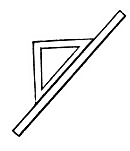

You likewise requested for the use of your school, an explanation
of a method of platting the courses of a survey, which I
mentioned to you as of my own practice. This is so obvious
and simple, that as it occurred to myself, so I presume it has to
others, although I have not seen it stated in any of the books.
For drawing parallel lines, I use the triangular rule, the hypothenusal
side of which being applied to the side
of a common straight rule, the triangle slides
on that, as thus, always parallel to itself.
Instead of drawing meridians on his paper,
let the pupil draw a parallel of latitude, or
east and west line, and note in that a point
for his first station, then applying to it his
protractor, lay off the first course and distance in the usual way
to ascertain his second station. For the second course, lay the triangular
rule to the east and west line, or first parallel, holding the
straight or guide rule firmly against its hypothenusal side. Then
slide up the triangle (for a northerly course) to the point of his
second station, and pressing it firmly there, lay the protractor to
that, and mark off the second course, and distance as before, for
the third station. Then lay the triangle to the first parallel again,
and sliding it as before to the point of the third station, there
apply to it the protractor for the third course and distance, which
gives the fourth station; and so on. Where a course is southwardly,
lay the protractor, as before, to the northern edge of the
triangle, but prick its reversed course, which reversed again in
drawing, gives the true course. When the station has got so
far from the first parallel, as to be out of the reach of the parallel
rule sliding on its hypothenuse, another parallel must be drawn
by laying the edge, or longer leg of the triangle to
the first parallel as before, applying the guide-rule to
the end, or short leg, (instead of the hypothenuse,) as
in the margin, and sliding the triangle up to the
point for the new parallel. I have found this, in practice, the
quickest and most correct method of platting which I have ever
tried, and the neatest also, because it disfigures the paper with
the fewest unnecessary lines.
If these mathematical trifles can give any facilities to your
pupils, they may in their hands become matters of use, as in
mine they have been of amusement only.
Ever and respectfully yours.
Monticello, April 19, 1814.
Dear Sir,—Your favor of the 6th instant is just received, and
I shall with equal willingness and truth, state the degree of
agency you had, respecting the copy of M. de Becourt's book,
which came to my hands. That gentleman informed me, by
letter, that he was about to publish a volume in French, "Sur
la Création du Monde, un Systême d'Organisation Primitive,"
which, its title promised to be, either a geological or astronomical
work. I subscribed; and, when published, he sent me a copy;
and as you were my correspondent in the book line in Philadelphia,
I took the liberty of desiring him to call on you for the price,
which, he afterwards informed me, you were so kind as to pay
him for me, being, I believe, two dollars. But the sole copy
which came to me was from himself directly, and, as far as I
know, was never seen by you.
I am really mortified to be told that, in the United States of
America, a fact like this can become a subject of inquiry, and
of criminal inquiry too, as an offence against religion; that a
question about the sale of a book can be carried before the civil
magistrate. Is this then our freedom of religion? and are we to
have a censor whose imprimatur shall say what books may be
sold, and what we may buy? And who is thus to dogmatize
religious opinions for our citizens? Whose foot is to be the
measure to which ours are all to be cut or stretched? Is a priest
to be our inquisitor, or shall a layman, simple as ourselves, set
up his reason as the rule for what we are to read, and what we
must believe? It is an insult to our citizens to question whether
they are rational beings or not, and blasphemy against religion
to suppose it cannot stand the test of truth and reason. If M. de
Becourt's book be false in its facts, disprove them; if false in its
reasoning, refute it. But, for God's sake, let us freely hear both
sides, if we choose. I know little of its contents, having barely
glanced over here and there a passage, and over the table of contents.
From this, the Newtonian philosophy seemed the chief
object of attack, the issue of which might be trusted to the
strength of the two combatants; Newton certainly not needing
the auxiliary arm of the government, and still less the holy
author of our religion, as to what in it concerns him. I thought
the work would be very innocent, and one which might be confided
to the reason of any man; not likely to be much read if
let alone, but, if persecuted, it will be generally read. Every
man in the United States will think it a duty to buy a copy, in
vindication of his right to buy, and to read what he pleases. I
have been just reading the new constitution of Spain. One of
its fundamental basis is expressed in these words: "The Roman
Catholic religion, the only true one, is, and always shall be, that
of the Spanish nation. The government protects it by wise and
just laws, and prohibits the exercise of any other whatever."
Now I wish this presented to those who question what you may
sell, or we may buy, with a request to strike out the words,
"Roman Catholic," and to insert the denomination of their own
religion. This would ascertain the code of dogmas which each
wishes should domineer over the opinions of all others, and be
taken, like the Spanish religion, under the "protection of wise
and just laws." It would shew to what they wish to reduce the
liberty for which one generation has sacrificed life and happiness.
It would present our boasted freedom of religion as a thing of
theory only, and not of practice, as what would be a poor exchange
for the theoretic thraldom, but practical freedom of
Europe. But it is impossible that the laws of Pennsylvania,
which set us the first example of the wholesome and happy
effects of religious freedom, can permit the inquisitorial functions
to be proposed to their courts. Under them you are surely
safe.
At the date of yours of the 6th, you had not received mine of
the 3d inst., asking a copy of an edition of Newton's Principia,
which I had seen advertised. When the cost of that shall be
known, it shall be added to the balance of $4.93, and incorporated
with a larger remittance I have to make to Philadelphia.
Accept the assurance of my great esteem and respect.
Monticello, April 28, 1814.
I thank you, Sir, for the copy of the new constitution of
Spain which you have been so kind as to send me; and I sincerely
congratulate yourself and the Spanish nation on this great
stride towards political happiness. The invasion of Spain has
been the most unprecedented and unprincipled of the transactions
of modern times. The crimes of its enemies, the licentiousness
of its associates in defence, the exertions and sufferings
of its inhabitants under slaughter and famine, and its consequent
depopulation, will mark indelibly the baneful ascendancy
of the tyrants of the sea and continent, and characterize with
blood and wretchedness the age in which they have lived. Yet
these sufferings of Spain will be remunerated, her population restored
and increased, under the auspices and protection of this
new constitution; and the miseries of the present generation
will be the price, and even the cheap price of the prosperity of
endless generations to come.
There are parts of this constitution, however, in which you
would expect of course that we should not concur. One of these
is the intolerance of all but the Catholic religion; and no security
provided against the re-establishment of an Inquisition, the exclusive
judge of Catholic opinions, and authorized to proscribe and
punish those it shall deem anti-Catholic. Secondly, the aristocracy,
quater sublimata, of her legislators; for the ultimate electors
of these will themselves have been three times sifted from the mass
of the people, and may choose from the nation at large persons
never named by any of the electoral bodies. But there is one
provision which will immortalize its inventors. It is that which,
after a certain epoch, disfranchises every citizen who cannot
read and write. This is new, and is the fruitful germ of the improvement
of everything good, and the correction of everything
imperfect in the present constitution. This will give you an
enlightened people, and an energetic public opinion which will
control and enchain the aristocratic spirit of the government.
On the whole I hail your country as now likely to resume and
surpass its ancient splendor among nations. This might perhaps
have been better secured by a just confidence in the self-sufficient
strength of the peninsula itself; everything without its
limits being its weakness not its force. If the mother country
has not the magnanimity to part with the colonies in friendship,
thereby making them, what they would certainly be, her
natural and firmest allies, these will emancipate themselves, after
exhausting her strength and resources in ineffectual efforts to
hold them in subjection. They will be rendered enemies of the
mother country, as England has rendered us by an unremitting
course of insulting injuries and silly provocations. I do not
say this from the impulse of national interest, for I do not know
that the United States would find an interest in the independence
of neighbor nations, whose produce and commerce would rivalize
ours. It could only be that kind of interest which every
human being has in the happiness and prosperity of every other.
But putting right and reason out of the question, I have no doubt
that on calculations of interest alone, it is that of Spain to anticipate
voluntarily, and as a matter of grace, the independence of
her colonies, which otherwise necessity will enforce.
* * * * * * * *
Monticello, May 3, 1814.
Sir,—Your favors of April 16 and 19, on the subject of the
portraits of Columbus and Americus Vespucius were received on
the 30th. While I resided at Paris, knowing that these portraits
and those of some other of the early American worthies were in
the gallery of Medicis at Florence, I took measures for engaging
a good artist to take and send me copies of them. I considered
it as even of some public concern that our country should not be
without the portraits of its first discoverers. These copies have
already run the risks of transportations from Florence to Paris,
to Philadelphia, to Washington, and lastly to this place, where
they are at length safely deposited. You request me "to forward
them to you at Philadelphia for the purpose of having engravings
taken from them for a work you propose to publish,
and you pledge your honor that they shall be restored to me in
perfect safety." I have no doubt of the sincerity of your intentions
in this pledge; and that it would be complied with as
far as it would be in your power. But the injuries and accidents
of their transportation to Philadelphia and back again are
not within your control. Besides the rubbing through a land
carriage of six hundred miles, a carriage may overset in a river
or creek, or be crashed with everything in it. The frequency
of such accidents to the stages renders all insurance against them
impossible. And were they to escape the perils of this journey
I should be liable to the same calls, and they to the same or
greater hazards from all those in other parts of the continent who
should propose to publish any work in which they might wish
to employ engravings of the same characters. From public,
therefore, as well as private considerations, I think that these
portraits ought not to be hazarded from their present deposit.
Like public records, I make them free to be copied, but, being as
originals in this country, they should not be exposed to the accidents
or injuries of travelling post. While I regret, therefore,
the necessity of declining to comply with your request, I freely
and with pleasure offer to receive as a guest any artist whom you
shall think proper to engage, and will make them welcome to
take copies at their leisure for your use. I wish them to be
multiplied for safe preservation, and consider them as worthy a
place in every collection. Indeed I do not know how it happened
that Mr. Peale did not think of copying them while they
were in Philadelphia; and I think it not impossible that either
the father or the son might now undertake the journey for the
use of their museum. On the ground of our personal esteem for
them, they would be at home in my family.
When I received these portraits at Paris, Mr. Daniel Parker of
Massachusetts happened to be there, and determined to procure
for himself copies from the same originals at Florence; and I
think he did obtain them, and that I have heard of their being
in the hands of some one in Boston. If so, it might perhaps be
easier to get some artist there to take and send you copies. But
be this as it may, you are perfectly welcome to the benefit of
mine in the way I have mentioned.
The two original portraits of myself taken by Mr. Stewart,
after which you enquire, are both in his possession at Boston.
One of them only is my property. The President has a copy
from that which Stewart considered as the best of the two; but
I believe it is at his seat in his State.
I thank you for the print of Dr. Rush. He was one of my
early and intimate friends, and among the best of men. The
engraving is excellent as is everything from the hand of Mr. Edwin.
Accept the assurance of my respect, and good wishes for
the success of your work.
Monticello, May 17, 1814.
Sir,—I have long been a subscriber to the edition of the Edinburgh
Review first published by Mr. Sargeant, and latterly by
Eastburn, Kirk & Co., and already possess from No. 30 to 42 inclusive;
except that Nos. 31 and 37 never came to hand. These
two and No. 29, I should be glad to receive, with all subsequently
published, through the channel of Messrs. Fitzwhylson &
Potter of Richmond, with whom I originally subscribed, and to
whom it is more convenient to make payment by a standing order
on my correspondent at Richmond. I willingly also subscribe
for the republication of the first twenty-eight numbers to
be furnished me through the same channel, for the convenience
of payment. This work is certainly unrivalled in merit, and if
continued by the same talents, information and principles which
distinguish it in every department of science which it reviews,
it will become a real Encyclopedia, justly taking its station in our
libraries with the most valuable depositories of human knowledge.
Of the Quarterly Review I have not seen many numbers. As
the antagonist of the other it appears to me a pigmy against a
giant. The precept "audi alteram partem," on which it is republished
here, should be sacred with the judge who is to decide
between the contending claims of individual and individual. It
is well enough for the young who have yet opinions to make up in
questions of principle in ethics or politics. But to those who have
gone through this process with industry, reflection, and singleness
of heart, who have formed their conclusions and acted on them
through life, to be reading over and over again what they have
already read, considered and condemned, is an idle waste of time.
It is not in the history of modern England or among the advocates
of the principles or practices of her government, that the
friend of freedom, or of political morality, is to seek instruction.
There has indeed been a period, during which both were to be
found, not in her government, but in the band of worthies who
so boldly and ably reclaimed the rights of the people, and wrested
from their government theoretic acknowledgments of them.
This period began with the Stuarts, and continued but one reign
after them. Since that, the vital principle of the English constitution
is corruption, its practices the natural results of that principle,
and their consequences a pampered aristocracy, annihilation
of the substantial middle class, a degraded populace, oppressive
taxes, general pauperism, and national bankruptcy.
Those who long for these blessings here will find their generating
principles well developed and advocated by the antagonist
of the Edinburgh Review. Still those who doubt should read
them; every man's reason being his own rightful umpire. This
principle, with that of acquiescence in the will of the majority
will preserve us free and prosperous as long as they are sacredly
observed. Accept the assurances of my respect.
Monticello, May 20, 1814.
Sir,—I thank you for the copy of the American Speaker
which you have been so kind as to send me. It is a judicious
selection of what has been excellently spoken on both sides of
the Atlantic; and according to your request, I willingly add
some suggestions, should another edition be called for. To the
speeches of Lord Chatham might be added his reply to Horace
Walpole, on the Seamen's bill, in the House of Commons, in
1740, one of the severest which history has recorded. Indeed,
the subsequent speeches in order, to which that reply gave rise
being few, short and pithy, well merit insertion in such a collection
as this. They are in the twelfth volume of Chandler's Debates
of the House of Commons. But the finest thing, in my
opinion, which the English language has produced, is the defence
of Eugene Aram, spoken by himself at the bar of the York
assizes, in 1759, on a charge of murder, and to be found in the
Annual Register of that date, or a little after. It had been upwards
of fifty years since I had read it, when the receipt of your
letter induced me to look up a MS. copy I had preserved, and on
re-perusal at this age and distance of time, it loses nothing of its
high station in my mind for classical style, close logic, and strong
representation. I send you this copy which was taken for me
by a school-boy, replete with errors of punctuation, of orthography,
and sometimes substitutions of one word for another. It
would be better to recur to the Annual Register itself for correctness,
where also I think are stated the circumstances and issue
of the case. To these I would add the short, the nervous, the
unanswerable speech of Carnot, in 1803, on the proposition to
declare Bonaparte consul for life. This creed of republicanism
should be well translated, and placed in the hands and heart of
every friend to the rights of self-government. I consider these
speeches of Aram and Carnot, and that of Logan, inserted in
your collection, as worthily standing in a line with those of
Scipio and Hannibal in Livy, and of Cato and Cæsar in Sallust.
On examining the Indian speeches in my possession, I find none
which are not already in your collection, except that my copy of
the corn-planter's has much in it which yours has not. But observing
that the omissions relate to special subjects only, I presume
they are made purposely and indeed properly.
I must add more particular thanks for the kind expressions of
your letter towards myself. These testimonies of approbation
from my fellow-citizens, offered too when the lapse of time may
have cooled and matured their opinions, are an ample reward for
such services as I have been able to render them, and are peculiarly
gratifying in a state of retirement and reflection. I pray
you to accept the assurance of my respect.
Poplar Forest, June 13, 1814.
Dear Sir,—The copy of your Second Thoughts on Instinctive
Impulses, with the letter accompanying it, was received just
as I was setting out on a journey to this place, two or three days'
distant from Monticello. I brought it with me and read it with
great satisfaction, and with the more as it contained exactly my
own creed on the foundation of morality in man. It is really
curious that on a question so fundamental, such a variety of
opinions should have prevailed among men, and those, too, of the
most exemplary virtue and first order of understanding. It shows
how necessary was the care of the Creator in making the moral
principle so much a part of our constitution as that no errors of
reasoning or of speculation might lead us astray from its observance
in practice. Of all the theories on this question, the most
whimsical seems to have been that of Wollaston, who considers
truth as the foundation of morality. The thief who steals your
guinea does wrong only inasmuch as he acts a lie in using your
guinea as if it were his own. Truth is certainly a branch of
morality, and a very important one to society. But presented as
its foundation, it is as if a tree taken up by the roots, had its
stem reversed in the air, and one of its branches planted in the
ground. Some have made the love of God the foundation of
morality. This, too, is but a branch of our moral duties, which
are generally divided into duties to God and duties to man. If
we did a good act merely from the love of God and a belief that
it is pleasing to Him, whence arises the morality of the Atheist?
It is idle to say, as some do, that no such being exists. We have
the same evidence of the fact as of most of those we act on,
to-wit: their own affirmations, and their reasonings in support
of them. I have observed, indeed, generally, that while in protestant
countries the defections from the Platonic Christianity of
the priests is to Deism, in catholic countries they are to Atheism.
Diderot, D'Alembert, D'Holbach, Condorcet, are known to have
been among the most virtuous of men. Their virtue, then, must
have had some other foundation than the love of God.
The Το καλον of others is founded in a different faculty, that of
taste, which is not even a branch of morality. We have indeed
an innate sense of what we call beautiful, but that is exercised
chiefly on subjects addressed to the fancy, whether through the eye
in visible forms, as landscape, animal figure, dress, drapery, architecture,
the composition of colors, &c., or to the imagination directly,
as imagery, style, or measure in prose or poetry, or whatever
else constitutes the domain of criticism or taste, a faculty
entirely distinct from the moral one. Self-interest, or rather self-love,
or egoism, has been more plausibly substituted as the basis
of morality. But I consider our relations with others as constituting
the boundaries of morality. With ourselves we stand on
the ground of identity, not of relation, which last, requiring two
subjects, excludes self-love confined to a single one. To ourselves,
in strict language, we can owe no duties, obligation requiring
also two parties. Self-love, therefore, is no part of morality.
Indeed it is exactly its counterpart. It is the sole antagonist
of virtue, leading us constantly by our propensities to self-gratification
in violation of our moral duties to others. Accordingly,
it is against this enemy that are erected the batteries of
moralists and religionists, as the only obstacle to the practice of
morality. Take from man his selfish propensities, and he can
have nothing to seduce him from the practice of virtue. Or subdue
those propensities by education, instruction or restraint, and
virtue remains without a competitor. Egoism, in a broader sense,
has been thus presented as the source of moral action. It has
been said that we feed the hungry, clothe the naked, bind up the
wounds of the man beaten by thieves, pour oil and wine into
them, set him on our own beast and bring him to the inn, because
we receive ourselves pleasure from these acts. So Helvetius,
one of the best men on earth, and the most ingenious advocate
of this principle, after defining "interest" to mean not
merely that which is pecuniary, but whatever may procure us
pleasure or withdraw us from pain, [de l'esprit 2, 1,] says, [ib.
2, 2,] "the humane man is he to whom the sight of misfortune
is insupportable, and who to rescue himself from this spectacle,
is forced to succor the unfortunate object." This indeed is true.
But it is one step short of the ultimate question. These good acts
give us pleasure, but how happens it that they give us pleasure?
Because nature hath implanted in our breasts a love of others, a
sense of duty to them, a moral instinct, in short, which prompts
us irresistibly to feel and to succor their distresses, and protests
against the language of Helvetius, [ib. 2, 5,] "what other motive
than self-interest could determine a man to generous actions?
It is as impossible for him to love what is good for the sake of
good, as to love evil for the sake of evil." The Creator would
indeed have been a bungling artist, had he intended man for a
social animal, without planting in him social dispositions. It is
true they are not planted in every man, because there is no rule
without exceptions; but it is false reasoning which converts exceptions
into the general rule. Some men are born without the
organs of sight, or of hearing, or without hands. Yet it would
be wrong to say that man is born without these faculties, and
sight, hearing, and hands may with truth enter into the general
definition of man. The want or imperfection of the moral sense
in some men, like the want or imperfection of the senses of sight
and hearing in others, is no proof that it is a general characteristic
of the species. When it is wanting, we endeavor to supply
the defect by education, by appeals to reason and calculation, by
presenting to the being so unhappily conformed, other motives to
do good and to eschew evil, such as the love, or the hatred, or
rejection of those among whom he lives, and whose society is
necessary to his happiness and even existence; demonstrations
by sound calculation that honesty promotes interest in the long
run; the rewards and penalties established by the laws; and ultimately
the prospects of a future state of retribution for the evil
as well as the good done while here. These are the correctives
which are supplied by education, and which exercise the functions
of the moralist, the preacher, and legislator; and they lead
into a course of correct action all those whose disparity is not
too profound to be eradicated. Some have argued against the
existence of a moral sense, by saying that if nature had given
us such a sense, impelling us to virtuous actions, and warning us
against those which are vicious, then nature would also have designated,
by some particular ear-marks, the two sets of actions
which are, in themselves, the one virtuous and the other vicious.
Whereas, we find, in fact, that the same actions are deemed virtuous
in one country and vicious in another. The answer is
that nature has constituted utility to man the standard and best
of virtue. Men living in different countries, under different circumstances,
different habits and regimens, may have different
utilities; the same act, therefore, may be useful, and consequently
virtuous in one country which is injurious and vicious in another
differently circumstanced. I sincerely, then, believe with
you in the general existence of a moral instinct. I think it the
brightest gem with which the human character is studded, and
the want of it as more degrading than the most hideous of the
bodily deformities. I am happy in reviewing the roll of associates
in this principle which you present in your second letter,
some of which I had not before met with. To these might be
added Lord Kaims, one of the ablest of our advocates, who goes
so far as to say, in his Principles of Natural Religion, that a man
owes no duty to which he is not urged by some impulsive feeling.
This is correct, if referred to the standard of general feeling
in the given case, and not to the feeling of a single individual.
Perhaps I may misquote him, it being fifty years since I
read his book.
The leisure and solitude of my situation here has led me to
the indiscretion of taxing you with a long letter on a subject
whereon nothing new can be offered you. I will indulge myself
no farther than to repeat the assurances of my continued esteem
and respect.
Monticello, July 5, 1814.
Dear Sir,—Since mine of January the 24th, yours of March
the 14th has been received. It was not acknowledged in the
short one of May the 18th, by Mr. Rives, the only object of that
having been to enable one of our most promising young men to
have the advantage of making his bow to you. I learned with
great regret the serious illness mentioned in your letter; and I
hope Mr. Rives will be able to tell me you are entirely restored.
But our machines have now been running seventy or eighty years,
and we must expect that, worn as they are, here a pivot, there a
wheel, now a pinion, next a spring, will be giving way; and
however we may tinker them up for awhile, all will at length
surcease motion. Our watches, with works of brass and steel,
wear out within that period. Shall you and I last to see the
course the seven-fold wonders of the times will take? The Attila
of the age dethroned, the ruthless destroyer of ten millions
of the human race, whose thirst for blood appeared unquenchable,
the great oppressor of the rights and liberties of the world,
shut up within the circle of a little island of the Mediterranean,
and dwindled to the condition of an humble and degraded pensioner
on the bounty of those he had most injured. How miserably,
how meanly, has he closed his inflated career! What a sample
of the bathos will his history present! He should have perished
on the swords of his enemies, under the walls of Paris.
"Leon piagato a morte
Sente mancar la vita,
Guarda la sua ferita,
Ne s'avilisce ancor.
Cosi fra l'ire estrema
Rugge, minaccia, e freme,
Che fa tremar morendo
Tal volta il cacciator."—Metast. Adriano.
But Bonaparte was a lion in the field only. In civil life, a
cold-blooded, calculating, unprincipled usurper, without a virtue;
no statesman, knowing nothing of commerce, political
economy, or civil government, and supplying ignorance by bold
presumption. I had supposed him a great man until his entrance
into the Assembly des cinq cens, eighteen Brumaire (an. 8.)
From that date, however, I set him down as a great scoundrel
only. To the wonders of his rise and fall, we may add that of
a Czar of Muscovy, dictating, in Paris, laws and limits to all
the successors of the Cæsars, and holding even the balance in
which the fortunes of this new world are suspended. I own,
that while I rejoice, for the good of mankind, in the deliverance
of Europe from the havoc which would never have ceased while
Bonaparte should have lived in power, I see with anxiety the
tyrant of the ocean remaining in vigor, and even participating in
the merit of crushing his brother tyrant. While the world is thus
turned up side down, on which of its sides are we? All the strong
reasons, indeed, place us on the side of peace; the interests of
the continent, their friendly dispositions, and even the interests
of England. Her passions alone are opposed to it. Peace would
seem now to be an easy work, the causes of the war being removed.
Her orders of council will no doubt be taken care of
by the allied powers, and, war ceasing, her impressment of our
seamen ceases of course. But I fear there is foundation for the
design intimated in the public papers, of demanding a cession of
our right in the fisheries. What will Massachusetts say to this?
I mean her majority, which must be considered as speaking
through the organs it has appointed itself, as the index of its
will. She chooses to sacrifice the liberties of our seafaring citizens,
in which we were all interested, and with them her obligations
to the co-States, rather than war with England. Will
she now sacrifice the fisheries to the same partialities? This
question is interesting to her alone; for to the middle, the southern
and western States, they are of no direct concern; of no
more than the culture of tobacco, rice and cotton, to Massachusetts.
I am really at a loss to conjecture what our refractory
sister will say on this occasion. I know what, as a citizen of
the Union, I would say to her. "Take this question ad referendum.
It concerns you alone. If you would rather give up
the fisheries than war with England, we give them up. If you
had rather fight for them, we will defend your interests to the
last drop of our blood, choosing rather to set a good example
than follow a bad one." And I hope she will determine to fight
for them. With this, however, you and I shall have nothing to
do; ours being truly the case wherein "non tali auxilio, nec
defensoribus istis tempus eget." Quitting this subject, therefore
I will turn over another leaf.
I am just returned from one of my long absences, having been
at my other home for five weeks past. Having more leisure
there than here for reading, I amused myself with reading seriously
Plato's Republic. I am wrong, however, in calling it
amusement, for it was the heaviest task-work I ever went through.
I had occasionally before taken up some of his other works, but
scarcely ever had patience to go through a whole dialogue.
While wading through the whimsies, the puerilities, and unintelligible
jargon of this work, I laid it down often to ask myself
how it could have been, that the world should have so long consented
to give reputation to such nonsense as this? How the
soi-disant Christian world, indeed, should have done it, is a
piece of historical curiosity. But how could the Roman good
sense do it? And particularly, how could Cicero bestow such
eulogies on Plato? Although Cicero did not wield the dense
logic of Demosthenes, yet he was able, learned, laborious, practised
in the business of the world, and honest. He could not be
the dupe of mere style, of which he was himself the first master
in the world. With the moderns, I think, it is rather a matter
of fashion and authority. Education is chiefly in the hands
of persons who, from their profession, have an interest in the
reputation and the dreams of Plato. They give the tone while
at school, and few in their after years have occasion to revise
their college opinions. But fashion and authority apart, and
bringing Plato to the test of reason, take from him his sophisms,
futilities and incomprehensibilities, and what remains? In truth,
he is one of the race of genuine sophists, who has escaped the
oblivion of his brethren, first, by the elegance of his diction, but
chiefly, by the adoption and incorporation of his whimsies into
the body of artificial Christianity. His foggy mind is forever
presenting the semblances of objects which, half seen through
a mist, can be defined neither in form nor dimensions. Yet this,
which should have consigned him to early oblivion, really procured
him immortality of fame and reverence. The Christian
priesthood, finding the doctrines of Christ levelled to every understanding,
and too plain to need explanation, saw in the mysticism
of Plato materials with which they might build up an
artificial system, which might, from its indistinctness, admit everlasting
controversy, give employment for their order, and introduce
it to profit, power and pre-eminence. The doctrines which
flowed from the lips of Jesus himself are within the comprehension
of a child; but thousands of volumes have not yet explained
the Platonisms engrafted on them; and for this obvious
reason, that nonsense can never be explained. Their purposes,
however, are answered. Plato is canonized; and it is now deemed
as impious to question his merits as those of an Apostle of Jesus.
He is peculiarly appealed to as an advocate of the immortality of
the soul; and yet I will venture to say, that were there no better
arguments than his in proof of it, not a man in the world
would believe it. It is fortunate for us, that Platonic republicanism
has not obtained the same favor as Platonic Christianity; or
we should now have been all living, men, women and children,
pell mell together, like beasts of the field or forest. Yet "Plato
is a great philosopher," said La Fontaine. But, says Fontenelle,
"do you find his ideas very clear?" "Oh no! he is of an
obscurity impenetrable." "Do you not find him full of contradictions?"
"Certainly," replied La Fontaine, "he is but a
sophist." Yet immediately after, he exclaims again, "Oh, Plato
was a great philosopher." Socrates had reason, indeed, to complain
of the misrepresentations of Plato; for in truth, his dialogues
are libels on Socrates.
But why am I dosing you with these antediluvian topics?
Because I am glad to have some one to whom they are familiar,
and who will not receive them as if dropped from the moon.
Our post-revolutionary youth are born under happier stars than
you and I were. They acquire all learning in their mother's
womb, and bring it into the world ready made. The information
of books is no longer necessary; and all knowledge which
is not innate, is in contempt, or neglect at least. Every folly
must run its round; and so, I suppose, must that of self-learning
and self-sufficiency; of rejecting the knowledge acquired in past
ages, and starting on the new ground of intuition. When sobered
by experience, I hope our successors will turn their attention
to the advantages of education. I mean of education on
the broad scale, and not that of the petty academies, as they call
themselves, which are starting up in every neighborhood, and
where one or two men, possessing Latin and sometimes Greek,
a knowledge of the globes, and the first six books of Euclid,
imagine and communicate this as the sum of science. They
commit their pupils to the theatre of the world, with just taste
enough of learning to be alienated from industrious pursuits,
and not enough to do service in the ranks of science. We
have some exceptions, indeed. I presented one to you lately, and
we have some others. But the terms I use are general truths.
I hope the necessity will, at length, be seen of establishing institutions
here, as in Europe, where every branch of science, useful
at this day, may be taught in its highest degree. Have you ever
turned your thoughts to the plan of such an institution? I mean
to a specification of the particular sciences of real use in human
affairs, and how they might be so grouped as to require so many
professors only as might bring them within the views of a just
but enlightened economy? I should be happy in a communication
of your ideas on this problem, either loose or digested. But
to avoid my being run away with by another subject, and adding
to the length and ennui of the present letter, I will here present
to Mrs. Adams and yourself, the assurance of my constant and
sincere friendship and respect.
Quincy, July 16, 1814.
Dear Sir,—I received this morning your favor of the 5th,
and as I can never let a sheet of yours rest, I sit down immediately
to acknowledge it.
Whenever Mr. Reeves, of whom I have heard nothing, shall
arrive, he shall receive all the cordial civilities in my power.
I am sometimes afraid that my "machine" will not "surcease
motion" soon enough; for I dread nothing so much as "dying
at top," and expiring like Dean Swift, "a driveler and a show;"
or like Sam Adams, a grief and distress to his family, a weeping
helpless object of compassion for years.
I am bold to say, that neither you nor I will live to see
the course which the "wonders of the times" will take. Many
years, and perhaps centuries must pass, before the current will
acquire a settled direction. If the Christian religion, as I understand
it, or as you understand it, should maintain its ground,
as I believe it will, yet Platonic, Pythagonic, Hindoo, Cabalistical
Christianity, which is Catholic Christianity, and which has
prevailed for 1,500 years, has received a mortal wound of which
the monster must finally die; yet so strong is his constitution,
that he may endure for centuries before he expires.
Government has never been much studied by mankind, but
their attention has been drawn to it in the latter part of
the last century, and the beginning of this, more than at any
former period; and the vast variety of experiments that have
been made of constitutions in America, in France, in Holland,
in Geneva, in Switzerland, and even in Spain and South America,
can never be forgotten. They will be catastrophes noted.
The result, in time, will be improvements; and I have no doubt
that the honors we have experienced for the last forty years, will
ultimately terminate in the advancement of civil and religious
liberty, and ameliorations in the condition of mankind; for I am
a believer in the probable improvability and improvement, the
ameliorability and amelioration in human affairs; though I never
could understand the doctrine of the perfectability of the human
mind. This has always appeared to me like the philosophy, or
theology of the Gentoos, viz., that a Brachman, by certain studies,
for a certain time pursued, and by certain ceremonies, a certain
number of times repeated, becomes omniscient and almighty.
Our hopes, however, of sudden tranquillity, ought not to be
too sanguine. Fanaticism and superstition will still be selfish,
subtle, intriguing, and at times furious. Despotism will
still struggle for domination; monarchy will still study to rival
nobility in popularity; aristocracy will continue to envy all
above it, and despise and oppress all below it; democracy will
envy all, contend with all, endeavor to pull down all; and when
by chance it happens to get the upper hand for a short time, it
will be revengeful, bloody, and cruel. These, and other elements
of fanaticism and anarchy, will yet, for a long time, continue
a fermentation, which will excite alarms and require vigilance.
Napoleon is a military fanatic like Achilles, Alexander, Cæsar,
Mahomet, Zingis, Kouli, Charles XII., &c. The maxim and
principle of all of them was the same: "Jura negat sibi lata,
nihil non arrogat armis."
But is it strict to call him an usurper? Was not his elevation
to the empire of France as legitimate and authentic a national
act as that of William the III., or the House of Hanover to the
throne of the three kingdoms? or as the election of Washington to
the command of our army, or to the chair of the States?
Human nature, in no form of it, ever could bear prosperity.
That peculiar tribe of men called conquerors, more remarkably
than any other, have been swelled with vanity by any series of
victories.
Napoleon won so many mighty battles in such quick succession,
and for so long a time, that it was no wonder his brain became
completely intoxicated, and his enterprises rash, extravagant,
and mad.
Though France is humbled, Britain is not. Though Bonaparte
is banished, a greater tyrant and miser usurper still
domineers. John Bull is quite as unfeeling, as unprincipled,
more powerful, has shed more blood, than Bonaparte. John, by
his money, his intrigues, and arms, by exciting coalition after
coalition against him, made him what he was, and, at last, what
he is. How shall the tyrant of tyrants be brought low? Aye!
there's the rub! I still think Bonaparte great, at least as any
of the conquerors. The wonders "of his rise and fall," may be
seen in the life of king Theodore, or Pascal Paoli, or Mazionetti,
or Jack Cade, or Wat Tyler, or Rienzi, or Dionicus. The only
difference is that between miniatures and full-length pictures.
The schoolmaster at Corinth was a greater man than the tyrant
of Syracuse, upon the principle that he who conquers himself is
greater than he who takes a city. Though the ferocious roar of the
wounded lion may terrify the hunter with the possibility of another
dangerous leap, Bonaparte was shot dead at once by France.
He could no longer roar or struggle, growl or paw; he could
only gasp the death. I wish that France may not still regret
him. But these are speculations in the clouds. I agree with
you that the milk of human kindness in the Bourbons, is safer
for mankind than the fierce ambition of Napoleon.
The Autocrator appears in an imposing light. Fifty years ago,
English writers held up terrible consequences from "thawing
out the monstrous northern snake." If Cossacks, and Tartars,
and Goths, and Vandals, and Huns, and Riparians, should get
a taste of European sweets, what may happen? Could Wellingtons
or Bonapartes resist them?
The greatest trait of sagacity that Alexander has yet exhibited
to the world, is his courtship of the United States. But whether
this is a mature, well-digested policy, or only a transient gleam
of thought, still remains to be explained and proved by time.
The refractory siston will not give up the fisheries. Not a
man here dares to hint at so base a thought.
I am very glad you have seriously read Plato; and still more
rejoiced to find that your reflections upon him so perfectly harmonize
with mine. Some thirty years ago I took upon me the
severe task of going through all his works. With the help of
two Latin translations, and one English and one French translation,
and comparing some of the most remarkable passages with
the Greek, I labored through the tedious toil. My disappointment
was very great, my astonishment was greater, and my disgust
shocking. Two things only did I learn from him. 1. That
Franklin's ideas of exempting husbandmen, and mariners, &c.,
from the depredations of war, was borrowed from him. 2. That
sneezing is a cure for the hickups. Accordingly, I have cured
myself, and all my friends, of that provoking disorder, for thirty
years, with a pinch of snuff.
Some parts of some of his dialogues are entertaining like the
writings of Rousseau, but his laws and his republic, from which
I expected most, disappointed me most.
I could scarcely exclude the suspicion that he intended the latter
as a bitter satire upon all republican government, as Xenophon
undoubtedly designed, by his essay on democracy, to ridicule
that species of republic. In a letter to the learned and
ingenious Mr. Taylor, of Haslewood, I suggested to him the
project of writing a novel, in which the hero should be sent upon
his travels through Plato's republic, and all his adventures, with
his observations on the principles and opinions, the arts and
sciences, the manners, customs, and habits of the citizens, should
be recorded. Nothing can be conceived more destructive of
human happiness; more infallibly contrived to transform men
and women into brutes, Yahoos, or demons, than a community
of wives and property. Yet in what are the writings of Rousseau
and Helvetius, wiser than those of Plato? The man who
first fenced a tobacco yard, and said this is mine, ought instantly
to have been put to death, says Rousseau. The man who first
pronounced the barbarous word Dieu, ought to have been immediately
destroyed, says Diderot. In short, philosophers, ancient
and modern, appear to me as mad as Hindoos, Mahometans, and
Christians. No doubt they would all think me mad, and, for
anything I know, this globe may be the bedlam, Le Bicêtre of
the universe. After all, as long as property exists, it will accumulate
in individuals and families. As long as marriage exists,
knowledge, property, and influence will accumulate in families.
Your and our equal partition of intestate estates, instead
of preventing, will, in time, augment the evil, if it is one.
The French revolutionists saw this, and were so far consistent.
When they burned pedigrees and genealogical trees, they
annihilated, as far as they could, marriages, knowing that marriage,
among a thousand other things, was an infallible source of
aristocracy. I repeat it, so sure as the idea and existence of
property is admitted and established in society, accumulations
of it will be made; the snow-ball will grow as it rolls.
Cicero was educated in the Groves of Academus, where the
name and memory of Plato were idolized to such a degree, that
if he had wholly renounced the prejudices of his education, his
reputation would have been lessened, if not injured and ruined.
In his two volumes of Discourses on Government, we may presume
that he fully examined Plato's laws and republic, as well
as Aristotle's writings on government. But these have been carefully
destroyed, not improbably with the general consent of philosophers,
politicians and priests. The loss is as much to be regretted
as that of any production of antiquity.
Nothing seizes the attention of the staring animal so surely
as paradox, riddle, mystery, invention, discovery, wonder, temerity.
Plato and his disciples, from the fourth-century Christians
to Rousseau and Tom Paine, have been fully sensible of this
weakness in mankind, and have too successfully grounded upon
it their pretensions to fame.
I might, indeed, have mentioned Bolingbroke, Hume, Gibbon,
Voltaire, Turgot, Helvetius, Diderot, Condorcet, Buffon, and fifty
others, all a little cracked. Be to their faults a little blind, to
their virtues ever kind.
Education! Oh Education! The greatest grief of my heart,
and the greatest affliction of my life! To my mortification I
must confess that I have never closely thought, or very deliberately
reflected upon the subject which never occurs to me now
without producing a deep sigh, a heavy groan, and sometimes
tears.
My cruel destiny separated me from my children, almost continually
from their birth to their manhood. I was compelled to
leave them to the ordinary routine of reading, writing and Latin
school, academy and college. John, alone, was much with me,
and he but occasionally. If I venture to give you any thoughts
at all, they must be very crude. I have turned over Locke, Milton,
Condilac, Rousseau, and even Miss Edgeworth, as a bird
flies through the air. The Preceptor I have thought a good
book.
Grammar, rhetoric, logic, ethics, mathematics, cannot be neglected.
Classics, in spite of our friend Rush, I must think indispensable.
Natural history, mechanics and experimental philosophy,
chemistry, &c., at least their rudiments, cannot be forgotten.
Geography, astronomy, and even history and chronology,
(although I am myself afflicted with a kind of Pyrrhonism
in the two latter,) I presume cannot be omitted. Theology I
would leave to Ray, Derham, Nicuentent, and Paley, rather
than to Luther, Zinzindorf, Swedenborg, Wesley or Whitefield,
or Thomas Aquinas or Wollebius. Metaphysics I would leave
in the clouds with the materialists and spiritualists, with Leibnitz,
Berkley, Priestley and Edwards, and I might add Hume and
Reed, or if permitted to be read, it should be with romances and
novels. What shall I say of music, drawing, fencing, dancing
and gymnastic exercises? What of languages, oriental and occidental?
Of French, Italian, German or Russian? of Sanscrit or
Chinese?
The task you have prescribed to me of grouping these sciences
or arts under professors, within the views of an enlightened economy,
is far beyond my forces. Loose indeed, and indigested,
must be all the hints I can note. Might grammar, rhetoric, logic,
and ethics, be under one professor? Might mathematics, mechanics,
natural philosophy, be under another? Geography and
astronomy under a third? Laws and government, history and
chronology, under a fourth? Classics might require a fifth.
Condilac's Course of Study has excellent parts. Among many
systems of mathematics, English, French and American, there
is none preferable to Besout's Course. La Harpe's Course of
Literature is very valuable.
But I am ashamed to add any more to the broken innuendos,
except assurances of my continued friendship.
Monticello, July 31, 1814.
Sir,—Within a few days only, I have received the letter which
you did me the honor to write on the 22d of July, 1812; a delay
which I presume must be ascribed to the interruption of the intercourse
of the world by the wars which have lately desolated
it by sea and land. Still involved ourselves with a nation possessing
almost exclusively the ocean which separates us, I fear
the one I have now the honor of addressing you may experience
equal delay. I receive with much gratification the diploma of
the Agronomic Society of Bavaria, conferring on me the distinction
of being honorary member of their society. For this mark
of their good will, I pray you to be the channel of communicating
to them my respectful thanks. Age and distance will add
their obstacles to the services I shall ardently wish to render the
society. Yet sincerely devoted to this art, the basis of the subsistence,
the comforts and the happiness of man, and sensible of
the general interest which all nations have in communicating
freely to each other discoveries of new and useful processes and
implements in it, I shall with zeal at all times meet the wishes
of the society, and especially rejoice in every opportunity which
their commands may present of being useful to them. With
the homage of my respects to them, be pleased to accept for yourself
the assurances of my particular and high consideration.
Monticello, August 14, 1814.
Dear Sir,—I have been laying under contribution my memory,
my private papers, the printed records, gazettes and pamphlets
in my possession, to answer the inquiries of your letter of
July 27, and I will give you the result as correctly as I can. I
kept no copy of the paper I sent you on a former occasion on
the same subject, nor do I retain an exact recollection of its contents.
But if in that I stated the question on the loan office to
have been in 1762, I did it with too slight attention to the date,
although not to the fact. I have examined the journals of the
House of Burgesses, of 1760-1-2, in my possession, and find no
trace of the proceeding in them. By those of 1764, I find that the
famous address to the king, and memorials to the Houses of Lords
and Commons, on the proposal of the Stamp Act, were of that date;
and I know that Mr. Henry was not a member of the legislature
when they were passed. I know also, because I was present, that
Robinson, (who died in May, 1766,) was in the chair on the question
of the loan office. Mr. Henry, then, must have come in between
these two epochs, and consequently in 1765. Of this year
I have no journals to refresh my memory. The first session was
in May, and his first remarkable exhibition there was on the
motion for the establishment of an office for lending money on
mortgages of real property. I find in Royle's Virginia Gazette,
of the 17th of that month this proposition for the loan office
brought forward, its advantages detailed, and the plan explained;
and it seems to have been done by a borrowing member, from
the feeling with which the motives are expressed; and to have
been preparatory to the intended motion. This was probably
made immediately after that date, and certainly before the 30th,
which was the date of Mr. Henry's famous resolutions. I had
been intimate with Mr. Henry since the winter of 1759-60, and
felt an interest in what concerned him, and I can never forget
a particular exclamation of his in the debate in which he electrified
his hearers. It had been urged that from certain unhappy
circumstances of the colony, men of substantial property had
contracted debts, which, if exacted suddenly, must ruin them
and their families, but, with a little indulgence of time, might be
paid with ease. "What, Sir!" exclaimed Mr. Henry, in animadverting
on this, "is it proposed then to reclaim the spendthrift
from his dissipation and extravagance, by filling his pockets
with money." These expressions are indelibly impressed on
my memory. He laid open with so much energy the spirit of
favoritism on which the proposition was founded, and the abuses
to which it would lead, that it was crushed in its birth. Abortive
motions are not always entered on the journals, or rather,
they are rarely entered. It is the modern introduction of yeas
and nays which has given the means of placing a rejected motion
on the journals; and it is likely that the speaker, who, as treasurer,
was to be the loan officer, and had the direction of the
journals, would choose to omit an entry of the motion in this
case. This accounts sufficiently for the absence of any trace of
the motion in the journals. There was no suspicion then, (as
far, at least, as I know,) that Robinson had used the public
money in private loans to his friends, and that the secret object
of this scheme was to transfer those debtors to the public, and
thus clear his accounts. I have diligently examined the names
of the members on the journals of 1764, to see if any were still
living to whose memory we might recur on this subject, but I
find not a single one now remaining in life.
Of the parson's cause I remember nothing remarkable. I was
at school with Mr. Maury during the years 1758 and 1759, and
often heard them inveigh against the iniquity of the act of 1758,
called the two-penny act. In 1763, when that cause was decided
in Hanover, I was a law-student in Williamsburg, and
remember only that it was a subject of much conversation, and
of great paper-controversy, in which Camm, and Colonel Bland,
were the principal champions.
The disputed election in which Mr. Henry made himself remarkable,
must have been that of Dandridge and Littlepage, in
1764, of which, however, I recollect no particulars, although I
was still a student in Williamsburg, and paid attention to what
was passing in the legislature.
I proceed now to the resolution of 1765. The copies you enclose
me, and that inserted by Judge Marshall in his history, and
copied verbatim by Burke, are really embarrassing by their differences.
1. That of the four resolutions taken from the records
of the House, is the genuine copy of what they passed, as
amended by themselves, cannot be doubted. 2. That the copy
which Mr. Henry left sealed up, is a true copy of these four resolutions,
as reported by the committee, there is no reason to doubt.
3. That Judge Marshall's version of three of these resolutions, (for
he has omitted one altogether,) is from an unauthentic source is
sufficiently proved by their great variation from the record in diction,
although equivalent in sentiment. But what are we to say of
Mr. Henry's fifth, and Mr. Marshall's two last, which we may
call the sixth and seventh resolutions? The fifth has clearly
nothing to justify the debate and proceedings which one of them
produced. But the sixth is of that character, and perfectly
tallies with the idea impressed on my mind, of that which was
expunged. Judge Marshall tells us that two were disagreed to
by the House, which may be true. I do not indeed recollect it,
but I have no recollection to the contrary. My hypothesis, then,
is this, that the two disagreed to were the fifth and seventh.
The fifth, because merely tautologous of the third and fourth, and
the seventh, because leading to individual persecution, for which
no mind was then prepared. And that the sixth was the one
passed by the House, by a majority of a single vote, and expunged
from the journals the next day. I was standing at the
door of communication between the house and lobby during the
debates and vote, and well remember, that after the numbers on
the division were told, and declared from the chair, Peyton Randolph
(then Attorney General) came out at the door where I
was standing, and exclaimed, "By God, I would have given one
hundred guineas for a single vote." For one vote would have
divided the house, and Robinson was in the chair, who he knew
would have negatived the resolution. Mr. Henry left town that
evening, or the next morning; and Colonel Peter Randolph, then
a member of the Council, came to the House of Burgesses about
10 o'clock of the forenoon, and sat at the clerk's table till the
House-bell rang, thumbing over the volumes of Journals to find
a precedent of expunging a vote of the House, which he said
had taken place while he was a member or clerk of the House,
I do not recollect which. I stood by him at the end of the table
a considerable part of the time, looking on as he turned over the
leaves, but I do not recollect whether he found the erasure. In
the meantime, some of the timid members, who had voted for
the strongest resolution, had become alarmed, and as soon as the
House met, a motion was made, and carried, to expunge it from
the journals. And here I will observe, that Burke's statement
with his opponents, is entirely erroneous. I suppose the original
journal was among those destroyed by the British, or its obliterated
face might be appealed to. It is a pity this investigation
was not made a few years sooner, when some of the members
of the day were still living. I think inquiry should be made of
Judge Marshall for the source from which he derived his copy
of the resolutions. This might throw light on the sixth and
seventh, which I verily believe, and especially the sixth, to be
genuine in substance. On the whole, I suppose the four resolutions
which are on the record, were passed and retained by the
House; that the sixth is that which was passed by a single vote
and expunged, and the fifth and seventh, the two which Judge
Marshall says were disagreed to. That Mr. Henry's copy, then,
should not have stated all this, is the remaining difficulty. This
copy he probably sealed up long after the transaction, for it was
long afterwards that these resolutions, instead of the address and
memorials of the preceding year, were looked back to as the
commencement of legislative opposition. His own judgment may,
at a later date, have approved of the rejection of the sixth and
seventh, although not of the fifth, and he may have left and
sealed up a copy, in his own handwriting, as approved by his
ultimate judgment. This, to be sure, is conjecture, and may
rightfully be rejected by any one to whom a more plausible
solution may occur; and there I must leave it. The address
of 1764 was drawn by Peyton Randolph. Who drew the memorial
to the Lords I do not recollect, but Mr. Wythe drew that
to the Commons. It was done with so much freedom, that, as
he has told me himself, his colleagues of the committee shrank
from it as bearing the aspect of treason, and smoothed its features
to its present form. He was, indeed, one of the very few,
(for I can barely speak of them in the plural number,) of either
character, who, from the commencement of the contest, hung
our connection with Great Britain on its true hook, that of a
common king. His unassuming character, however, made him
appear as a follower, while his sound judgment kept him in a
line with the freest spirit. By these resolutions, Mr. Henry took
the lead out of the hands of those who had heretofore guided the
proceedings of the House, that is to say, of Pendleton, Wythe,
Bland, Randolph, Nicholas. These were honest and able men,
had begun the opposition on the same grounds, but with a moderation
more adapted to their age and experience. Subsequent events
favored the bolder spirits of Henry, the Lees, Pages, Mason, &c.,
with whom I went in all points. Sensible, however, of the importance
of unanimity among our constituents, although we often
wished to have gone faster, we slackened our pace, that our less
ardent colleagues might keep up with us; and they, on their
part, differing nothing from us in principle, quickened their gait
somewhat beyond that which their prudence might of itself have
advised, and thus consolidated the phalanx which breasted the
power of Britain. By this harmony of the bold with the cautious,
we advanced with our constituents in undivided mass, and with
fewer examples of separation than, perhaps, existed in any other
part of the Union.
I do not remember the topics of Mr. Henry's argument, but
those of his opposers were that the same sentiments had been
expressed in the address and memorials of the preceding session,
to which an answer was expected and not yet received. I well
remember the cry of treason, the pause of Mr. Henry at the
name of George the III., and the presence of mind with which
he closed his sentence, and baffled the charge vociferated. I do
not think he took the position in the middle of the floor which
you mention. On the contrary, I think I recollect him standing
in the very place which he continued afterwards habitually to
occupy in the house.
The censure of Mr. E. Randolph on Mr. Henry in the case
of Philips, was without foundation. I remember the case, and
took my part in it. Philips was a mere robber, who availing
himself of the troubles of the times, collected a banditti, retired
to the Dismal Swamp, and from thence sallied forth, plundering
and maltreating the neighboring inhabitants, and covering himself,
without authority, under the name of a British subject. Mr.
Henry, then Governor, communicated the case to me. We both
thought the best proceeding would be by bill of attainder, unless
he delivered himself up for trial within a given time. Philips
was afterwards taken; and Mr. Randolph being Attorney
General, and apprehending he would plead that he was a British
subject, taken in arms, in support of his lawful sovereign, and as
a prisoner of war entitled to the protection of the law of nations,
he thought the safest proceeding would be to indict him
at common law as a felon and robber. Against this I believe
Philips urged the same plea: he was overruled and found
guilty.
I recollect nothing of a doubt on the re-eligibility of Mr.
Henry to the government when his term expired in 1779, nor
can I conceive on what ground such a doubt could have been
entertained, unless perhaps that his first election in June, 1776,
having been before we were nationally declared independent,
some might suppose it should not be reckoned as one of the
three constitutional elections.
Of the projects for appointing a Dictator there are said to
have been two. I know nothing of either but by hearsay.
The first was in Williamsburg in December, 1776. The Assembly
had the month before appointed Mr. Wythe, Mr. Pendleton,
George Mason, Thomas L. Lee, and myself, to revise the whole
body of laws, and adapt them to our new form of government.
I left the House early in December to prepare to join the Committee
at Fredericksburg, the place of our first meeting. What
passed, therefore, in the House in December, I know not, and
have not the journals of that session to look into. The second
proposition was in June, 1781, at the Staunton session of the legislature.
No trace of this last motion is entered on the journals
of that date, which I have examined. This is a further proof
that the silence of the journals is no evidence against the fact of
an abortive motion. Among the names of the members found on
the journal of the Staunton session, are John Taylor of Caroline,
General Andrew Moore, and General Edward Stevens of Culpeper,
now living. It would be well to ask information from
each of them, that their errors of memory, or of feeling, may be
corrected by collation.
You ask if I would have any objection to be quoted as to the
fact of rescinding the last of Mr. Henry's resolutions. None at
all as to that fact, or its having been passed by a majority of
one vote only; the scene being as present to my mind as that
in which I am now writing. But I do not affirm, although I believe
it was the sixth resolution.
It is truly unfortunate that those engaged in public affairs so
rarely make notes of transactions passing within their knowledge.
Hence history becomes fable instead of fact. The great
outlines may be true, but the incidents and coloring are according
to the faith or fancy of the writer. Had Judge Marshall
taken half your pains in sifting and scrutinizing facts, he would
not have given to the world, as true history, a false copy of a
record under his eye. Burke again has copied him, and being a
second writer on the spot, doubles the credit of the copy. When
writers are so indifferent as to the correctness of facts, the verification
of which lies at their elbow, by what measure shall we
estimate their relation of things distant, or of those given to us
through the obliquities of their own vision? Our records, it is
true, in the case under contemplation, were destroyed by the
malice and Vandalism of the British military, perhaps of their
government, under whose orders they committed so much useless
mischief. But printed copies remained, as your examination
has proved. Those which were apocryphal, then, ought not to
have been hazarded without examination. Should you be able
to ascertain the genuineness of the sixth and seventh resolutions, I
would ask a line of information, to rectify or to confirm my own
impressions respecting them. Ever affectionately yours.
Monticello, August 25, 1814.
Dear Sir,—In my letter of January 16th, I mentioned to you
that it had long been in contemplation to get an University established
in this State, in which all the branches of science useful
to us, and at this day, should be taught in their highest degree,
and that this institution should be incorporated with the
College and funds of William and Mary. But what are the
sciences useful to us, and at this day thought useful to anybody?
A glance over Bacon's arbor scientiæ will show the foundation
for this question, and how many of his ramifications of science
are now lopt off as nugatory. To be prepared for this new establishment,
I have taken some pains to ascertain those branches
which men of sense, as well as of science, deem worthy of cultivation.
To the statements which I have obtained from other
sources, I should highly value an addition of one from yourself.
You know our country, its pursuits, its faculties, its relations
with others, its means of establishing and maintaining an
institution of general science, and the spirit of economy with
which it requires that these should be administered. Will you
then so far contribute to our views as to consider this subject, to
make a statement of the branches of science which you think
worthy of being taught, as I have before said, at this day, and
in this country? But to accommodate them to our economy, it
will be necessary further to distribute them into groups, each
group comprehending as many branches as one industrious Professor
may competently teach, and, as much as may be, a duly
associated family, or class, of kindred sciences. The object of
this is to bring the whole circle of useful science under the direction
of the smallest number of professors possible, and that
our means may be so frugally employed as to effect the greatest
possible good. We are about to make an effort for the introduction
of this institution.
On the subject of patent rights, on which something has passed
between us before, you may have noted that the patent board,
while it existed, had proposed to reduce their decisions to a system
of rules as fast as the cases presented should furnish materials.
They had done but little when the business was turned
over to the courts of justice, on whom the same duty has now
devolved. A rule has occurred to me, which I think would
reach many of our cases, and go far towards securing the citizen
against the vexation of frivolous patents. It is to consider
the invention of any new mechanical power, or of any new combination
of the mechanical powers already known, as entitled to
an exclusive grant; but that the purchaser of the right to use the
invention should be free to apply it to every purpose of which it
is susceptible. For instance, the combination of machinery for
threshing wheat, should be applicable to the threshing of rye,
oats, beans, &c. The spinning machine to everything of which
it may be found capable; the chain of buckets, of which we
have been possessed thousands of years, we should be free to use
for raising water, ore, grains, meals, or anything else we can make
it raise. These rights appear sufficiently distinct, and the distinction
sound enough, to be adopted by the judges, to whom it
could not be better suggested than through the medium of the
Emporium, should any future paper of that furnish place for the
hint.
Since the change of government in France, I am in hopes the
author of the Review of Montesquieu will consent to be named,
and perhaps may publish there his original work; not that their
press is free, but that the present government will be restrained
by public opinion, whereas the late military despotism respected
that of the army only. I salute you with friendship and respect.
Monticello, August 28, 1814.
Sir,—Your letter of the 17th is received. I have not the
book of Munoz containing the print of Columbus. That work
came out after I left Europe, and we have not the same facility
of acquiring new continental publications here as there. I have
no doubt that entire credit is to be given to the account of the
print rendered by him in the extract from his work which you
have sent me; and as you say that several have attempted translations
of it, each differing from the other, and none satisfactory
to yourself, I will add to your stock my understanding of it, that
by a collation of the several translations, the author's meaning
may be the better elicited.
Translation. "This first volume presents at the beginning
the portrait of the discoverer, designed and engraved with care.
Among many paintings and prints which are falsely sold as his
likenesses, I have seen one only which can be such, and it is
that which is preserved in the house of the most excellent Duke
of Berwick and Lina, a descendant of our hero; a figure of the
natural size, painted, as would seem, in the last century, by an
indifferent copyist, in which, nevertheless, appear some catches
from the hand of Antonio del Rincon, a celebrated painter of the
Catholic kings. The description given by Fernando Colon, of
the countenance of his father, has served to render the likeness
more resembling, and to correct the faults which are observable
in some of the features either imperfectly seized by the artist, or
disfigured by the injuries of time."
Paraphrase explanatory of the above. Columbus was employed
by Ferdinand and Isabella, on his voyage of discovery in
1492. Debry tells us that "before his departure, his portrait
was taken by order of the king and queen," and most probably
by Rincon, their first painter. Rincon died in 1500, and Columbus
in 1506. Fernando, his son, an ecclesiastic, wrote the life
of his father in 1530, and describes in that his father's countenance.
An indifferent hand in the 17th century, copied Rincon's
painting, which copy is preserved in the house of the Duke of
Berwick. In 1793, when a print of Columbus was wanting for
the history of Munoz, the artist from this copy, injured as it was
by time, but still exhibiting some catches of Rincon's style, and
from the verbal description of the countenance of Columbus in
the history by his son, has been enabled to correct the faults of
the copy, whether those of the copyist or proceeding from the
injuries of time, and thus to furnish the best likeness.
The Spanish text admits this construction, and well-known
dates and historical facts verify it.
I have taken from the second volume of Debry a rough model
of the leaf on which is the print he has given of Columbus and
his preface. It gives the exact size and outline of the print
which, with a part of the preface, is on the first page of the leaf,
and the rest on the second. I have extracted from it what related
to the print, which you will perceive could not be cut out
without a great mutilation of the book. This would not be regarded
as to its cost, which was twelve guineas for the three volumes
in Amsterdam, but that it seems to be the only copy of the
work in the United States, and I know from experience the difficulty,
if not impossibility, of getting another. I had orders
lodged with several eminent booksellers in the principal book-marts
of Europe, to-wit: London, Paris, Amsterdam, Frankfort,
Madrid, several years before this copy was obtained at the accidental
sale of an old library in Amsterdam, on the death of its
proprietor.
We have, then, three likenesses of Columbus, from which a
choice is to be made.
1. The print in Munoz' work, from a copy of Rincon's original,
taken in the 17th century by an indifferent hand, with conjectural
alterations suggested by the verbal description of the
younger Columbus of the countenance of his father.
2. The miniature of Debry, from a copy taken in the sixteenth
century from the portrait made by order of the king and queen,
probably that of Rincon.
3. The copy in my possession of the size of life, taken for
me from the original, which is in the gallery of Florence. I say
from an original, because it is well known that in collections of
any note, and that of Florence is the first in the world, no copy
is ever admitted; and an original existing in Genoa would readily
be obtained for a royal collection in Florence. Vasari, in his
lives of the painters, names this portrait in his catalogue of the
paintings in that gallery, but does not say by whom it was made.
It has the aspect of a man of thirty-five, still smooth-faced and
in the vigor of life, which would place its date about 1477,
fifteen years earlier than that of Rincon. Accordingly, in the
miniature of Debry, the face appears more furrowed by time. On
the whole, I should have no hesitation at giving this the preference
over the conjectural one of Munoz, and the miniature of Debry.
The book from which I cut the print of Vespucius which I
sent you, has the following title and date: "Elogio d'Amerigo
Vespucci che ha riportato il premio dalla nobile accademia Etrusca
de Cortona nel dè 15 d'Ottobre dell' Anno 1788, del P. Stanislao
Canovai della scuole prie publico professore di fisica. Matematica
in Firenze 1788, nella stamp di Pietro Allegrini." This
print is unquestionably from the same original in the gallery of
Florence from which my copy was also taken. The portrait is
named in the catalogue of Vasari, and mentioned also by Bandini,
in his life of Americus Vespucius; but neither gives its history.
Both tell us there was a portrait of Vespucius taken by
Domenico, and a fine head of him by Da Vinci, which, however,
are lost, so that it would seem that this of Florence is the only
one existing.
With this offering of what occurs to me on the subject of these
prints, accept the assurance of my respect.
Monticello, September 10, 1814.
Dear Sir,—I regret much that I was so late in consulting you
on the subject of the academy we wish to establish here. The
progress of that business has obliged me to prepare an address to
the President of the Board of Trustees,—a plan for its organization.
I send you a copy of it with a broad margin, that, if your
answer to mine of August 25th be not on the way, you may be
so good as to write your suggestions either in the margin or on
a separate paper. We shall still be able to avail ourselves of
them by way of amendments.
Your letter of August 17th is received. Mr. Ogilvie left us four
days ago, on a tour of health, which is to terminate at New
York, from whence he will take his passage to Britain to receive
livery and seisin of his new dignities and fortunes. I am in the
daily hope of seeing M. Corrica, and the more anxious as I must
in two or three weeks commence a journey of long absence from
home.
A comparison of the conditions of Great Britain and the United
States, which is the subject of your letter of August 17th,
would be an interesting theme indeed. To discuss it minutely
and demonstratively would be far beyond the limits of a letter.
I will give you, therefore, in brief only, the result of my reflections
on the subject. I agree with you in your facts, and in
many of your reflections. My conclusion is without doubt, as I
am sure yours will be, when the appeal to your sound judgment
is seriously made. The population of England is composed of
three descriptions of persons, (for those of minor note are too inconsiderable
to affect a general estimate.) These are, 1. The
aristocracy, comprehending the nobility, the wealthy commoners,
the high grades of priesthood, and the officers of government.
2. The laboring class. 3. The eleemosynary class, or paupers,
who are about one-fifth of the whole. The aristocracy, which
has the laws and government in their hands, have so managed
them as to reduce the third description below the means of supporting
life, even by labor; and to force the second, whether
employed in agriculture or the arts, to the maximum of labor
which the construction of the human body can endure, and to
the minimum of food, and of the meanest kind, which will
preserve it in life, and in strength sufficient to perform its functions.
To obtain food enough, and clothing, not only their whole
strength must be unremittingly exerted, but the utmost dexterity
also which they can acquire; and those of great dexterity only
can keep their ground, while those of less must sink into the
class of paupers. Nor is it manual dexterity alone, but the acutest
resources of the mind also which are impressed into this struggle
for life; and such as have means a little above the rest, as
the master-workmen, for instance, must strengthen themselves
by acquiring as much of the philosophy of their trade as will
enable them to compete with their rivals, and keep themselves
above ground. Hence the industry and manual dexterity of
their journeymen and day-laborers, and the science of their
master-workmen, keep them in the foremost ranks of competition
with those of other nations; and the less dexterous individuals,
falling into the eleemosynary ranks, furnish materials for armies
and navies to defend their country, exercise piracy on the ocean,
and carry conflagration, plunder and devastation, on the shores
of all those who endeavor to withstand their aggressions. A society
thus constituted possesses certainly the means of defence.
But what does it defend? The pauperism of the lowest class,
the abject oppression of the laboring, and the luxury, the riot,
the domination and the vicious happiness of the aristocracy. In
their hands, the paupers are used as tools to maintain their own
wretchedness, and to keep down the laboring portion by shooting
them whenever the desperation produced by the cravings of
their stomachs drives them into riots. Such is the happiness of
scientific England; now let us see the American side of the
medal.
And, first, we have no paupers, the old and crippled among us,
who possess nothing and have no families to take care of them,
being too few to merit notice as a separate section of society, or
to affect a general estimate. The great mass of our population
is of laborers; our rich, who can live without labor, either
manual or professional, being few, and of moderate wealth.
Most of the laboring class possess property, cultivate their own
lands, have families, and from the demand for their labor are
enabled to exact from the rich and the competent such prices as
enable them to be fed abundantly, clothed above mere decency,
to labor moderately and raise their families. They are not driven
to the ultimate resources of dexterity and skill, because their
wares will sell although not quite so nice as those of England.
The wealthy, on the other hand, and those at their ease, know
nothing of what the Europeans call luxury. They have only
somewhat more of the comforts and decencies of life than those
who furnish them. Can any condition of society be more desirable
than this? Nor in the class of laborers do I mean to withhold
from the comparison that portion whose color has condemned
them, in certain parts of our Union, to a subjection to the will
of others. Even these are better fed in these States, warmer
clothed, and labor less than the journeymen or day-laborers of
England. They have the comfort, too, of numerous families,
in the midst of whom they live without want, or fear of it; a
solace which few of the laborers of England possess. They are
subject, it is true, to bodily coercion; but are not the hundreds
of thousands of British soldiers and seamen subject to the same,
without seeing, at the end of their career, when age and accident
shall have rendered them unequal to labor, the certainty,
which the other has, that he will never want? And has not the
British seaman, as much as the African, been reduced to this
bondage by force, in flagrant violation of his own consent, and
of his natural right in his own person? and with the laborers of
England generally, does not the moral coercion of want subject
their will as despotically to that of their employer, as the physical
constraint does the soldier, the seaman, or the slave? But do
not mistake me. I am not advocating slavery. I am not justifying
the wrongs we have committed on a foreign people, by
the example of another nation committing equal wrongs on their
own subjects. On the contrary, there is nothing I would not
sacrifice to a practicable plan of abolishing every vestige of this
moral and political depravity. But I am at present comparing
the condition and degree of suffering to which oppression has
reduced the man of one color, with the condition and degree of
suffering to which oppression has reduced the man of another
color; equally condemning both. Now let us compute by numbers
the sum of happiness of the two countries. In England,
happiness is the lot of the aristocracy only; and the proportion
they bear to the laborers and paupers, you know better than I do.
Were I to guess that they are four in every hundred, then the
happiness of the nation would be to its misery as one in twenty-five.
In the United States it is as eight millions to zero, or as
all to none. But it is said they possess the means of defence,
and that we do not. How so? Are we not men? Yes; but
our men are so happy at home that they will not hire themselves
to be shot at for a shilling a day. Hence we can have no
standing armies for defence, because we have no paupers to furnish
the materials. The Greeks and Romans had no standing
armies, yet they defended themselves. The Greeks by their
laws, and the Romans by the spirit of their people, took care to
put into the hands of their rulers no such engine of oppression as
a standing army. Their system was to make every man a soldier,
and oblige him to repair to the standard of his country
whenever that was reared. This made them invincible; and
the same remedy will make us so. In the beginning of our
government we were willing to introduce the least coercion possible
on the will of the citizen. Hence a system of military
duty was established too indulgent to his indolence. This is the
first opportunity we have had of trying it, and it has completely
failed; an issue foreseen by many, and for which remedies have
been proposed. That of classing the militia according to age,
and allotting each age to the particular kind of service to which
it was competent, was proposed to Congress in 1805, and subsequently;
and, on the last trial, was lost, I believe, by a single
vote only. Had it prevailed, what has now happened would not
have happened. Instead of burning our Capitol, we should have
possessed theirs in Montreal and Quebec. We must now adopt
it, and all will be safe. We had in the United States in 1805,
in round numbers of free, able-bodied men,
|
120,000 |
of the |
ages of |
18 |
to |
21 |
inclusive. |
|
200,000 |
" |
" |
22 |
" |
26 |
" |
|
200,000 |
" |
" |
27 |
" |
35 |
" |
|
200,000 |
" |
" |
35 |
" |
45 |
" |
| In all, |
720,000 |
" |
" |
18 |
" |
45 |
" |
With this force properly classed, organized, trained, armed and
subject to tours of a year of military duty, we have no more
to fear for the defence of our country than those who have the
resources of despotism and pauperism.
But, you will say, we have been devastated in the meantime.
True, some of our public buildings have been burnt, and some
scores of individuals on the tide-water have lost their movable
property and their houses. I pity them, and execrate the barbarians
who delight in unavailing mischief. But these individuals
have their lands and their hands left. They are not
paupers, they have still better means of subsistence than 24/25 of
the people of England. Again, the English have burnt our
Capitol and President's house by means of their force. We can
burn their St. James' and St. Paul's by means of our money, offered
to their own incendiaries, of whom there are thousands in
London who would do it rather than starve. But it is against
the laws of civilized warfare to employ secret incendiaries. Is it
not equally so to destroy the works of art by armed incendiaries?
Bonaparte, possessed at times of almost every capital of Europe,
with all his despotism and power, injured no monument of art.
If a nation, breaking through all the restraints of civilized character,
uses its means of destruction (power, for example) without
distinction of objects, may we not use our means (our money
and their pauperism) to retaliate their barbarous ravages? Are
we obliged to use for resistance exactly the weapons chosen by
them for aggression? When they destroyed Copenhagen by superior
force, against all the laws of God and man, would it have
been unjustifiable for the Danes to have destroyed their ships by
torpedoes? Clearly not; and they and we should now be justifiable
in the conflagration of St. James' and St. Paul's. And if
we do not carry it into execution, it is because we think it more
moral and more honorable to set a good example, than follow a
bad one.
So much for the happiness of the people of England, and the
morality of their government, in comparison with the happiness
and the morality of America. Let us pass to another subject.
The crisis, then, of the abuses of banking is arrived. The
banks have pronounced their own sentence of death. Between
two and three hundred millions of dollars of their promissory notes
are in the hands of the people, for solid produce and property sold,
and they formally declare they will not pay them. This is an
act of bankruptcy of course, and will be so pronounced by any
court before which it shall be brought. But cui bono? The
law can only uncover their insolvency, by opening to its suitors
their empty vaults. Thus by the dupery of our citizens, and
tame acquiescence of our legislators, the nation is plundered of
two or three hundred millions of dollars, treble the amount of
debt contracted in the revolutionary war, and which, instead of
redeeming our liberty, has been expended on sumptuous houses,
carriages, and dinners. A fearful tax! if equalized on all; but
overwhelming and convulsive by its partial fall. The crush will
be tremendous; very different from that brought on by our paper
money. That rose and fell so gradually that it kept all on their
guard, and affected severely only early or long-winded contracts.
Here the contract of yesterday crushes in an instant the one or
the other party. The banks stopping payment suddenly, all
their mercantile and city debtors do the same; and all, in short,
except those in the country, who, possessing property, will be
good in the end. But this resource will not enable them to pay
a cent on the dollar. From the establishment of the United
States Bank, to this day, I have preached against this system,
but have been sensible no cure could be hoped but in the catastrophe
now happening. The remedy was to let banks drop gradation
at the expiration of their charters, and for the State governments
to relinquish the power of establishing others. This
would not, as it should not, have given the power of establishing
them to Congress. But Congress could then have issued treasury
notes payable within a fixed period, and founded on a
specific tax, the proceeds of which, as they came in, should be
exchangeable for the notes of that particular emission only. This
depended, it is true, on the will of the State legislatures, and
would have brought on us the phalanx of paper interest. But
that interest is now defunct. Their gossamer castles are dissolved,
and they can no longer impede and overawe the salutary
measures of the government. Their paper was received
on a belief that it was cash on demand. Themselves
have declared it was nothing, and such scenes are now to
take place as will open the eyes of credulity and of insanity itself,
to the dangers of a paper medium abandoned to the discretion
of avarice and of swindlers. It is impossible not to deplore
our past follies, and their present consequences, but let them
at least be warnings against like follies in future. The banks
have discontinued themselves. We are now without any medium;
and necessity, as well as patriotism and confidence, will
make us all eager to receive treasury notes, if founded on specific
taxes. Congress may now borrow of the public, and without interest,
all the money they may want, to the amount of a competent
circulation, by merely issuing their own promissory notes,
of proper denominations for the larger purposes of circulation,
but not for the small. Leave that door open for the entrance of
metallic money. And, to give readier credit to their bills, without
obliging themselves to give cash for them on demand, let their
collectors be instructed to do so, when they have cash; thus, in
some measure, performing the functions of a bank, as to their
own notes. Providence seems, indeed, by a special dispensation,
to have put down for us, without a struggle, that very paper
enemy which the interest of our citizens long since required
ourselves to put down, at whatever risk. The work is done.
The moment is pregnant with futurity, and if not seized
at once by Congress, I know not on what shoal our bark
is next to be stranded. The State legislatures should be immediately
urged to relinquish the right of establishing banks
of discount. Most of them will comply, on patriotic principles,
under the convictions of the moment; and the non-complying
may be crowded into concurrence by legitimate devices. Vale,
et me, ut amaris, ama.
Monticello, September 21, 1814.
Dear Sir,—I learn from the newspapers that the Vandalism
of our enemy has triumphed at Washington over science as well
as the arts, by the destruction of the public library with the
noble edifice in which it was deposited. Of this transaction, as
of that of Copenhagen, the world will entertain but one sentiment.
They will see a nation suddenly withdrawn from a great
war, full armed and full handed, taking advantage of another
whom they had recently forced into it, unarmed, and unprepared,
to indulge themselves in acts of barbarism which do not belong
to a civilized age. When Van Ghent destroyed their shipping
at Chatham, and De Ruyter rode triumphantly up the Thames, he
might in like manner, by the acknowledgment of their own historians,
have forced all their ships up to London bridge, and
there have burnt them, the tower, and city, had these examples
been then set. London, when thus menaced, was near a thousand
years old, Washington is but in its teens.
I presume it will be among the early objects of Congress to
re-commence their collection. This will be difficult while the
war continues, and intercourse with Europe is attended with so
much risk. You know my collection, its condition and extent.
I have been fifty years making it, and have spared no pains, opportunity
or expense, to make it what it is. While residing in
Paris, I devoted every afternoon I was disengaged, for a summer
or two, in examining all the principal bookstores, turning over
every book with my own hand, and putting by everything which
related to America, and indeed whatever was rare and valuable
in every science. Besides this, I had standing orders during the
whole time I was in Europe, on its principal book-marts, particularly
Amsterdam, Frankfort, Madrid and London, for such works
relating to America as could not be found in Paris. So that in
that department particularly, such a collection was made as probably
can never again be effected, because it is hardly probable
that the same opportunities, the same time, industry, perseverance
and expense, with some knowledge of the bibliography of
the subject, would again happen to be in concurrence. During
the same period, and after my return to America, I was led to
procure, also, whatever related to the duties of those in the high
concerns of the nation. So that the collection, which I suppose
is of between nine and ten thousand volumes, while it includes
what is chiefly valuable in science and literature generally, extends
more particularly to whatever belongs to the American
statesman. In the diplomatic and parliamentary branches, it is
particularly full. It is long since I have been sensible it ought
not to continue private property, and had provided that at my
death, Congress should have the refusal of it at their own price.
But the loss they have now incurred, makes the present the
proper moment for their accommodation, without regard to the
small remnant of time and the barren use of my enjoying it. I
ask of your friendship, therefore, to make for me the tender of it
to the library committee of Congress, not knowing myself of
whom the committee consists. I enclose you the catalogue, which
will enable them to judge of its contents. Nearly the whole are
well bound, abundance of them elegantly, and of the choicest
editions existing. They may be valued by persons named by
themselves, and the payment made convenient to the public. It
may be, for instance, in such annual instalments as the law of
Congress has left at their disposal, or in stock of any of their late
loans, or of any loan they may institute at this session, so as to
spare the present calls of our country, and await its days of peace
and prosperity. They may enter, nevertheless, into immediate
use of it, as eighteen or twenty wagons would place it in Washington
in a single trip of a fortnight. I should be willing indeed,
to retain a few of the books, to amuse the time I have yet
to pass, which might be valued with the rest, but not included
in the sum of valuation until they should be restored at my
death, which I would carefully provide for, so that the whole
library as it stands in the catalogue at this moment should be
theirs without any garbling. Those I should like to retain
would be chiefly classical and mathematical. Some few in other
branches, and particularly one of the five encyclopedias in the
catalogue. But this, if not acceptable, would not be urged. I
must add, that I have not revised the library since I came home
to live, so that it is probable some of the books may be missing,
except in the chapters of Law and Divinity, which have been revised
and stand exactly as in the catalogue. The return of the
catalogue will of course be needed, whether the tender be accepted
or not. I do not know that it contains any branch of
science which Congress would wish to exclude from their collection;
there is, in fact, no subject to which a member of Congress
may not have occasion to refer. But such a wish would
not correspond with my views of preventing its dismemberment.
My desire is either to place it in their hands entire, or to preserve
it so here. I am engaged in making an alphabetical index of the
author's names, to be annexed to the catalogue, which I will forward
to you as soon as completed. Any agreement you shall be
so good as to take the trouble of entering into with the committee,
I hereby confirm. Accept the assurance of my great esteem
and respect.
Monticello, September 24, 1814.
Dear Sir,—It is very long since I troubled you with a letter,
which has proceeded from discretion and not want of inclination,
because I have really had nothing to write which ought to
have occupied your time. But in the late events at Washington
I have felt so much for you that I cannot withhold the expression
of my sympathies. For although every reasonable man must
be sensible that all you can do is to order that execution must
depend on others, and failures be imputed to them alone, yet I
know that when such failures happen, they afflict even those
who have done everything they could to prevent them. Had
General Washington himself been now at the head of our affairs,
the same event would probably have happened. We all remember
the disgraces which befell us in his time in a trifling war with
one or two petty tribes of Indians, in which two armies were cut
off by not half their numbers. Every one knew, and I personally
knew, because I was then of his council, that no blame was
imputable to him, and that his officers alone were the cause of
the disasters. They must now do the same justice. I am happy
to turn to a countervailing event, and to congratulate you on the
destruction of a second hostile fleet on the lakes by McDonough;
of which, however, we have not the details. While our enemies
cannot but feel shame for their barbarous achievements at Washington,
they will be stung to the soul by these repeated victories
over them on that element on which they wish the world to
think them invincible. We have dissipated that error. They
must now feel a conviction themselves that we can beat them
gun to gun, ship to ship and fleet to fleet, and that their early
successes on the land have been either purchased from traitors,
or obtained from raw men entrusted of necessity with commands
for which no experience had qualified them, and that every day
is adding that experience to unquestioned bravery.
I am afraid the failure of our banks will occasion embarrassment
for awhile, although it restores to us a fund which ought
never to have been surrendered by the nation, and which now,
prudently used, will carry us through all the fiscal difficulties of
the war. At the request of Mr. Eppes, who was chairman of
the committee of finance at the preceding session, I had written
him some long letters on this subject. Colonel Monroe asked the
reading of them some time ago, and I now send him another,
written to a member of our legislature, who requested my ideas
on the recent bank events. They are too long for your reading,
but Colonel Monroe can, in a few sentences, state to you their
outline.
Learning by the papers the loss of the library of Congress, I
have sent my catalogue to S. H. Smith, to make to their library
committee the offer of my collection, now of about nine or ten
thousand volumes, which may be delivered to them instantly, on
a valuation by persons of their own naming, and be paid for in
any way, and at any term they please; in stock, for example, of
any loan they have unissued, or of any one they may institute at
this session; or in such annual instalments as are at the disposal
of the committee. I believe you are acquainted with the condition
of the books, should they wish to be ascertained of this.
I have long been sensible that my library would be an interesting
possession for the public, and the loss Congress has recently
sustained, and the difficulty of replacing it, while our intercourse
with Europe is so obstructed, renders this the proper moment
for placing it at their service. Accept assurances of my constant
and affectionate friendship and respect.
Monticello, September 26, 1814.
Sir,—I duly received your letter of August 20th, and I thank
you for it, because I believe it was written with kind intentions,
and a personal concern for my future happiness. Whether the
particular revelation which you suppose to have been made to
yourself were real or imaginary, your reason alone is the competent
judge. For dispute as long as we will on religious tenets,
our reason at last must ultimately decide, as it is the only oracle
which God has given us to determine between what really
comes from him and the phantasms of a disordered or deluded
imagination. When he means to make a personal revelation,
he carries conviction of its authenticity to the reason he has
bestowed as the umpire of truth. You believe you have been
favored with such a special communication. Your reason, not
mine, is to judge of this; and if it shall be his pleasure to favor
me with a like admonition, I shall obey it with the same fidelity
with which I would obey his known will in all cases. Hitherto
I have been under the guidance of that portion of reason
which he has thought proper to deal out to me. I have followed
it faithfully in all important cases, to such a degree at least as
leaves me without uneasiness; and if on minor occasions I have
erred from its dictates, I have trust in him who made us what we
are, and know it was not his plan to make us always unerring. He
has formed us moral agents. Not that, in the perfection of his
state, he can feel pain or pleasure in anything we may do; he
is far above our power; but that we may promote the happiness
of those with whom he has placed us in society, by acting
honestly towards all, benevolently to those who fall within our
way, respecting sacredly their rights, bodily and mental, and
cherishing especially their freedom of conscience, as we value
our own. I must ever believe that religion substantially good
which produces an honest life, and we have been authorized by
one whom you and I equally respect, to judge of the tree by its
fruit. Our particular principles of religion are a subject of accountability
to our God alone. I inquire after no man's, and
trouble none with mine; nor is it given to us in this life to know
whether yours or mine, our friends or our foes, are exactly the
right. Nay, we have heard it said that there is not a Quaker or
a Baptist, a Presbyterian or an Episcopalian, a Catholic or a
Protestant in heaven; that, on entering that gate, we leave those
badges of schism behind, and find ourselves united in those
principles only in which God has united us all. Let us not be
uneasy then about the different roads we may pursue, as believing
them the shortest, to that our last abode; but, following the
guidance of a good conscience, let us be happy in the hope that
by these different paths we shall all meet in the end. And that
you and I may there meet and embrace, is my earnest prayer.
And with this assurance I salute you with brotherly esteem and
respect.
Monticello, September 30, 1814.
Dear Sir,—In my letter of the 23d, an important fact escaped
me which, lest it should not occur to you, I will mention.
The monies arising from the sales of the glebe lands in the
several counties, have generally, I believe, and under the sanction
of the legislature, been deposited in some of the banks. So also
the funds of the literary society. These debts, although parcelled
among the counties, yet the counties constitute the State,
and their representatives the legislature, united into one whole.
It is right then that owing $300,000 to the banks, they should
stay so much of that sum in their own hands as will secure
what the banks owe to their constituents as divided into counties.
Perhaps the loss of these funds would be the most lasting
of the evils proceeding from the insolvency of the banks. Ever
yours with great esteem and respect.
Monticello, October 7, 1814.
Dear Sir,—Your several favors of September 15th, 21st,
22d, came all together by our last mail. I have given to that of
the 15th a single reading only, because the hand writing (not
your own) is microscopic and difficult, and because I shall have
an opportunity of studying it in the Portfolio in print. According
to your request I return it for that publication, where it will
do a great deal of good. It will give our young men some idea
of what constitutes a well-educated man; that Cæsar and Virgil,
and a few books of Euclid, do not really contain the sum of all
human knowledge, nor give to a man figure in the ranks of
science. Your letter will be a valuable source of consultation
for us in our Collegiate courses, when, and if ever, we advance
to that stage of our establishment.
I agree with yours of the 22d, that a professorship of Theology
should have no place in our institution. But we cannot always
do what is absolutely best. Those with whom we act,
entertaining different views, have the power and the right of
carrying them into practice. Truth advances, and error recedes
step by step only; and to do to our fellow-men the most good in
our power, we must lead where we can, follow where we can
not, and still go with them, watching always the favorable moment
for helping them to another step. Perhaps I should concur
with you also in excluding the theory (not the practice) of
medicine. This is the charlatanerie of the body, as the other is
of the mind. For classical learning I have ever been a zealous
advocate; and in this, as in his theory of bleeding and mercury,
I was ever opposed to my friend Rush, whom I greatly loved;
but who has done much harm, in the sincerest persuasion that he
was preserving life and happiness to all around him. I have not,
however, carried so far as you do my ideas of the importance of
a hypercritical knowledge of the Latin and Greek languages. I
have believed it sufficient to possess a substantial understanding
of their authors.
In the exclusion of Anatomy and Botany from the eleventh
grade of education, which is that of the man of independent fortune,
we separate in opinion. In my view, no knowledge can
be more satisfactory to a man than that of his own frame, its
parts, their functions and actions. And Botany I rank with the
most valuable sciences, whether we consider its subjects as furnishing
the principal subsistence of life to man and beast, delicious
varieties for our tables, refreshments from our orchards,
the adornments of our flower-borders, shade and perfume of our
groves, materials for our buildings, or medicaments for our bodies.
To the gentlemen it is certainly more interesting than mineralogy
(which I by no means, however, undervalue), and is more at
hand for his amusement; and to a country family it constitutes a
great portion of their social entertainment. No country gentleman
should be without what amuses every step he takes into his
fields.
I am sorry to learn the fate of your Emporium. It was adding
fast to our useful knowledge. Our artists particularly, and
our statesmen, will have cause to regret it. But my hope is that
its suspension will be temporary only; and that as soon as we
get over the crisis of our disordered circulation, your publishers
will resume it among their first enterprises. Accept my thanks
for the benefit of your ideas to our scheme of education, and the
assurance of my constant esteem and respect.
Monticello, October 15, 1814.
Dear Sir,—I thank you for the information of your letter of
the 10th. It gives, at length, a fixed character to our prospects.
The war, undertaken, on both sides, to settle the questions of
impressment, and the orders of council, now that these are done
away by events, is declared by Great Britain to have changed its
object, and to have become a war of conquest, to be waged until
she conquers from us our fisheries, the province of Maine, the
lakes, States and territories north of the Ohio, and the navigation
of the Mississippi; in other words, till she reduces us to unconditional
submission. On our part, then, we ought to propose, as
a counterchange of object, the establishment of the meridian of
the mouth of the Sorel northwardly, as the western boundary
of all her possessions. Two measures will enable us to effect it,
and without these, we cannot even defend ourselves. 1. To
organize the militia into classes, assigning to each class the duties
for which it is fitted, (which, had it been done when proposed,
years ago, would have prevented all our misfortunes,) abolishing
by a declaratory law the doubts which abstract scruples in some,
and cowardice and treachery in others, have conjured up about
passing imaginary lines, and limiting, at the same time, their services
to the contiguous provinces of the enemy. The 2d is the
ways and means. You have seen my ideas on this subject, and
I shall add nothing but a rectification of what either I have ill
expressed, or you have misapprehended. If I have used any expression
restraining the emissions of treasury notes to a sufficient
medium, as your letter seems to imply, I have done it inadvertently,
and under the impression then possessing me, that the
war would be very short. A sufficient medium would not, on
the principles of any writer, exceed thirty millions of dollars,
and on those of some not ten millions. Our experience has
proved it may be run up to two or three hundred millions, without
more than doubling what would be the prices of things under
a sufficient medium, or say a metallic one, which would always
keep itself at the sufficient point; and, if they rise to this term,
and the descent from it be gradual, it would not produce sensible
revolutions in private fortunes. I shall be able to explain my
views more definitely by the use of numbers. Suppose we require,
to carry on the war, an annual loan of twenty millions,
then I propose that, in the first year, you shall lay a tax of two
millions, and emit twenty millions of treasury notes, of a size
proper for circulation, and bearing no interest, to the redemption
of which the proceeds of that tax shall be inviolably pledged
and applied, by recalling annually their amount of the identical
bills funded on them. The second year lay another tax of two
millions, and emit twenty millions more. The third year the
same, and so on, until you have reached the maximum of taxes
which ought to be imposed. Let me suppose this maximum to
be one dollar a head, or ten millions of dollars, merely as an exemplification
more familiar than would be the algebraical symbols
x or y. You would reach this in five years. The sixth
year, then, still emit twenty millions of treasury notes, and continue
all the taxes two years longer. The seventh year twenty
millions more, and continue the whole taxes another two years;
and so on. Observe, that although you emit ten millions of
dollars a year, you call in ten millions, and, consequently,
add but ten millions annually to the circulation. It would
be in thirty years, then, primâ facie, that you would reach
the present circulation of three hundred millions, or the ultimate
term to which we might adventure. But observe, also,
that in that time we shall have become thirty millions of people
to whom three hundred millions of dollars would be no more
than one hundred millions to us now; which sum would probably
not have raised prices more than fifty per cent. on what
may be deemed the standard, or metallic prices. This increased
population and consumption, while it would be increasing the
proceeds of the redemption tax, and lessening the balance annually
thrown into circulation, would also absorb, without saturation,
more of the surplus medium, and enable us to push the
same process to a much higher term, to one which we might
safely call indefinite, because extending so far beyond the limits,
either in time or expense, of any supportable war. All we
should have to do would be, when the war should be ended, to
leave the gradual extinction of these notes to the operation of
the taxes pledged for their redemption; not to suffer a dollar of
paper to be emitted either by public or private authority, but let
the metallic medium flow back into the channels of circulation,
and occupy them until another war should oblige us to recur, for
its support, to the same resource, and the same process, on the
circulating medium.
The citizens of a country like ours will never have unemployed
capital. Too many enterprises are open, offering high
profits, to permit them to lend their capitals on a regular and
moderate interest. They are too enterprizing and sanguine
themselves not to believe they can do better with it. I never
did believe you could have gone beyond a first or a second loan,
not from a want of confidence in the public faith, which is perfectly
sound, but from a want of disposable funds in individuals.
The circulating fund is the only one we can ever command
with certainty. It is sufficient for all our wants; and the impossibility
of even defending the country without its aid as a borrowing
fund, renders it indispensable that the nation should take
and keep it in their own hands, as their exclusive resource.
I have trespassed on your time so far, for explanation only. I
will do it no further than by adding the assurances of my affectionate
and respectful attachment.
| Years. |
Emissions. |
Taxes & Redemptions. |
Bal. in circulation at end of year. |
| 1815 |
20 |
millions |
2 |
millions |
18 |
millions |
| 1816 |
20 |
" |
4 |
" |
34 |
" |
| 1817 |
20 |
" |
6 |
" |
48 |
" |
| 1818 |
20 |
" |
8 |
" |
60 |
" |
| 1819 |
20 |
" |
10 |
" |
70 |
" |
| 1820 |
20 |
" |
10 |
" |
80 |
" |
| 1821 |
20 |
" |
10 |
" |
90 |
" |
|
140 |
Suppose the war to terminate here, to wit, at the end of seven
years, the reduction will proceed as follows:
| Years. |
Taxes & Redemptions. |
Bal. in cir. at end of year. |
| 1822 |
10 |
millions |
80 |
millions |
| 1823 |
10 |
" |
70 |
" |
| 1824 |
10 |
" |
60 |
" |
| 1825 |
10 |
" |
50 |
" |
| 1826 |
10 |
" |
40 |
" |
| 1827 |
10 |
" |
30 |
" |
| 1828 |
10 |
" |
20 |
" |
| 1829 |
10 |
" |
10 |
" |
| 1830 |
10 |
" |
0 |
" |
|
140 |
This is a tabular statement of the amount of emission, taxes,
redemptions, and balances left in circulation every year, on the
plan above sketched.
Monticello, October 16, 1814.
Dear Sir,—Your letter of the 10th has been duly received.
The objects of our contest being thus entirely changed by England,
we must prepare for interminable war. To this end we
should put our house in order, by providing men and money to
indefinite extent. The former may be done by classing our
militia, and assigning each class to the description of duties for
which it is fit. It is nonsense to talk of regulars. They are
not to be had among a people so easy and happy at home as
ours. We might as well rely on calling down an army of angels
from heaven. I trust it is now seen that the refusal to class the
militia, when proposed years ago, is the real source of all our
misfortunes in this war. The other great and indispensable object
is to enter on such a system of finance, as can be permanently
pursued to any length of time whatever. Let us be allured
by no projects of banks, public or private, or ephemeral
expedients, which, enabling us to gasp and flounder a little longer,
only increase, by protracting the agonies of death.
Perceiving, in a letter from the President, that either I had ill
expressed my ideas on a particular part of this subject, in the
letters I sent you, or he had misapprehended them, I wrote him
yesterday an explanation; and as you have thought the other
letters worth a perusal, and a communication to the Secretary of
the Treasury, I enclose you a copy of this, lest I should be misunderstood
by others also. Only be so good as to return me the
whole when done with, as I have no other copies.
Since writing the letter now enclosed, I have seen the Report
of the committee of finance, proposing taxes to the amount of
twenty millions. This is a dashing proposition. But, if Congress
pass it, I shall consider it sufficient evidence that their constituents
generally can pay the tax. No man has greater confidence
than I have, in the spirit of the people, to a rational
extent. Whatever they can, they will. But, without either
market or medium, I know not how it is to be done. All markets
abroad, and all at home, are shut to us; so that we have
been feeding our horses on wheat. Before the day of collection,
bank-notes will be but as oak leaves; and of specie, there is not
within all the United States, one-half of the proposed amount
of the taxes. I had thought myself as bold as was safe in contemplating,
as possible, an annual taxation of ten millions, as a
fund for emissions of treasury notes; and, when further emissions
should be necessary, that it would be better to enlarge the time,
than the tax for redemption. Our position, with respect to our
enemy, and our markets, distinguishes us from all other nations;
inasmuch, as a state of war, with us, annihilates in an instant
all our surplus produce, that on which we depended for many
comforts of life. This renders peculiarly expedient the throwing
a part of the burdens of war on times of peace and commerce.
Still, however, my hope is that others see resources,
which, in my abstraction from the world, are unseen by me;
that there will be both market and medium to meet these taxes,
and that there are circumstances which render it wiser to levy
twenty millions at once on the people, than to obtain the same
sum on a tenth of the tax.
I enclose you a letter from Colonel James Lewis, now of Tennessee,
who wishes to be appointed Indian agent, and I do it lest
he should have relied solely on this channel of communication.
You know him better than I do, as he was long your agent. I
have always believed him an honest man, and very good-humored
and accommodating. Of his other qualifications for the office,
you are the best judge. Believe me to be ever affectionately
yours.
Monticello, November 23, 1814.
Dear Sir,—I have heretofore confided to you my wishes to
retire from the chair of the Philosophical Society, which, however,
under the influence of your recommendations, I have hitherto
deferred. I have never, however, ceased from the purpose,
and from everything I can observe or learn at this distance, I suppose
that a new choice can now be made with as much harmony
as may be expected at any future time. I send therefore,
by this mail, my resignation, with such entreaties to be omitted
at the ensuing election as I must hope will be yielded to, for in
truth I cannot be easy in holding, as a sinecure, an honor so
justly due to the talents and services of others. I pray your
friendly assistance in assuring the society of the sentiments of
affectionate respect and gratitude with which I retire from the
high and honorable relation in which I have stood with them,
and that you will believe me to be ever and affectionately yours.
Monticello, November 23, 1814.
Sir,—I solicited, on a former occasion, permission from the
American Philosophical Society, to retire from the honor of their
chair, under a consciousness that distance as well as other circumstances,
denied me the power of executing the duties of the
station, and that those on whom they devolved were best entitled
to the honors they confer. It was the pleasure of the society at
that time, that I should remain in their service, and they have
continued since to renew the same marks of their partiality. Of
these I have been ever duly sensible, and now beg leave to return
my thanks for them with humble gratitude. Still, I have
never ceased, nor can I cease to feel that I am holding honors
without yielding requital, and justly belonging to others. As the
period of election is now therefore approaching, I take the occasion
of begging to be withdrawn from the attention of the society
at their ensuing choice, and to be permitted now to resign
the office of president into their hands, which I hereby do. I
shall consider myself sufficiently honored in remaining a private
member of their body, and shall ever avail myself with zeal of
every occasion which may occur, of being useful to them, retaining
indelibly a profound sense of their past favors.
I avail myself of the channel through which the last notification
of the pleasure of the society was conveyed to me, to make
this communication, and with the greater satisfaction, as it gratifies
me with the occasion of assuring you personally of my high
respect for yourself, and of the interest I shall ever take in learning
that your worth and talents secure to you the successes they
merit.
Monticello, November 28, 1814.
Dear Sir,—Yours of October 28th came to hand on the 15th
instant only. The settlement of your boundary with Colonel
Monroe, is protracted by circumstances which seem foreign to it.
One would hardly have expected that the hostile expedition to
Washington could have had any connection with an operation
one hundred miles distant. Yet preventing his attendance, nothing
could be done. I am satisfied there is no unwillingness on
his part, but on the contrary a desire to have it settled; and therefore,
if he should think it indispensable to be present at the investigation,
as is possible, the very first time he comes here I
will press him to give a day to the decision, without regarding
Mr. Carter's absence. Such an occasion must certainly offer
soon after the fourth of March, when Congress rises of necessity
and be assured I will not lose one possible moment in effecting
it.
Although withdrawn from all anxious attention to political
concerns, yet I will state my impressions as to the present war,
because your letter leads to the subject. The essential grounds
of the war were, 1st, the orders of council; and 2d, the impressment
of our citizens; (for I put out of sight from the love of
peace the multiplied insults on our government and aggressions on
our commerce, with which our pouch, like the Indian's, had long
been filled to the mouth.) What immediately produced the declaration
was, 1st, the proclamation of the Prince Regent that he
would never repeal the orders of council as to us, until Bonaparte
should have revoked his decrees as to all other nations as well as
ours; and 2d, the declaration of his minister to ours that no arrangement
whatever could be devised, admissible in lieu of impressment.
It was certainly a misfortune that they did not know
themselves at the date of this silly and insolent proclamation,
that within one month they would repeal the orders, and that we,
at the date of our declaration, could not know of the repeal
which was then going on one thousand leagues distant. Their
determinations, as declared by themselves, could alone guide us,
and they shut the door on all further negotiation, throwing down
to us the gauntlet of war or submission as the only alternatives.
We cannot blame the government for choosing that of war, because
certainly the great majority of the nation thought it ought
to be chosen, not that they were to gain by it in dollars and
cents; all men know that war is a losing game to both parties.
But they know also that if they do not resist encroachment at some
point, all will be taken from them, and that more would then
be lost even in dollars and cents by submission than resistance.
It is the case of giving a part to save the whole, a limb to save
life. It is the melancholy law of human societies to be compelled
sometimes to choose a great evil in order to ward off a
greater; to deter their neighbors from rapine by making it cost
them more than honest gains. The enemy are accordingly now
disgorging what they had so ravenously swallowed. The orders
of council had taken from us near one thousand vessels. Our
list of captures from them is now one thousand three hundred,
and, just become sensible that it is small and not large ships
which gall them most, we shall probably add one thousand prizes
a year to their past losses. Again, supposing that, according to
the confession of their own minister in parliament, the Americans
they had impressed were something short of two thousand,
the war against us alone cannot cost them less than twenty
millions of dollars a year, so that each American impressed has
already cost them ten thousand dollars, and every year will
add five thousand dollars more to his price. We, I suppose,
expend more; but had we adopted the other alternative of
submission, no mortal can tell what the cost would have been.
I consider the war then as entirely justifiable on our part, although
I am still sensible it is a deplorable misfortune to us. It
has arrested the course of the most remarkable tide of prosperity
any nation ever experienced, and has closed such prospects of
future improvement as were never before in the view of any people.
Farewell all hopes of extinguishing public debt! farewell
all visions of applying surpluses of revenue to the improvements
of peace rather than the ravages of war. Our enemy has indeed
the consolation of Satan on removing our first parents from
Paradise: from a peaceable and agricultural nation, he makes us
a military and manufacturing one. We shall indeed survive the
conflict. Breeders enough will remain to carry on population.
We shall retain our country, and rapid advances in the art of
war will soon enable us to beat our enemy, and probably drive him
from the continent. We have men enough, and I am in hopes
the present session of Congress will provide the means of commanding
their services. But I wish I could see them get into a
better train of finance. Their banking projects are like dosing
dropsy with more water. If anything could revolt our citizens
against the war, it would be the extravagance with which they
are about to be taxed. It is strange indeed that at this day, and
in a country where English proceedings are so familiar, the principles
and advantages of funding should be neglected, and expedients
resorted to. Their new bank, if not abortive at its
birth, will not last through one campaign; and the taxes proposed
cannot be paid. How can a people who cannot get fifty
cents a bushel for their wheat, while they pay twelve dollars a
bushel for their salt, pay five times the amount of taxes they
ever paid before? Yet that will be the case in all the States
south of the Potomac. Our resources are competent to the
maintenance of the war if duly economized and skillfuly employed
in the way of anticipation. However, we must suffer,
I suppose, from our ignorance in funding, as we did from that of
fighting, until necessity teaches us both; and, fortunately, our
stamina are so vigorous as to rise superior to great mismanagement.
This year I think we shall have learnt how to call forth
our force, and by the next I hope our funds, and even if the
state of Europe should not by that time give the enemy employment
enough nearer home, we shall leave him nothing to fight
for here. These are my views of the war. They embrace a
great deal of sufferance, trying privations, and no benefit but that
of teaching our enemy that he is never to gain by wanton injuries
on us. To me this state of things brings a sacrifice of
all tranquillity and comfort through the residue of life. For although
the debility of age disables me from the services and
sufferings of the field, yet, by the total annihilation in value of
the produce which was to give me subsistence and independence,
I shall be like Tantalus, up to the shoulders in water, yet dying
with thirst. We can make indeed enough to eat, drink and
clothe ourselves; but nothing for our salt, iron, groceries and
taxes, which must be paid in money. For what can we raise
for the market? Wheat? we can only give it to our horses, as
we have been doing ever since harvest. Tobacco? it is not
worth the pipe it is smoked in. Some say Whiskey; but all
mankind must become drunkards to consume it. But although
we feel, we shall not flinch. We must consider now, as in the
revolutionary war, that although the evils of resistance are great,
those of submission would be greater. We must meet, therefore,
the former as the casualties of tempests and earthquakes, and
like them necessarily resulting from the constitution of the
world. Your situation, my dear friend, is much better. For,
although I do not know with certainty the nature of your investments,
yet I presume they are not in banks, insurance companies
or any other of those gossamer castles. If in ground-rents, they
are solid; if in stock of the United States, they are equally so.
I once thought that in the event of a war we should be obliged
to suspend paying the interest of the public debt. But a dozen
years more of experience and observation on our people and
government, have satisfied me it will never be done. The sense
of the necessity of public credit is so universal and so deeply
rooted, that no other necessity will prevail against it; and I am
glad to see that while the former eight millions are steadfastly applied
to the sinking of the old debt, the Senate have lately insisted
on a sinking fund for the new. This is the dawn of that
improvement in the management of our finances which I look
to for salvation; and I trust that the light will continue to advance,
and point out their way to our legislators. They will
soon see that instead of taxes for the whole year's expenses,
which the people cannot pay, a tax to the amount of the interest
and a reasonable portion of the principal will command the
whole sum, and throw a part of the burthens of war on times
of peace and prosperity. A sacred payment of interest is the
only way to make the most of their resources, and a sense of
that renders your income from our funds more certain than mine
from lands. Some apprehend danger from the defection of
Massachusetts. It is a disagreeable circumstance, but not a dangerous
one. If they become neutral, we are sufficient for one
enemy without them, and in fact we get no aid from them now.
If their administration determines to join the enemy, their force
will be annihilated by equality of division among themselves.
Their federalists will then call in the English army, the republicans
ours, and it will only be a transfer of the scene of war from
Canada to Massachusetts; and we can get ten men to go to
Massachusetts for one who will go to Canada. Every one, too,
must know that we can at any moment make peace with England
at the expense of the navigation and fisheries of Massachusetts.
But it will not come to this. Their own people will put
down these factionists as soon as they see the real object of their
opposition; and of this Vermont, New Hampshire, and even Connecticut
itself, furnish proofs.
You intimate a possibility of your return to France, now that
Bonaparte is put down. I do not wonder at it, France, freed
from that monster, must again become the most agreeable country
on earth. It would be the second choice of all whose ties
of family and fortune gives a preference to some other one, and
the first of all not under those ties. Yet I doubt if the tranquillity
of France is entirely settled. If her Pretorian bands are
not furnished with employment on her external enemies, I fear
they will recall the old, or set up some new cause.
God bless you and preserve you in bodily health. Tranquillity
of mind depends much on ourselves, and greatly on due reflection
"how much pain have cost us the evils which have never
happened." Affectionately adieu.
Monticello, December 10, 1814.
Dear Sir,—I thank you for your favor of the map of the
sine quâ non, enclosed in your letter of November 12th. It was
an excellent idea; and if, with the Documents distributed by
Congress, copies of these had been sent to be posted up in every
street, on every townhouse and court-house, it would have painted
to the eyes of those who cannot read without reflecting, that reconquest
is the ultimate object of Britain. The first step towards
this is to set a limit to their expansion by taking from them that
noble country which the foresight of their fathers provided for
their multiplying and needy offspring; to be followed up by the
compression, land-board and sea-board, of that Omnipotence
which the English fancy themselves now to possess. A vain and
foolish imagination! Instead of fearing and endeavoring to crush
our prosperity, had they cultivated it in friendship, it might have
become a bulwark instead of a breaker to them. There has
never been an administration in this country which would not
gladly have met them more than half way on the road to an
equal, a just and solid connection of friendship and intercourse.
And as to repressing our growth, they might as well attempt to
repress the waves of the ocean.
Your American Atlas is a useful undertaking for those who will
live to see and to use it. To me every mail, in the departure of
some cotemporary, brings warning to be in readiness myself also,
and to cease from new engagements. It is a warning of no
alarm. When faculty after faculty is retiring from us, and all
the avenues to cheerful sensation closing, sight failing now, hearing
next, then memory, debility of body, trepitude of mind, nothing
remaining but a sickly vegetation, with scarcely the relief
of a little locomotion, the last cannot be but a coup de grace.
You propose to me the preparation of a new edition of the
Notes on Virginia. I formerly entertained the idea, and from
time to time noted some new matter, which I thought I would
arrange at leisure for a posthumous edition. But I now begin to
see that it is impracticable for me. Nearly forty years of additional
experience in the affairs of mankind would lead me into
dilatations ending I know not where. That experience indeed
has not altered a single principle. But it has furnished matter
of abundant development. Every moment, too, which I have to
spare from my daily exercise and affairs is engrossed by a correspondence,
the result of the extensive relations which my course
of life has necessarily occasioned. And now the act of writing
itself is becoming slow, laborious and irksome. I consider, therefore,
the idea of preparing a new copy of that work as no more
to be entertained. The work itself indeed is nothing more than
the measure of a shadow, never stationary, but lengthening as
the sun advances, and to be taken anew from hour to hour. It
must remain, therefore, for some other hand to sketch its appearance
at another epoch, to furnish another element for calculating
the course and motion of this member of our federal system. For
this, every day is adding new matter and strange matter. That
of reducing, by impulse instead of attraction, a sister planet into
its orbit, will be as new in our political as in the planetary system.
The operation, however, will be painful rather than difficult.
The sound part of our wandering star will probably, by its
own internal energies, keep the unsound within its course; or if
a foreign power is called in, we shall have to meet it but so much
the nearer, and with a more overwhelming force. It will probably
shorten the war. For I think it probable that the sine quâ
non was designedly put into an impossible form to give time for
the development of their plots and concerts with the factionists
of Boston, and that they are holding off to see the issue, not of
the Congress of Vienna, but that of Hartford. This will begin
a new chapter in our history, and with a wish that you may live
in health to see its easy close, I tender you the assurance of my
great esteem and respect.
Monticello, December 27, 1814.
Dear Sir,—Yours of the 9th has been duly received, and I
thank you for the recipe for imitating purrolani, which I shall
certainly try on my cisterns the ensuing summer. The making
them impermeable to water is of great consequence to me. That
one chemical subject may follow another, I enclose you two morsels
of ore found in this neighborhood, and supposed to be of antimony.
I am not certain, but I believe both are from the same
piece, and although the very spot where that was found is not
known, yet it is known to be within a certain space not too large
to be minutely examined, if the material be worth it. This you
can have ascertained in Philadelphia, where it is best known to
the artists how great a desideratum antimony is with them.
You will have seen that I resigned the chair of the American
Philosophical Society, not awaiting your further information as
to the settlement of the general opinion on a successor without
schism. I did it because the term of election was too near to
admit further delay.
On the subject which entered incidentally into our conversation
while you were here, when I came to reflect maturely, I concluded
to be silent. To do wrong is a melancholy resource, even
where retaliation renders it indispensably necessary. It is better
to suffer much from the scalpings, the conflagrations, the rapes
and rapine of savages, than to countenance and strengthen such
barbarisms by retortion. I have ever deemed it more honorable
and more profitable too, to set a good example than to follow a
bad one. The good opinion of mankind, like the lever of Archimedes,
with the given fulcrum, moves the world. I therefore
have never proposed or mentioned the subject to any one.
I have received a letter from Mr. Say, in which he expresses
a thought of removing to this country, having discontinued the
manufactory in which he was engaged; and he asks information
from me of the prices of land, labor, produce, &c., in the neighborhood
of Charlottesville, on which he has cast his eye. Its
neighborhood has certainly the advantages of good soil, fine
climate, navigation to market, and rational and republican society.
It would be a good enough position too for the re-establishment
of his cotton works, on a moderate scale, and combined
with the small plan of agriculture to which he seems solely to
look. But when called on to name prices, what is to be said?
We have no fixed prices now. Our dropsical medium is long
since divested of the quality of a medium of value; nor can I
find any other. In most countries a fixed quantity of wheat is
perhaps the best permanent standard. But here the blockade
of our whole coast, preventing all access to a market, has depressed
the price of that, and exalted that of other things, in opposite
directions, and, combined with the effects of the paper deluge,
leaves really no common measure of values to be resorted
to. This paper, too, received now without confidence, and for
momentary purposes only, may, in a moment, be worth nothing.
I shall think further on the subject, and give to Mr. Say the best
information in my power. To myself such an addition to our rural
society would be inestimable; and I can readily conceive that it
may be for the benefit of his children and their descendants to
remove to a country where, for enterprise and talents, so many
avenues are open to fortune and fame. But whether, at his time
of life, and with habits formed for the state of society in France,
a change for one so entirely different will be for his personal
happiness, you can better judge than myself.
Mr. Say will be surprised to find, that forty years after the development
of sound financial principles by Adam Smith and the
Economists, and a dozen years after he has given them to us in
a corrected, dense, and lucid form, there should be so much ignorance
of them in our country; that instead of funding issues
of paper on the hypothecation of specific redeeming taxes, (the
only method of anticipating, in a time of war, the resources of
times of peace, tested by the experience of nations,) we are trusting
to tricks of jugglers on the cards, to the illusions of banking
schemes for the resources of the war, and for the cure of colic to
inflations of more wind. The wise proposition of the Secretary
at War, too, for filling our ranks with regulars, and putting our
militia into an effective form, seems to be laid aside. I fear,
therefore, that, if the war continues, it will require another year
of sufferance for men and money to lead our legislators into such
a military and financial regimen as may carry us through a war
of any length. But my hope is in peace. The negotiators at
Ghent are agreed now on every point save one, the demand and
cession of a portion of Maine. This, it is well known, cannot
be yielded by us, nor deemed by them an object for continuing
a war so expensive, so injurious to their commerce and manufactures,
and so odious in the eyes of the world. But it is a thread
to hold by until they can hear the result, not of the Congress of
Vienna, but of Hartford. When they shall know, as they will
know, that nothing will be done there, they will let go their
hold, and complete the peace of the world, by agreeing to the
status ante bellum. Indemnity for the past, and security for the
future, which was our motto at the beginning of this war, must
be adjourned to another, when, disarmed and bankrupt, our
enemy shall be less able to insult and plunder the world with
impunity. This will be after my time. One war, such as that
of our Revolution, is enough for one life. Mine has been too
much prolonged to make me the witness of a second, and I hope
for a coup de grace before a third shall come upon us. If, indeed,
Europe has matters to settle which may reduce this hostis
humani generis to a state of peace and moral order, I shall see
that with pleasure, and then sing, with old Simeon, nunc dimittas
Domine. For yourself, cura ut valeas, et me, ut amaris, ama.
Monticello, January 1, 1815.
Dear Sir,—Your letters of November the 30th and December
the 21st have been received with great pleasure. A truth now
and then projecting into the ocean of newspaper lies, serves like
head-lands to correct our course. Indeed, my scepticism as to
everything I see in a newspaper, makes me indifferent whether I
ever see one. The embarrassments at Washington, in August
last, I expected would be great in any state of things; but they
proved greater than expected. I never doubted that the plans
of the President were wise and sufficient. Their failure we all
impute, 1, to the insubordinate temper of Armstrong; and 2, to
the indecision of Winder. However, it ends well. It mortifies
ourselves, and so may check, perhaps, the silly boasting spirit of
our newspapers, and it enlists the feelings of the world on our
side; and the advantage of public opinion is like that of the
weather-gauge in a naval action. In Europe, the transient possession
of our Capital can be no disgrace. Nearly every Capital
there was in possession of its enemy; some often and long. But
diabolical as they paint that enemy, he burnt neither public edifices
nor private dwellings. It was reserved for England to show
that Bonaparte, in atrocity, was an infant to their ministers and
their generals. They are taking his place in the eyes of Europe,
and have turned into our channel all its good will. This
will be worth the million of dollars the repairs of their conflagration
will cost us. I hope that to preserve this weather-gauge
of public opinion, and to counteract the slanders and falsehoods
disseminated by the English papers, the government will
make it a standing instruction to their ministers at foreign courts,
to keep Europe truly informed of occurrences here, by publishing
in their papers the naked truth always, whether favorable or
unfavorable. For they will believe the good, if we candidly
tell them the bad also.
But you have two more serious causes of uneasiness; the
want of men and money. For the former, nothing more wise
or efficient could have been imagined than what you proposed.
It would have filled our ranks with regulars, and that, too, by
throwing a just share of the burthen on the purses of those
whose persons are exempt either by age or office; and it would
have rendered our militia, like those of the Greeks and Romans,
a nation of warriors. But the go-by seems to have been given
to your proposition, and longer sufferance is necessary to force
us to what is best. We seem equally incorrigible to our financial
course. Although a century of British experience has proved
to what a wonderful extent the funding on specific redeeming
taxes enables a nation to anticipate in war the resources of peace,
and although the other nations of Europe have tried and trodden
every path of force or folly in fruitless quest of the same object,
yet we still expect to find in juggling tricks and banking dreams,
that money can be made out of nothing, and in sufficient quantity
to meet the expenses of a heavy war by sea and land. It
is said, indeed, that money cannot be borrowed from our merchants
as from those of England. But it can be borrowed from
our people. They will give you all the necessaries of war they
produce, if, instead of the bankrupt trash they now are obliged
to receive for want of any other, you will give them a paper promise
funded on a specific pledge, and of a size for common circulation.
But you say the merchants will not take this paper. What
the people take the merchants must take, or sell nothing. All
these doubts and fears prove only the extent of the dominion
which the banking institutions have obtained over the minds of
our citizens, and especially of those inhabiting cities or other
banking places; and this dominion must be broken, or it will
break us. But here, as in the other case, we must make up our
minds to suffer yet longer before we can get right. The misfortune
is, that in the meantime we shall plunge ourselves in
unextinguishable debt, and entail on our posterity an inheritance
of eternal taxes, which will bring our government and people
into the condition of those of England, a nation of pikes and
gudgeons, the latter bred merely as food for the former. But,
however these difficulties of men and money may be disposed
of, it is fortunate that neither of them will affect our war by sea.
Privateers will find their own men and money. Let nothing be
spared to encourage them. They are the dagger which strikes
at the heart of the enemy, their commerce. Frigates and
seventy-fours are a sacrifice we must make, heavy as it is, to the
prejudices of a part of our citizens. They have, indeed, rendered
a great moral service, which has delighted me as much as
any one in the United States. But they have had no physical
effect sensible to the enemy; and now, while we must fortify
them in our harbors, and keep armies to defend them, our privateers
are bearding and blockading the enemy in their own seaports.
Encourage them to burn all their prizes, and let the public
pay for them. They will cheat us enormously. No matter;
they will make the merchants of England feel, and squeal, and
cry out for peace.
I much regretted your acceptance of the war department. Not
that I know a person who I think would better conduct it. But,
conduct it ever so wisely, it will be a sacrifice of yourself.
Were an angel from Heaven to undertake that office, all our miscarriages
would be ascribed to him. Raw troops, no troops, insubordinate
militia, want of arms, want of money, want of provisions,
all will be charged to want of management in you. I
speak from experience, when I was Governor of Virginia. Without
a regular in the State, and scarcely a musket to put into the
hands of the militia, invaded by two armies, Arnold's from the
sea-board and Cornwallis' from the southward, when we were
driven from Richmond and Charlottesville, and every member
of my council fled from their homes, it was not the total destitution
of means, but the mismanagement of them, which, in the
querulous voice of the public, caused all our misfortunes. It
ended, indeed, in the capture of the whole hostile force, but not
till means were brought us by General Washington's army, and
the French fleet and army. And although the legislature, who
were personally intimate with both the means and measures, acquitted
me with justice and thanks, yet General Lee has put all
those imputations among the romances of his historical novel,
for the amusement of credulous and uninquisitive readers. Not
that I have seen the least disposition to censure you. On the
contrary, your conduct on the attack of Washington has met the
praises of every one, and your plan for regulars and militia, their
approbation. But no campaign is as yet opened. No Generals
have yet an interest in shifting their own incompetence on you,
no army agents their rogueries. I sincerely pray you may never
meet censure where you will deserve most praise, and that your
own happiness and prosperity may be the result of your patriotic
services.
Ever and affectionately yours.
Monticello, January 15, 1815.
I have no document respecting Clarke's expedition, except the
letters of which you are in possession, one of which, I believe,
gives some account of it; nor do I possess Imlay's history of
Kentucky.
Of Mr. Wythe's early history I scarcely know anything, except
that he was self-taught; and perhaps this might not have
been as to the Latin language, Dr. Small was his bosom friend,
and to me as a father. To his enlightened and affectionate
guidance of my studies while at College, I am indebted for
everything.
He was Professor of Mathematics at William and Mary, and,
for some time, was in the philosophical chair. He first introduced
into both schools rational and elevated courses of study,
and, from an extraordinary conjunction of eloquence and logic,
was enabled to communicate them to the students with great effect.
He procured for me the patronage of Mr. Wythe, and
both of them, the attentions of Governor Fauquier, the ablest
man who ever filled the chair of government here. They were
inseparable friends, and at their frequent dinners with the Governor,
(after his family had returned to England,) he admitted
me always, to make it a partie quarrée. At these dinners I have
heard more good sense, more rational and philosophical conversations,
than in all my life besides. They were truly Attic societies.
The Governor was musical also, and a good performer,
and associated me with two or three other amateurs in his weekly
concerts. He merits honorable mention in your history, if any
proper occasion offers. So also does Dabney Carr, father of
Peter Carr, mover of the proposition of March, 1773, for committees
of correspondence, the first fruit of which was the call
of an American Congress. I return your two pamphlets with my
thanks, and salute you with esteem and respect.
Monticello, January 29, 1815.
Dear Sir,—Your letter of December 20th was four weeks
on its way to me. I thank you for it; for although founded on
a misconception, it is evidence of that friendly concern for my
peace and welfare, which I have ever believed you to feel. Of
publishing a book on religion, my dear Sir, I never had an idea.
I should as soon think of writing for the reformation of Bedlam,
as of the world of religious sects. Of these there must be, at
least, ten thousand, every individual of every one of which believes
all wrong but his own. To undertake to bring them all
right, would be like undertaking, single-handed, to fell the forests
of America. Probably you have heard me say I had taken the
four Evangelists, had cut out from them every text they had
recorded of the moral precepts of Jesus, and arranged them in a
certain order, and although they appeared but as fragments, yet
fragments of the most sublime edifice of morality which had
ever been exhibited to man. This I have probably mentioned
to you, because it is true; and the idea of its publication may
have suggested itself as an inference of your own mind. I not
only write nothing on religion, but rarely permit myself to speak
on it, and never but in a reasonable society. I have probably
said more to you than to any other person, because we have had
more hours of conversation in duetto in our meetings at the Forest.
I abuse the priests, indeed, who have so much abused the
pure and holy doctrines of their master, and who have laid me
under no obligations of reticence as to the tricks of their trade.
The genuine system of Jesus, and the artificial structures they
have erected, to make them the instruments of wealth, power,
and preëminence to themselves, are as distinct things in my view
as light and darkness; and while I have classed them with soothsayers
and necromancers, I place him among the greatest reformers
of morals, and scourges of priest-craft that have ever existed.
They felt him as such, and never rested until they had silenced
him by death. But his heresies against Judaism prevailing in
the long run, the priests have tacked about, and rebuilt upon
them the temple which he destroyed, as splendid, as profitable,
and as imposing as that.
Government, as well as religion, has furnished its schisms, its
persecutions, and its devices for flattering idleness on the earnings
of the people. It has its hierarchy of emperors, kings,
princes, and nobles, as that has of popes, cardinals, archbishops,
bishops, and priests. In short, cannibals are not to be found
in the wilds of America only, but are revelling on the blood of
every living people. Turning, then, from this loathsome combination
of Church and State, and weeping over the follies of
our fellow men, who yield themselves the willing dupes and
drudges of these mountebanks, I consider reformation and redress
as desperate, and abandon them to the Quixotism of more
enthusiastic minds.
I have received from Philadelphia, by mail, the spectacles you
had desired, and now forward them by the same conveyance, as
equally safe and more in time, than were they to await my own
going. In a separate case is a complete set of glasses, from early
use to old age. I think the pair now in the frames will suit
your eyes, but should they not, you will easily change them by
the screws. I believe the largest numbers are the smallest magnifiers,
but am not certain. Trial will readily ascertain it.
You must do me the favor to accept them as a token of my
friendship, and with them the assurance of my great esteem and
respect.
Monticello, January 31, 1815.
Dear Sir,—Your favor of December 30th has been received.
In answer to your question whether in the course of my reading
I have ever found that any country or even considerable island
was without inhabitants when first discovered? I must answer,
with Mr. Adams, in the negative. Although the fact is curious,
it had never before struck my attention. Some small islands
have been found, and are at this day, without inhabitants, but
this is easily accounted for. Man being a gregarious animal, will
not remain but where there can be a sufficient herd of his own
kind to satisfy his social propensities. Add to this that insulated
settlements, if small, would be liable to extirpations by occasional
epidemics.
I thank you for the pamphlet you have been so kind as to
send me, and have read it with much satisfaction. But with
those to whom it is addressed Moses and the prophets have no
authority but when administering to their worldly gain. The
paradox with me is how any friend to the union of our country
can, in conscience, contribute a cent to the maintenance of any
one who perverts the sanctity of his desk to the open inculcation
of rebellion, civil war, dissolution of government, and the
miseries of anarchy. When England took alarm lest France, become
republican, should recover energies dangerous to her, she
employed emissaries with means to engage incendiaries and anarchists
in the disorganization of all government there. These,
assuming exaggerated zeal for republican government and the
rights of the people, crowded their inscriptions into the Jacobin
societies, and overwhelming by their majorities the honest and
enlightened patriots of the original institution, distorted its objects,
pursued its genuine founders under the name of Brissotines
and Girondists unto death, intrigued themselves into the
municipality of Paris, controlled by terrorism the proceedings of
the legislature, in which they were faithfully aided by their costipendaries
there, the Dantons and Marats of the Mountain, murdered
their king, septembrized the nation, and thus accomplished
their stipulated task of demolishing liberty and government with
it. England now fears the rising force of this republican nation,
and by the same means is endeavoring to effect the same course
of miseries and destruction here; it is impossible where one sees
like courses of events commence, not to ascribe them to like
causes. We know that the government of England, maintaining
itself by corruption at home, uses the same means in other
countries of which she has any jealousy, by subsidizing agitators
and traitors among themselves to distract and paralyze them.
She sufficiently manifests that she has no disposition to spare
ours. We see in the proceedings of Massachusetts, symptoms
which plainly indicate such a course, and we know as far as such
practices can ever be dragged into light, that she has practiced,
and with success, on leading individuals of that State. Nay further,
we see those individuals acting on the very plan which our
information had warned us was settled between the parties.
These elements of explanation history cannot fail of putting together
in recording the crime of combining with the oppressors
of the earth to extinguish the last spark of human hope, that
here, at length, will be preserved a model of government, securing
to man his rights and the fruits of his labor, by an organization
constantly subject to his own will. The crime indeed, if
accomplished, would immortalize its perpetrators, and their names
would descend in history with those of Robespierre and his associates,
as the guardian genii of despotism, and demons of human
liberty. I do not mean to say that all who are acting with these
men are under the same motives. I know some of them personally
to be incapable of it. Nor was that the case with the disorganizers
and assassins of Paris. Delusions there, and party perversions
here, furnish unconscious assistants to the hired actors
in these atrocious scenes. But I have never entertained one moment's
fear on this subject. The people of this country enjoy
too much happiness to risk it for nothing; and I have never
doubted that whenever the incendiaries of Massachusetts should
venture openly to raise the standard of separation, its citizens
would rise in mass and do justice themselves to their own parricides.
I am glad to learn that you persevere in your historical work.
I am sure it will be executed on sound principles of Americanism,
and I hope your opportunities will enable you to make the
abortive crimes of the present, useful as a lesson for future times.
In aid of your general work I possess no materials whatever,
or they should be entirely at your service; and I am sorry that
I have not a single copy of the pamphlet you ask, entitled "A
Summary View of the Rights of British America." It was the
draught of an instruction which I had meant to propose for our
delegates to the first Congress. Being prevented by sickness from
attending our convention, I sent it to them, and they printed
without adopting it, in the hope that conciliation was not yet
desperate. Its only merit was in being the first publication which
carried the claim of our rights their whole length, and asserted
that there was no rightful link of connection between us and
England but that of being under the same king. Haring's collection
of our statutes is published, I know, as far as the third volume,
bringing them down to 1710; and I rather believe a fourth
has appeared. One more will probably complete the work of
the revolution, and will be to us an inestimable treasure, as being
the only collection of all the acts of our legislatures now extant
in print or manuscript.
Accept the assurance of my great esteem and respect.
Monticello, February 5, 1815.
Dear Sir,—Your very friendly letter of January 4th is but
just received, and I am much gratified by the interest taken by
yourself, and others of my colleagues of the Philosophical Society,
in what concerned myself on withdrawing from the presidency
of the Society. My desire to do so had been so long
known to every member, and the continuance of it to some, that
I did not suppose it can be misunderstood by the public. Setting
aside the consideration of distance, which must be obvious to all,
nothing is more incumbent on the old, than to know when they
should get out of the way, and relinquish to younger successors
the honors they can no longer earn, and the duties they can no
longer perform. I rejoice in the election of Dr. Wistar, and trust
that his senior standing in the society will have been considered
as a fair motive of preference of those whose merits, standing
alone, would have justly entitled them to the honor, and who, as
juniors, according to the course of nature, may still expect their
turn.
I have received, with very great pleasure, the visit of Mr. Ticknor,
and find him highly distinguished by science and good
sense. He was accompanied by Mr. Gray, son of the late Lieutenant
Governor of Massachusetts, of great information and
promise also. It gives me ineffable comfort to see such subjects
coming forward to take charge of the political and civil rights,
the establishment of which has cost us such sacrifices. Mr.
Ticknor will be fortunate if he can get under the wing of Mr.
Correa; and, if the happiness of Mr. Correa requires (as I suppose
it does) his return to Europe, we must sacrifice it to that
which his residence here would have given us, and acquiesce
under the regrets which our transient acquaintance with his
worth cannot fail to embody with our future recollections of him.
Of Michaux's work I possess three volumes, or rather catriers,
one on Oaks, another on Beeches and Birches, and a third on
Pines.
I salute you with great friendship and respect.
Monticello, February 11, 1815.
Dear Sir,—I have to thank you for your letter of June 16th.
It presents those special views of the state of things in Europe,
for which we look in vain into newspapers. They tell us only
of the downfall of Bonaparte, but nothing of the temper, the
views, the secret workings of the high agents in these transactions.
Although we neither expected, nor wished any act of
friendship from Bonaparte, and always detested him as a tyrant,
yet he gave employment to much of the force of the nation who
was our common enemy. So far, his downfall was illy timed for
us; it gave to England an opportunity to turn full-handed on us,
when we were unprepared. No matter, we can beat her on our own
soil, leaving the laws of the ocean to be settled by the maritime
powers of Europe, who are equally oppressed and insulted by the
usurpations of England on that element. Our particular and separate
grievance is only the impressment of our citizens. We must
sacrifice the last dollar and drop of blood to rid us of that badge
of slavery; and it must rest with England alone to say whether
it is worth eternal war, for eternal it must be if she holds to the
wrong. She will probably find that the six thousand citizens
she took from us by impressment have already cost her ten
thousand guineas a man, and will cost her, in addition, the half
of that annually, during the continuance of the war, besides the
captures on the ocean, and the loss of our commerce. She
might certainly find cheaper means of manning her fleet, or, if
to be manned at this expense, her fleet will break her down.
The first year of our warfare by land was disastrous. Detroit,
Queenstown, Frenchtown, and Beaver Dam, witness that. But
the second was generally successful, and the third entirely so,
both by sea and land. For I set down the coup de main at
Washington as more disgraceful to England than to us. The
victories of the last year at Chippewa, Niagara, Fort Erie, Plattsburg,
and New Orleans, the capture of their two fleets on Lakes
Erie and Champlain, and repeated triumphs of our frigates over
hers, whenever engaging with equal force, show that we have
officers now becoming prominent, and capable of making them
feel the superiority of our means, in a war on our own soil. Our
means are abundant both as to men and money, wanting only
skilful arrangement; and experience alone brings skill. As to
men, nothing wiser can be devised than what the Secretary at
War (Monroe) proposed in his Report at the commencement of
Congress. It would have kept our regular army always of necessity
full, and by classing our militia according to ages, would
have put them into a form ready for whatever service, distant
or at home, should require them. Congress have not adopted it,
but their next experiment will lead to it. Our financial system
is, at least, arranged. The fatal possession of the whole circulating
medium by our banks, the excess of those institutions,
and their present discredit, cause all our difficulties. Treasury
notes of small as well as high denomination, bottomed on a tax
which would redeem them in ten years, would place at our disposal
the whole circulating medium of the United States; a
fund of credit sufficient to carry us through any probable length
of war. A small issue of such paper is now commencing. It
will immediately supersede the bank paper; nobody receiving
that now but for the purposes of the day, and never in payments
which are to lie by for any time. In fact, all the banks having
declared they will not give cash in exchange for their own notes,
these circulate merely because there is no other medium of exchange.
As soon as the treasury notes get into circulation, the
others will cease to hold any competition with them. I trust
that another year will confirm this experiment, and restore this
fund to the public, who ought never more to permit its being
filched from them by private speculators and disorganizers of the
circulation.
Do they send you from Washington the Historical Register of
the United States? It is published there annually, and gives a
succinct and judicious history of the events of the war, not too
long to be inserted in the European newspapers, and would keep
the European public truly informed, by correcting the lying
statements of the British papers. It gives, too, all the public
documents of any value. Niles' Weekly Register is also an excellent
repository of facts and documents, and has the advantage
of coming out weekly, whereas the other is yearly.
This will be handed you by Mr. Ticknor, a young gentleman
of Boston, of high education and great promise. After going
through his studies here, he goes to Europe to finish them, and
to see what is to be seen there. He brought me high recommendations
from Mr. Adams and others, and from a stay of some days
with me, I was persuaded he merited them, as he will whatever
attentions you will be so good as to show him. I pray you to
accept the assurance of my great esteem and respect.
P. S. February 26th. On the day of the date of this letter
the news of peace reached Washington, and this place two days
after. I am glad of it, although no provision being made against
the impressment of our seamen, it is in fact but an armistice, to
be terminated by the first act of impressment committed on an
American citizen. It may be thought that useless blood was
spilt at New Orleans, after the treaty of peace had been actually
signed and ratified. I think it had many valuable uses. It
proved the fidelity of the Orleanese to the United States. It
proved that New Orleans can be defended both by land and
water; that the western country will fly to its relief (of which
ourselves had doubted before); that our militia are heroes when
they have heroes to lead them on; and that, when unembarrassed
by field evolutions, which they do not understand, their skill in
the fire-arm, and deadly aim, give them great advantages over
regulars. What nonsense for the manakin Prince Regent to
talk of their conquest of the country east of the Penobscot river!
Then, as in the revolutionary war, their conquests were never
more than of the spot on which their army stood, never extended
beyond the range of their cannon shot. If England is now
wise or just enough to settle peaceably the question of impressment,
the late treaty may become one of peace, and of long
peace. We owe to their past follies and wrongs the incalculable
advantage of being made independent of them for every material
manufacture. These have taken such root, in our private families
especially, that nothing now can ever extirpate them.
Monticello, February 14, 1815.
My Dear Friend,—Your letter of August the 14th has been
received and read again, and again, with extraordinary pleasure.
It is the first glimpse which has been furnished me of the interior
workings of the late unexpected but fortunate revolution of your
country. The newspapers told us only that the great beast was
fallen; but what part in this the patriots acted, and what the
egotists, whether the former slept while the latter were awake to
their own interests only, the hireling scribblers of the English
press said little and knew less. I see now the mortifying alternative
under which the patriot there is placed, of being either
silent, or disgraced by an association in opposition with the remains
of Bonapartism. A full measure of liberty is not now
perhaps to be expected by your nation, nor am I confident they
are prepared to preserve it. More than a generation will be requisite,
under the administration of reasonable laws favoring the
progress of knowledge in the general mass of the people, and
their habituation to an independent security of person and property,
before they will be capable of estimating the value of freedom,
and the necessity of a sacred adherence to the principles on
which it rests for preservation. Instead of that liberty which
takes root and growth in the progress of reason, if recovered by
mere force or accident, it becomes, with an unprepared people,
a tyranny still, of the many, the few, or the one. Possibly you
may remember, at the date of the jeu de paume, how earnestly
I urged yourself and the patriots of my acquaintance, to enter
then into a compact with the king, securing freedom of religion,
freedom of the press, trial by jury, habeas corpus, and a national
legislature, all of which it was known he would then yield, to
go home, and let these work on the amelioration of the condition
of the people, until they should have rendered them capable
of more, when occasions would not fail to arise for communicating
to them more. This was as much as I then thought them
able to bear, soberly and usefully for themselves. You thought
otherwise, and that the dose might still be larger. And I found
you were right; for subsequent events proved they were equal
to the constitution of 1791. Unfortunately, some of the most
honest and enlightened of our patriotic friends, (but closet politicians
merely, unpractised in the knowledge of man,) thought
more could still be obtained and borne. They did not weigh the
hazards of a transition from one form of government to another,
the value of what they had already rescued from those hazards,
and might hold in security if they pleased, nor the imprudence
of giving up the certainty of such a degree of liberty, under a
limited monarch, for the uncertainty of a little more under the
form of a republic. You differed from them. You were for
stopping there, and for securing the constitution which the National
Assembly had obtained. Here, too, you were right; and
from this fatal error of the republicans, from their separation from
yourself and the constitutionalists, in their councils, flowed all
the subsequent sufferings and crimes of the French nation. The
hazards of a second change fell upon them by the way. The
foreigner gained time to anarchise by gold the government he
could not overthrow by arms, to crush in their own councils the
genuine republicans, by the fraternal embraces of exaggerated
and hired pretenders, and to turn the machine of Jacobinism
from the change to the destruction of order; and, in the end, the
limited monarchy they had secured was exchanged for the unprincipled
and bloody tyranny of Robespierre, and the equally
unprincipled and maniac tyranny of Bonaparte. You are now
rid of him, and I sincerely wish you may continue so. But this
may depend on the wisdom and moderation of the restored dynasty.
It is for them now to read a lesson in the fatal errors of
the republicans; to be contented with a certain portion of power,
secured by formal compact with the nation, rather than, grasping
at more, hazard all upon uncertainty, and risk meeting the fate
of their predecessor, or a renewal of their own exile. We are
just informed, too, of an example which merits, if true, their
most profound contemplation. The gazettes say that Ferdinand
of Spain is dethroned, and his father re-established on the basis
of their new constitution. This order of magistrates must, therefore,
see, that although the attempts at reformation have not succeeded
in their whole length, and some secession from the ultimate
point has taken place, yet that men have by no means
fallen back to their former passiveness, but on the contrary, that
a sense of their rights, and a restlessness to obtain them, remain
deeply impressed on every mind, and, if not quieted by reasonable
relaxations of power, will break out like a volcano on the
first occasion, and overwhelm everything again in its way.
I always thought the present king an honest and moderate man;
and having no issue, he is under a motive the less for yielding to
personal considerations. I cannot, therefore, but hope, that the
patriots in and out of your legislature, acting in phalanx, but
temperately and wisely, pressing unremittingly the principles
omitted in the late capitulation of the king, and watching the occasions
which the course of events will create, may get those
principles engrafted into it, and sanctioned by the solemnity of
a national act.
With us the affairs of war have taken the most favorable turn
which was to be expected. Our thirty years of peace had taken
off, or superannuated, all our revolutionary officers of experience
and grade; and our first draught in the lottery of untried characters
had been most unfortunate. The delivery of the fort and
army of Detroit by the traitor Hull; the disgrace at Queenstown,
under Van Rensselaer; the massacre at Frenchtown under
Winchester; and surrender of Boerstler in an open field to one-third
of his own numbers, were the inauspicious beginnings of
the first year of our warfare. The second witnessed but the single
miscarriage occasioned by the disagreement of Wilkinson
and Hampton, mentioned in my letter to you of November the
30th, 1813, while it gave us the capture of York by Dearborne
and Pike; the capture of Fort George by Dearborne also; the
capture of Proctor's army on the Thames by Harrison, Shelby
and Johnson, and that of the whole British fleet on Lake Erie
by Perry. The third year has been a continued series of victories,
to-wit: of Brown and Scott at Chippewa; of the same at
Niagara; of Gaines over Drummond at Fort Erie; that of Brown
over Drummond at the same place; the capture of another fleet
on Lake Champlain by M'Donough; the entire defeat of their
army under Prevost, on the same day, by M'Comb, and recently
their defeats at New Orleans by Jackson, Coffee and Carroll, with
the loss of four thousand men out of nine thousand and six hundred,
with their two Generals, Packingham and Gibbs killed, and
a third, Keane, wounded, mortally, as is said.
This series of successes has been tarnished only by the conflagrations
at Washington, a coup de main differing from that at
Richmond, which you remember, in the revolutionary war, in
the circumstance only, that we had, in that case, but forty-eight
hours' notice that an enemy had arrived within our capes;
whereas, at Washington, there was abundant previous notice.
The force designated by the President was double of what was
necessary; but failed, as is the general opinion, through the
insubordination of Armstrong, who would never believe the attack
intended until it was actually made, and the sluggishness of
Winder before the occasion, and his indecision during it. Still,
in the end, the transaction has helped rather than hurt us, by
arousing the general indignation of our country, and by marking
to the world of Europe the Vandalism and brutal character of
the English government. It has merely served to immortalize
their infamy. And add further, that through the whole period
of the war, we have beaten them single-handed at sea, and so
thoroughly established our superiority over them with equal force,
that they retire from that kind of contest, and never suffer their
frigates to cruize singly. The Endymion would never have engaged
the frigate President, but knowing herself backed by three
frigates and a razee, who, though somewhat slower sailers, would
get up before she could be taken. The disclosure to the world
of the fatal secret that they can be beaten at sea with an equal
force, the evidence furnished by the military operations of the
last year that experience is rearing us officers who, when our
means shall be fully under way, will plant our standard on the
walls of Quebec and Halifax, their recent and signal disaster at
New Orleans, and the evaporation of their hopes from the Hartford
convention, will probably raise a clamor in the British nation,
which will force their ministry into peace. I say force
them, because, willingly, they would never be at peace. The
British ministers find in a state of war rather than of peace, by
riding the various contractors, and receiving douceurs on the vast
expenditures of the war supplies, that they recruit their broken
fortunes, or make new ones, and therefore will not make peace
as long as by any delusions they can keep the temper of the nation
up to the war point. They found some hopes on the state
of our finances. It is true that the excess of our banking institutions,
and their present discredit, have shut us out from the best
source of credit we could ever command with certainty. But
the foundations of credit still remain to us, and need but skill
which experience will soon produce, to marshal them into an
order which may carry us through any length of war. But they
have hoped more in their Hartford convention. Their fears of
republican France being now done away, they are directed to republican
America, and they are playing the same game for disorganization
here, which they played in your country. The
Marats, the Dantons and Robespierres of Massachusetts are in
the same pay, under the same orders, and making the same efforts
to anarchise us, that their prototypes in France did there.
I do not say that all who met at Hartford were under the
same motives of money, nor were those of France. Some of
them are Outs, and wish to be Inns; some the mere dupes of
the agitators, or of their own party passions, while the Maratists
alone are in the real secret; but they have very different materials
to work on. The yeomanry of the United States are not
the canaille of Paris. We might safely give them leave to go
through the United States recruiting their ranks, and I am satisfied
they could not raise one single regiment (gambling merchants
and silk-stocking clerks excepted) who would support
them in any effort to separate from the Union. The cement of
this Union is in the heart-blood of every American. I do not
believe there is on earth a government established on so immovable
a basis. Let them, in any State, even in Massachusetts itself,
raise the standard of separation, and its citizens will rise in
mass, and do justice themselves on their own incendiaries. If
they could have induced the government to some effort of suppression,
or even to enter into discussion with them, it would
have given them some importance, have brought them into some
notice. But they have not been able to make themselves even
a subject of conversation, either of public or private societies.
A silent contempt has been the sole notice they excite; consoled,
indeed, some of them, by the palpable favors of Philip. Have
then no fears for us, my friend. The grounds of these exist only
in English newspapers, edited or endowed by the Castlereaghs
or the Cannings, or some other such models of pure and uncorrupted
virtue. Their military heroes, by land and sea, may sink
our oyster boats, rob our hen roosts, burn our negro huts, and run
off. But a campaign or two more will relieve them from further
trouble or expense in defending their American possessions.
You once gave me a copy of the journal of your campaign in
Virginia, in 1781, which I must have lent to some one of the
undertakers to write the history of the revolutionary war, and
forgot to reclaim. I conclude this, because it is no longer among
my papers, which I have very diligently searched for it, but in
vain. An author of real ability is now writing that part of the
history of Virginia. He does it in my neighborhood, and I lay
open to him all my papers. But I possess none, nor has he any,
which can enable him to do justice to your faithful and able
services in that campaign. If you could be so good as to send
me another copy, by the very first vessel bound to any port in
the United States, it might be here in time; for although he expects
to begin to print within a month or two, yet you know the
delays of these undertakings. At any rate it might be got in as
a supplement. The old Count Rochambeau gave me also his
memoire of the operations at York, which is gone in the same
way, and I have no means of applying to his family for it. Perhaps
you could render them as well as us, the service of procuring
another copy.
I learn, with real sorrow, the deaths of Monsieur and Madame
de Tessé. They made an interesting part in the idle reveries in
which I have sometimes indulged myself, of seeing all my
friends of Paris once more, for a month or two; a thing impossible,
which, however, I never permitted myself to despair of.
The regrets, however, of seventy-three at the loss of friends, may
be the less, as the time is shorter within which we are to meet
again, according to the creed of our education.
This letter will be handed you by Mr. Ticknor, a young gentleman
of Boston, of great erudition, indefatigable industry, and
preparation for a life of distinction in his own country. He
passed a few days with me here, brought high recommendations
from Mr. Adams and others, and appeared in every respect to
merit them. He is well worthy of those attentions which you
so kindly bestow on our countrymen, and for those he may receive
I shall join him in acknowledging personal obligations.
I salute you with assurances of my constant and affectionate
friendship and respect.
P. S. February 26th. My letter had not yet been sealed,
when I received news of our peace. I am glad of it, and especially
that we closed our war with the eclat of the action at
New Orleans. But I consider it as an armistice only, because
no security is provided against the impressment of our seamen.
While this is unsettled we are in hostility of mind with England,
although actual deeds of arms may be suspended by a truce.
If she thinks the exercise of this outrage is worth eternal war,
eternal war it must be, or extermination of the one or the other
party. The first act of impressment she commits on an American,
will be answered by reprisal, or by a declaration of war
here; and the interval must be merely a state of preparation for
it. In this we have much to do, in further fortifying our seaport
towns, providing military stores, classing and disciplining
our militia, arranging our financial system, and above all, pushing
our domestic manufactures, which have taken such root as
never again can be shaken. Once more, God bless you.
Monticello, February 28, 1815.
My Dear and Respected Friend,—My last to you was of
November 29th and December 13th, 14th, since which I have
received yours of July 14th. I have to congratulate you, which
I do sincerely on having got back from Robespierre and Bonaparte,
to your anti-revolutionary condition. You are now nearly
where you were at the jeu de paume on the 20th of June, 1789.
The king would then have yielded, by convention, freedom of
religion, freedom of the press, trial by jury, habeas corpus, and
a representative legislature. These I consider as the essentials
constituting free government, and that the organization of the
Executive is interesting, as it may ensure wisdom and integrity
in the first place, but next as it may favor or endanger the preservation
of these fundamentals. Although I do not think the late
capitulation of the king quite equal to all this, yet believing his
dispositions to be moderate and friendly to the happiness of the
people, and seeing that he is without the bias of issue, I am in
hopes your patriots may, by constant and prudent pressure, obtain
from him what is still wanting to give you a temperate degree
of freedom and security. Should this not be done, I should
really apprehend a relapse into discontents, which might again
let in Bonaparte.
Here, at length, we have peace. But I view it as an armistice
only, because no provision is made against the practice of
impressment. As this, then, will revive in the first moment of
a war in Europe, its revival will be a declaration of war here.
Our whole business, in the meantime, ought to be a sedulous
preparation for it, fortifying our seaports, filling our magazines,
classing and disciplining our militia, forming officers, and above
all, establishing a sound system of finance. You will see by
the want of system in this last department, and even the want
of principles, how much we are in arrears in that science. With
sufficient means in the hands of our citizens, and sufficient will
to bestow them on the government, we are floundering in expedients
equally unproductive and ruinous; and proving how
little are understood here those sound principles of political
economy first developed by the economists, since commented and
dilated by Smith, Say, yourself, and the luminous reviewer of
Montesquieu. I have been endeavoring to get the able paper on
this subject, which you addressed to me in July, 1810, and enlarged
in a copy received the last year, translated and printed
here, in order to draw the attention of our citizens to this subject;
but have not as yet succeeded. Our printers are enterprising
only in novels and light reading. The readers of works
of science, although in considerable number, are so sparse in
their situations, that such works are of slow circulation. But I
shall persevere.
This letter will be delivered to you by Mr. Ticknor, a young
gentleman from Massachusetts, of much erudition and great
merit. He has completed his course of law and reading, and,
before entering on the practice, proposes to pass two or three
years in seeing Europe, and adding to his stores of knowledge
which he can acquire there. Should he enter the career of politics
in his own country, he will go far in obtaining its honors
and powers. He is worthy of any friendly offices you may be
so good as to render him, and to his acknowledgments of them
will be added my own. By him I send you a copy of the Review
of Montesquieu, from my own shelf, the impression being,
I believe, exhausted by the late President of the College of Williamsburg
having adopted it as the elementary book there. I am
persuading the author to permit me to give his name to the public,
and to permit the original to be printed in Paris. Although
your presses, I observe, are put under the leading strings of your
government, yet this is such a work as would have been licensed
at any period, early or late, of the reign of Louis XVI. Surely
the present government will not expect to repress the progress
of the public mind further back than that. I salute you with all
veneration and affection.
Monticello, March 2, 1815.
Dear Sir,—Your letter of June 15th came to hand in December,
and it is not till the ratification of our peace, that a safe
conveyance for an answer could be obtained. I thank you for
the copy of the new edition of your work which accompanied
your letter. I had considered it in its first form as superseding
all other works on that subject; and shall set proportional value
on any improvement of it. I should have been happy to have
received your son here, as expected from your letter, on his passage
through this State; and to have given proofs through him
of my respect for you. But I live far from the great stage road
which forms the communication of our States from north to south,
and such a deviation was probably not admitted by his business.
The question proposed in my letter of February 1st, 1804, has
since become quite a "question viseuse." I had then persuaded
myself that a nation, distant as we are from the contentions of Europe,
avoiding all offences to other powers, and not over-hasty in
resenting offence from them, doing justice to all, faithfully fulfilling
the duties of neutrality, performing all offices of amity,
and administering to their interests by the benefits of our commerce,
that such a nation, I say, might expect to live in peace,
and consider itself merely as a member of the great family of
mankind; that in such case it might devote itself to whatever
it could best produce, secure of a peaceable exchange of surplus
for what could be more advantageously furnished by others, as
takes place between one county and another of France. But
experience has shown that continued peace depends not merely
on our own justice and prudence, but on that of others also; that
when forced into war, the interception of exchanges which must
be made across a wide ocean, becomes a powerful weapon in the
hands of an enemy domineering over that element, and to the
other distresses of war adds the want of all those necessaries for
which we have permitted ourselves to be dependent on others,
even arms and clothing. This fact, therefore, solves the question
by reducing it to its ultimate form, whether profit or preservation
is the first interest of a State? We are consequently become
manufacturers to a degree incredible to those who do not
see it, and who only consider the short period of time during
which we have been driven to them by the suicidal policy of
England. The prohibiting duties we lay on all articles of foreign
manufacture which prudence requires us to establish at
home, with the patriotic determination of every good citizen to
use no foreign article which can be made within ourselves, without
regard to difference of price, secures us against a relapse into
foreign dependency. And this circumstance may be worthy of
your consideration, should you continue in the disposition to
emigrate to this country. Your manufactory of cotton, on a
moderate scale combined with a farm, might be preferable to
either singly, and the one or the other might become principal,
as experience should recommend. Cotton ready spun is in ready
demand, and if woven, still more so.
I will proceed now to answer the inquiries which respect your
views of removal; and I am glad that, in looking over our map,
your eye has been attracted by the village of Charlottesville, because
I am better acquainted with that than any other portion of
the United States, being within three or four miles of the place
of my birth and residence. It is a portion of country which
certainly possesses great advantages. Its soil is equal in natural
fertility to any high lands I have ever seen; it is red and hilly,
very like much of the country of Champagne and Burgundy, on
the route of Sens, Vermanton, Vitteaux, Dijon, and along the
Cote to Chagny, excellently adapted to wheat, maize, and clover;
like all mountainous countries it is perfectly healthy, liable to no
agues and fevers, or to any particular epidemic, as is evidenced
by the robust constitution of its inhabitants, and their numerous
families. As many instances of nonagenaires exist habitually in
this neighborhood as in the same degree of population anywhere.
Its temperature may be considered as a medium of that of the
United States.
The extreme of cold
in ordinary winters being about 7° of Reaumur below zero (French. =16°),
and in the severest, 12° (French. =5°), while the ordinary mornings are
above zero. The maximum of heat in summer is about 28° (French. =96°),
of which we have one or two instances in a summer for a few hours. About
ten or twelve days in July and August, the thermometer rises for two
or three hours to about 23° (French. =84°), while the ordinary mid-day
heat of those months is about 21° (French. =80°), the mercury continuing
at that two or three hours, and falling in the evening to about 17°
(French. =70°).
White frosts commence
about the middle of October, tender vegetables are in danger
from them till nearly the middle of April. The mercury begins,
about the middle of November, to be occasionally at the freezing
point, and ceases to be so about the middle of March. We
have of freezing nights about fifty in the course of the winter,
but not more than ten days in which the mercury does not rise
above the freezing point. Fire is desirable even in close apartments
whenever the outward air is below 10, (=55° Fahrenheit,)
and that is the case with us through the day, one hundred and
thirty two days in the year, and on mornings and evenings sixty-eight
days more. So that we have constant fires five months, and
a little over two months more on mornings and evenings. Observations
made at Yorktown in the lower country, show that
they need seven days less of constant fires, and thirty-eight less
of mornings and evenings. On an average of seven years I
have found our snows amount in the whole to fifteen inches
depth, and to cover the ground fifteen days; these, with the
rains, give us four feet of water in the year. The garden pea,
which we are now sowing, comes to table about the 12th of
May; strawberries and cherries about the same time; asparagus
the 1st of April. The artichoke stands the winter without cover;
lettuce and endive with a slight one of bushes, and often without
any; and the fig, protected by a little straw, begins to ripen
in July; if unprotected, not till the 1st of September. There is
navigation for boats of six tons from Charlottesville to Richmond,
the nearest tide-water, and principal market for our produce.
The country is what we call well inhabited, there being
in our county, Albemarle, of about seven hundred and fifty
square miles, about twenty thousand inhabitants, or twenty-seven
to a square mile, of whom, however, one half are people of color,
either slaves or free. The society is much better than is common
in country situations; perhaps there is not a better country society
in the United States. But do not imagine this a Parisian or an
academical society. It consists of plain, honest, and rational
neighbors, some of them well informed and men of reading, all
superintending their farms, hospitable and friendly, and speaking
nothing but English. The manners of every nation are the
standard of orthodoxy within itself. But these standards being
arbitrary, reasonable people in all allow free toleration for the
manners, as for the religion of others. Our culture is of wheat
for market, and of maize, oats, peas, and clover, for the support
of the farm. We reckon it a good distribution to divide a farm
into three fields, putting one into wheat, half a one into maize,
the other half into oats or peas, and the third into clover, and
to tend the fields successively in this rotation. Some woodland
in addition, is always necessary to furnish fuel, fences, and timber
for constructions. Our best farmers (such as Mr. Randolph, my
son-in-law) get from ten to twenty bushels of wheat to the acre;
our worst (such as myself) from six to eighteen, with little or
more manuring. The bushel of wheat is worth in common
times about one dollar. The common produce of maize is from
ten to twenty bushels, worth half a dollar the bushel, which is of
a cubic foot and a quarter, or, more exactly, of two thousand one
hundred and seventy-eight cubic inches. From these data you
may judge best for yourself of the size of the farm which would
suit your family; bearing in mind, that while you can be furnished
by the farm itself for consumption, with every article it is
adapted to produce, the sale of your wheat at market is to furnish
the fund for all other necessary articles. I will add that
both soil and climate are admirably adapted to the vine, which
is the abundant natural production of our forests, and that you
cannot bring a more valuable laborer than one acquainted with
both its culture and manipulation into wine.
Your only inquiry now unanswered is, the price of these
lands. To answer this with precision, would require details too
long for a letter; the fact being, that we have no metallic measure
of values at present, while we are overwhelmed with bank paper.
The depreciation of this swells nominal prices, without furnishing
any stable index of real value. I will endeavor briefly to
give you an idea of this state of things by an outline of its history.
| In |
1781 |
we had |
1 |
bank, its capital |
$1,000,000 |
| " |
1791 |
" |
6 |
" |
13,135,000 |
| " |
1794 |
" |
17 |
" |
18,642,000 |
| " |
1796 |
" |
24 |
" |
20,472,000 |
| " |
1803 |
" |
34 |
" |
29,112,000 |
| " |
1804 |
" |
66 |
their amount of capital not known. |
And at this time we have probably one hundred banks, with
capitals amounting to one hundred millions of dollars, on which
they are authorized by law to issue notes to three times that
amount, so that our circulating medium may now be estimated
at from two to three hundred millions of dollars, on a population
of eight and a half millions. The banks were able, for awhile,
to keep this trash at par with metallic money, or rather to depreciate
the metals to a par with their paper, by keeping deposits
of cash sufficient to exchange for such of their notes as they
were called on to pay in cash. But the circumstances of the
war draining away all our specie, all these banks have stopped
payment, but with a promise to resume specie exchanges whenever
circumstances shall produce a return of the metals. Some
of the most prudent and honest will possibly do this; but the
mass of them never will nor can. Yet, having no other medium,
we take their paper, of necessity, for purposes of the instant, but
never to lay by us. The government is now issuing treasury
notes for circulation, bottomed on solid funds, and bearing interest.
The banking confederacy (and the merchants bound to
them by their debts) will endeavor to crush the credit of these
notes; but the country is eager for them, as something they can
trust to, and so soon as a convenient quantity of them can get
into circulation, the bank notes die. You may judge that, in
this state of things, the holders of bank notes will give free prices
for lands, and that were I to tell you simply the present prices of
lands in this medium, it would give you no idea on which you
could calculate. But I will state to you the progressive prices
which have been paid for particular parcels of land for some
years back, which may enable you to distinguish between the
real increase of value regularly produced by our advancement in
population, wealth, and skill, and the bloated value arising from
the present disordered and dropsical state of our medium. There
are two tracts of land adjoining me, and another not far off, all
of excellent quality, which happen to have been sold at different
epochs as follows:
| One |
was sold in |
1793 |
for |
$4 |
an acre, in |
1812, |
at |
$10, |
and is now rated |
$16. |
| The 2d |
" |
1786 |
" |
5⅓ |
" |
1803 |
" |
10 |
" |
20. |
| The 3d |
" |
1797 |
" |
7 |
" |
1811 |
" |
16 |
" |
20. |
On the whole, however, I suppose we may estimate that the
steady annual rise of our lands is in a geometrical ratio of 5 per
cent.; that were our medium now in a wholesome state, they
might be estimated at from twelve to fifteen dollars the acre; and
I may add, I believe with correctness, that there is not any part
of the Atlantic States where lands of equal quality and advantages
can be had as cheap. When sold with a dwelling-house on
them, little additional is generally asked for the house. These
buildings are generally of wooden materials, and of indifferent
structure and accommodation. Most of the hired labor here is
of people of color, either slaves or free. An able-bodied man
has sixty dollars a year, and is clothed and fed by the employer;
a woman half that. White laborers may be had, but they are
less subordinate, their wages higher, and their nourishment much
more expensive. A good horse for the plough costs fifty or sixty
dollars. A draught ox twenty to twenty-five dollars. A milch
cow fifteen to eighteen dollars. A sheep two dollars. Beef is
about five cents, mutton and pork seven cents the pound. A
turkey or goose fifty cents apiece, a chicken eight and one-third
cents; a dozen eggs the same. Fresh butter twenty to twenty-five
cents the pound. And, to render as full as I can the information
which may enable you to calculate for yourself, I enclose
you a Philadelphia price-current, giving the prices in regular
times of most of the articles of produce or manufacture, foreign
and domestic.
That it may be for the benefit of your children and their descendants
to remove to a country where, for enterprise and
talents, so many avenues are open to fortune and fame, I have
little doubt. But I should be afraid to affirm that, at your time
of life, and with habits formed on the state of society in France,
a change for one so entirely different would be for your personal
happiness. Fearful therefore to persuade, I shall add with sincere
truth, that I shall very highly estimate the addition of such
a neighbor to our society, and that there is no service within my
power which I shall not render with pleasure and promptitude.
With this assurance be pleased to accept that of my great esteem
and respect.
P. S. This letter will be handed you by Mr. Ticknor, a
young gentleman of Massachusetts, of great erudition and worth,
and who will be gratified by the occasion of being presented to
the author of the Traité d'Economie Politique.
Monticello, March 4, 1815.
Dear Sir,—Despatching to Mr. Ticknor my packet of letters
for Paris, it occurs to me that I committed an error in a matter
of information which you asked of me while here. It is indeed
of little importance, yet as well corrected as otherwise, and the
rather as it gives me an occasion of renewing my respects to
you. You asked me in conversation, what constituted a mulatto
by our law? And I believe I told you four crossings with
the whites. I looked afterwards into our law, and found it to be
in these words: "Every person, other than a negro, of whose
grandfathers or grandmothers any one shall have been a negro,
shall be deemed a mulatto, and so every such person who shall
have one-fourth part or more of negro blood, shall in like manner
be deemed a mulatto"; L. Virgà 1792, December 17: the
case put in the first member of this paragraph of the law is exempli
gratiâ. The latter contains the true canon, which is that
one-fourth of negro blood, mixed with any portion of white, constitutes
the mulatto. As the issue has one-half of the blood of each
parent, and the blood of each of these may be made up of a variety
of fractional mixtures, the estimate of their compound in
some cases may be intricate, it becomes a mathematical problem
of the same class with those on the mixtures of different liquors
or different metals; as in these, therefore, the algebraical notation
is the most convenient and intelligible. Let us express the pure
blood of the white in the capital letters of the printed alphabet,
the pure blood of the negro in the small letters of the printed
alphabet, and any given mixture of either, by way of abridgement
in MS. letters.
Let the first crossing be of a, pure negro, with A, pure white.
The unit of blood of the issue being composed of the half of
that of each parent, will be a/2 + A/2. Call it, for abbreviation, h (half
blood.)
Let the second crossing be of h and B, the blood of the
issue will be h/2 + B/2, or substituting for h/2 its equivalent, it will be
a/4 + A/4 + B/2 call it q (quarteroon) being ¼ negro blood.
Let the third crossing be of q and C, their offspring will be
q/2 + C/2 = a/8 + A/8 + B/4 + C/2, call this e (eighth), who having less than ¼
of a, or of pure negro blood, to wit ⅛ only, is no longer a mulatto,
so that a third cross clears the blood.
From these elements let us examine their compounds. For
example, let h and q cohabit, their issue will be h/2 + q/2 = a/4 + A/4 +
a/8 + A/8 + B/4 = 3a/8 + 3A/8 + B/4 wherein we find ⅜ of a, or negro blood.
Let h and e cohabit, their issue will be h/2 + e/2 = a/4 + A/4 + a/16 + A/16 +
B/8 + c/4 = 5a/16 + 5A/16 + B/8 + c/4, wherein 5/16 a makes still a mulatto.
Let q and e cohabit, the half of the blood of each will be
q/2 + e/2 = a/8 + A/8 + B/4 + a/16 + A/16 + B/8 + C/4 = 3a/16 + 3A/16 + 3B/8 + C/4, wherein 3/16 of
a is no longer a mulatto, and thus may every compound be noted
and summed, the sum of the fractions composing the blood of
the issue being always equal to unit. It is understood in natural
history that a fourth cross of one race of animals with another
gives an issue equivalent for all sensible purposes to the original
blood. Thus a Merino ram being crossed, first with a country
ewe, second with his daughter, third with his granddaughter,
and fourth with the great-granddaughter, the last issue is deemed
pure Merino, having in fact but 1/16 of the country blood. Our
canon considers two crosses with the pure white, and a third
with any degree of mixture, however small, as clearing the issue
of the negro blood. But observe, that this does not re-establish
freedom, which depends on the condition of the mother, the principle
of the civil law, partus sequitur ventrem, being adopted
here. But if e be emancipated, he becomes a free white man,
and a citizen of the United States to all intents and purposes.
So much for this trifle by way of correction.
I sincerely congratulate you on the peace, and more especially
on the close of our war with so much eclat. Our second and
third campaigns here, I trust, more than redeemed the disgraces
of the first, and proved that although a republican government
is slow to move, yet, when once in motion, its momentum becomes
irresistible; and I am persuaded it would have been found
so in the last war, had it continued. Experience had just begun
to elicit those among our officers who had talents for war, and
under the guidance of these one campaign would have planted
our standard on the walls of Quebec, and another on those of
Halifax. But peace is better for us all; and if it could be followed
by a cordial conciliation between us and England, it would
ensure the happiness and prosperity of both. The bag of wind,
however, on which they are now riding, must be suffered to
blow out before they will be able soberly to settle on their true
bottom. If they adopt a course of friendship with us, the commerce
of one hundred millions of people, which some now born
will live to see here, will maintain them forever as a great unit
of the European family. But if they go on checking, irritating,
injuring and hostilizing us, they will force on us the motto "Carthago
delenda est." And some Scipio Americanus will leave to
posterity the problem of conjecturing where stood once the ancient
and splendid city of London! Nothing more simple or
certain than the elements of this circulation. I hope the good
sense of both parties will concur in travelling rather the paths of
peace, of affection, and reciprocations of interest. I salute you
with sincere and friendly esteem, and if the homage offered to
the virtues of your father can be acceptable to him, place mine
at his feet.
Monticello, March 12, 1815.
I return the three Cativers, which I have perused with the
usual satisfaction. You will find a few pencilled notes merely
verbal.
But in one place I have taken a greater liberty than I ever took
before, or ever indeed had occasion to take. It is in the case of
Josiah Philips, which I find strangely represented by Judge
Tucker and Mr. Edmund Randolph, and very negligently vindicated
by Mr. Henry. That case is personally known to me, because
I was of the legislature at the time, was one of those consulted
by Mr. Henry, and had my share in the passage of the
bill. I never before saw the observations of those gentlemen,
which you quote on this case, and will now therefore briefly
make some strictures on them.
Judge Tucker, instead of a definition of the functions of bills
of attainder, has given a diatribe against their abuse. The occasion
and proper office of a bill of attainder is this: When a person
charged with a crime withdraws from justice, or resists it by
force, either in his own or a foreign country, no other means of
bringing him to trial or punishment being practicable, a special
act is passed by the legislature adapted to the particular case.
This prescribes to him a sufficient time to appear and submit to
a trial by his peers; declares that his refusal to appear shall be
taken as a confession of guilt, as in the ordinary case of an offender
at the bar refusing to plead, and pronounces the sentence
which would have been rendered on his confession or conviction
in a court of law. No doubt that these acts of attainder have
been abused in England as instruments of vengeance by a successful
over a defeated party. But what institution is insusceptible
of abuse in wicked hands?
Again, the judge says "the court refused to pass sentence of
execution pursuant to the directions of the act." The court could
not refuse this, because it was never proposed to them; and my
authority for this assertion shall be presently given.
For the perversion of a fact so intimately known to himself,
Mr. Randolph can be excused only by our indulgence for orators
who, pressed by a powerful adversary, lose sight, in the
ardor of conflict of the rigorous accuracies of fact, and permit
their imagination to distort and color them to the views of the
moment. He was Attorney General at the time, and told me
himself, the first time I saw him after the trial of Philips, that
when taken and delivered up to justice, he had thought it best
to make no use of the act of attainder, and to take no measure
under it; that he had indicted him at the common law either for
murder or robbery (I forgot which and whether for both); that he
was tried on this indictment in the ordinary way, found guilty
by the jury, sentenced and executed under the common law; a
course which every one approves, because the first object of the
act of attainder was to bring him to fair trial. Whether Mr.
Randolph was right in this information to me, or when in the
debate with Mr. Henry, he represents this atrocious offender as
sentenced and executed under the act of attainder, let the record
of the case decide.
"Without being confronted with his accusers and witnesses,
without the privilege of calling for evidence in his behalf, he was
sentenced to death, and afterwards actually executed." I appeal
to the universe to produce one single instance from the first establishment
of government in this State to the present day,
where, in a trial at bar, a criminal has been refused confrontation
with his accusers and witnesses, or denied the privilege of calling
for evidence in his behalf; had it been done in this case, I would
have asked of the Attorney General why he proposed or permitted
it. But without having seen the record, I will venture on
the character of our courts, to deny that it was done. But if
Mr. Randolph meant only that Philips had not these advantages
on the passage of the bill of attainder, how idle to charge the
legislature with omitting to confront the culprit with his witnesses,
when he was standing out in arms and in defiance of their
authority, and their sentence was to take effect only on his own
refusal to come in and be confronted. We must either therefore
consider this as a mere hyperbolism of imagination in the heat
of debate, or what I should rather, believe a defective statement
by the reporter of Mr. Randolph's argument. I suspect this last
the rather because this point in the charge of Mr. Randolph is
equally omitted in the defence of Mr. Henry. This gentleman
must have known that Philips was tried and executed under the
common law, and yet, according to his report, he rests his defence
on a justification of the attainder only. But all who knew
Mr. Henry, know that when at ease in argument, he was sometimes
careless, not giving himself the trouble of ransacking either
his memory or imagination for all the topics of his subject, or
his audience that of hearing them. No man on earth knew better
when he had said enough for his hearers.
Mr. Randolph charges us with having read the bill three times
in the same day. I do not remember the fact, nor whether this
was enforced on us by the urgency of the ravages of Philips, or
of the time at which the bill was introduced. I have some idea
it was at or near the close of the session; the journals, which I
have not, will ascertain the fact.
After the particular strictures I will proceed to propose, 1st, that
the word "substantially," page 92, l. 8., be changed for "which
has been charged with," [subjoining a note of reference. 1
Tucker's Blackst. Append., 292. Debates of Virginia Convention.]
2. That the whole of the quotations from Tucker, Randolph
and Henry, be struck out, and instead of the text beginning page
92 l. 12, with the words "bills of attainder, &.," to the words
"so often merited," page 95 l. 4, be inserted the following, to-wit:
"This was passed on the following occasion. A certain Josiah
Philips, laborer of the parish of Lynhaven, in the county of
Princess Anne, a man of daring and ferocious disposition, associating
with other individuals of a similar cast, spread terror and
desolation through the lower country, committing murders, burning
houses, wasting farms, and perpetrating other enormities, at
the bare mention of which humanity shudders. Every effort to
apprehend him proved abortive. Strong in the number of his
ruffian associates, or where force would have failed resorting to
stratagem and ambush, striking the deadly blow or applying the
fatal torch at the midnight hour, and in those places which their
insulated situation left almost unprotected, he retired with impunity
to his secret haunts, reeking with blood, and loaded with
plunder. [So far the text of Mr. Girardin is preserved.] The
inhabitants of the counties which were the theatre of his crimes,
never secure a moment by day or by night, in their fields or their
beds, sent representations of their distresses to the governor,
claiming the public protection. He consulted with some members
of the legislature then sitting, on the best method of proceeding
against the atrocious offender. Too powerful to be arrested
by the sheriff and his posse comitatus, it was not doubted
but an armed force might be sent to hunt and destroy him and
his accomplices in their morasses and fastnesses wherever found.
But the proceeding concluded to be most consonant with the
forms and principles of our government, was that the legislature
should pass an act giving him a reasonable but limited day to
surrender himself to justice, and to submit to a trial by his peers.
According to the laws of the land, to consider a refusal as a confession
of guilt, and divesting him as an outlaw of the character
of citizen, to pass on him the sentence prescribed by the law; and
the public officer being defied, to make every one his deputy,
and especially those whose safety hourly depended on his destruction.
The case was laid before the legislature, the proofs
were ample, his outrages as notorious as those of the public
enemy, and well known to the members of both houses from
those counties. No one pretended then that the perpetrator of
crimes who could successfully resist the officers of justice, should
be protected in the continuance of them by the privileges of his
citizenship, and that baffling ordinary process, nothing extraordinary
could be rightfully adopted to protect the citizens against
him. No one doubted that society had a right to erase from the
roll of its members any one who rendered his own existence inconsistent
with theirs; to withdraw from him the protection of
their laws, and to remove him from among them by exile, or
even by death if necessary. An enemy in lawful war, putting
to death in cold blood the prisoner he has taken, authorizes retaliation,
which would be inflicted with peculiar justice on the
individual guilty of the deed, were it to happen that he should
be taken. And could the murders and robberies of a pirate or
outlaw entitle him to more tenderness? They passed the law,
therefore, and without opposition. He did not come in before
the day prescribed; continued his lawless outrages; was afterwards
taken in arms, but delivered over to the ordinary justice
of the county. The Attorney General for the commonwealth,
the immediate agent of the government, waiving all appeal to the
act of attainder, indicted him at the common law as a murderer
and robber. He was arraigned on that indictment in the usual
forms, before a jury of his vicinage, and no use whatever made
of the act of attainder in any part of the proceedings. He
pleaded that he was a British subject, authorized to bear arms by
a commission from Lord Dunmore; that he was therefore a mere
prisoner of war, and under the protection of the law of nations.
The court being of opinion that a commission from an enemy
could not protect a citizen in deeds of murder and robbery, overruled
his plea; he was found guilty by his jury, sentenced by
the court, and executed by the ordinary officer of justice, and
all according to the forms and rules of the common law."
I recommend an examination of the records for ascertaining the
facts of this case, for although my memory assures me of the
leading ones, I am not so certain in my recollection of the details.
I am not sure of the character of the particular crimes
committed by Philips, or charged in his indictment, whether his
plea of alien enemy was formally put in and overruled, what were
the specific provisions of the act of attainder, the urgency which
caused it to be read three times in one day, if the fact were, &c., &c.
Monticello, March 13, 1815.
Sir,—Your favor of January the 30th was received after long
delay on the road, and I have to thank you for the volume of discourses
which you have been so kind as to send me. I have
gone over them with great satisfaction, and concur with the able
preacher in his estimate of the character of the belligerents in
our late war, and lawfulness of defensive war. I consider the
war, with him, as "made on good advice," that is, for just causes,
and its dispensation as providential, inasmuch as it has exercised
our patriotism and submission to order, has planted and invigorated
among us arts of urgent necessity, has manifested the strong
and the weak parts of our republican institutions, and the excellence
of a representative democracy compared with the misrule
of kings, has rallied the opinions of mankind to the natural rights
of expatriation, and of a common property in the ocean, and
raised us to that grade in the scale of nations which the bravery
and liberality of our citizen soldiers, by land and by sea, the wisdom
of our institutions and their observance of justice, entitled
us to in the eyes of the world. All this Mr. McLeod has well
proved, and from those sources of argument particularly which
belong to his profession. On one question only I differ from
him, and it is that which constitutes the subject of his first discourse,
the right of discussing public affairs in the pulpit. I add
the last words, because I admit the right in general conversation
and in writing; in which last form it has been exercised in the
valuable book you have now favored me with.
The mass of human concerns, moral and physical, is so vast,
the field of knowledge requisite for man to conduct them to the
best advantage is so extensive, that no human being can acquire
the whole himself, and much less in that degree necessary for the
instruction of others. It has of necessity, then, been distributed
into different departments, each of which, singly, may give occupation
enough to the whole time and attention of a single individual.
Thus we have teachers of Languages, teachers of
Mathematics, of Natural Philosophy, of Chemistry, of Medicine,
of Law, of History, of Government, &c. Religion, too, is a separate
department, and happens to be the only one deemed requisite
for all men, however high or low. Collections of men associate
together, under the name of congregations, and employ a religious
teacher of the particular sect of opinions of which they happen
to be, and contribute to make up a stipend as a compensation for
the trouble of delivering them, at such periods as they agree on,
lessons in the religion they profess. If they want instruction in
other sciences or arts, they apply to other instructors; and this is
generally the business of early life. But I suppose there is not
an instance of a single congregation which has employed their
preacher for the mixed purposes of lecturing them from the pulpit
in Chemistry, in Medicine, in Law, in the science and principles
of Government, or in anything but Religion exclusively. Whenever,
therefore, preachers, instead of a lesson in religion, put them
off with a discourse on the Copernican system, on chemical affinities,
on the construction of government, or the characters or
conduct of those administering it, it is a breach of contract, depriving
their audience of the kind of service for which they are
salaried, and giving them, instead of it, what they did not want,
or, if wanted, would rather seek from better sources in that particular
art or science. In choosing our pastor we look to his religious
qualifications, without inquiring into his physical or political
dogmas, with which we mean to have nothing to do. I
am aware that arguments may be found, which may twist a
thread of politics into the cord of religious duties. So may they
for every other branch of human art or science. Thus, for example,
it is a religious duty to obey the laws of our country; the
teacher of religion, therefore, must instruct us in those laws, that
we may know how to obey them. It is a religious duty to assist
our sick neighbors; the preacher must, therefore, teach us medicine,
that we may do it understandingly. It is a religious duty
to preserve our own health; our religious teacher, then, must tell
us what dishes are wholesome, and give us recipes in cookery,
that we may learn how to prepare them. And so, ingenuity, by
generalizing more and more, may amalgamate all the branches
of science into any one of them, and the physician who is paid
to visit the sick, may give a sermon instead of medicine, and the
merchant to whom money is sent for a hat, may send a handkerchief
instead of it. But notwithstanding this possible confusion
of all sciences into one, common sense draws lines between them
sufficiently distinct for the general purposes of life, and no one
is at a loss to understand that a recipe in medicine or cookery,
or a demonstration in geometry, is not a lesson in religion. I do
not deny that a congregation may, if they please, agree with
their preacher that he shall instruct them in Medicine also, or
Law, or Politics. Then, lectures in these, from the pulpit, become
not only a matter of right, but of duty also. But this must
be with the consent of every individual; because the association
being voluntary, the mere majority has no right to apply the contributions
of the minority to purposes unspecified in the agreement
of the congregation. I agree, too, that on all other occasions,
the preacher has the right, equally with every other citizen,
to express his sentiments, in speaking or writing; on the subjects
of Medicine, Law, Politics, &c., his leisure time being his
own, and his congregation not obliged to listen to his conversation
or to read his writings; and no one would have regretted
more than myself, had any scruple as to this right withheld from
us the valuable discourses which have led to the expression of
an opinion as to the true limits of the right. I feel my portion
of indebtment to the reverend author for the distinguished learning,
the logic and the eloquence with which he has proved that
religion, as well as reason, confirms the soundness of those principles
on which our government has been founded and its rights
asserted.
These are my views on this question. They are in opposition
to those of the highly respected and able preacher, and are, therefore,
the more doubtingly offered. Difference of opinion leads
to inquiry, and inquiry to truth; and that, I am sure, is the ultimate
and sincere object of us both. We both value too much
the freedom of opinion sanctioned by our constitution, not to
cherish its exercise even where in opposition to ourselves.
Unaccustomed to reserve or mystery in the expression of my
opinions, I have opened myself frankly on a question suggested
by your letter and present. And although I have not the honor
of your acquaintance, this mark of attention, and still more the
sentiments of esteem so kindly expressed in your letter, are entitled
to a confidence that observations not intended for the public
will not be ushered to their notice, as has happened to me
sometimes. Tranquillity, at my age, is the balm of life. While
I know I am safe in the honor and charity of a McLeod, I do not
wish to be cast forth to the Marats, the Dantons, and the Robespierres
of the priesthood; I mean the Parishes, the Ogdens,
and the Gardiners of Massachusetts.
I pray you to accept the assurances of my esteem and respect.
Monticello, March 16, 1815.
My Dear Friend and Ancient Colleague,—Your letter of
February the 19th has been received with very sincere pleasure.
It recalls to memory the sociability, the friendship, and the harmony
of action which united personal happiness with public duties,
during the portion of our lives in which we acted together.
Indeed, the affectionate harmony of our cabinet is among the
sweetest of my recollections. I have just received a letter of
friendship from General Dearborne. He writes me that he is
now retiring from every species of public occupation, to pass the
remainder of life as a private citizen; and he promises me a visit
in the course of the summer. As you hold out a hope of the
same gratification, if chance or purpose could time your visits
together, it would make a real jubilee. But come as you will
or as you can, it will always be joy enough to me. Only you
must give me a month's notice; because I go three or four times
a year to a possession ninety miles southwestward, and am absent
a month at a time, and the mortification would be indelible
of losing such a visit by a mistimed absence. You will find me
in habitual good health, great contentedness, enfeebled in body,
impaired in memory, but without decay in my friendships.
Great, indeed, have been the revolutions in the world, since
you and I have had anything to do with it. To me they have
been like the howlings of the winter storm over the battlements,
while warm in my bed. The unprincipled tyrant of the land is
fallen, his power reduced to its original nothingness, his person
only not yet in the mad-house, where it ought always to have
been. His equally unprincipled competitor, the tyrant of the
ocean, in the mad-house indeed, in person, but his power still
stalking over the deep. "Quem deus vult perdere, prius dementat."
The madness is acknowledged; the perdition of course
impending. Are we to be the instruments? A friendly, a just,
and a reasonable conduct on their part, might make us the main
pillar of their prosperity and existence. But their deep-rooted
hatred to us seems to be the means which Providence permits to
lead them to their final catastrophe. "Nullam enim in terris
gentem esse, nullum infestiorem populum, nomini Romano,"
said the General who erased Capua from the list of powers.
What nourishment and support would not England receive from
an hundred millions of industrious descendants, whom some of
her people now born will live to see here? What their energies
are, she has lately tried. And what has she not to fear from an
hundred millions of such men, if she continues her maniac course
of hatred and hostility to them. I hope in God she will change.
There is not a nation on the globe with whom I have more
earnestly wished a friendly intercourse on equal conditions. On
no other would I hold out the hand of friendship to any. I
know that their creatures represent me as personally an enemy to
England. But fools only can believe this, or those who think
me a fool. I am an enemy to her insults and injuries. I am an
enemy to the flagitious principles of her administration, and to
those which govern her conduct towards other nations. But
would she give to morality some place in her political code, and
especially would she exercise decency, and at least neutral passions
towards us, there is not, I repeat it, a people on earth with
whom I would sacrifice so much to be in friendship. They can
do us, as enemies, more harm than any other nation; and in
peace and in war, they have more means of disturbing us internally.
Their merchants established among us, the bonds by
which our own are chained to their feet, and the banking combinations
interwoven with the whole, have shown the extent of
their control, even during a war with her. They are the workers
of all the embarrassments our finances have experienced during
the war. Declaring themselves bankrupt, they have been
able still to chain the government to a dependence on them, and
had the war continued, they would have reduced us to the inability
to command a single dollar. They dared to proclaim that
they would not pay their own paper obligations, yet our government
could not venture to avail themselves of this opportunity of
sweeping their paper from the circulation, and substituting their
own notes bottomed on specific taxes for redemption, which every
one would have eagerly taken and trusted, rather than the baseless
trash of bankrupt companies; our government, I say, have
still been overawed from a contest with them, and has even countenanced
and strengthened their influence, by proposing new establishments,
with authority to swindle yet greater sums from
our citizens. This is the British influence to which I am an enemy,
and which we must subject to our government, or it will
subject us to that of Britain.
* * * * * * * *
Come, and gratify, by seeing you once more, a friend who assures
you with sincerity of his constant and affectionate attachment
and respect.
Monticello, March 17, 1815.
My Dear General, Friend, and Ancient Colleague,—I
have received your favor of February the 27th, with very great
pleasure, and sincerely reciprocate congratulations on late events.
Peace was indeed desirable; yet it would not have been as welcome
without the successes of New Orleans. These last have
established truths too important not to be valued; that the people
of Louisiana are sincerely attached to the Union; that their city
can be defended; that the western States make its defence their
peculiar concern; that the militia are brave; that their deadly
aim countervails the manœuvering skill of their enemy; that we
have officers of natural genius now starting forward from the
mass; and that, putting together all our conflicts, we can beat
the British by sea and by land, with equal numbers. All this
being now proved, I am glad of the pacification of Ghent, and
shall still be more so, if, by a reasonable arrangement against impressment,
they will make it truly a treaty of peace, and not a
mere truce, as we must all consider it, until the principle of the
war is settled. Nor, among the incidents of the war, will we
forget your services. After the disasters produced by the treason
or the cowardice, or both, of Hull, and the follies of some others,
your capture of York and Fort George, first turned the tide of
success in our favor; and the subsequent campaigns sufficiently
wiped away the disgrace of the first. If it were justifiable to
look to your own happiness only, your resolution to retire from
all public business could not but be approved. But you are too
young to ask a discharge as yet, and the public counsels too
much needing the wisdom of our ablest citizens, to relinquish
their claim on you. And surely none needs your aid more than
your own State. Oh, Massachusetts! how have I lamented
the degradation of your apostasy! Massachusetts, with whom
I went with pride in 1776, whose vote was my vote on every
public question, and whose principles were then the standard of
whatever was free or fearless. But she was then under the counsels
of the two Adamses; while Strong, her present leader, was
promoting petitions for submission to British power and British
usurpation. While under her present counsels, she must be contented
to be nothing; as having a vote, indeed, to be counted,
but not respected. But should the State once more buckle on
her republican harness, we shall receive her again as a sister, and
recollect her wanderings among the crimes only of the parricide
party, which would have basely sold what their fathers so bravely
won from the same enemy. Let us look forward, then, to the
act of repentance, which, by dismissing her venal traitors, shall
be the signal of return to the bosom and to the principles of her
brethren; and if her late humiliation can just give her modesty
enough to suppose that her southern brethren are somewhat on a
par with her in wisdom, in information, in patriotism, in bravery,
and even in honesty, although not in psalm singing, she will
more justly estimate her own relative momentum in the Union.
With her ancient principles, she would really be great, if she did
not think herself the whole. I should be pleased to hear that
you go into her counsels, and assist in bringing her back to those
principles, and to a sober satisfaction with her proportionable
share in the direction of our affairs.
* * * * * * * *
Be so good as to lay my homage at the feet of Mrs. Dearborne
and be assured that I am ever and affectionately yours.
Monticello, March 23, 1815.
Dear Sir,—I duly received your favor of the 12th, and with
it the pamphlet on the causes and conduct of the war, which I
now return. I have read it with great pleasure, but with irresistible
desire that it should be published. The reasons in favor
of this are strong, and those against it are so easily gotten over,
that there appears to me no balance between them. 1. We need
it in Europe. They have totally mistaken our character. Accustomed
to rise at a feather themselves, and to be always fighting,
they will see in our conduct, fairly stated, that acquiescence
under wrong, to a certain degree, is wisdom, and not pusillanimity;
and that peace and happiness are preferable to that false
honor which, by eternal wars, keeps their people in eternal
labor, want, and wretchedness. 2. It is necessary for the people
of England, who have been deceived as to the causes and conduct
of the war, and do not entertain a doubt, that it was entirely
wanton and wicked on our part, and under the order of Bonaparte.
By rectifying their ideas, it will tend to that conciliation
which is absolutely necessary to the peace and prosperity of both
nations. 3. It is necessary for our own people, who, although
they have known the details as they went along, yet have been
so plied with false facts and false views by the federalists, that
some impression has been left that all has not been right. It
may be said that it will be thought unfriendly. But truths necessary
for our own character, must not be suppressed out of tenderness
to its calumniators. Although written, generally, with
great moderation, there may be some things in the pamphlet
which may perhaps irritate. The characterizing every act, for
example, by its appropriate epithet, is not necessary to show its
deformity to an intelligent reader. The naked narrative will
present it truly to his mind, and the more strongly, from its moderation,
as he will perceive that no exaggeration is aimed at.
Rubbing down these roughnesses, and they are neither many nor
prominent, and preserving the original date, might, I think, remove
all the offensiveness, and give more effect to the publication.
Indeed, I think that a soothing postscript, addressed to
the interests, the prospects, and the sober reason of both nations,
would make it acceptable to both. The trifling expense of reprinting
it ought not to be considered a moment. Mr. Gallatin
could have it translated into French, and suffer it to get abroad in
Europe without either avowal or disavowal. But it would be useful
to print some copies of an appendix, containing all the documents
referred to, to be preserved in libraries, and to facilitate to
the present and future writers of history, the acquisition of the
materials which test the truth it contains.
I sincerely congratulate you on the peace, and, more especially
on the eclat with which the war was closed. The affair of
New Orleans was fraught with useful lessons to ourselves, our
enemies, and our friends, and will powerfully influence our future
relations with the nations of Europe. It will show them
we mean to take no part in their wars, and count no odds when
engaged in our own. I presume that, having spared to
the pride of England her formal acknowledgment of the atrocity
of impressment in an article of the treaty, she will concur in a
convention for relinquishing it. Without this, she must understand
that the present is but a truce, determinable on the first act
of impressment of an American citizen, committed by any officer
of hers. Would it not be better that this convention should
be a separate act, unconnected with any treaty of commerce,
and made an indispensable preliminary to all other treaty? If
blended with a treaty of commerce, she will make it the price
of injurious concessions. Indeed, we are infinitely better without
such treaties with any nation. We cannot too distinctly detach
ourselves from the European system, which is essentially
belligerent, nor too sedulously cultivate an American system, essentially
pacific. But if we go into commercial treaties at all,
they should be with all, at the same time, with whom we have
important commercial relations. France, Spain, Portugal, Holland,
Denmark, Sweden, Russia, all should proceed pari passu.
Our ministers marching in phalanx on the same line, and intercommunicating
freely, each will be supported by the weight of
the whole mass, and the facility with which the other nations
will agree to equal terms of intercourse, will discountenance the
selfish higglings of England, or justify our rejection of them.
Perhaps, with all of them, it would be best to have but the single
article gentis amicissimæ, leaving everything else to the usages
and courtesies of civilized nations. But all these things will
occur to yourself, with their counter-consideration.
Mr. Smith wrote to me on the transportation of the library,
and, particularly, that it is submitted to your direction. He mentioned,
also, that Dougherty would be engaged to superintend
it. No one will more carefully and faithfully execute all those
duties which would belong to a wagon master. But it requires
a character acquainted with books, to receive the library. I am
now employing as many hours of every day as my strength will
permit, in arranging the books, and putting every one in its
place on the shelves, corresponding with its order on the catalogue,
and shall have them numbered correspondently. This
operation will employ me a considerable time yet. Then I
should wish a competent agent to attend, and, with the catalogue
in his hand, see that every book is on the shelves, and have their
lids nailed on, one by one, as he proceeds. This would take
such a person about two days; after which, Dougherty's business
would be the mere mechanical removal, at convenience. I
enclose you a letter from Mr. Milligan, offering his service, which
would not cost more than eight or ten days' reasonable compensation.
This is necessary for my safety and your satisfaction,
as a just caution for the public. You know that there are persons,
both in and out of the public councils, who will seize every
occasion of imputation on either of us, the more difficult to be
repelled in this case, in which a negative could not be proved.
If you approve of it, therefore, as soon as I am through the review,
I will give notice to Mr. Milligan, or any other person
you will name, to come on immediately. Indeed it would be
well worth while to add to his duty, that of covering the books
with a little paper, (the good bindings, at least,) and filling the
vacancies of the presses with paper parings, to be brought from
Washington. This would add little more to the time, as he
could carry on both operations at once.
Accept the assurance of my constant and affectionate friendship
and respect.
Monticello, March 27, 1815.
I return your 14th chapter with only two or three unimportant
alterations as usual, and with a note suggested, of doubtful
admissibility. I believe it would be acceptable to the reader of
every nation except England, and I do not suppose that, even
without it, your book will be a popular one there, however you
will decide for yourself.
As to what is to be said of myself, I of course am not the
judge. But my sincere wish is that the faithful historian, like
the able surgeon, would consider me in his hands, while living,
as a dead subject, that the same judgment may now be expressed
which will be rendered hereafter, so far as my small agency in
human affairs may attract future notice; and I would of choice
now stand as at the bar of posterity, "Cum semel occidaris, et de
te ultima Minos Fecerit arbitria." The only exact testimony of
a man is his actions, leaving the reader to pronounce on them
his own judgment. In anticipating this, too little is safer than
too much; and I sincerely assure you that you will please me
most by a rigorous suppression of all friendly partialities. This
candid expression of sentiments once delivered, passive silence
becomes the future duty.
It is with real regret I inform you that the day of delivering
the library is close at hand. A letter by last mail informs me
that Mr. Millegan is ordered to come on the instant I am ready
to deliver. I shall complete the arrangement of the books on
Saturday. There will then remain only to paste on them their
numbers, which will be begun on Sunday. Of this Mr. Millegan
has notice, and may be expected every hour after Monday
next. He will examine the books by the catalogue, and nail up
the presses, one by one, as he gets through them. But it is indispensable
for me to have all the books in their places when
we begin to number them, and it would be a great convenience
to have all you can do without now, to put them into the places
they should occupy. Ancient history is numbered. Modern
history comes next. The bearer carries a basket to receive
what he can bring of those you are done with. I salute you
with friendship and respect.
Monticello, May 1, 1815.
Sir,—I have duly received your favor of March 20th, and
am truly thankful for the favorable sentiments expressed in it
towards myself. If, in the course of my life, it has been in any
degree useful to the cause of humanity, the fact itself bears its
full reward. The particular subject of the pamphlet you enclosed
me was one of early and tender consideration with me, and had
I continued in the councils of my own State, it should never
have been out of sight. The only practicable plan I could ever
devise is stated under the 14th quære of the Notes on Virginia,
and it is still the one most sound in my judgment. Unhappily
it is a case for which both parties require long and difficult preparation.
The mind of the master is to be apprized by reflection,
and strengthened by the energies of conscience, against the
obstacles of self interest to an acquiescence in the rights of others;
that of the slave is to be prepared by instruction and habit
for self government, and for the honest pursuits of industry and
social duty. Both of these courses of preparation require time,
and the former must precede the latter. Some progress is sensibly
made in it; yet not so much as I had hoped and expected.
But it will yield in time to temperate and steady pursuit, to the
enlargement of the human mind, and its advancement in science.
We are not in a world ungoverned by the laws and the power
of a superior agent. Our efforts are in his hand, and directed
by it; and he will give them their effect in his own time.
Where the disease is most deeply seated, there it will be slowest
in eradication. In the northern States it was merely superficial,
and easily corrected. In the southern it is incorporated with the
whole system, and requires time, patience, and perseverance in
the curative process. That it may finally be effected, and its progress
hastened, will be the last and fondest prayer of him who
now salutes you with respect and consideration.
Monticello, May 15, 1815.
My Dear Friend,—The newspapers tell us you are arrived
in the United States. I congratulate my country on this as a
manifestation that you consider its civil advantages as more than
equivalent to the physical comforts and social delights of a country
which possesses both in the highest degree of any one on
earth. You despair of your country, and so do I. A military
despotism is now fixed upon it permanently, especially if the son
of the tyrant should have virtues and talents. What a treat
would it be to me, to be with you, and to learn from you all the
intrigues, apostasies and treacheries which have produced this
last death's blow to the hopes of France. For, although not in
the will, there was in the imbecility of the Bourbons a foundation
of hope that the patriots of France might obtain a moderate
representative government. Here you will find rejoicings on
this event, and by a strange qui pro quo, not by the party hostile
to liberty, but by its zealous friends. In this they see nothing
but the scourge reproduced for the back of England, they do not
permit themselves to see in it the blast of all the hopes of mankind,
and that however it may jeopardize England, it gives to
her self-defence the lying countenance again of being the sole
champion of the rights of man, to which in all other nations
she is most adverse. I wrote to you on the 28th of February,
by a Mr. Ticknor, then proposing to sail for France, but the conclusion
of peace induced him to go first to England. I hope he
will keep my letter out of the post offices of France; for it was
written for the inspection of those now in power. You will
now be a witness of our deplorable ignorance in finance and political
economy generally. I mentioned in my letter of February
that I was endeavoring to get your memoir on that subject printed.
I have not yet succeeded. I am just setting out to a distant
possession of mine, and shall be absent three weeks. God bless
you.
Monticello, June 10, 1815.
Dear Sir,—It is long since we have exchanged a letter, and yet
what volumes might have been written on the occurrences even
of the last three months. In the first place, peace, God bless it!
has returned to put us all again into a course of lawful and laudable
pursuits; a new trial of the Bourbons has proved to the
world their incompetence to the functions of the station they
have occupied; and the recall of the usurper has clothed him
with the semblance of a legitimate autocrat. If adversity should
have taught him wisdom, of which I have little expectation, he
may yet render some service to mankind, by teaching the ancient
dynasties that they can be changed for misrule, and by wearing
down the maritime power of England to limitable and safe dimensions.
But it is not possible he should love us; and of that our
commerce had sufficient proof during his power. Our military
achievements, indeed, which he is capable of estimating, may, in
some degree, moderate the effect of his aversions; and he may
perhaps fancy that we are to become the natural enemies of England,
as England herself has so steadily endeavored to make us,
and as some of our own over-zealous patriots would be willing to
proclaim; and, in this view, he may admit a cold toleration of
some intercourse and commerce between the two nations. He
has certainly had time to see the folly of turning the industry
of France from the cultures for which nature has so highly endowed
her, to those of sugar, cotton, tobacco, and others, which
the same creative power has given to other climates; and, on the
whole, if he can conquer the passions of his tyrannical soul, if
he has understanding enough to pursue from motives of interest,
what no moral motives lead him to, the tranquil happiness and
prosperity of his country, rather than a ravenous thirst for human
blood, his return may become of more advantage than injury to
us. And if, again, some great man could arise in England, who
could see and correct the follies of his nation in their conduct as
to us, and by exercising justice and comity towards ours, bring
both into a state of temperate and useful friendship, it is possible
we might thus attain the place we ought to occupy between
these two nations, without being degraded to the condition of
mere partisans of either.
A little time will now inform us, whether France, within its
proper limits, is big enough for its ruler, on the one hand, and
whether, on the other, the allied powers are either wicked or
foolish enough to attempt the forcing on the French a ruler and
government which they refuse? Whether they will risk their
own thrones to re-establish that of the Bourbons? If this is attempted,
and the European world again committed to war, will
the jealousy of England at the commerce which neutrality will
give us, induce her again to add us to the number of her enemies,
rather than see us prosper in the pursuit of peace and industry?
And have our commercial citizens merited from their
country its encountering another war to protect their gambling
enterprises? That the persons of our citizens shall be safe in
freely traversing the ocean, that the transportation of our own produce,
in our own vessels, to the markets of our choice, and the
return to us of the articles we want for our own use, shall be unmolested,
I hold to be fundamental, and the gauntlet that must
be for ever hurled at him who questions it. But whether we
shall engage in every war of Europe, to protect the mere agency
of our merchants and ship-owners in carrying on the commerce
of other nations, even were these merchants and ship-owners to
take the side of their country in the contest, instead of that of the
enemy, is a question of deep and serious consideration, with
which, however, you and I shall have nothing to do; so we will
leave it to those whom it will concern.
I thank you for making known to me Mr. Ticknor and Mr.
Gray. They are fine young men, indeed, and if Massachusetts
can raise a few more such, it is probable she would be better
counselled as to social rights and social duties. Mr. Ticknor is,
particularly, the best bibliograph I have met with, and very
kindly and opportunely offered me the means of re-procuring
some part of the literary treasures which I have ceded to Congress,
to replace the devastations of British Vandalism at Washington.
I cannot live without books. But fewer will suffice,
where amusement, and not use, is the only future object. I am
about sending him a catalogue, to which less than his critical
knowledge of books would hardly be adequate.
Present my high respects to Mrs. Adams, and accept yourself
the assurance of my affectionate attachment.
Monticello, June 11, 1815.
Sir,—I received a few days ago your favor of May 5th, stating
a question on a law of the State of Georgia which suspends
judgments for a limited time, and asking my opinion whether it
may be valid under the inhibition of our constitution to pass
laws impairing the obligations of contracts. It is more than
forty years since I have quitted the practice of the law, and been
engaged in vocations which furnished little occasion of preserving
a familiarity with that science. I am far, therefore, from
being qualified to decide on the problems it presents, and certainly
not disposed to obtrude in a case where gentlemen have been
consulted of the first qualifications, and of actual and daily
familiarity with the subject, especially too in a question on the
law of another State. We have in this State a law resembling
in some degree that you quote, suspending executions until a
year after the treaty of peace; but no question under it has been
raised before the courts. It is also, I believe, expected that when
this shall expire, in consideration of the absolute impossibility
of procuring coin to satisfy judgments, a law will be passed,
similar to that passed in England, on suspending the cash payments
of their bank, that provided that on refusal by a party to
receive notes of the Bank of England in any case either of past
or future contracts, the judgment should be suspended during the
continuance of that act, bearing, however, legal interest. They
seemed to consider that it was not this law which changed the
conditions of the contract, but the circumstances which had
arisen, and had rendered its literal execution impossible; by the
disappearance of the metallic medium stipulated by the contract,
that the parties not concurring in a reasonable and just accommodation,
it became the duty of the legislature to arbitrate between
them; and that less restrained than the Duke of Venice
by the letter of decree, they were free to adjudge to Shylock a
reasonable equivalent. And I believe that in our States this umpirage
of the legislatures has been generally interposed in cases
where a literal execution of contract has, by a change of circumstances,
become impossible, or, if enforced, would produce a disproportion
between the subject of the contract and its price,
which the parties did not contemplate at the time of the contract.
The second question, whether the judges are invested with
exclusive authority to decide on the constitutionality of a law,
has been heretofore a subject of consideration with me in the
exercise of official duties. Certainly there is not a word in the
constitution which has given that power to them more than to
the executive or legislative branches. Questions of property, of
character and of crime being ascribed to the judges, through a
definite course of legal proceeding, laws involving such questions
belong, of course, to them; and as they decide on them ultimately
and without appeal, they of course decide for themselves. The
constitutional validity of the law or laws again prescribing executive
action, and to be administered by that branch ultimately
and without appeal, the executive must decide for themselves
also, whether, under the constitution, they are valid or not. So
also as to laws governing the proceedings of the legislature, that
body must judge for itself the constitutionality of the law, and
equally without appeal or control from its co-ordinate branches.
And, in general, that branch which is to act ultimately, and without
appeal, on any law, is the rightful expositor of the validity
of the law, uncontrolled by the opinions of the other co-ordinate
authorities. It may be said that contradictory decisions may
arise in such case, and produce inconvenience. This is possible,
and is a necessary failing in all human proceedings. Yet the
prudence of the public functionaries, and authority of public
opinion, will generally produce accommodation. Such an instance
of difference occurred between the judges of England
(in the time of Lord Holt) and the House of Commons, but the
prudence of those bodies prevented inconvenience from it. So
in the cases of Duane and of William Smith of South Carolina,
whose characters of citizenship stood precisely on the same
ground, the judges in a question of meum and tuum which came
before them, decided that Duane was not a citizen; and in a
question of membership, the House of Representatives, under the
same words of the same provision, adjudged William Smith to be
a citizen. Yet no inconvenience has ensued from these contradictory
decisions. This is what I believe myself to be sound.
But there is another opinion entertained by some men of such
judgment and information as to lessen my confidence in my own.
That is, that the legislature alone is the exclusive expounder of
the sense of the constitution, in every part of it whatever. And
they allege in its support, that this branch has authority to impeach
and punish a member of either of the others acting contrary
to its declaration of the sense of the constitution. It may
indeed be answered, that an act may still be valid although the
party is punished for it, right or wrong. However, this opinion
which ascribes exclusive exposition to the legislature, merits respect
for its safety, there being in the body of the nation a control
over them, which, if expressed by rejection on the subsequent
exercise of their elective franchise, enlists public opinion
against their exposition, and encourages a judge or executive on
a future occasion to adhere to their former opinion. Between
these two doctrines, every one has a right to choose, and I know
of no third meriting any respect.
I have thus, Sir, frankly, without the honor of your acquaintance,
confided to you my opinion; trusting assuredly that no
use will be made of it which shall commit me to the contentions
of the newspapers. From that field of disquietude my age asks
exemption, and permission to enjoy the privileged tranquillity of
a private and unmeddling citizen. In this confidence accept the
assurances of my respect and consideration.
Monticello, June 12, 1815.
Dear Sir,—A journey soon after the receipt of your favor of
April the 17th, and an absence from home of some continuance,
have prevented my earlier acknowledgment of it. In that came
safely my letter of January the 2d, 1814. In our principles of government
we differ not at all; nor in the general object and tenor of
political measures. We concur in considering the government
of England as totally without morality, insolent beyond bearing,
inflated with vanity and ambition, aiming at the exclusive dominion
of the sea, lost in corruption, of deep-rooted hatred
towards us, hostile to liberty wherever it endeavors to show its
head, and the eternal disturber of the peace of the world. In
our estimate of Bonaparte, I suspect we differ. I view him as
a political engine only, and a very wicked one; you, I believe,
as both political and religious, and obeying, as an instrument, an
unseen hand. I still deprecate his becoming sole lord of the
continent of Europe, which he would have been, had he reached
in triumph the gates of St. Petersburg. The establishment in
our day of another Roman empire, spreading vassalage and depravity
over the face of the globe, is not, I hope, within the purposes
of Heaven. Nor does the return of Bonaparte give me
pleasure unmixed; I see in his expulsion of the Bourbons, a valuable
lesson to the world, as showing that its ancient dynasties
may be changed for their misrule. Should the allied powers
presume to dictate a ruler and government to France, and follow
the example he had set of parcelling and usurping to themselves
their neighbor nations, I hope he will give them another lesson
in vindication of the rights of independence and self-government,
which himself had heretofore so much abused; and that in this
contest he will wear down the maritime power of England to
limitable and safe dimensions. So far, good. It cannot be denied,
on the other hand, that his successful perversion of the
force (committed to him for vindicating the rights and liberties
of his country) to usurp its government, and to enchain it under
an hereditary despotism, is of baneful effect in encouraging future
usurpations, and deterring those under oppression from rising to
redress themselves. His restless spirit leaves no hope of peace
to the world; and his hatred of us is only a little less than that
he bears to England, and England to us. Our form of government
is odious to him, as a standing contrast between republican
and despotic rule; and as much from that hatred, as from ignorance
in political economy, he had excluded intercourse between
us and his people, by prohibiting the only articles they wanted
from us, that is, cotton and tobacco. Whether the war we have had
with England, and the achievements of that war, and the hope
that we may become his instruments and partisans against that
enemy, may induce him, in future, to tolerate our commercial
intercourse with his people, is still to be seen. For my part, I
wish that all nations may recover and retain their independence;
that those which are overgrown may not advance beyond safe
measures of power, that a salutary balance may be ever maintained
among nations, and that our peace, commerce, and friendship,
may be sought and cultivated by all. It is our business to
manufacture for ourselves whatever we can, to keep our markets
open for what we can spare or want; and the less we have to do
with the amities or enmities of Europe, the better. Not in our
day, but at no distant one, we may shake a rod over the heads
of all, which may make the stoutest of them tremble. But I
hope our wisdom will grow with our power, and teach us, that
the less we use our power, the greater it will be.
The federal misrepresentation of my sentiments, which occasioned
my former letter to you, was gross enough; but that and
all others are exceeded by the impudence and falsehood of the
printed extract you sent me from Ralph's paper. That a continuance
of the embargo for two months longer would have prevented
our war; that the non-importation law which succeeded
it was a wise and powerful measure, I have constantly maintained.
My friendship for Mr. Madison, my confidence in his wisdom
and virtue, and my approbation of all his measures, and especially
of his taking up at length the gauntlet against England,
is known to all with whom I have ever conversed or corresponded
on these measures. The word federal, or its synonyma lie,
may therefore be written under every word of Mr. Ralph's paragraph.
I have ransacked my memory to recollect any incident
which might have given countenance to any particle of it, but I
find none. For if you will except the bringing into power and
importance those who were enemies to himself as well as to the
principles of republican government, I do not recollect a single
measure of the President which I have not approved. Of those
under him, and of some very near him, there have been many
acts of which we have all disapproved, and he more than we.
We have at times dissented from the measures, and lamented the
dilatoriness of Congress. I recollect an instance the first winter
of the war, when, from sloth of proceedings, an embargo was
permitted to run through the winter, while the enemy could not
cruise, nor consequently restrain the exportation of our whole
produce, and was taken off in the spring, as soon as they could
resume their stations. But this procrastination is unavoidable.
How can expedition be expected from a body which we have
saddled with an hundred lawyers, whose trade is talking? But
lies, to sow division among us, is so stale an artifice of the federal
prints, and are so well understood, that they need neither contradiction
nor explanation. As to myself, my confidence in the
wisdom and integrity of the administration is so entire, that I
scarcely notice what is passing, and have almost ceased to read
newspapers. Mine remain in our post office a week or ten days,
sometimes, unasked for. I find more amusement in studies to
which I was always more attached, and from which I was
dragged by the events of the times in which I have happened to
live.
I rejoice exceedingly that our war with England was single-handed.
In that of the Revolution, we had France, Spain, and
Holland on our side, and the credit of its success was given to
them. On the late occasion, unprepared and unexpecting war,
we were compelled to declare it, and to receive the attack of
England, just issuing from a general war, fully armed, and freed
from all other enemies, and have not only made her sick of it,
but glad to prevent, by peace, the capture of her adjacent possessions,
which one or two campaigns more would infallibly have
made ours. She has found that we can do her more injury than
any other enemy on earth, and henceforward will better estimate
the value of our peace. But whether her government has power,
in opposition to the aristocracy of her navy, to restrain their
piracies within the limits of national rights, may well be doubted.
I pray, therefore, for peace, as best for all the world, best
for us, and best for me, who have already lived to see three wars,
and now pant for nothing more than to be permitted to depart
in peace. That you also, who have longer to live, may continue
to enjoy this blessing with health and prosperity, through
as long a life as you desire, is the prayer of yours affectionately.
P. S. June the 14th.—Before I had sent my letter to the
post office, I received the new treaty of the allied powers, declaring
that the French nation shall not have Bonaparte, and
shall have Louis XVIII. for their ruler. They are all then as
great rascals as Bonaparte himself. While he was in the wrong,
I wished him exactly as much success as would answer our purposes,
and no more. Now that they are wrong and he in the
right, he shall have all my prayers for success, and that he may
dethrone every man of them.
Monticello, June 15, 1815.
I congratulate you, my dear and ancient friend, on the return
of peace, and the restoration of intercourse between our
two countries. What has passed may be a lesson to both of the
injury which either can do the other, and the peace now opened
may show what would be the value of a cordial friendship; and
I hope the first moments of it will be employed to remove the
stumbling block which must otherwise keep us eternal enemies.
I mean the impressment of our citizens. This was the sole object
of the continuance of the late war, which the repeal of the
orders of council would otherwise have ended at its beginning.
If according to our estimates, England impressed into her navy
6,000 of our citizens, let her count the cost of the war, and a
greater number of men lost in it, and she will find this resource
for manning her navy the most expensive she can adopt, each of
these men having cost her £30,000 sterling, and a man of her
own besides. On that point we have thrown away the scabbard,
and the moment an European war brings her back to this practice,
adds us again to her enemies. But I hope an arrangement
is already made on this subject. Have you no statesmen who
can look forward two or three score years? It is but forty years
since the battle of Lexington. One-third of those now living
saw that day, when we were about two millions of people, and
have lived to see this, when we are ten millions. One-third of
those now living, who see us at ten millions, will live another
forty years, and see us forty millions; and looking forward only
through such a portion of time as has passed since you and I
were scanning Virgil together, (which I believe is near three score
years,) we shall be seen to have a population of eighty millions,
and of not more than double the average density of the present.
What may not such a people be worth to England as customers
and friends? and what might she not apprehend from such a nation
as enemies? Now, what is the price we ask for our friendship?
Justice, and the comity usually observed between nation
and nation. Would there not be more of dignity in this, more
character and satisfaction, than in her teasings and harassings,
her briberies and intrigues, to sow party discord among us, which
can never have more effect here than the opposition within herself
has there; which can never obstruct the begetting children,
the efficient source of growth; and by nourishing a deadly
hatred, will only produce and hasten events which both of us,
in moments of sober reflection, should deplore and deprecate.
One half of the attention employed in decent observances towards
our government, would be worth more to her than all
the Yankee duperies played off upon her, at a great expense on
her part of money and meanness, and of nourishment to the
vices and treacheries of the Henrys and Hulls of both nations.
As we never can be at war with any other nation, (for no other
nation can get at us but Spain, and her own people will manage
her,) the idea may be generated that we are natural enemies,
and a calamitous one it will be to both. I hope in God her
government will come to a sense of this, and will see that honesty
and interest are as intimately connected in the public as in
the private code of morality. Her ministers have been weak
enough to believe from the newspapers that Mr. Madison and
myself are personally her enemies. Such an idea is unworthy
a man of sense; as we should have been unworthy our trusts
could we have felt such a motive of public action. No two men
in the United States have more sincerely wished for cordial
friendship with her; not as her vassals or dirty partisans, but as
members of co-equal States, respecting each other, and sensible
of the good as well as the harm each is capable of doing the
other. On this ground there was never a moment we did not
wish to embrace her. But repelled by their aversions, feeling
their hatred at every point of contact, and justly indignant at its
supercilious manifestations, that happened which has happened,
that will follow which must follow, in progressive ratio, while
such dispositions continue to be indulged. I hope they will see
this, and do their part towards healing the minds and cooling the
temper of both nations. The irritation here is great and general,
because the mode of warfare both on the maritime and inland
frontiers has been most exasperating. We perceive the English
passions to be high also, nourished by the newspapers, that first
of all human contrivances for generating war. But it is the office
of the rulers on both sides to rise above these vulgar vehicles of
passion; to assuage angry feelings, and by examples and expressions
of mutual regard in their public intercourse, to lead their
citizens into good temper with each other. No one feels more
indignation than myself when reflecting on the insults and injuries
of that country to this. But the interests of both require
that these should be left to history, and in the meantime be
smothered in the living mind. I have indeed little personal concern
in it. Time is drawing her curtain on me. But I should
make my bow with more satisfaction, if I had more hope of
seeing our countries shake hands together cordially. In this
sentiment I am sure you are with me, and this assurance must
apologize for my indulging myself in expressing it to you, with
that of my constant and affectionate friendship and respect.
Monticello, June 16, 1815.
My Dear Sir,—Just as I was about to close my preceding
letter, yours of April 29th is put into my hands, and with it the
papers your kindness forwards to me. I am glad to see in them
expressions of regard for our friendship and intercourse from one
side of the houses of parliament. But I would rather have seen
them from the other, if not from both. What comes from the
opposition is understood to be the converse of the sentiments of
the government, and we would not there, as they do here, give up
the government for the opposition. The views of the Prince and
his ministers are unfortunately to be taken from the speech of
Earl Bathurst, in one of the papers you sent me. But what is
incomprehensible to me is that the Marquis of Wellesley, advocating
us, on the ground of opposition, says that "the aggression
which led to the war, was from the United States, not from
England." Is there a person in the world who, knowing the circumstances,
thinks this? The acts which produced the war
were, 1st, the impressment of our citizens by their ships of war,
and, 2d, the orders of council forbidding our vessels to trade with
any country but England, without going to England to obtain a
special license. On the first subject the British minister declared
to our Chargé, Mr. Russel, that this practice of their ships of
war would not be discontinued, and that no admissible arrangement
could be proposed; and as to the second, the Prince Regent,
by his proclamation of April 21st, 1812, declared in effect
solemnly that he would not revoke the orders of council as to us,
on the ground that Bonaparte had revoked his decrees as to us;
that, on the contrary, we should continue under them until Bonaparte
should revoke as to all the world. These categorical and
definite answers put an end to negotiation, and were a declaration
of a continuance of the war in which they had already taken
from us one thousand ships and six thousand seamen. We determined
then to defend ourselves, and to oppose further hostilities
by war on our side also. Now, had we taken one thousand
British ships and six thousand of her seamen without any declaration
of war, would the Marquis of Wellesley have considered a
declaration of war by Great Britain as an aggression on her part?
They say we denied their maritime rights. We never denied a
single one. It was their taking our citizens, native as well as
naturalized, for which we went into war, and because they forbade
us to trade with any nation without entering and paying
duties in their ports on both the outward and inward cargo.
Thus to carry a cargo of cotton from Savanna to St. Mary's, and
take returns in fruits, for example, our vessel was to go to England,
enter and pay a duty on her cottons there, return to St.
Mary's, then go back to England to enter and pay a duty on her
fruits, and then return to Savanna, after crossing the Atlantic
four times, and paying tributes on both cargoes to England, instead
of the direct passage of a few hours. And the taking ships
for not doing this, the Marquis says, is no aggression. However,
it is now all over, and I hope forever over. Yet I should have
had more confidence in this, had the friendly expressions of the
Marquis come from the ministers of the Prince. On the contrary,
we see them scarcely admitting that the war ought to have
been ended. Earl Bathurst shuffles together chaotic ideas merely
to darken and cover the views of the ministers in protracting the
war; the truth being, that they expected to give us an exemplary
scourging, to separate from us the States east of the Hudson,
take for their Indian allies those west of the Ohio, placing three
hundred thousand American citizens under the government of the
savages, and to leave the residuum a powerless enemy, if not submissive
subjects. I cannot conceive what is the use of your Bedlam
when such men are out of it. And yet that such were their
views we have evidence, under the hand of their Secretary of
State in Henry's case, and of their Commissioners at Ghent. Even
now they insinuate the peace in Europe has not suspended the
practices which produced the war. I trust, however, they are
speaking a different language to our ministers, and join in the
hope you express that the provocations which occasioned the late
rupture will not be repeated. The interruption of our intercourse
with England has rendered us one essential service in planting
radically and firmly coarse manufactures among us. I make in
my family two thousand yards of cloth a year, which I formerly
bought from England, and it only employs a few women, children
and invalids, who could do little on the farm. The State
generally does the same, and allowing ten yards to a person, this
amounts to ten millions of yards; and if we are about the medium
degree of manufacturers in the whole Union, as I believe
we are, the whole will amount to one hundred millions of yards
a year, which will soon reimburse us the expenses of the war.
Carding machines in every neighborhood, spinning machines in
large families and wheels in the small, are too radically established
ever to be relinquished. The finer fabrics perhaps, and even
probably, will be sought again in Europe, except broad-cloth,
which the vast multiplication of merinos among us will enable
us to make much cheaper than can be done in Europe.
Your practice of the cold bath thrice a week during the winter,
and at the age of seventy, is a bold one, which I should not,
à priori, have pronounced salutary. But all theory must yield
to experience, and every constitution has its own laws. I have
for fifty years bathed my feet in cold water every morning (as
you mention), and having been remarkably exempted from colds
(not having had one in every seven years of my life on an average),
I have supposed it might be ascribed to that practice. When we
see two facts accompanying one another for a long time, we are
apt to suppose them related as cause and effect.
Our tobacco trade is strangely changed. We no longer know
how to fit the plant to the market. Differences of from four to
twelve dollars the hundred are now made on qualities appearing
to us entirely whimsical. The British orders of council had
obliged us to abandon the culture generally; we are now, however,
returning to it, and experience will soon decide what description
of lands may continue it to advantage. Those which
produce the qualities under seven or eight dollars, must, I think,
relinquish it finally. Your friends here are well as far as I have
heard. So I hope you are; and that you may continue so as
long as you shall think the continuance of life itself desirable, is
the prayer of yours sincerely and affectionately.
Quincy, June 20, 1815.
Dear Sir,—The fit of recollection came upon both of us so
nearly at the same time, that I may, some time or other, begin to
think there is something in Priestley's and Hartley's vibrations.
The day before yesterday I sent to the post-office a letter to
you, and last night I received your kind favor of the 10th.
The question before the human race is, whether the God of
Nature shall govern the world by his own laws, or whether
priests and kings shall rule it by fictitious miracles? Or, in other
words, whether authority is originally in the people? or whether
it has descended for 1800 years in a succession of popes and
bishops, or brought down from heaven by the Holy Ghost in the
form of a dove, in a phial of holy oil?
Who shall take the side of God and Nature? Brachmans?
Mandarins? Druids? or Tecumseh and his brother the prophet?
Or shall we become disciples of the Philosophers? And who
are the Philosophers? Frederic? Voltaire? Rousseau? Buffon?
Diderot? or Condorsett? These philosophers have shown themselves
as incapable of governing mankind, as the Bourbons or
the Guelphs. Condorsett has let the cat out of the bag. He has
made precious confessions. I regret that I have only an English
translation of his "Outlines of an Historical View of the Progress
of the Human mind." But in pages 247, 248, and 249,
you will find it frankly acknowledged, that the philosophers of
the eighteenth century, adopted all the maxims, and practiced
all the arts of the Pharisees, the ancient priests of all countries,
the Jesuits, the Machiavillians, &c., &c., to overthrow the institutions
that such arts had established. This new philosophy
was, by his own account, as insidious, fraudulent, hypocritical,
and cruel, as the old policy of the priests, nobles, and kings.
When and where were ever found, or will be found, sincerity,
honesty, or veracity, in any sect or party in religion, government,
or philosophy? Johnson and Burke were more of Catholics
than Protestants at heart, and Gibbon became an advocate for
the inquisition.
There is no act of uniformity in the Church, or State, philosophic.
As many sects and systems among them, as among Quakers
and Baptists. Bonaparte will not revive inquisitions, Jesuits,
or slave trade, for which habitudes the Bourbons have been driven
again into exile.
We shall get along with, or without war. I have at last procured
the Marquis D'Argens' Occellus, Timæus, and Julian. Three
such volumes I never read. They are a most perfect exemplification
of Condorsett's precious confessions. It is astonishing they
have not made more noise in the world. Our Athanasians have
printed in a pamphlet in Boston, your letters and Priestley's from
Belsham's Lindsey. It will do you no harm. Our correspondence
shall not again be so long interrupted. Affectionately.
Mrs. Adams thanks Mr. Jefferson for his friendly remembrance
of her, and reciprocates to him a thousand good wishes.
P. S. Ticknor and Gray were highly delighted with their
visit; charmed with the whole family. Have you read Carnot?
Is it not afflicting to see a man of such large views, so many
noble sentiments, and such exalted integrity, groping in the dark
for a remedy, a balance, or a mediator between independence
and despotism? How shall his "love of country," "his honor,"
and his "national spirit," be produced?
I cannot write a hundredth part of what I wish to say to you.
Quincy, June 22, 1815.
Dear Sir,—Can you give me any information concerning
A. G. Camus? Is he a Chateaubriand? or a Marquis D'Argens?
Does he mean to abolish Christianity? or to restore the Inquisition,
the Jesuits, the Pope and the Devil?
Within a few days I have received a thing as unexpected to
me as an apparition from the dead: Rapport à l'Institut National.
Par A. G. Camus, imprimè par ordre de l'Institut, Pluviose An XI.
In page 55 of this report, he says, "Certain pieces which I
found in the chamber of accounts in Brussels, gave me useful
indications concerning the grand collection of the Bollandists;
and conducted me to make researches into the state of that work,
unfortunately interrupted at this day. It would add to the Institute
to propose to government the means of completing it; as it
has done with success for the collection of the historians of
France, of diplomas and ordinances.[14]"
Permit me to dwell a few minutes on this important work.
"Almost all the history of Europe, and a part of that of the
east, from the seventh century to the thirteenth, is in the lives
of personages to whom have been given the title of Saints.
Every one may have remarked, that in reading history, there is
no event of any importance, in civil order, in which some Bishop,
some Abbé, some Monk, or some Saint, did not take a part. It
is, therefore, a great service, rendered by the Jesuits (known under
the name of the Bollandists) to those who would write history,
to have formed the immense collection, extended to fifty-two
volumes in folio, known under the title of the Acts of the
Saints. The service they have rendered to literature, is considerably
augmented, by the insertion, in their acts of the Saints,
a great number of diplomas and dissertations, the greatest part
of which are models of criticism. There is no man, among
the learned, who does not interest himself in this great collection.
My intention is not to recall to your recollection the original
authors, or their first labors. We may easily know them by
turning over the leaves of the collection, or if we would find the
result already written, it is in the Historical Library of Mensel, T.
1, part 1, p. 306, or in the Manual of Literary History, by Bougine,
T. 2, p. 641.
"I shall date what I have to say to you only from the epoch of
the suppression of the society, of which the Bollandists were
members.
"At that time, three Jesuits were employed in the collection of
the Acts of the Saints; to wit, the Fathers De Bie, De Bue, and
Hubens. The Father Gesquière, who had also labored at the
Acts of the Saints, reduced a particular collection, entitled Select
Fragments from Belgical Writers, and extracts or references to
matters contained in a collection entitled Museum of Bellarmine.
These four monks inhabited the house of the Jesuits at Antwerp.
Independently of the use of the library of the convent, the Bollandists
had their particular library, the most important portion
of which was a state of the Lives of the Saints for every day of
the month, with indications of the books in which were found
those which were already printed, and the original manuscripts,
or the copies of manuscripts, which were not yet printed.
They frequently quote this particular collection in their general
collection. The greatest part of the copies they had assembled,
were the fruit of a journey of the Fathers Papebrock and Henshen,
made to Rome in 1660. They remained there till 1662.
Papebrock and his associate brought from Rome copies of seven
hundred Lives of Saints, in Greek or in Latin. The citizen La
Serna, has in his library a copy, taken by himself, from the
originals, of the relation of the journey of Papebrock to Rome,
and of the correspondence of Henshen with his colleagues. The
relation and the correspondence are in Latin. See Catalogue
de la Serna, T. 3, N. 3903.
"After the suppression of the Jesuits, the commissioners apposed
their seals upon the library of the Bollandists, as well as on that
of the Jesuits of Antwerp. But Mr. Girard, then Secretary of
the Academy at Brussels, who is still living, and who furnished
me a part of the documents I use, charged with the inventory
and sale of the books, withdrew those of the Bollandists, and
transported them to Brussels.
"The Academy of Brussels proposed to continue the Acts of the
Saints under its own name, and for this purpose to admit the
four Jesuits into the number of its members. The Father Gesquière
alone consented to this arrangement. The other Jesuits
obtained of government, through the intervention of the Bishop
of Newstadt, the assurance, that they might continue their collection.
In effect, the Empress Maria Theresa approved, by a
decree of the 19th of June, 1778, a plan which was presented to
her, for the continuation of the works, both by the Bollandists
and of Gesquière. This plan is in ample detail. It contains
twenty articles, and would be useful to consult, if any persons
should resume the Acts of the Saints. The establishment of the
Jesuits was fixed in the Abby of Candenberg, at Brussels; the
library of the Bollandists was transported to that place; one of
the monks of the Abby was associated with them; and the Father
Hubens being dead, was replaced by the Father Berthod, a Benedictine,
who died in 1789. The Abby of Candenberg having been
suppressed, the government assigned to the Bollandists a place in
the ancient College of the Jesuits, at Brussels. They there placed
their library, and went there to live. There they published the
fifty-first volume of their collection in 1786, the fifth tome of the
month of October, printed at Brussels, at the printing press Imperial
and Royal, (in typis Cæsario regiis.) They had then
two associates, and they flattered themselves that the Emperor
would continue to furnish the expense of their labors. Nevertheless,
in 1788, the establishment of the Bollandists was suppressed,
and they even proposed to sell the stock of the printed volumes;
but, by an instruction (Avis) of the 6th of December, 1788, the
ecclesiastical commission superseded the sale, till the result could
be known of a negociation which the Father De Bie had commenced
with the Abbé of St. Blaise, to establish the authors, and
transport the stock of the work, as well as the materials for its
continuation at St. Blaise.
"In the meantime, the Abby of Tongerloo offered the government
to purchase the library and stock of the Bollandists, and to
cause the work to be continued by the ancient Bollandists, with
the monks of Tongerloo associated with them. These propositions
were accepted. The Fathers De Bie, De Bue, and Gesquière,
removed to Tongerloo; the monks of Candenberg refused
to follow them, though they had been associated with
them. On the entry of the French troops into Belgium, the
monks of Tongerloo quitted their Abby; the Fathers De Bie,
and Gesquière, retired to Germany, where they died; the Father
De Bue retired to the City Hall, heretofore Province of Hainault,
his native country. He lives, but is very aged. One of the
monks of Tongerloo, who had been associated with them, is the
Father Heylen; they were not able to inform me of the place of
his residence. Another monk associated with the Bollandists of
1780, is the Father Fonson, who resides at Brussels.
"In the midst of these troubles, the Bollandists have caused to
be printed the fifty-second volume of the Acts of the Saints, the
sixth volume of the month of October. The fifty-first volume is
not common in commerce, because the sale of it has been interrupted
by the continual changes of the residence of the Bollandists.
The fifty-second volume, or the sixth of the same month of October,
is much more rare. Few persons know its existence.
"The citizen La Serna has given me the two hundred and
ninety-six first pages of the volume, which he believes were
printed at Tongerloo. He is persuaded that the rest of the volume
exists, and he thinks it was at Rome that it was finished
(terminé).
"The citizen De Herbonville, Prefect of the two Niths at
Antwerp, has made, for about eighteen months, attempts with
the ancient Bollandists, to engage them to resume their labors.
They have not had success. Perhaps the present moment would
be the most critical, (opportune,) especially if the government
should consent to give to the Bollandists assurance of their
safety.
"The essential point would be to make sure of the existence of
the manuscripts which I have indicated; and which, by the relation
of the citizen La Serna, filled a body of a library of about
three toises in length, and two in breadth. If these manuscripts
still exist, it is easy to terminate the Acts of the Saints; because
we shall have all the necessary materials. If these manuscripts
are lost, we must despair to see this collection completed.
"I have enlarged a little on this digression on the Acts of the
Saints, because it is a work of great importance; and because
these documents, which cannot be obtained with any exactitude
but upon the spots, seem to me to be among the principal objects
which your travellers have to collect, and of which they ought to
give you an account."
Now, my friend Jefferson! I await your observations on this
morsel. You may think I waste my time and yours. I do not
think so. If you will look into the "Nouveau Dictionaire Historique,"
under the words "Bollandus, Heinshernius, and Papebrock,"
you will find more particulars of the rise and progress
of this great work, "The Acts of the Saints."
I shall make only an observation or two.
1. The Pope never suppressed the work, and Maria Theresa
established it. It therefore must be Catholic.
2. Notwithstanding the professions of the Bollandists, to discriminate
the true from the false miracles, and the dubious from
both, I suspect that the false will be found the fewest, the
dubious the next, and the true the most numerous of all.
3. From all that I have read, of the legends, of the lives, and
writings of the saints, and even of the Fathers, and of ecclesiastical
history in general, I have no doubt that the Acta Sanctorum
is the most enormous mass of lies, frauds, hypocrisy, and imposture,
that ever was heaped together on this globe. If it were
impartially consulted, it would do more to open the eyes of
mankind, than all the philosophers of the 18th century, who
were as great hypocrites as any of the philosophers or theologians
of antiquity.
Monticello, June 28, 1815.
Dear Sir,—When I learned that you proposed to give a course
of Botanical lectures in Philadelphia, I feared it would retard the
promised visit to Monticello. On my return from Bedford, however,
on the 4th instant, I received a letter from M. Dupont
flattering me with the prospect that he and yourself would be
with us as soon as my return should be known. I therefore in
the instant wrote him of my return, and my hope of seeing you
both shortly. I am still without that pleasure, but not without
the hope. Europe has been a second time turned topsy-turvy
since we were together; and so many things have happened
there that I have lost my compass. As far as we can judge from
appearances, Bonaparte, from being a mere military usurper,
seems to have become the choice of his nation; and the allies
in their turn, the usurpers and spoliators of the European world.
The right of nations to self-government being my polar star, my
partialities are steered by it, without asking whether it is a Bonaparte
or an Alexander towards whom the helm is directed.
Believing that England has enough on her hands without us,
and therefore has by this time settled the question of impressment
with Mr. Adams, I look on this new conflict of the European
gladiators, as from the higher forms of the amphitheatre,
wondering that man, like the wild beasts of the forest, should
permit himself to be led by his keeper into the arena, the spectacle
and sport of the lookers on. Nor do I see the issue of this
tragedy with the sanguine hopes of our friend M. Dupont. I
fear, from the experience of the last twenty-five years, that morals
do not of necessity advance hand in hand with the sciences.
These, however, are speculations which may be adjourned to our
meeting at Monticello, where I will continue to hope that I may
receive you with our friend Dupont, and in the meantime repeat
the assurances of my affectionate friendship and respect.
Monticello, July 3, 1815.
Dear Madam,—I considered your letter of November 10th,
12th, as an evidence of the interest you were so kind as to take
in the welfare of the United States, and I was even flattered by
your exhortations to avoid taking any part in the war then raging
in Europe, because they were a confirmation of the policy I had
myself pursued, and which I thought and still think should be
the governing canon of our republic. Distance, and difference
of pursuits, of interests, of connections and other circumstances,
prescribe to us a different system, having no object in common
with Europe, but a peaceful interchange of mutual comforts for
mutual wants. But this may not always depend on ourselves;
and injuries may be so accumulated by an European power, as
to pass all bounds of wise forbearance. This was our situation
at the date of your letter. A long course of injuries, systematically
pursued by England, and finally, formal declarations that
she would neither redress nor discontinue their infliction, had
fixed the epoch which rendered an appeal to arms unavoidable.
In the letter of May 28th, 1813, which I had the honor of
writing you, I entered into such details of these injuries, and of
our unremitting endeavors to bring them to a peaceable end, as
the narrow limits of a letter permitted. Resistance on our part
at length brought our enemy to reflect, to calculate, and to meet
us in peaceable conferences at Ghent; but the extravagance of
the pretensions brought forward by her negotiators there, when
first made known in the United States, dissipated at once every
hope of a just peace, and prepared us for a war of utter extremity.
Our government, in that state of things, respecting the opinion
of the world, thought it a duty to present to it a justification of
the course which was likely to be forced upon us; and with this
view the pamphlet was prepared which I now enclose. It was
already printed, when (instead of their ministers whom they
hourly expected from a fruitless negotiation) they received the
treaty of pacification signed at Ghent and ratified at London.
They endeavored to suppress the pamphlet as now unreasonable—but
the proof sheets having been surreptitiously withdrawn,
soon made their appearance in the public papers, and in the form
now sent. This vindication is so exact in its facts, so cogent in
its reasonings, so authenticated by the documents to which it
appeals, that it cannot fail to bring the world to a single opinion
on our case. The concern you manifested on our entrance into
this contest, assures me you will take the trouble of reading it;
which I wish the more earnestly, because it will fully explain
the very imperfect views which my letter had presented; and
because we cannot be indifferent as to the opinion which yourself
personally shall ultimately form of the course we have pursued.
I learned with great pleasure your return to your native country.
It is the only one which offers elements of society analogous
to the powers of your mind, and sensible of the flattering
distinction of possessing them. It is true that the great events
which made an opening for your return, have been reversed.
But not so, I hope, the circumstances which may admit its continuance.
On these events I shall say nothing. At our distance,
we hear too little truth and too much falsehood to form correct
judgments concerning them; and they are moreover foreign to
our umpirage. We wish the happiness and prosperity of every
nation; we did not believe either of these promoted by the
former pursuits of the present ruler of France, and hope that his
return, if the nation wills it to be permanent, may be marked by
those changes which the solid good of his own country, and the
peace and well-being of the world, may call for. But these
things I leave to whom they belong; the object of this letter
being only to convey to you a vindication of my own country,
and to have the honor on a new occasion of tendering you the
homage of my great consideration, and respectful attachment.
Monticello, July 16, 1815.
I thank you, Sir, for the pamphlet which you have been so
kind as to send me. I have read it with attention and satisfaction.
It is replete with sound views, some of which will doubtless
be adopted. Some may be checked by difficulties. None
more likely to be so than the proposition to amend the Constitution,
so as to authorize Congress to tax exports. The provision
against this in the framing of that instrument, was a sine quâ
non with the States of peculiar productions, as rice, indigo, cotton
and tobacco, to which may now be added sugar. A jealousy
prevailing that to the few States producing these articles,
the justice of the others might not be a sufficient protection in
opposition to their interest, they moored themselves to this
anchor. Since the hostile dispositions lately manifested by the
Eastern States, they would be less willing than before to place
themselves at their mercy; and the rather, as the Eastern States
have no exports which can be taxed equivalently. It is possible,
however, that this difficulty might be got over; but the subject
looking forward beyond my time, I leave it to those to
whom its burthens and benefits will belong, adding only my
prayers for whatever may be best for our country, and assurances
to yourself of my great respect.
Monticello, August 5, 1815.
Dear Sir,—Your favor of July 24th came to hand on the
31st, and I will proceed to answer your inquiries in the order they
are presented as far as I am able.
I have no doubt that the fifth of the Rhode Island resolutions
of which you have sent me a copy, is exactly the one
erased from our journals. The Mr. Lees, and especially Richard
Henry, who was industrious, had a close correspondence, I
know, with the two Adams', and probably with others in that
and the other Eastern States; and I think it was said at the time
that copies were sent off by them to the northward the very
evening of the day on which they were passed. I can readily
enough believe these resolutions were written by Mr. Henry
himself. They bear the stamp of his mind, strong without precision.
That they were written by Johnson who seconded them,
was only the rumor of the day, and very possibly unfounded.
But how Edmund Randolph should have said they were written
by William Fleming, and Mr. Henry should have written that
he showed them to William Fleming, is to me incomprehensible.
There was no William Fleming then but the judge now living,
whom nobody will ever suspect of taking the lead in rebellion.
I am certain he was not then a member, and I think was never
a member until the revolution had made some progress. Of this,
however, he will inform us with candor and truth. His eldest
brother, John Fleming, was a member, and a great speaker in debate.
To him they may have been shown. Yet I should not
have expected this, because he was extremely attached to Robinson,
Peyton Randolph, &c., and at their beck, and had no independence
or boldness of mind. However, he was attentive to
his own popularity, might have been overruled by views to that,
and without correction of the christian name, Mr. Henry's note
is sufficient authority to suppose he took the popular side on that
occasion. I remember nothing to the contrary. The opposers
of the resolutions were Robinson, Peyton Randolph, Pendleton,
Wythe, Bland, and all the cyphers of the aristocracy. No longer
possessing the journals, I cannot recollect nominally the others.
They opposed them on the ground that the same principles had
been expressed in the petition, &c., of the preceding year, to
which an answer, not yet received, was daily expected, that they
were therein expressed in more conciliatory terms, and therefore
more likely to have good effect. The resolutions were carried
chiefly by the vote of the middle and upper country. To state
the differences between the classes of society and the lines of demarkation
which separated them, would be difficult. The law,
you know, admitted none except as to the twelve counsellors.
Yet in a country insulated from the European world, insulated
from its sister colonies, with whom there was scarcely any intercourse,
little visited by foreigners, and having little matter to act
upon within itself, certain families had risen to splendor by wealth
and the preservation of it from generation to generation under
the law entails; some had produced a series of men of talents;
families in general had remained stationary on the grounds of
their forefathers, for there was no emigration to the westward in
those days. The wild Irish, who had gotten possession of the
valley between the Blue Ridge and North Mountain, forming a
barrier over which none ventured to leap, and would still less
venture to settle among. In such a state of things, scarcely admitting
any change of station, society would settle itself down
into several strata, separated by no marked lines, but shading off
imperceptibly from top to bottom, nothing disturbing the order
of their repose. There were then aristocrats, half-breeds, pretenders,
a solid independent yeomanry, looking askance at those
above, yet not venturing to jostle them, and last and lowest, a
seculum of beings called overseers, the most abject, degraded and
unprincipled race, always cap in hand to the Dons who employed
them, and furnishing materials for the exercise of their pride, insolence
and spirit of domination. Your characters are inimitably
and justly drawn. I am not certain if more might not be
said of Colonel Richard Bland. He was the most learned and
logical man of those who took prominent lead in public affairs,
profound in constitutional lore, a most ungraceful speaker, (as
were Peyton Randolph and Robinson, in a remarkable degree.)
He wrote the first pamphlet on the nature of the connection with
Great Britain which had any pretension to accuracy of view on
that subject, but it was a singular one. He would set out on
sound principles, pursue them logically till he found them leading
to the precipice which he had to leap, start back alarmed, then
resume his ground, go over it in another direction, be led again
by the correctness of his reasoning to the same place, and again
back about, and try other processes to reconcile right and wrong,
but finally left his reader and himself bewildered between the
steady index of the compass in their hand, and the phantasm to
which it seemed to point. Still there was more sound matter in
his pamphlet than in the celebrated Farmer's letters, which were
really but an ignus fatuus, misleading us from true principles.
Landon Carter's measure you may take from the first volume
of the American Philosophical transactions, where he has one or
more long papers on the weavil, and perhaps other subjects. His
speeches, like his writings, were dull, vapid, verbose, egotistical,
smooth as the lullaby of the nurse, and commanding, like that,
the repose only of the hearer.
You ask if you may quote me, first, for the loan office; second,
Phillips' case; and third, the addresses prepared for Congress by
Henry and Lee. For the two first certainly, because within my
own knowledge, especially citing the record in Phillips' case,
which of itself refutes the diatribes published on that subject;
but not for the addresses, because I was not present, nor know
anything relative to them but by hearsay from others. My first
and principal information on that subject I know I had from Ben
Harrison, on his return from the first session of the old Congress.
Mr. Pendleton, also, I am tolerably certain, mentioned it to me;
but the transaction is too distant, and my memory too indistinct,
to hazard as with precision, even what I think I heard from
them. In this decay of memory Mr. Edmund Randolph must
have suffered at a much earlier period of life than myself. I
cannot otherwise account for his saying to you that Robert Carter
Nicholas came into the Legislature only on the death of Peyton
Randolph, which was in 1776. Seven years before that period,
I went first into the Legislature myself, to-wit: in 1769, and Mr.
Nicholas was then a member, and I think not a new one. I remember
it from an impressive circumstance. It was the first
assembly of Lord Botetourt, being called on his arrival. On receiving
the Governor's speech, it was usual to move resolutions
as heads for an address. Mr. Pendleton asked me to draw the
resolutions, which I did. They were accepted by the house, and
Pendleton, Nicholas, myself and some others, were appointed a
committee to prepare the address. The committee desired me
to do it, but when presented it was thought to pursue too strictly
the diction of the resolutions, and that their subjects were not
sufficiently amplified. Mr. Nicholas chiefly objected to it, and
was desired by the committee to draw one more at large, which
he did with amplification enough, and it was accepted. Being a
young man as well as a young member, it made on me an impression
proportioned to the sensibility of that time of life. On
a similar occasion some years after, I had reason to retain a remembrance
of his presence while Peyton Randolph was living.
On the receipt of Lord North's propositions, in May or June,
1775, Lord Dunmore called the assembly. Peyton Randolph,
then President of Congress and Speaker of the House of Burgesses,
left the former body and came home to hold the assembly,
leaving in Congress the other delegates who were the ancient
leaders of our house. He therefore asked me to prepare the answer
to Lord North's propositions, which I did. Mr. Nicholas,
whose mind had as yet acquired no tone for that contest, combated
the answer from alpha to omega, and succeeded in diluting
it in one or two small instances. It was firmly supported
however, in committee of the whole, by Peyton Randolph, who
had brought with him the spirit of the body over which he had
presided, and it was carried, with very little alteration, by strong
majorities. I was the bearer of it myself to Congress, by whom,
as it was the first answer given to those propositions by any legislature,
it was received with peculiar satisfaction. I am sure
that from 1769, if not earlier, to 1775, you will find Mr. Nicholas'
name constantly in the journals, for he was an active member.
I think he represented James City county. Whether on
the death of Peyton Randolph he succeeded him for Williamsburg,
I do not know. If he did, it may account for Mr. Randolph's
error.
You ask some account of Mr. Henry's mind, information and
manners in 1759-'60, when I first became acquainted with him.
We met at Nathan Dandridge's, in Hanover, about the Christmas
of that winter, and passed perhaps a fortnight together at the
revelries of the neighborhood and season. His manners had
something of the coarseness of the society he had frequented;
his passion was fiddling, dancing and pleasantry. He excelled
in the last, and it attached every one to him. The occasion perhaps,
as much as his idle disposition, prevented his engaging in
any conversation which might give the measure either of his
mind or information. Opportunity was not wanting, because
Mr. John Campbell was there, who had married Mrs. Spotswood,
the sister of Colonel Dandridge. He was a man of science, and
often introduced conversations on scientific subjects. Mr. Henry
had a little before broke up his store, or rather it had broken him
up, and within three months after he came to Williamsburg for
his license, and told me, I think, he had read law not more than
six weeks. I have by this time, probably, tired you with these
old histories, and shall, therefore, only add the assurance of my
great friendship and respect.
Monticello, August 10, 1815.
Dear Sir,—The simultaneous movements in our correspondence
have been remarkable on several occasions. It would seem
as if the state of the air, or state of the times, or some other unknown
cause, produced a sympathetic effect on our mutual recollections.
I had sat down to answer your letters of June the
19th, 20th and 22d, with pen, ink and paper before me, when I
received from our mail that of July the 30th. You ask information
on the subject of Camus. All I recollect of him is, that
he was one of the deputies sent to arrest Dumourier at the head
of his army, who were, however, themselves arrested by Dumourier,
and long detained as prisoners. I presume, therefore,
he was a Jacobin. You will find his character in the most excellent
revolutionary history of Toulongeon. I believe, also, he
may be the same person who has given us a translation of Aristotle's
Natural History, from the Greek into French. Of his report
to the National Institute on the subject of the Bollandists,
your letter gives me the first information. I had supposed them
defunct with the society of Jesuits, of which they were; and
that their works, although above ground, were, from their bulk
and insignificance, as effectually entombed on their shelves, as
if in the graves of their authors. Fifty-two volumes in folio, of
the acta sanctorum, in dog-Latin, would be a formidable enterprise
to the most laborious German. I expect, with you, they
are the most enormous mass of lies, frauds, hypocrisy and imposture,
that was ever heaped together on this globe. By what
chemical process M. Camus supposed that an extract of truth
could be obtained from such a farrago of falsehood, I must leave
to the chemists and moralists of the age to divine.
On the subject of the history of the American Revolution, you
ask who shall write it? Who can write it? And who will ever
be able to write it? Nobody; except merely its external facts;
all its councils, designs and discussions having been conducted
by Congress with closed doors, and no members, as far as I know,
having even made notes of them. These, which are the life
and soul of history, must forever be unknown. Botta, as you
observe, has put his own speculations and reasonings into the
mouths of persons whom he names, but who, you and I know,
never made such speeches. In this he has followed the example
of the ancients, who made their great men deliver long
speeches, all of them in the same style, and in that of the author
himself. The work is nevertheless a good one, more judicious,
more chaste, more classical, and more true than the party diatribe
of Marshall. Its greatest fault is in having taken too much from
him. I possessed the work, and often recurred to considerable
portions of it, although I never read it through. But a very judicious
and well-informed neighbor of mine went through it
with great attention, and spoke very highly of it. I have said
that no member of the old Congress, as far as I knew, made
notes of the discussion. I did not know of the speeches you
mention of Dickinson and Witherspoon. But on the questions
of Independence, and on the two articles of Confederation respecting
taxes and votings, I took minutes of the heads of the
arguments. On the first, I threw all into one mass, without ascribing
to the speakers their respective arguments; pretty much
in the manner of Hume's summary digests of the reasonings in
parliament for and against a measure. On the last, I stated the
heads of the arguments used by each speaker. But the whole
of my notes on the question of Independence does not occupy
more than five pages, such as of this letter; and on the other
questions, two such sheets. They have never been communicated
to any one. Do you know that there exists in manuscript
the ablest work of this kind ever yet executed, of the debates
of the constitutional convention of Philadelphia in 1788?
The whole of everything said and done there was taken down
by Mr. Madison, with a labor and exactness beyond comprehension.
I presume that our correspondence has been observed at the
post offices, and thus has attracted notice. Would you believe,
that a printer has had the effrontery to propose to me the letting
him publish it? These people think they have a right to everything,
however secret or sacred. I had not before heard of the
Boston pamphlet with Priestley's letters and mine.
At length Bonaparte has got on the right side of a question.
From the time of his entering the legislative hall to his retreat
to Elba, no man has execrated him more than myself. I will
not except even the members of the Essex Junto; although for
very different reasons; I, because he was warring against the
liberty of his own country, and independence of others; they,
because he was the enemy of England, the Pope, and the Inquisition.
But at length, and as far as we can judge, he seems to
have become the choice of his nation. At least, he is defending
the cause of his nation, and that of all mankind, the rights of
every people to independence and self-government. He and the
allies have now changed sides. They are parcelling out among
themselves Poland, Belgium, Saxony, Italy, dictating a ruler and
government to France, and looking askance at our republic, the
splendid libel on their governments, and he is fighting for the
principles of national independence, of which his whole life
hitherto has been a continued violation. He has promised a free
government to his own country, and to respect the rights of others;
and although his former conduct inspires little confidence
in his promises, yet we had better take the chance of his word
for doing right, than the certainty of the wrong which his adversaries
are doing and avowing. If they succeed, ours is
only the boon of the Cyclops to Ulysses, of being the last devoured.
Present me affectionately and respectfully to Mrs. Adams, and
Heaven give you both as much more of life as you wish, and
bless it with health and happiness.
P. S. August the 11th.—I had finished my letter yesterday,
and this morning receive the news of Bonaparte's second abdication.
Very well. For him personally, I have no feeling but
reprobation. The representatives of the nation have deposed
him. They have taken the allies at their word, that they had
no object in the war but his removal. The nation is now free
to give itself a good government, either with or without a Bourbon;
and France unsubdued, will still be a bridle on the enterprises
of the combined powers, and a bulwark to others.
Quincy, August 24, 1815.
Dear Sir,—If I am neither deceived by the little information
I have, or by my wishes for its truth, I should say that France is
the most Protestant country of Europe at this time, though I
cannot think it the most reformed. In consequence of these
reveries, I have imagined that Camus and the Institute, meant,
by the revival and continuance of the Acta Sanctorum, to destroy
the Pope, and the Catholic church and Hierarchies, de fonde en
comble, or in the language of Frederick Pollair, D'Alembert, &c.,
"ecraser le miserable"—"Crush the wretch." This great work
must contain the most complete history of the corruptions of
Christianity that has ever appeared, Priestley's not excepted
and his history of ancient opinions not excepted.
As to the History of the Revolution, my ideas may be peculiar,
perhaps singular. What do we mean by the Revolution?
The war? That was no part of the Revolution. It was only
an effect, and consequence of it. The revolution was in the
minds of the people, and this was effected, from 1760 to 1775,
in the course of fifteen years, before a drop of blood was drawn
at Lexington. The records of thirteen Legislatures, the pamphlets,
newspapers, in all the colonies ought to be consulted,
during that period, to ascertain the steps by which the public
opinion was enlightened and informed, concerning the authority
of Parliament over the colonies. The Congress of 1774 resembled
in some respects, though I hope not in many, the council
of Nice in ecclesiastical history. It assembled the Priests
from the east and the west, the north and the south, who compared
notes, engaged in discussions and debates, and formed
results by one vote, and by two votes, which went out to the
world as unanimous.
Mr. Madison's Notes of the Convention of 1787 or 1788 are
consistent with his indefatigable character. I shall never see
them, but I hope posterity will.
That our correspondence has been observed is no wonder;
for your hand is more universally known than your face. No
printer has asked me for copies; but it is no surprise that you
have been requested. These gentry will print whatever will
sell; and our correspondence is thought such an oddity by both
parties, that the printers imagine an edition would soon go off,
and yield them a profit. There has, however, been no tampering
with your letters to me. They have all arrived in good
order.
Poor Bonaparte! Poor Devil! What has, and what will become
of him? Going the way of King Theodore, Alexander,
Cæsar, Charles XIIth, Cromwell, Wat Tyler, and Jack Cade,
i.e., to a bad end. And what will become of Wellington?
Envied, hated, despised, by all the barons, earls, viscounts, marquises,
as an upstart, a parvenue elevated over their heads. For
these people have no idea of any merit, but birth. Wellington
must pass the rest of his days buffeted, ridiculed, scorned and
insulted by factions, as Marlborough and his Duchess did.
Military glory dazzles the eyes of mankind, and for a time
eclipses all wisdom and virtue, all laws, human and divine;
and after this it would be bathos to descend to services merely
civil or political.
Napoleon has imposed kings upon Spain, Holland, Sweden,
Westphalia, Saxony, Naples, &c. The combined emperors and
kings are about to retaliate upon France, by imposing a king
upon her. These are all abominable examples, detestable precedents.
When will the rights of mankind, the liberties and
independence of nations, be respected? When the perfectibility
of the human mind shall arrive at perfection. When the progress
of Manillius' Ratio shall have not only eripuit cœlo fulmen,
Jouvisque fulgores, but made mankind rational creatures.
It remains to be seen whether the allies were honest in their
declaration that they were at war only with Napoleon.
Can the French ever be cordially reconciled to the Bourbons
again? If not, who can they find for a head? the infant, or one
of the generals? Innumerable difficulties will embarrass either
project. I am, as ever
Monticello, October 12, 1815.
Dear Sir,—I received in a letter from Colonel Monroe the
enclosed paper communicated, as he said, with your permission,
and even with a wish to know my sentiments on the important
question it discusses. It is now more than forty years since I
have ceased to be habitually conversant with legal questions;
and my pursuits through that period have seldom required or
permitted a renewal of my former familiarity with them. My
ideas at present, therefore, on such questions, have no claim to
respect but such as might be yielded to the common auditors of
a law argument.
I well knew that in certain federal cases the laws of the
United States had given to a foreign party, whether plaintiff or
defendant, a right to carry his cause into the federal court; but
I did not know that where he had himself elected the State
judicature, he could, after an unfavorable decision there, remove
his case to the federal court, and thus take the benefit of two
chances where others have but one; nor that the right of entertaining
the question in this case had been exercised, or claimed
by the federal judiciary after it had been postponed on the
party's first election. His failure, too, to place on the record the
particular ground which might give jurisdiction to the federal
court, appears to me an additional objection of great weight.
The question is of the first importance. The removal of it
seems to be out of the analogies which guide the two governments
on their separate tracts, and claims the solemn attention
of both judicatures, and of the nation itself. I should fear to
make up a final opinion on it, until I could see as able a development
of the grounds of the federal claim as that which I have
now read against it. I confess myself unable to foresee what
those grounds would be. The paper enclosed must call them
forth, and silence them too, unless they are beyond my ken. I
am glad, therefore, that the claim is arrested, and made the subject
of special and mature deliberation. I hope our courts will
never countenance the sweeping pretensions which have been
set up under the words "general defence and public welfare."
These words only express the motives which induced the Convention
to give to the ordinary legislature certain specified powers
which they enumerate, and which they thought might be trusted
to the ordinary legislature, and not to give them the unspecified
also; or why any specification? They could not be so awkward
in language as to mean, as we say, "all and some." And should
this construction prevail, all limits to the federal government are
done away. This opinion, formed on the first rise of the question,
I have never seen reason to change, whether in or out of
power; but, on the contrary, find it strengthened and confirmed
by five and twenty years of additional reflection and experience:
and any countenance given to it by any regular organ of the
government, I should consider more ominous than anything
which has yet occurred.
I am sensible how much these slight observations, on a question
which you have so profoundly considered, need apology.
They must find this in my zeal for the administration of our
government according to its true spirit, federal as well as republican,
and in my respect for any wish which you might be supposed
to entertain for opinions of so little value. I salute you
with sincere and high respect and esteem.
Monticello, October 12, 1815.
Sir,—I thank you for the statement of altitudes, which you
have been so kind as to send me of our northern mountains. It
came opportunely, as I was about making inquiries for the height
of the White Mountains of New Hampshire, which have the
reputation of being the highest in our maritime States, and purpose
shortly to measure geometrically the height of the Peaks
of Otter, which I suppose the highest from their base, of any
on the east side of the Mississippi, except the White Mountains,
and not far short of their height, if they are but of 4,885 feet.
The method of estimating heights by the barometer, is convenient
and useful, as being ready, and furnishing an approximation
to truth. Of what degree of accuracy it is susceptible we know
not as yet; no certain theory being established for ascertaining
the density and weight of that portion of the column of atmosphere
contiguous to the mountain; from the weight of which,
nevertheless, we are to infer the height of the mountain. The
most plausible seems to be that which supposes the mercury of
barometer divided into horizontal lamina of equal thickness;
and a similar column of the atmosphere into lamina of equal
weights. The former divisions give a set of arithmetical, the
latter of geometrical progressionals, which being the character
of Logarithms and their numbers, the tables of these furnish
ready computations, needing, however, the corrections which the
state of the thermometer calls for. It is probable that in taking
heights in the vicinity of each other in this way, there may be
no considerable error, because the passage between them may
be quick and repeated. The height of a mountain from its base,
thus taken, merits, therefore, a very different degree of credit
from that of its height above the level of the sea, where that is
distant. According, for example, to the theory above mentioned,
the height of Monticello from its base is 580 feet, and its base
610 feet 8 inches, above the level of the ocean; the former, from
other facts, I judge to be near the truth; but a knowledge of the
different falls of water from hence to the tide-water at Richmond,
a distance of seventy-five miles, enables us to say that the
whole descent to that place is but 170 or 180 feet. From thence
to the ocean may be a distance of one hundred miles; it is all
tide-water, and through a level country. I know not what to
conjecture as the amount of descent, but certainly not 435 feet,
as that theory would suppose, nor the quarter part of it. I do
not know by what rule General Williams made his computations;
he reckons the foot of the Blue Ridge, twenty miles from here,
but 100 feet above the tide-water at Richmond. We know the
descent, as before observed, to be at least 170 feet from hence,
to which is to be added that from the Blue Ridge to this place, a
very hilly country, with constant and great waterfalls. His estimate,
therefore, must be much below truth. Results so different
prove that for distant comparisons of height, the barometer is
not to be relied on according to any theory yet known. While,
therefore, we give a good degree of credit to the results of operations
between the summit of a mountain and its base, we must
give less to those between its summit and the level of the ocean.
I will do myself the pleasure of sending you my estimate of
the Peaks of Otter, which I count on undertaking in the course
of the next month. In the meantime accept the assurance of
my great respect.
Monticello, October 15,1815.
Dear Sir,—I thank you for the extract in yours of August
16th respecting the Emperor Alexander. It arrived here a day
or two after I had left this place, from which I have been absent
seven or eight weeks. I had from other information formed the
most favorable opinion of the virtues of Alexander, and considered
his partiality to this country as a prominent proof of
them. The magnanimity of his conduct on the first capture of
Paris still magnified everything we had believed of him; but
how he will come out of his present trial remains to be seen.
That the sufferings which France had inflicted on other countries
justified severe reprisals, cannot be questioned; but I have
not yet learned what crimes of Poland, Saxony, Belgium, Venice,
Lombardy and Genoa, had merited for them, not merely a temporary
punishment, but that of permanent subjugation and a destitution
of independence and self-government. The fable of
Æsop of the lion dividing the spoils, is, I fear, becoming true history,
and the moral code of Napoleon and the English government
a substitute for that of Grotius, of Puffendorf, and even of
the pure doctrine of the great author of our own religion. We
were safe ourselves from Bonaparte, because he had not the British
fleets at his command. We were safe from the British fleets,
because they had Bonaparte at their back; but the British fleets
and the conquerors of Bonaparte being now combined, and the
Hartford nation drawn off to them, we have uncommon reason
to look to our own affairs. This, however, I leave to others,
offering prayers to heaven, the only contribution of old age, for
the safety of our country. Be so good as to present me affectionately
to Mrs. Logan, and to accept yourself the assurance of
my esteem and respect.
Monticello, October 16, 1815.
Dear Sir,—A long absence from home must apologize for my
so late acknowledgment of your welcome favor of September
6th. Our storm of the 4th of that month gave me great
uneasiness for you; for I was certain you must be on the coast,
and your actual arrival was unknown to me. It was such a
wind as I have not witnessed since the year 1769. It did, however,
little damage with us, only prostrating our corn, and tearing
tobacco, without essential injury to either. It could have
been nothing compared with that of the 23d, off the coast of
New England, of which we had not a breath, but on the contrary,
fine, fair weather. Is this the judgment of God between
us? I congratulate you sincerely on your safe return to your
own country, and without knowing your own wishes, mine are
that you would never leave it again. I know you would be useful
to us at Paris, and so you would anywhere; but nowhere
so useful as here. We are undone, my dear Sir, if this banking
mania be not suppressed. Aut Carthago, aut Roma delenda est.
The war, had it proceeded, would have upset our government;
and a new one, whenever tried, will do it. And so it must be
while our money, the nerve of war, is much or little, real or
imaginary, as our bitterest enemies choose to make it. Put down
the banks, and if this country could not be carried through the
longest war against her most powerful enemy, without ever knowing
the want of a dollar, without dependence on the traitorous
classes of her citizens, without bearing hard on the resources of
the people, or loading the public with an indefinite burthen of
debt, I know nothing of my countrymen. Not by any novel
project, not by any charlatanerie, but by ordinary and well-experienced
means; by the total prohibition of all private paper at
all times, by reasonable taxes in war aided by the necessary
emissions of public paper of circulating size, this bottomed on
special taxes, redeemable annually as this special tax comes in,
and finally within a moderate period,—even with the flood of private
paper by which we were deluged, would the treasury have
ventured its credit in bills of circulating size, as of five or ten
dollars, &c., they would have been greedily received by the people
in preference to bank paper. But unhappily the towns of
America were considered as the nation of America, the dispositions
of the inhabitants of the former as those of the latter, and
the treasury, for want of confidence in the country, delivered itself
bound hand and foot to bold and bankrupt adventurers and
pretenders to be money-holders, whom it could have crushed at
any moment. Even the last half-bold half-timid threat of the
treasury, showed at once that these jugglers were at the feet of
government. For it never was, and is not, any confidence in
their frothy bubbles, but the want of all other medium, which
induced, or now induces, the country people to take their paper;
and at this moment, when nothing else is to be had, no man will
receive it but to pass it away instantly, none for distant purposes.
We are now without any common measure of the value of
property, and private fortunes are up or down at the will of the
worst of our citizens. Yet there is no hope of relief from the
legislatures who have immediate control over this subject. As
little seems to be known of the principles of political economy as
if nothing had ever been written or practised on the subject, or
as was known in old times, when the Jews had their rulers under
the hammer. It is an evil, therefore, which we must make
up our minds to meet and to endure as those of hurricanes, earthquakes
and other casualties: let us turn over therefore another
leaf.
I grieve for France; although it cannot be denied that by the
afflictions with which she wantonly and wickedly overwhelmed
other nations, she has merited severe reprisals. For it is no excuse
to lay the enormities to the wretch who led to them, and who
has been the author of more misery and suffering to the world,
than any being who ever lived before him. After destroying the
liberties of his country, he has exhausted all its resources, physical
and moral, to indulge his own maniac ambition, his own
tyrannical and overbearing spirit. His sufferings cannot be too
great. But theirs I sincerely deplore, and what is to be their
term? The will of the allies? There is no more moderation,
forbearance, or even honesty in theirs, than in that of Bonaparte.
They have proved that their object, like his, is plunder. They,
like him, are shuffling nations together, or into their own hands,
as if all were right which they feel a power to do. In the exhausted
state in which Bonaparte has left France, I see no period
to her sufferings, until this combination of robbers fall together
by the ears. The French may then rise up and choose their
side. And I trust they will finally establish for themselves a
government of rational and well-tempered liberty. So much
science cannot be lost; so much light shed over them can never
fail to produce to them some good, in the end. Till then we
may ourselves fervently pray, with the liturgy a little parodied,
"Give peace till that time, oh Lord, because there is none other
that will fight for us but only thee, oh God." It is rare that
I indulge in these poetical effusions; but your former and latter
relations with both subjects have associated you with them in
my mind, and led me beyond the limits of attention I ordinarily
give to them. Whether you go or stay with us, you have always
the prayers of yours affectionately.
P. S. The two letters you enclosed me were from Warden
and De Lormerie, and neither from La Fayette, as you supposed.
Quincy, November 13, 1815.
Dear Sir,—The fundamental article of my political creed is,
that despotism, or unlimited sovereignty, or absolute power, is the
same in a majority of a popular assembly, an aristocratical council,
an oligarchical junto, and a single emperor; equally arbitrary,
cruel, bloody, and in every respect diabolical.
Accordingly, arbitrary power, wherever it has resided, ha
never failed to destroy all the records, memorials, and histories
of former times which it did not like, and to corrupt and interpolate
such as it was cunning enough to preserve or tolerate. We
cannot therefore say with much confidence, what knowledge
or what virtues may have prevailed in some former ages in some
quarters of the world.
Nevertheless, according to the few lights that remain to us,
we may say that the eighteenth century, notwithstanding all its
errors and vices, has been, of all that are past, the most honorable
to human nature. Knowledge and virtues were increased
and diffused. Arts, sciences useful to men, ameliorating their
condition, were improved more than in any former equal period.
But what are we to say now? Is the nineteenth century to
be a contrast to the eighteenth? Is it to extinguish all the lights
of its predecessors? Are the Sorbonne, the Inquisition, the Index
Expurgatorius, and the knights-errant of St. Ignatius Loyola
to be revived and restored to all their salutary powers of supporting
and propagating the mild spirit of Christianity? The proceedings
of the allies and their Congress at Vienna, the accounts
from Spain, France, &c., the Chateaubriands and the Genti's, indicate
which way the wind blows. The priests are at their old
work again. The Protestants are denounced, and another St.
Bartholomew's day threatened.
This, however, will probably, twenty-five years hence, be
honored with the character of "The effusions of a splenetic
mind, rather than as the sober reflections of an unbiased understanding."
I have received Memoirs of the Life of Dr. Price,
by William Morgan, F.R.S. In pages 151 and 155 Mr. Morgan
says: "So well assured was Dr. Price of the establishment
of a free constitution in France, and of the subsequent overthrow
of despotism throughout Europe, as the consequence of it,
that he never failed to express his gratitude to heaven for having
extended his life to the present happy period, in which after sharing
the benefits of one revolution, he has been spared to be a witness
to two other revolutions, both glorious." But some of his
correspondents were not quite so sanguine in their expectations
from the last of the revolutions; and among these, the late
American Ambassador, Mr. John Adams. In a long letter which
he wrote to Dr. Price at this time, so far from congratulating him
on the occasion, he expresses himself in terms of contempt, in
regard to the French revolution; and after asking rather too severely
what good was to be expected from a nation of Atheists,
he concluded with foretelling the destruction of a million of
human beings as the probable consequence of it. These harsh
censures and gloomy predictions were particularly ungrateful to
Dr. Price, nor can it be denied that they must have then appeared
as the effusions of a splenetic mind, rather than as the sober
reflections of an unbiased understanding.
I know not what a candid public will think of this practice
of Mr. Morgan, after the example of Mr. Belsham, who, finding
private letters in the Cabinet of a great and good man, after his
decease, written in the utmost freedom and confidence of intimate
friendship, by persons still living, though after the lapse of
a quarter of a century, produces them before the world.
Dr. Disney had different feelings and a different judgment.
Finding some cursory letters among the papers of Mr. Hollis, he
would not publish them without my consent. In answer to his
request, I submitted them to his discretion, and might have done
the same to Mr. Morgan; indeed, had Mr. Morgan published my
letter entire, I should not have given him nor myself any concern
about it. But as in his summary he has not done the latter justice,
I shall give it with all its faults.
Mr. Morgan has been more discreet and complaisant to you
than to me. He has mentioned respectfully your letters from
Paris to Dr. Price, but has given us none of them. As I would
give more for these letters than for all the rest of the book, I am
more angry with him for disappointing me, than for all he says
of me and my letter, which, scambling as it is, contains nothing
but the sure words of prophecy. I am, as usual, yours
Monticello, December 28, 1815.
Dear Sir,—At the date of your letter of October 30th, I had
just left home on a journey from which I am recently returned.
I had many years ago understood that Professor Ebeling was engaged
in a geographical work which would comprehend the
United States, and indeed I expected it was finished and published.
I am glad to learn that his candor and discrimination
have been sufficient to guard him against trusting the libel of
Dr. Morse on this State. I wish it were in my power to give
him the aid you ask, but it is not. The whole forenoon with
me is engrossed by correspondence too extensive and laborious
for my age. Health, habit, and necessary attention to my farms,
require me then to be on horseback until a late dinner, and the
society of my family and friends, with some reading, furnish the
necessary relaxations of the rest of the day. Add to this that the
cession of my library to Congress has left me without materials
for such an undertaking. I wish the part of his work which
gives the geography of this country may be translated and published,
that ourselves and the world may at length have something
like a dispassionate account of these States. Poor human
nature! when we are obliged to appeal for the truth of mere
facts from an eye-witness to one whose faculties for discovering
it are only an honest candor and caution in sifting the grain from
its chaff!
The Professor's history of Hamburg is doubtless interesting
and instructive, and valuable as a corrective of the false information
we derive from newspapers. I should read it with pleasure,
but I fear its transportation and return would expose it to too
much risk. Notwithstanding all the French and British atrocities,
which will forever disgrace the present era of history, their
shameless prostration of all the laws of morality which constitute
the security, the peace and comfort of man—notwithstanding the
waste of human life, and measure of human suffering which
they have inflicted on the world—nations hitherto in slavery have
descried through all this bloody mist a glimmering of their own
rights, have dared to open their eyes, and to see that their own
power and their own will suffice for their emancipation. Their
tyrants must now give them more moderate forms of government,
and they seem now to be sensible of this themselves. Instead
of the parricide treason of Bonaparte in employing the
means confided to him as a republican magistrate to the overthrow
of that republic, and establishment of a military despotism
in himself and his descendants, to the subversion of the neighboring
governments, and erection of thrones for his brothers, his
sisters and sycophants, had he honestly employed that power in
the establishment and support of the freedom of his own country,
there is not a nation in Europe which would not at this day
have had a more rational government, one in which the will of
the people should have had a moderating and salutary influence.
The work will now be longer, will swell more rivers with blood,
produce more sufferings and more crimes. But it will be consummated;
and that it may be will be the theme of my constant
prayers while I shall remain on the earth beneath, or in the
heavens above. To these I add sincere wishes for your health
and happiness.
Monticello, December 29, 1815.
Sir,—At the date of your favor of October 30th, I had just
left home on a journey to a distant possession of mine, from
which I am but recently returned, and I wish that the matter of
my answer could compensate for its delay. But, Sir, it happens
that of all the machines which have been employed to aid human
labor, I have made myself the least acquainted with (that
which is certainly the most powerful of all) the steam engine.
In its original and simple form indeed, as first constructed by
Newcomen and Savary, it had been a subject of my early studies;
but once possessed of the principle, I ceased to follow up the numerous
modifications of the machinery for employing it, of
which I do not know whether England or our own country has
produced the greatest number. Hence, I am entirely incompetent
to form a judgment of the comparative merit of yours with
those preceding it; and the cession of my library to Congress
has left me without any examples to turn to. I see, indeed, in
yours, the valuable properties of simplicity, cheapness and accommodation
to the small and more numerous calls of life, and
the calculations of its power appear sound and correct. Yet experience
and frequent disappointment have taught me not to be
over-confident in theories or calculations, until actual trial of the
whole combination has stamped it with approbation. Should
this sanction be added, the importance of your construction will
be enhanced by the consideration that a smaller agent, applicable
to our daily concerns, is infinitely more valuable than the greatest
which can be used only for great objects. For these interest
the few alone, the former the many. I once had an idea that it
might perhaps be possible to economize the steam of a common
pot, kept boiling on the kitchen fire until its accumulation should
be sufficient to give a stroke, and although the strokes might not
be rapid, there would be enough of them in the day to raise from
an adjacent well the water necessary for daily use; to wash the
linen, knead the bread, beat the homony, churn the butter, turn
the spit, and do all other household offices which require only a
regular mechanical motion. The unproductive hands now necessarily
employed in these, might then increase the produce of
our fields. I proposed it to Mr. Rumsey, one of our greatest
mechanics, who believed in its possibility, and promised to turn
his mind to it. But his death soon after disappointed this hope.
Of how much more value would this be to ordinary life than
Watts & Bolton's thirty pair of mill-stones to be turned by one
engine, of which I saw seven pair in actual operation. It is an
interesting part of your question, how much fuel would be requisite
for your machine?
Your letter being evidence of your attention to mechanical
things, and to their application to matters of daily interest, I will
mention a trifle in this way, which yet is not without value. I
presume, like the rest of us in the country, you are in the habit
of household manufacture, and that you will not, like too many,
abandon it on the return of peace, to enrich our late enemy, and
to nourish foreign agents in our bosom, whose baneful influence
and intrigues cost us so much embarrassment and dissension.
The shirting for our laborers has been an object of some difficulty.
Flax is injurious to our lands, and of so scanty produce that I
have never attempted it. Hemp, on the other hand, is abundantly
productive, and will grow forever on the same spot. But
the breaking and beating it, which has been always done by
hand, is so slow, so laborious, and so much complained of by our
laborers, that I had given it up and purchased and manufactured
cotton for their shirting. The advanced price of this, however,
now makes it a serious item of expense; and in the meantime, a
method of removing the difficulty of preparing hemp occurred to
me, so simple and so cheap, that I return to its culture and manufacture.
To a person having a threshing machine, the addition
of a hemp-break will not cost more than twelve or fifteen dollars.
You know that the first mover in that machine is a horizontal
horse-wheel with cogs on its upper face. On these is
placed a wallower and shaft, which give motion to the threshing
apparatus. On the opposite side of this same wheel I place another
wallower and shaft, through which, and near its outer end,
I pass a cross-arm of sufficient strength, projecting on each side
fifteen inches in this form: 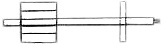 nearly under
the cross-arm is placed a very strong hemp-break, much stronger
and heavier than those for the hand. Its head block particularly
is massive, and four feet high, and near its upper end in front, is
fixed a strong pin (which we may call its horn), by this the
cross-arm lifts and lets fall the break twice in every revolution
of the wallower. A man feeds the break with hemp stalks, and
a little person holds under the head block a large twist of the
hemp which has been broken, resembling a twist of tobacco but
larger, where it is more perfectly beaten than I have ever seen
done by hand. If the horse-wheel has one hundred and forty-four
cogs, the wallower eleven rounds, and the horse goes three
times round in a minute, it will give about eighty strokes in a
minute. I had fixed a break to be moved by the gate of my
saw-mill, which broke and beat at the rate of two hundred pounds
a day. But the inconveniences of interrupting that, induced me
to try the power of a horse, and I have found it to answer perfectly.
The power being less, so also probably will be the effect,
of which I cannot make a fair trial until I commence on my new
crop. I expect that a single horse will do the breaking and beating
of ten men. Something of this kind has been so long wanted
by the cultivators of hemp, that as soon as I can speak of its
effect with certainty, I shall probably describe it anonymously
in the public papers, in order to forestall the prevention of its use
by some interloping patentee. I shall be happy to learn that an
actual experiment of your steam engine fulfils the expectations
we form of it, and I pray you to accept the assurances of my
esteem and respect.
Monticello, December 31, 1815.
Nothing, my very dear and ancient friend, could have equalled
the mortification I felt on my arrival at home, and receipt of the
information that I had lost the happiness of your visit. The
season had so far advanced, and the weather become so severe,
that together with the information given me by Mr. Correa, so
early as September, that your friends even then were dissuading
the journey, I had set it down as certain it would be postponed
to a milder season of the ensuing year. I had yielded, therefore,
with the less reluctance to a detention in Bedford by a
slower progress of my workmen than had been counted on. I
have never more desired anything than a full and free conversation
with you. I have not understood the transactions in
France during the years '14 and '15. From the newspapers we
cannot even conjecture the secret and real history; and I had
looked for it to your visit. A pamphlet (Le Conciliateur) received
from M. Jullien, had given me some idea of the obliquities
and imbecilities of the Bourbons, during their first restoration.
Some manœuvres of both parties I had learnt from Lafayette,
and more recently from Gallatin. But the note you referred me
to at page 360 of your letter to Say, has possessed me more intimately
of the views, the conduct and consequences of the last
apparition of Napoleon. Still much is wanting. I wish to know
what were the intrigues which brought him back, and what those
which finally crushed him? What parts were acted by A, B, C,
D., &c, some of whom I know, and some I do not? How did
the body of the nation stand affectioned, comparatively, between
the fool and the tyrant? &c., &c., &c. From the account my
family gives me of your sound health, and of the vivacity and
vigor of your mind, I will still hope we shall meet again, and
that the fine temperature of our early summer, to wit, of May
and June, may suggest to you the salutary effects of exercise,
and change of air and scene. En attendant, we will turn to
other subjects.
That your opinion of the hostile intentions of Great Britain
towards us is sound, I am satisfied, from her movements north
and south of us, as well as from her temper. She feels the
gloriole of her late golden achievements tarnished by our successes
against her by sea and land; and will not be contented
until she has wiped it off by triumphs over us also. I rely, however,
on the volcanic state of Europe to present other objects for
her arms and her apprehensions; and am not without hope we
shall be permitted to proceed peaceably in making children, and
maturing and moulding our strength and resources. It is impossible
that France should rest under her present oppressions and
humiliations. She will rise in that gigantic strength which
cannot be annihilated, and will fatten her fields with the blood
of her enemies. I only wish she may exercise patience and
forbearance until divisions among them may give her a choice
of sides. To the overwhelming power of England I see but
two chances of limit. The first is her bankruptcy, which will
deprive her of the golden instrument of all her successes. The
other in that ascendency which nature destines for us by immutable
laws. But to hasten this last consummation, we too
must exercise patience and forbearance. For twenty years to
come we should consider peace as the summum bonum of our
country. At the end of that period we shall be twenty millions
in number, and forty in energy, when encountering the starved
and rickety paupers and dwarfs of English workshops. By that
time I hope your grandson will have become one of our High-admirals,
and bear distinguished part in retorting the wrongs of
both his countries on the most implacable and cruel of their
enemies. In this hope, and because I love you, and all who are
dear to you, I wrote to the President in the instant of reading
your letter of the 7th, on the subject of his adoption into our
navy. I did it because I was gratified in doing it, while I knew
it was unnecessary. The sincere respect and high estimation in
which the President holds you, is such that there is no gratification,
within the regular exercise of his functions, which he would
withhold from you. Be assured then that, if within that compass,
this business is safe.
Were you any other than whom you are, I should shrink from
the task you have proposed to me, of undertaking to judge of
the merit of your own translation of the excellent letter on education.
After having done all which good sense and eloquence
could do on the original, you must not ambition the double need
of English eloquence also. Did you ever know an instance of
one who could write in a foreign language with the elegance of
a native? Cicero wrote Commentaries of his own Consulship in
Greek; they perished unknown, while his native compositions
have immortalized him with themselves. No, my dear friend;
you must not risk the success of your letter on foreignisms of
style which may weaken its effect. Some native pen must give
it to our countrymen in a native dress, faithful to its original.
You will find such with the aid of our friend Correa, who knows
everybody, and will readily think of some one who has time
and talent for this work. I have neither. Till noon I am daily
engaged in a correspondence much too extensive and laborious
for my age. From noon to dinner health, habit, and business,
require me to be on horseback; and render the society of my
family and friends a necessary relaxation for the rest of the day.
These occupations scarcely leave time for the papers of the day;
and to renounce entirely the sciences and belles-lettres is impossible.
Had not Mr. Gilmer just taken his place in the ranks of
the bar, I think we could have engaged him in this work. But
I am persuaded that Mr. Correa's intimacy with the persons of
promise in our country, will leave you without difficulty in laying
this work of instruction open to our citizens at large.
I have not yet had time to read your Equinoctial republics,
nor the letter of Say; because I am still engrossed by the letters
which had accumulated during my absence. The latter I accept
with thankfulness, and will speedily read and return the former.
God bless you, and maintain you in strength of body,
and mind, until your own wishes shall be to resign both.
Monticello, January 2d, 1816.
Sir,—I am but recently returned from my journey to the
neighborhood of the Peaks of Otter, and find here your favors
of November 23d and December 9th. I have therefore to thank
you for your meteorological table and the corrections of Colonel
Williams' altitudes of the mountains of Virginia, which I had
not before seen; but especially for the very able extract on
Barometrical measures. The precision of the calculations, and
soundness of the principles on which they are founded, furnish,
I am satisfied, a great approximation towards truth, and raise that
method of estimating heights to a considerable degree of rivalship
with the trigonometrical. The last is not without some
sources of inaccuracy, as you have truly stated. The admeasurement
of the base is liable to errors which can be rendered insensible
only by such degrees of care as have been exhibited by
the mathematicians who have been employed in measuring degrees
on the surface of the earth. The measure of the angles
by the wonderful perfection to which the graduation of instruments
has been brought by a Bird, a Ramsden, a Troughton, removes
nearly all distrust from that operation; and we may add
that the effect of refraction, rarely worth notice in short distances,
admits of correction by well-established laws; these
sources of error once reduced to be insensible, their geometrical
employment is certainty itself. No two men can differ on a
principle of trigonometry. Not so as to the theories of Barometrical
mensuration. On these have been great differences of
opinion, and among characters of just celebrity.
Dr. Halley reckoned one-tenth inch of Mercury equal to 90
feet altitude of the atmosphere. Derham thought it equal to
something less than 90 feet. Cassini's tables to 24° of the Barometer
allowed 676 toises of altitudes.
| Mariole's, |
to the same |
544 |
toises. |
| Schruchzer's |
" |
559 |
" |
Nettleton's tables applied to a difference of .5975 of mercury, in
a particular instance gave 512.17 feet of altitude, and Bonguor's
and De Luc's rules, to the same difference gave 579.5 feet. Sir
Isaac Newton had established that at heights in arithmetrical
progression the ratio of rarity in the air would be geometrical,
and this being the character of the natural numbers and their
Logarithms, Bonguor adopted the ratio in his mensuration of the
mountains of South America, and stating in French lignes the
height of the mercury of different stations, took their Logarithms
to five places only, including the index, and considered the resulting
difference as expressing that of the altitudes in French
toises. He then applied corrections required by the effect of the
temperature of the moment on the air and mercury. His process,
on the whole, agrees very exactly with that established in
your excellent extract. In 1776 I observed the height of the
mercury at the base and summit of the mountain I live on, and
by Nettleton's tables, estimated the height at 512.17 feet, and
called it about 500 feet in the Notes on Virginia. But calculating it
since on the same observations, according to Bonguor's method
with De Luc's improvements, the result was 579.5 feet; and
lately I measured the same height trigonometrically, with the
aid of a base of 1,175 feet in a vertical plane with the summit,
and at the distance of about 1,500 yards from the axis of the
mountain, and made it 599.35 feet. I consider this as testing
the advance of the barometrical process towards truth by the
adoption of the Logarithmic ratio of heights and densities; and
continued observations and experiments will continue to advance
it still more. But the first character of a common measure of
things being that of invariability, I can never suppose that a substance
so heterogeneous and variable as the atmospheric fluid,
changing daily and hourly its weight and dimensions to the
amount, sometimes, of one-tenth of the whole, can be applied
as a standard of measure to anything, with as much mathematical
exactness, as a trigonometrical process. It is still, however,
a resource of great value for these purposes, because its use is so
easy, in comparison with the other, and especially where the
grounds are unfavorable for a base; and its results are so near
the truth as to answer all the common purposes of information.
Indeed, I should in all cases prefer the use of both, to warn us
against gross error, and to put us, when that is suspected, on a
repetition of our process. When lately measuring trigonometrically
the height of the Peaks of Otter (as my letter of October
12th informed you I was about to do), I very much wished for
a barometer, to try the height of that also. But it was too far
and hazardous to carry my own, and there was not one in that
neighborhood. On the subject of that admeasurement, I must
premise that my object was only to gratify a common curiosity
as to the height of those mountains, which we deem our highest,
and to furnish an à peu près, sufficient to satisfy us in a comparison
of them with the other mountains of our own, or of other
countries. I therefore neither provided such instruments, nor
aimed at such extraordinary accuracy in the measures of my
base, as abler operators would have employed in the more important
object of measuring a degree, or of ascertaining the relative
position of different places for astronomical or geographical
purposes. My instrument was a theodolite by Ramsden, whose
horizontal and vertical circles were of 3½ inches radius, its
graduation subdivided by noniuses to one-third, admitting however
by its intervals, a further subdivision by the eye to a single
minute, with two telescopes, the one fixed, the other movable,
and a Gunter's chain of four poles, accurately adjusted in its
length, and carefully attended on its application to the base line.
The Sharp, or southern peak, was first measured by a base of
2806.32 feet in the vertical plane of the axis of the mountain.
A base then nearly parallel with the two mountains of 6,589
feet was measured, and observations taken at each end, of the
altitudes and horizontal angles of each apex, and such other auxiliary
observations made as to the stations, inclination of the
base, &c., as a good degree of correctness in the result would require.
The ground of our bases was favorable, being an open
plain of close grazed meadow on both sides of the Otter river,
declining so uniformly with the descent of the river as to give
no other trouble than an observation of its angle of inclination,
in order to reduce the base to the plane of the horizon. From
the summit of the Sharp peak I took also the angle of altitude
of the flat or northern one above it, my other observations sufficing
to give their distance from one another. The result was,
| The
mean height of the Sharp peak above the surface of Otter
river |
2946.5 inches. |
| Mean height of the flat peak above the surface of Otter
river |
3103.5 inches. |
| The distance between the two summits |
9507.73 inches. |
Their rhumb N. 33° 50´ E. the distance of the stations of observation
from the points in the bases of the mountains vertically
under their summits was, the shortest 19002.2 feet, the longest
24523.3 feet. These mountains are computed to be visible to
fifteen counties of the State, without the advantage of counter-elevations,
and to several more with that advantage. I must add
that I have gone over my calculations but once, and nothing is
more possible than the mistake of a figure, now and then, in
calculating so many triangles, which may occasion some variation
in the result. I mean, therefore, when I have leisure, to go
again over the whole. The ridge of mountains of which Monticello
is one, is generally low; there is one in it, however, called
Peter's mountain, considerably higher than the general ridge.
This being within a dozen miles of me, north-eastwardly, I
think in the spring of the year to measure it by both processes,
which may serve as another trial of the Logarithmic theory.
Should I do this you shall know the result. In the meantime
accept assurances of my great respect and esteem.
Monticello, January 6, 1816.
Dear Sir,—I am favored with yours of December 24th, and
perceive you have many matters before you of great moment.
I have no fear but that the legislature will do on all of them
what is wise and just. On the particular subject of our river, in
the navigation of which our county has so great an interest, I
think the power of permitting dams to be erected across it, ought
to be taken from the courts, so far as the stream has water
enough for navigation. The value of our property is sensibly
lessened by the dam which the court of Fluvana authorized not
long since to be erected, but a little above its mouth. This
power over the value and convenience of our lands is of much
too high a character to be placed at the will of a county court,
and that of a county, too, which has not a common interest in
the preservation of the navigation for those above them. As to
the existing dams, if any conditions are proposed more than
those to which they were subjected on their original erection, I
think they would be allowed the alternative of opening a sluice
for the passage of navigation, so as to put the river into as good
a condition for navigation as it was before the erection of their
dam, or as it would be if their dam were away. Those interested
in the navigation might then use the sluices or make locks as
should be thought best. Nature and reason, as well as all our
constitutions, condemn retrospective conditions as mere acts of
power against right.
I recommend to your patronage our Central College. I look
to it as a germ from which a great tree may spread itself.
There is before the assembly a petition of a Captain Miller
which I have at heart, because I have great esteem for the petitioner
as an honest and useful man. He is about to settle in
our county, and to establish a brewery, in which art I think him
as skilful a man as has ever come to America. I wish to see
this beverage become common instead of the whiskey which
kills one-third of our citizens and ruins their families. He is
staying with me until he can fix himself, and I should be thankful
for information from time to time of the progress of his petition.
Like a dropsical man calling out for water, water, our deluded
citizens are clamoring for more banks, more banks. The American
mind is now in that state of fever which the world has so
often seen in the history of other nations. We are under the
bank bubble, as England was under the South Sea bubble,
France under the Mississippi bubble, and as every nation is
liable to be, under whatever bubble, design, or delusion may
puff up in moments when off their guard. We are now taught
to believe that legerdemain tricks upon paper can produce as
solid wealth as hard labor in the earth. It is vain for common
sense to urge that nothing can produce but nothing; that it is
an idle dream to believe in a philosopher's stone which is to turn
everything into gold, and to redeem man from the original sentence
of his Maker, "in the sweat of his brow shall he eat his
bread." Not Quixot enough, however, to attempt to reason Bedlam
to rights, my anxieties are turned to the most practicable
means of withdrawing us from the ruin into which we have run.
Two hundred millions of paper in the hands of the people, (and
less cannot be from the employment of a banking capital known
to exceed one hundred millions,) is a fearful tax to fall at hap-hazard
on their heads. The debt which purchased our independence
was but of eighty millions, of which twenty years of
taxation had in 1809 paid but the one half. And what have we
purchased with this tax of two hundred millions which we are
to pay by wholesale but usury, swindling, and new forms of
demoralization. Revolutionary history has warned us of the
probable moment when this baseless trash is to receive its fiat.
Whenever so much of the precious metals shall have returned
into the circulation as that every one can get some in exchange
for his produce, paper, as in the revolutionary war, will experience
at once an universal rejection. When public opinion changes, it
is with the rapidity of thought. Confidence is already on the totter,
and every one now handles this paper as if playing at Robin's
alive. That in the present state of the circulation the banks
should resume payments in specie, would require their vaults to
be like the widow's cruise. The thing to be aimed at is, that
the excesses of their emissions should be withdrawn as gradually,
but as speedily, too, as is practicable, without so much alarm as
to bring on the crisis dreaded. Some banks are said to be calling
in their paper. But ought we to let this depend on their discretion?
Is it not the duty of the legislature to endeavor to avert
from their constituents such a catastrophe as the extinguishment
of two hundred millions of paper in their hands? The difficulty
is indeed great; and the greater, because the patient revolts
against all medicine. I am far from presuming to say that any
plan can be relied on with certainty, because the bubble may
burst from one moment to another; but if it fails, we shall be
but where we should have been without any effort to save ourselves.
Different persons, doubtless, will devise different schemes
of relief. One would be to suppress instantly the currency of
all paper not issued under the authority of our own State or of
the General Government; to interdict after a few months the circulation
of all bills of five dollars and under; after a few months
more, all of ten dollars and under; after other terms, those of
twenty, fifty, and so on to one hundred dollars, which last, if
any must be left in circulation, should be the lowest denomination.
These might be a convenience in mercantile transactions
and transmissions, and would be excluded by their size from ordinary
circulation. But the disease may be too pressing to await
such a remedy. With the legislature I cheerfully leave it to
apply this medicine, or no medicine at all. I am sure their intentions
are faithful; and embarked in the same bottom, I am
willing to swim or sink with my fellow citizens. If the latter
is their choice, I will go down with them without a murmur.
But my exhortation would rather be "not to give up the ship."
I am a great friend to the improvements of roads, canals, and
schools. But I wish I could see some provision for the former
as solid as that of the latter,—something better than fog. The
literary fund is a solid provision, unless lost in the impending
bankruptcy. If the legislature would add to that a perpetual tax
of a cent a head on the population of the State, it would set
agoing at once, and forever maintain, a system of primary or
ward schools, and an university where might be taught, in its
highest degree, every branch of science useful in our time and
country; and it would rescue us from the tax of toryism, fanaticism,
and indifferentism to their own State, which we now send
our youth to bring from those of New England. If a nation
expects to be ignorant and free, in a state of civilization, it expects
what never was and never will be. The functionaries of
every government have propensities to command at will the
liberty and property of their constituents. There is no safe deposit
for these but with the people themselves; nor can they be
safe with them without information. Where the press is free,
and every man able to read, all is safe. The frankness of this
communication will, I am sure, suggest to you a discreet use of
it. I wish to avoid all collisions of opinion with all mankind.
Show it to Mr. Maury, with expressions of my great esteem. It
pretends to convey no more than the opinions of one of your
thousand constituents, and to claim no more attention than every
other of that thousand.
I will ask you once more to take care of Miller and our College,
and to accept assurances of my esteem and respect.
Monticello, January 9, 1816.
My Dear and Ancient Friend,—An acquaintance of fifty-two
years, for I think ours dates from 1764, calls for an interchange
of notice now and then, that we remain in existence, the monuments
of another age, and examples of a friendship unaffected by
the jarring elements by which we have been surrounded, of revolutions
of government, of party and of opinion. I am reminded
of this duty by the receipt, through our friend Dr. Patterson,
of your synopsis of the four Evangelists. I had procured it as
soon as I saw it advertised, and had become familiar with its use;
but this copy is the more valued as it comes from your hand.
This work bears the stamp of that accuracy which marks everything
from you, and will be useful to those who, not taking
things on trust, recur for themselves to the fountain of pure morals.
I, too, have made a wee-little book from the same materials,
which I call the Philosophy of Jesus; it is a paradigma of his
doctrines, made by cutting the texts out of the book, and arranging
them on the pages of a blank book, in a certain order of time
or subject. A more beautiful or precious morsel of ethics I have
never seen; it is a document in proof that I am a real Christian,
that is to say, a disciple of the doctrines of Jesus, very different
from the Platonists, who call me infidel and themselves Christians
and preachers of the gospel, while they draw all their characteristic
dogmas from what its author never said nor saw. They
have compounded from the heathen mysteries a system beyond
the comprehension of man, of which the great reformer of the
vicious ethics and deism of the Jews, were he to return on earth,
would not recognize one feature. If I had time I would add to
my little book the Greek, Latin and French texts, in columns
side by side. And I wish I could subjoin a translation of Gosindi's
Syntagma of the doctrines of Epicurus, which, notwithstanding
the calumnies of the Stoics and caricatures of Cicero,
is the most rational system remaining of the philosophy of the
ancients, as frugal of vicious indulgence, and fruitful of virtue as
the hyperbolical extravagances of his rival sects.
I retain good health, am rather feeble to walk much, but ride
with ease, passing two or three hours a day on horseback, and
every three or four months taking in a carriage a journey of
ninety miles to a distant possession, where I pass a good deal of
my time. My eyes need the aid of glasses by night, and with
small print in the day also; my hearing is not quite so sensible
as it used to be; no tooth shaking yet, but shivering and shrinking
in body from the cold we now experience, my thermometer
having been as low as 12° this morning. My greatest oppression
is a correspondence afflictingly laborious, the extent of which I
have been long endeavoring to curtail. This keeps me at the
drudgery of the writing-table all the prime hours of the day,
leaving for the gratification of my appetite for reading, only what
I can steal from the hours of sleep. Could I reduce this epistolary
corvée within the limits of my friends and affairs, and give
the time redeemed from it to reading and reflection, to history,
ethics, mathematics, my life would be as happy as the infirmities
of age would admit, and I should look on its consummation with
the composure of one "qui summum nec me tuit diem nec
optat."
So much as to myself, and I have given you this string of egotisms
in the hope of drawing a similar one from yourself. I have
heard from others that you retain your health, a good degree of
activity, and all the vivacity and cheerfulness of your mind, but
I wish to learn it more minutely from yourself. How has time
affected your health and spirits? What are your amusements,
literary and social? Tell me everything about yourself, because
all will be interesting to me who retains for you ever the same
constant and affectionate friendship and respect.
Monticello, January 9, 1816.
Dear Sir,—Your favor of December 21st has been received,
and I am first to thank you for the pamphlet it covered. The
same description of persons which is the subject of that is so
much multiplied here too, as to be almost a grievance, and by
their numbers in the public councils, have wrested from the public
hand the direction of the pruning knife. But with us as a
body, they are republican, and mostly moderate in their views;
so far, therefore, less objects of jealousy than with you. Your
opinions on the events which have taken place in France, are
entirely just, so far as these events are yet developed. But they
have not reached their ultimate termination. There is still an
awful void between the present and what is to be the last chapter
of that history; and I fear it is to be filled with abominations
as frightful as those which have already disgraced it. That nation
is too high-minded, has too much innate force, intelligence
and elasticity, to remain under its present compression. Samson
will arise in his strength, as of old, and as of old will burst asunder
the withes and the cords, and the webs of the Philistines. But
what are to be the scenes of havoc and horror, and how widely
they may spread between brethren of the same house, our ignorance
of the interior feuds and antipathies of the country places
beyond our ken. It will end, nevertheless, in a representative
government, in a government in which the will of the people
will be an effective ingredient. This important element has
taken root in the European mind, and will have its growth;
their despots, sensible of this, are already offering this modification
of their governments, as if of their own accord. Instead of
the parricide treason of Bonaparte, in perverting the means confided
to him as a republican magistrate, to the subversion of that
republic and erection of a military despotism for himself and his
family, had he used it honestly for the establishment and support
of a free government in his own country, France would now
have been in freedom and rest; and her example operating in a
contrary direction, every nation in Europe would have had a government
over which the will of the people would have had some
control. His atrocious egotism has checked the salutary progress
of principle, and deluged it with rivers of blood which are not
yet run out. To the vast sum of devastation and of human misery,
of which he has been the guilty cause, much is still to be
added. But the object is fixed in the eye of nations, and they
will press on to its accomplishment and to the general amelioration
of the condition of man. What a germ have we planted,
and how faithfully should we cherish the parent tree at home!
You tell me I am quoted by those who wish to continue our
dependence on England for manufactures. There was a time
when I might have been so quoted with more candor, but within
the thirty years which have since elapsed, how are circumstances
changed! We were then in peace. Our independent place
among nations was acknowledged. A commerce which offered
the raw material in exchange for the same material after receiving
the last touch of industry, was worthy of welcome to all
nations. It was expected that those especially to whom manufacturing
industry was important, would cherish the friendship
of such customers by every favor, by every inducement, and particularly
cultivate their peace by every act of justice and friendship.
Under this prospect the question seemed legitimate,
whether, with such an immensity of unimproved land, courting
the hand of husbandry, the industry of agriculture, or that of
manufactures, would add most to the national wealth? And the
doubt was entertained on this consideration chiefly, that to the
labor of the husbandman a vast addition is made by the spontaneous
energies of the earth on which it is employed: for one
grain of wheat committed to the earth, she renders twenty,
thirty, and even fifty fold, whereas to the labor of the manufacturer
nothing is added. Pounds of flax, in his hands, yield, on
the contrary, but pennyweights of lace. This exchange, too, laborious
as it might seem, what a field did it promise for the occupations
of the ocean; what a nursery for that class of citizens
who were to exercise and maintain our equal rights on that element?
This was the state of things in 1785, when the "Notes
on Virginia" were first printed; when, the ocean being open to
all nations, and their common right in it acknowledged and exercised
under regulations sanctioned by the assent and usage of
all, it was thought that the doubt might claim some consideration.
But who in 1785 could foresee the rapid depravity which
was to render the close of that century the disgrace of the history
of man? Who could have imagined that the two most distinguished
in the rank of nations, for science and civilization,
would have suddenly descended from that honorable eminence,
and setting at defiance all those moral laws established by the
Author of nature between nation and nation, as between man
and man, would cover earth and sea with robberies and piracies,
merely because strong enough to do it with temporal impunity;
and that under this disbandment of nations from social order, we
should have been despoiled of a thousand ships, and have thousands
of our citizens reduced to Algerine slavery. Yet all this
has taken place. One of these nations interdicted to our vessels
all harbors of the globe without having first proceeded to some
one of hers, there paid a tribute proportioned to the cargo, and
obtained her license to proceed to the port of destination. The
other declared them to be lawful prize if they had touched at the
port, or been visited by a ship of the enemy nation. Thus were
we completely excluded from the ocean. Compare this state of
things with that of '85, and say whether an opinion founded in
the circumstances of that day can be fairly applied to those of
the present. We have experienced what we did not then believe,
that there exists both profligacy and power enough to exclude
us from the field of interchange with other nations: that
to be independent for the comforts of life we must fabricate them
ourselves. We must now place the manufacturer by the side of
the agriculturist. The former question is suppressed, or rather
assumes a new form. Shall we make our own comforts, or go
without them, at the will of a foreign nation? He, therefore, who
is now against domestic manufacture, must be for reducing us
either to dependence on that foreign nation, or to be clothed in
skins, and to live like wild beasts in dens and caverns. I am
not one of these; experience has taught me that manufactures
are now as necessary to our independence as to our comfort;
and if those who quote me as of a different opinion, will keep
pace with me in purchasing nothing foreign where an equivalent
of domestic fabric can be obtained, without regard to difference
of price, it will not be our fault if we do not soon have a supply
at home equal to our demand, and wrest that weapon of distress
from the hand which has wielded it. If it shall be proposed to
go beyond our own supply, the question of '85 will then recur,
will our surplus labor be then most beneficially employed in the
culture of the earth, or in the fabrications of art? We have time
yet for consideration, before that question will press upon us;
and the maxim to be applied will depend on the circumstances
which shall then exist; for in so complicated a science as political
economy, no one axiom can be laid down as wise and expedient
for all times and circumstances, and for their contraries.
Inattention to this is what has called for this explanation, which
reflection would have rendered unnecessary with the candid,
while nothing will do it with those who use the former opinion
only as a stalking horse, to cover their disloyal propensities to
keep us in eternal vassalage to a foreign and unfriendly people.
I salute you with assurances of great respect and esteem.
Monticello, January 11, 1816.
Dear Sir,—Of the last five months I have passed four at my
other domicil, for such it is in a considerable degree. No letters
are forwarded to me there, because the cross post to that place
is circuitous and uncertain; during my absence, therefore, they
are accumulating here, and awaiting acknowledgments. This
has been the fate of your favor of November 13th.
I agree with you in all its eulogies on the eighteenth century.
It certainly witnessed the sciences and arts, manners and morals,
advanced to a higher degree than the world had ever before seen.
And might we not go back to the æra of the Borgias, by which
time the barbarous ages had reduced national morality to its lowest
point of depravity, and observe that the arts and sciences,
rising from that point, advanced gradually through all the sixteenth,
seventeenth and eighteenth centuries, softening and correcting
the manners and morals of man? I think, too, we may
add to the great honor of science and the arts, that their natural
effect is, by illuminating public opinion, to erect it into a censor,
before which the most exalted tremble for their future, as well
as present fame. With some exceptions only, through the seventeenth
and eighteenth centuries, morality occupied an honorable
chapter in the political code of nations. You must have observed
while in Europe, as I thought I did, that those who administered
the governments of the greater powers at least, had a
respect to faith, and considered the dignity of their government
as involved in its integrity. A wound indeed was inflicted on this
character of honor in the eighteenth century by the partition of
Poland. But this was the atrocity of a barbarous government
chiefly, in conjunction with a smaller one still scrambling to become
great, while one only of those already great, and having
character to lose, descended to the baseness of an accomplice in
the crime. France, England, Spain, shared in it only inasmuch
as they stood aloof and permitted its perpetration.
How then has it happened that these nations, France especially
and England, so great, so dignified, so distinguished by science
and the arts, plunged all at once into all the depths of human
enormity, threw off suddenly and openly all the restraints of
morality, all sensation to character, and unblushingly avowed
and acted on the principle that power was right? Can this sudden
apostasy from national rectitude be accounted for? The
treaty of Pilnitz seems to have begun it, suggested perhaps by
the baneful precedent of Poland. Was it from the terror of
monarchs, alarmed at the light returning on them from the west,
and kindling a volcano under their thrones? Was it a combination
to extinguish that light, and to bring back, as their best auxiliaries,
those enumerated by you, the Sorbonne, the Inquisition,
the Index Expurgatorius, and the knights of Loyola? Whatever
it was, the close of the century saw the moral world thrown back
again to the age of the Borgias, to the point from which it had
departed three hundred years before. France, after crushing
and punishing the conspiracy of Pilnitz, went herself deeper and
deeper into the crimes she had been chastising. I say France
and not Bonaparte; for, although he was the head and mouth,
the nation furnished the hands which executed his enormities.
England, although in opposition, kept full pace with France, not
indeed by the manly force of her own arms, but by oppressing
the weak and bribing the strong. At length the whole choir
joined and divided the weaker nations among them. Your
prophecies to Dr. Price proved truer than mine; and yet fell
short of the fact, for instead of a million, the destruction of eight
or ten millions of human beings has probably been the effect of
these convulsions. I did not, in '89, believe they would have
lasted so long, nor have cost so much blood. But although your
prophecy has proved true so far, I hope it does not preclude a
better final result. That same light from our west seems to have
spread and illuminated the very engines employed to extinguish
it. It has given them a glimmering of their rights and their
power. The idea of representative government has taken root
and growth among them. Their masters feel it, and are saving
themselves by timely offers of this modification of their powers.
Belgium, Prussia, Poland, Lombardy, &c., are now offered a representative
organization; illusive probably at first, but it will grow
into power in the end. Opinion is power, and that opinion will
come. Even France will yet attain representative government.
You observe it makes the basis of every constitution which has
been demanded or offered,—of that demanded by their Senate;
of that offered by Bonaparte; and of that granted by Louis
XVIII. The idea then is rooted, and will be established, although
rivers of blood may yet flow between them and their object.
The allied armies now couching upon them are first to
be destroyed, and destroyed they will surely be. A nation united
can never be conquered. We have seen what the ignorant,
bigoted and unarmed Spaniards could do against the disciplined
veterans of their invaders. What then may we not expect from
the power and character of the French nation? The oppressors
may cut off heads after heads, but like those of the Hydra they
multiply at every stroke. The recruits within a nation's own
limits are prompt and without number; while those of their invaders
from a distance are slow, limited, and must come to an
end. I think, too, we perceive that all these allies do not see the
same interest in the annihilation of the power of France. There
are certainly some symptoms of foresight in Alexander that
France might produce a salutary diversion of force were Austria
and Prussia to become her enemies. France, too, is the neutral
ally of the Turk, as having no interfering interests, and might
be useful in neutralizing and perhaps turning that power on Austria.
That a re-acting jealousy, too, exists with Austria and Prussia,
I think their late strict alliance indicates; and I should not
wonder if Spain should discover a sympathy with them. Italy
is so divided as to be nothing. Here then we see new coalitions
in embryo, which, after France shall in turn have suffered a just
punishment for her crimes, will not only raise her from the earth
on which she is prostrate, but give her an opportunity to establish
a government of as much liberty as she can bear—enough to
ensure her happiness and prosperity. When insurrection begins,
be it where it will, all the partitioned countries will rush to arms,
and Europe again become an arena of gladiators. And what is
the definite object they will propose? A restoration certainly of
the status quo prius, of the state of possession of '89. I see no
other principle on which Europe can ever again settle down in
lasting peace. I hope your prophecies will go thus far, as my
wishes do, and that they, like the former, will prove to have been
the sober dictates of a superior understanding, and a sound calculation
of effects from causes well understood. Some future
Morgan will then have an opportunity of doing you justice, and
of counterbalancing the breach of confidence of which you so
justly complain, and in which no one has had more frequent occasion
of fellow-feeling than myself. Permit me to place here
my affectionate respects to Mrs. Adams, and to add for yourself
the assurances of cordial friendship and esteem.
Monticello, January 19, 1816.
Dear Sir,—At the date of your letter of December the 1st, I
was in Bedford, and since my return, so many letters, accumulated
during my absence, have been pressing for answers, that
this is the first moment I have been able to attend to the subject
of yours. While Mr. Girardin was in this neighborhood writing
his continuation of Burke's history, I had suggested to him a
proper notice of the establishment of the committee of correspondence
here in 1773, and of Mr. Carr, your father, who introduced
it. He has doubtless done this, and his work is now in
the press. My books, journals of the times, &c., being all gone,
I have nothing now but an impaired memory to resort to for the
more particular statement you wish. But I give it with the more
confidence, as I find that I remember old things better than new.
The transaction took place in the session of Assembly of March
1773. Patrick Henry, Richard Henry Lee, Frank Lee, your
father and myself, met by agreement, one evening, about the
close of the session, at the Raleigh Tavern, to consult on the
measures which the circumstances of the times seemed to call
for. We agreed, in result, that concert in the operations of the
several colonies was indispensable; and that to produce this,
some channel of correspondence between them must be opened;
that therefore, we would propose to our House the appointment
of a committee of correspondence, which should be authorized
and instructed to write to the Speakers of the House of Representatives
of the several Colonies, recommending the appointment
of similar committees on their part, who, by a communication
of sentiment on the transactions threatening us all, might
promote a harmony of action salutary to all. This was the substance,
not pretending to remember the words. We proposed
the resolution, and your father was agreed on to make the motion.
He did it the next day, March the 12th, with great ability,
reconciling all to it, not only by the reasonings, but by the temper
and moderation with which it was developed. It was adopted
by a very general vote. Peyton Randolph, some of us who
proposed it, and who else I do not remember, were appointed of
the committee. We immediately despatched letters by expresses
to the Speakers of all the other Assemblies. I remember that
Mr. Carr and myself, returning home together, and conversing
on the subject by the way, concurred in the conclusion that that
measure must inevitably beget the meeting of a Congress of Deputies
from all the colonies, for the purpose of uniting all in the
same principles and measures for the maintenance of our rights.
My memory cannot deceive me, when I affirm that we did it in
consequence of no such proposition from any other colony. No
doubt the resolution itself and the journals of the day will show
that ours was original, and not merely responsive to one from
any other quarter. Yet, I am certain I remember also, that a
similar proposition, and nearly cotemporary, was made by Massachusetts,
and that our northern messenger passed theirs on the
road. This, too, may be settled by recurrence to the records of
Massachusetts. The proposition was generally acceded to by the
other colonies, and the first effect, as expected, was the meeting
of a Congress at New York the ensuing year. The committee
of correspondence appointed by Massachusetts, as quoted by you
from Marshall, under the date of 1770, must have been for a
special purpose, and functus officio before the date of 1773, or
Massachusetts herself would not then have proposed another.
Records should be examined to settle this accurately. I well remember
the pleasure expressed in the countenance and conversation
of the members generally, on this debut of Mr. Carr, and
the hopes they conceived as well from the talents as the patriotism
it manifested. But he died within two months after, and in
him we lost a powerful fellow-laborer. His character was of a
high order. A spotless integrity, sound judgment, handsome
imagination, enriched by education and reading, quick and clear
in his conceptions, of correct and ready elocution, impressing
every hearer with the sincerity of the heart from which it flowed.
His firmness was inflexible in whatever he thought was right;
but when no moral principle stood in the way, never had man
more of the milk of human kindness, of indulgence, of softness,
of pleasantry of conversation and conduct. The number of his
friends, and the warmth of their affection, were proofs of his
worth, and of their estimate of it. To give to those now living,
an idea of the affliction produced by his death in the minds of
all who knew him, I liken it to that lately felt by themselves on
the death of his eldest son, Peter Carr, so like him in all his endowments
and moral qualities, and whose recollection can never
recur without a deep-drawn sigh from the bosom of any one who
knew him. You mention that I showed you an inscription I had
proposed for the tomb stone of your father. Did I leave it in
your hands to be copied? I ask the question, not that I have
any such recollection, but that I find it no longer in the place of
its deposit, and think I never took it out but on that occasion.
Ever and affectionately yours.
Monticello, January 20, 1816.
Sir,—Of the last five months, I have been absent four from
home, which must apologize for so very late an acknowledgment
of your favor of November 22d, and I wish the delay could be
compensated by the matter of the answer. But an unfortunate
accident puts that out of my power. During the course of my
public life, and from a very early period of it, I omitted no opportunity
of procuring vocabularies of the Indian languages, and
for that purpose formed a model expressing such objects in nature
as must be familiar to every people, savage or civilized. This
being made the standard to which all were brought, would exhibit
readily whatever affinities of language there be between
the several tribes. It was my intention, on retiring from public
business, to have digested these into some order, so as to show
not only what relations of language existed among our own aborigines,
but by a collation with the great Russian vocabulary of
the languages of Europe and Asia, whether there were any between
them and the other nations of the continent. On my removal
from Washington, the package in which this collection
was coming by water, was stolen and destroyed. It consisted
of between thirty and forty vocabularies, of which I can, from
memory, say nothing particular; but that I am certain more than
half of them differed as radically, each from every other, as the
Greek, the Latin, and Islandic. And even of those which seemed
to be derived from the same radix, the departure was such that
the tribes speaking them could not probably understand one another.
Single words, or two or three together, might perhaps be
understood, but not a whole sentence of any extent or construction.
I think, therefore, the pious missionaries who shall go to
the several tribes to instruct them in the Christian religion, will
have to learn a language for every tribe they go to; nay, more,
that they will have to create a new language for every one, that
is to say, to add to theirs new words for the new ideas they will
have to communicate. Law, medicine, chemistry, mathematics,
every science has a language of its own, and divinity not less
than others. Their barren vocabularies cannot be vehicles for
ideas of the fall of man, his redemption, the triune composition
of the Godhead, and other mystical doctrines considered by most
Christians of the present date as essential elements of faith. The
enterprise is therefore arduous, but the more inviting perhaps to
missionary zeal, in proportion as the merit of surmounting it will
be greater. Again repeating my regrets that I am able to give
so little satisfaction on the subject of your inquiry, I pray you to
accept the assurance of my great consideration and esteem.
Monticello, January 21, 1816.
Sir,—Your favor of December 18th was exactly a month on
its way to this place; and I have to thank you for the elegant
and philosophical lines communicated by the Nestor of our Revolution.
Whether the style or sentiment be considered, they were
well worthy the trouble of being copied and communicated by
his pen. Nor am I less thankful for the happy translation of
them. It adds another to the rare instances of a rival to its
original: superior indeed in one respect, as the same outline of
sentiment is brought within a compass of better proportion.
For if the original be liable to any criticism, it is that of giving
too great extension to the same general idea. Yet it has a great
authority to support it, that of a wiser man than all of us. "I
sought in my heart to give myself unto wine; I made me great
works; I builded me houses; I planted me vineyards; I made
me gardens, and orchards, and pools to water them; I got me
servants and maidens, and great possessions of cattle; I gathered
me also silver and gold, and men singers and women singers,
and the delights of the sons of men, and musical instruments of
all sorts; and whatsoever mine eyes desired I kept not from
them; I withheld not my heart from any joy. Then I looked
on all the works that my hands had wrought, and behold! all
was vanity and vexation of spirit! I saw that wisdom excelleth
folly, as far as light excelleth darkness." The Preacher, whom
I abridge, has indulged in a much larger amplification of his subject.
I am not so happy as my friend and ancient colleague,
Mr. Adams, in possessing anything original, inedited, and worthy
of comparison with the epigraph of the Spanish monk. I can
offer but humble prose, from the hand indeed of the father of
eloquence and philosophy; a moral morsel, which our young
friends under your tuition should keep ever in their eye, as the
ultimate term of your instructions, and of their labors. "Hic,
quisquis est, qui moderatione et constantia quietus animo est,
sibique ipse placatus; ut nec tabescat molestiis, nec frangatur
timore, nec sitienter quid expectens ardeat desiderio, nec alacritate
futili gestiens deliquescat; is est sapiens, quem quaerimus;
is est beatus; cui nihil humanarum rerum aut intolerabile ad
dimittendum animum, aut nimis lactabile ad efferendum, videri
potest." Or if a poetical dress will be more acceptable to the
fancy of the juvenile student:
"Quisnam igitur liber? Sapiens, sibique imperiosus:
Quem neque pauperies, neque mors, neque vincula terrent:
Responsare cupidinibus, contemnere honores
Fortis, et in scipso totus teres, atque rotundus;
Externi ne quid valeat per laeve morari:
In quem manea ruit semper Fortuna."
And if the Wise be the happy man, as these sages say, he must
be virtuous too; for, without virtue, happiness cannot be. This
then is the true scope of all academical emulation.
You request something in the handwriting of General Washington.
I enclose you a letter which I received from him while
in Paris, covering a copy of the new Constitution; it is offered
merely as what you ask, a specimen of his handwriting.
On the subject of your Museum, I fear I cannot flatter myself
with being useful to it. Were the obstacle of distance out of
the way, age and retirement have withdrawn me from the opportunities
of procuring objects in that line. With every wish for
the prosperity of your institution, accept the assurances of my
great esteem and respect.
Monticello, January 21, 1816.
Dear Sir,—In answering the letter of a northern correspondent
lately, I indulged in a tirade against a pamphlet recently
published in this quarter. On revising my letter, however, I
thought it unsafe to commit myself so far to a stranger. I struck
out the passage therefore, yet I think the pamphlet of such a
character as not to be unknown, or unnoticed by the people of
the United States. It is the most bold and impudent stride New
England has ever made in arrogating an ascendency over the
rest of the Union. The first form of the pamphlet was an address
from the Reverend Lyman Beecher, chairman of the Connecticut
Society for the education of pious young men for the
ministry. Its matter was then adopted and published in a sermon
by Reverend Mr. Pearson of Andover in Massachusetts,
where they have a theological college; and where the address
"with circumstantial variations to adopt it to more general use"
is reprinted on a sheet and a half of paper, in so cheap a form as
to be distributed, I imagine, gratis, for it has a final note indicating
six thousand copies of the first edition printed. So far as it
respects Virginia, the extract of my letter gives the outline. I
therefore send it to you to publish or burn, abridge or alter, as
you think best. You understand the public palate better than I
do. Only give it such a title as may lead to no suspicion from
whom you receive it. I am the more induced to offer it to you
because it is possible mine may be the only copy in the State,
and because, too, it may be à propos for the petition for the establishment
of a theological society now before the legislature,
and to which they have shown the unusual respect of hearing
an advocate for it at their bar. From what quarter this theological
society comes forward I know not; perhaps from our own
tramontaine clergy, of New England religion and politics; perhaps
it is the entering wedge from its theological sister in Andover,
for the body of "qualified religious instructors" proposed
by their pious brethren of the East "to evangelize and catechize,"
to edify our daughters by weekly lectures, and our wives by
"family visits" from these pious young monks from Harvard and
Yale. However, do with this what you please, and be assured
of my friendship and respect.
Monticello, January 22, 1816.
Dear Sir,—Your favor of the 7th, after being a fortnight on
the road, reached this the last night. On the subject of the
statue of General Washington, which the legislature of North
Carolina has ordered to be procured, and set up in their capitol,
I shall willingly give you my best information and opinions.
1. Your first inquiry is whether one worthy the character it
is to represent, and the State which erects it, can be made
in the United States? Certainly it cannot. I do not know
that there is a single marble statuary in the United States, but I
am sure there cannot be one who would offer himself as qualified
to undertake this monument of gratitude and taste. Besides,
no quarry of statuary marble has yet, I believe, been opened in
the United States, that is to say, of a marble pure white, and in
blocks of sufficient size, without vein or flaw. The quarry of
Carara, in Italy, is the only one in the accessible parts of Europe
which furnishes such blocks. It was from thence we
brought to Paris that for the statue of General Washington,
made there on account of this State; and it is from there that
all the southern and maritime parts of Europe are supplied with
that character of marble.
2. Who should make it? There can be but one answer to
this. Old Canova, of Rome. No artist in Europe would place
himself in a line with him; and for thirty years, within my own
knowledge, he has been considered by all Europe as without a
rival. He draws his blocks from Carara, and delivers the statue
complete, and packed for transportation, at Rome; from thence
it descends the Tiber, but whether it must go to Leghorn, or
some other shipping port, I do not know.
3. Price, time, size, and style? It will probably take a couple
of years to be ready. I am not able to be exact as to the price.
We gave Houdon, at Paris, one thousand guineas for the one he
made for this State; but he solemnly and feelingly protested
against the inadequacy of the price, and evidently undertook it
on motives of reputation alone. He was the first artist in France,
and being willing to come over to take the model of the General,
which we could not have got Canova to have done, that circumstance
decided on his employment. We paid him additionally
for coming over about five hundred guineas; and when the statue
was done, we paid the expenses of one of his under workmen to
come over and set it up, which might, perhaps, be one hundred
guineas more. I suppose, therefore, it cost us, in the whole,
eight thousand dollars. But this was only of the size of life.
Yours should be something larger. The difference it makes in
the impression can scarcely be conceived. As to the style or
costume, I am sure the artist, and every person of taste in Europe,
would be for the Roman, the effect of which is undoubtedly of
a different order. Our boots and regimentals have a very puny
effect. Works of this kind are about one-third cheaper at Rome
than Paris; but Canova's eminence will be a sensible ingredient
in price. I think that for such a statue, with a plain pedestal,
you would have a good bargain from Canova at seven or eight
thousand dollars, and should not be surprised were he to require
ten thousand dollars, to which you would have to add the charges
of bringing over and setting up. The one-half of the price
would probably have to be advanced, and the other half paid on
delivery.
4. From what model? Ciracchi made the bust of General
Washington in plaster. It was the finest which came from his
hand, and my own opinion of Ciracchi was, that he was second
to no sculptor living except Canova; and, if he had lived, would
have rivalled him. His style had been formed on the fine models
of antiquity in Italy, and he had caught their ineffable majesty
of expression. On his return to Rome, he made the bust of the
General in marble, from that in plaster; it was sent over here,
was universally considered as the best effigy of him ever executed,
was bought by the Spanish Minister for the king of Spain,
and sent to Madrid. After the death of Ciracchi, Mr. Appleton,
our Consul at Leghorn, a man of worth and taste, purchased of
his widow the original plaster, with a view to profit by copies
of marble and plaster from it. He still has it at Leghorn; and
it is the only original from which the statue can be formed. But
the exterior of the figure will also be wanting, that is to say, the
outward lineaments of the body and members, to enable the
artist to give to them also their true forms and proportions.
There are, I believe, in Philadelphia, whole length paintings of
General Washington, from which, I presume, old Mr. Peale or
his son would sketch on canvas the mere outlines at no great
charge. This sketch, with Ciracchi's bust, will suffice.
5. Through whose agency? None so ready or so competent
as Mr. Appleton himself; he has had relations with Canova, is a
judge of price, convenient to engage the work, to attend to its
progress, to receive and forward it to North Carolina. Besides
the accommodation of the original bust to be asked from him,
he will probably have to go to Rome himself, to make the contract,
and will incur a great deal of trouble besides, from that
time to the delivery in North Carolina; and it should therefore
be made a matter of interest with him to act in it, as his time
and trouble is his support. I imagine his agency from beginning
to end would not be worth less than from one to two hundred
guineas. I particularize all these things, that you may not be
surprised with after-claps of expense, not counted on beforehand.
Mr. Appleton has two nephews at Baltimore, both in the mercantile
line, and in correspondence with him. Should the Governor
adopt this channel of execution, he will have no other trouble
than that of sending to them his communications for Mr. Appleton,
and making the remittances agreed on as shall be convenient
to himself. A letter from the Secretary of State to Mr.
Appleton, informing him that any service he can render the
State of North Carolina in this business, would be gratifying to
his government, would not be without effect.
Accept the assurance of my great esteem and respect.
Monticello, January 24, 1816.
Dear Sir,—Your favor of the 16th experienced great delay
on the road, and to avoid that of another mail, I must answer
very briefly.
My letter to Peter Carr contains all I ever wrote on the subject
of the College, a plan for the institution being the only thing
the trustees asked or expected from me. Were it to go into
execution, I should certainly interest myself further and strongly
in procuring proper professors.
The establishment of a Proctor is taken from the practice of
Europe, where an equivalent officer is made a part, and is a very
essential one, of every such institution; and as the nature of his
functions requires that he should always be a man of discretion,
understanding, and integrity above the common level, it was
thought that he would never be less worthy of being trusted
with the powers of a justice, within the limits of institution
here, than the neighboring justices generally are; and the vesting
him with the conservation of the peace within that limit, was
intended, while it should equally secure its object, to shield the
young and unguarded student from the disgrace of the common
prison, except where the case was an aggravated one. A confinement
to his own room was meant as an act of tenderness to
him, his parents and friends; in fine, it was to give them a complete
police of their own, tempered by the paternal attentions of
their tutors. And, certainly, in no country is such a provision
more called for than in this, as has been proved from times of
old, from the regular annual riots and battles between the students
of William and Mary with the town boys, before the revolution,
quorum pars fui, and the many and more serious affrays of later
times. Observe, too, that our bill proposes no exclusion of the
ordinary magistrate, if the one attached to the institution is
thought to execute his power either partially or remissly.
The transfer of the power to give commencement to the
Ward or Elementary Schools from the court and aldermen to the
visitors, was proposed because the experience of twenty years
has proved that no court will ever begin it. The reason is obvious.
The members of the courts are the wealthy members of
the counties; and as the expenses of the schools are to be defrayed
by a contribution proportioned to the aggregate of other
taxes which every one pays, they consider it as a plan to educate
the poor at the expense of the rich. It proceeded, too, from a
hope that the example and good effects being exhibited in one
county, they would spread from county to county and become
general. The modification of the law, by authorizing the alderman
to require the expense of tutorage from such parents as are
able, would render trifling, if not wholly prevent, any call on the
county for pecuniary aid. You know that nothing better than a
log-house is required for these schools, and there is not a neighborhood
which would not meet and build this themselves for the
sake of having a school near them.
I know of no peculiar advantage which Charlottesville offers
for Mr. Braidwood's school of deaf and dumb. On the contrary,
I should think the vicinity of the seat of government most
favorable to it. I should not like to have it made a member of
our College. The objects of the two institutions are fundamentally
distinct. The one is science, the other mere charity.
It would be gratuitously taking a boat in tow which may impede,
but cannot aid the motion of the principal institution.
Ever and affectionately yours.
Monticello, January 29, 1816.
Sir,—Your letter bearing date October 18th, 1815, came only
to hand the day before yesterday, which is mentioned to explain
the date of mine. I have to thank you for the pamphlets accompanying
it, to wit, the Solemn Review, the Friend of Peace
or Special Interview, and the Friend of Peace, No. 2; the first
of these I had received through another channel some months
ago. I have not read the two last steadily through, because
where one assents to propositions as soon as announced it is loss
of time to read the arguments in support of them. These numbers
discuss the first branch of the causes of war, that is to say,
wars undertaken for the point of honor, which you aptly analogize
with the act of duelling between individuals, and reason
with justice from the one to the other. Undoubtedly this class
of wars is, in the general, what you state them to be, "needless,
unjust and inhuman, as well as anti-Christian." The second
branch of this subject, to wit, wars undertaken on account of
wrong done, and which may be likened to the act of robbery in
private life, I presume will be treated of in your future numbers.
I observe this class mentioned in the Solemn Review, p. 10, and
the question asked, "Is it common for a nation to obtain a redress
of wrongs by war?" The answer to this question you
will of course draw from history. In the meantime, reason will
answer it on grounds of probability, that where the wrong has
been done by a weaker nation, the stronger one has generally
been able to enforce redress; but where by a stronger nation,
redress by war has been neither obtained nor expected by the
weaker. On the contrary, the loss has been increased by the expenses
of the war in blood and treasure. Yet it may have obtained
another object equally securing itself from future wrong.
It may have retaliated on the aggressor losses of blood and treasure
far beyond the value to him of the wrong he had committed,
and thus have made the advantage of that too dear a
purchase to leave him in a disposition to renew the wrong
in future. In this way the loss by the war may have secured
the weaker nation from loss by future wrong. The
case you state of two boxers both of whom get a "terrible
bruising," is opposite to this. He of the two who committed the
aggression on the other, although victor in the scuffle, yet probably
finds his aggression not worth the bruising it has cost him.
To explain this by numbers, it is alleged that Great Britain took
from us before the late war near one thousand vessels, and that
during the war we took from her fourteen hundred. That before
the war she seized and made slaves of six thousand of our
citizens, and that in the war we killed more than six thousand
of her subjects, and caused her to expend such a sum as amounted
to four or five thousand guineas a head for every slave she
made. She might have purchased the vessels she took for less
than the value of those she lost, and have used the six thousand
of her men killed for the purposes to which she applied ours,
have saved the four or five thousand guineas a head, and obtained
a character of justice which is valuable to a nation as to
an individual. These considerations, therefore, leave her without
inducement to plunder property and take men in future on
such dear terms. I neither affirm nor deny the truth of these
allegations, nor is their truth material to the question. They
are possible, and therefore present a case which will claim your
consideration in a discussion of the general question whether any
degree of injury can render a recourse to war expedient? Still
less do I propose to draw to myself any part in this discussion.
Age and its effects both on body and mind, has weaned my attentions
from public subjects, and left me unequal to the labors
of correspondence beyond the limits of my personal concerns.
I retire, therefore, from the question, with a sincere wish that
your writings may have effect in lessening this greatest of human
evils, and that you may retain life and health to enjoy the
contemplation of this happy spectacle; and pray you to be assured
of my great respect.
Monticello, February 2d, 1816
Dear Sir,—Your favors of the 23d and 24th ult., were a
week coming to us. I instantly enclosed to you the deeds of
Capt. Miller, but I understand that the Post Master, having locked
his mail before they got to the office, would not unlock it to
give them a passage.
Having been prevented from retaining my collection of the
acts and journals of our legislature by the lumping manner in
which the Committee of Congress chose to take my library, it
may be useful to our public bodies to know what acts and journals
I had, and where they can now have access to them. I
therefore enclose you a copy of my catalogue, which I pray you
to deposit in the council office for public use. It is in the eighteenth
and twenty-fourth chapters they will find what is interesting
to them. The form of the catalogue has been much injured
in the publication; for although they have preserved my division
into chapters, they have reduced the books in each chapter to
alphabetical order, instead of the chronological or analytical arrangements
I had given them. You will see sketches of what
were my arrangements at the heads of some of the chapters.
The bill on the obstructions in our navigable waters appears
to me proper; as do also the amendments proposed. I think
the State should reserve a right to the use of the waters for navigation,
and that where an individual landholder impedes that use,
he shall remove that impediment, and leave the subject in as
good a state as nature formed it. This I hold to be the true
principle; and to this Colonel Green's amendments go. All I
ask in my own case is, that the legislature will not take from me
my own works. I am ready to cut my dam in any place, and at
any moment requisite, so as to remove that impediment, if it be
thought one, and to leave those interested to make the most of
the natural circumstances of the place. But I hope they will
never take from me my canal, made through the body of my
own lands, at an expense of twenty thousand dollars, and which
is no impediment to the navigation of the river. I have permitted
the riparian proprietors above (and they not more than
a dozen or twenty) to use it gratis, and shall not withdraw the
permission unless they so use it as to obstruct too much the
operations of my mills, of which there is some likelihood.
Doctor Smith, you say, asks what is the best elementary book
on the principles of government? None in the world equal to
the Review of Montesquieu, printed at Philadelphia a few years
ago. It has the advantage, too, of being equally sound and corrective
of the principles of political economy; and all within the
compass of a thin 8vo. Chipman's and Priestley's Principles of
Government, and the Federalists, are excellent in many respects,
but for fundamental principles not comparable to the Review.
I have no objections to the printing my letter to Mr. Carr, if it
will promote the interests of science; although it was not written
with a view to its publication.
My letter of the 24th ult. conveyed to you the grounds of the
two articles objected to in the College bill. Your last presents
one of them in a new point of view, that of the commencement
of the ward schools as likely to render the law unpopular to the
country. It must be a very inconsiderate and rough process of
execution that would do this. My idea of the mode of carrying
it into execution would be this: Declare the county ipso facto
divided into wards for the present, by the boundaries of the militia
captaincies; somebody attend the ordinary muster of each company,
having first desired the captain to call together a full one.
There explain the object of the law to the people of the company,
put to their vote whether they will have a school established,
and the most central and convenient place for it; get
them to meet and build a log school-house; have a roll taken of
the children who would attend it, and of those of them able to
pay. These would probably be sufficient to support a common
teacher, instructing gratis the few unable to pay. If there should
be a deficiency, it would require too trifling a contribution from
the county to be complained of; and especially as the whole
county would participate, where necessary, in the same resource.
Should the company, by its vote, decide that it would have no
school, let them remain without one. The advantages of this
proceeding would be that it would become the duty of the alderman
elected by the county, to take an active part in pressing the
introduction of schools, and to look out for tutors. If, however,
it is intended that the State government shall take this business
into its own hands, and provide schools for every county, then
by all means strike out this provision of our bill. I would never
wish that it should be placed on a worse footing than the rest of
the State. But if it is believed that these elementary schools
will be better managed by the governor and council, the commissioners
of the literary fund, or any other general authority of
the government, than by the parents within each ward, it is a
belief against all experience. Try the principle one step further,
and amend the bill so as to commit to the governor and council
the management of all our farms, our mills, and merchants'
stores. No, my friend, the way to have good and safe government,
is not to trust it all to one, but to divide it among the many,
distributing to every one exactly the functions he is competent
to. Let the national government be entrusted with the defence
of the nation, and its foreign and federal relations; the State
governments with the civil rights, laws, police, and administration
of what concerns the State generally; the counties with
the local concerns of the counties, and each ward direct the interests
within itself. It is by dividing and subdividing these republics
from the great national one down through all its subordinations,
until it ends in the administration of every man's farm
by himself; by placing under every one what his own eye may
superintend, that all will be done for the best. What has destroyed
liberty and the rights of man in every government which
has ever existed under the sun? The generalizing and concentrating
all cares and powers into one body, no matter whether of
the autocrats of Russia or France, or of the aristocrats of a Venetian
senate. And I do believe that if the Almighty has not decreed
that man shall never be free, (and it is a blasphemy to believe
it,) that the secret will be found to be in the making himself
the depository of the powers respecting himself, so far as he
is competent to them, and delegating only what is beyond his
competence by a synthetical process, to higher and higher orders
of functionaries, so as to trust fewer and fewer powers in proportion
as the trustees become more and more oligarchical. The
elementary republics of the wards, the county republics, the
State republics, and the republic of the Union, would form a gradation
of authorities, standing each on the basis of law, holding
every one its delegated share of powers, and constituting truly a
system of fundamental balances and checks for the government.
Where every man is a sharer in the direction of his ward-republic,
or of some of the higher ones, and feels that he is a participator
in the government of affairs, not merely at an election one
day in the year, but every day; when there shall not be a man
in the State who will not be a member of some one of its councils,
great or small, he will let the heart be torn out of his body
sooner than his power be wrested from him by a Cæsar or a Bonaparte.
How powerfully did we feel the energy of this organization
in the case of embargo? I felt the foundations of the
government shaken under my feet by the New England townships.
There was not an individual in their States whose body
was not thrown with all its momentum into action; and although
the whole of the other States were known to be in favor of the
measure, yet the organization of this little selfish minority enabled
it to overrule the Union. What would the unwieldy counties
of the middle, the south, and the west do? Call a county
meeting, and the drunken loungers at and about the court houses
would have collected, the distances being too great for the good
people and the industrious generally to attend. The character
of those who really met would have been the measure of the
weight they would have had in the scale of public opinion. As
Cato, then, concluded every speech with the words, "Carthago
delenda est," so do I every opinion, with the injunction, "divide
the counties into wards." Begin them only for a single purpose;
they will soon show for what others they are the best instruments.
God bless you, and all our rulers, and give them the
wisdom, as I am sure they have the will, to fortify us against the
degeneracy of one government, and the concentration of all its
powers in the hands of the one, the few, the well-born or the
many.
Quincy, February 2, 1816.
Dear Sir,—I know not what to think of your letter of the
11th of January, but that it is one of the most consolatory I ever
received.
To trace the commencement of the Reformation, I suspect we
must go farther back than Borgia, or even Huss or Wickliff,
and I want the Acta Sanctorum to assist me in this research.
That stupendous monument of human hypocrisy and fanaticism,
the church of St. Peter at Rome, which was a century and a
half in building, excited the ambition of Leo the Xth, who believed
no more of the Christian religion than Diderot, to finish
it; and finding St. Peter's pence insufficient, he deluged all
Europe with indulgences for sale, and excited Luther to controvert
his authority to grant them. Luther, and his associates and
followers, went less than half way in detecting the corruptions
of Christianity, but they acquired reverence and authority among
their followers almost as absolute as that of the Popes had been.
To enter into details would be endless; but I agree with you,
that the natural effect of science and arts is to erect public
opinion into a censor, which must in some degree be respected
by all.
There is no difference of opinion or feeling between us, concerning
the partition of Poland, the intended partitions of Pilnitz,
or the more daring partitions of Vienna.
Your question "How the apostasy from national rectitude can
be accounted for?"—is too deep and wide for my capacity to answer.
I leave Fisher Ames to dogmatize up the affairs of Europe
and mankind. I have done too much in this way. A burned
child dreads the fire. I can only say at present, that it should
seem that human reason, and human conscience, though I believe
there are such things, are not a match for human passions,
human imaginations, and human enthusiasm. You, however,
I believe, have hit one. Mark, "the fires the governments of
Europe felt kindling under their seats;" and I will hazard a shot
at another, the priests of all nations imagined they felt approaching
such flames, as they had so often kindled about the bodies
of honest men. Priests and politicians, never before, so suddenly
and so unanimously concurred in re-establishing darkness
and ignorance, superstition and despotism. The morality of
Tacitus is the morality of patriotism, and Britain and France
have adopted his creed; i. e., that all things were made for
Rome. "Jura negat sibi lata, nihil non arrogat armis," said
Achilles. "Laws were not made for me," said the Regent of
France, and his cardinal minister Du Bois. The universe was
made for me, says man. Jesus despised and condemned such
patriotism; but what nation, or what christian, has adopted his
system? He was, as you say, "the most benevolent Being that
ever appeared on earth." France and England, Bourbons and
Bonaparte, and all the sovereigns at Vienna, have acted on the
same principle. "All things were made for my use. So man
for mine, replies a pampered goose." The philosophers of the
eighteenth century have acted on the same principle. When it
is to combat evil, 'tis lawful to employ the devil. Bonus populus
vult decipi, decipiatur. They have employed the same falsehood,
the same deceit, which philosophers and priests of all ages
have employed for their own selfish purposes. We now know
how their efforts have succeeded. The old deceivers have
triumphed over the new. Truth must be more respected than
it has ever been, before any great improvement can be expected
in the condition of mankind. As Rochfaucauld his maxims
drew "from history and from practice," I believe them true.
From the whole nature of man, moral, intellectual, and physical,
he did not draw them.
We must come to the principles of Jesus. But when will all
men and all nations do as they would be done by? Forgive all
injuries, and love their enemies as themselves? I leave those
profound philosophers, whose sagacity perceives the perfectibility
of human nature; and those illuminated theologians, who expect
the Apocalyptic reign;—to enjoy their transporting hopes, provided
always that they will not engage us in crusades and
French Revolutions, nor burn us for doubting. My spirit of
prophecy reaches no farther than, New England GUESSES.
You ask, how it has happened that all Europe has acted on
the principle, "that Power was Right." I know not what answer
to give you, but this, that Power always sincerely, conscientiously,
de tres bon foi, believes itself right. Power always
thinks it has a great soul, and vast views, beyond the comprehension
of the weak; and that it is doing God service, when it
is violating all his laws. Our passions, ambition, avarice, love,
resentment, &c., possess so much metaphysical subtlety, and so
much overpowering eloquence, that they insinuate themselves
into the understanding and the conscience, and convert both to
their party; and I may be deceived as much as any of them,
when I say, that Power must never be trusted without a check.
Morgan has misrepresented my guess. There is not a word
in my letter about "a million of human beings." Civil wars,
of an hundred years, throughout Europe, were guessed at; and
this is broad enough for your ideas; for eighteen or twenty millions
would be a moderate computation for a century of civil wars
throughout Europe. I still pray that a century of civil wars,
may not desolate Europe and America too, south and north.
Your speculations into futurity in Europe are so probable, that
I can suggest no doubt to their disadvantage. All will depend
on the progress of knowledge. But how shall knowledge advance?
Independent of temporal and spiritual power, the course
of science and literature is obstructed and discouraged by so
many causes that it is to be feared their motions will be slow.
I have just finished reading four volumes of D'Israeli's—two on
the "Calamities," and two on the "Quarrels of Authors." These
would be sufficient to show that, slow rises genius by poverty
and envy oppressed. Even Newton, and Locke, and Grotius
could not escape. France could furnish four other volumes of
the woes and wars of authors.
My compliments to Mrs. Randolph, her daughter Ellen, and
all her other children; and believe me, as ever.
To which Mrs. Adams adds her affectionate regard, and a wish
that distance did not separate souls congenial.
Monticello, February 3, 1816.
Dear Sir,—Your favor of the 24th ultimo was a week on its
way to me, and this is our first subsequent mail day. Mr. Cabell
had written to me also on the want of the deeds in Captain
Miller's case; and as the bill was in that house, I enclosed them
immediately to him. I forgot, however, to desire that they
might be returned when done with, and must, therefore, ask this
friendly attention of you.
You ask me for observations on the memorandum you transcribe,
relating to a map of the States, a mineralogical survey and
statistical tables. The field is very broad, and new to me. I
have never turned my mind to this combination of objects, nor
am I at all prepared to give an opinion on it. On what principles
the association of objects may go that far and not farther, whether
we could find a character who would undertake the mineralogical
survey, and who is qualified for it, whether there would be
room for its designations on a well-filled geographical map, and
also for the statistical details, I cannot say. The best mineralogical
charts I have seen, have had nothing geographical but the
water courses, ranges of hills, and most remarkable places, and
have been colored, so as to present to the eye the mineralogical
ranges. For the articles of a statistical table, I think the last
census of Congress presented what was proper, as far as it went,
but did not go far enough. It required detailed accounts of our
manufactures, and an enumeration of our people, according to
ages, sexes, and colors. But to this should be added an enumeration
according to their occupations. We should know what
proportion of our people are employed in agriculture, what proportion
are carpenters, smiths, shoemakers, tailors, bricklayers,
merchants, seamen, &c. No question is more curious than that
of the distribution of society into occupations, and none more
wanting. I have never heard of such tables being effected but
in the instance of Spain, where it was first done under the administration,
I believe, of Count D'Aranda, and a second time
under the Count de Florida Blanca, and these have been considered
as the most curious and valuable tables in the world. The
combination of callings with us would occasion some difficulty,
many of our tradesmen being, for instance, agriculturalists also;
but they might be classed under their principal occupation. On
the geographical branch I have reflected occasionally. I suppose
a person would be employed in every county to put together the
private surveys, either taken from the surveyors' books or borrowed
from the proprietors, to connect them by supplementary
surveys, and to survey the public roads, noting towns, habitations,
and remarkable places, by which means a special delineation
of watercourses, roads, &c., will be obtained. But it will be
further indispensable to obtain the latitudes and longitudes of
principal points in every county, in order to correct the errors of
the topographical surveys, to bring them together, and to assign
to each county its exact space on the map. These observations
of latitude and longitude might be taken for the whole State,
by a single person well qualified, in the course of a couple of
years. I could offer some ideas on that subject to abridge and
facilitate the operations, and as to the instruments to be used;
but such details are probably not within the scope of your inquiries,—they
would be in time if communicated to those who
will have the direction of the work. I am sorry I am so little
prepared to offer anything more satisfactory to your inquiries than
these extempore hints. But I have no doubt that what is best
will occur to those gentlemen of the legislature who have had
the subject under their contemplation, and who, impressed with
its importance, are exerting themselves to procure its execution.
Accept the assurance of my great esteem and respect.
Monticello, February 4, 1816
Dear Sir,—Your letter concerning that of General Scott is
received, and his is now returned. I am very thankful for these
communications. From forty years' experience of the wretched
guess-work of the newspapers of what is not done in open daylight,
and of their falsehood even as to that, I rarely think them
worth reading, and almost never worth notice. A ray, therefore,
now and then, from the fountain of light, is like sight restored
to the blind. It tells me where I am; and that to a mariner who
has long been without sight of land or sun, is a rallying of reckoning
which places him at ease. The ground you have taken
with Spain is sound in every part. It is the true ground, especially,
as to the South Americans. When subjects are able to
maintain themselves in the field, they are then an independent
power as to all neutral nations, are entitled to their commerce,
and to protection within their limits. Every kindness which can
be shown the South Americans, every friendly office and aid
within the limits of the law of nations, I would extend to them,
without fearing Spain or her Swiss auxiliaries. For this is but
an assertion of our own independence. But to join in their war,
as General Scott proposes, and to which even some members of
Congress seem to squint, is what we ought not to do as yet. On
the question of our interest in their independence, were that alone
a sufficient motive of action, much may be said on both sides.
When they are free, they will drive every article of our produce
from every market, by underselling it, and change the condition
of our existence, forcing us into other habits and pursuits. We
shall, indeed, have in exchange some commerce with them, but
in what I know not, for we shall have nothing to offer which
they cannot raise cheaper; and their separation from Spain seals
our everlasting peace with her. On the other hand, so long as
they are dependent, Spain, from her jealousy, is our natural
enemy, and always in either open or secret hostility with us.
These countries, too, in war, will be a powerful weight in her
scale, and, in peace, totally shut to us. Interest then, on the
whole, would wish their independence, and justice makes the
wish a duty. They have a right to be free, and we a right to
aid them, as a strong man has a right to assist a weak one assailed
by a robber or murderer. That a war is brewing between
us and Spain cannot be doubted. When that disposition is matured
on both sides, and open rupture can no longer be deferred,
then will be the time for our joining the South Americans, and
entering into treaties of alliance with them. There will then be
but one opinion, at home or abroad, that we shall be justifiable
in choosing to have them with us, rather than against us. In
the meantime, they will have organized regular governments,
and perhaps have formed themselves into one or more confederacies;
more than one I hope, as in single mass they would be a
very formidable neighbor. The geography of their country
seems to indicate three: 1. What is north of the Isthmus. 2.
What is south of it on the Atlantic; and 3. The southern part
on the Pacific. In this form, we might be the balancing power.
À propos of the dispute with Spain, as to the boundary of Louisiana.
On our acquisition of that country, there was found in possession
of the family of the late Governor Messier, a most valuable
and original MS. history of the settlement of Louisiana by the
French, written by Bernard de la Harpe, a principal agent
through the whole of it. It commences with the first permanent
settlement of 1699, (that by de la Salle in 1684, having been
broken up,) and continues to 1723, and shows clearly the continual
claim of France to the Province of Texas, as far as the
Rio Bravo, and to all the waters running into the Mississippi, and
how, by the roguery of St. Denis, an agent of Crozat the merchant,
to whom the colony was granted for ten years, the settlements
of the Spaniards at Nacadoches, Adais, Assinays, and Natchitoches,
were fraudulently invited and connived at. Crozat's
object was commerce, and especially contraband, with the Spaniards,
and these posts were settled as convenient smuggling
stages on the way to Mexico. The history bears such marks of
authenticity as place it beyond question. Governor Claiborne
obtained the MS. for us, and thinking it too hazardous to risk its
loss by the way, unless a copy were retained, he had a copy
taken. The original having arrived safe at Washington, he sent
me the copy, which I now have. Is the original still in your
office? or was it among the papers burnt by the British? If lost,
I will send you my copy; if preserved, it is my wish to deposit
the copy for safe keeping with the Philosophical Society at
Philadelphia, where it will be safer than on my shelves. I do
not mean that any part of this letter shall give to yourself the
trouble of an answer; only desire Mr. Graham to see if the original
still exists in your office, and to drop me a line saying yea or
nay; and I shall know what to do. Indeed the MS. ought to
be printed, and I see a note to my copy which shows it has been
in contemplation, and that it was computed to be of twenty
sheets at sixteen dollars a sheet, for three hundred and twenty
copies, which would sell at one dollar apiece, and reimburse the
expense.
On the question of giving to La Motte the consulship of Havre,
I know the obstacle of the Senate. Their determination to appoint
natives only is generally proper, but not always. These
places are for the most part of little consequence to the public;
and if they can be made resources of profit to our ex-military
worthies, they are so far advantageous. You and I, however,
know that one of these new novices, knowing nothing of the
laws or authorities of his port, nor speaking a word of its language,
is of no more account than the fifth wheel of a coach. Had the
Senate a power of removing as well as of rejecting, I should
have fears, from their foreign antipathies, for my old friend Cathalan,
Consul at Marseilles. His father was appointed by Dr.
Franklin, early in the revolutionary war, but being old, the business
was done by the son. On the establishment of our present
government, the commission was given by General Washington
to the son, at the request of the father. He has been the consul
now twenty-six years, and has done its duties nearly forty years.
He is a man of understanding, integrity and zeal, of high mercantile
standing, an early citizen of the United States, and speaks
and writes our language as fluently as French. His conduct in
office has been without a fault. I have known him personally
and intimately for thirty years, have a great and affectionate esteem
for him, and should feel as much hurt were he to be removed
as if removed myself from an office. But I trust he is
out of the reach of the Senate, and secure under the wings of
the executive government. Let me recommend him to your
particular care and patronage, as well deserving it, and end the
trouble of reading a long letter with assurances of my constant
and affectionate friendship.
Monticello, February 9, 1816.
Sir,—Your favor of January 25th is just now received. I
am in general extremely unwilling to be carried into the newspapers,
no matter what the subject; the whole pack of the Essex
kennel would open upon me. With respect, however, to so much
of my letter of January 9th as relates to manufactures, I have less
repugnance, because there is perhaps a degree of duty to avow
a change of opinion called for by a change of circumstances, and
especially on a point now become peculiarly interesting.
What relates to Bonaparte stands on different ground. You
think it will silence the misrepresentations of my enemies as to
my opinions of him. No, Sir; it will not silence them. They
had no ground either in my words or actions for these misrepresentations
before, and cannot have less afterwards; nor will they
calumniate less. There is, however, a consideration respecting
our own friends, which may merit attention. I have grieved to
see even good republicans so infatuated as to this man, as to consider
his downfall as calamitous to the cause of liberty. In their
indignation against England which is just, they seem to consider
all her enemies as our friends, when it is well known there was
not a being on earth who bore us so deadly a hatred. In fact,
he saw nothing in this world but himself, and looked on the
people under him as his cattle, beasts for burthen and slaughter.
Promises cost him nothing when they could serve his purpose.
On his return from Elba, what did he not promise? But those
who had credited them a little, soon saw their total insignificance,
and, satisfied they could not fall under worse hands, refused
every effort after the defeat of Waterloo. Their present sufferings
will have a term; his iron despotism would have had none.
France has now a family of fools at its head, from whom, whenever
it can shake off its foreign riders, it will extort a free constitution,
or dismount them and establish some other on the solid
basis of national right. To whine after this exorcised demon is
a disgrace to republicans, and must have arisen either from want
of reflection, or the indulgence of passion against principle. If
anything I have said could lead them to take correcter views, to
rally to the polar principles of genuine republicanism, I could
consent that that part of my letter also should go into a newspaper.
This I leave to yourself and such candid friends as you
may consult. There is one word in the letter, however, which
decency towards the allied sovereigns requires should be softened.
Instead of despots, call them rulers. The first paragraph, too,
of seven or eight lines, must be wholly omitted. Trusting all the
rest to your discretion, I salute you with great esteem and respect.
Quincy, March 2, 1816.
Dear Sir,—I cannot be serious! I am about to write you
the most frivolous letter you ever read.
Would you go back to your cradle and live over again your
seventy years? I believe you would return me a New England
answer, by asking me another question. Would you live your
eighty years over again?
I am prepared to give you an explicit answer, the question involves
so many considerations of metaphysics and physics, of
theology and ethics, of philosophy and history, of experience and
romance, of tragedy, comedy and farce, that I would not give
my opinion without writing a volume to justify it.
I have lately lived over again, in part, from 1753, when I was
junior sophister at college, till 1769, when I was digging in the
mines as a barrister at law, for silver and gold, in the town of
Boston; and got as much of the shining dross for my labor as
my utmost avarice at that time craved.
At the hazard of all the little vision that is left me, I have
read the history of that period of sixteen years, in the volumes
of the Baron de Grimm. In a late letter to you, I expressed a
wish to see a history of quarrels and calamities of authors in
France, like that of D'Israeli in England. I did not expect it so
soon; but now I have it in a manner more masterly than I ever
hoped to see it. It is not only a narration of the incessant great
wars between the ecclesiastics and the philosophers, but of the
little skirmishes and squabbles of Poets, Musicians, Sculptors,
Painters, Architects, Tragedians, Comedians, Opera-Singers and
Dancers, Chansons, Vaudevilles, Epigrams, Madrigals, Epitaphs,
Anagrams, Sonnets, &c. No man is more sensible than I am of
the service to science and letters, Humanity, Fraternity and Liberty,
that would have been rendered by the Encyclopedists and
Economists, by Voltaire, D'Alembert, Buffon, Diderot, Rousseau
La Lande, Frederick and Catherine, if they had possessed common
sense. But they were all totally destitute of it. They all
seemed to think that all christendom was convinced as they were,
that all religion was "visions Judaicques," and that their effulgent
lights had illuminated all the world. They seemed to believe,
that whole nations and continents had been changed in their
principles, opinions, habits and feelings, by the sovereign grace
of their Almighty philosophy, almost as suddenly as Catholics
and Calvinists believe in instantaneous conversion. They had
not considered the force of early education on the millions of
minds who had never heard of their philosophy. And what was
their philosophy? Atheism; pure, unadulterated Atheism. Diderot,
D'Alembert, Frederick, De La Lande and Grimm, were
indubitable Atheists. The universe was matter only, and eternal;
spirit was a word without a meaning; liberty was a word
without a meaning. There was no liberty in the Universe; liberty
was a word void of sense. Every thought, word, passion,
sentiment, feeling, all motion and action was necessary. All beings
and attributes were of eternal necessity; conscience, morality,
were all nothing but fate.
This was their creed, and this was to perfect human nature,
and convert the earth into a paradise of pleasure.
Who, and what is this fate? He must be a sensible fellow.
He must be a master of science. He must be a master of spherical
Trigonometry and great circle sailing. He must calculate
eclipses in his head by intuition. He must be master of the science
of infinitesimal—"Le science des infinimens petits." He must
involve and extract all the roots by intuition, and be familiar with
all possible or imaginable sections of the cone. He must be a master
of arts, mechanical and imitative. He must have more eloquence
than Demosthenes, more wit than Swift or Voltaire, more
humor than Butler or Trumbull, and what is more comfortable
than all the rest, he must be good natured; for this is upon the
whole a good world. There is ten times as much pleasure as
pain in it.
Why then should we abhor the word God, and fall in love
with the word Fate? We know there exists energy and intellect
enough to produce such a world as this, which is a sublime and
beautiful one, and a very benevolent one, notwithstanding all our
snarling; and a happy one, if it is not made otherwise by our
own fault. Ask a mite, in the centre of your mammoth cheese,
what he thinks of the "το παν."
I should prefer the philosophy of Timæus, of Locris, before
that of Grimm and Diderot, Frederick and D'Alembert. I should
even prefer the Shasta of Hindostan, or the Chaldean, Egyptian,
Indian, Greek, Christian, Mahometan, Tubonic, or Celtic Theology.
Timæus and Picellus taught that three principles were
eternal, God, Matter and Form. God was good, and had ideas.
Matter was necessity. Fate dead—without ideas—without form,
without feeling—perverse, untractable; capable, however, of
being cut into forms, spheres, circles, triangles, squares, cubes,
cones, &c. The ideas of the good God labored upon matter to
bring it into form; but matter was fate, necessity, dulness, obstinacy—and
would not always conform to the ideas of the good
God who desired to make the best of all possible worlds; but
Matter, Fate, Necessity, resisted, and would not let him complete
his idea. Hence all the evil and disorder, pain, misery and imperfection
of the Universe.
We all curse Robespierre and Bonaparte, but were they not
both such restless, vain, extravagant animals as Diderot and Voltaire?
Voltaire was the greatest literary character, and Bonaparte
the greatest military character of the eighteenth century.
There is all the difference between them. Both equally heroes
and equally cowards.
When you ask my opinion of a University—it would have
been easy to advise Mathematics, experimental Philosophy, Natural
History, Chemistry and Astronomy, Geography and the Fine
Arts; to the exclusion of Metaphysics and Theology. But knowing
the eager impatience of the human mind to search into eternity
and infinity, the first cause and last end of all things—I
thought best to leave it its liberty to inquire till it is convinced, as
I have been these fifty years, that there is but one Being in the
Universe who comprehends it; and our last resource is resignation.
This Grimm must have been in Paris when you were there.
Did you know him, or hear of him?
I have this moment received two volumes more, but these are
from 1777 to 1782,—leaving the chain broken from 1769 to
1777. I hope hereafter to get the two intervening volumes. I
am your old friend.
March 13, 1816.
A writer in the National Intelligencer of February 24th, who
signs himself B., is endeavoring to shelter under the cloak of
General Washington, the present enterprise of the Senate to wrest
from the House of Representatives the power, given them by
the constitution, of participating with the Senate in the establishment
and continuance of laws on specified subjects. Their aim
is, by associating an Indian chief, or foreign government, in form
of a treaty, to possess themselves of the power of repealing laws
become obnoxious to them, without the assent of the third
branch, although that assent was necessary to make it a law.
We are then to depend for the secure possession of our laws, not
on our immediate representatives chosen by ourselves, and amenable
to ourselves every other year, but on Senators chosen by the
legislatures, amenable to them only, and that but at intervals of
six years, which is nearly the common estimate for a term for
life. But no act of that sainted worthy, no thought of General
Washington, ever countenanced a change of our constitution so
vital as would be the rendering insignificant the popular, and
giving to the aristocratical branch of our government, the power
of depriving us of our laws.
The case for which General Washington is quoted is that of
his treaty with the Creeks, wherein was a stipulation that their
supplies of goods should continue to be imported duty free. The
writer of this article was then a member of the legislature, as he
was of that which afterwards discussed the British treaty, and
recollects the facts of the day, and the ideas which were afloat.
The goods for the supplies of the Creeks were always imported
into the Spanish ports of St. Augustine, Pensacola, Mobile, New
Orleans, &c., (the United States not owning then one foot of
coast on the gulf of Mexico, or south of St. Mary's,) and from
these ports they were carried directly into the Creek country,
without ever entering the jurisdiction of the United States. In
that country their laws pretended to no more force than in Florida
or Canada. No officer of their customs could go to levy duties
in the Spanish or Creek countries, out of which these goods
never came. General Washington's stipulation in that treaty
therefore, was nothing more than that our laws should not levy
duties where we have no right to levy them, that is, in foreign
ports, or foreign countries. These transactions took place while
the Creek deputation was in New York, in the month of July
1790, and in March preceding we had passed a law delineating
specially the line between their country and ours. The only
subject of curiosity is how so nugatory a stipulation should have
been placed in a treaty? It was from the fears of Mr. Gillevray,
who was the head of the deputation, who possessed from the
Creeks themselves the exclusive right to supply them with
goods, and to whom this monopoly was the principle source of
income.
The same writer quotes from a note in Marshal's history, an
opinion of Mr. Jefferson, given to General Washington on the
same occasion of the Creek treaty. Two or three little lines
only of that opinion are given us, which do indeed express the
doctrine in broad and general terms. Yet we know how often
a few words withdrawn from their place may seem to bear a
general meaning, when their context would show that their meaning
must have been limited to the subject with respect to which
they were used. If we could see the whole opinion, it might
probably appear that its foundation was the peculiar circumstances
of the Creek nation. We may say too, on this opinion,
as on that of a judge whose positions beyond the limits of the
case before him are considered as obiter sayings, never to be relied
on as authority.
In July '90, moreover, the government was but just getting
under way. The duty law was not passed until the succeeding
month of August. This question of the effect of a treaty was
then of the first impression; and none of us, I suppose, will pretend
that on our first reading of the constitution we saw at once
all its intentions, all the bearings of every word of it, as fully and
as correctly as we have since understood them, after they have
become subjects of public investigation and discussion; and I
well remember the fact that, although Mr. Jefferson had retired
from office before Mr. Jay's mission, and the question on the
British treaty, yet during its discussion we were well assured of
his entire concurrence in opinion with Mr. Madison and others
who maintained the rights of the House of Representatives, so
that, if on a primâ facie view of the question, his opinion had
been too general, on stricter investigation, and more mature consideration,
his ultimate opinion was with those who thought that
the subjects which were confided to the House of Representatives
in conjunction with the President and Senate, were exceptions
to the general treaty power given to the President and Senate
alone; (according to the general rule that an instrument is to
be so construed as to reconcile and give meaning and effect to
all its parts;) that whenever a treaty stipulation interferes with a
law of the three branches, the consent of the third branch is
necessary to give it effect; and that there is to this but the single
exception of the question of war and peace. There the constitution
expressly requires the concurrence of the three branches
to commit us to the state of war, but permits two of them, the
President and Senate, to change it to that of peace, for reasons
as obvious as they are wise. I think then I may affirm, in contradiction
to B., that the present attempt of the Senate is not
sanctioned by the opinion either of General Washington or of
Mr. Jefferson.
I meant to confine myself to the case of the Creek treaty, and
not to go into the general reasoning, for after the logical and
demonstrative arguments of Mr. Wilde of Georgia, and others
on the floor of Congress, if any man remains unconvinced I
pretend not the powers of convincing him.
Monticello, April 2, 1816.
Dear Sir,—Your favor of March 22d has been received. It
finds me more laboriously and imperiously engaged than almost
on any occasion of my life. It is not, therefore, in my power to
take into immediate consideration all the subjects it proposes;
they cover a broad surface, and will require some development.
They respect,
I. Defence.
II. Education.
III. The map of the State.
This last will comprise,
1. An astronomical survey, to wit, Longitudes and Latitudes.
2. A geometrical survey of the external boundaries, the mountains
and rivers.
3. A typographical survey of the counties.
4. A mineralogical survey.
Each of these heads require distinct consideration. I will
take them up one at a time, and communicate my ideas as leisure
will permit.
I. On the subject of Defence, I will state to you what has
been heretofore contemplated and proposed. Some time before
I retired from office, when the clouds between England and the
United States thickened so as to threaten war at hand, and while
we were fortifying various assailable points on our sea-board, the
defence of the Chesapeake became, as it ought to have been, a
subject of serious consideration, and the problem occurred,
whether it could be defended at its mouth? its effectual defence
in detail being obviously impossible. My idea was that
we should find or prepare a station near its mouth for a very
great force of vessels of annoyance of such a character as to
assail, when the weather and position of an enemy suited,
and keep or withdraw themselves into their station when adverse.
These means of annoyance were to consist of gun-boats,
row-boats, floating batteries, bomb-ketches, fire-ships, rafts, turtles,
torpedoes, rockets, and whatever else could be desired to destroy
a ship becalmed, to which could now be added Fulton
scows. I thought it possible that a station might be made on
the middle grounds, (which are always shallow, and have been
known to be uncovered by water,) by a circumvallation of stones
dropped loosely on one another, so as to take their own level,
and raised sufficiently high to protect the vessels within them
from the waves and boat attacks. It is by such a wall that the
harbor of Cherbury has been made. The middle grounds have
a firmer bottom, and lie two or three miles from the ship channel
on either side, and so near the Cape as to be at hand for any
enemy moored or becalmed within them. A survey of them
was desired, and some officer of the navy received orders on the
subject, who being opposed to our possessing anything below a
frigate or line of battle ship, either visited or did not visit them,
and verbally expressed his opinion of impracticability. I state
these things from memory, and may err in small circumstances,
but not in the general impression.
A second station offering itself was the mouth of Lynhaven
river, which having but four or five feet water, the vessels would
be to be adapted to that, or its entrance deepened; but there it
would be requisite to have, first, a fort protecting the vessels
within it, and strong enough to hold out until a competent force
of militia could be collected for its relief. And, second, a canal
uniting the tide waters of Lynhaven river and the eastern branch,
three or four miles apart only of low level country. This would
afford to the vessels a retreat for their own safety, and a communication
with Norfolk and Albemarle Sound, so as to give succor
to these places if attacked, or receive it from them for a special
enterprise. It was believed that such a canal would then have
cost about thirty thousand dollars.
This being a case of personal as well as public interest, I
thought a private application not improper, and indeed preferable
to a more general one, with an executive needing no stimulus to
do what is right; and therefore, in May and June, 1813, I took
the liberty of writing to them on this subject, the defence of
Chesapeake; and to what is before stated I added some observations
on the importance and pressure of the case. A view of the
map of the United States shows that the Chesapeake receives
either the whole or important waters of five of the most producing
of the Atlantic States, to wit: North Carolina, (for the Dismal
canal makes Albemarle Sound a water of the Chesapeake,
and Norfolk its port of exportation,) Virginia, Maryland, Pennsylvania
and New York. We know that the waters of the Chesapeake,
from the Genesee to the Sawra towns and Albemarle
Sound, comprehend two-fifths of the population of the Atlantic
States, and furnish probably more than half their exported produce;
that the loss of James river alone, in that year, was estimated
at two hundred thousand barrels of flour, fed away to
horses or sold at half-price, which was a levy of a million of dollars
on a single one of these numerous waters, and that levy to
be repeated every year during the war; that this important country
can all be shut up by two or three ships of the enemy, lying
at the mouth of the bay; that an injury so vast to us and so
cheap to the enemy, must forever be resorted to by them, and
maintained constantly through every war; that this was a hard
trial of the spirit of the Middle States, a trial which, backed by
impossible taxes, might produce a demand for peace on any terms;
that when it was considered that the Union had already expended
four millions of dollars for the defence of the single city of
Norfolk, and the waters of a single river, the Hudson, (which
we entirely approved, and now we might probably add four more
since expended on the same spot,) we thought it very moderate
for so great a portion of the country, the population, the wealth,
and contributing industry and strength of the Atlantic States, to
ask a few hundred thousand dollars, to save the harassment of
their militia, conflagrations of their towns and houses, devastations
of their farms, and annihilation of all the annual fruits of
their labor. The idea of defending the bay at its mouth was
approved, but the necessary works were deemed inexecutable
during a war, and an answer more cogent was furnished by the
fact that our treasury and credit were both exhausted. Since the
war, I have learned (I cannot say how) that the Executive has
taken up the subject and sent on an engineer to examine and report
the localities, and that this engineer thought favorably of
the middle grounds. But my recollection is too indistinct but to
suggest inquiry to you. After having once taken the liberty of
soliciting the Executive on this subject, I do not think it would
be respectful for me to do it a second time, nor can it be necessary
with persons who need only suggestions of what is right,
and not importunities to do it. If the subject is brought before
them, they can readily recall or recur to my letters, if worth it.
But would it not be advisable in the first place, to have surveys
made of the middle grounds and the grounds between the tidewaters
of Lynhaven and the Eastern branch, that your representations
may be made on known facts? These would be parts
only of the surveys you are authorized to make, and might, for so
good a reason, be anticipated and executed before the general
work can be done.
Perhaps, however, the view is directed to a defence by frigates
or ships of the line, stationed at York or elsewhere. Against
this, in my opinion, both reason and experience declaim. Had
we half a dozen seventy-fours stationed at York, the enemy
would place a dozen at the capes. This great force called there
would enable them to make large detachments against Norfolk
when it suited them, to harass and devastate the bay coasts incessantly,
and would oblige us to keep large armies of militia at
York to defend the ships, and at Norfolk to defend that. The
experience of New London proves how certain and destructive
this blockade would be; for New London owed its blockade and
the depredations on its coasts to the presence of a frigate sent
there for its defence; and did the frigate at Norfolk bring us defence
or assault?
II. Education.—The President and Directors of the literary
fund are desired to digest and report a system of public education,
comprehending the establishment of an university, additional
colleges or academies, and schools. The resolution does not define
the portions of science to be taught in each of these institutions,
but the first and last admit no doubt. The university must
be intended for all useful sciences, and the schools mean elementary
ones, for the instruction of the people, answering to our present
English schools; the middle-term colleges or academies may
be more conjectural. But we must understand from it some
middle-grade of education. Now, when we advert that the ancient
classical languages are considered as the foundation preparatory
for all the sciences; that we have always had schools scattered
over the country for teaching these languages, which often
were the ultimate term of education; that these languages are
entered on at the age of nine or ten years, at which age parents
would be unwilling to send their children from every part of the
State to a central and distant university, and when we observe
that the resolution supposes there are to be a plurality of them,
we may well conclude that the Greek and Latin are the objects
of these colleges. It is probable, also, that the legislature might
have under their eye the bill for the more general diffusion of
knowledge, printed in the revised code of 1779, which proposed
these three grades of institution, to-wit: an university, district
colleges, or grammar schools, and county or ward schools. I
think, therefore, we may say that the object of these colleges is
the classical languages, and that they are intended as the portico
of entry to the university. As to their numbers, I know no better
rule to be assumed than to place one within a day's ride of
every man's door, in consideration of the infancy of the pledges
he has at it. This would require one for every eight miles
square.
Supposing this the object of the Colleges, the Report will have
to present the plan of an University, analyzing the sciences, selecting
those which are useful, grouping them into professorships,
commensurate each with the time and faculties of one
man, and prescribing the regimen and all other necessary details.
On this subject I can offer nothing new. A letter of mine to
Peter Carr, which was published during the last Session of Assembly,
is a digest of all the information I possess on the subject,
from which the Board will judge whether they can extract anything
useful; the professorship of the classical languages being
of course to be expunged, as more effectually supplied by the establishment
of the colleges.
As the buildings to be erected will also enter into their Report,
1 would strongly recommend to their consideration, instead of
one immense building, to have a small one for every professorship,
arranged at proper distances around a square, to admit extension,
connected by a piazza, so that they may go dry from
one school to another. This village form is preferable to a single
great building for many reasons, particularly on account of fire,
health, economy, peace and quiet. Such a plan had been approved
in the case of the Albemarle college, which was the subject
of the letter above mentioned; and should the idea be approved
by the Board, more may be said hereafter on the opportunity
these small buildings will afford, of exhibiting models in
architecture of the purest forms of antiquity, furnishing to the
student examples of the precepts he will be taught in that art.
The Elementary or Ward schools is the last branch of this
subject; on this, too, my ideas have been long deposited in the
Bill for the diffusion of knowledge, before mentioned, and time
and reflection have continued to strengthen them as to the general
principle, that of a division of every county into wards, with
a school in each ward. The details of the bill will of course be varied
as the difference of present circumstances from those of that
day will require.
My partiality for that division is not founded in views of education
solely, but infinitely more as the means of a better administration
of our government, and the eternal preservation of
its republican principles. The example of this most admirable
of all human contrivances in government, is to be seen in our
Eastern States; and its powerful effect in the order and economy
of their internal affairs, and the momentum it gives them as a
nation, is the single circumstance which distinguishes them so
remarkably from every other national association. In a letter to
Mr. Adams a few years ago, I had occasion to explain to him the
structure of our scheme of education as proposed in the bill for
the diffusion of knowledge, and the views of this particular section
of it; and in another lately to Mr. Cabell, on the occasion
of the bill for the Albemarle College, I also took a view of the
political effects of the proposed division into wards, which being
more easily copied than thrown into new form here, I take the
liberty of enclosing extracts from them. Should the Board of
Directors approve of the plan, and make ward divisions the
substratum of their elementary schools, their report may furnish
a happy occasion of introducing them, leaving all their other
uses to be adopted from time to time hereafter as occasions shall
occur.
With these subjects I shall close the present letter, but that it
may be necessary to anticipate on the next one so far as respects
proper persons for carrying into execution the astronomical and
geometrical surveys. I know no one in the State equal to the
first who could be engaged in it; but my acquaintance in the
State is very limited. There is a person near Washington
possessing every quality which could be desired, among our first
mathematicians and astronomers, of good bodily activity, used to
rough living, of great experience in field operations, and of the
most perfect integrity. I speak of Isaac Briggs, who was Surveyor-General
south of Ohio, and who was employed to trace the
route from Washington to New Orleans, below the mountains,
which he did with great accuracy by observations of longitude
and latitude only, on a journey thither. I do not know that he
would undertake the present work, but I have learnt that he is
at this time disengaged; I know he is poor, and was always
moderate in his views. This is the most important of all the
surveys, and if done by him, I will answer for this part of your
work standing the test of time and criticism. If you should desire
it, I could write and press him to undertake it; but it would
be necessary to say something about compensation.
John Wood, of the Petersburg Academy, has written to me that
he would be willing to undertake the geometrical survey of the
external boundaries, and internal divisions. We have certainly
no abler mathematician; and he informs me he has had good
experience in the works of the field. He is a great walker, and
is, therefore, probably equal to the bodily fatigue, which is a
material qualification. But he is so much better known where
you are, that I need only mention his readiness to undertake,
and your own personal knowledge or inquiries will best determine
what should be done. It is the part of the work above the
tide waters which he would undertake; that below, where
soundings are to be taken, requiring nautical apparatus and
practice.
Whether he is a mineralogist or not, I do not know. It would
be a convenient and economical association with that of the geometrical
survey.
I am obliged to postpone for some days the consideration of
the remaining subjects of your letter. Accept the assurance of
my great esteem and high consideration.
Monticello, April 6, 1816.
Sir,—Your favor of March 6th did not come to hand until the
15th. I then expected I should finish revising the translation of
Tracy's book within a week, and could send the whole together.
I got through it, but, on further consideration, thought I ought
to read it over again, lest any errors should have been left in it.
It was fortunate I did so, for I found several little errors. The
whole is now done and forwarded by this mail, with a title, and
something I have written which may serve for a Prospectus, and
indeed for a Preface also, with a little alteration. You will see
from the face of the work what a horrible job I have had in the
revisal. It is so defaced that it is absolutely necessary you
should have a fair copy taken, and by a person of good understanding,
for that will be necessary to decipher the erasures, interlineations,
&c., of the translation. The translator's orthography,
too, will need great correction, as you will find a multitude
of words shamefully misspelt; and he seems to have had
no idea of the use of stops: he uses the comma very commonly
for a full stop; and as often the full stop, followed by a capital
letter, for a comma. Your copyist will, therefore, have to stop
it properly quite through the work. Still, there will be places
where it cannot be stopped correctly without reference to the
original; for I observed many instances where a member of a
sentence might be given either to the preceding or following
one, grammatically, which would yet make the sense very different,
and could, therefore, be rectified only by the original. I
have, therefore, thought it would be better for you to send me
the proof sheets as they come out of the press. We have two
mails a week, which leave this Wednesdays and Saturdays, and
you should always receive it by return of the first mail. Only
observe that I set out for Bedford in five or six days, and shall
not be back till the first week in May.
The original construction of the style of the translation was
so bungling, that although I have made it render the author's
sense faithfully, yet it was impossible to change the structure
of the sentences to anything good. I have endeavored to apologize
for it in the Prospectus; as also to prepare the reader for
the dry, and to most of them, uninteresting character of the preliminary
tracts, advising him to pass at once to the beginning of
the main work, where, also, you will see I have recommended the
beginning the principal series of pages. In this I have departed
from the order of pages adopted by the author.
My name must in nowise appear connected with the work. I
have no objection to your naming me in conversation, but not
in print, as the person to whom the original was communicated.
Although the author puts his name to the work, yet, if called to
account for it by his government, he means to disavow it, which
its publication at such a distance will enable him to do. But he
would not think himself at liberty to do this if avowedly sanctioned
by me here. The best open mark of approbation I can
give is to subscribe for a dozen copies; or if you would prefer it,
you may place on your subscription paper a letter in these words:
"Sir, I subscribe with pleasure for a dozen copies of the invaluable
book you are about to publish on Political Economy. I should
be happy to see it in the hands of every American citizen."
The Ainsworth, Ovid, Cornelius Nepos and Virgil, as also of
the two books below mentioned,[15] and formerly written for. I
fear I shall not get the Ovid and Nepos I sent to be bound, in
time for the pocket in my Bedford trip. Accept my best wishes
and respects.
Title.—"A Treatise on Political Economy by the Count
Dustutt Tracy, member of the Senate and Institute of France,
and of the American Philosophical Society, to which is prefixed
a supplement to a preceding work on the Understanding or Elements
of Ideology, by the same author, with an analytical table
and an introduction on the faculty of the will, translated from
the unpublished French original."
Prospectus.—Political economy in modern times assumed the
form of a regular science first in the hands of the political sect in
France, called the Economists. They made it a branch only of
a comprehensive system on the natural order of societies. Quesnai
first, Gournay, Le Frosne, Turgot and Dupont de Nemours,
the enlightened, philanthropic, and venerable citizen, now of the
United States, led the way in these developments, and gave to
our inquiries the direction they have since observed. Many sound
and valuable principles established by them, have received the
sanction of general approbation. Some, as in the infancy of a
science might be expected, have been brought into question,
and have furnished occasion for much discussion. Their opinions
on production, and on the proper subjects of taxation, have
been particularly controverted; and whatever may be the merit
of their principles of taxation, it is not wonderful they have not
prevailed; not on the questioned score of correctness, but because
not acceptable to the people, whose will must be the
supreme law. Taxation is in fact the most difficult function of
government—and that against which their citizens are most apt
to be refractory. The general aim is therefore to adopt the
mode most consonant with the circumstances and sentiments of
the country.
Adam Smith, first in England, published a rational and systematic
work on Political Economy, adopting generally the
ground of the Economists, but differing on the subjects before
specified. The system being novel, much argument and detail
seemed then necessary to establish principles which now are assented
to as soon as proposed. Hence his book, admitted to be
able, and of the first degree of merit, has yet been considered as
prolix and tedious.
In France, John Baptist Say has the merit of producing a very
superior work on the subject of political economy. His arrangement
is luminous, ideas clear, style perspicuous, and the whole
subject brought within half the volume of Smith's work. Add
to this considerable advances in correctness and extension of
principles.
The work of Senator Tracy, now announced, comes forward
with all the lights of his predecessors in the science, and with
the advantages of further experience, more discussion, and
greater maturity of subjects. It is certainly distinguished by important
traits; a cogency of logic which has never been exceeded
in any work, a rigorous enchainment of ideas, and constant recurrence
to it to keep it in the reader's view, a fearless pursuit
of truth whithersoever it leads, and a diction so correct that not
a word can be changed but for the worse; and, as happens in
other cases, that the more a subject is understood, the more
briefly it may be explained, he has reduced, not indeed all the
details, but all the elements and the system of principles within
the compass of an 8vo, of about 400 pages. Indeed we might
say within two-thirds of that space, the one-third being taken up
with some preliminary pieces now to be noticed.
Mr. Tracy is the author of a treatise on the Elements of Ideology,
justly considered as a production of the first order in the
science of our thinking faculty, or of the understanding. Considering
the present work but as a second section to those Elements
under the titles of Analytical Table, Supplement, and Introduction,
he gives in these preliminary pieces a supplement to
the Elements, shows how the present work stands on that as its
basis, presents a summary view of it, and, before entering on the
formation, distribution, and employment of property and personality,
a question not new indeed, yet one which has not hitherto
been satisfactorily settled. These investigations are very metaphysical,
profound, and demonstrative, and will give satisfaction
to minds in the habit of abstract speculation. Readers, however,
not disposed to enter into them, after reading the summary view,
entitled, "on our actions," will probably pass on at once to the
commencement of the main subject of the work, which is treated
of under the following heads:
- Of Society.
- Of Production, or the formation of our riches.
- Of Value, or the measure of utility.
- Of change of form, or fabrication.
- Of change of place, or commerce.
- Of money.
- Of the distribution of our riches.
- Of population.
- Of the employment of our riches, or consumption.
- Of public revenue, expenses and debts.
Although the work now offered is but a translation, it may be
considered in some degree as the original, that having never been
published in the country in which it was written. The author
would there have been submitted to the unpleasant alternative
either of mutilating his sentiments, where they were either free
or doubtful, or of risking himself under the unsettled regimen of
the press. A manuscript copy communicated to a friend here
has enabled him to give it to a country which is afraid to read
nothing, and which may be trusted with anything, so long as its
reason remains unfettered by law.
In the translation, fidelity has been chiefly consulted. A more
correct style would sometimes have given a shade of sentiment
which was not the author's, and which, in a work standing in
the place of the original, would have been unjust towards him.
Some gallicisms have, therefore, been admitted, where a single
word gives an idea which would require a whole phrase of dictionary-English.
Indeed, the horrors of Neologism, which startle
the purist, have given no alarm to the translator. Where brevity,
perspicuity, and even euphony can be promoted by the introduction
of a new word, it is an improvement to the language. It is
thus the English language has been brought to what it is; one
half of it having been innovations, made at different times, from
the Greek, Latin, French, and other languages. And is it the
worse for these? Had the preposterous idea of fixing the language
been adopted by our Saxon ancestors, of Pierce Plowman,
of Chaucer, of Spenser, the progress of ideas must have stopped
with that of the language. On the contrary, nothing is more
evident than that as we advance in the knowledge of new things,
and of new combinations of old ones, we must have new words
to express them. Were Van Helmont, Stane, Scheele, to rise
from the dead at this time, they would scarcely understand one
word of their own science. Would it have been better, then, to
have abandoned the science of Chemistry, rather than admit innovations
in its terms? What a wonderful accession of copiousness
and force has the French language attained, by the innovations
of the last thirty years! And what do we not owe to
Shakspeare for the enrichment of the language, by his free and
magical creation of words? In giving a loose to neologism, indeed,
uncouth words will sometimes be offered; but the public
will judge them, and receive or reject, as sense or sound shall suggest,
and authors will be approved or condemned according to
the use they make of this license, as they now are from their use
of the present vocabulary. The claim of the present translation,
however, is limited to its duties of fidelity and justice to the
sense of its original; adopting the author's own word only where
no term of our own language would convey his meaning.
Our author's classification of taxes being taken from those practised
in France, will scarcely be intelligible to an American
reader, to whom the nature as well as names of some of them
must be unknown. The taxes with which we are familiar, class
themselves readily according to the basis on which they rest. 1.
Capital. 2. Income. 3. Consumption. These may be considered
as commensurate; Consumption being generally equal to Income,
and Income the annual profit of Capital. A government
may select either of these bases for the establishment of its system
of taxation, and so frame it as to reach the faculties of every
member of the society, and to draw from him his equal proportion
of the public contributions; and, if this be correctly obtained,
it is the perfection of the function of taxation. But when
once a government has assumed its basis, to select and tax special
articles from either of the other classes, is double taxation. For
example, if the system be established on the basis of Income,
and his just proportion on that scale has been already drawn from
every one, to step into the field of Consumption, and tax special
articles in that, as broadcloth or homespun, wine or whiskey, a
coach or a wagon, is doubly taxing the same article. For that portion
of Income with which these articles are purchased, having already
paid its tax as Income, to pay another tax on the thing it
purchased, is paying twice for the same thing, it is an aggrievance
on the citizens who use these articles in exoneration of those who
do not, contrary to the most sacred of the duties of a government,
to do equal and impartial justice to all its citizens.
How far it may be the interest and the duty of all to submit
to this sacrifice on other grounds, for instance, to pay for a time
an impost on the importation of certain articles, in order to encourage
their manufacture at home, or an excise on others injurious
to the morals or health of the citizens, will depend on a
series of considerations of another order, and beyond the proper
limits of this note. The reader, in deciding which basis of taxation
is most eligible for the local circumstances of his country,
will, of course, avail himself of the weighty observations of our
author.
To this a single observation shall yet be added. Whether
property alone, and the whole of what each citizen possesses,
shall be subject to contribution, or only its surplus after satisfying
his first wants, or whether the faculties of body and mind shall
contribute also from their annual earnings, is a question to be
decided. But, when decided, and the principle settled, it is to
be equally and fairly applied to all. To take from one, because
it is thought that his own industry and that of his fathers has
acquired too much, in order to spare to others, who, or whose fathers
have not exercised equal industry and skill, is to violate
arbitrarily the first principle of association, "the guarantee to
every one of a free exercise of his industry, and the fruits acquired
by it." If the overgrown wealth of an individual be
deemed dangerous to the State, the best corrective is the law of
equal inheritance to all in equal degree; and the better, as this
enforces a law of nature, while extra-taxation violates it.
Monticello, April 8, 1816.
Dear Sir,—I have to acknowledge your two favors of February
the 16th and March the 2d, and to join sincerely in the
sentiment of Mrs. Adams, and regret that distance separates us
so widely. An hour of conversation would be worth a volume
of letters. But we must take things as they come.
You ask, if I would agree to live my seventy or rather seventy-three
years over again? To which I say, yea. I think with
you, that it is a good world on the whole; that it has been framed
on a principle of benevolence, and more pleasure than pain dealt
out to us. There are, indeed, (who might say nay) gloomy and
hypochondriac minds, inhabitants of diseased bodies, disgusted
with the present, and despairing of the future; always counting
that the worst will happen, because it may happen. To these
I say, how much pain have cost us the evils which have never
happened! My temperament is sanguine. I steer my bark with
Hope in the head, leaving Fear astern. My hopes, indeed, sometimes
fail; but not oftener than the forebodings of the gloomy.
There are, I acknowledge, even in the happiest life, some terrible
convulsions, heavy set-offs against the opposite page of the
account. I have often wondered for what good end the sensations
of grief could be intended. All our other passions, within
proper bounds, have an useful object. And the perfection of the
moral character is, not in a stoical apathy, so hypocritically vaunted,
and so untruly too, because impossible, but in a just equilibrium
of all the passions. I wish the pathologists then would
tell us what is the use of grief in the economy, and of what
good it is the cause, proximate or remote.
Did I know Baron Grimm while at Paris? Yes, most intimately.
He was the pleasantest and most conversable member
of the diplomatic corps while I was there; a man of good fancy,
acuteness, irony, cunning and egoism. No heart, not much of
any science, yet enough of every one to speak its language; his
forte was Belles-lettres, painting and sculpture. In these he was
the oracle of society, and as such, was the Empress Catharine's
private correspondent and factor, in all things not diplomatic. It
was through him I got her permission for poor Ledyard to go to
Kamschatka, and cross over thence to the western coast of
America, in order to penetrate across our continent in the opposite
direction to that afterwards adopted for Lewis and Clarke;
which permission she withdrew after he had got within two
hundred miles of Kamschatka, had him seized, brought back,
and set down in Poland. Although I never heard Grimm express
the opinion directly, yet I always supposed him to be of
the school of Diderot, D'Alembert, D'Holbach; the first of
whom committed his system of atheism to writing in "Le
bon sens," and the last in his "Systeme de la Nature." It was
a numerous school in the Catholic countries, while the infidelity
of the Protestant took generally the form of theism. The former
always insisted that it was a mere question of definition between
them, the hypostasis of which, on both sides, was "Nature,"
or "the Universe;" that both agreed in the order of the
existing system, but the one supposed it from eternity, the other
as having begun in time. And when the atheist descanted on
the unceasing motion and circulation of matter through the animal,
vegetable and mineral kingdoms, never resting, never annihilated,
always changing form, and under all forms gifted with
the power of reproduction; the theist pointing "to the heavens
above, and to the earth beneath, and to the waters under the
earth," asked, if these did not proclaim a first cause, possessing
intelligence and power; power in the production, and intelligence
in the design and constant preservation of the system;
urged the palpable existence of final causes; that the eye was
made to see, and the ear to hear, and not that we see because
we have eyes, and hear because we have ears; an answer obvious
to the senses, as that of walking across the room, was to
the philosopher demonstrating the non-existence of motion. It
was in D'Holbach's conventicles that Rousseau imagined all the
machinations against him were contrived; and he left, in his
Confessions, the most biting anecdotes of Grimm. These appeared
after I left France; but I have heard that poor Grimm
was so much afflicted by them, that he kept his bed several
weeks. I have never seen the Memoirs of Grimm. Their volume
has kept them out of our market.
I have lately been amusing myself with Levi's book, in answer
to Dr. Priestley. It is a curious and tough work. His
style is inelegant and incorrect, harsh and petulant to his adversary,
and his reasoning flimsy enough. Some of his doctrines
were new to me, particularly that of his two resurrections; the
first, a particular one of all the dead, in body as well as soul,
who are to live over again, the Jews in a state of perfect obedience
to God, the other nations in a state of corporeal punishment
for the sufferings they have inflicted on the Jews. And he
explains this resurrection of the bodies to be only of the original
stamen of Leibnitz, or the human calus in semine masculino,
considering that as a mathematical point, insusceptible of separation
or division. The second resurrection, a general one of souls
and bodies, eternally to enjoy divine glory in the presence of the
Supreme Being. He alleges that the Jews alone preserve the
doctrine of the unity of God. Yet their God would be deemed
a very indifferent man with us; and it was to correct their anamorphosis
of the Deity, that Jesus preached, as well as to establish
the doctrine of a future state. However, Levi insists, that
that was taught in the Old Testament, and even by Moses himself
and the prophets. He agrees that an annointed prince was
prophesied and promised; but denies that the character and history
of Jesus had any analogy with that of the person promised.
He must be fearfully embarrassing to the Hierophants of fabricated
Christianity; because it is their own armor in which he
clothes himself for the attack. For example, he takes passages
of scripture from their context, (which would give them a very
different meaning,) strings them together, and makes them point
towards what object he pleases; he interprets them figuratively,
typically, analogically, hyperbolically; he calls in the aid of
emendation, transposition, ellipse, metonymy, and every other
figure of rhetoric; the name of one man is taken for another,
one place for another, days and weeks for months and years; and
finally, he avails himself all his advantage over his adversaries by
his superior knowledge of the Hebrew, speaking in the very language
of the divine communication, while they can only fumble
on with conflicting and disputed translations. Such is this war
of giants. And how can such pigmies as you and I decide between
them? For myself, I confess that my head is not formed
tantas componere lites. And as you began yours of March the
2d, with a declaration that you were about to write me the most
frivolous letter I had ever read, so I will close mine by saying, I
have written you a full match for it, and by adding my affectionate
respects to Mrs. Adams, and the assurance of my constant
attachment and consideration for yourself.
Poplar Forest, April 19, 1816.
Dear Sir,—In my letter of the 2d instant, I stated, according
to your request, what occurred to me on the subjects of Defence
and Education; and I will now proceed to do the same on the
remaining subject of yours of March 22d, the construction of a
general map of the State. For this the legislature directs there
shall be,
I. A topographical survey of each county.
II. A general survey of the outlines of the State, and its leading
features of rivers and mountains.
III. An astronomical survey for the correction and collection
of the others, and
IV. A mineralogical survey.
I. Although the topographical survey of each county is referred
to its court in the first instance, yet such a control is given
to the Executive as places it effectively under his direction; that
this control must be freely and generally exercised, I have no
doubt. Nobody expects that the justices of the peace in every
county are so familiar with the astronomical and geometrical
principles to be employed in the execution of this work,
as to be competent to decide what candidate possesses them in
the highest degree, or in any degree; and indeed I think it would
be reasonable, considering how much the other affairs of the
State must engross of the time of the Governor and Council, for
them to make it a pre-requisite for every candidate to undergo
an examination by the mathematical professor of William and
Mary College, or some other professional character, and to ask
for a special and confidential report of the grade of qualification
of each candidate examined. If one, completely qualified, can
be found for every half dozen counties, it will be as much, perhaps,
as can be expected.
Their office will be to survey the Rivers, Roads, and Mountains.
1. A proper division of the surveys of the Rivers between
them and the general surveyor, might be to ascribe to the latter
so much as is navigable, and to the former the parts not navigable,
but yet sufficient for working machinery, which the law
requires. On these they should note confluences, other natural
and remarkable objects, towns, mills or other machines, ferries,
bridges, crossings of roads, passages through mountains, mines,
quarries, &c.
2. In surveying the Roads, the same objects should be noted,
and every permanent stream crossing them, and these streams
should be laid down according to the best information they can
obtain, to their confluence with the main stream.
3. The Mountains, others than those ascribed to the general
surveyor, should be laid down by their names and bases, which
last will be generally designated by the circumscription of water
courses and roads on both sides, without a special survey around
them. Their gaps are also required to be noted.
4. On the Boundaries, the same objects should be noted.
Where a boundary falls within the operations of the general surveyor,
its survey by them should be dispensed with, and where
it is common to two counties, it might be ascribed wholly to one,
or divided between the surveyors respectively. All these surveys
should be delineated on the same scale, which the law directs, I
believe, (for I have omitted to bring the copy of it with me to
this place,) if it has not fixed the scale. I think about half an
inch to the mile would be a convenient one, because it would
generally bring the map of a county within the compass of a
sheet of paper. And here I would suggest what would be a
great desideratum for the public, to wit, that a single sheet map
of each county separately, on a scale of half an inch to
the mile, be engraved and struck off. There are few housekeepers
who would not wish to possess a map of their own
county, many would purchase those of their circumjacent counties,
and many would take one of every county, and form them
into an atlas, so that I question if as many copies of each particular
map would not be sold as of the general one. But these
should not be made until they receive the astronomical corrections,
without which they can never be brought together and
joined into larger maps, at the will of the purchaser.
Their instrument should be a Circumferentor, with cross spirit
levels on its face, a graduated rim, and a double index, the one
fixed, the other movable, with a nonius on it. The needle
should never be depended on for an angle.
II. The General Survey divides itself into two distinct operations;
the one on the tide waters, the other above them.
On the tide waters the State will have little to do. Some time
before the war, Congress authorized the Executive to have an
accurate survey made of the whole sea-coast of the United States,
comprehending, as well as I remember, the principal bays and
harbors. A Mr. Hassler, a mathematician of the first order from
Geneva, was engaged in the execution, and was sent to England
to procure proper instruments. He has lately returned with such
a set as never before crossed the Atlantic, and is scarcely possessed
by any nation on the continent of Europe. We shall be furnished,
then, by the General Government, with a better survey
than we can make, of our sea-coast, Chesapeake Bay, probably
the Potomac, to the Navy Yard at Washington, and possibly of
James' River to Norfolk, and York River to Yorktown. I am
not, however, able to say that these, or what other, are the precise
limits of their intentions. The Secretary of the Treasury
would probably inform us. Above these limits, whatever they
are, the surveys and soundings will belong to the present undertaking
of the State; and if Mr. Hassler has time, before he
commences his general work, to execute this for us, with the use
of the instruments of the United States, it is impossible we can
put it into any train of execution equally good; and any compensation
he may require, will be less than it would cost to purchase
instruments of our own, and have the work imperfectly
done by a less able hand. If we are to do it ourselves, I acknowledge
myself too little familiar with the methods of surveying
a coast and taking soundings, to offer anything on the subject
approved by practice. I will pass on, therefore, to the general
survey of the Rivers above the tide waters, the Mountains, and
the external Boundaries.
I. Rivers.—I have already proposed that the general survey
shall comprehend these from the tide waters as far as they are
navigable only, and here we shall find one-half of the work already
done, and as ably as we may expect to do it. In the great
controversy between the Lords Baltimore and Fairfax, between
whose territories the Potomac, from its mouth to its source, was
the chartered boundary, the question was which branch, from
Harper's ferry upwards, was to be considered as the Potomac?
Two able mathematicians, therefore, were brought over from
England at the expense of the parties, and under the sanction of
the sentence pronounced between them, to survey the two
branches, and ascertain which was to be considered as the main
stream. Lord Fairfax took advantage of their being here to get
a correct survey by them of his whole territory, which was
bounded by the Potomac, the Rappahanoc, as was believed, in
the most accurate manner. Their survey was doubtless filed
and recorded in Lord Fairfax's office, and I presume it still exists
among his land papers. He furnished a copy of that survey to
Colonel Fry and my father, who entered it, on a reduced scale,
into their map, as far as latitudes and admeasurements accurately
horizontal could produce exactness. I expect this survey is to
be relied on. But it is lawful to doubt whether its longitudes
may not need verification; because at that day the corrections
had not been made in the lunar tables, which have since introduced
the method of ascertaining the longitude by the lunar distances;
and that by Jupiter's satellites was impracticable in ambulatory
survey. The most we can count on is, that they may
have employed some sufficient means to ascertain the longitude
of the first source of the Potomac, the meridian of which was to
be Lord Baltimore's boundary. The longitudes, therefore, should
be verified and corrected, if necessary, and this will belong to
the Astronomical survey.
The other rivers only, then, from their tide waters up as far as
navigable, remain for this operator, and on them the same objects
should be noted as proposed in the county surveys; and, in addition,
their breadth at remarkable parts, such as the confluence
of other streams, falls, and ferries, the soundings of their main
channels, bars, rapids, and principal sluices through their falls,
their current at various places, and, if it can be done without
more cost than advantage, their fall between certain stations.
II. Mountains.—I suppose the law contemplates, in the general
survey, only the principal continued ridges, and such insulated
mountains as being correctly ascertained in their position, and
visible from many and distant places, may, by their bearings, be
useful correctives for all the surveys, and especially for those of the
counties. Of the continued ridges, the Alleghany, North Mountain,
and Blue Ridge, are principal; ridges of partial lengths
may be left to designation in the county surveys. Of insulated
mountains, there are the Peaks of Otter, in Bedford, which I believe
may be seen from about twenty counties; Willis' Mountains,
in Buckingham, which from their detached situation, and
so far below all other mountains, may be seen over a great space
of country; Peters' Mountain, in Albemarle, which, from its eminence
above all others of the south-west ridge, may be seen to
a great distance, probably to Willis' Mountain, and with that and
the Peaks of Otter, furnishes a very extensive triangle; and doubtless
there are many unknown to me, which, being truly located,
offer valuable indications and correctives for the county surveys.
For example, the sharp peak of Otter being precisely fixed in
position by its longitude and latitude, a simple observation of latitude
taken at any place from which that peak is visible, and an
observation of the angle it makes with the meridian of the place,
furnish a right-angled spherical triangle, of which the portion of
meridian intercepted between the latitudes of the place and peak,
will be on one side. With this and the given angles, the other
side, constituting the difference of longitude, may be calculated,
and thus by a correct position of these commanding points, that
of every place from which any one of them is visible, may, by
observations of latitude and bearing, be ascertained in longitude
also. If two such objects be visible from the same place, it will
afford, by another triangle, a double correction.
The gaps in the continued ridges, ascribed to the general surveyor,
are required by the law to be noted; and so also are their
heights. This must certainly be understood with some limitation,
as the height of every knob in these ridges could never be
desired. Probably the law contemplated only the eminent mountains
in each ridge, such as would be conspicuous objects of observation
to the country at great distances, and would offer the
same advantages as the insulated mountains. Such eminences
in the Blue Ridge will be more extensively useful than those of
the more western ridges. The height of gaps also, over which
roads pass, were probably in view.
But how are these heights to be taken, and from what base?
I suppose from the plain on which they stand. But it is difficult
to ascertain the precise horizontal line of that plain, or to say
where the ascent above the general face of the country begins.
Where there is a river or other considerable stream, or extensive
meadow plains near the foot of a mountain, which is much the
case in the valleys dividing the western ridges, I suppose that
may be fairly considered in the level of its base, in the intendment
of the law. Where there is no such term of commencement,
the surveyor must judge, as well as he can from his view,
what point is in the general level of the adjacent country. How
are these heights to be taken, and with what instrument? Where
a good base can be found, the geometrical admeasurement is the
most satisfactory. For this, a theodolite must be provided of the
most perfect construction, by Ramsden, Troughton if possible;
and for horizontal angles it will be the better of two telescopes.
But such bases are rarely to be found. When none such, the
height may still be measured geometrically, by ascending or descending
the mountain with the theodolite, measuring its face
from station to station, noting its inclination between these stations,
and the hypothenusal difference of that inclination, as indicated
on the vertical arc of the theodolite. The sum of the perpendiculars
corresponding with the hypothenusal measures, is the height
of the mountain. But a barometrical admeasurement is preferable
to this; since the late improvements in the theory, they are
to be depended on nearly as much as the geometrical, and are
much more convenient and expeditious. The barometer should
have a sliding nonius, and a thermometer annexed, with a screw
at the bottom to force up the column of mercury solidly. Without
this precaution they cannot be transported at all; and even
with it they are in danger from every severe jolt. They go more
safely on a baggage-horse than in a carriage. The heights should
be measured on both sides, to show the rise of the country at
every ridge.
Observations of longitude and latitude should be taken by the
surveyor at all confluences of considerable streams, and on all
mountains of which he measures the heights, whether insulated
or in ridges; for this purpose, he should be furnished with a
good Hadley's circle of Borda's construction, with three limbs of
nonius indexes; if not to be had, a sextant of brass, and of the
best construction, may do, and a chronometer; to these is to be
added a Gunter's chain, with some appendix for plumbing the
chain.
III. The External Boundaries of the State, to-wit: Northern,
Eastern, Southern and Western. The Northern boundary consists
of, 1st, the Potomac; 2d, a meridian from its source to Mason
& Dixon's line; 3d, a continuation of that line to the meridian
of the north-western corner of Pennsylvania, and 4th, of that
meridian to its intersection with the Ohio. 1st. The Potomac is
supposed, as before mentioned, to be surveyed to our hand. 2d,
The meridian, from its source to Mason & Dixon's line, was, I
believe, surveyed by them when they run the dividing line between
Lord Baltimore and Penn. I presume it can be had from
either Annapolis or Philadelphia, and I think there is a copy of
it, which I got from Dr. Smith, in an atlas of the library of Congress.
Nothing better can be done by us. 3d. The continuation
of Mason & Dixon's line and the meridian from its termination
to the Ohio, was done by Mr. Rittenhouse and others, and
copies of their work are doubtless in our offices as well as in
those of Pennsylvania. What has been done by Rittenhouse
can be better done by no one.
The Eastern boundary being the sea-coast, we have before
presumed will be surveyed by the general government.
The Southern boundary. This has been extended and marked
in different parts in the chartered latitude of 36° 31´ by three
different sets of Commissioners. The eastern part by Dr. Byrd
and other commissioners from Virginia and North Carolina: the
middle by Fry and Jefferson from Virginia, and Churton and
others from North Carolina; and the western by Dr. Walker
and Daniel Smith, now of Tennessee. Whether Byrd's survey
now exists, I do not know. His journal is still in possession
of some one of the Westover family, and it would be well to seek
for it, in order to judge of that portion of the line. Fry and Jefferson's
journal was burnt in the Shadwell house about fifty
years ago, with all the materials of their map. Walker and
Smith's survey is probably in our offices; there is a copy of it in
the atlas before mentioned; but that survey was made on the
spur of a particular occasion, and with a view to a particular object
only. During the revolutionary war, we were informed
that a treaty of peace was on the carpet in Europe, on the principle
of uti possidetis; and we despatched those gentlemen immediately
to ascertain the intersection of our Southern boundary
with the Mississippi, and ordered Colonel Clarke to erect a hasty
fort on the first bluff above the line, which was done as an act
of possession. The intermediate line, between that and the termination
of Fry and Jefferson's line, was provisionary only, and not
made with any particular care. That, then, requires to be re-surveyed
as far as the Cumberland mountain. But the eastern and
middle surveys will only need, I suppose, to have their longitudes
rectified by the astronomical surveyor.
The Western boundary, consisting of the Ohio, Big Sandy
and Cumberland mountain, having been established while I was
out of the country, I have never had occasion to inquire whether
they were actually surveyed, and with what degree of accuracy.
But this fact being well known to yourself particularly, and to
others who have been constantly present in the State, you will
be more competent to decide what is to be done in that quarter.
I presume, indeed, that this boundary will constitute the principal
and most difficult part of the operations of the General Surveyor.
The injunctions of the act to note the magnetic variations
merit diligent attention. The law of those variations is not yet
sufficiently known to satisfy us that sensible changes do not
sometimes take place at small intervals of time and place. To
render these observations of the variations easy, and to encourage
their frequency, a copy of a table of amplitudes should be furnished
to every surveyor, by which, wherever he has a good
Eastern horizon, he may, in a few seconds, at sunrise, ascertain
the variation. This table is to be found in the book called the
"Mariner's Compass Rectified;" but more exactly in the "Connaissance
des Tems" for 1778 and 1788, all of which are in the
library of Congress. It may perhaps be found in other books
more easily procured, and will need to be extracted only from
36½° to 40° degrees of latitude.
III. The Astronomical Survey. This is the most important
of all the operations; it is from this alone we are to expect real
truth. Measures and rhumbs taken on the special surface of the
earth, cannot be represented on a plain surface of paper without
astronomical corrections; and, paradoxical as it may seem, it is
nevertheless true, that we cannot know the relative position of
two places on the earth, but by interrogating the sun, moon, and
stars. The observer must, therefore, correctly fix, in longitude
and latitude, all remarkable points from distance to distance.
Those to be selected of preference are the confluences, rapids,
falls and ferries of water courses, summits of mountains, towns,
court-houses, and angles of counties, and where these points are
more than a third or half a degree distant, they should be supplied
by observations of other points, such as mills, bridges,
passes through mountains, &c., for in our latitudes, half a degree
makes a difference of three-eighths of a mile in the length of the
degree of longitude. These points first laid down, the intermediate
delineations to be transferred from the particular surveys
to the general map, are adapted to them by contractions or
dilatations. The observer will need a best Hadley's circle of
Broda's construction, by Troughton, if possible, (for they are
since Ramsden's time,) and a best chronometer.
Very possibly an equatorial may be needed. This instrument
set to the observed latitude, gives the meridian of the place. In
the lunar observations at sea this element cannot be had, and in
Europe by land, these observations are not resorted to for longitudes,
because at their numerous fixed observations they are prepared
for the better method of Jupiter's satellites. But here,
where our geography is still to be fixed by a portable apparatus
only, we are obliged to resort, as at sea, to the lunar observations,
with the advantage, however, of a fixed meridian. And although
the use of a meridian in these observations is a novelty, yet,
placed under new circumstances, we must countervail their advantages
by whatever new resources they offer. It is obvious
that the observed distance of the moon from the meridian of the
place, and her calculated distance from that of Greenwich at the
same instant, give the difference of meridians, without dependence
on any measure of time; by addition of the observations,
if the moon be between the two meridians, by subtraction if
east or west of both; the association, therefore, of this instrument
with the circular one, by introducing another element, another
process and another instrument, furnishes a test of the observations
with the Hadley, adds to their certainty, and, by its corroborations,
dispenses with that multiplication of observations
which is necessary with the Hadley when used alone. This
idea, however, is suggested by theory only; and it must be left
to the judgment of the observer who will be employed, whether
it would be practicable and useful. To him, when known, I
shall be glad to give further explanations. The cost of the
equatorial is about the same with that of the circle, when of
equal workmanship.
Both the surveyor and astronomer should journalize their proceedings
daily, and send copies of their journals monthly to the
Executive, as well to prevent loss by accident, as to make known
their progress.
IV. Mineralogical Survey.—I have never known in the United
States but one eminent mineralogist, who could have been
engaged on hire. This was a Mr. Goudon from France, who
came over to Philadelphia six or seven years ago. Being zealously
devoted to the science, he proposed to explore the new
field which this country offered; but being scanty in means, as I
understood, he meant to give lectures in the winter which might
enable him to pass the summer in mineralogical rambles. It is
long since I have heard his name mentioned, and therefore do
not know whether he is still at Philadelphia, or even among the
living. The literary gentlemen of that place can give the information,
or perhaps point out some other equal to the undertaking.
I believe I have now, Sir, gone over all the subjects of your
letter,—which I have done with less reserve to multiply the
chances of offering here and there something which might be
useful. Its greatest merit, however, will be that of evidencing
my respect for your commands, and of adding to the proofs of my
great consideration and esteem.
Poplar Forest, April 24, 1816.
I received, my dear friend, your letter covering the constitution
for your Equinoctial republics, just as I was setting out for
this place. I brought it with me, and have read it with great satisfaction.
I suppose it well formed for those for whom it was intended,
and the excellence of every government is its adaptation
to the state of those to be governed by it. For us it would not
do. Distinguishing between the structure of the government and
the moral principles on which you prescribe its administration,
with the latter we concur cordially, with the former we should
not. We of the United States, you know, are constitutionally
and conscientiously democrats. We consider society as one of
the natural wants with which man has been created; that he has
been endowed with faculties and qualities to effect its satisfaction
by concurrence of others having the same want; that when, by
the exercise of these faculties, he has procured a state of society,
it is one of his acquisitions which he has a right to regulate
and control, jointly indeed with all those who have concurred in
the procurement, whom he cannot exclude from its use or direction
more than they him. We think experience has proved it
safer, for the mass of individuals composing the society, to reserve
to themselves personally the exercise of all rightful powers
to which they are competent, and to delegate those to which
they are not competent to deputies named, and removable for unfaithful
conduct, by themselves immediately. Hence, with us,
the people (by which is meant the mass of individuals composing
the society) being competent to judge of the facts occurring in
ordinary life, they have retained the functions of judges of facts,
under the name of jurors; but being unqualified for the management
of affairs requiring intelligence above the common level,
yet competent judges of human character, they chose, for their
management, representatives, some by themselves immediately,
others by electors chosen by themselves. Thus our President is
chosen by ourselves, directly in practice, for we vote for A as
elector only on the condition he will vote for B, our representatives
by ourselves immediately, our Senate and judges of law
through electors chosen by ourselves. And we believe that this
proximate choice and power of removal is the best security which
experience has sanctioned for ensuring an honest conduct in the
functionaries of society. Your three or four alembications have
indeed a seducing appearance. We should conceive, primá
facie, that the last extract would be the pure alcohol of the substance,
three or four times rectified. But in proportion as they
are more and more sublimated, they are also farther and farther
removed from the control of the society; and the human character,
we believe, requires in general constant and immediate control,
to prevent its being biased from right by the seductions of
self-love. Your process produces therefore a structure of government
from which the fundamental principle of ours is excluded.
You first set down as zeros all individuals not having lands,
which are the greater number in every society of long standing.
Those holding lands are permitted to manage in person the small
affairs of their commune or corporation, and to elect a deputy for
the canton; in which election, too, every one's vote is to be an
unit, a plurality, or a fraction, in proportion to his landed possessions.
The assemblies of cantons, then, elect for the districts;
those of districts for circles; and those of circles for the national
assemblies. Some of these highest councils, too, are in a considerable
degree self-elected, the regency partially, the judiciary entirely,
and some are for life. Whenever, therefore, an esprit de
corps, or of party, gets possession of them, which experience
shows to be inevitable, there are no means of breaking it up, for
they will never elect but those of their own spirit. Juries are
allowed in criminal cases only. I acknowledge myself strong in
affection to our own form, yet both of us act and think from the
same motive, we both consider the people as our children, and
love them with parental affection. But you love them as infants
whom you are afraid to trust without nurses; and I as adults
whom I freely leave to self-government. And you are right in
the case referred to you; my criticism being built on a state of
society not under your contemplation. It is, in fact, like a critic
on Homer by the laws of the Drama.
But when we come to the moral principles on which the
government is to be administered, we come to what is proper for
all conditions of society. I meet you there in all the benevolence
and rectitude of your native character; and I love myself
always most where I concur most with you. Liberty, truth, probity,
honor, are declared to be the four cardinal principles of
your society. I believe with you that morality, compassion,
generosity, are innate elements of the human constitution; that
there exists a right independent of force; that a right to property
is founded in our natural wants, in the means with which we
are endowed to satisfy these wants, and the right to what we acquire
by those means without violating the similar rights of other
sensible beings; that no one has a right to obstruct another,
exercising his faculties innocently for the relief of sensibilities
made a part of his nature; that justice is the fundamental law
of society; that the majority, oppressing an individual, is guilty
of a crime, abuses its strength, and by acting on the law of the
strongest breaks up the foundations of society; that action by
the citizens in person, in affairs within their reach and competence,
and in all others by representatives, chosen immediately,
and removable by themselves, constitutes the essence of a republic;
that all governments are more or less republican in proportion
as this principle enters more or less into their composition;
and that a government by representation is capable of extension
over a greater surface of country than one of any other
form. These, my friend, are the essentials in which you and I
agree; however, in our zeal for their maintenance, we may be
perplexed and divaricate, as to the structure of society most likely
to secure them.
In the constitution of Spain, as proposed by the late Cortes,
there was a principle entirely new to me, and not noticed in
yours, that no person, born after that day, should ever acquire
the rights of citizenship until he could read and write. It is
impossible sufficiently to estimate the wisdom of this provision.
Of all those which have been thought of for securing fidelity in
the administration of the government, constant ralliance to the
principles of the constitution, and progressive amendments with
the progressive advances of the human mind, or changes in human
affairs, it is the most effectual. Enlighten the people
generally, and tyranny and oppressions of body and mind will
vanish like evil spirits at the dawn of day. Although I do not,
with some enthusiasts, believe that the human condition will
ever advance to such a state of perfection as that there shall no
longer be pain or vice in the world, yet I believe it susceptible of
much improvement, and most of all, in matters of government
and religion; and that the diffusion of knowledge among the
people is to be the instrument by which it is to be effected. The
constitution of the Cortes had defects enough; but when I saw
in it this amendatory provision, I was satisfied all would come
right in time, under its salutary operation. No people have more
need of a similar provision than those for whom you have felt so
much interest. No mortal wishes them more success than I do.
But if what I have heard of the ignorance and bigotry of the
mass be true, I doubt their capacity to understand and to support
a free government; and fear that their emancipation from the
foreign tyranny of Spain, will result in a military despotism at
home. Palacios may be great; others may be great; but it is
the multitude which possesses force; and wisdom must yield to
that. For such a condition of society, the constitution you have
devised is probably the best imaginable. It is certainly calculated
to elicit the best talents; although perhaps not well guarded
against the egoism of its functionaries. But that egoism will
be light in comparison with the pressure of a military despot,
and his army of Janissaries. Like Solon to the Athenians, you
have given to your Columbians, not the best possible government,
but the best they can bear. By-the-bye, I wish you had
called them the Columbian republics, to distinguish them from
our American republics. Theirs would be the most honorable
name, and they best entitled to it; for Columbus discovered their
continent, but never saw ours.
To them liberty and happiness; to you the meed of wisdom
and goodness in teaching them how to attain them, with the
affectionate respect and friendship of,
Poplar Forest, April 25, 1816.
Sir,—Your favor of March 24th was handed to me just as I
was setting out on a journey of time and distance, which will
explain the date of this both as to time and place. The Syllabus,
which is the subject of your letter, was addressed to a friend
to whom I had promised a more detailed view. But finding I
should never have time for that, I sent him what I thought
should be the outlines of such a work; the same subject entering
sometimes into the correspondence between Mr. Adams and myself,
I sent him a copy of it. The friend to whom it had been
first addressed, dying soon after, I asked from his family the return
of the original, as a confidential communication, which they
kindly sent me. So that no copy of it, but that in the possession
of Mr. Adams, now exists out of my own hands. I have
used this caution lest it should get out in connection with my
name; and I was unwilling to draw on myself a swarm of insects,
whose buzz is more disquieting than their bite. As an abstract
thing, and without any intimation from what quarter derived,
I can have no objection to its being committed to the consideration
of the world. I believe it may even do good by producing
discussion, and finally a true view of the merits of this
great reformer. Pursuing the same ideas after writing the Syllabus,
I made, for my own satisfaction, an extract from the Evangelists
of his morals, selecting those only whose style and spirit
proved them genuine, and his own; and they are as distinguishable
from the matter in which they are imbedded as diamonds in
dunghills. A more precious morsel in ethics was never seen. It
was too hastily done, however, being the work of one or two
evenings only, while I lived at Washington, overwhelmed with
other business, and it is my intention to go over it again at more
leisure. This shall be the work of the ensuing winter. I gave
it the title of "the Philosophy of Jesus extracted from the text
of the Evangelists." To this Syllabus and extract, if a history
of his life can be added, written with the same view of the subject,
the world will see, after the fogs shall be dispelled, in which
for fourteen centuries he has been enveloped by jugglers to make
money of him, when the genuine character shall be exhibited,
which they have dressed up in the rags of an imposter, the world,
I say, will at length see the immortal merit of this first of human
sages. I rejoice that you think of undertaking this work.
It is one I have long wished to see written of the scale of a
Laertius or a Nepos. Nor can it be a work of labor, or of volume,
for his journeyings from Judea to Samaria, and Samaria to
Galilee, do not cover much country; and the incidents of his
life require little research. They are all at hand, and need only
to be put into human dress; noticing such only as are within the
physical laws of nature, and offending none by a denial or even
a mention of what is not. If the Syllabus and Extract (which
is short) either in substance, or at large, are worth a place under
the same cover with your biography, they are at your service. I
ask one only condition, that no possibility shall be admitted of
my name being even intimated with the publication. If done
in England, as you seem to contemplate, there will be the less
likelihood of my being thought of. I shall be much gratified to
learn that you pursue your intention of writing the life of Jesus,
and pray you to accept the assurances of my great respect and esteem.
Poplar Forest, April 26, 1816.
Dear Sir,—Your favor of March 29th was received, just as I
was setting out for this place. I brought it with me to be answered
hence. Since you are so kind as to interest yourself for
Captain Lewis' papers, I will give you a full statement of them.
1. Ten or twelve such pocket volumes, morocco bound, as
that you describe, in which, in his own hand-writing, he had
journalized all occurrences, day by day, as he travelled. They
were small 8vos, and opened at the end for more convenient writing.
Every one had been put into a separate tin case, cemented to
prevent injury from wet, but on his return the cases, I presume,
had been taken from them, as he delivered me the books uncased.
There were in them the figures of some animals, drawn
with the pen while on his journey. The gentleman who published
his travels must have had these MS. volumes, and perhaps
now has them, or can give some account of them.
2. Descriptions of animals and plants. I do not recollect
whether there was such a book or collection of papers, distinct
from his journal, although I am inclined to think there was one:
because his travels as published, do not contain all the new animals
of which he had either descriptions or specimens. Mr.
Peale, I think, must know something of this, as he drew figures
of some of the animals for engraving, and some were actually
engraved. Perhaps Conrad, his bookseller, who was to have
published the work, can give an account of these.
3. Vocabularies. I had myself made a collection of about
forty vocabularies of the Indians on this side of the Mississippi,
and Captain Lewis was instructed to take those of every tribe
beyond, which he possibly could. The intention was to publish
the whole, and leave the world to search for affinities between
these and the languages of Europe and Asia. He was furnished
with a number of printed vocabularies of the same words and
form I had used, with blank spaces for the Indian words. He
was very attentive to this instruction, never missing an opportunity
of taking a vocabulary. After his return, he asked me if
I should have any objection to the printing his separately, as
mine were not yet arranged as I intended. I assured him I had
not the least; and I am certain he contemplated their publication.
But whether he had put the papers out of his own hand or not,
I do not know. I imagine he had not; and it is probable that
Doctor Barton, who was particularly curious on this subject, and
published on it occasionally, would willingly receive and take
care of these papers after Captain Lewis' death, and that they
are now among his papers.
4. His observations of longitude and latitude. He was instructed
to send these to the War-Office, that measures might be
taken to have the calculations made. Whether he delivered
them to the War-Office, or to Dr. Patterson, I do not know, but
I think he communicated with Dr. Patterson concerning them.
These are all important, because although, having with him the
nautical almanacs, he could and did calculate some of his latitudes,
yet the longitudes were taken merely from estimates by
the log-line, time, and course. So that it is only as latitudes
that his map may be considered as tolerably correct; not as to
its longitudes.
5. His Map. This was drawn on sheets of paper, not put together,
but so marked that they could be joined together with
the utmost accuracy; not as one great square map, but ramifying
with the courses of the rivers. The scale was very large, and
the sheets numerous, but in perfect preservation. This was to
await publication, until corrected by the calculations of longitude
and latitude. I examined these sheets myself minutely, as spread
on a floor, and the originals must be in existence, as the map
published with his travels must have been taken from them.
These constitute the whole. They are the property of the
government, the fruits of the expedition undertaken at such expense
of money, and risk of valuable lives. They contain exactly
the whole of the information which it was our object to
obtain, for the benefit of our own country and of the world. But
we were willing to give to Lewis and Clarke whatever pecuniary
benefits might be derived from the publication, and therefore left
the papers in their hands, taking for granted that their interests
would produce a speedy publication, which would be better if
done under their direction. But the death of Captain Lewis,
the distance and occupations of General Clarke, and the bankruptcy
of their bookseller, have retarded the publication, and
rendered it necessary that the government should attend to the
reclamation and security of the papers; their recovery is now become
an imperious duty. Their safest deposit, as fast as they
can be collected, will be the Philosophical Society, who no
doubt will be so kind as to receive and preserve them, subject to
the orders of government; and their publication once effected in
any way, the originals will probably be left in the same deposit.
As soon as I can learn their present situation, I will lay the matter
before the government to take such order as they think
proper. As to any claims of individuals to these papers, it is to
be observed that, as being the property of the public, we are
certain neither Lewis nor Clarke would undertake to convey
away the right to them, had they been capable of intending it.
Yet no interest of that kind is meant to be disturbed, if the individual
can give satisfactory assurance that he will promptly
and properly publish them; otherwise they must be restored to
the government, and the claimant left to settle with those on
whom he has any claim. My interference, will, I trust, be excused,
not only from the portion which every citizen has in whatever
is public, but from the peculiar part I have had in the design
and execution of this expedition.
To you, my friend, apology is due for involving you in the
trouble of this inquiry. It must be found in the interest you
take in whatever belongs to science, and in your own kind offers
to me of aid in this research. Be assured always of my affectionate
friendship and respect.
Quincy, May 3, 1816.
Dear Sir,—Yours of April 8th has long since been received.
J. "Would you agree to live your eighty years over again?"
A. ——.
J. "Would you agree to live your eighty years over again
forever?"
A. I once heard our acquaintance, Chew, of Philadelphia,
say, "he should like to go back to twenty-five, to all eternity;"
but I own my soul would start and shrink back on itself at the
prospect of an endless succession of Boules de Savon, almost as
much as at the certainty of annihilation. For what is human
life? I can speak only for one. I have had more comfort than
distress, more pleasure than pain ten to one, nay, if you please,
an hundred to one. A pretty large dose, however, of distress
and pain. But after all, what is human life? A vapor, a fog, a
dew, a cloud, a blossom, a flower, a rose, a blade of grass, a glass
bubble, a tale told by an idiot, a Boule de Savon, vanity of vanities,
an eternal succession of which would terrify me almost as
much as annihilation.
J. "Would you prefer to live over again, rather than accept
the offer of a better life in a future state?"
A. Certainly not.
J. "Would you live again rather than change for the worse in
a future state, for the sake of trying something new?"
A. Certainly yes.
J. "Would you live over again once or forever, rather than
run the risk of annihilation, or of a better or a worse state at or
after death?"
A. Most certainly I would not.
J. "How valiant you are!"
A. Aye, at this moment, and
at all other moments of my life that I can recollect; but who can
tell what will become of his bravery when his flesh and his
heart shall fail him? Bolingbroke said "his philosophy was not
sufficient to support him in his last hours." D'Alembert said:
"Happy are they who have courage, but I have none." Voltaire,
the greatest genius of them all, behaved like the greatest
coward of them all at his death, as he had like the wisest fool of
them all in his lifetime. Hume awkwardly affected to sport
away all sober thoughts. Who can answer for his last feelings
and reflections, especially as the priests are in possession of the
custom of making them the greatest engines of their craft. Procul
est prophani!
J. "How shall we, how can we estimate the real value of
human life?"
A. I know not; I cannot weigh sensations and reflections,
pleasures and pains, hopes and fears, in money-scales. But I can
tell you how I have heard it estimated by philosophers. One of
my old friends and clients, a mandamus counsellor against his
will, a man of letters and virtues, without one vice that I ever
knew or suspected, except garrulity, William Vassall, asserted to
me, and strenuously maintained, that "pleasure is no compensation
for pain." "An hundred years of the keenest delights of
human life could not atone for one hour of bilious cholic that he
had felt." The sublimity of this philosophy my dull genius
could not reach. I was willing to state a fair account between
pleasure and pain, and give credit for the balance, which I found
very great in my favor.
Another philosopher, who, as we say, believed nothing, ridiculed
the notion of a future state. One of the company asked,
"Why are you an enemy to a future state? Are you weary of
life? Do you detest existence?" "Weary of life? Detest existence?"
said the philosopher. "No! I love life so well, and am
so attached to existence, that to be sure of immortality, I would
consent to be pitched about with forks by the devils, among
flames of fire and brimstone, to all eternity."
I find no resources in my courage for this exalted philosophy.
I had rather be blotted out.
Il faut trancher cet mot! What is there in life to attach us
to it but the hope of a future and a better? It is a cracker, a
rocket, a fire-work at best.
I admire your navigation, and should like to sail with you,
either in your bark, or in my own along side of yours. Hope
with her gay ensigns displayed at the prow, fear with her hobgoblins
behind the stern. Hope springs eternal, and hope is all
that endures. Take away hope and what remains? What
pleasure, I mean? Take away fear and what pain remains?
Ninety-nine one hundredths of the pleasures and pains of life are
nothing but hopes and fears.
All nations known in history or in travels, have hoped, believed
and expected a future and a better state. The Maker of the
Universe, the cause of all things, whether we call it fate, or chance,
or God, has inspired this hope. If it is a fraud, we shall never
know it. We shall never resent the imposition, be grateful for
the illusion, nor grieve for the disappointment. We shall be
no more. Credit Grimm, Diderot, Buffon, La Lande, Condorcet,
D'Holbach, Frederick, Catharine; non ego. Arrogant as it may
be, I shall take the liberty to pronounce them all Idiologians.
Yet I would not persecute a hair of their heads. The world is
wide enough for them and me.
Suppose the cause of the universe should reveal to all mankind
at once a certainty that they must all die within a century,
and that death is an eternal extinction of all living powers, of all
sensation and reflection. What would be the effect? Would
there be one man, woman or child existing on this globe, twenty
years hence? Would not every human being be a Madame
Deffand, Voltaire's "Aveugle clairvoyante," all her lifetime regretting
her existence, bewailing that she had ever been born,
grieving that she had ever been dragged, without her consent,
into being. Who would bear the gout, the stone, the cholic, for
the sake of a Boule de Savon, when a pistol, a cord, a pond, or
a phial of laudanum was at hand? What would men say to
their Maker? Would they thank him? No; they would reproach
him; they would curse him to his face. Voila!
A sillier letter than my last. For a wonder, I have filled a sheet,
and a greater wonder, I have read fifteen volumes of Grimm.
Digito comesse labellum. I hope to write you more upon this
and other topics of your letter. I have read also a History of the
Jesuits, in four volumes. Can you tell me the author, or anything
of this work?
Quincy, May 6, 1816.
Dear Sir,—Neither eyes, fingers or paper held out to despatch
all the trifles I wished to write in my last letter.
In your favor of April 8th you "wonder for what good end
the sensations of grief could be intended?" "You wish the
Pathologists would tell us, what the use of grief in our economy,
and of what good it is the cause proximate or remote." When
I approach such questions as this, I consider myself, like one of
those little eels in Vinaigre, or one of those animalcules in black
or red paper, or in the horse-radish root, that bite our tongues so
cruelly, reasoning upon the το παν. Of what use is this sting
upon the tongue? Why might we not have the benefit of these
stimulants, without the sting? Why might we not have the
fragrance and beauty of the rose without the thorn?
In the first place, however, we know not the connection between
pleasure and pain. They seem to be mechanical and inseparable.
How can we conceive a strong passion, a sanguine
hope suddenly disappointed, without producing pain, or grief?
Swift at seventy, recollected the fish he had angled out of water
when a boy, which broke loose from his hook; and said I feel
the disappointment at this moment. A merchant places all his
fortune and all his credit in a single India or China ship. She
arrives at the vineyard with a cargo worth a million, in order.
Sailing round a Cape for Boston, a sudden storm wrecks her—ship,
cargo and crew, all lost. Is it possible that the merchant
ruined, bankrupt, sent to prison by his creditors—his wife and
children starving—should not grieve? Suppose a young couple,
with every advantage of persons, fortunes and connections, on
the point of indissoluble union. A flash of lightning, or any one
of those millions of accidents which are allotted to humanity,
proves fatal to one of the lovers. Is it possible that the other,
and all the friends of both, should not grieve? It seems that
grief, as a mere passion, must be in proportion to sensibility.
Did you ever see a portrait, or a statue of a great man, without
perceiving strong traits of pain and anxiety? These furrows
were all ploughed in the countenance, by grief. Our juridical
oracle, Sir Edward Coke, thought that none were fit for legislators
and magistrates, but "sad men" And who were these sad
men? They were aged men, who had been tossed and buffeted
in the vicissitudes of life—forced upon profound reflection by
grief and disappointments—and taught to command their passions
and prejudices.
But all this you will say is nothing to the purpose. It is only
repeating and exemplifying a fact, which my question supposed
to be well known, viz., the existence of grief; and is no answer
to my question, "what are the uses of grief." This is very true,
and you are very right; but may not the uses of grief be inferred,
or at least suggested by such exemplifications of known facts?
Grief compels the India merchant to think; to reflect upon the
plans of his voyage. Have I not been rash, to trust my fortune,
my family, my liberty, to the caprices of winds and waves in a
single ship? I will never again give a loose to my imagination
and avarice. It had been wiser and more honest to have traded
on a smaller scale upon my own capital.
The desolated lover, and disappointed connections, are compelled
by their grief to reflect on the vanity of human wishes and
expectations; to learn the essential lesson of resignation; to review
their own conduct towards the deceased; to correct any errors or
faults in their future conduct towards their remaining friends, and
towards all men; to recollect the virtues of the lost friend, and
resolve to imitate them; his follies and vices if he had any, and
resolve to avoid them.
Grief drives men into habits of serious reflection, sharpens the
understanding, and softens the heart; it compels them to arouse
their reason, to assert its empire over their passions, propensities
and prejudices; to elevate them to a superiority over all human
events; to give them the felicis annimi immota tranquilitatum;
in short, to make them stoics and Christians. After all, as grief
is a pain, it stands in the predicament of all other evil, and the
great question occurs, what is the origin, and what the final
cause of evil. This perhaps is known only to omniscience. We
poor mortals have nothing to do with it—but to fabricate all the
good we can out of all inevitable evils—and to avoid all that are
avoidable, and many such there are, among which are our own
unnecessary apprehensions and imaginary fears. Though stoical
apathy is impossible, yet patience, and resignation, and tranquillity
may be acquired by consideration, in a great degree, very much
for the happiness of life.
I have read Grimm, in fifteen volumes, of more than five hundred
pages each. I will not say like uncle Toby, "You shall
not die till you have read him." But you ought to read him, if
possible. It is the most entertaining work I ever read. He appears
exactly as you represent him. What is most remarkable
of all is his impartiality. He spares no characters but Necker
and Diderot. Voltaire, Buffon, D'Alembert, Helvetius, Rousseau,
Marmontel, Condorcet, La Harpe, Beaumarchais, and all others,
are lashed without ceremony. Their portraits as faithfully drawn
as possible. It is a complete review of French literature and fine
arts from 1753 to 1790. No politics. Criticisms very just. Anecdotes
without number, and very merry. One ineffably ridiculous,
I wish I could send you, but it is immeasurably long.
D'Argens, a little out of health and shivering with the cold in
Berlin, asked leave of the King to take a ride to Gascony, his native
province. He was absent so long that Frederick concluded
the air of the south of France was like to detain his friend; and
as he wanted his society and services, he contrived a trick to
bring him back. He fabricated a mandement in the name of the
Archbishop of Aix, commanding all the faithful to seize the
Marquis D'Argens, author of Ocellus, Timæus and Julian, works
atheistical, deistical, heretical and impious in the highest degree.
This mandement, composed in a style of ecclesiastical eloquence
that never was exceeded by Pope, Jesuit, Inquisitor, or Sorbonite,
he sent in print by a courier to D'Argens, who, frightened out
of his wit, fled by cross roads out of France and back to Berlin,
to the greater joy of the philosophical court; for the laugh of
Europe, which they had raised at the expense of the learned
Marquis.
I do not like the late resurrection of the Jesuits. They have
a general now in Russia, in correspondence with the Jesuits in
the United States, who are more numerous than everybody
knows. Shall we not have swarms of them here? In as many
shapes and disguises as ever a king of the Gypsies—Bamfield
Morecarew himself, assumed? In the shape of printers, editors,
writers, schoolmasters, &c. I have lately read Pascal's letters
over again, and four volumes of the history of the Jesuits. If
ever any congregation of men could merit eternal perdition on
earth and in hell, according to these historians, though like Pascal
true Catholics, it is this company Loyola. Our system, however,
of religious liberty must afford them an asylum. But if
they do not put the purity of our elections to a severe trial, it
will be a wonder.
Monticello, May 28, 1816.
Dear Sir,—On my return from a long journey and considerable
absence from home, I found here the copy of your "Enquiry
into the principles of our government," which you had been so
kind as to send me; and for which I pray you to accept my
thanks. The difficulties of getting new works in our situation,
inland and without a single bookstore, are such as had prevented
my obtaining a copy before; and letters which had accumulated
during my absence, and were calling for answers, have not yet
permitted me to give to the whole a thorough reading; yet certain
that you and I could not think differently on the fundamentals
of rightful government, I was impatient, and availed myself
of the intervals of repose from the writing table, to obtain a cursory
idea of the body of the work.
I see in it much matter for profound reflection; much which
should confirm our adhesion, in practice, to the good principles
of our constitution, and fix our attention on what is yet to be
made good. The sixth section on the good moral principles of
our government, I found so interesting and replete with sound
principles, as to postpone my letter-writing to its thorough perusal
and consideration. Besides much other good matter, it settles
unanswerably the right of instructing representatives, and
their duty to obey. The system of banking we have both
equally and ever reprobated. I contemplate it as a blot left in
all our constitutions, which, if not covered, will end in their destruction,
which is already hit by the gamblers in corruption, and
is sweeping away in its progress the fortunes and morals of our
citizens. Funding I consider as limited, rightfully, to a redemption
of the debt within the lives of a majority of the generation
contracting it; every generation coming equally, by the laws of
the Creator of the world, to the free possession of the earth he
made for their subsistence, unincumbered by their predecessors,
who, like them, were but tenants for life. You have successfully
and completely pulverized Mr. Adams' system of orders, and
his opening the mantle of republicanism to every government
of laws, whether consistent or not with natural right. Indeed,
it must be acknowledged, that the term republic is of very vague
application in every language. Witness the self-styled republics
of Holland, Switzerland, Genoa, Venice, Poland. Were I to assign
to this term a precise and definite idea, I would say, purely
and simply, it means a government by its citizens in mass, acting
directly and personally, according to rules established by the
majority; and that every other government is more or less republican,
in proportion as it has in its composition more or less
of this ingredient of the direct action of the citizens. Such a
government is evidently restrained to very narrow limits of space
and population. I doubt if it would be practicable beyond the
extent of a New England township. The first shade from this
pure element, which, like that of pure vital air, cannot sustain
life of itself, would be where the powers of the government,
being divided, should be exercised each by representatives chosen
either pro hac vice, or for such short terms as should render
secure the duty of expressing the will of their constituents. This
I should consider as the nearest approach to a pure republic,
which is practicable on a large scale of country or population.
And we have examples of it in some of our State constitutions,
which, if not poisoned by priest-craft, would prove its excellence
over all mixtures with other elements; and, with only equal
doses of poison, would still be the best. Other shades of
republicanism may be found in other forms of government,
where the executive, judiciary and legislative functions, and the
different branches of the latter, are chosen by the people more or
less directly, for longer terms of years, or for life, or made hereditary;
or where there are mixtures of authorities, some dependent
on, and others independent of the people. The further the
departure from direct and constant control by the citizens, the
less has the government of the ingredient of republicanism; evidently
none where the authorities are hereditary, as in France,
Venice, &c., or self-chosen, as in Holland; and little, where for
life, in proportion as the life continues in being after the act of
election.
The purest republican feature in the government of our own
State, is the House of Representatives. The Senate is equally
so the first year, less the second, and so on. The Executive
still less, because not chosen by the people directly. The Judiciary
seriously anti-republican, because for life; and the national
arm wielded, as you observe, by military leaders, irresponsible
but to themselves. Add to this the vicious constitution
of our county courts (to whom the justice, the executive administration,
the taxation, police, the military appointments of
the county, and nearly all our daily concerns are confided), self-appointed,
self-continued, holding their authorities for life, and
with an impossibility of breaking in on the perpetual succession
of any faction once possessed of the bench. They are in truth,
the executive, the judiciary, and the military of their respective
counties, and the sum of the counties makes the State. And
add, also, that one half of our brethren who fight and pay taxes,
are excluded, like Helots, from the rights of representation, as if
society were instituted for the soil, and not for the men inhabiting
it; or one half of these could dispose of the rights and the
will of the other half, without their consent.
"What constitutes a State?
Not high-raised battlements, or labor'd mound,
Thick wall, or moated gate;
Not cities proud, with spires and turrets crown'd;
No: men, high minded men;
Men, who their duties know;
But know their rights; and knowing, dare maintain.
These constitute a State."
In the General Government, the House of Representatives is
mainly republican; the Senate scarcely so at all, as not elected
by the people directly, and so long secured even against those
who do elect them; the Executive more republican than the
Senate, from its shorter term, its election by the people, in practice,
(for they vote for A only on an assurance that he will vote
for B,) and because, in practice also, a principle of rotation
seems to be in a course of establishment; the judiciary independent
of the nation, their coercion by impeachment being
found nugatory.
If, then, the control of the people over the organs of their
government be the measure of its republicanism, and I confess I
know no other measure, it must be agreed that our governments
have much less of republicanism than ought to have been expected;
in other words, that the people have less regular control
over their agents, than their rights and their interests require.
And this I ascribe, not to any want of republican dispositions in
those who formed these constitutions, but to a submission of true
principle to European authorities, to speculators on government,
whose fears of the people have been inspired by the populace of
their own great cities, and were unjustly entertained against the
independent, the happy, and therefore orderly citizens of the
United States. Much I apprehend that the golden moment is
past for reforming these heresies. The functionaries of public
power rarely strengthen in their dispositions to abridge it, and an
unorganized call for timely amendment is not likely to prevail
against an organized opposition to it. We are always told that
things are going on well: why change them? "Chi sta bene,
non si muove," said the Italian, "let him who stands well, stand
still." This is true; and I verily believe they would go on well
with us under an absolute monarch, while our present character
remains, of order, industry and love of peace, and restrained, as
he would be, by the proper spirit of the people. But it is while
it remains such, we should provide against the consequences of
its deterioration. And let us rest in the hope that it will yet be
done, and spare ourselves the pain of evils which may never
happen.
On this view of the import of the term republic, instead of
saying, as has been said, "that it may mean anything or nothing,"
we may say with truth and meaning, that governments are more
or less republican, as they have more or less of the element of
popular election and control in their composition; and believing,
as I do, that the mass of the citizens is the safest depository of
their own rights, and especially, that the evils flowing from the
duperies of the people, are less injurious than those from the
egoism of their agents, I am a friend to that composition of government
which has in it the most of this ingredient. And I
sincerely believe, with you, that banking establishments are more
dangerous than standing armies; and that the principle of spending
money to be paid by posterity, under the name of funding,
is but swindling futurity on a large scale.
I salute you with constant friendship and respect.