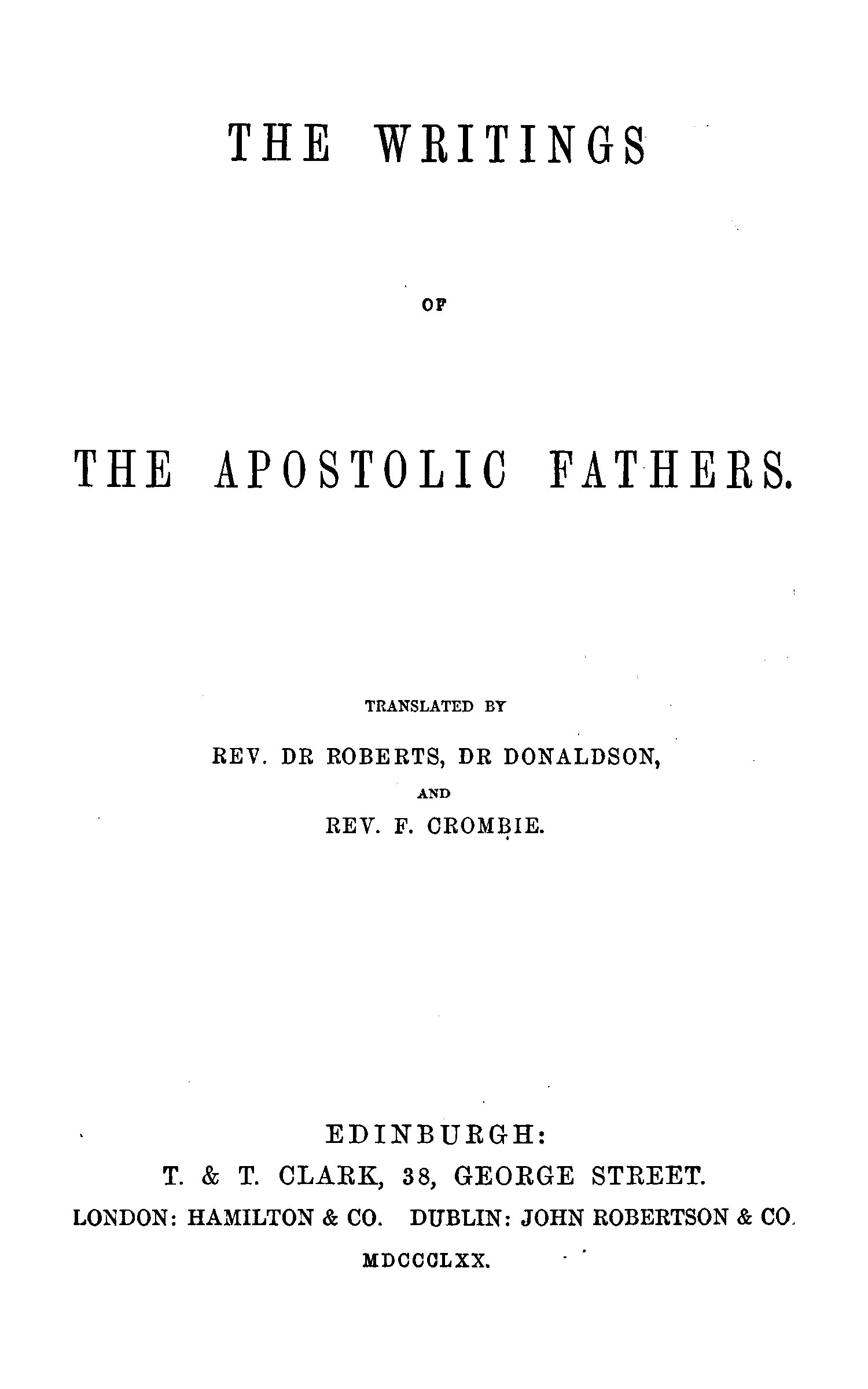
The writings of the Apostolic Fathers
by Pope Clement I
★★★★★No ratings yet
Language: English
Sign in to rate this book.
Sign in to shelve this book.
About this eBook
- Author
- Polycarp, Saint, Bishop of Smyrna, 69-155
- Original Publication
- Edinburgh: T. & T. Clark, 1870.
- Credits
- David King and the Online Proofreading Team at www.pgdp.net. (This file was produced from images generously made available by The Internet Archive.)
- Language
- English
- LoC Class
- BR: Philosophy, Psychology, Religion: Christianity
- Subject
- Apostolic Fathers
- Category
- Text
- Project Gutenberg
- eBook-No. 77576
- Release Date
- December 30, 2025
- Copyright
- Public domain in the USA.
Contents
- 1.The Writings of the Apostolic Fathers
- 2.NOTE BY THE EDITORS TO VOL. I.
- 3.CONTENTS OF VOL. I.
- 4.THE FIRST EPISTLE OF CLEMENT. — INTRODUCTORY NOTICE. — THE FIRST EPISTLE OF CLEMENT TO THE CORINTHIANS. [1] — Chap. i. — The Salutation. Praise of the Corinthians before the breaking forth of schism among them. — Chap. ii. — Praise of the Corinthians continued. — Chap. iii. — The sad state of the Corinthian church after sedition arose in it from envy and emulation. — Chap. iv. — Many evils have already flowed from this source in ancient times. — Chap. v. — No less evils have arisen from the same source in the most recent times. The martyrdom of Peter and Paul. — Chap. vi. — Continuation. Several other martyrs. — Chap. vii. — An exhortation to repentance. — Chap. viii. — Continuation respecting repentance. — Chap. ix. — Examples of the saints. — Chap. x. — Continuation of the above. — Chap. xi. — Continuation. Lot. — Chap. xii. — The rewards of faith and hospitality. Rahab. — Chap. xiii. — An exhortation to humility. — Chap. xiv. — We should obey God rather than the authors of sedition. — Chap. xv. — We must adhere to those who cultivate peace, not to those who merely pretend to do so. — Chap. xvi. — Christ as an example of humility. — Chap. xvii. — The saints as examples of humility. — Chap. xviii. — David as an example of humility. — Chap. xix. — Imitating these examples, let us seek after peace. — Chap. xx. — The peace and harmony of the universe. — Chap. xxi. — Let us obey God, and not the authors of sedition. — Chap. xxii. — These exhortations are confirmed by the Christian faith, which proclaims the misery of sinful conduct. — Chap. xxiii. — Be humble, and believe that Christ will come again. — Chap. xxiv. — God continually shows us in nature that there will be a resurrection. — Chap. xxv. — The phœnix an emblem of our resurrection. — Chap. xxvi. — We shall rise again, then, as the Scripture also testifies. — Chap. xxvii. — In the hope of the resurrection, let us cleave to the omnipotent and omniscient God. — Chap. xxviii. — God sees all things: therefore let us avoid transgression. — Chap. xxix. — Let us also draw near to God in purity of heart. — Chap. xxx. — Let us do those things that please God, and flee from those He hates, that we may be blessed. — Chap. xxxi. — Let us see by what means we may obtain the divine blessing. — Chap. xxxii. — We are justified not by our own works, but by faith. — Chap. xxxiii. — But let us not give up the practice of good works and love. God Himself is an example to us of good works. — Chap. xxxiv. — Great is the reward of good works with God. Joined together in harmony, let us implore that reward from Him. — Chap. xxxv. — Immense is this reward. How shall we obtain it? — Chap. xxxvi. — All blessings are given to us through Christ. — Chap. xxxvii. — Christ is our Leader, and we His soldiers. — Chap. xxxviii. — Let the members of the church submit themselves, and no one exalt himself above another. — Chap. xxxix. — There is no reason for self-conceit. — Chap. xl. — Let us preserve in the church the order appointed by God. — Chap. xli. — Continuation of the same subject. — Chap. xlii. — The order of ministers in the church. — Chap. xliii. — Moses of old stilled the contention which arose concerning the priestly dignity. — Chap. xliv. — The ordinances of the apostles, that there might be no contention respecting the priestly office. — Chap. xlv. — It is the part of the wicked to vex the righteous. — Chap. xlvi. — Let us cleave to the righteous: your strife is pernicious. — Chap. xlvii. — Your recent discord is worse than the former which took place in the times of Paul. — Chap. xlviii. — Let us return to the practice of brotherly love. — Chap. xlix. — The praise of love. — Chap. l. — Let us pray to be thought worthy of love. — Chap. li. — Let the partakers in strife acknowledge their sins. — Chap. lii. — Such a confession is pleasing to God. — Chap. liii. — The love of Moses towards his people. — Chap. liv. — He who is full of love will incur every loss, that peace may be restored to the church. — Chap. lv. — Examples of such love. — Chap. lvi. — Let us admonish and correct one another. — Chap. lvii. — Let the authors of sedition submit themselves. — Chap. lviii. — Blessings sought for all that call upon God. — Chap. lix. — The Corinthians are exhorted speedily to send back word that peace has been restored. The benediction.
- 5.THE SECOND EPISTLE OF CLEMENT. — INTRODUCTORY NOTICE. — THE SECOND EPISTLE OF CLEMENT. [259] — Chap. i. — We ought to think highly of Christ. — Chap. ii. — The church, formerly barren, is now fruitful. — Chap. iii. — The duty of confessing Christ. — Chap. iv. — True confession of Christ. — Chap. v. — This world should be despised. — Chap. vi. — The present and future worlds are enemies to each other. — Chap. vii. — We must strive in order to be crowned. — Chap. viii. — The necessity of repentance while we are on earth. — Chap. ix. — We shall be judged in the flesh. — Chap. x. — Vice is to be forsaken, and virtue followed. — Chap. xi. — We ought to serve God, trusting in His promises. — Chap. xii. — We are constantly to look for the kingdom of God.
- 6.THE EPISTLE OF POLYCARP. — INTRODUCTORY NOTICE. — THE EPISTLE OF POLYCARP TO THE PHILIPPIANS. [316] — Chap. i. — Praise of the Philippians. — Chap. ii. — An exhortation to virtue. — Chap. iii. — Expressions of personal unworthiness. — Chap. iv. — Various exhortations. — Chap. v. — The duties of deacons, youths, and virgins. — Chap. vi. — The duties of presbyters and others. — Chap. vii. — Avoid the Docetæ, and persevere in fasting and prayer. — Chap. viii. — Persevere in hope and patience. — Chap. ix. — Patience inculcated. — Chap. x. — Exhortation to the practice of virtue. [369] — Chap. xi. — Expression of grief on account of Valens. — Chap. xii. — Exhortation to various graces. — Chap. xiii. — Concerning the transmission of epistles. — Chap. xiv. — Conclusion.
- 7.THE MARTYRDOM OF POLYCARP. — INTRODUCTORY NOTICE. — THE ENCYCLICAL EPISTLE OF THE CHURCH AT SMYRNA CONCERNING THE MARTYRDOM OF THE HOLY POLYCARP. — Chap. i. — Subject of which we write. — Chap. ii. — The wonderful constancy of the martyrs. — Chap. iii. — The constancy of Germanicus. The death of Polycarp is demanded. — Chap. iv. — Quintus the apostate. — Chap. v. — The departure and vision of Polycarp. — Chap. vi. — Polycarp is betrayed by a servant. — Chap. vii. — Polycarp is found by his pursuers. — Chap. viii. — Polycarp is brought into the city. — Chap. ix. — Polycarp refuses to revile Christ. — Chap. x. — Polycarp confesses himself a Christian. — Chap. xi. — No threats have any effect on Polycarp. — Chap. xii. — Polycarp is sentenced to be burned. — Chap. xiii. — The funeral pile is erected. — Chap. xiv. — The prayer of Polycarp. — Chap. xv. — Polycarp is not injured by the fire. — Chap. xvi. — Polycarp is pierced by a dagger. — Chap. xvii. — The Christians are refused Polycarp’s body. — Chap. xviii. — The body of Polycarp is burned. — Chap. xix. — Praise of the martyr Polycarp. — Chap. xx. — This epistle is to be transmitted to the brethren. — Chap. xxi. — The date of the martyrdom. — Chap. xxii. — Salutation.
- 8.THE EPISTLE OF BARNABAS. — INTRODUCTORY NOTICE. — THE EPISTLE OF BARNABAS. [457] — Chap. i. — After the salutation, the writer declares that he would communicate to his brethren something of that which he had himself received. — Chap. ii. — The Jewish sacrifices are now abolished. — Chap. iii. — The fasts of the Jews are not true fasts, nor acceptable to God. — Chap. iv. — Antichrist is at hand: let us therefore avoid Jewish errors. — Chap. v. — The new covenant, founded on the sufferings of Christ, tends to our salvation, but to the Jews’ destruction. — Chap. vi. — The sufferings of Christ, and the new covenant, were announced by the prophets. — Chap. vii. — Fasting, and the goat sent away, were types of Christ. — Chap. viii. — The red heifer a type of Christ. — Chap. ix. — The spiritual meaning of circumcision. — Chap. x. — Spiritual significance of the precepts of Moses respecting different kinds of food. — Chap. xi. — Baptism and the cross prefigured in the Old Testament. — Chap. xii. — The cross of Christ frequently announced in the Old Testament. — Chap. xiii. — Christians, and not Jews, the heirs of the covenant. — Chap. xiv. — The Lord hath given us the testament which Moses received and broke. — Chap. xv. — The false and the true Sabbath. — Chap. xvi. — The spiritual temple of God. — Chap. xvii. — Conclusion of the first part of the epistle. — Chap. xviii. — Second part of the epistle. The two ways. — Chap. xix. — The way of light. — Chap. xx. — The way of darkness. — Chap. xxi. — Conclusion.
- 9.THE EPISTLES OF IGNATIUS. (SHORTER AND LONGER.) — INTRODUCTORY NOTICE. — THE EPISTLE OF IGNATIUS TO THE EPHESIANS. — Chap. i. — Praise of the Ephesians. — Chap. ii. — Congratulations and entreaties. — Chap. iii. — Exhortations to unity. — Chap. iv. — The same continued. — Chap. v. — The praise of unity. — Chap. vi. — Have respect to the bishop as to Christ Himself. — Chap. vii. — Beware of false teachers. — Chap. viii. — Renewed praise of the Ephesians. — Chap. ix. — Ye have given no heed to false teachers. — Chap. x. — Exhortations to prayer, humility, etc. — Chap. xi. — An exhortation to fear God, etc. — Chap. xii. — Praise of the Ephesians. — Chap. xiii. — Exhortation to meet together frequently for the worship of God. — Chap. xiv. — Exhortations to faith and love. — Chap. xv. — Exhortation to confess Christ by silence as well as speech. — Chap. xvi. — The fate of false teachers. — Chap. xvii. — Beware of false doctrines. — Chap. xviii. — The glory of the cross. — Chap. xix. — Three celebrated mysteries. — Chap. xx. — Promise of another letter. — Shorter. — Chap. xx. — Exhortations to stedfastness and unity. — Longer. — Chap. xxi. — Conclusion. — THE EPISTLE OF IGNATIUS TO THE MAGNESIANS. — Chap. i. — Reason of writing the epistle. — Chap. ii. — I rejoice in your messengers. — Chap. iii. — Honour your youthful bishop. — Chap. iv. — Some wickedly act independently of the bishop. — Chap. v. — Death is the fate of all such. — Chap. vi. — Preserve harmony. — Chap. vii. — Do nothing without the bishop and presbyters. — Chap. viii. — Caution against false doctrines. — Chap. ix. — Let us live with Christ. — Chap. x. — Beware of Judaizing. — Chap. xi. — I write these things to warn you. — Chap. xii. — Ye are superior to me. — Chap. xiii. — Be established in faith and unity. — Chap. xiv. — Your prayers requested. — Chap. xv. — Salutations. — THE EPISTLE OF IGNATIUS TO THE TRALLIANS. — Chap. i. — Acknowledgment of their excellence. — Chap. ii. — Be subject to the bishop, etc. — Chap. iii. — Honour the deacons, etc. — Chap. iv. — I have need of humility. — Chap. v. — I will not teach you profound doctrines. — Chap. vi. — Abstain from the poison of heretics. — Chap. vii. — The same continued. — Chap. viii. — Be on your guard against the snares of the devil. — Chap. ix. — Reference to the history of Christ. — Chap. x. — The reality of Christ’s passion. — Chap. xi. — Avoid the deadly errors of the Docetæ. — Chap. xii. — Continue in unity and love. — Chap. xiii. — Conclusion. — THE EPISTLE OF IGNATIUS TO THE ROMANS. — Chap. i. — As a prisoner, I hope to see you. — Chap. ii. — Do not save me from martyrdom. — Chap. iii. — Pray rather that I may attain to martyrdom. — Chap. iv. — Allow me to fall a prey to the wild beasts. — Chap. v. — I desire to die. — Chap. vi. — By death I shall attain true life. — Chap. vii. — Reason of desiring to die. — Chap. viii. — Be ye favourable to me. — Chap. ix. — Pray for the church in Syria. — Chap. x. — Conclusion. — THE EPISTLE OF IGNATIUS TO THE PHILADELPHIANS. — Chap. i. — Praise of the bishop. — Chap. ii. — Maintain union with the bishop. — Chap. iii. — Avoid schismatics. — Chap. iv. — Have but one Eucharist, etc. — Chap. v. — Pray for me. — Chap. vi. — Do not accept Judaism. — Chap. vii. — I have exhorted you to unity. — Chap. viii. — The same continued. — Chap. ix. — The Old Testament is good: the New Testament is better. — Chap. x. — Congratulate the inhabitants of Antioch on the close of the persecution. — Chap. xi. — Thanks and salutation. — THE EPISTLE OF IGNATIUS TO THE SMYRNÆANS. — Chap. i. — Thanks to God for your faith. — Chap. ii. — Christ’s true passion. — Chap. iii. — Christ was possessed of a body after His resurrection. — Chap. iv. — Beware of these heretics. — Chap. v. — Their dangerous errors. — Chap. vi. — Unbelievers in the blood of Christ shall be condemned. — Chap. vii. — Let us stand aloof from such heretics. — Chap. viii. — Let nothing be done without the bishop. — Chap. ix. — Honour the bishop. — Chap. x. — Acknowledgment of their kindness. — Chap. xi. — Request to them to send a messenger to Antioch. — Chap. xii. — Salutations. — Conclusion. — THE EPISTLE OF IGNATIUS TO POLYCARP. — Chap. i. — Commendation and exhortation. — Chap. ii. — Exhortations. — Chap. iii. — Exhortations. — Chap. iv. — Exhortations. — Chap. v. — The duties of husbands and wives. — Chap. vi. — The duties of the Christian flock. — Chap. vii. — Request that Polycarp would send a messenger to Antioch. — Chap. viii. — Let other churches also send to Antioch.
- 10.THE EPISTLES OF IGNATIUS AFTER THE SYRIAC VERSION. — INTRODUCTORY NOTICE. — THE EPISTLE OF IGNATIUS TO POLYCARP. [1384] — Chap. i. — Chap. ii. — Chap. iii. — Chap. iv. — Chap. v. — Chap. vi. — Chap. vii. — Chap. viii. — THE SECOND EPISTLE OF IGNATIUS: TO THE EPHESIANS. [1398] — Chap. i. — Chap. iii. [1404] — Chap. viii. [1405] — Chap. ix. — Chap. x. — Chap. xiv. [1407] — Chap. xv. — Chap. xviii. [1409] — Chap. xix. — THE THIRD EPISTLE OF THE SAME ST IGNATIUS. [1412] — Chap. i. — Chap. ii. — Chap. iii. — Chap. iv. — Chap. v. — Chap. vi. — Chap. vii. — Chap. ix. [1424]
- 11.THE MARTYRDOM OF IGNATIUS. — INTRODUCTORY NOTICE. — THE MARTYRDOM OF IGNATIUS. — Chap. i. — Desire of Ignatius for martyrdom. — Chap. ii. — Ignatius is condemned by Trajan. — Chap. iii. — Ignatius sails to Smyrna. — Chap. iv. — Ignatius writes to the churches. — Chap. v. — Ignatius is brought to Rome. — Chap. vi. — Ignatius is devoured by the beasts at Rome. — Chap. vii. — Ignatius appears in a vision after his death.
- 12.THE EPISTLE TO DIOGNETUS. — Introductory Notice. — THE EPISTLE TO DIOGNETUS. — Chap. i. — Occasion of the Epistle. — Chap. ii. — The vanity of idols. — Chap. iii. — Superstitions of the Jews. — Chap. iv. — The other observances of the Jews. — Chap. v. — The manners of the Christians. — Chap. vi. — The relation of Christians to the world. — Chap. vii. — The manifestation of Christ. — Chap. viii. — The miserable state of men before the coming of the Word. — Chap. ix. — Why the Son was sent so late. — Chap. x. — The blessings that will flow from faith. — Chap. xi. — These things are worthy to be known and believed. — Chap. xii. — The importance of knowledge to true spiritual life.
- 13.THE PASTOR OF HERMAS. — Introductory Notice. — BOOK FIRST.—VISIONS. — VISION FIRST. AGAINST FILTHY AND PROUD THOUGHTS, AND THE CARELESSNESS OF HERMAS IN CHASTISING HIS SONS. — VISION SECOND. AGAIN, OF HIS NEGLECT IN CHASTISING HIS TALKATIVE WIFE AND HIS LUSTFUL SONS, AND OF HIS CHARACTER. — VISION THIRD. CONCERNING THE BUILDING OF THE TRIUMPHANT CHURCH, AND THE VARIOUS CLASSES OF REPROBATE MEN. — VISION FOURTH. CONCERNING THE TRIAL AND TRIBULATION THAT ARE TO COME UPON MEN. — VISION FIFTH. CONCERNING THE COMMANDMENTS. — BOOK SECOND.—COMMANDMENTS. — COMMANDMENT FIRST. On Faith in God. — COMMANDMENT SECOND. On avoiding evil-speaking, and on giving alms in simplicity. — COMMANDMENT THIRD. On avoiding falsehood, and on the repentance of Hermas for his dissimulation. — COMMANDMENT FOURTH. On putting one’s wife away for adultery. — COMMANDMENT FIFTH. Of sadness of heart, and of patience. — COMMANDMENT SIXTH. How to recognise the two spirits attendant on each man, and how to distinguish the suggestions of the one from those of the other. — COMMANDMENT SEVENTH. On fearing God, and not fearing the devil. — COMMANDMENT EIGHTH. We ought to shun that which is evil, and do that which is good. — COMMANDMENT NINTH. Prayer must be made to God without ceasing, and with unwavering confidence. — COMMANDMENT TENTH. Of grief, and not grieving the Spirit of God which is in us. — COMMANDMENT ELEVENTH. The Spirit and prophets to be tried by their works; also of the two kinds of spirit. — COMMANDMENT TWELFTH. On the twofold desire. The commandments of God can be kept, and believers ought not to fear the devil. — BOOK THIRD.—SIMILITUDES. SIMILITUDES WHICH HE SPAKE WITH ME. — SIMILITUDE FIRST. As in this world we have no abiding city, we ought to seek one to come. — SIMILITUDE SECOND. As the vine is supported by the elm, so is the rich man helped by the prayer of the poor. — SIMILITUDE THIRD. As in winter green trees cannot be distinguished from withered, so in this world neither can the just from the unjust. — SIMILITUDE FOURTH. As in summer living trees are distinguished from withered by fruit and living leaves, so in the world to come the just differ from the unjust in happiness. — SIMILITUDE FIFTH. Of true fasting and its reward: also of purity of body. — SIMILITUDE SIXTH. Of the two classes of voluptuous men, and of their death, falling away, and the duration of their punishment. — SIMILITUDE SEVENTH. They who repent must bring forth fruits worthy of repentance. — SIMILITUDE EIGHTH. The sins of the elect and of the penitent are of many kinds, but all will be rewarded according to the measure of their repentance and good works. — SIMILITUDE NINTH. The great mysteries in the building of the militant and triumphant church. — SIMILITUDE TENTH. Concerning Repentance and Alms-giving.
- 14.FRAGMENTS OF PAPIAS. — INTRODUCTORY NOTICE. — I. From the Exposition of the Oracles of the Lord. [1784] — II. [1790] — III. [1792] — IV. [1795] — V. [1796] — VI. [1804] — VII. [1807] — VIII. [1809] — IX. [1810] — X. [1811]
- 15.APPENDIX. THE SPURIOUS EPISTLES OF IGNATIUS. — INTRODUCTORY NOTICE. — THE EPISTLE OF IGNATIUS TO THE TARSIANS. — Chap. i. — His own sufferings: exhortation to stedfastness. — Chap. ii. — Cautions against false doctrine. — Chap. iii. — The true doctrine respecting Christ. — Chap. iv. — Continuation. — Chap. v. — Refutation of the previously mentioned errors. — Chap. vi. — Continuation. — Chap. vii. — Continuation. — Chap. viii. — Exhortations to holiness and good order. — Chap. ix. — Exhortations to the discharge of relative duties. — Chap. x. — Salutations. — THE EPISTLE OF IGNATIUS TO THE ANTIOCHIANS. — Chap. i. — Cautions against error. — Chap. ii. — The true doctrine respecting God and Christ. — Chap. iii. — The same continued. — Chap. iv. — Continuation. — Chap. v. — Denunciation of false teachers. — Chap. vi. — Renewed cautions. — Chap. vii. — Exhortation to consistency of conduct. — Chap. viii. — Exhortations to the presbyters and others. — Chap. ix. — Duties of husbands, wives, parents, and children. — Chap. x. — Duties of masters and servants. — Chap. xi. — Inculcation of various moral duties. — Chap. xii. — Salutations. — Chap. xiii. — Salutations continued. — Chap. xiv. — Conclusion. — THE EPISTLE OF IGNATIUS TO HERO, A DEACON OF ANTIOCH. — Chap. i. — Exhortations to earnestness and moderation. — Chap. ii. — Cautions against false teachers. — Chap. iii. — Exhortations as to ecclesiastical duties. — Chap. iv. — Servants and women are not to be despised. — Chap. v. — Various relative duties. — Chap. vi. — Exhortations to purity and caution. — Chap. vii. — Solemn charge to Hero, as future bishop of Antioch. — Chap. viii. — Salutations. — Chap. ix. — Concluding salutations and instructions. — THE EPISTLE OF IGNATIUS TO THE PHILIPPIANS. — Chap. i. — Reason for writing the epistle. — Chap. ii. — Unity of the three Divine Persons. — Chap. iii. — Christ was truly born, and died, etc. — Chap. iv. — The malignity and folly of Satan. — Chap. v. — Apostrophe to Satan. — Chap. vi. — Continuation. — Chap. vii. — Continuation: inconsistency of Satan. — Chap. viii. — Continuation: ignorance of Satan. — Chap. ix. — Continuation: ignorance of Satan. — Chap. x. — Continuation: audacity of Satan. — Chap. xi. — Continuation: audacity of Satan. — Chap. xii. — The meek reply of Christ. — Chap. xiii. — Various exhortations and directions. — Chap. xiv. — Farewells and cautions. — Chap. xv. — Salutations. Conclusion. — THE EPISTLE OF MARIA THE PROSELYTE TO IGNATIUS. — Chap. i. — Occasion of the epistle. — Chap. ii. — Youth may be allied with piety and discretion. — Chap. iii. — Examples of youthful devotedness. — Chap. iv. — The same subject continued. — Chap. v. — Expressions of respect for Ignatius. — THE EPISTLE OF IGNATIUS TO MARY AT NEAPOLIS, NEAR ZARBUS. — Chap. i. — Acknowledgment of her excellence and wisdom. — Chap. ii. — His own condition. — Chap. iii. — He had complied with her request. — Chap. iv. — Commendation and exhortation. — Chap. v. — Salutations and good wishes. — THE EPISTLE OF IGNATIUS TO ST JOHN THE APOSTLE. — A SECOND EPISTLE OF IGNATIUS TO ST JOHN. — THE EPISTLE OF IGNATIUS TO THE VIRGIN MARY. — REPLY OF THE BLESSED VIRGIN TO THIS LETTER.
- 16.INDEX OF SUBJECTS.
- 17.INDEX OF TEXTS.
Community reviews
Sign in to write a review.
No reviews yet.