THE JOURNAL OF
HENRY DAVID THOREAU
VOLUME II
The Hindoos are more serenely and thoughtfully
religious than the Hebrews. They have perhaps a purer,
more independent and impersonal knowledge of God.
Their religious books describe the first inquisitive and
contemplative access to God; the Hebrew bible a conscientious
return, a grosser and more personal repentance.
Repentance is not a free and fair highway to
God. A wise man will dispense with repentance. It is
shocking and passionate. God prefers that you approach
him thoughtful, not penitent, though you are the chief
of sinners. It is only by forgetting yourself that you
draw near to him.
The calmness and gentleness with which the Hindoo
philosophers approach and discourse on forbidden
themes is admirable.
What extracts from the Vedas I have read fall on me
like the light of a higher and purer luminary, which
describes a loftier course through a purer stratum,—free
from particulars, simple, universal. It rises on me
like the full moon after the stars have come out, wading
through some far summer stratum of the sky.
The Vedant teaches how, “by forsaking religious
rites,” the votary may “obtain purification of mind.”
One wise sentence is worth the state of Massachusetts
many times over.
The Vedas contain a sensible account of God.
The religion and philosophy of the Hebrews are those
of a wilder and ruder tribe, wanting the civility and
intellectual refinements and subtlety of the Hindoos.
Man flows at once to God as soon as the channel of
purity, physical, intellectual, and moral, is open.
With the Hindoos virtue is an intellectual exercise,
not a social and practical one. It is a knowing, not a
doing.
I do not prefer one religion or philosophy to another.
I have no sympathy with the bigotry and ignorance
which make transient and partial and puerile distinctions
between one man’s faith or form of faith and
another’s,—as Christian and heathen. I pray to be
delivered from narrowness, partiality, exaggeration,
bigotry. To the philosopher all sects, all nations, are
alike. I like Brahma, Hari, Buddha, the Great Spirit,
as well as God.
[Part of leaf missing here.]
A page with as true and inevitable and deep a meaning
as a hillside, a book which Nature shall own as her own
flower, her own leaves; with whose leaves her own shall
rustle in sympathy imperishable and russet; which shall
push out with the skunk-cabbage in the spring. I am not
offended by the odor of the skunk in passing by sacred
places.[2] I am invigorated rather. It is a reminiscence of
immortality borne on the gale. O thou partial world, when
wilt thou know God? I would as soon transplant this
vegetable to Polynesia or to heaven with me as the violet.
Shoes are commonly too narrow. If you should take
off a gentleman’s shoes, you would find that his foot
was wider than his shoe. Think of his wearing such an
engine! walking in it many miles year after year! A
shoe which presses against the sides of the foot is to be
condemned. To compress the foot like the Chinese is as
bad as to compress the head like the Flatheads, for the
head and the foot are one body. The narrow feet,—they
greet each other on the two sides of the Pacific. A
sensible man will not follow fashion in this respect, but
reason. Better moccasins, or sandals, or even bare feet,
than a tight shoe. A wise man will wear a shoe wide
and large enough, shaped somewhat like the foot, and
tied with a leather string, and so go his way in peace,
letting his foot fall at every step.
When your shoe chafes your feet, put in a mullein leaf.
When I ask for a garment of a particular form, my
tailoress tells me gravely, “They do not make them so
now,” and I find it difficult to get made what I want,
simply because she cannot believe that I mean what I
say; it surpasses her credulity. Properly speaking, my
style is as fashionable as theirs. “They do not make
them so now,” as if she quoted the Fates! I am for a
moment absorbed in thought, thinking, wondering who
they are, where they live. It is some Oak Hall, O call,
O. K., all correct establishment which she knows but I
do not. Oliver Cromwell. I emphasize and in imagination
italicize each word separately of that sentence to
come at the meaning of it.[3]
Or you may walk into the foreign land of Bedford,
where not even yet, after four or five, or even seven or
eight, miles, does the sky shut down, but the airy and
crystal dome of heaven arches high over all, when you
did not suspect that there was so much daylight under
its crystal dome, and from the hill eastward perchance
see the small town of Bedford standing stately on the
crest of a hill like some city of Belgrade with one hundred
and fifty thousand inhabitants. I wonder if Mr.
Fitch lives there among them.
How many noble men and women must have their
abode there! So it seems,—I trust that so it is,—but
I did not go into Bedford that time. But alas! I have
been into a village before now, and there was not a man
of a large soul in it. In what respect was it better than a
village of prairie-dogs.[4] I mean to hint no reproach even
by implica-[part of leaf torn off].
Sunday, May 12, 1850, visited the site of the Dustin
house in the northwest part of Haverhill, now but a slight
indentation in a corn-field, three or four feet deep, with
an occasional brick and cellar-stone turned up in plowing.
The owner, Dick Kimball, made much of the corn
grown in this hole, some ears of which were sent to
Philadelphia. The apple tree which is said to have stood
north from the house at a considerable distance is gone.
A brick house occupied by a descendant is visible from
the spot, and there are old cellar-holes in the neighborhood,
probably the sites of some of the other eight
houses which were burned on that day. It is a question
with some which is the site of the true Dustin house.
Also visited the same day an ancient garrison-house
now occupied by Fred. Ayer, who said it was built one
hundred and fifty or one hundred and sixty years ago
by one Emerson, and that several oxen were killed by
lightning while it was building. There was also a pear
tree nearly as old as the house. It was built of larger
and thicker and harder brick than are used nowadays,
and on the whole looked more durable and still likely to
stand a hundred years. The hard burnt blue-black ends
of some of the bricks were so arranged as to checker
the outside. He said it was considered the handsomest
house in Haverhill when it was built, and people used
to come up from town some two miles to see it. He
thought that they were the original doors which we saw.
There were but few windows, and most of them were
about two feet and a half long and a foot or more wide,
only to fire out of. The oven originally projected outside.
There were two large fireplaces. I walked into
one, by stooping slightly, and looked up at the sky.
Ayer said jokingly that some said they were so made
to shoot wild geese as they flew over. The chains and
hooks were suspended from a wooden bar high in the
chimney. The timbers were of immense size.
Fourteen vessels in or to be in the port of Haverhill,
laden with coal, lumber, lime, wood, and so forth. Boys
go [to] the wharf with their fourpences to buy a bundle
of laths to make a hen-house; none elsewhere to be had.
Saw two or three other garrison-houses. Mrs. Dustin
was an Emerson, one of the family for whom I surveyed.
Measured a buttonwood tree in Haverhill, one of
twenty and more set out about 1739 on the banks of
the Merrimack. It was thirteen and eight twelfths
feet in circumference at three and a half feet from the
ground.
Jewett’s steam mill is profitable, because the planing
machine alone, while that is running, makes shavings
and waste enough to feed the engine, to say nothing of
the sawdust from the sawmill; and the engine had not
required the least repair for several years. Perhaps, as
there is not so much sawing and planing to be done in
England, they therefore may not find steam so cheap as
water.
A single gentle rain in the spring makes the grass look
many shades greener.
It is wisest to live without any definite and recognized
object from day to day,—any particular object,—for
the world is round, and we are not to live on a tangent or
a radius to the sphere. As an old poet says, “though
man proposeth, God disposeth all.”
Our thoughts are wont to run in muddy or dusty ruts.
I too revive as does the grass after rain. We are never
so flourishing, our day is never so fair, but that the sun
may come out a little brighter through mists and we
yearn to live a better life. What have we to boast of?
We are made the very sewers, the cloacæ, of nature.
If the hunter has a taste for mud turtles and muskrats
and skunks and other such savage titbits, the fine
lady indulges a taste for some form of potted cheese,
or jelly made of a calf’s foot, or anchovies from over the
water, and they are even. He goes to the mill-pond, she
to her preserve pot. I wonder how he, I wonder how
I, can live this slimy, beastly kind of life, eating and
drinking.[5]
The fresh foliage of the woods in May, when the leaves
are about as big as a mouse’s ear, putting out like taller
grasses and herbs.
In all my rambles I have seen no landscape which can
make me forget Fair Haven. I still sit on its Cliff in a
new spring day, and look over the awakening woods and
the river, and hear the new birds sing, with the same
delight as ever. It is as sweet a mystery to me as ever,
what this world is. Fair Haven Lake in the south, with
its pine-covered island and its meadows, the hickories
putting out fresh young yellowish leaves, and the oaks
light-grayish ones, while the oven-bird thrums his
sawyer-like strain, and the chewink rustles through the
dry leaves or repeats his jingle on a tree-top, and the
wood thrush, the genius of the wood, whistles for the
first time his clear and thrilling strain,—it sounds as it
did the first time I heard it. The sight of these budding
woods intoxicates me,—this diet drink.
The strong-colored pine, the grass of trees, in the midst
of which other trees are but as weeds or flowers,—a
little exotic.
In the row of buttonwood trees on the banks of the
Merrimack in Haverhill, I saw that several had been cut
down, probably because of their unsightly appearance,
they all suffering from the prevalent disease which has
attacked the buttonwood of late years, and one large one
still resting on its stump where it had fallen. It seemed
like a waste of timber or of fuel, but when I inquired
about it, they answered that the millers did not like to
saw it. Like other ornamental trees which have stood
by the roadside for a hundred years, the inhabitants
have been accustomed to fasten their horses to them,
and have driven many spikes into them for this purpose.
One man, having carried some buttonwood logs to mill,
the miller agreed to saw them if he would make good the
injury which might be done to his saw. The other agreed
to it, but almost at the first clip they ran on to a spike and
broke the saw, and the owner of the logs cried, “Stop!”
he would have no more sawed. They are difficult to split,
beside, and make poor timber at best, being very liable
to warp.
The “itinerary distance” between two points, a convenient
expression.
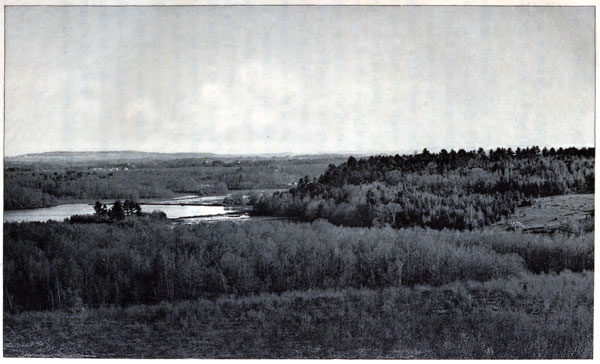
Fair Haven Pond from the Cliffs
Humboldt says, “It is still undetermined where life
is most abundant: whether on the earth or in the
fathomless depths of the ocean.”
It was a mirage, what in Sanscrit, according to
Humboldt, is called “the thirst of the gazelle.”
Nothing memorable was ever accomplished in a
prosaic mood of mind. The heroes and discoverers
have found true more than was previously believed,
only when they were expecting and dreaming of something
more than their contemporaries dreamed of,—when
they were in a frame of mind prepared in some
measure for the truth.
Referred to the world’s standard, the hero, the discoverer,
is insane, its greatest men are all insane. At
first the world does not respect its great men. Some
rude and simple nations go to the other extreme and
reverence all kinds of insanity. Humboldt says, speaking
of Columbus approaching the New World: “The
grateful coolness of the evening air, the ethereal purity
of the starry firmament, the balmy fragrance of flowers,
wafted to him by the land breeze, all led him to suppose
(as we are told by Herrera, in the Decades (5)),
that he was approaching the garden of Eden, the sacred
abode of our first parents. The Orinoco seemed to him
one of the four rivers which, according to the venerable
tradition of the ancient world, flowed from Paradise,
to water and divide the surface of the earth, newly
adorned with plants.”
Expeditions for the discovery of El Dorado, and also
of the Fountain of Youth, led to real, though perhaps
not compensatory, discoveries.[6]
I have heard my brother playing on his flute at evening
half a mile off through the houses of the village,
every note with perfect distinctness. It seemed a more
beautiful communication with me than the sending up
of a rocket would have been. So, if I mistake not, the
sound of blasting rocks has been heard from down
the river as far as Lowell,—some twenty miles by its
course,—where they were making a deep cut for the
railroad.
The sand cherry (Prunus depressa Pursh., Cerasus
pumila Mx.) grew about my door, and near the end of
May enlivened my yard with its umbels arranged cylindrically
about its short branches. In the fall, weighed
down with the weight of its large and handsome cherries,
it fell over in wreath-like rays on every side. I
tasted them out of compliment to nature, but I never
learned to love them.[7]
If the long-continued rains cause the seeds to rot in
the ground and destroy the potatoes in the low lands,
they are good for the grass on the uplands, though the
farmers say it is not so sweet.[8]
As I walked, I was intoxicated with the slight spicy
odor of the hickory buds and the bruised bark of the
black birch, and, in the fall, the pennyroyal.
Many a time I have expected to find a woodchuck,
or rabbit, or a gray squirrel, when it was the ground-robin
rustling the leaves.
I have been surprised to discover the amount and
the various kinds of life which a single shallow swamp
will sustain. On the south side of the pond, not more
than a quarter of a mile from it, is a small meadow of
ten or a dozen acres in the woods, considerably lower
than Walden, and which by some is thought to be fed by
the former by a subterranean outlet,—which is very
likely, for its shores are quite springy and its supply of
water is abundant and unfailing,—indeed tradition
says that a sawmill once stood over its outlet, though
its whole extent, including its sources, is not more than
I have mentioned,—a meadow through which the
Fitchburg Railroad passes by a very high causeway,
which required many a carload of sand, where the
laborers for a long time seemed to make no progress,
for the sand settled so much in the night that by morning
they were where they were the day before, and
finally the weight of the sand forced upward the adjacent
crust of the meadow with the trees on it many
feet, and cracked it for some rods around. It is a
wet and springy place throughout the summer, with
a ditch-like channel, and in one part water stands the
year round, with cat-o’-nine-tails and tussocks and
muskrats’ cabins rising above it, where good cranberries
may be raked if you are careful to anticipate
the frost which visits this cool hollow unexpectedly
early. Well, as I was saying, I heard a splashing in the
shallow and muddy water and stood awhile to observe
the cause of it. Again and again I heard and saw the
commotion, but could not guess the cause of it,—what
kind of life had its residence in that insignificant pool.
We sat down on the hillside. Ere long a muskrat came
swimming by as if attracted by the same disturbance,
and then another and another, till three had passed, and
I began to suspect that they were at the bottom of it.
Still ever and anon I observed the same commotion in
the waters over the same spot, and at length I observed
the snout of some creature slyly raised above the surface
after each commotion, as if to see if it were observed
by foes, and then but a few rods distant I saw another
snout above the water and began to divine the cause of
the disturbance. Putting off my shoes and stockings,
I crept stealthily down the hill and waded out slowly
and noiselessly about a rod from the firm land, keeping
behind the tussocks, till I stood behind the tussock
near which I had observed the splashing. Then, suddenly
stooping over it, I saw through the shallow but
muddy water that there was a mud turtle there, and
thrusting in my hand at once caught him by the claw,
and, quicker than I can tell it, heaved him high and
dry ashore; and there came out with him a large pout
just dead and partly devoured, which he held in his
jaws. It was the pout in his flurry and the turtle in
his struggles to hold him fast which had created the
commotion. There he had lain, probably buried in the
mud at the bottom up to his eyes, till the pout came
sailing over, and then this musky lagune had put forth
in the direction of his ventral fins, expanding suddenly
under the influence of a more than vernal heat,—there
are sermons in stones, aye and mud turtles at the bottoms
of the pools,—in the direction of his ventral fins,
his tender white belly, where he kept no eye; and the
minister squeaked his last.[9] Oh, what an eye was there,
my countrymen! buried in mud up to the lids, meditating
on what? sleepless at the bottom of the pool, at
the top of the bottom, directed heavenward, in no danger
from motes. Pouts expect their foes not from below.
Suddenly a mud volcano swallowed him up, seized
his midriff; he fell into those relentless jaws from which
there is no escape, which relax not their hold even in
death.[10] There the pout might calculate on remaining
until nine days after the head was cut off. Sculled
through Heywood’s shallow meadow, not thinking of
foes, looking through the water up into the sky. I saw
his [the turtle’s] brother sunning and airing his broad
back like a ship bottom up which had been scuttled,—foundered
at sea. I had no idea that there was so
much going on in Heywood’s meadow.
The pickerel commonly lie perfectly still at night,
like sticks, in very shallow water near the shore near
a brook’s mouth. I have seen a large one with a deep
white wound from a spear, cutting him half in two,
unhealed and unhealable, fast asleep, and forked him
into my boat. I have struck a pickerel sound asleep
and knew that I cut him almost in two, and the next
moment heard him go ashore several rods off; for
being thus awakened in their dreams they shoot off
with one impulse, intending only to abandon those
parts, without considering exactly to what places they
shall go. One night a small pickerel, which the boat
had probably struck in his sleep, leaped into the boat
and so was secured without a wound.
The chub is a soft fish and tastes like boiled brown
paper salted.
I was as interested in the discovery of limestone as
if it had been gold, and wondered that I had never
thought of it before. Now all things seemed to radiate
round limestone, and I saw how the farmers lived near
to, or far from, a locality of limestone. I detected it
sometimes in walls, and surmised from what parts it
was probably carted; or when I looked down into an
old deserted well, I detected it in the wall, and found
where the first settlers had quarried it extensively. I
read a new page in the history of these parts in the
old limestone quarries and kilns where the old settlers
found the materials of their houses; and I considered
that, since it was found so profitable even at Thomaston
to burn lime with coal dust, perchance these quarries
might be worked again.[11]
When the rocks were covered with snow, I even
uncovered them with my hands, that I might observe
their composition and strata, and thought myself lucky
when the sun had laid one bare for me; but [now] that
they are all uncovered I pass by without noticing them.
There is a time for everything.
We are never prepared to believe that our ancestors
lifted large stones or built thick walls. I find that I must
have supposed that they built their bank walls of such
as a single man could handle. For since we have put
their lives behind us we can think of no sufficient motive
for such exertion. How can their works be so visible
and permanent and themselves so transient? When I
see a stone which it must have taken many yoke of
oxen to move, lying in a bank wall which was built two
hundred years ago, I am curiously surprised, because
it suggests an energy and force of which we have no
memorials. Where are the traces of the corresponding
moral and intellectual energy? I am not prepared to
believe that a man lived here so long ago who could elevate
into a wall and properly aline a rock of great size
and fix it securely,—such an Archimedes. I walk over
the old corn-fields, it is true, where the grassy corn-hills
still appear in the woods, but there are no such traces
of them there. Again, we are wont to think that our ancestors
were all stalwart men, because only their most
enduring works have come down to us. I think that the
man who lifted so large a rock in the course of his
ordinary work should have had a still larger for his
monument.
I noticed a singular instance of ventriloquism to-day
in a male chewink singing on the top of a young oak.
It was difficult to believe that the last part of his strain,
the concluding jingle, did not proceed from a different
quarter, a woodside many rods off. Hip-you, he-he-he-he.
It was long before I was satisfied that the last part
was not the answer of his mate given in exact time. I
endeavored to get between the two; indeed, I seemed
to be almost between them already.
I have not seen Walden so high for many years; it is
within four feet of the pond-hole in Hubbard’s woods.
The river is higher than it has been at this season
for many years.
When the far mountains are invisible, the near ones
look the higher.
The oldest nature is elastic. I just felt myself raised
upon the swell of the eternal ocean, which came rolling
this way to land.
When my eye ranges over some thirty miles of this
globe’s surface,—an eminence green and waving, with
sky and mountains to bound it,—I am richer than
Crœsus.
The variously colored blossoms of the shrub oaks
now, in May, hanging gracefully like ear-drops, or the
similar blossoms of the large oaks.
I have noticed the effect of a flag set up on a hill in
the country. It tames the landscape, subdues it to itself.
The hill looks as if it were a military post. Our green,
wild country landscape is gathered under the folds of
a flag.
A lively appearance is imparted to the landscape as
seen from Nawshawtuct, by the flood on the meadows,—by
the alternation of land and water, of green and of
light colors. The frequent causeways, and the hedgerows
(?) jutting into the meadows, and the islands,
have an appearance full of light and life.
To-day, May 31st, a red and white cow, being uneasy,
broke out of the steam-mill pasture and crossed
the bridge and broke into Elijah Wood’s grounds. When
he endeavored to drive her out by the bars, she boldly
took to the water, wading first through the meadows
full of ditches, and swam across the river, about forty
rods wide at this time, and landed in her own pasture
again. She was a buffalo crossing her Mississippi. This
exploit conferred some dignity on the herd in my eyes,
already dignified, and reflectedly on the river, which I
looked on as a kind of Bosphorus.
I love to see the domestic animals reassert their native
rights,—any evidence that they have not lost their
original wild habits and vigor.[12]
There is a sweet wild world which lies along the
strain of the wood thrush—the rich intervales which
border the stream of its song—more thoroughly genial
to my nature than any other.[13]
The blossoms of the tough and vivacious shrub oak
are very handsome.
I visited a retired, now almost unused, graveyard in
Lincoln to-day, where five British soldiers lie buried
who fell on the 19th April, ’75. Edmund Wheeler,
grandfather of William, who lived in the old house now
pulled down near the present, went over the next day
and carted them to this ground. A few years ago one
Felch, a phrenologist, by leave of the selectmen dug up
and took away two skulls. The skeletons were very
large, probably those of grenadiers. William Wheeler,
who was present, told me this. He said that he had
heard old Mr. Child, who lived opposite, say that when
one soldier was shot he leaped right up his full length
out of the ranks and fell dead; and he, William Wheeler,
saw a bullet-hole through and through one of the skulls.
Close by stood a stone with this inscription:—
In memory of
Sippio Brister
a man of Colour
who died
Nov 1. 1820
Æt. 64.
But that is not telling us that he lived.[14]
There was one Newell, a tailor, his neighbor, who
became a Universalist minister. Breed put on his sign:—
Tailoring and barbering done with speed
By John C Newell & John C Breed.[15]
The water was over the turnpike below Master
Cheney’s when I returned (May 31st, 1850).
[A third of a page torn out here.]
that these fences, to a considerable extent, will be found
to mark natural divisions, especially if the land is not
very minutely divided,—mowing (upland and meadow)
pasture, woodland, and the different kinds of tillage.
There will be found in the farmer’s motive for setting a
fence here or there some conformity to natural limits.
These artificial divisions no doubt have the effect of
increasing the area and variety to the traveller. These
various fields taken together appear more extensive than
a single prairie of the same size would. If the divisions
corresponded [A third of a page torn out here.]
The year has many seasons more than are recognized
in the almanac. There is that time about the first of
June, the beginning of summer, when the buttercups
blossom in the now luxuriant grass and I am first
reminded of mowing and of the dairy. Every one will
have observed different epochs. There is the time when
they begin to drive cows to pasture,—about the 20th
of May,—observed by the farmer, but a little arbitrary
year by year. Cows spend their winters in barns
and cow-yards, their summers in pastures. In summer,
therefore, they may low with emphasis, “To-morrow to
fresh woods and pastures new.” I sometimes see a
neighbor or two united with their boys and hired men
to drive their cattle to some far-off country pasture, fifty
or sixty miles distant in New Hampshire, early in the
morning, with their sticks and dogs. It is a memorable
time with the farmers’ boys, and frequently their first
journey from home. The herdsman in some mountain
pasture is expecting them. And then in the fall, when
they go up to drive them back, they speculate as to
whether Janet or Brindle will know them. I heard such
a boy exclaim on such an occasion, when the calf of the
spring returned a heifer, as he stroked her side, “She
knows me, father; she knows me.” Driven up to be the
cattle on a thousand hills.
I once set fire to the woods. Having set out, one April
day, to go to the sources of Concord River in a boat
with a single companion, meaning to camp on the bank
at night or seek a lodging in some neighboring country
inn or farmhouse, we took fishing tackle with us that we
might fitly procure our food from the stream, Indian-like.
At the shoemaker’s near the river, we obtained
a match, which we had forgotten. Though it was thus
early in the spring, the river was low, for there had not
been much rain, and we succeeded in catching a mess of
fish sufficient for our dinner before we had left the town,
and by the shores of Fair Haven Pond we proceeded
to cook them. The earth was uncommonly dry, and our
fire, kindled far from the woods in a sunny recess in
the hillside on the east of the pond, suddenly caught
the dry grass of the previous year which grew about the
stump on which it was kindled. We sprang to extinguish
it at first with our hands and feet, and then we fought
it with a board obtained from the boat, but in a few
minutes it was beyond our reach; being on the side of a
hill, it spread rapidly upward, through the long, dry,
wiry grass interspersed with bushes.
“Well, where will this end?” asked my companion.
I saw that it might be bounded by Well Meadow Brook
on one side, but would, perchance, go to the village side
of the brook. “It will go to town,” I answered. While
my companion took the boat back down the river, I set
out through the woods to inform the owners and to raise
the town. The fire had already spread a dozen rods on
every side and went leaping and crackling wildly and
irreclaimably toward the wood. That way went the
flames with wild delight, and we felt that we had no
control over the demonic creature to which we had
given birth. We had kindled many fires in the woods
before, burning a clear space in the grass, without ever
kindling such a fire as this.
As I ran toward the town through the woods, I could
see the smoke over the woods behind me marking the
spot and the progress of the flames. The first farmer
whom I met driving a team, after leaving the woods,
inquired the cause of the smoke. I told him. “Well,”
said he, “it is none of my stuff,” and drove along. The
next I met was the owner in his field, with whom I returned
at once to the woods, running all the way. I had
already run two miles. When at length we got into the
neighborhood of the flames, we met a carpenter who
had been hewing timber, an infirm man who had been
driven off by the fire, fleeing with his axe. The farmer
returned to hasten more assistance. I, who was spent
with running, remained. What could I do alone against
a front of flame half a mile wide?
I walked slowly through the wood to Fair Haven Cliff,
climbed to the highest rock, and sat down upon it to
observe the progress of the flames, which were rapidly
approaching me, now about a mile distant from the spot
where the fire was kindled. Presently I heard the sound
of the distant bell giving the alarm, and I knew that the
town was on its way to the scene. Hitherto I had felt
like a guilty person,—nothing but shame and regret.
But now I settled the matter with myself shortly. I said
to myself: “Who are these men who are said to be the
owners of these woods, and how am I related to them?
I have set fire to the forest, but I have done no wrong
therein, and now it is as if the lightning had done it.
These flames are but consuming their natural food.”
(It has never troubled me from that day to this more than
if the lightning had done it. The trivial fishing was all
that disturbed me and disturbs me still.) So shortly I
settled it with myself and stood to watch the approaching
flames.[16] It was a glorious spectacle, and I was the only
one there to enjoy it. The fire now reached the base of
the cliff and then rushed up its sides. The squirrels ran
before it in blind haste, and three pigeons dashed into
the midst of the smoke. The flames flashed up the pines
to their tops, as if they were powder.
When I found I was about to be surrounded by the
fire, I retreated and joined the forces now arriving from
the town. It took us several hours to surround the
flames with our hoes and shovels and by back fires subdue
them. In the midst of all I saw the farmer whom
I first met, who had turned indifferently away saying
it was none of his stuff, striving earnestly to save his
corded wood, his stuff, which the fire had already seized
and which it after all consumed.
It burned over a hundred acres or more and destroyed
much young wood. When I returned home late in the
day, with others of my townsmen, I could not help
noticing that the crowd who were so ready to condemn
the individual who had kindled the fire did not sympathize
with the owners of the wood, but were in fact
highly elate and as it were thankful for the opportunity
which had afforded them so much sport; and it was only
half a dozen owners, so called, though not all of them,
who looked sour or grieved, and I felt that I had a deeper
interest in the woods, knew them better and should feel
their loss more, than any or all of them. The farmer
whom I had first conducted to the woods was obliged
to ask me the shortest way back, through his own lot.
Why, then, should the half-dozen owners [and] the individuals
who set the fire alone feel sorrow for the loss of
the wood, while the rest of the town have their spirits
raised? Some of the owners, however, bore their loss
like men, but other some declared behind my back that
I was a “damned rascal;” and a flibbertigibbet or two,
who crowed like the old cock, shouted some reminiscences
of “burnt woods” from safe recesses for some
years after. I have had nothing to say to any of them.
The locomotive engine has since burned over nearly all
the same ground and more, and in some measure blotted
out the memory of the previous fire. For a long time
after I had learned this lesson I marvelled that while
matches and tinder were contemporaries the world was
not consumed; why the houses that have hearths were
not burned before another day; if the flames were not
as hungry now as when I waked them. I at once ceased
to regard the owners and my own fault,—if fault there
was any in the matter,—and attended to the phenomenon
before me, determined to make the most of it. To
be sure, I felt a little ashamed when I reflected on what
a trivial occasion this had happened, that at the time
I was no better employed than my townsmen.
That night I watched the fire, where some stumps
still flamed at midnight in the midst of the blackened
waste, wandering through the woods by myself; and
far in the night I threaded my way to the spot where
the fire had taken, and discovered the now broiled fish,—which
had been dressed,—scattered over the burnt
grass.
This has been a cool day, though the first of summer.
The prospect of the meadows from Lee’s Hill was very
fine. I observe that the shadows of the trees are very
distinct and heavy in such a day, falling on the fresh
grass. They are as obvious as the trees themselves by
mid-afternoon. Commonly we do not make much
account of the distinct shadows of objects in the landscape.
What is bare and unsightly is covered by the water
now. The verdure seems to spring directly from its
bosom; there are no stems nor roots. The meadows are
so many mirrors reflecting the light,—toward sunset
dazzlingly bright.
I visited this afternoon (June 3d) Goodman’s Hill in
Sudbury, going through Lincoln over Sherman’s Bridge
and Round Hill, and returning through the Corner. It
probably affords the best view of Concord River meadows
of any hill. The horizon is very extensive as it is,
and if the top were cleared so that you could get the
western view, it would be one of the most extensive seen
from any hill in the county. The most imposing horizons
are those which are seen from tops of hills rising out of
a river valley. The prospect even from a low hill has
something majestic in it in such a case. The landscape
is a vast amphitheatre rising to its rim in the horizon.
There is a good view of Lincoln lying high up in among
the hills. You see that it is the highest town hereabouts,
and hence its fruit. The river at this time looks as large
as the Hudson. I think that a river-valley town is much
the handsomest and largest-featured,—like Concord
and Lancaster, for instance, natural centres. Upon the
hills of Bolton, again, the height of land between the
Concord and Nashua, I have seen how the peach
flourishes. Nobscot, too, is quite imposing as seen from
the west side of Goodman’s Hill. On the western side
of a continuation of this hill is Wadsworth’s battle-field.[17]
Returning, I saw in Sudbury twenty-five nests of the
new (cliff?) swallow under the eaves of a barn. They
seemed particularly social and loquacious neighbors,
though their voices are rather squeaking. Their nests,
built side by side, looked somewhat like large hornets’
nests, enough so to prove a sort of connection. Their
activity, sociability, and chattiness make them fit pensioners
and neighbors of man—summer companions—for
the barn-yard.
The last of May and the first of June the farmers are
everywhere planting their corn and beans and potatoes.
To-day, June 4th, I have been tending a burning in
the woods. Ray was there. It is a pleasant fact that you
will know no man long, however low in the social scale,
however poor, miserable, intemperate, and worthless he
may appear to be, a mere burden to society, but you will
find at last that there is something which he understands
and can do better than any other. I was pleased to hear
that one man had sent Ray as the one who had had the
most experience in setting fires of any man in Lincoln.
He had experience and skill as a burner of brush.
You must burn against the wind always, and burn
slowly. When the fire breaks over the hoed line, a little
system and perseverance will accomplish more toward
quelling it than any man would believe. It fortunately
happens that the experience acquired is oftentimes
worth more than the wages. When a fire breaks out in
the woods, and a man fights it too near and on the side,
in the heat of the moment, without the systematic coöperation
of others, he is disposed to think it a desperate
case, and that this relentless fiend will run through the
forest till it is glutted with food; but let the company
rest from their labors a moment, and then proceed more
deliberately and systematically, giving the fire a wider
berth, and the company will be astonished to find how
soon and easily they will subdue it. The woods themselves
furnish one of the best weapons with which to
contend with the fires that destroy them,—a pitch pine
bough. It is the best instrument to thrash it with. There
are few men who do not love better to give advice than
to give assistance.
However large the fire, let a few men go to work
deliberately but perseveringly to rake away the leaves
and hoe off the surface of the ground at a convenient
distance from the fire, while others follow with pine
boughs to thrash it with when it reaches the line, and
they will finally get round it and subdue it, and will be
astonished at their own success.
A man who is about to burn his field in the midst
of woods should rake off the leaves and twigs for the
breadth of a rod at least, making no large heaps near the
outside, and then plow around it several furrows and
break them up with hoes, and set his fire early in the
morning, before the wind rises.
As I was fighting the fire to-day, in the midst of the
roaring and crackling,—for the fire seems to snort like
a wild horse,—I heard from time to time the dying
strain, the last sigh, the fine, clear, shrill scream of
agony, as it were, of the trees breathing their last, probably
the heated air or the steam escaping from some
chink. At first I thought it was some bird, or a dying
squirrel’s note of anguish, or steam escaping from the
tree. You sometimes hear it on a small scale in the log
on the hearth. When a field is burned over, the squirrels
probably go into the ground. How foreign is the
yellow pine to the green woods—and what business
has it here?
The fire stopped within a few inches of a partridge’s
nest to-day, June 4th, whom we took off in our hands
and found thirteen creamy-colored eggs. I started up a
woodcock when I went to a rill to drink, at the westernmost
angle of R. W. E.’s wood-lot.
To-night, June 5th, after a hot day, I hear the first
peculiar summer breathing of the frogs.
When all is calm, a small whirlwind will suddenly
lift up the blazing leaves and let them fall beyond
the line, and set all the woods in a blaze in a moment.
Or some slight almost invisible cinder, seed of fire, will
be wafted from the burnt district on to the dry turf
which covers the surface and fills the crevices of many
rocks, and there it will catch as in tinder, and smoke
and smoulder, perchance, for half an hour, heating
several square yards of ground where yet no fire is
visible, until it spreads to the leaves and the wind fans
it into a blaze.
Men go to a fire for entertainment. When I see how
eagerly men will run to a fire, whether in warm or in
cold weather, by day or by night, dragging an engine
at their heels, I am astonished to perceive how good a
purpose the love of excitement is made to serve. What
other force, pray, what offered pay, what disinterested
neighborliness could ever effect so much? No, these
are boys who are to be dealt with, and these are the
motives that prevail. There is no old man or woman
dropping into the grave but covets excitement.
Yesterday, when I walked to Goodman’s Hill, it
seemed to me that the atmosphere was never so full of
fragrance and spicy odors. There is a great variety in
the fragrance of the apple blossoms as well as their tints.
Some are quite spicy. The air seemed filled with the
odor of ripe strawberries, though it is quite too early for
them. The earth was not only fragrant but sweet and
spicy to the smell, reminding us of Arabian gales and
what mariners tell of the spice islands. The first of
June, when the lady’s-slipper and the wild pink have
come out in sunny places on the hillsides, then the
summer is begun according to the clock of the seasons.
Here it is the 8th of June, and the grass is growing
apace. In the front yards of the village they are already
beginning to cut it. The fields look luxuriant and verdurous,
but, as the weather is warmer, the atmosphere
is not so clear. In distant woods the partridge sits on
her eggs, and at evening the frogs begin to dream and
boys begin to bathe in the river and ponds.
Cultivate the habit of early rising. It is unwise to
keep the head long on a level with the feet.
The cars come and go with such regularity and precision,
and the whistle and rumble are heard so far, that
town clocks and family clocks are already half dispensed
with, and it is easy to foresee that one extensive
well-conducted and orderly institution like a railroad
will keep time and order for a whole country. The
startings and arrivals of the cars are the epochs in a
village day.[18]
Not till June can the grass be said to be waving in
the fields. When the frogs dream, and the grass waves,
and the buttercups toss their heads, and the heat disposes
to bathe in the ponds and streams, then is summer
begun.
June 9th, 1850, Walden is still rising, though the
rains have ceased and the river has fallen very much.
I see the pollen of the pitch pine now beginning to cover
the surface of the pond. Most of the pines at the north-northwest
end have none, and on some there is only
one pollen-bearing flower.
I saw a striped snake which the fire in the woods had
killed, stiffened and partially blackened by the flames,
with its body partly coiled up and raised from the ground,
and its head still erect as if ready to dart out its tongue
and strike its foe. No creature can exhibit more venom
than a snake, even when it is not venomous, strictly
speaking.
The fire ascended the oak trees very swiftly by the
moss which fringed them.
It has a singular effect on us when we hear the geologist
apply his terms to Judea,—speak of “limestone”
and “blocks of trap and conglomerate, boulders of sandstone
and quartz” there. Or think of a chemical analysis
of the water of the Dead Sea!
The pitch and white pines are two years or more maturing
their seed.
Certain rites are practiced by the Smrities (among
the Hindoos) at the digging of wells.
In early times the Brahmans, though they were the
legislators of India, possessed no executive power and
lived in poverty; yet they were for the most part independent
and respected.
Galbraith’s Math. Tables, Edinburgh, 1834. For
descriptions of instruments he refers to Jones’s edition
of Adam’s Geom. and Graphical Essays, Biot’s Traité
d’Astronomie Physique, Base du Système Métrique,
Woodhouse’s, Vince’s, and Pearson’s Treatises of Astronomy.
For problems connected with trigonometrical
surveying, to the third volume of Hutton’s Course of
Math. by Dr. O. Gregory, Baron Zach’s work on the
Attraction of Mountains, the Base du Système de
Métrique Décimal, and Puissant’s Géodesie.
Olive or red seems the fittest color for a man, a denizen
of the woods. The pale white man! I do not wonder
that the African pitied him.[19]
The white pine cones are now two inches long, curved
sickle-like from the topmost branches, reminding you of
the tropical trees which bear their fruit at their heads.[20]
The life in us is like the water in the river; it may
rise this year higher than ever it was known to before
and flood the uplands—even this may be the eventful
year—and drown out all our muskrats.[21]
There [are] as many strata at different levels of life
as there are leaves in a book. Most men probably have
lived in two or three. When on the higher levels we can
remember the lower levels, but when on the lower we
cannot remember the higher.
My imagination, my love and reverence and admiration,
my sense of the miraculous, is not so excited by
any event as by the remembrance of my youth. Men
talk about Bible miracles because there is no miracle
in their lives. Cease to gnaw that crust. There is ripe
fruit over your head.
Woe to him who wants a companion, for he is unfit
to be the companion even of himself.
We inspire friendship in men when we have contracted
friendship with the gods.
When we cease to sympathize with and to be personally
related to men, and begin to be universally related,
then we are capable of inspiring others with the
sentiment of love for us.
We hug the earth. How rarely we mount! How
rarely we climb a tree! We might get a little higher,
methinks. That pine would make us dizzy. You can
see the mountains from it as you never did before.[22]
Shall not a man have his spring as well as the plants?
The halo around the shadow is visible both morning
and evening.[23]
After this and some other fires in the woods which I
helped to put out, a more effectual system by which to
quell them occurred to me. When the bell rings, hundreds
will run to a fire in the woods without carrying
any implement, and then waste much time after they
get there either in doing nothing or what is worse than
nothing, having come mainly out of curiosity, it being
as interesting to see it burn as to put it out. I thought
that it would be well if forty or fifty men in every
country town should enroll themselves into a company
for this purpose and elect suitable officers. The town
should provide a sufficient number of rakes, hoes, and
shovels, which it should be the duty of certain of the company
to convey to [the] woods in a wagon, together with
the drum, on the first alarm, people being unwilling to
carry their own tools for fear they will be lost. When
the captain or one of the numerous vice-captains arrives,
having inspected the fire and taken his measures,
let him cause the roll to be called, however the men may
be engaged, and just take a turn or two with his men to
form them into sections and see where they are. Then
he can appoint and equip his rake-men and his hoe-men
and his bough-men, and drop them at the proper
places, always retaining the drummer and a scout; and
when he has learned through his scout that the fire has
broken out in a new place, he, by beat of drum, can
take up one or two men of each class—as many as
can be spared—and repair to the scene of danger.
One of my friends suggests instead of the drum some
delicious music, adding that then he would come. It
might be well, to refresh the men when wearied with
work, and cheer them on their return. Music is the
proper regulator.
So, far in the East, among the Yezidis, or Worshippers
of the Devil, so called, and the Chaldæans, and so
forth, you may hear these remarkable disputations on
doctrinal points.[24]
Any reverence, even for a material thing, proceeds
from an elevation of character. Layard, speaking of the
reverence for the sun exhibited by the Yezidis, or Worshippers
of the Devil, says: “They are accustomed to
kiss the object on which its first beams fall; and I
have frequently, when travelling in their company at sunrise,
observed them perform this ceremony. For fire,
as symbolic, they have nearly the same reverence; they
never spit into it, but frequently pass their hands through
the flame, kiss them, and rub them over their right eyebrow,
or sometimes over the whole face.”
Who taught the oven-bird to conceal her nest? It is
on the ground, yet out of sight. What cunning there is
in nature! No man could have arranged it more artfully
for the purpose of concealment. Only the escape
of the bird betrays it.
I observe to-night, June 15th, the air over the river
by the Leaning Hemlocks filled with myriads of newly
fledged insects drifting and falling as it were like snowflakes
from the maples, only not so white. Now they
drift up the stream, now down, while the river below is
dimpled with the fishes rising to swallow the innumerable
insects which have fallen [into] it and are struggling
with it. I saw how He fed his fish. They, swimming in
the dark nether atmosphere of the river, rose lazily to
its surface to swallow such swimmers of the light upper
atmosphere as sank to its bottom.[25]
I picked up to-day the lower jaw of a hog, with white
and sound teeth and tusks, which reminded me that
there was an animal health and vigor distinct from the
spiritual health. This animal succeeded by other means
than temperance and purity.[26]
There are thirty-eight lighthouses in Massachusetts.
The light on the Highlands of Neversink is visible the
greatest distance, viz. thirty miles. There are two there,
one revolving, one not.
The fantastic open light crosses which the limbs of
the larch make, seen against the sky, of the sky-blue
color its foliage.
In a swamp where the trees stand up to their knees,
two or three feet deep, in the fine bushes as in a moss
bed.
The arbor-vitæ fans, rich, heavy, elaborate, like
bead-work.
June 20. I can see from my window three or four
cows in a pasture on the side of Fair Haven Hill, a mile
and a half distant. There is but one tree in the pasture,
and they are all collected and now reposing in its shade,
which, as it is early though sultry, is extended a good
way along the ground. It makes a pretty landscape.
That must have been an epoch in the history of the cow
when they discovered to stand in the shadow of a tree.
I wonder if they are wise enough to recline on the north
side of it, that they may not be disturbed so soon. It
shows the importance of leaving trees for shade in the
pastures as well as for beauty. There is a long black
streak, and in it the cows are collected. How much
more they will need this shelter at noon! It is a pleasant
life they lead in the summer,—roaming in well-watered
pastures, grazing, and chewing the cud in the shade,—quite
a philosophic life and favorable for contemplation,
not like their pent-up winter life in close and foul
barns. If only they could say as on the prairies, “To-morrow
to fresh woods and pastures new.”
Cattle and horses, however, retain many of their wild
habits or instincts wonderfully. The seeds of instinct
are preserved under their thick hides, like seeds in the
bowels of the earth, an indefinite period.[27] I have heard
of a horse which his master could not catch in his
pasture when the first snowflakes were falling, who persisted
in wintering out. As he persisted in keeping out
of his reach, his master finally left him. When the snow
had covered the ground three or four inches deep, the
horse pawed it away to come at the grass,—just as the
wild horses of Michigan do, who are turned loose by their
Indian masters,—and so he picked up a scanty subsistence.
By the next day he had had enough of free life and
pined for his stable, and so suffered himself to be caught.
A blacksmith, my neighbor, heard a great clattering
noise the other day behind his shop, and on going out
found that his mare and his neighbor the pumpmaker’s
were fighting. They would run at one another, then
turn round suddenly and let their heels fly. The rattling
of their hoofs one against the other was the noise
he heard. They repeated this several times with intervals
of grazing, until one prevailed. The next day they
bore the marks of some bruises, some places where the
skin was rucked up, and some swellings.
And then for my afternoon walks I have a garden,
larger than any artificial garden that I have read of
and far more attractive to me,—mile after mile of
embowered walks, such as no nobleman’s grounds can
boast, with animals running free and wild therein as
from the first,—varied with land and water prospect,
and, above all, so retired that it is extremely rare that I
meet a single wanderer in its mazes. No gardener is
seen therein, no gates nor [sic]. You may wander away
to solitary bowers and brooks and hills.
The ripple marks on the sandy bottom of Flint’s
Pond, where the rushes grow, feel hard to the feet of
the wader, though the sand is really soft,—made firm
perchance by the weight of the water.[28]
The rushes over the water are white with the exuviæ, the
skeletons, of insects,—like blossoms,—which have deposited
their eggs on their tops. The skeletons looked like
those of shad-flies, though some living insects were not.
I have seen crimson-colored eggs painting the leaves
of the black birch quite beautifully.
And now the ascending sun has contracted the
shadow of the solitary tree, and they are compelled to
seek the neighboring wood for shelter.
June 21. The flowers of the white pine are now in
their prime, but I see none of their pollen on the pond.
This piece of rural pantomime, this bucolic, is enacted
before me every day. Far over the hills on that fair
hillside, I look into the pastoral age.
But these are only the disadvantages of a fire. It is
without doubt an advantage on the whole. It sweeps
and ventilates the forest floor, and makes it clear and
clean. It is nature’s besom. By destroying the punier
underwood it gives prominence to the larger and sturdier
trees, and makes a wood in which you can go and come.
I have often remarked with how much more comfort
and pleasure I could walk in woods through which a fire
had run the previous year. It will clean the forest floor
like a broom perfectly smooth and clear,—no twigs
left to crackle underfoot, the dead and rotten wood removed,—and
thus in the course of two or three years
new huckleberry fields are created for the town,—for
birds and men.
When the lightning burns the forest its Director makes
no apology to man, and I was but His agent. Perhaps
we owe to this accident partly some of the noblest
natural parks. It is inspiriting to walk amid the fresh
green sprouts of grass and shrubbery pushing upward
through the charred surface with more vigorous growth.
Wherever a man goes men will pursue and paw him
with their dirty institutions.[29]
Sometimes an arrowhead is found with the mouldering
shaft still attached. (Vide Charles Hubbard.) A little
boy from Compton, R. I., told me that his father found
an arrowhead sticking in a dead tree and nearly buried
in it. Where is the hand that drew that bow? The arrow
shot by the Indian is still found occasionally, sticking
in the trees of our forest.
It is astonishing how much information is to be got
out of very unpromising witnesses. A wise man will
avail himself of the observation of all. Every boy and
simpleton has been an observer in some field,—so
many more senses they are, differently located. Will
inquire of eyes what they have seen, of ears what they
have heard, of hands what they have done, of feet where
they have been.
July 16. I have not yet been able to collect half a
thimbleful of the pollen of the pine on Walden, abundant
as it was last summer.
There is in our yard a little pitch pine four or five
years old and not much more than a foot high, with small
cones on it but no male flowers; and yet I do not know
of another pitch pine tree within half a mile.
Many men walk by day; few walk by night. It is a
very different season. Instead of the sun, there are
the moon and stars; instead of the wood thrush, there
is the whip-poor-will; instead of butterflies, fireflies,
winged sparks of fire! who would have believed it?
What kind of life and cool deliberation dwells in a spark
of fire in dewy abodes? Every man carries fire in his
eye, or in his blood, or in his brain. Instead of singing
birds, the croaking of frogs and the intenser dream
of crickets. The potatoes stand up straight, the corn
grows, the bushes loom, and, in a moonlight night, the
shadows of rocks and trees and bushes and hills are more
conspicuous than the objects themselves. The slightest
inequalities in the ground are revealed by the shadows;
what the feet find comparatively smooth appears rough
and diversified to the eye. The smallest recesses in the
rocks are dim and cavernous; the ferns in the wood
appear to be of tropical size; the pools seen through the
leaves become as full of light as the sky. “The light of
day takes refuge in their bosom,” as the Purana says of
the ocean. The woods are heavy and dark. Nature
slumbers. The rocks retain the warmth of the sun which
they have absorbed all night.[30]
The names of those who bought these fields of the red
men, the wild men of the woods, are Buttrick, Davis, Barrett,
Bulkley, etc., etc. (Vide History.) Here and there
still you will find a man with Indian blood in his veins,
an eccentric farmer descended from an Indian chief; or
you will see a solitary pure-blooded Indian, looking as
wild as ever among the pines, one of the last of the Massachusetts
tribes, stepping into a railroad car with his gun.
Still here and there an Indian squaw with her dog,
her only companion, lives in some lone house, insulted
by school-children, making baskets and picking berries
her employment. You will meet her on the highway,
with few children or none, with melancholy face, history,
destiny; stepping after her race; who had stayed to tuck
them up in their long sleep. For whom berries condescend
to grow. I have not seen one on the Musketaquid
for many a year, and some who came up in their canoes
and camped on its banks a dozen years ago had to ask
me where it came from. A lone Indian woman without
children, accompanied by her dog, wearing the shroud
of her race, performing the last offices for her departed
race. Not yet absorbed into the elements again; a
daughter of the soil; one of the nobility of the land. The
white man an imported weed,—burdock and mullein,
which displace the ground-nut.
As a proof that oysters do not move, I have been
told by a Long Island oysterman that they are found
in large clusters surrounding the parent oyster in the
position in which they must have grown, the young being
several years old.
I find the actual to be far less real to me than the
imagined. Why this singular prominence and importance
is given to the former, I do not know. In proportion
as that which possesses my thoughts is removed
from the actual, it impresses me. I have never met with
anything so truly visionary and accidental as some
actual events. They have affected me less than my
dreams. Whatever actually happens to a man is wonderfully
trivial and insignificant,—even to death itself, I
imagine. He complains of the fates who drown him,
that they do not touch him. They do not deal directly
with him. I have in my pocket a button which I ripped
off the coat of the Marquis of Ossoli[31] on the seashore
the other day. Held up, it intercepts the light and casts
a shadow,—an actual button so called,—and yet all
the life it is connected with is less substantial to me than
my faintest dreams. This stream of events which we
consent to call actual, and that other mightier stream
which alone carries us with it,—what makes the difference?
On the one our bodies float, and we have sympathy
with it through them; on the other, our spirits.
We are ever dying to one world and being born into
another, and possibly no man knows whether he is at
any time dead in the sense in which he affirms that
phenomenon of another, or not. Our thoughts are the
epochs of our life: all else is but as a journal of the
winds that blew while we were here.[32]
I do not think much of the actual. It is something
which we have long since done with. It is a sort of vomit
in which the unclean love to wallow.
There was nothing at all remarkable about them.
They were simply some bones lying on the beach. They
would not detain a walker there more than so much seaweed.
I should think that the fates would not take the
trouble to show me any bones again, I so slightly appreciate
the favor.[33]
Do a little more of that work which you have sometime
confessed to be good, which you feel that society and
your justest judge rightly demands of you. Do what you
reprove yourself for not doing. Know that you are
neither satisfied nor dissatisfied with yourself without
reason. Let me say to you and to myself in one breath,
Cultivate the tree which you have found to bear fruit in
your soil. Regard not your past failures nor successes.
All the past is equally a failure and a success; it is a
success in as much as it offers you the present opportunity.
Have you not a pretty good thinking faculty, worth
more than the rarest gold watch? Can you not pass a
judgment on something? Does not the stream still rise
to its fountain-head in you? Go to the devil and come
back again. Dispose of evil. Get punished once for all.
Die, if you can. Depart. Exchange your salvation for
a glass of water. If you know of any risk to run, run it.
If you don’t know of any, enjoy confidence. Do not
trouble yourself to be religious; you will never get a
thank-you for it. If you can drive a nail and have any
nails to drive, drive them. If you have any experiments
you would like to try, try them; now’s your chance. Do
not entertain doubts, if they are not agreeable to you.
Send them to the tavern. Do not eat unless you are
hungry; there’s no need of it. Do not read the newspapers.
Improve every opportunity to be melancholy.
Be as melancholy as you can be, and note the result.
Rejoice with fate. As for health, consider yourself well,
and mind your business. Who knows but you are dead
already? Do not stop to be scared yet; there are more
terrible things to come, and ever to come. Men die of
fright and live of confidence. Be not simply obedient
like the vegetables; set up your own Ebenezer. Of
man’s “disobedience and the fruit,” etc. Do not engage
to find things as you think they are. Do what nobody
can do for you. Omit to do everything else.[34]
According to Lieutenant Davis, the forms, extent, and
distribution of sand-bars and banks are principally determined
by tides, not by winds and waves.[35] On sand-bars
recently elevated above the level of the ocean, fresh
water is obtained by digging a foot or two. It is very
common for wells near the shore to rise and fall with the
tide. It is an interesting fact that the low sand-bars in
the midst of the ocean, even those which are laid bare
only at low tide, are reservoirs of fresh water at which
the thirsty mariner can supply himself. Perchance, like
huge sponges, they hold the rain and dew which falls on
them, and which, by capillary attraction, is prevented
from mingling with the surrounding brine.[36]
It is not easy to make our lives respectable to ourselves
by any course of activity. We have repeatedly to
withdraw ourselves into our shells of thought like the
tortoise, somewhat helplessly; and yet there is even
more than philosophy in that. I do not love to entertain
doubts and questions.
I am sure that my acquaintances mistake me. I am
not the man they take me for. On a little nearer view
they would find me out. They ask my advice on high
matters, but they do not even know how poorly on’t I
am for hats and shoes. I have hardly a shift. Just
as shabby as I am in my outward apparel,—aye, and
more lamentably shabby, for nakedness is not so bad
a condition after all,—am I in my inward apparel. If
I should turn myself inside out, my rags and meanness
would appear. I am something to him that made me,
undoubtedly, but not much to any other that he has
made.[37] All I can say is that I live and breathe and have
my thoughts.
What is peculiar in the life of a man consists not in his
obedience, but his opposition, to his instincts. In one
direction or another he strives to live a supernatural
life.
Would it not be worth the while to discover nature in
Milton?[38] Be native to the universe. I, too, love Concord
best, but I am glad when I discover, in oceans and
wildernesses far away, the materials out of which a
million Concords can be made,—indeed, unless I discover
them, I am lost myself,—that there too I am at
home. Nature is as far from me as God, and sometimes
I have thought to go West after her. Though the city is
no more attractive to me than ever, yet I see less difference
between a city and some dismallest swamp than
formerly. It is a swamp too dismal and dreary, however,
for me. I would as lief find a few owls and frogs and
mosquitoes less. I prefer even a more cultivated place,
free from miasma and crocodiles, and I will take my
choice.[39]
From time to time I overlook the promised land, but I
do not feel that I am travelling toward it. The moment
I begin to look there, men and institutions get out of
the way that I may see. I see nothing permanent in
the society around me, and am not quite committed to
any of its ways.
The heaven-born Numa, or Lycurgus, or Solon,
gravely makes laws to regulate the exportation of tobacco.
Will a divine legislator legislate for slaves, or to
regulate the exportation of tobacco? What shall a State
say for itself at the last day, in which this is a principal
production?
What have grave, not to say divine, legislators—Numas,
Lycurguses, Solons—to do with the exportation
or the importation of tobacco. There was a man
appealed to me the other day, “Can you give me a chaw
of tobacco?” I legislated for him. Suppose you were
to submit the question to any son of God, in what State
would you get it again?[40]
Do not waste any reverence on my attitude. I manage
to sit up where I have dropped. Except as you
reverence the evil one,—or rather the evil myriad.
As for missing friends,—fortunate perhaps is he who
has any to miss, whose place a thought will not supply.
I have an ideal friend in whose place actual persons
sometimes stand for a season. The last I may often
miss, but the first I recover when I am myself again.
What if we do miss one another? have we not agreed
upon a rendezvous? While each travels his own way
through the wood with serene and inexpressible joy,
though it be on his hands and knees over the rocks and
fallen trees, he cannot but be on the right way; there
is no wrong way to him. I have found myself as well
off when I have fallen into a quagmire, as in an armchair
in the most hospitable house. The prospect was
pretty much the same. Without anxiety let us wander
on, admiring whatever beauty the woods exhibit.[41]
Do you know on what bushes a little peace, faith,
and contentment grow? Go a-berrying early and late
after them.[42] Miss our friends! It is not easy to get rid
of them. We shall miss our bodies directly.
As to conforming outwardly, and living your own
life inwardly, I have not a very high opinion of that
course. Do not let your right hand know what your left
hand does in that line of business. I have no doubt it
will prove a failure.[43]
The wind through the blind just now sounded like
the baying of a distant hound,—somewhat plaintive
and melodious.
The railroad cuts make cliffs for swallows.
Getting into Patchogue late one night in an oyster-boat,
there was a drunken Dutchman aboard whose
wit reminded me of Shakespeare. When we came to
leave the beach, our boat was aground, and we were
detained three hours waiting for the tide. In the meanwhile
two of the fishermen took an extra dram at the
beach house. Then they stretched themselves on the
seaweed by the shore in the sun to sleep off the effects
of their debauch. One was an inconceivably broad-faced
young Dutchman,—but oh! of such a peculiar
breadth and heavy look, I should not know whether
to call it more ridiculous or sublime. You would say
that he had humbled himself so much that he was
beginning to be exalted. An indescribable mynheerish
stupidity. I was less disgusted by their filthiness and
vulgarity, because I was compelled to look on them as
animals, as swine in their sty. For the whole voyage
they lay flat on their backs on the bottom of the boat,
in the bilge-water and wet with each bailing, half insensible
and wallowing in their vomit. But ever and
anon, when aroused by the rude kicks or curses of the
skipper, the Dutchman, who never lost his wit nor
equanimity, though snoring and rolling in the vomit
produced by his debauch, blurted forth some happy
repartee like an illuminated swine. It was the earthiest,
slimiest wit I ever heard. The countenance was one of
a million. It was unmistakable Dutch. In the midst
of a million faces of other races it could not be mistaken.
It told of Amsterdam. I kept racking my brains to
conceive how he could have been born in America, how
lonely he must feel, what he did for fellowship. When
we were groping up the narrow creek of Patchogue at
ten o’clock at night, keeping our boat off, now from
this bank, now from that, with a pole, the two inebriates
roused themselves betimes. For in spite of their low
estate they seemed to have all their wits as much about
them as ever, aye, and all the self-respect they ever had.
And the Dutchman gave wise directions to the steerer,
which were not heeded. Suddenly rousing himself up
where the sharpest-eyed might be bewildered in the
darkness, he leaned over the side of the boat and pointed
straight down into the creek, averring that that identical
hole was a first-rate place for eels. And again he
roused himself at the right time and declared what
luck he had once had with his pots (not his cups) in
another place, which we were floating over in the dark.
At last he suddenly stepped on to another boat which
was moored to the shore, with a divine ease and sureness,
saying, “Well, good-night, take care of yourselves,
I can’t be with you any longer.” He was one of the few
remarkable men whom I have met. I have been impressed
by one or two men in their cups. There was
really a divinity stirred within them, so that in their
case I have reverenced the drunken, as savages the insane,
man. So stupid that he could never be intoxicated.
When I said, “You have had a hard time of it to-day,”
he answered with indescribable good humor out of the
very midst of his debauch, with watery eyes, “Well, it
doesn’t happen every day.” It was happening then.[44]
He had taken me aboard on his back, the boat lying a
rod from the shore, before I knew his condition. In the
darkness our skipper steered with a pole on the bottom,
for an oysterman knows the bottom of his bay as well
as the shores, and can tell where he is by the soundings.[45]
There was a glorious lurid sunset to-night, accompanied
with many sombre clouds, and when I looked
into the west with my head turned, the grass had the
same fresh green, and the distant herbage and foliage
in the horizon the same bark blue, and the clouds and
sky the same bright colors beautifully mingled and dissolving
into one another, that I have seen in pictures of
tropical landscapes and skies. Pale saffron skies with
faint fishes of rosy clouds dissolving in them. A blood-stained
sky. I regretted that I had an impatient companion.
What shall we make of the fact that you have
only to stand on your head a moment to be enchanted
with the beauty of the landscape?
I met with a man on the beach who told me that
when he wanted to jump over a brook he held up one
leg a certain height, and then, if a line from his eye
through his toe touched the opposite bank, he knew
that he could jump it. I asked him how he knew when
he held his leg at the right angle, and he said he knew
the hitch very well. An Irishman told me that he held
up one leg and if he could bring his toe in a range with
his eye and the opposite bank he knew that he could
jump it. Why, I told him, I can blot out a star with my
toe, but I would not engage to jump the distance. It
then appeared that he knew when he had got his leg at
the right height by a certain hitch there was in it. I
suggested that he should connect his two ankles with a
string.[46]
I knew a clergyman who, when any person died, was
wont to speak of that portion of mankind who survived
as living monuments of God’s mercy. A negative kind
of life to live!
I can easily walk ten, fifteen, twenty, any number of
miles, commencing at my own door, without going by
any house, without crossing a road except where the fox
and the mink do. Concord is the oldest inland town
in New England, perhaps in the States, and the walker
is peculiarly favored here. There are square miles in
my vicinity which have no inhabitant. First along by
the river, and then the brook, and then the meadow and
the woodside. Such solitude! From a hundred hills
I can see civilization and abodes of man afar. These
farmers and their works are scarcely more obvious than
woodchucks.[47]
As I was going by with a creaking wheelbarrow, one
of my neighbors, who heard the music, ran out with his
grease-pot and brush and greased the wheels.
That is a peculiar season when about the middle of
August the farmers are getting their meadow-hay. If
you sail up the river, you will see them in all meadows,
raking hay and loading it on to carts, great towering [?]
teams, under which the oxen stand like beetles, chewing
the cud, waiting for men to put the meadow on. With
the heaviest load they dash aside to crop some more
savory grass,—the half-broken steers.
There was reason enough for the first settler’s selecting
the elm out of all the trees of the forest with which
to ornament his villages. It is beautiful alike by sunlight
and moonlight, and the most beautiful specimens
are not the largest. I have seen some only twenty-five
or thirty years old, more graceful and healthy, I think,
than any others. It is almost become a villageous tree,—like
martins and bluebirds.
The high blueberry has the wildest flavor of any of
the huckleberry tribe. It is a little mithridatic. It is
like eating a poisonous berry which your nature makes
harmless. I derive the same pleasure as if I were eating
dog-berries, nightshade, and wild parsnip with
impunity.
Man and his affairs,—Church and State and school,
trade and commerce and agriculture,—Politics,—for
that is the word for them all here to-day,—I am
pleased to see how little space it occupies in the landscape.
It is but a narrow field. That still narrower
highway yonder leads to it. I sometimes direct the
traveller[48] [Two pages missing.]
And once again,
When I went a-maying,
And once or twice more
I had seen thee before,
For there grow the mayflower
(Epigæa repens)
And the mountain cranberry
And the screech owl strepens.
O whither dost thou go?
Which way dost thou flow?
Thou art the way.
Thou art a road
Which Dante never trode.
Not many they be
Who enter therein,
Only the guests of the
Irishman Quin.[49]
There was a cross-eyed fellow used to help me survey,—he
was my stake-driver,—and all he said was,
at every stake he drove, “There, I shouldn’t like to
undertake to pull that up with my teeth.”
It sticks in my crop. That’s a good phrase. Many
things stick there.
The man of wild habits,
Partridges and rabbits,
Who has no cares
Only to set snares,
Who liv’st all alone,
Close to the bone,
And where life is sweetest
Constantly eatest.
Where they once dug for money,
But never found “ony.”
To market fares
With early apples and pears.
When the spring stirs my blood
With the instinct to travel,
I can get enough gravel
On the Old Marlborough Road.
If you’ll leave your abode
With your fancy unfurled,
You may go round the world
By the Old Marlborough Road.
Nobody repairs it,
For nobody wears it.
It is a living way,
As the Christians say.
What is it, what is it,
But a direction out there
And the bare possibility
Of going somewhere?
Great guide-boards of stone,
But travellers none.
It is worth going there to see
Where you might be.
They’re a great endeavor
To be something for ever.
They are a monument to somebody,
To some selectman
Who thought of the plan.
What king
Did the thing,
I am still wondering.
Cenotaphs of the towns
Named on their crowns;
Huge as Stonehenge;
Set up how or when,
By what selectmen?
Gourgas or Lee,
Clark or Darby?
Blank tablets of stone,
Where a traveller might groan,
And in one sentence
Grave all that is known;
Which another might read,
In his extreme need.
I know two or three
Sentences, i. e.,
That might there be.
Literature that might stand
All over the land.
Which a man might remember
Till after December,
And read again in the spring,
After the thawing.[50]
Old meeting-house bell,
I love thy music well.
It peals through the air,
Sweetly full and fair,
As in the early times,
When I listened to its chimes.
I walk over the hills, to compare great things with
small, as through a gallery of pictures, ever and anon
looking through a gap in the wood, as through the frame
of a picture, to a more distant wood or hillside, painted
with several more coats of air. It is a cheap but pleasant
effect. To a landscape in picture, glassed with air.
What is a horizon without mountains?
A field of water betrays the spirit that is in the air. It
has new life and motion. It is intermediate between
land and sky. On land, only the grass and trees wave,
but the water itself is rippled by the wind. I see the
breeze dash across it in streaks and flakes of light. It is
somewhat singular that we should look down on the
surface of water. We shall look down on the surface of
air next, and mark where a still subtler spirit sweeps
over it.[51]
Without inlet it lies,
Without outlet it flows.
From and to the skies
It comes and it goes.
I am its source,
And my life is its course.
I am its stony shore
And the breeze that passes o’er.[52]
[Two thirds of a page missing.]
All that the money-digger had ever found was a pine-tree
shilling, once as he was dunging out. He was paid
much more for dunging out, but he valued more the
money which he found. The boy thinks most of the
cent he found, not the cent he earned; for it suggests
to him that he may find a great deal more, but he knows
that he can’t earn much, and perhaps did not deserve
that.
[Two pages missing.]
Among the worst of men that ever lived.
However, we did seriously attend,
A little space we let our thoughts ascend,
Experienced our religion and confessed
’T was good for us to be there,—be anywhere.
Then to a heap of apples we addressed,
And cleared a five-rail fence with hand on the topmost rider sine care.
Then our Icarian thoughts returned to ground,
And we went on to heaven the long way round.
What’s the railroad to me?
I never go to see
Where it ends.
It fills a few hollows,
And makes banks for the swallows;
It sets the sand a-flowing,
And blackberries a-growing.[53]
Aug. 31.
TALL AMBROSIA
Among the signs of autumn I perceive
The Roman wormwood (called by learned men
Ambrosia elatior, food for gods,
For by impartial science the humblest weed
Is as well named as is the proudest flower)
Sprinkles its yellow dust over my shoes
As I brush through the now neglected garden.
We trample under foot the food of gods
And spill their nectar in each drop of dew.
My honest shoes, fast friends that never stray
Far from my couch, thus powdered, countrified,
Bearing many a mile the marks of their adventure,
At the post-house disgrace the Gallic gloss
Of those well-dressed ones who no morning dew
Nor Roman wormwood ever have gone through,
Who never walk, but are transported rather,
For what old crime of theirs I do not gather.
The gray blueberry bushes, venerable as oaks,—why
is not their fruit poisonous? Bilberry called Vaccinium
corymbosum; some say amœnum, or blue bilberry,
and Vaccinium disomorphum Mx., black bilberry.
Its fruit hangs on into September, but loses its
wild and sprightly taste.
Th’ ambrosia of the Gods’s a weed on earth,
Their nectar is the morning dew which on-
Ly our shoes taste, for they are simple folks.
’T is very fit the ambrosia of the gods
Should be a weed on earth, as nectar is
The morning dew which our shoes brush aside;
For the gods are simple folks, and we should pine upon their humble fare.
The purple flowers of the humble trichostema mingled
with the wormwood, smelling like it; and the spring-scented,
dandelion-scented primrose, yellow primrose.
The swamp-pink (Azalea viscosa), its now withered pistils
standing out.
The odoriferous sassafras, with its delicate green
stem, its three-lobed leaf, tempting the traveller to
bruise it, it sheds so rare a perfume on him, equal to all
the spices of the East. Then its rare-tasting root bark,
like nothing else, which I used to dig. The first navigators
freighted their ships with it and deemed it worth
its weight in gold.
The alder-leaved clethra (Clethra alnifolia), sweet-smelling
queen of the swamp; its long white racemes.
We are most apt to remember and cherish the flowers
which appear earliest in the spring. I look with equal
affection on those which are the latest to bloom in the fall.
The choke-berry (Pyrus arbutifolia).
The beautiful white waxen berries of the cornel, either
Cornus alba or paniculata, white-berried or panicled,
beautiful both when full of fruit and when its cymes
are naked; delicate red cymes or stems of berries;
spreading its little fairy fingers to the skies, its little
palms; fairy palms they might be called.
One of the viburnums, Lentago or pyrifolium or
nudum, with its poisonous-looking fruit in cymes, first
greenish-white, then red, then purple, or all at once.
The imp-eyed, red, velvety-looking berry of the
swamps.[54]
The spotted polygonum (Polygonum Persicaria), seen
in low lands amid the potatoes now, wild prince’s-feather
(?), slight flower that does not forget to grace
the autumn.
The late whortleberry—dangleberry—that ripens
now that other huckleberries and blueberries are shrivelled
and spoiling, September 1st; dangle down two
or three inches; can rarely find many. They have a
more transparent look, large, blue, long-stemmed,
dangling, fruit of the swamp concealed.
I detect the pennyroyal which my feet have bruised.
Butter-and-eggs still hold out to bloom.
I notice that cows never walk abreast, but in single
file commonly, making a narrow cow-path, or the herd
walks in an irregular and loose wedge. They retain
still the habit of all the deer tribe, acquired when the
earth was all covered with forest, of travelling from
necessity in narrow paths in the woods.
At sundown a herd of cows, returning homeward from
pasture over a sandy knoll, pause to paw the sand and
challenge the representatives of another herd, raising a
cloud of dust between the beholder and the setting sun.
And then the herd boys rush to mingle in the fray and
separate the combatants, two cows with horns interlocked,
the one pushing the other down the bank.
My grandmother called her cow home at night from
the pasture over the hill, by thumping on a mortar out
of which the cow was accustomed to eat salt.
At Nagog I saw a hundred bushels of huckleberries
in one field.
The Roman wormwood, pigweed, a stout, coarse red-topped (?)
weed (Amaranthus hybridus), and spotted
polygonum; these are the lusty growing plants now,
September 2d.
Tall, slender, minute white-flowered weed in gardens,
annual fleabane (Erigeron Canadensis).
One of my neighbors, of whom I borrowed a horse,
cart, and harness to-day, which last was in a singularly
dilapidated condition, considering that he is a wealthy
farmer, did not know but I would make a book about it.
As I was stalking over the surface of this planet in the
dark to-night, I started a plover resting on the ground
and heard him go off with whistling wings.
My friends wonder that I love to walk alone in solitary
fields and woods by night. Sometimes in my loneliest
and wildest midnight walk I hear the sound of the
whistle and the rattle of the cars, where perchance some
of those very friends are being whirled by night over, as
they think, a well-known, safe, and public road. I see
that men do not make or choose their own paths, whether
they are railroads or trackless through the wilds, but
what the powers permit each one enjoys. My solitary
course has the same sanction that the Fitchburg Railroad
has. If they have a charter from Massachusetts and—what
is of much more importance—from Heaven, to
travel the course and in the fashion they do, I have a
charter, though it be from Heaven alone, to travel the
course I do,—to take the necessary lands and pay the
damages. It is by the grace of God in both cases.
Now, about the first of September, you will see flocks
of small birds forming compact and distinct masses, as
if they were not only animated by one spirit but actually
held together by some invisible fluid or film, and
will hear the sound of their wings rippling or fanning
the air as they flow through it, flying, the whole mass,
ricochet like a single bird,—or as they flow over the
fence. Their mind must operate faster than man’s, in
proportion as their bodies do.
What a generation this is! It travels with some brains
in its hat, with a couple of spare cigars on top of them.
It carries a heart in its breast, covered by a lozenge in
its waistcoat pocket.
John Garfield brought me this morning (September
6th) a young great heron (Ardea Herodias), which he
shot this morning on a pine tree on the North Branch.
It measured four feet, nine inches, from bill to toe and
six feet in alar extent, and belongs to a different race
from myself and Mr. Frost. I am glad to recognize
him for a native of America,—why not an American
citizen?
In the twilight, when you can only see the outlines of
the trees in the horizon, the elm-tops indicate where the
houses are. I have looked afar over fields and even over
distant woods and distinguished the conspicuous graceful,
sheaf-like head of an elm which shadowed some
farmhouse. From the northwest (?) part of Sudbury
you can see an elm on the Boston road, on the hilltop in
the horizon in Wayland, five or six miles distant. The
elm is a tree which can be distinguished farther off perhaps
than any other. The wheelwright still makes his
hubs of it, his spokes of white oak, his fellies of yellow
oak, which does not crack on the corners. In England,
’tis said, they use the ash for fellies.
There is a little grove in a swampy place in Conantum
where some rare things grow,—several bass trees, two
kinds of ash, sassafras, maidenhair fern, the white-berried
plant (ivory?), etc., etc., and the sweet viburnum (?)
in the hedge near by.
This will be called the wet year of 1850. The river
is as high now, September 9th, as in the spring, and
hence the prospects and the reflections seen from the
village are something novel.
Roman wormwood, pigweed, amaranth, polygonum,
and one or two coarse kinds of grass reign now in the
cultivated fields.
Though the potatoes have man with all his implements
on their side, these rowdy and rampant weeds
completely bury them, between the last hoeing and
the digging. The potatoes hardly succeed with the
utmost care: these weeds only ask to be let alone a little
while. I judge that they have not got the rot. I sympathize
with all this luxuriant growth of weeds. Such
is the year. The weeds grow as if in sport and frolic.
You might say green as green-briar.
I do not know whether the practice of putting indigo-weed
about horses’ tackling to keep off flies is well
founded, but I hope it is, for I have been pleased to notice
that wherever I have occasion to tie a horse I am
sure to find indigo-weed not far off, and therefore this,
which is so universally dispersed, would be the fittest
weed for this purpose.
The thistle is now in bloom, which every child is eager
to clutch once,—just a child’s handful.
The prunella, self-heal, small purplish-flowered
plant of low grounds.
Charles[55] grew up to be a remarkably eccentric man.
He was of large frame, athletic, and celebrated for his
feats of strength. His lungs were proportionally strong.
There was a man who heard him named once, and
asked if it was the same Charles Dunbar whom he
remembered when he was a little boy walking on the
coast of Maine. A man came down to the shore and
hailed a vessel that was sailing by. He should never
forget that man’s name.
It was well grassed, and delicate flowers grew in the
middle of the road.
I saw a delicate flower had grown up two feet high
Between the horses’ path and the wheel-track,
Which Dakin’s and Maynard’s wagons had
Passed over many a time.
An inch more to right or left had sealed its fate,
Or an inch higher. And yet it lived and flourished
As much as if it had a thousand acres
Of untrodden space around it, and never
Knew the danger it incurred.
It did not borrow trouble nor invite an
Evil fate by apprehending it.[56]
For though the distant market-wagon
Every other day inevitably rolled
This way, it just as inevitably rolled
In those ruts. And the same
Charioteer who steered the flower
Upward guided the horse and cart aside from it.
There were other flowers which you would say
Incurred less danger, grew more out of the way,
Which no cart rattled near, no walker daily passed,
But at length one rambling deviously—
For no rut restrained—plucked them,
And then it appeared that they stood
Directly in his way, though he had come
From farther than the market-wagon.
And then it appeared that this brave flower which
grew between the wheel and horse did actually stand
farther out of the way than that which stood in the wide
prairie where the man of science plucked it.
To-day I climbed a handsome rounded hill
Covered with hickory trees, wishing to see
The country from its top, for low hills
Show unexpected prospects. I looked
Many miles over a woody lowland
Toward Marlborough, Framingham, and Sudbury;
And as I sat amid the hickory trees
And the young sumachs, enjoying the prospect, a
neat herd of cows approached, of unusually fair proportions
and smooth, clean skins, evidently petted by
their owner, who must have carefully selected them.
One more confiding heifer, the fairest of the herd, did
by degrees approach as if to take some morsel from
our hands, while our hearts leaped to our mouths with
expectation and delight. She by degrees drew near
with her fair limbs progressive, making pretense of
browsing; nearer and nearer, till there was wafted
toward us the bovine fragrance,—cream of all the
dairies that ever were or will be,—and then she raised
her gentle muzzle toward us, and snuffed an honest
recognition within hand’s reach. I saw ’t was possible
for his herd to inspire with love the herdsman. She
was as delicately featured as a hind. Her hide was
mingled white and fawn-color, and on her muzzle’s
tip there was a white spot not bigger than a daisy, and
on her side toward me the map of Asia plain to see.
Farewell, dear heifer! Though thou forgettest me,
my prayer to heaven shall be that thou may’st not forget
thyself. There was a whole bucolic in her snuff.
I saw her name was Sumach. And by the kindred
spots I knew her mother, more sedate and matronly,
with full-grown bag; and on her sides was Asia, great
and small, the plains of Tartary, even to the pole,
while on her daughter it was Asia Minor. She not disposed
to wanton with the herdsman.
And as I walked, she followed me, and took an apple
from my hand, and seemed to care more for the
hand than apple. So innocent a face as I have rarely
seen on any creature, and I have looked in face of many
heifers. And as she took the apple from my hand, I
caught the apple of her eye. She smelled as sweet as
the clethra blossom. There was no sinister expression.
And for horns, though she had them, they were so well
disposed in the right place, bent neither up nor down,
I do not now remember she had any. No horn was held
toward me.[57]
Sept. 11. Wednesday. The river higher than I ever
knew it at this season, as high as in the spring.
Yesterday, September 14, walked to White Pond in
Stow, on the Marlborough road, having passed one pond
called sometimes Pratt’s Pond, sometimes Bottomless
Pond, in Sudbury. Saw afterward another pond beyond
Willis’s also called Bottomless Pond, in a thick swamp.
To name two ponds bottomless when both of them
have a bottom! Verily men choose darkness rather
than light.[58]
The farmers are now cutting—topping—their
corn, gathering their early fruit, raking their cranberries,
digging their potatoes, etc.
Everything has its use, and man seeks sedulously for
the best article for each use. The watchmaker finds the
oil of the porpoise’s jaw the best for oiling his watches.
Man has a million eyes, and the race knows infinitely
more than the individual. Consent to be wise through
your race.
Autumnal mornings, when the feet of countless sparrows
are heard like rain-drops on the roof by the boy
who sleeps in the garret.
Villages with a single long street lined with trees, so
straight and wide that you can see a chicken run across
it a mile off.
Sept. 19. The gerardia, yellow trumpet-like flower.
Veiny-leaved hawkweed (leaves handsome, radical
excepting one or two; know them well) (Hieracium
venosum), flower like a dandelion. Canada snapdragon,
small pea-like blue flower in the wood-paths, (Antirrhinum
Canadense). Pine-weed, thickly branched low
weed with red seed-vessels, in wood-paths and fields,
(Sarothra gentianoides). Cucumber-root (Medeola).
Tree-primrose. Red-stemmed cornel. The very minute
flower which grows now in the middle of the Marlborough
road.
I am glad to have drunk water so long, as I prefer the
natural sky to an opium-eater’s heaven,—would keep
sober always, and lead a sane life not indebted to stimulants.
Whatever my practice may be, I believe that it
is the only drink for a wise man, and only the foolish
habitually use any other. Think of dashing the hopes
of a morning with a cup of coffee, or of an evening with
a dish of tea! Wine is not a noble liquor, except when
it is confined to the pores of the grape. Even music is
wont to be intoxicating. Such apparently slight causes
destroyed Greece and Rome, and will destroy England
and America.[59]
I have seen where the rain dripped from the trees on
a sand-bank on the Marlborough road, that each little
pebble which had protected the sand made the summit
of a sort of basaltic column of sand,—a phenomenon
which looked as if it might be repeated on a larger scale
in nature.
The goldenrods and asters impress me not like individuals
but great families covering a thousand hills
and having a season to themselves.
The indigo-weed turns black when dry, and I have
been interested to find in each of its humble seed-vessels
a worm.
The Deep Cut is sometimes excited to productiveness
by a rain in midsummer. It impresses me somewhat
as if it were a cave, with all its stalactites turned wrong
side outward. Workers in bronze should come here for
their patterns.
Those were carrots which I saw naturalized in
Wheeler’s field. It was four or five years since he
planted there.
To-day I saw a sunflower in the woods.
It is pleasant to see the Viola pedata blossoming again
now, in September, with a beauty somewhat serener than
that of these yellow flowers.
The trees on the bank of the river have white furrows
worn about them, marking the height of the freshets,
at what levels the water has stood.
Water is so much more fine and sensitive an element
than earth. A single boatman passing up or down
unavoidably shakes the whole of a wide river, and disturbs
its every reflection. The air is an element which
our voices shake still further than our oars the water.
The red maples on the river, standing far in the water
when the banks are overflown and touched by the
earliest frosts, are memorable features in the scenery of
the stream at this season.
Now you can scent the ripe grapes far off on the banks
as you row along. Their fragrance is finer than their
flavor.
My companion said he would drink when the boat got
under the bridge, because the water would be cooler in
the shade, though the stream quickly passes through the
piers from shade to sun again. It is something beautiful,
the act of drinking, the stooping to imbibe some of
this widespread element, in obedience to instinct, without
whim. We do not so simply drink in other influences.
It is pleasant to have been to a place by the way a
river went.
The forms of trees and groves change with every
stroke of the oar.
It seems hardly worth the while to risk the dangers of
the sea between Leghorn and New York for the sake
of a cargo of juniper berries and bitter almonds.
Oh, if I could be intoxicated on air and water![60] on
hope and memory! and always see the maples standing
red in the midst of the waters on the meadow!
Those have met with losses, who have lost their children.
I saw the widow this morning whose son was
drowned.
That I might never be blind to the beauty of the landscape!
To hear music without any vibrating cord!
A family in which there was singing in the morning.
To hear a neighbor singing! All other speech sounds
thereafter like profanity. A man cannot sing falsehood
or cowardice; he must sing truth and heroism to attune
his voice to some instrument. It would be noblest to
sing with the wind. I have seen a man making himself
a viol, patiently and fondly paring the thin wood and
shaping it, and when I considered the end of the work
he was ennobled in my eyes. He was building himself a
ship in which to sail to new worlds. I am much indebted
to my neighbor who will now and then in the intervals
of his work draw forth a few strains from his accordion.
Though he is but a learner, I find when his strains cease
that I have been elevated.
The question is not whether you drink, but what
liquor.
Plucked a wild rose the 9th of October on Fair Haven
Hill.
Butter-and-eggs, which blossomed several months
ago, still freshly [in] bloom (October 11th).
He knew what shrubs were best for withes.
This is a remarkable year. Huckleberries are still
quite abundant and fresh on Conantum. There have
been more berries than pickers or even worms. (October
9th.)
I am always exhilarated, as were the early voyagers,
by the sight of sassafras (Laurus Sassafras). The green
leaves bruised have the fragrance of lemons and a thousand
spices. To the same order belong cinnamon,
cassia, camphor.
Hickory is said to be an Indian name. (Nuttall’s
continuation of Michaux.)
The seed vessel of the sweet-briar is a very beautiful
glossy elliptical fruit. What with the fragrance of its
leaves, its blossom, and its fruit, it is thrice crowned.
I observed to-day (October 17th) the small blueberry
bushes by the path-side, now blood-red, full of white
blossoms as in the spring, the blossoms of spring contrasting
strangely with the leaves of autumn. The former
seemed to have expanded from sympathy with the
maturity of the leaves.
Walter Colton in his “California”[61] says, “Age is no
certain evidence of merit, since folly runs to seed as fast
as wisdom.”
The imagination never forgives an insult.
Left Concord, Wednesday morning, September 25th,
1850, for Quebec. Fare $7.00 to and fro. Obliged to
leave Montreal on return as soon as Friday, October
4th. The country was new to me beyond Fitchburg.
In Ashburnham and afterwards I noticed the woodbine.[62]
[Eighty-four pages missing,—doubtless the Canada
journal.]
However mean your life is, meet it and live; do not
shun it and call it hard names. It is not so bad as you
are. It looks poorest when you are richest. The faultfinder
will find faults even in paradise. Love your life,
poor as it is. You may perchance have some pleasant,
thrilling, glorious hours, even in a poorhouse. The setting
sun is reflected from the windows of the almshouse
as brightly as from the rich man’s house. The snow
melts before its door as early in the spring. I do not
see but a quiet mind may live as contentedly there, and
have as cheering thoughts as anywhere, and, indeed, the
town’s poor seem to live the most independent lives of
any. They are simply great enough to receive without
misgiving. Cultivate poverty like sage, like a garden
herb. Do not trouble yourself to get new things, whether
clothes or friends. That is dissipation. Turn the old;
return to them. Things do not change; we change. If
I were confined to a corner in a garret all my days, like
a spider, the world would be just as large to me while I
had my thoughts.[63]
In all my travels I never came to the abode of the
present.
I live in the angle of a leaden wall, into whose alloy
was poured a little bell-metal. Sometimes in the repose
of my mid-day there reaches my ears a confused tintinnabulum
from without. It is the noise of my contemporaries.[64]
That the brilliant leaves of autumn are not withered
ones is proved by the fact that they wilt when gathered
as soon as the green.
But now, October 31st, they are all withered. This
has been the most perfect afternoon in the year. The
air quite warm enough, perfectly still and dry and clear,
and not a cloud in the sky. Scarcely the song of a cricket
is heard to disturb the stillness. When they ceased their
song I do not know. I wonder that the impetus which
our hearing had got did not hurry us into deafness over
a precipitous silence. There must have been a thick web
of cobwebs on the grass this morning, promising this
fair day, for I see them still through the afternoon,
covering not only the grass but the bushes and the trees.
They are stretched across the unfrequented roads from
weed to weed, and broken by the legs of the horses.
I thought to-day that it would be pleasing to study
the dead and withered plants, the ghosts of plants,
which now remain in the fields, for they fill almost as
large a space to the eye as the green have done. They
live not in memory only, but to the fancy and imagination.
As we were passing through Ashburnham, by a new
white house which stood at some distance in a field, one
passenger exclaimed so that all the passengers could
hear him, “There, there’s not so good a house as that
in all Canada.” And I did not much wonder at his
remark. There is a neatness as well as thrift and elastic
comfort, a certain flexible easiness of circumstance when
not rich, about a New England house which the Canadian
houses do not suggest. Though of stone, they were
no better constructed than a stone barn would be with
us. The only building on which money and taste are
expended is the church.[65] At Beauport we examined
a magnificent cathedral, not quite completed, where I
do not remember that there were any but the meanest
houses in sight around it.
Our Indian summer, I am tempted to say, is the finest
season of the year. Here has been such a day as I think
Italy never sees.
Though it has been so warm to-day, I found some of
the morning’s frost still remaining under the north side
of a wood, to my astonishment.
Why was this beautiful day made, and no man to
improve it? We went through Seven-Star (?) Lane to
White Pond.
Looking through a stately pine grove, I saw the
western sun falling in golden streams through its aisles.
Its west side, opposite to me, was all lit up with golden
light; but what was I to it? Such sights remind me of
houses which we never inhabit,—that commonly I am
not at home in the world. I see somewhat fairer than
I enjoy or possess.
A fair afternoon, a celestial afternoon, cannot occur
but we mar our pleasure by reproaching ourselves that
we do not make all our days beautiful. The thought of
what I am, of my pitiful conduct, deters me from receiving
what joy I might from the glorious days that visit me.
After the era of youth is passed, the knowledge of ourselves
is an alloy that spoils our satisfactions.
I am wont to think that I could spend my days contentedly
in any retired country house that I see; for
I see it to advantage now and without incumbrance; I
have not yet imported my humdrum thoughts, my prosaic
habits, into it to mar the landscape. What is this
beauty in the landscape but a certain fertility in me? I
look in vain to see it realized but in my own life. If
I could wholly cease to be ashamed of myself, I think
that all my days would be fair.
When I asked at the principal bookstore in Montreal
to see such books as were published there, the answer
was that none were published there but those of a statistical
character and the like, that their books came
from the States.[66]
[Two thirds of a page missing]
As once he was riding past Jennie Dugan’s, was
invited by her boys to look into their mother’s spring-house.
He looked in. It was a delectable place to keep
butter and milk cool and sweet in dog-days,—but there
was a leopard frog swimming in the milk, and another
sitting on the edge of the pan.
[Half a page missing.]
Thou art a personality so vast and universal that I
have never seen one of thy features. I am suddenly very
near to another land than can be bought and sold;
this is not Charles Miles’s swamp. This is a far, far-away
field on the confines of the actual Concord, where
nature is partially present. These farms I have myself
surveyed; these lines I have run; these bounds I have
set up; they have no chemistry to fix them; they fade
from the surface of the glass (the picture); this light
is too strong for them.
[Four and two thirds pages missing.]
My dear, my dewy sister, let thy rain descend on me.
I not only love thee, but I love the best of thee; that is
to love thee rarely. I do not love thee every day. Commonly
I love those who are less than thou. I love thee
only on great days. Thy dewy words feed me like the
manna of the morning. I am as much thy sister as thy
brother. Thou art as much my brother as my sister.
It is a portion of thee and a portion of me which are of
kin. Thou dost not have to woo me. I do not have
to woo thee. O my sister! O Diana, thy tracks are on
the eastern hills. Thou surely passedst that way. I, the
hunter, saw them in the morning dew. My eyes are
the hounds that pursue thee. Ah, my friend, what if I
do not answer thee? I hear thee. Thou canst speak;
I cannot. I hear and forget to answer. I am occupied
with hearing. I awoke and thought of thee; thou wast
present to my mind. How camest thou there? Was I
not present to thee likewise?[67]
The oystermen had anchored their boat near the shore
without regard to the state of the tide, and when we
came to it to set sail, just after noon, we found that
it was aground. Seeing that they were preparing to
push it off, I was about to take off my shoes and stockings
in order to wade to it first, but a Dutch sailor with
a singular bullfrog or trilobite expression of the eyes,
whose eyes were like frog ponds in the broad platter
of his cheeks and gleamed like a pool covered with
frog-spittle, immediately offered me the use of his back.
So mounting, with my legs under his arms, and hugging
him like one of [the] family, he set me aboard of
the periauger?
They then leaned their hardest against the stern,
bracing their feet against the sandy bottom in two feet
of water, the Dutchman with his broad back among
them. In the most Dutch-like and easy way they
applied themselves to this labor, while the skipper
tried to raise the bows, never jerking or hustling but
silently exerting what vigor was inherent in them, doing,
no doubt, their utmost endeavor, while I pushed with a
spike pole; but it was all in vain. It was decided to be
unsuccessful; we did not disturb its bed by a grain of
sand. “Well, what now?” said I. “How long have we
got to wait?” “Till the tide rises,” said the captain.
But no man knew of the tide, how it was. So I went in
to bathe, looking out for sharks and chasing crabs, and
the Dutchman waded out among the mussels to spear
a crab. The skipper stuck a clamshell into the sand
at the water’s edge to discover if it was rising, and
the sailors,—the Dutchman and the other,—having
got more drink at Oakes’s, stretched themselves on the
seaweed close to the water’s edge [and] went to sleep.
After an hour or more we could discover no change in
the shell even by a hair’s breadth, from which we learned
that it was about the turn of the tide and we must wait
some hours longer.[68]
I once went in search of the relics of a human body—a
week after a wreck—which had been cast up the
day before on to the beach, though the sharks had
stripped off the flesh. I got the direction from a lighthouse.
I should find it a mile or two distant over the
sand, a dozen rods from the water, by a stick which was
stuck up covered with a cloth. Pursuing the direction
pointed out, I expected that I should have to look very
narrowly at the sand to find so small an object, but
so completely smooth and bare was the beach—half
a mile wide of sand—and so magnifying the mirage
toward the sea that when I was half a mile distant the insignificant
stick or sliver which marked the spot looked
like a broken mast in the sand. As if there was no other
object, this trifling sliver had puffed itself up to the vision
to fill the void; and there lay the relics in a certain
state, rendered perfectly inoffensive to both bodily and
spiritual eye by the surrounding scenery,—a slight inequality
in the sweep of the shore. Alone with the sea
and the beach, attending to the sea, whose hollow roar
seemed addressed to the ears of the departed,—articulate
speech to them. It was as conspicuous on that sandy
plain as if a generation had labored to pile up a cairn
there. Where there were so few objects, the least was obvious
as a mausoleum. It reigned over the shore. That
dead body possessed the shore as no living one could. It
showed a title to the sands which no living ruler could.[69]
My father was commissary at Fort Independence in
the last war. He says that the baker whom he engaged
returned eighteen ounces of bread for sixteen of flour,
and was glad of the job on those terms.
In a pleasant spring morning all men’s sins are forgiven.
You may have known your neighbor yesterday
for a drunkard and a thief, and merely pitied or despised
him, and despaired of the world; but the sun shines
bright and warm this first spring morning, and you meet
him quietly, serenely at any work, and see how even
his exhausted, debauched veins and nerves expand
with still joy and bless the new day, feel the spring
influence with the innocence[70] [Two thirds of a page
missing.]
There is a good echo from that wood to one standing
on the side of Fair Haven. It was particularly good
to-day. The woodland lungs seemed particularly
sound to-day; they echoed your shout with a fuller and
rounder voice than it was given in, seeming to mouth
it. It was uttered with a sort of sweeping intonation
half round a vast circle, ore rotundo, by a broad dell
among the tree-tops passing it round to the entrance of
all the aisles of the wood. You had to choose the right
key or pitch, else the woods would not echo it with
any spirit, and so with eloquence. Of what significance
is any sound if Nature does not echo it? It does not
prevail. It dies away as soon as uttered. I wonder that
wild men have not made more of echoes, or that we do
not hear that they have made more. It would be a
pleasant, a soothing and cheerful mission to go about
the country in search of them,—articulating, speaking,
vocal, oracular, resounding, sonorous, hollow, prophetic
places; places wherein to found an oracle, sites
for oracles, sacred ears of Nature.
I used to strike with a paddle on the side of my boat
on Walden Pond, filling the surrounding woods with
circling and dilating sound, awaking the woods, “stirring
them up,” as a keeper of a menagerie his lions and
tigers, a growl from all. All melody is a sweet echo,
as it were coincident with [the] movement of our organs.
We wake the echo of the place we are in, its slumbering
music.
I should think that savages would have made a god
of echo.
I will call that Echo Wood.
Crystal Water for White Pond.
There was a sawmill once on Nut Meadow Brook,
near Jennie’s Road. These little brooks have their
history. They once turned sawmills. They even used
their influence to destroy the primitive [forests] which
grew on their banks, and now, for their reward, the sun
is let in to dry them up and narrow their channels.
Their crime rebounds against themselves. You still
find the traces of ancient dams where the simple brooks
were taught to use their influence to destroy the primitive
forests on their borders, and now for penalty they
flow in shrunken channels, with repentant and plaintive
tinkling through the wood, being by an evil spirit turned
against their neighbor forests.
What does education often do? It makes a straight-cut
ditch of a free, meandering brook.
You must walk like a camel, which is said to be the
only beast which ruminates when it walks.
The actual life of men is not without a dramatic
interest to the thinker. It is not in all its respects prosaic.
Seventy thousand pilgrims proceed annually to Mecca
from the various nations of Islam.
I was one evening passing a retired farmhouse which
had a smooth green plat before it, just after sundown,
when I saw a hen turkey which had gone to roost on the
front fence with her wings outspread over her young
now pretty well advanced, who were roosting on the
next rail a foot or two below her. It completed a picture
of rural repose and happiness such as I had not seen
for a long time. A particularly neat and quiet place,
where the very ground was swept around the wood-pile.
The neighboring fence of roots, agreeable forms
for the traveller to study, like the bones of marine monsters
and the horns of mastodons or megatheriums.
You might say of a philosopher that he was in this
world as a spectator.
A squaw came to our door to-day with two pappooses,
and said, “Me want a pie.” Theirs is not common
begging. You are merely the rich Indian who shares
his goods with the poor. They merely offer you an
opportunity to be generous and hospitable.
Equally simple was the observation which an Indian
made at Mr. Hoar’s door the other day, who went
there to sell his baskets. “No, we don’t want any,”
said the one who went to the door. “What! do you
mean to starve us?” asked the Indian in astonishment,
as he was going out [sic] the gate. The Indian seems to
have said: I too will do like the white man; I will go
into business. He sees his white neighbors well off
around him, and he thinks that if he only enters on the
profession of basket-making, riches will flow in unto
him as a matter of course; just as the lawyer weaves
arguments, and by some magical means wealth and
standing follow. He thinks that when he has made the
baskets he has done his part, now it is yours to buy
them. He has not discovered that it is necessary for
him to make it worth your while to buy them, or make
some which it will be worth your while to buy. With
great simplicity he says to himself: I too will be a
man of business; I will go into trade. It isn’t enough
simply to make baskets. You have got to sell them.[71]
I have an uncle who once, just as he stepped on to the
dock at New York from a steamboat, saw some strange
birds in the water and called to [a] Gothamite to know
what they were. Just then his hat blew off into the
dock, and the man answered by saying, “Mister, your
hat is off,” whereupon my uncle, straightening himself
up, asked again with vehemence, “Blast you, sir, I
want to know what those birds are.” By the time that he
had got this information, a sailor had recovered his hat.
Nov. 8. The stillness of the woods and fields is remarkable
at this season of the year. There is not even
the creak of a cricket to be heard. Of myriads of dry
shrub oak leaves, not one rustles. Your own breath
can rustle them, yet the breath of heaven does not
suffice to. The trees have the aspect of waiting for winter.
The autumnal leaves have lost their color; they
are now truly sere, dead, and the woods wear a sombre
color. Summer and harvest are over. The hickories,
birches, chestnuts, no less than the maples, have lost
their leaves. The sprouts, which had shot up so vigorously
to repair the damage which the choppers had done,
have stopped short for the winter. Everything stands
silent and expectant. If I listen, I hear only the note
of a chickadee,—our most common and I may say
native bird, most identified with our forests,—or perchance
the scream of a jay, or perchance from the
solemn depths of these woods I hear tolling far away
the knell of one departed. Thought rushes in to fill the
vacuum. As you walk, however, the partridge still bursts
away. The silent, dry, almost leafless, certainly fruitless
woods. You wonder what cheer that bird can find
in them. The partridge bursts away from the foot of
a shrub oak like its own dry fruit, immortal bird! This
sound still startles us. Dry goldenrods, now turned
gray and white, lint our clothes as we walk. And the
drooping, downy seed-vessels of the epilobium remind
us of the summer. Perchance you will meet with a few
solitary asters in the dry fields, with a little color left.
The sumach is stripped of everything but its cone of red
berries.
This is a peculiar season, peculiar for its stillness.
The crickets have ceased their song. The few birds
are well-nigh silent. The tinted and gay leaves are now
sere and dead, and the woods wear a sombre aspect.
A carpet of snow under the pines and shrub oaks will
make it look more cheerful. Very few plants have now
their spring. But thoughts still spring in man’s brain.
There are no flowers nor berries to speak of. The
grass begins to die at top. In the morning it is stiff with
frost. Ice has been discovered in somebody’s tub very
early this morn, of the thickness of a dollar. The flies
are betwixt life and death. The wasps come into the
houses and settle on the walls and windows. All insects
go into crevices. The fly is entangled in a web and
struggles vainly to escape, but there is no spider to secure
him; the corner of the pane is a deserted camp. When
I lived in the woods the wasps came by thousands to my
lodge in November, as to winter quarters, and settled
on my windows and on the walls over my head, sometimes
deterring visitors from entering. Each morning,
when they were numbed with cold, I swept some of
them out. But I did not trouble myself to get rid of them.
They never molested me, though they bedded with me,
and they gradually disappeared into what crevices I do
not know, avoiding winter.[72] I saw a squash-bug go
slowly behind a clapboard to avoid winter. As some of
these melon seeds come up in the garden again in the
spring, so some of these squash-bugs come forth. The
flies are for a long time in a somnambulic state. They
have too little energy or vis vitæ to clean their wings or
heads, which are covered with dust. They buzz and
bump their heads against the windows two or three
times a day, or lie on their backs in a trance, and that is
all,—two or three short spurts. One of these mornings
we shall hear that Mr. Minott had to break the ice to
water his cow. And so it will go on till the ground
freezes. If the race had never lived through a winter,
what would they think was coming?
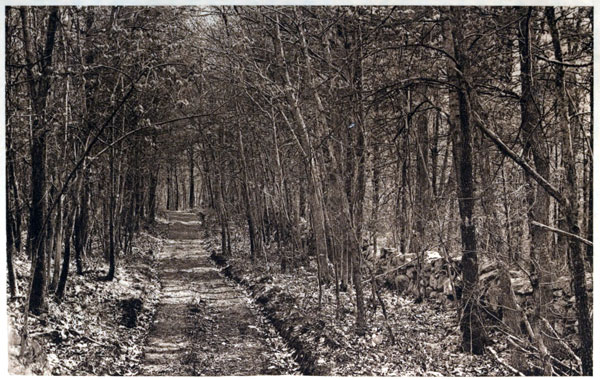
November Woods
Walden Pond has at last fallen a little. It has been
so high over the stones—quite into the bushes—that
walkers have been excluded from it.[73] There has been
no accessible shore. All ponds have been high. The
water stood higher than usual in the distant ponds
which I visited and had never seen before. It has been
a peculiar season. At Goose Pond, I notice that the
birches of one year’s growth from the stumps standing
in the water are all dead, apparently killed by the
water, unless, like the pine, they die down after springing
from the stump.
It is warm somewhere any day in the year. You will
find some nook in the woods generally, at mid-forenoon
of the most blustering day, where you may forget the
cold. I used to resort to the northeast side of Walden,
where the sun, reflected from the pine woods on the
stony shore, made it the fireside of the pond. It is so
much pleasanter and wholesomer to be warmed by the
sun when you can, than by a fire.
I saw to-day a double reflection on the pond of the
cars passing, one beneath the other, occasioned by a
bright rippled streak on the surface of the water, from
which a second reflection sprang.
One who would study lichens must go into a new
country where the rocks have not been burned.
Therien says that the Canadians say marche-donc to
their horses; and that the acid fruit must be spelled
painbéna.[74] He says that the French acre or arpent is
ten perches by ten, of eighteen feet each.
Nov. 9. It is a pleasant surprise to walk over a hill
where an old wood has recently been cut off, and, on
looking round, to see, instead of dense ranks of trees
almost impermeable to light, distant well-known blue
mountains in the horizon and perchance a white village
over an expanded open country. I now take this in
preference to all my old familiar walks. So a new prospect
and walks can be created where we least expected
it. The old men have seen other prospects from these
hills than we do. There was the old Kettell place, now
Watt’s, which I surveyed for him last winter and lotted
off, where twenty-five years ago I played horse in the
paths of a thick wood and roasted apples and potatoes
in an old pigeon-place[75] and gathered fruit at the pie-apple
tree. A week or two after I surveyed it, it now
being rotten and going to waste, I walked there and
was surprised to find the place and prospect which I
have described.
I found many fresh violets (Viola pedata) to-day
(November 9th) in the woods.
Saw a cat on the Great Fields, wilder than a rabbit,
hunting artfully. I remember to have seen one once
walking about the stony shore at Walden Pond. It is
not often that they wander so far from the houses. I
once, however, met with a cat with young kittens in
the woods, quite wild.[76]
The leaves of the larch are now yellow and falling
off. Just a month ago, I observed that the white pines
were parti-colored, green and yellow, the needles of the
previous year now falling. Now I do not observe any
yellow ones, and I expect to find that it is only for a few
weeks in the fall after the new leaves have done growing
that there are any yellow and falling,—that there
is a season when we may say the old pine leaves are now
yellow, and again, they are fallen. The trees were
not so tidy then; they are not so full now. They look
best when contrasted with a field of snow.
A rusty sparrow or two only remains to people the
drear spaces. It goes to roost without neighbors.
It is pleasant to observe any growth in a wood.
There is the pitch pine field northeast of Beck Stow’s
Swamp, where some years ago I went a-blackberrying
and observed that the pitch pines were beginning to
come in, and I have frequently noticed since how
fairly they grew, dotting the plain as evenly as if dispersed
by art. To-day I was aware that I walked in a
pitch pine wood, which ere long, perchance, I may
survey and lot off for a wood auction and see the choppers
at their work. There is also the old pigeon-place
field by the Deep Cut. I remember it as an open
grassy field. It is now one of our most pleasant woodland
paths. In the former place, near the edge of the
old wood, the young pines line each side of the path
like a palisade, they grow so densely. It never rains but
it pours, and so I think when I see a young grove of
pitch pines crowding each other to death in this wide
world. These are destined for the locomotive’s maw.
These branches, which it has taken so many years to
mature, are regarded even by the woodman as “trash.”
Delicate, dry, feathery (perchance fescue) grasses
growing out of a tuft, gracefully bending over the pathway.
I do not know what they are, but they belong to
the season.
The chickadees, if I stand long enough, hop nearer
and nearer inquisitively, from pine bough to pine
bough, till within four or five feet, occasionally lisping
a note.
The pitcher-plant, though a little frost-bitten and
often cut off by the mower, now stands full of water in
the meadows. I never found one that had not an insect
in it.
I sometimes see well-preserved walls running straight
through the midst of high and old woods, built, of
course, when the soil was cultivated many years ago,
and am surprised to see slight stones still lying one
upon another, as the builder placed them, while this
huge oak has grown up from a chance acorn in the soil.
Though a man were known to have only one acquaintance
in the world, yet there are so many men in
the world, and they are so much alike, that when he
spoke what might be construed personally, no one
would know certainly whom he meant. Though there
were but two on a desolate island, they would conduct
toward each other in this respect as if each had intercourse
with a thousand others.
I saw in Canada two or three persons wearing homespun
gray greatcoats, with comical and conical hoods
which fell back on their backs between the shoulders,
like small bags ready to be turned up over the head
when need was, though then a hat usurped that place.
I saw that these must be what are called capots. They
looked as if they would be convenient and proper
enough as long as the coats were new and tidy, but as
if they would soon come to look like rags and unsightly.[77]
Nov. 11. Gathered to-day the autumnal dandelion (?)
and the common dandelion.
Some farmers’ wives use the white ashes of corn-cobs
instead of pearlash.
I am attracted by a fence made of white pine roots.
There is, or rather was, one (for it has been tipped into
the gutter this year) on the road to Hubbard’s Bridge
which I can remember for more than twenty years. It
is almost as indestructible as a wall and certainly requires
fewer repairs. It is light, white, and dry withal,
and its fantastic forms are agreeable to my eye. One
would not have believed that any trees had such snarled
and gnarled roots. In some instances you have a coarse
network of roots as they interlaced on the surface
perhaps of a swamp, which, set on its edge, really looks
like a fence, with its paling crossing at various angles,
and root repeatedly growing into root,—a rare phenomenon
above ground,—so as to leave open spaces,
square and diamond-shaped and triangular, quite
like a length of fence. It is remarkable how white and
clean these roots are, and that no lichens, or very few,
grow on them; so free from decay are they. The different
branches of the roots continually grow into one another,
so as to make grotesque figures, sometimes rude
harps whose resonant strings of roots give a sort of
musical sound when struck, such as the earth spirit
might play on. Sometimes the roots are of a delicate
wine-color here and there, an evening tint. No line of
fence could be too long for me to study each individual
stump. Rocks would have been covered with lichens
by this time. Perhaps they are grown into one another
that they may stand more firmly.
Now is the time for wild apples. I pluck them as a
wild fruit native to this quarter of the earth, fruit of old
trees that have been dying ever since I was a boy and
are not yet dead. From the appearance of the tree
you would expect nothing but lichens to drop from it,
but underneath your faith is rewarded by finding the
ground strewn with spirited fruit. Frequented only by
the woodpecker, deserted now by the farmer, who has
not faith enough to look under the boughs.[78] Food for
walkers. Sometimes apples red inside, perfused with a
beautiful blush, faery food, too beautiful to eat,—apple
of the evening sky, of the Hesperides.[79]
This afternoon I heard a single cricket singing,
chirruping, in a bank, the only one I have heard for
a long time, like a squirrel or a little bird, clear and
shrill,—as I fancied, like an evening robin, singing in
this evening of the year. A very fine and poetical strain
for such a little singer. I had never before heard the
cricket so like a bird. It is a remarkable note. The
earth-song.
That delicate, waving, feathery dry grass which I saw
yesterday is to be remembered with the autumn. The
dry grasses are not dead for me. A beautiful form has
as much life at one season as another.
I notice that everywhere in the pastures minute young
fragrant life-everlasting, with only four or five flat-lying
leaves and thread-like roots, all together as big as a fourpence,
spot the ground, like winter rye and grass which
roots itself in the fall against another year. These little
things have bespoken their places for the next season.
They have a little pellet of cotton or down in their centres,
ready for an early start in the spring.
The autumnal (?) dandelion is still bright.
I saw an old bone in the woods covered with lichens,
which looked like the bone of an old settler, which yet
some little animal had recently gnawed, and I plainly
saw the marks of its teeth, so indefatigable is Nature to
strip the flesh from bones and return it to dust again.
No little rambling beast can go by some dry and ancient
bone but he must turn aside and try his teeth upon it.
An old bone is knocked about till it becomes dust;
Nature has no mercy on it. It was quite too ancient to
suggest disagreeable associations. It was like a piece of
dry pine root. It survives like the memory of a man.
With time all that was personal and offensive wears off.
The tooth of envy may sometimes gnaw it and reduce it
more rapidly, but it is much more a prey to forgetfulness.
Lichens grow upon it, and at last, in what moment
no man knows, it has completely wasted away and
ceases to be a bone any longer.
The fields are covered now with the empty cups of the
Trichostema dichotomum, all dry.
We had a remarkable sunset to-night. I was walking
in the meadow, the source of Nut Meadow Brook.[80]
[Two pages missing.]
We walked in so pure and bright a light, so softly and
serenely bright, I thought I had never bathed in such a
golden flood, without a ripple or a murmur to it. The
west side of every wood and rising ground gleamed like
the boundary of Elysium.[81] An adventurous spirit turns
the evening into morning. A little black brook in the
midst of the marsh, just beginning to meander, winding
slowly round a decaying stump,—an artery of the
meadow.[82]
Some circumstantial evidence is very strong, as when
you find a trout in the milk.
A people who would begin by burning the fences and
let the forest stand! I saw the fences half consumed,
their ends lost in the middle of the prairie, and some
worldly miser with a surveyor looking after his bounds,
while heaven had taken place around him, and he did
not see the angels around, but was looking for an old
post-hole in the midst of paradise. I looked again and
saw him standing in the middle of a boggy Stygian fen,
surrounded by devils, and he had found his bounds
without a doubt, three little stones where a stake had
been driven, and, looking nearer, I saw that the Prince
of Darkness was his surveyor.[83]
Nov. 14. Saw to-day, while surveying in the Second
Division woods, a singular round mound in a valley,
made perhaps sixty or seventy years ago. Cyrus Stow
thought it was a pigeon-bed, but I soon discovered the
coal and that it was an old coal-pit. I once mistook
one in the Maine woods for an Indian mound. The
indestructible charcoal told the tale. I had noticed
singular holes and trenches in the former wood, as if a
fox had been dug out. The sun has probably been let in
here many times, and this has been a cultivated field;
and now it is clothed in a savage dress again. The wild,
rank, luxuriant place is where mosses and lichens
abound. We find no heroes’ cairns except those of heroic
colliers, who once sweated here begrimed and dingy,
who lodged here, tending their fires, who lay on a beetle
here, perchance, to keep awake.
Nov. 15. I saw to-day a very perfect lichen on a rock
in a meadow. It formed a perfect circle about fifteen
inches in diameter though the rock was uneven, and was
handsomely shaded by a darker stripe of older leaves,
an inch or more wide, just within its circumference, like
a rich lamp-mat. The recent growth on the outside, half
an inch in width, was a sort of tea-green or bluish-green
color.
The ivy berries are now sere and yellowish, or sand-colored,
like the berries of the dogwood.
The farmers are now casting out their manure, and
removing the muck-heap from the shore of ponds where
it will be inaccessible in the winter; or are doing their
fall plowing, which destroys many insects and mellows
the soil. I also see some pulling their turnips, and even
getting in corn which has been left out notwithstanding
the crows. Those who have wood to sell, as the weather
grows colder and people can better appreciate the value
of fuel, lot off their woods and advertise a wood auction.
You can tell when a cat has seen a dog by the size of
her tail.
Nov. 16. I found three good arrowheads to-day
behind Dennis’s. The season for them began some time
ago, as soon as the farmers had sown their winter rye,
but the spring, after the melting of the snow, is still
better.
I am accustomed to regard the smallest brook with as
much interest for the time being as if it were the Orinoco
or Mississippi. What is the difference, I would like to
know, but mere size? And when a tributary rill empties
in, it is like the confluence of famous rivers I have read
of. When I cross one on a fence, I love to pause in mid-passage
and look down into the water, and study its
bottom, its little mystery. There is none so small but
you may see a pickerel regarding you with a wary eye, or
a pygmy trout glance from under the bank, or in spring,
perchance, a sucker will have found its way far up its
stream. You are sometimes astonished to see a pickerel
far up some now shrunken rill, where it is a mere puddle
by the roadside. I have stooped to drink at a clear spring
no bigger than a bushel basket in a meadow, from which
a rill was scarcely seen to dribble away, and seen lurking
at its bottom two little pickerel not so big as my finger,
sole monarchs of this their ocean, and who probably
would never visit a larger water.
In literature it is only the wild that attracts us. Dullness
is only another name for tameness. It is the untamed,
uncivilized, free, and wild thinking in Hamlet,
in the Iliad, and in all the scriptures and mythologies
that delights us,—not learned in the schools, not refined
and polished by art. A truly good book is something
as wildly natural and primitive, mysterious and marvellous,
ambrosial and fertile, as a fungus or a lichen.[84]
Suppose the muskrat or beaver were to turn his views
[sic] to literature, what fresh views of nature would he
present! The fault of our books and other deeds is that
they are too humane, I want something speaking in some
measure to the condition of muskrats and skunk-cabbage
as well as of men,—not merely to a pining and complaining
coterie of philanthropists.
I discover again about these times that cranberries are
good to eat in small quantities as you are crossing the
meadows.
I hear deep amid the birches some row among the
birds or the squirrels, where evidently some mystery is
being developed to them. The jay is on the alert, mimicking
every woodland note. What has happened?
Who’s dead? The twitter retreats before you, and you
are never let into the secret. Some tragedy surely is
being enacted, but murder will out. How many little
dramas are enacted in the depth of the woods at which
man is not present!
When I am considering which way I will walk, my
needle is slow to settle, my compass varies by a few
degrees and does not always point due southwest; and
there is good authority for these variations in the heavens.
It pursues the straighter course for it at last, like
the ball which has come out of a rifle, or the quoit that
is twirled when cast. To-day it is some particular wood
or meadow or deserted pasture in that direction that is
my southwest.[85]
I love my friends very much, but I find that it is of
no use to go to see them. I hate them commonly when
I am near them. They belie themselves and deny me
continually.
Somebody shut the cat’s tail in the door just now,
and she made such a caterwaul as has driven two whole
worlds out of my thoughts. I saw unspeakable things
in the sky and looming in the horizon of my mind, and
now they are all reduced to a cat’s tail. Vast films of
thought floated through my brain, like clouds pregnant
with rain enough to fertilize and restore a world, and
now they are all dissipated.
There is a place whither I should walk to-day.
Though oftenest I fail to find, when by accident I ramble
into it, great is my delight. I have stood by my door
sometimes half an hour, irresolute as to what course I
should take.[86]
Apparently all but the evergreens and oaks have lost
their leaves now. It is singular that the shrub oaks retain
their leaves through the winter. Why do they?
The walnut trees spot the sky with black nuts. Only
catkins are seen on the birches.
I saw the other day a dead limb which the wind or
some other cause had broken nearly off, which had lost
none of its leaves, though all the rest of the tree, which
was flourishing, had shed them.
There seems to be in the fall a sort of attempt at a
spring, a rejuvenescence, as if the winter were not
expected by a part of nature. Violets, dandelions, and
some other flowers blossom again, and mulleins and innumerable
other plants begin again to spring and are
only checked by the increasing cold. There is a slight
uncertainty whether there will be any winter this year.
I was pleased to-day to hear a great noise and trampling
in the woods produced by some cows which came
running toward their homes, which apparently had been
scared by something unusual, as their ancestors might
have been by wolves. I have known sheep to be scared
in the same [way] and a whole flock to run bleating to
me for protection.
What shall we do with a man who is afraid of the
woods, their solitude and darkness? What salvation is
there for him? God is silent and mysterious.
Some of our richest days are those in which no sun
shines outwardly, but so much the more a sun shines
inwardly. I love nature, I love the landscape, because
it is so sincere. It never cheats me. It never jests. It is
cheerfully, musically earnest. I lie and relie [sic] on the
earth.
Land where the wood has been cut off and is just
beginning to come up again is called sprout land.
The sweet-scented life-everlasting has not lost its
scent yet, but smells like the balm of the fields.
The partridge-berry leaves checker the ground on the
side of moist hillsides in the woods. Are they not properly
called checker-berries?
The era of wild apples will soon be over. I wander
through old orchards of great extent, now all gone to
decay, all of native fruit which for the most part went
to the cider-mill. But since the temperance reform and
the general introduction of grafted fruit, no wild apples,
such as I see everywhere in deserted pastures, and where
the woods have grown up among them, are set out. I
fear that he who walks over these hills a century hence
will not know the pleasure of knocking off wild apples.
Ah, poor man! there are many pleasures which he will
be debarred from! Notwithstanding the prevalence of
the Baldwin and the Porter, I doubt if as extensive
orchards are set out to-day in this town as there were
a century ago, when these vast straggling cider-orchards
were planted. Men stuck in a tree then by every wall-side
and let it take its chance. I see nobody planting
trees to-day in such out of the way places, along almost
every road and lane and wall-side, and at the bottom of
dells in the wood. Now that they have grafted trees and
pay a price for them, they collect them into a plot by their
houses and fence them in.[87]
My Journal should be the record of my love. I would
write in it only of the things I love, my affection for any
aspect of the world, what I love to think of. I have no
more distinctness or pointedness in my yearnings than
an expanding bud, which does indeed point to flower
and fruit, to summer and autumn, but is aware of
the warm sun and spring influence only. I feel ripe
for something, yet do nothing, can’t discover what that
thing is. I feel fertile merely. It is seedtime with me.
I have lain fallow long enough.
Notwithstanding a sense of unworthiness which possesses
me, not without reason, notwithstanding that I
regard myself as a good deal of a scamp, yet for the most
part the spirit of the universe is unaccountably kind to
me, and I enjoy perhaps an unusual share of happiness.
Yet I question sometimes if there is not some settlement
to come.
Nov. 17. It is a strange age of the world this, when
empires, kingdoms, and republics come a-begging to our
doors and utter their complaints at our elbows. I cannot
take up a newspaper but I find that some wretched
government or other, hard pushed and on its last legs,
is interceding with me, the reader, to vote for it,—more
importunate than an Italian beggar. Why does it
not keep its castle in silence, as I do? The poor President,
what with preserving his popularity and doing his
duty, does not know what to do. If you do not read the
newspapers, you may be impeached for treason. The
newspapers are the ruling power. What Congress does
is an afterclap. Any other government is reduced to a
few marines at Fort Independence. If a man neglects
to read the Daily Times, government will go on its
knees to him; this is the only treason in these days.
The newspapers devote some of their columns specially
to government and politics without charge, and this is
all that saves it, but I never read those columns.[88]
I found this afternoon, in a field of winter rye, a snapping
turtle’s egg, white and elliptical like a pebble,
mistaking it for which I broke it. The little turtle was
perfectly formed, even to the dorsal ridge, which was
distinctly visible.
“Chesipooc Sinus” is on Wytfliet’s Map of 159-.
Even the Dutch were forward to claim the great river
of Canada. In a map of New Belgium in Ogilby’s
“America,” 1670, the St. Lawrence is also called “De
Groote Rivier van Niew Nederlandt.”[89]
On this same map, east of Lake Champlain, called
“Lacus Irocoisiensis” or in Dutch “Meer der Irocoisen,”
is a chain of mountains answering to the Green
Mountains of Vermont, and “Irocoisia,” or the country
of the Iroquois, between the mountains and the lake.
Nov. 19. The first really cold day. I find, on breaking
off a shrub oak leaf, a little life at the foot of the leafstalk,
so that a part of the green comes off. It has not
died quite down to the point of separation, as it will do,
I suppose, before spring. Most of the oaks have lost
their leaves except on the lower branches, as if they were
less exposed and less mature there, and felt the changes
of the seasons less. The leaves have either fallen or
withered long since, yet I found this afternoon, cold as
it is,—and there has been snow in the neighborhood,—some
sprouts which had come up this year from the
stump of a young black-looking oak, covered still with
handsome fresh red and green leaves, very large and
unwithered and unwilted. It was on the south side of
Fair Haven in a warm angle, where the wood was cut
last winter and the exposed edge of the still standing
wood running north and south met the cliff at right
angles and served for a fence to keep off the wind. There
were one or two stumps here whose sprouts had fresh
leaves which transported me back to October. Yet the
surrounding shrub oak leaves were as dry and dead as
usual. There were also some minute birches only a year
old, their leaves still freshly yellow, and some young
wild apple trees apparently still growing, their leaves
as green and tender as in summer. The goldenrods,
one or more species of the white and some yellow ones,
were many of them still quite fresh, though elsewhere
they are all whitish and dry. I saw one whose top rose
above the edge of a rock, and so much of it was turned
white and dry; but the lower part of its raceme was still
yellow. Some of the white species seemed to have started
again as if for another spring. They had sprung up
freshly a foot or more, and were budded to blossom,
fresh and green. And sometimes on the same stem were
old and dry and white downy flowers, and fresh green
blossom-buds not yet expanded. I saw there some pale
blue asters still bright, and the mullein leaves still large
and green, one green to its top. And I discovered that
when I put my hand on the mullein leaves they felt
decidedly warm, but the radical leaves of the goldenrods
felt cold and clammy. There was also the columbine,
its leaves still alive and green; and I was pleased
to smell the pennyroyal which I had bruised, though this
dried up long ago. Each season is thus drawn out and
lingers in certain localities, as the birds and insects know
very well. If you penetrate to some warm recess under
a cliff in the woods, you will be astonished at the amount
of summer life that still flourishes there. No doubt
more of the summer’s life than we are aware thus slips
by and outmanœuvres the winter, gliding from fence to
fence. I have no doubt that a diligent search in proper
places would discover many more of our summer
flowers thus lingering till the snow came, than we suspect.
It is as if the plant made no preparation for winter.
Now that the grass is withered and the leaves are
withered or fallen, it begins to appear what is evergreen:
the partridge[-berry] and checkerberry, and wintergreen
leaves even, are more conspicuous.
The old leaves have been off the pines now for a
month.
I once found a kernel of corn in the middle of a deep
wood by Walden, tucked in behind a lichen on a pine,
about as high as my head, either by a crow or a squirrel.
It was a mile at least from any corn-field.
Several species plainly linger till the snow comes.
Nov. 20. It is a common saying among country
people that if you eat much fried hasty pudding it will
make your hair curl. My experience, which was considerable,
did not confirm this assertion.
Horace Hosmer was picking out to-day half a bushel
or more of a different and better kind of cranberry, as
he thought, separating them from the rest. They are
very dark red, shaded with lighter, harder and more
oblong, somewhat like the fruit of the sweet-briar or a
Canada red plum, though I have no common cranberry
to compare with them. He says that they grow apart
from the others. I must see him about it. It may prove
to be one more of those instances in which the farmer
detects a new species and makes use of the knowledge
from year to year in his profession, while the botanist
expressly devoted to such investigation has failed to
observe it.
The farmer, in picking over many bushels of cranberries
year after year, finds at length, or has forced
upon his observation, a new species of that berry, and
avails himself thereafter of his discovery for many years
before the naturalist is aware of the fact.
Desor, who has been among the Indians at Lake
Superior this summer, told me the other day that they
had a particular name for each species of tree, as of the
maple, but they had but one word for flowers; they did
not distinguish the species of the last.
It is often the unscientific man who discovers the new
species. It would be strange if it were not so. But we
are accustomed properly to call that only a scientific
discovery which knows the relative value of the thing
discovered, uncovers a fact to mankind.
Nov. 21. For a month past the grass under the pines
has been covered with a new carpet of pine leaves. It is
remarkable that the old leaves turn and fall in so short
a time.
Some of the densest and most impenetrable clumps
of bushes I have seen, as well on account of the closeness
of their branches as of their thorns, have been wild
apples. Its [sic] branches as stiff as those of the black
spruce on the tops of mountains.[90]
I saw a herd of a dozen cows and young steers and
oxen on Conantum this afternoon, running about and
frisking in unwieldy sport like huge rats. Any sportiveness
in cattle is unexpected. They even played like
kittens, in their way; shook their heads, raised their
tails, and rushed up and down the hill.[91]
The witch-hazel blossom on Conantum has for the
most part lost its ribbons now.
Some distant angle in the sun where a lofty and dense
white pine wood, with mingled gray and green, meets a
hill covered with shrub oaks, affects me singularly, reinspiring
me with all the dreams of my youth. It is a place
far away, yet actual and where we have been. I saw the
sun falling on a distant white pine wood whose gray and
moss-covered stems were visible amid the green, in an
angle where this forest abutted on a hill covered with
shrub oaks. It was like looking into dreamland. It is
one of the avenues to my future. Certain coincidences
like this are accompanied by a certain flash as of hazy
lightning, flooding all the world suddenly with a tremulous
serene light which it is difficult to see long at a time.
I saw Fair Haven Pond with its island, and meadow
between the island and the shore, and a strip of perfectly
still and smooth water in the lee of the island, and two
hawks, fish hawks perhaps, sailing over it. I did not see
how it could be improved. Yet I do not see what these
things can be. I begin to see such an object when I
cease to understand it and see that I did not realize or
appreciate it before, but I get no further than this. How
adapted these forms and colors to my eye! A meadow
and an island! What are these things? Yet the hawks
and the ducks keep so aloof! and Nature is so reserved!
I am made to love the pond and the meadow, as the
wind is made to ripple the water.[92]
As I looked on the Walden woods eastward across
the pond, I saw suddenly a white cloud rising above
their tops, now here, now there, marking the progress
of the cars which were rolling toward Boston far below,
behind many hills and woods.
October must be the month of ripe and tinted leaves.
Throughout November they are almost entirely withered
and sombre, the few that remain. In this month the sun
is valued. When it shines warmer or brighter we are
sure to observe it. There are not so many colors to attract
the eye. We begin to remember the summer. We walk
fast to keep warm. For a month past I have sat by a
fire.
Every sunset inspires me with the desire to go to a
West as distant and as fair as that into which the sun
goes down.[93]
I get nothing to eat in my walks now but wild apples,
sometimes some cranberries, and some walnuts. The
squirrels have got the hazelnuts and chestnuts.
Nov. 23. To-day it has been finger-cold.[94] Unexpectedly
I found ice by the side of the brooks this afternoon
nearly an inch thick. Prudent people get in their barrels
of apples to-day.[95] The difference of the temperature of
various localities is greater than is supposed. If I was
surprised to find ice on the sides of the brooks, I was
much more surprised to find quite a pond in the woods,
containing an acre or more, quite frozen over so that
I walked across it. It was in a cold corner, where a pine
wood excluded the sun. In the larger ponds and the
river, of course, there is no ice yet. It is a shallow,
weedy pond. I lay down on the ice and looked through
at the bottom. The plants appeared to grow more uprightly
than on the dry land, being sustained and protected
by the water. Caddis-worms were everywhere
crawling about in their handsome quiver-like sheaths or
cases.
The wild apples, though they are more mellow and
edible, have for some time lost their beauty, as well as
the leaves, and now too they are beginning to freeze.
The apple season is well-nigh over. Such, however, as
are frozen while sound are not unpleasant to eat when
the spring sun thaws them.[96]
I find it to be the height of wisdom not to endeavor
to oversee myself and live a life of prudence and common
sense, but to see over and above myself, entertain
sublime conjectures, to make myself the thoroughfare of
thrilling thoughts, live all that can be lived. The man
who is dissatisfied with himself, what can he not do?
Nov. 24. Plucked a buttercup on Bear Hill to-day.
I have certain friends whom I visit occasionally,
but I commonly part from them early with a certain
bitter-sweet sentiment. That which we love is so
mixed and entangled with that we hate in one another
that we are more grieved and disappointed, aye, and
estranged from one another, by meeting than by absence.
Some men may be my acquaintances merely, but one
whom I have been accustomed to regard, to idealize, to
have dreams about as a friend, and mix up intimately
with myself, can never degenerate into an acquaintance.
I must know him on that higher ground or not know
him at all. We do not confess and explain, because we
would fain be so intimately related as to understand
each other without speech. Our friend must be broad.
His must be an atmosphere coextensive with the universe,
in which we can expand and breathe. For the
most part we are smothered and stifled by one another.
I go and see my friend and try his atmosphere. If our
atmospheres do not mingle, if we repel each other
strongly, it is of no use to stay.
Nov. 25. I feel a little alarmed when it happens that
I have walked a mile into the woods bodily, without
getting there in spirit. I would fain forget all my morning’s
occupation, my obligations to society. But sometimes
it happens that I cannot easily shake off the
village; the thought of some work, some surveying,
will run in my head, and I am not where my body is,
I am out of my senses. In my walks I would return to
my senses like a bird or a beast. What business have I
in the woods, if I am thinking of something out of the
woods?[97]
This afternoon, late and cold as it is, has been a sort
of Indian summer. Indeed, I think that we have summer
days from time to time the winter through, and that
it is often the snow on the ground makes the whole
difference. This afternoon the air was indescribably
clear and exhilarating, and though the thermometer
would have shown it to be cold, I thought that there was
a finer and purer warmth than in summer; a wholesome,
intellectual warmth, in which the body was warmed
by the mind’s contentment. The warmth was hardly
sensuous, but rather the satisfaction of existence.
I found Fair Haven skimmed entirely over, though the
stones which I threw down on it from the high bank on
the east broke through. Yet the river was open. The
landscape looked singularly clean and pure and dry,
the air, like a pure glass, being laid over the picture,
the trees so tidy, stripped of their leaves; the meadows
and pastures, clothed with clean dry grass, looked as
if they had been swept; ice on the water and winter in
the air, but yet not a particle of snow on the ground.
The woods, divested in great part of their leaves, are
being ventilated. It is the season of perfect works,
of hard, tough, ripe twigs, not of tender buds and
leaves. The leaves have made their wood, and a myriad
new withes stand up all around pointing to the sky, able
to survive the cold. It is only the perennial that you
see, the iron age of the year.
These expansions of the river skim over before
the river itself takes on its icy fetters. What is the
analogy?
I saw a muskrat come out of a hole in the ice. He is a
man wilder than Ray or Melvin. While I am looking
at him, I am thinking what he is thinking of me. He is a
different sort of a man, that is all. He would dive when
I went nearer, then reappear again, and had kept open
a place five or six feet square so that it had not frozen,
by swimming about in it. Then he would sit on the edge
of the ice and busy himself about something, I could not
see whether it was a clam or not. What a cold-blooded
fellow! thoughts at a low temperature, sitting perfectly
still so long on ice covered with water, mumbling a
cold, wet clam in its shell. What safe, low, moderate
thoughts it must have! It does not get on to stilts. The
generations of muskrats do not fail. They are not
preserved by the legislature of Massachusetts.
Boats are drawn up high which will not be launched
again till spring.
There is a beautiful fine wild grass which grows in
the path in sprout land, now dry, white, and waving,
in light beds soft to the touch.
I experience such an interior comfort, far removed
from the sense of cold, as if the thin atmosphere were
rarefied by heat, were the medium of invisible flames,
as if the whole landscape were one great hearthside,
that where the shrub oak leaves rustle on the hillside, I
seem to hear a crackling fire and see the pure flame, and
I wonder that the dry leaves do not blaze into yellow
flames.
I find but little change yet on the south side of the
Cliffs; only the leaves of the wild apple are a little
frostbitten on their edges and curled dry there; but some
wild cherry leaves and blueberries are still fresh and
tender green and red, as well as all the other leaves
and plants which I noticed there the other day.
When I got up so high on the side of the Cliff the
sun was setting like an Indian-summer sun. There
was a purple tint in the horizon. It was warm on
the face of the rocks, and I could have sat till the sun
disappeared, to dream there. It was a mild sunset such
as is to be attended to. Just as the sun shines into us
warmly and serenely, our Creator breathes on us and
re-creates us.
Nov. 26. An inch of snow on ground this morning,—our
first.
Went to-night to see the Indians, who are still living
in tents. Showed the horns of the moose, the black
moose they call it, that goes in lowlands. Horns three
or four feet wide. (The red moose they say is another
kind; runs on mountains and has horns six feet wide.)
Can move their horns. The broad, flat side portions of
the horns are covered with hair, and are so soft when the
creature is alive that you can run a knife through them.[98]
They color the lower portions a darker color by rubbing
them on alders, etc., to harden them. Make kee-nong-gun
or pappoose cradle, of the broad part of the horn,
putting a rim on it. Once scared, will run all day. A
dog will hang to their lips and be carried along and
swung against a tree and drop off. Always find two or
three together. Can’t run on glare ice, but can run in
snow four feet deep. The caribou can run on ice.[99] Sometimes
spear them with a sharp pole, sometimes with a
knife at the end of a pole. Signs, good or bad, from
the turn of the horns. Their caribou-horns had been
gnawed by mice in their wigwams. The moose-horns
and others are not gnawed by mice while the creature
is alive. Moose cover themselves with water, all but
noses, to escape flies.[100] About as many now as fifty
years ago.
Imitated the sounds of the moose, caribou, and deer
with a birch-bark horn, which last they sometimes
make very long. The moose can be heard eight or ten
miles sometimes,—a loud sort of bellowing sound,
clearer, more sonorous than the looing of cattle. The
caribou’s, a sort of snort; the small deer, like a lamb.
Made their clothes of the young moose-skin. Cure
the meat by smoking it; use no salt in curing it, but
when they eat it.
Their spear very serviceable. The inner, pointed
part, of a hemlock knot; the side spring pieces, of
hickory. Spear salmon, pickerel, trout,
chub, etc.; also by birch-bark light at
night, using the other end of spear as pole.
Their sled, jeborgon or jebongon (?), one
foot wide, four or five long, of thin wood
turned up in front; draw by a strong rope
of basswood bark.
Canoe of moose-hide. One hide will
hold three or four. Can be taken apart and put together
very quickly. Can take out cross-bars and bring
the sides together. A very convenient boat to carry and
cross streams with. They say they did not make birch
canoes till they had edge tools. The birches the lightest.
They think our birches the same, only second
growth.
Their kee-nong-gun, or cradle, has a hoop to prevent
the child being hurt when it falls. Can’t eat dirt; can
be hung up out of way of snakes.
Aboak-henjo [?], a birch-bark vessel for water. Can
boil meat in it with hot stones; takes a long
time. Also a vessel of birch bark, shaped like
a pan. Both ornamented by scratching the
bark, which is wrong side out. Very neatly made.
Valued our kettles much.
Did not know use of eye in axe. Put a string through
it and wore it round neck. Cut toes.
Did not like gun. Killed one moose; scared all the
rest.
The squaw-heegun for cooking, a mere stick put
through the game and stuck in the ground slanted
over the fire, a spit. Can be eating one side while the
other is doing.
The ar-tu-e-se, a stick, string, and bunch of leaves,
which they toss and catch on the point of the stick.
Make great use of it. Make the clouds go off the sun
with it.
Snowshoes of two kinds; one of same shape at both
ends so that the Mohawks could not tell which way
they were going. (Put some rags in the heel-hole to
make a toe-mark?)
Side View
Log trap to catch many kinds of animals. Some for
bears let the log fall six or
seven feet. First there is a
frame, then the little stick
 which the animal
moves, presses
down, as he goes
through under the
log; then the crooked
stick is hung
over the top of the
frame, and holds
up the log by a string; the weight of the log on this
keeps the little stick up.
A drizzling and misty day this has been, melting the
snow. The mist, divided into a thousand ghostly forms,
was blowing across Walden. Mr. Emerson’s Cliff Hill,
seen from the railroad through the mist, looked like a
dark, heavy, frowning New Hampshire mountain. I
do not understand fully why hills look so much larger
at such a time, unless, being the most distant we see and
in the horizon, we suppose them farther off and so magnify
them. I think there can be no looming about it.
Nov. 28. Thursday. Cold drizzling and misty rains,
which have melted the little snow. The farmers are
beginning to pick up their dead wood. Within a day
or two the walker finds gloves to be comfortable, and
begins to think of an outside coat and of boots. Embarks
in his boots for the winter voyage.
The Indian talked about “our folks” and “your
folks,” “my grandfather” and “my grandfather’s
cousin,” Samoset.
It is remarkable, but nevertheless true, as far as my
observation goes, that women, to whom we commonly
concede a somewhat finer and more sibylline nature,
yield a more implicit obedience even to their animal
instincts than men. The nature in them is stronger, the
reason weaker. There are, for instance, many young
and middle-aged men among my acquaintance—shoemakers,
carpenters, farmers, and others—who have
scruples about using animal food, but comparatively
few girls or women. The latter, even the most refined,
are the most intolerant of such reforms. I think that the
reformer of the severest, as well as finest, class will find
more sympathy in the intellect and philosophy of man
than in the refinement and delicacy of woman. It is,
perchance, a part of woman’s conformity and easy
nature. Her savior must not be too strong, stern, and
intellectual, but charitable above all things.
The thought of its greater independence and its closeness
to nature diminishes the pain I feel when I see a
more interesting child than usual destined to be brought
up in a shanty. I see that for the present the child is
happy and is not puny, and has all the wonders of nature
for its toys. Have I not faith that its tenderness will in
some way be cherished and protected, as the buds of the
spring in the remotest and wildest wintry dell no less
than in the garden plot and summer-house?
I am the little Irish boy
That lives in the shanty.
I am four years old to-day
And shall soon be one and twenty.
I shall grow up
And be a great man,
And shovel all day
As hard as I can.
Down in the Deep Cut,
. . . . .
Where the men lived
Who made the railroad.
For supper
I have some potato
And sometimes some bread,
And then, if it’s cold,
I go right to bed.
I lie on some straw
Under my father’s coat.
At recess I play
With little Billy Gray,
And when school is done,
Then home I run.
And if I meet the cars,
I get on the other track,
And then I know whatever comes
I needn’t look back.
My mother does not cry,
And my father does not scold,
For I am a little Irish boy,
And I’m four years old.
Every day I go to school
Along the railroad.
It was so cold it made me cry
The day that it snowed.
And if my feet ache
I do not mind the cold,
For I am a little Irish boy,
And I’m four years old.[101]
Nov. 29. Still misty, drizzling weather without snow
or ice. The puffballs, with their open rays, checker
the path-side in the woods, but they are not yet dry
enough to make much dust. Damp weather in the fall
seems to cause them to crack open, i. e. their outer skin.
They look white like the shells of five-fingers on the
shore.
The trees and shrubs look larger than usual when seen
through the mist, perhaps because, though near, yet
being in the visible horizon and there being nothing
beyond to compare them with, we naturally magnify
them, supposing them further off.
It is very still yet in the woods. There are no leaves to
rustle, no crickets to chirp, and but few birds to sing.
The pines standing in the ocean of mist, seen from
the Cliffs, are trees in every stage of transition from the
actual to the imaginary. The near are more distinct, the
distant more faint, till at last they are a mere shadowy
cone in the distance. What, then, are these solid pines
become? You can command only a circle of thirty or
forty rods in diameter. As you advance, the trees gradually
come out of the mist and take form before your
eyes. You are reminded of your dreams. Life looks like
a dream. You are prepared to see visions. And now,
just before sundown, the night wind blows up more mist
through the valley, thickening the veil which already
hung over the trees, and the gloom of night gathers early
and rapidly around. Birds lose their way.
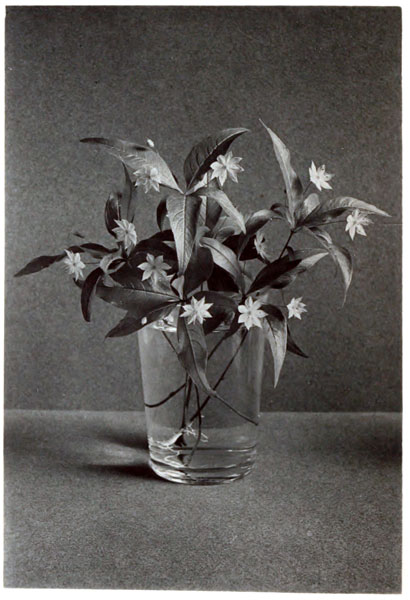
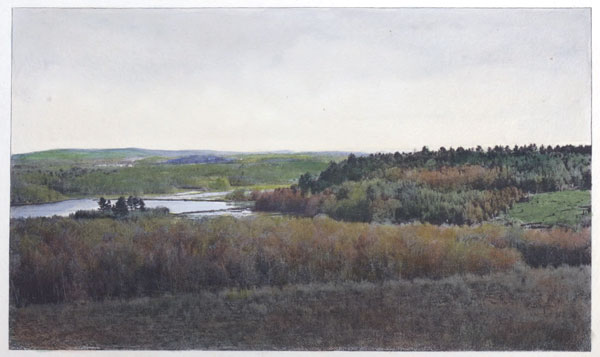


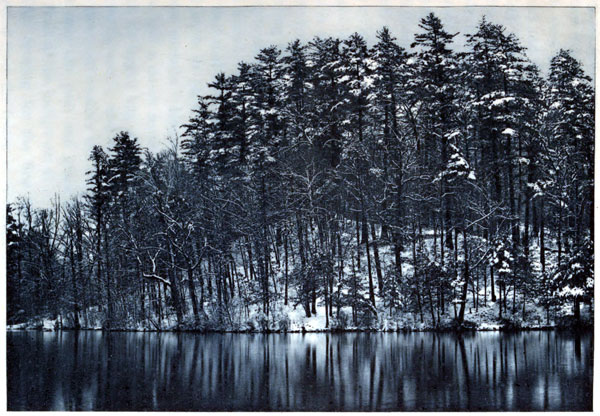
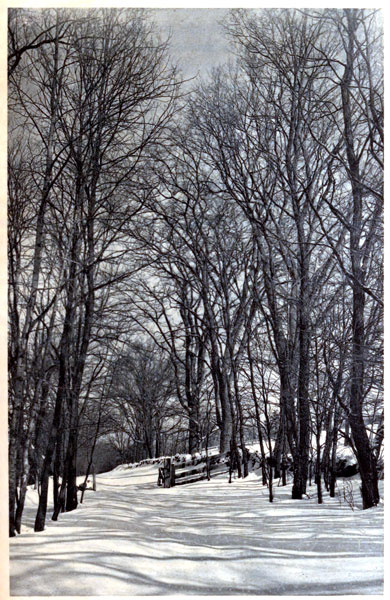
 shells. They looked like a fleet of a thousand mackerel-fishers
under a press of sail careering before a smacking
breeze. Sometimes the sun and wind had reduced them
to the thinness of writing-paper, and they fluttered and
rustled and tinkled merrily. I skated through them and
strewed their wrecks around. They appear to have been
elevated expressly to reflect the sun like mirrors, to adorn
the river and attract the eye of the skater. Who will say
that their principal end is not answered when they excite
the admiration of the skater? Every half-mile or mile,
as you skate up the river, you see these crystal fleets.
Nature is a great imitator and loves to repeat herself.
She wastes her wonders on the town. It impresses me
as one superiority in her art, if art it may be called, that
she does not require that man appreciate her, takes no
steps to attract his attention.


 leaf be a thalictrum?
 Hull looks as if it had
been two islands, since connected
by a beach. I was struck by the gracefully curving
and fantastic shore of a small island (Hog Island)
inside of Hull,
 where everything seemed to
be gently lapsing into futurity, as if the
inhabitants should bear a ripple
 for device on their coat-of-arms, a
wave passing over them, with the datura growing on
their shores. The wrecks of isles fancifully arranged
into a new shore. To see the sea nibbling thus voraciously
at the continents!
 Skates’ eggs, called in England skate-barrows
from their form, on the sand. The old cedars
were flat-topped, spreading, the stratum of the wind
drawn out.
 many in digging. Said not to be good now, but
we found them good eaten fresh. No sale for
them now; fetch twenty-five cents a bucket in their
season. Barry caught squids as bait for bass. We found
many dead clams,—their shells full of sand,—called
sand clams.
 Saw here fences, the posts set in cross
sleepers, made to be removed in winter.
 with a protuberance on
the back. The sea clam:
 A small, narrow
clam
 which they called the
bank clam; also crab-cases, handsomely spotted. Small
crab always in a cockle-shell if not in a case of his own.
A cockle as large as my fist. Mussels, small ones,
empty shells; an extensive bank where they had died.
Occasionally a large deep-sea mussel, which some kelp
had brought up. We caught some sand eels seven or
eight inches long,—Ammodytes tobianus, according to
Storer, and not the A. lancea of Yarrell, though the size
of the last comes nearer. They were in the shallow pools
left on the sand (the flat was here pure naked yellowish
sand), and quickly buried themselves when pursued.
They are used as bait for bass. Found some sand-circles
or sandpaper, like top of a stone jug cut off, with a large
nose; said to be made by the foot of the large cockle,
which has some glutinous matter on it.
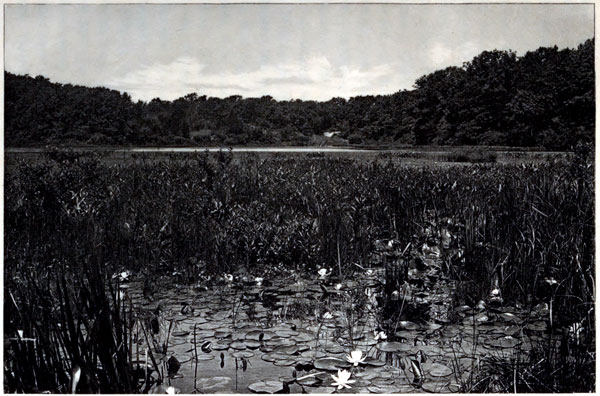
 flayer; a pot or mortar of a kind
 of fire-proof stone, very hard, only
seven or eight inches long. A commission from Cromwell
to Winslow (?), his signature torn off. They talk
of a monument on the Rock. The Burying Hill 165
feet high. Manomet 394 feet high by State map. Saw
more pears at Washburn’s garden. No graves of Pilgrims.
 an open salver truly! Those
of the Asclepias Syriaca hang down. The interregnum
in the blossoming of flowers being well
over, many small flowers blossom now in the low
grounds, having just reached their summer. It is now
dry enough, and they feel the heat their tenderness required.
The autumnal flowers,—goldenrods, asters,
and johnswort,—though they have made demonstrations,
have not yet commenced to reign. The tansy is
already getting stale; it is perhaps the first conspicuous
yellow flower that passes from the stage.
 being just
as high from the ground on the upper side as on
the lower.
 little cream pitchers.