V 1841 (ÆT. 23-24) — VI 1842 (ÆT. 24-25) — VII 1845-1846 (ÆT. 27-29) — VIII 1845-1847 (ÆT. 27-30)
THE FRESHET
Feb. 24.
A stir is on the Worcester hills,
And Nobscot too the valley fills;
Where scarce you'd fill an acorn cup
In summer when the sun was up,
No more you'll find a cup at all,
But in its place a waterfall.
O that the moon were in conjunction
To the dry land's extremest unction,
Till every dike and pier were flooded,
And all the land with islands studded,
For once to teach all human kind,
Both those that plow and those that grind,
There is no fixture in the land,
But all unstable is as sand.
The river swelleth more and more,
Like some sweet influence stealing o'er
The passive town; and for a while
Each tussock makes a tiny isle,
Where, on some friendly Ararat,
Resteth the weary water-rat.
No ripple shows Musketaquid,
Her very current e'en is hid,
As deepest souls do calmest rest
When thoughts are swelling in the breast;
And she, that in the summer's drought
Doth make a rippling and a rout,
Sleeps from Nawshawtuct to the Cliff,
Unruffled by a single skiff;
So like a deep and placid mind
Whose currents underneath it wind,
For by a thousand distant hills
The louder roar a thousand rills,
And many a spring which now is dumb,
And many a stream with smothered hum,
Doth faster well and swifter glide,
Though buried deep beneath the tide.
Our village shows a rural Venice,
Its broad lagunes where yonder fen is,
Far lovelier than the Bay of Naples
Yon placid cove amid the maples,
And in my neighbor's field of corn
I recognize the Golden Horn.
Here Nature taught from year to year,
When only red men came to hear,
Methinks 'twas in this school of art
Venice and Naples learned their part,
But still their mistress, to my mind,
Her young disciples leaves behind.[116]
Feb. 26. The most important events make no stir on
their first taking place, nor indeed in their effects directly.
They seem hedged about by secrecy. It is concussion,
or the rushing together of air to fill a vacuum,
which makes a noise. The great events to which all
things consent, and for which they have prepared the
way, produce no explosion, for they are gradual, and
create no vacuum which requires to be suddenly filled;
as a birth takes place in silence, and is whispered about
the neighborhood, but an assassination, which is at war
with the constitution of things, creates a tumult immediately.
Corn grows in the night.[117]
Feb. 27. Some geniuses seem to hover in the horizon,
like heat lightning, which is not accompanied with fertilizing
rain to us, but we are obliged to rest contented
with the belief that it is purifying the air somewhere.
Others make known their presence by their effects, like
that vivid lightning which is accompanied by copious
rain and thunder and, though it clears our atmosphere,
sometimes destroys our lives. Others still impart a
steady and harmless light at once to large tracts, as the
aurora borealis; and this phenomenon is hardest to be
accounted for, some thinking it to be a reflection of the
polar splendor, others a subtle fluid which pervades all
things and tends always to the zenith. All are agreed
that these are equally electrical phenomena, as some
clever persons have shown by drawing a spark with
their knuckles. Modern philosophy thinks it has drawn
down lightning from the clouds.
Feb. 28. On the death of a friend, we should consider
that the fates through confidence have devolved
on us the task of a double living, that we have henceforth
to fulfill the promise of our friend's life also, in our
own, to the world.
Feb. 29. A friend advises by his whole behavior,[118] and
never condescends to particulars; another chides away
a fault, he loves it away. While he sees the other's error,
he is silently conscious of it, and only the more loves
truth himself, and assists his friend in loving it, till the
fault is expelled and gently extinguished.
March 2. Love is the burden of all Nature's odes.
The song of the birds is an epithalamium, a hymeneal.
The marriage of the flowers spots the meadows and
fringes the hedges with pearls and diamonds. In the
deep water, in the high air, in woods and pastures, and
the bowels of the earth, this is the employment and
condition of all things.
March 4. I learned to-day that my ornithology had
done me no service. The birds I heard, which fortunately
did not come within the scope of my science,
sung as freshly as if it had been the first morning of
creation, and had for background to their song an untrodden
wilderness, stretching through many a Carolina
and Mexico of the soul.[119]
March 6. There is no delay in answering great questions;
for them all things have an answer ready. The
Pythian priestess gave her answers instantly, and ofttimes
before the questions were fairly propounded.
Great topics do not wait for past or future to be determined,
but the state of the crops or Brighton market no
bird concerns itself about.
March 8. The wind shifts from northeast and east
to northwest and south, and every icicle which has tinkled
on the meadow grass so long trickles down its
stem and seeks its water level unerringly with a million
comrades. In the ponds the ice cracks with a busy and
inspiriting din and down the larger streams is whirled,
grating hoarsely and crashing its way along, which
was so lately a firm field for the woodman's team and
the fox, sometimes with the tracks of the skaters still
fresh upon it, and the holes cut for pickerel. Town
committees inspect the bridges and causeways, as if
by mere eye-force to intercede with the ice and save
the treasury.
In the brooks the slight grating sound of small cakes
of ice, floating with various speed, is full of content and
promise, and where the water gurgles under a natural
bridge, you may hear these hasty rafts hold conversation
in an undertone. Every rill is a channel for the
juices of the meadow.[120] Last year's grasses and flower-stalks
have been steeped in rain and snow, and now the
brooks flow with meadow tea,—thoroughwort, mint,
flagroot, and pennyroyal, all at one draught.
In the ponds the sun makes incroachments around
the edges first, as ice melts in a kettle on the fire, darting
his rays through this crevice, and preparing the
deep water to act simultaneously on the under side.
Two years and twenty now have flown;
Their meanness time away has flung;
These limbs to man's estate have grown,
But cannot claim a manly tongue.
Amidst such boundless wealth without
I only still am poor within;
The birds have sung their summer out,
But still my spring does not begin.
In vain I see the morning rise,
In vain observe the western blaze,
Who idly look to other skies,
Expecting life by other ways.
The sparrow sings at earliest dawn,
Building her nest without delay;
All things are ripe to hear her song,
And now arrives the perfect day.
Shall I then wait the autumn wind,
Compelled to seek a milder ray,
And leave no empty nest behind,
No wood still echoing to my lay?[121]
March 16. The cabins of the settlers are the points
whence radiate these rays of green and yellow and russet
over the landscape; out of these go the axes and
spades with which the landscape is painted. How much
is the Indian summer and the budding of spring related
to the cottage? Have not the flight of the crow
and the gyrations of the hawk a reference to that roof?
The ducks alight at this season on the windward side
of the river, in the smooth water, and swim about by
twos and threes, pluming themselves and diving to peck
at the root of the lily and the cranberries which the frost
has not loosened. It is impossible to approach them
within gunshot when they are accompanied by the gull,
which rises sooner and makes them restless. They fly
to windward first, in order to get under weigh, and are
more easily reached by the shot if approached on that
side. When preparing to fly, they swim about with
their heads erect, and then, gliding along a few feet
with their bodies just touching the surface, rise heavily
with much splashing and fly low at first, if not suddenly
aroused, but otherwise rise directly to survey the danger.
The cunning sportsman is not in haste to desert
his position, but waits to ascertain if, having got themselves
into flying trim, they will not return over the
ground in their course to a new resting-place.
March 20. In society all the inspiration of my lonely
hours seems to flow back on me, and then first have
expression.
Love never degrades its votaries, but lifts them up
to higher walks of being. They over-look one another.
All other charities are swallowed up in this; it is gift
and reward both.
We will have no vulgar Cupid for a go-between, to
make us the playthings of each other, but rather cultivate
an irreconcilable hatred instead of this.
March 21. The world is a fit theatre to-day in which
any part may be acted. There is this moment proposed
to me every kind of life that men lead anywhere, or
that imagination can paint. By another spring I may
be a mail-carrier in Peru, or a South African planter,
or a Siberian exile, or a Greenland whaler, or a settler
on the Columbia River, or a Canton merchant, or a soldier
in Florida, or a mackerel-fisher off Cape Sable, or
a Robinson Crusoe in the Pacific, or a silent navigator
of any sea. So wide is the choice of parts, what a pity
if the part of Hamlet be left out!
I am freer than any planet; no complaint reaches
round the world. I can move away from public opinion,
from government, from religion, from education, from
society. Shall I be reckoned a ratable poll in the county
of Middlesex, or be rated at one spear under the palm
trees of Guinea? Shall I raise corn and potatoes in
Massachusetts, or figs and olives in Asia Minor? sit
out the day in my office in State Street, or ride it out
on the steppes of Tartary? For my Brobdingnag I may
sail to Patagonia; for my Lilliput, to Lapland. In
Arabia and Persia, my day's adventures may surpass
the Arabian Nights' Entertainments. I may be a logger
on the head waters of the Penobscot, to be recorded
in fable hereafter as an amphibious river-god, by as
sounding a name as Triton or Proteus; carry furs from
Nootka to China, and so be more renowned than Jason
and his golden fleece; or go on a South Sea exploring
expedition, to be hereafter recounted along with the
periplus of Hanno. I may repeat the adventures of
Marco Polo or Mandeville.
These are but few of my chances, and how many
more things may I do with which there are none to be
compared!
Thank Fortune, we are not rooted to the soil, and
here is not all the world. The buckeye does not grow
in New England; the mockingbird is rarely heard
here. Why not keep pace with the day, and not allow
of a sunset nor fall behind the summer and the migration
of birds? Shall we not compete with the buffalo,
who keeps pace with the seasons, cropping the pastures
of the Colorado till a greener and sweeter grass awaits
him by the Yellowstone? The wild goose is more a
cosmopolite than we; he breaks his fast in Canada,
takes a luncheon in the Susquehanna, and plumes himself
for the night in a Louisiana bayou. The pigeon
carries an acorn in his crop from the King of Holland's
to Mason and Dixon's line. Yet we think if rail fences
are pulled down and stone walls set up on our farms,
bounds are henceforth set to our lives and our fates
decided. If you are chosen town clerk, forsooth, you
can't go to Tierra del Fuego this summer.[122]
But what of all this? A man may gather his limbs
snugly within the shell of a mammoth squash, with his
back to the northeastern boundary, and not be unusually
straitened after all. Our limbs, indeed, have room
enough, but it is our souls that rust in a corner. Let
us migrate interiorly without intermission, and pitch
our tent each day nearer the western horizon. The
really fertile soils and luxuriant prairies lie on this side
the Alleghanies. There has been no Hanno of the
affections. Their domain is untravelled ground, to the
Mogul's dominions.
March 22. While I bask in the sun on the shores
of Walden Pond, by this heat and this rustle I am
absolved from all obligation to the past. The council
of nations may reconsider their votes; the grating of a
pebble annuls them.[123]
March 27. How many are now standing on the
European coast whom another spring will find located
on the Red River, or Wisconsin! To-day we live an
antediluvian life on our quiet homesteads, and to-morrow
are transported to the turmoil and bustle of a
crusading era.
Think how finite after all the known world is. Money
coined at Philadelphia is a legal tender over how much
of it! You may carry ship biscuit, beef, and pork quite
round to the place you set out from. England sends
her felons to the other side for safe keeping and convenience.
March 30. Pray, what things interest me at present?
A long, soaking rain, the drops trickling down the stubble,
while I lay drenched on a last year's bed of wild
oats, by the side of some bare hill, ruminating. These
things are of moment. To watch this crystal globe just
sent from heaven to associate with me. While these
clouds and this sombre drizzling weather shut all in,
we two draw nearer and know one another. The gathering
in of the clouds with the last rush and dying
breath of the wind, and then the regular dripping of
twigs and leaves the country o'er, the impression of
inward comfort and sociableness, the drenched stubble
and trees that drop beads on you as you pass, their
dim outline seen through the rain on all sides drooping
in sympathy with yourself. These are my undisputed
territory. This is Nature's English comfort. The birds
draw closer and are more familiar under the thick foliage,
composing new strains on their roosts against the
sunshine.
April 4. We look to windward for fair weather.
April 8. How shall I help myself? By withdrawing
into the garret, and associating with spiders and mice,
determining to meet myself face to face sooner or later.
Completely silent and attentive I will be this hour, and
the next, and forever. The most positive life that history
notices has been a constant retiring out of life, a
wiping one's hands of it, seeing how mean it is, and
having nothing to do with it.
April 9. I read in Cudworth how "Origen determines
that the stars do not make but signify; and that the
heavens are a kind of divine volume, in whose characters
they that are skilled may read or spell out human
events." Nothing can be truer, and yet astrology is
possible. Men seem to be just on the point of discerning
a truth when the imposition is greatest.
April 17. Farewell, etiquette! My neighbor inhabits
a hollow sycamore, and I a beech tree. What then
becomes of morning calls with cards, and deference
paid to door-knockers and front entries, and presiding
at one's own table?
April 19. The infinite bustle of Nature of a summer's
noon, or her infinite silence of a summer's night, gives
utterance to no dogma. They do not say to us even
with a seer's assurance, that this or that law is immutable
and so ever and only can the universe exist.
But they are the indifferent occasion for all things and
the annulment of all laws.
April 20. The universe will not wait to be explained.
Whoever seriously attempts a theory of it is already
behind his age. His yea has reserved no nay for the
morrow.
The wisest solution is no better than dissolution.
Already the seer whispers his convictions to bare walls;
no audience in the land can attend to them.
An early morning walk is a blessing for the whole
day. To my neighbors who have risen in mist and rain
I tell of a clear sunrise and the singing of birds as some
traditionary mythus. I look back to those fresh but now
remote hours as to the old dawn of time, when a solid
and blooming health reigned and every deed was simple
and heroic.
April 22. Thales was the first of the Greeks who
taught that souls are immortal, and it takes equal wisdom
to discern this old fact to-day. What the first
philosopher taught, the last will have to repeat. The
world makes no progress.
I cannot turn on my heel in a carpeted room. What
a gap in the morning is a breakfast! A supper supersedes
the sunset.
Methinks I hear the ranz des vaches and shall soon
be tempted to desert.
Will not one thick garment suffice for three thin
ones? Then I shall be less compound, and can lay my
hand on myself in the dark.
May 14. A kind act or gift lays us under obligation
not so much to the giver as to Truth and Love. We
must then be truer and kinder ourselves. Just in proportion
to our sense of the kindness, and pleasure at it,
is the debt paid. What is it to be grateful but to be
gratified,—to be pleased? The nobly poor will dissolve
all obligations by nobly accepting a kindness.
If we are not sensible of kindness, then indeed we
incur a debt. Not to be pleased by generous deeds at
any time, though done to another, but to sit crabbedly
silent in a corner, what is it but a voluntary imprisonment
for debt? It is to see the world through a grating.
Not to let the light of virtuous actions shine on us at all
times, through every crevice, is to live in a dungeon.
War is the sympathy of concussion. We would fain
rub one against another. Its rub may be friction merely,
but it would rather be titillation. We discover in the
quietest scenes how faithfully war has copied the moods
of peace. Men do not peep into heaven but they see
embattled hosts there. Milton's heaven was a camp.
When the sun bursts through the morning fog I seem
to hear the din of war louder than when his chariot
thundered on the plains of Troy. Every man is a warrior
when he aspires. He marches on his post. The
soldier is the practical idealist; he has no sympathy
with matter, he revels in the annihilation of it. So do
we all at times. When a freshet destroys the works of
man, or a fire consumes them, or a Lisbon earthquake
shakes them down, our sympathy with persons is swallowed
up in a wider sympathy with the universe. A
crash is apt to grate agreeably on our ears.
Let not the faithful sorrow that he has no ear for the
more fickle harmonies of creation, if he is awake to the
slower measure of virtue and truth. If his pulse does
not beat in unison with the musician's quips and turns,
it accords with the pulse-beat of the ages.[124]
June 11. We had appointed Saturday, August 31st,
1839, for the commencement of our White Mountain
expedition. We awake to a warm, drizzling rain which
threatens delay to our plans, but at length the leaves
and grass are dried, and it comes out a mild afternoon,
of such a sober serenity and freshness that Nature herself
seems maturing some greater scheme of her own.
All things wear the aspect of a fertile idleness. It is the
eventide of the soul. After this long dripping and oozing
from every pore Nature begins to respire again more
healthily than ever. So with a vigorous shove we launch
our boat from the bank, while the flags and bulrushes
curtsy a God-speed, and drop silently down the stream.[125]
As if we had launched our bark in the sluggish current
of our thoughts, and were bound nowhither.
Gradually the village murmur subsides, as when one
falls into a placid dream and on its Lethe tide is floated
from the past into the future, or as silently as fresh
thoughts awaken us to new morning or evening light.[126]
Our boat[127] was built like a fisherman's dory, with
thole-pins for four oars. Below it was green with a
border of blue, as if out of courtesy [to] the green sea
and the blue heavens. It was well calculated for service,
but of consequence difficult to be dragged over
shoal places or carried round falls.
A boat should have a sort of life and independence
of its own. It is a sort of amphibious animal, a creature
of two elements, a fish to swim and a bird to fly, related
by one half of its structure to some swift and shapely
fish and by the other to some strong-winged and graceful
bird. The fins of the fish will tell where to set the
oars, and the tail give some hint for the form and position
of the rudder. And so may we learn where there
should be the greatest breadth of beam and depth in
the hold. The bird will show how to rig and trim
the sails, and what form to give to the prow, that it
may balance the boat and divide the air and water
best.
The boat took to the water; from of old there had
been a tacit league struck between these two, and now
it gladly availed itself of the old law that the heavier
shall float the lighter.
Two masts we had provided, one to serve for a tent-pole
at night, and likewise other slender poles, that we
might exchange the tedium of rowing for poling in
shallow reaches. At night we lay on a buffalo-skin
under a tent of drilled cotton eight feet high and as
many in diameter, which effectually defended from
dampness, so short a step is it from tiled roofs to drilled
cotton, from carpeted floors to a buffalo-skin.[128]
There were a few berries left still on the hills, hanging
with brave content by the slenderest threads.[129]
As the night stole over, such a freshness stole across
the meadow that every blade of cut-grass seemed to
teem with life.[130]
We stole noiselessly down the stream, occasionally
driving a pickerel from the covert of the pads, or a bream
from her nest, and the small green bittern would now
and then sail away on sluggish wings from some recess
of the shore.[131] With its patient study by rocks and sandy
capes, has it wrested the whole of her secret from Nature
yet? It has looked out from its dull eye for so long,
standing on one leg, on moon and stars sparkling
through silence and dark, and now what a rich experience
is its! What says it of stagnant pools, and reeds,
and damp night fogs? It would be worth while to look
in the eye which has been open and seeing at such hours
and in such solitudes. When I behold that dull yellowish
green, I wonder if my own soul is not a bright, invisible
green. I would fain lay my eye side by side with its
and learn of it.[132]
End of my Journal of 546 pages.[133]
June 14.
Λόγος τοῦ ἔργου ἄνευ ὕλης.—Aristotle's definition of art.[134]
Ὅ χρή σε νοεῖν νόου ἄνθει.—Chaldaic Oracles.
Ἐγώ εἰμι πᾶν τὸ γεγονὸν, καὶ ὂν, καὶ ἐσόμενον, καὶ τὸν ἐμὸν
πέπλον οὐδείς πω θνητὸς ἀπεκάλυψεν.—Inscription upon the
temple at Sais.
Plotinus aimed at ἐπαφήν, and παρουσίαν ἐπιστήμης κρείττονα, and τὸ ἑαυτὸν κέντρον τῷ οἷον πάντων κέντρῳ συνάπτειν.
Μέλλει τὸ Θεῖον δ' ἐστὶ τοιοῦτον φύσει.—Euripides in
Orestes.
"The right Reason is in part divine, in part human;
the second can be expressed, but no language can translate
the first."—Empedocles.
"In glory and in joy,
Behind his plough, upon the mountain-side!"[135]
I seemed to see the woods wave on a hundred mountains,
as I read these lines, and the distant rustling of
their leaves reached my ear.
June 15. I stood by the river to-day considering the
forms of the elms reflected in the water. For every oak
and birch, too, growing on the hilltop, as well as for
elms and willows, there is a graceful ethereal tree making
down from the roots, as it were the original idea of
the tree, and sometimes Nature in high tides brings her
mirror to its foot and makes it visible.[136] Anxious Nature
sometimes reflects from pools and puddles the objects
which our grovelling senses may fail to see relieved
against the sky with the pure ether for background.
It would be well if we saw ourselves as in perspective
always, impressed with distinct outline on the sky, side
by side with the shrubs on the river's brim. So let our
life stand to heaven as some fair, sunlit tree against the
western horizon, and by sunrise be planted on some
eastern hill to glisten in the first rays of the dawn.
Why always insist that men incline to the moral side of
their being? Our life is not all moral. Surely, its actual
phenomena deserve to be studied impartially. The science
of Human Nature has never been attempted, as the
science of Nature has. The dry light has never shone on
it. Neither physics nor metaphysics have touched it.
We have not yet met with a sonnet, genial and affectionate,
to prophane swearing, breaking on the still
night air, perhaps, like the hoarse croak of some bird.
Noxious weeds and stagnant waters have their lovers,
and the utterer of oaths must have honeyed lips, and
be another Attic bee after a fashion, for only prevalent
and essential harmony and beauty can employ the laws
of sound and of light.
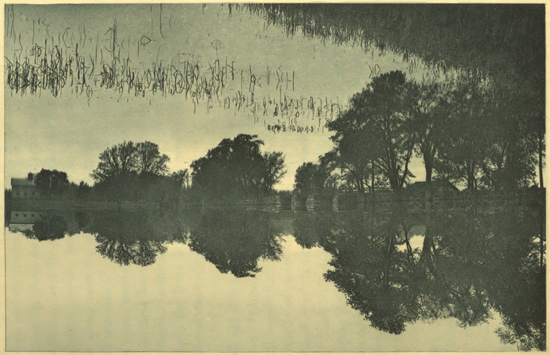
Trees Reflected in the River
June 16. The river down which we glided for that
long afternoon was like a clear drop of dew with the
heavens and the landscape reflected in it. And as evening
drew on, faint purple clouds began to be reflected
in its water, and the cow-bells tinkled louder and more
incessantly on the banks, and like shy water-rats we
stole along near the shore, looking out for a place to
pitch our camp.[137]
It seems insensibly to grow lighter as night shuts in;
the furthest hamlet begins to be revealed, which before
lurked in the shade of the noon.[138] It twinkles now
through the trees like some fair evening star darting
its ray across valley and wood.
Would it not be a luxury to stand up to one's chin
in some retired swamp for a whole summer's day, scenting
the sweet-fern and bilberry blows, and lulled by the
minstrelsy of gnats and mosquitoes? A day passed in
the society of those Greek sages, such as described in
the "Banquet" of Xenophon, would not be comparable
with the dry wit of decayed cranberry vines, and the
fresh Attic salt of the moss beds. Say twelve hours of
genial and familiar converse with the leopard frog.
The sun to rise behind alder and dogwood, and climb
buoyantly to his meridian of three hands' breadth, and
finally sink to rest behind some bold western hummock.
To hear the evening chant of the mosquito from a thousand
green chapels, and the bittern begin to boom from
his concealed fort like a sunset gun! Surely, one may
as profitably be soaked in the juices of a marsh for
one day, as pick his way dry-shod over sand. Cold and
damp,—are they not as rich experience as warmth
and dryness?[139]
So is not shade as good as sunshine, night as day?
Why be eagles and thrushes always, and owls and whip-poor-wills
never?
I am pleased to see the landscape through the bottom
of a tumbler, it is clothed in such a mild, quiet light,
and the barns and fences checker and partition it with
new regularity. These rough and uneven fields stretch
away with lawn-like smoothness to the horizon. The
clouds are finely distinct and picturesque, the light-blue
sky contrasting with their feathery whiteness. They
are fit drapery to hang over Persia.[140] The smith's shop,
resting in such a Grecian light, is worthy to stand beside
the Parthenon. The potato and grain fields are
such gardens as he imagines who has schemes of ornamental
husbandry.
If I were to write of the dignity of the farmer's life,
I would behold his farms and crops through a tumbler.
All the occupations of men are ennobled so.
Our eyes, too, are convex lenses, but we do not learn
with the eyes; they introduce us, and we learn after by
converse with things.
June 17. Our lives will not attain to be spherical
by lying on one or the other side forever; but only by
resigning ourselves to the law of gravity in us, will
our axis become coincident with the celestial axis, and
[only]
by revolving incessantly through all circles, shall
we acquire a perfect sphericity.[141]
Men are inclined to lay the chief stress on likeness
and not on difference. We seek to know how a thing is
related to us, and not if it is strange. We call those
bodies warm whose temperature is many degrees below
our own, and never those cold which are warmer than
we. There are many degrees of warmth below blood
heat, but none of cold above it.[142]
Even the motto "Business before friends" admits
of a high interpretation. No interval of time can avail
to defer friendship. The concerns of time must be attended
to in time. I need not make haste to explore the
whole secret of a star; if it were vanished quite out of
the firmament, so that no telescope could longer discover
it, I should not despair of knowing it entirely one
day.
We meet our friend with a certain awe, as if he had
just lighted on the earth, and yet as if we had some title
to be acquainted with him by our old familiarity with
sun and moon.
June 18. I should be pleased to meet man in the
woods. I wish he were to be encountered like wild
caribous and moose.
I am startled when I consider how little I am actually
concerned about the things I write in my journal.
Think of the Universal History, and then tell me,—when
did burdock and plantain sprout first?[143]
A fair land, indeed, do books spread open to us, from
the Genesis down; but alas! men do not take them up
kindly into their own being, and breathe into them a
fresh beauty, knowing that the grimmest of them belongs
to such warm sunshine and still moonlight as the
present.
Of what consequence whether I stand on London
bridge for the next century, or look into the depths of this
bubbling spring which I have laid open with my hoe?
June 19. The other day I rowed in my boat a free, even
lovely young lady, and, as I plied the oars, she sat in the
stern, and there was nothing but she between me and
the sky.[144] So might all our lives be picturesque if they
were free enough, but mean relations and prejudices intervene
to shut out the sky, and we never see a man as
simple and distinct as the man-weathercock on a steeple.
The faint bugle notes which I hear in the west seem
to flash on the horizon like heat lightning.[145] Cows low
in the street more friendly than ever, and the note of the
whip-poor-will, borne over the fields, is the voice with
which the woods and moonlight woo me.
I shall not soon forget the sounds which lulled me
when falling asleep on the banks of the Merrimack.
Far into night I hear some tyro beating a drum incessantly
with a view to some country muster, and am
thrilled by an infinite sweetness as of a music which the
breeze drew from the sinews of war. I think of the
line,—
"When the drum beat at dead of night."
How I wish it would wake the whole world to march
to its melody, but still it drums on alone in the silence
and the dark. Cease not, thou drummer of the night,
thou too shalt have thy reward. The stars and the firmament
hear thee, and their aisles shall echo thy beat
till its call is answered, and the forces are mustered.
The universe is attentive as a little child to thy sound,
and trembles as if each stroke bounded against an elastic
vibrating firmament. I should be contented if the
night never ended, for in the darkness heroism will not
be deferred, and I see fields where no hero has couched
his lance.[146]
June 20. Perfect sincerity and transparency make
a great part of beauty, as in dewdrops, lakes, and diamonds.
A spring is a cynosure in the fields. All Muscovy
glitters in the minute particles of mica on its
bottom, and the ripples cast their shadows flickeringly
on the white sand, as the clouds which flit across the
landscape.
Something like the woodland sounds will be heard
to echo through the leaves of a good book. Sometimes
I hear the fresh emphatic note of the oven-bird, and am
tempted to turn many pages; sometimes the hurried
chuckling sound of the squirrel when he dives into the
wall.
If we only see clearly enough how mean our lives
are, they will be splendid enough. Let us remember
not to strive upwards too long, but sometimes drop
plumb down the other way, and wallow in meanness.
From the deepest pit we may see the stars, if not the
sun. Let us have presence of mind enough to sink when
we can't swim. At any rate, a carcass had better lie on
the bottom than float an offense to all nostrils. It will
not be falling, for we shall ride wide of the earth's gravity
as a star, and always be drawn upward still,—semper
cadendo nunquam cadit,—and so, by yielding to universal
gravity, at length become fixed stars.
Praise begins when things are seen partially. We
begin to praise when we begin to see that a thing needs
our assistance.
When the heavens are obscured to us, and nothing
noble or heroic appears, but we are oppressed by imperfection
and shortcoming on all hands, we are apt
to suck our thumbs and decry our fates. As if nothing
were to be done in cloudy weather, or, if heaven were
not accessible by the upper road, men would not find
out a lower. Sometimes I feel so cheap that I am inspired,
and could write a poem about it,—but straightway
I cannot, for I am no longer mean. Let me know
that I am ailing, and I am well. We should not always
beat off the impression of trivialness, but make haste
to welcome and cherish it. Water the weed till it
blossoms; with cultivation it will bear fruit. There
are two ways to victory,—to strive bravely, or to yield.
How much pain the last will save we have not yet
learned.
June 21. I shall not soon forget my first night in a tent,—how
the distant barking of dogs for so many still
hours revealed to me the riches of the night. Who would
not be a dog and bay the moon?[147]
I never feel that I am inspired unless my body is also.
It too spurns a tame and commonplace life. They are
fatally mistaken who think, while they strive with their
minds, that they may suffer their bodies to stagnate
in luxury or sloth. The body is the first proselyte the
Soul makes. Our life is but the Soul made known
by its fruits, the body. The whole duty of man may
be expressed in one line,—Make to yourself a perfect
body.
June 22. What a man knows, that he does.
It is odd that people will wonder how Shakespeare
could write as he did without knowing Latin, or Greek,
or geography, as if these were of more consequence
than to know how to whistle. They are not backward
to recognize Genius,—how it dispenses with those
furtherances which others require, leaps where they
crawl,—and yet they never cease to marvel that so it
was,—that it was Genius, and helped itself.
Nothing can shock a truly brave man but dullness.
One can tolerate many things. What mean these sly,
suspicious looks, as if you were an odd fish, a piece of
crockery-ware to be tenderly handled? Surely people
forget how many rebuffs every man has experienced in
his day,—perhaps has fallen into a horsepond, eaten
freshwater clams, or worn one shirt for a week without
washing. Cannot a man be as calmly tolerant as a
potato field in the sun, whose equanimity is not disturbed
by Scotch thistles over the wall, but there it
smiles and waxes till the harvest, let thistles mount
never so high? You cannot receive a shock, unless you
have an electric affinity for that which shocks you.
Have no affinity for what is shocking.[148]
Do not present a gleaming edge to ward off harm,
for that will oftenest attract the lightning, but rather
be the all-pervading ether which the lightning does
not strike but purify. Then will the rudeness or profanity
of your companion be like a flash across the
face of your sky, lighting up and revealing its serene
depths.[149] Earth cannot shock the heavens; but its dull
vapor and foul smoke make a bright cloud spot in the
ether, and anon the sun, like a cunning artificer, will
cut and paint it, and set it for a jewel in the breast of
the sky.[150]
When we are shocked at vice we express a lingering
sympathy with it. Dry rot, rust, and mildew shock no
man, for none is subject to them.
June 23. We Yankees are not so far from right, who
answer one question by asking another. Yes and No
are lies. A true answer will not aim to establish anything,
but rather to set all well afloat. All answers are
in the future, and day answereth to day. Do we think
we can anticipate them?
In Latin, to respond is to pledge one's self before the
gods to do faithfully and honorably, as a man should,
in any case. This is good.
Music soothes the din of philosophy and lightens
incessantly over the heads of sages.[151]
How can the language of the poet be more expressive
than nature? He is content that what he has already
read in simple characters, or indifferently in all, be
translated into the same again.
He is the true artist whose life is his material; every
stroke of the chisel must enter his own flesh and bone
and not grate dully on marble.[152]
The Springs.—What is any man's discourse to me if
I am not sensible of something in it as steady and cheery
as the creak of the crickets? In it the woods must be
relieved against the sky. Men tire me when I am not
constantly greeted and cheered in their discourse, as it
were by the flux of sparkling streams.
I cannot see the bottom of the sky, because I cannot
see to the bottom of myself. It is the symbol of my own
infinity. My eye penetrates as far into the ether as that
depth is inward from which my contemporary thought
springs.
Not by constraint or severity shall you have access to
true wisdom, but by abandonment, and childlike mirthfulness.
If you would know aught, be gay before it.
June 24. When I read Cudworth I find I can tolerate
all,—atomists, pneumatologists, atheists, and theists,—Plato,
Aristotle, Leucippus, Democritus, and Pythagoras.
It is the attitude of these men, more than any
communication, which charms me. It is so rare to find
a man musing. But between them and their commentators
there is an endless dispute. But if it come to that,
that you compare notes, then you are all wrong. As it
is, each takes me up into the serene heavens, and paints
earth and sky. Any sincere thought is irresistible; it
lifts us to the zenith, whither the smallest bubble rises
as surely as the largest.
Dr. Cudworth does not consider that the belief in
a deity is as great a heresy as exists. Epicurus held
that the gods were "of human form, yet were so thin
and subtile, as that, comparatively with our terrestrial
bodies, they might be called incorporeal; they having
not so much carnem as quasi-carnem, nor sanguinem as
quasi-sanguinem, a certain kind of aerial or ethereal
flesh and blood." This, which Cudworth pronounces
"romantical," is plainly as good doctrine as his own.
As if any sincere thought were not the best sort of
truth!
There is no doubt but the highest morality in the
books is rhymed or measured,—is, in form as well as
substance, poetry. Such is the scripture of all nations.
If I were to compile a volume to contain the condensed
wisdom of mankind, I should quote no rhythmless line.[153]
Not all the wit of a college can avail to make one
harmonious line. It never happens. It may get so as
to jingle, but a jingle is akin to a jar,—jars regularly
recurring.[154]
So delicious is plain speech to my ears, as if I were
to be more delighted by the whistling of the shot than
frightened by the flying of the splinters, I am content,
I fear, to be quite battered down and made a ruin
of. I outgeneral myself when I direct the enemy to my
vulnerable points.
The loftiest utterance of Love is, perhaps, sublimely
satirical. Sympathy with what is sound makes sport of
what is unsound.
Cliffs. Evening.—Though the sun set a quarter of
an hour ago, his rays are still visible, darting half-way
to the zenith. That glowing morrow in the west flashes
on me like a faint presentiment of morning when I am
falling asleep. A dull mist comes rolling from the west,
as if it were the dust which day has raised. A column
of smoke is rising from the woods yonder, to uphold
heaven's roof till the light comes again. The landscape,
by its patient resting there, teaches me that all good
remains with him that waiteth, and that I shall sooner
overtake the dawn by remaining here, than by hurrying
over the hills of the west.
Morning and evening are as like as brother and
sister. The sparrow and thrush sing and the frogs peep
for both.
The woods breathe louder and louder behind me.
With what hurry-skurry night takes place! The wagon
rattling over yonder bridge is the messenger which day
sends back to night; but the dispatches are sealed. In
its rattle the village seems to say, This one sound, and I
have done.
Red, then, is Day's color; at least it is the color
of his heel. He is 'stepping westward.' We only notice
him when he comes and when he goes.
With noble perseverance the dog bays the stars
yonder. I too, like thee, walk alone in this strange,
familiar night, my voice, like thine, beating against its
friendly concave; and barking I hear only my own voice.
10 o'clock.
June 25. Let me see no other conflict but with prosperity.
If my path run on before me level and smooth,
it is all a mirage; in reality it is steep and arduous as
a chamois pass. I will not let the years roll over me like
a Juggernaut car.
We will warm us at each other's fire. Friendship is
not such a cold refining process as a double sieve, but
a glowing furnace in which all impurities are consumed.
Men have learned to touch before they scrutinize,—to
shake hands, and not to stare.
June 26. The best poetry has never been written, for
when it might have been, the poet forgot it, and when
it was too late remembered it; or when it might have
been, the poet remembered it, and when it was too late
forgot it.
The highest condition of art is artlessness.
Truth is always paradoxical.
He will get to the goal first who stands stillest.
There is one let better than any help, and that is,—Let-alone.
By sufferance you may escape suffering.
He who resists not at all will never surrender.
When a dog runs at you, whistle for him.
Say, Not so, and you will outcircle the philosophers.
Stand outside the wall, and no harm can reach you.
The danger is that you be walled in with it.
June 27. I am living this 27th of June, 1840, a dull,
cloudy day and no sun shining. The clink of the smith's
hammer sounds feebly over the roofs, and the wind is
sighing gently, as if dreaming of cheerfuller days. The
farmer is plowing in yonder field, craftsmen are busy
in the shops, the trader stands behind the counter, and
all works go steadily forward. But I will have nothing
to do; I will tell fortune that I play no game with her,
and she may reach me in my Asia of serenity and indolence
if she can.
For an impenetrable shield, stand inside yourself.[155]
He was no artist, but an artisan, who first made shields
of brass.[156]
Unless we meet religiously, we prophane one another.
What was the consecrated ground round the temple,
we have used as no better than a domestic court.
Our friend's is as holy a shrine as any God's, to be
approached with sacred love and awe. Veneration is
the measure of Love. Our friend answers ambiguously,
and sometimes before the question is propounded, like
the oracle of Delphi. He forbears to ask explanation,
but doubts and surmises darkly with full faith, as we
silently ponder our fates.
In no presence are we so susceptible to shame. Our
hour is a sabbath, our abode a temple, our gifts peace
offerings, our conversation a communion, our silence
a prayer. In prophanity we are absent, in holiness near,
in sin estranged, in innocence reconciled.
June 28. The prophane never hear music; the holy
ever hear it. It is God's voice, the divine breath audible.
Where it is heard, there is a sabbath. It is omnipotent;
all things obey it as they obey virtue. It is the herald of
virtue.[157] It passes by sorrow, for grief hangs its harp on
the willows.
June 29. Of all phenomena, my own race are the
most mysterious and undiscoverable. For how many
years have I striven to meet one, even on common manly
ground, and have not succeeded!
June 30. I sailed from Fair Haven last evening as
gently and steadily as the clouds sail through the atmosphere.
The wind came blowing blithely from the
southwest fields, and stepped into the folds of our sail
like a winged horse, pulling with a strong and steady
impulse. The sail bends gently to the breeze, as swells
some generous impulse of the heart, and anon flutters
and flaps with a kind of human suspense. I could watch
the motions of a sail forever, they are so rich and full
of meaning. I watch the play of its pulse, as if it were
my own blood beating there. The varying temperature
of distant atmospheres is graduated on its scale. It is a
free, buoyant creature, the bauble of the heavens and
the earth. A gay pastime the air plays with it. If it swells
and tugs, it is because the sun lays his windy finger on
it. The breeze it plays with has been outdoors so long.
So thin is it, and yet so full of life; so noiseless when it
labors hardest, so noisy and impatient when least serviceable.[158]
So am I blown on by God's breath, so flutter
and flap, and fill gently out with the breeze.
In this fresh evening each blade and leaf looks as if it
had been dipped in an icy liquid greenness. Let eyes
that ache come here and look,—the sight will be a sovereign
eyewater,—or else wait and bathe them in the
dark.
We go forth into the fields, and there the wind blows
freshly onward, and still on, and we must make new
efforts not to be left behind. What does the dogged
wind intend, that, like a willful cur, it will not let me
turn aside to rest or content? Must it always reprove
and provoke me, and never welcome me as an equal?
The truth shall prevail and falsehood discover itself,
as long as the wind blows on the hills.
A man's life should be a stately march to a sweet but
unheard music, and when to his fellows it shall seem
irregular and inharmonious, he will only be stepping
to a livelier measure, or his nicer ear hurry him into a
thousand symphonies and concordant variations. There
will be no halt ever, but at most a marching on his post,
or such a pause as is richer than any sound, when the
melody runs into such depth and wildness as to be no
longer heard, but implicitly consented to with the whole
life and being. He will take a false step never, even in
the most arduous times, for then the music will not fail
to swell into greater sweetness and volume, and itself
rule the movement it inspired.[159]
I have a deep sympathy with war, it so apes the gait
and bearing of the soul.
Value and effort are as much coincident as weight
and a tendency to fall. In a very wide but true sense,
effort is the deed itself, and it is only when these sensible
stuffs intervene, that our attention is distracted from
the deed to the accident. It is never the deed men praise,
but some marble or canvas which are only a staging
to the real work.[160]
July 1. To be a man is to do a man's work; always
our resource is to endeavor. We may well say,
Success to our endeavors. Effort is the prerogative of
virtue.[161]
The true laborer is recompensed by his labor, not
by his employer. Industry is its own wages. Let us not
suffer our hands to lose one jot of their handiness by
looking behind to a mean recompense, knowing that
our true endeavor cannot be thwarted, nor we be cheated
of our earnings unless by not earning them.[162]
The true poem is not that which the public read.
There is always a poem not printed on paper, coincident
with the production of this, which is stereotyped in the
poet's life, is what he has become through his work.
Some symbol of value may shape itself to the senses in
wood, or marble, or verse, but this is fluctuating as the
laborer's hire, which may or may not be withheld. His
very material is not material but supernatural. Perhaps
the hugest and most effective deed may have no sensible
result at all on earth, but paint itself in the heavens
in new stars and constellations. Its very material lies
out of nature. When, in rare moments, we strive wholly
with one consent, which we call a yearning, we may not
hope that our work will stand in any artist's gallery.[163]
Let not the artist expect that his true work will stand in
any prince's gallery.
July 2. I am not taken up, like Moses, upon a mountain
to learn the law, but lifted up in my seat here, in
the warm sunshine and genial light.
They who are ready to go are already invited.
Neither men nor things have any true mode of invitation
but to be inviting.
Can that be a task which all things abet, and to postpone
which is to strive against nature?[164]
July 3. When Alexander appears, the Hercynian
and Dodonean woods seem to wave a welcome to him.
Do not thoughts and men's lives enrich the earth and
change the aspect of things as much as a new growth
of wood?
What are Godfrey and Gonsalvo unless we breathe
a life into them, and reënact their exploits as a prelude
to our own? The past is only so heroic as we see it; it
is the canvas on which our conception of heroism is
painted, the dim prospectus of our future field. We are
dreaming of what we are to do.[165]
The last sunrise I witnessed seemed to outshine the
splendor of all preceding ones, and I was convinced
that it behooved man to dawn as freshly, and with equal
promise and steadiness advance into the career of life,
with as lofty and serene a countenance to move onward
through his midday to a yet fairer and more promising
setting. Has the day grown old when it sets? and shall
man wear out sooner than the sun? In the crimson
colors of the west I discern the budding hues of dawn.
To my western brother it is rising pure and bright as
it did to me, but the evening exhibits in the still rear
of day the beauty which through morning and noon
escaped me.[166] When we are oppressed by the heat and
turmoil of the noon, let us remember that the sun which
scorches us with brazen beams is gilding the hills of
morning and awaking the woodland quires for other
men.
We will have a dawn, and noon, and serene sunset in
ourselves.
What we call the gross atmosphere of evening is the
accumulated deed of the day, which absorbs the rays
of beauty, and shows more richly than the naked promise
of the dawn. By earnest toil in the heat of the
noon, let us get ready a rich western blaze against the
evening of our lives.[167]
Low-thoughted, plodding men have come and
camped in my neighbor's field to-night, with camp
music and bustle. Their bugle instantly finds a sounding
board in the heavens, though mean lips blow it.
The sky is delighted with strains which the connoisseur
rejects. It seems to say, Now is this my own
earth.[168]
In music are the centripetal and centrifugal forces.
The universe needed only to hear a divine harmony
that every star might fall into its proper place and
assume a true sphericity.[169]
July 4. 4 o'clock, a. m. The Townsend Light Infantry
encamped last night in my neighbor's inclosure.
The night still breathes slumberously over field and
wood, when a few soldiers gather about one tent in the
twilight, and their band plays an old Scotch air, with
bugle and drum and fife attempered to the season. It
seems like the morning hymn of creation. The first
sounds of the awakening camp, mingled with the chastened
strains which so sweetly salute the dawn, impress
me as the morning prayer of an army.[170]
And now the morning gun fires. The soldier awakening
to creation and awakening it. I am sure none are
cowards now. These strains are the roving dreams which
steal from tent to tent, and break forth into distinct
melody. They are the soldier's morning thought. Each
man awakes himself with lofty emotions, and would do
some heroic deed. You need preach no homily to him;
he is the stuff they are made of.
The whole course of our lives should be analogous to
one day of the soldier's. His Genius seems to whisper
in his ear what demeanor is befitting, and in his bravery
and his march he yields a blind and partial obedience.
The fresher breeze which accompanies the dawn
rustles the oaks and birches, and the earth respires
calmly with the creaking of crickets. Some hazel leaf
stirs gently, as if anxious not to awake the day too
abruptly, while the time is hastening to the distinct line
between darkness and light. And soldiers issue from
their dewy tents, and as if in answer to expectant nature,
sing a sweet and far-echoing hymn.
We may well neglect many things, provided we overlook
them.
When to-day I saw the "Great Ball" rolled majestically
along, it seemed a shame that man could not move
like it. All dignity and grandeur has something of the
undulatoriness of the sphere. It is the secret of majesty
in the rolling gait of the elephant, and of all grace in
action and in art. The line of beauty is a curve. Each
man seems striving to imitate its gait, and keep pace
with it, but it moves on regardless and conquers the
multitude with its majesty. What shame that our lives,
which should be the source of planetary motion and
sanction the order of the spheres, are full of abruptness
and angularity, so as not to roll, nor move majestically.[171]
July 5. Go where we will, we discover infinite change
in particulars only, not in generals.
You cannot rob a man of anything which he will miss.
July 6. All this worldly wisdom was once the unamiable
heresy of some wise man.[172]
I observe a truly wise practice on every hand, in education,
in religion, and the morals of society,—enough
embodied wisdom to have set up many an ancient
philosopher.[173]
This society, if it were a person to be met face to face,
would not only be tolerated but courted, with its so
impressive experience and admirable acquaintance with
things.
Consider society at any epoch, and who does not see
that heresy has already prevailed in it?[174]
Have no mean hours, but be grateful for every hour,
and accept what it brings. The reality will make any
sincere record respectable. No day will have been
wholly misspent, if one sincere, thoughtful page has
been written.
Let the daily tide leave some deposit on these pages,
as it leaves sand and shells on the shore. So much
increase of terra firma. This may be a calendar of the
ebbs and flows of the soul; and on these sheets as a
beach, the waves may cast up pearls and seaweed.
July 7. I have experienced such simple joy in the
trivial matters of fishing and sporting, formerly, as
might inspire the muse of Homer and Shakespeare. And
now, when I turn over the pages and ponder the plates
of the "Angler's Souvenir," I exclaim with the poet,—
"Can such things be,
And overcome us like a summer's cloud?"[175]
When I hear a sudden burst from a horn, I am
startled, as if one had provoked such wildness as he
could not rule nor tame. He dares to wake the echoes
which he cannot put to rest.[176]
July 8. Doubt and falsehood are yet good preachers.
They affirm roundly, while they deny partially.
I am pleased to learn that Thales was up and stirring
by night not unfrequently, as his astronomical discoveries
prove.
It was a saying of Solon that "it is necessary to observe
a medium in all things."
The golden mean, in ethics as in physics, is the centre
of the system, and that about which all revolve; and
though, to a distant and plodding planet, it is the uttermost
extreme, yet, when that planet's year is complete,
it will be found central.[177] They who are alarmed lest virtue
run into extreme good, have not yet wholly embraced
her, but described only a slight arc about her, and from
so small a curvature you can calculate no centre whatever;
but their mean is no better than meanness, nor
their medium than mediocrity.
The brave man, while he observes strictly this golden
mean, seems to run through all extremes with impunity;
like the sun, which now appears in the zenith, now in the
horizon, and again is faintly reflected from the moon's
disk, and has the credit of describing an entire great
circle, crossing the equinoctial and solstitial colures,
without detriment to his steadfastness or mediocrity.[178]
Every planet asserts its own to be the centre of the
system.
Only meanness is mediocre, moderate; but the true
medium is not contained within any bounds, but is as
wide as the ends it connects.
When Solon endeavored to prove that Salamis had
formerly belonged to the Athenians and not to the Megarians,
he caused the tombs to be opened, and showed
that the inhabitants of Salamis turned the faces of their
dead to the same side with the Athenians, but the Megarians
to the opposite side.[179]
So does each part bear witness to all, and the history
of all the past may be read in a single grain of its ashes.
July 9. In most men's religion the ligature which
should be its muscle and sinew is rather like that thread
which the accomplices of Cylon held in their hands,
when they went abroad from the temple of Minerva,
the other end being attached to the statue of the goddess.
But frequently, as in their case, the thread breaks,
being stretched, and they are left without an asylum.[180]
The value of many traits in Grecian history depends
not so much on their importance as history, as [on] the
readiness with which they accept a wide interpretation,
and illustrate the poetry and ethics of mankind. When
they announce no particular truth, they are yet central
to all truth. They are like those examples by which we
improve, but of which we never formally extract the
moral. Even the isolated and unexplained facts are
like the ruins of the temples which in imagination we
restore, and ascribe to some Phidias, or other master.
The Greeks were boys in the sunshine, the Romans
were men in the field, the Persians women in the house,
the Egyptians old men in the dark.
He who receives an injury is an accomplice of the
wrong-doer.
July 10. To myself I am as pliant as osier, and my
courses seem not so easy to be calculated as Encke's
comet; but I am powerless to bend the character of another;
he is like iron in my hands. I could tame a hyena
more easily than my friend. I contemplate him as a
granite boulder. He is material which no tool of mine
will work. A naked savage will fell an oak with a firebrand,
and wear a hatchet out of the rock, but I cannot
hew the smallest chip out of my fellow. There is
a character in every one which no art can reach to beautify
or deform.[181]
Nothing was ever so unfamiliar and startling to me
as my own thoughts.
We know men through their eyes. You might say
that the eye was always original and unlike another.
It is the feature of the individual, and not of the family,—in
twins still different. All a man's privacy is in his
eye, and its expression he cannot alter more than he
can alter his character. So long as we look a man in
the eye, it seems to rule the other features, and make
them, too, original. When I have mistaken one person
for another, observing only his form, and carriage, and
inferior features, the unlikeness seemed of the least
consequence; but when I caught his eye, and my doubts
were removed, it seemed to pervade every feature.
The eye revolves on an independent pivot which we
can no more control than our own will. Its axle is the
axle of the soul, as the axis of the earth is coincident
with the axis of the heavens.
July 11. The true art is not merely a sublime consolation
and holiday labor which the gods have given
to sickly mortals, to be wrought at in parlors, and not
in stithies amid soot and smoke, but such a masterpiece
as you may imagine a dweller on the table-lands
of Central Asia might produce, with threescore and ten
years for canvas, and the faculties of a man for tools,—a
human life, wherein you might hope to discover more
than the freshness of Guido's Aurora, or the mild light
of Titian's landscapes; not a bald imitation or rival of
Nature, but the restored original of which she is the
reflection. For such a work as this, whole galleries of
Greece and Italy are a mere mixing of colors and preparatory
quarrying of marble.[182]
Not how is the idea expressed in stone or on canvas,
is the question, but how far it has obtained form and
expression in the life of the artist.
There is much covert truth in the old mythology
which makes Vulcan a brawny and deformed smith,
who sweat more than the other gods. His stithy was
not like a modern studio.
Let us not wait any longer, but step down from the
mountains on to the plain of earth. Let our delay be
like the sun's, when he lingers on the dividing line of
day and night a brief space when the world is grateful
for his light. We will make such haste as the morning
and such delay as the evening.[183]
It concerns us rather to be something here present
than to leave something behind us.[184]
It is the man determines what is said, not the words.
If a mean person uses a wise maxim, I bethink me how
it can be interpreted so as to commend itself to his meanness;
but if a wise man makes a commonplace remark,
I consider what wider construction it will admit. When
Pittacus says, "It is necessary to accommodate one's
self to the time and take advantage of the occasion," I
assent. He might have considered that to accommodate
one's self to all times, and take advantage of all
occasions, was really to be independent, and make our
own opportunity.
July 12. What first suggested that necessity was
grim, and made fate so fatal? The strongest is always
the least violent. Necessity is a sort of Eastern cushion
on which I recline. I contemplate its mild, inflexible
countenance, as the haze in October days. When I am
vexed I only ask to be left alone with it. Leave me to my
fate. It is the bosom of time and the lap of eternity;
since to be necessary is to be needful, it is only another
name for inflexibility of good. How I welcome my grim
fellow and aspire to be such a necessity as he! He is so
flexible, and yields to me as the air to my body! I leap
and dance in his midst, and play with his beard till he
smiles. I greet thee, my elder brother, who with thy
touch ennoblest all things. Must it be so, then is it good.
Thou commendest even petty ills by thy countenance.
Over Greece hangs the divine necessity, ever a mellower
heaven of itself, whose light too gilds the Acropolis
and a thousand fanes and groves.[185]
Pittacus said there was no better course than to endeavor
to do well what you are doing at any moment.
Go where he will, the wise man is proprietor of all
things. Everything bears a similar inscription, if we
could but read it, to that on the vase found in the
stomach of a fish in old times,—"To the most wise."
When his impious fellow-passengers invoked the
gods in a storm, Bias cried, "Hist! hist! lest the
gods perceive that you are here, for we should all
be lost."
A wise man will always have his duds picked up, and
be ready for whatever may happen, as the prudent merchant,
notwithstanding the lavish display of his wares,
will yet have them packed or easy to be removed in
emergencies. In this sense there is something sluttish
in all finery. When I see a fine lady or gentleman dressed
to the top of the fashion, I wonder what they would
do if an earthquake should happen, or a fire suddenly
break out, for they seem to have counted only on fair
weather, and that things will go on smoothly and without
jostling. Those curls and jewels, so nicely adjusted,
expect an unusual deference from the elements.
Our dress should be such as will hang conveniently
about us, and fit equally well in good and in bad fortune;
such as will approve itself of the right fashion
and fabric, whether for the cotillion or the earthquake.
In the sack of Priene, when the inhabitants with much
hurry and bustle were carrying their effects to a place
of safety, some one asked Bias, who remained tranquil
amid the confusion, why he was not thinking how he
should save something, as the others were. "I do so,"
said Bias, "for I carry all my effects with me."
July 14. Our discourse should be ex tempore, but
not pro tempore.
July 16. We are as much refreshed by sounds as by
sights, or scents, or flavors,—as the barking of a dog
heard in the woods at midnight, or the tinklings which
attend the dawn.
As I picked blackberries this morning, by starlight,
the distant yelping of a dog fell on my inward ear, as
the cool breeze on my cheek.
July 19. These two days that I have not written in
my Journal, set down in the calendar as the 17th and
18th of July, have been really an æon in which a Syrian
empire might rise and fall. How many Persias have
been lost and won in the interim? Night is spangled
with fresh stars.
July 26. When I consider how, after sunset, the stars
come out gradually in troops from behind the hills and
woods, I confess that I could not have contrived a more
curious and inspiring night.
July 27. Some men, like some buildings, are bulky
but not great. The Pyramids any traveller may measure
with his line, but the dimensions of the Parthenon
in feet and inches will seem to dangle from its entablature
like an elastic drapery.[186]
Much credit is due to a brave man's eye. It is the
focus in which all rays are collected. It sees from within,
or from the centre, just as we scan the whole concave
of the heavens at a glance, but can compass only one
side of the pebble at our feet.[187]
The grandeur of these stupendous masses of clouds,
tossed into such irregular greatness across the sky, seems
thrown away on the meanness of my employment.
The drapery seems altogether too rich for such poor
acting.[188]
In vain the sun challenges man to equal greatness
in his career. We look in vain over earth for a Roman
greatness to answer the eternal provocation.[189]
We look up to the gilded battlements of the eternal
city, and are contented to be suburban dwellers outside
the walls.[190]
By the last breath of the May air I inhale I am reminded
that the ages never got so far down as this before.
The wood thrush is a more modern philosopher
than Plato and Aristotle. They are now a dogma, but
he preaches the doctrine of this hour.
This systole-diastole of the heart, the circulation
of the blood from the centre to the extremities, the
chylification which is constantly going on in our bodies
are a sort of military evolution, a struggle to outgeneral
the decay of time by the skillfulest tactics.
When bravery is worsted, it joins the peace society.
A word is wiser than any man, than any series of
words. In its present received sense it may be false,
but in its inner sense by descent and analogy it approves
itself. Language is the most perfect work of art in the
world. The chisel of a thousand years retouches it.
Nature refuses to sympathize with our sorrow. She
seems not to have provided for, but by a thousand contrivances
against it. She has bevelled the margins of
the eyelids that the tears may not overflow on the cheek.[191]
We can conceive of a Bravery so wide that nothing
can meet to befall it, so omnipresent that nothing can
lie in wait for it, so permanent that no obstinacy can
reduce it. The stars are its silent sentries by night, and
the sun its pioneer by day. From its abundant cheerfulness
spring flowers and the rainbow, and its infinite
humor and wantonness produce corn and vines.[192]
Jan. 23. A day is lapsing. I hear cockerels crowing
in the yard, and see them stalking among the chips in
the sun. I hear busy feet on the floors, and the whole
house jars with industry. Surely the day is well spent,
and the time is full to overflowing. Mankind is as busy
as the flowers in summer, which make haste to unfold
themselves in the forenoon, and close their petals in
the afternoon.
The momentous topics of human life are always of
secondary importance to the business in hand, just as
carpenters discuss politics between the strokes of the
hammer while they are shingling a roof.[193]
The squeaking of the pump sounds as necessary as
the music of the spheres.
The solidity and apparent necessity of this routine
insensibly recommend it to me. It is like a cane or a
cushion for the infirm, and in view of it all are infirm.
If there were but one erect and solid-standing tree in
the woods, all creatures would go to rub against it and
make sure of their footing. Routine is a ground to stand
on, a wall to retreat to; we cannot draw on our boots
without bracing ourselves against it.[194] It is the fence
over which neighbors lean when they talk. All this
cockcrowing, and hawing and geeing, and business in
the streets, is like the spring-board on which tumblers
perform and develop their elasticity. Our health requires
that we should recline on it from time to time.
When we are in it, the hand stands still on the face of
the clock, and we grow like corn in the genial dankness
and silence of the night.[195] Our weakness wants it, but
our strength uses it. Good for the body is the work of
the body, good for the soul the work of the soul, and
good for either the work of the other. Let them not call
hard names, nor know a divided interest.
When I detect a beauty in any of the recesses of nature,
I am reminded, by the serene and retired spirit
in which it requires to be contemplated, of the inexpressible
privacy of a life,—how silent and unambitious
it is. The beauty there is in mosses will have to be considered
from the holiest, quietest nook.[196]
The gods delight in stillness; they say, 'St—'st.
My truest, serenest moments are too still for emotion;
they have woollen feet. In all our lives we live under
the hill, and if we are not gone we live there still.
Jan. 24. Sunday. I almost shrink from the arduousness
of meeting men erectly day by day.
Be resolutely and faithfully what you are; be humbly
what you aspire to be. Be sure you give men the best
of your wares, though they be poor enough, and the
gods will help you to lay up a better store for the future.
Man's noblest gift to man is his sincerity, for it embraces
his integrity also. Let him not dole out of himself
anxiously, to suit their weaker or stronger stomachs,
but make a clean gift of himself, and empty his coffers
at once. I would be in society as in the landscape; in
the presence of nature there is no reserve, nor effrontery.
Coleridge says of the "ideas spoken out everywhere
in the Old and New Testament," that they "resemble
the fixed stars, which appear of the same size to the
naked as to the armed eye; the magnitude of which the
telescope may rather seem to diminish than to increase."
It is more proper for a spiritual fact to have suggested
an analogous natural one, than for the natural
fact to have preceded the spiritual in our minds.
By spells seriousness will be forced to cut capers, and
drink a deep and refreshing draught of silliness; to
turn this sedate day of Lucifer's and Apollo's, into an
all fools' day for Harlequin and Cornwallis. The sun
does not grudge his rays to either, but they are alike
patronized by the gods. Like overtasked schoolboys,
all my members and nerves and sinews petition Thought
for a recess, and my very thigh-bones itch to slip away
from under me, and run and join the mêlée. I exult in
stark inanity, leering on nature and the soul. We think
the gods reveal themselves only to sedate and musing
gentlemen. But not so; the buffoon in the midst of his
antics catches unobserved glimpses, which he treasures
for the lonely hour. When I have been playing tomfool,
I have been driven to exchange the old for a more
liberal and catholic philosophy.
Jan. 25. Monday. To-day I feel the migratory instinct
strong in me, and all my members and humors anticipate
the breaking up of winter. If I yielded to this
impulse, it would surely guide me to summer haunts.
This indefinite restlessness and fluttering on the perch
do, no doubt, prophesy the final migration of souls out
of nature to a serene summer, in long harrows and
waving lines[197] in the spring weather, over what fair
uplands and fertile Elysian meadows winging their
way at evening and seeking a resting-place with loud
cackling and uproar!
Wealth, no less than knowledge, is power. Among
the Bedouins the richest man is the sheik, among savages
he who has most iron and wampum is chief, and
in England and America he is the merchant prince.
We should strengthen, and beautify, and industriously
mould our bodies to be fit companions of the soul,—assist
them to grow up like trees, and be agreeable
and wholesome objects in nature. I think if I had had
the disposal of this soul of man, I should have bestowed
it sooner on some antelope of the plains than upon this
sickly and sluggish body.
Jan. 26. Tuesday. I have as much property as I can
command and use. If by a fault in my character I do
not derive my just revenues, there is virtually a mortgage
on my inheritance. A man's wealth is never entered
in the registrar's office. Wealth does not come in
along the great thoroughfares, it does not float on the
Erie or Pennsylvania canal, but is imported by a solitary
track without bustle or competition, from a brave
industry to a quiet mind.
I had a dream last night which had reference to an
act in my life in which I had been most disinterested
and true to my highest instinct but completely failed
in realizing my hopes; and now, after so many months,
in the stillness of sleep, complete justice was rendered
me. It was a divine remuneration. In my waking hours
I could not have conceived of such retribution; the
presumption of desert would have damned the whole.
But now I was permitted to be not so much a subject
as a partner to that retribution. It was the award of
divine justice, which will at length be and is even now
accomplished.[198]
Good writing as well as good acting will be obedience
to conscience. There must not be a particle of
will or whim mixed with it. If we can listen, we shall
hear. By reverently listening to the inner voice, we may
reinstate ourselves on the pinnacle of humanity.
Jan. 27. Wednesday. In the compensation of the
dream, there was no implied loss to any, but immeasurable
advantage to all.[199]
The punishment of sin is not positive, as is the reward
of virtue.
For a flower, I like the name pansy, or pensée, best
of any.
Jan. 28. No innocence can quite stand up under
suspicion, if it is conscious of being suspected. In the
company of one who puts a wrong construction upon
your actions, they are apt really to deserve a mean construction.
While in that society I can never retrieve
myself. Attribute to me a great motive, and I shall not
fail to have one; but a mean one, and the fountain of
virtue will be poisoned by the suspicion. Show men
unlimited faith as the coin with which you will deal
with them, and they will invariably exhibit the best
wares they have. I would meet men as the friends of all
their virtue, and the foes of all their vice, for no man is
the partner of his guilt. If you suspect me you will
never see me, but all our intercourse will be the politest
leave-taking; I shall constantly defer and apologize,
and postpone myself in your presence. The self-defender
is accursed in the sight of gods and men; he is
a superfluous knight, who serves no lady in the land.
He will find in the end that he has been fighting windmills,
and battered his mace to no purpose. The injured
man with querulous tone resisting his fate is like
a tree struck by lightning, which rustles its sere leaves
the winter through, not having vigor enough [to] cast
them off.
As for apologies, I must be off with the dew and the
frost, and leave mankind to repair the damage with
their gauze screens and straw.
Resistance is a very wholesome and delicious morsel
at times. When Venus advanced against the Greeks
with resistless valor, it was by far the most natural attitude
into which the poet could throw his hero to make
him resist heroically. To a devil one might yield gracefully,
but a god would be a worthy foe, and would pardon
the affront.
It would be worth while, once for all, fairly and
cleanly to tell how we are to be used, as vendors of lucifer
matches send directions in the envelope, both how
light may be readily procured and no accident happen
to the user.
Let your mood determine the form of salutation, and
approach the creature with a natural nonchalance, as
though he were anything but what he is, and you were
anything but what you are,—as though he were he,
and you were you; in short, as though he were so insignificant
that it did not signify, and so important that
it did not import. Depend upon it, the timber is well
seasoned and tough, and will bear rough usage; and if
it should crack, there is plenty more where it came
from. I am no piece of china-ware that cannot be jostled
against my neighbor, without danger of rupture from
the collision, and must needs ring a scrannel strain to
the end of my days when once I am cracked; but rather
one of the old-fashioned wooden trenchers, which one
while stands at the head of the table, and at another is
a milking-stool, and at another a seat for children, and
finally goes down to its grave not unadorned with honorable
scars, and does not die till it is worn out. Use
me, for I am useful in my way. I stand as one of many
petitioners, from toadstool and henbane up to dahlia
and violet, supplicating to be put to my use, if by any
means ye may find me serviceable; whether for a medicated
drink or bath, as balm and lavender; or for fragrance,
as verbena and geranium; or for sight, as cactus;
or for thoughts, as pansy.[200]
Jan. 29. There is something proudly thrilling in the
thought that this obedience to conscience and trust in
God, which is so solemnly preached in extremities and
arduous circumstances, is only to retreat to one's self,
and rely on our own strength. In trivial circumstances
I find myself sufficient to myself, and in the most momentous
I have no ally but myself, and must silently
put by their harm by my own strength, as I did the
former. As my own hand bent aside the willow in my
path, so must my single arm put to flight the devil and
his angels. God is not our ally when we shrink, and
neuter when we are bold. If by trusting in God you
lose any particle of your vigor, trust in Him no longer.
When you trust, do not lay aside your armor, but put
it on and buckle it tighter. If by reliance on the gods
I have disbanded one of my forces, then was it poor
policy. I had better have retained the most inexperienced
tyro who had straggled into the camp, and let go
the heavenly alliance. I cannot afford to relax discipline
because God is on my side, for He is on the side
of discipline. And if the gods were only the heavens I
fought under, I would not care if they stormed or were
calm. I do not want a countenance, but a help. And
there is more of God and divine help in a man's little
finger than in idle prayer and trust.
The best and bravest deed is that which the whole
man—heart, lungs, hands, fingers, and toes—at any
time prompts. Each hanger-on in the purlieus of the
camp, must strike his standard at the signal from the
Prætorian tent, and fall into the line of march; but if a
single sutler delay to make up his pack, then suspect
the fates and consult the omens again. This is the
meaning of integrity; this is to be an integer, and not a
fraction. Be even for all virtuous ends, but odd for all
vice. Be a perfect power, so that any of your roots
multiplied into itself may give the whole again.
Beauty is compared, not measured, for it is the creature
of proportions, not of size. Size must be subdued
to it. It is hard for a tall or a short person to be beautiful.
To graft the Persian lilac on the ash, is as if you were
to splice the thigh-bones of the Venus de Medici.
Friends will have to be introduced each time they
meet. They will be eternally strange to one another,
and when they have mutually appropriated their value
for the last hour, they will go and gather a new measure
of strangeness for the next. They are like two boughs
crossed in the wood, which play backwards and forwards
upon one another in the wind, and only wear
into each other, but never the sap of the one flows into
the pores of the other, for then the wind would no more
draw from them those strains which enchanted the
wood. They are not two united, but rather one divided.
Of all strange and unaccountable things this journalizing
is the strangest. It will allow nothing to be
predicated of it; its good is not good, nor its bad bad.
If I make a huge effort to expose my innermost and
richest wares to light, my counter seems cluttered with
the meanest homemade stuffs; but after months or
years I may discover the wealth of India, and whatever
rarity is brought overland from Cathay, in that
confused heap, and what perhaps seemed a festoon of
dried apple or pumpkin will prove a string of Brazilian
diamonds, or pearls from Coromandel.
Men lie behind the barrier of a relation as effectually
concealed as the landscape by a mist; and when at
length some unforeseen accident throws me into a new
attitude to them, I am astounded, as if for the first time
I saw the sun on the hillside. They lie out before me
like a new order of things. As, when the master meets
his pupil as a man, then first do we stand under the same
heavens, and master and pupil alike go down the resistless
ocean stream together.
Jan. 30. Saturday. Far over the fields, between the
tops of yonder wood, I see a slight cloud not larger than
the vapor from a kettle, drifting by its own inward
purpose in a direction contrary to the planet. As it flits
across the dells and defiles of the tree-tops, now seen,
then lost beyond a pine, I am curious to know wherein
its will resides, for to my eye it has no heart, nor lungs,
nor brain, nor any interior and private chamber which
it may inhabit.
Its motion reminds me of those lines of Milton:—
"As when far off at sea a fleet descried
Hangs in the clouds, by equinoctial winds
Close sailing from Bengala, or the isles
Of Ternate and Tidore, whence merchants bring
Their spicy drugs; they on the trading flood,
Ply stemming nightly toward the pole."
The snow collects upon the plumes of the pitch pine
in the form of a pineapple, which if you divide in the
middle will expose three red kernels like the tamarind-stone.
So does winter with his mock harvest jeer at the
sincerity of summer. The tropical fruits, which will
not bear the rawness of our summer, are imitated in a
thousand fantastic shapes by the whimsical genius of
winter.
In winter the warmth comes directly from the sun,
and is not radiated from the earth. In summer I forget
to bless the sun for his heat; but when I feel his
beams on my back as I thread some snowy dale, I am
grateful as for a special kindness which would not be
weary of well doing but had pursued me even into that
by-place.
When the wind blows, the fine snow comes filtering
down through all the aisles of the wood in a golden
cloud.
The trees covered with snow admit a very plain and
clean light, but not brilliant, as if through windows of
ground glass; a sort of white darkness it is, all of the
sun's splendor that can be retained.
The fashions of the wood are more fluctuating than
those of Paris; snow, rime, ice, green and dry leaves
incessantly make new patterns. There are all the shapes
and hues of the kaleidoscope and the designs and ciphers
of books of heraldry in the outlines of the trees.
Every time I see a nodding pine-top, it seems as if a
new fashion of wearing plumes had come into vogue.
I saw a team come out of a path in the woods, as
though it had never gone in, but belonged there, and
only came out like Elisha's bears. It was wholly of the
village, and not at all of the wood.
These particles of snow which the early wind shakes
down are what is stirring, or the morning news of the
wood. Sometimes it is blown up above the trees, like the
sand of the desert.
You glance up these paths, closely imbowered by
bent trees, as through the side aisles of a cathedral,
and expect to hear a choir chanting from their depths.
You are never so far in them as they are far before you.
Their secret is where you are not and where your feet
can never carry you.
I tread in the tracks of the fox which has gone before
me by some hours, or which perhaps I have started,
with such a tiptoe of expectation as if I were on the trail
of the Spirit itself which resides in these woods, and expected
soon to catch it in its lair.[201]
The snow falls on no two trees alike, but the forms
it assumes are as various as those of the twigs and leaves
which receive it. They are, as it were, predetermined
by the genius of the tree. So one divine spirit descends
alike on all, but bears a peculiar fruit in each. The
divinity subsides on all men, as the snowflakes settle on
the fields and ledges and takes the form of the various
clefts and surfaces on which it lodges.
Here is the distinct trail of a fox stretching [a] quarter
of a mile across the pond. Now I am curious to know
what has determined its graceful curvatures, its greater
or less spaces and distinctness, and how surely they
were coincident with the fluctuations of some mind,
why they now lead me two steps to the right, and then
three to the left. If these things are not to be called up
and accounted for in the Lamb's Book of Life, I shall
set them down for careless accountants. Here was one
expression of the divine mind this morning. The pond
was his journal, and last night's snow made a tabula
rasa for him. I know which way a mind wended this
morning, what horizon it faced, by the setting of these
tracks; whether it moved slowly or rapidly, by the
greater or less intervals and distinctness, for the swiftest
step leaves yet a lasting trace.[202]
Sometimes I come out suddenly upon a high plain,
which seems to be the upper level and true surface of
the earth, and by its very baldness aspires and lies up
nearer to the stars,—a place where a decalogue might
be let down or a saint translated.
I take a horse and oxen, standing among the wood-piles
in the forest, for one of them, and when at length
the horse pricks his ears, and I give him another name,
where's the difference? I am startled by the possibility
of such errors, and the indifference with [which] they
are allowed to occur.
Fair Haven Pond is scored with the trails of foxes, and
you may see where they have gambolled and gone
through a hundred evolutions, which testify to a singular
listlessness and leisure in nature.
Suddenly, looking down the river, I saw a fox some
sixty rods off, making across to the hills on my left. As
the snow lay five inches deep, he made but slow progress,
but it was no impediment to me. So, yielding
to the instinct of the chase, I tossed my head aloft and
bounded away, snuffing the air like a fox-hound, and
spurning the world and the Humane Society at each
bound. It seemed the woods rang with the hunter's
horn, and Diana and all the satyrs joined in the chase
and cheered me on. Olympian and Elean youths were
waving palms on the hills. In the meanwhile I gained
rapidly on the fox; but he showed a remarkable presence
of mind, for, instead of keeping up the face of the
hill, which was steep and unwooded in that part, he
kept along the slope in the direction of the forest, though
he lost ground by it. Notwithstanding his fright, he
took no step which was not beautiful. The course on
his part was a series of most graceful curves. It was a
sort of leopard canter, I should say, as if he were nowise
impeded by the snow, but were husbanding his
strength all the while. When he doubled I wheeled and
cut him off, bounding with fresh vigor, and Antæus-like,
recovering my strength each time I touched the
snow. Having got near enough for a fair view, just as
he was slipping into the wood, I gracefully yielded him
the palm. He ran as though there were not a bone in
his back, occasionally dropping his muzzle to the snow
for a rod or two, and then tossing his head aloft when
satisfied of his course. When he came to a declivity he
put his fore feet together and slid down it like a cat. He
trod so softly that you could not have heard it from any
nearness, and yet with such expression that it would
not have been quite inaudible at any distance. So, hoping
this experience would prove a useful lesson to him,
I returned to the village by the highway of the river.[203]
There is all the romance of my youthfulest moment
in music. Heaven lies about us, as in our infancy. There
is nothing so wild and extravagant that it does not make
true. It makes a dream my only real experience, and
prompts faith to such elasticity that only the incredible
can satisfy it. It tells me again to trust the remotest and
finest, as the divinest, instinct. All that I have imagined
of heroism, it reminds and reassures me of. It is a life
unlived, a life beyond life, where at length my years will
pass. I look under the lids of Time.
Jan. 31. Sunday. At each step man measures himself
against the system. If he cannot actually belay
the sun and make it fast to this planet, yet the British
man alone spins a yarn in one year which will reach
fifty-one times the distance from the earth to the
sun. So, having his cable ready twisted and coiled, the
fixed stars are virtually within his grasp. He carries
his lasso coiled at his saddle bow, but is never forced
to cast it.
All things are subdued to me by virtue of that coiled
lasso I carry, and I lead them without the trouble of a
cast. It is the rope that lies coiled on the deck, which
moors my ship, and I have never to bend a cable.
In God's hall hang cables of infinite length, and in
His entries stand bars of infinite strength; but those
cables were never bent, nor those bars ever poised, for
all things have been subdued to the divinity from the
first, and these are the seals of His power.
The guilty never escape, for a steed stands ever ready
saddled and bridled at God's door, and the sinner surrenders
at last.
End of my Journal of 396 pages.
Feb. 2. Tuesday. It is easy to repeat, but hard to
originate. Nature is readily made to repeat herself in
a thousand forms, and in the daguerreotype her own
light is amanuensis, and the picture too has more than
a surface significance,—a depth equal to the prospect,—so
that the microscope may be applied to the one as
the spy-glass to the other. Thus we may easily multiply
the forms of the outward; but to give the within outwardness,
that is not easy.
That an impression may be taken, perfect stillness,
though but for an instant, is necessary. There is something
analogous in the birth of all rhymes.
Our sympathy is a gift whose value we can never
know, nor when we impart it. The instant of communion
is when, for the least point of time, we cease to
oscillate, and coincide in rest by as fine a point as a star
pierces the firmament.
The stars are the mountain peaks of celestial countries.
A child asked its father what became of the old moon,
and he said it was cut up into stars.
There is always a single ear in the audience, to which
we address ourselves.
How much does it concern you, the good opinion of
your friend? Therein is the measure of fame. For the
herd of men multiplied many times will never come up
to the value of one friend. In this society there is no
fame but love; for as our name may be on the lips of
men, so are we in each other's hearts. There is no ambition
but virtue; for why should we go round about,
who may go direct?
All those contingencies which the philanthropist, statesman,
and housekeeper write so many books to meet
are simply and quietly settled in the intercourse of
friends.
For our aspirations there is no expression as yet, but
if we obey steadily, by another year we shall have
learned the language of last year's aspirations.
When I read the other day the weight of some of the
generals of the Revolution, it seemed no unimportant
fact in their biography. It is at least one other means
of comparing ourselves with them. Tell me how much
Milton or Shakespeare weighed, and I will get weighed
myself, that I may know better what they are to me.
Weight has something very imposing in it, for we
cannot get rid of it. Once in the scales we must weigh.
And are we not always in the scales, and weighing just
our due, though we kick the beam, and do all we can
to heavy or lighten ourselves?
Feb. 3. Wednesday. The present seems never to get
its due; it is the least obvious,—neither before, nor
behind, but within us. All the past plays into this moment,
and we are what we are. My aspiration is one
thing, my reflection another, but, over all, myself and
condition is and does. To men and nature I am each
moment a finished tool,—a spade, a barrow, or a pickaxe.
This immense promise is no efficient quality. For
all practical purposes I am done.
When we do a service to our neighbor, we serve our
next neighbor.
We are constantly invited to be what we are; as to
something worthy and noble. I never waited but for
myself to come round; none ever detained me, but I
lagged or tagged after myself.
It steads us to be as true to children and boors as to
God himself. It is the only attitude which will suit all
occasions; it only will make the earth yield her increase,
and by it do we effectually expostulate with the
wind. If I run against a post, this is the remedy. I would
meet the morning and evening on very sincere ground.
When the sun introduces me to a new day, I silently
say to myself, "Let us be faithful all round; we will
do justice and receive it." Something like this is the
secret charm of Nature's demeanor toward us, strict
conscientiousness [?] and disregard of us when we have
ceased to have regard for ourselves. So she can never
offend us. How true she is!—and never swerves.
In her most genial moment her laws are as steadfastly
and relentlessly fulfilled—though the decalogue
is rhymed and set to sweetest music—as in her
sternest.
Any exhibition of affection—as an inadvertent
word, or act, or look—seems premature, as if the time
were not ripe for it; like the buds which the warm days
near the end of winter cause to push out and unfold
before the frosts are yet gone.
My life must seem as if it were passing at a higher
level than that which I occupy. It must possess a dignity
which will not allow me to be familiar.
The unpretending truth of a simile implies sometimes
such distinctness in the conception as only experience
could have supplied. Homer could not improve
the simile of a soldier who was careful enough to tell
the truth. If he knows what it was, he will know what
it was like.
As the ancient Britons were exhibited in Rome in
their native costume, and the Dacian came to display
his swordsmanship in the arena, so Tyrolese peasants
have come farther yet, even from the neighborhood
of Rome to Concord, for our entertainment this night.
Feb. 4. Thursday. When you are once comfortably
seated at a public meeting, there is something unmanly
in the sitting on tiptoe and qui vive attitude,—the involuntarily
rising into your throat, as if gravity had
ceased to operate,—when a lady approaches, with
quite godlike presumption, to elicit the miracle of a
seat where none is.
Music will make the most nervous chord vibrate
healthily.
Such a state of unrest becomes only a fluttered virtue.
When once I have learned my place in the sphere,
I will fill it once for all, rather like a fixed star than a
planet. I will rest as the mountains do, so that your
ladies might as well walk into the midst of the Tyrol,
and look for Nature to spread them a green lawn for
their disport in the midst of those solemn fastnesses,
as that I should fly out of my orbit at their approach
and go about eccentric, like a comet, to endanger other
systems. No, be true to your instincts, and sit; wait
till you can be genuinely polite, if it be till doomsday,
and not lose your chance everlastingly by a cowardly
yielding to young etiquette. By your look say unto them,
The lines have fallen to me in pleasant places, and I
will fill that station God has assigned me. As well Miss
Cassiopeia up there might ask the brazen-fronted Taurus
to draw in his horns, that she might shine in his
stead. No, no! not till my cycle is completed.
How is it that motion will always find space to move
in, and rest a seat? Men hate antagonism, and the
weaker will always yield to the stronger. If a stranger
enter with sufficient determination into a crowded assembly,
as if commissioned by the gods to find a seat
there, as the falling stone by a divine impulse seeks a
resting-place, each one will rise without thinking to
offer his place. Now we have only to be commissioned
to sit, and depend upon it the gods will not balk their
own work. Ye came one day too late, as did the poet
after the world had been divided, and so returned to
dwell with the god that sent him. When presumptuous
womanhood demands to surrender my position, I bide
my time,—though it be with misgiving,—and yield to
no mortal shove, but expect a divine impulse. Produce
your warrant, and I will retire; for not now can I give
you a clear seat, but must leave part of my manhood
behind and wander a diminished man, who at length
will not have length and breadth enough to fill any seat
at all. It was very kind in the gods who gave us a now
condition, or condition of rest, in which we might unhurriedly
deliberate before taking a step. When I give
up my now and here without having secured my then
and there, I am the prodigal son of a kind father and
deserve no better than the husks which the swine eat,
nor that the fatted calf be killed for me.
Rest forever. When instinct comes to the rescue of
your politeness, it will seat you securely still, though it
be to hang by a rail or poise yourself on a stick. To do
otherwise is to be polite only as the soldier who runs
away when the enemy demands his post. Politeness is
rather when the generals interchange civilities before the
fight, not when one returns a sword after the victory.
Not only in his cunning hand and brain, but when
he speaks, too, does man assert his superiority. He
conquers the spaces with his voice, as well as the lion.
The voice of a strong man modulated to the cadence
of some tune is more imposing than any natural sound.
The keeper's is the most commanding, and is heard
over all the din of the menagerie. A strong, musical
voice imposes a new order and harmony upon nature;
from it as a centre the law is promulgated to the universe.
What it lacks in volume and loudness may
always be made up in musical expression and distinctness.
The brute growls to secure obedience; he threatens.
The man speaks as though obedience were already
secured.
Brave speaking is the most entire and richest sacrifice
to the gods.
Feb. 5. Friday. Only on rare occasions am I reminded
that man too has a voice, as well as birds and
quadrupeds, which breaks on the stillness of nature
with its peculiar accent. The least sound pervades and
subdues all space to it as long as it fills my ear. Contrasted
single with the silence, it is as wide as it. Music
is the crystallization of sound. There is something in
the effect of a harmonious voice upon the disposition
of its neighborhood analogous to the law of crystals;
it centralizes itself and sounds like the published law
of things. If the law of the universe were to be audibly
promulgated, no mortal lawgiver would suspect it, for
it would be a finer melody than his ears ever attended
to. It would be sphere music.[204]
When by tutoring their voices singers enhance one
another's performance, the harmony is more complete
and essential than is heard. The quire is one family
held together by a very close bond. Hence the romance
we associate with Gypsies and circus companies and
strolling musicians. The idea of brotherhood is so
strong in them. Their society is ideal for that one end.
There is something in this brotherhood—this feeling
of kind, or kindness—which insensibly elevates
the subjects of it in our eyes. However poor or mean,
they have something which counterbalances our contempt.
This is that in the strolling pauper family which
does not court our charity but can even bless and smile
on us and make the kindness reciprocal. It sanctifies
the place and the hour.
These Rainers, if they are not brothers and sisters,
must be uncles and cousins at least. These Swiss who
have come to sing to us, we have no doubt are the flower
of the Tyrol.[205] Such is the instinctive kindness with
which the foreigner is always received, that he is ever
presumed to be the fairest and noblest of his race. The
traveller finds that it is not easy to move away from
his friends, after all, but all people whom he visits are
anxious to supply the place to him of his parents and
brothers and sisters. To these Swiss I find that I have
attributed all Tell's patriotism and the devotion of
Arnold Winkelried and whatever goodness or greatness
belongs to the nation.
All costume off a man, when not simply doffed, is
grotesque. There must be a heart inside it. When these
Swiss appear before me in gaiters and high-crowned
hats with feathers, I am disposed to laugh, but soon I
see that their serious eye becomes these and they it. It
is the sincere life passed within it which consecrates
the costume of any people. A sufficiently sober eye will
retrieve itself and subordinate any grotesqueness. Let
Harlequin be taken with a fit of the colic in the midst of
his buffoonery, and his trappings and finery will serve
that mood too and with their drooping sympathy enhance
the sincerity of his misfortune. When the soldier
is hit by a cannon-ball, rags are as becoming as purple.[206]
So soon as a man engages to eat, drink, sleep, walk,
and sit, and meet all the contingencies of life therein,
his costume is hallowed and a theme for poetry, whether
it be a bear's skin or ermine, a beaver hat or a Turkish
turban. He will not wear anything because it is blue,
or black, or round, or square, but from a necessity
which cannot be superseded.
I look into the face and manners for something familiar
and homely even, to be assured that the costume of
the foreigner is not whimsical or finical.
In all emergencies there is always one step which you
may take on firm ground where gravity will assure you
footing. So you hold a draft on Fate payable at sight.
Feb. 6. Saturday. One may discover a new side to
his most intimate friend when for the first time he hears
him speak in public. He will be stranger to him as he
is more familiar to the audience. The longest intimacy
could not foretell how he would behave then. When I
observe my friend's conduct toward others, then chiefly
I learn the traits in his character, and in each case I
am unprepared for the issue.
When one gets up to address briefly a strange audience,
in that little he may have opportunity to say he
will not quite do himself injustice. For he will instantly
and instinctively average himself to his audience, and
while he is true to his own character still, he will in a
few moments make that impression which a series of
months and years would but expand. Before he answers,
his thought like lightning runs round the whole
compass of his experiences, and he is scrupulous to
speak from that which he is and with a more entire
truthfulness than usual. How little do we know each
other then! Who can tell how his friend would behave
on any occasion?
As for those Swiss, I think of the fields their hands
have plowed and reaped, and respect their costume
as the memorial or rather cotemporary and witness of
this. What is there in a toga but a Roman? What but
a Quaker in a broad-brimmed hat? He who describes
the dress of a Janizary going to war does me a similar
service as when he paints the scenery of the battle-field.
It helps make his exploit picturesque.
Costume is not determined by whim, not even the
tattooing and paint of the savage. Sun, wind, rain, and
the form of our bodies shape our hats and coats for us,
more even than taste. Good taste secures the utmost
gratification without sacrificing any conveniences. If
all nations derived their fashions from Paris or London,
the world would seem like a Vanity Fair or all fools'
day, and the Tartar and Bedouin ride in it like jesters
in a circus, and the Pawnee and Esquimau hunt in
masquerade. What I am must make you forget what I
wear. The fashionable world is content to be eclipsed
by its dress, and never will bear the contrast. Only
industry will reform their dress. They are idle,—exostrious,
building without.
The value of the recess in any public entertainment
consists in the opportunity for self-recovery which it
offers. We who have been swayed as one heart, expanding
and contracting with the common pulse, find ourselves
in the interim, and set us up again, and feel our
own hearts beating in our breasts. We are always a
little astonished to see a man walking across the room,
through an attentive audience, with any degree of self-possession.
He makes himself strange to us. He is a
little stubborn withal, and seems to say, "I am self-sustained
and independent as well as the performer, and
am not to be swallowed up in the common enthusiasm.
No, no, there are two of us, and John's as good as
Thomas." In the recess the audience is cut up into a
hundred little coteries, and as soon as each individual
life has recovered its tone and the purposes of health
have been answered, it is time for the performances to
commence again.
In a public performer, the simplest actions, which at
other times are left to unconscious nature, as the ascending
a few steps in front of an audience, acquire a fatal
importance and become arduous deeds.
When I select one here and another there, and strive
to join sundered thoughts, I make but a partial heap
after all. Nature strews her nuts and flowers broadcast,
and never collects them into heaps. A man does not
tell us all he has thought upon truth or beauty at a sitting,
but, from his last thought on the subject, wanders
through a varied scenery of upland, meadow, and woodland
to his next. Sometimes a single and casual thought
rises naturally and inevitably with a queenly majesty
and escort, like the stars in the east. Fate has surely
enshrined it in this hour and circumstances for some
purpose. What she has joined together, let not man
put asunder. Shall I transplant the primrose by the
river's brim, to set it beside its sister on the mountain?
This was the soil it grew in, this the hour it bloomed
in. If sun, wind, and rain came here to cherish and
expand it, shall not we come here to pluck it? Shall
we require it to grow in a conservatory for our convenience?
I feel slightly complimented when Nature condescends
to make use of me without my knowledge, as
when I help scatter her seeds in my walk, or carry burs
and cockles on my clothes from field to field.[207] I feel as
though I had done something for the commonweal,
and were entitled to board and lodging. I take such
airs upon me as the boy who holds a horse for the circus
company, whom all the spectators envy.
"Lu ral lu ral lu" may be more impressively sung
than very respectable wisdom talked. It is well-timed,
as wisdom is not always.
All things prophesy but the prophet. In augury and
divination nature is put to the torture. In Ben Jonson's
tragedy of "Catiline," Lentulus makes answer to Catiline,
who has bribed the augurs to say that he is that
third Cornelius who is to be king of Rome, "All prophecies,
you know, suffer the torture." He who inspects
the entrails is always bribed, but they are unbribable.
He who seeks to know the future by unlawful means
has unavoidably subjected the oracle to the torture of
private and partial interests. The oracles of God serve
the public interest without fee. To the just and benevolent
mind nature declares, as the sun lights the world.
Feb. 7. Sunday. Without greatcoat or drawers I have
advanced thus far into the snow-banks of the winter,
without thought and with impunity.[208] When I meet my
neighbors in muffs and furs and tippets, they look as if
they had retreated into the interior fastnesses from some
foe invisible to me. They remind me that this is the season
of winter, in which it becomes a man to be cold. For
feeling, I am a piece of clean wood of this shape, which
will do service till it rots, and though the cold has its
physical effect on me, it is a kindly one, for it "finds its
acquaintance there." My diet is so little stimulating,
and my body in consequence so little heated, as to excite
no antagonism in nature, but flourishes like a tree,
which finds even the winter genial to its expansion and
the secretion of sap. May not the body defend itself
against cold by its very nakedness, and its elements be
so simple and single that they cannot congeal? Frost
does not affect one but several. My body now affords
no more pasture for cold than a leafless twig.[209] I call it
a protestant warmth. My limbs do not tire as formerly,
but I use myself as any other piece of nature, and from
mere indifference and thoughtlessness may break the
timber.
It is the vice of the last season which compels us to
arm ourselves for the next. If man always conformed
to Nature, he would not have to defend himself against
her, but find her his constant nurse and friend, as do
plants and quadrupeds.
In the sunshine and the crowing of cocks I feel an
illimitable holiness, which makes me bless God and
myself. The warm sun casts his incessant gift at my
feet as I walk along, unfolding his yellow worlds. Yonder
sexton with a few cheap sounds makes me richer
than these who mind his summons. The true gift is
as wide as my gratitude, and as frequent, and the
donor is as grateful as the recipient. There would
be a New Year's gift indeed, if we would bestow on
each other our sincerity. We should communicate our
wealth, and not purchase that which does not belong
to us for a sign. Why give each other a sign to keep?
If we gave the thing itself, there would be no need of
a sign.
I am not sure I should find out a really great person
soon. He would be simple Thomas or Oliver for
some centuries first. The lesser eminences would hide
the higher, and I should at last reach his top by a gentle
acclivity. I felt it would be necessary to remain some
weeks at the Notch to be impressed by the grandeur
of the scenery. We do not expect that Alexander will
conquer Asia the first time we are introduced to him.
A great man accepts the occasion the fates offer him.
Let us not be disappointed. We stand at first upon the
pampas which surround him. It is these mountains
round about which make the valleys here below. He
is not a dead level, so many feet above low-water mark.
Greatness is in the ascent. But there is no accounting
for the little men.
"They must sweat no less
To fit their properties, than t' express their parts."
Or the line before this:—
"Would you have
Such an Herculean actor in the scene,
And not his hydra?"—Jonson.
The eaves are running on the south side of the house;
the titmouse lisps in the poplar; the bells are ringing
for church; while the sun presides over all and makes
his simple warmth more obvious than all else.[210] What
shall I do with this hour, so like time and yet so fit for
eternity? Where in me are these russet patches of
ground, and scattered logs and chips in the yard? I do
not feel cluttered. I have some notion what the John's-wort
and life-everlasting may be thinking about when
the sun shines on me as on them and turns my prompt
thought into just such a seething shimmer. I lie out indistinct
as a heath at noonday. I am evaporating and
ascending into the sun.
Nothing stands in the way to success, but to failure.
To victory is all the way up hill; to defeat the simplest
wight that weighs may soon slide down. Cowards would
not have victory but the fruits of victory; but she it is
that sweetens all the spoil. Thus, by a just fate, the
booty cannot fall to him who did not win it. There is
victory in every effort. In the least swing of the arm,
in indignant thought, in stern content, we conquer our
foes.
Great thoughts make great men. Without these no
heraldry nor blood will avail.
The blood circulates to the feet and hands, but the
thought never descends from the head.
The most I can do for my friend is simply to be his
friend. I have no wealth to bestow on him. If he knows
that I am happy in loving him, he will want no other
reward. Is not Friendship divine in this?
I have myself to respect, but to myself I am not
amiable; but my friend is my amiableness personified.
And yet we walk the stage indifferent actors, not
thinking what a sublime drama we might enact if we
would be joint workers and a mutual material. Why
go to the woods to cut timber to display our art upon,
when here are men as trees walking? The world has
never learned what men can build each other up to be,
when both master and pupil work in love.
He that comes as a stranger to my house will have to
stay as a stranger. He has made his own reception.
But persevering love was never yet refused.
"The vicious count their years, virtuous their acts."
Jonson.
The former consider the length of their service, the
latter its quality.
Wait not till I invite thee, but observe
I'm glad to see thee when thou com'st.[211]
The most ardent lover holds yet a private court, and
his love can never be so strong or ethereal that there
will not be danger that judgment may be rendered
against the beloved.
I would have men make a greater use of me.[212] Now I
must belittle myself to have dealings with them. My
friend will show such a noble confidence that I shall
aspire to the society of his good opinion. Never presume
men less that you may make them more. So far
as we respond to our ideal estimate of each other do we
have profitable intercourse.
A brave man always knows the way, no matter how
intricate the roads.
Feb. 8. All we have experienced is so much gone within
us, and there lies. It is the company we keep. One day,
in health or sickness, it will come out and be remembered.
Neither body nor soul forgets anything. The
twig always remembers the wind that shook it, and the
stone the cuff it received. Ask the old tree and the sand.
To be of most service to my brother I must meet
him on the most equal and even ground, the platform
on which our lives are passing. But how often does
politeness permit this?
I seek a man who will appeal to me when I am in
fault. We will treat as gods settling the affairs of men.
In his intercourse I shall be always a god to-day, who
was a man yesterday. He will never confound me with
my guilt, but let me be immaculate and hold up my
skirts. Differences he will make haste to clear up, but
leave agreements unsettled the while.
As time is measured by the lapse of ideas, we may
grow of our own force, as the mussel adds new circles
to its shell. My thoughts secrete the lime. We may
grow old with the vigor of youth. Are we not always
in youth so long as we face heaven? We may always
live in the morning of our days. To him who seeks early,
the sun never gets over the edge of the hill, but his rays
fall slanting forever. His wise sayings are like the chopping
of wood and crowing of cocks in the dawn.
My Journal is that of me which would else spill over
and run to waste, gleanings from the field which in
action I reap. I must not live for it, but in it for the gods.
They are my correspondent, to whom daily I send off
this sheet postpaid. I am clerk in their counting-room,
and at evening transfer the account from day-book to
ledger. It is as a leaf which hangs over my head in the
path. I bend the twig and write my prayers on it; then
letting it go, the bough springs up and shows the scrawl
to heaven. As if it were not kept shut in my desk, but
were as public a leaf as any in nature. It is papyrus
by the riverside; it is vellum in the pastures; it is parchment
on the hills. I find it everywhere as free as the
leaves which troop along the lanes in autumn. The
crow, the goose, the eagle carry my quill, and the wind
blows the leaves as far as I go. Or, if my imagination
does not soar, but gropes in slime and mud, then I write
with a reed.
It is always a chance scrawl, and commemorates
some accident,—as great as earthquake or eclipse.
Like the sere leaves in yonder vase, these have been
gathered far and wide. Upland and lowland, forest and
field have been ransacked.
In our holiest moment our devil with a leer stands
close at hand. He is a very busy devil. It gains vice
some respect, I must confess, thus to be reminded how
indefatigable it is. It has at least the merit of industriousness.
When I go forth with zeal to some good work,
my devil is sure to get his robe tucked up the first and
arrives there as soon as I, with a look of sincere earnestness
which puts to shame my best intent. He is as
forward as I to a good work, and as disinterested. He
has a winning way of recommending himself by making
himself useful. How readily he comes into my best
project, and does his work with a quiet and steady
cheerfulness which even virtue may take pattern from.
I never was so rapid in my virtue but my vice kept
up with me. It always came in by a hand, and never
panting, but with a curried coolness halted, as if halting
were the beginning not the end of the course. It
only runs the swifter because it has no rider. It never
was behind me but when I turned to look and so fell
behind myself. I never did a charitable thing but there
he stood, scarce in the rear, with hat in hand, partner
on the same errand, ready to share the smile of gratitude.
Though I shut the door never so quick and tell
it to stay at home like a good dog, it will out with me,
for I shut in my own legs so, and it escapes in the meanwhile
and is ready to back and reinforce me in most
virtuous deeds. And if I turn and say, "Get thee behind
me," he then indeed turns too and takes the lead,
though he seems to retire with a pensive and compassionate
look, as much as to say, "Ye know not what ye do."
Just as active as I become to virtue, just so active is
my remaining vice. Every time we teach our virtue
a new nobleness, we teach our vice a new cunning.
When we sharpen the blade it will stab better as well as
whittle. The scythe that cuts will cut our legs. We are
double-edged blades, and every time we whet our virtue
the return stroke straps our vice. And when we cut
a clear descending blow, our vice on t'other edge rips
up the work. Where is the skillful swordsman that can
draw his blade straight back out of the wound?[213]
Every man proposes fairly, and does not willfully
take the devil for his guide; as our shadows never fall
between us and the sun. Go towards the sun and your
shadow will fall behind you.
Feb. 9. Tuesday.
"Cato. Good Marcus Tullius (which is more than great),
Thou hadst thy education with the gods."
Jonson.
Better be defamed than overpraised. Thou canst
then justly praise thyself. What notoriety art thou that
can be defamed? Who can be praised for what they are
not deserve rather to be damned for what they are. It
is hard to wear a dress that is too long and loose without
stumbling.
"Whoe'er is raised,
For wealth he has not, he is tax'd, not prais'd,"
says Jonson. If you mind the flatterer, you rob yourself
and still cheat him. The fates never exaggerate; men
pass for what they are. The state never fails to get a
revenue out of you without a direct tax. Flattery would
lay a direct tax. What I am praised for what I am not I
put to the account of the gods. It needs a skillful eye to
distinguish between their coin and my own. But however
there can be no loss either way, for what meed I
have earned is equally theirs. Let neither fame nor
infamy hit you, but the one go as far beyond as the other
falls behind. Let the one glance past you to the gods,
and the other wallow where it was engendered. The
home thrusts are at helmets upon blocks, and my worst
foes but stab an armor through.
My life at this moment is like a summer morning
when birds are singing. Yet that is false, for nature's
is an idle pleasure in comparison: my hour has a more
solid serenity. I have been breaking silence these twenty-three
years and have hardly made a rent in it. Silence
has no end; speech is but the beginning of it. My friend
thinks I keep silence, who am only choked with letting
it out so fast. Does he forget that new mines of secrecy
are constantly opening in me?
If any scorn your love, let them see plainly that you
serve not them but another. If these bars are up, go
your way to other of God's pastures, and browse there the
while. When your host shuts his door on you he incloses
you in the dwelling of nature. He thrusts you over the
threshold of the world. My foes restore me to my friends.
I might say friendship had no ears as love has no
eyes, for no word is evidence in its court. The least act
fulfills more than all words profess. The most gracious
speech is but partial kindness, but the least genuine
deed takes the whole man. If we had waited till doomsday
it could never have been uttered.
Feb. 10. Wednesday. That was fine praise which
Ben Jonson gave to Thomas, Lord Chancellor:—
"Whilst thou art certain to thy words, once gone,
As is thy conscience, which is always one."
Words do not lose their truth by time or misinterpretation,
but stand unscathed longer than he who
spoke them.
Let our words be such as we may unblushingly behold
sculptured in granite on the walls to the least syllable.
Our thoughts and actions may be very private
for a long time, for they demand a more catholic publicity
to be displayed in than the world can afford. Our
best deeds shun the narrow walks of men, and are not
ambitious of the faint light the world can shed on them,
but delight to unfold themselves in that public ground
between God and conscience.
Truth has for audience and spectator all the world.
Within, where I resolve and deal with principles, there
is more space and room than anywhere without, where
my hands execute. Men should hear of your virtue only
as they hear the creaking of the earth's axle and the
music of the spheres. It will fall into the course of
nature and be effectually concealed by publicness.
I asked a man to-day if he would rent me some land,
and he said he had four acres as good soil "as any outdoors."
It was a true poet's account of it. He and I,
and all the world, went outdoors to breathe the free
air and stretch ourselves. For the world is but outdoors,—and
we duck behind a panel.
Feb. 11. True help, for the most part, implies a greatness
in him who is to be helped as well as in the helper.
It takes a god to be helped even. A great person, though
unconsciously, will constantly give you great opportunities
to serve him, but a mean one will quite preclude
all active benevolence. It needs but simply and greatly
to want it for once, that all true men may contend who
shall be foremost to render aid. My neighbor's state
must pray to heaven so devoutly yet disinterestedly as
he never prayed in words, before my ears can hear. It
must ask divinely. But men so cobble and botch their
request, that you must stoop as low as they to give them
aid. Their meanness would drag down your deed to be
a compromise with conscience, and not leave it to be
done on the high table-land of the benevolent soul.
They would have you doff your bright and knightly
armor and drudge for them,—serve them and not
God. But if I am to serve them I must not serve the
devil.
What is called charity is no charity, but the interference
of a third person. Shall I interfere with fate?
Shall I defraud man of the opportunities which God
gave him, and so take away his life? Beggars and silent
poor cry—how often!—"Get between me and
my god." I will not stay to cobble and patch God's
rents, but do clean, new work when he has given me
my hands full. This almshouse charity is like putting
new wine into old bottles, when so many tuns in God's
cellars stand empty. We go about mending the times,
when we should be building the eternity.
I must serve a strong master, not a weak one. Help
implies a sympathy of energy and effort, else no alleviation
will avail.
Feb. 12. Friday. Those great men who are unknown
to their own generation are already famous in the society
of the great who have gone before them. All worldly
fame but subsides from their high estimate beyond the
stars. We may still keep pace with those who have gone
out of nature, for we run on as smooth ground as they.
The early and the latter saints are separated by no
eternal interval.
The child may soon stand face to face with the best
father.
Feb. 13. By the truthfulness of our story to-day we
help explain ourselves for all our life henceforth. How
we hamper and belay ourselves by the least exaggeration!
The truth is God's concern; He will sustain it;
but who can afford to maintain a lie? We have taken
away one of the Pillars of Hercules, and must support
the world on our shoulders, who might have walked
freely upon it.
My neighbor says that his hill-farm is poor stuff and
"only fit to hold the world together."[214] He deserves that
God should give him better for so brave a treating of
his gifts, instead of humbly putting up therewith. It is
a sort of stay, or gore, or gusset, and he will not be
blinded by modesty or gratitude, but sees it for what
it is; knowing his neighbor's fertile land, he calls his
by its right name. But perhaps my farmer forgets that
his lean soil has sharpened his wits. This is a crop it
was good for. And beside, you see the heavens at a
lesser angle from the hill than from the vale.
We have nothing to fear from our foes; God keeps
a standing army for that service; but we have no ally
against our friends, those ruthless vandals whose kind
intent is a subtler poison than the Colchian, a more
fatal shaft than the Lydian.[215]
Feb. 14. Sunday. I am confined to the house by bronchitis,
and so seek to content myself with that quiet
and serene life there is in a warm corner by the fireside,
and see the sky through the chimney-top. Sickness
should not be allowed to extend further than the body.
We need only to retreat further within us to preserve
uninterrupted the continuity of serene hours to the end
of our lives.
As soon as I find my chest is not of tempered steel,
and heart of adamant, I bid good-by to these and look
out a new nature. I will be liable to no accidents.
I shall never be poor while I can command a still hour
in which to take leave of my sin.
The jingling team which is creaking past reminds
me of that verse in the Bible which speaks of God being
heard in the bells of the horses.
Feb. 15. There is elevation in every hour. No part
of the earth is so low and withdrawn that the heavens
cannot be seen from it, but every part supports the sky.
We have only to stand on the eminence of the hour, and
look out thence into the empyrean, allowing no pinnacle
above us, to command an uninterrupted horizon. The
moments will lie outspread around us like a blue expanse
of mountain and valley, while we stand on the
summit of our hour as if we had descended on eagle's
wings. For the eagle has stooped to his perch on the
highest cliff and has never climbed the rock; he stands
by his wings more than by his feet. We shall not want
a foothold, but wings will sprout from our shoulders,
and we shall walk securely, self-sustained.
For how slight an accident shall two noble souls wait
to bring them together!
Feb. 17. Our work should be fitted to and lead on
the time, as bud, flower, and fruit lead the circle of the
seasons.
The mechanic works no longer than his labor will
pay for lights, fuel, and shop rent. Would it not be well
for us to consider if our deed will warrant the expense
of nature? Will it maintain the sun's light?
Our actions do not use time independently, as the
bud does. They should constitute its lapse. It is their
room. But they shuffle after and serve the hour.
Feb. 18. Thursday. I do not judge men by anything
they can do. Their greatest deed is the impression they
make on me. Some serene, inactive men can do everything.
Talent only indicates a depth of character in
some direction. We do not acquire the ability to do
new deeds, but a new capacity for all deeds. My recent
growth does not appear in any visible new talent, but
its deed will enter into my gaze when I look into the
sky, or vacancy. It will help me to consider ferns and
everlasting. Man is like a tree which is limited to no
age, but grows as long as it has its root in the ground.
We have only to live in the alburnum and not in the
old wood. The gnarled stump has as tender a bud as
the sapling.
Sometimes I find that I have frequented a higher
society during sleep, and my thoughts and actions proceed
on a higher level in the morning.
A man is the hydrostatic paradox, the counterpoise of
the system. You have studied flowers and birds cheaply
enough, but you must lay yourself out to buy him.
Feb. 19. A truly good book attracts very little favor
to itself. It is so true that it teaches me better than to
read it. I must soon lay it down and commence living
on its hint. I do not see how any can be written more,
but this is the last effusion of genius. When I read an
indifferent book, it seems the best thing I can do, but
the inspiring volume hardly leaves me leisure to finish
its latter pages. It is slipping out of my fingers while I
read. It creates no atmosphere in which it may be perused,
but one in which its teachings may be practiced.
It confers on me such wealth that I lay it down with the
least regret. What I began by reading I must finish
by acting. So I cannot stay to hear a good sermon and
applaud at the conclusion, but shall be half-way to
Thermopylæ before that.
When any joke or hoax traverses the Union in the
newspapers it apprises me of a fact which no geography
or guide-book contains, of a certain leisure and nonchalance
pervading society. It is a piece of information
from over the Alleghanies, which I know how to prize,
though I did not expect it. And it is just so in Nature.
I sometimes observe in her a strange trifling, almost
listlessness, which conducts to beauty and grace,—the
fantastic and whimsical forms of snow and ice, the unaccountable
freaks which the tracks of rabbits exhibit.
I know now why all those busy speculators do not die of
fever and ague.
Coleridge observed the "landscapes made by damp
on a whitewashed wall," and so have I.
We seem but to linger in manhood to tell the dreams
of our childhood, and they vanish out of memory ere
we learn the language.[216]
It is the unexplored grandeur of the storm which
keeps up the spirits of the traveller.[217] When I contemplate
a hard and bare life in the woods, I find my last
consolation in its untrivialness. Shipwreck is less distressing
because the breakers do not trifle with us. We
are resigned as long as we recognize the sober and
solemn mystery of nature. The dripping mariner finds
consolation and sympathy in the infinite sublimity of
the storm. It is a moral force as well as he. With courage
he can lay down his life on the strand, for it never
turned a deaf ear to him, nor has he ever exhausted
its sympathy.
In the love of narrow souls I make many short voyages,
but in vain; I find no sea-room. But in great souls
I sail before the wind without a watch, and never reach
the shore.
You demand that I be less your friend that you may
know it.
Nothing will reconcile friends but love. They make
a fatal mistake when they go about like foes to explain
and treat with one another. It is a mutual mistake.
None are so unmanageable.
Feb. 20. Saturday. I suspect the moral discrimination
of the oldest and best authors. I doubt if Milton
distinguished greatly between his Satan and his Raphael.
In Homer and Æschylus and Dante I miss a nice discrimination
of the important shades of character.
When I am going out for an evening I arrange the
fire in my stove so that I do not fail to find a good one
when I return, though it would have engaged my frequent
attention present. So that, when I know I am to
be at home, I sometimes make believe that I may go
out, to save trouble. And this is the art of living, too,—to
leave our life in a condition to go alone, and not to
require a constant supervision. We will then sit down
serenely to live, as by the side of a stove.
When I sit in earnest, nothing must stand, all must
be sedentary with me.
I hear the faint sound of a viol and voices from the
neighboring cottage, and think to myself, "I will believe
the Muse only for evermore." It assures me that
no gleam which comes over the serene soul is deceptive.
It warns me of a reality and substance, of which the
best that I see is but the phantom and shadow. O music,
thou tellest me of things of which memory takes no
heed; thy strains are whispered aside from memory's
ear.
This is the noblest plain of earth, over which these
sounds are borne, the plain of Troy or Eleusis.
Thou openest all my senses to catch thy least hint,
and givest me no thought. It would be good to sit
at my door of summer evenings forever and hear thy
strains. Thou makest me to toy with speech, or walk
content without it, not regretting its absence. I am
pleased to think how ignorant and shiftless the wisest
are. My imperfect sympathies with my friend are cheerful,
glimmering light in the valley.
Feb. 21. Sunday. It is hard to preserve equanimity
and greatness on that debatable ground between love
and esteem. There is nothing so stable and unfluctuating
as love. The waves beat steadfast on its shore
forever, and its tide has no ebb. It is a resource in all
extremities, and a refuge even from itself. And yet
love will not be leaned on.
Feb. 22. Love is the tenderest mood of that which
is tough—and the toughest mood of that which is tender.
It may be roughly handled as the nettle, or gently
as the violet. It has its holidays, but is not made for
them.
The whole of the day should not be daytime, nor of
the night night-time, but some portion be rescued from
time to oversee time in. All our hours must not be current;
all our time must not lapse. There must be one
hour at least which the day did not bring forth,—of
ancient parentage and long-established nobility,—which
will be a serene and lofty platform overlooking
the rest. We should make our notch every day on our
characters, as Robinson Crusoe on his stick. We must
be at the helm at least once a day; we must feel the
tiller-rope in our hands, and know that if we sail, we
steer.
Friends will be much apart; they will respect more
each other's privacy than their communion, for therein
is the fulfillment of our high aims and the conclusion
of our arguments. That we know and would associate
with not only has high intents, but goes on high errands,
and has much private business. The hours he devotes
to me were snatched from higher society. He is hardly
a gift level to me, but I have to reach up to take it. My
imagination always assigns him a nobler employment
in my absence than ever I find him engaged in.[218]
We have to go into retirement religiously, and enhance
our meeting by rarity and a degree of unfamiliarity.
Would you know why I see thee so seldom,
my friend? In solitude I have been making up a packet
for thee.
The actions which grow out of some common but
natural relations affect me strangely, as sometimes the
behavior of a mother to her children. So quiet and
noiseless an action often moves me more than many
sounding exploits.
Feb. 23. Tuesday. Let all our stores and munitions
be provided for the lone state.
The care of the body is the highest exercise of prudence.
If I have brought this weakness on my lungs,
I will consider calmly and disinterestedly how the thing
came about, that I may find out the truth and render
justice. Then, after patience, I shall be a wiser man
than before.
Let us apply all our wit to the repair of our bodies,
as we would mend a harrow, for the body will be dealt
plainly and implicitly with. We want no moonshine
nor surmises about it. This matter of health and sickness
has no fatality in it, but is a subject for the merest
prudence. If I know not what ails me, I may resort to
amulets and charms and, moonstruck, die of dysentery.
We do wrong to slight our sickness and feel so ready
to desert our posts when we are harassed. So much
the more should we rise above our condition, and make
the most of it, for the fruit of disease may be as good
as that of health.[219]
There is a subtle elixir in society which makes it a
fountain of health to the sick. We want no consolation
which is not the overflow of our friend's health. We will
have no condolence who are not dolent ourselves. We
would have our friend come and respire healthily before
us, with the fragrance of many meadows and
heaths in his breath, and we will inhabit his body while
our own recruits.
Nothing is so good medicine in sickness as to witness
some nobleness in another which will advertise us of
health. In sickness it is our faith that ails, and noble
deeds reassure us.
That anybody has thought of you on some indifferent
occasion frequently implies more good will than
you had reason to expect. You have henceforth a higher
motive for conduct. We do not know how many amiable
thoughts are current.
Feb. 26. Friday. My prickles or smoothness are as
much a quality of your hand as of myself. I cannot
tell you what I am, more than a ray of the summer's
sun. What I am I am, and say not. Being is
the great explainer. In the attempt to explain, shall I
plane away all the spines, till it is no thistle, but a cornstalk?
If my world is not sufficient without thee, my friend,
I will wait till it is and then call thee. You shall come
to a palace, not to an almshouse.
My homeliest thought, like the diamond brought
from farthest within the mine, will shine with the purest
lustre.
Though I write every day, yet when I say a good
thing it seems as if I wrote but rarely.
To be great, we do as if we would be tall merely, be
longer than we are broad, stretch ourselves and stand on
tiptoe. But greatness is well proportioned, unstrained,
and stands on the soles of the feet.
How many are waiting for health and warm weather!
But they wait for none.
In composition I miss the hue of the mind. As if we
could be satisfied with the dews of the morning and
evening without their colors, or the heavens without
their azure.[220]
This good book helps the sun shine in my chamber.
The rays fall on its page as if to explain and illustrate
it.[221]
I who have been sick hear cattle low in the street,
with such a healthy ear as prophesies my cure. These
sounds lay a finger on my pulse to some purpose. A
fragrance comes in at all my senses which proclaims
that I am still of Nature the child. The threshing in
yonder barn and the tinkling of the anvil come from
the same side of Styx with me. If I were a physician I
would try my patients thus. I would wheel them to a
window and let Nature feel their pulse. It will soon appear
if their sensuous existence is sound. These sounds
are but the throbbing of some pulse in me.[222]
Nature seems to have given me these hours to pry
into her private drawers. I watch the shadow of the
insensible perspiration rising from my coat or hand on
the wall. I go and feel my pulse in all the recesses of
the house and see if I am of force to carry a homely life
and comfort into them.
Feb. 27. Saturday. Life looks as fair at this moment as
a summer's sea, or a blond dress in a saffron light, with
its sun and grass and walled towns so bright and chaste,
as fair as my own virtue which would adventure therein.
Like a Persian city or hanging gardens in the distance,
so washed in light, so untried, only to be thridded by
clean thoughts. All its flags are flowing, and tassels
streaming, and drapery flapping, like some gay pavilion.
The heavens hang over it like some low screen, and
seem to undulate in the breeze.
Through this pure, unwiped hour, as through a crystal
glass, I look out upon the future, as a smooth lawn
for my virtue to disport in. It shows from afar as unrepulsive
as the sunshine upon walls and cities, over
which the passing life moves as gently as a shadow. I
see the course of my life, like some retired road, wind
on without obstruction into a country maze.[223]
I am attired for the future so, as the sun setting presumes
all men at leisure and in contemplative mood,—and
am thankful that it is thus presented blank and
indistinct. It still o'ertops my hope. My future deeds
bestir themselves within me and move grandly towards
a consummation, as ships go down the Thames. A
steady onward motion I feel in me, as still as that, or
like some vast, snowy cloud, whose shadow first is seen
across the fields. It is the material of all things loose
and set afloat that makes my sea.
These various words are not without various meanings.
The combined voice of the race makes nicer distinctions
than any individual. There are the words
"diversion" and "amusement." It takes more to amuse
than to divert. We must be surrendered to our amusements,
but only turned aside to our diversions. We
have no will in the former, but oversee the latter.
We are oftenest diverted in the street, but amused in
our chambers. We are diverted from our engagements,
but amused when we are listless. We may be diverted
from an amusement, and amused by a diversion. It
often happens that a diversion becomes our amusement,
and our amusement our employment.
Feb. 28. Nothing goes by luck in composition. It
allows of no tricks. The best you can write will be the
best you are. Every sentence is the result of a long probation.
The author's character is read from title-page
to end. Of this he never corrects the proofs. We read
it as the essential character of a handwriting without
regard to the flourishes. And so of the rest of our actions;
it runs as straight as a ruled line through them
all, no matter how many curvets about it. Our whole
life is taxed for the least thing well done; it is its net
result. How we eat, drink, sleep, and use our desultory
hours, now in these indifferent days, with no eye to observe
and no occasion [to] excite us, determines our
authority and capacity for the time to come.
March 3. I hear a man blowing a horn this still
evening, and it sounds like the plaint of nature in these
times. In this, which I refer to some man, there is something
greater than any man. It is as if the earth spoke.
It adds a great remoteness to the horizon, and its very
distance is grand, as when one draws back the head to
speak. That which I now hear in the west seems like
an invitation to the east. It runs round the earth as a
whisper gallery. It is the spirit of the West calling to the
spirit of the East, or else it is the rattling of some team
lagging in Day's train. Coming to me through the darkness
and silence, all things great seem transpiring there.
It is friendly as a distant hermit's taper. When it is
trilled, or undulates, the heavens are crumpled into time,
and successive waves flow across them.
It is a strangely healthy sound for these disjointed
times. It is a rare soundness when cow-bells and horns
are heard from over the fields. And now I see the beauty
and full meaning of that word "sound." Nature always
possesses a certain sonorousness, as in the hum
of insects, the booming of ice, the crowing of cocks in
the morning, and the barking of dogs in the night, which
indicates her sound state.[224] God's voice is but a clear
bell sound. I drink in a wonderful health, a cordial,
in sound. The effect of the slightest tinkling in the
horizon measures my own soundness. I thank God for
sound; it always mounts, and makes me mount. I think
I will not trouble myself for any wealth, when I can be so
cheaply enriched. Here I contemplate to drudge that
I may own a farm—and may have such a limitless
estate for the listening. All good things are cheap: all
bad are very dear.
As for these communities, I think I had rather keep
bachelor's hall in hell than go to board in heaven. Do
you think your virtue will be boarded with you? It will
never live on the interest of your money, depend upon it.
The boarder has no home. In heaven I hope to bake
my own bread and clean my own linen. The tomb is
the only boarding-house in which a hundred are served
at once. In the catacomb we may dwell together and
prop one another without loss.
March 4. Ben Jonson says in his epigrams,—
"He makes himself a thorough-fare of Vice."
This is true, for by vice the substance of a man is not
changed, but all his pores, and cavities, and avenues are
prophaned by being made the thoroughfares of vice. He
is the highway of his vice. The searching devil courses
through and through him. His flesh and blood and bones
are cheapened. He is all trivial, a place where three
highways of sin meet. So is another the thoroughfare
of virtue, and virtue circulates through all his aisles like
a wind, and he is hallowed.
We reprove each other unconsciously by our own
behavior. Our very carriage and demeanor in the streets
should be a reprimand that will go to the conscience of
every beholder. An infusion of love from a great soul
gives a color to our faults, which will discover them, as
lunar caustic detects impurities in water.
The best will not seem to go contrary to others, but,
as if they could afford to travel the same way, they go
a parallel but higher course, a sort of upper road. Jonson
says,—
"That to the vulgar canst thyself apply,
Treading a better path not contrary."
Their way is a mountain slope, a river valley's course,
a tide which mingles a myriad lesser currents.
March 5. Friday. How can our love increase, unless
our loveliness increase also? We must securely love
each other as we love God, with no more danger that
our love be unrequited or ill-bestowed. There is that
in my friend before which I must first decay and prove
untrue. Love is the least moral and the most. Are the
best good in their love? or the worst, bad?
March 6. An honest misunderstanding is often the
ground of future intercourse.
"THE SPHINX"[225]
March 7, 8, 9, 10. The Sphinx is man's insatiable and
questioning spirit, which still, as of old, stands by the
roadside in us and proposes the riddle of life to every
passer. The ancients represented this by a monster
who was a riddle of herself, having a body composed
of various creatures, as if to hint that she had no individual
existence, but was nearly allied to and brooded
over all. They made her devour those who were unable
to explain her enigmas, as we are devoured by doubt,
and struggle towards the light, as if to be assured of
our lives. For we live by confidence, and our bravery
is in some moment when we are certain to that degree
that our certainty cannot be increased; as, when a ray
bursts through a gap in a cloud, it darts as far, and
reaches the earth as surely, as the whole sun would have
done.
1. In the first four lines is described the mood in
which the Sphinx bestirs herself in us. We must look
on the world with a drowsy and half-shut eye, that it
may not be too much in our eye, and rather stand aloof
from than within it. When we are awake to the real
world, we are asleep to the actual. The sinful drowse
to eternity, the virtuous to time. Menu says that the
"supreme omnipresent intelligence" is "a spirit which
can only be conceived by a mind slumbering." Wisdom
and holiness always slumber; they are never active in
the ways of the world. As in our night-dreams we are
nearest to awakening, so in our day-dreams we are
nearest to a supernatural awakening, and the plain
and flat satisfactoriness of life becomes so significant
as to be questioned.
The Sphinx hints that in the ages her secret is kept,
but in the annihilation of ages alone is it revealed. So
far from solving the problem of life, Time only serves
to propose and keep it in. Time waits but for its solution
to become eternity. Its lapse is measured by the
successive failures to answer the incessant question,
and the generations of men are the unskillful passengers
devoured.
2. She hints generally at man's mystery. He knows
only that he is, not what, nor whence. Not only is he
curiously and wonderfully wrought, but with Dædalian
intricacy. He is lost in himself as a labyrinth and has
no clue to get out by. If he could get out of his humanity,
he would have got out of nature. "Dædalian"
expresses both the skill and the inscrutable design of
the builder.
The insolubleness of the riddle is only more forcibly
expressed by the lines,—
"Out of sleeping a waking,
Out of waking a sleep."
They express the complete uncertainty and renunciation
of knowledge of the propounder.
3, 4, 5, 6. In these verses is described the integrity
of all animate and inanimate things but man,—how
each is a problem of itself and not the solution of one
and presides over and uses the mystery of the universe
as unhesitatingly as if it were the partner of God; how,
by a sort of essential and practical faith, each understands
all, for to see that we understand is to know that
we misunderstand. Each natural object is an end to
itself. A brave, undoubting life do they all live, and are
content to be a part of the mystery which is God, and
throw the responsibility on man of explaining them and
himself too.
3. The outlines of the trees are as correct as if ruled
by God on the sky. The motions of quadrupeds and
birds Nature never thinks to mend, but they are a last
copy and the flourishes of His hand.
4. The waves lapse with such a melody on the shore
as shows that they have long been at one with Nature.
Theirs is as perfect play as if the heavens and earth
were not. They meet with a sweet difference and independently,
as old playfellows. Nothing do they
lack more than the world. The ripple is proud to be
a ripple and balances the sea. The atoms, which are
in such a continual flux, notwithstanding their minuteness,
have a certain essential valor and independence.
They have the integrity of worlds, and attract and
repel firmly as such. The least has more manhood
than Democritus.
5. So also in Nature the perfection of the whole is
the perfection of the parts, and what is itself perfect
serves to adorn and set off all the rest. Her distinctions
are but reliefs. Night veileth the morning for the morning's
sake, and the vapor adds a new attraction to the
hill. Nature looks like a conspiracy for the advantage
of all her parts; when one feature shines, all the rest
seem suborned to heighten its charm. In her circle each
gladly gives precedence to the other. Day gladly alternates
with night. Behind these the vapor atones to the
hill for its interference, and this harmonious scene is
the effect of that at-one-ment.
6. In a sense the babe takes its departure from
Nature as the grown man his departure out of her, and
so during its nonage is at one with her, and as a part
of herself. It is indeed the very flower and blossom of
Nature.
"Shines the peace of all being
Without cloud, in its eyes;
And the sum of the world
In soft miniature lies."[226]
To the charming consistency of the palm and thrush,
this universal and serene beauty is added, as all the
leaves of the tree flower in the blossom.
7. But alas, the fruit to be matured in these petals
is fated to break the stem which holds it to universal
consistency. It passes through Nature to manhood, and
becomes unnatural, without being as yet quite supernatural.
Man's most approved life is but conformity,
not a simple and independent consistency, which would
make all things conform to it. His actions do not adorn
Nature nor one another, nor does she exist in harmony
but in contrast with them. She is not their willing
scenery. We conceive that if a true action were to be
performed it would be assisted by Nature, and perhaps
be fondled and reflected many times as the rainbow.
The sun is a true light for the trees in a picture, but not
for the actions of men. They will not bear so strong a
light as the stubble; the universe has little sympathy
with them, and sooner or later they rebound hollowly
on the memory. The April shower should be as reviving
to our life as to the garden and the grove, and the scenery
in which we live reflect our own beauty, as the dewdrop
the flower. It is the actual man, not the actual
Nature, that hurts the romance of the landscape. "He
poisons the ground." The haymakers must be lost in
the grass of the meadow. They may be Faustus and
Amyntas here, but near at hand they are Reuben and
Jonas. The woodcutter must not be better than the
wood, lest he be worse. Neither will bear to be considered
as a distinct feature. Man's works must lie in the
bosom of Nature, cottages be buried in trees, or under
vines and moss, like rocks, that they may not outrage
the landscape. The hunter must be dressed in Lincoln
green, with a plume of eagle's feathers, to imbosom
him in Nature. So the skillful painter secures the distinctness
of the whole by the indistinctness of the parts.
We can endure best to consider our repose and silence.
Only when the city, the hamlet, or the cottage is viewed
from a distance does man's life seem in harmony with
the universe; but seen closely his actions have no eagle's
feathers or Lincoln green to redeem them. The sunlight
on cities at a distance is a deceptive beauty, but foretells
the final harmony of man with Nature.
Man as he is, is not the subject of any art, strictly
speaking. The naturalist pursues his study with love,
but the moralist persecutes his with hate. In man is
the material of a picture, with a design partly sketched,
but Nature is such a picture drawn and colored. He
is a studio, Nature a gallery. If men were not idealists,
no sonnets to beautiful persons nor eulogies on worthy
ones would ever be written. We wait for the preacher
to express such love for his congregation as the botanist
for his herbarium.
8. Man, however, detects something in the lingering
ineradicable sympathy of Nature which seems to
side with him against the stern decrees of the soul.
Her essential friendliness is only the more apparent to
his waywardness, for disease and sorrow are but a
rupture with her. In proportion as he renounces his
will, she repairs his hurts, and, if she burns, does oftener
warm, if she freezes, oftener refreshes. This is the motherliness
which the poet personifies, and the Sphinx,
or wisely inquiring man, makes express a real concern
for him. Nature shows us a stern kindness, and only we
are unkind. She endures long with us, and though
the severity of her law is unrelaxed, yet its evenness and
impartiality look relenting, and almost sympathize with
our fault.
9, 10, 11, 12, 13, 14. But to the poet there are no riddles.
They are "pleasant songs" to him; his faith solves
the enigmas which recurring wisdom does not fail to
repeat. Poetry is the only solution time can offer. But
the poet is soonest a pilgrim from his own faith. Our
brave moments may still be distinguished from our wise.
Though the problem is always solved for the soul, still
does it remain to be solved by the intellect. Almost
faith puts the question, for only in her light can it be
answered. However true the answer, it does not prevent
the question; for the best answer is but plausible,
and man can only tell his relation to truth, but render
no account of truth to herself.
9. Believe, and ask not, says the poet.
"Deep love lieth under
These pictures of time;
They fade in the light of
Their meaning sublime."
Nothing is plain but love.
10, 11, 12, 13. Man comes short, because he seeks
perfection. He adorns no world, while he is seeking to
adorn a better. His best actions have no reference to
their actual scenery. For when our actions become of
that worth that they might confer a grace on Nature,
they pass out of her into a higher arena, where they are
still mean and awkward. So that the world beholds
only the rear of great deeds, and mistakes them often
for inconsistencies, not knowing with what higher they
consist. Nature is beautiful as in repose, not promising
a higher beauty to-morrow. Her actions are level
to one another, and so are never unfit or inconsistent.
Shame and remorse, which are so unsightly to her, have
a prospective beauty and fitness which redeem them.
We would have our lover to be nobler than we, and do
not fear to sacrifice our love to his greater nobleness.
Better the disagreement of noble lovers than the agreement
of base ones. In friendship each will be nobler
than the other, and so avoid the cheapness of a level
and idle harmony. Love will have its chromatic strains,—discordant
yearnings for higher chords,—as well
as symphonies. Let us expect no finite satisfaction.
13. Who looks in the sun will see no light else; but
also he will see no shadow. Our life revolves unceasingly,
but the centre is ever the same, and the wise will
regard only the seasons of the soul.
14. The poet concludes with the same trust he began
with, and jeers at the blindness which could inquire.
But our sphinx is so wise as to put no riddle that can
be answered. It is a great presumption to answer
conclusively a question which any sincerity has put.
The wise answer no questions,—nor do they ask
them. She silences his jeers with the conviction that
she is the eye-beam of his eye. Our proper eye never
quails before an answer. To rest in a reply, as a
response of the oracle, that is error; but to suspect
time's reply, because we would not degrade one of
God's meanings to be intelligible to us, that is wisdom.
We shall never arrive at his meaning, but it will ceaselessly
arrive to us. The truth we seek with ardor and
devotion will not reward us with a cheap acquisition.
We run unhesitatingly in our career, not fearing to
pass any goal of truth in our haste. We career toward
her eternally. A truth rested in stands for all the
vice of an age, and revolution comes kindly to restore
health.
16. The cunning Sphinx, who had been hushed
into stony silence and repose in us, arouses herself and
detects a mystery in all things,—in infancy, the moon,
fire, flowers, sea, mountain,—and,
(17) in the spirit of the old fable, declares proudly,—
"Who telleth one of my meanings
Is master of all I am."
When some Œdipus has solved one of her enigmas,
she will go dash her head against a rock.
You may find this as enigmatical as the Sphinx's
riddle. Indeed, I doubt if she could solve it herself.
March 11. Thursday. Every man understands why
a fool sings.
March 13. Saturday. There is a sort of homely truth
and naturalness in some books, which is very rare to
find, and yet looks quite cheap. There may be nothing
lofty in the sentiment, or polished in the expression, but
it is careless, countrified talk. The scholar rarely writes
as well as the farmer talks. Homeliness is a great merit
in a book; it is next to beauty and a high art. Some
have this merit only. A few homely expressions redeem
them. Rusticity is pastoral, but affectation merely civil.
The scholar does not make his most familiar experience
come gracefully to the aid of his expression, and hence,
though he live in it, his books contain no tolerable pictures
of the country and simple life. Very few men can
speak of Nature with any truth. They confer no favor;
they do not speak a good word for her. Most cry better
than they speak. You can get more nature out of them
by pinching than by addressing them. It is naturalness,
and not simply good nature, that interests. I like better
the surliness with which the woodchopper speaks of his
woods, handling them as indifferently as his axe, than the
mealy-mouthed enthusiasm of the lover of nature. Better
that the primrose by the river's brim be a yellow primrose
and nothing more, than the victim of his bouquet
or herbarium, to shine with the flickering dull light of
his imagination, and not the golden gleam of a star.
Aubrey relates of Thomas Fuller that his was "a
very working head, in so much, that walking and meditating
before dinner, he would eat up a penny loaf, not
knowing that he did it. His natural memory was very
great, to which he added the art of memory. He would
repeat to you forwards and backwards all the signs
from Ludgate to Charing-cross." These are very good
and wholesome facts to know of a man, as copious as
some modern volumes.
He also says of Mr. John Hales, that, "he loved
Canarie" and was buried "under an altar monument
of black marble ... with a too long epitaph;" of
Edmund Halley, that he "at sixteen could make a dial,
and then he said he thought himself a brave fellow;"
of William Holder, who wrote a book upon his curing
one Popham, who was deaf and dumb, "He was beholding
to no author; did only consult with nature."
For the most part an author but consults with all who
have written before upon any subject, and his book is
but the advice of so many. But a true book will never
have been forestalled, but the topic itself will be new,
and, by consulting with nature, it will consult not only
with those who have gone before, but with those who
may come after. There is always room and occasion
enough for a true book on any subject, as there is room
for more light the brightest day, and more rays will not
interfere with the first.[227]
How alone must our life be lived! We dwell on the
seashore, and none between us and the sea. Men are
my merry companions, my fellow-pilgrims, who beguile
the way but leave me at the first turn in the road, for
none are travelling one road so far as myself.
Each one marches in the van. The weakest child is
exposed to the fates henceforth as barely as its parents.
Parents and relations but entertain the youth; they cannot
stand between him and his destiny. This is the one
bare side of every man. There is no fence; it is clear
before him to the bounds of space.
What is fame to a living man? If he live aright, the
sound of no man's voice will resound through the aisles
of his secluded life. His life is a hallowed silence, a
fane. The loudest sounds have to thank my little ear
that they are heard.
March 15. When I have access to a man's barrel of
sermons, which were written from week to week, as
his life lapsed, though I now know him to live cheerfully
and bravely enough, still I cannot conceive what
interval there was for laughter and smiles in the midst
of so much sadness. Almost in proportion to the sincerity
and earnestness of the life will be the sadness of
the record. When I reflect that twice a week for so many
years he pondered and preached such a sermon, I think
he must have been a splenetic and melancholy man,
and wonder if his food digested well. It seems as if the
fruit of virtue was never a careless happiness.
A great cheerfulness have all great wits possessed,
almost a prophane levity to such as understood them
not, but their religion had the broader basis in proportion
as it was less prominent. The religion I love is
very laic. The clergy are as diseased, and as much
possessed with a devil, as the reformers. They make
their topic as offensive as the politician, for our religion
is as unpublic and incommunicable as our poetical
vein, and to be approached with as much love and
tenderness.
March 17. Wednesday. The stars go up and down
before my only eye. Seasons come round to me alone.
I cannot lean so hard on any arm as on a sunbeam. So
solid men are not to my sincerity as is the shimmer of
the fields.
March 19. Friday. No true and brave person will be
content to live on such a footing with his fellow and
himself as the laws of every household now require.
The house is the very haunt and lair of our vice. I am
impatient to withdraw myself from under its roof as
an unclean spot. There is no circulation there; it is
full of stagnant and mephitic vapors.
March 20. Even the wisest and best are apt to use
their lives as the occasion to do something else in than
to live greatly. But we should hang as fondly over this
work as the finishing and embellishment of a poem.
It is a great relief when for a few moments in the day
we can retire to our chamber and be completely true to
ourselves. It leavens the rest of our hours. In that moment
I will be nakedly as vicious as I am; this false life
of mine shall have a being at length.
March 21. Sunday. To be associated with others by
my friend's generosity when he bestows a gift is an additional
favor to be grateful for.
March 27. Saturday. Magnanimity, though it look expensive
for a short course, is always economy in the long
run. Be generous in your poverty, if you would be rich.
To make up a great action there are no subordinate
mean ones. We can never afford to postpone a true life
to-day to any future and anticipated nobleness. We
think if by tight economy we can manage to arrive at
independence, then indeed we will begin to be generous
without stay. We sacrifice all nobleness to a little
present meanness. If a man charges you eight hundred
pay him eight hundred and fifty, and it will leave a
clean edge to the sum. It will be like nature, overflowing
and rounded like the bank of a river, not close and
precise like a drain or ditch.
It is always a short step to peace—of mind.
Under this line there is or has been life; as, when I
see the mole's raised gallery in the meadow, I know that
he has passed underneath.
I must not lose any of my freedom by being a farmer
and landholder. Most who enter on any profession
are doomed men. The world might as well sing a dirge
over them forthwith. The farmer's muscles are rigid.
He can do one thing long, not many well. His pace
seems determined henceforth; he never quickens it.
A very rigid Nemesis is his fate. When the right wind
blows or a star calls, I can leave this arable and grass
ground, without making a will or settling my estate.
I would buy a farm as freely as a silken streamer. Let
me not think my front windows must face east henceforth
because a particular hill slopes that way. My life must
undulate still. I will not feel that my wings are clipped
when once I have settled on ground which the law calls
my own, but find new pinions grown to the old, and
talaria to my feet beside.
March 30. Tuesday. I find my life growing slovenly
when it does not exercise a constant supervision over
itself. Its duds accumulate. Next to having lived a day
well is a clear and calm overlooking of all our days.
FRIENDSHIP
Now we are partners in such legal trade,
We'll look to the beginnings, not the ends,
Nor to pay-day, knowing true wealth is made
For current stock and not for dividends.
I am amused when I read how Ben Jonson engaged
that the ridiculous masks with which the royal family
and nobility were to be entertained should be "grounded
upon antiquity and solid learning."[228]
April 1.
ON THE SUN COMING OUT IN THE AFTERNOON
Methinks all things have travelled since you shined,
But only Time, and clouds, Time's team, have moved;
Again foul weather shall not change my mind,
But in the shade I will believe what in the sun I loved.
In reading a work on agriculture, I skip the author's
moral reflections, and the words "Providence" and
"He" scattered along the page, to come at the profitable
level of what he has to say. There is no science in
men's religion; it does not teach me so much as the report
of the committee on swine. My author shows he
has dealt in corn and turnips and can worship God with
the hoe and spade, but spare me his morality.[229]
April 3. Friends will not only live in harmony, but in
melody.[230]
April 4. Sunday. The rattling of the tea-kettle below
stairs reminds me of the cow-bells I used to hear
when berrying in the Great Fields many years ago,
sounding distant and deep amid the birches. That
cheap piece of tinkling brass which the farmer hangs
about his cow's neck has been more to me than the tons
of metal which are swung in the belfry.
They who prepare my evening meal below
Carelessly hit the kettle as they go,
With tongs or shovel,
And, ringing round and round,
Out of this hovel
It makes an Eastern temple by the sound.
At first I thought a cow-bell, right at hand
'Mid birches, sounded o'er the open land,
Where I plucked flowers
Many years ago,
Speeding midsummer hours
With such secure delight they hardly seemed to flow.
April 5. This long series of desultory mornings does
not tarnish the brightness of the prospective days.
Surely faith is not dead. Wood, water, earth, air are
essentially what they were; only society has degenerated.
This lament for a golden age is only a lament for golden
men.
I only ask a clean seat. I will build my lodge on the
southern slope of some hill, and take there the life the
gods send me. Will it not be employment enough to
accept gratefully all that is yielded me between sun and
sun?[231] Even the fox digs his own burrow. If my jacket
and trousers, my boots and shoes, are fit to worship God
in, they will do. Won't they, Deacon Spaulding?[232]
April 7. Wednesday. My life will wait for nobody,
but is being matured still irresistibly while I go about
the streets and chaffer with this man and that to secure
it a living. It will cut its own channel, like the mountain
stream, which by the longest ridges and by level
prairies is not kept from the sea finally. So flows a man's
life, and will reach the sea water, if not by an earthy
channel, yet in dew and rain, overleaping all barriers,
with rainbows to announce its victory. It can wind as
cunningly and unerringly as water that seeks its level;
and shall I complain if the gods make it meander? This
staying to buy me a farm is as if the Mississippi should
stop to chaffer with a clamshell.
What have I to do with plows? I cut another furrow
than you see. Where the off ox treads, there is it not,
it is farther off; where the nigh ox walks, it will not be,
it is nigher still. If corn fails, my crop fails not. What
of drought? What of rain? Is not my sand well clayed,
my peat well sanded? Is it not underdrained and
watered?[233]
My ground is high,
But 'tis not dry,
What you call dew
Comes filtering through;
Though in the sky,
It still is nigh;
Its soil is blue
And virgin too.
If from your price ye will not swerve,
Why, then I'll think the gods reserve
A greater bargain there above,
Out of their sup'rabundant love
Have meantime better for me cared,
And so will get my stock prepared,
Plows of new pattern, hoes the same,
Designed a different soil to tame,
And sow my seed broadcast in air,
Certain to reap my harvest there.
April 8. Friends are the ancient and honorable of the
earth. The oldest men did not begin friendship. It is
older than Hindostan and the Chinese Empire. How
long has it been cultivated, and is still the staple article!
It is a divine league struck forever. Warm, serene days
only bring it out to the surface. There is a friendliness
between the sun and the earth in pleasant weather; the
gray content of the land is its color.
You can tell what another's suspicions are by what
you feel forced to become. You will wear a new character,
like a strange habit, in their presence.
April 9. Friday. It would not be hard for some quiet
brave man to leap into the saddle to-day and eclipse
Napoleon's career by a grander,—show men at length
the meaning of war. One reproaches himself with supineness,
that he too has sat quiet in his chamber, and
not treated the world to the sound of the trumpet; that
the indignation which has so long rankled in his breast
does not take to horse and to the field. The bravest warrior
will have to fight his battles in his dreams, and no
earthly war note can arouse him. There are who would
not run with Leonidas. Only the third-rate Napoleons
and Alexanders does history tell of. The brave man does
not mind the call of the trumpet nor hear the idle clashing
of swords without, for the infinite din within. War
is but a training, compared with the active service of
his peace. Is he not at war? Does he not resist the ocean
swell within him, and walk as gently as the summer's
sea? Would you have him parade in uniform, and manœuvre
men, whose equanimity is his uniform and who
is himself manœuvred?
The times have no heart. The true reform can be
undertaken any morning before unbarring our doors.
It calls no convention. I can do two thirds the reform
of the world myself. When two neighbors begin to eat
corn bread, who before ate wheat, then the gods smile
from ear to ear, for it is very pleasant to them. When an
individual takes a sincere step, then all the gods attend,
and his single deed is sweet.[234]
April 10. Saturday. I don't know but we should make
life all too tame if we had our own way, and should miss
these impulses in a happier time.
How much virtue there is in simply seeing! We may
almost say that the hero has striven in vain for his pre-eminency,
if the student oversees him. The woman who
sits in the house and sees is a match for a stirring captain.
Those still, piercing eyes, as faithfully exercised
on their talent, will keep her even with Alexander or
Shakespeare. They may go to Asia with parade, or to
fairyland, but not beyond her ray. We are as much as
we see. Faith is sight and knowledge. The hands only
serve the eyes. The farthest blue streak in the horizon
I can see, I may reach before many sunsets. What I saw
alters not; in my night, when I wander, it is still steadfast
as the star which the sailor steers by.
Whoever has had one thought quite lonely, and could
contentedly digest that in solitude, knowing that none
could accept it, may rise to the height of humanity, and
overlook all living men as from a pinnacle.
Speech never made man master of men, but the eloquently
refraining from it.
April 11. Sunday. A greater baldness my life seeks,
as the crest of some bare hill, which towns and cities
do not afford. I want a directer relation with the sun.
FRIENDSHIP'S STEADFASTNESS
True friendship is so firm a league
That's maintenance falls into the even tenor
Of our lives, and is no tie,
But the continuance of our life's thread.
If I would safely keep this new-got pelf,
I have no care henceforth but watch myself,
For lo! it goes untended from my sight,
Waxes and wanes secure with the safe star of night.
See with what liberal step it makes its way,
As we could well afford to let it stray
Throughout the universe, with the sun and moon,
Which would dissolve allegiance as soon.
Shall I concern myself for fickleness,
And undertake to make my friends more sure,
When the great gods out of sheer kindliness,
Gave me this office for a sinecure?
Death cannot come too soon
Where it can come at all,
But always is too late
Unless the fates it call.
April 15. Thursday. The gods are of no sect; they
side with no man. When I imagine that Nature inclined
rather to some few earnest and faithful souls, and specially
existed for them, I go to see an obscure individual
who lives under the hill, letting both gods and men
alone, and find that strawberries and tomatoes grow
for him too in his garden there, and the sun lodges kindly
under his hillside, and am compelled to acknowledge
the unbribable charity of the gods.
Any simple, unquestioned mode of life is alluring to
men. The man who picks peas steadily for a living
is more than respectable. He is to be envied by his
neighbors.
April 16. I have been inspecting my neighbors' farms
to-day and chaffering with the landholders, and I must
confess I am startled to find everywhere the old system
of things so grim and assured. Wherever I go the farms
are run out, and there they lie, and the youth must buy
old land and bring it to. Everywhere the relentless opponents
of reform are a few old maids and bachelors,
who sit round the kitchen fire, listening to the singing
of the tea-kettle and munching cheese-rinds.[235]
April 18. Sunday. We need pine for no office for the
sake of a certain culture, for all valuable experience lies
in the way of a man's duty. My necessities of late have
compelled me to study Nature as she is related to the
farmer,—as she simply satisfies a want of the body.
Some interests have got a footing on the earth which I
have not made sufficient allowance for. That which built
these barns and cleared the land thus had some valor.[236]
We take little steps, and venture small stakes, as if
our actions were very fatal and irretrievable. There is
no swing to our deeds. But our life is only a retired
valley where we rest on our packs awhile. Between
us and our end there is room for any delay. It is not a
short and easy southern way, but we must go over snow-capped
mountains to reach the sun.
April 20. You can't beat down your virtue; so much
goodness it must have.
When a room is furnished, comfort is not furnished.
Great thoughts hallow any labor. To-day I earned
seventy-five cents heaving manure out of a pen, and
made a good bargain of it. If the ditcher muses the
while how he may live uprightly, the ditching spade
and turf knife may be engraved on the coat-of-arms of
his posterity.
There are certain current expressions and blasphemous
moods of viewing things, as when we say "he is
doing a good business," more prophane than cursing
and swearing. There is death and sin in such words.
Let not the children hear them.
April 22. Thursday. There are two classes of authors:
the one write the history of their times, the other
their biography.
April 23. Friday. Any greatness is not to be mistaken.
Who shall cavil at it? It stands once for all on a
level with the heroes of history. It is not to be patronized.
It goes alone.
When I hear music, I flutter, and am the scene of life,
as a fleet of merchantmen when the wind rises.
April 24. Music is the sound of the circulation in
nature's veins. It is the flux which melts nature. Men
dance to it, glasses ring and vibrate, and the fields seem
to undulate. The healthy ear always hears it, nearer or
more remote.
It has been a cloudy, drizzling day, with occasional
brightenings in the mist, when the trill of the tree sparrow
seemed to be ushering in sunny hours.[237]
April 25. A momentous silence reigns always in the
woods, and their meaning seems just ripening into
expression. But alas! they make no haste. The rush
sparrow,[238] Nature's minstrel of serene hours, sings of an
immense leisure and duration.
When I hear a robin sing at sunset, I cannot help
contrasting the equanimity of Nature with the bustle
and impatience of man. We return from the lyceum
and caucus with such stir and excitement, as if a
crisis were at hand; but no natural scene or sound
sympathizes with us, for Nature is always silent and
unpretending as at the break of day. She but rubs
her eyelids.
I am struck with the pleasing friendships and unanimities
of nature in the woods, as when the moss on the
trees takes the form of their leaves.
There is all of civilized life in the woods. Their wildest
scenes have an air of domesticity and homeliness,
and when the flicker's cackle is heard in the clearings,
the musing hunter is reminded that civilization has imported
nothing into them.[239] The ball-room is represented
by the catkins of the alder at this season, which hang
gracefully like a lady's ear-drops.
All the discoveries of science are equally true in their
deepest recesses; nature there, too, obeys the same
laws. Fair weather and foul concern the little red bug
upon a pine stump; for him the wind goes round the
right way and the sun breaks through the clouds.[240]
April 26. Monday. At R. W. E.'s.
The charm of the Indian to me is that he stands free
and unconstrained in Nature, is her inhabitant and not
her guest, and wears her easily and gracefully. But the
civilized man has the habits of the house. His house is
a prison, in which he finds himself oppressed and confined,
not sheltered and protected. He walks as if he
sustained the roof; he carries his arms as if the walls
would fall in and crush him, and his feet remember the
cellar beneath. His muscles are never relaxed. It is rare
that he overcomes the house, and learns to sit at home
in it, and roof and floor and walls support themselves,
as the sky and trees and earth.
It is a great art to saunter.
April 27. It is only by a sort of voluntary blindness,
and omitting to see, that we know ourselves, as when
we see stars with the side of the eye. The nearest
approach to discovering what we are is in dreams. It
is as hard to see one's self as to look backwards without
turning round. And foolish are they that look in
glasses with that intent.
The porters have a hard time, but not so hard as he
that carries his own shoulders. That beats the Smyrna
Turks. Some men's broad shoulders are load enough.
Even a light frame can stand under a great burden, if
it does not have to support itself. Virtue is buoyant
and elastic; it stands without effort and does not feel
gravity; but sin plods and shuffles. Newton needed not
to wait for an apple to fall to discover the attraction
of gravitation; it was implied in the fall of man.
April 28. Wednesday. We falsely attribute to men a
determined character; putting together all their yesterdays
and averaging them, we presume we know them.
Pity the man who has a character to support. It is
worse than a large family. He is silent poor indeed. But
in fact character is never explored, nor does it get developed
in time, but eternity is its development, time its
envelope. In view of this distinction, a sort of divine
politeness and heavenly good breeding suggests itself,
to address always the enveloped character of a man.
I approach a great nature with infinite expectation and
uncertainty, not knowing what I may meet. It lies as
broad and unexplored before me as a scraggy hillside
or pasture. I may hear a fox bark, or a partridge drum,
or some bird new to these localities may fly up. It lies
out there as old, and yet as new. The aspect of the
woods varies every day, what with their growth and the
changes of the seasons and the influence of the elements,
so that the eye of the forester never twice rests upon the
same prospect. Much more does a character show
newly and variedly, if directly seen. It is the highest
compliment to suppose that in the intervals of conversation
your companion has expanded and grown. It may
be a deference which he will not understand, but the
nature which underlies him will understand it, and your
influence will be shed as finely on him as the dust in
the sun settles on our clothes. By such politeness we
may educate one another to some purpose. So have
I felt myself educated sometimes; I am expanded and
enlarged.
April 29. Birds and quadrupeds pass freely through
nature, without prop or stilt. But man very naturally
carries a stick in his hand, seeking to ally himself by
many points to nature, as a warrior stands by his horse's
side with his hand on his mane. We walk the gracefuler
for a cane, as the juggler uses a leaded pole to balance
him when he dances on a slack wire.
Better a monosyllabic life than a ragged and muttered
one; let its report be short and round like a
rifle, so that it may hear its own echo in the surrounding
silence.
April 30. Where shall we look for standard English
but to the words of any man who has a depth of feeling
in him? Not in any smooth and leisurely essay. From
the gentlemanly windows of the country-seat no sincere
eyes are directed upon nature, but from the peasant's
horn windows a true glance and greeting occasionally.
"For summer being ended, all things," said the Pilgrim,
"stood in appearance with a weather-beaten face,
and the whole country full of woods and thickets represented
a wild and savage hue." Compare this with the
agricultural report.
May 1. Saturday. Life in gardens and parlors is unpalatable
to me. It wants rudeness and necessity to give
it relish. I would at least strike my spade into the earth
with as good will as the woodpecker his bill into a tree.[241]
WACHUSETT[242]
May 2.
Especial I remember thee,
Wachusett, who like me
Standest alone without society.
Thy far blue eye,
A remnant of the sky,
Seen through the clearing or the gorge,
Or from the windows of the forge,
Doth leaven all it passes by.
Nothing is true
But stands 'tween me and you,
Thou western pioneer,
Who know'st not shame nor fear,
By venturous spirit driven
Under the eaves of heaven;
And canst expand thee there,
And breathe enough of air?
Upholding heaven, holding down earth,
Thy pastime from thy birth,
Not steadied by the one, nor leaning on the other;
May I approve myself thy worthy brother!
May 3. Monday. We are all pilots of the most intricate
Bahama channels. Beauty may be the sky overhead,
but Duty is the water underneath. When I see a
man with serene countenance in the sunshine of summer,
drinking in peace in the garden or parlor, it looks
like a great inward leisure that he enjoys; but in reality
he sails on no summer's sea, but this steady sailing comes
of a heavy hand on the tiller. We do not attend to larks
and bluebirds so leisurely but that conscience is as erect
as the attitude of the listener. The man of principle gets
never a holiday. Our true character silently underlies
all our words and actions, as the granite underlies the
other strata. Its steady pulse does not cease for any
deed of ours, as the sap is still ascending in the stalk
of the fairest flower.
May 6. Thursday. The fickle person is he that does
not know what is true or right absolutely,—who has
not an ancient wisdom for a lifetime, but a new prudence
for every hour. We must sail by a sort of dead
reckoning on this course of life, not speak any vessel
nor spy any headland, but, in spite of all phenomena,
come steadily to port at last. In general we must have
a catholic and universal wisdom, wiser than any particular,
and be prudent enough to defer to it always.
We are literally wiser than we know. Men do not fail
for want of knowledge, but for want of prudence to give
wisdom the preference.[243] These low weathercocks on
barns and fences show not which way the general and
steady current of the wind sets,—which brings fair
weather or foul,—but the vane on the steeple, high
up in another stratum of atmosphere, tells that. What
we need to know in any case is very simple.[244] I shall not
mistake the direction of my life; if I but know the high
land and the main,—on this side the Cordilleras, on
that the Pacific,—I shall know how to run. If a ridge
intervene, I have but to seek, or make, a gap to the sea.
May 9. Sunday. The pine stands in the woods like an
Indian,—untamed, with a fantastic wildness about it,
even in the clearings. If an Indian warrior were well
painted, with pines in the background, he would seem to
blend with the trees, and make a harmonious expression.
The pitch pines are the ghosts of Philip and Massasoit.
The white pine has the smoother features of the squaw.
The poet speaks only those thoughts that come unbidden,
like the wind that stirs the trees, and men cannot
help but listen. He is not listened to, but heard.
The weathercock might as well dally with the wind as
a man pretend to resist eloquence. The breath that
inspires the poet has traversed a whole Campagna,
and this new climate here indicates that other latitudes
are chilled or heated.
Speak to men as to gods and you will not be insincere.
WESTWARD, HO!
The needles of the pine
All to the west incline.[245]
THE ECHO OF THE SABBATH BELL HEARD IN
THE WOODS[246]
Dong, sounds the brass in the east,
As if for a civic feast,
But I like that sound the best
Out of the fluttering west.
The steeple rings a knell,
But the fairies' silvery bell
Is the voice of that gentle folk,
Or else the horizon that spoke.
Its metal is not of brass,
But air, and water, and glass,
And under a cloud it is swung,
And by the wind is rung,
With a slim silver tongue.
When the steeple tolls the noon,
It soundeth not so soon,
Yet it rings an earlier hour,
And the sun has not reached its tower.
May 10. Monday. A good warning to the restless
tourists of these days is contained in the last verses of
Claudian's "Old Man of Verona."
"Erret, et extremos alter scrutetur Iberos.
Plus habet hic vitae, plus habet ille viae."[247]
May 23. Sunday. Barn.—The distant woods are
but the tassels of my eye.
Books are to be attended to as new sounds merely.
Most would be put to a sore trial if the reader should assume
the attitude of a listener. They are but a new note
in the forest. To our lonely, sober thought the earth is a
wild unexplored. Wildness as of the jay and muskrat
reigns over the great part of nature. The oven-bird and
plover are heard in the horizon. Here is a new book of
heroes, come to me like the note of the chewink from over
the fen, only over a deeper and wider fen. The pines
are unrelenting sifters of thought; nothing petty leaks
through them. Let me put my ear close, and hear the
sough of this book, that I may know if any inspiration
yet haunts it. There is always a later edition of every book
than the printer wots of, no matter how recently it was
published. All nature is a new impression every instant.
The aspects of the most simple object are as various
as the aspects of the most compound. Observe the same
sheet of water from different eminences. When I have
travelled a few miles I do not recognize the profile of the
hills of my native village.
May 27. Thursday. I sit in my boat on Walden, playing
the flute this evening, and see the perch, which I
seem to have charmed, hovering around me, and the
moon travelling over the bottom, which is strewn with
the wrecks of the forest, and feel that nothing but the
wildest imagination can conceive of the manner of life
we are living. Nature is a wizard. The Concord nights
are stranger than the Arabian nights.
We not only want elbow-room, but eye-room in this
gray air which shrouds all the fields. Sometimes my eyes
see over the county road by daylight to the tops of yonder
birches on the hill, as at others by moonlight.
Heaven lies above, because the air is deep.
In all my life hitherto I have left nothing behind.
May 31. Monday. That title, "The Laws of Menu[248]
with the Gloss of Culluca," comes to me with such a
volume of sound as if it had swept unobstructed over the
plains of Hindostan; and when my eye rests on yonder
birches, or the sun in the water, or the shadows of the
trees, it seems to signify the laws of them all. They are
the laws of you and me, a fragrance wafted down from
those old times, and no more to be refuted than the wind.
When my imagination travels eastward and backward
to those remote years of the gods, I seem to draw near
to the habitation of the morning, and the dawn at length
has a place. I remember the book as an hour before
sunrise.
We are height and depth both, a calm sea at the foot
of a promontory. Do we not overlook our own depths?
June 1. To have seen a man out of the East or West is
sufficient to establish their reality and locality. I have
seen a Mr. Wattles to-day, from Vermont, and now
know where that is and that it is; a reformer, with two
soldier's eyes and shoulders, who began to belabor the
world at ten years, a ragged mountain boy, as fifer of a
company, with set purpose to remould it from those first
years.
The great person never wants an opportunity to be
great, but makes occasion for all about him.
June 2. Wednesday. I am brought into the near neighborhood
and am become a silent observer of the moon's
paces to-night, by means of a glass, while the frogs are
peeping all around me on the earth, and the sound of
the accordion seems to come from some bright saloon
yonder. I am sure the moon floats in a human atmosphere.
It is but a distant scene of the world's drama.
It is a wide theatre the gods have given us, and our
actions must befit it. More sea and land, mountain and
valley, here is,—a further West, a freshness and wildness
in reserve when all the land shall be cleared.
I see three little lakes between the hills near its edge,
reflecting the sun's rays. The light glimmers as on the
water in a tumbler. So far off do the laws of reflection
hold. I seem to see the ribs of the creature. This is the
aspect of their day, its outside,—their heaven above
their heads, towards which they breathe their prayers.
So much is between me and them. It is noon there,
perchance, and ships are at anchor in the havens or
sailing on the seas, and there is a din in the streets,
and in this light or that shade some leisurely soul contemplates.
But now dor-bugs fly over its disk and bring me back
to earth and night.
June 7. Monday. The inhabitants of those Eastern
plains seem to possess a natural and hereditary right
to be conservative and magnify forms and traditions.
"Immemorial custom is transcendent law," says Menu.
That is, it was the custom of gods before men used it.
The fault of our New England custom is that it is
memorial. What is morality but immemorial custom?
It is not manner but character, and the conservative
conscience sustains it.[249]
We are accustomed to exaggerate the immobility
and stagnation of those eras, as of the waters which
levelled the steppes; but those slow revolving "years
of the gods" were as rapid to all the needs of virtue as
these bustling and hasty seasons. Man stands to revere,
he kneels to pray. Methinks history will have to be tried
by new tests to show what centuries were rapid and what
slow. Corn grows in the night.[250] Will this bustling era
detain the future reader longer? Will the earth seem
to have conversed more with the heavens during these
times? Who is writing better Vedas? How science and
art spread and flourished, how trivial conveniences were
multiplied, that which is the gossip of the world is not
recorded in them; and if they are left out of our scripture,
too, what will remain?
Since the Battle of Bunker Hill we think the world
has not been at a standstill.
When I remember the treachery of memory and the
manifold accidents to which tradition is liable, how soon
the vista of the past closes behind,—as near as night's
crescent to the setting day,—and the dazzling brightness
of noon is reduced to the faint glimmer of the evening
star, I feel as if it were by a rare indulgence of the
fates that any traces of the past are left us,—that my
ears which do not hear across the interval over which
a crow caws should chance to hear this far-travelled
sound. With how little coöperation of the societies,
after all, is the past remembered!
I know of no book which comes to us with grander
pretensions than the "Laws of Menu;" and this immense
presumption is so impersonal and sincere that
it is never offensive or ridiculous. Observe the modes
in which modern literature is advertised, and then consider
this Hindoo prospectus. Think what a reading
public it addresses, what criticism it expects. What
wonder if the times were not ripe for it?[251]
June 8. Having but one chair, I am obliged to receive
my visitors standing, and, now I think of it, those old
sages and heroes must always have met erectly.
July 10 to 12. This town, too, lies out under the sky,
a port of entry and departure for souls to and from
heaven.[252]
A slight sound at evening lifts me up by the ears, and
makes life seem inexpressibly serene and grand. It may
be in Uranus, or it may be in the shutter. It is the
original sound of which all literature is but the echo. It
makes all fear superfluous. Bravery comes from further
than the sources of fear.
Aug. 1. Sunday. I never met a man who cast a free
and healthy glance over life, but the best live in a sort
of Sabbath light, a Jewish gloom. The best thought is
not only without sombreness, but even without morality.
The universe lies outspread in floods of white light to it.
The moral aspect of nature is a jaundice reflected from
man. To the innocent there are no cherubim nor angels.
Occasionally we rise above the necessity of virtue into
an unchangeable morning light, in which we have not
to choose in a dilemma between right and wrong, but
simply to live right on and breathe the circumambient
air.[253] There is no name for this life unless it be the very
vitality of vita. Silent is the preacher about this, and
silent must ever be, for he who knows it will not preach.
Aug. 4. Wednesday. My pen is a lever which, in proportion
as the near end stirs me further within, the
further end reaches to a greater depth in the reader.
Nawshawtuct.—Far in the east I read Nature's Corn
Law Rhymes. Here, in sight of Wachusett and these
rivers and woods, my mind goes singing to itself of
other themes than taxation. The rush sparrow sings
still unintelligible, as from beyond a depth in me which
I have not fathomed, where my future lies folded up. I
hear several faint notes, quite outside me, which populate
the waste.
This is such fresh and flowing weather, as if the waves
of the morning had subsided over the day.
Aug. 6. If I am well, then I see well. The bulletins
of health are twirled along my visual rays, like pasteboards
on a kite string.
I cannot read a sentence in the book of the Hindoos
without being elevated as upon the table-land of the
Ghauts. It has such a rhythm as the winds of the
desert, such a tide as the Ganges, and seems as superior
to criticism as the Himmaleh Mounts. Even at this
late hour, unworn by time, with a native and inherent
dignity it wears the English dress as indifferently as the
Sanscrit. The great tone of the book is of such fibre and
such severe tension that no time nor accident can relax
it.[254] The great thought is never found in a mean dress,
but is of virtue to ennoble any language. Let it issue
from the lips of the Wolofs, or from the forum of Rome,
the nine Muses will seem to have been purveyors for it.
Its education is always liberal; it has all the graces of
oratory and of poetry. The lofty tone which is its indispensable
breath is grace to the eye and music to the
ear. It can endow a college.[255]
So supremely religious a book imposes with authority
on the latest age. The very simplicity of style of the
ancient lawgiver, implying all in the omission of all,
proves an habitual elevation of thought, which the multiplied
glosses of later days strive in vain to slope up to.
The whole book by noble gestures and inclinations seems
to render words unnecessary. The abbreviated sentence
points to the thing for explanation. As the sublimest
thought is most faithfully printed in the face, and needs
the fewest interpreting words. The page nods toward
the fact and is silent.
As I walk across the yard from the barn to the house
through the fog, with a lamp in my hand, I am reminded
of the Merrimack nights, and seem to see the
sod between tent-ropes. The trees, seen dimly through
the mist, suggest things which do not at all belong to
the past, but are peculiar to my fresh New England
life. It is as novel as green peas. The dew hangs everywhere
upon the grass, and I breathe the rich, damp air
in slices.
Aug. 7. Saturday. The impression which those sublime
sentences made on me last night has awakened
me before any cockcrowing. Their influence lingers
around me like a fragrance, or as the fog hangs over the
earth late into the day.
The very locusts and crickets of a summer day are
but later or older glosses on the Dherma Sástra of the
Hindoos, a continuation of the sacred code.[256]
Aug. 9. It is vain to try to write unless you feel strong
in the knees.
Any book of great authority and genius seems to our
imagination to permeate and pervade all space. Its
spirit, like a more subtle ether, sweeps along with the
prevailing winds of the country. Its influence conveys
a new gloss to the meadows and the depths of the wood,
and bathes the huckleberries on the hills, as sometimes
a new influence in the sky washes in waves over the
fields and seems to break on some invisible beach in
the air. All things confirm it. It spends the mornings
and the evenings.[257]
Everywhere the speech of Menu demands the widest
apprehension and proceeds from the loftiest plateau of
the soul. It is spoken unbendingly to its own level, and
does not imply any contemporaneous speaker.
I read history as little critically as I consider the landscape,
and am more interested in the atmospheric tints
and various lights and shades which the intervening
spaces create than in its groundwork and composition.
It is the morning now turned evening and seen in the
west,—the same sun, but a new light and atmosphere.
Its beauty is like the sunset; not a fresco painting on a
wall, flat and bounded, but atmospheric and roving,
or free. But, in reality, history fluctuates as the face
of the landscape from morning to evening. What is of
moment in it is its hue and color. Time hides no treasures;
we want not its then, but its now. We do not complain
that the mountains in the horizon are blue and
indistinct; they are the more like the heavens.
Of what moment are facts that can be lost,—which
need to be commemorated? The monument of death
will outlast the memory of the dead. The Pyramids do
not tell the tale confided to them. The living fact commemorates
itself. Why look in the dark for light? Look
in the light rather. Strictly speaking, the Societies have
not recovered one fact from oblivion, but they themselves
are instead of the fact that is lost. The researcher
is more memorable than the researched. The crowd
stood admiring the mist and the dim outline of the trees
seen through it, and when one of their number advanced
to explore the phenomenon, with fresh admiration all
eyes were turned on his dimly retreating figure. Critical
acumen is exerted in vain to uncover the past; the
past cannot be presented; we cannot know what we are
not. But one veil hangs over past, present, and future,
and it is the province of the historian to find out, not
what was, but what is. Where a battle has been fought,
you will find nothing but the bones of men and beasts;
where a battle is being fought, there are hearts beating.
We will sit on a mound and muse, and not try to make
these skeletons stand on their legs again. Does Nature
remember, think you, that they were men, or not rather
that they are bones?
Ancient history has an air of antiquity. It should be
more modern. It is written as if the spectator should
be thinking of the back side of the picture on the wall,
as if the author expected the dead would be his readers,
and wished to detail to them their own experience.
Men seem anxious to accomplish an orderly retreat
through the centuries, earnestly rebuilding the works
behind, as they are battered down by the incroachments
of time; but while they loiter, they and their works
both fall a prey to the enemy.
Biography is liable to the same objection; it should
be autobiography. Let us not leave ourselves empty
that, so vexing our bowels, we may go abroad and be
somebody else to explain him. If I am not I, who will
be? As if it were to dispense justice to all. But the
time has not come for that.[258]
Aug. 12. We take pleasure in beholding the form of a
mountain in the horizon, as if by retiring to this distance
we had then first conquered it by our vision, and were
made privy to the design of the architect; so when we behold
the shadow of our earth on the moon's disk. When
we climb a mountain and observe the lesser irregularities,
we do not give credit to the comprehensive and general
intelligence which shaped them; but when we see the
outline in the horizon, we confess that the hand which
moulded those opposite slopes, making one balance the
other, worked round a deep centre, and was privy to the
plan of the universe. The smallest of nature's works fits
the farthest and widest view, as if it had been referred
in its bearings to every point in space.[259] It harmonizes
with the horizon line and the orbits of the planets.
Aug. 13. Friday. I have been in the swamp by
Charles Miles's this afternoon, and found it so bosky
and sylvan that Art would never have freedom or courage
to imitate it. It can never match the luxury and
superfluity of Nature. In Art all is seen; she cannot
afford concealed wealth, and in consequence is niggardly;
but Nature, even when she is scant and thin
outwardly, contents us still by the assurance of a certain
generosity at the roots. Surely no stinted hand has
been at work here for these centuries to produce these
particular tints this summer. The double spruce attracts
me here, which I had hardly noticed in the gardens,
and now I understand why men try to make them
grow about their houses.[260]
Nature has her luxurious and florid style as well as
Art. Having a pilgrim's cup to make, she gives to the
whole—stem, bowl, handle, and nose—some fantastic
shape, as if it were to be the car of a fabulous
marine deity,—a Nereus or Triton. She is mythical
and mystical always, and spends her whole genius upon
the least work.[261]
Aug. 16. There is a double virtue in the sound that can
wake an echo, as in the lowing of the cows this morning.
Far out in the horizon that sound travels quite round
the town, and invades each recess of the wood, advancing
at a grand pace and with a sounding Eastern pomp.
Aug. 18. I sailed on the North River last night with
my flute, and my music was a tinkling stream which
meandered with the river, and fell from note to note
as a brook from rock to rock. I did not hear the strains
after they had issued from the flute, but before they
were breathed into it, for the original strain precedes
the sound by as much as the echo follows after, and the
rest is the perquisite of the rocks and trees and beasts.[262]
Unpremeditated music is the true gauge which measures
the current of our thoughts, the very undertow
of our life's stream.
Of all the duties of life it is hardest to be in earnest;
it implies a good deal both before and behind. I sit
here in the barn this flowing afternoon weather, while
the school bell is ringing in the village, and find that
all the things immediate to be done are very trivial.
I could postpone them to hear this locust sing. The
cockerels crow and the hens cluck in the yard as if time
were dog-cheap. It seems something worth detaining
time,—the laying of an egg. Cannot man do something
to comfort the gods, and not let the world prove
such a piddling concern? No doubt they would be
glad to sell their shares at a large discount by this time.
Eastern Railroad stock promises a better dividend.
The best poets, after all, exhibit only a tame and civil
side of nature. They have not seen the west side of
any mountain.
Day and night, mountain and wood, are visible from
the wilderness as well as the village. They have their
primeval aspects, sterner, savager than any poet has
sung. It is only the white man's poetry. We want the
Indian's report. Wordsworth is too tame for the Chippeway.[263]
The landscape contains a thousand dials which indicate
the natural divisions of time; the shadows of a
thousand styles point to the hour. The afternoon is now
far advanced, and a fresh and leisurely wind is blowing
on the river, causing long reaches of serene ripples. It
has done its stent, and seems not to flow but lie at its
length reflecting the light. The haze over the woods
seems like the breath of all nature, rising from a myriad
pores into the attenuated atmosphere.[264] It is sun smoke,
the woof he has woven, his day's toil displayed.[265]
If I were awaked from a deep sleep, I should know
which side the meridian the sun might be by the chirping
of the crickets. Night has already insidiously set
her foot in the valley in many places, where the shadows
of the shrubs and fences begin to darken the landscape.
There is a deeper shading in the colors of the afternoon
landscape. Perhaps the forenoon is brighter than
the afternoon, not only because of the greater transparency
of the atmosphere then, but because we naturally
look most into the west,—as we look forward into the
day,—and so in the forenoon see the sunny side of
things, but in the afternoon the shadow of every tree.
What a drama of light and shadow from morning
to night! Soon as the sun is over the meridian, in deep
ravines under the east side of the cliffs night forwardly
plants her foot, and, as day retreats, steps into his
trenches, till at length she sits in his citadel. For long
time she skulks behind the needles of the pine, before
she dares draw out her forces into the plain. Sun, moon,
wind, and stars are the allies of one side or the other.[266]
How much will some officious men give to preserve
an old book, of which perchance only a single [copy]
exists, while a wise God is already giving, and will still
give, infinitely more to get it destroyed!
Aug. 20. Friday. It seems as if no cock lived so far
in the horizon but a faint vibration reached me here,
spread the wider over earth as the more distant.
In the morning the crickets snore, in the afternoon
they chirp, at midnight they dream.
Aug. 24. Let us wander where we will, the universe
is built round about us, and we are central still. By
reason of this, if we look into the heavens, they are concave,
and if we were to look into a gulf as bottomless,
it would be concave also. The sky is curved downward
to the earth in the horizon, because I stand in the plain.
I draw down its skirts. The stars so low there seem
loth to go away from me, but by a circuitous path to be
remembering and returning to me.[267]
Aug. 28. Saturday. A great poet will write for his
peers alone, and indite no line to an inferior. He will
remember only that he saw truth and beauty from his
position, and calmly expect the time when a vision as
broad shall overlook the same field as freely.[268]
Johnson can no more criticise Milton than the naked
eye can criticise Herschel's map of the sun.
The art which only gilds the surface and demands
merely a superficial polish, without reaching to the core,
is but varnish and filigree. But the work of genius is
rough-hewn from the first, because it anticipates the
lapse of time and has an ingrained polish, which still
appears when fragments are broken off, an essential
quality of its substance. Its beauty is its strength. It
breaks with a lustre, and splits in cubes and diamonds.
Like the diamond, it has only to be cut to be polished,
and its surface is a window to its interior splendors.
True verses are not counted on the poet's fingers, but
on his heart-strings.
My life hath been the poem I would have writ,
But I could not both live and live to utter it.[269]
In the Hindoo scripture the idea of man is quite
illimitable and sublime. There is nowhere a loftier
conception of his destiny. He is at length lost in Brahma
himself, "the divine male." Indeed, the distinction of
races in this life is only the commencement of a series
of degrees which ends in Brahma.
The veneration in which the Vedas are held is itself
a remarkable fact. Their code embraced the whole
moral life of the Hindoo, and in such a case there is no
other truth than sincerity. Truth is such by reference
to the heart of man within, not to any standard without.
There is no creed so false but faith can make it true.
In inquiring into the origin and genuineness of this
scripture it is impossible to tell when the divine agency
in its composition ceased, and the human began.
"From fire, from air, and from the sun" was it "milked
out."
There is no grander conception of creation anywhere.
It is peaceful as a dream,[270] and so is the annihilation of
the world. It is such a beginning and ending as the
morning and evening, for they had learned that God's
methods are not violent. It was such an awakening as
might have been heralded by the faint dreaming chirp
of the crickets before the dawn.
The very indistinctness of its theogony implies a sublime
truth. It does not allow the reader to rest in any
supreme first cause, but directly hints of a supremer
still which created the last. The creator is still behind,
increate.[271] The divinity is so fleeting that its attributes
are never expressed.
Aug. 30. What is a day, if the day's work be not
done? What are the divisions of time to them who have
nothing to do? What is the present or the future to him
who has no occasion for them, who does not create them
by his industry?
It is now easy to apply to this ancient scripture such
a catholic criticism as it will become the part of some
future age to apply to the Christian,—wherein the
design and idea which underlies it is considered, and
not the narrow and partial fulfillment.
These verses are so eminently textual, that it seems
as if those old sages had concentrated all their wisdom
in little fascicles, of which future times were to be the
commentary; as the light of this lower world is only
the dissipated rays of the sun and stars.[272] They seem
to have been uttered with a sober morning prescience,
in the dawn of time.[273] There is a sort of holding back,
or withdrawal of the full meaning, that the ages may
follow after and explore the whole. The sentence opens
unexpensively and almost unmeaningly, as the petals
of a flower.[274]
To our nearsightedness this mere outward life seems
a constituent part of us, and we do not realize that as
our soul expands it will cast off the shell of routine and
convention, which afterward will only be an object for
the cabinets of the curious. But of this people the temples
are now crumbled away, and we are introduced to
the very hearth of Hindoo life and to the primeval conventicle
where how to eat and to drink and to sleep were
the questions to be decided.[275]
The simple life herein described confers on us a
degree of freedom even in the perusal. We throw down
our packs and go on our way unencumbered. Wants so
easily and gracefully satisfied that they seem like a more
refined pleasure and repleteness.[276]
Sept. 1. Wednesday. When I observe the effeminate
taste of some of my contemporaries in this matter of
poetry, and how hardly they bear with certain incongruities,
I think if this age were consulted it would not
choose granite to be the backbone of the world, but
Bristol spar or Brazilian diamonds. But the verses
which have consulted the refinements even of a golden
age will be found weak and nerveless for an iron one.
The poet is always such a Cincinnatus in literature as
with republican simplicity to raise all to the chiefest
honors of the state.
Each generation thinks to inhabit only a west end
of the world, and have intercourse with a refined and
civilized Nature, not conceiving of her broad equality
and republicanism. They think her aristocratic and
exclusive because their own estates are narrow. But the
sun indifferently selects his rhymes, and with a liberal
taste weaves into his verse the planet and the stubble.[277]
Let us know and conform only to the fashions of
eternity.
The very austerity of these Hindoos is tempting to
the devotional as a more refined and nobler luxury.[278]
They seem to have indulged themselves with a certain
moderation and temperance in the severities which their
code requires, as divine exercises not to be excessively
used as yet. One may discover the root of a Hindoo
religion in his own private history, when, in the silent
intervals of the day or the night, he does sometimes
inflict on himself like austerities with a stern satisfaction.
The "Laws of Menu" are a manual of private devotion,
so private and domestic and yet so public and
universal a word as is not spoken in the parlor or pulpit
in these days.[279] It is so impersonal that it exercises our
sincerity more than any other. It goes with us into the
yard and into the chamber, and is yet later spoken than
the advice of our mother and sisters.[280]
Sept. 2. Thursday. There is but one obligation, and
that is the obligation to obey the highest dictate. None
can lay me under another which will supersede this.
The gods have given me these years without any incumbrance;
society has no mortgage on them. If any man
assist me in the way of the world, let him derive satisfaction
from the deed itself, for I think I never shall have
dissolved my prior obligations to God. Kindness repaid
is thereby annulled. I would let his deed lie as fair and
generous as it was intended. The truly beneficent never
relapses into a creditor; his great kindness is still extended
to me and is never done. Of those noble deeds
which have me for their object I am only the most fortunate
spectator, and would rather be the abettor of
their nobleness than stay their tide with the obstructions
of impatient gratitude. As true as action and reaction
are equal, that nobleness which was as wide as the
universe will rebound not on him the individual, but on
the world. If any have been kind to me, what more do
they want? I cannot make them richer than they are.
If they have not been kind, they cannot take from me the
privilege which they have not improved. My obligations
will be my lightest load, for that gratitude which is of
kindred stuff in me, expanding every pore, will easily
sustain the pressure. We walk the freest through the air
we breathe.
The sublime sentences of Menu carry us back to a
time when purification and sacrifice and self-devotion
had a place in the faith of men, and were not as now a
superstition. They contain a subtle and refined philosophy
also, such as in these times is not accompanied
with so lofty and pure a devotion.
I saw a green meadow in the midst of the woods to-day
which looked as if Dame Nature had set her foot there,
and it had bloomed in consequence. It was the print of
her moccasin.
Sometimes my thought rustles in midsummer as if
ripe for the fall.[281] I anticipate the russet hues and the
dry scent of autumn, as the feverish man dreams of balm
and sage.
I was informed to-day that no Hindoo tyranny presided
at the framing of the world,—that I am a freeman
of the universe, and not sentenced to any caste.[282]
When I write verses I serve my thoughts as I do
tumblers; I rap them to see if they will ring.
Sept. 3. Friday. Next to Nature, it seems as if man's
actions were the most natural, they so gently accord
with her. The small seines of flax or hemp stretched
across the shallow and transparent parts of the river are
no more intrusion than the cobweb in the sun. It is very
slight and refined outrage at most. I stay my boat in
mid-current and look down in the running water to see
the civil meshes of his nets, and wonder how the blustering
people of the town could have done this elvish work.
The twine looks like a new river-weed and is to the river
like a beautiful memento of man, man's presence in
nature discovered as silently and delicately as Robinson
discovered that there [were] savages on his island by a
footprint in the sand.[283]
Moonlight is the best restorer of antiquity. The
houses in the village have a classical elegance as of
the best days of Greece, and this half-finished church
reminds me of the Parthenon, or whatever is most
famous and excellent in art.[284] So serene it stands,
reflecting the moon, and intercepting the stars with its
rafters, as if it were refreshed by the dews of the night
equally with me. By day Mr. Hosmer, but by night
Vitruvius rather. If it were always to stand in this mild
and sombre light it would be finished already. It is in
progress by day but completed by night, and already its
designer is an old master. The projecting rafter so carelessly
left on the tower, holding its single way through
the sky, is quite architectural, and in the unnecessary
length of the joists and flooring of the staging around the
walls there is an artistic superfluity and grace. In these
fantastic lines described upon the sky there is no trifling
or conceit. Indeed, the staging for the most part is the
only genuine native architecture and deserves to stand
longer than the building it surrounds. In this obscurity
there are no fresh colors to offend, and the light and
shade of evening adorn the new equally with the old.
Sept. 4. Saturday. I think I could write a poem to
be called "Concord." For argument I should have the
River, the Woods, the Ponds, the Hills, the Fields, the
Swamps and Meadows, the Streets and Buildings, and
the Villagers. Then Morning, Noon, and Evening,
Spring, Summer, Autumn, and Winter, Night, Indian
Summer, and the Mountains in the Horizon.
A book should be so true as to be intimate and
familiar to all men, as the sun to their faces,—such a
word as is occasionally uttered to a companion in the
woods in summer, and both are silent.
As I pass along the streets of the village on the day of
our annual fair, when the leaves strew the ground, I see
how the trees keep just such a holiday all the year. The
lively spirits of their sap mount higher than any plowboy's
let loose that day. A walk in the autumn woods,
when, with serene courage, they are preparing for their
winter campaign, if you have an ear for the rustling of
their camp or an eye for the glancing of their armor, is
more inspiring than the Greek or Peninsular war.[285] Any
grandeur may find society as great as itself in the forest.
Pond Hill.—I see yonder some men in a boat, which
floats buoyantly amid the reflections of the trees, like a
feather poised in mid-air, or a leaf wafted gently from its
twig to the water without turning over. They seem very
delicately to have availed themselves of the natural laws,
and their floating there looks like a beautiful and successful
experiment in philosophy. It reminds me how
much more refined and noble the life of man might be
made, how its whole economy might be as beautiful
as a Tuscan villa,[286]—a new and more catholic art, the
art of life, which should have its impassioned devotees
and make the schools of Greece and Rome to be deserted.
Sept. 5. Saturday. Barn.
Greater is the depth of sadness
Than is any height of gladness.
I cannot read much of the best poetry in prose or
verse without feeling that it is a partial and exaggerated
plaint, rarely a carol as free as Nature's. That content
which the sun shines for between morning and evening
is unsung. The Muse solaces herself; she is not
delighted but consoled.[287] But there are times when we
feel a vigor in our limbs, and our thoughts are like a
flowing morning light, and the stream of our life without
reflection shows long reaches of serene ripples. And
if we were to sing at such an hour, there would be no
catastrophe contemplated in our verse, no tragic element
in it,[288] nor yet a comic. For the life of the gods is
not in any sense dramatic, nor can be the subject of the
drama; it is epic without beginning or end, an eternal
interlude without plot,—not subordinate one part to
another, but supreme as a whole, at once leaf and flower
and fruit. At present the highest strain is Hebraic.
The church bell is the tone of all religious thought, the
most musical that men consent to sing. In the youth
of poetry, men love to praise the lark and the morning,
but they soon forsake the dews and skies for the nightingale
and evening shades. Without instituting a wider
comparison I might say that in Homer there is more
of the innocence and serenity of youth than in the more
modern and moral poets. The Iliad is not Sabbath
but morning reading, and men cling to this old song,
because they have still moments of unbaptized and uncommitted
life which give them an appetite for more.
There is no cant in him, as there is no religion. We
read him with a rare sense of freedom and irresponsibleness,
as though we trod on native ground, and were
autochthones of the soil.[289]
Through the fogs of this distant vale we look back
and upward to the source of song, whose crystal stream
still ripples and gleams in the clear atmosphere of the
mountain's side.
Some hours seem not to be occasion for anything,
unless for great resolves to draw breath and repose in,
so religiously do we postpone all action therein. We do
not straight go about to execute our thrilling purpose,
but shut our doors behind us, and saunter with prepared
mind, as if the half were already done.[290]
Sometimes a day serves only to hold time together.[291]
Sept. 12. Sunday.
Where I have been
There was none seen.
Sept. 14. No bravery is to be named with that which
can face its own deeds.
In religion there is no society.
Do not dissect a man till he is dead.
Love does not analyze its object.
We do not know the number of muscles in a caterpillar
dead; much less the faculties of a man living.
You must believe that I know before you can tell
me.
To the highest communication I can make no reply;
I lend only a silent ear.
Sept. 18. Saturday. Barn.—It is a great event, the
hearing of a bell ring in one of the neighboring towns,
particularly in the night. It excites in me an unusual
hilarity, and I feel that I am in season wholly and enjoy
a prime and leisure hour.
Sept. 20. Monday. Visited Sampson Wilder of Boston.
His method of setting out peach trees is as follows:—
Dig a hole six feet square and two deep, and remove
the earth; cover the bottom to the depth of six inches
with lime and ashes in equal proportions, and upon
this spread another layer of equal thickness, of horn
parings, tips of horns, bones, and the like, then fill up
with a compost of sod and strong animal manure, say
four bushels of hog manure to a cartload of sod. Cover
the tree—which should be budded at two years old—but
slightly, and at the end of two years dig a trench
round it three feet from the tree and six inches deep,
and fill it with lime and ashes.
For grapes:—
Let your trench be twelve feet wide and four deep,
cover the bottom with paving-stones six inches, then
old bricks with mortar attached or loose six inches more,
then beef-bones, horns, etc., six more (Captain Bobadil),
then a compost similar to the preceding. Set your roots
one foot from the north side, the trench running east
and west, and bury eight feet of the vine crosswise the
trench, not more than eight inches below the surface. Cut
it down for three or four years, that root may accumulate,
and then train it from the sun up an inclined plane.
Sept. 28. Tuesday. I anticipate the coming in of spring
as a child does the approach of some pomp through a
gate of the city.
Sept. 30.
Better wait
Than be too late.[292]
Nov. 29. Cambridge.—One must fight his way, after
a fashion, even in the most civil and polite society. The
most truly kind and gracious have to be won by a sort
of valor, for the seeds of suspicion seem to lurk in every
spadeful of earth, as well as those of confidence. The
president and librarian turn the cold shoulder to your
application, though they are known for benevolent
persons. They wonder if you can be anything but a
thief, contemplating frauds on the library. It is the
instinctive and salutary principle of self-defense; that
which makes the cat show her talons when you take
her by the paw.[293]
Certainly that valor which can open the hearts of
men is superior to that which can only open the gates
of cities.[294]
You must always let people see that they serve themselves
more than you,—not by your ingratitude, but
by sympathy and congratulation.
The twenty-first volume of Chalmers's English Poets
contains Hoole's and Mickle's Translations. In the
shape of a note to the Seventh Book of the Lusiad,
Mickle has written a long "Inquiry into the Religious
Tenets and Philosophy of the Bramins."
Nov. 30. Tuesday. Cambridge.—When looking
over the dry and dusty volumes of the English poets, I
cannot believe that those fresh and fair creations I had
imagined are contained in them. English poetry from
Gower down, collected into one alcove, and so from the
library window compared with the commonest nature,
seems very mean. Poetry cannot breathe in the scholar's
atmosphere. The Aubreys and Hickeses, with all their
learning, prophane it yet indirectly by their zeal. You
need not envy his feelings who for the first time has
cornered up poetry in an alcove. I can hardly be serious
with myself when I remember that I have come
to Cambridge after poetry; and while I am running
over the catalogue and collating and selecting, I think
if it would not be a shorter way to a complete volume
to step at once into the field or wood, with a very low
reverence to students and librarians. Milton did not
foresee what company he was to fall into.[295] On running
over the titles of these books, looking from time
to time at their first pages or farther, I am oppressed
by an inevitable sadness. One must have come into a
library by an oriel window, as softly and undisturbed
as the light which falls on the books through a stained
window, and not by the librarian's door, else all his
dreams will vanish. Can the Valhalla be warmed by
steam and go by clock and bell?
Good poetry seems so simple and natural a thing that
when we meet it we wonder that all men are not always
poets. Poetry is nothing but healthy speech. Though
the speech of the poet goes to the heart of things, yet
he is that one especially who speaks civilly to Nature as
a second person and in some sense is the patron of the
world. Though more than any he stands in the midst
of Nature, yet more than any he can stand aloof from
her. The best lines, perhaps, only suggest to me that
that man simply saw or heard or felt what seems the
commonest fact in my experience.
One will know how to appreciate Chaucer best who
has come down to him the natural way through the very
meagre pastures of Saxon and ante-Chaucerian poetry.
So human and wise he seems after such diet that we
are as liable to misjudge him so as usually.[296]
The Saxon poetry extant seems of a more serious
and philosophical cast than the very earliest that can
be called English. It has more thought, but less music.
It translates Boëthius, it paraphrases the Hebrew Bible,
it solemnly sings of war, of life and death, and chronicles
events. The earliest English poetry is tinctured
with romance through the influence of the Normans, as
the Saxon was not. The ballad and metrical romance
belong to this period. Those old singers were for the
most part imitators or translators.[297] Or will it not
appear, when viewed at a sufficient distance, that our
brave new poets are also secondary as they, and refer
the eye that reads them and their poetry, too, back and
backward without end?
Nothing is so attractive and unceasingly curious as
character. There is no plant that needs such tender
treatment, there is none that will endure so rough. It
is the violet and the oak. It is the thing we mean, let
us say what we will. We mean our own character, or
we mean yours. It is divine and related to the heavens,
as the earth is by the flashes of the Aurora. It has no
acquaintance nor companion. It goes silent and unobserved
longer than any planet in space, but when at
length it does show itself, it seems like the flowering
of all the world, and its before unseen orbit is lit up
like the trail of a meteor. I hear no good news ever
but some trait of a noble character. It reproaches me
plaintively. I am mean in contrast, but again am
thrilled and elevated that I can see my own meanness,
and again still, that my own aspiration is realized
in that other. You reach me, my friend, not by your
kind or wise words to me here or there; but as you
retreat, perhaps after years of vain familiarity, some
gesture or unconscious action in the distance speaks
to me with more emphasis than all those years. I am
not concerned to know what eighth planet is wandering
in space up there, or when Venus or Orion rises,
but if, in any cot to east or west and set behind the
woods, there is any planetary character illuminating
the earth.
Packed in my mind lie all the clothes
Which outward nature wears,
For, as its hourly fashions change,
It all things else repairs.
My eyes look inward, not without,
And I but hear myself,
And this new wealth which I have got
Is part of my own pelf.
For while I look for change abroad,
I can no difference find,
Till some new ray of peace uncalled
Lumines my inmost mind,
As, when the sun streams through the wood,
Upon a winter's morn,
Where'er his silent beams may stray
The murky night is gone.
How could the patient pine have known
The morning breeze would come,
Or simple flowers anticipate
The insect's noonday hum,
Till that new light with morning cheer
From far streamed through the aisles,
And nimbly told the forest trees
For many stretching miles?[298]
[Dec.] 12. Sunday. All music is only a sweet striving
to express character. Now that lately I have heard of
some traits in the character of a fair and earnest maiden
whom I had only known superficially, but who has
gone hence to make herself more known by distance,
they sound like strains of a wild harp music. They
make all persons and places who had thus forgotten her
to seem late and behindhand. Every maiden conceals
a fairer flower and more luscious fruit than any calyx
in the field, and if she go with averted face, confiding
in her own purity and high resolves, she will make the
heavens retrospective, and all nature will humbly confess
its queen.[299]
There is apology enough for all the deficiency and
shortcoming in the world in the patient waiting of any
bud of character to unfold itself.
Only character can command our reverent love. It
is all mysteries in itself.
What is it gilds the trees and clouds
And paints the heavens so gay,
But yonder fast-abiding light
With its unchanging ray?
I've felt within my inmost soul
Such cheerful morning news,
In the horizon of my mind
I've seen such morning hues,
As in the twilight of the dawn,
When the first birds awake,
Is heard within some silent wood
Where they the small twigs break;
Or in the eastern skies is seen
Before the sun appears,
Foretelling of the summer heats
Which far away he bears.
P. M. Walden.—I seem to discern the very form of
the wind when, blowing over the hills, it falls in broad
flakes upon the surface of the pond, this subtle element
obeying the same law with the least subtle. As it falls it
spreads itself like a mass of lead dropped upon an anvil.
I cannot help being encouraged by this blithe activity
in the elements in these degenerate days of men. Who
hears the rippling of the rivers will not utterly despair
of anything. The wind in the wood yonder sounds like
an incessant waterfall, the water dashing and roaring
among rocks.
[Dec.] 13. Monday. We constantly anticipate repose.
Yet it surely can only be the repose that is in entire
and healthy activity. It must be a repose without rust.
What is leisure but opportunity for more complete and
entire action? Our energies pine for exercise. That
time we spend in our duties is so much leisure, so that
there is no man but has sufficient of it.
I make my own time, I make my own terms. I cannot
see how God or Nature can ever get the start of me.
This ancient Scotch poetry, at which its contemporaries
so marvelled, sounds like the uncertain lisping
of a child. When man's speech flows freest it but stutters
and stammers. There is never a free and clear
deliverance; but, read now when the illusion of smooth
verse is destroyed by the antique spelling, the sense is
seen to stammer and stumble all the plainer. To how
few thoughts do all these sincere efforts give utterance!
An hour's conversation with these men would have done
more. I am astonished to find how meagre that diet
is which has fed so many men. The music of sound,
which is all-sufficient at first, is speedily lost, and then
the fame of the poet must rest on the music of the sense.
A great philosophical and moral poet would give permanence
to the language by making the best sound
convey the best sense.
[Dec.] 14. Tuesday. To hear the sunset described by
the old Scotch poet Douglas, as I have seen it, repays
me for many weary pages of antiquated Scotch. Nothing
so restores and humanizes antiquity and makes
it blithe as the discovery of some natural sympathy
between it and the present. Why is it that there is something
melancholy in antiquity? We forget that it had
any other future than our present. As if it were not as
near to the future as ourselves! No, thank heavens,
these ranks of men to right and left, posterity and ancestry,
are not to be thridded by any earnest mortal.
The heavens stood over the heads of our ancestors as
near as to us. Any living word in their books abolishes
the difference of time. It need only be considered from
the present standpoint.
[Dec.] 15. Wednesday. A mild summer sun shines
over forest and lake. The earth looks as fair this morning
as the Valhalla of the gods. Indeed our spirits never
go beyond nature. In the woods there is an inexpressible
happiness. Their mirth is but just repressed. In
winter, when there is but one green leaf for many rods,
what warm content is in them! They are not rude, but
tender, even in the severest cold. Their nakedness is
their defense. All their sounds and sights are elixir to
my spirit. They possess a divine health. God is not
more well. Every sound is inspiriting and fraught with
the same mysterious assurance, from the creaking of
the boughs in January to the soft sough of the wind in
July.
How much of my well-being, think you, depends on
the condition of my lungs and stomach,—such cheap
pieces of Nature as they, which, indeed, she is every
day reproducing with prodigality. Is the arrow indeed
fatal which rankles in the breast of the bird on the
bough, in whose eye all this fair landscape is reflected,
and whose voice still echoes through the wood?
The trees have come down to the bank to see the river
go by. This old, familiar river is renewed each instant;
only the channel is the same.[300] The water which so
calmly reflects the fleeting clouds and the primeval
trees I have never seen before. It may have washed
some distant shore, or framed a glacier or iceberg at
the north, when I last stood here. Seen through a mild
atmosphere, the works of the husbandman, his plowing
and reaping, have a beauty to the beholder which
the laborer never sees.[301]
I seem to see somewhat more of my own kith and
kin in the lichens on the rocks than in any books. It
does seem as if mine were a peculiarly wild nature,
which so yearns toward all wildness. I know of no
redeeming qualities in me but a sincere love for some
things, and when I am reproved I have to fall back on
to this ground.[302] This is my argument in reserve for all
cases. My love is invulnerable. Meet me on that ground,
and you will find me strong. When I am condemned,
and condemn myself utterly, I think straightway, "But
I rely on my love for some things." Therein I am whole
and entire. Therein I am God-propped.
When I see the smoke curling up through the woods
from some farmhouse invisible, it is more suggestive
of the poetry of rural and domestic life than a nearer
inspection can be. Up goes the smoke as quietly as the
dew exhales in vapor from these pine leaves and oaks;
as busy, disposing itself in circles and in wreaths, as the
housewife on the hearth below. It is cotemporary with
a piece of human biography, and waves as a feather in
some man's cap. Under that rod of sky there is some
plot a-brewing, some ingenuity has planted itself, and
we shall see what it will do. It tattles of more things
than the boiling of the pot. It is but one of man's
breaths. All that is interesting in history or fiction is
transpiring beneath that cloud. The subject of all life
and death, of happiness and grief, goes thereunder.
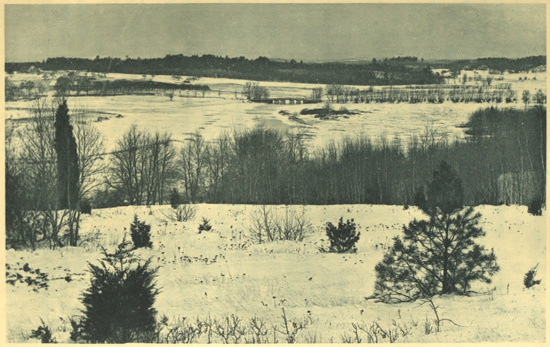
Winter Landscape from Fair Haven Hill
When the traveller in the forest, attaining to some
eminence, descries a column of smoke in the distance,
it is a very gentle hint to him of the presence of man.
It seems as if it would establish friendly relations between
them without more ado.[303]
[Dec.] 18. Saturday. Some men make their due impression
upon their generation, because a petty occasion
is enough to call forth all their energies; but are there
not others who would rise to much higher levels, whom
the world has never provoked to make the effort? I believe
there are men now living who have never opened
their mouths in a public assembly, in whom nevertheless
there is such a well of eloquence that the appetite
of any age could never exhaust it; who pine for an
occasion worthy of them, and will pine till they are dead;
who can admire, as well as the rest, at the flowing speech
of the orator, but do yet miss the thunder and lightning
and visible sympathy of the elements which would garnish
their own utterance.
If in any strait I see a man fluttered and his ballast
gone, then I lose all hope of him, he is undone; but if
he reposes still, though he do nothing else worthy of
him, if he is still a man in reserve, then is there everything
to hope of him. The age may well go pine itself
that it cannot put to use this gift of the gods. He lives
on, still unconcerned, not needing to be used. The
greatest occasion will be the slowest to come.
Sometimes a particular body of men do unconsciously
assert that their will is fate, that the right is decided
by their fiat without appeal, and when this is the case
they can never be mistaken; as when one man is quite
silenced by the thrilling eloquence of another, and submits
to be neglected as to his fate, because such is not
the willful vote of the assembly, but their instinctive
decision.
Dec. 23. Thursday. Concord.—The best man's spirit
makes a fearful sprite to haunt his tomb. The ghost of
a priest is no better than that of a highwayman. It
is pleasant to hear of one who has blest whole regions
after his death by having frequented them while alive,
who has prophaned or tabooed no place by being buried
in it.[304] It adds not a little to the fame of Little John
that his grave was long "celebrous for the yielding of
excellent whetstones."[305]
A forest is in all mythologies a sacred place, as the
oaks among the Druids and the grove of Egeria; and
even in more familiar and common life a celebrated
wood is spoken of with respect, as "Barnsdale Wood"
and "Sherwood." Had Robin Hood no Sherwood to
resort [to], it would be difficult to invest his story with
the charms it has got. It is always the tale that is untold,
the deeds done and the life lived in the unexplored
secrecy of the wood, that charm us and make us children
again,—to read his ballads, and hear of the
greenwood tree.
Dec. 24. Friday. I want to go soon and live away by
the pond, where I shall hear only the wind whispering
among the reeds. It will be success if I shall have left
myself behind. But my friends ask what I will do when
I get there. Will it not be employment enough to watch
the progress of the seasons?[306]
Dec. 25. Saturday. It does seem as if Nature did
for a long time gently overlook the prophanity of man.
The wood still kindly echoes the strokes of the axe, and
when the strokes are few and seldom, they add a new
charm to a walk. All the elements strive to naturalize
the sound.[307]
Such is our sympathy with the seasons that we experience
the same degree of heat in the winter as in the
summer.
It is not a true apology for any coarseness to say that
it is natural. The grim woods can afford to be very
delicate and perfect in the details.
I don't want to feel as if my life were a sojourn any
longer. That philosophy cannot be true which so paints
it. It is time now that I begin to live.
Dec. 26. Sunday. He is the rich man and enjoys the
fruits of riches, who, summer and winter forever, can
find delight in the contemplation of his soul. I could
look as unweariedly up to that cope as into the heavens
of a summer day or a winter night. When I hear this
bell ring, I am carried back to years and Sabbaths when
I was newer and more innocent, I fear, than now, and
it seems to me as if there were a world within a world.
Sin, I am sure, is not in overt acts or, indeed, in acts of
any kind, but is in proportion to the time which has
come behind us and displaced eternity,—that degree
to which our elements are mixed with the elements of
the world. The whole duty of life is contained in the
question how to respire and aspire both at once.
Dec. 29. Wednesday. One does not soon learn the
trade of life. That one may work out a true life requires
more art and delicate skill than any other work. There
is need of the nice fingers of the girl as well as the tough
hand of the farmer. The daily work is too often toughening
the pericarp of the heart as well as the hand.
Great familiarity with the world must be nicely managed,
lest it win away and bereave us of some susceptibility.
Experience bereaves us of our innocence; wisdom bereaves
us of our ignorance. Let us walk in the world
without learning its ways. Whole weeks or months of
my summer life slide away in thin volumes like mist or
smoke, till at length some warm morning, perchance,
I see a sheet of mist blown down the brook to the swamp,
its shadow flitting across the fields, which have caught
a new significance from that accident; and as that
vapor is raised above the earth, so shall the next weeks
be elevated above the plane of the actual;[308] or when the
setting sun slants across the pastures, and the cows low
to my inward ear and only enhance the stillness, and the
eve is as the dawn, a beginning hour and not a final one,
as if it would never have done, with its clear western
amber inciting men to lives of as limpid purity. Then
do other parts of my day's work shine than I had thought
at noon, for I discover the real purport of my toil, as,
when the husbandman has reached the end of the furrow
and looks back, he can best tell where the pressed
earth shines most.[309]
All true greatness runs as level a course, and is as
unaspiring, as the plow in the furrow. It wears the
homeliest dress and speaks the homeliest language.
Its theme is gossamer and dew lines, johnswort and
loosestrife, for it has never stirred from its repose and
is most ignorant of foreign parts. Heaven is the inmost
place. The good have not to travel far. What cheer
may we not derive from the thought that our courses do
not diverge, and we wend not asunder, but as the web
of destiny is woven it [is] fulled, and we are cast more
and more into the centre! And our fates even are social.[310]
There is no wisdom which can take [the] place
of humanity, and I find that in old Chaucer that love
rings longest which rhymes best with some saw of Milton's
or Edmunds's. I wish I could be as still as God
is. I can recall to my mind the stillest summer hour,
in which the grasshopper sings over the mulleins, and
there is a valor in that time the memory of which is
armor that can laugh at any blow of fortune. A man
should go out [of] nature with the chirp of the cricket or
the trill of the veery ringing in his ear. These earthly
sounds should only die away for a season, as the strains
of the harp rise and swell. Death is that expressive
pause in the music of the blast.[311] I would be as clean as
ye, O woods. I shall not rest till I be as innocent as you.
I know that I shall sooner or later attain to an unspotted
innocence, for when I consider that state even now I
am thrilled.
If we were wise enough, we should see to what virtue
we were indebted for any happier moment we might
have, nor doubt we had earned this at some time.
These motions everywhere in nature must surely
[be] the circulations of God. The flowing sail, the running
stream, the waving tree, the roving wind,—whence
else their infinite health and freedom?[312] I can see nothing
so proper and holy as unrelaxed play and frolic
in this bower God has built for us. The suspicion of sin
never comes to this thought. Oh, if men felt this they
would never build temples even of marble or diamond,
but it would be sacrilege and prophane, but disport them
forever in this paradise.
In the coldest day it melts somewhere.
It seems as if only one trait, one little incident in
human biography, need to be said or written in some
era, that all readers may go mad after it, and the man
who did the miracle is made a demigod henceforth.
What we all do, not one can tell; and when some lucky
speaker utters a truth of our experience and not of our
speculation, we think he must have had the nine Muses
and the three Graces to help him. I can at length
stretch me when I come to Chaucer's breadth; and I
think, "Well, I could be that man's acquaintance,"[313]
for he walked in that low and retired way that I do,
and was not too good to live. I am grieved when they
hint of any unmanly submissions he may have made,
for that subtracts from his breadth and humanity.
Dec. 30. Thursday. I admire Chaucer for a sturdy
English wit. The easy height he speaks from in his
Prologue to the Canterbury Tales is as good as anything
in it,—as if he were indeed better than any of
the company there assembled.[314]
The poet does not have to go out of himself and cease
to tattle of his domestic affairs, to win our confidence,
but is so broad that we see no limits to his sympathy.
Great delicacy and gentleness of character is constantly
displayed in Chaucer's verse. The simplest and
humblest words come readily to his lips. The natural
innocence of the man appears in the simple and pure
spirit in which "The Prioresses Tale" is conceived, in
which the child sings O alma redemptoris mater, and in
the account of the departure of Custance with her child
upon the sea, in "The Man of Lawes Tale."[315] The
whole story of Chanticleer and Dame Partlet in "The
Nonnes Preestes Tale" is genuine humanity. I know
nothing better in its kind. The poets seem to be only
more frank and plain-spoken than other men. Their
verse is but confessions. They always confide in the
reader, and speak privily with him, keeping nothing
back.[316]
I know of no safe rule by which to judge of the
purity of a former age but that I see that the impure of
the present age are not apt to rise to noble sentiments
when they speak or write, and suspect, therefore, that
there may be more truth than is allowed in the apology
that such was the manner of the age.[317]
Within the circuit of this plodding life,
There are moments of an azure hue
And as unspotted fair as is the violet
Or anemone, when the spring strews them
By some south woodside; which make untrue
The best philosophy which has so poor an aim
But to console man for his grievance here.
I have remembered when the winter came,
High in my chamber in the frosty nights,
How in the summer past some
Unrecorded beam slanted across
Some upland pasture where the Johnswort grew,
Or heard, amidst the verdure of my mind, the bee's
long-smothered hum,
So by the cheap economy of God made rich to go upon
my wintry work again.
In the still, cheerful cold of winter nights,
When, in the cold light of the moon,
On every twig and rail and jutting spout
The icy spears are doubling their length
Against the glancing arrows of the sun,
And the shrunk wheels creak along the way,
Some summer accident long past
Of lakelet gleaming in the July beams,
Or hum of bee under the blue flag,
Loitering in the meads, or busy rill
which now stands dumb and still,
its own memorial, purling at its play along the slopes,
and through the meadows next, till that its sound was
quenched in the staid current of its parent stream.
In memory is the more reality. I have seen how the
furrows shone but late upturned, and where the fieldfare
followed in the rear, when all the fields stood bound
and hoar beneath a thick integument of snow.[318]
When the snow is falling thick and fast, the flakes
nearest you seem to be driving straight to the ground,
while the more distant seem to float in the air in a quivering
bank, like feathers, or like birds at play, and not
as if sent on any errand. So, at a little distance, all the
works of Nature proceed with sport and frolic. They
are more in the eye and less in the deed.
Dec. 31. Friday. Books of natural history make the
most cheerful winter reading. I read in Audubon with
a thrill of delight, when the snow covers the ground,
of the magnolia, and the Florida keys, and their warm
sea breezes; of the fence-rail, and the cotton-tree, and
the migrations of the rice-bird; or of the breaking up
of winter in Labrador. I seem to hear the melting of the
snow on the forks of the Missouri as I read. I imbibe
some portion of health from these reminiscences of
luxuriant nature.
There is a singular health for me in those words
Labrador and East Main which no desponding creed
recognizes. How much more than federal are these
States! If there were no other vicissitudes but the seasons,
with their attendant and consequent changes, our
interest would never flag. Much more is a-doing than
Congress wots of in the winter season. What journal
do the persimmon and buckeye keep, or the sharp-shinned
hawk? What is transpiring from summer to
winter in the Carolinas, and the Great Pine Forest, and
the Valley of the Mohawk? The merely political aspect
of the land is never very cheering. Men are degraded
when considered as the members of a political organization.
As a nation the people never utter one great
and healthy word. From this side all nations present
only the symptoms of disease. I see but Bunker's Hill
and Sing Sing, the District of Columbia and Sullivan's
Island, with a few avenues connecting them. But paltry
are all these beside one blast of the east or south wind
which blows over them all.
In society you will not find health, but in nature.
You must converse much with the field and woods, if
you would imbibe such health into your mind and spirit
as you covet for your body. Society is always diseased,
and the best is the sickest. There is no scent in it so
wholesome as that of the pines, nor any fragrance so
penetrating and restorative as that of everlasting in
high pastures. Without that our feet at least stood in
the midst of nature, all our faces would be pale and
livid.
I should like to keep some book of natural history
always by me as a sort of elixir, the reading of which
would restore the tone of my system and secure me
true and cheerful views of life. For to the sick, nature
is sick, but to the well, a fountain of health. To the
soul that contemplates some trait of natural beauty no
harm nor disappointment can come. The doctrines of
despair, of spiritual or political servitude, no priestcraft
nor tyranny, was ever [sic] taught by such as drank in
the harmony of nature.[319]
Jan. 1. Virtue is the deed of the bravest. It is that
art which demands the greatest confidence and fearlessness.
Only some hardy soul ventures upon it. Virtue
is a bravery so hardy that it deals in what it has no
experience in. The virtuous soul possesses a fortitude
and hardihood which not the grenadier nor pioneer
can match. It never shrunk. It goes singing to its work.
Effort is its relaxation. The rude pioneer work of this
world has been done by the most devoted worshippers
of beauty.[320] Their resolution has possessed a keener
edge than the soldier's. In winter is their campaign;
they never go into quarters. They are elastic under the
heaviest burden, under the extremest physical suffering.
Methinks good courage will not flag here on the Atlantic
border as long as we are outflanked by the Fur
Countries. There is enough in that sound to cheer one
under any circumstances. The spruce, the hemlock,
and the pine will not countenance despair. Methinks
some creeds in vestries and churches do forget the
hunter wrapped in furs by the Great Slave Lake, or
how the Esquimaux sledges are drawn by dogs, and
in the twilight of the northern night the hunter does
not give over to follow the seal and walrus over the
ice. These men are sick and of diseased imaginations
who would toll the world's knell so soon. Cannot these
sedentary sects do better than prepare the shrouds and
write the epitaphs of those other busy living men?
The practical faith of men belies the preacher's consolation.
This is the creed of the hypochondriac.[321]
There is no infidelity so great as that which prays,
and keeps the Sabbath, and founds churches. The
sealer of the South Pacific preaches a truer doctrine.
The church is the hospital for men's souls, but the reflection
that he may one day occupy a ward in it should
not discourage the cheerful labors of the able-bodied
man. Let him remember the sick in their extremities,
but not look thither as to his goal.[322]
Jan. 2. Sunday. The ringing of the church bell is a
much more melodious sound than any that is heard
within the church. All great values are thus public, and
undulate like sound through the atmosphere. Wealth
cannot purchase any great private solace or convenience.
Riches are only the means of sociality. I will depend on
the extravagance of my neighbors for my luxuries, for
they will take care to pamper me if I will be overfed.
The poor man who sacrificed nothing for the gratification
seems to derive a safer and more natural enjoyment
from his neighbor's extravagance than he does himself.
It is a new natural product, from the contemplation of
which he derives new vigor and solace as from a natural
phenomenon.
In moments of quiet and leisure my thoughts are
more apt to revert to some natural than any human
relation.
Chaucer's sincere sorrow in his latter days for the
grossness of his earlier works, and that he "cannot
recall and annul" what he had "written of the base and
filthy love of men towards women; but alas they are
now continued from man to man," says he, "and I
cannot do what I desire," is all very creditable to his
character.
Chaucer is the make-weight of his century,—a
worthy representative of England while Petrarch and
Boccaccio lived in Italy, and Tell and Tamerlane in
Switzerland and Asia, and Bruce and Rienzi in Europe,
and Wickliffe and Gower in his own land. Edward III
and John of Gaunt and the Black Prince complete the
company. The fame of Roger Bacon came down from
the preceding century, and Dante, though just departed,
still exerted the influence of a living presence.[323]
With all his grossness he is not undistinguished for the
tenderness and delicacy of his muse. A simple pathos
and feminine gentleness is peculiar to him which not
even Wordsworth can match.[324] And then his best passages
of length are marked by a happy and healthy wit
which is rather rare in the poetry of any nation. On the
whole, he impresses me as greater than his reputation,
and not a little like Homer and Shakespeare, for he
would have held up his head in their company. Among
the earliest English poets he is their landlord and host,
and has the authority of such. We read him with affection
and without criticism, for he pleads no cause, but
speaks for us, his readers, always. He has that greatness
of trust and reliance which compels popularity. He is for
a whole country and country [sic] to know and to be
proud of. The affectionate mention which succeeding
early poets make of him, coupling him with Homer and
Virgil, is also to be taken into the account in estimating
his character. King James and Dunbar of Scotland
speak with more love and reverence of him than any
cotemporary poet of his predecessors of the last century.
That childlike relation, indeed, does not seem to exist
now which was then.[325]
Jan. 3. Monday. It is pleasant when one can relieve
the grossness of the kitchen and the table by the simple
beauty of his repast, so that there may be anything in it
to attract the eye of the artist even. I have been popping
corn to-night, which is only a more rapid blossoming of
the seed under a greater than July heat. The popped
corn is a perfect winter flower, hinting of anemones and
houstonias. For this little grace man has, mixed in with
the vulgarness of his repast, he may well thank his stars.
The law by which flowers unfold their petals seems only
to have operated more suddenly under the intense heat.
It looks like a sympathy in this seed of the corn with its
sisters of the vegetable kingdom, as if by preference it
assumed the flower form rather than the crystalline.
Here has bloomed for my repast such a delicate blossom
as will soon spring by the wall-sides. And this is as it
should be. Why should not Nature revel sometimes, and
genially relax and make herself familiar at my board?
I would have my house a bower fit to entertain her. It
is a feast of such innocence as might have snowed down.
By my warm hearth sprang these cerealious blossoms;
here was the bank where they grew.
Methinks some such visible token of approval would
always accompany the simple and healthy repast.
There would be such a smiling and blessing upon it.
Our appetite should always be so related to our taste,
and the board we spread for its gratification be an
epitome of the universal table which Nature sets by hill
and wood and stream for her dumb pensioners.[326]
Jan. 5. Wednesday. I find that whatever hindrances
may occur I write just about the same amount of truth
in my Journal; for the record is more concentrated, and
usually it is some very real and earnest life, after all, that
interrupts. All flourishes are omitted. If I saw wood
from morning to night, though I grieve that I could not
observe the train of my thoughts during that time, yet,
in the evening, the few scrannel lines which describe
my day's occupations will make the creaking of the saw
more musical than my freest fancies could have been. I
find incessant labor with the hands, which engrosses the
attention also, the best method to remove palaver out of
one's style. One will not dance at his work who has
wood to cut and cord before the night falls in the short
days of winter; but every stroke will be husbanded, and
ring soberly through the wood; and so will his lines
ring and tell on the ear, when at evening he settles the
accounts of the day. I have often been astonished at
the force and precision of style to which busy laboring
men, unpracticed in writing, easily attain when they
are required to make the effort. It seems as if their
sincerity and plainness were the main thing to be taught
in schools,—and yet not in the schools, but in the
fields, in actual service, I should say. The scholar not
unfrequently envies the propriety and emphasis with
which the farmer calls to his team, and confesses that
if that lingo were written it would surpass his labored
sentences.
Who is not tired of the weak and flowing periods of
the politician and scholar, and resorts not even to the
Farmer's Almanac, to read the simple account of the
month's labor, to restore his tone again? I want to see
a sentence run clear through to the end, as deep and
fertile as a well-drawn furrow which shows that the
plow was pressed down to the beam. If our scholars
would lead more earnest lives, we should not witness
those lame conclusions to their ill-sown discourses, but
their sentences would pass over the ground like loaded
rollers, and not mere hollow and wooden ones, to press
in the seed and make it germinate.
A well-built sentence, in the rapidity and force with
which it works, may be compared to a modern corn-planter,
which furrows out, drops the seed, and covers it
up at one movement.[327]
The scholar requires hard labor as an impetus to his
pen. He will learn to grasp it as firmly and wield it as
gracefully and effectually as an axe or a sword. When
I consider the labored periods of some gentleman
scholar, who perchance in feet and inches comes up to
the standard of his race, and is nowise deficient in
girth, I am amazed at the immense sacrifice of thews
and sinews. What! these proportions and these bones,
and this their work! How these hands hewed this
fragile matter, mere filagree or embroidery fit for
ladies' fingers! Can this be a stalwart man's work, who
has marrow in his backbone and a tendon Achilles
in his heel? They who set up Stonehenge did somewhat,—much
in comparison,—if it were only their
strength was once fairly laid out, and they stretched
themselves.[328]
I discover in Raleigh's verses the vices of the courtier.
They are not equally sustained, as if his noble genius
were warped by the frivolous society of the court. He
was capable of rising to a remarkable elevation. His
poetry has for the most part a heroic tone and vigor as of
a knight errant. But again there seems to have been
somewhat unkindly in his education, and as if he had by
no means grown up to be the man he promised. He was
apparently too genial and loyal a soul, or rather he was
incapable of resisting temptations from that quarter.
If to his genius and culture he could have added the
temperament of Fox or Cromwell, the world would have
had cause longer to remember him. He was the pattern
of nobility. One would have said it was by some lucky
fate that he and Shakespeare flourished at the same
time in England, and yet what do we know of their
acquaintanceship?
Jan. 7. Friday. I am singularly refreshed in winter
when I hear tell of service-berries, pokeweed, juniper.
Is not heaven made up of these cheap summer glories?[329]
The great God is very calm withal. How superfluous
is any excitement in his creatures! He listens equally
to the prayers of the believer and the unbeliever. The
moods of man should unfold and alternate as gradually
and placidly as those of nature. The sun shines for aye!
The sudden revolutions of these times and this generation
have acquired a very exaggerated importance.
They do not interest me much, for they are not in harmony
with the longer periods of nature. The present, in
any aspect in which it can be presented to the smallest
audience, is always mean. God does not sympathize
with the popular movements.
Jan. 8. Saturday. When, as now, in January a south
wind melts the snow, and the bare ground appears,
covered with sere grass and occasionally wilted green
leaves which seem in doubt whether to let go their
greenness quite or absorb new juices against the coming
year,—in such a season a perfume seems to exhale
from the earth itself and the south wind melts my integuments
also. Then is she my mother earth. I derive
a real vigor from the scent of the gale wafted over the
naked ground, as from strong meats, and realize again
how man is the pensioner of Nature. We are always
conciliated and cheered when we are fed by [such] an
influence, and our needs are felt to be part of the
domestic economy of Nature.
What offends me most in my compositions is the
moral element in them. The repentant say never a
brave word. Their resolves should be mumbled in
silence. Strictly speaking, morality is not healthy.
Those undeserved joys which come uncalled and make
us more pleased than grateful are they that sing.
One music seems to differ from another chiefly in its
more perfect time, to use this word in a true sense. In
the steadiness and equanimity of music lies its divinity.
It is the only assured tone.[330] When men attain to speak
with as settled a faith and as firm assurance, their voices
will sing and their feet march as do the feet of the
soldier. The very dogs howl if time is disregarded.
Because of the perfect time of this music-box—its
harmony with itself—is its greater dignity and stateliness.
This music is more nobly related for its more exact
measure. So simple a difference as this more even pace
raises it to the higher dignity.
Man's progress through nature should have an accompaniment
of music. It relieves the scenery, which is seen
through it as a subtler element, like a very clear morning
air in autumn. Music wafts me through the clear,
sultry valleys, with only a slight gray vapor against the
hills.
Of what manner of stuff is the web of time wove,
when these consecutive sounds called a strain of music
can be wafted down through the centuries from Homer
to me, and Homer have been conversant with that same
unfathomable mystery and charm which so newly
tingles my ears?[331] These single strains, these melodious
cadences which plainly proceed out of a very deep
meaning and a sustained soul, are the interjections of
God. They are perhaps the expression of the perfect
knowledge which the righteous at length attain to. Am
I so like thee, my brother, that the cadence of two notes
affects us alike? Shall I not some time have an opportunity
to thank him who made music? I feel a sad cheer
when I hear these lofty strains,[332] because there must be
something in me as lofty that hears. But ah, I hear them
but rarely! Does it not rather hear me? If my blood
were clogged in my veins, I am sure it would run more
freely. God must be very rich, who, for the turning of a
pivot, can pour out such melody on me. It is a little
prophet; it tells me the secrets of futurity. Where are
its secrets wound up but in this box?[333] So much hope
had slumbered. There are in music such strains as
far surpass any faith in the loftiness of man's destiny.[334]
He must be very sad before he can comprehend them.
The clear, liquid notes from the morning fields beyond
seem to come through a vale of sadness to man, which
gives all music a plaintive air. It hath caught a higher
pace than any virtue I know. It is the arch-reformer.
It hastens the sun to his setting. It invites him to his
rising. It is the sweetest reproach, a measured satire.
I know there is a people somewhere [where] this heroism
has place. Or else things are to be learned which
it will be sweet to learn.[335] This cannot be all rumor.
When I hear this, I think of that everlasting and
stable something which is not sound, but to be a thrilling
reality, and can consent to go about the meanest
work for as many years of time as it pleases even the
Hindoo penance, for a year of the gods were as nothing
to that which shall come after. What, then, can I do
to hasten that other time, or that space where there
shall be no time, and these things be a more living part
of my life,—where there will be no discords in my
life?
Jan. 9. Sunday. One cannot too soon forget his errors
and misdemeanors; for [to] dwell long upon them is to
add to the offense, and repentance and sorrow can only
be displaced by somewhat better, and which is as free
and original as if they had not been. Not to grieve long
for any action, but to go immediately and do freshly and
otherwise, subtracts so much from the wrong. Else we
may make the delay of repentance the punishment of
the sin. But a great nature will not consider its sins as
its own, but be more absorbed in the prospect of that
valor and virtue for the future which is more properly
it, than in those improper actions which, by being sins,
discover themselves to be not it.
Sir W. Raleigh's faults are those of a courtier and
a soldier. In his counsels and aphorisms we see not
unfrequently the haste and rashness of a boy. His
philosophy was not wide nor deep, but continually
giving way to the generosity of his nature. What he
touches he adorns by his greater humanity and native
nobleness, but he touches not the true nor original.
He thus embellishes the old, but does not unfold the
new. He seems to have been fitted by his genius for short
flights of impulsive poetry, but not for the sustained
loftiness of Shakespeare or Milton. He was not wise nor
a seer in any sense, but rather one of nature's nobility;
the most generous nature which can be spared to linger
in the purlieus of the court.
His was a singularly perverted genius, with such an
inclination to originality and freedom, and yet who
never steered his own course. Of so fair and susceptible
a nature, rather than broad or deep, that he delayed to
slake his thirst at the nearest and even more turbid wells
of truth and beauty. Whose homage to the least fair
or noble left no space for homage to the all fair. The
misfortune of his circumstances, or rather of the man,
appears in the fact that he was the author of "Maxims
of State" and "The Cabinet Council" and "The Soul's
Errand."
Feb. 19. Saturday. I never yet saw two men sufficiently
great to meet as two. In proportion as they are
great the differences are fatal, because they are felt not
to be partial but total. Frankness to him who is unlike
me will lead to the utter denial of him. I begin to see
how that the preparation for all issues is to do virtuously.
When two approach to meet, they incur no petty dangers,
but they run terrible risks. Between the sincere
there will be no civilities. No greatness seems prepared
for the little decorum, even savage unmannerliness, it
meets from equal greatness.
Feb. 20. Sunday. "Examine animal forms geometrically,
from man, who represents the perpendicular, to
the reptile which forms the horizontal line, and then
applying to those forms the rules of the exact sciences,
which God himself cannot change, we shall see that
visible nature contains them all; that the combinations
of the seven primitive forms are entirely exhausted, and
that, therefore, they can represent all possible varieties
of morality."—From "The True Messiah; or the Old
and New Testaments, examined according to the Principles
of the Language of Nature. By G. Segger,"
translated from French by Grater.
I am amused to see from my window here how busily
man has divided and staked off his domain. God must
smile at his puny fences running hither and thither
everywhere over the land.
My path hitherto has been like a road through a
diversified country, now climbing high mountains, then
descending into the lowest vales. From the summits
I saw the heavens; from the vales I looked up to the
heights again. In prosperity I remember God, or
memory is one with consciousness; in adversity I remember
my own elevations, and only hope to see God
again.
It is vain to talk. What do you want? To bandy
words, or deliver some grains of truth which stir within
you? Will you make a pleasant rumbling sound after
feasting, for digestion's sake, or such music as the birds
in springtime?
The death of friends should inspire us as much as
their lives. If they are great and rich enough, they will
leave consolation to the mourners before the expenses
of their funerals.[336] It will not be hard to part with any
worth, because it is worthy. How can any good depart?
It does not go and come, but we. Shall we wait for it?
Is it slower than we?
Feb. 21. I must confess there is nothing so strange to
me as my own body. I love any other piece of nature,
almost, better.
I was always conscious of sounds in nature which my
ears could never hear,—that I caught but the prelude
to a strain. She always retreats as I advance. Away
behind and behind is she and her meaning. Will not
this faith and expectation make to itself ears at length?
I never saw to the end, nor heard to the end; but the
best part was unseen and unheard.
I am like a feather floating in the atmosphere; on
every side is depth unfathomable.
I feel as if years had been crowded into the last
month,[337] and yet the regularity of what we call time
has been so far preserved as that I[338] ... will be
welcome in the present. I have lived ill for the most
part because too near myself. I have tripped myself up,
so that there was no progress for my own narrowness.
I cannot walk conveniently and pleasantly but when I
hold myself far off in the horizon. And the soul dilutes
the body and makes it passable. My soul and body have
tottered along together of late, tripping and hindering
one another like unpracticed Siamese twins. They two
should walk as one, that no obstacle may be nearer than
the firmament.
There must be some narrowness in the soul that compels
one to have secrets.
Feb. 23. Wednesday. Every poet's muse is circumscribed
in her wanderings, and may be well said to
haunt some favorite spring or mountain. Chaucer
seems to have been the poet of gardens. He has hardly
left a poem in which some retired and luxurious retreat
of the kind is not described, to which he gains access by
some secret port, and there, by some fount or grove, is
found his hero and the scene of his tale. It seems as if,
by letting his imagination riot in the matchless beauty
of an ideal garden, he thus fed [sic] his fancy on to the
invention of a tale which would fit the scene. The muse
of the most universal poet retires into some familiar
nook, whence it spies out the land as the eagle from his
eyrie, for he who sees so far over plain and forest is
perched in a narrow cleft of the crag. Such pure childlike
love of Nature is nowhere to be matched.[339] And it is
not strange that the poetry of so rude an age should
contain such polished praise of Nature; for the charms
of Nature are not enhanced by civilization, as society is,
but she possesses a permanent refinement, which at last
subdues and educates men.
The reader has great confidence in Chaucer. He tells
no lies. You read his story with a smile, as if it were
the circumlocution of a child, and yet you find that he
has spoke with more directness and economy of words
than a sage. He is never heartless. So new was all his
theme in those days, that [he] had not to invent, but only
to tell.[340]
The language of poetry is infantile. It cannot talk.
It is the charm and greatness of all society, from
friendship to the drawing-room, that it takes place on
a level slightly higher than the actual characters of the
parties would warrant;[341] it is an expression of faith.
True politeness is only hope and trust in men. It never
addresses a fallen or falling man, but salutes a rising
generation. It does not flatter, but only congratulates.
The rays of light come to us in such a curve that every
fellow in the street appears higher than he really is.
It is the innate civility of nature.[342]
I am glad that it was so because it could be.
March 1. Whatever I learn from any circumstances,
that especially I needed to know. Events come out of
God, and our characters determine them and constrain
fate, as much as they determine the words and tone of
a friend to us. Hence are they always acceptable as
experience, and we do not see how we could have done
without them.
March 2. The greatest impression of character is
made by that person who consents to have no character.
He who sympathizes with and runs through the
whole circle of attributes cannot afford to be an individual.
Most men stand pledged to themselves, so that
their narrow and confined virtue has no suppleness.
They are like children who cannot walk in bad company
and learn the lesson which even it teaches, without their
guardians, for fear of contamination. He is a fortunate
man who gets through the world without being burthened
by a name and reputation, for they are at any
rate but his past history and no prophecy, and as such
concern him no more than another. Character is
Genius settled. It can maintain itself against the world,
and if it relapses it repents. It is as a dog set to watch
the property of Genius. Genius, strictly speaking, is
not responsible, for it is not moral.
March 8. I live in the perpetual verdure of the globe.
I die in the annual decay of nature.
We can understand the phenomenon of death in the
animal better if we first consider it in the order next
below us, the vegetable.
The death of the flea and the elephant are but phenomena
of the life of nature.
Most lecturers preface their discourses on music
with a history of music, but as well introduce an essay
on virtue with a history of virtue.[343] As if the possible
combinations of sound, the last wind that sighed, or
melody that waked the wood, had any history other
than a perceptive ear might hear in the least and latest
sound of nature! A history of music would be like the
history of the future; for so little past is it, and capable
of record, that it is but the hint of a prophecy. It is the
history of gravitation. It has no history more than God.
It circulates and resounds forever, and only flows like
the sea or air. There might be a history of men or of
hearing, but not of the unheard. Why, if I should sit
down to write its story, the west wind would rise to
refute me. Properly speaking, there can be no history
but natural history, for there is no past in the soul but
in nature. So that the history of anything is only the
true account of it, which will be always the same. I
might as well write the history of my aspirations. Does
not the last and highest contain them all? Do the lives
of the great composers contain the facts which interested
them? What is this music? Why, thinner and more
evanescent than ether; subtler than sound, for it is only
a disposition of sound. It is to sound what color is to
matter. It is the color of a flame, or of the rainbow, or
of water. Only one sense has known it. The least
profitable, the least tangible fact, which cannot be
bought or cultivated but by virtuous methods, and yet
our ears ring with it like shells left on the shore.
March 11. Friday. Chaucer's familiar, but innocent,
way of speaking of God is of a piece with his character.
He comes readily to his thoughts without any false reverence.
If Nature is our mother, is not God much
more? God should come into our thoughts with no more
parade than the zephyr into our ears. Only strangers
approach him with ceremony. How rarely in our English
tongue do we find expressed any affection for God!
No sentiment is so rare as love of God,—universal
love. Herbert is almost the only exception. "Ah, my
dear God," etc. Chaucer's was a remarkably affectionate
genius. There is less love and simple trust in Shakespeare.
When he sees a beautiful person or object, he
almost takes a pride in the "maistry" of his God.[344] The
Protestant Church seems to have nothing to supply the
place of the Saints of the Catholic calendar, who were
at least channels for the affections. Its God has perhaps
too many of the attributes of a Scandinavian deity.
We can only live healthily the life the gods assign us.
I must receive my life as passively as the willow leaf
that flutters over the brook. I must not be for myself,
but God's work, and that is always good. I will wait
the breezes patiently, and grow as Nature shall determine.
My fate cannot but be grand so. We may live
the life of a plant or an animal, without living an animal
life. This constant and universal content of the
animal comes of resting quietly in God's palm. I feel
as if [I] could at any time resign my life and the responsibility
of living into God's hands, and become as
innocent, free from care, as a plant or stone.
My life, my life! why will you linger? Are the years
short and the months of no account? How often has
long delay quenched my aspirations! Can God afford
that I should forget him? Is he so indifferent to my
career? Can heaven be postponed with no more ado?
Why were my ears given to hear those everlasting strains
which haunt my life, and yet to be prophaned much more
by these perpetual dull sounds?
Our doubts are so musical that they persuade themselves.
Why, God, did you include me in your great scheme?
Will you not make me a partner at last? Did it need
there should be a conscious material?
My friend, my friend, I'd speak so frank to thee that
thou wouldst pray me to keep back some part, for fear
I robbed myself. To address thee delights me, there
is such cleanness in the delivery. I am delivered of my
tale, which, told to strangers, still would linger on my
lips as if untold, or doubtful how it ran.
March 12. Consider what a difference there is between
living and dying. To die is not to begin to die,
and continue; it is not a state of continuance, but of
transientness; but to live is a condition of continuance,
and does not mean to be born merely. There is no
continuance of death. It is a transient phenomenon.
Nature presents nothing in a state of death.
March 13. Sunday. The sad memory of departed
friends is soon incrusted over with sublime and pleasing
thoughts, as their monuments are overgrown with moss.[345]
Nature doth thus kindly heal every wound. By the
mediation of a thousand little mosses and fungi, the
most unsightly objects become radiant of beauty. There
seem to be two sides to this world, presented us at different
times, as we see things in growth or dissolution,
in life or death. For seen with the eye of a poet, as
God sees them, all are alive and beautiful; but seen
with the historical eye, or the eye of the memory, they
are dead and offensive. If we see Nature as pausing,
immediately all mortifies and decays; but seen as progressing,
she is beautiful.
I am startled that God can make me so rich even
with my own cheap stores. It needs but a few wisps of
straw in the sun, or some small word dropped, or that
has long lain silent in some book. When heaven begins
and the dead arise, no trumpet is blown; perhaps the
south wind will blow. What if you or I be dead! God
is alive still.
March 14. Chaucer's genius does not soar like Milton's,
but is genial and familiar. It is only a greater
portion of humanity, with all its weakness. It is not
heroic, as Raleigh, or pious, as Herbert, or philosophical,
as Shakespeare, but the child of the English nation, but
that child that is "father of the man." His genius is
only for the most part an exceeding naturalness. It is
perfect sincerity, though with the behavior of a child
rather than of a man.[346] He can complain, as in the
"Testament of Love," but yet so truly and unfeignedly
that his complaint does not fail to interest. All England
has his case at heart.
He shows great tenderness and delicacy, but not the
heroic sentiment. His genius was feminine, not masculine,—not
but such is rarest to find in woman (though
the appreciation of it is not),—but less manly than the
manliest.[347]
It is not easy to find one brave enough to play the
game of love quite alone with you, but they must get
some third person, or world, to countenance them.
They thrust others between. Love is so delicate and
fastidious that I see not how [it] can ever begin. Do you
expect me to love with you, unless you make my love
secondary to nothing else? Your words come tainted,
if the thought of the world darted between thee and the
thought of me. You are not venturous enough for love.
It goes alone unscared through wildernesses.
As soon as I see people loving what they see merely,
and not their own high hopes that they form of others, I
pity, and do not want their love. Such love delays me.
Did I ask thee to love me who hate myself? No! Love
that I love, and I will love thee that lovest it.
The love is faint-hearted and short-lived that is contented
with the past history of its object. It does not
prepare the soil to bear new crops lustier than the old.
"I would I had leisure for these things," sighs the
world. "When I have done my quilting and baking,
then I will not be backward."
Love never stands still, nor does its object. It is the
revolving sun and the swelling bud. If I know what I
love, it is because I remember it.
Life is grand, and so are its environments of Past and
Future. Would the face of nature be so serene and
beautiful if man's destiny were not equally so? What
am I good for now, who am still marching after high
things, but to hear and tell the news, to bring wood and
water, and count how many eggs the hens lay? In the
meanwhile, I expect my life will begin. I will not aspire
longer. I will see what it is I would be after. I will be
unanimous.
March 15. Tuesday. It is a new day; the sun shines.
The poor have come out to employ themselves in the
sunshine, the old and feeble to scent the air once more.
I hear the bluebird and the song sparrow and the
robin, and the note of the lark leaks up through the
meadows, as if its bill had been thawed by the warm
sun.
As I am going to the woods I think to take some small
book in my pocket whose author has been there already,
whose pages will be as good as my thoughts, and will eke
them out or show me human life still gleaming in the
horizon when the woods have shut out the town. But I
can find none. None will sail as far forward into the bay
of nature as my thought. They stay at home. I would
go home. When I get to the wood their thin leaves
rustle in my fingers. They are bare and obvious, and
there is no halo or haze about them. Nature lies far and
fair behind them all.[348] I should like to meet the great
and serene sentence, which does not reveal itself,—only
that it is great,—which I may never with my
utmost intelligence pierce through and beyond (more
than the earth itself), which no intelligence can understand.
There should be a kind of life and palpitation to
it; under its rind a kind of blood should circulate forever,
communicating freshness to its countenance.[349]
Cold Spring.—I hear nothing but a phœbe, and the
wind, and the rattling of a chaise in the wood. For a
few years I stay here, not knowing, taking my own life
by degrees, and then I go. I hear a spring bubbling
near, where I drank out of a can in my earliest youth.
The birds, the squirrels, the alders, the pines, they seem
serene and in their places. I wonder if my life looks as
serene to them too. Does no creature, then, see with the
eyes of its own narrow destiny, but with God's? When
God made man, he reserved some parts and some rights
to himself. The eye has many qualities which belong
to God more than man. It is his lightning which flashes
in it. When I look into my companion's eye, I think
it is God's private mine. It is a noble feature; it cannot
be degraded; for God can look on all things undefiled.
Pond.—Nature is constantly original and inventing
new patterns, like a mechanic in his shop. When the
overhanging pine drops into the water, by the action of
the sun, and the wind rubbing it on the shore, its boughs
are worn white and smooth and assume fantastic forms,
as if turned by a lathe.[350] All things, indeed, are subjected
to a rotary motion, either gradual and partial or
rapid and complete, from the planet and system to the
simplest shellfish and pebbles on the beach; as if all
beauty resulted from an object turning on its own axis,
or others turning about it. It establishes a new centre
in the universe. As all curves have reference to their
centres or foci, so all beauty of character has reference
to the soul, and is a graceful gesture of recognition or
waving of the body toward it.
The great and solitary heart will love alone, without
the knowledge of its object. It cannot have society in its
love. It will expend its love as the cloud drops rain upon
the fields over which [it] floats.
The only way to speak the truth is to speak lovingly;
only the lover's words are heard. The intellect should
never speak; it is not a natural sound. How trivial the
best actions are! I am led about from sunrise to sunset
by an ignoble routine, and yet can find no better road.
I must make a part of the planet. I must obey the law
of nature.
March 16. Wednesday. Raleigh's Maxims are not true
and impartial, but yet are expressed with a certain magnanimity,
which was natural to the man, as if this selfish
policy could easily afford to give place in him to a more
human and generous. He gives such advice that we have
more faith in his conduct than his principles.
He seems to have carried the courtier's life to the
highest pitch of magnanimity and grace it was capable
of. He is liberal and generous as a prince,—that is,
within bounds; brave, chivalrous, heroic, as the knight
in armor and not as a defenseless man. His was not the
heroism of Luther, but of Bayard. There was more of
grace than of truth in it. He had more taste than character.
There may be something petty in a refined taste;
it easily degenerates into effeminacy; it does not consider
the broadest use. It is not content with simple
good and bad, and so is fastidious and curious, or nice
only.
The most attractive sentences are not perhaps the
wisest, but the surest and soundest. He who uttered
them had a right to speak. He did not stand on a rolling
stone, but was well assured of his footing, and naturally
breathed them without effort. They were spoken in the
nick of time. With rare fullness were they spoken, as a
flower expands in the field; and if you dispute their doctrine,
you will say, "But there is truth in their assurance."
Raleigh's are of this nature, spoken with entire
satisfaction and heartiness. They are not philosophy,
but poetry.
With him it was always well done and nobly said.
That is very true which Raleigh says about the equal
necessity of war and law,—that "the necessity of war,
which among human actions is most lawless, hath some
kind of affinity and near resemblance with the necessity
of law;" for both equally rest on force as their basis, and
war is only the resource of law, either on a smaller or
larger scale,—its authority asserted. In war, in some
sense, lies the very genius of law. It is law creative and
active; it is the first principle of the law. What is human
warfare but just this,—an effort to make the laws of
God and nature take sides with one party. Men make
an arbitrary code, and, because it is not right, they try
to make it prevail by might. The moral law does not
want any champion. Its asserters do not go to war. It
was never infringed with impunity. It is inconsistent
to decry war and maintain law, for if there were no need
of war there would be no need of law.
I must confess I see no resource but to conclude that
conscience was not given us to no purpose, or for a hindrance,
but that, however flattering order and expediency
may look, it is but the repose of a lethargy; and
we will choose rather to be awake, though it be stormy,
and maintain ourselves on this earth and in this life as
we may, without signing our death-warrant in the outset.
What does the law protect? My rights? or any rights?
My right, or the right? If I avail myself of it, it may help
my sin; it cannot help my virtue. Let us see if we cannot
stay here, where God has put us, on his own conditions.
Does not his law reach to the earth? While the law holds
fast the thief and murderer for my protection (I should
say its own), it lets itself go loose. Expediencies differ.
They may clash. English law may go to war with American
law, that is English interest with American interest,
but what is expedient for the whole world will be absolute
right, and synonymous with the law of God. So the
law is only partial right. It is selfish, and consults for the
interest of the few.[351]
Somehow, strangely, the vice of men gets well represented
and protected, but their virtue has none to plead
its cause, nor any charter of immunities and rights. The
Magna Charta is not chartered rights, but chartered
wrongs.
March 17. Thursday. I have been making pencils all
day, and then at evening walked to see an old schoolmate
who is going to help make the Welland Canal
navigable for ships round Niagara. He cannot see any
such motives and modes of living as I; professes not
to look beyond the securing of certain "creature comforts."
And so we go silently different ways, with all
serenity, I in the still moonlight through the village this
fair evening to write these thoughts in my journal, and
he, forsooth, to mature his schemes to ends as good,
maybe, but different. So are we two made, while the
same stars shine quietly over us. If I or he be wrong,
Nature yet consents placidly. She bites her lip and
smiles to see how her children will agree. So does the
Welland Canal get built, and other conveniences, while
I live. Well and good, I must confess. Fast sailing ships
are hence not detained.
What means this changing sky, that now I freeze and
contract and go within myself to warm me, and now I
say it is a south wind, and go all soft and warm along the
way? I sometimes wonder if I do not breathe the south
wind.
March 18. Friday. Whatever book or sentence will
bear to be read twice, we may be sure was thought twice.
I say this thinking of Carlyle, who writes pictures or first
impressions merely, which consequently will only bear a
first reading. As if any transient, any new, mood of the
best man deserved to detain the world long. I should call
Carlyle's writing essentially dramatic, excellent acting,
entertaining especially to those who see rather than those
who hear, not to be repeated more than a joke. If he did
not think who made the joke, how shall we think who
hear it? He never consults the oracle, but thinks to utter
oracles himself. There is nothing in his books for which
he is not, and does not feel, responsible. He does not
retire behind the truth he utters, but stands in the foreground.
I wish he would just think, and tell me what
he thinks, appear to me in the attitude of a man with
his ear inclined, who comes as silently and meekly as
the morning star, which is unconscious of the dawn it
heralds, leading the way up the steep as though alone
and unobserved in its observing, without looking behind.
He is essentially a humorist. But humors will
not feed a man; they are the least satisfactory morsel
to the healthy appetite. They circulate; I want rather
to meet that about which they circulate. The heart
is not a humor, nor do they go to the heart, as the
blood does.[352]
March 19. Saturday. When I walk in the fields of
Concord and meditate on the destiny of this prosperous
slip of the Saxon family, the unexhausted energies of
this new country, I forget that this which is now Concord
was once Musketaquid, and that the American
race has had its destiny also. Everywhere in the fields,
in the corn and grain land, the earth is strewn with the
relics of a race which has vanished as completely as if
trodden in with the earth. I find it good to remember
the eternity behind me as well as the eternity before.
Wherever I go, I tread in the tracks of the Indian. I
pick up the bolt which he has but just dropped at my
feet. And if I consider destiny I am on his trail. I scatter
his hearthstones with my feet, and pick out of the
embers of his fire the simple but enduring implements
of the wigwam and the chase. In planting my corn in
the same furrow which yielded its increase to his support
so long, I displace some memorial of him.
I have been walking this afternoon over a pleasant
field planted with winter rye, near the house, where this
strange people once had their dwelling-place. Another
species of mortal men, but little less wild to me than the
musquash they hunted. Strange spirits, dæmons, whose
eyes could never meet mine; with another nature and
another fate than mine. The crows flew over the edge
of the woods, and, wheeling over my head, seemed to
rebuke, as dark-winged spirits more akin to the Indian
than I. Perhaps only the present disguise of the Indian.
If the new has a meaning, so has the old.[353]
Nature has her russet hues as well as green. Indeed,
our eye splits on every object, and we can as well take
one path as the other. If I consider its history, it is old;
if its destiny, it is new. I may see a part of an object,
or the whole. I will not be imposed on and think Nature
is old because the season is advanced. I will study
the botany of the mosses and fungi on the decayed
[wood], and remember that decayed wood is not old,
but has just begun to be what it is. I need not think of
the pine almond[354] or the acorn and sapling when I meet
the fallen pine or oak, more than of the generations
of pines and oaks which have fed the young tree. The
new blade of the corn, the third leaf of the melon, these
are not green but gray with time, but sere in respect
of time.
The pines and the crows are not changed, but instead
that Philip and Paugus stand on the plain, here are
Webster and Crockett. Instead of the council-house
is the legislature. What a new aspect have new eyes
given to the land! Where is this country but in the
hearts of its inhabitants? Why, there is only so much
of Indian America left as there is of the American
Indian in the character of this generation.
A blithe west wind is blowing over all. In the fine
flowing haze, men at a distance seem shadowy and
gigantic, as ill-defined and great as men should always
be. I do not know if yonder be a man or a ghost.
What a consolation are the stars to man!—so high
and out of his reach, as is his own destiny. I do not know
but my life is fated to be thus low and grovelling always.
I cannot discover its use even to myself. But it is permitted
to see those stars in the sky equally useless, yet
highest of all and deserving of a fair destiny. My fate
is in some sense linked with that of the stars, and if they
are to persevere to a great end, shall I die who could
conjecture it? It surely is some encouragement to know
that the stars are my fellow-creatures, for I do not suspect
but they are reserved for a high destiny. Has not
he who discovers and names a planet in the heavens
as long a year as it? I do not fear that any misadventure
will befall them. Shall I not be content to disappear
with the missing stars? Do I mourn their fate?
Man's moral nature is a riddle which only eternity
can solve.
I see laws which never fail, of whose failure I never
conceived. Indeed I cannot detect failure anywhere but
in my fear. I do not fear that right is not right, that
good is not good, but only the annihilation of the present
existence. But only that can make me incapable of
fear. My fears are as good prophets as my hopes.
March 20. Sunday. My friend is cold and reserved
because his love for me is waxing and not waning. These
are the early processes; the particles are just beginning
to shoot in crystals. If the mountains came to me, I
should no longer go to the mountains. So soon as that
consummation takes place which I wish, it will be past.
Shall I not have a friend in reserve? Heaven is to come.
I hope this is not it.
Words should pass between friends as the lightning
passes from cloud to cloud. I don't know how much
I assist in the economy of nature when I declare a fact.
Is it not an important part in the history of the flower
that I tell my friend where I found it? We do [not]
wish friends to feed and clothe our bodies,—neighbors
are kind enough for that,—but to do the like offices to
ourselves.[355] We wish to spread and publish ourselves,
as the sun spreads its rays; and we toss the new thought
to the friend, and thus it is dispersed. Friends are those
twain who feel their interests to be one. Each knows
that the other might as well have said what he said.
All beauty, all music, all delight springs from apparent
dualism but real unity. My friend is my real brother.
I see his nature groping yonder like my own. Does there
go one whom I know? then I go there.
The field where friends have met is consecrated forever.
Man seeks friendship out of the desire to realize
a home here. As the Indian thinks he receives into himself
the courage and strength of his conquered enemy,
so we add to ourselves all the character and heart of our
friends. He is my creation. I can do what I will with
him. There is no possibility of being thwarted; the friend
is like wax in the rays that fall from our own hearts.
The friend does not take my word for anything, but
he takes me. He trusts me as I trust myself. We only
need be as true to others as we are to ourselves, that
there may be ground enough for friendship. In the
beginnings of friendship,—for it does not grow,—we
realize such love and justice as are attributed to God.
Very few are they from whom we derive any information.
The most only announce and tell tales, but
the friend in-forms.
What is all nature and human life at this moment,
what the scenery and vicinity of a human soul, but the
song of an early sparrow from yonder fences, and the
cackling hens in the barn? So for one while my destiny
loiters within ear-shot of these sounds. The great busy
Dame Nature is concerned to know how many eggs her
hens lay. The Soul, the proprietor of the world, has an
interest in the stacking of hay, the foddering of cattle,
and the draining of peat meadows. Away in Scythia,
away in India, they make butter and cheese for its
larder.[356] I wish that in some page of the Testament there
were something like Charlemagne's egg account. Was
not Christ interested in the setting hens of Palestine?
Nature is very ample and roomy. She has left us
plenty of space to move in. As far as I can see from this
window, how little life in the landscape! The few birds
that flit past do not crowd; they do not fill the valley.
The traveller on the highway has no fellow-traveller
for miles before or behind him. Nature was generous
and not niggardly, certainly.
How simple is the natural connection of events. We
complain greatly of the want of flow and sequence in
books, but if the journalist only move himself from
Boston to New York, and speak as before, there is link
enough. And so there would be, if he were as careless
of connection and order when he stayed at home, and
let the incessant progress which his life makes be the
apology for abruptness. Do I not travel as far away
from my old resorts, though I stay here at home, as
though I were on board the steamboat? Is not my life
riveted together? Has not it sequence? Do not my
breathings follow each other naturally?
March 21.[357] Who is old enough to have learned from
experience?
March 22. Tuesday. Nothing can be more useful to
a man than a determination not to be hurried.
I have not succeeded if I have an antagonist who
fails. It must be humanity's success.
I cannot think nor utter my thought unless I have
infinite room. The cope of heaven is not too high, the
sea is not too deep, for him who would unfold a great
thought. It must feed me and warm and clothe me. It
must be an entertainment to which my whole nature is
invited. I must know that the gods are to be my fellow-guests.
We cannot well do without our sins; they are the
highway of our virtue.
March 23. Wednesday. Plain speech is always a desideratum.
Men write in a florid style only because they
would match the simple beauties of the plainest speech.
They prefer to be misunderstood, rather than come
short of its exuberance. Hussein Effendi praises the
epistolary style of Ibrahim Pasha to the French traveller
Botta, because of "the difficulty of understanding it:
there was, he said, but one person at Jidda who was
capable of understanding and explaining the Pasha's
correspondence." A plain sentence, where every word
is rooted in the soil, is indeed flowery and verdurous.
It has the beauty and variety of mosaic with the strength
and compactness of masonry. All fullness looks like
exuberance. We are not rich without superfluous
wealth; but the imitator only copies the superfluity.
If the words were sufficiently simple and answering to
the thing to be expressed, our sentences would be as
blooming as wreaths of evergreen and flowers.[358] You
cannot fill a wine-glass quite to the brim without heaping
it. Simplicity is exuberant.
When I look back eastward over the world, it seems
to be all in repose. Arabia, Persia, Hindostan are the
land of contemplation. Those Eastern nations have
perfected the luxury of idleness. Mount Sabér, according
to the French traveller and naturalist Botta, is
celebrated for producing the Kát tree. "The soft tops
of the twigs and tender leaves are eaten," says his reviewer,
"and produce an agreeable soothing excitement,
restoring from fatigue, banishing sleep, and disposing
to the enjoyment of conversation." What could be more
dignified than to browse the tree-tops with the camelopard?
Who would not be a rabbit or partridge sometimes,
to chew mallows and pick the apple tree buds?
It is not hard to discover an instinct for the opium and
betel and tobacco chewers.[359]
After all, I believe it is the style of thought entirely,
and not the style of expression, which makes the difference
in books. For if I find any thought worth extracting,
I do not wish to alter the language. Then the
author seems to have had all the graces of eloquence
and poetry given him.
I am pleased to discover myself as much a pensioner
in Nature as moles and titmice. In some very direct
and simple uses to which man puts Nature he stands
in this relation to her. Oriental life does not want this
grandeur. It is in Sadi and the Arabian Nights and the
Fables of Pilpay. In the New England noontide I have
discovered more materials of Oriental history than the
Sanskrit contains or Sir W. Jones has unlocked. I see
why it is necessary there should be such history at all.
Was not Asia mapped in my brain before it was in any
geography? In my brain is the Sanskrit which contains
the history of the primitive times. The Vedas and their
Angas are not so ancient as my serenest contemplations.[360]
My mind contemplates them, as Brahma his scribe.
I occasionally find myself to be nothing at all, because
the gods give me nothing to do. I cannot brag; I can
only congratulate my masters.
In idleness I am of no thickness, I am thinnest wafer.
I never compass my own ends. God schemes for me.
We have our times of action and our times of reflection.
The one mood caters for the other. Now I am
Alexander, and then I am Homer. One while my hand
is impatient to handle an axe or hoe, and at another
to [sic] pen. I am sure I write the tougher truth for
these calluses on my palms. They give firmness to the
sentence. The sentences of a laboring man are like
hardened thongs, or the sinews of the deer, or the roots
of the pine.[361]
March 24. Thursday. Those authors are successful
who do not write down to others, but make their own
taste and judgment their audience. By some strange
infatuation we forget that we do not approve what yet
we recommend to others. It is enough if I please myself
with writing; I am then sure of an audience.
If hoarded treasures can make me rich, have I not
the wealth of the planet in my mines and at the bottom
of the sea?
It is always singular to meet common sense in very
old books, as the Veeshnoo Sarma,—as if they could
have dispensed with the experience of later times.[362] We
had not given space enough to their antiquity for the
accumulation of wisdom. We meet even a trivial wisdom
in them, as if truth were already hackneyed. The
present is always younger than antiquity. A playful
wisdom, which has eyes behind as well as before and
oversees itself. This pledge of sanity cannot be spared
in a book, that it sometimes reflect upon itself, that it
pleasantly behold itself, that it hold the scales over
itself.[363] The wise can afford to doubt in his wisest moment.
The easiness of doubt is the ground of his assurance.
Faith keeps many doubts in her pay. If I could
not doubt, I should not believe.
It is seen in this old scripture how wisdom is older
than the talent of composition. It is a simple and not a
compound rock. The story is as slender as the thread on
which pearls are strung; it is a spiral line, growing more
and more perplexed till it winds itself up and dies like the
silkworm in its cocoon. It is an interminable labyrinth.
It seems as if the old philosopher could not talk without
moving, and each motion were made the apology or
occasion for a sentence, but, this being found inconvenient,
the fictitious progress of the tale was invented.
The story which winds between and around these sentences,
these barrows in the desert, these oases, is as
indistinct as a camel track between Mourzuk and Darfur,
between the Pyramids and the Nile, from Gaza to
Jaffa.[364]
The great thoughts of a wise man seem to the vulgar
who do not generalize to stand far apart like isolated
mounts; but science knows that the mountains which
rise so solitary in our midst are parts of a great mountain-chain,
dividing the earth, and the eye that looks into the
horizon toward the blue Sierra melting away in the distance
may detect their flow of thought. These sentences
which take up your common life so easily are not seen
to run into ridges, because they are the table-land on
which the spectator stands.[365] I do not require that the
mountain-peaks be chained together, but by the common
basis on which they stand, nor that the path of the
muleteer be kept open at so much pains, when they may
be bridged by the Milky Way. That they stand frowning
upon one another, or mutually reflecting the sun's
rays, is proof enough of their common basis.
The book should be found where the sentence is, and
its connection be as inartificial. It is the inspiration of a
day and not of a moment. The links should be gold
also. Better that the good be not united than that a bad
man be admitted into their society. When men can
select they will. If there be any stone in the quarry better
than the rest, they will forsake the rest because of it.
Only the good will be quarried.
In these fables the story goes unregarded, while the
reader leaps from sentence to sentence, as the traveller
leaps from stone to stone while the water rushes unheeded
between them.[366]
March 25. Friday. Great persons are not soon
learned, not even their outlines, but they change like the
mountains in the horizon as we ride along.
A man's life should be as fresh as a river. It should be
the same channel, but a new water every instant.[367] Some
men have no inclination; they have no rapids nor cascades,
but marshes, and alligators, and miasma instead.[368]
How insufficient is all wisdom without love! There
may be courtesy, there may be good will, there may be
even temper, there may be wit, and talent, and sparkling
conversation,—and yet the soul pine for life. Just so
sacred and rich as my life is to myself will it be to
another. Ignorance and bungling with love are better
than wisdom and skill without. Our life without love is
like coke and ashes,—like the cocoanut in which the
milk is dried up. I want to see the sweet sap of living
wood in it. Men may be pure as alabaster and Parian
marble, elegant as a Tuscan villa, sublime as Terni, but
if they are not in society as retiring and inexperienced
as children, we shall go join Alaric and the Goths and
Vandals. There is no milk mixed with the wine at the
entertainment.[369]
Enthusiasm which is the formless material of thought.
Comparatively speaking, I care not for the man or his
designs who would make the highest use of me short
of an all-adventuring friendship. I wish by the behavior
of my friend toward me to be led to have such
regard for myself as for a box of precious ointment. I
shall not be so cheap to myself if I see that another
values me.
We talk much about education, and yet none will
assume the office of an educator. I never gave any one
the whole advantage of myself. I never afforded him the
culture of my love. How can I talk of charity, who at
last withhold the kindness which alone makes charity
desirable? The poor want nothing less than me myself,
and I shirk charity by giving rags and meat.
Very dangerous is the talent of composition, the
striking out the heart of life at a blow, as the Indian
takes off a scalp. I feel as if my life had grown more
outward since I could express it.[370]
What can I give or what deny to another but myself?
The stars are God's dreams, thoughts remembered in
the silence of his night.
In company, that person who alone can understand
you you cannot get out of your mind.
The artist must work with indifferency. Too great
interest vitiates his work.
March 26. Saturday. The wise will not be imposed
on by wisdom. You can tell, but what do you know?
I thank God that the cheapness which appears in
time and the world, the trivialness of the whole scheme
of things, is in my own cheap and trivial moment. I am
time and the world. I assert no independence. In me
are summer and winter, village life and commercial
routine, pestilence and famine and refreshing breezes,
joy and sadness, life and death. How near is yesterday!
How far to-morrow! I have seen nails which were
driven before I was born. Why do they look old and
rusty? Why does not God make some mistake to show
to us that time is a delusion? Why did I invent time
but to destroy it?
Did you ever remember the moment when you were
not mean?
Is it not a satire to say that life is organic?
Where is my heart gone? They say men cannot part
with it and live.
Are setting hens troubled with ennui? Nature is very
kind; does she let them reflect? These long March days,
setting on and on in the crevice of a hayloft, with no
active employment![371] Do setting hens sleep?
A book should be a vein of gold ore, as the sentence
is a diamond found in the sand, or a pearl fished out of
the sea.
He who does not borrow trouble does not lend it.
I must confess I have felt mean enough when asked
how I was to act on society, what errand I had to mankind.
Undoubtedly I did not feel mean without a reason,
and yet my loitering is not without defense. I would
fain communicate the wealth of my life to men, would
really give them what is most precious in my gift. I
would secrete pearls with the shellfish and lay up honey
with the bees for them. I will sift the sunbeams for the
public good. I know no riches I would keep back. I
have no private good, unless it be my peculiar ability to
serve the public. This is the only individual property.
Each one may thus be innocently rich. I inclose and
foster the pearl till it is grown. I wish to communicate
those parts of my life which I would gladly live again
myself.
It is hard to be a good citizen of the world in any
great sense; but if we do render no interest or increase
to mankind out of that talent God gave us, we can at
least preserve the principle unimpaired. One would
like to be making large dividends to society out [of] that
deposited capital in us, but he does well for the most part
if he proves a secure investment only, without adding to
the stock.
In such a letter as I like there will be the most naked
and direct speech, the least circumlocution.
March 27. Sunday. The eye must be firmly anchored
to this earth which beholds birches and pines waving
in the breeze in a certain fight, a serene rippling light.
Cliffs.—Two little hawks have just come out to play,
like butterflies rising one above the other in endless alternation
far below me. They swoop from side to side in
the broad basin of the tree-tops, with wider and wider
surges, as if swung by an invisible pendulum. They
stoop down on this side and scale up on that.
Suddenly I look up and see a new bird, probably an
eagle, quite above me, laboring with the wind not more
than forty rods off. It was the largest bird of the falcon
kind I ever saw. I was never so impressed by any flight.
She sailed the air, and fell back from time to time like a
ship on her beam ends, holding her talons up as if ready
for the arrows. I never allowed before for the grotesque
attitudes of our national bird.[372]
The eagle must have an educated eye.
See what a life the gods have given us, set round with
pain and pleasure. It is too strange for sorrow; it is too
strange for joy. One while it looks as shallow, though as
intricate, as a Cretan labyrinth, and again it is a pathless
depth. I ask for bread incessantly,—that my life
sustain me, as much as meat my body. No man knoweth
in what hour his life may come. Say not that Nature
is trivial, for to-morrow she will be radiant with beauty.
I am as old—as old as the Alleghanies. I was going
to say Wachusett, but it excites a youthful feeling, as
I were but too happy to be so young.
March 28. Monday. How often must one feel, as he
looks back on his past life, that he has gained a talent
but lost a character! My life has got down into my fingers.
My inspiration at length is only so much breath
as I can breathe.
Society affects to estimate men by their talents, but
really feels and knows them by their characters. What
a man does, compared with what he is, is but a small
part. To require that our friend possess a certain skill
is not to be satisfied till he is something less than our
friend.
Friendship should be a great promise, a perennial
springtime.
I can conceive how the life of the gods may be dull
and tame, if it is not disappointed and insatiate.
One may well feel chagrined when he finds he can
do nearly all he can conceive.
Some books ripple on like a stream, and we feel that
the author is in the full tide of discourse. Plato and
Jamblichus and Pythagoras and Bacon halt beside
them. Long, stringy, slimy thoughts which flow or run
together. They read as if written for military men or
men of business, there is such a dispatch in them, and
a double-quick time, a Saratoga march with beat of
drum. But the grave thinkers and philosophers seem
not to have got their swaddling-clothes off; they are
slower than a Roman army on its march, the rear encampment
to-night where the van camped last night.
The wise Jamblichus eddies and gleams like a watery
slough.
But the reviewer seizes the pen and shouts, "Forward!
Alamo and Fanning!" and after rolls the tide
of war. Immediately the author discovers himself
launched, and if the slope was easy and the grease good,
does not go to the bottom.
They flow as glibly as mill-streams sucking under a
race-way. The flow is ofttimes in the poor reader who
makes such haste over their pages, as to the traveller
the walls and fences seem to travel. But the most rapid
trot is no flow after all.[373]
If I cannot chop wood in the yard, can I not chop
wood in my journal? Can I not give vent to that appetite
so? I wish to relieve myself of superfluous energy.
How poor is the life of the best and wisest! The petty
side will appear at last. Understand once how the best
in society live,—with what routine, with what tedium
and insipidity, with what grimness and defiance, with
what chuckling over an exaggeration of the sunshine.
Altogether, are not the actions of your great man poor,
even pitiful and ludicrous?
I am astonished, I must confess, that man looks so respectable
in nature, considering the littlenesses Socrates
must descend to in the twenty-four hours, that he yet
wears a serene countenance and even adorns nature.
March 29. Tuesday.
March 30. Wednesday. Though Nature's laws are
more immutable than any despot's, yet to our daily
life they rarely seem rigid, but we relax with license in
summer weather. We are not often nor harshly reminded
of the things we may not do. I am often
astonished to see how long, and with what manifold
infringements of the natural laws, some men I meet in
the highway maintain life. She does not deny them
quarter; they do not die without priest. All the while
she rejoices, for if they are not one part of her they are
another. I am convinced that consistency is the secret
of health. How many a poor man, striving to live a pure
life, pines and dies after a life of sickness, and his successors
doubt if Nature is not pitiless; while the confirmed
and consistent sot, who is content with his rank
life like mushrooms, a mass of corruption, still dozes
comfortably under a hedge. He has made his peace
with himself; there is no strife. Nature is really very
kind and liberal to all persons of vicious habits. They
take great licenses with her. She does not exhaust them
with many excesses.[374]
How hard it is to be greatly related to mankind!
They are only my uncles and aunts and cousins. I hear
of some persons greatly related, but only he is so who
has all mankind for his friend. Our intercourse with
the best grows soon shallow and trivial. They no longer
inspire us. After enthusiasm comes insipidity and
blankness. The sap of all noble schemes drieth up,
and the schemers return again and again in despair to
"common sense and labor." If I could help infuse
some life and heart into society, should I not do a service?
Why will not the gods mix a little of the wine of
nobleness with the air we drink? Let virtue have some
firm foothold in the earth. Where does she dwell? Who
are the salt of the earth? May not Love have some resting-place
on the earth as sure [as] the sunshine on the
rock? The crystals imbedded in the cliff sparkle and
gleam from afar, as if they did certainly enrich our
planet; but where does any virtue permanently sparkle
and gleam? She was sent forth over the waste too soon,
before the earth was prepared for her.
Rightfully we are to each other the gate of heaven
and redeemers from sin, but now we overlook these
lowly and narrow ways. We will go over the bald mountain-tops
without going through the valleys.
Men do not after all meet on the ground of their real
acquaintance and actual understanding of one another,
but degrade themselves immediately into the puppets
of convention. They do as if, in given circumstances,
they had agreed to know each other only so well. They
rarely get to that [point] that they inform one another
gratuitously, and use each other like the sea and woods
for what is new and inspiring there.
The best intercourse and communion they have is in
silence above and behind their speech. We should be
very simple to rely on words. As it is, what we knew
before always interprets a man's words. I cannot easily
remember what any man has said, but how can I forget
what he is to me? We know each other better than
we are aware; we are admitted to startling privacies
with every person we meet, and in some emergency we
shall find how well we knew him. To my solitary and
distant thought my neighbor is shorn of his halo, and is
seen as privately and barely as a star through a glass.
March 31. Thursday. I cannot forget the majesty of
that bird at the Cliff. It was no sloop or smaller craft
hove in sight, but a ship of the line, worthy to struggle
with the elements. It was a great presence, as of the
master of river and forest. His eye would not have
quailed before the owner of the soil; none could challenge
his rights. And then his retreat, sailing so steadily
away, was a kind of advance. How is it that man always
feels like an interloper in nature, as if he had
intruded on the domains of bird and beast?[375]
The really efficient laborer will be found not to crowd
his day with work, but will saunter to his task surrounded
by a wide halo of ease and leisure. There will
be a wide margin for relaxation to his day. He is only
earnest to secure the kernels of time, and does not exaggerate
the value of the husk. Why should the hen set
all day? She can lay but one egg, and besides she will
not have picked up materials for a new one. Those
who work much do not work hard.[376]
Nothing is so rare as sense. Very uncommon sense
is poetry, and has a heroic or sweet music. But in verse,
for the most part, the music now runs before and then
behind the sense, but is never coincident with it. Given
the metre, and one will make music while another makes
sense. But good verse, like a good soldier, will make
its own music, and it will march to the same with one
consent. In most verse there is no inherent music. The
man should not march, but walk like a citizen. It is not
time of war but peace. Boys study the metres to write
Latin verses, but it does not help them to write English.
Lydgate's "Story of Thebes," intended for a Canterbury
Tale, is a specimen of most unprogressive, unmusical
verse. Each line rings the knell of its brother,
as if it were introduced but to dispose of him. No mortal
man could have breathed to that cadence without
long intervals of relaxation; the repetition would have
been fatal to the lungs. No doubt there was much
healthy exercise taken in the meanwhile. He should
forget his rhyme and tell his story, or forget his story
and breathe himself.
In Shakespeare and elsewhere the climax may be
somewhere along the line, which runs as varied and
meandering as a country road, but in Lydgate it is nowhere
but in the rhyme. The couplets slope headlong
to their confluence.
April 2. Saturday.[377] The Prologue to the Canterbury
Tales is full of good sense and humanity, but is not
transcendent poetry. It is so good that it seems like
faultfinding to esteem it second to any other. For picturesque
description of persons it is without a parallel.
It did not need inspiration, but a cheerful and easy
wit. It is essentially humorous, as no inspired poetry is.
Genius is so serious as to be grave and sublime rather.
Humor takes a narrower vision—however broad and
genial it may be—than enthusiasm. Humor delays and
looks back.[378]
April 3. Sunday. I can remember when I was more
enriched by a few cheap rays of light falling on the
pond-side than by this broad sunny day. Riches have
wings, indeed. The weight of present woe will express
the sweetness of past experience. When sorrow comes,
how easy it is to remember pleasure! When, in winter,
the bees cannot make new honey, they consume the
old.
Experience is in the fingers and head. The heart is
inexperienced.
Sorrow singeth the sweetest strain: "The Daughters
of Zion," "The Last Sigh of the Moor."
Joy is the nectar of flowers, sorrow the honey of bees.
I thank God for sorrow. It is hard to be abused. Is
not He kind still, who lets this south wind blow, this
warm sun shine on me?
I have just heard the flicker among the oaks on the
hillside ushering in a new dynasty. It is the age and
youth of time. Why did Nature set this lure for sickly
mortals? Eternity could not begin with more security
and momentousness than the spring. The summer's
eternity is reëstablished by this note.[379] All sights and
sounds are seen and heard both in time and eternity.
And when the eternity of any sight or sound strikes the
eye or ear, they are intoxicated with delight.
Sometimes, as through a dim haze, we see objects in
their eternal relations; and they stand like Stonehenge
and the Pyramids, and we wonder who set them up
and what for.
The destiny of the soul can never be studied by the
reason, for its modes are not ecstatic. In the wisest
calculation or demonstration I but play a game with
myself. I am not to be taken captive by myself.
I cannot convince myself. God must convince. I
can calculate a problem in arithmetic, but not any
morality.
Virtue is incalculable, as it is inestimable. Well,
man's destiny is but virtue, or manhood. It is wholly
moral, to be learned only by the life of the soul. God
cannot calculate it. He has no moral philosophy, no
ethics. The reason, before it can be applied to such a
subject, will have to fetter and restrict it. How can he,
step by step, perform that long journey who has not
conceived whither he is bound? How can he expect to
perform an arduous journey without interruption who
has no passport to the end?
On one side of man is the actual, and on the other
the ideal. The former is the province of the reason; it
is even a divine light when directed upon it, but it cannot
reach forward into the ideal without blindness. The
moon was made to rule by night, but the sun to rule by
day. Reason will be but a pale cloud, like the moon,
when one ray of divine light comes to illumine the soul.
How rich and lavish must be the system which can
afford to let so many moons burn all the day as well as
the night, though no man stands in need of their light!
There is none of that kind of economy in Nature that
husbands its stock, but she supplies inexhaustible means
to the most frugal methods. The poor may learn of
her frugality, and the rich generosity. Having carefully
determined the extent of her charity, she establishes it
forever; her almsgiving is an annuity. She supplies to
the bee only so much wax as is necessary for its cell, so
that no poverty could stint it more; but the little economist
which fed the Evangelist in the desert still keeps
in advance of the immigrant, and fills the cavities of
the forest for his repast.
July 5. Saturday. Walden.—Yesterday I came here
to live. My house makes me think of some mountain
houses I have seen, which seemed to have a fresher
auroral atmosphere about them, as I fancy of the halls
of Olympus. I lodged at the house of a saw-miller last
summer, on the Caatskill Mountains, high up as Pine
Orchard, in the blueberry and raspberry region, where
the quiet and cleanliness and coolness seemed to be all
one,—which had their ambrosial character. He was
the miller of the Kaaterskill Falls. They were a clean
and wholesome family, inside and out, like their house.
The latter was not plastered, only lathed, and the inner
doors were not hung. The house seemed high-placed,
airy, and perfumed, fit to entertain a travelling god.
It was so high, indeed, that all the music, the broken
strains, the waifs and accompaniments of tunes, that
swept over the ridge of the Caatskills, passed through
its aisles. Could not man be man in such an abode?
And would he ever find out this grovelling life?[380] It
was the very light and atmosphere in which the works
of Grecian art were composed, and in which they rest.
They have appropriated to themselves a loftier hall than
mortals ever occupy, at least on a level with the mountain-brows
of the world. There was wanting a little
of the glare of the lower vales, and in its place a pure
twilight as became the precincts of heaven. Yet so
equable and calm was the season there that you could
not tell whether it was morning or noon or evening.
Always there was the sound of the morning cricket.
July 6. I wish to meet the facts of life—the vital
facts, which are the phenomena or actuality the gods
meant to show us—face to face, and so I came down
here. Life! who knows what it is, what it does? If I
am not quite right here, I am less wrong than before;
and now let us see what they will have. The preacher,
instead of vexing the ears of drowsy farmers on their day
of rest, at the end of the week,—for Sunday always
seemed to me like a fit conclusion of an ill-spent week
and not the fresh and brave beginning of a new one,—with
this one other draggletail and postponed affair of a
sermon, from thirdly to fifteenthly, should teach them
with a thundering voice pause and simplicity. "Stop!
Avast! Why so fast?"[381] In all studies we go not forward
but rather backward with redoubled pauses. We always
study antiques with silence and reflection. Even time
has a depth, and below its surface the waves do not lapse
and roar. I wonder men can be so frivolous almost
as to attend to the gross form of negro slavery, there
are so many keen and subtle masters who subject us
both. Self-emancipation in the West Indies of a man's
thinking and imagining provinces, which should be
more than his island territory,—one emancipated heart
and intellect! It would knock off the fetters from a
million slaves.
July 7. I am glad to remember to-night, as I sit by
my door, that I too am at least a remote descendant of
that heroic race of men of whom there is tradition. I too
sit here on the shore of my Ithaca, a fellow-wanderer
and survivor of Ulysses. How symbolical, significant of
I know not what, the pitch pine stands here before my
door! Unlike any glyph I have seen sculptured or
painted yet, one of Nature's later designs, yet perfect as
her Grecian art. There it is, a done tree. Who can mend
it? And now where is the generation of heroes whose
lives are to pass amid these our northern pines, whose
exploits shall appear to posterity pictured amid these
strong and shaggy forms? Shall there be only arrows
and bows to go with these pines on some pipe-stone
quarry at length? There is something more respectable
than railroads in these simple relics of the Indian race.
What hieroglyphs shall we add to the pipe-stone quarry?
If we can forget, we have done somewhat; if we can
remember, we have done somewhat. Let us remember
this.
The Great Spirit makes indifferent all times and
places. The place where he is seen is always the same,
and indescribably pleasant to all our senses. We had
allowed only neighboring and transient circumstances to
make our occasions. They were, in fact, the causes of
our distractions. But nearest to all things is that power
which fashions their being. Next to us the grandest
laws are being enacted and administered. Next to us
is not the workman whom we have hired, but ever the
workman whose work we are. He is at work, not in my
backyard, but inconceivably nearer than that. We are
the subjects of an experiment how singular! Can we
not dispense with the society of our gossips a little while
under these circumstances?
My auxiliaries are the dews and rains,—to water
this dry soil,—and genial fatness in the soil itself,
which for the most part is lean and effete. My enemies
are worms, cool days, and most of all woodchucks.
They have nibbled for me an eighth of an acre clean.
I plant in faith, and they reap. This is the tax I pay for
ousting johnswort and the rest. But soon the surviving
beans will be too tough for woodchucks, and then they
will go forward to meet new foes.[382]
July 14. What sweet and tender, the most innocent
and divinely encouraging society there is in every natural
object, and so in universal nature, even for the
poor misanthrope and most melancholy man! There
can be no really black melan-choly to him who lives in
the midst of nature and has still his senses. There never
was yet such a storm but it was Æolian music to the
innocent ear. Nothing can compel to a vulgar sadness
a simple and brave man. While I enjoy the sweet friendship
of the seasons I trust that nothing can make life a
burden to me. This rain which is now watering my
beans and keeping me in the house waters me too. I
needed it as much. And what if most are not hoed!
Those who send the rain, whom I chiefly respect, will
pardon me.[383]
Sometimes, when I compare myself with other men,
methinks I am favored by the gods. They seem to whisper
joy to me beyond my deserts, and that I do have a
solid warrant and surety at their hands, which my fellows
do not. I do not flatter myself, but if it were possible
they flatter me. I am especially guided and guarded.[384]
What was seen true once, and sanctioned by the flash
of Jove, will always be true, and nothing can hinder it.
I have the warrant that no fair dream I have had need
fail of its fulfillment.
Here I know I am in good company; here is the
world, its centre and metropolis, and all the palms of
Asia and the laurels of Greece and the firs of the
Arctic Zone incline thither. Here I can read Homer, if
I would have books, as well as in Ionia, and not wish
myself in Boston, or New York, or London, or Rome, or
Greece. In such place as this he wrote or sang. Who
should come to my lodge just now but a true Homeric
boor, one of those Paphlagonian men? Alek Therien,
he called himself; a Canadian now, a woodchopper, a
post-maker; makes fifty posts—holes them, i. e.—in
a day; and who made his last supper on a woodchuck
which his dog caught. And he too has heard of Homer,
and if it were not for books, would not know what to do
rainy days. Some priest once, who could read glibly
from the Greek itself, taught him reading in a measure—his
verse, at least, in his turn—away by the Trois
Rivières, at Nicolet. And now I must read to him, while
he holds the book, Achilles' reproof of Patroclus on his
sad countenance.
"Why are you in tears, Patroclus, like a young child
(girl)?" etc., etc.
"Or have you only heard some news from Phthia?
They say that Menœtius lives yet, son of Actor,
And Peleus lives, son of Æacus, among the Myrmidons,
Both of whom having died, we should greatly grieve."
He has a neat[385] bundle of white oak bark under his
arm for a sick man, gathered this Sunday morning. "I
suppose there's no harm in going after such a thing
to-day."[386] The simple man. May the gods send him
many woodchucks.
And earlier to-day came five Lestrigones, railroad
men who take care of the road, some of them at least.
They still represent the bodies of men, transmitting
arms and legs and bowels downward from those remote
days to more remote. They have some got a rude wisdom
withal, thanks to their dear experience. And one
with them, a handsome younger man, a sailor-like,
Greek-like man, says: "Sir, I like your notions. I think
I shall live so myself. Only I should like a wilder country,
where there is more game. I have been among the
Indians near Appalachicola. I have lived with them. I
like your kind of life. Good day. I wish you success
and happiness."
Therien said this morning (July 16th, Wednesday),
"If those beans were mine, I shouldn't like to hoe them
till the dew was off." He was going to his woodchopping.
"Ah!" said I, "that is one of the notions the
farmers have got, but I don't believe it." "How thick
the pigeons are!" said he. "If working every day were
not my trade, I could get all the meat I should want by
hunting,—pigeons, woodchucks, rabbits, partridges,—by
George! I could get all I should want for a week in
one day."[387]
I imagine it to be some advantage to live a primitive
and frontier life, though in the midst of an outward
civilization. Of course all the improvements of the ages
do not carry a man backward nor forward in relation to
the great facts of his existence.[388]
Our furniture should be as simple as the Arab's or
the Indian's.[389] At first the thoughtful, wondering man
plucked in haste the fruits which the boughs extended to
him, and found in the sticks and stones around him his
implements ready to crack the nut, to wound the beast,
and build his house with. And he still remembered that
he was a sojourner in nature. When he was refreshed
with food and sleep he contemplated his journey again.
He dwelt in a tent in this world. He was either threading
the valleys, or crossing the plains, or climbing the
mountain-tops.[390]
Now the best works of art serve comparatively but
to dissipate the mind, for they themselves represent
transitionary and paroxysmal, not free and absolute,
thoughts.
Men have become the tools of their tools. The man
who independently plucked the fruits when he was
hungry is become a farmer.[391]
There are scores of pitch pines in my field, from one
to three inches in diameter, girdled by the mice last
winter. A Norwegian winter it was for them, for the
snow lay long and deep, and they had to mix much pine
meal with their usual diet. Yet these trees have not many
of them died, even in midsummer, and laid bare for a
foot, but have grown a foot. They seem to do all their
gnawing beneath the snow. There is not much danger
of the mouse tribe becoming extinct in hard winters, for
their granary is a cheap and extensive one.[392]
Here is one has had her nest under my house, and
came when I took my luncheon to pick the crumbs at
my feet. It had never seen the race of man before, and
so the sooner became familiar. It ran over my shoes
and up my pantaloons inside, clinging to my flesh with
its sharp claws. It would run up the side of the room
by short impulses like a squirrel, which [it] resembles,
coming between the house mouse and the former. Its
belly is a little reddish, and its ears a little longer. At
length, as I leaned my elbow on the bench, it ran over
my arm and round the paper which contained my dinner.
And when I held it a piece of cheese, it came and
nibbled between my fingers, and then cleaned its face
and paws like a fly.[393]
There is a memorable interval between the written
and the spoken language, the language read and the
language heard. The one is transient, a sound, a tongue,
a dialect, and all men learn it of their mothers. It is
loquacious, fragmentary,—raw material. The other is
a reserved, select, matured expression, a deliberate word
addressed to the ear of nations and generations. The
one is natural and convenient, the other divine and instructive.
The clouds flit here below, genial, refreshing
with their showers and gratifying with their tints,—alternate
sun and shade, a grosser heaven adapted to our
trivial wants; but above them repose the blue firmament
and the stars. The stars are written words and
stereotyped on the blue parchment of the skies; the
fickle clouds that hide them from our view, which we on
this side need, though heaven does not, these are our
daily colloquies, our vaporous, garrulous breath.
Books must be read as deliberately and reservedly as
they were written. The herd of men, the generations
who speak the Greek and Latin, are not entitled by
the accident of birth to read the works of genius, whose
mother tongue speaks everywhere, and is learned by
every child who hears. The army of the Greeks and
Latins are not coæternary, though contemporary, with
Homer and Plato, Virgil and Cicero. In the transition
ages, nations who loudest spoke the Greek and Latin
tongues, whose mother's milk they were, learned not
their nobler dialects, but a base and vulgar speech. The
men of the Middle Ages who spoke so glibly the language
of the Roman and, in the Eastern Empire, of the
Athenian mob, prized only a cheap contemporary learning.
The classics of both languages were virtually lost
and forgotten. When, after the several nations of Europe
had acquired in some degree rude and original languages
of their own, sufficient for the arts of life and conversation,
then the few scholars beheld with advantage from
this more distant standpoint the treasures of antiquity,
and a new Latin age commenced, the era of reading.
Those works of genius were then first classical. All those
millions who had spoken Latin and Greek had not read
Latin and Greek. The time had at length arrived for
the written word, the scripture, to be heard. What the
multitude could not hear, after the lapse of centuries a
few scholars read. This is the matured thought which
was not spoken in the market-place, unless it be in a
market-place where the free genius of mankind resorts
to-day. There is something very choice and select in a
written word. No wonder Alexander carried his Homer
in a precious casket on his expeditions. A word which
may be translated into every dialect, and suggests a
truth to every mind, is the most perfect work of human
art; and as it may be breathed and taken on our lips,
and, as it were, become the product of our physical
organs, as its sense is of our intellectual, it is the nearest
to life itself.[394] It is the simplest and purest channel by
which a revelation may be transmitted from age to age.
How it subsists itself whole and undiminished till the
intelligent reader is born to decipher it! There are the
tracks of Zoroaster, of Confucius and Moses, indelible
in the sands of the remotest times.
There are no monuments of antiquity comparable
to the classics for interest and importance. It does not
need that the scholar should be an antiquarian, for these
works of art have such an immortality as the works of
nature, and are modern at the same time that they are
ancient, like the sun and stars, and occupy by right no
small share of the present. This palpable beauty is the
treasured wealth of the world and the proper inheritance
of each generation. Books, the oldest and the best,
stand rightfully on the shelves of every cottage. They
have not to plead their cause, but they enlighten their
readers and it is gained. When the illiterate and scornful
rustic earns his imagined leisure and wealth, he
turns inevitably at last—he or his children—to these
still higher and yet inaccessible circles; and even when
his descendant has attained to move in the highest rank
of the wise men of his own age and country, he will still
be sensible only of the imperfection of his culture and the
vanity and inefficiency of his intellectual wealth, if his
genius will not permit him to listen with somewhat of
the equanimity of an equal to the fames of godlike men,
which yet, as it were, form an invisible upper class in
every society.[395]
I have carried an apple in my pocket to-night—a
sopsivine, they call it—till, now that I take my handkerchief
out, it has got so fine a fragrance that it really
seems like a friendly trick of some pleasant dæmon to
entertain me with.[396] It is redolent of sweet-scented
orchards, of innocent, teeming harvests. I realize the
existence of a goddess Pomona, and that the gods have
really intended that men should feed divinely, like themselves,
on their own nectar and ambrosia. They have
so painted this fruit, and freighted it with such a fragrance,
that it satisfies much more than an animal appetite.
Grapes, peaches, berries, nuts, etc., are likewise
provided for those who will sit at their sideboard. I
have felt, when partaking of this inspiring diet, that
my appetite was an indifferent consideration; that eating
became a sacrament, a method of communion, an
ecstatic exercise, a mingling of bloods, and [a] sitting at
the communion table of the world; and so have not only
quenched my thirst at the spring but the health of the
universe.
The indecent haste and grossness with which our food
is swallowed have cast a disgrace on the very act of
eating itself. But I do believe that, if this process were
rightly conducted, its aspect and effects would be
wholly changed, and we should receive our daily life
and health, Antæus-like, with an ecstatic delight, and,
with upright front, an innocent and graceful behavior,
take our strength from day to day. This fragrance of
the apple in my pocket has, I confess, deterred me from
eating of it. I am more effectually fed by it another
way.
It is, indeed, the common notion that this fragrance
is the only food of the gods, and inasmuch as we are
partially divine we are compelled to respect it.
Tell me, ye wise ones, if ye can,
Whither and whence the race of man.
For I have seen his slender clan
Clinging to hoar hills with their feet,
Threading the forest for their meat.
Moss and lichens, bark and grain
They rake together with might and main,
And they digest them with anxiety and pain.
I meet them in their rags and unwashed hair,
Instructed to eke out their scanty fare—
Brave race—with a yet humbler prayer.
Beggars they are, aye, on the largest scale.
They beg their daily bread at heaven's door,
And if their this year's crop alone should fail,
They neither bread nor begging would know more.
They are the titmen of their race,
And hug the vales with mincing pace
Like Troglodytes, and fight with cranes.
We walk 'mid great relations' feet.
What they let fall alone we eat.
We are only able
To catch the fragments from their table.
These elder brothers of our race,
By us unseen, with larger pace
Walk o'er our heads, and live our lives,
Embody our desires and dreams,
Anticipate our hoped-for gleams.
We grub the earth for our food.
We know not what is good.
Where does the fragrance of our orchards go,
Our vineyards, while we toil below?
A finer race and finer fed
Feast and revel above our head.
The tints and fragrance of the flowers and fruits
Are but the crumbs from off their table,
While we consume the pulp and roots.
Sometimes we do assert our kin,
And stand a moment where once they have been.
We hear their sounds and see their sights,
And we experience their delights.
But for the moment that we stand
Astonished on the Olympian land,
We do discern no traveller's face,
No elder brother of our race,
To lead us to the monarch's court
And represent our case;
But straightway we must journey back,
Retracing slow the arduous track,
Without the privilege to tell,
Even, the sight we know so well.[397]
In my father's house are many mansions.
Who ever explored the mansions of the air? Who
knows who his neighbors are? We seem to lead our
human lives amid a concentric system of worlds, of
realm on realm, close bordering on each other, where
dwell the unknown and the imagined races, as various
in degree as our own thoughts are,—a system of invisible
partitions more infinite in number and more
inconceivable in intricacy than the starry one which
science has penetrated.
When I play my flute to-night, earnest as if to leap the
bounds [of] the narrow fold where human life is penned,
and range the surrounding plain, I hear echo from a
neighboring wood, a stolen pleasure, occasionally not
rightfully heard, much more for other ears than ours,
for 'tis the reverse of sound. It is not our own melody
that comes back to us, but an amended strain. And I
would only hear myself as I would hear my echo, corrected
and repronounced for me. It is as when my friend
reads my verse.
The borders of our plot are set with flowers, whose
seeds were blown from more Elysian fields adjacent.
They are the pot-herbs of the gods, which our laborious
feet have never reached, and fairer fruits and unaccustomed
fragrance betray another realm's vicinity. There,
too, is Echo found, with which we play at evening.
There is the abutment of the rainbow's arch.[398]
Aug. 6. Walden.—I have just been reading a book
called "The Crescent and the Cross,"[399] till now I am
somewhat ashamed of myself. Am I sick, or idle, that
I can sacrifice my energy, America, and to-day to this
man's ill-remembered and indolent story? Carnac and
Luxor are but names, and still more desert sand and
at length a wave of the great ocean itself are needed
to wash away the filth that attaches to their grandeur.
Carnac! Carnac! this is Carnac for me, and I behold
the columns of a larger and a purer temple.[400] May our
childish and fickle aspirations be divine, while we descend
to this mean intercourse. Our reading should be
heroic, in an unknown tongue, a dialect always but imperfectly
learned, through which we stammer line by
line, catching but a glimmering of the sense, and still
afterward admiring its unexhausted hieroglyphics, its
untranslated columns. Here grow around me nameless
trees and shrubs, each morning freshly sculptured, rising
new stories day by day, instead of hideous ruins,—their
myriad-handed worker uncompelled as uncompelling.
This is my Carnac; that its unmeasured dome.
The measuring art man has invented flourishes and dies
upon this temple's floor, nor ever dreams to reach that
ceiling's height. Carnac and Luxor crumble underneath.
Their shadowy roofs let in the light once more reflected
from the ceiling of the sky.
Behold these flowers! Let us be up with Time, not
dreaming of three thousand years ago. Erect ourselves
and let those columns lie, not stoop to raise a foil against
the sky. Where is the spirit of that time but in this
present day, this present line? Three thousand years
ago are not agone; they are still lingering here this
summer morn.
And Memnon's mother sprightly greets us now;
Wears still her youthful blushes on her brow.
And Carnac's columns, why stand they on the plain?
T' enjoy our opportunities they would fain remain.
This is my Carnac, whose unmeasured dome
Shelters the measuring art and measurer's home,
Whose propylæum is the system high [?]
And sculptured façade the visible sky.
Where there is memory which compelleth Time, the
Muses' mother, and the Muses nine, there are all ages,
past and future time,—unwearied memory that does
not forget the actions of the past, that does not forego
to stamp them freshly, that Old Mortality, industrious
to retouch the monuments of time, in the world's cemetery
throughout every clime.[401]
The student may read Homer or Æschylus in the original
Greek; for to do so implies to emulate their heroes,—the
consecration of morning hours to their pages.
The heroic books, though printed in the character
of our mother tongue, are always written in a foreign
language, dead to idle and degenerate times, and we
must laboriously seek the meaning of each word and
line, conjecturing a larger sense than the text renders
us, at last, out of our own valor and generosity.[402]
A man must find his own occasion in himself. The
natural day is very calm, and will hardly reprove our
indolence. If there is no elevation in our spirits, the
pond will not seem elevated like a mountain tarn, but a
low pool, a silent muddy water, a place for fishermen.
I sit here at my window like a priest of Isis, and observe
the phenomena of three thousand years ago, yet
unimpaired. The tantivy of wild pigeons, an ancient
race of birds, gives a voice to the air, flying by twos
and threes athwart my view or perching restless on the
white pine boughs occasionally; a fish hawk dimples
the glassy surface of the pond and brings up a fish; and
for the last half-hour I have heard the rattle of railroad
cars conveying travellers from Boston to the country.[403]
After the evening train has gone by and left the world
to silence and to me, the whip-poor-will chants her vespers
for half an hour. And when all is still at night,
the owls take up the strain, like mourning women their
ancient ululu. Their most dismal scream is truly Ben-Jonsonian.
Wise midnight hags! It is no honest and
blunt tu-whit tu-who of the poets, but, without jesting,
a most solemn graveyard ditty,—but the mutual consolations
of suicide lovers remembering the pangs and
the delights of supernal love in the infernal groves. And
yet I love to hear their wailing, their doleful responses,
trilled along the woodside, reminding me sometimes of
music and singing birds, as if it were the dark and tearful
side of music, the regrets and sighs, that would fain
be sung. The spirits, the low spirits and melancholy
forebodings, of fallen spirits who once in human shape
night-walked the earth and did the deeds of darkness,
now expiating with their wailing hymns, threnodiai,
their sins in the very scenery of their transgressions.
They give me a new sense of the vastness and mystery
of that nature which is the common dwelling of us both.
"Oh-o-o-o-o that I never had been bor-or-or-or-orn!"
sighs one on this side of the pond, and circles in the
restlessness of despair to some new perch in the gray
oaks. Then, "That I never had been bor-or-or-or-orn!"
echoes one on the further side, with a tremulous sincerity,
and "Bor-or-or-or-orn" comes faintly from far
in the Lincoln woods.[404]
And then the frogs, bullfrogs; they are the more
sturdy spirits of ancient wine-bibbers and wassailers,
still unrepentant, trying to sing a catch in their Stygian
lakes. They would fain keep up the hilarious good fellowship
and all the rules of their old round tables, but
they have waxed hoarse and solemnly grave and serious
their voices, mocking at mirth, and their wine has lost
its flavor and is only liquor to distend their paunches,
and never comes sweet intoxication to drown the memory
of the past, but mere saturation and water-logged
dullness and distension. Still the most aldermanic, with
his chin upon a pad, which answers for a napkin to his
drooling chaps, under the eastern shore quaffs a deep
draught of the once scorned water, and passes round
the cup with the ejaculation tr-r-r-r-r-oonk, tr-r-r-r-r-oonk,
tr-r-r-r-oonk! and straightway comes over the
water from some distant cove the selfsame password,
where the next in seniority and girth has gulped down
to his mark; and when the strain has made the circuit
of the shores, then ejaculates the master of ceremonies
with satisfaction tr-r-r-r-oonk! and each in turn repeats
the sound, down to the least distended, leakiest, flabbiest
paunched, that there be no mistake; and the bowl goes
round again, until the sun dispels the morning mist, and
only the patriarch is not under the pond, but vainly bellowing
troonk from time to time, pausing for a reply.[405]
All nature is classic and akin to art. The sumach
and pine and hickory which surround my house remind
me of the most graceful sculpture. Sometimes their tops,
or a single limb or leaf, seems to have grown to a distinct
expression as if it were a symbol for me to interpret.
Poetry, painting, and sculpture claim at once and
associate with themselves those perfect specimens of
the art of nature,—leaves, vines, acorns, pine cones, etc.
The critic must at last stand as mute though contented
before a true poem as before an acorn or a vine leaf.
The perfect work of art is received again into the bosom
of nature whence its material proceeded, and that criticism
which can only detect its unnaturalness has no
longer any office to fulfill. The choicest maxims that
have come down to us are more beautiful or integrally
wise than they are wise to our understandings. This
wisdom which we are inclined to pluck from their stalk
is the point only of a single association. Every natural
form—palm leaves and acorns, oak leaves and sumach
and dodder—are [sic] untranslatable aphorisms.
Twenty-three years since, when I was five years old,
I was brought from Boston to this pond, away in the
country,—which was then but another name for the
extended world for me,—one of the most ancient scenes
stamped on the tablets of my memory, the oriental
Asiatic valley of my world, whence so many races and
inventions have gone forth in recent times. That woodland
vision for a long time made the drapery of my
dreams. That sweet solitude my spirit seemed so early
to require that I might have room to entertain my
thronging guests, and that speaking silence that my
ears might distinguish the significant sounds. Somehow
or other it at once gave the preference to this
recess among the pines, where almost sunshine and
shadow were the only inhabitants that varied the scene,
over that tumultuous and varied city, as if it had found
its proper nursery.
Well, now, to-night my flute awakes the echoes over
this very water, but one generation of pines has fallen,
and with their stumps I have cooked my supper, and
a lusty growth of oaks and pines is rising all around
its brim and preparing its wilder aspect for new infant
eyes. Almost the same johnswort springs from the same
perennial root in this pasture. Even I have at length
helped to clothe that fabulous landscape of my imagination,
and one result of my presence and influence is seen
in these bean leaves and corn blades and potato vines.[406]
As difficult to preserve is the tenderness of your nature
as the bloom upon a peach.
Most men are so taken up with the cares and rude
practice of life that its finer fruits cannot be plucked
by them. Literally, the laboring man has not leisure for
a strict and lofty integrity day by day; he cannot afford
to sustain the fairest and noblest relations. His labor
will depreciate in the market.
How can he remember well his ignorance who has so
often to use his knowledge.
Aug. 15. The sounds heard at this hour, 8.30, are
the distant rumbling of wagons over bridges,—a sound
farthest heard of any human at night,—the baying
of dogs, the lowing of cattle in distant yards.[407]
What if we were to obey these fine dictates, these
divine suggestions, which are addressed to the mind
and not to the body, which are certainly true,—not to
eat meat, not to buy, or sell, or barter, etc., etc., etc.?
I will not plant beans another summer, but sincerity,
truth, simplicity, faith, trust, innocence, and see if they
will not grow in this soil with such manure as I have,
and sustain me.[408] When a man meets a man, it should
not be some uncertain appearance and falsehood, but
the personification of great qualities. Here comes truth,
perchance, personified, along the road.[409] Let me see how
Truth behaves. I have not seen enough of her. He shall
utter no foreign word, no doubtful sentence, and I shall
not make haste to part with him.
I would not forget that I deal with infinite and divine
qualities in my fellow. All men, indeed, are divine in
their core of light, but that is indistinct and distant to
me, like the stars of the least magnitude, or the galaxy
itself, but my kindred planets show their round disks
and even their attendant moons to my eye.
Even the tired laborers I meet on the road, I really
meet as travelling gods, but it is as yet, and must be for
a long season, without speech.
Aug. 23. Saturday. I set out this afternoon to go
a-fishing for pickerel to eke out my scanty fare of vegetables.
From Walden I went through the woods to Fair
Haven, but by the way the rain came on again, and my
fates compelled me to stand a half-hour under a pine,
piling boughs over my head, and wearing my pocket
handkerchief for an umbrella; and when at length I had
made one cast over the pickerel-weed, the thunder gan
romblen in the heven with that grisly steven that Chaucer
tells of.[410] (The gods must be proud, with such forked
flashes and such artillery to rout a poor unarmed fisherman.)
I made haste to the nearest hut for a shelter.
This stood a half a mile off the road, and so much the
nearer to the pond. There dwelt a shiftless Irishman,
John Field, and his wife, and many children, from the
broad-faced boy that ran by his father's side to escape
the rain to the wrinkled and sibyl-like, crone-like infant,
not knowing whether to take the part of age or infancy,
that sat upon its father's knee as in the palaces of nobles,
and looked out from its home in the midst of wet and
hunger inquisitively upon the stranger, with the privilege
of infancy; the young creature not knowing but
it might be the last of a line of kings instead of John
Field's poor starveling brat, or, I should rather say, still
knowing that it was the last of a noble line and the hope
and cynosure of the world. An honest, hard-working,
but shiftless man plainly was John Field; and his wife,
she too was brave to cook so many succeeding dinners
in the recesses of that lofty stove; with round, greasy
face and bare breast, still thinking to improve her condition
one day; with the never absent mop in hand,
and yet no effects of it visible anywhere. The chickens,
like members of the family, stalked about the room,
too much humanized to roast well. They stood and
looked in my eye or pecked at my shoe. He told me his
story, how hard he worked bogging for a neighbor, at
ten dollars an acre and the use of the land with manure
for one year, and the little broad-faced son worked
cheerfully at his father's side the while, not knowing,
alas! how poor a bargain he had made. Living, John
Field, alas! without arithmetic; failing to live.
"Do you ever fish?" said I. "Oh yes, I catch a mess
when I am lying by; good perch I catch." "What's
your bait?" "I catch shiners with fishworms, and bait
the perch with them." "You'd better go now, John,"
said his wife, with glistening, hopeful face. But poor
John Field disturbed but a couple of fins, while I was
catching a fair string, and he said it was his luck; and
when he changed seats luck changed seats too. Thinking
to live by some derivative old-country mode in this
primitive new country, e. g. to catch perch with shiners.[411]
I find an instinct in me conducting to a mystic spiritual
life, and also another to a primitive savage life.
Toward evening, as the world waxes darker, I am
permitted to see the woodchuck stealing across my path,
and tempted to seize and devour it. The wildest, most
desolate scenes are strangely familiar to me.[412]
Why not live a hard and emphatic life, not to be
avoided, full of adventures and work, learn much in
it, travel much, though it be only in these woods? I
sometimes walk across a field with unexpected expansion
and long-missed content, as if there were a field
worthy of me. The usual daily boundaries of life are
dispersed, and I see in what field I stand.
When on my way this afternoon, Shall I go down
this long hill in the rain to fish in the pond? I ask myself.
And I say to myself: Yes, roam far, grasp life and
conquer it, learn much and live. Your fetters are
knocked off; you are really free. Stay till late in the
night; be unwise and daring. See many men far and
near, in their fields and cottages before the sun sets,
though as if many more were to be seen. And yet each
rencontre shall be so satisfactory and simple that no other
shall seem possible. Do not repose every night as villagers
do. The noble life is continuous and unintermitting.
At least, live with a longer radius. Men come
home at night only from the next field or street, where
their household echoes haunt, and their life pines and is
sickly because it breathes its own breath. Their shadows
morning and evening reach farther than their daily steps.
But come home from far, from ventures and perils,
from enterprise and discovery and crusading, with faith
and experience and character.[413] Do not rest much. Dismiss
prudence, fear, conformity. Remember only what
is promised. Make the day light you, and the night
hold a candle, though you be falling from heaven to
earth "from morn to dewy eve a summer's day."
For Vulcan's fall occupied a day, but our highest
aspirations and performances fill but the interstices of
time.
Are we not reminded in our better moments that we
have been needlessly husbanding somewhat, perchance
our little God-derived capital, or title to capital, guarding
it by methods we know? But the most diffuse
prodigality a better wisdom teaches,—that we hold nothing.
We are not what we were. By usurers' craft, by
Jewish methods, we strive to retain and increase the
divinity in us, when infinitely the greater part of divinity
is out of us.
Most men have forgotten that it was ever morning;
but a few serene memories, healthy and wakeful natures,
there are who assure us that the sun rose clear, heralded
by the singing of birds,—this very day's sun, which
rose before Memnon was ready to greet it.
In all the dissertations on language, men forget the
language that is, that is really universal, the inexpressible
meaning that is in all things and everywhere, with
which the morning and evening teem. As if language
were especially of the tongue of course. With a more
copious learning or understanding of what is published,
the present languages, and all that they express, will be
forgotten.
The rays which streamed through the crevices will
be no more remembered when the shadow is wholly
removed.
Left house on account of plastering, Wednesday,
November 12th, at night; returned Saturday, December
6th.[414]
Though the race is not so degenerated but a man
might possibly live in a cave to-day and keep himself
warm by furs, yet, as caves and wild beasts are not
plenty enough to accommodate all at the present day,
it were certainly better to accept the advantages which
the invention and industry of mankind offer. In thickly
settled civilized communities, boards and shingles, lime
and brick, are cheaper and more easily come by than
suitable caves, or the whole logs, or bark in sufficient
quantity, or even well-tempered clay or flat stones.[415] A
tolerable house for a rude and hardy race that lived
much out of doors was once made here without any of
these last materials. According to the testimony of the
first settlers of Boston, an Indian wigwam was as comfortable
in winter as an English house with all its wainscotting,
and they had advanced so far as to regulate
the effect of the wind by a mat suspended over the hole
in the roof, which was moved by a string. Such a lodge
was, in the first instance, constructed in a day or two
and taken down and put up again in a few hours, and
every family had one.[416]
Thus, to try our civilization by a fair test, in the
ruder states of society every family owns a shelter as
good as the best, and sufficient for its ruder and simpler
wants; but in modern civilized society, though the birds
of the air have their nests, and woodchucks and foxes
their holes, though each one is commonly the owner of
his coat and hat though never so poor, yet not more
than one man in a thousand owns a shelter, but the
nine hundred and ninety-nine pay an annual tax for
this outside garment of all, indispensable summer and
winter, which would buy a village of Indian wigwams
and contributes to keep them poor as long as they live.
But, answers one, by simply paying this annual tax the
poorest man secures an abode which is a palace compared
to the Indian's. An annual rent of from twenty
to sixty or seventy dollars entitles him to the benefit
of all the improvements of centuries,—Rumford fireplace,
back plastering, Venetian blinds, copper pump,
spring lock, etc., etc.[417] But while civilization has been
improving our houses, she has not equally improved
the men who should occupy them. She has created
palaces, but it was not so easy to create noblemen and
kings. The mason who finishes the cornice of the palace
returns at night, perchance, to a hut no better than a
wigwam.[418] If she claims to have made a real advance
in the welfare of man, she must show how she has
produced better dwellings without making them more
costly. And the cost of a thing, it will be remembered,
is the amount of life it requires to be exchanged for it,
immediately or in the long run. An average house costs
perhaps from one thousand to fifteen hundred dollars,
and to earn this sum will require from fifteen to twenty
years of the day laborer's life, even if he is not incumbered
with a family; so that he must spend more than
half his life before a wigwam can be earned; and if we
suppose he pays a rent instead, this is but a doubtful
choice of evils. Would the savage have been wise to
exchange his wigwam for a palace on these terms?[419]
When I consider my neighbors, the farmers of Concord,
for instance, who are at least as well off as the
other classes, what are they about? For the most part
I find that they have been toiling ten, twenty, or thirty
years to pay for their farms, and we may set down one
half of that toil to the cost of their houses; and commonly
they have not yet paid for them.[420] This is the
reason they are poor; and for similar reasons we are all
poor in respect to a thousand savage comforts, though
surrounded by luxuries.[421]
But most men do not know what a house is, and the
mass are actually poor all their days because they think
they must have such an one as their neighbor's. As if
one were to wear any sort of coat the tailor might cut
out for him, or, gradually leaving off palm-leaf hat and
cap of woodchuck-skin, should complain of hard times
because he could not buy him a crown![422]
It reflects no little dignity on Nature, the fact that
the Romans once inhabited her,—that from this same
unaltered hill, forsooth, the Roman once looked out
upon the sea, as from a signal station. The vestiges of
military roads, of houses and tessellated courts and
baths,—Nature need not be ashamed of these relics of
her children. The hero's cairn,—one doubts at length
whether his relations or Nature herself raised the hill.
The whole earth is but a hero's cairn. How often are
the Romans flattered by the historian and antiquary!
Their vessels penetrated into this frith and up that
river of some remote isle. Their military monuments
still remain on the hills and under the sod of the valleys.
The oft-repeated Roman story is written in still legible
characters in every quarter of the old world, and but to-day
a new coin is dug up whose inscription repeats and
confirms their fame. Some "Judæa Capta," with a woman
mourning under a palm tree, with silent argument
and demonstration puts at rest whole pages of history.[423]
The Earth
Which seems so barren once gave birth
To heroes, who o'erran her plains,
Who plowed her seas and reaped her grains.
Some make the mythology of the Greeks to have
been borrowed from that of the Hebrews, which however
is not to be proved by analogies,—the story of
Jupiter dethroning his father Saturn, for instance, from
the conduct of Cham towards his father Noah, and the
division of the world among the three brothers. But
the Hebrew fable will not bear to be compared with the
Grecian. The latter is infinitely more sublime and
divine. The one is a history of mortals, the other a
history of gods and heroes, therefore not so ancient. The
one god of the Hebrews is not so much of a gentleman,
not so gracious and divine, not so flexible and catholic,
does not exert so intimate an influence on nature as
many a one of the Greeks. He is not less human, though
more absolute and unapproachable. The Grecian were
youthful and living gods, but still of godlike or divine
race, and had the virtues of gods. The Hebrew had not
all of the divinity that is in man, no real love for man,
but an inflexible justice. The attribute of the one god
has been infinite power, not grace, not humanity, nor
love even,—wholly masculine, with no sister Juno, no
Apollo, no Venus in him. I might say that the one god
was not yet apotheosized, not yet become the current
material of poetry.[424]
The wisdom of some of those Greek fables is remarkable.
The god Apollo (Wisdom, Wit, Poetry) condemned
to serve, keep the sheep of King Admetus. So is poetry
allied to the state.
To Æacus, Minos, Rhadamanthus, judges in hell,
only naked men came to be judged. As Alexander Ross
comments, "In this world we must not look for Justice;
when we are stript of all, then shall we have it. For
here something will be found about us that shall corrupt
the Judge." When the island of Ægina was depopulated
by sickness at the instance of Æacus, Jupiter
turned the ants into men, i. e. made men of the inhabitants
who lived meanly like ants.[425]
The hidden significance of these fables which has
been detected, the ethics running parallel to the poetry
and history, is not so remarkable as the readiness with
which they may be made to express any truth. They
are the skeletons of still older and more universal
truths than any whose flesh and blood they are for
the time made to wear. It is like striving to make
the sun and the wind and the sea signify. What signifies
it?[426]
Piety, that carries its father on its shoulders.[427]
Music was of three kinds,—mournful, martial, and
effeminate,—Lydian, Doric, and Phrygian. Its inventors
Amphion, Thamyris, and Marsyas. Amphion
was bred by shepherds. He caused the stones to follow
him and built the walls of Thebes by his music. All
orderly and harmonious or beautiful structures may
be said to be raised to a slow music.
Harmony was begotten of Mars and Venus.
Antæus was the son of Neptune and the Earth. All
physical bulk and strength is of the earth and mortal.
When it loses this point d'appui it is weakness; it cannot
soar. And so, vice versa, you can interpret this
fable to the credit of the earth.
They all provoked or challenged the gods,—Amphion,
Apollo and Diana, and was killed by them;
Thamyris, the Muses, who conquered him in music,
took away his eyesight and melodious voice, and broke
his lyre. Marsyas took up the flute which Minerva
threw away, challenged Apollo, was flayed alive by him,
and his death mourned by Fauns, Satyrs, and Dryads,
whose tears produced the river which bears his name.
The fable which is truly and naturally composed, so
as to please the imagination of a child, harmonious
though strange like a wild-flower, is to the wise man an
apothegm and admits his wisest interpretation.
When we read that Bacchus made the Tyrrhenian
mariners mad, so that they leaped into the sea, mistaking
it for "a meadow full of flowers," and so became
dolphins, we are not concerned about the historical
truth of this, but rather a higher, poetical truth. We
seem to hear the music of a thought, and care not if
our intellect be not gratified.[428]
The mythologies, those vestiges of ancient poems,
the world's inheritance, still reflecting some of their
original hues, like the fragments of clouds tinted by the
departed sun, the wreck of poems, a retrospect as [of]
the loftiest fames,—what survives of oldest fame,—some
fragment will still float into the latest summer
day and ally this hour to the morning of creation. These
are the materials and hints for a history of the rise and
progress of the race. How from the condition of ants
it arrived at the condition of men, how arts were invented
gradually,—let a thousand surmises shed some
light on this story. We will not be confined by historical,
even geological, periods, which would allow us to doubt
of a progress in human events. If we rise above this
wisdom for the day, we shall expect that this morning
of the race, in which they have been supplied with the
simplest necessaries,—with corn and wine and honey
and oil and fire and articulate speech and agricultural
and other arts,—reared up by degrees from the condition
of ants to men, will be succeeded by a day of equally
progressive splendor; that, in the lapse of the divine
periods, other divine agents and godlike men will assist
to elevate the race as much above its present condition.
Aristæus "found out honey and oil." "He obtained
of Jupiter and Neptune, that the pestilential heat of the
dog-days, wherein was great mortality, should be mitigated
with wind."[429]
Dec. 12. Friday. The pond skimmed over on the
night of this day, excepting a strip from the bar to the
northwest shore. Flint's Pond has been frozen for some
time.[430]
Dec. 16, 17, 18, 19, 20. Pond quite free from ice, not
yet having been frozen quite over.
Dec. 23. Tuesday. The pond froze over last night
entirely for the first time, yet so as not to be safe to walk
upon.[431]
I wish to say something to-night not of and concerning
the Chinese and Sandwich-Islanders, but to and
concerning you who hear me, who are said to live in
New England; something about your condition, especially
your outward condition or circumstances in
this world, in this town; what it is, whether it is necessarily
as bad as it is, whether it can't be improved as
well as not.[432]
It is generally admitted that some of you are poor,
find it hard to get a living, haven't always something in
your pockets, haven't paid for all the dinners you've
actually eaten, or all your coats and shoes, some of
which are already worn out. All this is very well known
to all by hearsay and by experience. It is very evident
what a mean and sneaking life you live, always in the
hampers, always on the limits, trying to get into business
and trying to get out of debt, a very ancient slough,
called by the Latins aes alienum, another's brass,—some
of their coins being made of brass,—and still so
many living and dying and buried to-day by another's
brass; always promising to pay, promising to pay, with
interest, to-morrow perhaps, and die to-day, insolvent;
seeking to curry favor, to get custom, lying, flattering,
voting, contracting yourselves into a nutshell of civility
or dilating into a world of thin and vaporous generosity,
that you may persuade your neighbor to let you
make his [shoes, or his hat, or his coat, or his carriage,
etc.].[433]
There is a civilization going on among brutes as well
as men. Foxes are forest dogs. I hear one barking
raggedly, wildly, demoniacally in the darkness to-night,
seeking expression, laboring with some anxiety, striving
to be a dog outright that he may carelessly run in the
street, struggling for light. He is but a faint man, before
pygmies; an imperfect, burrowing man. He has come
up near to my window, attracted by the light, and barked
a vulpine curse at me, then retreated.[434]
Reading suggested by Hallam's History of Literature.
1. "Abelard and Heloise."
2. Look at Luigi Pulci. His "Morgante Maggiore,"
published in 1481, "was to the poetical romances of
chivalry what Don Quixote was to their brethren in
prose."
3. Leonardo da Vinci. The most remarkable of his
writings still in manuscript. For his universality of
genius, "the first name of the fifteenth century."
4. Read Boiardo's "Orlando Innamorato," published
between 1491 and 1500, for its influence on
Ariosto and its intrinsic merits. Its sounding names
repeated by Milton in "Paradise Regained."
Landor's works are:—
A small volume of poems, 1793, out of print.
Poems of "Gebir," "Chrysaor," the "Phoceans," etc.
The "Gebir" eulogized by Southey and Coleridge.
Wrote verses in Italian and Latin.
The dramas "Andrea of Hungary," "Giovanna of
Naples," and "Fra Rupert."
"Pericles and Aspasia."
"Poems from the Arabic and Persian," 1800, pretending
to be translations.
"A Satire upon Satirists, and Admonition to Detractors,"
printed 1836, not published.
Letters called "High and Low Life in Italy."
"Imaginary Conversations."
"Pentameron and Pentalogia."
"Examination of William Shakspeare before Sir
Thomas Lucy, Knt., touching Deer-stealing."
Vide again Richard's sail in "Richard First and the
Abbot."[435]
Phocion's remarks in conclusion of "Eschines and
Phocion."
"Demosthenes and Eubulides."
In Milton and Marvel, speaking of the Greek poets,
he says, "There is a sort of refreshing odor flying off it
perpetually; not enough to oppress or to satiate; nothing
is beaten or bruised; nothing smells of the stalk; the
flower itself is half-concealed by the Genius of it hovering
round."
Pericles and Sophocles.
Marcus Tullius Cicero and his brother Quintus. In
this a sentence on Sleep and Death.
Johnson and Tooke, for a criticism on words.
It is worth the while to have lived a primitive wilderness
life at some time, to know what are, after all, the
necessaries of life and what methods society has taken
to supply them. I have looked over the old day-books
of the merchants with the same view,—to see what it
was shopmen bought. They are the grossest groceries.[436]
Salt is perhaps the most important article in such a list,
and most commonly bought at the stores, of articles
commonly thought to be necessaries,—salt, sugar,
molasses, cloth, etc.,—by the farmer. You will see why
stores or shops exist, not to furnish tea and coffee, but
salt, etc. Here's the rub, then.
I see how I could supply myself with every other
article which I need, without using the shops, and to
obtain this might be the fit occasion for a visit to the
seashore. Yet even salt cannot strictly speaking be
called a necessary of human life, since many tribes do
not use it.
"Have you seen my hound, sir? I want to know!—what!
a lawyer's office? law books?—if you've seen
anything of a hound about here. Why, what do you do
here?" "I live here. No, I haven't." "Haven't you
heard one in the woods anywhere?" "Oh, yes, I heard
one this evening." "What do you do here?" "But he
was some way off." "Which side did he seem to be?"
"Well, I should think he [was] the other side of the
pond." "This is a large dog; makes a large track. He's
been out hunting from Lexington for a week. How long
have you lived here?" "Oh, about a year." "Somebody
said there was a man up here had a camp in the
woods somewhere, and he'd got him." "Well, I don't
know of anybody. There's Britton's camp over on the
other road. It may be there." "Isn't there anybody in
these woods?" "Yes, they are chopping right up here
behind me." "How far is it?" "Only a few steps.
Hark a moment. There, don't you hear the sound of
their axes?"[437]
Therien, the woodchopper, was here yesterday, and
while I was cutting wood, some chickadees hopped near
pecking the bark and chips and the potato-skins I had
thrown out. "What do you call them," he asked. I
told him.
"What do you call them," asked I. "Mezezence[?],"
I think he said. "When I eat my dinner in the woods,"
said he, "sitting very still, having kindled a fire to
warm my coffee, they come and light on my arm and
peck at the potato in my fingers. I like to have the
little fellers about me."[438] Just then one flew up from
the snow and perched on the wood I was holding in
my arms, and pecked it, and looked me familiarly in
the face. Chicadee-dee-dee-dee-dee, while others were
whistling phebe,—phe-bee,—in the woods behind the
house.[439]
March 26, 1846. The change from foul weather to
fair, from dark, sluggish hours to serene, elastic ones,
is a memorable crisis which all things proclaim. The
change from foulness to serenity is instantaneous. Suddenly
an influx of light, though it was late, filled my
room. I looked out and saw that the pond was already
calm and full of hope as on a summer evening, though
the ice was dissolved but yesterday. There seemed to
be some intelligence in the pond which responded to the
unseen serenity in a distant horizon. I heard a robin
in the distance,—the first I had heard this spring,—repeating
the assurance. The green pitch [pine] suddenly
looked brighter and more erect, as if now entirely
washed and cleansed by the rain. I knew it would not
rain any more. A serene summer-evening sky seemed
darkly reflected in the pond, though the clear sky was
nowhere visible overhead. It was no longer the end of
a season, but the beginning. The pines and shrub
oaks, which had before drooped and cowered the winter
through with myself, now recovered their several characters
and in the landscape revived the expression of an
immortal beauty. Trees seemed all at once to be fitly
grouped, to sustain new relations to men and to one
another. There was somewhat cosmical in the arrangement
of nature. O the evening robin, at the close of
a New England day! If I could ever find the twig he
sits upon! Where does the minstrel really roost? We
perceive it is not the bird of the ornithologist that is
heard,—the Turdus migratorius.
The signs of fair weather are seen in the bosom of
ponds before they are recognized in the heavens. It
is easy to tell by looking at any twig of the forest whether
its winter is past or not.[440]
We forget how the sun looks on our fields, as on the
forests and the prairies, as they reflect or absorb his
rays. It matters not whether we stand in Italy or on the
prairies of the West, in the eye of the sun the earth is all
equally cultivated like a garden, and yields to the wave
of an irresistible civilization.
This broad field, which I have looked on so long,
looks not to me as the farmer, looks away from me to
the sun, and attends to the harmony of nature. These
beans have results which are not harvested in the
autumn of the year. They do not mind, if I harvest
them, who waters and makes them grow? Our grain-fields
make part of a beautiful picture which the sun
beholds in his daily course, and it matters little comparatively
whether they fill the barns of the husbandman.
The true husbandman will cease from anxiety
and labor with every day, and relinquish all claim to the
produce of his fields.[441]
The avaricious man would fain plant by himself.
A flock of geese has just got in late, now in the dark
flying low over the pond. They came on, indulging at
last like weary travellers in complaint and consolation,
or like some creaking evening mail late lumbering in
with regular anserine clangor. I stood at my door and
could hear their wings when they suddenly spied my
light and, ceasing their noise, wheeled to the east and
apparently settled in the pond.[442]
March 27. This morning I saw the geese from the
door through the mist sailing about in the middle of
the pond, but when I went to the shore they rose and
circled round like ducks over my head, so that I counted
them,—twenty-nine. I after saw thirteen ducks.[443]
[The small and much mutilated journal which begins
here appears to belong to the Walden period (1845-47),
but the entries are undated.]
IX 1837-1847 (ÆT. 20-30) — FOOTNOTES
THE HERO[444]
What doth he ask?
Some worthy task,
Never to run
Till that be done,
That never done
Under the sun.
Here to begin
All things to win
By his endeavor
Forever and ever.
Happy and well
On this ground to dwell,
This soil subdue,
Plant, and renew.
By might and main
Health and strength gain,
So to give nerve
To his slenderness;
Yet some mighty pain
He would sustain,
So to preserve
His tenderness.
Not be deceived,
Of suff'ring bereaved,
Not lose his life
By living too well,
Nor escape strife
In his lonely cell,
And so find out heaven
By not knowing hell.
Strength like the rock
To withstand any shock,
Yet some Aaron's rod,
Some smiting by God,
Occasion to gain
To shed human tears
And to entertain
Still demonic fears.
Not once for all, forever, blest,
Still to be cheered out of the west;
Not from his heart to banish all sighs;
Still be encouraged by the sunrise;
Forever to love and to love and to love,
Within him, around him, beneath him, above.
To love is to know, is to feel, is to be;
At once 'tis his birth and his destiny.
Having sold all,
Something would get,
Furnish his stall
With better yet,—
For earthly pleasures
Celestial pains,
Heavenly losses
For earthly gains.
Still to begin—unheard-of sin
A fallen angel—a risen man
Never returns to where he began.
Some childlike labor
Here to perform,
Some baby-house
To keep out the storm,
And make the sun laugh
While he doth warm,
And the moon cry
To think of her youth,
The months gone by,
And wintering truth.
How long to morning?
Can any tell?
How long since the warning
On our ears fell?
The bridegroom cometh
Know we not well?
Are we not ready,
Our packet made,
Our hearts steady,
Last words said?
Must we still eat
The bread we have spurned?
Must we rekindle
The faggots we've burned?
Must we go out
By the poor man's gate?
Die by degrees,
Not by new fate?
Is there no road
This way, my friend?
Is there no road
Without any end?
Have you not seen
In ancient times
Pilgrims go by here
Toward other climes,
With shining faces
Youthful and strong
Mounting this hill
With speech and with song?
Oh, my good sir,
I know not the ways;
Little my knowledge,
Though many my days.
When I have slumbered,
I have heard sounds
As travellers passing
Over my grounds.
'Twas a sweet music
Wafted them by;
I could not tell
If far off or nigh.
Unless I dreamed it,
This was of yore,
But I never told it
To mortal before;
Never remembered
But in my dreams
What to me waking
A miracle seems.
If you will give of your pulse or your grain,
We will rekindle those flames again.
Here will we tarry, still without doubt,
Till a miracle putteth that fire out.
At midnight's hour I raised my head.
The owls were seeking for their bread;
The foxes barked, impatient still
At their wan [?] fate they bear so ill.
I thought me of eternities delayed
And of commands but half obeyed.
The night wind rustled through the glade,
As if a force of men there staid;
The word was whispered through the ranks,
And every hero seized his lance.
The word was whispered through the ranks,
Advance!
To live to a good old age such as the ancients reached,
serene and contented, dignifying the life of man, leading
a simple, epic country life in these days of confusion
and turmoil,—that is what Wordsworth has done.
Retaining the tastes and the innocence of his youth.
There is more wonderful talent, but nothing so cheering
and world-famous as this.
The life of man would seem to be going all to wrack
and pieces, and no instance of permanence and the ancient
natural health, notwithstanding Burns, and Coleridge,
and Carlyle. It will not do for men to die young;
the greatest genius does not die young. Whom the gods
love most do indeed die young, but not till their life is matured,
and their years are like those of the oak, for they
are the products half of nature and half of God. What
should nature do without old men, not children but men?
The life of men, not to become a mockery and a jest,
should last a respectable term of years. We cannot spare
the age of those old Greek Philosophers. They live long
who do not live for a near end, who still forever look to
the immeasurable future for their manhood.
All dramas have but one scene. There is but one
stage for the peasant and for the actor, and both on the
farm and in the theatre the curtain rises to reveal the
same majestic scenery. The globe of earth is poised in
space for his stage under the foundations of the theatre,
and the cope of heaven, out of reach of the scene-shifter,
overarches it. It is always to be remembered by the
critic that all actions are to be regarded at last as performed
from a distance upon some rood of earth and
amid the operations of nature.
Rabelais, too, inhabited the soil of France in sunshine
and shade in those years; and his life was no
"farce" after all.
I seek the present time,
No other clime,
Life in to-day,—
Not to sail another way,—
To Paris or to Rome,
Or farther still from home.
That man, whoe'er he is,
Lives but a moral death
Whose life is not coeval
With his breath.
My feet forever stand
On Concord fields,
And I must live the life
Which their soil yields.
What are deeds done
Away from home?
What the best essay
On the Ruins of Rome?
The love of the new,
The unfathomed blue,
The wind in the wood,
All future good,
The sunlit tree,
The small chickadee,
The dusty highways,
What Scripture says,
This pleasant weather,
And all else together,
The river's meander,
All things, in short,
Forbid me to wander
In deed or in thought.
In cold or in drouth,
Not seek the sunny South,
But make my whole tour
In the sunny present hour.
For here if thou fail,
Where can'st thou prevail?
If you love not
Your own land most,
You'll find nothing lovely
On a distant coast.
If you love not
The latest sunset,
What is there in pictures
Or old gems set?
If no man should travel
Till he had the means,
There'd be little travelling
For kings or for queens.
The means, what are they?
They are the wherewithal
Great expenses to pay,
Life got, and some to spare,
Great works on hand,
And freedom from care,
Plenty of time well spent
To use,
Clothes paid for and no rent
In your shoes,
Something to eat
And something to burn,
And above all no need to return.
Then they who come back,
Say, have they not failed,
Wherever they've ridden,
Or steamed it, or sailed?
All your grass hay'd,
All your debts paid,
All your wills made;
Then you might as well have stay'd,
For are you not dead,
Only not buried?
The way unto "to-day,"
The railroad to "here,"
They never'll grade that way
Nor shorten it, I fear.
There are plenty of depots
All the world o'er,
But not a single station
At a man's door.
If he would get near
To the secret of things,
He'll not have to hear
When the engine bell rings.
Exaggeration! was ever any virtue attributed to a
man without exaggeration? was ever any vice, without
infinite exaggeration? Do we not exaggerate ourselves
to ourselves, or do we often recognize ourselves for the
actual men we are? The lightning is an exaggeration of
light. We live by exaggeration. Exaggerated history
is poetry, and is truth referred to a new standard. To
a small man every greater one is an exaggeration. No
truth was ever expressed but with this sort of emphasis,
so that for the time there was no other truth. The value
of what is really valuable can never be exaggerated.
You must speak loud to those who are hard of hearing;
so you acquire a habit of speaking loud to those who
are not. In order to appreciate any, even the humblest,
man, you must not only understand, but you must first
love him; and there never was such an exaggerator as
love. Who are we? Are we not all of us great men?
And yet what [are] we actually? Nothing, certainly,
to speak of. By an immense exaggeration we appreciate
our Greek poetry and philosophy, Egyptian ruins,
our Shakespeares and Miltons, our liberty and Christianity.
We give importance to this hour over all other
hours. We do not live by justice, but [by grace.][445]
Love never perjures itself, nor is it mistaken.
He is not the great writer, who is afraid to let the
world know that he ever committed an impropriety.
Does it not know that all men are mortal?
Carlyle told R. W. E. that he first discovered that he
was not a jackass on reading "Tristram Shandy" and
Rousseau's "Confessions," especially the last. His first
essay is an article in Fraser's Magazine on two boys
quarrelling.
Youth wants something to look up to, to look forward
to; as the little boy who inquired of me the other day,
"How long do those old-agers live?" and expressed
the intention of compassing two hundred summers at
least. The old man who cobbles shoes without glasses
at a hundred, and cuts a handsome swath at a hundred
and five, is indispensable to give dignity and respectability
to our life.
From all points of the compass, from the earth beneath
and the heavens above, have come these inspirations
and been entered duly in the order of their arrival
in the journal. Thereafter, when the time arrived, they
were winnowed into lectures, and again, in due time,
from lectures into essays. And at last they stand, like
the cubes of Pythagoras, firmly on either basis; like
statues on their pedestals, but the statues rarely take
hold of hands. There is only such connection and series
as is attainable in the galleries. And this affects their
immediate practical and popular influence.
Carlyle, we should say, more conspicuously than
any other, though with little enough expressed or even
conscious sympathy, represents the Reformer class.
In him the universal plaint is most settled and serious.
Until the thousand named and nameless grievances are
righted, there will be no repose for him in the lap of
Nature or the seclusion of science and literature. And
all the more for not being the visible acknowledged
leader of any class.[446]
All places, all positions—all things in short—are
a medium happy or unhappy. Every realm has its centre,
and the nearer to that the better while you are in it.
Even health is only the happiest of all mediums. There
may be excess, or there may be deficiency; in either case
there is disease. A man must only be virtuous enough.
I had one neighbor within half a mile for a short time
when I first went to the woods, Hugh Quoil, an Irishman
who had been a soldier at Waterloo, Colonel Quoil,
as he was called,—I believe that he had killed a colonel
and ridden off his horse,—who lived from hand—sometimes
to mouth,—though it was commonly a glass
of rum that the hand carried. He and his wife awaited
their fate together in an old ruin in Walden woods.
What life he got—or what means of death—he got
by ditching.
I never was much acquainted with Hugh Quoil,
though sometimes I met him in the path, and now do
believe that a solid shank-bone, and skull which no
longer aches, lie somewhere, and can still be produced,
which once with garment of flesh and broadcloth were
called and hired to do work as Hugh Quoil. He was a
man of manners and gentlemanlike, as one who had
seen the world, and was capable of more civil speech
than you could well attend to. At a distance he had
seemingly a ruddy face as of biting January, but nearer
at hand it was bright carmine. It would have burnt
your finger to touch his cheek. He wore a straight-bodied
snuff-colored coat which had long been familiar
with him, and carried a turf-knife in his hand—instead
of a sword. He had fought on the English side
before, but he fought on the Napoleon side now. Napoleon
went to St. Helena; Hugh Quoil came to Walden
Pond. I heard that he used to tell travellers who inquired
about myself that —— and Thoreau owned the
farm together, but Thoreau lived on the place and carried
it on.[447]
He was thirstier than I, and drank more, probably,
but not out of the pond. That was never the lower for
him. Perhaps I ate more than he. The last time I met
him, the only time I spoke with him, was at the foot of
the hill on the highway as I was crossing to the spring
one summer afternoon, the pond water being too warm
for me. I was crossing the road with a pail in my hand,
when Quoil came down the hill, wearing his snuff-colored
coat, as if it were winter, and shaking with
delirium-tremens. I hailed him and told him that my errand
was to get water at a spring close by, only at the foot of
the hill over the fence. He answered, with stuttering
and parched lips, bloodshot eye, and staggering gesture,
he'd like to see it. "Follow me there, then." But I had
got my pail full and back before he scaled the fence.
And he, drawing his coat about him, to warm him, or to
cool him, answered in delirium-tremens, hydrophobia
dialect, which is not easy to be written here, he'd heard
of it, but had never seen it; and so shivered his way
along to town,—to liquor and to oblivion.
On Sundays, brother Irishmen and others, who had
gone far astray from steady habits and the village,
crossed my bean-field with empty jugs toward Quoil's.
But what for? Did they sell rum there? I asked. "Respectable
people they," "Know no harm of them,"
"Never heard that they drank too much," was the answer
of all wayfarers. They went by sober, stealthy,
silent, skulking (no harm to get elm bark Sundays);
returned loquacious, sociable, having long intended to
call on you.
At length one afternoon Hugh Quoil, feeling better,
perchance, with snuff-colored coat, as usual, paced
solitary and soldier-like, thinking [of] Waterloo, along
the woodland road to the foot of the hill by the spring;
and there the Fates met him, and threw him down in his
snuff-colored coat on the gravel, and got ready to cut
his thread; but not till travellers passed, who would
raise him up, get him perpendicular, then settle, settle
quick; but legs, what are they? "Lay me down," says
Hugh hoarsely. "House locked up—key—in pocket—wife
in town." And the Fates cut, and there he lay
by the wayside, five feet ten, and looking taller than in
life.
He has gone away; his house here "all tore to pieces."
What kind of fighting or ditching work he finds to
do now, how it fares with him, whether his thirst is
quenched, whether there is still some semblance of that
carmine cheek, struggles still with some liquid demon—perchance
on more equal terms—till he swallow him
completely, I cannot by any means learn. What his
salutation is now, what his January-morning face, what
he thinks of Waterloo, what start he has gained or lost,
what work still for the ditcher and forester and soldier
now, there is no evidence. He was here, the likes of him,
for a season, standing light in his shoes like a faded gentleman,
with gesture almost learned in drawing-rooms;
wore clothes, hat, shoes, cut ditches, felled wood, did
farm work for various people, kindled fires, worked
enough, ate enough, drank too much. He was one of
those unnamed, countless sects of philosophers who
founded no school.
Now that he was gone, and his wife was gone too,—for
she could not support the solitude,—before it was
too late and the house was torn down, I went over to
make a call. Now that Irishmen with jugs avoided the
old house, I visited it,—an "unlucky castle now," said
they. There lay his old clothes curled up by habit, as if
it were himself, upon his raised plank bed. His pipe lay
broken on the hearth; and scattered about were soiled
cards—king of diamonds, hearts, spades—on the floor.
One black chicken, which they could not catch, still went
to roost in the next apartment, stepping silent over the
floor, frightened by the sound of its own wings, black
as night and as silent, too, not even croaking; awaiting
Reynard, its god actually dead. There was the dim outline
of a garden which had been planted, but had never
received its first hoeing, now overrun with weeds, with
burs and cockles, which stick to your clothes; as if in
the spring he had contemplated a harvest of corn and
beans before that strange trembling of the limbs overtook
him. Skin of woodchuck fresh-stretched, never to be
cured, met once in bean-field by the Waterloo man with
uplifted hoe; no cap, no mittens wanted. Pipe on hearth
no more to be lighted, best buried with him.[448]
No thirst for glory, only for strong drink.
Only the convalescent are conscious of the health of
nature.
In case of an embargo there will be found to be old
clothes enough in everybody's garret to last till the
millennium. We are fond of news, novelties, new things.
The bank-bill that is torn in two will pass if you save
the pieces, if you have only got the essential piece with
the signatures. Lowell and Manchester and Fall River
think you will let go their broadcloth currency when it is
torn; but hold on, have an eye to the signature about
the back of it, and endorse the man's name from whom
you received it, and they will be the first to fail and find
nothing at all in their garrets. Every day our garments
become more assimilated to the man that wears them,
more near and dear to us, and not finally to be laid aside
but with such delay and medical appliance and solemnity
as our other mortal coil.[449] We know, after all,
but few men, a great many coats and breeches. Dress
a scarecrow with your last shift, you standing shiftless
by, who would not soonest address the scarecrow and
salute it?[450]
King James loved his old shoes best. Who does not?
Indeed these new clothes are often won and worn only
after a most painful birth. At first movable prisons,
oyster-shells which the tide only raises, opens, and
shuts, washing in what scanty nutriment may be afloat.
How many men walk over the limits, carrying their
limits with them? In the stocks they stand, not without
gaze of multitudes, only without rotten eggs, in torturing
boots, the last wedge but one driven. Why should
we be startled at death? Life is constant putting off
of the mortal coil,—coat, cuticle, flesh and bones, all
old clothes.
Not till the prisoner has got some rents in his prison
walls, possibility of egress without lock and key some
day,—result of steel watch-spring rubbing on iron
grate, or whatever friction and wear and tear,—will
he rest contented in his prison.
Clothes brought in sewing, a kind of work you may
call endless.[451]
A man who has at length found out something important
to do will not have to get a new suit to do it in.
For him the old will do, lying dusty in the garret for an
indefinite period. Old shoes will serve a hero longer
than they have served his valet. Bare feet are the oldest
of shoes, and he can make them do. Only they who go
to legislature and soirées,—they must have new coats,
coats to turn as often as the man turns in them. Who
ever saw his old shoes, his old coat, actually worn out,
returned to their original elements, so that it was not
[a] deed [of] charity to bestow them on some poorer
boy, and by him to be bestowed on some poorer still,
or shall we say on some richer who can do with less?[452]
Over eastward of my bean-field lived Cato Ingraham,
slave, born slave, perhaps, of Duncan Ingraham, Esquire,
gentleman, of Concord village, who built him a house
and gave him permission to live in Walden Woods,
for which no doubt he was thanked; and then, on the
northeast corner, Zilpha, colored woman of fame; and
down the road, on the right hand, Brister, colored man,
on Brister's Hill, where grow still those little wild apples
he tended, now large trees, but still wild and ciderish
to my taste; and farther still you come to Breed's
location, and again on the left, by well and roadside,
Nutting lived. Farther up the road, at the pond's end,
Wyman, the potter, who furnished his townsmen with
earthenware,—the squatter.[453]
Now only a dent in the earth marks the site of most
of these human dwellings; sometimes the well-dent
where a spring oozed, now dry and tearless grass, or
covered deep,—not to be discovered till late days by
accident,—with a flat stone under the sod. These
dents, like deserted fox-burrows, old holes, where once
was the stir and bustle of human life overhead, and
man's destiny, "fate, free-will, foreknowledge absolute,"
were all by turns discussed.
Still grows the vivacious lilac for a generation after
the last vestige else is gone, unfolding still its early sweet-scented
blossoms in the spring, to be plucked only by the
musing traveller; planted, tended, weeded [?], watered
by children's hands in front-yard plot,—now by wall-side
in retired pasture, or giving place to a new rising
forest. The last of that stirp, sole survivor of that family.
Little did the dark children think that that weak slip
with its two eyes which they watered would root itself
so, and outlive them, and house in the rear that shaded
it, and grown man's garden and field, and tell their
story to the retired wanderer a half-century after they
were no more,—blossoming as fair, smelling as sweet,
as in that first spring. Its still cheerful, tender, civil
lilac colors.[454]
The woodland road, though once more dark and
shut in by the forest, resounded with the laugh and
gossip of inhabitants, and was notched and dotted here
and there with their little dwellings. Though now but
a humble rapid passage to neighboring villages or for
the woodman's team, it once delayed the traveller
longer, and was a lesser village in itself.[455]
You still hear from time to time the whinnering of
the raccoon, still living as of old in hollow trees, washing
its food before it eats it. The red fox barks at night.
The loon comes in the fall to sail and bathe in the pond,
making the woods ring with its wild laughter in the early
morning, at rumor of whose arrival all Concord sportsmen
are on the alert, in gigs, on foot, two by two, three
[by three], with patent rifles, patches, conical balls, spy-glass
or open hole over the barrel. They seem already
to hear the loon laugh; come rustling through the woods
like October leaves, these on this side, those on that,
for the poor loon cannot be omnipresent; if he dive
here, must come up somewhere. The October wind
rises, rustling the leaves, ruffling the pond water, so that
no loon can be seen rippling the surface. Our sportsmen
scour, sweep the pond with spy-glass in vain, making
the woods ring with rude [?] charges of powder, for the
loon went off in that morning rain with one loud, long,
hearty laugh, and our sportsmen must beat a retreat
to town and stable and daily routine, shop work, unfinished
jobs again.[456]
Or in the gray dawn the sleeper hears the long ducking
gun explode over toward Goose Pond, and, hastening
to the door, sees the remnant of a flock, black duck
or teal, go whistling by with outstretched neck, with
broken ranks, but in ranger order. And the silent hunter
emerges into the carriage road with ruffled feathers at
his belt, from the dark pond-side where he has lain in
his bower since the stars went out.
And for a week you hear the circling clamor, clangor,
of some solitary goose through the fog, seeking its mate,
peopling the woods with a larger life than they can
hold.[457]
For hours in fall days you shall watch the ducks
cunningly tack and veer and hold the middle of the
pond, far from the sportsman on the shore,—tricks they
have learned and practiced in far Canada lakes or in
Louisiana bayous.[458]
The waves rise and dash, taking sides with all waterfowl.[459]
Then in dark winter mornings, in short winter afternoons,
the pack of hounds, threading all woods with
hounding cry and yelp, unable to resist the instinct of
the chase, and note of hunting-horn at intervals, showing
that man too is in the rear. And the woods ring again,
and yet no fox bursts forth on to the open level of the
pond, and no following pack after their Actæon.[460]
But this small village, germ of something more, why
did it fail while Concord grows apace? No natural
advantages, no water privilege, only the deep Walden
Pond and cool Brister's Spring,—privileges to drink
long, healthy, pure draughts, alas, all unimproved by
those men but to dilute their glass. Might not the basket-making,
stable-broom, mat-making, corn-parching,
potters' business have thrived here, making the wilderness
to blossom as the rose? Now, all too late for commerce,
this waste, depopulated district has its railroad
too. And transmitted the names of unborn Bristers,
Catos, Hildas,[461] Zilphas to a remote and grateful posterity.
Again Nature will try, with me for a first settler,
and my house raised last spring to be the oldest in the
settlement.
The sterile soil would have been proof against any
lowland degeneracy.[462]
Farmers far and near call it the paradise of beans.
And here, too, on winter days, while yet is cold January,
and snow and ice lie thick, comes the prudent,
foreseeing landlord or housekeeper (anticipating thirst)
from the village, to get ice to cool his summer drink,—a
grateful beverage if he should live, if time should
endure so long. How few so wise, so industrious, to lay
up treasures which neither rust nor melt, "to cool their
summer drink" one day!
And cut off the solid pond, the element and air of
fishes, held fast with chain and stake like corded wood,
all through favoring, willing, kind, permitting winter
air to wintery cellar, to underlie the summer there. And
cut and saw the cream of the pond, unroof the house of
fishes.[463]
And in early mornings come men with fishing-reels
and slender lunch, men of real faith, and let down their
fine lines and live minnows through the snowy field to
hook the pickerel and perch.[464]
With buried well-stones, and strawberries, raspberries,
thimble-berries growing on the sunny sward there;
some pitchy pine or gnarled oak in the chimney-nook,
or the sweet-scented black birch where the doorstone
was.[465]
Breed's,—history must not yet tell the tragedies enacted
there. Let time intervene to assuage and lend an
azure atmospheric tint to them.[466]
There is something pathetic in the sedentary life of
men who have travelled. They must naturally die when
they leave the road.
What seems so fair and poetic in antiquity—almost
fabulous—is realized, too, in Concord life. As poets
and historians brought their work to the Grecian games,
and genius wrestled there as well as strength of body,
so have we seen works of kindred genius read at our
Concord games, by their author, in their own Concord
amphitheatre. It is virtually repeated by all ages and
nations.[467]
Moles nesting in your cellar and nibbling every third
potato.[468] A whole rabbit-warren only separated from
you by the flooring. To be saluted when you stir in the
dawn by the hasty departure of Monsieur,—thump,
thump, thump, striking his head against the floor-timbers.[469]
Squirrels and field mice that hold to a community
of property in your stock of chestnuts.
The blue jays suffered few chestnuts to reach the
ground, resorting to your single tree in flocks in the
early morning, and picking them out of the burs at a
great advantage.
The crop of blackberries small; berries not yet grown.
Ground-nuts not dug.
One wonders how so much, after all, was expressed in
the old way, so much here depends upon the emphasis,
tone, pronunciation, style, and spirit of the reading.
No writer uses so profusely all the aids to intelligibility
which the printer's art affords. You wonder
how others had contrived to write so many pages without
emphatic, italicized words, they are so expressive,
so natural and indispensable, here. As if none had ever
used the demonstrative pronoun demonstratively. In
another's sentences the thought, though immortal, is,
as it were, embalmed and does not strike you, but here
it is so freshly living, not purified by the ordeal of death,
that it stirs in the very extremities, the smallest particles
and pronouns are all alive with it.—You must not
say it, but it. It is not simple it, your it or mine, but it.
His books are solid, workmanlike, like all that England
does. They tell of endless labor done, well done, and all
the rubbish swept away, like this bright cutlery which
glitters in the windows, while the coke and ashes, turnings,
filings, borings, dust lie far away at Birmingham,
unheard of. The words did not come at the command
of grammar but of a tyrannous, inexorable meaning;
not like the standing soldiers, by vote of Parliament,
but any able-bodied countryman pressed into the service.
It is no China war, but a revolution. This style
is worth attending to as one of the most important
features of the man that we at this distance know.[470]
What are the men of New England about? I have
travelled some in New England, especially in Concord,
and I found that no enterprise was on foot which it
would not disgrace a man to take part in. They seemed
to be employed everywhere in shops and offices and
fields. They seemed, like the Brahmins of the East, to
be doing penance in a thousand curious, unheard-of
ways, their endurance surpassing anything I had ever
seen or heard of,—Simeon Stylites, Brahmins looking
in the face of the sun, standing on one leg, dwelling at
the roots of trees, nothing to it; any of the twelve labors
of Hercules to be matched,—the Nemean lion, Lernæan
hydra, Œnœan stag, Erymanthian boar, Augean
stables, Stymphalian birds, Cretan bull, Diomedes'
mares, Amazonian girdle, monster Geryon, Hesperian
apples, three-headed Cerberus, nothing at all in comparison,
being only twelve and having an end. For I
could never see that these men ever slew or captured
any of their monsters, or finished any of their labors.
They have no "friend Iolaus to burn, with a hot iron, the
root" of the hydra's head; for as soon as one head is
crushed, two spring up.[471]
Men labor under a mistake; they are laying up treasures
which moth and rust will corrupt and thieves
break through and steal. Northern Slavery, or the
slavery which includes the Southern, Eastern, Western,
and all others.[472]
It is hard to have a Southern overseer; it is worse to
have a Northern one; but worst of all when you are
yourself the slave-driver. Look at the lonely teamster
on the highway, wending to market by day or night; is
he a son of the morning, with somewhat of divinity in
him, fearless because immortal, going to receive his
birthright, greeting the sun as his fellow, bounding with
youthful, gigantic strength over his mother earth? See
how he cowers and sneaks, how vaguely, indefinitely all
the day he fears, not being immortal, not divine, the
slave and prisoner of his own opinion of himself, fame
which he has earned by his own deeds. Public opinion
is a weak tyrant compared with private opinion. What
I think of myself, that determines my fate.[473]
I see young men, my equals, who have inherited from
their spiritual father a soul,—broad, fertile, uncultivated,—from
their earthly father a farm,—with cattle
and barns and farming tools, the implements of the
picklock and the counterfeiter. Better if they had been
born in the open pasture and suckled by a wolf, or perhaps
cradled in a manger, that they might have seen
with clear eye what was the field they were called to
labor in. The young man has got to live a man's life,
then, in this world, pushing all these things before him,
and get on as well as he can. How many a poor immortal
soul I have met, well-nigh crushed and smothered,
creeping slowly down the road of life, pushing before it
a barn seventy-five by forty feet and one hundred acres
of land,—tillage, pasture, wood-lot! This dull, opaque
garment of the flesh is load enough for the strongest
spirit, but with such an earthly garment superadded
the spiritual life is soon plowed into the soil for compost.
It's a fool's life, as they will all find when they
get to the end of it. The man that goes on accumulating
property when the bare necessaries of life are
cared for is a fool and knows better.[474]
There is a stronger desire to be respectable to one's
neighbors than to one's self.
However, such distinctions as poet, philosopher,
literary man, etc., do not much assist our final estimate.
We do not lay much stress on them; "a man's a man
for a' that." Any writer who interests us much is all
and more than these.
It is not simple dictionary it.[475]
Talent at making books solid, workmanlike, graceful,
which may be read.[476]
Some idyllic chapter or chapters are needed.
In the French Revolution are Mirabeau, king of men;
Danton, Titan of the Revolution; Camille Desmoulins,
poetic editor; Roland, heroic woman; Dumouriez, first
efficient general: on the other side, Marat, friend of the
people; Robespierre; Tinville, infernal judge; St. Just;
etc., etc.
Nutting and Le Gros by the wall-side. The Stratten
house and barn where the orchard covered all the slope
of Brister's Hill,—now killed out by the pines.
Brister Freeman, a handy negro, slave once of Squire
Cummings (?), and Fenda, his hospitable, pleasant
wife, large, round, black, who told fortunes, blacker
than all the children of night, such a dusky orb as had
never risen on Concord before.
Zilpha's little house where "she was spinning linen,"
making the Walden woods ring with her shrill singing,—a
loud, shrill, remarkable voice,—when once she
was away to town, set on fire by English soldiers on
parole, in the last war, and cat and dog and hens all
burned up. Boiling her witch's dinner, and heard muttering
to herself over the gurgling pot by silent traveller,
"Ye are all bones, bones."
And Cato, the Guinea negro,—his house and little
patch among the walnuts,—who let the trees grow up
till he should be old, and Richardson got them.
Where Breed's house stood tradition says a tavern
once stood, the well the same, and all a swamp between
the woods and town, and road made on logs.[477]
Bread I made pretty well for awhile, while I remembered
the rules; for I studied this out methodically,
going clear back to the primitive days and first invention
of the unleavened kind, and coming gradually
down through that lucky accidental souring of the
dough which taught men the leavening process, and
all the various fermentations thereafter, till you get to
"good, sweet, wholesome bread," the staff of life. I
went on very well, mixing rye and flour and Indian and
potato with success, till one morning I had forgotten the
rules, and thereafter scalded the yeast,—killed it out,—and
so, after the lapse of a month, was glad after all
to learn that such palatable staff of life could be made
out of the dead and scalt creature and risings that lay
flat.
I have hardly met with the housewife who has gone
so far with this mystery. For all the farmers' wives
pause at yeast. Given this and they can make bread.
It is the axiom of the argument. What it is, where it
came from, in what era bestowed on man, is wrapped
in mystery. It is preserved religiously, like the vestal fire,
and its virtue is not yet run out. Some precious bottleful,
first brought over in the Mayflower, did the business
for America, and its influence is still rising, swelling,
spreading like Atlantic billows over the land,—the
soul of bread, the spiritus, occupying its cellular tissue.[478]
The way to compare men is to compare their respective
ideals. The actual man is too complex to deal with.
Carlyle is an earnest, honest, heroic worker as literary
man and sympathizing brother of his race.
Idealize a man, and your notion takes distinctness
at once.
Carlyle's talent is perhaps quite equal to his genius.[479]
Striving [?] to live in reality,—not a general critic,
philosopher, or poet.
Wordsworth, with very feeble talent, has not so great
and admirable as unquestionable and persevering
genius.
Heroism, heroism is his word,—his thing.
He would realize a brave and adequate human life,
and die hopefully at last.
Emerson again is a critic, poet, philosopher, with
talent not so conspicuous, not so adequate to his task;
but his field is still higher, his task more arduous. Lives
a far more intense life; seeks to realize a divine life; his
affections and intellect equally developed. Has advanced
farther, and a new heaven opens to him. Love
and Friendship, Religion, Poetry, the Holy are familiar
to him. The life of an Artist; more variegated, more
observing, finer perception; not so robust, elastic; practical
enough in his own field; faithful, a judge of men.
There is no such general critic of men and things, no
such trustworthy and faithful man. More of the divine
realized in him than in any. A poetic critic, reserving
the unqualified nouns for the gods.
Alcott is a geometer, a visionary, the Laplace of
ethics, more intellect, less of the affections, sight
beyond talents, a substratum of practical skill and
knowledge unquestionable, but overlaid and concealed
by a faith in the unseen and impracticable. Seeks to
realize an entire life; a catholic observer; habitually
takes in the farthest star and nebula into his scheme.
Will be the last man to be disappointed as the ages revolve.
His attitude is one of greater faith and expectation
than that of any man I know; with little to show;
with undue share, for a philosopher, of the weaknesses
of humanity. The most hospitable intellect, embracing
high and low. For children how much that means, for
the insane and vagabond, for the poet and scholar![480]
Emerson has special talents unequalled. The divine
in man has had no more easy, methodically distinct
expression. His personal influence upon young persons
greater than any man's. In his world every man
would be a poet, Love would reign, Beauty would take
place, Man and Nature would harmonize.
When Alcott's day comes, laws unsuspected by most
will take effect,[481] the system will crystallize according to
them, all seals and falsehood will slough off, everything
will be in its place.
Feb. 22 [no year]. Jean Lapin sat at my door to-day,
three paces from me, at first trembling with fear, yet
unwilling to move; a poor, wee thing, lean and bony,
with ragged ears and sharp nose, scant tail and slender
paws. It looked as if nature no longer contained the
breed of nobler bloods, the earth stood on its last legs.
Is nature, too, unsound at last? I took two steps, and
lo, away he scud with elastic spring over the snowy
crust into the bushes, a free creature of the forest,
still wild and fleet; and such then was his nature, and
his motion asserted its vigor and dignity. Its large eye
looked at first young and diseased, almost dropsical,
unhealthy. But it bound[ed] free, the venison, straightening
its body and its limbs into graceful length, and
soon put the forest between me and itself.[482]
Emerson does not consider things in respect to their
essential utility, but an important partial and relative
one, as works of art perhaps. His probes pass one side
of their centre of gravity. His exaggeration is of a part,
not of the whole.
How many an afternoon has been stolen from more
profitable, if not more attractive, industry,—afternoons
when a good run of custom might have been expected
on the main street, such as tempt the ladies out a-shopping,—spent,
I say, by me away in the meadows, in
the well-nigh hopeless attempt to set the river on fire
or be set on fire by it, with such tinder as I had, with
such flint as I was. Trying at least to make it flow with
milk and honey, as I had heard of, or liquid gold, and
drown myself without getting wet,—a laudable enterprise,
though I have not much to show for it.
So many autumn days spent outside the town, trying
to hear what was in the wind, to hear it and carry it
express. I well-nigh sunk all my capital in it, and lost
my own breath into the bargain, by running in the face
of it. Depend upon it, if it had concerned either of
the parties, it would have appeared in the yeoman's
gazette, the Freeman, with other earliest intelligence.
For many years I was self-appointed inspector of
snow-storms and rain-storms, and did my duty faithfully,
though I never received one cent for it.
Surveyor, if not of higher ways, then of forest paths
and all across-lot routes, keeping many open ravines
bridged and passable at all seasons, where the public
heel had testified to the importance of the same, all not
only without charge, but even at considerable risk and
inconvenience. Many a mower would have forborne to
complain had he been aware of the invisible public
good that was in jeopardy.
So I went on, I may say without boasting, I trust,
faithfully minding my business without a partner, till
it became more and more evident that my townsmen
would not, after all, admit me into the list of town
officers, nor make the place a sinecure with moderate
allowance.
I have looked after the wild stock of the town, which
pastures in common, and every one knows that these
cattle give you a good deal of trouble in the way of
leaping fences. I have counted and registered all the
eggs I could find at least, and have had an eye to all
nooks and corners of the farm, though I didn't always
know whether Jonas or Solomon worked in a particular
field to-day; that was none of my business. I only
knew him for one of the men, and trusted that he was
as well employed as I was. I had to make my daily
entries in the general farm book, and my duties may
sometimes have made me a little stubborn and unyielding.
Many a day spent on the hilltops waiting for the
sky to fall, that I might catch something, though I
never caught much, only a little, manna-wise, that
would dissolve again in the sun.
My accounts, indeed, which I can swear to have been
faithfully kept, I have never got audited, still less accepted,
still less paid and settled. However, I haven't
set my heart upon that.
I have watered the red huckleberry and the sand
cherry and the hoopwood [?] tree, and the cornel and
spoonhunt and yellow violet, which might have withered
else in dry seasons. The white grape.
To find the bottom of Walden Pond, and what inlet
and outlet it might have.
I found at length that, as they were not likely to offer
me any office in the court-house, any curacy or living
anywhere else, I must shift for myself, I must furnish
myself with the necessaries of life.
Now watching from the observatory of the Cliffs or
Annursnack to telegraph any new arrival, to see if
Wachusett, Watatic, or Monadnock had got any nearer.
Climbing trees for the same purpose. I have been reporter
for many years to one of the journals of no very
wide circulation, and, as is too common, got only my
pains for my labor. Literary contracts are little binding.[483]
The unlimited anxiety, strain, and care of some
persons is one very incurable form of disease. Simple
arithmetic might have corrected it; for the life of every
man has, after all, an epic integrity, and Nature adapts
herself to our weaknesses and deficiencies as well as
talents.
No doubt it is indispensable that we should do our
work between sun and sun, but only a wise man will
know what that is. And yet how much work will be
left undone, put off to the next day, and yet the system
goes on!
We presume commonly to take care of ourselves, and
trust as little as possible. Vigilant more or less all our
days, we say our prayers at night and commit ourselves
to uncertainties, as if in our very days and most vigilant
moments the great part were not a necessary trust still.[484]
How serenity, anxiety, confidence, fear paint the heavens
for us.
All the laws of nature will bend and adapt themselves
to the least motion of man.
All change is a miracle to contemplate, but it is a
miracle which is taking place unobserved every instant;
when all is ready it takes place, and only a miracle could
stay it.
We [are] compelled to live so thoroughly and sincerely,
reflecting on our steps, reverencing our life, that
we never make allowance for the possible changes.
We may waive just so much care of ourselves as we
devote of care elsewhere.[485]
[This chapter consists of paragraphs (chiefly undated)
taken from a large commonplace-book containing transcripts
from earlier journals. Thoreau drew largely
from this book in writing the "Week," and to a less
extent in writing "Walden." Passages used in these
volumes (as far as noted), and those duplicating earlier
journal entries already printed in the preceding pages,
have been omitted. All the matter in the book appears
to have been written before 1847.]
I was born upon thy bank, river,
My blood flows in thy stream,
And thou meanderest forever
At the bottom of my dream.
This great but silent traveller which had been so long
moving past my door at three miles an hour,—might
I not trust myself under its escort?
In friendship we worship moral beauty without the
formality of religion.
Consider how much the sun and the summer, the
buds of spring and the sered leaves of autumn, are related
to the cabins of the settlers which we discover on
the shore,—how all the rays which paint the landscape
radiate from them. The flight of the crow and
the gyrations of the hawk have reference to their roofs.
Friends do not interchange their common wealth,
but each puts his finger into the private coffer of the
other. They will be most familiar, they will be most unfamiliar,
for they will be so one and single that common
themes will not have to be bandied between them, but in
silence they will digest them as one mind; but they will
at the same time be so two and double that each will be
to the other as admirable and as inaccessible as a star.
He will view him as it were through "optic glass,"—"at
evening from the top of Fesolé." And after the
longest earthly period, he will still be in apogee to him.
It [the boat] had been loaded at the door the evening
before, half a mile from the river, and provided with
wheels against emergencies, but, with the bulky cargo
which we stevedores had stowed in it, it proved but an
indifferent land carriage. For water and water-casks
there was a plentiful supply of muskmelons from our
patch, which had just begun to be ripe, and chests and
spare spars and sails and tent and guns and munitions
for the galleon. And as we pushed it through the
meadows to the river's bank, we stepped as lightly about
it as if a portion of our own bulk and burden was stored
in its hold. We were amazed to find ourselves outside
still, with scarcely independent force enough to push
or pull effectually.
The robin is seen flying directly and high in the air at
this season, especially over rivers, where in the morning
they are constantly passing and repassing in company
with the blackbird.
I have never insisted enough on the nakedness and
simplicity of friendship, the result of all emotions, their
subsidence, a fruit of the temperate zone. The friend
is an unrelated man, solitary and of distinct outline.
Must not our whole lives go unexplained, without
regard to us, notwithstanding a few flourishes of ours,
which themselves need explanation?
Yet a friend does not afford us cheap contrasts or
encounters. He forbears to ask explanations, but doubts
and surmises with full faith, as we silently ponder our
fates. He is vested with full powers, plenipotentiary,
all in all.
"Plato gives science sublime counsels, directs her
toward the regions of the ideal; Aristotle gives her positive
and severe laws, and directs her toward a practical
end."—Degerando.
All day the dark blue outline of Crotched mountain
in Goffstown skirted the horizon. We took pleasure in
beholding its outline, because at this distance our vision
could so easily grasp the design of the founder. It was
a pretty victory to conquer the distance and dimensions
so easily with our eyes, which it would take our feet so
long to traverse.
Notwithstanding the unexplained mystery of nature,
man still pursues his studies with confidence, ever
ready to grasp the secret, as if the truth were only contained,
not withheld; as one of the three circles on the
cocoanut is always so soft that it may be pierced with a
thorn, and the traveller is grateful for the thick shell
which held the liquor so faithfully.
Gracefulness is undulatory like these waves, and
perhaps the sailor acquires a superior suppleness and
grace through the planks of his ship from the element
on which he lives.
The song sparrow, whose voice is one of the first heard
in the spring, sings occasionally throughout the season,
from a greater depth in the summer, as it were behind
the notes of other birds.
As the temperature and density of the atmosphere,
so the aspects of our life vary.
In this bright and chaste light the world seemed like
a pavilion made for holidays and washed in light. The
ocean was a summer's lake, and the land a smooth lawn
for disport, while in the horizon the sunshine seemed to
fall on walled towns and villas, and the course of our
lives was seen winding on like a country road over the
plain.[486]
When we looked out from under our tent, the trees
were seen dimly through the mist, and a cool dew hung
upon the grass, and in the damp air we seemed to inhale
a solid fragrance.
Communicating with the villas and hills and forests
on either hand, by the glances we sent them, or the
echoes we awakened. We glanced up many a pleasant
ravine with its farmhouse in the distance, where some
contributory stream came in; again the site of a sawmill
and a few forsaken eel-pots were all that greeted
us.[487]
While we sail here we can remember unreservedly
those friends who dwell far away on the banks and by
the sources of this very river, and people this world for
us, without any harsh and unfriendly interruptions.
At noon his horn[488] is heard echoing from shore to shore
to give notice of his approach to the farmer's wife with
whom he is to take his dinner, frequently in such retired
scenes that only muskrats and kingfishers seem to hear.
If ever our idea of a friend is realized it will be in some
broad and generous natural person, as frank as the daylight,
in whose presence our behavior will be as simple
and unconstrained as the wanderer amid the recesses
of these hills.
I who sail now in a boat, have I not sailed in a thought?
Vide Chaucer.
The hardest material obeys the same law with the
most fluid. Trees are but rivers of sap and woody fibre
flowing from the atmosphere and emptying into the
earth by their trunks, as their roots flow upward to the
surface. And in the heavens there are rivers of stars
and milky ways. There are rivers of rock on the surface
and rivers of ore in the bowels of the earth. And thoughts
flow and circulate, and seasons lapse as tributaries of
the current year.
Consider the phenomena of morn, or eve, and you
will say that Nature has perfected herself by an eternity
of practice,—evening stealing over the fields, the stars
coming to bathe in retired waters, the shadows of the
trees creeping farther and farther into the meadows,
and a myriad phenomena beside.
Occasionally we had to muster all our energy to get
round a point where the river broke rippling over rocks
and the maples trailed their branches in the stream.
The future reader of history will associate this generation
with the red man in his thoughts, and give it credit
for some sympathy with that race. Our history will
have some copper tints and reflections, at least, and be
read as through an Indian-summer haze; but such were
not our associations. But the Indian is absolutely forgotten
but by some persevering poets.
The white man has commenced a new era. What do
our anniversaries commemorate but white men's exploits?
For Indian deeds there must be an Indian memory;
the white man will remember his own only. We have
forgotten their hostility as well as friendship. Who can
realize that, within the memory of this generation, the
remnant of an ancient and dusky race of mortals called
the Stockbridge Indians, within the limits of this very
State, furnished a company for the war, on condition
only that they should not be expected to fight white
man's fashion, or to train, but Indian fashion. And
occasionally their wigwams are seen on the banks of this
very stream still, solitary and inobvious, like the cabins
of the muskrats in the meadows.
They seem like a race who have exhausted the secrets
of nature, tanned with age, while this young and
still fair Saxon slip, on whom the sun has not long shone,
is but commencing its career.
Their memory is in harmony with the russet hue of
the fall of the year.[489]
For the Indian there is no safety but in the plow.
If he would not be pushed into the Pacific, he must
seize hold of a plow-tail and let go his bow and arrow,
his fish-spear and rifle. This the only Christianity that
will save him.[490]
His fate says sternly to him, "Forsake the hunter's
life and enter into the agricultural, the second, state of
man. Root yourselves a little deeper in the soil, if you
would continue to be the occupants of the country."
But I confess I have no little sympathy with the Indians
and hunter men. They seem to me a distinct and equally
respectable people, born to wander and to hunt, and
not to be inoculated with the twilight civilization of the
white man.
Father Le Jeune, a French missionary, affirmed
"that the Indians were superior in intellect to the
French peasantry of that time," and advised "that
laborers should be sent from France in order to work
for the Indians."
The Indian population within the present boundaries
of New Hampshire, Massachusetts, Rhode Island,
and Connecticut has been estimated not to have exceeded
40,000 "before the epidemic disease which
preceded the landing of the Pilgrims," and it was far
more dense here than elsewhere; yet they had no more
land than they wanted. The present white population
is more than 1,500,000 and two thirds of the land is
unimproved.
The Indian, perchance, has not made up his mind
to some things which the white man has consented to;
he has not, in all respects, stooped so low; and hence,
though he too loves food and warmth, he draws his
tattered blanket about him and follows his fathers,
rather than barter his birthright. He dies, and no doubt
his Genius judges well for him. But he is not worsted
in the fight; he is not destroyed. He only migrates
beyond the Pacific to more spacious and happier
hunting-grounds.
A race of hunters can never withstand the inroads
of a race of husbandmen. The latter burrow in the
night into their country and undermine them; and
[even] if the hunter is brave enough to resist, his game
is timid and has already fled. The rifle alone would never
exterminate it, but the plow is a more fatal weapon; it
wins the country inch by inch and holds all it gets.
What detained the Cherokees so long was the 2923
plows which that people possessed; and if they had
grasped their handles more firmly, they would never
have been driven beyond the Mississippi. No sense
of justice will ever restrain the farmer from plowing
up the land which is only hunted over by his neighbors.
No hunting-field was ever well fenced and surveyed
and its bounds accurately marked, unless it were an
English park. It is a property not held by the hunter
so much as by the game which roams it, and was never
well secured by warranty deeds. The farmer in his
treaties says only, or means only, "So far will I plow
this summer," for he has not seed corn enough to plant
more; but every summer the seed is grown which
plants a new strip of the forest.
The African will survive, for he is docile, and is
patiently learning his trade and dancing at his labor;
but the Indian does not often dance, unless it be the
war dance.
In whatever moment we awake to life, as now I this
evening, after walking along the bank and hearing
the same evening sounds that were heard of yore, it
seems to have slumbered just below the surface, as in
the spring the new verdure which covers the fields has
never retreated far from the winter.
All actions and objects and events lose their distinct
importance in this hour, in the brightness of the
vision, as, when sometimes the pure light that attends
the setting sun falls on the trees and houses, the light
itself is the phenomenon, and no single object is so
distinct to our admiration as the light itself.
If criticism is liable to abuse, it has yet a great and
humane apology. When my sentiments aspire to be
universal, then my neighbor has an equal interest to
see that the expression be just, with myself.
My friends, why should we live?
Life is an idle war, a toilsome peace;
To-day I would not give
One small consent for its securest ease.
Shall we outwear the year
In our pavilions on its dusty plain,
And yet no signal hear
To strike our tents and take the road again?
Or else drag up the slope
The heavy ordnance of religion's train?
Useless, but in the hope
Some far remote and heavenward hill to gain.
The tortoises rapidly dropped into the water, as
our boat ruffled the surface amid the willows. We
glided along through the transparent water, breaking
the reflections of the trees.
Not only are we late to find our friends, but mankind
are late, and there is no record of a great success in
history.
My friend is not chiefly wise or beautiful or noble.
At least it is not for me to know it. He has no visible
form nor appreciable character. I can never praise
him nor esteem him praiseworthy, for I should sunder
him from myself and put a bar between us. Let him
not think he can please me by any behavior or even
treat me well enough. When he treats, I retreat.[491]
I know of no rule which holds so true as that we are
always paid for our suspicion by finding what we suspect.
There can be no fairer recompense than this.
Our suspicions exercise a demoniacal power over the
subject of them. By some obscure law of influence,
when we are perhaps unconsciously the subject of
another's suspicion, we feel a strong impulse, even
when it is contrary to our nature, to do that which he
expects but reprobates.
No man seems to be aware that his influence is the
result of his entire character, both that which is subject
and that which is superior to his understanding,
and what he really means or intends it is not in his
power to explain or offer an apology for.
No man was ever party to a secure and settled friendship.
It is no more a constant phenomenon than
meteors and lightning. It is a war of positions, of
silent tactics.
I mark the summer's swift decline;
The springing sward its grave-clothes weaves.[492]
Oh, could I catch the sounds remote!
Could I but tell to human ear
The strains which on the breezes float
And sing the requiem of the dying year!
Sept. 29, 1842. To-day the lark sings again down in
the meadow, and the robin peeps, and the bluebirds, old
and young, have revisited their box, as if they would
fain repeat the summer without the intervention of
winter, if Nature would let them.
Beauty is a finer utility whose end we do not see.
Oct. 7, 1842. A little girl has just brought me a purple
finch or American linnet. These birds are now moving
south. It reminds me of the pine and spruce, and the
juniper and cedar on whose berries it feeds. It has the
crimson hues of the October evenings, and its plumage
still shines as if it had caught and preserved some of
their tints (beams?). We know it chiefly as a traveller.
It reminds me of many things I had forgotten. Many
a serene evening lies snugly packed under its wing.
Gower writes like a man of common sense and good
parts who has undertaken with steady, rather than
high, purpose to do narrative with rhyme. With little
or no invention, following in the track of the old fablers,
he employs his leisure and his pen-craft to entertain
his readers and speak a good word for the right. He
has no fire, or rather blaze, though occasionally some
brand's end peeps out from the ashes, especially if
you approach the heap in a dark day, and if you extend
your hands over it you experience a slight warmth
there more than elsewhere. In fair weather you may
see a slight smoke go up here and there. He narrates
what Chaucer sometimes sings. He tells his story with
a fair understanding of the original, and sometimes it
gains a little in blunt plainness and in point in his hands.
Unlike the early Saxon and later English, his poetry is
but a plainer and directer speech than other men's
prose. He might have been a teamster and written his
rhymes on his wagon-seat as he went to mill with a
load of plaster.
The banks by retired roadsides are covered with
asters, hazels, brakes, and huckleberry bushes, emitting
a dry, ripe scent.[493]
Facts must be learned directly and personally, but
principles may be deduced from information. The
collector of facts possesses a perfect physical organization,
the philosopher a perfect intellectual one. One
can walk, the other sit; one acts, the other thinks. But
the poet in some degree does both, and uses and generalizes
the results of both; he generalizes the widest
deductions of philosophy.[494]
Oct. 21, 1842. The atmosphere is so dry and transparent
and, as it were, inflammable at this season that
a candle in the grass shines white and dazzling, and
purer and brighter the farther off it is. Its heat seems
to have been extracted and only its harmless refulgent
light left. It is a star dropped down. The ancients were
more than poetically true when they called fire Vulcan's
flower. Light is somewhat almost moral. The most
intense—as the fixed stars and our own sun—has an
unquestionable preëminence among the elements. At
a certain stage in the generation of all life, no doubt,
light as well as heat is developed. It guides to the
first rudiments of life. There is a vitality in heat and
light.
Men who are felt rather than understood are being
most rapidly developed. They stand many deep.
In many parts the Merrimack is as wild and natural
as ever, and the shore and surrounding scenery exhibit
only the revolutions of nature. The pine stands up erect
on its brink, and the alders and willows fringe its edge;
only the beaver and the red man have departed.
My friend knows me face to face, but many only
venture to meet me under the shield of another's authority,
backed by an invisible corps du réserve of wise
friends and relations. To such I say, "Farewell, we
cannot dwell alone in the world."
Sometimes, by a pleasing, sad wisdom, we find ourselves
carried beyond all counsel and sympathy. Our
friends' words do not reach us.
The truly noble and settled character of a man is not
put forward, as the king or conqueror does not march
foremost in a procession.
Among others I have picked up a curious spherical
stone, probably an implement of war, like a small
paving-stone about the size of a goose egg, with a groove
worn quite round it, by which it was probably fastened
to a thong or a withe and answered to strike a severe
blow like a shotted colt. I have since seen larger ones
of the same description.
These arrowheads are of every color and of various
forms and materials, though commonly made of a stone
which has a conchoidal fracture. Many small ones are
found, of white quartz, which are mere equilateral
triangles, with one side slightly convex. These were
probably small shot for birds and squirrels. The chips
which were made in their manufacture are also found
in large numbers wherever a lodge stood for any length
of time. And these slivers are the surest indication of
Indian ground, since the geologists tell us that this stone
is not to be found in this vicinity.
The spear-heads are of the same form and material
only larger.
Some are found as perfect and sharp as ever, for
time has not the effect of blunting them, but when they
break they have a ragged and cutting edge. Yet they
are so brittle that they can hardly be carried in the
pocket without being broken.
It is a matter of wonder how the Indians made even
those rude implements without iron or steel tools to
work with. It is doubtful whether one of our mechanics,
with all the aids of Yankee ingenuity, could soon learn
to copy one of the thousands under our feet. It is well
known the art of making flints with a cold chisel, as
practiced in Austria, requires long practice and knack
in the operator, but the arrowhead is of much more
irregular form, and, like the flint, such is the nature of
the stone, must be struck out by a succession of skillful
blows.
An Indian to whom I once exhibited some, but to
whom they were objects of as much curiosity as [to]
myself, suggested that, as white men have but one
blacksmith, so Indians had one arrowhead-maker for
many families. But there are the marks of too many
forges—unless they were like travelling cobblers—to
allow of this.
I have seen some arrowheads from the South Seas
which were precisely similar to those from here, so
necessary, so little whimsical is this little tool.
So has the steel hatchet its prototype in the stone one
of the Indian, as the stone hatchet in the necessities of
man.
Venerable are these ancient arts, whose early history
is lost in that of the race itself.
Here, too, is the pestle and mortar,—ancient forms
and symbols older than the plow or the spade.
The invention of that plow which now turns them
up to the surface marks the era of their burial. An
era which can never have its history, which is older than
history itself. These are relics of an era older than
modern civilization, compared with which Greece and
Rome and Egypt are modern. And still the savage
retreats and the white man advances.
I have the following account of some relics in my possession
which were brought from Taunton [?] in Bristol
County. A field which had been planted with corn for
many years. The sod being broken, the wind began
to blow away the soil and then the sand, for several
years, until at length it was blown away to the depth of
several feet, where it ceased, and the ground appeared
strewed with the remains of an Indian village, with regular
circles of stones which formed the foundation of
their wigwams, and numerous implements beside.
Commonly we use life sparingly, we husband it as if
it were scarce, and admit the right of prudence; but
occasionally we see how ample and inexhaustible is the
stock from which we so scantily draw, and learn that
we need not be prudent, that we may be prodigal, and
all expenses will be met.
Am I not as far from those scenes, though I have
wandered a different route, as my companion who has
finished the voyage of life? Am I not most dead who
have not life to die, and cast off my sere leaves?
It seemed the only right way to enter this country,
borne on the bosom of the flood which receives the
tribute of its innumerable vales. The river was the only
key adequate to unlock its maze. We beheld the hills
and valleys, the lakes and streams, in their natural
order and position.
A state should be a complete epitome of the earth,
a natural principality, and by the gradations of its
surface and soil conduct the traveller to its principal
marts. Nature is stronger than law, and the sure but
slow influence of wind and water will balk the efforts
of restricting legislatures. Man cannot set up bounds
with safety but where the revolutions of nature will
confirm and strengthen, not obliterate, them.
Every man's success is in proportion to his average
ability. The meadow flowers spring and bloom where
the waters annually deposit their slime, not where they
reach in some freshet only. We seem to do ourselves
little credit in our own eyes for our performance, which
all know must ever fall short of our aspiration and
promise, which only we can know entirely; as a stick
will avail to reach further than it will strike effectually,
since its greatest momentum is a little short of its extreme
end. But we do not disappoint our neighbors. A
man is not his hope nor his despair, nor his past deed.[495]
But it is in the order of destiny that whatever is remote
shall be near. Whatever the eyes see, the hands
shall touch. The sentinels upon the turret and at the
window and on the wall behold successively the approaching
traveller whom the host will soon welcome
in the hall.
It is not to be forgotten that the poet is innocent;
but he is young, he is not yet a parent or a brother to
his race. There are a thousand degrees of grace and
beauty before absolute humanity and disinterestedness.
The meanest man can easily test the noblest. Is he
embraced? Does he find him a brother?
I am sometimes made aware of a kindness which
may have long since been shown, which surely memory
cannot retain, which reflects its light long after
its heat. I realize, my friend, that there have been times
when thy thoughts of me have been of such lofty kindness
that they passed over me like the winds of heaven
unnoticed, so pure that they presented no object to
my eyes, so generous and universal that I did not detect
them. Thou hast loved me for what I was not, but
for what I aspired to be. We shudder to think of the
kindness of our friend which has fallen on us cold,
though in some true but tardy hour we have awakened.
There has just reached me the kindness of some acts,
not to be forgotten, not to be remembered. I wipe off
these scores at midnight, at rare intervals, in moments
of insight and gratitude.
Far o'er the bow,
Amid the drowsy noon,
Souhegan, creeping slow,
Appeareth soon.[496]
Methinks that by a strict behavior
I could elicit back the brightest star
That hides behind a cloud.
I have rolled near some other spirit's path,
And with a pleased anxiety have felt
Its purer influence on my opaque mass,
But always was I doomed to learn, alas!
I had scarce changèd its sidereal time.
Gray sedulously cultivated poetry, but the plant
would not thrive. His life seems to have needed some
more sincere and ruder experience.
Occasionally we rowed near enough to a cottage to
see the sunflowers before the door, and the seed-vessels
of the poppy, like small goblets filled with the waters of
Lethe, but without disturbing the sluggish household.
Driving the small sandpiper before us.
FOG[497]
Thou drifting meadow of the air,
Where bloom the daisied banks and violets,
And in whose fenny labyrinths
The bittern booms and curlew peeps,
The heron wades and boding rain-crow clucks;
Low-anchored cloud,
Newfoundland air,
Fountain-head and source of rivers,
Ocean branch that flowest to the sun,
Diluvian spirit, or Deucalion shroud,
Dew-cloth, dream drapery,
And napkin spread by fays,
Spirit of lakes and seas and rivers,
Sea-fowl that with the east wind
Seek'st the shore, groping thy way inland,
By whichever name I please to call thee,
Bear only perfumes and the scent
Of healing herbs to just men's fields.
I am amused with the manner in which Quarles and
his contemporary poets speak of Nature,—with a sort
of gallantry, as a knight of his lady,—not as lovers,
but as having a thorough respect for her and some
title to her acquaintance. They speak manfully, and
their lips are not closed by affection.
"The pale-faced lady of the black-eyed night."
Nature seems to have held her court then, and all
authors were her gentlemen and esquires and had ready
an abundance of courtly expressions.
Quarles is never weak or shallow, though coarse and
untasteful. He presses able-bodied and strong-backed
words into his service, which have a certain rustic fragrance
and force, as if now first devoted to literature
after having served sincere and stern uses. He has
the pronunciation of a poet though he stutters. He certainly
speaks the English tongue with a right manly
accent. To be sure his poems have the[498] musty odor
of a confessional.
How little curious is man,
Who hath not searched his mystery a span,
But dreams of mines of treasure
Which he neglects to measure,
For threescore years and ten
Walks to and fro amid his fellow men
O'er this small tract of continental land,
His fancy bearing no divining wand.
Our uninquiring corpses lie more low
Than our life's curiosity doth go;
Our most ambitious steps climb not so high
As in their hourly sport the sparrows fly.
Yonder cloud's blown farther in a day
Than our most vagrant feet may ever stray.
Surely, O Lord, he hath not greatly erred
Who hath so little from his birthplace stirred.
He wanders through this low and shallow world,
Scarcely his bolder thoughts and hopes unfurled,
Through this low wallèd world, which his huge sin
Hath hardly room to rest and harbor in.
Bearing his head just o'er some fallow ground,
Some cowslip'd meadows where the bitterns sound,
He wanders round until his end draws nigh,
And then lays down his aged head to die.
And this is life! this is that famous strife!
His head doth court a fathom from the land,
Six feet from where his grovelling feet do stand.
What is called talking is a remarkable though I believe
universal phenomenon of human society. The
most constant phenomenon when men or women come
together is talking. A chemist might try this experiment
in his laboratory with certainty, and set down the fact
in his journal. This characteristic of the race may be
considered as established. No doubt every one can call
to mind numerous conclusive instances. Some nations,
it is true, are said to articulate more distinctly than
others; yet the rule holds with those who have the fewest
letters in their alphabet. Men cannot stay long together
without talking, according to the rules of polite
society. (As all men have two ears and but one tongue,
they must spend the extra and unavoidable hours of
silence in listening to the whisperings of genius, and
this fact it is that makes silence always respectable in
my eyes.) Not that they have anything to communicate,
or do anything quite natural or important to be
done so, but by common consent they fall to using the
invention of speech, and make a conversation, good or
bad. They say things, first this one and then that. They
express their "opinions," as they are called.
By a well-directed silence I have sometimes seen
threatening and troublesome people routed. You sit
musing as if you were in broad nature again. They
cannot stand it. Their position becomes more and
more uncomfortable every moment. So much humanity
over against one without any disguise,—not even
the disguise of speech! They cannot stand it nor sit
against it.
Not only must men talk, but for the most part must
talk about talk,—even about books, or dead and buried
talk. Sometimes my friend expects a few periods from
me. Is he exorbitant? He thinks it is my turn now.
Sometimes my companion thinks he has said a good
thing, but I don't see the difference. He looks just as he
did before. Well, it is no loss. I suppose he has plenty
more.
Then I have seen very near and intimate, very old
friends introduced by very old strangers, with liberty
given to talk. The stranger, who knows only the countersign,
says, "Jonas—Eldred," giving those names
which will make a title good in a court of law. (It may
be presumed that God does not know the Christian
names of men.) Then Jonas, like a ready soldier, makes
a remark,—a benediction on the weather it may be,—and
Eldred swiftly responds, and unburdens his breast,
and so the action begins. They bless God and nature
many times gratuitously, and part mutually well pleased,
leaving their cards. They did not happen to be present
at each other's christening.
Sometimes I have listened so attentively and with
so much interest to the whole expression of a man that
I did not hear one word he was saying, and saying too
with the more vivacity observing my attention.
But a man may be an object of interest to me though
his tongue is pulled out by the roots.
Men sometimes do as if they could eject themselves
like bits of pack-thread from the end of the tongue.
Scholars have for the most part a diseased way of
looking at the world. They mean by it a few cities and
unfortunate assemblies of men and women, who might
all be concealed in the grass of the prairies. They describe
this world as old or new, healthy or diseased,
according to the state of their libraries,—a little dust
more or less on their shelves. When I go abroad from
under this shingle or slate roof, I find several things
which they have not considered. Their conclusions
seem imperfect.
As with two eyes we see and with two ears we hear,
with the like advantage is man added to man. Making
no complaint, offering no encouragement, one human
being is made aware of the neighboring and contemporaneous
existence of another. Such is the tenderness
of friendship. We never recognize each other as finite
and imperfect beings, but with a smile and as strangers.
My intercourse with men is governed by the same laws
with my intercourse with nature.
Buonaparte said that the three-o'clock-in-the-morning
courage was the rarest, but I cannot agree with him.[499]
Fear does not awake so early. Few men are so degenerate
as to balk nature by not beginning the day well.
I hold in my hands a recent volume of essays and
poems, in its outward aspect like the thousands which
the press sends forth, and, if the gods permitted their
own inspiration to be breathed in vain, this might be
forgotten in the mass, but the accents of truth are as
sure to be heard on earth as in heaven. The more I
read it the more I am impressed by its sincerity, its
depth and grandeur. It already seems ancient and has
lost the traces of its modern birth. It is an evidence of
many virtues in the writer. More serenely and humbly
confident, this man has listened to the inspiration which
all may hear, and with greater fidelity reported it. It is
therefore a true prophecy, and shall at length come to
pass. It has the grandeur of the Greek tragedy, or rather
its Hebrew original, yet it is not necessarily referred to
any form of faith. The slumbering, heavy depth of its
sentences is perhaps without recent parallel. It lies like
the sward in its native pasture, where its roots are never
disturbed, and not spread over a sandy embankment.
On fields o'er which the reaper's hand has passed,
Lit by the harvest moon and autumn sun,
My thoughts like stubble floating in the wind
And of such fineness as October airs,
There, after harvest, could I glean my life,
A richer harvest reaping without toil,
And weaving gorgeous fancies at my will,
In subtler webs than finest summer haze.
In October the air is really the fine element the
poets describe.[500] The fields emit a dry and temperate
odor. There is something in the refined and elastic air
which reminds us of a work of art. It is like a verse of
Anacreon or a tragedy of Æschylus.
All parts of nature belong to one head, as the curls
of a maiden's hair. How beautifully flow the seasons
as one year, and all streams as one ocean!
I hate museums; there is nothing so weighs upon my
spirits. They are the catacombs of nature. One green
bud of spring, one willow catkin, one faint trill from a
migrating sparrow would set the world on its legs again.
The life that is in a single green weed is of more worth
than all this death. They are dead nature collected by
dead men. I know not whether I muse most at the
bodies stuffed with cotton and sawdust or those stuffed
with bowels and fleshy fibre outside the cases.
Where is the proper herbarium, the true cabinet of
shells, and museum of skeletons, but in the meadow
where the flower bloomed, by the seaside where the
tide cast up the fish, and on the hills and in the valleys
where the beast laid down its life and the skeleton of
the traveller reposes on the grass? What right have
mortals to parade these things on their legs again, with
their wires, and, when heaven has decreed that they
shall return to dust again, to return them to sawdust?
Would you have a dried specimen of a world, or a
pickled one?
Embalming is a sin against heaven and earth,—against
heaven, who has recalled the soul and set free
the servile elements, and against the earth, which is
thus robbed of her dust. I have had my right-perceiving
senses so disturbed in these haunts as to mistake a veritable
living man for a stuffed specimen, and surveyed
him with dumb wonder as the strangest of the whole
collection. For the strangest is that which, being in
many particulars most like, is in some essential particular
most unlike.
It is one great and rare merit in the old English
tragedy that it says something. The words slide away
very fast, but toward some conclusion. It has to do with
things, and the reader feels as if he were advancing.
It does not make much odds what message the author
has to deliver at this distance of time, since no message
can startle us, but how he delivers it,—that it be
done in a downright and manly way. They come to
the point and do not waste the time.
They say that Carew was a laborious writer, but his
poems do not show it. They are finished, but do not
show the marks of the chisel. Drummond was indeed
a quiddler, with little fire or fibre, and rather a taste
for poetry than a taste of it.
After all, we draw on very gradually in English literature
to Shakespeare, through Peele and Marlowe,
to say nothing of Raleigh and Spenser and Sidney. We
hear the same great tone already sounding to which
Shakespeare added a serener wisdom and clearer expression.
Its chief characteristics of reality and unaffected
manliness are there. The more we read of the
literature of those times, the more does acquaintance
divest the genius of Shakespeare of the in some measure
false mystery which has thickened around it, and
leave it shrouded in the grander mystery of daylight.
His critics have for the most part made their [sic] contemporaries
less that they might make Shakespeare
more.
The distinguished men of those times had a great
flow of spirits, a cheerful and elastic wit far removed
from the solemn wisdom of later days. What another
thing was fame and a name then than now! This is
seen in the familiar manner in which they were spoken
of by each other and the nation at large,—Kit Marlowe,
and George (Peele), and Will Shakespeare, and
Ben Jonson,—great fellows,—chaps.
We pass through all degrees of life from the least
organic to the most complex. Sometimes we are mere
pudding-stone and scoriæ.
The present is the instant work and near process of
living, and will be found in the last analysis to be nothing
more nor less than digestion. Sometimes, it is
true, it is indigestion.
Daniel deserves praise for his moderation, and
sometimes has risen into poetry before you know it.
Strong sense appears in his epistles, but you have to
remember too often in what age he wrote, and yet that
Shakespeare was his contemporary. His style is without
the tricks of the trade and really in advance of his
age. We can well believe that he was a retired scholar,
who would keep himself shut up in his house two whole
months together.
Donne was not a poet, but a man of strong sense, a
sturdy English thinker, full of conceits and whimsicalities,
hammering away at his subject, be it eulogy or
epitaph, sonnet or satire, with the patience of a day
laborer, without taste but with an occasional fine distinction
or poetic phrase. He was rather Doctor Donne,
than the poet Donne. His letters are perhaps best.
Lovelace is what his name expresses,—of slight
material to make a poet's fame. His goings and comings
are of no great account. His taste is not so much
love of excellence as fear of failure, though in one instance
he has written fearlessly and memorably.
How wholesome are the natural laws to contemplate,
as gravity, heat, light, moisture, dryness. Only
let us not interfere. Let the soul withdraw into the
chambers of the heart, let the mind reside steadily in
the labyrinth of the brain, and not interfere with hands
or feet more than with other parts of nature.
Thomson was a true lover of nature and seems to
have needed only a deeper human experience to have
taken a more vigorous and lofty flight. He is deservedly
popular, and has found a place on many shelves and
in many cottages. There are great merits in "The Seasons"—and
the almanac. In "Autumn:"—
... while broad and brown, below,
Extensive harvests hang the heavy head.
Rich, silent, deep, they stand."
The moon in "Autumn:"—
"Her spotted disk,
Where mountains rise, umbrageous dales descend,
... gives all his blaze again,
Void of its flame, and sheds a softer day.
Now through the passing cloud she seems to stoop,
Now up the pure cerulean rides sublime.
The whole air whitens with a boundless tide
Of silver radiance, trembling round the world."
My friend, thou art not of some other race and
family of men;—thou art flesh of my flesh, bone of my
bone. Has not nature associated us in many ways?[501]
Water from the same fountain, lime from the same
quarry, grain from the same field compose our bodies.
And perchance our elements but reassert their ancient
kindredship. Is it of no significance that I have so long
partaken of the same loaf with thee, have breathed the
same air summer and winter, have felt the same heat
and cold, the same fruits of summer have been pleased
to refresh us both, and thou hast never had a thought
of different fibre from my own?[502]
Our kindred, of one blood with us. With the favor
and not the displeasure of the gods, we have partaken
the same bread.
It is hard to know rocks. They are crude and inaccessible
to our nature. We have not enough of the
stony element in us.
It is hard to know men by rumor only. But to stand
near somewhat living and conscious. Who would not
sail through mutiny and storm farther than Columbus,
to reach the fabulous retreating shores of some continent
man?
My friend can only be in any measure my foe, because
he is fundamentally my friend; for everything is
after all more nearly what it should rightfully be, than
that which it is simply by failing to be the other.
It [friendship] cannot be the subject of reconciliation
or the theme of conversation ever between friends.
The true friend must in some sense disregard all professions
of friendship and forget them.
It is as far from pity as from contempt. I should
hesitate even to call it the highest sympathy, since the
word is of suspicious origin and suggests suffering rather
than joy. It was established before religion, for men
are not friends in religion, but over and through it; and
it records no apostasy or repentance, but there is a certain
divine and innocent and perennial health about it.
Its charity is generosity, its virtue nobleness, its religion
trust. We come nearer to friendship with flowers
and inanimate objects than with merely affectionate
and loving men. It is not for the friend to be just even,—at
least he is not to be lost in this attribute,—but
to be only a large and free existence, representative
of humanity, its general court. Admirable to us as the
heavenly bodies, but like them affording rather a summer
heat and daylight,—the light and fire of sunshine
and stars,—rather than the intense heats and
splendors which our weakness and appetite require.
Yesterday I skated after a fox over the ice. Occasionally
he sat on his haunches and barked at me like
a young wolf. It made me think of the bear and her
cubs mentioned by Captain Parry, I think. All brutes
seem to have a genius for mystery, an Oriental aptitude
for symbols and the language of signs; and this is the
origin of Pilpay and Æsop. The fox manifested an
almost human suspicion of mystery in my actions.
While I skated directly after him, he cantered at the top
of his speed; but when I stood still, though his fear was
not abated, some strange but inflexible law of his nature
caused him to stop also, and sit again on his haunches.
While I still stood motionless, he would go slowly a rod
to one side, then sit and bark, then a rod to the other
side, and sit and bark again, but did not retreat, as if
spellbound. When, however, I commenced the pursuit
again, he found himself released from his durance.
Plainly the fox belongs to a different order of things
from that which reigns in the village. Our courts, though
they offer a bounty for his hide, and our pulpits, though
they draw many a moral from his cunning, are in few
senses contemporary with his free forest life.
To the poet considered as an artist, his words must
be as the relation of his oldest and finest memory, and
wisdom derived from the remotest experience.
I have thought, when walking in the woods through
a certain retired dell, bordered with shrub oaks and
pines, far from the village and affording a glimpse only
through an opening of the mountains in the horizon,
how my life might pass there, simple and true and
natural, and how many things would be impossible to
be done there. How many books I might not read!
Why avoid my friends and live among strangers?
Why not reside in my native country?
Many a book is written which does not necessarily
suggest or imply the phenomenon or object to explain
which it professes to have been written.
Every child should be encouraged to study not man's
system of nature but nature's.
Giles Fletcher knew how to write, and has left English
verses behind. He is the most valuable imitator of the
Spenserian stanza, and adds a moral tone of his own.
TO A MARSH HAWK IN SPRING
There is health in thy gray wing,
Health of nature's furnishing.
Say, thou modern-winged antique,
Was thy mistress ever sick?
In each heaving of thy wing
Thou dost health and leisure bring,
Thou dost waive disease and pain
And resume new life again.
Man walks in nature still alone,
And knows no one,
Discovers no lineament nor feature
Of any creature.
Though all the firmament
Is o'er me bent,
Yet still I miss the grace
Of an intelligent and kindred face.
I still must seek the friend
Who does with nature blend.
Who is the person in her mask,
He is the friend I ask;
Who is the expression of her meaning,
Who is the uprightness of her leaning,
Who is the grown child of her weaning.
We twain would walk together
Through every weather,
And see this aged Nature
Go with a bending stature.
The centre of this world,
The face of Nature,
The site of human life,
Some sure foundation
And nucleus of a nation,
At least, a private station.
It is the saddest thought of all, that what we are to
others, that we are much more to ourselves,—avaricious,
mean, irascible, affected,—we are the victims
of these faults. If our pride offends our humble neighbor,
much more does it offend ourselves, though our
lives are never so private and solitary.
If the Indian is somewhat of a stranger in nature,
the gardener is too much a familiar. There is something
vulgar and foul in the latter's closeness to his
mistress, something noble and cleanly in the former's
distance. Yet the hunter seems to have a property in
the moon which even the farmer has not. Ah! the poet
knows uses of plants which are not easily reported,
though he cultivates no parterre. See how the sun
smiles on him while he walks in the gardener's aisles,
rather than on the gardener.
Not only has the foreground of a picture its glass of
transparent crystal spread over it, but the picture itself
is a glass or transparent medium to a remoter background.
We demand only of all pictures that they be
perspicuous, that the laws of perspective have been
truly observed. It is not the fringed foreground of the
desert nor the intermediate oases that detain the eye
and the imagination, but the infinite, level, and roomy
horizon, where the sky meets the sand, and heavens and
earth, the ideal and actual, are coincident, the background
into which leads the path of the pilgrim.
All things are in revolution; it is the one law of nature
by which order is preserved, and time itself lapses
and is measured. Yet some things men will do from
age to age, and some things they will not do.
"Fisherman's Acct. for 1805[503] Began March 25
|
|
cts. |
| Dd |
Mr. Saml Potter 2 qts W I 3/ 1 lb sugar 10d |
$0.64 |
|
One Cod line 5/ |
84 |
| April 8 |
Qt W I 1/6 & 1 lb Sugar 10d & Brown Mug |
48 |
| 9 |
Qt N E rum 1/ 10th Do. of Do 1/ |
33 |
| 13 |
Qt N E rum & 1 lb Sugar 15th 2 Qts N E rum 2/ |
62 |
| 17 |
Qt W I 1/6 Do N E 1/ lb Sugar 9d & Qt N E Rum |
71 |
| 22 |
Qt N E rum 1/ lb sugar 9d & Qt N E rum 1/ |
44½ |
| 23 |
Qt N E rum 1/ Do of Do & sugar 5d |
39 |
| 24 |
Qt N E rum 1/ lb sugar 9d |
28½ |
| 29 |
Qt N E rum 1/ & lb sugar 9d—30th Rum 1/ |
44½ |
| May first |
Qt rum ½ lb Sugar 1/5d |
22 |
|
Qt N E rum 1/ & ½ lb Loaf Sugar 9d |
29 |
| 4 |
Qt rum 1/ Sugar 5d |
22 |
| 6 |
Qt N E rum 1/ & lb good sugar 11d |
31 |
| 7 |
Qt N E rum 1/8th Qt N E rum 1/ & ½ lb Sugar 5d |
40 |
| 11 |
Qt N E rum 11d lb Sugar 10d |
29 |
| 15 |
Qt rum & lb Sugar 1/9 & Qt N E rum |
44 |
| 16 |
To a Line for the Sceene 3/ |
0.50 |
| 20 |
To Qt N E rum 11d lb Sugar 10d |
0.29 |
| 21 |
To Qt N E rum 11d & lb Sugar 10d |
0.29 |
| 27 |
To Qt W I 1/6 & lb Sugar 10d |
0.39 |
| June 5th |
1805 Settled this acct by Recev.g Cash in Full |
$8.82½ |
How many young finny contemporaries of various
character and destiny, form and habits, we have even
in this water! And it will not be forgotten by some
memory that we were contemporaries. It is of some
import. We shall be some time friends, I trust, and
know each other better. Distrust is too prevalent now.
We are so much alike! have so many faculties in common!
I have not yet met with the philosopher who could,
in a quite conclusive, undoubtful way, show me the,
and, if not the, then how any, difference between man
and a fish. We are so much alike! How much could
a really tolerant, patient, humane, and truly great and
natural man make of them, if he should try? For they
are to be understood, surely, as all things else, by no
other method than that of sympathy. It is easy to say
what they are not to us, i. e., what we are not to them;
but what we might and ought to be is another affair.
In the tributaries the brook minnow and the trout.
Even in the rills emptying into the river, over which
you stride at a step, you may see small trout not so
large as your finger glide past or hide under the bank.
The character of this [the horned pout], as indeed
of all fishes, depends directly upon that of the water it
inhabits, those taken in clear and sandy water being
of brighter hue and cleaner and of firmer and sweeter
flesh. It makes a peculiar squeaking noise when drawn
out, which has given it the name of the minister or
preacher.
The bream is the familiar and homely sparrow, which
makes her nest everywhere, and is early and late.
The pickerel is the hawk, a fish of prey, hovering
over the finny broods.
The pout is the owl, which steals so noiselessly about
at evening with its clumsy body.
The shiner is the summer yellowbird, or goldfinch,
of the river.
The sucker is the sluggish bittern, or stake-driver.
The minnow is the hummingbird.
The trout is the partridge woodpecker.
The perch is the robin.[504]
We read Marlowe as so much poetical pabulum. It
is food for poets, water from the Castalian Spring,
some of the atmosphere of Parnassus, raw and crude
indeed, and at times breezy, but pure and bracing.
Few have so rich a phrase! He had drunk deep of the
Pierian Spring, though not deep enough, and had that
fine madness, as Drayton says,
"Which justly should possess a poet's brain."
We read his "Dr. Faustus," "Dido, Queen of Carthage,"
and "Hero and Leander," especially the last,
without being wearied. He had many of the qualities
of a great poet, and was in some degree worthy to precede
Shakespeare. But he seems to have run to waste
for want of seclusion and solitude, as if mere pause and
deliberation would have added a new element of greatness
to his poetry. In his unquestionably fine, heroic
tone it would seem as if he had the rarest part of genius,
and education could have added the rest. The "Hero
and Leander" tells better for his character than the
anecdotes which survive.
I fain would stretch me by the highway-side,
To thaw and trickle with the melting snow,
That mingled soul and body with the tide
I too might through the pores of Nature flow,[505]
Might help to forward the new spring along,
If it were mine to choose my toil or day,
Scouring the roads with yonder sluice-way throng,
And so work out my tax on Her highway.
Yet let us thank the purblind race
Who still have thought it good
With lasting stone to mark the place
Where braver men have stood.
In Concord, town of quiet name
And quiet fame as well, ...
I've seen ye, sisters, on the mountain-side,
When your green mantles fluttered in the wind;
I've seen your footprints on the lake's smooth shore,
Lesser than man's, a more ethereal trace;
I have heard of ye as some far-famed race,
Daughters of gods, whom I should one day meet,
Or mothers, I might say, of all our race.
I reverence your natures, so like mine
Yet strangely different, like but still unlike.
Thou only stranger that hast crossed my path,
Accept my hospitality; let me hear
The message which thou bring'st.
Made different from me,
Perchance thou'rt made to be
The creature of a different destiny.
I know not who ye are that meekly stand
Thus side by side with man in every land.
When did ye form alliance with our race,
Ye children of the moon, who in mild nights
Vaulted upon the hills and sought this earth?
Reveal that which I fear ye cannot tell,
Wherein ye are not I, wherein ye dwell
Where I can never come.
What boots it that I do regard ye so?
Does it make suns to shine or crops to grow?
What boots [it] that I never should forget
That I have sisters sitting for me yet?
And what are sisters?
The robust man, who can so stoutly strive,
In this bleak world is hardly kept alive.
And who is it protects ye, smooths your way?
We can afford to lend a willing ear occasionally to
those earnest reformers of the age. Let us treat them
hospitably. Shall we be charitable only to the poor?
What though they are fanatics? Their errors are likely
to be generous errors, and these may be they who will
put to rest the American Church and the American
government, and awaken better ones in their stead.
Let us not meanly seek to maintain our delicate lives
in chambers or in legislative halls by a timid watchfulness
of the rude mobs that threaten to pull down our
baby-houses. Let us not think to raise a revenue which
shall maintain our domestic quiet by an impost on the
liberty of speech. Let us not think to live by the principle
of self-defense. Have we survived our accidents
hitherto, think you, by virtue of our good swords,—that
three-foot lath that dangles by your side, or those brazen-mouthed
pieces under the burying hill which the trainers
keep to hurrah with in the April and July mornings?
Do our protectors burrow under the burying-ground hill,
on the edge of the bean-field which you all know,
gorging themselves once a year with powder and smoke,
and kept bright and in condition by a chafing of oiled
rags and rotten stone? Have we resigned the protection
of our hearts and civil liberties to that feathered race
of wading birds and marching men who drill but once
a month?—and I mean no reproach to our Concord
train-bands, who certainly make a handsome appearance—and
dance well. Do we enjoy the sweets of domestic
life undisturbed, because the naughty boys are all shut
up in that whitewashed "stone-yard," as it is called, and
see the Concord meadows only through a grating.
No, let us live amid the free play of the elements.
Let the dogs bark, let the cocks crow, and the sun shine,
and the winds blow!
Ye do commend me to all virtue ever,
And simple truth, the law by which we live.
Methinks that I can trust your clearer sense
And your immediate knowledge of the truth.
I would obey your influence, one with fate.
There is a true march to the sentence, as if a man
or a body of men were actually making progress there
step by step, and these are not the mere disjecta membra,
the dispersed and mutilated members though it were
of heroes, which can no longer walk and join themselves
to their comrades. They are not perfect nor liberated
pieces of art for the galleries, yet they stand on
the natural and broad pedestal of the living rock, but
have a principle of life and growth in them still, as has
that human nature from which they spring.[506]
It is a marvel how the birds contrive to survive in
this world. These tender sparrows that flit from bush
to bush this evening, though it is so late, do not seem
improvident, [but appear] to have found a roost for the
night. They must succeed by weakness and reliance,
for they are not bold and enterprising, as their mode
of life would seem to require, but very weak and tender
creatures. I have seen a little chipping sparrow, come
too early in the spring, shivering on an apple twig,
drawing in its head and striving to warm it in its muffled
feathers; and it had no voice to intercede with nature,
but peeped as helpless as an infant, and was ready
to yield up its spirit and die without any effort. And yet
this was no new spring in the revolution of the seasons.
Our offense is rank, it smells to heaven. In the midst
of our village, as in most villages, there is a slaughterhouse,
and throughout the summer months, day and
night, to the distance of half a mile, which embraces
the greater part of the village, the air [is] filled with such
scents as we instinctively avoid in a woodland walk;
and doubtless, if our senses were once purified and
educated by a simpler and truer life, we should not consent
to live in such a neighborhood.
George Melvin, our Concord trapper, told me that
in going to the spring near his house, where he kept his
minnows for bait, he found that they were all gone,
and immediately suspected that a mink had got them;
so he removed the snow all around and laid open the
trail of a mink underneath, which he traced to his hole,
where were the fragments of his booty. There he set
his trap, and baited it with fresh minnows. Going again
soon to the spot, he found one of the mink's fore legs
in the trap gnawed off near the body, and, having set
it again, he caught the mink with his three legs, the
fourth having only a short bare bone sticking out.
When I expressed some surprise at this, and said that
I heard of such things but did not know whether to
believe them, and was now glad to have the story confirmed,
said he: "Oh, the muskrats are the greatest
fellows to gnaw their legs off. Why I caught one once
that had just gnawed his third leg off, this being the
third time he had been trapped; and he lay dead by the
trap, for he couldn't run on one leg." Such tragedies
are enacted even in this sphere and along our peaceful
streams, and dignify at least the hunter's trade. Only
courage does anywhere prolong life, whether of man or
beast.
When they are caught by the leg and cannot get into
the water to drown themselves, they very frequently
gnaw the limb off. They are commonly caught under
water or close to the edge, and dive immediately with the
trap and go to gnawing and are quackled and drowned
in a moment, though under other circumstances they
will live several minutes under water. They prefer
to gnaw off a fore leg to a hind leg, and do not gnaw
off their tails. He says the wharf rats are very common
on the river and will swim and cross it like a muskrat,
and will gnaw their legs and even their tails off in the
trap.
These would be times that tried men's souls, if men
had souls to be tried; aye, and the souls of brutes, for
they must have souls as well as teeth. Even the water-rats
lead sleepless nights and live Achillean lives. There
are the strong will and the endeavor. Man, even the
hunter, naturally has sympathy with every brave effort,
even in his game, to maintain that life it enjoys. The
hunter regards with awe his game, and it becomes at
last his medicine.[507]
Of Cadew or Case worms there are the Ruff-coats or
Cockspurs, whose cases are rough and made of various
materials, and the Piper Cadis or Straw-worm, made
of reed or rush, and straight and smooth.
Carlyle's works are not to be studied,—hardly re-read.
Their first impression is the truest and the deepest.
There is no reprint. If you look again, you will be disappointed
and find nothing answering to the mood they
have excited. They are true natural products in this
respect. All things are but once, and never repeated.
The first faint blushes of the morning gilding the mountain-tops,
with the pale phosphorus and saffron-colored
clouds,—they verily transport us to the morning of
creation; but what avails it to travel eastward, or look
again there an hour hence. We should be as far in the
day ourselves, mounting toward our meridian. There is
no double entendre for the alert reader; in fact the work
was designed for such complete success that it serves
but for a single occasion. It is the luxury of wealth and
art when for every deed its own instrument is manufactured.
The knife which sliced the bread of Jove
ceased to be a knife when that service was rendered.
For every inferior, earthly pleasure we forego, a
superior, celestial one is substituted.
To purify our lives requires simply to weed out what
is foul and noxious and the sound and innocent is supplied,
as nature purifies the blood if we will but reject
impurities.
Nature and human life are as various to our several
experiences as our constitutions are various. Who
shall say what prospect life offers to another? Could
a greater miracle take place than if we should look
through each other's eyes for an instant? We should
live in all the ages of the world in an hour,—aye, in all
the worlds of the ages. What I have read of rhapsodists,
of the primitive poets, Argonautic expeditions, the life
of demigods and heroes, Eleusinian mysteries, etc., suggests
nothing so ineffably grand and informing as this
would be.
The phœbe came into my house to find a place for
its nest, flying through the windows.
It was a bright thought, that of man's to have bells;
no doubt the birds hear them with pleasure.
To compete with the squirrels in the chestnut harvest,
picking ofttimes the nuts that bear the mark of their
teeth.
I require of any lecturer that he will read me a more
or less simple and sincere account of his own life, of what
he has done and thought,—not so much what he has
read or heard of other men's lives and actions, but some
such account as he would send to his kindred from a distant
land,—and if he has lived sincerely, it must have
been in a distant land to me,—describing even his outward
circumstances and what adventures he has had, as
well as his thoughts and feelings about them. He who
gives us only the results of other men's lives, though with
brilliant temporary success, we may in some measure
justly accuse of having defrauded us of our time. We
want him to give us that which was most precious to
him,—not his life's blood but even that for which his
life's blood circulated, what he has got by living. If
anything ever yielded him pure pleasure or instruction,
let him communicate it. Let the money-getter tell us
how much he loves wealth, and what means he takes
to accumulate it. He must describe those facts which
he knows and loves better than anybody else. He
must not write on foreign missions. The mechanic will
naturally lecture about his trade, the farmer about his
farm, and every man about that which he, compared
with other men, knows best. Yet incredible mistakes
are made. I have heard an owl lecture with perverse
show of learning upon the solar microscope, and chanticleer
upon nebulous stars, when both ought to have
been sound asleep, the one in a hollow tree, the other
on his roost.
After I lectured here before, this winter, I heard that
some of my townsmen had expected of me some account
of my life at the pond. This I will endeavor to
give to-night.
I know a robust and hearty mother who thinks that
her son, who died abroad, came to his end by living too
low, as she had since learned that he drank only water.
Men are not inclined to leave off hanging men to-day,
though they will be to-morrow. I heard of a family in
Concord this winter which would have starved, if it
had not been for potatoes—and tea and coffee.
It has not been my design to live cheaply, but only to
live as I could, not devoting much time to getting a
living. I made the most of what means were already
got.
To determine the character of our life and how adequate
it is to its occasion, just try it by any test, as for
instance that this same sun is seen in Europe and in
America at the same time, that these same stars are
visible in twenty-four hours to two thirds the inhabitants
of the globe, and who knows how many and
various inhabitants of the universe. What farmer in
his field lives according even to this somewhat trivial
material fact.
I just looked up at a fine twinkling star and thought
that a voyager whom I know, now many days' sail from
this coast, might possibly be looking up at that same
star with me. The stars are the apexes of what triangles!
There is always the possibility—the possibility,
I say—of being all, or remaining a particle, in
the universe.
In these days and in this country, a few implements,
as the axe, shovel, etc., and, to the studious, light and
stationery and access to a few books, will rank next to
necessaries, but can all be obtained at a very trifling
cost. Under the head of clothing is to be ranked bedding,
or night-clothes.
We are very anxious to keep the animal heat in us.
What pains we take with our beds! robbing the nests
of birds and their breasts, this shelter within a shelter,
as the mole has a bed of leaves and grass at the end of
its burrow.
In the summer I caught fish occasionally in the pond,
but since September have not missed them.
In a man or his work, over all special excellence or
failure, prevails the general authority or value.
Almost any man knows how to earn money, but not
one in a million knows how to spend it. If he had
known so much as this, he would never have earned it.
All matter, indeed, is capable of entertaining thought.
The complete subjugation of the body to the mind
prophesies the sovereignty of the latter over the whole
of nature. The instincts are to a certain extent a sort
of independent nobility, of equal date with the mind, or
crown,—ancient dukes and princes of the regal blood.
They are perhaps the mind of our ancestors subsided
in us, the experience of the race.
A small sum would really do much good, if the donor
spent himself with it and did not merely relinquish it to
some distant society whose managers do the good or the
evil with it. How much might be done for this town
with a hundred dollars! I could provide a select course
of lectures for the summer or winter with that sum,
which would be an incalculable benefit to every inhabitant.
With a thousand dollars I could purchase
for this town a more complete and select library than
exists in the State out of Cambridge and Boston, perhaps
a more available one than any. Men sit palsied
and helpless by the side of their buried treasures.[508]
After all those who do most good with money, do it
with the least, because they can do better than to acquire
it.
March 13, 1846. The song sparrow and blackbird
heard to-day. The snow going off. The ice in the pond
one foot thick.
Men talk much of coöperation nowadays, of working
together to some worthy end; but what little coöperation
there is, is as if it were not, being a simple
result of which the means are hidden, a harmony inaudible
to men. If a man has faith, he will coöperate
with equal faith everywhere. If he has not faith he will
continue to live like the rest of the world, whatever company
he is joined to. To coöperate thoroughly implies
to get your living together. I heard it proposed lately
that two young men should travel together over the
world, the one earning his means as he went, the other
carrying a bill of exchange in his pocket. It was easy
to see that they could not long be companions, or coöperate,
since one would not operate at all. They would
part company at the first and most interesting crisis
in their adventures.
END OF VOLUME I
The Riverside Press
H. O. HOUGHTON AND COMPANY
CAMBRIDGE
MASSACHUSETTS