WITH CHAPTERS ON NEWSPAPER
CORRESPONDENCE AND COPY READING
BY
CHARLES G. ROSS
ASSISTANT PROFESSOR OF JOURNALISM IN THE UNIVERSITY OF MISSOURI
NEW YORK
HENRY HOLT AND COMPANY
Copyright, 1911,
BY
HENRY HOLT AND COMPANY
Published November, 1911
PRINTED IN THE U. S. A.
TO
MY MOTHER
In preparing this volume the author has had in
mind the needs not only of students in schools of
journalism, but of others who may desire a concise
statement of the principles that govern the art of
news writing as practiced by the American newspaper.
It is hoped the book will prove helpful
either as a laboratory guide in the school room or
as a text book for home use.
As the title indicates, the book deals with one
phase of journalism, the presentation of the news
story, more especially with the writing of the story—the
reporter’s part in the day’s work. No attempt
has been made to go into other aspects of
journalism—the writing of editorials, the administrative
features of the work, the delicate adjustment
that every newspaper must make between its
business and news departments—except in so far
as they bear directly upon the subject in hand.
The term journalism is broadly used here to
mean all branches of newspaper endeavor. In common
with other newspaper men, the author admits
an aversion to the word as restricted to the working
field of the men who get and write the news.
They call themselves not journalists, but reporters
or newspaper men. It is for newspaper men and
women in the making that the book is primarily
designed.
The nature of newspaper work makes it impossible
to formulate an all-sufficing series of rules by
which the news writer shall invariably be guided.
But there are certain well-defined principles, largely
technical, that set apart the news story as a distinct
form of composition, and these the author has tried
to put down simply and concisely—after the
fashion of the news story itself. Going beyond the
common practice, there is wide divergence among
newspapers in the details of “office style.” Methods
peculiar to the individual paper can readily be
acquired by one grounded in the essentials of the
craft; hence only the more significant points of departure
from the generally accepted practice have
been noted.
Practically all the examples in the book are from
published news stories, reproduced in most cases exactly
as they appeared in print. In some, for obvious
reasons, fictitious names and addresses have
been substituted for the real. With one or two exceptions
the examples illustrating right methods of
news presentation have been chosen not for special
brilliancy, but as fairly showing the everyday output
of the trained news writer.
University of Missouri,
Columbia,
July, 1911.
CHAPTER
PAGE
I.
Newspaper Copy
Terminology—Directions for Preparing
Copy
Writing the Lead
What the Lead Is—What the Lead Should
Contain—Observance of Style—Leads to
Be Avoided—Sentence Structure—Leads
That Begin With Names—The General
Rule—Study of 100 Typical Stories
The Correspondent
Writing for the Wire—Some Pitfalls to
Be Avoided—What Not to Send—What
to Send—Sporting News—How to Send—Handling
the Big Story—Sending by
Mail—General Instructions—Payment
Copy Reading
Qualifications for the Work—Organization
of Copy Readers—Editing the Story—Rules
About Libel—The Guide Line—Marks
Used in Editing—Additions and
Insertions—The Lighter Side—The Copy
Reader’s Schedule
Writing the Head
First Requisites of the Head—Definiteness—The
Question of Tense—The Mechanics
of the Head—Some Things to Avoid—Symmetry
and Sense—Special Kinds of
Heads—Capitalization
... But however great a gift, if news instinct as born
were turned loose in any newspaper office in New York without
the control of sound judgment bred by considerable
experience and training, the results would be much more
pleasing to the lawyers than to the editor. One of the chief
difficulties in journalism now is to keep the news from running
rampant over the restraints of accuracy and conscience.
And if a “nose for news” is born in the cradle, does not the
instinct, like other great qualities, need development by teaching,
by training, by practical object-lessons illustrating the
good and the bad, the right and the wrong, the popular and
the unpopular, the things that succeed and the things that
fail, and above all the things that deserve to succeed, and the
things that do not—not the things only that make circulation
for to-day, but the things that make character and influence
and public confidence?—From an article by Joseph Pulitzer
in the North American Review.
CHAPTER I NEWSPAPER COPY — TERMINOLOGY — DIRECTIONS FOR PREPARING COPY
THE WRITING OF NEWS
This is the age of the reporter—the age of news, not views.
We are influencing our public through the presentation of
facts; and the gathering, the assembling and the presentation
of these facts is the work of the reporter. There are two
ideals of news. The first is to give the news colorless, the
absolute truth. The second is to take the best attitude for
the perpetuation of our democracy. The first would be all
right if there were such a thing as absolute truth. When
jesting Pilate asked, “What is truth?” he expressed the
eternal question of modern journals. The best we can do is
to follow the second ideal, which is to point out the truth as
seen from the broadest, the most human and the most interesting
point of view.—From an address by Will Irwin at the
University of Missouri.
All manuscript for the press is copy. Clean copy
is manuscript that requires little or no editing. The
various steps in the gathering and writing of news
that precede printing are indicated briefly in the following
explanation of newspaper terms:
Story.—Any article prepared for a newspaper.
A three-line item and a three-column account of a
convention are both, in the newspaper sense, stories.
The term is applied also to the happening with
which the story deals. Thus a reporter sent to get
the facts about a fire is said to be covering a fire
story. A happening of unusual importance makes
a big news story. Reporters are assigned or detailed
by the city editor to cover certain stories, and
the task given each is his assignment. A reporter
assigned to visit certain definite places which are
covered regularly in the search for news (as police
stations, hospitals, courts, fire headquarters, city
hall, etc.) is said to have a run or a beat. A reporter
scoops competing news gatherers when he
gets an exclusive story. The story is called a scoop
or a beat.
Stickful.—A term frequently used in defining the
length of a story. A stickful is about two inches
of type—the amount held by a composing stick, a
metal frame used by the printer in setting type by
hand.
Lead.—Loosely used to indicate the introduction,
usually the first paragraph, of the story. In the
ordinary sense the news story has no such thing as
an introduction. The lead goes straight to the
point without preliminaries. Do not confuse this
word, pronounced “leed,” with the word of the
same spelling pronounced “led.” The latter word
lead, as a verb, is an order to the printer to put
thin strips of metal (leads) between the lines of
the story in type, thus giving additional white
space and making the story stand out more prominently
on the printed page. Editorials are usually
leaded.
Copy Reader.—A sub-editor who puts the copy
into shape for the printer and writes the headlines.
Sometimes called copy editor. Do not confuse
copy reading with proofreading (the correction
of proof sheets), which is done in another department.
Slug.—A solid line of machine-set type. As
used by the copy reader, the term usually means
the identifying name given a story, as “wedding,”
“fire,” “wreck.” A story is slugged when it is so
named for convenience in keeping tab on it.
Head.—Abbreviation for headlines. A copy
reader is said to build a head on a certain feature
of the story.
Feature.—Noun: The most interesting part of
a story is the feature. Verb: A story is featured
or played up when it is prominently displayed.
Adjective: A feature story usually depends for its
interest on some other element than that of immediate
news value.
Make up.—Verb: To arrange the type in
forms for printing. Noun (make-up): The
process of arranging the type or the result as seen
in the printed page. A newspaper is said to have
an effective make-up when the disposition of the
stories on a page and the general typographical appearance
of the whole contribute toward making
the desired impression on the reader. The make-up
editor supervises the work of making up. A page
may be made over to insert late news.
Most newspapers insist on typewritten copy; all
prefer it. It can be prepared more quickly than
long-hand copy after one has mastered the use of
the machine; it makes for accuracy; it is easier to
edit, and, because of its uniform legibility, it saves
time and expense in type-setting.
Adjust your typewriter to leave two or three
spaces between lines, so that legible interlining in
long-hand will be possible. Closely written copy
is the abomination of the copy reader, compelling
him to cut and paste in order to make corrections.
Never write on both sides of the paper. Never
fasten sheets of copy together.
Write your name in the upper left-hand corner
of the first page. Number each page.
Begin the story about the middle of the first page,
the space at the top being left for writing in the
headlines.
Don’t crowd the page with writing. Leave a
margin of an inch to an inch and a half at each
side. Leave an inch at top and bottom for convenience
in pasting sheets together.
Avoid dividing words. Never divide a word
from one page to another.
In writing a story in short “takes,” or installments,
make each page end with a sentence.
Indent for a paragraph about a third the width
of the page.
In making corrections it is usually safer to cross
out and rewrite. Be particularly careful about
names and figures.
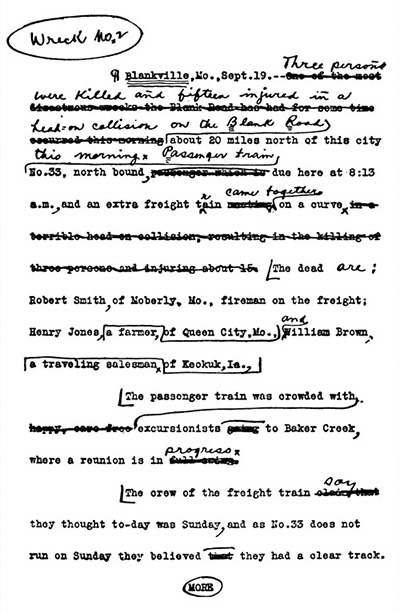
Letter inserted pages. For example, between
pages 3 and 4, the inserted pages should be designated
3a, 3b, etc.
Use an end-mark to show the story has been
completed. The figures 30 in a circle may be used.
Use every effort to make long-hand copy easily
legible. Overscore n and o and underscore u and
a when there is any possibility of confusion. Print
proper names and unusual words. Draw a small
circle around periods or use a small cross instead.
Draw a circle around an abbreviation to show
it is to be spelled out. To make sure a letter will
be set as a capital draw three lines under it.
If there is a chance that a word intentionally
misspelled, as in dialect, will be changed by the
printer or the proofreader, draw a circle around
the word, run a line to the margin and there write
“Follow copy.”
Unless you are pressed for time, read over your
story carefully before turning it in.
Accuracy is the first essential of news writing.
Above all, watch names.
CHAPTER II THE ENGLISH OF THE NEWSPAPERS — CLEARNESS — CONCISENESS — FORCE — SUGGESTIONS FOR HOME OR CLASS-ROOM STUDY
Of the three generally recognized qualities of good style—clarity,
force and grace—it is the last and the last alone in
which critics of newspaper English find their material. It
would be ludicrously superfluous to illustrate here the prevailing
clearness of what one reads in the daily press. To it
everything else is sacrificed. He who runs through the pages
of his paper at a speed that keeps even pace with that of his
car or train, and yet understands what he reads, without difficulty
and without delay, would give short hearing to a complaint
on this score. The same assertion may safely be made
of the second of the trio of good qualities. Whenever and
wherever force is needed, the reporter, no matter what his
limitations of time and distracting circumstances, manages to
put it into his writing.
The result is plain—and inevitable. Beauty, grace, suggestion
of that final touch which confers upon its object the
immortality of perfect art, are nearly always conspicuously
absent. We know at a glance what has happened and we get
the force of whatever significance the writer has wished to
impress, but it is all hurled at our heads in the same wholesale
fashion, with the same neglect of “form,” that the
genuine American is accustomed to in his quick-lunch resort,
and, in his heart, really likes. ... Without intending to
be dogmatic about it, we are inclined to say that, if a newspaper’s
English makes a fair approach to the level of an
educated, intelligent man’s serious conversation, it will be
doing about all that can justly be expected. Whatever it
accomplishes more than this is to its credit.—From an editorial
in the New York Evening Post.
“Newspaper English” has often been used as a
term of reproach, as if the newspapers, by concerted
action, had been guilty of creating an inferior,
trademarked brand of English for their own
purposes. The term has been hurled indiscriminately
at all newspapers, the good as well as the
bad, and young writers have been warned in a
vague, general way to beware of the reporter’s
style. As applied to loosely edited newspapers the
criticism is just. It is not true, however, that
“newspaper English” constitutes a special variety
of language, to be shunned by all who would attain
purity in writing. There are good books and bad
books, just as there are good newspapers and bad
newspapers, and it would be as reasonable to condemn
all books because they are written in a
“bookish” style as it is to include all news writing
in a sweeping condemnation.
No defense is needed of the style of writing in
the well-edited modern newspaper. Free from
pedantry and obsolete expressions, the English of
the best newspapers fulfills its purpose of telling the
news of the day in language that all can understand.
Newspaper English has not been created
by the newspapers alone. It is the language of the
people, clarified and simplified in the writing, as
opposed to the language of an earlier day which
obscured the writer’s thought in a maze of high-sounding
words. Newspaper English, at its best,
is nothing more nor less than good English employed
in the setting forth of news. At its worst
it embodies the common faults of writing.
The reporter writes his story for readers of all
degrees of intelligence—for the man whose only
reading is newspapers and for the man of cultivated
taste. Simplicity is the keynote. This does not
mean crudity or slovenliness, for while the good
news story is written with the limitations of the
least intelligent reader in mind, it should not offend
the educated reader. In this respect the Bible, the
simplest of all books, is an excellent model for the
news writer.
In keeping with its essential simplicity of style,
the good news story is clear, concise and forceful.
Simplicity of structure and diction implies clearness.
The story that would appeal to the masses
defeats its purpose if not readily intelligible. The
average newspaper reader has neither time nor inclination
to puzzle over an involved sentence or to
consult a glossary for the definition of a technical
phrase.
Scientific terms, if not in general use, should be
translated into everyday English. This is true also
of legal phraseology and other words and expressions
of purely technical meaning. Let your story
explain itself. If Mrs. Jones got a divorce, say
so; don’t confuse the reader with the verbiage of
the courts. Get as close to the speech of the people
as good taste and correctness will allow. Vulgar
and silly slang is not tolerated by the good newspaper,
but an expressive colloquialism may be used
to avoid pedantry.
In striving for simplicity and clarity beware of
dullness. “Fine writing”—the kind that speaks
of a barber shop as a “tonsorial parlor”—has no
place in the modern newspaper office, but there is
a demand for the writer who can infuse freshness
and vigor into his story. The style of your story
should be simple, its meaning clear and its diction
pure. Try also to give it that element of originality
and charm that distinguishes the best writing
from merely good writing. Newspaper English, as
used by skillful writers, displays often, in its well-turned
phrases, its quick description and its “featuring”
of the leading facts, the touch of the true
artist. For all this the story is none the less, in
the manner of its telling, simple and clear.
“Boil it down” is an injunction frequently
heard in the newspaper office. The requirements
both of the public and of the newspaper demand
that the story be concisely told. The hurried
reader has no time for the story clogged with unnecessary
words and trivial detail; the newspaper
has no space for it.
Daily there comes to the newspaper a stream of
copy from various sources. The local room contributes
its share, while the telegraph editor receives
scores of dispatches from special correspondents,
besides the regular service of one of the great news
gathering organizations. It would be neither possible
nor desirable to print all of the immense
amount of news matter received. The paper as
the reader sees it is the result of a process of careful
selection. Many stories have been omitted,
some of them having been “killed” after progressing
as far as the type forms, and others have
been “boiled down” to a few sentences.
The news writer, then, should study to be terse.
Verbosity merely makes work for the copy reader’s
pencil. Try to say in one word what the writer
who strains after effect might put into half a dozen.
Don’t say “devouring element” when you mean
“fire.” “Fire” is a good Anglo-Saxon word that
everybody understands and uses—and it is twelve
letters shorter. “A house is building” is simpler,
shorter and more effective than “A house is in
process of construction.” “The society met last
night and elected officers for the year” is the
simple, natural equivalent of “At a meeting held
last night the society perfected its organization for
the year by the election of officers.”
Wordiness, like bad spelling, is a sign of mental
laziness, and the newspaper office has no room for
the lazy.
Force grows out of simplicity, clearness, terseness
of style. The story told in plain, curt phrase
is more effective than the story which shows a
conscious striving after effect. Diction is important.
A strong word lends strength to an entire
sentence, while a weak word may spoil the vividness
of an impression. As a rule the words that
are deeply rooted in everyday speech are stronger
than their synonyms of foreign origin. Words derived
from the Anglo-Saxon are the bone and sinew
of the language. The writer who neglects them
for the longer and often more euphonious words
from the Latin may add elegance to his style, but
he takes away from its power to impress. The
reader feels the difference, though he may not be
able to explain it.
Brevity as well as force favors the Anglo-Saxon.
“Begin” is shorter than “commence.” It is a better
word for the news writer. Likewise it is better
to say “A movement was begun” than “A
movement was inaugurated.” The latter is a word
in good standing—presidents are inaugurated—but
let it be confined to its proper use. “Build”
is preferable to “construct” when the words may
be used interchangeably. Examples might be multiplied,
but in the end the writer must rely on his
own judgment of word-values, sharpened by a study
of good writing.
This rule may be formulated: In seeking force,
choose the Anglo-Saxon word instead of its
foreign equivalent unless clearness demands the
latter.
The active voice is usually more forcible than
the passive. “Jones succeeds Smith” and “A
house is building” are better news sentences for
this reason than “Smith is succeeded by Jones”
and “A house is being built.”
Short sentences, unless they become monotonous,
are preferable to long. The speed with which
stories are put together in the newspaper office, especially
when the writer is working to “catch an
edition,” is one factor that makes news writing
forcible. Working under pressure, the reporter
writes with a nervous, hurried energy that makes
for short sentences and quick, telling phrases. He
has no time for involved construction and prettiness
of language. His aim is to “feature” the big facts
of the story—to put what he calls a “punch” into
the lead. What such a story lacks in elegance it
makes up in force.
I.—A good news story, illustrating especially
the virtue of conciseness:
CHICAGO, Nov. 5.—“It is hard to give away money,”
declared James A. Patten, retired Board of Trade operator,
at a Y. M. C. A. meeting last night at Evanston.
“A person must acquire the habit,” he added. “After
that it comes easy.”
Then he gave the Evanston association $25,000, with
the condition that it raise an additional $75,000 within the
next ten days. The meeting opened a campaign for raising
a fund of $100,000.
(Note in the foregoing the effective use of direct
quotation.)
II.—Simplicity of form and diction adds to the
force of the following news dispatch:
LONDON, Nov. 5.—Dr. Hawley H. Crippen, convicted
of the murder of his wife, Belle Elmore, the actress, to-day
played his last card and lost. He will be hanged on
November 8.
Changed as he was physically, Crippen maintained his
composure even in the trying moment when he heard
his doom pronounced. At once the Court’s decision was
announced, a warden touched the prisoner on the shoulder
and the latter, without a word or gesture, turned and left
the dock. He was conducted at once to Pentonville
Prison.
Those who have seen Crippen during his imprisonment
say that his bearing has never changed from the moment
of his arrest. He sleeps throughout the night soundly
and eats heartily. He spends much time in reading.
Miss Leneve has visited him in the prison three times.
(All the salient facts of the story are summed up
in the opening paragraph. Note the use of metaphor—“played
his last card and lost.” Touches
such as this lift a story above the commonplace.
Note, too, that no attempt is made at so-called “fine
writing.”)
III.—Rewrite the following:
Within three hours after a “ten spot” had been deposited
with Chief of Police William Smith as a reward
to the patrolman arresting one Fred Wilson, charged with
the larceny of a coat and a pair of shoes from J. W.
Morris at a South street rooming house, said Fred Wilson
was resting his tired body within the confines of the city
bastile.
Morris left the reward and a description of the man
who, he said, had taken the articles. Each policeman was
given the description and told to look out for the man.
It fell to Officer John Haden at the Frisco Depot to garner
the loose change by collaring Wilson and taking him to
headquarters. He had the shoes and coat in his possession
at the time and told Haden that he had merely put
them on to wear for a little while.
It is believed that he was preparing to leave Smithton
for another haven when arrested.
(The foregoing is a sample of “fine writing.”
Why not say $10 or “a ten-dollar bill” instead of
“ten spot”? “Charged with stealing” is shorter
and more to the point than the technical expression,
“charged with the larceny of.” “Within the confines
of the city bastile” evidently means “in the
city jail.” Other violations of good news style will
be apparent after a moment’s thought. When in
doubt ask yourself: How would I say this if I
were relating the incident in conversation? Then
write it that way. Be natural.)
CHAPTER III THE WRITER’S VIEWPOINT — FAIRNESS — IMPERSONALITY — GOOD TASTE — ORIGINALITY — SUGGESTIONS FOR HOME OR CLASS-ROOM STUDY
Newspaper work is an exacting profession, because things
a journalist has done do not count. Like a hen he must lay
an entirely new egg every day.—From an address by Arthur
Brisbane at Columbia University, New York.
As many changes have come in recent years in country
journalism as in any other line of human endeavor....
The pronoun “we” has been banished from the editorial and
news columns, and the “slop” and “hog wash” known as
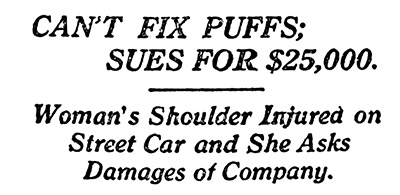
“puffs”—that is, fulsome compliment and paid-for flattery—has
become obsolete.—From an editorial in the Fulton (Mo.)
Gazette.
The three notes of modern reporting are clarity, terseness,
objectivity. The news writer of to-day aims to tell a story
that shall be absolutely intelligible, even to minds below the
average—since everybody reads; to economize space to the
last degree, and to keep himself, his prejudices, preferences,
opinions, out of the story altogether.—From an editorial in
the St. Louis Republic.
The news writer is the agent of the paper that
employs him. As such, in a wider sense he is the
agent of the public, which relies on the newspaper
to keep it informed of the day’s happenings. The
story is the all-important thing; the reader as a rule
cares nothing about who wrote it or what the writer
thinks of it. The viewpoint of the news writer
must be that of the unprejudiced, but alert, observer.
He must approach his story with a mind
open to the facts and he must record the facts unvarnished
by his own preferences and opinions.
Comment on the news of the day is the function of
the editorial columns. It has no place in the news
story. The writer who willfully injects his own
likes and dislikes into the story breaks faith with
his employer, whose space he is using, and with the
public that buys the paper.
The ideal news story, apart from questions of
style, has these qualities:
1. It is written without prejudice. It is fair,
both in spirit and in detail.
2. It is written from an impersonal, objective
viewpoint.
3. It is written in good taste.
4. It has originality.
In writing your story remember always that it
will be read not merely by a circle of men and
women of your own tastes and opinions, but by persons
of all classes, of all races, of dozens of different
shades of religious and political belief. The
daily press is the popular university. Protestant,
Catholic and Jew look to it for information; it sets
the standard of English for the masses; for many
it is the only reading. The tremendous influence
of the press imposes an obligation on the news
writer. His story must be simple and direct, so
that all can understand; more important still, it
must be fair.
Approach every story in a spirit of open-mindedness,
remembering that nearly every question has
two or more sides. Tell the facts and let the
reader draw his own conclusions. Tell all the facts
essential to a clear understanding of the story. A
story may be true in detail and yet work an injustice
by omission. Let your story be fair in detail
and in the impression it leaves.
Even aside from the ethical obligation, business
reasons demand fairness. No paper can afford to
offend a large group of readers by a slighting reference
to a race or a religious sect. Call the races
by their right names. Words such as “Dago” are
forbidden by fairness, by good taste and by business
policy.
Before making a damaging statement about a
person, be sure you have legal evidence in which
there is no loophole. Hesitate even then—go to
the city editor for instruction. If you are a correspondent,
let your office know the facts—all the
facts. Bear in mind that homicide is not necessarily
murder. There is grave danger, no matter
how convincing the evidence may appear to be, in
calling a person a murderer before he has been so
branded by the courts. If he is acquitted he has
ground for a libel suit against the newspaper that
has charged him with crime.
News writing is objective to the last degree, in
the sense that the writer is not allowed to “editorialize.”
He must leave himself out of the story.
True, he may give it, in his way of telling the facts,
a certain individuality and power, but he is not permitted
to cross the border line between the strict
presentation of news and the editorial. Only writers
whose stories are signed are allowed to use the
capital I. They are the exceptions in modern newspaper
making. The average news writer, however
brilliant his work, receives only the commendation
of his fellows. It is for this he strives, and the
satisfaction that comes of work well done, rather
than for public recognition. Always in the middle
of things, close to history in the making,—and that
is one of the fascinations of the “game”—the
newspaper man must yet remain in the background.
The story is the big, the vital thing. In it, for the
time being, he is willing to sink his personality.
The age of personal journalism in its old sense
has passed. In the new era the writer’s personality
counts for just as much, or more, but he must use
it wholly as an instrument belonging to his newspaper
and the public. It is not meant by this that
he must work always by rule and line, but that he
must refrain from coloring his story with his personal
prejudices and opinions. Even the “we”
of the editorial columns is fast being discarded for
a more impersonal form. Most city newspapers
now avoid it altogether and the same tendency is
seen in the more enterprising country journals.
It is still used in a large number of papers published
in the rural districts, both editorially and in
the news sections, but these are gossipy neighborhood
chronicles rather than newspapers in the modern
understanding of the word.
Impersonal writing does not consist alone in the
omission of “we” and “I.” Avoid generalities
that are likely to imply approval or disapproval
on the part of the writer. If Smith was killed by
a neighbor, tell when and where and how he was
killed. Don’t generalize by saying, “A dastardly
crime was committed.” If your story is pathetic
it is not necessary to tell the reader so. Let him
find it out from the simple, human facts. In describing
a pretty girl, don’t stop with saying she is
pretty; tell how she is pretty—tell the color of her
hair and eyes.
Strive always to be specific. With this in mind
you are not likely to stray far from the impersonal.
Cultivate good taste in news writing, as in all
kinds of writing. Your story is read by the woman
in the home as well as by the man on the street.
Leave out all revolting details and think twice before
you use a word or an expression of doubtful
propriety. Good taste distinguishes the story written
carefully, with its possible effect on the reader’s
sensibilities in mind, from the story that runs recklessly
into paths avoided in conversation.
Never use cheap slang. One kind of slang, that
which is clean-cut and expressive, without taint of
vulgarity, may afford a legitimate short-cut in news
writing as in speech. An expression of this type,
if it persists in the language, ultimately finds a place
in the dictionary. It is the other kind of slang, the
vulgar or silly, against which the news writer must
be on his guard.
Horrible details are not wanted by the well-edited
newspaper. Leave out the three buckets of
blood. The word “blood” in itself brings an unpleasant
picture before the reader and may shock
a person of delicate sensibilities. Most newspapers
caution their writers against its overuse.
Certain things are glossed over in our daily
speech. This is true in ever greater degree of the
newspapers. Horace Greeley said that what Providence
permitted to happen he wasn’t too proud to
report. That is not the working principle of the
modern newspaper, which omits some things and
edits others. The moral obligation of the newspaper
to its readers, as well as good taste, demands
the pruning down of some classes of news. “All
the News That’s Fit to Print” implies this obligation.
It is poor taste to attempt facetiousness in reporting
a death. Never call a body a “stiff.”
Puns on the names of persons, unless they are peculiarly
apt or are justified by special circumstances,
are to be avoided. The same rule applies to exaggerated
dialect put in an offensive manner and to
nicknames of the races. These instances further
illustrate the need of fairness and sanity in the
writer’s viewpoint. Common sense is an excellent
guide in many of the delicate little problems of this
kind that crop up daily in every newspaper office.
Originality is the quality that gives a news
story distinction. Rules may aid, but the power
to make a story original must come largely from
the writer himself. Many writers can put facts
together into a coherent whole. The highest rewards
are reserved for those who can tell old facts
in a new way.
The main secret of original news writing lies in
keeping the impression fresh. Everything interests
the new reporter. As he gains familiarity with the
work, there is danger that his viewpoint will become
jaded. Especially if he is covering the same run
of news day after day must he fight against this
tendency to fall into a rut. The newspaper has
no use for the man in a rut. The reporter who
becomes cynical loses the news writer’s best asset,
the power to feel the pathos or the injustice or the
humor of the thing he is writing about. If he himself
cannot feel his story he is not likely to impress
the reader with it.
The newspaper workshop, unlike any other, must
create something different every day, although human
nature, from which it gets its raw materials,
remains the same through the ages. There is no
variation from one day to another in the basic
themes of the news, but there is an endless variation
in the local color, in the shadings of motive,
in all the details that go to make one story different
from all others. Take the story of death in a tenement
house fire. There is the outline, the basic
fact, of stories without number; yet each story,
told with its wealth of human, moving detail, has
the power to affect the reader as if the theme itself
were absolutely new. A dozen houses in the same
block look alike from the outside; yet the life that
each conceals is different from the life in all the
others.
Here, then, is need for originality in the writing
of news. If the reporter’s outlook is cynical he
is likely to overlook the human side of the story
for the lifeless skeleton of commonplace facts. His
story may be mechanically correct, but it has no
power of appeal. Without distorting a single fact,
in plain, everyday words, the news writer may tell
a story of human suffering that will rouse his readers
to generous response. This he may do, not by
editorial comment, but by putting the facts in the
most effective, which is usually the simplest, manner.
Editorial comment in such a story would
weaken the effect. The facts, properly told, are
enough.
One word of caution perhaps should be given:
In looking for the feature do not descend to the
trivial. To return to an illustration just used, don’t
write the lead of your fire story on the rescue of the
family cat and overlook the fact that human lives
were lost. Originality does not consist in straining
after a feature at the expense of the vital things in
a story. Triviality comes with cynicism. The
power to be truly original, to put life into a story
based on a commonplace theme, comes with the
broad, human sympathy that results from keeping
the impression ever fresh.
I.—The following story, adapted from a newspaper,
violates practically every rule that can be
laid down for the writing of news. Apart from
its errors of style, it is written with prejudice and
in bad taste. Rewrite the facts in half the present
space, remembering (1) to be fair; (2) to leave
yourself out of the story; (3) to omit revolting
details; (4) to avoid “fine writing” and cheap
slang.
Tom Jones, one of Smithton’s worthless citizens, tried
to shuffle off this mortal coil last Friday afternoon by cutting
his throat with a pocket knife.
It seems Jones had filed complaint against John Smith
and Susie Williams for stealing. They were brought up
in Justice Wagner’s court on Friday afternoon for trial,
Jones being the prosecuting witness. When he was put
upon the witness stand he flatly contradicted himself in
statements made in his complaint to the Prosecuting Attorney.
When he did this Mr. Brown at once dismissed
the case against John Smith and Susie Williams and filed
complaint against Jones for perjury, and put him under
arrest. Constable Walker at once took him in charge and
was preparing commitment papers, when Jones expressed
a wish to go into the hall for a drink of water, which
permission was given him by the constable. Soon after
he had left the room an unusual noise was heard like the
rushing of water and on investigation the man was found
lying on the floor with his throat cut and the blood spurting
like water from a fountain. He stuck the blade of an
ordinary pocket knife into his throat and severed some
of the arteries, and would probably have bled to death,
except for the unfortunate arrival of a physician who
stopped the blood, and he is now in a fair way to recover
and may yet go over the road.
(“It seems” is unnecessary at the beginning of
the second paragraph. Instead of “tried to shuffle
off this mortal coil” say simply that he “tried to
kill himself.” Cut out the grandiloquent phrases.)
II.—Note the stereotyped form of the following
story, in which the feature is obscured by a mass
of routine detail. The story is as lifeless as if it
had been constructed by filling in blank spaces in a
set form. Although it has certain unusual elements,
it is totally lacking in originality of treatment:
After he had been arrested on complaint of Henry
Flannigan, 56 years old, who conducts a repair shop at
1000 Center street, on a charge of stealing two revolvers
from the shop Sunday afternoon, William Weaver, 18
years old, of 3445 Broadway, turned on the man and accused
him of being a second Fagin, of running a fence
and of having several small boys employed to steal goods
for him.
The police arrested Flannigan and his sons, Henry, Jr.,
aged 15, and Fred, 14, at their home, 841 Division street,
and Alex. Jones, 19, 1043 West avenue. Flannigan denied
he was running a “fence” but admitted buying a lot of
goods from the boys. They were locked up at the Fifteenth
District Police Station.
(Query: Does the average reader understand
what “running a fence” means? Why not make
this clear? It may be noted that some newspapers
insist that police stations be identified for the reader,
not by their numbers, but by the names of the
streets on which they are situated. Thus, in St.
Louis, the Fourth District Station is called the Carr
Street Station; the Ninth, the Dayton Street Station,
and so on. The number, as a rule, means
nothing to the reader, while the street name gives
him at once an idea of the locality.)
III.—In the following short feature story the
writer has got away from set forms and produced
a readable story. Little stories of this type are
highly esteemed by newspapers with a leaning toward
human-interest news—especially if they are
accompanied with pictures:
CHICAGO, Nov. 7.—Stephen Rheim hit into a double
play, although he didn’t know it for several days, when
his safe hit won a game for the West Chicago High
School baseball team over the Wheaton nine last June.
In the grand stand was Miss Catherine Smith, also of
West Chicago, and a loyal fan. “If he makes a hit I’ll
marry him,” she cried, according to friends, as Rheim
came to bat at a critical point in the game. After Rheim’s
hit had won the game friends told him of Miss Smith’s
remark and introduced him to the blushing young woman,
who explained that she was “just joking.” But Rheim
fell in love and remained there.
CHAPTER IV THE IMPORTANCE OF ACCURACY — OBSERVATION — NAMES — STREET ADDRESSES — SPELLING — SUMMARY — SUGGESTIONS FOR HOME OR CLASS-ROOM STUDY
The surest guarantee for right-doing in journalism is contained
in the teaching that right is always right and that it
must be done for its own sake. This is the great basic truth
to be taught the students of schools of journalism and impressed
upon the minds of all newspaper workers. No other
“endowment” than this of sound principles is to be desired,
either for newspapers or individuals, because both must
work out their own salvation in life’s daily battle, which is
won for the right only by those steadfast souls that fight for
the sake of right alone.—From an editorial in the St. Louis
Post-Dispatch.
The haste and hurry of which so much is made may and
does prevent polished work in a newspaper office. But it
does not prevent accurate, careful, painstaking work. The
history of the world which lay on your doorstep this morning
is amazingly accurate; the mistakes in it are few and
far between ... The average high school of to-day
turns out a variety of English that the best natured city
editor consigns to perdition in seven tongues, and beats out
of the aspiring cub without delay or remorse. And in the
important matter of brevity and directness of saying what
you have to say in the curtest and plainest phrase of which
the language is capable, the newspaper is the greatest educator
in the world.—From an article by George L. Knapp.
A first essential of good news writing is accuracy.
The word should be graven in the mind of
every reporter and every editor. It is spoken by
the city editor to his reporters almost every hour
of his working day. Placards on the walls may
call attention to it, as in some offices where, with
laudable brevity, the motto is urged upon the staff:
ACCURACY
TERSENESS
ACCURACY
If a story is accurate, if it is written with a nice
attention to detail, it is likely to be fair. If a
story is not accurate, it is not news in the best
sense.
Accuracy implies more than mere grammatical
correctness. It means more even than the stating
of every fact with precision. A story may be taken
to pieces, fact by fact, and every sentence found to
be correct; yet the whole may give a false impression.
Accuracy means the spirit as well as the
letter of the truth.
Truthful, precise writing is the fruit of accurate
observation. If one would write news, he must
learn first to see news clearly and without prejudice.
Therein the trained reporter excels the casual observer.
The one has learned to observe keenly; the
other, well equipped though he may be in the rules
of rhetoric, has not schooled himself in the business
of seeing things with an eye single to getting the
facts in right proportion. Learn to observe and
you will have gone far toward mastering the art
of news getting and news writing. Casual observation
is nearly always faulty. Take for example
the conflicting statements of persons on the witness
stand. One man, telling his version of an automobile
accident, swears the car was going fully thirty
miles an hour, another is certain the speed was only
eight miles; one heard the driver sound a warning
“honk,” another is equally positive no warning
was given. Each witness is a reputable citizen and
each thinks his version is the truth. The discrepancy
in their testimony is due, not to any effort to
deceive, but to the common failure to observe carefully.
It is the business of the newspaper man, whose
eyes must serve thousands of readers each day, to
see rightly what others see imperfectly or not at
all. He is subject to the same human limitations
as the others, but he must make it his duty, by
training his mind and his eye, to reduce those limitations
to the minimum. Then, and then only, can
he gather and write news with the maximum of
efficiency.
In giving names and street addresses there is special
need of accuracy. Watch, too, the spelling of
all the words in your copy. Remember the dictionary
is made for use.
The average good citizen likes to see his name in
print, but he is deeply offended at seeing it misspelled.
Smythe’s name is a thing peculiarly his
own; he can never cherish any particular regard
for the newspaper that persists in calling him
Smith. So with Browne and Maughs and Willson.
Their names are not Brown, Moss, Wilson. A
reader whose name is misspelled feels, unconsciously
perhaps, that he has been robbed of some intimate
possession. A blow has been aimed at his individuality.
To paraphrase a great reporter of life, his
“good name” has been stolen, and as a good citizen
he resents the theft.
The misplacing of an initial or the careless dropping
of a letter from a name may cost the newspaper
a subscriber. Certainly it convicts the paper
of inaccuracy in one man’s eyes. He reasons that
if the paper is mistaken in the spelling of his name,
it may be guilty of other grave inaccuracies in its
news. His faith in the paper is shaken. And the
newspaper that loses the faith of its readers is in
danger of losing the good will that is its chief asset.
Care should be taken in the writing of street addresses.
The difference between two street numbers
may represent the difference between respectability
and its opposite. A serious injustice may be done
a person by printing his name with the wrong street
address. Such a mistake was made not long ago
by a western newspaper, which gave an address in
a neighborhood of doubtful reputation to a citizen
of high standing. As a result of the writer’s carelessness
the newspaper was sued for libel.
The reporter should be constantly on his guard
in taking down the addresses given by unknown persons.
Especially is this true with reference to the
data furnished by criminals for the police “blotter.”
It is a common practice of habitual criminals to
give as their own the addresses of reputable citizens.
Learn all you can of the city in which you work.
Such knowledge will be invaluable as a safeguard
against many pitfalls. The city directory is an excellent
guide, but sometimes is inaccurate.
Spell correctly. This applies not alone to proper
names. Some news writers are prone to shift the
burden of spelling to the man who edits the copy or
to the proofreader. Doubtless there are many
brilliant news gatherers who are deficient in spelling,
but, other things being equal, the man who
spells correctly is preferred to him who is slovenly
in this respect. Bad spelling, though not fatal to
a writer’s chances, is often a sign of lazy habits of
mind. The precise thinker, as a rule, has too much
regard for the tools of his trade—his words—to
abuse them. The city editor judges the new man
largely by his copy. The story that shows attention
to spelling, to all the little niceties of writing,
assuredly has a better chance of a favorable reception
than the story, of equal news value, that betrays
carelessness.
If any hard-and-fast first principle relating to accuracy
can be laid down, it is this: Get the names
right. Once this principle is grounded in the mind
of the reporter, he is fairly sure to strive for accuracy
in all the details of his story.
Persons who know nothing of the inner workings
of the newspaper office may profess to believe that
stories are written without regard to accuracy and
are thrown into type haphazard, just as they come
from the writers. Nothing could be farther from
the truth. A newspaper that permitted such a condition
would be swamped with libel suits within a
week. In every newspaper office, certainly in every
newspaper office worthy the name, there is an unceasing
war against inaccuracy of every kind. The
new reporter learns this when he comes in jubilant
from an assignment, only to be sent back to get the
middle initial of a name. The out-of-town correspondent
learns it when he is called from his bed by
long-distance telephone to explain a vague statement
in a story he had wired earlier in the night.
When one considers the difficulties under which
news is gathered and the limited time at the newspaper’s
command, the wonder is not that errors occasionally
creep into the news columns but that the
errors are so few.
The newspaper as it goes to the reader, though
it is the product of many very human persons working
under pressure, is remarkably accurate. A
painstaking effort has been made to give the reader
a true picture of the day’s happenings. Copy readers
have gone over the reporters’ copy for errors
of fact and of style; proofreaders have corrected
typographical errors after the matter has been set
in type; one or more editors have read the revised
proofs with an eye single to detecting faults.
The newspaper, of all modern institutions, is the
most human. It is written by, for and about men
and women. Its failings are the common failings
of humankind. Forewarned thus against himself,
it is the duty of the news writer, even while he
works with one eye on the clock, to be always
vigilant in the battle against inaccuracy—to do his
full share, and more, in keeping the columns of his
paper free from misstatement of every kind.
The following stories are presented, not for any
specific bearing on the discussion of accuracy, but
as “horrible examples” of bad news writing in
general. Inaccuracy in a news story seldom stands
alone as a fault, because if a story is inaccurate the
chances are it is deficient in other respects. The
writer who does not take his work seriously enough
to get his facts correct is not likely to pay attention
to style. The stories here reproduced may
serve as a warning against some of the faults
pointed out in the preceding chapters.
I. This and the story under II show the absurdity
of attempted “fine writing”:
Shrouded in deep mystery and in spite of the fact that
strenuous efforts were made to keep the details of the
affair secret, startling facts regarding the robbery of the
Blank sorority house came to light yesterday. The house
was entered by a burglar some time during the Christmas
recess and some valuable silverware was taken.
But this is not all. Although when interviewed on the
subject the members of the sorority refused to give any
of the details to the public, some unique traits have developed
in the burglar which may enable an ambitious
Sherlock to unravel as deep a mystery as has ever puzzled
Pinkerton’s band of trained sleuths.
(Query: Isn’t it about time to give the word
“strenuous” a needed rest?)
II. The story of a death was told thus in a small
newspaper:
Mrs. Eliza Williams, mother of Mrs. Geo. Brown, was
released from her physical surroundings Saturday morning
at ten o’clock and called to occupy a building, a house
not made with hands eternally in the heavens. She has
been in this earth life 87 years.
(Evidently the foregoing means: “Mrs. Eliza
Williams, mother of Mrs. George Brown, died at
10 o’clock Saturday morning. She was 87 years
old.” The simplest style is always the best in writing
of death. Say “body,” not “remains”;
“coffin,” not “casket”; “the dead man (or
woman),” not “the deceased” or “the defunct.”
“Burial” is better than “interment.” “The late”
is nearly always useless. “Obsequies” implies
that the ceremonies were imposing; in most cases
“funeral” is the proper word. Never use a flippant
word in a death story. In all news writing
spell out proper names: e.g., “George,” not “Geo.”
Most newspapers use numerals in giving the hour,
as 10 o’clock. It is usually preferable to place the
hour before the day; thus, “at 10 o’clock Saturday
morning.” Be careful to refer to the dead in the
past tense; the verb in the last sentence of the
story quoted should be “had been.”)
III. Note the use of cheap slang in the following
story:
Fred Smith, a young man about 18 or 19 years old, who
formerly resided in this neighborhood but more recently
at Jonesburg, had been boozing at the saloon all day and
in the evening walked out of that burg on the railroad
track. He evidently fell with his head down on one side
of the dump and one foot over the rail. The 7 o’clock
passenger struck him and mashed the foot. He was picked
up by the train crew and brought to town and received
medical attention.
(It is seldom in good taste, nor is it safe, to accuse
a person of drunkenness. Bear in mind the
injunction: Tell the facts and let the reader draw
his own conclusions.)
CHAPTER V NEWS VALUES — THE REPORTER — WHAT IS NEWS? — THE NEWSPAPER’S PROBLEM — KINDS OF STORIES — SUGGESTIONS FOR HOME OR CLASS-ROOM STUDY
The newspaper man is compelled, as the price of success in
his calling, and often through severe experience, to learn that
only that which is true is “news.” There is a popular impression
that all is grist that comes to the newspaper mill,
and that everything brought into the office is published. The
fact is that the hardest task of newspaper work is to sift the
truth out of the masses of falsehood offered daily....
Daily newspaper workers have neither time nor need to fabricate
falsehoods for public deception. Their time and their
energies are too fully engaged in trying to winnow out the
truth from the ignorant or willful distortions of it with which
they have to deal daily. Often the falsehoods are unintentional,
and arise from the fact that few people are gifted with
ability to tell the exact truth, and nothing else, about what
they have seen or heard. But they have also to deal with
masses of downright lies, inspired by interest or malice.—From
an editorial in the Chicago Inter-Ocean.
The foregoing chapters have dealt with news
writing in its general aspects. This and succeeding
chapters will be devoted to the more technical
phases of the subject.
It is not the purpose here to discuss in detail
methods of gathering news, but to tell how to write
news. The reporter, when he sits down to his
story, is assumed to be in possession of the facts.
The problem then is how to put those facts together
most effectively. But since news writing presupposes
news gathering, a general knowledge of the
reporter’s work and of what is implied by the term
“news” is essential to a clear understanding of the
technical side of the story.
What the eyes are to the body the reporter is to
his paper and to the public that reads it. His work
is the foundation of modern newspaper making.
Editorial comment illuminates the news, make-up
and headlines aid in its attractive presentation but
after all the story is the main thing. It is for the
story that all other features of the newspaper exist.
No matter what branch of newspaper work one
may eventually enter, training gained as a reporter
will be invaluable. The men who reach executive
positions in a newspaper office without having
served a reporter’s apprenticeship are rare exceptions.
Practically all who have attained high rank
in journalism began work as gatherers of news.
They learned first to see news and to estimate its
values.
A reporter may be able to see news without being
able to write a good story, but the opposite
seldom holds good. Certainly the best news writers
are those who have learned, as reporters, what news
is. The city editor of a metropolitan newspaper
holds his position largely by virtue of his ability
to pass quick and accurate judgment on the news
value of a story. He has a “nose for news” that
enables him to discard the trivial in the grist of the
day’s happenings for the vital and interesting. It
is this ability that the reporter must cultivate by
every means in his power.
News has been roughly defined as that which interests
people. But that definition is too general.
A book or a sermon or a play may interest people,
but in themselves they are not news. The fact,
however, that a book has been published or a sermon
preached or a play produced, is news, if that
fact has an element of public interest.
The importance of a story in the eyes of the
editor depends on one or more of several considerations—on
the property involved, as in a fire or an
earthquake; on the number and the prominence of
the persons concerned; on the distance of the happening
from the place of publication; on the timeliness
of the story; on the element of human interest.
This list is not exhaustive; local and temporary reasons
often have weight in the editor’s judgment of
a given story. To illustrate, suppose a newspaper
is waging a crusade against grade crossings in its
city. The story of a grade crossing accident immediately
assumes an importance for that newspaper
beyond its ordinary news value. Before the
crusade was started the story might have been told
in a paragraph; now it is allowed to run at length.
Remember, in forming your estimate of the news
value of a story, that the newspaper is read by men
and women of all classes—by the banker and his
stenographer, the day laborer and the college professor.
A story is valuable as news in proportion
to the number of persons it interests. The account
of a great disaster, like the San Francisco earthquake
and fire, appeals to all readers. It is the big
news of the day, taking precedence over all other
stories in the make-up of the paper. News of an
increase in the cost of some necessary article of
food is valuable because of the vast number of persons
it affects. So with the story of a national election,
a great labor strike or a declaration of war.
These are the exceptional stories whose importance
as news is as obvious to one unskilled in newspaper
making as to the trained editor.
But what of the more commonplace happenings
of the day? The problem that confronts the editor
daily is to make a paper that will appeal to as many
readers as possible. The man who asks a newspaper
to print, as news, a long dissertation on recent
discoveries in Asia Minor mistakes the purpose of
daily journalism. Such an article might interest
other men engaged in making similar discoveries,
but it would be passed over by the vast majority of
readers.
Newspapers are often charged with pandering to
the sensational. Why, it is asked, do they print the
story of a murder on the first page, while general
religious news is published in a separate department,
if published at all? The shop window of the
merchant furnishes the answer: the merchant, like
the newspaper, puts his most alluring wares in
front. The display in both cases is based on a
sound knowledge of human nature. What do people
talk about in the evening? On his answer to
that question the editor’s choice of stories largely
depends. Mrs. Jones, talking to Mrs. Smith, tells
first about the elopement of a neighbor’s daughter.
Not until that is disposed of does she comment on
last Sunday’s sermon.
Newspapers formerly were made on the assumption
that men were the only readers. Now they are
made with the tastes of women ever in mind. The
evening newspaper, especially, is edited for the
women, on the theory that it is taken home in the
evening, while the morning newspaper is taken out
of the home by the man going to work.
The newspaper is a business enterprise. In order
to live it must get advertising. To get advertising
it must have circulation and to get circulation
it must interest its readers. It can not do this by
shooting continually over the heads of its readers.
But, while the newspaper reflects public taste, it is
generally a little better than public taste. Certain
classes of news are suppressed and others are carefully
edited. What is done with news on the border
line depends on the individual policy of the paper.
While the variety of news is infinite and no hard-and-fast
classification can be attempted, news stories
may be roughly grouped in three large divisions:
1. The story based on a recent happening of
more or less importance in itself, as a fire or a business
transaction, told without attempt at embellishment.
This may be called the plain news story.
It is the primary form of news writing. Clearness
and conciseness are its first requisites.
2. The story called by the newspaper man a
feature or a human-interest story. Into this class
falls practically all news writing—except that set
aside in departments—which does not fit in the
preceding group. Some writers perhaps would
make a distinction between “feature” and “human-interest”
as applied to news, but since the terms
are often used interchangeably, it has seemed simpler
to include them under one head. A feature
story, then, adopting this as a general term, is a
story based on something odd or unusual, humorous
or pathetic. Such a story often depends more on
the manner of the telling than on what is told.
“Human-interest” narrows the definition to the
story that appeals to the emotions by its humor or
pathos. Stripped to the bare facts, a human-interest
story may be without news value; but told
with the keen sympathy that comes of accurate observation
and a knowledge of human nature it may
have an even greater value, that of giving the
reader a clearer insight into the real life about him.
Feature stories concerning odd or unusual or grotesque
things, such as the man with the longest
beard in the world or the boy who builds an airship
in his back yard, may be only a few lines in length
or they may be developed into page Sunday articles.
A study of the magazine and feature pages of any
metropolitan daily paper will show the possibilities
of this kind of story. Almost any subject may be
made into a feature story if the writer has the gift
of originality.
3. Department or classified news. Under this
head come stories that are grouped by the newspaper
in separate departments, as sporting news,
market reports and society notes. The extent to
which news is classified varies widely with different
newspapers. Some include only a few broad
departments, while others classify news on many
subjects, as schools and colleges, genealogy,
women’s clubs, etc. When, however, a department
story becomes of general interest, it is taken out of
its department and placed in the general news
columns. This may be done, for example, with the
story of a world’s championship baseball game or of
a sudden break in the stock market.
It must be understood that this grouping is subject
to many variations. There is often an overlapping
of the three kinds of stories described.
The nature of news, based as it is on the doings of
people, makes it impossible for one to put a finger
on a story and say: This falls under Section A
and is written according to Rule Blank. The classification
is suggested only as a guide in the study of
news writing.
The interview, one of the most important features
of the modern newspaper, is not here listed as
a distinct kind of story. It may either form an
essential part of a story or be itself a news story
of any of the types mentioned.
I. Tell how the following plain news story could
be developed into a feature story of a column or
more:
BOSTON, Nov. 12.—The third new star to be discovered
at the Harvard College Observatory in the last
six weeks was announced to-night by Professor Edward C.
Pickering. Miss A. J. Gannon of the observatory staff
found the star in an examination of old photographic
plates taken August 10, 1899. It appears in the constellation
sagittarius from that date until October, 1901.
II. Concise, well-told story of a humorous incident,
used by the St. Louis Post-Dispatch as a
“filler” on Page 1. Note that the story is not
clogged with irrelevant police data:
Two burglars enjoyed a laugh, and a saloon keeper’s
money was saved by the wit of Joe Johnson, a negro
porter, early Wednesday. The burglars entered Edward
Krenninghaus’ saloon at 3948 Easton avenue, and finding
the porter asleep in the back room awakened him.
“Where’s the boss’ money?” asked one of the burglars
as he held a revolver to Johnson’s head. “Sakes alive,”
the porter stuttered. “If the boss kept his money here
he wouldn’t let me sleep in the place.” The burglars
laughed heartily and departed.
III. The following story—a mother’s account
of the death of her son—is a fine example of the
best type of human-interest story. It was published
in the New York Sun (morning), often referred to
as the “newspaper man’s newspaper” because of
the high standard of writing that it maintains.
“Study the Sun’s style” is the advice given to
reporters in many newspaper offices. The story
here reproduced is by Frank Ward O’Malley. It
was reprinted in the Outlook of November 9, 1907:
Mrs. Catherine Sheehan stood in the darkened parlor of
her home at 361 West Fifteenth street late yesterday
afternoon, and told her version of the murder of her son
Gene, the youthful policeman whom a thug named Billy
Morley shot in the forehead, down under the Chatham
Square elevated station early yesterday morning. Gene’s
mother was thankful that her boy hadn’t killed Billy Morley
before he died, “because,” she said, “I can say
honestly, even now, that I’d rather have Gene’s dead body
brought home to me, as it will be to-night, than to have
him come to me and say, ‘Mother, I had to kill a man
this morning.’
“God comfort the poor wretch that killed the boy,” the
mother went on, “because he is more unhappy to-night
than we are here. Maybe he was weak-minded through
drink. He couldn’t have known Gene or he wouldn’t have
killed him. Did they tell you at the Oak Street Station
that the other policemen called Gene Happy Sheehan?
Anything they told you about him is true, because no one
would lie about him. He was always happy, and he was
a fine-looking young man, and he always had to duck his
helmet when he walked under the gas fixture in the hall,
as he went out the door.
“He was doing dance steps on the floor of the basement,
after his dinner yesterday noon, for the girls—his sisters,
I mean—and he stopped of a sudden when he saw the
clock and picked up his helmet. Out on the street he
made pretend to arrest a little boy he knows, who was
standing there—to see Gene come out, I suppose—and
when the little lad ran away laughing, I called out, ‘You
couldn’t catch Willie, Gene; you’re getting fat.’
“‘Yes, and old, mammy,’ he said, him who is—who
was—only twenty-six—‘so fat,’ he said, ‘that I’m getting
a new dress coat that’ll make you proud when you
see me in it, mammy.’ And he went over Fifteenth street
whistling a tune and slapping his leg with a folded newspaper.
And he hasn’t come back again.
“But I saw him once after that, thank God, before he
was shot. It’s strange, isn’t it, that I hunted him up on
his beat late yesterday afternoon for the first time in my
life? I never go around where my children are working
or studying—one I sent through college with what I
earned at dressmaking, and some other little money I had,
and he’s now a teacher; and the youngest I have at college
now. I don’t mean that their father wouldn’t send
them if he could, but he’s an invalid, although he’s got a
position lately that isn’t too hard for him. I got Gene
prepared for college, too, but he wanted to go right into
an office in Wall street. I got him in there, but it was too
quiet and tame for him, Lord have mercy on his soul;
and then, two years ago, he wanted to go on the police
force, and he went.
“After he went down the street yesterday I found a
little book on a chair, a little list of the streets or something,
that Gene had forgot. I knew how particular they
are about such things, and I didn’t want the boy to get
in trouble, and so I threw on a shawl and walked over
through Chambers street toward the river to find him.
He was standing on a corner some place down there near
the bridge clapping time with his hands for a little newsy
that was dancing; but he stopped clapping, struck, Gene
did, when he saw me. He laughed when I handed him
the little book and told that was why I’d searched for
him, patting me on the shoulder when he laughed—patting
me on the shoulder.
“‘It’s a bad place for you here, Gene,’ I said. ‘Then
it must be bad for you, too, mammy,’ said he; and as he
walked to the end of his beat with me—it was dark
then—he said, ‘They’re lots of crooks here, mother, and
they know and hate me and they’re afraid of me’—proud,
he said it—‘but maybe they’ll get me some night.’ He
patted me on the back and turned and walked east toward
his death. Wasn’t it strange that Gene said that?
“You know how he was killed, of course, and how—Now
let me talk about it, children, if I want to. I promised
you, didn’t I, that I wouldn’t cry any more or carry
on? Well, it was five o’clock this morning when a boy
rang the bell here at the house and I looked out the window
and said, ‘Is Gene dead?’ ‘No, ma’am,’ answered the
lad, ‘but they told me to tell you he was hurt in a fire
and is in the hospital.’ Jerry, my other boy, had opened
the door for the lad and was talking to him while I dressed
a bit. And then I walked down stairs and saw Jerry
standing silent under the gaslight, and I said again, ‘Jerry,
is Gene dead?’ And he said ‘Yes,’ and he went out.
“After a while I went down to the Oak Street Station
myself, because I couldn’t wait for Jerry to come back.
The policemen all stopped talking when I came in, and
then one of them told me it was against the rules to show
me Gene at that time. But I knew the policeman only
thought I’d break down, but I promised him I wouldn’t
carry on, and he took me into a room to let me see Gene.
It was Gene.
“I know to-day how they killed him. The poor boy
that shot him was standing in Chatham Square arguing
with another man when Gene told him to move on.
When the young man wouldn’t, but only answered back,
Gene shoved him, and the young man pulled a revolver
and shot Gene in the face, and he died before Father
Rafferty, of St. James’s, got to him. God rest his soul.
A lot of policemen heard the shot, and they all came running
with their pistols and clubs in their hands. Policeman
Laux—I’ll never forget his name or any of the
others that ran to help Gene—came down the Bowery
and ran out into the middle of the square where Gene lay.
“When the man that shot Gene saw the policemen coming,
he crouched down and shot at Policeman Laux, but,
thank God, he missed him. Then policemen named Harrington
and Rourke and Moran and Kehoe chased the
man all around the streets there, some heading him off
when he tried to run into that street that goes off at an
angle—East Broadway, is it?—a big crowd had come
out of Chinatown now and was chasing the man, too, until
Policemen Rourke and Kehoe got him backed up against
a wall. When Policeman Kehoe came up close, the man
shot his pistol right at Kehoe and the bullet grazed Kehoe’s
helmet.
“All the policemen jumped at the man then, and one
of them knocked the pistol out of his hand with a blow of
a club. They beat him, this Billy Morley, so Jerry says
his name is, but they had to because he fought so hard.
They told me this evening that it will go hard with the
unfortunate murderer, because Jerry says that when a
man named Frank O’Hare, who was arrested this evening
charged with stealing cloth or something, was being taken
into headquarters, he told Detective Gegan that he and a
one-armed man who answered to the description of Morley,
the young man who killed Gene, had a drink last
night in a saloon at Twenty-second street and Avenue A
and that when the one-armed man was leaving the saloon
he turned and said, ‘Boys, I’m going out now to bang a
guy with buttons.’
“They haven’t brought me Gene’s body yet. Coroner
Shrady, so my Jerry says, held Billy Morley, the murderer,
without letting him get out on bail, and I suppose that in
a case like this they have to do a lot of things before they
can let me have the body here. If Gene only hadn’t died
before Father Rafferty got to him, I’d be happier. He
didn’t need to make his confession, you know, but it would
have been better, wouldn’t it? He wasn’t bad, and he
went to mass on Sunday without being told; and even in
Lent, when we always say the rosary out loud in the
dining-room every night, Gene himself said to me the day
after Ash Wednesday, ‘If you want to say the rosary at
noon, mammy, before I go out, instead of at night when I
can’t be here, we’ll do it.’
“God will see that Gene’s happy to-night, won’t he, after
Gene said that?” the mother asked as she walked out
into the hallway with her black-robed daughters grouped
behind her. “I know he will,” she said, “and I’ll—”
She stopped with an arm resting on the banister to support
her. “I—I know I promised you, girls,” said
Gene’s mother, “that I’d try not to cry any more, but
I can’t help it.” And she turned toward the wall and
covered her face with her apron.
This story was reprinted in the Outlook, under
the title, “The Death of Happy Gene Sheehan,”
with the following editorial preface:
“The ‘stories’ of the reporter on a daily paper
are written under such trying conditions of hurry
and confusion that they seldom have, in the very
nature of the case, what is called the ‘literary
touch.’ But occasionally a news writer produces a
story which has real qualities of vividness, pathos
and power. The following account of the death
of Happy Gene Sheehan, which we reprint by special
permission from the New York Sun, belongs
to this class. On the morning when it appeared, a
group of business men, one of whom has related the
incident to us, were riding from Peekskill to New
York in a commuters’ club car. Several games of
cards were in progress, and the rest of the passengers
were busy with their newspapers or in conversation.
Suddenly a clergyman, who had been
reading the Sun, rose and asked permission to read
a story which he had just finished. He had read
only a few lines before the card games were stopped,
newspapers were laid down, and every man in the
car was giving earnest attention to the reading. It
was the story of Happy Sheehan; and the effect
which it produced upon such a group of busy men,
not easily to be moved by sentiment, and not at all,
except to disgust, by sentimentality, was the best
compliment which it could have received.”
CHAPTER VI WRITING THE LEAD — WHAT THE LEAD IS — WHAT THE LEAD SHOULD CONTAIN — OBSERVANCE OF STYLE — LEADS TO BE AVOIDED — SENTENCE STRUCTURE — LEADS THAT BEGIN WITH NAMES — THE GENERAL RULE — STUDY OF 100 TYPICAL STORIES — SUGGESTIONS FOR HOME OR CLASS-ROOM STUDY
Newspaper English is the standard. There may be critics,
who belong to a past generation and who have learned by
rule, but for flexible, expressive use of the language the newspaper
and the other publications for the masses cannot be
surpassed.... When scientific or technical terms are
employed there is sufficient context to make clear the application.
There is no strained effort or laborious use of words
to-day. Nor is there a deterioration, as some of the professors
of English would have us believe. Newspaper style is
simple, direct, concise, instructive and self-explanatory. This
sets the standard for the great mass of the public.—From an
editorial in the Washington Herald.
The method of telling the news story is usually
the opposite of that employed by the writer of fiction.
Instead of giving the setting of his story and
then working gradually toward the climax, the news
writer, as a rule, puts the climax in the very beginning—in
what is technically called the lead of the
story. If three persons were killed in a train wreck
he tells that fact succinctly in the opening sentence.
There is no halting, no preliminary catching of the
breath, but a straightforward plunge into the main
facts. Here again news writing is closely akin to
everyday speech. If you were telling, in a hurried
conversation, of a baseball game you had just seen,
you would begin by giving the score—the result
of the game. Then, as time permitted, you would
elaborate with details. That is the method of the
news story of immediate importance, whose primary
purpose is to inform.
A distinction was made in the preceding chapter
between a story of this kind and a feature story.
What is said here of the lead does not apply to feature
writing, which often follows the fictional
method of holding the reader in suspense. Neither
does it apply to the news story which is told so
briefly that a summary of the facts in the beginning
would result in immediate and useless repetition in
the body of the story.
The straight news lead of the story that is allotted
enough space to warrant the giving of details
contains the main facts boiled down in the opening
sentences. The lead should be complete in itself,
so that the reader may grasp the essentials without
being compelled to read the entire story. Remember
that your story is not an essay to be read at
leisure. It is written for busy men and women,
and its function is to inform, and inform quickly.
The average American reader has no time for the
rambling type of story that describes the “dark and
stilly night” to the extent of a column and then tells
in the last paragraph that a man was murdered.
He demands to know about the murder at once.
Then, if he is interested, he will read the details.
Seldom is the lead longer than a paragraph, unless
it is broken up by making each sentence a paragraph.
This first paragraph—the most important
in the story, since it tells the facts in a nutshell—should
be made as concise and pithy as possible.
Tell all the essential facts, but avoid cumbersome
sentence structure in doing so. Short, simple sentences
are the most forcible. Above all, make the
lead easy for the reader to understand.
Who? What? When? Where? Why? It is
a standard rule that the news lead should answer
these questions about the story. Properly interpreted,
the rule is a good one, but it may be applied
too literally. The beginner in news writing is inclined
to go to the extreme in trying to answer each
question in the first sentence. The result is often
an involved sentence in which the reader becomes
lost in a maze of participles and qualifying clauses.
Here is a sample from a story turned in by a “cub”
reporter:
While studying last night for an examination, Miss
Sallie Smith, 18 years old, a student in the Blank Business
College, fell asleep and overturned a lamp, severely
burning her face and hands and slightly burning her
father, John Smith, a plasterer, who came to her rescue
when he heard her scream, and causing damage amounting
to about $300 to their home, 2015 East Broadway.
Here is material for three or four sentences,
crowded together haphazard. Aside from its other
manifest faults, the sentence is too cumbersome for
the newspaper. Don’t write sentences that require
the reader to catch his breath before he gets to the
end.
Sometimes, however, the story is of such a nature
that the leading facts can readily be told in a single
graphic sentence. For example the following lead
of a published telegraph dispatch:
More than 100 men are believed to have been killed
by a terrific explosion in the Blank Mines of the Brown
Fuel and Iron Company at 4:30 o’clock this afternoon.
This sentence answers all the essential questions.
Note that the writer does not begin with the fact
of the explosion and work toward the loss of life,
but tells at once, in the simplest manner possible,
that 100 men may have perished. This is the vital
fact of the story. No words are wasted in preliminaries.
Without attempt at ornamentation, the
writer goes directly to the heart of the story. It is
conceivable that he might have written, in the conventional
fashion of those who have formed the
habit of beginning every story with a participle:
Struggling vainly to escape from the poisonous gases
that filled every innermost recess, 100 helpless miners,
caught like rats in a trap, met death as the result of, etc.
Note the difference in effect between the short,
clear statement of fact and the lead that attempts
to gain the reader’s attention by “fine writing.”
Get rid of the idea that because a sentence is simple
it is weak. The Bible says “Jesus wept.” If the
average writer were called upon to put that fact into
words, he would probably rack his brain for descriptive
epithets. Yet the Bible tells it all in two
words of one syllable each—a verb and its subject—of
more compressed power than a page of
thundering adjectives.
When the lead cannot be told in a single sentence
without danger of clumsiness and confusion, don’t
hesitate to divide it into several sentences. In the
first sentence tell the most important thing—the
climax—in order to grip the reader’s attention.
Then tell the other facts needed for a quick understanding
of the story and after that develop the
story logically.
Your style of writing the lead will depend somewhat
on the custom of the paper for which you are
working. Some newspapers still insist rigidly on
the who-what-when-where-why rule for beginning
all except feature stories and short items. Others
are departing more and more from the rule. The
tendency nowadays on a few well-edited newspapers
(notably the Kansas City Star and Times) is to
tell the story chronologically from the start, leaving
out the lead or introduction altogether, except perhaps
in the case of especially important happenings
such as the mine disaster referred to above. This
is probably the result of the growing importance of
the headline in the modern newspaper. Formerly
newspapers were content to use general headings,
such as “Very Important,” “The Latest from
Europe” and “Court News,” but the present-day
newspaper aims to tell the story specifically in the
head. Thus the average news story really is put
before the reader three times—once in the head,
again in the lead and finally in the story proper.
Doubt of the wisdom in all cases of this double repetition
is responsible for the tendency to drop the
lead and let the headline usurp its place. No invariable
rules as to when this is advisable can be
laid down. The writer should study carefully the
style of his paper and be guided by it.
It is a good general rule, and one enforced by
nearly all newspapers, to avoid beginning a story
with the time. An exception may be made, of
course, when the time of a happening is the factor
that makes the story. Ordinarily the time is not
important enough to be put first in the sentence,
though it should be told well toward the beginning
of the story. Similarly, avoid starting a story with
the place. The weakness of the lead that violates
these rules is shown in the following sentence:
At 4 o’clock yesterday afternoon, at Sixth and Market
streets, William Jones was shot and killed, etc.
Avoid the trite lead, such as “caught like rats
in a trap” and “never in the history of.” The
newspaper writer unconsciously accumulates a vast
stock of convenient trite phrases, on which he is
tempted to draw when working hurriedly. A moment’s
thought, however, will nearly always suggest
a better way of expression.
“At a meeting of” is usually a weak beginning,
and some newspapers never permit it. Better tell
at the outset what was done at the meeting. It is
more effective to say, “Three patrolmen were discharged
yesterday by the Police Board” than “At
a meeting of the Police Board yesterday three patrolmen
were discharged.” The meeting itself is an
incident. The results of the meeting make the
story.
Avoid the lead burdened with police data. For
example:
Frank Smith, 23 years old, residing at 1010 A street,
was arrested this morning at 10 o’clock by Patrolman
Jones of the Fifth District on a charge of stabbing and
severely wounding Arthur Brown, 27 years old, of 2510
B street.
Writing of this kind appears to have been copied
from the police reports. It is forbidden by all well-edited
newspapers. Reserve unessential details for
the body or the conclusion of the story if they are
used at all. Let the lead tell the main facts unhampered
by statistics.
Much that might be said further about writing
the lead is summed up in the simple injunction: Be
natural. Some newspapers caution their writers
against beginning a story with “a” or “the,” but
an examination of the leading newspapers of the
country shows that this practice is not generally followed.
Strict adherence to such a rule would often
cause cumbersome or unnatural sentence structure.
Unless your paper forbids it, don’t be afraid to begin
your first sentence with an article if that is the
logical, natural way to state the main fact. On the
other hand, avoid overworking “a” and “the.”
The same advice is applicable to the lead in general,
and in fact to all news writing: don’t adopt one kind
of sentence structure and use it to the exclusion of
all others. A series of sentences all built on the
same plan becomes monotonous. In this respect as
well as in others get variety into your story.
By no means taboo the sentence that begins with
the name of a person, especially if that name is
widely known. Often the best lead possible is one
that tells the name of the chief character at the
outset. A “big” name attracts immediate attention.
Often it is the only justification for printing
the story. The fact that the average citizen sprains
his ankle is not news; but it is news if the President
of the United States sprains his ankle. The
name in the latter case, not the accident, makes the
story worth while. In another type of story the
name is of little importance; the main thing is the
happening on which the story is based. Bear these
facts in mind in writing your lead. The ideal story,
from the news standpoint, is one which combines
big names and big happenings.
When, however, your story tells of an accident
in which several persons were killed or injured, put
the names near the beginning, even though, considered
separately, they are not important as news.
In reading the account of a disaster of any kind in
which human lives were lost the average reader
looks first at the names; he is eager to learn if anyone
in whom he is interested was injured or killed.
After the Iroquois theater fire in Chicago, one great
newspaper devoted its entire front page to a list
of the killed and injured. It is a common practice
of many newspapers to enclose tabulated lists of the
killed and injured, with a concise statement of the
nature of the injuries, in what newspaper men call
a “box” to go at the head of the story. This not
only aids the reader but simplifies the work of the
news writer.
It is possible, in minor stories of unimportant
persons, to carry the “featuring” of names to an
extreme. Noting this tendency in its staff at one
time, a widely read western newspaper issued a rule
that thereafter no story should begin with a name.
No exceptions were made. The result was strained
and artificial writing in the first sentences of many
of the leading news stories. At the end of a week
the order was recalled.
Reference has been made to the advice sometimes
given news writers to tell who, what, when, where
and why as soon as possible in the story. Investigation
shows that if any such rule exists it is not
generally adhered to. Facts that come under these
heads are often subordinated to make the lead clear
or to give the main fact added prominence. Every
story must be considered by itself. If any strict
rule can be laid down, it is this: Tell the main
facts first, as clearly and forcibly as you can. Remember,
however, on whatever plan you build your
lead, to answer all the essential questions somewhere
in the story. The story that tells who, what,
when, where and why, and in addition explains how,
is likely to be complete. As a reporter, run over
these questions in your mind and see if you are
prepared to give an answer to each.
To ascertain the favorite newspaper method of
beginning the story, chiefly from the point of view
of sentence structure, the writer examined 100 first-page
stories in sixteen of the leading daily newspapers
of the country. This is the result, tabulated:
Beginning with subject of main verb
71
Beginning with modifying phrase or clause
23
Beginning with direct quotation
4
Beginning with “There is”
2
In other words, 71 per cent. opened with a simple,
direct statement of fact, with the qualifying
parts subordinated. Twenty-three per cent. opened
with a qualifying phrase or clause containing some
feature of the story, as “thanks to the wireless
telegraph,” “dragged more than 100 feet” and
“unless a court ruling interferes.” Four per cent.
began with a striking quotation, while only 2 per
cent. used the “there is” structure in the first sentence.
Of the seventy-one stories that began with the
main clause, twenty-two put names first. In nearly
every such case the name was that of some widely
known person, either nationally or in the community
in which the paper is published, such as the
President, a governor or a chief of police.
Only six of the 100 stories began with a subordinate
phrase in the participial form. One story
opened by answering the question “why” in a “because”
clause and two opened with “although.”
Not one gave the time or the place first in the sentence.
In no case was the introductory sentence
long or involved.
The figures here compiled are instructive in showing
that the modern news writer wastes no time in
preliminaries, but goes straight to the heart of his
story.
The first words of twenty typical leads of the 100
examined, indicating their sentence structure, are
here given:
Eleven men were killed ...
With two of the leading families of Monroe county arrayed
against each other ...
Two chivalrous firemen rescued ...
Stirred by the disclosures ...
With the arrival of the steamship ...
Business reverses are said to have been the cause ...
Evidence tending to prove that ...
The United Wireless Station ...
Three hundred insurgents ...
Governor Hadley’s statement ...
Sure of a prompt response ...
A general denial ...
Declaring the farmer to be the last person considered ...
President Taft ...
A verdict of ...
The results of the ...
With a dead man at the steering wheel, an automobile ...
The “wet” or “dry” issue ...
Indictment of twelve men ...
Complaints have reached ...
I. Straightforward, simple news lead of an Associated
Press dispatch, broken up into three terse
sentences:
WASHINGTON, D. C., Nov. 19.—Four men were
killed to-day by the premature explosion of a five-inch
gun at the Indian Head Proving Grounds of the navy.
The breech block of the gun, which was being tested,
blew backward into the gun crew. Lieutenant Arthur
G. Caffee was one of the men killed.
The dead in addition to Lieutenant Caffee are:
(List of the dead follows, then a detailed story half a
column in length.)
(Note that all the essential questions are answered
in this lead: Who? “Four men,” giving
names. What? “Killed.” When? “To-day.”
Where? “At the Indian Head Proving Grounds.”
The cause of the explosion was not determined, but
the writer tells succinctly how the men were killed.)
II. Contrast the foregoing method with that of
the following lead from the Kansas City Star, in
which a dramatic situation is emphasized by holding
the interest suspended. (The names are fictitious):
“Fore!”
The word rang distinctly in the clear air yesterday
afternoon. A party of golf players watched a ball which
went whizzing through the air from No. 4 to No. 5 hole
on the golf links at Swope Park. Almost in their line of
vision a puff of smoke went into the air. The faint sound
of a shot reached them. They saw a man fall.
John Smith, formerly a clerk for the Blank Brothers
Coal Company, had shot and mortally wounded himself.
Scores of golfers and other persons walking about the
park rushed to the spot where Smith had fallen. The
first to reach him was Mrs. J. W. Jones of 10 A street,
who had been strolling about the park with her four
children. She heard the revolver shot and saw Smith
fall. The bullet had entered his head near the right temple
and passed through.
(The story continues to the extent of a column.)
(This story illustrates what has been said of the
tendency, as regards news of secondary importance,
to work toward, rather than from, the climax. A
news lead of the type in I would have contained the
fact of the suicide in the first sentence. Note the
effect of the short sentences.)
III. The lead of another suicide story from the
same newspaper in which the method is more conventional:
After suffering from acute rheumatism that had rendered
him helpless three years, confining him to his home
and necessitating his retirement from active business,
John W. Williams, 50 years old, ended his life at 5
o’clock yesterday afternoon in his apartments at 20 West
street by a revolver shot.
(All the essential facts about the story are here
told in a nutshell. The lead could have stood as a
complete story had space requirements demanded
that the succeeding paragraphs be “killed.”)
IV. Opening of a fire story from the Chicago
Record-Herald in which the human-interest feature
is “played up”:
Seven families were driven to the streets and two
sleeping infants rescued and carried from their cribs by
their terrified mothers in a fire which last night attacked
the Catalpa Apartments, 1727–29 Humboldt boulevard,
causing a loss of $30,000.
The fire, which spread rapidly throughout the three-story
brick apartment building, was caused by a faulty
boiler in the basement. The flames rushed up the air
shaft, thus attacking the three floors at practically the
same time.
The fire occurred early in the evening, before any of
the families had retired, and this fact alone prevented
probable fatalities.
(Note how the writer has jumped right into the
middle of things without waste of words. While
the human-interest element is made prominent,
other features of the story are not neglected.)
V. Lead showing that good news style does not
demand that all the salient facts be crowded into
one sentence:
LONDON, Nov. 18.—An army of 350 militant suffragettes
tried to storm Parliament Friday. Charging
with Amazonian fury against the double line of police
about the building, they made half a dozen attempts to
break through the cordon. Six women were arrested.
VI. Lead from the New York Sun which begins
with a direct quotation:
“If hell stood in need of a king or queen there are
people on earth to-day who could take the job and hold
it down,” said Bishop Quayle of the Methodist Church, in
a sermon he preached yesterday morning in the Washington
Heights Church. Bishop Quayle, a product of Kansas
City, is considered “a typical man of the West,”
one who not only ventures to slap another man on the
back, but whom another Westerner would dare slap on
the back.
(Here the news writer has called attention to his
story by picking out and “featuring” a striking
sentiment from the speaker’s remarks. The second
sentence skillfully characterizes the speaker and conveys
the idea that here is no stereotyped report of
a sermon, as the reader might have feared, but a
pleasant, informal summary of its most interesting
points.)
VII. In which the story is summarized in a short
opening quotation:
LAREDO, TEX., Nov. 19.—“Mexico to-night faces
the most serious crisis in recent years.”
The foregoing statement made to-night by United
States Consul Garrett at Nuevo Laredo, Mexico, just
across the border, summarizes the situation as it exists
now along the frontier.
VIII. Illustrating the use of direct quotation in
the lead to give the “atmosphere” of an interview:
NEW YORK, Nov. 18.—“This is the age of woman,
the domestic pet. Also it is the age of gold, which is
necessary to the proper coddling of domestic pets.”
This is one of the ideas which Miss Margaret McMillan
has come to America to lecture about. Miss McMillan
is not “another of those English suffragists.” She was
born in Westchester, N. Y., and is an authority in England
on the education and needs of children.
IX. Lead in which the feature is put in indirect
quotation:
BALTIMORE, Nov. 12.—Drinking and cigarette
smoking are not on the increase among the women of
America, according to Lillian M. N. Stevens, president of
the National Women’s Christian Temperance Union.
Addressing the annual convention of the organization
here to-day, she said in part:
(Direct quotation follows.)
X. The chronological method of telling a story
which is so short that a summary of the facts in a
formal lead would be useless:
NYACK, N. Y., Oct. 27.—Joseph de Bonti, an 8-year-old
boy of Haverstraw, before starting for school put a
revolver cartridge in his mouth and began biting on it.
The cartridge exploded and the boy fell to the floor
dead, the bullet having gone upward through the brain.
XI. Example of the use that is sometimes made
of an apt quotation to precede a feature story.
From the Kansas City Star:
Matilda wash the dishes; Lucinda fetch the broom;
And Sookey set the chairs nice all around the room.
—Old Song
HUTCHINSON, KAN., Nov. 18.—Because Stubbs
won in Kansas, Ernest Switzer, an employé of the Bell
Telephone Company, must play the part of an unwilling
Cinderella while the hired girl spends the evening taking
in the canned drama at the motion picture shows.
XII. Where the time is the feature of the story:
An hour before the funeral of his father was held yesterday,
William Brown, 30 years old, was called from his
home, 113 Z street, and arrested. The arrest was made
at the request of the police of Chicago, etc.
XIII. Where the place is the feature of the story:
GUTHRIE, OK., Nov. 17.—In rooms numbered 62, 47
and 32 at the Royal Hotel there is sweeping and dusting
to-night. Governor Haskell has notified the landlord of
the hotel that he will return to Guthrie early Saturday
morning to resume his official residence, which he abandoned
the night of June 11 to go to Oklahoma City.
XIV. Showing how the same story was epitomized
by two different writers:
1. From the Chicago Record-Herald:
DENVER, Nov. 17.—Ralph Johnstone, the Wright
brothers’ most daring aviator and the holder of the world’s
record for altitude flights, fell 500 feet at Overland Park
to-day, and broke every bone in his body. In attempting
a “spiral glide” to the earth he forgot for a moment that
the atmosphere here has not the carrying power of that to
which he was accustomed, and death was his penalty.
Many thousands of spectators were on the field when
Johnstone fell, but only a few hundred of them actually
saw the accident, for the attention of the great crowd was
centered upon Johnstone’s partner, Hoxsey, then in air.
2. From the Kansas City Star:
DENVER, Nov. 17.—With one wing tip of his machine
bent and broken, Ralph Johnstone, the aviator who
held the world’s altitude record, fell from a height of five
hundred feet into the inclosure at Overland Park aviation
field late this afternoon and was killed. When the spectators
crowded about the inclosure reached him, his body
lay beneath the engine of the biplane with the white planes
that had failed him wrapped about it like a shroud.
Nearly every bone in his body was broken.
XV. The following leads illustrate various faults.
Criticize from the point of view of style and re-write:
1. Alleging a systematic police third degree by means
of which she insists special officers of the Blank Street
District have persecuted her 19-year-old son, John, Mrs.
Mary Smith of 1010 C street appeared before Judge William
Brown in chambers, Friday noon, and succeeded in
laying before the judge evidence of such a character that
the court held in abeyance its revocation of the young
man’s parole. If the contention of the mother proves correct,
Chief of Police Jones will likely take a hand and
the Board of Police Commissioners may be given the matter.
2. The three-story brick building at 140–158 D avenue
was completely destroyed by fire early to-day, the blaze
being extinguished only after three alarms had been
sounded. The damage is estimated at $50,000. The building
was occupied by the Blank Bag Company and was
situated in the center of a factory section. The three
hundred employés, men and women, are thrown out of
work.
3. At the meeting of the Blank Improvement Association
at Smith Hall, Broadway and Wilson street, yesterday
afternoon, a fight was proposed against the City Railways
Company and a complaint will probably be filed in
Police Court in a few days if the Eighth street car line
is not extended to the city limits. They also want more
cars during the rush hours over the present line. William
Howard, manager of the City Railways, has refused
to put on more cars to accommodate the traffic, it is
said.
CHAPTER VII THE STORY PROPER — COMPRESSION AND EXPANSION — THE MECHANICS OF THE STORY — SUGGESTIONS FOR HOME OR CLASS-ROOM STUDY
There are numbers of people whose ideal paper is one in
which the editorials shall be written by an Addison, a Lamb,
or a Swift; the art criticism by a Ruskin; while the financial
editor shall be an Adam Smith. It is a fairly safe guess that
a newspaper with such a staff would have a life about as long
as the ministry of all the talents. Imagine Mrs. Battle’s views
on whist ... written in an hour at midnight. Good
writing really consists of clearness of expression mingled
with true literary form. And these are qualities not unobtainable
even in a daily paper, as Mr. Strachey (editor of
the London Spectator) himself admitted.—From an editorial
in the Christian Science Monitor, Boston.
I have always cared much for style and have endeavored
to improve my own by reading a great deal of the best English
and French prose. In writing, as in music, much of the
perfection of style is a question of ear, but much also depends
on the ideal the writer sets before himself. He ought, I
think, to aim at the greatest possible simplicity and accuracy
of expression, at vividness and force, at condensation. The
last two heads will usually be found to blend; for condensation,
when it is not attained at the sacrifice of clearness, is
the great secret of force. I should say, from my own
experience, that most improvements of style are of the nature
either of condensation or of increased accuracy and delicacy
of distinction.—From the Memoirs of W. E. H. Lecky.
Most news stories, as already pointed out, work
backward from effect to cause. In the story of a
fire, for example, the writer first sets forth the most
important results of the fire. If there were no features
of obvious news interest, such as the loss of
life or heavy property loss, he may cast about for
picturesque details that will enable him to give a
novel turn to his story. In either event he begins
with the effect. The lead written, containing perhaps
a suggestion of the cause, he proceeds to tell
the story in detail. Usually the facts are put down
in the order of their importance, unessential details
being reserved for the last paragraph.
This method may be departed from, of course, if
the most striking fact about the fire was not the
result but the manner of its starting. If the fire,
in itself unimportant, was one of a series started by
an incendiary, the feature of the story manifestly
is found in the cause and not in the effect. The
lead in that case would be built on the cause, which
is the reason for printing the story.
In any case the story begins with the main fact
and moves toward the contributory incidents.
Keeping his lead in mind, to avoid needless repetition,
the writer expands his story to the required
length by the addition of details. What he shall
tell is determined partly by his judgment of news
values and partly by the space limit the editor has
set. Told to write half a column, he is expected
to fill that space and no more. The correspondent
who wires, in reply to an order for 300 words, that
he can’t tell his story in less than 1,000, is certain
to call down the wrath of the telegraph editor.
The city reporter who cannot or will not compress
his story into the space allotted him is not likely to
remain long on the payroll. No matter what your
personal opinion of the news value of your story,
remember that the editor is the judge.
Another phase of “writing to space” presents
itself, and this has more to do with the gathering
than with the writing of news. The writer needs
the ability to compress his story; he needs, too, to
learn the art of expansion. The order to write half
a column may find him unprepared if he has failed,
as a news gatherer, to collect sufficient details to
fill that space. The problem now is not one of
cutting down the facts, but of telling all the facts
he can muster. Ordered to write a certain number
of words, the reporter is assumed to have the necessary
information about his story. He is expected
to tell the story without padding and without faking.
It may be said here incidentally, since the subject
is one of perennial discussion outside of newspaper
offices, that faking is not tolerated by any
reputable newspaper. A reporter who manufactures
news may succeed in deceiving his office a few
times, but eventually he will be found out and dismissed.
Harmless exaggeration in giving a story
local color is often permitted, but no self-respecting
city editor will publish a story that a reporter tells
him is untrue. There remains but one solution to
the problem of expansion and that is to get more
facts. The reporter should bear this in mind in
covering his story. To be on the safe side, he
should get all the details possible in the time available.
Then, when he returns to his office, he will
be prepared if the city editor calls for a longer story
than he had expected to write.
Even though the reporter is ordered to write only
a few lines, the labor spent in covering a story thoroughly
is not wasted. Having a complete knowledge
of his subject, he is better able to determine
what are the main facts and to present them in right
proportion. Incomplete investigation leaves a reporter
with the fear that he may have overlooked
something essential which a rival news gatherer has
found. The good reporter—and he is the one who
is most likely to be a good news writer—spares
no effort in running down every smallest clew that
may help him to understand his story. Persistent
investigation, even when the story on the surface
appears commonplace, may uncover an important
feature and enable the reporter to score a notable
beat for his paper.
What the newspaper demands is that the writer
shall tell his story so that every sentence adds something
new to it. The order to expand a story,
viewed in this light, does not contradict what has
been said of the need of brevity. In adding to your
story to bring it to the prescribed length, avoid
senseless repetition of details. Don’t repeat an idea
in different words simply to fill space. Try to make
every sentence count. Bear in mind what you have
told in the lead and strive to set forth the details in
relation to the main facts. If your lead is built
on the rescue of a woman by firemen, tell the details
so they will contribute to the effect of the opening
statement; don’t switch your attention to the
man who turned in the alarm and forget the rescue.
The turning in of the alarm is probably a trivial
detail and, if mentioned at all, should not be allowed
to clog the movement of the story. “Don’t
worry about who called the ambulance or who
turned in the alarm” is one of the rules in the New
York Herald’s pamphlet of instructions to reporters.
The ideal news story, from the standpoint of
mechanics, can be cut off at almost any paragraph
and yet remain self-explanatory. This is the direct
result of telling the facts in the order of their importance
and making the story explain itself as it
proceeds. The story that fails materially in this
respect receives scant courtesy from the city editor.
If passed on to the composing room without revision,
it might cause trouble in the make-up of the
paper should the necessity arise of cutting it down
to make room for later and more important news.
Properly written, the story can be shortened by taking
off paragraphs from the bottom up. Thus the
method of writing the body of the story is suited
to the mechanical limitations of the paper.
To understand this fully some knowledge of the
manner of making up the paper is necessary. One
unacquainted with newspaper work may wonder
idly now and then how the editors manage each day
to get just enough news matter to make the paper
“come out even.” The reporter learns quickly that
a vast deal that is written for the paper never gets
into print. Much is cut out of the copy; what survives
and is set into type is often still further subjected
to pruning. It is the business of the make-up
editor, who watches the type set into the forms
in the composing room, to see that the big stories
are displayed according to schedule in the most
prominent positions in the paper, with the minor
news tapering off. On Page 1 he puts the cream
of the day’s news—the stories that seem most
likely to attract the reader—on the same principle
that the merchant puts his most attractive wares
in his show window. Suppose now that late news is
received that makes it necessary to cut down something
in type. It is only a few minutes before press
time; there is not time to shorten a story by rewriting
it. If the story he decides to cut has been constructed
strictly according to rule, the editor has
only to take off enough from the end to make the
space he requires. In actual practice, however, he
may be compelled to use considerable ingenuity in
making his cuts, taking out a paragraph here, a line
there, and possibly writing a new line to hold the
remaining parts of the story together in logical
sequence.
Resetting of type, a source of delay and expense,
is avoided whenever possible. For this reason care
should be taken in marking proofs, especially late
proofs, not to make unnecessary changes that would
require the resetting of several lines. If a word is
to be taken out, try to substitute matter to fill the
space so that only one new line will need to be set.
It is not necessary that the reporter know the
mechanical side of newspaper making in order to
write a good story, but a general knowledge of this
phase of the work is desirable. It has been truly
said that every scrap of information the reporter
possesses may at some time be turned to account.
This is true also of information regarding the workings
of the newspaper, in his own and other departments.
Knowing how stories are pruned down in
the composing room, he will be less inclined to bury
the main facts of his story in the last paragraph.
While the same general principles of news writing
apply to all newspapers, the need of making the
story explain itself as it proceeds is more pronounced
on the evening than on the morning newspaper.
The morning paper seldom prints more
than three editions and hence there is less occasion
for “making over” than on the evening paper with
its half dozen or more editions. The story that
occupies a column in the first edition of the evening
paper may be reduced to a paragraph before the end
of the day. Then, too, the greater speed with
which the evening paper is turned out makes it imperative
that a story be so written that it can be
changed with the least possible delay.
Do not get the idea from the foregoing that your
story should be a dry-as-dust recital of bare facts.
Try to weave your facts together into a coherent
story that will hold the reader’s attention at every
point. The best news story moves with a swing
that carries the reader swiftly and easily along from
the lead to the conclusion, and leaves him at the
end with a definite and clear idea of what he has
read. From the standpoint of the reader there is
added reason for making the story self-explanatory
as it goes. If he does not care to read to the end,
the story nevertheless should stand complete in his
mind, as far as the essential facts are concerned,
at whatever point he leaves off. The novelist’s hint
that something startling will be disclosed later has
no place in the news story.
Certain of the general rules that govern all good
writing are applicable in even greater degree to news
writing. Be careful not to omit essential words.
The omission of the word “not,” for example, may
reverse the meaning of an entire sentence. The
same is true of an omitted or a misplaced comma.
Observe the standard rules of punctuation, with any
special rules that may be in force on your paper.
Use pronouns guardedly; it is better to repeat a
name than run the risk of ambiguity. For the same
reason the words “former” and “latter” are
frowned upon by many newspapers. Although
needless repetition of ideas should be avoided, don’t
be afraid to repeat a word if that is the simplest,
most direct way of conveying your thought. A dog
is a dog; it is absurd to call it a “canine” (and
“canine,” by the way, should be used only as an
adjective), simply to avoid repeating the word.
Put life and vigor into your story. An apt
metaphor may express an idea vividly and at the
same time save many words. What has been said
of the advisability of short, telling sentences in the
lead applies also to the body of the story. It is a
good general rule to avoid sentences that would fill
more than seven lines of type.
In trying to give your story freshness and originality
do not go to the extreme of flippancy, especially
in writing of a serious subject. Flippancy
is not cleverness, though it often passes for
such in the writer’s own estimation. You will not
err in this direction if you make your story fair.
Dialect should be used sparingly, if at all, and
it should never be used when there is a chance that
it will offend a large group of readers.
Remember the injunction to keep yourself out of
the story. The experiences of a reporter in getting
a story are seldom of any interest outside of
the circle of his fellow workers. Let the story
speak for itself. Now and then an occasion may
arise that would justify the reporter in recounting
his adventures, but in any such event he should
first consult the city editor.
Unless you are pressed for time, read over your
story before you hand it to the city editor and
make sure that you have let no errors creep in.
Read it, too, after it appears in print and note what
changes, if any, have been made. Everyone
makes mistakes—but the news writer can’t afford
to make the same mistake twice.
I. The following account of a disastrous fire
illustrates the standard newspaper method of handling
a big story. Observe that the climax—the
death of twenty-five girls in a fire-trap—comes
first. That is the vital fact, beside which all other
features are of minor importance. The paragraphs
are numbered for reference:
1. NEWARK, N. J., Nov. 26.—Twenty-five girls were
burned alive or crushed to death on the pavement in ten
minutes this morning in leaping from the windows and
fire escapes of the four-story brick factory occupied by
paper-box companies at 216 High street, corner of Orange.
The fire caught from a blaze which started in some gasoline
used in cleaning an electric lamp.
2. Nearly all the victims were young women employés.
The latest count to-night showed that sixteen bodies recovered
have been identified and that six girls are still
missing. They may be among the unidentified dead or
they may be in the ruins. The collapse of a wall late to-night
interrupted further search. Forty-nine were taken
to hospitals, and two of them may die.
(List of the dead and fatally injured follows, this account
having been published in a newspaper in a nearby
city.)
3. Among the injured is Joseph E. Sloane, deputy fire
chief, who was overtaken by the falling wall and buried
in bricks and rubbish. He is badly hurt, but may recover.
4. The ambulance from the City Hospital and the patrol
wagons from all the precincts were dispatched to the
scene. An immense crowd kept the police busy.
5. One of the spectators said that at least fifteen girls
had jumped from the fourth floor of the burning structure.
With the exception of two girls employed by the
Ætna company, all the employés on the first and second
floors of the building escaped, either by means of the exits
or the one fire escape. The two girls suffered burns about
the head and face.
6. Twenty of the injured were taken to St. Michael’s
Hospital in the ambulance. The salvage automobile took
four more. Of these two died after reaching the hospital.
7. Life nets were put into use immediately after the
arrival of the firemen. Perhaps thirty lives were saved
in this way. One girl, Hattie Delapey, was badly hurt by
striking the edge of the net and falling to the pavement.
Another girl suffered a broken ankle. Eugene McHugh, a
foreman in the employ of the Ætna company, guided several
scores of girls in his employ to safety down a fire
escape. Nearly all escaped injury.
8. Less than twenty minutes after the arrival of the
firemen the interior of the building was flame-swept. The
floors of the upper part of the building fell shortly afterward.
It is believed that a search of the building will reveal
other bodies.
9. Among those who were early at the scene was the
Reverend E. F. Quirk, assistant rector of St. Joseph’s
Church. He gave last rites of the church to seven of the
victims. Mr. Quirk said he counted twenty-three prostrate
forms on the sidewalk. All were young women who
had leaped from the upper windows of the factory.
10. The rush of the flames was so swift and threw such
unreasoning terror into the huddled working girls on the
top story, that the body of one was found still seated on a
charred stool beside the machine at which she had been
busy when the first cry of “Fire!” petrified her with
fright.
11. Horrible as must have been what went on in the
smoke of that crowded upper room, what befell outside in
the bright sunlight was yet more horrible. The building
was furiously inflammable and the first gush of flames had
cut off all possibility of escape by the stairways. The elevator
made one trip, but took down no passengers and
never came back.
12. The only exit was by two narrow fire escapes, the
lower platforms of which were twenty-five feet from the
street. On to these overcrowded and steep lanes, scorched
dancing hot by the jets from lower windows, pressed forward
a mob of women, blind with panic, driven by the fire
and the others behind them.
13. A net had been spread beneath the windows, and
the girls began to jump. “Like rats out of a burning
bin,” was the way a fireman described that pell-mell descent.
Some of them were dashed off the fire escape to the
pavement sixty feet below. Others stood in the windows
outlined against the flames and jumped clear; others from
the landings; still others from the steps where they stood.
The air was full of them and they fell everywhere—into
the net, on the firemen, and fifteen of them on the stone
slabs.
14. When the awful rain of human bodies ceased there
were eight dead in the street. Seven more were so badly
crushed that they died in hospitals. Fifty are still under
surgeons’ care.
15. Clouds of smoke and showers of burning embers
spread over the city. (Further details follow. The foregoing,
with the headlines, fills one column.)
(A laboratory guide to the analysis of the story:
Paragraph 1.—Note that the essential points are
summarized in the opening sentence. There is
no attempt to describe the “lurid flames,” no philosophizing,
but a plain, terse account of what happened—the
result of the fire. A brief statement
of the cause follows. Often a story of this kind
begins coming into the office just before an edition
goes to press. If the story is constructed on the
right plan, the lead can be sent to the composing
room as a complete story for that edition, while the
rest is put into type to be added in succeeding editions.
Paragraph 2.—Further details concerning the
loss of life. Observe how the elements of greatest
interest, those relating to persons, not things,
are kept uppermost. Temporarily the fire itself is
ignored; what the reader wants to know about is
the effect of the fire on its victims. So, too, the
destruction of the factory, under ordinary conditions
worthy of being “played up” in the lead
because of the heavy property loss, is passed over
as of minor consequence. Detailed information
about the victims is properly given early in the
story, to answer the questions that first come into
the minds of their families and friends.
Paragraph 3.—Here the name of the deputy
fire chief, who was hurt while on duty, is singled
out for special mention.
Paragraph 4.—Detailed story of the fire begins.
The facts here told indicate the magnitude of the
disaster.
Paragraphs 5 and 6.—Further human-interest
details.
Paragraphs 7 and 8.—Note the short sentences.
The story moves swiftly from fact to fact. The
writer is telling what happened, without commenting
on it.
Paragraph 9.—Human-interest feature deemed
worthy of a prominent place in the story.
Paragraph 10.—Effective description of the
quick spread of the fire by means of incident. At
this point the “fine writer” might have lugged in
his artillery of adjectives. Note the opposite
method—the right news method—of telling specific
details.
Paragraph 11.—Continuation of the same
method. “The elevator made one trip, but took
down no passengers and never came back,” is finely
descriptive.
Paragraphs 12 and 13.—Swift, vivid description
by specific details. The precision with which
the story is told, indicating accurate observation,
is noteworthy, as in “twenty-five feet from the
street,” “sixty feet below,” “fifteen of them on
the stone slabs.” The exact figures are obviously
far more effective than a vague expression such as
“a number of.”
Paragraph 14.—Detailed summary. Note that
every sentence adds something to the story.
There is no padding.
Paragraph 15.—The story continues a column
from this point, fact piled on fact in the order
of importance. A story written in this manner
has been likened to a pyramid. It may be cut
from the bottom up at almost any point and yet
stand complete.)
II. Another kind of fire story, from the New
York World, in which the news value is not so obvious
as in the foregoing. Here the writer has
seized upon the human-interest feature and developed
his story accordingly. The fire in itself was
of no importance:
Fire visited last night the lodging house conducted by
Mrs. Hannah Tracy, 102 years old, and Mrs. Sarah Wrinn,
ninety-five years old, at No. 803 Washington street, and
now the two aged landladies, who never demanded board
money in advance, are in Bellevue and their boarders are
minus their care.
Children playing in front of the old-fashioned brick
house near the Gansevoort Market saw smoke coming
from the basement, where the two women had their living
quarters. Little Arthur Weldon of No. 826 Washington
street ran to a fire box and gleefully sent in a call. Margaret
Havlick and Elizabeth Irving, also of No. 826,
skipped across to the store of Joseph White with the news.
White ran to No. 803, broke in the basement door and
found that a cat that looked to be at least one hundred
years old had upset an oil lamp on a table and that the
table cover was burning. He threw the cover to the floor
and stamped out the flames. Then he sprang into a rear
room and found Mrs. Tracy in bed, feebly calling for help,
while Mrs. Wrinn lay on the floor. He carried them out,
one at a time.
Though they had not inhaled much smoke their advanced
ages led an ambulance surgeon from St. Vincent’s Hospital
to take them to Bellevue. Neighbors said the women
were sisters. Mrs. Tracy’s husband kept a dry goods store
in Christopher street fifty years ago and when he died
left her a little money.
Mrs. Tracy is known in the neighborhood as “Mother”
Tracy. Children have made it a point to follow her in
the street, for she often distributed cents from her little
old-fashioned reticule.
(An exception that proves a rule already stated
is found in the second paragraph, which tells how
a child turned in the fire alarm. An effective
touch of local color is added in the last paragraph.
The story is a good example of restraint in writing.
No undue effort is made to impress the reader
with the underlying pathos, but the facts, simply
and concisely told, are allowed to speak for themselves.
The headlines on the published story
were: “Sisters, 102 and 95, Put in Peril by Cat—Children
in Street Give Alarm After Animal
Knocks Over Lamp and Starts Fire.”)
III. Write a story of 300 to 350 words from
the following notes. Do not manufacture any details,
but put those here given into the form of a
readable news story:
Fire in brick tenement, 193 Adams street, 10 o’clock
last night. Damage $2,000, estimated by Assistant Fire
Chief Dunn. Cause was the explosion of lamp on second
floor. All the tenants got out safely except Charles Lawrence,
35, a painter, who lived with his wife and three
children on the top, fifth, floor. He was asleep in bed
when his wife called out that the house was on fire and
told him to get out quick. He got out of bed and told
her to go along with the kids; said he would come as
soon as he got his clothes on. She went with the children
and on the stairway met Patrolmen Quinn and Brown.
Told them her husband had delayed to dress. The building
was filling with smoke and they turned their attention
to rescuing those on the lower floors. When the
firemen heard that Lawrence was still in the house, they
went to his room and found him lying face downward
on the floor, unconscious. He had inhaled smoke. He
died in an ambulance on the way to the City Hospital.
The fire was extinguished in forty-five minutes.
CHAPTER VIII THE FEATURE STORY — WHAT THE FEATURE STORY IS NOT — STORIES FOR ENTERTAINMENT — THE HUMAN-INTEREST STORY — THE EDITOR’S PROBLEM — SUNDAY MAGAZINE STORIES — SUGGESTIONS FOR HOME OR CLASS-ROOM STUDY
Richard Whiteing, the English novelist, is a strong believer
that the art of literature has no greater aid than daily journalism.
Speaking once he said:
“Some foolish people have said that daily journalism is
killing literature in its highest forms. I say, to the contrary,
that the daily paper provides a sort of first course in literature,
and I am an immense admirer of the clear, incisive style
adopted by the halfpenny press.
“It stimulates curiosity, and when once you have done that
in any human being you have started him on the right road.
The one deadly thing is apathy. The cow in the field has no
note of interrogation. The savage might see an aëroplane and
not wonder.
“You can lead a man from the curbstone to the stars when
you have once made him curious. A newspaper forces a man
to be curious.
“The dear old truth—that’s all we want. The truth is so
beautiful, so amazingly interesting, so much more wonderful
than fiction. Therefore I say that, quite apart from morality,
it is policy for a paper to tell the truth.”—The Fourth Estate.
The feature story, as the name indicates, has
more to do with the development of some interesting
feature suggested by the day’s news than
with the strict presentation of news for its own
sake. It is therefore not subject to the same rules
that govern the writing of the news story. Indeed
it can hardly be said that the feature story is
subject to any rules, except those that apply to composition
in general. Individuality in style counts
for more in the feature story than in the news
story that has no other purpose than to inform.
Greater freedom is allowed the writer; he is not required,
for one thing, to summarize his story in the
lead. On the contrary, he may employ the fictional
method of working up to a climax. The main end
of all feature writing is to make the story interesting.
If the writer succeeds in this, it does not
much matter on what plan his story is constructed.
What the feature story is can be indicated by
showing what it is not. In the first place, it is not
a skeletonized recital of bare facts. This was
amusingly brought out by the New York Sun in
reply to the statement of a college professor that
the journalism of the future would be “wholly
without decorative effects.” The Sun gave half
a dozen examples of what might be expected from
a journalism of that type. Here is the Sun’s “Report
of a Suicide”:
The body of a young woman was removed from the
river at the foot of 309th street by the harbor police yesterday
afternoon.
Pinned to her dress was a note stating that she purposed
committing suicide, signed Edith G. Wannaquit.
The young woman was about twenty-six years of age.
She was not at all beautiful. She was, in fact, noticeably
plain of feature.
Her fingers were not covered with magnificent diamonds.
She wore no rings at all. Her clothing was of the most
inexpensive material.
There is no mystery whatever connected with the case,
nor have the police authorities the slightest idea that she
was the victim of foul play.
It is deemed positive from her appearance that she did
not belong to some distinguished family of this community.
The young woman simply had become tired of living
and she jumped into the river—that is all. The case is
wholly lacking in any element or feature of a sensational
character. The names of the Wannaquit family appear
in the city directory but no inquiries were made of any
members of the family, the case not being deemed of sufficient
importance.
It must not be inferred that the feature story,
or any other kind of news story, should distort
the facts. The writer in the Sun has merely attempted
to reduce to the absurd the theory that
journalism should put aside attractiveness in writing
for a bare summary of facts. The modern
newspaper, while its main purpose is still to inform,
is coming more and more to be a source of
entertainment also. It aims to instruct, but in such
a manner that the reader will not be bored.
After a day’s work normal men and women
want to be amused. They are willing to receive
instruction, too, but prefer it in the guise of entertainment.
Therefore the newspaper incorporates
features that may be likened to a vaudeville
show. The comic supplement is the most
pronounced feature of this kind. Between the two
extremes of the comic supplement and the editorial
columns are feature stories on an infinite variety
of subjects, designed to be instructive, entertaining
or simply amusing.
This encroachment of the newspapers on the magazines
has opened up a vast new field to the special
writer. Signed articles, ranging from beauty talks
to sermons on civic ideals, may be found on the
editorial pages of many enterprising journals of
wide circulation. Perhaps a separate page, bearing
some such title as “Magazine Section” or
“The Home Readers’ Page,” may be given to this
class of articles. The bulky Sunday issue is made
up in large part of similar features. Although
this branch of modern newspaper making is distinct
from the strict presentation of news and
hence does not fall within the scope of this book,
it is mentioned here as indicative of the newspaper’s
aim to furnish attractive reading for all
classes.
The feature story, as the news writer uses the
term, is usually unsigned and is written for the
news columns. It is not, however, what has been
called the plain news story—that is, a story told
only because of its news value as a recent happening.
The feature story must be timely; it should
have also an element of attractiveness, through its
humor or its pathos, that may be lacking in the
story written only to inform.
Many feature stories may be classified under
what the newspaper man calls human-interest stories.
The human-interest story is just what the
name implies. It is written not for its immediate
value as news, but for its power to affect the reader
through his emotions—to make him smile or to
arouse his sympathy. Its appeal is directed to the
interest that people feel in the intimate doings of
other people.
Real human interest cannot be faked. The
writer must have seen and understood his story before
he can tell it in a way to impress the reader
with its truth. Much depends on the manner of the
telling. A pathetic story loses its power if it descends
to pathos; a humorous story must be something
more than mere flippancy. There is special
need that the writer choose his words carefully.
Perhaps the best prescription for all kinds of human-interest
stories, especially those designed to
arouse the reader’s sympathy, is to write simply
and naturally. False emotion is easily detected.
Here again the writer should remember that the
short, Anglo-Saxon words are the most effective.
Ninety-seven per cent. of the words in the Bible
are from the Anglo-Saxon. Numerous instances
might be cited of human-interest stories that have
moved newspaper readers to contribute generously
toward the alleviation of suffering. Such stories
are not editorials. The writer does not say: This
is a pathetic story. He simply tells the facts, and
if the story is truly pathetic nothing in the way of
“fine writing” is needed or desirable.
The city editor is often called upon to determine
whether a happening shall be treated only as
news or shall be expanded into a feature, or human-interest,
story. The story of an aged miser’s
death, for example, may be worth only a paragraph
if written for its immediate news value
alone. But underlying the surface facts there may
be a story of intense human interest—the man’s
life story. The field of investigation that opens
before the news gatherer is fraught with possibilities.
It is for him to clothe the skeleton of the
story with the flesh and blood of reality. What of
the man’s early life? Why his passion for hoarding
money? What deprivations did he undergo
to gratify that passion? These and other questions
come trooping to the mind of the reporter in
his quest of the story. The mere fact of the
miser’s death becomes incidental—it is the
“peg,” as the city editor says, on which the story
hangs. What the reporter finds becomes the basis
of a human-interest story. A paragraph stating
simply that an old man known to his neighbors as
a miser had died would mean little to the vast majority
of readers, but the story of the man’s life,
properly told, has the perennial interest of human
tragedy.
Willingness to dig for facts goes a long way toward
success in reporting.
The magazine section of the big Sunday newspaper
is made up almost altogether of feature stories.
Usually the two outer pages of the section are
in colors, and for these pages stories are demanded
that lend themselves readily to vivid color treatment.
A story unimportant in itself may be spread
over an entire page if it is adaptable to a big, colorful
illustration. Such would be a story of a new
and odd style of quadrille or round dancing or a
speculative story about the possibilities of airships.
The story itself is subordinated to the pictures.
Soberer color pages may be made of the pictures
of public buildings, of a city’s skyline and the like,
with a short explanatory story.
The inside features of the Sunday magazine are
seldom written in the style of the news story. The
news element merely furnishes the suggestion, and
with that as a basis the writer handles the story in
its universal application. For instance, a news
item telling of the death of a motor car driver in a
race may suggest a page story about all the drivers
who have met death in a similar manner. Past
events as a rule are dealt with only as they affect
present or future conditions. Thus a news story
about a rich man’s death may later be expanded
into a page article about the effect of his fortune
on the living. The story of a queer will may be
the “peg” for a page of speculation about wills in
general, with all sorts of other queer wills mentioned.
The magazine section is made ready two or
three weeks in advance of the date of publication.
This fact must be kept in mind by the writer to
avoid inconsistency.
I. A feature story dependent for its value on an
original method of treatment. From the St. Louis
Post-Dispatch:
There was material for a good moving picture film in
the adventure of Alec Jones, a Cape Girardeau visitor, at
Union Station Wednesday night. Jones left in such a
hurry that he failed to copyright the lively scenario he
created, and anybody who wants it can have it without
royalties.
This is about the way it will be described when it gets
into the film journals:
JONES AND HIS GRIP.—Jones, from
Southeast Missouri, is waiting in Union Station
to take a train which leaves in an hour. Every
time the train caller makes an announcement,
Jones thinks his train is about to leave, and
rushes for the door. Just before the first call
comes, he is sitting beside a middle-aged woman
on one of the round seats surrounding a pillar.
She thinks he is sitting too near her and moves
with some show of indignation to the other side
of the pillar.
She neglects to move her big carpet bag, and
in his excitement at the train call, Jones takes
the carpet bag instead of his own satchel. He
rushes up to the train caller to ask about his
train, and that official motions him back to his
seat. He sits down beside an old man. In the
meantime the middle-aged woman misses her
carpet bag, and, finding the satchel in its place,
opens it and is horrified to behold a pair of wool
socks, a flask and other masculine belongings.
She rushes around the waiting room hunting her
carpet bag, and reaches Jones just as he is
aroused by another train call.
This time he leaves her carpet bag and picks
up the heavy suit case belonging to the old man
beside him. Again Jones finds out that his train
is not ready, and retires to another seat, where
a carpenter is dozing with his kit of tools beside
him. Just as the old man, seeking his suit case
and guided by the woman, reaches him, Jones
jumps up again and carries off the carpenter’s
kit, leaving the old man’s suit case in its place.
The carpenter, the old man and the woman follow
him and a policeman straightens matters out.
Sergeant Meehan of the Union Station police squad says
it all happened.
(Note the informality of the introduction. The
story aims to amuse the reader—nothing more.
It is a rule of most newspapers that no story shall
end with indented matter: hence the last paragraph.
The headlines are in keeping with the
spirit of the story: “What Happened to Jones?
Well, Here’s the Yarn—Being the Comedy of
Alec From Cape Girardeau and His Various Valises.”)
II. A feature story in subject matter and treatment.
From the Kansas City Star:
“Eyes made while you wait” is not the sign on the
door, but it might be, for that is the way they do it.
Artificial eyes are being made to order in Independence,
and it takes only about a half-hour to send a customer out
with a “made eye” that scarcely can be distinguished
from his natural one.
The laboratory is in a little room on the third floor of
the Metropolitan Hotel.
The work is being done in Independence because manufactured
gas is available for fuel there. Natural gas is
not rich enough, and will not stand the heavy pressure
that is necessary in making artificial eyes. From a connection
with the city gas pipes, Mr. Kohler passes the gas
through a little blowpipe equipped with an apparatus for
producing extreme heat.
“Thousands of artificial eyes are kept in stock,” said
Mr. Merry, “but there is an advantage in making the eye
to order. The slightest peculiarity in size, shape or color
in the natural eye can be reproduced exactly in the
artificial one.”
The foundation of the process of manufacture is a glass
tube about three-fourths of an inch in diameter. The
tubes vary slightly in color and in quality. Under the
blowpipe a small portion of a tube is melted off and shaped
into an eye. The color is put in by very delicate processes,
and even any abnormal peculiarity of the natural eye is
reproduced.
A young man was “sitting for an eye” this morning
when a visitor called. Kohler, glancing alternately from
the natural eye of the customer to the blowpipe and back
again, quickly modeled an eye to fill that particular need.
“In many cases they have more than one eye made
while they are at it,” said Mr. Merry. “Unless handled
very carefully, the eyes are easily broken, either by falling
or from sudden changes of temperature. Some persons
are so careless with their glass eyes—they roll them
around as though they were marbles. We had one customer
in Kansas City who had twenty-four eyes made a
year ago, and who already has broken five of them. But
that is not the fault of the maker of the eyes.”
(Enough of the story is given here to indicate
the method. Tell one thing that has been omitted.
Note the absence of technical terms. The writer
tells the things about the making of glass eyes that
interested him and hence are most likely to interest
the general reader. A technical description of
the process would fall flat as a newspaper story.
The lead—“eyes made while you wait”—piques
the reader’s curiosity.)
III. A human-interest story told simply and in
good taste. From the New York World:
Flowers, the smiles of his fiancée and the commendation
of his superiors went with Patrolman George A. Pattison
when he limped out of New York Hospital last night on
crutches and with one leg gone.
Just two weeks ago Pattison lay on the sidewalk at
Forty-second street and Fifth avenue, one leg badly
crushed by a surface car, and smiled up at Deputy Commissioner
Driscoll when that man patted his shoulder and
said, “Too bad!”
“It’s all right, Commissioner,” said Pattison. “We
must expect such things in our business.”
When they heard he was to leave the hospital yesterday
his comrades in the West Thirtieth Station determined he
should see there were other things in “our business” and
that “our business” wasn’t entirely the suppression of
emotion.
So last night the men of the Tenderloin Station made
up a purse. Some of it was set aside to pay for a taxicab
for the long trip from the hospital to the policeman’s home
in New Brighton, Staten Island, and the rest went to
Broadway florists. Inspector George McClusky and Captain
Samuel McElroy rode in the flower-filled cab to the
hospital. There they were met by Miss Mary Lynch,
who will be married to the policeman as soon as he is fully
recovered.
She led them to Pattison and they told him everybody
in the department knew he was a man and that Miss Lynch
would never regret her marriage to him. And he needn’t
worry about his future, for his pay would be the same,
though he would be a clerk at Headquarters when he was
able to go to work again.
There were tears in Pattison’s eyes as he tried to thank
everybody for the good feeling displayed. Then he was
helped down the stairs. When he found the taxicab was
almost filled with flowers he didn’t trust himself to speak,
but wrung the hands of his friends.
Then, with his fiancée among the flowers, he started for
his mother’s home, while inspector and captain waved their
caps.
IV. Write a feature story of not more than
1,000 words, on any topic that you believe people
would like to read about. The following are
given as suggestive of the possibilities of a
small town: The oldest house in town; how
the streets were named; an interview with the
railroad station agent on the people he meets;
if a college town, a story of the students who
earn their own expenses; organized charities—get
the human side; hunters’ licenses—number—revenue
from—women hunters, if any—possibly
talks with some of the hunters; birth rate for
a given period compared with the death rate; marriage
licenses—minors who have been married—the
favorite month for weddings; collections of antiquities;
recent improvements, such as street paving;
condition of the city jail; the oldest man; the
oldest woman; persons in town above the age of
90; women’s clubs; the public schools—how the
attendance compares with that of previous years—talks
with the superintendent and teachers on their
work and plans; former citizens who have become
famous; the moving picture shows—how many
attend daily—talks with the show managers about
the growth of the moving picture business; any
unusual industry, such as the making of corn-cob
pipes; number of automobiles in town—condition
of the country roads—farmers who own automobiles;
the public library—what books are most
read—effect of the seasons on the number and
character of the books read; the post office—amount
of stamp sales—odd addresses on letters—hardships
of rural route carriers. The list
might be extended indefinitely.
CHAPTER IX THE INTERVIEW — WHEN THE INTERVIEW IS INCIDENTAL — WHEN THE INTERVIEW IS THE STORY — SUGGESTIONS FOR HOME OR CLASS-ROOM STUDY
They (teaching and accompanying reading) can suggest the
proper relation between subject and style—the man whose
style is too big or too small for his subject is the born prey
of the parodist; they can call attention to the balance proper
to be observed between narrative and dialogue, and show by
reference to the masters (to Sterne and Congreve, for
example), how vividness and dramatic suspense may be
imparted to dialogue without loss of naturalness; they may
incite the hearer to learn from Steele that writing may be
very simple yet very distinguished, from Stevenson that
subtlety is one thing and obscurity quite another. The professor
can, and should, preach with parrot-like persistency,
“Lucidity—lucidity—lucidity!”—Said by Anthony Hope
on the writing of novels, but applicable also to the news
story; from the University Magazine, Toronto.
An interview in the newspaper sense, the dictionary
says, is “a conversation held for the purpose
of obtaining the opinions of a person for publication.”
The term may be applied both to the
process of questioning by a reporter to elicit information,
and to the published statement. An interview
may be informal or formal—that is, it may
be incidental to the end of making a story complete
or it may be the end in itself.
The city editor’s fourth dimension would make
it possible for him to have a reporter present at
every happening which the newspaper chronicles.
Every story would thus be obtained at first hand.
Such a condition being manifestly impossible, the
reporter usually is compelled to rely on the information
furnished him by others.
Sometimes, of course, a reporter’s assignment
is such that he can see the story unfolding before
him, as at a fire or a court trial, and he is enabled
to write more vividly than if his facts had come
to him second-hand. Every reporter dreams of
the day when he will have the chance to write a
big story that he has seen in the making. It is related
that a group of New York newspaper men
were discussing the biggest possible story that
could “break.” The ideas of all were summed up
by the oldest of the group: “Suppose Brooklyn
Bridge, at the height of the evening rush homeward,
should fall, and I should be there, just at the
edge, the only reporter who saw it—that would
be the biggest story that could happen!”
On most of his assignments the reporter must
trust to others for many, if not all, of his facts.
Covering the story of an automobile accident, for
example, he must see the story through the eyes
of those who were present. These persons he interviews
informally. From the information obtained
in this way, supplemented by his own observation
of the visible results of the accident, the
reporter culls the salient facts and writes the story
in his own words. What he is sure of he makes
his own; other facts he may put in the form of indirect
quotation, while occasionally he may quote
a person directly.
Interviewing in its broad sense is thus at the
basis of nearly all newspaper reporting, because
nearly all stories deal with persons—their doings
and opinions. Even in covering the story which
the reporter is fortunate enough to observe, a certain
amount of interviewing may still be necessary
to make the story complete. If it is a fire story, he
probably questions the owner about the loss and the
insurance and plans for rebuilding; he interviews
various persons to find out the cause of the fire; he
talks, perhaps, to persons who have been rescued
and their rescuers. These and other facts can be
obtained only by asking questions.
Except when a story is dependent on what a
person has said, in a speech or a formal interview,
it is nearly always desirable that the reporter, as
far as possible, should make the story his own.
He should hitch his wagon to the star of absolute
certainty and then tell the story, at least the salient
facts, in his own words. It is poor policy in news
writing, as a rule, to put trivial bits of information
in the form of direct quotation. The reporter will
find that owing to the common failure to observe
accurately the accounts given by witnesses of a
given occurrence will vary widely. It is the reporter’s
business to learn all that he can of the
story; to see, in the limited time at his command,
as many as possible of the persons concerned in
it, and then to present to the reader an intelligible,
lucid account in the third person—the kernel of
the story without the husks of inconsistency. It
is impossible to do this if the writer slavishly
quotes, in the direct form, everybody to whom
he talked in getting the story.
Some reporters are inclined to overwork the direct-quotation
method because it is usually the easiest
way of telling the story, often relieving the
writer of the necessity of thinking for himself.
Quotation marks may enclose a multitude of rhetorical
sins. Rather than go to the trouble of coordinating
his facts, such a writer will lazily string
together the statements of several persons and let
it go at that. This plan is obviously bad. It violates
the fundamental rules of news writing, which
demand that a story be clear, concise and forceful,
and gives the reader a confused image rather than
the definite, clear-cut impression left by the story
rightly told.
It is absurd to lug into a story the views of
persons who have no vital connection with it, simply
for the sake of filling space. And yet that is
the error committed by some news writers, as in a
fire story, for example, where the janitor is quoted
as saying, “Yes, I saw the fire; it was a great
sight,” or something else equally trivial. When
the janitor sees that he immediately gets an exaggerated
idea of his own importance. It is conceivable
that the next time a reporter asks him for
a bit of information, the janitor will throw out his
chest with the air of a personage and reply, “I refuse
to make a statement for publication,” hoping
that the newspaper will quote him to that effect.
The news writer who is prodigal with his direct
quotation is encouraging an attitude of mind that
will cause trouble for him and other newspaper
men in the future. If a person is asked to give
information about a story and refuses, it is seldom
good policy to state that fact, unless he bears
such a close relation to the story that his silence is
of interest. If there is no particular reason why
the opinion of Smith, the janitor, should be sought,
don’t commit the folly of telling several thousand
readers—and Smith—that he “refused to talk
for publication.”
Another absurdity is illustrated in the sentence:
“Smith refused to make a statement, but said ...”
This paradoxical introduction may be
followed by a long interview with Smith. What
the writer probably means is that Smith, when first
asked for a statement, said that he wouldn’t talk,
but later changed his mind. The reader is not
likely to be interested in all this, so the copy reader
cuts it down to “Smith said.”
“The Governor will be in town to-night. Get
a statement from him on the police situation here.”
Thus the city editor outlines what he expects the
reporter to bring back to the office. His order is
the first step toward getting an interview on a definite
subject. The reporter sees the Governor,
questions him along the line indicated and returns
to the office with his story.
Now what the Governor said is not incidental to
another story; it is the story in itself and is so written.
There are no definite, fixed rules as to how
it shall be written, except that it shall fairly express
the Governor’s sentiment. The form in
which the facts shall be presented depends on the
news writer’s own judgment or the editor’s instructions.
He may begin his story in any one of
several ways. If the Governor said something
of grave importance in a striking manner, the reporter
may seize upon that for his lead, throwing
it into the form of direct quotation. The story
then might begin in this way:
“The police department of this city must clean house.
There has been an alarming increase of crime here in the
last six months, and I am going to find out the cause.”
Governor Smith, who arrived in —— last night, thus
outlined the purpose of his visit. The Governor, etc.
(After this explanatory paragraph the quotation is continued.)
Or the lead might be in indirect quotation, somewhat
after this manner:
Governor Smith declared, on his arrival in —— last
night, that he had determined to learn the reason for the
recent increase in crime in this city. He said the police
department must “clean house.”
“I am here to make a thorough investigation,” the
Governor said. “If the charges of grafting are proved,
I will proceed ...”
If the interview yielded nothing of importance,
the writer might base his story on the fact of the
Governor’s visit:
Governor Smith, with his secretary and three members
of his staff, arrived in —— at 10 o’clock last night and
went to the —— Hotel. The Governor is here to address
the State Convention of Millers this morning.
In an interview last night he said ...
An interview may take the form of a feature
story. Suppose the Governor has a hobby that is
worth writing about. Then an interview with him
might begin in this way:
Governor Smith is going to saw all his own wood this
winter. He believes that bending over the sawbuck and
cutting cord wood into stove lengths will put him into
prime condition for “sawing wood” officially. (Interview
follows.)
It must not be understood that the foregoing examples
are set forms for interviews. They are
given merely to suggest the several ways in which
the writer can begin his story.
The interview may be in itself either a plain
news story or a feature story. It may take the
form of a considered statement or it may be informal
in character. Some men give out typewritten
statements of their views when asked for
an interview, while others talk freely, putting the
reporter on his honor to be fair and accurate in his
quotation. The question of presenting the speaker’s
remarks most effectively from the news standpoint
is then left entirely to the writer’s discretion.
He is not expected to quote slavishly. Indeed, few
men would like to have their conversation appear
in print verbatim, with the defects to which the best
spoken language is liable. Unless the interview is
printed for no other purpose than to poke fun at
the speaker, as might be done with the remarks
of an ignorant and disreputable politician, the
writer should strive to convey the spirit of what is
said rather than the exact words. Now and then
a characteristic phrase or sentence may be quoted
verbatim—and this is desirable in order to give a
flavor of the speaker’s individuality—but the faults
of ordinary speech, verbosity, awkwardness and the
like, should not be reproduced. True accuracy
leaves a correct impression of the whole. An interview
rightly written, telling the speaker’s meaning
in simple, clear English seasoned with phrases that
give a hint of his personality, is more accurate in
this sense than a phonographic record of the conversation.
It follows that the speaker’s remarks need not be
set down in the order in which they were made.
Possibly the last thing he said may be put in the
lead. Part of the interview may be in indirect
quotation, summarizing statements of minor importance.
The reporter may introduce explanatory
sentences, especially if the interview is long and
deals with more than one subject. He may break
into the discourse to tell of the speaker’s gesture at
a certain point or to describe a facial expression—anything
that will give the reader a vivid and true
picture of the man interviewed.
Ordinarily the reporter’s questions should not appear
in the story, but sometimes they may be effectively
given and the interview may consist of a
series of categorical questions and answers, resembling
the reports of testimony at a trial. This
method may be used when the newspaper desires
specific answers to certain pointed questions of great
interest, or when it seems the most direct way of
getting the meaning before the reader. No set
rules can be laid down on this point; every interview,
like every other news story, presents its own
problem.
The suggestions regarding the interview of
formal character apply also to the reporting of
speeches. It is the custom nowadays of many men
who appear often in public to give out to the newspapers
in advance typewritten copies of their
speeches. The news writer sent to report an address,
freed of the necessity of following closely
the speaker’s words, may devote his attention to the
details of the meeting. In covering a formal lecture
or address of which no advance copy is available
the reporter naturally may use the speaker’s
exact words more freely than in writing the interview.
Even in such a story, however, it is seldom
desirable to give all the speech, and frequent summaries
may be made in the writer’s own words.
This also is a matter for the reporter’s judgment of
news values. It is not demanded that the newspaper
man be able to write shorthand. If a verbatim
report of a speech is desired a stenographer
is employed for that purpose.
A word as to the mechanics of the story: Be
careful to enclose all quoted matter in quotation
marks. Begin each paragraph with quotation
marks and don’t forget to use the marks at the end
of the last paragraph. Remember that “he said”
used too often in dialogue becomes monotonous.
“Replied,” “asserted,” “laughed,” “remarked,”
“exclaimed,” “corrected,” “inquired,” “suggested,”
“urged” and many other words may often
be substituted to good advantage.
A series of interviews from different persons on
the same topic is a symposium. In this form of
story the name of the speaker is given, then the
interview. The lead states briefly the topic under
discussion.
I. Feature interview beginning with a striking
remark in direct quotation. From the New York
World:
“It is impossible for a woman to live in comfort in New
York on $3,000 a year.”
This is the statement of Mrs. Juanita La Bar, who has
petitioned the Orphans’ Court of Scranton, Pa., to allow
her an additional thousand dollars so she can send her
eleven-year-old son to school.
The things Mrs. La Bar thinks absolutely necessary for
a modest menage are:
One servant.
To dress not handsomely but neatly.
A healthful apartment.
The best the market affords for the table.
A vacation to the seashore, country or mountains every
summer.
“I can’t get along on $3,000,” said Mrs. La Bar to a
reporter for the World last night at her apartment at
No. 210 West Twenty-first street, “and I’m not extravagant,
either, because I don’t owe a cent.”
The apartment was modest and comfortable, and Mrs.
La Bar was dressed quietly, but in well cut and well made
garments.
“Ten years ago, when my husband was alive, we lived
well at a hotel and went to the seashore every year. We
had a maid to look after the boy, but we didn’t keep
house ...”
(The rest of the story consists of direct quotation.)
(The method of presenting the interview here is
simple and effective—first a paragraph in direct
quotation that contains the meat of the story, then
identification of the speaker and a third-person
statement of her views, and finally the interview itself,
running about half a column.)
II. A more formal and conservative method is
shown in the following:
NEW YORK, Dec. 2.—B. F. Yoakum, chairman of
the board of directors of the St. Louis & San Francisco
Railroad Company, arrived here to-day. He had returned
from an inspection trip over the Frisco lines with B. L.
Winchell, president of the principal roads of the system;
A. J. Earling, head of the Chicago, Milwaukee & St. Paul
Railway, and Percy C. Rockefeller.
Mr. Yoakum declined to make a statement about his
inspection trip so far as it may result in a traffic agreement
between the Frisco and St. Paul systems.
“There seems to be but little stock ticker prosperity in
New York, but there is a good deal of real prosperity in
the Southwest,” he said. “After crossing the Mississippi
River one rarely hears the New York stock market referred
to. Trading in securities is not the business of the
West, and securities listed on the stock exchange are not
the collateral required or generally used by bankers in the
West....”
(Three paragraphs of quoted matter follow.)
III. Interview in which direct quotation is varied
with indirect. From the Chicago Evening Post:
“The Panama Canal will be completed at least a year
sooner than the time set for the official opening, Jan. 1,
1915,” said Ray L. Smith, employment agent of the
Isthmian Canal Commission, to-day.
Mr. Smith is in Chicago attempting to enlist boiler-makers
to take the places of the hundred men who resigned
after being refused an increase in wage.
“I attribute the reduction in time to the efficiency
which has been attained by the men,” he continued.
“When the work began laborers were imported from the
West Indian Islands and from Italy and Spain. The European
laborers accomplished nearly three times as much
a man as the West Indians at first, and they were paid
twice as much.
“Now the efficiency of the West Indian has been so increased
that the European is only twice as effective.”
According to Mr. Smith, the personnel of the workers
on the canal includes representatives from nearly every
country in the world. There are 45,000 employés of the
commission in Panama. Of them, 5,000 are Americans.
The remaining 40,000 represent perhaps more tongues than
were gathered around the Tower of Babel. The bulk of
the laborers are negroes from the Barbados, from Trinidad
and from Jamaica. Besides the negroes from these
islands there are Spaniards from most of the islands except
Cuba.
“The death rate in the canal zone is only 4.05 a thousand
persons,” said Mr. Smith. “This is lower than in
any American city. The low rate is the result of the
careful supervision exercised by the government. For example,
there is a hospital at Culebra, the headquarters of
the commission, which has 2,200 beds. All the houses are
screened against mosquitoes, and in other ways the greatest
attention is paid to sanitation....”
(The rest of the interview is in direct quotation.)
(Note that the writer drops direct quotation in
the fifth paragraph. Making it clear that the
speaker is his authority, he puts his information in
the third person. This may be done with a plain
statement of facts and figures in which there is no
expression of opinion. Nothing would be gained
by putting in the speaker’s words the statistical
matter here given. On the other hand the reporter
should be careful to quote anything of a controversial
nature.)
IV. The following paragraphs from a feature
story in the New York Mail show the questions-and-answers
method in the interview. The extract
is from a signed story, the only kind in which the
reporter is permitted to write in the first person:
“Evidently,” I said, “you are an admirer of the new
woman, the woman who earns her living.”
“Well,” he said, “you can’t blame me. It’s always
better to get business advice from a woman who knows
something about business, than from one who knows nothing
about it. For women are bound to meddle with their
husbands’ affairs, whether they are acquainted with them
or not.”
“And how about politics?” I ventured. “Should
women take an active part in this field, too?”
“Decidedly not,” he returned, etc.
(Signed newspaper stories are the exceptions. In
the average story, when the writer has occasion to
refer to himself, he uses some such impersonal form
as “the reporter asked” or “it was suggested.”)
CHAPTER X SPECIAL TYPES OF STORIES — FIRE STORIES — DEATH STORIES — WEDDING STORIES — CRIME STORIES — BUSINESS STORIES — SECOND-DAY STORIES — REWRITING — SUGGESTIONS FOR HOME OR CLASS-ROOM STUDY
The test of the news value of an event is its element of
novelty. Whether news shall be the record of things admirable
or things disgraceful practically depends on the community.
In the early days of Dodge City, Kan., or Leadville,
Colo., the information that Cherokee Jake or San Juan
Bill had attended church would have been news. But in these
communities at the present day the weekly presence of many
citizens of equal or greater prominence has no news value.
In which city would the rabbi rather live, the one where
church attendance has news value, or the one where it has
none?—From an editorial in the St. Louis Republic, replying
to a critic of the daily press.
While every news story, in the nature of the case,
presents its own problem, the news writer soon finds
that in all the stories on the same basic theme, as
those dealing with fires, certain definite points must
be covered. It is impossible, of course, to provide
a set pattern for any story or group of stories, but
a few general instructions will be found to hold
good.
In covering an important fire story, in addition to
any special news features, get the following facts:
Exact location; time; cause; names of owner and
occupants of building; losses; insurance.
If possible, see the owner to learn the extent of
the damage to the building; otherwise get the fire
chief or some other person who can speak with
authority to estimate the loss.
If persons were killed or injured, or lives were
endangered, get all the details possible. These
facts take precedence over all details concerning
property loss. Don’t forget names and addresses.
Among the points to be noted are: Rescues; exits
and fire escapes, or absence of fire escapes; other
precautions, or lack of precautions, against crowding
and panic; thrilling, humorous or pathetic incidents;
circumstances affecting the work of the
firemen, such as a possible failure of the water
pressure at a critical time.
In death stories give the following: Full name;
age; time and place of death; cause; account of last
illness; funeral arrangements; names of relatives;
birthplace; account of business and political life;
society and church connections.
Let your story be simple and dignified, in keeping
with the theme.
In stories of “big” weddings give the following:
Full names of the persons married; their family
connections; time and place of wedding; minister
officiating; attendants of all kinds; descriptions of
gowns of bride and attendants (it isn’t necessary to
say the bridegroom wore the “conventional
black”); music; decorations; reception; guests
from out of town; presents from organizations and
groups of friends; noteworthy presents from individuals;
wedding trip; when and where the couple
will be at home.
In covering a story of murder or suicide, don’t
stop with the facts that appear on the surface—get
the motive. When one hears that a friend has
killed himself the first natural inquiry is: Why did
he do it? It is this question that the city editor
urges upon the reporter starting out to cover the
story. “Get the motive” is the order, expressed
or implied. If the story does not show the motive,
it must have other marked elements of interest to
receive more than a few lines of space.
It is not within the scope of this book to discuss
newspaper ethics and ideals, except in relation to
news writing, but attention may be called briefly to
that phase of the newspaper’s daily problem that
has to do with crime news. Whether or not such
news is “featured” depends altogether on the newspaper’s
individual policy; there are no general
standards that fit all cases. A story that one paper
cuts to a few lines or throws away may be “played
up” in another to the extent of a column or more.
Any newspaper will give liberal space to a story
that vitally concerns the entire nation or community,
such as the attempted assassination of a public
official. Divergence comes in the treatment of human-interest
news. Take for example the story
of a shop girl who kills herself because she has been
jilted. Here is a story that may be developed for
its human-interest features, may be dismissed with
a bare statement or may be ignored. The theory
is widely accepted that the publication of a suicide
story, especially one that goes into detail, may implant
the suggestion of suicide in persons of morbid
mind, or may lead those who have been thinking
of suicide to act. It is largely for this reason that
many newspapers give little space to news of this
character unless it concerns someone of prominence
or contains some unique human-interest feature.
Ordinary, routine suicide stories receive bare mention
at the most, and then usually in an inconspicuous
part of the paper. What shall be done
with a story is the editor’s problem. The problem
of the reporter is to get the facts and present them
to the best of his ability. And if a suicide story
is to be covered in detail, don’t stop with the obvious—find
out the “why” of it all.
In stories dealing with business transactions, especially
court reports, it is particularly important
that the reporter get the names right. “Brown and
Co.” may be the name of one corporation and “the
Brown Company” of another. Don’t confuse the
two.
Don’t call a firm bankrupt simply because a petition
has been filed asking that it be declared bankrupt.
Wait until the case is decided in court.
In general—and this cannot be stressed too
much—remember that the reporter has power to
do irreparable harm by a careless or malicious
statement. An unwarranted aspersion may work
an injury that no subsequent correction can wholly
undo. A statement in print is final; it cannot be
amended or softened as can the spoken word. It
is part of the news writer’s plain duty—to himself,
his newspaper and the public—to choose his
words carefully, in order that no misconstruction
may be placed upon them. More important still,
he should never forget the obligation that rests upon
him to say no thing, directly or by implication,
that can harm an innocent person.
The second-day story, as the name suggests, relates
a development in a story printed the preceding
day, of which it is assumed the reader has some
knowledge. For example, the story of a death, if
deemed of sufficient importance, may be “followed”
(as the newspaper vernacular has it) by
an evening contemporary. But while the account
first published begins by telling the fact of the death,
the second-day, or the “follow,” story is brought
up to date in the lead with some newer facts, probably
about the funeral arrangements. News ages
quickly in these days of hourly editions, when beats
are measured not by days or hours but by minutes.
The news writer aims to give the latest possible information
about his story, and to give it in such a
way that the reader will be impressed with the fact
of its newness. An experienced reporter will never
write “yesterday” into the lead of his story when
there is a chance of making “to-day” prominent.
The morning newspaper, which sends its city
edition to press at 2 to 3 o’clock in the morning,
tells of the events of yesterday. It is the breakfast-table
paper, setting forth the history of the
preceding day. Necessarily the word “yesterday”
recurs frequently in its local columns. The reporter
must write his story to conform to the date of the
paper’s issue. Hence, writing for next morning’s
paper of a fire which occurred at 8 P. M., he fixes
the time as “8 o’clock last night”—this form being
preferred to “yesterday evening.” “Last
night,” however, is avoided in reference to anything
that happens after midnight, on the day of
publication. In such a case, the reporter, with the
conscious purpose of making his news seem as
timely as possible, writes “early this morning” or
gives the definite time.
An even greater effort to get “to-day” rather
than “yesterday” into news stories is made by the
evening paper, because its special field is the news
of the day on which it is published. Yesterday
is dead; its news has passed into history. Taking
up the chronicle where the morning paper has
dropped it, the evening paper, in successive editions,
records the events of the day. First-page stories
in early editions may be ruthlessly cut down or
thrown out as more important news develops. It
is not enough to tell what has happened already;
the newspaper must tell what is happening and
what is going to happen. News that appears stale
is not wanted. There are so many things of vital
interest happening all the time that the newspaper
is not concerned with dead events, except as they
may have a bearing on the present.
The second-day story, then, if it is worth publishing
at all, must have some new feature to bring
it up to date. At least it must have the appearance
of newness. It is in giving a story this gloss that
the tricks of the news writer’s trade are called into
play. Nowhere does experience count for more
than in writing of a day-old event in a manner to
convey the impression that the news is being told
for the first time. The novice may write vividly
of something he has just seen, but the trained news
writer excels in the artifice of what the newspaper
man calls rewriting.
On some evening newspapers a squad of men
begin work soon after the city editions of the morning
papers are off the press. Before dawn these
men are on duty, busily preparing copy for the first
edition of the paper, which goes to press before
news begins to pour in through the regular channels.
This work is in charge of an assistant city
editor, who paves the way for the city editor.
Copies of the morning papers and a pair of shears
are his equipment. Stories that promise further
development during the day he lays aside for the
consideration of the city editor; others that may
safely be rewritten and made to appear as new he
deals out to the squad of writers; still others, those
that are dead after one telling, he throws away.
Stories that hold the possibility of a libel suit—or,
as the newspaper man says, contain dynamite—are
mentally labeled dangerous and held for investigation—or
the wastebasket.
Now assume that to the rewrite man is handed
a clipping telling of the arrest of a leading citizen
for exceeding the speed limit in his automobile the
night before. The citizen gave bond to assure his
appearance in police court the following day. The
story fills, say, half a column in the morning paper.
“Cut it to a stick” is the order. The novice probably
would begin by saying that “John Jones, cashier
of the First National Bank, was arrested last
night for speeding,” that being the substance of
the lead in the original story. Not so the rewrite
man. His story begins somewhat like this:
On the docket of the First District Police Court this
morning appeared the name of John Jones, cashier of the
First National Bank, charged with exceeding the speed
limit in his automobile. Mr. Jones was arrested last night,
etc.
Here the news writer has given his story a new
lead without in the least going beyond the facts.
He knows that an arrest for violation of a city ordinance
is followed by arraignment in police court;
from the district in which the arrest was made he
knows in what court Mr. Jones must appear. It
is assumed that the writer is an experienced reporter,
acquainted with police procedure in the city
in which he works. Later in the day the lead of
the story is changed to tell the disposition of the
case. Nearly all the stories rewritten from other
papers are subject to changes during the day or are
thrown out altogether to make way for later news.
Suppose the story tells of a fire in which persons
were killed. The fire was in a factory, which, contrary
to law, was not adequately equipped with fire
escapes. The morning papers told the story in
detail. So far as the facts about the fire are concerned,
the story is old. The rewrite man, drawing
on his knowledge of similar events, begins his
story in this manner:
An investigation was begun to-day by Building Commissioner
Smith to fix the responsibility for the loss of
ten lives in a fire which last night destroyed the paper-box
factory of Blank and Company at 1010 Y street.
Then the story tells of the lack of fire escapes
on the building and proceeds to give details about
the fire culled from the published account. In later
editions the lead is changed as developments warrant.
On some evening newspapers the rule is to use
the name of the day rather than “to-day,” “yesterday”
or “to-morrow.” The paper can then be
dated one day ahead and sent out as a mail edition
without the necessity of changing local stories to
conform to the new date line.
I. Concisely told story of a fire. From the Chicago
Evening Post:
Lives of firemen were imperiled and a loss estimated
at $35,000 was caused early to-day by fire which swept
through the three top floors of a five-story brick building
at 2427–31 West Fourteenth street. These upper floors
were occupied by the Platt-Maschek Company, novelties,
of which C. C. Maschek is president.
The two lower floors are occupied by C. A. Hiles & Co.,
Inc., tool manufacturers. This concern escaped with a
slight loss.
Starting supposedly from crossed electric wires on the
fifth floor, the fire broke through the roof and had spread
to the fourth and third floors when it was discovered by
Policeman Thomas Feeney, who was passing. Flames
and smoke rolled out of the fifth floor windows. Feeney
pounded on the front doors of the building and attracted
the attention of Edward Claus, a watchman, who was on
the first floor and unaware that the building was burning.
The two attempted to ascend a stairway to the third
floor, believing that there was another watchman in the
novelty concern, but flames and smoke burst through a
door and they were compelled to retire. Glass in the door
was broken by the heat and Feeney was cut about the face
and hands.
A general alarm was sounded and Marshal Horan arrived
in his automobile. He sent in five special calls and
took charge of the many companies of firemen. The heat
was intense and firemen who had mounted the roofs of
adjoining structures frequently were compelled to climb
down.
While firemen were still at work on the flames about
twenty-five girls reported for work. It was said they
would be thrown out of work by the fire.
(Notice how the two leading facts in the story
are combined in the opening sentence, the fact that
firemen were in peril coming first, then the property
loss. The writer manifestly has taken pains to get
the firm names correct.)
II. Brief news dispatch telling of a death by
fire:
NEW YORK, Dec. 12.—Mrs. F. A. Hilliard, 76 years
old, a wealthy widow of Milwaukee, was burned to death
early to-day in her room in the Hotel Bristol. She set
fire to her clothing in attempting to light a candle. Mrs.
Hilliard registered at the hotel Nov. 6. She attracted attention
by her eccentricities. She refused to use either
electric light or gas, and insisted on burning candles in her
room.
(All the salient facts are told here in less than
seventy-five words—the who, when, what, where
and why of the story. This is the compressed form
in which the story was carried in the news dispatches.
As a local story—that is, published in
the city in which it originated—its human-interest
element would justify the giving of more details—but
nothing of a horrible nature. News, unless it
is national in interest, shrinks in importance in proportion
to the distance from the scene of the happening.
This rule, of course, would not apply in this
case to Milwaukee, where the story would be local
in significance because of the residence of the woman
in that city.)
III. Fire story summarizing the main facts in a
few lines, as carried in the report of a press association:
JOPLIN, MO., Nov. 16.—Fire of unknown origin this
morning destroyed the entire business section of Duenweg,
a mining town six miles east of here. Seventeen buildings
were burned, the damage being estimated at $75,000.
(It is significant, in studying relative news values,
that this story, dealing with property loss, gets only
half as much space as that telling of a woman’s
death. Both appeared in the same newspaper.)
IV. Death story which covers all the important
points. From the Baltimore Sun:
ATLANTA, Nov. 13.—United States Senator Alexander
Stephens Clay, of Georgia, died of heart disease at
the Robertson Sanatorium to-day after an extended illness.
His death was as peaceful as it was sudden. He was
talking to his son Herbert when he suddenly ceased speaking
and fell back dead.
During the morning and early afternoon the Senator
appeared in better spirits than usual. The attending physicians
said that he was apparently recovering from the
slight relapse of Saturday.
Mrs. Clay came to Atlanta from Marietta in the morning,
but when she found the Senator so much improved she
returned home. The only member of the family present
at the deathbed was the Senator’s son Herbert, who is
mayor of Marietta.
According to the physicians Senator Clay’s death resulted
from dilatation of the heart, superinduced by arterial
sclerosis. The Senator had been ill for nearly a year and
went to the sanatorium on November 1 to take the rest
cure. He appeared to be improving until Saturday, when
he suffered a relapse which his weakened condition was
unable to withstand.
The body was removed to the Clay home at Marietta,
where the funeral services will be held Tuesday. Senator
Clay was 57 years old, and is survived by a widow, five
sons and a daughter, besides his parents, Mr. and Mrs. W.
J. Clay, of Cobb county.
(An account of Senator Clay’s political life, in 350
words, follows.)
V. Death story in which the cause is of special
interest:
CHICAGO, Dec. 5.—Prof. Charles Otis Whitman, head
of the Department of Zoölogy and director of the Zoölogical
Museum at the University of Chicago, died of pneumonia
to-day. His death was due to exposure a week ago,
when, late at night, he left his room to look after a flock
of pigeons which he had been studying. Friends say
that Prof. Whitman feared the pigeons would be frozen.
Prof. Whitman, who was 68 years old, was widely
known as a zoölogist. He was born at Woodstock, Me.,
and was educated at Bowdoin College, Leipzig University,
in Germany, and Johns Hopkins University.
Surviving Prof. Whitman are his widow and two sons,
Frank and Carroll. Arrangements for the funeral have
not been completed.
VI. Graphically told story of the death of a
famous “man-bird”:
LOS ANGELES, CAL., Dec. 31.—The winds, whose
treacheries Arch Hoxsey so often defied and conquered,
killed the noted aviator to-day. As if jealous of his intrepidity,
they seized him and his fragile flying machine,
flung them down out of the sky and crushed out his life.
He fell dead in the field from which he had risen but
a short time before with a laughing promise to thousands
of cheering spectators to pierce the zenith of the heavens,
surpass his own phenomenal altitude record and soar
higher than any other man dared go.
Cross currents, whirled off from a vagrant storm that
floated in from the sea, caught his biplane and shot him
downward 563 feet to earth.
His body lay broken and twisted almost out of all semblance
to a human form. All of the spectators in the
grand stand witnessed the tragedy, as it occurred directly
in front of them on the opposite side of the course.
They sat in awe-stricken silence until the announcer
gave out the words through the megaphone:
“Hoxsey has been killed.”
Then from every part of the great stand came sobbing
of women, who but a short time before had clapped their
hands to the daring aviator as he arose from the field for
his fatal flight.
“Of course the success of this attempt is contingent
upon the kind of weather I find up there,” said Hoxsey
just before he left the ground. “Some of the temperatures
one encounters in the higher altitudes are simply beyond
human endurance. But, if I can stand it and my
motor works as well as it has been working, I’ll come down
with a record of 12,000 feet or more.”
Even at that moment the wind attained a velocity that
kept more cautious aviators on the ground. After he had
ascended it gained rapidly in violence. Moreover, it
created a “Swiss cheese” atmosphere, the most treacherous
meteorological condition that man-birds have to contend
with.
There is nothing by which it may be known why Hoxsey
did not go higher than 7,742 feet, which his barograph
showed he had attained, but he had apparently encountered
at that altitude the same conflicting air currents that finally
overcame him. Notwithstanding this, and with the same
reckless daring he had displayed during the last week, he
descended by a series of spiral glides, and was performing
one of his thrilling rolling dips, when his biplane suddenly
capsized and shot to earth.
Over and over the aëroplane turned as it fell, with a
speed so swift that of all the thousands who saw the
tragedy not one could tell what effort the aviator made
to save himself. When the wreckage had been cleared
sufficiently so that his body could be reached, he was found
planted firmly in his seat, his arms around the levers. The
fall telescoped the biplane.
The steel sprocket which drove the propellers lay across
Hoxsey’s face, the motor resting upon the right side of
his body. Every one of the ribs on that side was shattered
into fragments. An iron upright, broken by the force of
the crash, held the aviator’s body impaled upon its jagged
point.
The stop watches of the judges in the stand registered
the exact second of 2:12 o’clock when Hoxsey’s machine
turned over and plunged in its fatal fall. The news of
the tragedy was telegraphed over wires leading out of the
press stand before the machine struck the ground.
(Enough of the published story, which filled
more than three columns, is given here to indicate
the detailed method of treatment. The death of
Arch Hoxsey in itself was a big news story, of nation-wide
interest. Its importance as news was enhanced
by the fact that another noted aviator, only
a few hours before, had met death in a similar
tragic manner on another aviation field.)
VII. Story of a suicide printed because of the
unusual means employed. (Names and addresses
given here are fictitious.) From the New York
World:
James Wilson, aged seventy, a photographer, committed
suicide by drowning himself yesterday afternoon in a tank
in his studio at No. 17 Blank street.
Wilson lived at No. 616 R street and was in the photograph
business with his son. The studio is on the third
floor and consists of three rooms.
Water leaking through his ceiling about 5 o’clock yesterday
afternoon attracted the attention of Henry Smith,
who has a printing shop on the floor underneath the studio.
He sent a workman to investigate and when the man returned
and said that Wilson’s door was locked Smith notified
the police.
Patrolmen Stephens and Jones of the Blank Street Station
broke open the Wilson studio door and in the rear
room found water running over the sides of a tank used
in developing pictures. This tank is zinc lined, is 2½
feet wide, 2 feet deep and 4 feet long, and stands 5 feet
up from the floor, the upper edge being only 2 feet from
the ceiling. Inside this tank was Wilson’s body.
Wilson was 5 feet 2 inches tall and weighed 200 pounds.
To reach the top of the tank he evidently stood on a sink
beside it, but how he managed to crawl inside has puzzled
the police. First, thinking that Wilson might have been
trying to repair the tank, the police made a search for
repairing tools, but found nothing of the kind. Wilson was
dressed in his underclothing, and his outer garments were
found hanging on hooks.
The tank had to be chopped down before the body could
be removed and taken to the Morgue.
Mrs. Wilson said last night that her husband had acted
queerly yesterday and seemed to be brooding because a
man whom he had had in his employ for a number of
years was to leave him at the end of the week. She said
one of their sons committed suicide about seven years
ago.
(Observe that the writer gives concrete details.
Instead of saying, vaguely, that Wilson, a large
man, drowned himself in a small tank, he gives Wilson’s
height and weight and the exact dimensions
of the tank.)
VIII. The following leads show how stories have
been brought up to date:
1. ST. LOUIS, Dec. 9.—Colonel Abe Slupsky wears
modestly to-day the metaphorical wreath of hops that goes
with the championship in beer drinking.
When he drank a bottle of beer in the café at Hotel
Jefferson last night it marked the completion of a task
begun thirty days ago. Every day since then, Sundays included,
nineteen bottles of beer preceded the good-night
one. Etc.
2. Search in a snowstorm failed to-day to find the three
robbers who held up three men and stole nearly $20,000
in cash and checks on the Egremont trolley extension yesterday.
The amount taken was given out as $10,000, but
the Woronoco Construction Company stated to-day that
yesterday’s full pay roll was $20,000, and only a few men
had been paid off when the hold-up occurred. Of this
amount nearly half was in checks. Etc.
3. BELFAST, Dec. 10.—Political excitement is at fever
heat to-day, following last night’s riots that resulted from
several Orangemen voting for the Irish Nationalist candidates.
Those so voting are being called traitors and
their houses are under guard to-day to prevent violence
being done them. Etc.
4. Several hundred college boys from the University of
Blank crawled from the sheets this morning with dry
throats, big heads and a universal tendency toward “never
again.” For last night was “football night” and the college
boys “did things up brown.” Etc.
5. John K. Smith, millionaire broker, following his
fourth arrest in a month because of his strange antics with
automobiles, is in the observation ward of the City Hospital
pending an expert investigation as to his mental condition.
Smith was arrested yesterday, etc.
6. PROVIDENCE, KY., Nov. 26.—It is believed to-day
that the ten men entombed in Mine No. 3 of the Providence
Coal Company by an explosion are dead....
A windy shot in the mine yesterday caused a terrific explosion,
etc.
IX. Write a local fire story from the following
notes, assuming it is to be printed in an evening paper
in a town of about 20,000:
Home of A. B. Smith, 600 Converse avenue. Fire discovered
at 1 A. M. by neighbors returning from theater.
One of them broke in front door with a stick of cord wood
and aroused the family, who were asleep on the second
floor. Fire had started in the attic from crossed electric
wires, and had burned down into the closet in the room
occupied by Mr. and Mrs. Smith. Opening the closet to
get some clothing, Smith was driven back by flames. His
wife fainted and he carried her out. His hands and face
were slightly burned. Two children, girls, 8 and 5, were
carried out by neighbors. The house, two-story frame,
burned rapidly. Only a part of the furniture on first floor
was saved. Loss about $10,000, covered by insurance.
Whole building was ablaze when the firemen arrived.
Smith is cashier of the Second National Bank. Man who
broke in door, A. L. Jones, a grocer, 604 Converse avenue.
X. Assuming that the death of Senator Clay (see
No. IV)
was first published in the morning papers,
rewrite the story in 150 words for an evening paper.
XI. Condense the story of Wilson’s suicide (see
No. VII)
into a telegraph dispatch of 150 words.
CHAPTER XI THE CORRESPONDENT — WRITING FOR THE WIRE — SOME PITFALLS TO BE AVOIDED — WHAT NOT TO SEND — WHAT TO SEND — SPORTING NEWS — HOW TO SEND — HANDLING THE BIG STORY — SENDING BY MAIL — GENERAL INSTRUCTIONS — PAYMENT
Too often the complaint against the newspaper is that it
is sensation-seeking and has a predilection for scandal and
unsavory gossip. Men and women, including some of eminent
rank in their own professions, although having only a
slight knowledge of the making of a newspaper, have a habit
of saying in their ignorance that newspapers give preference
to crime, divorce and scandal. It is even added that it is
impossible to get wholesome news into a newspaper.
This opinion is wrong. It not only does injustice to most
newspapers, but, in a measure, it offers insult to the readers
of those newspapers. As a general thing newspapers give
preference to only one thing—news. But news is news only
when it relates to something of present interest in an interesting
way.—From an editorial in the Washington (D. C.)
Times.
In addition to getting the service of one of the
big news gathering organizations, such as the Associated
Press, and maintaining correspondents in the
leading cities of the country, the metropolitan newspaper
receives a vast amount of material from special
correspondents in the cities and towns in its
immediate territory. By immediate territory is
meant those states in which the mail edition of the
paper has its greatest circulation. Chicago papers,
for example, circulate not only in Illinois, but reach
into Wisconsin, Iowa, Indiana, Michigan and parts
of Missouri, Ohio and Minnesota. St. Louis and
Kansas City papers have a broad field in the Southwest.
The newspaper’s function is to give all the
important news of the nation and the world, and to
give besides the special news of that section of the
country which it serves. It is to the end that news
within this territory may be covered, or covered
more fully than it would be by a national news
gathering organization, that the paper maintains a
corps of special correspondents.
A special correspondent is in effect an out-of-town
reporter for the paper he represents, working under
the direction of the telegraph editor just as the local
reporter works under the city editor. The only
difference is that he is not in as close touch with his
chief as the local man. Though now and then he
may get a definite assignment by wire, he works
largely on his own initiative. This is added reason
why he should cultivate a “nose for news” and the
art of writing news. A mistake made by wire is
usually harder to correct than a mistake made in
the office. Time is lost and unnecessary expense
incurred if the correspondent sends in a slipshod
story about which the office has to ask questions.
The correspondent is as much an agent of the paper
as the local reporter. He is responsible for all the
news in a given territory, and if wide-awake and efficient
he can do much toward increasing the prestige
of his paper in his community.
The general rules that govern all news writing
apply with equal or greater force to the telegraph
story. So far from taking an unworthy advantage
of his comparative freedom from supervision, the
correspondent should feel perhaps even more keenly
than the local reporter the news writer’s obligation
to be absolutely fair and accurate. It goes without
saying that he should be concise, because the newspaper
pays for every word that he sends over the
wire. On the other hand he should never sacrifice
clearness to save a few words. Few newspapers
want their dispatches skeletonized—boiled down,
that is, by the omission of such words as “the” and
“of.” If the dispatch is skeletonized intelligently,
the editor in the office can easily supply the missing
words, but most newspapers consider that any saving
effected in this way is more than offset by the
loss of time in editing the story. Unless a newspaper
specifically states that it wants its news in
skeleton form, the correspondent should put it on
the wire exactly as he would like to see it in print.
In estimating the value of his story to the paper
he serves, the correspondent should never let his
personal interest in the doings of his own community
bias his judgment. A story that is worth
a column of space in his local paper may be of no
value whatever to a paper published 100 miles away.
In “sizing up” a story let the correspondent imagine
himself a stranger, in the community for the
first time. What would be of interest to him?
What, in other words, is of more than purely local
concern? Not the fact, surely, that a new sidewalk
is being laid on Elm street. That is a matter in
which the residents on Elm street, Smithville, may
be vitally interested, but it has no news value outside
of Smithville. The correspondent who makes
a newspaper pay tolls on trivial items is certain to
get a peremptory order to stop sending, and if he is
not an authorized correspondent, the telegraph tolls
may be charged back to him.
No newspaper worthy of the name will knowingly
print fake stories. If for no other reason
than self-interest, the correspondent should hew
close to the narrow line of truth, for the faker cannot
hope long to escape detection and dismissal.
Neither should the correspondent try to win favor
by inserting in his stories “puffs” of persons to
whom he feels indebted for information. The
writer who seeks to use the columns of a newspaper
for personal ends is unfaithful to the trust reposed
in him as the newspaper’s agent. Newspapers are
in the business of buying and selling news. They
want the facts that are news—and the facts only.
“Remember,” the Chicago Record-Herald tells
its correspondents in a pamphlet of instructions,
“that while news is always truth, the truth is not
always news.” Essentially the same warning is
given by other newspapers. While it applies partly
to matters of trivial importance, it is intended
chiefly to put the correspondent on his guard against
stories that are forbidden by good taste or decency.
When a gossipy individual approaches a correspondent
and whispers that he has something “that
will make good reading,” the chances are he will
tell something that no reputable newspaper would
print. The writer should beware of malicious gossip
and unfounded rumors. Things that are merely
rumored are not news. No newspaper cares to give
space to libelous matter and no newspaper that is
edited on right principles will intentionally print
anything that will injure the reputation of an innocent
person.
The Record-Herald thus states some of the pitfalls
that are to be avoided:
“If John Smith leaves town and Mrs. Jones precedes
or follows him, thereby causing local scandalmongers
to intimate that they have eloped, don’t
send it; the chances are that the gossip is false, and
in no way can a correspondent do more irreparable
damage.
“If John Smith has been financially hard up and
suddenly disappears, suffering, perhaps, severe mental
strain, don’t send a dispatch that he is an absconder
or an embezzler. He may be neither.
“Or if John Smith be removed from some position
of trust, and his employer has seen fit to put
experts at work on his books, don’t jump to the conclusion
that John is a defaulter, and don’t send a
dispatch that he is under suspicion. Facts, not suspicions,
are news.
“Be careful never to confound the name of the
plaintiff for that of the defendant, or vice versa; nor
the name of a person making an arrest for that of
the person arrested; nor the name of a lawyer for
that of the client whom he is defending—in short,
remember that it is reprehensible, if not actually
libelous, to accuse any person of anything that some
other person stands accused of.
“Never draw conclusions adverse to conduct or
character; never comment upon the facts. Let the
facts themselves tell the whole story.
“Carefully scrutinize and consider any court
news affecting business standings or business transactions.
Ex parte statements filed in court are always
one-sided, sometimes malicious, and may be
libelous. Not infrequently such statements are filed
in the hope that they will find their way into print
and thus damage the credit or reputation of the person
assailed. The fact that such a statement or
petition has been filed does not necessarily justify
publication.
“Be wary at all times of stories affecting the professional
repute of doctors, lawyers, preachers and
members of other professions largely dependent
upon the esteem in which they are held.
“Shun, whenever it is possible, all stories affecting
the characters of women.”
Here are some of the things that most newspapers
include in their lists of what not to send:
1. Trivial accidents, such as the breaking of an
arm or leg by machinery, unless the person hurt is
of wide prominence.
2. Insignificant robberies or burglaries.
3. Murders in which the persons concerned are
obscure or in which there is no element of mystery.
4. Unmentionable offenses, breach of promise,
abandonment and similar cases. If, however, the
circumstances are very unusual, send the facts
guardedly, but only the facts that can be verified
through judicial proceedings. “Such stories,” the
Chicago Tribune adds, “should be handled with
extreme care. Where lynching or attempts to lynch
follow assaults, that fact should be bulletined immediately.”
5. Daily accounts of trials, murder or otherwise,
unless specifically ordered.
6. Puffs of individuals, hotels, etc., or any other
form of free advertising. No press agent stories
are wanted.
7. Obituaries of obscure persons.
8. Marriages, unless the persons are prominent,
in which case notice should be sent in advance by
mail.
9. Ordinary damage suits.
10. Storm news, unless there is loss of life or
great property damage.
11. Condition of crops, except in case of rain,
frost or drought at critical times.
12. Ordinary business transactions.
13. Meetings of secret societies, except state or
national meetings.
14. Accounts of county fairs or picnics, unless
ordered.
15. Abstracts of sermons, unless they contain
some striking news feature.
16. Reports of celebrations, unless persons of
state or national prominence attend, or of the general
observance of Christmas, New Year’s or the
Fourth of July.
17. Stories of freaks or monstrosities, such as
three-legged chickens.
18. School commencements, meetings of teachers’
institutes, medical societies, farmers’ alliances and
the like, in which the interest is purely local.
19. Interviews with “a well-known citizen,” “a
prominent official” or any other anonymous individual.
20. Theatrical notices, unless they contain some
real news feature.
21. Political speeches or gossip, unless ordered.
22. Fatal accidents to trainmen or obscure persons,
except where there are two or more fatalities.
This list, while not exhaustive, gives a general
idea of what is to be avoided. No set of rules
could be drawn up to cover every case with which
the correspondent has to deal. To equip himself to
give the best service he should not only learn the
general principles of news writing, but should study
the columns of the newspaper he represents to find
out its particular needs. He should remember, too,
that no rule is iron-clad. A story falling under any
head of the foregoing classification may possess
some extraordinary feature that will make it worth
printing. In that case the correspondent should
be careful to build his story around the unusual
part.
Most newspapers rely on a news gathering organization
for stories of railroad wrecks, big fires,
floods and the like. The correspondent should
never duplicate a story of this kind that he knows
will reach the newspaper through another channel
in time for publication. If, however, an event is
of unusually grave importance, or if it happens at a
late hour, the chances are that a special dispatch will
be required, and the correspondent should send a
bulletin of the facts immediately. Alertness in furnishing
bulletins of important news is always appreciated.
The correspondent should never under any
circumstances duplicate a story to two newspapers
in the same city.
A careful reading of a list of “Don’ts” will give
the correspondent a fair idea of what the newspaper
does want. In addition he should remember that
nearly every newspaper has a hobby—a fondness
for a certain class of news of which it makes a specialty.
This hobby may be the gathering of news
that will help along the cause of good roads, or statistics
of Fourth of July accidents, or sporting
news; whatever it is, the correspondent can make it
a source of profit.
The Cincinnati Enquirer, for example, is particularly
insistent that its correspondents keep it informed
regarding sporting events. The Chicago
Tribune includes in its book of instructions a list of
“Tribune Specialties.” These are:
Unique statistics.
Cigaret stories, legal, legislative, deaths, insanity,
etc.
Animal stories—by mail.
Unique hunting and fishing stories—by mail.
Interesting personalities about men and women in
the public eye—by mail.
Odd photographs.
Scientific discoveries.
Stories of romance—by mail.
Short human-interest stories, things that will
bring smiles or tears to men and women everywhere,
are always in demand. It is a perverted notion that
all newspapers are eager to get so-called scandal
news. The “cleaner” the story, the more likely it
is to be printed.
For a newspaper published, say, in Chicago,
events involving residents of Chicago have a special
value beyond their ordinary worth as news. In
such cases street addresses should always be sent.
Advance notices should be sent by mail of weddings
of prominent persons, of coming elections
and political conventions of all parties, and of all
meetings in which there is more than local interest.
If predictions as to the outcome of an election are
desired, go to the political leaders; the personal
opinions of the correspondent are not wanted.
Stories of important business transactions and
movements in the industrial world are nearly always
acceptable.
If the newspaper you represent uses illustrations,
don’t overlook an opportunity to get good pictures.
Photographs illustrating important news stories
should be mailed at the earliest possible moment.
Use special delivery stamps and wire the newspaper
that you have mailed a package which will reach the
city at a certain time.
Special instructions regarding sporting matter are
given by many newspapers. Note the following:
Never take sides in controversies.
Send pictures of the winners of important sporting
events.
In sending summaries of trotting meetings, always
observe the newspaper’s style.
Do not send accounts of prize fights between men
of only local reputation, except in case of death or
severe injury. Send to the sporting editor by mail
advance notice of all important contests, and if possible
send photographs of the fighters in advance.
Be absolutely sure of your facts before stating
that a record has been broken.
Never say that a contest is for the championship
of a city, county or state, or any other championship,
when such is not the case.
Watch for general news features. For example,
if a spectator is killed at a baseball game, say so at
once. Never bury facts of general interest under
a story that will interest only those who read
the sporting page.
Be prompt. The sporting page as a rule goes to
press early, and stories are often left out, especially
on Saturday nights, because they reach the office too
late. File stories of Saturday afternoon events as
soon as possible.
The correspondent sends his story in one of three
ways—by telegraph, mail or long-distance telephone.
Practically all news of immediate interest is sent
by telegraph. Assume that you are the correspondent
of a morning newspaper and at 5 o’clock in the
afternoon have a story of a fire and panic in a theater,
in which five persons were killed and twelve
injured. You have plenty of time to send what the
newspaper calls a query—a brief dispatch setting
forth the salient facts of the story. Nearly all newspapers
require their correspondents to file queries
on early news.
An acceptable query in this case would be:
“Theater fire and panic; five dead; twelve injured;
five hundred.” This means that you are prepared
to furnish 500 words on the story. It is unnecessary
to say, “Do you want the news?” or “How
much?” The dispatch in itself is a question.
Get your story into shape to put on the wire without
delay if it is ordered. If it is not wanted, no
reply to the query will be received.
Assume that the story is ordered in this dispatch:
“Rush three hundred fifty theater fire.” That
means that the correspondent is to keep his story
within 350 words. The fact that a newspaper does
not order a story or orders less than the correspondent
offers does not necessarily imply that his
news judgment is questioned. Stories that ordinarily
would be used may be crowded out by a rush
of news of greater importance. One story like
that of the San Francisco earthquake and fire will
cause the omission or rigid condensation of news
that usually would be “featured.” Sometimes the
correspondent’s story is not ordered because the
facts are covered in the reports of a news gathering
organization as fully as the newspaper desires.
After the date line at the beginning of your story
write the time of filing, thus: “Centralia, Mo.,
June 6.—Filed 6:30 P. M.” This will enable the
newspaper to fix the blame if the dispatch is delayed.
In sending more than one story make each a separate
dispatch, with date line and signature.
For morning newspapers file all day news as early
as possible, but instruct the telegraph operator not
to send until 6 P. M., when the night press rate,
which is cheaper than the day rate, goes into effect.
Promptness is essential. News matter received
after 11 P. M. is likely to be thrown away unless of
great importance.
Never write a “blind” query, such as “prominent
citizen killed” or “horrible accident.” State
plainly and specifically what your news is. It is
especially important that the correspondent observe
this rule in sending late news of comparatively
small happenings. Much can be compressed into
a hundred words. If it is too late to order more,
your dispatch—in this case a compressed news
story rather than a query—can be treated as complete
in itself.
The rules that apply to the sending of the early
story may be waived when the correspondent has
late news of big, vital importance. The main thing
then is to get the story into the office, and get it
there as quickly as he can. The Cincinnati Enquirer
says: “Never postpone sending in a good
piece of news. Get it to us somehow, no matter
at what hour the event may occur. Remember
that a few words of an item to-night are worth
more than a column of the same to-morrow night.”
That is a good rule for the correspondent. Do not
delay sending news in the hope that it will be allowed
greater space if you hold it a day.
Assume that you have the story of a railroad
wreck in which a dozen passengers were killed.
You are sure the story will be wanted. It is 10
o’clock at night. There is not time to query and
get instructions. As soon as possible send a brief
bulletin, telling what the news is and about how
many words you will have. Then begin to send
the story at once. Don’t wait until you have completed
the story before handing it to the telegraph
operator. Give him the lead and write the story as
he works. Send the big facts first, then the details.
Write simply and naturally, without padding.
If you cannot get to a telegraph wire, do not hesitate
to use the long-distance telephone. Have
your facts well in mind so that you can tell them
without an expensive waste of time. A big story
may be rushed into type for the city edition of a
morning newspaper as late as 2:30 o’clock or even
later. News that is important enough to warrant
“making over” the first page or the issuance of an
extra edition is available up to 4 or 5 o’clock.
Evening newspapers, as a rule, are essentially local
in character, and hence use less special telegraph
matter than those published in the morning.
But a big story is a big story at any hour of the day
or night, and if it develops in time for day publication
the correspondent of an evening newspaper
should use every effort to get it in. The St. Louis
Post-Dispatch says: “In the early hours of the
morning—say up to 10 or 11 o’clock—a brief
bulletin on any important news item will be sufficient;
if the telegraph editors want more they will
notify you by wire. But after that hour the Post-Dispatch
would rather have too much of a good
thing than not enough. Remember that the Home
Edition—the principal edition of the Post-Dispatch—is
practically closed to its correspondents
at noon. If anything BIG happens in your
locality about that time, rush it to the Post-Dispatch
without any preliminary notification. Do
not hesitate to ‘take a chance’ at any time if you
believe you have something that the Post-Dispatch
would like to know about.”
Feature stories, which are as interesting at one
time as another, obviously should be sent by mail.
To what extent the correspondent should use the
mails for matter of more immediate interest depends
somewhat on the instructions he receives from
his office. As a rule, early news matter for a
morning newspaper should be sent by mail if the
correspondent is sure his letter will reach the office
by 10 o’clock at night. If news of great importance
is mailed, wire the office to that effect, telling
what train your letter is on. Most newspapers
furnish special envelopes to their correspondents
for use in mailing stories. Don’t hesitate to
use a special delivery stamp in mailing important
news. It is often possible for the correspondent
to send news in advance by mail, to be held until a
dispatch is received from him releasing the story
for publication. A speech or a report of which
the correspondent has an advance copy may be
handled in this way to save telegraph tolls and
time.
For the evening paper, stories of the late afternoon
or night may be sent by mail when the correspondent
is certain they will reach the office early
in the morning. But an important story, which
depends for its interest on immediate publication,
should never be entrusted to the mails when there
is any likelihood that it will not be received on
time. In brief, the correspondent should strive to
get all worth-while news for the paper he serves
and get it to his office first.
Below are some general instructions that hold
good for the correspondent of any newspaper, in
any territory:
1. Don’t send more than ordered.
2. Keep the local telegraph office informed of
your address and telephone number, so that messages
may be delivered to you at any time.
3. Get a substitute to do your work when you
are temporarily absent from town. Have him sign
dispatches with your name to avoid confusion in accounts.
4. Make it a point to keep on friendly terms with
the telegraph operators. They can often be of
great service.
5. Write your dispatches plainly.
6. If possible, use the typewriter in preparing
stories to be mailed.
7. Never send letters or photographs by express.
The express companies deliver only during the
day.
8. Study the style of the newspaper you represent
by comparing your stories as sent with the
stories as printed.
9. Spell out round numbers in dispatches.
10. When an extract from a speech or a document
is sent by wire, indicate the beginning of the
quoted matter with the word “quote” and the end
with the words “end quote.”
11. Incur any legitimate expense in getting important
news and photographs. If possible, however,
query the office and get instructions before
doing so.
The correspondent is paid on the basis of matter
used. Rates vary, but the average is $5 a column,
usually estimated at 1,500 words. Extra payment
is allowed for exclusive news. A few newspapers
require correspondents to send in at the end
of each month a “string” of their published
stories, but the majority keep an account with each
correspondent by means of credit tabs showing the
date of each story, the name of the sender and the
number of words.
CHAPTER XII COPY READING — QUALIFICATIONS FOR THE WORK — ORGANIZATION OF COPY READERS — EDITING THE STORY — RULES ABOUT LIBEL — THE GUIDE LINE — MARKS USED IN EDITING — ADDITIONS AND INSERTIONS — THE LIGHTER SIDE — THE COPY READER’S SCHEDULE
If that change occurs (a return to smaller newspapers)
there will be an increased demand for the services of the man
who possesses not the common ability to make a story long
and diffuse, but the rare talent of making it short, vivid and
complete. There is hardly a newspaper office in the country
in which the difficult and admirable art of compression has not
been to a greater or less extent neglected in recent years.—From
a lecture by Hart Lyman, editor of the New York
Tribune.
The copy readers on a metropolitan newspaper do
the work that is commonly associated with the
word editor: they “blue-pencil,” or edit, the news
copy. Tradition has equipped the editor with a
blue pencil and has made it a symbol of editorial
callousness. In reality, the copy reader is much
more likely to use a soft black pencil with which a
word may be cut out at a single stroke or an illuminating
word inserted in broad, unmistakable characters.
The copy reader takes the story as it comes
from the reporter and puts it through a refining
process. His work is critical rather than creative.
It is destructive so far as errors of grammar, violations
of news style and libel are concerned. But
if his sense of news is keen, as that of every copy
reader should be, he will find abundant opportunity
for something more than mechanical deletion and
interlineation. He may insert a terse bit of explanation
to clear away obscurity or may add a
piquant touch that will redeem a story from dullness.
To the degree that he edits news with sympathy
and understanding, with a clear perception
of news values, his work may be regarded as creative.
If, on the other hand, he conceives it his duty
to reduce all writing to a dead level of mediocrity,
if his ideal of editing is merely to wage war on the
split infinitive and substitute “obtain” for “secure,”
no matter what the sense, he richly deserves
the epithet that is certain to be hurled at the copy
reader by the reporter whose fine phrases have been
cut out—he is in truth a “butcher” of copy.
The efficient copy reader has a good working
knowledge of the English language; he has a
highly developed sense of news; he knows the
style of his paper; he is content with nothing short
of accuracy. To write headlines, he must have
primarily the knack of putting the gist of a story
into a few short, simple words. With all these
qualifications he may yet fail if he is not able, when
occasion demands, to work swiftly. It follows
that he should keep in touch with current affairs
and should lose no opportunity to add to his stock
of knowledge of the city in which he works. The
name of the Secretary of the Interior, the latest
development in a famous will case, whether a thoroughfare
is a street or an avenue, the initials of the
county recorder—all such details can be found in
the files of the newspaper or in reference books, but
the copy reader can save valuable time if he has
them filed away in his memory. New words are
constantly coming into general use and new ideas
are demanding expression. The copy reader must
keep abreast of the big movements in science, in
politics, in all the fields from which news stories
are drawn. The right attitude toward his work
was shown by a copy reader who, when ballooning
first gave evidence of becoming a popular sport,
went to the public library and looked in the index
for “aëronautics.” He got the best book he could
find on the subject and studied it. He learned the
principles of ballooning and its special vocabulary
and when stories of the new sport began to come
to him, he was able to “blue-pencil” the copy intelligently.
The number of copy readers depends, of course,
upon the size of the newspaper. Small-city papers
may have no men employed solely for this work.
On the larger papers the staff of copy readers averages
perhaps six or seven, while some offices use as
many as a dozen or more. These men are said to
comprise the “copy desk,” and all news copy, in
theory at least, passes through their hands. On
some papers the staff is divided, part reading telegraph
copy under the telegraph editor and part
working in the local room under the city editor.
Other offices have adopted the newer plan of the
combined desk, where both telegraph and local copy
is read. This desk is in charge of a head copy
reader, who apportions the copy among the readers,
passes on their work after it is finished, and in general
keeps things moving. The head copy reader is
in effect a news editor or an assistant news editor.
It is his duty to see that neither the local nor the
telegraph department “plays up” its stories unduly,
but that each story, whatever its source, is
rated at its true value in relation to the other news
of the day.
The work of the copy reader is twofold: (1)
to edit the copy and (2) to write the head. Only
the first of these functions will be discussed in this
chapter.
In brief, the copy reader should hew and polish
the story to exactly the form in which it should appear
in print. He is a skilled workman, employed
to trim away the rough edges. By this it is not
meant that the copy reader is expected to give the
story the grace and elegance of literature. He
should give it, if it has not already, grammatical
exactness, freedom from ambiguity, and the force
that goes with direct, simple statement of fact.
This is the groundwork of the copy reader’s task—to
make the story correct in form as in fact.
Less obviously, he must make the story conform
to style—not only to the general laws of news
writing, but to the special, arbitrary style of the
newspaper for which it is written. Every good
newspaper has an individuality, expressed partly in
what is rather vaguely termed its style. The general
style of a newspaper, its habitual attitude toward
news, can be learned only by close observation
of its columns. Specific rules, however, are
laid down to cover the more mechanical aspects of
style, such as punctuation and capitalization. No
two newspapers agree in all the details of style.
In giving an address, for example, the word
“street” may be printed St., Street or street.
Capital letters are used sparingly by some papers,
liberally by others. Ages may be spelled out,
as eighty-one years old, or the figures, 81, may be
used. Style determines the method of giving titles:
it may be “the Rev. William Jones” in one
newspaper, “the Reverend William Jones” in another
and “Rev. William Jones” in a third.
“Program” or “programme” may be the form
required. All such rules, which the newspaper
makes in order to get uniformity, are usually embodied
in a style-book, issued for the guidance of
both the editorial and the mechanical department.
Compositors, as a rule, follow style as regards
capitalization and like details, no matter how the
copy is marked, unless the specific direction “follow
copy” appears in the margin. Proofreaders,
too, are instructed to observe style. It is always
desirable, however, that copy when sent to the
printer should be correct in every detail. The linotype
operator loses time if he is compelled to read
ahead to supply a missing word. Mistakes that get
into type are marked by the proofreaders and corrected,
but all this takes time and increases the cost
of composition. The ideal piece of copy has every
word and every punctuation mark correct. This
is the standard, as regards mechanics, toward which
the copy reader should strive. Sometimes, when
he is working under pressure, he may find it impossible
to correct any except the glaring mistakes.
Here enters the factor of time. When a big story
comes into the office only a few minutes before time
for going to press, the copy reader cannot afford to
hesitate over a misplaced comma; his first concern
is to get the story to the printers, with the facts
straight. Incidentally, it is a good general rule
that the copy reader should not make a change in a
minor detail of style unless he is sure he is right.
When in doubt about a comma, omit.
Just what is meant by style may be seen from the
following extracts regarding the use of figures
from newspaper style-books:
“When an indefinite sum is mentioned, do not
put in figures, as a dollar, about a hundred dollars,
a million dollars, millions of dollars, etc.”—Chicago
Record-Herald.
“When figures are given in round numbers, say
1 million dollars instead of $1,000,000; also ¼ million
for 250,000; ½ million for 500,000; ¾ million
for 750,000. Also ‘The attendance was ten thousand’;
but ‘The attendance was 10,375.’”—Kansas
City Star.
Only at the price of eternal vigilance on the part
of reporters and editors can libelous matter be kept
out of the newspaper. No item is too small to contain
a potential libel suit; indeed it is the small items
that most frequently cause trouble. Routine items,
especially those from police sources, should be
watched carefully. A story of considerable length
that appears dangerous is always closely edited, but
too often minor stories, because of their very insignificance,
are allowed to slip by the copy desk
and into print without thought of their mischief-making
possibilities.
A vest-pocket card containing libel warnings and
headed “Look at This Every Day,” is given by the
St. Louis Republic to each of its copy readers.
First is this note:
“Editors and reporters should never forget that
no news article is valuable enough to compensate
for a libel suit. Take no chances. When in doubt,
consult the head of your department.”
The rules which follow are a good summary of
the main facts about libel that the copy reader needs
to remember:
“1. Heads are danger points. Never make in a
head a damaging assertion which is not borne out
fully in the text. Qualify in both to be sure.
“2. Make no assertions against any person’s conduct
or character unless you are ready to supply
complete legal evidence.
“3. Do not draw conclusions adverse to conduct
or character. Never leave the plain facts. Let the
facts tell the whole story.
“4. Be sure the wrong person is not made to appear.
This is often done, either by slips in writing
names or mistakes about identity of persons involved.
Get every name absolutely right.
“5. Be careful about using names given by unknown
persons. It is a common practice for criminals
and other delinquents to assume the names of
respectable persons.
Dangerous Ground
“1. Court Reports. Any court news affecting
business standing or business transactions. Watch
names. Be careful about reporting business failures
or embarrassments.
“2. Stories affecting professional repute of doctors,
lawyers, preachers and other professions dependent
upon personal esteem.
“3. Stories affecting the character of women.
Use no epithets or adjectives unnecessarily. Never
on hearsay connect a woman with a detrimental
action. Watch names.
“4. Statements from one side. This includes
petitions in law cases. Never base an assertion on
these ex parte statements. Get both sides or say
that it is from one side and be careful even then.
The fact that a petition has been filed does not
necessarily justify publication.”
Bear in mind, too, that a libelous statement is not
excused by the fact that it is quoted. “It is said,”
“it is reported” and like expressions scattered
through a story are no defense against a suit for
damages. The newspaper is responsible for everything
it prints. Avoid the libel that lurks in qualifying
words. A statement otherwise harmless may
be so colored with adjectives and adverbs expressing
disapproval that it will furnish ground for legal
action. Let the plain facts tell the story.
The copy reader—in fact, anyone concerned in
the preparation of news matter—will do well to
inform himself thoroughly of the laws on this subject.
Assume now that you are editing a story to carry
what is called a top head (a head used only at the
top of a column). In the upper left-hand corner
of the first page the city editor or the head copy
reader has written a guide line naming the story
and designating the size of the head. This is the
“slug” by which the story is identified in all the
processes through which it passes from the copy
reader into print. The guide line, for example,
“Fire No. 2,” is set in caps at the head of the story
and remains there until the story is placed, with its
head, in the position allotted it by the make-up
editor in the type forms. Any identifying word
may be used to name a story, but no two stories
should bear the same “slug.”
The guide line, of course, is not intended to appear
in print, its purpose being merely to facilitate
the handling of the story. But as lines designed
only for office information have a way of slipping
into the paper in the hurry of making up, the copy
reader should take care, when he “slugs” a story,
to choose some word that will not cause embarrassment
if published. It is related that a facetious
copy reader once “slugged” a wedding story with
a view to furnishing amusement for the office force.
The next morning the proprietor of the newspaper,
who happened to be particularly interested in the
wedding, and a hundred thousand or more other
readers saw, between the headlines and the story
proper, in bold-face capital letters, the amazing line:
“Suicide No. 3.” The printer who made up the
page had neglected to throw away the guide line.
Since then the copy readers on that paper have
taken care to “slug” stories discreetly.
The text of the story is put into type on one
or more linotype machines, while the top head, at
least part of which generally must be set by hand,
goes to another department of the composing room.
For this reason the guide line that appears on the
story must be duplicated on the copy for the head, in
order that no mistake may be made in assembling
the two. A story that carries a minor head, which
may be written in the clear space left by the reporter
at the top of the first page, need not be “slugged”
unless there is some special reason for labeling it.
The guide line is used to bring together all the
stories that go into one department. Thus all items
intended for the sporting page are marked “Sport.”
Sometimes a story is to be followed by one or more
related stories. Take for example the account of
a widespread flood, of which reports are received
from several towns. The story which is to come
first is marked “Lead Flood” and all other items
bearing on the same general subject are labeled
“Follow (generally abbreviated to “folo”)
Flood.” If “folo” items are to appear in a set
order, they should be marked “First Folo,” “Second
Folo,” etc. The term “folo” should not be
confused with “add.” An “add” to a story is
tacked on without a break, while a “folo” is a
separate story, with its own head. A dash somewhat
shorter than the regular news size is used before
the “folo” and usually the head is of a special
type to indicate the dependence of the story on what
has gone before.
In the example given above, “Fire No. 2,” the
numeral shows the style of head to be written.
Heads are numbered or lettered, each office having
its own system. Usually the most important head
is called No. 1 or A, the next No. 2 or B and so on.
A ring is drawn around the guide line, or any other
direction to the printer, to show that it is not a part
of the text.
Having noted any directions marked on the story,
the copy reader proceeds to the business of making
it ready for publication. With an eye to detect imperfections,
he goes through the story, adding a
word now and then for the sake of clearness, attacking
bombast and obscurity, transposing misplaced
words and phrases, perhaps even picking up
a feature from the end and putting it in the lead.
The beginning of each paragraph is plainly indicated,
either with the paragraph mark (¶) or in
the manner shown in the illustration. Short paragraphs
are favored as an aid to the reader’s eye.
Seldom is a newspaper paragraph longer than
twenty lines, or about 150 words; the conservative
Springfield (Mass.) Republican sets a limit of 400
words. Follow the style of the newspaper in this
respect.
When several words are cut out of copy, it is a
good practice to bridge the gap with a curving line
connecting the ends of the matter which is left
standing. By following this line with his eye, the
compositor is enabled to skip rapidly over the
omitted portion. Never leave a single word standing
marooned with a long deletion on each side.
Scratch out the word and rewrite it at the beginning
or the end of the erasure, where there is no chance
that the type-setter will overlook it.
Specimen Page of Edited Copy.
Use the caret mark (^) to denote an insertion.
Three horizontal lines drawn under a small letter
indicates it is to be set as a capital; a diagonal line
through a capital from left to right makes it a
small letter. A ring around an abbreviated word
means it is to be spelled out. But if there is any
danger of misunderstanding (as in the case of
“Co.,” which may stand for county or company),
write out the word as you desire it set. Vice versa,
a ring may be drawn around a complete word to
show it is to be abbreviated. To make the period
plain it may be encircled, or a small cross (x) may
be used instead. An inverted caret mark (v) is
sometimes drawn under an apostrophe to distinguish
it from the comma. The same method may
be used to make quotation marks stand out plainly.
Two short parallel marks are used for a hyphen and
a single longer line for a dash. Transposition is
denoted by lines as illustrated in the cut.
To run two paragraphs together draw a “run-in”
line from the end of the first to the beginning
of the second paragraph. When a page ends on a
sentence but not on a paragraph, draw a diagonal
line from the last word to the lower right-hand
corner and a line on the next page from the upper
left-hand corner to the first word. Make the paragraph
sign at the end of a page when it closes with
a paragraph.
Never write up and down the page in the margin.
If what you have to insert cannot be written between
the lines, put it on another piece of paper and
paste it in the copy at the proper place. Lines written
the vertical length of the page are sure to make
trouble for the copy cutter, who cuts the copy into
small “takes” for the linotype machines. The
operator, too, is bothered by having to stop and
turn the page so he can read it.
See that the pages are numbered and that the
story is closed with an end-mark. Any mark that
plainly denotes the end will answer the purpose.
Some of the symbols used are “30” enclosed in a
circle, a cross made of parallel lines and a mark
like the letter H. A common error in copy reading
is the omission of quotation marks at the end of
quoted matter; be careful on this point.
In general, copy should be marked with a view
to simplifying the work of the printer as much as
possible. Too many marks are worse than too few.
Never put the printer’s ingenuity to the test by an
intricate maze of lines to indicate a transposition;
if there is any chance of confusion, cross out and
rewrite. Neatness in copy is desirable, but it should
never be allowed to stand in the way of making the
intent of the writer perfectly clear. Anything to
be omitted should be crossed out so unmistakably
that there will be no possibility of its being set.
Be equally careful not to cross out too much.
Not all stories come to the copy reader completed.
As press time draws near, important stories
are taken from the reporters page by page and
rushed to the composing room. No confusion need
result if the copy reader marks each piece properly.
Assume that you are handling a late wreck story,
which is coming to the copy desk bit by bit. The
first installment sent to the printers is “slugged”
“Lead Wreck,” or perhaps simply “Wreck.” At
the end be sure to write the word “more.” This
informs the copy cutter, who receives the copy in
the composing room, that the story is still running.
The second installment should be marked “First
Add Wreck,” the next “Second Add Wreck” and
so on, the word “wreck” being repeated each time.
At the end of each installment up to the last the
word “more” should be written plainly and the last
should be closed with an end-mark.
Often the process is somewhat complicated by
the necessity of making insertions in the story.
Matter to be inserted is generally lettered, as “Insert
A Wreck,” “Insert B Wreck,” etc. If possible,
the point at which the insertion is to be made
should be noted on the copy, as “Insert A Wreck
after first paragraph.” Otherwise, the place should
be designated on a proof sheet. At the close of
the “insert,” as the trade slang has it, write “End
Insert.”
The terms “A Copy,” “B Copy” and so on are
sometimes used to mark sections of a story which
are sent over in advance of the lead. The copy
reader then designates in the lead where these sections
are to be placed. For example, he may write
at a certain point, “Here pick up and insert B
copy,” and at the end, “Pick up A copy.” An
“add” may be sent out with the guide line, “Add
Fire, lead to come,” but when the story is broken up
into several parts it is simpler to use letters as indicated.
“Turn rule for add” is sometimes written at the
end of a story when more is expected. This means
that an inverted rule, which in proof shows as a
heavy black line, is to be placed after the story to
indicate it is incomplete.
A story is marked “Head to Come” when for
any reason the copy for the head is not sent to the
composing room with the text. A story intended
for publication in a certain edition is so marked, as
“First Edition,” “Rush for Home Edition,” “Up-State
Edition.” Often a story is brought up to
date with a new lead after running through one or
more editions. This matter should be “slugged”
“New Lead,” and the changes marked on a clipping
of the story or a proof sheet. “Must” on a
story indicates that under no circumstances is it to
be killed.
Not infrequently the copy reader keeps two or
even three stories moving in sections to the composing
room at the same time. While he is waiting
for an “add” to a fire story, he may edit the first
installment of a dispatch from Washington, prepare
an “Insert Murder” and in the intervals write
heads and take care of several small items. The
example is extreme, but it illustrates the condition
of stress under which the copy reader often works.
To seize and retain the main facts of a story, so he
can write the head after the copy has left his hands,
he must keep his mind keyed up to the highest notch
of efficiency. Names above all must be closely
watched. A moment’s wandering of the attention
may lead to the statement in a headline that Jones
killed Smith, when in fact Smith killed Jones.
Plainly the day of the irresponsible “Bohemian” in
journalism is at an end; the modern newspaper demands
clear-headed, alert, dependable workmen.
Copy reading has its lighter side. Gems of unconscious
humor come to the desk over the wire,
through the mails and now and then from the
“cub” reporters in the local room. Witness the
following, taken verbatim from a story that did not
get into print:
Patrolman Prim of Twelfth District Station suffered
two broken knuckles of his right hand, when he struck
Charles Wilson, of No. 2324 B street, yesterday afternoon
on the nose. Wilson resisted arrest and the fight followed.
The latter’s nose was slightly scratched, and is
held at the station.
A volunteer correspondent wrote:
Sneak theaves made away with the contribution box
Sunday eavning just after there had been a liberal donation
from the congregation of some fifty dollars at the
Methodist Church.
It seams that no one was paing eny atenshion to the
countribution box after the colexion was taken.
It setting in easy reach of a good many on the alter.
The person or persons that speited it away was very
boald as well as slick, at eany rate it was taken while the
congercation was still in the house.
Some say they think they know who took it and there
will be a clost watch on them for the next fiew days.
A suburban correspondent contributed this:
John Angel, the man who was rescued from a horrible
death last Thursday night by being killed by a passenger
train, passing over his body, by Fred Anderson, is yet in
a very serious condition but is somewhat improved from
his condition on Friday.
On a printed form the copy reader keeps a record
of all the stories he handles, giving the name of the
writer, the style of head, the estimated number of
words and the time. A sample entry would be:
“Jones—Fire—No. 4—250—8:30,” meaning
that Jones, a reporter, wrote a 250-word fire story,
which the copy reader sent to the printer, with a
No. 4 head, at 8:30 o’clock. Such a record enables
the editor at any time to trace an offending item to
its source.
CHAPTER XIII WRITING THE HEAD — FIRST REQUISITES OF THE HEAD — DEFINITENESS — THE QUESTION OF TENSE — THE MECHANICS OF THE HEAD — SOME THINGS TO AVOID — SYMMETRY AND SENSE — SPECIAL KINDS OF HEADS — CAPITALIZATION
The art of arts, the glory of expression, and the sunshine
of the light of letters, is simplicity. Nothing is better than
simplicity—nothing can make up for excess or for the lack of
definiteness.—Walt Whitman.
Newspapers in Greeley’s day were judged by
their editorials; to-day they are judged in large
measure by their headlines. Big type is associated
in our minds with the sensational. The paper that
habitually uses scare heads is put down as yellow,
while the paper with subdued heads is regarded as
conservative in its policies. The distinction does
not always hold good: a newspaper with conservative
heads may be essentially yellower in its treatment
of news than one which spreads a banner
across the top of the first page to catch the eye of
the possible buyer on the street. But as a rule it
may safely be said that the style of heads mirrors
in a general way the newspaper’s character. It
would be going too far, of course, to assert that
yellowness is in direct proportion to the size of the
headlines, but it is true in the main that small head
letter stands for conservatism and glaring type for
so-called yellowness, with the average American
newspaper in the middle ground.
Whether or not headlines are an index to news
policy, they are one of the most important features
of the modern newspaper. Properly written, they
enable the busy reader to grasp quickly all the essential
facts of the day’s news. The head is nothing
more nor less than the story in tabloid form.
(See Figure 1.)
In this it differs radically from the title
of a book or a play, which merely suggests the
theme. The newspaper head is written to pique and
gratify curiosity at the same time.
The head is an advertisement, and like all good
advertisements it should be honest, holding out no
promise that the story does not fulfill. It should
be based on the facts as set forth in the story and
nothing else. The head writer is bound by the
same rules as the reporter; neither is permitted to
“editorialize” or to draw conclusions. If Smith is
merely accused of murder for killing Jones, the fact
that space is limited does not excuse the statement
that Smith murdered Jones. As the story is qualified
so should the head be. A libelous statement
in a head is cause for a damage suit, even when the
story itself is not libelous.
Figure 1.—St.
Louis Post-Dispatch head. This form of
head is well adapted to giving a synopsis of a big news
story.
ENGLISH RAILWAY
STRIKE IS SETTLED
BY LLOYD-GEORGE
Chancellor of Exchequer
Hero of Britain, Eclipsing
Asquith—Men to Return
to Work at Once and No
Discrimination to Be
Shown.
ARBITRATORS ARE TO
DECIDE DIFFERENCES
Representatives of Workmen
and Employers in Equal
Numbers, With Impartial
Chairman, to Have Supreme
Authority.
Like the story, the head should be simple. Here
again the short Anglo-Saxon words are the best.
Indeed, the head writer is put to the necessity of
using short words if he would make the head tell
the story. The head is a mosaic. Words must be
fitted into a certain fixed space, in such a way that
the meaning will not be obscured. This is the head
writer’s chief problem—to meet the mechanical requirements
of the head and at the same time make
the thought so plain that none can fail to understand.
(See Figure 2.)
A cardinal rule of head writing is expressed in
the curt injunction: Get action into the head.
Make the head a statement of fact, not a mere label.
Never say “Shocking Accident” or “Terrible
Fire,” but tell what happened as specifically as possible.
Try to get a verb in the head, either expressed
or implied. This rule, like all others that
have to do with newspaper work, is not to be applied
literally under all conditions. Exceptions may
often be made in handling the feature story. But
in nine cases out of ten the best headline is one that
states a complete thought in the simplest possible
manner.
Figure 2.—Conservative type of head, from the Boston
Transcript. Notice that the second line of each deck after
the first consists of a single word.
TWO HOTEL GUESTS MAY DIE
Others Escape Winthrop Fire in
Nightclothes
Some of Them Suffer from Slight
Injuries
Loss Is $50,000 on Cottage and
Hotel
Beach Section Threatened and Boston Gives
Aid
As many ideas as possible should be crammed
into the head. Hence the omission by most newspapers
of “a,” “an” and “the,” and the rule
against repeating important words. An article is
used now and then to fill out a line, but rarely at
the beginning of a line unless it is part of a title.
The rule against the repetition of nouns, adjectives,
verbs and adverbs, which is enforced by practically
all newspapers, not only makes for variety in the
head, but insures definiteness by compelling the copy
reader to seek out descriptive words to fit the idea.
For example, the top part of a head chosen at random
reads: “Graham to Give Value for Taxpayers’
Money.” The second deck says: “Banker
Candidate Promises to Apply Business Methods to
Office if He Is Elected Mayor.” Notice that the
name Graham is not repeated, but that identifying
words are used instead; he is the “banker candidate.”
The head is thus made more specific and an
additional idea is introduced. The statement that
he will “give value for taxpayers’ money” is amplified
and explained in the sentence following.
The copy reader’s ingenuity is often put to the
test when it becomes necessary to use synonyms in
the head to avoid repetition. He should be on his
guard against using interchangeably words of similar
meaning. To call a modern hotel an inn or a
woman a “member of the weaker sex” verges on
the ridiculous. A cat is a cat or an animal, never
a “feline.”
Heads are usually written in the present tense
unless they relate to a future event.
(See Figure 3.)
This is the historical present, used instead of
the past tense for the sake of greater vividness.
“Defies His Accusers” drives home the recency of
the occurrence. The reader feels that he is getting
something new. “President Speaks at Albany”
means that the President has just spoken,
either on the day of publication or the previous day.
It is news—the latest thing the President has done
that is of public interest. It must not be inferred
from this that the past tense is barred from the
head. On the contrary there are occasions when
it would be absurd to use anything else. The copy
reader would write, “William Smith Dies” or
“William Smith is Dead,” but in giving details of
the dead man’s life it would be manifestly foolish
to say, “Is Born in Missouri,” “Is a Civil War
Veteran.” While the copy reader must observe the
style of the paper that employs him, he is not expected
to apply any rule slavishly in defiance of
common sense.
Figure 3.—Four-deck head from the Chicago Record-Herald;
a well-balanced, typographically neat head built according
to a general plan followed by many newspapers.
2 HURT, 50 ROUTED
BY BLAZE IN FLATS
Tenants of Apartment-House
Are Driven to Street in
Night Attire.
BOYS TRAPPED ON A ROOF
Youths Finally Slide to Ground
on Rain Pipe—Fire Loss
Is $25,000.
The Kansas City Star and Times, recognized as
one of the most carefully edited newspapers, affords
a striking exception to the general practice of putting
the head in the present tense and omitting the
articles. The Star prefers the past tense when it
can be properly used and encourages sentences with
all the articles supplied. For example: “A Tennessee
Wreck Hurt 21—Two Coaches Were
Burned, but Sixty Persons Escaped.” Most newspapers
would have said: “Tennessee Wreck Hurts
21—Two Coaches Are Burned (or Burn), but
Sixty Persons Escape.” Without arguing the relative
merits of the two types of heads, it is worth
noting that the Star’s departure from custom in
this and other respects has given it a distinct individuality
that no reader can overlook.
(See Figure 4.)
Whichever tense is used, take care to make the
head consistent throughout. Don’t switch from the
present to the past, or vice versa, without reason.
Figure 4.—Typical
Kansas City Star head, using the past
tense.
TWO ROBBERS GOT $10.523
A WOMAN WAS THE VICTIM OF KANSAS
HIGHWAYMEN.
Money Intended to Pay Off the Men of
the Sheridan Coal Company, Near
Pittsburg, Was Taken—Could
Have Had $30,000.
The divisions of a head are known variously as
lines, decks or banks. A two-line or a two-deck
head is one divided into two parts by a dash. The
word “line” in this sense means a complete division
of a head, no matter what its length in type lines.
The top deck, which is set in the largest type, should
contain the leading feature of the story. This is
amplified and minor features are added in the other
parts. Most papers require that each division of a
head shall state a complete thought, having a verb
expressed or implied; or, to put the rule negatively,
that no sentence shall be continued from one division
into another. The other type of head—the
running head—is shown in this example from the
Cincinnati Enquirer, the dashes indicating the divisional
breaks: “Pomp—Waits on Humility,—As
Dignitaries of a Great Church Bow in Prayer.—Impressive
Scenes Witnessed at Music Hall—When
Episcopal Triennial Convention Opened.”
All heads are made local in their application.
The word “here” in the head on an out-of-town
story means the city in which the paper is published,
not the place where the story originated.
Time is given, in the head with reference to the
date of publication. Thus a story dated May 9, is
published in the morning paper of May 10, and
“to-day” in the head means May 10.
Alliteration occasionally may be used with good
effect in a head, but unintentional alliteration—as
“Commercial Club Considers Cleaning Contracts”—should
be avoided. Slang, unless apt and timely,
has no greater justification in the head than in the
story.
Some newspapers forbid the head that asks a
question, except perhaps on stories of a freakish
nature, on the theory that a newspaper’s business is
to inform, not to ask questions. Others permit the
questioning head as a means of qualifying a statement.
Thus a report which has not been verified
may be headed with a line followed by an interrogation
point, as “Revolution in Cuba?” This
style of head writing may easily be overworked.
Seeing several question marks on the same page,
the reader might jump to the conclusion that he
had better subscribe for a paper that can tell him
something instead of one that appears to deal
mainly in rumors.
Another style of head discouraged or forbidden
altogether by some papers is the unintentional imperative.
This is a head beginning with a verb in
the third person plural form, which may be read
as an injunction to do something. “Kill Thirty
Men” may be the head on a story of an insurrection.
It means, of course, “They Kill Thirty
Men,” but the form, when the subject is not expressed,
is also the imperative. Only a few newspapers
bar this head altogether, as there is seldom
any possibility that it will be misconstrued. An
iron-clad rule forbidding it can be justified only on
the ground that the rule is part of a newspaper’s
arbitrary style.
Trite phrasing should be avoided in the head
whenever possible. “Score” and “probe” and
“rap” are handy words for the copy reader because
of their brevity and are liable to overuse. The
head that contains worn-out expressions or that
fails to get anywhere is, in the office vernacular,
wooden. Woodenness is an unpardonable sin.
Try to give the head a swing and an element of
originality.
(See Figure 5.)
Figure 5.—New
York Sun head. The Sun style demands
that in this head the last line of the third deck shall end
flush at the right.
TAFT UP IN THE MONUMENT
PRESIDENT GOES SIGHTSEEING
IN THE CAPITAL.
Rides Up the Tall Tower Along With Some
Tourists—Then Visits the Senate’s
New Office Building and Says He’s
Having Fun Like an Excursionist.
Avoid negative statements in the head. Tell
what happened rather than what didn’t happen, unless
a negation is the feature of the story.
Other things being equal, the active voice is better
than the passive. “Jones Defeats Smith for
Mayor” is preferable to “Smith Is Defeated by
Jones.”
Avoid the monotony of beginning each division
of a three or four-deck head with the same subject.
The following is an extreme example of this fault:
“She Died To-day—Esteemed Lady Passes Away
at Her Home West of City This Morning—She
Was 85 Years of Age—She Leaves Five Children
and Thirteen Grandchildren.” An even more glaring
defect in this head is the omission of the name.
The reader learns only that “she” died.
Don’t build any part of the head on a fact that
is tucked away near the end of the story and hence
may be pruned off in making up the paper. In
handling a story that is likely to be cut down between
editions, base the head on features well toward
the beginning so that the head will not have
to be changed.
Each head must be written according to a fixed
typographical plan. There is a definite limit to the
number of letters and spaces each type line will
contain, and the copy reader who exceeds that limit
is sure to be reminded, sarcastically, that “type
isn’t made of rubber.” “Long heads”—heads
that will not fit into the allotted space—are a
source of vexation and delay if they are not repaired
before being sent to the composing room.
The copy reader should take pains to make each
head fit the pattern before it leaves his hands. Until
he has familiarized himself with the heads he
must write, he may find it convenient to keep at
hand a style card on which is pasted a sample of
each head used, with notations showing the number
of letters and spaces to be written in the different
divisions. Each type line is said to contain so
many units, counting spaces as well as letters. All
the letters of a line set in “caps” are one unit
each, except I, which is one-half, and M and W,
which are one and one-half each. The line, “WILLIAM
SMITH DIES,” contains 17½ units (not
counting the quotation marks). A unit beyond the
usual limit may be crowded into the line by thin-spacing—that
is, by allowing less than the regular
space between words. The same system of counting
is used for a line set in capitals and small letters,
allowance of course being made for the
greater width of the capitals.
The head should be symmetrical, but it is not required
that it fit the pattern with absolute exactitude.
Insistence on mechanical perfection would
cause waste of time and might result in hiding the
meaning. Sense should not be sacrificed to form.
As between a mechanically exact head that is not
clear and a head that is less symmetrical but tells
the story plainly, the copy reader should choose
the latter. For each line of a head there is a maximum
and a minimum limit, and if the copy reader
keeps within these the head will be as near to the
standard as can be expected.
Figure 6.—Two-deck
head consisting of drop line in caps
and pyramid in caps and lower case.
TOO MUCH FLABBY
EDUCATION, HE SAYS
President Schurman Talks on
Character to Victorious
Cornell Crew.
(See Figure 6
shows a two-line head with the top deck
set in 30-point condensed Gothic type and the second
deck in 12-point Wayside. The top deck here
is a drop line: the sentence drops down from one
type line into another. The second is called a
pyramid. In writing such a head a word in the
first deck should never be divided. In the second
deck division is permissible, but the head is better
if it can be avoided. Fifteen to seventeen units
in each line of the top deck make a symmetrical
head, when both lines are approximately the same
length. In writing the pyramid the copy reader
after a little practice can tell at a glance whether a
sentence will fit. Care should be taken not to place
an indivisible word where it will cause trouble.
For example, if the first line of a pyramid, set with
the usual spacing between words, ends on the letter
“m” in “Schmidt,” the word must be shifted to
the second line, with the result that too much white
space appears in the first. The dash is generally
used to separate distinct ideas in the same deck of a
head.
(See Figure 5.)
Various arbitrary rules affecting the mechanics
of the head are observed by different newspapers,
and the copy reader going from one paper to another
is likely to find a brand new set of patterns
to work by. These mechanical details, however, are
easily mastered after one has acquired the knack of
putting the story into terse, meaty sentences. The
only way to learn how to write heads, after one
knows the general principles, is to write them.
Overline.—Head over a cut. When the name
appears under a cut (this being an underline), it
is not repeated in the overline, which must be an
identifying sentence. “Banker Who Is Running
for Congress” and “Woman Who Shot at Burglar
in Her Home” are typical overlines.
Box Head.—Head enclosed in a border. Many
overlines are set in this way.
Banner.—A headline extending across the top of
a page.
Jump or Run-Over Head.—Head used over the
continuation of a story that runs over (jumps)
from one page to another. Some newspapers require
a new head for the jump; others use the top
deck of the original head set in smaller type.
Freak Head.—Special type of head used over
freakish news stories.
(See Figure 7.)
Figure 7.—Freak
head from the New York World, set in
italics to distinguish it from other news heads.
CAN’T FIX PUFFS;
SUES FOR .5,000.
Woman’s Shoulder Injured on
Street Car and She Asks
Damages of Company.
Sub-head.—A head, usually one line, placed
within the text of the story to avoid the monotony
of an unbroken front of type. Most newspapers
use sub-heads in stories running half a column or
more. “Two sub-heads or none” is the rule in
some offices. A sub-head is based on the paragraph
immediately following.
Type, in the printer’s vernacular, is upper case
(capital letters) and lower case (small letters). A
word that is capitalized is said to go up. A word
not capitalized is put down. When both capitals
and small letters are used in a line, it is said to be
in caps and lower case (abbreviated l. c.). A line
set in capitals is all caps.
The general practice is to capitalize all nouns,
pronouns, adjectives, verbs, adverbs and interjections
in the head, as in the title of a book or play.
This is a detail left to the compositor, who is guided
by the newspaper’s typographical style.
CHAPTER XIV DON’TS FOR THE NEWS WRITER
A vast deal of the slipshod and prolix stuff which we are
compelled to read or to listen to is, of course, born of idleness.
When, as so often happens, a man takes an hour to say what
might have been as well or better said in twenty minutes, or
spreads over twenty pages what could easily have been exhausted
in ten, the offense in a large majority of cases is due,
not so much to vanity, or to indifference to the feelings of
others, as to inability or unwillingness to take pains.—From
an address, “Culture and Character,” delivered before the
University of Aberdeen by the Right Honorable H. H.
Asquith.
The following list of “Don’ts” has been compiled
from a considerable experience in reading
newspaper copy and in directing the work of students
in journalism classes. Practical application
is made of some of the principles discussed in preceding
chapters:
1. Don’t think it necessary to call a child a
“tot.”
2. Don’t hesitate to repeat a name for the sake
of clearness. Too many personal pronouns lead to
confusion.
3. Don’t say a wedding “occurred.” Things occur
unexpectedly; they take place by design.
4. Don’t use “loan” as a verb. The verb is
“lend.”
5. Don’t say “Smith graduated,” but “Smith
was graduated.” A school graduates its pupils;
they are graduated.
6. Don’t say “a number of” when you can
avoid it. Nothing could be more vague. Try to
give the exact number or at least an approximation.
“Several” is usually better than “a number
of.”
7. Don’t advertise a particular revolver or other
manufactured article by naming it in your story,
except for special cause, as when this information
may furnish a clew to a person’s identity. Also
it is seldom desirable to give the caliber of a firearm.
8. Don’t use “amateur” when you mean “novice.”
An amateur is not necessarily unskilled; he
is simply not a professional. An unskilled beginner
is a novice.
9. Don’t make the mistake that appeared in this
published headline: “Audience of 5,000 See Aëroplane
Flight.” An audience hears; spectators see.
10. Don’t spell “forward,” “backward,” “toward,”
“homeward” and similar words with a
final “s.”
11. Don’t use stories that are not fit for any
member of any family to read. If a mob makes
such a demonstration against a man accused of
criminal assault that the story has to be covered for
that feature, a mere hint will be sufficient to cover
the revolting part.—From the St. Louis Star Style-Book.
12. Don’t use “burglarize.” The dictionary contains
no such word.
13. Don’t say “he had his arm cut off.” That
means literally that he got someone to perform the
operation of cutting off his arm. Say, in case of
accident, “his arm was cut off.”
14. Don’t say “Smith sustained an injury.” To
sustain is to bear up. Say he “suffered an injury.”
15. Don’t use “over” in the sense of “more
than.” Say “more than 300 persons heard the
lecture.”
16. Don’t use “party” for “person.” “Party,”
outside of legal documents, means a group of persons.
17. Don’t leave out essential words, trusting that
the copy reader will be able to guess what you
mean. The omission of the little word “not” may
cause serious trouble. Whenever possible go over
your story carefully before turning it in.
18. Don’t use a word in different senses in the
same paragraph.
19. Don’t use “state” for “say.” A statement
is formal. Most persons merely say they are going
fishing.
20. Don’t divide a word at the end of a page.
21. Don’t fail to read your story in print and
note the changes that have been made. Don’t make
the same mistake twice.
22. Don’t use “purchase” for “buy,” “remainder”
for “rest,” “portion” for “part” or any
long word when a short one can be found.—From
the Springfield (Mass.) Republican Rules.
23. Don’t confuse “beside” and “besides.”
“Beside” is never anything except a preposition;
“besides” can also be used as an adverb, in the
sense of moreover.
24. Don’t use “female” for “woman.”
25. Don’t confuse “plurality” and “majority.”
A winner in an election has a plurality over his
nearest opponent; he has a majority if his vote exceeds
the combined vote of his opponents.
26. Don’t use two or more words where one will
do as well, as “put in an appearance” for “appear.”
27. Don’t overwork the word “secure.” It is
often loosely used where “get,” “obtain,” “procure,”
“collect” or some other word would more
exactly express the thought.
28. Don’t say “tried an experiment.” Experiments
are made.
29. Don’t say “the above statement.” “Above”
is an adverb; “foregoing” is the right word here.
You wouldn’t write “the below statement.”
30. Don’t say “at the corner of Ninth street and
Broadway.” “At Ninth street and Broadway” is
sufficient unless you desire to specify one of the
four corners.
31. Don’t use “suicide” as a verb. Say “he
killed himself” and tell how.
32. Don’t use a foreign word or phrase when
English will answer the purpose—and it nearly always
will. “A dollar a day” is better than “a
dollar per diem.” Don’t mix languages, as in “a
dollar per day.”
33. Don’t say “fifty people were present.” Use
“persons.” “People,” according to Webster’s
Dictionary, means primarily “the body of persons
who compose a community, tribe, nation or race;
an aggregate of individuals forming a whole; a
community; a nation”—as “the people of the
United States.” “Persons” refers to individuals.
34. Don’t say “united in marriage” or “joined
in the holy bonds of matrimony.” Say they were
“married.”
35. Don’t use “depot” when you mean “station.”
A depot is a storehouse for freight or supplies;
railway passengers arrive at a station.
36. Don’t call a fire a “holocaust” or a “conflagration”
unless circumstances warrant. Consult
the dictionary.
37. Don’t call the wife of Dr. Jones “Mrs. Dr.
Jones.” She is simply Mrs. Jones. A woman does
not gain a title by virtue of her husband’s rank or
profession.
38. Don’t make a practice of using a man’s occupation
as a title, as in “Barber Smith.” He is
“Smith, a barber.” Certain exceptions are permitted
by most newspapers, as in “Policeman
Riley.”
39. Don’t fall into the habit of describing every
bride as “blushing,” or every five-dollar bill as
“crisp” or every gold piece as “bright, new.”
40. Don’t say “among those present were
... and others.” Leave out “and others.”
41. Don’t tell the reader “this is a pathetic
story.” If it is, he will find it out for himself.
42. Don’t overwork “well-known” and “prominent.”
In revolt against a long line of “well-known
grocers” and “prominent saloon keepers,”
some newspapers have prohibited the use of these
words altogether in referring to persons. It is always
better to identify your characters specifically.
Tell how a man is prominent.
43. Don’t say “Jones was present at the meeting
and spoke.” Of course he was present. Simply
say he spoke.
44. Don’t call a dog a “canine.” “Canine” is
an adjective. You wouldn’t call a cow a “bovine.”
45. Don’t call a body found in a stream a
“floater.”
46. Don’t use “lady” for “woman” under the
impression that you are paying a compliment.
“Woman” is a good, stanch word at which no
real woman can take offense.
47. Don’t write anything in violation of confidence.
48. Don’t say “an old man 80 years of age.”
It’s sufficient to say that he is “80 years old.”
49. Don’t say “5 o’clock P. M. yesterday afternoon.”
Say either “5 P. M. yesterday” or “5
o’clock yesterday afternoon,” according to the style
of your paper.
50. Don’t write “at an early hour this morning”
when “early this morning” will do as well.
51. Don’t say “completely destroyed.” “Destroyed”
is sufficient.
52. Don’t say “he was presented with a gold
cane.” “A gold cane was presented to him” is
the correct form.
53. Don’t say “the money was divided between
Smith, Jones and Brown.” It was divided among
them. Use “between” in reference to two only.
54. Don’t overwork “that.” Some newspapers
favor its omission in indirect discourse when the
meaning is plain without it, as in the sentence:
“He said (that) John was his friend.” Never
omit, however, at the sacrifice of clearness.
55. Don’t call every girl pretty. If a girl is
pretty, you are usually justified in telling something
more about her.
56. Don’t say “less than fifty persons were
there.” Use “fewer.” “Less” refers to quantity,
“fewer” to numbers.
57. Don’t make a collective noun plural unless
you mean to convey the idea of plurality. The
word “audience” is singular when you mean the
audience as a unit. It is plural when you have in
mind the individuals that compose the audience, as
“the audience waved their hats.”
58. Don’t call a policeman a “minion of the
law.”
59. Don’t use “enthuse.” There is no such
word.
60. Don’t waste your energy on trivialities.
61. Don’t use “illy” for “ill,” which may be
either adjective or adverb. “Illy” does not exist
in good usage.
62. Don’t overwork “very.” Through abuse
the word has lost much, if not all, of its force.
“He’s a very good man,” as spoken, usually gives
the idea that he is only passably good. “He’s a
good man” is stronger. Be sparing in the use of
superlatives.
63. Don’t use dialect to the disparagement of any
nationality. Don’t use it at all unless you are sure
of your ground.
64. Don’t color your story with modifying words
that imply approval or disapproval.
65. Don’t write 300 words when you are told to
keep your story within 100.
66. Don’t say “at the present time.” Say “at
present” or “now.”
67. Don’t say “Miss Smith presided at the piano.”
She merely played the piano.
68. Don’t say that “this town was thrown into
a state of great excitement,” “business was entirely
suspended,” “a great sensation was created,”
or any other of the conventional things. They are
usually untrue and never interesting.—From the
Chicago Record-Herald’s Instructions to Correspondents.
69. Don’t speak of “tasty” decorations. They
are tasteful.
70. Don’t fall into a groove in sentence building.
Seek variety. A series of three or four sentences
each beginning with “the” is monotonous.
71. Don’t begin a story with “there is” when
you can find a better way.
72. Don’t try to show superior knowledge by
writing above the heads of your readers. News
writing should express, not conceal, thought.
Leave stilted phrases for the campaign orator.
73. Don’t use technical terms that are not generally
understood.
74. Don’t say “he plead guilty.” The past
tense of “plead” is “pleaded.”
75. Don’t use “further” referring to distance;
the right word here is “farther,” as “a mile farther
east.” “Further” should be used in other senses,
as “further, he said, etc.”
76. Don’t say “partially” for “partly.” “Partially”
means with prejudice. A building is partly
of brick.
77. Don’t use an abbreviation that can be misunderstood.
78. Don’t say “a man by (or of) the name of
Smith.” Say “a man named Smith.”
79. Don’t confuse the words “prohibition” and
“temperance.”
80. Don’t say “the then governor.” “Then” is
an adverb.
81. Don’t begin a sentence with figures. Spell
out, or re-cast the sentence.
82. Don’t say “his whereabouts are unknown.”
“Whereabouts” is singular; so also “politics.”
83. Don’t say “in our midst.”
84. Don’t use “inaugurate” for “begin.” A
movement is begun; a president is inaugurated.
85. Don’t abbreviate names, as “Geo.” for
“George,” “Jno.” for “John,” etc.
86. Don’t contract “all right” to “alright.”
There is a good word “already” (not of the same
meaning, however, as “all ready”) but “alright”
has no justification.
87. Don’t say “one of the most unique.”
“Unique” expresses an absolute condition; it has
no degrees.
88. Don’t use an apostrophe before the “s” in
“its” (possessive of “it”), “hers,” “ours,”
“yours,” “theirs.” “It’s” means “it is.”
89. Don’t use “don’t” when you mean
“doesn’t.” Be careful to place the apostrophe between
the “n” and the “t.”
90. Don’t call every little flurry a panic.
91. Don’t write “capitol” when you mean the
seat of government—the city. The building is the
capitol; Washington is the capital of the United
States.
92. Don’t say “he walked a distance of a mile.”
Omit “a distance of.”
93. Don’t begin your story with a general statement
such as “a terrible accident occurred last
night.” Tell what really happened.
94. Don’t forget to use quotation marks at the
end of quoted matter.
95. Don’t write it variously “street,” “Street”
and “st.” Find out the style of your paper and
stick to it if you would gain the good will of the
copy reader.
96. Don’t try to save money for the office by
crowding your copy on a sheet without margins.
Leave plenty of white space at the top and the bottom
so the sheets can be pasted together.
97. Don’t say “he secured a position as janitor.”
Most persons simply get jobs.
98. Don’t make the mistake of the reporter who
wrote of a “three-cornered duel.” A duel (from
the Latin duo) is a fight between two persons.
99. Don’t speak of a climate as “healthy.” Persons
are healthy, places healthful.
100. Don’t use “gentleman” for “man.”
“Gents” is atrocious.
CHAPTER XV NEWSPAPER BROMIDES
Contrary to the opinions of many, the newspaper has saved
its readers from that modern perversion of our already
forcible English, slang. It has pruned its language of affectation,
fine writing and indiscriminate and excessive use of
adjectives.—From an address by the Rev. William B. Norton,
of Evanston, Ill., as reported by the Chicago Evening Post.
If a reporter is lazy or inclined to “fine writing”
he has only to reach into the grab-box of his memory
to draw out a word or phrase, all ready to his
hand, that seems to suit the occasion. Was the
horse running fast? Then it was going at “breakneck
speed.” Did the young woman who was pulled
out of the river fall in love with her rescuer? Then
“her gratitude melted into love.” It was the “old,
old story.” She became his “blushing bride” and
the news of the marriage was to the discarded
suitor “like a bolt from a clear sky.” “A host of
friends” attended the “nuptials” and the “happy
couple” were “showered with congratulations.”
Handy, cut-and-dried expressions will creep into
copy unless the reporter is always on the alert to
find the right word. Many of the figures of speech
in this category doubtless possessed charm and
piquancy at one time, but through long usage they
have sunk to a meaningless level. They have become
part of the stock in trade of the “fine writer,”
who seeks to confound the reader with large words.
Other words and phrases are merely trivial or in
poor taste. The news writer should study to fit
his words exactly to the meaning he intends to convey,
instead of lazily giving way to the temptation
to draw on a ready-made stock.
“Bromides” is the name given by the newspaper
man to this stock of handy expressions. The term
is thus defined in a bulletin issued by a metropolitan
newspaper for its copy readers: “A bromide, in a
newspaper office, is a word, phrase or expression, or
turn of style, that is especially lacking in originality—overworked,
hackneyed—a ‘chestnut.’ The
daily travail of the editor and the copy reader is in
scouting for errors of grammar and skirmishing
with inaccuracy and awkwardness. But it is a
massacre of libel; a war of extermination against
bromides.”
The following list of “bromides” includes both
trite and grandiose expressions which the news
writer will do well to avoid and the copy reader to
eliminate if they are passed on to him. The list is
intended to be only suggestive of the evils of “bromidic”
writing. It is far from exhaustive. Almost
any newspaper man could add similar expressions
which have come within his experience:
The cover was created by the transcriber using elements from the
original publication and has been placed in the public domain.
No known textual or punctuation changes to the original publication
have been made.