Larger versions of most illustrations may be seen by right-clicking them
and selecting an option to view them separately, or by double-tapping and/or
stretching them.
Of this book there have been printed three hundred
copies from type and original wood blocks on
French hand-made paper, and three copies
on Roman parchment, by order of the
Committee on Publications of The
Grolier Club of the City of
New York, November,
Nineteen Hundred
and Twelve
THE WRITERS
OF KNICKERBOCKER
NEW YORK
BY HAMILTON WRIGHT MABIE
ILLUSTRATIONS ENGRAVED BY
WALWORTH STILSON
THE GROLIER CLUB
OF THE CITY OF NEW YORK
1912
Copyright, 1912, by The Grolier Club of the City of New York
LIST OF WOODCUTS — THE WRITERS OF KNICKERBOCKER NEW YORK — KNICKERBOCKER NEW YORK — Transcriber’s Notes
In these days, when New York has become
a metropolitan city with a population
of four million souls, and the old
city has shrunk politically into the
Borough of Manhattan, it is not easy
to recall the obliterated outlines of the
Town which was satirized by the vivacious
young men who wrote the “Salmagundi”
papers. Unlike Rome, which
has been rebuilt half a dozen times on
its early site and largely out of its old
materials, so that the city of to-day is
a kind of palimpsest in stone, brick, and
mortar, New York has grown by the
process of destruction, and has become
metropolitan through successive stages
of self-effacement. Here and there one
comes upon a building which has survived
from the late colonial period, but
no structure now standing bears witness
to the taste or lack of taste of the
Dutch settlers, and the streets preserve
no traces of the old lanes and highways
save an occasional name as misleading
descriptively as the Bowery. Canal
Street is as stolid a reminiscence of a
water-channel as is the heavy warehouse
frontage of Grub Street of the humorous
or tragic traditions of literary
Bohemia in the days of Mr. Pope and
Dr. Johnson. New York has changed
its form almost as often as, according to
the physiologists, men change their
bodies. It has kept certain characteristics
which marked its youth and predicted
the traits of its maturity; but
its growth has been so great that the
divergencies between the latest and the
earliest city seem to be differences in
kind rather than in degree.
The New York in which Washington
Irving was born in April, 1783, was still
in the possession of British troops, who
withdrew six months later, leaving a
half-ruined city behind them. The
population had been reduced from
twenty thousand to ten thousand; shipping
had deserted the captive town, and
the wharves were rotting from disuse;
streets which had been opened before
the war to afford room for growth were
desolate and forlorn, with that overgrowth
of straggling weeds which is the
final evidence of neglect. Many public
and private buildings which had been
used for military purposes were falling
in ruins. The great fire of September,
1776, had left a large part of the western
side of the little city a mass of ruins;
and Broadway from Bowling Green to
Trinity Church was a dreary waste of
blackened walls and heaps of rubbish.
There was no money in the city treasury,
and the once growing town was apparently
blighted. Other cities had
been more active in the struggle for independence;
none had suffered more
severely from the devastation of war.
“In June, 1787,” wrote Samuel
Breck, “on my return from a residence
of a few years in France, I arrived at
that city [New York] and found it a
neglected place, built chiefly of wood,
and in a state of prostration and decay.
A dozen vessels in port; Broadway,
from Trinity Church, inclusive, down to
the Battery, in ruins, owing to a fire
that had occurred when the city was
occupied by the enemy during the later
part of the war—the ruined walls of the
houses standing on both sides of the
way testifying to the poverty of the
place five years after the conflagration;
for although the war had ceased during
that period, and the enemy had departed,
no attempt had been made to
rebuild them. In short, there was silence
and inactivity everywhere.” Mr.
Breck was mistaken about the date of
the fire, but his description of the desolate
city was accurate.
In these depressing conditions, New
York did not give itself up to gloomy
misgivings; it had always been a cheerful,
social community, and it was not
long in recovering its prosperity and
high spirits. Six years after the close
of the war it was the Capital of the
United States, the population had
more than doubled, ships were in the
harbor, grass no longer gave the streets
a rustic aspect, and the tide of activity
had reached the highest point in its
history. There were nearly twenty-four
thousand people living south of Reade
Street on the west, and of Pike Street
on the east; a swamp arrested the
growth of the town along the East
River. There were about twenty-four
hundred slaves. The houses were
mainly of English architecture, though
peaked roofs and gable-ends to the
streets recalled the good old days of
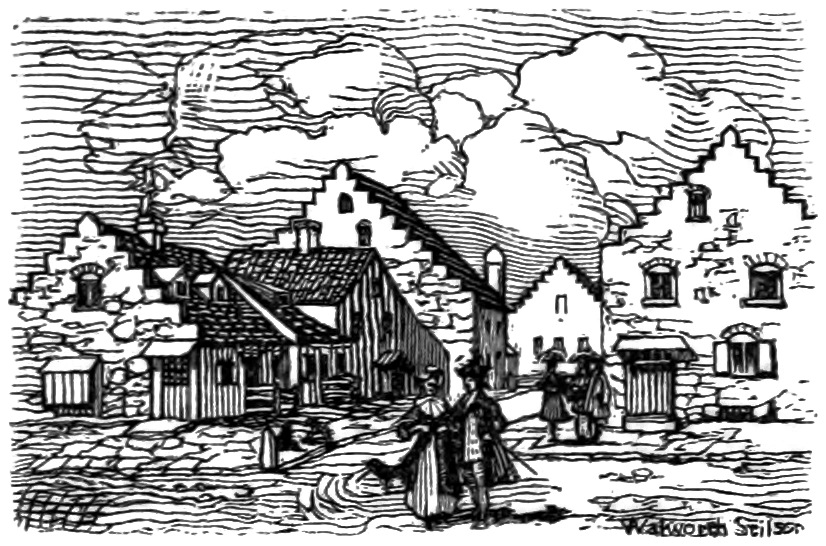
Dutch dominion, when a canal ran
through Broad Street and broad-sterned
Dutch vessels lay at anchor in
the centre of the town.
Politics ran high, and during elections
language was used with far less
restraint than at present. The first
man sent to Congress from New York
under the recently adopted national
Constitution was Mr. John Lawrence,
and a letter published in the “Daily
Advertiser” in March, 1789, contains
the following frank statement: “Of all
the men who framed that monarchical,
aristocratical, oligarchical, tyrannical,
diabolical system of slavery, the New
Constitution, One Half were lawyers.
Of the men who represented, or rather
misrepresented, this city and county in
the late convention of this State, to
whose wicked arts we may safely attribute
the adoption of that diabolical
system, seven out of the nine were lawyers....
And what crowns the wickedness
of these wicked lawyers is, that
a great majority of them throughout
the State are violently opposed to our
GOOD and GREAT HEAD and never-failing
friend of the city and city interests, the
present GOVERNOR.
“Beware, beware, beware of Lawyers!”
Very pleasant things were said about
the New York of 1789 when, at the end
of a three months’ session of the United
States Congress, it was announced that
only one member had been ill. After
commenting on its nearness to the ocean
and the sweetening of its air by abundant
verdure, a charming picture is
evoked by the statement that the residents
on the west side of Broadway are
“saluted by fragrant odors from the
apple orchards and buckwheat fields in
blossom on the pleasant banks of the
Jersey shore.”
The little city was already charged
with extravagance and frivolity, and
the details of these offences are not lacking.
One reads of blue satin gowns
with white satin petticoats, large Italian
gauze handkerchiefs with satin
border stripes worn about the neck,
completed by a head-dress of “pouf of
gauze in the form of a globe, the headpiece
of which was made of white satin
having a double wing, in large plaits,
and trimmed with a large wreath of artificial
roses.” There were shoes of blue
satin adorned by rose-colored rosettes,
and muffs of wolfskin with knots of
scarlet ribbon. The gentlemen of the
period were arrayed with equal splendor:
bottle-green, pearl, scarlet, purple,
mulberry, and garnet were among the
colors of cloths advertised by a local
tailor on Hanover Square; while waistcoats
fairly glowed with brilliant hues
and brocaded and spangled buttons.
Beaver and castor hats were in vogue,
and superior boots were made by Mr.
Thomas Garner, of Pearl Street, whose
proud claim to the patronage of the
fashionable was that he had worked for
the first nobility in England. It cost
approximately seventy-five dollars to
dress a lady’s hair every day in the
year; and there were dentists who pulled
the teeth of the poor gratis between the
hours of six and nine on the mornings of
Monday and Thursday. The sociability
and hospitality of the city made a deep
impression on Noah Webster, who was
also struck by the absence of affectation
and of social snobbery.
Lectures appear to have been few in
number and serious in theme; the city,
which took its pleasures comfortably,
took its opportunities of enlightenment
sparingly and in a heroic temper. There
appears to have been but one candidate
on the lecture platform for public approval
in this field during the winter of
1789, and he is described as “a man
more than thirty years an Atheist.” The
lecture was delivered at Aaron Aorson’s
tavern, and tickets were to be had from
the Aldermen!
The play enjoyed greater popular
favor, but the John Street Theatre was
without competition until 1798, when
the Old Park Theatre was opened. During
the season of 1789, William Dunlap
put several home-made American dramas
on the stage. He was the prolific
author of forty-nine plays, which stand
to the credit of his industry if not of
his genius. These dramas were the
premature births of the Genius of the
American stage, and none of them survives.
They were very faint prophecies
of the interesting dramatic movement
now in progress; but one of them,
“Darby’s Return,” achieved the rare
distinction of evoking a laugh from
Washington—an occurrence so unusual
that it stimulated a writer in the “Daily
Advertiser” to report it in the most
stately English: “Our Adored Ruler
seemed to unbend and for the moment
give himself to the pleasures arising
from the gratifications of the two most
noble organs of sense, the Eye and the
Ear!”
The Musical Society gave an occasional
recital, and there were subscription
concerts under the management of
local music-teachers. The young gentlemen
at Columbia College were delivering
Commencement orations “On the
Progress and Causes of Civilization”
and “On the Rising Glory of America.”
There were nine publishers and booksellers
in the city, and in the year of Irving’s
birth one of them announced “The
First American Novel” under the portentous
title, “The Power of Sympathy;
or, the Triumph of Nature.” The Society
Library, disrupted by the war,
was re-established, and a circulating library
organized. William Dunlap, the
playwright, painted portraits and,
later, became one of the founders of the
National Academy of Design. Mr.
Edward Savage and Mr. Joseph Wright
followed the same profession, and Washington
sat for all three. The city was
kept informed of events by five newspapers;
a magazine had been born prematurely
and expired after a brief and
unimportant life. The journalistic
style of the day was of an eloquence that
is happily illustrated by a description
of one of the barges which escorted
Washington on his voyage across the
bay to New York to attend his inauguration:
“The voices of the ladies were
as much superior to the flutes that
played with the stroke of the oars in
Cleopatra’s silken-corded barge, as the
very superior and glorious water scene
of New York bay exceeds the Cydnus in
all its pride.”
The two-story house in which Irving
was born, at No. 131 William Street,
about half-way between Fulton and
John Streets, was pulled down ten years
before his death, and the house directly
across the street, in which he spent his
childhood, has shared its fate. The latter
was larger and afforded greater
facilities for boyish gymnastics. There
were front and rear buildings with a
narrow structure between which was
hardly more than a passage, and it was
from the sloping roof at the rear that
Irving made his perilous descents when
he set out to enjoy the forbidden pleasures
of the John Street Theatre.
George William Curtis tells a delightful
story of a boy in Philadelphia, whose
father, like the elder Irving, was of a
very serious turn of mind, and who, by
way of youthful reaction, secretly frequented
the forbidden playhouse.
“John,” said the father, “is this dreadful
thing true that I hear of thee? Hast
thou been to see the play-actress
Frances Kemble?” “Yes, father.” “I
hope thee has not been more than once,
John.” “Yes, father,” was the honest
if somewhat discouraging answer;
“more than thirty times.”
The easy-going temper of the metropolis
to which Irving was to give a lasting
expression is still further indicated
by the story that in order to escape the
rigid requirements of his father’s Presbyterian
faith the boy had himself confirmed
in Trinity Church. His temper
was genial and kindly, and the mingled
sentiment and humor which were to give
his books a quality American writing
had so far lacked, made him a loiterer
and an observer rather than an arduous
and methodical student. New York was
the gateway to the beautiful country of
Dutch settlement and tradition on the
banks of the Hudson, and the gun and
fishing-rod were the instruments of exploration
with which the boy who was
to write “The Legend of Sleepy Hollow”
and “Rip Van Winkle” carried his
discoveries into the heart of a region in
which it was always afternoon. He had
read “Orlando Furioso” and had played
the knight with great fire and gallantry
in the back yard on John Street; he had
surreptitiously saved candle-ends and
read the moving adventures of Sindbad
and Robinson Crusoe in forbidden
places and at improper hours, and the
thirst for travel was on him. He wandered
about the pier-heads when he
should have been poring over textbooks,
and watched lessening sails with
eager desire to fare with them to the
ends of the earth. He was, in a word,
taking that course in romance, adventure,
and dreaming which boys of his
temperament and genius have elected
from the beginning of time, to the sore
but fortunate disappointment of their
elders. His brothers went through
Columbia College, but he went up the
Hudson and discovered to the imagination
the river which Hudson had
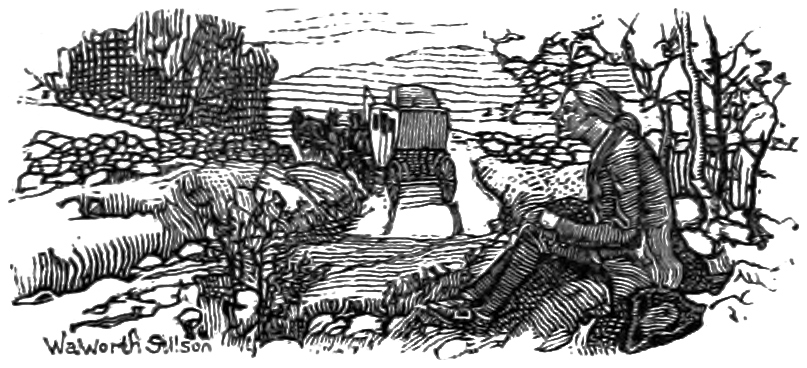
discovered to the eye. Diedrich
Knickerbocker was last seen, it will be
remembered, by the passengers in the
stage for Albany!
The literary temperament in Irving
was not without the confirmation of the
literary impulse, and while he was still
in his teens he began to try his hand at
social satire, a form of literature which
is practised only by men of city breeding
and interest. In the “Morning
Chronicle,” of which his brother Peter
was editor and proprietor, he published,
in 1802, a series of short papers dealing
with the fashions and foibles of the town
after the manner of the “Spectator” and
“Tatler,” and especially with the manners
of the actors and their auditors.
They were boyish performances, but
they showed sensibility and humor, and
a chivalrous attitude toward women.
Irving’s health, which had been uncertain,
was established by a residence of
two years in Europe, where he saw
countries and peoples with infinite zest
not only in the picturesque Old World
but in the range and variety of character,
the broad contrasts, the mingled
tragedy and comedy of life in a more
highly organized society. “I am a
young man and in Paris,” he wrote to a
friend at home, and he was happy in a
wholesome appetite for a more picturesque
and vivid life than he had enjoyed
in the little provincial city at the mouth
of the Hudson. When he returned in
1806 it was to find a group of companions
whose knowledge of the great
world was less than his, but who were
equally ready for work or for mischief
in a little provincial city which had
developed what may be called a town-consciousness.
It was still bounded on the north by
Anthony and Hester Streets; Greenwich
Village, a pleasant suburban village
through which Christopher Street
now passes, was a place of refuge from
the plague for families fleeing from the
city; the State prison was there, and
there were faint streets budding in the
adjacent farms. Broome Street had
been laid out; Astor Place and Greenwich
Street, Mr. Jarvis tells us, were
lanes; the latter had attained the dignity
of a fashionable drive, and opulent
citizens drove out to Greenwich Village
on pleasant afternoons, as to-day they
motor to West Point or Peekskill! The
seats of fashion were to be found on the
Battery, which would have remained the
most delightful locality for residence in
New York if the people of the metropolis
had not conceived a repugnance to
living in near proximity to business
quarters. Lower Broadway, Upper
Pearl and Nassau Streets were of high
respectability; and Broadway had been
paved as far as the City Hall. Beyond
lay charming country roads, occasional
country houses to which the leading
families retreated from the summer
heat, and thrifty farms whose owners
were happily ignorant of the enormous
future values of their fields.
The American imagination, which has
since built so many cities over night in
the newer sections of the country, did
not slumber, however, even in a city in
which Dutch reluctance to move faster
than the fact was so large a factor, and
a map made by Mangin in 1803 carries
the Boston Road far north through a
network of supposititious streets that
lay across the broad fields owned by Mr.
Bayard, Mr. Rutgers, Mr. Lispenard,
Mr. De Peyster, and other well-known
citizens, and obliterates as by magic the
Swamp; the Collect, or fresh-water
pond; and the salt meadows of the
earlier maps.
The Collect was not, however, so
easily dealt with. It was a marsh lying
across the island from Roosevelt Slip to
the Hudson at what is now the foot of
Canal Street. The focal point of this
marsh was a pond which found an outlet
through the Swamp where leather
has had its shrine these many years, and
whence the first Brooklyn Bridge takes
its flight over the East River. The
Swamp had been drained and the water
from the pond flowed along the course
of the present Canal Street; but the
pond was still to be disposed of. It was
very deep and it was proposed at one
time to connect it with the two rivers by
canals, which would have made New
Amsterdam reminiscent of old Amsterdam;
but it was finally filled in by leveling
the high ground, and adventurous
youths and maidens who had been accustomed,
on pleasant afternoons, to
venture into the country beyond the
City Hall lost a convenient excuse for
Sabbath-day excursions.
It is amusing to find a pleasure-garden
bearing the Old World name of
Ranelagh on the older maps; and Old
Vauxhall, which stood originally at the
corner of Warren and Greenwich Streets
in a house built by Sir Peter Warren,
was also a public garden, patterned
after its famous original in London
and kept by Sam Fraunces, at one time
a steward in the employ of Washington,
and whose connection with the old tavern
which still stands ensures his name
a local immortality. Later this pleasure-ground
covered the section between
Broadway and the Bowery of which the
Astor Library was the centre. The chief
cattle-market was on the Bowery somewhat
south of the garden. There were
various road-houses along the East
River where oysters and turtles were
cooked with great skill. Fishing and
water parties in summer and sleighing
parties in winter found the best of fare
in these houses, with their pleasant
grounds. It was the day of the old-fashioned
chaise, and there was a bridge
on the Boston Post Road at about
Third Avenue and Seventy-seventh
Street which bore the suggestive name
of the Kissing-bridge. The exaction
of this kind of toll appears to have
been widely practised; not only bridges
but gates and stiles were penalized
for women. The Rev. Mr. Burnaby
sagely observed that this custom was
“curious, yet not displeasing.” New
York had spread out since Irving’s
birth, but it was still a neighborly little
city, of a social turn and disposed to
make easy terms with life.
In 1809 Thomas Paine had just died
in Greenwich Village, at what is now
No. 293 Bleecker Street, where he was
often to be seen at the open window
reading, with his book in close proximity
to a decanter of what appeared to
be brandy or rum. It is reported that
two clergymen who visited him with the
hope of changing his attitude toward
Christianity were abruptly dismissed
and the housekeeper received orders to
bar the door against such visitors. “If
God does not change his mind, I’m sure
no human can,” was her sage comment,
and the author of “The Age of Reason”
was troubled no more.
* * * * *
After a stormy passage of sixty-four
days, not lacking in serious perils,
Irving landed in New York in the wake
of a heavy snowstorm in February,
1806, in high spirits and ready for such
pleasures as the little town afforded. One
of his biographers has described it as
a “handy” city; it was large enough to
furnish ample variety of character
studies and many opportunities for
good-fellowship of an intimate, easy-going
sort; there was an air of conviviality
about the place, but there was
little serious dissipation. It was a very
pleasant moment in the growth of the
metropolis which had become, in a quiet,
provincial way, a town in the special
sense in which that word connotes a
group of people numerous enough to
constitute a society, fond of the same
pleasures, interested in local incidents
and amusements, sufficiently intimate to
have formed a code of social standards
and manners. In a word, in the New
York of Irving’s early maturity, as in
the London of the time of Steele and
Addison, there was an organized society,
open to clever portraiture and
brisk satire; supplying at the same
time the material and the audience for
local wit and humor. It was easy to
know everybody in the society of the
town, and easy to get about the place.
The tone was not intellectual, though
the city never lacked men and women
of distinguished ability and social cultivation.
It was a well-bred and hospitable
society, with a keen relish for
pleasure. There were numberless dinners
and suppers, much less costly and
elaborate than those of to-day, and
more informal and merry. The country
was convivial in all sections outside New
England, and the social use of wine was
over-generous. In America, as in England,
getting under the table was an indiscretion,
not a fault. One of Irving’s
friends reported that, after a festive
occasion, he had fallen through an open
grating on his homeward way and was
disposed to feel very much depressed by
the darkness and solitude; but, one after
another, several fellow-guests joined
him in the same manner, and the hilarity
was prolonged until dawn.
Like many other young men whose
ultimate good or evil fortune it was to
write books, Irving was admitted to the
bar at about the same time that the
sign, “William Cullen Bryant, attorney
and counsellor at Law,” appeared in the
little village of Cummington in western
Massachusetts. In after years his estimate
of his legal acquirements was indicated
by his quoting the comments of
two well-known lawyers who were examining
students for admission to practise
law. “Martin,” said one of these examiners,
referring to an aspirant who had
acquitted himself very lamely—“Martin,
I think he knows a little law.”
“Make it stronger,” was the reply;
“damned little.” Irving had loitered
and dreamed on the water-front as a boy
when he ought to have been at his
books; and now, at the gateway of his
career, the literary temperament turned
him toward congenial fellowship rather
than arduous study. There was plenty
of material for comradeship in the town,
and young men of spirit instinctively
gathered about him. It was a very
kindly and wholesome Bohemia in which
they disported themselves in the halcyon
days of a fleeting youth. They regarded
themselves as “men about town”
of the deepest dye, but it was a very
innocent town in which they amused
themselves, and they all bore honorable
names in later and more serious years.
Henry Ogden, Henry Brevoort,
James K. Paulding, John and Gouverneur
Kemble, Peter and Washington
Irving, the leaders of this vivacious
company, were members of families who
had long been foremost in the social life
of the city, and they were far from
being the “roistering blades” they
fondly thought themselves to be. They
were young men of spirit, generous
tastes, and no little cultivation. They
combined with great success devotion to
literature and social activity. Irving
speaks of himself as “a champion at the
tea-parties,” and the “nine worthies,”
or “lads of Kilkenny,” as he called
them, shone in the society of what was
then known as “the gentler sex” no less
than on the festive occasions when they
celebrated their youth in private revels.
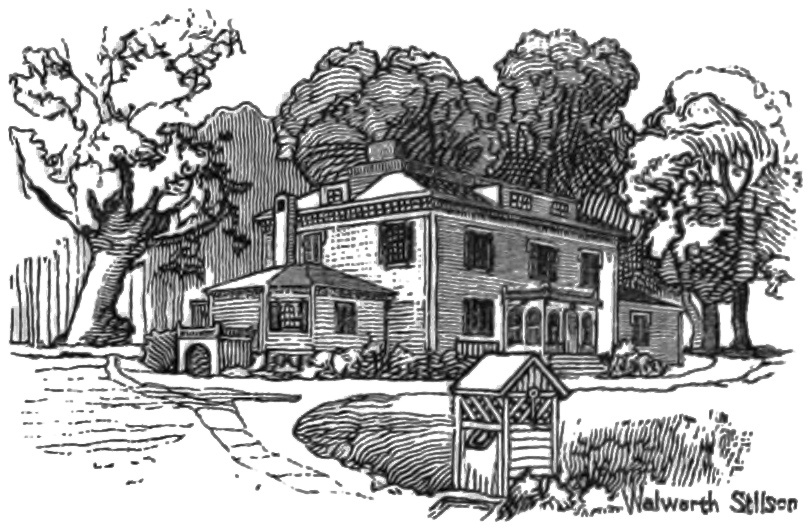
The old country house built by
Nicholas Gouverneur, from whom it had
descended to Gouverneur Kemble, was
the favorite out-of-town haunt of these
lively youths. It had a pleasant site on
the banks of the Passaic not far from
Newark, and is celebrated in the “Salmagundi”
papers as Cockloft Hall. An
old-time air hung about the place, with
its antique furniture and generous endowment
of family portraits. It was
cared for by two old servants of long
standing in the family, and a negro boy,
and it afforded a well-set stage for the
lively comedy which these vivacious
youths made of life in the golden hour of
coming into the heritage of youth and
pleasure and Letters. “Who would
have thought,” wrote Irving in his
sixty-seventh year to the owner of the
old Hall, “that we should ever have lived
to be two such respectable old gentlemen?”,
and many years after the curtain
had fallen on the gaiety and fun of those
hilarious days, Peter Irving often recalled
the Saturdays at the Hall, when
“we sported on the lawn until fatigued,
and sometimes fell sociably into a general
nap in the drawing-room in the
dusk of the evening.” In town the
“lads of Kilkenny” often assembled at
Dyde’s, a tavern of good standing in
Park Row; a convenient place for after-theatre
suppers.
To riot at Dyde’s on imperial champagne,
And then scour our city—the peace to maintain,
was an occupation which these gentlemen
pursued with great success. When
the financial resources of the revelers
ran low they reduced the scale of expenditure
by resorting to an unpretentious
porter-house at the corner of Nassau
and John Streets, not far from the
theatre, where they indulged in what
they depreciatingly called “Blackguard
Suppers.” The modern misogynist
habit of living in clubs and associating
with one sex only had not come into
vogue in those sociable and informal
days, and the young men who formed
the Knickerbocker group were on good
terms with the belles of the day, and appear
to have been much in evidence at
social functions. Irving asked Henry
Ogden, who had sailed for China, to
“pick up two or three queer little pretty
things that would cost nothing and be
acceptable to the girls,” and there are
hints of a Chinese supper later.
The first number of “Salmagundi,”
the initial work of the so-called Knickerbocker
School, was published on
January 24, 1807, preceded by some
clever and mystifying announcements in
the “Evening Post.” It appeared fortnightly
through the year, and came to
an untimely end in January, 1808, not
because its popularity was waning, but
because its publisher was disposed to
deal in an arbitrary fashion with its
high-spirited editors. The idea of a
periodical which would deal freely and
frankly, in a satiric or humorous spirit,
with the fashions and foibles of the town
originated with Irving, who secured his
brother William and his friend James
K. Paulding as associates in what
turned out to be a more extended and
elaborate frolic than they had hitherto
planned. They proposed to amuse
themselves with the town, and they succeeded
for a year in keeping the little
city on tip-toe expectation, not unmixed
with apprehension; for “Salmagundi,”
while entirely free from personalities
and scandal, was keen in its comments
on manners and local social standards.
It was written in the manner of the
“Spectator”; but New York did not
furnish the varied and brilliant material
which London offered Steele and Addison,
and the Irvings and Paulding
lacked the sophisticated charm, the intimate
and adroit skill of their predecessors.
They were, moreover, very
young apprentices, and must not be
judged by the standards set by the masters
of the art, whose comments on
passing fashions have become contributions
to literature. The banter was
somewhat heavy-handed and the humor
gave little promise of the lightness of
Irving’s later manner, or of the clear-cut
and nimble wit of Lowell and
Holmes. It bore the stamp of a provincial
society and was rollicking and
hilarious rather than keen and pungent.
Irving had no illusions about its
quality. The “North American Review,”
however, described “Salmagundi”
as a production of extraordinary merit.
Eleven years after the last number appeared,
Irving wrote to Brevoort that,
while it was pardonable as a youthful
production, it was full of errors, puerilities,
and imperfections; and in a letter
to Irving, Paulding said: “I know you
consider old Sal. a sort of saucy, flippant
trollope belonging to nobody and
not worth fathering.” “Salmagundi”
had the crudity of youth, but it also
had its high spirits, its gaiety, and its
audacious confidence in its own opinions.
It was frolicsome and joyous and
not devoid of literary grace and skill,
and will remain the happiest contemporary
record of old New York.
The old Government House, which
had been built for the President of the
United States, faced Bowling Green
when “Salmagundi” published the
chapter entitled “A Tour in Broadway.”
This building passed through a
period of great distinction as the residence
of Governor George Clinton and
of Chief Justice Jay, and then lost prestige
as the local post-office. In its
cellar were stored the statues of gods
and goddesses belonging to the homeless
Academy of Arts. The lead statue of
George the Third, which formerly stood
on Bowling Green, had been pulled
down and run into bullets to be aimed
at his Majesty’s troops, and the Green
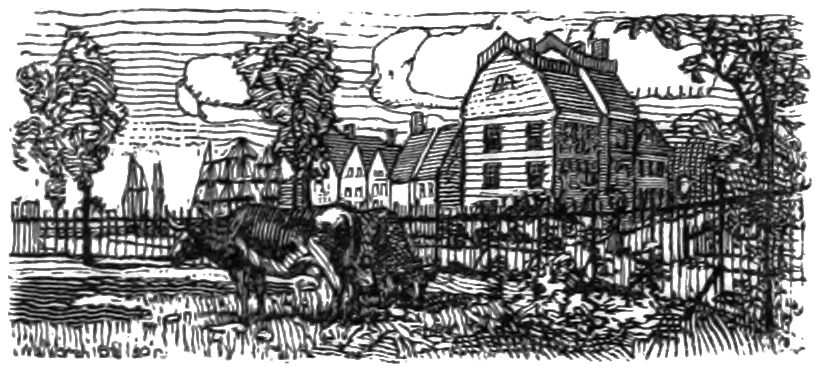
had been put to bucolic uses as a pasturage
for cows. Cortlandt Street corner
was a famous vantage-ground from
which to see the belles go by in pleasant
weather, on shopping bent. The City
Hall, according to “Salmagundi,” was
a resort for young lawyers, not because
they had business there, but because
they had no business anywhere else.
There was an advanced wing of society
which practised the latest arts of
pleasure imported from the Old World.
The great god Style already had its
votaries, and then, as now, many were
the sacrifices of good taste and refined
manners offered at its painted paste-board
shrine. “Salmagundi” found a
rich yield of satire in the imitative instinct
which shaped many of the customs
and social habits of the hour. It
informs us that
Style, that with pride each empty bosom swells,
Puffs boys to manhood, little girls to belles.
The waltz was a novelty in those days,
and “Salmagundi” “views with alarm”
its introduction into the social life of
the town:
Scarce from the nursery freed, our gentle fair
Are yielded to the dancing-master’s care;
And, ere the head one mite of sense can gain,
Are introduced ’mid folly’s frippery train.
A stranger’s grasp no longer gives alarms,
Our fair surrender to their very arms,
And in the insidious waltz will swim and twine,
And whirl and languish tenderly divine!
O, how I hate this loving, hugging dance;
This imp of Germany brought up in France!
* * * * *
Let France its whim, its sparkling wit supply,
The easy grace that captivates the eye;
But curse their waltz,—their loose, lascivious arts
That smooth our manners to corrupt our hearts!
In the novel and play of the time
“Salmagundi” found still more alarming
evidences of a decline in morals and
manners:
Where now those books, from which in days of yore
Our mothers gained their literary store?
Alas! stiff-skirted Grandison gives place
To novels of a new and rakish race;
And honest Bunyan’s pious, dreaming lore,
To the lascivious rhapsodies of Moore.
And, last of all, behold the mimic stage
Its morals lend to polish off the age,
With flimsy farce, a comedy miscall’d,
Garnished with vulgar cant, and proverbs bald,
With puns most puny, and a plenteous store
Of smutty jokes, to catch a gallery roar.
Or see, more fatal, graced with every art
To charm and captivate the female heart,
The false, “the gallant, gay Lothario” smiles,
And loudly boasts his base seductive wiles—
In glowing colors paints Calista’s wrongs,
And with voluptuous scenes the tale prolongs.
The stage of social development at
which the town had arrived is indicated
by the words “female heart.” Its old-fashioned
virtue, assailed by “Lalla
Rookh” and “The Penitents,” had, fortunately,
no premonitions that its infancy
in the dramatization of vice was
to pass into the full and voluptuous
maturity of these later days of the
play of passion without a shred to its
back.
“Salmagundi” had made the town
smile, but “A History of New York”
was so broad in its mock-heroic treatment
of the local forefathers that it
gave grievous offence to those members
of the early Dutch families who lacked
the sense of humor. An old gentleman
who died twenty years ago once said to
the writer of these lines, with perfect
gravity, that Mr. Irving once confessed
to him that the history was not entirely
accurate! It appeared just before
Christmas in 1809, preceded by cunningly
devised hints and intimations in
the form of letters, asking for information
about a certain old gentleman who
bore the name of Knickerbocker, who
was last seen resting himself near Kingsbridge
by the passengers in the Albany
stage. He had a small bundle tied in a
red bandana handkerchief in his hands,
and appeared to be very much fatigued.
Ten days passed without news of the
whereabouts of this weary old gentleman,
when it was announced that a book
in his handwriting had been discovered
in his room and would be disposed of to
pay the arrears of his board and lodging!
The town became immensely interested,
and when the History appeared it
was eagerly read, laughed over, and
denounced. Never was a book more
cleverly announced even in this day,
when advertising has become an art
based on a deep study of the psychology
of the crowd and the effect on the
human mind of rhythmical recurrence,
at short intervals, of skilfully phrased
testimonials from eminent persons to
the superiority of certain articles without
which it is impossible to live. There
were eighty thousand people in New
York, and the society folk who constituted
the “town” in the technical sense
of the word were a comparatively small
and homogeneous group, many of
whom were of Dutch descent and bore
names long honored in the city and
now inscribed on the signs on the corners
of the streets. The History,
originally projected as a satire on a
solemn and heavy-handed “Picture of
New York” which had recently appeared,
had widened its scope, and, like
“The History of the Adventures of
Joseph Andrews,” which started out to
be a travesty on Richardson’s “Pamela,”
took on the dimensions of an original
contribution to literature. The dedication
“To the New York Historical
Society” struck the key-note of its burlesque
gravity of manner and its audacious
and rollicking fun. Its appearance
was the signal for a blaze of wrath accompanied
by a peal of laughter from
New York to Albany. Mrs. Hoffman
wrote to Irving, referring to one of his
friends who was a social leader: “Your
good friend, the old lady, came home in
a great stew this evening. Such a scandalous
story had got about town—a
book had come out called a ‘History of
New York’; nothing but a satire and
ridicule of the old Dutch people—and
they said you was the author; but from
this foul slander, I’ll venture to say, she
has defended you. She was quite in a
heat about it.”
Ten years later, when its obvious burlesque
intention ought to have filtered
into the most solemn-minded, it was described
by an eminent citizen of Dutch
descent as “a coarse caricature.” Its
humor was not lost, however, by a host
of people in the town and elsewhere.
“If it is true, as Sterne says,” wrote a
correspondent in a Baltimore newspaper,
“that a man draws a nail out of his
coffin every time he laughs, after reading
Irving’s book your coffin will fall to
pieces.” Walter Scott wrote to Irving’s
friend Henry Brevoort: “Looking at the
simple and obvious meaning only, I have
never read anything so closely resembling
the style of Dean Swift as the
annals of Diedrich Knickerbocker. I
have employed these few evenings in
reading them aloud to Mrs. S. and two
ladies who are our guests, and our sides
have been absolutely sore with laughing.”
This audacious burlesque of the early
history of the city and of its men of
local fame and Dutch descent was the
initial volume in American literature,
the first book of what used to be called
belles-lettres published in this country,
the first piece of American writing of
literary quality which caught the attention
of Europe. It also created the
Knickerbocker Legend, and gave the
earliest group of writers in New York
a descriptive name. Diedrich Knickerbocker
has long been the impersonation
of old New York, and, with Rip Van
Winkle and Brom Bones, forms the
central group in our New World mythology;
and “The Legend of Sleepy
Hollow,” “Rip Van Winkle,” and the
old-fashioned gentleman who was last
seen on the Albany Post Road constitute
our chief group of legendary characters
and are all the creations of Irving’s
imagination. While descriptions of the
scenery and peoples of the New World
had been written south of Manhattan
Island and theological treatises
abounded in New England, it was significant
of the metropolitan spirit of
New York that its earliest writers, who
were also the earliest writers of literary
spirit and purpose in the country, were
men of humor and urbanity, and on easy
terms with life.
* * * * *
Two years after the publication of
“A History of New York,” Irving
was living at No. 16 Broadway, near
Bowling Green, with his friend Henry
Brevoort. He had made various journeys
to Albany and Washington by the
tedious methods of travel in use at the
time, and his letters showed conditions
in political life which differed from those
prevailing to-day chiefly in being more
sordid and unscrupulous. The coterie
who were to become known as the
Knickerbocker group had become a little
less boisterous in their convivialities,
but not less persuaded that literature
and jovial good-fellowship throve well
together. They were often at the Hall
on the Passaic or at the home of Captain
Phillips in the Highlands of the
Hudson, where spacious mansions and
large estates had multiplied; and there
were houses in town, like Mrs. Renwick’s,
where these gay young men were
at ease.
On the 25th of May, 1815, Irving
sailed for Liverpool, and did not set
foot on Manhattan Island again until
1832. He had given New York the
Knickerbocker tradition, made the first
important contribution to belles-lettres
in this country, and conferred on the
metropolis the distinction of being the
birthplace of American literature.
Between the publication of “Salmagundi”
in 1807 and Irving’s return from
Europe in 1832, the group of young
men who belonged to his coterie and
who formed the Knickerbocker group
had their golden age of easy conditions
so far as absence of competition was
concerned. Long afterward Irving said
to George William Curtis: “You young
literary fellows to-day have a harder
time than we old fellows had. You trip
over each other’s heels; there are so
many of you. We had it all our own
way. But the account is square, for you
can make as much by a lecture as we
made by a book.” The “town” lasted
well on into the Thirties, but it was no
longer the undisturbed provincial city.
Cooper, Bryant, Willis, and Poe had
become residents, and there was a further
progression toward cosmopolitanism.
Moreover, the city was fast outgrowing
its old-time metes and bounds,
and complaints about the distances between
sections and lamentations for the
passing of “the good old times” began
to be heard. While Irving was industriously
transcribing the half-forgotten
background of ripe landscape and ancient
custom in the Old World and winning
a reputation of the most enviable
kind, the rollicking friends who had
been young together were passing into
maturity and making the most of the
morning hours of reputation and position.
No more interesting face was seen in
the streets of New York in the days of
Irving’s long expatriation than that of
James Kirke Paulding. The regular
and clear-cut features, the smiling but
penetrating eyes, the compact, well-poised
head with its mass of hair worn
with the picturesque carelessness of nature,
gave him a look of distinction. He
was a very companionable man, and
there was no suggestion of the precision
and preoccupation of the man of affairs
about Paulding; his convictions were
deep-set and never kept in the background
if there was occasion for their
expression; but, like all companionable
men, he knew how to find common
ground with a friend ample enough for
the freest interchange of jest and idea.
He was of colonial stock, as were all the
men of his craft in New York. For
many years before the Revolution the
Pauldings had lived in Tarrytown,
which is intimately associated with the
Knickerbocker tradition; but that lovely
shore of the Hudson was open to the
ravages of both armies during the war,
and the family removed to Dutchess
County. This county lies north of
Westchester, and both have fed New
York with men of distinction. Dutchess
claims to have been the mother of
beautiful women as well, one of them of
such surpassing loveliness that the Czar
of Russia of that day pronounced her
the most beautiful woman he had ever
seen. The poet’s father was active in
the American cause, and his cousin John
was one of the captors of Major André.
His boyhood was so ravaged by the uncertainties
and hardships of war that
he said later that he never wished to be
young again.
He was in his nineteenth year when
he came to New York, and, through his
acquaintance with William Irving, met
the group of young men who were making
a business of pleasure and a recreation
of literature. He and Washington
Irving were soon fast friends, and the
first number of “Salmagundi” was their
joint production. Paulding, like Cooper,
became involved later in controversies
which gave sharp point to his pen, but in
“Salmagundi” he shared with Irving the
gaiety of spirit and urbanity of manner
which made the keen satire of that
quick-witted journal entertaining even
to its victims. Duyckinck was of opinion
that the papers in Oriental guise
were from Paulding’s hand, and that
he wrote many of the best descriptive
passages; and characterized his style as
stamped by feeling, observation, friendly
truth, and genial sympathy. He was
one of the first to state forcibly the
American case in the long and at times
acrimonious interchange of criticism
between this country and England, and
“The Diverting History of John Bull
and Brother Jonathan” was so keen a
piece of satire, but so free from malice,
that it was reprinted in England. A
later satire in the form of a parody on
the “Lay of the Last Minstrel” made
such stinging comment on the British
raids on Chesapeake Bay as to be
thought worthy of the attention of the
“Quarterly Review,” an adept in the
heavy-handed castigation in vogue at
that time. A retort to the strictures of
the “Quarterly Review” soon followed
in pamphlet form, and raided English
morals and manners with such effectiveness
that it caught the attention of
President Madison.
In 1816 Paulding traveled in Virginia
and wrote one of the earliest of
those local studies which record the
interstate commerce of observation and
criticism for which this country supplies
such abundant material. The spirited
and frank retorts to the somewhat oppressive
“condescension of foreigners”
had made Paulding known to the country
at large, but when “The Backwoodsman”
appeared in 1818 its elaborate
and very formal heroics, descriptive of
the fortunes of an emigrant who made
the perilous change from the Hudson to
the frontier, found the same scanty
measure of favor now generally extended
to narrative poems. The poem enjoyed
a distinction, however, at that time very
rare: it was translated into French.
Paulding’s friend and contemporary has
left a somewhat enigmatic comment on
this original American production:
Homer was well enough; but would he ever
Have written, think you, “The Backwoodsman”?
Never!
If these lines had fallen under the eye
of Matthew Arnold we should have
had another light-handed international
amenity to contribute to the joy of
both nations.
When Paulding tried to recall the
atmosphere and tone of “Salmagundi”
in 1819, it was soon evident that the
“town” of the early Knickerbocker had
merged into a larger community, and
much of the wit went wide of the mark.
Paulding, meanwhile, had entered public
service and was living in Washington.
In 1823 he published his first novel,
“Koningsmarke,” a study of life among
the Swedish settlers on the banks of the
Delaware. But the satirical impulse
was strong in him, and the title of his
next book, “John Bull in America; or,
the New Münchausen,” is sufficiently descriptive
to make further comment unnecessary;
while “The Merry Tales of
the Three Wise Men of Gotham,” which
appeared a year later, touched somewhat
caustically the new social doctrine
of Robert Dale Owen, the rising science
of phrenology, and other matters of interest
at the moment. His aptness for
satire was braced in Paulding by a lively
dislike for the heavy contemptuousness
of manner of some Englishmen of the
time, and the abundant material furnished
by some of these candid friends
led him again to enter the field with one
of the keenest of his satires, “The Mirror
for Travelers,” a burlesque guide-book
and record of travel in this
country, in a cleverly imitated British
manner.
In this satiric view Paulding was a
true child of the Knickerbocker spirit,
and his next books, “Tales of the Good
Woman” and “Chronicles of the City of
Gotham,” purported to be translations
of legends of early New York. A Mrs.
Grant, who had written pleasantly of
the old Dutch settlers, furnished material
for “The Dutchman’s Fireside”;
a story which so greatly pleased the
readers of the day that it went promptly
through six editions and was republished
in England, France, and Holland.
In Washington, as in New York, Paulding
was a thoroughgoing Knickerbocker;
but he had an eye for manners
and great zest for the pleasures of hospitality,
and his account of Virginia was
followed, the year after the appearance
of the Dutch novel, by “Westward
Ho!”, a story that, moving with the
southern flow of emigration, began in
Virginia and was worked out in Kentucky.
Paulding was charmed by the
plantation life, the generous hospitality,
and the winning Southern temperament,
and in 1836, when the tide of
feeling in the country was rising, wrote
an uncompromising defence of slavery,
an institution with which he was not unfamiliar
in his own State, where it was
not abolished until 1799. In 1837
Paulding entered the cabinet of a
Knickerbocker President, Van Buren, as
Secretary of the Navy.
On retiring from office, Paulding
found a delightful home overlooking the
Hudson, not far from Poughkeepsie,
within sight of many of the localities endeared
by early associations and ancient
Dutch traditions. There he practised
the arts of agriculture and of writing
with growing content. He was as busy
within doors as without, and his pen
was driven as regularly as his plough.
A story of the Revolutionary period,
and, later, a novel laid partly in this
country and partly in England, and an
American comedy, “The Bucktails; or,
The Americans in England,” were fruits
of this well-ordered leisure. Five years
later he gave this very comfortable picture
of his manner of life:
“I smoke a little, read a little, write a
little, ruminate a little, grumble a little,
and sleep a great deal. I was once great
at pulling up weeds, to which I have a
mortal antipathy, especially bull’s-eyes,
wild carrots, and toad-flax, alias butter-and-eggs.
But my working days are
almost over. I find that carrying seventy-five
years on my shoulders is pretty
nearly equal to the same number of
pounds; and instead of labouring myself,
I sit in the shade watching the
labours of others, which I find quite sufficient
exercise.”
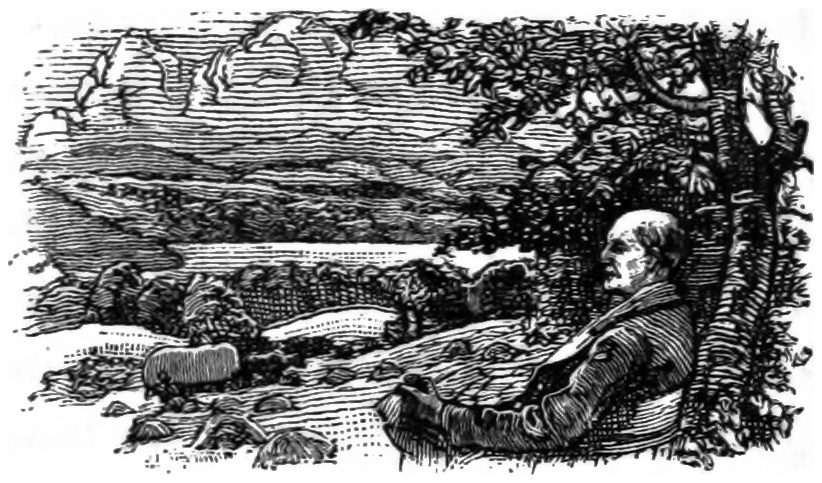
Sitting pipe in mouth on his veranda
overlooking the river, watching the
harvesters and the haze on the Catskills
on those autumn afternoons when Rip
Van Winkle’s slumbers were deepest, the
old man delighted to recall the golden
Knickerbocker age before the “town”
had been lost in the metropolis, to tell
the brave story of the youth of the
Knickerbocker group, to draw the portraits
of the great men he had seen in
Washington, to castigate John Bull
with passionate eloquence whenever occasion
arose, and to chant the elegy of
age on the good old times of the patriots
and demigods. A sturdy man, of deep
convictions and passionate feelings,
Paulding shared Irving’s sense of humor,
high spirits, and gift for satire;
but, while Irving saw the Old World
with sympathetic eyes and reknit the
severed ties between the young and the
old country, Paulding remained a provincial
in experience and feeling; loyal,
prejudiced, partisan; a man of a city,
but not a man of the world.
* * * * *
The last stages of the Knickerbocker
age began when Fitz-Greene Halleck
appeared on the scene. He was not to
the manner born; he came from Guilford,
Connecticut; but he felt the
Knickerbocker spirit and shared its
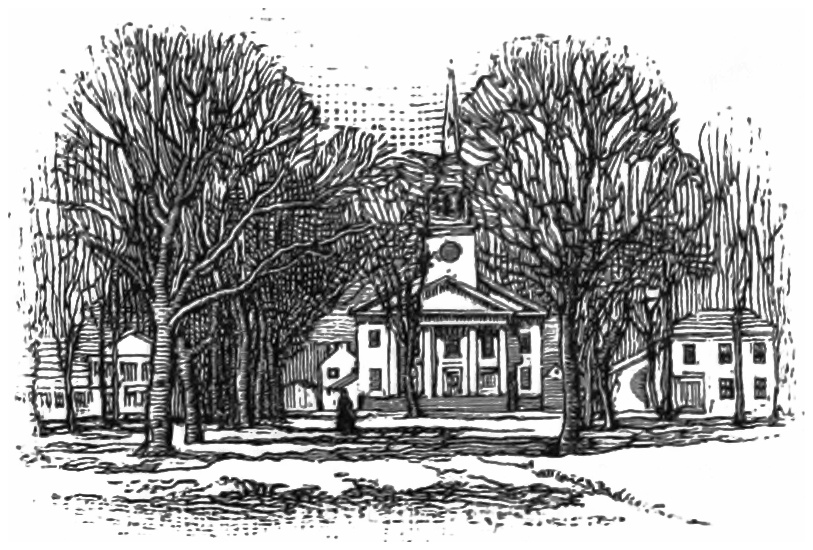
achievements. Born in one of the loveliest
of the old New England villages,
whose distinction was invariably expressed
in a green or common, a Congregational
spire, an academy, and rows
of graceful elms, Halleck brought to
New York, in 1811, a good school training
and skill in bookkeeping gained in
that forerunner of the modern department
store, the country store. The
laughter which greeted the appearance
of the “Salmagundi” papers was a thing
of the past, and the anger which met
Diedrich Knickerbocker’s story of his
ancestors had lost its heat; the merry
youths who gathered at Cockloft Hall
had blown the foam off the wine of life,
though they had not lost their zest in
the mere act of living; Irving was boarding
on lower Broadway with Brevoort
as a roommate, and there was plenty of
good talk but very little work done.
Halleck made a very quiet entrance
into the city which was later to honor
him with one of the few statues commemorative
of its Men of Letters. He
was a born accountant, and during his
long residence in New York he served
two men in this capacity—Mr. Jacob
Barker and Mr. John Jacob Astor. Mr.
Astor, at his death in 1848, left him an
annuity large enough in those days of
moderate prices to enable him to retire
to his native town and enjoy ease of
condition and industrious leisure in a
fine old colonial house which had some
associations with Shelley’s adventurous
grandfather.
Halleck did not find his way into the
Knickerbocker group at the start, but
he early made acquaintance with Joseph
Rodman Drake and the two became ardent
friends. Drake was a young man
of captivating personality; variously
gifted and brilliant; a thoroughbred in
his sense of honor and a certain gallant
rectitude and courage; a man of charming
fancy, who, at the age of five, was
writing clever verse. By descent he was
an American of the Americans, if we
accept the dictum of Richard Grant
White that to be an American one must
have come of ancestors who arrived in
this country before the War of the
Revolution. Drake had an ancestor in
the Plymouth Company, and his father
held a colonelcy in Washington’s army.
His mother was equally well-born in the
true sense of the word. His childhood
was overshadowed by the death of both
his parents and the bitterness of poverty;
but the boy was of a chivalrous
spirit and faced hard conditions with a
resolution which was an assurance of
success. His active fancy opened a door
of escape from these conditions, and he
played many romantic parts in the
drama of his bleak boyhood. He was
an omnivorous reader, his memory let
nothing escape, and despite his lack of
opportunity he became exceptionally
well informed. His facility in verse-writing,
so early developed, grew with
his years; and his endeavor to make a
man of business of himself failed utterly.
Drake was eighteen and Halleck
twenty-three when, on a sailing party in
the bay, they met James De Kay,
a young medical student. The day was
genial, youth was at the prow and also
at the helm, and Halleck remarked that
“it would be heaven to lounge upon the
rainbow and read Tom Campbell.” It
requires some effort of the imagination
to recall Campbell’s popularity at that
time and to revive the state of mind
which could see in him a possible relation
with the rainbow; but in youth and
fair weather all things tremble on the
verge of poetry. Literature was still
in the future for the ardent youths, but
life was within easy reach, and especially
the pleasant social life of a small
city. In this same year Irving was beginning
to look upon the quiet pleasures
of New York with the jaundiced eye of
a veteran man of the world upon whom
the weight of twenty-nine years bore
heavily. Writing of a certain vivacious
young woman who played “the sparkler,”
he said: “God defend me from such
vivacity as hers in future—such smart
speeches without meaning; such bubble-and-squeak
nonsense. I’d as lieve stand
by a frying-pan for an hour and listen
to the cooking of apple fritters”; and
he reports that when he was out of the
house he did not stop running for a mile.
He speaks irreverently of the “divinities
and blossoms” of the hour, of “rascally
little tea parties,” and protests that he
is weary of the “tedious commonplaces
of fashionable society.”
The two young poets, hidden in an
obscurity which they found very pleasant,
were probably in great awe of the
brilliant young Knickerbocker who had
dared to ridicule the town, and who, in
the glory of his local fame, was eager
for fresh fields and a wider horizon.
They found very excellent company
and much pleasant talk in the city, and
they hunted the joys of youth together.
Halleck described Drake at this time as
“perhaps the handsomest man in New
York—a face like an angel, a form like
an Apollo.” Music was one of the accomplishments
of Drake, and he played
the flute at a time when that instrument
and the harp were the symbols of social
cultivation. One of their hostesses was
Mrs. Peter Stuyvesant, whose spacious
house, not far from the square which
bears her name, with its gardens and
lawn stretching to the East River, was
a centre of social activity. The city
ended at Canal Street, and a visit in the
vicinity of old St. Mark’s was like going
to Tarrytown or Trenton in these swift-footed
days. Mrs. Stuyvesant declared,
when First Avenue was laid out and this
earliest intrusion into the privacy of a
great colonial estate made, that her
heart was broken. A pear-tree which
stood long at the corner of Third Avenue
and Thirteenth Street was for many
decades the only surviving relic of this
hospitable home.
The country house of Mr. Henry
Eckford was a kind of second home to
the young poets, though its distance
from the city was a test of their enjoyment
of its hospitality. It stood in a
pine grove on Love Lane where Twenty-first
Street crosses Sixth Avenue! New
York was surrounded by spacious country
places, not only on the upper part
of the island, but across the three rivers.
Among these sylvan homes was that of
the well-known Hunt family, on the
Long Island shore almost opposite
West Farms, to which Halleck and
Drake made their way by stage and
small boat, and where they often found
delightful companionship over Sunday.
On these occasions Halleck gave himself
up to the pleasures of “female society,”
but Drake went a-fishing in his old
clothes. In the evening the two friends
appeared in different rôles: Halleck told
stories and recited verse, and Drake
sang.
Drake had studied medicine and embarked
in the business of selling drugs
at one of the corners of Park Row, and
there is a tradition that in this building,
which was both a dwelling and a shop,
the second series of satirical papers on
the town, “The Croakers,” was conceived
and brought forth. These lively
satires, which took the town by storm,
were in verse of varying degrees of wit
and melody. They were clever skits on
men and manners, many of them burlesques,
and appeared first in the columns
of the “Evening Post,” over the
signature “Croakers,” adapted from
“The Good-Natured Man.” This was in
March, 1819, and thenceforth “Croakers”
appeared at short intervals and
speedily became the topic of the town.
The poets and Coleman, the editor of
the “Evening Post,” adroitly concealed
the authorship of the poems, and great
was the speculation on that subject.
So great was the wincing and shrinking
at “The Croakers,” that every person
was on tenterhooks; “neither knavery
nor folly has slept quietly since our first
commencement,” wrote one of the two
poets in a mood of pardonable elation.
Poor Coleman was almost submerged by
the flood of imitations called out by the
brilliant success of the series. Conceived
in the spirit of mischief, these
facile and fetching rhymes have preserved
the humors of the hour, and, with
“Salmagundi,” are entertaining chapters
in the history of the decade between
1819 and 1829.
General Wilson recalls a remark of
Drake’s which explains the lightness
and fun of these satirical and burlesque
pieces. The young poet had just corrected
the proof of some lines he had
recently written, when he turned a glowing
face to his collaborator and cried
out: “Oh, Halleck, isn’t this happiness!”
Halleck may be pardoned for
writing to his sister: “We have tasted
all the pleasures and many of the pains
of literary fame and notoriety under the
assumed name of ‘The Croakers’; we
have had the consolation of seeing and
hearing ourselves praised, puffed, eulogized,
execrated, and threatened as
much, I believe I can say with truth, as
any writers since the days of Junius.
The whole town has talked of nothing
else for three weeks past, and every
newspaper has done us the honour to
mention us in some way, either of praise
or censure, but all uniting in owning our
talents and genius.”
The poets, meanwhile, were working
individually as well as collectively. In
1819, while the town was still talking
about “The Croakers,” “The Culprit
Fay,” written in August, 1816, was
gaining a wide reputation for Drake,
and there were many who hailed him as
the coming poet. It was a charming
flight of fancy, delicately poised in mid-air,
and kept aloft with that ease which
is born of native gift and skill in versification.
The story runs that Cooper
and Halleck, in a warm discussion of the
romantic associations of the Scotch
lakes and streams and their rich contributions
to poetry, declared that
American rivers offered no such material
to the poet. Drake not only ardently
espoused the cause of the American rivers,
but in three days’ time re-enforced
his argument by writing “The Culprit
Fay,” with the Highlands of the Hudson
as a background, but bringing in
impressions received on the shore of
Long Island Sound; frankly confessing
his departure from poetic realism
in an ingeniously worded note: “The
reader will find some of the inhabitants
of salt water a little further up the
Hudson than they usually travel, but
not too far for the purposes of poetry.”
In May, 1819, Drake wrote his popular
song, “The American Flag,” which
appeared first in the columns of the
“Evening Post,” with very warm commendation
from the editor: “Sir Philip
Sidney said, as Addison tells us, that he
could never read the old ballad of
‘Chevy Chase’ without feeling his heart
beat within him as at the sound of a
trumpet. The following lines, which
are to be ranked among the highest
inspirations of the Muse, will suggest
similar associations in the breast of the
gallant American officer.” The praise
was a little too ardent, but what the
song lacked in poetic quality it made up
in the ardor of its patriotism, and it
has passed, through the school-books,
into the minds of many generations of
American boys, and has been proudly declaimed
on many platforms. It ought to
be remembered that Halleck wrote the
closing lines:
Forever float that standard sheet!
Where breathes the foe but falls before us,
With Freedom’s soil beneath our feet,
And Freedom’s banner streaming o’er us.
One of the prominent preachers of
the town at that time was the Rev.
Dr. Samuel H. Cox, a Presbyterian
of unadulterated Calvinistic views and
the author of the well-known hymn beginning:
We are living, we are dwelling
In a grand and awful time,
In an age on ages telling,
To be living is sublime.
The free poetic temperament of the two
poets revolted at the rigid doctrines
powerfully and dogmatically expounded
by Dr. Cox, and they amused themselves
by delivering sermons of a very different
theology to a very small but highly
appreciative audience of two intimate
friends. Unfortunately, these productions,
which would have made a highly
original contribution to sermonic literature,
have not been preserved.
The friendship of Halleck and Drake,
compounded of love and laughter, of
work and wit, was severed by the death
of Drake in September, 1820. There is
no more winning and unworldly chapter
in the story of New York than the generous
and loyal comradeship of these
two young men, who, like Irving and
Paulding, conspired against the dullness
of the town and made it smile at its own
follies. Neither poet had genius, but
both had talent; and Drake, like Hamilton,
belongs to the group of men of
brilliancy and personal charm whose
presence has given distinction to New
York in every decade since it was
founded.
Halleck had written “Fanny” in 1819,
a satirical poem which dealt with contemporary
manners and men with a
freedom that stopped short of impertinence,
but afforded much amusement to
all save the solemn-minded. The poem
passed through several editions and carried
Halleck’s reputation to distant
parts of the country. A visit in Europe
gave the young poet themes like
“Burns” and “Alnwick Castle” and
“Marco Bozzaris,” which he treated
with spirit and metrical effectiveness.
Few boys have grown up in America
since 1827 who have not heard of the
Turk who dreamed in his guarded tent
of the hour when Greece, “her knee in
suppliance bent, should tremble at his
power.” Perhaps no song written in
this country has had wider currency
than this spirited lyric, born at a time
when the Greek struggle for independence
appealed to the imagination of the
world. In 1848, when his service in the
office of John Jacob Astor was terminated
by the death of that adventurous
capitalist, with whom Irving had also
had very pleasant relations, Halleck
went back to Guilford and spent nineteen
peaceful years in a house which
bore the impress of colonial taste in its
dignity and spaciousness. He had comfortable
means and the leisure so dear to
a man of literary taste and habit; but
he never lost his love for the city which
had given him such wealth of friendship.
“I shall never cease to ‘hail,’ as the sailors
say, from your good city of New
York, of which a residence of more than
fifty years made me a citizen,” he wrote
to an admirer who wished to reproduce
a view of his home in Guilford. “There
I always considered myself at home, and
elsewhere but a visitor. If, therefore,
you wish to embellish my poem
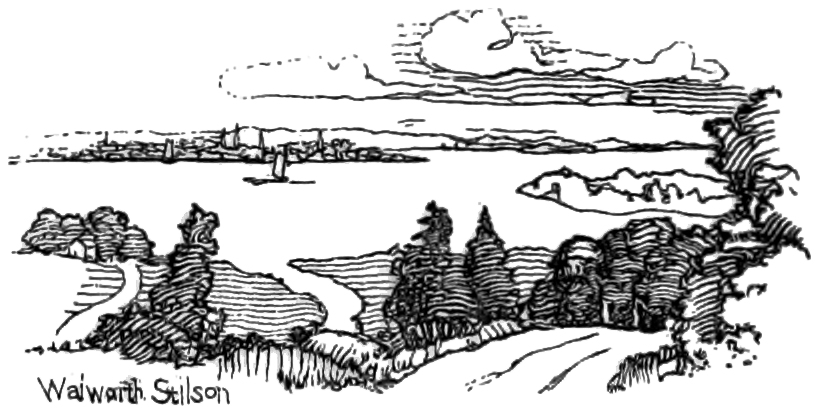
(‘Fanny’) with a view of my country-seat
(it was literally mine every Sunday
for years), let it be taken from
the top of Weehawk Hill, overlooking
New York, to whose scenes and associations
the poem is almost exclusively devoted.”
Halleck died at Guilford, November
19, 1867, and has been commemorated by
substantial memorials both there and in
New York. A granite pillar was dedicated
to his memory in his native town,
in the presence of a great multitude,
Bayard Taylor delivering the address
and Dr. Holmes contributing one of his
happy occasional poems. In May,
1877, a bronze statue of Halleck was
unveiled in Central Park by the President
of the United States. Bryant, the
head of the guild of American poets,
and William Allen Butler, the accomplished
and versatile author of “Nothing
to Wear,” delivered addresses, and a
poem by Whittier was read.
Poets of far greater genius than
Halleck have been far less adequately
honored than he; for he was the poet of
a half-century and of a city, not of an
age and a nation. But he lived in a
fortunate time; he was singularly happy
in his associations; and he was a delightful
companion, genial and witty, scornful
and satirical only in dealing with
impostors and pretenders.
* * * * *
That light-handed, urbane, and successful
editor and poet, Nathaniel
Parker Willis, long an active and entertaining
figure in the New York of
the Thirties and Forties, barely touches
the Knickerbocker town of the Twenties.
In the spring of 1829 he started
the “American Monthly Magazine” in
Boston—a periodical described at a
later day by that well-known wit,
“Tom” Appleton, as “a slim monthly,
written chiefly by himself, but with the
true magazine flavor.” Willis had been
less than two years out of college and
was without means or experience, and
his enterprise had a fine air of audacity.
Events showed that as a venture it was
magnificent, but it was not war! At the
end of two years the magazine was
moved to New York and merged in
“The Mirror,” a journal founded in
1823 by George P. Morris and Samuel
Woodworth; was published every Saturday;
and had a long and vigorous life
under a succession of names. Woodworth,
who wrote a song which was
sung at supper-tables many years
afterward—“The Old Oaken Bucket”—inspired,
it is said, by a eulogy on
spring water pronounced at a wine
party at Mallory’s, a popular hotel of
the time,—had withdrawn from “The
Mirror” before Willis joined its editorial
staff; but Willis and Morris remained
partners and devoted friends to
the end. They both became immensely
popular—Willis through his versatility
and sentiment, Morris through a series
of songs which went to the hearts of a
host of people: “Woodman, Spare that
Tree,” “Near the Lake where droops
the Lily,” and “My Mother’s Bible.”
He was one of the earliest collators of
literature for general reading, and his
“Song Writers of America” and “The
Prose and Poetry of America”—the
latter edited in collaboration with Willis—were
eminently useful compilations.
He had the rare good luck to write a
successful play founded on Revolutionary
events, and a libretto for an opera;
but his talent and fortune lay in his skill
in giving popular sentiment expression
in songs. General Wilson records, as
the most impressive evidence of his popularity,
that he could at any time exchange
an unread song for a check for
fifty dollars. Genial in manner and
with an agreeable address, Morris was
also a shrewd man of affairs.
A vigorous, burly man, often met on
the streets in the second decade, was on
his way to become one of the most widely
known Americans, whose name is now familiar
throughout Europe. “The Spy”
appeared in 1821, and a few months
later passed into a second edition and
was dramatized. In the following year it
was published in England, and the English
newspapers began to speak of its
author as a “distinguished American
novelist.” The story speedily became
the foundation for a world-wide literary
reputation which has suffered little at
the hands of time; the boys in small
German towns still organize themselves
into tribes of “Cooper Indians” and perform
heroic feats after the manner of
the “Leather-Stocking Tales,” which
confirmed and broadened the fame established
by “The Spy.”
James Fenimore Cooper was not
born in New York and did not share the
Knickerbocker tradition, but between
1822, when he became a resident of the
metropolis, and 1826, when he went to
Europe for a stay of seven years, he
wrote three of the most notable of his
novels. “The Pioneers” was published
in 1823, “The Pilot” in 1824, “The
Last of the Mohicans” in 1826.
“Lionel Lincoln,” which saw the light
in 1825, is negligible, from the point of
view of literature. In 1823 Cooper was
living in Beach Street; after his return
from Europe in 1833, he spent a few
winters in the city, but his home was in
Cooperstown.
Cooper’s reputation, vigorous intellect,
and courage of speech made for him
warm friends as well as bitter enemies,
though the latter were of the period
after his return from Europe, when his
sharp criticism of American manners
and his impatience with provincial
standards involved him in long-continued
and unhappy controversy. “The
Bread and Cheese Club,” of which he
was the founder, included in its membership
men of more than local reputation:
Kent, Bryant, Morse, Halleck.
A few days before he sailed for Europe
in 1826, the Club gave Cooper a
dinner at the City Hotel, at which
Chancellor Kent presided, and speeches
were made by Governor Clinton, General
Scott, and other well-known men,
who spoke in enthusiastic terms of the
distinction he had brought to the country
and the city. Chancellor Kent
hailed his “genius, which has rendered
our native soil classic ground, and given
to our early history the enchantment of
fiction.”
The high regard in which Cooper was
held by the men of Letters in New
York, and the relative positions of the
American poets of the day in the order
of merit, are reflected in Halleck’s remark
to General Wilson: “Cooper is
colonel of the literary regiment; Irving,
lieutenant-colonel; Bryant, the major;
while Longfellow, Whittier, Holmes,
Dana, and myself may be considered
captains.” In popular reputation the
place assigned to Cooper was not too
high, although Halleck put himself too
complacently in the rank of Holmes
and Whittier. After his return from
Europe in 1833, Cooper spent only a
few winters in New York; but the city
in which his reputation was born, so to
speak, and in which his literary friendships
were formed was the scene of the
most impressive commemoration of his
life and fame. A few months after his
death a memorial meeting brought together
probably the most distinguished
group of men who had appeared at one
time in the history of the city. Webster
presided with his accustomed dignity,
but spoke without his occasional inspiration;
while Bryant rose easily to
the highest reach of his theme in an address
of great beauty and feeling.
William Cullen Bryant came to the
city in 1825 still thinking of himself as
a lawyer with a strong bent toward
literature, but not yet fully committed
to a change of profession. A year
earlier he had made a flying visit to the
city and been warmly welcomed by
Cooper, Halleck, the Sedgwicks, and
other well-known people. The appearance
of “Thanatopsis” in 1817, and of
the memorable “Lines to a Waterfowl”
a year later, had put his reputation as
a poet on a basis so solid that, while it
was greatly broadened as time went on,
it did not need to be strengthened. In
June, 1825, his name appeared as editor
on the title-page of the “New York Review
and Athenæum Magazine.” Later
in the year he read four lectures before
the Athenæum Society; and two years
later, under the auspices of the recently
established National Academy of Design,
he talked so well about certain
phases of Mythology that he was asked
to repeat the course several successive
years. In 1826 he became the New York
editor of a periodical which bore the portentous
name of “The New York Literary
Gazette or American Athenæum,”
at a salary of five hundred dollars a
year. His financial position was precarious
and had become desperate when
he was invited to join the editorial staff
of the “New York Evening Post,” a
journal always intimately connected
with the literary history of the city. As
a by-product of his industry, Bryant
contributed editorial suggestion and
writing to the “Talisman,” one of those
old-fashioned annuals which grew like
mushrooms during the decade which
ended in 1830. In the closing year of
that decade, having acquired an interest
in the “Evening Post,” he wrote to
R. H. Dana that he had made sure of a
comfortable livelihood: “I do not like
politics any better than you do; but
they get only my mornings, and you
know politics and a bellyful are better
than poetry and starvation.” Long
after the Knickerbocker era had become
a tradition, Bryant was reaping the
double reward of the poet and journalist,
and enjoying well-earned prosperity
of hand and heart.
Among the men who found a convenient
meeting-place in the shop of
Charles Wiley, a well-known publisher
of the Knickerbocker period, at the corner
of Wall and New Streets, was Richard
Henry Dana, whose “Two Years
Before the Mast” has been thumbed
by many generations of American boys.
A Cambridge man, with a Harvard education,
Dana breathed another air than
that of the metropolis; but for many
years his was a familiar figure in the
places where men of literary habit gathered
in New York. In the back room
of Wiley’s shop, familiarly known as the
“Den,” Dana met Cooper, Halleck, Brevoort,
and a genial company who found
pleasure in Cooper’s somewhat pessimistic
talk. It was on Broadway, General
Wilson tells us, that the modest
author of “The Idle Man” was
almost assaulted by an enthusiastic admirer
who cried, “Are you the immortal
Dana?” lifted the astonished man in his
arms, rushed across the street with him,
and placed him triumphantly on his own
threshold; the author meantime calling
out, “Release me from this maniac!”
Such lively demonstrations of admiration
for men of Letters are no longer
seen on Broadway!
Local self-consciousness was already
pronounced in the foremost towns of
the country in the third decade of the
Nineteenth Century. Boston, New
York, Philadelphia, were in the race for
the intellectual primacy of the New
World, and Richmond and Charleston
were not unmindful of their claims upon
the homage of the nation. Nearly every
State cherished the belief that it contained
within its borders a modern
Athens which could bravely invite comparison
with the ancient capital of
Attica. In 1824 Boston was spoken of
as “The Literary Emporium,” a description
which had, unhappily, a suggestion
of trade associations. Three
years later, Philadelphia, according to
a magazine prospectus, had “within herself
a larger fund of talent, erudition,
and science—larger perhaps than any
other city can boast.” New York was
not lacking in the audacity which is
born of self-confidence. In 1820 an attempt
was made to establish in the
Knickerbocker town an “American
Academy of Languages and Belles-Lettres,”
which boldly set out to protect the
language from “local and foreign corruptions,”
and to establish a “standard
of writing and pronunciation, correct,
fixed, and uniform, throughout our
extensive territory.” To allay the apprehensions
of the Old World, it was
announced that no effort would be made
“to form an American language.” It is
painful to record the fact that this
modest effort to guard the mother
tongue aroused local jealousy and perished
at birth. Boston derided it!
But if New York failed to make itself
the seat of an academy, it did not fail
to foster the infant industry of journalism.
Professor Cairns enumerates no
less than thirty periodicals of various
kinds established in the city between
1816 and 1833. These were all modest
enterprises, and of brief and varied
careers. The scale of expenditure must
fill the editors of magazines to-day with
bitter regret for the conditions of the
good old times. In 1822 the publishers
of the “Atlantic Magazine,” issued in
New York, paid its editor five hundred
dollars a year, and authorized an expenditure
of the same amount for the conduct
of the magazine!
There were many lesser writers and
men of cultivated taste in literature and
art in the closing years of the Knickerbocker
period, who formed a congenial
society in the growing city, and, in
some cases, made important contributions
to the scholarship of their time
and secured local reputation and influence.
Gulian Crommelin Verplanck was a
fine type of the old-time gentleman of
colonial descent. After his graduation
from Columbia College he studied law,
made the “grand tour,” which was not
only a part of a liberal education in
those days but an enterprise of an adventurous
character, returned to become
a dignified professor in what is now the
General Theological Seminary, spent
eight years in Congress, and for nearly
fifty years was Vice-Chancellor of the
State University. He had a happy
faculty of dignified address on public
occasions, was a contributor to the
“Talisman” with Bryant, edited an illustrated
edition of Shakespeare, and
appears to have been regarded by the
gay spirits of Cockloft Hall as a person
not quite of their kind. Older men,
however, held him in great esteem,
Bryant reports, as “an example of
steady, studious, and spotless youth.”
His protest against Irving’s presentation
of the founders of Manhattan would
seem to indicate that his sense of humor
was not always keen.
Frederick S. Cozzens, whose “Sparrowgrass
Papers” later achieved a brilliant
local reputation, has left a
characterization of Dr. John Wakefield
Francis, a physician of considerable
professional distinction, strong literary
interests, and much given to hospitality,
which stands in no need of amplification:
“The Doctor is one of our old
Knickerbockers. His big, bushy head
is as familiar as the City Hall. He belongs
to the ‘God bless you, my dear
young friend’ school. He is as full of
knowledge as an egg is full of meat. He
knows more about China than the Emperor
of the Celestial Empire.”
A fleeting figure in the Knickerbocker
town was the author of “Home, Sweet
Home,” a song of such popularity that
Foster’s songs are its only rivals. It
was one of the ironies of life that John
Howard Payne should spend his days
in exile and die beyond the seas. He
was born at No. 33 Pearl Street in
1791, became a clerk in a counting-room
at fourteen, and a semi-professional
editor while in his teens; though
his connection with the “Thespian
Mirror,” a local journal devoted to the
drama, was kept secret. He spent two
terms in Union College, but the stage
was calling him, and in 1809—a year
memorable for the extraordinary number
of men of genius it brought to birth—he
played the once popular part of
Young Norval on the boards of the
Park Theatre. Three years later he was
playing with moderate success in English
theatres, and a little later adapting
and writing plays in Paris, drawing his
material chiefly from French sources.
The song which was to give him a world-wide
reputation was written in a room
in the Palais Royal for his play, “Clari;
or, The Maid of Milan.” He died at
Tunis in 1852, and thirty years later
“Home, Sweet Home” was sung by a
host of people gathered in Washington
about the grave in which his body was
reinterred. Payne had talents of an
uncommon order; men of the quality
and distinction of Talma, Coleridge,
and Lamb were warmly attached to him;
his work was rewarded with generous
returns in money; but he was always in
financial straits and seems to have
lacked the happy faculty of making
himself at home in the world.
Other men less fugitive than Payne,
though of purely local fame, contributed
to the good-fellowship of the later
Knickerbocker period. Charles P.
Clinch wrote plays, poems, and criticisms;
held public office; and became the
devoted friend of Halleck and Drake.
“The Spy,” “The First of May,” “The
Expelled Collegians,” and an address
prepared for the opening of the Park
Theatre, testify to his industry, but
failed to give his reputation more than
local and passing importance.
The informal fellowship of the early
Knickerbockers gave way to the earliest
literary and artistic clubs. Of one of the
earliest of these Robert Charles Sands
was a member. The “Sketch Club”
included Bryant, Halleck, Verplanck,
Cole, Ingham, Durand, Weir, and other
practitioners of the arts. The “Century
Association,” which has been intimately
associated with the literary, artistic,
and professional life of New York, was
organized at a meeting of the “Sketch
Club” in 1847. Sands was a poet and
journalist, a warm-hearted, kindly
humorist. A more vigorous personality
was William Leggett, who began
his professional life in the navy, while
still a young man published a volume
of poems in New York, wrote with great
ardor for the periodicals of the day,
and finally became one of the editors
of the “Evening Post.” He was a
man of the old-time belligerent type,
and fought a duel of much local notoriety
at Weehawken, where the most famous
and tragic duel ever fought on
American soil had taken place in
1804.
The most popular member of the
later Knickerbocker group was Charles
Fenno Hoffman, who had a happy faculty
of song and verse writing. The
lasting popularity of “Sparkling and
Bright” needs no explanation; while the
verses on the battle of Monterey have a
ring of genuine emotion and a force of
spirited action which carry them in
spite of awkward lines:
We were not many—we who stood
Before the iron sleet that day;
Yet many a gallant spirit would
Give half his years if but he could
Have been with us at Monterey.
Hoffman was connected editorially with
the “New York American” and was one
of the founders of the “Knickerbocker
Magazine,” which was born in the afterglow
of the Knickerbocker period and
continued the Knickerbocker tradition,
though its scope gave it national importance.
His editorial duties left
Hoffman an ample margin of time for
lyrical work, and his short poems of
singing quality, “The Myrtle and
Steel,” “Room, Boys, Room,” “’Tis
Hard to Share her Smiles with Many,”
were sung, hummed, and whistled in
many parts of the country. His “Winter
in the West,” made up of a series of
letters, was one of the early reports of
adventure and incident on the frontier.
Albany was, after New York, the
chief centre of the Dutch tradition, and
had a very hospitable and delightful society
intimately connected with its kin
city at the mouth of the Hudson. From
Albany, at short intervals, came Alfred
Billings Street. He was always welcome
in New York, where his somewhat prolific
verse was held in great esteem. He
was a devout student of Nature, and
had a happy command of the descriptive
phrase, and his contemporaries
among the American poets were generous
in their estimates of the excellence
of his poetry. Longfellow gave him the
first place as a reporter of forest scenery,
and Bryant was “impressed with
the fidelity and vividness of the images
newly drawn from Nature.”
Among the scholarly writers of the
later time was Henry Theodore Tuckerman,
whose name has a colonial flavor
in the mind of the New Yorker of to-day.
He brought the name here from Boston
in the afterglow of the Knickerbocker
age, spent many years in Europe, and
became the most accomplished of the
early American writers in the field of
art. He was a man of wide reading, with
a charm of manner which won him an
enviable popularity in the social life of
New York and Newport, and with the
catholicity of interests and tastes which
mark the cosmopolitan temper. Evert
Augustus Duyckinck, on the other
hand, was a son of the soil and an inheritor
of the tradition, though he was
born too late to be counted among the
Knickerbocker writers. In 1830, when
the Knickerbocker age reached its end
and the mid-century writers began to
appear, Duyckinck was preparing for
Columbia College, and it was not until
1840, on his return from an extended
visit in Europe, that he began a long
and industrious career as an editor and
writer. His chief claim on the attention
of lovers of old New York rests on his
service as a literary historian. His
“Cyclopædia of American Literature,”
his text for the “National Portrait Gallery
of Eminent Americans,” and his
“Memorial of Fitz-Greene Halleck” are
valuable records of the early men of
Letters in this country, with many of
whom he was personally associated.
Edgar Allan Poe came to New York
in the later Thirties, and made and lost
friends as in every place where he tried,
with pathetic hopefulness, to find anchorage.
His attitude toward the
Knickerbocker group was one of mingled
condescension and contempt. In any
society he would have been a detached
and lonely figure, and the lasting memorial
of his ill-starred genius and
broken career in New York is the cottage
at Fordham in which Virginia Poe
died.
These variously gifted men found the
remuneration of literary work far too
meagre for “human nature’s daily
food,” and took refuge in business occupations
of various kinds. Halleck
was an expert accountant fortunate in
his connection with Mr. Astor, while
Drake studied medicine and, after the
custom of many old-time physicians,
had an interest in a drug-store. Clinch
was in the employment of a ship-builder,
and for nearly two generations was
Deputy Collector of the Port of New
York; Payne began his career as a
clerk; and Sprague was a bank cashier.
Irving and Cooper were amply rewarded
by a public to which they offered the
novelty of original American literature;
Bryant found ease and a comfortable
fortune in journalism. In 1822, Professor
Cairns reminds us, he set a price
on his shorter poems which could hardly
be regarded as exorbitant—two dollars
each. George P. Morris was more fortunate
so far as income was concerned,
and reached such an altitude of popularity
that he could sell a song unread
for fifty dollars, while a very unimportant
drama from his hand brought him
thirty-five hundred dollars. Then, as
now, journalism was a refuge from
the inadequate rewards of literature;
though it must be frankly conceded
that, while much of the work of the
lesser Knickerbocker writing had a
pleasant humor, a delightful gaiety of
mood or lightness of style, it was neither
vital nor original, and its appeal was
limited to a small group of readers.
In the later years of his life, Irving
was in the habit of speaking of “Salmagundi”
as light and trivial; an overflow
of youthful fun and audacity. Mr.
Barrett Wendell is of opinion that the
“literature of Brockden Brown, of
Irving, of Cooper, and of Poe is only a
literature of pleasure, possessing, so far
as it has excellence at all, only the excellence
of conscientious refinement”;
and that nothing in it “touched seriously
on either God’s eternities, or the
practical conduct of life in the United
States.” This is an incidentally happy
characterization of the Knickerbocker
literature: it was a literature of pleasure,
and it was delightfully free from
the didactic and sermonic note at a time
when, Lowell declared, all New England
was a pulpit. Its touch on morals and
manners was light, satiric, and amusing;
in its way it had the tone of the
world of society rather than of theology
or reform. Its preaching, like that of
Addison and Steele, was lightly winged
and phrased in the language of an easy,
cordial society; tolerant in opinion, hospitable
to differences of religion and
political habit, concerned chiefly to
make itself agreeable and the time of its
sojourn in the vale of tears pleasantly
profitable. New York was not indifferent
to the religious side of life, but its
preaching was reserved for churches; its
literature, though somewhat provincial
in time and manner, was kept well within
the ancient province of art.
In 1858 the twenty-fifth anniversary
of the founding of “The Knickerbocker
Magazine” was commemorated by the
publication of “The Knickerbocker
Gallery,” a volume of portentous size
and effusive elegance, made up of articles
written by contributors to the
magazine. Fifty-four men are represented
in the collection, of whom only
four belonged to the early and characteristic
Knickerbocker period. Irving
drew upon a commonplace-book of a
date thirty-five years earlier for a few
notes; Bryant and Halleck were among
the poets of the collection; John W.
Francis and Alfred B. Street were familiar
names to the old New Yorkers of
that day. A new generation was in possession
of the stage, however; and the
Old Town, with its Dutch traditions,
was slowly losing its outlines in the
neighborly city of the years between
1830 and 1880, as that in turn is fast
being obliterated by the cosmopolitan
city of to-day.
The old places have vanished, and the
old faces are remembered to-day only by
the aid of a few portraits. The names
of the streets in the lower section of the
modern city recall men and women
whose genial hospitality set a fashion
which has never gone out in New York,
though the guests of the city have become
so many that hotels of imposing
size and oppressive splendor are taxed
to provide them shelter. But behind the
tumult of the great tides of life which
flow through the thoroughfares there is
a silent New York, which is unspoiled
by the possession of wealth, and which
hears the appeals of the unfortunate
within its borders, and gives time and
work and money with tireless generosity
of heart and hand.
There was a charm about the Old
Town which depended largely on neighborliness
and the narrower interests
which thrive in a small and homogeneous
community; the charm of ease and of
leisure and a certain contentment with
life; of the ripeness of temper and of
mind which is the fine flowering of an
education based on the humanities; of
room for work and pleasure large enough
for fame, but not too large for the nearer
satisfactions of local celebrity. It was
the good fortune of the early Knickerbocker
writers, by temperament and
taste, instinctively to adapt their gifts
to their time and Town; and it was the
good fortune of the Town to be the
birthplace of American literature, and
the home of two writers who were first
to give that literature a place in the interest
of the world.
Punctuation, hyphenation, and spelling were made
consistent when a predominant preference was found
in the original book; otherwise they were not changed.
Simple typographical errors were corrected; unbalanced
quotation marks were remedied when the change was
obvious, and otherwise left unbalanced.
This book does not have a Table of Contents,
but the “Head-bands” entries in the
List of Woodcuts may serve almost as well.
Read The Writers of Knickerbocker New York (1912) by Hamilton Wright Mabie — Full Text Online Free | Open Old Books