Larger versions of most illustrations may be seen by right-clicking them
and selecting an option to view them separately, or by double-tapping and/or
stretching them.
Cover created by Transcriber, using an illustration from
the original book, and placed into the Public Domain.
THE WRIGHT
BROTHERS
By FRED C. KELLY
A Biography Authorized by
Orville Wright
HARCOURT, BRACE AND COMPANY
NEW YORK
COPYRIGHT, 1943, BY
HARCOURT, BRACE AND COMPANY, INC.
All rights reserved, including
the right to reproduce this book
or portions thereof in any form.
[b-6-43]
PRINTED IN THE UNITED STATES OF AMERICA
TO
The Brave Flyers of the United Nations
Fighting All over the World for Humanity
and Decency Against the Forces of Barbarism,
This Book Is Dedicated
AUTHOR’S PREFACE
The aim in this book has been to satisfy the curiosity
of the average, non-technical reader regarding the work
of the Wright Brothers, and to do so as simply as possible.
No attempt has been made to go into minute technical
details. Nor does the book cover the scientific researches
and numerous inventions by Orville Wright
since the death of his brother.
To give credit to everyone who has been gracious
with help in the preparation of what I have written
would require so long a list, with risk of names being
unintentionally omitted, that I shall not attempt it.
But one name naturally and obviously comes first and
foremost—that of Orville Wright himself. He has read
my manuscript and given generously of his time in verifying
the accuracy of various statements and in correcting
inaccuracies which otherwise would have appeared.
Next in importance to that of Orville Wright has
been the help received from his secretary, Miss Mabel
Beck, whose memory and knowledge of Mr. Wright’s
voluminous files enabled her quickly to produce documentary
evidence to make certain of accuracy.
In a corner of the Pullman smoking compartment,
by the window, the man who had been explaining the
whole economic system mentioned inventors as an example
of the fortunate relationship between desire for
money and scientific progress.
“Take the Wright brothers,” he said. “Would they
have worked all those years trying to fly just for their
health?”
Another passenger ventured to ask: “Don’t people
sometimes become curious about a problem and work
to see what they can find out?”
The man by the window chuckled tolerantly as he
replied: “Do you think those Wright brothers would
have kept on pouring money into their experiments and
risking their lives if they hadn’t hoped to get rich at it?
No, sir! It was the chance to make a fortune that kept
them going.” Most of the other passengers in the compartment
nodded in agreement.
Not long afterward, one of those who had overheard
that conversation was in Dayton, Ohio, and inquired of
his friend Orville Wright: “Do you think the expectation
of profit is the main incentive to inventors?”
Orville Wright didn’t think so. He doubted if Alexander
Graham Bell expected to make much out of the
telephone. And it seemed to him unlikely that Edison
started out with the idea of making money. Certainly,
he said, Steinmetz had little interest in financial reward.
All Steinmetz asked of life was the opportunity to spend
as much time as possible in the laboratory working at
problems that interested him.
“And the Wright brothers?”
If they had been interested in invention with the idea
of making money, said Orville Wright, looking amused,
they “most assuredly would have tried something in
which the chances for success were brighter.”
I BOYHOOD
From earliest years both Wilbur and Orville Wright
were motivated by what Thorstein Veblen called the
“instinct of workmanship.” Their father, the Reverend
Milton Wright, used to encourage them in this and
never chided them for spending on their hobbies what
little money they might have. But he did urge them to
try to earn enough to meet the costs of whatever projects
they were carrying on. “All the money anyone
needs,” he used to say, “is just enough to prevent one
from being a burden on others.”
Both brothers were fascinated by mechanics almost
from the time they were conscious of interest in anything.
The childhood events most vivid in the recollections
of Orville Wright have had to do with mechanical
devices of one kind or another. One of the high spots
was the day he attained the age of five, because he received
for a birthday gift a gyroscopic top that would
maintain its balance and spin while resting on the edge
of a knife-blade.
Shortly after that fifth birthday, and partly because
of his inborn enthusiasm over mechanics, Orville began
an association with another boy that had an important
influence on his life. His mother started him to kindergarten.
The school was within a short walking distance
of the Wright home and Orville set out after breakfast
each morning with just enough time to reach the classroom
if he didn’t loiter. His mother bade him return
home promptly after he was dismissed and he always
arrived punctually at the time expected. When asked
how he was getting along, he cheerfully said all was
going well, but did not go into details. At the end of a
month his mother went to visit the kindergarten to learn
just how Orvie was doing.
“I hope the child has been behaving himself,” said the
mother to the teacher.
The teacher stared at her in astonishment. “Why,”
said she, “you know, since the first few days I haven’t
seen him. I supposed you had decided to keep him at
home.”
It turned out that Orville had almost immediately lost
interest in kindergarten and instead had regularly gone
to a house two doors from his own, on Hawthorne
Street, to join a playmate, Edwin Henry Sines. With an
eye on the clock to adjust himself to the kindergarten
hours, he had stayed there and played with young Sines
until about a minute before he was due at home.
Orville’s father and mother were not too severe when
this little irregularity was discovered, because the boys
had not been engaged in any mischief. On the contrary,
their play had been of a sort that might properly be
called “constructive.” The thing that had occupied
them most was an old sewing-machine belonging to
Sines’ mother. They “oiled” it by dropping water from
a feather into the oil-holes!
Both Orville and Wilbur followed their father’s advice
and earned whatever money they spent. One source
of income was from wiping dishes in the evening, for
which their mother paid a flat rate of one cent. Sometimes
she employed them to make minor household repairs.
Orville seemed to find more outlets for money
than did Wilbur, who was more saving, and from time
to time he borrowed from Wilbur—but he kept his
credit good by sticking to an arrangement they always
made that the next money earned should be applied on
the debt.
One of Orville’s early money-making ventures was
the collecting of old bones in near-by alleys, vacant lots,
or neighbors’ yards, and selling them to a fertilizer factory.
He and another boy first did this as a means for
raising funds with which to buy candy for use while
fishing. They accumulated a weight of bones that it
seemed to them must represent a small fortune—and
were somewhat shocked when the buyer paid them only
three cents.
At first, Orville’s associates in his projects were boys
of his own age rather than Wilbur, who was more than
four years older and moved in a different group; but a
day came when the brothers began to share curiosity
over a mechanical phenomenon. In June, 1878, when
Orville was seven years old and Wilbur eleven, the
Wright family left Dayton, because the work of the
father, who had been made a Bishop of the United
Brethren church, was shifted to Cedar Rapids, Iowa.
And it was in a house on Adams Street, in Cedar Rapids,
not long after their arrival there, that an event occurred
which was to have much influence on the lives of
Wilbur and Orville—as well as to have its effect on the
whole human race.
Bishop Wright had returned from a short trip on
church business bringing with him a little present for
his two younger sons.
“Look here, boys,” he said to Wilbur and Orville,
holding out his hands with something hidden between
them. Then he tossed the gift toward them. But instead
of falling at once to the floor or into their hands, as they
expected, it went to the ceiling where it fluttered briefly
before it fell. It was a flying-machine, a helicopter, the
invention of a Frenchman, Alphonse Pénaud. Made of
cork, bamboo, and thin paper, the device weighed so
little that twisted rubber bands provided all the power
needed to send it aloft for a few seconds. As the brothers
were to learn later, Pénaud, an invalid during most of
his short life, had not only invented, as early as 1871,
various kinds of toy flying-machines—both the helicopter
type and others that flew horizontally—but was the
originator of the use of rubber bands for motive power.
Simple as was this helicopter—they called it the “bat”—Wilbur
and Orville felt great admiration for its ingenuity.
Though it soon went the way of all fragile toys, the
impression it left on their minds never faded.
Not long afterward Wilbur tried to build an improvement
on that toy helicopter. If so small a device
could fly, why not make a bigger one that could fly
longer and higher? Orville was still too young to contribute
much to the actual building of larger models, but
he was keenly interested as Wilbur made several, each
larger than the one preceding. To the brothers’ astonishment,
they discovered, that the bigger the machine,
the less it would fly; and if it was much bigger
than the original toy, it wouldn’t fly at all. They did not
yet understand that a machine of only twice the linear
dimensions of another would require eight times the
power.
Orville, meanwhile, had distinguished himself in another
way, by organizing an army. His grade at school
was dismissed one Friday afternoon, though the rest of
the school was in session, and it occurred to Orville that
it might be amusing to march by, throw gravel on the
windows, and taunt those who were still at their lessons.
Supported by his friend, Bert Shaffer, he proposed to a
dozen other boys in the class that they form themselves
into an army, and act not as individuals but as an organization.
For having thought of the idea, Orville, who
had been doing some reading about Napoleon, would be
the General, but there would be Colonels and Captains
as well. In fact, they used up all the military titles they
knew. Lacking guns, they would have to carry wooden
clubs, and these they got by removing some loose pickets
from the school fence. All went well until the school
janitor began to chase them, evidently intending to capture
them. One of the boys made him pause by throwing
a rock in his direction as he was crawling through
a hole in the fence. After escaping into a distant alley,
all in the army assumed they would probably be in
plenty of trouble when they returned to school Monday
morning.
“We’ll be all right,” said Orville, feeling bound, as
their commanding General, to try to uphold the army’s
morale, “if we stick together. They can’t fire us all.”
He mounted a box lying in the alley and outlined
what they should do. The teacher would doubtless
single out only two or three of them that had been recognized
by the janitor and ask them to stay after school.
But if the teacher asked one of them to stand up, they
must all stand up; or, if she asked one to stay after
school, all must stay, and show their solidarity. “All for
one, and one for all,” he quoted.
When they were back in school at the next session,
the teacher said nothing to indicate that retribution was
in the making; but when the class was dismissed at the
end of the afternoon, she asked Orville to “remain.”
True to their pact, all the rest of the army stayed in
their seats—or, rather, all except one under-sized lad. A
few minutes later, the teacher asked Orville to come to
her desk. As he stepped forward, all the others started
to do likewise. “The rest of you sit down,” commanded
the teacher, and then added: “I don’t know why you’re
here at all.” Her tone was such that all meekly sat down.
When Orville reached her desk, she said: “You were
speaking of a song you could bring for the exercises
next Friday”—and went on to talk, pleasantly enough,
of Orville’s part in a forthcoming school entertainment.
She didn’t even seem to know about the daring behavior
of the army in the school yard. Probably the
janitor, embarrassed over his failure to capture the culprits,
had not reported them.
While in Cedar Rapids, Orville showed enterprise in
another direction. He had enough intellectual curiosity
to study lessons that the teacher had not yet assigned.
When a little more than eight years old he told his
father that he was tired of the Second Reader they were
still studying at school and wished he had a Third
Reader.
One morning, not long after that, at the middle of
the school year, the principal came to the room Orville
was in and announced that any pupils who showed
enough proficiency in reading might be promoted at
once, without waiting until the end of the year, and
begin the Third Reader. The more promising members
of the class, selected by the teacher, then stood toeing a
chalk mark, up front, as was commonly done, and took
turns at reading. In his alarm lest he might not do himself
full justice, Orville, someone told him later, held
his book upside down. That did not prevent him from
reading accurately, as he knew the book by heart, and
he was promoted.
“I’m now in the Third Reader class,” he proudly announced
when he reached home that noon.
“Well, that’s a strange thing,” said his father. “Just
this morning I bought the Third Reader you asked for.
But,” he added, “you won’t be able to use it today, because
you’re going to miss school this afternoon. I have
arranged for you and Wilbur to go to the photographer’s
and have your pictures taken.”
Orville’s picture thus commemorated what had
seemed to him an important event in his life.
After three years in Cedar Rapids, the Wright family,
in June 1881, moved to Richmond, Indiana, partly
that Mrs. Wright, who was not in robust health, might
have the companionship of her sister who lived there.
It was in Richmond that Orville took up the building
and flying of kites. Though it interested him, Wilbur
did not then take much part in this kite-flying sport,
because he feared it might be considered too juvenile
for a boy of his size. Orville came to be considered an
expert at kite-making and sold kites to playmates as a
convenient means of getting spending money. He made
the framework of his kites as thin as possible, to reduce
weight. Indeed, they were so thin that they would often
bend in the wind and the kite formed an arc. But it did
not then occur to Orville that this curvature of the kite’s
surface had any relation to its good flying qualities.
Though he had turned his kite-making to profit, Orville’s
best source of revenue in Richmond was a job of
folding papers, a church publication. For additional
spending money he entered the junk business. He would
go after school or on Saturdays to pick up scraps of
metal thrown out by a chain factory, and hauled this in
his “express” wagon to a junk dealer’s yard.
One of his projects was the building of a small
wooden lathe. It was too small to be quite satisfactory,
and Wilbur offered to help him build a larger lathe,
seven or eight feet long. This was the first “big” mechanical
job he and Wilbur worked on together.
The lathe was considered a great success, especially
by neighbor boys who thought it a privilege to work
the foot-treadle that provided the motive power. But
Wilbur felt that it should be improved. He had noticed
that bicycles were being equipped with ball-bearings to
give easy running quality and he said the lathe ought to
have ball-bearings. He looked about the barn for material
that could be adapted and took some metal rings
from an old set of harness. When two of these were held
tightly side by side they formed the outer track for the
ball-bearings; but, instead of steel balls, marbles were
used—the common kind, made of clay, that we used to
call “commies.” Within this circle of marble bearings
would rest the shaft of the lathe. The idea seemed so
sound that the brothers’ friends were much impressed.
Many were on hand in the upper floor of the barn awaiting
eagerly the final tinkering before the ball-bearing
“patent” could be demonstrated. As soon as the lathe
was put into operation, there was a terrible noise and
then it seemed as if the barn itself was beginning to sway
and shake. It was evident that the marbles in the bearing
had not been strong enough to withstand the stress; but
why should the barn become so agitated? Orville went
downstairs to find out if there could be any other cause.
When he reached the outside he saw his sister Katharine
held against the side of the house by an invisible
force. A small cyclone was taking place! All the boys
upstairs had been too absorbed to notice such minor
phenomena as weather.
Some of the enterprises Orville got into at Richmond
were not of a mechanical nature; and Wilbur, if
sharing in them at all, appeared only in the background,
or as a consultant, for he was at an age when a boy gave
thought to his dignity. Orville had noticed that many
boys chewed small hunks of tar. It seemed to him that
if the tar could be flavored with sugar to make it more
palatable, and small pieces were wrapped in tissue paper,
a market for the product might be found. He and his
friend, Harry Morrow, began a series of experiments in
the Wright back yard, and they seemed well on their
way to having a saleable article. But as they kept testing
their samples, both became ill—some kind of stomach
disorder, accompanied by nausea—and abandoned their
plans. Wilbur, though not a partner in all this, was
much interested and for years afterwards used to refer
to “that chawin’ gum corporation.”
If Orville was “into” more different things at this
time than his brother, it was mainly because Wilbur’s
great passion was for reading. And what he read, he absorbed.
It wasn’t long until he himself began to show a
gift for writing. Because of that, Wilbur played an important
part in one of Orville’s early business ventures—though
behind the scenes.
One of Orville’s friends was a boy living next door
named Gansey Johnston, whose father made a hobby
of taxidermy. They often played in the Johnston barn
where the father had a collection of stuffed birds and
animals. One day Orville’s imagination was much
stirred. He saw possibilities for putting those birds and
animals to good use—especially when he noted that there
was even a huge black bear and a grizzly. It was obvious
to him that he and the Johnston boy should form a partnership
and he asked Gansey how he would feel about
such an arrangement.
“Partnership to do what?” asked the boy.
Why, said Orville, to give a circus!
Though he had never thought of giving a circus, the
Johnston lad caught the idea and soon was enthusiastic.
They then decided to take in Orville’s friend, Harry
Morrow, as a third partner. Their show would be
known as The Great W. J. & M. Circus.
As the date for the big show approached, sixteen-year-old
Wilbur Wright, who had been taking great interest
in the preparations, asked Orville what he had
done about advance notices in the newspapers. Orville
had to admit that he had done nothing.
Wilbur appeared to be shocked that no one had taken
steps fully to prepare the public mind for the coming
event, and offered to write a suitable reading notice
about the street parade. This, he said, should be placed
in the Richmond Evening Item. He had absorbed the
method of expression used in circus bills and his forecast
of the parade was a masterpiece. There was nothing
amateurish about the way he introduced such words as
“mammoth,” “colossal,” and “stupendous,” nor about
his use of impressively large figures—“thousands of
strange birds from all parts of the world” that would
positively be in the menagerie. It was announced that
the proprietors of the big show would personally lead
the parade on “iron horses”; and that Davy Crockett
would positively appear with a grizzly bear. At the end
of the notice, in professional manner, was the exact
route of the parade, that the populace might not miss
the great free exhibition of wonders. The notice also
gave the prices of admission to the big show—three cents
for children under three years; others, five cents. Wilbur
gave the piece of publicity to Orville to take to the
Item office.
There was a little box just inside a door to a stairway
leading to the editorial rooms, and the boys knew it was
intended for news items. But they walked up and down
the street in front of the newspaper office for a long
time before they had the courage to enter the stairway.
What if someone should see them! Finally, when they
thought no one was looking, one of them ran up to the
box and in desperate haste deposited their piece of publicity.
Then both ran up the street at a speed that could
have attracted attention.
The editor of the Item evidently had a good news
sense and recognized the mysterious “press release” as a
local item worth printing. He had no way of knowing
who “W. J. & M.” were, but felt sure the account of
that forthcoming parade had plenty of reader interest.
It came about, therefore, that Wilbur’s advance notice
had a prominent position in the Item of September 10,
1883, under a heading that asked: “What Are the Boys
Up To?”
Though some of Wilbur’s figures about the number
of rare birds and wild animals may have been a bit overdrawn,
to conform to circus bill standards, he had not
exaggerated the amazing nature of the parade. Two of
the proprietors, Wright and Johnston, actually appeared
at the head of the parade on their “iron horses.”
These were high-wheel bicycles, one of them having
wooden spokes. The third associate proprietor of the
big show, Harry Morrow, was unavoidably absent, because
his parents had gone on a vacation trip to Michigan,
and had insisted, much against his wishes, on taking
him with them.
A principal “parade wagon” was the running gear of
an old buggy, with no body but only a few planks to
make a platform on which were some of the “thousands
of rare birds,” and also the great, frightful grizzly bear
held in leash by Davy Crockett. Though no horses were
hitched to this “wagon,” plenty of boys had volunteered
their services as “slaves” to pull it through the
streets. At the last minute, “Corky” Johnston, nine-year-old
brother of one of the proprietors, got into a
fight with the circus bosses, and they felt compelled to
deny him the privilege of participating in the parade.
This created a problem, for he had been cast for the role
of Davy Crockett, wearing his father’s hunting togs, including
high boots. The circus chiefs got around that,
the best they could, by assigning the Davy Crockett
part to Corky’s younger brother, Griswold, not yet five
years old. He was almost overwhelmed by the hunting
suit; but in the rush of getting the parade started he was
the best Davy Crockett available.
Wilbur’s advance notice was more successful than he
had hoped for. It had aroused so much curiosity that
when the parade reached that part of the announced line
of march in the business section, the streets were lined
with people—almost as many, in fact, as if the circus
had been Barnum’s.
Messrs. W. & J., astounded by the unexpected attention
the parade was attracting, began to feel much too
conspicuous. They hastily decided that their route must
be changed, and the parade turned up an alley!
So many customers came that not all who clamored
for admission to the Johnston barn could be accommodated,
and it was decided to repeat the show. But while
those who got into the barn were viewing the “menagerie,”
the boy who had been denied the privilege of
appearing as Davy Crockett saw an opportunity to get
his revenge. He got up on the barn roof and addressed
the multitude, telling them they might as well disperse
and seek their homes, because, he said, there would be
no other performance.
The crowd took him at his word.
Orville Wright had previously organized another circus,
in partnership with a neighbor boy named Miller,
who had a Shetland pony. For this show the admission
was only one cent. Though the gross receipts were not
vast, the show was a great success, partly in consequence
of the profound impression it had made on the Miller
boy’s father. At the close of the performance, he announced
that the show people would be guests of honor
at a reception, to which the spectators also were cordially
invited. Lemonade, ice cream, and cake were
served in lavish quantities, and every boy felt that, taking
the afternoon as a whole, he had had his money’s
worth.
But of all the enterprises in which the Wright brothers
showed their initiative in Richmond, the Great W.
J. & M. Circus probably caused the most talk. People
thought the boy who had organized that show would
doubtless amount to something. Many ventured the
opinion, too, that the youngster, whoever he was, who
had prepared that notice for the newspaper about the
parade, would surely be “heard from.”
II BACKGROUND
Certain traits that were to show in Wilbur and
Orville Wright—the pioneering urge, the gift for original
thinking, and mechanical aptitude—were all in their
ancestry.
Take, for example, their grandfather, John G. Koerner.
Native of a German village, near Schleiz, he became
so bitterly opposed to German militarism and
autocracy that he determined to migrate to the United
States. He sailed from Bremen to Baltimore early in
1818 and went to live in Virginia. Besides gaining recognition
in the United States for his mechanical ability
and for the superior quality of farm wagons and carriages
he manufactured, he became known, too, as a
person who did his own thinking. He did not accept all
that he heard or read. Indeed, he seems to have been a
“character.” It was his habit to read newspapers aloud
to his family, and when, as invariably happened, he
came to something that interested him because of approval,
disapproval, or for any other reason, he would
interpolate comment without changing his tone or rate
of utterance. It was impossible for a listener to tell just
how much that he seemed to be reading was actually in
the paper and which ideas were his own. One by one,
members of his family would study the paper afterward
to see if various surprising statements were really there.
No matter how commonplace a newspaper article may
have been, it was never colorless as he read it.
His wife, the former Catherine Fry, American born,
also came of pioneer ancestry, from the German language
section of Switzerland. Their daughter, Susan
Catherine Koerner, was born April 30, 1831, when they
lived at Hillsboro, Loudoun County, Virginia, but the
family moved to Union County, Indiana, shortly after
that—at a time when there was still pioneering life in
the Hoosier country. The Koerner farm became a
rather impressive one for those times. There were
finally a dozen or fourteen buildings, including the carriage
shop, all conspicuous for their workmanlike construction
and orderliness. John Koerner lived to the age
of eighty-six.
Perhaps the most interesting pioneer of all in the
Wright brothers’ ancestry was Catharine1 (Benham)
Van Cleve, the first white woman to set foot in Dayton.
Her husband, John Van Cleve, whom she had married
in New Jersey, was a descendant of a Van Cleve who
had come from Holland to Long Island before 1650.
When he proposed, a few years after their marriage,
that they should settle in the almost unexplored virgin
forest region of Ohio, she liked the adventurous idea.
They migrated to Cincinnati—then called Losantiville—in
1790. Within two years after their arrival, John
Van Cleve was killed by Indians. His widow married
Samuel Thompson and, in April, 1796, they decided to
try their luck at a settlement about to be established,
fifty miles to the north. The place had just been named
in honor of Jonathan Dayton, a Revolutionary soldier.
Three groups of people arranged to make the trip at
about the same time. So unsettled was the country, and
so nearly non-existent were the wagon trails, that the
party which included Catharine Van Cleve Thompson
preferred to travel in a flat-bottomed boat on the Miami
River. The others went by land. Though the boat trip
took about ten days, that group was the first to arrive.
Among those in the boat were some of the Van Cleve
children; another of them was in one of the overland
parties. A Van Cleve son, Benjamin, became the first
postmaster at Dayton, the first school teacher, and also
the first county clerk. His marriage at Dayton in August,
1800, to Mary Whitten, was the first recorded in
Montgomery County.
Margaret Van Cleve, a sister of Benjamin, had stayed
in Cincinnati, because she was about to be married—to
George Reeder, later an innkeeper. They had a daughter,
Catharine, who became the wife of Dan Wright
(not named Daniel, but plain Dan, as was also his
father), who had come to Centerville, Ohio, near Dayton,
in 1811. It was of this union that Milton Wright,
father of Wilbur and Orville, was born—in a log cabin
in Rush County, Indiana, November 17, 1828.
Dan Wright’s ancestry could be traced back to one
John Wright, known to have bought Kelvedon Hall, in
Essex County, England, in 1538. A less remote ancestor,
Samuel Wright, had migrated to America in 1636, and
settled at Springfield, Mass.
At the time of his marriage, Dan Wright was employed
in a distillery. But he evidently did not feel comfortable
over his occupation and quit the distillery job
to devote his whole attention to farming. Moreover, he
“got religion” and would no longer even sell his corn to
distillers. Perhaps it was because of the strong religious
feeling of Dan Wright that his son, Milton, at the age
of eighteen, had joined the United Brethren church.
Milton Wright attended a small college in near-by
Hartsville, Indiana, and at the age of twenty-two he received
from the United Brethren church his certificate
entitling him to preach. But he did not at once actively
enter the ministry. The pioneer urge was in him and he
went to the Willamette Valley, in Oregon, where for
two years he was a teacher in a small college conducted
under the auspices of the church. It was three or four
years after finishing his course at Hartsville that he met
the young woman, a student there, who was to become
his wife. Mutual friends had spoken to him of Susan
Catherine Koerner, of how charming, how “smart” she
was, and when he found an opportunity to be introduced
to her, he was by no means disinclined to make
her acquaintance. They were married on November 24,
1859, a week after his thirty-first birthday.
During the first few years after their marriage, the
Milton Wrights lived at several different places in Indiana.
Their first child, Reuchlin, was born in March,
1861, on a farm2 near Fairmount; and Lorin, the second
son, a year and a half later, in Fayette County, at
the home of his grandparents. When Wilbur was born,
April 16, 1867, the family was living on a small farm
the father had bought near the village of Millville, eight
miles east of New Castle. Wilbur was named for Wilbur
Fiske, a churchman whom the father admired; but
his name did not include the Fiske. None of the Wright
children ever had a middle name.
For a year, the Rev. Milton Wright was minister of
a church at Hartsville, and also taught in the college he
had attended there. Then, in June, 1869, he became editor
of the Religious Telescope, a United Brethren
weekly, at Dayton, the home of those pioneer ancestors.
A year or more after their arrival for their first stay
in Dayton, the Wright family bought, while it was still
under construction, a modest seven-room house at 7
Hawthorne Street. This was on the West Side, across
the Miami river, and about a mile from the main business
section. Here Orville Wright—named for Orville
Dewey, a Unitarian minister—was born on August 19,
1871; and his sister, Katharine, three years later to the
day.
During the family’s absence in Cedar Rapids and
Richmond, the Hawthorne Street house was rented, but
the Wright family was once again to live there, for in
June, 1884, the Rev. Milton Wright’s work brought
him from Richmond back to Dayton. When, sixteen
months later, the tenant’s lease expired and they were
settled again at 7 Hawthorne Street, all the family felt
that they were where they “belonged.”
The family’s return to Dayton was a few days before
Wilbur would have been graduated from high school
at Richmond. With the final year of the course so
nearly completed, he would have received his diploma if
he had been present with his class on commencement
day. But Wilbur did not consider the mere diploma itself
important enough to justify a trip back to Richmond,
even though the distance was less than fifty miles.
His decision was a subject for family talks and all agreed
that Wilbur should do as he thought best. The father
felt, as did the others, that receiving a diploma was ceremonial
and less important than the actual education
gained.
Wilbur decided to take a special course at the high
school in Dayton the next year. He wished especially to
continue the study of Greek, and to learn trigonometry.
Orville had been in the sixth grade at Richmond, but
a week or two before the end of the year he got into a
bit of mischief that caused his teacher, Miss Bond, to
dismiss him. She said he could not return to school until
either his father or mother came with him to guarantee
that his deportment would improve. But his father was
away from home at the time, and his mother was too
busy packing for the move to Dayton to take time for
consultation with that teacher. Orville simply stayed
out of school for the rest of the year.
When he entered school in Dayton the next September,
with no certificate to show that he had completed
the sixth grade, it looked as if he might have to
be in that grade for another year. But Orville was so
violent and uncompromising in his protests that the
school authorities said he might try the seventh grade
until they could see how well he got along. At the end
of the year he passed into the eighth grade with the
highest mark in arithmetic in the city.
When Orville entered the eighth grade, Miss Jennings,
who taught grammar, evidently thought she detected
something mischievous about him and assigned
him to a front seat in her class.
The next year, the same teacher had been promoted
to the high school, as a teacher of algebra, and again she
put Orville up in front where she could keep an eye on
him. Orville’s front seats became a subject for family
jests.
Later on in his high school course, Orville was demonstrating
a problem in geometry on the blackboard,
when his teacher, Miss Wilson, pointed out that though
he had the correct answer, he evidently had not followed
the textbook.
“I got it out of another book—Wentworth’s geometry,”
Orville explained. And he added: “I get a lot of
good stuff from Wentworth.”
Instead of complimenting him on having enough
interest in the subject to consult another source, the
teacher chided him for referring to what she called “a
beautiful science” as “stuff.”
Orville had no compunction about telling at meal
time of such episodes. He knew he wouldn’t be scolded.
It was simply good conversational material and would
provoke sympathetic laughter.
The family was interested, too, in the inventiveness
of the boys. Lorin had once invented an improvement
on a hay-baling machine. Wilbur had designed and built
a practical device for folding paper. This was while he
had the contract for folding the entire weekly issue of
an eight-page church paper. He had found the hand
work tedious and got up a machine that could be
worked by a foot-treadle.
For a long time the mechanical ability that had
aroused the most family admiration, though, was in the
mother. Susan Koerner Wright was more than ordinarily
resourceful in adapting household tools or utensils
to unexpected uses. She was clever at designing
clothes, too; and once she had built a sled for the two
older boys. As her family used to say, she “could mend
anything.”
The mother, however, was not long to be spared to
her family. On July 4, 1889, or less than four years
after the return to Hawthorne Street, she died. During
the latter years of her life, Wilbur was much with his
mother, and devoted himself almost constantly to her
care, for he too at that time was an invalid, unable to engage
in much outdoor activity.
Wilbur’s illness was in consequence of an accident.
While playing a game of shinny, on skates, he was hit
in the face with a shinny club. The blow knocked out
all his upper front teeth. He began to suffer from a
heart disorder from which he did not completely recover
for several years.
After the death of the mother, and the departure of
the two older brothers to establish homes of their own,
the other members of the Wright family were all the
more drawn together. Whatever one of them was doing
interested all. And all—especially Wilbur—did much
reading.
Two groups of books were in the home, one in
Bishop Wright’s study upstairs, and another, used by
the family, downstairs in the living room. Nearly all
the books in the father’s library were “very serious,”
but Wilbur often dipped into them, though the father
made no effort to direct or control anyone’s reading.
Downstairs, however, were the books that both Wilbur
and Orville liked best. These included a set of Washington
Irving’s works, both Grimm’s and Andersen’s fairy
tales, Plutarch’s Lives, a set of the Spectator, a set of
Addison’s essays, Boswell’s Life of Johnson, a set of Sir
Walter Scott, Gibbon’s Decline and Fall of the Roman
Empire, Green’s history of England, Guizot’s France,
an incomplete set of Nathaniel Hawthorne, and a set in
which was Marey’s Animal Mechanism. Here also were
a set of the Encyclopaedia Britannica and Chambers’ Encyclopedia.
The Britannica was an edition of the late
70’s and the Chambers’ Encyclopedia was an earlier edition.
Though Wilbur was the great reader, Orville was
not far behind him. He was fascinated by scientific articles
in the encyclopedia almost from the time he
learned to read.
Wilbur and Orville from time to time contributed to
the family comfort in a substantial way. They built a
spacious front porch, and all the lathe work for the posts
they did themselves. Then they remodeled the interior
of the house, changing the arrangement of the rooms.
Other members of the family felt as much pride in such
handiwork as if they had done it themselves.
More than their sturdy, intelligent, pioneer ancestry,
it was probably the kind of home they lived in that
had most to do with what the younger brothers were
later to achieve. Orville expressed that with deep conviction
many years afterward. A friend of his had remarked
to him: “Even though what you accomplished
was without the idea of making money, the fact remains
that the Wright brothers will always be favorite examples
of how American lads with no special advantages
can get ahead.”
“But,” said Orville seriously, “that isn’t true. Because,
you see, we did have special advantages.”
“What special advantages do you mean?”
“Simply that we were lucky enough to grow up in a
home environment where there was always much encouragement
to children to pursue intellectual interests;
to investigate whatever aroused curiosity. In a different
kind of environment our curiosity might have been
nipped long before it could have borne fruit.”
III PRINTING—AND BICYCLES
At the age of twelve, while living in Richmond, Indiana,
Orville Wright became interested in wood engravings.
His curiosity had been stirred by seeing some
woodcuts by Timothy Cole and T. Johnson in the Century
magazine. Wondering how the cuts were made he
began to search the encyclopedia and one or two other
books that told a little about the technique used. He
then decided that he might be able to make some woodcuts
himself if he had a suitable tool—and he went ahead
to fashion such a tool from the spring of an old pocket-knife.
(The next Christmas, Wilbur gave him a set of
engraving tools.)
After trying his hand at his first few woodcuts, Orville
naturally wished to make prints from them, and
for this purpose he used a press his father had for copying
letters. Today seldom seen, the old-fashioned letter-press
consisted of two horizontal metal plates that could
be forced close together by turning a little circular
handle at the top of a threaded rod attached to the upper
plate. One’s letter was moistened and placed next to a
thin tissue sheet in a record book which went between
the plates of the press. Under pressure, a copy of the
letter was transferred to the tissue. Such a press was a
fascinating device for a boy to play with. Indeed, Orville
had used it for other purposes than that for which
it was intended. It had also served him as a vise. And
now it worked fairly well for making proofs from his
woodcuts.
It was at about this time that the Wright family returned
to Dayton from Richmond, and Orville renewed
close relations with his old chum, Ed Sines. To his delight
he found that young Sines was already interested
in printing. He had a small press, obtained by trading a
file, covering more than a year, of a boys’ magazine
called Golden Days. This press was little more than a
toy, capable of printing only one narrow line at a time,
and the boys were never able to make much use of it.
But, nevertheless, they immediately formed the printing
firm of Sines & Wright.
At the beginning of the partnership of Sines &
Wright, their printing establishment was in a corner
of the Sines kitchen. Ed’s mother summed up the situation
there when one day she noticed an envelope addressed
to “Messrs. Sines & Wright,” from a type foundry.
“It must be for you,” she said to the partners, “for
you certainly are a pair of messers.”
Interested as they were in printing, Ed Sines and Orville
had time for other hobbies. One of these was a telegraph
line they rigged up between their homes. For
years Wilbur Wright referred to it as “the first wireless
telegraph,” because the boys used to shout the messages
back and forth to verify whatever they clicked out on
the keys.
It soon became evident that Orville had printers’ ink
in his blood. This printing hobby was more than a passing
fancy. His father was impressed by the boy’s persistence
in trying to use inadequate equipment. The
father knew that two of his older sons, Wilbur and
Lorin, had recently had a chance to trade a boat they
had made, now seldom used, for a small printing press.
If they would make that trade, he suggested, and donate
the press to Orville, then he would buy for the youngster
twenty-five pounds of brevier type. This deal was
made. The new press would print anything up to 3 by
4½ inches.
As the Sines kitchen was not quite the ideal location
for their printing plant, Orville arranged for quarters
in a “summer kitchen,” not often used, at the Wright
home.
It now occurred to Messrs. Sines & Wright that it
might be a good idea to print a newspaper for the benefit
of their eighth grade classmates. They called it The
Midget. Because of the limited capacity of their press,
the paper was necessarily small, two narrow columns
wide and four and one-half inches long. Most of the
items in it were put directly into type, as they thought
of them, and not from previously prepared copy. They
found that the four pages they had planned entailed a
surprising amount of work and to reduce this they put
nothing on page three except “Sines & Wright,” twice,
diagonally across the page, in script type. After they
had printed about one hundred copies for distribution,
Orville’s father saw one of these and immediately placed
a ban on the whole issue. He insisted that the boys had
not done themselves justice in slighting that third page.
Readers of the paper, he said, might get the impression
that the publishers were lazy or shiftless.
In a way, this suppression of the issue came almost
as a relief, for the publishers had begun to feel misgivings
about one somewhat daring item they had taken
the liberty of printing. It was about their teacher, Miss
Jennings, who was a strict disciplinarian. The item read:
“Next week we propose to publish one of Miss Jennings’
famous lectures before the pupils of the Intermediate
School on the Inherent Wickedness of School
Children.”
Maybe, they reflected, it was just as well that The
Midget was not to be distributed. Miss Jennings might
take the item as good clean fun, but, on the other hand,
she might raise a rumpus.
Before long the partners had an opportunity to buy a
quantity of display type for $2, and then they began
trying to establish themselves in the job-printing business.
They set up their headquarters in the Wright barn,
though on cold days they were likely to do their
typesetting on a table in the Wright dining-room.
Neighborhood storekeepers gave them a few orders for
printing, and the firm began to take on airs. They employed
Forrest Whitfield, a neighbor boy, as printer’s
devil. He commanded a weekly wage of fifteen cents.
All was going well until one day they received an
order from a man who wished to pay for his printing
not in money but in popcorn. He assured them that this
popcorn, on the cob, was worth more than the $2 the
printing would have cost. But before deciding if they
should accept the popcorn in payment, the partners prudently
went to a grocer to get an estimate of its value.
Sure enough, it was worth $2, and the grocer offered to
buy it from them at that price.
Now Orville saw greater opportunities opening before
them. With a liquid capital of $2, they could buy
more type, do a greater variety of printing, and thus
have more fun. But Ed Sines thought there was such a
thing as over-extension of plant and equipment. Why
not just divide their popcorn and eat it? Each was so
uncompromising in his convictions that there was only
one thing to do: one must buy out the other and they
would dissolve the partnership. Inasmuch as Orville already
owned the press they were using and most of the
type, it seemed logical that he should be the buyer. By
paying his share of the popcorn he was able to take over
his partner’s interest without much cash outlay. Thenceforth,
when they worked together, as from time to time
they continued to do, Ed Sines was no longer co-proprietor
but an employee.
At about this time, something set Orville to thinking
of how interesting it would be to print circus bills. He
wished some of his friends would organize a circus.
Then he could do their printing. The idea seemed
worth promoting. He went to the Truxell boys, and
Fred LaRue, neighbors up the street, and convinced
them that they had just the kind of abilities to organize
and present a wonderful circus—one that would make a
great hit with all the kids. The result of this talk was
The Great Truxell Bros. & LaRue Show. Orville refused
to accept any payment for printing the handbills
and tickets of admission to the big show. The fun of
doing it was all the reward he wanted.
Mrs. Wright had cleared out an upstairs room for Orville’s
printing activities and that was his base for some
time. He began to feel the need for a larger printing
press and he determined to build one. The bed for the
new press was an old gravestone he got from a marble
dealer.
This press would print a sheet eleven by sixteen
inches. Orville could now undertake larger printing
projects. One order required more type than he had on
hand. But that didn’t stop him. After he had used up all
his type, with the job only half done, he recalled having
heard of stereotype plates. He looked up in an encyclopedia
a description of how such plates were cast from
the impression of the original type in wet cardboard.
And he contrived to make such a plate from the type
already set. Then he redistributed that type for use in
setting the rest of the job.
Ambitious to be a really good printer, Orville took
employment during two summer vacations with a printing
establishment in Dayton, and worked there sixty
hours a week. But he felt that the most fun and satisfaction
in connection with printing had been from
building his own press. Along in the spring of 1888,
when he was nearly seventeen years old, he started to
build another press, bigger than any he had used before.
He didn’t know exactly what he would do with it, but
that question did not yet give him much concern. He
would have the fun of building it. In the family woodshed
was a pile of fire-wood cut in four-foot lengths.
From these he made much of the framework, though he
had to buy at a lumber yard a few longer pieces. From
near-by junk yards he collected odds and ends of iron or
steel that could be used. A difficult problem was to find
a means of forcing the type against the printing surface,
always with the same pressure, just enough and not too
much. Orville searched the Wright barn and tool-shed
for something that could be adapted, but without success
until his eye happened to alight on the old family
buggy. The buggy had a folding top, held firmly in
place, when raised, by steel bars hinged in the middle.
They were designed to force the top just so far and no
farther. Exactly what he needed!
The job turned out to be much more difficult than
Orville had expected, and Wilbur Wright, observing
his kid brother at a tough job, offered to help him build
the press. Some of the suggestions Wilbur made for
moving parts of that press were peculiar in that they
seemed to violate all mechanical rules and could not possibly
be expected to work. Yet they did. Some time
later, a well-dressed stranger entered the shop where
Orville, merrily whistling, was feeding paper into his
press, and asked if he might look at that “home-made
printing outfit.” He had heard about it while visiting in
Dayton. What at once astonished Orville and two or
three boys in the shop was that the visitor, with complete
disregard for his good clothes, lay right down flat
on his back on the floor to study the press in operation.
After he had observed it for several minutes, he got up,
brushed himself off, and remarked: “It works all right,
but I still don’t understand why it works.” Before leaving
he laid his card on a table. He was the foreman of
the pressroom of a newspaper in Denver.
Now that he had his new press, Orville wished he
could put it to some purpose to make full use of the
greatly increased printing capacity. The press was big
enough and fast enough to print a newspaper. Why not
start a neighborhood weekly? He had hardly more than
thought of this before he decided to do so. It was probably
the first time a paper was ever started just to use a
press.
Orville now rented a room on West Third Street,
near Broadway. The first issue of the paper—four three-column
pages—appeared on March 1, 1889. In his salutatory,
Orville said: “This week we issue the first number
of the West Side News, a paper to be published in the
interests of the people and business institutions of the
West Side. Whatever tends to their advancement, moral,
mental, and financial, will receive our closest attention.”
There were seventeen advertisements. A leading feature
was a story about Abraham Lincoln and General
Sherman, from the Youth’s Companion; and there was
an article about Benjamin Franklin. The range of the
publisher’s reading was indicated by a number of short
paragraphs on foreign affairs, and about the approaching
inauguration of President-elect Benjamin Harrison. Altogether
it was a creditable job. No boyish “boners” or
typographical errors were to be found.
All copies of the first issue were distributed free, as
samples, but the paper was soon a fairly profitable enterprise.
After the first few numbers, it was enlarged from
three columns wide to four columns. Ed Sines devoted
himself to rounding up advertisements and news items.
From time to time Wilbur Wright helped to fill space
by writing humorous essays, and after a few weeks his
name was added to the paper’s masthead as “editor,”
along with Orville’s as publisher.
Another contributor to the West Side News was a
young Negro lad, a friend of Orville since grammar
grades, Paul Laurence Dunbar, whose poetry afterward
made him famous. Dunbar, in 1890, started a paper, The
Tattler, for Negro readers, and Orville did the printing.
By the time the West Side News had been running a
year, Orville had completed his course in high school.
He thought the final year, devoted in the regular course
largely to review, would hardly justify the time. Instead,
having it in mind that he might decide to go to college
and would need additional credits for college entrance
requirements, he was a special student in Latin during
that fourth year, attending high school an hour or two
a day. The two elder Wright brothers had attended college
in Iowa and Indiana, and later their sister Katharine
took a degree at Oberlin, but both Wilbur and Orville
gave up the idea of going to college, and neither ever
received a diploma from high school. It may be added,
however, that Orville in later years never agreed with
those who suggested that “college might have ruined
the Wright brothers.” More than once he said they
doubtless could have done their scientific work more
easily if they had had the advantage of college education.
Having decided, partly because of interest in the job
at hand, not to go to college, Orville, in April, 1890,
with Wilbur as partner, converted the West Side News
from a weekly to a four-page, five-column daily, called
The Evening Item.
This venture, though it showed no loss, was never
profitable. At that time the perfecting-press was coming
into use and Dayton newspapers were issuing big, thick
editions that proved to be increasingly keen competition
for a small neighborhood sheet. After about four months
the paper was suspended. But, as late as 1894, Orville
and Wilbur published for a time a little two-column
weekly called Snapshots, devoted to vigorous comments
on current local events. After the first issue or two these
were usually written by Wilbur.
Both Orville and Wilbur now became absorbed in one
more new interest. Orville had owned in Richmond an
old high wheel bicycle for which he had paid $3—borrowed
from Wilbur. Now, a new European type of
bicycle with wheels about the same size, and called a
“safety,” had begun to be popular. In 1892, Orville
bought one of these, a Columbia. It had pneumatic tires
and cost $160. Six months later, Wilbur got a bicycle.
His was an Eagle and he was able to get it at an auction
for $80.
Orville promptly became interested in track-racing
and began to enter his name in various local racing
events. Wilbur, though he had been a great athlete—a
wonderful fancy skater and the best performer in Dayton
on a horizontal bar—never went in for racing, because
not yet completely recovered from the effects of
his skating accident.
Within a few weeks or months from the time they
bought their bicycles, these Wright brothers decided to
go into the bicycle business—to sell certain well-known
makes. Then they soon found that they would have to
add a repair shop. Their first sales room was at 1005
West Third Street. They rented it in December, 1892,
to be ready for business when the bicycle season began
in the early spring of 1893. For a while Orville divided
his time between the bicycle shop and the job printing
business across the street in which Ed Sines was still
employed. (Sines continued to work there until 1898
when an accident to a lame knee forced him to seek another
kind of work, and a few months later the shop
was sold.)
The brothers soon had to move their bicycle business
to larger quarters, at 1034 West Third Street. They
were successful both in selling new machines and general
repairing. Among the bicycles they sold at one time
or another were the Coventry Cross, Halladay-Temple,
Warwick, Reading, Smalley, Envoy and Fleetwing.
By 1895 increased business had caused them to move
once more, to 22 South Williams Street, and soon they
began to manufacture bicycles. The first “custom made”
model was called the Van Cleve—after their pioneer
ancestors. A later and lower-priced model was the St.
Clair; and finally they made a still lower-priced machine
called the Wright Special. It sold for as low as $18.
Before they were through with the business they had
put out under their own brand several hundred bicycles.
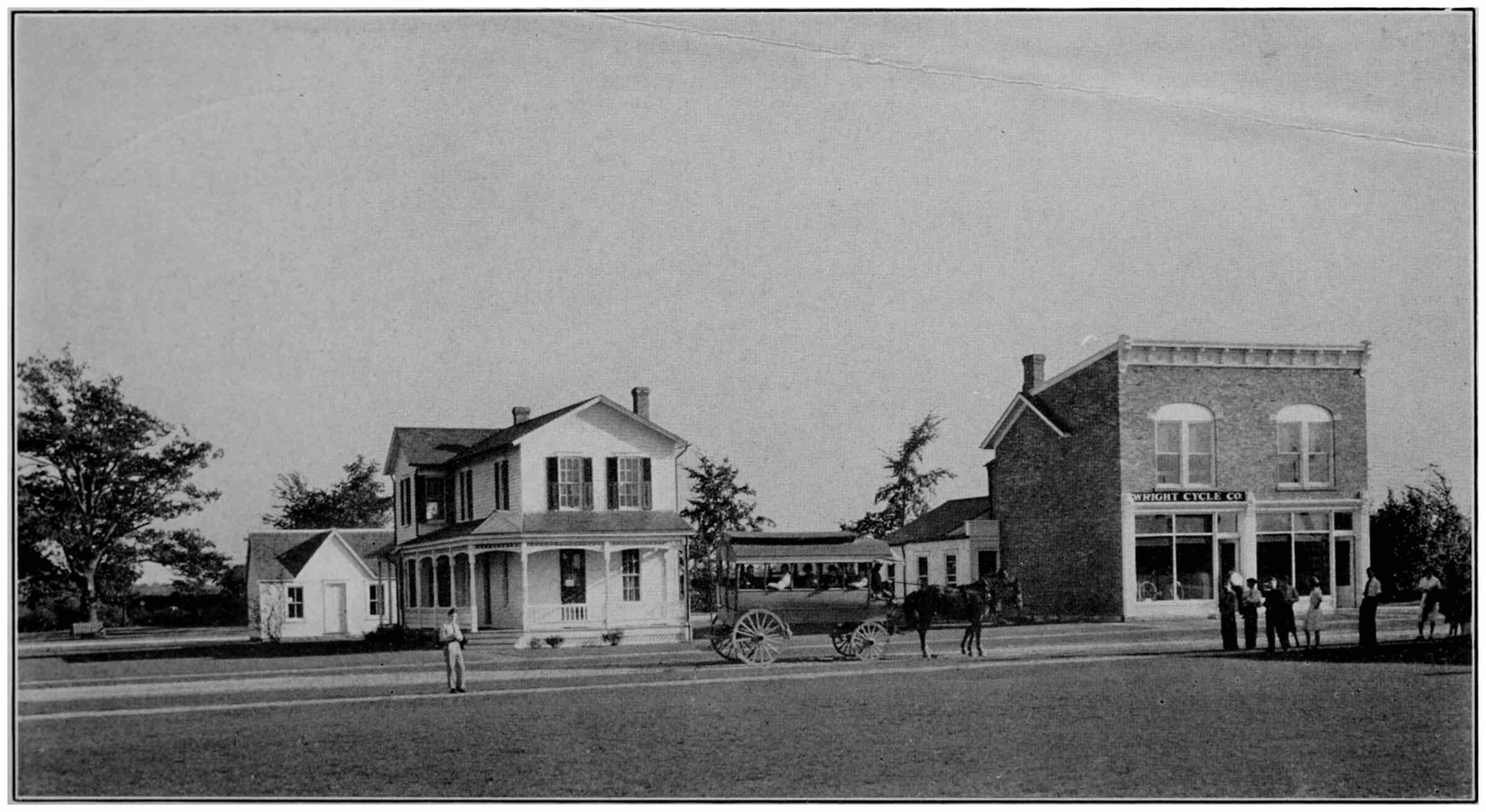
Many of these were built in the last building the brothers
occupied, a remodeled dwelling house at 1127 West
Third Street—the building afterward preserved as a
museum at Henry Ford’s Greenfield Village in Dearborn,
Michigan.
Much of their work when building new bicycles was
done in winter, when selling was slack, in rooms upstairs
over the shop, and from time to time the brothers were
interrupted by the necessity of going down to attend
to wants of customers. Sometimes they went down to
meet a caller who wished only to borrow their air-pump
to inflate a tire. They had no pressure-tank but kept a
large hand-pump on the wall near the front door. To
avoid needless trips downstairs, the Wrights contrived
mechanical means by which they could tell if a caller’s
wants required their attention. They took an old two-tone
bell, intended to be fastened to a bicycle handlebar,
and attached it to the wall in their upstairs work-rooms.
By means of wires and other mechanism, the opening
of the downstairs door yanked the thumb-lever on the
bell in one direction, producing one tone; and shutting
the door pulled the little lever in an opposite direction
to cause the other tone. The hook on which the air-pump
hung was also connected by a wire and a spring
to a pointer upstairs. Thus it was possible to have secret
knowledge upstairs if the caller might be a real customer
or if he “only wanted air.” If he promptly helped himself
to the pump, there probably was no need for anyone
to go down. Then when the pointer showed that
the pump was back on the hook and the bell signaled
the closing of the door, on the caller’s departure, the
brothers could feel sure they had not missed a sale of
any kind by sticking to their work.
Throughout the time they were repairing, selling,
and building bicycles, the Wrights continued to make
various experiments, just for the fun of it. They made
in 1893 what was doubtless the first pair of “balloon”
tires ever installed on a vehicle. It was necessary to build
a special “front fork” and widen the frame at the rear
to make room for the over-sized pneumatics.
Orville even found time during this period for experiments
having nothing to do with bicycles. Along about
1895, he made a new kind of calculating machine for
multiplying as well as for adding. He worked also on a
typewriter more simplified than any in existence.
Occasionally the brothers took in trade an old high
wheel. They had two of these, about the same size, that
they couldn’t sell for much, and the only way to get any
benefit from them was to use them in a new way for
sport. Why not, they asked themselves, convert them
into a tandem? No one had ever heard of two high
wheels operated as a unit, and though riding such an
outfit might be dangerous, it also would be exciting.
They put a swivel in the steel tube connecting the two
wheels to prevent it from twisting and breaking. Then
they began to practice, to learn the special technique the
man on the rear seat had to know. It was a little different
from any a bicyclist had needed before—a little like that
of a man steering the rear end of a long fire truck.
Though it looked fairly easy, only one person besides
the Wrights ever succeeded in staying mounted. Indeed,
riding even on the front seat was perilous enough. One
afternoon Orville took the rear seat with a boy named
Tom Thorne in front. As they tried to steer around a
hole in the muddy street, the handlebar caught the leg
of the lad in front, which prevented his turning far
enough.
Of course there was a spill. Orville from the rear seat
managed to land on his feet, but Tom Thorne, with one
leg pinioned, was hurled headfirst to the street. When
he came up for air none of his features was to be seen,
so thoroughly was he plastered with mud. He looked so
frightful that none of the boys who saw the mishap
showed any amusement. They were afraid he had ruined
his face. But Orville at once realized that the soft mud
had prevented any injury and his young friend’s appearance
struck him as the funniest thing he had ever seen.
For some moments he was doubled up with mirth, unable
to control himself, while the other rider, not exactly
indignant but unable to enter into the hilarity,
stood trying to gouge the mud out of his eyes with his
thumbs. It happened that Tom Thorne had an intimate
acquaintance with a family living near by and he went
there, accompanied by Orville, to ask permission to
wash up; but the girl who opened the door, though a
lifelong friend, was unwilling to believe the strange-looking
creature was anyone she knew. Tom asked her
to call her mother. The mother had known him almost
from the day of his birth, but she showed no sign of
recognition now. She did finally identify him by his
voice, however, and told him he might wash at the
pump. He was able to remove some of the larger chunks
of mud. Then he and Orville took the machine back
to the shop. The episode was not one of the Wright
triumphs. But neighbors who heard about it smiled and
wondered:
What will those Wright boys be doing next?
As boys and girls of high school age were potential
customers for bicycles, Wilbur Wright thought there
should be an effective way to stir their interest in the
makes of bicycles sold by the Wright Cycle Co. and he
hit on a plan that showed him to have latent genius as
an advertising man. He got a copy of a high school examination
paper and had printed what appeared to be a
set of examination questions—using the same kind of
paper and the same typography. Then he arranged with
one or two students to distribute these sheets at the high
schools. At first glance a student would think he had got
hold of an advance copy of an examination paper. But
all the questions related to bicycles on sale by the
Wrights!
A chum of the Wrights, Cordy Ruse, in 1896 had
built the first horseless buggy ever run over the streets
of Dayton. The Wrights and others used to sit and talk
with him about some of his problems. They had many
jokes about the difficulties of hitting upon a suitable
ignition system, a workable differential, and other seeming
insurmountables. Another problem, caused by the
vibration of a horseless carriage, had impressed Wilbur
most of all.
One day when the Wrights and several others were
chatting with Cordy Ruse, Wilbur suddenly slapped his
thigh and said:
“I’ve just thought of a wonderful invention! I’ll have
it patented. It’s simple enough. All there is to it is a bed
sheet to be fastened beneath an automobile to catch all
the bolts, nuts, and other parts that’ll keep dropping
off.”
Orville thought that, crude as horseless carriages were,
they were probably the coming thing, and that eventually
they might even hurt the bicycle trade. In 1897 he
suggested to Wilbur that perhaps they might well give
thought to the idea of going into the business of building
automobiles.
No, insisted Wilbur, shaking his head, they would
never be practical.
“To try to build one that would be any account,”
declared Wilbur, “you’d be tackling the impossible.
Why, it would be easier to build a flying-machine!”
IV FIRST THOUGHTS OF FLIGHT
Ever since the Wright brothers had played with
their Pénaud toy helicopter in Cedar Rapids, Iowa, their
interest in whatever they chanced to read about flying-machines
was probably greater than if the seed had not
been planted in childhood.
Along in the early 1890’s, both Wilbur and Orville
were likely to read any article they saw on a scientific
subject, and to talk about it. Occasionally an article in
a magazine that came to the Wright home dealt with
attempts of man to fly. As time went on, such articles
interested the brothers more and more. In 1895, both
were impressed—perhaps more than they then realized—by
a brief item they had come upon about the glider
experiments, in Germany, by Otto Lilienthal. He had
been gliding through the air, down the side of a hill, on
a machine he had built. That, the brothers thought, must
be the king of sports, to go soaring through the air on a
gliding machine. They wished they knew more about
Lilienthal and his work. All the reports they could find
about him were meager enough; but what little they did
learn increased their enthusiasm. Lilienthal, “the father
of gliding flights,” was to have a tremendous influence
on them.
Their interest in anything relating to Lilienthal was
still strong in the summer of the next year, 1896, when
Orville was taken ill—typhoid fever. Then, at a time
when Orville was still delirious from the fever, Wilbur
read that Lilienthal had been killed in a crash of his
glider.
After Orville was well enough to hear about Lilienthal’s
fatal accident, both he and Wilbur felt a greater
eagerness than ever to learn more about what Lilienthal
had accomplished, as well as of what had been tried by
others, toward human flight. Books dealing with attempts
of man to fly appeared to be scarce, but the
brothers got whatever was available in the Dayton library,
besides looking up articles on the subject in the
encyclopedia. All they read, however, during the next
two or three years did not satisfy their craving for a
better understanding of the whole problem of flight.
Knowing that the Smithsonian Institution, at Washington,
was interested in the subject of human flight,
they decided to send a letter to the Smithsonian asking
for suggestions as to reading material. The reply, received
early in June, 1899, suggested: Octave Chanute’s
Progress in Flying Machines; Professor Langley’s Experiments
in Aerodynamics; and the Aeronautical Annuals
of 1895, 1896, and 1897, edited by James Means,
which contained reprints of accounts of various experiments,
clear back to the time of Leonardo da Vinci.
Besides this list of suggested reading, the Smithsonian
sent also some pamphlets, reprints of material extracted
from their own annual reports, among which were
Mouillard’s Empire of the Air, Langley’s Story of Experiments
in Mechanical Flight, and a paper by Lilienthal
on The Problem of Flying and Practical Experiments
in Soaring.
This reading material arrived from Washington at a
time when Katharine Wright had just returned from
Oberlin College, accompanied by a young woman classmate.
She had assumed that her brothers would help to
entertain this guest, but, to her vexation, Wilbur and
Orville had become too absorbed in their reading to
have much time for girls.
It was now evident to the brothers that though the
previous ten years had been a period of unusual activity,
the results had not been encouraging. Maxim, after
spending one hundred thousand dollars, had abandoned
his work; the Ader machine, built at the expense of the
French government, had been a failure; Lilienthal in
Germany, and Pilcher, a marine engineer, in England,
had been killed while trying to glide; Octave Chanute,
too, after making some experiments in gliding, had quit.
Since Lilienthal had already aroused the brothers’ admiration,
they were especially interested in what he had
done. With hundreds of short flights, he had had more
flying practice than anyone else, even though he had
been in the air a total of only five hours in five years.
Lilienthal became the Wrights’ hero. They decided that
he, by his experiments, had made more advance in the
flying art than had anyone else up to that time—an
opinion, it may be added, that they never changed.
Their reading now gave the Wrights a good idea of
how earlier experimenters had attempted to solve the
problem of equilibrium. Some experimenters had placed
the center of gravity far below the wings, on the theory
that the weight would seek to remain at the lowest point.
But it had been proved that the wings would then oscillate
about the center of gravity in a manner destructive
to stability. Others had arranged the wings in the shape
of a broad V, to form a dihedral angle, with the center
low and the wing tips elevated. This, too, tended to
make the machine oscillate from side to side except in
calm air. Pénaud, in his models propelled by rubber
bands, had used wings that formed a dihedral angle, and
a rear stabilizer set with its forward edge lower than the
rear edge. This produced inherent stability in both
lateral and longitudinal directions. Lilienthal, Chanute,
and some of the others had used the Pénaud system in
their gliders, but in addition to that system they counted
on shifting the weight of their bodies to help maintain
equilibrium.
All this reading, while adding to their store of knowledge,
also gave the Wrights much misinformation. One
wrong idea they got was that men already knew how
to design wings and propellers of such efficiency that
motors then available could easily sustain the machine in
the air; another, that the greatest problem was to maintain
equilibrium. They also were misled into thinking
that fore and aft control of a flying machine would be
much more difficult than lateral control.
That neither Lilienthal nor any other experimenter
had ever tried any more adequate method to insure
lateral balance struck Orville as surprising. Why, he
asked himself, wouldn’t it be possible for the operator
to vary the inclination of sections of the wings at the
tips and thus obtain force for restoring balance from
the difference in the lifts of the two opposite wing tips?
That seems today an obvious enough idea, but no one
had ever done anything about it before. Orville had hit
on a fundamental principle. (Indeed, this principle later
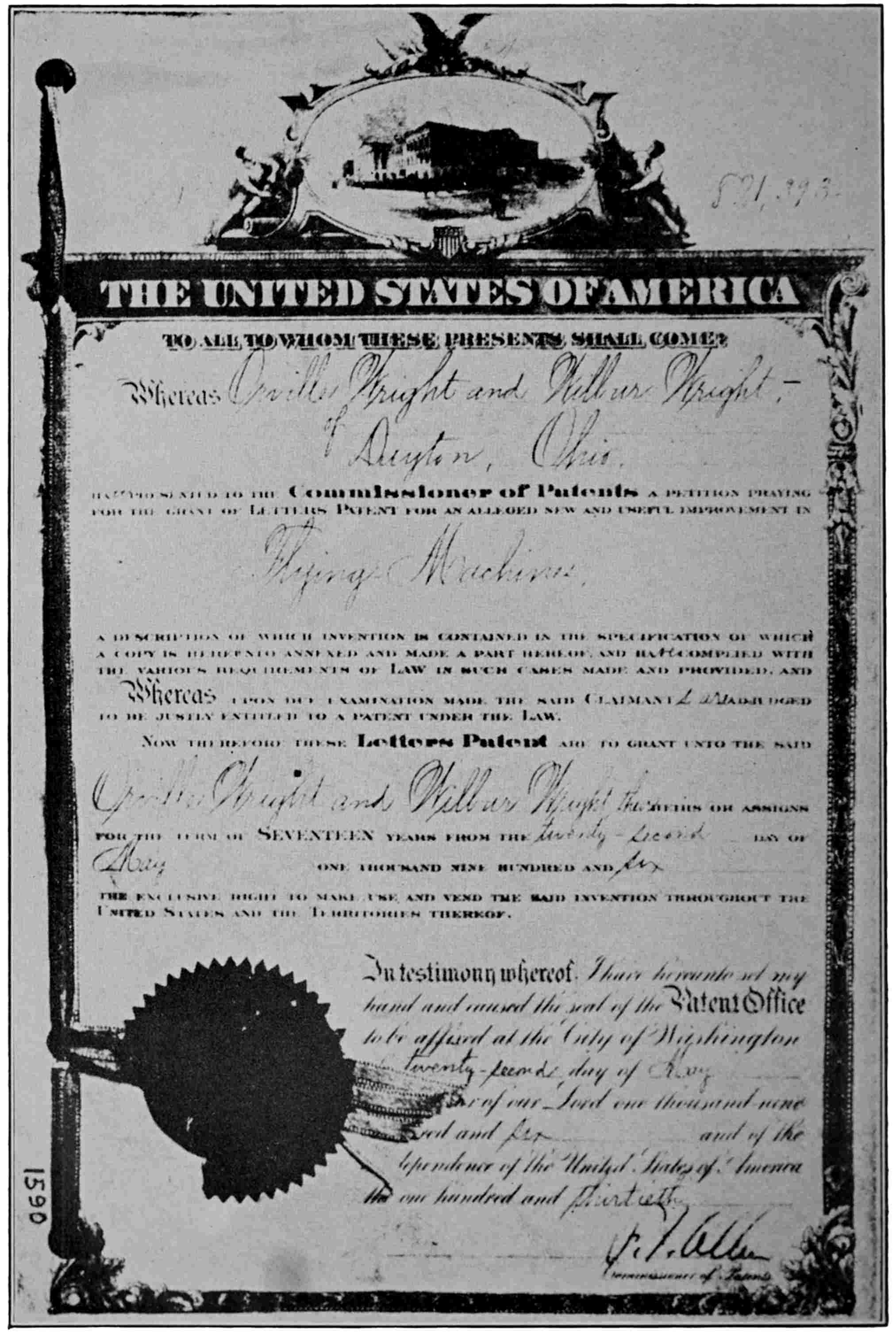
became the basic claim of the original Wright patent,
and the claim was sustained, as covering the idea of the
aileron control, in all countries where the Wright patents
were adjudicated.)
Orville made a rough sketch of a wing, showing a
stationary section at the center, consisting of approximately
one-third of the wing, measured from tip to tip,
with two adjustable sections, one at either side. These
sections were carried on shafts interconnected by cogs
mounted on the center section and extending toward
the wing tips. The movement of a lever attached to one
of the shafts would cause one wing section to rotate in
one direction while the other wing would turn in the
opposite direction. Thus a greater lift could be obtained
on whichever side it was needed.
The Wrights soon saw, however, that for two reasons
this particular design did not provide a good structure
for a gliding machine. First, with two-thirds of the entire
weight of the machine and operator carried by the
two shafts, the structure would be weak; and, second,
with the ends of the wings free to turn about the shafts,
there would not be enough rigidity for a machine that
would have to be toted about.
Then one night, some five or six weeks later, Wilbur
came home from the bicycle shop, to tell Orville enthusiastically
of an idea he had hit upon. A customer
had dropped in to buy an inner tube for a tire. Wilbur
had taken the tube from the pasteboard box it came in
and was toying with the box while talking to the customer.
As he twisted the box he observed that though
the vertical sides were rigid endwise, the top and bottom
sides could be twisted to have different angles at the
opposite ends. Why, he thought, couldn’t the wings of
a gliding machine be warped from one end to the other
in this same way? Thus the wings could be put at a
greater angle at one side than at the other, without structural
weakness. That plan seemed so satisfactory that
the Wrights did not look for or consider any other
method.
A few weeks later, in August, 1899, the brothers built
a biplane kite, and Wilbur, with a group of small boys
as spectators, flew it on a common at the edge of town.
This kite had wing surfaces five feet from tip to tip
by thirteen inches wide. The warping of these surfaces
could be accomplished by the use of four cords
reaching from the kite to the ground. Two of the
cords were attached to the forward corners of the right
wing tips, one to the upper and one to the lower; the
other ends of the cords, at the ground, were tied to
opposite ends of a short stick to be held in the operator’s
hand. The cords tied to the left wing were arranged in
the same way. With a stick in each hand, the operator
could move the wings as he desired. The upper wing
could be moved farther forward or farther backward
than the lower wing, according to the direction in
which the two sticks were simultaneously inclined, by
movement of the wrists. By inclining the two sticks in
opposite directions it was possible to draw one upper
wing tip farther forward than the lower at that end,
while at the other end of the kite the lower wing tip
would be the one farther forward. This moving of the
wing tips in opposite directions caused a twisting or
warping of the wings. Then the wing at one end would
be presented to the wind at a different angle from that
at the other end. If one end of the kite started to sink,
sidewise balance could be restored by exposing the wing
at that end at a greater angle, thus getting more lift.
Balance from front to rear was to be maintained by
inclining the two sticks in the operator’s hands in the
same direction—to move the upper wing either forward
or backward over the lower wing, to change the center
of lift.
But in addition to this moving of the wings forward
and backward, the Wrights added an “elevator” at the
rear. It was held by a pair of wooden rods attached at
right angles to the uprights that connected the wings.
When the upper wing was pulled forward, to turn the
kite upward in front, the elevator met the air at its top
side and was pressed downward, which helped to turn
the wings upward—as the rear elevator does on planes
today.
Though their interest did not lag, the Wrights did
nothing more for some time about kite experiments, except
to seek information in regard to wind velocity in
different parts of the country. They wrote to the
Weather Bureau at Washington, in December, 1899,
and Willis Moore, chief of that Bureau, sent them a
number of government bulletins that included statistics
on wind velocities at various places. They looked these
over, but at that time made no further investigation of
any of the places mentioned.
THE FIRST CAMP AT KITTY HAWK. Top: The 1900
camp. Bottom: Kitty Hawk Bay as seen from the 1900 camp.
In May, 1900, Wilbur Wright wrote a letter to Octave
Chanute, living in Chicago, who had written Progress
in Flying Machines. Though Chanute was better
known in engineering circles by his work for certain
western railroads, as well as for having built the Kansas
City bridge and the Chicago stockyards, his book, a
reprint of his articles published from 1891 to 1893, had
made him probably the best authority on the history of
aeronautics. Thinking Chanute would be interested,
Wilbur told him in his letter of a plan he had for experimenting
with a man-carrying kite by means of which,
Wilbur thought, one would be able to get hours of practice
in operating a machine in the air. He proposed the
use of a high tower from the top of which a cable would
lead to the man-carrying kite. He described to Chanute,
in his letter, the system of control to be used in the kite—the
warping of wings for lateral control, and the shifting
of the upper surface backward and forward for longitudinal
control—the same system used in the five-foot
kite tested the previous August. Then he asked Chanute
if he had any information as to locations where winds
suitable for carrying on such experiments might be
found. (This letter from Wilbur marked the beginning
of an acquaintance and correspondence with Chanute
that lasted for a number of years.) Chanute suggested
San Diego, California, and St. James City (Pine Island),
Florida, to be considered because of the steady sea
breezes. But, on the other hand, he pointed out that,
since those places were deficient in sand hills, perhaps
even better locations could be found on the Atlantic
coast of South Carolina or Georgia.
THE 1902 GLIDER. The Wrights are testing the efficiency
of the 1902 glider by flying it as a kite—September 19, 1902.
When the rush of the spring trade in bicycles began
to subside, giving them more time for other interests,
the Wrights again took up with enthusiasm the study of
equilibrium. Each day they proposed and discussed new
devices. Orville thought the shifting of the upper surface
backward and forward over the lower one, for
longitudinal equilibrium, though successful in their kite,
would not be practical for a man-carrying glider, which
would start and land on the ground. He suggested that
the wing surfaces be fixed one above the other, and that
an elevator be placed some distance in front of the
wings, instead of at the rear. In this position there would
be less danger of the elevator touching the ground in
starting; and if from any cause the elevator were disabled
it would be discovered before the machine got
into the air. Wilbur then proposed that, since curved
surfaces were more efficient than flat planes, the front
rudder, or elevator, should be made flexible. Then it
could be bent to present a concave surface on whichever
side a pressure was desired, but would be flat when
moving edgewise through the air.
The Wrights did not at first think an elevator in front
would provide inherent stability—that is, it would not
give the machine the desired tendency to restore its own
balance just from the arrangement of its fixed parts. But
Wilbur shortly afterward developed a theory that led
him to believe the machine would have that quality.
Having read that the center of pressure moves toward
the front edge of the wings whenever the wings are
turned more nearly horizontal in flight, he thought inherent
longitudinal stability could be obtained if the
front elevator were set at a negative angle—that is, with
its front edge lower than its rear edge. With such an
arrangement of wings and elevator, every time the
wings became more nearly horizontal in flight and met
the air at a smaller angle on their under sides, the elevator
would meet the air at a greater angle on its upper
side. So, he reasoned, whenever, by becoming more
nearly horizontal, the wings caused the center of pressure
to move forward, tending to turn the machine upward
in front, the front elevator would receive a greater
downward pressure on its upper side and so counteract
the disturbing pressure on the wings.
Actual tests later proved that the negative angle of
the front elevator did not provide the inherent stability
expected. The explanation was that the center of pressure
on cambered wings traveled in the opposite direction
from that which Wilbur’s reading had led him to
expect. The Wrights later were to discover that Wilbur’s
reasoning was correct; but because the travel of
the center of pressure was rearward instead of forward
the elevator had to be set at a positive instead of at a
negative angle.
The Wrights’ elevator possessed three features not
found in the gliders of any of the earlier experimenters.
It was in front of the wings, where it was less liable to
damage by striking the ground in take-off and landing;
it was operable, instead of fixed as in other machines;
and it flexed to present a convex surface to the air, instead
of a flat surface. At this early stage of their work
the Wrights considered this front elevator their most
important invention, because, from their reading, they
thought it was solving a problem more difficult than
that of lateral control.
Though the Wrights’ reasons for placing the elevator
in front of the wings were at first those just mentioned,
they afterward found that this arrangement had
much greater importance for two reasons not at first discovered.
One of these was that it eliminated all danger
of a nose dive when the plane got into what is known as
a “stall”—when the speed became too slow. The other
reason was that the elevator in front, set at a positive
angle with the pressure on its under side, not only produced
inherent stability, but also carried part of the
load, and so relieved the wings to that extent. (An elevator
in the rear, set at a negative angle to provide inherent
stability, carries a pressure on its upper side,
which adds just that much to the load the wings must
carry.)
Around the first of August, 1900, the brothers decided
to build a man-carrying glider on which to try
out their inventions. To get practice in operating it they
would first fly it as a kite. For such kite flying, flat open
country would be needed; and for the gliding, sand hills
free from trees or shrubs. Once again they examined
the reports they had received from the Weather Bureau
at Washington. Several of the places where winds might
be suitable were in the Far West, but one in the East,
much nearer to Dayton, was a place with an odd name,
Kitty Hawk, North Carolina. They decided to write at
once to Kitty Hawk for further information.
Wilbur Wright addressed a letter to the chief of the
Kitty Hawk weather bureau station, asking for various
details about the locality, explaining that he might wish
to go there shortly to conduct experiments with a man-carrying
kite. He inquired, too, if it would be possible
for him and his brother to obtain board and lodging in
the vicinity until they could get themselves established
in a camp.
Joseph J. Dosher, in charge of the Kitty Hawk station,
who received the letter, replied briefly, on August
16, giving the direction of the prevailing winds; and he
described the nature of the land for many miles.
After writing his reply, Dosher handed Wilbur
Wright’s letter to a neighbor, William J. Tate, with the
request that he also make a reply. “Bill” Tate (later
known as Captain Tate) was probably the best-educated
man in that locality. He lived about a mile inland from
the weather station, in the hamlet or settlement of Kitty
Hawk, where he had formerly been the postmaster. For
all practical purposes he still was the postmaster, though
the office was in his wife’s name. Endowed with a gift
for expressing himself readily in either speech or writing,
Tate did a creditable job when he wrote to Wilbur
Wright on August 18. Not only did he tell about the
suitability of the Kitty Hawk region, because of the
prevailing high winds, for the kind of experiments Wilbur
had mentioned, but he went into details about the
treeless sand hills and the general terrain. And he said
arrangements could undoubtedly be made for the
Wrights to obtain board for as long as desired.
The letters from Dosher and Tate—particularly the
one from Tate—convinced the Wrights that Kitty Hawk
was the place for their experiments. Almost immediately
they decided they would go to Kitty Hawk as soon as
they could build their glider.
The work at Dayton, getting parts and material ready
for the glider, required only a few weeks. Only the cutting
and sewing of the cloth covering for the wings, the
bending of the ash ribs into shape, and making the metal
connections, took much time. The cost of the whole
machine in actual money outlay was trifling, probably
not more than $15.
It was arranged that Orville should stay in Dayton,
to look after the bicycle shop until Wilbur got settled
at Kitty Hawk, and then join him there.
Wilbur set out on a September day, taking with him
parts of the glider and all material needed to assemble it
except some spruce lumber he expected to obtain nearer
his destination.
The journey proved to be more of an undertaking
than Wilbur expected.
V GLIDING AT KITTY HAWK
One must look at a map of North Carolina to get
an idea of the isolation of the long strip of sandy beach
that separates the Atlantic Ocean from Albemarle, Pamlico,
and Roanoke Sounds. At the time the Wrights
went there, no bridges connected this beach with any
part of the North Carolina mainland or even with near-by
Roanoke Island, seat of Sir Walter Raleigh’s “Lost
Colony.” At one point on the beach was the Kitty Hawk
life-saving station, and alongside of it a government
weather bureau. About a mile back from the ocean was
the hamlet of Kitty Hawk which, though it had a post
office, was little more than a settlement, with only about
a score of dwelling houses, most of them as widely scattered
as in an ordinary farming community. Four miles
south was the Kill Devil life-saving station.
It was not surprising that when Wilbur Wright, on
September 9, 1900, reached Elizabeth City, North Carolina,
the nearest railroad point to his destination, the first
persons he chanced to ask about Kitty Hawk had never
heard of the place. Then he learned that a boat made
weekly trips to Roanoke Island; but it had gone the day
before. Not liking delay, he went to the water front to
inquire if another boat might be available. There he met
one Israel Perry, formerly a resident of Kitty Hawk,
who lived the year round on his little flat-bottomed
schooner. As no other boatman showed any interest in
making the trip, Wilbur booked passage with “Captain”
Perry, despite the boat’s dirty, forbidding appearance.
After loading parts of the glider and other goods that
had been shipped from Dayton, he set out with Perry
on the morning of September 10 for the forty-mile
voyage to Kitty Hawk. Wilbur noticed that the small
boat they used to go from the wharf out to where the
schooner was anchored was leaking badly and he asked
if it was safe.
“Oh,” Perry assured him, “it’s safer than the big boat.”
That didn’t inspire too much confidence in what was in
store, and Wilbur soon learned that any misgivings he
felt were amply justified. Toward the middle of the
afternoon they met a strong head wind that forced them
to seek a smooth water haven in North River where
they anchored to await better weather. By that time
Wilbur had worked up a good appetite; but he discovered
that neither the food nor the kitchen met even
minimum standards of cleanliness and he made excuses,
as politely as he could, for not eating. All he had with
him against hunger was a small jar of jelly his sister
Katharine had slipped into his suitcase.
The weather was not favorable for continuing the
voyage until the afternoon of the second day, and the
boat reached a wharf, where there was a small store, on
Kitty Hawk bay, at about nine o’clock that night. Not
knowing where else to go, Wilbur stayed aboard until
the next morning. A small boy named Baum agreed to
guide him to the home of William J. Tate, about a quarter
of a mile away. By the time Wilbur arrived there, on
that morning of September 12, it was just forty-eight
hours since he had tasted food other than his little supply
of jelly.
After introducing himself, and in response to “Bill”
Tate’s inquiries about how he enjoyed his trip, Wilbur
spoke of his back being sore from lying on deck and of
how his arm ached from holding on when the boat
rolled. Then it came out that he had been unable to
bring himself to eat the food provided on the Perry
schooner.
“You mean to tell me,” asked “Bill” Tate, greatly
concerned, “that you’ve eaten no victuals for two
days?”
Here was a situation that called for quick action in a
hospitable home. It was after the Tates’ breakfast hour,
but Mrs. Tate soon had a fire in the kitchen stove and
prepared a great platter of ham and eggs that the guest
seemed to relish.
Then Wilbur inquired if it would be possible for him
to obtain board and lodging there for the week or more
until his brother “Orv” arrived.
Tate went into an adjoining room to ask his wife. As
the door was ajar, Wilbur could hear what was said.
Mrs. Tate was a bit alarmed. Here was a man able to
devote time and money for weeks at a time to sport.
Doubtless he must be a person of great wealth, accustomed
to every luxury. Would he be satisfied with the
best they could offer?
Wilbur stepped to the door, explaining that he could
not help overhearing their conversation, and said it must
be understood that if he were accepted as a paying guest
he would not expect any extra frills, but would greatly
appreciate the courtesy.
“This fellow’s a real gentleman,” thought Tate, and
by way of settling the question, without waiting to hear
any more from his wife, he said to Wilbur:
“You must be tired. Why don’t you come into our
spare bedroom and take a nap?”
By the next day Wilbur was at work. The cloth covering
for the glider—white French sateen of extra good
quality—had already been shaped and sewed at Dayton,
except at the ends, to permit fitting it over the framework.
But now he had to make changes in the covering,
because the glider was going to be smaller than originally
planned. The longest timbers, for the wing spars, that
he had been able to find in either Norfolk or Elizabeth
City were only sixteen feet long instead of the eighteen-foot
length he desired. Thus it was necessary to cut out
strips from the middle of the lengths of cloth for both
upper and lower wings. For resewing the cloth where
necessary, Wilbur borrowed Mrs. Tate’s machine. But
all the rest of the work of assembling the glider was
done at a tent Wilbur set up, about half a mile from the
Tate home, at a spot where there were a few trees and
a view of the bay. He dragged the crates, containing
various parts and tools, to the tent and hoped to have
everything in readiness when Orville arrived. But the
heat was intense, the job of carrying water to the camp
used up much energy, and when Orville got there, on
September 28, Wilbur told him regretfully that much
work on the glider was still to be done.
Orville’s trip had been uneventful. Indeed, though
he came on a better boat than Israel Perry’s, he had
struck such a calm sea that his voyage from Elizabeth
City took two days, the same as Wilbur’s. For the first
five days after Orville’s arrival, both brothers stayed at
the Tate home. Then they established themselves in
camp. One end of their tent, twelve by twenty-two
feet, was tied to a tree for anchorage. The tree was headquarters
for a mocking bird that sometimes joined in
the harmony when Orville twanged at a mandolin he
had brought from home.
Not many visitors came to the camp from near-by
Kitty Hawk. One reason for this was that the camp was
considered dangerous after news got about that the
Wrights used a gasoline stove. “Bill” Tate was favorably
impressed, though, with an acetylene lamp, intended
for a bicycle, that the Wrights used for lighting.
He said he had a notion to install such a system of gas
lighting in his house.
It was necessary to carry water about one thousand
feet over the sand. Orville volunteered to do the cooking—and
he continued to do so during all their experiments
at Kitty Hawk. But he always felt that he had the
better of the bargain, for the dish-washing job was Wilbur’s.
As it was impossible to obtain fresh bread, Orville
learned to make biscuits, and without use of milk. They
were good biscuits, too—better, his father afterward insisted,
than anyone else could make. To simplify operations,
Orville always mixed at one time enough flour
and other dry ingredients to last for several days, as
biscuits had to be baked three times daily.
Working together, the brothers soon had the glider
assembled. When completed it weighed about fifty-two
pounds. Though the main spars were only sixteen feet
long, the “bows” at the ends of each wing surface
brought the total span to nearly seventeen and one-half
feet. The total lifting area was 165 square feet instead
of 200 as intended. A space eighteen inches wide at the
center of the lower surface where the operator would
lie, with feet over the rear spar, was left free of covering.
The apparatus had no rear vanes or tail of any kind;
but it had two important features never used by previous
experimenters. One was the front rudder, or “elevator,”
the rear edge of which was about thirty inches
from the nearest edge of the wings; the other was the
wing warping. By an ingenious arrangement of the trussing,
the wings could be twisted into a helicoidal warp
from one end to the other, thus exposing one wing to
the air at a greater angle than the other. This was to be
used for bringing the machine back to the level after it
was tipped up sidewise by a gust of wind.
The Wrights’ first surprise at Kitty Hawk was that
the winds there were not what they had counted on.
United States Weather Bureau reports had led them to
think they would have winds of about fifteen miles an
hour almost every day. But now it dawned on them that
fifteen miles an hour was simply the daily average for a
month. Sometimes the wind was sixty miles an hour,
and the next day it would be entirely calm. It now began
to look as if they might frequently have to wait a few
days for suitable conditions, which meant that their experiments
would require more time than they had expected.
Almost as soon as they began their trials of the glider,
the brothers got another surprise. According to the Lilienthal
tables of air pressures, their machine of 165 square
feet needed a wind of only from seventeen to twenty-one
miles an hour to support it as a kite with a pilot
aboard. But they found that much stronger winds were
needed to lift it. Since suitable winds would not be plentiful,
their plan of practicing by the hour aboard the
glider while flying it as a kite would have to be postponed.
Instead, they flew it as a kite, loaded with about
fifty pounds of chain, but with no man aboard. They
held it with two ropes, and operated the balancing system
by cords from the ground. Though the results were
promising, inspiring confidence in the system of maintaining
equilibrium, the brothers knew that only by
actual gliding experience could they confirm what the
kite experiments had indicated as being true.
One thing that puzzled them was that the machine
appeared to be greatly deficient in lifting power as compared
with calculated lift of curved surfaces of its size.
In wondering what might be the cause of this wide discrepancy
between expected and actual lifts, the Wrights
considered the possibility that it might be because the
curvature of the wings was less than that used by Lilienthal.
Or could it be that the cloth covering was too
porous and permitted some of the lifting power of the
wind to be lost? They wondered, too, if the Lilienthal
tables they had followed, relating to air pressure on wing
surfaces, could be in error.
They next determined to try gliding on the side of a
hill. That meant toting their machine four miles south
of their camp to a great sand dune about one hundred
feet high, called Kill Devil Hill. On their first day at
the hill, the wind was about twenty-five miles an hour.
As they lacked previous experience at gliding they decided
to wait for less of a blow for their first attempt.
The next day the wind had subsided to fourteen miles
an hour, and they made about a dozen glides. “Bill”
Tate was there and assisted them.
In making these glides, the machine was usually only
two or three feet from the soft, sandy ground, and
though the brothers repeatedly made landings while
moving at a speed of twenty miles an hour, neither
operator nor machine was harmed. The slope of the
hill toward the northeast was about 9½ degrees, or a
drop of approximately one foot in six. After moving at
a rate of about twenty-five to thirty miles an hour with
reference to the wind, or ten to fifteen miles over the
ground, the machine, while keeping its course parallel
to the slope, increased its speed, thus indicating that it
could glide on a slope less steep.
Their control of the machine was even better than
they had dared to expect. They got quick response to
the slightest movement of the front elevator, which
promised to be satisfactory in maintaining fore and aft
balance. At first, they fastened the warping mechanism,
to make it inoperable, and had only the elevator to manipulate,
for they feared that, inexperienced as they
were, if they tried to use both, then they might be unsuccessful
with either. But even without the use of the
warping mechanism it was possible to make glides of
from five to ten seconds before the sidewise tilt of the
machine forced a landing. Before making the last three
or four flights the Wrights loosened the warping wires
to permit the sidewise control to be used.
When these experiments of 1900 ended, instead of
the hours of practice in the air the Wrights had hoped
to have, they had flown the machine as a kite with a
man aboard barely ten minutes, and had had only two
minutes of actual gliding.
Now that the experiments for that year were ended
and they had no further use for the glider, the brothers
weighted the machine with sand and left it on the hill.
When “Bill” Tate saw that they were through with the
glider he asked if he might have it, and they gladly gave
it to him. Mrs. Tate used the sateen that covered the
wings to make dresses for her two small daughters. She
noted that it appeared to be unusually good fabric, more
closely woven and better than she had seen in the stores.
Some of her neighbors, when they saw the dresses she
made of it, remarked that it seemed too bad to use such
excellent material on a kite.
Though the amount of practice was less than they
had expected, all the Wrights had learned in that season
of 1900 seemed to confirm the correctness of certain
opinions held at the beginning. Their method of warping
or twisting the wings to maintain lateral balance was
better than dependence on either the dihedral angle or
shifting the weight of the operator; better than any
method yet tried. And their front elevator had been
highly satisfactory as a means for directing the machine
up and down. Before leaving Kitty Hawk they decided
that their next experiments would be with a glider large
enough to be flown as a kite, with an operator aboard,
in winds ordinarily to be counted on.
When the brothers set to work on their glider for the
experiments of 1901, they decided to make it of the
same general design as the first one, and with the same
system of control. But they carried out their plan to
give it considerably more area, to provide greater lifting
power. Another change they made was to increase the
curvature of the wings to conform to the shape on which
Lilienthal had based his tables of air pressures. It had
wings of about seven-foot chord (the straight line distance
between the front and rear edges) with a total
span of twenty-two feet, and weighed ninety-eight
pounds. After a section twenty inches wide had been
removed from the middle of the lower wing, and the
rear corners of the wings rounded off, the total lifting
area was 290 square feet, as compared with 165 in the
previous glider. The front elevator, with its rear edge
about two and one half feet away from the front edge
of the wings, had a four-and-one-half foot chord and an
area of eighteen square feet.
This was a much larger machine than anyone had
ever tried to fly. The Wrights knew it could not be
controlled simply by shifting the pilot’s weight, as others
had done, but they had faith in their own operable front
elevator and believed they could manage it. If their calculations
were correct, it would be supported in a wind
of seventeen miles an hour, with the wing surfaces at
an “angle of incidence” of only three degrees. (“Angle
of incidence,” now more often called “angle of attack,”
has been defined as the angle at which the plane presents
itself to the air in advancing against it.)
As it would be impractical to keep so large a machine
with them in the tent, as they had done with the smaller
glider, the brothers built near Kill Devil Hill a rough
frame shed, twenty-five feet long, sixteen feet wide, and
seven feet high at the eaves. Both ends of the building
except the gable parts were made into doors, hinged
above. When open, the doors provided an awning at
each end of the building. For living quarters they still
used a tent. By driving a pipe ten or twelve feet into the
sand they got a water supply.
Though the great stretch of sandy waste seemed too
desolate for anyone to bother about owning, yet it was
all under the ownership of one person or another and
the Wrights took the precaution to obtain permission to
erect their buildings.
This year they were to have company in camp. Octave
Chanute, with whom they had been in correspondence
for about a year, stopped in Dayton in June, 1901,
at their invitation, to get better acquainted. When he
learned that the Wrights had carried on their experiments
in 1900 without the presence of a doctor in camp,
and were intending to do so again, he told them he
thought that was too risky, considering the kind of
work and the isolation of the experiment ground. He
said he knew a young man in Coatesville, Pennsylvania,
George A. Spratt, “an amateur” in aeronautics, who
had had some medical training. Spratt had never seen
any gliding experiments, and Chanute thought he would
be eager for the opportunity. If the Wrights would
board him at camp, Chanute said, he would be glad to
pay Spratt’s traveling expenses to Kitty Hawk and
would consider himself “compensated by the pleasure
given to him.” Chanute also proposed that they have in
camp with them E. C. Huffaker, of Chuckey City, Tennessee,
who was building a glider that Chanute was
financing, and the Wrights consented. Thus there were
four regularly in camp that season, and for a time Chanute
himself was with them as a guest.
The new machine was completed and ready for trial
on the afternoon of July 27. Since it was designed to be
flown in a wind of seventeen miles, and there was but
thirteen miles of wind on that day, the brothers took
the machine to the big Kill Devil Hill for its first trial.
After five or six short tuning-up flights they made a
glide of 315 feet in nineteen seconds. Although several
flights on this first day of experiments in 1901 exceeded
the best made the year before, yet it was soon evident
that in several respects the machine was not as good as
the first one. It was found that the wings, with a camber
of one to twelve—the camber recommended by Lilienthal,
and used by Chanute and others—was not so good
as the camber of one to twenty-two, used by the
Wrights in 1900. (Camber of one to twenty-two means
that the length of the chord, the straight-line distance
between the front and rear edges of the wings, is
twenty-two times the distance from the chord to the
deepest part of the wing curve.) This was demonstrated
by the fact that the 1901 machine could not glide on a
slope as nearly level as had the earlier machine. The
Wrights found, too, that a machine with wings of one
to twelve camber was not so easily controlled fore and
aft as when the wings were of one to twenty-two camber.
They decided therefore to reduce the camber of
the wings to make them more like those of the earlier
machine. When they resumed their gliding, after the
camber had been reduced (one to eighteen), the control
of the machine appeared to be as good as it was the year
before, and they then made flights in winds of twenty-two
to twenty-seven miles an hour, without accident.
Though in most of these flights the lateral control was
highly effective, in a few others—under conditions seemingly
the same—the wing warping appeared to have no
effect at all.
The Wrights now made the discovery that in free
flight, when the wing on one side of the machine was
presented to the wind at a greater angle than that on
the other side, the wing with the greater angle, instead
of rising as it was expected to do, sometimes descended.
The explanation was that the greater angle of the wing
at one side gave more resistance to forward motion and
thus reduced the speed on that side. This decrease in
speed more than counter-balanced the effect of the
larger angle of the wing in producing lift. (The Wrights
had not discovered this when flying the glider as a kite,
because, when held by ropes, the wings always maintained
equal air speeds, even when their resistances were
unbalanced.)
It was evident to the brothers that their present
method of controlling equilibrium was not yet complete.
Something was needed to maintain equal speeds at the
two wing tips. The idea occurred to them that the addition
of a vertical fin attached to the machine at some
distance in the rear of the wings might be the solution
of the problem. But the test of such a fin had to be left
until another season.
The behavior of the glider in these various flights
forced the Wrights to give thought to another scientific
problem, that regarding the center of air pressure on
curved surfaces. Contrary to the teachings of scientific
books on the subject, it was becoming more and more
evident that the travel of the center of pressure on a
cambered surface is not always in the same direction
as the travel on a plane surface. When the angle of attack
on a plane surface is decreased, the center of pressure
moves toward the front edge; but on a cambered
surface this is true only when larger angles are being
decreased. When the angle of attack on a cambered surface
is decreased from, say, thirty degrees to twenty-five
degrees, the center of pressure moves forward, as it does
on a plane surface; but when a certain angle (between
twelve and fifteen degrees) is reached, then the movement
of the center of pressure is reversed. From there
on, the center of pressure moves toward the rear so long
as any further decrease is made in the angle of attack.
The Wrights proved this by a series of experiments with
a single surface from their plane. Knowledge of the
phenomenon of this reversal of center of pressure was
of great importance to them in their later work of designing
aeroplanes.
Scientific problems were not the only ones to perplex
the Wrights. A sore trial were the mosquitoes and sandfleas,
particularly numerous and aggressive in that summer
of 1901. As Orville Wright recalled in later years,
there were times when he thought, while fighting mosquitoes
through the night, that if he could just survive
until morning he would pack up and return home. Those
mosquitoes might have caused a long postponement of
the conquest of the air.
By the time they left Kitty Hawk on August 20, the
brothers had satisfied themselves that a glider of large
surfaces could be controlled almost as easily as a smaller
one, provided the control is by manipulation of the surfaces
themselves instead of by movements of the operator’s
body. So far as they knew, judging from figures
previously published, they had broken all records for
distance in gliding. Chanute, who had witnessed part of
the 1901 experiments, insisted that the results were better
than had ever been attained before. All that was encouraging.
But, on the other hand, if most of the supposedly
scientific information available was worthless,
then their task was even more formidable than they had
expected. With no dependable previous knowledge to
guide them, who were they to determine how man
should fly? Wilbur seemed much discouraged. Possibly
he had entertained hopes of actually flying, though he
had always disclaimed having such an idea. He was
ready to drop the experiments altogether. On the way
home, Wilbur declared his belief: Not within a thousand
years would man ever fly!
Chanute urged the brothers not to drop their experiments,
arguing that if they did it would be a long time
before anyone else would come as near to understanding
the problem or how to work toward its solution. Without
knowing it, Chanute made a great contribution to
aviation history, for the Wrights heeded his repeated
admonitions against ceasing their efforts. Without the
proddings of Chanute they might not have gone on.
Chanute performed another great service for aeronautics
when he, as president of the Western Society
of Engineers, invited Wilbur Wright to address that
body at a meeting in Chicago, September 18, 1901, on
the subject: Some Aeronautical Experiments.
Wilbur shrank from the idea of making such a talk
and would hardly have done so except to oblige his
friend. He cautioned Chanute, though, not to make the
speech a prominent feature of the program, because, he
said, he made no pretense of being a public speaker.
Chanute did nevertheless plan to use the announcement
of the talk as a means to help make the meeting a big
success. He wanted to know if it would be all right to
make the occasion “Ladies’ Night.” Wilbur decided that
he would already be as badly scared as a man could be
and the presence of women would not make the situation
much worse. But he insisted on one thing, that he
must not be expected to appear in formal evening dress.
In this speech Wilbur boldly declared that the best
sets of figures obtainable regarding air pressure against
airplane surfaces appeared to contain many serious errors.
Orville, at the shop in Dayton, was a little alarmed
about that part of the speech. What if something about
their own work had been wrong and the figures compiled
by various scientists should finally be proved correct?
Certainly it was no small responsibility for anyone
so little known as Wilbur or he to denounce publicly
the work of eminent scientists, dignified by preservation
in books long regarded as authoritative. It would be both
presumptuous and risky to brand supposedly established
facts as untrue unless the person doing so could be unassailably
sure of his ground.
In this cautious state of mind Orville rigged up a little
wind-tunnel for the purpose of making a series of tests.
This tunnel consisted simply of what appeared to be an
old starch box, not more than eighteen inches long, that
was lying in the shop. In it he placed a hastily constructed
apparatus, a main part of which was simply a
metal rod pivoted in the manner of a weather vane.
Without attempting to give technical details of the
method used, it may be said that a curved surface was
balanced against a plane surface in an air current passing
through the box. As Orville had provided the box with
a glass top he could measure the angles to the wind at
which the curved surface and the plane surface of equal
area produced equal pressures.
The experiments with this crude apparatus lasted only
one day. They were conclusive enough so far as they
went, indicating errors in published figures relating to
air pressure on curved surfaces. But as Orville was later
to learn, the published errors were greatest in regard to
wing surfaces set at small angles, such as would be used
in flying, and he had tested thus far only larger angles.
With the tests thus incomplete, Orville and Wilbur decided,
on the latter’s return from Chicago, that it might
be prudent to stay on the safe side and omit from the
published record of Wilbur’s speech the more severe
part of his criticism of available figures. They would
wait until further wind-tunnel experiments could give
more detailed knowledge. Consequently, when Wilbur’s
speech appeared in the December, 1901, issue of the
Journal of the Western Society of Engineers, it was a
bit less startling than the one he had actually delivered—though,
even after the deletions, there still remained
strong hints that accepted tables of figures might be
wrong. And the record of the speech was treated as of
great importance. It has probably been reprinted and
quoted as often as any other article ever written on the
subject of flying.
The Wrights were not sure they would ever build
another glider. But their curiosity, their passion for getting
at truth, had now been too much aroused for them
to quit studying the problem of air pressures. They decided
to build another wind-tunnel, less crude than the
one Orville had hastily used, and continue their experiments.
The new tunnel consisted of an open-ended
wooden box about sixteen inches square on the inside
by six feet long. Into one end would come a current of
air and the draft thus created would be “straightened,”
as well as made uniform, by having to pass through a
set of small pigeon-holes. It would have been a great
convenience to use an electric fan for sending the air
into the tunnel. But the Wrights had no electric current
in their shop—still lighted by gas—and the fan was driven
by a one-cylinder gas engine they had previously made.
They attached the fan to a spindle that had held an
emery wheel. A new measuring device, or balance, was
built of wire intended for bicycle spokes, and pieces of
hacksaw blades. These experiments were now done with
much more refinement than at first, and the measurements
were for both “lift” and “drift.” But as each
curved surface measured was balanced against the pressure
on a square plane, exposed at ninety degrees to the
same air current, it was not necessary to know the precise
speed of the air current.
During that autumn and early winter of 1901, the
brothers tested in the wind-tunnel more than two hundred
types of wing surfaces. They set these at different
angles, starting with the angle at which the surface begins
to lift, and then at 2½ degree intervals, up to
twenty; and at five degree intervals up to forty-five
degrees. They measured monoplane, biplane, and triplane
models; also models in which one wing followed
the other, as used by Langley in his experiments. They
measured the lift produced by different “aspect ratios”—that
is, the ratio of the span of the wing to its chord.
They found that the greater the span in proportion to
the chord the more easily the wing may be supported.
They measured thick and thin surfaces. One surface had
a thickness of nearly one-sixth of its chord.
Among other things, these experiments proved the
fallacy of the sharp edge at the front of an airplane wing
and the inefficiency of deeply cambered wings as then
generally advocated by others. Sometimes they got a
result so unexpected that they could hardly believe their
own measurements—as, for example, when they discovered
that, contrary to all previously published figures by
students of the subject, a square plane gave a greater
pressure when set at thirty degrees than at forty-five
degrees.
These wind-tunnel experiments in the bicycle shop
were carried on for only a little more than two months,
and were ended before Christmas, 1901. The Wrights
discontinued them with great reluctance; but, after all,
they were still in the bicycle business, still obliged to
give thought to their means for earning a living, and
with no idea that this scientific research could ever be
financially profitable. In those few weeks, however,
they had accomplished something of almost incalculable
importance. They had not only made the first wind-tunnel
in which miniature wings were accurately tested,
but were the first men in all the world to compile tables
of figures from which one might design an airplane that
could fly. Even today, in wind-tunnels used in various
aeronautical laboratories, equipped with the most elaborate
and delicate instruments modern science can provide,
the refinements obtained over the Wrights’ figures
for the same shapes of surfaces are surprisingly small.
But it is doubtful if the difficulties and full value of the
Wrights’ scientific researches within their bicycle shop
are yet appreciated. The world knows they were the
first to build a machine capable of sustained flight and
the first actually to fly; but it is not fully aware of all
the tedious, grueling scientific laboratory work they
had to do before flight was possible. Important as was
the system of control with which the Wrights’ name
has been connected, it would not have given them success
without their wind-tunnel work which enabled
them to design a machine that would lift itself.
The Wrights had a double reason for making sure of
their figures. With little money to spend on a hobby,
it was much cheaper to rectify mistakes on paper than
after the idea was put into material form. They knew
that if they should decide to go on to further gliding
attempts, they could not afford to spend much more
money on apparatus built according to unreliable data.
After compiling their own tables of figures, the
Wrights gave copies of them to their friend Chanute
and others interested in the problem of aerodynamics.
Chanute well knew that the Wrights now had knowledge
of aeronautics far beyond that of anyone else in
the world, and he felt that for them to go on with their
experiments was almost a duty. He much regretted, in
the interest of science, he said, that they had reached a
stopping-place, for he was sure further experiments on
their part promised “important results.”
Chanute might well have felt pride in the effectiveness
of his insistence that the Wrights should go on experimenting,
as well as in the results of his invitation to
Wilbur to make that Chicago speech. Except for that
speech and its daring statements that Orville thought
needed more confirmation, there probably would have
been no wind-tunnel tests; and without the kind of
knowledge then obtained, neither the Wrights nor anyone
else could have built a practical flying-machine.
Those wind-tunnel experiments marked one of the great
turning points in the long history of attempts at human
flight.
It still remained for the Wrights to put their new
knowledge to actual test in gliding, and they set out on
August 25, 1902, for their third stay at Kitty Hawk.
But not until September 8 were they able to begin the
work of assembling their new glider, for the camp, battered
by winter gales, needed much repairing; and they
decided to build an addition to it for living quarters.
They did not have their machine ready for its first trial
until September 19.
This new glider was of not much greater lifting area
than that of the previous year, though the wing span
had been increased from twenty-two to thirty-two feet.
But since the wind-tunnel experiments had demonstrated
the importance of the “aspect ratio,” the total
span was now about six times the chord instead of three.
One minor change also may be noted. In the earlier
gliders, the wing-warping mechanism had been worked
by movement of the operator’s feet; but now in this
1902 glider it was done by sidewise movement of one’s
hips resting on a “cradle.” The most noticeable change
was the addition of a tail, consisting of fixed twin vertical
vanes, with a total area of a trifle less than twelve
square feet. Its purpose was to correct certain difficulties
encountered in some of the flights with the 1901 machine.
When the wing surfaces at the right and left sides
were warped to present different angles toward the
wind, the wing that had the greater angle, and therefore
the more resistance, tended to lag behind, and then the
slower speed offset what otherwise would have been the
greater lifting power of that wing. The tail was expected
to counter-balance that difference in resistance of the
wing tips. If the wing on one side tended to swerve
forward, on a vertical axis, then the tail, more exposed
to the wind on that same side, should, it was thought,
stop the machine from further turning.
Entirely apart from any advantages to be gained from
the use of the tail, the first trials of the new machine
were highly encouraging for another reason. It was soon
evident that by disregarding all tables of air pressures
used by their predecessors and building according to the
figures obtained from their wind-tunnel experiments,
the Wrights had made a big advance toward flight.
Because of the knowledge they now had, not possessed
by any previous experimenter, of how the wings should
be shaped, this 1902 machine was of just about twice the
“dynamic efficiency” of any other glider ever built; it
could have been flown with probably less than half the
power required for any other glider.
Altogether the Wrights made more than one thousand
gliding flights in September and October, 1902.
Several glides were of more than six hundred feet, and
a number of them were against a thirty-six-mile-an-hour
wind. No previous experimenter had ever dared to try
gliding in so stiff a wind. That the Wrights were successful
at such feats gave proof of the effectiveness of
their devices for control. Some of their flights lasted
more than a minute and at times it was possible to soar
in one spot without any descent. So impressive were
such exhibitions that Bill Tate’s brother Dan solemnly
offered the opinion: “All she needs is a coat of feathers
to make her light and she will stay in the air indefinitely.”
About one time in fifty, however, the machine behaved
in a manner quite mysterious. It would turn up
sidewise and come sliding to the ground in spite of all
the warp the operator could give to the wing tips. At
one trial the lateral control would work perfectly and
then the next time, under conditions that seemed to be
about the same, it was impossible to prevent one wing
end from striking the sand with a kind of spinning movement
that the brothers called “well-digging.”
This new problem, that had not occurred in their
previous gliders, came from the fact that the machine
had a tail. Those “well-digging” accidents were tail-spins—though
that term did not come into use until several
years afterward. But even after it was evident that
the tail had something to do with the machine’s peculiar
behavior, neither brother was prepared to explain why.
Then one night Orville drank more than his customary
amount of coffee. Instead of going to sleep as usual the
moment he got into bed, he lay awake for several hours.
Those extra cups of coffee may have been important for
the future of practical flight for, as he tossed about, he
figured out the explanation of the phenomenon caused
by the tail. Here it is, as he eagerly gave it to Wilbur,
and to their brother Lorin, who was visiting them, at
breakfast the next morning:
When the machine became tilted laterally it began to
slide sidewise while advancing, just as a sled slides downhill
or a ball rolls down an inclined plane, the speed increasing
in an accelerated ratio. If the tilt happened to
be a little worse than usual, or if the operator were a
little slow in getting the balance corrected, the machine
slid sidewise so fast that this movement caused the vertical
vanes to strike the wind on the side toward the low
wing instead of on the side toward the high wing, as it
was expected to do. In this state of affairs the vertical
vanes did not counteract the turning of the machine
about a vertical axis, caused by the difference of resistance
of the warped wings on the right and left sides;
on the contrary, the vanes assisted in the turning movement,
and the result was worse than if there were no
fixed vertical tail.
If his explanation was sound, as Orville felt sure it
was, then, he said, it would be necessary to make the
vertical tail movable, to permit the operator to bring
pressure to bear on the side toward the higher wing.
(This is the form of the Wright system of control generally
used today—the independent control of aileron
and rudder.)
Wilbur promptly saw that the explanation was probably
correct and nodded approvingly. And he immediately
made a suggestion. A particular relation existed,
he said, in the desired pressures on the tail, no matter
whether the trouble was due to difference of resistance
of the wing tips or on account of sliding. Whatever the
reason, it was desirable to get rid of the pressure on the
side toward the low wing, to which a greater angle of
incidence must be imparted in restoring lateral balance,
and bring pressure on the side of the tail toward the high
wing where there must be a reduced angle. So why not
have the mechanism that controlled the wing warping
and that which moved the tail operated in conjunction?
Then the pilot, instead of having to control three things
at once, would need to attend only to the front elevator
and the wing-warping device. The brothers at once attached
the wires controlling the tail to those that
warped the wings—and they also changed the tail from
two vertical fins to a single vertical rudder.
After the changes in the 1902 glider, the Wrights
had their machine in about the form pictured and described
in the drawings and specifications of their patent,
applied for on the 23rd of the next March.
With their accurate data for making calculations,
and a system of balance effective in winds as well as in
calms, the brothers believed that they now could build
a successful power-flyer.
VI FIRST POWER FLIGHT
Immediately on their return to Dayton after
the 1902 glider flights, the Wrights set to work to
carry out plans, already begun at Kitty Hawk, for a
power machine. The satisfactory performance of the
glider had demonstrated the accuracy of the laboratory
work on which its design was based, and they now felt
sure they could calculate in advance the performance
of any machine they built with a degree of accuracy
not possible with the data available to their predecessors.
Early in their preparations, they took steps to obtain
a suitable engine. They knew that a steam engine might
do well enough for their purpose, but a gasoline engine
would be simpler and better. Some time previously
they had built an air-cooled, one-cylinder gas engine
for operating the machinery of their small workshop;
but they did not feel experienced enough to build the
kind they now needed and preferred to buy one.
INSIDE THE 1902 CAMP. The kitchen corner of the 1902
camp at Kitty Hawk.
They wanted a motor to produce at least eight horsepower
and to weigh, without accessories, not more than
twenty pounds per horsepower. It seemed doubtful if
such a motor as they required was then being manufactured;
but perhaps one of the automobile companies
could build one light enough by reducing the weight of
the flywheel and using more aluminum than in the regular
output. On December 3, 1902, they sent letters to a
number of automobile companies, and to gasoline motor
manufacturers, altogether to nearly a dozen, asking if
they could furnish a motor that would develop eight
brake horsepower and weigh not more than 200 pounds.
Orville Wright was not sure in after years whether he
and Wilbur revealed in their letters the use they planned
for the motor they were seeking; but most of the companies
replied that they were too busy with their regular
business to undertake such a special order. There is reason
to suspect the companies may have got wind of the
purpose to which the motor would be put and were
afraid to become implicated in the project. If a company
provided a motor for a so-called flying-machine,
and this fact should leak out, it could hurt their business
prestige, because it might look as if they considered
human flight a possibility.
FROM ORVILLE WRIGHT’S DIARY. Part of the entry
for December 17, 1903—the day of the first power flight.
Thursday, Dec. 17th
When we got up a
wind of between 20 and
25 miles was blowing from
the north. We got the
machine out early and
put out the signal for
the men at the station. Before
we were quite ready, John
T. Daniels, W. S. Dough,
A. D. Etheridge, W. C.
Brinkley of Manteo, and
Johnny Moore of Nags
Head arrived. After
running the engine and
propellers a few minutes
to get them in working
order, I got on the machine
at 10:35 for the first
trial. The wind, according
to our anemometers at
this time, was blowing a
little over 20 miles (corrected)
27 miles according to the Government anemometer
at Kitty Hawk. On slipping the rope
the machine started off
increasing in speed to
probably 7 or 8 miles. The
machine lifted from the
truck just as it was
entering on the fourth rail.
Mr. Daniels took a picture
just as it left the
tracks. I found the
control of the front rudder
quite difficult on
account of its being balanced
too near the center
and thus had a tendency
to turn itself when started
so that the rudder was
turned too far on one
side and then too
One company replied, however, that they had motors,
rated at eight horsepower, according to the French
system of ratings, which weighed only 135 pounds, and
if the Wrights thought this would develop enough
power for their purpose, they could buy one. After an
examination of the particulars of this motor, from which
they learned that it had but a single cylinder, of four-inch
bore and five-inch stroke, the Wrights decided
that its power was probably much overrated.
Finally the brothers decided that they would have to
build their motor themselves. They estimated that they
could make one of four cylinders, of four-inch bore
and four-inch stroke, weighing not more than two hundred
pounds, with accessories included. Their mechanic,
Charlie Taylor, gave them enthusiastic help. In its final
form, the bare engine, without magneto, weighed 152
pounds; with accessories, 170 pounds. At 1,200 revolutions
per minute, it developed sixteen horsepower—but
only for the first fifteen seconds after starting; after a
minute or two it did not give more than about twelve
horsepower. Since, however, they had not counted on
more than eight horsepower, for a machine of a total
weight of 600 pounds, now they could add 150 pounds
for strengthening wings and other parts. Not yet knowing
how much power an engine of that size ought to
have developed, the Wrights were much pleased with
its performance. Long afterward they found out that
the engine should have provided about twice as much
power as it did. The trouble, as they later said, was their
“lack of experience in building gasoline motors.”
The wings of this new power machine had a total
span of a few inches more than forty feet, and the upper
and lower wing surfaces were six feet apart. To reduce
the danger of the engine ever falling on the pilot, it was
placed on the lower wing a little to right of center. The
pilot would ride lying flat, as on the glider, but to
the left of center, to balance the weight. To guard
against the machine rolling over in landing, the sled-like
runners were extended farther out in front of the
main surfaces than on the glider. These two runners
were four feet, eight inches apart. The tail of the machine
had twin movable vanes instead of a single vane
as in the 1902 glider.
The Wrights left the designing of the propellers until
the last, because they felt sure that part of the job would
be easy enough. Their tables of air pressures, derived
from wind-tunnel experiments, would enable them,
they thought, to calculate exactly the thrust necessary
to sustain the machine in flight. But to design a propeller
that would give the needed amount of thrust,
with the power at their command, was a problem they
had not yet considered. No data on air propellers were
available, but the Wrights had always understood that
it was not difficult to obtain an efficiency of fifty per
cent with marine propellers. All that should be necessary
would be to learn the theory of the operation of
propellers from books on marine engineering and then
substitute air pressures for water pressures. What could
be simpler or easier? Accordingly, the brothers got several
such books from the Dayton Public Library. But
when they began to read those books, they discovered
to their surprise that much less was known about propellers
than they had supposed.
All the formulae on propellers in the books were
found to be based on experiment and observation rather
than on theory. The marine engineers, when they saw
that a propeller would not move a boat fast enough, had
then tried one larger, or of a different pitch, until they
got one that would serve their purpose. But they could
not design a propeller on paper and foresee exactly what
its performance on a certain type of motor-boat would
be. Exact knowledge of the action of the screw propeller,
though it had been in use for a century, was still
lacking.
The Wrights knew that rough estimates, which
might be near enough for a motor-boat, would not do
for an airplane. On a boat a propeller having only a
fraction of one per cent of the desired efficiency could
move the boat a little; but on an airplane, unless the propeller
had the full amount of thrust needed, it would be
worthless, for it couldn’t lift the plane into the air at
all! In short, the Wrights had to have a propeller that
would do exactly what was expected of it. And they
had neither the time nor money to carry on a long series
of experiments with different kinds of propellers until
they could hit on one suitable. They couldn’t afford to
make mistakes except on paper. They must somehow
learn enough about how propellers acted, and why, to
enable them to make accurate calculations.
It was apparent to the Wrights that a propeller was
simply an airfoil traveling in a spiral course. As they
could calculate the effect of an airfoil traveling in a
straight course, why should they not be able to calculate
the effect in a spiral course? At first thought that
did not seem too difficult, but they soon found that they
had let themselves into a tough job. Since nothing about
a propeller, or the medium in which it acts, would be
standing still, it was not easy to find even a point from
which to make a start. The more they studied it, the
more complex the problem became. “The thrust depends
upon the speed and the angle at which the blade
strikes the air; the angle at which the blade strikes the
air depends upon the speed at which the propeller is
turning, the speed the machine is traveling forward, and
the speed at which the air is slipping backward; the slip
of the air backward depends upon the thrust exerted by
the propeller, and the amount of air acted upon.” It was
not exactly as simple as some of the problems in the
school arithmetic—to determine how many sheep a man
had or how many leaps a hound must make to overtake
a hare.
In trying to work out a theory about the action of
screw propellers, Wilbur and Orville got into many arguments.
Right here it may be noted that this habit the
brothers had of arguing technical points was one of the
reasons why they were able to accomplish all they
finally did in a relatively short time. Neither was a
“yes” man to the other. But in their arguments about
propellers a peculiar thing happened. “Often,” Orville
later reported, “after an hour or so of heated argument,
we would discover that we were as far from
agreement as when we started, but that each had
changed to the other’s original position.”
Many months passed before the intricacies of the
problem began to untangle themselves. The Wrights
finally got a better understanding of the action of screw
propellers than anyone had ever had before. The time
came when they felt sure of their ability to design propellers
of exactly the right diameter, pitch, and area for
their needs.
A calculation indicated that 305 revolutions of the
propeller would be required to produce 100 pounds
thrust. Later, actual measurement showed that only 302
instead of 305 propeller turns were required, or just
under one per cent of the calculated amount. The propellers
delivered in useful work 66 per cent of the power
expended. That was about one-third more than either
Hiram Maxim or Professor Langley in their attempts
at flying had ever been able to attain.
For two reasons the Wrights decided to use two propellers.
First, they could in that way obtain a reaction
against a greater quantity of air, and at the same time
use a larger pitch angle; and, by having the propellers
run in opposite directions, the gyroscopic action of one
would neutralize that of the other. The propellers were
on tubular shafts about ten feet apart, both driven by
chains running over sprockets, somewhat as on a bicycle.
L. M. Wainwright, president of the Diamond Chain
Company, of Indianapolis, became interested in the
Wrights’ transmission problem, and gave them valuable
advice.
The Wrights found that the chains would have to be
run through guides to prevent slapping and to overcome
undue stresses on the machine. They adopted
tubular guides and found that they could cross one of
the chains in a figure eight and thus have the propellers
running in opposite directions.
Not until September 23 was all in readiness for the
Wrights to set out for Kitty Hawk. They were able to
make good connections with a boat and arrived at camp
two days later, on a Friday. Discussing en route what
they hoped to accomplish, neither had the slightest
doubt about the fulfillment of their dreams. Besides
being full of confidence they also felt the exuberance
of excellent physical condition. Orville was now thirty-two
years old and Wilbur thirty-six. Five foot ten and
a quarter inches in height, Wilbur was the taller of the
two by a little more than an inch and a half. Orville
weighed 145 pounds, about five more than Wilbur.
Each of them had grayish-blue eyes and they might
have been recognized as brothers, though in their own
family Wilbur at that time was considered “more of a
Wright” in his facial conformation. Orville looked a
little more like his mother. Both were suitably built for
bird men.
Plenty of annoyances, difficulties, and delays were
still to be faced. When they reached their camp near
Kill Devil Hill, the Wrights found that a storm had
blown it from its foundation posts. They repaired the
shed and also built a new one. With two sheds they had
enough space for housing both the 1902 glider and the
power machine, and also for a better workshop.
Just as the new building was nearing completion, the
Kitty Hawk region had one of the worst storms in
years. It came without warning, soon blowing forty
miles an hour, and increased during the night until the
next day the wind was more than seventy-five miles an
hour. Orville risked climbing to the roof to nail down
some of the more exposed parts. But by the time he got
to the roof edge, the wind had blown his coat about
him in a manner to pinion his arms and leave him helpless.
Wilbur rushed to his assistance and held down his
coat, but the wind was so strong that it was almost impossible
to swing a hammer accurately enough to hit a
nail.
Three weeks were needed for assembling the new
machine. From time to time, also, they took out the
1902 glider, still in fairly good condition in the shed
where they had left it, and got practice. After the first
few trials each brother was able to make a new world’s
record by gliding for more than a minute.
It was hoped to have the power machine ready for its
first trial early in November. But at the first run of the
motor on the completed machine, an unexpected strain
from back-firing twisted one of the propeller shafts and
tore loose the cross-arm to which the propeller was
fastened. Both shafts were then sent back to the bicycle
shop at Dayton to be made stronger. Dr. Spratt had arrived
on October 23 to witness tests of the new machine,
but the weather had become so wintry that he
started home on November 5, taking with him as far
as Norfolk the shafts for shipment to Dayton.
Octave Chanute came, on invitation, the next day,
but he too found it difficult to be comfortable with the
weather increasingly wintry and he stayed less than a
week. Before leaving camp, Chanute had unintentionally
given them something else to worry about. He had
remarked that at least twenty per cent usually must be
allowed in chain transmission for loss in power. As the
Wrights had allowed only five per cent, they felt considerable
alarm.
Since Chanute was a capable and famous engineer, it
seemed prudent to find out whose estimates were more
nearly correct. After Chanute had gone, the brothers
suspended one of the drive chains over a sprocket and
hung a bag of sand at each end of the chain. By measuring
the amount of weight on one side needed to lift
that on the other, they calculated the loss in transmission.
As nearly as they could tell, this loss was even less
than the five per cent they had estimated.
The shafts, made of larger and heavier tubing, arrived
from Dayton on November 20. When they were
tested again, a new difficulty appeared. The sprockets,
which were screwed to the shafts and locked with nuts
of opposite thread, kept coming loose. This was a small
problem, and yet the brothers did not at once see any
way to solve it. They went to bed discouraged. The
next day, however, they tried, as they often did, something
they had learned in the bicycle business. They
had found a great variety of uses for the kind of cement
intended for fastening tires to rims. Once they had used
it successfully in fastening the hands of a stop-watch
that several watchsmiths had said was beyond repair.
Why not try tire cement on those sprockets? They
heated the propeller shafts and sprockets, poured melted
cement into the threads and screwed them together.
There were no more loose sprockets.
Just as the machine was ready for test, bad weather
set in. There was rain or snow for several days and a
wind of twenty-five to thirty miles an hour from the
north. But while being delayed by the weather the
Wrights were not idle. They busied themselves contriving
a mechanism to measure automatically the duration
of a flight from the time the machine started to
move forward to the time it stopped, the distance
traveled through the air in that time, and the number
of revolutions made by the motor and propeller. A
stop-watch took the time; an anemometer measured the
air traveled through; and a counter took the number
of revolutions made by the motor. The watch, anemometer,
and revolution counter were all automatically
started and stopped simultaneously.
During this time, the Wrights occupied themselves
also in making tests of the strength of the wings, as well
as many satisfactory tests of the engine. During a test
of the engine, on November 28, they discovered that
one of the recently strengthened tubular shafts had developed
a flaw and cracked!
With winter almost upon them, there was no time to
trust to express service in getting the shafts to Dayton.
Orville decided he would go there at once. Instead of
tubular shafts, they would use solid tool steel, necessary,
it seemed, to take up the shock of premature or missed
explosions of the engine.
Not until Friday, December 11, did Orville get back
to camp. (En route, he had read in a newspaper of the
last unsuccessful attempt to fly the Langley machine
over the Potomac at Washington.)
It didn’t take long to install the new propeller shafts
and the next afternoon, Saturday, the machine was again
ready for trial. But the wind was so light that a start
could not have been made from the level ground with a
run of only sixty feet permitted by the monorail track
to be used. Nor was there enough time before dark to
take the machine to one of the near-by hills, where, by
placing the track on the steep incline, enough speed
could be promptly attained for starting in calm air.
All day Sunday the Wrights just sat at the camp and
read, hoping for suitable weather the next day. They
were now particularly eager to avoid delay because of
their boyish craving to be at home by Christmas. If
there should be a spell of bad wintry weather they
might have to stay at Kitty Hawk for another two or
three weeks.
Monday, December 14, dawned beautifully clear, but
cold, and there was not enough wind to permit a start
from level ground near the camp. The Wrights therefore
decided to attempt a flight from the side of Kill
Devil Hill. With a relatively light wind it should be all
the easier to handle the machine. The pilot, whichever
one of them it should be, ought to be able not only to
fly successfully but to go on down far beyond the Kitty
Hawk life-saving station, nearly five miles away, before
landing.
Contrary to reports of secretiveness, the Wrights,
naturally desiring witnesses, had extended a general invitation
to people living within five or six miles to come
and see their first attempt at flight. But it was impossible
for them to send word or give a signal as to the
exact time the attempt would be made. They had arranged,
however, to put a signal on one of the sheds
that could be seen from the Kill Devil Life-Saving Station
only a little more than a mile away. Members of
the life-saving crew were on the lookout for the signal.
Soon after the signal was hung against the wall of the
shed, the Wrights were joined by John T. Daniels,
Robert Westcott, Thomas Beacham, W. S. Dough, and
“Uncle Benny” O’Neal. All helped to get the machine
to the place selected, a quarter of a mile away, on the
hillside. It would not have been easy to drag the 750-pound
machine that distance and the Wrights used a
characteristic bit of ingenuity. They set the machine on
the monorail track they were going to use for the take-off,
slid it along to the end of the sixty-foot wooden
rail, then took up a rear section of the track and added
it to the front end. By thus re-laying the track over and
over, they were able to have the machine run on wheels
all the way. The sled-like skids that were the landing
gear of the machine rested on a truck—a plank about six
feet long, laid across a much smaller piece of wood to
which were attached two small wheels, one in front of
the other. Each was kept on the track by two vertical
guides. These little wheels had ball-bearings. They were
modified hubs from wheels of a bicycle. The rail itself
was two by four inches, set on edge, with the upper
surface covered by a thin strip of metal.
As soon as they reached the hill, the Wrights prepared
for the test. Each was eager for the chance to
make the first trial, and they tossed a coin to determine
which of them it should be. Wilbur won the toss.
After the machine had been fastened to the track by
wire to prevent its moving until released by the operator,
one of the Wrights started the motor and let it run
for a few minutes to make sure it was working properly.
Then Wilbur took his place on the machine. Two
small boys, with a dog, who had come to see what was
going on, were scared away by the noise of the motor.
Here is Orville Wright’s own account3 of what then
happened:
I took a position at one of the wings, intending to help
balance the machine as it ran down the track. But when
the restraining wire was slipped, the machine started off so
quickly I could stay with it only a few feet. After a 35- to
40-foot run, it lifted from the rail.
But it was allowed to turn up too much. It climbed a few
feet, stalled, and then settled to the ground near the foot
of the hill, 105 feet below. My stop-watch showed that it
had been in the air just 3½ seconds. In landing, the left
wing touched first. The machine swung around, dug the
skids into the sand and broke one of them. Several other
parts were also broken, but the damage to the machine
was not serious. While the tests had shown nothing as to
whether the power of the motor was sufficient to keep the
machine up, since the landing was made many feet below
the starting point, the experiment had demonstrated that
the method adopted for launching the machine was a safe
and practical one. On the whole, we were much pleased.
Two days were consumed in making repairs, and the
machine was not ready again till late in the afternoon of
the 16th. While we had it out on the track in front of
the building, making the final adjustments, a stranger came
along. After looking at the machine a few seconds he inquired
what it was. When we told him it was a flying-machine
he asked whether we intended to fly it. We said
we did, as soon as we had a suitable wind. He looked at it
several minutes longer and then, wishing to be courteous,
remarked that it looked as if it would fly, if it had a “suitable
wind.” We were much amused, for, no doubt, he had
in mind the recent 75-mile gale when he repeated our
words, “a suitable wind”!
During the night of December 16th a strong cold wind
blew from the north. When we arose on the morning of
the 17th, the puddles of water, which had been standing
about the camp since the recent rains, were covered with
ice. The wind had a velocity of 10 to 12 meters per second
(22 to 27 miles an hour). We thought it would die down
before long, and so remained indoors the early part of the
morning. But when ten o’clock arrived, and the wind was
as brisk as ever, we decided that we had better get the
machine out and attempt a flight. We hung out the signal
for the men of the Life Saving Station. We thought that
by facing the flyer into a strong wind, there ought to be
no trouble in launching it from the level ground about
camp. We realized the difficulties of flying in so high a
wind, but estimated that the added dangers in flight would
be partly compensated for by the slower speed in landing.
We laid the track on a smooth stretch of ground about
one hundred feet west of the new building. The biting cold
wind made work difficult, and we had to warm up frequently
in our living room, where we had a good fire in an
improvised stove made of a large carbide can. By the time
all was ready, J. T. Daniels, W. S. Dough and A. D.
Etheridge, members of the Kill Devil Life-Saving Station;
W. C. Brinkley of Manteo; and Johnny Moore, a boy from
Nag’s Head, had arrived.
We had a “Richard” hand anemometer with which we
measured the velocity of the wind. Measurements made just
before starting the first flight showed velocities of 11 to 12
meters per second, or 24 to 27 miles per hour. Measurements
made just before the last flight gave between 9 and
10 meters per second. One made just afterward showed a
little over 8 meters. The records of the Government
Weather Bureau at Kitty Hawk gave the velocity of the
wind between the hours of 10:30 and 12 o’clock, the time
during which the four flights were made, as averaging 27
miles at the time of the first flight and 24 miles at the time
of the last.
With all the knowledge and skill acquired in thousands
of flights in the last ten years, I would hardly think today
of making my first flight on a strange machine in a twenty-seven-mile
wind, even if I knew that the machine had already
been flown and was safe. After these years of experience,
I look with amazement upon our audacity in attempting
flights with a new and untried machine under
such circumstances. Yet faith in our calculations and the
design of the first machine, based upon our tables of air
pressures, obtained by months of careful laboratory work,
and confidence in our system of control developed by three
years of actual experiences in balancing gliders in the air,
had convinced us that the machine was capable of lifting
and maintaining itself in the air, and that, with a little practice,
it could be safely flown.
Wilbur having used his turn in the unsuccessful attempt
on the 14th, the right to the first trial now belonged to me.
After running the motor a few minutes to heat it up, I
released the wire that held the machine to the track, and
the machine started forward into the wind. Wilbur ran at
the side of the machine, holding the wing to balance it on
the track. Unlike the start on the 14th, made in a calm, the
machine, facing a 27-mile wind, started very slowly. Wilbur
was able to stay with it till it lifted from the track after
a forty-foot run. One of the Life Saving men snapped the
camera for us, taking a picture just as the machine had
reached the end of the track and had risen to a height of
about two feet.4 The slow forward speed of the machine
over the ground is clearly shown in the picture by Wilbur’s
attitude. He stayed along beside the machine without any
effort.
The course of the flight up and down was exceedingly
erratic, partly due to the irregularity of the air and partly
to lack of experience in handling this machine. The control
of the front rudder was difficult on account of its being
balanced too near the center. This gave it a tendency to
turn itself when started, so that it turned too far on one
side and then too far on the other. As a result, the machine
would rise suddenly to about ten feet, and then as suddenly
dart for the ground. A sudden dart when a little over a
hundred feet from the end of the track, or a little over 120
feet from the point at which it rose into the air, ended the
flight. As the velocity of the wind was over 35 feet per
second and the speed of the machine over the ground against
this wind ten feet per second, the speed of the machine relative
to the air was over 45 feet per second, and the length
of the flight was equivalent to a flight of 540 feet made in
calm air.
This flight lasted only 12 seconds, but it was nevertheless
the first in the history of the world in which a machine
carrying a man had raised itself by its own power into the
air in full flight, had sailed forward without reduction of
speed, and had finally landed at a point as high as that from
which it started.
With the assistance of our visitors we carried the machine
back to the track and prepared for another flight. The
wind, however, had chilled us all through, so that before
attempting a second flight, we all went to the building again
to warm up. Johnny Moore, seeing under the table a box
filled with eggs, asked one of the Station men where we got
so many of them. The people of the neighborhood eke out
a bare existence by catching fish during the short fishing
season, and their supplies of other articles of food are
limited. He probably never had seen so many eggs at one
time in his whole life.
The one addressed jokingly asked him whether he hadn’t
noticed the small hen running about the outside of the
building. “That chicken lays eight to ten eggs a day!”
Moore, having just seen a piece of machinery lift itself
from the ground and fly, a thing at that time considered as
impossible as perpetual motion, was ready to believe nearly
anything. But after going out and having a good look at
the wonderful fowl, he returned with the remark, “It’s
only a common-looking chicken!”
At twenty minutes after eleven Wilbur started on the
second flight. The course of this flight was much like that
of the first, very much up and down. The speed over the
ground was somewhat faster than that of the first flight, due
to the lesser wind. The duration of the flight was less than
a second longer than the first, but the distance covered was
about seventy-five feet greater.
Twenty minutes later, the third flight started. This one
was steadier than the first one an hour before. I was proceeding
along pretty well when a sudden gust from the
right lifted the machine up twelve to fifteen feet and turned
it up sidewise in an alarming manner. It began a lively
sidling off to the left. I warped the wings to try to recover
the lateral balance and at the same time pointed the machine
down to reach the ground as quickly as possible. The lateral
control was more effective than I had imagined and before
I reached the ground the right wing was lower than the left
and struck first. The time of this flight was fifteen seconds
and the distance over the ground a little over 200 feet.
Wilbur started the fourth and last flight at just 12 o’clock.
The first few hundred feet were up and down, as before,
but by the time three hundred feet had been covered, the
machine was under much better control. The course for the
next four or five hundred feet had but little undulation.
However, when out about eight hundred feet the machine
began pitching again, and, in one of its darts downward,
struck the ground. The distance over the ground was measured
and found to be 852 feet; the time of the flight 59
seconds. The frame supporting the front rudder was badly
broken, but the main part of the machine was not injured
at all. We estimated that the machine could be put in
condition for flight again in a day or two.
While we were standing about discussing this last flight,
a sudden strong gust of wind struck the machine and began
to turn it over. Everybody made a rush for it. Wilbur, who
was at one end, seized it in front. Mr. Daniels and I, who
were behind, tried to stop it by holding to the rear uprights.
All our efforts were in vain. The machine rolled over
and over. Daniels, who had retained his grip, was carried
along with it, and was thrown about, head over heels, inside
of the machine. Fortunately he was not seriously injured,
though badly bruised in falling about against the motor,
chain guides, etc. The ribs in the surfaces of the machine
were broken, the motor injured and the chain guides badly
bent, so that all possibility of further flights with it for that
year were at an end.
It is unlikely that any of the five spectators who had
seen these flights sensed their scientific importance. But
some of them felt interested, from one point of view,
because they would have the laugh on a number of natives
thereabouts who had insisted that these Wright
brothers must be a pair of harmless cranks. A common
argument had been: “God didn’t intend man to fly. If
he did, he would have given him a set of wings.”
It was the regret of his life to the Wrights’ friend,
“Bill” Tate, that he missed witnessing that first flight.
He had decided that “no one but a crazy man would
attempt to fly in such a wind,” and made no effort to
be there.
After preparing and eating their lunch, and then
washing their dishes, Wilbur and Orville set out, about
two o’clock that afternoon, to walk over to the Kitty
Hawk weather station, four or five miles away, to send
a telegram to their father. It must have been about three
o’clock when they reached the station. So few telegrams
were sent from this locality that no regular commercial
office existed and it was permitted to send them over
this government wire as far as Norfolk where they
would be relayed by phone from the weather bureau
to the office of one of the telegraph companies.
Orville wrote out the following message to their
father: “Success four flights Thursday morning all
against twenty-one-mile wind started from level with
engine power alone average speed through air thirty-one
miles longest 59 seconds inform press home Christmas.
Orville Wright.”
What Orville meant when he wrote “against twenty-one-mile
wind” was that the wind was at least twenty-one
miles an hour during each of the flights. At the time
of the first flight it was, as already noted, between
twenty-four and twenty-seven miles an hour—probably
about twenty-six miles.
After handing the message to Joseph J. Dosher, the
weather bureau operator, Orville joined Wilbur over in
a corner of the room to examine the record on an instrument
that recorded the wind velocity.
Dosher got an almost instantaneous connection with
Norfolk, and while the Wrights were still looking at
the wind record, he said:
“The operator in Norfolk wants to know if it is all
right to give the news to a reporter friend.”
But the Wrights replied: Absolutely no! They preferred
to have the first news of the event come from
Dayton.
Dosher clicked out the refusal.
The operator at Norfolk, however, did not heed the
warning.
When they left the weather bureau after sending
their message, the Wrights went over to the Kitty
Hawk life-saving station, a few steps away, and chatted
with members of the crew there. Captain S. J. Payne, in
charge of the station, declared that he had seen one of
the flights with the aid of a pair of binoculars.
Then the Wrights walked to the post office at Kitty
Hawk; and before returning to camp they stopped for
a farewell visit at the home of Captain Hobbs, who had
often done hauling and other work for them.
Meanwhile, the telegraph operator at Norfolk, disregarding
the Wrights’ adverse response to his request,
had promptly gone ahead and given a tip about the
flights to a young friend, H. P. Moore, of the Norfolk
Virginian-Pilot. Moore was connected with the circulation
department of the paper but was breaking in as
a reporter and was in the habit of calling at the weather
bureau. He made a desperate effort to reach by telephone
over the government line someone at Kitty
Hawk or elsewhere along the coast who could furnish
details about what the flying-machine looked like, and
about this Mr. Wright who was supposed to have operated
it. Whatever information he got did not come
from eyewitnesses of the flights, or from anyone who
had ever seen the machine, and the account published
the next morning was about ninety-nine per cent inaccurate.
It described a flight of three miles by Wilbur
and told of Orville then running about yelling “Eureka.”
The machine had one six-blade propeller beneath
it, to elevate it, so the story ran, and another propeller
at the rear to shove it forward.
“Very little can be learned here about the Wrights,”
the story said. “They are supposed by the natives of
Kitty Hawk to be people of means and are always well
dressed.”
(When Moore met Orville, years later, and asked him
what he thought of the account, Orville good-naturedly
replied: “It was an amazing piece of work. Though
ninety-nine per cent wrong, it did contain one fact that
was correct. There had been a flight.” Then Moore
wrote that Orville had corroborated his story.)
One must give the Virginian-Pilot editors credit for
treating the news as important. The headline over the
flight story the next morning extended clear across the
top of the first page.
Moore sent brief “queries,” outlining the story, to
twenty-one other newspapers over the country, including
several in Ohio, one of them the Dayton Journal.
But nearly all the telegraph editors resented having a
correspondent suggest that a human being could fly by
machinery. Of the twenty-one newspapers to whom it
was offered, only five ordered the story. They were the
New York American, the Washington (D.C.) Post, the
Chicago Record-Herald, the Philadelphia Record, and
the Cincinnati Enquirer. But not all five papers that received
the story published it the next morning. The
Chicago Record-Herald and the Washington Post delayed
using it, and the Philadelphia Record did not print
it at all. Thus only three newspapers in the United
States had a report of the great event at Kitty Hawk the
next morning. The Cincinnati Enquirer was the only
one besides the Virginian-Pilot that gave space to the
account on the front page.
As the Associated Press is a co-operative news-gathering
agency and the Virginian-Pilot was a member, the
story was available to the AP at Norfolk, but the AP
was not yet interested in it.
One might have thought the news would especially
interest the Dayton Journal; but Frank Tunison, the
telegraph editor there (who also handled outgoing news
for the Associated Press) was a man who took pride in
not being easily fooled, and he paid no attention to the
query from Norfolk.
Orville’s telegram to his father did not reach Dayton
until 5:25 that evening. In transmission, errors had got
into the message; fifty-nine seconds had become fifty-seven,
and the sender’s name was spelled “Orevelle.”
Katharine Wright immediately sent a message to Octave
Chanute that the “boys” had reported four successful
flights. Bishop Wright asked his son Lorin to
prepare a brief statement with a copy of the message
and give it to the Associated Press. After he had finished
his dinner, Lorin went to the office of the Journal and
inquired if the Associated Press representative was
there. He was referred to Frank Tunison. Whether
Tunison had already received the query from Moore at
Norfolk is not certain. But he seemed annoyed over
being expected to accept such a tale.
Without looking up from his work, he yawned and
said to Lorin:
“Fifty-seven seconds, hey? If it had been fifty-seven
minutes then it might have been a news item.”
Nothing about the Wrights’ feat appeared in the
Dayton Journal the next morning. But news considered
important enough to be displayed on the first page of
that same issue included items about a routine weekly
meeting of the local united trades and labor council; a
colored man named Charles Brown, who admitted
pocketbook thefts; the pardoning of a robber from Joliet
prison, in Illinois. On the page opposite the editorial
page, the biggest, blackest headline was: “Stores Are
Filled with Christmas Shoppers.”
Dayton afternoon papers on that December 18 did
print accounts of the receipt of the telegram by Bishop
Wright, as well as other “facts” about the flight. The
Dayton Herald article appeared to be a rehash of the
dispatch from Norfolk in the Cincinnati Enquirer. Over
the article in the Dayton Daily News, on an inside
page, alongside of so-called “country correspondence”
from near-by towns, the heading was: “Dayton Boys
Emulate Great Santos-Dumont.” Santos-Dumont had
flown in an airship, and now the Wrights had flown in
something or other. Therefore the Wrights must be
imitators of Alberto Santos-Dumont! Lacking scientific
knowledge, the editors failed to distinguish between
a flying-machine, heavier-than-air, and an airship consisting
of a gas-bag equipped with a propeller. Indeed,
from then on, nearly all who had heard of the reported
flights, editors included, were in one or the other of
two groups of disbelievers: (1) those who refused to
believe the flights had taken place at all; and (2) those
who thought that even if they had been made they were
not of great importance.
The Associated Press, that had declined to accept
news of the flights at either Norfolk or Dayton the day
before, now sent out for afternoon papers on December
18, a brief report, less than 350 words, from Norfolk.
This appeared to be simply a condensation of the article
in the Virginian-Pilot that morning and contained most
of the same inaccuracies. Not more than two or three
sentences in the AP dispatch were correct. “The machine
flew for three miles,” the report said, “... and
gracefully descended to the earth at the spot selected by
the man in the navigator’s car as a suitable landing place....
Preparatory to its flight the machine was placed
upon a platform ... on a high sandhill and when all
was in readiness the fastenings to the machine were released
and it started down an incline. The navigator,
Wilbur Wright, then started a small gasoline engine
which worked the propellers. When the end of the incline
was reached the machine gradually arose until it
obtained [sic] an altitude of 60 feet.... In the center
is the navigator’s car and suspended just below the bottom
plan [sic] is a small gasoline engine, which furnishes
the motive power for the propelling and elevating
wheels.
“There are two 6-blade propellers,” the dispatch said,
“one arranged just below the frame so as to exert an
upward force when in motion and the other extends
horizontally from the rear to the center of the car furnishing
forward impetus. Protruding from the center of
the car is a huge fan-shaped rudder of canvas, stretched
upon a frame of wood. This rudder is controlled by the
navigator and may be moved to each side, raised or
lowered.” Not all the Associated Press papers printed
the brief dispatch in full; in fact, many did not use it
at all.
With the first reports “confirmed” by the Associated
Press, two papers, the Washington Post and Chicago
Record-Herald, that had withheld the story bought
from Mr. Moore at Norfolk, finally printed the Moore
dispatch on the morning of December 19. The Washington
Post even used it on the front page, but cautiously
inserted qualifying phrases, saying “it is reported”
that a flight was made. And the Chicago Record-Herald
on December 20 had an editorial about the
flights, or about “the” flight. But as the editorial restated
many of the inaccuracies contained in the news
report, it only added to the general misinformation.
(A few newspaper editors are still touchy about the
inadequate reporting of the Wrights’ first flights. As recently
as January 29, 1941, the Chicago Daily News
had an editorial of nearly half a column defending the
merit of the hopelessly inaccurate Associated Press dispatch
from Norfolk on December 18, 1903. And
shortly afterward, on February 12, 1941, in connection
with a letter from a reader who sought to give the historic
facts, the Daily News editor, still unwilling to accept
the truth, added a note insisting once again that
there was “nothing fantastic” about that AP report
from Norfolk!)
At a meeting of the American Association for the
Advancement of Science, in St. Louis, December 28 to
January 2, Octave Chanute made an address on the subject
of Aerial Navigation in which he referred to the
Wrights’ flights. But little was said about the Chanute
speech in the newspapers.
(Chanute used that address as the basis for an article
in the March, 1904, issue of Popular Science Monthly
in which he said: “Now that an initial success has been
achieved with a flying-machine, we can discern some of
the uses of such apparatus and also some of its limitations.
Its first application will probably be military.” He
said, too, that “it may even carry mails in special cases,
but the useful loads carried will be very small. The machines
will eventually be fast, they will be used in sport,
but they are not to be thought of as commercial carriers.”
He did not think it would ever be practical to
carry loads “such as a store of explosives, or big guns to
shoot them.”)
Almost as surprising as the lack of effort by the usually
painstaking Associated Press to get the facts about
the Kitty Hawk event, was the failure of the AP, or
any other press association, or any newspaper, to rush a
staff man to Dayton in an effort to obtain the whole
amazing story of what the Wrights had done.
Desiring to correct the misinformation that had been
printed, the Wrights prepared a statement about their
recent flights, and gave this to the Associated Press with
the request that it be published. This appeared, at least
in part, in probably a majority of the Associated Press
newspapers, on January 6; but the initiative, it should
be noted, did not come from the press association, but
from the Wrights themselves. A few editorial paragraphers
made derisive comments on one sentence of
the statement which suggested that “the day of flying
had arrived.”
Exactly one month after the Kitty Hawk flights, on
Sunday, January 17, the New York Herald, in its magazine
section, had an article headed: The Machine That
Flies. Despite the time that had elapsed, affording opportunity
to get the facts, this article not only contained
a mass of preposterous misstatements but even quoted
Wilbur Wright for many of them. The article was accompanied
by a drawing, an artist’s conception of the
machine in flight, and a diagram, showing the two “six-bladed
propellers,” one behind the machine and the
other beneath it, to give it elevation!
VII AFTER THE EVENT
The Wrights felt a glow of pride and satisfaction in
having both invented and demonstrated the device that
had baffled the ablest scientists through the centuries.
But still they did not expect to make their fortunes.
True, they had applied, on March 23, 1903, or nearly
nine months before they flew, for basic patents (not
issued until May 22, 1906), but that was by way of establishing
an authentic record. Thus far they hadn’t
even employed a patent lawyer.
Long afterward, Orville Wright was asked what he
and Wilbur would have taken for all their secrets of
aviation, for all patent rights for the entire world, if
someone had come along to talk terms just after those
first flights. He wasn’t sure, but he had an idea that if
they had received an offer of ten thousand dollars they
might have accepted it.
Since the airplane was not yet developed into a type
for practical use, ten thousand dollars might have been
considered a fair return for their time, effort, and outlay.
They had had all the fun and satisfaction and their
expenses had been surprisingly small. Their cash outlay
for building and flying their power plane was less than
$1,000, and that included their railroad fares to and from
Kitty Hawk. Of course, the greater part of their expenses
would have been for mechanical labor, much of
which they did themselves. But skilled labor was low-priced
at that time; one could hire a better than average
mechanic for as little as $16 a week. Even if the Wrights
had charged themselves with the cost of their own
work, their total expenses on the power plane would
still have been less than $2,000.
Many fanciful stories have been told about the sacrifices
the Wright family made to enable the brothers to
fly, and of how they were financed by this person or
that. More than one man of wealth in Dayton has encouraged
the belief that he financed them. One persistent
story is that they raised money for their experiments
by the sale of an Iowa farm in which they had an
interest. The truth is that this farm, which had been
deeded by their father to the four Wright brothers, was
sold early in 1902 before Wilbur and Orville had even
begun work on their power plane or spent much on
their experiments. The sale was made at the request of
their brother Reuchlin, and had no relation whatsoever
to aviation. Nor is it true that the Wright home was
mortgaged during the time of the brothers’ experiments.
Another story was that their sister Katharine had furnished
the money they needed out of her salary as
school teacher. Katharine Wright was always amused
over that tale, for she was never a hoarder of money
nor a financier, and could hardly have provided funds
even if this had been necessary. Any rumor that her
brothers could have borrowed money from her, rather
than lending money to her, as they sometimes did, was
almost as funny to Katharine as another report—that her
brothers had relied on her for mathematical assistance in
their calculations.
The simple fact is that no one ever financed the
Wrights’ work except Wilbur and Orville themselves.
Their bicycle business had been giving them a decent
income and at the end of the year 1903 they still had a
few thousand dollars’ savings in a local building and loan
association. Whatever financial scrimping was necessary
came after they had flown; after they knew they had
made a great discovery.
But the Wrights’ belief that they had achieved something
of great importance was not bolstered by the attitude
of the general public. Not only were there no receptions,
brass bands, or parades in their honor, but
most people paid less attention to the history-making
feat than if the “boys” had simply been on vacation and
caught a big fish, or shot a bear.
Before the flights, some of the neighbors had been
puzzled by reports that the Wrights were working on a
flying-machine. One man in business near the Wright
shop had become acquainted with an inventor who
thought he was about to perfect a perpetual motion
machine; and this businessman promptly sent the inventor
to the Wrights, assuming that he would find
them kindred spirits. John G. Feight, living next door
to the Wright home, had remarked, just before the
brothers went to Kitty Hawk: “Flying and perpetual
motion will come at the same time.”
Now that flights had been made, neighbors didn’t
doubt the truth of the reports—though one of them had
his own explanation. Mr. Webbert, father of the man
from whom the Wrights rented their shop, said:
“I have known those boys ever since they were small
children, and if they say they flew I know they did; but
I think there must be special conditions down in North
Carolina that would enable them to fly by the power
of a motor. There is only one thing that could lift a
machine like that in this part of the country—spirit
power.” Webbert was a spiritualist. He had seen tables
and pianos lifted at séances!
But even if the boys had flown, what of it? Men were
flying in Europe, weren’t they? Hadn’t Santos-Dumont
flown some kind of self-propelled balloon?
The one person who had almost unbounded enthusiasm
for what the brothers had accomplished was their
father. They found it difficult to keep a complete file
of the photographs they had made showing different
phases of their experiments, because the moment their
father’s eye fell on one of these pictures he would pick
it up and mail it to some relative along with a letter telling
with pride what the boys had done.
Two brothers in Boston sensed, however, that, if the
scant reports about the Kitty Hawk event were based
on truth, then something of great significance had happened.
These men were Samuel and Godfrey Lowell
Cabot, wealthy and influential members of a famous
family. Both of them, particularly Samuel, had long
been interested in whatever progress was being made in
aeronautics. On December 19, the day after the first
news of the flights was published, Samuel Cabot sent to
the Wrights a telegram of congratulations. Two days
later, his brother Godfrey wrote them a letter. In that
letter Godfrey Cabot wanted to know if they thought
their machine could be used for carrying freight. He
was financially interested in an industrial operation in
West Virginia, he said, where conditions would justify
a rate of $10 a ton for transporting goods by air only
sixteen miles.
FIRST FLIGHT. The only picture made of man’s first flight in a power-driven, heavier-than-air
machine, Kitty Hawk, December 17, 1903. The plane, piloted by Orville Wright, has just
taken off from the monorail. Wilbur Wright, running at the side, had held the wing to balance
the machine until it left the rail.
One reason why nearly everyone in the United States
was disinclined to swallow the reports about flying with
a machine heavier than air was that important scientists
had already explained in the public prints why the thing
was impossible. When a man of the profound scientific
wisdom of Simon Newcomb, for example, had demonstrated
with unassailable logic why man couldn’t fly,
why should the public be fooled by silly stories about
two obscure bicycle repair-men who hadn’t even been
to college? Professor Newcomb was so distinguished an
astronomer that he was the only American since Benjamin
Franklin to be made an associate of the Institute
of France. It was widely assumed that what he didn’t
know about laws of physics simply wasn’t in books; and
that when he said flying couldn’t be done, there was no
need to inquire any further. More than once Professor
Newcomb had written that flight without gas-bags
would require the discovery of some new metal or a
new unsuspected force in Nature. Then, in an article in
The Independent—October 22, 1903, while the Wrights
were at Kitty Hawk assembling their power machine—he
not only proved that trying to fly was nonsense, but
went further and showed that even if a man did fly, he
wouldn’t dare to stop. “Once he slackens his speed,
down he begins to fall.—Once he stops, he falls a dead
mass. How shall he reach the ground without destroying
his delicate machinery? I do not think that even the
most imaginative inventor has yet put on paper a demonstrative,
successful way of meeting this difficulty.”
THE FIRST POWER PLANE. A side view of the 1903 plane at Kitty Hawk.
In all his statements, Professor Newcomb had the
support of other eminent authorities, including Rear
Admiral George W. Melville, then chief engineer for
the United States Navy, who, a year or two previously,
in the North American Review, had set forth convincingly
the absurdity of attempts to fly.
The most recent Newcomb article was all the more
impressive as a forecast from the fact that it appeared
only fifteen days after one of Professor Langley’s unsuccessful
attempts at flight. That is, Langley’s attempt
seemed to show that flight was beyond human possibility,
and then Newcomb’s article explained why it was
impossible. Though these pooh-poohing statements by
Newcomb and other scientists were probably read by
relatively few people, they were seen by editors, editorial
writers, and others who could have much influence
on public opinion. Naturally, no editor who
“knew” a thing couldn’t be done would permit his paper
to record the fact that it had been done.
Oddly enough, one of the first public announcements
by word of mouth about the Wrights’ Kitty Hawk
flights was in a Sunday-school. A. I. Root, founder of
a still prosperous business for the sale of honey and beekeepers’
supplies at Medina, Ohio, taught a Sunday-school
class. One morning shortly before the dismissal
bell, observing that the boys in the class were restless,
he sought to restore order by catching their interest.
Perhaps he wished to show, too, that miracles as wonderful
as any in the Bible were still possible.
“Do you know, friends,” he said, “that two Ohio
boys, or young men rather, have outstripped the world
in demonstrating that a flying-machine can be constructed
without the aid of a balloon?” He had read a
brief item about the Wrights in an Akron paper.
The class became attentive and Root went on: “During
the past two months these two boys have made a
machine that actually flew through the air for more
than half a mile, carrying one of the boys with it. This
young man is not only a credit to our state but to the
whole country and to the world.”
Though this was several weeks after the Wrights had
first flown, no one in the class had ever heard about it,
and incredulously they fired questions at the teacher.
“Where do the boys live? What are their names?
When and where did their machine fly?”
Root described, not too accurately, the Kitty Hawk
flights, and added: “When they make their next trial I
am going to try to be on hand to see the experiment.”
An important part of Root’s business was publication
of the still widely circulated magazine, Gleanings in Bee
Culture, and in his issue of March 1, 1904, he told of
the episode in the Sunday-school. By printing that story,
the Medina bee man may possibly have been the first
editor of a scientific publication in the United States to
report that man could fly. (The Popular Science
Monthly in its issue of March, 1904, had an article by
Octave Chanute in which the flights were mentioned.)
Root a little later even predicted: “Possibly we may be
able to fly over the North Pole.”
The Wrights were more amused than disturbed by
the lack of general recognition that flying was now
possible. They inwardly chuckled when they heard
people still using the old expression: “Why, a person
could no more do that than he could fly!” But they
knew they had only begun to learn about handling a
flying-machine.
VIII EXPERIMENTS OF 1904-’05
In all their work on their power plane the
Wrights’ main incentive had been to gain the distinction
of being the first of mankind to fly. They had not designed
the machine for practical use. Now, however,
even though they did not yet foresee many of the uses
for which the airplane was destined, they began to think
it could be developed into a machine useful for scouting
in warfare, for carrying mail to isolated places, for exploration;
and that it would appeal to those who could
afford it for sport.
If their machine was capable, as they had demonstrated,
of flying by its own power for 852 feet against
a 20-mile wind, there was no reason why it shouldn’t
go many times that far. But if the machine was to be
practical, many improvements would be necessary, and
they would need more experience in flying. Much practice
would be required, and that would mean more expense
in proportion to income, for they would have
less time for building and repairing bicycles. But they
decided to devote to aviation whatever amount of time
seemed necessary. A number of bicycles at their shop
were in various stages of completion. But no new ones
were started after the Wrights’ return from Kitty
Hawk, though some of those on hand were completed
and sold. The brothers now began to turn over to
Charlie Taylor, their chief mechanic, most of the routine
work of the shop.
In January, 1904, the brothers began building a new
plane. It was similar to the one flown at Kitty Hawk,
but there were a number of changes, including more
sturdy construction throughout. The weight exceeded
that of the original plane by about eighty pounds. (In
flight, the weight, including the pilot, and 70 pounds of
iron bars carried on the framework under the front
elevator, was 900 pounds.5) The wing camber was
changed from 1-20 to 1-25—that is, the curvature was
decreased; and the ribs were tapered from front to rear
spar instead of being of uniform depth, as in the earlier
model. An entirely new engine went into the 1904
machine. In fact, the Wrights started to build three new
engines. One of these had four cylinders of 4⅛-inch
bore; another, four cylinders of only 4-inch bore, as the
one used at Kitty Hawk; and the third was a V-type, of
eight cylinders. The 4⅛-inch bore was the one installed
in the 1904 plane and gave a satisfactory amount of
power—but not so much as the Wrights later developed
in the other four-cylinder motor of only four-inch bore.
That motor they kept in their shop and used for a kind
of guinea pig, trying various improvements and refinements
until it produced as much power as they had expected
from the V-type motor of eight cylinders and
twice as much as the original motor used at Kitty Hawk.
They then gave up the idea of completing the V-type
motor.
Another change in the 1904 machine was using white
pine instead of spruce for the front and rear spars in the
wings. Spruce was not available in Dayton at that time,
and tests the Wrights made at their shop, in the manner
usually employed for ascertaining the strength of woods,
indicated that the two woods were about equally strong.
(But in actual use, when stresses came suddenly, as in
landing, the white pine spars snapped “like taffy under
a hammer blow,” though spruce had always withstood
such shocks. The brothers rebuilt the wings, with all
spars of spruce.)
To obtain practice, their first need was a suitable field,
not too far from home. They found a cow pasture,
fairly level, handy to an interurban railway, at Simms
Station, eight miles from Dayton, toward Springfield.
This field, often called the Huffman prairie, was part
of a farm belonging to a Dayton bank president, Torrence
Huffman. Compared with a modern flying-field
the area of sixty-eight acres they wanted to use was not
quite ideal. It contained a number of trees, besides being
near power wires and poles. But it was as good as they
could find and without delay the Wrights introduced
themselves to Mr. Huffman to ask if they might rent his
pasture for their experiments. He granted the request
and told them they were welcome to use the field free
of charge. But he said he hoped they would drive his
cows to a safe place and not run over them.
By April 15, 1904, the Wrights had built a rough
wooden shed at the Huffman pasture, in preparation
for their experiments.
Even if they had tried, the Wrights could hardly have
kept secret what they were doing here at the Huffman
prairie, with an interurban car line and two highways
passing the field they were using. But they took special
precautions against being thought secretive, for they
knew that the best way to avoid being bothered by
newspaper people or others was to make no mystery of
what they were doing. Before they had attempted even
one trial flight at the Huffman pasture they wrote letters
to each of the Dayton papers, as well as to each of the
Cincinnati papers, that on May 23 they would attempt
to fly and would be glad to have any newspaper representative
who felt interested come and watch them.
Their only request was that no pictures be taken, and
that the reports should not be sensational. This latter
stipulation was to avoid attracting crowds, but as it
turned out there was no need to be concerned about
curiosity-seekers.
About a dozen newspapermen showed up. Also on
hand were a number of friends and neighbors of the
Wright family. Altogether perhaps thirty-five persons
were present—all by invitation.
The Wrights dragged their machine out of the shed
to wait for a suitable wind before launching the machine
from the short stretch of wooden track. As it happened,
the wind was unusually high that day, about twenty-five
miles an hour, and the Wrights said they would wait
for it to die down a little. When the high wind did
cease, it went suddenly to an almost complete calm, and
a wind of at least eleven miles an hour was needed to
take off from so short a track. The Wrights said they
would try a flight if the wind picked up. But the wind
failed to do so. The crowd waited and two or three of
the reporters—too experienced to be easily fooled—began
to make comments to one another. They hadn’t
wanted to come in the first place. Why had they been
asked to waste time on such an assignment? Most of the
guests, though, had only sympathy for the brothers.
They actually seemed sincere in thinking they could
fly.
Though sorry to disappoint the spectators, the Wrights
showed no signs of embarrassment. They had learned
to take events as they came. Finally, after the day had
dragged on with no sign of a more favorable wind, one
of the brothers announced:
“We can’t fly today; but since you’ve taken the trouble
to come and wait so long, we’ll let the machine skim
along the track and you’ll get an idea of what it’s supposed
to do. With so short a track, we may not get off
the ground, but you’ll see how it operates.”
Then the engine misbehaved. It worked all right in
the warming-up period, but began to skip explosions as
soon as the machine started down the track. This was
caused, the Wrights soon learned, by the flow of air
over the mouth of the intake pipe—a trouble never experienced
with the engine used at Kitty Hawk.
After running the length of the track, the machine
slid off the end without rising into the air at all. That
wasn’t much of a story for the reporters. Their assumption
that they had been sent on a wild goose chase
seemed to be confirmed. Would there be a flight the
next day? The Wrights couldn’t be sure. First of all
they must find out what ailed that engine. They might
be able to do that overnight, or it might take longer.
However, all who wished to return the next day would
be welcome. Indeed, the Wrights said, any newspaper
representative would be welcome at any time.
Two or three of the newspapermen did return the
next day. The engine still sulked, but the wind was a
bit more favorable and the Wrights decided to show the
reporters what they could. This time the machine rose
five or six feet from the ground and went through the
air for nearly sixty feet before it came down. An electric
contact point in one of the engine cylinders had
worked loose, and only three cylinders were hitting.
The few reporters present, though now convinced that
the age of flying had not yet come, wrote friendly
articles and made the most of what they had seen. The
versions differed widely. One report had the machine
rising to a height of seventy-five feet. In the Cincinnati
Enquirer account was a comment that the machine “is
more substantially constructed than other machines of
its kind.”
None of those newspapermen ever returned. During
all their experiments that year and the next, the Wrights
had about all the privacy they needed. They used to
smile over a comment by Octave Chanute: “It is a
marvel to me that the newspapers haven’t spotted you.”
Having disposed of the reporters, the inventors resumed
their work.
Almost as soon as the new trials began, the brothers
encountered a new difficulty. A track 60 feet long had
been adequate for launching the machine in the wind
at Kitty Hawk; but a track of 160 feet, or even one of
240 feet, was not long enough for use at Huffman field
where the winds were usually light.
The Huffman field was covered with hummocks
from six inches to a foot high. Only a few spots free
from hummocks were suitable for a 240-foot track. And
landing wheels, such as were used later, would have
been impractical on that uneven ground. Laying 240
feet of track, after finding enough ground space free
from hummocks, was a considerable job. But frequently,
after the track was laid, the wind would change its direction,
and then all the work had to be done over.
After a few times, the brothers gave up trying to use
so long a track, and ordinarily used one of only 160 feet.
As steady winds of eleven miles an hour, the least that
would do for starting from a 160-foot track, were not
frequent, the Wrights had to be in readiness to take
advantage of occasional gusts of strong wind. With their
machine on the track, they waited until they could “see”
a flurry of wind coming—that is, until they could see
weeds being agitated by the wind in the distance. Then
they would start the motor and run the machine down
the track to meet the wind gust when it reached the end
of the rail. In that way they sometimes succeeded in
making a start on a day generally calm. But one such
start ended disastrously, and Orville, who was piloting
the machine, had one of his narrowest escapes. When
the machine first met the flurry of wind, it rose rapidly,
but a second later it was on the ground with the wings
pointing vertically into the air. It had dived at a steep
angle, throwing Orville forward to the ground. The
upper wing spar came down across the middle of his
back. But luckily, a section about two feet wide, just
wide enough to miss hitting him, was broken out. No
other damage was done to the spar, and the Wrights
could never account for the seemingly miraculous breakage
that provided a space for safety over the very place
where Orville lay on the ground. After that accident,
Charlie Taylor, who had seen other narrow escapes,
gloomily told the neighbors across the road that every
time he saw one of the brothers start on a flight he felt
that he was seeing him alive for the last time.
Early in July the Wrights made alterations in the machine
which located the center of gravity farther toward
the rear than it had been before. In the first trial after
those alterations, the machine, after leaving the track,
kept turning up more and more and looked as if it were
going to loop the loop. The center of gravity was so
far back that the front elevator, even when turned to its
limit, could not check the upward turn. While pointing
vertically upward, the machine came to a stop and then
began to slide backward. By the time it reached the
ground it was once more so nearly level that if the skids
had had a slight upward bend at their rear ends, the
landing might have been made without damage. As it
was, the rear ends of the skids dug into the ground; but
the damage was slight.
Before their experiments had progressed far in 1904
the Wrights saw that a better method of launching the
machine was needed. They decided that a derrick with
a falling weight would be the simplest and cheapest
device. A 1,600-pound weight, falling a distance of 16½
feet, was so geared with ropes and pulleys that it produced
a 350-pound pull on the machine through a
distance of 49½ feet. By this arrangement the machine
could be put into the air after a run of only 50 feet,
even in a dead calm. Shifting the track was now seldom
necessary.
Up to the time the derrick catapult was ready for its
first trial on September 7, less than forty starts had been
made and many of them failed for lack of speed. But
now the length of the flights increased rapidly. The
shorter flights had been in almost a straight line, but as
the lengths of the flights increased it was necessary to
make turns to stay within the field. Then a new trouble—or
rather an old one that supposedly had been overcome
at Kitty Hawk—began to bother the Wrights.
Often in making a short turn they suddenly found themselves
in a tail-spin which ended in a crash requiring
days, or even weeks, for repairs. They soon learned
what it was in making the turn that caused the tail-spin;
but they found it difficult to avoid, because they had no
way of knowing at what angle the air was striking the
machine. This led to the “invention” of the first instrument
for guidance of a pilot in flying. They simply
attached a short piece of string to the crossbar beneath
the front elevator. When the machine traveled directly
forward the string trailed straight backward; but when
the machine slipped to either side the string blew to one
side or the other and indicated approximately the amount
of the side slip. By close observance of this string it was
possible to avoid entirely the danger of tail-spins, but
the pilot learning to fly had so many things to attend to,
so it seemed to him, that he sometimes neglected to
watch the string closely enough.
After it was found that the derrick permitted the
plane to be launched at any time, the Wrights often let
the machine stand on the track during the day with the
weights raised, ready to start at a moment’s notice. One
day in early November, while idly strolling in front of
the track, Orville thought he saw a slight movement of
the plane on the track. A more careful look did not
confirm his first impression; nevertheless he turned and
leisurely walked towards the plane. When within a few
steps of it he saw that it actually was in motion. The
wire that held it against the pull of the 1,600-pound
weight was attached to a stake driven into the soft
ground several feet. That stake was slowly coming out
of the ground! By leaping upon one of the skids, Orville
reached the elevator control lever in time to prevent the
machine from rising as it rushed down the track. A
strained shoulder was the principal damage, though the
machine suffered a few slight breakages.
Not until the 51st flight in 1904, when the machine
stayed in the air one minute and one second, did the
Wrights beat their best Kitty Hawk record of 59 seconds.
The first complete circle was not made until September
20. But toward the end of the 1904 experiments,
there were two five-minute flights. In each of these the
machine circled the field four or five times without
stopping.
The total flying time during 1904 was only 45 minutes.
But the knowledge and experience gained from
that three quarters of an hour were of almost inestimable
importance.
Toward the end of May, 1905, the Wrights began
assembling a machine all new with the exception of the
motor and the propeller-driving mechanism. Strengthening
of the structure at places where the previous machine
had been too weak in making landings added about
25 pounds more weight. The principal changes, however,
were in wing design, addition of some new features
not in the earlier machines, and in making the wing-warping
and operation of the tail rudder independent
of each other. The camber of the wings was changed
from 1-25, used in 1904, back to 1-20 as used in 1903 at
Kitty Hawk. This change was to enable the machine
to get off at a slower speed.
The most radical change was the addition of two
semi-circular vanes, called “blinkers,” between the two
surfaces of the front elevator. This device was later
patented by the Wrights. The purpose of the “blinkers”
was to assist the rear rudder in overcoming the unequal
resistances of the two wings when they were warped
while making a turn. Gliding experiments in 1902 had
shown that the pressure on a fixed vane in the rear of
the wings tended to speed the higher wing when the
machine slipped in the direction of the lower wing, and
caused a tail-spin. The vane had to be made movable to
relieve this pressure. It now occurred to the Wrights
that if a fixed vane were placed in front of the wings,
instead of behind them, its effect would be the reverse
of that when the vane was in the rear, and that there
would be less need of operating the rear rudder to overcome
the unbalanced resistance of the two wings. Moreover,
when the machine slipped inward while “banking”
a turn, the speed of the low wing would be increased
and a tail-spin avoided. The operation of the
rear rudder could now be made independent of the
wing-warp without danger.
It was found that the “blinkers” entirely removed the
danger of tail spinning but that they added to the difficulty
of steering, both when flying straight and when
making turns. Consequently they were not used in all
the flights. (In modern planes the effect of the “blinkers”
is gained by extending the fuselage far out in front
of the wings.)
Though tail-spins could be avoided without use of
“blinkers,” by carefully observing the little piece of
string that indicated side slip, yet they sometimes occurred.
In one flight, in September, 1905, when the
“blinkers” were not on the machine, Orville suddenly
discovered he was in a tail-spin and that he was about
to come down in the top of a forty-foot thorn tree. The
thorns were several inches long, and the idea of falling
through them to the ground was not alluring. Orville
quickly turned the machine into an almost vertical dive
while turning in a circle 50 to 100 feet in diameter. The
inner wing of the machine hit a branch of the tree, imbedding
a thorn in an upright, and tore off the branch.
In the dive, the higher wing, because of much greater
speed, soon passed the lower wing in the downward
plunge and itself became the low wing. The machine
thus was in a steep bank with the high side toward the
tree, just the opposite from what it had been before.
When Orville turned the elevator to avoid striking the
ground, the machine turned suddenly and unexpectedly
away from the tree, because, in this steeply banked condition,
the elevator exerted more pressure laterally than
it did vertically. (When an aeroplane is banked to 45
degrees the elevator serves just as much for a rudder as
for an elevator, and the rudder just as much for an elevator
as for a rudder.) Though the machine lightly
touched the ground, Orville flew it on back to the
hangar, where the branch of the tree was found still
clinging to the upright. It had been the practice of the
Wrights to dive the machine to recover speed in a stall;
but this quick recovery was from an entirely different
cause—the great difference in the speeds of the two
wings.
An amusing flight by Orville in 1905 was made after
some weeks of inactivity in flying and after the machine
had undergone a number of changes since his last flight.
When the machine left the starting rail it began pitching
like a bucking broncho. Orville wanted to stop, but at
every plunge the plane came down so steeply he did
not dare attempt a landing. As soon as he got control
of the machine, after going three or four hundred feet,
he did land safely. Wilbur rushed up to inquire why
he had stopped just when he had really got going. Orville
explained that he would have landed even sooner,
but had taken the first opportunity to stop without
smashing the machine to pieces.
Though the rudder and wing-warp were entirely independent
of each other in all the flights of 1905, the
Wrights several years later resumed having the two
controls interconnected, to operate together, but with
an arrangement needed for modifying their relationship
when making turns.
Another change that improved control of the 1905
machine was in giving the wings considerably less angle
at the tips than in the central part. By this arrangement,
the tips stalled later than other parts of the wings and
some lateral control remained even after the central part
of the wings were in a stalled condition.
After the Wrights had made the blades of their propellers
much wider and thinner than the original ones,
they discovered that the performance of the propellers
in flight did not agree closely with their calculations, as
in the earlier propellers. They could see only one reason
for this, and that was that the propeller blades twisted
from their normal shape under pressure in flight. To
find out quickly if this was the real reason, they fastened
to each blade a small surface, like an elevator, out behind
the blades, set at an angle to balance the pressures that
were distorting the blades. They called the surfaces
“little jokers.” When they found that the “little jokers”
cured the trouble, they dispensed with them and began
to give the blades a backward sweep, which served the
same purpose.
In the flying season of 1905, the control of the machine
was much improved by increasing the area of the
front rudder from 50 to 85 square feet, and by moving
it to nearly twice the distance from the wings.
This added distance made response to the movement of
the rudder slower, and control of the machine much
easier.
The lateral control also was improved by enlarging
the rear rudder from 20 to 34 square feet, and by moving
it to a position three feet farther back of the wings.
On account of frequent rains, the soggy condition of
the field, and other weather conditions, only nine attempts
to fly were made in the first two months of experiments
in 1905, and only three of these lasted for as
much as ten seconds. But after the first of September
progress was rapid.
During all this time, the newspapers had continued to
let the Wrights alone. Indeed, the failure of the newspapers
in Dayton and elsewhere to say much about the
history-making experiments at Huffman field was often
used as an argument to prove that there couldn’t be any
truth in the rumors that men had actually contrived a
successful flying-machine. “You couldn’t have kept a
thing like that secret. Some reporter surely would have
heard about it!”
Dan Kumler, who was city editor of James M. Cox’s
Daily News, in Dayton, during those early years of flying,
recalled in 1940, not long before his death, that
many people who had been on interurban cars passing
the Huffman field and seen the Wrights in the air used
to come to the Daily News office to inquire why there
was nothing in the paper about the flights.
“Such callers,” said Kumler, “got to be a nuisance.”
“And why wasn’t there anything in the paper?”
Kumler was asked.
“We just didn’t believe it,” he said. “Of course you
remember that the Wrights at that time were terribly
secretive.”
“You mean they were secretive about the fact that
they were flying over an open field?”
“I guess,” said Kumler, grinning, after a moment’s
reflection, “the truth is that we were just plain dumb.”
James M. Cox, owner of the Daily News, has likewise
confessed that “none of us believed the reports” of
flights.
One fact that kept the earlier flights relatively inconspicuous
was that much of the time the plane was within
10 or 15 feet of the ground. Only occasionally was it
up as high as 50 feet. There were no flights beyond the
field itself, because if necessary to make a forced landing
elsewhere, dragging the machine back to its shed
might not have been easy.
The Wrights had aimed at first to avoid being in the
air when an interurban car was passing. But that precaution
soon proved to be unnecessary. Few people ever
paid any attention to the flights. One day, though, the
general manager of the interurban line was on a passing
car when the plane was in the air and he ordered the
car stopped. He and the chief engineer of the line, who
was with him, got off and stayed a while to look at the
incredible sight.
Across the Springfield pike from the field lived the
Beard family, tenants on the Torrence Huffman farm.
Whenever the plane landed abruptly Mrs. Beard was
likely to dash across the road with a bottle of arnica,
feeling sure it would be needed, as sometimes it was.
But there were few other visitors.
Two somewhat mysterious visitors did come, however.
The Wrights saw two men wandering about near-by
fields during most of one day and thought they must
be hunters, though there was not much game thereabouts.
Again the next day the two strangers were seen,
and finally they came across the field to where the
Wrights were adjusting their machine. One of them
carried a camera. They asked if visitors were permitted.
“Yes, only we’d rather you didn’t take any pictures,”
one of the brothers courteously replied.
The man with the camera set it down off to one side,
twenty feet away, as if to make it plain that he was not
trying to sneak any shots. Then he inquired if it was all
right to look into the shed. The brothers told him to
make himself right at home. Was he a newspaperman?
No, he said, he was not a newspaperman, though he
sometimes did writing for publication. That was as near
as he came to introducing himself. After the callers had
gone, Charlie Taylor, the Wrights’ mechanic, said:
“That fellow’s no writer. At least he’s no ordinary
writer. When he looked at the different parts of the
machine he called them all by their right names.”
Later the Wrights learned the identity of the visitor.
Orville chanced to see a picture of him in a New York
newspaper. His identity was confirmed some time afterward
when he and Orville were formally introduced to
each other—though neither referred to their previous
meeting. The man had been chief engineer for Professor
Langley of the Smithsonian Institution.
Toward the end of September, the Wrights were able
greatly to increase their distances. On September 26,
there was an uninterrupted flight of 11⅛ miles in 18
minutes and 9 seconds; and on September 29, one of
12 miles in 19 minutes 55 seconds. Then, on October 3,
there was a new record of 15¼ miles in 25 minutes 5
seconds; another, on October 4, of 20¾ miles in 33
minutes 17 seconds; and finally, on October 5, 24⅕
miles in 38 minutes 3 seconds.
The flights of October 3 and 4 would have been
longer except that certain bearings had become overheated.
By October 5 the inventors had added more
grease cups where needed and also installed a larger gas
tank. But the tank was not full when that final test began
and the flight ended because the fuel was exhausted. It
was the intention of the Wrights to make one more test
and put the record at more than an hour; but now for
the first time the miracle of flight actually began to
attract more spectators and the brothers decided it might
be prudent to quit for the season before details of the
machine’s construction became public knowledge. However,
there was one more short flight—just one circle of
the field—on October 16.
After the close of the 1905 experiments, a test of the
engine showed that it produced more power than when
first put into use. This gain was attributed to the increased
smoothness of the cylinders and pistons produced
by wear.
Looking back over their experiments, the Wrights
noted that “in 1903, 62 pounds per horsepower were
carried at a speed of 30 miles an hour; in 1904, 53
pounds at 34 miles an hour; and in 1905, 46 pounds at
38 miles an hour.” Thus the weight carried per horsepower
was in inverse ratio to the speed—the smaller the
weight carried per horsepower, the higher the speed.
That seems obvious enough now, but at the time the
Wrights were making these experiments many scientists
still accepted the “Langley Law,” that the greater the
speed, the less horsepower necessary.
The Wrights now knew that the airplane would have
practical use—though they did not foresee how safely
trans-Atlantic flights would be made—and not even in
their wildest dreams did they think of anyone ever flying
at night.
IX IT STILL WASN’T “NEWS”
Though Dayton newspapermen had not besieged
the Huffman pasture for details of the great news story
lurking there during 1904-’05, one of their number had
occasionally been in contact with the Wrights. That
was Luther Beard—no kin to the other Beards mentioned—managing
editor of the Dayton Journal. Besides
being a newspaper editor, Beard also taught school at
Fairfield, about two miles from the Huffman farm, and
went back and forth by the interurban car line that
passed the field where the Wrights were making history.
It sometimes happened that on the trip to Dayton he
was on the same car with one or both of the Wright
brothers, returning from their flights.
“I used to chat with them in a friendly way and was
always polite to them,” Beard recalled, years afterward,
chuckling over the joke on himself, “because I sort of
felt sorry for them. They seemed like well-meaning,
decent enough young men. Yet there they were, neglecting
their business to waste their time day after day on
that ridiculous flying-machine. I had an idea that it must
worry their father.”
In these conversations, neither the Wrights nor Beard
was likely to bring up the subject of aviation. The
Wrights showed no eagerness to talk about what they
were doing, and Beard kept to subjects he considered
more sensible. But one day, in the autumn of 1904, several
of the school children told him they had seen the
Wrights flying all around the field. Maybe, thought
Beard, that might make a little local item for the paper.
When he next saw Orville Wright on the car, a day or
two afterward, Beard asked him if it was true that they
had been flying all the way around the field.
Oh, yes, Orville admitted, they often did that. Then
Orville began to talk about something else.
Evidently, Beard decided, the fact that an airplane
could be flown under perfect control in circles didn’t
amount to anything after all. Orville Wright himself
didn’t seem to think it was unusual or important. There
was no use putting it in the paper. One more reason perhaps
for not printing much in the Journal about what
the poor, misguided Wrights were doing was that such
items were annoying to Frank Tunison, another of the
editors—the same Tunison who had turned down the
story of the first flight at Kitty Hawk. Having decided
that the Wrights were not news, he was naturally irritated
to see any reference to them, even on an inside
page. “Why do we print such stuff?” he would ask.
However, Beard said to Orville, as they rode along
on the car: “If you ever do something unusual be sure
and let us know.” From time to time he went or telephoned
to the Wright home to find out if by remote
chance the brothers had done anything worth mentioning.
“Done anything of special interest lately?” he asked
Orville Wright one evening.
“Oh, nothing much,” replied Orville. “Today one of
us flew for nearly five minutes.”
“Where did you go?” asked Beard.
“Around the field.”
“Oh! Just around the field. I see. Well, we’ll keep
in touch with you.”
Doubtless, reflected the newspaperman, the Wrights’
circling of Mr. Huffman’s pasture for five minutes was
pretty good for two local boys. But it was hardly a thing
to take up space in the paper. Hadn’t Santos-Dumont
circled the Eiffel Tower, and flown all around Paris?
One more newspaper writer, like hundreds of others,
had failed to distinguish between an airship with a gas
bag and a flying-machine heavier than air. (At the time
of the thirty-eight-minute flight in 1905, however,
Luther Beard was among the spectators at the field.)
Another bright young newspaperman in that vicinity
didn’t grasp quite the full significance of what the
Wrights were doing. The Dayton Journal had a branch
office at Xenia, about eleven miles from where the
Wrights did their flying. The reporter in charge of that
branch office was an enterprising lad, just out of college,
who answered to the name of Fred C. Kelly. His
eagle eye spotted an item about the Wrights and their
flying-machine in a country weekly, the Osborn Local,
published in a village a mile or two from the Huffman
field. Did he investigate the story? No, he didn’t need to
investigate it to feel sure it must be nonsense.
The fact of human flight was still unacceptable and
ridiculous even to professional humorists. The humorous
weekly, Puck, in its issue of October 19, 1904—nearly
a month after that first circular flight—published
a joke, inspired presumably by absurd reports about two
young men at Dayton:
“When,” inquired the friend, “will you wing your
first flight?”
“Just as soon,” replied the flying-machine inventor,
“as I can get the laws of gravitation repealed.”
The significance of the first complete circular flight,
on September 20, 1904, was not overlooked, however,
by one man who witnessed it. That was A. I. Root, the
Medina bee man. He had traveled by automobile the
day before to Xenia, where he had a relative, and then
went to the Huffman field, only a few miles away, to
become better acquainted with the Wrights. His trip of
175 miles from Medina without serious difficulty with
his machine was then almost a feat in itself. He had not
needed any repairs until he reached Xenia. (Incidentally,
he had remonstrated with the repair man he dealt with
there, Mr. Baldner, for his frequent use of profanity;
and he was impressed by the fact that no matter how
puzzling or discouraging the problem, the Wrights
never uttered a profane word.) After going to Huffman
field, Root became more than ever interested in the
Wrights and as he wished to see all he could of their
work for a few days, he arranged for board and lodging
at the Beard home across the road. (A little later he even
offered to pay the Wrights $100 for material he had
obtained from them for articles about their work—but
they refused to accept any payment.)
Root knew that the circular flight he had just witnessed
was of prime importance, for it demonstrated
that the airplane would have practical use. He wrote an
eye-witness account of what the Wrights had done for
the January 1 (1905) issue of his magazine, Gleanings
in Bee Culture, and sent a marked copy to the editor of
the Scientific American, with a letter telling the editor
he was free to reprint the article. The editor wrote back
that he had not received the marked copy. So Root sent
another. But when the editor of the Scientific American
saw what Root had printed he paid no attention to it.
Root continued to print articles about the Wrights in
his magazine. In December, 1905, he published the fact
that a great number of long flights had been made during
the previous season, “one of 24 miles in 38 minutes,”
probably the first publication of that event in the United
States. At about the same time, in its issue of December
16, 1905, the Scientific American said, in an editorial
headed “Retrospect for the Year”: “The most promising
results (with the airplane) to date were those obtained
last year by the Wright brothers, one of whom
made a flight of over half a mile in a power-propelled
machine.” Previously in the same editorial, though, was
the assertion: “... the only successful ‘flying’ that has
been done this year—must be credited to the balloon
type.” By that time, the Wrights’ total flying distance
was about 160 miles.
In its issue of January 13, 1906, in an article headed
“The Wright Aeroplane and Its Fabled Performances,”
the Scientific American commented skeptically on a letter
written by the Wright brothers which had been
published in a Paris automobile journal. In that letter
the Wrights had given details of the long flights of late
September and early October, 1905. In expressing its
disbelief in the “alleged” flights described in the Wright
letter, the Scientific American said: “If such sensational
and tremendously important experiments are being conducted
in a not very remote part of the country, on a
subject in which almost everybody feels the most profound
interest, is it possible to believe that the enterprising
American reporter, who, it is well known, comes
down the chimney when the door is locked in his face—even
if he has to scale a fifteen-story skyscraper to do
so—would not have ascertained all about them and published
them broadcast long ago?”
A few weeks later, in February, 1906, the editor of
the Scientific American wrote to the Wrights to inquire
if there was any truth in reports that they were negotiating
with the French Government. He enclosed in his
letter a clipping of “The Wright Aeroplane and Its
Fabled Performances.”
The Wrights wrote in reply that since the Scientific
American obtained the data of what it termed “alleged
experiments” directly from a published letter signed by
the Wright brothers, and since it did not discredit the
authenticity of the letter, but only the truthfulness of
the statements, they were at a loss to understand why
the editor should desire further statements from such a
source. They did not answer the inquiry about the negotiations
with the French Government.
Most of the long flights in late September and early
October, 1905, had been seen by Amos Stauffer, a
farmer working in an adjoining field. But he went right
ahead husking corn. Another witness, however, was
more of a gossip. At one of the October flights, William
Fouts, a Dayton druggist, was present, and the Wrights
cautioned him not to say anything about what he had
seen. But Fouts must have taken a few people into his
confidence. In the afternoon of October 5, the Dayton
Daily News had an article saying the Wrights were
making sensational flights every day. The Dayton correspondent
for the Cincinnati Post reported this to his
paper which printed it the next day. A fairly good-sized
crowd then went to the Huffman pasture. But when
they found nothing going on there most of them decided
that the reports must have been much exaggerated.
Nothing more was said about the Wrights in Ohio
papers for some time. John Tomlinson, a reporter on
the Dayton Journal, and correspondent for out-of-town
papers, offered $50 to Henry Webbert, friend of the
Wrights, to let him know the date of their next flight.
There was one more short flight on October 16, but no
newspapermen or other onlookers were at the field.
On March 12, 1906, the Wrights had sent to the Aero
Club of America the following list of names of reputable
men who had seen one or more of their flights: E. W.
Ellis, assistant city auditor; Torrence Huffman, bank
president; C. S. Billman, secretary, and W. H. Shank,
treasurer of the West Side Building & Loan Association;
William, Henry and Charles Webbert, in the
plumbing business; Frank Hamburger, hardware dealer;
Howard M. Myers, post-office employee; William
Fouts and Reuben Schindler, druggists; William Weber,
plumber; Bernard H. Lambers, of Dayton Malleable
Iron Works. Besides those living in Dayton, were: O. F.
Jamieson, traveling salesman, of East Germantown,
Ohio; David Beard and Amos Stauffer, of Osborn; and
Theodore Waddell, of the Census Bureau at Washington.
The Wrights had a list of about sixty persons who
had witnessed flights.
Those witnesses named in the published list got requests
for confirmatory letters from the Scientific
American whose editor finally had decided that reports
of what the Wrights had done might be worth looking
into. Then, in the issue of April 7, 1906, the magazine
reported the long flights of the previous autumn and
quoted in full a letter from one of the witnesses. More
than six months later, on November 21, 1906, the Aero
Club itself wrote to the various persons named in the
list received from the Wrights, asking for letters about
the flights they had seen.
As late as October, 1906, the Scientific American had
devoted more than a column to a letter from J. C. Press,
of South Norwalk, Connecticut, who presented arguments
to justify his belief that “man may fly within a
few years.” But, on the other hand, the letter-writer
quoted the editor of Collier’s Weekly as expressing “disbelief
in even the ultimate possibility of flight.”
At last, however, in the issue of December 15, 1906,
or nearly three years after the Wrights’ first flights, the
Scientific American printed an editorial which indicated
that the editor was now becoming aware of the facts.
The editorial said: “In all the history of invention, there
is probably no parallel to the unostentatious manner in
which the Wright brothers of Dayton, Ohio, ushered
into the world their epoch-making invention of the first
successful aeroplane flying-machine.”
X U. S. ARMY NOT INTERESTED
From the time that they knew their invention was
practical, the Wrights wished to offer to their own government
a world monopoly on all their patents and, still
more important, all their secrets relating to the airplane.
They thought it might be useful to the Army for scouting
purposes. But as they had greater interest at first in
learning more about flying and improving their machine
than in making money out of it, they did not at once
attempt negotiations with government officials at Washington.
When they did make such an effort they received
a rude shock. The United States Army not only
didn’t believe there was any such device in existence as
a practical flying-machine, but was not disposed to investigate.
At least one foreign government showed more awareness
and more curiosity. In the autumn of 1904, the
Wrights got a letter from Lieutenant Colonel J. E.
Capper, of the Royal Aircraft Factory (a government
experimental laboratory dealing with aeronautics) at
Aldershot. He wrote on shipboard en route to the United
States, and enclosed a note of introduction from another
Englishman whom the Wrights knew, Patrick Y. Alexander,
member of the Aeronautical Society of Great
Britain. (Alexander had called upon the Wrights at
Dayton in 1902, with a letter of introduction from Octave
Chanute.) Colonel Capper wanted to know if he
might see the Wrights in Dayton when he returned eastward
from a visit to the St. Louis Exposition. They told
him they would be glad to see him and he came to Dayton,
accompanied by his wife, in November.
Soon after his arrival, Colonel Capper frankly said
that he was there at the request of his government. The
Wrights told him of what they had accomplished during
that previous season of 1904 at the Huffman field.
Before leaving, Colonel Capper asked them to make his
government some kind of proposal.
The Wrights made no haste about submitting a proposal
to the British, but, on January 10, 1905, about two
months after the Capper visit, they wrote to him asking
if he was sure his government was receptive to an offer.
In this letter they suggested that a government in possession
of such a machine as they now could furnish,
and the knowledge and instruction they could impart
might have a lead of several years over governments
which waited to buy a perfected machine before making
a start in this line. The letter was signed: Wright Cycle
Company.
THE HUFFMAN PASTURE. This rough field, eight miles from Dayton, where the Wrights made
their important experiments of 1904 and 1905, is now a part of Patterson Field.
THE WRIGHT PATENT. Facsimile of the Letters Patent
awarded Wilbur and Orville Wright on May 22, 1906, for
their invention, the “Flying Machine.”
Whatever the British Government might desire, the
Wrights did not intend to take any steps that could prevent
the United States Government from having opportunity
to control all rights in their invention for the
entire world; and before having any further word from
the British it seemed wise to learn from Washington
just what our own government might want. They
wrote, on January 18, 1905, to their member of Congress
from the Dayton district, R. M. Nevin, as follows:
The series of aeronautical experiments upon which we
have been engaged for the past five years has ended in the
production of a flying-machine of a type fitted for practical
use. It not only flies through the air at high speed, but it
also lands without being wrecked. During the year 1904
one hundred and five flights were made at our experimenting
station, on the Huffman prairie, east of the city; and
though our experience in handling the machine has been
too short to give any high degree of skill, we nevertheless
succeeded, toward the end of the season, in making two
flights of five minutes each, in which we sailed round and
round the field until a distance of about three miles had
been covered, at a speed of thirty-five miles an hour. The
first of these record flights was made on November 9th, in
celebration of the phenomenal political victory of the preceding
day, and the second, on December 1st, in honor of
the one hundredth flight of the season.
The numerous flights in straight lines, in circles, and over
“S”-shaped courses, in calms and in winds, have made it
quite certain that flying has been brought to a point where
it can be made of great practical use in various ways, one
of which is that of scouting and carrying messages in time
of war. If the latter features are of interest to our own government,
we shall be pleased to take up the matter either on
a basis of providing machines of agreed specification, at a
contract price, or of furnishing all the scientific and practical
information we have accumulated in these years of
experimenting, together with a license to use our patents;
thus putting the government in a position to operate on its
own account.
If you can find it convenient to ascertain whether this is
a subject of interest to our own government, it would oblige
us greatly, as early information on this point will aid us in
making our plans for the future.
Respectfully yours, Wilbur and Orville Wright
Mr. Nevin forwarded the letter to the Secretary of
War who turned it over to the Board of Ordnance and
Fortification. That Board evidently regarded the letter
simply as something for their “crank file.” They had
received many proposals in the past from inventors of
perpetual motion machines and flying-machines and had
stock paragraphs to use in reply.
Their response to Nevin, signed by Major General
G. L. Gillespie, of the General Staff, the President of
the Board of Ordnance and Fortification, said:
I have the honor to inform you that, as many requests
have been made for financial assistance in the development
of designs for flying-machines, the Board has found it necessary
to decline to make allotments for the experimental
development of devices for mechanical flight, and has determined
that, before suggestions with that object in view
will be considered, the device must have been brought to
the stage of practical operation without expense to the
United States.
It appears from the letter of Messrs. Wilbur and Orville
Wright that their machine has not yet been brought to the
stage of practical operation, but as soon as it shall have been
perfected, this Board would be pleased to receive further
representations from them in regard to it.6
It will be noted, of course, that what the letter said
bore almost no relation to anything the Wrights had
written.
Having thus been brushed aside by their own government,
the Wrights now might have been conscience
clear to do as they saw fit with a foreign government.
But nevertheless they determined that, no matter how
public officials at Washington behaved, they would take
no steps which could shut off their own government
from use of the airplane if Army people ever got around
to understanding the machine’s potential importance.
On February 11, 1905, the Wrights received a letter
from the British War Office, asking them to submit
terms, and March 1, without giving formal terms, they
outlined in a general way what they were willing to do.
“Although we consider it advisable,” they wrote to
the British War Office, “that any agreement which may
be made at present be based upon a single machine and
necessary instruction in its use, we would be willing, if
desired, to insert in the contract an option on the purchase
of all that we know concerning the subject of
aviation ...
“We are ready to enter into a contract with the British
Government to construct and deliver to it an aerial
scouting machine of the aeroplane type ...”
Specifications included these: The machine to be capable
of carrying two men of average weight, and supplies
of fuel for a flight of not less than fifty miles; its
speed, when flying in still air, to be not less than thirty
miles an hour; the machine to be of substantial enough
construction to make landings without being broken,
when operated with a reasonable degree of skill.
Another provision was that the purchase price should
be determined by the maximum distance covered in one
of the trial flights; £500, or about $2,500 for each mile.
If none of the trial flights was of at least ten miles, then
the British Government would not be obligated to accept
the machine.
There were further exchanges of letters between the
Wrights and the British (altogether twenty-four letters
in the years 1905–6), but the brothers began to suspect
that the British were mainly interested in prolonging the
negotiations as a means of keeping in touch and knowing
what progress was being made in aviation. Probably,
thought the Wrights, the British shrewdly foresaw that
the flying-machine would not add to the isolation of the
British Isles, and did not wish to hasten its development.
But they doubtless wished to be well informed about
whatever was happening in the conquest of the air.
The British War Office wrote on May 13, 1905, that
they were asking Colonel H. Foster, their military attaché,
in Washington, to call upon the Wrights at their
“works”—meaning, presumably, at their shop—and to
see their machine in flight.
The brothers were urged by their friend Octave Chanute
on one of his visits to Dayton, to make another
offer of their machine to the United States Army. Because
of the treatment they had received from the War
Department, the Wrights were naturally reluctant to
expose themselves to further rebuffs, but Chanute was
insistent that such behavior by Army people surely
would not occur again. Thus prodded by Chanute, the
Wrights, on October 9, 1905, wrote to the Secretary
of War:
Some months ago we made an informal offer to furnish
to the War Department practical flying-machines suitable
for scouting purposes. The matter was referred to the Board
of Ordnance and Fortification, which seems to have given
it scant consideration. We do not wish to take this invention
abroad, unless we find it necessary to do so, and therefore
write again, renewing the offer.
We are prepared to furnish a machine on contract, to be
accepted only after trial trips in which the conditions of
the contract have been fulfilled; the machine to carry an
operator and supplies of fuel, etc., sufficient for a flight of
one hundred miles; the price of the machine to be regulated
according to a sliding scale based on the performance of
the machine in the trial trips; the minimum performance to
be a flight of at least twenty-five miles at a speed of not less
than thirty miles an hour.
We are also willing to take contracts to build machines
carrying more than one man.
Respectfully yours, Wilbur and Orville Wright.
Once again the Secretary of War referred their letter
to the Board of Ordnance and Fortification. Major General
J. C. Bates, member of the General Staff, had become
president of the Board since the previous correspondence,
and he signed the reply. The Wrights
blinked at the familiar phrases in the opening paragraph:
“I have the honor to inform you,” said the Major
General, “that, as many requests have been made for
financial assistance in the development of designs for
flying-machines, the Board has found it necessary to
decline to make allotments for the experimental development
of devices for mechanical flight, and has determined
that, before suggestions with that object in view
will be considered, the device must have been brought
to the stage of practical operation without expense to
the United States.”
The letter went on: “Before the question of making
a contract with you for the furnishing of a flying-machine
is considered it will be necessary for you to furnish
this Board with the approximate cost of the completed
machine, the date upon which it would be delivered,
and with such drawings and descriptions thereof
as are necessary to enable its construction to be understood
and a definite conclusion as to its practicability
to be arrived at. Upon receipt of this information, the
matter will receive the careful consideration of the
Board.”
In other words, the Board would have to see drawings
and descriptions to determine if the machine the
Wrights had been flying could fly!
Regardless of whatever irritation they felt, the
Wrights wrote to the Ordnance Board on October 19.
In that letter they said:
We have no thought of asking financial assistance from
the government. We propose to sell the results of experiments
finished at our own expense.
In order that we may submit a proposition conforming
as nearly as possible to the ideas of your board, it is desirable
that we be informed what conditions you would
wish to lay down as to the performance of the machine in
the official trials, prior to the acceptance of the machine.
We cannot well fix a price, nor a time for delivery, till we
have your idea of the qualifications necessary to such a
machine. We ought also to know whether you would wish
to reserve a monopoly on the use of the invention, or
whether you would permit us to accept orders for similar
machines from other governments, and give public exhibitions,
etc.
Proof of our ability to execute an undertaking of the
nature proposed will be furnished whenever desired.
Here is what Captain T. C. Dickson, Recorder of
the Board, wrote in reply:
The Board of Ordnance and Fortification at its meeting
October 24, 1905, took the following action:
The Board then considered a letter, dated October 19,
1905, from Wilbur and Orville Wright requesting the requirements
prescribed by the Board that a flying-machine
would have to fulfill before it would be accepted.
It is recommended the Messrs. Wright be informed that
the Board does not care to formulate any requirements for
the performance of a flying-machine or take any further
action on the subject until a machine is produced which by
actual operation is shown to be able to produce horizontal
flight and to carry an operator.
Such letters did not encourage the Wrights to press
their offer further. As Wilbur expressed it, they had
taken pains to see that “opportunity gave a good clear
knock on the War Department door.” It had always
been their business practice, he said, to sell to those who
wished to buy instead of trying to force goods upon
people who did not want them. And now if the American
Government had decided to spend no more money
on flying-machines until their practical use should be
demonstrated abroad, the Wrights felt that there wasn’t
much they could do about it.
Chanute, too, was now convinced that the seeming
stupidity of War Department officials was not accidental.
His comment was: “Those fellows are a bunch of
asses.”
On that same day, October 19, when they wrote to
the Ordnance Board, the Wrights had sent a letter also
to the British War Office amending their earlier proposal.
They said that recent events justified them in
making the acceptance of their machine dependent
upon a trial flight of at least fifty miles, instead of only
ten miles as in the original offer.
Shortly afterward, on November 22, 1905, the
Wrights received a letter from Colonel Foster, the British
military attaché in Washington, asking if it would
be possible for him to see the Wright machine in flight.
Experiments for that year had been completed; but, the
Wrights replied, if Colonel Foster came to Dayton he
could meet and talk with many persons who had witnessed
flights. That didn’t satisfy Colonel Foster. He
wrote again on November 29 that the War Office had
had many descriptions of airplane flights by persons
supposed to have witnessed them. What the War Office
wanted, he said, was for him to see a flight.
The Wrights made it plain to the Colonel that they
saw no point to making a demonstration of their machine
unless negotiations had reached a point where a
deal could be closed if the machine’s performance was
as represented. They reminded him that it wasn’t necessary
for the British War Office to put up any money in
advance—only to sign an agreement that a deal would
be closed after the Wrights had shown what their machine
could do. Communications continued to pass between
the Wrights and the British. Colonel Foster was
succeeded as British military attaché at Washington by
Colonel Gleichen and the latter made a trip to Dayton.
But nothing came of the negotiations. In December,
1906, the British finally wrote to the Wrights that they
had decided not to buy an airplane.
Meanwhile, in the spring of 1906, the War Department
at Washington heard once more about the
Wrights in consequence of an exchange of letters between
the Wrights and Godfrey Lowell Cabot, of Boston,
who, it will be remembered, had written to them
just after the Kitty Hawk flights in 1903. Cabot had
seen a bulletin published by the Aero Club of America,
on March 12, 1906, that told about the progress the
Wrights had made during the season of 1905 at Huffman
field. He had learned also, from his brother Samuel,
a little about the Wrights’ offer to the U. S. War Department.
Samuel Cabot got the news, presumably,
from Chanute, with whom he from time to time exchanged
letters. (He had written to Chanute asking if
the Wrights needed any financial assistance for carrying
on their experiments, and Chanute told him they did
not.) Godfrey Cabot wrote to the brothers (in April,
1906) saying that he supposed they had offered their
machine to the U. S. Army “with negative results,” but
that if they ever decided to form a company to exploit
the machine’s commercial possibilities, he wished they
would send him a prospectus.
In their reply to Cabot (May 19), the Wrights confirmed
the reports about their correspondence with the
Ordnance Board. Cabot was so astounded over the treatment
they had received that he promptly sent the facts
to his relative, Henry Cabot Lodge, United States
Senator from Massachusetts. Lodge forwarded Cabot’s
letter, along with one of his own, to the Secretary of
War—who sent it to the Board of Ordnance and Fortification.
Brigadier General William Crozier, president
of the Ordnance Board, wrote to Senator Lodge, on
May 26, acknowledging his letter to the Secretary of
War, and stating that “if those in control of the flying-machine
invented by the Wright brothers will place
themselves in communication with the Board of Ordnance
and Fortification, War Department, Washington,
D. C., any proposition they may have to make will be
given consideration by the Board.”
Shortly afterward, Godfrey Cabot called upon General
Crozier in Washington and showed him copies of
the Aero Club Bulletin which told about the Wrights
flying twenty-four miles in 1905. Since this was convincing
evidence that the Wrights’ machine was capable
of horizontal flight, General Crozier may have been
somewhat embarrassed. He said the Ordnance Board
would be glad to receive a proposition from the
Wrights! He said, too, that he might send a representative
to see the Wrights in Dayton.
In reply to a letter from Cabot reporting his talk
with Crozier, the Wrights (on June 21) wrote:
If General Crozier should decide to send a representative
to Dayton we would be glad to furnish him convincing
proof that a machine has been produced which by actual
operation has been shown to be able to produce horizontal
flight and to carry an operator.
This letter also said:
We are ready to negotiate whenever the Board is ready,
but as the former correspondence closed with a strong intimation
that the Board did not wish to be bothered with
our offers, we naturally have no intention of taking the
initiative again.
General Crozier did not send any representative to
Dayton.
Several months later, in November, 1906, newspapers
got wind of the fact that there had been some kind of
correspondence between the Wrights and the War
Department. On November 29, many newspapers carried
a dispatch from Washington which said: “While
General Crozier will not discuss negotiations with the
Wrights, he said today: ‘You may simply say it is now
up to the Wright brothers to say whether the government
shall take their invention. They know the government’s
attitude and have its offer.’”
There had been no Government offer. The last communication
the Wrights had received from the War
Department was the one, more than a year before, in
which the Ordnance Board said it did not wish to take
any further action.
The Wrights felt sure that the War Department no
longer doubted the existence of a successful flying-machine.
It appeared, though, that certain Army officers
still were unwilling frankly to admit their blundering
behavior and come down from their high horse. There
was reason to believe that the Ordnance Board would
welcome a face-saving opportunity and hoped the
Wrights would once again take the initiative by making
a new proposal. But the Wrights were not ready to
do so. Their advances had too often been spurned. The
next move, they thought, should come from the War
Department.
In that frame of mind, early in the spring of 1907,
the inventors evolved a plan for bringing their machine
to the attention of the War Department in a manner
quite dramatic.
An exposition was going to be held on the Virginia
coast that year to celebrate the three hundredth anniversary
of the founding of the first English colony, at
Jamestown. In connection with this Jamestown Exposition
there would be a great naval review, April 26, at
Hampton Roads. President Theodore Roosevelt and
other important government people, including Army
and Navy officers, would be present. What would be
the matter, the Wrights asked themselves, with appearing
there unexpectedly in their flying-machine? They
could equip their machine with hydroplanes and pontoons
for starting and landing on water, take it to Kitty
Hawk, and then fly it, over Currituck Sound and beyond,
to the scene of the naval review. After circling a
few hundred feet above the battleships, the machine
would disappear as suddenly and as mysteriously as it
had come. No newspaper people or anyone else would
know where it came from or how to get in touch with
those who knew about it, and the mystery would grow.
Officers of the Army and Navy would be asked embarrassing
questions. Had they arranged for the flying-machine
to appear, and had it been adopted for use in
time of war? Those who still “knew” there was no
practical flying-machine would be set to wondering.
The Wrights had many a quiet chuckle at the
thought of the effect of their practical joke if it could
be carried out. It was not too dangerous a project.
Much of the flight could be made over shallow water
in Currituck Sound. It would easily be possible to fly
as far as the scene of the naval review and out of sight
on the return trip before coming down.
They put an engine, with propellers attached to it,
on pontoons, and placed this experimental outfit on the
river at Dayton for preliminary trials. After a day or so
of these tests it was evident that the plan of mounting
their machine on hydroplanes and pontoons and taking
off from the water was practical. But the inventors took
aboard a passenger who tried to be helpful. In his efforts
to throw his weight where he thought it would help the
balance, he succeeded only in tilting the machine so
steeply that it dived below the surface. The propellers
were damaged. Before repairs could be made, something
broke the dam in the river. The Wrights had to abandon
their plans for a prank that might have been a
national sensation.
Only a short time after the Wrights were planning
their surprise flight, in that spring of 1907, Herbert
Parsons, a member of Congress from New York, sent
to President Roosevelt a clipping from the Scientific
American—whose editor now knew about the Wrights.
Roosevelt sent the clipping, with a note signed by his
secretary, to Secretary of War Taft. The note suggested
a talk with Representative Parsons to discuss the
idea of experimenting with the Wright flying-machine.
Taft sent the clipping and White House note to the
Ordnance Board, with a note signed by his own secretary
and headed “Endorsement.”
The personnel of the Ordnance Board had changed,
at least partly, since the earlier correspondence with the
Wrights. But the same attitude of aloofness regarding
flying-machines still existed. The Board could not,
however, ignore a letter from the office of the President
of the United States, Commander-in-Chief of the
Army and Navy, with an endorsement from the Secretary
of War. It might have been expected that the Board
members would feel bound to investigate the reported
flying-machine. But they couldn’t bring themselves to
go that far. All they did was to send, on May 11, a brief
letter to the Wrights, signed by Major Samson M.
Fuller, Recorder of the Board. The letter said:
I am directed by the President of the Board to enclose
copies of two letters referring to your aeroplane, for your
information, and to say that the Board has before it several
propositions for the construction and test of aeroplanes, and
if you desire to take any action in the matter, will be glad
to hear from you on the subject.
Accompanying the letter were copies of the notes
from the White House and the office of the Secretary
of War. The Wrights believed they knew why those
copies were sent. It was to let them know that the Ordnance
Board was writing only because of orders from
higher up.
Though the letter from the Board was standoffish
enough, yet it did not imply, as some of the earlier letters
did, that the Wrights were a pair of beggars, or
cranks, seeking funds. The Wrights thought the letter
had been forced and that it really was a mere gesture,
but nevertheless they treated it as if the Ordnance Board
might now be seriously interested.
In their reply, May 17, the Wrights said they had
some flying machines under construction and would be
glad to make a formal proposal to sell one or more of
them to the Government if the War Department was
interested. They said the machine would carry two men
and a supply of fuel for a flight of 200 kilometers; that
a trial flight of at least 50 kilometers, at a speed not less
than 50 kilometers an hour, would be made before
representatives of the Government before any part of
the purchase price was paid. They suggested a conference
for the purpose of discussing the matter in detail.
And they said they were willing to submit a formal
proposition, if that was preferred.
In the next letter from the Ordnance Board, dated
May 22, 1907, nothing was said about the Wrights’
suggestion for a conference; but the Wrights were requested
to make a formal proposal incorporating the
specifications and conditions contained in their letter to
the Board, dated May 17.
The Wrights sent a formal proposal on May 31. In
this proposal they repeated all the specifications and
conditions mentioned in their letter of the 17th, and in
addition agreed to the following: to teach an operator
to fly the machine; to return to the starting point in the
50 kilometer test flight; and to land without any damage
that would prevent the machine being started immediately
upon another flight. The price stated was
$100,000 for the first machine; others to be furnished
at a reasonable margin above the cost of manufacture.
They added that they were willing to make the contract
speed 40 miles an hour, provided an additional sum
would be allowed for each mile in excess of that speed
in the trial flight, with a forfeit of an equal amount for
every mile below. Again the Wrights made it plain that
nothing was to be paid to them until after a trial flight
had met all contract requirements.
The next letter from the Ordnance Board dated June
8 said that $100,000 was more than the Board had available,
and that such an amount could not be obtained
without a special appropriation by Congress at its next
session. Then the letter went on to ask what the price
would include; whether the United States would be
granted exclusive use, or whether the Wrights contemplated
commercial exploitation of their machine, or
negotiations with foreign governments.
The Wrights wrote in reply explaining just what was
included in the price. They said it did not include any
period during which the use of the invention would
belong exclusively to the United States, since a recent
contract precluded such an offer, and that it was their
intention to furnish machines for military use before
entering the commercial field. The letter repeated what
the Wrights had said before, that when a contract had
been signed they would produce a machine at their own
expense and make flights as specified in the contract in
the presence of representatives of the War Department
before any money whatever was paid to them.
That was the last letter to pass between the Ordnance
Board and the Wrights for some time. But while the
Wrights were in Europe, the Board undoubtedly began
to hear from military attachés and others about the
brothers’ negotiations abroad. At any rate, the Board
began to show signs of uneasiness and they wrote a
letter, signed by Major Fuller, October 5—received by
the Wrights in Europe—to say that the Wright proposal
of June 15 had again been given consideration by the
Board at its meeting of October 3, 1907, but that nothing
definite could be done before a meeting of Congress,
as Congressional action would be necessary to accept
the proposition, since the funds at the Board’s disposal
were insufficient.
The Wrights’ reply, from London, on October 30,
made it clear that if the price was the only thing in the
way, that could probably be satisfactorily adjusted.
Wilbur Wright started home from Europe ahead of
Orville, but before he left, it was agreed between the
brothers that their price for an airplane to the United
States Government would be $25,000.
XI EUROPE DISCOVERS THE WRIGHTS
Though the importance of the Wrights’ achievements
was unrecognized in the United States until long
after their first power flights, reports about their gliding
prior to those flights had aroused much interest abroad.
In the spring of 1903, the Wrights’ Chicago friend,
Octave Chanute, had gone to his native France in the
interest of the St. Louis Exposition to be held the next
year. One purpose of his visit was to arrange with Alberto
Santos-Dumont, the Brazilian aeronaut, who lived
in Paris, to make flights at St. Louis with his dirigible
balloon. While in Paris, Chanute was invited by the
Aéro Club to give a talk regarding aviation in the
United States. In this talk, on April 2, he told of his
own gliding experiments in 1896 and of those of the
Wright Brothers in 1901 and 1902, illustrated by photographs.
Then in the August, 1903, issue of L’Aérophile
Chanute published an article on the same subject,
with photographic illustrations, scale drawings, and
structural details of the Wright 1902 glider. In the
Revue des Sciences of November, 1903, he again published
photographs and description of that machine.
This 1902 glider far surpassed any that had ever been
built before, and in it the problem of equilibrium had
practically been solved. That glider was the basis of the
specifications in the Wright patent. Chanute’s revelations
therefore were sensational. And they did not fall
on deaf ears.
Until this time, about the only man in France who
was showing any interest in aviation was Captain Louis
Ferdinand Ferber of the French army, who himself had
made gliding experiments as a hobby while serving in
an Alpine artillery corps. As early as 1901 he had
begun an exchange of letters with Chanute, after having
read in the Illustrierte Aeronautische Mitteilungen, a
German magazine devoted mainly to ballooning, a brief
article, supplied by Wilbur Wright, about the 1900 experiments
at Kitty Hawk. A little later he wrote for
information to the Wrights themselves. But now after
the Chanute speech, Ferber was no longer alone among
Frenchmen in thinking the Wrights’ experiments might
be significant. Though belief in the possibility of a successful
flying machine had been at lowest ebb in France,
the information now made available by Chanute caused
a greatly revived interest. Heretofore the Aéro Club
had devoted its attention almost entirely to balloons and
dirigibles, but it considered the French as leaders in
every line pertaining to aeronautics. Immediately following
the Chanute address telling of the Wrights’
gliding experiments in America, several members of
the Aéro Club, led by Ernest Archdeacon, decided to
organize a special committee on aviation. Archdeacon
also made a warm appeal in favor of organizing contests
for gliders to show that the French did not intend to
allow anyone to surpass them in any branch of aeronautics.
He subscribed three thousand francs for the
organization of such contests and for prizes. L’Aérophile,
official organ of the Club, which up to this time
had published little about aviation, now suddenly began
to carry many articles and items of news concerning
projected experiments in gliding.
But it was some months before the French actually
passed from the “talking” to the “doing” stage in gliding.
In the meantime a brief dispatch about the
Wrights’ power flights on December 17, 1903, had appeared
in French and other European daily papers.
Though the reports of these power flights were received
with considerable skepticism, nevertheless they
created such a furore in French aeronautical circles
that before the end of January, 1904, no less than six
gliders of the Wright 1902 type were being built in
France from data furnished by Chanute.
Ernest Archdeacon, of the Aéro Club, placed an
order with M. Dargent, a model maker of Chalais-Meudon,
to build a copy of the Wright 1902 glider.
Early in 1904 (January 28), Captain Ferber delivered
a lecture at Lyon on the subject of gliding experiments,
and a young man named Gabriel Voisin, just finishing
his course in a technical school, came to him to ask
advice about how to get into the field of aviation. He
said he wished to “consecrate his life” to aviation.
Ferber suggested that he should go to see Archdeacon.
Voisin did so, and Archdeacon employed him to test
the glider built by Dargent. Ferber gave Voisin his instructions
in gliding. Then Archdeacon employed
Voisin to build still another glider like the Wright
machine. That contact with Archdeacon gave Voisin
his start toward becoming a famous airplane manufacturer.
And it was from that glider “du type de Wright,”
as the French papers called it, tested by Voisin, that
grew the first Voisin machines, soon to be followed by
those of other copyists. Here was the real beginning of
French—indeed of European—aviation.
Articles about the Wright power flights were appearing
in the French, English and German aeronautical
magazines. A longer article about the Kitty Hawk
event was printed in the March, 1904, issue of Illustrierte
Aeronautische Mitteilungen from Carl Dienstbach,7
a musician in New York, who as a side line was
the magazine’s correspondent.
One copyist after another began to use devices and
technical knowledge invented or discovered by the
Wrights. When Ferber received a letter from the
American publication, the Scientific American, asking
for an account of his own gliding experiments, he wrote
to them that he was simply a “disciple of the Wright
Brothers.” But these copyists were not content to follow
the Chanute revelations and build gliders just like
that of the Wrights. Instead, they tried to improve
upon the Wrights’ work. The “improvements” were
not successful, because the builders did not have the
Wrights’ knowledge and wind-tunnel data, except that
used in the 1902 glider, to guide them. So great were
their difficulties that some of the experimenters began
to place blame on Chanute. They thought Chanute
must have misrepresented what the Wrights had done—maybe
purposely. That was the only way they could
account for their failure to get the good results obtained
by the Wrights.
Robert Esnault-Pelterie, a member of the Aéro Club,
pointed out that they had not put to a fair test the
information on the Wright glider that Chanute had
given them, because, he said, in building their gliders
they had not strictly adhered to Chanute’s description
and specifications. Since they had all the data needed
to reproduce the glider that Chanute had reported as
having been so successful, Esnault-Pelterie said, the
way to determine the value of the information was to
build a Wright glider exactly like Chanute had described
and then test it to see how it performed. He
himself then built such a machine, in 1904, and reported
that he got the same performance as had the
Wrights.
While the French were carrying on these experiments
with copies of the 1902 Wright glider, the
Wrights themselves were busy with their power machine
with which they made more than 100 starts in
1904. It was not until late October, 1906, or nearly
three years after the Wrights’ first power flights, that
a French power machine was flown. (This machine,
piloted by Santos-Dumont, was reported to have made
a hop of 200 feet, about ten feet above the ground.)
Before long, Archdeacon and another member of
the Aéro Club, Henri Deutsch de la Meurthe, were
offering aviation prizes, and doing all they could to encourage
someone to try to build a successful power
plane. But as Captain Ferber later made clear to
Georges Besançon, editor of L’Aérophile, in a letter
Besançon published in his issue of June, 1907, this revival
of interest in aviation in France, and whatever
was accomplished, was all a direct outgrowth of information
about what the Wrights had done in America.
In October, 1905, reports about the long flights accomplished
that year by the Wrights with their power
machine were received in France. They created an
even greater stir in French aeronautical circles than had
the earlier reports. Just at the time these reports reached
France an organization was formed there to be known
as the Fédération Aéronautique Internationale, the purpose
of which was to verify and record the truth about
reported aeronautical flights. The Aero Club of America,
formed at about the same time, was made the official
representative of the F.A.I. in America. No flight
had as yet been made in France with a motor plane.
Long afterward, many uninformed persons, even in the
United States, declared that the flights by the Wrights
prior to 1908 really should not count, as they had not
been officially witnessed by any representative of the
F.A.I.—the organization that came into being after the
flights had been made!
As the tempo of interest increased, the Wrights
were kept fairly busy writing letters to France in reply
to requests for information. At the time of the first
reports of the 1903 flights at Kitty Hawk, probably
the only person in France inclined to believe them was
Captain Ferber. Knowing what he did, from correspondence
with Chanute, and with the Wrights themselves,
he was not too incredulous. If he had said at first
that he believed human flight might have occurred, he
doubtless would have been laughed at—especially by
those who had been most busily experimenting. But as
early as May, 1905, Captain Ferber had written to the
Wrights, asking if they would sell a power plane and
at what price. They were not ready to discuss such a
project at that time and, though Ferber wrote a second
letter prodding them, they did not reply until October
9, four days after they had completed their most important
flying experiments for that year.
In that letter, after telling of their recent long flights,
the Wrights said they were prepared to furnish machines
on contract, to be accepted only after trial trips
of at least forty kilometers, the machine to carry an
operator and enough supplies of fuel for a flight of 160
kilometers. They said they would be willing to make
contracts in which the minimum distance of the trial
trip would be more than forty kilometers, but that the
price of the machine would then be greater. They were
also ready, the letter added, to build machines carrying
more than one man. No figures as to price were given.
Hoping to have the French War Department buy a
plane, Ferber went to his chief, Colonel Bertrand, director
of the laboratory of research pertaining to military
aeronautics. But Colonel Bertrand told him the
French Government could not commit itself to pay a
sum “probably enormous” for an invention not yet authenticated.
All that it was possible to do, said Bertrand,
was to appoint and send a commission to see the
Wrights.
Again Ferber wrote to the Wrights, on October 21,
asking what the price for a machine would be. He said
he didn’t think his government would any longer be interested
in paying so great a sum as it had been when he
had first asked for a price.
The Wrights replied, on November 4, saying they
would consent to reduce their price to the French Government
to one million francs—$200,000—the money to
be paid only after the genuine value of their discoveries
had been demonstrated by a flight of one of their machines
in the presence of French Government representatives.
Ferber had not told in his letter what the
French Government had been willing to pay and the
Wrights did not say what the price of one million
francs was reduced from! The price was to include a
complete machine, and instruction in the Wright discoveries
relating to the scientific principles of the art;
formulas for the designing of machines of other sizes
and speeds; and personal instruction of operators in the
use of the machine.
At the time Captain Ferber was thus dickering for the
possible purchase of a Wright flying-machine, others in
France who were interested in aeronautics still doubted
if such a machine existed.
About the middle of October, Frank S. Lahm, a
member of the Aéro Club of France, had a chance meeting
with his friend Patrick Y. Alexander, of the Aeronautical
Society of Great Britain, who had visited the
Wrights as recently as the previous April. Alexander
expressed to Lahm his strong belief that the Wrights
had actually been making power flights in America.
Lahm was an American. After going to France from
Mansfield, Ohio, many years before, he had introduced
the Remington typewriter to Europe. As a hobby he
had taken up ballooning and held a pilot’s license. It
was of more than casual interest to him that Alexander
believed successful flights had been made in America.
Lahm then made an effort to learn the facts from a
source right in Dayton, Ohio. He wrote to Nelson
Bierce, a manufacturer there whom he knew, asking
what sort of people the Wrights were and what was
known about their reported experiments. Bierce didn’t
make any investigation, but wrote to Lahm, late in November,
that the Wrights were considered men of good
character, and that they were said to be carrying on
some kind of flying experiments near Dayton; but, he
said, no one seemed to know much about the nature of
these experiments.
Before there was time for Bierce’s letter to reach him,
Lahm got other news about the Wrights. A letter they
had sent on November 17, to Besançon, editor of
L’Aérophile, giving a detailed account of their most recent
experiments, had been published on November 30
in L’Auto, a Paris daily dealing with sports. Besançon
had given the letter to L’Auto because his own next
monthly issue would not go to press for a week or more
and he was afraid a rival German publication might
print, before he could, similar information from the
Wrights.
That letter to Besançon, containing much specific information,
created a sensation. There was much animated
talk about its contents that night of November
30 at the Aéro Club. Indeed, that date is noteworthy in
aeronautical history, for publication of the letter to
Besançon led to several important investigations.
News about the Wrights’ recent flights that the letter
revealed was taken up by one or two of the wire
services and cabled back to the United States where it
reached various newspapers, including those in Dayton.
But Dayton editors couldn’t understand why the
Wrights should have stirred up so much excitement in
France.
One investigation was started by Lahm, now determined
to get the facts. He had a brother-in-law in Mansfield,
Ohio, Henry M. Weaver (a manufacturer of cash
carriers for department stores); and Weaver had a son,
Henry, Jr., perhaps not too busy to go to Dayton and
find out all about the Wrights. Immediately after leaving
his friends at the Aéro Club, Lahm sent this cable to
the younger Weaver: “Verify what Wright brothers
claim necessary go Dayton today prompt answer cable.”
The young man in Mansfield, never having heard of
the Wrights, supposed the message must be for his
father, then away on a business trip, and he forwarded
it to him at the Grand Pacific Hotel in Chicago. It was
received by the father on December 1, shortly after he
had retired for the night. Weaver, Sr., didn’t at once recall
ever having heard of the Wrights, but if they had a
“claim” against his brother-in-law, he would see what
could be done about settling it. As the question must be
important he sent a wire to Dayton that very night.
Having no street address for them, he addressed it simply
to “Wright Brothers.” This message was not clear
to the Wrights and their reply the next morning was as
puzzling to Weaver as his had been to them. To get
down to dots and make sure he was addressing the
people he sought, Weaver then sent another telegram
asking the Wrights if they knew F. S. Lahm, of Paris.
The Wrights didn’t know Lahm but they knew of him
and replied: “Yes Lahm French aeronaut.” When he
noted that word “aeronaut,” Weaver began to remember
vaguely having heard some years previously about
two brothers who had experimented with a glider somewhere
in the Carolinas. The mystery seemed to be lifting.
Doubtless the Wrights had made a glider for
Lahm and now there was some misunderstanding about
the price. He immediately telegraphed again to the
Wrights, saying he would arrive in Dayton the next
morning (Sunday), and asking the Wrights to meet him
at the Algonquin Hotel.
When he reached the hotel in Dayton, Weaver discovered
that there was no firm of Wright Brothers in
the telephone book or city directory. The hotel clerk
had never heard of them. Others whom he asked if they
knew of anyone in Dayton having a flying-machine
looked at him blankly and shook their heads. Well,
these Wrights must be somewhere, Weaver reflected,
for they had replied to his two earlier telegrams. He
may have feared that their place of business was closed
for the week end before they could have received his
telegram asking them to meet him. At any rate, he went
to the office of the telegraph company. There he met
the messenger boy who had delivered his message. The
boy explained that the brothers had their office at the
Wright Cycle Company but that, since it was Sunday,
they could not be reached except at their home. Weaver
then returned to his hotel. There he found Orville
Wright waiting for him.
As soon as they began to talk, Weaver said: “You
made a glider, I believe, for Mr. Lahm, in Paris.”
Orville, of course, shook his head. No, he said, they
had never made a glider for Mr. Lahm.
“Then,” asked Weaver, even more puzzled, “what in
the world can be the meaning of this cable?” And he
handed to Orville the message from Paris.
Orville then understood. Evidently, he said, Lahm, a
member of the Aéro Club of France, wished to find out
if the report of their flights sent to the Aéro Club by
the Wright brothers was true.
As Weaver later reported in a letter to Lahm, he was
already impressed by this younger Wright brother.
“His very appearance would disarm any suspicion—with
a face more of a poet than an inventor or promoter.
In contour, head and face resemble Edgar Allan
Poe ... very modest in alluding to the marvels they
have accomplished ...”
Orville, somewhat amused, said if an investigation
was desired, they might as well get right at it. It was
too late in the season for flying, and the machine had
been taken apart, but he could introduce the visitor to
many responsible people who had seen them fly.
Orville took him to the home of C. S. Billman, of the
West Side Savings and Loan Company. The Billmans
were a fairly large family and nearly all had seen the
Wrights fly. When the callers were taken into the sitting-room
the first member of the family to appear was
a four-year-old boy. “Son,” asked Weaver jokingly,
“have you ever seen a flying-machine?” He wasn’t expecting
to get evidence just yet; but the boy began to
run around the room, trying to imitate with his hands
the motion of a propeller and to make a noise like the
machine.
Turning to Orville, Weaver laughingly observed:
“I’m about convinced already. That boy couldn’t be a
bribed witness.”
They also went, by interurban car, to talk with the
Beard family, across from the flying field, and with
Amos Stauffer, the nearest farmer up the road.
As Weaver reported: “On October 5, he [Stauffer]
was cutting corn in the next field east, which is higher
ground. When he noticed the aeroplane had started on
its flight he remarked to his helper: ‘Well, the boys are
at it again,’ and kept on cutting corn, at the same time
keeping an eye on the great white form rushing about
its course. ‘I just kept on shocking corn,’ he continued,
‘until I got down to the fence, and the durned thing was
still going round. I thought it would never stop.’ I asked
him how long he thought the flight continued, and he
replied it seemed to him it was in the air for half an
hour.”
Then Orville and Weaver returned to Dayton and
called on William Fouts, West Side druggist, who had
witnessed the long flight on October 5.
Later they went to the Wright home. Of that visit
Weaver wrote: “The elder brother, Wilbur, I found
even quieter and less demonstrative than the younger.
He looked the scholar and recluse. Neither is married.
As Mr. Wright expressed it, they had not the means to
support ‘a wife and a flying-machine too.’”
Weaver was completely convinced before he left
Dayton, and on December 3, cabled to Lahm: “Claims
completely verified.” A few days later, on December 6,
back at his home in Mansfield, he rushed a letter to
Lahm giving his evidence of what the Wrights had
done.
In a little more than a week after Weaver’s visit to
Dayton, another investigator appeared there, Robert
Coquelle, representing L’Auto, of Paris. He had been in
New York attending the six-day bicycle races and arrived
in Dayton on December 12. Since his paper and
Les Sports had taken opposite sides regarding the possibility
that the Wrights had flown, and L’Auto had been
pro-Wright, Coquelle wished to report on these “deux
marchands de cycles” in a way to make a sensation. The
imaginative tale he wrote about how “mysterious” were
the Wrights was almost worthy of his compatriot, Dumas.
The Wrights gave him names of people who had
witnessed flights but it is believed he didn’t bother to
consult many of them, evidently feeling sure he could
invent a better story than they could tell him. However,
Coquelle was convinced that the reports about the
Wrights’ flights were not exaggerated and he cabled a
preliminary dispatch to his paper: Wright brothers refuse
to show their machine but I have seen some witnesses
it is impossible to doubt.
On December 13, the day after Coquelle’s visit to
Dayton, the Wrights sent another letter to M. Besançon,
editor of L’Aérophile, in reply to questions of
his, and gave him details of their recent flights, distances,
height at which they flew, size of field, and so
on. Incidentally the closing paragraph of that letter contained
a statement in contradiction of a myth, still
widely accepted:
The claim often made in the 19th century that the lack
of sufficiently light motors alone prohibited man from the
empire of the air was quite unfounded. At the speeds which
birds usually employ, a well-designed flyer can in actual
practice sustain a gross weight of 30 kilograms for each
horsepower of the motor, which gives ample margin for
such motors as might easily have been built 50 years ago.
Before Besançon could have received this letter, with
its details of recent flights, Robert Coquelle arrived in
Paris, having taken a boat from New York only a day
or two after his stay in Dayton, and his sensational story
was published. Much of this report seemed so incredible
that one member of the Aéro Club said it almost made
him wonder if the Wright brothers existed at all.
THE U. S. ARMY TEST. Preparing the Wright plane for a test at Fort Myer.
What Weaver had written in his letter seemed convincing
enough to Lahm and he prepared a French
translation of it to read to the aviation committee of the
Aéro Club of France at a meeting on the night of December
29, 1905. That meeting, as Lahm later told
about it to friends, and in an article he gave to the Mansfield
(Ohio) News, published October 24, 1908, was a
memorable one. The skeptical members of the committee,
greatly in the majority, having heard of Weaver’s
telegram, assumed the more elaborate report would be
favorable to the Wrights, and were prepared to combat
it. Characteristic of the French, there was almost ceremonious
politeness at the beginning of the meeting because
everyone supposed there might be less politeness
as the discussions went on.
AT FORT MYER. Lieutenant Frank P. Lahm and Orville Wright with the Wright plane
during the test at Fort Myer. Lieutenant Lahm was the first army officer to fly as a passenger
in a plane.
By the time Lahm had finished reading the letter,
everyone began to talk at once. Archdeacon, who presided,
was famous for a high-pitched staccato voice and
it could be heard calling for order as he also rapped on
the table before him with a flat metal ruler.
One member observed that they had seen nothing
about the Wrights’ flights in American newspapers, recognized
as enterprising. He found himself incapable of
believing, he said, that all the journalists in America
would permit so important a piece of news to escape
them.
Another remarked that they had heard the Wright
brothers were of modest enough wealth. Who, he
asked, is their financier? It would be interesting to talk
with him.
Lahm was hard put to it to explain the lack of news
about the flights in the American papers. He himself
didn’t understand that. But he tried to explain that since
the brothers did most of the mechanical work on their
machine themselves they did not require financial assistance.
His voice, however, was drowned in the hubbub.
As the discussion continued, so vehement were the
contradictions of the Weaver letter that Lahm, Ferber,
Besançon, and Coquelle, the only ones present who
seemed to believe it, hardly dared express themselves at
all. Someone turned to Coquelle and asked him if he
really accepted the stories of the Wrights’ flights.
“I do,” he said—but in a low voice.
All conceded that Lahm’s friend Weaver had doubtless
been sincere in what he wrote but they insisted that
he had somehow been fooled. They “knew” flight was
impossible with a motor of only twelve horsepower. Indeed,
many had decided that power flight would always
be an impossibility. This belief was all the stronger because
a number present had personally done enough in
attempts to fly to know the difficulties.
One member after another strolled into an adjoining
room where they could argue without being called to
order. Finally Archdeacon found himself nearly alone.
When, long after midnight, the meeting finally broke
up the one thing all were agreed upon was that human
flight, if true, was of vast consequence.
When the Wrights learned how great was the incredulity
at the Aéro Club in France they were only
amused that the stories seemed to the French too wonderful
to be true.
On December 31 the Weaver letter to Lahm was
published in full in L’Auto. The next day it appeared in
the Paris edition of the New York Herald and also in
Les Sports, competitor of L’Auto.
Though the Aéro Club did not yet know it, Captain
Ferber in November had started still another investigation.
He had written to the Wrights on November 15,
asking permission to send an “official” commission to
see them. The Wrights answered on December 5 that
they thought it highly advisable that the French Government
send a commission to make a thorough investigation
of their claims, and that it should be done at
once. Eight days later the Wrights received a cable
from Ferber saying: “Friend with full powers for stating
terms of contract will sail next Saturday.” Ferber
also sent a letter, a copy of which, he said, would be
carried by Arnold Fordyce as his means of identification,
but this letter did not reach the Wrights until after
the visitor had arrived. As Ferber only a few weeks before
had asked permission to send a military commission,
the brothers supposed the man en route to Dayton
represented the War Ministry.
Arnold Fordyce, the French emissary, arrived in
New York on the Lorraine, and reached Dayton shortly
after Christmas, 1905. He was about thirty-five years
old, formerly an actor, of characteristic French politeness,
and he spoke English. His first meeting with the
Wrights was in their office over the old bicycle shop.
To the Wrights’ surprise he told them, in reply to a
question, that he had no connection with the French
War Ministry. He had come, he said, on behalf of a
syndicate of wealthy men who wished to buy a flying-machine
and to present it to the French Government
for the national defense. He said he was secretary to M.
Letellier, member of the syndicate and owner and editor
of the Paris newspaper, Le Journal. He went on to
explain that Letellier and his associates in the syndicate
were presenting the plane to the Government with the
hope they might receive decorations of the Legion of
Honor. His story seemed to the Wrights a bit fishy.
They thought it more probable that he was really representing
the French War Ministry, but that the War
Ministry did not wish to appear directly in negotiations
for a flying-machine. The Wrights went ahead, though,
to give him the information he sought. First of all, he
wished to make sure that they really had a machine that
would fly. They arranged for him to meet a number of
trustworthy persons who had witnessed flights, among
them bankers, other prominent businessmen, and county
officials.
Fordyce was soon convinced that the machine
would do all that had been claimed for it, and he
wanted a contract to take back with him to his principals.
Though Ferber’s cable had stated that Fordyce
was coming with “full powers” he did not have a
power-of-attorney to represent his principals. Still believing
that Fordyce’s true mission was in the interest
of the French War Ministry, the Wrights had no objection
to entering into a contract with him granting an
option for a short period. They made it clear, however,
that they reserved the right to deal with their own
Government at any time, even though the United States
War Department had not seemed appreciative of their
former offers of exclusive rights to the aeroplane. They
also made it clear that Letellier and his associates in the
“syndicate” would have no rights whatever in the machine
except the right to pay for it. The machine would
be delivered only to the French Government.
The Fordyce option was for the purchase of one flying-machine
at a price of 1,000,000 francs, or $200,000,
the price the Wrights already had set in a letter to Captain
Ferber. The option was to become void if the
holder failed by February 5, 1906, to deposit in escrow
with J. P. Morgan & Co., New York, 25,000 francs
($5,000) to the joint credit of the Wright brothers and
Arnold Fordyce. It was provided that the contract
would become null and void if the holder failed to make
a further deposit in escrow with J. P. Morgan & Co. by
April 5, 1906, to bring the total to 1,000,000 francs.
But if the holder failed to deposit altogether 1,000,000
francs, as stipulated, then the first deposit of 25,000
francs would belong to the Wright brothers. If on the
other hand the Wrights failed to carry out any part of
their own obligations under the contract they would receive
nothing.
On February 5, 1906, the date stated in the option for
the first deposit, the Wrights received a telegram from
Morgan, Harjes & Co., Paris, stating that 25,000 francs
had been deposited with them in escrow to the joint
credit of the Wright Brothers and Arnold Fordyce.
This seemed to confirm the suspicion held by the
Wrights that Fordyce represented the French Ministry
of War and not a syndicate. But this suspicion later
proved to be false.
Some time after the Wrights had given this option
they heard an entirely different story about the nature
of Fordyce’s mission. According to this story, Captain
Ferber, unable to persuade his superior officers in the
War Ministry to send an official investigator to Dayton,
had hit on the idea of having an investigation made by a
Paris newspaper. He then went to see Letellier, owner
of Le Journal. Letellier saw the possibilities of prestige
for his paper by being able to print the facts about the
Wrights. If they really had flown, that would be of
great interest, and if they were only “bluffers,” as many
in France thought they were, the truth about them
would still be worth publishing. Letellier could well
have afforded the gamble of sending an investigator to
Dayton. Aside from his ownership of Le Journal, he
was a man of considerable wealth, having made his
money as a contractor. He had built the main fortresses
at Liège.
Whatever the truth may have been, if Letellier had
intended to publish what Fordyce learned about the
Wrights, he did not at once do so. He took the Fordyce
option and presented it to the War Ministry and
he received in return a letter from the Minister of War
stating that if a Wright plane were acquired by the
Ministry the purchase would be made through Le Journal.
Thus Le Journal not only would have a big “scoop”
on news of the purchase, but would receive credit and
acclaim for a big patriotic act. Perhaps the owner of the
paper would be decorated!
For some time war clouds had been gathering over
Morocco and it looked as if there might be trouble between
France and Germany. If war should come, a flying-machine
for scouting purposes would be of great
value. But in spite of the fact that a Frenchman, Fordyce,
had been to see the Wrights and reported favorably
about them, the French war chiefs couldn’t bring
themselves to accept as a certainty the existence of a
practical flying-machine. The story seemed too incredible.
There must be a “catch” somewhere. Still, the War
Ministry was willing to risk making the down payment
of 25,000 francs.
But when M. Etienne sent the down payment of
25,000 francs to Morgan, Harjes & Co., the Paris branch
of the banking firm of J. P. Morgan & Co., on the last
day of the allotted time, he nearly lost the option, for
an unexpected reason. Morgan, Harjes & Co. did not
wish to accept the money. Though the bank was under
American control, French procedure prevailed, and its
officers were reluctant to hold money in escrow. They
feared there might be a dispute as to whether it finally
would belong to the War Ministry that deposited it, or
to the Wrights. It required eight hours of perspiring
persuasion on the part of a War Ministry representative
before the bankers agreed to accept the money and the
option became binding.
After the option was in force, but before the date set
in the contract for the final payment, the French War
Ministry sent a commission to Dayton for the purpose
of obtaining some amendments to the contract, pertaining
to the test flights.
This commission, which sailed from Cherbourg on
the Saint Paul, was headed by Commandant Bonel, of
the Army Engineer Corps. Another member was Arnold
Fordyce. They reached New York on March 18,
1906. The other two members were Captain Fournier,
military attaché of the French Embassy at Washington,
and Walter V. R. Berry, an American subject, who was
legal counselor to that embassy. Though Fordyce was
by now zealously pro-Wright, the men at the War
Ministry had no fear of his exerting too much influence
on the others, because of the presence of Commandant
Bonel, who was outspokenly skeptical. He had witnessed
tests by the French Government of the unsuccessful
machine designed by Clement Ader, a few years
previously, and was convinced that no heavier-than-air
machine had ever flown or ever could. Bonel would
hardly let the commission make a fool of itself. Since he
was the only one of the four who spoke no English, he
would need to have everything explained to him—all the
more reason why he would not be easily imposed upon.
Before the French quartet had been in Dayton long,
however, Bonel was the most enthusiastic convert of all.
The visitors met dependable witnesses of flights who
had previously talked to Fordyce; and photographs of
the machine in flight could hardly be fakes. Most of
all, they were impressed by the obviously high character
of the Wrights themselves. In cables to France they
strongly recommended that the deal be closed.
But while the commission was still in Dayton, the
European war crisis had subsided. Even before the formal
settlement of the dispute, at the close of the conference
at Algeciras, Spain, on April 7, it was known that
France would still have a favored position in Morocco,
and the need for a scouting plane by the French Army
became less pressing. The War Ministry now began to
demand more and more in airplane performance. They
would cable asking if the plane could fly at an altitude
of at least 1,000 feet; if the speed could be greater than
hitherto mentioned. Then the next day there would be
a request for greater weight-carrying capacity. The
Wrights, slow as always to make rash promises, said
frankly that they had never flown much higher than
100 feet, but that the plane could fly at much more than
1,000 feet, though they would probably need additional
practice before making a demonstration. They could
increase either the speed or the weight-carrying capacity,
too; but it would not be easy to do both in the same
machine—no more than one could produce a draft horse
and a race horse in the same animal.
The demonstrations of the machine the Wrights
agreed to make were already stiff enough, and if they
failed on any one of them, within the allotted time, even
if only on account of delay caused by accident, their
contract would be broken; but they felt sure of what
they could do and were willing to take the chance.
When the time limit for the deposit of the rest of the
1,000,000 francs with J. P. Morgan expired, on April 5,
the commission was recalled. Before leaving Dayton the
visitors expressed their own vexation over the rejection
by the Paris officials of their recommendations.
The members of the commission still believed,
though, that when Bonel and Fordyce were back in
Paris and presented all the facts to the War Ministry,
there would be an extension of time and the deal carried
out. But it never was. The French Minister of War
agreed, however, that the Wrights were entitled to receive
the forfeit money of 25,000 francs held in escrow
by J. P. Morgan & Co.
Before leaving Dayton, the Frenchmen said they believed
they knew what was back of the failure to close
the deal. They said frankly that it was probably the
present attitude of Captain Ferber, the man who had
been instrumental in starting the negotiations. Ferber,
they thought, with the Moroccan question no longer
pressing, had now decided that with his knowledge of
the Wright plane he could build one himself, and so
become the French pioneer in aviation—a greater honor
than being merely the instrument of introducing the
aeroplane into France.
During the time the Frenchmen were at their hotel in
Dayton, it might have been expected that their presence
would become known to local newspapermen and that
the world would have learned of what was going on.
To avoid attracting attention they had taken the precaution
to avoid the Hotel Algonquin where Fordyce
had stayed on his earlier visit, and were at the Beckel
House. They were unmolested there until an employee
of one of the telegraph offices “tipped off” a reporter
friend. The telegrapher had noticed various cables in
code going to France and felt sure the Frenchmen must
be carrying on an important deal. A reporter nabbed
Fordyce and Bonel one evening in the hotel lobby on
their return from a theater. As Bonel spoke no English,
Fordyce parried the reporter’s questions. He thought a
plausible explanation of their presence would be that
they were studying the water system of a typical American
city. But what he said was that they were studying
Dayton’s “water pipes.” That satisfied as well as amused
the reporter and nothing about the French commission
got into the papers.
The local newspapermen had failed to note that, after
Fordyce’s previous visit, the New York Herald of
January 4 had printed a brief item about his having
seen the Wrights to discuss a contract. It never occurred
to anyone in Dayton that the Wright brothers
could have attracted visitors from across the Atlantic,
for the Wrights still were not “news.” If the Frenchmen
had made a statement that they were there dickering
with the Wrights for a $200,000 contract, it is
possible that the local papers would not have printed it.
They might not have believed such a tale.
Only a few days after the French commission had
left Dayton, another foreign visitor dropped in on the
Wrights—the Englishman, Patrick Y. Alexander.
After some casual talk, he inquired with seeming innocence,
as if just to make conversation: “Is the French
commission still here?”
The Wrights were startled. So great had been the secrecy
about the visit of the Frenchmen that not many
even in the French Government were permitted to
know about their trip to Dayton. How did this mysterious
Britisher know about it? The Wrights assumed
that he must have been a volunteer worker in the British
secret service. It was now obvious that he had crossed
the Atlantic for no other purpose than to call on the
Wrights and had hoped to burst in upon them while the
Frenchmen were still there. After a stay of only one
day in Dayton he hastened back to New York to sail on
the next boat. His call made it all the more clear that
the British were then more interested in what other
European governments were doing about planes than in
acquiring an air fleet of their own.
Incredulity about the Wrights’ power flights continued
at the Aéro Club and in newspaper circles in
France. In November, 1906, the Wrights received a visitor
in Dayton, Sherman Morse, representing the New
York Herald. His introduction was a cabled message to
his managing editor from the owner of the paper, James
Gordon Bennett, in Paris. The message said: Send one
of your best reporters to Dayton to get truth about
Wright brothers’ reported flights.
The reporter got the truth and wrote intelligent articles
that appeared in the New York Herald. These included
reports of men who had witnessed flights. Parts
of the Morse articles appeared in the Herald’s Paris edition
on November 22 and 23. But evidently those in
charge of the Paris Herald still were not convinced by
the reports from Dayton by their own man. On November
28, the Paris Herald had an editorial about the
Wrights which included the statement that in Europe
curiosity about their machine was “clouded with skepticism
owing to the fact that information regarding the
invention is so small while the results which its inventors
claim to have achieved are so colossal.” And the next
day, the Paris Herald gave space to a news item in
which Santos-Dumont was reported as saying that he
“did not find any evidence of their [the Wrights] having
done anything at all.”
Late in 1906, Frank S. Lahm, who had cabled his
brother-in-law, Weaver, to make an investigation, was
in the United States, and he, accompanied by Weaver,
went on November 22 to see the Wrights in Dayton.
He was convinced, of course, that their statements
could be relied upon, but he made further investigation
of his own, interviewing witnesses not previously seen
by Weaver. After his return to Paris, he prepared a
long letter to the Paris Herald, in which he expressed
his belief in the reported flights. The newspaper devoted
a column to the Lahm letter on February 10,
1907. But having distrusted what their own representative
had written, it was not to be expected that the
editors would give full belief to what Lahm now told
them. In the same issue as his letter, was an editorial
headed “Flyers or Liars.” “The Wrights have flown or
they have not flown,” the paper profoundly stated.
“They possess a machine or they do not possess one.
They are in fact either flyers or liars.... It is difficult
to fly; it is easy to say ‘we have flown.’”
XII THE WRIGHTS IN EUROPE
The Wrights were at work in 1906 developing a
new engine having vertical instead of horizontal cylinders.
Though they were doing no flying, brief references
to them occasionally appeared in newspapers.
These caught the attention of a New York businessman,
U. S. Eddy, who thought the Wrights and their patents
might be of interest to Charles R. Flint & Company,
New York bankers and promoters. Eddy was a former
partner of Flint in a shipping line and knew that they
were constantly on the lookout for new inventions
worthy of their consideration. Partly to do a favor for
an old friend and associate, he decided to go to Dayton
for a talk with the Wrights.
Eddy arrived in Dayton on Thanksgiving Day and
saw the Wrights the next day. They did not discuss
business at this meeting. Eddy simply got acquainted
with them, and satisfied himself that any statements they
made about their invention could be depended upon;
but he did tell them he felt sure the Flint firm would be
much interested in helping them to develop the machine’s
financial possibilities.
The Wrights left Dayton on December 5 for New
York, to attend an exhibit to be given by the newly
formed Aero Club of America. Before leaving New
York they went with Eddy to meet F. R. Cordley, a
member of the Flint firm. At this time Flint was in
Europe, but the Wrights met him in New York not
long afterward. Flint was often over-enthusiastic about
new projects, and Cordley was the more cautious member
of the firm. His job was to hold Flint in check. But
he, as well as Flint and other associates, was favorably
impressed by the Wrights, and they began to talk
business. On December 26, 1906, George H. Nolte, an
employee of the firm, went to Dayton to work out preliminary
details. At first the Flints spoke of the possibility
of buying all European rights to the airplane; but
the deal finally made was that the Flints should be the
Wrights’ business representatives, on a twenty per cent
commission basis, in all countries except the United
States. A year or two later it was agreed that the
Wrights should manage their own affairs also in Great
Britain and its colonies.
The Flints proposed that they would have the Czar
of Russia, and certain other crowned heads, request private
demonstrations of the flying-machine. But the
Wrights were not impressed by such suggestions and
in a letter to the Flints said they thought it would be
better for them to “look the ground over first before
making arrangements with the Czar.”
The Flints had an associate in Europe, Hart O. Berg,
who, in 1899, had helped to introduce American electric
automobiles on the continent. He had acted, too,
for Simon Lake, inventor of the submarine, in dealing
with Russia and other foreign governments. They
thought Berg might be able to start negotiations for
forming a European Wright company. But Berg, not
knowing the Wrights, and feeling scant confidence in
what they were reported to have done, was less than
lukewarm over the idea. Flint suggested that it would
be well for at least one of the Wrights to go to Europe,
with expenses paid, to discuss their invention with Berg
and give him more faith in it. The Wrights themselves,
said Flint, could do more than anyone else to implant in
Berg the wholehearted enthusiasm he would need to
convince possible buyers.
On May 15, 1907, a telegram came from the Flint
office urging that one of the Wrights should start to
Europe at once. Wilbur “grabbed a few things” and
prepared to go to New York the next day, to sail on
the Campania. As he planned to tarry abroad only a
short time—only long enough to convince Berg—his
baggage consisted of one suit case. He would stop first
in England for a brief stay before going to Paris.
Wilbur was to land in Liverpool on a Saturday. Berg,
eager to see one of the Wrights face to face and settle
in his own mind if these inventors were really dependable,
went to London to meet him.
“I knew him the minute he stepped from the train,”
said Berg long afterward. “To begin with, it is always
easy to spot an American among Englishmen, and I saw
no other American coming down the platform. But
even if there had been other Americans I’m sure I
would have known which one was Wilbur Wright.
There was a modest self-assurance about him that tallied
with his character as I had heard about it.”
After the first greetings, Berg said: “Now let’s see
about picking up the rest of your luggage.”
But Wilbur smilingly explained that the one suit case
was all he had brought.
On the way to the hotel, Wilbur decided that it
might be advisable for him to buy a suit of evening
clothes and they went at once to a tailor shop on the
Strand.
It didn’t take Berg long to convince himself that Wilbur
Wright was no slicker, but decidedly on the level,
and that if he said his machine would fly, then it must be
true.
A day after their first meeting, Berg and Wilbur
were joined by F. R. Cordley, of the Flint firm, in
Europe on a vacation trip, and the three went to Paris
together. They “descended,” as the French say, at the
Hotel Meurice, on the rue de Rivoli.
It was still broad daylight when they arrived and Berg
almost immediately led Wilbur across the street into the
Tuileries gardens. They strolled to the Place de la Concorde
and looked up the length of the magnificent Avenue
des Champs Elysées to the Arc de Triomphe. The
horse chestnut trees were still in blossom, and Berg, a
resident of Paris during most of his life, was feeling
happy over the opportunity to show this stranger his
first glimpse of the most beautiful city on earth at its
loveliest season.
Before he had been long in Paris, Wilbur attended a
balloon meet at St. Cloud, and a few days later made his
first trip in a balloon.
A Paris Herald reporter, who talked with Wilbur at
St. Cloud, was impressed by his reticence and made this
statement: “Mr. Wright talked carefully, as if all was
mapped out in advance. It was obvious that he feared to
be caught in a trap concerning his remarkable machine
and what he wants to do with it. At the end of each
question his clean-shaven face relapsed into a broad,
sphinx-like smile.”
It now seemed wise to try to form a company to buy
European rights to the airplane, or to sell the rights to a
private financier, rather than to deal with the Government,
through politicians; and a wealthy man had become
interested: M. Henri Deutsch de la Meurthe, an
oil magnate, who had also been a patron of ballooning.
When Wilbur Wright met Deutsch de la Meurthe,
the latter, a cautious trader, said that before investing
any money he wanted to make sure the French Government
would be interested in buying airplanes.
Wilbur then decided that it would be both discourteous
and imprudent not to have a talk with Letellier or
Fordyce, with whom there had been previous negotiations,
and let them know what was going on—particularly
since Deutsch de la Meurthe was known to have
close relations with Le Matin, a rival of Letellier’s newspaper,
Le Journal. He got in touch with Fordyce, and
told him a little of the current situation. Shortly afterward,
Letellier invited Wilbur to lunch. Letellier
seemed indignant that the Wrights had not resumed
negotiations with him. Wilbur told him he could doubtless
be included if a company should be formed. But
that didn’t suit Letellier. He didn’t care to join a company
organized by Deutsch de la Meurthe; if a company
was formed he wanted to be the prime mover in
it himself. He said nothing, however, about interfering
with efforts being made to form a company—possibly
because he thought they would not be successful.
Deutsch de la Meurthe now went to call upon the
Minister of Marine, with whom he was well acquainted,
and was escorted by him to meet the Minister of War,
General Picquart, a hero of the Dreyfus case.
General Picquart was not familiar with what had previously
been done regarding the possible purchase of a
Wright machine, as the negotiations had been carried
on during the regime of his predecessor. But he had
Commandant Bonel bring the records to him and when
he looked them over was impressed by the fact that the
Wrights’ invention had been considered seriously. No
less impressed was Deutsch de la Meurthe. General
Picquart said he realized the importance of the Wright
invention and was disposed to take favorable action toward
buying planes, provided the Wrights would guarantee
that their machine could fly at a height of 300
meters.
That was enough encouragement for Deutsch de la
Meurthe. In fact, he became highly enthusiastic over the
outlook. He had not before appreciated the seriousness
of the previous negotiations. Now he began to talk
about details of the articles of incorporation of a proposed
company.
Commandant Bonel was elated over the news that his
government might at last be buying Wright airplanes.
His pride and prestige had been hurt by the failure of
his recommendations to be accepted. Moreover, for patriotic
reasons, he wanted the French Army to be the
first to adopt what he regarded as an epoch-making new
invention. Now that the outlook was once again more
favorable, he was in a communicative mood when he
chanced to meet Fordyce, with whom he had traveled
to Dayton.
Fordyce showed his surprise at what Bonel told him.
He went at once to tell this news to his employer,
M. Letellier. Now Letellier expressed great indignation.
He had an agreement in writing, he said, that if the War
Ministry bought any Wright airplanes the purchase
should be made through Le Journal, and any departure
from that plan he must construe as an unfriendly and
illegal act. Immediately he went to the office of the Minister
of War where with great politeness he showed to
General Picquart a letter obtained from his predecessor.
Since the option the Wrights had given to Fordyce
had expired, the agreement between the War Ministry
and Letellier was no longer in force. But General Picquart,
if he understood that, after a hasty examination
of the records, did not argue the point. Possibly he was
too practical a politician to enter a controversy with an
influential publisher. At any rate, he asked Deutsch de
la Meurthe to withdraw from the negotiations.
It was Deutsch de la Meurthe’s turn to be indignant.
He believed at first that the Wrights had simply used
him for a tool. But later, when he understood the facts
and saw that the Wrights were not to blame for what
had happened, he once more was friendly with them.
The Wrights saw that their most promising opportunity
for an immediate contract was through Letellier
and Le Journal. Consequently, Fordyce, representing
that newspaper, came back into the picture. Within a
day or two after negotiations were thus resumed, Fordyce
came to Berg in an apologetic mood, showing deep
embarrassment. He said he had been asked to submit a
proposal that it hardly seemed worth while to discuss at
all; and yet he had no choice but to convey a message,
as had been requested of him, by a man high in government
circles. The deal might go through at once, said
Fordyce, but there would have to be a little re-wording
of the contract. The Wrights must not ask 1,000,000
francs but 1,250,000 francs. Then they would receive
their million francs.
Berg knew well enough what would happen when he
told this to Wilbur.
There would be no objection to having the contract
call for more money than the Wrights were to receive,
said Wilbur calmly, but the contract must give the name
of the man who would receive that additional sum.
Berg went to the office of the man who had communicated,
by way of Fordyce, the astounding suggestion.
He hoped there had been some misunderstanding.
But to Berg’s astonishment and disgust, the man said
with shocking candor that he would indeed expect 250,000
francs ($50,000) as his reward for putting through
the deal.
Before indignantly walking out of the man’s office,
Berg told him the Wrights would never be a party to
such financial irregularity and that the negotiations with
the Minister of War would have to be carried on without
the co-operation of anyone in the Government who
expected to be paid for his efforts. (After the first
World War that same man was tried for treason.)
Meanwhile, Wilbur had cabled to Orville to join him
in Paris. And with the prospect that it might be necessary
to make a demonstration of what the Wright machine
could do, a plane was crated and shipped from
Dayton to France.
Orville arrived in Paris around the first of August,
and the Wright’s chief mechanic, Charlie Taylor, came
about a week later.
While crossing the Atlantic, Orville had a talk with
another passenger that illustrates his possession of a
freakish kind of memory. An Englishman had been introduced
to him and, after a few moments of conversation,
Orville asked if they had not met before. No, the
Englishman said, they had not. He had no recollection
of any previous meeting, and he was sure if there had
been one he would remember it. The man’s face was not
familiar, but there was something about his voice and
gestures that somehow stirred in Orville old memories.
Finally, Orville inquired:
“Were you by any chance at the World’s Fair in
Chicago back in 1893?”
The Englishman nodded.
“And,” asked Orville, “did you ever have occasion to
explain to a bystander some kind of device at one of
the exhibits?”
Yes, that also might have happened.
“There,” said Orville, much relieved that his memory
had not played him tricks, “must have been where I saw
you. I felt sure I couldn’t be mistaken about your voice.”
After Orville had joined Wilbur at the Hotel Meurice,
the brothers did not find their business affairs too pressing
to do a lot of sight-seeing. Neither one spoke French,
but Orville had acquired a fair reading knowledge of it.
Oddly enough, Wilbur, who had learned Greek and
Latin easily, made no effort to learn French. He jokingly
said it was a convenience not to know it, as it saved him
from a lot of talking.
As they went about their sight-seeing, Wilbur, always
a reader of history, was especially fascinated by all
places of historic interest. Orville found himself spending
much time each day in the Louvre. Those days gave
him an appreciation of good paintings that he never lost.
Negotiations with the French Government dragged
on. For weeks the Wrights were kept in uncertainty.
They never saw any of the people they were dealing
with. Their only contact with anyone at the War Ministry
was through Fordyce, and they had no way of
knowing, except from what he told them, whether any
progress was being made.
Nothing came of the long negotiations. The Wrights
were not alone in being disappointed. Commandant
Bonel, not long afterward, perhaps as a consequence of
the failure of his recommendations to be accepted, resigned
from the Army.
Late in the summer of 1907, the Wrights left Paris.
Orville went first to London, at the suggestion of Flint
& Co. to have a talk with the receiver of the Barnum &
Bailey circus and the Buffalo Bill Wild West Show,
then in bankruptcy. The receiver wondered if the
Wright plane could be flown within an enclosure where
an admission fee could be charged.
Wilbur Wright had set out with Berg for St. Petersburg.
They changed their minds about going to Russia,
however, and, instead, stopped at Berlin where Orville
shortly afterward joined them.
As the train on which Wilbur and Berg traveled was
passing through Belgium, Wilbur noticed a sign indicating
that they were in the little town of Jemappes. Then
he recalled that a great battle took place there back in
1792. He began to discuss the battle with an exact
knowledge of details that astounded Berg. Wilbur had
read about it in his youth. Over and over again, Berg
and others who dealt with Wilbur Wright, were similarly
impressed not only by the range of his reading but
by the fact that no knowledge he had once acquired
ever seemed to grow dim.
In Berlin, the brothers were able to gain direct contact
with top flight men—with the minister of the
Kaiser’s war department,8 and also with the minister of
the department of transportation. These German officials
were highly intelligent and not slow about recognizing
the tremendous importance of the Wright machine if it
would perform as the brothers said it could. The
Wrights had proposed a contract in which they would
agree to furnish a machine capable of carrying, at a
speed of forty miles an hour, two men and a supply of
fuel for a flight of 125 miles, and to make a demonstration
flight of one hour fulfilling every requirement of
the contract before one pfennig should be paid to them.
The German officials could not deny the fairness of this
offer, and could see no reason why the Wrights should
have made it unless they could carry it out. Besides, they
were not altogether unacquainted with the earlier work
of the Wright brothers, accounts of whose glider and
power flights had been appearing for five or six years in
German technical publications. But in spite of all this
the officials were in a quandary. They could not bring
themselves to believe that what the Wrights now offered
could be possible. They were afraid to sign their names
to a contract that generally would be considered as
foolish as a contract for a perpetual motion machine.
They might become the laughingstock of the world.
On the other hand, these officials did not want to let
an invention of such potentialities, if it really existed,
slip through their fingers. They therefore gave, instead
of a signed contract, their solemn verbal promise
that if the Wrights would make a flight before them,
such as had been offered in the proposed written contract,
they would buy planes on the terms the Wrights
had offered.9
The Wrights felt that these officials, being at the head
of important departments, could be relied upon, and
they were willing to take their verbal guarantee to buy
planes upon the successful demonstration of the machine.
When they left Germany, they fully expected
to return the next March to make such a demonstration.
(They could not foresee that they would have too many
other engagements in definite contracts elsewhere before
another four months had passed.)
Wilbur Wright returned from Europe in November
of 1907. But Orville remained a little longer to attend
to having a number of engines built in Paris by the firm
of Barriquand & Marre. The Wrights wanted to have in
reserve duplicates of their American engine, at that time
in customs, at Le Havre, for use the next year. Barriquand
& Marre were manufacturers of precision instruments
and had built light motors. They doubted if
the Wright motor gave as much power as was claimed
for it, but they felt sure that if it did, the copies they
made of it—on account of more careful workmanship—would
give considerably more power than the original.
But as later events showed, they gave less. At that time
it was not known that when one motor is made as an
exact copy, to the thousandth of an inch, of another
motor, of supposedly the same steels and other metals,
but from different foundries and mills, months of experiment
are required before the new motor can be
made to work properly.
XIII A DEAL WITH THE U. S.
While in Paris, in 1907, the Wrights naturally had
visits with Frank S. Lahm, who had arranged with his
brother-in-law, Henry Weaver, of Mansfield, to investigate
the reports from America of human flight. Lahm
invited the inventors to his home and there they met his
son, Lieutenant Frank P. Lahm,10 who was recuperating
from an attack of typhoid fever. The younger Lahm, a
former instructor at West Point, had recently spent a
year at the French Cavalry School at Saumur. He, as
well as his father, was much interested in aeronautics.
The previous October he had won the James Gordon
Bennett balloon race by starting at Paris and landing
in England. Probably the only American Army officer
who recognized that the airplane should now be taken
seriously, he was delighted to meet the Wright brothers,
with whom he now began a lasting friendship. After
he had learned a little about their negotiations in France,
he began to urge the United States War Department to
take more interest in the airplane.
It so happened that, in September, 1907, only a few
weeks after this meeting, Lieutenant Lahm was transferred
by the War Department from the Cavalry to the
Signal Corps, to be stationed at Washington. His first
assignment was to make a tour of Europe, before returning
to Washington, and report on the situation regarding
dirigible aircraft in several countries. Soon afterward
he returned to Washington. The presence of a man in
the War Department there who felt enthusiasm for the
airplane’s possibilities, and who had strong faith in the
Wrights, may have had its effect on his associates. At
any rate, there was now in the War Department a man
who believed in the Wrights.
When Wilbur stopped in Washington shortly before
Thanksgiving, 1907, en route to Dayton, on his return
from France, he had a talk with General Crozier and
Major Fuller of the Ordnance Department, and with
General Allen, head of the Signal Corps—the organization
that would conduct tests of the airplane and use it
if the Ordnance Board sanctioned and provided funds
for its purchase. At this meeting Wilbur stated the price
the Wrights would accept ($25,000) and the performance
of the machine that they were willing to guarantee.
These terms, agreed upon between the brothers before
Wilbur left France, were stiff enough, it was thought,
to bar any competition. The Ordnance Board was to
have a meeting on December 5, and Wilbur was invited
to appear before it. He did so; but the meeting did not
inspire him with confidence that an early contract could
be obtained at the price of $25,000. The Wrights were
not willing to accept less, because they thought they
had better prospects abroad. However, the Signal Corps
soon began drawing up specifications, and, on December
23, advertised for bids.
Inasmuch as the Wright machine was the only one in
existence that could meet these requirements, and the
price was understood in advance, advertising for bids
may have been superfluous; but it was considered necessary
to meet demands of red tape. Among specifications
set forth in the advertisement for bids were these: the
plane must be tested in the presence of Army officers;
it must be able to carry for one hour a passenger besides
the pilot, the two weighing not less than 350 lbs.; it must
show an average speed of forty miles an hour, in a ten-mile
test, and carry enough fuel for 125 miles. Also, the
machine must have “demountability”; that is, it should
be built in such a way that it could be taken apart, and
later reassembled, without too much difficulty, when
necessary to transport it on an army truck from one
place to another.
Almost from the day the advertisements for bids appeared,
the War Department was subject to editorial
attacks—not because it had been so slow about interesting
itself in the airplane, but because it had done so at
all!
The New York Globe said:
One might be inclined to assume from the following announcement,
“the United States Army is asking bids for a
military airship,” that the era of practical human flight had
arrived, or at least that the government had seriously taken
up the problem of developing this means of travel. A very
brief examination of the conditions imposed and the reward
offered for successful bidders suffices, however, to prove
this assumption a delusion.
A machine such as is described in the Signal Corps’ specifications
would record the solution of all the difficulties in
the way of the heavier-than-air airship, and, in fact, finally
give mankind almost as complete control of the air as it
now has of the land and the water. It would be worth to
the world almost any number of millions of dollars, would
certainly revolutionize warfare and possibly the transportation
of passengers; would open to easy access regions
hitherto inaccessible except to the most daring pioneers and
would, in short, be probably the most epoch-making invention
in the history of civilization.
Nothing in any way approaching such a machine has
ever been constructed (the Wright brothers’ claims still
await public confirmation), and the man who has achieved
such a success would have, or at least should have, no need
of competing in a contest where the successful bidder might
be given his trial because his offer was a few hundred or
thousand dollars lower than that of someone else. If there
is any possibility that such an airship is within measurable
distance of perfection any government could well afford
to provide its inventor with unlimited resources and promise
him a prize, in case of success, running into the millions.
The American Magazine of Aeronautics (later called
Aeronautics) devoted its opening article in the issue of
January, 1908, to pointing out the absurdity of what
the War Department was trying to do.
There is not a known flying-machine in the world which
could fulfill these specifications at the present moment,
[declared the editorial].... Had an inventor such a machine
as required would he not be in a position to ask almost
any reasonable sum from the government for its use?
Would not the government, instead of the inventor, be a
bidder?... Perhaps the Signal Corps has been too much
influenced by the “hot air” of theorizers, in which aeronautics
unfortunately abounds, who have fathomed the entire
problem without ever accomplishing anything; talk is
their stock in trade and models or machines are beneath
them because beyond their impractical nature.... Why
is not the experience with Professor Langley a good
guide?... We doubt very much if the government receives
any bids at all possible to be accepted.
To the surprise of nearly everyone, forty-one proposals
were received. Most of the bidders were the same
kind of cranks the Ordnance Board had at first supposed
the Wrights to be; and their bids were rejected when
they failed to put up a required ten per cent of the proposed
price of the plane, as a sign of good faith. Two
other bidders besides the Wrights did make a ten per
cent deposit. One of these, J. F. Scott, of Chicago, had
made a bid of $1,000, and promised delivery of a plane
in 185 days. Another was A. M. Herring. His price was
$20,000; delivery to be in 180 days. The Wrights’ bid
was $25,000, with delivery promised in 200 days.
Receipt of these unexpected bids created a problem.
Everyone assumed that none of the bidders except the
Wrights had anything practical to offer; and yet the
government would be expected to accept the lowest bid
and let the winner show what he could do. No matter
how dismally he failed to meet requirements, dealing
with him would take up time and cause delays.
General Allen, of the Signal Corps, went to Secretary
of War Taft to inquire how the War Department might
get around the difficulty. Taft said they could accept all
legal bids and as only the Wrights could meet the requirements,
the others would be eliminated. The only
difficulty was that even if no money would ever be paid
to the other bidders, yet it would be illegal to accept the
bids unless enough money to pay for whatever was
ordered was known to be available. However, Taft suggested
a way around that. He knew that the President
had at his disposal an emergency fund to do with as he
saw fit. If the President wished to he could guarantee
that all bidders would be paid if they met the tests.
General Allen, accompanied by Captain Charles De
Forest Chandler and Lieutenant F. P. Lahm, Signal
Corps officers, called upon President Roosevelt who
promptly agreed with Taft’s suggestion. He told them
to accept all bids and that he would place funds at their
disposal to meet legal technicalities. The Signal Corps
then agreed to buy planes from all three bidders if they
met the necessary requirements.
One of those bidders soon eliminated himself by asking
the Government to return his ten per cent deposit.
Though the government was not obliged to return the
deposit, it nevertheless did so. Herring, the only remaining
legal bidder besides the Wrights, hung on a while
longer.
What A. M. Herring had in mind was simply to
obtain the contract in consequence of his lower price
and then try to sublet it to the Wrights. He even had
the effrontery to go to Dayton to see the Wrights and
make such a proposal. Naturally, they were not interested.
THE WRIGHT PLANE IN FRANCE. The plane is being hauled from one field to another,
near Le Mans, France, in August, 1908.
The Wrights’ bid was accepted on February 8, 1908.
As it happened, this was not the only important contract
the Wrights entered into at about that time. On
March 3, three weeks after the Signal Corps had accepted
their bid, they closed a contract with Lazare Weiller,
a wealthy Frenchman, to form a syndicate to buy
the rights to manufacture, sell, or license the use of the
Wright plane in France. Upon completion of certain
tests of the machine, the Wrights were to receive a substantial
amount in cash, a block of stock, and provision
for royalties. The French company would be known as
La Compagnie Générale de Navigation Aérienne. A
member of the syndicate was M. Deutsch de la Meurthe
who had taken steps toward forming a French company
some time previously.
THE WRIGHTS AND WILBUR’S FRENCH PUPILS. Left to right, Captain
Lucas-Girardville, Comte Charles de Lambert, Orville Wright, Wilbur Wright, and
Paul Tissandier, at Pau, France, early in 1909.
One provision of the U. S. War Department contract
was that the Government could deduct ten per cent of
the purchase price for each mile per hour that the machine
fell short of the forty-mile goal. That is, if it went
only thirty-nine miles an hour, the Wrights would be
docked ten per cent; if only thirty-eight miles, another
ten per cent, and so on. If the machine did not do at least
thirty-six miles an hour, then the Government didn’t
have to accept it at all. On the other hand, the Wrights
would receive a ten per cent bonus for each mile per
hour they attained above forty.
It was the intention of the Signal Corps, and the
Wrights so understood it, that these reduced or additional
payments would be for either a mile or a fraction
of a mile. But a Government legal department
made a surprising interpretation of that part of the contract.
If at the time of the tests the plane went 40-99/100
miles, the Wrights would not be paid for more than 40;
but if the plane fell short of 40 miles an hour by only
1/100 of a mile, or even less, then they would be docked
for a full mile.
(Orville did not learn of that astounding example of
the legal mind at work until after he arrived at Washington
to prepare for the tests and it was then too late
to build a faster plane. But in the final tests the next year,
he had a plane that he knew would give the buyer no
opportunity to take advantage of what he regarded as
a one-sided interpretation of the contract.)
Though the Wrights had done no flying since October,
1905, they had done much work on improving both
plane and engine. Their newest engine, capable of producing
about thirty-five horsepower continuously, was
also so much better as to reliability that now long flights
could be made without danger of failure of the motive
power.
During all their experiments at the Huffman pasture
they had continued to ride “belly-buster,” as a boy usually
does when coasting on a sled. Lying flat in that way
and controlling the mechanism partly by swinging the
hips from one side to the other was good enough for the
experimental stages of aviation; but the Wrights knew
that if a plane was to have practical use the pilot must be
able to take an ordinary sitting position and do the controlling
and guiding with his hands and feet as in an
automobile. It was not all fun lying flat for an hour at
a time with head raised to be on the lookout for possible
obstacles. “I used to think,” said Orville in later years,
“the back of my neck would break if I endured one
more turn around the field.”
The brothers therefore had adopted a different arrangement
of the control levers, for use in a sitting position,
and a seat for a passenger. Moreover, the machine
could be steered from either seat and thus was suitable
for training other pilots if occasion should arise. The
plane sent to France for possible trials in 1907 was thus
equipped. They revamped the machine they had used
at the Huffman pasture in 1905, and installed their
later improvements. It now had an engine with vertical
instead of horizontal cylinders. With this machine they
would go to Kitty Hawk and gain needed practice in
handling their new arrangement of the control levers.
The United States Government tests would be made
at Fort Myer, Virginia, near Washington. Delivery of
the machine had to be made by August 28, and the tests
themselves were to begin shortly afterward, in September.
But at about that same time, one of the brothers
would make a demonstration in France. They had not
yet decided which of them would fly at Fort Myer and
which should go to France. But both had to be well
prepared and there was no time to lose. They must be
established at Kitty Hawk as soon as possible.
Wilbur Wright set out for Kitty Hawk ahead of
Orville and arrived there April 9, 1908. He was joined
within a week by a mechanic from Dayton, Charles W.
Furnas. First of all, it was necessary to do much rebuilding
of the camp. The buildings had not only suffered
from storms, but had been stripped of much timber by
persons who supposed the Wrights had permanently
abandoned them. The plane was shipped in crates from
Dayton April 11, but had to be left for some time in a
freight depot at Elizabeth City until the new shed was
completed at Kitty Hawk. Both Orville and the plane
reached there on April 25.
It might have been expected that with at least two
governments now showing interest in the Wright plane,
each of the brothers would have been besieged en route
by reporters and others. But the general public, including
reporters, still seemed disinclined to believe in human
flight. At about the same time that the Wrights
were preparing to go to Kitty Hawk, a publisher
brought out a new novel by H. G. Wells, Tono-Bungay,
in which the leading character built a gliding machine
“along the lines of the Wright brothers’ airplane,” and
finally a flying-machine. That stirred one or two American
book reviewers to chide the author for putting such
fantastic material into a tale otherwise plausible.
Because of the persistence of that kind of incredulity,
the Wrights did not expect many sightseers, least of all
newspapermen, at Kitty Hawk during their preparations
for government tests. Therefore they did not think
it necessary to keep their plans secret. Though they
weren’t seeking reporters, neither were they trying to
avoid them. They simply went ahead without giving
any thought to newspapermen one way or another. But
the Wrights were about to be discovered.
Not until May 6 did either of the brothers make a
flight. But the newspapers, instead of ignoring what the
Wrights had done, now began to report what they had
not done. On May 1, the Virginian-Pilot, of Norfolk
(the same paper that had reported, not too accurately,
the first flight of an airplane), carried a wild tale that
one of the Wright brothers had flown, the day before,
ten miles out over the ocean! Practically the same story
was widely published the next day. Katharine Wright
on May 2 telegraphed her brothers that “the newspapers”
had reported a flight. As the Wrights later
learned, the B. Z. Mittag, in Berlin, carried a dispatch
from Paris: “From America comes the news that the
Wright brothers for the first time have made in public
a controlled flight. The flight was made on April 30, at
Norfolk, Va., before a U. S. Government Commission.”
That same story must have reached London, for the
Wrights received a cablegram from Patrick Alexander:
“Very hearty congratulations.”
Joseph Dosher, who had been the Weather Bureau
man at Kitty Hawk in 1903, but was now stationed 30
miles north of Kitty Hawk, telephoned to the Kill Devil
life-saving crew, on May 2, seeking information about
the Wrights, presumably at the request of some newspaper.
That same day, the Greensboro (N. C.) News
published a telegram from Elizabeth City, dated May 1,
saying that the Wright brothers “of airship fame” were
at Nag’s Head with their “famous flying-machine.”
On May 1, the New York Herald had wired to the
Weather Bureau operator at Manteo, on Roanoke Island,
for information. And on May 2, the Herald published
an item with a Norfolk date line, that the Wrights
were reported to have flown “over the ocean.” This
dispatch appeared also in the Herald’s Paris edition. Just
below the report in the Paris edition was an editorial
comment that if the Wrights had actually flown two
miles, then they had broken the records of Delagrange
and Farman in France. The Herald editor evidently
was still unaware that long before Delagrange, Farman,
or other Wright copyists abroad had even left the
ground in flight, the Wright brothers had flown twenty-four
miles.
Inasmuch as the Wrights had not yet begun their
flights of 1908, it was not easy for the New York Herald
to obtain confirmation or more details about the imaginary
flight out over the ocean. No regularly employed
newspaperman at Norfolk wanted to go to Kitty Hawk
on what might be a wild goose chase. But D. Bruce
Salley, a free lance reporter at Norfolk, was willing
to make the trip.
Salley reached Manteo on May 4, and the Wright
brothers’ records show that he came to their camp the
next day. He told the brothers he had been asked by a
New York paper to investigate the story of their flight
over the ocean. The day after Salley’s visit, the Wrights
did make their first flight of the season, and though
Salley did not see it, he learned about it by phone from
one of the men at the Kill Devil life-saving station.
His informant told him that one of the Wrights had
flown at least 1,000 feet, at about sixty feet above the
ground.
Salley immediately sent a query from Manteo, giving
briefly the gist of the story, to a list of papers he hoped
would be interested. Most of the papers ignored the
message; but the telegraph editor of the Cleveland
(Ohio) Leader not only wasn’t interested but was indignant
that his intelligence should be insulted by the offer
of so improbable a tale. He declined to pay the telegraph
toll for the short message, even though at the night press
rate of only one-third of a cent a word the cost could
hardly have been more than a dime. His only reply to
Salley was an admonition to “cut out the wild-cat stuff.”
Salley, now equally indignant, wired back offering to
give names of well-known persons who could testify to
his reliability; but the Cleveland editor paid no further
attention.
When Salley’s query reached the office of the New
York Herald, it put the editors in a quandary. Though
they had printed the brief report about a flight that
hadn’t occurred, now they were beginning to wonder
if all the reports about the Wrights weren’t fakes. Yet
they knew that the owner of the paper, James Gordon
Bennett, living in Paris, would almost certainly discharge
any editor responsible for omitting the story if it
were true. They decided, with misgivings, to print the
story and it appeared the next morning on the first page
of the Herald, though not in the most prominent position.
Then the editors determined to send a staff man to
Kitty Hawk for the facts. They picked for this job their
star reporter, brilliant, lovable Byron R. Newton—later
to become Assistant Secretary of the Treasury, and
afterward Collector of Customs in New York—one of
the ablest newspapermen of his time. If the Wrights
proved to be fakers no one could do a better job than
“By” Newton at exposing them.
Other editors, too, decided that the time had come to
get the “lowdown” on the Wright brothers. By the time
Newton reached the little boarding place, the Tranquil
House, in Manteo, he had been joined by two other
correspondents: William Hosier, of the New York
American, and P. H. McGowan, of the London Daily
Mail. The next day two others arrived: Arthur Ruhl,
writer, and James H. Hare, photographer, for Collier’s
Weekly.
The newly arrived correspondents, noting the desolate
isolation of Kitty Hawk, thought it probable enough
that the Wrights must prefer to be let alone. Perhaps,
they thought, if intruders came, the Wrights wouldn’t
fly at all. They decided that if the Wrights were secretive,
they themselves would be no less so. They would
hide in the pine woods, as near as possible to the Wright
camp, and observe with field glasses what happened.
That meant a short walk to a wharf on Roanoke Island,
five miles by sailing boat to Haman’s Bay, across the
sound, and then a walk of a mile or so over the sand to
the place where they should secrete themselves. They
made a dicker with a boatman to take them all back and
forth each day and act as their guide. Provided with
food and water, field glasses, and cameras, they set out
about 4 o’clock each morning from May 11 to May 14
to keep their vigil. Hour after hour they fought mosquitoes
and woodticks and sometimes were drenched by
rain. But to their astonishment they several times witnessed
human flight.
The first flight any of them witnessed was early in
the morning of May 11. “For some minutes,” wrote
Newton, “the propeller blades continued to flash in the
sun, and then the machine rose obliquely into the air.
At first it came directly toward us, so that we could not
tell how fast it was going except that it appeared to increase
rapidly in size as it approached. In the excitement
of this first flight, men trained to observe details under
all sorts of distractions forgot their cameras, forgot their
watches, forgot everything but this aerial monster chattering
over our heads.”
However, “Jimmy” Hare got a good photograph of
that flight.
On May 14, the correspondents saw what no person
on earth had ever seen before—a flying-machine under
complete control carrying two men. First Wilbur made
a short flight with Charles W. Furnas as passenger, and
then Orville flew with Furnas for nearly three minutes.
Newton predicted in his diary just after that: “Some
day Congress will erect a monument here to these
Wrights.”11
The last flight on May 14, made by Wilbur Wright,
ended in an accident. Wilbur had pulled a wrong lever.
Repairs would have taken a week, and as the time
the brothers could spare had elapsed, the experiments
stopped. But after removing the engine and other machinery
for shipment to Dayton, the Wrights left the
plane in the shed at Kitty Hawk, thinking they might
return. The ending of these trials brought no grief to
the correspondents who had been getting up before daylight
each morning, and returning to Manteo late each
afternoon, footsore and tired, with their dispatches still
to be written.
One night’s dispatches had brought unexpected trouble
for “By” Newton. Though his report had been filed
ahead of McGowan’s, in plenty of time to be relayed
from his paper’s New York office to Paris and appear
in the next morning’s issue of the Paris edition, a needless
delay occurred in New York. In consequence, Newton,
through no fault of his own, was “scooped” by
McGowan the next day in the continental edition of the
London Daily Mail. When James Gordon Bennett, proprietor
of the New York Herald, observed that his Paris
Herald failed to have any account of the sensational
flights at Kitty Hawk the day before, as reported in the
rival Daily Mail, he was furious. During the two seasons
when the Wrights had flown a total of 160 miles at
Huffman prairie, Bennett, with scores of reporters at his
disposal, had failed to learn the truth of what the
Wrights had done. But now when he thought a reporter
had missed a story about them, he did not wait to make
inquiries but promptly sent a cable to New York ordering
Newton suspended from the staff. Under Bennett’s
way of conducting his papers, suspension usually was a
preliminary to permanent discharge.
Though he was reinstated after he had sent to Bennett
a review of the facts, along with some affidavits, Newton,
all the rest of his life, felt a grievance against Bennett
and the Herald.
Incidentally, McGowan’s “scoop” in the continental
edition of the Daily Mail which had so disturbed Bennett,
was not accepted as truth by everyone who read it.
Charles A. Bertrand, in one of the Paris papers, May 15,
published this comment: “He [McGowan] depicts the
flight in a manner that does honor to his imagination.
If the Wrights hadn’t been seen in Europe, one would
be justified in believing their very existence as uncertain
as their apparatus.”
During the several days the correspondents were at
Kitty Hawk, the Wrights knew they were being observed.
From time to time they caught glimpses of men’s
heads over the hilltop in the distance. Moreover, they
heard each day, from members of a life-saving crew,
just how many visitors had come. But they simply
thought it was a good joke on the mysterious observers,
whoever they were.
Arthur Ruhl, of Collier’s, had met the Wrights in
Dayton about a year before. On May 14, before the
final flight, he came over to the camp. But he said nothing
about being a member of the group that had been
observing the flights.
The Wrights invited Ruhl to stay for lunch. But he
declined. He seemed to the Wrights ill at ease and
anxious to get away. At a meeting with him some time
afterward they learned why. He had come against the
wishes of the other correspondents and was afraid he
might give away the fact that they were in the near-by
woods.
On May 15, the day after the crash, when it was evident
that there would be no more flights, McGowan,
of the Daily Mail, went to the camp, accompanied by
still another correspondent who had just arrived, Gilson
Gardner, of the Washington office of the Newspaper
Enterprise Association. McGowan remarked that he
had once visited Octave Chanute’s camp at Dune Park,
near Chicago, in 1897 for the Chicago Tribune. Another
visitor at the camp, a day or two before that, was
a young man named J. C. Burkhardt, dressed in a brand-new
outfit of hunting togs. He was a college boy who
had come all the way from Ithaca just to satisfy his
curiosity.
“What would you have done,” Orville Wright was
asked, afterward, “if all those correspondents had come
right to your camp each day and sat there to watch
you?”
“We’d have had to go ahead just as if they weren’t
there,” he replied. “We couldn’t have delayed our work.
There was too much to do and our time was short.”
That the Wrights would have treated the correspondents
politely enough was indicated in a letter from
Orville Wright to Byron Newton, dated June 7, 1908.
Immediately after his return to New York, Newton
had written graciously to the Wrights, enclosing clippings
of his dispatches to the Herald, and expressing his
admiration for them and their achievements.
“We were aware of the presence of newspapermen in
the woods,” wrote Orville in reply; “at least we had
often been told that they were there. Their presence,
however, did not bother us in the least, and I am only
sorry that you did not come over to see us at our camp.
The display of a white flag would have disposed of the
rifles and shotguns with which the machine is reported
to have been guarded.”
After publication of many dispatches from these eyewitnesses
at Kitty Hawk and front page headlines, it
might have been expected that the fact of human flight
would now be generally accepted. As Newton had written
to his paper, there was “no longer any ground for
questioning the performance of these men and their
wonderful machine.” Ruhl in Collier’s had told how the
correspondents had informed the world that “it was all
right, the rumors true—that man could fly.” Yet even
such reports by leading journalists still did not convince
the general public. People began to concede that perhaps
there might be something in it, but many newspapers
still did not publish the news. When Newton
sent an article, some weeks later, on what he had seen
at Kitty Hawk, to a leading magazine, it came back to
him with the editor’s comment: “While your manuscript
has been read with much interest, it does not seem
to qualify either as fact or fiction.”
XIV END OF DISBELIEF
The Wrights decided that Wilbur should go to
France to make the demonstrations there. Orville would
stay in America to build the machine for the United
States Government and test it at Fort Myer, near Washington.
Wilbur did not return to Dayton from Kitty
Hawk but went to New York where he sailed for Europe
on May 21.
Orville arrived at Fort Myer in August. Two mechanics,
Taylor and Furnas, who were to assist him, had
reached there a few days earlier. Army officers designated
a shed on the Fort Myer grounds for use in assembling
and housing the plane.
Orville’s first flight was on September 3, 1908. He
went from the Cosmos Club, where he was staying, to
Fort Myer by street car. It is doubtful if any of the
others on that car suspected that this fellow passenger
was on his way to perform a miracle. When he reached
Fort Myer, Orville got the impression that not all the
Army officers present thought he would succeed in
meeting the tests required by the contract. The area
from which the flights would be made was only about
700 by 1,000 feet. Neither of the Wrights had ever
before made flights within so small a space.
Considering that this was an opportunity to see the
outstanding wonder of the century, the crowd that
strung about the parade ground was small. Theodore
Roosevelt, Jr., estimated it for his father, then President,
at less than one thousand. Indeed, it was probably much
less than that.
Orville circled the field one and one-half times on
that first test and was in the air only one minute, eleven
seconds; but the crowd “went crazy.” “When the plane
first rose,” said Roosevelt, Jr., in describing the event,
years afterward, “the crowd’s gasp of astonishment was
not alone at the wonder of it, but because it was so unexpected.
I’ll never forget the impression the sound
from the crowd made on me. It was a sound of complete
surprise.”
When he landed after this flight it was Orville’s turn
to be astonished. Three or four supposedly “hard-boiled”
newspapermen who rushed up to interview him
had been so stirred by witnessing the “impossible” that
each of them had tears streaming down his cheeks.
(Those who witnessed this flight might have been
prepared for what they saw and less surprised, since
Wilbur Wright for more than a month had been making
flights in France—told about in a later chapter—and some
of these were reported in the newspapers. But the brief
newspaper accounts of Wilbur’s flights seldom if ever
had first page display and were not treated as important
news. On August 9, the day after Wilbur’s first flight,
the New York Times had no mention of the event,
though it gave first page space to a dispatch from Canton,
Ohio, about a balloon trip, and to a dispatch from
Berlin about the German Kaiser contributing to a fund
for building another Zeppelin airship.)
Nor did newspapers show too much excitement about
this great public demonstration of practical aviation. It
was not considered front page news even by Washington
papers. The New York World account was on page
five and most of the report was not about the wonder
of the flying-machine, but about the behavior of the
crowd, described as in fear of being hit by what the
World called “the vessel.”
Many thousands were present on the second day of
the tests when Orville flew about three miles in four
minutes, fifteen seconds. After one of these flights, a
reporter, it was said, got in touch with Professor Simon
Newcomb who, a few years before, had so irrefutably
explained why flying was impossible. The reporter
wanted to know if Professor Newcomb thought passenger
planes would be the next step.
“No,” Newcomb was reported to have replied, “because
no plane could ever carry the weight of anyone
besides the pilot.” It might have been expected that by
this time Professor Newcomb would have become more
cautious!
Orville made a short flight on September 7, and two
flights the next day; one of eleven minutes, ten seconds;
the other of seven minutes, thirty-four seconds. On the
morning of September 9, he circled the field fifty-seven
times in fifty-seven minutes, twenty-five seconds. Later
in the day, he circled the field fifty-five times in one
hour, two and one-quarter minutes. Then he surprised
and delighted his friend, Lieutenant Frank P. Lahm, by
inviting him to go with him for a flight. They were in
the air six minutes, twenty-four seconds, and circled the
field six and one-half times. All three of these flights on
the ninth established new world endurance records; two
of them for flights with pilot alone, and the third for
pilot with passenger. Orville made a flight of one hour,
five minutes, fifty-two seconds on September 10, rising
to a height of 200 feet and exceeding the world endurance
record made by himself the day before. On the
next day he again broke the one-man endurance record
by flying for one hour, ten minutes, and twenty-four
seconds, while circling the field fifty-seven times and
describing two figure eights. On the twelfth, he increased
the two-man endurance record by taking with
him Major George O. Squier, Acting Chief Signal Officer,
for a flight of nine minutes, six seconds. Immediately
after that, Orville made a flight alone. He circled
the field seventy-one times in one hour and fifteen minutes—again
breaking the endurance record for one-man
flight. It was estimated that he reached a height of 300
feet.
The next and final flight, September 17, ended in
tragedy. Lieutenant Thomas Selfridge, a twenty-six-year-old
West Point graduate, from San Francisco, had
been assigned at his own request to go along as passenger.
Before they had been in the air more than three or
four minutes, and while in the fourth round at a height
of about 125 feet over the field, Orville heard, or felt,
a light tapping in the rear part of the machine. He
thought it was in the chain drive. A hurried glance revealed
nothing wrong there; but he decided to shut off
the power and descend. Hardly had he reached this decision
when two big thumps, which shook the machine
violently, followed by the machine swerving to the
right, showed that something had gone wrong. He immediately
shut off the motor. Directly ahead was a gulley
filled with small trees, a dangerous landing spot. He
decided on a half-circle to the left, to land on the parade
grounds, and it was then that he discovered that the tail
was inoperative. By twisting the wings to give the greatest
possible resistance to the left one, he did succeed in
turning the machine until it faced directly into the field.
In this maneuver the machine had descended about one-third
of the way toward the ground without any indication
of serious trouble. Orville moved the lever to
straighten the wing tips, to proceed straight ahead. Then
the machine suddenly turned down in front. For fifty
feet it was headed almost directly toward the ground,
although the front elevator was turned to its limit.
When about twenty-five feet from the ground the machine
began to right itself, and if there had been another
twenty feet to go, or possibly even ten feet, it might
have landed safely.
But the recovery of control came too late. The machine
hit the ground with such impact that Lieutenant
Selfridge was fatally injured and died a few hours later.
His skull had been fractured by a blow against one of
the wooden uprights of the framework. Orville, though
at first believed to be perhaps fatally hurt, had miraculously
escaped with what then appeared to be only a
fractured left leg and four broken ribs. He never lost
consciousness and his first concern was about Selfridge.
(Not until twelve years later, after suffering severe
pains, did Orville learn, from a careful X-ray examination
in a famous medical clinic, that the Fort Myer accident
had also caused three fractures in the hip bones,
besides a dislocation of one of them.)
Now that an airplane passenger had been killed, the
Fort Myer demonstrations at last reached the front
pages of newspapers.
The day after the accident, the mechanics, Taylor
and Fumas, brought the broken propeller and some of
the other broken parts to Orville’s bedside. From these
parts he was able to determine the cause of the accident.
A new pair of propellers, several inches longer than any
previously used, had been installed just before the flight.
The trouble started when a longitudinal crack developed
in one blade of the right propeller. This crack permitted
the blade to flatten and lose much of its thrust, with the
result that the pressures on the two blades became unequal,
causing a severe vibration of the propeller shaft
housing. The vibration loosened one of the stay wires
that held in position the tube in which the propeller shaft
turned. Then the propeller began to swing sidewise
and forward until a blade hit and tore loose the
stay wire to the vertical tail, permitting the tail to take
a nearly horizontal position. A pressure on the tail’s underside
lifted the rear of the machine, thus causing it to
dart for the ground.
While Orville was recovering from his injuries, an
acquaintance, C. H. Claudy, visited him and asked:
“Has it got your nerve?”
“Nerve?” repeated Orville, not quite understanding.
“Oh, you mean will I be afraid to fly again? The only
thing I’m afraid of is that I can’t get well soon enough
to finish those tests next year.”
The cost had been high, but one result of those incomplete
tests was that widespread incredulity in the
United States about the Wrights’ achievements now
finally ceased. At last, everyone, including even the most
skeptical scientists, was convinced that a practical flying-machine
was a reality.
XV WHEN WILBUR WRIGHT WON FRANCE
Wilbur Wright reached France in May, 1908,
to fly the Wright machine that for a year had been
in its crate at the customs warehouse in Le Havre.
If he accomplished what he expected, final details of
the Wrights’ business arrangement with the recently
formed French syndicate would be carried out.
As during the previous stay, when both the Wright
brothers were in Europe, Wilbur kept in close touch
with Hart O. Berg, European associate of Charles R.
Flint & Co., the Wrights’ business representatives in all
except the English-speaking countries. One of the first
questions to be settled was where the actual demonstration
of the Wright plane should take place. Naturally,
there were not yet any areas in Europe designated as
flying fields.
The locality for the flights was determined in consequence
of the courtesies of Léon Bollée, an automobile
manufacturer, who had a factory at Le Mans, about
125 miles from Paris.12 When Bollée learned that Wilbur
Wright was in France and looking for a suitable field,
he sent a message to Wilbur suggesting that a satisfactory
place could doubtless be found near Le Mans where
there was a great stretch of level country. He added that
Wilbur would be welcome to use a wing of the Bollée
factory for assembling his plane. Wilbur Wright and
Hart O. Berg took a train to Le Mans where they spent
several hours “looking for a good pasture.” The most
nearly ideal field for their purpose was a large open area
at Auvours, about five miles from Le Mans, used by the
French war department for testing artillery; but it was
not then available. Another place they noticed was the
Hunaudières race track. The oval field within the track
appeared to be large enough for their needs. There were
a few trees, but Wilbur said he could easily steer clear
of them. The next day, in Paris, M. Nicolai, president
of the Jockey Club and principal owner of the Hunaudières
race track, agreed to the use of the field, at a
monthly rental, for as long as needed.
Now the crated Wright plane was shipped from Le
Havre to the Bollée factory and, late in June, Wilbur set
to work there. He assembled the working parts and put
the motor and cooling system to a series of rigid tests.
On July 4 Wilbur met with a painful accident. A rubber
connection in the cooling system burst and he was badly
scalded on his left arm by hot water. This was one of
several unavoidable delays that made many skeptics
think it would be a long time before Wilbur would attempt
a public demonstration. One Paris newspaper said:
“Le bluff continue.” Wilbur had been quoted as saying
that the tests would be “child’s play,” and “jeu d’enfant”
was often repeated, with sarcasm, by the incredulous.
Painful as his burns were, Wilbur saw a funny side
to the accident and sent home a hilarious letter about the
French doctor who came “with a keg of oil” to apply
to the blisters.
Shortly afterward, Wilbur wanted a coiled wire
spring to insert in a hose used in the cooling system, to
prevent the hose from collapsing from suction. A French
mechanic who had been assisting him went with him to
a near-by factory to have the coil made. Not knowing
any French, Wilbur could not follow the long conversation
he overheard, but they came away without the
coil. It seemed strange to Wilbur that the kind of wire
needed should not have been easily obtainable and he
spoke of this to the man who had been his interpreter.
But, said the Frenchman, the wire was available.
“Then,” asked Wilbur, in surprise, “why didn’t we
get it?”
Oh, explained the Frenchman, because when he and
the man at the factory talked it over it didn’t seem to
them that using a coiled wire spring in the way Wilbur
had in mind was a sound idea!
While working on his machine at the Bollée factory,
Wilbur did something, probably just because it seemed
the natural thing to do, with no thought of the impression
it would make, that delighted the hearts of the factory
employees. He kept the same hours that the others
did and his whole behavior was as if he were simply one
more workman. When the whistle blew for the noon
hour, he knocked off along with the others, and went,
in overalls, to lunch. This lack of any sign of aloofness
caused much favorable comment.
Wilbur’s greatest admirer, however, was Léon Bollée
himself. Though they had no common language, they
managed to exchange ideas and formed a warm friendship.
Bollée, a jolly rotund man with a saucy little beard,
was ever ready to be of any service. Incidentally, though
Bollée had no thought of personal gain when he generously
offered the use of space in his factory, the fact
that Wilbur worked on his plane there did not hurt the
sale of Bollée cars.
But the work was soon transferred from the Bollée
factory to the field at Hunaudières where a hastily constructed
hangar had been built. Another item of preparation
was the setting up of a launching derrick, similar
to the one the Wrights had first used in their experiments
at the Huffman pasture. Huge weights were attached
at one end of a rope which ran over pulleys and
had a metal ring at the other end to be caught on a hook
at the front of the plane. When the plane shot forward,
the rope automatically dropped away. As at previous
trials, the plane when ready to take off rested on a small
truck having two flanged wheels that ran on a single-rail,
iron-shod, wooden track, about sixty feet long.
Not until August 8, did Wilbur attempt his first
flight. A good-sized crowd was present, the majority
from Le Mans and the near-by countryside, but it included
many members of the Aéro Club of France and
various newspaper representatives from Paris.
In describing the scene, years afterward, Hart O. Berg
said: “Wilbur Wright’s quiet self-confidence was reassuring.
One thing that, to me at least, made his appearance
all the more dramatic, was that he was not dressed
as if about to do something daring or unusual. He, of
course, had no special pilot’s helmet or jacket, since no
such garb yet existed, but appeared in the ordinary gray
suit he usually wore, and a cap. And he had on, as he
nearly always did when not in overalls, a high, starched
collar.”
At least one man among the spectators felt certain
the flight would not be a success. That was M. Archdeacon,
prominent in the Aéro Club. So sure was M.
Archdeacon that Wilbur Wright would be deflated that,
as the time set for the flight approached, he was explaining
to those near him in the grandstand just what was
“wrong” about the design of the Wright machine, and
why it could not be expected to fly well.
Wilbur’s immediate preparations had been made with
great care. First of all, the starting rail had been set precisely
in the direction of and against the wind. The
engine was started by two men, each pulling down a
blade of the two propellers and the plane was held back
by a wire attached to a hook and releasing trigger near
the pilot’s seat. After the engine was warmed up, Fleury,
Berg’s chauffeur, took hold of the right wing. Wilbur
released the trigger and the plane was pulled forward
by the falling weights. Fleury kept it in balance until
the accelerating speed left him behind. By the time it
had reached the end of the rail, the plane left the track
with enough speed to sustain itself and climb.
At some distance, directly in front of Wilbur as he
started to rise, were tall trees, but they gave him no
concern. He bore off easily to the left and went ahead
in a curve that brought him back almost over the starting
point. Then he swung to the right and made another
great turn. Most of the time he was thirty or thirty-five
feet above the ground. He was in the air only one minute
and forty-five seconds, but he had made history.
The crowd knew well they had “seen something” and
behaved accordingly. In the excited babel of voices one
or two phrases could be heard again and again. “Cet
homme a conquis l’air!” “Il n’est pas bluffeur!” Yes,
truly Wilbur had conquered the air, and he was no
bluffer. That American word “bluffer” had been much
used during the time that reports from the United States
about the Wrights had been stirring controversy in
France. Now “bluffeur” became, more than ever, a part
of the French language. “To think that one would call
the Wrights ‘bluffeurs’!” lamented the French press
over and over again.
For the next few minutes after Wilbur landed, Berg
was kept busy laughingly warding off agitated Frenchmen
who sought to bestow a formal accolade by kissing
Wilbur in the French manner on both cheeks. He suspected
that Wilbur might consider that carrying enthusiasm
too far.
One of the skeptical members of the Aéro Club,
Edouard Surcouf, a balloonist, had arrived at the field
late, barely in time to see Wilbur in the air. Now he
was about the most enthusiastic of all. He rushed up
to Berg, exclaiming: “C’est le plus grand erreur du
siècle!” Disbelieving the claims of the Wrights may not
have been the biggest error of the century, but obviously
it had at least been a mistake.
The only person who offered criticism or minimized
the brilliance of his feat was Wilbur Wright. When
asked by a reporter for the Paris edition of the New
York Herald if he was satisfied with the exhibition, he
replied, according to that paper: “Not altogether. When
in the air I made no less than ten mistakes owing to the
fact that I have been laying off from flying so long; but
I corrected them rapidly, so I don’t suppose anyone
watching really knew I had made any mistake at all. I
was very pleased at the way my first flight in France
was received.”
A crowd of Aéro Club members and other admirers
were insistent that Wilbur should go back to Paris with
them to celebrate the achievement at the best dinner to
be obtained in that center of inspired cooking. But Wilbur
just thanked them and said he wished to give his
machine a little going over. Early that evening, so the
newspapers reported, “he was asleep at the side of his
creation.”
The French press the next day not only treated the
flight as the biggest news, but was unsparing in its praise,
as were various rivals in the field of aviation who were
quoted. All admitted that there was a world of difference
between the best French plane yet produced and
the one Wilbur Wright had just demonstrated. The
Figaro said: “It was not merely a success but a triumph;
a conclusive trial and a decisive victory for aviation,
the news of which will revolutionize scientific circles
throughout the world.” Le Journal observed that: “It
was the first trial of the Wright airplane, whose qualities
have long been regarded with doubt, and it was
perfect.”
Louis Bleriot, member of the Aéro Club, wealthy
manufacturer of automobile headlights, and himself a
flyer, was quoted in Le Matin as saying: “The Wright
machine is indeed superior to our airplanes.”
As early as May, 1908, when the Wrights were still
at Kitty Hawk, the Frenchman, Henri Farman, had
issued a challenge to them to participate in a flying contest,
for $5,000—later raised to $10,000. But the challenge,
made only in public prints, was never sent directly
to the Wrights. It may have been simply what
today would be called a “publicity stunt.” (Farman’s
best straightaway flight of about a mile and a quarter
had been made at Issy, France, on March 21, 1908.)
Nothing more was heard of the Farman challenge now.
A French paper commented that the Farman plane and
also that of Léon Delagrange were approximate copies
of the Wright plane but that the Wright machine
“seems more solid, more controllable, and more scientific.”
Two days after that first demonstration, on August
10, Wilbur made two more short flights, the first one a
figure eight, and the other, three complete circles. He
flew on August 11 for 3 minutes 43 seconds; the next
day, 6 minutes 56 seconds; and on August 13, 8 minutes
13.2 seconds. This time he did seven wide “orbes,” as
the French described them. In landing that day Wilbur
broke the left wing of his plane and repairs kept him
from flying until August 21. He took time out on
August 24 to attend an agricultural fair where reporters
observed that he seemed much interested in pigs and
cattle and, as one paper expressed it, “talked much more
freely about them than about aviation.”
After those first few flights, the army officer in charge
of the artillery testing grounds at Auvours let it be
known that the military people at Paris would be proud
to have Wilbur Wright’s further demonstrations carried
on there. As the military field was larger than that at
Hunaudières, Wilbur was glad to make the change. The
Hunaudières hangar—which Wilbur persisted in calling
the “shed”—was torn down and rebuilt within twenty-four
hours at Auvours. As the two fields were only
about ten miles apart, Wilbur could have flown the
plane to the new location; but with so much at stake he
was taking no chances. The plane was placed longitudinally
on two wheels fastened behind Léon Bollée’s
automobile and towed to the Auvours field without removing
the wings. Within a month after setting up
operations at Auvours, Wilbur was flying many times
the distance between the two fields.
All parts of France were now flooded with souvenir
post cards bearing pictures of Wilbur or of his plane in
flight. And the French people gave him all the hero-worship
of which they were capable. There was talk
of a public subscription for a testimonial to him. When
the French ambassador to the United States reached
New York a short time later he declared that Wilbur
Wright was accepted as the biggest man in France. It
wasn’t alone his achievements in the air that won the
people, but also his modesty, decency, and intelligence.
The French papers made enthusiastic comment on the
fact that in conversation he seemed to be exceptionally
well informed not only about scientific work, but also
on art, literature, medicine, and affairs of the world.
Newspapermen liked Wilbur because he always made
it plain that they were welcome. They probably liked
him all the more because, as a joke, he usually put them
at manual work, to fetch tools, or help drag the plane in
and out of the hangar.
Those who had access to the hangar were impressed
by the orderliness of the place. Wilbur’s canvas cot was
hauled up by ropes toward the roof during the day, and
the space where he slept was divided from another section
of the building by a low partition made of wood
from packing cases. Wilbur explained that one room
was his bedroom, the other his dining-room. Another
trait that appealed to the French was Wilbur’s punctuality
at all appointments. No one ever had to wait
even a minute on him.
Nothing Wilbur was overheard to say by French
journalists seemed too trivial to be recorded. One day he
said “fine” to an assistant, by way of commendation, and
the next day a Paris paper explained that Wilbur meant
“C’est beau.” “Boys, let’s fix these ropes” was promptly
translated as “Allons, jeunes gens, allez disposer les
cordes.”
Wilbur was flooded with letters of all kinds. Some
were from scientists seeking information, and hundreds
came from women who desired to make his acquaintance.
He tried his best to answer all sensible questions
from scientists; the others went into the stove. He was
equally considerate of scientific-minded people—including
those who might be considered rivals in aviation—who
came in person. To all who had real interest he
patiently explained any detail of his machine. But he
was capable of quiet sarcasm toward the ill-informed
who started to enlighten him about aerodynamics.
It now became the fashionable thing for Parisians to
take a train down to Le Mans and drive from there to
the Champ d’Auvours to see Wilbur fly. Amusing episodes
grew out of that. Since the flights were not often
announced in advance, those who made the sight-seeing
trip had to take their chances. But some of the callers
felt almost a personal affront if Wilbur made no flight
on the day they happened to be there. One American
society woman living in Paris was bitterly resentful
when she was told that Monsieur Wright was taking a
nap and therefore would not fly that afternoon. “The
idea,” said she, petulantly, “of his being asleep when I
came all the way down here to see him in the air!”
Cabmen at Le Mans found the sudden influx of visitors
so profitable that they tried to make the most of it
and encouraged people who had been disappointed to
come again the next day. They would always say: “He
is sure to fly tomorrow. We have it on good authority.”
So grateful to Wilbur were members of the “Le
Mans-Auvours Aeroplane Bus Service” for the profitable
trade he had created, that they wanted to give a
banquet in his honor.
News of Wilbur’s flights at Le Mans naturally caused
talk in England. Members of the Aeronautical Society
of Great Britain, one after another, went to Le Mans in
doubt about the flights being as wonderful as reported,
but returned convinced that the age of practical flying-machines
had come.
One of the first to go from England to investigate
was Griffith Brewer, who had been making balloon
ascensions since 1891. Half apologetically, lest he be
thought over-credulous, he confided to an old associate
of his in ballooning, Charles S. Rolls, founder of the
Rolls-Royce motor car firm, that he was going to
France to see Wilbur Wright fly. Rolls laughed and
said he had just returned from seeing him fly.
On his arrival at Le Mans, Brewer walked to the shed
at the edge of the field. Opposite the shed, in the middle
of the field, was Wilbur Wright tuning up his machine.
As a crowd was about Wilbur, Brewer hesitated to add
to it, but sat down by the shed to smoke his pipe. When
a mechanic came from the machine over to the shed for
a tool, Brewer handed him a calling card with the request
that he give it to Wilbur Wright. Wilbur glanced
at the card, nodded to Brewer, and went on with his
work. There was no flight, but it was some time before
Wilbur returned to the shed; and as he stayed inside for
what seemed a long time, Brewer began to think there
might be an indefinite wait. Then Wilbur came out,
putting on his coat, and said: “Now, Mr. Brewer, we’ll
go and have some dinner.”
They went to Madame Pollet’s inn near by for a
simple meal and Brewer, eager though he was to discuss
aviation, wondered if the inventor might not appreciate
a rest from the subject of flying. He therefore talked to
him of affairs in America. Wilbur liked that, and they
formed a friendship.
THE OLD AND THE NEW IN TRANSPORTATION.
Two views of the Wright plane in flight at Pau, France, in
1909.
On September 12, Wilbur was guest of honor at a
dinner in Paris given by the Aéro Club of the Sarthe
(the governmental department in which Le Mans was
located). It was understood that he would not be expected
to make a speech, but Baron d’Estournelles,
member of the Senate from Le Mans, who presided, did
nevertheless call upon him. Wilbur then, in justification
of his unwillingness to say much, made a remark that
became famous.
DEMONSTRATION AT PAU. Wilbur Wright explaining
the plane’s mechanism to Alfonso XIII of Spain.
“I know of only one bird, the parrot, that talks,” he
was quoted as saying, “and it can’t fly very high.”
For the first time in France, Wilbur, on September
16, took up a passenger, a young French balloonist,
Ernest Zens.
Two days later, in the early morning of September
18, as he was about to make a flight, Wilbur got word
about the tragic accident at Fort Myer the day before,
when Lieutenant Selfridge was killed and Orville
Wright injured, it was not yet known how seriously.
Within a few hours cables brought word that Orville
would recover, and Wilbur was able to fly again the
next day. Two days later, on September 21, he flew
about forty miles, in 1 hour 31 minutes 25.4 seconds.
News of that proved to be better medicine for Orville,
in Washington, than anything the attending physician
could do.
Many passengers now made short flights with Wilbur.
They included, on October 3, Mr. Dickin, of the
Paris edition of the New York Herald, and Franz
Reichel, of the Paris Figaro. Reichel was so enthusiastic
over his flight of nearly an hour, that on landing he
threw his arms about Wilbur.
Léon Bollée had his first flight on October 5, and the
next day Arnold Fordyce flew with Wilbur for 1 hour
4 minutes and 26 seconds, the longest flight yet made
in an airplane with a passenger.
Now that Wilbur was carrying much weight and on
longer flights, the Paris edition of the New York Herald
became impressed with future possibilities for carrying
mail by plane. It predicted that the time might come
when there would be special stamps for “aeroplane delivery.”
A witness to several of these flights in early October
was Major B. F. S. Baden-Powell, President of the
Aeronautical Society of Great Britain (and a brother
of the founder of the Boy Scouts). He was so impressed
by what he saw that he sounded a warning to his fellow
countrymen. Major Baden-Powell was quoted as follows
in the Paris edition of the New York Herald on
October 6, 1908:
If only some of our people in England could see or
imagine what Mr. Wright is now doing I am certain it
would give them a terrible shock. A conquest of the air by
any nation means more than the average man is willing to
admit or even think about. That Wilbur Wright is in possession
of a power which controls the fate of nations is
beyond dispute.
Hart O. Berg, on October 7, went for a flight, his
first, lasting three minutes and twenty-four seconds.
Immediately afterward Wilbur took Mrs. Berg for a
flight, of two minutes, three seconds, the first ever made
anywhere in the world by a woman. (One or two
women were reported to have been in planes that made
short hops, but Mrs. Berg was certainly the first woman
to participate in a real flight.)
Berg tied a rope about the lower part of his wife’s
skirt to keep it from blowing. A Paris dressmaker who
was among the spectators noted that Mrs. Berg could
hardly walk, after landing, with that rope above her
ankles. There, thought the couturière, was a suggestion
for something fashionable. A costume with skirt thus
drawn between the ankles and the knees to make natural
locomotion difficult should appeal to any customers
who happened to be both stupid and rich. Thus was
born the “hobble skirt” which, for a short time, was
considered “smart.”
The next day, October 8, her royal highness, Margherita,
the dowager queen of Italy, who was touring
France, came to see a flight.
“You have let me witness the most astonishing spectacle
I have ever seen,” was her comment to Wilbur
Wright.
On that same October 8, Griffith Brewer, making his
second visit to Le Mans, won the distinction of being
the first Englishman ever to fly. He was followed almost
immediately by three other British Aeronautical Society
members, C. S. Rolls, F. H. Butler, and Major
Baden-Powell.
One of the Englishmen remarked: “How decent it is
of Wilbur Wright never to accept a fee for any of these
flights, when there are scores of persons who would
gladly pay hundreds of pounds for the privilege.”
Wilbur continued until the end of the year to take
up passengers at Auvours. Among them, on October 10,
was M. Painlevé, of the French Institute. As they were
taking off, M. Painlevé gaily waved his hand at the
crowd and in so doing accidentally pulled a rope overhead
that Wilbur used for stopping the engine. After
another start, the flight lasted one hour, nine minutes,
forty-five seconds, and covered forty-six miles, a world
record for both duration and distance for an airplane
carrying two persons. Two other women besides Mrs.
Berg had short flights—Mesdames Léon Bollée and
Lazare Weiller. A passenger on October 24 was Dr.
Pirelli, leading tire manufacturer in Italy. Later, in
November, F. S. Lahm, one of the first in Europe to
believe the Wrights had flown, had his first ride in a
plane. Among the distinguished people who made passenger
flights were two destined to die by assassins’
bullets: Paul Doumer, member of the French parliament,
afterward President of France; and Louis Barthou,
Minister of Public Works and Aerial Communications,
afterward Premier.
Under the terms of the contract between the Wrights
and the newly formed French company, one of the
Wright brothers was to train three pilots. Wilbur began
this training at Auvours. The students were Count
Charles de Lambert, Paul Tissandier, and Captain Lucas
de Girardville. Both Tissandier and de Lambert had
made flights as passengers on September 28, but did not
begin their training until later. Captain Lucas de Girardville
went up as a passenger for the first time on October
12. The first to receive a lesson at piloting was
Count de Lambert on October 28.
The Aéro Club of France had offered a prize of 2,500
francs for an altitude of twenty-five meters. But there
was a “catch” to that offer. A little clique in the Aéro
Club, a bit over-chauvinistic, wanted a native experimenter
to win, and that was why the altitude to be attained
was fairly low. It was stipulated that anyone
competing for the prize must start without use of derrick
or catapult. The French experimenters had wheels
on their machines and could get as long a start as necessary
before leaving the ground. But the Wright machine,
designed for the rough, sandy ground at Kitty
Hawk, and the somewhat bumpy Huffman field, still
had skids instead of wheels. Thus the rules for the contest
seemed to be aimed to prevent Wilbur Wright from
winning the prize. Members of the Aéro Club of the
Sarthe thought their compatriots in the Aéro Club of
France were being unsportsmanlike, and they offered a
prize of 1,000 francs for an altitude record of thirty
meters. Wilbur won it on November 13. In doing so
he went three times as high as required, reaching an
altitude of ninety meters. Then Wilbur decided that he
might as well win the prize of the Aéro Club of France,
and do so on their own terms. He arranged for a longer
starting track than usual, and, five days after taking the
prize for thirty meters, he started without the use of
derrick or catapult and won the prize for twenty-five
meters. To the delight of his friends in the Aéro Club
of the Sarthe, he purposely did not throw in much altitude
for good measure and went only high enough to
clear safely the captive balloon that showed the height
required.
On December 16, Wilbur astounded the spectators
by shutting off the motor at an altitude of about 200
feet and volplaning slowly down. And on December 18,
he flew for 1 hour 54 minutes 53.4 seconds. Later that
same day he won another prize offered by the Aéro
Club of the Sarthe for an altitude of a hundred meters.
Wilbur went ten meters higher than required. This was
a new world’s record for altitude. Then on December
31, the last day he ever flew at Auvours, he made what
was then an almost incredible record of staying continuously
in the air 2 hours 20 minutes 23.2 seconds.
For this feat he won the Michelin award of $4,000, or
20,000 francs.
As the weather at Le Mans was no longer ideal for
flying, it was necessary to seek a warmer climate, and
at the suggestion of Paul Tissandier, Wilbur decided to
go to Pau, a beautiful winter resort city of 35,000, at
the edge of the Pyrenees. The city of Pau provided a
field and a hangar.13
At about the same time, Orville Wright, now rapidly
recuperating from his injuries at Fort Myer, arrived in
Paris with their sister, Katharine, for a reunion with
Wilbur. Then Wilbur went on down to Pau, and his
brother and sister joined him there a week or two later.
En route to Pau, their train met with an accident near
the town of Dax, in which two persons were killed. The
Wrights escaped injury, but Orville was a bit startled
for another reason. When the crash came, his mattress
tipped up on one side at the same time that his watch,
pocketbook and other articles slid off a stand or shelf
beside the bed. His valuables thus got themselves hid
beneath the mattress and, until he chanced to find them,
it looked as if he had been robbed.
As at Le Mans, Wilbur lived at the hangar, where he
had a French cook the hospitable Mayor de Lassence,
of Pau, had selected. His brother and sister lived at the
Hotel Gassion, not far from the famous old château
where Henry IV was born, and within a short stroll
from the Place near the center of the city that affords
what Lamartine has called the finest land view in all the
world. The Wrights were not long in discovering that
life here should be ideal. Wilbur’s French cook proved
to be competent enough at preparing regional and other
choice dishes—though Katharine Wright did not think
he had quite the best technique with a broom for
keeping the quarters clean. A London newspaper photographer
gave Orville a photograph of his sister demonstrating
to that Frenchman how to handle a broom.
By coming to Pau the Wrights had unintentionally
played a joke on James Gordon Bennett, owner of the
New York Herald and Paris Herald. A few years previously,
when Bennett was spending the winter there,
he had a tally-ho party and someone in the party had
attracted the attention of the police. The episode was
reported in local newspapers. Bennett was so indignant
that he laid down a rule for both his papers to say as
little as possible about Pau. But now, with Wilbur
Wright flying there, the town could hardly be ignored.
Pau date lines were again frequent in the Bennett papers.
Wilbur did not attempt any new records at Pau, but
devoted most of his time to teaching the young pilots
for the French Wright company.
Count Charles de Lambert continued his training, and
his wife, almost equally enthusiastic over aviation, made
a passenger flight. Another woman to make a flight at
Pau was Katharine Wright herself. It was her first trip
in a plane, though, as she laughingly remarked, she had
heard plenty about aviation.
An American multi-millionaire from Philadelphia,
spending some time at Pau, announced, with the self-confidence
money sometimes gives, that he intended to
make a flight with Wilbur. When told that Wilbur was
not taking up any passengers, he replied: “Oh, I daresay
that can be arranged.”
“I’d like to be around when you do the arranging,
just to see how it’s done,” observed Lord Northcliffe,
owner of the London Daily Mail, who had recently arrived
and become acquainted with the Wrights. The
American went away without having had his ride.
In February, King Alfonso of Spain came to Pau
with his entourage, and the Wrights were formally presented
to him at the field. “An honor and a pleasure to
meet you,” said the king.
Alfonso showed more boyish enthusiasm about the
plane than almost anyone. He was eager to fly, but both
his queen and his cabinet had exacted a promise that he
would not. However, he climbed aboard the plane and
sat there for a long time fascinated while Wilbur painstakingly
explained every detail.
A little later, on March 17, still another king arrived.
Edward VII of England came by automobile with his
suite from near-by Biarritz. The presentation of the
brothers and their sister was made at the field and Edward
showed his customary graciousness. He did not
seek any technical details about the machine, but was
much interested in seeing the flights themselves and in
meeting the Wrights.
It was during the stay of King Edward that Miss
Katharine Wright made her second trip in an airplane.
Other famous personages continued to come to Pau,
among them Lord Arthur Balfour, former Prime Minister
of England. Sometimes when Wilbur was preparing
for a flight, visitors would pull on the rope that
raised the weights on the launching derrick. Balfour insisted
that he must not be denied this privilege of “taking
part in a miracle” and did his share of yanking at
the rope. Another man who shared in handling the rope
that day was a young English duke.
“I’m so glad that young man is helping with the
rope,” said Lord Northcliffe to Orville Wright, with a
motion of his head toward the duke, “for I’m sure it is
the only useful thing he has ever done in his life.”
Northcliffe, after his meeting with the Wrights at
Pau, became one of their most enthusiastic supporters in
England.
Long afterward, he publicly made this comment:
“I never knew more simple, unaffected people than
Wilbur, Orville, and Katharine. After the Wrights had
been in Europe a few weeks they became world heroes,
and when they went to Pau their demonstrations were
visited by thousands of people from all parts of Europe—by
kings and lesser men, but I don’t think the excitement
and interest produced by their extraordinary feat
had any effect on them at all.”
XVI FURTHER ADVENTURES IN 1909
Shortly after they were established at Pau, the
Wrights received a call from a German, Captain Alfred
Hildebrandt. This was not the first time he had tried to
see them. He had stopped in Dayton, on his way homeward
after attending the international balloon races at
St. Louis, in 1907; but on reaching Dayton he learned
that the Wrights were in Europe. Captain Hildebrandt
came to Pau on behalf of a newspaper publisher. His
principal was Herr Scherl, owner of the Lokal Anzeiger,
a leading paper in Berlin. Scherl thought it
would be a great stroke of advertising for his paper if
he could arrange for a big public demonstration of a
Wright machine, with the general public invited to be
the paper’s guests. It was arranged that one of the
Wrights should make a series of flights at Berlin, later
that year, for a substantial fee. The brothers later decided
that the Berlin flights should be made by Orville.
A move had been started in Italy to have demonstrations
of the Wright plane in Rome. Dr. Pirelli, Italian
tire manufacturer, who had flown with Wilbur Wright
at Le Mans, was believed to have made the first suggestion
that led to organizing an aviation club at Rome to
buy a Wright plane. This “club” was supposed to be
backed at least partly by the Italian Government, and
the arrangement with the Wrights provided for the
training of two lieutenants, one from the Navy, the
other from the Army.
Parts and material for six new planes had already been
shipped to Europe from Dayton, and the parts for one
of these were sent to Pau, where they were built into a
complete machine. The machine was then taken down
in sections and shipped to Rome. (The one used in the
French flights became the personal property of Lazare
Weiller, organizer of the French Wright company, and
later it went to a museum in Paris.)
In April the Wrights returned from Pau to Paris, and
after a brief stay there Wilbur went to Rome. He was
joined there later by Orville and Katharine, who went
to a hotel opposite the Barberini Palace. Count and
Countess di Celleri, of the Italian nobility, had a cottage
adjoining their villa near the flying field at Centocelle,
and they offered it to Wilbur. Countess di Celleri later
felt more than repaid when she had a passenger flight
in the Wright plane.
When the machine shipped from Pau in sections arrived
in Rome it was reassembled in an automobile factory,
just outside the city limits, on the Flaminian Way.
It was then moved across the city on a truck drawn by
a magnificent team of gray horses to a military field in
Centocelle. As the strange-looking machine was carried
through Roman streets past ancient ruins, it is doubtful
if amazed beholders had ever seen a greater contrast
between old and new.
Almost immediately after his arrival, Wilbur began
the training of the Italian flyers, naval Lieutenant Calderara
and Lieutenant Savoia, of the army engineering
corps. (Calderara was afterward the air attaché at the
Italian Embassy in Washington; and Lieutenant Savoia
became the head of the well-known Italian aviation
company of that name.)
King Victor Emmanuel came to witness flights. As he
strolled about the field with a folding camera suspended
from his shoulder, he might have been mistaken for just
one more tourist. Other sightseers who came to the field
were the elder J. P. Morgan and the famous railroader,
James J. Hill. Among those who made flights with Wilbur
were Lloyd Griscom, the American Ambassador,
and Sonnino, former Premier of Italy. Soon after that,
for the first time, an operator took a motion picture
from an airplane in flight.
While at Rome the Wrights established friendship
with another German, Captain von Kehler, whom they
had already met in Berlin, and he played an important
part in steps toward forming a Wright company in
Germany.
Captain von Kehler was managing director of the
Studien Gesellschaft, an organization for the study of
aeronautics, that had been formed after a meeting between
certain outstanding German industrialists and the
Kaiser, back in 1906. The Kaiser had called the representatives
of the Krupps and other powerful industrialists
to Potsdam to give them a big banquet at the close
of which he said he thought Germany should be looking
into the possibilities of the development of the airship
(lighter-than-air). Just what should be done he did
not pretend to know. That problem, he said, he would
turn over to them. They knew what he meant. They, as
a patriotic duty, must provide money for research and
experimentation in the lighter-than-air field or else lose
standing with their Kaiser. Thus did the Studien Gesellschaft
come into being. The organization began experiments
by building a dirigible known as the Parseval,
named for its designer, Major Parseval. The Parseval
turned out to be an expensive experiment. At the end
of two years the subscribed funds were nearly exhausted
and the project far from completion. The subscribers
began to fear another invitation to dinner. Just at this
time they began to hear reports about the aeroplane
flights of the Wrights in France, and they became much
interested. It occurred to them that experiments with
the new flying-machine would perhaps be less expensive
than experiments with a dirigible, and that prospects
for the aeroplane might be greater than for the
dirigible.
Captain von Kehler went to Rome to talk with the
Wrights. He told them that some of the wealthy
men in the Studien Gesellschaft would like to form a
German Wright company. Before he left Rome, a preliminary
contract was signed. Its terms provided that
the brothers should receive cash, a block of stock in the
company, and ten per cent royalty on all planes sold.
The final contract was closed in August, 1909.
After leaving Rome the Wrights made a brief stay in
Paris and went to Le Mans to receive a bronze art piece
presented by the Aéro Club of the Sarthe. The work in
bronze, by Louis Carvin, showed the Wright brothers
at the edge of a chasm gazing upon an eagle in flight.
Above them was a winged figure—the spirit of aviation.
From France the Wrights went to London. There
they received gold medals from the Aeronautical Society
of Great Britain and from the Aero Club of the
United Kingdom at formal banquets. Before going to
these dinners Griffith Brewer was describing to Wilbur
some of the people he would meet. Of one man he
said: “You’ll readily recognize him, as he is the ugliest
man in the Aeronautical Society.” To which Wilbur
replied: “He’ll lose that distinction on this occasion,
because now there will be a pair of us.”
On their arrival in New York the Wrights attended
a luncheon in their honor given by the Aero Club of
America. The Aero Club had awarded medals to the
Wrights and these were formally presented a month
later by President Taft at the White House.
After an absence of many months, the Wrights arrived
in Dayton early in May. Five weeks later the city
had a great celebration in their honor. The home town
had now recognized the Wrights’ importance. This
“home coming” for the Wrights lasted two days, June
17 and 18.
At 9 o’clock on that morning of June 17, they heard
a deafening sound. It did not at once occur to them
what it was. Every factory whistle in Dayton was blowing
and every bell ringing—all in their honor. This continued
for ten minutes. Bands were playing and cannons
booming. At 10 o’clock the brothers rode in a
carriage, escorted by bands, to the opening events. Ed
Sines, boyhood chum of Orville, and Ed Ellis, long a
friend of Wilbur, were in the carriage with them. Sines
and Ellis, as a practical joke, gleefully shook hands, as if
they were the heroes, with all who tried to greet the
Wrights along the route, and few knew the difference.
After reviewing a parade in their honor that afternoon,
the Wrights returned to their shop. That night
they had opportunity to see a display of fireworks that
included their own profiles, eight feet high, entwined
with an American flag.
During these two days, practically all business in
Dayton was suspended—except the sale of souvenir
postal cards showing the Huffman pasture, the Hawthorne
Street home, the flying field at Le Mans, France,
and the parade ground at Fort Myer.
On the second day, the inventors’ father, Bishop
Wright, gave the invocation preceding the presentation
of medals to his sons. One medal that had been ordered
by act of Congress was presented by General James
Allen, chief signal officer of the Army; another, by the
Ohio legislature, was presented by Governor Harmon;
and a third from the city of Dayton was presented by
the Mayor. The Wrights were alongside of 2,500 school
children, dressed in red, white and blue, to represent an
immense American flag. Patriotic fervor ran high.
The home folk knew now that the Wrights could
fly; they knew, too, that international fame had not
changed them. They were the same unassuming pair
they had always been.
Before the celebration was quite over, Wilbur and
Orville took a train to Washington. The time for completing
those Government trials at Fort Myer was approaching
and there was much to be done.
Orville made his first flight on June 28, and finished
on July 30. One of the most memorable of the flights in
this series was on that final day when Orville, with an
Army officer, Lieutenant Benjamin D. Foulois, for passenger,
made the first cross-country trip yet made in an
airplane, a total distance of about ten miles to Alexandria
and return—without any suitable landing spots if
trouble had occurred. This was the speed test. The
machine now used was capable of about four miles an
hour greater speed than the one in the tests the previous
year. The turning point in Alexandria was at Shuter’s
Hill, where a Masonic temple now stands. A captive
balloon floated above the hill, and a telegraph line
had been run to the top of the hill where an operator
was stationed to give a signal when Orville had
passed that point. But a strong wind that day blew down
the telegraph line and also kept the balloon so close to
the ground that Orville could not see the turning point
in advance and covered more than the required distance.
As the plane passed out of sight for a time on the
return trip, the crowd feared the worst; but when it
reappeared, headed back toward the parade ground, the
honking of automobile horns and excited cheering indicated
that everyone knew they had all seen an extraordinary
event. The time for the ten miles was fourteen
minutes, or just under forty-three miles an hour. Thus
the Wrights got a bonus of $5,000 more than the basic
price agreed upon—ten per cent for each complete mile
per hour more than forty—and they received $30,000
for the machine.
Almost immediately after the Fort Myer trials and
formal acceptance of the machine, on August 2, by the
United States Government, Orville Wright, accompanied
by his sister Katharine, set out for Berlin. Orville
would start training a flyer for the German Wright
company immediately after giving the exhibition arranged
for by Captain Hildebrandt on behalf of the
Lokal Anzeiger.
These first flights in Germany were to be made at
Tempelhof field, then a military parade ground, at the
outskirts of Berlin. On the day set for the initial flight,
there was a terrible wind and Captain Hildebrandt, who
accompanied Orville to the field, was torn between his
desire not to disappoint the crowd and his fear of seeing
Orville take too great a risk. Orville said he would follow
Hildebrandt’s wishes.
“No,” said Hildebrandt, “don’t go up.”
The next day even more people were present. Orville
made a flight of fifteen minutes. When he landed
it was difficult to keep the crowd from almost smothering
him with adulation. People clamored for a chance
not only to look at him up close, but to touch him. Men,
women, and children struggled to lay gentle hands on
him, even to touch his sleeve or the hem of his coat.
Evidently it was some kind of belief in the desirability
of physical contact with a miracle man.
After a later flight, when Orville stayed in the air
fifty-five minutes, the crowd about him and Katharine,
who were accompanied by Mr. and Mrs. Charles R.
Flint, was so dense that Orville felt duty bound to move
as fast as he could away from his party, to relieve the
pressure on them. Thereafter a hollow square of German
soldiers kept the crowd at a safe distance.
The German Crown Prince, Frederick Wilhelm,
sought to get in touch with Orville to ask the privilege
of seeing a flight. He telephoned to the Wrights’ suite
at the Hotel Esplanade, and the call was answered by a
young German woman whom Katharine Wright had
employed as interpreter when shopping.
When the girl discovered that the voice over the
phone was that of a member of the royal family, she
dropped the telephone receiver and almost fainted.
Members of the hotel staff were not much less agitated
when they learned that royalty might be calling on two
of their guests.
Orville Wright and his sister were invited by Kaiser
Wilhelm himself to be present—the only civilian guests—on
August 29, when Count von Zeppelin would make
the first trip in his latest model airship from Friedrichshafen,
and land at Tegel field, Berlin.
When he met Count von Zeppelin, Orville offered to
take him for an airplane ride the next day. The Count,
after expressing his appreciation, pleaded lack of time.
But he invited Orville to accompany him in the airship
on a trip, September 5, from Frankfort to Mannheim,
and Orville accepted. In the course of that trip, Orville,
by using a stop-watch in his pocket and counting telephone
poles, was able to tell if the reported speed of the
ship was correct. (When the Wrights were in Europe
in 1907, they had seen flights by government-owned
dirigibles in more than one country, and had noted that
the German ship, Der Gross, was the only one that made
the speed claimed for it. All they needed to learn was
the length of the airship. Then by sighting on the corner
of a building, while using a stop-watch, they could
tell to the fraction of a second how long it took for the
ship to travel its own length.)
On the airship’s arrival at Mannheim, the crowd was
so great that Orville soon became separated from Captain
Hildebrandt, who had come along as his interpreter.
Here he was, not knowing much German, supposed to
be guest of honor at a luncheon, and he didn’t even recall
the name of the hotel where the affair was to be
held. A member of the committee in charge of the
luncheon decided that Orville would doubtless make his
way to the center of the city, in search of the right
hotel, and that there was just one way to locate him—to
drive about the principal streets until he caught sight
of him. This man had never met Orville but he felt sure
he would recognize him from pictures he had seen. The
plan, to Orville’s immense relief, succeeded.
On September 16, Orville raised the world’s altitude
record from 100 to 172 meters. Two days later, he made
a new world’s record for a flight with a passenger. Accompanied
by Captain Paul Englehardt, he flew for one
hour, thirty-five minutes, forty-seven seconds.
Toward the end of his stay in Germany, Orville’s
flights were at Bornstedt field, near Potsdam. It was
there that he trained two pilots for the German Wright
company—Captain Englehardt and Herr Keidel.
Since his first meeting with Orville, the German
Crown Prince had made no secret of his eager desire
to fly as a passenger. As early as September 9, Orville
had made a special flight of fifteen minutes for the
Crown Prince to witness. Though he was willing
enough to oblige the Crown Prince by taking him
for a passenger flight, he hesitated to do so, lest it
might be disapproved by the Kaiser, and he made
one excuse after another for delay. He had been warned
that if he took the Crown Prince as passenger against
the Kaiser’s wishes, then he might immediately become
persona non grata. The prudent thing to do, it seemed
to Orville, was to give members of the royal family
plenty of notification. Different members of the family
came to Bornstedt field from time to time, and when
he met any of them Orville was sure to remark that he
and the Crown Prince were going to have a flight together
before long. As no one made any objection, the
German Crown Prince finally became, on October 2,
the first member of a royal family ever to ride in an
airplane. On landing, the Crown Prince handed to Orville,
as a token of appreciation, a jeweled stick-pin—a
crown set in rubies, with a “W” in diamonds. (The
“W” was not for Wright, but for Wilhelm, the Crown
Prince’s name.)
On that same day, Orville ascended 1,600 feet for a
new—though unofficial—world’s altitude record.
Orville’s farewell ascent in Germany was a twenty-five-minute
flight, October 15, for Kaiser Wilhelm to
see. The Kaiser was enthusiastic and frankly so. He
was outspoken in expressing his belief that the airplane
might revolutionize warfare, and talked about the different
military uses to which the machine could be put.
One thing that impressed him was the maneuverability
of the plane. Orville had made complete turns within a
space not much more than 100 feet wide.
Now, during the time that Orville was making
these sensational demonstrations in Germany, Wilbur
Wright, in America, had been doing his share to glorify
the brotherly partnership. On September 29, in connection
with the Hudson-Fulton Celebration, Wilbur made
spectacular flights witnessed by millions of people. Two
of these were over Governors Island; and another was
from Governors Island around the Statue of Liberty
and back again. On October 4, Wilbur flew twenty-one
miles from Governors Island up the Hudson River beyond
Grant’s Tomb and back to the starting point. It
was one of the most daring flights yet made in an airplane,
and Wilbur had taken the precaution to buy a
red canoe which he roped to the lower part of the plane.
The part of the canoe ordinarily open was covered with
canvas to make it water-tight. Wilbur’s idea was that if
anything went wrong the canoe might possibly serve as
a buoy, or pontoon, to keep the machine afloat. In going
up the river he flew over ferryboats, and hot gases from
the smokestacks did cause the plane to make what
looked like dangerous plunges.
A second flight was planned for that afternoon, and
everyone who could exert influence had applied for a
pass to the military reservation on Governors Island.
But they were disappointed, for the engine blew a cylinder
and that brought the series of flights to a close.
Almost immediately after his flights for the Hudson-Fulton
Celebration, Wilbur began preparations to train
two Army Signal Corps officers, as provided for in the
contract for the sale of a plane to the United States
Government. This was done at College Park, Maryland,
near Washington. The men trained were Lieutenants
Frank P. Lahm and Frederic E. Humphreys. Their instruction
began on October 8 and was completed October
26. Lieutenant Lahm, who had been the first army
officer ever to fly as a passenger in a plane, received the
first lesson in pilotage. But Humphreys made the first
solo flight, a few minutes before Lahm’s.
Wilbur also gave some lessons to Lieutenant Benjamin
D. Foulois between October 23 and 27.
Orville and Katharine Wright sailed from Europe on
the Adriatic, due in New York November 4. After
leaving Germany, Orville had investigated the outlook
of the recently formed French company. Already it appeared
that this company would be a disappointment.
Count de Lambert had given the company the best kind
of advertising by flying a Wright plane over Paris,
around and above the Eiffel Tower. But the French
Wright company evidently was depending more on political
influence and on entertaining important people
than on sound salesmanship. The War Ministry hesitated
to buy planes for fear of public criticism. General
Picquart, the Army officer who had stood for justice in
the Dreyfus case, had become Minister of War. He
once inquired of the Wrights if it would be possible to
buy their planes directly from them in the United
States.
That would have been against provisions of the contract
with the company in France, but there was another
reason why it could not be done. The Wrights
were not yet organized to produce planes in great numbers.
Though there were now two commercial companies
for the manufacture of Wright planes in Europe,
no such company yet existed in America.
XVII IN AVIATION BUSINESS
After companies to manufacture the Wright
brothers’ invention had been organized in France and
Germany, and a plane had been sold in Italy, it might
have been expected that important business people in
the United States would see commercial possibilities in
the Wright patents. The inventors had, indeed, received
offers. One proposal had come from two brothers, in
Detroit, influential stockholders in the Packard Automobile
Company, Russell A. and Frederick M. Alger—who
some time before had been the first in the United
States to order a Wright machine for private use. But
the first American company to manufacture the plane
was promoted by a mere youngster.
That was Clinton R. Peterkin. He was barely twenty-four
and looked even younger. Only a year or two previously
he had been with J. P. Morgan & Company as
“office boy”—a job he had taken at the age of fifteen.
But he had intelligently made the most of his opportunities
by spending all the time he could in the firm’s
inner rooms, and had learned something of how new
business enterprises were started.
Now, recently returned from a stay in the West because
of ill health, Peterkin wished to be a promoter,
and he wondered if the Wright brothers would agree
to the formation of a flying-machine company. By
chance he learned that Wilbur Wright was spending a
few days at the Park Avenue Hotel in New York, and
in October, 1909, he went to see him.
Wilbur was approachable enough and received Peterkin
in a friendly way, though he didn’t seem to set
too much store by the young man’s proposals. In reply
to questions, Wilbur said that he and his brother would
not care to have a company formed unless those in it
were men of consequence. They would want names that
carried weight. Then Peterkin spoke of knowing J. P.
Morgan, whom he might be able to interest.
Without making any kind of agreement or promise,
Wilbur told him he could go ahead and see what he
could do—doubtless assuming that he would soon become
discouraged. But Peterkin saw J. P. Morgan who
told him he would take stock and that he would subscribe
also for his friend Judge Elbert H. Gary, head of
the United States Steel Corporation.
After seeing Morgan, Peterkin was enthusiastically
telling of his project to a distant relative of his, a member
of a law firm with offices in the financial district.
The senior partner in that law firm, DeLancey Nicoll,
chanced to overhear what Peterkin was saying and grew
interested. He suggested that perhaps he might be of
help. That was a good piece of luck for Peterkin. He
could hardly have found a better ally, for DeLancey
Nicoll had an exceptionally wide and intimate acquaintance
among men in the world of finance. All he needed
to do to interest some of his friends was to call them on
the telephone.
In a surprisingly short time, an impressive list of
moneyed men were enrolled as subscribers in the proposed
flying-machine company. A number of them
were prominent in the field of transportation. The list
included Cornelius Vanderbilt, August Belmont, Howard
Gould, Theodore P. Shonts, Allan A. Ryan, Mortimer
F. Plant, Andrew Freedman, and E. J. Berwind.
Shonts was president of the New York Interborough
subway. Ryan, a son of Thomas F. Ryan, was a director
of the Bethlehem Steel Corporation. Plant was
chairman of the Board of Directors of the Southern Express
Company, and Vice President of the Chicago, Indianapolis
& Louisville Railroad. Berwind, as President
of the Berwind-White Coal Mining Company, had accumulated
a great fortune from coal contracts with big
steamship lines. Freedman had made his money originally
as a sports promoter and then in various financial
operations. (He later provided funds for founding the
Andrew Freedman Home in New York.)
The Wrights wanted to have in the company their
friends Robert J. Collier, publisher of Collier’s Weekly,
and the two Alger brothers of Detroit. Those names
were promptly added.
But the names of J. P. Morgan and E. H. Gary were
not in the final list of stockholders. The truth was that
some of the others in the proposed company did not
want Morgan with them because they believed—probably
correctly—that he would dominate the company;
that where he sat would be the head of the table. One
of them phoned to Morgan that the stock was oversubscribed.
When he thus got strong hints that his participation
was not too eagerly desired, Morgan promptly
withdrew his offer to take stock for himself and Gary.
On November 22, 1909, only about a month after
Peterkin’s first talk with Wilbur, The Wright Co. was
incorporated. The capital stock represented a paid-in
value of $200,000. In payment for all rights to their
patents in the United States, the Wright brothers received
stock and cash, besides a provision for ten per
cent royalty on all planes sold; and The Wright Co.
would thenceforth bear the expense of prosecuting all
suits against patent infringers.
From the Wright brothers’ point of view, the one fly
in the ointment was that they now found themselves
more involved than ever before in business affairs. It
had been their dream to be entirely out of business and
able to give their whole time to scientific research.
The company opened impressive offices in the Night
and Day Bank Building, 527 Fifth Avenue, New York,
but the factory would be in Dayton. In January, 1910,
Frank Russell, a cousin of the Algers, who had been
appointed factory manager, arrived in Dayton and went
to see the Wrights at their office over the old bicycle
shop. As the brothers had no desk space to offer
him, they suggested a room at the rear of a plumbing
shop down the street where he might make temporary
headquarters. According to Russell, Wilbur Wright
came there a day or two later carrying a basket filled
with letters, directed to The Wright Co., that had been
accumulating.
“I don’t know what you’ll want to do about these,”
Russell has reported Wilbur as jokingly saying; “maybe
they should be opened. But of course if you open a letter,
there’s always the danger that you may decide to
answer it, and then you’re apt to find yourself involved
in a long correspondence.”
At first The Wright Co. rented floor space in a factory
building, but almost immediately the company
started to build a modern factory of its own, and it was
ready for use by November, 1910. Within a short time
after the company started operations in its rented space
it had a force of employees at mechanical work and was
able to produce about two airplanes a month.
The Wrights well knew that the time was not yet for
the company to operate profitably by selling planes for
private use. Their main opportunity to show a good return
on the capital invested would be from public exhibitions.
Relatively few people in the United States had
yet seen an airplane in flight and crowds would flock to
behold this new miracle—still, in 1910, almost incredible.
As soon as they decided to give public exhibitions,
the Wrights got in touch with another pioneer of the
air, Roy Knabenshue, a young man from Toledo, who
had been making balloon flights since his early teens,
and was the first in the United States to have piloted a
steerable balloon. They had previously become acquainted
with Knabenshue. Because of his curiosity over
anything pertaining to aerial navigation, he had once
subscribed to a press-clipping bureau which sent him
anything found in the papers about aeronautics; and
in this way he had been able to read an occasional
news item about the two Dayton men said to have
flown. With a fairly irresistible impish grin, Knabenshue
never had much trouble making new acquaintances,
and he decided to call upon the Wrights.
That was before the Wright flights at Fort Myer and
in France, and the brothers were not then interested
when Knabenshue suggested that they sell him planes
for exhibitions.
“Well,” he said, “I have been making airship flights
at the big state fairs, besides promoting public exhibitions,
and I know how to make the proper contacts. You
may have heard about my flights in a small dirigible at
the St. Louis World’s Fair. If you ever decide to give
exhibitions, just let me know.”
Though exhibitions had been farthest from the
Wrights’ thoughts at the time of that first meeting with
Knabenshue, now the situation was different. Roy Knabenshue
would probably be the very man they needed.
They sent a telegram to him and he received it at Los
Angeles. He wired back that he would see them as soon
as he returned to Ohio. This he did soon afterward. The
result of their conversation was that Roy took charge of
the work of arranging for public flights. He had need
of a competent secretary and an intelligent young
woman, Miss Mabel Beck, came to take the job. This
was her first employment and she seemed a bit ill at ease,
lest her work might not be satisfactory; but almost immediately
she became an extraordinarily good assistant—so
good, in fact, that Wilbur Wright afterward selected
her to work with him in connection with suits
against patent infringers, and after his death she became
secretary to Orville Wright, in which position, at this
writing, she still is.
By the time Knabenshue had started planning for
public exhibitions, Orville Wright had begun the training
of pilots to handle the exhibition planes being built.
The weather was still too wintry for flying at Huffman
field, now leased by The Wright Co., and it was necessary
to find a suitable place in a warmer climate. The
field selected was at Montgomery, Alabama. (Today
known as Maxwell Field, it is used by the United States
Government.)
Shortly after his arrival at Montgomery, early in
1910, Orville Wright had a new experience in the air.
While at an altitude of about 1,500 feet he found himself
unable to descend, even though the machine was
pointed downward as much as seemed safe. Brought up
to have faith in the force of gravity, he didn’t know at
first what to make of this. For nearly five minutes he
stayed there, in a puzzled state of mind bordering on
alarm. Later it occurred to him that the machine must
have been in a whirlwind of rising air current of unusual
diameter, and that doubtless he could have returned
quickly to earth if he had first steered horizontally to
get away from the rising current.
The first pilot Orville trained was Walter Brookins
of Dayton. “Brookie” was a logical candidate for that
distinction, for since the age of four he had been a kind
of “pet” of Orville’s. After Orville had left Montgomery
and returned to Dayton on May 8, Brookins himself
became an instructor. He began, at Montgomery,
the training of Arch Hoxsey, noted for his personal
charm and his gay, immaculate clothes; and also that of
Spencer C. Crane.
On his return to Dayton, Orville opened a flying
school at the same Huffman field14 the Wright brothers
had used for their experiments in 1904–5. Here he
trained A. L. Welsh and Duval LaChapelle. When
Brookins arrived there from Montgomery, near the end
of May, he took on the training of Ralph Johnstone and
Frank T. Coffyn, besides completing the training of
Hoxsey. Two others trained at the same field later in
the year were Phil O. Parmalee and C. O. Turpin.
Orville Wright continued to make frequent flights
until 1915, personally testing every new device used on
a Wright plane. (He did not make his final flight as a
pilot until 1918.) More than one person who witnessed
flights at the Huffman field (or at Simms station, as the
place was better known) has made comment that it was
never difficult to pick Orville Wright from the other
flyers, whether he was on the ground or in a plane. Students,
and instructors too, would be dressed to the teeth
for flying, with special suits, goggles, helmets, gauntlets,
and so on; but Orville always wore an ordinary business
suit. He might put on a pair of automobile goggles and
shift his cap backward, and on cold days he would turn
up his coat collar; but otherwise he was dressed as for
the street. When he was in the air anyone could recognize
who it was—from the smoothness of his flying. And
when he wished to test the control and stability of a
plane, he would sometimes come down and make figure
eights at steep angles with the wing tip maybe not more
than a few feet from the grass.
The public was no longer unaware of the significance
of the flights at Huffman field. Sightseers began to use
every possible pretext to come as close to the planes as
possible. One evening as Orville Wright was standing
near the hangar, a bystander edged up to him.
“I flew with Orville Wright down at Montgomery,”
he declared, “and he told me to make myself at home
here.”
Never before having seen Orville, he had mistaken
him for an employee.
TWO ACES AND KING. Orville Wright, Wilbur Wright,
and Edward VII of England at Pau, France, March 17, 1909.
Three flights at Huffman field in May, 1910, were
especially noteworthy. A short one by Wilbur—one
minute twenty-nine seconds—on May 21, was the first
he had made alone since his sensational feats starting
from Governors Island. And it was the last flight as a
pilot Wilbur ever made. But on May 25 he and Orville
flew for a short time together—with Orville piloting—the
only occasion when the Wright brothers were both
in the air at the same time. Later that same day, Orville
took his father, Bishop Milton Wright, then eighty-two
years old,15 for his first trip in a flying-machine. They
flew for six minutes fifty-five seconds, most of the time
at about 350 feet. The only thing that Bishop Wright
said while in the air was a request to go “higher, higher.”
The average charge by The Wright Co. for a series
of exhibition flights at a county fair or elsewhere was
about $5,000 for each plane used. At Indianapolis, the
scene of the first exhibition, five planes were used. The
weather was not ideal for the Indianapolis event, but
the crowd was much impressed. Another early exhibition
was at Atlantic City, where, for the first time,
wheels were publicly used on a Wright machine for
starting and landing.
THE WRIGHT HOME AND SHOP. The original Wright homestead and Wright bicycle
shop, brought from Dayton and restored at Greenfield Village, Dearborn, Michigan.
Roy Knabenshue knew from his experience in making
public airship exhibitions, that it was not enough to
go where a fair or carnival was to be held and suggest
airplane flights as a feature. To get all the business possible
for his company he must promote exhibition flights
in places where no such big outdoor events were yet
contemplated. He particularly desired to have flights
made in large cities where newspaper reports of the
event would attract attention over a large area and aid
him in making further bookings. With this in mind he
went to Chicago and started inquiries to learn whether
public-spirited citizens there would be willing to underwrite
a big public demonstration of aviation along the
lake front. Several people told him the man he should see
was Harold McCormick, one of the controlling stockholders
in the wealthy International Harvester Company.
He went at once to McCormick’s offices in the
Harvester Building. But when he reached the outer office,
he discovered that it was not easy to get any
farther.
“What was it you wished to see Mr. McCormick
about?” asked a secretary.
“I don’t wish to sell him anything,” Roy explained,
smiling in a manner that should have won confidence,
but didn’t. “Please just say to him that there’s a man
here who has an important suggestion for him.”
“But if you’ll tell me what the suggestion is,” the secretary
proposed, “then he can let you know if he is interested.”
“No, I’ll tell you what you do,” countered Roy.
“Please hand my card to him and let him decide if he
wishes to see me.”
The secretary reluctantly took Roy’s card which indicated
that he represented The Wright Co. of Dayton,
Ohio. A moment later the secretary returned to say
that Mr. McCormick was too busy to see anyone.
Roy walked out of the building into Michigan Avenue,
discouraged.
“No matter how good an idea you’ve got,” he reflected,
“and no matter how much some of these big
executives might be interested, you don’t get a chance
to tell them about it.”
As he strolled along, his eye chanced to fall on a big
sign that read: “Think Of It. The Record-Herald Now
One Cent.” Then he remembered that the Chicago
Record-Herald, rival of the Tribune in the morning
field, had recently reduced its price and was making a
big bid for increased circulation. He also recalled that
H. H. Kohlsaat, owner of the Record-Herald, had
known his father. Using his father’s name for an introduction,
he had little difficulty, a half hour later, in
gaining access to Kohlsaat’s private office to tell him
what was on his mind. The publisher grew interested.
Yes, it might be a good idea to have some airplane flights
along the lake front and invite the public to see them as
guests of the Record-Herald. Before he left the office,
Roy had the preliminary arrangements all made.
On the opening day of the big event, when Walter
Brookins, as pilot, was about to take off on the first
flight, Knabenshue remarked to him: “That corner window
on the fourth floor of the Harvester Building is in
the office of a man I hope will see what’s going on.”
The next day Knabenshue appeared once again at
Harold McCormick’s office in the Harvester Building
and presented his business card to the same secretary he
had met on his previous visit.
After looking at the card, the secretary, without
waiting to consult anyone, said: “Oh, yes, you’re with
The Wright Company. I’m sure Mr. McCormick will
wish to see you. Just step this way.”
Roy had made this call partly as a kind of practical
joke—for the satisfaction of entering an office where he
had once been denied. But as a result of the talk he then
had with McCormick, it was arranged that a committee
of Chicago citizens should sponsor, the next year, another
aviation meeting there, to be the biggest thing of
the kind ever held.
Meanwhile, on the final day of the 1910 exhibitions
at Chicago, Brookins made the first long cross-country
flight, 185 miles, to Springfield, Illinois. It was not,
however, a non-stop flight. He made one landing in a
cornfield, and it was necessary to obtain permission
from the farm owner to cut a wide strip across the field
to provide space for the plane to take off.
In that same year, 1910, Dayton people saw the first
flight over the city itself. Thousands had now seen
flights at the Huffman field, Simms station, but no flight
had ever been made nearer than eight miles to the home
town where successful flying was conceived. The
Greater Dayton Association was holding, in September,
an industrial exhibit, but it was operating at a loss. Those
in charge of the exhibit saw that something would have
to be done to arouse interest. Orville Wright was asked
if he would start at Simms station, fly to Dayton and
circle over the city. He agreed and the newspapers announced
the flight for the next day. It was stirring news—even
to Katharine Wright. She had started to Oberlin
to attend a college meeting, but, when on her arrival
there she happened to see a newspaper item about
Orville’s flight scheduled for the next day, she hastened
home at once.
Another premier event in 1910 was when an airplane
for the first time in the world was used for commercial
express service. The Morehouse-Martin Co., a department
store in Columbus, Ohio, arranged to have a bolt
of silk brought from Huffman field to a driving park
beyond Columbus. The distance of more than sixty
miles was covered at better than a mile a minute, then
considered fast airplane speed; and the “express fee”
was $5,000, or about $71.42 a pound. But within a day
or two the store had a good profit on the transaction,
for it sold small pieces of the silk for souvenirs, and the
gross returns were more than $6,000.
Then, at Belmont Park, New York, in late October,
1910, Wright planes participated in a great International
Aviation Tournament. All other planes taking part were
licensed by The Wright Co.
Orville Wright now devoted his time mainly to supervision
of engineering at the factory of The Wright
Co. Wilbur was kept busy looking after the prosecution
of suits against patent infringers and in March, 1911, he
went to Europe in connection with suits brought by the
Wright company of France. From France he went to
Germany and while there called at the home of the
widow of Otto Lilienthal to offer his homage to the
memory of that pioneer in aviation whose work had
been an inspiration to the Wrights.
After Wilbur’s return to America, Orville spent several
weeks in October, 1911, at Kitty Hawk, where he
went to do some experimenting with an automatic control
device and to make soaring flights with a glider. In
camp with him were Alec Ogilvie of England, who flew
a Wright plane, Orville’s brother Lorin, and Lorin’s
ten-year-old boy, “Buster.” On account of the presence
of a group of newspapermen who appeared and were
at the camp each day during his entire stay at Kitty
Hawk, Orville never tested the new automatic device;
but before his soaring experiments were over he had
made, on October 24, a new record, soaring for nine
minutes forty-five seconds. (This was to remain the
world’s record until ten years later when it was exceeded
in Germany.)
That same year, 1911, The Wright Co. benefited
from another aviation record. Cal P. Rodgers, who
had received some of his flying training at the Wright
School, made—between September 11 and November 5—the
first transcontinental airplane trip, from New
York to California.
New as their line of business was, The Wright Co.
was profitable from the start—especially so during the
first year or two when the sight of a flying-machine
was still a novelty and contracts for exhibition flights
were numerous. (It might have been more profitable if
the Wrights had not insisted that no contracts be made
to include flights on Sunday.) But inevitably the exhibition
part of the business began to taper off—and such
profits as might still have come from it were reduced
by the persistent illegal competition of patent infringers.
More and more, the company’s dealings were with the
United States Army and Navy and with private buyers
of planes. The first private plane sold had gone to Robert
J. Collier, and others seeking the excitement or prestige
of owning a plane had been making inquiries. The
retail price of a plane was $5,000.
With aviation thus becoming more practical, the
Wrights were receiving from their invention a form of
reward they had never expected. They would now
have wealth, not vast, but enough to enable them to
look forward to the time when they might retire and
work happily together on scientific research. They
were making plans, too, for their new home on a seventeen-acre
wooded tract they had named Hawthorn Hill,
in the Dayton suburb of Oakwood. But tragic days
were ahead. Early in May, shortly after visiting the new
home site with other members of the family, Wilbur
was taken ill. What at first was assumed to be a minor
indisposition proved to be typhoid fever. Worn out
from worries over protecting in patent litigation the
rights he knew were his and his brother’s, he was not
in condition to combat the disease. After an illness of
three weeks, despite the best efforts of eminent specialists,
early in the morning of Thursday, May 30, 1912,
Wilbur Wright died. He was aged only forty-five years
and forty-four days.
Messages of condolence and expressions of the
world’s loss poured in from two hemispheres, among
them those from heads of governments.
Orville Wright succeeded his brother as president of
The Wright Co.
In June, 1913, Grover Loening, a young man who
had become acquainted with Wilbur at the time of the
Hudson-Fulton exhibition flights, came to The Wright
Co. as engineer, and then became factory manager.
Loening had the distinction of being the first person in
the United States to study aeronautical science in a
university.
Business affairs had been complicated earlier that
year by the fact that Dayton had the worst flood in its
history. The Wright factory was not under water but
not many of the employees could reach the building.
Among the hundreds of houses under water was the
Wright home on Hawthorne Street. To Orville a serious
part of the loss there was the damage to photographic
negatives showing his and Wilbur’s progress
toward flight. But the negative of the famous picture of
the first power flight was not much harmed.
Accompanied by his sister, Orville made his last trip
to Europe in 1913, on business relating to a patent suit
in Germany. At about the same time he sanctioned the
forming of a Wright company in England. Before Wilbur’s
death, there had been opportunities for a company
in England, but the brothers had held back because all
the offers appeared to be purely stock promotions in
which the names of members of the English nobility
would appear as sponsors. The British company as
finally organized did not make planes itself, but issued
licenses for use of the patents. Within a year after it
was formed the English company accepted from the
British Government a flat payment for all claims against
the government, for use of the Wright patents up to
that time and during the remainder of the life of the
basic patents. Though the amount paid was no trifling
sum, the settlement was widely applauded by prominent
Englishmen, among them Lord Northcliffe, as
showing a generous attitude on the part of the patent
owner—about as little as could have been compatible
with full recognition of the priority of the Wrights’ invention.
By this time, The Wright Co. had more applications
to train student pilots than they could handle. Even a
few young women wished to become pilots.
Two capable students, of a somewhat earlier period,
destined to go far in aviation, were Thomas D. Milling,
later General Milling, of the United States Army Air
Corps; and Henry H. Arnold, who during the Second
World War was Lieutenant General Arnold, Commanding
General of the Army Air Forces and Deputy
Chief of Staff for Air.
One unfortunate student pilot, who had begun his
training at the Wright School in 1912, later got himself
into much trouble. This man became one of the best
flyers in the United States. As he had plenty of money
he bought a plane of his own, and he used to give free
exhibitions at his estate near Philadelphia. In one way
or another he did much for aviation. But in 1917, when
the United States entered the First World War, that
young pilot refused to register in the draft and became
notorious as a draft evader. His name? Grover Cleveland
Bergdoll. The early Wright plane he had bought
is today on exhibition at the Franklin Institute in Philadelphia.
It is believed to be the only authentic Model B—the
first model built by The Wright Co.—in existence.
In 1914, Orville Wright had bought the stock of all
other shareholders in The Wright Co., except that of
his friend, Robert J. Collier, who, for sentimental reason,
wished to retain his interest. Orville’s motive in acquiring
almost complete ownership of the company had
been as a step toward getting entirely out of business.
Both he and Wilbur Wright had agreed to stay with
the company for a period of years, not yet expired, and
he could not honorably dispose of his own holdings so
long as those with whom he had made the agreement
were still in the company. But almost immediately after
buying the shares of the others, he let it be known that
he might be willing to sell his entire interest. To this,
Collier, the only other shareholder, agreed. In 1915,
Orville received an offer and gave an option to a small
group of eastern capitalists that included William Boyce
Thompson and Frank Manville, the latter president of
the Johns-Manville Co. The deal was closed in October,
1915.
Just after Orville had given his option to the eastern
syndicate, Robert J. Collier came to tell him an important
piece of news, and to urge him not to sell just yet.
Collier had been having some talks with his friend,
the wealthy Harry Payne Whitney, and had urged
upon him the idea of doing what Collier thought would
be a wonderful piece of philanthropy that would mean
much for the future of aviation in the United States.
What Collier wanted him to do was to buy the stock
of The Wright Co., thus gaining ownership of the
Wright patents, and then immediately make the patents
free to anyone in the United States who wished to manufacture
airplanes.
Whitney was willing to carry out the Collier suggestion.
To do so he was also ready to pay more for the
stock of The Wright Co. than the syndicate had offered.
But Orville explained to Collier that the option already
given was legally drawn and the holders presumably
wished to exercise it.
Collier’s daring idea and Whitney’s generous acceptance
of it had come just a little too late.
XVIII PATENT SUITS
The Wrights had found that patents covering the
basic features of their invention were not enough protection
against infringers. Indeed, having the technical
details on file in the Patent Office, where anyone who
desired might see them, was, in a way, to the advantage
of those who would help themselves to an inventor’s
work and ideas. Only a decision in the courts could determine
the justice of an inventor’s claims. But the
courts work slowly and legal procedure is expensive.
Except for their good fortune—never contemplated
when they started—in realizing substantial sums from
their invention, the brothers might not have been financially
able to carry on the fight that finally gave them
world-wide recognition as the first to contrive a successful
flying-machine.
Altogether the brothers had active part in a dozen
different suits in the United States against infringers—and
there were suits in France and Germany in each
of which about a dozen infringers were involved. Most
of the suits in the United States did not go beyond
the early stages, as the infringers were not disposed
to continue after a preliminary injunction had been
issued. But three suits were of special importance. One
of these was against Louis Paulhan, French aviator,
who was about to give exhibitions in the United States,
using planes made in France. Another was against
Claude Grahame-White, English aviator, also about to
give exhibitions in the United States with planes that
infringed the Wright patents. The most important suit
of all was against the Herring-Curtiss Co. and Glenn H.
Curtiss. This case was bitterly contested and was carried
up to the U. S. Court of Appeals. It was brought by the
Wright brothers, late in 1909, but The Wright Co.,
formed shortly afterward, succeeded the brothers as
complainants.
Because of the importance of this suit in aviation history,
it is worth while to examine the background of
the relations between the Wrights and Glenn Curtiss.
The Wrights’ personal acquaintance with Curtiss began
in May, 1906, when he wrote to them in regard to the
light motors of which he was a manufacturer. Then in
early September, 1906, Curtiss visited the Wright office
and workshop. He was brought there by his friend,
Captain Thomas S. Baldwin, a well-known aeronaut,
who was giving exhibition flights in Dayton with his
dirigible balloon on which he used a motor he had persuaded
Curtiss to build for him. It was to make repairs
on that motor that Curtiss had come to Dayton.
After that meeting, the four men, Curtiss, Baldwin,
and the Wrights, were together much of the time for
several days. When in response to questions about their
work, the Wrights showed a number of photographs of
their flights made at the Huffman pasture during the
two previous years, Curtiss seemed much astonished.
He remarked that it was the first time he had been able
to believe anyone had actually been in the air with a
flying-machine.
Long afterward, in an interview in the New York
Times (February 28, 1914), Baldwin recalled the many
talks he and Glenn Curtiss had with the Wrights in that
fall of 1906. “I sometimes suggested to Curtiss,” Baldwin
told the interviewer, “that he was asking too many
questions, but he kept right on. The Wrights had the
frankness of schoolboys in it all and had a rare confidence
in us. I am sure Curtiss at that time never thought
of taking up flying.”
A year after the Wrights’ first meetings with Curtiss,
in October, 1907, the Aerial Experiment Association
was formed by Alexander Graham Bell and others, with
headquarters first in Nova Scotia and later at Hammondsport,
N. Y., where Curtiss lived. He became “Director
of Experiments.” This was the first time Curtiss
had been directly connected with aviation except as a
manufacturer of motors, and three months later, a letter
he wrote to the Wrights indicated that motors rather
than aviation were still his chief interest. “I just wish to
keep in touch with you,” he wrote, “and let you know
that we have been making considerable progress in
engine construction.” After listing and describing the
various engines he was building, he proposed to furnish
to the Wrights “gratis” one of his fifty-horsepower
engines. But the offer was not accepted. The letter mentioned
that Captain Baldwin was a “permanent fixture
in this establishment”—a fact not without importance,
considering information that Baldwin was later to reveal.
Further on in the letter, Curtiss told of Dr. Bell’s reading
to the members of the Aerial Experiment Association
the United States Government’s specifications for the
purchase of a flying-machine, and added: “You, of
course, are the only persons who could come anywhere
near doing what is required.”
About a fortnight after receipt of that letter from
Curtiss, the Wrights got another letter dated January
15, 1908, written on Aerial Experiment Association stationery,
and signed by Lieutenant T. Selfridge, whose
name appeared on the letterhead as secretary of the association.
(This was the same Selfridge who was killed a
few months later in the tragic airplane accident at Fort
Myer.) In that letter, Selfridge, on behalf of the Experiment
Association, said:
I am taking the liberty of writing you and asking your
advice on certain points connected with gliding experiments,
or rather glider construction, which we started here
last Monday.
Will you kindly tell me what results you obtained on
the travel of the center of pressure both on aerocurves and
aeroplanes?
Also, what is a good, efficient method of constructing the
ribs of the surfaces so that they will be light and yet strong
enough to maintain their curvature under ordinary conditions,
and a good means of fastening them to the cloth and
upper lateral cords of the frame?
I hope I am not imposing too much by asking you these
questions.
Supposing the information would be used only for
scientific purposes, the Wrights obligingly replied at
once as follows:
You will find much of the information you desire in the
addresses of our Mr. Wilbur Wright before the Western
Society of Engineers, published in the Journals of the Society
of December, 1901, and August, 1903.
The travel of the center of pressure on aeroplanes is from
the center at 90 degrees, toward the front edge as the angle
becomes smaller. The center of pressure on a curved surface
is approximately at its center at 90 degrees, moves
forward as the angle is decreased until a critical angle is
reached, after which it reverses, and moves toward the rear
edge. The critical angle varies for different shaped curves,
but is generally reached at some angle between 12 and 18
degrees. With the angles used in gliding flight the travel
will be between the center of the surface and a point one-third
back from the front edge.
The methods of construction used in our gliders are fully
described in an article by Mr. Chanute in the Revue des
Sciences in 1903 (we do not remember the month) and in
the specifications of our United States patent, No. 821,393.
The ribs of our gliders were made of second growth ash,
steamed and bent to shape.
Selfridge replied in a few days saying he had been
able to obtain a copy of the patent and would endeavor
to get the other references the Wrights had supplied.
The data must have been useful to the Aerial Experiment
Association for early the following summer, Glenn
Curtiss, “Director of Experiments” had a power-driven
airplane, called the “June Bug,” in which he made a
flight on July 4, 1908, at Hammondsport. That flight
created the belief in the minds of many who were not
fully informed that the Aerial Experiment Association
must have done an amazing job of original research. This
belief was encouraged by the fact that after the Aerial
Experiment Association began building and experimenting
with flying-machines, using much information they
had obtained from the Wrights, they neglected, in public
statements about their work, to so much as mention
the Wright brothers.
Soon after the report of the flight of the “June Bug,”
there appeared in the press a statement that the Aerial
Experiment Association was disbanding, and that Glenn
H. Curtiss was going to engage in exhibition flying.
That news led Orville Wright to send to Curtiss the
following letter:
I learn from the Scientific American that your “June
Bug” has movable surfaces at the tips of the wings, adjustable
to different angles on the right and left sides for maintaining
the lateral balance. In our letter to Lieutenant Selfridge
of January 18th, replying to his of the 15th, in which
he asked for information on the construction of flyers, we
referred him to several publications containing descriptions
of the structural features of our machines, and to our U. S.
patent No. 821,393. We did not intend, of course, to give
permission to use the patented features of our machine for
exhibitions or in a commercial way.
This patent broadly covers the combination of sustaining
surfaces to the right and left of the center of a flying-machine
adjustable to different angles, with vertical surfaces
adjustable to correct inequalities in the horizontal resistances
of the differently adjusted wings. Claim 14 of our
patent No. 821,393 specifically covers the combination
which we are informed you are using. We believe it will
be very difficult to develop a successful machine without
the use of some of the features covered in this patent.
The commercial part of our business is taking so much
of our time that we have not been able to undertake public
exhibitions. If it is your desire to enter the exhibition business,
we would be glad to take up the matter of a license
to operate under our patents for that purpose.
Curtiss replied that, contrary to newspaper reports,
he did not expect to do anything in the way of exhibitions;
that his flights had been in connection with the
Aerial Experiment Association’s work. The matter of
the patents he had referred, he said, to the Secretary of
the Association.
A few weeks later, when Orville went to Washington
in preparation for the Fort Myer tests of the Wright
machine, Captain Baldwin was there teaching Army
officers to operate a new dirigible balloon for which
Curtiss had furnished the motor. In speaking of the experiments
in aviation being carried on by Curtiss and
other members of the Aerial Experiment Association at
Hammondsport, Baldwin said warningly to Orville: “I
hear them talking.” He went on to caution Orville that
the work those men were doing would infringe the
Wright patents.
By the following year, Curtiss had formed a commercial
company, The Herring-Curtiss Co., to make or
exhibit airplanes.
On January 3, 1910, Judge John R. Hazel, of the
Federal Circuit Court, at Buffalo, New York, granted
a temporary restraining order against The Herring-Curtiss
Co. and Glenn H. Curtiss to prevent them from
infringement of the Wright patents. In handing down
his decision, Judge Hazel said:
It appears that the defendant Curtiss had notice of the
success of the Wright machine, and that a patent had been
issued in 1906. Indeed, no one interfered with the rights of
the patentees by constructing machines similar to theirs until
in July, 1908, when Curtiss exhibited a flying-machine
which he called “The June Bug.” He was immediately notified
by the patentees that such machine, with its movable
surfaces at the tips, or wings, infringed the patent in suit,
and he replied that he did not intend to publicly exhibit the
machine for profit, but merely was engaged in exhibiting
it for scientific purposes as a member of the Aerial Experiment
Association. To this the patentees did not object.
Subsequently, however, the machine, with supplementary
planes placed midway between the upper and lower aeroplanes,
was publicly exhibited by the defendant corporation,
and used by Curtiss in aerial flights for prizes and
emoluments. It further appears that the defendants now
threaten to continue such use for gain and profit, and to
engage in the manufacture and sale of such infringing
machine, thereby becoming an active rival of complainant
in the business of constructing flying-machines embodying
the claims in suit, but such use of the infringing machine it
is the duty of this Court on the papers presented to enjoin.
Then, in February, 1910, Judge Learned Hand, in the
Federal Circuit Court, at New York, issued an injunction
to prevent the French aviator, Louis Paulhan, from
making exhibitions in the United States unless he would
put up an indemnity to the amount of $25,000. The
Court declared that both the Bleriot and Farman planes
that the defendant was planning to use were infringements
of the Wright patents.
Not until January 13, 1914, did the U. S. Circuit
Court of Appeals hand down its decision in the Wright
suit against Curtiss. The decision was in favor of The
Wright Co.
In his interview in the New York Times, already
quoted from, published in the New York Times, February
28, 1914, Captain Thomas S. Baldwin, though a
close associate of Curtiss, heartily endorsed the final decision
in the Wright vs. Curtiss case. Referring to that
decision he told the interviewer:
“It is high time for all the rest of us to step up and
admit that not a one of us ever would have got off the
ground in flight if the Wrights had not unlocked the
secret for us.
“I want to go on record as saying that the Wrights
are fully entitled to the decision they have at last received....
“Mr. Curtiss is a friend of mine today,” said Baldwin,
“and I have served in his companies as a director. But it
is due to the Wrights as a simple matter of justice to
have the story of the actual genesis of flight fully established.”
By that time, Captain Baldwin had abandoned the
dirigible balloon for the airplane, and thus he, too, had
been an infringer of the Wright patent. But as his public
statements indicated, he showed an attitude quite different
from that of most other infringers. Glenn Martin
was another, like Baldwin, who acknowledged indebtedness
to the Wrights.
After the Wrights had won their important suit
against Curtiss in the Circuit Court of Appeals, Curtiss
made no secret of the fact that he still hoped to find a
possible loophole to get around the Wright patent. Since
the decision of the Court enjoined him from using two
ailerons operating simultaneously in opposite directions,
he thought perhaps he could escape penalty by using
just one aileron at a time, while the other remained inoperative.
This, however, was covered by Claim 1 of
the Wright patent, if the claim were given a liberal interpretation,
as the Court had said the Wright Patent
was entitled to, on account of the Wrights being the
pioneers in the art of flying. But Claim 1 had not been
cited in the former suits, and so had not as yet been
adjudicated. If Curtiss could just show, or seem to show,
in some way that the Wrights were not exactly pioneers,
that some other machine capable of flight antedated the
Wright machine, then he would be in a stronger position
to defend himself against Claim 1 if it should be
cited against him. Anticipating a suit, Curtiss took
astounding means to prepare for combating it—as will
appear.
But after all the evidence was taken in that case and
just before the case was to come to trial, Orville Wright
sold his interest in The Wright Co. to New York capitalists.
Curtiss then contrived to gain delay after delay
by approaching the new owners with proposals of settlement.
These negotiations dragged on until the United
States entered the First World War, and the Manufacturers
Aircraft Association was organized for cross-licensing
manufacturers who were building machines
for the United States Government. Through this cross-licensing
agreement, The Wright Co. received royalty
on all planes manufactured for the Government. Consequently,
this last case against Curtiss never came to trial.
The Wrights won their patent suits, too, in the highest
courts of both Germany and France. The court in
Germany made the comment in its oral decision that
their discovery that a rear rudder was a balancing device
rather than a steering device should entitle them to a
basic patent.
Without going into too much detail about the various
patent suits, the important point is that the priority of
the Wright patents was sustained by the courts in both
the United States and Europe. Every airplane that flies,
in any part of the world, even today, does so by use
of devices and discoveries first made by the Wright
brothers.
These patent suits were a terrible ordeal for the attorneys
and judges concerned, for aviation was so new
that many of the technical terms were beyond the
knowledge of nearly everyone. It was as if lawyers and
judges had to learn a new language and take a course in
the theoretical side of aeronautical engineering as they
went along.
In a case against a foreign aviator, Wilbur Wright
was called upon in Court to explain the function and
operation of a rudder when an aeroplane is making a
circle. Wilbur got hold of a piece of string and a fragment
of chalk and went to a blackboard, where he made
it clear to the Judge that when a machine is making a
turn the pressure is on the opposite side of an aeroplane
rudder from what it is on a ship’s or a dirigible’s rudder
when they are making the same turn.
After the Judge had issued a temporary restraining
order, at the end of the day’s proceedings, Clarence J.
Shearn, attorney for the defendant, gloomily remarked:
“If it hadn’t been for Wright and that damned piece of
string, we would have won.”
One bit of testimony in another case was in regard to
the accuracy of observations of men who fly airplanes.
To show the inaccuracy of most people’s observations
on phenomena having to do with physical laws, Wilbur
used for illustration what a man thinks happens when
riding a bicycle.
“I have asked dozens of bicycle riders,” said Wilbur,
“how they turn a bicycle to the left. I have never found
a single person who stated all the facts correctly when
first asked. They almost invariably said that, to turn to
the left, they turned the handlebar to the left and as a
result made a turn to the left. But on further questioning
them, some would agree that they first turned the handlebar
a little to the right, and then as the machine became
inclined to the left, they turned the handlebar to
the left and made the circle, inclining inwardly. To a
scientific student it is very clear that without the preliminary
movement of the handlebar to the right, a
movement of the handlebar to the left would cause the
bicycle to run out from under the man, who would
continue headlong in his original direction. Yet I have
found many people who would deny having ever noticed
the preliminary movement of the handlebar to the
right. I have never found a non-scientific bicycle rider
who had particularly noticed it and spoke of it from his
own conscious observation and initiative. I found the
same condition among aviators with whom I have flown.
Some have almost no consciousness of whether the machine
is rising a little or descending a little, or whether
it is sliding somewhat to the right or to the left. The
ability to notice these things, even in small degrees, is
the main quality which distinguishes skilled aviators
from novices and born flyers from men who will never
be able to handle flying-machines competently.”
Even though the Wrights won all their patent suits,
collecting royalties proved to be something else!
XIX WHY THE WRIGHT PLANE WAS EXILED
Why was the original Wright airplane, the first
flying-machine in the world capable of flight, deposited
in the Science Museum at South Kensington, London,
England, rather than in the United States National
Museum, administered by the Smithsonian Institution,
at Washington? Why should Exhibit A of one of the
greatest of all American scientific achievements be in
exile?
For the answer to these questions, puzzling to a vast
number of patriotic Americans, we must trace events
back a number of years.
It will be remembered that Dr. Samuel P. Langley,
while Director and Secretary of the Smithsonian, with
a $50,000 government fund at his disposal for experiments
(besides $20,000 from the Hodgkins fund), had
failed in his attempts to build a successful man-carrying
flying-machine. At each trial, in 1903, his machine
promptly fell from its launching platform into the
Potomac. Doubtless Langley’s failure was a bitter
disappointment to him—all the more so because he was
derided in the public press for having even tried what
was commonly believed to be impossible. But when the
Wrights flew, only nine days after Langley’s final unsuccessful
trial, they in a measure saved the Langley
reputation. No one could any longer say that he was a
“crank.” The Wrights had vindicated his belief that
man could fly.
Langley uttered no word to minimize the importance
of the Wrights’ feat. Nor was anything unfriendly
toward Langley ever said by either of the Wrights. On
the contrary, the Wrights more than once gave Langley
credit for having been a source of inspiration to them,
from the simple fact that he, an eminent scientist, considered
human flight possible. Indeed, the Wrights took
advantage of an opportunity to save the Langley name
from being made ridiculous. After Dr. Langley’s death,
the Smithsonian Regents ordered the erection in the
Smithsonian building of a tablet in his memory. The
plan was to inscribe on the tablet the “Langley Law,”
as Langley’s chief contribution to aeronautical science.
Dr. Charles D. Walcott, who succeeded Dr. Langley
as Secretary of the Smithsonian, sent the proposed inscription
to the Wrights for their opinion of it. Wilbur
Wright replied that it would be both unwise and unfair
to Langley to rest his reputation in aerodynamics
especially on that so-called Langley Law or upon the
computations which gave rise to it. The Wrights knew
at that time, as all aeronautical engineers know today,
that the Langley Law was simply a mistake and not
true. Because of what Wilbur Wright pointed out in
his letter, the Langley Law was omitted from the
memorial tablet. But, having eliminated the discredited
Law that was Langley’s, Dr. Walcott then put in its
place on the tablet an inscription crediting Langley for
a discovery that was not his! The inscription claimed
for Langley that he had “discovered the relations of
speed and angle of inclination to the lifting power of
surfaces moving in the air.” (His tables of air pressures
had been antedated by both Duchemin and Lilienthal.)
This tendency to claim for Langley what was not his
was destined to show itself in a more pernicious form
in later acts of Dr. Walcott. If Langley had lived, the
relations between the Smithsonian and the Wrights
would doubtless have continued to be marked by
mutual respect and consideration. But after Dr. Langley’s
death, the attitude of the Smithsonian began to
change. The Institution started a subtle campaign to
belittle the Wrights, to try to take from them much of
the credit for having both produced and demonstrated
the first machine capable of flight, and for having done
the original research that made the machine possible.
Indeed, the Institution even went so far as to issue false
and misleading statements.
One of these was in connection with the first award
of a Langley medal, publicly presented to the Wrights
in February, 1910. In referring to that presentation, the
Annual Report for the year 1910 (page 23), by the
Secretary of the Institution, quoted Wilbur Wright as
making a statement not made by him on that occasion
at all, but used in a different connection at another time.
The improper use of that quotation helped to create a
false impression over the world that the Wrights had acknowledged
indebtedness to Langley’s scientific work.
The truth was that Wilbur Wright had in a private
letter mentioned indebtedness to Langley, not for scientific
data but for the fact that it was encouraging to
know that the head of a scientific institution believed
human flight to be possible. (Langley’s published work
in the field of aerodynamics dealt with measurements of
air pressures on flat surfaces only—and later experiments
proved even that to be incorrect.)
The Smithsonian has more than once mentioned the
award of the Langley medal to the Wrights as a proof
of the Institution’s disposition to honor them. But the
truth is that the Langley medal was established to honor
Langley, not the Wrights. Neither in the award nor in
the presentation of the medal to the Wright Brothers
was there any suggestion that the Wrights were the first
to fly.
In 1910, Dr. Walcott made it evident that the Institution
actually did not want the original Wright plane
of 1903 as an exhibit. This could be seen in letters he
sent to Wilbur Wright in the spring of 1910. The first
of these, dated March 7, said:16
The National Museum is endeavoring to enlarge its collections
illustrating the progress of aviation and, in this connection,
it has been suggested that you might be willing to
deposit one of your machines, or a model thereof, for exhibition
purposes.
The great public interest manifested in this science and
the numerous inquiries from visitors for the Wright machine
make it manifest that if one were placed on exhibition
here it would form one of the most interesting specimens in
the national collections. It is sincerely hoped that you may
find it possible to accede to this request.
Wilbur Wright replied as follows:
My Dear Dr. Walcott: ... If you will inform us just
what your preference would be in the matter of a flier for
the National Museum we will see what would be possible
in the way of meeting your wishes. At present nothing is in
condition for such use. But there are three possibilities. We
might construct a small model showing the general construction
of the aeroplane, but with a dummy power plant.
Or we can reconstruct the 1903 machine with which the
first flights were made at Kitty Hawk. Most of the parts
are still in existence. This machine would occupy a space
40 feet by 20 feet by 8 feet. Or a model showing the general
design of the latter machine could be constructed.
The peculiar attitude of the Smithsonian then began
to appear. In his next letter to Wilbur Wright, dated
April 11, 1910, Dr. Walcott wrote:
... The matter of the representation of the Wright airplane
has been very carefully considered by Mr. George C.
Maynard, who has charge of the Division of Technology in
the National Museum. I told him to indicate what he would
like for the exhibit, in order that the matter might be placed
clearly before you and your brother. In his report he says:
“The following objects illustrating the Wright inventions
would make a very valuable addition to the aeronautical
exhibits in the Museum:
“1. A quarter-size model of the aeroplane used by Orville
Wright at Fort Myer, Virginia, in September, 1908.
Such a model equipped with a dummy power plant, as suggested
by the Wrights, would be quite suitable.
“2. If there are any radical differences between the machine
referred to and the one used at Kitty Hawk, a second
model of the latter machine would be very appropriate.
“3. A full-sized Wright aeroplane. Inasmuch as the machine
used at Fort Myer17 has attracted such world-wide
interest, that machine, if it can be repaired or reconstructed,
would seem most suitable. If, however, the Wright brothers
think the Kitty Hawk machine would answer the purpose
better, their judgment might decide the question.
“4 If the Wright brothers have an engine of an early
type used by them which could be placed in a floor case
for close inspection that will be desirable.”
The engine of the Langley Aerodrome is now on exhibition
in a glass case and the original full-size machine is soon
to be hung in one of the large halls. The three Langley
quarter-size models are on exhibition. The natural plan
would be to install the different Wright machines along
with the Langley machines, making the exhibit illustrate
two very important steps in the history of the aeronautical
art.
The request of Mr. Maynard is rather a large one, but we
will have to leave it to your discretion as to what you think
it is practicable for you to do.
Sincerely yours, Charles D. Walcott,
Secretary.
If Dr. Walcott’s suggestions, that the Wrights provide
a reproduction in model size of their 1908 plane
and the 1908 plane itself, had been accepted, then the
proposed exhibits in the National Museum of models
and full-size machines by Langley and the Wrights
could easily have been of a nature to give a wrong impression.
Surely a good many uninformed visitors to
the museum would hardly have known, or stopped to
think, that it is one thing to build and fly a small model
plane, but an altogether different problem to build and
fly a plane, of the same design, large enough to carry
a man. Small models of flying-machines were flown by
the Frenchman, Pénaud, as early as 1871. But a larger
machine of the same design could not be flown—as the
Wrights themselves in early boyhood had found out.
Likewise, the fact that Langley flew a steam-driven
model in 1896, and a gas-driven model in 1903, would
not indicate to anyone who understands such matters
that a full-size machine of the same design as either of
the models could support itself in the air. Langley’s
own experiments had proved how great is the gap between
success with a model and with a larger machine.
His full-size machine of 1903, of the same design as the
model flown earlier that year, collapsed the moment it
was launched. But suppose an uninformed visitor noticed,
side by side, a Langley model plane of 1903, and
a reproduction in model size of the Wright machine
flown with a pilot in 1908. If he hadn’t read the labels
carefully, or if the labels didn’t go into enough detail
to make the facts clear, couldn’t he easily have received
the false impression that Langley had been at least five
years ahead of the Wrights? And if the visitor didn’t
know that the Langley full-size machine of 1903 never
flew, wouldn’t the sight of it, alongside the Wright machine
flown in 1908, have seemed to confirm the wrong
impression? Perhaps, however, that was the impression
Dr. Walcott wanted museum visitors to receive!
The Walcott letter said, it may be noted, that if there
were “any radical differences” between the first Wright
machine and the one flown in 1908, then a “model” of
the first machine might be appropriate. But since there
were no radical differences between the 1903 and 1908
machines, not even a small-sized model of the first machine
ever to be flown was being asked for. The Wrights
took the letter to mean that the Smithsonian did not
want an exhibit that would emphasize the fact of their
having flown a successful, man-carrying machine as
early as 1903. They thought it was significant that the
letter did not say that the Wrights’ own opinion would
decide which machine was more suitable, but only that
their judgment “might” decide the question. Because of
their strong belief that the Smithsonian was showing a
prejudiced attitude, they made no reply to the Walcott
letter.
There was no further correspondence on this subject
between the Smithsonian and the Wrights until six years
later. In 1916, the original Wright plane was exhibited
at the dedication of the new buildings of the Massachusetts
Institute of Technology. Dr. Alexander Graham
Bell, a Regent of the Smithsonian Institution, saw the
plane and expressed astonishment. It was the first he
knew that it was still in existence. Shortly afterward, in
a conversation with Orville Wright, he asked why the
plane was not being exhibited by the Smithsonian.
“Because,” replied Orville, “the Smithsonian does not
want it.”
“Indeed the Smithsonian does want it!” exclaimed
Dr. Bell. He was sincere in thinking so and requested
Dr. Walcott to get in touch with Orville Wright.
Walcott on December 23, 1916, wrote what Orville
considered a perfunctory letter saying: “... the importance
of securing for the National Museum the
Wright aeroplane which was exhibited at the opening
of the new buildings of the Massachusetts Institute of
Technology has been suggested to me.”
Orville Wright replied that he would be glad to take
up the question with Dr. Walcott in a personal interview.
A few days later the two met in Washington, but
it was soon evident to Orville that Dr. Walcott’s attitude
had not changed; that he did not want that original
Wright machine which had flown exhibited beside the
Langley machine which had failed to fly.
When Orville found that Walcott’s attitude had not
changed in the six years since the former correspondence,
he gave the question no further consideration.
Meanwhile, in 1914, after the Federal courts had upheld
the Wright patents in the suits against Glenn H.
Curtiss and others, and recognized the Wrights as
“pioneers” in the practical art of flying with heavier-than-air
machines, an astounding thing happened.
A few days after the final court decision had been
delivered, Lincoln Beachey, a Curtiss stockholder, telegraphed
to Secretary Walcott, of the Smithsonian, asking
permission to attempt a flight with the original Langley
machine. That proposal was not accepted; but two
months later, when Glenn H. Curtiss himself said he
would like to test the Langley machine, his request was
granted. The Smithsonian entered into a deal with Curtiss
in which he was to receive a payment of $2,000, and
was permitted to take the original Langley plane from
the Smithsonian to his shop at Hammondsport, New
York. There he made numerous vital changes in the
machine, using knowledge of aerodynamics discovered
by the Wrights but never possessed by Langley. No information
is available to indicate that the Smithsonian
offered any objection to these alterations being made.
The Smithsonian’s official observer, in connection with
the tests of the machine, was Dr. A. F. Zahm, who had
been technical expert for Curtiss in the recent lawsuits
and was to serve again in that capacity in another suit
soon to follow. No one officially representing any disinterested
scientific body was present during the time
the changes in the machine were made nor during the
time it was tested.
It seems highly improbable that Dr. Walcott could
have been so unintelligent or so uninformed as not to
know about the recent decision of the U. S. Court of
Appeals against Curtiss; and equally improbable that he
could have been unaware of Zahm’s relations with Curtiss
as expert witness and adviser. One may well wonder,
too, if Dr. Walcott could have failed to understand why
Curtiss had recently become interested in testing the
Langley plane. In hundreds of pages of direct testimony
in the lawsuits, neither Curtiss nor Zahm had mentioned
Langley’s name, though they had more than once referred
to Chanute, Maxim, Henson, Marriott, Boulton,
Pilcher, Harte, and other pioneers. One may further
wonder if Walcott could have been unaware when, in
1913, the Smithsonian awarded the Langley medal to
Curtiss, that he had already been pronounced an infringer
of the Wright patents by a Federal court, and
that another decision in a higher court was pending. It
almost looked as if there might have been an intent to
try to influence that decision.
Curtiss had a strong motive for wanting to make it
appear that the Langley plane could have flown. The
United States Court of Appeals had held that the
Wrights were pioneers in the field of heavier-than-air
flying-machines, and that therefore their patent claims
were entitled to a “liberal interpretation.” If Curtiss
could demonstrate, or seem to demonstrate, that a machine
capable of flight had been built before the Wright
machine, then he could weaken their claims, to his financial
advantage, in a patent suit he expected to have to
defend. In consequence of the important changes that
were made, Curtiss finally was able to make several short
hops, of less than five seconds, with the reconstructed
machine, in May and June, 1914, over Lake Keuka, at
Hammondsport, N. Y. Then the Smithsonian, in its
annual report of the U. S. National Museum for that
year, falsely stated that the original Langley plane had
been flown “without modification”! And the annual
report of the Smithsonian Institution for 1914, with
equally glaring falsity, said: “It [the Langley machine]
has demonstrated that with its original structure and
power, it is capable of flying with a pilot and several
hundred pounds of useful load. It is the first aeroplane
in the history of the world of which this can truthfully
be said”! (Italics supplied.)
The Institution’s annual report for 1915 continued to
repeat such untruths. “The tests thus far made have
shown that former Secretary Langley had succeeded in
building the first aeroplane capable of sustained free
flight with a man.”
Similar misstatements were made in the Institution’s
reports for 1916, 1917, 1918, and afterward.
Altogether here had been something probably unique
in scientific procedure. A test was made purporting to
determine if the original Langley plane was capable of
flight; but the test was not made with the machine as
designed and built by Langley, nor with an exact copy
of it. No disinterested official observer was present. Misstatements
were published about the results, and no information
was furnished, regarding the changes made,
to enable anyone to learn the truth. To have made one
more honest test of the Langley plane that had immediately
crashed each time it was launched over the Potomac
would have been permissible. But for a scientific institution
officially to distort scientific facts, and in collaboration
with a man who stood to gain financially by what
he was doing, has been called worse than scandalous.
After the Langley machine had been restored as
nearly as possible to its original state, it was placed on
exhibition by the Smithsonian. Soon afterward it bore
a label that falsely proclaimed it to be “the first man-carrying
aeroplane in the history of the world capable
of sustained free flight.”
But neither in connection with the exhibit of the
Langley plane nor in any report of the Smithsonian Institution
was there any hint of the fundamental changes
made at Hammondsport, without which the plane could
not possibly have carried its weight. One of these
changes had to do with the supporting posts on the
wings. Professor Langley had not known—indeed, no
one knew until the Wrights’ wind-tunnel experiments
established the facts—where the center of the air pressure
would be on a curved surface, and consequently
he had failed to place his wing-trussing posts where
they were most needed. In the attempts to fly the machine
over the Potomac, in 1903, the wing that bore
the greater part of the weight had each time collapsed
at the moment the apparatus left the starting platform.
(Lacking the knowledge about curved surfaces that
later was available, those in charge of the 1903 trials
had blamed the trouble on the launching apparatus.)
At the Hammondsport tests, the trussing posts were
moved thirty inches rearward. This brought the guy
posts almost exactly in the same plane with the center
of pressure on the wings and thus eliminated the backward
pull that had wrecked the machine in the 1903
tests.
Three fundamental changes were made in the design
of the wings themselves: (1) The camber was greatly
changed; (2) the shape of the leading edge was entirely
different; (3) the aspect ratio—the ratio of span to chord—was
increased. These three features are the most important
characteristics in determining the efficiency of
a wing. The change of the camber of itself may increase
the efficiency of a wing by thirty per cent. And not
only were the wings changed as to design, but they were
strengthened by various means of reinforcing and trussing
not used by Langley. Even the cloth on the wings
was improved by varnishing, to make the wings more
efficient. Langley had not used varnish on the cloth.
Numerous changes were made in other parts of the
machine. The large fixed vertical keel surface, situated
below the main frame in 1903, was entirely omitted in
1914. This omission improved the machine’s stability.
A different kind of rudder was used. The position of the
“Pénaud tail” used by Langley was raised about ten
inches to increase the stability of the machine, and was
connected to a modern steering post, to give better control.
The forward corners of the original Langley propellers
were cut off in the manner of the early Wright
propellers to increase their efficiency. As the system of
control Langley had used was not adequate, the aileron
system, covered by Wright patents, a system unknown
to Langley, was added.
How did all these changes become known? Orville
Wright called attention to them in an affidavit in 1915
in the Wright-Curtiss lawsuit. One way to learn most
of the facts is astonishingly simple. All that is necessary
to any observer who knows what to look for is to make
careful comparisons of the Smithsonian photographs of
the original Langley machine with Smithsonian photographs
of the machine tested at Hammondsport.
It was learned, too, that even the engine used by
Langley was changed in several respects. A modern type
carburetor, a new intake manifold, a magneto ignition,
and a modern radiator were installed.
Though all these changes and many others were made
in the machine at Hammondsport, the Smithsonian published
only a few of them—the less important. It did not
tell of the fundamental changes. And the Institution
made statements that, by implication, practically
amounted to a denial that any changes of importance
had been made.
By omitting from its published reports at the time
and for many years afterward, the facts about the
changes in the Langley machine, the Smithsonian Institution
succeeded in deluding the public. If the
stories about these fake tests had been issued by Curtiss,
who conducted them, or by an organization less well
known than the Smithsonian, they might not have been
taken seriously. But when false and misleading announcements
were backed by the prestige of a famous
scientific institution, it was possible to have the fraudulent
character of the experiments pass generally unsuspected.
When the reports of Secretary Walcott of the
Smithsonian Institution said the “original” Langley machine
had made “flights,” and when the report of the
National Museum said the Langley machine had been
flown “without modification,” such statements, untrue
though they were, naturally carried weight. Indeed,
the misstatements were so widely accepted as fact that
they began to find their way into school text-books and
into encyclopedias.
Griffith Brewer, the English aeronaut, delivered
a lecture before the Royal Aeronautical Society in
London, in October, 1921, and exposed the fraudulent
nature of the Hammondsport tests. In this lecture he
mentioned many of the vital changes made in the Langley
plane before any attempt was made to fly it. Dr.
Walcott made a statement in reply to Brewer. Up to
this time Orville Wright had thought that Walcott
could have been ignorant of those changes; but after
reading the Walcott statement he was convinced that
there was nothing accidental or unintentional about the
misstatements published by the Smithsonian regarding
the tests at Hammondsport.
While the Kitty Hawk plane rested in its storage
place, subject to possible fire hazards, officials of the Science
Museum at South Kensington, London, England,
had made requests to have the machine for exhibition
there. After Orville Wright became convinced that
none of the Members or Regents of the Smithsonian
Institution or any other influential persons were enough
interested in establishing the facts in controversy to go
to the trouble of making an investigation, he reluctantly
decided, in 1923, to accede to the requests from London.
In reply to letters deploring this decision, he has expressed
his reasons as follows:
I believe my course in sending our Kitty Hawk machine
to a foreign museum is the only way of correcting the history
of the flying-machine, which by false and misleading
statements has been perverted by the Smithsonian Institution.
In its campaign to discredit others in the flying art, the
Smithsonian has issued scores of these false and misleading
statements. They can be proved to be false and misleading
from documents. But the people of today do not take the
trouble to examine this evidence.
With this machine in any American museum the national
pride would be satisfied; nothing further would be
done and the Smithsonian would continue its propaganda.
In a foreign museum this machine will be a constant reminder
of the reason of its being there, and after the people
and petty jealousies of this day are gone, the historians of
the future may examine impartially the evidence and make
history accord with it.
Your regret that this old machine must leave our country
can hardly be so great as my own.
Reluctant to carry out his intention to send the Kitty
Hawk plane out of the country, Orville Wright in
1925 proposed that the controversy be settled through
the investigations of an impartial committee. But the
suggestion got no response. He wrote a letter, on May
14, 1925, to Chief Justice William Howard Taft, as
Chancellor of the Smithsonian Institution, in the hope
that it might yet be possible to have an impartial hearing.
In this letter, after reviewing the relations of the Wrights
and the Smithsonian, he said:
It was not until 1921 that I became convinced that the
officials of the Smithsonian, at least Dr. Walcott, were fully
acquainted with the character of the tests at Hammondsport.
I had thought up to that time that they might have
been ignorant of the fundamental changes which had been
incorporated in the machine before these tests were made,
and that when these changes were pointed out to them they
would hasten to correct their erroneous reports. They did
not do this, but have continued to repeat their early statements.
By these the public has been led to think that flights
were made in 1914 with the original Langley machine, with
no changes, excepting such as were necessary to attach
floats for the new system of launching.
When the proofs on both sides concerning these changes
are shown, I do not think it will take you five minutes to
make up your mind whether the changes were made and
whether they were of importance.
It seems to me possible that you as Chancellor of the
Smithsonian Institution may wish me to present personally
to you my evidence on these points and to have Dr. Walcott
present at the same time to give his proofs to the contrary.
It may be a way of cutting short a long and bitter
controversy.
Chief Justice Taft replied that his position as Chancellor
and head of the Smithsonian was purely nominal;
that his other duties were such that he did not have the
time to give any real attention to questions that have to
be settled by the Institution’s Secretary.
A similar preference to stand aside was shown by
others nominally in a position to exercise authority over
the acts of the Smithsonian. That Institution has as its
members the President of the United States, the Vice
President, the Chief Justice of the Supreme Court, and
members of the President’s cabinet. Its Board of Regents
is made up of the Chief Justice, the Vice President, three
members of the Senate, three members of the House of
Representatives, and six citizens appointed by joint resolution
of Congress. Any one of these members of the
Board of Regents could doubtless have forced an investigation
of any reported injustice committed by the Smithsonian.
But all had other duties to occupy their time
and, like Chief Justice Taft, they were willing to let
the Secretary of the Smithsonian act as he saw fit. Thus
the Secretary of the Smithsonian, which administers
several important government bureaus besides the National
Museum, could exercise great influence. That is
how it came about that the attempt to mislead the public
regarding the epochal achievements of the Wrights
went so long unchecked by official action. And as
Orville Wright once said he had discovered, “Silent
truth cannot withstand error aided by continued propaganda.”
After the exchange of letters with Chief Justice Taft,
Orville Wright still delayed sending the Kitty Hawk
plane to England. There was nothing impetuous about
what he did. Not until early in 1928, or fourteen years
after the fraudulent tests at Hammondsport, with the
Smithsonian still showing no intention to correct its
false record of those flights, did he send the machine
to the Science Museum at South Kensington. The arrangement
he made with the Science Museum was that
the plane should stay there for not less than five years,
and permanently unless brought back to the United
States within his lifetime.
Early in 1928, a bill was introduced in Congress to
ascertain which was the first heavier-than-air flying-machine.
Shortly afterward the Smithsonian adopted a
resolution declaring that “to the Wrights belongs the
credit of making the first successful flight with a power-propelled
heavier-than-air machine carrying a man.”
That resolution was, of course, superfluous, for there
had never been any question, even by the Smithsonian,
as to the first machine to make a sustained flight. But the
Smithsonian continued to claim for Professor Langley
credit for the invention of the first machine capable of
flight.
Dr. Charles G. Abbot became the Secretary and
Director of the Smithsonian Institution in 1928, succeeding
Dr. Walcott, who had died in 1927. Soon after
he became the head of the Institution, Dr. Abbot
invited Orville Wright to go to lunch with him
at the Carlton Hotel in Washington. In the course of
their talk Dr. Abbot expressed the wish that they might
come to an agreement by which the Kitty Hawk plane
could be returned to America and placed under the care
of the Smithsonian in the National Museum. Orville
Wright said that this could easily be done. All that he
asked for, he said, was a correction in the Smithsonian
publications of the false and misleading statements previously
made in those publications. Dr. Abbot expressed
a willingness to do so, provided this could be
accomplished without injuring the reputation of his
predecessor or the prestige of the Institution.
But the painful fact was that the Smithsonian, however
spotless its previous reputation, had committed a
reprehensible act, and its reputation and prestige were
bound to suffer when its guilt became known. Having
committed a serious offense, one or the other of two
courses were open to it: (1) to confess its guilt and
make a full, frank correction; or (2) to try to keep the
misdeed concealed. Unfortunately, the Institution
adopted, at the beginning, the latter course, evidently
in the belief that its great prestige, acquired through an
honorable past, could crush any imputation against it.
Indeed, that course did prove successful up to the time
Orville Wright sent the Kitty Hawk plane abroad.
Dr. Abbot had not been responsible for the disgraceful
situation he inherited when he became Secretary
of the Smithsonian and found himself in the unenviable
position of having to make an embarrassing decision.
But it seemed as if he could not quite muster the courage
to break away from the course the Institution had
been following. Instead, he at first tried to justify the
Institution’s previous attitude, though he did concede
that it was not true that the Langley plane had been
flown at Hammondsport “without modification” as the
Smithsonian had published. There were “many differences,”
he admitted. “Some of the changes were favorable,
some unfavorable, to success,” he declared.
“Just what effects, favorable or unfavorable, the sum
total of these changes produced can never be precisely
known.” Orville Wright, on the other hand, insisted
that the “effects, favorable or unfavorable” could easily
be determined by experts if only the changes were
made known to them.
But Dr. Abbot still failed to publish the changes.
Since then Orville Wright more than once let the
Smithsonian know what he thought should be done to
settle the controversy. In a letter he sent to Dr. Abbot
on December 23, 1933, he wrote:
The points involved in the straightening of the record
are not on matters of mere opinion. They are on matters
of fact, which at this time can be easily and definitely established.
All that I have demanded in the past has been that
there be an impartial investigation of the matters in controversy
and that the record then be made to agree with the
facts.
The suggestion made by me in 1925, three years before
the plane left this country, that a committee be appointed
to make an impartial investigation and settle the controversy,
received from the Smithsonian no response. Nevertheless,
I shall be most happy now to join with you in the
selection of such a committee, with the understanding that
the committee will fully investigate the matters in controversy
and will make a full report of its findings.
In a letter a few weeks later, Dr. Abbot suggested
that, if it were agreeable to Orville Wright, he would
ask three public officials each to name an expert to
serve on “an impartial committee” of three to investigate
and report on the experiments at Hammondsport
in 1914, and their bearing on the capacity of the Langley
machine for flight in 1903. But all three of the Government
officials that he mentioned were members of
the Smithsonian. If the suggested plan had been followed,
presumably Dr. Abbot himself would have had
the naming of the investigating committee, for in organizations,
such as the Smithsonian, appointing of
committees by members is usually referred to the Secretary.
(Chief Justice Taft, Chancellor of the Smithsonian,
had written that because he did not have the
time, he let questions regarding the Institution be settled
by the Secretary.) It appeared to Orville Wright
that Dr. Abbot did not have too much confidence in
the findings of a committee, even if wholly appointed
by the Smithsonian, for Abbot specified just what questions
the committee was to investigate. And most of
these were wholly irrelevant.
A little later, Orville Wright, in reply to a letter
from Dr. Abbot, made this suggestion: That the
Smithsonian publish a paper presenting a list of specifications
in parallel columns of those features of the
Langley machine of 1903 and of the Hammondsport
machine of 1914 in which there were differences, along
with an introduction stating that the Smithsonian now
finds it was misled by the Zahm report of 1914; that
through the Zahm report the Institution was led to
believe that the aeroplane tested at Hammondsport was
“as nearly as possible in its original condition”; that as a
result of this misinformation the Smithsonian had published
erroneous statements from time to time alleging
that the original Langley machine, without modification,
or with only such modifications as were necessary for
the addition of floats, had been successfully flown at
Hammondsport in 1914; that it ask its readers to disregard
all of its former statements and expressions of
opinion regarding the flights at Hammondsport in 1914,
because these were based upon misinformation as the
accompanying list of changes would show. (The accuracy
of the list of changes was to be settled before
publication by the Smithsonian, Orville Wright and a
mediator.)
But the suggestion was not followed.
It will be noted that Orville Wright did not even ask
that the Smithsonian should say it did not believe the
original Langley machine could fly. All he asked was
that the facts regarding the Hammondsport trials be
made public by the Smithsonian. It has been his contention
that if this information had not been withheld, then
anyone having a knowledge of the science of aviation
could form for himself an opinion regarding the importance
of the differences between the original Langley
machine of 1903 and the Zahm-Curtiss-Langley machine
of 1914. He has been willing to stake his and his brother’s
reputation on the conclusion that a committee of
competent disinterested scientists would reach if they
had all the facts.
Dr. Abbot, in the years 1933 to 1942, proposed a
number of times to issue a statement by the Smithsonian
for the declared purpose of correcting the record.
All these statements, however, except the final one,
would have left the record as confusing as it was before.
The first statement proposed was to contain: (1)
A history of Langley’s work up to December, 1903,
which was entirely irrelevant to the controversy and
would have filled hundreds, if not thousands, of pages
of print; (2) a history of the Langley machine from
1903 to 1914, which, likewise, had no part in the controversy;
(3) A. F. Zahm’s report of the tests of the
Langley machine at Hammondsport in 1914, with no
correction by the Institution of its many misrepresentations
of fact about those tests; (4) Orville Wright’s
list of changes made in the Langley machine at Hammondsport
in 1914, without any acknowledgement by
the Smithsonian of its accuracy. (The accuracy of the
list was later acknowledged by the Institution.) (5) A
long list of “amendments” by A. F. Zahm to Orville
Wright’s list of changes. (These “amendments,” or
comments, had the appearance of being corrections of
errors in Orville Wright’s list, though a careful reading
will disclose that they were not corrections.)
Dr. Abbot’s proposed statement thus would have
dealt almost entirely with matters not involved in the
controversy. About all that did touch on questions in
the controversy would have been contradictory statements
by Zahm and Wright. The reader, having no
way of knowing which one was telling the truth, would
have been more confused than ever.
All the publications proposed later, except the final
one, were similar to the first, though less voluminous.
None of them would have clarified the situation any
more than the first. Not until September, 1942, did Dr.
Abbot submit a statement which, with some amendments,
was satisfactory to Orville Wright. That statement,
published by the Smithsonian on October 24,
1942, is given here verbatim, as follows:
Note—This paper has been submitted to Dr. Orville Wright, and
under date of October 8, 1942, he states that the paper as now prepared
will be acceptable to him if given adequate publication.
It is everywhere acknowledged that the Wright brothers
were the first to make sustained flights in a heavier-than-air
machine at Kitty Hawk, North Carolina, on December
17, 1903.
Mainly because of acts and statements of former officers
of the Smithsonian Institution, arising from tests made with
the reconditioned Langley plane of 1903 at Hammondsport,
New York, in 1914, Dr. Orville Wright feels that
the Institution adopted an unfair and injurious attitude. He
therefore sent the original Wright Kitty Hawk plane to
England in 1928. The nature of the acts and statements
referred to are as follows:
In March 1914, Secretary Walcott contracted with
Glenn H. Curtiss to attempt a flight with the Langley
machine. This action seems ill considered and open to criticism.
For in January 1914, the United States Court of
Appeals, Second Circuit, had handed down a decision
recognizing the Wrights as “pioneers in the practical art
of flying with heavier-than-air machines” and pronouncing
Glenn H. Curtiss an infringer of their patent. Hence, in
view of probable further litigation, the Wrights stood to
lose in fame and revenue and Curtiss stood to gain pecuniarily,
should the experiments at Hammondsport indicate
that Langley’s plane was capable of sustained flight in
1903, previous to the successful flights made December
17, 1903, by the Wrights at Kitty Hawk, N. C.
The machine was shipped to Curtiss at Hammondsport,
N. Y., in April. Dr. Zahm, the Recorder of the Langley
Aerodynamical Laboratory and expert witness for Curtiss
in the patent litigation, was at Hammondsport as official
representative of the Smithsonian Institution during the
time the machine was being reconstructed and tested. In
the reconstruction the machine was changed from what it
was in 1903 in a number of particulars as given in Dr.
Wright’s list of differences which appears later in this
paper. On the 28th of May and the 2d of June, 1914,
attempts to fly were made. After acquiring speed by
running on hydroplane floats on the surface of Lake
Keuka the machine lifted into the air several different
times. The longest time off the water with the Langley
motor was approximately five seconds. Dr. Zahm stated
that “it was apparent that owing to the great weight
which had been given to the structure by adding the
floats it was necessary to increase the propeller thrust.”
So no further attempts were made to fly with the Langley
52 HP engine.
It is to be regretted that the Institution published statements
repeatedly19 to the effect that these experiments of
1914 demonstrated that Langley’s plane of 1903 without
essential modification was the first heavier-than-air machine
capable of maintaining sustained human flight.
As first exhibited in the United States National Museum,
January 15, 1918, the restored Langley plane of 1903 bore
the following label:
THE ORIGINAL, FULL-SIZE
LANGLEY FLYING MACHINE, 1903
For this simple label others were later substituted containing
the claim that Langley’s machine “was the first
man-carrying aeroplane in the history of the world capable
of sustained free flight.”
Though the matter of the label is not now an issue, it
seems only fair to the Institution to say that in September
1928, Secretary Abbot finally caused the label of the Langley
machine to be changed to read simply as follows:
LANGLEY AERODROME
THE ORIGINAL SAMUEL PIERPONT LANGLEY
FLYING MACHINE OF 1903, RESTORED.
Deposited by
The Smithsonian Institution
301,613
This change has frequently been overlooked by writers
on the controversy.
In January 1942, Mr. Fred C. Kelly, of Peninsula, Ohio,
communicated to me a list of differences between the
Langley plane as tested in 1914 and as tested in 1903,
which he had received from Dr. Wright. This list is given
verbatim below. The Institution accepts Dr. Wright’s
statement as correct in point of facts. Inferences from the
comparisons are primarily the province of interested experts
and are not discussed here.
COMPARISON OF THE LANGLEY MACHINE OF 1903 WITH
THE HAMMONDSPORT MACHINE OF MAY-JUNE, 1914.
A The letters L.M. in first column refer to Langley Memoir.
2
Area: 1040 sq. ft. (L.M. p. 206)
Area: 988 sq. ft.
3
Aspect Ratio: 1.96
Aspect Ratio: 2.05
4
Camber: 1/12 (L.M. p. 205)
Camber: 1/18
5
Leading Edge: Wire 1/16″ diameter (L.M. Pl.66)
Leading Edge: Cylindrical spar 1½″ dia. at inner end, tapering to 1″ dia. at outer end.
6
Covering: Cotton fabric, not varnished.
Covering: Cotton fabric, varnished.
7
Center Spar: Cylindrical wooden spar, measuring 1½″ dia. for half its length and tapering to 1″ at its tip. (L.M. p. 204.) Located on upper side of wing.
Center Spar: Cylindrical spar about 1½″ dia. at inner end, tapering to about 1″ dia. at outer end. Located on upper side of wing. This center spar was reinforced (1) by an extra wooden member on the underside of the wing, which measured 1″ × 1½″ and extended to the 7th rib from the center of the machine; and (2) by another wooden reinforcement on the underside extending out about one-fourth of the length of the wing.
Ribs: Most of the original Langley box ribs were replaced with others made at Hammondsport. (Manly letter, 1914.) The Hammondsport ribs were of solid construction and made of laminated wood. That part of the rib in front of the forward spar was entirely omitted.
9
Lower Guy-Posts: A single round wooden post for each pair of wings (see Fig. 3), 1¼″ in dia. 6½″ long. (L.M. Plate 62, p. 184.)
Lower Guy-Posts: Four for each pair of wings (see Fig. 4), two of which were of streamline form measuring 1¼″ × 3½″ × 54″ long; and two measuring 2″ × 2″ with rounded corners, 3′9″ long.
10
The front wing guy-post was located 28½″ in front of the main center spar. (L.M. Plate 53.)
The front-wing guy-posts were located directly underneath the main center spar, 28½″ further rearward than in 1903.
11
The rear wing guy-post was located 31½″ in front of the main center spar. (L.M. Plate 53.)
The rear wing guy-posts were located directly under the main center spar, 31½″ further rearward than in 1903.
12
Upper Guy-Posts: For each pair of wings a single steel tube ¼″ dia., 43″ long. (L.M. p. 184, pl. 62.)
Upper Guy-Posts: For each pair of wings, two streamline wooden posts each 1¼″ × 3½″, 76″ long, forming an inverted V. (see Fig. 4.)
13
Front wing upper guy-post located 28½″ in front of the main center spar. (L.M. pl. 53.)
Front wing upper guy-posts located directly over main spar, 28½″ further rearward than in 1903.
14
The rear wing upper guy-post was located 31½″ in front of the main center spar. (L.M. pl. 53.)
The rear wing guy-posts were located directly over the main center spar, 31½″ further rearward than in 1903.
15
Trussing: The wing trussing wires were attached to the spars at the 5th, 7th and 9th ribs out from the center (L.M. pl. 54.) The angles between these wires and the spars to which they were attached are shown in Fig. 3.
Trussing: A different system of wing trussing was used, and the wing trussing wires were attached to the spars at the 3rd, 6th and 9th ribs from the center. The angles between these wires and the spars to which they were attached were all different from those in the original Langley machine. (see Fig. 4.)
CONTROL SURFACES.
16
Vane Rudder: A split vane composed of two surfaces united at their leading edges and separated 15″ at their trailing edges, thus forming a wedge. Each surface measured 2′3″ × 4′6″, with aspect ratio .5. (L.M. p. 214, pls. 53, 54.)
Vertical Rudder: The Langley vane rudder was replaced by a single plane vertical rudder which measured 3′6″ × 5′, with aspect ratio of .7.
17
Operated by means of a wheel located slightly in front of the pilot at his right side and at the height of his shoulder (L.M. p. 216, pls. 53, 54.)
Operated at Hammondsport through the Curtiss steering wheel in some tests (Zahm affidavit pp. 5, 6), through the Curtiss shoulder yoke in some others (Manly letter, 1914), and fixed so as not to be operable at all in still others (Zahm affidavit p. 7).
18
Used for steering only. (L.M. p. 214.)
Used “as a vertical aileron to control the lateral poise of the machine” (Zahm affidavit p. 6), as well as for steering (Zahm affidavit p. 7).
19
Penaud Tail: This was a dart-shaped tail having a vertical and a horizontal surface (Penaud tail), each measuring 95 sq. ft. It was located in the rear of the main frame.
Tail Rudder: Same size and construction as in 1903.
20
Attached to a bracket extending below the main frame.
Attached to same bracket at a point about 8″ higher than in 1903.
21
“Normally inactive,” (L.M. p. 216) but adjustable about a transverse horizontal axis by means of a self-locking wheel located at the right side of the pilot, even with his back, and at the height of his shoulder. (L.M. pls. 51, 53.)
Operable about a transverse horizontal axis and connected to a regular Curtiss elevator control post directly in front of the pilot (Zahm affidavit p. 5).
22
Immovable about a vertical axis. (L.M. p. 214, pl. 56, Fig. 1.) No means were provided for adjusting this rudder about a vertical axis in flight. “Although it was necessary that the large aerodrome should be capable of being steered in a horizontal direction, it was felt to be unwise to give the Penaud tail and rudder motion in the horizontal plane in order to attain this end.” (L.M. p. 214.)
Immovable about a vertical axis on May 28, 1914, only. Thereafter it was made movable about a vertical axis and was connected through cables to a Curtiss steering wheel mounted on a Curtiss control post directly in front of the pilot.
23
Keel: A fixed vertical surface underneath the main frame measuring 3′2″ in height by 6′ average length. Area 19 sq. ft. (L.M. pl. 53.)
Keel: Entirely omitted.
SYSTEM OF CONTROL.
24
Lateral Stability: The dihedral only was used for maintaining lateral balance. (L.M. p. 45.)
Lateral Stability: Three means were used for securing lateral balance at Hammondsport: The dihedral angle as used by Langley, a rudder which “serves as a vertical aileron” (Zahm affidavit p. 6), and the Penaud tail rudder. The last two constituted a system “identical in principle with that of Complainant’s [Wright] combined warping of the wings and the use of the vertical rudder.” (Zahm affidavit p. 6.)
25
Longitudinal Stability: Langley relied upon the Penaud system of inherent stability for maintaining the longitudinal equilibrium. “For the preservation of the equilibrium [longitudinal] of the aerodrome, though the aviator might assist by such slight movements as he was able to make in the limited space of the aviator’s car, the main reliance was upon the Penaud tail.” (L.M. p. 215.)
Longitudinal Stability: At Hammondsport the Penaud inherent longitudinal stability was supplemented with an elevator system of control.
26
Steering: Steering in the horizontal plane was done entirely by the split-vane steering rudder located underneath the main frame. (L.M. p. 214.)
Steering: On one day, May 28, 1914, steering in the horizontal plane was done with the vertical rudder which had been substituted for the original Langley split-vane steering rudder. After May 28th the steering was done by the vertical surface of the tail rudder (Zahm affidavit p. 7), which in 1903 was immovable about a vertical axis (L.M. p. 214.)
POWER PLANT.
27
Motor: Langley 5 cylinder radial.
Motor: Langley motor modified.
28
Ignition: Jump spark with dry cell batteries. (L.M. p. 262.)
Ignition: Jump spark with magneto.
29
Carburetor: Balzer carburetor consisting of a chamber filled with lumps of porous cellular wood saturated with gasoline. The air was drawn through this wood. There was no float feed. (L.M. p. 225.)
Carburetor: Automobile type with float feed.
30
Radiator: Tubes with radiating fins.
Radiator: Automobile radiator of honeycomb type.
31
Propellers: Langley propellers (L.M. pl. 53, pp. 178–182).
Propellers: Langley propellers modified “after fashion of early Wright blades.”
LAUNCHING AND FLOATS.
32
Launching: Catapult mounted on a houseboat.
Launching: Hydroplanes, developed 1909–1914, attached to the machine.
33
Floats: Five cylindrical tin floats, with conical ends, attached to underside of main frame at appropriate points, and about six feet above lowest part of machine.
Floats: Two wooden hydroplane floats, mounted beneath and about 6 feet to either side of the center of the machine at the lateral extremities of the Pratt system of trussing used for bracing the wing spars of the forward wings; and one (part of the time two) tin cylindrical floats with conical ends, similar to but larger than the Langley floats, mounted at the center of the Pratt system of trussing used for bracing the rear wings. All of the floats were mounted from four to five feet lower than the floats of the original Langley, thus keeping the entire machine above the water.
WEIGHT.
34
Total Weight: With pilot, 850 pounds (L.M. p. 256).
Total Weight: With pilot, 1170 pounds.
35
Center Gravity: ⅜″ above line of thrust.
Center Gravity: About one foot below line of thrust.
Since I became Secretary, in 1928, I have made many
efforts to compose the Smithsonian-Wright controversy,
which I inherited. I will now, speaking for the Smithsonian
Institution, make the following statement in an attempt to
correct as far as now possible acts and assertions of former
Smithsonian officials that may have been misleading or are
held to be detrimental to the Wrights.
1. I sincerely regret that the Institution employed to
make the tests of 1914 an agent who had been an unsuccessful
defendant in patent litigation brought against him
by the Wrights.
2. I sincerely regret that statements were repeatedly
made by officers of the Institution that the Langley machine
was flown in 1914 “with certain changes of the machine
necessary to use pontoons,” without mentioning the
other changes included in Dr. Wright’s list.
3. I point out that Assistant Secretary Rathbun was misinformed
when he stated that the Langley machine “without
modification” made “successful flights.”
4. I sincerely regret the public statement by officers of
the Institution that “The tests” (of 1914) showed “that the
late Secretary Langley had succeeded in building the first
aeroplane capable of sustained free flight with a man.”
5. Leaving to experts to formulate the conclusions arising
from the 1914 tests as a whole, in view of all the facts,
I repeat in substance, but with amendments, what I have
already published in Smithsonian Scientific Series, Vol. 12,
1932, page 227:
The flights of the Langley aerodrome at Hammondsport
in 1914, having been made long after flying had become
a common art, and with changes of the machine
indicated by Dr. Wright’s comparison, as given above,
did not warrant the statements published by the Smithsonian
Institution that these tests proved that the large
Langley machine of 1903 was capable of sustained flight
carrying a man.
6. If the publication of this paper should clear the way
for Dr. Wright to bring back to America the Kitty Hawk
machine to which all the world awards first place, it will
be a source of profound and enduring gratification to his
countrymen everywhere. Should he decide to deposit the
plane in the United States National Museum, it would be
given the highest place of honor, which is its due.
Publication of this statement in the Smithsonian Annual
Report presumably should mark the end of the long
controversy.
FOOTNOTES
1 Note that the two families spelled the same name differently.
4 Orville had arranged the camera on a tripod pointing to where he
hoped the machine would be after leaving the track. The negative was
developed by Orville after his return to Dayton.
5 The Wrights carried 70 pounds of iron bars in many of the flights
of 1904-’05, and could fly with less power than if that load had not been
carried. Here is the explanation: The center of gravity of their machine
was so far back of the center of pressure on the wings that an air
pressure of 70 pounds was required on the top side of the horizontal
elevator in front, to make the center of lift and center of gravity coincide.
Any downward pressure on the elevator, the brothers reasoned,
regardless of whether produced by the air or by a weight, would have
to be supported by the main planes. But if the downward pressure is
obtained by use of the elevator, then two drags are created, one on the
elevator itself, and the other on the wings, in consequence of carrying
that extra pressure on the elevator. On the other hand, an equal downward
pressure produced by a weight, carried at the same distance as
the elevator in front of the wings, would add little to the drag on
the elevator, because it would dispose of the necessity for a downward
pressure on that part of the machine, and there would then be only
the drag on the wings.
6 All italics used in letters quoted in this chapter are supplied.
7 Dienstbach was still a resident of New York in 1943.
8 When the airplane was first considered for military purposes, the
Wrights thought the plane could be such a destructive instrument in
warfare that no nation, no government, would risk subjecting people
to the terrors it could create. Another reason why the brothers thought
the machine might prevent war was the possibility that it could be used
against those persons chiefly responsible for bringing on a war. That is,
if one nation started an attack against another, with or without a
declaration of war, the nation attacked could drop bombs on, say,
assembled members of the legislature, or the buildings housing the highest
officials of the aggressor country. That possibility, it was hoped,
would deter any nation from taking warlike steps.
9 Though there was no agreement in regard to the altitude at which
the machine would fly, the Wrights were willing to guarantee 1,000
feet, and said that so far as the machine itself was concerned it could
be flown at an altitude of a mile. One of the Germans remarked that
half a mile from the ground should be enough, as no gun in existence
would be likely to hit so swiftly moving a target at that height.
11 The Wright monument on top of Kill Devil Hill, ordered by act
of Congress and dedicated in November, 1932, is probably the most
impressive memorial ever built anywhere in the world to do honor to
anyone still living. Reaching sixty-one feet above Kill Devil Hill, with
a powerful beacon light at its top, it may be seen for miles. About the
four sides of the base reads a legend: In Commemoration of the Conquest
of the Air by The Brothers Wilbur and Orville Wright, Conceived
by Genius, Achieved by Dauntless Resolution and Unconquerable
Faith.
“Anchoring” the once shifting sands of Kill Devil Hill by ingenious
planting of suitable grasses and shrubbery provides a memorial in itself,
as is the national park of three hundred acres that includes the hill.
12 A Wright monument at Le Mans, by the sculptor, Paul Landowski,
was dedicated in 1920.
13 A Wright monument at Pau was dedicated in 1931.
14 From Wright Hill, near Dayton, on which there is a memorial
monument, one has a view of the great government aviation center of
Wright and Patterson fields, the latter of which includes the Huffman
tract. The monument bears the legend: “In Commemoration of the
Courage, Perseverance and Achievements of Wilbur and Orville Wright.
Through Original Research the Wright Brothers Acquired Scientific
Knowledge and Developed Theories of Aerodynamics which with their
Invention of Aileron Control Enabled Them in 1903 to Build and Fly
at Kitty Hawk the First Power-Driven, Man-Carrying Aeroplane
Capable of Flight. Their Further Development of the Aeroplane Gave
it a Capacity for Service which Established Aviation as one of the Great
Forward Steps in Human Progress. As Scientists Wilbur and Orville
Wright Discovered the Secret of Flight. As Inventors, Builders and
Flyers, they Brought Aviation to the World.”
16 The italics in all letters quoted in this chapter are supplied.
17 A still later plane, the one sold by the Wrights to the United States
Government in 1909, was afterward given to the Smithsonian by the
War Department, and it was placed on exhibition. It was wrongly
labeled as the 1908 plane.
18 For an account of early Langley and Wright aeronautical investigations,
see Smithsonian Report for 1900 and The Century Magazine of
September 1908.
19 Smithsonian Reports: 1914, pp. 9, 219, 221, 222; 1915, pp. 14, 121;
1917, p. 4; 1918, pp. 3, 28, 114, 166. Report of U. S. National Museum,
1914, pp. 46 and 47.
Punctuation, hyphenation, and spelling were made
consistent when a predominant preference was found
in the original book; otherwise they were not changed.
Simple typographical errors were corrected; unbalanced
quotation marks were remedied when the change was
obvious, and otherwise left unbalanced.
Illustrations in this eBook have been positioned
between paragraphs and outside quotations. In versions
of this eBook that support hyperlinks, the page
references in the List of Illustrations lead to the
corresponding illustrations.
The index was not checked for proper alphabetization
or correct page references.