“The night is gone, and o’er the sea,
The morning sun shines peacefully;
Again ’tis calm, again ’tis still,
Noiseless as gentle summer’s rill.”
|
|
Anon.
|
At length the morning broke, which was to
introduce the ship’s company, just rescued
from a watery grave, to a new era in their
existence. With the daybreak the hurricane
also began to break, and, though it rained
heavily, the barometer rose rapidly until it
stood at 29° 45″. The captain then beheld,
to his great joy, the loom, or land-mark of
the shore, to leeward, rising like a black
belt, above the breakers. The land was an
island, off the east coast of the Great Andaman,
in latitude 12° 1″ north, and longitude
about 93° 14″ east. The Andaman Islands,
which are about eight in number, and covered
with trees, form a group at the entrance
of the Bay of Bengal, and are near
750 miles from the Sand Heads at Calcutta,
and twelve degrees from the Equator. That
on which the vessel was driven was in point of
latitude about the centre, and may be easily
known by a remarkable hill somewhat resembling
a puritan’s hat, and being placed
in a hollow of the land, with much higher
hills, both on the north and south of it. The
anchorage is good, and a ship may be sheltered
from all points.
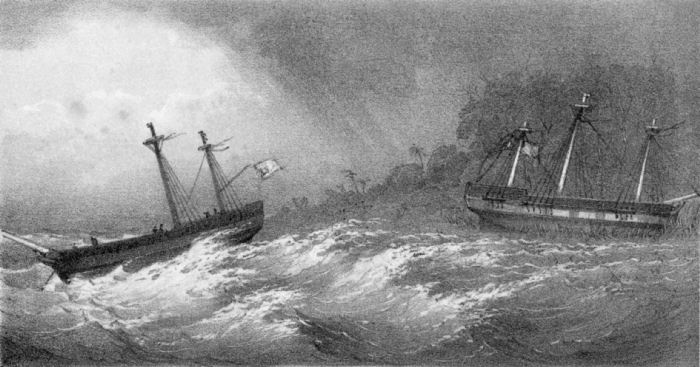
Hullmandel & Walton Lithographers.
No. 1.
THE POSITION OF THE SHIPS, AT DAYBREAK, MORNING, 12TH. NOVEMBER
About 60 years ago an attempt was made
on the part of the East-India Company to
form a settlement on the Andaman Islands
for the convenience of shipping. Their first
settlement was called Port Chatham, on the
South Andaman. But, after about a year or
two, it was removed thence, on account of
its unhealthiness, to the North Andaman,
where it was named Port Cornwallis, after
Admiral Cornwallis, who recommended the
removal, and not long after that was finally
broken up, and the islands abandoned.
The ship being nearly dry aft, on the weather
clearing, her crew, to their great astonishment,
beheld, about a quarter of a mile
inside of them, high amongst the trees, in a
swamp of mangroves, whither she had forced
herself a passage, a large barque, with
troops on board.[B] In consequence of this
discovery, Ensign Du Vernett was, as soon
as possible, lowered with ropes from the
Runnymede’s stern, with twelve soldiers, to
communicate with the barque. At 7 A. M.,
the tide rising, orders were given to the men
to prepare to land at next low water, and,
if possible, get something cooked, as, during
the hurricane, no fires could be kept in the
ship, and, consequently, the crew and troops
had not had anything but biscuit and a glass
of spirits during the storm. At half-past
3 o’clock P. M. the tide having fallen sufficiently
to enable the people to wade on
shore, Ensign Du Vernett returned on board
and reported the vessel he had visited to be
“The Briton” from Sydney, bound to Calcutta,
and which had sailed from the former
place, in company with the ships Royal
Saxon, Loyds, and Enmore, on the 12th of
August, 1844, having on board Her
Majesty’s 80th regiment, 1000 strong, under
the command of Lieut.-col. Baker. The
companies two, three, and six were on board
the Briton, under the orders of Major, afterwards
Lieut.-col. Bunbury, and consisted of
311 soldiers, including 12 serjeants and 4
drummers, 34 women, 51 children, and the
following officers, namely, Captains Best,
Sayers, and Montgomery; Lieutenants Leslie
and Freeman; Ensigns Hunter and Coleman;
and Assistant-surgeon Gammie, medical
officer in charge. The Briton was
commanded by Captain Alexander Hall.
She had a crew of 34, was a vessel of 776
tons, A 1, and was ascertained to be the
same barque which had drifted a-head of
the Runnymede in the storm, having parted
with all her companions, which afterwards
arrived safely at their destination. The
Briton was so short of provisions, that
twelve men were obliged to be satisfied with
the ordinary allowance of four.
By dusk, all hands, including soldiers,
women, and children, had left the wreck of
the Runnymede, and were accommodated
on board the Briton. They were received
by Captain Hall, Colonel Bunbury, and the
officers of the 80th, with the greatest kindness,
although they were enduring very
great privations themselves. The crew of
the Briton were delighted to hear of there
being a fair stock of stores on board the
Runnymede, particularly as regarded biscuit
and flour, which, if moderate weather continued,
would be landed for the benefit of
both ships’ companies.
In the morning after the wreck, a seaman
of the Runnymede lost his life by the following
piece of disobedience and fool-hardy
temerity. Captain Doutty was sitting in
Captain Stapleton’s cabin, consulting with
the military officers as to the best mode of
getting the women and children on shore,
when it was perceived that one of the seamen
had placed himself by the cabin windows,
apparently dressed for a swim. Captain
Doutty enquired what brought him
there: he instantly replied, “We are all
alike now.” Captain Doutty told him he
was mistaken if he thought so, for that
whilst two planks of the ship held together,
he was determined to keep the command,
and ordered him to leave the cabin. As he
appeared unwilling to go, the chief officer
was desired to send him forward. Being
called accordingly, he refused, with an oath,
to go, and immediately threw himself from
the cabin window, and swam towards the
shore, which he never reached, as the receding
waves kept him out until he was
exhausted, and the ship’s company saw him
sink without being able to assist him. This
man’s fate had the effect of keeping the
others quiet until the water had fallen sufficiently
to enable them to wade through it
to the shore. After the landing Colonel
Bunbury took the chief command of all
parties.
We shall now find it most convenient to
ourselves, as well as entertaining to our
readers, to continue our narrative in the
shape of a journal, only noticing those days
on which any circumstances worth recording
occurred.
Wednesday, 13th.—At daybreak, nearly
low water, all hands returned on board and
commenced getting up provisions for landing.
All more or less damaged.
The Briton had lost all her boats, and the
Runnymede’s long boat was the only one
they had, and that was badly stove, so that
the water had run through her, and thereby
prevented her being washed off the deck by
the waves: and she eventually became the
means, by God’s blessing, of obtaining that
assistance which saved the sufferers from
perishing on a desert island.
The carpenters, therefore, of both ships
were ordered to report how long a time it
would take to put this boat into a state fit
to proceed to sea to seek assistance. They
reported eight days. After a personal communication,
Captains Doutty and Hall received
from Captain Sayers, of the 80th regt.
the following order, putting their ships’
crews under martial law, which was twice
read to each crew.
Troop Ship “Briton,”
12th Nov. 1844.
Dear Sir,
In consequence of the wreck of the
troop ships “Briton” and “Runnymede,”
Major Bunbury calls on Captains Hall and
Doutty to explain to the crews of their respective
ships that they are from this moment
under military law, and feeling it to be most
essential for the well-being of the service
that the strictest order and discipline be
preserved by every one under his command,
declares it to be his determination to punish,
with the utmost severity, any act of insubordination
and drunkenness.
By Order,
H. T. Sayers,
Capt. 80th Regt.
To Capt. Doutty.
This day were landed from the Runnymede
at low water, 37 bags and 6 half-bags
of biscuit, 3 and a half bags of flour, and
9 baskets of plums. In consequence of information
that the crew of the Runnymede
meant to help themselves to the beer which
formed part of the cargo, and had laid a
plan to plunder the ship, they were in the
evening all ordered on board the Briton.
The only persons who remained on board
the Runnymede were Captain Doutty and
his officers, and a few steady soldiers of the
50th, and watches were regularly kept
throughout the night.
There appears to be a very prevalent opinion
amongst common sailors and private
soldiers, that when a vessel is wrecked, all
controul over private property is from that
moment lost too, and that it is not stealing
to lay hands on all they can take. Numerous
instances of this kind took place on the
present occasion. And this crime, as well as
that of drunkenness, were scarcely checked
by severe corporeal punishment. Some of
the men attempted thefts at the risk of their
lives; and, in one instance, a cask of bottled
beer having been landed too late to be
got into store, was placed, by a serjeant’s
tent, in care of a sentry, whose musket was
known to be loaded with ball. During the
night two fellows attempted to get at it, and
being discovered were fired at, which so
alarmed them, that one of them, in his hurry
to escape, fell into a mangrove swamp, which
caused him so much pain that he was easily
captured. He proved to be a man of bad
character.
Thursday, 14th.—Weather moderate, wind
east, barometer 29° 55″. The crew employed
this day landing stores, cleansing the decks
from the accumulated filth and rubbish. The
carpenters employed on the long boat. The
stores landed were 3 baskets of sugar, 2
barrels of flour, 7 tierces and 1 barrel of salt
provisions, 1 cask of vinegar, 1 puncheon of
arrack, 2 cases of bottled fruits, 2 boxes of
pickles, 6 barrels of pale ale, and 1 cask of
sherry. The soldiers were employed on
shore clearing the ground of trees, many
having been thrown down by the hurricane,
some of them very large, and apparently of
the growth of a century. They were also
employed in erecting tents and making roads
and bridges. The tents were made of the
sails of both ships, and the flags or camp-colours
used to distinguish the companies,
were Marryat’s signals, also from the ships.
Friday, 15th.—Wind east and moderate.
Weather fine. Continued landing provisions
consisting of soap, preserved potatoes, biscuit,
flour, sugar, dholl or split peas, rice, pale
ale, port wine, and sherry. Finished the
long boat’s bottom, turned her up, and commenced
raising her two streaks. Employed
drying damaged provisions. Water discovered
in the island; and a number of crabs,
prawns, and other shell fish picked up at
low water. Several indications of other
wrecks were seen, but exploring parties had
not yet straggled far from the encampment.
Saturday, 16th.—More provisions were
landed this day. In the evening, large fires
were seen on the island to the north, and as
several muskets were discharged on shore
away from the camp, and the people fancied
they saw natives, they were hailed and a
volley of musketry discharged, so no more
of them were seen. But double watches were
set at night with loaded arms.
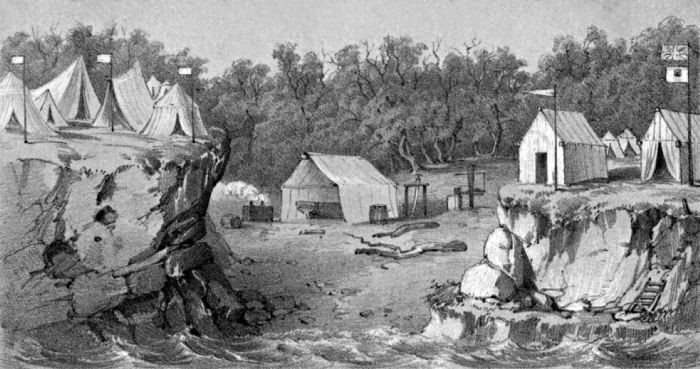
Hullmandel & Walton Lithographers.
No. 2.
THE ENCAMPMENT.
Sunday, 17th.—This day no business was
done, except by the carpenters, whose work
was of the utmost importance to the saving
the lives of upwards of 630 persons, with a
scanty stock of provisions. Divine service
was performed on board the Briton by Captain
Sayers of the 80th in presence of the
seamen and the troops, who were regularly
paraded for church, and the forms of prayer
and thanksgiving to the Almighty for the
preservation of the people’s lives were read.
Seven natives made their appearance on the
shore to the southward. Some of them tried
to surround two sailors who were gathering
shell fish, but the sailors were too nimble for
them. An officer with a small armed party
went in pursuit, but as soon as the savages
saw them they put off from the shore in a
canoe, leaving their fire, and close to it a
piece of drift wood and some fish bones. And
at night again some of the natives attempted
to approach the Runnymede, but on being
fired at they took themselves off. The
natives appeared to be quite naked and black,
and of a robust frame, with perfectly straight
hair. This day also a spring of fresh
water was discovered. The commander sent
out detachment orders regulating the issue of
rations and spirits to the troops, and complimenting
Captains Doutty and Hall and their
crews, and also the military officers and soldiers,
on their conduct during the hurricane,
and also regretting that the natives should
have been fired at, as much benefit might
arise from a conciliatory course, and much
mischief from an opposite one; and ordering
that for the purpose of preventing any rencontre
in future between them and the military
who might be straggling too far from
camp, a roll call should take place every two
hours, as well in the camp as on board the
Briton.
Monday, 18th.—Fine weather. Fatigue
parties employed on shore clearing the ground
and erecting tents. The carpenters at work
on the long-boat; her bottom and topsides
finished, and a portion of her beams and ceiling
placed. The crew engaged repairing her
sails and in cutting air-holes between decks
in the Runnymede for ventilation. On shore
a court-martial sat for the purpose of trying
men for stealing and drunkenness. By an
order issued this day Ensign Hunter of the
80th was appointed to act as Adjutant. The
Runnymede was made into a hospital ship
under the care of Dr. Gammie, whilst Mr.
Bell gave his medical attendance on shore to
those whom it was not deemed necessary to
send to the hospital; and the Briton was to
be considered as a store-ship whence the
provisions were to be issued daily, under the
superintendence of Ensign Venables. The
remainder of the troops were also ordered to
disembark and encamp, the position of the
Briton in a stagnant swamp of half salt, half
fresh water, with mangrove trees crushed
under it, being considered prejudicial to the
health of the men.
Tuesday, 19th.—The carpenters employed
laying the deck of the long-boat. Crew
landing beer casks, but many of them burst
whilst being carried ashore from being so
long under water, and the straw they were
packed in consequently heating. The sick
were transferred from the Briton to the Runnymede.
This afternoon the soldiers were
paraded for the first time since the wreck.
Their appearance, owing to their distressed
situation, was somewhat similar to that of
Falstaff’s ragged regiment.
Wednesday, 20th.—Five soldiers were corporeally
punished, by sentence of court-martial,
for stealing and insubordination.
The troops left the Briton according to order.
Most of the officers commenced erecting tents
for themselves.
Thursday, 21st.—The carpenters completed
the deck of the long-boat. Four of
the soldiers straggled a short distance to the
south of the encampment in search of shell
fish. They were attacked by a party of natives,
who speared the whole of them, two of
them dangerously, one of whom had three
spears sticking in him. They were carried
on board the Runnymede. A strong party
was sent in pursuit of the evil doers but could
not meet with them. Shortly after the return
of the party, Captain Doutty saw fourteen
of the natives issue from the jungle
armed with their fishing-spears and apparently
quite unconcerned, but the tide being
up and having no boat, our people could not
get at them. It was, however, deemed necessary
to place advanced picquets round the
camp, and a four-pounder was placed on the
top-gallant forecastle and another on the
poop of the Runnymede, in order to keep the
natives off if they should prove aggressive.
There appeared to be no chance of receiving
any assistance from them. The island appeared
to be wholly unproductive, neither
fruit nor vegetables having been discovered,
but several wild hogs were seen.
Friday, 22d.—The carpenters employed
putting a false keel to long boat and caulking
her. Landed 46 casks of beer, also some
preserved salmon and cheese. A board of
survey assembled on board the Briton to
examine the stores saved, and to report as to
the rations to be issued, calculated for forty
days. The court recommended the following
scale for alternate days, namely,
First day, ½ lb. bread, ½ lb. beef, ½ gill of
spirits, 1/12 oz. of tea, ½ oz. of sugar.
Second day, ⅓ lb. flour, ⅓ lb. pork, ¼ pint
peas, ¼ oz. coffee, ½ oz. sugar, ½ gill spirits,
and this even would only last 36 days, that
is, till 27th December. By this time, too,
the coast for two miles round the island was
cleared of shell fish. This day a private of
the 80th regiment died in hospital of dysentery,
most likely caused by the water,
which had a disagreeable vegetable taste.
Saturday, 23d.—More beer landed from
the Runnymede, also a case of claret. These
were now issued in lieu of spirits. This day
the natives came close to the camp. A few
soldiers were sent to parley with them, and
took two red shell jackets, which were left
on a bush as presents for them. They only
trampled on them, and at a given signal sent
a volley of spears at the soldiers in return,
two only taking effect. Two armed soldiers
who had been concealed, then appearing, the
natives set up a yell and ran to the bush,
leaving part of a bow and a bundle of arrows
behind them. They appeared very treacherous.
They seemed also to understand the
effect of fire-arms, running away the moment
they saw any.
Sunday, 24th.—Divine service was performed
on board the Briton. The coast was
strewed in every direction with pieces of
wreck. In the evening part of a chest of
drawers and the top of a washhand-stand
were found. These probably had floated
from some vessel that had foundered.
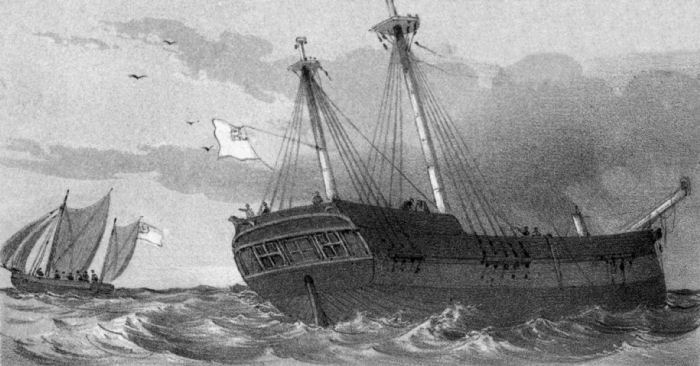
Hullmandel & Walton Lithographers.
No. 3.
DEPARTURE OF THE “HOPE” IN SEARCH OF ASSISTANCE.
Monday, 25th.—Moderate breeze. The
long boat, being finished, was launched from
the deck of the Runnymede at 11 o’clock,
amidst the hearty cheers of all hands. She
was named “The Hope.” Her mast was
then stepped and fitted, and an ample supply
of provisions, water, and other necessaries
put on board her. At half-past five,
P. M., she set sail in charge of Captain Hall,
of the Briton, with Mr. Skelton, chief officer
of the Runnymede, and the boatswain and
five seamen. Lieutenant Leslie, of the 80th,
went in her as bearer of despatches. The
course proposed, at the suggestion of Captain
Doutty, was, to get into the track of
ships proceeding to and from the Straits
of Malacca; and then, being guided by the
winds and other circumstances, either to
cross to Moulmein, or go on to Calcutta.
Tuesday, 26th.—Weather moderate. The
Hope not in sight at daybreak. The carpenters
landed to make preparations for
building another boat. Parties out getting
shell-fish. Some trepang, beech-le-mer, or
sea slug, was brought to Captain Doutty,
which he attempted to cure by cleansing,
parboiling, and drying in the sun. This is
reckoned a great luxury by the Chinese, and
is sold in their markets. It abounds in the
vicinity of coral reefs.
Captains Stapleton, Montgomery, and
Best, in the evening, saw a wild hog, between
which and the bush they got unperceived.
They each had a shot at him,
as he ran past them, and being wounded in
the head, he ran staggering amongst the
fallen timber. A little spaniel dog, called
Billy, of the King Charles’s breed, which
happened to be with the party, seized the
hog by the ear. At the same time a soldier
ran up to despatch the animal with a large
stick, and not observing the dog in the
dusk, he accidentally struck him an unlucky
blow on the head, and killed him. Poor
Billy’s fate was universally regretted in the
camp, where he was a general favourite.
The hog weighed 80 lbs., had large tusks,
and his hide was half-an-inch thick. The
meat was hard and tough, but still was
acceptable as a change. Some natives who
were near the spot where the hog was killed,
on hearing the shots, left their fire with a
yell, and fled into the bush.
Thursday, 28th.—Working parties clearing
and deepening the wells, which were
beginning to fail. Several of the officers
left the Briton, their tents being completed.
There were many beautiful shells of various
kinds found upon the beach. It was amusing
to see such as are generally made use
of as mantel-piece ornaments, teeming with
life, and running about in every direction.
A few fish were caught in nets outside the
Runnymede, quantities of small ones being
driven into shoal water by the large ones,
which prey upon them.
Friday, 29th.—The soldiers were employed
burning a road to the wells, the
fallen trees being so interwoven that it was
not possible to cut one. The carpenters were
cutting a keel for the boat. The crew fishing
and making nets. This evening there
was a cry that a ship’s light was seen in the
offing, which produced a considerable sensation
for the moment; but it turned out to
be only Sirius rising.
Saturday, 30th.—General parade for muster.
The keel for the intended boat brought
in from the bush where it had been cut. A
carpenter, four sawyers, and a blacksmith
from the 80th were ordered to assist in
building the new boat.
Sunday, 1st December.—Divine service
was performed. The guard on board the
Runnymede was now formed by convalescent
soldiers, being one serjeant and six privates
of the 80th. The natives made very large
fires both to the northward and southward.
Monday, 2d.—Bellows were finished for
the forge, with the pioneers’ aprons for sides,
and part of a gun-barrel for the pipe. The
tiller of the Briton’s rudder was used for an
anvil, and nails were made out of the copper
bolts from her stern posts. A sailor’s canoe,
which was nearly finished, took fire, and
both her gunwales were burnt down.
Tuesday, 3d.—Regular morning parades
on the beach at 7 A. M. commenced this day,
the guards mounting immediately afterwards.
The bugle was sounded regularly,
as in garrison, at daybreak, for parade, for
meals, and for bed at 8 P. M. The road still
in progress of burning. This, together with
the tent-fires and those of the picquets, had
a very brilliant effect. Two officers went in
search of water, and found a running stream
under the hills, about a mile from the camp,
which was very difficult to reach, from the
denseness of the jungle.
Wednesday, 4th.—A couple of punts have
been made out of rattans, covered with
tarred canvas, and the canoe had plank
sides put to it, in lieu of the gunwales,
which were burnt. There were some thunder
and lightning in the evening, and heavy
rain, which caused the tents to leak, they
having been made of old canvas.
Thursday, 5th.—A bag of damaged pepper
sent on shore from the Runnymede for the
soldiers to eat with the shell fish. An oyster
bed discovered. A tree on fire, mistaken for
a steamer’s light.
Friday, 6th.—The carpenters commenced
planking the boat. Several men were sent
to the hospital with fever and head complaints.
An order was issued, prohibiting
the soldiers bathing or otherwise exposing
themselves in the heat of the sun.
Saturday, 7th.—The canoe was launched,
and answered better than was expected.
Nearly the whole of the fallen trees on the
island lay towards the south-west, so that
the hurricane must have come from the
E.N.E. or N.E.
Sunday, 8th.—Divine service as usual.
The canoe brought in a cargo of fine oysters
from the northward. The tracks of a number
of hogs were seen. A soldier of the
80th died in hospital of brain fever.
Monday, 9th.—The Runnymede got a
spar over her quarter, lashed to the mizen-mast,
to shore her up, the heavy surf causing
her to bump more than was agreeable.
There was quite a fleet of canvas in the bay
fishing and paddling about.
Tuesday, 10th.—One of the fishing crews
caught a large fish of the snapper kind, of
about 20 lbs. weight. It was found to be
coarse and hard when cooked.
Wednesday, 11th.—The encampment looked
quite gay, each tent having its
distinguishing flag, or number of the company,
hoisted; those of the officers had also their
signals flying. Captain Stapleton’s had the
number of his regiment, 50th. The bay
from the Runnymede had a very pretty
effect.
Thursday, 12th.—Two turtles were seen
upon the water. There were only sufficient
provisions on hand to serve this month
through. The Hope has been gone now
sixteen days.
Saturday, 14th.—A party of officers of
the 80th went to the northward on discovery,
attended by the canoe. They crossed over
to the other island. Saw a wild beast in
the bush of the panther kind. Found some
bundles of pigs’ heads, tied with cane, laid
together in heaps, and stones suspended
from the trees by rattan. They supposed
this to be some religious ceremony of the
natives. They found a quantity of excellent
oysters on the rocks. They made a fire,
and dined off them.
Sunday, 15th.—Divine service as usual.
This was the 20th day after the departure of
the Hope. The present amount of ration
to be reduced one-half from to-morrow,
which will be little better than starvation.
Very little shell fish to be now found within
miles of the camp. About eleven o’clock,
A. M., there were two smart shocks of an
earthquake. The Briton shook so violently
that all hands ran up from below, fearing
that she would fall over. The last shock
had scarcely subsided, when the shout of a
sail, a sail! issued from a look-out tree, on
the right of the camp, upon which the people
themselves had established a watch, relieved
every hour. The welcome cry quickly resounded
throughout the camp. The Runnymede
immediately hoisted her ensign and
fired a gun, which was a pre-concerted signal.
The camp was in great commotion, every
one enquiring where the sail was, and straining
their eyes to catch a glimpse of the
stranger. Within a quarter of an hour afterwards,
she had rounded the point and was
visible to all. At one o’clock, P. M., she
came to anchor abreast of the Runnymede,
in 15 fathoms, the men cheering on shore,
whilst the ship saluted her with twelve guns.
She proved to be the Honourable Company’s
schooner, George Swinton, of 70 or 80 tons,
from Mergui, with supplies of provisions
for the sufferers, and the Hope towing at
her stern. Our canoes went off, and brought
on shore Mr. Michael, an ensign of the 17th
Madras Native Infantry, the bearer of despatches
from Mergui to the commanding
officer, to whom he communicated the news
of the safe arrival of the Hope at that port,
and of the welfare of her crew. They had
reached Mergui in 11 days from the time of
leaving the island. They had suffered much
from the heat of the sun and fatigue, because,
having either foul or light winds,
they were obliged to row the greater part
of the distance, and to give up all idea of
going to Calcutta. Having made their report,
they were supplied with a lighter boat
belonging to the American missionaries, in
which they proceeded to Moulmein. The
next day the commanding officer at Mergui
despatched the George Swinton, under the
command of Captain Daniels, to the relief
of the sufferers, bringing, amongst other
things, six young buffaloes. The arrival of
this vessel at the exact moment of need
caused great rejoicings, and an extra half-pound
of biscuit and glass of spirits were
issued to each man to commemorate the
event. In the afternoon a soldier of the
80th was unfortunately drowned in the surf
whilst bathing. On the arrival of the Swinton
the rations were increased, and comparative
plenty was restored.
Wednesday, 18th.—The Runnymede’s
mainmast was cut away, and she was shored
up with it to make her ride easily, being
much shaken by the surf. The Hope was
brought on shore, and her deck and false
keel taken off, that she might be used for
landing provisions and stores. A brig appeared
in sight to the southward. The
Runnymede made signals, but she passed
on without taking any notice. She was
supposed to be a country ship.
Friday, 20th.—The island is putting on a
spring-like appearance. Verdant spots are
here and there to be seen, and the trees are
beginning to come into leaf. Even those
which were thrown down by the hurricane
are struggling for life with the few roots left
in the ground, and some of sixty feet high,
without branch or top, have shot out small
green twigs, forming a curious contrast with
their scathed trunks. Melons, limes, and
other seeds, sown by the officers, now
coming up. Two native canoes took up a
position near the north island, and afterwards
their people passed along the reef
fishing. Captain Doutty counted twenty-four
persons on the reef, besides those left
in care of the canoes. A soldier of the 50th
died in hospital this day of brain fever.
Sunday, 22nd.—Divine service as usual.
The poop-awning of the Briton was blown
away, and the cuddy filled with water. The
weather very rough.
Tuesday, 24th.—The Swinton’s jolly-boat
was swamped in the surf whilst taking off
water-casks. The long-boat went to their
assistance, and towed them alongside the
schooner. The east end of the north island
was covered with natives in search of food;
the poor creatures seemed to depend entirely
on shell-fish and sea-slug, picked off the
reefs, for their subsistence, with occasionally
a fish caught with their spears. During bad
weather they must suffer much from hunger.
Wednesday, 25th. Christmas Day.—The
Swinton left for Moulmein. Mr. Michael
returned in her with despatches. The Runnymede’s
dingy returning from the schooner
was capsized in consequence of Thompson,
a seaman, falling on one side of her, when
Edmund Hutter, a seaman, was drowned,
means of resuscitation proving of no avail.
Divine service was performed on board the
Briton. The tents of the 80th looked very
gay, being decorated with green boughs in
honour of the day. There was no roast beef,
but very good plum-puddings were made
without sugar.
Thursday, 26th.—Flies and musquitoes
came in myriads; they were very troublesome;
there were none till now; the hurricane
must have swept them away. Very
beautiful periodical flowers appeared. Also
snakes; several have been killed in camp.
A young pig was shot by a serjeant; the
mother and the rest of the family escaped.
Friday, 27th.—A wicker-work pot was
made to catch fish in deep water. A tablet
was engraven on the rock, near the burial-ground,
with the names of the soldiers who
had died on the island. At night large fires
were made round the camp to burn out and
keep off the musquitoes.
Saturday, 28th.—At 7 A. M. a sloop-of-war
brig, the Pilot, Captain Jervis, with two
schooner gun-boats in convoy, appeared.
The latter ran into the anchorage, and the
former went round the islands in search of
other vessels. Sent our boat on board one
of the former and landed the officer, Mr.
White, of the Company’s Marine, who stated
that transports were at hand to relieve the
sufferers; also that the rest of the 80th regiment
had arrived safely at Calcutta. The
new six-oared boat named “The Andaman”
was launched at noon; she went through
the surf beautifully. The Pilot sent her
cutter round with Lieut. Leslie, and also
some fresh meat and vegetables.
Sunday, 29th.—At noon the Ayrshire, of
250 tons, arrived from Moulmein, being one
of three ships taken up by the Government
there to convey the sufferers away from the
island; the other two were called the Agnes
Lee and the Elizabeth Ainslie. Capt. Jervis
and three of his officers dined on the island.
Monday, 30th.—The first division of the
80th regiment commenced embarking on
board the Ayrshire. At 3 P. M. the Elizabeth
Ainslie arrived for the remaining portion
of the 80th, and anchored near the
Runnymede.
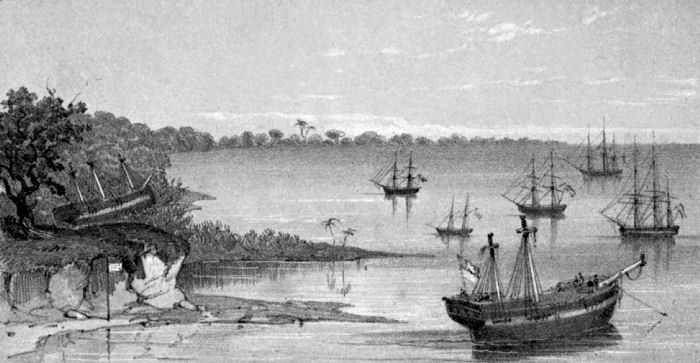
Hullmandel & Walton Lithographers.
No. 4.
THE DELIVERANCE.
Tuesday, 31st.—The Pilot came round
from the northward, and brought up in front
of the camp. Commenced embarking the
heavy stores on board the Elizabeth Ainslie.
At 4 P. M. the Ayrshire sailed with the first
division of the 80th regiment.
Wednesday, 1st January.—The second
division of the 80th regiment embarked in
the Elizabeth Ainslie, as also Captain Doutty
and the crew of the Runnymede. The officers
dined on board the Pilot. There were
numerous native fires on both islands.
Thursday, 2nd.—The Elizabeth Ainslie
sailed. The natives collected in great numbers
on both islands. The gun-boat’s gig,
manned by Lascars, whilst pulling along the
reef, was pursued by five canoes. The brig-of-war’s
cutter went to her assistance, when
the canoes pulled back to the reef and made
off. The 50th detachment strengthened
their camp-guard and posted extra sentinels.
Friday, 3rd.—The transport Agnes Lee
arrived from Moulmein. The invalid soldiers,
women, and children, and heavy baggage
were embarked in the course of the
day. At night the natives came round the
camp in great numbers; there were fires in
every direction. A picquet was sent out to
drive them back; the picquet fired at a party
moving in rear of the tents, who fled, and
extinguished their fires in a most extraordinary
manner, the whole, except a few scattered
embers, disappearing almost as if by
magic. The brig of war despatched two
boats to pull along shore in front of the
camp, and afterwards fired two shots and
a shell amongst a large body of natives
gathered round a fire a short distance to
the left of the Briton. They took themselves
off and did not appear again that
night.
Saturday, 4th.—The remainder of the
detachment of the 50th embarked in the
Agnes Lee. At night the natives again
assembling in and around the camp, the
marines of the Pilot were landed to protect
the wrecks. Several shots were fired during
the night.
Sunday, 5th.—The last detachment of the
wrecked troops, after a sojourn of 55 days,
sailed this day for Calcutta in the Agnes
Lee, and bid adieu to this inhospitable
island, in words very different from those of
the poet, who sang
“Isle of beauty, fare thee well.”
The voyage was most prosperous, the several
ships having arrived at their destination
within a few days of each other. The only
place of note they passed on the voyage
being Barren Island; they had a full view
of its volcano, which is a cone thrown up
from a valley. It was then in partial action,
and was ejecting volumes of smoke as they
passed it.
Monday, 13th.—Latitude, by observation,
20° 59″ north. A comet has been seen for
the last ten or twelve nights, in the south-west,
about equal to a star of the second
magnitude, with a tail of about 8 or 10 degrees.
The detachments of the 10th and 50th
regiments, on arriving at Calcutta, proceeded
on to Chinsmah by steam, and the
detachment of the 80th landed at Calcutta,
and took up their quarters in Fort William.