The troubles of Crete.—The bigotry of the “Young Turks.”—Venizelos
in Greece.—The pro-German king.—The new government at
Salonika.—The downfall of Constantine.—The ambitions of
Roumania.—Pro-Germans in Russia.—Roumania declares war.—Russian
treachery and German trickery.—The defeat of Roumania.
You will remember the name of Eleutherios Venizelos, the prime minister of
Greece, who tried to get that country to stand by her bargain from Crete
with Serbia (pages 239-240). Now Venizelos had
originally come from Crete, a large island inhabited by Greeks, but
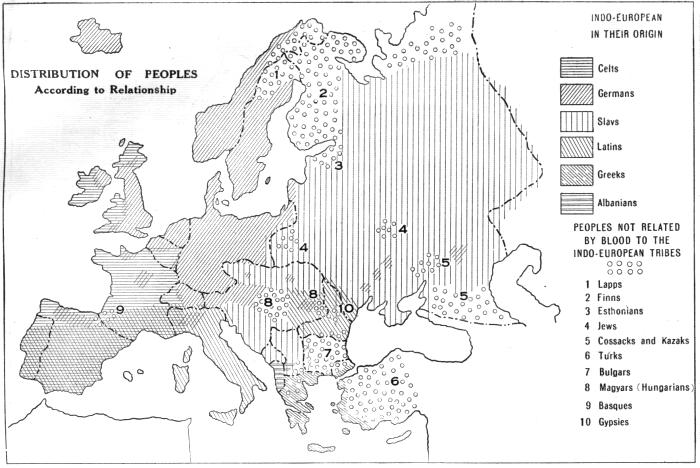
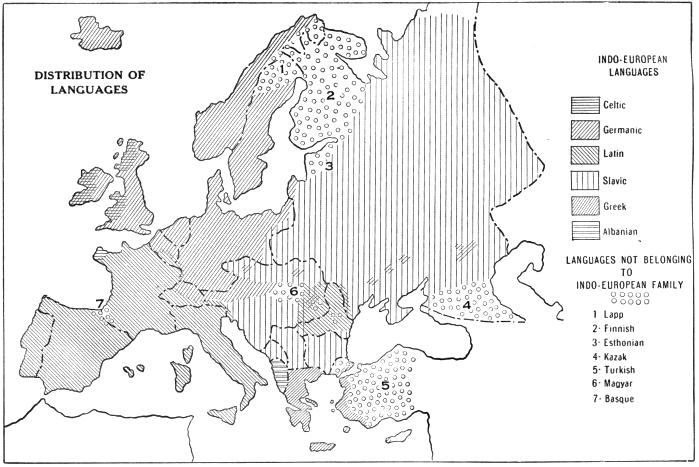
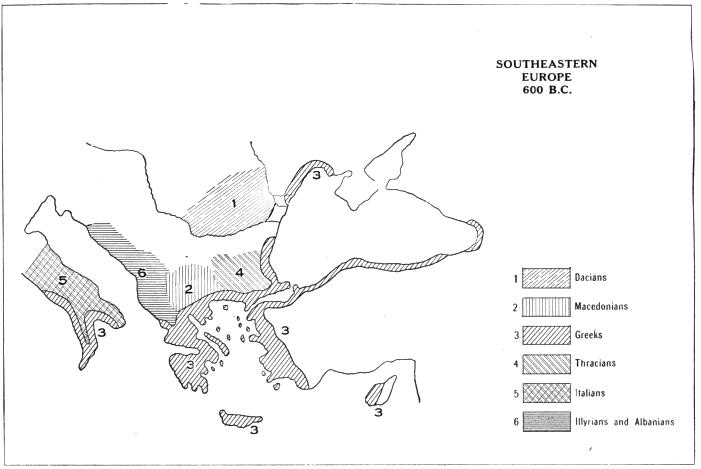
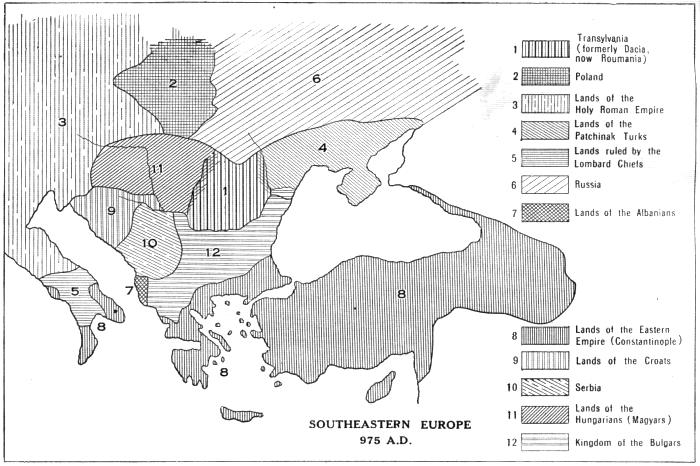
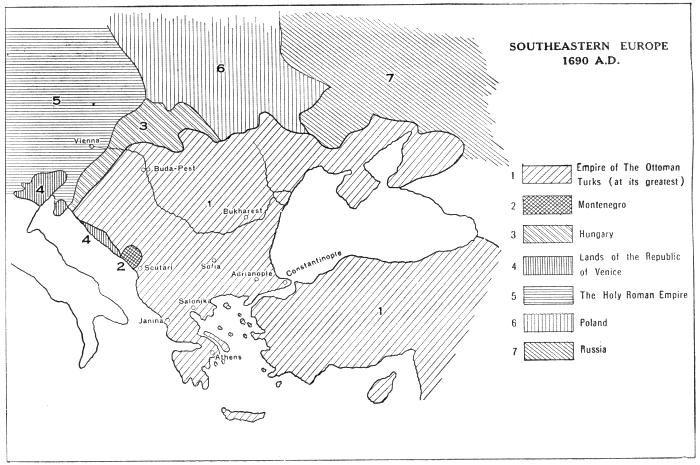
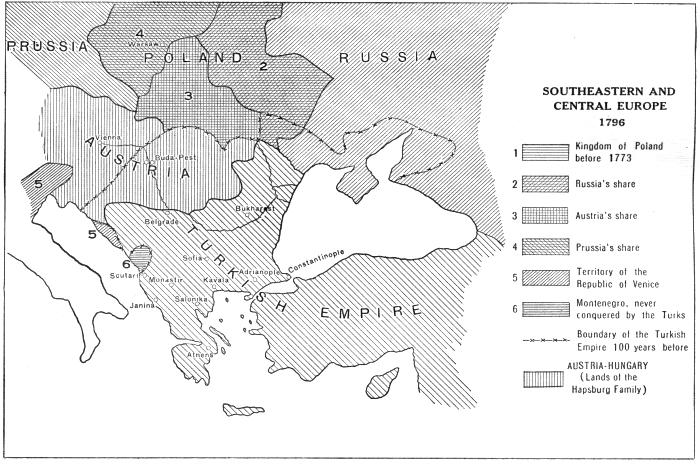
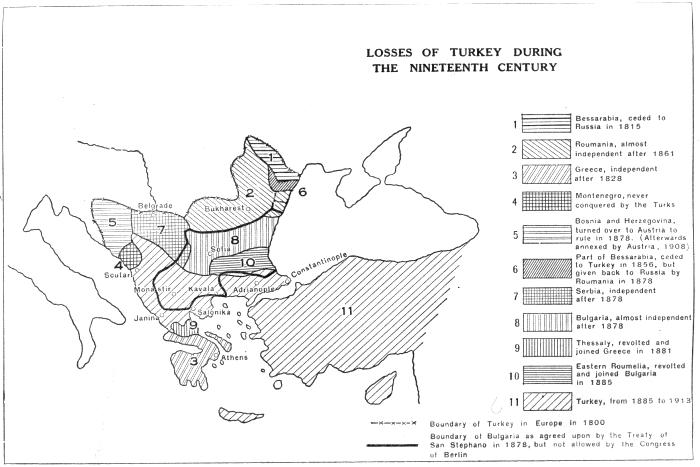
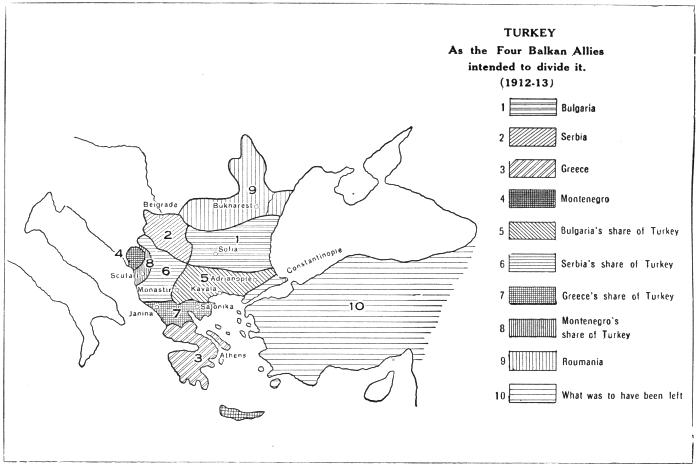
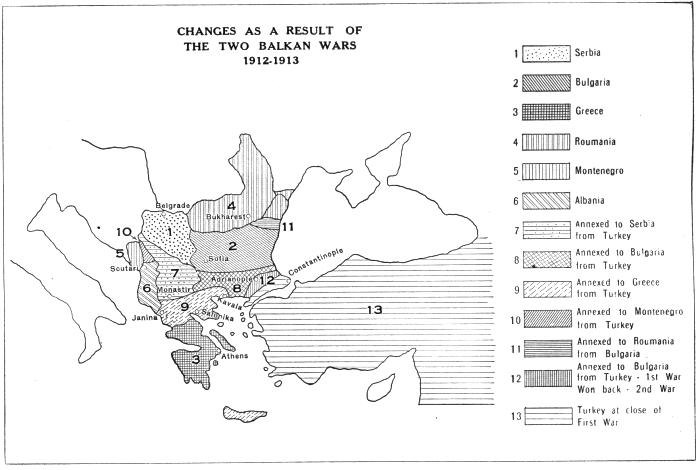
controlled by Turkey for many years (see map). In
1897 the Turks had massacred a number of Greek Christians on the island,
and this act had so enraged the inhabitants of Greece that they forced
their king to declare war on Turkey.
Poor little Greece was quickly defeated, but the war called the attention
of the Great Powers of Europe to the cruelties of the Turks, and they
never again allowed Crete to be wholly governed by them. For over a year
Great Britain, France, Russia, and Italy had their warships in Cretan
ports and the government of Crete was under their protection.
Finally they called in, to rule over the island, a Greek prince,
Constantine, the son of the king. Eight years later he had become very
unpopular through meddling with Cretan politics—on the wrong side—and
had to leave.
The It was at this time that Venizelos came to the front. The Cretan
government was really independent, like a little kingdom without a king,
and he was its true ruler. Now all the Greeks had looked forward to the
time when they might be united in one great kingdom. The shores of Asia
Minor and the cities along the Aegean Sea and the Dardanelles were largely
inhabited by Greeks. Crete and the islands of the Aegean had once been
part of Greece and they never would be content until they were again
joined to it. The Cretan government was ready to vote that the island be
annexed to Greece, when in 1908 there came the revolution of the “Young
Turks” which drove the old Sultan from his throne (page
186).
The Young Turks at the outset of their crusade against the government were
tolerant to all the other races and religions in their country. At first
the Armenians, the Jews, the Albanians, the Greeks, and the Bulgarians in
the Turkish Empire were very happy over the result of the revolution. It
looked as if a new day were dawning for Turkey, when it would be possible
for these various races and different religions to live side by side in
peace.
No sooner were the young Turks in control of the government, however, than
they began to change. “Turkey for the Turks, and for the Turks only”
became their motto. With this in mind they massacred Bulgarians and Greeks
in Macedonia (page 85) and Armenians in Asia Minor.
The thought of the loss of Crete roused their anger and they began
scheming to get it back under Turkish rule.
In 1910 Venizelos, seeing the danger of his beloved island, left for
Greece, hoping there to stir up the people to oppose the Turks and annex
Crete. His wonderful eloquence and his single-hearted love for his country
soon made him as prominent on the mainland as he had been in his island
home. Before long he was chosen as prime minister of Greece.
He found the country in a very sad condition. The military officers were
poorly trained. What was worse, they did not know this, but imagined that
their army was the best in the world. The politicians had plundered the
people and there was graft and poor management throughout the government.
Venizelos made a wonderful change. He sent to the French republic for some
of their best generals. These men thoroughly made over the Greek army and
taught the Greek officers the real science of war.
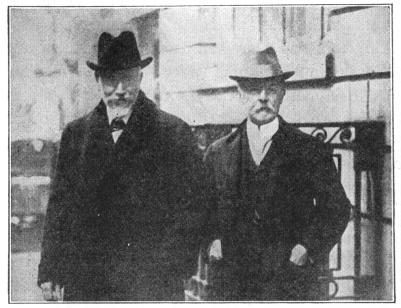
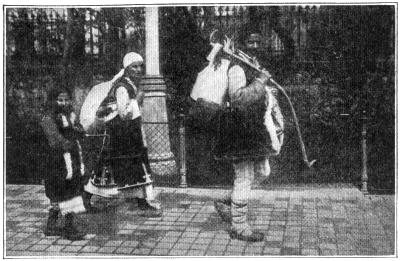
Venizelos (left) with Greek ambassador to England
Venizelos soon showed the politicians that he could not be frightened,
controlled, or bribed. He discharged some incompetent officials and forced
the others to attend to business. In fact he reorganized the whole
government service in a way to make every department do better work. Few
countries in Europe were as well managed as was Greece with Venizelos as
its prime minister.
Every Greek hates the Turks and looks forward to the time when no man of
Greek descent shall be subject to their cruel rule. You have been told how
the Russians have looked forward to the day when Saint Sophia, the great
mosque of the Turks, shall once more become a Christian cathedral. In the
same way the Greeks have passionately desired to see Constantinople, which
was for over a thousand years the capital of their empire, freed from the
control of the Turk. Little by little, from the time when the Greeks first
won their independence from Turkey in 1829, the boundary of their kingdom
has been pushed northward, freeing more and more of their people from the
rule of the Ottomans. Venizelos, aiming to include in the kingdom of
Greece as many as possible of the people of Greek blood, was scheming
night and day for the overthrow of the Turkish power in Europe. You have
been told how the Russian diplomats astonished the world by inducing
Bulgaria to unite with the Greeks and the Serbs, two nations for whom she
had no love, in an alliance against the Turks. Many people felt that this
combination would never have been possible without the far-seeing wisdom
of of Venizelos. In fact, some historians give him the credit of first
planning the alliance.
His greatest trouble was with his own countrymen. The Greeks, as you have
been told, have always claimed Macedonia as part of their country,
whereas, in truth, there are more Bulgarians than Greeks among its
inhabitants. Venizelos, having agreed before the attack on Turkey that the
greater part of Macedonia should be given to Bulgaria, had hard work after
the victory in convincing his countrymen that this was fair. In fact, the
claims of the three allies to this district proved the one weak spot in
the combination. The occupation of this country by Greeks and Serbs in the
course of the first war against Turkey, while the Bulgarians were
defeating the main Turkish army just northwest of Constantinople, brought
on the second war. Bulgaria was not willing to give up Macedonia to the
Greeks and Serbs, and her troops made a treacherous attack on her former
allies (June, 1913) which brought on the declarations of war referred to.
At the close of the second war, when Bulgaria, attacked by five nations at
once, had to make peace as best she could, the Greeks took advantage of
her by insisting on taking, not only Salonika but also Kavala, which by
all rights should have gone to the Bulgars. Venizelos was willing to be
generous to Bulgaria, but the Greeks had had their heads turned by the
extraordinary successes of their armies over the Turks and Bulgarians and
as a result insisted upon being greedy when it came to a division of the
conquered lands.
Let us return now to events in Greece after the world war had begun: In
March, 1915, when the great fleets of France and England made their
violent attack on the forts of the Dardanelles, intending to break through
and bombard Constantinople, Venizelos was eager to have Greece join the
conflict against the Turks. He felt sure that Turkey, in the end, would
lose the war and that her territory in Europe would be divided up among
the conquering nations. He wanted to get for Greece the shores of the
Dardanelles and the coast of Asia Minor, where a great majority of the
inhabitants were people of Greek blood. The king of Greece, Constantine,
as has been explained, is a brother-in-law of the German Kaiser and has
always been friendly to Germany. He and Venizelos had been good friends
while both were working for the upbuilding of Greece, but a little
incident happened shortly after the Balkan wars which led to a coolness
between them.
King Constantine, while on a visit to Berlin, stood up at a banquet and
told the Kaiser and the German generals that the fine work of the Greek
soldiers in the two wars just fought had been due to help which he had
received from German military men. This statement angered the French very
much, for you will remember that it was French generals who had trained
the Greek army officers. Venizelos, very shortly after this, made a trip
to Paris and there publicly stated that all credit for the fine condition
of the Greek army was due to the Frenchmen who had trained its officers
before the war of 1912. This was a direct “slap in the face” of the king
but it was the truth and everyone in Greece knew it. From this time on it
was evident to everybody that Venizelos was friendly to the French and
English, while the King was pro-German.
Accordingly, in March, 1915, when Venizelos urged the Greek government to
join the war on Turkey, the king refused to give the order. Venizelos, who
was prime minister, straightway resigned, broke up the parliament, and
ordered a general election. This put the case squarely up to the people of
Greece and they answered by electing to the Greek parliament one hundred
eighty men friendly to Venizelos and the Triple Entente as against one
hundred forty who were opposed to entering the war.
Venizelos, once more prime minister as a result of this election, ordered
the Greek army to be mobilized. At this time the fear was that Bulgaria,
in revenge for 1913, would join the war on the side of the Germans and
Turks and attack Greece in the rear. In order to keep peace with Bulgaria
Venizelos was willing to give to her the port of Kavala, which Greece had
cheated her out of at the close of the second Balkan war. He felt that his
country would gain so much by annexing Greek territory now under the rule
of the Turks that she could afford to give up this seaport, whose
population was largely Bulgarian. Constantine opposed this, however, and
the majority of the Greeks, not being as far-sighted as their prime
minister, backed the king. When the attack by the Central Powers on Serbia
took place, as has been told, Venizelos a second time tried to get the
Greek government to join the war on the side of France and England. He
said plainly to the king that the treaty between Greece and Serbia was not
a “scrap of paper” as the German Chancellor had called the treaty with
Belgium, but a solemn promise entered into by both sides with a full
understanding of what it meant. The king, on the other hand, insisted that
the treaty had to do with Bulgaria alone and that it was not intended to
drag Greece into a general European war. As a result, he dismissed
Venizelos a second time, in spite of the fact that twice, by their votes,
the Greeks had shown that they approved of his policy.
Now Greece is a limited monarchy. By the terms of the constitution the
king must obey the will of the people as shown by the votes of a majority
of the members of parliament. In spite of the vote of parliament the king
refused to stand by the Serbian treaty. From this time on he was violating
the law of his country and ruling as a czar instead of a monarch with very
little power, as the Greek constitution had made him.
Things went from bad to worse. In the meantime the French and English had
landed at Salonika in order to rush to the aid of the hard-pressed Serbs.
You have already been told how Venizelos arranged this. Their aid,
however, had come too late. Before they could reach the gallant little
Serbian army it had been crushed between the Austrians and Germans on one
side and the Bulgarians on the other, and its survivors had fled across
the mountains to the coast of Albania. The French and English detachments
were not strong enough to stand against the victorious armies of Germany,
Austria, and Bulgaria. They began to retreat through southern Serbia. King
Constantine notified the Allied governments that if these troops retreated
upon Greek soil he would send his army to surround them and hold them as
prisoners for the rest of the war. France and England replied by notifying
him that if he did this they would blockade the ports of Greece and
prevent any ships from entering her harbors. This act on the part of
France and England, while it seemed necessary, nevertheless angered the
proud Greeks and strengthened the pro-German party in Athens. The king
took advantage of this feeling to appoint a number of pro-Germans to
important positions in the government. Constantine allowed German
submarines to use certain ports in Greece as bases of supply from which
they got their oil and provisions. The Greek army was still mobilized, and
the small force of French and English, which had retreated to Salonika,
were afraid that at any moment they might receive a stab in the back by
order of the Greek king.
In May, 1916, the Germans and Bulgarians crossed the Greek frontier and
demanded the surrender of several Greek forts. When the commander of one
of them proposed to fight, the German general told him to call up his
government at Athens over the long distance telephone. He did so and was
ordered to give up the fort peaceably to the invaders. We have already
seen what the answer of the Belgians had been on a like occasion. To be
sure, the French and English were already occupying Greek soil, but they
had come there under permission of the prime minister of Greece to do a
thing which Greece herself had solemnly promised that she would do,
namely, to defend Serbia from the Bulgars.
This surrender of Greek territory to the hated Bulgarians was too much for
Venizelos. He gave out a statement to the Greek people in which he
declared that the king had disobeyed the constitution and was ruling as a
tyrant; that he was betraying his country to the Germans and Bulgars and
that all loyal Greeks should refuse to obey him. At Salonika, under the
protection of the British and French, together with the admiral of the
Greek navy and one of the chief generals in the army, Venizelos set up a
new government—a republic of Greece.
Shortly after this the commander of a Greek army corps in eastern
Macedonia, acting under orders from King Constantine, surrendered his men
to the Germans, along with all their artillery, stores, and the equipment
which had been furnished to them by the French to defend themselves
against the Germans! In the meantime, the Bulgarians had seized Kavala.
The control of the Adriatic Sea had been a matter of jealousy between the
Italians and Austrians even during the years when they were partners in
the Triple Alliance. Even before Italy entered the war on the side of
France and England, her government, fearing the Austrians, had sent
Italian troops to seize Avlona. The Prince of Albania, finding that he was
not wanted, had deserted that country, and there had been no government at
all there since the outbreak of the great war. However, the presence of
this Italian garrison prevented the forces of the central powers from
advancing southward along the Adriatic coast.
Gradually, France and England increased their forces at Salonika. The
gallant defender of Verdun, General Sarrail, was sent to command the joint
army. During the summer of 1916, Italians came there to join the French
and British. A hundred thousand hardy young veterans, survivors of the
Serbian army, picked up by allied war ships on the coast of Albania, were
refitted and carried by ship around Greece to Salonika. Here they joined
General Sarrail’s army, rested and refreshed, and frantic for revenge on
the Germans and Bulgars. Several thousands of the Greek troops, following
the leadership of Venizelos, deserted the king and joined the allies.
Meanwhile, in Athens one prime minister after another tried to steer the
ship of state. The people of Greece were in a turmoil. The great majority
of them were warm friends of France and England—all of them hated
the Turks. The pro-German acts of the king, however, provoked the French
and English to such an extent that they frequently had to interfere in
Athens. The Greek people resented this interference and on one or two
occasions fights broke out when allied sailors marched through the streets
of the capital. Matters reached a climax in June, 1917. The governments of
France, England, and Italy felt that they could stand the treacherous
conduct of King Constantine no longer. They knew that he was assisting
Germany in every possible way. They knew that their camp was full of spies
who were reporting all their movements to the Bulgarians. They felt that
at the first chance he would order his army to attack Sarrail in the rear.
They finally sent an ultimatum to him ordering him to give up the throne
to his second son. The oldest son, the crown prince, having been educated
in Germany and sharing King Constantine’s pro-German sentiments, was
barred from succeeding his father. This seemed a high-handed thing to do
but there was no other way out of a difficult situation. Constantine had
allowed his sympathies with his wife’s brother to prevent his country from
carrying out her solemn treaty; had ruled like an absolute monarch; had
plotted with all his power for the overthrow of Russia, France, and
England, the three countries which had won Greece its independence in the
first place and which still desired its people to have the right to rule
themselves.
The guns of the allied fleet were pointed at Athens. More than half of the
Greek people favored Venizelos and the Entente as against the king and Germany.
A second[8] time
within four months a European monarch who was out of sympathy with his subjects
was forced to resign his crown.
With Constantine out of the way, there was nothing to prevent the return
to Athens of Venizelos. With great enthusiasm the people hailed his
coming, as, once more prime minister, he summoned the members of
parliament lawfully elected in 1915, and took control of the government.
In July, 1917, the Greek government announced to the world that,
henceforth, Greece would be found in the war on the side of France, Great
Britain, and the other nations of the Entente.
You will recall that when Bulgaria attacked Serbia the Serbs hoped for
help from Roumania. For they knew that Bulgaria had a grudge against
Roumania also, because of the Bulgarian territory which she had been
compelled to give up to her neighbor on the north at the close of the
second Balkan war. They expected this fear of Bulgarian revenge to bring
the Roumanians to the rescue.
You have read how Roumania wished for certain lands in Russia as well as
in Hungary that are inhabited by her own people. For a long time the
government at Bukharest hesitated, fearing to plunge into the war before
the time was ripe, and dreading the danger of choosing the wrong side.
The key to the situation was Russia. If Roumania were to go to war she
would have to count strongly on the help of her great neighbor to the
north.
Meanwhile, strange things were happening in Russia. You will remember that
there are two million Germans living in that part of the Russian domain which
borders the Baltic Sea. (The states of Livonia and Courland were ruled in the
olden times by the “Teutonic knights.”) These Germans are much
better educated, on the whole, than the Russians; they are descendants of old
feudal warriors and as such are men of force and influence in the Russian
government. It was a common thing to find German names, like Witte, Von Plehve,
Rennenkampf, and Stoessel among the list of high officials and generals in
Russia. In this way there were a great many people prominent in the Russian
government, who secretly hoped that Germany would win the war and were actively
plotting with this in view. “There is a secret wire from the czar’s
palace to Berlin,” said one of the most patriotic Russian generals,
explaining why he refused to give out his plans in advance. Graft and bad
management, as well as treachery, were all through the nation. Train-loads of
ammunition intended for the Russian army were left piled up on the wharves at
the northern ports. Guns sent by England were lost in the Ural mountains. Food
that was badly needed by the men at the front was hoarded by government
officials in order to raise prices for their friends who were growing rich
through “cornering” food supplies.[9]
The czar of Russia truly desired his country to win the war. On the other
hand his wife was a cousin of the Kaiser, a German princess whose brothers
were fighting in the German army, and she had little love for her adopted
country. The poor little Czarevitch, eleven years old, remarked, early in
the war, “When the Russians are beaten, papa weeps; when the Germans are
beaten, mamma weeps.” In spite of her German sympathies the Czarina had
great influence with her husband, and the scheming officials who were
secretly plotting the downfall of Russia were able to use this influence
in many ways.
In 1916, a new prime minister was appointed in Russia—a man named
Sturmer, of German blood and German sympathies. The Russians, after their
long retreat in 1915 had gradually gotten back their strength, and had
piled up ammunition and gathered guns for a new attack. This began early
in June, 1916, when General Brusiloff attacked the Austro-Hungarians in
Galicia and Bukowina and drove them back for miles and miles, capturing
hundreds of thousands of prisoners. You will remember that the Bohemians,
although subjects of Austria- Hungary, are Slavs and have no love for the
Austrians of German blood who rule them. Two divisions made up of Bohemian
troops helped General Brusiloff greatly by deserting in a body and
afterwards re-enlisting in the Russian army.
In northern France, the British and French had at last gained more guns
and bigger guns than the Germans had, and by sheer weight of metal were
pushing the latter out of the trenches which they had held for over two
years. It seemed to Roumania that the turning point of the war had come.
With the Russians winning big victories over Austria, and the French and
English pushing back the Germans in the west, it certainly looked as
though the end were in sight.
Now the king of Roumania, as you have been told is a Hohenzollern, a distant
cousin of the Kaiser of Germany, but, just the opposite from the case in Greece
and Russia, his wife was an English princess, and she was able to help the
party that was friendly to France and Great Britain. The man who had and worked
early and late to get his countrymen to join the Entente was Take Jonescu, the
wisest of the Roumanian statesmen, the man who predicted at the close of the
second Balkan war that the peace of Europe would again be broken within
fourteen months.[10]
What The Allies Wished
By the summer of 1916, the Roumanians had at last decided that if they
wanted to get a slice of Bessarabia from Russia and the province of
Transylvania from Hungary, they must jump into the war on the side of the
Entente. It is claimed by some that they had planned to wait until the
following winter in order to get their army into the best of condition and
training, but that the treacherous prime minister of Russia, Sturmer, when
he found that they were determined to make war on Germany and Austria,
persuaded them to plunge in at once, knowing that they were unprepared and
that their inexperienced troops would be no match for the veterans of the
central powers. At any rate, about the first of September Roumania
declared war on Austria and joined the Entente.
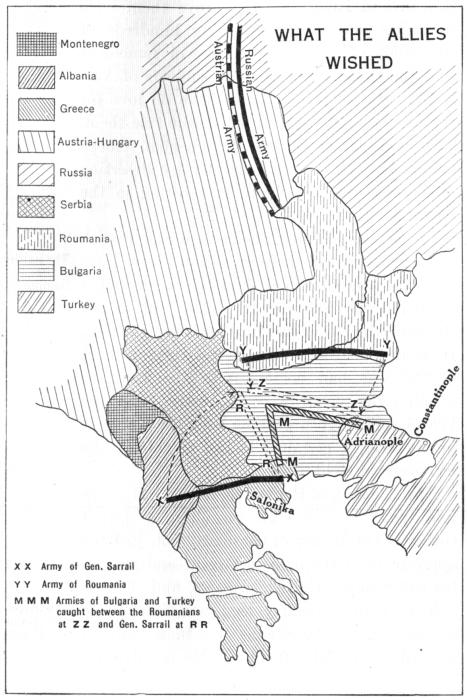
The French and English had wished the Roumanians to declare war first on
Bulgaria and, attacking that country from the north while General Sarrail
attacked it from the south, crush it before help could arrive from
Germany, much in the fashion in which poor Serbia had been caught between
Austria and Bulgaria a year previously. The Roumanians, however, were
eager to “liberate” their brothers in Transylvania, and so, urged on by
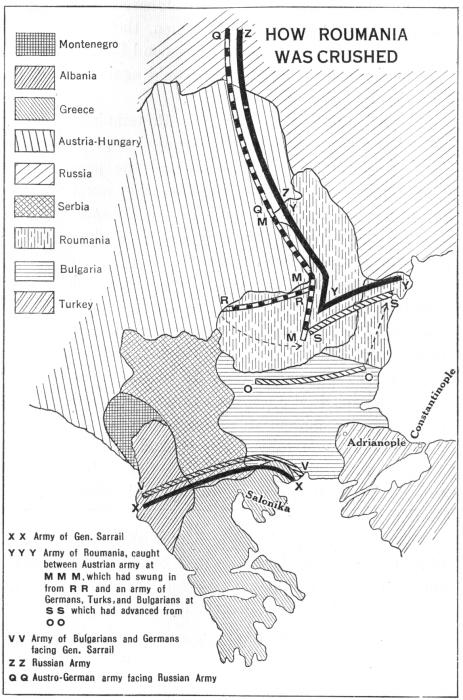
bad advice from Russia, they rushed across the mountains to the northwest
instead of taking the easier road which led them south to the conquest of
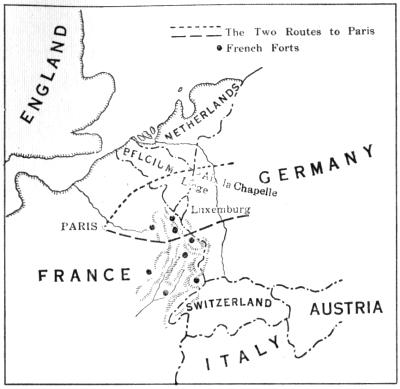
Bulgaria. (See maps.)
How Roumania was crushed
Germania, Turkey, and Bulgaria at once declared war on Roumania. The
battle-field in France, owing to continued rains and wet weather, had
become one great sea of slimy mud, through which it was impossible to drag
the cannon. General Brusiloff in Galicia had pushed back the Austrians for
many miles but a lack of ammunition and the arrival of strong German
re-inforcements had prevented his re-capturing Lemberg. The Russian
generals on the north, under the influence of the pro-German prime
minister, were doing nothing. The Italians and Austrians had come to a
deadlock. The country where they were fighting was so mountainous that
neither side could advance. North from Salonika came the slow advance of
General Sarrail. His great problem was to get sufficient shells for his
guns and food for his men. All the time, too, he had to keep a watchful
eye on King Constantine, lest the latter launch the Greek army in a
treacherous attack on his rear. For the time being, then, the central
powers were free to give their whole attention to Roumania.
Profiting by the mud along the western front and trusting to the Russians
to do nothing, they drew off several hundred thousand men from France and
Poland and hurled them all together upon the Roumanians. At the same time,
another force composed of Turks, Bulgarians, and some Germans marched
north through the Dobrudja to attack Roumania from the south. Thus, the
very trick that the French wished Roumania to work upon Bulgaria was now
worked upon her by the central powers. France and England were helpless.
They sent one of the best of the French generals to teach the Roumanians
the latest science of war, but men and guns they could not send. Look at
the map and see how Roumania was shut off from all help except what came
from Russia. Here Sturmer was doing his part to help Germany. Ammunition
and troops which were intended to rescue Roumania, never reached her. The
Germans had spies in the Roumanian army and before each battle, knew
exactly where the Roumanian troops would be and what they were going to
do.
The German gun factories had sold to Roumania her cannon. On each gun was
a delicate sight with a spirit level—a little glass tube supposed to
be filled with a liquid which would not freeze. Slyly the Germans had
filled these tubes with water, intending, in case Roumania entered the war
on their side, to warn them about the “mistake.” When the guns were hauled
up into the mountains and freezing weather came, these sights burst,
making the guns almost useless. Overwhelmed from both the northwest and
the south, the Roumanian army, fighting gallantly, was beaten back mile
after mile. Great stores of grain were either destroyed or captured by the
Germans. The western part of Roumania where the great oil wells are, fell
into the hands of the invaders, as did Bukharest, the capital.
Sturmer had done his work well. Germany, instead of being almost beaten,
now took on fresh courage. Thanks to Roumanian wheat, Roumanian oil, and
above all, the glory of the victories, the central powers were now in
better shape to fight than if Roumania had kept out of the war. The German
comic papers were full of pictures which declared that as England and
France had always wanted to see a defeated Hohenzollern they might now
take a long look at King Ferdinand of Roumania.
Questions for Review
-
What was the great disappointment connected with the rise to power of
the “young Turks”?
-
What would you say was the secret of the success of Venizelos in
Greece?
-
What mistake did the Greeks make at the close of the war of 1913?
-
What was the real cause of the strife between Venizelos and King
Constantine?
-
Would King Constantine have been justified in holding as prisoners the
French and British troops who were driven back upon Greek soil?
-
What right had Venizelos to set up a republic?
-
Was it right for the Entente to force the resignation of King
Constantine?
-
What made Roumania decide to join the Entente?
-
How was the Roumanian campaign a great help to the Central Powers?
![[Illustration]](https://openoldbooks.sgp1.digitaloceanspaces.com/books/the-world-war-and-what-was-behind-it/images/cover.jpg)