n studying the history of Babylonia and Assyria,
our attention is drawn to one of the earliest
inhabited portions of the globe—so far as is now
known: to the valley of the Euphrates. Biblical
tradition favored the view that this was the Cradle
of the Human Race. Here the Yahvistic writer placed
the fabled Garden of Eden, the best explanation he could
devise for the origin of mankind. The valley was a regular
thoroughfare for early tribes journeying to and from Arabia,
and reaching out to the east, west, or north for new homes,
often remaining for long succeeding generations in the fertile
region itself. It was a land where men of various tongues and
dialects met, only to again diverge. The effort of the Hebrew
to explain how so many languages had come into being resulted
in the story of the Tower of Babel. Before the beginnings of
the Hebrew race as distinct from the general Semitic family,
an old civilization had developed here in Chaldea. In connection
with his worship, the Chaldean built high ziqqurats—temple-towers
of from three to seven platforms, rising one
above the other, each platform smaller than the one below.
The story handed down from one generation of the Hebrews
to another was that the Chaldeans had once tried to build a
tower to reach the very heavens. Alarmed at their presumption,
God confounded their speech so they could no longer
understand one another. Thus was man punished and thus
the various speeches originated.
In following the history of the mixed race known as the
Babylonians, and of those who pressed north of the home-country
to found the state of Assyria, we shall become acquainted
with the only great nation of antiquity whose civilization
may have been older than that of the Egyptians. We
have up reliable record of the Chinese until late in the third
millennium, and their civilization, if more ancient still, was
isolated at least, and affected no other people. When
Thutmose I. penetrated to the valley of the Euphrates, some
years after the expulsion of the Hyksos, he came upon a nation,
of whose culture, script, and language, as the recently discovered
Tell-el-Amarna tablets indicate, were already familiar to his
own people.
The recorded life of Egypt reaches back more than 6,000
years; civilization in Mesopotamia may have been more ancient.
Many monuments have been unearthed in the sites of ancient
cities which throw light upon great antiquity. In Egypt visible
monuments have borne witness through long succeeding centuries
of early strength; in Babylonia and Assyria the very site
of cities was forgotten, and men no longer remembered where
these two influential powers of antiquity had developed.
Though in the last century only anything like a complete history
of Egypt has been possible, yet evidences of a nation long since
extinct, were preserved in temples and tombs, and hieroglyphics
covering walls and columns indicated that whoever should discover
their meaning would learn of their mighty builders. Far
different was the case of Babylonia and Assyria. They too
had once been proud and wealthy nations, taking foremost
rank; their cities filled the valleys of the Euphrates and Tigris,
and their fertile fields yielded even more abundantly than the
rich Nile valley. Their palaces rose to the glory of their kings,
and their commerce penetrated to every corner of the ancient
world. Then changes came upon the life of antiquity. New
peoples pushed to the front; the tide of commerce shifted into
other channels. These nations were conquered by their yet
stronger neighbors, and their temples and palaces, built not
of enduring stone but of perishable brick, fell into heaps of
nameless mounds. When the waters of the mighty rivers
were no longer guided through canals to irrigate the land,
the soil ceased to be productive. Desert sands spread over the
desolate region and reclaimed wide areas which became the
tenting ground for nomadic tribes. The very words of the
late writer in the Book of Isaiah concerning these nations rang
true through the ages:
"And Babylon, the glory of kingdoms, the beauty of the Chaldees'
excellency, shall be as when God overthrew Sodom and
Gomorrah. It shall never be inhabited, neither shall it be
dwelt in from generation to generation: neither shall the
Arabian pitch tent there; neither shall the shepherds make
their fold there. But wild beasts of the desert shall lie
there; and their houses shall be full of doleful creatures;
and owls shall dwell there, and satyrs shall dance there.
And the wild beasts of the islands shall cry in their desolate
houses, and dragons in their pleasant palaces; and
her time is near to come, and her days shall not be prolonged.
"Then shall the Assyrian fall with the sword, not of a mighty
man; and the sword, not of a mean man, shall devour
him; but he shall flee from the sword, and his young men
shall be discomfited. And he shall pass over to his stronghold
for fear, and his princes shall be afraid of the ensign."[1]
Nineveh, the capital of Assyria, disappeared suddenly. In
Alexander's day its site was unknown. Babylon, however, was
not destroyed by Cyrus, but continued its importance until the
rise of its rival Seleucia, and was still inhabited in the Middle
Ages. But the two nations were forgotten in the west for hundreds
of years. Then with the dawn of peace and order in
Europe during the later Middle Ages, came the desire to know
about the past. Monks who made pilgrimages to the Holy Land,
during the twelfth and thirteenth centuries, sometimes pressed
farther east, and made mention of strange mounds seen in the
valleys of these ancient rivers. Travelers told of curious inscriptions
found among the ruins there. In rare cases, they
even went to the length of copying one or two, with greater
or less accuracy. It was left finally for the eighteenth century
to locate the old sites of Babylonian cities, and for the nineteenth
century to discover the hidden meaning of the wedge-shaped
letters inscribed upon their ruins.
To the patient efforts of the men who persisted in their
difficult and often disheartening task of unearthing ruins, and
to the scholars who toiled year after year to read the forgotten
language these ruins brought to light, we owe most
that is now known regarding the early inhabitants of the
Euphrates valley. These nations, so long destroyed, their
cities, so long abandoned, we shall try to bring before us as
they have been reconstructed by historians in more pretentious
volumes. Naturally, any account of the Babylonians and
Assyrians will involve some consideration of their neighbors,
whose civilizations developed by their side, and whose fortunes
frequently mingled with theirs.
Were we to proceed at once to the development of the
Babylonian and Assyrian states without first pausing to note
what far-reaching efforts have been made to read their early
civilization from their remains, entombed within the earth, we
would deprive ourselves of one of the most interesting pages in
modern historical research.
Since the middle of the twelfth century we find references
made to the ruins of Babylon and Nineveh, by monks and
travellers who greatly confused the ancient cities, repeatedly
mistaking Baghdad for Babylon. In 1613 there was published
by an English nobleman an account of his distant travels. "Sir
Anthony Sherley; His Relation of His Travels into Persia."
This is what he wrote of these ancient capitals: "I will
speak ... of Babylon; not to the intent to tell stories,
either of the huge ruins of the first Towne or the splendour of
the second, but because nothing doth impose anything in man's
nature more than example—to shew the truth of God's word,
whose vengeances, threatened by His Prophets, are truely succeeded
in all those parts....
"All the ground on which Babylon was spred is left now
desolate; nothing standing in that Peninsula between the
Euphrates and the Tigris, but only part, and that a small part,
of the greate Tower, which God hath suffered to stand (if man
may speake so confidently of His greate impenetrable counsels)
for an eternal testimony of His work in the confusion of Man's
pride, and that Arke of Nebuchadnezzar for as perpetual a
memory of his greate idolatry and condigne punishment....
"Nineve, that which God himself called That greate Citie,
hath not one stone standing which may give memory of the
being of a towne. One English mile from it is a place called
Mosul, a small thing, rather to be a witness of the other's
mightinesse and God's judgment than of any fashion of magnificence
in it selfe."[2]
These words struck the note which was to lead to extensive
labors for discovery. Europe was at the time passing
through a period of deep religious fervor, which was felt in
many classes of society and walks of life, and people who cared
not at all for the history of ancient nations were roused by the
possibility offered to verify statements found in the Old Testament
and prove its inspiration by showing the fulfillment of its
prophecies. Although nothing of importance was accomplished
at this time, the religious motive survived.
The first systematic investigation was made by Claudius
James Rich, appointed in 1811 as resident of the East India
Company at Baghdad. He made a thorough examination
of all the large mounds in that particular locality and prepared
a survey of the most important ones. This proved very
useful to those who came later to the field. He had besides
made a small collection of finds at Hillah and Mosul—a box
only three feet square—which were sent with his charts to the
British Museum. These later furnished the inspiration to
further exploration.
In 1842 the French government sent Paul Emil Botta
to Mosul as consular agent, and his name was destined to be
connected with all discoveries made in Assyria during the early
part of the nineteenth century. Stimulated by Julius Mohl,
who had examined Rich's meagre but suggestive finds, he was
the first to actually dig into the mounds of ruins. After coming
upon nothing noteworthy during three months' excavation
in Kujundjik, a peasant told him that strange objects had been
found at Khorsabad, about four hours to the northeast, and
thither Botta sent his workmen.
The poor Arabian laborers of this region are ignorant
Mohammedans, and they suspected that Botta was digging
for gold, while they conceived the unique idea that the fragments
bearing inscriptions, now and then brought to light,
were charms which in some way guided him on to hidden
treasure. The Turkish Pasha put all possible obstacles in his
way, but the very first shaft Botta sank came upon the walls
of an old palace—a find especially valuable at a time when only
the most enthusiastic scholars had faith in the undertaking,
and people generally regarded the project as misguided. No
less than 209 rooms were laid bare by Botta and his successor,
Victor Place.
Austen Henry Layard, an English boy of Huguenot
descent, had devoured all available books of travel and adventure.
He came to the work of Assyrian exploration as an
enthusiastic young man about the time of Botta's widely noised
discovery. On November 9, 1845, Mr. Layard began to
excavate at Nimrud, some distance south of Nineveh, and
before the first day's work was done he had the promise, and,
in part, the satisfaction of realizing his "visions of palaces under
ground." He had discovered the North-West palace of Nimrud,
built by Ashurnatsirpal, 884-861 B.C., upon the foundations of
one laid by Shalmeneser, 1300 B.C. After a little more than a
year and a half he returned to England having discovered no
less than three palaces. The funds necessary for his work were
obtained from Sir Stratford Canning, the English ambassador
at Constantinople.
In 1849 excavations were begun again with the assistance
of Hormuzd Rassam at the expense of the British Museum.
"The excavations carried on under these auspices, and with the
powers Layard then possessed, were successful beyond his
wildest dream. As the trenches followed round the walls of
room after room they uncovered great slabs of alabaster, with
which the chamber walls were wainscoted, and these were found
to be richly carved in relief with scenes of hunting, of war,
and of solemn ceremony. The very life of palace, camp and
field in Assyrian days came back again before the astonished
eyes of the explorer, while these received an addition to their
verisimilitude by the discovery in some of the ruins of pieces
of iron which had once formed parts of the same kind of armor
as that portrayed on the reliefs, together with iron and bronze
helmets, while in others were found vases and ornamentally
carved pieces of ivory. Here were the pictures and there were
the objects which they represented. As the trenches were dug
deeper or longer, monuments carved or inscribed were found
daily."[3]
Whatever objects could be transported were sent to the
British Museum in London, and went far to arouse interest
and thus secure funds to enable Layard to continue his operations.
During this expedition the palace of Sennacherib, the
walls of which had been partly laid bare during the first period,
was still further explored, and in addition to the valuable bas-reliefs
an ancient library, consisting of thousands of clay tablets,
was found in two of the rooms, and this was greatly increased
by Rassam's discovery of the North-West palace in 1854.
In 1850 William K. Loftus began his labors in this field,
but none of his discoveries proved so valuable as his descriptions
of various mounds, used as guides to this day. Concerning
the appearance of the mounds he wrote: "I know
of nothing more exciting or impressive than the first sight
of one of these great Chaldean piles looming in solitary
grandeur from the surrounding plains and marshes. A thousand
thoughts and surmises concerning its past eventful history
and origin—its gradual rise and rapid fall—naturally present
themselves to the mind of the spectator. The hazy atmosphere
of early morning is peculiarly favorable to considerations and
impressions of this character, and the gray mist intervening
between the gazer and the object of his reflections imparts to it a
dreamy existence. This fairylike effect is heightened by mirage,
which strangely and fantastically magnifies its form, elevating
it from the ground, and causing it to dance and quiver in the
rarefied air. No wonder, therefore, that the beholder is lost in
pleasing doubt as to the actual reality of the apparition before
him."[4]
Of all the Assyrian discoveries which were crowded into
the last century, unquestionably the most important was made
by Rassam in 1852 and 1853 when he laid bare the magnificent
palace of Assurbanipal, in which was found the royal library.
Here the king had caused to be collected tablets embodying the
literature of both Babylonia and Assyria, and numberless royal
inscriptions of both states, from the earliest time. Owing to
the circumstance of their having been inscribed upon tablets of
clay, many had been destroyed as the building in which they
were kept fell in ruins. Many were found in an almost perfect
state of preservation and thousands of others have since been
joined by the patient labors of scholars. At this point Assyrian
excavations largely ceased, for it was felt that unless some
understanding of these tablets could be gained, it was scarcely
worth while to amass more of them at such great outlays.
Archæologists realized that the inscriptions must be deciphered
before funds would be forthcoming for fresh undertakings.
We have seen how difficult a task Egyptologists had in
discovering the meaning of the hieroglyphics, and how the
Rosetta stone, giving one decree in three different languages,
at last led to an understanding of the whole. The Babylonians
and Assyrians used a series of wedge-shaped letters or symbols,
which has given the name cuneiform to their written language.
These wedge-shaped signs were impressed on the clay by a
stylus, and several of them are united to form a syllabic character.
There are about 400 of these complex syllabic signs
in the syllabary, instead of 26 letters as in English. Where
the writing on the tablets is very close, as it frequently is, it
is often very difficult to read the signs correctly. In the earlier
Babylonian period, moreover, the form differs from that of the
later Babylonian and Assyrian period. To make the reading
still more puzzling they are polyphonic, i. e., have several
syllabic values, and are also used ideagraphically, i. e., may be
used for entire words. If we should read b either b, p, m, d,
etc., and also for break, run, beside with only the context to
guide us we would have a parallel case. There was no Rosetta
stone to help this time, and the tablets long remained sealed
books. We have only to look at a page of the characters to
wonder that their meaning at last dawned upon the tireless
workers.
Prominent among linguists engaged upon Assyrian inscriptions
were Sir Henry Rawlinson, Fox Talbot, Jules Oppert,
and a talented Irish scholar by the name of Hincks. At last
translations of certain inscriptions were offered by these men,
but critics looked at the apparently meaningless signs and
questioned the versions rendered. At least, they insisted, there
was no way to prove that a meaning had not been worked into
them, rather than out of them.
Finally it was suggested that a single inscription, hitherto
unread, be sent to the four scholars just mentioned, and that
they be asked to return their renderings sealed, to a committee
appointed to examine them. To the amazement of the world,
the translations made were almost identical, differences occurring
in those portions which the translators themselves had
marked as uncertain. This was, indeed, a triumph for students
of the Assyrian language, and compelled a general agreement
that the cuneiform tongue had at last been mastered. Rapid
advances were made after this test, which was made in 1857.
The translation of numerous tablets was at once eagerly begun.
George Smith, a young man engaged to copy inscriptions
required by Rawlinson for some material he was about to
publish, was not content to copy meaningless signs, but set
to work to understand them. So rapidly did he advance in
mastering the language that he became most helpful in classifying
the tablets stored in the British Museum. In connection
with his work there one incident deserves notice.
The clay tablets had been removed as carefully as possible
from the ruins of the library at Nineveh, and had been brought
to the London Museum with as little mishap as could be
expected. Some were perfect, some partly missing, some in
fragments. One day George Smith came upon a deluge story
which so strongly resembled the version given in the Old Testament
that he was struck by the similarity. Now recent years
have disclosed that the flood legend has been common among
all Semitic peoples, but the fact was not established in the
middle part of the last century. Finding many portions of
the story lacking, Smith felt that he would like to go in search
of them. The whole affair was widely published, and Edwin
Arnold, then editor of the Daily Telegraph of London, became
interested in it. Through his influence the Telegraph offered
five thousand guineas to pay the expenses of an expedition
to Nineveh, under the direction of George Smith, to recover,
if possible, the missing portions of the story. In 1872, accordingly,
Smith started out upon his search for the "Deluge
Fragments," under contract to telegraph his experiences and
discoveries to the London paper. When he actually came upon
a fragment of the deluge epic, it was regarded in England
as a great and unexpected triumph. Two other fragments
were found, and then the Telegraph, probably thinking it had
been sufficiently advertised, decided that its venture had succeeded,
and Smith was recalled. Returning in 1873, he died
in Assyria three years later of a fever contracted in the marshy,
fever-breeding country.
In recent years, excavations have been carried on in the
valley of the Euphrates under auspices of the University of
Pennsylvania. Most of this work has been done at Nippur,
and accounts of the discoveries have been published. An
agreement was made with the Turkish government to the
effect that all remains uncovered be turned over to the Imperial
Museum at Constantinople. So generous did the leaders of
this college band prove in aiding the Turks to classify objects
found, accepting no remuneration for their services, that the
Sultan was pleased to present a large number of them to the
Museum of the University of Pennsylvania, where they are
today exhibited.
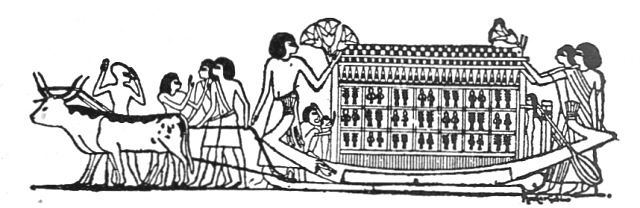
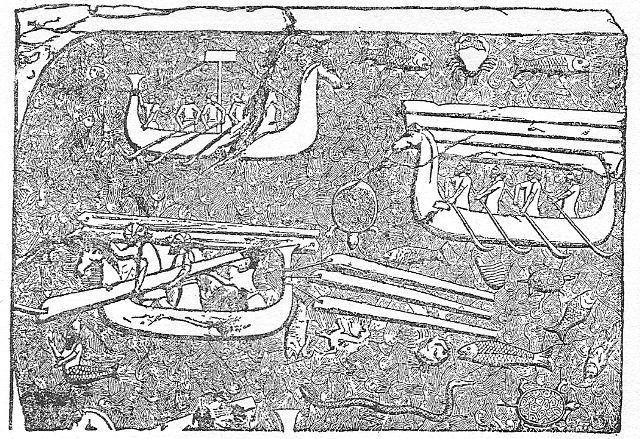 TRANSPORT OF TIMBER FOR SARGON'S PALACE.
(The God Ea, represented in the lower left-hand corner as half man, half fish,
escorts the fleet.)
In considering the four important sources of Babylonian
and Assyrian history, we may note first, Old Testament writings.
Unquestionably the Bible has gained more through
Assyrian excavations than it has itself contributed to the
history of that country. As has been said before, the Old
Testament consists of Hebrew writings which portray various
phases of Hebrew life, and mention is made of other nations
only when the Chosen People by force of circumstances
were thrown in direct contact with them. Since their kingdom
was overcome by Babylonians, we could scarcely expect
Hebrew writers to hold unprejudiced opinions regarding their
own conquerors; nevertheless whatever facts concerning them
crept into their writings have been verified by modern discovery.
Much is often revealed in a few words, as is characteristic
of Biblical expression. For example, see how much is condensed
in the following sentence: "And the king of Egypt
came not again any more out of his land: for the king of Babylon
had taken from the river of Egypt unto the river Euphrates
all that pertained to the king of Egypt."
Not alone have the facts recorded in the Old Testament
proved useful to those engaged in reconstructing the history
of the Tigris-Euphrates nations, but the desire of religious
adherents to confirm the truth and accuracy of ancient Hebrew
writings has served as an incentive both to those who did the
work and to those who by contributions made the task possible.
The writings of the early Greeks concerning Babylonia
and Assyria supply another source. Berosus was a Babylonian
priest connected with a temple sacred to Bel. He
lived during the fourth century before Christ, when Babylonia
and Assyria had become Greek provinces. For the
Antiochus he wrote a lengthy history of his country, which
would have been of greatest value to us had it been preserved.
Unfortunately it was destroyed, and only excerpts, made by
Polyhistor and Apollodoras of the first century B.C., are now
in existence.
Herodotus devoted more than twenty chapters of his first
volume to Babylonia, but owing to certain faults we have
found characteristic of his writings, he has led some scholars
to even declare that he never saw the country at all. While
they cannot be wholly depended upon, his writings have some
value. Other Greek writers have thrown so little light on
Babylonian life that we shall not consider them here at all.
Thirdly, we may mention Egyptian records as a source for
Mesopotamian history. The Egyptian hieroglyphics and the
cuneiform symbols of the Assyrian tongue were translated
about the same time, so that little actual help was gained
through Egyptian sources. Nevertheless, campaigns waged
by Egyptian kings within the very borders of Asiatic countries,
with detailed accounts as set forth upon the walls of Egyptian
temples, cannot fail to aid in the reconstruction of Assyrian
growth and development.
Lastly and most important of all are the monuments and
remains unearthed in Mesopotamia itself. More than one
hundred thousand clay record tablets have been recovered;
temples and palaces have been excavated, and within these
were found alabaster slabs carved with many scenes characteristic
of Assyrian life; armour, utensils and numerous other
articles have each thrown some light upon the ancient civilization.
The value of this first hand, or original material, is
priceless indeed, since without it no detailed knowledge of these
old kingdoms could ever have been hoped for. Explorations
among the ruins are still carried on, and it is possible that the
present century may add much to what has already been gained
concerning the ancient dwellers in the once fertile valleys of
the Euphrates and Tigris.
If you will look closely at a map of the eastern hemisphere,
you will see that a great tract of desert extends across
northern Africa, and reaching beyond the Mediterranean Sea,
the Isthmus of Suez and the Red Sea, traverses the entire
width of Asia to the Pacific Ocean. This desert waste is
so broken by plateaus and mountain ranges that its vast extent
is scarcely realized. Rivers occasionally cross it, producing
fertile valleys which, generally speaking, support the life of
the whole area.
We are now concerned with the location and topography
of the ancient Babylonian and Assyrian kingdoms, and of
those districts lying adjacent. North of the Persian Gulf
some considerable distance, we find the Armenian mountains.
These ranges are loftier than most in Western Asia, piercing
high above the eternal snow-line. During winter their sides
and gorges are massed with snow, which melts rapidly with
the warmth of spring and heat of summer. The drainage
of the mountains has resulted in many streams, which unite
to form the Euphrates on the western slopes, and on the
eastern slopes, form the Tigris. Ages ago these two rivers
emptied into the Persian Gulf at points some distance from
each other. But such heavy deposits of rich mountain loam
have been brought down by the streams, that they have extended
the land far into the gulf, pushing the water back
for some hundred miles. Joining one another in the area
thus formed, the waters of the two streams reach the gulf
today as one mighty river with many mouths. We may
judge how great changes this land-building process has
wrought by the fact that the town of Ur, now nearly two
hundred miles from the gulf, was a sea-port at the time of
which we are now studying. The annual increase of the land is
about 115 feet.
Herodotus' statement that "Egypt is the gift of the Nile,"
might have been made with equal truth of the Euphrates and
Babylonia. Here again an annual overflow refreshes a valley,
while in antiquity a network of canals provided water, fertility,
and humidity for districts sloping off gently on either side.
Today this territory is held by the Turks, and with
their ruinous policy of trying to extract all possible revenue
from their lands while doing nothing to improve them, the
old canals are abandoned, none others take their place, and
the rivers wander today at will, leaving part of the area
parched and unproductive, and converting the rest into fever-breeding
swamps and marshes.
The Euphrates is the longer of the two rivers. Taking
its rise west of a lofty mountain, it receives several tributaries
near its source, but none join it during the last eight hundred
miles of its course. The snows melt gradually; in March the
stream begins to overflow its channel; high water mark is
reached by the first of June, and July finds the waters receding.
This river is very winding in its course, at one place being
but one hundred miles from the Mediterranean Sea and near
Babylon running along within twenty-five miles of the Tigris,
only to immediately branch off again to the south. Its entire
length is about eighteen hundred miles, and most of the water
is spent before it reaches the Gulf.
The Tigris is somewhat different from its sister stream.
Its name signifies "the swift," or the "arrowy," and indicates
its rapid current, whereas the Euphrates flows more
gently. Not so broad as the Euphrates, the Tigris is much
deeper. On the east of the high mountains wherein this
river has its rise, spring comes quickly; the water rises rapidly,
and the period of its overflow is short. Beginning to rise in
March, the first of May sees the high water mark, and by
the last of June the stream is fast finding its usual volume.
The territory between the Tigris and Euphrates the
Greeks called Mesopotamia, meaning "between two rivers,"
but they applied the name to the northern portion of the
district—the home of the Assyrians. As generally used today,
the term Mesopotamia signifies the whole region.
The southern portion, bordering on the Persian Gulf, has
a deep alluvial soil, built up by the yearly deposit of the
rivers. Like the valley of the Nile, it has been the repository
of fine silt. This portion from its capital city Babylon was
called Babylonia. As we might expect, this was the country
first settled because it was the more accessible. Its wide,
monotonous plains, enriched with the fertile mountain loam,
afforded the most productive farm lands in the world.
Herodotus told of their prodigious yield of grain: "This
territory is of all that we know the best by far for producing
grain; as to trees, it does not attempt to bear them, either
fig, or vine or olive, but for producing grain it is so good
that it returns as much as two-hundred-fold for the average,
and, when it bears its best, it produces three-hundred-fold. The
blades of the wheat and barley there grew to be four fingers
broad; and from millet and sesame seed, how large a tree
grows, I know myself, but shall not record, being well aware
that even what has already been said relating to the crops
produced has been enough to cause disbelief in those who
have not visited Babylonia." Theophrastus wrote: "In
Babylon the wheat fields are regularly mown twice, and then
fed off with beasts to keep down the luxuriance of the leaf;
otherwise the plant does not run to ear. When this is done
the return in lands that are badly cultivated is fiftyfold, while
in those that are well farmed it is a hundredfold."
The land of Babylonia has been happily compared with the
southern half of our state of Louisiana, which it resembles
in marshy districts. Again it might be likened to the Egyptian
Delta, being of course, larger,—something like Denmark in
point of area. Possessing no rocks or mountains, the country
seemed at first to be devoid of building material. It has been
supposed that its primitive people first sheltered themselves
in huts built of reeds which grew abundantly along the river
banks. After awhile it was discovered that clay mud furnished
a fair material when shaped into bricks and dried in
the sun. A more enduring brick was later made by baking
the brick in ovens. This oven-baked brick as well as the sun-dried
brick constituted the great building material of Babylonia
for all subsequent time.
The district north of the alluvial line, enclosed by rivers and
mountains, in time became the kingdom of Assyria. This region
differed greatly from the southern land. It was made up of
low ranges on the north, rolled gently to the south, and supplied
excellent pasturage. Stone and material suitable to building
purposes were available, but the people, accustomed to the
clay bricks of their old home in Babylonia, never made use of
the more substantial building stuff. Indeed the Assyrians were
not at all of an inventive mind, as another illustration will
plainly show. In Babylonia, because the ground was low and
level, the people were obliged to construct artificial heights for
building sites, thus to escape marshy exhalations and troublesome
insects. They erected huge piles of sun-dried brick and
crowned these with their palaces and temples.
Now the Assyrians were in the beginning colonists who
had gone out of the mother state to find less populated regions
farther north. There were hills and elevations in abundance
in Assyria, but holding to the custom they had so long followed,
they continued to construct great foundations of bricks
for their buildings. It is curious indeed to find them, throughout
their history, expending time, labor and resources to
produce what nature had already provided.
Assyria was somewhat larger than Babylonia, and has
been compared to the state of Illinois in size. While the northern
mountains and the Gulf afforded definite boundaries, the
limits to the east and west were never certain and both Babylonians
and Assyrians pushed out in each direction as they
became more powerful, contracting again if their strength
weakened. On the west a desert separated them from the
Mediterranean, and while various tribes held the country east
of the Tigris in early times, the Medes later conquered the
region east of Assyria, and Persia reached away to the southeast.
There are two seasons in these valleys—the rainy period,
lasting from November to March, and the dry season, filling
out the remainder of the year. Babylonia was never subject
to the cold storms of Assyria, and the kings of the latter
country, after they conquered Babylonia, frequently maintained
winter palaces in the old capital, Babylon. Summer
is intensely hot near the Gulf. In recent years this has been
a serious obstacle to confront those carrying on excavations
here.
In ancient times an extensive system of canals and ditches
made it possible to keep the land under constant cultivation,
thus preventing in a large measure the sand storms that now
spread over the country, causing much suffering and even
death. Under Turkish rule at present, the whole region is
left desolate.
In spite of Herodotus to the contrary, certain kinds of
trees grew in Babylonia. The fig, apple, almond and walnut
were native. The date palm ministered to the wants of the
people in manifold ways. An old Persian poem sung of its
360 uses, while the Greeks claimed that it supplied the Babylonians
with bread, wine, vinegar, honey, rope, fuel, wood
for furniture, and food for cattle. A wide variety of grains
and vegetables were produced.
Wild animals were plentiful. The Mesopotamian lion was
thought milder than its jungle cousin. Buffaloes were
domesticated. Leopards, hyænas, wild boars, gazelles, foxes
and hares were found, while birds and fishes abounded.
Altogether this was a spot where life was favorable for
man, and it was natural that wandering tribes that came
thither should soon abandon their roving habits for the surer
livelihood promised by a fixed home.
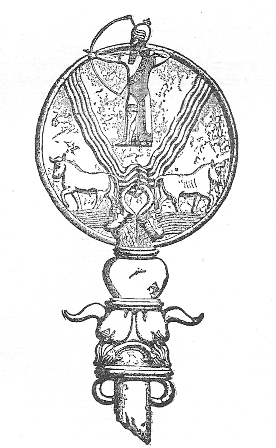 SARGON'S STANDARD
(WITH FIGURE OF ASSHUR).
We have already noted that prehistoric periods are those
preceding written records. Uncertainty enters into all
attempts to reconstruct such a period for any people, and
especially has this been true of Babylonia. However, when
the library of Nineveh was unearthed, tablets were discovered
which shed some light on those remote ages.
The land we call Babylonia was once called Chaldea. So
we shall call it during its prehistoric age—as we call the British
Island Britain in the beginning of its history, and later,
England. By the term Chaldea we are to understand that
portion of the valleys which extended around the Persian
Gulf. It was inhabited at the earliest period known. Probably
its first settlers were a branch of the Turanian or Yellow
Race, to which the Chinese, Japanese, Monguls and present-day
Turks belong. That the Chaldeans came from some
other locality into this land is not doubted, but from whence
they came is not known.
The southern part of Chaldea was called Shumir—the
Hebrews writing it Shinar; the land immediately north they
called Accad. The dwellers in both districts came from the
same stock and spoke practically the same language. The
name Accad means mountains, or highlands, and it has been
surmised that it may have attached to the inhabitants from
some earlier home.
These early people may have migrated to Chaldea five
or six thousand years before the Christian era. Of their
coming and first settlements, nothing is known. When we
first learn of them, they had reached quite a degree of civilization,
having canals for irrigating the lands unreached by the
river; they had also devised the cuneiform system of writing—an
advance on the picture system, earlier in use.
The history of their strange symbols was probably this: in
ages bygone they had invented a system of picture writing,
as all primitive people seem to have done. As they advanced,
too much time was required to copy the elaborate pictures
in their entirety, and so the principal outlines were used to
represent the pictures themselves. When these people
migrated to Chaldea, and were reduced to clay tablets on
which to write, it was easier to make straight lines than
curved ones. In this way the written language continued
to undergo changes until it was eventually made up of wedge-shaped
symbols, one of the clear results of the use of the clay
tablets.
Our principal knowledge concerning the Chaldeans pertains
to their religion, which is believed to have been one of
the earliest religions of the world.
The religious instinct seems to have been inborn with
man. Some form and degree of worship has been found among
all primitive people and is cruder or more elevated according
to the stage of development. Primitive man felt himself
able to cope with many of the conditions around him, but
he soon found that the very agencies which helped might
also injure him. The sun, whose light and warmth gave
life to his growing crops, might also wither them with its
intense heat. The rain which renewed and refreshed the
fields, might come in torrents and lay them low. Gradually
all these agencies were regarded as Beings, which must be
importuned. The religion of the Chaldeans taught man how
to guard himself against the harmful forces in the world, and
every animate and inanimate thing was endowed with a spirit.
A series of tablets treating of this ancient religion was
recovered by Rassam, and they fall into three divisions: those
treating of "Evil Spirits," others concerning diseases, and
last, those devoted to prayers and hymns of praise.
The Accadian conceived of the earth as resembling a
huge, inverted bowl. The thickness represented the earth's
crust; the hollow beneath was thought of as a bottomless pit,
destined to be the final dwelling place of man, and was the
abode of demons. Above the earth were two heavens; the
higher, supported by a lofty mountain; the lower containing
seven kind and friendly planets, which wandered at will
through its wide domains. Opposed to these were seven fiery
phantoms. Over all dwelt the great Spirit Ana.
"Between the lower heaven and the surface of the earth
is the atmospheric region, the realm of Mermer, the Wind,
where he drives the clouds, rouses the storms, and whence
he pours down the rain, which is stored in the great reservoir
of Ana, in the heavenly Ocean. As to the earthly Ocean, it
is fancied as a broad river, flowing all around the edge of
the imaginary inverted bowl; in its waters dwells Ea, the
great Spirit of the Earth and Waters, either in the form of
a fish, whence he is frequently called "Ea the fish," or "the
exalted fish," or on a magnificent ship, with which he travels
around the earth, guarding and protecting it.
"The minor spirits of the earth are not much spoken
of except in a body, a sort of host or legion. All the more
terrible are the seven spirits of the abyss, the Maskim, of
whom it is said that, although their seat is in the depths of
the earth, yet their voice resounds on the heights also; they
reside at will in the immensity of space, 'not enjoying a
good name either in heaven or on earth.' Their greatest
delight is to subvert the orderly course of nature, to cause
earthquakes, inundations, ravaging tempests."[1]
The Maskim were ever feared and hated as is shown by
the following, translated from one of the tablets:
"They are seven! they are seven!—Seven are they in
the depths of Ocean,—seven they are, disturbers of the face
of Heaven.—They arise from the depths of Ocean, from hidden
lurking-places.—They spread like snares.—Male they are not,
female they are not. Wives they have not, children are not
born to them.—Order they know not, nor beneficence;—prayers
and supplications they hear not. Horses grown in
the bowels of the mountains—foes of EA—they are throne-bearers
of the gods—they sit in the roads and make them unsafe.—The
fiends! The fiends! They are seven, they are
seven, seven are they!
"Spirit of Heaven, be they conjured! Spirit of Earth,
be they conjured!"
Seven are they, they are seven;
In the caverns of ocean they dwell,
They are clothed in the lightnings of heaven,
Of their growth the deep waters can tell;
Seven are they, they are seven.
Broad is their way and their course is wide,
Where the seeds of destruction they sow,
O'er the tops of the hills where they stride,
To lay waste the smooth highways below,—
Broad is their way and their course is wide.
Man they are not, nor womankind,
For in fury they sweep from the main,
And have wedded no wife but the wind,
And no child have begotten but pain,—
Man they are not, nor womankind.
Fear is not in them, nor awe;
Supplication they heed not, nor prayer,
For they know no compassion nor law,
And are deaf to the cries of despair,—
Fear is not in them, nor awe.
Cursed they are, they are cursed,
They are foes to wise EA'S name;
By the whirlwind are all things dispersed
On the paths of the flash of their flame,—
Cursed are they, they are cursed.
Spirit of Heaven, oh help! Help, oh Spirit of Earth!
They are seven, thrice said they are seven;
For the gods they are Bearers of Thrones,
But for men they are Breeders of Dearth
And the authors of sorrows and moans.
They are seven, thrice said they are seven.
Spirit of Heaven, oh help! Help, oh Spirit of Earth!
—Rendered into verse by Dyer.
Besides these seven hated ones, there were numberless
demons who could work all manner of evil for man. They
were invisible and brought sickness, sorrow, insanity, and
grief. No house was secure against them, and no bolt strong
enough to keep them out.
To contend against so much evil, it was necessary to
employ conjurers and those skilled in magic, who by incantations
and mixtures of herbs might discover the demons and
put them to flight. Like the Egyptians, the Chaldeans
believed that when one was ill, a demon had taken possession
of his body, which must be driven out before recovery would
be possible. As a result of this belief, the science of medicine
never developed in Babylonia. Even in its advanced period,
magicians treated the sick.
Charms and talismans were in great demand to ward off
demons. They were worn by the living and adorned the
dead. Many articles of furniture were made to serve two
purposes—as household conveniences or ornaments, and talismans.
Thus the winged bulls which have been found guarding
the portals of royal palaces were placed there to keep out
demons who would manage in some way to creep in unless
prevented by eternal vigilance.
It was believed that certain of these demons were so forbidding
in aspect that should they but catch sight of their
own faces, they would be frightened away. Therefore a most
dreadful demon was fashioned, as terrible and fierce as human
ingenuity could conceive. This impersonated the south-west
wind—the wind which brought burning heat and drought in
its wake. An image thus made was placed in southwest
windows, with the hope that the approaching demon might
look upon himself and flee in terror.
As time went on, the Chaldeans progressed in their
religious beliefs, and the third series of tablets record prayers
and hymns of adoration.
Nothing was more natural than that they should worship
the sun, as a manifestation of divinity which provided heat,
light and life itself, for the children of the earth. Some
of these hymns are beautiful in their conception.
"O Sun, I have called unto thee in the bright heavens.
In the shadow of the cedar art thou; Thy feet are on the
summits—The countries have wished for thee, they have
longed for thy coming, O Lord! Thy radiant light illumines
all countries. Thou makest lies to vanish, thou destroyest
the noxious influence of portents, omens, spells, dreams and
evil apparitions; thou turnest wicked plots to a happy issue.
"O Sun! thou hast stepped forth from the background
of heaven, thou hast pushed back the bolts of the brilliant
heaven,—yea, the gate of heaven. O Sun! above the land
thou hast raised thy head! O Sun! thou hast covered the
immeasurable space of heaven and countries!"
The sun disappeared at evening tide, and during the night
contended with the spirits of darkness. Some other protection
was needed for man while darkness reigned. So fire was
brought into existence, and was also regarded as worthy of
worship:
"Thou who drivest away the evil Maskim, who furtherest
the well-being of life, who strikest the breast of the wicked
with terror,—Fire, the destroyer of foes, dread weapon which
drivest away Pestilence."
Certain wandering Turanian tribes today cling to a
religion much like the one so briefly described. Like their
remote ancestors, they have conjurers instead of priests.
When they had reached this stage of development, the
Chaldeans were overpowered by a vast barbaric horde.
"And the whole earth was of one language, and of one
speech. And it came to pass, as they journeyed from the east,
that they found a plain in the land of Shinar; and they dwelt
there. And they said one to another, Go to, let us make
brick, and burn them thoroughly. And they had brick for
stone, and slime had they for mortar. And they said, Go
to, let us build us a city and a tower, whose top may reach
unto heaven; and let us make us a name, lest we be scattered
abroad upon the face of the whole earth. And the Lord came
down to see the city and the tower which the children of
men builded. And the Lord said, Behold, the people is one,
and they have all one language; and this they begin to do;
and now nothing will be restrained from them, which they
have imagined to do. Go to, let us go down and there confound
their language, that they may not understand one
another's speech. So the Lord scattered them abroad from
thence upon the face of all the earth; and they left off to
build the city. Therefore is the name of it called Babel;[2]
because the Lord did there confound the language of all the
earth; and from thence did the Lord scatter them abroad
upon the face of all the earth.
"And Nimrod was a mighty hunter before the Lord;
wherefore it is said, Even as Nimrod the mighty hunter before
the Lord. And the beginning of his kingdom was Babel,
and Erech, and Accad, and Calnch, in the land of Shinar.
Out of that land went forth Asshur, and builded Nineveh,
and the city Rehoboth, and Calah. And Resen between
Nineveh and Calah; the same is a great city.
"And Terah took Abram his son, and Lot the son of
Haran, his son's son, and Sarai his daughter-in-law, his son
Abram's wife; and they went forth with them from Ur of
the Chaldees, to go into the land of Canaan; and they came
unto Haran, and dwelt there."—Genesis 10 and 11.
The first great Semitic invasion took place probably about
the beginning of the fourth millennium B.C., and it seems impossible
to assign to it a more definite date. The later Babylonians,
like the Chinese, gave great antiquity to their nation, reckoning
back into hundreds of thousands of years. Their beginnings
belonged to so remote a time that adding years inconceivably
was but another way of saying that certain events happened
very long ago, so long, indeed, that no record or monument
remained to give evidence of events which had survived only
in stories handed down, from father to son, for thousands of
generations.
Like the Hebrews and Arabs, these people belonged to the
Semitic race, and from whence they came has long been a
matter of conjecture. Scholars are now agreed that Arabia
had been their home and that there they had lived as shepherds
and herdsmen. They poured in overwhelming forces into the
land of Chaldea, killing some of the inhabitants, driving others
out of the country, and assimilating the rest.
The Chaldeans had reached a much higher degree of culture
than their conquerors, who rapidly took on the civilization
of their adopted country. As in England the Saxon and
Norman for some generations after the conquest pursued each
his native life and customs, little influenced by the other, so in
Chaldea at first the Semitic herdsman followed his pastoral
life outside the brick-walled cities of the Chaldeans.
Some have thought that an invasion of Cushites, or Ethiopians,
had preceded the invasion of the Semites in Chaldea,
and have claimed that the language, customs and culture in
the land when conquered by the Semites was the result of a
blending of Turanian and Ethiopian. The theory has been
vigorously opposed by other authorities who contend that the
invading Semites found only pure Turanian stock. However
that may be, the civilization and culture of Chaldea, whether
simply Turanian, or Turanian-Cushite, was soon taken on by
the newcomers. Adopting the Chaldean language, they used
it for all their inscriptions, writings and literature. Even
after the speech of the people had become quite a different
tongue, as a result of its assimilation with the Semitic, still in
all written records the early Chaldean language—or Sumerian,
as it is generally called—was alone used. Assyriologists have
often noted that "while the language was Sumerian, the spirit
of the writings was Semitic."
Because the land of Chaldea was so accessible, and offered
advantages so superior to surrounding countries—plentiful
water and a fertile soil,—it became a veritable bee-hive of
humanity. When the Semites first came thither, they were
a fierce, warlike people; but soon, under new conditions, they
became peace-loving, as the Turanians before them had been.
Shortly they were unable to hold the valley against new tribes
that unceasingly swarmed into the country.
Prior to 2000 B.C. Ashur had been settled probably in part
at least, by emigrants from the south who may have united with
other Semites from North Mesopotamia and in time they
founded the state of Assyria. Somewhat later, the ancestors of
the Hebrews, according to one of the O. T. traditions, departed
from the land of Chaldea for Harran in Mesopotamia,
and later entered Canaan, on the east coast of the Mediterranean
Sea. Each of these little bands founded states which
developed such peculiar characteristics, that after the lapse
of a few ages, it would scarcely have occurred to an observer
that the ancestry, early environment, and traditions of all
had been the same.
It was not strange, then, that the Hebrews of later time,
trying to account for the diversity of languages and nations,
made this swarming valley the site of the scattering of the
tribes and the confusion of tongues.
Those who remained in Chaldea became a peaceful farming
people, caring not at all for war. The Assyrians, while
of the same stock, developed very differently. There were
several reasons for this. First, their country was less accessible
than Chaldea, whose shore was washed by the Persian
Gulf, and so it suffered less from invasions, and was allowed
to keep a more purely Semitic civilization. Again, having
gone out from Chaldea before they became devoted to peaceful
pursuits, the Assyrians retained and fostered their original
warlike dispositions. The more temperate climate of Assyria
was more invigorating and produced men of greater endurance
than did the kingdom to the south.
Both Chaldea and Assyria alike, developed small states,
each led by a city in which had been built a temple sacred
to some local deity. Each community was presided over by one
who combined the duties of king and priest.
Such was the condition of affairs when the first written
records, more or less complete, bring some degree of certainty
and less conjecture into the development of these nations.
And here we arrive at the beginning of Mesopotamian history,
properly so-called.
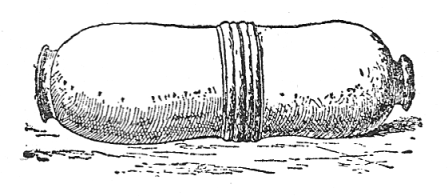 A JAR-SHAPED COFFIN OF CLAY.
We have seen that the Chaldeans were in time assimilated
with the invading Semites, producing eventually a new nation.
It is not to be supposed that this was at once accomplished,
or that the dawn of authentic history found such a process
completed. Rather, the Chaldeans held tenaciously to the south,
the Semites kept farther to the north, and for many centuries
the two races fought for dominance in the valley.
As early as 4500 B.C., a record inscribes one as "king of
Kengi," but his kingdom probably included but a few cities
added to his own.
Several cities had been founded at a remote time and these
now grew rapidly in importance. Each was built around
a temple dedicated to some particular divinity. Eridu worshipped
the god EA, father of waters; Ur was sacred to
Sin, the moon-god, and later kings, of the dynasty of Ur,
added the name Sin to their own, as for example, Ine-Sin,
Pur-Sin. Larsam was sacred to the sun-god Shamash; Uruk
to the goddess Ishtar; Nippur to En-lil, father of the gods,
and so on. Each city believed that its god—Bel or Lord—was
the greatest of all gods, and often its inhabitants were
inspired to go out to conquer other cities and territories in
order to extend the prestige of the local deity. Probably at
the same time the people were stimulated to fight because certain
cities had grown up in the very heart of the fertile valley,
while others had been obliged to locate in poorer sections.
Naturally these last looked with envious eyes upon the richer
soil of their neighbors, and desired to win it for themselves.
Each city watched for the first sign of weakness in her sister
cities, and when it appeared, tried at once to incorporate them
into her own domains.
The political history of the Euphrates valley before the
dominance of Babylon is the history of these cities as they
grew into little states. Some grew strong; others weakened
and became tributary to the more vigorous few.
En-shag-kush-ana, "Lord of Kengiu," was the name of
the first king to appear in the Babylonian records. Erech
was probably his capital, and Nippur the religious center of
his little kingdom. We have already connected Nippur with
the excavations made by the University of Pennsylvania. The
ruins there unearthed have enabled scholars to understand in
the main sacred cities of Babylonia. En-shag-kush-ana was
priest as well as king. Although his race was not mentioned,
he was probably a Chaldean, like the people over whom he
ruled.
A little to the north, a Semitic kingdom with the city Kish
as its head, was growing rapidly in power, and threatened
to absorb even Erech itself. On this account, Chaldeans
attacked it and gained the victory, whereupon their god,
En-lil of Nippur was celebrated in festival and his temple
received numerous trophies of the triumph, since he had
enabled those of the south to overcome the cruder Semitic
city.
Their defeat only led the Semitic kingdom of Kish to
strengthen its forces, and about 4000 B.C., under leadership
of Lugalzaggisi, the vigor of the new race overcame the nearly
expended force of the Chaldeans. This conquering Semitic
king set forth his position thus: "Lugalzaggisi, king of
Erech, king of the world, priest of Ana, hero of Nidaba, son
of Ukush, he who is looked upon favorably by the faithful
eye of En-lil.
"When En-lil, Lord of the lands, invested Lugalzaggisi
with the kingdom of the world, and granted him success
before the world, when he filled the land with his power, and
subdued the country from the rise of the sun to the setting
sun—at that time he straightened his path from the lower
sea of the Tigris and Euphrates to the upper sea, and granted
him the dominion of everything from the rising sun to the
setting of the sun, and caused the countries to dwell in
peace."[1]
For some generations the Semites now held the valley
and the Chaldeans are lost sight of in surviving records.
Then a southern kingdom, Shirpurla, with Sungir its chief
city, became strong enough to throw off Semitic rule. This
victory of the Chaldeans was widely celebrated in the annals
of the waning race. Not only did they now gain the upper
hand of all the cities in the valley, but they pushed into Elam,
a kingdom to the east and dominated both it and its tributary
lands.
While comparisons in history may sometimes be misleading,
they often aid the student to better understand certain
conditions. There is some similarity between these two
races in this valley contending for supremacy—the stronger
being sometimes held in check, the weaker gradually losing
ground—in certain aspects, it calls to mind the period in
English history when Saxons, Jutes and Angles struggled for
leadership. The Saxons had developed the higher civilization;
the Danes were the more vigorous and aggressive.
Sometimes the Saxons would be able to set up their king,
again the Danes would enthrone one of their number. Now
the waning light of Saxon power would seem to be well-nigh
spent, when suddenly it would burst out again with a flame
that would illumine all England, only again to be eclipsed by
the fresh strength of the other nation. Not to push the comparison
further, either country offers a fair example of the
usual course events take whenever two races, somewhat equal
in strength, seek to gain the upper hand in a given territory.
A northern city, hitherto unmentioned, was to give the
palm once more to the Semitic. Agade, the home-city of
Shargani-shar-ali, or Sargon I.
Many legends cluster around this king, an early Semitic
hero. Since our knowledge of him comes mainly through
legendary sources, it is difficult to separate the grain from the
chaff. A tradition which in the course of history has been
related many times of men in many lands, was told first of
this Semitic king.
"Sargon, the powerful king, King of Agade, am I.
"My mother was of low degree, my father I did not know.
"The brother of my father dwelt in the mountain.
"My city was Azupirani, situated on the banks of the
Euphrates.
"(My) humble mother conceived me; in secret she brought
me forth.
"She placed me in a bask-boat of rushes; with pitch she
closed my door.
"She gave me over to the river, which did not (rise) over
me.
"The river bore me along; to Akki, the irrigator, it carried
me.
"Akki, the irrigator, ... brought me to land.
"Akki, the irrigator, reared me as his own son.
"Akki, the irrigator, appointed me his gardener.
"While I was gardener, Ishtar looked on me with love.
. . . . . .
"Four years I ruled the kingdom."[2]
Sargon I. and his son, Naram Sin, had great capacity for
organization. They were prolific builders, and bricks have
been found bearing their names and titles. The material for
their temples they brought some distance—the famous cedars
of Lebanon forming the beams. Sargon was called "Lord
of Nippur, Shirpurla, Kish, Babylon and Uruk." Naram Sin
extended his sway to the Mediterranean on the west, east into
Elam, and south into Arabia and the isles of the Persian Gulf.
He took for the first time the title: "King of the Four World-Regions."
His vast kingdom thus built up disappeared, however,
as quickly as it came into being, and after some changes,
Ur became the capital center. Three thousand eight hundred
B.C. has been accepted as the date of Sargon's reign and this
is the first definite date in Babylonian history.
The kings of the Ur dynasty erected several temples, and
because Ur was easy of access, they imported many of their
building materials. Dolerite was brought from Arabia, cedar
from Syria, gold and precious stones from the east. This
town was sacred to Sin, the moon-god, and several hymns
praising this deity have been found.
Isin, Erech, and other cities strove now for leadership, and
internal dissensions offered opportunity for the Elamites on
the east, now advancing on a wave of prosperity, to invade
the land. It is known that they advanced as far as Erech,
and carried off a statue of the goddess Nana. They set up
their own king, whose line continued on the throne for some
time. One of these invading kings called himself: "exalter of
Ur, king of Larsa, king of Sumer and Accad." Under Elamite
administration, temples were built and the religious and
commercial centers continued to grow.
Of this whole period Maspero has said: "We have here
the dust of history rather than history itself; here an isolated
individual makes his appearance in the record of his name,
to vanish when we attempt to lay hold of him; there the stem
of a dynasty which breaks abruptly off, pompous preambles,
devout formulas, dedications of objects of buildings, here or
there the account of some battle, or the indication of some
foreign country with which relations of friendship or commerce
were maintained—these are the scanty materials of
which to construct a narrative."
To summarize the period as a whole, we may note that
thus far no united kingdom had been evolved. To weld that
together was the work of the next period. This was, on the
other hand, an age of city-states, each one contesting for
leadership. While the struggle began with the mere hope of
annexing cities in the valley, it expanded to include outlying
lands as well. The assimilation of the two races was, generally
speaking, effected, and henceforth the Chaldeans disappear as
a distinct element of the country, having been absorbed politically
by the Semites.
A Part of a Hymn to the Moon-God.[3]
(Composed in the city of Ur before the age of Abraham.)
Father, long-suffering and full of forgiveness,
Whose hands uphold the life of all mankind!
First born, omnipotent, whose heart is immensity,
There is none who may fathom it!
In heaven, who is supreme?
Thou alone, Thou art supreme.
On earth, who is supreme?
Thou alone, Thou art supreme.
As for Thee, Thy will is made known in heaven,
And the angels bow their faces.
As for Thee, Thy will is made known upon earth,
And the spirits kiss the ground.
In early times Babylon had not been a city of sufficient
size to demand royal attention. No king had thought it of
enough importance to include with his enumerated possessions,
although in all probability, it was founded as early as 4000
B.C.—perhaps earlier still. Sumu-abi was its first king, but
of him and his immediate successors, we know little. The
sixth king was destined to bring greatness to his city and to
the whole country—for it was he who united the many states
of Babylonia into one strong kingdom and drove the usurping
Elamites from the throne.
Hammurabi, sixth king of Babylon, ruled in the twenty-first
century B.C. His reign and the reigns of his family were
regarded by the Babylonians as their "Golden Age." Down
to the last days of Babylon, Babylonian kings emulated his example,
modelling even their inscriptions after his.
How Hammurabi freed the land from Elamite rule is not
known, but his name was soon established as an able soldier.
He assumed the titles: King of Sumer and Accad, King of
the Four-Quarters of the World, King of Babylon. Having
annexed all the little city-states to his original kingdom of
Babylon, the capital city gave its name to the whole country.
To make this union lasting, Hammurabi himself appointed
officers of administration for each political division of the
kingdom, and so made the entire system dependent upon the
government at the capital. The pre-eminence now given the
capital turned the tide of commerce and traffic from other
places and made Babylon the great center, not only for matters
of government, but for industrial and social life as well.
Hammurabi was not only a distinguished warrior, but a
statesman. When he had made secure his recently united kingdom,
he turned to internal improvements. A post-envoy system
for royal messages was established. This tended to make
the roads and highways between different parts of the country
safe. He established royal granaries in the valley
of the Euphrates—as we have found them maintained
in the valley of the Nile—to store grain for use in time
of famine.
As each succeeding city was exalted to leadership in
Babylonia, we have found that the patron deity of that community
rose to highest place in the pantheon. Originally,
Marduk was accorded a minor position in the category of
gods. By enabling Babylon to gain supremacy over all other
cities, he had now proven himself greatest of all gods; so while
Nippur and other religious centers, long established, retained
their deities and their cults, there came forward a large priesthood
devoted to the worship of Marduk. These priests, centered
as they were around Babylon, probably had much to do
with that city's rapid progress in becoming the center of culture,
art and literary effort. Long years after, when the kings
of warlike Assyria had added Babylonia to their numerous
possessions, they turned to the archives of this city for its
literary productions and one of the most productive periods
was the reign of Hammurabi.
Perhaps the most stupendous undertaking of this king was
the construction of a vast canal which reclaimed a large tract
of land, long unproductive. An inscription left by him has
been found, and sets forth his effort in this fashion:
"Hammurabi, the powerful king, king of Babylonia,
... when Anu and Bel gave unto me to rule the land
of Sumer and Accad, and with their scepter filled my hands,
I dug the canal Hammurabi, the Blessing-of-Men, which
bringeth the water of the overflow into the land of Sumer and
Accad. Its banks upon both sides I made arable land; much
seed I scattered upon it. Lasting water I provided for the
land of Sumer and Accad. The land of Sumer and Accad, its
separated peoples I united, with blessings and abundance I
endowed them, in peaceful dwellings I made them to live."[1]
He was a tireless builder, spending much care in repairing
old temples and constructing new ones. Indeed King Hammurabi
stands forth, after four thousand years have passed,
as a ruler of exceptional executive ability. Prosperity long
attended his people because of the personal supervision he
gave to all branches of the administration.
Among the lasting benefits assured his subjects was means
of getting legal redress. A court of appeals was instituted
at Babylon to which any citizen might come to state his wrongs.
He codified the laws of the land in 282 laws and inscribed them
on monoliths, one of which was found ten years ago in Susa,
whither it had been carried by the Elamites about 1100 B.C.
In the prologue to the Code he states, "When Marduk sent me
to rule the people ... I established law and justice in
the land and promoted the welfare of the people."
Long after his death his son and successors reaped the
benefits of Hammurabi's splendid rule, and the memory of
his strength and capacity held the country in check as long
as his house endured. Probably for some time before the
close of this prosperous era, which came to an end cir. 1700 B.C.,
mountaineers threatened the eastern borders, and the death of
the last king of the dynasty was the occasion for an invasion
of the Kassites, a people who emerged from Elam-Media.
They seem to have been one of the many bands of mountaineers
who gained a livelihood from the products of
the mountainous regions and by frequent plundering raids
directed against those living on either side of their strongholds.
They well knew that Babylon's long devotion to the arts of
peace had weakened her military strength, and regarded the
time as favorable for winning the fertile valleys for themselves.
At all events, they placed their king upon the throne. The inhabitants
of southern Babylonia were never possessed of strong
patriotism. So long as the land was allowed to rest in peace and
the taxes were not increased, there seems to have been no especial
interest on the part of the people generally as to who wore the
crown. The material development of the country did not suffer
long on this occasion, and for nearly 600 years the Kassite dynasty
ruled in Babylon. They rapidly took on the culture of
their newly acquired state, built temples and directed their attention
to the prosperity of the land. As time went on, they
wellnigh ceased to be regarded as usurpers. One of their kings
set forth his titles thus: "I am Agumkakrime, the son of Tashshigurumash;
the illustrious descendant of god Shuqamuna;
called by Anu and Bel, Ea and Marduk, Sin and Shamash; the
powerful hero of Ishtar, the warrior among the gods.
"I am a king of wisdom and prudence; a king who grants
hearing and pardon; the son of Tashshigurumash; the descendant
of Abiru ... the crafty warrior; the first son of the
great Agum; an illustrious, royal scion who holds the reins of
the nation (and is) a mighty shepherd....
"I am king of the country of Kashshu and of the Akkadians;
king of the wide country of Babylon, who settles the
numerous people in Ashnunak; the King of Padan and Alman;
the king of Gutium, a foolish nation; (a king) who makes obedient
to him the four regions, and a favorite of the great gods."
This enumeration of tributary lands shows these kings to
have been good warriors.
For a hundred years before the end of the Kassite dynasty,
the kingdom of Assyria, founded before 3000 B.C. in all probability,
was growing in strength and importance. When the
Babylonians were unable to hold out against invading kings,
naturally the Assyrians felt in no way bound to render the
tribute they had paid Babylonia to usurping foreigners, and
took advantage of the occasion to assert their sovereignty.
As has been previously noted, the Assyrians were of pure
Semitic stock, and, as their own artists represent them, apparently
had not intermarried with the Chaldeans, as the Semites
farther south had done. They were warlike in disposition, and
knew neither the luxuries of the southern state nor its enervating
climate. They had even become powerful enough to make
treaties with the rulers of Babylon regarding disputed lands,
and this fact in itself was significant. For some considerable
period after the invasion of the Kassites, Assyria was concerned
with her own affairs, but the time was coming when she would
make her power felt in the mother country.
Generally speaking, the Kassite rule was an age of peace.
Among the Tell el Amarna letters, unearthed upon the ancient
site of the "Horizon of the Sun's Disk," correspondence has
been found between some of these Asiatic rulers and the kings
of Egypt. The letters open with the preliminaries customary in
oriental correspondence: "To Kadashman-Bel, king of Kardunyash,
my brother; thus saith Amenophis, the great king,
the king of Egypt, thy brother: with me it is well. May it be
well with thee, with thy house, with thy wives, with thy children,
with thy nobles, with thy horses and with thy chariots, and
with thy land may it be well; with me may it be well, with
my house with my wives, with my children, with my nobles,
with my horses, with my chariots, with my troops, and with
my land, may it be very well." Regarding this particular letter
and others of the same period, Rogers says: "No historical
material of great moment is offered in these letters. They
reveal a period of relative peace and prosperity, and deal, in
considerable measure, with the little courtesies and amenities of
life. It is, for example, curious to find the Babylonian king
reproving the king of Egypt for not having sent an ambassador
to inquire for him when he was ill. When kings had time for
such courtesies, and could only excuse themselves for failing
to observe them on the ground of their ignorance of the illness,
and the great distance to be covered on the journey, there must
have been freedom from war and from all distress at home and
abroad."[2]
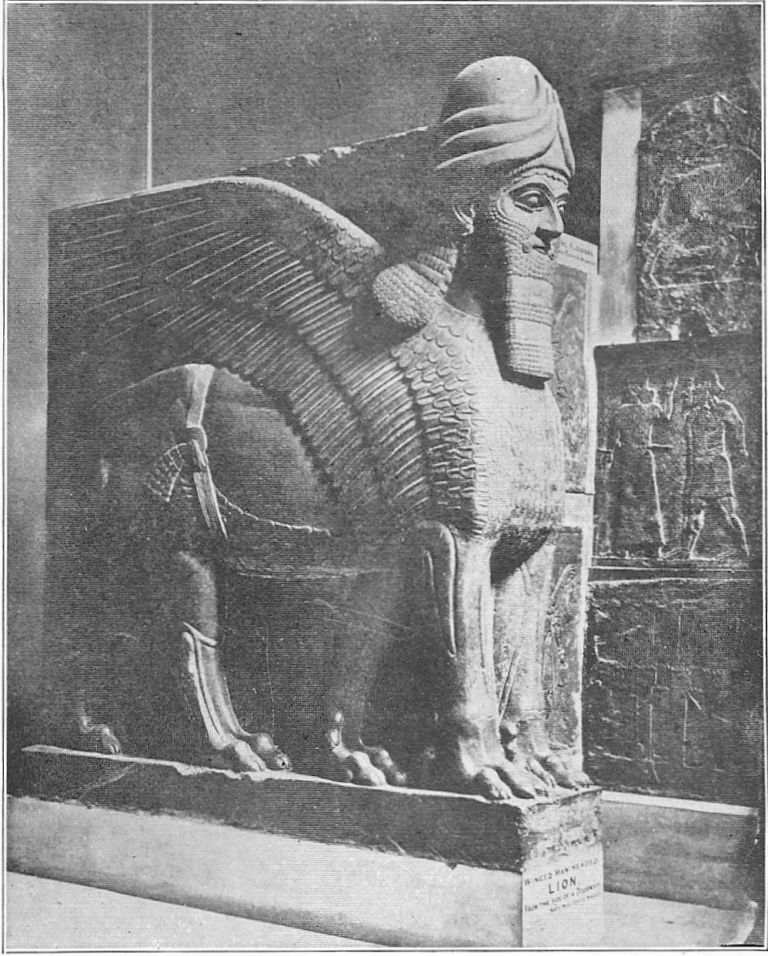 Winged Lion.
It was not destined to long continue peaceful, however.
By 1285 B.C. the Assyrian king felt himself powerful enough
to invade Babylonia. Penetrating even to the capital itself,
he carried away the statue of the god Marduk—a great indignity.
He allowed the Babylonia king to become his vassal.
This state of affairs continued for seven years, whereupon the
Babylonians succeeded in driving the Assyrians north again,
taking from them some of the territory they had seized. When
next the Assyrians threatened, the Semites instituted a revolution,
forced the Kassites from the throne, and established the
dynasty of Isin.
Now began the struggle for supremacy in the valley, waged
by two great nations. The strength of Babylonia was waning,
but their king, Nebuchadnezzar I., held the kingdom together
with a strong hand. He only delayed the inevitable. The
future belonged to the more vigorous kingdom to the north,
and to her power Babylonia soon fell subservient.
To follow the main thread of activity in the Euphrates
valley, we must now turn to Assyria, while the life so characteristic
of Babylon continued until it could be said: "No capital
in the world has ever been the center of so much power, wealth,
and culture for so vast a period of time."
The beginnings of the Assyrian state are lost in obscurity.
Nineveh was possibly founded before 3000 B.C., but like
Babylon, its origin is not known. Asshur was long the important
city of the country, overshadowing the later capital.
About 1490 B.C. Thutmose III. pushed into Asia and
roused the western portion of that continent with his conquests.
Assyria, like many other weak states, hastened to send gifts
to the conquering pharaoh. These signified submission, and
Thothmes gave no further evidences of his military power.
The next mention of Assyria occurs when the state had become
sufficiently important to enter into a treaty with the Kassite
king of Babylonia, regarding disputed territories. As we have
already noted, Assyria, long subservient to the older kingdom,
felt in no way bound to submit to the foreign rule of Kassite
princes, and had already established her own independence,
which was acknowledged by the Babylonian king when he
negotiated a treaty with her. Later, the daughter of an Assyrian
king was married to the king of Babylonia. Their son
came to the throne at an early age, and the Babylonians, seeing
an intrigue to allow Assyrian influences to dominate their
land, made way with the boy-king, substituting another in his
place. Thereupon the Assyrian ruler, grandfather of the
murdered prince, invaded Babylonia, killed the monarch popularly
crowned, and placed his own candidate upon the throne.
The result of this Assyrian interference was not immediately
important, but it was the first of a long series of difficulties
between the two countries, which ended ultimately in the recognition
of the Assyrian king as ruler of Babylonia as well.
About 1290 B.C., troubles having again arisen, the northern
king came once more to the city of Babylon, this time carrying
away the statue of the god Marduk, as we have already seen.
He left Assyrian officials in the land as his representatives.
Seven years later, these were driven out by a popular uprising
of the Babylonians, who seized certain outlying districts which
had recently been appropriated by the Assyrians. When the
Kassite princes were finally dethroned, Nebuchadnezzar I., of
the dynasty of Isin, was strong enough to hold the Babylonian
state intact against the power which constantly threatened at
the north.
To this point we had come in the preceding chapter, and
this recast of the situation is made that we may have its essential
features clearly in mind.
Coming now to the reign of Tiglath-Pileser I., 1120 B.C., we
meet one of the great warriors of antiquity, and with his administration,
a new era opened for Assyria. The first five years of his
reign were occupied with campaigns to the north, east, and
west, in which directions tribes had been menacing the borders
of his kingdom. In these campaigns we see the beginnings
of those cruel, relentless punishments, amounting often to mere
savagery,—which fill the pages of Assyrian history. These
were meted out to all who failed to submit to Assyrian arms.
An inscription commemorating the victories of the warrior
says: "With their corpses I strewed the mountain passes and
the heights. I took away their property, a countless booty.
Six thousand warriors, the remnant of their army, who had
fled before my arms, embraced my feet. I carried them away
and counted them among the inhabitants of my own land."
And again: "In those days, ... Asshur, the Lord, sent
me, who knows no victor in war, no rival in battle, whose rule
is righteous over the four quarters of the world, towards distant
kingdoms on the shores of the Upper Sea, which knew
not submission, and I went forth. Across impracticable heights
and through precipitous defiles the inside of which no king
had beheld before, I passed. Through sixteen mountain ridges
I marched in my chariot where the ground was good; where it
was inaccessible, I cleared away with axes, and bridges for
the passage of my troops I constructed excellently well. I
crossed the Euphrates.... Twenty-three kings of the
land of Nairi, assembled their chariots and troops in the
midst of their countries and came forth to do battle against
me. By the impetuous onslaught of my mighty arms I conquered
them. I destroyed their numerous armies like Raman's
thundershower; with the corpses of their warriors I strewed
the mountain heights and the enclosures of their cities as with
straw. Their 120 chariots I destroyed in the battle; sixty kings
of the lands of Nairi, with those who had come to their assistance,
I pursued to the Upper Sea. Their great cities I took,
their spoils, their possessions I carried off, their towns I burned
with fire, I destroyed, laid them waste, made heaps of them and
land for the plough. Numerous herds of steeds, colts, calves,
and implements without number I carried home. The kings
of the lands of the Nairi my hand captured alive, all of them.
To these same kings I granted favor. Captive and bound, I
released them before Shamash, my lord, and made them swear
allegiance forever. Their children, the offspring of their
royalty, I took as hostages. I imposed on them a tribute of
1,200 steeds and 2,000 bulls and dismissed them to their respective
countries.... The vast lands of Nairi I took in
all their extent, and all their kings I brought low to my feet."
When five years, filled with similar campaigns, had passed,
a large number of tribes paid tribute to Assyria. Before this
period, Calab had served as capital. Tiglath-Pileser now rebuilt
Asshur. Rare trees were brought from conquered lands,
to beautify the town. Temples were restored, to the honor
of the gods. Of the restoration of the temple of Ana and
Adad, the king caused to be inscribed: "I built it from foundation
to roof larger and grander than before, and erected also
two great towers, fitting ornaments of their great divinities.
The splendid temple, a brilliant and magnificent dwelling, the
habitation of their joys, the house for their delight, shining as
bright as the stars on heaven's firmament and richly decorated
with ornaments through the skill of my artists, I planned,
devised, and thought out, built and completed. I made its
interior brilliant like the dome of the heavens; decorated its
walls like the splendor of the rising stars, and make it grand
with resplendent brilliancy. I reared its temple towers to
heaven, and completed its roof with burned brick; located
therein the upper terrace containing the chamber of their great
divinities; and led into the interior Anu and Adad, the great
gods, and made them to dwell in their lofty house, thus gladdening
the heart of their great divinities."[1]
The memory of this stern warrior lived long after his death,
holding tribes in subjection and enabling his successors to rule
in comparative peace. The greatness of the future kingdom
has been attributed in no small measure to the foundations laid
by Tiglath-Pileser I.
A period of reaction followed. Tribute, which had been
paid only for fear of a strong, well disciplined army, was no
longer forthcoming. Babylonia and Assyria have left so
few records for these years that they are almost sure to have
been years of inaction. On the alluvial bottoms of Babylonia, a
new dynasty arose, known as the dynasty of the Sea Lands.
Both the rulers and the subjects they governed were comparatively
newcomers, who easily gained the upper hand in the
decadent state, especially as no interference came from
Assyria.
While the inertia of Babylonia allowed the latest comer to
rule, so the inaction of Assyria allowed countries on the west—Syria
and Palestine—to gain strength. On the north, the
Armenians, a nation of traders, extended their territories and
their commercial affairs.
In 950 B.C. Tiglath-Pileser II. became king. From this
time forward records become more numerous, and we are able
to trace the stages of development with greater accuracy.
Assyria once more wakened to her possibilities, while Babylonia
continued in her helpless, prostrate condition. Nothing
of note is chronicled until Asshur-natsirpal III. became king in
885 B.C. He promptly marched against the earlier conquered
tribes on the north who no longer paid their tribute. He
slaughtered a goodly number at the start, and this report spread
like wildfire among the tribes, who hastened to send gifts.
For some years he continued to bring countries under tribute,
quelling revolts with such severity as only an Assyrian could
have directed. One inscription is sufficient to let us understand
his customary procedure:
"I drew near to the city of Tela. The city was very
strong; three walls surrounded it. The inhabitants trusted
to their strong walls and numerous soldiers; they did not come
down or embrace my feet. With battle and slaughter I assaulted
and took the city. Three thousand warriors I slew
in battle. Their booty and possessions, cattle, sheep, I carried
away; many captives I burned with fire. Many of their
soldiers I took alive; of some I cut off hands and limbs; of
others the noses, ears, and arms; of many soldiers I put out
the eyes. I reared a column of the living and a column of
heads. I hung up on high their heads on trees in the vicinity
of their city. Their boys and girls I burned up in the flame.
I devastated the city, dug it up, in the fire burned it; I annihilated
it."[2]
Babylonia and nations on the east united against the relentless
conqueror, but in vain. They were defeated and some
of their cities laid waste.
Having carried on campaigns in this fashion for some time,
Asshur-natsirpal found himself at the head of a large army,
well disciplined, invincible, inured to slaughter and devastation—a
menace to the state if kept idle, and if disbanded, removing
at a stroke the fear which prompted the payment of
tribute.
Something should perhaps be said of tribute, which we
find kings demanding of all subjected people. The habit of
compelling the payment of tribute was tolerated only in an
age when might made right. None of the earliest nations
gave anything in exchange for tribute exacted. No effort
was made to defend tributary tribes from the attacks of
other tribes. Tribute was merely the price paid by a people
for the privilege of being in other respects left alone. A king
who dreamed of a wide reaching empire, tried to bring as many
nations as possible under his tribute. The payment of this
tribute was the formal acknowledgment of the emperor's
over-lordship. Until the age of Persian dominance, no monarch
was able to do much more than compel the annual payment
in joining alien territories to his own. Assyria attempted
on a smaller scale what Persia effected, but little more than the
conception of a great empire was contributed by Assyria; it
was given reality by Persian conquerors.
Asshur-natsirpal realized the only course open to him was
that of conquest, and to that he now turned. Setting out
for the west, his march was a continual triumph. His reputation
was so well established, and the strength of his army so
well understood that tribes on either side sent gifts as soon as
he drew near.
Reaching the Euphrates, he was unable to make any adequate
provision for the transportation of his troops. The
Assyrians were an inland people and knew nothing of maritime
affairs. Each soldier was expected to get himself across
the stream, partly swimming, partly buoyed up by inflated
skins of animals.
Drawing near the Mediterranean Sea, he found that commerce
occupied the people in that region to the exclusion of
war. Indeed, they would pay heavily to avoid war, which
seriously interfered with their trade. The king of the Hittites—once
a nation of importance but at this time retaining little of
its former strength—stated his position very frankly. His
policy was direct and simple. He was willing to pay down the
sum of twenty talents of silver, one hundred talents of copper,
two hundred and fifty talents of iron, along with chains and
beads of gold and much other treasure, if he were simply let
alone.... National pride counted for nothing. The
primary desire was to get the Assyrians out of the country as
soon as possible; and well might they pay a heavy tribute to
gain such a boon as that.[3]
It was apparent that there would be no particular opportunity
for military skill against people of such convictions as
these. The Assyrian army moved on and at length drew near
the green slopes of the Lebanon, in sight of the Mediterranean
waters, dotted over by Phoenician ships, busily plying their
trade. While no city was besieged, no blood shed, the effect
was marked upon the entire region. All acknowledged Asshur-natsirpal
as conqueror. In some cases, Assyrian officials were
stationed to keep the home government in touch with these
distant parts; in other places, Assyrian colonists were induced
to settle, far from their native homes. Cities were walled by
the labor of Assyrian soldiers, and were temporarily protected
by Assyrian fortifications. While such demonstrations had a
lasting effect on the western states, the Assyrian king, on his
part, was deeply impressed by one thing, and this omened ill
for their future; the people of this region cared more to protect
their commerce than their country. They valued the protection
of their wares above the honor and independence of
their respective states. We shall see that this one fact as
understood by the Assyrian king developed a definite western
policy.
Unable to supply military action for his troops, the king set
them to cutting down trees—cedar, cypress, and juniper.
These were taken to Assyria. The army returned home without
approaching Damascus, where opposition was certain to be
strong. Too much glory had been won to have it overshadowed
by any chance issue.
While the western conquest had been in progress, officers
at home had been carrying out the king's plans by rebuilding
Calah, and constructing a large canal. The king now returned
to personally supervise the construction of a royal palace.
"A palace for my royal dwelling-place, for the glorious
seat of my royalty, I founded forever and splendidly planned it.
I surrounded it with a cornice of copper. Sculptures of the
creatures of land and sea carved in alabaster, I made and
placed them at the doors. Lofty doorposts of ... wood
I made, and sheathed them with copper and set them up in
the gates. Thrones of costly woods, dishes of ivory containing
silver, gold, lead, copper, and iron, the spoil of my
hand, taken from conquered lands I deposited therein."
In 860 B.C. Asshur-natsirpal died, leaving the future to
regard him as the most ferocious king in all Assyrian history;
yet he had accomplished more for his country than any of his
predecessors, and left it more united and in a more prosperous
condition. His son, Shalmaneser II., like the father, found himself
obliged to keep an army active, collecting tributes and making
fresh conquests. He repeated the westward march, and
met an alliance formed against him at Damascus. To that city's
forces were joined those of Israel and of Phoenicia. While
their armies were defeated, no tribute was exacted, and this
fact in itself shows that the victory was not complete.
This first coalition formed against Assyria, made up of
Mediterranean peoples, is important. Such a union might have
effectually stayed the great military power of the age had not
jealousies among the states themselves hindered permanent
union. By 846 B.C. the alliance had been broken, and Jehu of
Israel sent gifts to the Assyrian ruler. This furnished him his
first hold on the independence of the Hebrews.
The next hundred years saw a union of Babylonia and
Assyria, and an attempt, on the part of one king at least, to
blot out all differences between the two peoples by showing
among other things that their religions were the same. To
give weight to the claim, he constructed temples in Nineveh,
after the model of those of Babylon.
In the following chapter we shall note the height of Assyrian
dominance and the proudest years of her history.
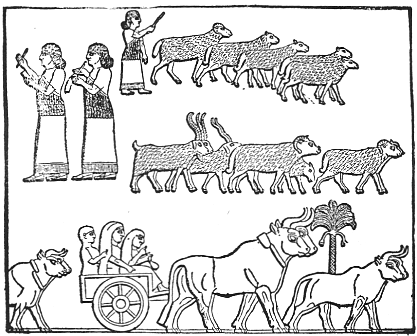 FLOCKS AND CAPTIVE WOMEN CARRIED AWAY.
A dynasty of weak kings followed and seemed to be leading
Assyria on to ruin, but in 746 B.C. the people rose up in
rebellion, driving them out and crowning a ruler selected by
themselves. It is supposed that the one they chose had already
proven his worth and capacity either at the head of a large
division of the army, or possibly in the management of some
Assyrian province. In any event, he was firmly established
at once and spent no time trying to inspire his subjects with
awe. His own name has not been recorded but he took the
crown name of Tiglath-Pileser III., seeking to emulate him
who had borne it first. He is the Pul of the Old Testament.
Babylonia demanded first attention. The Armenians had
established themselves in the southern part of the kingdom
and threatened to crush out the old life and culture by their
rapidly increasing numbers.
Tiglath-Pileser III. was hailed by the native Babylonians
as a deliverer. Forcing the usurpers back, he divided the
former kingdom into four provinces, placing Assyrian governors
over each. He also brought many captives into these
provinces to make their homes, hoping in this way to weaken
the national spirit which tried every little while to gain back
old-time freedom for the state.
The Medes on the east required some curbing, but their
independence was not destroyed. These matters attended to,
Tiglath-Pileser III. was free to give attention to the west.
The city of Arpad stood in the way of Assyrian progress
and since it refused tribute, it was besieged. The plucky town
held out for two long years, but when finally taken, was laid
waste with great slaughter. All neighboring tribes hastened
to send tribute, and were incorporated into the Assyrian
empire.
Heretofore we have seen people brought under tribute and
some faint efforts made to hold them. Now we have reached
the imperial period of Assyrian development when the government,
established at home, sought to increase its actual
possessions abroad, and to bind them to the original kingdom
with strong ties.
An alliance had been made among the sea-coast states, with
Judah at the head. This had been formed, of course, to stay
the western tide of Assyrian power. Notwithstanding, the
king of Samaria yielded the moment the Assyrian army drew
near, paying the tribute with no display of force. Judah alone
seems to have remained unyielding and undisturbed. Thirty
thousand captives were brought into these districts to find new
homes, while many of the natives were deported to make room
for them.
Several methods were employed by Assyria to make conquests
lasting. If a tribe or city acknowledged the Assyrian
king as conqueror, no recourse was made to arms; an annual
tribute was usually imposed and an Assyrian governor placed
in the territory to hold revolts in check and to generally represent
the empire, of which the province was now a part. The
native king was frequently allowed to rule over the people,
even though his main duty in some instances seems to have
been to raise the required tribute. If, on the other hand, a
tribe or city resisted, a war or siege followed. One battle
might reduce a tribe to submission; in the case of a city, all
supplies were shut off, and eventually the inhabitants would be
starved into surrender, whereupon, the city was often made
"land for the plough" by the exasperated king, and the people
subjected to all sorts of cruel punishments.
When a kingdom was conquered, it was thought desirable
to destroy its old patriotism by removing all chances for its
development. With that end in view, some of its citizens
would be sent out of the country to seek homes in other lands,
while those from distant regions would be brought in to take
their places. Naturally the newcomers knew nothing of the
traditions of their newly found country and cared not at all
to fight for them. In this way, nations ceased to retain their
venerated customs, but as the kings often record: "I made
them all to speak one language"—and that Assyrian. One
far-reaching effect of this policy was that when a revolt did
break out in some district, it no longer spread like wildfire in
all directions, but the governor of the province was himself
able to put down any uprising, and the colonists recently
imported, caring nothing for the older inhabitants, could be
depended upon to help him.
Tiglath-Pileser III. turned now to Gaza, whose king fled
to Egypt there to get aid in behalf of his state. Deserted, the
city soon surrendered and the Assyrian king, having sent the
old gods home to Assyria, installed Assyrian gods in the temples.
Thence he marched to Palestine.
He who had held out against Assyria before was dead and
a weak king now ruled in Judah. Had the kings of Samaria
and Damascus formed an alliance with Judah, the power of
Assyria might yet have been broken; instead they united their
forces to invade Judah and appropriate the territory of the
weak king for themselves. Isaiah, the great statesman of the
Hebrews, counselled the ruler in vain. To protect himself
against his aggressive neighbors he appealed to Assyria for
help. This drew Tiglath-Pileser III. to Samaria and Damascus,
while Judah, sending gifts, was not at this time molested. The
Samarians themselves rose up against their king. Having
killed him, they asked the Assyrian ruler to allow Hoshea to
rule over them as an Assyrian vassal. This sifted the opposition
down to Damascus, which city prepared for a siege. Some
five hundred outlying towns were laid waste and their inhabitants
sent into other districts. Not all the army being
constantly required to guard the besieged town, part of the
troops marched into Arabia, demanding tribute and receiving
it. In 732 B.C. Damascus fell and became an Assyrian province.
By this time, Babylonia was in a state of turmoil. Under
Assyrian government the people had at first been free to develop
their arts of peace, and literature had flourished. Then
the Chaldeans to the south, established originally in the region
around the gulf, known once as Chaldea—tried again to rule
the land. In 726 B.C. Tiglath-Pileser III. marched into Babylonia,
where, taking the hands of the god Marduk, he was
crowned king of Babylonia. According to the ancient custom,
he who wore this crown must return each year and celebrate
this same ceremony. Two years later Tiglath-Pileser having
again performed the rites, died before the year elapsed.
During the short reign which followed interest again reverted
to the west. Hoshea refused to pay tribute in 725 B.C.,
looking to Egypt for help. He was taken captive and Samaria
made ready for a siege. Strange to say, the town held out
for three years and the king of Assyria died before it was
taken. Sargon II. at once succeeded. (722-705 B.C.) He
again was not of royal blood and he too chose a popular crown
name.
Samaria soon fell, and quite possibly neither the besieging
army or the stricken town knew of any change in rulers.
Twenty-seven thousand two hundred and ninety of the inhabitants
of Samaria—the flower of the land,—were deported
to the Median mountains, while colonists were brought in from
Babylonia and other provinces to take their places. This loss
it was impossible to retrieve. Assyrian governors were set
over the land, now merely an Assyrian province.
In 721 B.C. attention focused once more in Babylonia,
where the Chaldeans had again usurped the crown. In the
battle Sargon waged, the result was so indecisive that neither
side gained much. The usurpers were simply checked.
Suddenly an alliance was formed in the west, made up of
stricken Samaria, Damascus and Gaza. Sargon marched
rapidly west before their armies were ready, and defeated them
separately and carried "the ten tribes into captivity." Now
again more strangers were brought in, and more citizens sent
out. It is little wonder, after all these mixtures of peoples, that in
later years the Jews regarded the Samarians as not of their kin,
but an inferior race, so that in the time of Christ one could say:
"How is it that thou, being a Jew, askest drink of me, which am a
woman of Samaria? For the Jews have no dealings with the
Samaritans!"
It was during this campaign that the Hittite king was
taken prisoner and his kingdom, once so powerful, was merged
into the Assyrian Empire.
Not long after, Hezekiah, king of Judah, attempted to stir
up an opposition to the Assyrian tribute payment. Isaiah,
the far-seeing statesman, again counselled against it,—vainly
to be sure, yet constantly, for this was an unfavorable moment.
As might have been foreseen, the coalition was short-lived.
Sargon's work in time of peace was extensive. He built
a palace, like his predecessors, but outdoing them, he constructed
a royal city for its location. This was a custom new
in Assyria, but we have seen that it was usual in Egypt, during
the Middle and New Empires. Choosing a spot not far from
Nineveh, at the base of a mountain, he had a rectangular area
laid out, its corners pointing to the four cardinal points. First
temples were built to the gods, whose favor he sought in every
possible way, even going to the length of paying for the site
of the city, and compensating those who asked no money.
After the temples, the palace itself arose—built of ivory, palm-wood,
cedar, cypress, having gates of wood overlaid with
bronze. The eight gates of the city were named for the eight
leading divinities, the walls for Asshur, and the ramparts for
Niveb. An invocation was inscribed to the gods: "May
Asshur bless this city, and this palace! May he invest these
constructions with an eternal brightness! May he grant that
they shall be inhabited until the remotest days! May the
sculptured bull, the guarding spirit, stand forever before his
face! May he keep watch here night and day, and may his feet
never move from this threshold!" The palace is said to have
contained "twenty-four bulls in relief and two miles of
sculptured slabs." Since the work was only begun in 712 B.C.,
and he came to reside within in 707 B.C., he
was apparently able to command a large army of workmen.
This was the palace whose ruins Botta unearthed in 1846,
and each part remaining appeared to be as perfect as workmanship
could make it.
The new city was peopled in a unique way. "People from
the four quarters of the world, of foreign speech, of manifold
tongues, who had dwelt in mountains and valleys, ...
whom I, in the name of Asshur my lord, by the might of my
arms had carried into captivity, I commanded to speak one
language and settled them therein. Sons of Asshur of wise
insight in all things, I placed over them, to watch over them;
learned men and scribes to teach them the fear of God and the
King."
It is supposed that Sargon II. was murdered in 705 B.C.
and his son Sennacherib succeeded to the throne. He had
observed his father's difficulties in keeping order in Babylonia,
and had concluded before ever he came to the throne that to
indulge the pride of Babylon by longer conforming to her
venerated custom of crowning her king each year—thus requiring
his annual appearance,—was mere folly. He believed
that Babylonia, whatever her history, was now an Assyrian
province, and hence the king of Assyria was her king. So he
himself did not go at all to Babylon, but was merely crowned
in Nineveh as King of Assyria. Now the Babylonians, far
from submitting to this train of logic, in course of a brief
time, crowned their own king. Thereupon the Chaldeans, ever
watchful for an opportunity to re-establish their power, set up
a ruler in the same country, farther south. In 702 B.C.,
because of this confusion, Sennacherib marched to Babylon,
laid waste many Chaldean cities, deported 200,000 people and
crowned as king a young nobleman, Babylonian by birth but
educated at the Assyrian court. Having so vigorously asserted
his strength, he was soon needed in the west.
The situation there was critical. Hezekiah, king of Judah,
had successfully conducted a war against the Philistines, and
was therefore regarded by his subjects as a great and mighty
warrior. There was a strong faction in the kingdom who opposed
the annual payment of tribute to Assyria and who believed
that against them also Hezekiah might assert himself
and free them from this hated tribute service. Isaiah, understanding
the vast difference in the resources of the two countries,
counselled against a war, but it remained for future
generations to discern the clear, far sighted reasoning of this
statesman, and the king, even had he chosen to heed good
counsel, was shortly plunged into a war which was the popular
demand of his people. Jerusalem prepared for a siege, and
water was brought into the city from some distance by an
aqueduct. Egypt promised aid, for the Ethiopian king who
ruled that country and the native princes who were struggling
to regain the throne, all felt that an opportunity opened in this
way to win glory in Asia which should serve as a lever to
them at home. Judah had yet to learn how fallen was this
ancient state and how incapable of giving material assistance.
The rebellion spread, for freedom was dear to nations in
those days when submission meant at least heavy tributes, and
often deportation and a dismantled country. In the city of
Ekron the people, stirred by a hope of independence, seized
the Assyrian governor and led him captive to Hezekiah. As
usual, the Assyrian king made forced marches and appeared
before he was expected and before the armies were massed,
so he had the less difficult task of defeating each nation separately.
Tyre, one of the rebel cities, was first attacked. It
was not possible to materially injure her, since her defenses
on the sea were strong; Sidon surrendered and an Assyrian
ruler was set over the city; now many of the allies were consumed
with fear and dropped out of the coalition, sending
tribute with all haste. In Ekron those who had led the rebellion
were killed or deported. As had long been the case, the
Assyrian king was meeting with brief resistance. Judah held
out, however. Hezekiah watched for re-enforcements from
Egypt, but before they drew near, Sennacherib opened battle,
winning with heavy losses. Hezekiah withdrew his forces into
Jerusalem to undergo a siege, while the Assyrian army turned
to meet Egyptian allies and captured the leaders. Forty-six
cities around Jerusalem were taken, and when it seemed futile
to longer hold out, Hezekiah sent an embassy to Sennacherib
to ask for terms of peace. A sum of money approaching
$1,000,000 in our money, was demanded, and although it was
raised with difficulty in Judah, it was paid over to the conqueror.
However, Hezekiah did not come out to meet Sennacherib
and acknowledge him as overlord, and the Assyrian
king, feeling that his victory was yet indecisive, dispatched his
most trusted generals to demand the surrender of Jerusalem.
Meanwhile he marched with the great mass of Assyrian forces
to intercept more Egyptian armies now approaching. Encamping
at Pelusium, a place noted for its plagues before that day
and since, the army was stricken in the night. In a few
days only a remnant of the great force remained and a homeward
march was begun at once.
The Hebrews, according to their custom, interpreted this
issue to signify direct intervention of Providence in their behalf.
Instead of being led captives of Assyrian provinces and
having their land devastated, they gained fame and glory
by the expedition. The Egyptians also claimed a victory—all
because of the pestilence.
The two accounts of the campaign, the Hebrew version
of the story as chronicled in the Old Testament, and the Assyrian
version, as translated from their tablets, are both so
interesting that we quote them at length. Such differences
as they show are easily explained in view of the standpoints of
each writer.
Returning home, Babylonia was found to be in a state of
insubordination, having once more asserted her independence.
Sennacherib now placed his own son on the throne, but still
difficulties multiplied. At last the Babylonians united with the
Chaldeans, their long-sworn enemies, against Assyria. At
this juncture, in 689 B.C., Sennacherib determined to strike
at the root of the trouble. He marched into the land and set
fire to the city of Babylon, after plundering its temples and
palaces. Over the desolate site of the city he then turned a
canal, converting the region into a swamp.
It is almost staggering even at this remote time to think
of the pride and glory of Babylonian life, the splendor of its
palaces, the wonder of its temples, being thus wantonly destroyed.
Long periods of peace in the kingdom had given
opportunity for art and literature to develop, and there can be
no question that countless records of priceless worth were
destroyed by the deed of this fierce Assyrian. The culture of
Babylonia had indeed succumbed to the barbarism of Assyria.
The inhabitants—scholars, artists, artisans, were taken captives,
and deported to various points of the empire.
The following reign saw all that was possible done to
atone for this reckless act, but far beyond what we can now
calculate, the loss was irreparable.
"Now in the fourteenth year of King Hezekiah did Sennacherib,
king of Assyria, come up against all the fenced cities
of Judah, and took them. And Hezekiah, king of Judah, sent
to the king of Assyria to Lachish, saying, 'I have offended;
return from me: that which thou puttest on me will I bear.'
And the king of Assyria appointed unto Hezekiah, king of
Judah, three hundred talents of silver and thirty talents of
gold.
"And Hezekiah gave him all the silver that was found
in the house of the Lord, and in the treasures of the king's
house. At that time did Hezekiah cut off the gold from the
doors of the temple of the Lord, and from the pillars which
Hezekiah, king of Judah, had overlaid, and gave it to the king
of Assyria.
"And the king of Assyria sent Tartan and Rabsaris and
Rab-shakeh from Lachish to King Hezekiah with a great host
against Jerusalem. And they went up and came to Jerusalem.
And when they were come up they came and stood by the
conduit of the upper pool, which is in the highway of the
fuller's field. And when they had called to the king, there
came out to them Eliakim, the son of Hilkiah, which was over
the household, and Shebna the scribe, and Joan the son of
Asaph, the recorder.
"And Rab-shakeh said unto them: Speak ye now to Hezekiah,
Thus saith the great king, the king of Assyria: What
confidence is this wherein thou trusteth? Thou sayest (but
they are vain words) I have counsel and strength for the war.
Now on whom dost thou trust, that thou rebellest against me?
"Now, behold, thou trusteth upon the staff of this bruised
reed, even upon Egypt, on which if a man lean, it will go into
his hand, and pierce it: so is Pharaoh, king of Egypt, unto
all that trust on him.
"But if ye say unto me, We trust in the Lord our God:
is not that he, whose high places and whose altars Hezekiah
hath taken away and hath said to Judah and Jerusalem, Ye
shall worship before this altar in Jerusalem?
"Now, therefore, I pray thee, give pledges to my lord
the king of Assyria, and I will deliver thee two thousand
horses, if thou be able on thy part to set riders upon them.
How then wilt thou turn away the face of one captain of the
least of my master's servants, and put thy trust on Egypt
for chariots and for horsemen? Am I now come up without
the Lord against this place to destroy it? The Lord said to me,
Go up against this land, and destroy it.
"Then said Eliakim, the son of Hilkiah, and Shebna, and
Joan, unto Rab-shakeh, Speak, I pray thee, to thy servants in
the Syrian language; for we understand it: and talk not with us
in the Jews' language in the ears of the people that are on
the wall. But Rab-shakeh said unto them, Hath my master
sent me to thy master, and to thee, to speak these words?
hath he not sent me to the men which sit on the wall? Then
Rab-shakeh stood and cried with a loud voice in the Jews'
language, and spake, saying, Hear the word of the great king,
the king of Assyria: Thus saith the king, Let not Hezekiah
deceive you: for he shall not be able to deliver you out of his
hand. Neither let Hezekiah make you trust in the Lord, saying,
The Lord will surely deliver us, and this city shall not
be delivered into the hand of the king of Assyria: Harken not
to Hezekiah: for thus saith the king of Assyria, Make an
agreement with me by a present, and come out to me, and then
eat ye every man of his own vine and every one of his own fig-tree,
and drink ye every one the waters of his cistern: Until
I come and take you away to a land like your own land, a land
of corn and wine, a land of bread and vineyards, a land of
oil, olive and of honey, that ye may live, and not die: and
harken not unto Hezekiah, when he persuadeth you, saying,
The Lord will deliver us. Hath any of the gods of the nations
delivered at all his land out of the hand of the king of Assyria?
Where are the gods of Hamath, and of Arpad? where are the
gods of Sepharvaim, Hena, and Ivah? have they delivered
Samaria out of mine hand? Who are they among all the gods
of the countries, that have delivered their country out of mine
hand, that the Lord should deliver Jerusalem out of mine
hand? But the people held their peace, and answered him not
a word: for the king's commandment was, saying, Answer him
not....
"And Hezekiah prayed before the Lord, and said, ...
O Lord our God, I beseech thee save thou us out of his hand,
that all the kingdoms of the earth may know that thou art
the Lord God, even thou only.... Therefore thus saith
the Lord concerning the king of Assyria, He shall not come
into this city, nor shoot an arrow there, nor come before it
with shield, nor cast a bank against it. By the way that he
came, by the same shall he return, and shall not come into this
city, saith the Lord. For I will defend this city, to save it,
for mine own sake, and for my servant David's sake.
"And it came to pass that night that the angel of the
Lord went out, and smote in the camp of the Assyrians an
hundred fourscore and five thousand: and when they arose
early in the morning, behold they were all dead corpses.
"So Sennacherib, king of Assyria, departed, and went and
returned and dwelt at Nineveh."—II. Kings, 18 and 19.
"But as for Hezekiah of Judah, who had not submitted
to my yoke, forty-six of his strong walled cities and the smaller
cities round about them, without number, by the battering of
rams, and the attack of war-engines, by making breaches by
cutting through, and the use of axes, I besieged and captured.
Two hundred thousand, one hundred and fifty people, small
and great, male and female, horses, mules, asses, camels,
cattle and sheep, without number, I brought forth from their
midst and reckoned as spoil. (Hezekiah) himself I shut up
like a caged bird in Jerusalem, his royal city. I threw up
fortifications against him, and whoever came out of the gates
of his city I punished. His cities, which I had plundered,
I cut off from his land and gave to Mitinti, King of Ashdod,
... and made his territory smaller. To the former
taxes, paid yearly, tribute, a present for my lordship, I added
and imposed on him. Hezekiah himself was overwhelmed by
the fear of the brilliancy of my lordship, and the Arabians
and faithful soldiers whom he had brought in to strengthen
Jerusalem, his royal city, deserted him. Thirty talents of gold,
eight hundred talents of silver, precious stones, ...
couches of ivory, thrones of elephant skin and ivory,
ushu and urkarinu woods, of every kind, a heavy treasure, and
his daughters, his palace women, male and female singers, to
Nineveh, my lordship's city, I caused to be brought after me,
and he sent his ambassador to give tribute and to pay homage."
"And it came to pass, as Sennacherib was worshipping
in the house of Nishroch his god, that Adrammelech and
Sharezer his sons smote him with the sword: and they escaped
into the land of Armenia. And Esarhaddon his son reigned
in his stead." Thus did the Hebrew chronicle the death of
Sennacherib, and since Assyrian tablets recounting the dire
plot have long since been destroyed, we are thrown wholly upon
the fact as stated without explanation or detail.
Esarhaddon, who succeeded to the throne in 680 B.C., had
already acted as regent in Babylonia, and had there acquired
deep veneration and love for the Babylonian past, as well as for
its life and culture. He wished to win the favor of its people,
scattered though they were, and so in addition to being crowned
king of Assyria, he had himself proclaimed viceroy of Babylonia,
for this office would not require his annual presence in
celebration of the yearly rites. Thus had his grandfather done,
and Sennacherib only had ruthlessly thrust aside the national
prejudice. His father had laid Babylon waste, changing its
very site into a swamp and scattering its proud people to the
four winds. Esarhaddon immediately planned to rebuild the
city and so far as possible, bring those departed back to their
old homes.
In an age given over to cruelty, devastations, selfish plots
and intrigues, it is surprising to find that this king allowed no
reflections to be cast upon his father's memory by condemning
his Babylonian policy. He had it set forth on tablets that the
gods had been displeased with the wrong doing of Babylon, and
that a king, merely their instrument, had in this way visited
divine wrath upon the heads of the people; while now, he,
Esarhaddon, again acting as agent for the gods, ready once
more to give their favor in hope of future obedience, would
now rebuild the ancient capital.
Slowly the city rose, more splendid and magnificent than
before. First the old temples were replaced, and around these
the city came into being. Chaldeans had taken possession of
the land after the nation was disrupted. The new king now
forced them back, restoring property wherever possible to its
rightful owners.
Such being the situation at home, abroad the state of
affairs was critical. Tyre had not submitted, nor Judah. Sidon
no longer paid tribute. Vast sums of money were needed to
carry on the gigantic building project, and these commercial
sea-port towns offered a rich reward to the conqueror.
Having heard that Esarhaddon was determined to make a
westward march, the sea-coast cities prepared to offer resistance.
Sidon was besieged and held out for nearly three years.
When at last it fell into the hands of the exasperated Assyrians,
it was utterly destroyed. Both king and soldiers were infuriated
by the long delay and plundered until weary. The
walls of the town were broken down and cast into the sea;
the luxurious homes of the merchantmen were stripped of
their wealth and razed to the ground. The entire city was
blotted out of existence. Then the king set about erecting a
new town on its site, naming it for himself, and peopling it
with those taken captive in the nearby mountains while the
siege was carried on. Over all he placed an Assyrian governor,
and then set out for Nineveh.
Reaching his capital, he made a triumphal entry, laden
with spoils, captives and cattle. Some of the noblest citizens
of Sidon swelled his train. Gold, silver, precious stones, rare
woods, dress-stuffs,—these had fallen to his share after three
years of waiting.
The siege of Tyre had been begun about the same time
that Sidon was attacked, but Tyre was more favorably situated.
She could not be cut off from the sea and so could not be
starved into submission. Baal was king and he proposed to
hold out against the besiegers. The Assyrians walled up the
land side of the city and it was wholly cut off from its land
commerce, so in the long run, it would have to yield. After
a time, the siege was raised, but over-land commerce was no
longer possible.
Esarhaddon knew well that the frequent disturbances in
Syria which so annoyed him and had so troubled previous
reigns, were largely instigated by unceasing efforts of Egypt
to stir the cities to rebellion, hoping in some unquiet times
that she might gain a foothold in western Asia and share in the
plunder of Syria, as pharaohs in early times had done. To
understand her position it is necessary to go back and see how
Egypt had fared after losing first place among the nations.
The Ethiopians, having taken on Egyptian culture and
customs centuries before, had gained political control as the
country weakened. Native princes gained power in the nomes
and tried incessantly to regain possession of the throne. As
usual there was so much personal jealousy among them that
concerted action was impossible. Egypt's name had stood for
power and great resources so many centuries, that even though
the state was weak—even tottering within, abroad it was still
judged by its former strength. Assyrian rulers had doubtless
known better its truer condition, for Sennacherib's generals
told those of Judah that looking thence for aid was like leaning
on a bruised reed.
Esarhaddon determined to strike at the root of Syrian dissension,
and in 673 B.C. led an army for the first time in
Assyrian history against Egypt. An army met his own outside
the borders and the result was indecisive. The Assyrians did
not enter the land at all. Three years later they defeated an
Egyptian army sent to meet them, crossed the border now
unhindered, and marched rapidly to Memphis. The city,
wholly unprepared for such unexpected attack, fell at once
into their hands. It was plundered generally and laid waste.
Unquestionably much of great historic value was wantonly
destroyed by soldiers who were allowed to pillage at will.
Statues of gods were removed to Nineveh, together with great
booty—and this was the work of a man who deplored the loss
of Babylon, and had undertaken to rebuild a capital not yet
known when Memphis stood the wonder of the world!
The Assyrians never outgrew their ferocity, their savage
thirst for ravage and murder, and their culture in Assyria's
most enlightened days was but a veneer encasing old tendencies,
characteristics and desires.
Over the twenty-one nomes, native princes were allowed
to rule, as vassals of an Assyrian governor, set over the
whole land. The king further undertook to change the names
of ancient towns, giving them Assyrian names, but this never
became a change at all—simply a useless attempt.
The youngest world-power had now conquered the oldest.
Surely these were years wherein chart-makers would have
had a sorry time trying to indicate a nation's possessions.
On its homeward march the Assyrian army made a raid
into Arabia, but desert marches told quickly on the soldiers,
and no lasting results came of it.
At this point Assyrian possessions—even the original kingdom
itself—were threatened alarmingly by a migration starting
from the southern portion of present Russia. Thither
had come the Medes in an early day, and now thousands upon
thousands came pouring eastward in search of new and less
crowded homes. It was hopeless to stay such an onset of
troops—it would wear out many an army. Places vacated
today would be filled shortly by those pressing in the rear.
Besides, these people had no plan of conquest or occupation of
the land. They simply spread out like so many hungry cattle,
seeking food where it might be found. All that could be done
was to turn aside the main stream of progress. These new
comers settled down in Syria, reaching east to the land of
the Medes and far beyond it. In spite of watchful care, many
fertile lands were lost to Assyria.
In 668 a second Egyptian campaign was planned by the
king, but before starting out, he had his son, Asshur-banipal,
recognized as regent of Babylonia. This was to cause much
trouble in the future, because it once more divided the now
united country, and made an opportunity for old jealousies
to creep in again. On the march, Esarhaddon died, leaving
the future to regard him as noblest among Assyrian kings—the
most just and fair-minded of his race.
Asshur-banipal who succeeded to the throne in 668 B.C.,
was naturally fond of learning and was a prodigious book-collector.
By using that term for Assyrian days we mean
of course a collector of clay tablets whereon were inscribed
literary productions.
The Egyptian campaign had already opened, for it was
plain that the conquests of two years before were practically
lost. Sea-coast towns in Egypt submitted at once. Little
opposition was encountered in the Land of the Pyramids, and
Assyrian government was soon re-instated. The suspicion
of the generals was awakened by the simplicity of their task
and withdrawing their army, they loitered not far away. No
sooner had they left than the Assyrian government, tolerated
in the presence of the army, was thrown off and old forms
instituted. Now it was the Egyptian's turn to be surprised
when the army, supposed to be far on its homeward march,
reappeared in the land. The revolt was quickly put down,
and the leaders killed with as great cruelty as ever blackened
Assyrian pages.
In 660 B.C. Egypt declared her independence and this was
the first great loss of the Assyrian empire, soon to be followed
by many more.
Probably before this Tyre had been forced to yield, and
the king had sent his son and daughter to the Assyrian court
as an indication of submission.
A raid was made into Media, some of its cities being taken
and their inhabitants deported. For such experiences the
Medes grew to hate the Assyrians with increasing fervor.
Asshur-banipal was finding some difficulty in holding together
the empire of his fathers, and when revolts occurred, they
were put down with greatest severity.
Babylonia had maintained peace for fifteen years, but the
people clung to the traditions of their early history, and harked
back to a time when Babylon was the greatest city of the
world. Now, except for freedom from tribute, they ranked
as any other Assyrian province. Encouraged by the feelings
of those under him, the prince-regent conceived the notion of
stirring up all the provinces to revolt at the same time, hoping
that Babylonian independence might be gained in time of
confusion. He was urged on to this course, which was misguided
and ill timed, with little chance for success. Its only hope
lay in keeping secret the plot so far as the Assyrian king was
concerned. There were, however, many who would gladly try
to benefit themselves by unearthing any plan for revolt. There
might also be governors of provinces sufficiently far-sighted to
have nothing to do with any treasonable plot, and these could
not be expected to guard such a secret.
At last the Chaldeans on the south, Palestine, some provinces
of Syria and some Arabian tribes, promised help.
The Babylonians were destined to learn how different was
that from actually giving it. To allay any suspicions Asshurbanipal
might have, an embassy of Babylonian nobles visited
his court to give him assurance of his brother's loyalty. When
the news came that the Babylonians had seized Ur and Uruk,
the Assyrian king was much astonished. He spent some little
time in complaint of his faithless brother; an inscription ran:
"At that time Shamash-shum-ukin, the faithless brother,
to whom I had done good, and whom I had established as
king of Babylon, and for whom I had made every possible
kind of royal decoration, and had given him, and had gathered
together soldiers, horses, and chariots, and had intrusted them
to him, and had given him cities, fields, and woods, and the
men dwelling in them, even more than my father had commanded—even
he forgot that favor I had shown him, and
he planned evil. Outwardly with his lips he spoke friendly
things, while inwardly his heart plotted rebellion."
Asshur-banipal waited for a favorable omen before starting
out to quell the rebellion, and it came at last in this way:
"In those days a seer slept in the beginning of the night and
dreamed a dream, thus: 'On the face of the Moon it is
written: Whoever deviseth evil against Asshur-banipal, king
of Asshur, makes enmity, a violent death I appoint for them.
With the edge of the sword, the burning of fire, famine, and the
judgment of the Pest-god, I will destroy their lives.' This I
heard and trusted to the will of Sin, my lord. I gathered my
army; against Shamash-Shum-ukin I directed the march."
Help came to the revolting Babylonians from few of the
promised allies. Arabia, Chaldea, and the land of the Elamites
sent troops, but in the battle waged they suffered fearful
defeat. Babylon underwent a severe siege and at last
the king committed suicide. Then the gates of the city were
thrown open and great was the slaughter. Asshur-banipal
had himself proclaimed king, and pushed on to punish the
allies for their part in the rebellion. Much of the land of
the Elamites was laid waste, and left smoking by this man
who patronized learning. The weakening of these people
left Assyria open to attacks later from the Medes.
The later years of Asshur-banipal's reign were filled with
peaceful interests. He rebuilt the great palace of his father,
and in one of its upper chambers was amassed the great
number of tablets, referred to as the library of Nineveh. In 626
B.C. the king died.
Our knowledge of the reigns immediately following is
scanty. Babylonia asserted her independence and the Assyrian
king had a difficult task to hold the empire together.
Determined to recover the kingdom to the south, he marched
against its capital while its king was distant with his army.
Cut off from Babylon, the king appealed to the Medes for
aid. They cared not at all to help the Babylonian, but they
hated with undying hatred the very name of Assyria. Their
numbers had often been increased by refugees, driven from
their homes by Assyrian armies, and they themselves had
experienced defeat at the hands of Assyrian troops. The
possibility of crippling the great power of Asia stimulated
them to aid the Babylonians. They soon repulsed the Assyrian
army near Babylon and drove it north. Still they pursued the
fleeing army and forced the king and his army to retire into
Nineveh. At last the fate the Assyrians had so often meted
out to others was measured out to them. Great wealth was
stored in Nineveh, and this the besieging army wished for
themselves. The walls were strong and were long defended,
but an assault finally carried all before it. Nineveh, built by
the wealth of spoils, beautified by plunder from the known
world, became the spoils of the Medes, who stripped the
temples and palaces and then set fire to the city.
Nineveh fell in 606 B.C. The Assyrians were scattered
to the four winds and grass grew over the once smoking
ruins. Two hundred years later, when Xenophon led his
army over this spot on his return to Greece, none knew that
they passed over the site of the once great world-city.
The civilization developed by the Babylonians had been
passed on to the Assyrians. It was now left a heritage for
the Chaldeans, to whom descended the legacies of both
countries, and in turn they dominated the valley of the
Euphrates. As for Assyrian greatness, so far-reaching and
wide, the Hebrew told the story in poetic language centuries
ago, and today none could set it forth more vividly.
"Behold, the Assyrian was a cedar in Lebanon with fair
branches, and with a shadowing shroud, and of an high
stature; and his top was among the thick boughs. The waters
made him great, the deep set him up on high, with her rivers
running round about his plants and sent out her little rivers
unto all the trees of the field. Therefore his height was
exalted above all the trees of the field, and his boughs were
multiplied, and his branches became long because of the multitude
of waters, when he shot forth.
"All the fowls of heaven made their nests in his boughs,
and under his branches did all the beasts of the field bring
forth their young, and under his shadow dwelt all great
nations. Thus was he fair in his greatness, in the length
of his branches; for his root was by the great waters. The
cedars in the garden of God could not hide him: the fir
trees were not like his boughs, and the chestnut trees were
not like his branches; nor any tree in the garden of God was
like unto him in his beauty.... All the trees of Eden,
that were in the garden of God, envied him....
"Strangers, the terrible of the nations, have cut him off,
and have left him: upon the mountains and in all the valleys
his branches are fallen, and his boughs are broken by all the
rivers of the land; and all the people of the earth are gone
down from his shadow, and have left him. Upon his ruin
shall all the fowls of the heaven remain, and all the beasts
of the field shall be upon his branches. To the end that none
of all the trees by the waters exalt themselves for their
height, neither shoot up their top among the thick boughs,
neither their trees shall stand up in their height, all that drink
water: for they are delivered unto death, to the nether parts
of the earth, in the midst of the children of men, with them
that go down to the pit."—Ezekiel 31.
We have found frequent mention of the Chaldeans, and
it is now necessary to understand just what was their position
at the fall of Nineveh.
The Chaldeans belonged to the Semitic race and their
home had long been in the Sea-lands, which included districts
in eastern Arabia as well as lands in Babylonia washed by
the Persian Gulf. Originally a pastoral people, they had
taken to trade and though long in Babylonia, they had not
mingled greatly with others. They looked with envious eyes
upon the fertile valley of the Euphrates and coveted the
wealth of its cities. On this account they would willingly
follow any leader who might enable them to gain these lands
and riches for themselves. Because such a victory would
unquestionably give kingship over the people, many of their
princes made efforts to gain political control, causing no end
of trouble to the Babylonian or Assyrian officials in charge
of maintaining the peace. This makes clear the motive
prompting the numerous attempts to usurp the government,
already noted.
The old Babylonians had received so many infusions of
blood from the Elamites, Kassites, and colonists settled in
their territory by different Assyrian rulers, that the pure
Babylonian stock no longer existed to any extent, although
Babylonian ideas, culture and characteristics had been absorbed
by those who came to dwell in the land. The empire which
now grew up in the valley was essentially Chaldean. It has
been called the New Empire of Babylonia.
Upon the death of Asshur-banipal, he who had previously
been king-regent asserted himself as king of Babylonia, and
so Nabopolassar has sometimes been called the founder of
the New Chaldean Empire, although in truth he was merely
one who declared Babylonian independence at a time when
none were strong enough to dispute the claim. The empire,
established in this way, followed Babylonian precedence in
all matters. The kings concerned themselves with war only
when compelled to do so, their works being works of peace—the
building of temples, the construction of canals.
One foreign war of some importance occurred during the
first reign—the reign of Nabopolassar. Necho II., pharaoh
of Egypt, desired to regain those Asiatic possessions which
Thothmes III. and later warrior kings had won for the Nile
kingdom. To this end he led an army north, demanding the
submission of the sea-coast towns. Gaza was quickly won,
and this city was key to the east. Tyre and Sidon would
pay tribute to any nation rather than have their commerce
again destroyed by war. Judah alone resisted. Too long
had this little country held out against a various enemy to
yield tribute upon demand. Josiah was now Judah's king.
He led an army against the Egyptian forces but was repulsed
and he himself killed. In confusion the Hebrew army fled
to Jerusalem where a younger brother of Josiah was proclaimed
king. The Egyptian pharaoh now collected a heavy
fine from the people of Judah and he named a king for them
in place of the one just popularly crowned.
The old Assyrian empire, so long the fear of all nations,
was now under control of three distinct peoples: the Chaldeans
held the Euphrates valley, the Medes held the north,
and Egypt had appropriated western Syria. Now the pharaoh
determined to further extend his empire. He would reach
the very banks of the Euphrates. This plan threatened the
Chaldean state, and Nabopolassar being too old to undertake
active service in the field, sent his son Nebuchadnezzar to
meet the Egyptian force. This was soon put to flight. The
Babylonian prince pursued and had not word come of the
death of the king, his father, the Babylonian army would
have been able to march victorious into Egypt. It was, however,
more important to hold the kingdom at home than to
pursue fleeing troops abroad, so the prince went home to be
crowned Nebuchadnezzar II., king of Babylonian, and to enjoy
one of the longest reigns in Babylonian history. The city
of Babylon became his pride, and the erection of temples and
palaces attracted him more than conquests.
Notwithstanding, the kingdom of Judah compelled attention
by refusing after three years' peace to longer pay tribute.
The war-party in this little state seems often to have been
strong and always to have been eager for independence, while
its adherents were generally so blinded by their own enthusiasm
that they were unable to estimate correctly their probable
chance for success. Isaiah had long been dead. Jeremiah
held his place of influence and he labored diligently to
show his people the folly of their intent. He succeeded only
in drawing censure upon himself and in 597 B.C., Nebuchadnezzar
sent an army to besiege Jerusalem. The Judean king
Jehoiakim, suddenly died, and a youth about eighteen years
of age ascended the throne. He thought best to surrender,
whereupon he, his mother and court, were taken as captives
to Babylon, together with 7,000 soldiers and 1,000 artisans.
The remainder of the inhabitants were left to pay tribute
and remain subservient to Babylonian rule.
In Egypt, Hophra had come to the throne. Like his
predecessor, he longed for Syrian possessions, and now tried
to stir up the sea-coast states to rebellion. No folly could
have been plainer—for Judah it meant destruction itself to
set its strength against the forces of Babylonia. Jeremiah
thundered his bitterest reproaches. He sought vainly to bring
his countrymen to their senses and save them from utter ruin.
But the spirit of rebellion was abroad, and many times it has
spread similarly through a land, drawing to its cause voices
seldom heard, and kindling a desire which cannot be put down
by cool argument and reason. So Jeremiah continued to
grow in disfavor, and was finally held a prisoner by those
he tried to aid.
It has been pointed out with much force that the stricken
nation of Judah had become the prey of neighboring tribes
and that an insufferable situation impelled it to war, but Babylonia
could alone protect it, and Babylonian protection was
not to be won by rebellion against its rule. Egypt was to
again prove the "bruised reed" which would fail utterly
when leaned upon.
From the Babylonian standpoint the situation was this:
here was a little state which for hundreds of years had been
the center of western dissensions. Its revolts had already
cost Babylonia and Assyria dear in fighting men and tiresome
sieges, and now it must be forever quelled if attention
was to be given to home affairs. Crippling its strength would
not avail, for that had been already tried. Trusting to the
vows of its kings was manifestly useless, since the king who
led the revolt had sworn by his mighty God to be faithful
to Babylon. That solemn pledge he had now broken. Nothing
short of laying waste the land and scattering the people
would apparently put an end to the trouble.
Moab, Ammon, Tyre and Sidon were now in league with
Judah and Egyptian aid was promised. The war party in
Jerusalem went about shouting that Jehovah was with them—no
matter, seemingly, what folly they undertook.
In 587 B.C. the Babylonian army besieged Jerusalem,
intending to starve the city into submission. The siege was
raised when Egyptian reinforcements drew near, long enough
to defeat them and send them home in confusion. Then it
went on again. In 586 B.C. the Babylonians broke through
the walls of Jerusalem and the city was destroyed. The king
who had broken faith was taken to Babylon and blinded, while
his sons were slain. Such punishments as these had not been
common with the old Babylonians, and they show that the
Chaldeans were not of the ancient temperament,—merciful
and kind. The best citizens of Jerusalem were taken captives,
while the poorer ones were left to cultivate the soil. The
great prophet Jeremiah was thought to be friendly to the
government of Babylon, and was given permission to go where
he would. He remained with the stricken band of Hebrews,
who soon after journeyed into Egypt.
Tyre, as an ally, was besieged but here the problem of
cutting the city off from outside communication again arose.
The siege lasted for thirteen years and in the end the city
paid tribute. In 567 B.C. Nebuchadnezzar's army invaded
Egypt, but it was merely a raid to terrorize the Egyptians
and put an end to Egyptian interference.
The king was now free to give his energy to internal
affairs, and his attention was chiefly centered in building and
beautifying Babylon. Notable among his undertakings were
the walls of the city—counted among the seven wonders of
the world. They were so well constructed that had they been
defended, the city could never have been taken save by
treachery inside the capital itself. In 562 B.C. Nebuchadnezzar
died—the last great king of an ancient nation.
Of the following reign little is known, the king being
assassinated in the second year of his rule. Two other uneventful
reigns followed, and then Nabonidus ascended the
throne. This man was a student—not a king. He did one
good service for future ages; being devoted to rebuilding the
temples of the gods, he had his workmen excavate deep down
into the old foundations of the temple of the sun-god in Sippar,
which he says had not been seen for 3200 years, for the record-tablet,
always placed in the corner. Then he caused a new
tablet to be inserted, repeating the history of the temple and
enumerating his repairs. Modern excavators have been
greatly aided by these tablets of Nabonidus. While he was
thus absorbed, his country was fast plunging on to ruin. His
was an age when the mere existence of a nation depended
upon its aggressive policy. While the entire resources of the
country were being expended upon shrines sacred to the gods,
there was neither time nor money for the maintenance of an
army. Matters were allowed to take their own course for
awhile, and later the king's son, Belshar-usur, or Belshazzar,
was left to manage government concerns. For this reason,
the Hebrews recorded him as the last Babylonian king, while
in truth his father bore the kingly title.
Even when danger threatened the state to such an extent
that the scholar-king himself, poking around among his ancient
record-tablets, was finally forced to take notice of it, he gave
no thought to his kingdom or his subjects, but was simply
alarmed for the safety of his statue-deities. These he had
hurried into the capital from all parts of the land. So occupied
was he lest perchance a god or two might some way
escape him, that he had no time to prepare the city for attack,
and in the end Babylon, the pride of its age, came into the
hands of the conqueror without a blow!
The fact was that there were many within the kingdom
who would gladly welcome outside interference. The
Hebrews had settled down in their quarter and had become the
leading people of commerce and loaners of money. One
commercial firm alone—Egibi & Sons—filled a place for that age
not unlike the modern Rothschilds. These people, who may
have been of Jewish descent, hated the king who had destroyed
their city of Jerusalem and his descendants, and would willingly
help any one who might rob Babylonian kings of their empire.
It has been surmised that for aid rendered they were allowed to
go back to their own country and rebuild Jerusalem on its
early site.
Not only were the Hebrews an element to be reckoned
with; the priests of the Babylonian gods had been repeatedly
offended by Nabonidus, and they too joined the opposition,
beyond doubt.
So great a city as Babylon had never before existed. No
city since has had so long a history, and yet, without a blow
struck in its defense, it passed into the possession of a people
just taking on the ways of civilized life. It was little wonder
that it fell shortly into ruins, soon to be grass-covered and
like Nineveh, forgotten!
Since 606 B.C. the Medes, conquerors of Assyria, had
been extending their territory. They were now a people of
strength, united under King Astyages.
In the land earlier called Elam, now Persia, a great conqueror
appeared—Cyrus the Great. He defeated the Medes
under Astyages, and so rapidly did his empire come into
being, that all civilized nations were roused to the danger
of a world-conqueror. In 546 B.C. Egypt, Babylonia, Lydia
and Sparta arrayed their forces against Cyrus, to check his
power, but his camels put their cavalry to flight, and he won
the decisive battle. Having annexed Asia Minor, he turned
to Babylon. As we have seen, the city of Babylon might
have held out indefinitely against attack, but when Belshazzar
led an army against a detachment of Persian troops, none
were left to defend the capital. The old tale of Herodotus
that Cyrus turned the Euphrates out of its course and entered
the city through its channel, is mere fiction. Such exertion
was unnecessary, for the city gates swung open wide to the
conqueror.
And thus we come to the end of the political history of
the Tigris-Euphrates states—a mere skeleton of framework,
which we can now fill out with some account of their social,
industrial and religious life.
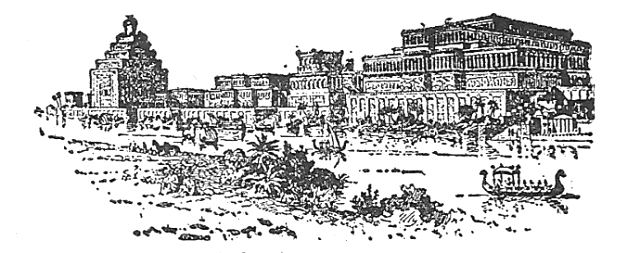 ASSYRIAN PALACE AT NINEVEH.
To understand the Babylonian, we must take into consideration
both the nature of his country and the origin of
his race. Apart from these two important factors, the marked
differences between himself and his Assyrian brother would
not be clear.
We have found that Babylonia was an alluvial plain,
sloping gently to the Persian Gulf, and made fertile by the
annual overflow and deposits of two rivers. As in Egypt,
so here remarkable yields of grain rewarded the sower if he
but supplied necessary moisture by maintaining a system of
well-regulated canals. Regarding the origin of the Babylonians,
we found that they sprang from a union of Semitics
with the earlier Turanian settlers of the country, receiving
later infusion of blood from the Kassites and Elamites. This
intermingling of races and peoples resulted in a nation whose
characteristics differed widely from the purer Semitic stock
that peopled Assyria.
"The Babylonian was a stout, thick-set man, somewhat
short, with straight nose, wide nostrils, and square face. The
Assyrian, on the other hand, was tall and muscular, his nose
was slightly hooked, his lips were full, his eyes dark and
piercing. His head and face showed an abundance of black
curly hair....
"The Babylonian was essentially an irrigator and cultivator
of the ground. The cuneiform texts are full of
references to the gardens of Babylonia, and the canals by which
they were watered. It was a land which brought forth
abundantly all that was entrusted to its bosom.... But
the fear of floods and the reclamation of the marsh lands
demanded constant care and labor, the result being that the
country population of Babylonia was, like the country population
of Egypt, an industrious peasantry, wholly devoted
to agricultural work, and disinclined to war and military
operations. In the towns, where the Semitic element was
stronger, a considerable amount of trade and commerce was
carried on, and the cities on the sea-coast built ships and sent
their merchantmen to distant lands....
"The character of the Assyrian was altogether different
from that of the Babylonian. He was a warrior, a trader,
and an administrator. The peaceful pursuits of the agricultural
population of Babylonia suited him but little. His two
passions were fighting and trading. But his wars, at all
events in the later days of the Assyrian Empire, were conducted
with a commercial object.... It was to destroy
the trade of the Phœnician cities and to divert it into Assyrian
hands, that the Assyrian kings marched their armies to the
west; it was to secure the chief highways of commerce that
campaigns were made into the heart of Arabia and Assyrian
satraps were appointed in the cities of Syria. The Assyrian
was indeed irresistible as a soldier, but the motive that inspired
him was as much the interest of the trader as the desire for
conquest."[1]
Side by side with the Babylonian's farming concerns, grew
his love for study and his development of the peaceful arts.
An elementary education was general in Babylonia. As industry
and commerce brought wealth and created thus a leisure
class, education and learning flourished in Babylonian cities.
Schools grew into prominence, and in the realm of astronomy
and certain of the sciences, some advance was made by which
the Greeks later profited. Quite the reverse was true in Assyria.
A feverish desire for commercial gain and for military
conquest prevented progress in the arts of peace. Learning
was confined to a few—professional scribes supplied secretaries
for the state and even wrote private letters for private
citizens. When the luxuries of the ancient world could be
won as tribute, the Assyrian scorned to produce them for himself.
With blood unmixed with any peace-loving people, he
retained the characteristics of his earlier Arabian home. He
left the cultivation of the country to slaves and dwelt in cities,
when war and trade left him intermittent periods at home.
Both Babylonian and Assyrian were religious, but here
again we find differences due to environment. The Babylonian,
inheriting the conjuring and magic of the earlier Chaldean,
possessed a religion which held him in constant dread
of demons. The greatest aid and solace his religion afforded
was to assist him in driving away foes which assailed him
at every turn. The Assyrian on the contrary, showed the same
proud bearing in his religious concerns as in other aspects
of life. Asshur was his mighty God, strong in battle and
unequaled in courage. Firm in his conviction that Asshur
would give him victory, he went forth, like his Hebrew brother,
to overcome all others and destroy other gods which offended
the true God.
In origin and traditions alike, the Assyrian and the
Hebrew in early times present many similarities, and the
religion of the one is comparable at many points with that
of the other.
It is supposed that in earliest times the dwellers in the
Euphrates valley built their huts of reeds which grew in profusion
along the river and the canals. These in time were
replaced by huts of sun-dried brick. We have already learned
that the low level plains of Babylonia afforded little or no
stone for building purposes. Oven-dried brick was the most
substantial building material known and this was so costly,
on account of the scarcity of fuel, that only the temples, kings'
palaces, and homes of the wealthy were made of it. The
great majority of houses then, were constructed of clay mud,
shaped in bricks and dried in the sun.
The more pretentious dwellings of nobles and kings were
placed on artificially constructed heights—huge piles of brickwork,
in order to raise them above the gnats and the malaria-breeding
fogs of the marshes. The huts of the poor were
located wherever opportunity offered. While these contained
but one or two rooms with small apertures in the clay walls
for windows, and had no floor save the ground, the houses
of the wealthy were frequently several stories high, the upper
floors being reached by outside stairways. The use of the arch
was known in Babylonia from 4000 B.C., a perfect keystone example
having been found at Nippur by the University of Pennsylvania
expedition. Windows were furnished with tapestries
to exclude the storms and intense heat of noonday. Flat roofs
supplied a place for the women to perform many household
duties, or, if these were performed by slaves elsewhere, they sat
here to embroider their tapestries and to chat with their friends.
Here too, on hot nights, mattresses were thrown down for the
hours of sleep.
Wherever possible a garden surrounded the house. The
pride of the Babylonian, as of the Egyptian, was his carefully
tended garden, whether it was a tiny plot of land or a
vast overhanging terrace like that of Babylon's queen.
Streets were narrow and exceedingly dirty, for into them
all refuse and rubbish from the houses accumulated. We
learn that sometimes the entire street would be filled up to
the very doors of the dwellings, and then, instead of clearing
them out, an upper story was added to the houses, new doors
provided, and the occupants started anew on a fresh elevation.
In homes of the wealthy the furniture was simple, and in
the huts of the poor it was scanty indeed. Chairs, stools,
and tables were in use; a mat often constituted the bed, although
pictures of most uncomfortable looking bedsteads have
been preserved, these being possessed only by the wealthy.
The Assyrians who went from Babylonia into their northern
land, took with them the habits and customs there
acquired. While stone was plentiful, they used it only for
foundations, or for the less important portion of their buildings,
continuing to make mud brick for the rest, as they had done
before. While hills and elevations were now available on
every hand, they still erected huge piles of brick or stone
and crowned these by their buildings. The Assyrian blood,
unmixed with other tribes or peoples, produced no ingenuity,
no inventive genius. The Assyrian remained an imitator—never
a creator. For this reason, we find close similarity
between the houses of the two countries.
Certain features which became inseparable with later architecture
had their beginnings in Babylonia. In early times the
roof which covered the mud hut was supported by dried palm
stems; gradually a more substantial support was substituted,
and in this way the column had its origin and was adopted
and improved upon by the Greeks. Again, interior house
decoration may be traced back to these Babylonian houses
built of brick. In houses of the well-to-do, the unsightly
bricks were covered by a coating of stucco and upon this
were painted various scenes and ornamentations. In Assyria,
slabs of soft lime-stone were used instead of the stucco, and
figures of horses and men, hunting scenes and battles, were
carved in bas-relief upon them. Indeed much of our knowledge
concerning the life of the people has been gained from
a study of the reliefs discovered in buried palaces.
Regarding the daily lives of those who dwelt within these
mud brick houses, we have less detailed information than
concerning the ancient Egyptian. Fewer scenes of ordinary
life were painted in the Tigris-Euphrates valleys, and whatever
was entrusted to the clay stood far greater chance of
being destroyed than that committed to Egyptian stone.
In considering the family life, the position accorded to
woman and the marriage laws and regulations are of first
importance.
In early times in Babylonia, a man received a dowry with
his wife. Polygamy was not infrequent but a strong check
was placed upon it by requiring the husband, in case of divorce,
to return the wife's dowry to her and allow her to return
home or maintain her own establishment. The income from
the dowry was enjoyed by both husband and wife, but it
remained the portion of the wife and could be willed according
to her pleasure. In case of a woman's second marriage,
her first dowry belonged to her, subject to the claim of her
children for one-half of its value.
In both Babylonia and Assyria married women enjoyed
many liberties. They might carry on business enterprises,
borrow or loan, manage their own property and dispose of
it at their will. They could seek justice in the courts, and
if they belonged to the middle classes, could come and go at
pleasure. The women of noble families were more carefully
guarded, and seldom appeared unattended in public.
Girls who were not provided with dowries might be purchased
and so become superior slaves of their husbands.
Children might be sold by their parents and brothers might
sell their sisters, but in these countries, slaves were not despised
as inferiors and inhumanly treated. They were often adopted
into families, and since those of noble birth were not infrequently
taken captives in war, the slave might be superior
to the owner. However, this last was not so common in
Mesopotamia as it was later in Rome. The fact which alone
assured slaves of good treatment was that there was generally
no race difference to engender feeling between slave and master.
Indeed one case is cited in those days of quickly reversed
fortunes, where the slave in a few years became the master
and his former owner became his property!
Marriage was both a civil and a religious ceremony, and
the contract was signed in the presence of a priest. In a code
of Babylonian laws compiled about 2250 B.C., a law provided
that "If a man has taken a wife and has not executed
a marriage-contract, that woman is not a wife." Another
provided for one who is helpless: "If a man has married a
wife and a disease has seized her, if he is determined to marry
a second wife, he shall marry her. He shall not divorce the
wife whom the disease has seized. In the home they made
together she shall dwell and he shall maintain her as long
as she lives."[2]
Both sons and daughters could inherit property, and according
to Babylonian law, whosoever possessed property, could
will it, or dispose of it, with certain well established restrictions.
In case there were no children to inherit an estate,
it was a common practice to adopt them. Thus families were
prevented from dying out.
Children were cared for, sent to school, taught trades or
professions, and probably a certain amount of family life was
enjoyed while they were growing up. The rights of each
member of the family were definitely recognized by law.
Home life as we today understand the phrase, was unknown
in antiquity.
We can contrast the condition in Babylonia, where the
individual, instead of the family, was recognized by the law
to that in Rome of a later time, when the family was the
unit of the state, and the pater familias managed all family
affairs without state interference or restriction.
For some years past, the French explorer De Morgan
has been making extensive excavations at Susa, the capital
of ancient Persia, and before the rise of Persia, the capital
of Elam as early as 3000 B.C. In the winter of 1901-1902,
having removed layers of earth containing ruins of Persian
palaces, he reached deposits contemporary with some of the
old Elamite kings. Here was discovered a stone monument
inscribed with the code of Hammurabi. As we have seen,
this king ruled Babylonia about 2000 B.C. He it was who
united all the little city-states into one kingdom with its capital
at Babylon. Proving himself a statesman as well as a
warrior, he devoted himself to the welfare of his subjects.
He repaired old canals and constructed new ones, restored
the temples and above all, gave the country a uniform system
of laws. These laws were not made by Hammurabi—generally
speaking at least. They had been long established
by custom and he merely codified such customs and earlier
decisions into a system so that justice might be administered
alike throughout the realm. The laws were then inscribed
upon stone slabs and erected at certain places where the people
could read them, and those who felt themselves injured might
know what redress lay open to them.
The particular stele unearthed by De Morgan had been
set up originally in the town of Sippara. Later Elamite kings
became powerful enough to invade Babylonia and lay the
country under tribute. During this period, one Elamite king
had removed the stone monument from Sippara and taken it
home with his spoils. It had graced his triumphal procession
upon his return and was set up at his capital. 49 columns
of inscription were engraved upon it, but the Elamite king
caused 5 to be removed and the stone to be re-polished, in
order that his name might be therein inserted. For some
reason this was forgotten or omitted.
Of the 282 laws once carved upon the stele, all are still
legible. Their discovery is most important for the history
of ancient Babylonia, as it has enabled scholars to reconstruct
the standards of morality and justice current when the country
came into its first strength and power. We may be sure that
these laws were in vogue much earlier than the time of
Hammurabi and they lived on with little change for many
years after. They without doubt furnished the basis for the
legal code throughout the history of Babylonia, and without
some knowledge of them we would never have been able
to understand the civilization of the country as it is known
today. It is comparable to the "Mosaic Code," which is made up
of different strata from different periods, cir. 1000 B.C. to
500 B.C. The similarity between the two codes harks
back to an early period when the two peoples had not yet left
their Arabian home, and indicates general Semitic customs.
Hammurabi's code "is concerned little, if at all, with religious
matters; the chief content is almost entirely civil and criminal,
dealing with such subjects as marriage, the family, property
rights, agricultural and commercial activities."
It is on the basis of these laws now translated that the
morality of the ancient Babylonians has been worked out.
We find that the people were on the borderland of retaliation,
and punishments often took the form of fines. There was
still the old tribal "group responsibility"—that is, the children
often had to suffer for the sins of the father. Distinction
was now made between intentional and unintentional injury.
Trial by ordeal was sometimes allowed, especially
when magic was thought to have been used. Death was a
frequent punishment. Banishment might be inflicted. On
the whole, the practices in Babylonia, before and after 2000
B.C., were not so severe as those common in England a century
ago, when petty larceny was met by extreme punishment.
The Babylonians carried the idea of contract and written
agreement farther than any other ancient people. Understandings
which are today made verbally between men were
inscribed on clay tablets, duly impressed by the seals of the
parties concerned, and carefully preserved. We find the law
required receipts and written contracts as early as 2000 B.C.
For example, "If a merchant has given to an agent corn,
wool, oil, or any sort of goods to traffic with, the agent shall
write down the money value, and shall return that to the
merchant. The agent shall then take a sealed receipt for the
money that he has given to the merchant. If the agent forgets
and has not taken a sealed receipt for the money he gave
to the merchant, money that has not been acknowledged by
receipt shall not be put down in the accounts."[1] Regarding
money given bankers: "If a man has given another gold,
silver, or any goods whatever on deposit, all that he gives
shall be shown to witnesses, and take a bond and so give on
deposit. If he has given on deposit without witnesses and
bonds, and has been defrauded where he made his deposit,
he has no claim to prosecute."[2]
"An eye for an eye, and a tooth for a tooth" was demanded
by the Code of Hammurabi.
"If a man has knocked out the eye of a patrician, his eye
shall be knocked out.
"If he has broken the limb of a patrician, his limb shall
be broken.
"If he has knocked out the eye of a plebeian or has broken
the limb of a plebeian, he shall pay one mana of silver.
"If a patrician has knocked out the tooth of a man that
is his equal, his tooth shall be knocked out. If he has knocked
out the tooth of a plebeian, he shall pay one-third of a mana
of silver.
"If a man has struck another in a quarrel, and caused
him permanent injury, that man shall swear, 'I struck him
without malice,' and shall pay the doctor."[3]
Theft at a fire was made a capital offense. "If a fire
has broken out in a man's house and one who has come to put
it out has coveted the property of the householder and appropriated
any of it, that man shall be cast into the self-same
fire."[4]
Fees of the surgeon were graded by law, and severe penalties
were inflicted for unskillful operations. Probably these
were not strictly enforced but were intended to prevent malpractice.
Marriage laws and regulations governing inheritance were
necessarily definite in a country where a man might have
more than one wife. Since perpetuation of a family through
adoption was frequent, laws protected both foster children
and foster parents.
"If a man has brought up a child, whom he has taken to
be his son, but has not reckoned him with his sons, that foster
child shall return to his father's house.
"If a craftsman has taken a child to bring up and has
taught him his handiwork, he shall not be reclaimed. If he
has not taught him his handicraft, that foster child shall return
to his father's house."
Injury which today would necessitate the payment of
damages, in ancient Babylonia might even be punished with
death. "If a builder has built a house for a man, and has
not made his work sound, and the house he built has fallen,
and caused the death of its owner, that builder shall be put
to death. If it is the owner's son that is killed, the builder's
son shall be put to death.
"If he has caused the loss of goods, he shall render back
whatever he has destroyed. Moreover, because he did not
make sound the house he built, and it fell, at his own cost
he shall rebuild the house that fell."
Workmen were required to do faithful work or make
good consequent losses. "If a boatman has built a boat for
a man, and has not made his work sound, and in that same
year that boat is sent on a voyage and suffers damage, the
boatman shall rebuild that boat, and, at his own expense, shall
make it strong, or shall give a strong boat to the owner."
In a land where the cultivation of the soil was the great
industry, naturally many regulations refer to the lease of
ground and the rent to be paid by the farmer to the owner of
the estate. Because the very production of the soil depended
upon the maintenance of canals, neglect in the care of the
dikes was severely punished.
"If a man has hired a field to cultivate and has caused
no corn to grow on the field, he shall be held responsible for
not doing the work on the field and shall pay an average rent.
"If a man has given his garden to a gardener to farm,
the gardener, as long as he holds the garden, shall give the
owner of the garden two-thirds of the produce of the garden
and shall take one-third himself.
"If a man has neglected to strengthen his dike and has
not kept his dike strong, and a breach has broken out in his
dike, and the waters have flooded the meadow, the man in
whose dike the breach has broken out shall restore the corn
he has caused to be lost. If he be not able to restore the
corn, he and his goods shall be sold, and the owners of the
meadow whose corn the water has carried away shall share
the money.
"If a man has opened his runnel for watering and has
left it open, and the water has flooded his neighbor's field,
he shall pay him an average crop."
That justice might be administered uniformly throughout
the realm, courts were established in different cities, and Hammarabi
insured the well-being of his subjects by further creating
a court of appeals, held in Babylon. To this superior
court anyone, thinking himself unfairly treated in the lower
courts, might have a hearing. Perjury was severely punished.
"If a man has borne false witness in a trial, or has not
established the statement that he has made, if that case be
a capital trial, that man shall be put to death.
"If he has borne false witness in a civil law case, he
shall pay the damages in that suit." Judges were always
restricted by law and were held to strict account in administering
justice. Any suspicion of bribery expelled the judge
from his seat.
"If a judge has given a verdict, rendered a decision,
granted a written judgment, and afterwards has altered his
judgment, that judge shall be prosecuted for altering the judgment
he gave and shall pay twelvefold the penalty laid down
in that judgment. Further, he shall be publicly expelled from
his judgment-seat and shall not return nor take his seat with
the judges at a trial."
Other public servants were required to deal justly with
the people. Governors of provinces who oppressed the inhabitants
or in any way were unjust to those dependent upon
them, laid themselves liable to a death sentence if charges
against them could be proven.
In the light of these laws we would conclude that the
Babylonians had reached a high stage of morality when authentic
history of their kingdom begins. Honesty, truth, fair-dealing,—these
were demanded by the laws of the realm, and
penalties attached to crimes violating them. One who was
injured must bring his cause before a judge and allow disinterested
persons to render a decision. Instead of retaliation
upon the assailant, money was sometimes received as compensation
for injury. In more flagrant cases, the law imposed
the penalty of death. A man could not slander his neighbor
without risk of punishment.
"If the claimant of lost property has not brought the
witnesses that know his lost property, he has been guilty of
slander, he has stirred up strife, he shall be put to death.
"If a man has not his witnesses at hand, the judge shall
set him a fixed time not exceeding six months, and if within
six months he has not produced his witnesses, the man has
lied; he shall bear the penalty of the suit."
Protection was assured the weak and helpless by this
code. It was customary to receive hostages as security for
debt—the debtor's son and slave. Such a hostage was entitled
to fair treatment and a law made it an offense to misuse
him. "If a hostage has died of blows or want in the
house of the creditor, the owner of the hostage shall prosecute
his creditor, and if the deceased were free-born, the
creditor's son shall be put to death; if a slave, the creditor shall
pay one-third of a mana of silver, furthermore, he shall lose
whatever it was that he lent."
Regarding intemperance among the Babylonians, they used
beer freely, but appear to have gone to no such excesses as
were common among the Egyptians. The price of beer was
fixed by law and an overcharge was punishable by drowning.
The morality of the people seems to have been very slightly
influenced by their religion. While all Semitics have been
strongly religious people, the Babylonians had reached a certain
degree of secularism in their religion. Their temples
were financial centers for the country and were of more direct
interest to the people because from them they might negotiate
small loans to tide them over emergencies perhaps than because
the deity of the locality had there his center of worship.
A lengthy prologue setting forth the titles of Hammurabi
and the gods that gave him power, preceded his code of laws.
These were followed by an epilogue similar in nature. The
king calls down curses upon any future ruler who should
cause his wholesome regulations to be altered. "In the future,
in days to come, at any time, let the king who is in the land,
guard the words of righteousness which I have written on
my stele. Let him not alter the judgment of the land which
I judged nor the decisions I decided. Let him not destroy my
bas-relief. If that man has wisdom and is capable of directing
his land, let him attend to the words which I have written upon
my stele, let him apprehend the path, the rule, the law of the
land which I judged, and the decision I decided for the land,
and so let him guide forward the black-headed race; let him
judge their judgment and decide their decision, let him cut
off from his land the proud and violent, let him rejoice in the
flesh of his people."[5]
Blessings were given him who should respect this code of
laws and terrible curses heaped upon any who might disregard
it. Much of Babylonia's prosperity appears to have resulted
from the enforcement of these impartial judgments.
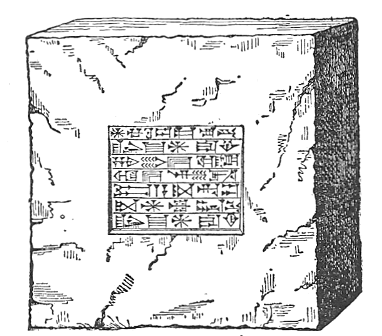 BABYLONIAN BRICK. THE KING'S NAME AND TITLES
WERE INSCRIBED ON EACH BRICK.
BABYLONIAN BRICK. THE KING'S NAME AND TITLES
WERE INSCRIBED ON EACH BRICK.
The Babylonians produced quite an extensive literature.
Their writings treated of religion, mathematics, astronomy,
astrology and geography, while some attempt was made to explain
animal and plant life. History in Babylonia was limited
almost wholly to royal inscriptions and lists of kings. In
Assyria, on the other hand, the greater portion of the literature
related to history, and the kings set forth the happenings of
their reigns with directness and considerable detail. Diplomatic
affairs, correspondence with Babylonia and foreign provinces,
official letters, tribute lists and royal decrees, make up
a large part of the surviving tablets.
We have already spoken of the library of Asshurbanipal,
or the Ninevan library, and have seen what a world of light
was thrown upon Assyrian civilization when its surviving
tablets were at last deciphered. Babylonia maintained libraries,
however, before Nineveh was founded.
These clustered, for reasons which we shall soon see,
around the temples. At Erech were early collected writings
which were concerned with the religion of the ancient Chaldeans,
together with the myths and legends of the country.
So many tablets were preserved in this temple that Erech was
called the "city of books." A library, rich in mathematical
lore, grew up at Larsa, another at Nippur, and still another at
Cathah. Smaller libraries were attached to all the great
temples.
When we speak of "libraries" in Mesopotamia, collections
of clay tablets are meant. Rooms were frequently provided
within the temples for the storing of these clay books. The
size of the tablet varied greatly. The largest were flat and
about 9 by 6½ inches; smaller ones were slightly convex,
while tiny ones, not more than one inch long, containing but
a line or two, have been found. Sometimes the lettering is
so fine that it could have been done only with the aid of a lens,
and it cannot be read without one.
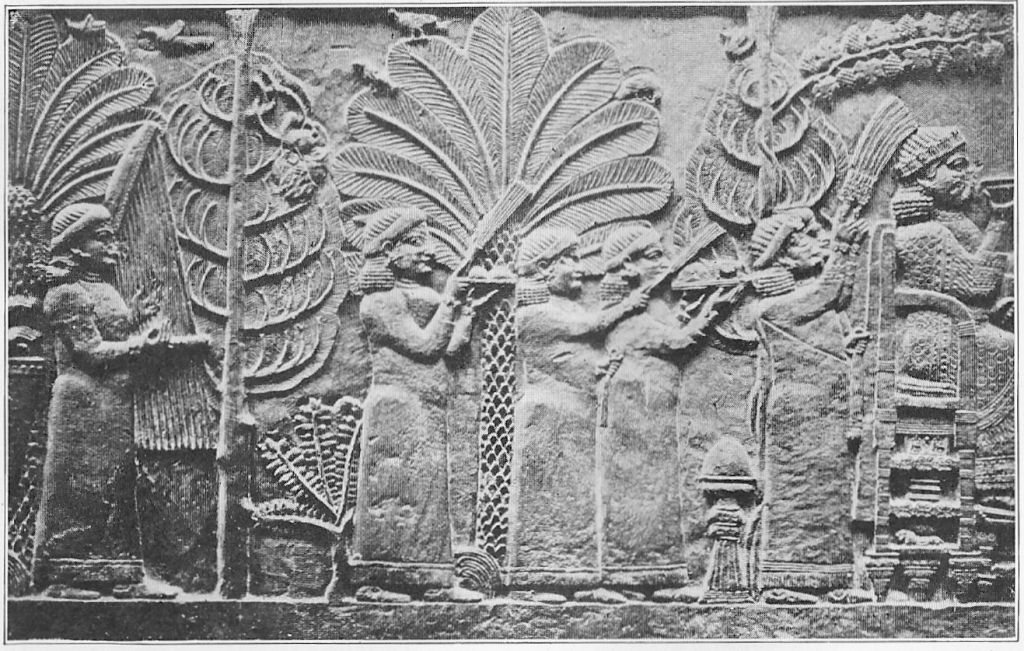 Musicians and Attendants in the Garden of Asshurbanipal.
In these valleys, the cheapest, most available writing material
was the soft clay, ever in evidence. When bricks had
been partially dried in the sun, a substance was formed which
readily received impressions, and these became firm as the
tablet hardened. Both sides and sometimes the edges as well,
were written upon, and little pegs of wood provided legs for
the brick to rest upon when reversed, that the soft impressions
might not be injured. To make the whole proof against fire
and water, it was finally baked in an oven. When so treated,
a material was made which proved more enduring against
action of the elements than either parchment or papyrus.
It is quite certain that papyrus and possibly parchment as
well were used for writing purposes, especially in the later
period, but no fragment of either has survived.
Certain disadvantages attached to the cheap tablets. They
were heavy and unwieldy to hold or carry, but more especially,
they allowed no embellishments or lengthy descriptions. Owing
to the laborious method of transcribing records, everything was
of necessity abbreviated and simplified. Thus we see how one
thing acts upon another—the country afforded only clay
tablets for writing material; these, limited because of size
and weight, curtailed speech and so influenced the style of
expression.
Occasionally one tablet constituted a book, but more often
several tablets were needed to contain the entire writing.
Thus the Deluge Story is the eleventh tablet, or chapter, of a
series numbering twelve in all. Seventy tablets composed a
single work on astronomy, while the three books comprising
the earliest religious texts covered 200 tablets. Each tablet
was carefully numbered and known by the first line of the
book; as, for example, one work treated on the creation and
began: "Formerly that which is above was not yet called
the heaven;" so the first tablet of the series was entitled:
"Formerly that which is above, No. 1;" the second, "Formerly
that which is above, No. 2," and so on through the
entire series.
The ancient Chaldeans believed that literature and the
art of writing were gifts from the gods, and in the myth
which to them explained how knowledge came into the world,
it was numbered among the things taught them by
the Man-Fish, Oannes. This is the myth as Berosus told it: "There
was originally at Babylonia a multitude of men of foreign
race who had colonized Chaldea, and they lived without order,
like animals. But in the first year (of the new order of
things) there appeared from out the Persian Gulf where it
borders upon Babylonia, an animal endowed with reason, who
was called Oannes. The whole body of the animal was that
of a fish, but under the fish's head he had another head, and
also feet below, growing out of his fish's tail, similar to those
of a man; also human speech, and his image is preserved to this
day. This being used to spend the whole day amidst men,
without taking any food, and he gave them an insight into letters,
and sciences, and every kind of art; he taught them how
to found cities, to construct temples, to introduce laws and to
measure land; he showed them how to sow seeds and gather
in crops; in short, he instructed them in everything that softens
manners and makes up civilization, so that from that time
no one has invented anything new. Then, when the sun went
down, this monstrous Oannes used to plunge back into the sea
and spend the night in the midst of the boundless waves, for
he was amphibious."
It was believed that learning and letters were under the
special protection of the gods, and for this reason it was fitting
to preserve books in the temples. The libraries thus established
were cared for by scribes and were open to the public. Many
were engaged constantly in copying, repairing and taking care
of the tablets. An order of celibate priests, not unlike the
monks of the Middle Ages, devoted itself to the task of book-making,
regarding the work as a pious undertaking.
Among the most ancient books recovered is one containing
bits of folk-lore, popular songs and maxims. One of the
maxims runs:
"Like an oven that is old
Against thy foes be hard and strong."
A fragment of a ploughman's song says:
"My knees are marching—my feet are not resting;
With no wealth of thy own—grain thou makest for me."
The Creation legends were among the most ancient writings.
"A plant had not been brought forth, a tree had not been created.
A brick had not been made, a beam had not been formed.
A house had not been built, a city had not been constructed.
A city had not been made, earthly things had not been made glorious.
Nipur had not been built, (its temple) E-kura had not been constructed.
Erech had not been built, (its temple) E-Ana had not been constructed.
The deep had not been made, Eridu had not been constructed.
As for the glorious temple (of Eridu), the house of the gods, its seat had not been made.
The whole of the lands, the sea also, (had not been formed).
When within the sea the current was
In that day Eridu was made. E-Sagila was constructed,
E-Sagila which the god Lugal-du-azagga founded within the deep;
Babylon (also) was built, E-Sagila was completed.
The gods and the spirits of the earth were made altogether.
The glorious city, the seat of the joy of their hearts, supremely they proclaimed.
Merodack (Marduk) bound together the slime before the water.
Dust he made and he poured it out with the flood.
The gods were made to dwell in a seat of joy of heart.
He created mankind.
The god Aruru, the seed of mankind, they made with him.
He made the beasts of the field and the living creatures of the desert.
He made the Tigris and Euphrates, and set (them) in (their) places
Well proclaimed he their name.
The ussu-plant, the dittu-plant of the marshland, the reed and the forest he made.
He made the verdure of the plain;
The lands, the marshes, and the greensward also;
Oxen, the young of the horse, the stallion, the mare, the sheep, the locust;
Meadows and forests also.
The he-goat and the gazelle brought forth to him."[1]
Babylonian myths often took the form of epics. The epic
of Gilgamesh was popular. Twelve tablets composed it, each
corresponding to a zodiacal sign. The Deluge Story made up
the eleventh chapter. Another epic, the Descent of Ishtar into
Arallu, or Hades, was well known. Ishtar, herself a goddess,
mourned a departed god, her consort, so greatly that she
braved the terrors of the underworld to find him and to carry
him water from the fountain of life, that he might rejoin her.
This was the earliest form of a myth which later appeared in
many lands.
Astronomy had its birth in astrology—the so-called science
which sought to discover the influences of the planets upon the
destinies of mankind. This science was firmly believed in and
strongly supported for centuries after the Christian era, and
has its followers even today.
Mathematics had a similar beginning. Geometrical figures
were used for augury. In arithmetic, 60 was a favorite number
for computation, and the division of a circle into seconds,
minutes and degrees, dates from this time.
Geography consisted merely of lists of seas, mountains,
rivers, waters, nations, and cities then known. Grammars and
dictionaries were plentiful because they were needed even
at that time for an understanding of a language, already
"dead," but still the language of literature.
In the realm of history, royal inscriptions may be included.
With the rise of Assyria these came to be more complete.
Fewer set phrases, copied by each king from most ancient
times, were used and more information was included concerning
the subject at hand. For example, an inscription of Tiglathpileser
I. (about 1100 B.C.) filled eight sides of a clay
cylinder, and contained 809 lines. It consisted of (1) an invocation
to the gods who had given him power; (2) set forth his
titles and summed up the deeds of his reign; (3) 500 lines
recounted the campaigns of his first year; (4) 200 lines described
his royal hunts and his temples built and restored; (5)
finally a blessing was pronounced upon those who shall honor
his deeds and a curse is given those who ignore them.
Both nations loved justice and delighted in formality. All
kinds of agreements were put into writing and were duly
witnessed. To the original code of laws in Babylonia, court
decisions were added and together comprised the later law of
the land. All important cases were abstracted and the decision
of the judges given at length on tablets which have been preserved
in many cases with the signature of the judge. The
judges were appointed by the king. Priests were eligible,
but others often served. There was probably a court in the
vicinity of every important temple, which has given a general
impression that the priests took entire charge of court proceedings.
Education was much more widely diffused in Babylonia
than in Assyria. In the former country both girls and boys
seem to have received some elementary training in the art of
reading and writing. Schools for the training of scribes were
maintained in connection with each of the great temples.
Tutors were doubtless employed in families of the nobility,
but little is known of the training of the young. The art of
writing was a difficult one to master and required the memorizing
of a large number of symbols. There must have been
much truth in the sentence found often in the children's
copy-books: "He who would become a scribe must rise with
the dawn." In the school of Sippara a tablet has been found
which is supposed to have been either a medal or a diploma
given by the school. An inscription upon it reads: "Whosoever
has distinguished himself at the place of tablet writing
shall shine as the light." The calling of the scribe was an
honorable one and his social position was good.
One indication that people of the better classes in Babylonia
could write is to be found in the number of personal letters
which have been found. These are not written, as in
Assyria, in one uniform handwriting, but show many variations
and degrees of perfection.
In Assyria writing was a profession, and only trades-people
whose business compelled them to understand rudimentary
writing, public officials and the upper classes understood
the art. Public scribes wrote many private letters, much
in the same way as a lawyer of today might draw up some
document, and to the letter so written, the sender affixed his
seal.
Learning was limited in the northern kingdom to the
favored few. Some of the kings, notably Asshurbanipal, was
a book collector and sent his men everywhere to gather up
tablets of worth and antiquity.
Letters which have been translated help to bring these
early days before us. This one was probably sent by a lover
to the object of his adoration:
"To Bibea say, thus saith Gimil-Marduk: May Shamash
and Marduk for my sake preserve thy health forever. I have
sent for thy health. Tell me how thou art. I went to Babylon
and did not see thee. I was greatly disappointed. Send me the
reason of thy leaving, and let me be cheered. In Marchevan
do thou come. For my sake keep well always."[2]
The next is written by the captain of a river barge to
King Sennacherib, concerning the transporting of colossal bulls.
"To the king my lord, thy servant Asshur-mukin has ordered
me to transport in boats the colossal bulls and cherubim
of stone. The boats are not strong enough and are not ready.
But if a present be kindly made to us, we will see that they
are got ready, and ascend the river."
If the writer of the third failed to have his request granted,
it could scarcely be for lack of persistence in making it known.
It is a letter written by a tenant to his landlord, and belongs
to the age of Abraham:
"To my lord say, thus saith Ibgatum thy servant: As, my
lord, thou hast heard, the enemy has carried off my oxen.
Never before have I sent to thee, my lord. Now I have
caused a letter to be brought to thee, my lord, Do thou, my
lord, send me one young cow. I will weigh out and send five
shekels of silver to thee, my lord. My lord, what thou sayest,
under the command of Marduk, thy protector, what pleases
thee, no one can hinder thee, my lord. My lord, do thou
make her worth the five shekels of silver that I have weighed
out and sent to thee. Do thou, my lord, treat seriously this
request, do not trifle with my wish. Let my lord not wonder
at this request, which I send my lord. I am thy servant. I
will do thy will, my lord. As to the young cow, which thou,
my lord, dost send, let her be on credit, and either to Basu,
or wherever is convenient to my lord, do thou send. With
Iliikisham, my brother, let the young cow come. And I, in
order that my lord should quickly consent and send the young
cow, will forthwith weigh out and send fifteen shekels of silver
to thee, my lord."[3]
Sayce has suggested that the five shekels of silver was the
amount he paid annually for the lease of his farm, and that he
sent it at this time to further influence the landlord to grant
his request. Another interpretation has been put upon it that
he sent the five shekels as a payment down, but did not propose
to pay the full price until he saw the particular cow sent him.
Letters were enclosed generally in an envelope of clay.
Powdered clay was sprinkled over the letter to prevent its
clinging to the cover. Because the envelope of clay had to be
broken before the letter was read, safety and privacy was
proven by the unbroken cover. Again the tablet upon which
the letter was inscribed was sometimes covered with a linen
wrapper and the ends held by a seal—a lump of clay pressed
down with the impression of the seal upon it. Few of these
clay or linen envelopes have been found, for they were regarded
as valueless and were cast aside. A very fair postal
system was maintained in Mesopotamia.
"Babylonian and Assyrian letters were treated much as
ours are when they are put into a post-bag to which the seals
of the post-office are attached. There were excellent roads all
over Western Asia, with post-stations at intervals where relays
of horses could be procured. Along these all letters to or
from the king and the government were carried by royal messengers.
It is probable that the letters of private individuals
were also carried by the same hands.... The civilized
and oriental world was bound together by a network of postal
routes over which literary intercourse was perpetually passing.
They extended from the Euphrates to the Nile and from the
plateau of Asia Minor to the confines of Arabia. These routes
followed the old lines of war and trade along which armies had
marched and merchantmen had traveled for unnumbered generations.
The Tell-el-Amarna tablets show that letter-writing
was not confined to Assyria and Babylonia on the one hand,
or to Egypt on the other. Wherever the ancient culture of
Babylonia had spread, there had gone with it not only the
cuneiform characters and the use of clay as a writing material,
but the art of letter-writing as well."[4]
Fifteen hundred and seventy-five letters alone were found
in the library of Asshurbanipal, unearthed by Layard. This
great Assyrian king sent scribes throughout Babylonia to
visit ancient temples and copy tablets on which were preserved
ancient writings. Some thirty thousand were collected before
his death and they treated of all subjects known at that time.
It was remarkable that when this splendid palace fell into ruins,
many of these tablets remained uninjured, and, having laid
undisturbed for twenty-five hundred years, were finally
brought to light some fifty years ago to give the world of today
their old-time messages.
"The surface of the land like fire they wasted;
they destroyed all life from the face of the land;
to battle against men they brought the waters.
Brother saw not his brother; men knew not one another.
In heaven the gods feared the flood and
hastened to ascend to the heaven of Anu.
The gods, like dogs in the kennel, crouched down in a heap.
Six days and nights . . .
the wind, the flood, and the storm go on overwhelming.
The seventh day, when it approached, the flood subsided, the
storm which had fought against men like an armed host
was quieted. The sea began to dry, and the wind and the flood ended.
I beheld the sea and uttered a cry,
for the whole of mankind was turned to clay;
like trunks the corpses floated.
I opened the window, and light smote upon my face;
I stopped and sat down; I wept;
over my face flowed my tears.
I beheld a shore beyond the sea;
a district rose twelve times distant.
On the mountain of Nizir the ship grounded;
the mountain of Nizir stopped the ship, and it was not able to pass over it.
The first day, the second day, the mountain of Nizir stopped the ship.
The third day, the fourth day, the mountain of Nizir stopped the ship.
The fifth day, the sixth day, the mountain of Nizir stopped the ship.
The seventh day when it approached
I sent forth a dove, and it left. The dove went in and returned
and found no resting place, and it came back.
Then I sent forth a swallow, and it left. The swallow went and returned,
and found no resting place, and it came back.
I sent forth a raven, and it left.
The raven went, and saw the going down of the waters, and
it approached, it waded, it croaked; it did not return.
I sent the animals to the four winds; I sacrificed a sacrifice
I built an altar on the peak of the mountain.
I sent vessels ... by sevens;
underneath them I spread reeds, cedar-wood, and herbs.
The gods smelt the savour; the gods smelt the good savour;
the gods gathered like flies over the sacrifices.
Thereupon the great goddess at her approach
lifted up the mighty bow which Anu had created according to his wishes.
These gods, by my necklace, never will I forget."
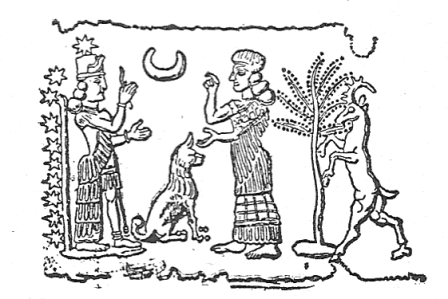 ISHTAR. FROM AN ASSYRIAN CYLINDER.
The Babylonians and Assyrians were very fond of dress.
There were three essentials to Mesopotamian dress, and accessories
depended upon the taste and purse of the wearer. A
head-dress, a tunic and a robe were the main features of one's
apparel, although all were not of necessity worn by the lower
classes. The head-dress was frequently of felt and was some
times quilted; the tunic was generally made of linen when
worn in Babylonia and of wool in Assyria; the robe was
long, falling to the ankles; it was often of wool and was finished
with a deep fringe. The tunic and some times the robe
as well were belted at the waist by a wide and elaborate
girdle. Women's garments were similar to those worn by
men, but their robes fell in more ample folds. Naturally
fashions changed and a garment worn in the days of the
Semitic invasion would have appeared odd and out of date
in the age of Asshurbanipal.
Early portraits of kings show them clad in thick quilted
skirts falling to the ankles, while quilted turbans covered their
heads. Later robes took the place of the skirt. Parasols
were carried in Babylonia as protection against the heat, but
in Assyria they gradually became the privilege of the royal
family. In portraits of later Assyrian kings, the parasol
is frequently shown. This custom may have been borrowed
from Persia.
Ordinarily no head-dress was worn by the lower classes
in Babylonia unless, perhaps, to denote some special calling.
Certain musicians appear with caps. The devotees of fashion
probably donned head-dresses at pleasure.
Jewelry was popular with both men and women, even the
poor being adorned with necklaces, bracelets, anklets. Shoes
and sandals were seldom worn in the southern kingdom. In
Assyria, naturally a colder climate brought about some variations
of dress. High boots and leather breeches were worn by
the soldiers of later periods; shoes were needed to protect
the feet from frosty ground, and cloaks were required in
addition to the usual robe.
Embroidered and imported robes, smart hats and other
details of wearing apparel were characteristic of later periods
when wealth and leisure gave opportunity for such indulgences.
Certain it is that the simple tunic sufficed in early days,
and rank was indicated by its greater or abbreviated length.
The ancient Chaldeans or Sumerians always shaved their
heads and faces. Influenced by this custom, the Babylonians
did not wear long beards. The Assyrians, more purely Semitic,
wore long ones and had hair dressers largely in the place
of barbers, who curled both their beards and hair.
A word should be said of the costumes of the priests. They
may always be distinguished on the monuments by their long,
flounced robes, reaching nearly to the ground. Because the
goat was an animal of special sanctity, a goat-skin was invariably
thrown over the shoulder—quite as the Egyptian
priest wore the skin of a leopard.
In connection with the jewelry worn by men, we may consider
the little cylinders which served as seals. In Babylonia,
because of the scarcity of stone, even tiny pebbles were valued,
and it came to be the custom to have these cut in cylindrical
shapes by expert stone-cutters. An opening was made throughout
their length to allow a cord or chain to pass through. This
attached the cylinder to the owner's wrist. Upon the round
surface of the cylinder were engraved various designs and
figures, and a few words explaining the identity of the wearer,
name of his father and other noteworthy facts regarding him.
His name was affixed, and with this he stamped his letters and
all documents. To be without a cylinder was almost as inconvenient
as to be without a name. The very poor, who could
not afford such a seal, were obliged to make a nail-mark in
the soft clay, while some one wrote the name of the person
to whom that particular mark belonged. The possessor of
a cylinder had only to pass it over the clay and his signature
was made. Many of these little cylinders have been recovered,
and some lack the name of an owner, showing that they had
been made by a gem-cutter, but had not yet found a buyer.
Food was easily obtained in Mesopotamia, and consisted
mainly of grains and dried fish. Cereals were made into little
cakes and seasoned with dates or some other fruit. Fish
and fowl were plentiful; many kinds of fruits and vegetables
were grown, and wine and beer were universally used. Lacking
the tomb-pictures of Egypt, we know less about the food
and its preparation in the Euphrates valley.
For our knowledge of ancient Babylonian and Assyrian
life, we are dependent largely upon scenes depicted on palace
walls, especially the walls of royal dwellings. These scenes
commemorate the doings of the king particularly, and where
laborers, slaves and the common people are shown at all, they
are seen at work, building palaces and temples, marching to
battle, swelling the triumphal processions, or they are cultivating
the fields, storing away the grain—all to the glory of
the realm and consequently to the king. Naturally then, we
know little about the pastimes of the masses. They no doubt
thronged the streets on festivals, for then they were free
from work. Even labor on royal palaces—always pushed with
all possible speed—was then suspended. Every day in the
year had its own significance, but five days each month were
of particular importance, being sacred to the gods, and were
duly observed. Worship and merry-making were in a measure
mingled. Other days for popular observance were those in
which the king and the army returned from successful wars.
A triumphal procession passed slowly through the streets on
its way to the temple, where thanksgiving was rendered the
gods who had made victory possible. Such occasions were
always holidays, and the people in gay attire, gathered to witness
the home-coming of their sovereign, and to gaze in wonder
at the booty and the captives.
Two recreations pictured on the palace walls were enjoyed
only by the nobles and the wealthy classes—the hunt and the
banquet. In modern times, when those in high position have
occasionally laid down important matters for a brief while to
seek recreation in hunting, fishing and out of door life, they
have taken opportunity to throw off much of the conventionality
surrounding their every-day life and have found some
diversion in "roughing it,"—in sharing the varying fortune
likely to befall those who leave the certain comforts of home
for the uncertain conditions to be met away from the centers
of civilization. Such was not at all the case with the kings
of Assyria when they left their capitals to hunt the lion in
its distant jungles and marshes. In the palace of Sennacherib
and Asshurbanipal, hunts have been depicted throughout their
progress. We may see the king marching out of the city in
his state chariot, his charioteer at his side, while behind him
an attendant holds high an embroidered parasol over his
kingly head to protect him from the rays of the sun. Nobles
accompany him on horses and they, together with the guards
and retinue of servants, make up a small army. Goats and
cattle are driven along, that his majesty and his nobles may
have fresh milk and meat throughout their absence; a sumptuous
tent shelters the king when the procession stops for the
night, while each noble tries to pitch his tent near the more
splendid one of his king. Maspero has graphically described
the hunt. Some wild oxen have been discovered, and the
king gives chase:
"In less time than we can speak, three of the bulls are
rolling on the ground, pierced with several arrows; the four
others but slightly wounded, turn round and gallop towards
the river. Asshurbanipal follows the largest of them, which
he is almost sure is wounded in the shoulder; then gradually he
overtakes it, skillfully drives his chariot beside it without checking
speed, and laying aside his bow, grasps one of the poignards
he wears in his belt. With one hand he seizes one of the
animal's horns, with the other he plunges his weapon into his
neck; the short, wide blade divides the spine, between the neck
and shoulder, the bull falls like a stone. A flight of arrows
arrests the fugitives before they can reach the water; the whole
herd is killed, except the old bull that escaped at first.
"The return to the camp is a triumphal march. As soon
as the sentinels signal the arrival of the party, soldiers, slaves,
women, all who are not bound by etiquette or military duty,
hurry to meet it, and form two lines, watching the procession.
The sight of the seven bulls, each carried by five or six men,
almost causes them to forget the respect due to royalty. They
exclaim upon the size of the animals, the strength of their
horns, the savage aspect given by their manes; they praise
their master's skill, and loudly thank the gods who have
favored him with such rare and terrible game. Asshurbanipal
has left his chariot in front of his tent, and now prepares to
return thanks for his success to the lord Asshur and the lady
Ishtar. Two priests with their harps are waiting to commence
the hymns of praise. The bearers place the oxen side by side
in a single line. The king, accompanied by his fly-flap and
sunshade-bearers, stands on the right, the bow in his left hand.
He takes the cup full of sacramental wine, which the vizier
presents to him, touches it with his lips, then partly empties
it over the victims whilst the musicians play. The same evening
a messenger will start for Nineveh to have the new exploit
graven upon stone. The picture will portray the departure,
the chase, the death, the solemn entry, and an inscription
placed above the last scene will tell posterity the name of the
victor. 'I, Asshurbanipal, king of multitudes, king of Assyria,
whose power is secured by Asshur and Beltis, I have killed
seven oxen; I have strung the mighty bow of Ishtar, queen
of battles, against them, I have made an offering over them
and poured wine upon them.'
"On the following day the dogs rouse three lions from
their jungle. These are killed after having made a desperate
resistance. The three bodies are carried back to the camp,
then presented to Ishtar with the same ceremonies that had
celebrated the triumph over the wild bulls, and the sculptors
were ordered to represent the hand-to-hand struggle of the
sovereign and his savage foe. 'I, Asshurbanipal, king of peoples,
king of Assyria, alone on foot, in my majesty, I seized
a lion of the desert by the ear; and by the mercy of Asshur
and Ishtar, queen of battles, I pierced its loins with my lance,
with mine own hands.'"[1]
A banquet sometimes celebrated the return from a fine
and successful hunt, but it faded into insignificance when
compared with the one held after the return from a war of
pillage and conquest. The entire population of the capital
became temporary guests of the king.
"After the procession, the day is passed in a perfect frenzy
of joy by the whole nation. It is customary for all the inhabitants
of the city, slaves and freemen, to eat and drink
at the king's expense during the festival; this is a method of
giving them a share of the booty. For seven days the palace
gates are open to all comers. Many colored stuffs suspended
over the walls by means of ropes have transformed the courts
into immense banqueting halls. The crowd is coming and
going from morning till night; the people install themselves
upon state-seats and ask for whatever they like; the slaves
have orders to give them anything they wish for, and to bring
each person whatever he desires as many times as he asks
for it. Women and children are admitted to these festivals
as well as men. The soldiers kept in barracks by their duty
are not forgotten; the king sends them the food and wine
they cannot fetch for themselves in so great profusion that
they have nothing to regret. The loaves disappear by thousands,
by thousands also the oxen, sheep, goats, and birds
of all kinds are sacrificed to satisfy the public appetite. But
what they eat is nothing to what they drink. The Assyrian
is sober in ordinary life, but he does not know how to stop
if he once allows himself any excess. Wines of Assyria and
Chaldea, wines from Elam, wines from Syria and Phoenicia,
wines from Egypt, the skins are emptied as soon as opened,
without visibly quenching the universal thirst. After one or
two days no brain is strong enough to resist it, and Nineveh
presents the extraordinary spectacle of a whole city in different
degrees of intoxication; when the festival is over, several
days are required before it resumes its usual aspect.
Whilst the people are becoming tipsy outside, Asshurbanipal
feasts the leading chiefs and the ministers of state within
the palace. Unlike the common people, the nobles eat but
little, so that few dishes of meat are set before them, but
cakes and fruits of different kinds, grapes, dates, apples, pears,
and figs are brought in continual relays, by long lines of slaves.
On the other hand, they drink a great deal—with more refinement,
perhaps, than the common people, but with equal
avidity.
The only persons who do not drink, or who drink little,
through the necessity of retaining their sobriety, are the guards,
the servants and the musicians. No festival is complete without
the presence of singers, and the king's musicians conscientiously
perform their finest melodies. Perhaps some one
listened to them at the beginning of the feast, but now that
the great silver bowls have been filled and emptied several
times, their music is literally wasted. They may sing out of
tune, or remain silent, just as they please, no one will listen
or care.
The court poet has placed the recital of the hero's life and
exploits, from the hour of his birth until the day of his triumph,
in his own mouth. He concluded by saying:
"'I am a strong warrior, beloved of Asshur and Ishtar,
the child of royalty. The gods have been gracious to me.
The wheat has grown to five cubits, and its ears of corn are
always one cubit long; during my reign, abundance has overflowed;
during all the years of my reign, the divine blessing
has been poured out upon me like a heavy dew. The gods
have raised me higher than any king ever ascended before me.
Whilst Asshur and Ishtar support me, who can prevail against
me? My power is everlastingly founded by their hands,
the duration of my race is established; they shall reign for
many days, and for everlasting years.'"[2]
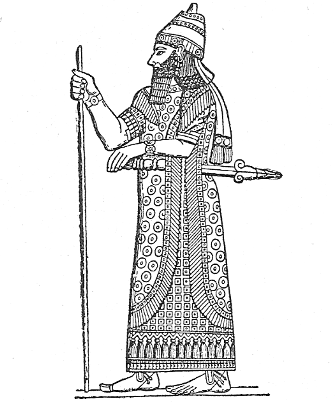 ASSYRIAN KING IN ROYAL ROBES.
Architecture is evolved from religion as well as from nature.
Generally speaking, we find temples of worship to be the first
buildings erected by every people.
Because the Babylonians were limited by lack of other material
to sun or kiln-dried brick, and the Assyrians, devoid of
originality, limited themselves to the same baked clay, we
would scarcely expect to find pleasing or artistic buildings in
either state. Even in the dwellings of rich and poor, the
great difference was one of size. It was impossible to make a
clay wall very ornate, but the wealthy could have more walls
and broader expanse of bricks. Size, or hugeness, then, signified
superiority. It naturally followed that the temple, the
noblest structure attempted by the Mesopotamians, was especially
large, being called by a word which meant "mountain
house."
Large tracts of land were dedicated to the temples. Having
been consecrated by libations of wine, oil and honey, the
temple proper, consisting of halls or rooms surrounding an
inner court, was first erected. Near this arose the ziggurat
or tower, and many smaller buildings, not unlike private
dwellings. These served as residences for the priests, for the
temple school, store-houses for the sacred oil and other articles
pertaining to worship, and many other purposes. The entire
area was enclosed by a wall, and was ordinarily remote from
the noises of the city. Within this large enclosure other walls
surrounded buildings of special sanctity and importance.
Within the temple proper was an inner room where the statue
of the god was kept. This corresponded to the "holy of
holies" in a Jewish synagogue, and was entered only by the
priest or king.
The ziggurat or mountain house—for this alone was massive
and high—built as symbolic of the mountain form which
the whole earth was supposed to assume, was a tower, some
times three, some times five or even seven stories high. The
remains of one of these ziggurats was discovered by Dr. Peters
and his explorers at Nippur, and is supposed to have been
built as early as 2700 B.C.
The ziggurat at Borsippa had a base of earthwork 272
feet on each side, and was 26 feet high. Above this foundation
arose two stories, 26 feet in height, each 42 feet less on
a side than the story below. Four stories, each 15 feet high,
followed, decreasing 42 feet on a side like the lower ones,
and the last, or seventh, story, was just 29 feet square. Stairways
wound around the outside of the tower, and it was
thought pleasing to the gods that worshippers should ascend
to the top. Each story was sacred to some particular god
whose statue it contained while the shrine of the most important
deity was placed on top. Sometimes each story was
painted a different color.
The mass of worshippers, however, assembled at the temple
rather than the tower, and offerings were made at the base
of the ziggurat instead of at the top.
It was the ambition of the kings that the inner walls of
their buildings, whether temples or palaces, should "shine
like the sunlight," and to this end gold, silver and precious
stones lent their gleams and glows to mural decorations.
Next in importance to the temples were royal palaces,
and in Assyria, where religion was given less prominence, the
temple was a mere adjunct of the palace. Here again, a large
inner court was surrounded by halls and rooms. The palace
court was paved and decorated and upon the inner walls of
the palace the skill of the artist was expended. The floors
were made of tiles, and these followed ingenious patterns.
Sometimes the floors were formed of bricks or tablets covered
with inscriptions deeply cut; then molten metal—brass or
bronze—was poured over the whole, and filling the depressions,
caused the entire floor to look like a curious and intricate
design.
It was comparatively easy to lay floors and raise walls of
bricks, but it was quite another thing to make roofs of them.
The longest rafters were obtained from the cedars of Lebanon
and these ranged from 30 to 40 feet in length. This practically
determined the width of the halls and rooms, which
seem to have been even four times their width in length.
The monotony of the inner walls was relieved by alabaster
reaching around the halls from twelve to fifteen feet above the
floors, and held in place by strong iron clamps. On this
soft, yielding substance were portrayed scenes in the life and
exploits of the king—his campaigns, hunts, works of peace,
and acts of worship. These were executed in bas-relief after
the slabs were fitted into place. Above them extended a frieze
perhaps three feet in width, made of tiles painted in delicate
colors and laid in such a way as to form a picture or design.
We miss the gaudy colors so popular in Egypt. It has been
well said that the Assyrian artist sought to please by the elegance
of his forms and the harmony of his hues—not to
startle by a display of bright and strongly contrasted colors.
The palace of Sennacherib, second only to the temple of Karnak
in grandeur—covered an area of eight acres, and contained
some eighty apartments. The palace of Sargon at Khorsabad
had no less than 209 rooms. Of the scenes depicted
on the slabs of alabaster in the state apartments Rawlinson
writes at length: "The most striking characteristic of Sennacherib's
ornamentation is its strong and marked realism.
Mountains, rocks, trees, roads, rivers, lakes were regularly
portrayed, an attempt being made to represent the locality,
whatever it might be, as truthfully as the artist's skill and the
character of his material rendered possible. The species of
trees is distinguished, gardens, fields, ponds, reeds, are carefully
represented; wild animals are introduced, as stags, boars
and antelopes; birds fly from tree to tree, or stand over their
nests, feeding the young who stretch up to them; fish disport
themselves in the water; fishermen ply their craft; boatmen
and agricultural laborers pursue their avocations; the scene
is, as it were, photographed, with all its features.
"In the same spirit of realism, Sennacherib chooses for
artistic representation scenes of a commonplace and everyday
character. The trains of attendants who daily enter his palace
with game and locust for his dinner, and cakes and fruit
for his dessert, appear on the walls of the passages exactly as
they walked through his courts bearing the delicacies in which
he delighted. Elsewhere he puts before us the entire process of
carving and transporting a colossal bull, from the first removal
of the huge stone in its rough state from the quarry to its final
elevation on a palace mound, as part of the great gateway of a
royal residence. We see the trackers dragging the rough block,
supported on a low flat-bottomed boat, along the course of a
river, disposed in gangs, each gang having a costume of its
own which probably marked its nation, under taskmasters
armed with staves, who urged on the labor with blows. The
whole scene must be represented, and so the trackers are there,
to the number of three hundred, each delineated with as much
care as if he were not the exact image of ninety-nine others.
We then observe the block transferred to land, and carved into
the rough semblance of a bull, in which form it is placed on
a rude sledge and conveyed along level land by gangs of laborers,
arranged nearly as before, to the foot of the mound at
whose top it has to be placed. The construction of the mound
is elaborately represented. Brickmakers are seen moulding the
bricks at its base, while workmen with baskets at their backs,
full of earth, brick, stone, or rubbish toil up the ascent—for the
mound is already half raised—and empty their burdens out
upon the summit. The bull, still lying on its sledge, is then
drawn up an inclined plane to the top by four gangs of laborers,
in the presence of the monarch and his attendants. After this
the carving is completed, and the colossus, having been raised
into an upright position, is conveyed along the surface of the
platform to the exact site which it is to occupy."
Guarding the portals of the palaces stood the winged bulls
and lions, in pairs. They were thought to ward off demons and
to inspire awe in those who beheld them. They were formed
with five legs, in order that the spectator, whether he viewed
them from the front or side, might still see the usual four.
Speaking of these great stone creatures, Layard wrote: "I
used to contemplate for hours these mysterious emblems, and
muse over their intent and history. What more noble forms
could have ushered the people into the temple of their gods?
What more sublime images could have been borrowed from
nature by men who sought, unaided by the light of revealed
religion, to embody their conception of the wisdom, power and
ubiquity of a Supreme Being? They could find no better type
of intellect and knowledge than the head of a man; of strength,
than the body of a lion; of rapidity of motion than the wings
of a bird. These winged human-headed lions were not idle
creations, the offspring of mere fancy; their meaning was written
upon them. They had awed and instructed races which
flourished three thousand years ago. Through the portals
which they guarded, kings, priests, and warriors had borne
sacrifices to their altars long before the wisdom of the East
had penetrated to Greece, and furnished its mythology with
symbols long recognized by the Assyrian votaries.
"They may have been buried, and their existence may have
been unknown before the foundation of the Eternal City. For
twenty-five centuries they had been hidden from the eye of
man, and they now stood forth once more in their ancient
majesty. But how changed was the scene around them! The
luxury and civilization of a mighty nation had given place to
the wretchedness and ignorance of a few half-barbarous tribes.
The wealth of temples and the riches of the great cities had
been succeeded by ruins and shapeless heaps of earth. Above
the spacious hall in which they stood the plow had passed
and the corn now waved. Egypt has monuments no less ancient
and no less wonderful, but they have stood forth for
ages to testify her early power and renown, while these before
me had but now appeared to bear witness, in the words of the
prophet, that once 'the Assyrian was a cedar in Lebanon with
fair branches.... Now is Nineveh desolate and dry
like a wilderness, and flocks lie down in the midst of her.'"
Babylon was probably the most beautiful city of antiquity.
Nebuchadnezzar II. surrounded the capital with walls of such
solidity that it is supposed the city could never have been taken
by assault. His father began the fortifications, and it was left
for the greatest Babylonian king to complete them and make
them even more secure. Between the outer and inner walls,
wide distances were left. Here trees and gardens were planted.
This space was provided for nearby villagers in times of siege,
and it was also intended that here fields of grain might be
grown to sustain the population under such trying conditions.
Herodotus described these walls: "And here I may not
omit to tell the use to which the mould dug out of the great
moat was turned, nor the manner wherein the wall was
wrought. As fast as they dug the moat, the soil which they
got from the cutting was made into bricks, and when a sufficient
number were completed, they baked the bricks in kilns.
Then they set to building and began with bricking the borders
of the moat, after which they proceeded to construct the wall
itself, using throughout for their cement hot bitumen, and interposed
a layer of wattled reeds at every thirtieth course of
the bricks." According to this writer the outer wall was
14 miles in circumference, 93 feet thick, and 370 feet in height,
but it is supposed that he included the city of Borsippa, across
the river, within the length of wall, and no doubt he computed
the height to include the lofty towers built at intervals
along the wall, to give sentinels a wide outlook over the country.
These walls the Greeks included among the wonders of
the world, and probably ancient warfare could not have destroyed
them.
The Hanging Gardens of this great city were also enumerated
among the world's wonders. These are said to have been
built by Nebuchadnezzar for his Median queen, who wearied
of the dull, flat country of Babylonia, and pined for her mountain
home. The lowest terrace arose some 500 feet square,
and three other terraces, supported by arches and pillars, were
constructed above it, each smaller than the one beneath. These
four platforms or terraces were covered with soil drawn up in
carts, and the earth was deep enough to grow large trees, as
well as all kinds of plants and vines. A pump house was
located on top, water being drawn from the river and forced
all through the structure, while the pipes were carefully concealed.
Broad stairways led up to the uppermost terraces
where a residence was built for the favorite queen. Hanging
gardens had been built in Nineveh by former kings, but none
so splendid as these nor on so gigantic a scale. Seen from
afar, overtowering the high walls of the city, their height accentuated
by the vast expanse of level land, the effect was that
of a low mountain, clothed in verdure and scenting the breeze
with the blended fragrance of its beautiful flowers.
The population of Babylon was probably above 500,000
and the city contained more wealthy families than any other
in Asia. The houses of these added to the beauty of the place,
while two royal palaces, one on either side of the Euphrates,
exceeded all former splendor in the southland. Streets were
laid out at right angles, and the more important ones terminated
in high gates leading out of the city walls. These gates were
made of cedar and covered with bronze plates. Well might
Nebuchadnezzar exclaim: "Is not this great Babylon, which
I have built for the royal dwelling-place, by the might of my
power, and for the glory of my majesty?" And again:
"For the astonishment of men I built this house; awe of the
power of my majesty encompasses its walls. The temples
of the great gods I made brilliant as the sun, shining as the
day. In Babylon alone I raised the seat of my dominion, in
no other city!"
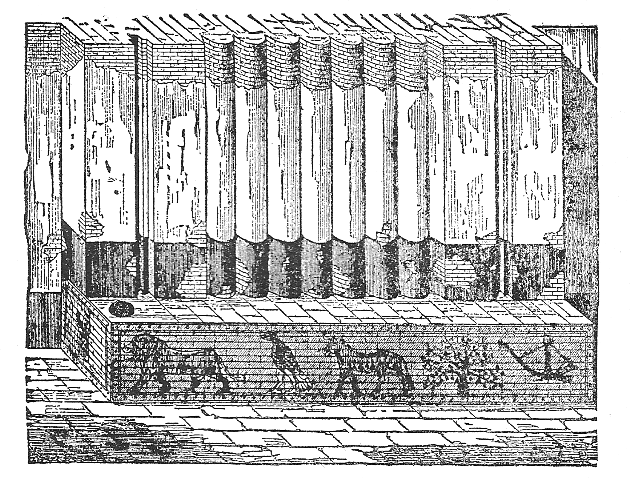 DECORATION IN ENAMELED TILES ON ONE OF THE GATES OF THE HAREM IN
SARGON'S PALACE.
DECORATION IN ENAMELED TILES ON ONE OF THE GATES OF THE HAREM IN
SARGON'S PALACE.
We have learned something of the primitive religious ideas
of the Chaldeans, or Sumerians, who originally occupied Babylonia.
However, when the Babylonian religion is mentioned,
reference is made to the later faith of the valley, and this resulted
from a blending of the Sumerian beliefs and the religious
system brought in by the Semitic invaders.
The original inhabitants of the country, in their attempt
to explain the forces of nature, had conceived that spirits belonged
to animate as well as inanimate objects, and that these
spirits had power to bless or injure. The rain could refresh
the crops or it might wash them out of the earth; the sun
could cause the grain to germinate or in a day could dry it up
with withering heat. The evil which each spirit was likely
to do so far exceeded the good that gradually these spirits were
thought of as demons. It was a demon which took possession
of a man and made him ill. Famines were brought by the
south-west wind. In short, demons threatened on every hand,
and only a diligent use of charms and frequent incantations
could protect humanity and enable each to live out his days
amidst such imminent dangers.
Now it is evident that there is no trace of our conception
of a god in all this, but the early Sumerians had also their gods
which were likewise personifications of nature, and these were
later adopted by the Babylonian Semites, who also took over
the earlier beliefs about the various spirits. In the course of
perhaps several hundred years from the blending of the two
beliefs, with such changes as growing intelligence brought,
the religion of the Babylonians was evolved.
The Semites who pushed north and founded the state of
Assyria, took with them the religion of the southern kingdom.
In explaining further the religion of the southland, we
must remember its early political situation. Instead of one
united kingdom, it was made up of a number of little states
under leadership of cities. The leading cities had grown up
around the temple of some protecting deity whose favor was
believed to extend over the immediate vicinity. Thus, for example,
Sin, the Moon-god, was not only the patron deity of
Ur, but of the whole state of which Ur was the capital city.
To exalt its god, a state would reach out to incorporate another.
The people thus conquered did not cease to worship
their former deity but now gave homage to the god of their
conquerors as well. When several little states were united,
the greatest of their gods was the god of their strongest city,
since he had clearly demonstrated his power by giving victory
over the rest. In truth, it should be explained that such was
the official god, for without doubt the masses knew little of
political absorption and worshipped the god of their infancy
rather than new gods honored by the state.
In course of various unions, En-lil or Bel became the most
important god in Babylonia and remained so until Babylon
gained supremacy over all other states. Then Marduk, her
ancient god, was given first place.
A brief consideration of the leading Babylonian gods will
help us to gain some insight into these early ideas and conceptions.
As early as 3500 B.C., En-lil or Bel was worshipped in
Nippur. The very name testifies to its Sumerian origin. Lil
signifies demon, and En-lil was the chief of spirits. In one of
the earliest inscriptions in Sumerian he is mentioned with Anna
and Enki, the gods of heaven and the abyss. These three made
up the original triad and as such they continued throughout the
later period as Bel Anu and Ea. Nippur became a strong
political center and this made Bel principal god of the land until
his powers were transferred to Marduk. Bel's consort, like the
consorts of all Babylonian gods, was but a weak reflection of the
god himself.
Eridu was a seaport. Ea, god of "that which is below,"
was its local deity. He was first considered as god of the earth
but the water was of greater commercial importance and gradually
he grew to be regarded as god of the deep. From merely
a local god, protecting Eridu, he extended his sway over all
waters. In both Larsa and Sippar the sun-god Shamash, known
among the Sumerians as Utu, was honored. No other deity
enjoyed such continued popularity as the "god of day." From
the earliest to the latest period he was hailed as the "god that
gives light and life to all things, upon whose favor the prosperity
of the fields and well-being of man depend." As light is
opposed to darkness, so again light reveals wrong doing; for
this reason this god of light became associated with justice.
Sin, the Moon-god, was given prominence over Shamash, so
far as official order of deities was concerned. Some renown
attached to him because he was the father of Ishtar. Indeed
from being the father of many gods and goddesses, he was
remembered as father of this brilliant goddess, greater than
all others. Sin was worshipped more extensively in early times.
Ishtar, supreme goddess, mother of the gods, was first conceived
as a mild, sympathetic mother-spirit, a goddess of love
and care. In Assyria, however, she was regarded as goddess
of war and battle, and was associated with Asshur in that connection.
Nabu, the wise, all-knowing god, sacred in Borsippa,
was also popular in literature and learning. In addition to being
patron of intelligence and wisdom, he was also patron of agriculture.
When his favor was given, storehouses were heaped
high with grain; when his favor was withdrawn, famine afflicted
the land. From the twelfth century B.C. onwards his name
appears in royal names such as Nabo-polasar, Nebuchadnezzar,
Nabo-nidus, and in the ninth century B.C. the worship of this
god only was preached: "Put thy trust in Nebo; trust not in
another God." The long proper names so constantly found in
both Babylonia and Assyria were always compounded from
several words and had some particular meaning—as, Sennacherib,
or more correctly Sin-akhi-irib, meaning "Sin has
multiplied brethren;" Buzur-Asshur—"a stronghold is Asshur;"
Sargon or Sargina—Sar meaning king and gin, to establish,
"I am the established king."
Anu was the god of the heavens; Ramman the god of storm,
and both held important places in the myths and stories of the
people. In later times Ea was a deity of wide dominion. Father
of Marduk, he was god of humanity. He gave wisdom, and
as god of water, fountains were sacred to him. Oannes or
Fish-Man was simply a name given him by Greek travellers.
In time he was regarded as god of civilization, and nothing
could have been more natural, for over the waters he protected
came civilization to Chaldea, and progress was facilitated by
navigation. Great works of art were ascribed to him; likewise
he was god of the smith and of the sculptor.
The great bulls were works of his hand. He was probably
made father of Marduk in later years, when Babylon's god
had been given first place in the nation, and the only way to
reconcile all that was believed of Ea was to show that as father,
his wisdom had descended to his son, Marduk.
In addition to these leading deities, there was a host of
minor ones but their enumeration would be useless for our purposes.
One tablet in the British museum contained originally
the names of nearly 1,800 gods. They were early local gods,
and as their states were added to the kingdom, they were
included in the temple lists to pacify their worshippers.
The religious faith and worship for any one district was not
complicated. Each little community had its patron deity and
paid scant attention to the numerous gods of temple lists.
In Assyria the political situation had been far different.
No large number of petty states, each with its religious system,
had united to form the kingdom; consequently we miss the
numerous gods found in Babylonia. Asshur was the one
great god of the northern people. Alone he stood, god of all.
When Assyria entered upon her military career, Asshur was
regarded as god of war, and because of repeated victory,
grew very popular in this conception. His standard was carried
into battle to encourage the soldiers; knowing that his
mighty power was with them, they could not fail. The standard
of Asshur, one of the earliest ensigns of the battle field,
has its own interest for us. On top of a long pole, guarded
on either side by huge wings, perhaps the wings of the eagle,
a circle enclosed the figure of an archer, shooting an arrow.
Seen afar by faltering troops, the standards of the national
god gave new strength and inspired fresh hope of victory.
The similarity between the religion of the Assyrians and
the Hebrews has frequently been noted. Both nations were
Semitic and hence their inheritances were the same. Their
origin and early home was identical. The Hebrews, in course
of their wanderings and experiences, grew to worship one
God to the exclusion of all others. The Assyrians retained
their warlike disposition, and worshipped one God as greater
than all others, but they allowed other deities to be honored
as well. Both nations with great regularity ascribed all their
victories to the divinity they worshipped—nay, more by far,
they attributed all their slaughters to the same deity. The
Hebrews, during the period when as tribes they struggled
for existence, treated their enemies with great cruelty. This
was done, they insisted, to appease their God, or generally in
furtherance of his direct command. Their brethren, the Assyrians,
proceeded in exactly the same manner, and all their
ruthless deeds were done to gratify Asshur and avenge the
insults done him by revolts against his strength. One divinity
commanded the outrages as much as the other, and they were
but expressions of an early and barbarous development.
Among the masses, the sacrifice was unquestionably that
feature of worship best understood. It seems to have been
an instinct born in man to make offerings to appease the wrath
of a god, and to seek by the same means to win his favor. The
priests acted as mediators between the people and the divinity.
To a priest, the farmer, laborer, and slave as well as the noble
and prince, brought each his offering, and such portions as
were considered sacred were offered upon the altar.
As the Egyptian provided food for the ka of the deceased,
so also the Babylonian provided it for the zi of his dead. It
is possible that the belief in the shadowy ka came originally
from the valley of the Euphrates.
Gods were supposed to visit their shrines at intervals and
so food was placed for them. The masses of the people were
so ignorant that it is entirely probable they regarded the
image of the god as the god himself, and that they thought these
images of clay and stone actually devoured the food they
brought.[1] The more enlightened had no such crude notions,
but realized that the god-spirit was something apart from
anything they saw and worshipped. If we substitute the name
of the Hebrew deity in place of the Babylonian god, worshippers
of Judah might have used some of the hymns of prayer
and praise used in Babylonia:
"The heart of my lord is wroth; may it be appeased!
O lord, my sins are many, my transgressions are great!
The sin that I sinned I knew not,
The transgression I committed I knew not,
The lord in the wrath of his heart has regarded me,
God in the fierceness of his heart has revealed himself to me.
I sought for help and none took my hand;
I wept, and none stood at my side;
I cried aloud, and there was none that heard me.
I am in trouble and hiding; I dare not look up.
To my god, the merciful one, I turn myself, I utter my prayer;
The sins I have sinned turn into a blessing;
The transgressions I have committed let the wind carry away!
Strip off my manifold wickedness as a garment!
O my god, seven times seven are my transgressions: forgive my sins!"
Another, written first to Sin of Ur, and later incorporated
into the hymns of the nation:
"Father, long-suffering and full of forgiveness,
Whose hand upholdeth the life of all mankind!
First-born, omnipotent, whose heart is immensity, and there is none who may fathom it!
In heaven who is supreme? Thou alone, thou art supreme!
On earth, who is supreme? Thou alone, thou art supreme!
As for thee, thy will is made known in heaven, and the angels bow their faces.
As for thee, thy will is made known upon earth, and the spirits below kiss the ground."
Elsewhere we find Ashur appealed to as "lord of the gods,
who has created himself."
Services were many. Each day required its own offerings
and ceremonies. The changes of the moon were watched and
accompanied by peculiar services. Taboos were placed on certain
days and on these no work was permitted.
The priesthood was large. Besides the chief priests, there
were elders, anointers,—who anointed the images of the gods
and the vessels of the temple with sacred oil; priests who presided
over the oracles and whose function it was to ascertain
auspicious times for war and other prodigious undertakings,
and seers, who interpreted dreams.
Revenues of the temples came from offerings and more
regularly, from the tithe, a tax paid by both king and subjects.
In this way, the temples controlled property. Their
lands were usually rented out.
When Babylonia reached her age of greatest prosperity,
the religion of the land had been greatly secularized, and the
temples were important for their business significances quite as
much as for their religious features. "The temple exerted an
overwhelming financial influence in smaller towns. Only in
certain large cities was it rivalled by a few great firms. Its
financial status was that of the chief, if not the only, great
capitalist. Its political influence was also great. This was
largely enlisted on the side of peace at home and stability in
business." Its great possessions resulted from the daily and
monthly payments, from lands dedicated to the temple by
devout ones, and from careful investment of revenues.
"The temple was also a commercial institution of high
efficiency. Their accumulations of all sorts of raw products
were enormous. The temple let out or advanced all kinds of
raw material, usually on easy terms. To the poor, as a charity,
advances were made in times of a scarcity or personal want,
to their tenants as part of the metayer system of tenure, to
slaves who lived outside its precincts, and to contractors who
took the material on purely commercial terms. The return
was expected in kind, to the full amount of advance, or with
stipulated interest....
"The temples did a certain amount of banking business.
By this we mean that they held money on deposit against the
call of the depositor. Whether they charged for safe-keeping
or remunerated themselves by investing the bulk of their capital,
reserving a balance to meet calls, does not appear....
"In certain circumstances the king's officials might borrow
of the temples.... Some kings laid hands on the
treasure of the temple for their own use. Doubtless this was
done under bond to repay. The cases in which we read of
such practices are always represented as a wrong....
"The temple could act in all the capacities of a private
individual or a firm of traders."[2]
The religion of Mesopotamia did not require the believer
to preserve his dead, as in Egypt. Cremation was almost always
resorted to, and for this reason we lack the tomb-finds,
so elucidating in Egypt. The body was made ready for burial,
with some food and other necessities, then it was partially
burned, at least, and the remains entombed. The conditions
of the country in Babylonia made cremation almost a necessity.
While some degree of purity was occasionally reached in
Mesopotamian conceptions of religion, and far-sighted and
high-minded persons lived in both countries, there was much
that was degrading in connection with the worship. All Babylonian
classes were grossly superstitious and believed always
in the demons. The incantations used to drive these away
were not only countenanced by the priesthood, but were taught
as a part of the established worship. Demons were of various
kinds and possessed different degrees of power. They lurked
in obscure places, ready to inflict themselves upon unhappy mortals.
All diseases, all misfortunes were their doings. A sufferer
exclaims:
"They have used all kinds of charms
to entwine me as a rope,
to catch me as in a cage,
to tie me as with cords,
to overpower me as in a net,
to twist me as with a sling,
to tear me as a fabric,
to throw me down as a wall."
To this the conjurer replies:
"But I by command of Marduk, the lord of charms,
by Marduk, the master of bewitchment,
Both the male and female witch
as with ropes I will entwine,
as in a cage I will catch,
as with cords I will tie,
as in a net I will overpower,
as in a sling I will twist,
as a fabric I will tear,
as a wall throw them down."
At this juncture, images of witches were burned by fire,
having been tortured first by these specified actions.
The ritual set forth water as a purification for some bewitchment.
"Glittering water, pure water,
Holy water, resplendent water,
The water twice seven times may he bring,
May he make pure, may he make resplendent.
May the evil spirit depart,
May he betake himself outside,
Spirit of heaven, be thou invoked!
Spirit of earth, be thou invoked!
Another remedy was this:
"White wool, which has been spun into thread,
To attach it to his couch in front and at the top,
Black wool which has been spun into thread
To bind at his left side."[3]
In addition to long lists of formulæ for driving away the
demons of sickness, and famine and misfortune, a countless
number of omens had to be taken into account if one wished
success to accompany his undertakings. Some of these concerned
the movement of heavenly bodies.
"The moon and sun are balanced.
The subjects will be faithful
The king of the land will reign for a long time."
Another brought a sense of danger in its day:
"On the fifteenth day the sun and moon are seen together,
A powerful enemy raises his weapons against the land,
The enemy will smash the great gate of the city;
The star of Anu appears bright—
The enemy will devastate."
Or this:
"The moon is seen out of season,
Crops will be small.
On the twelfth day the moon is seen together with the sun—
A strong enemy will devastate the land."
A numerous list of omens pertained to the doings of animals.
Stray dogs might bring disaster if they entered houses
in unusual ways, and yet it was necessary that they frequent
the streets. By-ways that they left were not thought lucky.
The following omens have been translated from old tablets:
"If a yellow dog enters a palace, it is a sign of distress.
If a speckled dog enters a palace, the palace will give peace to
the enemy.
If a dog enters a palace and crouches on the couch, no one
will enjoy that palace in peace.
If a dog enters a temple, the gods will not enlarge the land.
If a raven enters a man's house, that man will secure whatever
he desires."
All kinds of dreams were carefully tabulated, and were
noted from time to time in connection with events in the
dreamers' lives:
"If in a dream a fish appear on a man's head, that man will be
powerful."
"If a mountain appear on a man's head, that man will be without
a rival."[4]
While all these omens were not directly connected with
worship, they were consistent with the religious teaching of
the time, and so are perhaps rightly considered here.
The Babylonians were more religious than the Assyrians
and their government was far more bound up in religious
ceremonies. One fact alone bears out this statement: In
Babylonia the king must each year celebrate anew the ceremony
of taking his temporal power from the god Marduk by taking
the hands of the god's image. This service took place on
New Year's day, and no matter what might be the situation
in other parts of the empire, to Babylon the king must come
and observe the ancient custom would he remain possessor of
the kingly crown.
 The name Nebuchadnezzar in two forms of writing—as found on brick and in inscriptions.
Both slave and free labor existed in Babylonia, but, as has
been previously said, there was no special prejudice felt towards
the slave. He was often of the same nationality as the
owner, was trusted, and often adopted into the family. Parents
sold their children into slavery, and in hard times men
would even sell themselves to obtain food and shelter. On
the other hand, slaves might become free men and might rise
to positions of high importance in the state. Having been a
slave left no stigma to one who later became free. The slave
might accumulate money and so purchase his freedom; freedom
might be secured to him because of adoption into a family.
While still in servitude he might appear as a witness or party
in a suit, and his testimony was valued as much as though he
were free. Nevertheless, while enjoying privileges unusual to
one in slavery, he was still but a chattel given as security for a
debt, offered as part of a dowry, or again, his services might
be hired out for a given period, his earnings to go to his owner.
Various measures were taken to protect the slave, as the
Code of Hammurabi shows. Fines were imposed for any
abuses suffered during a period when he was hired out. This
served as a check upon those who otherwise might have caused
him to overwork.
Slaves made up quite a portion of the laborers, both in
Babylonia and Assyria, although in the latter country less
friendly relations seem to have existed between slave and
owner, for the great mass of Assyrian slaves had been taken
captives in war, and were foreigners, unaccustomed to the ways
of the land, and less devoted, probably, to the interests of those
who owned them.
Few slaves were bought and sold with the land, and these
generally belonged to temple lands. Private farms were
worked by slaves privately owned.
Free labor was available, but as a consequence of slavery,
wages were low. The grazers were generally free men; they
received large herds of cattle and flocks of sheep from several
owners, and these they pastured for months together on the
west slope of the Euphrates. Because the herds required constant
protection from nomadic tribes of the desert, the grazers
had to be men of responsibility.
The oldest occupation of the Euphrates valley was agriculture.
The soil yielded heavily and early won tribes away
from their roving state. Taxes were always paid in kind, and
grain was stored for times of scarcity in royal granaries.
For the Babylonian, the year opened in the fall—in Tisri
(September), the month of harvest. When his crops were
harvested, the farmer paid his tax; if the land was farmed out,
the owner paid the tax and the tenant paid his rent. New
contracts for land were made at this time of the year.
The ordinary arrangement between landlord and tenant
seems to have been that he who rented should pay one-third
of the year's produce for the use of the farm, and that he
should keep all buildings and ditches in repair. This last stipulation
was strongly enjoined, and a fine was inflicted did he
fail in this particular.
During the portion of the year when the usual round of
sowing and reaping ceased, the canals and ditches needed attention.
The entire prosperity of the soil depended upon the
maintenance of the irrigation system.
"Ploughing, harrowing, sowing, reaping, and threshing
constituted the chief events of the agricultural year. The
winters were not cold, and the Babylonian peasant was consequently
not obliged to spend a part of the year indoors shivering
over a fire. In fact fuel was scarce in the country; few
trees were grown in it except the palm, and the fruit of the
palm was too valuable to allow it to be cut down. When the
ordinary occupations of the farmer had come to an end, he
was expected to look after his farm buildings and fences, to
build walls and clean out the ditches.
"The ditches, indeed, were more important in Babylonia
than in most other parts of the world. Irrigation was as necessary
as in Egypt, though for a different reason. The Chaldean
plain had originally been a marsh, and it required constant
supervision to prevent it from being once more inundated
by the waters and made uninhabitable. The embankments
which hindered the overflow of the Euphrates and Tigris and
kept them within carefully regulated channels, the canals
which carried off the surplus water and distributed it over the
country, needed continual attention. Each year, after the rains
of the winter, the banks had to be strengthened or re-made and
the beds of the canals cleared out. The irrigator, moreover,
was perpetually at work; the rainy season did not last long,
and during the rest of the year the land was dependent on the
water supplied by the rivers and canals. Irrigation, therefore,
formed a large and important part of the farmers' work, and
the bucket of the irrigator must have been constantly swinging."[1]
Large numbers of sheep were raised in these valleys, and
the manufacture of wool into dress-stuffs, carpets, and tapestries,
made Babylonia famous among the nations of her time.
Her rugs and carpets were the pride of her people and large
sums were paid for them. Scenes sculptured in bas-relief
were seen in tapestries which lined the walls of wealthy
homes. Vegetable dyes were used, and gayly colored flowers,
bright hues and tints, made attractive decorations for interiors
against dull back-grounds of brick. A large proportion of the
industrial population was engaged in weaving, dyeing, and
preparing these commodities for shops and other places of sale.
Because of the constantly growing demand for wool, many
were induced to raise sheep and to trade in the raw wool.
Records show that Belshazzar, son of the king and heir to
the Babylonian throne, was a wool-merchant on a large scale,
his commercial interests being, of course, managed by others.
The price of wool varied greatly, being sometimes high,
sometimes low. It cost little in addition to the wages of the
shepherd to pasture flocks west of the river during the greater
part of the year, for pasturage there was free to all. For some
months, to be sure, sheep had to be sheltered and fed inside
enclosures, within or near the city. This was the costly part
of sheep-raising.
When the flocks were driven into town, toll per head was
exacted at the city gate. Lists of the various tolls collected
and turned into the general treasury show them altogether to
have been considerable; not only were they collected of all who
passed through the gates but a bridge toll was paid by whoever
passed over the bridge connecting Babylon and Borsippa,
across the river; all ships and sailing crafts, moreover, paid a
toll to pass under the bridge.
Enumerations of the trades of Babylonia have been found;
these mention the trades of carpenter, smith, metal-worker,
weaver, leather-worker, dyer, potter, brick-maker and vintner.
The carpenter not only raised the beams and scaffolding of
houses, but as well made whatever articles of furniture the
times afforded. The brick-maker made tablets for inscriptions
as well as bricks for building purposes. The brickyards were
always on low land, near the river, where reeds, so useful in
brick-making, were abundant. Building bricks were made in
different sizes—some nearly a foot square by 2½ inches thick;
others about 15 by 15 and three inches in thickness. Chopped
reeds were frequently mixed in the bricks themselves, and
since the demand for them was constant, they were cultivated
and grown in large areas. In a secluded corner of the brickyard,
the fine tablets for literary purposes were produced; and
here too, dishes and vases of pottery were molded and baked.
Thus we see that great activity and divers interests attached to
these yards given over to the manufacture of clay articles.
The leather worker found material in abundance, owing
to the extensive cattle raising. Harnesses, saddles, and shoes,
beautifully decorated, were chief among leather commodities.
The smith excelled in fashioning articles from gold, silver,
copper and bronze. Ordinarily the metal was melted and run
into molds of clay or stone. The customer usually furnished
the ore and paid for the work upon it. Metal workers were
held accountable for the excellence of their work, as is shown
by guaranties found, whereby they promised to pay heavy
fines if during a given term of years, their work should be
found imperfect.
The people of Babylonia never succeeded in mastering the
bas-relief work, so effectively used in Assyrian palaces.
Enamelled tiles took the place of these, and they were either
painted in some design and glazed, or simply tinted. "Quite
as old as the trade of the carver in ivory was that of the porcelain-maker.
The walls of the palaces and temples of Babylonia
and Assyria were adorned with glazed and enamelled
tiles on which figures and other designs were drawn in brilliant
colors; they were then covered with a metallic glaze and fired.
Babylonia, in fact, seems to have been the original home of
the enamelled tile and therefore with the manufacture of
porcelain. It was a land of clay and not of stone, and while
it thus became necessary to ornament the plain mud wall of
the house, the clay brick itself, when painted and protected by
a glaze, was made into the very best and most enduring of
ornaments. The enamelled bricks of Chaldea and Assyria are
among the most beautiful relics of Babylonian civilization that
have survived to us, and those which are now in the Museum
of the Louvre are unsurpassed by the most elaborate productions
of modern skill."
The trade of the vintner was lucrative. Wines were made
from dates and grapes; beer was doubtless made from grain.
It seems to have been the custom to supply laborers with beer
with their daily rations.
Organizations among workmen corresponded to the guilds
of later years. Those who would learn a trade, whether freemen
or slaves, had to serve as apprentices a certain time and
learn the work thoroughly.
Wages were always so low that they amounted to little.
It has been estimated that the average wages of a workman
was about 12s., or $3.00 a year; unskilled laborers were contented
if merely supplied with food. In the reign of Cambyses
a butcher is recorded to have been paid 75 cents for a month's
work—freemen had always to compete with slave labor, and
if only the employer furnished food and clothing, he could
command any amount of labor.
Babylonia early exchanged her grain and dates for the
products of other lands. For example, teak-wood and cotton
were brought from Arabia, cedar from Lebanon, marble from
the east, gold from the peninsula of Sinai. Sometimes the raw
materials were made up in Babylonia and returned to the lands
from whence they came together with grain, rugs and cloth
of wool. Because of her geographical position, Babylonia was
able to command an important commercial position, importing
and exporting constantly.
"The mass of the people in Babylonia were employed in
the two pursuits of commerce and agriculture. The commerce
was both foreign and domestic. Great numbers of the Babylonians
were engaged in the manufacture of those fabrics,
particularly carpets and muslins, which Babylonia produced
not only for her own use but also for the consumption of foreign
lands. The ordinary trades and handicrafts practised in
the East no doubt flourished in the country. A brisk import
and export trade was constantly kept up, and promoted a
healthful activity throughout the entire body politic. Babylonia
is called 'a land of traffic' by Ezekiel, and Babylon 'a
city of merchants.' The monuments show that from the very
earliest times the people of the low country on the borders of
the Persian Gulf were addicted to maritime pursuits and
navigated the gulf freely, if they did not even venture on
the open ocean....
"The products of the various countries of Western Asia
flowed into Babylonia down the courses of the rivers. From
Armenia came wine, gems, emery, and perhaps stone; from
Phœnicia, tin, copper, musical instruments; from Media, silk,
gold and ivory."[2]
In ancient times, the money-lender was the banker, and
lending money was foremost in Babylonian professions. Even
members of the royal families were themselves heavy loaners
and drew high rates of interest, although, to be sure, their
business transactions were carried on by agents.
The rate of interest varied greatly, being generally higher
in Assyria. In Babylonia it might be 20%, or again 16%, and
was rarely as low as 10%. Cases are on record in Assyria
where 25% and 331⁄3% were exacted. As is still customary in
the East, interest was computed monthly, and unless the borrower
was well known and trusted, it was paid monthly.
Security for the full amount was always required.
A great firm of Babylon held a position in that country
corresponding to that held by the Rothschilds in England,
loaning to the state as well as to private individuals. Personal
deeds and documents belonging to citizens were stored in
the well-protected chambers of this firm as they are today
kept in safety boxes in bank vaults. Banking firms continued
for generations, and immense numbers of wills, deeds
of sale, business contracts, leases, tax certificates, loans and
marriage agreements accumulated within their chambers.
While each one pleaded his own case ordinarily, in the
courts of Babylonia, pleas were frequently thrown into form
beforehand by a scribe. These scribes performed duties
discharged in later times by attorneys at law, as well as those
which would of necessity fall to their share. In Babylonia
they acted as librarians, authors and publishers, multiplying
copies of books and selling them. In Assyria, where the art
of reading and writing was not so generally known, they
acted as private clerks and secretaries to a wide extent.
We have noted early in our study that medicine had but a
small part in Babylonian life. Charms, magic and incantations
in a large measure took its place. However, with
acquaintance with Egypt, came an impulse to learn of a
science which occupied a more important position in the valley
of the Nile. While physicians came into prominence in later
years, they were never wholly depended upon. The doctor
was called to act in unison with the magician and conjurer
unless, as was often the case, he himself united the two arts
of healing. Herodotus and other travellers have testified to
cases similar to the following: "Pressing forward and peeping
over the heads of the people, we see a man stretched
upon a mattress, and apparently just about to die. A few
weeping friends kneel at his side, and we learn that he has
been brought from his home, and laid down in the public
market place, in the vain hope that some one may propose
a remedy which will save his life. This custom, so strange
to us, is common in Babylon, they say. When all else has
failed, when doctors and sorcerers have done their best, the
sick person is transported to the open square, and advice is
asked from the crowd which is sure to gather.
"Today, as ever, each has a different remedy to propose,
though all are agreed as to the cause of illness. A demon
possesses the man, of that there is no question. 'Come away,
little one!' cries an old woman, drawing back her grandson.
'Go not too near, lest the evil spirit leave the man, and seize
upon thee. Often have I seen it. Bel be praised that I
have his image!' And she draws forth a little clay image
of Bel, and hangs it carefully on the neck of her grandson.
'Hast thou tried the wool of a young sheep?' asks a woman
of the sick man's wife. 'Let a sorcerer tie seven knots in
it, on seven moonlight nights. Tie the strands around thy
husband's neck, around his limbs, around his head. So shall
his soul not leave his body.'
"'Try the recipe of Asshurbanipal the Assyrian,' cries another.
'It is well known and never fails. Six different
kinds of wood, a bit of snake skin, some wine, and a piece
of ox flesh. Make a paste, and cause the sick man to swallow
it.'[3]
"A man hurries up with a handful of clay, and molds a
little figure which he displays as the image of the sick man.
We cannot see the resemblance, but the crowd presses forward
and watches his motions with eager curiosity. He calls
for a cup of wine, pours part of it over the image, and after
drinking the rest, mutters an incantation. All in vain, while
he is yet speaking, the family of the sick man raises a chorus
of wails, in which the crowd joins. The man is dead; no
charm can avail him more."[4]
We cannot speak of the vocation of the soldier as we
speak of the regular professions of men, but any account of
Assyria which failed to give some idea of the army, the
very support and strength of that great empire, would be incomplete.
At first, as in Babylonia, the soldiers when needed were
recruited from peasants in the field. When the war was over,
they would return to their usual tasks. However, Assyria
with her many conquests felt the need of trained soldiers,
proficient in military tactics. To the standing army which
grew into a strong body, warriors taken captive in other lands
were added. In course of a few generations a formidable
army was thus brought into being, and the calling of a soldier
became a regular profession. Men were required to give evidences
of skill before they could take commands of regiments
and even before they could command a company of ten. Maspero
has made an extended study of military affairs in Assyria
and we can do no better than follow the results he has reached
in his investigation:
"The Assyrian army is the best organized war machine
that the world has yet seen.[5] It is superiority of weapons,
not any superiority in courage and discipline, that has secured
to the Ninevite kings since Sargon the priority over the
Pharaohs of the Delta, of Thebes and Meroe. Whilst the
Egyptians, as a rule, still fight without any protection, except
the shield, the Assyrians are, so to speak, clothed in iron
from head to foot. Their heavy infantry is composed of
spearmen and archers, wearing a conical cap ornamented with
two side pieces which protect the ears, a leather shirt covered
with overlapping metal scales which protects the chest and
the upper part of the arms, close fitting breeches, and boots
laced in front. The spearmen carry spears six feet long, with
an iron or bronze head, a short sword passed through their
belt, and an immense metal shield, sometimes round and convex,
sometimes rounded at the top and square at the bottom.
The archers have no shields; they replace the spear by a
bow and quiver, which hang over their back. Their light
infantry also includes some spearmen, but they wear a helmet
with a curved crest, and are provided with a small round
wicker-work shield. The archers have no breastplate, and
are associated either with slingers or with soldiers armed
with clubs and double-edged axes.
"The spearmen and archers of the line are usually of
Assyrian origin or levied in the territories that have been
subject to Assyria for a long time; the other troops are often
recruited amongst tributary nations, and they wear their
national costumes. They are arranged in companies, and
manœuvre with a regularity which foreigners themselves
admire.... They march with extraordinary rapidity,
leaving no stragglers or lame men behind them as they go,
and their generals are not afraid to impose fatigues upon them
to which the soldiers of other lands would quickly succumb.
They either ford the rivers or swim across them upon inflated
skins. In wooded countries, each company sends forward
a certain number of pioneers, who fell the trees and clear a
path.
"The cavalry are divided into two corps, the chariot
soldiers and the regular cavalry. The Assyrian war-chariot
is much heavier and more massive than the Egyptian....
Like the Egyptian chariots, the Assyrians always charge in
a regular line, and there are few troops in the world that
can resist their first shock. When a battalion of the enemy
sees them coming, rapid and light, their darts pointed, their
bows strung, they usually disband immediately after the first
volley of arrows, and run away. The line is then broken,
and the chariots disperse over the plain, crushing the fugitives
beneath their wheels, and trampling them under their horses'
feet....
"Formerly the chariots were very numerous in the Assyrian
armies. They are less used at the present day, but tradition
gives them the post of honour and the king or the chief
general always reserves for himself the privilege of leading
them into the fight. It is the distinguished branch of the service,
the one in which the princes and great nobles prefer to
serve, and its weight often decides the fate of the battle.
"Yet now the cavalry commences to rival it, if not in
numbers, at least in importance.... The horse was at
first ridden bareback; now it is covered with one cloth, or
with a complete caparison similar to that of the chariot horses.
All the cavalry wear helmets and cuirasses like the infantry
of the line, but they have no shields; they replace the floating
petticoat by cotton drawers. One-half of them carries the
sword and lance, the other half is armed with a bow and
sword.
"The lance is eight or nine feet long, the bow is shorter
than the bow used by the infantry, and the arrows are scarcely
three feet long. Formerly each mounted archer was accompanied
by a servant, mounted like himself, who led his horse
during the battle so as to leave both his hands free. The art
of riding has made such progress during the last few years
that the servant has become useless, and has disappeared from
the armies. Now lancers and bowmen are all trained to guide
their steed by the pressure of the knees, and they may be seen
galloping with flying reins, shooting their arrows as they go,
or else halting suddenly, they quietly discharge the arrow,
then turn and gallop off again....
"The proportion of the different services is always about
the same. There are, on an average, one hundred foot soldiers
to every ten cavalry and every single chariot; the infantry is
really the queen of the Assyrian battles."[6]
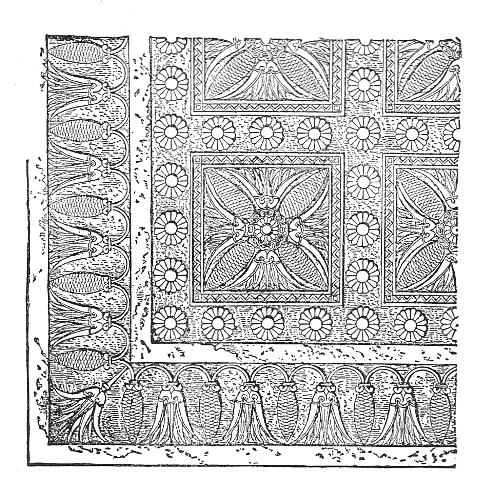 THRESHOLD—SLAB IN ASSHURBANIPAL'S PALACE.
The Medes belonged to the Indo-European branch of the
Aryan race. It is supposed that they came into Europe from
the far east, and thence migrated to Asia, some time previous
to 1000 B.C. They settled a mountainous tract to the east
of Assyria, occupying a district rather larger than Babylonia
and Assyria together. Because of its rugged mountains, narrow
passes, and inclement winter weather, their country was
easily defended against invaders. In the days of Assyrian
dominance, the people of Media maintained uniform independence,
notwithstanding the fact that military kings were
annexing territories far and near with almost irresistible force.
And so today, those who live in this district, remain comparatively
free from the government which seeks to rule them.
For the history of this ancient nation we are thrown almost
wholly upon the writings of Herodotus, Xenophon and
other Greek travellers, for as yet no antiquarian has attempted
to recover Median past from mounds of buried ruins. Indeed
the country has never been left desolate like Babylonia,
but its cities fell to the share of others, and later generations,
finding material for new buildings in the structures of their
predecessors, have left no mounds to allure the historian and
archæologist. Since rich finds in other lands have in recent
years thrown unexpected light upon the past, it has been
surmised that beneath the present cities, in this land of ancient
Media, might be recovered monuments of her early life. So
far, however, other fields have proven more inviting to the
explorer and the excavator.
In spite of the faults of credulence and exaggeration so
characteristic of Herodotus, we must nevertheless turn to his
writings and to those of Xenophon for Median history.
We have noted that during the eighth century, Assyria
made a raid into Media. The independence of the people
was not disturbed however. This verifies the statement of
Herodotus that the Medians made good soldiers, hardy and
well able to defend their land. They were trained to a life
of physical activity, inured to the hardships of a rigorous
climate. Charging on horseback at full speed, they made
a formidable defense.
In their early conflicts they seem to have displayed excessive
cruelty in war, showing no mercy to helpless women
or innocent children. As for plunder, they cared little for
it, and Isaiah refers to them as "the Medes who care not
for silver, and as for gold, have no delight in it."[1]
By frequent plundering raids into their territory, the
Assyrians incurred the lasting hatred of the Medes, who,
urged on by a spirit of revenge, united in 606 B.C. under a
Median prince to aid the king of Babylonia against the Assyrian
monarch. Having defeated the army, the Medes pursued,
and shut the Assyrian force within the walls of Nineveh.
Thereupon they made an assault upon the defenses of the
city and carried the day. The capital of Assyria and all the
wealthy cities of the realm were overrun, plundered and
burned, while the surviving inhabitants were so widely
scattered that we hear no more about them.
Before this the Medes had cared little for luxury and
ease, although they always delighted in a certain barbaric
splendor. With the vast treasure of Nineveh their king now
built a palace of extensive proportions. Its halls and pillars
were of woods, its courts wide and the whole structure magnificent.
No wood was left visible, all being concealed by a
coating of silver tiles. Herodotus wrote thus of the palace
walls:
"The walls enclose the palace, rising in circles, one within
the other. The plan of the place is that each of the walls
should out-top the one beyond it by the battlements. The
nature of the ground, which is a gentle slope, favors this
arrangement in some degree, but it was mainly effected by
art. The number of the circles is seven, the royal palace and
the treasuries standing within the last. Of the outer wall,
the battlements are white; of the next, black; of the third,
scarlet; of the fourth, blue; of the fifth, orange; all these are
covered with paint. The last two have their battlements
coated respectively with silver and gold."
We may gain some idea of the wealth represented by this
building when we learn that the king of Persia carried away
the greater portion of the gold and silver decorations for his
palace; Alexander the Great removed the silver tiling from
the roof, and some seventy years later another conqueror
found about $5,000,000 worth of gold and silver plating
overlooked by his predecessors. While no former palace may
have exceeded this in actual outlay of wealth, others may
have been more artistic, for the Medes reached no special
architectural skill.
After the Assyrian conquest, the Median nation soon became
weak and degenerate. The people affected a life of
luxury and idleness. The king lived amidst pomp and ostentatious
seclusion; his courtiers and nobles gave themselves up
to immoderate indulgences and amusements. While under
Cyaxares and his father, Media had become a power in Asia,
upon the death of this king, his son Astyages succeeded to
the throne. He had grown up during the later years of
ease and had no greater ambition than to rule the kingdom
left him, no more animating impulses than to pass his days
amid the ceremony and studied formality of the Median court.
Astyages seems to have planned neither political activity nor
personal diversion. He never joined in the hunts which were
popular with his courtiers. Rather, he spent his leisure with
such entertainment as his palace afforded and for his administration,
depended wholly upon the reports of his officials.
Such was Media when a Persian king, realizing the real situation,
led an army against the country. In connection with
our study of Persia we shall come again to the story of this
conquest.
Polygamy was always allowed by the code of Median
laws and morals, while women seem to have been treated
with a certain chivalrous attention and deference. The civilization
of the land was similar to that of Persia, which nation,
it is supposed, sprang originally from the same stock. No
greater difference existed between the two peoples than might
be found between two modern Teutonic nations.
Education and learning was not valued in either country.
Boys were taught to ride, to hunt, to shoot, and to become
proficient in out of door sports rather than the arts of reading
and writing.
The religion was akin to that of Persia, and the faith of
the Persians was singularly pure. They like the Hebrews,
worshipped one God. No degrading ceremonies and teachings
attached to their forms of worship, as was the case in
Egypt and Babylonia. The most ancient writings of the
Zenda-Vesta appear to embody the faith of the Medes, and
these will be considered in connection with the religion of
Persia.
In conclusion, it may be said that the Medes were neither
an inventive nor an ingenious people, nor did they develop
a great civilization, culture, or literature. Indeed we are
forced to the conclusion of Rawlinson: they scarcely contributed
an idea or invention to the great store of knowledge
transmitted by the past to the modern world.
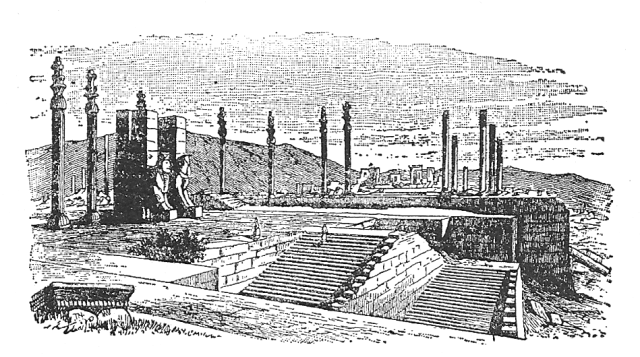 RUINS OF PERSEPOLIS.
The origin and early history of both Medes and Persians
were similar. When first the Persians are mentioned in
Assyrian annals, they had migrated to the region east of
Assyria, inhabiting an indefinite district which later became
part of the Median state. At this time—about the ninth
century before the Christian era—they were not united under
one king, but each clan followed the leadership of a chosen
chieftain. As a result of an Assyrian attack, more than
twenty of these chiefs brought tribute and acknowledged the
supremacy of the great king.
Nothing of importance is again heard of them until shortly
before the fall of the Assyrian capital. They were then united
into a kingdom, serving one ruler, and living in what has
been called "Persia Proper," to distinguish the original state
from the wide empire which was brought at length under
Persian rule. While free to manage their internal affairs,
they paid tribute to Media, now a vigorous and aggressive
nation. It is plain then, that previous to the fall of Nineveh,
the Persian state had taken no part in Asiatic affairs, and
furthermore, was not yet free and independent. However, in
less than one hundred years her people had gained control
over the entire western portion of Asia, extending their rule
from the Indus to the valley of the Nile, while only the little
Greek nation held out against them on the west.
Before entering upon a study of this rapid imperial expansion,
it would be well for us to get some general impressions
of the comparatively small territory in which the various
Persian tribes became welded into a united people, and of
the conditions in the original kingdom wherein the principles
which were to temporarily dominate the ancient world were
developed.
Persia Proper consisted of an area of about 450 miles in
length, and averaging 250 miles in width. It might have
been roughly bounded on the south and west by the gulf which
came to bear its name, while a desert reached off to the east
and north, save where Persian territory touched upon the
Median kingdom. A narrow strip of arid land lay between
the gulf and a mountain range, making up perhaps one eighth
of the entire area. The climate here is hot and dry, the soil
marshy, producing little growth of any sort. The district
east of this range was irregularly divided into highlands and
valleys, lofty rocks and winding chasms. Wherever water
was available, vegetation was luxuriant, making the wild
scenery fantastic and attractive. Generally water was scarce,
and most of the year the land lay parched and brown.
"The region east of the range is of varied character. In
places richly fertile, picturesque, and romantic almost beyond
imagination, with lovely wooded dells, green mountain-sides,
and broad plains suited for the production of almost any crops,
it has yet on the whole a predominant character of sterility
and barrenness, especially towards its more northern and eastern
portions. The supply of water is everywhere scanty.
Scarcely any of the streams are strong enough to reach the
sea. After short courses they are either absorbed by the sand
or end in small salt lakes, from which the superfluous water
is evaporated. Much of the country is absolutely without
streams, and would be uninhabitable were it not for the subterranean
channels of spring-water.
"The most remarkable feature of the country consists in
the extraordinary gorges which pierce the great mountain-chain,
and render possible the establishment of routes across
that tremendous barrier. Scarped rocks rise almost perpendicularly
on either side of the mountain streams, which descend
rapidly with frequent cascades and falls. Along the slight
irregularities of these rocks the roads are carried in zigzags,
often crossing the streams from side to side by bridges of a
single arch, which are thrown over profound chasms where
the waters chafe and roar many hundred feet below. The
roads have for the most part been artificially cut in the sides
of the precipices, which rise from the streams sometimes to
the height of 2,000 feet. Thus the country towards the edge
of the plateau is peculiarly safe from attack, being defended
on the north and east by vast deserts, and on the south by a
mountain barrier of unusual strength and difficulty.
"It is in these regions, which combine facility of defence
with pleasantness of climate, that the principal cities of the
district have at all times been placed."[1]
It appears that nearly one-half of the kingdom was practically
unsuited for habitation, being dry and producing little
to sustain life. In these early times only two or three cities
existed, small villages making up the remaining social centers,
while peasants farmed limited portions of the outlying
country where the water supply sufficed to maintain crops.
Various fruits abounded in the mountainous regions.
Peaches were native to the soil. Grapes grew in profusion,
and corn and vegetables were plentiful. Along the coast fish
might be found in large quantities and constituted a staple
article of food throughout the land. The natural conditions
were not sufficiently favorable to allow heavy yields of grain
or to make agriculture foremost among the nation's activities.
The Persians were active, vivacious people, lacking wholly
the repose and dignified calm so characteristic of the English,
for example. They concealed neither joy nor sorrow, and
were immoderate in their expressions of both.
Learning and education were given little attention. It
has become a trite and well-known saying that "Persian boys
were taught to ride, to shoot, and to speak the truth." The
religion of the people placed truth first among the virtues.
Their steadfast fidelity to a promise excited wonderment
among the nations. Physical, rather than mental, development
was sought, and while in the nation's later life the
people gave themselves up to indolence, passing the hours with
personal adornment and feasting, these pastimes did not characterize
their early years.
Like the Medes, Persian nobles had several wives, and
polygamy was the rule rather than the exception. Women
were kept in well-nigh complete seclusion, and no mention is
made of them, nor are they seen in pictures adorning the
palaces.
The attitude assumed toward the sovereign influenced the
very character of the people. "The Persian king held the
same rank and position in the eyes of his subjects which the
great monarch of Western Asia, whoever he might be, had
always occupied from time immemorial. He was the lord
and master, absolute disposer of their lives, liberties, and
property; the sole fountain of law and right, incapable himself
of doing wrong, irresponsible, irresistible—a sort of God on
earth; one whose favor was happiness, at whose frown men
trembled, before whom all bowed themselves down with the
lowest and humblest obeisance.
"The feeling of the Persian towards his king is one of
which moderns can with difficulty form a conception. In Persia
the monarch was so much the State, that patriotism itself was,
as it were, swallowed up in loyalty; and an unquestioning submission,
not only to the deliberate will, but to the merest
caprice of the sovereign, was, by habit and education, so ingrained
into the nature of the people that a contrary spirit
scarcely ever manifested itself. In war the safety of the
sovereign was the first thought, and the principal care of all.
If the king suffered, all was lost; if the king escaped, the
greatest calamities seemed light and could be endured with
patience. The same cheerful submission characterized times
of peace. It was here that their loyalty became a defect rather
than a virtue. The voice of remonstrance, of rebuke, of warning,
was unheard at Court. Tyranny was allowed to indulge
unchecked in the wildest caprices and extravagances. The
father, whose innocent son was shot before his eyes by the
king in pure wantonness, instead of raising an indignant protest
against the crime, felicitated him upon the excellence of
his archery. Thus a tone of servility was engendered which,
sapping self-respect, tended fatally to lower and corrupt the
entire character of the people."[2]
Such were the tendencies of the embryo state which under
the leadership of a great ruler was soon to burst into sudden
and brilliant flower, absorbing in a single campaign nations
which had never before been united.
In ages when monarchs were absolute in the foremost
countries of the world, the personal ability of the king was
a matter of far greater concern than we today realize. In
modern times, political and social changes have had their beginnings
in the conditions and desires of the people. In the
remote years we are now studying, the people were less considered,
and their wishes seldom heard. The personal character
of the king determined the policy of the ancient state.
We have already seen how the welfare—the very fate of
Egypt, Babylonia and Assyria depended upon their rulers.
Even more pronounced was this in Persia, where subjects,
including nobles and princes, acted in unthinking submission
to a degree unknown in other lands.
In taking up the career of Cyrus the Great we are largely
dependent upon the writings of Herodotus and Xenophon.
Of Herodotus we have learned something, and concerning
Xenophon we may note that besides being a writer and a
traveller, he was also an experienced and able general.
Herodotus lived some fifty years after the death of Cyrus,
and Xenophon was thirty years younger than Herodotus.
Both Greeks wrote at length of the great Persian King.
When Astyages ascended the throne of Media, Persia was
a mere tribute-paying kingdom, insignificant not only in political
strength, but in social life, wealth, and culture. It is supposed
that Cyrus was sent to the Median court as a hostage
from a tribute land. His father ruled in Persia, and we are
told that he was greatly impressed as a boy by the difference
between the two countries. The subjects over whom his
father ruled were many of them soldiers whose days were
spent with training and physical exercise. They ate and drank
moderately, and while they lacked the culture and refinement
of the northern kingdom, they were just coming into the
strength and vigour which the Medians lost upon their conquest
of Assyria and subsequent abundance of wealth.
Tradition pictures the youth clinging to the simple habits
of his early life, and caring little for the pomp and ceremony
around him. He delighted in riding and liked the hunt best
of all amusements, while he shortly became the companion
of Astyages during the king's leisure hours, bringing refreshing
life and boyish candor into a degenerate court.
Some years later Cyrus returned home and, shortly after,
a faction of the Medes who had become devoted to the Persian
prince and felt dissatisfied with the tyranny of their king,
informed Cyrus that if he would bring an army against the
Medes, they would cause the Median forces to desert to him.
Another account says that Cyrus himself planned the conquest
while at the Median court, and having feasted his attendants
and led them to drink heavily, escaped to Persia, where he
soon persuaded his father to march against the Medes. In
either case, it would seem that the prince had learned the true
condition of degenerated Media, and determined to free his
own land from the hated tribute service—establishing its
independence.
In the battle which was waged against the two people,
Astyages was taken captive, and when the majority of the
soldiers went over to the Persian side, the remaining soldiers
fled. Cyrus allowed Astyages to retain his own personal
attendants, and permitted him to live in a style befitting his
recent position. Under guard of Persian soldiers, he was free
to go about at will.
It is probable that Cyrus had at first no greater ambition
than to free Persia from tribute imposed by Media, but the
desire for conquest once awakened never ceases while lands
remain unwon. In conquering Media, all territories of
Assyria fell to Cyrus' portion. The Medes had held lands to
the river Halys on the northwest. Beyond this boundary
stream the empire of Lydia had been growing under the rule
of Crœsus.
Crœsus has become proverbial for his wealth. As he extended
the boundaries of Lydia, he grew wealthier still,
until his resources exceeded all estimate. Having lost a
favorite son, he lived in seclusion until a sense of approaching
danger roused him to defend his kingdom. The river Halys
was a narrow stream—too small by far to prove a lasting
barrier against an aggressive nation. To spare his land the
ravages of war, Crœsus determined to invade the land of his
rival. He thought best to consult the oracle at Delphi before
entering upon such a serious campaign. Having sent costly
presents to Delphi, Crœsus inquired whether or not it would
be safe for him to proceed against Persia. The reply was
that if Crœsus crossed the Halys and carried war into Persia,
a mighty kingdom would be overthrown, and that he would
do well to form an alliance with the strongest Greek state.
Regarding the answer as favorable, he sent word to Sparta
that, since he was advised by the Delphian oracle to seek the
strongest Greek state as an ally, he solicitated their assistance.
These Spartans were unlike any soldiers we have yet met;
they fought for glory, not for plunder. They were glad, of
course, to be considered the strongest Grecian state, and sent
the assistance asked. With such re-enforcements, Crœsus
crossed the Halys and met Cyrus who had known of the
Lydian movement and was ready for an attack. The battle
was fought near Pterie; both sides lost heavily, and Crœsus
thought Cyrus was too crippled to longer advance, so he himself
returned to Sardis, his capital, to make plans for a new
campaign the following year. Cyrus waited until the Lydian
troops were largely disbanded, and then suddenly appeared
before Sardis. Consternation swept over the Lydians, but
they trusted to their cavalry which was numerous and well
disciplined. Cyrus had also taken the Lydian cavalry into
account, and had ordered his camels which carried the equipment
of war, to face the horse, and if possible, to put them
to flight. In the battle fought such was the result—the horses
turned in confusion upon the charge of the camels, and the
Lydian army withdrew into Sardis to undergo a siege. They
expected to win in the long run, for they had sufficient stores
of all kinds, and they hoped that outside aid would come
sooner or later. Cyrus understood the danger of delay, and
determined to carry the city by assault. By scaling a nearly
perpendicular embankment, entrance to Sardis was gained,
and Crœsus fell into the hands of the great Persian conqueror.
He was given considerate treatment. Few cruelties disfigure
the pages of Persian history, and never were severe
punishments meted out wholesale to captives in war. Those
who betrayed confidence were harshly dealt with, and rebels
seldom escaped, but the Persians were generally fair-minded.
Cyrus was uniformly mild and generous, lacking the inordinate
pride of most Oriental monarchs, treating his subjects
with kindness. Crœsus became one of his trusted companions,
and accompanied him upon his later campaigns. The story
of the funeral pyre is probably an invention of the Greeks,
or, if it had any foundation whatever, it may be that Crœsus
requested such an honorable end in preference to swearing
allegiance to an unknown conqueror.
When measures had been taken for the government of
Lydia, attention turned to Babylonia. There, as we have seen,
the crown was worn by a king who was more interested in the
temples of the gods than in the immediate welfare of his nation.
His son Belshazzar made some defense outside the capital, but
a faction within the city, out of sympathy with the existing
government, allowed the Persians to take possession. Cyrus
now allowed the Jews to return to Jerusalem and there to
rebuild their temple and to make their homes in the land of
their fathers. For this reason the Hebrews had only words
of praise for Cyrus. To the number of 49,697, with their
property and possessions, they set upon their long march—a
peaceful band which encountered no opposition throughout its
course. The event stands unparalleled in history.
Had Cyrus lived, he would doubtless have added Egypt
to his empire. This was left for his son to accomplish. The
great king fell fighting for territories in the north.
In conclusion, it may be said that Cyrus is the first great
conqueror we have so far met who was kind and humane.
His policy towards the conquered stands out in marked relief
to the butcheries and punishments which characterized Assyria.
Notwithstanding, all charges of selfish motives which have
belonged to those who have sought to become world-conquerors,
attach to Cyrus. Urged on by personal vanity and hope
of becoming supreme, he considered only the final issue and
allowed his ambition to triumph over his nobler nature. Some
years later Alexander emulated his example, and one hundred
years ago Napoleon undertook the same gigantic task—greater
in his day—of building up a world-empire. The motives
prompting all three were the same, and in each case the
empires, so quickly brought into being, vanished as quickly
as they arose.
Upon the death of Cyrus, in 529 B.C., his son Cambyses
succeeded to the throne, while a younger brother Smerdis,
was left to supervise certain provinces, according to his
father's wishes. The conquest of Egypt had been planned
by Cyrus and would undoubtedly have been undertaken by
him had he lived. Cambyses at once began preparations to
this end and these occupied some considerable period.
This young prince who had just come into absolute power,
apparently inherited all his father's failings and few of his
virtues. He had never learned to control himself and that
omened ill for those who became his subjects. His jealousy,
suspicion, cruelty, and arrogant pride contrasted strikingly
with the generous, kindly temperament of Cyrus. Before setting
out for Egypt, he had his brother secretly murdered. No
rumor of this crime reached his subjects, however.
Egypt at this time was not able to defend herself against
an army that had become experienced and confident under the
command of Cyrus; consequently, the country fell rapidly
into the hands of the new Persian king. Far from showing
the leniency of his father toward the vanquished, he marked
his victories with needless cruelty.
The two great powers of Africa besides Egypt were the
states of Ethiopia in the south, and Carthage in the northwest.
Of the former we learned something in The Story of Egypt;
of the latter we shall learn later on. Suffice it to say
here that the Carthaginians were colonists of the Phœnicians,
and, like them, were traders whose commerce penetrated to all
lands washed by the Mediterranean Sea.
When Egypt lay at his feet, Cambyses resolved to make
himself supreme in the whole continent of Africa—only the
northern portion of the continent was then known. Accordingly,
he directed troops to advance against these two powers
which he thought alone worthy of his notice. Now Carthage
could only be taken by sea, and the king was limited to
Phœnician vessels, manned by Phœnician sailors. These men
promptly refused to make war on their own colony, whose
interests were so closely interwoven with those of their
country. Their stand must have been united and firm, for
Cambyses found himself obliged to abandon his project. The
expedition to the south was disheartening. The Persian
soldiers were unused to the hot sands and intense sun of
Nubia and great loss and discouragement overtook the army.
Those who withstood the heat were too exhausted by the
march to accomplish anything. The king remained in Egypt.
He was constantly haunted by his crime against his brother.
He realized his unpopularity with his subjects, and feared
that disaster would at any time overtake him. His fears were
shortly reflected in his soldiers, who having learned that they
were no longer led by one who could bring victory in the face
of opposing obstacles, lost heart and fought indifferently.
Herodotus wrote at length concerning the conduct of Cambyses
in Egypt and his stories were long credited. Tales were
told of Cambyses' profaning Egyptian temples, desecrating
the tombs of the dead, stabbing the apis-bull with his own
sword, outraging the priests and inflicting such injury upon the
nobles as only the madness which they attribute to him, could
explain. In recent years these statements have been modified
by investigation. An Egyptologist of first rank claims that
the tale regarding the apis-bull was not well founded. Unquestionably
Cambyses was brutal in his treatment of a mild
and gentle people, and he may have easily incurred the wrath
of the priesthood by his contempt for their religion, certain
features of which he regarded as mere folly. It is also probable
that his deeds have been greatly exaggerated by those
who had cause to hate him for his interference with a land
to which he had no just claim. Instead of being insane, he
no doubt displayed his ungovernable temper and in moments
of rage, gave orders which he would gladly have recalled in
another mood.
While Cambyses loitered in Egypt, a report spread through
the empire that Smerdis had been crowned, and that Cambyses
need no longer be regarded as king. One of the Magians, a
priesthood of Persia which represented a more material form
of worship than the teachings of Zoroaster allowed, had
attempted to usurp the throne in Cambyses' absence. The
real king, feeling depressed with his partial victory, doubting
the fidelity of his army, confessed the murder of his brother
to his ministers. Having thus disclosed the presumption of
the pretender, Cambyses committed suicide.
Darius, a prince of the house of Cyrus, was chosen to
succeed. This was a choice likely to prove acceptable to the
people, for he was the only legitimate heir to the throne.
Herodotus explained with all gravity that the counsellors of
state, of whose number Darius was one, agreed to determine
the succession after this fashion: they would each go on horseback
at sunrise to the city gate, and he whose horse neighed
first should be proclaimed king!
When the people finally learned the truth and realized
how great a deception had been practised, they turned against
his priesthood and instigated a general massacre. The worship
they had established was cast aside and the purer faith
of ancient Persia was restored. The pretender had compelled
the Jews to cease labor on the new temple they were building
in Jerusalem. Darius gave them permission to continue. So
similar were the religions of the Hebrews and Persians, that
there could be no friction between the two nations on that
ground in an age when nearly all religions were polytheistic.
Darius was long occupied with internal disturbances.
Revolts were put down with severity. When the government
of the empire was firmly established, it was superior to
any before known in Asia. The whole empire was divided
into satrapies, or provinces—each under a resident governor;
these governors made frequent reports to the capital and the
opportunity for revolts was slight.
Internal concerns thus settled, Darius turned to conquest.
He conducted a campaign in the east, pushing Persia's possessions
to the banks of the Indus.
It was natural that the king should have cast longing eyes
westward, toward the beautiful isles and states of Greece.
Long before the age of Cyrus, Greek colonists had settled in
Asia Minor. They had fallen to the share of Persia when
Lydia was conquered, and Darius had organized their local
government so completely that the freedom-loving Greeks
were oppressed by it and in 500 B.C. revolted. These Greek
cities appealed to Athens for aid in their struggle for liberty.
A few soldiers were sent, and with such aid they displaced
the Persian government and destroyed Sardis. Darius sent
an army to put down the revolt, and the city which had led
the struggle was destroyed. The king of Persia now
determined to punish Athens for having given help to the
revolting Greek cities of Asia Minor. Accordingly, he fitted
out an expedition to conquer Greece. The naval forces were
wrecked in a storm and the land forces were routed by hostile
tribes en route. A second expedition was prepared, more
numerous and better equipped than the first. Before dispatching
it, however, Darius sent heralds to the various Greek
states to inquire if they would submit peacefully. They
replied with great scorn. In 490 B.C. the Persian king sent
300,000 soldiers to conquer Greece. The battle of Marathon
was fought, and owing to the skill of Miltiades, the Greeks
won. Four years later Darius died and Xerxes ruled in his
stead. To him was left the duty of wiping out the inglorious
defeat of the Persian arms. Not until 480 B.C. were the
armies ready for what was expected to be a great conquest.
It has been said that never in the history of the world
has such a motley array of soldiers been gathered together
under one commander. All nations subservient to Persia were
represented, and while Herodotus may have overstated their
number, we may accept his statement that it was the largest
force ever thus far marshalled together. At the defense of
Thermopylæ the Persians learned the character of their opponents.
A little band of three hundred Spartans under command
of Leonidas held the entire Persian army at bay in a
narrow pass for two days. When the army spread out over
the land, the Greeks realized their inability to cope with it
and decided to hazard all on a naval engagement. The famous
battle of Salamis followed, in which 1,000 men-of-war belonging
to the Persians were destroyed or put to flight by 300
Greek vessels. Xerxes watched the fight from a throne hastily
constructed for him on the shore. When at night his naval
forces withdrew to Asia, he could scarcely credit the outcome.
Byron has immortalized the occasion in a stanza:
"A king sate on the rocky brow
Which looks o'er sea-born Salamis;
And ships, by thousands, lay below,
And men in nations—all were his!
He counted them at break of day—
And when the sun set where were they?"
Leaving a strong land force to conquer the Greeks the
next year, Xerxes returned to Persia. By the following
spring the Greeks had gathered their forces, and inspired by
their glorious victory at Salamis, they defeated the Persian
army in the battle of Platæa. Thereupon the Greek cities
in Asia Minor asserted their freedom, and Greek independence
shone forth triumphantly before the world.
"But this glorious struggle and triumph of the few lifted
to superhuman heroism by an ennobling moral principle, as
against the merely brutal force of numbers, does not properly
belong any more to the history of the East, nor to that of
remote antiquity; it is the dawn of a new star in the West,
and of times which, from their spirit, actors, and achievements,
may almost be called modern. At the bottom of the
new departure lies the difference between the ideals—the conceptions
of beauty and dignity of the political and social life—set
up by the Oriental and Western man: 'A good
master!' is the prayer and ideal of the Asiatic. 'No master!
Liberty at any price, as the highest good in itself!' is that
of the Greek. And the Greek wins the day, for his own
time, and for his own race, and for future times and races
to come."[1]
The following period, embracing nearly 150 years, was
a time of decay and degeneracy. With Xerxes began the corruption
of the Persian court—the licentiousness, assassinations,
murders, and accompanying crimes which soon undermined
the entire social order. Conditions were such that
rulers were no longer strong, vigorous men, full of life and
ambition—save indeed those usurpers who occasionally appropriated
the reins of government. The days of Persian greatness
were over, and under guidance of one or another of the
princes, the state plunged on to ruin. In 336 B.C., Alexander,
the young king of Macedonia, embarked upon his world conquests,
and the Persian Empire merged into the Empire of
Greece.
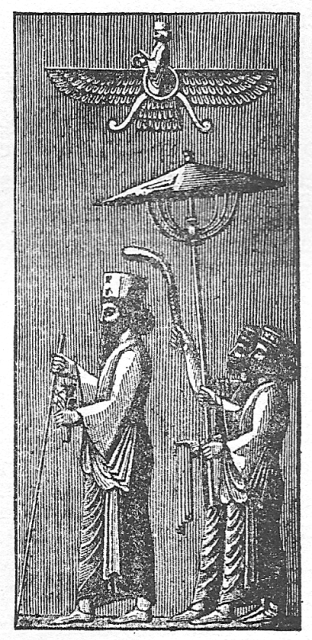 THE PERSIAN KING
(WITH ATTENDANTS).
THE PERSIAN KING
(WITH ATTENDANTS).
There were wide differences between the civilization of
the Persians and of the dwellers in the Tigris-Euphrates
valleys. The Persian despised trade. His religion taught
him to speak the truth, and he regarded commercial dealings
as incompatible with this requirement. No shops made the
principal streets in his country the scenes of hot disputes concerning
prices and wares. The few shops which existed at
all were tucked into obscure places on unfrequented by-ways.
It naturally followed that there was an absence of those industrial
centers which in Babylonia produced rare stuffs, delicate
fabrics and ornaments. Swarms of slaves provided whatever
was required by the wealthy, and it was the Persian's
boast that his sword brought him the luxury of the world in
tribute.
It has been estimated that the total population of Persia
did not exceed 2,000,000. A small proportion of these were
peasants who tilled the arable soil. Agriculture was held
honorable and was encouraged by the national religion. The
great majority of men were soldiers.
Since the soldier's life was thought to be worthy of a
Persian, we may do well to consider whatever features characterized
the service in this empire. Probably because of the
mountainous country in which they dwelt, chariots were never
popular with these people. Ordinarily they were impractical,
being suited to plains and accessible places. Nevertheless a
few were used and these were furnished with scythes attached
to the axle. Chariots formed the front line of defense. Behind
them the foot soldiers were arranged in squares, with
cavalry on the wings. One commander—the king, if he
were present,—gave commands to all from his position in the
center. This was an evident fault, for, were he killed or in
any way disabled, the entire army sometimes took fright and
fled. When the charge was made, the chariots dashed ahead,
hewing right and left. They seldom failed to break the solid
line drawn up before them, whereupon the infantry and horse
followed, taking advantage of the confusion thus wrought.
If the regular line of Persian soldiery was broken or in any
way disturbed, since they had no reinforcements in a second
division, the battle was almost always lost. To prevent such
an occurrence was their aim. It has been said that the Orientals
of this time could not be trusted to fight unless they
were well supported at the rear—hence the custom of forming
one deep line. The native Persians were brave soldiers,
but their ranks were generally composed largely of subjects
levied throughout the empire. Scantily clothed Nubians
fought with clubs and stones in the same army with well-equipped
natives. Drawn up by nation, in native custom, it
is not surprising that they presented a sight marvellous indeed
to the foreigner.
The contrast between Greek and Persian military tactics
was marked. The Greeks trusted to their solid, heavily-armed
phalanx; the Persians tried to equip themselves as lightly
as possible, and trusted to their agility and swiftness of
motion. Their leniency toward captives has been mentioned
before. They found no delight in mere slaughter.
Literature and learning had little part in the life of the
average citizen. The boy was left with his mother until five
years of age. Then his education began. He rose before
dawn and was trained in running, throwing stones, and shooting
with an arrow. At seven he was taught to ride, and in
Persia this implied much. He must be able to spring on a
horse running at full speed, to shoot accurately when under
rapid motion. In course of a few years' practice it was not
strange that a Persian was never so at ease as on his horse.
Furthermore, he was compelled to endure severe hardships—sleeping
under the open sky, eating only one meal in two days,
making long marches, and swimming streams burdened with
his weapons. At fifteen years of age he was considered a
man and was enlisted in the army, where he ordinarily served
until fifty.
During the period of the Persian empire, a numerous body
of officials made up the king's retinue. Besides the farmers,
soldiers and officials, there were many slaves, who completed
the social body. They performed all kinds of labor, built
the palaces and made fine roads throughout the realm.
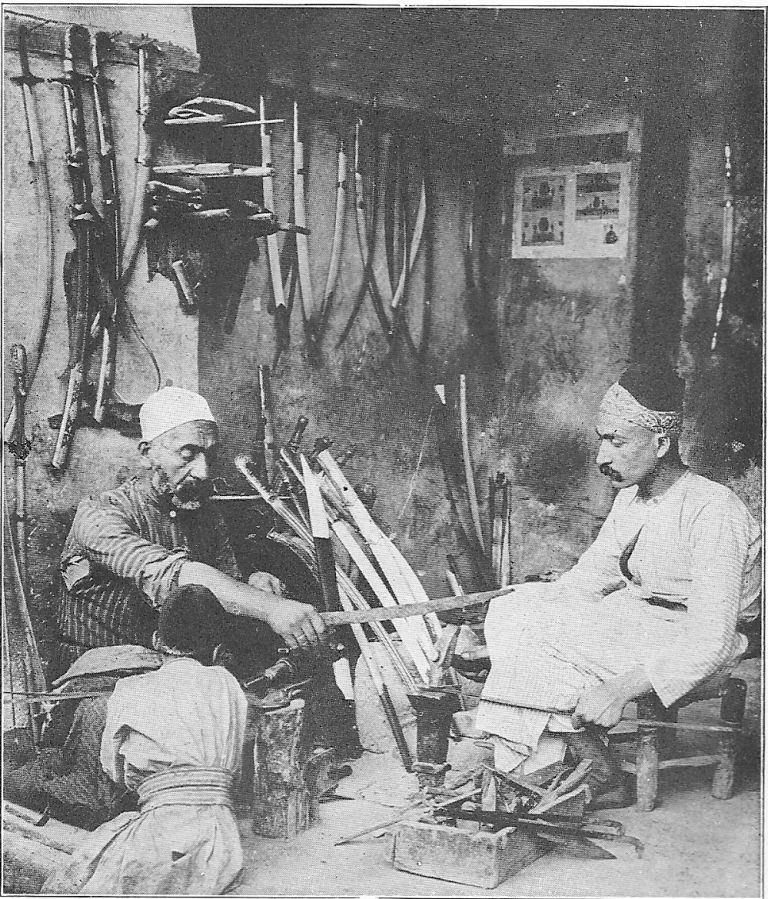
Copyright by Underwood & Underwood, N. Y.
Damascus Sword-Maker.
The Persian court has probably never been excelled in
ceremony and pomp. Ceremony surrounded the monarch during
hours of retirement and seclusion as well as when before
the public eye.
"The officers in most close attendance on the monarch's
person were, in war, his charioteer, his stool-bearer, his bow-bearer,
and his quiver-bearer; in peace, his parasol-bearer, and
his fan-bearer, who was also privileged to carry what has
been termed the 'royal-handkerchief.' Among the officers
of the Court, less closely attached to the person of the monarch
than these, may be mentioned the steward of the household;
the groom or master of the horse; the keeper of the women's
department, the king's 'eyes' and 'ears'—persons whose
business it was to keep him informed on all matters of importance;
his scribes, who wrote his letters, his messengers
who went his errands, his ushers, his tasters, who tried the
various dishes set before him lest they should be poisoned;
his cup-bearers, who handed him wine and tasted of it; his
chamberlains who assisted him to bed; and his musicians, who
amused him with song and harp. Besides these, the Court
comprised various classes of guards, doorkeepers, huntsmen,
grooms, cooks, and other domestic servants in abundance, together
with a vast multitude of visitors, guests, princes, captives
of rank, foreign refugees, ambassadors, and travellers.
We are assured that the king fed daily within the precincts
of his palace as many as 15,000 persons, and that the cost
of each day's food was 400 talents. A thousand beasts were
slaughtered for each repast, besides abundance of feathered
game and poultry.... On all occasions the guests, if
they liked, carried away any portion of the food set before
them, conveying it to their homes where it served to support
their families."[1]
Prescribed etiquette governed everyone, from the king to
his meanest subject. The august king must dine alone, or
at best have with him the queen and her son. He could be
approached only with certain ceremony. Ceremony and form
were by no means confined to royalty and the court. Men of
different rank met each other with established form and salutation;
certain tasks could be performed only by persons who
could perform no other tasks. This led to a large body of
idlers around the court, ready to take part in any intrigue or
conspiracy. They gathered around the homes of the wealthy
as well as the palace of the king—water-bearers, adorners,
awakers, and each rigidly confined himself to his single duty.
In early times the Persians indulged in a single meal
each day. The custom continued later, but now the feast began
with the morning and ceased only with night. The amount of
wine a man could drink became his boast. In place of the
regular habits, frugal fare and constant exercise of early times,
were substituted the prolonged feast, all kinds of indulgencies,
and idleness.
The royal harem provided apartments for the king's several
wives in early years. Towards the close of the empire,
provision had to be made for some three hundred and sixty—if
we may trust one writer. The jealousies, differences and
intrigues which arose from this quarter can scarcely be imagined.
Each wished her son to be given preference, and
this ambition, together with the restlessness accompanying
enforced seclusion, stimulated crime and fostered conspiracies.
The favorite of the king might toy with the lives of his subjects—even
with the lives of those dear to him, at will. No
subject in the land had reason to think his life secure—least
of all, he who was today powerful.
For diversions—other than Court intrigues—the king
turned to the hunt. Dice throwing was the national game,
and the carving of wood was a frequent pastime. Since little
was known of books, men were forced to find some means
of passing hours unoccupied with national affairs or private
concerns.
Dress had been simple in early years. As time went on,
it became more complex; even matters of cosmetics and perfumes
were later deemed of weighty importance.
There is more to attract us in the Persian state during
years of its earlier simplicity, while yet the soldier found his
deepest satisfaction in military skill, bodily exercise and great
endurance, than in the period of imperial greatness, when the
court of Persia exceeded in splendor anything since known.
Some time between 1000-650 B.C., it is supposed there lived
a religious reformer by the name of Zarathushtra, or Zoroaster.
Both his birth-place and birth-date are alike unknown, but it is
supposed that he lived in Bactria, a country which reached
indefinitely along the Caspian Sea.
Little has come down to us concerning the great teacher
himself. He early felt called to his religious mission. Retiring
from the world, tradition says he lived for some years upon a
remote mountain, and here a divine vision came to him. He
communed with Ormuzd, the spirit of Good, and knew that his
work was to reclaim man, who in blindness had wandered
away from truth and light, and to bring him into new relationship
with the divine spirit which was ever ready to win
mankind to himself.
At the age of thirty, Zoroaster was prepared to preach the
new law. For ten years he wandered about, but found few
to listen to him. His family and friends were gradually won
to the faith he taught, and returning to the Caspian Sea region,
he found more willing hearers.
The conceptions from which he had evolved his faith were
already accepted to some extent by those among whom he
came. He taught that there were two spirits—Ormuzd or
Good, embodying all truth, life, beauty, order, light; and
Ahriman, or Evil, including all darkness, death, falsity and
disorder. Life was a struggle between these two contending
forces. "He laid before his people their own thoughts
in all the pure transparency of crystal waters cleared from
muddiness and unwholesome admixtures in the filter of his
own transcendent and searching mind. He guided their groping
hands, and made them grasp the truth for which they were
blindly reaching. Such is the mission of every true prophet.
Had the people not been ripe for his teaching, he could not
have secured a hearing, or made himself understood; the people,
on the other hand, could never have worked out unaided
the ideal to which they were vaguely and only half-consciously
drawn. They listened and understood, and were
won, because, to use the expression of a great writer, they
had in themselves the seed of the thoughts which the prophet
expounded to them."[2]
Seven times divine beings brought messages to Zoroaster.
"They inculcate the doctrine of purity of body as well as of
soul; they enjoin the care of useful animals, especially the
cow and the dog; they emphasize the necessity of keeping the
earth, the fire and the water undefiled; and from several of
their ordinances we can see that Zoroaster was a civil reformer
as well as a spiritual guide. Foremost among the commandments
is the abhorrence of falsehood, the universal obligation
to speak the truth. This is one of the most fundamental of
the ethical tenets which form the basis of the entire ancient
Persian religious system."[3]
The writings which contained the teachings of Zoroaster
are commonly known as the Zenda-Vesta. The name is misleading
however, and should read Avesta-u-Zend, which translated
means: "Law and Commentary." Among students the
compilation is generally called the Avesta. Even a casual
reading of the Old Testament reveals the fact that the various
books composing it were written by different writers, writing
under radically different circumstances, and at widely distant
periods. The same is true of the Avesta. One of its
books was probably written either by Zoroaster himself or
under his supervision. This is the Gathas, or book of songs,
and is the most ancient portion of the entire collection. Sermons,
prayers, and sayings are therein contained, some of
which possess poetic beauty and rare purity. Other books
were added from time to time, until the Avesta is said to have
been made up of twenty-one books, and to have covered 1,200
cowhides.
When Alexander the Great conquered Persia in 332 B.C.,
elated by his victory, and having drunk heavily of wine, he
allowed his soldiers to burn the capital, and with it perished
much of greatest value. Most of the Persian literature was
then destroyed, together with the noblest specimens of Persian
architecture and decoration. While cities were few, it seems
remarkable that the only copies of the Avesta were burned.
For several centuries following, the teachings of this sacred
book lived only in the memories of priests. Finally in 325
A.D., a council was called to take measures to have these
ancient doctrines committed to writing. Naturally the result
was fragmentary and incomplete. Only those portions of the
original text which had been in daily use proved to be well remembered.
These were mainly prayers and invocations. The
priests in all probability, seized the opportunity to insert whatever
forms of worship and modified beliefs they desired to emphasize.
Their final effort, while far from satisfactory, embraces
all which now remains of the religion of Zoroaster and his followers.
In 636 A.D. the Mohammedan Arabs made a religious crusade
and undertook to blot out the old Persian religion. Most of the
descendants of the early nation yielded to the fire and sword. A
small portion of them took refuge in India, where they were allowed
to worship as they chose. Only with them was the Avesta
preserved. These Parsis have been called "the ruins of a people,
as their sacred books are the ruins of a religion." Of them
Justi writes: "There is no religious body in the world whose
practice is so completely in harmony with their moral code."
The collection of Zend Fragments, commonly known as the
Zend-Avesta, falls into two parts: The Avesta, properly so-called,
which contains (1) compilations of religious laws and
mythical tales; (2) collections of litanies for the sacrifice; (3)
litanies and hymns written in a language older than the rest of
the Avesta. Secondly, these writings contain the Small Avesta,
made up of short prayers, recited by all the faithful. It was
fitting that these collections of fragments be preserved, so far
as possible, in their original dialect, but since these were no
longer intelligible even to the educated, the Zend, or explanation—commentary—was
attached in the prevailing tongue. Otherwise
the greater portion of the work could not have been understood.
Some of the creation stories were not included in the
Avesta, but were gathered together with other myths in the
Bundehesh.
All worshippers are classified by the Avesta as followers of
Ormuzd—Good,—or Ahriman—Evil. One could either stand
for good or against it. "Now shall I proclaim unto you, O ye
all that here approach me, what the wise should lay to their
hearts; the songs of praise and the sacrificial rites which pious
men pay the Lord, and the sacred truths and ordinances, that
what was secret until now may appear in the light 'Hear with
your ears that which is best, and test it with a clear understanding,
before each man decides for himself between the two teachings.'
"The two Spirits, the Twins, skilfully created, in the beginning,
Good and Evil, in thought, in speech, in deed. And,
between these two, the wise have made the right choice; not
so the senseless. If, O men, you lay to your hearts these
ordinances which Ormuzd instituted, and the good and evil,
and the long torments which await the followers of falsehood,
and the bliss that must come to the holders of the true faith,
it will go well with you."
Followers of Zoroaster abhorred idolatry. No image of
their God corrupted their conceptions. In early times they
built no temples, having only altars whereupon sacrifices were
made. Darius often mentions Ahuramazda (Hormuzd) in his
inscriptions as the highest god of the Persians, and it is highly
probable that Cyrus was also a worshipper, a fact which made
him sympathetic toward the religion of the Jews and accounts
for his willingness that they rebuild a temple in Jerusalem for
the worship of Yahweh.
In later years, forms and symbols crept into the service,
for abstract teachings did not hold the masses of the people.
Fire was conceived to be a symbol of the God of Light, and
even today there seems to be a certain charm in the conception
that "a pure and undefiled flame is certainly the most
sublime natural representation of Him who is in Himself
Eternal Light." There must have been a sublimity in the
sight of the pure flames, rising to heaven from the mountain-tops,
while prayers and hymns of praise were poured out to
the one great Spirit, by whatever name known.
As days of degeneracy overtook Persia, the religion was
affected by the general lassitude and decay. A modernized
form of the early faith is found today among some 100,000 worshippers
in Arabia and India.
"We worship Ahura Mazda (Ormuzd), the pure, the master
of purity.
"We praise all good thoughts, all good words, all good deeds
which are or shall be; and we likewise keep clean, and
pure all that is good.
"O Ormuzd, thou true, happy being! We strive to think, to
speak, and to do only such actions as may be best fitted
to promote the two lives (the life of the body and of the
soul).
"We beseech the spirit of earth for the sake of these our best
works to grant us beautiful and fertile fields, to the believer
as well as to the unbeliever, to him who has riches
as well as to him who has no possessions."
"O Maker of the material world, thou Holy One! Which is
the first place where the Earth feels most happy?"
Ahura Mazda, the Good Principle, answered: "It is the place
whereon one of the faithful steps forward, O Zoroaster,
with the holy wood in his hand,[1] the baresma in his hand,[2]
the holy meat in his hand,[3] the holy mortar in his hand,[4]
fulfilling the law with love, and beseeching aloud
Mithra.[5]"
"O Maker of the material world, thou Holy One! Which is
the second place where the Earth feels most happy?"
Ahura Mazda answered: "It is the place whereon one of the
faithful erects a house with a priest therein, with cattle,
with a wife, with children, and good herds within; and
wherein afterwards the cattle go on thriving, holiness is
thriving, fodder is thriving, the dog is thriving, the wife
is thriving, the child is thriving, the fire is thriving, and
every blessing of life is thriving."
"O Maker of the material world, thou Holy One! Which is
the third place where the Earth feels most happy?"
Ahura Mazda answered: "It is the place where one of the
faithful cultivates most corn, grass and fruit, O Zoroaster!
where he waters ground that is too dry, and dries ground
that is too wet."
"O Maker of the material world, thou Holy One! Which is
the fourth place where the Earth feels most happy?"
Ahura Mazda answered: "It is the place where there is most
increase of flocks and herds."
"O Maker of the material world, thou Holy One! Which is
the first place where the Earth feels sorest grief?"
Ahura Mazda answered: "It is the neck of Arezura,[6] whereon
the hosts of fiends rush forth to the burrow of the Drug.[7]"
"O Maker of the material world, thou Holy One! Which is
the second place where the Earth feels sorest grief?"
Ahura Mazda answered: "It is the place where most corpses
of dogs and of men lie buried."
"O Maker of the material world, thou Holy One! Which is
the fifth place where the Earth feels sorest grief?"
Ahura Mazda answered: "It is the place whereon the wife
and children of the faithful, O Zoroaster, are driven along
the way of captivity, the dry, the dusty way, and lift up
a voice of wailing."
"O Maker of the material world, thou Holy One! Who is the
first that rejoices the Earth with greatest joy?"
Ahura Mazda answered: "It is he who digs out of it most
corpses of dogs and men."
"I am the Keeper; I am the Creator and the Maintainer; I am
the Discerner; I am the most beneficent Spirit.
My name is the bestower of health; my name is the best bestower
of health.
My name is the Holy; my name is the most Holy.
My name is the Glorious; my name is the most Glorious.
My name is the far-seeing; my name is the Farthest-seeing.
My name is Holiness; my name is the Great one; my name is
the good Sovereign; my name is the best of Sovereigns.
My name is the Wise One; my name is the Wisest of the Wise;
my name is He who does good for a long time.
These are my names.
And he who in this material world, O Zoroaster! shall recite
and pronounce these names of mine either by day or
by night;
He who shall pronounce them when he rises up or when he
lays him down; when he lays him down or when he rises
up; when he binds on the sacred girdle, or when he unbinds
the sacred girdle; when he goes out of his dwelling-place,
or when he goes out of his town, or when he goes
out of his country and comes into another country;
That man, neither in that day nor in that night shall be wounded
by the weapons of the foe...; not the knife, not the
cross-bow, not the arrow, not the sword, not the club, not
the sling-stone shall reach him and wound him.
But these names shall come in to keep him from behind and to
keep him in front ... from the evil ones, bent on
mischief, and from that fiend which is all death—Angra
Mainyu.
It will be as if there were a thousand men watching over one
man."
—Trans. Zend-Avesta: Sacred Books of the East.
Max Muller, ed. V. 4, 23, 31.
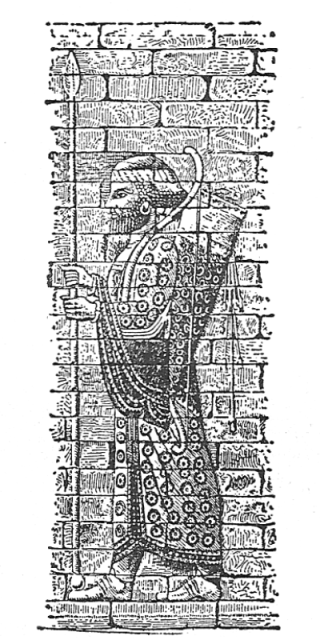 PART OF ARCHER'S FRIEZE IN AN
ANCIENT PERSIAN PALACE.
PART OF ARCHER'S FRIEZE IN AN
ANCIENT PERSIAN PALACE.
It is often difficult to correctly estimate the power exerted
by a statesman upon his country. The movements he has
espoused, the reforms he may have championed, the institutions
he helped to call into being, all stand as monuments to his
memory. But the subtle effects of his influence, his personality
and character upon his own generation and others still to
come, are seldom understood or adequately judged. In the
case of a nation the task becomes still more complicated, and
we cannot today know how many of our ideas, inventions, and
attainments have been shaped by nations whose light went out
long centuries ago. Nevertheless, our inability to estimate
these various inheritances aright need not deter us from an
attempt to classify such bequeathments as are universally
acknowledged, and we may be sure that the present world
owes much to the earliest nations of Western Asia. Their
contributions, however, have not come down to us directly,
but have been passed along, like legends, from one people to
another, until their present form scarcely suggests their
origins.
Let us consider first our indebtedness to Babylonia. In
recent years discoveries in the Euphrates valley and the mastery
of the cuneiform style of writing have given us masses of
material wherefrom to reconstruct the past. Not only has
light thus been thrown upon the early history of Babylonia
and Assyria, but aid has been rendered biblical study. The
tribal life of the Hebrews, and the civilization of other contemporary
peoples has been better understood because of these
revelations. However, acquisitions of the last century have
had no part in molding modern civilization, and we pass on
to matters of earlier significance.
No people could have worked as diligently in the field of
science as the Babylonians did and failed to leave important
results of their investigations. "In Geometry the Chaldeans
made about the same progress as the Egyptians; in Arithmetic
more. Their notation combined the decimal and duodecimal
systems. Sixty was a favorite unit, used as the hundred is
by us. Scientific Medicine was hindered by the belief in
charms and amulets; and even Astronomy was studied chiefly
as a means of fortune-telling by the stars,—so that in Europe
through the Middle Ages an astrologer was known as a
Chaldean. However, the level plains and clear skies, as in
Egypt, invited to an early study of the constellations, and
some important progress was made. As we get from the
Egyptians our year and months, so from the Chaldeans we get
the week, with its 'day of rest for the heart,' as they called
the seventh day, and the division of day and night into twelve
hours each, with the subdivisions into minutes. They also
invented the water clock and the sundial. They foretold
eclipses, made star maps, and marked out on the heavens the
apparent yearly path of the sun. The zodiacal 'signs' of our
almanacs commemorate these early astronomers. Every
great city had its lofty observatory and its royal astronomer;
and in Babylon, in 331 B.C., Alexander the Great found a
continuous series of observations running back nineteen hundred
and three years.
"To a degree peculiar among the ancients, the men of the
Euphrates made practical use of their science. They understood
the lever and pulley, and used the arch in vaulted drains
and aqueducts. They invented the potter's wheel, and an
excellent system of weights and measures. Their treatises on
agriculture passed on their knowledge in that subject to the
later Greeks and Arabs. They had surpassing skill in cutting
gems, and in enameling and inlaying; and their looms produced
the finest of muslins and of fleecy woolens, to which
the dyer gave the most brilliant colors. In many such industries
little advance has been made since, so far as results
are concerned."[1]
Certain unfortunate bequests were left by them. Babylonian
belief in demons was handed down through the
Hebrews, and in the Middle Ages took the form of the devil,
with horns and a cloven foot. Their faith in magic and incantations
also descended to Mediæval times, and as scientific
interest superseded religious fervor, inspired men to search
for the "philosopher's stone."
The intensely practical turn of mind in Mesopotamia
revealed itself in the literature, which was bare of imagery.
Material beauty—artistic carpets, tapestries, and rugs, was
developed, but for beauty of conceptions, we must turn to the
Greeks.
What did the war-loving, blood-thirsting Assyrians leave
for future ages? At first the question seems not to be easily
answered. One calls to mind their ravaging raids and unparalleled
carnage, and remembering that their palaces and
stores of inscribed tablets were recovered only within the
last fifty years, their contributions are not so apparent. Yet,
having studied the government enforced by Darius upon his
empire, we are compelled to admit that he but improved upon
the system evolved by the Assyrian kings, unknown before
their time in Asia. Again, the very conquests themselves were
helpful, in spite of their cruelty, for they brought the best
civilization of their day to half-barbarous tribes who otherwise
might have passed century after century before reaching
the degree of progress so rudely thrust upon them. These
conquests opened up routes of commerce, and trade has always
exceeded all other factors as a civilizing force.
To science the Assyrians appear to have made no contributions
whatever.
Coming to ancient Persia, we find a wholly different culture.
The people of this country lacked the practical turn of
mind so characteristic of the Babylonian, and his mercenary
point of view was quite unknown to them. Persian literature,
while scanty, embodied poetical conceptions, and several of the
ancient poems possess much art. "The Persians had fancy
and imagination, a relish for poetry and art, and they were
not without a certain power of political combination. Yet
we cannot justly ascribe to them any high degree of intellectual
excellence. If the great work of Firdausi represents to
us, as it probably does, the true spirit of their ancient poetry,
their efforts were but of moderate merit. A tone of exaggeration,
an imagination exuberant and unrestrained, a preference
for glitter over solid excellence, a love of far-fetched
conceits, characterize the Shahnameh; and, though we may
ascribe something of this to the individuality of the poet,
still the conviction presses upon us that there was a childish
and grotesque character in the mass of old Persian poetry,
which marked it as the creation of moderate rather than of
high intellectual power, and prevents us from regarding it
with the respect with which we view the labors of the Greeks
and Romans, or again, of the Hebrews, in this department.
A want of seriousness, a want of reality, and, again, a want
of depth, characterize the poetry of Iran, whose bards do not
touch the chords which rouse what is noblest and highest in
our nature. They give us sparkle, prettiness, quaint and ingenious
fancies, grotesque marvels, an inflated kind of human
heroism; but they have none of the higher excellences of the
poetic art, none of the divine fire which renders the true poet,
and the true prophet, one."[2]
The Persian religion was both noble and sublime, and its
teaching concerning the two opposing forces of good and evil,
affected the philosophy of the Greeks, and indirectly, the
thought of the later Christian world.
By carrying the plan of Assyrian conquest further, the
Persians opened districts remote from social centers and helped
the course of civilization. Their systematic government improved
upon the one developed by Assyria in this particular:
each governor was made supreme in his province under Assyrian
administration, none other being accountable to the king
for conditions in his territory. An opportunity thus offered
for the governor to seize any favorable moment to shake off
allegiance to the state and attempt to establish his own supremacy.
Darius, on the other hand, posted troops in each satrapy,
and both the commander of these troops and the governor
were required to submit reports, and to act jointly in certain
matters. In this way, one served as a check upon the other.
Fine roads were built to allow rapid communication between
the capital and distant provinces; these naturally facilitated
commerce, and made travel safe—as one has graphically
expressed it, "helped set the world a-mixing."
A new day was dawning for humanity, and an age coming
when one might look back to the infancy of the world,
likening its progress to that of a man who has gained some
perceptions, some ideas and experiences in childhood days
which unconsciously but surely, influence his later life, illuminated
by wider experiences and deeper truths.
Assurbanipal, or, as the Greeks called him, Sardanapalus, is
supposed to have stored in his palace at Nineveh not less than 30,000
tablets. Upon every work in his library his ownership was stamped
as follows:
The Palace of Assurbanipal, King of Regions,
King of Multitudes, King of Assyria, to whom
the God Nebo and the Goddess Tasmeti have
granted attentive ears and open eyes to discover
the Writings of the Scribes of my Kingdom,
whom the Kings my Predecessors have
employed. In my respect for Nebo, the God of
Intelligence, I have collected these tablets;
I have had them copied; I have marked them
with my name; and I have deposited them in
my Palace.
This account was first translated by George Smith from the eleventh
of a series of tablets describing the adventures of the mythical hero,
Izdubar (or Gilgamish), supposed to be the same as Nimrod. The
whole series of tablets relates his early life and exploits in hunting, his
friendship with the faun Iabani, his victory over the tyrant Humbaba,
the love of the Goddess Ishtar, his illness, the death of Iabani, his wanderings
to find his ancestor, Hasisadra (or Pir-napishtim), who for his
piety had been translated to the fellowship of the gods. This ancestor
relates to Gilgamish the story of a great flood resembling in general outline
the narrative in Genesis, but stamped with the impress of the Chaldean
religion. Shamas was the Sun-god.
The early literature of many nations contains stories of a universal
flood, from which a favored family or individual alone escapes. None
is more striking than the one deciphered from the clay tablets of Chaldea,
or more nearly parallel to that of the Hebrew Scriptures.
TABLET XI. OF THE GILGAMISH EPIC.
The following translation is from Professor Craig:
The Babylonian Story of the Deluge.
Pir-napishtim saith to him, even to Gilgamish;
I will relate to thee, Gilgamish, a secret story,
And the decision of the gods I will tell thee.
The city Shurippak, which thou knowest,
Is situated on the shore of the Euphrates.
This city was old when the gods within it
Were moved to produce a flood, even the great gods.
They were Anu, their father,
The warrior Bel, their counsellor,
Their throne-bearer, Ninib,
Their leader, Ennugi,
Ninigiazag (the god Ea) had spoken with them
And their decree he repeated to the reed-house (saying):
"Reed-house! reed-house! house-wall! house-wall![1]
Reed-house, hear! and house-wall, consider!
O man of Shurippak, son of Ubar-Tutu!
Construct a house, build a ship,
Abandon possessions, seek life,
Property despise, and life save,
Put seed of life of every kind into the ship.
The ship which thou shalt build, even thou,
Let be measured her dimensions:
Let her breadth and length be equal,
Upon the ocean launch her."
I understood, and said to Ea, my lord:
"Behold, my lord, what thou hast commanded
I hold in reverence, I shall do.
(But what) shall I answer the city, the people, and the elders?"
Ea opened his mouth and speaketh,
Saith unto his servant, unto me:
"O man! Thus shalt thou say unto them:
Bel has rejected me and cursed me.
I shall dwell no more in your city,
And upon Bel's ground I shall not set my face.
But to the ocean shall I descend; with Ea, my lord, I shall dwell.
Upon you he shall cause to pour out abundance,
Game of birds and game of fishes,
(Animals of all kinds); field-fruits in plenty,
When in the evening the ruler of the darkness (?)
Shall cause to rain upon you a heavy rain."
As soon as dawn began to appear,
(Five or six lines wanting)
The weak (?) . . . . . . . . .
The strong brought to (the building-place) what was necessary.
On the fifth day I laid down her form.
Ina Kar-Hi-Sa one hundred and twenty cubits high were her walls,
One hundred and twenty cubits likewise was the extent of her roof.
Its outer frame I constructed, enclosed it.[2]
I . . . . . her six times.
I divided . . . . seven times.
Its interior I divided nine times.
Water plugs I beat into it on its inside.
I provided a rudder (?) and what was needed I added.
Six sars of bitumen I spread on the outside (?).
Three sars of pitch (I spread) on the inside.
Three sars of basket-bearers brought oil.
I left one sar of oil which the offering consumed,
Two sars of oil the shipman stowed away.
For the people I slaughtered oxen,
I killed . . . . every day.
New w(ine, sesame) wine, oil and wine,
Like the waters of the river (I gave the people to drink)
And (held) a religious feast like unto the New-Year's Feast.
I opened (?) ... of anointing oil, my hand applied (it).
(In the month) of Shamash, the great god, the ship was completed.
Because . . . . were difficult
(Untranslatable) they brought above and below.
. . . . . two-thirds of it.
All that I had I put on board of it.
All that I had of silver I put on board of it.
All that I had of gold I put on board of it.
All that I had of seed of life of every kind I put on board of it.
I caused to go up into the ship all my family and relatives.
Cattle of the field, beasts of the field, all the craftsmen, I caused to go up.
A definite time the god Shamash had appointed:
The ruler of the darkness (?) at even-tide shall cause to rain a heavy rain,
Enter thou (then) within the ship and close thy door."
That appointed time came.
The ruler of the darkness (?) at eventide rained a heavy rain.
The appearance of that day I (fore)saw.
To behold the day I had fear.
I entered into the ship and closed my door.
For the control of the ship to Puzur-Bel
The great-house I gave over together with its store.
With the first appearing of dawn
There rises from the foundation of the heavens a black cloud,
Ramman within it thunders.
Nebo and Marduk march in front;
Over mountain and plain march the throne-bearers.
The tar-kul-li the great Dibbarra tore away.
Ninib advances, ruin he pours out.
The Anunnaki bear aloft torches,
With their brightness they set the land aflame.
The dread of Ramman reaches to heaven.
Everything bright he turneth to darkness.
. . . the land like . . . he covered (?)
One day the hurricane (raged),
Violently it blew, the waters (covered?) the mountains.
Like the (onslaught of) battle over mankind (they) came.
Brother sees not (his) brother.
Men are not discerned in heaven (i. e., by the gods).
The gods were terrified by the flood, and
Withdrew and ascended to the heaven of Anu.
The gods dog-like cower, crouch on the wall (of heaven).
Ishtar screams like a woman in travail.
She cries aloud the lady of the gods, the sweet-voiced:
"Verily the former race is turned to clay.
Just as I in the assembly of the gods proclaimed evil,
As I proclaimed in the assembly of the gods evil
For the destruction of my people war I foretold,
So, verily, will I bring forth my people
Tho' like the fry of fishes they fill the sea."
The gods, the highest of the Anunnaki weep with her.
The gods are downcast, sit, and weep,
Covered were their lips . . . .
Six days and nights
The wind prevailed, flood and storm overwhelmed the land.
When the seventh day came the storm abated, the flood was overcome,
Which had battled like a warring host;
The sea calmed, the hurricane ceased, the flood was restrained,
I beheld the sea, uttering a lamentation,
Seeing that all mankind was turned to clay.
When the light had fully dawned I prayed.
I opened an airhole and light fell upon my cheeks.
I bowed myself, I sat down, I wept.
Over my cheeks ran my tears.
I looked upon the far-spread waters of the sea.
After twelve double-hours a peak arose,
Towards the mountain of Nitsir the ship took its course.
The mountain of Nitsir held the ship and let it not rise.
One day, a second day, the mountain of Nitsir, ditto
A third day, a fourth day the " " " "
A fifth day, a sixth day " " " " "
When the seventh day arrived
I brought forth a dove and let it go.
The dove went forth, flew to and fro, but
A resting-place there was not, so it returned.
Then I brought forth a swallow and let it go,
The swallow went forth, flew to and fro, but
A resting-place there was not so it returned.
(Then) I brought forth a raven and let it go.
The raven went forth, the disappearance of the waters he saw,
He eats, caws, flies to and fro, and returns not.
(Then) I brought forth to the four winds, I offered a sacrifice.
I made an incense-offering on the top-most peak of the mountain.
Seven and seven adagur-vessels I placed.
Into them I cast reeds, cedar-wood, and
The gods inhaled the good odour.
The gods like flies swarmed about the offerer.
As soon as the mistress of the gods arrived
She lifted up the great jewels (?) that the god Anu had devised and made for her (and said)
"These gods, by my lapis lazuli necklace I shall not forget.
These days, verily I shall reflect upon and never forget.
The gods, let them go to the incense-offering.
(But) let not Bel go to the incense-offering,
Seeing that he did not reflect but caused the flood.
And my people he counted for destruction.
As soon as Bel arrived
He saw the ship and Bel was sore angry,
He waxed wroth against the gods, the Igigi.
"Some soul has escaped" (he said),
"Let no man survive the destruction."
Ninib openeth his mouth and speaketh,
He speaks to the warrior Bel:
"Who but Ea doeth (this) thing?
But Ea is wise in every undertaking."
Ea openeth his mouth and speaketh,
Saith to the warrior Bel:
"Thou sage of the gods, warrior!
Verily, verily, thou didst not reflect, and didst make a flood:
Upon the sinner lay his sins,
Upon the impious his impiety.[3]
Spare, let him not be cut off, have mercy, let him (not be utterly destroyed).
Instead of bringing on a flood,
Let the lion come and reduce mankind.
Instead of bringing on a flood,
Let the hyaena come and reduce mankind.
Instead of bringing on a flood,
Let famine be sent and the land (reduced).
Instead of bringing on a flood,
Let the Pest-god come and destroy the land.
As for me, I have not revealed the secret of the gods.
I caused Atrahasis to see a vision and thus he learned the secret of the gods."
Thereupon his counsel was taken
And Bel ascended within the ship. Seized me by the hands and brought me up (to a point still higher).
He brought up and made to bow beside me my wife,
Turned us face to face, stood between us and blessed us:
"In former times Pir-napishtim was human
But henceforth Pir-napishtim and his wife shall be like us gods
And Pir-napishtim shall dwell afar off at the mouth of the rivers."
Then they took me and afar off at the mouth of the rivers they caused me to dwell.
Ishtar was the Babylonian Venus or goddess of love. The story of
her descent to Hades and return to the world of the living is found on a
tablet now in the British Museum, and is perhaps the most poetical legend
of the recovered Assyrian literature. It has been suggested that the story
is the text of a religious drama, resembling the miracle-plays of mediaeval
Europe. The legend shows no reason for Ishtar's desire to enter
Hades, but it is easy to suppose that she went thither to rescue some
beloved person. This supplies a connection with the familiar story of
Venus and Adonis (or Tammuz), which the Greek writers declare to be
of Syrian origin. The drama, if such it were, was probably part of the
annual celebration of the return of Spring. Ninkigal, the Queen of
Hades, corresponds to the Greek Persephone, and Latin Proserpina, the
wife of Pluto. In like manner, Ea, the king of the gods, corresponds to
Zeus or Jupiter, and the divine messenger to Hermes or Mercury.
A Babylonian Epic—Ishtar's Descent to Hades.
(Translation by Professor Craig.)
On the land without regress, the land (that thou knowest),
Ishtar, Sin's daughter, did fix her attention,
The daughter of Sin did fix her attention,
On the dwelling of darkness, the abode of Irkalla,
On the dwelling whose inhabitant comes no more out,
On the road whose advancing knows no returning,
On the house whose inhabitants removed from the light,
Where they're nourished with dust and clay is their food,
Where they see not the light, but in darkness are dwelling,
And are clad like the birds with a covering of wings;
On door and on bars lies the dust thickly gathered.
Arrived at the door of the land without regress,
To the porter in keeping, this order she giveth:
Thou watcher of waters, throw open thy portal!
Throw open thy portal, within will I enter!
If the door be not opened that I may pass through it,
The door will I shatter, its bolt break in pieces,
Its sills will I burst, its doors tear asunder,
The dead will I raise up, devourers and living,
Even more than the living the dead will I raise up.
The porter then opened his mouth and made answer,
To the great goddess Ishtar, made answer the porter:
"Withhold! O my lady, do not break it away,
I go to Allatu, thy name to announce."
The porter announced to the queen, to Allatu:
"Thy sister, Ishtar, is come over these waters
. . . . . . . . . . . . . . . ."
When Allatu these tidings received (from the porter),
Like a tamarisk cut she (bowed herself down) (?).
Like a reed that is broken she (bent to the ground) (?).
"What bringeth her heart to me, pray? What trouble?
With this one forsooth (shall I share my dwelling?)
As food eat the clay and as wine drink the water,
Weep over men who their wives have abandoned,
O'er maidens who mourn the embrace of their lovers,
Weep o'er the infants destroyed e'er their day?
Go! porter, throw open thy door—open to her!
And treat her according to olden-time law."
The porter departed, threw open his door;
"O enter, my lady, a welcome in Hades!
Palace of the land, that knows no returning,
O let it rejoice in thy presence."
The first door he caused her to enter, and halting,
Removed the great crown from her head.
"Why tak'st thou the great crown from my head, O porter?"
"O enter, my lady, 'tis the law of Allatu."
The next door he caused her to enter, and halting,
The rings were removed from her ears.
"Why tak'st thou the rings from my ears, O porter?"
"O enter, my lady, 'tis the law of Allatu."
The third door he caused her to enter, and halting,
The necklace removed from her neck.
"Why tak'st thou from my neck the necklace, O porter?"
"O enter, my lady, 'tis the law of Allatu."
The fourth door he caused her to enter, and halting,
Her jewels removed from her breast.
"Why tak'st thou from my breast the jewels, O porter?"
"O enter, my lady, 'tis the law of Allatu."
The fifth door he caused her to enter, and halting,
The bearing-stone girdle he took off from her waist.
"Why tak'st thou from my waist my gemmed-girdle, O porter?"
"O enter, my lady, 'tis the law of Allatu."
The sixth door he caused her to enter, and halting,
Took the rings from her hands and her feet.
"Why from hands and from feet take the rings, pray, O porter?"
"O enter, my lady, 'tis the law of Allatu."
The seventh door he caused her to enter, and halting,
From her body her cincture removed.
"Why take from my body my cincture, O porter?"
"O enter, my lady, 'tis the law of Allatu."
To the land without regress when Ishtar descended,
Allatu beheld her and raged in her presence;
Imprudently, boldly, did Ishtar attack her.
Then opened Allatu her mouth and commanded,
To Namtar, her servant, the order was given:
"Go Namtar, confine her....
With disease of the eye, and the hip, and the foot,
With disease of the heart, and the scalp, go smite Ishtar,
Afflict her whole person!"
After Ishtar, the goddess, had (been thus afflicted) (?)
The bull no more covered the cow, nor ass gendered;
No more in the street lay the man with the maiden;
The man went asleep in his place,
In her place slept the maiden.
The god's-servant, Pap-su-kal, face down and sad-visaged,
Was clothed in the garb of deep mourning.
Shamash went, sorely wept before Sin, his father,
His tears ran down before the king, Ea,
Saying: "Ishtar's gone down to the land, and returns not.
Since Ishtar's descent to the land without regress
The bull no more covers the cow, nor ass genders;
No more in the street lies the man with the maiden.
The man falls asleep in his place,
In her place sleeps the maiden."
Then Ea created a male in his wisdom,
The god's-servant, Uddushu-namir, created.
"Go! Uddushu-namir, to land without regress,
Seven doors of the land without regress be opened!
Allatu behold thee, rejoice in thy presence!
Her heart when at ease, and her spirit when joyful;
In name of the great gods do thou adjure her:
'Thy head raise, to Hal-skin direct thy attention,
O lady, I pray thee, Halziqu-skin give me;
I desire to drink of the waters within it.'"
This hearing, Allatu her sides smote, her nails bit.
"Of me thou hast asked an impossible favor.
Hence! Uddushu-namir, with curse will I curse thee;
Thy food it shall be the foul mud of the city,
From drains of the city shalt thou drink the water,
The shade of the wall shall be thy dwelling,
Thy place of abiding a stone-block shall build it.
Confinement, privation, thy strength let them shatter."
Allatu then opened her mouth and commanded,
To Namtar, her servant, the order was given:
"Go! Namtar, beat on the palace eternal!
Go! rap on the stone slabs, those made out of pa-stone.
Go! lead forth the spirits, on golden thrones set them,
With water-of-life sprinkle Ishtar, the goddess,
Lead her forth from my presence."
Then went Namtar, beat on the palace eternal,
And shook the stone slabs those made out of pa-stone;
He led forth the spirits, on golden thrones set them,
With water-of-life sprinkled Ishtar the goddess.
Led her forth from her presence.
Through first door he led her, gave to her her cincture.
Through second door he led her, her rings he gave to her.
Through third door he led her, gave back her gemmed-girdle.
Through fourth door he led her, gave back her breast-jewels.
Through fifth door he led her, gave to her her necklace.
Through sixth door he led her, gave to her her ear-rings.
Through seventh door he led her, the great crown gave to her.
Here ends the descent of Ishtar. The priest continues:
"If free she'll not free her, return with her to her
And for Tammuz, her bridegroom in years that were youthful,
Pour water e'en purest, with sweet balm (anoint him)
And clothe him with garments, a flute (give unto him),
Companions of Ishtar, let them wail with loud (wailing),
The goddess, Belili, her treasure completed,
High heaped are the eye-stones, her knees now supporteth,
Her brother's complaint she then understanding,
The great goddess Belili her treasures outpouring,
She fills with the eye-stones the floor round about her (saying)
'My only one, brother mine, do me no evil.'
When Tammuz with flute of fine lapiz discourseth,
Then play with him joyfully flute of fine beryl,
And play with him joyfully men mourners and women,
The dead may arise the sweet incense inhaling."
Note.—See Jastoon, "Religion of Babylonia and Assyria," page
563 ff., for a full discussion of this epic.
GYGES AND ASSURBANIPAL.
Gyges, king of Lydia, reigned B.C. 716-678. The Greek historian
Herodotus has given an interesting account of him, but still more
interesting is the following extract showing how he was regarded by
the great king of Assyria, Assurbanipal (Sardanapalus).
Gyges was the king of Lydia, a country beyond the seas,
a distant land, of which the kings, my fathers, had never even
heard the name. Assur, my divine generator, revealed my
name to him in a dream, saying: "Assurbanipal, the king of
Assyria; place thyself at his feet, and thou shalt conquer thy
enemies in his name." The same day that he dreamed this
dream, Gyges sent horsemen to salute me, and related to me
the dream which he had had, by the mouth of his messengers.
When the latter reached the frontiers of my empire and
encountered the people of my empire, they said to him,
"Who then art thou, stranger, whose land has never yet been
visited by one of our couriers?"
They sent him to Nineveh, the seat of my royalty, and
brought him before me. The languages of the East and of
the West, which Assur had given into my hand, none of those
who spoke them could understand his language, and none of
those who surrounded me had ever heard speech like unto it.
In the space of my empire at last I found one who understood
it, and he told me the dream. The same day that he placed
himself at the feet of me, the king Assurbanipal, he defeated
the Cimmerians, who oppressed the people of his land, who
had not feared the kings, my fathers, and had not placed
themselves at my feet. By the grace of Assur and Ishtar, the
gods my masters, they took amidst the chiefs of the Cimmerians,
whom he had defeated, two chiefs whom he chained
heavily with manacles and fetters of iron, and he sent them
to me with a rich present.
Nevertheless the horsemen that he at first sent regularly
to pay homage to me, he soon ceased to send. He would not
obey the commands of Assur, my divine generator, but foolishly
trusted in his own strength, and in the wishes of his
heart. He sent his troops to the assistance of Psammetichus,
king of Egypt, who had contemptuously thrown off my yoke.
I heard this, and prayed to Assur and Ishtar: "May his
body be thrown down before his enemies, and may his bones
be dispersed." The Cimmerians, whom he had crushed in
my name, reappeared and subjugated his whole land, and his
son succeeded him upon the throne. The punishment which
the gods, who are my strength, had drawn upon his father at
my request, he told me by his messengers, and he placed himself
at my feet, saying: "Thou art a king acknowledged by
the gods. Thou cursedst my father, and misfortune fell upon
him. Send me thy blessing, for I am thy servant, who fears
thee, and will wear thy yoke."
"Purity is the best of all things; purity is the fairest of
all things, even as thou hast said, O righteous Zarathustra."
With these words the holy Ahura-Mazda rejoiced the holy
Zarathustra: "Purity is for man, next to life, the greatest
good; that purity which is procured by the law of Mazda to
him who cleanses his own self with good thoughts, words and
deeds."
O Maker of the material world, thou Holy One! This
law, this fiend-destroying law of Zarathustra, by what greatness,
goodness, and fairness is it great, good, and fair above
all other utterances?
Ahura-Mazda answered: "As much above all other floods
as is the sea, so much above all other utterances in greatness,
goodness, and fairness is this law, this fiend-destroying law of
Zarathustra. As much as a great stream flows swifter than a
slender rivulet, so much above all other utterances in greatness,
goodness, and fairness is this law, this fiend-destroying
law of Zarathustra. As high as the great cypress tree stands
above the small plants it overshadows, so high above all other
utterances in greatness, goodness, and fairness is this law, this
fiend-destroying law of Zarathustra. As high as heaven is
above the earth that it compasses around, so high above all
other utterances is this law, this fiend-destroying law of
Zarathustra.
"Therefore when the high priest has been applied to by a
penitent, when any of the Magi has been applied to, whether
for draona-service[A] that has been undertaken or that has not
been undertaken, the priest has power to remit one-third of
the penalty he had to pay: if he has committed any other
evil deed, it is remitted by his repentance; if he has committed
no other evil deed, he is absolved by his repentance
forever and ever."
This Gatha or hymn is supposed to be a prayer prescribed by
Zoroaster for the teachers of his religion. The first verse is the prelude
always used before reciting or chanting any of the Gathas in the Parsi
religious service.
A strengthening blessing is the thought, a blessing is the
word, a blessing is the deed of the righteous Zarathustra. May
the Bountiful Immortals accept and help on the chants. Homage
to you, O sacred Gathas!
With venerating desire for this gift of gracious help, O Mazda,
and stretching forth my hands to Thee I pray for the first blessing
of Thy bountiful Spirit; that is, I beseech of Thee that my
actions toward all may be performed in Righteousness; and with
this I implore from Thee the understanding of Thy Good Spirit,
in order that I may propitiate the Soul of the Kine.
And therefore, O Great Creator, the Living Lord! inspired by
Thy Good Spirit, I approach You, and beseech of Thee to grant
me as a bountiful gift for both the worlds, that of the body and
that of mind, those attainments which are to be derived from the
Divine Righteousness, and by means of which those who receive
it may enter into beatitude and glory!
O thou Divine Righteousness, and thou Good Spirit of Deity!
I will worship you, and Ahura Mazda the first, for all of whom
the pious ready mind within us is causing the imperishable
Kingdom to advance. And while I thus utter my supplications
to You, come Ye to my calls to help!
Yea, I will approach You with my supplications, I who am
delivering up my mind and soul to that heavenly Mount whither
all the redeemed at last must pass, knowing full well the holy
characteristics and rewards of the actions prescribed by Ahura
Mazda. And so long as I am able and may have the power, so
long will I teach Your people concerning these holy deeds to be
done by them with faith toward God, and in the desire for the
coming of the Divine Righteousness within their souls.
And, thou Righteousness! when shall I see thee, knowing
the Good Mind of God, and above all the Obedience of our lives
which constitutes the way to the most beneficent Ahura Mazda?
Asking this, I thus beseech thee, for with this holy word of supplication
we best keep off with tongue the flesh-devouring fiends,
the very sign and power of all spiritual foulness!