The next day, June 27th, the Russian General
decided that it was necessary to take the large
eastern arsenal, about three and a half miles
away, as it was known that it sheltered large
bodies of the enemy, besides commanding the
railway communication to Taku. Immediately
the Commander-in-Chief heard of the project,
he offered British assistance, but the Russian
General replied that he felt able to take the
place without aid, and so orders were given
that the British would be granted a day’s rest,
after the arduous operations of the last few
days. This was welcome news, and officers
and men changed all their apparel, and made
themselves comfortable preparatory, as they
thought, to having a good day’s sleep.
At 11 a.m., however, the “general assembly,”
was sounded, and orders were given that the
utmost dispatch was necessary. In an incredibly
short space of time, 500 of the naval
brigade, two companies of the Wei-Hai-Wei
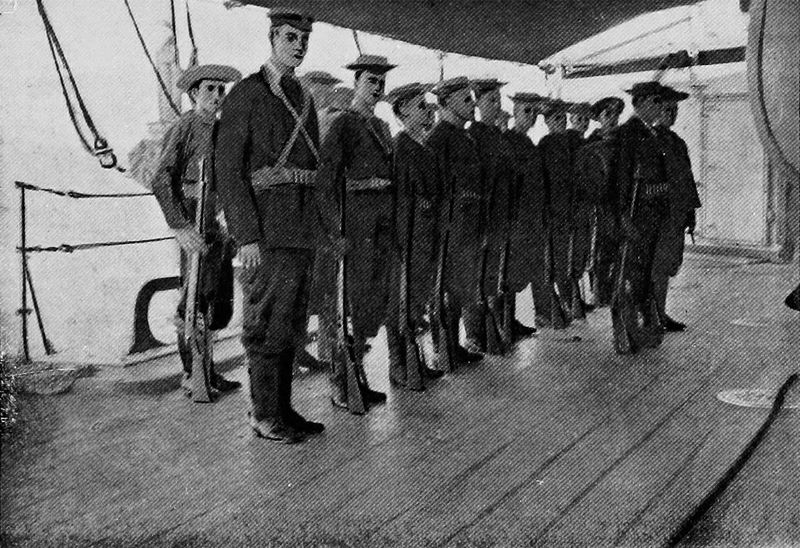
regiment, and 50 American marines, under
Major Waller, were under arms, and ready to
proceed in any direction. It transpired that
the Russians had been brought to a standstill
by shell fire, while yet at extreme rifle range,
and that their own fire had been rendered
singularly ineffective by a very annoying
mirage, which made it next to impossible
to judge ranges at all accurately, or to
discern any details at the point of attack.
When the force got under way, the
diversity of uniforms caused much amusement.
The marines were in their shirt sleeves,
except those from the “Terrible,” who still
donned their khaki, which they had worn
in South Africa only a few months before.
The bluejackets were in their ordinary blue
‘jumpers,’ but a great many of the officers
had indulged in the luxury of a clean white
duck uniform, which of course they had
no time to change; so they perforce had
to remain by far and away the most conspicuous
objects on the fields. On their
way, the force passed the 12-pr. from the
“Terrible,” which had been ineffectively
shelling the position at 5000 yards’ range, and
was waiting for more ammunition. This
arrived just as they passed, and the gun
began to drop shells with great accuracy
on the base of the large chimneys, which
betrayed the whereabouts of the powder
manufactory, and other store-houses and
workshops.
Advancing under cover of the line, which
connected the arsenal with the railway, the
reinforcing column reached a point where
the cover ceased, and it became necessary
to deploy under fire. On the British right
lay long lines of white-coated Russians, with
three maxims and a battery, and it was thought
from their distance to the arsenal—some 3,000
yards—that they had delivered an attack,
but had been beaten off. This proved not
to have been the case. They had merely
exceeded even their usual slowness in the
attack, and had fired volleys steadily for
some time at an object, the detail of which,
as I have said, was invisible. Eventually,
finding that the Chinese meant to stay,
their commanding officer had sent in for
reinforcements.
As they were all under some sort of cover,
and our men were obliged to lie down in the
open on a perfectly flat plain, it wasn’t long
before the Chinese turned their undivided
attention to the British, and subjected them
to a well-directed shrapnel fire from two
field guns, mounted in the south-west corner
of their position.
After waiting for ten minutes, a message
was sent to the Russian General that the
British wished to advance to within effective
range. The reply to this was to the effect
that the advance would begin in five minutes.
Ten minutes passed, but no advance, so
another message was sent saying that the
British would advance alone, if the Russians
did not move forward in ten minutes’ time.
The same reply as before was received; but
as no movement became visible for a quarter
of an hour, and several men had been hit by
shrapnel bullets, the “advance” was sounded
and the line swung forward. Before the
sound of the bugle had died away, there
was a tremendous explosion in the arsenal,
caused either by the “Terrible’s” 12-pr.,
which was now making beautiful shooting,
or by the Chinese themselves. Our gun had
also knocked out a small quick-firer, which
had greatly harassed the Russians, and had
temporarily silenced one of the two guns,
which were playing on the left of the advance.
It was not long before the enemy understood
that the British, were trying to envelop
their extreme right, which would be one of
their lines of retreat, and the first signs of
this discovery were the almost entire cessation
of firing on their left, and a corresponding
increase on the British line of advance, which,
however, gradually became normal as they
got nearer and nearer.
The loss in the Chinese trenches was
probably inconsiderable, for but little firing
was indulged in; the trenches afforded excellent
cover, and of course the mirage was
another great source of protection. The
advance was a quick one, and it was with
difficulty that the men could be restrained
from charging when the fire began to grow
hot, and casualties to take place. When
the fighting line was within 300 yards of the
walls, bayonets were fixed and the “charge”
was sounded. This proved too much for the
enemy, who could be plainly seen to be leaving
the walls in twos and threes, and who
appeared to be all making for the right of
their position. Unfortunately for them, the
marines had pushed far enough forward to
inflict heavy loss on them as they ran, and
the Chinese, who at first attempted to retain
some kind of order in their retreat, were
compelled to scatter, and became a disorganized
mob. At this juncture some 4000
Boxers attacked the left of the British line
in the rear, and were not noticed until they
were within a quarter of a mile. It was
lucky they had not come on before, for
the line had had their hands quite full with
the task of turning the enemy out of his
position in front, and any confusion must have
greatly helped the enemy in their retreat,
even if it had not resulted in the attack being
rolled back. As it was, the Chinese regiment,
who were in support, coolly turned about,
and drove them back handsomely, by a well-directed
fire which inflicted some loss. The
only regrettable incident in this little diversion
was the slaying and dismemberment of two
wounded marines, who in some unaccountable
manner had been missed by the stretcher
parties and left in the rear, right in the path
of the Boxers, into whose hands they fell.
That they had made a fight for it, was evident
by the dead bodies of two Boxers, one of
whom had been shot, and the other bayoneted.
All that was left of these poor fellows
was interred on the spot. Once inside the
ramparts, all opposition ceased, and the only
casualty which occurred there, was to a
bluejacket, who was killed by some lurking
Chinaman, who fired through a window of a
hut at a range of about two yards. The man
died instantly, but his death was avenged
by his slayer being bayoneted by a couple of
bluejackets, who rushed into the house and
brought out his dead body.
So eager were the last party of the enemy
to escape from the Russians, who by this
time had entered on the other side, that they
rushed madly across the front of a strong
party of British, whom they did not observe
until too late. Many were slain. As usual
the want of cavalry was severely felt, and it
was a heartbreaking scene to see the masses
of fugitives, numbering in all about four
thousand, streaming across the plain in a
hopeless rout, without being able to launch
a few squadrons of lancers at them to
complete their discomfiture. It was hopeless
to follow them with infantry alone, and the
men had to content themselves with lining
the deserted walls, and pouring in a hot fire
until they realised that the Chinese were out
of range. Of course the Russians claimed
the lion’s share, and promptly took the place
into their possession, and began to loot it
thoroughly.
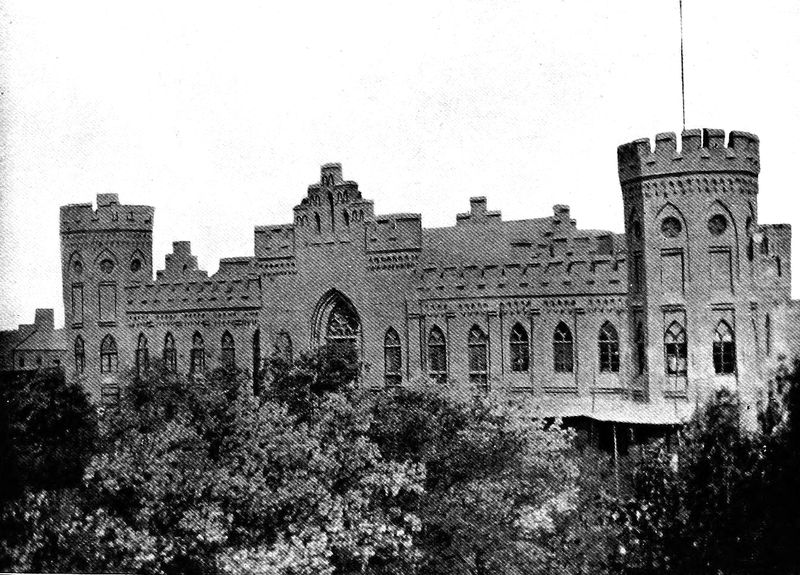
In the buildings of the naval college were
some magnificent astronomical instruments,
besides models, and a splendid library of
standard works, all in English, but to the
ignorant Russian soldiery they had no
monetary value, and so too often their fate
was to be bayoneted, or hammered to pieces
by the butts of their rifles.
The British force withdrew as soon as the
enemy were out of sight, and it had become
evident that the allies were in undisputed
possession of the arsenal; and the Russians
were left in sole command, with the proviso
that the Union Jack should be kept flying
as long as the place was in European hands.
The day’s operations had been very important,
for besides the immense moral
effect it must have had on the enemy, who
had been turned out of a good strategic
and defensive position, it practically made
the Russian and German camps on that side
of the river immune from attack. The
moral effect was so great, moreover, that for
two days the enemy appeared to be entirely
cowed, and no further operations, except the
usual desultory bombardment, were indulged
in by either side.
The allies took advantage of the rest, and
sent down most of the sick and wounded of
Seymour’s column to be attended to at the
fleet. On arriving there, they were immediately
sent down to Wei-Hai-Wei, where there
were better arrangements for their comfort.
Reinforcements arrived in the shape of a
regiment of Japanese infantry, and on the
29th the men from H.M.S. “Alacrity”
rejoined their ship. On the 30th too, the
station again became the scene of a desperate
struggle culminating in another Chinese
reverse.
The enemy’s guns commanding this important
position were extremely well placed.
The guns themselves were completely hidden,
but the gunners from their emplacements could
just see the roofs of the station buildings, of
which they had the range so accurately that
they repeatedly made the place too warm for
the Allies’ infantry, who perforce had to take
to trenches in the open.
Up to this time, however, the Chinese had
made no attempt to cut the river communications,
and guns and troops were steadily being
landed at Taku and sent up to the front by
tugs and lighters. On the 30th the Governor-General
of Port Arthur arrived, in the person
of Vice-Admiral Alexieff, so that Tientsin was
beginning to reach the unenviable state of
having so many commanding officers of the
same rank, that it was always uncertain how
the various necessary dispositions of one force
would be received by the others; in fact it was
a case of the proverbial “too many cooks, etc.”
About this time, the enemy received large
reinforcements, matters looked very serious
again, and martial law was proclaimed.
On July 2nd, the British headquarter
barracks “Barfleur” had an extremely narrow
escape from fire. The ‘godown’ next door
caught alight in some unaccountable manner,
and burned with the utmost fury, causing
great anxiety for the safety of the food and
ammunition in the barracks.
It was a miserably wet day, and the men
could procure practically no appliances to get
it under, but although the barrack roof and
shutters caught fire and smouldered, the
excellent work done by all hands saved the
building, and in three or four hours the
‘godown’ burnt itself out. The flames had
not been in progress for ten minutes before it
became quite evident what were the contents
of the house; thick streams of boiling sugar
poured out of the windows, doors, and every
crevice in the wall, until at last the bund in
front of the barracks, and the spacious yard
behind, were veritable ponds of molasses, about
a foot deep. An attempt was made to clear
up the mess made by the still warm mixture,
but it proved abortive, so much so that an
unwary company of little Japs got literally
stuck in it, looking for all the world like so
many flies on a fly-paper. In the evening
Midshipman Donaldson died of his wounds,
two in number, which he received in his first
engagement. He had been shot in the neck,
and again through the right lung, the latter
proving fatal at the commencement of the
rainy season, which had been expected for a
week or so.
On the 3rd, matters took a turn for the
worse, and the enemy became more pressing
in their attacks, and more steady in their
bombardment. The fighting at the station
was constant and severe, and had it not been
for the reinforcements, it looked as if the
defence must have been worn down under the
incessant strain. The women and children
all went down to Taku by command of
Admiral Seymour, except a few who elected
to continue their work of mercy in the
hospitals, and who were allowed to remain.
On the night of the 4th, a strong body of
the enemy arrived from the southward, and
proceeded to burn the two magnificent country
houses out by the racecourse, which, needless
to say, were owned by Europeans, but which
had been untouched as yet. The same force
formed a camp in the racecourse,—which, with
its surroundings, was a very strong natural
position,—and continued to harass the concessions
from it with artillery. The enemy
also closed in on the settlement with their
other guns to such an extent, that a determined
effort was made on Friday to dislodge some of
them. The most annoying gun of all was a
6-pr. which was mounted within 500 yards
of the French settlement, but whose exact
position was not clear; so a reconnoitring party
was sent out to discover its whereabouts, the
troops being two companies of bluejackets
from H.M.S. “Barfleur,” part of the Wei-Hai-Wei
regiment, and some Americans who
were kept in reserve. The movement was
successful, and the enemy unmasked their
position, a brisk rifle fire being maintained for
about an hour, when, having discovered the
enemy’s strength, numbers, and dispositions,
the Europeans retired without loss.
In the afternoon, the native city was subjected
to a concentrated fire from every gun
that the Allies possessed, and surmising that the
Chinese would be paying more attention to the
bombardment than to the French settlement,
it was decided that the gun which had been
located in the morning should be attacked in the
afternoon, when the bombardment was at its
height. At one o’clock, fire was opened on the
city from twenty-five guns. Thirteen of these
were British: five 12-pr. from the “Terrible”;
four 7-pr. M.L. (an Indian mountain battery);
two 14-pr. Krupps captured from the enemy
at the taking of Taku forts; one 6-pr. Q.F.
naval gun; and one 9-pr. M.L., also naval. Six
of the others were Japanese, and the remaining
six were French. The enemy made a spirited
reply to the bombardment, and their artillerists
made some excellent practice, hitting the sand
bags around the naval guns several times.
The 6-pr. had its back-sight shot away, and a
pickaxe lying in the gunpit was also destroyed.
The casualties, considering everything, were
ridiculously small, and although the enemy’s
fuses were accurately set, and the number of
blind shell but few, yet the fire proved
singularly ineffective.
The effect of the Allies’ fire, on the contrary,
was soon visible. The pagodas dotted all
over the city, which were used by the Chinese
as look-out towers, crumbling up and falling in,
burning themselves, and setting light to other
buildings, was indeed a sharp reminder of the
past three weeks, when the Allies had been
impotent to reply. The city, like all other
Chinese towns, was densely built, and thickly
populated; and under the fire, which lasted for
four hours, many of the inhabitants must have
lost their lives. One very sad incident occurred
at the height of the artillery duel. The shells
used by the captured Chinese guns were of a
variety known as ringed shell, and were of
an excessively sensitive nature. To prevent
accidents, while loading they had a plug in the
head of each, which acted as a safety arrangement
until the weapon was fired. In some
way this had become displaced in one of them,
and on placing it in the breech it exploded,
blowing one of the marine gunner’s arms off,
and wounding several others. The two guns
were not afterwards employed; they are now
filling the position of trophies at Whale Island—the
Naval School of Gunnery near Portsmouth.
About half-past two, another move
was made in the direction of the object of the
morning’s reconnaissance; the composition of
the force being the same, with the addition of
a 9-pr. gun for which it was hoped to find a
position, whence the enemy’s gun could be
silenced, before starting the attack. Unfortunately
the Chinese had evidently anticipated
some movement of the kind, for they had
reinforced their position strongly, and fighting
commenced before the attacking force had got
300 yards away from the French settlement.
It soon became evident that a hopeless task
lay before them; the position for their gun,
which had been selected carefully in the
morning, was now full of the enemy, and the
houses in their front were positively teeming
with Imperial troops who kept up a hot fire on
anything in the shape of a hat, boot, or rifle
that was visible. A flanking movement was
impossible because of the very limited space
in which they fought, and for the same reason
only a very small number of the troops engaged
could come into action. This did not
apply to the enemy, because the Allies were
in reality attacking the vertex of a triangle,
whereas the Chinese were defending the base.
The Wei-Hai-Wei regiment was in the fighting
line, and fought most doggedly for some time,
but finding it impracticable to advance, and the
casualties becoming rather heavy, the whole
force fell back on the French barricade, their
rear protected by the two companies of seamen
from the “Barfleur,” who retired by sections,
firing as they went, until the whole force moved
into safety. It was just before the retirement
commenced that the officer in command of
the fighting line (Major Bruce) was severely
wounded, at the same moment that Midshipman
Esdaile received two wounds which
shortly proved fatal.
The Chinese were so unaccustomed to seeing
the backs of the Allies, that they screwed up
enough courage to commence a charge which
was never finished, because those in rear saw
the prompt death which was meted out to
the first of their comrades who broke cover.
On reaching the barricade, the men took
shelter, and waited for a counter attack.
There were very angry men behind the
barrier of merchandise that afternoon; their
anger was expressed by their rather curious
words; they talked about having to retire,
in language one does not use in conversation
with friends, and but little of which would be
found in any dictionary. They got slightly
better humoured when some of the officers,
who were equally worried, and who only
expressed their annoyance in slightly milder
terms, began to talk about the bayonet; but
they relapsed into their usual excellent self-control,
when this proposal was negatived, as
being too desperate a remedy to employ for
the mere gratification of the men’s passions.
The barricade was manned, and all Chinamen
who showed themselves became the objects of
much attention.
After waiting for some time, two Boxers,
armed only with swords, ran round a corner
about 100 yards away, and appeared to
be endeavouring to urge the Imperial troops
to charge. Their instant fate, however, must
have had a diametrically opposite effect!
When everything became quiet, the force
marched back to barracks, very sick at the
non-success of their venture. However, the
gun did not again fire from this position,
so it may be supposed that the Allies had
succeeded in frightening the enemy pretty
badly, even if they did not inflict any very
great loss upon them.
The next two days were spent in mounting
two 4-in. guns which arrived from the
“Algerine” and “Phœnix,” while the Chinese
endeavoured to drive the Allies’ guns off the
mud wall near the wool-mill. Although
shelled from five different places, the guns
were excellently served, and succeeded in
silencing three of the hostile guns which had
advanced to within but little more than 2000
yards’ range.
On the 8th poor young Esdaile was buried,
and laid close to Donaldson, the other midshipman
who had died from wounds a few
days previously—whose greatest friend he
had been. The two had been inseparable in
life, and by some fatal decree it was ordained
that death should claim them alone, out of
all the midshipmen landed, many of whom
were more or less severely wounded.
The cemetery was but 200 yards from
the gas-works, and during the funeral service,
the Chinese were most persistent in trying
to destroy the light supply. Luckily, they
could not see the gasometers, and so had
to fire by guess-work; and although the
houses and walls in their immediate vicinity
suffered heavily, the gas-works themselves
were untouched.
Now for the first time it was noticed that
the enemy were threatening the river, and
as the importance of keeping this only means
of communication open was vital, the Japanese
General proposed to intercept the movement,
drive the enemy back, and if possible let
the day’s work culminate in the capture of
the Hi-Kuan-Su arsenal, which it will be
remembered was a small arsenal about a
mile and a half to the westward.
Accordingly, at half-past two on the
morning of the 9th, a force of 2200 men,
comprising Japs, British, and Russians, left
by the Taku gates to endeavour to surprise
the enemy in his advanced positions.
At about four o’clock the first shots were
fired a mile before the racecourse was reached,
and in a few minutes the engagement became
general. After a brief struggle the Japs shelled
them out of their trenches, and driving them
back across the plain, managed to get into
them with their cavalry, who, despite the
paucity of their numbers, charged through
and through the fugitives, and slew some 240.
Much surprise and chagrin were felt at the
total disappearance, for a time, of the enemy’s
guns, which had been located the evening
before, but after a brilliant bayonet charge
in a village—in which not a shot was fired,
but 150 Chinamen lost their lives—the guns
were discovered, half hidden under some
rubbish.
The next thing to be done was to change
front to the right, and attack the arsenal,
which was only about three-quarters of a
mile distant. It was first subjected to a
heavy shell fire from the Japanese and
Indian artillery, who burst clouds of shrapnel
all over its face, and who were in turn shelled
by two very small, but very diligent, quick-firing
field guns. The latter had bad luck,
for although they kept up an exceedingly
rapid and very accurate fire, the damage
done to the Allies was practically nil. The
shells appeared to be too small to do any
considerable damage, even if exactly placed,
and became, as the day went on, contemptible
as far as danger went, though admirable in
their pertinacity and the skill with which
they fled to their harmless destination.
When the way had been prepared by the
artillery, the advance commenced, the British
and Japanese making the frontal, the Americans
a flank attack. The resistance was trifling,
and the arsenal was taken possession of at
about ten o’clock. From the cover of the
walls the enemy were harassed in their
retreat by rifle and gun fire, but it is
improbable that their losses were at all
heavy. It was at first proposed to garrison
the place, but eventually it was decided to
abandon it, for many reasons.
Unfortunately, that part which faced the
native city was not defended by any wall, or
entrenched in any way, and as the distance
was but about 2000 yards, it was open
to long-range rifle fire which would soon
have made it untenable, to say nothing
of the enemy’s artillery, which could have
speedily demolished every building.
Then again, there would have been the communications
to keep open, which, although it
would have been a comparatively easy task,
was imposing needless work on the troops;
consequently, after everything of military
worth had been destroyed, the force began
their return journey. They were assiduously
shelled from the precincts of the city, and
fired upon by concealed snipers for the whole
distance, and unfortunately lost several men.
Soon after this, on the arrival of further
reinforcements, it was rumoured that plans
were being matured, by the carrying out of
which the native city should be stormed
and occupied.
Accordingly, no one was much surprised
when, two nights later, orders were given to
the naval brigade to be ready to march out
with the Russians at 2 a.m. The British,
Japanese, and Americans were to attack the
southern gate, while the French and Russians
were to have operated on the other bank of
the river. The men were called at a quarter
past one, and, as the old adage that “an
Englishman fights best on a full belly” is
still very true, they were fed preparatory to
departure.
Unfortunately the message to start never
came: instead came a Russian who “was very
sorry, but would every one go to bed again, as
somehow or other their sappers hadn’t been
able to prepare the way.” As one of the
officers remarked, “This was disquieting news,
for to turn in at 2 a.m. with one’s belly full of
boiling porridge, is not half such fun as scrapping
with Chinamen, nor is it so healthy.”
Be that as it may, the haunting nightmare,
which it may safely be inferred visited that
officer, was not allowed to have a free hand in
the headquarter barracks that morning, for
suddenly the enemy opened on the settlement
with a terrific shell fire, which capsized one of
the chimneys over the officer’s sleeping room,
and filled the whole place with dust and smoke.
One shell burst in the men’s quarters, and by
the extraordinary fatalism which pursued the
“Centurion’s” men throughout the operations,
the only man hit belonged to that ship. He,
poor fellow, was the only “Centurion” man
in barracks. Even this alarm was not the
last, for at four o’clock a marine, breathless
and capless, rushed in, and reported that
the station was being attacked by a large
force, who were fighting with more than
their ordinary bravery, and who were gradually
enveloping the position. B company
“Barfleurs”, and the company of the
Hong-Kong regiment were immediately despatched
to reinforce the defenders, who consisted
of the “Terrible’s” marines and some
Frenchmen, whose ammunition was practically
exhausted. The Pathans crossed the
river and advanced by a somewhat circuitous
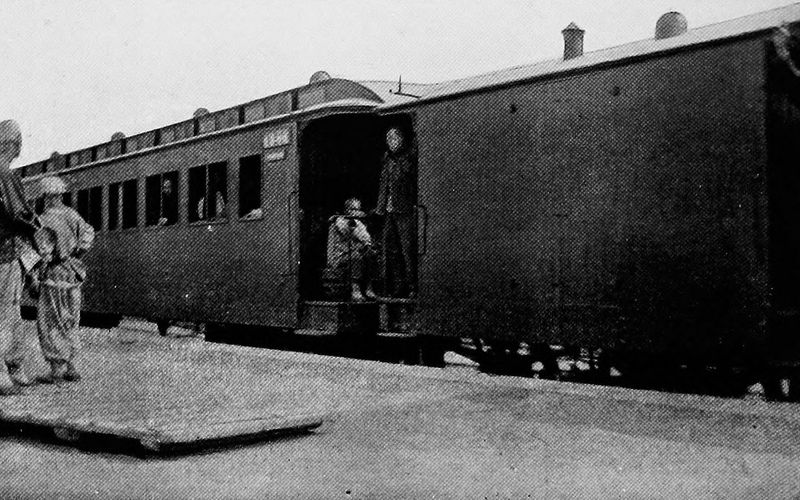
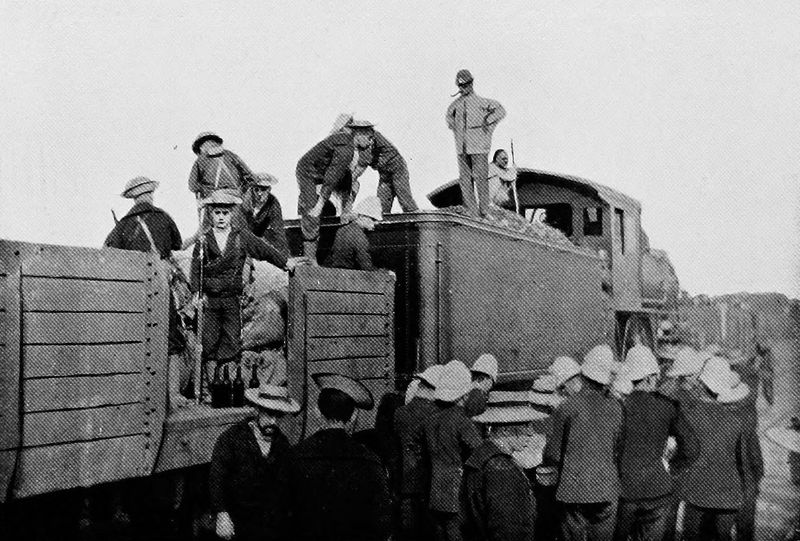
route along the railway line, on to which all
the empty trucks had been shunted from the
station, and which afforded good cover. On
this occasion, however, the trucks were
tenanted, and a sergeant had just time to
yell “Chinese in the trucks!” when he was
shot dead, and a heavy fire was opened on to
the remainder of the company. Without a
moment’s hesitation the Indians went in with
the bayonet, and within a minute or two this
part of the enemy were in full retreat. B
company moved up by a more direct path,
being greeted, while crossing the river, by a
shrapnel which burst right above the company,
but, marvellously enough, hit no one.
On arriving at the station, matters were
found to be even worse than the man had
said. Some of the enemy were ensconced
behind a bank some 30 yards to the front,
and their fixed bayonets could be seen as they
moved to and fro, evidently summoning up
courage for a charge, in the event of which
the little garrison would only have escaped
annihilation by a miracle. But little firing
was going on, our men husbanding their last
nine rounds each for the final rush, and the
enemy evidently not liking to expose their
valuable carcases to take aim. Certainly the
enemy in the rear had been keeping up a hot,
but comparatively innocuous fire, whilst those
in front occasionally “eased off” without
taking any aim at all; perhaps invoking Joss
to find a satisfactory resting-place for their
bullets.
On the arrival of reinforcements, however,
the Chinese finally made up their minds
that it wasn’t good enough, and at once
commenced to retire. As it was now getting
light, and they had 100 yards of open
ground to traverse, they lost heavily from
the deliberate and accurate fire which burst
out with renewed vigour from the station,
and the open was quickly strewn with more
of war’s victims. The retreat was not continued
very far, and on reaching the excellent
cover afforded by the graves, already mentioned,
they resumed a galling rifle fire before
again withdrawing. Immediately they had
retired, their artillery opened fire, and the
Allies had again to leave the locomotive shed,
the walls and roof of which were by this time
absolutely pulverized; and it would be rash
on the part of any one to hazard an estimate
of the number of shell marks which it bore.
Very soon, however, the Japs and Russians
sent detachments of men to the threatened
point, and all fear of the success of the Chinese
attack was at an end. Towards eight o’clock
the enemy planted banners on two of the
biggest mounds as a sign of defiance, but
finding that they attracted our fire, they
soon hauled them down and began to retire
sullenly under cover of a heavy shelling from
our guns. With the exception of the first
fight at the station, this, which proved to be
the last, was the most severe. Up to date
the enemy’s tactics had been childish in the
extreme, and each previous attack had been
heralded by a terrific storm of rifle fire.
On this occasion, however, they had presumably
got into position to resist the projected
Russian attack of the night before,
and, finding themselves so close to the coveted
station, attacked it vigorously on ascertaining
that the movement had fallen through.
This is of course merely conjecture, but there
is much to be said for such a line of argument,
for their knowledge of every move, and indeed
every plan, inside the settlement, throughout
both sieges, was little short of marvellous.
The 11th was passed amidst a storm of shells
from both sides, the 4-in. gun, mounted out
towards Pei-Yang arsenal, having a two hours’
duel with four guns mounted close to the
banks of the canal at a range of 4000 yards.
Three of the four were silenced, but the fourth
gave as good as it took till the very end, when
the cessation of fire was mutual. The next
day was the exact opposite of its predecessor,
there was no early morning fighting, and even
shelling did not begin until the evening. It
was a Heaven-sent rest, for much remained to
be done in the way of fatigue work and gun
mounting, to prepare for the morrow, which
was the day chosen to assume the offensive
and attack the native city. A German 6-in.
gun arrived, but was not mounted, and although
carpenters were busy constructing a
mounting for the 4.7-in. which arrived on the
11th, and the engineers made an emplacement
and magazine for it, the work could not be
finished in time to take part in the great
effort of the morrow, and was abandoned.
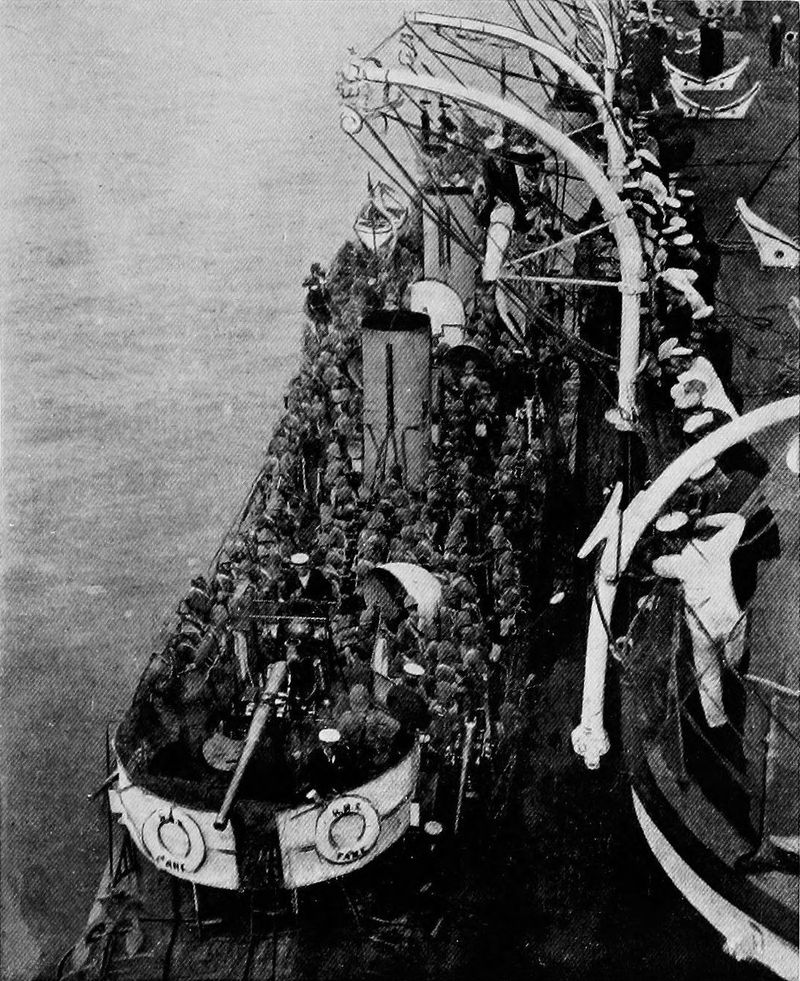
Admiral Seymour and the remainder of his
brigade went down to Taku by river in the
afternoon, thereby just missing the hardest
battle in the naval brigade’s experience, and
an operation which proved to be the most
important—in fact the turning-point of the
whole campaign. Their departure was the
last thing of importance which took place in
the period 27th June to 12th July, between
which dates began and ended the second siege
of Tientsin.