In the early part of April, 1861, a tall, well-built
man, with the love of adventure in his heart,
called upon the General commanding the Union
forces and offered to penetrate the Confederate lines
for the purpose of discovering the military secrets of
the Southern army.
The volunteer was Lafayette C. Baker, who was to
play a most conspicuous part in the Civil War, and the
soldier to whom he made his proposal was General
Winfield Scott, one of the most distinguished military
men in the United States. The interview was epoch-making
in its character, and out of it came one of the
most amazing adventures in the history of the war.
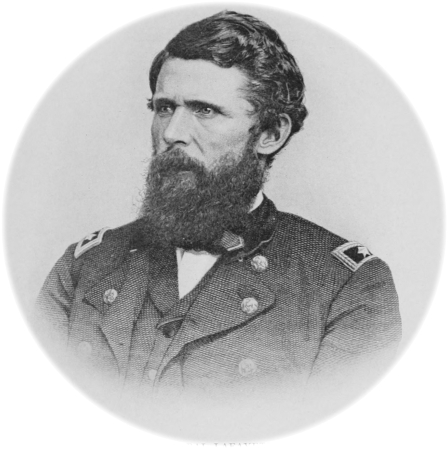
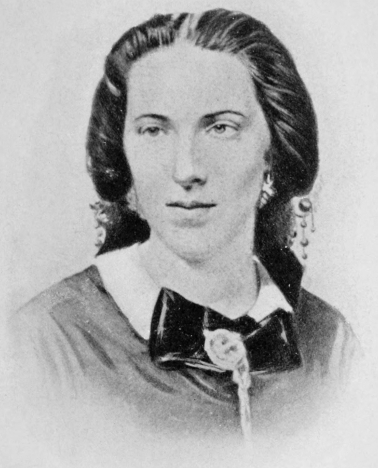
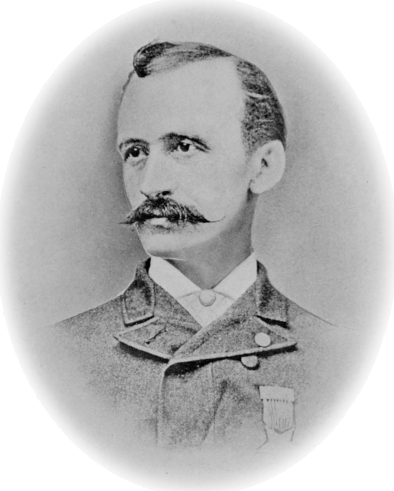
BRIGADIER-GENERAL LAFAYETTE C. BAKER
Washington was filled with all sorts of men on all
sorts of missions at that time, and Scott was not disposed
to see the young man from the West. The
General, with others in power, had his fill of theorists
who offered endless suggestions for the conduct of the
war, most of which, when tried, proved to be impracticable.
But Baker was the sort of an enthusiast who
was not to be daunted. He had journeyed to the
National Capital for the purpose of seeing the General
and he did not propose to quit until he had accomplished
his object. It happened that he was acquainted
with Congressman William D. Kelley, a notable member
of the House from Philadelphia, and Mr. Kelley,
in the kindness of his heart, managed to arrange an
interview with General Scott.
The enthusiasm of the man who was willing to risk
his life in the cause attracted the attention of the veteran
of the Army. Scott had the enviable distinction
of having participated in three wars. He rendered
distinguished service in the war of 1812, and
he was one of the heroes of the Mexican War. Now,
as the ranking head of the Army, he was charged with
the direction of the Federal forces in the Civil War,
although age and increasing infirmities eventually
caused him to be shelved in favor of younger men.
But in the meantime he was deeply interested in knowing
the plans of the Confederates, and he was impressed
with the earnestness of Baker.
“You look as if you had the grit and the intelligence
for the job,” he said, “and I’m going to give
you a chance to see what you can do. If you succeed
you will be recognized by the Government in a suitable
manner.”
Baker drew himself up to his full height and there
was a flash of fire in his gray eyes as he exclaimed:
“All I ask is this chance—I’ll guarantee to make
good!”
The General smiled and placed his hand upon the
shoulder of the volunteer.
“That’s the sort of spirit that wins. Good-by and
good luck to you!”
But before Baker left, Scott had pressed ten twenty-dollar
gold pieces into his hands.
“You may need it for expenses,” he said with a
humorous twinkle in his eyes.
Lafayette Baker now possessed the status of an
“unofficial spy.” He was not commissioned and he
was unarmed, but he was satisfied that if he were able
to carry out his promise he would not fail to receive
governmental recognition. His first move was to contrive
some plan that would make his appearance in
the camp seem reasonable. He discarded the notion
of a disguise as unnecessary and dangerous. He
finally hit upon the expedient of pretending to be an
itinerant photographer. At that stage of the Civil
War picture taking was all the rage and the officers
delighted in having themselves photographed in front
of their tents, surrounded by their aides.
Baker went to one of the second hand shops in
Washington and succeeded in purchasing a camera
and a tripod. The fact that the camera was worn out
and unworkable did not disturb him in the least. The
dealer chuckled at the thought of finding a customer
who was willing to pay real money for such junk, little
thinking that the paraphernalia was precisely suited to
the needs of the purchaser.
All of his preparations were completed on the 11th
of July, 1861, and on the morning of that day he began
his journey, exclaiming as he did so,
“On to Richmond!”
Baker had been given detailed instructions by General
Scott and was told to keep his eyes and ears open
during the progress of his trip to the Confederate
capital. He had been told to learn the locality,
strength and character of the Southern troops and to
let no opportunity pass for gaining information of
the enemy’s fortifications. General Scott was especially
anxious to get some definite news concerning the
famous Black Horse Cavalry, which had become the
bane of the Union Commanders.
Baker began his journey in high spirits. The
nature of his services, of course, was not known to
the Federal troops and as a consequence he was regarded
by them with quite as much interest and curiosity
as if he had been within the lines of the enemy.
The Federal Army lay before Washington, guarding
the frontier, which stretched from a point three
miles below Alexandria toward the Potomac. General
Heintzelman was the Provost Marshal and was
stationed at this point. Passes were not recognized
either by the Union or Confederate armies, and Baker
knew that he ran the risk of being arrested as a spy
either by the Federal or the Confederate sentinels.
However, he knew the attempt to get through both
these lines was a part of his self-imposed task. When
he was four miles out of the city he reached the headquarters
of the Second Maine Regiment. His photographic
outfit was slung across his back and the Colonel
of the regiment invited him to take a view of the
camp, including his own tent with the principal officers
standing in the foreground. As Baker’s apparatus
was next to worthless, he knew that it would be
folly for him to pretend to take the picture, but he was
equal to the occasion. After dining with the Colonel,
he suggested that he would like to go to a neighboring
hill and take views of the encampment and
then return to photograph the headquarters. He was
soon in the woods, and eluding the guards pushed forward
through the tangled undergrowth in the direction
of Richmond. After a while he felt that he had
crossed the Federal lines, but at that critical moment
he was startled by a loud command:
“Who goes there!”
Baker looked up and saw a sentinel standing with
lifted gun upon a knoll just beyond the roadside.
There was no opportunity for explanation. The
guard marched the volunteer in the direction of the
Colonel’s headquarters. That officer was sure he had
caught a spy and escorted by ten men, Baker was sent
back along the railroad, the very way he had started,
to General Heintzelman’s headquarters. He was presented
to the General in language that was more expressive
than flattering:
“Here’s a dirty spy, General—we found him lurking
about our camp and trying to get through the
lines.”
“You contemptible villain!” exclaimed Heintzelman
with an oath, “I’ve got a notion to stand you
against the wall and shoot you through the heart.”
Baker, with all his courage, quailed before this
fiery denunciation. He was in a predicament. His
employment by General Scott was confidential and it
might spoil his plan of campaign if he should disclose
his identity, but while he was wondering what he
should do under the circumstances, General Heintzelman
burst forth with another tirade:
“I’ll fix you, you rascal!” he exclaimed. “I’ll
send you to General Scott and I’ll wager that he’ll
teach you a lesson that will last you for the balance of
your life.”
The captive smiled at this announcement. It fitted
in with his own desires so well that he could scarcely
conceal his own satisfaction. A guard was placed
around him and he was hurried to Washington and
into the presence of General Scott. The veteran lifted
his eyebrows with surprise and amusement and dismissed
the escort.
“Leave this man with me,” he said, trying to conceal
his smile; “I’ll know how to deal with him.”
When they were alone the General patted his messenger
on the shoulder and said cheerfully:
“This is a complication that I had not anticipated.
What are you going to do about it?”
“I’m going to try again,” was the prompt reply of
Baker, and ten minutes later he was started on his
mission for the second time.
Soldiers were arriving in Washington at all hours
of the day and night and in an almost unbroken line
were marching over a long bridge into Virginia. That
night Baker took his position at the end of the bridge
and when a regiment came down in considerable disorder
he quietly slipped into the ranks, hoping to be
borne along with the troops. Unfortunately a lieutenant
saw the movement and taking the interloper by
the collar put him under guard and sent him back to
the rear. He was released with a warning not to repeat
the trick.
Another night was spent in Washington, but it was
not wholly devoted to sleep. The active mind of the
volunteer was busy with new plans and when daylight
came he said to himself with the air of a child who is
reciting a lesson:
“On to Richmond!”
Before breakfast that morning he had renewed his
journey on foot, going through the lower counties of
Maryland, toward Fort Tobacco. He traveled thirty-five
miles that day and when night came he was so
exhausted that he slept like a log. In the morning
he gave a negro one of his precious twenty-dollar gold
pieces to row him across the river and before noon
that day he found himself well within the Confederate
lines. The country was wooded and an unfrequented
road, whose general direction was toward
Richmond, suggested his line of advance into the old
dominion. It was a hot day and he was forced to
pause frequently to slake his thirst at brooks by the
roadside. He had no settled plan of future movements,
but trusted to circumstances to steer his course.
He was about four miles from the banks of the Potomac
when two Confederate soldiers made their appearance
and demanded him to give an account of himself.
He did so, but his story was evidently discounted, for
the soldiers promptly placed him under arrest as a
spy. They were friendly guards, however, and accepted
an invitation from their prisoner to indulge in
a glass of ale at a beer shop in one of the townships
through which they passed. One glass, as frequently
happens, led to another, until finally the two soldiers
fell asleep on the step of the beer house and their prisoner
went on his way unmolested.
He proceeded along the road toward Manassas
Junction, congratulating himself on his easy escape
when four cavalrymen suddenly came out of the brush
and ordered him to halt. They drew their sabers and
commanded him to surrender. He pretended surprise.
“I’m a law abiding citizen,” he exclaimed, “unarmed
and on my way to Richmond, where I have
business.”
One of the men dismounted and proceeded to search
him and succeeded in finding a number of letters. It
was just the thing that Baker wanted, for two of these
missives were notes of introduction to prominent men
in Richmond. In spite of this, the four soldiers directed
Baker to proceed to Brentsville, about ten miles
distant. They rode all the way and kept him on foot
between them. Brentsville was reached about ten
o’clock that night and the prisoner was immediately
taken to the headquarters of General Bonham of South
Carolina, who was in command at that vicinity. The
General, who was in full dress uniform, took a seat
opposite Baker and began to question him.
“Where do you come from and where are you
going?” he asked.
“I come from Washington and I am on my way to
Richmond.”
“What do you mean by coming inside of my
lines!” he exclaimed.
Baker’s face in the language of the movies “registered”
intense surprise.
“I’m a loyal and peaceful citizen of the United
States, engaged in an honorable and legitimate pursuit.
I have business in Richmond and desire to get
there at the earliest possible moment.”
The Confederate General laughed mirthlessly.
“Well, I’ll see that you get there and in quick order.
I believe you’re a Union spy and I’m going to send you
to General Beauregard.”
General Bonham handed a sealed letter to a lieutenant
who was standing near by and said:
“Put this man in irons and take him to General
Beauregard’s headquarters.”
So at midnight, expostulating all the way, he was
compelled to go on foot in the direction of Manassas
Junction. When he protested against being compelled
to walk such a distance he was told that he had chosen
that mode of conveyance and ought not to find fault
with it. The party arrived at Manassas Junction at
daylight and went at once to General Beauregard’s
headquarters, which were located at the Wiere House.
The prisoner was completely exhausted from his walk
and he lay down in front of the house and went to
sleep. He awoke at nine o’clock and found himself
in charge of a guard, who told him that General
Beauregard had expressed a desire to see him.
General Beauregard sat in front of a desk, surrounded
by members of his staff. An open letter lay
before him. He pointed to it, frowningly, and said:
“I see that you have been taken inside of our lines.
What explanation have you to make?”
Lafayette Baker had been cross-examined so often
during his brief career as a military spy that he was
becoming used to the ordeal. He had his story by
heart and he proceeded to tell it glibly.
“I am from Washington and I am on my way
to Richmond where I have private business requiring
my attention. I have not intended to violate any
law, regulation or military rule of the Confederate
Army.”
The General turned to a member of his staff and
began whispering. The prisoner watched him anxiously.
The letters that had been taken from him
named him as Samuel Munson and he realized that it
would not do to forget the appellation. He had assumed
that name because he had learned that several
families by the name of Munson belonged in Knoxville,
Tennessee, and he had known a son of Judge
Munson during the time he lived in California.
While this thought was running through his mind the
General finished his conversation with his staff officer
and once more turned to the spy.
“So you are going to Richmond, are you?”
The prisoner smiled.
“That was my intention,” he replied, “but of course
you are to be the judge in that matter. If it is your
desire, I am willing to return to Washington.”
General Beauregard shook his head.
“No,” he said, with a slight trace of sarcasm in his
voice. “I prefer that you should go to Richmond.
Where do you reside?”
“I have lived in California for the last ten years,
but formerly lived in the South in Knoxville, Tennessee.”
“How long has it been since you were in Knoxville?”
“Ten or twelve years.”
“What is your name?”
“Samuel Munson,” replied Baker with cheerful
mendacity.
General Beauregard looked at the prisoner intently
and then suddenly exclaimed:
“Yes, yes, I know that is the name on the letters
that were found in your possession, but I’d like to
know what your name was before you became a spy.”
If he expected to catch his man unaware, he was
disappointed for Baker, looking at him with assumed
dignity, said:
“I am no spy.”
The General arose from his chair and paced up and
down the room several times. Presently he halted
and pointing out of the window said:
“Do you see that tree?”
“I do.”
“Well, I half believe that you are a spy and if I
was sure of it I would hang you on that tree as a warning
to all other spies.”
Baker looked at him reproachfully and not without
a secret feeling of fear. The General called to one
of his attendants.
“Orderly,” he commanded, “take this man out and
put him in the guard house.”
Five minutes later the adventurer found himself
inside of a log house within a stockade. The discreet
use of one of his gold pieces secured him a warm
breakfast and later in the day he was permitted to go
outside in the care of a guard. The two men were
soon on good terms and the guard did not disdain the
offer of a drink with his prisoner. Before they
returned, Baker had the satisfaction of seeing all the
troops in the vicinity of Manassas Junction—including
the famous Black Horse Cavalry concerning which
General Scott was anxious to obtain information.
The volunteer spy now had important information
which would be of great value to General Scott, but
he had no means of conveying it to the Union Commander.
Indeed, he was kept under lock and key with
no means to communicate with the outside world.
Perhaps his guards repented having given him so
much liberty. If so they did not propose to repeat
the mistake. During the long watches of the night he
had time to think over his position, and to consider
his plans for the future. As a result of this he abandoned
all thought of trying to escape—at least at
that stage of the adventure. His one desire was to
reach Richmond, and thus carry out his original
design. But if he were kept confined there would not
be much prospect of reaching the Confederate capital.
Curiously enough, the thought of being shot as
a spy did not enter his thoughts at that time. He was
so much engrossed in his mission that he did not think
of the risk he was running. All during that night his
one thought was:
How shall I get to Richmond?
Just before daylight the answer came in the most
abrupt and unexpected manner. One of his guards
aroused him, shouting:
“Hey there, wake up and get ready for a journey!
You’ve got to go to Richmond and give an account of
yourself to Jeff Davis!”
Baker could have cried with joy. The one thing
he most desired had come about without any effort on
his part. He cheerfully arose and won the good will
of the guard by his seeming docility. He was taken
to the station and placed on a freight car, along with
some others who were also going to Richmond. Evidently
he was regarded as an important prisoner, for
he was carefully guarded during every stage of the
journey. That trip during the night, over a badly
constructed road was a nightmare, long to live in the
memory of Lafayette Baker. But the prospect of
actually setting foot in the Confederate capital kept
him in the best of spirits and enabled him to exchange
jests with his captors.
On the arrival in Richmond he expected to be taken
to Libby Prison, concerning the horrors of which he
had heard a great deal from Union soldiers who had
been captured in some of the early skirmishes of the
war. But instead of that he was conveyed to a room
on the third story of an engine house in the city. His
apartment was large and airy, and was all that could be
desired. He was treated with great consideration,
but was guarded with scrupulous care. Evidently the
officers felt that they had no ordinary prisoner in their
charge. The cause of this extreme courtesy became
evident on the morning of the second day after Baker’s
arrival in Richmond when he was informed that President
Davis desired to interview him. The head of
the Confederacy had his headquarters in the Spottswood
House whence the Northern spy was escorted.
Baker expected to find much formality there, but to
his surprise found Mr. Davis in his shirt sleeves and
without collar and tie. He was evidently very busy
because his desk was filled with papers and there were
a number of persons waiting to have a talk with him.
He motioned Baker to a seat without looking at him,
and continued with some writing with which he was
engaged when the prisoner was brought into his room.
Presently he turned to the suspect and said abruptly:
“They say your name is Samuel Munson?”
“Yes, sir,” replied the cheerful fabricator, “that
is my name.”
“I understand,” said the civil chief of the seceding
States, toying with his pen, “that you have been in
Washington recently. What can you tell me about
conditions there?”
“Not much,” was the answer, “except that there
is a great deal of excitement and confusion there.”
“How many troops do you think there are in Washington
and vicinity at the present time?”
“That is a pretty difficult question to answer, but
there are probably from 75,000 to 100,000, with more
arriving all the while.”
Mr. Davis seemed to ponder over this for some
time, and then looking his caller in the eye, he said,
“I presume that you know you are suspected of
being a spy?”
The look of injured innocence which appeared upon
the face of Lafayette Baker would have done credit
to a professional actor. Nevertheless he evaded a
direct answer by saying:
“No man is safe from accusation in times like the
present.”
“But what have you to say for yourself?”
“Nothing except that I defy my accusers to prove
their charges.”
“It seems to me,” said Mr. Davis, “that some one
said you were a Southern man.”
“Yes, sir, I came originally from Knoxville. The
members of my family lived there for years, but in
recent times I have lived in California.”
“Have you any way of proving that?”
The alleged Mr. Munson shrugged his shoulders.
“I am afraid I cannot find any one here to identify
me.”
The President of the Confederacy smiled a somewhat
sarcastic smile.
“Perhaps we may be able to help you out in that
respect. There is a Knoxville man in the city and as
soon as I am able to locate him I will have you meet
him.”
This was startling news indeed and it came near
shaking the self-assurance of the volunteer spy. But
before he had time to make any reply he found himself
being escorted out of the room and taken to his
place of confinement in the engine house. He was
treated as kindly as before, but he realized that the
watch upon him was closer than ever. He did some
serious thinking that night. As he looked out of the
barred windows and up into the unpitying stars he felt
that he had reached a real crisis in his life.
One of two things would happen. Either he would
escape from his place of confinement, and attempt to
reach the North, or he would be shot as a spy. All of
the chances seemed to point to his execution on the
charge of spying.
But his naturally buoyant disposition came to his
aid, and when morning arrived he was taking a more
cheerful view of the future. That day he was taken
before President Davis and submitted to a further
cross-examination. The Chief of the Confederacy
appeared to be more anxious to get reliable information
concerning the Union forces than to prove that
Baker was a spy.
“Who is in command of the Yankees at this time?”
he asked.
“General Scott,” was the truthful reply.
“Where is he?”
“In Washington.”
“Ah, then he is not in charge of the troops?”
“No, sir, I believe that General McDowell is in
active command of the forces in the field.”
This was correct, and Baker in making the statement
felt that he was not giving away any of the secrets
of the war. But the information interested the
President and he turned aside and talked with several
of his advisers who were in the room. In the meanwhile
he made a gesture to indicate that he was through
with Mr. Baker, alias Mr. Munson, and the spy was
led from the room and once again taken to his prison
in the engine house. In spite of his optimistic nature
these repeated cross-examinations were beginning to
unnerve him. He was afraid that he might be tripped
up in some of his answers, and then he felt sure that
he would be stood up against a wall and shot. He felt
that such a procedure would make him a martyr, but
he had a very natural desire to postpone his martyrdom
as long as possible.
His real ordeal was to come on the following day.
Shortly after breakfast he learned that Mr. Davis
desired to see him again. And he learned something
else that caused him much perturbation. It was that a
Knoxville man had been located in Richmond and that
he had been sent for to identify the supposed Mr.
Munson. Baker tried hard to screw up his courage
for the interview. He was at a loss as to how he
should act and talk. It was certain that the man did
not know him and in such an event he would be in the
position of being condemned as an impostor and a
spy. While he was preparing to go over to the Spottswood
House he heard one of his captors speak of a
Mr. Brock of Knoxville, who had also been summoned
to meet the President. Baker grasped at this as a
drowning man grabs at a straw. All the way to the
hotel he racked his brain in the effort to work out a
plan of action. But he could reach no definite conclusion.
He would have to be guided entirely by circumstances.
One thing he did do was to refresh his
mind as to certain names and places in Knoxville.
When he reached the headquarters of the Confederate
Government he found Mr. Davis talking with a man in
a frock coat and a slouch hat. At first he supposed
that this must be Brock, but fortunately he learned
that it was Robert Toombs, and was thereby saved
from making a break that might have caused his undoing.
In a moment the President turned to the spy.
“Hello, Munson,” he said, “I have sent for a man
who has lived in Knoxville for many years, and he will
be able to tell us if you are the person you claim to be.
Take a seat. He’ll be here in a few minutes.”
Baker sat on a chair facing the door and anxiously
waited for the man who was to give the verdict. The
moments went by on leaden heels. He could feel the
cold sweat coming out on his brow. But he had courage
and he was resourceful. Once the door opened
and a messenger came in. Baker half rose to his feet,
but caught himself in time. He could not afford to
make a mistake. The President and Toombs talked
together as if oblivious to his presence. Presently
Toombs threw himself on a couch in a corner of the
room and Mr. Davis busied himself with some papers
on his desk. The spy kept his eyes glued upon the
door. Out of it would walk his doom or his deliverance—he
could not tell which. Suddenly when the
strain was beginning to seem too great for further
endurance, the door was opened and a middle-aged
man entered the room. He hesitated for a moment
and looked about him inquiringly. Baker felt that he
must be the man. He did not hesitate for the fraction
of a moment, but jumping up and hurrying toward the
newcomer he held out his hand and exclaimed in a
tone of great cordiality:
“Why, hello, Brock, how are you, anyhow?”
The surprised visitor did not have time to think.
He accepted the proffered hand in a mechanical manner
and said slowly:
“You—you are—”
“Sam Munson, of course. Don’t you remember
me?”
“Judge Munson’s son?”
“Certainly—but it’s been ten years since we’ve
met. I’m surely glad to see you. How are you, anyhow?”
“I’m right well,” said the stampeded one, “and
how are you?”
“Well, I haven’t been very well, but the sight of
you is a cure for sore eyes. They’ve locked me up on
suspicion, and you’ve just come in the nick of time.
They wanted some one to let them know that I was
really Sam Munson. How long has it been since
you’ve been in the old town?”
“Two years,” said Brock, watching the other man
intently.
“Well, it’s been ten since I was there, and I’ll bet
they’ve had some big changes in that time.”
“Rather!”
“By the way,” continued Baker, trying to prevent
the other from having time to think, “you remember
the Bradleys, don’t you? Well, I heard not long ago
that Sue Bradley had married—married some fellow
from Chattanooga. She was a mighty fine girl was
Sue, and the fellow that got her got a prize.”
Well, to make a long story short the bluff worked—not
like a charm, but with sufficient smoothness to
enable the nervy spy to save his life. Brock and
Baker had one or two more interviews, and by ransacking
his brain for incidents he had learned about the
prominent people of Knoxville he finally persuaded
Brock that he was really Sam Munson. The visitor
even went so far as to apologize for his seeming inability
to place his fellow townsman at first sight.
“But you must remember that it has been many
years since you left the old town, Sam. You’ve
changed a lot since then.”
“Don’t mention it,” was the hearty response. “I’d
have been the same if I had been in your place. But
you’ve done me a good turn, and I won’t forget it.”
There was no doubt of the good turn—if saving
a man from being shot as a spy can be placed in that
category.
As a result of the business Baker was not released,
but he was placed under parole. This gave him the
right to wander about Richmond at will—the very
privilege he most desired. If he had planned the thing
in advance it could not have worked out more to his
liking. He was free to go and come as he pleased,
and he was actually under the patronage and the protection
of the Confederate Government!
For two days and two nights he roamed about until
he became as familiar with conditions in Richmond as
if he were a resident. He obtained a mass of data
concerning military plans and proposed movements,
learned where troops were quartered and where fortifications
were being erected. Most of this information
he carried in his head, but in a few instances he
made notes of a character which were intelligible to
himself, but which were not likely to be decipherable
to any one else. Finally the time came when he knew
more than “was good” for himself, from a Confederate
point of view. The question was how to get this
knowledge to the Federal Government. The fact that
he had been before Mr. Davis and was now at liberty
made him seem harmless to most of the officers in
Richmond. He became personally acquainted with
some of them. One was the Provost Marshal, and
so, one day, when he asked that official for a pass to
permit him to visit Fredericksburg it was granted without
any hesitation.
He proceeded to that place without any difficulty.
Once or twice he was halted by sentinels, but the production
of his pass was all that was needed to permit
him to go on his way. On the night of the day he
reached Fredericksburg he parted with another of his
precious gold pieces to a negro who rowed him across
the Rappahannock. He drew a breath of relief when
he reached the other side of the stream, and yet he
realized that his dangers had only begun. That night
he slept in a haystack—slept the sleep of a dog-tired
man, if not of the just. When he awoke at dawn he
discovered signs of activity in the vicinity of the barn
where he had slept and he knew that he was being
pursued. He lay very quiet and listened. Voices
were shouting and it did not take him long to learn
that a squad of Confederate cavalry was on the hunt
and that a number of horsemen surrounded the barn.
He shuddered at the thought of the consequences.
He had plenty of courage but he did not relish the
thought of being caught like a rat in a trap. He had
provided himself with a revolver, and he firmly resolved
that if he were detected he would not give his
life easily. He grasped the weapon, and lay very,
very quiet. He was almost afraid to breathe. Presently
one of the cavalrymen dismounted and flourishing
his sword began a search of the barn. Some of
those on the outside were shouting instructions to the
searcher, and he responded cheerily. He poked his
sword here and there in the hay rick, calling meanwhile
on any supposed fugitive to surrender if he did
not want to be killed. At one time the point of the
sword just grazed Baker’s boots. He could have
screamed with nervousness, but by a super-human effort
he managed to keep perfectly quiet. And by so
doing he saved his life, for the officer turning to his
companions called:
“He ain’t here, boys—we might as well move on!”
They rode off, to the great joy of the hidden man.
He remained still until the sound of the horses’ hoofs
had died out in the distance, and then he crept from
his place of concealment more dead than alive. He
waited for a long while and then crept out of the barn
and made for the woods. How long he straggled
through the woods he could not tell, but he was so
hungry, and faint and footsore that nothing seemed to
make any difference. That night he managed to get
supper in a hut owned by a poor colored man, and
afterwards tried to find just where the Potomac was
located. When he reached that stream he discovered
an old row boat. The owner of it was lying, half
asleep, on the banks of the river. Baker invited him
to sell the boat, offering the last of his gold pieces for
craft, but the owner indignantly refused saying that
he would not part with it for any price.
This was discouraging, and in lieu of anything better
to do he lay down and went to sleep, with the hard
earth for a couch, and the shining stars for his covering.
He awakened just before daylight with every
bone in his body aching, and an intense yearning for
home. The owner of the boat was still asleep, and his
craft lay anchored in the water. It did not take Baker
long to come to a decision. At that stage of his career
larceny seemed a very petty offense. He crept
down to the water side and climbing into the boat
began to row gently into the stream. The job was not
an easy one because the oars were broken and decayed.
However, by great care he managed to get the boat
into the middle of the stream. At that moment the
owner awoke, and when he discovered what had happened
sent up a series of ear-splitting screams.
“Come back with that boat, you thief,” he yelled,
“or I’ll kill you.”
Baker did not fear anything from the man, but in
a few moments he saw that three or four soldiers had
suddenly appeared upon the scene, and were talking
with the distracted owner of the boat. They grasped
the situation at a glance, and ordered him to halt at
the risk of his life. Instead of halting he pulled
harder than ever. Without another word one of the
soldiers raised his gun and fired. The shot struck one
of the oars and shattered it. Once again came the
command to halt and once again the fleeing man renewed
his efforts as best he could with the broken oar.
This time three of the soldiers aimed at the man in
the boat. There was a hissing sound, Baker ducked
and the bullets went skimming across the water. The
situation was becoming perilous. The fugitive plied
his one good oar, and worked the stump of the other
with great vigor, and in this way managed to lengthen
the distance between himself and the shore. A final
volley came from the soldiers and this time the shots
fell short of the mark by several yards.
Baker breathed freely for the first time since he
had boarded the boat. He was out of danger for the
time being. All depended now upon his ability to get
to the Maryland side of the stream. It was a hard
job, but he stuck at it with the persistence of a desperate
man, and eventually felt the small craft grazing
the beach. He felt a strong desire to cheer, but he
overestimated his strength, for the moment he climbed
out of the boat he fell to the ground, exhausted. The
perils and the privations he had undergone were
enough to kill a less resolute and less hardy man. He
lay on the shore for more than an hour, until finally
a farmer passing that way halted and picked him up.
He was taken to a farmhouse, and given a meal
which he ate with the ravenousness of a wolf. His
hosts were naturally filled with curiosity, but he felt
that discretion was the part of wisdom and he declined
to reveal his identity, or the cause of the plight in
which he had been found.
That night, in spite of the protests of the farmer,
he resumed his journey to Washington. He walked
the greater part of the night and slept in a barn as
usual. He begged his breakfast and then started on
his last lap to the National Capital. It was some time
before he felt that he was out of danger, but finally
the dome of the Capitol came into view, and he knew
then that he was safe and that his remarkable adventure
was to be a success. It was nearly noon, and
there was a broiling sun when he finally reached the
streets of Washington. He did not wait to eat or to
make himself presentable, but headed immediately for
the headquarters of General Scott. The attendant at
the door repulsed him and said that it would be impossible
to see the General at that time. Baker knew
that this reception was caused by his disreputable appearance,
and once he was sure that Scott was in his
room, he pushed the man aside and bolted into the
apartment where the head of the army was making
his headquarters. The General was seated at a desk
and as the strange looking specimen of humanity
stood beside him, he said rather gruffly:
“Well, sir, what can I do for you?”
Baker threw out his arms in a gesture of entreaty
and said with a wan smile:
“Why, General, don’t you know me?”
The veteran rose to his feet and closely scrutinized
the speaker, and then he said, with a welcoming smile
and outstretched hand:
“Well, by all that’s holy, it’s Baker!”
He would not let him tell his story then, but insisted
upon his taking a hearty dinner and making
himself comfortable. After that the adventurous one
sat down and gave a detailed account of his exploits
from the time he left Washington. He presented a
complete report of all he had learned while in Richmond,
and furnished him with data concerning the
size and movements of the Confederate soldiers.
Other members of the staff were called into consultation,
and after their talk had been concluded Baker
was plied with questions which he had no difficulty in
answering. It was dusk before he had talked himself
out, and then the General took him by the hand and
thanked him for what he had done for the Government.
“You have more than made good,” he said, “and
I will see that you get the recognition which you
deserve.”
On the following morning General Scott walked
over to the War Department, and when he returned
he carried with him a commission which
made Lafayette Baker an agent in the secret service
of the War Department. From that time until the
close of the war he participated actively in the work
of both the War and State Departments. He was
recognized by President Lincoln and became intimately
associated with Secretary Stanton. As the
result of all this he was made Provost General and
later was promoted to the post of Brigadier-General
in the army.