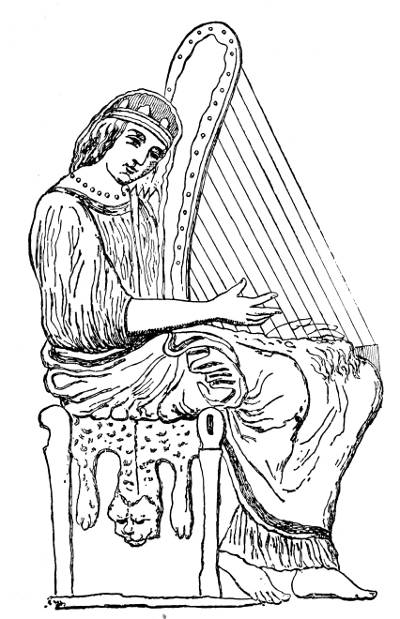
“Most things in Greece are subjects of dispute,” so
wrote Pausanias, and his word for it may be accepted
freely. As it was in his day (writing in 174 A.D.) so it
is in ours; learned authorities so differ on simplest
points that the wayfarer asking questions has no little
difficulty in deciding whom he shall heed, whose directions
he should follow.
The evolution of the musical scale should be of
interest even to musicians who would not make the
subject a study. How step by step our diatonic scale
developed, how it has become what it is gradually by
slow degrees—does anybody know? Certainly. Wise
men in their libraries find much; the erudition is deep
and they can expound it in their own way, but it is the
way for the plodding student, not intended to attract
the general reader. Moreover the wise men do not
agree, and the wayfarer in literature after reading
many books fails to obtain the clear account which he
has been seeking. Having had occasion to go into the
matter of the Greek system on the historical side, I saw
how confused it was, and how necessary to examine
author against author, to try to arrive at some orderly
assignment of steps and changes made in those distant
times, and to endeavour to bring home to the mind
the conception of a chain of historic facts.
Traditions embody general beliefs in stated facts, or
supposed facts, and history makes record of these, giving
to them more or less credence. The statements concerning
the earliest developments of the Greek scale are
based upon traditions, since it was not until after the
lapse of many centuries that anything was written.
The recorded periods of civilization that held good
in ancient chronology have many of them been displaced
by the newest explorers, whose work within the
last few years has been prolific in discoveries affecting
calculations of the relations of time in the past. The
dates I adopt will therefore have to be considered
authentic only so far as the learned choose to agree
concerning them.
Old historians stated that Athens was founded in
1556 B.C. by Cecrops, who led a colony from Sais, in
Egypt, and established the kingdom of Athens. Neith,
or Nit, was the deity of Sais, her name also was
Minerva, the patron goddess of Athens. In less than
fifty years after, Danaus, who was accounted a brother
of Amenhotep III. (by some Egyptologists called
Amunoph) left Egypt 1400 B.C. and founded Argos, of
which he became king, and died 1425 B.C.
These are highly important dates in the perspective
of history. Egypt, through the wars of Thotmes III.
and the later expeditions of the Amenhotep Pharaohs,
had been raised to the height of empire; Mesopotamia
and Syria had been brought under her rule and her
armies were constantly traversing and retraversing
that extensive region tributary to her (known now by
us as Asia Minor), reaching along that coast of the
Mediterranean and even to Cyprus, Crete and other
isles.
By a few touches of history and a chain of dates, it
may be possible to bring before you life as it was, to
excite your imagination to realise in a broad view the
state of the then known world, when in all that vast
territory, the high civilization to which Egypt had
attained could not have failed to influence the daily lives
of those myriads of peoples, busy with their tradings,
and little ambitions, and religions, and domestic wants,
and pleasures. It was a very composite population,
tribes, clans and races, or by whatever names we class
them, full of jealousies and antagonisms, only held in
abeyance from fighting by the prospect of greater gain
by trading with one another.
The musical instincts of the whole of these peoples
probably followed one channel common to all, their
music differing but little from what we call “folk-song”;
and even varieties of language need not have raised
barriers in musical feeling, as the instance of the Song
of Linus referred to by Herodotus (see pages 63-4 ante)
clearly shews.
The truth is that the founders of Athens, and Argos,
and other great cities, were leaders of bands of military
adventurers, and these when they left Egypt took with
them the common popular music such as themselves
and their families had been accustomed to, they had
no need or use for any other; we should not expect of
them that they would represent the musical culture of
the motherland, already so highly developed. Hence
the simple tetrachord of ages past, produced upon their
reed pipes, satisfied them for all that they sought, it
was their system of music, and had not been extended.
In the early state of the music of the Greeks there had
been a double influence, the Egyptian influence, and the
older Asiatic influence, both as I imagine proceeding
from the same Mesopotamian source in a remote age.
We have to remember that there was a prehistoric
Greece and an older Mycenœan Greece. Of Athens,
we should say “the refounding,” for there had been five
“Athens,” each city built upon the ruins of a former
one. “Athens,” says Mr. H. R. Hall in his book,
“The oldest civilization of Greece, has existed as an
inhabited place from the earliest post-neolithic times,
perhaps before 2500 B.C. to the present day,” a fact that
may be very usefully recognised, it bears with it an
important value, reminding us that an immigrant
people almost invariably displaces earlier peoples, or
absorbs them. Might ruled then, as now.
In the realms of myth and legend the chief progenitors
of music appear; Pan and Apollo, Mercury, Athene, and
others; then tradition brings forward many names of
poet-musicians who, it cannot be doubted, veritably
existed in the flesh. Certain dates do not seem to
be questioned, although they are prior to the Trojan
War, which is supposed to have taken place between
the periods 1500 and 1200 B.C. Homer himself being
given a date about 900 B.C. In musical history as
generally found, little is noted before Terpander 700-650
B.C., and it is assumed that up to his time
only a four-stringed lyre had been in use by the Greeks;
it is as if there had been averred a stagnation in music
for many centuries.
A closer investigation, however, must cause a revision
of such a conclusion, and I repeat, it may well be that
we should think of Greek music as having had two
courses of usage, running parallel, even as in our own
history. These are not as opposed but as distinct, the
temple or academic music very strictly conservative,
and the popular music with its mingled Asiatic influences,
inherited, and untrammelled by priests or
philosophers. Very naturally it would come to pass
that literature occupied itself with the orthodox and
academic views and systems of music, even as by
learned musicians our ecclesiastical music has been
regarded with almost exclusive attention, whilst the
old English songs and ballads have, as it were, existed
upon sufferance, kept in being by popular feeling and
tradition.
If this twofold strain in the origin of Greek music is
borne in mind I believe it will solve many difficulties
that constantly trouble enquiry, and will reconcile
conflicting accounts given by different authorities, for
there is very much that is vague even in the originals,
and various translators have but added to the confusion,
because they in default of understanding the subject,
too often became dogmatic upon guesswork.
Tradition comes upon fairly solid ground with
Hyagnis about 1506 B.C. and Marsyas his son, and
Olympus the elder, his pupils. Musæus the Athenian,
1426 B.C. was taught by Orpheus and was chief of the
Elusian mysteries instituted in Greece in honour of
Ceres; his hymns were used in the celebrations.
Orpheus also taught Thamyris, and Linus, who taught
Hercules, and Amphion, and so on. Then there was
Thaletes, the poet-musician mentioned by Strabo,
whose old pæans Pythagoras loved to sing; he lived
about 300 years after the Trojan War. Other names
might be recalled but these suffice to shew that amongst
the people of the various Greek States the art of
music never at any time was without honour and
esteem.
The musical system of the Tetrachord having become
known to us through the writings of certain Greek
philosophers, fragments of which had been preserved
by authors of later centuries, has therefore been assigned
to the Greeks, and the development of this musical
system has been recorded only in their language, yet
the origin of it has undoubtedly to be placed long before
the time of the Greeks. Possibly with good reason
it might be claimed for the primitive Akkadian, as found
by him in the finger holes of the simple reed-pipe.
Although there is clear evidence of the early existence
of the tetrachord in pipes, the attention of philosophers
has always been given to string instruments, pipes having
had no share in their regard, possibly because the
playing of pipes was a professional art in which good
training was necessary, whereas any philosopher could
twang strings and discourse upon laws and proportions.
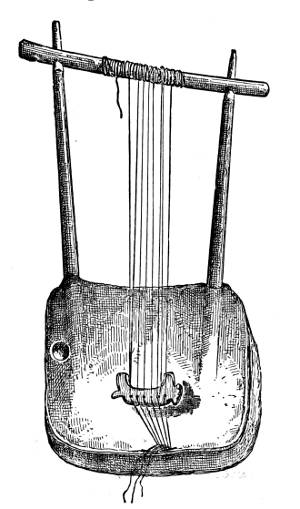
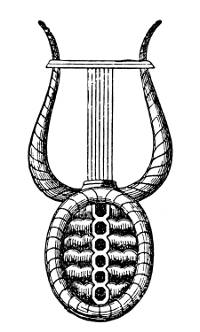
The lyre of Mercury, so tradition asserts, had three
strings only, tuned as
e——a——e, or, e——b——e,
thus comprising fourth, fifth and octaves according to
our terminology, though doubtless the god was ignorant
of such things. Emerging from the mists of fable we
arrive at traces of a period at which it is said the octave
became disused, and nothing remained but the fourth
in its rudimentary condition, divided next into two
steps, and after that separated in three divisions resulting
in an interval comprising two tones and a lesser
tone, or two steps and a half, so that the whole is
marked by four sounds; this series was then undesignated,
but after a time a stage was arrived at when
it was designated, and known thereafter by the word
“tetra” signifying “four” and the inclusive system was
called a tetrachord, and therefore the commencement
of the evolution of a musical scale.
The ending of the word in “chord,” has given rise
to the notion of a chord as of harmony, and again of
cords as another name for the strings. But these are
misconceptions, the meaning of “tetrachord” is, a
series of four sounds, in an order of succession so that
the extreme sounds comprise a fourth. The terms
fourth, and fifth, and octave, are quite artificial, are
signs founded on vision or the counting of the strings of
the lyre; the fourth in music is not a fourth part of
anything, is not a fourth part or proportion of the
octave, it was called by the Greeks “diatessaron,”—right
through or over, four.
One most ancient form may be represented thus,
considering the extreme sounds to embrace the
interval,—
e ‿ f——a
it was the initiatory stage afterwards completed as,—
e ‿ f——g——a
only that it should be read from right to left, because
with the Greeks the reading was from the high note
downwards thus—
a——g——f ‿ e
to us occularly confusing, yet it was the way of Greek
thought.
(The sign —— indicates whole tone, and ‿ semitone).
The man’s voice was the guide, and from time immemorial
the a has been the standard of pitch, by ruling
of the ear.
(The A below middle C, top line, bass clef).
From father to son, from teacher to scholar the
tradition of pitch was carried on. The string affected
by heat and moisture and by the strain when twanged,
never remains accurately to pitch. Although pipes and
strings have run a parallel course, we do not find that
the lyre players actually cared to refer to pipes as
guiding them in setting the pitch. Yet it was the
custom, so Plutarch tells us, for reciters and orators
to have a pitch pipe sounded by an attendant to keep
their voices to a prescribed pitch, and he mentions an
ivory pipe being used for the practice. On the contrary
it would seem that from the earliest times lyrists of all
sorts, and players on stringed instruments of every
nation, even up to the present day have found the habit
of the ear sufficient for the purposes of their art, that
indeed to the soloist, the musical ear relies upon itself
for tuning.
By the Greeks music as an art was regarded as an aid
to regulate by rule the inflections of the voice, to mark
the places of emphasis and to define the pauses in the
recitation of their epic poetry; and the rhythm of their
songs followed strictly laws that had been laid down,
innovation was reprehended, and even prohibited.
The lyre itself was held subordinate to the voice,
accompanying it and filling in the pauses according
to a conventional fashion, which the hearers judged,
critically and keenly.
We import our modern ways of speech upon musical
subjects into the considerations of these matters, and
necessarily so, but it is essential to a right apprehension
to remember that the Greeks had no way of naming
the sounds except by certain names given by them to
the strings of the lyre, thus the forefinger string was
called “lichanos” and the others had their distinctive
appellations. They had no sense of a tonic as we have,
no system of harmony, no musical stave, no use of
letters, a, b, c, etc., to denote their music. In late
times they devised a kind of letter-note method, curiously
crude yet elaborate, of letters standing upside down,
letters lying on the side, letters mutilated and signs for
instrumental sounds different from those for the sounds
of the voice, altogether 1,062 varied characters are
stated as used, and this knowledge of their written
music was by the merest accident preserved to us in a
solitary manuscript, by Alypius, 115 A.D.
The only date known in the life of Terpander was
the year when he gained the prize in the competition
for singing, B.C. 676, at the Pythian games; some say
that he also won at four festivals in succession. He
may have been known to that Demaratus, mentioned
page 68 ante, as the date connects them as contemporary.
Some time later than this victory he is
credited with having increased the number of strings
from four to seven, but statements upon this question
are very conflicting. Helmholtz says that he added
but one string to the Cithara of six strings.
According to some ancient writers Chorebus, son
of Altis, King of Lydia, he it was who commenced
innovation by adding a fifth string. Hyagnis, who in
the sixteenth century B.C. invented the Phrygian mode,
added a sixth string; Terpander a seventh, and
Lychasos an eighth; but Pliny says, Terpander added
three strings to the orthodox four, that Simonides
added an eighth and Timotheus a ninth. Anacreon as
before stated had ten strings, and Timotheus increased
the seven strings of the Spartan lyre to eleven. Pythagoras,
by equal authority, was the reputed father of
the eight-stringed lyre.
Through the maze of such traditions (and other
statements I could quote, increasing the intricacy for
the benefit of research) I have had to make my way,
and decide as best I could, upon a line of connected
record.
So, pending an alternative view to be offered presently,
I elect to follow Pliny and allow to Terpander
the claim to the increase of the scale of the tetrachord
by a trichord above a, the highest sound of the four-stringed
lyre.
Our scale system is based on a tonic sound, and we
read upward, but the Greeks in their music thought
downwards, and by the laws, the tonic was, in the
structure of tetrachords, barred out, for the a was the
master tone, and between it and g no semitone was
allowed, though what necessity existed for this essential
feature of the formation, no explanation is apparent.
The three sounds above this formed with the a
another tetrachord, conjunct, as it was termed.
The
Added
Trichord
The
Original
Tetrachord |
d
│
│ tone
│
c
│
│ tone
│
b♭
) hemitone
*a
│
│ tone
│
g
│
│ tone
│
f
) hemitone
e |
Continuing to plot out
the scale on a vertical plan
would not be of any advantage.
The habit of the
eye would perhaps require
a diagonal line of ascent;
I think, however, that
showing the growth of the
scale on a level line will
best suit our general convenience.
This then let us call the
Terpander scheme for the
scale to which the seven-stringed
lyre or Cithara was
tuned. As we shall see,
this became the classical lyre of Apollo, throughout
the glorious period of Greek Art.

e ‿ f——g——
|
a
* |
‿ b♭——c——d
|
The a I have marked with a star. It was called the
mese or middle-note, was considered the master-note of
the lyre, and was compared to the sun as being the
centre of the musical system. The original names of
the strings of the four string lyre are lost, but it is quite
obvious that until the extra three strings were introduced
there could have been no mese or middle string,
so that the name originated with this condition, with
this perfecting of the system.
Before systems exists methods and rules have sway;
and out of these methods and rules systems are constituted.
The great poet-musicians renowned in the land,
in teaching their successors in art according to their
own practical experiences, and teaching viva voce, no
doubt insisted upon the observance of certain methods,
and laid down rules which on their authority as chief
masters, became the traditions of the profession.
The great repute of Terpander would have caused
him to be regarded as one who spoke with authority,
and I have sometimes thought that discrepancies in the
accounts given by different authors, who wrote many
centuries after the time of this musician, and from
whom alone we have any knowledge of the doings
in such early period, might be reconciled by the
surmise that perhaps it was Terpander who first
showed how the two tetrachords should be disposed
and the tuning of the enlarged series of strings be
regulated in the best way for the art of music, so that
instead of being left to the caprice of different teachings,
an uniform method should prevail. Some one in
authority by his recognised supreme skill, would have
been necessary to reduce to order the practices of the
day as taught by the wandering minstrels in the land of
Greece, and in the numerous settlements in Asia Minor,
and it seems reasonable to suppose that Terpander may
have been the first to formulate definite laws for the
structure of the tetrachord in Greek music.
Very binding indeed were these laws, and they have
exercised an important, indeed, an imperishable influence
upon the musical art in all the centuries that have
followed.
The methods of the great master-players of the
cithara were in course of time resolved into forms, very
simple they were and very definite. These are the
laws of the tetrachord:—
1—between the two extremes of the strings of the
four-stringed lyre there shall be a consonance
in sound called a diatessaron.
2—between the string the highest in pitch and the
string next to it lower in pitch there shall be a
separation in the sounds equal to not less than
one full tone.
3—between the third string (reckoning from the
highest) and the fourth string there shall always
be a separation in pitch equal to one hemitone.
There remained therefore the neutral ground between
the second and the third string—equal to a tone—but
variable, according to the selection of a maximum
beyond the “not less than a full tone” affirmed by
law 2; there might be two full tones in succession, or
the upper might be increased at the expense of the
lower, or on the contrary the lower might part with
some of its own fulness to increase the hemitone.
We should not imagine a written law at that early
time ruling the craft, the oral tradition would be
sufficient.
Giving an account of the growth of the scale, I have
put the matter in my own way, in words, that as I
think, will best fix the attention of the general reader.
Evidently for many centuries the orthodox Greek lyre
was restricted to four strings, notwithstanding the
popular adoption from time to time of an increased
number of strings according to the prevalence of
Asiatic influences.
A time however came when authority accepted an
increase to seven strings. Whether Terpander, or
Archilocus, or Tyrtæus, or other poet-musicians got
the innovation accepted is a question that will remain
unsolved; hearsay or history favours Terpander.
Terpander let it be.
Olympus, who was a Phrygian, and—about 630 B.C.,
brought asiatic flute music into Greece,—changed this
as follows, and obtained the octave on the seven strings.
e ‿ f——g——a |
—— |
b ‿ ——d——e |
| * | |
Notice particularly the interval b ‿ ——d as it plays an
important part in the history of music. It was a flute-pipe
interval, older than Terpander. Olympus was
the first to introduce the disjunct form, and from b to e
he compasses a tetrachord.
Olympus was a contemporary of Terpander, and we
may consider that the two scales were in favour at the
same time, one as the orthodox and the other as the
secular system.
Pythagoras about 530 B.C., added an eighth string,
and it is evident that the string he introduced was that
of the missing c, since, as to extent, the octave already
existed on the lyre.
 | | |
|
| e ‿ f——g—— | a |
—— |
b ‿ | c | ——d——e |
| | * | | | x | |
Therefore two complete tetrachords, but disjunct. It
is plainly to be seen that he wanted a fifth to the f,
to make his scheme of fifths perfect. It was a marked
advance. The doings of Pythagoras with the monochord
though of great interest, need not be told here,
as they belong to another branch of investigation, to be
treated subsequently.
Ion of Chios, about 430 B.C., enlarged the scale of the
lyre to ten sounds, and was the author of the Conjunct
or Lesser System complete. It consisted of three
tetrachords conjoined and one note added, to complete
the octave below, from mese the middle note a. Greek
names would bewilder, and it will be the best plan to
keep to the method of distinguishing the notes by
letters.
| | 1
| |
2
 | |
3
|
| a—— | b ‿ c——d—— | e | ‿ f——g—— | a | ‿ b♭——c——d |
| | * | |
Notice the return to the Terpander scale with the b
flat. I have seen the addition of the three notes below
e attributed to Terpander, but considering the period
the statement is not convincing. The eleven notes
here given may possibly be those of the Lesbian lyre of
Timotheus the celebrated poet-musician who according
to Pausanias excited the Spartan censure (mentioned page
312 ante), by his eleven strings. The low a first seen
in the system was called the proslambanomenos, meaning
a note taken into the scale to complete the octave.
This was the state at which after two hundred years
the Greek scale had arrived. After Ion there came a
period of controversy.
Archytas, 400 B.C., challenged the Pythagorean third,
which was extremely sharp, and he was the first to shew
that c——e should bear the ratio 5/4.
Aristoxenus 350-320 B.C., a pupil of Aristotle,
disavowed the whole Pythagorean scheme, and the
philosophers ranged themselves in two opposing
schools, the Pythagoreans who determined intervals by
proportional numbers, and the Aristoxenians who
relied upon the judgment of the ear.
Somewhere in the period embraced by the lives of
Ion and Aristoxenus, for it was a period of high intellectual
activity with the Greeks (Sophocles, Pericles,
Plato, Aristotle and other famous men were living),
somewhere we have to place the Disjunct, or Greater
System Complete. It consists of fifteen notes,—
| | 3
| |
1
|
| a—— | b ‿ c——d—— | e | ‿ f——g—— | a |
| | * |
| | 2
| |
4
|
| —— | b ‿ c——d—— | e | ‿ f——g—— | a |
| |
then there was an alternative arrangement ultimately
admitted, making conjunction at a*, allowing b flat instead
of b, causing that tetrachord to end on d, and
placing the tone of disjunction between the d and e.
Very noticeable this as shewing how popular feeling
hankered after the old way of Terpander. This later
arrangement of the Greek scale, comprising the two
octaves, comes to us from Euclid’s reputed treatise on
Music, now attributed to Cleonidas, writing about
120 A.D.
Thus was the scale completed. The order of the
growth of the scale is shewn by the figures, 1, 2, 3, 4
over the several tetrachords.

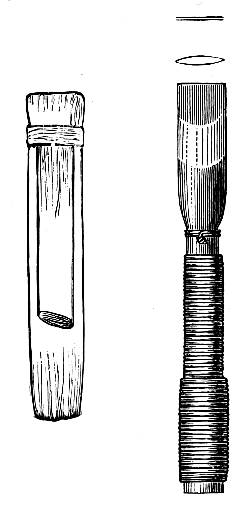

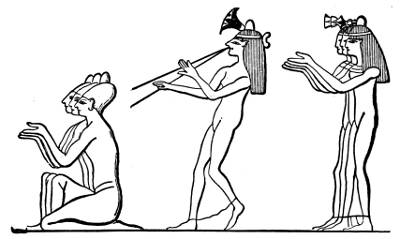
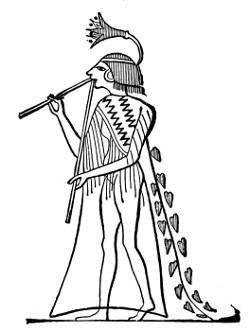
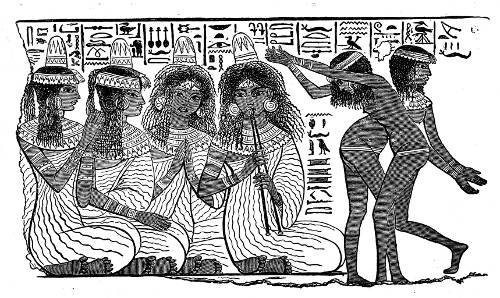

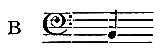









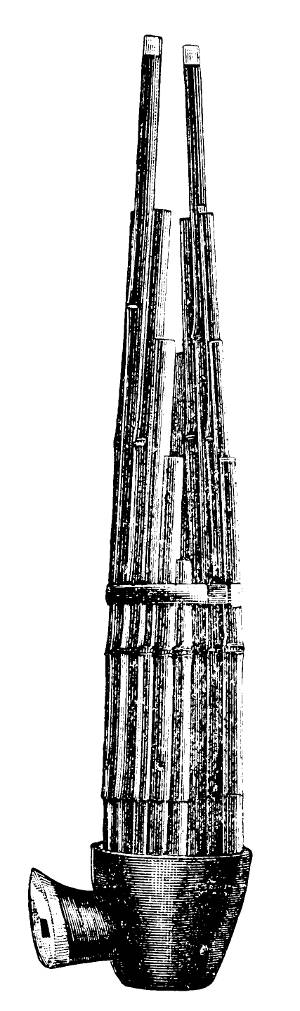
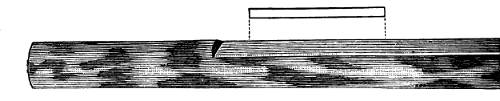
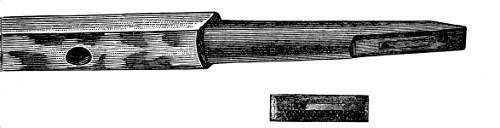

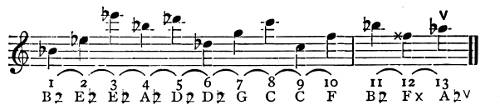









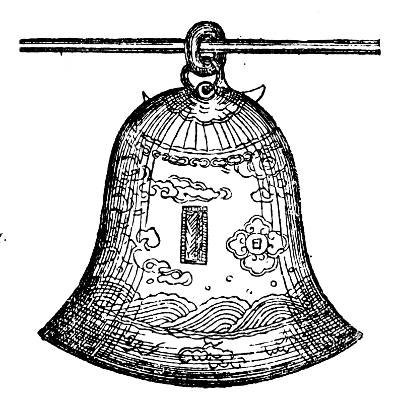
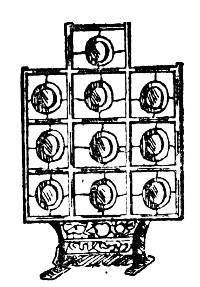
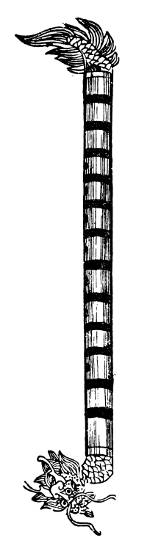


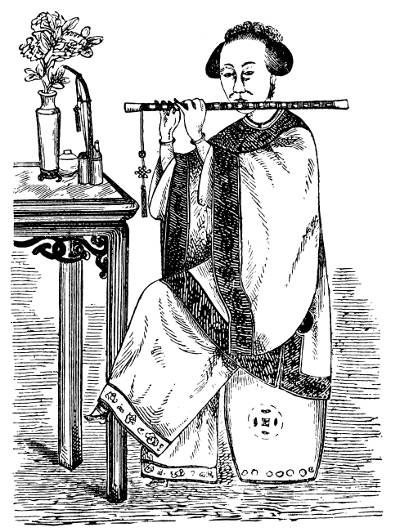
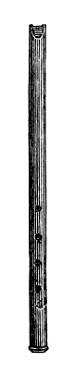
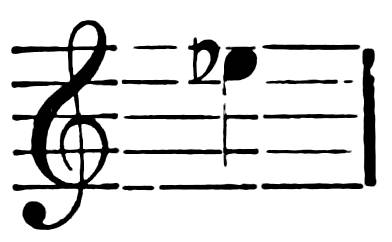 is the standard of pitch according
to another pipe which was described
by Amiot; and, as I have shown in my investigation,
was the leading pitch note in the system of
the Sheng. A pipe which I had made to the dimensions
of that standard pipe, but made with organ pipe mouth,
also gave the same note; and a fourth below that is the
lowest in that scale.