The World of the Great Forest How Animals, Birds, Reptiles, Insects Talk, Think, Work, and Live
Transcriber’s Note:
New original cover art included with this eBook is granted to the public domain.
The World of the Great Forest
“Here I am, dear, waiting for you”
By
Paul Du Chaillu
Author of “The Viking Age,” “The Land of the Long Night,” “Ivar the Viking,” “The Land of the Midnight Sun,” “Explorations in Equatorial Africa,” “Stories of the Gorilla Country,” “Wild Life under the Equator,” “Lost in the Jungle,” “My Apingi Kingdom,” “The Country of the Dwarfs,” etc., etc.
WITH OVER FIFTY ILLUSTRATIONS
BY
C. R. KNIGHT AND J. M. GLEESON
New York
Charles Scribner’s Sons
1900
Copyright, 1900
By Charles Scribner’s Sons
UNIVERSITY PRESS · JOHN WILSON AND SON · CAMBRIDGE, U.S.A.
TO
CHARLES SCRIBNER AND ARTHUR H. SCRIBNER
Dear Friends,—Remembering the uniform courtesy
and consideration it has been my good fortune to experience
at your hands for a series of years, and recollecting the
delightful relations that have always been reciprocal between
us, and that have contributed so much to my happiness, I take
infinite pleasure in dedicating this volume, “The World of
the Great Forest,” to you both, as a slight evidence of the
sincere esteem entertained by me, an author, for you, my
publishers.
PAUL DU CHAILLU.
Introduction
vii
The World of the Great Central African Forest
is a remarkable one. Its denizens range from
the huge elephant to the smallest ant, and in its dark
recesses and almost impenetrable jungle I have studied
the life of these creatures.
From close observation and persistent study I have
arrived at the conclusion that animals, birds, reptiles,
ants, spiders, etc., possess great power of apprehension
and prevision; that creatures of the same species
have understanding with one another, either by voice,
sign, or other ways unknown to man; otherwise they
could not act with such harmony and deliberation.
It is not reasonable to say that animals do not converse
because we do not understand or hear the sounds
they make. The fault is ours, not theirs. Do we
not always say, when we are learning a foreign language
and begin to speak with the natives, that they talk so
fast we cannot follow them? The articulation and
the words seem to be blended together, and it is only
after a time that we catch separate words.
viiiEverything that lives is born with wonderful gifts
suited to its mode of life. The shape and appearance
of animals are designed to enable them to lead their
special lives. Many have great power of scent, much
keener than that of man. This particular attribute
enables them to approach their prey and avoid danger.
For example, the animal that preys upon others knows
enough to move against the wind on his predatory expeditions.
Those that feed on fruits and nuts know
exactly at what season, in what month or week of the
year, these are good to eat, and where they are to be
found. They know how far distant is their feeding-ground,
and the time needed to reach it. They all
know their way, whether through the air or in the
jungle, and nothing escapes their observation.
When animals or birds are taught to speak, or to do
special tricks, it is clear that they must exercise memory,
and memory means thought, and thought means
reason.
The destruction of life, the battles that take place
among the creatures of that great African Forest, the
millions that are killed and eaten up every day, are beyond
computation. Life, to sustain itself, must destroy
life; such is the economy of nature. It is a struggle
for existence among all. So the great gift given to
every creature is knowledge of how to protect itself
from its enemies, and how to approach its prey. If it
were not for constant destruction, the animal world
ixwould increase so fast that there would be room and
food left for none.
To enable the reader to enter into the life of the
great African Forest, I have made the animals tell their
own stories and explain their own actions as if they
were endowed with the power of speech. And I have
given to them native names. A number of the animals
mentioned, I discovered myself.
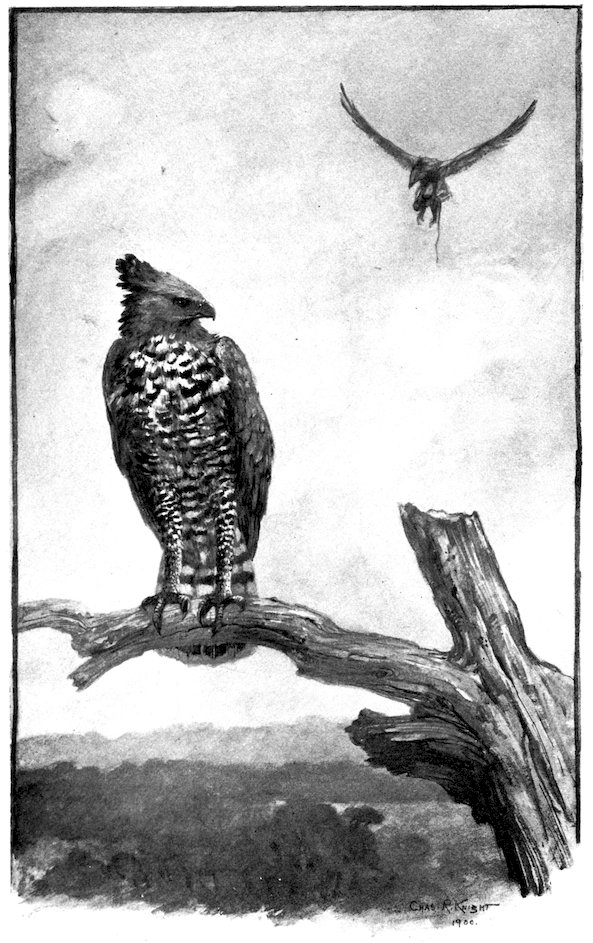
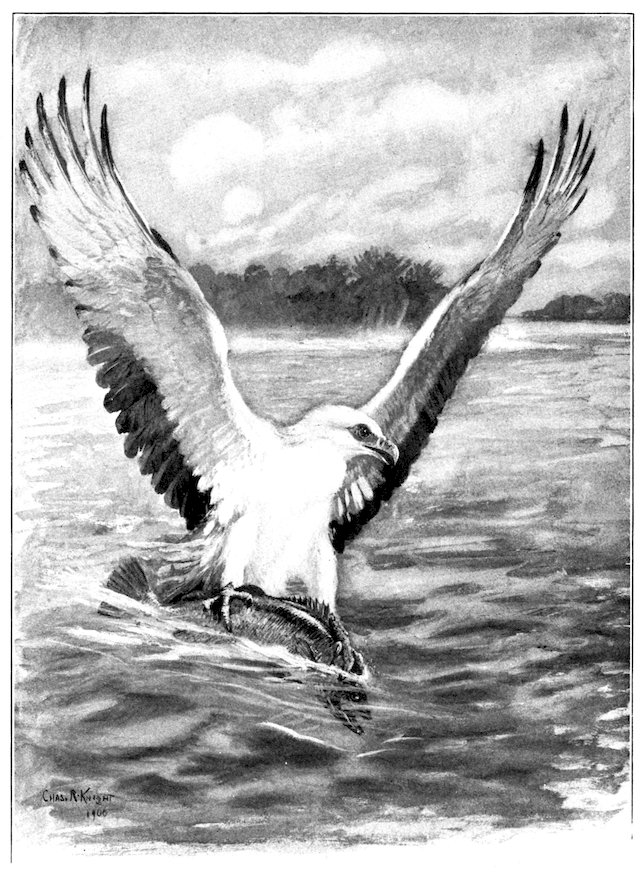
A guanionien, as he soared between the
great forest and the sun, said to himself: “I
am the lord of the air; I am the largest and most
powerful of all the eagles of the land. I am called
the leopard of the air. I feed on monkeys.”
Then he chuckled, the way the guanioniens do,
and rose higher and higher in the sky at each circle
that he made. It seemed as if he were going directly
toward the sun. At last he flew so high that no
eyes from the forest could see him.
After a while he reappeared; he was coming down
again in a series of circles to the forest. At times
his huge wings spread their full length and then
stood still. He seemed to hang motionless in the
air. When he had come down near enough, he
scanned the great sea of trees all over, to see if their
branches were moving, for this would show that there
were monkeys upon them feeding upon their fruit,
nuts, or berries. But all was still; not a branch
2stirred, and there was no wind. His eyes looked
down perpendicularly and could see any object right
under him. There was no monkey in sight.
He said to himself: “Why have the monkeys been
so shy of late, and kept themselves in the middle of
the trees, never coming to their tops? Surely other
guanioniens must have been here before me and
scared all the monkeys: they are afraid and keep
out of sight; they know that we cannot pounce upon
them. How cunning they are!”
He saw a giant tree about four hundred feet high,
rising twice as high as the other trees of the forest,
and meditated: “The creatures of the forest know
the favorite trees upon which I perch and eat my
prey, only by the skulls and bones of the monkeys
I have torn to pieces and devoured lying at their
feet on the ground.—But,” he added, “it is not
every day that I get a meal.”
He laughed: “No harm can ever befall me, for
no enemy can frighten me; no bird is strong enough
to fight against me; the spears and arrows of human
beings can never reach me and hurt me, for I fly
and perch so high; men cannot even see the tops
of my trees on account of the thick foliage which
shuts off from them even the sun and the sky.”
After he had rested, he flew away and soared over
the dark green forest, which was so large that it
seemed to have no beginning nor end, and once
more he watched for monkeys. But his piercing,
far-sighted eyes saw nothing,—not a branch of a tree
3was moving. Then he thought it was time to seek
his mate, for they had agreed when they parted in
the morning to meet on a certain tree upon which
they were accustomed to rest during the day after
their noon search for prey, and tell each other
what had happened.
Before long he saw the tree he sought. It was
easily recognizable by the peculiar shape of its
branches. Soon he was soaring over it, uttering peculiar
sounds belonging to the language of the
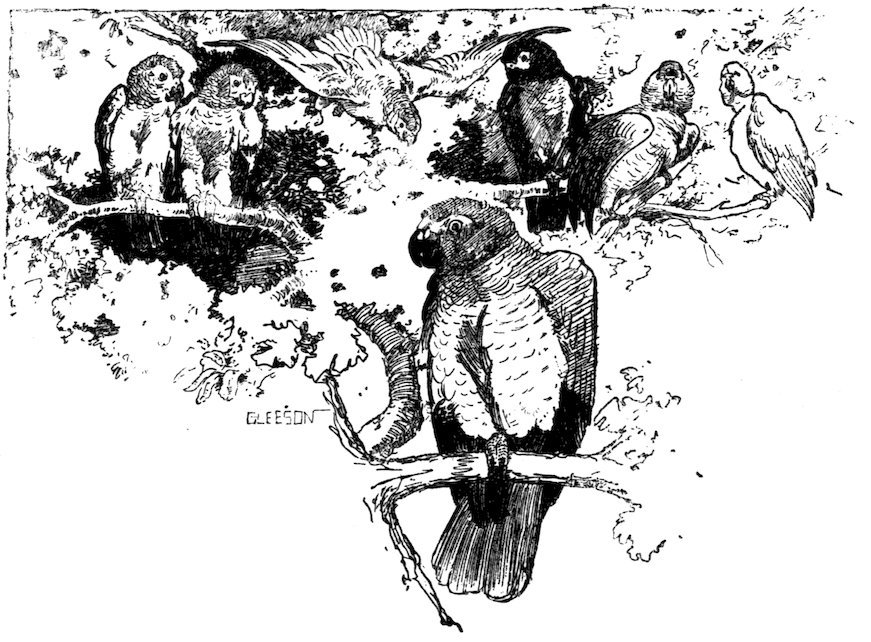
guanioniens, and meaning, “Are you there, dear?
I am coming;” and his mate, already at the rendezvous,
replied, “Here I am, dear, waiting for
you.”
Soon after, the big guanionien had alighted upon
a branch close to hers, and the two looked at each
other with affection, for they had not seen each
other since they had parted a little after daylight.
They uttered sounds which seemed strange, for
these were words belonging to the guanionien language,
which meant, “How glad, dear, I am to see
you! How are you?” or, “How have you been
since this morning?”
After their greeting there was a short silence, then
the big guanionien said to his mate, “Dear, what
is the news? Have you been lucky to-day? Have
you had a meal?”
“No,” she replied. “Not a monkey came in
sight to-day. They were afraid to come to the tops
of the trees to feed, though I heard many of them
4talking among themselves several times. I am starving.
Surely guanioniens have been in the region
before us, and that is the reason why the monkeys
keep away.”
In her turn she inquired, “Have you good news
to tell me? Have you discovered a place where
monkeys are plentiful? Have you had a good
meal?”
“Only bad news have I to tell,” he replied. “I
have seen no troops of monkeys. Bad luck continues
to follow us. I am starving, too. For three
days we have soared over this great forest and have
seen and caught nothing.” And with a sigh, “How
hard we have to work for our living!” said both at
the same time. “Oh, how fortunate it is that we
guanioniens are so constituted that we can starve for
days without dying! This great gift has been given
to us to suit our mode of life. Hunger is our
enemy; but old age is our greatest one.”
They left their tree and agreed to come back in
the evening to sleep upon it, as had been their custom
for some little time. They flew a long way off,
in a bee-line at first, keeping in sight of each other
for a while, then parted.
Toward sunset they were once more perched on
the tree, and each inquired for the afternoon’s news.
The big guanionien said: “Several times I saw
branches moving, with monkeys upon them. At this
sight my appetite grew more voracious than before,
and I thought that I was going to have a good meal.
5I soared over the trees, but the monkeys never came
to the tops so that I could swoop down upon them.
They seemed to dread danger, although I was so
high in the air that they could not see me. But
experience has taught them that it is not safe for
them to be on the tops of the trees; ugly, suspicious
monkeys, we have to be very cunning to capture
them.”
After he had finished, he asked his mate what she
had to tell. She replied: “During my flight I came
to a place where I saw the tops of several trees
covered with big red fruit. Surely, I thought, monkeys
will be tempted when they see this, and will
come out to eat. I soared over them until it was
time to leave to meet you, for sunset was fast coming
on. At the dawn of the day we must fly to that
place, for I believe that some wandering troops of
monkeys will surely come there to feed.”
“If I capture a monkey, he will never drop from
my claws,” said her mate.
“Neither will one from mine,” she replied. “Oh,
dear, how hard it is to work for nothing!”
The sun had set, and darkness came over the land,
and the two guanioniens fell asleep. They felt safe,
for the tree was large, and its first branch was so high
above the forest that nothing but winged creatures
could get to them.
At daybreak the two guanioniens left, travelling in
the direction of the fruit trees as fast as they could.
They remained in sight of each other, but did not
6talk or hail each other, as was their wont, for fear
the monkeys might hear them and become more wary
than ever.
At last, to their great satisfaction, after travelling
about one hundred miles, they saw in the distance the
bright red tops of the fruit trees they sought. At the
sight the two guanioniens came together and whispered:
“Surely some troops of monkeys will come and feed
upon these trees. Let us soar above them all day, if
necessary. Patience is often rewarded. Sometimes
the prey comes when we are ready to give up.”
Then they flew very high and soared above the
fruit-bearing trees. They soared a long time, looking
down in that peculiar manner which belongs to the
eagle, their eyeballs moving so that they can see
directly under them. Suddenly they heard monkeys
chattering among themselves. The reason of this
loud talk was that two troops of different species
of monkeys were quarrelling, daring each other and
ready to fight. One troop was trying to drive the
other away.
The two guanioniens, by peculiar motions of their
wings and other silent ways of communication only
known to their species, told each other the news about
the monkeys.
Great indeed was the joy of the guanioniens at the
prospect of a good hearty meal. They bided their
time and watched for their opportunity. They were
not going to be rash and run the chance of missing
their prey.
7
It happened that two or three days before, troops of
monkeys had come to
those same trees and
had eaten up all the
fruit that was on their
lower and middle
branches, thus leaving
that on the top. The
monkeys looked
up, and when
they saw the
bright red, juicy
fruit, they forgot
all about guanioniens,
and soon
were all over the
tops of several
trees eating away
to their hearts’ content, unaware of the presence
8of their enemies soaring above them and waiting for
the opportune moment to pounce upon them.
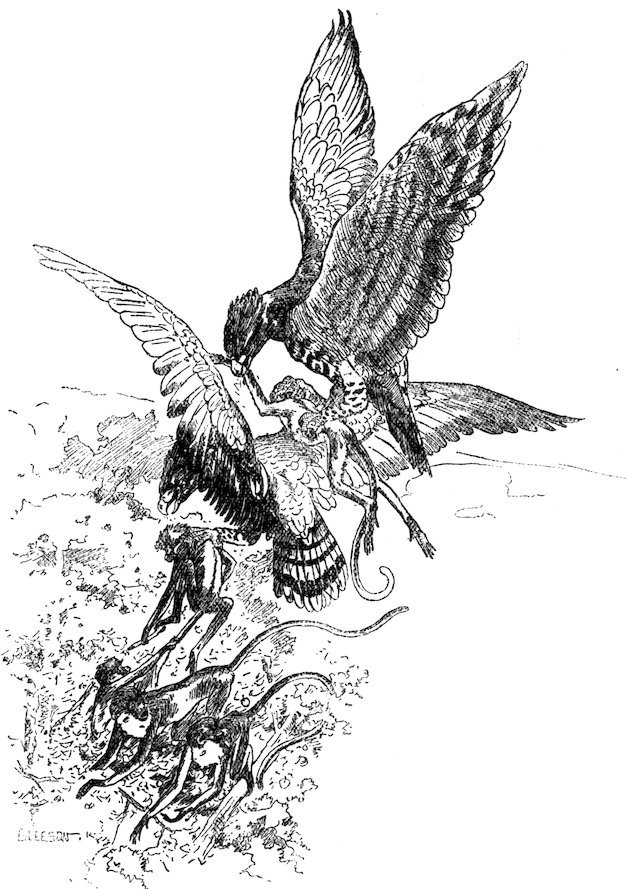
Suddenly, like a flash, the two guanioniens swooped
down perpendicularly from their height, and before
the monkeys were aware of their presence, they had
seized the two largest in their talons, clutched firmly
by the neck and back, and rose in the air with them.
CHAPTER II THE GUANIONIENS’ DEPARTURE FOR THE LAND OF PLENTY
9
One evening after the guanioniens had returned
to their tree to spend the night, and as they
stood close together on a branch upon which they had
perched, the big guanionien said to his mate: “Dear,
it is time to prepare ourselves for the long journey we
take every year at this season, to go to our nest and
repair it. The country where we have built our nest
will soon be a land of plenty; there will be berries,
nuts, and fruits in abundance. By that time little
guanioniens will break out of their shells into the
world. The monkeys will come in great numbers to
feed on the ripened fruits or nuts, and,” with a laugh
peculiar to guanioniens, “then we shall be able to
feed ourselves and our dear little ones quite well.”
“It is so,” replied his mate. “The height of the
sun, the intense heat, dry moons and rainy moons
that have passed away since we were in the Land of
Plenty tell us that it is time for us to go to our nest,
repair it, and raise a brood of guanioniens.”
Then came a long silence; the guanioniens were
fast asleep.
The following morning they greeted each other,
then started for the Land of Plenty to visit their nest,
10which they had done every year for a long time past.
They flew in a bee-line. They knew their way perfectly
well through the air; but how, no one in the
forest could tell but guanioniens themselves. They
had to travel over a thousand miles before reaching
their nest. Now and then they looked down
upon the forest to see if any branches were moving
at the tops of the trees. This would be a sign
that monkeys were there. When they suspected
that it was so, they would soar above them, peeping
deeply into the branches, but that day they were
unsuccessful.
Toward sunset they saw two giant trees growing
close together, well known to them, and upon these
they perched for the night. After they alighted they
looked all around. They saw some nut-bearing trees,
and the big guanionien said to his mate, “Let us soar
over these trees to-morrow morning; perhaps we shall
discover monkeys feeding on their tops. We shall
have to be patient, for as you know, dear, prey
sometimes shows itself at the last hour and when
least expected. We cannot well undertake this long
journey without food.”
Then they went to sleep. Early the next morning
they saw from their resting-place branches of trees
moving in several places, and knew that troops of
monkeys were feeding. At once they left and soared
over the monkeys and succeeded in capturing two,
which they carried to the tree where they had spent
the night, and devoured them.
11After this bountiful repast they said, “Now that
we have had a fine meal we can reach our destination
without difficulty.”
In the afternoon a small black spot rose above the
horizon in the east. It gradually grew larger and
larger against the sky, in spite of the wind which blew
against it.
The old guanionien flew to his mate and said:
“Dear, by the look of the sky a tornado will soon be
upon us; the wind will blow fiercely. Let us find a
tree upon which we can shelter ourselves, for we are
not strong enough to fly against the tornado, and we
could not possibly go with the wind, for we do not
know where it would take us. It might carry us to
a country we do not know.”
They looked around them and saw a tall tree, and
flew toward it as fast as their wings could carry them,
and soon were perched in its centre, being protected
thus by its big trunk and many branches. They
knew that these would partly break the force of the
fearful wind. They had met with many tornadoes
during their lives.
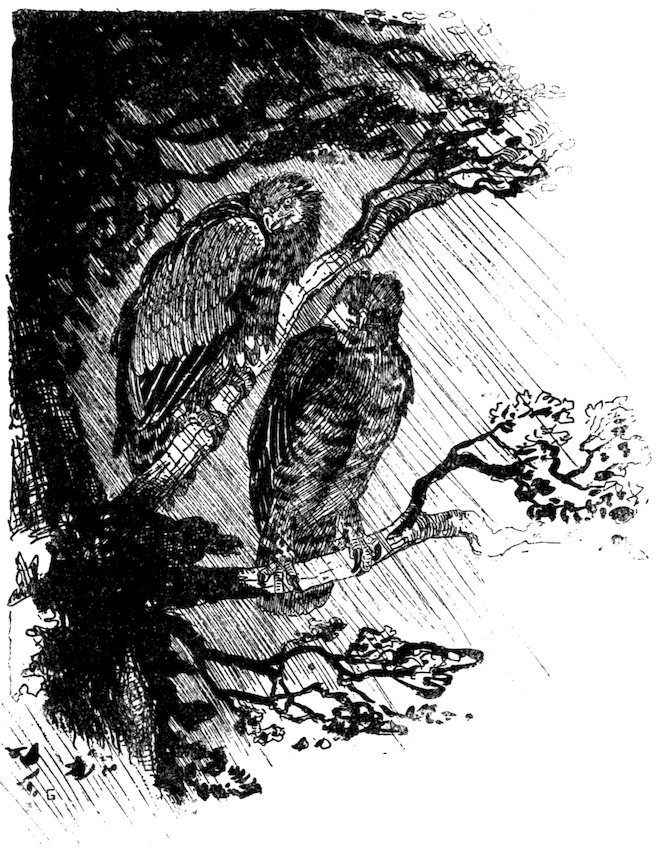
They faced the black spot, for they knew that the
tornado was to blow from that direction, then sunk
their huge talons deeply into the wood on the branch
on which they were perched, so as to have a powerful
hold and not be carried away when the tornado fell
upon them. They made themselves as small as they
could by bending their legs, and shortening their necks.
They had hardly prepared themselves for their conflict
12with the tornado when the wind blowing against
the black spot stopped, then came a calm, the precursor
of the tornado. A white spot rose from the horizon
under the now huge black mass that had gathered.
It was the tornado. In the twinkling of an eye with
terrific force it
struck the tree
upon which
the guanioniens
were.
The wind
hissed through
branches,
many of
which
bent as
if ready
to break,
but the
guanioniens had
chosen a good
place. Nevertheless,
they had a
hard time to hold on and not to
be blown away.
Then the wind subsided, and terrific
vivid lightning accompanied by claps of thunder filled
the open spaces and the great forest. It rained in
torrents and such rain as is only known under the
mountainous equatorial regions of that great forest.
13It stormed and thundered the rest of the day and
during almost the whole of the night.
The guanioniens had pressed their feathers close
together. Fortunately they were well oiled and the
rain ran off over them, so that their skins escaped a
drenching.
In spite of the great storm, the guanioniens had
short naps, at times being awakened by the vivid
lightning and terrific peals of thunder, re-echoed from
mountain to mountain.
At daybreak they awoke, and one said, “Dear, we
have had a very uncomfortable night, but at this
season of the year we shall meet many more of
them.” Before leaving their tree for their journey,
they made their toilet, and it took them quite a
while.
Not only the guanioniens, but all the birds have a
bag or pouch just at the end of the spinal column
near the tail, full of an oily or fatty soft substance,
which they take from the opening with their beak and
with which they oil their feathers. The guanioniens
had a big one indeed, making a large protuberance.
They began to take the oily substance from their
pouches, and their beaks went through almost every
feather, these being placed one upon another as shingles
on a roof. They were, in a word, combing themselves.
When no more oil was left, then they went back to
their pouches for more. They had plenty to do, for
the heavy rain of the night had taken almost all the
oily matter from their feathers. When they had
14finished they said to each other, “Now our skins are
protected against the rain.” It was just as good as if
they had had on india-rubber coats.
After their toilets, the guanioniens continued their
journey, looking for prey as they went along, soaring
after a long time above the place where monkeys were
likely to come.
One day they saw and recognized in the distance
the giant tree upon which was their nest. They flew
toward it and shortly afterward perched upon one of
its branches with much satisfaction.
Looking at their nest, the big guanionien said to
his mate: “Dear, our nest requires much repairing:
it is terribly weather-beaten; it is getting quite old,
and soon we shall have to make a new one. We have
raised many little guanioniens in this dear old nest of
ours, two or three at a time. Since we mated we have
been true and faithful to each other, for we guanioniens
always keep true to our mates. What care these little
ones have given us! How we have had to protect
them with our wings from cold and from the rain!
How hard we have had to work to feed them, and to
raise them until they could get a living for themselves!
I wonder where they all are now, and if they sometimes
think of their parents.”
The following day they began to work in earnest at
repairing their nest. They went in search of small
twigs of trees and interlaced them and put them where
they were needed. Then three eggs were laid in it
by Mrs. Guanionien.
15The guanioniens had a hard time while they hatched
their eggs, and became quite thin, for only one could
go after monkeys at a time, and these were not
plentiful.
They watched the trees and could see the fruits,
berries, and nuts getting larger every day, and saw
them changing color and coming to maturity, and
they were overjoyed, for their lives had indeed been
hard since they had come to their nest.
CHAPTER III THE NGOZOS, OR GRAY PARROTS WITH RED TAILS
16
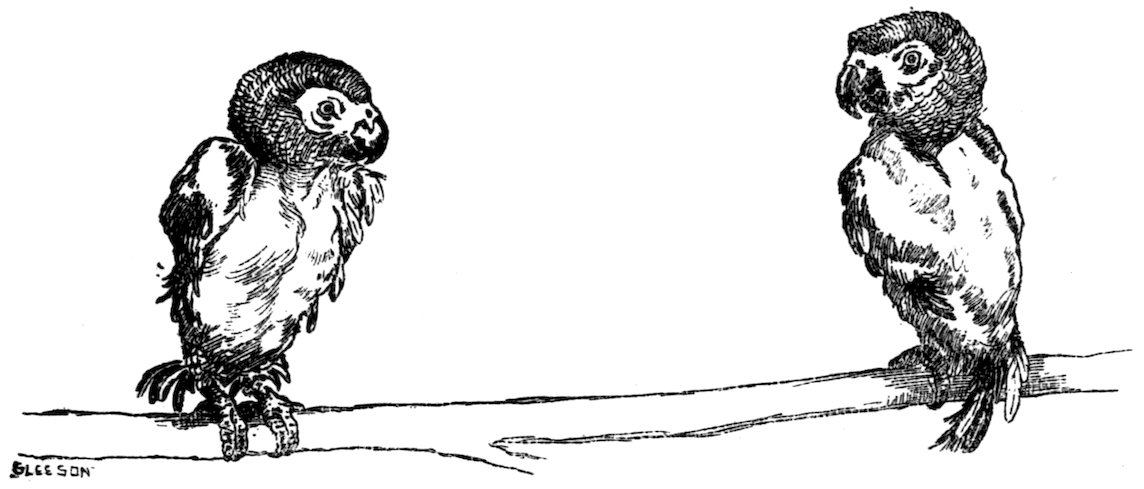
There are many kinds of birds in the great
forests. Among the most numerous and most
intelligent are the gray ngozos with red tails.
These ngozos, when young, have very black eyes,
but as they grow older a yellow-whitish ring forms
itself round the black. Many of them live to be
more than a hundred years old.
They live in flocks of tens, twenties, thirties, sometimes
even fifties, though seldom more. Each flock
has its leader, whom it obeys implicitly. He is chosen
to be chief because he is supposed to be wise, and to
know the forest and where food is to be found at the
different months or seasons of the year. Hence he
is old and has had more experience, and is the first to
give the signal of danger.
It is the custom of the ngozos to meet every evening,
sometimes before sunset, to tell the news,—what
has happened and where food is to be found. Then
after this they go to sleep.
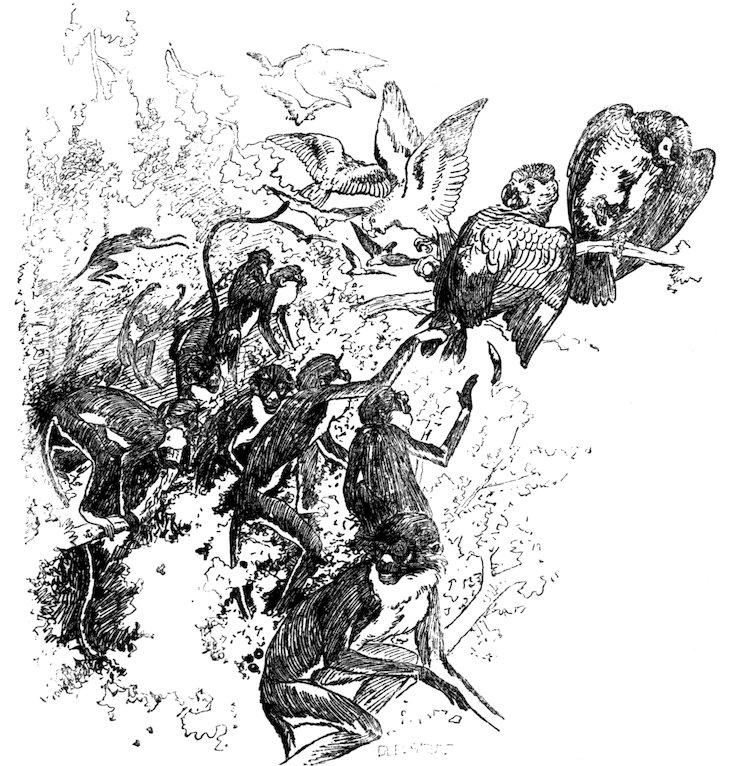
The ngozos and the monkeys are not good friends.
The ngozos hate the monkeys with all their hearts,
and have good reason to do so, for they both are
fond of fruits, berries, and nuts; and it often happens
17that when a flock of ngozos is upon a tree, enjoying
its delicious meal and very happy, a troop of monkeys
suddenly makes its appearance, succeeds in driving
the ngozos away, takes possession of the tree, and eats
up the fruit so that when the ngozos return they
find nothing left.
Sometimes they have regular fights, but the ngozos
generally get the worst of it, and have to fly away,
saying all kinds of saucy things to the monkeys.
18One evening, flock after flock of ngozos arrived at
their place of meeting, which was on an island situated
in a large river. There they felt more secure from
their enemies in the forest. Many had travelled a
long way, but they knew exactly how long it would
take them for their homeward journey, and though
their wings were tired, they were not exhausted.
After they had alighted, all the ngozos greeted one
another, exclaiming, “Glad to see you! Glad to see
you! Welcome to our place of meeting.”
Such a pandemonium of ngozos’ voices was heard
far and wide in the forest, for at least ten thousand of
them were there perched on three or four trees that
were close together. They jabbered away at a great
rate. A stranger would have thought that they made
too much noise to understand one another, as their
voices were so confused, and as they were apparently
all speaking at the same time. But to the ngozos it
was not so; they held a conversation, and one ngozo
was talking to one of several of his friends who were
listening to him.
Though there were five or six hundred leaders of
flocks in this great army of ngozos, each leader knew
every member of his flock, and every ngozo knew his
leader and recognized his voice, just as he recognized
their voices also. He knew the number of his flock,
and if one were missing he could tell which, and the
other members of the flock likewise. No doubt each
ngozo had a name known to the others of the flock.
As they were telling the news, the leader of one
19flock of ngozos said: “We have come back hungry
this evening, for when we came to the trees we had
seen loaded with our food of berries and nuts, we
found they were all gone, for the monkeys had been
there and eaten everything in sight. We were very
angry, and during the day we had to fly over the
forest and alight here and there to pick what we could.
But almost everywhere the monkeys had been before
us, and left only unripened berries or nuts, and we
had to content ourselves with these, and few at that.”
After hearing this tale of woe, all the ngozos with
one voice cried, “We hate the monkeys; ugly monkeys!”
The noise was terrific when they said this, for
they said these words all at the same time and they
repeated them several times in succession, with anger.
Oh, what a noise they made!
The ngozos of another flock, when they heard this,
said: “We are sorry for you, dear ngozos; it is too
bad that you came home hungry. We came to a part
of the forest where all the tops of the trees were covered
with beautiful ripened fruits; they were fine, and
we ate them all day long, and no horrid monkeys
came to disturb us. They were busy somewhere else
eating our food.”
They called it “our food,” for the parrots considered
the berries, nuts, and fruits of the forest as their
own, and thought that the monkeys had no business
to eat them. The monkeys thought likewise of the
ngozos.
Then some ngozos belonging to another flock said:
20“We flew over a village of human beings, and saw a
number of our kin in the place. They could not fly;
their wings were cut; we spoke to them, but they
could not understand us, neither could we understand
them.”
The reason they could not understand each other
was because the ngozos in the village of the human
beings had been captured in their nests when their
bodies were covered with down, and had only learned
the language of the human beings. They had no
ngozos to teach them the language of their kin living
in the forest. They had invented a jargon of their
own, which they used when they did not speak the
human language.
Some flocks advised others not to go where they
had been, for there was very little food to be found;
others told where monkeys were numerous, or where
they were not.
It was getting late, near sunset, and all the flocks
ought to have arrived; but the ngozos noticed that
two were still absent. They were very much excited,
and began to be afraid some great misfortune had
happened to the missing ones, and talked loudly to
one another. They wondered why no stragglers had
arrived.
Suddenly they heard voices above them. It was
one of the flocks arriving. “We are coming!” said
the belated ones; “we are coming!” and they
alighted. “Welcome!” said all the ngozos at the
same time.
21“What makes you so late?” cried all the ngozos.
“Well, we have come from a long way off, and
our wings are tired. We had great trouble to find
food enough to-day to satisfy our hunger, for the
monkeys had been there before us this morning. We
went a great distance, and, guided by our leader, we
came to a region in which food was plentiful, and
which the monkeys had not found out. Several flocks
can find plenty of food there to-morrow, provided the
ugly monkeys do not find the place.”
“Horrid monkeys!” chattered all the ngozos at
once.
The ngozos waited anxiously for the only flock
missing. They were much distressed. Had the
flock left them to go to another place? The sun
had set, and it was fast growing dark, for in the
forest darkness comes soon after sunset. Soon, to
their great joy, they heard above their heads the
voices of the missing ones, and a great cry arose
among them. “Welcome!” they shouted with one
voice.
The flock alighted. “What makes you so late?
It is almost dark,” cried the ngozos together.
“Don’t speak of it,” cried the belated flock.
“Don’t speak of it. We had an awful fight with the
monkeys, and we are lucky to have escaped with
our lives from their clutches.”
“Hateful monkeys!” cried all the ngozos.
“See how dilapidated some of us look,” said one
of the late comers; and one of the flock, turning her
22back, cried, “Look at me. I am almost without a
tail. An ugly monkey plucked it off. It was hard
for me to fly and reach our meeting-place, for having
hardly any tail I flew with difficulty.”
“Look at me,” said a second one, as he also
turned his back to the ngozos. “My feathers are
all gone between my wings. I wonder how I escaped
from that savage monkey.”
All the ngozos listened silently when they heard
this tale of woe.
A third one said, “Look at me, ngozos. See the
state of my poor feathers and how many have been
plucked by one of those monkeys. But I succeeded
in giving him a bite and cut off one of his
fingers, and he had to let me go. He gave such
a cry of pain.”
“Good for you!” shouted all the parrots; “good
for you, ngozos!”
“How did the fight happen?” asked one of the
wise ones who had been listening. “Tell us.”
Then the chief of the flock said: “Our flock was
on a tree feasting on delicious fruits, when suddenly
23we heard a troop of monkeys coming. Soon they
leaped on our tree and wanted to drive us away, and
attacked us. We tried to resist, but the monkeys are
so quick of motion, and they have hands and feet that
can clutch, while we ngozos can only bite. The combat
was unequal. One of our number was killed by
them. The reason that we are so late is that we had
to fly slowly on account of our disabled ones. We
did not want to leave them behind, for we are all good
comrades and we love one another dearly.”
“That was right. You are true ngozos,” cried
they all.
Then came a shrill chorus, and all the ngozos
shrieked again, “We hate the monkeys.” But soon
the jabbering among the ngozos became less and less,
for many were getting sleepy. Then quiet settled
down on the army. All had fallen asleep, after,
however, having first agreed where the flocks should
go to the next morning.
Long before dawn, between three and four o’clock,
all the ngozos were awake and talked to one another.
When ready for their journey, each leader said to his
flock, “Be ready, ngozos; we must hurry.” His flock
would answer, “We are ready.” “Follow me, then,”
would say the leader as he flew away, followed by all
the numbers that belonged to him.
Flock after flock of ngozos left one after another,
after saying, “Good-by,” “Good luck to you.”
“Good luck to you,” was the answer, and in less
than ten minutes they all had left. Some flocks
24flew toward the north, others to the east, west, south,
to some particular part of the forest where they
thought they would find plenty of food. They were
all in a great hurry to reach the different places, so
as to be there before the monkeys, the small flocks
going where there were only a few fruit-bearing trees
to be found, and the flock that had been so badly
beaten by the monkeys going to the nearest food
place.
The ngozos possess the wonderful gift of knowing
their way through the air; the trees are their landmarks,
as they fly above the forest and look down
to discover any fruit-bearing trees.
A very old ngozo, about eighty years old, with
powdered feathers and deep yellow eyes (which is a
sign of old age), who was the last to go away, said to
his flock: “I know of a place where at this time of
the year there are trees that must be loaded with fruit
[and he named the fruit]. I will lead you there.”
“Good for you, our chief!” cried all the ngozos.
“You are a good chief. With you we shall find
plenty of food.”
After a journey of about twenty miles, the old
leader said to his flock, “Look yonder. Do you
see the tree-tops red with fruit?” And they looked
in that direction and saw trees red with fruit, and all
uttered cries of joy, saying, “What a good-morning’s
meal we are going to have!” They flew with still
greater rapidity and soon alighted upon the trees.
“We are here just in season,” they all exclaimed at
25the same time. Then they remained perfectly silent,
so as not to attract other ngozos, and also so as not
to let the monkeys know where they were. The fruits
were very dainty. Soon every ngozo was enjoying his
meal, holding the fruit in his claw (for they use their
feet as we do our hands) and peeling it with his beak.
After having had
a good meal, they
flew away to another
part of the
forest, where their leader thought they would find a
kind of nut they liked very much.
Halfway they settled upon a tree to feed, when
suddenly a stranger alighted among them. They
looked at the new-comer, and at once wanted to drive
him away, for he did not belong to their flock. Great
cries of rage were heard among them; but as they
were preparing to fight the poor wanderer, the chief
of the flock cried with a very piercing and commanding
26voice: “Do not drive him away. He is lost. For
some reason or another he is solitary. Don’t you see
that he belongs to our kin, and has a gray body and
a red tail? Let us welcome him.” The ngozos did
so at once in a chorus. But, to their utter astonishment,
they found that the stranger could not understand
what they said to him; and when he spoke to
them they could not understand what he said, and
they marvelled at that, and looked at their new friend
with amazement and did not know what to make
of him.
The fact was that the poor ngozo had escaped from
a village of human beings, one of whom had taken
him away from his nest when he was a baby ngozo.
He had given him to his wife, who fed him and raised
him tenderly and taught him to speak or listen to her
words. Consequently, he had not learned the language
of the ngozos, not having lived among them.
He spoke at times a queer kind of jargon which he
and two or three captive ngozos of the village had
invented for use among themselves.
In the evening the stranger followed them. He
had been admitted as one of the members of the flock,
and when they arrived at a certain place they met
other ngozos. All marvelled at the new-comer, who
was exactly like themselves, but could not understand
them, as they could not understand him. But nevertheless
they were soon friends.
The hour came when the flock thought it was time
to return to the island where all the ngozos met, and
27they started and before long reached the place with
the new friend they had adopted that day. As usual
they had their talk out and then went to sleep.
That night this ngozo stranger thought of the
home he had left, of his mistress who had been so
kind to him, and how much he was petted by the
people. The next morning he followed the flock
that had received him. He had no one to bring him
his breakfast, and henceforth he would have to work
for his living. It was a new life before him, but after
a while he found that it was much better to be free,
even if you had to work for a living, instead of having
some one to take care of you and be a slave.
Often the adopted stranger, when his people (the
other ngozos) were resting on a tree, would talk the
language of the human beings who had brought him
up. While he did so, the other ngozos listened in
silence. It did not take them long to learn the
language of the human beings through their new
friend. He wondered why and how they could learn
so quickly from him, while it had taken him so long
to learn the same language. The reason was that the
ngozos learn much more quickly from one another.
He also learned quickly the speech of his kin, and
after a while could talk the language of wild gray
ngozos as well as the rest of them. Nevertheless,
though years passed away, he never forgot some of
the words his master and mistress had taught him,
and he remembered them to his death.
One evening after all the flocks had arrived, the
28ngozos’ chiefs said, “Now it is time for us to start for
the Land of Plenty.”
“Yes,” cried all the ngozos, “it is time for us to
start for the Land of Plenty. A grand time we
will all have there.”
“This is the moon of tornadoes, thunder, lightning,
of great heat,” said one chief. “Fruit and nuts will
soon be ripe in that far-off country.” And all the
ngozos kept repeating over and over again, “It is
time for us to travel toward the Land of Plenty.”
It was agreed among them that this should be
the last day of the season they were all to stay and
sleep at the dear old place, where they had had so
many chats together, and they were sad; but the glorious
time they were to have in the Land of Plenty
from morning to night made them feel that they
must go, for of late they had had a hard time to
get food.
The ngozos are very wise, and they agreed to
scatter and take different ways, for otherwise they
would starve, there were so many of them.
As usual when daylight came, flock after flock left,
bidding each other good-by, to meet again in the
Land of Plenty.
In the evening only a few flocks returned to the
old place of meeting. But the trees did not seem
the same to them. There was a look of sadness
among the ngozos,—so many dear friends and faces
were missing. There was less bustle, less chattering,
less noise, less laughing (for the ngozos laugh).
29Three days afterward not one ngozo was to be
seen on the trees. They all had left for their promised
land. Flock after flock were spread over a vast
extent of country, flying over the trees. They saw
once in a while a troop of monkeys and bore them
no good will.
When the ngozos saw any nut- or fruit-bearing trees,
they alighted upon them, and after they had fed, continued
their journey. Several flocks had trouble with
the monkeys while feeding. When they came near,
the ngozos made fearful noises, their feathers rose on
their backs, and their tails spread, showing how angry
they were. They gave all kinds of bad names to the
monkeys.
The monkeys did not know what the ngozos said
to them, as they did not understand their language.
But they knew they were angry, and every time the
poor ngozos had to get out of their way when they
had made up their minds to climb on their tree.
CHAPTER IV THE NKEMAS, OR MONKEYS, TRAVEL TOWARD THE LAND OF PLENTY
30
While the guanioniens were hatching their
eggs, the monkeys began to think that it was
time to start on their journey to the Land of Plenty,
a journey which they took every year. They remembered
the great time they had in that land, and how
loaded many of the trees were with berries, nuts, and
fruits. What feasts they had, and how fat they had
become while there, even before they had eaten up
everything in sight!
From many distant parts of the great forest north
and south, east and west, troops of monkeys accordingly
were travelling to the Land of Plenty.
Among those were the white-mustached miengai, the
red-headed nkago, the jet-black, long-haired mondi,
the white-nosed ndova, the bluish black oganagana,
the nchegai, and the mpondai.
Each troop was hurrying as fast as possible, so
as to reach the Land of Plenty before all the other
monkeys, and even before the ngozos. All the
creatures of the forest do likewise; hence they all
start at the dawn of the day.
31Each species of monkey has a distinct language of
its own, and so easily recognizable that the other creatures
of the forest can tell which kind of monkey is
talking. The various species do not mingle with one
another. The number in each troop is from ten to
twenty or thirty; sometimes, but rarely, even as many
as fifty. Every troop has its leader, chosen for his
cunning and knowledge of the places where food is to
be found at different seasons, months, and sometimes
even in different weeks in the forest.
The monkeys never eat any kind of new food
without first smelling it to find out whether or no it
is poisonous, for the forests abound in poisonous
fruits, which are sometimes most tempting and deceiving
in appearance, and, if bad, the monkeys throw
them away at once.
They know all the trees, rocks, brooks, and other
landmarks. They choose a track or path where they
can find food on their way.
Among the monkeys who were thus travelling was
a troop of white-nosed ndovas, numbering about
twenty-five. Their leader was a very knowing old
fellow, who had by his quick sight and acute hearing
and cunning warned them many a time of danger,
so that they could escape. All the troop believed
in his wisdom and had great confidence in his
judgment.
For nearly fifteen consecutive years the old ndova
had made the trip to the Land of Plenty.
One evening before going to sleep, the chief said
32to his followers: “Strange is our life. The trees are
our home; we never sleep twice on the same one;
we have to travel all the year round in search of food,
and sometimes food is so scarce that we have to go
long distances and then get only a scant living. Indeed,
at certain times of the year we have to work
hard for our living. We have even to walk on the
ground to pick up what we can get. When we are
walking we are timid, for it is only when we are in
the trees that we feel at home. Leaping from one
tree to another, we can travel very fast.”
“That is so,” said all the ndovas, when they heard
their leader speak these words of wisdom; “we are
glad to have you for a chief.”
“Yes,” he replied, “but I am getting old, and soon
the younger ndovas will drop me and choose another
chief.”
“Not yet, not yet; not for a long time yet,” cried
all the younger ndovas.
Soon deep silence reigned among them. They
all had fallen asleep.
At daylight they got ready for their long journey.
And their chief said to his followers, “We shall have
to travel fast to-day, for food will be scarce on our
way.”
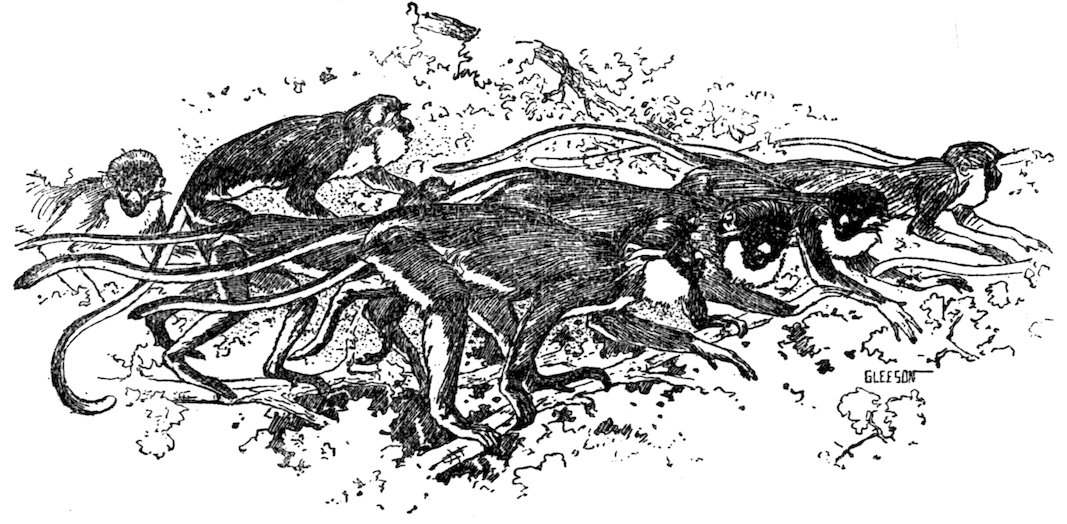
Soon after the ndovas started on their journey, the
old chief leading, while four or five of the strongest
were almost abreast of him, the others following.
They did not run or walk on the branches of trees,
but travelled as they always do on such occasions when
33they make a long journey. They took flying leaps,
falling on the end of the branches they reached, their
weight bringing down with great force the limbs of
the tree upon which they fell, ten or twelve feet and
sometimes more, the limbs then rebounding with
great force.
On the rebound with astonishing quickness and
unerring eyes they sprang to the extremity of another
branch.
These leaps varied in length from ten to fifteen or
twenty feet. Their feet and hands caught with great
firmness and precision the flexible limb upon which
they landed. Their eyes measured instantly the space
to be leaped over and the branch to be reached.
Their quick ways are one of the gifts given to many
of the monkey tribe. On their journey the ndovas
found themselves sometimes on trees higher than all
the surrounding ones. Then they had to leap down
some forty or fifty feet, and the limbs upon which
34they fell, bent with a great crash and rebounded with
amazing force.
Thus they went on incessantly for several hours, all
keeping silent, never uttering a cry, and at the rate
of about fifteen miles an hour. The sound of the
bending and rebounding of the branches of trees, the
rustle of their leaves, was heard by many creatures of
the forest, who said, “The monkeys are travelling.”
At last they came to several trees covered with
nuts. There was great joy among all the ndovas at
the sight. The leader had taken them to the right
place. They might have passed the spot either on
the right or on the left without knowing it, for the
trees were so thick.
They were there before any other troop of monkeys
or flock of parrots. So they had it all to themselves,
and soon were cracking nuts and eating them as fast
as they could.
After the ndovas had eaten until they could eat no
more, they were somewhat lazy. They moved quietly,
and leaped gently from one branch of a tree to another
to amuse themselves. They played with and ran
after one another.
Some of the old ones were by themselves. There
was one hanging to a branch of a tree by one arm.
Suddenly one of his companions, getting hold of
his legs, hung by them, the branch bending heavily
down with the combined weight of the two. “Let
go! Get away!” shouted the upper one with all his
lungs. “You are too heavy. I am going to drop.
35My hands cannot hold the branch much longer.”
When the other heard this, he laughed at his friend
and let go and dropped. Another one would raise
himself with his arms, climb over his fellow, and then
run off pursued by the angry ndova, who did not like
to have such tricks played on him. Then both would
stop, glare at each other, and peace was made.
Some of the ndovas were hanging downward, looking
at their friends underneath, who were quiet and
holding a conversation. Others were looking searchingly
in the skin of a comrade who was lying on his
back on a big limb of a tree and picking out any little
thing they saw in his fur. They all seemed to enjoy
this immensely, especially the one lying on his back.
He had the best of it. He loved to be scratched.
A number were very lively, and were running after
one another, to see which could run the fastest and
escape. They shouted: “You cannot catch me. I
dare you.” They would leap from one branch to
another, then stop and grin at their companions who
could not catch them. These were the young members
of the troop. A good meal did not make them
lazy.
Some ndovas made queer grimaces at each other.
Others were quarrelling for one reason and another.
They uttered sounds of defiance and were full of fight,
daring and tantalizing one another, their angry eyes
almost sticking out of their sockets.
One or two ndovas lay on their backs, quietly resting
on a heavy limb of a tree, holding to a branch to
36steady themselves or so as not to tumble down. Suddenly
they were seen by some other ndovas above,
who came and disturbed them. Then came a short
fight.
Their chief was quietly looking on at his followers.
All at once he gave a cry of alarm well known among
the ndovas, which meant, “Let us be off; there is
danger.” There was a cry of fear from the other
ndovas and a general stampede, all going to the left
from the danger, for that peculiar cry of the chief
meant they were to run from the right.
It was which among them could run the fastest.
They leaped from tree to tree, from the extremity of
one branch to the end of another branch, and so the
whole troop went on. They were in full flight and
going as fast as they could. It did not take them
long to get out of the supposed danger and far from
the place. When they thought they were safe, they
slackened their speed.
Suddenly a peculiar sound or cry was uttered by
their chief, which meant for them to stop. Then
when they had come together he said to them, “We
had a narrow escape. A huge tree omemba [serpent]
was coming toward us.” They rested a little while
and then continued their journey toward the Land of
Plenty. They came to a cluster of trees loaded with
nuts and all uttered cries of joy at the sight. Their
chief had led them right; they were not to starve.
They broke the shells and ate the kernels with great
avidity. When their appetites were satisfied they
37filled the pouches inside of their cheeks until the skin
of these was so distended that they could hold no
more.
“If we do not find food,” said they, “we will eat
the nuts that we have stored in our pouches. How
nice it is for us to have such pouches, so that we can
carry provisions with us and eat them on the way
when hungry!”
Then they resumed their journey, for the Land of
Plenty was still far away. “Let us hurry as fast as
we can,” they said, “so as to be the first on the
spot.”
But an hour or two afterward, they slackened their
speed and stopped, walking leisurely on the branches
of trees. They were hungry, and began to eat the
food they had stored in their pouches. These were
so full that they had to use their hands outside to
press out the pieces of nuts.
After this they continued their journey, and when
it was nearly sunset stopped, and prepared for their
night’s rest. Some quarrelled for places. But soon
all were seated comfortably on their haunches with
their legs bent, their heads gradually fell on their
breasts, and they were ere long fast asleep. They
remained undisturbed the whole of the night.
Early the following day the ndovas were again on
the march. During the day, while they were resting
and chattering, the whistling of several arrows was
heard among them, and two of their number were
pierced and killed and fell to the ground with a great
38crash. All the ndovas, giving a cry of alarm, fled
with the greatest speed. They knew that those
arrows had been shot by human beings, for several
of their number had been killed in that manner
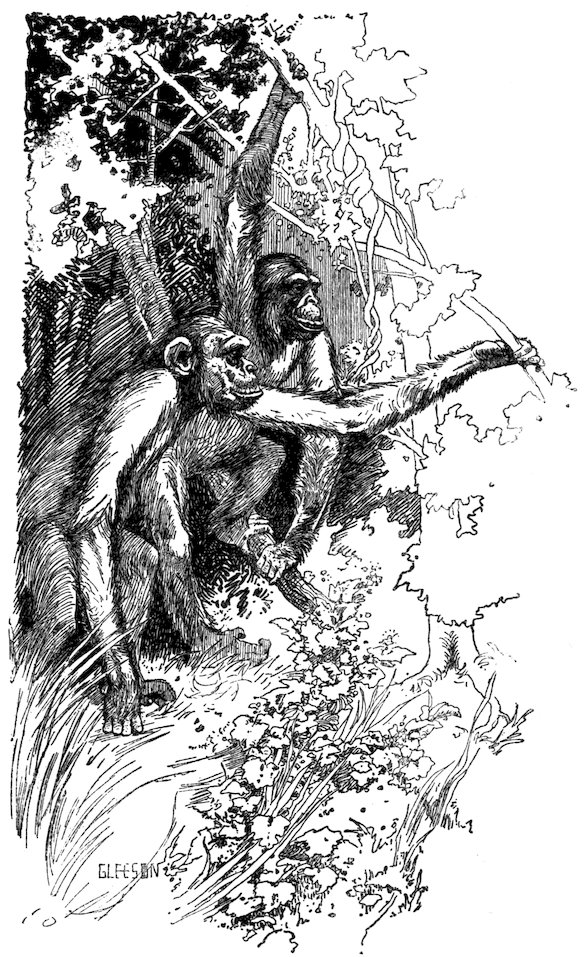
before. They were not afraid of the apes, or “men
of the woods,” but they knew well what human
beings were like, and every time they saw them
they fled.
Having run a long way, they stopped. They were
all sad and mourned greatly the death of their two
companions. The chief said, “We never know where
these human beings are lying in wait for us. They
are so sly. They are under trees on which we feed
before we know it, and often they take us unawares,
though we watch and are on the lookout for them.”
After a pause another wise ndova said: “Next the
human beings our greatest enemy is the guanionien.
He swoops down upon us, seizes us in his powerful
claws, carries us up in the air, and then alights upon
a tree and devours us. How we dread him! He
is worse than a human being. We have to be constantly
on the lookout for him, for we can never scent
him, and before we know it one of us is carried
away. So we have to watch above our heads for the
guanioniens, and under the trees for the human beings.
Fortunately there are not very many of these
horrid guanioniens.”
A third ndova, after listening to this, asked: “What
about the big tree snakes? Has no one seen one of
them after us on this journey?”
“Here is a huge manga”
39In the course of the day the ndovas came to a stream
and followed its banks until it became narrow enough
for them to leap to the other side.
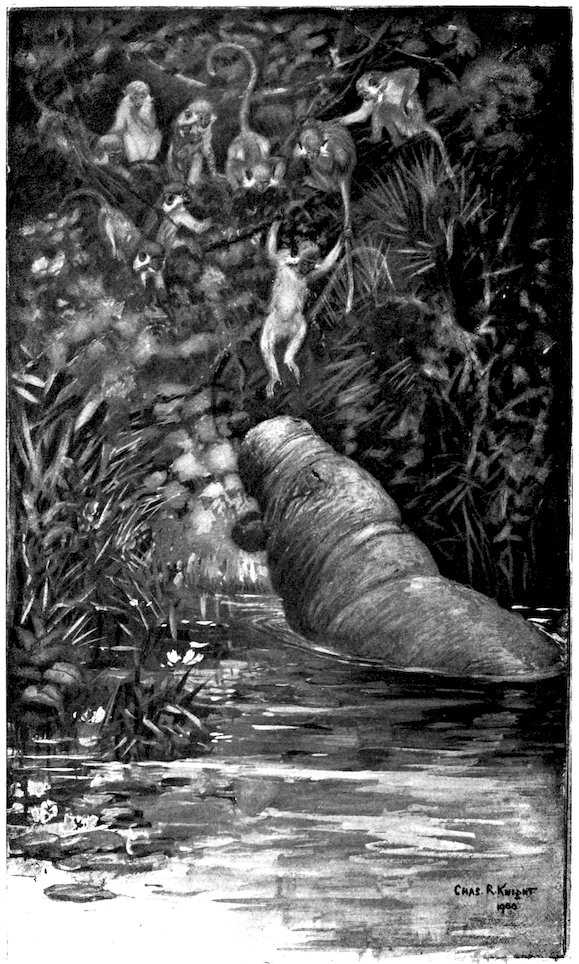
They stopped to rest on a tree overlooking the
river, when suddenly they spied a strange creature
swimming along the banks. At first they could only
see his head. “Here is a huge manga [manatee],”
said the chief of the ndovas to his followers. “He is
feeding on the leaves of the trees that hang with their
branches touching the water. Look at him! how big
he is! [the monster weighs sometimes fifteen hundred
pounds]. What a clumsy animal! He is eating
leaves, and yet he never gets out of the water, never
lands on the shore. How small his eyes are!”
The manga is indeed wonderful! on his sides are
fins, or hands without nails, which he uses as oars to
swim with, and his tail is flat, and with the help
of his paddles he can raise his body up vertically,
and this enables him to feed on the leaves of the trees,
while the gentle motion of his paddles or hands help
him to keep his upright position. His body, ten or
twelve feet long, is dark gray with a few bristles about
one inch in length here and there on the skin.
The stream was clear, and the movements of the
manga could be easily seen as he swam and moved
along eating the leaves. The ndovas watched the
manga with great curiosity; they were not afraid, for
they knew he could not climb trees. Then they continued
their journey.
That evening the ndovas all went to sleep with a
40sorrowful heart, especially the two that had lost their
companions.
At daybreak they continued their journey. They
met soon after their departure with a great adventure.
They came to a tree in one of whose hollows was a
beehive. Immediately the bees attacked the ndovas
with great fierceness and stung several of them. They
uttered loud cries of pain, and all fled with the greatest
haste, shouting in the language of the ndovas, “Horrid
bees! Horrid bees!”
Toward noon the troop came to a number of trees
covered with nice fruit. As they were eating quietly,
they heard the sound of a moving branch, telling them
that another troop of monkeys was coming. The
noise became more distinct; evidently the strangers
were coming in their direction. They remained silent,
so as not to give them a clew to their whereabouts,
for fear of having to divide their find of fruit with
them.
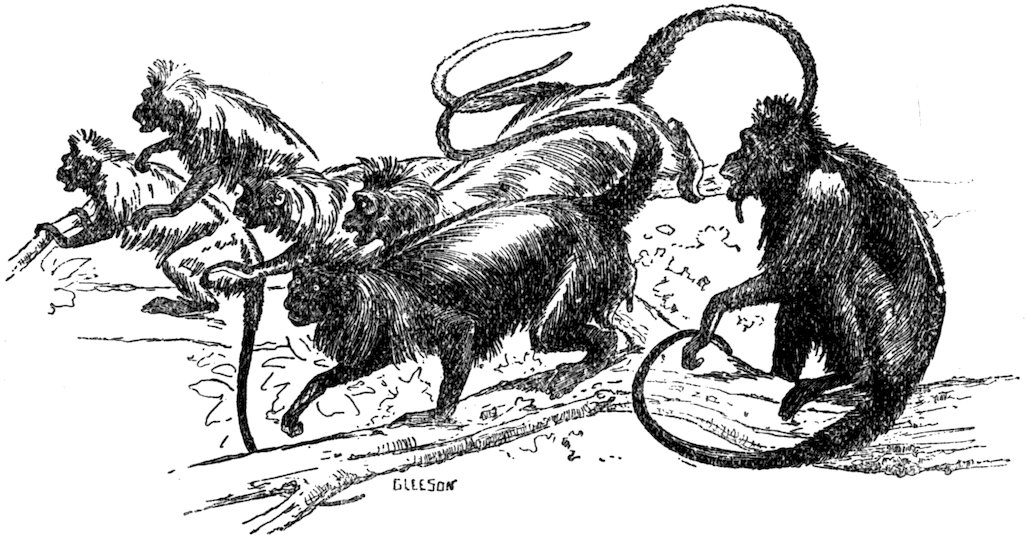
They heard the loud voices of the long, black
shaggy-haired mondi, the largest of the monkey tribe.
Soon they were on a tree near them. The mondis
were furious when they found out that the ndovas
were there first, for they knew the place, and had
hoped to reach it before any other troop of monkeys.
The mondis uttered their war-cry. It is indeed a
fearful one,—one that can be heard at a great distance.
This was answered by the war-cry of the ndovas,
but the latter was faint compared with that of the
mondis. The hair of the ndovas stood erect, their
41eyes glared at their enemies, and the mondis’ eyes
glared at the ndovas.
The ndovas were more numerous than the mondis,
but these were more heavily built, and far stronger.
They had immense canine teeth, which could go deep
into the flesh; and though the ndovas had good ones
also, they were not so large. It is true the ndovas
had quicker motions and were far more agile.
The mondis came nearer and nearer. Their looks
were fiercer and fiercer. The mondis defied the
ndovas, and the ndovas defied the mondis. The
noise both troops made was fearful. At last the mondis
leaped upon the trees where the ndovas were, and
attacked them. The ndovas were soon routed and
had to flee, leaving the fruit-bearing tree in complete
possession of the long black-haired mondis.
The mondis started at once to eat, for they were
very hungry. They had hardly begun their meal,
however, the ndovas looking at them from a tree near
42by, full of anger, when there appeared upon the scene
two nshiegos (large full-grown apes), who also knew
these trees and came to eat their fruit. They were
very angry when they saw the mondis were there
before them, for they too had come from a long distance.
They gave tremendous yells, and the frightened
mondis fled in great haste, for the nshiegos, with
their long, powerful arms, would have made short work
of them.
“Good for you!” shouted the ndovas to the nshiegos
when they saw they had driven away the mondis.
The nshiegos ate everything in sight.
The ndovas travelled every day toward the Land
of Plenty, and had to pass through a part of the
forest where nuts, fruits, and berries were very scarce,
for the fruit season had passed. Other troops of
monkeys, large flocks of toucans (a bird with a huge
bill), and other large birds had been there before them.
They agreed to travel in squads, so that they could
get food more easily,—for there was not enough for all
of them when they were together,—and then to meet at
a certain place before sunset, the leader of each squad
having been in the country before, on their way to the
Land of Plenty. They had a hard time to get their
living on that day. Fortunately the Land of Plenty
was not far off, and at last they entered its borders.
CHAPTER V ARRIVAL OF THE NGOZOS AND NKEMAS IN THE LAND OF PLENTY
43
Flocks of ngozos and troops of nkemas began
to enter the Land of Plenty one after another.
Many squirrels had also made their appearance.
Among the ngozos that had arrived was the flock
which had had a fight with the ndovas. The one
whose tail had been plucked, and the other whose
feathers had been pulled out between his wings, and
who had bitten off the monkey’s finger, had not forgotten
the horrid ndovas. Among the monkeys was
the troop of ndovas which had attacked the ngozos,
and with them the one that had had his finger cut off.
He had cause to remember the horrid ngozos.
Day after day the monkeys gradually worked their
way toward the guanioniens’ nest. But the ngozos
knew of the nest, and when one day they recognized
the ndovas that had attacked them, they hoped that
the guanioniens would kill many of them.
The time came when, to the great joy of the old
birds, three little guanioniens broke through their
shells. They looked so cunning with only down on
their bodies. Their parents loved them dearly and
took great care of them.
44The old guanioniens were watching the fruits and
nuts every day and said, “These are growing fast,
they will soon ripen, and we must expect the arrival of
the monkeys very soon.”
One fine morning, just at daybreak, the guanioniens
heard for the first time the jabbering of numerous
troops of monkeys. “Do you hear the talk of the
ndovas, nkagos, mpondais, and mondis?” said the big
guanionien to his mate, for they could tell the species
they heard talking.
“I hear,” she replied.
Both gave a chuckle of pleasure, for now they knew
that they would have food in plenty.
The old birds had worked very hard every day to
get food for their young ones, for they were getting
bigger and bigger, and their appetites increased in proportion
to their size. And Mrs. Guanionien said to
her mate, “Now with plenty of food our little ones
will grow up quickly and become strong.”
The guanioniens left their tree, and soon after were
soaring high in the air above a troop of ndovas, waiting
for their opportunity to pounce down upon them.
But somehow the ndovas would not go to the top of
the trees, but kept in the thick middle part. The
two guanioniens circled near each other, and the
big one said to his mate: “These ndovas are knowing
ones. They do not come to the tops of the
trees, and we are not to have our meal as soon as
we expected.”
The ndovas, having plucked and eaten the best
45fruit, moved away a little farther on and soon came
to two other trees heavily laden. The fruits were big
and ripe, but were all at the top, those on the lower
branches having been eaten already by other monkeys.
The ndovas chuckled with pleasure at the sight. The
temptation was so great that, forgetting to be prudent
and all about their enemies, the guanioniens, they
ascended the branches and began to eat in silence.
The guanioniens from their great height saw the
branches of the trees, upon which the ndovas were,
moving, and they came down and soared above the
place ready to pounce upon them.
The ndovas were unaware that their great enemies,
the guanioniens, were so near them, and were watching
them with eyes made sharper by hunger. They were
enjoying their feast with great relish, and said to each
other, “This is the best fruit we have had for a long
time. It is so sweet and so juicy. What luck we
have!” “I hope,” said one of them, “that those
horrid mondis, who are stronger than we are, will
not make their appearance, for they will drive us
away. Let us make haste and eat all we can.”
The guanioniens delayed their attack, for they
watched their opportunity and wanted to make sure
not to miss their prey. The ndovas had not quite
reached the very top of the trees, and the birds could
not swoop down upon them if they had to go through
the branches, for not only would the branches stop
their flight, but would break their wings, as they
struck with great force against them.
46The two guanioniens soared nearer the ndovas,
watching with their keen eyes the trees upon which
they were feeding. Suddenly they saw several ndovas
come to the very top of the trees. They watched
with fierce and expectant eyes, swooped down with
terrific speed, seized two of the biggest ndovas and
rose in the air, each with his talons firmly imbedded
in the back and the neck of his victim, so that he
could not turn. One of the monkeys was the chief
of the troop; the other was the one whose finger had
been cut off by the ngozo. The eagles flew with their
prey toward their tree, and the first thing they did
was to tear their eyes out, and then kill them by
disembowelling them. They fed first, and then,
tearing off small bits, they fed their young ones
with them.
It happened that not far off from where the ndovas
had been carried away, on a tall tree, was the
flock of ngozos which had been so badly treated by
those same ndovas. They were feeding on nuts.
Suddenly they heard the cries of pain uttered by the
ndovas as the guanioniens rose in the air with them.
Looking up, they saw the ndova whose finger had
been cut off by one of them, and jabbered with joy.
“Good for you, guanioniens, good for you! kill all
the monkeys you can;” and in chorus, “We hate
the monkeys, we hate the monkeys! we hate the
ndovas more than the rest, for they have done us
the most harm.”
The troop uttered fearful cries of dismay and
47dread when they saw that the guanioniens had been
among them and had carried away their chief and one
of their number. They fled in terror to some safer
place.
In the evening they looked at one another with deep
sorrow and mourned greatly the loss of their chief and
of one of their comrades. One of the ndovas was
especially sad, for it was his beloved mate that had
been carried away by one of the guanioniens.
Still monkeys, parrots, and guanioniens had a good
time in the Land of Plenty, and all became very fat.
But the guanioniens made great havoc among the
monkeys. At the foot of their trees the ground was
covered with a great number of skulls and bones of
those they had eaten up.
The time came at last when the fruits, berries, and
nuts became scarce. They had either been eaten or
had fallen to decay on the ground, and the monkeys
and parrots left for other parts of the forest.
The guanioniens and their brood, who had begun
to fly, also left. The old ones were going to a partly
open country to teach their young how to capture
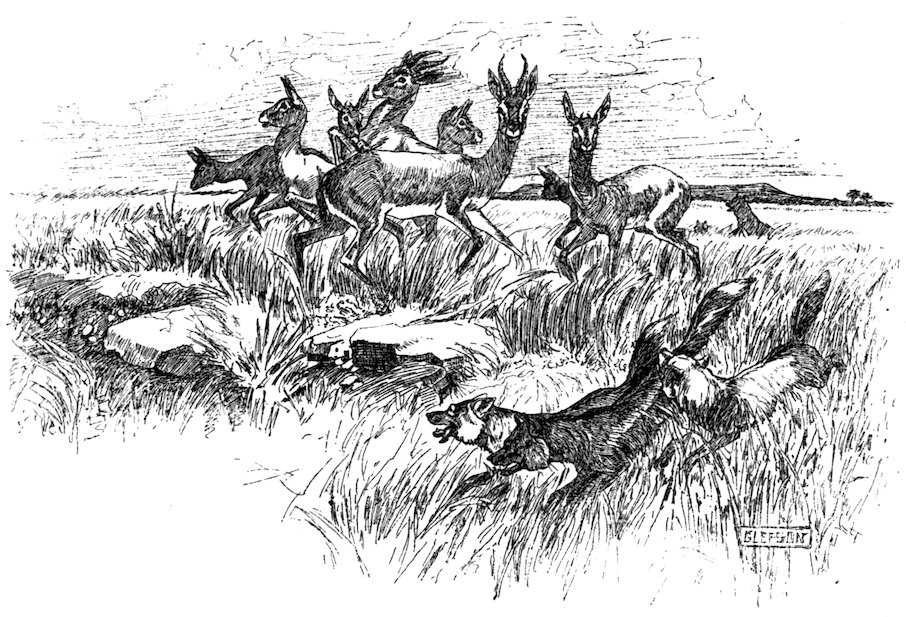
prey, and then the goats and gazelles would have a
bad time.
The Land of Plenty became deserted until the following
year, when it would become again full of life.
After their departure the parrots mated, built their
nests in the hollows of the trees, and did not come together
again into flocks until their young began to fly.
A few flocks came at first to the old meeting-place;
48the same number of flocks that came in the evening
went off in the morning, with the same chief. At first
the flocks and their number of ngozos could be easily
counted; but in a few days they became so numerous
that it was impossible to number them.
CHAPTER VI THE NIGHT ANIMALS
49
Strange as it may appear, in the night the
great forest is more alive with animals than
during the day. These night prowlers can only see
well when it is dark, and the darker it is the better
they can see. They generally have short legs and
walk so lightly that their footsteps cannot be heard
when they go through the jungle.
They are very sly and most dangerous to other
creatures. Most of them feed on animals that have
warm blood, for they love blood, which is to them as
water. They sleep during the day, which is their
night, and roam about during the darkest part of the
night, which is their day. It is at that time that they
seek for prey, so they are much dreaded by the
animals that sleep during the night.
Their abodes are in the deep hollows of trees, in
holes or gloomy recesses under their roots, in caverns,
in crevasses found among the rocks, in burrows under
fallen trees, and where fallen limbs are piled upon
each other. In a word, they like the places where
the light cannot penetrate, for the light blinds them.
They cannot bear the bright sunshine.
50These prowlers do not come out of their abodes to
attack their prey until the night is far advanced, for
then the sleep of the day animals is heaviest, and they
do not easily awaken and scent their enemies. One
of the gifts of these night creatures is that they know
the hours of the night just as well as if they had
watches or clocks, and they seldom emerge from
their abodes for their raids and depredations before
midnight, and generally return to their dens towards
four o’clock in the morning. If they go out earlier,
or return later, it is because hunger obliges them
to do so.
Almost invariably they make their raids singly, so
that the pair have more chance to capture prey. It is
wonderful how these night creatures know their way.
They see so well that they go through the thick
jungle as if the sun were shining, and through the
intense darkness, they note every sapling, every
branch, every thorny bush, every leaf, every ant, and,
no matter how far they go, they know their way back
to their lairs.
This gift of theirs is not possessed by human
beings, who have to make special marks, such as
breaking young branches of trees, marking them back,
or putting heaps of leaves, or sticking sticks into the
ground to find their way back.
There are only a few night winged creatures, such
as owls, vampires, bats, flying squirrels, and a few
birds; but there are many night snakes.
CHAPTER VII THE NJEGO, OR LEOPARD
51
The njego, or leopard, is the most dreaded of all
the night prowlers by all the animals of the
great forest.
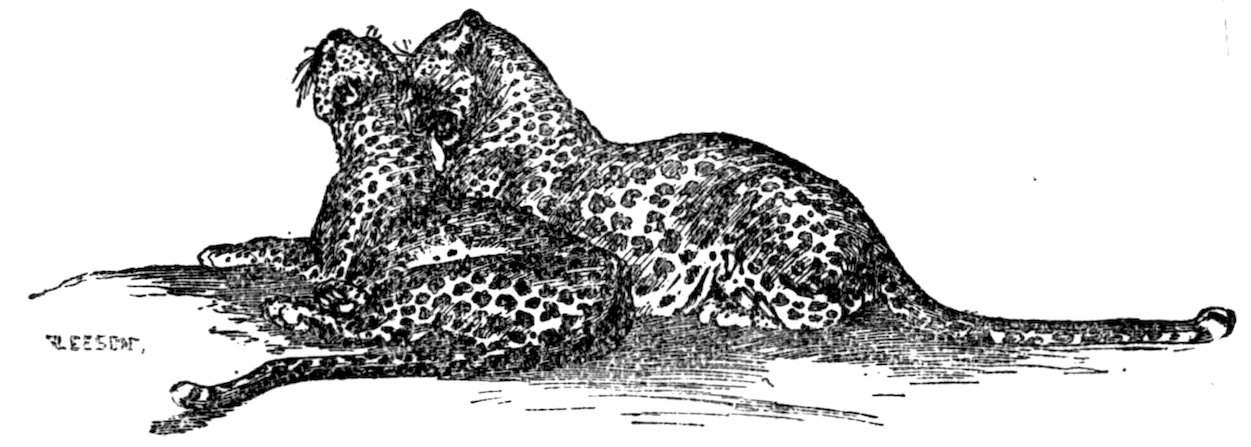
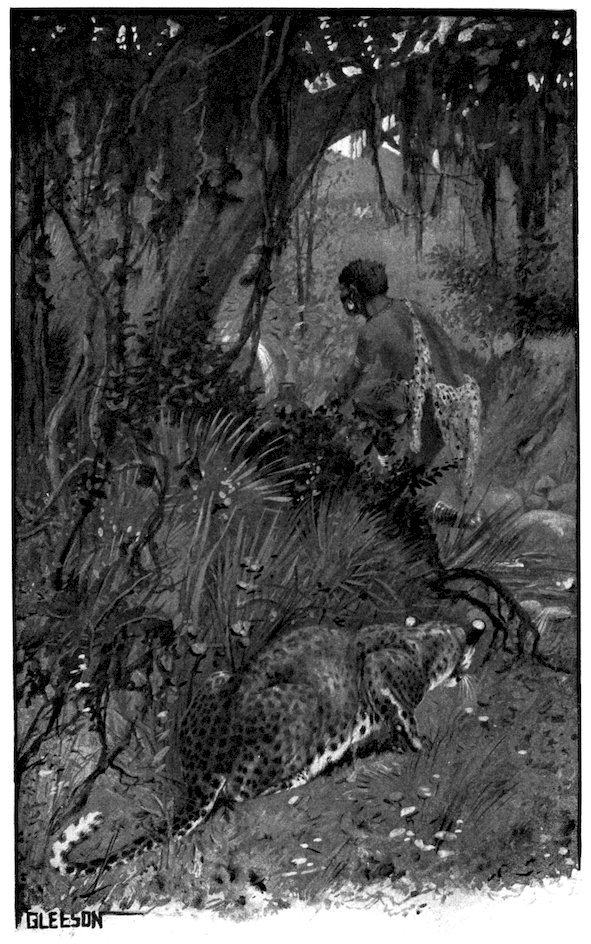
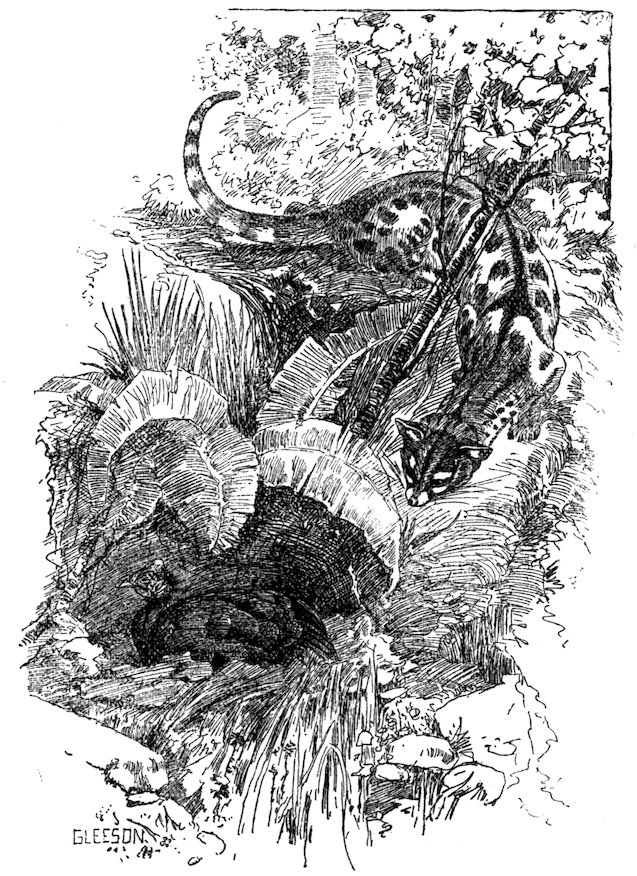
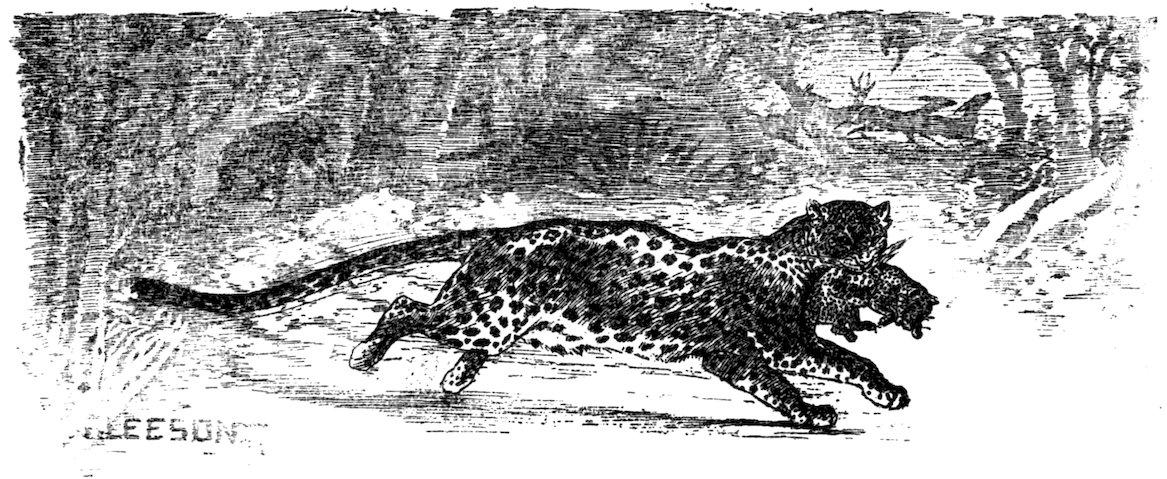
One night a njego, looking at his beautiful spotted
skin, his long tail beating his flanks, exclaimed to himself:
“Many creatures of the great forest hate and
fear me, for I love blood. I thrive and live chiefly
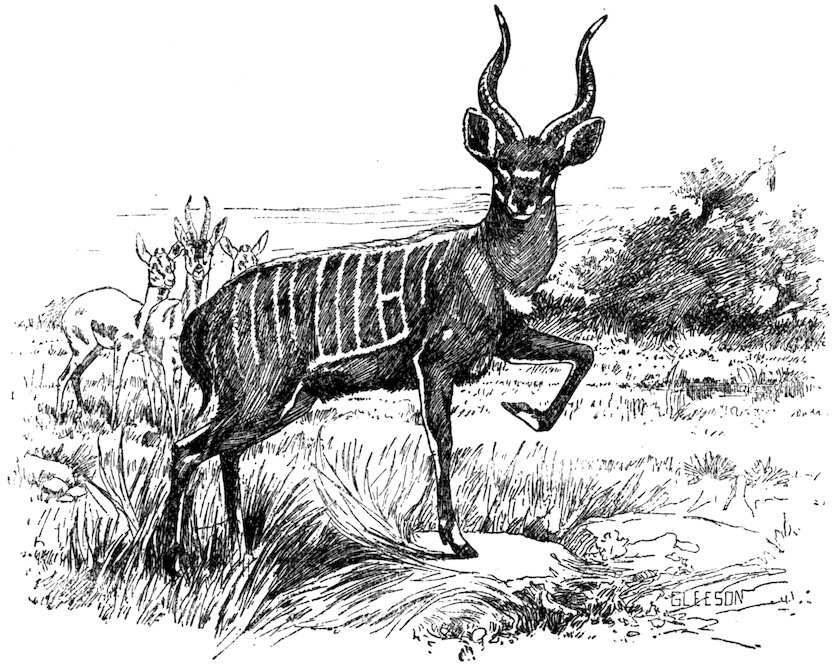
on kambis [antelopes] and ncheris [gazelles]. I have
no friends. All think I am not to be trusted.
“I am the biggest of the night prowlers. I have to
be cunning in seeking my prey. No large creature
can walk in the forest and through the underbrush
with a lighter step than mine, and if I make a slight
rustling going through the thicket of the jungle, the
beasts of the forest think the wind is the cause of it.
“I can also see in the daytime, but the light makes
me wink. I can spring farther than any animal.
This is one of the gifts I possess, otherwise I could
not get my living. How I love the flesh of the
kambis and of the ncheris!” As he thought of them
his eyes glittered and shone like fire, and he licked
his chops.
52“When animals see me close to them, my eyes
often paralyze them, and they cannot run away.”
Then he grinned as njegos do, and added, “No wonder
that the animals of the forest dread the njego, for
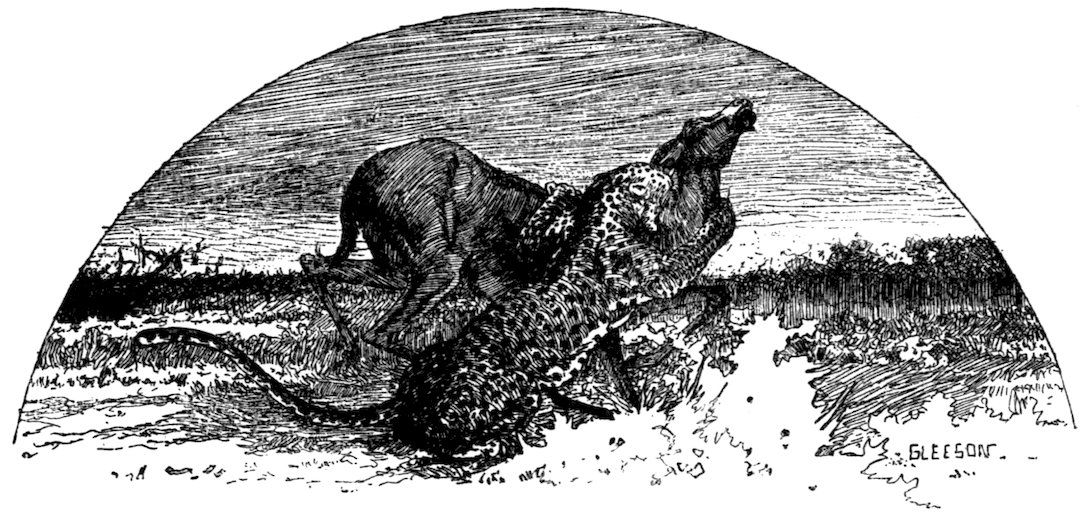
often he makes a prodigious leap, falling in the midst
of them when they are not aware of his presence, and
then he gloats over the victim he has chosen.”
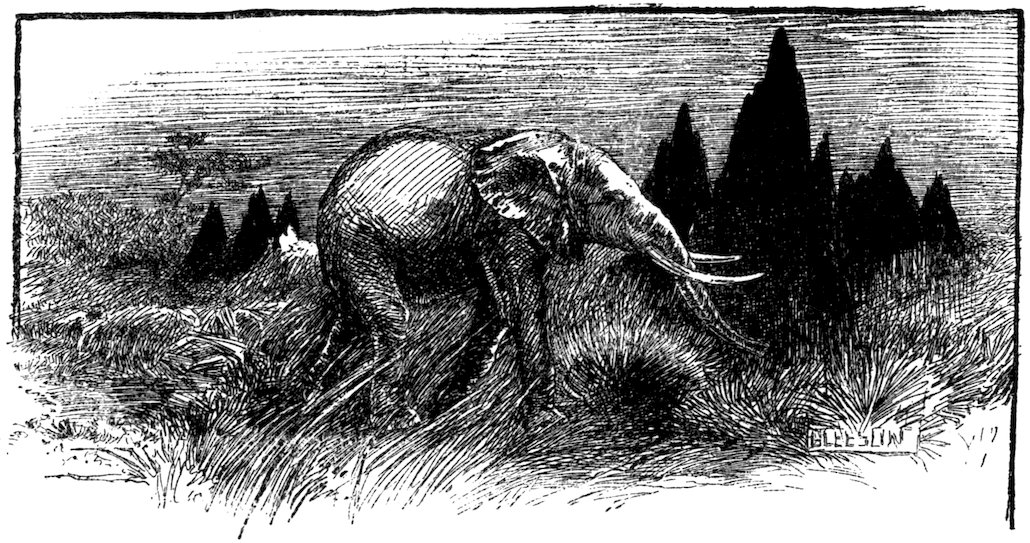
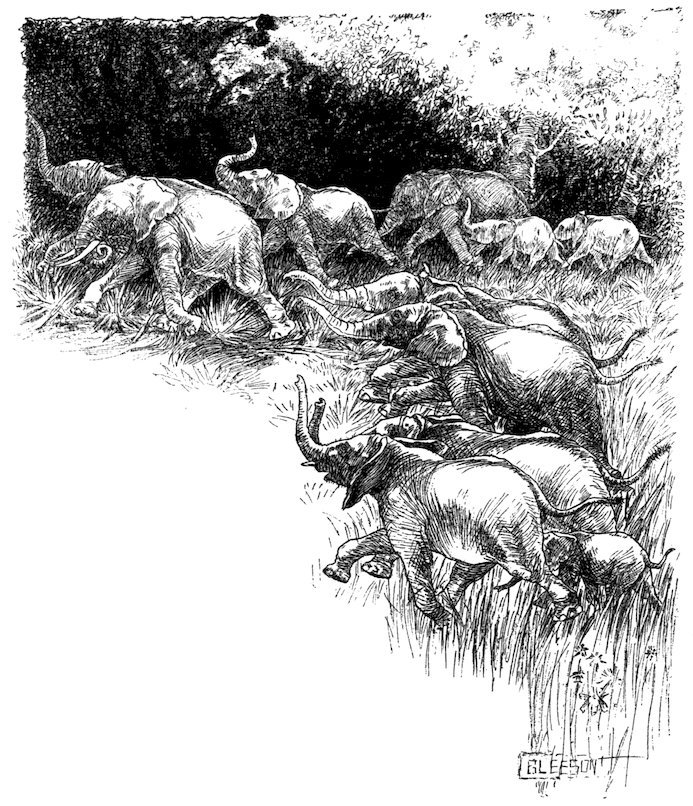
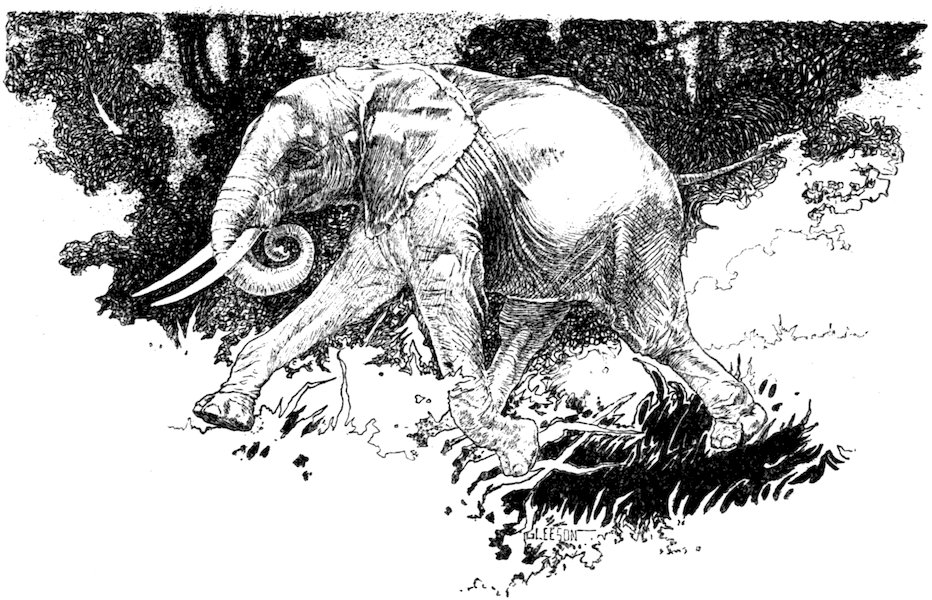
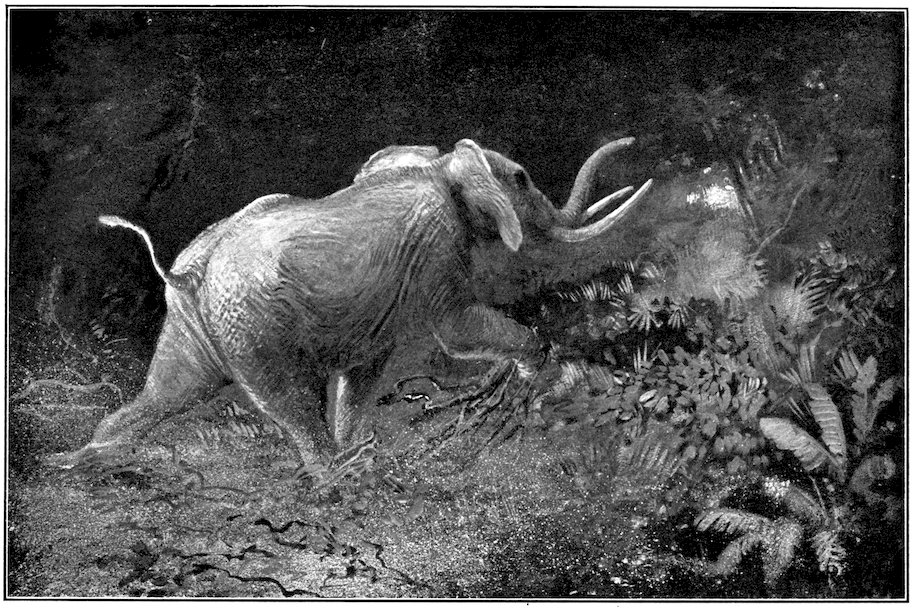
Suddenly the njego heard the trumpeting of a
njokoo (elephant), and the terrible and appalling roar
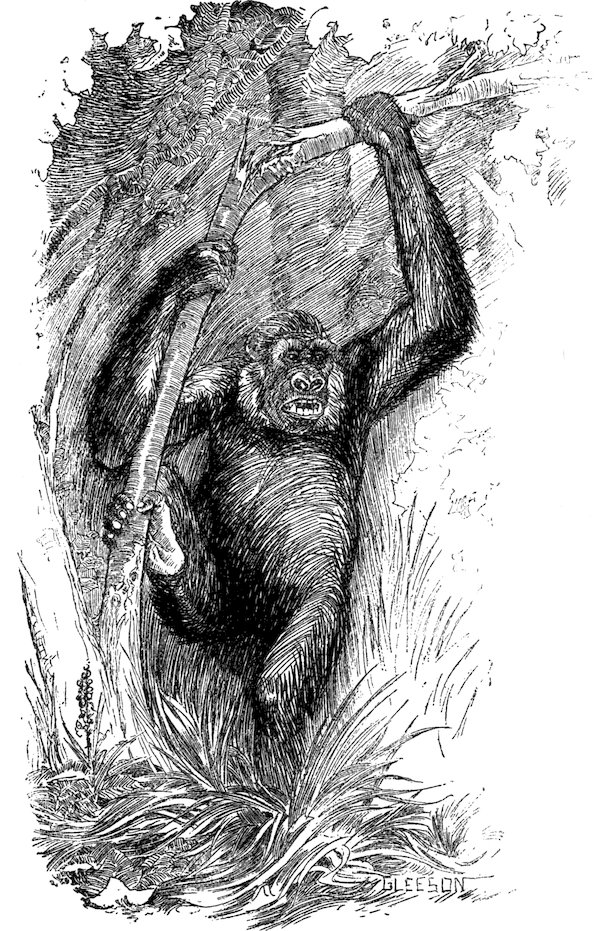
of a ngina (gorilla), and he listened a while, and said,
“These creatures I do not attack.”
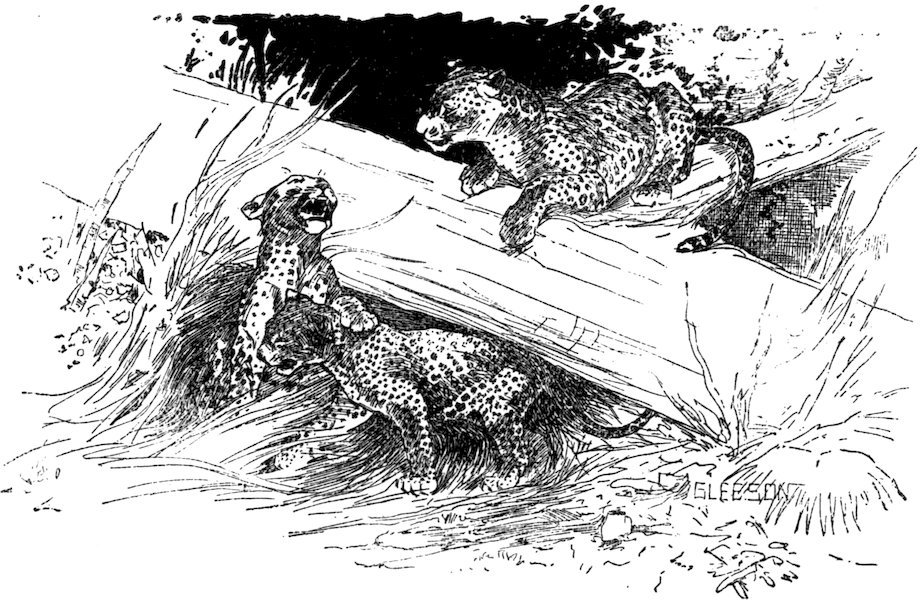
Soon after he met his mate near their lair, and they
went inside, for the day was coming, and they were
soon asleep. The njegos have a peculiar, silent way
of communicating with each other by looks, movements
of the tail, and other signs only known to them.
So in this way after they had slept all day long and
well into the next night the big njego said to his mate
as they were lying in their lair: “Dear, the night is
far advanced; it is time for us to go out in search of
prey, and the day animals will be in their heaviest
sleep and will not hear or scent us.”
It was then about midnight. After coming out of
their lair, they rejoiced when they saw that the night
was so dark. They said to each other, “How well
we shall see to-night!” Then they looked at each
other with great affection, the big njego licking the skin
of his mate to show her how much he loved her.
They said good-by to each other, for njegos, like
all night prowlers, as already said, go in search of
53prey by themselves, and they wished each other good
luck. “I hope, dear,” said the big njego to his mate,
“that you will find a kambi [antelope] to-night.” “I
hope so,” she replied, “and I wish you the same.”
After this they parted, each going his own way,
walking as noiselessly as still air, their lithe bodies
passing through the jungle with a suppleness that was
wonderful. The glow of their eyes was sometimes
such that they looked like two bright burning pieces
of charcoal.
The big njego, as he walked along, would stop now
and then to scent better or to hear if some prey was
moving in the forest. But in spite of all his cunning,
power of scent, and good sight, he had bad luck, and
did not get any prey. Toward four o’clock in the
morning, the two njegos thought it was about time to
return home.
When the big njego came to his lair, his mate had
not yet arrived, and he waited for her outside. Soon
after, he scented her, and then he paced to and fro, his
long tail beating his flanks, and his eyes glaring like
fire from excitement and pleasure at the prospect of
her coming.
54Soon she made her appearance, and he received her
with great delight. He looked at her and said: “I
see by your hollow flanks, dear, that you have had
nothing to eat to-night.”
“You are right,” she replied, “my stomach is
empty; I am starving.”
Then, looking at him, she said: “I see also by
your flanks that you did not kill anything to-night.
You have had no flesh to eat, no blood to drink.”
“You are right,” he replied. “I also am starving.
Well, we have to work hard for our living. It is
not every day that we get prey.” They spoke of
the animals they had met that night. “I saw a herd
of njokoos,” said the big njego. “I thought it was
wiser to let them alone. I might have sprung upon
one and made fast to his trunk and lain between his
tusks, but he would have run through the forest
and dashed his head against the trunk of a tree and
killed me.
“A little after, I scented a kambi; but the creature
scented me also, and, though I followed her with all
the cunning I possess, she succeeded in crossing and
swimming to the other side of a large stream. I had
to give up the pursuit, for unfortunately we njegos
are afraid of crossing rivers, as we do not swim.”
They entered their lair. Then they went to sleep;
but they were restless, for they were hungry. Every
time they awoke, each said, “I wish night would
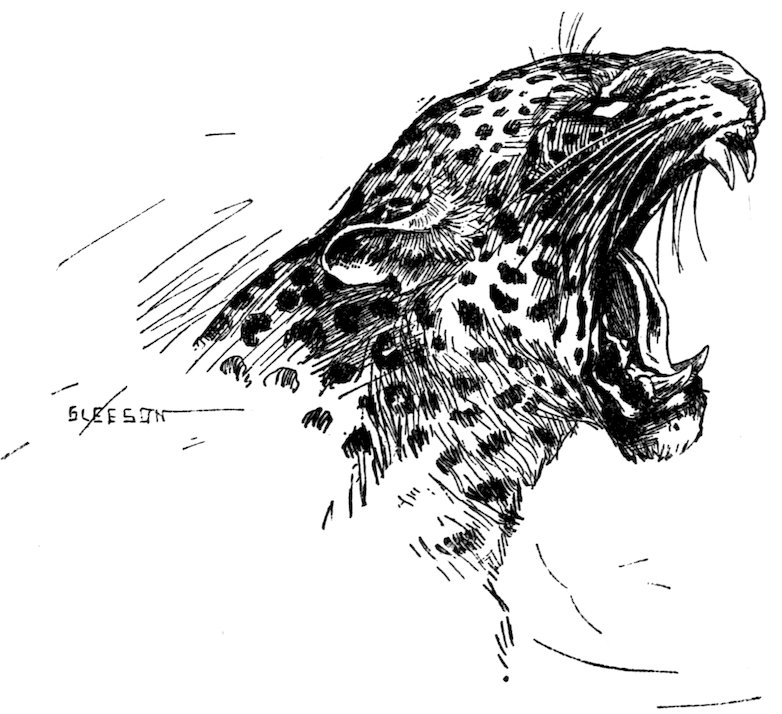
come.” It came at last. They awoke, gave several
yawns, and opened their mouths, showing their strong,
55sharp teeth. Their terrible retractile claws like those
of a cat moved as if ready to sink deeply into the
body of some animal. “If I catch a kambi to-night,
what a feast I shall have!” thought each njego at the
same time; and at the thought of blood both licked
their chops with their prickly tongues.
They left their lair and parted, as was their custom
both prowling in the dark, gloomy, and silent forest,
for all the birds were asleep as well as the day animals.
Afar off there were two kambis together, when
suddenly one said to the other: “We are in danger.
I scent a njego. Let us flee, for the wicked creature
is coming our way. Let us hasten. Yes, the scent
is becoming stronger and stronger every moment.”
They fled in the opposite direction from the scent,
56and after a long run came to a large river and swam
across. Then they felt safe, as the broad stream was
between them and the njego; for kambis know that
the njegos never swim across a river.
After a while the njego scented the two kambis.
He followed the scent until he came to the place
where they had lain down. Here it was quite strong.
He thought they were very near, and crouched on
the ground, his belly touching it. Never had he
been more wary, though he was intensely excited
at the prospect of a good meal, and his eyes glistened
as if they were fires.
Slowly he advanced, but his sharp eyes saw no
kambis. He followed the scent, walking with great
rapidity, and was gaining upon them very fast. At
last the scent grew very strong, and he made sure he
was to have a meal. Soon he came to a river where
he saw their footprints on the bank. He gave a fearful
growl of disappointment and rage when he found
the water of the wide stream between him and his
prey. He knew they were beyond his reach. Then
he walked along the banks of the river, trying to
find a place where two trees opposite each other had
branches spreading far over the river, so that after
climbing he could make a prodigious bound from one
to the other, and thus span the chasm that separated
him from the two kambis.
As he was looking for such a place, he said to himself:
“I will make the greatest leap I ever made, for
I must kill one of those kambis. I am so hungry.
57I have had no food for three days. How hard I
have to work for my living!”
At last he saw two such trees, and grinned with
joy. He rose on his hind legs and imbedded his
terrible claws in the bark, and ascended one of the
trees just like a cat. When he reached its longest
transverse thick branch, he walked over it, and looked
across to the other side. But, to his disappointment
and dismay, he saw that the gap between the trees
was so great that he could not leap over the chasm.
He looked down with dread at the swift deep
water of the stream under him, and exclaimed: “I can
never leap over this big gap, for if I try I shall surely
fall into the stream. I have a horror of falling into
the water. This has never happened to me in my
life.” But before coming down from the tree he
uttered another growl of rage, when he saw that he
could not follow the kambis. His roar was so loud
that he awoke the day creatures that were asleep in the
neighborhood, and they fled in every direction.
The njego had travelled a very long way from
his lair, pursuing the kambis, and it was time for him
to go back to meet his mate. As he walked, he was
very despondent and said: “Again another day without
a meal. But luck may come before I reach
my lair. It often happens that at the last moment
I find prey.”
True enough, as he was going along he suddenly
scented a kambi. His eyes once more flashed fire.
He hurried on. Nearer and nearer he came toward
58his prey, who was nipping leaves, unaware that her
life was in such danger, for the night breeze was
blowing from her direction in that of the njego, so
that she could not scent him.
At last the njego, as sly as a snake, came within
sight of the kambi. At that moment the kambi for
the first time scented danger and fled in terror, for
it was the scent of the njego, her most dreaded
enemy. The njego, seeing his prey running away,
made a tremendous bound. He missed, and the
kambi fled as fast as her legs could carry her; but
he made spring after spring, and each leap brought
him nearer and nearer his quarry. He gave growls
of rage every time he missed his prey, fearing that
it would escape him.
The poor kambi was so terrified that she ran in
a wild, erratic way, and became paralyzed with fear.
At last the njego, with a prodigious bound, landed
on her neck. His teeth were immediately imbedded
in the flesh of the panting creature, and his claws
59sank deep into her body. The struggle was soon
over. The njego made a great feast on the warm
body of his victim.
While eating, the njego was silent for fear of attracting
other njegos toward his prey. It was terrible to
see his glaring, treacherous-looking eyes while he was
feasting. If another njego had come near, he would
have been attacked with great fierceness. After eating
until he could eat no more, he continued his way
toward his lair, too surfeited to attack another kambi,
even if he had met one on his way.
His mate was waiting for him before their lair.
After he arrived, she looked at him, and said: “Dear,
I see blood around your mouth and on your paws.
This is the blood of a kambi. Your flanks are also so
swollen that your stomach must be filled with flesh.”
“Yes,” he replied, “I have been lucky. I came
upon a kambi; you are right.”
“I have also been fortunate,” she said. “I had a
ncheri for my meal, but, as you know, a ncheri is
small compared with a kambi. So I had only a good
meal and nothing to spare. But I am thankful for
this, for I am not hungry any more.”
The two njegos were soon fast asleep, and did not
wake during the day.
After the njego had left the remains of the kambi,
a pack of hyenas came just in time, before the ants
arrived to eat the rest, and they feasted on what the
leopard had left of the kambi.
CHAPTER VIII BIRTH OF THREE LITTLE NJEGOS
60
One day, three tiny little njegos were born, and
the old ones were delighted.
They watched over their little ones with great care,
and when Mamma Njego would go in search of prey,
Papa Njego remained behind to take care of the little
ones. Now and then he had a hard time, for they
cried when they wanted Mamma Njego to nurse them.
But mamma wanted an outing sometimes, and had to
go after prey.
“What made you so late?” Papa Njego would
sometimes say when his mate returned.
“If I am late,” she would reply, “it is because I
have had a hard time to find prey,” or, “Well, dear, I
am famished; I found nothing.”
When Papa Njego went out and was successful, he
would bring food to his mate, for she had to be nearly
all the time with their dear little ones.
So the old leopards were kept busy. After a while
they would leave the little njegos alone, saying, “We
can leave them now, for they are still afraid to go out
of our lair when we are not with them.”
The little njegos grew fast, feeding only from the
breast of their mother, and began to roam around their
61lair. One day, as their parents were looking at them
playing about, the mother said to her mate: “Look
how big our little ones are! How much they have
grown lately! We must soon give them a taste of
blood.”
Two or three nights afterward both were successful,
and returned each with a gazelle, and almost at the
same time.
They tore the gazelles to pieces, and called their
little ones out, and put before them the pieces they
had torn off. The little njegos looked at them first,
and as if they did not seem to care, for they did not
know what blood was, or raw flesh. They came and
smelt the meat, but did not lick it, and went back to
be nursed by their mamma.
The next day the njegos went after prey and were
again successful. Again they tore off pieces of the
62flesh and put them before the little ones. This time
they smelled the meat and licked it two or three
times, to the great joy of the old ones. The third
time meat was put before them, they licked the meat
until no vestige of blood was left on it.
When their parents saw this, they were delighted
and said: “Our little ones are doing well. They
now enjoy the taste of blood. They are going to be
true njegos.”
The little njegos, who had now licked blood,
wanted more, and were very restless and cried for it,
though they could not yet talk the njego language, for
they were too young. The next day Papa Njego was
luckier, and brought a young kambi to their lair. This
time the eyes of the little njegos fairly glared when
they saw the bloody pieces of meat, and they precipitated
themselves upon them and licked off the
blood with great gusto, for they loved blood more
every time they tasted it, to the great delight of the
old njegos.
Soon after, as their teeth grew, they began not only
to lick the blood, but to eat the meat. One day the
big njego said to his mate: “Our little ones are getting
big, and soon we shall have to work harder and
harder to feed them, for their appetites increase more
and more as they grow larger and larger.” Then he
rubbed his head against her neck to show how much
he loved her.
The time arrived when the little njegos were able to
follow their mother, and as they grew older they understood
63every day, more and more, the ways of the
njegos.
One day, one of the little njegos pounced upon a
ncheri (gazelle), and when his little brother and sister
came to enjoy the prey with him, he growled fiercely,
for he did not want them to have any of it.
But Mamma Njego made peace among them, tore
the poor ncheri into pieces, and all three had a peaceful
meal, while she was looking on. After they were
satisfied, she ate the rest, and then, as the day was soon
to dawn, she returned to her lair with the little ones.
Her mate was waiting for her. She said to him:
“One of the little ones has killed a ncheri. Soon
they will be able to take care of themselves. Then
we shall not have to work so hard. Look at them,
and at their little muzzles and paws, red with blood.”
Time went on, and the little njegos had grown big,
and were able to hunt for themselves, and finally left
their parents. By this time almost all the animals for
a long distance round the land of njegos had fled away
to escape the fate of those who had been eaten up.
The kambis, the ncheris, and other animals would say
to their kindred, “The njegos have come to our land;
let us migrate to some other parts of the great forest.”
So the old njegos starved. Night after night they
had no prey. The big one said to his mate, “We
must leave this country if we do not wish to die
of hunger.”
“Yes, let us leave this horrid country,” she replied.
“See how thin we have become for want of food.”
64And they looked at each other and saw their ribs
showing through their beautiful spotted skins.
They departed, but, as the forest was depopulated
for miles around, they got a very scanty subsistence,
just enough to sustain life.
They came, indeed, to a worse country still, for the
formidable bashikouay ants had been in the land a few
days before in countless millions, and their vast army
had attacked all the living creatures that came in their
way, and devoured many, and all the rest had fled for
their lives, and no creature walking or crawling on earth
was to be seen. Hard indeed was the lot of the two
njegos. Death by starvation stared them in the face.
In that plight, Mrs. Njego said to her mate: “Now
that we have raised our young, let us separate for
good, according to the custom of our kind. When
we are far apart, we shall get food more easily.”
They parted with great friendliness and said, “Perhaps
in the course of our lives we shall meet again.”
They went in opposite directions and lived alone,
prowling every night in search of prey, and resting
often during the day on branches of trees.
CHAPTER IX THE BIG NJEGO BECOMES A MAN-EATER
65
Now we will only follow the big njego, having
lost track of his mate. He was in a pitiful
state, and mad with starvation. It happened one
day that he saw a spring where human beings came
every day to get water. He scented their footprints,
and his appetite then seemed to increase tenfold. He
followed the scent, which led him to their village, and
as he came near the scent seemed to him the most
delicious and appetizing aroma he had ever smelled.
“I have never dared,” said he, “to attack human
beings before. I have always kept shy of them. But
I am famished, and the country contains no prey, so
that I shall die of starvation unless I eat one of them.
So I must not be afraid.”
The village was fenced, and that first night he did
not dare to leap over the fence, for he was timid in
spite of what he had said to himself. Toward morning
he hid in a thick part of the jungle close by the
spring, and went to sleep on a cross branch of a tree.
He was so hungry that after sunset he descended the
tree, and lay in wait near the path leading to the
spring, waiting for a human being to come. It was
66almost dark, and all the people had come to the
spring to get water but one.
The njego’s quick ear soon heard footsteps coming,
and presently he saw a woman with a big water jar on
her head walking in the path toward the spring. He
watched her. While she was bending over the water,
filling her jug, he made a tremendous leap and landed
on her back, fastening his claws in her body, at the
same time that his big jaws with their terrible teeth
sank into her back.
The poor woman was so paralyzed by fear that she
did not utter a single cry. The leopard carried her
into the jungle and devoured her. The flesh of the
woman tasted so good, and the blood he licked was so
sweet, that the njego thought it was better than all the
kambis or anything else he had ever eaten in his
life before, and he said to himself: “Why did I not
dare to kill human beings before! They are harmless.
This one did not fight. What a fool I have
been!”
From that day the big njego was a man-eater.
Soon after, a man who had gone into the forest for wild
honey happened to pass near where the njego was,
and he also was attacked and devoured. The njego
became the terror of the people of that country.
The human beings, missing their fellows, went in
search of them, and saw in one place the big footprints
of the njego, and blood in another, and knew
that a njego had turned into a “man-eater,” and was
in the neighborhood, and had carried off their missing
ones. There was great sorrow among the villagers at
this discovery, for they thought more of them would
be slain and devoured.
“He watched her”
67From that time on they never went alone into the
forest or to the spring, and were always armed with
spears or poisonous arrows. At night they kept
many fires burning in the street, and consoled themselves
by saying, “No matter how hungry a njego
may be, he is afraid of fire.” They also danced all
night and beat their tom-toms.
During that time the njego kept far out of the way
in the jungle. But he thought all the time of the
flesh of the human beings he had eaten, and said,
“I will watch my opportunity.”
The villagers, after a while, thought the man-eater
had been scared away and had left the country, and
that he would never come back. So they stopped
dancing every night, and went to sleep without any
fear of the njego.
But, in the course of time, the njego returned. One
night he walked toward the village, and, coming to
the fence, turned around it, hoping to see some openings
through which he could get. But he saw none.
Then he leaped over the palings, falling so lightly that
no one heard him. Noiselessly he passed through
the dark street, his eyes looking everywhere, in search
of prey. He listened to everything, and was very
cautious and somewhat timid, for he had never entered
a village of human beings before.
He scented human beings in every house; but the
68houses had doors, and these were all closed. The
village was composed of a single street with houses on
both sides. So he went in the rear of the houses and
walked by them, but saw no openings to get in.
Finally he came to a goat-house; but there was no
way for him to enter, for the house had been especially
built to protect the goats against njegos. So, after
walking several times around it, and saying to himself,
“How I like goats!” he retreated, and soon after he
leaped over the fence and went back into the jungle,
and slept on a huge branch of a tree.
But he was thinking all the time of the flesh of the
human beings he had eaten, and the following night he
went again to the village and examined carefully every
spot; but he was still very timid, for everything was
yet very strange to him. He lingered much longer
than on the first night, and walked several times the
length of the street and back of the houses, scenting
human beings everywhere, which gave him a tremendous
appetite.
He remained uncertain what to do; but he had
come to the conclusion that the roofs were the weakest
parts of the houses. However, that night again he
leaped back over the fence, went into the jungle, and
slept on the same tree that he had slept on since he
had first come to the village.
The next night there was a great thunderstorm,
with terrible lightning, and the rain fell in torrents.
The njego said: “This is good weather for me. I
will enter the village of the human beings, and carry
69away one of them for a meal.” He waited as usual
until the night was somewhat advanced, and then
thought it was time for him to leave his place. He
came down the tree and directed his steps toward the
village.
When he came in sight of the fence, he listened,
but could only hear the heavy rain falling on the roofs
of the houses. He heard no voices of the human
beings, but his scent told him that many were there.
Then he said to himself: “They are sleeping, just
as the men of the woods, the monkeys, and other animals
of the forest do, during the night, and now is the
time when I can pounce upon them.” The scent of
human beings gave him courage, for he was famished
and had become desperately ferocious from hunger.
He walked slowly and silently in the middle of the
street, looking here and there, his eyes shining like
fire. At last he stopped before a house in which people
were asleep, and thought for a while. Then, as
quick as a swooping guanionien, he made a tremendous
bound, landed in the middle of the palm-thatched roof,
plunged through it and seized one of the inmates (a
young girl), and in the twinkling of an eye he had
sprung back through the hole he had made going into
the house, with his prey in his mouth, made another
spring, which landed him outside of the fence, and
carried off his victim into the forest.
The njego had been so quick that the inmates of
the house had hardly time to realize the great misfortune
that had happened to them. They saw blood
70and the hole through the roof. Then they knew that
the man-eater had been there and had carried off one
of their people.
At their cries of anguish, the whole village awoke,
and all the people knew that the man-eater had come
back, and swore that they would never rest and be
happy again until they had trapped him. They
made a trap in the forest, in the shape of a funnel,
planting long poles in the ground, close together, and
making them fast. The structure was much narrower
toward the end, so that it was impossible for the
leopard to turn back. At the end was a sort of cage.
The top of the trap was also closed with poles made
very secure, so that when he went in he could not
possibly escape.
When the trap was finished, they brought a goat
and put him in the cage. During the night the goat,
which was much frightened, cried incessantly. The
man-eater heard him, and said, “To-night I will make
a meal of that goat.”
When the night was sufficiently advanced, he descended
the tree upon which he had slept, and, attracted
by the noise of the goat, went toward the trap
in which it was imprisoned.
Now though the njegos are very clever in getting
prey, they are otherwise very stupid, and can easily be
deceived.
So the njego went round the trap, and tried several
times to reach the goat by putting his big paws inside;
but the sticks were made so secure that he could not
71do it. He had never seen in the forest anything like
the trap, and suspected that all might not be right
about it. But at last his hunger got the better of him,
and he entered the funnel, and walked towards the
goat, which cried louder than before, it was so
frightened. At first the njego had plenty of room,
but, as he advanced farther and farther, he found it
more difficult to move forward on account of the narrowness
of the space. Then he touched a spring, and
a trap-door fell behind him. At the noise the trap-door
made in falling, the njego became frightened and
tried to escape; but he found himself so tightly held
that he could neither move forward nor backward.
Then he became furious, and uttered terrific yells of
rage in quick succession.
There was great joy among the people in the village
when they heard the cries of the njego, for they knew
he was trapped. In the morning they went to the
trap and saw the njego making frantic efforts to get
away; but the structure had been built so strongly
that it was impossible for him to break through.
His yells of rage became terrific and filled the
forest with their din. The people shouted to him:
“Ah, ah, you ferocious and terrible creature, you
njego man-eater! You have eaten enough kambis and
ncheris and other animals which we would have killed
and eaten ourselves, if it had not been for you, and you
have also eaten our people. Now it is all over with
you. You will eat no more. No one will be afraid
of you hereafter.”
72Then they passed their spears through the openings
between the sticks and pierced him to death. After
they were sure the njego was dead, they broke up the
trap, and took his body out, and brought it to the
village and laid it in the middle of the street, and
the villagers, looking at it, shouted: “You wicked
creature, you will eat no more of our people! No
kambi or ncheri will ever be eaten by you again. We
all hate you. We hate you more than any other
animal of the forest.”
They broke his jaws, and took away his teeth for
a necklace, and skinned him to make belts of his
hide, and cut off his tail for a charm, and ate his liver
to give them courage.
CHAPTER X THE HAKOS, OR ANTS
73
The forest is inhabited by many species of ants,
of many sizes, and of many different colors.
Their number is so great that they not only cannot be
counted, they cannot even be estimated. Their mode
of life, their habits, and their homes vary greatly.
Marvellous is the intelligence of these small creatures.
Their thrift, perseverance, and industry are beyond
those of any other insect or animal.
They have great tenacity of purpose, and are most
systematic. For their size they have immense
strength. They possess many gifts to suit their
different modes of living. They understand each
other perfectly, otherwise they could not work with
such deliberate concert of action, and so intelligently.
They have chiefs, leaders, and workers.
Almost all the species of ants live together in
large numbers. There are few that live solitary lives.
Those which prey alone are very voracious and
fierce. Many ants are endowed with a wonderful
power of smell, and often, though not one of them
can be seen, they suddenly make their appearance by
thousands, or tens of thousands, when they scent food,
many of the species coming even from under the
74ground. They are such nuisances that human beings
have to put the feet of their tables and cupboards
into vases of water for protection.
Many ants have the ferocity of the leopard or
other night animals. They attack their prey with
great courage. One species, the bashikouays, go in
countless numbers on their raids, and attack all life in
the forest. All animals flee in order to escape
them.
Among the most wonderful ants are the termites,
or white ants, who build structures of clay, or of grains
of earth, to shut themselves from the light, to be protected
from the rays of the sun, from the rain, and
from their enemies.
Some species of termites are very fond of cotton
goods, paper, etc., but avoid woollen or silk articles.
They manage to scent paper and cotton goods
from under the ground, and ascend the poles upon
which the trunks or chests which contain the goods
rest. They build a long tunnel from the ground on
the outside of the poles, and climb through to the
chest, into which they eat their way. The tunnel is
made of minute particles of wood glued together
by a substance coming from their bodies. Often
the owner of the chest, when he opens it, finds
nothing inside,—everything having been eaten up by
the termites.
CHAPTER XI THE NCHELLELAYS, OR WHITE ANTS
75
One of the white ants, or nchellelays, said one
day to another nchellelay: “Strange indeed is
our life. We are unlike the other ants, for they
enjoy the light of day, and breathe the air that passes
over the prairies and forests. They can ramble where
they please in search of prey or food. We nchellelays
live in darkness. Light is odious to us. The sun
is our greatest enemy, and we have to protect ourselves
from its rays, which kill us when they strike our
bodies. If, perchance, by some catastrophe, our
houses are damaged, and we are thrown out of them,
we have not only the sun, but the rain as our foe. Creatures
surround us on every side to pounce upon us
and devour us, and many kinds of ants are also our
enemies. Our life is safe only when we are shut up
in our houses.”
An old and wise nchellelay, who had been listening,
said: “Why do you complain of your existence? We
are born with great gifts which other creatures do not
possess, to suit our mode of life. To us, darkness is
light, for we can see so much better in it. We erect
buildings through which neither the sun nor the air,
the light nor rain, nor our enemies can penetrate.
We build during the night, so the sun cannot harm
76us. Just think how comfortable and cosey are our
chambers!”
All the nchellelays were listening to what the wise
and knowing one said, and when she had done speaking,
they said: “You are right, wise one. We are
born with certain great gifts, which no other creatures
possess, to suit our mode of life, and protect ourselves
from our enemies.”
These nchellelays that were talking belonged to the
species that build only on the prairies that are surrounded
by the great forest. Their structures, or
houses, are of the shape of gigantic mushrooms. They
vary in height from ten to eighteen inches, the tops
or crown being from ten to eighteen inches, and the
stem or round pillar supporting the crown about five
inches, in diameter. As the colony grows larger, sometimes
two or three crowns are built on the top of one
another. Each house forms a colony.
From immemorial time, these nchellelays have
built on the prairies, and as they increase and multiply
in a wonderful manner, their structures cover the
whole prairie, and can be counted by tens and tens
of thousands, at short distances from one another.
Strange indeed is the sight.
The colony inhabiting these gigantic mushroom-like
structures is of three kinds of nchellelays unlike
in shape and having different kinds of work to
perform. The chiefs, few in number, are much larger
in size than the others. Their heads are armed with
powerful nippers.
77The next class are smaller than the chiefs, have
elongated bodies, and are armed also with strong
nippers. These are the officers or overseers and
fighters.
The third class are exceedingly numerous, and form
by far the greatest population of each colony. They
are shorter and smaller in size. Their heads are
square, and their nippers are shorter than those of the
other two kinds, and of a somewhat different shape.
This class is born to work. They are the builders of
the structures. Their life is one of labor. They
have soft bulky bellies, of dark bluish or yellowish
gray color, filled with the clay they feed upon.
The head and nipper-like jaws of the chiefs, officers,
or overseers are very hard, and of dark color, contrasting
with the color of their bodies. These pincers are
given to them for fighting, wounding, piercing, catching
their enemies, and also tracing lines where the work
has to be done.
One day some mushroom nchellelays said: “We
need a new house, and we will build one which will
last for years, through which neither rain nor sun can
come, and through which our enemies cannot enter.
We are small, it is true, but among the gifts that we
have are patience, perseverance, industry, and a good
thinking brain. With these four gifts we can accomplish
a good deal and succeed.”
There was great excitement among the nchellelays
when they made ready to commence their work.
The chiefs gave orders to the officers or overseers, and
78these gave orders to the workers. The dry season is
the time the nchellelays choose for building. They
know the time of the two seasons, the rainy and the
dry, perfectly well.
The workers, having received their orders, began
work in great earnest. They made deep perpendicular
tunnels to reach the blue clay, and, when they
had reached it, they made other tunnels upward,—all
these under the place chosen for building their
house in.
It was a remarkable sight when they began their
labor. The workers followed one another in a continuous
stream, and ejected a quantity of thick, soft,
semi-liquid clay, which they had eaten and which had
been transformed during the digestive process into a
gluey material. Each load was put side by side with
wonderful precision. After this, they followed one
another and disappeared under the ground. The
column of workers never ceased for an instant.
There did not seem to be any lazy ones among them;
no one was shirking work and lagging behind. They
marched like a well-drilled army of workers who
knew what their duty was. Their system showed
great intelligence. No bricklayer among the most
civilized human beings could have laid bricks side by
side with more skill than they did their loads. The
officers were looking on and watching how the work
was done.
Once in a while some of the nchellelays brought
grains of earth and deposited them in the mortar.
79The structure rose as if by enchantment, and at last
the making of the crown was begun, numerous cells
or rooms communicating with one another. A large
cell, much larger than any of the others, was built for
their queen.
Every tunnel and cell was coated with a gluey,
shining matter, coming from the bodies of the workers,
to prevent them from giving way. At the base
of the column they had built inside a round clay ball,
divided into three parts which could be separated, full
of very small cells for eggs to be deposited in. This
ball communicated with the rest of the buildings by
tunnels through which the eggs might be transported
to the various cells.
After the building was completed, the nchellelays
said, “Now we must go and store in many of the
cells little grains of earth to use in our mortar.” So
they went to work, and brought loads of these and
stored them in the cells which the officers had selected.
When everything was in order, a new arrangement
was made. The officers were scattered over the buildings
and kept watch over the cells. The large cell
for their queen had an entrance at each end communicating
with all the corridors in the house. A large
body of officers kept watch and surrounded her.
In the course of time the queen did nothing but
lay eggs, and an enormous number of them.
These eggs hatched from the heat, and then the
little tiny nchellelays, which were of a milky white
color, were taken to different cells by the big ones,
80and in the course of time became large themselves.
When the colony became too large, the nchellelays
said to one another: “Now we are living too many
together. Our structure is too small, and we must
build a new addition to our dwelling.” So the workers
went down to the clay and built a short stem, as they
had done before, and then made another mushroom-like
cap. They also built many cells, and the surplus
population took possession of these new ones.
But the colony kept increasing, and another mushroom-like
structure was added, and built on the top
of the second cap. At last a fourth one was needed
and then the nchellelays said, “We cannot add to our
structure, for it would be too high and become top
heavy.”
While the mushroom nchellelays were enjoying
quietly the comforts of the house they had built with
so much care and skill, the following event took
place.
Another kind of nchellelays, that were lazy and
lived as much as they could on the labors of others,
said to one another: “Let us make our abode in the
structure of the mushroom nchellelay. We must be
very cunning, for it is not an easy matter to build
cells and tunnels in their house without being discovered;
still we are accustomed to do this, and can
succeed if we want to. But if we are found out, we
shall have a hard time, for they are much stronger
and more powerful than we are.”
These intruders were very small, mere pigmies in
81size compared with the mushroom nchellelay. They
also had chiefs, officers or overseers, and workers.
They went forthwith to work, and with their nippers
dug into the thick walls of the mushroom nchellelays
from the bottom, carrying away the débris of the
material they demolished and depositing it in the
earth. They took good care to make no mistake,
and their small cells and tunnels were built between
the original cells.
They were extremely intelligent, and could tell
when they were getting dangerously near the tunnels
or cells of their bigger neighbors. They succeeded at
last in building their cells and corridors throughout
the structure. These were coated with a black gluey
matter, and consequently were different in color from
those of their neighbors, which were yellow.
So two colonies of different nchellelays lived in the
same buildings, the big ones not knowing that intruders
were in their abode. These little dwarf nchellelays
lived happy and contented, and often laughed at their
big neighbors, saying, “They do not know that we
have made our home in their house.”
One day the njokoos (elephants) happened to come
into the country of the mushroom nchellelays, and
several bulls getting into a fight among themselves,
they demolished many of the buildings of the mushroom
nchellelays, treading upon them with their big
feet, often crushing a great part of their structures,
and thus also killing many nchellelays, and wounding
many others.
82The nchellelays were very much excited, and those
who had escaped with their lives and heard the crash,
went into all the cells to tell of what had happened.
None could tell the cause of the catastrophe, for such a
thing had never happened to them before.
This was indeed a great and sudden misfortune.
The officers made their appearance immediately at the
opening of every cell or tunnel that had been damaged,
put their heads out of the entrances to see what was
the cause of this sudden smash, and then disappeared
inside and reported to their chiefs.
Soon after, a large number of officers or overseers
arrived at all the breaks. They cried, “Let us
defend our homes,” their big nippers opening and
closing all the time. They were ready to bite and to
fight any intruder, not a nchellelay, that wanted to
get inside of their dwelling, and at the least sign
of danger they opened their nippers still wider, ready
to bite.
Great, indeed, had been the havoc made by these
njokoos. Dead and wounded were lying everywhere
among the ruins. Among them were young nchellelays
of a milky white color, and others quite tiny, having
just come out of the eggs. Eggs, whole or smashed,
were seen in every direction. It was a terrible sight
to contemplate for the nchellelays. Everything was
topsy-turvy.
Still the nchellelays recovered quickly from the
sudden confusion into which they had been thrown,
for they had cool heads. The work of rescue began
83first. Luckily it was a cloudy day and the dry season,
when the sun is not powerful.
Orders were given, and the nchellelays went out to
begin the work of rescue. They were seen everywhere
among the débris, looking round for the dead
and wounded. When they saw one, they immediately
went toward him. If so dangerously wounded that
they thought there was no hope for him, he was left
on the ground to die. When they saw that there was
hope of saving the life of one, they took the poor
wounded one gently between their pincers and carried
him tenderly inside, those who guarded the entrance
making room for the rescuer to pass. The wounded
that could, hopped or crept around, and were helped
and led in.
The young were also carried in with the utmost
tenderness and affection, for they were babies and
helpless. Then, and last, the eggs that had not been
injured were also carried in.
In the great catastrophe that had taken place, the
big nchellelays and the pigmy ones were mingled
together in the ruins. The pigmies had also many
dead and wounded. Their presence was the first
intimation that the big nchellelays had of them.
Their rage knew no bounds at the sight. Officers
and workers attacked the intruders with great fury.
These, however, fought with the utmost bravery, for
it was a fight for life with them, and many of the big
ones bit the dust in the conflicts that took place.
The mode of warfare among the nchellelays is
84to disembowel one another by piercing their soft
stomachs with their nippers. The belly is the vulnerable
part of their body, and once pierced they are
crippled, and die soon afterwards.
Now the ruins were turned into a great battlefield.
It was soon a scene of carnage. While many of
the big nchellelays were transporting
the wounded, the young, and
the eggs inside the ruins of their
buildings, many were busy seeking
the pigmy nchellelays, the intruders within their house,
to fight and kill them. Dead and wounded from the
numerous combats lay everywhere. There were many
thrilling fights and death-struggles. The attacks on
both sides were fierce, and no one asked quarter.
Combatants were seen fighting one another over the
whole battlefield. Sometimes the fight occurred in a
very rugged place where the ruins of the buildings lay
around on the top of one another. One nchellelay was
seen ascending the steep incline ready to charge the
enemy at the top, who was waiting for his onslaught.
In another place, one was descending with great fury to
attack his enemy, who was coming up.
85Elsewhere, one could see a worker or an officer of
the larger kind attack his diminutive enemy, and
succeed, after some sparring, in disembowelling him,
when suddenly an officer of the pigmy kind, seeing
one of his comrades in the fight, or in his death-throes,
would attack the victorious one before he had
time to turn round and get ready for the fight, and
succeed in disembowelling him with his pincers,
although the antagonist was at least two or three
times his size.
It was a miniature fight of giants and pigmies, the
latter fighting as bravely as the giants.
The time at last came when all the pigmy kind
were overpowered and killed, one by one, and the
battlefield was strewn with their dead, mingled here
and there with those of the larger ants. When the
battle was ended, and the young and the eggs had
been carried inside of what remained of the building,
the work of repairing all the rents that had been made
by the destructive work of the njokoos began.
The officers made tracings with the points of their
nippers at the apertures to show where the closing
was to take place. Then the workers came and first
carried away the débris that was in their way. Then
they closed the walls in the manner in which they
had at first built the structure, by putting loads upon
loads of clay-like matter upon one another. Others
came carrying minute pebbles or coarse grains of
earth in their mouths, and during the night they
finished rebuilding the structure just as it was before.
CHAPTER XII THE GIANT NCHELLELAYS
86
The giant nchellelays are so named as they are
much larger than all the other species of nchellelays,
or white ants. Their bodies are of a whitish
yellow color, with very hard black heads, armed with
most formidable pincers,—terrible weapons for fighting
and biting. Their officers or overseers are smaller
than the workers, but have more elongated bodies.
As they are larger than all the other nchellelays, so
their structures are much larger also. They vary
from five to fifteen feet in height. Millions upon
millions of grains of earth are required in their construction.
Their mode of building these is wonderful
and unlike that of other termites. How they live
under the ground before their structure is built, no
one can tell.
One day the giant nchellelays said: “Let us build
a new structure for us to live in and be secured against
our enemies, the air, the rain, and the sun.”
“Yes,” replied all the others forming the great
colony, adding:
“We shall have to work hard and use a great deal
of thought, perseverance, and skill before our work
is accomplished, for untold numbers of grains of yellow
87earth will have to be taken from under the black
loam and carried above the ground where we are to
build, put side by side, and cemented together before
our home is finished.”
Soon after this talk they began their labors. They
brought, from the numerous tunnels they made, grains
of yellow earth, and laid their foundation, each nchellelay
carrying only one grain at a time.
The workers labored with great earnestness; thousands
upon thousands carried between their pincers
grains of earth, and laid them down side by side, each
passing over the grain he had brought and depositing
on it a gluey substance which might be called
mortar or cement, and which joined the grains of sand
together.
Layers upon layers were built in this manner, and
this flat foundation communicated by numerous tunnels
with the yellow earth underneath. The officers kept
watch to see that the work was done. Special care
was taken in the building of the outer walls, for these
were to be very solid, having to protect the interior
from the weather or from violence. They made
the wall much thicker and harder, and impervious to
rain.
When daylight approached, they closed all the
openings leading into the building. Strange to say,
though it is dark in the house, the ants can tell when
the day is over and when the night has come. So,
after the sun had set and darkness had come over
the land, the officers broke with their big pincers the
88mortar that had closed the openings, and the workers
continued their task. The building rose as if by enchantment,
for thousands upon thousands were working
with all their might.
As the structure rose, the number of cells and tunnels
increased, and the building assumed somewhat of
a sugar-loaf appearance.
As they began to reach the top, they built points
or pinnacles, making the top the very strongest of
all the parts of the structure.
The giant nchellelays were wise in the art of building,
and knew that the summit of their dwellings was
to bear the brunt of the weather, of the rain-storm,
and even the fall of a tree, so that in this place the
masonry was several inches thick.
The structure, after a great deal of labor, was finished,
attaining a height of fourteen feet and a diameter
of five feet at the base. Hundreds of millions of
grains of yellow earth had been used in its construction.
Each grain had been placed as systematically
as if the most skilful bricklayer had done the work,
and the roofs of the cells were arched, for the ants
knew the strength of the arch. And, when completed,
the building was so strong, high, and large,
that even the huge njokoo had to pass it by, leaving
it untouched.
A long time had passed, when one day a very large
dead branch fell upon the building of the giant nchellelays
and destroyed some of the pinnacles. News soon
spread through the cells that a great accident had happened,
89that the top of the house was damaged; there
was great commotion and excitement among the population
when this occurred. The officers came round the
openings to see what was the matter, and to defend
them against possible intruders. The wounded and
the eggs were brought inside. The work of repairing
began at once, and the workers brought their grains of
earth, and much of the broken material was used in
making repairs.
During the night the nchellelays rebuilt the pinnacles,
the new ones being of exactly the same shape as those
that had been destroyed.
Things went on well for a few days, when another
huge limb of the same tree fell on the structure and
damaged it again.
It was again rebuilt as it was before the accident.
Sometime afterward the building was once more
damaged by another limb of the tree.
90This time the giant nchellelays held a consultation,
and after deliberation concluded not to rebuild the
pinnacle, deeming the place dangerous, and determined
to erect another structure in some other place, and they
accordingly withdrew.
CHAPTER XIII THE NGOMBAS, OR PORCUPINES
91
One day two porcupines were getting ready to
go out of their dark burrow, to seek for food,
for they were hungry. They were near the entrance,
and listened. Hearing no noise, and scenting no
danger, one said to his mate, “All is quiet; so we can
safely leave our home.”
After they were out, they raised their quills, many of
which were about one foot long, hard and sharp, and
shook them against each other and made a rattling noise.
Then the big ngomba said to his mate: “Dear,
we porcupines are not blood-thirsty; we do not attack
the animals of the forest, and drink their blood, and
feed upon them; neither do we fight them. We are
harmless. We feed on roots, nuts, and vegetable
things. What a precious gift our coat is! Its quills
are our weapons of defence. No animals in this great
forest possess such a valuable coat. When we walk,
our quills lie quietly on our back or sides. When we
fear danger, we roll ourselves into a ball, and raise
them upright, and we feel safe and fear no animal of
the forest, no matter how fierce he may be.”
His mate replied, thoughtfully, however: “You
forget; there is one enemy we have, and we dread
92him much, though he is very small. It is the bashikouay
ant. When they attack us, their number is so
great that they can penetrate between our quills, attack
our bellies, which are not protected, and our eyes, and
well-nigh devour us. How we hate and fear the
bashikouays!”
The big porcupine that day went farther than usual
from his burrow. He heard heavy footsteps, and said
to himself: “These are the footsteps of the njokoo.
Perhaps he is coming my way.” The footsteps came
nearer and nearer, and the porcupine rolled himself up,
not daring to walk farther.
The njokoo came nearer, looked at him, and then
stopped. The poor porcupine, as he heard the footsteps
of the elephant nearing him, stood still, as if he
were dead; but his quills were erect.
The njokoo looked at the ngomba, for he had
never seen one before. He was suspicious, and did
not like the looks of his sharp-pointed quills, and
trumpeted, which meant: “I am not going to toss you
about with my trunk. I am not going to play ball
with you. Neither will I trample upon you, and try to
crush your body under my feet. I do not fancy these
sharp-pointed quills. They would hurt my trunk if
I got hold of you, and lame me for life and perhaps
cause my death if I trampled upon you. So do not
be afraid. I will not try to hurt you.”
After this the njokoo left, and for a while the porcupine
could hear his heavy footsteps or the cracking of
saplings which he broke as he walked through them.
93The porcupine did not know what the trumpeting
of the njokoo meant, and did not know what the big
and powerful njokoo said to him. But he had been
so scared by the elephant that he did not dare for a
long while to unroll himself and go about. At last,
when he was sure that he was safe, he continued his
rambling in search of food.
He soon came to the den of two leopards who were
out in search of prey for their three baby leopards,
who were walking round outside. As soon as these
saw the poor porcupine, they started for him, and he
had just time to roll himself up, for their steps were so
light that he had not heard them.
The little leopards were so young that they had no
experience, and thought they would play with the much-frightened
porcupine with their paws, just as a cat does
with a mouse. But they did not try it twice, when
they felt the pricking of the porcupine’s quills.
94As soon as the tiny little leopards went back to
their den, the porcupine unrolled himself and ran
away as fast as his short legs would let him. After he
had settled down into a walk, he passed a big snake of
the color of the dead leaves, hiding among them and
waiting for prey. When he heard the noise the porcupine
was making, he was delighted, for he said,
“Surely I am going to have something to eat;” but
the porcupine had not yet wholly got over his fright,
and was walking with his quills standing up. The
snake, with his sharp, small eyes, said: “It is of no use
to try to swallow this creature, for his quills would
pierce and kill me. I shall let him alone.”
It was late, and though the porcupine was far away
from his burrow, he knew the way there well, for he
was acquainted with the surrounding country, and
was in a hurry to go to meet his mate, whom he
loved tenderly.
Hurrying along, he suddenly heard a noise above
his head, and, being scared, he rolled himself once more
and raised his quills. The noise had been made by
a ngina (gorilla) on a tree laden with fruit that he had
been eating, and he was coming down. The ngina
was unaware of the presence of the porcupine. He
had reached the lower branch of the tree, and was
hanging to it before stepping on the ground. As his
left arm was ready to let the branch go, he stepped on
the porcupine, and gave a terrific yell of pain, as the
quills went deeply into the sole of one of his feet.
Quick as a flash, he tried to take away the porcupine
95from his foot with one of his hands. Then he gave
another terrific groan of pain, for some of the quills
entered the palm of his hand. The blood was dripping
from both his
hand and foot.
Then, hanging
to the branch he
had not quitted,
he lifted himself
up and shook his
legs several times
with great force,
and with a
mighty kick sent the porcupine flying to a long distance.
The porcupine was terribly scared. Never in
his life had he been attacked and buffeted in this way.
Nor had he ever heard such terrific yells and groans.
96All his muscles were called into play in order to
keep his body in ball-shape and his quills standing
upright, for the ngina was furious, yelling and roaring
by him; but fortunately he did not dare to handle
him, though the frightened porcupine thought his last
day had come.
At last the ngina went away. The porcupine
remained coiled for a long time, for he had never been
so frightened in his life. Then, when he thought
there was no more danger, having listened carefully
and heard no noise, he continued his way toward his
burrow.
The porcupine met with no farther adventures on
that day, and finally came to his burrow and saw his
mate waiting for him. She said, “What makes you
so late? I began to feel anxious.”
“Dear,” he replied, “I have had an awful time
to-day. The wonder to me is that I have come back
at all. I have never met with so many adventures
and dangers in my life before; but, thanks to my
wonderful coat, I am safe.” And after they had
retreated into their burrow, he recounted to his mate
what had happened to him during the day.
CHAPTER XIV THE IPI, OR GIANT ANT-EATER
97
Darkness had come over the land. An ipi
was listening inside of the opening of his burrow.
After making sure that there was no danger, he
came outside and stood still, waiting for his mate to
come out also. His body was about five feet long,
and covered on the upper surface and on the sides
chiefly with large, thick, horny, yellowish, overlapping
scales, these scales becoming smaller as they
approached his head. He shook his body and the
scales rattled, as they struck together.
Soon after, his mate came out, and they looked at
each other and admired their wonderful coats.
98The big ipi said to his mate: “Fortunate are we to
possess such a good coat to cover our bodies. Our
scales are so hard that after we have rolled ourselves
up for protection, the teeth of our enemies cannot
pierce them. They slip over them. It is our weapon
of defence, as we ipis have no teeth.
“Strangely do we pass our lives. We have no
choice of food, but feed on ants. We are gifted with
an extensile tongue which we can shorten or lengthen
at our will, and at its extremity it is covered with a
glutinous secretion, and no ant when caught can ever
escape. Oh, what a multitude of ants we have eaten
since we were born!” he laughingly added. “What
a number we need to satisfy our appetites!”
“Yes, indeed,” his mate replied, “and sometimes
the ants become scarce, or we cannot find many, and
we have to go back to our burrows with empty
stomachs.”
Their conversation was suddenly interrupted.
They heard a great noise near, and they rolled themselves
up and pressed their scales against one another.
The noise had been made by a number of kambis
who were fleeing at great speed from some enemy.
When this noise had died away, the two ipis unrolled
themselves, and said good-by to each other, and each
went a different way in search of ants.
The sight of the ipis at night is wonderful.
Nothing escapes them when they go through the
forest and jungle. They can even spy a single ant
marching alone, though it is pitch dark.
99The two ipis were fortunate that night, for both discovered
long lines of ants that were foraging. After
getting within a proper distance from the ants, each
ipi began his meal. Every time the tongue came out,
its extremity struck an ant which stuck fast to the
gluey matter, and could not escape. The tongue
went in, deposited the ant inside in the twinkling of
an eye, and then came out again and struck another
ant.
After eating thousands of ants, the appetite of each
was satisfied, and they returned toward their homes
and told each other of the good luck they had had,
and soon were fast asleep.
In the course of time the ipis had to travel farther
and farther to get their meal of ants, and one evening,
after their return with empty stomachs, the large ipi
said to his mate, “Let us leave this part of the forest
and go somewhere else, for ants have certainly become
very scarce in this neighborhood.”
The following night they bade good-by to their
old burrow, where they had had so many days of cosey
sleep, and where they had raised a family. They
journeyed toward a new country, picking up here
and there an ant with their sticky tongues. Ere long
they came to a big tree, and saw a hollow under its
roots, and said, “Here is a good dark place to spend
the day and sleep,” and they went in and slept
soundly. When night came, they set forth again,
and continued to seek for a region where ants were
plentiful.
100The third night they met a great many ants that
were foraging. They thought it would be a good
country for them to settle in, and said, “Let us find
a hill on the side of which we may make our burrow.”
They were soon fortunate enough to find one, and set
to work with a will digging out the ground with their
claws. That night they did not finish their burrow,
so they went back to the hole under the root of the
tree where they had slept before. The following
night they worked very hard and finished their home,
which had two openings communicating with the
chamber in which they were to sleep.
When the work was done, one ipi said to the other:
“We have worked hard to make our new home. It
is a good thing for us that our short legs are so muscular
and that our claws are so strong. How much
earth we can move away!”
They felt very happy to be able to sleep in their
new home. There they lived for a while, ants being
plentiful in the neighborhood, and raised a family of
little ipis.
CHAPTER XV THE NGOMBA, OR PORCUPINE—THE IZOMBA, OR TURTLE—THE IPI, OR ANT-EATER
101
One day an izomba (turtle) was walking in the
forest, when suddenly she heard a noise, and
became suspicious; as the noise came nearer, she drew
her head, her four feet, and tail under her shell, and
said, “Now I am safe.”
It happened that an ipi had made the noise that
scared the turtle. The ipi stopped and looked at the
turtle with great curiosity. Then she, too, heard a
noise and became suspicious in her turn, coiled round
and made her scales as tight against each other as she
could, and said also, “Now I am safe.”
The noise had been made by a porcupine whose
coat had the longest, hardest quills that porcupines
have. It happened that he came between the ipi and
the izomba. When he saw them, he stood still and
looked at them both with great curiosity.
Suddenly he heard a crash through the jungle. A
dead branch of a tall tree had broken off and had
fallen on the ground. He in his turn was so scared
that he rolled himself up and put his quills out, for
he thought njokoos had made the noise, and then he,
too, exclaimed, “Now I am safe.”
102The three remained thus for sometime, feeling sure
that so they were safe. At last, hearing no noise, the
turtle peeped out slowly, her head and her four feet
and tail issuing from her shell. The ipi, hearing no
noise, unrolled herself, and so did the porcupine.
Then the three looked at each other and wondered at
their coats. The ipi said to the izomba, and to the
porcupine, “Do not be afraid of me. I do not bite.
I have no teeth and feed only on ants, so I cannot do
you any harm.”
Next the porcupine said to the turtle and to the
ipi: “Don’t be afraid. I am a rodent. I feed on
roots, fruit, and nuts which I find on the ground. It is
true I can bite, but I do not feed on blood and flesh;
besides, my teeth could not go through your coats.”
Then the turtle, looking at the ipi and the porcupine,
said: “Do not be afraid. I am enclosed in a
hard shell-like coat—this is to protect me. I live
chiefly on leaves. I can bite terribly, but how could I
ever bite you with the grand coats you have.”
103But, as it happened, the three did not understand
one another, for each had a different language which
belonged to their species. They kept talking nevertheless,
each expressing his thoughts in his own way.
The ipi, looking at the big scales fastened to the
shell of the turtle, wondered why they could not move
like her own, and thought to herself, “Strange indeed
is the coat of the turtle.” She also wondered at the
way the turtle had of hiding herself under her shell,
for the turtle’s head, tail, and legs would now and
then suddenly disappear.
The porcupine, in the mean time, was examining the
coat of the ipi and of the turtle. Finally he said to
them: “I have the best coat of you all; when I make
my formidable quills stand up, no one dares to handle
or attack me or tread upon my body.”
Then he gave a great porcupine laugh and cried:
“Ipi and turtle, monkeys and men of the wood can
toss you about; njokoos can tramp upon you,—for
though your coat protects you it does not sting, pierce,
or hurt like mine. You are harmless.”
After a while all three went on their way to get their
living, each thinking his coat better than the others’.
It happened that the turtle came under a tree where
a large nshiego (chimpanzee) was resting. When he
saw the turtle he came down from his tree. When
the turtle saw the nshiego come toward her, she drew
her head, tail, and legs under her shell, for she was
terribly afraid. It looked then as if the turtle were
dead.
104But the nshiego had seen the turtle moving, and
wondered what it was, and soon the poor, frightened
turtle was in his two hands, and he turned her over, first
on one side, then on the other, tossed her around, and,
when he got tired, dropped her, and went away. The
poor turtle had never been handled in that way before,
and was so scared that she did not dare to peep her
head out of her shell for a long time afterward, when
she went into hiding under the roots of a big
tree.
The nshiego farther on met the porcupine, who
when he saw the nshiego rolled himself up and put
out his quills. The nshiego came up to him, looked
at him carefully, and said to himself: “I am afraid of
thee, porcupine, and I will not toss thee as I did the
turtle, for those ugly-looking quills will pierce my
hands and hurt me dreadfully. I am afraid of them.”
And he went his way.
Toward evening the same nshiego saw the ipi walking.
When the ipi heard the nshiego, she rolled herself
in a coil, and with all her strength made the coil
as tight as she could. Then the nshiego came toward
her, and soon the ipi was in his hands. He played
with her, tossed her about, and, when tired, dropped
her and went away.
When the ipi came to her burrow, she told her
mate all the things she had seen that day, of the
turtle and the porcupine, and what had happened
to her with the nshiego, and how afraid she had
been.
105When the porcupine came to his burrow, he told
his mate of the strange creatures he had met, of the
ipi and the turtle, and said: “Dear, I met also a
nshiego who stood by me quite a while, but, thanks to
my good coat of quills, he did not dare to handle me,
as I saw he did the turtle and the ipi.”
CHAPTER XVI THE NGOOBOO, OR HIPPOPOTAMUS
106
One day a big ngooboo, or hippopotamus, looking
fondly at his mate, said: “Dear, what a
pleasant home we have. Our shoal is surrounded by
deep water. We swim and dive around it, and enjoy
ourselves in the broad river. The animals of the
forest cannot come and attack us; the water is too
swift for the crocodiles, and though the huge njokoo
loves to bathe, he does not dare to disturb us, for he
only fights on land. Even if he did attack us, we
could dodge him and his big dangerous tusks by diving
and remaining under the water out of his sight,
for he cannot dive. Besides we could attack him and
lacerate him with our big, crooked, hook-like tusks.”
Then he laughed in the fashion of the ngooboos,
opening his enormous mouth and showing his tusks.
“We could not,” he continued, “have chosen a better
spot for a home. On one side of the river is the big
forest, on the other is the extended prairie, where we
go every night to graze and enjoy the juicy and succulent
grass, unless we scent danger and think it wiser
not to leave the river, in which case we have to dive
and eat the grass growing at the bottom.”
107Looking affectionately at Mrs. Ngooboo, he then
uttered a grunt and snort which meant, “I love you
dearly.” He admired her greatly. He thought the
rosy gray of her skin was the most beautiful he had
ever seen, and her form the most graceful of figures.
The ngooboos believe that they are handsomer than
all other creatures, and that their ponderous, clumsy
bodies and short, ugly legs are very lovely. The
ngooboos are in nowise more conceited than all the
other animals, each kind thinking itself the handsomest.
One of the peculiarities of the ngooboos is that each
family owns its shoal. It is their castle, and no other
ngooboo is allowed to land there, and if they try, there
is a fight; but when in the water they are friendly
with one another. Each ngooboo knows his own
shoal.
The ngooboos forming the colony were about thirty
in number, including the babies. When they stood,
or were lying on their shoals, their heads and backs
were above the water, and their bodies looked like
huge, stranded logs. Sometimes at a certain angle
their heads looked like the heads of horses, hence
the white people call them hippopotami, which means
river horses.
“Do you remember, dear,” resumed Mr. Ngooboo,
“when we migrated and came to the river in company
with two other couples who live on yonder shoals?
We were driven from our former homes by human
beings, who had settled on the far-off prairie, made
108traps to ensnare us, and succeeded in capturing several
of our number. At last we did not dare to land any
more, so we concluded to leave the place and emigrate
to some other country, and travelled until we discovered
this beautiful river with its big prairie. Now we
have prospered and increased in number, for this land
has not many human beings.”
“I remember it well,” replied Mrs. Ngooboo, looking
fondly at her mate, coming near him and putting
her head close to his. Then the two looked at their
dear little baby, who was very tiny and only a few
weeks old, and thought she was the sweetest little
baby ngooboo they had ever seen, as well as the most
beautiful. She had such lovely eyes, such a cunning
little mouth, and she was so intelligent for her age,—in
a word, she was such a wonderful baby that there
was no other little ngooboo like her.
The big ngooboo here took a plunge, remaining
109under water for a while, and reappearing on the surface,
quite a way off from his shoal. Then he called to his
mate, by peculiar grunts and snorts, which is the language
of the ngooboos: “Be careful of our baby, for
the current is swift.”
Hearing the call of her mate, Mrs. Ngooboo
plunged into deep water and swam toward him,
watching the baby carefully all the while, and the
baby, when tired, would come gently and rest on the
back of her mamma, who was delighted.
In a short time they were by the side of Papa
Ngooboo. They took a swim, then ascended the
river to their shoals. After they had rested a while,
Mr. Ngooboo said to his mate: “Dear, our feet are
so shaped that we can both walk on land and swim.
Our straight and crooked tusks allow us to get the
grass at the bottom of the river. We are so built
that we can stay under water a long time.”
The colony of ngooboos had a good time. They
would play in the water, dive, and swim, often run
after one another, and all this time the young ones
were learning the wisdom belonging to the ngooboos.
Once in a while a troop of monkeys who were
travelling would look upon the ngooboos from their
trees, on the wooded shores of the river, and would
say, “We have never seen such an ugly creature in
our lives.”
Watching the ngooboos from among the thick trees
lining the banks of the river were the small yellow
osengi monkeys with their long tails, and their bosom
110friends, the hornbills, with their great beaks several
inches long.
The osengis and the hornbills are great chums; indeed,
they seem to be inseparable. So that when
other birds of the forest
see first the osengis,
they say, the hornbills
are near; if they see
the hornbills first,
they say, the osengis
are not far off, and food is plentiful, and berries and
fruits are to be found; and if they feed on these, they
say, let us follow them, or go ahead of them.
How such friendship happens to exist between
these two, no one can tell. It is the more unselfish in
that, though they eat the same food, they never seem
to quarrel about it. Sometimes the osengi would discover
food first, sometimes the hornbills. “Kee,
kee,” the osengis would often say plaintively to the
hornbills, as they followed them; but the hornbills
were always silent, never uttering a note, because
111they did not want other birds to know where they
were.
The little osengis love the neighborhood of rivers,
whose banks they follow in their wanderings; they
like to sleep on the branches spreading over the
water. When birds or animals see them, they say
gladly, if they are thirsty, “Water is near, for we see
the osengis.”
Every evening it is the custom of the ngooboos
to land and pasture on the prairie; they generally
land two or three hours after the sun sets, that is,
between eight and nine o’clock.
At such times there is a great deal of grunting and
snorting among them. They talk to one another, and
each snort or grunt has a meaning. The ngooboos are
very suspicious when they go on shore, for they do
not feel at home on land as they do in the water.
Some ngooboos were now seen ascending and descending
the river, going to their respective landing-places,
for they are accustomed to land at the same
spot every night and follow the path they have
made.
After the ngooboos had approached their landing-places,
they swam silently to and fro, to see if they
could scent any danger. Once in a while the subdued
snort of the leader was heard, saying, “Not yet, we
must wait a little while. We must make sure that
the coast is clear,”
At last a very peculiar snort was heard by the
followers of the leader, signifying, “Now be ready,
112we are going to land.” And all the ngooboos swam
silently toward him after they heard this.
Then the old leader, who had led them many a time,
landed, and entered the path. Each ngooboo landed
in turn, and they all followed him in single file, going
to the place where they pastured.
One of the great faculties possessed by the ngooboos,
as well as by most if not all the ruminant animals, is
that they can see as well during the night as they do
during the day.
The moon had just risen, and threw its dim light
upon the ngooboos, as they walked silently following
their leader, their huge bodies looking strange as they
walked in single file. They appeared like supernatural
creatures wandering in the prairie.
The mboyos (jackals) and the hyenas, as they
scented the huge creatures, said, “Let us keep out of
the way of the ngooboos,” and made off. After
proceeding a few miles, the ngooboos reached their
browsing place of the day before. As they were eating,
the big ngooboo, their leader, gave two or three
gentle snorts, which meant, “Look yonder far away,
there is a herd of niarés [buffaloes].” All the ngooboos
looked and saw the buffaloes and said: “We are not
afraid of the buffalo; they cannot toss us in the air as
they do njegos or human beings. Next to the
njokoos, we are the heaviest and biggest creatures of
this land. Besides, their horns are so placed on their
heads that they cannot pierce our bodies. We are not
afraid of them, for their way of fighting is to charge
113and toss. If these buffaloes dare to attack us, we will
lacerate and cut their bodies with our crooked and
sharp tusks.”
At the same time they all opened their mouths and
laughed. Ugly and formidable indeed were their
tusks, which weighed four and five pounds each.
Then they gave grunts of defiance which the buffaloes
heard, and straightway walked off, saying, “The
ngooboos are coming our way, but we can run faster
than they, and they cannot catch us.” They also
laughed in their turn and said, “Catch us if you
can, ngooboos, with your clumsy bodies and short
legs. You will get tired before we do.”
The ngooboos continued to pasture, enjoying their
night meal. That night the grass seemed very juicy
and good to them. Suddenly they stopped browsing.
They scented danger. They looked in the direction
where the scent came from and saw coming from a
cluster of trees a large herd of njokoos. The leader
grunted, saying to his followers: “Here are the
njokoos. How ponderous and powerful they are!
How small we are compared with them! No creatures
possess such strength. They can also walk or
run much faster than we can, for their legs are longer
than ours. Look at the huge tusks of some of
them.”
Soon the leader, who had been attentively observing
the herd of elephants, said: “The njokoos are coming
our way. Let us go back as fast as we can to our
river, for we cannot fight the njokoos on land; they
114would charge and pierce us with their big tusks and
kill us.”
“Yes,” said all the ngooboos, “it would not be
pleasant to be impaled and get those big tusks
between our ribs.”
The ngooboos went back to the river as fast as they
could, their leader hurrying them on. But the scent
of the njokoos became stronger and stronger, and thus
showed the ngooboos that the njokoos were nearing
them, and they did their best to run still faster. At
last they came to the river and plunged into its water
and in the course of time reached their different shoals.
There they felt strong. They all laughed and said,
“Now we are at home in the water and can fight the
njokoos.” But they added sadly, “What a pity that
we did not get our full night meal, the grass tasted so
good!”
It is the custom of the ngooboos living in this
river to cross the prairie and bathe in the Atlantic
Ocean two or three times a year. The prairie was
bounded on one side by the river and on the other by
the sea.
One day it was agreed among all the families of
ngooboos that they should go to the beach the following
night, and enjoy themselves swimming in the surf
if the sea was not too rough. So when night came
the ngooboos landed and began their journey toward
the seashore.
“How they enjoyed their sea bath”
115It was full moon and the journey to the ocean
was made without mishaps. One family after another
arrived on the beach. The ngooboos were greatly
excited. They talked among themselves. There
was great rejoicing among them. They sniffed the
sea breeze and looked at the surf and at the broad sea
before them and wondered why there was not a shore
on the other side as on the river. They tramped
around on the beach for quite a while.
Then the leaders of the different families said to their
followers, “Let us go into the sea.” They grunted
and snorted on the way, walked slowly through the
surf, and losing their footing began to swim, though
they did not dare to go far. They grunted loudly
and threw water several feet high through their
nostrils, as they did on the river.
They had a grand time. How they enjoyed their
sea bath! How they laughed! Their loud snorts
and grunts were heard by all the creatures in the
neighborhood.
After they landed, they said to each other, “What
fine fun we had in the sea!” Then they went to the
prairie and grazed, and enjoyed their meal heartily.
Gradually they wended their way back to the river,
which they reached toward four o’clock in the morning,
when each family went to its shoal.
CHAPTER XVII A FIGHT FOR MISS NGOOBOO
116
Time went on, and Miss Ngooboo as she grew
up became more and more beautiful and
attractive in the eyes of the young ngooboos.
On the two other shoals were young ngooboos who
fell very much in love with her. They would come
before her shoal, swim, dive, give snorts or grunts,
telling her how much they loved her; but Papa and
Mamma Ngooboo watched her carefully when she
would go out to swim and would themselves swim between
her and her two admirers. She was too young
yet, the old folks thought, to be taken away from them.
Day after day her two admirers would display themselves
before her, show her how they could dive and
swim, each trying to surpass the other in these accomplishments.
Miss Ngooboo looked at them complacently,
enjoying the fun. But before very long the
two admirers began to be very jealous of each other,
and uttering grunts of defiance and hatred, dared
each other to a fight. When they came together
in swimming they would look at each other fiercely
and say, “If you do not stop coming, I will give
you a trouncing.” “I dare you,” would answer the
other. So the days passed.
“Then ensued a terrible fight”
117One day Miss Ngooboo seemed to show preference
for the one whose shoal was the nearest to hers. The
rejected rival became furious. He shouted with terrific
and angry snorts that Miss Ngooboo was to
be his, and that he would fight for possession of
her. The other said he would do likewise, for she
was to be his. Both went back to their shoals full of
fight and hating each other more than ever.
The next day, as Miss Ngooboo was on her shoal
by the side of her mamma and papa, the young ngooboo
admirer that was her neighbor left his shoal and swam
toward her.
When his rival, who was watching him with jealous
eyes, saw this, he left his shoal and swam toward her
also, with fight in his eyes. He had made up his mind
to settle the quarrel that day ngooboo fashion, and decide
by single combat to which of the two rivals Miss
Ngooboo was to belong. He was very sly and swam
under the water.
His rival was so busy making love to Miss Ngooboo
that he had not seen him leave his shoal, neither did
Miss Ngooboo, who was standing on her shoal by the
side of her parents, who now thought she was big
enough to attend to herself and choose her own mate.
Suddenly there surged from under the water ngooboo
number two, having inflicted a severe gash with his
crooked teeth on his rival, who had not known of his
presence before the attack. Then ensued a terrible
fight for the possession of Miss Ngooboo. The two
ngooboos rushed at each other, opening their huge and
118hideous mouths, and showing their crooked tusks, with
which they inflicted fearful gashes. Sometimes one
dodged the onslaught by diving, then the other, furious
at missing his antagonist, would dive and pursue
him under the water, and there a great fight would
take place which no one could witness. Then both
would reappear, giving grunts of rage and defiance.
The water around where they fought was a mass of
white foam. There was great excitement among all
the ngooboos of the colony at the sight. Grunts were
heard everywhere, but they remained neutral. Miss
Ngooboo, from her shoal, was looking on, perfectly
mute, not a grunt coming from her mouth.
Often the two rivals advanced and retreated, watching
their opportunity to strike without being hurt in
return. The water became red with their blood.
After a long and terrible fight one of the two showed
signs of fatigue. His body was fearfully lacerated.
At last he fled, swimming and diving in the direction
of his shoal, pursued by his enemy. He had been
thoroughly vanquished.
The victor returned to Miss Ngooboo and ascended
her shoal, and was received by the old folks as worthy
of the hand of their daughter. After this, every time
his vanquished rival saw him, he fled out of his way.
The colony of ngooboos had increased so that all
the shoals were taken. The young couple, seeing that
there was no room for them, decided to migrate to
some other part of the river or to some other country.
So they bade good-by to the old folks, and to the
119other ngooboos, and went in search of a new home.
There was a great concert of grunts when they said
farewell.
Ascending the river they searched for shoals, but
could not find there what they wanted. At night
they would go and graze on the prairie. The ngooboos
have the great gift of scenting water a long way
off. As they found no home on the river, they
entered the forest and crossed some small rivers and
came to a prairie, where they scented water. They
proceeded toward it, and after a while beheld a beautiful
little lake, at which they were greatly delighted.
Soon after, they were swimming in its cool water.
There were no shoals in the lake, but its shores were
not abrupt; they sloped gently. The young couple
said to each other: “This is a good place; let us settle
here. There is plenty of grass around us. In the
water we shall be protected during the day, and at
night we shall find plenty to eat.”
The next day they saw a large herd of elephants
coming toward the lake, and they dived under the
water. The njokoos took a bath and went away.
Every day kambis and many animals came to drink,
but the ngooboos were not disturbed by the sight.
There they lived happily for many years and raised
a family of their own.
CHAPTER XVIII THE FIVE APES, OR MEN OF THE WOODS
120
One day it came to pass that strange-looking
apes, called by the human beings of the forest
“men of the woods,” came to the same part of the
forest to find food. They are called “men of the
woods” because their resemblance to human beings
is striking. They are very ugly, but they themselves
think they are very good looking,—in fact, the handsomest
creatures in the forest.
These men of the woods live in the deepest and
gloomiest part of the great forest, for they shun open
places and the presence of human beings, with their
noise. The different species or varieties are called
nginas, nshiegos, mbouvés, nkengos, kooloo-kambas.
Every one of these has a language of its own, distinct
from the others.
Their ancestors, like themselves, were born in the
forest and lived in it,—in a word, the men of the
woods had lived there for numberless ages, thousands
and thousands of years ago. The reason they live
in the great forest, and cannot live in any other part
of the land, is because they subsist on fruit, berries,
nuts, canes, and saplings, and these are found all the
121year round, for it is always warm in the country, and
the fruit-bearing trees are very abundant.
These men of the woods never kill creatures to eat.
They roam from one place to another in order to procure
a living, and the amount of food consumed in a
day is very great. They have the same gifts as the
other animals. Having a good memory, they know
their way through the forest and dense jungle, and the
seasons of the year when the fruits are ripe at such
and such a place.
The male ngina is the most powerful of all the men
of the woods. He is called the Giant, the Powerful.
He can conquer every other ape. His strength is
so great that no one of them dares to attack him.
When suddenly surprised, he attacks human beings,
and with terrible muscular arms and with open hand
he kills them by a single blow. His strength is that
of about twelve strong men together.
He is blacker than soot, and his children are born
as black as he is. A big ngina weighs from three to
four hundred pounds. He is all bones, sinews, and
muscles. His body is covered with hair not very
thick, and his skin is almost as thick as that of an ox.
He is from five to six feet in height.
The nshiego or mbouvé averages from about three
feet ten inches to four feet four inches in height, and
is in many respects a stranger creature than the ngina.
He is smaller and far from being as strong, but nevertheless,
in a hand-to-hand fight with a man, the latter
would not have the slightest chance, and would be
122torn to pieces. Man without weapons is very weak
and helpless, but the mbouvé never attacks man, but
flies at his approach.
The nshiego mbouvé is bald-headed when adult,
and very black, with a body thinly covered with hair.
But a wonderful thing is that though the parents are
very black, the children are born perfectly white. As
the young mbouvé grows older his complexion gradually
changes, the white color gradually tanning, and
then becoming darker and darker until finally black
patches show themselves on the face, and at last he
becomes entirely black and of the color of his parents.
The nkengo is born tan yellow, of the color of his
parents, and remains so to the end of his days. He
also has no rosy cheeks and never blushes or becomes
red in the face, no matter how enraged he becomes.
His complexion is very much like that of the Moors,
or of the people who lie on the sands all summer on
the seashore. He attains sometimes a height of four
feet and a half, and is very strong.
The nshiego, or the common chimpanzee, is born
yellow, but gradually turns very black like his parents.
He is about the same size as the nshiego mbouvé.
The kooloo-kamba is born black and remains so
all his life. He is a strong-looking creature. He
has an almost round head, prominent cheek-bones,
large ears (a characteristic of all the men of the
woods), and is about the size of the nkengo.
The nshiegos, the mbouvés, the nkengos, the kooloo-kambas
have long arms, big ears, elongated hands
123and feet, and long fingers, thus showing that a great
part of their lives is spent upon trees.
The nginas, on the contrary, have very small ears,
broad, powerful, and short hands, short fingers, thick,
broad, short feet of great strength and power for
grasping, and have shorter arms than all the other
apes.
All the apes use their feet as hands.
The mbouvés and the nkengos are the two most
intelligent of the men of the woods. They are the
only ones that build bowers on the trees, so that
they can say they have a home.
The ngina is by far the fiercest of all the apes, and
builds no shelter of any kind whatever, and he is such
a huge feeder that he has to roam through the forest
more than all the other apes.
CHAPTER XIX THE NGINAS, OR GORILLAS, AND NJOKOOS, OR ELEPHANTS
124
Huge male ngina, or gorilla, was standing perfectly
still one day in a very dense part of the
forest. He was thinking. He looked fierce and
ugly. His intensely black face was furrowed with
deep wrinkles. Under his overhanging brows, his
gray, vindictive eyes seemed to flash hate and ferocity.
His neck was so short that his head appeared set on
his huge broad shoulders,—a sign of his herculean
strength. His chest was so broad that two human
beings side by side standing behind him could not
have been seen. His belly protruded, his arms were
of immense strength, and his body was supported by
short, flexible muscular legs without calves.
Looking down finally at his feet, he exclaimed,
“With these I can clutch.” What a big foot he
had! Then he stretched his long muscular arms and
looked at the palms of his hands, which were as hard
as horn, then at his callous fingers and at his black nails,
and muttered, “When I strike with these, I kill. I
break the ribs of creatures, or I kill them outright,
and when my hands hold something, nothing is powerful
enough to take it away from my clutches;” and
125he grinned and looked more horrid and repulsive than
before.
Then he beat his chest with his great fist. The
126sound was like that of a huge partly muffled drum,
for his chest was as hard as wood. To try his
immense strength, he went to a tree several inches
in diameter near him, and seizing it with both
hands and feet broke it in two as if it had been a
young sapling. He was delighted when he saw how
strong he was, and gave a chuckle of satisfaction, a
horrid one peculiar to the nginas.
Looking round, he saw a big thigh-bone of a very
large antelope, which had been devoured by a njego.
He picked it up and crushed it into splinters between
his jaws, which have more power than those of a lion.
Then he gave another chuckle of satisfaction, for he
saw how hard he could bite an enemy.
Then he yelled. These yells sounded somewhat
like the barking of angry dogs, only a hundred times
louder. They were followed by roar after roar, which
filled the great forest with their din and were re-echoed
from hill to hill until they sounded like distant thunder.
All the animals and birds of the forest were filled
with fear and said, “The huge ngina speaks. No one
among us has such a powerful voice.”
These roars were roars of defiance with which he
challenged the creatures of the forest to come and
fight him. In his pride he thought himself the ruler
of the great forest. After he stopped roaring there was
a great silence. All the animals were filled with fright.
Suddenly the shrill trumpeting of a njokoo was
heard. It was indeed a fearful trumpeting, a trumpeting
of defiance. It meant: “I am not afraid of you,
127ngina, neither of your yells and roars. If you should
ever dare to attack me and seize my trunk, I could
crush you against a tree. And if you climbed on
my back, I would run, and the branches of the trees
under which I would pass would make short work of
you.” After the challenge of the njokoo to the ngina
came another silence. It was soon broken, however.
Once more the ngina gave terrific yells and roars.
The njokoo at the same time repeated his ugly trumpeting.
Both continued for some time, but they did
not come together, nor even in sight of each other.
The ngina was thinking: “No creature of this forest
can fight the njokoo. Not even I with my great
strength would dare to attack him, for though I can
kill a leopard, I cannot kill a njokoo. If he comes to
attack me, I can climb a tree which he cannot uproot,
and from there I can dare him and yell and roar at
him.”
After a while the njokoo and the ngina went each
his own way. No wonder that the human beings of
the forest, who possess only spears and arrows, are
afraid of the ngina and never dare to attack him.
Woe to those who come unexpectedly upon one, for
a single blow from the hand of the monster would
suffice to slay a man!
The ngina wandered through the forest in the direction
of his mate and baby, who were far away. They
held a conversation, though they were several miles
apart, and when they met they greeted each other
with great affection.
128The big ugly creatures looked at each other and at
their baby ngina, and once in a while gave chuckles
which in the ngina language meant, “How happy I
am! How I love you both!” The baby ngina was
about two years old and was trying to break with its
teeth some of the nuts which had fallen on the ground,
but his jaws were not yet strong enough to do so.
His mouth was yet too small for nuts of such a size.
Mamma Ngina came to his help, crushed them with
her powerful jaws, and handed the pits to her little
one, uttering a peculiar sound at the same time, which
meant, “Here, dear, are the cracked nuts. Take
them.” He, in return, made some kind of noise expressing
his feelings, which might be translated, “I
thank you, Mamma Ngina.”
The baby ngina was just beginning to learn the
language of the nginas from his father and mother,
who taught him to speak, and he was making good
progress.
As the nginas were enjoying their nuts, they were
suddenly disturbed by the sharp whistling buzz of an
ibolai fly, which was trying to alight upon their bodies
and bite them. “Bother the ibolai fly!” said the big
ngina; “it bites so hard.” At the same time his
eyes were watching for a chance to catch it, but the
ibolai was so quick in its motion that he could not
follow it.
The ibolai is cunning, and succeeded, unknown to
him, in getting on the ngina’s back, and gave him a
most painful bite. The pain made the ngina cry out.
129At that very time a fly called the nchouna, which
makes no noise at all and which is very cunning and
sly, alighted on the face of his mate, inserted its bill
in her cheek so gently that she did not feel it, and,
after having had its fill of blood, left without its presence
being known. Soon after, the itching began,
giving at times sharp stings of pain.
“Bother the nchouna!” she cried angrily; “they are
so sly that one never knows when they alight upon
one and the pain is only felt after the fly has left. I
wish all the nchounas were dead.”
A short time afterward the nginas heard a sharp
whistle made by an iboco fly, as it flew round them
with such rapidity that their eyes could not follow it in
its course. The iboco would at times go far away
and then come back. At last it succeeded in alighting
on the back of the big ngina, who suddenly uttered a
howl of pain.
“What is the matter, dear?” inquired her mate.
“Don’t speak of it; an iboco has given me a fearful
bite. These ibocos are the worst flies I know of.
Let us get out of the way of the nchouna, the ibolai,
and the iboco, and go into the thickest part of the
jungle. There they will have no room to fly around
us in.” And they immediately moved into the thick
jungle.
After they were comfortably seated in the jungle,
the big ngina said to his mate: “We have to roam
continually, far and wide in the forest, to get our living,
and we eat so much every day that we cannot
130stay long in one place. It is about time for us to
travel toward the land of pineapples. These must
be good to eat now, for it is the moon of thunder,
great heat and rain. That land is a long way off, but
we will manage to get a living as we journey along.
The tondos [a red fruit growing above the ground]
are plentiful, and we shall find also many nuts.”
Toward sunset, when it was time for the nginas to
go to sleep, they came to a fine tree, and the huge
fellow said to his mate, “Here is a good place for us
to spend the night.” Then Mamma Ngina ascended
the tree with her baby hanging to her, and seated herself
on a heavy cross branch, and placed her back
against the trunk of the tree. After she was comfortably
settled, she looked down and said to her
mate, “I know, dear, that you will let no animal
climb this tree, even if it is a njego, and that you will
fight to the death to protect us, for we do not fight.”
“Surely,” answered her mate, with roars of defiance,
“I will protect you and our little one.”
Then he made himself comfortable on the ground,
as was his custom every evening, at the foot of the
tree, where his mate slept, resting his back against the
trunk. That night their sleep was much disturbed,
for a leopard was in their neighborhood. He was
lonely and wanted a mate, and called for one, but he
did not attack them.
At dawn they left their sleeping-place, and going
first in search of their breakfast, picked berries, nuts,
and fruits, as they travelled in the direction of the
131land of the pineapples, for they knew the way, having
been there before. Sometimes they had to separate
during the day, as there was not food enough
for them all in any one place, but they always remained
within the sound of one another’s voices.
That evening, before they went to sleep, the big
ngina said to his mate: “To-morrow we will travel
fast. Many nginas are travelling to the land of the
pineapples, as we are; and if we are late, we shall find
that all the pineapples have been eaten up, and we
shall have made our long journey for nothing.”
Toward dawn they were awakened by the cackling
of partridges calling for their mates. But it was
not light enough for them to start. At daybreak
Mamma Ngina and her baby came down from their
tree, and after greeting one another the three continued
their journey to the land of the pineapples.
They passed through a region where food was
scarce, so they broke saplings of certain trees, tearing
the outside and eating the heart, that was very juicy
and sweet, and the baby ngina was never forgotten
and was the first to be fed, and when they saw a
few berries, these were always for him.
One day the big ngina left his mate and baby
and wandered through the forest. After a while he
scented leopards. At once the hair on his body
became erect, and he gave terrific yells and roars of
defiance. When he came to the lair of the leopards,
he yelled again, but the leopards were out seeking
food for their young. Suddenly the big ngina became
132silent, for his eyes were trying to see into the lair.
Finally he made out three little baby leopards walking
about, and with one of his huge long arms he seized
one and flung him to the ground, killing him instantly.
Then he slew the two others in the same
way and went off to rejoin his mate and baby, to
defend them against the njegos, should the latter be
prowling near them.
Great indeed was the rage of the leopards when
they returned and saw their young lying dead, but by
that time the nginas were far away.
After a few days’ journey they came to the land
of the pineapples, which extended as far as the sea.
Here they rejoiced greatly, and said, “The pineapples
are just right. We have come in good time.”
The pineapples were still green and hard; but
they made great havoc among them. The big ngina
ate at least a barrel full without stopping, his big
stomach sticking out as if he had swallowed a barrel
itself. Then they went to rest in the thick of the
forest, for where pineapples grow in abundance the
trees are not thick, and the nginas do not like to spend
the night in such exposed places.
The next morning the big ngina said to his mate,
“To-day let us change our food. Let us go after nuts,
for we shall be sick if we eat pineapples day after day.”
They found trees with plenty of nuts on that day,
and stopped only when they could not eat any more.
The following day they went back to the pineapple
land, and there met a number of nginas who had come
133to feast on the fruit. And as there was plenty of
food for all, there was no quarrelling, and the younger
nginas made love to those who were not mated.
After a few days the nginas began to get very fat.
They approached the sea and wondered what the constant
booming was. At first they were shy, but as
the booming continued, their fear left them, and they
walked toward the Atlantic. Pineapples were still
plentiful even near the shore. They looked thoughtfully
at the big sea. What they thought only themselves
knew.
After leaving the land of the pineapples, the three
nginas wandered through the forest, and got far away
from the sea. At times they had trouble to find food
with which to satisfy their hunger, and had to go during
the day through large districts of the forest to seek
it, and many a time they went to sleep hungry and
with their big stomachs much shrunken. They had
to separate during the day after, and each went in
search of food for himself, and before sunset they
met again. Sometimes when one of them came to
a spot where food was abundant, he would call the
others to come, telling of the lucky find.
CHAPTER XX THE NGINAS TRAVEL TO A PLANTAIN FIELD; THEIR STRANGE ADVENTURES
134
One day the big ngina said to his mate: “Dear,
do you remember the large field of plantain-trees
that we discovered last rainy season? The trees
must be big now and bearing fruit. How juicy must
be the large bunches they bear! It is about time for
us to travel toward them. Oh, what a feast we will
have!” his face showing joy at the prospect, for he
fancied he was already in the field and eating the succulent
plantains. Of all the fruits growing in the
forest, the ngina likes the plantain best.
“We shall have to hurry on our journey,” said the
big fellow, “lest the njokoos get to the place before
us.”
So the following morning they departed, the baby
ngina walking close to his mother. They knew the
way to the plantain field.
It was the height of the rainy season, and tornadoes
were common, and these were followed by very heavy
rains, accompanied by terrific thunder and lightning.
“The plantain-trees,” said the ngina to his mate,
“are a long way off, and if the huge njokoos, who are
135such great eaters, reach the place before we do, they
will eat everything, and we shall have made our journey
in vain. Let us hurry as fast as we can, so as to
be there before their arrival, for the njokoos ramble
far and wide in the forest, and some of them may
have discovered the place also.” So they started on
their journey.
The nginas met with many adventures on their
way to the plantain fields that day. Toward sunset
it began to rain very hard, and there was heavy
thunder and sharp lightning. Soon they came to a
place where they saw three huge boulders close together,
and these were sheltered by the thick foliage
of a large tree. The two nginas looked at each other,
saying: “This is a good place to be in for the night.
We will sleep under this tree.” They set their backs
against one of the large boulders, and the baby ngina
went to sleep in the lap of his mother. The rain
dropped heavily from the leaves upon them. They
slept with their heads hanging down on their chests.
Their sleep was very light, and the falling of a leaf
would have waked them. Besides, they were on the
lookout for njegos, snakes, and other creatures.
When the morning came they saluted each other.
The big fellow came close to his mate, and uttered
certain sounds which meant, “Dear, I love you.”
Then he extended his long arm and petted his little
one, and soon they started again on their journey
to the plantain field. Nothing unusual happened.
They met two or three omembas (snakes) and some
136kambis (antelopes), and found enough to eat to satisfy
their hunger.
When evening came, they saw a fine large tree,
where the little ngina and his mother could rest
comfortably. Both ascended the tree, and the old
fellow slept at the foot. Toward midnight there
was a great thunderstorm, the rain fell in torrents,
the claps of thunder were incessant, and the lightning
was most vivid, and after one terrific clap of
thunder, a vivid flash pierced through the forest,
and the thunderbolt struck the tree next to theirs.
The nginas gave a terrific yell of alarm. They
fled, and wandered about in the darkness, for they
could not see their way well. Suddenly the big
ngina stepped on a huge python and gave another
yell; but before the serpent could attack him, he
gave him a terrible bite and killed him. Ere long
they found another good tree for sleeping in, and
ascended it for the rest of the night.
They were delighted when morning came. “What
an awful night we have had!” the old fellow said to
his mate. “That is the first time in my life that I
have seen lightning strike so near us. We have narrowly
escaped with our lives.”
In the course of the day they came to a part of
the forest where the ground was soft. The big ngina
saw the footprints of a njego. At this sight his hair
stood erect on his body, this being a sign of fear and
anger. Looking at his mate, he said, “Here are the
footprints of a njego.” Then both inspected them
closely and she said, “We must be careful to-night,
for the njego makes such tremendous leaps that one
is never sure of his life.”
“He gave him a terrible bite”
137It happened that the njego was famished on that
day, and left his lair before the night had come, to
prowl in the forest in search of prey, for the leopard
can see in the daytime, though he sees much better
at night. The big ngina, who was on a tree busy
eating fruit, suddenly saw the njego coming toward
his tree. At this sight his hair became erect again,
his eyes showing some fright at first, but he recovered
himself speedily, and soon they looked full of anger.
He remained silent and waited for the leopard to
pass under his tree. He had not to wait long, and
then, quick as an arrow, he fell upon the njego’s back
and with one of his powerful vise-like feet seized
the nape of the leopard’s neck with such force, holding
it down, that the leopard could not move his
head, and with his other foot on his back near his
tail he held his body on the ground. Then he gave
a quick jerk, stretched the body of the njego, and
broke his spine. The njego gave a terrific scream,
a few groans, and was dead.
The ngina dropped the njego from his clutches,
looked fiercely at his body, and, seated on his haunches,
gave several yells, and with open hands struck it with
tremendous force, breaking some of the ribs and
severing the body almost in two. While he was
doing this, his mate appeared with their baby ngina.
At the sight she uttered a fearful scream, and
138the little fellow, full of fear, climbed into a small
tree.
The following morning, as they were enjoying a
breakfast of nuts, suddenly they heard a great crash
through the jungle. A herd of elephants was coming
toward them. Forthwith they ascended a tree,
and soon after the njokoos passed near them. When
they were gone, the nginas said: “These njokoos are
not going our way. They are going in an opposite
direction and are foraging. It is a good thing they
know nothing about our plantain field; if they did,
we should find no plantains upon our arrival there.”
That very same afternoon, they saw a huge omemba
(snake) coiled round a tree and looking them steadily
in the face. The big ngina at the sight gave a tremendous
yell of anger, but he and his family passed
safely by.
They continued their journey and came to a river.
Some kambis on the opposite shore were drinking.
As they raised their heads, they saw the nginas and
said: “The nginas are not among our enemies, for
they do not live on blood, and we do not eat the
same kind of food. We need not be worried, anyhow,
for nginas do not swim across rivers.” Whereupon
the kambis went their way in peace and unconcerned.
CHAPTER XXI THE NJOKOOS, OR ELEPHANTS, TRAVEL TO THE PLANTAIN FIELD
139
Now the very day the nginas had departed for
the plantain field, a number of njokoos, forming
a big herd, said among themselves: “At the
beginning of the last rainy season, we passed a part
of the forest where there were a great many plantain-trees.
By this time they must be bearing big heavy
bunches of plantains. These must be juicy and good
to eat now.” The njokoos trumpeted all at the same
time, “Yes, let us go and travel there at once, for
we all like plantains.”
This was the very same plantain field of which the
three nginas had spoken, and toward which they
were journeying. Then the leader of the herd, with
his little, cunning eyes, said: “Let us start at once.
We will even travel at night for fear that other njokoos
might reach the place before us, and we should then
find everything eaten up on our arrival.”
When the elephants heard their leader talk in that
way, they became very excited, swayed their bodies
from side to side, flapped their large ears against their
heads, and uttered shrill trumpetings that filled the
forest and meant in the njokoo language, “Let us
140hurry up for fear other njokoos may be ahead of us,
and when we arrive we shall find that they have eaten
up everything.”
The njokoos have a great advantage over the
nginas. They can travel at night as well as in the
day; but the nginas, like the human beings, the monkeys,
and other day creatures, have to sleep at night.
So the elephants started on their journey to the plantain-trees
in a hurry, and trampled the jungle under
their feet, broke many saplings that came in their
way, and left a big track behind them.
They travelled at a great rate, and many miles a
day, for their aim was to reach the plantain field
before any one else. They kept on night and day,
crossing mountains and swimming through rivers, and
it was sometimes hard travelling, for they had to avoid
bogs and parts of the forest filled with thorny cane.
At last the njokoos reached the promised land.
One day at noon they came to the plantain field.
Great indeed was their joy when they saw the plantain-trees
loaded with heavy bunches of big, juicy, green
fruit. They all uttered trumpetings of gladness.
The chief of the herd felt quite proud to have led
them to the place. It did not take long for the whole
herd to be in the middle of the plantain-trees. They
committed great havoc. Not one of the njokoos
made any noise at this time, for fear they should be
heard by other njokoos, and thus betray their presence
in the plantain field.
When they could not eat any more plantains, they
141retired into the forest, for they felt safer in the thicket
of the jungle.
The next night the leader of the herd trumpeted
for the elephants to assemble and get ready to go to
the plantain field. The njokoos understood different
trumpetings just as soldiers understand the meanings
of the different sounds of the bugle. All came round
their chief, who took the lead, and they walked toward
the plantain field, just as the moon rose over the
forest; the huge creatures could be seen destroying
the trees, tearing them down and eating the fruit; and
then, when their hunger was satisfied, they returned
to the thick of the forest.
After four days there was not a plantain-tree standing,
and as they left their trumpeting was joyous.
They were laughing and saying: “The njokoos and
nginas will find nothing if they come. We have
eaten everything. We only play the same trick that
other njokoos have played on us. How many times
have we come to a place when it was too late!” Saying
this, they disappeared in the forest.
The very same day the njokoos left, the nginas
in their turn approached the plantain fields, the old
ngina saying to his mate, “Let us be careful, for we
are coming where there is no forest.” They walked
slowly, and now and then would raise themselves erect
to see if there was any danger. When they reached
the plantain field, the njokoos had just gone.
To their disgust, disappointment, and dismay they
saw that the njokoos had been there before them,
142that the trees were all down, and that there was not
a bunch of plantains left.
“The njokoos have been here,” shouted the big
ngina, in a rage, and gave vent to roar after roar. His
mate did likewise. Then he said to her, “These
horrid njokoos have not even left a tree standing.
They have eaten our plantains.” For the nginas
thought these plantains belonged to them. The
njokoos had thought likewise. The big fellow was
so disappointed and angry that he repeated again and
again his roars of rage and defiance. He was ready
to fight anything he met.
The njokoos, who were not yet far away, heard him,
and laughed among themselves, and trumpeted back:
“We are not afraid of you, nginas. You dare not
come and attack us. We are the ones who have
eaten all the plantains.”
So the nginas left the place with empty stomachs,
and feeling in a very bad humor against the njokoos.
They had hardly left when another herd of njokoos,
who also knew of the place, made their appearance,
and when they saw the plantain field destroyed, they
trumpeted, “We are too late. Other njokoos have
been here before us,” and they, too, went away feeling
not in the best of humor. And soon after their
departure some other nginas also familiar with the
place appeared on the field, and when they saw its
devastated condition, they too were disappointed, and
departed, saying to one another, “We are too late.
We are too late.”
XXII ARRIVAL OF THE HUMAN BEINGS WHO OWN THE PLANTAIN FIELD
143
It so happened that the plantain field which the
njokoos had destroyed had been planted by
human beings who were cannibals. They were great
hunters, very brave and fierce, knew the use of firearms,
and had guns with which they shot many
njokoos. It was the custom of these men to have
their plantations hidden in the forest and far away
from their villages. Many of these were so far off that
a day’s journey was necessary for them to go and
come back with a load of plantains on their backs.
It was hard work for these men of the forest to make
a plantation, for they had first to fell the forest trees,
and, when partly dry, to set fire to them, and then to
plant the shoots.
Two days after the njokoos had left, some of the
women of the tribe to whom the field belonged,
came to get plantains to take back with them to feed
their people. When they saw that all the plantain-trees
had been torn down, and the fruit devoured, and
witnessed the havoc the njokoos had wrought, they
exclaimed, “The njokoos have been here and eaten
up everything. What shall we do to feed our families?”
144They also saw the footprints of nginas and
were filled with fear. They started for their village
in great haste, making loud noises to scare the monsters
off.
On their return, as they entered their village, they
shouted: “Listen; the njokoos are near our plantations.
They have already destroyed one of them, and
eaten up everything, and if they are not driven away
we shall be hungry in days to come, for they will
destroy other fields of plantains.”
There was great excitement among the human beings
when they heard the doleful news. They shouted:
“The hard work we had to cut these trees and make
this plantation has been all for nothing.” The warriors
and hunters swore vengeance, and vowed to kill
all the njokoos and nginas they could find.
Many people started for their plantation to stay
until they had driven all the njokoos and nginas from
their country, and took their guns and their tom-toms
with them. When they arrived there, they made a
great noise, fired guns, beat their tom-toms, danced
and sang all night, and made invocations to their idols
and their forefathers. Five of the most valiant hunters
swore that they would not go back home until they
had killed some nginas or njokoos.
They built sheds to sleep under. When the nginas
and the njokoos heard the noise they made, they
moved away in all haste, and soon the country was
free from them.
CHAPTER XXIII THE THREE NGINAS KILLED BY HUNTERS
145
A few days after their departure from the plantain
field, the three nginas found themselves
in a part of the forest where food was scarce.
One evening the old ngina said to his mate: “We
have had a hard time of late, and our little one is
often hungry. We go to sleep with empty stomachs.
Let us go back to that part of the forest from which
the human beings drove us by their noise. Perhaps
we shall discover more plantain fields in the neighborhood
that we have not yet seen.”
Early the following morning they started back.
They found the way easily, though they took a somewhat
different course, so that they could find food.
After some wanderings, the nginas came to a koola-tree,
and many of its nuts were ripe and had fallen on
the ground. At this sight they uttered chuckles of
delight, and said, “It is a good thing that the ngoas
[wild boars] have not been here else we would have
found no nuts.” And soon they were busy crushing
their hard shells.
The koola nut is larger than a walnut, and the
shell is very hard. The kernel is about the size of a
very big cherry. They cracked one nut after another
146between their powerful jaws, and each time they
crushed one there was a great noise, for these nuts are
so hard that a man has to give a very heavy blow
with a big stone to crack them; for men also eat
these nuts. They did not forget their little one, but
cracked many nuts for him, for he had only his first set
of teeth, twenty in number, and these were not strong
enough to crack shells.
The nginas, as they ate, would say: “How delicious
are the koola nuts! How lucky we are to be
the first here!” and they grinned when they thought
of their good fortune. How ugly they looked when
they grinned! Their faces were simply fiendish.
When they had eaten all the nuts that had fallen
on the ground, they looked up at the koola-tree, but
could not see its top on account of the thick foliage
of the trees under it. Seeing its huge trunk (about
fifteen feet in diameter), they said, “What a pity the
koola-trees are so tall and big! We cannot climb the
trunk, and reach the nuts.” After their meal, they
continued on their way, and when night came they
went to sleep in the usual ngina way.
Time passed, and at last, as they approached the
plantain field the njokoos had destroyed, and where
they themselves had been, they became exceedingly
cautious. The big ngina and his mate would stand
up as human beings do, and look around and listen,
their ugly, wrinkled, intensely black faces peering
through the trees to see if there were any danger
threatening them.
147Once the big ngina thought he scented something
hostile, and looked toward his mate, for often the
nginas have a silent way of communicating with each
other. Then they stood still for a while. After they
had made sure there was no cause for alarm, they
continued on their way, but became more and more
wary. They heard a noise and stopped; but it was
only a troop of monkeys journeying through the
forest.
Finally they came to the destroyed plantain field,
and passed through it to go to the forest beyond.
They were more timid than ever, on account of the
lack of shelter from the trees. On their way they saw
two of the sheds that had been built by the human
beings. They looked at them, and noticed a heap of
ashes, the remains of a fire, and three burning embers
in the midst of the ashes. They thought they were
tondos, the red fruit that grows near the ground, for
which the nginas have a great fondness, thinking they
are a delicious fruit. The embers looked like them,
and yet again did not look exactly like them.
So they seated themselves on their haunches by the
pile of ashes, and kept wondering if these red dying
embers were tondos. The big ngina at last stretched
out his long arms and took one of the embers in his
hands. He dropped it instantly, and uttered a terrific
yell of rage, and, with glaring eyes, looked at the
embers and jumped around. His mate asked, “Dear,
what is the matter? Why do you yell in such a manner?”
The big ngina replied, “That red thing is not
148a tondo. I took hold of it, and it felt as if I had a
handful of bees or wasps.” Then he fearlessly raised
his arm and gave a great blow with his open hand to
the pile of ashes, and sent them and the embers flying
about.
Farther on they discovered a cluster of plantain-trees
bearing big bunches of juicy fruit. They were
filled with delight at the sight. Soon they were busy
pulling the trees down, by grasping the base of the
stem with their two hand-like feet, and then, with
their powerful arms and hands, pulling the trunk to
the ground. They even bit the trunks of the plantain-trees,
for these are juicy.
They ate silently, fearing that, if they made any
noise, other nginas would hear them and come to the
feast. Even the njokoos, if they heard the nginas,
would come, and the nginas would have to run, for
there were no trees for them to climb, and the njokoos
would charge upon them.
“I hope no njokoos remember this place,” said the
big ngina; “for if they do not come, we shall have
food for several days.”
The nginas are very wasteful. After they get hold
of a bunch of plantains, and if there are many, they
take a few bites, then go to another tree and pull
it down. They ate until they could eat no more,
when they retired into the dark recess of the forest.
There they lay on their backs, the baby ngina resting
on the breast of his mother.
They remained in the neighborhood of the plantain-trees
149several days, and would come at dawn to eat,
then retire to the forest, and come again before sunset,
after which they would go into the forest to sleep.
The time came when they had eaten all the bunches
of plantains, and they then left the place for good.
They laughed and said: “If njokoos and other nginas
come here, they will be late and will have no words
of love or affection for us,” and they laughed still
more.
They had hardly entered the forest when they
heard the voices of human beings. These were the
five hunters. They came to get plantains to eat, as
well as to seek the nginas and njokoos of whom they
were in pursuit. Great was their anger when they
saw that the nginas had eaten everything. They
swore again that they would kill the nginas.
When the nginas heard their voices, the big one
said to his mate, “Let us move away. We hate the
presence of human beings.” And they went far away
and wandered in the thickest part of the forest, and
did not come into that neighborhood any more.
They agreed to go back to the big koola-tree, for
they hoped to find many nuts on the ground, and
they were happy as they thought of the good meal
in prospect. One day’s journey was to bring them to
the place. That night they slept in their usual way.
In the morning they departed, expecting to reach the
koola-tree toward noon.
But that very same morning the ngoas had been
there and eaten all the nuts that had fallen on the
150ground, and when they went away they laughed and
said, “If the other herds of ngoas or the nginas come,
and other men of the woods, to-day, they will find
that they are too late, and that we ngoas have been
here before them all.”
The ngoas had not been long gone, when the three
nginas made their appearance. Great indeed was
their disappointment when they found the ground
bare of nuts, and they cried, with angry voices, as
they looked at the footprints of the ngoas, “Those
horrid ngoas have been here this morning and eaten
all our nuts.”
The nginas left the place very much disgusted, and
continued to roam in the forest in search of food.
They had a hard time to get a living, for herds of
ngoas and many nshiegos, nkengos, and some nginas
had been in that part of the forest before them.
The big ngina, seeing this, said to his mate:
“Lately we have worked hard for our living. We
have had bad luck, and find that others have been to
our chosen places before us.”
“Yes,” she replied, “I think it would be better for
us to separate during the day, to satisfy our hunger;
for if we three go together, we shall not find food
enough for all of us. We will keep as usual within
hearing of each other’s voices. When I call, you will
answer, and when you call, I will answer.”
The next morning they separated, wishing each
other good luck, the baby ngina going with his
mother. During the day they kept calling to each
151other, their powerful, guttural voices resounding
through the forest as they did so. The voice of the
ngina can be heard about six or seven miles away.
That day the nginas came across fresh footprints of
human beings. When they met that evening they
told each other of their discovery, and said, “We
must shun them.”
The footprints the nginas had seen were those of
the five hunters who had sworn never to come back
to their village until they had killed some nginas and
njokoos. They were the most daring men of their
tribe, and had spent a great part of their lives in the
forest killing njokoos. They were trying to locate
the nginas. They saw by the tracks the njokoos had
left behind them that they had gone a long way off.
It happened that the hunters had the day before
discovered the place where the nginas had slept.
They had seen at the base of the tree the huge footprints
of the big ngina, the smaller ones of his mate,
and the tiny ones of their little one. So they knew
that there were three of them together.
They said: “Now we are on the track of the nginas.
These footprints are fresh; but we must be brave, and
aim right, for the big fellow is sure to fight and will try
to kill us. Our guns are good. With them we have
killed many njokoos, and we will kill the nginas whose
footprints we have seen. The big idol of our village
has told us that we should be successful in our hunt,
and that we should not return without having killed
nginas or njokoos. We have made powerful incantations,
152and the charms we wear will protect us against
them, and we shall not be killed.”
That night the hunters slept under a tree, and in
the morning, as they started out, they said: “We
must walk through the forest and jungle as noiselessly
as a leopard, and we must be near one another.” This
was the very same morning the nginas had separated,
the better to get enough food for the three. The
hunters proceeded, keeping close together. They
kept a sharp lookout, stopped often to listen, and
their eyes tried to pierce the jungle everywhere at
the slightest noise they heard.
Suddenly one of them gave a cluck of warning.
His quick ear had heard a rustling in the jungle.
This cluck is made with the tongue striking the palate,
and does not alarm the animals of the forest. The
four other hunters, hearing it, drew close together and
listened. They also heard the rustling. There was
no mistake. This could only be the nginas walking
through the jungle. They lay flat on their stomachs
with their guns cocked, and crawled toward the
rustling noise and at last saw the female ngina and
her baby. They were busy eating tondos. The hunters
fired and killed them both on the spot. They
fell without uttering a groan.
The big ngina did not hear the detonation of the
guns that had killed his mate and baby, and did not
know that they were both dead. Now and then, as
he was moving along in search of food, he would call
for his mate as he was wont to do when they were
153separated, and as they had agreed to do in the morning.
But now his calls were not answered, and he
thought that, pressed by hunger, she had wandered
beyond the reach of his voice. After a while he
became anxious and repeated his calls oftener, saying:
“Where are you? Why do you not answer me?”
But no answer came, though he listened intently.
The forest remained silent. He could only hear the
echo of his own powerful voice.
The day had almost passed without any tidings of
his mate. Then he became thoroughly alarmed, and
near sunset he grew frantic and called for his family
at the very top of his voice, uttering despairing and
appalling roars. All the creatures of the forest thought
they never heard in all their lives any ngina roar so
loud, and many of them were terribly frightened and
fled in all directions away from the dread sounds.
The ngina continued to call for his mate, but no
answer came. Then he was sure that some great
misfortune had happened to his family. Perhaps a
heavy limb of a tree had fallen upon them and killed
them both outright. When night came, he rested at
the foot of a tree, but could not sleep, for he was
thinking all the time of his missing ones. At daybreak
he renewed his terrific roaring, which was heard
again far and wide; but no response came back to him.
After the hunters had killed the two nginas, they
cut off their heads and slung them round their
shoulders as trophies, to show to their people on
their return to the village. Then they started in
154search of the big ngina, whom they expected to meet
at any moment, seeking his mate and his baby. So
they were on the lookout for him, as they did not want
to be taken unawares. They said: “If we meet this
big kombo [fighter] ngina, it will be a fight for life.
We must kill him or he will kill us. Let us beware
lest he seize one of us in his powerful clutches or
give us a terrific blow with his open hand.”
At last, to his great joy, the big ngina discovered
the footprints of his mate and baby. At the sight he
roared louder than he had ever done in his life; but
still no answer came back to him. He followed the
tracks and continued to call. The hunters heard him
and nerved themselves for the great conflict. It was
to be a fight to the death. Gradually the sound came
nearer and nearer. The ngina evidently continued to
follow the footsteps of his mate. Then came a silence.
The roars stopped! The five men made ready and
formed a circle so that they could see where the attack
of the monster would come from, and be ready to
face him together when he came toward them. Their
guns were cocked, and they were ready to fire at a
second’s notice.
Suddenly they saw not far from them in the midst
of the leaves a huge black fierce-looking face, watching
them silently. It was the face of the ngina. His
eyes were vindictive and full of hatred. All at once
the monster saw the heads of his mate and baby slung
round two of the hunters. At this sight his rage
knew no bounds. He uttered his yell of attack, and,
155standing upright, with hair erect on his body, showing
his anger, and the hair on his head moving up and
down, he advanced, yelling and roaring, and beating
his tremendous chest with his huge fist. At each yell
he opened his mouth and showed his powerful teeth.
Then the detonation of five guns fired at the same
time was heard, and the huge ngina was pierced to the
heart, and fell forward uttering a groan of pain, his
powerful arms stretched toward his enemy as if ready
to clutch them. He was dead. The hunters cut off
his head and went back to their village, and this was
the end of the family of nginas whose adventures we
have followed.
CHAPTER XXIV THE OMEMBAS, OR SNAKES
156
Omembas are very numerous and much
dreaded by all the animals and human beings
of the great forest. There are many species differing
greatly in their colors and the designs of their
skins. Some are very large, and others quite small.
Many are very poisonous, and their bites cause death.
Those having no fangs are not poisonous.
Some of the omembas spend a great part of their
lives in the water. Others live chiefly among the
branches of trees, while many crawl on the ground.
Quite a number are night snakes. Many have skins
resembling in color their habitats, which enables them
to catch their prey without being detected by their
victims. Those that are green live chiefly among
shrubs or in thickets, where they more readily catch
birds and devour their eggs. Others are of the color
of the bark of trees, round which they coil to wait for
prey. Several are of the color of dead leaves that
have fallen on the ground. Several species have a
good knowledge of color.
All snakes live upon animals. Many little ones
feed on toads, mice, rats, etc. Some even eat other
snakes, when famished. Some like to hide in houses
157and during the night prey on rats and mice. Others
enter chicken-coops and devour chickens and their
eggs, of which many species are very fond.
The omembas are very knowing and show great
intelligence in their ways of getting at their prey.
Some have the power of charming their victims so that
they cannot escape. The only language of the omembas
known to the animals of the forest is a hissing
which they make when attacked or frightened. Then
they raise themselves and show fight. Otherwise the
language of the omembas whereby they communicate
with one another is never heard. Some think that
they do so with their eyes, or by the motion of their
bodies. Others by whispers or sounds only heard by
omembas’ quick ears. Strange to say, the omembas
change their coats or skins every year. They go out
of them just as a human being gets out of his clothes.
The greatest enemies of the omembas are the
ichneumons, the ants, and some of the night prowlers,
such as some kinds of weasels, or animals akin to them.
CHAPTER XXV A HUGE OMBAMA, OR PYTHON
158
An enormous-sized ombama, about thirty feet
long, said to himself one day: “I am so big
now that I do not feed on small game. I like to feed
on kambis and ncheris. I am so hungry that I must
find out a good place to coil myself in and there wait
for prey that may pass by me.” He wanted a tree
having a bark near the color of his skin.
As he crawled along, he looked for such a tree.
He passed hundreds of trees, nay, thousands. Some
of them were nearly of his color, but he thought
that he would find more deceiving ones still, so that
when he was coiled round their trunks, the antelopes,
the gazelles, the boars, and other animals could not
detect him. So he went on his way, meeting many
snakes. Some said, “I am journeying toward the
villages of men, and intend to stay in a house and
watch for rats.” Others said, “I am going for ducks,
chickens, and hen’s eggs; but if I can get a goat, I will
coil round and swallow him.” But the big ombama
had made up his mind to have a kambi for a meal.
After a long search he saw a tree, the bark of which
was the color of his skin. Then he said: “This is
159the tree for me. Animals will come near it without
seeing me. How I shall deceive them!”
He coiled around the trunk and waited patiently for
a kambi, a ncheri, or a ngoa, or any other big animal
of the forest, for he hoped that some of them, unaware
of his presence, would soon pass by. He listened for
sounds telling him of the coming of his unsuspected
victims. His head and neck, at some distance from
the trunk of the tree, moved one way and another,
and his piercing eyes glanced around in all directions.
He said to himself: “I must be patient, for sometimes
at the end of the day, and when I least expect it, some
animal makes its appearance and I spring upon him,
wind around him, and squeeze him to death in my
vise-like coils, which become tighter and tighter until
I crush him.”
He waited and waited, but nothing came that way.
So he had to go without food that day, saying to himself,
“The life of the ombamas is not always a pleasant
one. How often I have to work hard for my living!”
He left the place hungry and much disappointed, and
remembered, although he had not been in that part
of the forest for a long time, that there was a pond
in the neighborhood.
After some wandering he came to this pond, which
was a large pool of clear water fed by a spring.
There he stopped and said, “Surely some of the
animals of the forest will come here to drink.” And
as he looked around, he saw footprints of kambis and
ncheris and other creatures. He was delighted, and at
160the sight thought that he should soon get a good
meal. He saw a tree by the water of the same color
as his skin and coiled himself around it and waited.
His head and neck were in constant motion, looking
out for prey. “Surely some animal will come toward
sunset,” he thought, “for that is the time when they
come to drink.” He knew well the habits of the
kambis and the
ncheris and ngoas
and other animals
upon which he
lived.
Soon an unsuspecting
kambi
made his appearance,
nibbling at a
few leaves as she
came toward the
pool to have a
drink. The big
ombama looked at
her with glaring
eyes, and when she
came within a short
distance of his tree, he made a tremendous spring,
and in the twinkling of an eye his body was coiled
round the poor creature and squeezed her so tightly
that at last she died.
Then the ombama had very hard work, for the
kambi was too big for him to swallow. So he used
161all his strength to make the body smaller and smaller
by crushing it. It was a slow but sure process, and
he succeeded. When he thought the kambi was
ready for eating, he put the head in his mouth, after
it had been properly crushed by his powerful coils,
and then began another squeezing process, which
made the rest of the animal small enough to be gradually
swallowed. Before the kambi was digested, and
while it was still whole in his body, it was nearly three
times the length it had been when alive.
Soon after his meal, the big ombama fell asleep,—a
lethargic, digestive sleep among the dead leaves on
the ground. The ombamas and omembas always fall
into such sleep when they have had a hearty meal
and digest it. Lucky was the big ombama that no
enemy passed by, nor a njokoo to trample upon him.
After digesting his meal, which took a number of
days, he awoke, and, encountering the omembas he
had met before, he asked for news. One who had
been in the chicken-coop said: “I had a big rooster
and all the eggs I found in one of the hens’ nests for
my meal. After this, I went immediately away, for I
hate an open place, and hid in the forest and went to
sleep.” Another omemba said, “As I came into the
village, I saw a small dog, and sprang upon him and
coiled myself around him and ate him up.”
Then they parted, each going his own way.
The big ombama, after his sleep and recollection
of the big meal of the kambi, felt very well and journeyed
toward a river of clear water and there took a
162bath and enjoyed it. His skin was becoming dim
in color and shabby, and he longed for another
one. One day he felt his old skin getting loose, and
said to himself, “It is time for me to have a brand-new
coat. I am ashamed of this old one, it is so
shabby and worn out.”
Then he pushed himself through with his head,
and, lo! in a short time his old coat from head to
tail was behind him. He had come out of his old
clothes with a bright and shining outfit. As he moved
away, he said, “Good-by, dear old coat, good-by,
good-by.” Now he felt like himself again and said,
“I am glad I have such a fine new coat and have left
the old one. I am handsome now.”
After changing his skin the big ombama became
hungry again, and finding a suitable tree, he coiled
round it and waited for prey. He saw strange sights.
As he was looking round, he saw a big black and yellow
tree-snake crawling near his tree, and watched him.
The tree omemba stopped, and said to himself: “I am
hungry. I live chiefly upon trees, and I will ascend
one and will look out for a monkey, a bird, or a large
squirrel if I come near enough. I look at them and
try to put them under my spell, so that they will be
paralyzed and will not be able to run away from me.”
Then he raised himself and coiled round the
trunk of a small tree, and crawled upwards until he
reached one of its branches, and then travelled from
this branch to one from another tree, and so on for
many trees. This was easy, for the branches were
163all intermingled with one another. His cunning eyes
were looking everywhere as he crept along, seeking
for monkeys, big birds, or squirrels. He moved so
slyly that he did not make the slightest noise, even
less than the wind passing through the branches.
Suddenly he saw a
monkey quite by
himself. He crawled
toward the poor
monkey as fast as
he could, and at last
came near enough to
coil himself up without
being detected.
This he was obliged
to do as a preliminary,
since the
omembas cannot
spring upon their
prey except when
they are coiled up,
for when they are
extended to their
full length they have
no power.
He looked at the monkey intently, and, as it were,
magnetized the poor creature, who looked at him in
the greatest terror. The eyes of the ombama never
left him. He was charming his prey, and said, “Now
I am going to charm the monkey, and he will then be
164unable to escape me.” The omemba glided toward
the monkey, and when he had come near enough, he
sprang upon him quicker than an arrow flying through
the air and coiled round him in the twinkling of an
eye, and his coils soon crushed the life out of him.
After his meal the omemba came down the tree,
having found a comfortable place where he thought
himself safe, and fell into a deep sleep. When he
awoke he felt like taking a bath, and went to a beautiful
clear limpid stream, and after a swim coiled himself
round the branch of a tree under water, after
which he went in search of prey again, as he had
done during all the days of his life.
The big ombama had also succeeded in capturing
a big ncheri, and after his meal fell asleep in the
midst of a mass of dead leaves that were more or less
of the color of his skin.
It happened the next day that a rogue elephant,
who was wandering all alone, passed near the big
ombama. The njokoo became angry at the sight of
him. He advanced toward him and trampled upon
him several times until he was dead. Then he uttered
sharp trumpetings of satisfaction for what he had
done. The njokoos hate serpents and trample upon
them whenever they can.
CHAPTER XXVI THE NTOTO, OR ICHNEUMON
165
A ntoto, with his elongated weasel-like form,
stretched his short legs, and, looking at his
dirty reddish-brown spotted skin, as he lay in the
hollow of his tree, said: “Many kinds of ntotos
inhabit this great forest where I was born. How we
ichneumons hate these horrid creeping crawling creatures,
the omembas! We kill them every time we
have a chance. We show them no mercy, for often
when we starve it is owing to them. They eat the
prey upon which we feed. We are not even afraid
of the biggest of them,—those that feed on kambis,
ncheris, or ngoas.”
Leaving his place, he walked along slowly through
the jungle, and listened, hoping to hear the noise
made by omembas crawling among the fallen leaves.
After a short ramble, he saw among the leaves one
of the worst kind of omembas inhabiting the forest.
He was short and very thick, with a skin much the
color of the soil and leaves. He had a large triangular-shaped
head, with a short horn rising from the
end of his nose. His mouth possessed terrible fangs
surrounded by bags filled with most deadly poison,
which cause death in a very short time.
166At the sight of this omemba, the ichneumon was
filled with rage. His hair stood erect on his body.
His eyes were full of hatred, and he prepared himself
for conflict with his enemy,—the creature he hated
more than any other.
All the omembas dread the ntotos, for they know
that they are their inveterate enemies, that they are
very cunning, and that many of their own kind are
killed by them. The horrid-looking omemba, as he
crawled along, was not at first aware that a ntoto had
just seen him, but all at once he scented danger, and
made off with the utmost speed, hoping that he had
not been seen, and would escape with his life.
The ichneumon knew the danger he had to
encounter. He knew that his enemy had terribly
long poisonous fangs, and if the omemba succeeded
in biting him he would surely die. But this thought
did not make him afraid. On the contrary, it made
him more fierce, though also very cautious and prudent.
He followed the omemba, taking care not to
be seen, and suddenly with lightning-like swiftness he
attacked him, imbedding his teeth firmly in the back
of his neck, his claws firmly holding the ground, and
in two or three bites had almost severed the omembas
head from his body and had broken his spinal column,
thus preventing him from crawling any more. Only
the quivering of his body showed that life lingered for
a few seconds.
“He attacked him, imbedding his teeth firmly in the back of his neck”
167After killing the omemba and gloating over his
victory, the ichneumon continued his way, and soon
saw another omemba, which was a much longer and
slender one, of a black and yellow color. He was
coiled and ready to spring on any unsuspecting prey
that should come within his reach. At the sight his
coarse reddish-brown spotted fur once more stood
erect, and he sprang at once to the attack.
The ntotos are wonderfully agile in their movements
when they attack. They dodge every time the
omembas prepare to spring upon them. Their quick
eyes seize every motion and every intention of their
adversary.
At the ichneumon’s approach the snake rose partly
from his coils in great fear, for he knew that the
enemy he dreaded most was to attack him, and that
his life was in great danger. But he watched closely
his opportunity to spring upon his enemy and coil
round his body, and squeeze him to death.
The ichneumon knew this, and moved so quickly
from one place to another that the eyes of the snake
could not follow him. It was a game of hide-and-seek.
The ichneumon was simply waiting for his
opportunity, which came at last. The snake gave
a dart at the ichneumon, who, quick as lightning,
leaped aside. The snake had no time to coil himself
again, and fled. In an instant the ichneumon
sprang on his back next his head, so that he could not
turn his poisonous fangs upon him, and in two or
three bites severed the neck from the body. The
battle was over.
After this second battle the ichneumon continued on
168his way, and ere long met a comrade. They saluted
each other, and the one who had fought with the
omembas recounted his victories, and then asked the
other in his turn, “Where have you been to-night?”
“I have had a grand old time to-night,” replied the
second ichneumon. “I entered a village of human
beings which I discovered, and got into a chicken-coop
and killed all the chickens, including the big rooster.
I made for the rooster first. I killed them all in
true ichneumon fashion by biting them on the neck.
How the blood poured out! And it tasted so good
and sweet! Now I am going back home to the
hollow of my tree where I sleep.”
Then the two bade each other good-by.
Years passed by. As the fighting ichneumon became
older, his warfare upon the snakes became less
and less fierce, for he was less nimble and was growing
stiff in his movements. He had to content himself
with killing rats, mice, and other small animals.
Often when he saw a snake the remembrance of his
former attacks upon them came back to him, and several
times he felt tempted to renew the conflict with
them, but he did not give way to his inclination, for
he had become prudent.
But one day he felt particularly well, and more
nimble than usual. As he was seeking for a meal, he
saw a long slender snake of the worst kind.
The snake, as he was crawling along, had also seen
the ichneumon. All at once he stopped and coiled
himself up for self-protection and fight if attacked.
169The ichneumon, at the sight of the snake, forgot
his old age and his stiffness; the memory of his past
conflicts with snakes came back to him, and he ran to
attack the creature he hated so much.
The snake reared his head and neck, leaving a
large part of his body coiled, so that he could spring
upon his antagonist at the proper time, if he had a
chance; his tongue protruded, and he hissed as his
enemy came near.
The ichneumon used his old tactics, went quickly
round and round the snake, to bewilder him. The
snake was filled with fear, and hissed continuously.
But though the tactics of the ichneumon were those of
the days of old, his movements were much slower, and
he was not equal to the conflict, though he thought
he was. Suddenly, like a flash, the snake darted upon
him and coiled himself round his body. His coils
were so close that he crushed the life out of the
ichneumon, and then, at his leisure, swallowed him.
CHAPTER XXVII THE IBOBOTI, OR SPIDER
170
A big yellow and black spotted iboboti, with a
body as large as a sparrow’s egg, and with very
strong long legs, who was much given to philosophic
reflection, said one day to himself: “Our kin is very
numerous. We spiders are of many kinds, of different
shapes and sizes, and of varied colors. We also
lead different lives. Some of us like to live in the
sun, others in the shade; some in the forest, others in
houses of human beings. Strange to say, there are
some of us who live in burrows. Some of our kin
are day spiders; others belong to the night. Some
make webs to entrap their prey; others do not. Some
have short legs, others very long ones; the latter
spin webs. We are all very voracious and spring
upon our prey with great fury. We are brave; if we
were not, we should starve.”
Then, looking at his web, the iboboti said: “I do
not wonder that I have been starving for the last few
days, and that my victims—the flies and other insects—have
escaped from my meshes. My web has
become dilapidated. It is full of holes. I am tired
of repairing it. Time, rain, and the sun have done
171their mischievous work. The threads have become
brittle. It is time for me to leave this spot and the
old web, which I have spun and constructed with so
much care and ingenuity, and go to some other place
and spin a new one.
“To begin a web and leave it unfinished, without
proper reason, is waste; but sometimes it is necessary,
and now is one of those times. We web spiders have
to use great judgment in the selection of the place we
choose to build our webs in.”
He pondered the matter awhile and then
exclaimed:—
“How wonderful indeed are our gifts! This semi-liquid
secretion contained in our bodies we force out,
when we spin, through the minute tubes which cover
our spinnerets. This, after being forced out, becomes
hard by contact with the air, and turns into threads,
which after they are united make the web much
stronger than if it had been made of a single strand.”
Saying this, he decided to depart at once, and began
to creep along, spider fashion, and travel on trees in
search of a good place to build another web in, looking
all round as he went along, and thinking to himself:
“My life is not an easy one. I have to work hard for
my living. The webs we spiders build with so much
care and skill are often destroyed by passing animals,
or birds flying through them, or by limbs of trees
falling upon them.”
After a tedious journey, the spider saw a nice open
space in the forest between two shrubs. He stopped,
172and, looking at it carefully from above, said: “I think
this spot is a good place. Flies, insects, and even
small birds will pass through one way or another, for
the trees and jungle are thick all around this spot. I
will spin my web here.”
The spider felt that a storm was coming, and said:
“When it rains I never spin my web. I will wait for
fine and seasonable weather, which, if I am not mistaken,
we shall have to-morrow.” The web spiders
have the gift of knowing when the weather is going to
be stormy or fine.
The rain came as he feared, but the following day
the weather was fine, and the spider made preparations
to begin spinning his web. Then he began work with
his head downward, forcing the secretion and working
the spinnerets, attaching the beginning of the thread
to a branch of a tree first, then lowering himself by
this thread. Then, when he reached the bottom, he
ascended, spinning another thread as a support with
one of his legs. The thread was of a bright orange
yellow like the color of his body.
The spider built a network of very strong threads
to support the whole structure; these were the supporting
beams. Between these, he spun smaller delicate
threads, using fewer spinnerets, directing his legs
to do the work as the threads were spun.
After several days’ work the web was finished, and
the yellow and black spotted spider looked at it and
was pleased. It was a wonderful and delicate piece
of work done with great skill, judgment, and thought.
173It was very elastic, so as to resist the power of the
wind.
Then the
spider said
with great delight:
“Now
I shall not
starve, for my
web is new.
I hope that I
have chosen a
good spot, and
that flies, insects,
and even small birds will fly
blindly into my meshes. Now
I shall live well.” Then he
took a good place of vantage,
and stood motionless as if
dead, on the outer border of
his web, and listened intently,
and looked round with his
174ferocious-looking eyes, waiting for prey. Suddenly
he said: “Oh, how hungry I am! I am so created
that I have to live as I do, for I am only powerful
when I walk on my web. I am unlike all the other
creatures that fly or walk, for they go and seek prey
to satisfy their hunger, while I, on the contrary, have
to stand still and wait for my victims to come blindly
into the web. If they do not come, then I starve.
No wonder that I attack with such fierceness those
who get entangled in my meshes. I have to be very
patient. Still I have reason to be; for sometimes
when I am despairing, a big fly or insect flies into
my web and provides me with a bite. But I require
many a bite to make a good meal.”
Then he made himself ready, stretched his long
legs, and lay as flat as he could, and waited. Soon
his web shook, and the trembling made him look up.
He saw a very large iboco fly struggling to get out of
the meshes of the web; but its struggles were in vain,
for the more the poor fly struggled, the more
entangled it became. The spider ran with his long
legs over the threads of his web, and soon pounced
upon the poor iboco and sucked the life out of
him.
After this, he went back to his place of vantage,
and said: “I think I hear the buzzing of a horrid
wasp. If this wicked creature sees me, she will come
and attack me, and carry me away and eat me, as I
have just done the fly that came into my net. How
I hate the wasp!”
175So this spider spent his days in killing creatures
to sustain his own life, which was not such a happy
one, for he had many enemies and was in constant
dread of them, besides going hungry often when no
insects strayed into his web.
CHAPTER XXVIII THE TRAP-DOOR IBOBOTI, OR BURROW SPIDER
176
One day an ashen-gray trap-door spider, while
in the dark recesses of his home, mused as follows:
“What great intelligence I have been gifted
with! I can make a burrow, and close its entrance
with a door of my own making, that prevents my
enemies from getting in to attack me. When I am
inside, and my door is closed, I feel absolutely safe.”
The spider then thought how cosey and comfortable
his home was, and, looking round, saw many heads,
legs, and wings of the insects he had brought in to
consume at his leisure.
This sight reminded him of the numerous feasts he
had enjoyed, and of the tussles he had had before
capturing his victims. This recollection gave him
an appetite and a longing for more fights and more
meals.
This trap-door spider had strong, short legs, and a
head armed with powerful nippers, between which was
his ugly mouth, ready to suck the life of his prey.
The spider walked to the opening of his burrow to
watch. His fierce eyes turned in every direction.
He also listened attentively to all sounds, for these
might either be the forerunner of some unsuspecting
177creature coming his way, or the noise of an approaching
enemy, and he had many of these and needed to
be wary to escape them. But he neither saw nor
heard anything. He was obliged to return hungry to
his hole, and this happened the next day and the next.
Time went on, and food at last became so scarce
that the spider determined upon leaving his old burrow
and going in search of a better place to build a
new home. He accordingly did so. He had to travel
very cautiously, for fear of enemies, for now he had
no burrow with a trap-door to protect him. At the
least suspicious sound he hid under a leaf, the bark of
a tree, in some dark corners, or under some root.
After long exploration, he came at last to a place
where he thought the soil was right for digging a burrow,
and the neighborhood and ground seemed to be
good for prey.
Having chosen the spot, he began to dig with his
forelegs, using his head at times to help. He worked
very hard indeed. After his burrow had reached a
depth of several inches, he stopped, saying, “My
abode is now deep enough.”
He then began his most difficult work. Digging
the burrow was nothing compared with what he had
to do now, which was to make an inside casing
throughout the length and breadth of his burrow, to
keep the earth from caving in.
To spin and weave the lining of his burrow was so
great a task that it called for careful thinking, much
ingenuity, and great skill. So he went to work, spun,
178and interlaced the threads in such a way that the
material, when finished, was a thick and compact
mass something like felt.
When the casing had reached the mouth of the
burrow, the iboboti stopped, for now he had to make
the trap-door, a difficult piece of mechanism. The
door had to be round and of exactly the size of the
opening of the burrow, so as to fit closely. To succeed
in his task, the spider had to make no mistake
in his measurements.
The top of the door was made fast to the casing by
a kind of hinge. When it was finished, he let it fall
to see how it worked. It fitted perfectly, and was so
tight that not even the tiniest ant could get in.
The spider was delighted with his handiwork and
the secure home he had made. “But,” he said to
himself, “the door outside must look exactly like the
earth surrounding it.” So he covered the outside of
the door with earth, which stuck to it, making it fast
by mixing the earth with some secretion. After this
no creature could tell where the door was.
The spider was very contented, and said: “It will be
difficult for my enemies, as they prowl around, to find
where I live; and when my door is shut, I shall feel
safe from those horrid wasps, ants, and my other
enemies,—I hate them all!”
He then raised the trap and made it fast, so that it
would not fall down, and from the opening of his
dwelling he watched for prey. His body could not
be seen, as it was hidden by the darkness of the burrow.
179He had not been long on the watch when he
heard the footsteps
of a large fly walking
toward his burrow.
His wicked eyes
glittered with fierce
joy at the prospect
of a meal, and he
prepared to attack
his unsuspecting
victim,
who was moving straight
to his doom.
When the fly came in
sight, the spider ran out
at full speed toward the
poor creature, seized him
with his pincers, dragged
him inside of the burrow,
and then devoured his
body, except his tiny legs
and wings, which he threw
aside, as they had no juice
or blood in them.
The fly, however, was
not big enough to make
180him a full meal. He was still very hungry, and this
time he prowled outside, but always remaining within
sight of his burrow, stopping now and then in a good
place of vantage to watch for victims.
Suddenly he heard the noise made by the wings of
a wasp that was flying about, and was himself looking
for prey. Seized with fear, the spider ran to his burrow
as fast as his legs could carry him, and, when
inside, closed the door. He had escaped in the nick
of time; the wasp, with his extraordinary powers of
vision, had sighted him at once, and came within an
ace of catching him.
The spider, once inside, felt safe and hugged himself,
as he said: “How lucky I am to have escaped with
my life from this wicked wasp! They are always
after us poor spiders. How we hate them!
“Several gifts have been given to us trap-door
spiders,” he mused, “so that we can get our living
and escape our enemies; but even with all these
we cannot always save ourselves. For our enemies are
wary, cunning, and treacherous, and often get the better
of us; fortunately we have very sharp ears and eyes.”
While the spider was hiding in his burrow for fear
of the wasp, it happened that a fierce, black mogara
ant, about one inch long, was also watching for prey
from his own dark burrow.
While waiting, the mogara said to himself: “We
mogaras live alone in our burrows, and though they
seem alike to others, they are different, and each can
recognize his own.
181“We are brave, and not afraid to attack prey much
larger and stronger than ourselves, for we know the
vulnerable parts of those we fight. We hold our legs
to the ground to prevent them from escaping, and our
pincers do the rest. One who is timid gets no prey.
Oh, how I should like a spider for my next meal!”
The mogara watched for a while, but as no prey
came in sight, he left his burrow and prowled around
in search of food. He ran across a dead mogara, and
carried it to his burrow and devoured it in the darkness.
But this was not sufficient for him, so he went
foraging again, and saw an ozoni ant. The ozonis were
also prowling everywhere for prey. They are smaller
than the mogaras, but are terribly voracious.
This ozoni said: “I am famished, and if I find no
prey I must attack one of my own kind and eat him,”
for the ozonis are cannibals, feeding often on one another.
Upon this, looking around, he saw an ozoni
smaller than himself not far off, and he ran after him.
The fight was fierce. The weaker one realized that
he was fighting for his life. He succeeded in escaping
from the clutches of his enemy, and ran as fast as
he could; but he had been somewhat disabled in the
fight, and was recaptured. “Oh!” said the victorious
ozoni, “you thought you would escape from me, but
you cannot, and now I am going to eat you up!”
which he speedily proceeded to do.
Meanwhile the spider was unaware of what was
taking place among the mogara and ozoni ants, while
he was shut up in his burrow. When he thought the
182wasp must have got a long way off, he once more raised
the trap-door. Seeing a grasshopper passing by, he
attacked the creature with great fury, and after a stubborn
fight carried him into his abode.
Having made an excellent meal of his last victim,
and not being hungry any more, the spider said:
“Now I am going to shut my door and have a good
sleep.”
After his sleep, he again opened his door and
watched. In the distance he saw a big mogara ant
and also an ozoni ant. They were looking for prey,
and for trap-door spiders. They were going in another
direction, away from the burrow of the spider,
who accordingly was not frightened, but watched until
they were out of sight.
“How I hate the ants!” thought the spider, “especially
these horrid mogara and ozoni ants; they are
quite as fierce as the wasps, and almost as dangerous.
If we spiders had our own way, we would kill them all.”
He did not reflect that they had to live in the way the
spiders did,—that is, by killing other creatures. The
spiders have their own point of view in regard to
wasps, ants, and other enemies; but these latter had
also a different point of view in regard to spiders, and
no wonder, for their interests differ.
Weeks passed away in this round of hunting and
sleeping. One day the spider had gone out of his
burrow and was in a good place to watch for prey.
Suddenly there appeared behind him at some distance
upon an eminence three mogara ants that were out
183foraging. They saw the spider at once, and made for
him, for they were hungry.
They walked as lightly as they could, for fear that
their intended victim would hear them, for they knew
how well trap-door spiders can hear.
Soon the spider was surrounded, and then his
enemies attacked him immediately. One of the
mogara ants gave him a fierce bite that laid open his
abdomen and disabled him; the others joined in the
fight, which was soon over, and then they make a good
feast of him. Such was the end of the spider who had,
in his time, killed so many insects during his adventurous
life.
CHAPTER XXIX THE HOUSE IBOBOTI, OR NIGHT SPIDER
184
One night a large gray house spider said to himself:
“My kin lives in the huts of people. It
will soon be daylight, and I must find a place where I
can hide myself during the day. Darkness is the time
when I thrive, for then I can see well and prey upon
the creatures which prowl on the walls.”
After saying this, the house spider moved toward
a corner to hide. He knew every crack and place of
shelter on the wall, for he had lived in the house a
long time. After he had found a good hiding-place,
he said: “This is a nice spot; no light will reach me;
no enemy will see me. I shall sleep well,” then he
settled himself comfortably for the day.
“I spin no web,” he mused, “to snare and kill those
upon whom I feed. I must prepare myself for hard
fighting; I have to be bold and brave. I must not be
afraid to attack the creatures that are much larger and
stronger than myself. Great gifts have been given to
me, so that I may get my living; but I have to work
hard to get it, and to use all my intelligence and cunning.”
Thinking thus, the spider looked at his legs, and
said: “These claws that are like hooks at the end are
invaluable to me. They help me in my conflicts
185after I have pounced upon my prey. They hold fast
to the wall, so that I may not be carried away by those
that are much larger and stronger than I am. Oh,
how hard I have to fight sometimes! I have two
other great gifts,—the sense of hearing, for I can hear
the steps of flies and insects upon the walls, and their
sounds guide me toward them even before I can see
them, though keen sight is also given to me. Another
advantage I have is, that my body is very much of the
color of the bark walls, so that I am not easily seen
by the creatures that prowl at night and walk from one
place to another.”
The day passed away, night came, and the spider
awoke. He looked around for a point from which he
could hear and see his prey. After finding the spot,
he stretched his legs on the bark so that his body lay
flat on the surface, and remained as if dead, so as to
deceive the creatures moving on the walls. He was
now all eyes and ears.
At the same time that the spider was getting ready
for his prey, the cockroaches, from the cracks and
other places where they hide during the day, said:
“Now it is dark, and we can see well; let us go out from
our hiding-places and rummage around the walls and
seek for food, for we are hungry.” As the night advanced,
they began to swarm out of their cracks and
holes, running along the walls with great speed, and
sometimes flying about. Some of them were nearly
two and a half inches long.
The house spider, with its glittering and voracious
186eyes, bided his time patiently. Soon he heard the
footsteps of a cockroach, and from his sounds knew
that he was a very large one. To the spider the footsteps
of the roach sounded as heavy as those of an
elephant to a human being.
Then, guided by these sounds, the spider moved
toward them, lying very flat as he walked, and soon
saw the cockroach. It was a very large black one, and
he said: “I must get ready for a big fight,” and then
attacked it from behind. In an instant he was on the
back of the cockroach, with his pincers fastened on his
neck, for he knew that this was the only vulnerable
part, and laying hold on the wall with the hooks of
his legs, he began to suck the juice-like blood of his
victim.
There was a long and terrible struggle between the
two, one trying to kill, the other to run away from its
mortal enemy. The cockroach made frantic efforts
to escape from the spider, and would have done so if
it had not been for the strength with which the hooks
held on to the wall. But although stronger, the cockroach
could not get the spider from his neck except in
one way, by rushing through a crack where it could
just pass, and by so doing either crush the spider or
oblige him to let go his hold. This the cockroach tried
to do. But the spider knew this, and made desperate
efforts to hold on as hard as he could, and keep the
cockroach fast.
Still, in spite of all the efforts of the spider, the
cockroach escaped, and ran as fast as he could, the
187spider pursuing him, and once more climbing on his
back, with his mouth fixed in his neck, and then followed
another struggle for life. The tussle was again
a very fierce one. The spider was fastening his mouth
deeper and deeper into the neck of the cockroach, and
was sucking his blood. At last, the victim began to
lose his strength, his efforts to escape became feebler
and feebler, and he became helpless, for his strength
was gone. The spider, after a fight that had lasted
half an hour, was victorious, and he dragged his victim
to a convenient place and finished him. This done,
he lay in wait for another victim.
Before dawn all was once more quiet in the house.
The house spider had gone to his dark place, and the
cockroaches had hidden in their cracks.
The poor cockroaches had a hard time; for, besides
the wall spiders, they had another enemy in the night
lizard that dwelt in the house. These lizards also
had a great gift to suit their mode of life. They were
very quick, and ran fast. During the day they hid
themselves between pieces of bark. They could see
so well that nothing escaped their eyes, even in the
darkness, and their color was exactly the color of the
bark walls, so that they were not to be seen by the
cockroaches upon which they lived. Like the spider,
they stood perfectly motionless while waiting for prey.
It is a good thing for the human beings that there
are house spiders and house lizards to eat up the
cockroaches, otherwise men could not live in their
homes.
CHAPTER XXX THE NYOI, OR WASP, AND THE IBOBOTI
188
A wasp, putting her head out of one of the windows
of her nest which was hanging on the
branch of a tree in the forest on the border of a
prairie, exclaimed one day:—
“How beautiful the weather is now! How hard it
rained last night! I could hear the rain falling on
our roof; but we have constructed our dwelling with
so much skill that no water can come into our abode.
What a comfortable home we have built for ourselves!
It seems so cosey and warm in the combs and cells
where we raise our young!
“Outside, now, the sun is shining, and it is very
warm. This is a fine day to get my living, for there
will be plenty of prey. I am hungry! I am hungry!”
This wasp was beautifully striped. When on the
wing, she was very graceful in her movements; her
long thin legs were as fine as a silk thread, and in flying
she was so swift that she was out of sight in an instant,
while her eyes at the same time took in everything
at a glance.
No one but the creatures upon whom she preyed
could ever guess that this beautiful wasp was so fierce
and full of fight.
189The wasp said to herself: “Great gifts have been
given to me with which to get my living. My long
legs are fine weapons, and help me to prevent my
victims from moving when I attack them; and my
sharp nippers cut so well; and when I fly I can pick
out at once the creatures I like best to eat. I am dainty
in my taste. How delicious and juicy the spiders are!
I hope I shall catch one very soon, for I am hungry.”
The wasp kept on flying, covering a large space in
her sweep. Finally she saw in the distance the village
where lived the house spider who had such a fight
with the cockroach and who had succeeded in killing
him and eating him up.
At the sight of the village, the wasp was delighted,
and said: “Surely I shall find in some of the houses
a wall spider or two.”
Soon after, she was in the street, and began to enter
house after house, though the human beings that were
there drove her away. But in some there were no people,
and she could fly all over without being molested.
At last she entered the house where the house
spider was who had devoured the cockroach. She
flew around. She caught sight of a spider. Its dull
gray color could not escape her.
The acute hearing of the spider soon told him that
a wasp, his most dreaded enemy, was in the house,
and he was seized with great fear, for he knew his life
was in danger. He lay as flat as he could on the wall
and did not move, hoping not to be discovered.
But his efforts were of no avail. In a flash the
190wasp was right over the spider, almost touching his
body,—all her efforts and intelligence concentrated in
the capture and destruction of her victim. She darted
her legs at their full length between the legs of the
spider, striking them incessantly to prevent him from
moving, and so rapidly that they could hardly be seen,
while at the same time she gave constant bites in the
back of his neck. Faster and faster moved her legs.
When the wasp thought she had crippled the spider
enough, she drew backward, her head moving down,
and her nippers cut his right leg near its junction with
his body. She moved forward again, and bit the neck
once more, and after this cut his left front leg. The
eight legs were cut off, one after the other, in this way.
During the whole fight the spider seemed benumbed,
and after the last leg had dropped the wasp flew away
with the body to devour it at her ease.
CHAPTER XXXI THE TWO NKENGOS, OR PALE-FACED APES
191
In the midst of the dark foliage of a group of trees
stood two pale yellow-faced nkengos (men of
the woods). Strange, indeed, looked their yellow,
wrinkled, parchment-like faces, in the midst of the
green leaves that surrounded them. They were
almost like the faces of white human beings after a
long illness, but darker.
They had met toward evening near their two
bowers, as was their habit, when they had to separate to
seek food during the day. Suddenly the smaller one
said to his mate: “I saw a strange being to-day, the
like of whom you and I have never seen during our
lives. He had a pale face like ours, and very long,
black, shaggy hair, as black as ours, fell from his head
low down on his back. He walked quite erect, had
long legs, much longer than ours, and a shorter body;
his arms were also much shorter than ours. All I
could see was his pale face and his short white hands,
and his whole body was unlike these in color. I cannot
explain what this was, for I have never seen the
like of it before. Strange to say, his feet were black
and not of the color of his face, and he had no toes.
He carried something like a stick. He looked at me
192with such peculiar eyes that I was dreadfully frightened,
and I fled. Then I heard coming from him a
terrible noise like a clap of thunder, and something
whistled by like a sharp insect, and made a gash in a
tree ahead of me. I ran as fast as my legs would carry
me, and escaped him, and I am safe by your side.”
193The old nkengo listened attentively. Then after
his mate had stopped, he replied: “Truly, you give
me strange news. Are you sure it was not a nkengo
like ourselves?”
“Yes,” she replied; “I am sure this strange creature
was not a nkengo.”
“How sure are you,” he asked again, “that he was
not one of these human beings that we see sometimes
in our forest?”
“No,” she answered; “the human beings we see
have not that color, neither have they long black hair
like his. He had their shape, but his body was not
like theirs or ours.”
No wonder that the nkengo had been astonished
and frightened in seeing the pale-faced human being,
with long shaggy hair hanging over his shoulders, for
he was the first of his kind that had entered the heart
of the big forest. His face had color before he came
to that land of trees, but fever, hunger, and all kinds
of hardships had taken that color away and made his
face lemon-yellow and pale as that of the nkengos.
His country was in the west, toward the north,
across the great sea, and had snow and ice, winter,
spring, summer, and autumn, instead of a rainy and
dry season and summer all the time. The stick the
nkengo thought he carried, was his gun, and the clap
194of thunder she heard, was when he fired that gun; the
whistle and the thing that struck the tree was the bullet
he had fired at her. His black feet without toes
were his shoes. What covered his body was his
clothes. He had come to that forest to see the wonderful
animals that lived in it, and to study their habits
and those of the wild human beings. His name was
Paul.
The two nkengos were much disturbed during the
night, for they could not sleep, and were thinking all the
time of the human being with a pale face like theirs,
and of his long dark hair and the thunder that came
out of the stick.
The following morning, after they had come down
from their respective bowers and trees, they walked
for a little while together, and then separated to go
after berries, nuts, and fruits, for there were not enough
of these together for the two. They agreed to keep
near each other. So now and then their voices could
be heard calling out as they moved along in the great
forest.
The big nkengo found a place with trees full of
nuts and called to his mate to come and partake of the
feast. When they met they were glad and had a
grand time eating nuts. When they could eat no
more, it was about time to return to their bowers,
which were distant about half a day’s journey. On
their way back, they met a very old nkengo with a
face full of furrows and wrinkles. He was so old that
he had lost all his teeth but five. He was stiff with
195rheumatism and pain and could hardly walk. “How
are you, dear old nkengo?” they inquired with looks
of pity on their faces.
He answered: “I am old and shall soon die. I
wander alone in the forest, for I cannot follow the
other nkengos. They walk too fast for me. I have
hardly any teeth, and now I can only feed on leaves.
I have not the strength to go after fruits, for I cannot
climb trees as I used to do. All I am able to do is to
hoist myself on some tree to sleep. I cannot make
bowers any more. A leopard will probably eat me
one of these days, for I am unable to defend myself.
My mate is dead.”
Then they said: “Dear old nkengo, we are sorry
for you. We pity you. We wish we could be with
you, but life is a struggle. We have often to go far
away during the day to get our living, and if we were
to stay with you we should starve, for we hate leaves,
and they are not sufficient to satisfy our hunger.
Good-by. Good-by.”
And the poor old nkengo was left to himself to
finish his life in the best way he could.
Two or three days after they had met the old
nkengo, the big one said to his mate, as they returned
to their bowers in the evening: “When we built our
bower here some days ago, our place at first was surrounded
by fruits, nuts, and berries. The trees were
full of them. We had but a little way to go to find our
food, but as usual every day we had to go a little farther,
as we had eaten everything around here. It
196takes so much to feed us daily. Now we have to go
so far that it almost takes the whole day to go to and
from our shelter before it gets dark. We must find
another country where food is plentiful; for two or
three days past we have not eaten enough to satisfy
our appetites.
“Let us journey to-morrow morning to that part of
the forest where we know that at this moon of the
rainy season we shall find plenty to eat. We shall be
there in two days if we travel fast, and hope to arrive
before the monkeys and the ngoas and men of the
woods make their appearance, and eat everything, and
leave nothing for us.” His mate agreed with him, and
they ascended their trees and lay down in their bowers.
Before daybreak the guinea fowls and the partridges
by their cackling announced that daylight was soon
coming. By this time all the nocturnal animals had
retired to their hiding-places, some in their burrows,
others in the holes of trees or in other dark places.
The nkengo said to his mate, “The partridges and
the guinea fowls have told all those who get their living
in daylight that the dawn is coming, and that the
sun will soon rise. As soon as we can see, we will
begin our journey.” A little while after, they started
and found the food very scanty as they went along,
as they were travelling over the ground they had been
over before.
By the afternoon they had come to a new land
where berries, nuts, and fruits began to be plentiful,
and they were very glad. But they were very suspicious
197also, for since one of them had seen the pale-faced
human being with long black hair they were
more shy than they ever had been before, and they
were in constant dread of meeting him with his stick,
which sent forth claps of thunder.
Their wild and eager eyes glanced in every direction,
trying to pierce through the forest, and they
listened to every noise they heard, fearing that it was
he that was coming. The sense of hearing of the
men of the woods is so keen that they can hear the
slightest noise a long way off. During the day they
had been alarmed several times.
Toward evening the nkengo said: “To-night we
will sleep upon the branches of trees, and early to-morrow
we will go farther and see if food is still plentiful;
and if it is, we will find two trees upon which to
build our bowers. I am glad that we have found
no traces of nginas, nshiegos, mbouvés, and kooloo-kambas,
so we are the first on the ground,” and he
grinned when he said this, for he thought of the
grand time and fine feasting they were to have.
“But,” he added, “I hope the nginas will not
make their appearance when we are here, for we cannot
fight them, they are so strong. We shall have to
give way to them, otherwise they would break our
ribs with a blow of their strong arms and kill us.”
The sun had just set. It was getting dark in the
forest. The nkengos ascended two trees and bade
each other good-night. Early the following morning
they explored the country farther and continued to
198meet with plenty of nuts, fruits, and a few berries,
and some nice juicy canes. Before noon, they stopped
and said: “This country is good; food is plentiful;
let us build our bowers here, for we shall have food
all around us.”
The two trees they were looking for were not so
easy to find. They had to be almost side by side.
After a tedious search the big nkengo found them.
He called aloud for his mate, who answered him, then
shouted to her that he had found the trees they were
in search of. The first transverse limbs of these
trees were high up (at least twenty-five or thirty feet
above the ground), and there was no jungle round
them. These limbs upon which they could build
their bowers were covered with branches, strong and
slender, which they could twist together. After looking
at them, the big nkengo said to his mate who had
come up, “The leopards will not be able to climb
these trees, and the big omembas will not be able to
crawl from other trees to ours.” They each ascended
one of the trees and began to make their own bowers
by intertwining their branches. They made them in
the shape of a slightly hollow dish, put leaves inside,
and when they were ready, they said to each other,
“What fine bowers we have made! We could not
have found better trees. How well we shall sleep in
them!” Then they gave peculiar guttural sounds,
such as the nkengos make when they are satisfied.
That night they slept soundly.
Early in the morning they awoke and greeted each
199other by saying, “Whoe, whoe,” which meant something
like “Good-morning.”
Then
they said, “Our bowers
were rather hard
last night, but in two
or three days the
branches will have
bent to our shape.”
They descended
and came toward each
other. That day
they had not far
to go to get food,
for some of the
trees close to their
new home were
loaded with fruit.
They ascended
these by catching
200their lower branches with their hands and holding fast,
then pulling themselves up with their muscular arms.
They ate so much that they had to lie down on their
backs in their bowers and take a good rest. In the
afternoon they went out for another meal, and did
not return until sunset.
The following day the nkengos, having found a
great deal of food, returned to their bowers earlier
than usual, for, like all the men of the woods, when
they have no appetite to stir them up, they are very
lazy and like either to stay in one place or loiter
about.
As they were ready to ascend their trees, suddenly
the old nkengo said to his mate, “Listen! listen!”
The countenances of the two changed immediately;
they stood up; they became all ears, and their faces
wore a peculiar wild, anxious look.
The old nkengo was right. They heard an unusual,
strange noise, as if all the tops of the trees
were being shaken by a strong wind. This strange
noise became more distinct as it approached. Louder
and louder it grew, and they recognized the footsteps
of the elephants tramping through the jungle. The
njokoos were coming toward them. They ascended
their trees quickly, and in a short time a herd of
njokoos passed at full speed by them. They stood
silent as they looked upon the monsters, and finally
said to each other, “The njokoos seem to be in a
panic; but why?”
Their anxiety was not removed, for they found out
201that the tramping of the njokoos had only drowned
the noise made by other animals. Then they said to each
other, “The bashikouay ants are coming our way;
they are on the war path; the creatures of the forest
are fleeing before them. Let us also flee and get out
of their way.” They descended and fled on all fours,
for with their great bulky bodies they could not make
their way from branch to branch like the monkeys.
But on the ground they could run very swiftly and
cover more space in a given time than the monkeys.
They looked very queer, with their bodies partly
erect on account of the length of their arms, their
hands closed and their fists striking the ground.
They went on with all their might, crossed over
shallow, clear little streams with sandy bottoms, and
after a journey of some fifty miles came to a large
river they had never seen before, and stopped. As
they looked at the water, they saw some antelopes
swimming to the opposite side, and said dolefully to
each other, “The nkengos cannot swim like kambis,
so we cannot cross the rivers.”
So, as it was nearly dark, and they could not cross
the river, they were forced to ascend two trees on their
bank to spend the night.
Early the next morning, having heard no flight
of animals during the night, and seeing no sign of the
bashikouays, they retraced their steps toward their
bowers; and though they had never been in this part
of the forest before, they knew their way back. In
the afternoon they saw a clump of trees loaded with
202fine big ripe nuts. Near them was a limpid stream
forming a deep pool, so clear that they could see the
bottom. The pool was full of fish.
The two nkengos were soon on the nut trees,
giving chuckles of contentment as they fed. After
a bountiful repast, they watched the fish, and were
much interested in seeing them swim.
While the nkengos were watching the fish, a very
remarkable little animal, looking like a pigmy otter,
had followed the bank of the stream and came to the
pool, where a number of stones piled on each other
lay under the water.
Suddenly a plash was heard, and the pool was covered
with ripples. The nkengos thought a stick or
dead limb had fallen into the water, but looking for it
they saw none. The little otter had dropped into the
water, had caused the ripples, and had hidden under
the stones to watch for fish. He could see through
the clear water as an eagle can see through the air.
Lying under the stone, he watched for prey, and said
to himself, “What a delightful morsel a fish is! I
am hungry. Surely I shall get a meal in this pool;
there must be fish here.” Then he awaited his opportunity,
his eyes looking sharply around.
The fish were not aware of the presence of this
little enemy, their greatest one except the bigger fish.
They were after the insects and flies that were skimming
over the water, and gobbling them as fast as
they could.
Then darting from under the stone, propelled by
203his tail with the quickness of an arrow, the otter made
for one of the fish and seized him, after which he
returned to his hiding-place to devour him. The
poor fish had just begun his own dinner.
After looking at all this, the nkengos continued
their journey toward their bowers. They picked out
food on their way, and were glad when they reached
their home that evening. “To-night,” they said,
“we shall sleep comfortably. How much better we
shall rest than sitting on the branch of a tree! what
a lovely home we have built!”
Every day they had to go a little farther from their
bowers to find food. After ten or twelve days they
had to go so far that they decided to move again and
build another shelter somewhere else. And this they
had to keep doing throughout their lives. Time
went on; they moved many times, but they never
forgot the pale-faced human being with long black
shaggy hair hanging over his shoulders. They were
constantly afraid of meeting him.
CHAPTER XXXII A BABY NKENGO IS BORN TO THE OLD NKENGOS
204
One day a tiny baby was born to the old nkengos.
He was yellow in the face like his parents; his
elongated little hands, with their slender fingers, and
his small feet, with their diminutive toes, could have
gone through an ordinary finger ring of a human
being, so small were they.
The skin of his body was somewhat lighter than his
face and thinly covered with short black glossy hair.
His ears were very large for his head. The palms of
his tiny hands were white, but no sign or color of
blood showing through his skin was to be seen on
any part of his body.
The second day after he was born he could cling
to his mother, so that she could easily carry him.
The baby nkengos are not so helpless as human
babies.
Every evening the mother took the little nkengo
to her bower and he slept by her side. She loved
him dearly and took good care of him, and saw that
he was not cold, and would cuddle him many times
during the day and night close to her breast. The
old nkengos would often say to each other, “Let us
take good care of our little one.”
205The time came when the little nkengo began to get
some of his first teeth. He also began to talk nkengo,
which he learned from his parents. He was exceedingly
fond of his mother, and loved to be continually
fondled, and as soon as she stood still, he would go to
her to be caressed. He would stand between her
legs, or lie on her breast, while Papa Nkengo stood
gazing at them both.
The little one soon showed a bad temper, and was
very self-willed; and if anything displeased him, he
would become angry, utter piercing cries, stamp his
foot on the ground, and refuse to be pacified until he
had his own way. He was a great trial to his mamma.
Sometimes she would let him cry until he was tired.
At other times she would fondle him. Then he
became quiet and fell asleep between her legs, or
down by her side, with his little head resting on her
breast. Strange to say, all the babies of the men of
the woods have bad tempers.
The little nkengo took naturally to climbing trees,
being born with long arms and long hands, and feet
that could be used as hands. One day, as he was
practising on a young tree, and was hanging, holding
on to a branch by one of his arms and then
raising himself by the power of his muscles, the big
nkengo said to his mate: “Our little one is making
great progress in climbing; soon he will climb trees
and go about among their branches as well as we do,
and then he will be able to get his living without help.”
The little nkengo grew up fast, but his jaws were
206not strong enough, nor his mouth big enough, to enable
him to crush the hard koola nuts. So when they
came to a koola-nut tree, under which the nuts had
fallen, his parents would break them and pass them
to him afterward, to his great delight. Every time
he came across any koola nuts, he would try to crack
them, but he could not, and this would make him
very angry. He wanted to become a full-grown,
powerful nkengo at once.
He now ascended many trees; and as the extremity
of the branches was too slender for his weight, he
would, nkengo fashion, extend his long arm and pluck
the fruits. Sometimes when he felt lazy—and the
men of the woods often feel so—he would seize with
his feet a branch full of fruit under him, and bring it
up and pluck his food from it.
One afternoon, as the three were wandering in the
forest, they came upon a suspicious-looking thing.
The old nkengos looked at it with much distrust. It
was a trap made by human beings to catch monkeys
with, and near it was some fine big juicy fruit that
they had put there to tempt the monkeys.
The old nkengo inspected it carefully and said to
his mate, “I scent here the human beings.” He had
hardly uttered these words when he saw their footprints.
Then he gave a grin, and added, “The
human beings can make traps to catch the monkeys,
njokoos, and other animals, but they never can succeed
in trapping us nkengos. We know their tricks
and snares; we are too knowing for them.”
207They kept a sharp lookout, and told the young
nkengo not to go near the trap, for he was not old
enough yet to know all the wicked ways of the human
beings; and they talked to him, and warned him of
the danger of such traps, and told him to look at it
carefully, so that he would know one the next time if
he should encounter it.
Rainy and dry seasons passed; the young nkengo
grew larger and larger, and his first teeth began to
drop out and be replaced by others. When the old
nkengos saw this, they said, “Our offspring is getting
on finely; soon he will have all his teeth, his jaws will
then be stronger, he will be a fine strapping nkengo.”
One day they came across a koola-tree, beneath
which many nuts were scattered over the ground.
The young nkengo at last broke one with his teeth.
Then he gave a big shout of joy. The old nkengos
were delighted when they saw this, and said, “He is
now able to take care of himself.”
Time passed; the three nkengos kept the even tenor
of their way, and led the life which nkengos lead.
After remaining ten or fifteen days in a place, the food
was eaten up for some distance around, and they moved
away and built new shelters. One day the young
nkengo, who had many times watched his parents
make their shelter, made one for himself, to their great
joy. Then they said to each other, “Soon he will
leave us and go into the forest by himself.”
Some days afterward the young nkengo said to the
old folks, “I am going to leave you and act as you
208did yourselves once.” The following day he left
them, and wandered all alone in the forest and built
his own bower.
But he felt lonely, for he was without a mate; he
bemoaned his fate. Once in a while he would call
out, “Whoe! whoe!” but there was no response,
for he was the only nkengo in that part of the forest.
He continued his solitary ramble, till he reached a
beautiful clear stream, the water of which was as
smooth as glass. Going to the bank, he saw himself
reflected in the water, but did not know that what he
saw was only his image. At this sight he was delighted
and said, “At last I have found a companion
that will live with me,” looking intently at what he
believed was another nkengo.
Then he stood up and saw the shadow do the same.
He thought it was rising to come to him and was
happy at the sight. Then he opened his mouth and
said, “Whoe! whoe!” and he saw the image open its
mouth. He became very eager and jumped up and
down, and saw the image in the water do likewise.
Then he said, “Nkengo dear, how happy I am to
meet you!” And the form in the water made the
same motions.
The nkengo was so glad to think that his lonely
days had come to an end that he became much excited,
and as he moved, the image moved also. When he
shook his body, the reflection did the same, and it
repeated whatever he did. Every time he opened his
mouth to speak, or moved his arms, the supposed
209nkengo in the water did likewise. He could see the
face plainly, the wrinkles, the eyes, the flat nose, the
thin lips, the big ears,—in a word, the whole body;
but he never thought it was his own image.
He extended his arms toward the shape, and the
shape did likewise; he advanced to the very brink of
the stream, and the image did the same. Then he
thought, “The nkengo is coming toward me,” and
moved his arm forward to caress his mate; but instead
his hand touched the water and the ripples made by
it hid the image for a while, and he thought his mate
had disappeared. He did not know what to make of
this. Then he yelled, his hair became erect on his
body, and the water having become quiet again, he
saw the image also yelling with its hair erect. That
angered him and he said to himself, “This is a fighting
nkengo, and cannot be my mate. We must fight.”
Then he made another dash to seize his antagonist,
and this time he dipped his arms deep into the water.
At last he realized that the nkengo was his own image,
and he went away much chapfallen, and resumed his
wandering in search of a mate. Every day he called
aloud continually, and one day he heard a response.
He went toward the voice, and there saw a beautiful
young nkengo, and said to her, “Will you be my
mate?” She replied, “Yes,” and they lived happily,
as did their old parents, and led the same kind of a
life in their turn.
CHAPTER XXXIII THE NGANDOS, OR CROCODILES
210
A troop of monkeys were looking down one
day from the top of a tree at a lagoon studded
with mud banks, and saw a large number of ngandos
basking in the sun. They laughed at them, and said:
“Ngandos are big and ugly; but they cannot climb
trees, and come and gobble us into their big, ugly
mouths. Strange it is that their enormous mouths
are only good for eating; but this must be so, for
we never hear them talk.” The crocodiles were very
numerous, and could hardly be distinguished from the
mud upon which they lay. Many of them were
more than twenty feet in length.
The monkeys were making all kinds of disparaging
remarks about the crocodiles, who could hear their
chatter, but did not move or wink. “No creature,”
said one of the monkeys, “looks as stupid and lazy
as the ngandos. Look at them!” and all the monkeys
laughed. The crocodiles did not understand
the language of the monkeys, and even if they had
been able to, they could not have gone to fight them,
as they could not climb trees and jump from one limb
to another. Had they even thought of trying, the
monkeys would have laughed at them still more.
211Every animal has a nature to suit his mode of life,
and that of the crocodiles is not to climb trees to get
food, but to wait for prey, hidden in the water or in
the rushes. They are most cunning creatures.
Once in a while a huge ngando would open his
long, pointed mouth, showing his fierce-looking jaws
armed with sharp teeth, enough to make one shudder
at the sight. “When I seize my prey, and shut my
mouth and hold it there,” said one of them, “my
long teeth sink into its flesh, and it cannot escape;
besides, I drag it into the water, where it would
drown anyhow. What a good thing it is that we
ngandos have such powerful jaws, and can move so
swiftly in the water! Our tails propel and steer us
wherever we want to go, and our sharp-pointed heads
allow us to cleave the water swiftly. We can also see
well.”
Once in a while a crocodile’s head would appear
suddenly on the surface of the water, and lie so still
that it might have been taken for a big piece of wood
212or a dead tree floating; while other heads were seen
moving in the direction of the mud banks, leaving an
almost imperceptible ripple behind them; and when
near the banks their huge dark bodies would gradually
appear out of the water as they climbed on the
mud. There they would lie perfectly motionless by
the side of the others. They were then so quiet that
they appeared as if they were dead. There were
many crocodiles that were out of sight; these were
hidden among the tall reeds growing on the muddy
shores of the lagoon, and were resting among
them.
All the denizens of the forest wondered how
ngandos could understand one another, for they never
had heard them speak or even make a noise. Yet
the crocodiles understand one another perfectly, by
signs made with their eyes, and in peculiar silent ways
unknown to anybody but to themselves. They are
not as stupid as they are thought to be, otherwise
they would not be able to get their living.
The ngandos often said to one another, “We are
safe in our lagoons, for no animal of the forest dares
to come and attack us. Our enemies are the human
beings; but if we see one walking on the shores of
our lagoon, we dart at him and seize him in our powerful
jaws, taking him in the water to devour him.”
As the days advanced, and the sun became warm,
almost all the crocodiles went in among the reeds, and
all the mud banks became deserted, and the animals
of the forest did not know what had become of them.
213When the sun was half down to the horizon from
noon-tide, the crocodiles left their hiding-places to try
to get their afternoon meal. The water then seemed
to be covered with crocodiles’ heads. They were seen
everywhere. They watched the shores with their
piercing eyes. They knew that it was the time when
many animals of the forest came to drink. One
ngando said to his mate: “You and I will go
yonder and watch that opening among the reeds,
where we can see the shore, for it is a good place for
watching. Prey may come there to drink, or to see
if there is some good fording place to reach the other
bank.”
The two crocodiles swam slowly and noiselessly
toward the bank of the river. They seemed to have
no apparent object. They did not wish to draw
attention to themselves; but, after a while, it happened
that all the crocodiles had chosen their watching-places.
The two already spoken of took each a
good position to watch for prey, and were quite a distance
from each other, for crocodiles seek for prey
alone. Soon the big one saw a kambi coming toward
the water, and swam toward him. His head was the
only part of his body that was visible. Only the acutest
eye could have noticed the ripple he left behind.
Then he stopped and waited, sinking his flat head
deeper into the water, up to his very eyes.
Just at that moment a nshiego (chimpanzee) from
a tree was looking at the lagoon and watching all the
moving heads going hither and thither. Suddenly
214he gave a yell and frightened the kambi, which ran
off. The crocodile was much disappointed.
Soon after this appeared on the shore a drove of
ngoas. At their head was a fierce-looking boar, the
chief of the drove, with formidable tusks. They were
heading for the water. As soon as the crocodile saw
them, he swam nearer the shore, and once in a while
his head would disappear under the water, and when
it reappeared, it was nearer to the ngoas than before.
Once the ngoas became suspicious and glanced in his
direction. When he saw this, he said: “I must hide
under water to allay the fear of the ngoas,” and then
disappeared under the water for a while. But every
time his head reappeared, it was nearer to the bank
than before. His eyes and the top of his head above
them was all that could be seen floating. He swam
slowly toward the ngoas.
These in the mean time were in the mud and enjoying
themselves, and did not notice the crocodile. The
chief of the ngoas stood ahead of his drove, digging
up the mud with his nose. The crocodile made for
him as quick as an arrow; and, before the ngoa had
time to become aware of his danger, he was in the
powerful jaws of his enemy. The poor ngoa gave
one shriek of pain. All the others fled in the utmost
terror, each uttering cries of fear, and soon disappeared
in the great forest. In the mean time, their poor chief
was making a meal for the crocodile.
“All the others fled in terror and disappeared in the Great Forest”
215In their flight the ngoas met another drove of their
kind, and shrieked to them in the language of the
ngoas: “Don’t go to the lagoon, for our chief has
just been eaten up by a ngando!” Then they put
themselves under the other chief, and rambled in the
forest in search of food, taking good care never to go
near the lagoon.
CHAPTER XXXIV THE OGATA, OR BURROW CROCODILE
216
A big ogata, over seven feet long, was looking
one day from the dark opening of his burrow
built on a declivity of a hill by a large river, watching
for prey. The creature was ugly enough, and looked
somewhat like his cousin the crocodile, and he is just
as bad if not worse. The ogata is a night animal.
From his dark hole, his hungry eyes peered
through the intense darkness; but no prey was in
sight. “I have had a hard life lately,” he said;
“I have been hungry, for prey is scarce, and all the
animals of the forest are now afraid of this place, for
I have devoured many, and those who have escaped
from my powerful jaws have told the others to beware
of this neighborhood.”
Then he opened his big mouth, and thought of
the many animals that had been held last in his
jaws, and of his many delicious meals, and added:
“The good meals of the past do not help the future;
indeed, when we are hungry, the recollection of them
only serves to give us a greater appetite. Here I
starve now, and I must move away to some other
quarters; otherwise I shall die of hunger.”
217His big body gradually issued from his hole, and,
through the darkness, which to him was like sunshine,
he looked up and down the river, for he had not made
up his mind yet which way to go and explore. After
much thought, he decided to go up-stream. He
walked or swam along the wooded shores of the river,
and after a while came to the declivity of another
hill by the water, where he stopped, and looking
around said: “Here is a good place for me to make
my burrow. The rain when it runs down will not fill
my home. Surely animals will come here to drink
or to cross the river.” Whereupon he chuckled as
the ogata does at the prospect of having a good
meal.
He immediately set at work, and with his foreclaws
dug a round hole, just big enough for him to
go through. After a while only half of his body was
to be seen. The earth which he excavated was
thrown out by his forefeet, armed with heavy claws,
and heaped up behind him. It was hard work, for
he had met with roots of trees, and these had to be
cut through and taken out of the way. If he had been
a human being, he would have been worn out. His
big claws did splendid work. After a while only his
tail was to be seen, his hind-legs being hidden in the
burrow and helping to throw out the dirt the forelegs
dug. The burrow went deep into the declivity of the
hill, and when finished had two entrances,—one to go
in, the other to go out.
It was nearly daylight when he had finished his
218burrow. So he went in to spend the day, and had
a good sleep. When night came, he went to the
other opening to watch for prey. His ugly head and
wicked, treacherous eyes were listening and watching;
but that night no animal came to the river to drink.
He felt terribly hungry and said to himself: “Strange
it is if I have built my burrow in a place where no
animal comes to drink. It is not often that I am
mistaken in my selection of a home.”
As he watched he heard a rippling on the water,
and, looking in the direction from which the sound
came, saw up the river a gazelle swimming toward the
other shore, which she had nearly reached. He immediately
left his burrow, and in an instant was swimming,
against the current, as fast as he could toward
the beautiful creature, saying to himself, “Now I
shall soon have a meal. It is about time, for I am
starving.”
He was near his prey in an incredibly short time,
but if she succeeded in landing, she would escape him
by running at once into the forest, and his meal, upon
which he was counting so much, would vanish.
The poor gazelle found that the fierce ogata was
after her; she swam as fast as she could, and landed,
with her enemy within a few feet of her. In another
moment his jaws would have closed upon her. But
she bounded into the forest, and soon was out of sight.
The ogata was furious, and said: “You miserable
little gazelle, you have escaped me!” Then he
grinned as the ogatas do; but it was a grin of disappointment
219and hate. Reluctantly he recrossed
the river, and went to his burrow to watch again for
prey.
The day of retribution was coming for the ogata;
his life of slaughter was soon to come to an end.
No more creatures were to be eaten by him. It
happened the next day that some human beings, as
they were paddling in their canoe close to the shore,
saw the burrow the ogata had made. They landed,
and exhibited great glee when they saw the fresh trail
of the ogata. They knew it was not an old burrow,
and that the ugly creature was inside asleep.
So they went back of the two openings, collected
wood, closed the entrances, and inside the exit, a
little distance from its mouth, set a snare to catch
him. When all was ready, they lighted a fire at one
entrance, and pushed the burning wood inside. The
smoke was so dense, and the fire so bright, that the
ogata was frightened and ran out toward the exit.
There he was caught in the meshes made for him, and
was killed.
CHAPTER XXXV THE KAMBIS, OR ANTELOPES, THE NCHERIS, OR GAZELLES, AND THE BONGO
220
A herd of beautiful kambis with long spiral
horns were one day running through the forest
for their lives, and never stopped until they had gone
many miles, and thought themselves out of danger.
They were panting for breath, for they had run a long
way and were much frightened.
When they had rested, they exclaimed: “It is a
wonder that we have been able to grow to our full
size. Just think of the enemies we have prowling in
the forest, and all the time seeking to kill us! We
never know if we are safe. We have to be all the
time on the lookout. The wicked and blood-thirsty
njego is always trying to take our lives. Think of
the number of kambis the njegos kill every rainy and
dry season. Only a few days ago one of these horrid
njegos sprang upon us and killed one of our number.
“There is the huge ombama; he is just as sly as,
and even more so than, all our other enemies. He
coils round trees of his color, so that we cannot see
him, then darts upon us when we pass near him and
squeezes us to death.
“The mboyos [jackals] corral us, then precipitate
themselves upon us and kill us. The hyenas are also
221our enemies, and are just as bad as the mboyos. The
crocodiles sometimes catch us. We do no harm to
any of these wicked creatures. We are not blood-thirsty.
We live on the leaves of trees. We kill none
of their prey. It is fortunate that we are fleet-footed.”
Then a wise old kambi said: “Our greatest enemies
are the human beings. They kill more of us than all
the njegos, ombamas, crocodiles, hyenas, and jackals
put together. These human beings are full of evil
devices and tricks, and have mboua [dogs] to hunt us.
They spread long lines of nets in the forest to catch
us, drive us within them, and then come and kill us.”
“Yes,” assented all the kambis. “These human
beings are indeed our worst enemies, though we do
not do them any harm whatever; we do not eat their
plantains or their other food.”
As they had done speaking, and were beginning to
nip at the leaves, there came up at full speed a herd
of graceful little ncheris with heads ornamented with
short, pointed little horns, and stopped.
“Good-morning, kambis,” said the little ncheris to
the big kambis, who were giants compared to them.
“Good-morning, dear little ncheris,” replied the
big kambis.
“We have had a great escape,” said the ncheris.
“We did not fall into the nets the human beings had
laid to ensnare us with; but we saw many of your
kind and many of ours caught by those horrid nets
and dogs, as we passed by; and other beasts also,—some
of them our enemies.”
222“Glad to hear it. That is good news to us, for
there will be fewer of these horrid creatures after us.”
The gazelles also wondered how they could have
grown to their present size without being killed and
devoured, as they had more enemies than the kambis,
for they were smaller, and some of the night prowlers
that did not attack the big kambis attacked them.
“We are more unfortunate than you are, big kambis,”
said they, “on account of our small size. Only the
biggest of the omembas can take your lives.”
“It is fortunate,” replied the big kambis, “that the
ichneumon and some of the night prowlers kill these
horrid omembas before they are full grown.”
“Yes,” answered the little ncheris, “for if these
horrid snakes were not destroyed by them more of us
would be killed every day.”
Then in a chorus all shouted: “How we hate and
fear the omembas! How we wish they and the
dreadful njegos had more enemies, and that the ichneumons
were more numerous!”
As the gazelles and the antelopes were nipping at
the leaves, there appeared among them a bongo, the
rarest and most beautiful antelope of the forest. They
all looked at the new-comer with amazement, and
riveted their big black eyes upon him.
Their astonishment was great, for they never had
seen one like him before. No wonder, for there
were so few bongos. His graceful shape and long
spiral horns told them he was an antelope.
“How beautiful you are!” cried all the kambis and
223ncheris at once. “You are the loveliest kambi we have
ever seen. The bright yellow orange color of your
skin, and the many milk-white stripes on your sides are
a delight to look at!”
“My beauty is my curse, dear kambis and ncheris,”
replied the bongo; “my yellow color and my white
stripes are my bane, for my enemies, which are also
yours, can spy me farther and quicker than they do
you.”
The kambis and the ncheris could not take their
eyes away from the bongo. They admired him more
and more, and proclaimed him the most charming
creature of the forest.
CHAPTER XXXVI THE OSHINGI, OR CIVET
224
An oshingi with its beautiful, spotted, leopard-like
skin, and pretty, long-ringed tail, was cosily
sleeping one day in the deep and dark hollow of a tree.
When the day had passed away, and night had come,
he grew restless in his sleep; for the oshingi belongs
to the night prowlers. At last he opened his eyes,
stretched himself, and yawned several times.
A great storm was raging; the rain was falling
heavily, and claps of thunder followed in quick succession.
It was a fearful night. As the oshingi listened,
he said to himself, “What a nice home I
have! not a drop of rain comes in, and the wind
cannot penetrate.” Then, with a long sigh, he added,
“But a comfortable home does not give me a meal;
and a nice home, without food, is a poor one. I
have been hungry these last few days, and have several
times returned to my lair with an empty stomach,
or had only a scanty meal. I have lived too long
in this neighborhood, and destroyed so many lives
that I have frightened away all the prey. I ought
to have departed before this; but I am loath to give
up this comfortable home, one of the best that I have
ever had.”
225No wonder the oshingi loved his lair. The hollow
was very deep, cosey and soft at the bottom, and no
animals would ever have thought that any one lived
there, for the hollow was a few feet above the ground.
Though his abode was pitch dark, his glittering eyes
could see everything there, through the intense darkness,
even the smallest grain of sand, just as if his
place had been lighted by electric lights.
“It is too early yet to go out after prey,” resumed
the oshingi, “for the birds are not yet in their heavy
sleep. They awaken easily, and scent danger quickly.
They are suspicious, for they fear us, and other night
prowlers who feed upon them. I must wait a while
though I am so hungry. He who is patient and
waits, gets the prey.”
Reflecting thus, the oshingi coiled himself up and
took another snooze; but now his heavy sleep was
over, and he awoke now and then. At last about midnight
he rose, saying to himself: “Half the night is
over. Every day creature, animal and bird, is in its
heaviest sleep, and will not scent me.”
With the help of his cat-like claws, he ascended his
hollow, and when he came to the top put his head
out, looked around, and listened. The storm was
over, so he could hear well.
The oshingi is one of the most cautious and sly of
the night prowlers. He is not of a very large size,
with a body of about two feet long and a tail somewhat
longer, and cannot fight big animals. His elongated
head possesses most treacherous eyes. He
226sniffed the air, and thought there was no danger. So
he came out, and descended the trunk of the tree
backward, his claws firmly imbedded in the bark as a
support to prevent him from tumbling down.
When he had reached the ground, he stopped, and
thought a while. He wondered in what part of the
forest it was most likely that game could be found.
He sniffed the air, so as to go against it, in order that
the animals or birds upon which he preyed could not
scent him, for the oshingi have a strong odor.
Having discovered in which direction to go, he
started out on his journey, saying: “I hope I shall
find to-night some partridge or pheasant, or some of
the fat green pigeons that perch on the lower trees.
There are so many together that if I do I shall have
a glorious feast. If I am unlucky then, I will go
toward a river I know, and prowl along the shore, and
seek for some wild duck resting or feeding on its
banks, or for some other water bird.” He went
noiselessly through the jungle, over the leaves and
dead branches. Not one of his steps could be heard,
for they were as light as those of the grasshopper, and
did not make any more noise than a butterfly alighting
on a flower or a leaf. This silent walking is the
greatest gift possessed by the oshingis; no animal has
a lighter step in the forest.
But, in spite of all his gifts, of light step, of keen
scent, and of splendid eyesight, he saw no game that
night, and returned to his lair with an empty stomach.
It was four o’clock in the morning, about the usual
227time the night prowlers return to their homes. Before
he went to sleep, he said: “I must change my quarters.
I shall not come back here again to spend the
day, for I shall surely die of starvation in this neighborhood.
How hard I have to work for my living!”
The following night, the oshingi left his home
earlier than usual, for not only had he to change his
abode, but also to find prey. After a long tramp, he
228scented a black pheasant, and his eyes glittered with joy
at the prospect of a good meal. When he came near,
he saw that the black pheasant was seated on her nest;
and in an instant he pounced upon the poor bird, cut
its jugular vein, and drank its blood, devouring the
body afterward. Then he continued his journey.
“Now,” he said, “I have had a meal, and can look
out for a new home.”
Shortly afterward, looking carefully at the trees he
passed by, he heard a noise of something coming toward
him, and he hid under the root of a big tree.
The noise was made by kambis that were travelling.
After the kambis had passed, the oshingi came out
of his hiding-place, and started again.
The night was far advanced, and he had to hurry
to find a place to sleep in. At last he found
one, though it was not very comfortable, not being
dark enough in daytime. As he lay down to sleep,
he twisted his long tail over his eyes to hide the dim
light when the day should come. Just as he was
dropping off to sleep, he heard the cry of partridges
calling to each other, and said to himself, for the
oshingi know by the different noises the birds make
what species they belong to, “To-morrow night I
will hunt up those partridges.”
The oshingi did not sleep well, for the place was
not very dark, and he could not help remembering
the cosey home he had abandoned. When it was
night he left his hiding-place, and went after the partridges
he had heard in the early morning; but they
229had gone far away, and he could not get his supper,
and felt very disappointed. Giving up the chase of
the partridges, he looked for a big old tree with a
hollow, and ascended several in the hope of finding
good lodgings, but saw none.
Continuing his search, he heard a slight noise.
He stopped, and saw a porcupine near by. But he
said: “No matter how hungry I am, I will not
attack you, porcupine. I am afraid of your long and
hard quills.” And both animals went their way.
Soon after the oshingi heard a great noise and ran
up a tree to hide. A large herd of ngoas thereupon
appeared, grunting terribly; for they had found many
nuts on the ground, and their grunts were grunts of
gladness. The chief of the herd scented the oshingi,
and made for the tree in which he was hidden. But
the oshingi waited for the boars to move on, and when
they had done so, he came down the tree, crying:
“What a fright those horrid ngoas gave me!”
That night the oshingi discovered a fine, deep
hollow, and entering it, explored it with great prudence,
saw that it was all right, and rejoiced greatly,
saying to himself: “I hope prey will be plentiful
round here, so that I can enjoy this nice new house
of mine for some time.” Then he looked at everything
so as to know the surroundings well.
From his new home the oshingi started every
night after prey. At first he fed well, partridges,
black pheasants, and other large birds being plentiful.
He killed many and drank their blood. At last the
230survivors were terrified, and departed for another part
of the forest.
Then once more the oshingi had a hard time to
get his meals, and days of hunger and starvation came
again. He at first thought of going back to the lair
he had left, but reflected to himself: “It has not been
long enough yet since my departure for the partridges,
pheasants, and other birds to return to that neighborhood.
I must seek new quarters.”
After two nights’ wandering, he reached the outskirts
of a village of human beings, and, to his great
joy, scented chickens. “I like to come to the
habitations of human beings,” he chuckled, “for they
always have chickens, and when I can get into a
chicken-coop I am happy.”
But he also scented dogs, which caused him to
add, “I must beware of the dogs, for they are my
enemies. Oh, how I hate dogs!” He took great
precautions as he walked in the direction of the
village. When near, he heard human voices and
the barking of dogs, which frightened him. Thereupon
he ascended a tree, and, seeing a hole in
which to hide and sleep, he said: “I am going
to stay here. I have seen villages of human beings
before, and when they all go to sleep my turn
will come, and I shall have a great time in the
chicken-coops.”
The following night the oshingi left his hiding-place
to make his raid upon the chicken-coops. On
his way, he said: “I must be very cautious, for now
231I am a thief, and must keep out of the way of the
human beings and their dreadful dogs.”
When he approached the village, his searching eyes
saw fires burning in the street, and he heard the
human beings talk. Then he went back to the
forest to wait, and after a while returned to spy.
This time everybody was asleep; there was no more
noise. The dogs had gone inside the houses, or
were also asleep. It was so quiet that only the wind
passing through the branches of the trees could be
heard by the night prowlers.
The oshingi entered the village slyly, walking at
first behind the houses, then in the street. He came
to several chicken-coops; but there was no way of
getting in, for they were very tightly made, the people
having had their chickens killed by oshingis before.
He walked several times around each, and noticed a
dog asleep in the street. “I must keep out of the
way of this ugly dog,” he said. “Happily they cannot
see me when it is so dark; besides, they do not
suspect my presence, and they cannot hear me walk.”
He did not want to run any risks, and walked toward
the end of the street. Suddenly he stopped, for he
scented another chicken-coop. The scent was very
strong, for the coop was full of chickens.
He approached it and walked round it. To his
joy, he found a little opening through which he could
push himself. As soon as he had entered, he saw
quantities of chickens perched on sticks, and his eyes
glared like fire with hungry anticipation. In an instant
232the chickens were aware of the presence of one
of their most inveterate enemies, and, much frightened,
flew from one place to another, cackling very loud.
The oshingi first caught the big rooster by the
neck, cut its jugular vein and drank its blood, then
did likewise with the other chickens, and did not go
until they were all dead. He had hardly time to get
through the hole, when the men, hearing the noise
made by the chickens, rose and called their dogs.
These dogs knew at once what they were wanted for,
and hunted all round. The oshingi had just time
to escape with his life.
The people of the village were very angry when
they saw the havoc the oshingi had wrought, and
said, “Let us make traps to catch him.” The following
day, they set traps outside the village, and put
chickens in each of them. But the oshingi did not
come back. He knew too much.
The oshingis are very cunning, and it is very seldom
that they return to a village where they have committed
depredations. They wait a long while before
coming again.
One night the oshingi came to a river bank and
spied on the water a flock of ducks in the midst of the
thick darkness. His eyes followed the ducks swimming
up and down the stream as the fancy took them.
They were very shy, and once in a while through the
deep silence of the forest they uttered subdued quacks,
which were warnings to those of the flock who were
approaching too near the shore not to go nearer.
233Their leader constantly uttered the note of warning
which meant, “Keep in the middle of the stream.”
He feared danger, for two or
three weeks before, one night
while feeding quietly on the
grass growing on the low bank
of the river, an oshingi had
suddenly seized one of the
ducks, and the flock flew away
in great fright. The ducks had
not forgotten this event and had
been timid ever since.
The oshingi, tired of waiting,
became impatient, and said to
himself: “When are those ducks
coming ashore? I am hungry,
and I want a meal. Surely
they will land
soon.” He
did not know
that the ducks
had such good
memories.
But at last
several of the
ducks came
dangerously
near the
shore. When the oshingi saw this, he left his hiding-place,
and crawled toward the water through the shrubbery,
234his belly touching the ground. He was very
cautious in all his movements. The subdued quacking
of the ducks increased his ferocity and appetite.
At last, to the great joy of the oshingi, some of the
ducks came within a few feet of the shore. When he
saw this, he said: “Surely I am soon to have a meal.”
But he was again disappointed, for suddenly they
veered round and swam back toward the middle of
the stream. Their leader had given a peculiar quack
which called them back; and, when they approached, he
scolded them for being so imprudent, saying also:
“Do you not remember the ferocious oshingi that
pounced upon us some time ago? Do you wish the
same fate as our comrade?”
“No, no,” loudly quacked all the ducks.
While the leader of the flock was talking, the
oshingi was full of rage, and said: “Oh, how I hate
the water! If it were not for the water, I should have
had a meal of a duck by this time; but I did not dare
to jump, for if I had I should have had to swim to
the shore to save my life instead of catching ducks.”
The oshingi spent the whole night watching the
ducks, and at last, as daylight was soon coming, he went
back to his lair, saying, as he walked away: “Those
wretched ducks were too knowing for me; but one of
these days I will be more cunning than they are.”
The time came when the ducks build their nests,
but these were on small islands where they knew the
oshingis and other night prowlers could not reach
them.
CHAPTER XXXVII THE INSECTS, APILIBISHES, OR BUTTERFLIES, AND OSELIS, OR LIZARDS
235
One day there was a great uproar among the insects
and butterflies. They had just escaped
being devoured by the bashikouay ants and the birds
which had followed them. They called out to one
another in their dialect: “We have so many enemies
of all kinds that we never know when we are to be
pounced upon, killed, and eaten up. The birds are
after us. The ants are prowling in every direction
seeking our lives. The spiders, the lizards, the frogs
and toads, and many other of our enemies are seeking
for us. It is wonderful that we are able to live long
enough to grow to our full size.”
An insect, looking toward another which was of
the exact color of the dead leaves, observed: “You
are lucky, for it is your good fortune to look like one
of the dead leaves which are covering the ground. So
you can escape the eyes of your enemies.”
“Well,” replied the insect to whom the remark
was made, “do you think I am better off than you?
What have you to complain of? Is not your body
of the color of a dead tree limb?—and it takes a pretty
cunning enemy to find you where you are. You are
236also a lucky fellow. But,” he added, mournfully, “in
spite of our color, many of us have been caught; for
our enemies are very cunning.”
A vengela, or grasshopper, said: “It is fortunate
for me that I am of the color of the grass and of the
green leaves, so that I am not easily seen by my enemies,
the birds, and those horrid mogara and ozoni
ants, who are always prowling around and seeking my
life. How we dislike them! Also those long-legged
cranes! How they pick us up with their long,
pointed beaks, and how quick they are to espy us!
I wonder that I have thus far escaped.”
Another grasshopper said: “And I am glad that I
am gray, like the earth and the dry leaves and grass
in which I live.”
An apilibish, or butterfly, exactly of the color of a
dead leaf, said: “I am fortunate, for I am not easily
noticed when I stand still; but as soon as I fly I am
espied by those horrid birds. How I hate birds! So
many of them are seeking the lives of us poor butterflies
who do not harm them.”
Another butterfly of brilliant colors said: “How
thankful I am to be able to fly so quickly and erratically!
If it were not for this, I should have very little
chance to live, for the birds can espy me so far away
with my bright colors. They make for me, and try to
seize me in their horrid ugly bills. My fleetness is a
great gift indeed, and helps me to escape from them.”
A tiny viviki, or mosquito, said: “How I hate
spiders, dragon flies, and their kind, for they like to
237feed upon us poor mosquitoes.” These blood-thirsty
little creatures never thought of those whom they
plagued to death, and who wished they were all dead.
An oseli, or lizard, said: “I am glad I am so
green, so that I can approach my prey.” The frogs
and the toads also praised their colors, for they too
could draw near their prey and not be so easily seen
by their enemies.
Every insect, every fly, small or large, was complaining
of an enemy. Every animal and bird of the
forest was doing the same thing, according to its own
point of view; but they said nothing of their own
doings of the same kind to every creature they persecuted
or preyed upon. These had also their own
point of view in regard to them.
Furthermore, a wise insect, while listening to the
woes of one of his kind, said: “If we had no enemies,
we should multiply so fast that there would be
no room for all the insects in the forest.”
A totangoli, or chameleon, said: “Great gifts have
been given to me; my skin changes color according to
my surroundings. If I am walking in the grass, it
turns green; farther on, if I find myself on a fallen
tree, it takes the color of the bark. During the day I
cannot tell the different shades of color which it takes.
This continual change of color keeps me from being
easily seen by my enemies, and allows me to approach
flies and insects on which I feed.”
CHAPTER XXXVIII THE NJOKOOS, OR ELEPHANTS
238
Several herds of njokoos that had been hunted
mercilessly by men in the immense shrub-covered
country in which they had lived all their lives, encountered
one another one day. Wherever they
went, the hand of the human beings was against them.
If they went one way, they met them; if they went
another, they met them again. They had no peace,
and were relentlessly pursued everywhere.
So the njokoos hated human beings, and wondered
how a creature so small, compared with their huge
bodies, often slew them, and why they were so full
of evil devices to set snares to kill them. The old
njokoos, who had seen nearly one hundred rainy
seasons, remembered the time when they could roam
in peace in vast herds over a great part of the land.
But now it was not so, and every year the herds
became smaller and smaller, so many were killed.
Every njokoo missed some friend who had been his or
her constant companion. They were all filled with
sorrow, which they expressed by trumpetings. These
were followed by a long silence. The njokoos were
all thinking.
239Then they gave shrill, piercing trumpetings of
anger, so much dreaded by human beings, their huge
bodies swayed to one side, then to the other, faster
than usual, their big ears (the African elephants have
much larger ears than their cousins from Asia) moved
quickly, like fans, flapping against their heads, and
their tails with their thin, short, coarse, and stiff black
hair striking against their bodies.
An old bull njokoo, the oldest of them all, and who
had been lucky in escaping thus far with his life,
suddenly broke the silence and said to the others:
“Those of us who have seen many seasons, have
killed many of the human beings that came to attack
us. I have trampled upon many, and crushed their
bodies as flat as the fallen leaves that cover the
ground.”
“Yes,” shouted all the elephants; “we have defended
our friends, and killed many of these human
beings.” Then all the njokoos uttered again trumpetings
of pride.
Another njokoo then said: “I have also trampled
upon several of our enemies, the human beings, but
I have killed most of them by seizing them with my
trunk and dashing them against the ground.” After
saying this, he also trumpeted loudly. This was followed
by all trumpeting together, and there was again
a short silence.
Then a fierce-looking njokoo, with long heavy
tusks, each weighing over one hundred pounds, said:
“I like to impale the human beings I attack. I have
240never forgotten that one of these once wounded me
badly. He made a terrible noise; it was like a clap
of thunder [the firing of his gun], and I felt a sharp
pain. I charged and impaled him to the whole length
of my tusks.” After saying this, he also gave that peculiar
shrill trumpeting of pride and satisfaction, and
again all the njokoos uttered trumpetings of delight.
There was silence again, and then another said: “I
charged one of those horrid human beings some time
ago, at full speed, but he was very cunning, waited for
me, and as I was on the point of putting my tusks
through him, he stepped backward and I missed him
and passed by. Unfortunately we njokoos cannot
turn back quickly. Our weight and speed are so
great that we have to go a considerable distance
before we can stop, and he escaped.” After saying
this, he gave a peculiar trumpeting which meant
how disappointed he was. Then all the njokoos said:
“Would that you had killed this human being! But if
the human beings escape with their lives when we attack
them, we often also escape from them and their wiles.”
This conversation ended, the different herds of
njokoos went to pasture among the shrubs, but did
not remain in peace very long, for a new set of
human beings made their appearance. But the
njokoos had been so much hunted that they were
always on the alert, and were not to be caught napping.
Their little piercing eyes were always on the
lookout. Trumpetings of alarm were given by those
who had seen the enemy, and the njokoos fled in
241the opposite direction, and by night they were out
of danger.
Two days afterward, as the njokoos were quietly
feeding, they saw in the distance far away three or
four black spots. They knew they were not human
beings, but to their utter consternation they soon
recognized them to be rhinoceroses, and said: “Let
us flee, for those rhinoceroses are our worst enemies
after the human beings. They are not afraid of our
great size and attack us and often impale us with their
tusk-like horns growing on their snouts.”
So the elephants fled from the rhinoceroses. The
following day those who were ahead saw toward the
west a dark line far away, rising upon the horizon
against the more or less open country. All the
njokoos met, and they all journeyed toward the dark
line which they knew to be a forest, and when they
reached it, great indeed was the noise of their trumpeting.
But they decided to remain outside that night
and think the matter over before making the forest
their home. Nevertheless, they were glad to have it
so near at hand, for they knew they could escape the
rhinoceroses and would live in the forest in peace, for
they did not think human beings lived there.
At daylight the njokoos entered the big forest, the
largest one they had ever seen. After two days’
wanderings, they said: “Never have we seen such a
thick forest before: the trees crowd on one another;
the foliage is so thick that we cannot see the sky;
only flickers of the sun, piercing through the leaves,
242appear in small spots here and there on the ground.
Dark indeed is this forest. The leaves of many of
the trees, and of the jungle, are so tender and sweet
that we shall thrive in our new home.”
Then there was silence, and a wise njokoo said:
“Surely there are no human beings here. We shall
be happy for the rest of our lives.”
They advanced farther into the heart of the forest
every day. It was a new world to them, and they
met creatures they had never seen before, and said,
“Strange, indeed, are the animals of this land.”
One day, the new-comers met a herd of their own
kin and found out that they spoke the same language;
that these had all been born in the forest, as well as
their forefathers for many generations, and did not
know of any other country but this great land of
trees. The new-comers asked of them many questions
about their adopted home. They told them
that there were great mountains, large and small
rivers and lakes; that here and there there were
prairies, some large and some small, but always surrounded
by the forest; that it rained a great deal and
that there was terrific thunder and lightning, and that
tornadoes were frequent; that during the rainy season
the rivers overflowed their banks; that there
were many bogs in which often njokoos lost their
lives, and of which they must beware.
The new-comers inquired also if there were any
rhinoceroses; and as these njokoos of the forest had
never seen them, the new-comers had to explain
243what sort of animals they were, and were told they
did not live in the forest. Also they asked if there
were human beings in the forest. They said, “We
have run away from the open country, for there were
so many of them there. They left us no peace and
have killed many of us.”
The njokoos of the forest replied: “Yes, indeed,
there are human beings in this forest, and they have
made all kind of evil devices, traps, and pits, and
snares to kill us. They are the greatest enemies we
have, and we have had continually to flee from them
and live in the secluded parts; but even there they
have hunted and killed us.”
This grieved the others, and all the njokoos uttered
trumpetings of sadness and said, “Hard indeed is
our life.”
The forest njokoos continued: “We have also
another enemy in the forest from whom we have
constantly to flee. They are very small, but appear
suddenly and in countless numbers. These are the
bashikouay ants. Beware of them.”
They told them also of the ngina, of the men of
the woods, and of the great numbers of snakes.
Then the forest njokoos and their new friends
parted.
CHAPTER XXXIX ADVENTURES OF THE NEW NJOKOOS
244
The strangers, after they had left the forest njokoos,
came to a large river, and were delighted
not only because they could bathe in it, but because
they saw the sunshine, which they had not seen since
they had entered the forest. They expressed their
joy by loud trumpetings.
They looked at the river and saw that where they
stood, the current was very swift and strong, so they
said, “Let us go farther down, beyond the point we
see; the water there will not be so swift.” And they
walked toward the spot. It was as they thought.
Soon they were all having a grand time in the water.
When the njokoos swam, they threw water high into
the air through their trunks.
While they were bathing, they saw two strange-looking
creatures eating fruit on a tree by the river
and looking at them. These were nkengos, and their
yellow faces looked strangely among the branches.
They were not afraid of the njokoos, for they had
seen many of them before. They had a special name
for them, for all the animals of the forest can tell in
their own language to their kind the names of the
animals they meet.
245But it was not so with the new njokoos. Suddenly
the two nkengos began talking to each other. The
njokoos looked in the direction of the voices and saw
the nkengos. They were filled with fear and uttered
trumpetings of danger, left the water in a great hurry
and fled into the forest, for they thought the nkengos
were a kind of human beings.
The njokoos were filled with wonder every day at
the sight of the strange animals they saw, which were
so unlike those of the open country they had left.
They wondered at the monkeys, at the parrots, but
above all at the men of the woods. Many of the
night prowlers disquieted them, and they were especially
uncomfortable when they met or scented a njego.
One day the njokoos heard the footsteps of another
njokoo coming toward them. This njokoo walked
very slowly, and they wondered why, and trumpeted.
Then they heard the feeble trumpeting of the stranger
answering them. They waited, and soon they saw
coming toward them a decrepit old njokoo. He was
so old that he walked with very great difficulty. All
took pity on him and had no desire to drive him
away.
The poor old njokoo had seen many rainy seasons,
and was full of rheumatism and backache. All the
herd looked at him with great astonishment, for none
of them were so old, and they never had seen a njokoo
of such great age. They asked him many questions.
The old njokoo replied: “I am now so old that I
cannot follow any herd, and I have not done so for
246many years. It is still longer since I have led a herd,
for when I was getting old, a younger and stronger
njokoo came to fight me, and drove me away from
my herd, and took my place as their leader. Since
then I have wandered all alone. In my younger
days there were no njokoos as strong as myself. I
defeated all those who tried to take the leadership of
my herd and fought and drove them away.”
When the njokoos were ready to go, they asked
the old njokoo to come with them.
“How can I?” he replied. “I am too old to follow
you. I am of no use. I cannot fight any more. I
am going to the dry land among the swamps, so that
the human beings cannot come to me, and there I will
live in peace. There I shall finish my days and die.”
The njokoos felt sad when they heard this, and
said, “Good-by, good-by, dear old njokoo.” “Good-by,”
he replied. “You are young and full of
life; go on, go on.” Then the old njokoo went
to his haunts among the swamps, and the herd left
him.
A few days afterward they came to a part of the
forest where pineapples grew in abundance. The
njokoos were resting, when suddenly there appeared
before them a huge ngina with his mate. At this
sight they fled, trumpeting sharply; the nginas answered
with a loud roar, and for protection ascended
a big tree. The njokoos had never heard such a
roaring since they had entered the forest, and were
much frightened, and thought they never had seen
247such ugly human beings before, and they fled, breaking
before them everything that was in their way.
They had no time to trumpet, they fled so fast.
At last, after ascending and descending several steep
mountains, they stopped, for they were almost out of
breath, and said: “Those are terrible human beings
that we have seen. What voices they had! How
frightful they were to look at!”
But in the course of time they became acquainted
with the different animals of the forest, and were no
more afraid of the men of the woods.
It came to pass one day that the njokoos reached
one of the prairies found in the forest. Their chief
went to reconnoitre, and as he came to the border of
the forest, he saw, some distance away, some human
beings, and a njokoo lying dead near them. He
was himself hidden by the trees and looked on, his
eyes wide open with astonishment and wonder. He
saw one of the human beings cut the tail off the dead
njokoo, then two others crush his head and remove
his two tusks, while another was taking off part of his
hide, and two others were cutting his body to pieces.
The hide was for shields and the pieces of his flesh
were for food, the tail for a trophy, and the tusks for
barter.
Silently he looked on and then said to himself,
“Now I know why the human beings hate us and
make war upon us.” Then he went back into the
forest and told the other njokoos what he had seen,
and from that time they wandered in the thickest
248part of the forest and were more shy of the human
beings than ever.
Several years passed away. One dry season the
swampy lands made by the overflowing of rivers
during the rainy season became dry. The njokoos
crossed the swamps and one day found on their way
two skeletons of njokoos that had been bogged the
year before and had not been able to get out. Their
big tusks were still fastened in their skulls. The
njokoos looked sadly at the skeletons and said, “Here
lie the bones of two fellow njokoos.” Then they
uttered low trumpetings of grief and mournfully continued
on their way, mistrusting, however, the dry
swamps. The skeletons belonged to two njokoos that
had taken refuge in these bog lands, as they were
hotly pursued by human beings.
After wandering for a number of days, the herd
came to another prairie. “Let us cross and go to
the forest beyond, for we scent water,” said they. “It
is a river, and it is a long time since we have had a
good swim.” Halfway over they felt very warm,
for it was exceedingly hot, the rays of the sun being
very powerful. They saw four big trees growing
close together, and said, “Let us go under those trees
and rest.”
They had not been long under the trees when they
saw many njokoos coming out of the forest almost
opposite to where they stood. They were led by a
huge bull, who looked very vicious and fierce and had
very large tusks, bigger than those of their own leader.
249As soon as the njokoos under the trees saw the
new-comers, they were very much excited; their bodies
swayed quickly to and fro; they flapped their ears
and switched their tails. Their leader and protector
uttered a peculiar and piercing trumpeting which was
heard by the other njokoos. It was a blast of defiance
to the other leader, a trumpeting daring him to
come and fight. Immediately the other answered
the challenge. Then the two left their herds and
stalked slowly forward, trumpeting fearfully as they
approached each other. The herds on each side
were looking placidly at the chiefs who had been
their leaders for a long time. The two at first had
walked slowly, then faster, then they stopped and
looked at each other, all the while keeping up their
dreadful trumpeting. At last they rushed together.
Their small pig-like eyes looked treacherous and
wicked. They butted, then they charged each other.
By quick motions they tried to pierce each other’s
flanks with their tusks, for their sides in such a fight
are their vulnerable points. They fought at times
with their heads downward, and gave terrible knocks
to each others heads. At the same time they tried
to seize each other’s trunks. Sometimes they succeeded
in doing this, but after a while they had to let
go. When they charged each other, often the tusks
of one would graze the body of the other and lacerate
the thick hide.
At last the leader of the njokoos that had emerged
from the forest began to show signs of exhaustion.
250When his antagonist saw this, he renewed his attacks
with greater fury. Suddenly, by a dexterous movement,
he succeeded in plunging his tusks into the
body of his enemy who, instead of fleeing, preferred
to die fighting. As he fell he uttered a low moan of
pain, then dropped dead.
The victorious njokoo, uttering trumpetings of
pride, rejoined his followers under the trees, and all
approached the smaller herd, who then chose the
victor for their leader. Thus the two herds became
one, and, this done, they repaired to the river and
bathed in its waters and had a grand time together.
CHAPTER XL EVIL DAYS FOR THE NJOKOOS
251
Evil days were now coming for the njokoos.
During all the years they had been in the forest
they had escaped many dangers, but henceforth
they were to encounter great peril and disaster. In
their wanderings they came at last to a part of the
immense forest where there were villages inhabited
by wild, fierce human beings.
These human beings were very cunning. They
spent a great part of their lives sleeping in the forest,
hunting njokoos for the sake of their ivory tusks,
which they could barter; besides, they liked njokoo
meat very much. They had all kinds of contrivances
to trap njokoos. They dug many pits for them
to fall into and made many hanous, or huge beams
armed with big iron spikes, suspended among the
trees, with lianas as ropes attached to them and coming
to the ground, so that when the njokoos touched
these, the heavy hanous, with their iron spikes, fell
upon their backs.
252
One day as the njokoos were rambling, suddenly
two hanous fell upon the backs of two of their number,
broke their spines and killed them. The crash
the hanous made in falling frightened all the other
njokoos, for they did not know what it was, and they
fled with the utmost speed. The noise they made
in their flight was fearful, as they crashed through the
jungle. After a long
run they stopped, and
looking at their number
saw that two were
missing, for they knew
each other well. There was
great sorrow among them.
They said, “Let us go back where we
heard the crash. Perhaps our missing
companions are there.” For when they
had heard the hanou fall, they were so frightened that
they had no time to look and see what had happened.
So they went back; and when they arrived at the place
where the crash had occurred, they saw their two old
253companions lying on the ground dead. They uttered
trumpetings of sorrow at the sight. They came round
the poor bodies, and grasped their legs with their
trunks to pull them up, but the legs fell back. They
seized their trunks, but these also fell back on the
ground. They trumpeted to them, but they did not
answer. When they had made sure that they were
dead, they left the place, but not before they had taken
a careful look at the hanous.
They had not gone a long way before another
hanou fell upon one of them. The rest fled in great
dismay. As they were running, they saw another
njokoo suddenly disappear under the ground. He
had fallen into a pit dug by human beings to catch
njokoos. It had been made with a great deal of cunning.
Small sticks were placed close together over
the pit, and covered with earth and dead leaves, so
that the spot looked exactly like the ground. The
elephants ran faster than they had ever done in their
lives before.
The next day the njokoos returned to the place
where their companion had suddenly disappeared.
When they approached, they heard his dying moans.
They called to him, “Come to us; come to us: we
have come to help you out;” but no answer came
back to them, only the same moans. Some went to
the border of the pit and saw that it was very deep, and
at the bottom was their poor friend at death’s door.
They knew the poor wounded njokoo was dying, for
his legs were all broken from his own heavy weight
254when he fell. The walls of the pit were perpendicular
so they could not reach him. Then they left, saying,
“Let us flee from this country; it is the worst we
have ever seen.”
In their eagerness to flee after the misfortunes that
had happened to them, the njokoos crossed high and
steep mountains all covered with dense forest and
at last thought themselves safe. But one morning
they heard a great noise behind them. This
noise was made by human voices. “Let us flee,”
cried the njokoos again, and they broke into a run,
when suddenly they came upon a network of lianas
twisted together, forming a kind of stockade, which
had been made by human beings. As the unhappy
njokoos tried to break through, human beings who
had stationed themselves in the trees threw spears at
them, and many were killed, only a few escaping with
their lives. Among those who fell were some of the
wisest of the herd. From that time on, the njokoos
never long enjoyed peace.
After many years of wanderings, only two remained
of that big and splendid herd,—an old njokoo and
his mate. The old one said sorrowfully: “Dear,
we have been companions for many rainy and dry
seasons. We started in life together when we were
young, and now we are old; all our folks have been
killed, and we are left alone. Our life has been a hard
one indeed; we have had hardly any peace; our time
has been spent in trying to escape from our enemies,
the wicked human beings. Many times, to avoid
255them, we have taken refuge in the highest mountains,
in the thickest part of the forest and jungle, in impenetrable
swamps, in most inaccessible places; but they
have always managed to find us. Though we are the
strongest and biggest creatures of this forest, we have
had to flee before them.”
Then he rubbed his body against hers and trumpeted
his affection, which she returned also, for they
loved each other very much, and were especially drawn
together by the misfortunes they had suffered in common.
They did not know where to go. They were
in sore distress. They had escaped from the land of
hanous, of pits and spears, and now after a long journey
in which they had crossed many steep mountains
and swum across many rivers, they had come to the
land of guns. They regretted deeply the loss of their
old leader, for they remembered his great skill and how
he avoided many dangers. “One of the great misfortunes
of us njokoos,” they said, “is that our tracks
are very conspicuous, for we are so big and heavy.”
After more wanderings, they came to a country
where the forest was full of deep narrow rivers and
swamps. They entered it and remained on the dry
land between the swamps, and there the two lived to a
very great old age.
CHAPTER XLI NJOKOOS AND THEIR BABIES
256
A njokoo and her baby, a few days old, were
by themselves in the great forest. Mamma
Njokoo had left the herd to which she belonged, for
her little one was too small and could not climb the
steep mountains and keep pace with the big njokoos
when they were afraid and in full run. It is the custom
of the mamma njokoos always to leave the others
when they have a little one.
The baby njokoo’s little eyes looked very cunning.
His bit of a trunk was going continually up and down,
his ears flapped against his head, and his tail was
always moving. To his mamma he was a very sweet
little baby njokoo.
Often when Mamma Njokoo looked at her little one
she would think of all the troubles and dangers that
were ahead of him. The njokoos have wonderful
memories, and she remembered all that she had gone
through during her life, and how many escapes she
had had in running away from those horrid human
beings, whom she dreaded and hated so much, and
how many of her friends had been snared and killed
in their meshes. As she thought of all these tribulations
257and dangers, she said, half to herself and half to
her little one: “Dear, as long as you are small, I
shall fight and defend you. Then when you are big
you will have to fight and run for yourself. You will
have to be very wary if you want to reach your full
size.”
One day she was delighted when she saw him pick
up some leaves with his trunk and put them into his
mouth, for the njokoos’ trunks are their hands. It
was the first time that he had plucked leaves. He
began to know how to get his own living. His
mamma loved him dearly, and was by his side all
the time, looking at him in such a tender way,
caressing him with her big trunk, and once in a
while giving soft trumpetings of affection, which
showed how dear he was to her. So they spent their
days together, and if they met some big animal,
Mamma Njokoo would give shrill trumpetings of
anger and come close to him to protect him. One
night she stood still, close to him, until daylight,
for she had scented a njego.
One day they met another njokoo with her baby,
and they were glad to see each other, for both felt
lonely. They uttered trumpetings of joy and said,
“Let us stay together; it will not be so lonely.” And
from that day they became companions. When they
found branches with leaves that were tender, they
would reach them with their trunks, and pull them
down and break them, and give them to their little
ones.
258As time passed away, they met other njokoos with
their babies. All made a herd entirely composed of
mamma and baby njokoos, and the young ones liked
to play together and became very fond of one another.
The old ones thought they had never seen such a
pretty set of little njokoos in their lives, and each was
very proud of the one belonging to her.
Once, one of the little ones got entangled among
the lianas, or wild vines, for the part of the forest in
which they were was full of them. He trumpeted
plaintively. As soon as the mother heard him, she
came to him, and with her trunk set him free, and
then scolded him for being so careless, and pointed
out to him the thick lianas that were so close together
that they formed a trap for little njokoos to get into,
and taught him to look out for such places, and told
him thereafter to be shy of them.
It is wonderful what the njokoos can do with their
trunks. The hands of human beings could not be
more nimble and dexterous, and it requires a good
deal of thinking to separate one liana from another.
But njokoos are very ingenious and intelligent.
One day, as one of the mamma njokoos was busy
plucking with her trunk leaves that were high up, she
heard a noise. Her little one had fallen into a deep
hole made by heavy rains. She uttered peculiar trumpetings
which showed her anxiety, and meant, “I am
coming, dear, I am coming,” as she ran toward the
place and saw him looking at her imploringly and calling
for her by trumpeting, which meant, in the language
259of the njokoo children, “Oh, mamma, help me
out of this hole.”
Poor Mamma Njokoo was very much excited and
went all around the hole to see what she could do to
rescue her baby. She bent down on her knees and
lowered her trunk to reach him, and tried to pull him
up, but this did not do, for he was heavy and the sides
of the hole were too steep. In the mean time another
Mamma Njokoo, who heard her cries of distress, came
to see what was the matter and how she could help.
When Mamma Njokoo saw that she could not succeed
in the way she had at first tried, she began to
dig the ground with her big forefeet near the border
of the hole, tearing up at the same time the roots of
the trees that were in her way; and finally she succeeded
in making a sloping way going to the bottom
of the hole. It had been hard work. After she got
through this work, the little one walked out, to the
delight of his mamma, who nevertheless gave him a
scolding for being so careless.
The big njokoos and their little ones continued to
wander through the forest, other njokoos with their
babies joining them. One day the big njokoos scented
water and were delighted, for it was quite a while since
they had had a good bath. They all wanted one, and
wished also their little ones to enjoy a swim.
They walked as fast as they could toward the water,
and at last came to a beautiful river. At this sight all
the mamma njokoos gave trumpetings of delight, and
soon after they were all in the river swimming, throwing
260water up with their trunks, and having lots of fun,
trumpeting to each other, “How nice the water feels!
How I enjoy my bath!” They were all having a
grand time. The little ones rested on the backs of
their mothers when they were swimming.
One Mamma Njokoo went a little farther than she
ought to have gone. Suddenly she was carried into
the very rapid current of the river, which ran with
great force, and the little njokoo was washed off her
back by it. She gave cries of distress when she saw
this. But she was carried still farther into the middle
of the stream, and the baby was carried farther and
farther away from her. Poor Mamma Njokoo was
grievously distressed. She was afraid her little one
would be drowned. He also looked at his mother,
trumpeting, “Save me, save me, mamma!” Fortunately
he could swim a little.
Mamma Njokoo at last got close to him, having
succeeded in getting him in her lee, her big body
protecting him from the strong current, as he swam
alongside of her. There was great excitement among
all the njokoos when they saw one of the little ones
drifting away, and they followed her, swimming along
the shore, trumpeting advice and telling her what
to do.
The two at last were carried into a big eddy and
there rested for a while. Then Mamma Njokoo said
to her little one, “We are going to get out of this
eddy and into the strong current again. You must
manage to keep close to me.” As soon as they swam
261out of the eddy, the current was so strong that they
were carried down the river, but Mamma Njokoo swam
toward the shore and at last succeeded in coming to a
part of the stream where the water did not run so fast.
Then the little one succeeded in getting on the top
of his mamma’s back when they were in still water.
There was great rejoicing among all the njokoos when
they reached the land, for they loved one another
dearly. All the little njokoos were also very glad.
They had become great friends.
The herd of mammas and little ones resumed their
wanderings. Twice a big njokoo, who scented them,
came up as if to join them, but they trumpeted to
him: “Go away. Go away; we do not want you.
We have to walk slowly in the forest on account of
our little ones.”
But, as time passed, the little njokoos grew big.
262They could run fast. One day, as all the herd were
together, they heard the shrill trumpeting of the big
njokoo. He had scented them and was coming toward
them. Soon he was among them, and they were
all glad. He became their chief and led them, and
was ready to fight any big njokoo that wanted to take
his place.
CHAPTER XLII THE MBOYOS, OR JACKALS
263
A large pack of mboyos with long grayish
hair, darker on the back, and with straight
ears (they might have been taken for wolves or big
hairy dogs at home), were restless. Their leader,
who was older and somewhat larger and more powerful
than his followers, was standing still and thinking.
“Chief,” said the mboyos, “we are hungry, and as
we look from the border of the forest where we hide,
over the big prairie, we see no prey; no kambis or
ncheris or any other animals. You are our chief;
lead us where there is food.”
“Be patient,” said the old chief to them. “You
know well that we have to work for our living, and
we have been unlucky of late. Prey has been very
scarce. I am thinking where to lead you. I have
been your chief for several rainy seasons and have
led you many times to success. He who waits and
is patient gets the game.”
Suddenly one of the mboyos gave a peculiar shriek,
which was immediately taken up by all the pack. It
was the signal for a long general chorus of fearful dismal
screams that filled the air with unearthly noise.
They continued to make this horrid din for quite a
264while; then, as by one accord, they all stopped at
once. What this noise means, only the mboyos know.
The other animals that were in the forest said, “The
mboyos speak. What is the matter with them?”
After this howling, they looked inquiringly at their
chief, again ready to obey his orders. “Follow me,”
he said to them, in the silent talk of the mboyos.
He took the lead, and they followed the border of
the prairie, hidden by the forest. They walked against
the wind, so that they could scent prey afar off. They
travelled a long way, the old chief walking ahead.
Suddenly he stopped, and all the mboyos stood still.
He spoke to them, saying, “I scent game far away.
Kambis are pasturing in the prairie. Surely I am not
mistaken.”
So they continued their march, and after a while
they saw a herd of kambis. There was great joy
among the mboyos at the sight. Their appetites,
which had already reached starvation point, seemed
to increase tenfold. A good meal was in sight.
“Let us be wary,” said the chief. “Let us be true
mboyos and use all the cunning that belongs to our
tribe. Otherwise we shall miss our game, and then
we shall have to fight with hunger.” The mboyos
prepared themselves to act as they always do when
they attack their prey. They left the woods and
entered the prairie, one by one, led by their trusted
leader. They were hidden by the grass as they manœuvred
to approach the unsuspecting kambis. The
mboyos were far apart at first. They crept into the
265lee of the kambis, then turned and at last succeeded
in making a large ring about the game. At every
circle they made, the ring became smaller and smaller.
Suddenly one of the kambis, looking at the others,
said, “I scent mboyos; let us flee.” They started,
but soon scented mboyos around them everywhere,
no matter where they went. In the mean time the
ring of the mboyos became quite small, then closed
together and succeeded in corralling the kambis.
Several kambis were paralyzed with fear; they were
hypnotized by the mboyos. The whole pack of
mboyos divided in two, overpowered some of the
kambis, and soon were tearing their poor prostrate
bodies. After their meal, followed by their chief, the
mboyos retired once more to the border of the forest,
and then thanked and praised him for his great cunning.
266After this they made their toilet, and licked the
blood from their chaps. They laughed as only
mboyos do, saying, “How well we corralled the kambis!
only a few of them escaped. How sweet they
tasted! What a pity we could not eat all those we
killed, and had to leave so much meat! but mboyos
can only eat so much and no more.”
Looking toward the place where so much of the
kambi meat had been left, they saw two large vultures
alighting upon the carcasses and said, “How keen is
the sight of the vultures! we have left them a good
meal.” The two vultures made a bountiful repast
and said to themselves: “Soon it will be sunset. To-morrow
we will come again.”
In the mean time the mboyos had departed for the
thickest part of the forest.
That same night could have been seen at some distance
through the dim moonlight, for the moon was
on the wane, a pack of ugly-looking striped hyenas.
As they walked along, they looked queer, with their
forelegs higher than their hind ones; they were prowling
in search of food. Twice they all gave a peculiar
cry, horrid to listen to, which filled the country for
miles with its reverberations.
They walked silently, sniffing the air as they went
along. Suddenly they scented meat. At this discovery
there was great excitement among all of them,
for they wanted a meal badly, being very hungry.
The meat they scented was that of the kambis which
the mboyos had killed.
“A pack of ugly-looking striped hyenas”
267They hastened their pace and reached the carcasses
of the kambis, and soon all were busy tearing the
flesh, holding the pieces firmly on the ground with
their forepaws, which are armed with big heavy claws.
They ate every particle of the meat; only the bare
bones were left. Then they departed, grinning and
saying: “If other hyenas come here, they will find
only bones. We do not care. We have had a bountiful
meal.” Then they went toward the forest and
disappeared in its depths, not stopping until they came
to a very dark, dense region. Suddenly, like the
mboyos, they gave in chorus a hyena concert which
was something unearthly and fearful.
Early the next morning the two vultures left the tree
where they had spent the night, to return for the rest
of the kambi meat. They felt very happy at the prospect
of getting an early breakfast, and said to each other,
“We will not leave this neighborhood until we have
eaten all the flesh, and this will take us several days.”
Great indeed was their disappointment when they
reached the place and saw nothing but the bare bones
of the kambis; they looked at them and walked
slowly around them, but not a bit of flesh was to
be seen. “Oh,” said the vultures, “these horrid
hyenas have been here during the night, and have
eaten everything. They have not even left a morsel
for us;” and they rose, soaring high in the air in their
beautiful flight to see if they could discover elsewhere
the remains of some dead animal.
CHAPTER XLIII THE NSHIEYS, OR FISH, AND THEIR ENEMIES
268
As the dry season was approaching, many of the
fish of the sea said to one another: “It is time
for us to go to the rivers of the great forest where we
were born, for the dry season is at hand, and the time
is coming for us to lay our eggs.”
One of the habits of many fish of the sea is that
throughout their lives they always go back year after
year to the river in which they were born. This pilgrimage
takes place during the dry season when the
rivers are clear, the current less swift, and the water
lower. The fish know the seasons as well as birds.
When the fish in shoals began their migration
towards the coast, they knew their way well through
the depths of the sea to those rivers just as if they
had had a star to guide them. They also had landmarks,
for the bottom of the ocean has tall mountains,
hills, narrow and broad valleys, just like the surface of
the earth; it has also varied forests and growths such
as seaweeds, coral trees, etc.
While the fish swam along the shore they recognized
the rivers from which they had originally come,
and ascended these, while other fish that followed in
their wake continued to swim along the coast farther
269on until they came to their own river. Not all that
started reached their destination. They were much
diminished in numbers, the
bigger fish having gobbled
up many on the way.
When the fish were on
their migration, many birds
who prey on fish, frogs,
and other creatures, and
who were in far away lands,
said in their turn: “Now
it is about time for us to
begin our yearly journey to
the rivers and lagoons of the great forest, for the fish are
coming there, and the ponds in the prairies by the sea
are going to be dry or shallow, and it will be easy for
us to catch our prey.”
Among the birds that thus spoke were large long-legged
270cranes and storks, also fishing eagles, herons,
flamingoes, ibis, many pelicans, and the ugly marabouts
who have so many fine feathers.
They all rejoiced in advance at the prospect of
future good meals.
The big cranes, storks, and herons said: “Our
long, sharp, pointed beaks, our long legs, and powerful
wings are great possessions, for they help us to get
our living. With our legs we wade in the water to
seek our food; with our slender necks and long beaks
we seize our prey, and when our hunting grounds are
far apart, our wings carry us swiftly to them.
“We have also very good eyesight, but in spite of
all the gifts we possess, if we were not wary and intelligent,
we should not be able to get our living.”
The pelicans praised their big, webbed feet which
allow them to swim fast, their big pouches which could
hold many fish, and their mighty wings which enabled
them to rise from the water and fly when they are
heavy with their pouches full of fish.
All these birds began their journey at about the
same time. Those that were farther away or who did
not fly so fast started before those that were swifter on
the wing, for all knew exactly how long it would take
to make the journey, and all hoped to be the first to
arrive on the hunting-ground.
Many of the ibis had started from the shores of the
Nile, where in ancient days their kin was sacred among
the Egyptians.
As one looked up into the sky he could see at
271times birds flying from the east, north, and south
(only gulls from the west, where the ocean was), some
following the shore, all on their way to the rivers,
lagoons, and prairies of the great forest. Some of
them were in pairs, others in larger numbers. Those
who were in flocks had their leaders at their heads.
How strange they looked as they flew through the
air! The great cranes and storks, with their long legs
stretched back to their full length and parallel with
their bodies and protected by them, so that in their
flight they might not be impeded by the wind. How
knowing they were!
The pelicans had their feet close to their bodies, for
otherwise these would have obstructed their flight if
they had been hanging down.
Onward and onward they flew, covering an immense
distance in a day, resting here and there to feed or to
sleep. At last they all reached their destination.
The cranes, the storks, walked for prey in the
prairies, where there was water, or where it had almost
disappeared. The flamingoes, the herons, the ibis,
and their kind were busy along the shores of rivers
and lagoons; the pelicans swam about majestically.
All had a good time, but the fish, the frogs, and
other creatures had not, for their enemies, the birds,
had arrived in great numbers.
CHAPTER XLIV THE KONGOO, ONE OF THE FISHING EAGLES
272
One day a kongoo, with white body and black
wings, looking at his mate, who was of a dark
grayish color, said to her: “It is about time for us to
go to the Eliva Monon (the river of mullets), for the
dry season has begun there, and the river will be full
of mullets and other fish. It is a long journey, and
we shall have to get our living on the way. We cannot
fish by the shore, for heavy white breakers roll
on the beach all the way. When we undertake this
long journey, we shall have as usual to tarry by the
sides of the rivers and lagoons near the sea in order
to get our food.”
The two kongoos loved to go to the Eliva Monon
every dry season, for they had been born by its
waters, had built their nests and had raised their young
ones there. The next day they prepared themselves
for their journey, for by following the shore the Eliva
Monon was nearly three thousand miles away. They
took oil from the bag which nature had provided for
them, and with their greasy beaks combed their feathers,
which took them an hour or two. When their
toilet was made, they went fishing, so that they should
273not start with empty stomachs, and after their meal
they combed their feathers again; but it took them
only a short time, and they finished by passing their
beaks over their thick powerful talons. Then they
rose in the air, and flew toward the Eliva Monon,
their big spreading wings carrying them very fast.
The two kongoos knew every part of the shore,
the capes, the smallest points, the bays, the coves, the
rivers, the hills, the trees; nothing escaped their eyes.
This minute knowledge of the coast is given to all the
fishing eagles. No sea captain, no pilot, no matter
how expert, can recognize any spot or part of the
coast so well or so quickly as the fishing eagles.
As they flew and passed over creeks, lagoons, and
rivers, they saw in the water flocks of pelicans, and
would say to each other, “See, the pelicans are fishing;
look at their pouches; they are filled with fish.”
Farther on they would see red long-legged flamingoes
walking in the water, or flying over it, looking like a
mass of burning embers. They saw also many long-legged
cranes, nearly five feet high, ugly marabouts
with their beautiful light feathers, and herons, ducks,
and other aquatic birds. The kongoos saw also over
the lagoon beautiful swallows catching the flying
insects.
One afternoon the kongoos rested on a tree and
saw a great many bees hovering over a prairie, feeding
on the sweet flowers.
Their enemies, the bee-eater birds, had also come
to make war upon them, as they did every year, for
274these birds knew the month of the year when the
bees made their appearance in the prairie.
Looking at the beautiful plumage of these bee-eaters,
one not knowing them would have thought
they were gentle and harmless, but they had to live,
and to do so they had to destroy life. Those who
did not fear them thought them beautiful. Those
upon whom they fed thought they were horrid and
fierce, and hated them.
After a while the old kongoo remarked to his
companion, “The bees have a hard time; the bee-eaters
are killing and eating them; look at them.”
Among the bee-eaters that had come in large flocks
was one species that had a splendid roseate breast;
as they flew, they appeared like spots of fire flying
through the sky; the speed of their flight told of
their fierceness as they swooped down upon the poor
bees and seized them with their long curved beaks in
the middle of their bodies, taking their lives before
they swallowed them, so that they could not sting.
An hour or two before sunset, the two kongoos
tarried by a river where they knew that fish were
abundant, and slept on one of the trees. Their lives
were the same every day on the journey. They
stopped here and there on the shores of rivers or
lagoons to fish when they were hungry, and the last
thing before sunset would once more stop to fish and
then go to sleep. Every day’s journey brought them
nearer the Eliva Monon.
After a few days they arrived at the mouth of a
275large river, and slackened their speed. Each said to
the other, “Look, there is the Rembo Commi”
(rembo is a larger river), and they were glad, for one
of its affluents was the Eliva Monon. They went fishing,
but had a scanty meal, for the fish had ascended
the stream. It was almost dark when they reached
the mouth of the Rembo Commi. So they slept on a
big tree.
When they awoke in the morning, they felt very
happy, for they knew that their journey was almost at
an end. They combed and oiled their feathers, then
flew over the Rembo Commi and never stopped
until they reached the Eliva Monon, a big expanse of
water which was as smooth as glass. They saw that
the river was already full of mullets and other fish
that had come to spawn. The two kongoos met
several of their old friends, the compagnondos (another
large fishing eagle), who, when they saw them coming,
uttered shrill cries of welcome, that were heard far
away. The compagnondos are of a gray color, the
two mates looking very much alike, and they are
larger than kongoos.
A few kongoos had also arrived before them, so
that the two new-comers were not the first to reach
the spot, as they had expected. All these fishing
eagles formed a colony that had built their nests on
the shores of the Eliva Monon, and they lived in peace
with one another. Though they would often hover
over the same shoal of fish, yet there was no dispute,
each picking out his own prey.
276Immediately after their arrival, the two new-comers
went fishing, each by himself, as is the custom among
all the eagles, for they were terribly hungry. Often
they came near together as they hovered over a big
shoal of fish. Both had a splendid meal, which they
needed much after their long journey.
They perched upon the tree on which they had
built their nest. The nest was round and made of
sticks, and set between forked branches with great
skill, so as to give the least possible exposure to the
wind, and it was several feet in diameter. They said,
“Our nest wants much repairing.”
They kept looking fondly at their dear old nest,
which they had built when they were first mated, and
that was quite a number of years before. The kongoos,
like many other eagles, live together all their
lives. These two loved each other very much.
For a few days they were very busy with the work
of repairs, gathering new sticks to take the place of
the old ones and weaving them into the structure.
Then they had also to fish to satisfy their hunger.
So they had hardly any time to rest, and were very
glad when evening came.
Though the Eliva Monon was full of fish, the kongoos
and compagnondos had to use considerable judgment
and thought to catch their prey. As they
soared above the fish, they had to calculate the length
of time to reach it, how deep it was in the water, and
if too deep, to watch until it came near enough to the
surface before they swooped down upon it. They had
277to make allowance for the speed of the fish and for
the time that was required to reach it. They had also
to contract their claws instantly on seizing their prey.
When they swooped they invariably caught the fish
in a line with their own beak and tail, so that in flying
away with it the fish’s body might offer no resistance
to the wind. In a word, their eyes had to act very
quickly.
But, despite all their cunning and forethought, they
often make miscalculations and miss their fish. Sometimes
it is deeper in the water than they imagine, or
the fish is swimming faster than they think. The fish
himself often swims by starts, quick at first, and then
slackening his speed. The fishing eagles have to calculate
on all these contingencies.
Sometimes they do not get a good hold on the fish,
and as they fly in the air with it the fish is successful
in his struggles to free himself and falls into the water;
his enemy darts after him, but often too late, for he
has disappeared in deep water. Fishing eagles, too,
have to work hard for their living.
One day our two kongoos had had their fill of fish
and were looking on from their tree at a large number
of pelicans who had just arrived and alighted on the
water. The kongoo said to his mate: “Look at the
pelicans. How strangely they behave! What are
they doing?”
The pelicans, after they had alighted on the water,
swam in different directions to look for fish. Suddenly
some of them discovered a large shoal of fish
278in a shallow part of the river. By ways known only
to the pelican, they communicated the news of their
discovery to the others, and in a short time the whole
flock knew that there was a shoal of fish in sight and
swam toward the spot, all feeling glad at the prospect
of a good meal.
A few of the pelicans that were farther off seeking
fish, saw the gathering of the flock, who appeared to
be so excited that they knew something was up and
flew toward their companions.
The flock had a very cunning chief, an old fellow
who had led them successfully many times on their
fishing campaigns. He saw by the rippling of
the water the exact place of the shoal, and at once
made his plan of attack, so that very few should
escape. All the pouches of the pelicans were empty,
and they were terribly hungry. “Let us corral the
fish,” he said to the flock. Then taking the lead,
he swam around the shoal, the rest following equidistant
from one another in a circle, the fish being in
the middle. Sometimes the pelicans had to swim fast
to keep their formation and follow their chief, who was
watching the fish. A few pelicans were ordered outside
to fill up the gaps. When the signal was given,
they wheeled toward the shoal and attacked it; fish
after fish was caught between their powerful long bills.
The slaughter of the fish was very great; many of
these fish had done in their way what the pelicans
were now doing to them: they had gobbled up many
smaller fish a little time before. When the pelicans
279could not eat any more, they filled their pouches and
swam leisurely over the Eliva Monon.
One afternoon, as the big kongoo was hovering
over the Eliva Monon, while his mate was on the
nest, he suddenly espied a number of very big fish
that were swimming together. His appetite increased
at once at the sight. He thought, as he looked down
over them: “What a big fish I am going to catch!
What a glorious meal I am soon to enjoy! If they
only come a little more to the surface of the water,
my meal is secure.” He watched them, but he
feared they were too deep in the water for him to
pounce upon one of them at once. Gradually the
fish came nearer the surface. One was larger than the
others. The kongoo selected him for his prey and
hovered over him. When he thought that the time
had arrived, he swooped straight down with great
force, and went deep into the water so that his powerful
talons could grasp the fish well.
The fish was very heavy and strong. When he
felt the claws of the eagle in his body, he plunged
deeper into the water, dragging the big kongoo down
with him. The kongoo raised his wings so that they
almost met, that he might beat the air more strongly
by bringing them down. It would have been all
over with him if he had sunk entirely under water.
The power of rising from the water is only given
among birds to ducks, geese, swans, and their kindred
that have webbed feet. The broad spreading foot
covers so much water that the bird finds a surface to
280spring from, while to the feet of other birds the water
offers no resistance so that they cannot rise.
The kongoo, using all his strength with his wings,
gave several flaps and succeeded in rising above the
water with his prey. But the fish was very heavy.
He could not let the fish go, for his talons were too
deeply imbedded, and he could not take his claws out
on account of their curved shape.
Two or three times the big eagle struggled up, and
was drawn down again. It was a fight for life. Finally
the kongoo succeeded in landing with his prey,
feeling much exhausted. Then, with his powerful
hook-like beak, he tore the fish and disentangled his
claws; then he made his meal by holding the fish fast
to the ground with his claws and picking his body.
After this he flew to the perch by his nest. His
mate was upon it, and he said to her: “Dear, I have
had an awful time since I left you. I hooked a fish
that was deeper in the water and stronger than I believed,
and he almost pulled me under. I thought it
was all up with me and that I was to be drowned
and should never see you again. But thanks to my
powerful wings, I am safe.” Then he settled upon
the nest to take the place of his mate, while she flew
away to get her meal of fish.
In due course of time three little kongoos came out
of their shells, to the delight of the two old ones.
Now all their care and love were to be for these three
little ones. As they grew big and their appetites and
the amount of food to satisfy them had increased with
their size, the old kongoos had to work hard to feed
them. All the fishing eagles on the Eliva Monon
had to work hard also, for every nest had a family,
and the fish had a hard time.
“The kongoo, using all his strength with his wings, gave several flaps”
281The eagles, after catching a fish, would fly toward
their nest, then hover over it, saying, “Here I am,
dear little ones. I have food for you.”
The young kongoos, hearing their parents, would
look up and cry or shriek louder than they did
before, with their mouths wide open to show how
hungry they were, and were not pacified until food
was given to them. The noise the little ones made
during a great part of the day throughout the whole
neighborhood was great indeed.
Our three young ones grew very fast, feathers were
taking the place of their gray down, and in time the
large feathers on their wings had grown almost enough
for them to try to fly. While the two kongoos were
perched by their nest one day, Mrs. Kongoo said to
her mate, “I am going to fish.” Then she flew away.
Strange to say, she was never seen any more after
this. Her mate was very much distressed. Toward
sunset, as she did not appear, he uttered piercing cries,
calling for her. He flew in search of her; but at last
when it was almost dark, he came back to their tree,
got upon the nest, took her place, and spread his wings
over their little ones to keep them warm. That night
he felt very unhappy, thinking all the time of his mate.
At daylight he uttered shrill cries of distress which in
the language of the kongoos meant: “Come to me,
282dear. Where are you? I am waiting for you.” But
no answer came to him. In the mean time the young
ones were clamoring for food. So the poor kongoo,
with a sad heart, soared over the Eliva Monon for
fish, and after a while came back with food for them.
He had to work hard all day to feed them, for now he
was all alone. In his spare moments, he would rest
upon a tree and think of his dear missing mate and
call for her, or he would fly up and down the Eliva
Monon searching for her.
The little ones began to try the strength of their
wings and see how far they could fly. But the old
kongoo had to feed them, until at last they were able
to take care of themselves and began to fish. The
dear old kongoo mourned greatly after his mate. He
would stand still for hours on a tree, and in despairing
tones cry for her to come.
At length the fish became scarce in the Eliva
Monon; the shoals were leaving fast for the sea. By
this time the young kongoos and compagnondos
could fly, and the fishing eagles left gradually. The
last to leave was the sad old kongoo. He stood for
days near his nest, hoping that his mate would come
back. Finally he gave up the hope of ever seeing her
again, and flew away, never to come back to the Eliva
Monon. The following year some other kongoos
took possession of his abandoned nest.
Not one of the fishing eagles could ever tell him
what had become of his mate. Had she suddenly
dropped dead? Had she been carried away under
283the water by a big fish, or as she was striving to rise
from the water with a big fish did a water-snake coil
round her? The widowed kongoo the following year
got another companion, but he always remembered his
first mate and chose another river during the spawning
season.
CHAPTER XLV THE BASHIKOUAY ANTS
284
Millions upon millions of bashikouay ants
inhabit their subterranean dwellings; but no
one to this day has been able to see how they live
there, and what their home is like.
One day there was great excitement among them.
They all shouted: “Let us go above the ground and
make a raid. The forest is also our home; it is there
that we get our living.”
They cried boastfully: “We are very small, it is
true, and when we are alone we are powerless; but as
an army we are the most formidable and dreaded
creatures of the forest. Who can withstand our
fierceness when we are on the war path, and are eager
for attack! The big njokoo runs as fast as he can at
our approach,” and they laughed when they thought
of his big size and the capers he cut when they
swarmed into his ears, and everywhere over his huge
body. “The terrible and mighty ngina whose roarings
fill the forest, runs away when warned by the
multitude of insects and animals fleeing for life’s
sake at our coming; but he is often caught while
surrounded by our swarms, and his shrieks of pain
ring through the forest as he flies, with many of our
285number covering his body and biting him. The sly
and blood-thirsty njego has no time to look for prey,
and flies, yelling, ‘The bashikouays are coming!’”
Then all the bashikouays laughed at the same time,
for they imagined the stampede created by their
appearance.
Then they cried more boastfully still: “All the
night prowlers,—the kambis, the ncheris, the omembas,—and
all the living creatures of the great forest
in which we live, insects and all, cry in great distress,
‘Let us flee for our lives, for the bashikouays
are coming!’ The forest is filled with the buzz
of the fleeing host, small and large; all are panic-stricken;
the heavy tramping of the njokoo is heard
above all. They do not all escape. Many of the
animals leave their helpless young behind, to be eaten
by us, and multitudes of insects are devoured by our
hordes. The human beings fear and hate us. We
are afraid only of three things,—fire, water, and the
sun. The only creatures that are not afraid of us are
those that live in the water and in the air.”
After the great uproar of their boasting had subsided,
their chiefs said to them: “Be still; wait a
while till our young get larger and stronger; for we
cannot leave them behind.”
As with other ants, the great chiefs, acting as the
generals of an army, are the largest and the least
numerous of all. Their heads are furnished with
ugly, powerful, long nippers, the head being as large
as the rest of the body.
286The officers are smaller than the chiefs, and much
more numerous, and armed likewise with powerful
nippers. They attend to the discipline of the great
army; then come the soldiers forming the mass of
the great army. The number of these is beyond
computation. Their heads are square and their
nippers are not as powerful as those of the others;
but they can bite terribly also.
One day the chiefs decided that the time had arrived
for the bashikouays to make their raid. They came
out of the earth by multitudes of tunnels, close together
in amazing numbers, forming themselves into
a compact marching column, led by the chiefs and
officers. For many hours the bashikouays poured out
incessantly from their abode. They numbered countless
millions. It was one of the largest armies that
had ever come out of the earth. Their discipline
was perfect. There were ruling brains among them,
who gave orders and who kept their ranks in perfect
formation. Officers, very alert in their movements,
walked on both flanks, seeing that no one left the
column.
If perchance any bashikouay left the ranks for
one reason or another, the officer having charge of
that squad at once went after the straggler, inquired
what was the matter, or ordered him to go back to
the ranks. If sick, he was left alone, to rejoin the
host later on. If too sick, he was left to die.
The van of the army marched on, and still the main
body was pouring out of its subterranean home. By
287and by the van came to a place which they had to
cross where the sun was shining. Immediately tunnels
were dug for the whole army to pass through and be
protected from the sun. Farther on they came to
a stream where two dead trunks of trees overlapped
each other above the water, and immediately the advance
guard of the column made a chain or tunnel by
holding onto each other firmly with their legs, as bees
do, forming a suspension bridge connecting with the
tree underneath, and the whole body crossed to the
other side and continued their march.
News came that the last of the host had come out
from under the ground. There was great excitement
among all the bashikouays at this news. How the
news was flashed along the lines, only the bashikouays
could tell. Suddenly the order came from the front
to the rear to prepare for the attack. It passed along
the line as quickly as if by telegraph. There was a
tremendous uproar among the troops. By preconceived
plan, the long line of bashikouays, miles in
length, formed itself into several army corps which
manœuvred in such a manner that some of them
made a great circle, as if to corral their victims.
They broke ranks, advanced in large masses together
in every direction, or in deployed columns, and
attacked every living thing before them with great
fury and the utmost bravery, fearless of danger or
death, only having in view the conquest of their prey.
They rushed upon their victims, who in an instant
were covered with them, and then the strong pincers
288were fastened in the skin or body, cutting out a piece
each time.
The news spread among all the living creatures
that their dreaded enemy the bashikouays were advancing
and attacking everything. A great panic
seized the whole population of the forest; all cried
at once, “Flee! Flee for your lives!” There was
great confusion among the denizens of the forest;
omembas, kambis, ncheris, njokoos, nginas, njegos,
ngoas, and all other creatures fled to escape their
dreaded enemy. No one attacked the other, for in
their flight they were too frightened and too much in
a hurry to get away and save their own lives. They
had all lost their appetites.
Beautiful birds of all kinds followed the columns of
bashikouays, picking up insects as they fled and often
bashikouays themselves.
In one place the bashikouays had succeeded in surrounding
a njokoo. In an instant myriads of them
were on his body. They covered the inside of his
trunk and ears, also his eyes. The poor njokoo fled
for his life, and disappeared in the forest, tearing everything
before him, making for a river.
Some of the men of the woods had narrow escapes.
They received great bites and gave shrieks of pain.
They had never run so fast in their lives, and did not
stop until they thought they were out of danger.
Here a njego was to be seen fleeing with her tiny little
baby in her mouth, carrying him away from the bashikouays.
She had been obliged to leave two little
ones in her lair. When the bashikouays reached the
lair, they precipitated themselves with great frenzy
upon the little njegos, who soon were black with
them. In a short time only their bones were left,
and the bashikouays continued on their errand of
destruction.
“The poor njokoo fled for his life”
289
All the abodes of the night prowlers that were in
the way of this great army were visited, and the young
destroyed. Some of the old ones even fell victims to
the bashikouays. Onward they went. During the
night they reached a village where there were no
human beings. They had all left for their plantation.
The bashikouays swarmed into every house, attacked
and overpowered the rats, mice, centipedes, scorpions,
spiders, lizards, and the many cockroaches that were
there, and when they went away not one of these was
left. All had been devoured.
Farther on they entered another village. Here the
human beings were fast asleep. The terrible bites of
the bashikouays soon awoke them. “The bashikouays
have come!” shouted the people. The women
290seized their helpless little babies, and the fathers their
little children, otherwise they would have been overpowered
and devoured by the bashikouays.
In haste the inhabitants lighted fires everywhere
across the street down which the invading army came,
and brought burning brands, hot ashes, etc., to burn
the invaders, and poured boiling water upon them.
One man who was bedridden was surrounded by hot
ashes and burning brands; otherwise, he would have
been eaten up, and in less than two hours his bones
would have been all that was left of him.
Before daylight this attacking column was thoroughly
disorganized, and entered the forest, for they knew that
the sun was coming.
The chiefs and officers had the greatest trouble, and
it required great genius to reform the scattered host
into a solid column. The loss of life during the raid
of the bashikouays had been very great.
After the raid, the tract of forest where the bashikouays
had passed was deserted. The animals who
afterward dared to go back to their lairs or burrows
saw only the bones of their little ones.
When the bashikouays disappeared, no one in the
forest could tell whether they had reformed their army
column, where they had gone, or if they had entered
once more into the bowels of the earth.
CHAPTER XLVI THE DARKENING OF THE DAY
291
One day there was great excitement among all
the animals and birds of the great forest.
A panic had seized them all, for the bright sunny
day seemed to be gradually turning into twilight, the
forerunner of the night. They said, “Why is this
sudden ending of light?” They all wondered why;
for it was not time for the night to come; there had
been no sunset. The day was not half over.
All were frightened at the phenomenon; they could
not understand this sudden change. The air was
filled with the shrill, plaintive, and frightened cries of
birds; for they had a dread of some unknown danger
coming; they flew hither and thither, as if not knowing
where to go, hardly daring to alight.
The day animals walked to and fro with fear in
their eyes; for they could not understand why the
night was coming so soon. They had had no time
to get a full meal. This sudden ending of the day
they had never seen in their lives. Their shrieks,
howls, yells, and roars were heard everywhere; the
trumpetings of the njokoos were the most piercing of
all.
292The night prowlers woke, and wondered why the
night came so soon; they were not half rested, and
those among them who had been lucky enough to get
a meal, had not yet digested it, and were not hungry.
Darker and darker it became. This darkness was
caused by an eclipse of the sun, the moon passing
between the great orb and this part of the earth, the
great forest.
At last the birds were compelled to alight; for it
was getting too dark, and they could hardly see, but
their twitterings told of their fright. The men of the
woods, the monkeys, and other day creatures made
themselves ready for the night; but none fell asleep,
for they dreaded some great catastrophe.
As the eclipse continued, the sombre forest became
quite dark, birds and animals became silent; many fell
asleep.
Before long, however, to their utter astonishment,
the twilight-like dawn, the forerunner of the day, made
its appearance. Brighter and brighter it became, and
the sun at last shone as if it were midday. The forest
became at once full of life, and all birds and animals
wondered at the short night, and said: “What has
happened? We never knew such a thing!”
CHAPTER XLVII THE NTUNGOOLOOYA, OR KINGFISHER
293
Perched on a limb of a tree by the bank of a
river was a kingfisher of a beautiful deep blue
color. His head was ornamented with a crest of long
blue feathers with white rings. This crest he could
erect or lower at will.
“Here I am on a good vantage ground,” said he,
“where I can look for prey. Small fish is the food I
live upon. Sometimes I have to wait long before I
get a meal. Oh, how hungry I am! I hope some
little fishes will come my way. I can do nothing with
the big ones, as I am a tiny bird.”
The little kingfisher waited for his breakfast, looking
carefully at the water.
Once in a while he saw a small fish, and watched,
hoping that he would come to the surface; but several
times he was disappointed. His crest stood erect
every time he became excited and watched a fish in
sight, and made ready to pounce upon him. He said
to himself: “I have a long beak to enable me to get
my living. I can dip into the water and get at the
fish with it. My legs are very short, and of no use
except to perch with.” Two or three times he left
his perch, and hovered over fish, his wings fluttering
294quickly. He appeared almost upside down; but the
fish was too deep in the water for him to reach, and
after hovering about a while over them, he returned
to his watching-place, feeling disappointed and more
hungry than before, for the sight of the fish whetted
his appetite.
While he was waiting, a shoal of little fish in the
middle of the stream were swimming away from the
big fish, who had come among them and were gobbling
them as fast as they could. The little fish said: “Let
us swim as fast as we can to the bank of the river for
protection, for these horrid big fishes will not be able
to pursue us in the shallow water.”
In their flight they were pursued by the big fish,
and a great number gobbled up. In their panic they
leaped above the water in order to escape; but fish
cannot remain in the air, so as they fell into the water
again, many disappeared in the big mouths of their
pursuers. Soon the more fortunate ones were out of
the big fishes’ reach!
While the kingfisher was waiting for prey, and the
little fishes were swimming toward the land, a long
slender snake whose life was chiefly spent in the
thickets and bushes, preying upon birds and eating
their eggs, saw the kingfisher, and said: “I must crawl
toward this bird and have him for my morning meal. A
great gift has been given to me—I am green and of the
color of the leaves, so that I can get my living; because
thus I am able to approach birds without being seen
by them. But I must be wary, for all the winged
295creatures are afraid
of us green snakes.”
The snake wound
along from branch to
branch, never losing
sight of the little
blue kingfisher, his
cunning eyes glittering
with joy, for he
thought he was sure
of his prey, and he
said, “Soon I am
to enjoy a nice
breakfast.”
The kingfisher
was unaware that
one of his worst
enemies was coming
toward him, and
he kept up his
watch. Fortunately
for him, the shoal
of little fish came
in sight just in the
nick of time, and
they were the cause
of his life being
saved.
The snake was preparing to coil round the kingfisher
when suddenly the bird flew after one of the
296little fish, succeeded in capturing it, and then flew
away with his booty to another tree.
Great indeed was the wrath of the snake when he saw
that his prey had escaped him, and he said angrily: “I
was sure of a breakfast, but it has flown away and
nothing is certain till one gets it; but I will wait here,
for surely the kingfisher will come back.”
He waited and waited, but the pretty little kingfisher
did not return. Little did the latter know that
he owed his life to the shoal of little fish upon which
he had preyed.
CHAPTER XLVIII THE OBONGOS, OR DWARFS
297
Strange-looking small human beings,
almost as singular as the men of the woods,
were one day talking together near some diminutive
houses, looking somewhat like beehives covered with
very large leaves. These houses had openings or doors
which were so low and small that these creatures had
to lie flat on their stomachs and crawl in like snakes
when they wished to enter. They had just returned
with rough-looking baskets filled with berries, nuts,
and fruits which they had gathered that day.
These little people were the dwarfs, or pigmies,
living in the great African forest, and were called
obongos. They varied in height from about three
feet eight or nine inches to four feet two to four
inches. They were all taller than their houses.
Their complexion varied from that of light yellow to
a muddy clay color, like that of the nkengos; a
few were darker. They were shaped like big people,
had feet and hands like theirs; but their feet were
more flexible, yet not so much so that they could be
used as hands, like those of the men of the woods.
They were all lightly built; there was not a corpulent
one among them. They had not the straight hair of
298the men of the woods. Their heads were covered
with little tufts of reddish woolly hair, each tuft being
separate. Some had also the same tufts of hair upon
their bodies.
After a while other obongos came with more food,
until there were about fifty of them together. They
told what they had seen during the day and the places
where food was plentiful.
They had an old chief with cunning but kindly
features. They spoke a language more distinct than
that of the men of the woods, but their words were
difficult to make out. The dwarfs seated themselves
on the ground, cross-legged, round a big fire that they
had lighted by rubbing two pieces of very dry wood
against each other.
After a while, a wise dwarf said to the others, who
listened to him eagerly: “Strange it is that we dwarfs
partake of two natures,—one that of the big human
beings inhabiting the forest, and the other that of the
men of the woods. We partake of the nature of the
men of the woods in that we never plant or sow
anything; we live on the berries, fruits, nuts, and
canes of the forest; we have to roam through the
forest like them in search of food; our shelters are of
leaves like theirs; we have to shift our abode as they
do, for after a few days we have eaten all the food
around us.
“We partake of the nature of the human beings in
this: we can make fire and enjoy it; we cook our
food; we make traps to snare game; we use weapons,
299such as iron spears, bows and arrows, and axes; we
know how to poison arrows; we can smoke; we can
make intoxicating drinks, and can get drunk; we can
learn the language of the big people and speak it, and
the big people can also learn our language.”
After a short silence, another wise dwarf said:
“What has been said is true. But we do not know
how to work iron; the spears we get from the big
people, and everything else that is made of iron; the
intoxicating drinks we have learned from them also;
what we smoke is planted by them; our pottery is of
their make.
“Do not the young men of the woods that are
captured by the big human beings learn to drink
intoxicating drinks as we do, to eat cooked food, and
even to smoke, when they keep them long enough
with them? Do they not enjoy the heat of the fire
as well as we do? Do they not steal plantains or
other food, and learn that it is wrong to do so, after
they have been flogged for it? Do they not prefer a
soft place to sleep on instead of a hard one? I tell
you the men of the woods can learn many of the
ways of the human beings.”
“That is so!” shouted all the dwarfs at the same
time. “The men of the woods can learn the ways
of the human beings. You are right! you are
right!”
Then the dwarfs put more wood on the fire. How
strange the dwarf women appeared! How tiny were
their little babies! The dwarfs began to eat the food
300they had brought, and after their meal lingered near
the big fire; then other fires were lighted in different
places among the green leafy dwellings. Gradually,
one after another, they entered their houses by crawling
on their stomachs, taking lighted brands to light
fires inside.
That night there was a big storm; the claps of
thunder were terrific; the lightning pierced through
the forest. It rained in torrents. So the dwarfs, now
and then, went out of their leafy houses to see that
the fires were not extinguished; for they did not want
any ferocious njego to come among them and carry
away one of their number.
They were up at break of day, and hurried to the
forest in search of food, for fear they should come too
late and that the men of the woods and ngoas might
be on the spot before them. The women followed
with their tiny babies. They had to travel quite a
way before they came to the food ground, for they
had been in their settlement for over eight days.
When they reached the spot, they saw that no creatures
had been before them. So they were glad and
ate to their hearts’ content.
Some climbed trees to seek nuts, berries, or fruits;
others were on the ground looking for them. They
all filled their baskets. They returned home quite a
while before sunset, and talked, ate, and warmed
themselves by the fires, after which they retired.
They bemoaned the lack of game. The traps and
snares they had laid were empty. They said: “These
301horrid bashikouay ants must have been in this region
before we came. As for the monkeys, we do not
know what has become of them.”
The following day they started, as usual, very early
for the feeding ground; but it took them a much
longer time to go, for every day it was farther off.
When they got there, they found that some men of
the woods, even some boars and monkeys, had been
before them, and they were angry, shouting, “The
horrid creatures have eaten our food! How often
they play such tricks upon us!”
Like all the rest, the dwarfs thought that the berries,
nuts, and fruits grew for them alone, and belonged to
them, and that the other creatures of the forest had no
business to eat them. Fortunately, the poor dwarfs
had saved food, and they had plenty to eat when they
returned to their settlement; but they were not in the
best of humor.
The next morning they divided into several parties,
and went to another district to get food. It was a
nut country. To their consternation very little food
was to be got; for the ngoas had been there and eaten
all the koola nuts that had fallen on the ground, and
some of the men of the woods and monkeys had
made great havoc among the fruits and nuts. The
dwarfs had no words bad enough for them, and wished
they were all dead.
That afternoon some of their fellows arrived with
a dead nkengo which they carried on a long pole.
There was very great excitement among all the dwarfs
302when they saw the dead nkengo, for they thought that
they were distantly related to him. They surrounded
the body as he lay on the ground. The nkengo had
died of old age; he had only five teeth left, and the
hair on his body had become gray and was very thin.
How old he was nobody could guess.
That evening, the dwarfs said: “Let us move away
to-morrow. We have to travel too far now to get
food. It will take us the whole day to go from here
and come back. How horrid the ngoas are; but still
worse are the men of the woods! What a pity that
we cannot trap them all!”
Early the next morning the dwarfs packed their
small belongings, the men having their bows and
arrows, the women carrying their little bits of children
slung on their backs.
As they were ready to start, the old chief said:
“The men of the woods, the nkengos, and the
mbouvés have an advantage over us. They have no
belongings to carry with them when they go to find
new quarters.” And, before leaving, the dwarfs said:
“We cannot all go together, for we should not be
able to pick up food enough for all of us. So we
must journey in small squads, and before night we will
meet by the big koola-tree we all know. Its nuts are
ripe, and we shall find plenty of them on the ground,
and have a good supper, unless the ngoas have been
there before us.”
With this understanding they started. They looked,
as their bodies were dimly seen through the branches
303of the trees, as if they were men of the woods. Soon
the squads were out of sight of one another.
Though the dwarfs can find their way through the
jungle better than the big people, they have not the
natural gift in this respect bestowed on the animals of
the forest. When they are changing their abode and
are on the march, they have to make marks now and
then, and see that they follow the marks they made
with their hatchets the year before upon the trees, and
also make new ones as they go along. They feed on
what they can find on the way, picking here and there
a berry, fruit, or nut, and looking for monkeys, which
they hope to kill with their arrows made of palm-tree
branches.
At the appointed time, the different squads of dwarfs
arrived, one after another, under the koola-tree, and a
great abundance of koola nuts covered the ground,—a
sight which rejoiced them greatly.
“Fortunate are we,” said Monbon, one of the
dwarfs, with a shrill laugh, “that these horrid ngoas
did not make their appearance before us; otherwise
we should have had to go to sleep with shrunken
stomachs, for very little food have we found on our
way.”
They lighted two big fires, and then gathered the
koola nuts. These they broke with stones, and ate
a good many of them and saved the others. When
they had eaten, some of the dwarfs went to a stream
near by to drink. There they saw the footprints of a
ngina, and they were full of fear.
304One dwarf also discovered fresh footprints of a njego;
and when he told his comrades of it, they said: “We
must keep our fires burning bright all night, so that
the njegos will be afraid to come near. The only way
for us to avoid the nginas and njegos, and to make
them flee, is to make a great noise.” Accordingly
they made all the racket they could, and then slept
surrounded by big fires.
The following day they travelled from early morning,
and in the afternoon came to a region full of
berries, nuts, and fruits, and noticed that the country
was full of game.
That day one of the squads found the skull of a full-grown
male ngina. It was fearful to behold, it looked
so fierce with all its teeth grinning in its jaws. Another
squad found the skull of a little ngina, and they
took it with them also.
When they laid these before the whole company of
dwarfs, they all shouted: “Now, nginas, you will eat no
more of our fruits, berries, and nuts.” Then they
reflected that perhaps these nginas had come to their
death by stepping upon the point of poisoned arrows
that had been planted in the ground by some other
colony of dwarfs; for it is their custom sometimes when
they fear enemies at night to do so near their settlement;
but it is very seldom they do this, and then
they know exactly where these are laid, since they
might step upon them themselves.
Examining the skull of the big ngina, they said,
“The nginas have the same number of teeth that we
305have, but how strong theirs are;” and they wondered
at the big ridge at the top of the skull,—which space,
when the ngina is alive, is covered with muscles
attached to the lower jaw, that give him such tremendous
biting power.
Then they looked at the little head and counted its
teeth and said: “These young nginas have the same
number of teeth that our children have before they
get their second set.”
They agreed to go a little farther the next day, and,
if the country proved good, to stop there and build
their houses.
The dwarfs went to sleep very happy, for there was
a good prospect of food before them.
Early the following morning they were exploring
the forest. At noon, when they met, they all agreed
that the country was good, and there was much food.
They looked for a place near a spring to build their
new houses.
They went to the forest to collect material. They
took machetes and queer-looking axes with them which
they had got from the big people. They came back
after a while with many long slender saplings, the
kind that could be bent without breaking, large leaves,
short sticks for beds,—in a word, all the building
material they needed. After depositing these on the
ground, they returned for more. When they had
collected enough, they began to make their houses.
They bent the slender branches of trees in the shape
of a bow and put each end in the ground.
306The houses were not quite four feet in height.
They made two little beds in each house. Four or
five sticks put together made each bed, and a log
made the pillow. When this was done, they roofed
their beehive-like structure with large leaves, overlapping
each other, to prevent the rain from coming in.
In each house slept two dwarfs. Though the houses
appeared all alike, the owners could tell the difference
between them. After their settlement was built, the
dwarfs said:—
“How much better are our shelters than those of
the nkengos and of the mbouvés! but we are obliged
to move away as often as they do, for we live much the
same kind of life.” They then collected firewood for
the night. This was easy enough, for in the big forest
dead and fallen limbs of trees were lying everywhere.
After their supper they seated themselves round a
log fire. They all felt happy, for they had come to a
part of the forest where food was plentiful; and even if
the nginas, the men of the woods, or the ngoas came,
they would not eat it all. When it was bedtime, they
went off one by one to their houses. They lay flat on
their bellies and crawled in, for the doors of their
dwellings were not more than one foot in height and
not quite as wide. They started early the following
morning. The men went to lay all kinds of traps
and snares in the forest to trap game. The women
went after food, but they found it round their settlements.
All came back early.
The next afternoon was a great feast day; not only
307fruits, berries, and nuts were abundant, but the dwarfs
had been very successful in trapping game. One came
back with a big ombama, over twenty feet long; some
had monkeys, which they had killed with arrows.
Two wild boars and two or three animals had been
trapped and caught. So there was a great feast that
evening.
The following day they trapped so much game that
the dwarfs said, “The bashikouay ants must have
made a raid in the forest, and the animals have fled in
our direction.” Big fires were lighted; and when the
firewood had been reduced to charcoal, they roasted
the monkeys and big pieces of boar upon it. They
ate to their hearts’ content. After eating, they lay on
their backs, just as the men of the woods do, and
smoked wild hemp which they got from the big
human beings, and felt happy. In the evening they
retired under their shelter after they had collected firewood
for the night.
Then, seated around their fire, some of the dwarfs
said: “Our camp is not far from a village of big
people. It is a long time since we have eaten plantains.
Let us go and exchange game with them for
bunches of plantains, for the plantains taste so much
better than all the nuts and fruits we find in the
forest.”
So they went to a village of a tribe which lived in
that part of the forest, and took several monkeys and
pieces of wild boar. They were well received and
welcomed by the big people, among whom they had
308many friends, and remained in their village, enjoying
the cooked plantains that were served to them. When
they returned, they took back with them as many
bunches of plantains as they could carry.
Thus the dwarfs spend their lives year after year.
CHAPTER XLIX ADVENTURES OF A NKENGO AND A NSHIEGO
309
Before closing this volume I will give the story
of two remarkable creatures which belonged to
the “World of the Great Forest,” a nshiego and a
nkengo. These two were made captive, and after
many adventures left their gloomy home, went to the
country of the white man, where one of them died and
the other learned many things which excited great
interest, and sent many observers home with food
for thought.
One day a big nshiego with her little one was wandering
in the great forest in search of food, but without
being aware of it they came near a region inhabited by
human beings that had guns. The mother was killed
by some hunters, and her baby was captured by them
and brought to their village. She was tied to a long
pole with a ring round it to allow her to go up and
down.
Everything in the village looked very strange to
the little nshiego, it was so unlike the dark gloomy
forest where she had lived. At first she was afraid of
the human beings, but in less than three days she became
very friendly because they brought her nuts, berries,
310and fruits to eat. She was especially fond of her
master. Her mistress did not like to handle her, for
she thought she was too much like a human being.
The poor little captive nshiego always had a sad
expression, and when looking at her one could see
that she was thinking, at which times she looked
more human than ever; but no one could ever guess
of what she was thinking. She had partly learned
the language of the nshiego, which had been taught to
her by Papa and Mamma Nshiego. Her father had
been shot a few weeks before her mother had perished,
so that she was now an orphan.
She had a very quick temper, although she was
very affectionate and loved to be petted. When they
brought her food and she was pleased, she would say,
“Whoe! whoe!” When displeased, she would utter
the most piercing shrieks and strike the ground with
her feet and hands. If she could not have her own
way, she would at once become angry and shriek. In
a short time she learned to eat cooked food, and was
especially fond of boiled meat. She learned also to
drink the intoxicating beverages of the people and
liked these very much.
It happened one day that some people of another
tribe nearer the sea came to the village where the
nshiego was, to buy slaves. When they saw her
they wanted to buy her also, for there was a great demand
for men of the woods by the traders on the
Atlantic coast. They bought the poor nshiego for
a small bunch of red beads.
311When the time came for the departure of the
strangers, the nshiego and the slaves they had bought
went with them. She felt very badly, for she had become
much attached to the people who had been so
kind to her.
On the journey to her new master’s home, she felt
her change of condition still more. The slaves were
chained round the neck, and the poor nshiego’s head
was put in the fork of a very long stick with a cross-stick
in front. After three days she came to the village
where her new master lived, and she was glad when
they released her from her horrid shackles and tied
her to a pole, for her poor neck had become very
sore from chafing. From the pole she could see a
large river near the village where she was.
She had not been in her new place long when some
men living still nearer the sea, who came to buy
elephants’ tusks, saw her, and they bought her for a
large hollow copper ring, a small looking-glass, and a
file. When the time came for these people to depart,
they tied the nshiego on the forward part of their
canoe, for they were to travel by the river. The poor
nshiego wondered at all she saw on the journey, and in
the course of two days they arrived at a village by the
sea.
One day they took her to see the big ocean. At
first she was very much alarmed when she saw the
heavy breakers, foaming white, rolling toward the
shore. But she soon got accustomed to them. She
looked at the ocean and could see no land on the other
312side and wondered why, for she thought it was a big
river like those she had been accustomed to see in the
forest while wandering with her mother and father.
Then she uttered a peculiar plaintive sound. Was
she thinking of them?
The dry season came, and it was cold, and she
loved to sit by the fireside with the people. She
was now entirely free and never thought of running
away. When night came she would fix her little bed
of leaves by shaking them, and put over herself rags
that had been given her to keep warm.
She was friendly with everybody, for every one
brought her berries, nuts, and fruits, and also ripe
plantains and bananas, of which she was very fond,
and she continued to eat cooked food also.
It happened that while the nshiego was travelling to
the sea, a nkengo, somewhat larger and stronger than
she, was captured, after the killing of his mother and
father. He was also sold, and in the course of time
came to the seashore, but for some reason he was
vicious and could not be tamed, and never became
friendly with the people. So he had a much harder
time in his captivity, for he had bitten a couple of
people. He would have been killed, but the natives
knew that one day or another they could sell him for
a good price to some white trader who would come to
the coast with his ship.
It came to pass in the course of time that both the
nshiego and the nkengo were sold to two sea captains
and sailed for Portugal in two different ships. On their
313voyage they wondered very much at the ship, at the
blue ocean, and that no more trees were to be seen.
To them it was a very strange world. On board both
got accustomed to
eat the food of the
white man when
the plantains and
bananas were all
eaten up. In the
course of time they
reached their destination
in very
good health; they
were now in the
country of the
white man.
After several
years of trials and
tribulations, both
the nshiego and the nkengo
crossed the broad Atlantic and
one fine day landed in New York.
They were owned by “the
biggest circus show on earth.”
They had become big and strong
since they had left the west coast of Africa, and
people were more or less afraid of them.
The day of their arrival their cages were changed
and they found themselves again behind strong iron
bars in two boxes close together, and saw wonderful
314animals, such as lions, tigers, rhinoceroses, and many
others they had never seen before. They were very
much frightened when they heard their roars and yells.
Their hair stood erect on their bodies, and they
uttered great yells also, and if they had been in the
forest how fast they would have run away!
They saw some njokoos, but were not afraid of them,
for it was like meeting old acquaintances of the great
forest.
In the course of time they became reconciled to their
new lot, and did not mind any more the noises of the
menagerie. Their places of confinement were close
together and separated inside by iron bars. This arrangement
was made in order to enable them to become
friends if they chose. They travelled through the big
cities of the United States and saw many things which
they had never seen before. They were very much
astonished when they journeyed on railroads, and at
first were frightened, but became accustomed to this
and to many other ways of civilization.
They had been put under the charge of a special
keeper, who had nothing to do but to take care of
them, for they were considered the rarest and most
valuable creatures of the big show, and experience had
taught their owners that the American climate was
not good for the men of the woods, that they did not
live long here, and generally died of consumption or
pneumonia. So the greatest care was given them.
During their travels great crowds of people came
to see them, and no wonder, for no such large nshiego
315and nkengo had ever been seen before. They looked
so much like people that some thought that they
were a sort of human being, the “missing link”
between man and beast.
They were so large now that no keeper ever dared to
go inside of their cage, for it had long before been
discovered that their tempers were very uneven, that
they got angry for nothing, and were whimsical and
treacherous. They were so powerful that no man
could wrestle with them, as he would surely have
been torn to pieces.
The nshiego was called Johanna and the nkengo
Ntchiko by mistake. The two became stronger and
stronger every day as they grew bigger. A new cage
with thicker iron bars had to be made, for sometimes
they seized the bars with such power that there was
danger that they would break. Ntchiko never showed
the slightest sign of tameness, except that he would
take food, such as apples, bananas, nuts, etc., from the
hand of his keeper, who had to be very careful when
he handed these to him. In front of their cage was a
railing, so that no spectator should get within the
reach of their long arms.
Johanna’s face as she grew older became gradually
black, but with patches of yellow. She was more
amenable to the keeper than Ntchiko, but nevertheless
he never dared to go inside of her cage, for he
knew what his fate would be in case she objected to
his presence, and he did not want to be killed.
Strange to say, the two apes were never friendly,
316though their cages inside were only separated by iron
bars through which they could shake hands and
scratch each other if they wished. On this account
those who had charge of the show never dared to experiment
by putting Johanna and Ntchiko together,
for fear that they would fight, and Ntchiko, who was
the stronger, would kill Johanna.
After the travelling season was over, Ntchiko and
Johanna wintered in New York at the Arsenal in
317Central Park, and had very comfortable and warm
quarters.
One day, Friend Paul, who was living in New
York, went to see them, having heard of their fame
and of the excitement they created.
As he came before their cages, he imitated the
language of the nkengo, which he had so far heard in
the great forest of Africa. To his utter astonishment,
as soon as Ntchiko heard him, he became furious,
uttered terrific yells of anger, jumped from one side
of his large cage to the other, went to the farthest corner,
picked up some sawdust from the floor and threw
it at him, then came toward him and behind his iron
bars showed every disposition of wanting to fight him.
Paul must have told him in the language of the
nkengos something he did not like, to make him so
angry. Paul had no gun with him, and was glad that
the iron bars were between him and Ntchiko.
Johanna, who belonged to another variety, did not
mind what Paul said, for she did not understand him.
That same winter, their keeper, who slept in an adjoining
room, heard a noise in the room occupied by
Ntchiko and Johanna, and thinking that they were
disturbed by something, got up to find out what was
the matter. He was dressed in a long white nightshirt,
and as he came unconsciously toward the bars
of the cage of Johanna, he was seized by the arm.
She had passed one of her arms through the bars;
she was frightened. The poor keeper could not get
away from her clutches. She was so scared that she
318would not understand or recognize his voice. It was
a struggle for life. His arm was terribly lacerated
and he had to go to the hospital.
Time passed away, and Ntchiko during his travels
caught cold and died from it. To his death he remained
vicious and untamable.
A year or more passed away, and in the spring the
great show was once more installed in Madison Square
Garden, Johanna with it, but with no Ntchiko near
her.
It happened that the same Paul was invited by the
proprietor of the show to a special morning audience,
given to see how Miss Johanna was, and how much
she had learned since he had seen her, and was told
that he could bring some of his friends with him.
One fine morning, Paul, with two of his dear little
chums, Alfred and Elizabeth, together with their
mamma and Fräulein, went to Madison Square Garden
to make a visit to Miss Johanna by appointment.
They descended the stairs leading to the basement
and found themselves in the midst of many caged
animals, and came after a while in the presence of
Johanna.
Great indeed was the change Paul saw in Johanna.
She was a docile creature, and loved dearly her new
keeper. She had grown a great deal. Her face had
become almost entirely black, with here and there a
small yellowish patch left. Her complexion was much
like that of a chimney-sweeper. The skin of her
body had become black and her nails as well.
319Her new keeper understood her better than the
former one, and knew how to teach her the ways men
have; in a word, he was a very intelligent and patient
trainer. Perhaps Johanna, who no longer had the
vicious Ntchiko for a constant neighbor, had become
more gentle on that account. Whatever the cause, she
had become a new and wonderful creature. All
she had been taught, she had learned by seeing her
keeper do it before her, outside of her cage. She
imitated him, as children do by looking at their
parents.
Soon after our arrival Johanna’s morning toilet
began. A wash-basin filled with water was passed
under the bars, then a towel and soap. She washed
her face, dried it afterward with a towel, and washed
her hands and dried them also. Then a tooth-brush
was given to her, and she brushed her teeth.
Afterwards a powder-box was handed to her. She
powdered her face with the puff, and rubbed her skin
with a towel all over her face. She then took a looking-glass
to see how she looked.
All these preliminaries of her breakfast seemed
mechanical. That is, she was not civilized enough to
know what cleanliness was, to know that her face was
dirty and needed to be washed, and that a sign of
beauty was to have good and clean teeth. But there
are many people in this world who do not know
as much as this, and are not familiar with tooth-brushes.
Johanna appeared to feel better and more
lively after her toilet was completed.
320Breakfast was then served to her upon a board as a
table, passed to her under the bars. Upon the table
were put a plate, a glass, half a bottle of wine, a napkin,
tooth-picks, a knife and fork. She looked complacently
at the preparations for her breakfast, and
did not show any signs of impatience. She seemed to
know that it was coming when ready. Then chicken
sandwiches were served.
She cut her sandwiches with her knife, and ate with
a fork, as a civilized person is accustomed to do.
Now and then she wiped her mouth with her napkin.
While eating, she took the cork from the bottle of
port wine, filled her glass properly and generously,
not quite to the brim, and drank it in two sips, put the
glass on the table, wiped her mouth, and recorked
the bottle.
The keeper said to me: “We only allow her a
glass of port wine at each meal. She is very fond of
this kind of wine, and when she thinks I do not see
her, she will help herself to another glass if I turn my
back to her. I will talk to you, and you can watch
her.”
It happened just as the keeper said; as soon as he
turned his back, Johanna uncorked the bottle, filled
her glass quickly but in a proper way, and drank the
wine at one draught, corked the bottle, and when her
keeper turned around she looked at him as if she had
only taken one glass, and as if nothing out of the way
had happened. When her meal was finished, she used
a tooth-pick.
321A lighted cigarette was then given to her. She
smoked it like a man, enjoying it wonderfully well,
inhaled the smoke, and let it come out of her mouth
in puffs, and once or twice let it pass through her
nose. There was no difference in manner between her
and a man smoking.
After this she lay on her back until she was called
for a sherry flip. It was served to her with straws,
which she used also like a person accustomed to take
such kinds of drinks. When her sherry flip was
drunk, she lay on her back again, and then rested for
a very short time. The keeper then asked her if she
wanted to put her shoes and stockings on. She put
her legs through the bars and let him put them on for
her. After this he asked her if she wanted to go out.
A lady’s hat was given to her; she put it on her
head, then took the looking-glass to look at herself,
and stood up erect. Then she seated herself. She
evidently was not accustomed to thick leather laced
shoes, and these were not kept long on her feet. Her
keeper asked her to kiss him. She did so through
the bars, kissing him with a pouting mouth on one of
his cheeks.
She understood everything he said to her. He
asked her if she wanted to take her shoes and stockings
off. She put her legs outside the bars to have
them taken off. Then the ceremony was ended.
Something drew her attention at some distance from
the cage. She stood up erect and looked in that
direction, as a human being would have done.
322On a sudden she took a dislike to one of our party,
glared, took a handful of sawdust and threw it right at
the person, uttering sounds of anger.
From the intelligence Johanna displayed, if her
temper could have been relied upon, I do not see why
she could not have served a small party at dinner.
Johanna is now in England. How much more she
has learned I cannot tell; but if she has still the same
keeper, she has undoubtedly learned to do some other
things.
GLOSSARY OF NATIVE ANIMAL-NAMES
323
Apilibish
Butterfly.
Bashikouay
Ant (species).
Bongo
Antelope (species).
Compagnondo
Fishing Eagle (species).
Guanionien
Giant Eagle.
Hako
Ant (generic name).
Iboboti
Spider.
Iboco
Fly (species).
Ibolai
Fly (species).
Ipi
Scaly Ant-eater.
Izomba
Turtle.
Kambi
Antelope (species).
Kongoo
Fishing Eagle (species).
Kooloo-kamba
Ape (species).
Manga
Manatee.
Mboyo
Jackal.
Miengai
White-moustached Monkey.
Mogara
Ant (species).
Mondi
Jet-black, Long-haired Monkey.
Nchegai
Mandrill.
Nchellelay
White Ant, or Termite.
Ncheri
Gazelle.
Nchouna
Fly (species).
Ndova
White-nosed Monkey.
Ngando
Crocodile.
Ngina
Gorilla.
Ngoa
Wild Boar.
Ngooboo
Hippopotamus.
Ngomba
Porcupine.
Ngozo
Parrot.
Niare
Buffalo.
Njego
Leopard.
Njokoo
Elephant.
Nkago
Red-headed Monkey.
Nkema
Monkey (generic name).
Nkengo
Ape (variety).
Nshiego
Chimpanzee (variety).
Nshiego-mbouvé
Bald-headed Ape.
Nshiey
Fish.
Ntoto
Ichneumon.
Ntungoolooya
Kingfisher.
Nyoi
Wasp.
Oganagana
Bluish Black Monkey.
Ogata
Burrowing Crocodile.
Ombama
Python.
Omemba
Serpent, Snake.
Oseli
Lizard.
Osengi
Monkey (species).
Oshingi
Civet.
Ozoni
Ant (species).
Vengela
Grasshopper.
Viviki
Mosquito.
Popular Juveniles by Paul Du Chaillu
The LAND of the LONG NIGHT
WITH 24 FULL-PAGE ILLUSTRATIONS
BY W. J. BURNS. Square 12mo, $2.00
The Nation.
The record of a winter journey from Southern Sweden up through
Lappmark, Finland, and Finmark to Nordkyn, the extreme end of
the European mainland. To say that it will interest its youthful
readers from beginning to end is well-nigh superfluous.
New York Tribune.
Happy is the winter evening of that young person who, forgetting
time and space and the household gods about him, goes forth into
strange countries with Paul Du Chaillu. For that most kindly of
travellers has in narrative a beguiling simplicity and realism which
enables him to hold his readers closely to the end.
New York Times Saturday Review.
It is a capital book for boys or girls or anybody, and Mr. Burns
has contributed a great many excellently drawn and very telling illustrations.
The Outlook.
Here are information, stories, and incidents of adventure in Arctic
regions strung together by a personal narrative of travel—all readable,
unconventional, entertaining.
Philadelphia Public Ledger.
His narrative is engagingly frank, full of information, and with no
lack of adventure and incident. It will prove a treasure to readers
young and old.
IVAR THE VIKING
A ROMANTIC HISTORY, BASED
UPON AUTHENTIC FACTS OF THE
THIRD AND FOURTH CENTURIES
12mo, $1.50
Richard Henry Stoddard.
There is that in Mr. Paul Du Chaillu’s “Ivar the Viking” which
not only satisfies the lover of romantic adventure, but carries the
scholar back into the remotest period of Scandinavian history. Beyond
all living writers this traveller in and explorer of many countries has
collected the documents and discovered the secrets of the Norselands.
New York Times.
The reader who has begun with a blank mind closes the volume
with a tolerably clear expression of a very energetic, powerful, and
wealthy young Viking, capable of strong affection, foremost in games
and fights requiring physical force, and with a vast number of habits
and customs. It is a history that interests through its simplicity.
The Nation.
“Ivar the Viking” is to be thoroughly recommended. The story
is characteristically spirited, and the romantic part leaves nothing to be
desired.
Paul Du Chaillu’s Great Work
THE VIKING AGE
THE EARLY HISTORY, MANNERS, &
CUSTOMS OF THE ANCESTORS OF
THE ENGLISH-SPEAKING NATIONS
WITH 1400 ILLUSTRATIONS AND MAP
2 vols., 8vo, $7.50
CHARLES SCRIBNER’S SONS, Publishers
New York Tribune.
“These luxuriously printed and profusely illustrated volumes embody
the fullest account of our Norse ancestors extant. Mr. Du
Chaillu has gone very fully and very carefully over the whole of his
ground. This extensive and important work must be of high interest
to all English-speaking people.”
Newark Advertiser.
“Their weapons, ornaments, ships, domestic manners and customs,
art and industries, are all reconstructed with a minuteness that is remarkable,
if we consider (as we must) that all this comes to us after
centuries of neglect.”
London Athenæum.
“What is really valuable in these volumes is the exhaustive digest
which they contain of the extant information respecting the manners
and character of the ancient people of Scandinavia. The work deals
with the entire field of Scandinavian archæology. In the main, we
believe the picture he has drawn of the manner of life of the Vikings
and their countrymen to be as accurate as it is undoubtedly full of
interest.”
Edinburgh Review.
“The subject of M. Du Chaillu’s work is vast in extent and full of
perplexing difficulties. We have shown that its author has collected
a store of valuable information, a great part of which has hitherto been
inaccessible to English readers. His enthusiasm will have a very useful
effect if it leads the people of this country to study and admire the
ancient civilization and the splendid literature of our Scandinavian
kinsmen.”
Springfield Republican.
“Mr. Du Chaillu is every whit as agreeable and entertaining as
a student of history as he has long proved to be in the character of a
traveller.”
Chicago Inter-Ocean.
“Mr. Du Chaillu has certainly given to the literary world a work
full of interest.”
The Nation.
“While in Germany and in Scandinavia itself books have been
written upon the life of the ancient inhabitants of the North, no such
comprehensive, popular work as this, with citations from the old
literature and illustrations of all sorts of objects preserved from the
ancient days, has yet appeared. It is, accordingly, an unused opportunity
that the author of the work, with characteristic energy, has
recognized and seized. The two volumes are filled to overflowing
with curious and interesting facts concerning the people of the Scandinavian
North, whose manners, social customs, and national life the more
than thirteen hundred illustrations serve to bring up almost visibly
before us. The book as a whole is a record of persistent and ingenious
research, and of extraordinary literary zeal.”
Philadelphia Record.
“M. Du Chaillu’s book is full of valuable information respecting
the manners and character of the ancient Norse people. It is, in fact,
a perfect museum of Northern antiquities, covering the entire field of
Scandinavian archæology. The extracts from the Sagas which are
furnished must whet the appetite of students of Norse literature.”
Boston Transcript.
“Mr. Du Chaillu’s monumental work, ‘The Viking Age,’ upon
which the careful labor of over eight years has been expended, is one
for which scholars will be profoundly grateful. It brings together
from innumerable sources a vast amount of information, relative to the
period covered, never before put in systematic form. The chapters on
the mythology and cosmogony of the Norsemen, on the superstitions,
slavery, graves, finds, weapons, occupations, feasts, warfare, etc., are
intensely interesting. The text is accompanied by nearly fourteen
hundred illustrations.”