Larger versions of most illustrations may be seen by right-clicking them
and selecting an option to view them separately, or by double-tapping and/or
stretching them.
Cover created by Transcriber
and placed into the Public Domain.
Other notes will be found at the end of this eBook.
The World of
Flying Saucers
A SCIENTIFIC EXAMINATION OF A
MAJOR MYTH OF THE SPACE AGE
UFO Reports and the Air Force—The Scientist’s View—The Question of “Evidence”—Various Types of UFO—Descriptions of UFOs—A “Baedeker’s Guide” to Saucerdom
The Mantell Tragedy—A Probable Solution of the Mantell Case—A Radiosonde over Virginia—Skyhook and Pibal UFOs—The Guantánamo “Dogfight”—The Wallops Island UFO—Weather Balloons and Saucers—Plastic UFOs and the “Stack of Coins”—Jets and Contrails—The Killian Case— ... And Kites and Soap Bubbles
A Mirage of Sirius—Earth’s Distorting Atmosphere—The “Whipping Girl” of Saucerdom—The Ryan Case—Venus as a Morning Star—Venus as an Evening Star—The Rotating Lights of Japan—UFOs and the Opposition of Mars—The Gorman “Dogfight”—Only a Balloon?—Jupiter through a Jet Trail
Stones from Heaven—Meteor Streams and Showers—The Green Fireballs—Meteors in the Records—Fallacies about Meteors—Facts about Meteors—Unusual Fireballs—Great Meteor Processions—The Chiles-Whitted Sighting—Other Flaming UFOs
The Luminous Owls of Norfolk—Things That Glow in the Dark—Sea Gulls as UFOs—The Lubbock Lights—The Lubbock Pictures—Other Winged UFOs—The Tremonton Movies
Radar as a Reporter—The Principle of Radar—Weather and Radar Echoes—The Kinross Case—The “Invasion” of Washington, D.C.—Radar Experiments in Washington—“Simultaneous” Radar-Visual Reports—“Ghosts” and “Angels” on Radar—The Rapid City Sighting
Stormy Weather in Texas—The Phenomenon of Ball Lightning—E-M and Non-E-M Saucers—The Saturnian Visitors—Surveillance by Flying Eggs—Saucerdom’s Miraculous Electromagnetic Force—Effects and Causes—“G-Fields” and UFO Propulsion—The G-Field Myth—Electricity, Magnetism, and Gravity
Earthlings and Extraterrestrials—The “Contactees”—Adamski’s Travels—Photography and the UFO—The Isle of Lovers Hoax—The Trindade Island Saucer—The Brazilian Naval Ministry—The Icarai Submarine Hunting Club—The Trindade Photographs—Project Ozma
Angel Hair and Spiders—Other Varieties of Angel Hair—The Wisconsin Pancakes—The Moon Bridge—“Pieces of Saucers”—Silver Rain in Brazil—Other Mysterious Fragments
The Role of Unusual Coincidence—The Problem of Unknown Lights—Michigan’s Flying Bird Cage—UFOs from Reflections—Sundogs in Utah and France—Bright Spots on Films—Unfamiliar Lights on Planes—Inversions in California—The Chesapeake Bay Case—A Possible Explanation of the Nash-Fortenberry Disks—Other UFOs in “Stack” Formation—The Tombaugh Rectangles
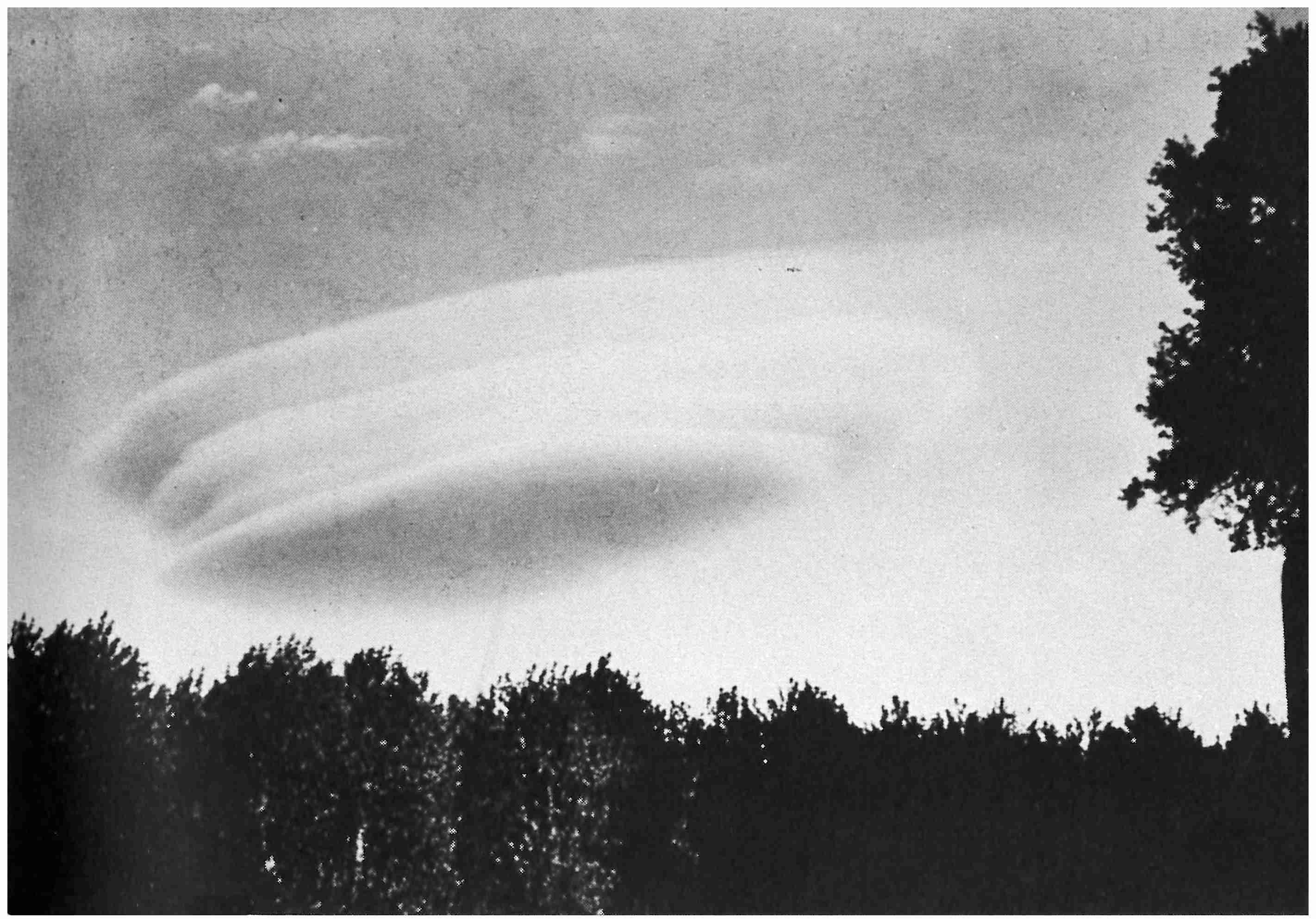
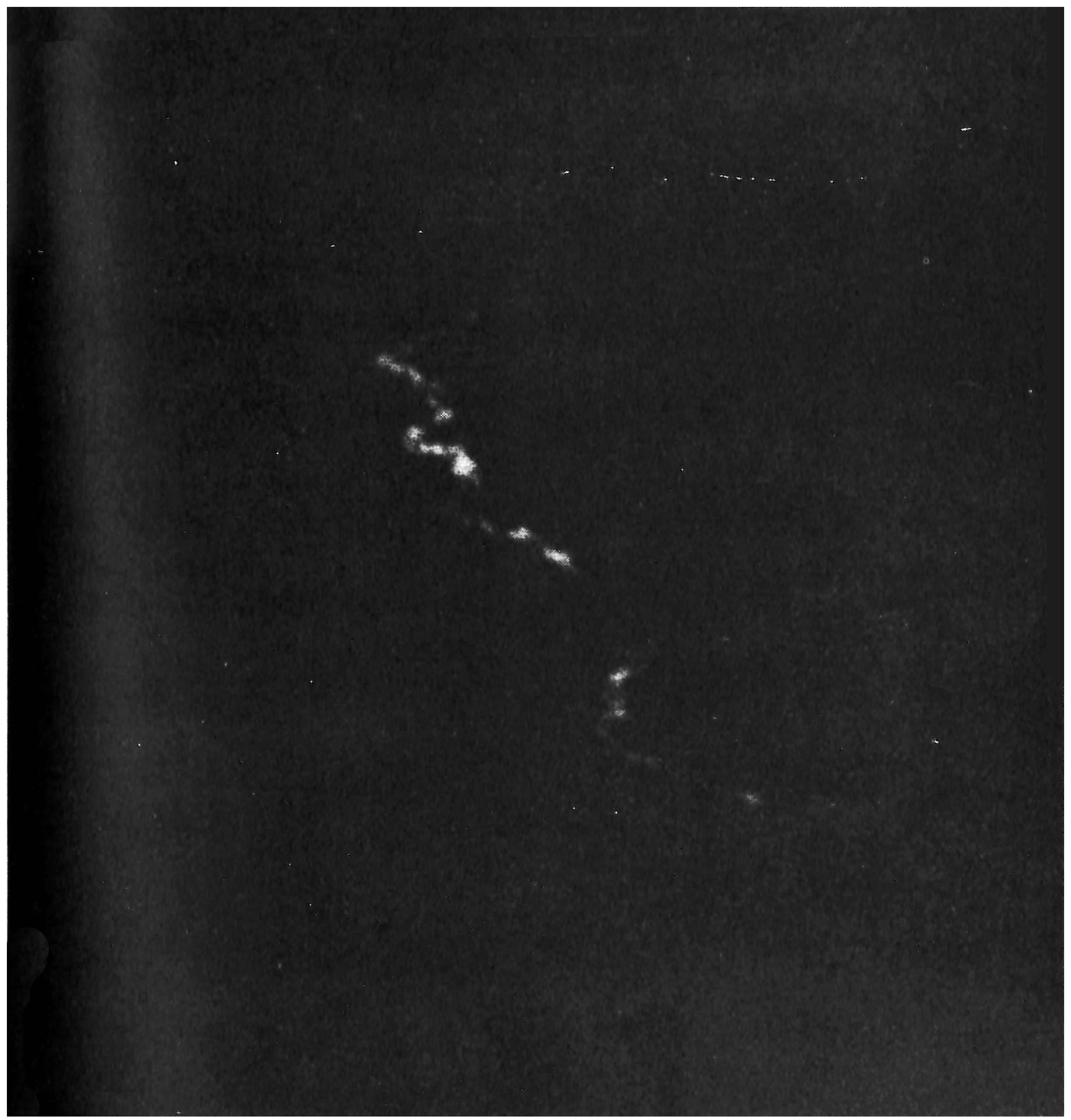
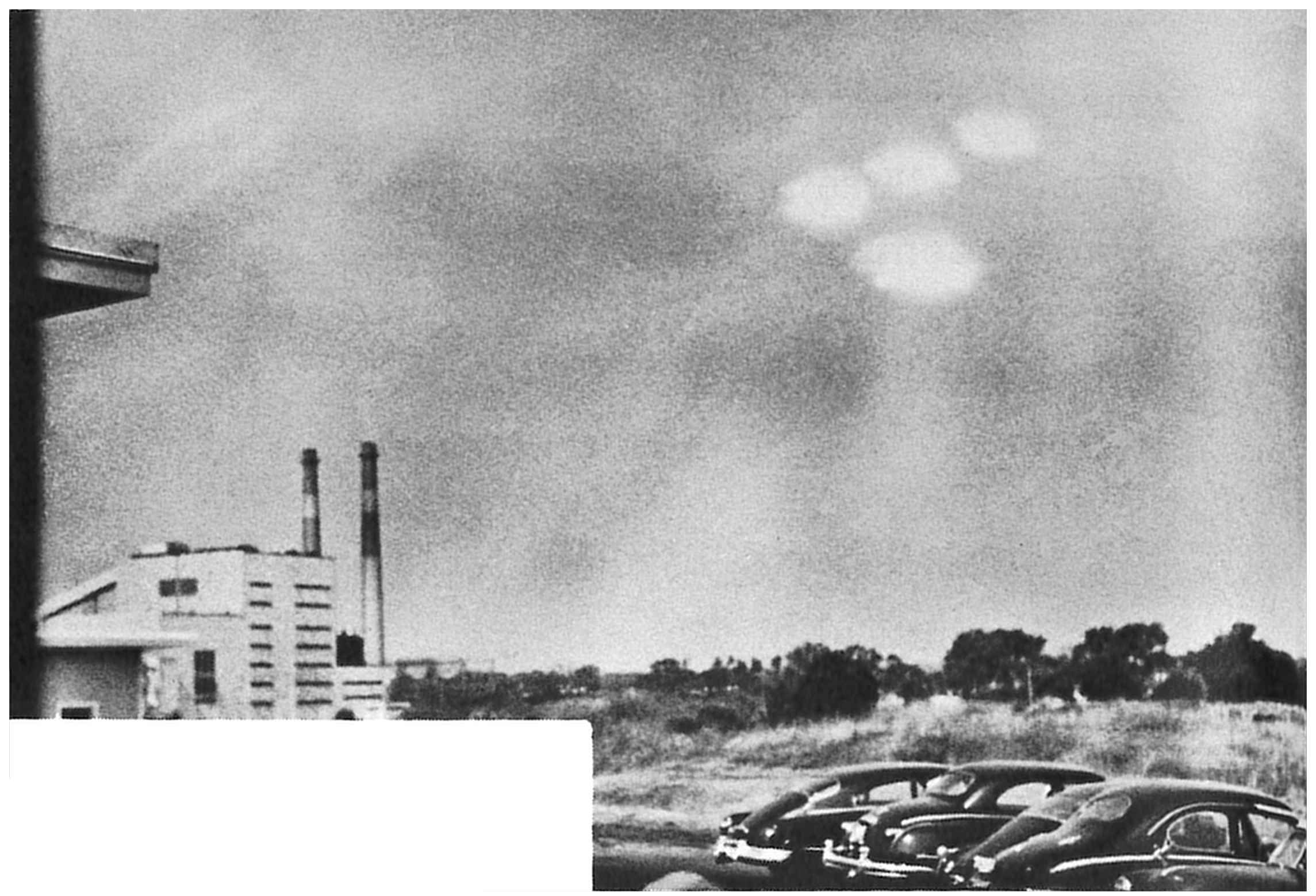
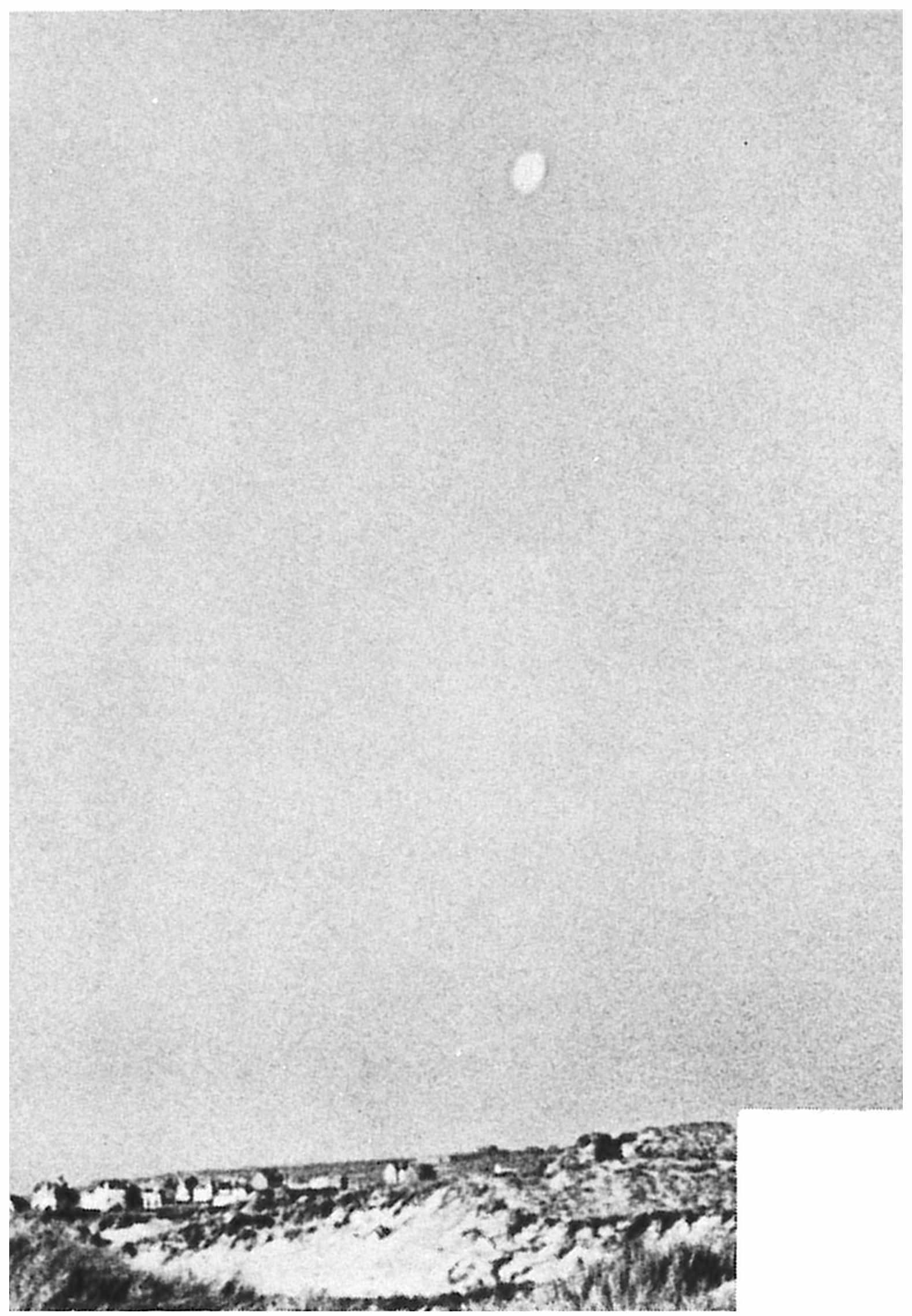
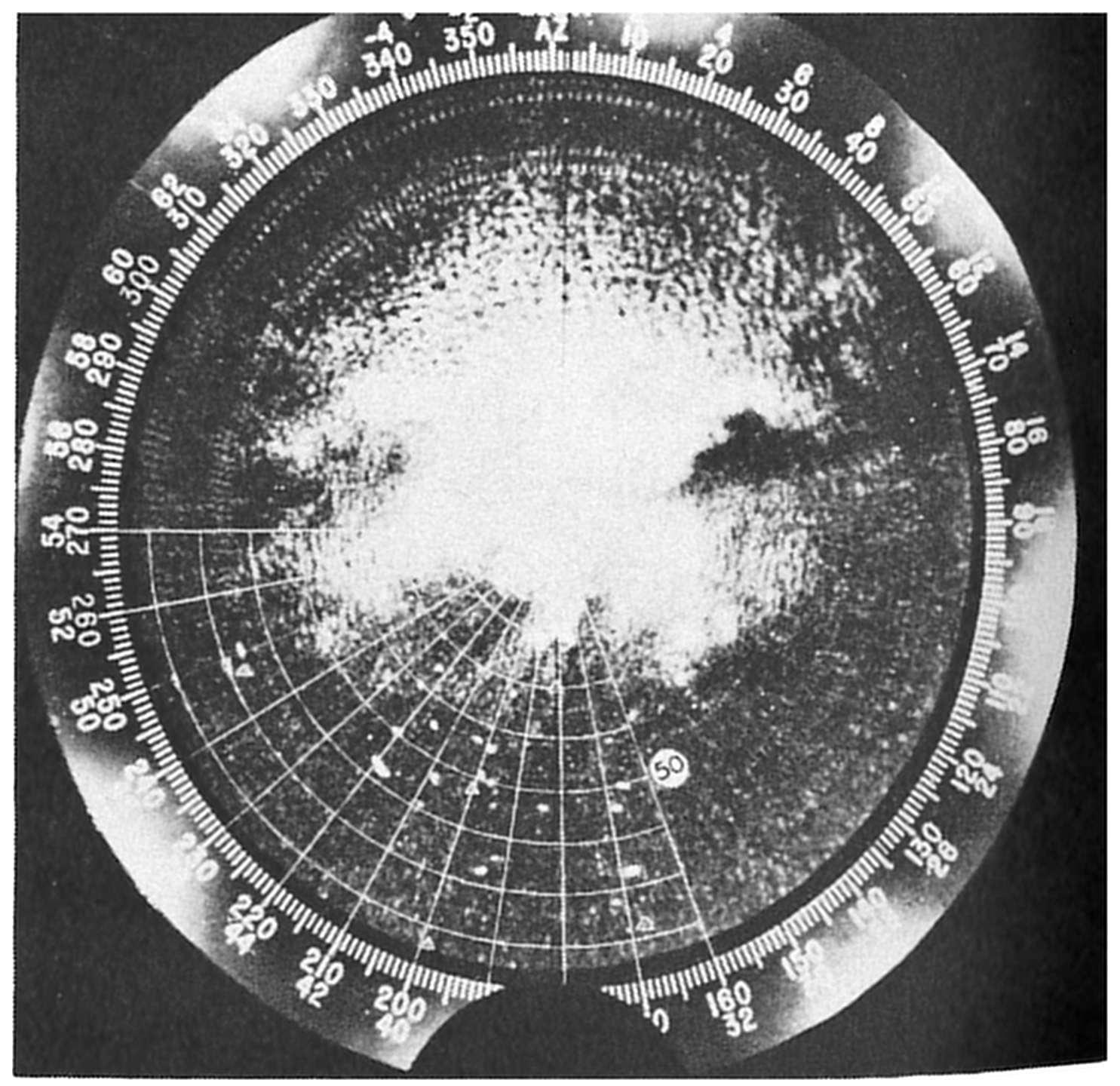
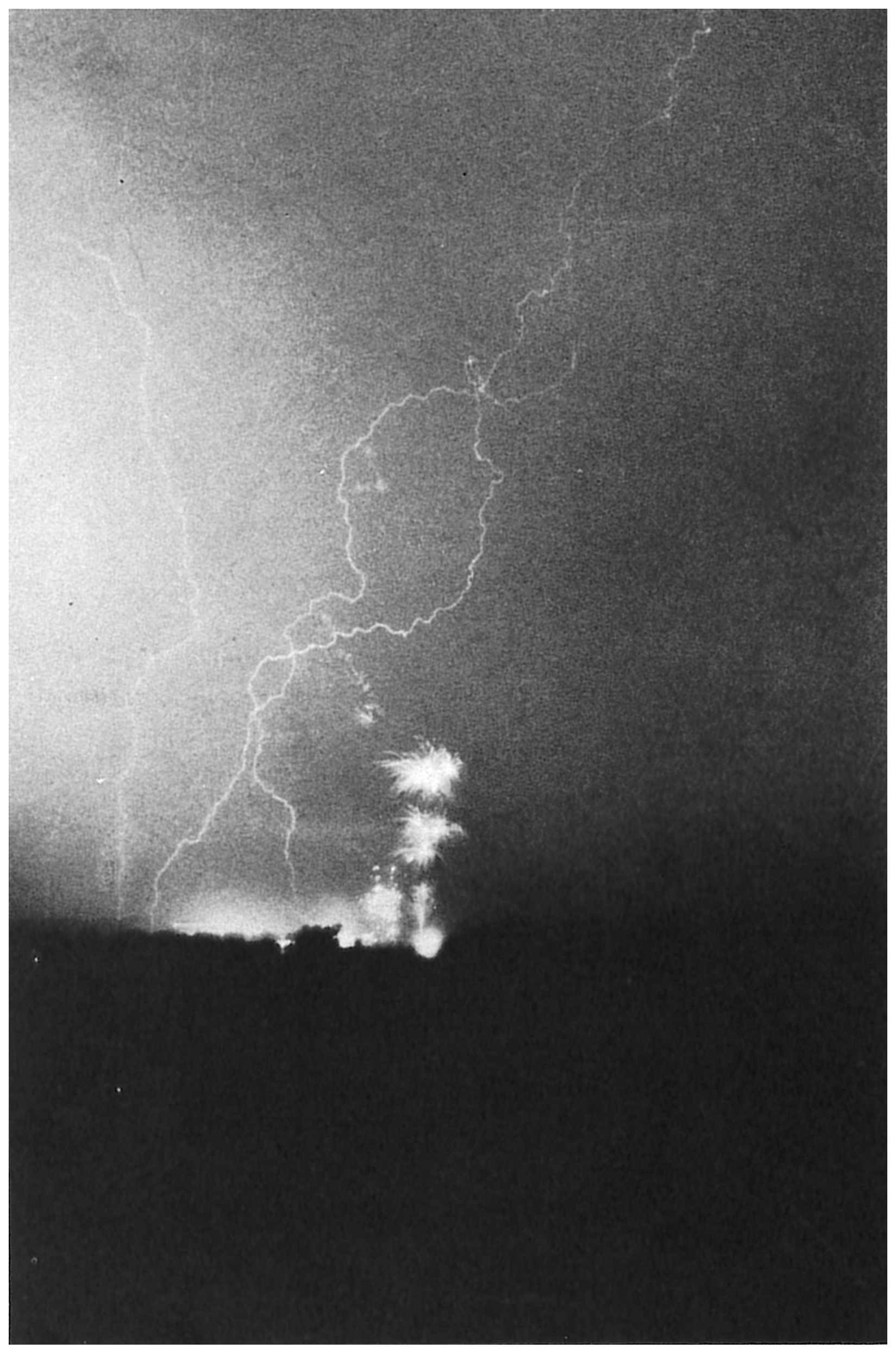
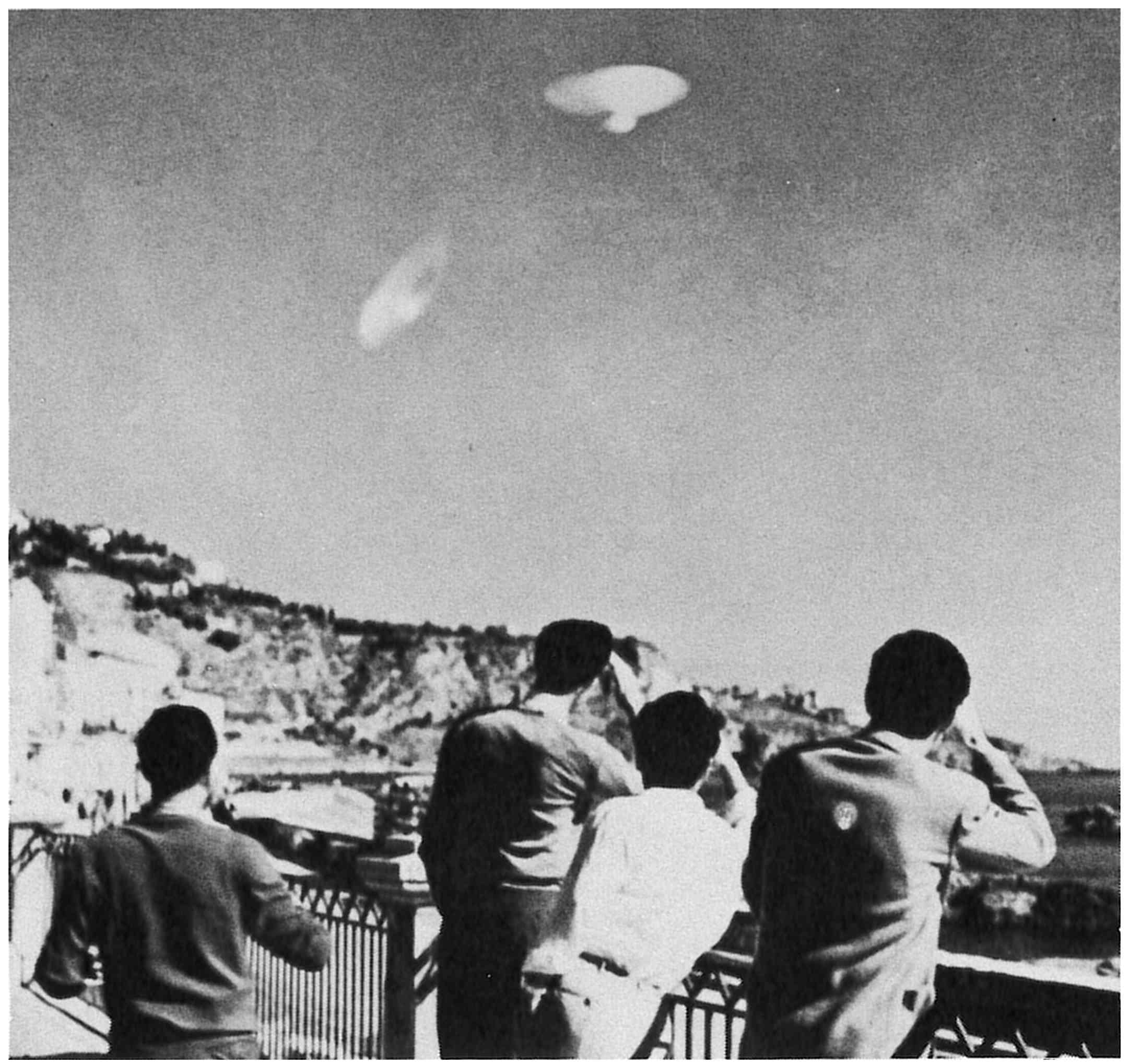
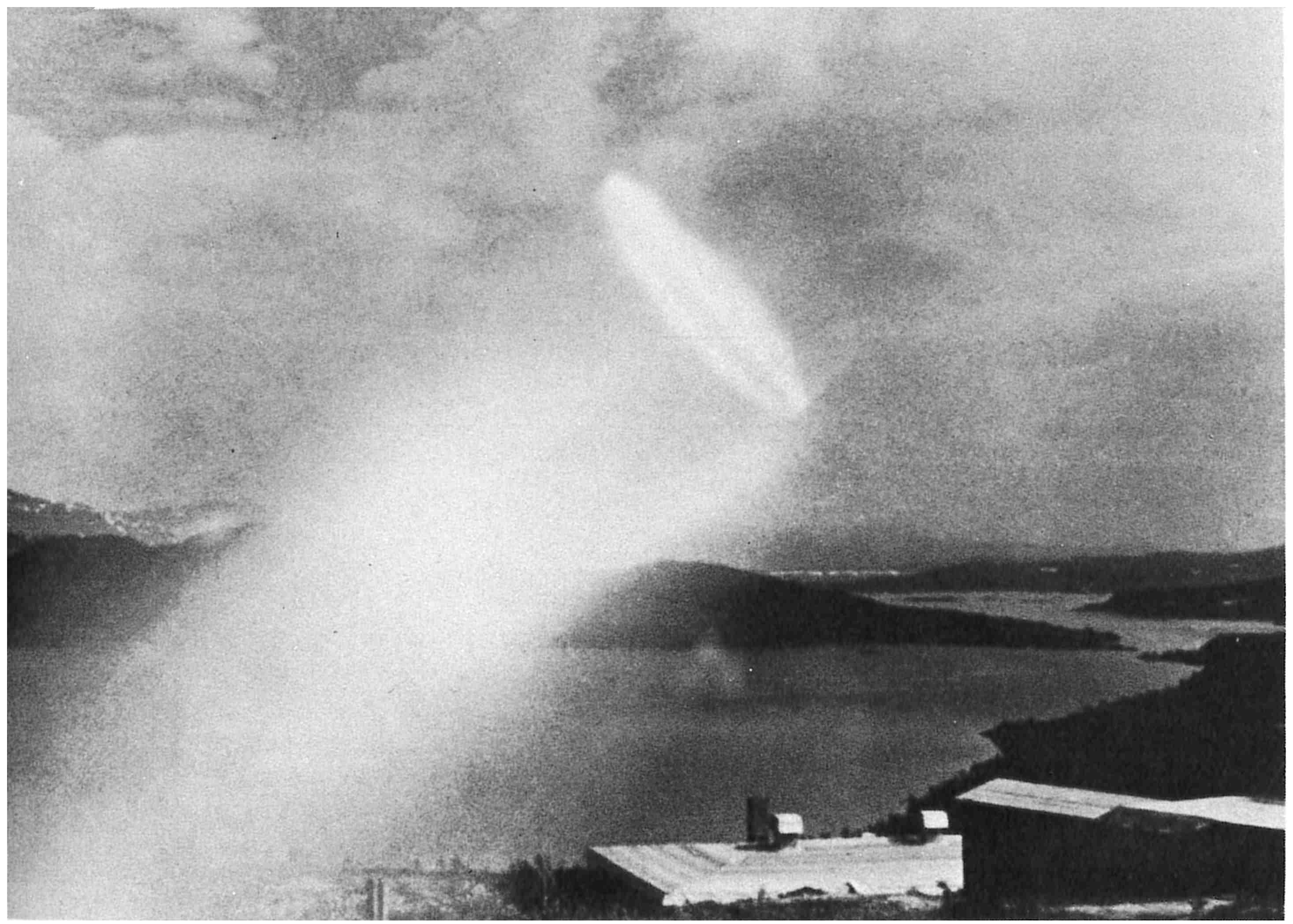
PLATE II: a, Smithsonian Astrophysical Observatory. b, Wide World Photo
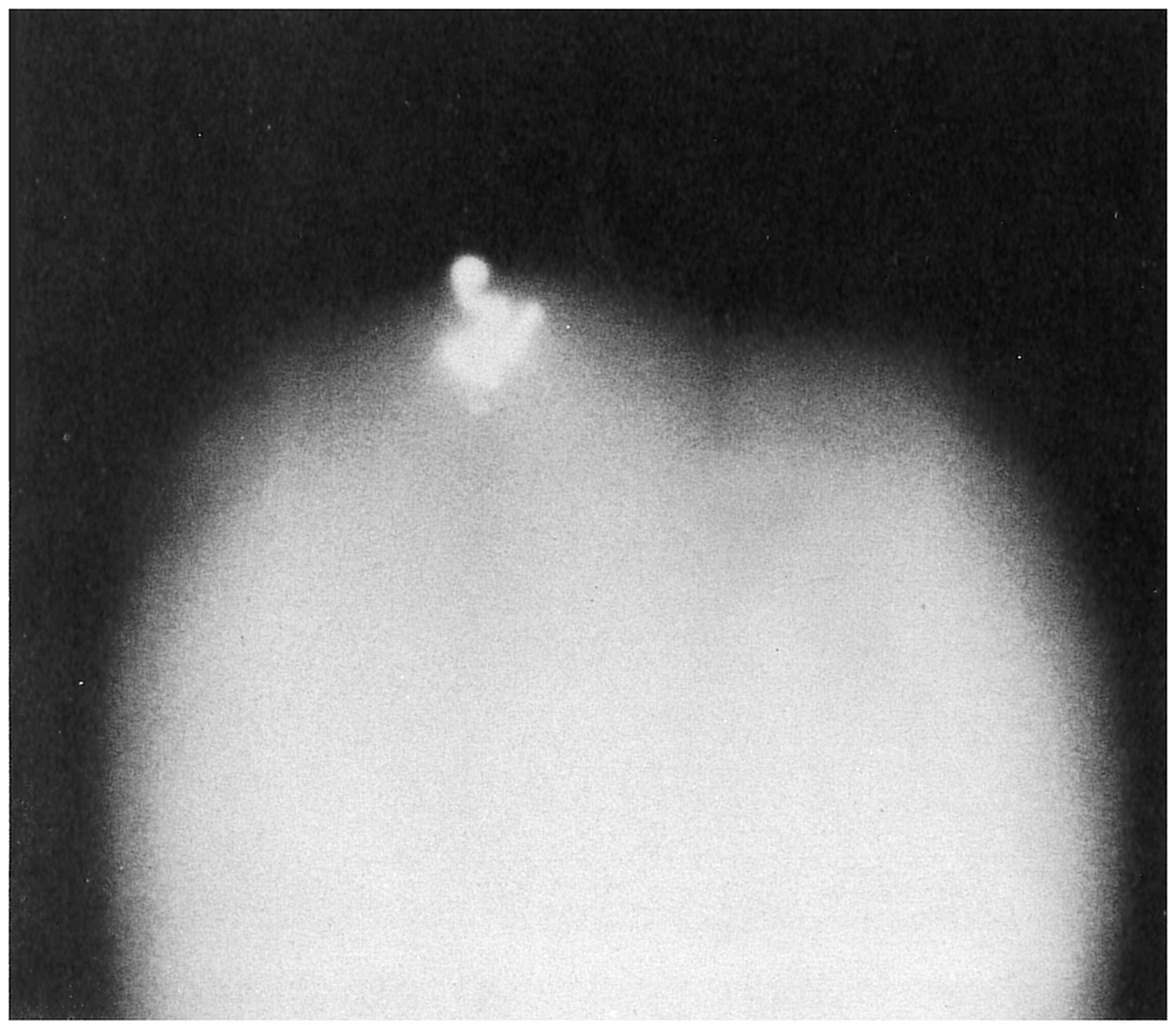
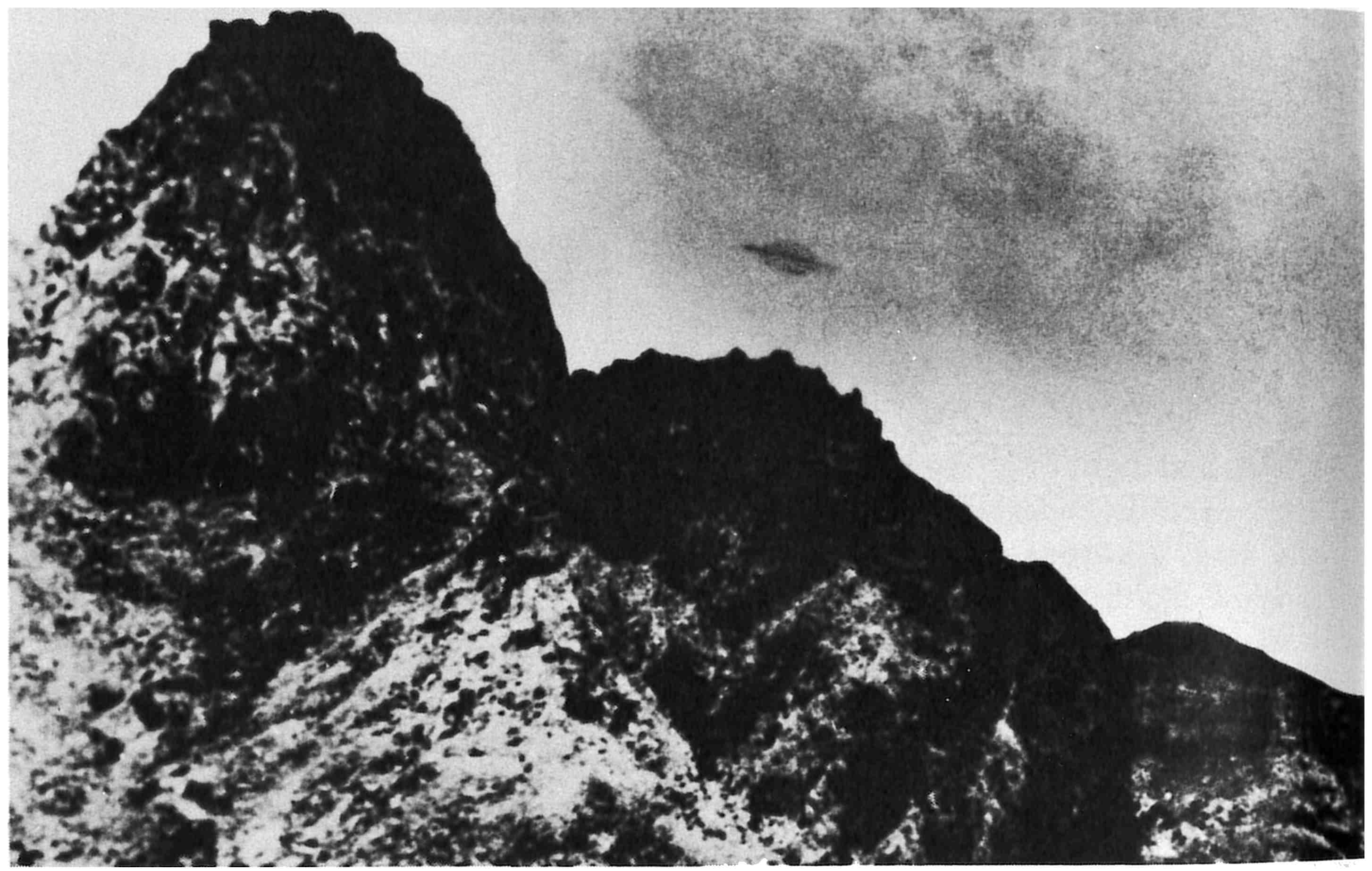
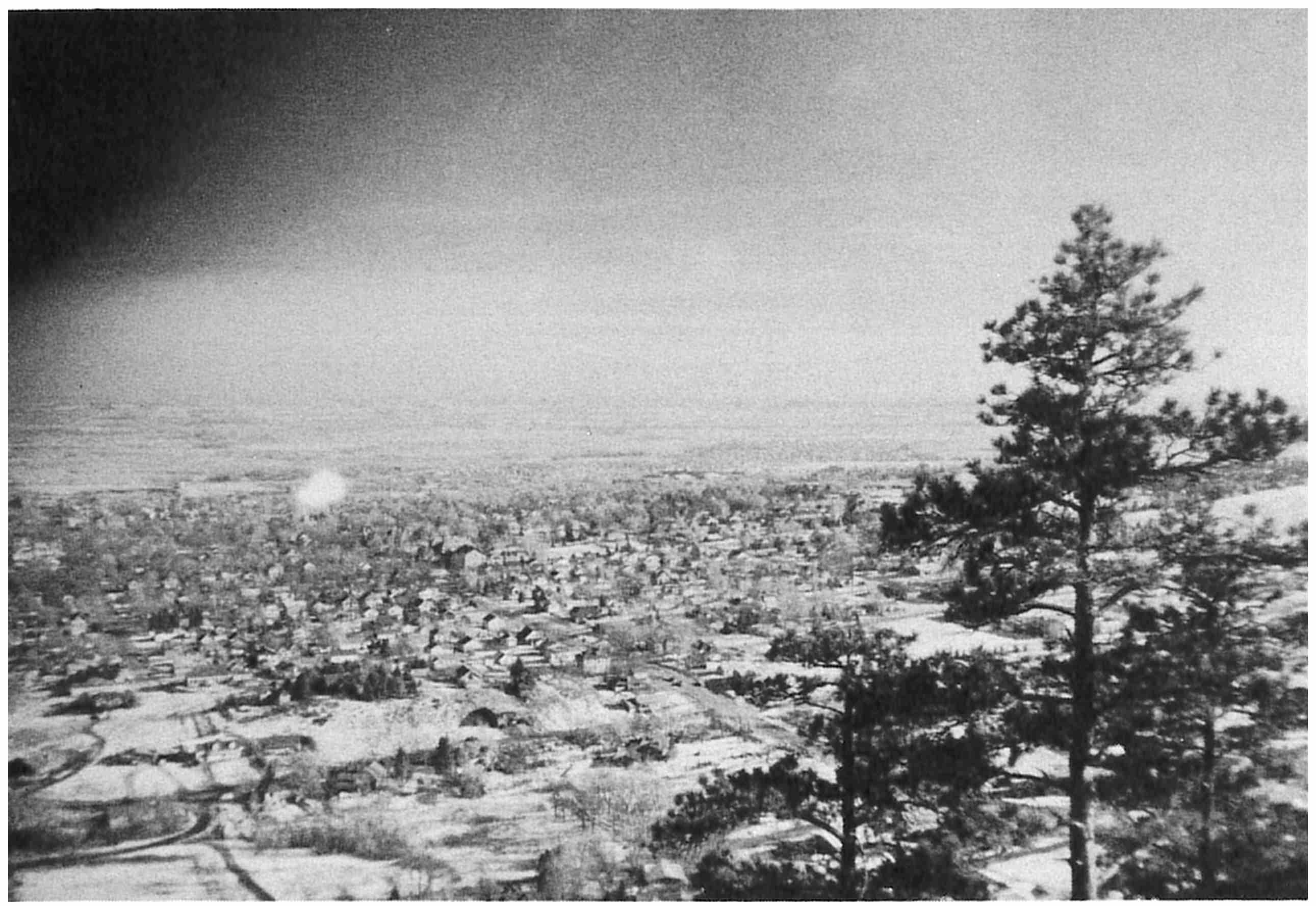
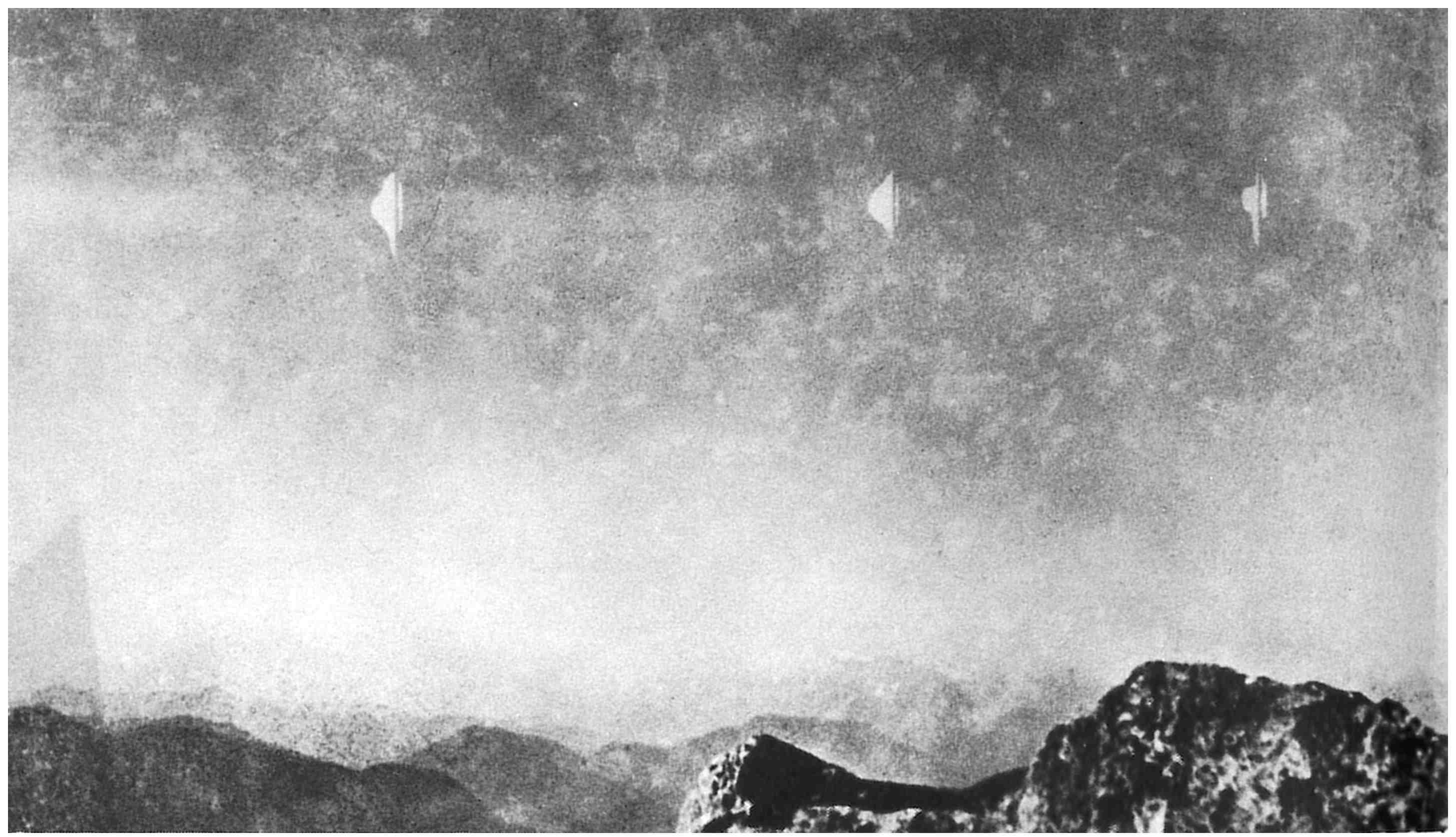
PLATE III: a, Smithsonian Astrophysical Observatory. b, Gilberto Vazquez,
El Imparcial, San Juan, Puerto Rico
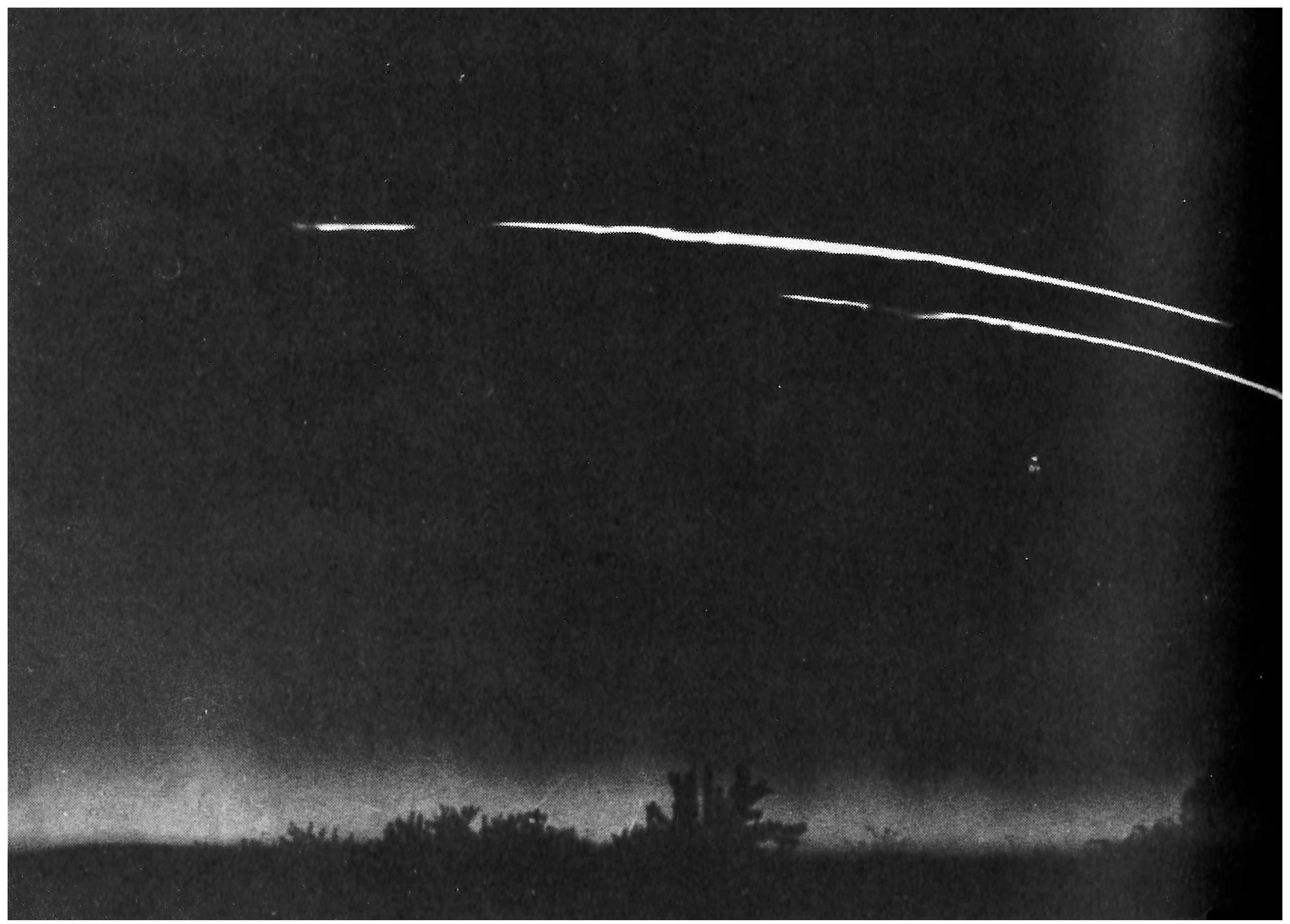
PLATE IV: a, Wide World Photo. b, Wide World Photo. c, David Atlas,
Air Force Cambridge Research Center, Bedford, Massachusetts
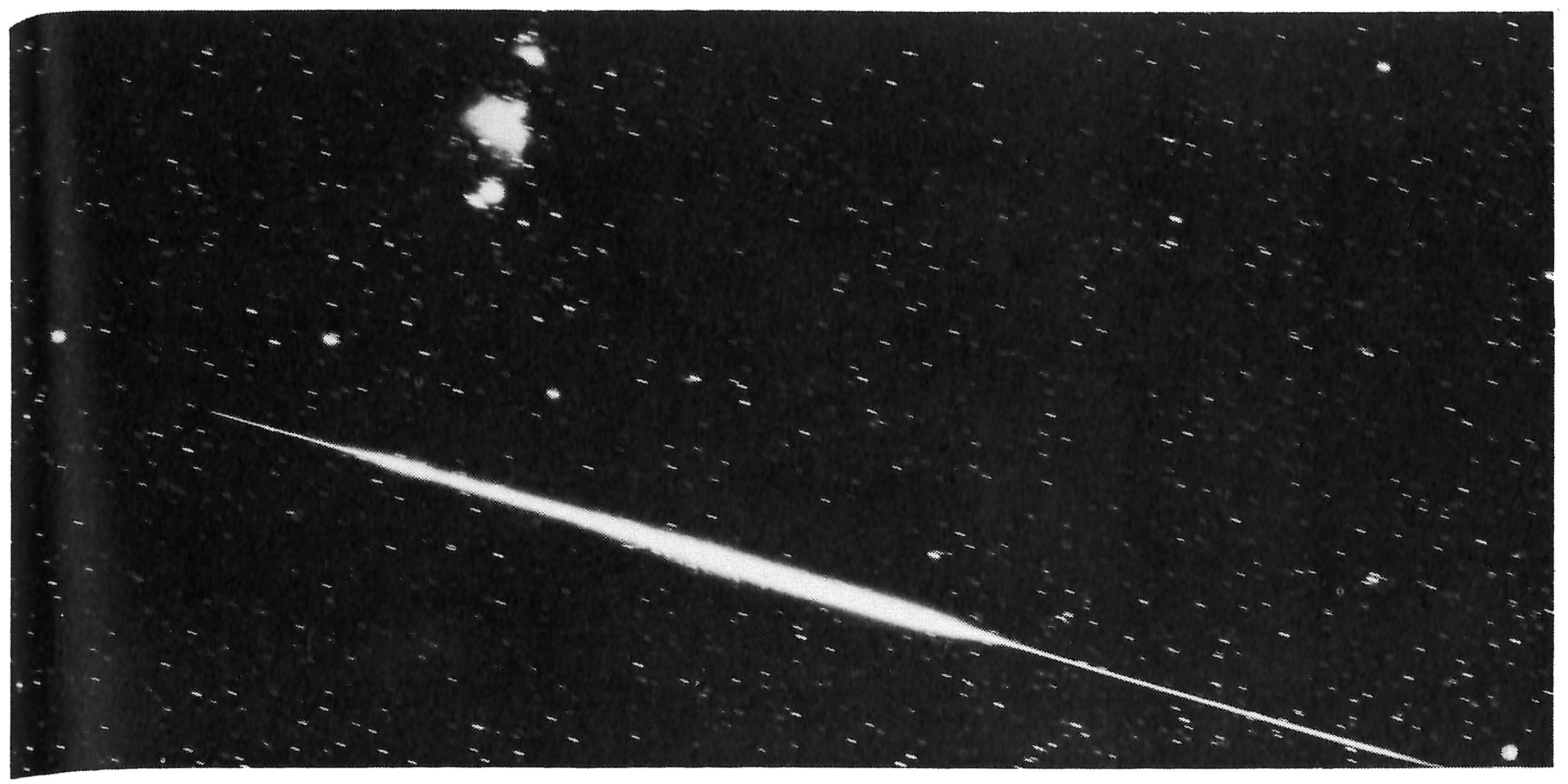
PLATE V: a, Bernd T. Matthias and Solomon J. Buchsbaum, Bell Telephone
Laboratories. b, Dr. John C. Jensen, Nebraska Wesleyan University
PLATE VI: a, United Press Photo. b, United Press Photo
PLATE VII: a, C. L. Johnson. b, Mrs. William Felton Barrett
PLATE VIII: a, United Press Photo. b, Wide World Photo
Figure 18. Courtesy True, The Man’s Magazine. Copyright 1952, Fawcett
Publications, Inc.
Drawings by Cushing and Nevell
PREFACE
Both as scientists and as devotees of science fiction, we have
long been interested in space travel. When reports of unidentified
flying objects began to increase in the years between 1947 and 1952,
one of us (D.H.M.) collected and studied the limited information
available about the sightings. He soon concluded (with a slight
feeling of disappointment!) that the flying saucers were not vehicles
from other worlds but were only mundane objects and events
of various kinds, some of them commonplace, some familiar chiefly
to meteorologists, physicists, and astronomers.
At a conference with Air Force officials in Washington in April
1952, he presented his idea that planetary mirages, sundogs, reflections,
and other astronomical, atmospheric, and optical phenomena
probably accounted for a large percentage of the mysterious UFOs.
This suggestion met with strong skepticism from some of the conferees
who at that time were sympathetic to the interplanetary
hypothesis and were, of course, better acquainted with military
than with physical science. Other conferees, however, wished to
consider and test the theories offered. Proof obviously required a
knowledge of all the facts of a given sighting, facts that often were
not available to the public. The Air Force therefore granted access
to the file of UFO cases. At the same time, since many of the cases
were then classified as secret, the Air Force imposed the condition
that security regulations must be strictly observed.
D.H.M. was then preparing a book to present his explanations
of flying saucers. Acceptance of the Air Force offer, with the accompanying
restriction, would have prevented his publishing analyses
based on material in the files. It would also have hindered
any future public discussion of the UFO problem. For these reasons
he felt compelled to decline the opportunity.
In the spring of 1959 as we began planning the present book, we
again requested permission to study the Air Force records of UFO
sightings. This time the officials generously opened their files to us
without restriction. Thus we have been able to include detailed
studies of particular incidents, to give the explanations found for
most of them by Air Force investigators, to explain the causes of
some hitherto unsolved cases, and to suggest highly probable solutions
for several classic “Unknowns.”
To discuss each one of the thousands of unidentified flying objects
reported during the last fifteen years is obviously impossible.
We have therefore chosen to describe the common types of sighting
and to analyze some of the representative and most interesting cases
in each category. In general we have avoided using the names of
the persons involved; but when the names are well known to the
flying-saucer public and have previously appeared in print, we have
felt no obligation to disguise them.
Many persons have contributed to the material in this book. Members
of the United States Air Force have generously helped us to
collect the basic facts, and have shown amazing patience in answering
hundreds of small questions of detail. In particular, we wish to
thank Col. Philip G. Evans, Col. Edward H. Wynn, Lt. Col. William
T. Coleman, Lt. Col. Robert J. Friend, Lt. Col. Lawrence J. Tacker,
Major Carl R. Hart, and Sgt. David Moody.
Others who have helped us in various ways include Dr. Isaac
Asimov, Mr. Carleton Atherton, Miss C. M. Botley, Mr. Wilfred J.
Chambers, Mr. Albert M. Chop, Dr. Leon Davidson, Mr. Charles
W. Dean, Mr. John F. Gifford, Mr. Richard Hall, Mr. Theodore
Hieatt, Prof. Seymour B. Hess, Prof. J. Allen Hynek, Dr. Luigi G.
Jacchia, Mr. Craig L. Johnson, Dr. Urner Liddell, Mr. Oscar Main,
Prof. Charles A. Maney, Dr. Richard E. McCrosky, Mr. John W.
McLellan, Capt. William B. Nash, Dr. Thornton W. Page, Dr.
Vernon G. Plank, the late Dr. H. P. Robertson, Dr. Donald H.
Robey, Dr. Carl Sagan, Dr. Clyde W. Tombaugh, Mr. John Walkin,
Prof. Fred L. Whipple, and Mr. John G. Wolbach.
D.H.M.
L.G.B.
THE WORLD OF FLYING SAUCERS
Chapter I THE SAUCER WORLDS — UFO Reports and the Air Force — The Scientist’s View — The Question of “Evidence” — Various Types of UFO — Descriptions of UFOs — A “Baedeker’s Guide” to Saucerdom
Thousands of reports of “flying saucers,” “unidentified flying objects,”
or “UFOs” have appeared in print during the last fifteen
years. Although most of the things seen have later been explained
as unusual but normal phenomena, some enthusiasts continue to regard
them as mysterious, and thus help perpetuate the myth that
the “saucers” are actually spaceships from other planets, busily carrying
out a patrol of the earth.
This saucer myth owes an unacknowledged debt to Charles Fort,
a talented reporter, writer, and self-appointed gadfly of science.
With a strong curiosity about the world of nature but without training
in the disciplines of research, Fort liked to challenge scientists
in general and astronomers in particular with tales of “impossible”
happenings culled from books of folklore, old journals, and newspapers.
He mistrusted orthodox knowledge because, he believed, it
smugly damned to oblivion all reports of marvels that it could not
explain: pyrogenic persons; rains of fish, frogs, and stones; accounts
of telepathy, teleportation, the vanishing of human beings, luminous
objects in the sky. Although he never claimed that he believed the
stories himself, Fort enjoyed collecting them and before his death
in 1932 had completed four volumes of these anecdotes.
Science-fiction writers have found an inexhaustible mine of ideas
in The Book of the Damned, New Lands, Lo!, and Wild Talents,
which also provide the chief elements of the saucer myth:
“Unknown, luminous things, or beings, have often been seen,
sometimes close to this earth, and sometimes high in the sky. It may
be that some of them were living things that occasionally come
from somewhere else in our existence, but that others were lights
on the vessels of explorers, or voyagers, from somewhere else.”[I-1]
These extraterrestrials may have been in communication with earthmen
for many years, Fort suggested, and they may sometimes kidnap
and carry away human beings.
Most flying-saucer reports have come from reliable citizens who
have seen something extraordinary, something they do not understand.
Genuinely puzzled, they often report the incident to the
nearest Air Force base. The evaluation of such cases is the responsibility
of the United States Air Force. Since the beginning of the
saucer scare in 1947, the chief investigating agency has been that
at Wright-Patterson Air Force Base, Dayton, Ohio, and has borne
a succession of names—Project Sign, Project Grudge, Project Blue
Book, and the Aerial Phenomena Group of the Aerospace Technical
Intelligence Center, usually known as ATIC. Until recently this
group operated under the jurisdiction of the Assistant Chief of Staff,
Intelligence. On July 1, 1961, it was transferred to the jurisdiction
of the Air Force Systems Command. To simplify discussion in this
book, however, the group that investigates unidentified aerial phenomena
is generally referred to as ATIC.
In military parlance the phrase “unidentified flying object,” abbreviated
as UFO, is used to indicate any air-borne phenomenon
that fails to identify itself to, or to be identified by, trained witnesses
on the ground or in the air who are using visual or radar methods
of observation. Created in the early days of the saucer era, the
term UFO is unfortunately misleading because it seems to imply
that the unknown is a solid material object. Many of them are not.
The more dramatic phrase “flying saucer” is similarly misleading
because not all the unknowns are shaped like a saucer, and not all
of them are flying. Since no one has been able to devise a more
accurate brief term that will apply to all reports in this category,
both “UFO” and “flying saucer” have remained in common use.
Air Force investigators and scientists have been able to account
for almost every reported “spaceship” as the result of failure to
identify some natural phenomenon. Some were the product of delusion
or deliberate hoaxes. A few remain technically “Unknown”
because, although the probable explanation is obvious, too few facts
are available to permit a positive identification. No such report suggests
the possibility that interplanetary craft are cruising in our skies.
If a spaceship from another planet should ever visit the earth, no
one would be more eager to acknowledge it than our government
officials and our scientists. All governments would feel their responsibility
to protect the human race if necessary, and to establish diplomatic
relations with the alien race if possible. The scientists would
want to study, analyze, and try to understand the nature of both
the ship and its occupants.
Many persons, sincerely believing that flying saucers do exist,
berate the investigator who denies their reality and characterize
him as stupid, willfully obtuse, or intellectually dishonest because
he does not accept the saucer reports at face value but weighs them
by the same methods most of us use in weighing evidence in everyday
life. When told there’s a horse in the bathtub, for example, the
sensible man realizes that the alleged visitation, while not impossible,
is extremely improbable. Therefore he does not immediately
begin speculating on the color of the horse, where it might have
come from, what its purpose may be, and whether it will wreck
the bathroom. Instead he adopts the scientific method and first goes
to find out whether the horse is really there.
Like Fort, some flying-saucer believers are consciously or unconsciously
antagonistic to the scientific method and resent its restrictions
as a child objects to discipline. Suggesting that a strictly
logical approach deprives us of valuable truths about the nature of
the universe, and bluntly asserting that present-day physicists and
astronomers have closed their minds to the possibility of new knowledge,
these enthusiasts imply that we should require less rigorous
proof for the reality of saucers than for other types of physical
phenomena.
Because so many amateur investigators have misunderstood, misrepresented,
and condemned the scientists’ attitude, the authors of
this book (asking the indulgence of their colleagues) will briefly
outline the principles a researcher ordinarily applies to the study
of any new problem—the nature of radioactivity, the cause of a
disease, or the origin of flying saucers.
Most physicists, chemists, biologists, and astronomers will agree
that life in some form probably exists in other parts of the galaxy.
These other life forms, if they exist, may or may not have a kind of
intelligence similar to our own; if they have, we might or might not
be able to recognize it. Such speculations, while fascinating, lie entirely
in the realm of theory. They are not facts and do not provide
the slightest support to the often stated corollary that intelligent
creatures do live on other planets and frequently visit the earth.
In approaching the spacecraft hypothesis, the scientist asks first:
What facts are we trying to account for? And second: Does the
spacecraft theory account for these facts better than the normal
explanations that are already available? After studying hundreds
of UFO reports, however, he concludes that much of the startling
“proof” that saucers are spacecraft is merely inference. Of the established
facts, none requires a new theory to account for it; and
no evidence exists that even faintly suggests, to the expert, that
interplanetary visitors are involved.
In the study of UFO phenomena this question of “evidence” is
crucial. The careful investigator tries always to distinguish sharply
between an observed fact, which is evidence, and an interpretation
of that fact, which is not evidence no matter how reasonable it
may seem.
As a simple analogy, consider this situation: A man is sitting in
his living room late at night; the rest of the family have gone to
bed. Suddenly he is startled by a loud noise somewhere upstairs.
Trying to account for the noise, he thinks of various possible causes—a
burglar, the “settling” of the house, a mouse in the wall, someone
dropping a shoe, the wind rattling a door, the sonic boom from
a distant plane. If, without having further information, he decides
that any one of these is the true cause, he is accepting a guess as
though it were a fact. The real cause of the noise may be one of
these or it may be something else that he hasn’t even thought of.
Amateur investigators of UFOs publish many reports which they
characterize as absolute proof that spaceships exist. The expert, analyzing
the same reports, finds no proof at all because the actual
facts and the interpretations of the witnesses are hopelessly confused.
An early UFO case provides a typical example.
According to Air Force records[I-2], on the morning of December
6, 1952, a B-29 bomber was over the Gulf of Mexico returning
from a training mission. At 5:25 A.M. the student radar operator,
using an uncalibrated set, observed four bright blips (radar jargon
for bright spots on a radarscope; such a spot indicates the presence
of an object reflecting the radar pulses, but does not reveal the nature
or shape of the object). The blips were apparently returns from
objects about twenty miles away, in no specific group, which rapidly
moved off the scope. Similar groups of fast-moving blips appeared at
intervals during a period of about five minutes, and appeared also on
two auxiliary radarscopes. After the first set was calibrated, the blips
reappeared; none was observed after 5:35 A.M. From the radar data
estimates of size and distance were made; calculations based on
these estimates indicated a probable speed of 5000 to 9000 miles an
hour. During the ten-minute period two visual observations were
made, lasting about three seconds, which bore no obvious relation to
the radar observations: at the right of the plane one crewman saw a
single blue-white streak going from front to rear under the wing,
and another crewman saw two flashes of blue-white light.
An explanation of the incident was not found immediately, and
ATIC at first classified it as an Unknown. Some saucer enthusiasts
interpreted the facts to mean that several groups of saucers had
been in the area, machines flying so fast that they were visible only
as blue-white streaks, whose presence was confirmed by radar. These
conclusions were merely deductions from fact, not observed facts.
The radarscope is not a camera and does not, at least at present,
picture the shape or physical structure of the phenomenon it reports;
it shows only spots of light that change position and size. Similarly,
the blue-white streaks were mere flashes of light without size or
shape.
In a later study of the evidence, the Air Force experts recognized
this incident as one of false targets on radar (see ChapterVIII).
The radar phantoms may have been caused by beacon returns
triggered by another radar; by variations in the atmosphere; or, if
“ducting” conditions existed, by reflections from objects that were
far beyond the normal range of the radar set. The blue-white flashes
had no relation to the radar returns and were probably meteors;
the date corresponded with the beginning of the annual Geminid
shower (see ChapterV).
This Gulf of Mexico incident is neither complicated nor puzzling.
We mention it chiefly to illustrate why the saucer enthusiasts so
often disagree with the conclusions reached by the Air Force experts.
The amateur assumes that the instrument operated faultlessly
and detected a solid object; he uses these assumptions to interpret
the data, uses the interpretation as fact, and by this “bootstrap”
process deludes himself into thinking he has proved what he assumed
in the first place.
A biologist trying to identify a group of unusual animals which
are said to represent a new species begins by collecting all possible
information about their appearance and behavior. After he has determined
their typical size, shape, color, mode of reproduction, manner
of locomotion, etc., he compares these characteristics with those
of animals of known species and eventually classifies the strange
specimens. In a similar way the professional investigator of UFO
phenomena begins by asking the question: What is a typical unidentified
flying object?
The published reports comprise a heterogeneous collection of
facts, fiction, and guesses. The investigator must first separate and
discard accounts that are obvious hoaxes or delusions. There are
many of these. The remaining material he divides into two classes.
The first includes statements made by competent, careful witnesses,
describing what they have seen and heard—for example, “I saw a
brilliant light moving swiftly without sound.” The second class includes
statements of opinion or belief about the thing seen—for example,
“The strange light obviously was controlled by intelligence.”
Putting aside this second class of material for the time being, he
looks at the information in the first and immediately faces an awkward
conclusion: apparently no “typical” flying saucer exists.
No two reports describe exactly the same kind of UFO. There
are dozens of types of saucers, resembling each other as little as
turnips do comets. Hoping to find some consistent pattern, the investigator
opens his notebook and starts listing the data.
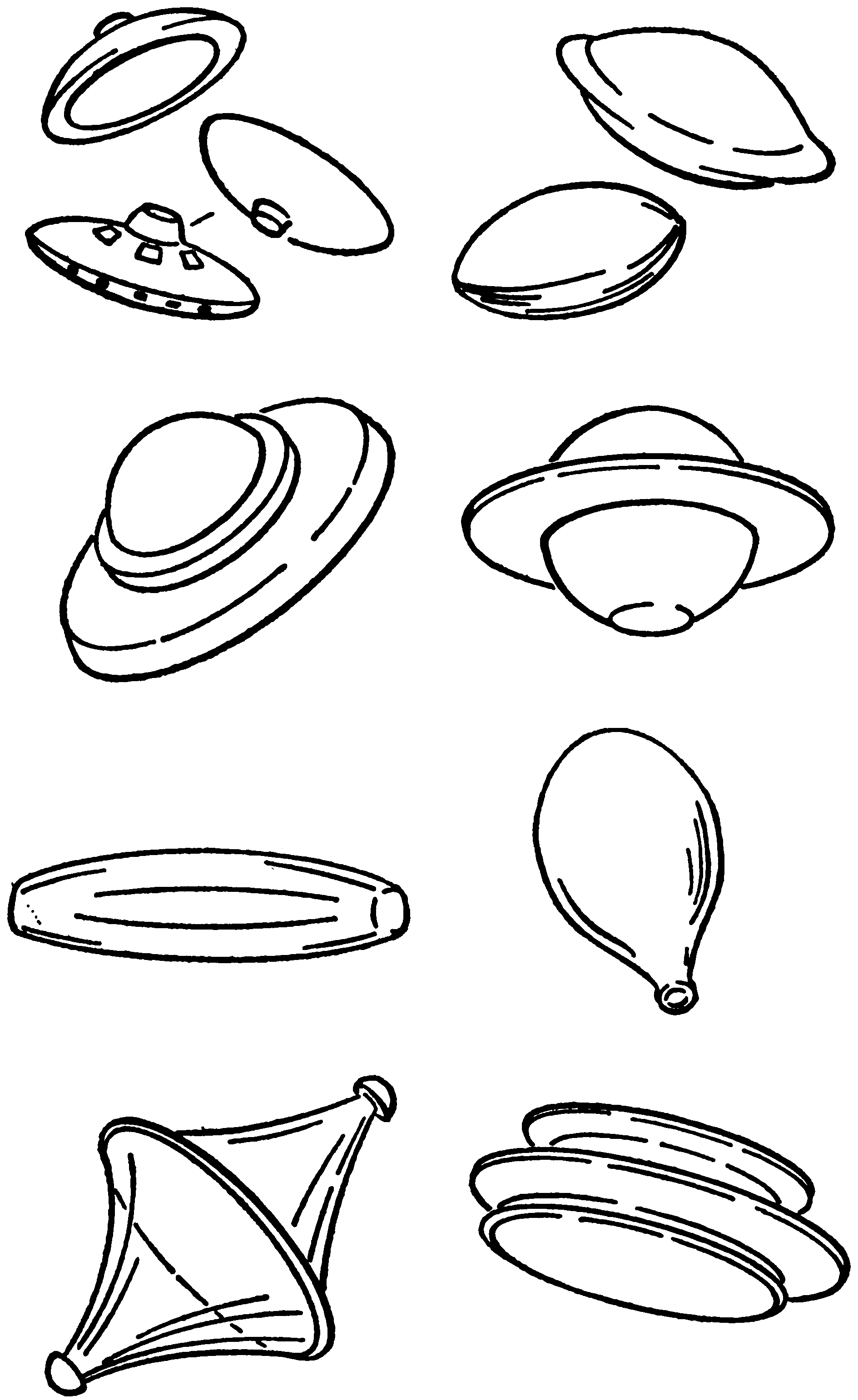
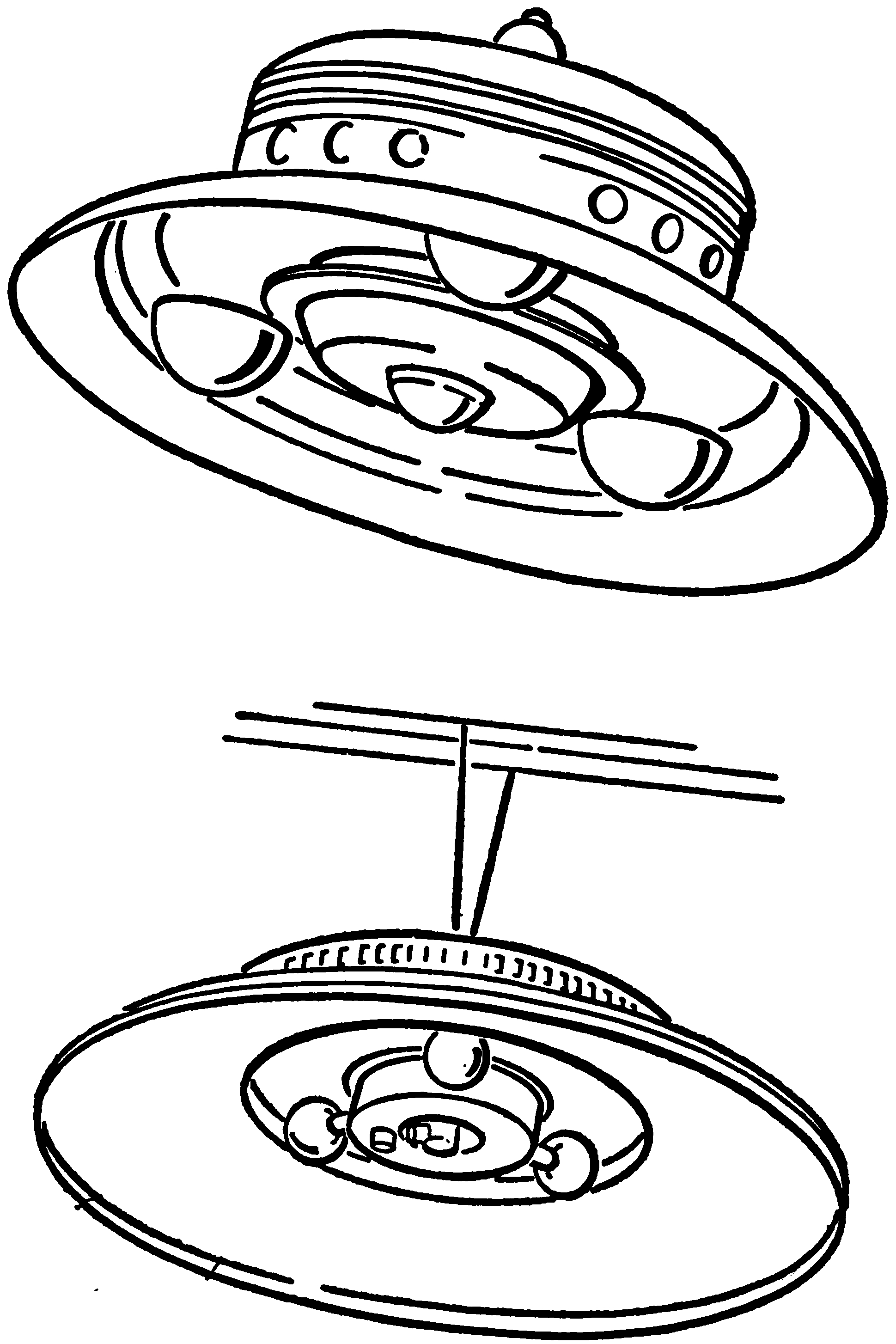
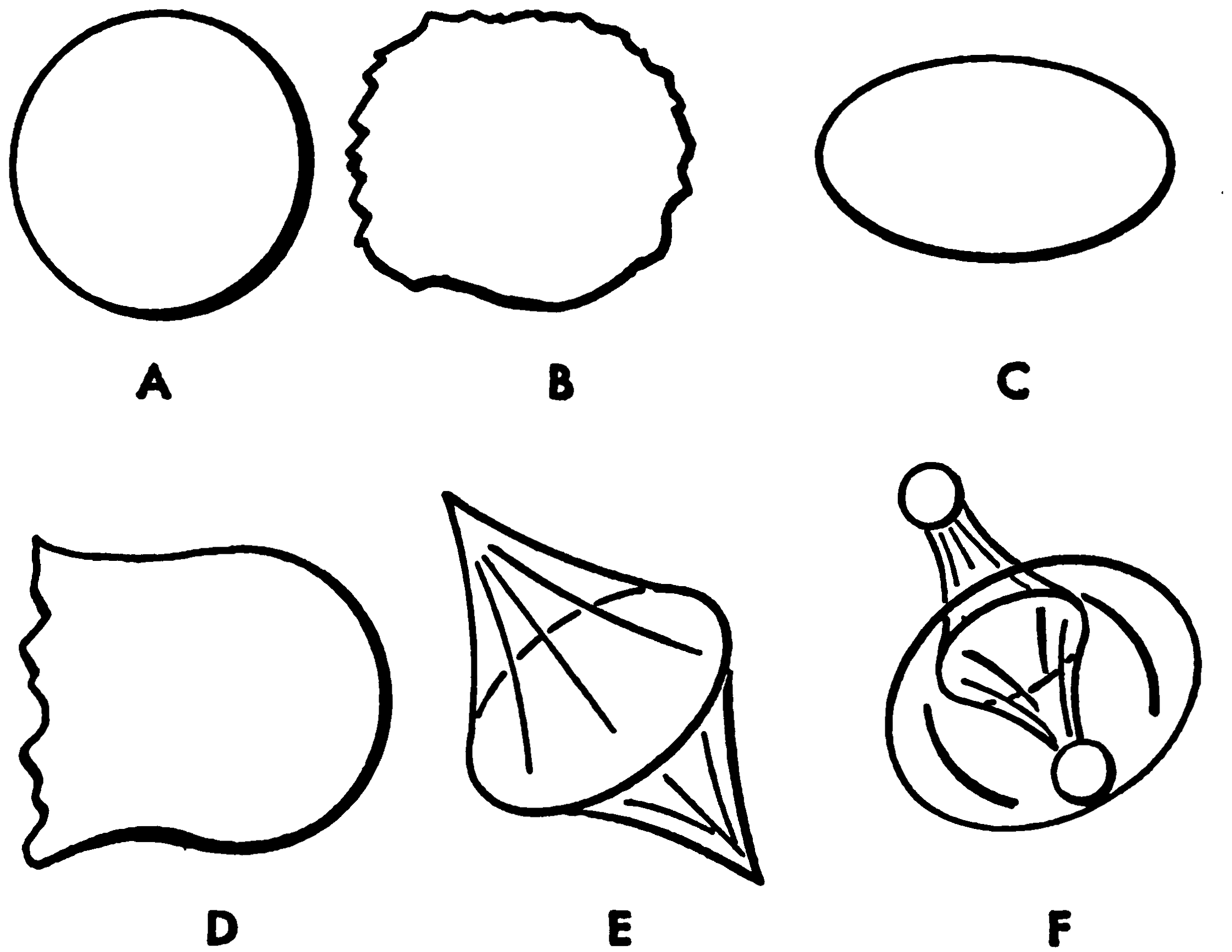
Shape—The flying saucer varies greatly in shape (see Figure 1).
At different times and places it may be a circular disk like a saucer,
often with a small protrusion in the center like the knob on a tea-kettle
lid; elliptical or bean-shaped like a flattened sphere; a
circular base supporting a dome-like superstructure; a sphere surrounded
by a central platform, like Saturn in its rings; long and
thin like a cigar; a tapered sphere like a teardrop; spindle-shaped,
with or without knobs on the ends; or a double- or triple-decked
form like a stack of plates.
Size—The saucer varies greatly in size. Estimated diameters range
from 20 or 30 feet to several thousand. While under observation it
may instantaneously increase or decrease in size.
Color—The saucer varies greatly in color. It may be white, black,
gray, red, blue, green, pink, yellow, silver; may be luminous or dull;
may be a solid color; may be circled by a central band of different
color; may display flashing lights of various colors. It may change
color or luminosity while being observed.
Motion—The saucer displays a wide variety of motions. It may
travel very slowly; very fast, approaching the speed of light; at
jet speed; at meteoric speed; may hover motionless over one place.
At any speed it can instantaneously change velocity and direction
of motion—can move horizontally, vertically, toward the observer,
away from the observer, in a straight path, a zigzag, a spiral. Like
the Cheshire cat, it can vanish instantly or slowly fade away.
Means of propulsion—Unknown. Some saucers move in complete
silence; others produce noises: a hiss, a whistle, a roar, a thunderclap,
or a detonation like a sonic boom.
Figure 1. Shapes of various reported UFOs.
Incidence—Saucers may appear at any hour of the day or night,
but they appear most frequently in the hours before and after sunset,
and before and after sunrise. Their numbers may suddenly increase
at certain places and certain times. The objects can appear
singly, in random groups, in groups showing a geometrical pattern.
A single object may split and multiply into a group, or a group may
merge into one. Saucers almost always appear in the air, rarely on
the earth’s surface or in bodies of water. They almost never come
within touching distance of the observer. The length of their stay
varies greatly, from about two seconds to two or three hours.
Structure—Unknown. A saucer may be visible or invisible to the
observer; visible to the human eye but not to the camera or radar;
visible to the camera or radar but not to the eye. Some obey the
laws of gravity and inertia, others do not.
Purpose—Unknown. No officials in the government, the press, the
churches, or the universities have received any attempt at communication.
No saucer has produced intelligible visible, audible,
or radio signals.
Long before finishing this tabulation the investigator realizes that
he is not dealing with one thing but with many. No single phenomenon
could possibly display such infinite variety. However, before
he starts trying to classify the descriptions and to explain them, he
takes a look at the second class of material—the conclusions offered
by saucer enthusiasts. Leaving the realm of observation for that of
interpretation, he is suddenly catapulted into a world of fantasy.
One of the commonest themes in science fiction is that of parallel
universes—a number of nearly identical worlds coexisting in alternate
space-time continua. Occasionally, at a vulnerable spot, the
barrier between two of these worlds will dissolve so that they overlap
near the point of contact. After such an accident a man may
find himself unhappily living two lives at once, identical in some
ways but so different in others that if one is real, the other cannot
be. Until the break is repaired and the incompatible worlds are
safely separated once more, the man exists in a state of desperate
confusion and performs agonizing mental acrobatics, trying to maintain
a foothold in both worlds until he can decide which one is
valid.
From the “damned” phenomena collected by Charles Fort, plus
the legends of Atlantis, Mu, and Lemuria, flying-saucer addicts have
constructed a multiplicity of such alternate worlds. Although they
differ in minor ways, all are in direct conflict with the real world
known to science. Let us ignore, for the moment, the descriptions
given by the “contactees” (ChapterX) and consider only the beliefs
and/or theories offered by serious proponents of the interplanetary
theory and publicized by writers such as Donald E. Keyhoe[I-3, I-4, I-5]
Aimé Michel[I-6], and Morris K. Jessup[I-7]. A “Baedeker’s
Guide” to saucerdom based solely on statements and speculations in
the books published by these investigators would portray a fantastic
universe:[A]
[A] Following common practice in scientific discussion, we originally included
the specific sources of important and/or controversial ideas described in this book
and, for maximum accuracy, often used the original phrasing of the several authors
involved. In this and certain other sections, however, we have been forced
to abandon the more scholarly method of presentation because one author (Major
Donald E. Keyhoe) refused permission to quote from his works.
“In saucerdom, alien spacecraft continually visit the earth and
have done so for centuries. Constructed and controlled by intelligent
extraterrestrial beings, the craft perhaps come from secret bases on
artificial earth satellites; on the moon; on Mars; on Venus; on Jupiter;
perhaps on the planets supposed to be orbiting the binary stars
61 Cygni and 70 Ophiuchi; or from planets supposed to be in orbit
around the stars Tau Ceti and Epsilon Eridani, about eleven light-years
distant from earth. Radio transmitters serving as beacons for
space navigation may exist on both Venus and Jupiter.
“These spacecraft can perform maneuvers that, on earth, are possible
only for rays of light. They fly at speeds of many thousands
of miles an hour, can reverse direction instantaneously at any speed,
ascend or descend vertically, and hover motionless in the air. They
accomplish these feats perhaps by using the power of cosmic rays
and by generating and manipulating artificial gravitational fields,
which they could also use to prevent the transmission of sound
waves and to become invisible.
“The extraterrestrial visitors may be explorers sent to study the
earth, descendants of a race living thousands of light-years away
from the solar system. They may be the ancestors of the human race,
which itself is a remnant of a colony established on earth thousands
of years ago and then abandoned. More than 300,000 years ago the
inhabitants of earth had found the secret of space travel, and human
beings mapped the earth by an aerial survey at least 5000 years ago.
It is also possible that these craft come not from space but from time;
they may be earthmen of the future who have traveled backward
through time to explore their own past.
“The purpose of these visitors is still unknown. They shun close
contact with human beings, rarely if ever land their ships, and
never allow close-up photographs, perhaps because they are afraid
of human savagery or are afraid of starting a panic. Nevertheless
they attempt to signal to earthmen in various ways: they have
caused the production of gigantic letters of the alphabet [U and Z]
on earth radarscopes; from a material that radiates light they have
built an enormous letter W, spanning more than 1000 miles on the
surface of Mars; they have sent out wireless signals in Morse code
to represent the letter S. They may occasionally abduct earthmen in
order to use them as language teachers.
“Although these visitors are probably not hostile to human beings,
they often manifest their presence in destructive ways. They cause
many airplane crashes; seize and carry off ships, human beings, and
airplanes; destroy flocks of birds; interfere with the operation of
radio, TV, gasoline and electric motors; pelt the earth with rocks,
metal, and strange organic substances; create loud noises and detonations;
damage the windshields of cars; set fire to highways; hurl
various types of missiles; drop chunks of ice; cause storms; and cause
radioactive rain.
“One of the most peculiar features of saucerdom is the role played
by government officials and scientists who, knowing the space visitors
are real, yet deny their existence and unite in a gigantic conspiracy
to deceive the public.”
* * * * *
These excerpts from a hypothetical Baedeker have summarized
the ideas publicized by the most literate and most persuasive advocates
of the saucer theory. The chapters that follow will examine
certain flying-saucer cases. As the discussion continues and is able
to account for specific UFOs in terms of normal physical phenomena,
these anarchistic worlds of saucerdom will gradually dissolve
and merge with reality as we know it—a world that holds many
mysteries but is still subject to the laws of nature.
[I-1] Fort, Charles. Lo! New York: Claude H. Kendall, 1931.
[I-3] Keyhoe, D. E. The Flying Saucer Conspiracy. New York: Henry Holt &
Co., 1955.
[I-4] —— Flying Saucers from Outer Space. New York: Henry Holt & Co.,
1953.
[I-5] —— Flying Saucers: Top Secret. New York: G. P. Putnam’s Sons, 1960.
[I-6] Michel, A. The Truth about Flying Saucers. New York: Criterion Books,
Inc., 1956.
[I-7] Jessup, M. K. The Case for the UFO. New York: Citadel Press, 1955.
Chapter II LO! — Arnold’s Nine Disks — The Great Shaver Mystery — The Maury Island Fragments — Science Fiction Adopts the Saucers — Mirage or Wave Clouds?
The overture to the Flying Saucer opera took place in the summer
of 1947, presenting the main themes that were to develop with
fantastic variations during the fifteen-year-long drama that followed:
mysterious apparitions in the sky, alleged interplanetary visitors,
government investigators, growing public excitement, civilians
who zealously encouraged the hysteria, and, as a climax, an elaborate
hoax that produced material “evidence” to prove the existence
of spaceships.
The first man to report a flying saucer was a veteran pilot named
Kenneth Arnold, representative of a fire-control equipment firm in
Boise, Idaho. On the afternoon of June 24 Arnold was flying a private
plane on his way from Chehalis to Yakima, Washington. Above
the Cascade Mountains at about 9200 feet, he noticed a series of
bright flashes in the sky off to his left. Looking for the cause, he
saw what appeared to be a formation of peculiar aircraft approaching
Mount Rainier at fantastic speed. There were nine very bright,
disk-shaped objects which he estimated to be twenty to twenty-five
miles away, forty-five to fifty feet long, and traveling at a speed of
almost 1700 miles an hour. Talking with a reporter that evening,
Arnold said that the objects “flew like a saucer would if you skipped
it across the water.” In a later report to Air Force Intelligence he
stated: “They flew very close to the mountaintops, directly south
to southeast down the hogback of the range, flying like geese in a
diagonal, chainlike line, as if they were linked together.... They
were flat like a piepan and so shiny they reflected the sun like a
mirror.”[II-1]
Newspapers all over the country picked up the story and printed
it under headlines describing flying pies, flying piepans, and flying
saucers. Alert to the possibility that the objects might have been a
new type of aircraft of Russian origin, investigators from Military
Intelligence interviewed Arnold and officials from Air Technical
Intelligence requested a report.
No one doubted Arnold’s word. He was an experienced pilot,
a respected citizen, and a careful observer. Nevertheless his description
showed some inconsistencies that made it difficult to decide
what the nine disks really were. If they had actually been forty-five
or fifty feet long, they must have been much closer than he thought;
objects that size would not have been visible at a distance of twenty
to twenty-five miles. However, if the estimated distance was correct,
then in order to be visible the objects must have been much
larger, at least 210 feet long. One of the estimates must be wrong—but
which one? Until that question was settled, the computed speed
was meaningless, since to estimate the velocity of a moving object
an observer must know either its true distance or its true size. Even
after a careful study, Air Force investigators could not identify the
disks; they might have been clouds, a mirage, or some kind of aircraft,
but no definite answer was possible from the evidence available.
Predictably, after so much publicity, a rash of similar sightings
broke out all over the country and continued for the rest of the
summer. During the hot months of the “silly season,” newspapers
are traditionally hospitable to tales of barnyard freaks, sea serpents,
and man-bitten dogs. Such stories were now shoved aside as people
in every state began to report unorthodox objects sailing through
the sky—flying disks, flying dimes, flying ice-cream cones, flying
shoe heels, and flying hubcaps. Seeing saucers became a national
pastime, but Arnold, who had reported the strange objects in all
good faith, resented the implied ridicule. Deluged with telephone
calls and mail, he resolved to keep silent in the future even if he
should happen to see a ten-story building flying through the air.
In spite of the publicity, the flying-saucer scare would probably
have died with the first frost of autumn but for the efforts of a
talented writer, editor, and publisher of science fiction, Raymond
A. Palmer. Among the many letters Arnold received was one from
Palmer, then editor of Amazing Stories. Tired of being laughed at,
Arnold found the tone of “sincere interest” so appealing that he
answered the letter[II-2]. After a second letter a week later, he
changed his mind about keeping silent and agreed to sell his story
for publication.
Under the title, “I Did See the Flying Disks,” the article appeared
in the first issue of a new magazine, Fate, which published “true
stories of the strange, the unusual, the unknown.”[II-3] Although
Arnold was not a professional writer, he had the assistance of an
expert and produced a vivid, clearly written story—Palmer had had
unusual experience in helping fledgling authors tell their tales. Interesting
differences between Arnold’s original statements and those
in the magazine version demonstrate how much he must have owed
to editorial help. Without it, he might not have included certain
colorful details that he had apparently overlooked earlier. In his
original reports, for example, he said that he had at first supposed
the disks to be some type of experimental aircraft; in the magazine
version he added that, even at the time, the objects had given him
“an eerie feeling.” In the intervening months he had also remembered
more about their shape (see Figure 2). He no longer described
them as saucerlike, flat and shiny like piepans. Instead, a
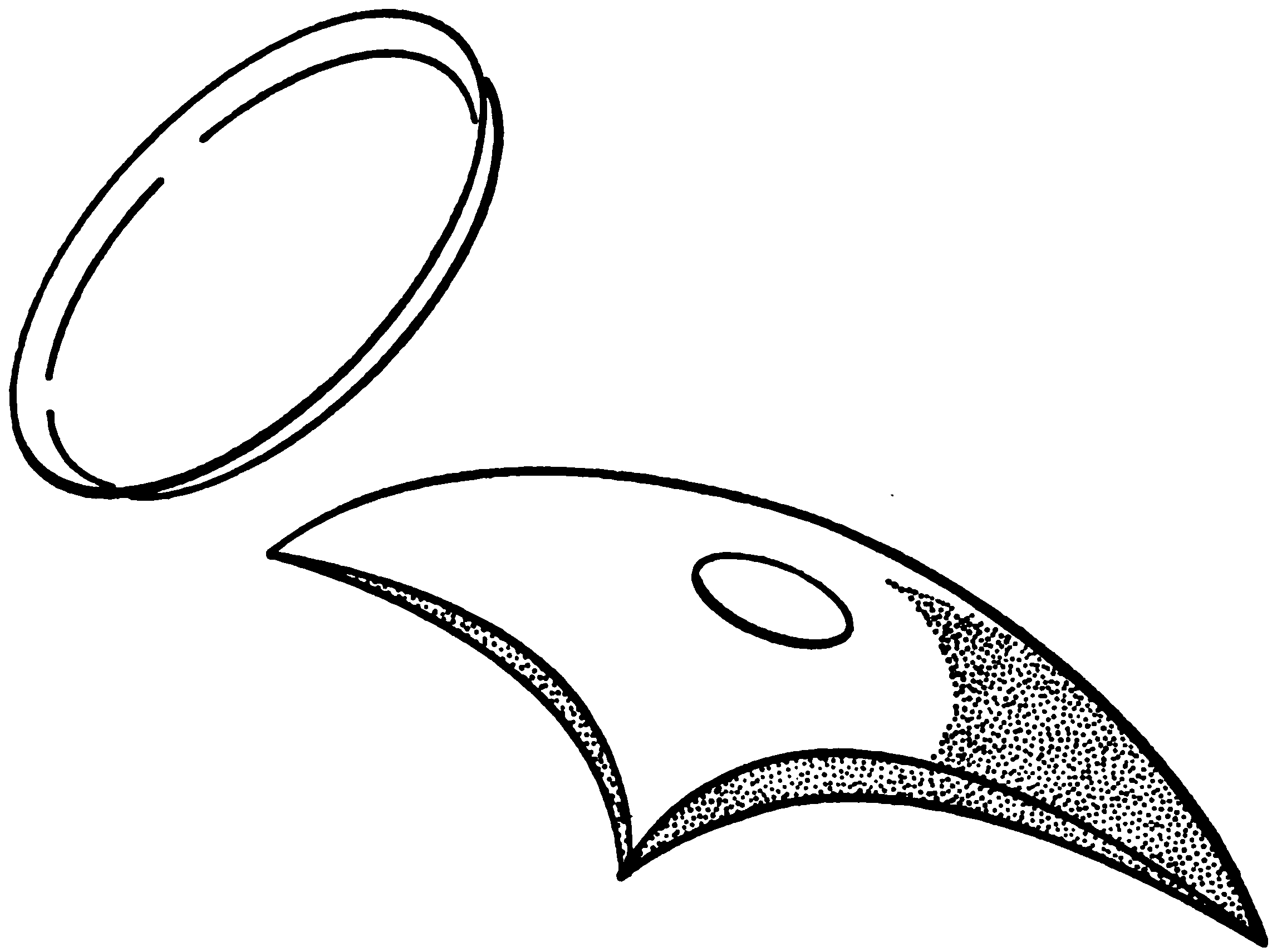
drawing based on his revised account shows an object like the crescent
moon with a sharp protrusion on the inner, concave side and a
dark, mottled circle marking the center of the top surface. Furthermore,
he told the readers of Fate, one object had been darker than
the others and of a slightly different form—a detail he had forgotten
to mention to reporters, to military officials, to his friends, or even
to his wife.
Arnold had never been much of a reader and was not a science-fiction
fan, but his interests were obviously widening. The next two
issues of Fate carried other articles under his name. Palmer’s growing
influence is suggested by the titles: “Are Space Visitors Here?”[II-4]
and “Phantom Lights of Nevada.”[II-5]
Figure 2. Arnold’s flying saucers. Left, as first described; right, as later
sketched.
Ray Palmer lays claim to being “the first flying saucer investigator”[II-6],
although he frankly admits his debt to the writings of
Charles Fort. Any full account of the saucer era must include the
names of other enthusiasts such as Adamski, Bethurum, Scully,
Cramp, Keyhoe, Jessup, Michel, and Wilkins, but none merits so
much credit for keeping the saucers flying as does Palmer. He not
only opened the pages of his magazines to the first saucer reports
but also, in the beginning, paid the witnesses for their stories.
In 1947 Palmer was the editor of Amazing Stories and Fantastic
Adventures, two of the great magazines of science fiction in which
stories of spaceships and interplanetary travel have long been commonplace.
For several years he had been hinting to readers of these
magazines that alien spaceships might actually be cruising in our
skies, but Fate was the first magazine that seriously promoted the
idea. No man was better qualified to glimpse the dramatic possibilities
of flying saucers. Born in Wisconsin in 1910, Palmer had
begun reading Amazing Stories soon after it started publication in
1926. Turning to writing, he showed the remarkable persistence that
has characterized his life. Although he received 100 rejections before
he sold his second story, he stubbornly kept on until he not
only achieved success as an author but also, in 1938, became managing
editor of Amazing Stories for the Ziff-Davis Publishing Company.
Under Palmer’s guidance, “... the entertainment side of
science fiction took over.... Gone were the ponderous styles, the
verbiage, the highly technical explanations of what mattered little
in the first place. The stories took on pace and excitement, the
characters in them were faced with human problems, the dialogue
was realistic....”[II-7]
Alert to the tastes of his readers, Palmer carried the magazine
to new heights. Many science-fiction fans (including the present
authors) still remember that golden age around 1940 when Amazing
came out every month with 146 pages full of startling, fantastic,
wonderful stories of how life might be on other worlds and in other
galaxies.
In January 1944 began the publishing drama that for a time
changed the direction of Amazing and heralded the advent of flying
saucers. The “Discussions” department that month included a letter
captioned “An Ancient Language?” which introduced what came
to be known both as the Great Shaver Mystery and the Great Shaver
Hoax. Signed “S. Shaver,” the letter began:
“Sirs: Am sending you this in hopes you will insert in an issue
to keep it from dying with me. It would arouse a lot of discussion.”[II-8]
It did indeed. The letter announced the discovery that words
and syllables of the ancient Atlantean language still exist in English
today; hence the legends of Atlantis must be true and a “wiser
race than modern man” must once have existed on the earth.
Richard Sharpe Shaver was then living in Barto, Pennsylvania,
and operated a welding machine in a war plant. In writing to thank
the editor for publishing his letter, he enclosed a manuscript called
“Warning to Future Man” which purported to give his memories
of life in the fabled continent of Lemuria. The information had
been preserved in “thought records” hidden in secret caves. By
“telaug,” a kind of audio-visual telepathy, he had begun to remember
his forgotten past when, through the noise of his welding machine,
he heard voices. After visiting Shaver and probing his
“memories,” Palmer bought the story. He didn’t like the way it was
written, however, so he rewrote it, added material that expanded
it to three times its original length[II-9], changed the title to “I Remember
Lemuria,” and started advertising it well in advance of
publication as a true story:
“Twelve thousand years ago the Lemurians and the Atlanteans
disappeared from the Earth. Where and why did they go?”[II-10]
This story would show that Newton and Einstein were all wrong,
Palmer promised, and would reveal new concepts of gravity, the
nature of matter, and the foundation for physical mathematics.
Thus began the controversy that rocked the world of science fiction.
Since Palmer has affirmed that “Flying saucers are a part of
the Shaver Mystery—integrally so”[II-11], we turn to the old files of
Amazing Stories to trace their development.
The first of the Shaver series, “I Remember Lemuria” appeared
in March 1945[II-12], along with “Mantong, The Language of Lemuria,”
an article signed by both Shaver and Palmer, and other
stories followed quickly in succeeding issues of Amazing. The basic
themes were shopworn—a jumble of Fortean ideas, Plato’s fables,
and mystic science—but when brightened by Palmer’s magic pencil,
they seemed fresh and exciting: The earth had an ancient past,
now forgotten. The lost continents of Atlantis, Lemuria, and Mu had
been colonized many thousands of years ago by superior beings from
another planet who could travel through space by utilizing forces
unknown to present-day earthmen. Eventually these noble aliens
had been forced to abandon the earth to escape evil radiations coming
from our sun, but they had left descendants who still lived on
earth in concealment in great subterranean cities that could be
entered through certain caves. The underground dwellers in the hidden
world had retained all the secret powers of their ancestors. They
could communicate by thought transference, could speak to earthmen
by mental “voices,” and could travel on beams of light because
they understood the true nature of gravity and magnetism. These
creatures were divided into two opposing groups, one good and one
evil. The dero (detrimental robots) were the bad guys and they
caused all the unexplained accidents and misfortunes that happen
to human beings. The tero (integrative robots) were the good guys;
they warned earthmen of danger and tried to protect them from
the destructive forces of the dero.
Reader response to these fantasies was phenomenal. Fan mail
zoomed from 40 or 50 to 2500 letters a month[II-13], and the magazine’s
circulation increased by some 50,000. As the records of “racial
memory” continued to appear, connoisseurs of good science fiction
began to cry “Hoax!” but their protests had no effect. Thousands
of new readers were buying the magazine and many of them were
beginning to recall and report “memories” of their own. Since the
“Discussions” columns could not take care of so many letters, Palmer
opened a new department, “Report from the Forgotten Past”[II-14],
and urged the readers to send in their personal experiences with the
hidden world. Did they ever hear strange voices? Receive mysterious
messages through the air? Suspect that they were being affected
by strange rays? Feel that they had been put on earth for
some special mission? Have dreams that they could not explain?
Have a strong urge to explore caves? Have memories of other lives?
The editor was eager to learn of all such incidents. Through the
Shaver stories, Palmer was already promoting the idea that interplanetary
craft do visit the earth:
“There are many mysteries of the past that have intrigued investigators
to an almost unbearable point.... What were the glories
of Babylon? What truth is there in the Chinese legend of being
the people of the Moon, and of coming to Earth in rocket ships?
What was the mystery metal of the Lemurians, orichalcum? What
was the secret of their airships that walked on beams of light?”[II-12]
When one correspondent informed him that space travel was possible
“if one travels through curves but not through angles,” Palmer
replied, “Your editor is sincere—and he’d like to know everything
you know.... For instance, please explain this space-travel business—about
curves and not angles.”[II-15]
For more than three years the columns of Amazing continued
to assert, not as fiction but as fact, that interplanetary travel is a
present reality and that the laws of physics are not valid. In a mystic
mumbo jumbo the readers were told that the velocity of light, for
example, was not the ultimate speed:
“Light speed is due to ‘escape velocity’ on the sun, which is not
large. This speed is a constant to our measurement because the
friction of exd, which fills all space, holds down any increase unless
there is more impetus. The escape velocity of light from a vaster
sun than ours is higher, but once again exd slows the light speed
down to its constant by friction, so that when it reaches the vicinity
of our sun, no appreciable difference is to be noted. A body can
travel at many times the exd constant, under additional impetus,
such as rocket explosions. A ship whose weight is reduced to a very
little by reverse gravity beam can attain a great speed with a very
small rocket.”[II-12]
Devotees of reasonable science fiction (who include many leading
scientists) were writing angrily to Palmer, protesting that the Shaver
hoax had gone too far, but their letters seemed only to amuse him:
“There have been some odd reactions, one of them being a promise
by a fan group to ‘expose’ our ‘hoax’ (which was a compliment,
by the way, because it was termed the ‘biggest ever attempted in
modern science fiction history’). We are waiting for this expose,
[sic] with interest—because we are curious to know how a hoax
which is not a hoax can be exposed as a hoax. We realize that a lot
of our readers find it difficult to believe that we ourselves believe
one single word of what Mr. Shaver tells us in his stories, but we’ll
keep on presenting the evidence as it comes in, and you can judge
for yourself.”[II-14]
Readers continued to object and many stopped buying the magazine,
but Palmer persisted with ambiguous hints that spaceships
were really here. A full year before the first flying-saucer report
he wrote:
“If you don’t think space ships visit the earth regularly, as in this
story [‘Cult of the Witch Queen’], then the files of Charles Fort and
your editor’s own files are something you should see.... And if
you think responsible parties in world governments are ignorant of
the fact of space ships visiting earth, you just don’t think the way
we do.”[II-16]
In succeeding months he became more and more explicit. In September
1946 he told one correspondent, “As for space ships, ...
personally we believe these ships do visit the earth. You, or any
observer, would be inclined to call it something else if you did see
one.”[II-15] In the spring of 1947 he replied to a reader who asked
for concrete evidence that Shaver’s stories were true: “... the mystery
is not just ‘are there caves with dero and tero in them?’ but it
has to do with space ships, other inhabited worlds, and so on.”[II-17]
In June 1947, the month the first flying saucers were reported, the
issue of Amazing Stories was an addict’s dream[II-18]. The cover
featured “The Shaver Mystery, the Most Sensational True Story
Ever Told”; the four stories, 90,000 words, were all under the byline
of Richard S. Shaver. The entire magazine—editorial comments,
discussion columns, and most of the feature articles—was devoted
to the supernatural world of Shaver.
But the end was near. Amazing published its last Shaver story,
“Gods of Venus,” in the summer of 1948; as far as the magazine
was concerned, the mystery was dead.
Who or what killed it? One version says that the publisher, William
B. Ziff, ordered the series stopped because so many fans had
quit buying the magazine. Palmer himself has given various explanations.
He stopped the stories, he said at first, when he realized
that such material did not really belong in a fiction magazine. Later
he explained that he killed the mystery because he intended to go
into publishing for himself and didn’t want to leave his successor
to handle “this hot potato.”[II-19] Later still, he implied that publishing
the stories was dangerous; that he had learned too much about
the “hidden world,” the sinister forces responsible for the plane
crash that followed the Tacoma hoax. Said Palmer, “I wanted no
more dead men on my hands.”[II-11]
The Maury Island Mystery, a complex and eventually tragic affair,
occurred near Tacoma, Washington, less than 100 miles from
the place where Arnold had sighted the nine disks. In this mystery,
too, Palmer was involved. According to their story, two harbor patrolmen
named Harold A. Dahl and Fred L. Crisman on June 31 had
observed a group of six flying disks that hovered over their boat
near Maury Island and jammed their radio when they tried
to notify the authorities. One of the disks had seemed to be disabled,
had showered down lavalike metallic fragments that damaged the
boat and killed the dog on board; the disks had then disappeared
but the fragments remained as proof of the visit. The men also
claimed to have taken some pictures that showed the six objects
but were fogged as though by radiation. Back on shore, they had
not telephoned the newspapers nor had they notified any government
officials. Instead, they had mailed a box of the fragments to
Ray Palmer, to prove that they had actually seen an accident to a
flying saucer[II-20].
Crisman was no stranger to Amazing Stories. A science-fiction
fan, he apparently had accepted the Shaver stories as literal truth.
More than a year before the Maury Island episode he had written
to Palmer, warning him that the knowledge contained in the Shaver
stories was too dangerous to print. Identifying himself as an ex-Air
Force pilot who had flown the Hump, Crisman explained that when
he was in Burma, he had been exploring a cave when a dero attacked
him with a mysterious ray that made a hole the size of a
dime in his arm. Palmer had kept up the correspondence[II-21] and,
some months later, received a telephone call from Crisman, then in
Texas: for $250, said Crisman, he would descend into a cave and
take some actual pictures of the mysterious underground machines
that Shaver had described. The result of this offer is not known, but
in July 1947 Palmer received another letter from Crisman; he had
witnessed an accident to a flying saucer and was sending a box of
the fragments as proof[II-22].
Palmer considered buying the story for Fate, but first he asked
Arnold, living close to the scene, to investigate the tale. Arnold
agreed. Thus the first man to report flying saucers became also a
victim of the first flying-saucer hoax.
With an advance of $200 for expenses, Arnold flew to Tacoma
and into a nightmare of mystery. The two men were elusive, their
story full of discrepancies, their manner evasive. Wondering at first
whether the affair was a hoax, Arnold finally attributed the strange
behavior of the men to their fear of hostile saucers. Alarmed, he
called in the help of Army Intelligence. Two officers arrived from
Hamilton Air Force Base, California, and made a careful investigation.
They found that Dahl and Crisman were not “harbor patrolmen”
but salvagers of floating lumber; their boat was scarcely
seaworthy and showed no evidence of major repairs; they couldn’t
remember what they had done with the pictures they mentioned;
and although the saucer accident was supposed to have occurred
nearly six weeks earlier, they had never notified the authorities or
even mentioned it to a reporter. The only evidence offered for the
truth of their tale was the collection of “strange” fragments which
were later found to be slag from a local smelter plant. Similar fragments
could be found by the ton on Maury Island[II-20].
The officers concluded that they had wasted their time on a
flagrant hoax, but the bewildered Arnold insisted that they take
some of the fragments for analysis. Unhappily, on the way back to
the base the plane crashed and although two passengers parachuted
to safety, both officers were killed. At once fantastic rumors sprang
up: that the Tacoma “disks” had been spaceships, and that the
beings who operated the craft had been forced to arrange the
plane crash so that no one could analyze the fragments of their
disabled spaceship. Arnold himself seemed to believe that the crash
had resulted from extraplanetary sabotage, but investigation showed
a more ordinary cause. A burned exhaust stack had set the left
wing afire; the blazing wing had then broken from the fuselage
and torn off the plane’s tail.
For a time government officials considered placing a charge of
fraud against the two men who had started the unhappy chain of
events. After further questioning, both had admitted that their
“sighting” had been a hoax, planned merely to make their story
more salable, but when first Arnold and then Military Intelligence
had entered the picture, the hoax had simply gotten out of hand.
Since the men obviously had never intended the tragic outcome
and were not directly responsible for it, the idea of prosecution
was abandoned[II-1].
No longer editor of Amazing, Palmer continued to promote the
cause of flying saucers in the pages of Fate. During the early nineteen-fifties,
the boom years of science fiction, he started other magazines—Search,
Mystic Universe, Other Worlds Science Stories. After
a time, Fate began to concentrate on tales of the mystic and occult,
while Other Worlds eventually took over the flying-saucer theme.
Starting as an orthodox magazine of science fiction, Other Worlds
flourished until the general slump in the market caused it to suspend
publication. Revived after a time, it has undergone several changes
of editorial policy reflected in its changing names: Other Worlds
Science Stories, Flying Saucers from OTHER WORLDS, FLYING
SAUCERS from Other Worlds, Flying Saucers the Magazine of
Space Conquest, and, since the spring of 1961 when the magazine
became pocket-size, just Flying Saucers. Classic science fiction
long ago vanished from its pages and all articles are “true” accounts
of flying saucers and similar Fortean incidents.
Flying Saucers is probably unique in modern publishing history.
Issued monthly or bimonthly at a price of thirty-five cents, the magazine
does not pay its authors because, as the editor explains, “Flying
Saucers is not a commercial project.” Published by Palmer Publications,
edited by Palmer, containing liberal amounts of editorial
comment and at least one article by Palmer, a typical issue in 1960[II-6]
contained sixty-six pages and carried a small number of advertisements
for telescopes, binoculars, Rosicrucian and similar mystic
publications. The remaining ads featured books and magazines
issued by Palmer Publications, Amherst, Wisconsin; books issued by
Amherst Press, also of Amherst, Wisconsin; Saucerian Books, published
under the aegis of Gray Barker, a contributing editor to Flying
Saucers. “Austrogen,” described as a face cream or clay for skin
ailments, was obtainable from Palmer at a dollar an ounce. Another
ad recommended something (the wording does not specify exactly
what, perhaps a powder?) that helps make good chili. Readers
could buy this too, from Palmer, for a dollar a pound or $3.50 for five
pounds. A combination dandruff remover, itch preventer, and restorer
of hair color personally recommended by Palmer sold for
$5.00 a bottle, number of ounces not specified.
The dandruff remover was also recommended by Kenneth Arnold,
whose flying disks had started the saucer epidemic. Arnold
was advertising his “World Society of Flying Saucer” which would
“hold no meetings, no minutes, no by-laws, no restrictions or regulations,
no records outside of actual membership, no presidents,
no vice-presidents, no secretary, or board of directors.” For only
$5.00 those who joined the society would receive twelve issues of
Flying Saucers (which if ordered from Palmer Publications would
have cost $4.00), plus an official membership card. Arnold also
offered for sale a crescent-shaped lapel pin in solid silver, supposedly
just like the “original” saucers he had sighted in 1947; and, for the
ladies, the saucers in pendant form. The addition of seven-point
diamonds was optional.
The magazine has grown smaller, but its main theme is still flying
saucers, which until recently have been interpreted as interplanetary
vehicles. In December 1959, however,[II-23] Palmer announced
in a lead article that flying saucers were not from outer space after
all; instead, they came from secret earth bases located under the
north and the south poles. The earth is actually shaped like a doughnut,
not like a pear, he says, and has openings at both poles where
the saucer people reside. Whether they are manned by dero or tero
he has not said.
In the autumn of 1962, Arnold entered the arena of politics and
was the Republican nominee for lieutenant governor of Idaho, but
lost. Shaver became a dairy farmer, a Wisconsin neighbor of Palmer’s,
but in science-fiction circles his name will never die. Recently
he has been advertising the sale of alleged pre-Deluge and pre-Ice-Age
“art stones” described as rare, voluptuous, exciting, and usable
as ornaments for wall or mantel, or simply as book ends.
Palmer has now revived the Shaver Mystery and is reprinting
the entire series in book form “with the fiction removed,” under
the general title of The Hidden World. In advertising the new project
he stated, “This magazine concerns flying saucers. Flying saucers
are a part of the Shaver mystery—integrally so.” He abandoned
the stories in Amazing, he says, not because an outraged publisher
insisted, but because he believed the stories to be true. “That is
the true motive. I was convinced that not only was there a ‘hidden
world,’ but it was one of immense ramification, and the caves of
the dero, flying saucers, military espionage, the political science of
the world, and even some phases of religion, specifically those of the
‘cult’ variety, were inextricably linked.” In announcing that he intended
to end the secrecy that had existed for so long, and to tell
the truth after seventeen years of “sugar-coating” the facts, he did
not explain exactly why he feels it is safe to publish the “truth” now,
when it was not safe seventeen years ago. He says only, “... there
have been good reasons for the delay—had it been done from the
beginning, the pitfalls that would have crushed it could not have
been avoided.”[II-11]
At the tenth annual World Science Fiction Convention, held in
Chicago in September 1952, fans and fellow editors awarded to
Palmer a bronze plaque honoring him as a “son of science fiction,”[II-24]
a citation he fully merits. As long as flying saucers continue
to make good copy and sell magazines, Palmer will probably keep
them soaring—whether their home bases are other planets or polar
caves. As one of his colleagues once commented:
“... in these times of drab and unconvincing falsehood, there is
still something to be thankful for. A Palmer promotion has the
touch of genius. It has zing, sparkle, and true showmanship. It can
be spotted a mile away by the bright lights. The thing to do is sit
back and enjoy it.”[II-19]
What did Kenneth Arnold actually see, that June afternoon in
1947? No absolutely certain answer is possible after so long a time.
The disks were probably a mirage (see Figure 3) in which the
peaks of the mountains seemed to float above the mountain chain[II-25].
An alternative but much less probable explanation is that he
observed orographic clouds, a type unique to mountainous country,
which often appear to stand more or less motionless and can assume
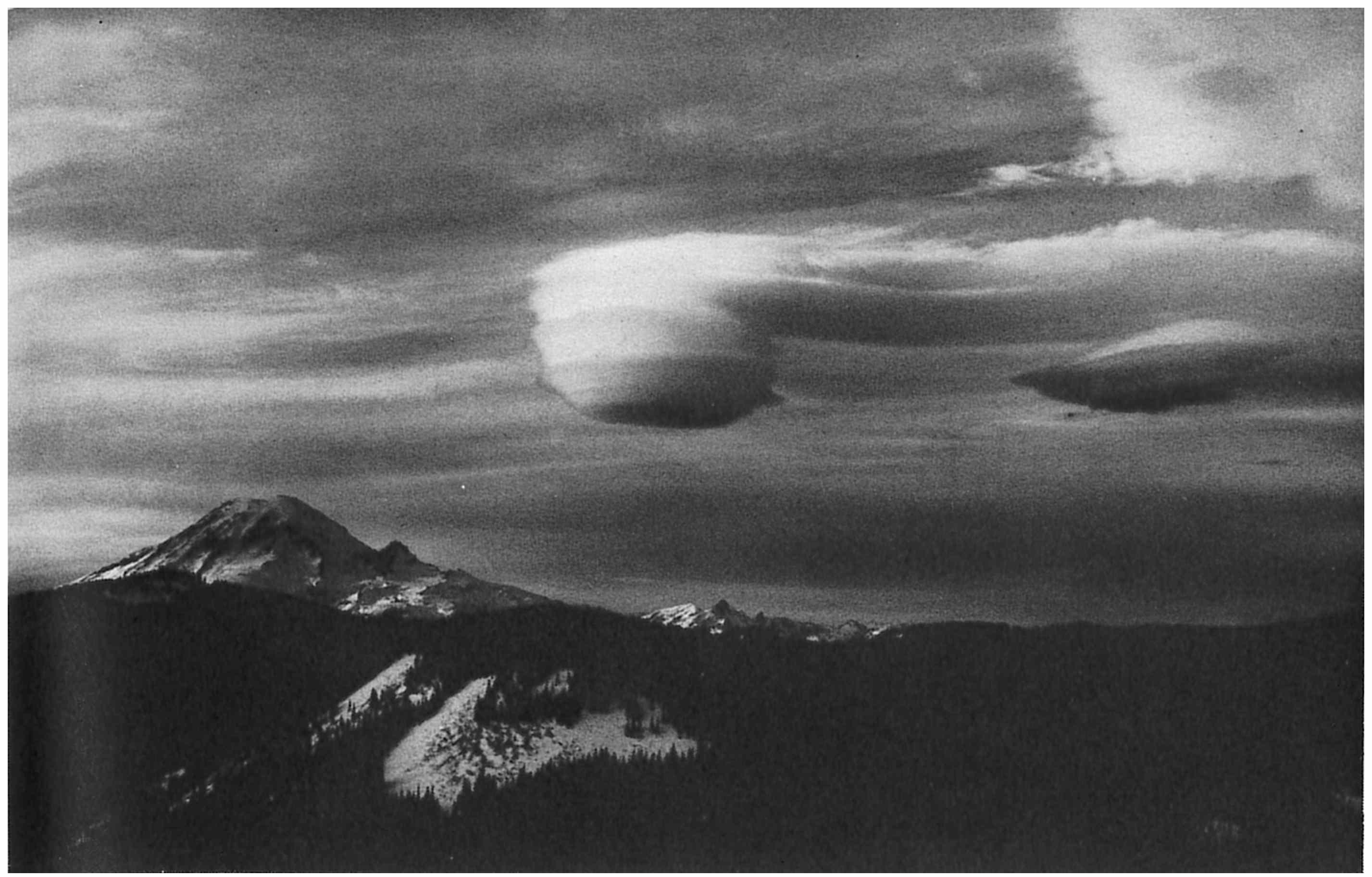
dramatic shapes. “Grindstone” clouds, shaped like thick, solid disks
(see Plate Ia), are common phenomena in the valleys just east of the
Sierra Nevada in California and in the mountainous regions of
Washington, Colorado, and New Mexico—areas where flying-saucer
reports have tended to concentrate[II-26]. One of the most spectacular
types of mountain cloud, it closely resembles the “pile d’assiettes”
or “stack of plates” formation in which the cloud assumes a flat,
round shape like a plate or a saucer, and two or more are piled together
in a neat stack, as in Plate Ib[II-27]. Another picture of a “stack
of plates” (which some observers reported as a hovering flying
saucer) was made on May 31, 1953, near Jindabyna, Snowy Mountains,
New South Wales, and reproduced in Weather in November
1954 Plate 47. The cloud formed over a tub-shaped depression
in the mountains and remained stationary for more than an hour[II-28].
Figure 3. Mirage of mountain peaks. Top, normal view of mountain
chain; bottom, mirage in which some of the peaks seem to be detached
and above the peaks, like saucers.
Such clouds reflect the undulations of lee waves formed in the
atmosphere when stable currents of air flow over obstacles such as
hills or mountains. An up-and-down wave motion may be impressed
upon the air, provided that temperature and wind conditions are
suitable. As the air describes its wavelike path, it alternately warms
and cools, the warming taking place as it sinks into the wave
trough and the cooling as it ascends to the wave crest. If the air
is very dry, the undulating current will not be visible to the eye,
although the updrafts and downdrafts will readily be felt by aircraft
that chance to pass through them. On the other hand, if the
air before entering the wave is moist enough, the cooling in the
wave crest will cause water droplets to condense and a cloud to
appear.
In the vicinity of an isolated peak the cloud may assume the
form of a cap covering the summit, or it may be displaced slightly
downwind and resemble a lens or disk. Not infrequently a series
of lenticular clouds will appear, trailing downwind at regular intervals
of a few miles. Although these wave clouds are usually
stationary, they sometimes move at great speed, especially when
the air temperature is changing rapidly.
From a study of a remarkable photograph made in 1956, R. J.
Reed of the University of Washington has offered the suggestion
that the disks Arnold saw were actually wave clouds in rapid
motion.
On the afternoon of December 29, 1956, a photographer for the
Seattle Times was on top of Pigtail Peak near White Pass, Washington
(not far from the area where Arnold’s nine disks had appeared),
taking ski pictures for the rotogravure section of the Sunday Times.
The weather was beautiful. Down in the pass temperatures hovered
near freezing, but the slopes were warmed by sunlight that filtered
down through thin cirrus clouds and raised the temperature to a
balmy fifty degrees. Just at sunset a strange object suddenly appeared
off toward the northeast horizon. Several skiers urged the
photographer to take a picture of the “flying saucer,” but since it
was still far away and indistinct, he waited. The first object, now
followed by a second one, moved rapidly toward Mount Rainier,
began to sharpen in outline, and both were soon so clearly visible
that he was able to snap his unusual picture. The photograph shows
two apparently solid, disklike objects, flattened, brilliantly white but
dark at the bottom, apparently linked together by white streamers,
skimming toward the mountain peak (Plate Ia).
Recognizing the close resemblance between the objects in the
photograph and those Arnold described, Reed made a full analysis
of the weather conditions prevailing at the time the picture was
taken. From radiosonde data provided by the Seattle-Tacoma Airport,
he obtained measurements of the size of the clouds, their
height above the mountains, wind directions, and temperature and
humidity at mountain height and cloud height. Obviously the pattern
of weather conditions that prevailed that day was suitable for
the formation of saucerlike clouds.
To test the hypothesis that Arnold also had seen such clouds,
he then obtained records of the weather data for June 24, 1947,
to determine whether atmospheric conditions on the two dates were
basically similar. “To be comparable, winds would have to be blowing
from the north or northwest in Mr. Arnold’s case since the objects
were sighted to the south and southeast of the peak. The air would
have to be dry at lower elevations and moisture would have to
be spreading in at higher levels. An inspection of the historical maps
reveals that, indeed, all these conditions were met.”[II-29]
Reed concludes that, although we can never know for certain,
the implication that the Times photographer and Kenneth Arnold
viewed essentially the same phenomenon seems “inescapable.” This
interesting hypothesis, however, requires the presence of undulating
air currents and turbulence great enough to endanger a plane in
flight. Since Arnold specifically mentioned the smooth, calm flying,
the mirage explanation remains the most probable one.
[II-25] Tacker, L. J. Flying Saucers and the U. S. Air Force. Princeton, N.J.:
D. Van Nostrand Co., 1960.
[II-26] Ives, R. L. “Areas of Occurrence of ‘Grindstone’ Clouds,” Weatherwise,
Vol. XI (1958), p. 201.
[II-27] Scorer, R. S. “Lee Waves in the Atmosphere,” Scientific American, Vol.
CCIV (1961), p. 124.
[II-28] Kraus, E. B. “Flying Saucer?” Weather (November 1954).
[II-29] Reed, R. J. “Flying Saucers over Mount Rainier,” Weatherwise, Vol.
XI (1958), p. 43.
Chapter III AIR-BORNE UFOS: BALLOONS TO BUBBLES — The Mantell Tragedy — A Probable Solution of the Mantell Case — A Radiosonde over Virginia — Skyhook and Pibal UFOs — The Guantánamo “Dogfight” — The Wallops Island UFO — Weather Balloons and Saucers — Plastic UFOs and the “Stack of Coins” — Jets and Contrails — The Killian Case — ... And Kites and Soap Bubbles
In the year 1948 the “Skyhook” balloons were an official secret.
These giant plastic bags, shaped something like a teardrop, a hundred
feet and more in diameter, were part of a classified research
project sponsored by the United States Navy, and few except the
researchers and technicians involved knew of their existence. Carrying
cases of heavy instruments, the balloons were launched from
various Air Force bases to collect information about the atmosphere
high above the earth, the winds in the stratosphere, and the incidence
of cosmic rays. Soaring upward, they traveled in courses
determined by the winds and changed in direction and speed as
they shifted from one wind stream to another. Even at heights of
60,000 feet these objects with their highly reflecting surfaces could
be seen from the ground (see Figure 4). Such balloons were especially
noticeable against dark-blue skies, which are much more
common in the western United States than in the eastern areas.
They could reach heights of 100,000 feet, higher than our planes
could go. Once considered as a means for collecting information
for Military Intelligence, a task later assumed by the U-2 jets,
they could travel across the entire continent and even across the
oceans. If the plastic skin developed a leak, the resulting loss of
gas altered both the appearance and the behavior of the balloon;
if the leak became great enough the balloon shriveled and eventually
fell to the earth. At high altitudes where the cold was extreme,
the skin might become brittle and the balloon would burst into
fragments to be dispersed by the winds and vanish.
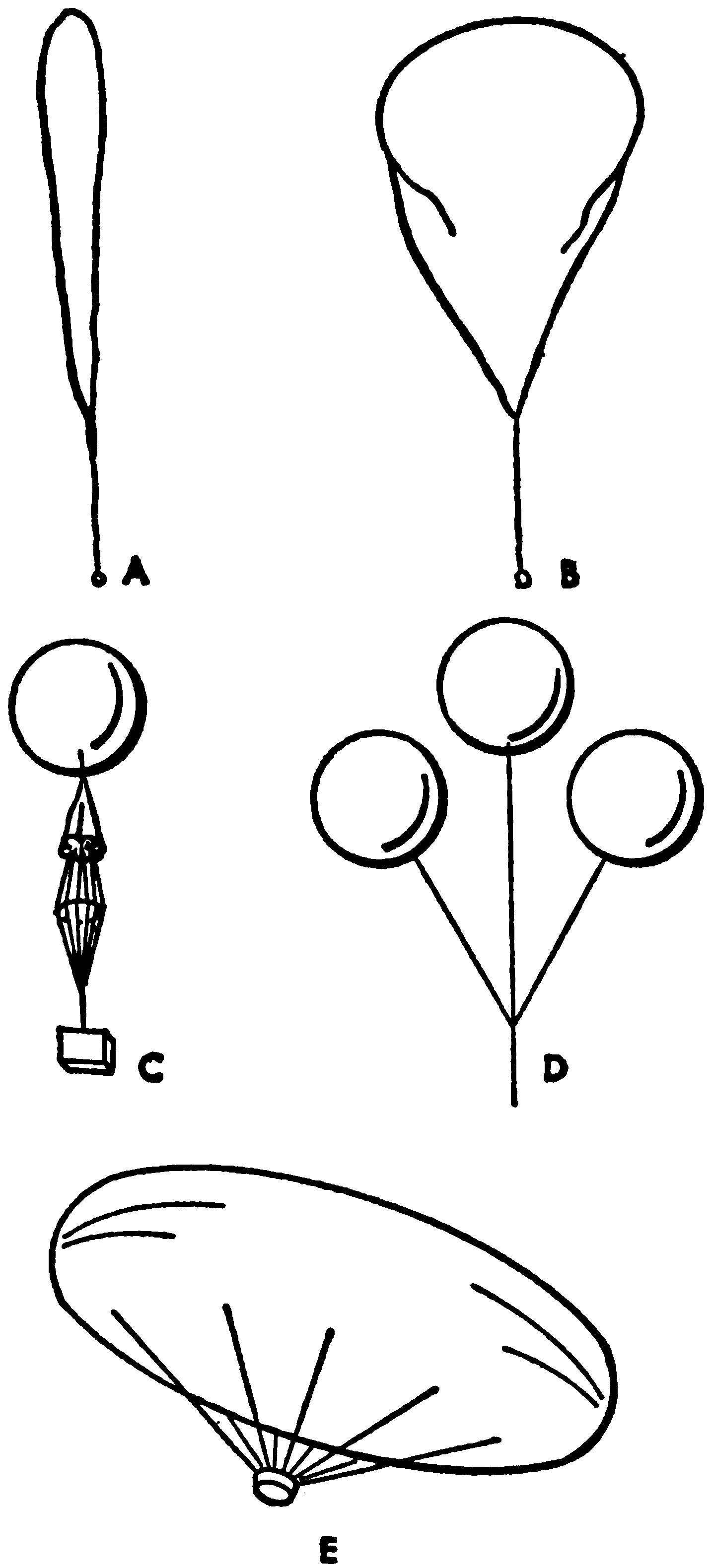
Figure 4. Shapes of various balloons. A, Skyhook at launching; B, Skyhook
at high altitude; C, radiosonde or pibal; D, balloon cluster; E,
blimp or sausage-shaped balloon.
Although these balloons were sometimes visible at distances of
fifty or sixty miles and were very conspicuous, officially they did
not exist until 1950 when Dr. Urner Liddel of the Office of Naval
Research released the facts behind the Skyhook balloon program.
He pointed out then that the balloons had given rise to many reports
of flying saucers. If the Skyhook project had been public knowledge
in 1948 and if information about their launching and movements
had not been a matter of security, a courageous pilot might still
be alive today and the infant flying-saucer myth would have died
long ago. There can be little question that Captain Mantell crashed
in trying to intercept a Skyhook balloon, an object he had never
heard of.
The basic facts of the Mantell case, the second of the “classic”[B]
UFO sightings, are familiar to all who have studied flying-saucer
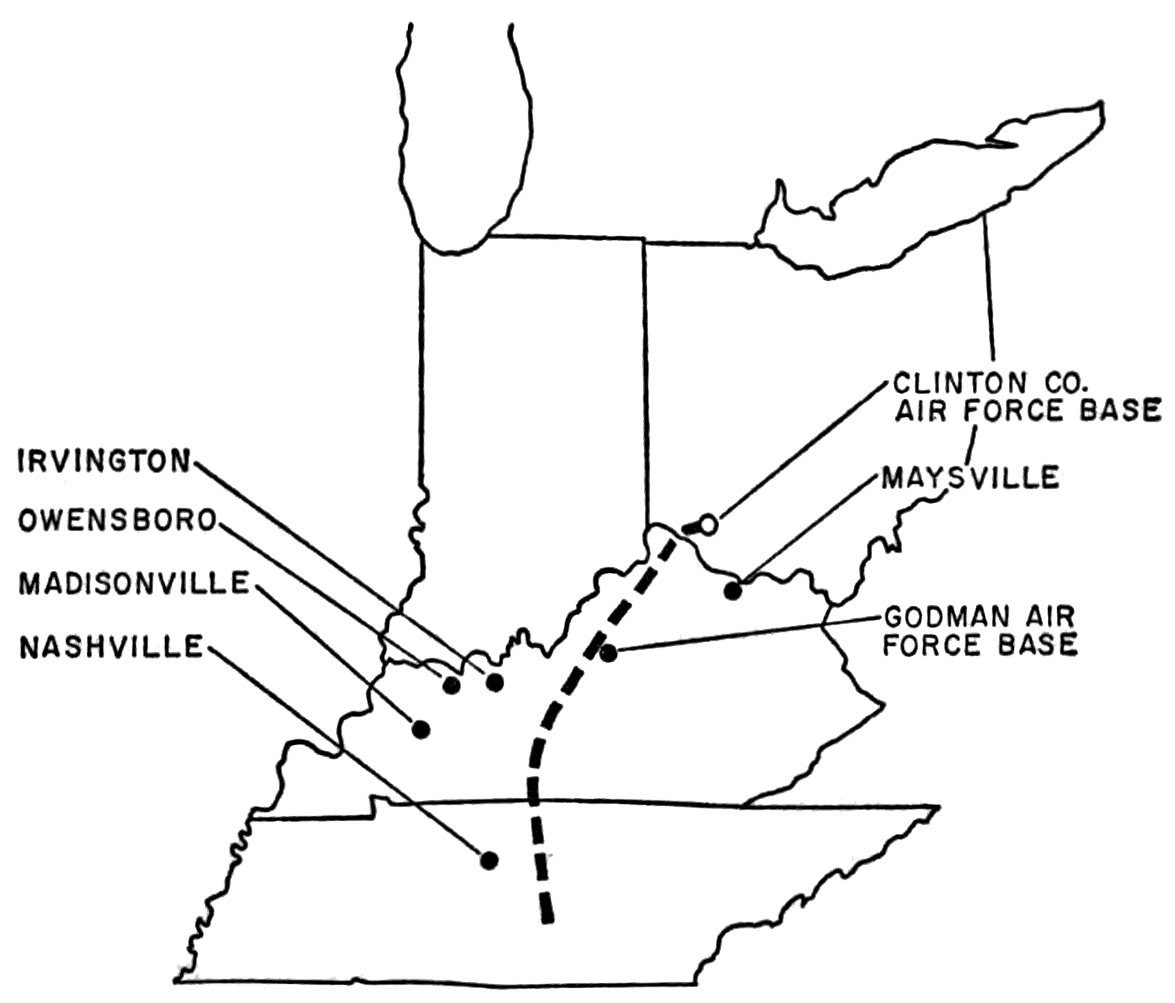
phenomena[III-1, p. 51]. Early on the afternoon of January 7, 1948,
the Kentucky State Highway Patrol received a large number of
calls from the towns of Maysville, Owensboro, and Irvington, reporting
a strange object moving west at high speed. Alerted by the
police, officials at Godman Air Force Base, near Ft. Knox, began
looking for the unknown craft. They soon located the object but
could not identify it. Watching it through binoculars, various observers
described its shape as circular, like a teardrop, or rounded and
tapered like a parachute or an ice-cream cone. At about 2:30 P.M.
(all times in this account are E.S.T.), as they were discussing the
object, a flight of four P-51 planes approached the base from the
south. Led by Captain Thomas Mantell, the planes were being
ferried from Marietta Air Base, Georgia, to Standiford Field near
Louisville. The tower operator at Godman thereupon radioed Captain
Mantell for assistance:
[B] A “classic” in the literature of flying saucers is a particularly dramatic UFO
incident whose specific cause has not yet been found or, if found, cannot be
absolutely proved from the evidence available. Lacking a completely airtight
explanation, official investigators classify the case as Unknown. Saucer fans
classify it as proof that flying saucers exist.
“We have an object out south of Godman here that we are unable
to identify and we would like to know if you have gas enough and
if so could you take a look for us if you will.”
The ferry had been planned as a low-level flight and none of
the planes had been serviced with oxygen. Captain Mantell, a
combat pilot in World War II, nevertheless agreed to help out:
“Roger. I have the gas and I will take a look for you if you will
give me the correct heading and any information you have on
locating the object.”
The talk between Godman tower and Captain Mantell was not
recorded and transmission was sometimes garbled. Although many
persons heard the exchange of remarks during the next critical
minutes and agreed on the general content, no two remembered
exactly the same words; therefore the official reports[III-2] represent
only the best possible reconstruction of the conversation that took
place.
One plane, short of fuel, continued on to Louisville. The other
three circled and began to climb. At about 2:45 Mantell notified
the tower that he was at about 15,000 feet: “I have an object in
sight above and ahead of me, and it appears to be moving at about
half my speed or approximately 180 miles an hour.” One of his
wing men said: “What the hell are we looking for?” When Godman
asked Mantell to describe the object, he said: “It appears to be a
metallic object, or possibly a reflection of sun from a metallic object,
and it is of tremendous size. I’m going to 20,000 feet.”
The other two pilots, who had seen nothing and were alarmed
at flying so high without oxygen, leveled off at 15,000 feet. Mantell
was then above 22,000 feet and still climbing. In ship-to-ship conversation
he said that he would go to 25,000 feet for about ten
minutes, then come down. When all further attempts to call Mantell
went unanswered, the other pilots discontinued the search and
went on to their base; although one returned after refueling and
equipping himself with a mask and oxygen, he found nothing in the
area.
At about 3:15 Mantell radioed that the object was “directly ahead
of me and slightly above, and is now moving at about my speed
or better. I am trying to close in for a better look.” He did not call
again. Less than an hour later searchers found the crashed plane.
Mantell was dead. His shattered watch had stopped at 3:18.
During the period of search, ground observers at Godman Field
had been able to watch the UFO, gradually diminishing in size,
and about 3:50 it disappeared from view. Within a few minutes,
however, observers farther south in Kentucky and Tennessee were
reporting an unknown object in the sky.
A hundred rumors sprang up immediately after the tragedy:
that the UFO was a Russian missile; was a weird machine from
outer space that had deliberately or accidentally knocked the plane
out of the air when it got too close; that Captain Mantell’s body
was riddled with bullets; that the plane had completely disintegrated
before striking the ground; that the wreckage was radioactive.
Investigators rushed in to find the cause of the fatal crash and
brought confusion with them. Some facts could be quickly established.
There were no bullet wounds. The plane had not burned
on impact and was not radioactive. The left wing had come off
while in the air and landed 100 feet from the main crash area. Parts
of the plane were scattered on a line north to south within six
tenths of a mile of the central wreckage. The emergency canopy
lock was in place and apparently no attempt had been made to
release it. The throttle was set at one fourth open, mixture control
at “Idle cut-off,” and prop control at “Full increase r.p.m.”
From this evidence investigators concluded that because of lack
of oxygen Mantell had lost consciousness at about 25,000 feet, while
his plane continued to climb to about 30,000 feet; leveling off, it
then began a gradual turn to the left because of engine torque,
and went into a spiraling dive that produced a speed and a structural
stress greater than the plane could stand—the plane was “red-lined”
(Air Force jargon for the limit of safety) at 525 mph. Pilots
who have flown the P-51 in combat conditions have agreed with
this conclusion and have suggested that, as the plane fell, Mantell
may have regained consciousness, realized what was happening,
pulled the throttle back and tried to pull back on the control,
thus producing a stress so great that the wing was torn off and the
plane then fell vertically.
As an immediate result of this tragic accident, Air Force officials
recommended that all pilots be briefed again on the use of oxygen
and the effects of lack of oxygen. New orders were issued; that no
pilot go above 12,000 feet without oxygen under any circumstances;
that no aircraft be cleared for cross-country flight unless it had
been serviced with oxygen; that classes in the use of oxygen start
immediately for all pilots and crew members; that all aircraft be
equipped with oxygen; and that all pilots carry mask, helmet,
goggles, and gloves on all flights.
The cause of the crash was known. But investigators had still
to solve the problem: what was the unknown object that Mantell
had been chasing?
Figure 5. UFO sightings in the Mantell case. The broken line indicates
the path a balloon would have followed.
An Air Force official had announced to the press that the unknown
had been the planet Venus. This explanation, while not impossible,
was not very probable. The position of Venus that afternoon had
indeed been very close to that of the unknown object. But with a
stellar magnitude of -3.4, less than half its maximum brilliance,
in the daylight sky the planet would have been visible, if at all,
only as an exceedingly small, bright point of light. Furthermore this
answer did not fit the pattern of sightings. The accompanying map
(see Figure 5) of the Ohio-Kentucky-Tennessee region illustrates
the succession of events:
1:35 P.M., Owensboro and Irvington, Kentucky. Circular object
sighted, 250 to 300 feet in diameter, moving west.
Shortly before 1:45 P.M., Godman Air Force Base, Kentucky.
Circular or parachute-shaped object sighted; in view for about two
hours, slowly moving south.
4:00 P.M., Madisonville, Kentucky. Strange object; through binoculars
identified as a balloon.
4:45 P.M., Nashville, Tennessee. Strange object sighted; through
binoculars identified as a balloon.
5:00 P.M., Lockbourne Air Force Base, Columbus, Ohio. Round
glowing amber object sighted on southwest horizon in horizontal
flight; in view about twenty minutes, then disappeared below the
horizon.
All but the last observation in this series suggested a balloon
flight, but a quick check with the weather stations in the area failed
to turn up any record of a routine launching. Air Force investigators
knew about the Skyhook project and could have obtained information
on secret launchings, even though it was classified. But, since
many of the investigators in these early days of the saucer era were
more than half convinced that the unknown had been an interplanetary
vehicle, they abandoned the inquiry at this point and
officially labeled the case an Unknown. Flying-saucer addicts
pounced on this conclusion as proof that the object had actually
been a spaceship, that the Air Force knew it to be a spaceship and
was deliberately concealing the news from the public.
Although the case remained unsolved for nearly four years, the
original analysis of the evidence, carried out by Dr. J. Allen Hynek,
scientific consultant for the Air Force, made certain facts clear from
the beginning. The final sightings in Ohio, so inconsistent with the
general pattern of the other observations, obviously were not related
to the reports from Kentucky and Tennessee. The object seen
at Columbus had undoubtedly been the planet Venus, glowing
brilliantly on the sunset horizon (see ChapterIV). But the object
that traveled southwest over Kentucky and Tennessee had almost
certainly not been Venus. At least two objects—balloons or other
aircraft—must be involved. It was possible, though not probable,
that the unknown over Godman Field had been the planet Venus,
or it might have been still a third object. The senior author of this
book, after studying the facts available at the time and analyzing
the weather conditions prevailing that winter afternoon, suggested
that the object could have been a “mock sun” created by ice crystals
in the cirrus clouds at high altitudes[III-3, p. 22].
The final solution of these UFO mysteries often depends on one
key fact. Without it, the puzzle may never be solved. With it, all
the pieces fall into place. The “mock sun” theory (see p. 244) remained
the most probable explanation until, some time after the
Skyhook project had been declassified, ATIC investigators discovered
the key fact: At the time of the Mantell crash, the Clinton
County Air Force Base, in southern Ohio, had been a launching
site for Skyhook balloons. Unfortunately records for the day of
Captain Mantell’s death were not available, and the men who had
worked on the balloon project could no longer remember whether
they had launched a Skyhook on that particular day. If an unacknowledged
balloon had been in the area, however, only one
more piece was needed to complete the puzzle: What path would
the balloon have followed?
The records at Wright-Patterson Field show that the winds that
afternoon would have carried a balloon over exactly the course
the UFO followed: from southern Ohio west into Kentucky. It would
have climbed rapidly and at about 35,000 feet would have entered
the southward-flowing jet stream; shifting direction, the balloon
would have traveled south at a high rate of speed, still climbing.
Somewhere south or southwest of Godman Field it would have
climbed through the jet stream to enter a region of calm at about
60,000 feet; slowing down, it would have drifted south or southeast
into Tennessee. Of its fate after that we can only guess[III-4, p. 19].
Without the Skyhook records for the day in question, this solution
cannot be called absolutely certain. But the chances of its being
correct are overwhelmingly high—infinitely higher than the probability
that Mantell died while chasing a spaceship from another
planet.
In the years that followed, the pattern of sightings in the Mantell
case has often reappeared but, fortunately, without the same tragic
outcome. After each Skyhook launching, a flood of UFO sightings
came in to ATIC from towns that lay under the path of the balloon.
The Skyhook project sometimes was able to relocate a “lost”
balloon by following newspaper reports of flying saucers.
By the summer of 1952 the existence of giant balloons was no
longer classified information. When on June 15 an unidentified flying
object appeared over several towns in Virginia and followed a course
that closely resembled that of the Mantell UFO, Air Force investigators
recognized the pattern and began looking for a balloon as the
probable explanation. The reports were as follows[III-1, p. 192]:
3:40 P.M., Unionville, Virginia. Very shiny object sighted at high
altitude.
4:20 P.M., Gordonsville, Virginia. Round, shiny object sighted
in the southeast.
4:25 P.M., airliner near Richmond, Virginia. A silver sphere
sighted at eleven o’clock high.
4:43 P.M., south of Gordonsville, Virginia. Jet pilot sighted and
tried to intercept a round, shiny sphere.
5:43 P.M., south of Gordonsville. An Air Force jet pilot sighted
and tried to intercept a shiny sphere; at 35,000 feet the object was
still above him.
7:35 P.M., Blackstone, Virginia. A round, shiny object with a
golden glow sighted, moving south.
7:59 P.M., radio station at Blackstone. Shiny object sighted.
8:00 P.M., Blackstone. Jets from Langley Air Force Base tried
to intercept object.
8:05 P.M., object disappeared.
Investigators first of all checked with officials at Lowry Air Force
Base, which served as a plotting center for all Skyhook balloons,
but there were none in the East that day. Next they checked the
possibility that the UFO had been a weather balloon, but nearby
weather stations replied that none of their balloons could have been
responsible for the sightings. After calling other stations within a
150-mile radius of Gordonsville with negative results, investigators
called the weather station at Pittsburgh, Pennsylvania. A radiosonde
(a small balloon attached to an instrument for taking soundings
in the upper atmosphere) had been released that afternoon,
but had been lost about sixty miles southeast of the station when
it apparently sprung a slow leak and leveled off at 60,000 feet.
The weather man at Pittsburgh offered to plot its probable course
as determined by the prevailing winds, and soon telephoned Dayton
to report that the UFO was probably their balloon.
Southeast of Pittsburgh above 50,000 feet there was a strong
current of air that fed into a stronger southerly stream flowing
parallel to the Atlantic coast, just east of the Appalachian Mountains.
The balloon would have floated along in this current like a log
floating down a river, and should have arrived in the neighborhood
of Gordonsville and Blackstone in the late afternoon or early evening.
The UFO had been sighted near Gordonsville between 4:43
and 5:43 P.M., and near Blackstone between 7:35 and 8:00 P.M.
The unknown was thus clearly identified as the lost radiosonde.
The year 1952 was a big year for experimental balloons—and
for UFO sightings. Weather balloons in clusters, 100-foot Skyhooks,
radiosondes, pibals (pilot balloons sent up to show the
direction and speed of the wind) were released on schedule all over
the continent. Launchings were recorded and the balloons were
tracked, as far as possible, so that for any given day or area ATIC
could consult a map and try to correlate the position of a known
balloon with that of a reported flying saucer. When a balloon was
lost, any UFO sightings it caused were not always easy to account
for until—and unless—the balloon could be found again.
These spheres of gas vary in size from a few inches in diameter
to some two hundred feet. Often they look and behave very unlike
the popular concept of a “normal” balloon, and under the right
conditions they can fool even the most wary observer—particularly
if he is more or less expecting to see something strange.
A man on the ground or even in a plane, watching the maneuvers
of an object some 20,000 to 100,000 feet above him, finds it impossible
to make an accurate estimate of its true height, diameter, distance,
or speed. Strong windcurrents can change the orientation
of the sphere, and the particular angle of vision of the observer
can make the object look wholly unlike a balloon. It may assume
the shape of a disk, a lens, a teardrop, a parachute, a sausage.
Temperature inversions can produce a double image of a balloon
so that it looks like a linked pair. Balloons released in pairs or clusters
may seem to be traveling in formation under intelligent control.
Sunlight, moonlight, or the lights of a city reflected from the surface
may cause them to look white, gray, amber, red, silvery, or metallic.
Since balloons often carry a heavy instrument load, they may give
a radar return that indicates a solid object.
When balloons develop a leak, they may drop some distance at
high speed and then level off, as though under intelligent control.
At the extreme cold of high altitudes they may burst and suddenly
vanish. High in the sky at morning and evening twilight they may
appear to be self-luminous, taking their light from the invisible sun
just as our artificial satellites do. They often travel high above the
air lanes, higher than any plane can go, where varying wind streams
may propel them at great velocities, slow them until they seem to
hover and be almost stationary, abruptly change the direction of
their motion so that they reverse course, dive toward the earth,
or ascend rapidly into the sky.
At night all these illusions are magnified because the observer
has fewer visible reference points by which to evaluate the true
shape, distance, and type of motion of these wandering spheres.
They can deceive even the most hardheaded and able pilot. The
pilot is only human when he doubts that any balloon can fool him—until
it does.
An American Navy pilot, practicing night flying over the Guantánamo
City base in Cuba on the night of September 24, 1952,
engaged in a “dogfight” with a balloon that exhibited all the characteristics
associated with this type of flying saucer. It seemed to
take evasive action, deliberately elude the pilot, make head-on
passes, and respond to every move of the plane with a countermove.
The pilot was at 4000 feet and slowly climbing when he
spotted an orange light approaching the city from the east at 10,000
to 15,000 feet. Realizing that the object was not a Navy plane, he
tried to intercept it, but the light had started a left turn and he
could get no closer than eight to ten miles. The object appeared to
be as large as a Navy bomber and had a greenish tail five or six
times the diameter of the light, visible only intermittently. When
he reached 10,000 feet, the light was still circling left and climbing
in a ten- to fifteen-mile orbit. To keep the nose of the relatively slow
TBM on the light required about 40 degrees of bank. At 12,000
feet the light was still climbing faster than the plane; the pilot then
stopped climbing and reversed from a left to a right turn. The light
seemed also to reverse direction.
All attempts at interception seemed to be met by purposeful
evasive action, and the object seemed to be guided by intelligence.
When the pilot followed the light to the north, it shifted to west,
then south, at about 25,000 feet. Suddenly it began to climb at an
angle of approximately 60 degrees and at a terrific rate. Although
it had been a large bright glow, it now appeared as a very small
red point which would have blended with the stars had it not been
moving. It then started a rapid descent. By this time the pilot was
over the base and headed northeast to intercept the light as it
descended. He described the ensuing “dogfight”[III-2]:
“The light appeared to level out rapidly, and I missed it on the
first run and started a tight port turn. As I headed for a point that
would give me a 90-degree collision course for the light, it appeared
to accelerate and crossed my bow at an incredible speed. I immediately
went into a tighter turn and the next intercept was the
same except that I was almost on the light, as it flashed from starboard
to port. At this close range nothing but the light could be
seen, and it was a brilliant white, approximately fifteen feet in
diameter. After each run, the light appeared to go out one-quarter
to one-half mile, and slowing in speed, continuing in a port turn.
As I pulled out of the third run the light appeared to start another
rapid descent towards Caimanera. This time I went into a steep
dive to follow, when the light appeared to shallow its dive and
head towards the control tower. My altitude was 6000 to 8000
feet, descending at a speed of better than 200 knots. The light
was below me and going at more than twice my speed. As I
approached the north shore of the Bay, at approximately 2000 feet
descending, the light seemed to veer to port, pass over the army
dredge, steady out on an easterly heading, level out over the mangroves,
slow down rapidly over the cove ... hover over the water
momentarily, and then fade from sight.” After the plane landed,
harbor police searched the area but found nothing.
When the pilot was informed that he had been fighting a lighted
weather balloon, released that night from the Naval Air Station at
Guantánamo Bay, he may very naturally have felt incredulous.
Instead of arguing, however, he helped carry out an experiment.
On the following night the station released another lighted balloon,
at about the same time, and the pilot took off to try an intercept.
After comparing the experience with that of the night before, he
concluded that he had indeed fought a balloon:
“Many of the illusions seen on the previous night could be duplicated
by maneuvering the plane appropriately. I tracked the
balloon to 12,000 feet and made runs on it from as far away as
ten miles. I could always intercept and pass it at any predetermined
position, as against the fact that I could not get close to the
other light, which at the time appeared to be moving away at
each attempt at approach.”
There were other differences, too. The rate of ascent was faster
on the first night, and the second balloon did not exhibit a tail.
Discussion with members of the Aerology Department brought out
the explanation of these differences. The first night had been clear,
with a bright moon that transformed the accompanying light into
a flickering tail. On the second night the dew point was higher
and the atmosphere was hazy so that no tail was visible, the balloon
looked smaller, and showed an orange glow instead of a bright
white.
The rapid climb of the first balloon could be attributed to a
vertical air current, or to an air layer of variable density, or both.
A balloon often develops leaks at high altitudes and then descends
to an intermediate altitude where the loss of gas and the denser
atmosphere cause it to hover. One wind balloon, released earlier
from the same base, had developed a leak, started spinning, covered
a horizontal distance of about a mile, and then dropped into the
water. Similarly, the first balloon probably developed a large hole
and fell very rapidly for a while until the loss of gas and the increase
in atmospheric pressure caused it to shrink and close the
hole, slowing its descent.
Some of his impressions, he decided, were the result of making
tight turns at high speed: “The last fast descent could be due to
the fact that I may have cut the balloon with my prop on the third
run, causing the light to fall free. My last three-quarter turn was
diving to port in a position northeast of the light, which could have
produced the illusion of the light arcing across Caimanera and the
Bay and settling into the water. The light’s crossing from starboard
to port could have been the result of my plane being in a vertical
turn and the light descending straight down instead of going
horizontally. At the time of intercept I thought my wings to be
almost level, the light traveling in a flat circle, but due to the
afore-mentioned vertigo, a pilot cannot rely on his senses to establish
attitude.”
The pilot concluded: “Considering all the facts and an observation
of known light on the night of the twenty-fifth, it is my opinion
that the light on the night of the twenty-fourth was a balloon, with
its accompanying light, which had been released from the Naval
Air Station.”[III-2]
Perhaps the most spectacular (and short-lived) UFO in history
appeared at 6:55 P.M. E.S.T. on April 1, 1960, along the east coast.
A bright-yellow streak of fire shot up from the horizon into the
eastern sky and slowly changed into a huge zigzag pattern. With
the streak of fire appeared a large reddish sphere, reported by
some observers to be as large as the full moon and many times
brighter than a planet. Visible along the entire eastern seaboard,
the brilliant object slowly moved eastward, followed by a trail of
greenish sparks. While still at high altitude out over the Atlantic
Ocean, it suddenly vanished—as though it had simply taken off into
outer space. Switchboards in eastern cities were jammed as witnesses
called newspapers, universities, and nearby observatories to
report a comet, a fireball, or a flying saucer.
Newspapers immediately printed a full explanation of this April
Fool’s Day apparition: a scheduled but unannounced rocket launching
from Wallops Island, Virginia. The yellow fire was debris from
the rocket, reflecting the rays of the setting sun; contrary winds in
the upper atmosphere produced the zigzag form. The luminous
globe was a full-scale model of the Echo satellite—an inflated
balloon 100 feet in diameter, carried aloft by the rocket. Dry powder
escaping through holes in the balloon produced the greenish tail.
The object had “vanished” when the balloon fell back into the
earth’s shadow and was thus no longer visible.
Although the newspapers published a full explanation within a
day or two, some saucer enthusiasts continued to treat the apparition
as a mystery. In its Special Bulletin for May the National Investigations
Committee on Aerial Phenomena (see ChapterXIII)
included the incident under “Recent UFO Sightings.” Three months
after the launching the organization conceded (UFO Investigator,
July-August, 1960) that the UFO of April 1 was probably the giant
balloon sent up from Wallops Island.
On August 12, 1960, the counterpart of this balloon went into
orbit and became the satellite Echo, which is still circling the earth,
shining like a star of the first magnitude near dawn or sunset.
In the early years of the saucer era balloons accounted for some
25 per cent of the unidentified flying objects reported to ATIC. The
pattern of these sightings is unmistakable, and the identity of balloon
and UFO is often certain—as certain as any evidence can be.
Nevertheless many such identifications are resolutely rejected by
the saucer enthusiasts. It would be pointless to discuss all the UFO
reports of this class, but we can summarize a few of the most
famous.
In the winter of 1953, a flying saucer was reported to have circled
around a B-36 bomber and blinked a light as though signaling. Investigators
from ATIC determined the following facts:
At 1:13 A.M. on February 6, 1953, the pilot of a B-36 plane bound
for Spokane, Washington, was near Rosalia when he sighted a round
white light below him, circling and rising at a speed estimated at
150 to 200 knots as it proceeded on a southeast course. The B-36
made a sharp descending turn toward the light, which was in
view for a period of three to five minutes, but the pilot could not
identify it.
At 1 A.M., thirteen minutes before the sighting, the United States
Weather Bureau station at Fairchild Air Force Base had released
a pibal balloon. Winds aloft at altitudes of 7000 to 10,000 feet were
from the northwest with a speed of about fifty knots. Computations
showed that the existing winds would have carried the balloon
to the southeast, and it would have been over Rosalia, which is
12.5 nautical miles southeast of Fairchild Air Force Base, in about
fifteen minutes. The plane sighted the unknown near Rosalia thirteen
minutes after the launching. The balloon carried white running
lights which accounted for the blinking described, and the circling
climb of the UFO is typical of a balloon’s course. Thus all the
evidence supports ATIC’s conclusion that the UFO was a weather
balloon[III-2].
A similar sighting had occurred near Hamilton Air Force Base,
California, on the afternoon of August 3, 1952—toward the end
of the summer’s saucer scare (ChapterVII)—when several pairs of
saucers supposedly engaged in dramatic duels in full view of the
base. Ample evidence supports the Air Force conclusion that the
UFOs were balloons. The two objects were first seen at 4:15 P.M.
Ground observers at the Air Force base, with the aid of binoculars,
described them as silver in color, circular in shape, 60 to 100 feet
in diameter, and traveling from east to west at an estimated speed
of 400 to 450 miles an hour. One object was at about 12,000 feet,
the other at about 18,000 feet; as they moved to the west a distance
of about fifteen miles, passing over the heads of the observers (but
not circling the base), the higher object dived to about the level
of the lower, and they bobbed about each other for about an hour
and a quarter. Toward the end of this period they were visible only
intermittently because they were seen against the sun. Three additional
pairs of objects (a total of eight) came into view fifteen to
twenty miles west of the observers and, buffeted by the winds,
appeared to carry on a dogfight; momentarily they appeared in a
“diamond” formation extending over an area of about four miles.
Since the witnesses were looking into the sun at objects fifteen or
twenty miles away, they found it difficult to follow the course of
any one for any length of time.
The objects looked like balloons, behaved like balloons, and
weather balloons had been released in the area that day. Conclusion:
the saucers were weather balloons[III-2].
A number of other publicized cases listed as “Unknown” were
in all probability balloons. Since a probability, however good, is not
the same as an established fact, these sightings remain in the Unknown
category even though their actual explanation is reasonably
certain. Such a case was that near Hermanas, New Mexico,
which, like that a few weeks earlier at Hamilton Air Force Base,
may have been stimulated by the 1952 saucer panic in Washington
(ChapterVII).
On August 24, 1952, an Air Force colonel was flying from California
to Georgia in an F-84-G plane at an air speed of about 290
miles an hour. At 10:15 A.M. M.S.T., when near Hermanas, New
Mexico, he observed two round, silvery objects about six feet in
diameter some two miles north of him and traveling east at high
speed; they showed no trail or exhaust. During the three minutes
they were in view, one object suddenly began a right turn while
the second accelerated rapidly; they changed in shape and in color,
became elongated and gray, and then disappeared. A few minutes
later over El Paso, Texas, he saw two similar silvery objects, also
traveling east. During the ten minutes they were in view, one object
seemed to climb straight up for 2000 or 3000 feet, followed immediately
by the second one. Assuming that the same pair of objects
was involved in both sightings, the observer concluded that
they were going much faster than any plane, and reported the
incident to ATIC.
The behavior described is typical of that of balloons. Rising into
a new wind stream, they may move rapidly and change their
orientation so that they look sausage-shaped instead of round; reflecting
the sun at a different angle, they look gray rather than
silver. Investigators checked with Biggs Air Force Base, White
Sands, and El Paso International Airport; both White Sands and
El Paso had released weather balloons at 8:00 that morning which
had traveled southeast and burst some time before the sighting at
Hermanas. Since no single recorded balloon could account for the
sighting, it was listed as Unknown[III-2].
This inquiry can scarcely be called thorough. No check seems to
have been made at Holloman Air Force Base or at more distant bases
whose weather balloons might well have traveled into the area.
The investigators apparently accepted the pilot’s assumption that
the objects in the two sightings were identical and were therefore
traveling at incredible speeds; yet there was no evidence to support
the assumption. It is far more probable that he was observing two
sets of objects, not one. The estimates of size, distance, and speed
are all uncertain because no fixed reference point existed. The report
does not state whether the objects seemed to be above or below
the plane, and does not give the exact heading of the objects.
The objects looked and behaved like balloons. Another possibility
is that they were fragments from the balloons that had burst
earlier. But the explanation of this incident remains unknown because
too few facts were determined.
A burst balloon has caused many a saucer scare, but the invasion
of Farmington, New Mexico, on Saint Patrick’s Day 1950 was one
of the most dramatic. The “saucers” began to fly about 10:15
A.M. M.S.T., and soon filled the air. In numbers estimated from
500 to thousands, for the next hour the gleaming saucer-shaped
objects soared over the town, moving erratically at incredible
speeds, darting in and out among each other in what one writer
has called “the greatest exhibition of magnetic flight that has ever
happened in this universe.”[III-6] (See ChapterIX.)
The explanation is more prosaic. A Skyhook balloon had been
launched that morning from Holloman Air Force Base near White
Sands, New Mexico. Near Farmington, in the cold atmosphere at
60,000 feet the balloon had become brittle, burst, and disintegrated
into hundreds of tiny pieces of plastic. Light as feathers, shining
in the sunlight, they floated over the town and away[III-1, p. 106].
A similar episode occurred on July 27, 1952, the day after the
second Washington “invasion.” The dramatically named “stack of
coins” sighting at Manhattan Beach, California, was reported by an
aircraft engineer, formerly a Navy pilot, and was confirmed by
seven other witnesses.
At 6:35 P.M. P.S.T., just before sunset, a bright silvery object
appeared high in the sky, elliptical in shape and apparently solid.
The size was estimated to be about that of a dime held at arm’s
length. As the observers watched, it turned to the south and gracefully
broke apart into seven smaller objects, as smoothly as a stack
of coins separating. The three lead objects assumed a V position,
the others followed in two pairs, and the whole formation then
turned northeast and quickly disappeared. ATIC investigators, still
buried in a mass of equally spectacular reports, could provide no
solution to the mystery, and another fleet of saucers had apparently
been added to the summer’s list.
Immediately concluding that the objects were from outer space,
UFO-philes pondered the meaning of the incident. One author suggested
that the disks might have been seven different ships that,
when first observed, had been stacked like coins and attached to
each other by some magnetic force, so that all could be directed as
one[III-5].
This sighting has remained technically an unknown chiefly because
the descriptions fail to give the necessary information. What
direction did the object come from? How long was it in sight? What
balloons had been released in the area that day? At what time?
What were the winds at high altitudes? The winds at low levels
were from the west, and at altitudes from 20,000 to 50,000 feet they
were from the east; but what were they in the region above 70,000
feet, the probable location of the object? Even without these facts,
a reasonable explanation can be offered: the unknown was a radiosonde
balloon that burst at a high altitude.
The sun was low on the western horizon. A balloon at a great
height reflects the sun brilliantly from its rubber or plastic skin
and gleams like a giant metallic sphere. These balloons usually
soar to 70,000 to 90,000 feet before they burst from the cold. The
fragments then disperse in an impressively uniform pattern, and
may disappear quickly. The radiosonde package and attached parachute
fall rapidly at such heights. They are not noticed by the
witnesses because the chute usually does not open fully until after
the package has fallen some distance into the beginning twilight
near the earth’s surface.
This explanation of the “stack of coins” cannot be proved, of
course, but every detail of the incident is consistent with the behavior
of a bursting balloon[III-2].
Weather balloons are not the only air-borne objects that have
been mistaken for interplanetary craft. Flying saucers reported
over Durango, Colorado, early in August 1952 turned out to be
four T-33 Air Force jets flying at 30,000 feet, so high that no sound
reached the ground.
A low-flying jet, enveloped in an aura of cloud made by the jet
itself, can look like a strange object. This condensation phenomenon,
called a contrail, occurs when areas of low pressure develop on the
wing surface; the air cools by expansion in the slowly moving
boundary layer in contact with the wing. Both the depth of the
boundary layer and the drop in pressure increase with increasing air
speed, but each depends very closely on the aerodynamic qualities
of the wing. An excellent photograph of one such disk produced
by a Canberra jet was taken on February 4, 1956, along the coast
of Africa near Accra on a morning when the condensation phenomenon
occurred several times during air maneuvers. The weather was
fine, the sky cloudless with a few patches of haze over the sea, and
visibility was more than eight miles. During the display the air
speed of the jets was usually too low or the air too dry for the aura
to form. “But over the cliff edge where the sea-breeze was just
beginning to break through in patches the air would be moist enough
to condense about 1½ gm. of water droplets in each cubic metre
of air, quite sufficient to produce the observed effect. The effect
is increased by higher speeds at the end of a dive (when the
angle of incidence of the aerofoil is least) ... but it is likely that
the patchy onset of the sea-breeze was the most important contributing
factor.”[III-7]
A flying saucer reported from Johannesburg, South Africa, on
April 11, 1958, belongs in this category. Hundreds of witnesses
reported a mysterious starlike object maneuvering in the northern
sky on three successive nights at speeds in excess of 2000 miles
an hour. Most observers agreed that “The Thing” could not have
been any known aircraft because its speed was too great; it sometimes
hovered stationary in the air, and repeatedly changed color
from white to red to deep scarlet. One member of an Interplanetary
Club who watched it through binoculars described the UFO as
saucer-shaped, with a rim like a soup plate around the edge.
Members of the Council for Scientific and Industrial Research
Minitrack Station, near Johannesburg, were amused by the variety
of reports on “The Thing.” The mysterious object in the night skies
was in fact a South African Air Force Dakota aircraft, flying back
and forth so that the Minitrack Station could test the calibration of
its tracking instruments. In addition to the usual navigation lights,
the aircraft had carried a bright, flashing light so that it could be
photographed[III-7a].
A flight of bombers refueling in mid-air at night can be a startling
spectacle and more than once has been reported as a gathering of
flying saucers.
Such an incident occurred in Florida on October 31, 1955, when
a disk jockey at Gainesville broke into his radio program about ten
o’clock in the evening to announce that flying saucers were over
the station. Many of his listeners hurried out of their houses to
look at the Halloween visitors, clearly visible in the night sky. One
reporter stated that he had seen four to six objects, oblong in shape,
brilliantly glowing, red and orange, traveling soundlessly in a
straight-line formation that later changed to a V[III-8]. Both the
radio station and the police station were swamped with telephone
calls from frightened citizens, most of whom calmed down when
they learned the explanation: a flight of bombers had been refueling
at an altitude of 32,000 feet.
The most famous UFO sighting of this type is the Killian case.
On the evening of February 24, 1959, an American Airlines plane
was flying from Newark to Detroit. At about 8:45 P.M., when the
plane was near Bradford, Pennsylvania, the pilot, Captain Killian,
noticed some puzzling lights above and to the left of his plane.
There seemed to be three, their colors changing from yellow to
light orange, dimming and brightening in intensity and shifting
their relative positions. At first he supposed he was looking at the
constellation Orion, for the lights had the same configuration as the
stars in Orion’s “belt,” but when the lights changed position and
he could see Orion itself in addition to the lights, he discarded
his first theory. He considered the possibility of a jet tanker refueling
operation, but decided the lights were moving too slowly.
He couldn’t think of any ordinary explanation—but he had long
wondered what truth there was in the idea of flying saucers and
had thought there must be something to it.
Over the loud speaker he remarked to the passengers that American
Airlines had a special treat for them which they could see by
looking out of the left windows. He continued to watch the lights
as he flew west toward Detroit, and radioed two other American
Airlines planes in the area. Learning that their pilots were also
watching the unusual spectacle, he notified Air Traffic Control
(ATC) in Detroit. The lights remained in view for about forty minutes,
all the way to Detroit, and the pilot lost sight of them only
when he began to let down through the haze for a landing.
Reporters and photographers were waiting to interview him,
and next day’s Detroit Times carried a banner headline, “Mystery
Discs Trail Plane Here,” over a picture of Captain Killian flanked
by the plane’s two pretty hostesses, all three smiling as they held
up to the camera three ordinary kitchen saucers[III-9]. After checking
with the Detroit ATC, who did not know of any scheduled refueling
operation, the pilot reported his experience to officials of
American Airlines, and next day returned to New York where again
he was besieged by reporters and photographers. Meanwhile, following
standard CIRVIS procedure (Communication Instruction
for Reporting Vital Intelligence Sighting from Aircraft), the manager
of operations of American Airlines reported the incident to
ATIC at Wright-Patterson Air Force Base.
In New York the day after the sighting Captain Killian gave a
telephone interview to Radio Station WCHS, Charleston, West
Virginia, describing his experience. Following the customary procedure,
intelligence officers from Mitchell Air Force Base questioned
him and filled out the usual report form[III-2]. In the radio interview
and in the talk with intelligence officers Captain Killian made the
same statements he had made to American Airlines officials: he
didn’t know what the lights were, and he couldn’t tell how far
away they had been because he didn’t know their size or their altitude[III-10].
Not for months had such a good flying-saucer story appeared,
and the newspapers made the most of it. Among the first to assert
that the unknown lights had been flying saucers was the UFO
Research Committee of Akron, Ohio (see ChapterXIII). Members
of the committee had received the news by telephone, even before
Captain Killian’s plane landed at Detroit, from the pilot of a United
Airlines plane who had watched the lights on his flight to Akron.
During the days following, Captain Killian’s copilot gave an interview
on Long John Nebel’s after-midnight radio program in New
York. Captain Killian himself described the UFOs to members of
a New York UFO organization, Civilian Saucer Intelligence (CSI),
and appeared on several radio and TV programs. Both saucer
addicts and newsmen besieged Air Force representatives, demanding
an immediate explanation of the sighting. Finally, on February
28, only two days after receiving the report from American Airlines,
ATIC yielded to public pressure and produced a tentative theory:
it was possible that the pilots might have sighted the stars of Orion,
as Captain Killian had first suggested. However, the release added,
no definite conclusion could be reached until all the facts had been
studied.
Promptly rejecting the possibility that he might have been looking
at Orion, Captain Killian stated in an interview with the New
York Herald Tribune, “I am sure there are people on other planets
and that they have solved the problem of space travel.... I sincerely
believe that their vehicles are coming close to earth.”
While the saucer believers were keeping the story alive, applauding
Captain Killian and denouncing the Air Force, the experts at
ATIC had been collecting facts and trying to analyze them. The
basic piece of evidence was Captain Killian’s own report to American
Airlines, made a few hours after the incident took place. After
describing the circumstances of the sighting, the appearance and
behavior of the lights, the statement continues:
“The only possible explanation other than flying saucers could
be a jet-tanker refueling operation. Never having witnessed refueling
operations at night, I am not aware of the lighting of the
jet tanker.
“My air speed during this complete flight was 250 knots indicated.
I also do not know the air speed of tankers during operation
if this could be so. I contacted ATC to find out if they had
any airplanes on a clearance and no three airplanes were given.
“In summary, it was difficult for me to believe they were jets
because of low speed and configuration. If they weren’t jets I still
don’t know any more than I did before even though I watched them
for forty minutes before. Due to the dark and strong lights I was
not able to ascertain any size or shape. The altitude of the objects
was 30 degrees above my horizon. Distance away is unknown.”[III-2]
Almost equally important was the evidence of other witnesses.
During the forty-minute period of observation, the crews of five
other planes, all flying west in the Pennsylvania-Ohio region, had
watched the lights for varying lengths of time. Several persons on
the ground in and near Akron had seen them between 9:15 and
9:30.
Air Force investigators methodically gathered the facts and made
their analysis and on March 16, only twenty days after the sighting,
they released a summary to the press. The mysterious lights belonged
to normal terrestrial aircraft. Although ATC at Detroit had
apparently not had the information when first asked, three B-47
bombers of the Strategic Air Command had been carrying out a
night refueling operation from KC-97 tankers at the time and place
reported. The tanker has several groups of lights which, from a
distance, can seem to be one or more lights, and would have
looked very much like the three objects described by Captain Killian.
Such a refueling operation takes from about forty minutes to
more than an hour.
Captain Killian had been flying at an altitude of 8500 feet, and
he had given the location of the unknowns as 30 degrees above his
horizon; this agreed with the position of the tankers, which were
operating at an altitude of 17,000 feet. Captain Killian had been
flying west at an indicated air speed of 250 knots; the refueling
tankers had also been flying west at a true air speed of 230 knots
(ca. 270 mph). Since the courses of plane and tankers were roughly
parallel, the tankers had remained in view and would have arrived
over Akron at about 9:15, the time that ground observers reported
the lights.
Everything checked. Every detail of the incident was accounted
for[III-11]. Nevertheless the solution caused an explosion in the
camps of the saucer enthusiasts, who called it, among other things,
imaginative. Forgetting that the “Orion” theory suggested immediately
after the sighting had been only tentative, UFO addicts
ridiculed it and asked why the experts had later offered a different
explanation—which they greeted with equal ridicule[III-12].
Captain Killian, too, had apparently forgotten his first report. On
March 24, a month after the sighting, in an interview by the Long
Island Daily Press he stated that the things he saw could not have
been tankers; that he knew what B-47 bombers and KC-97 tankers
looked like, and how they looked in operation at night (Original
statement to American Airlines: “Never having witnessed refueling
operations at night, I am not aware of the lighting of jet tankers.”)
Also, he told the Daily Press, the objects he saw were at least triple
the size of any known tanker or bomber. (Original statement to
American Airlines: “Due to the dark and strong lights I was not
able to ascertain any size or shape.”) Furthermore, he asserted,
the unknowns had been far too fast for a tanker, and had moved
at a speed of about 2000 miles an hour. (Original statement to
American Airlines: “... it was difficult for me to believe they were
jets because of low speed.”)
In rejecting the Air Force explanation of this incident, flying-saucer
addicts ignored several embarrassing questions: If Captain
Killian actually saw interplanetary craft, how did he fail to see
the earthly aircraft operating at the same time and place? If the
unknowns moved at a speed of 2000 miles an hour, how did Captain
Killian and the crews of several other planes, flying at less than
300 miles an hour, keep the unknowns in sight for forty minutes?
In that length of time the UFOs should have covered most of the
distance to the Pacific.
Few persons, given the facts by responsible officials, would persist
in denying the reality of the tankers and conjuring up a fleet of
flying saucers to occupy the relevant cubic area of space. To the
true enthusiast, however, these refueling planes remain incontrovertible
proof that spacecraft are among us.
Objects need not be as large as Skyhook balloons or jets to start
a flying-saucer scare. Brightly illuminated advertising blimps have
caused many UFO reports. Unfamiliar circumstances or a faulty perspective
can manufacture spaceships out of things as small as seeds,
spider webs, scraps of paper, or toy balloons.
In the autumn of 1947, during the first months of the saucer
scare, many such UFOs were reported. One experienced observer,
formerly a combat pilot, reported a flying saucer overhead at a
height he estimated as 5000 feet. More careful study showed
that the object was at a height of only about 250 feet and was
suspended from small balloons. Later he learned that, as a joke,
some boys had launched a paper saucer carried by helium-filled
toy balloons. During this same period when everyone was talking
about flying saucers, spaceships reported over an Iowa town one
night turned out to be glowing bits of paper drifting from a fireplace
chimney[III-13].
On March 16, 1961, according to the British radio, a resident of
East Suffolk reported to the police that he had seen a spaceship
land in a nearby field. Investigators soon found the craft: a fuel
tank that had fallen from a passing plane.
A fleet of UFOs appeared late one afternoon in July 1961 to an
observer driving west along Highway 54 from El Paso, Texas, to
Alamogordo, New Mexico. It had been raining in the mountains,
and wind and dust storms had forced the driver to stop several
times during his trip, but now the sun was shining between patches
of dark cloud in the western sky. Driving toward the outskirts of
Alamogordo, he was startled to see a V-shaped formation of huge
saucers flying directly toward him. Stopping his car, he saw that they
were glowing a deep red, were moving at high speed, and seemed to
be as high as the clouds. When they had reached a point nearly
overhead, they suddenly seemed to drop down toward the observer.
Rapidly revising all his first estimates of size, height, and
speed, he recognized their true identity. They were merely a group
of tumbleweeds that had been carried aloft in the strong winds
and were soaring past at a height of only 100 feet. Illumination
from the setting sun had produced their weird reddish glow.
A spectacular flying saucer hovered near the Smithsonian satellite-observing
station in Curaçao, Netherlands Antilles, on the night
of October 17, 1961. The station crew observed it with binoculars,
by apogee telescope, and photographed it with the Baker-Nunn
satellite camera. A brilliantly glowing object, it shone in the eastern
sky, moving erratically and fluctuating in brightness. After watching
it for nearly an hour and finding that the nearby airport could not
observe the object, the observers concluded that it must be less
distant than it seemed, and set out by car to try to get a closer look.
About a mile and a half from the station they stopped, and solved
the mystery. A plantation manager and his servant stood in a field,
hanging on to one end of a 1200-foot kite string. At the other end,
high in the sky, soared a kite; hanging from it was a lighted pressure
lantern[III-14] (see Plate IIa).
In 1954 malfunction of a sewage-disposal plant in western Pennsylvania
produced one of the most spectacular saucer reports on
record. An oversupply of detergent, whipped by a stiff breeze,
foamed into a mountainous tower of bubbles. A sudden gust of wind
broke the tower and launched a colossal mass of bubbles as large
as a ten-story building. This brilliant, scintillating, super-giant bubble
bath rose to great heights and drifted for miles. Widely reported
as a UFO, this apparition was merely an unusual by-product of
modern technology. The UFOs photographed over Kentucky on
July 7, 1947, were probably vapor trails, a less familiar sight then
than now; or they might possibly have been the smoke trails from
an exploding meteor (see Plate IIb).
A saucer incident that might have become a classic Unknown
occurred in Denver at 10 A.M. on a summer’s day in 1950. A man
was sitting on the shady porch of his house, reading. Beyond the
porch roof the sun shone brightly. Glancing up from his book,
he was startled to see a formation of perhaps a dozen spherical
objects, shining iridescently, traveling toward the distant mountains.
As he watched, those in the front of the procession seemed to vanish
instantly while others appeared out of nowhere to join the parade
at the rear. Measuring their size against the mountain background,
he decided they were “immense” and they moved at fantastic speed,
covering the thirty or so miles to the mountains in a matter of five
or six seconds.
Too stunned to take action, he was still numb from shock when
he heard a faint “Hello,” and looked up—to realize that the little
girl across the street was blowing soap bubbles. If the man had
jumped up when he first saw the objects and had rushed into the
house to telephone the nearest saucer club, he might never have
found out that the “spaceships” were only bubbles[III-15].
[III-1] Ruppelt, E. J. The Report on Unidentified Flying Objects. Garden City,
N.Y.: Doubleday & Co., 1956.
Chapter IV THE SPANGLED HEAV’NS: STARS AND PLANETS — A Mirage of Sirius — Earth’s Distorting Atmosphere — The “Whipping Girl” of Saucerdom — The Ryan Case — Venus as a Morning Star — Venus as an Evening Star — The Rotating Lights of Japan — UFOs and the Opposition of Mars — The Gorman “Dogfight” — Only a Balloon? — Jupiter through a Jet Trail
Shortly before dawn on March 3, 1955, a spectacular flying saucer
appeared over Alaska. The witness, a civilian scientist with the rank
of Commander in the United States Navy, was returning from the
North Pole on the daily Air Force Ptarmigan weather flight; his
mission had been to study the effect of the aurora on radio propagation,
for the Department of Defense. He described his experience
as follows:
“We were flying southwest of Point Barrow, Alaska, not far from
Bering Strait, en route to Eielson Air Force Base in Fairbanks,
and our course was roughly southeast. The night was clear and the
stars shone brilliantly. I was looking out of the western bomb blister
when suddenly I saw a bright object shoot in at tremendous speed
from the horizon, directly toward the plane. At first I thought it was
a meteor or a fireball and I instinctively ducked, but the object came
to a sudden skidding stop about 300 feet away, thereafter riding
along with our plane and keeping pace with our speed. I could
scarcely believe my eyes. The thing possessed green and red signal
lights that flashed back and forth, and something that looked like a
lighted propeller on the top. Beyond question, it was a flying saucer.
“I wondered if the thing might be a hallucination, brought on by
fatigue. After all, we had been in the air almost seventeen hours.
I cleaned my spectacles and rubbed my eyes, but the Saucer was
still there, pacing the plane and bobbing up and down as the plane
itself occasionally wove or dipped. My next thought was to eliminate
all possible chance that the thing was an internal reflection. I pulled
my fur parka up over my head and put my face smack against the
bulging surface of the blister that formed the window. Thus
shielded from all internal illumination, I could still see the glowing
object. I next drew a pencil from my pocket and held it out at arm’s
length, and was surprised to find that the glowing disk was somewhat
smaller than the eraser. I made a rapid calculation and concluded
that if the sphere was actually 300 feet away, as it seemed,
then it was only a foot or two in diameter, not much larger than a
basketball. My next thought was whether one of the radio parachutes
had somehow or other got attached to the plane by the
string. These objects, brilliantly lit by an electric light, can be quite
startling. But it had been nearly half an hour since the last parachute
release and the meteorologists were just getting ready to
lower another through the trap. I decided to call the meteorologist
to look at the thing. But before I could call out, as if it had read my
mind the object suddenly took off at top speed and disappeared.
Now I was really concerned. In less than two seconds the UFO
had vanished over the coast of Siberia, some 200 miles away. It
must have been traveling at the fantastic speed of more than 100
miles a second. The Korean War was over but our relations with
the Soviet Union were still tense, and I wondered if the object
might be a secret Russian missile on reconnaissance. I kept my eyes
glued to the point where the saucer had disappeared and suddenly,
a couple of minutes later, it shot back toward the plane, more brilliant
and spectacular than the first time.
“You can perhaps imagine my relief when I suddenly realized
what the object was, and at the same time realized that I had hit
on the answer to a great many flying-saucer reports of a similar
nature. Only someone familiar with the constellations could have
identified the object. It was a mirage of Sirius, the brightest star in
the heavens. Actually Sirius was slightly below the horizon at this
time, but the bending of the light had raised the image above the
horizon and had diffused the beam into the saucerlike form. The
flashing red and green lights were common phenomena associated
with star twinkling, and the apparent structure, including the
whirling propeller, resulted from distortion by the earth’s atmosphere.
“But why had the image taken off the way it did, and then rushed
back? The moving plane of course was continually changing position
relative to the ground features. A mountain peak on the distant
horizon had briefly come between the plane and the star, obscuring
the light. The light was not cut off all at once, however. Thus as
the image dimmed it seemed to shrink, as though it were racing
away. This temporary barrier also explained the sudden stops and
starts and the tremendous instantaneous acceleration the object
seemed to make at the instant it appeared. The large atmospheric
lens was simply focusing the light of the star in the general direction
of the plane and thus it was centered with my eye. That is why the
object seemed to duplicate the motion of the plane.
“I watched the object for several minutes after its return. I was
able to get full confirmation of this identification when the star rose
over the western horizon; it rose in the west because the southward
motion of the plane more than compensated for the westward rotation
of the star. And as Sirius came up from the horizon, the ‘flying
saucer’ sank back into the brilliant hemisphere of stars, where it
belonged.” (The witness in this case was the senior author of this
book.)
Sirius has inspired many UFO reports. On December 10, 1952,
at 7:15 P.M. P.S.T., the pilot and radar observer of an F-94 on routine
patrol duty were over the town of Odessa, Washington, at
about 26,000 feet when they saw a large white light in the east[IV-1].
Dim reddish-white lights seemed to be coming from “windows,” and
no trail or exhaust was visible. The pilot attempted to intercept
but the object performed amazing feats—did a chandelle in front
of the plane, rushed away, stopped, and then made straight for the
aircraft on a collision course at incredible speed. The pilot banked
away to avoid collision, and afterward was not able to locate the
object. The radar man then got a brief return but soon lost contact.
Although the visual and radar contacts had not coincided, both
men assumed that they referred to the same object[IV-2, p. 65].
Investigators suggested at first that the object might have been
one of the Telemuk balloons, but this idea had to be discarded
and the sighting was listed as Unknown. A review of the evidence
by the present authors suggests a highly probable explanation.
Above the low cloud cover at 3000 feet the night was clear and
moonless. In the east, Sirius was just rising over the horizon at the
exact bearing of the unknown object. Atmospheric refraction would
have produced exactly the phenomenon described. The same atmospheric
conditions that caused the mirage of the star would have
caused anomalous radar returns (see ChapterVIII).
In everyday life we often look at familiar objects through a distorting
medium. Houses and persons seen through a pane of poor
window glass look peculiar and wrongly shaped, and images of trees
and clouds reflected in a pool or a stream of rippling water may
continually shift and break, but these distortions do not deceive us
because we are used to them. The child who stands before the
crazy mirrors in an amusement park may laugh at himself for looking
so fat or so thin, so tall or so short. Knowing that the image is
only a ludicrous approximation to his real appearance, he is able
to recognize himself without difficulty. But a stranger, placed so
that he could see only the distorted image and not the person who
made it could not make the necessary corrections and probably
would not recognize the child if they met in the street.
Like window glass, water, or mirrors, a mere layer of air can
distort an image. For the astronomer, the earth’s atmosphere is a
lifelong frustration. Acting as an imperfect lens, it continually falsifies
the true position, color, size, and shape of the heavenly bodies
he tries to study. Under certain conditions it can change the image
of a star or a planet into an unrecognizable stranger. When light
enters the atmosphere, the rays are bent or “refracted” so that the
image is moved upward, somewhere above the true position of the
star (see Figure 6). When we are admiring a sunset and think we
are watching the very top rim of the sinking sun as it drops below
the horizon, we are actually seeing only its projected image. The
sun itself has already set, but its light is bent upward by the air that
clings to the earth’s surface. The greater the density of the air, the
greater the displacement of the image. If there were no air at the
earth’s surface, the sun would vanish and darkness would come
instantaneously, with no intervening period of twilight.
Figure 6. Bending of light by the atmosphere. A star below the horizon
is visible because refraction raises the image.
A star’s light does not bend uniformly, however. Light rays of
different wave lengths bend at different angles, so that when white
light is scattered or “dispersed” into its component colors, the blues
and greens are bent more than the reds. The density and the temperature
of the air also affect the beam, so that as a star’s light
travels from the thin upper atmosphere to the denser air near the
earth, the colors shift constantly and the star seems to twinkle,
flicker, and change in color and brightness.
Such changes are most noticeable when a star is low on the
horizon at dawn or at dusk, so that its light reaches us only after
traveling through miles of dense atmosphere. The sun displays these
effects dramatically. At sunrise and sunset its scattered light may
illuminate the entire horizon. Clouds turn red and gold, hills and
the tops of buildings take on a ruddy glow, and the entire sky may
flame. The red wave lengths remain, while most of the blues and
greens have been scattered out of the beam or may appear briefly
at the top of the sun’s disk, as a “green flash,” at the instant it sinks
below the horizon.
Similarly, a star or planet observed low on the horizon at sunrise
or sunset may appear extraordinarily large and brilliant. It may
seem to have structure, showing an intense red glow at the bottom
and bright blue at the top. Watching it, the startled observer may
see the object apparently in motion, hovering, pulsating, and flashing
red and green lights. If he is so inclined, he can easily interpret
the image as a strange machine, the red as the glow from an exhaust,
and the blue as the illumination system of an interplanetary craft.
Figure 7. Displacement of light image by temperature inversion.
Normally the air is warmest at the surface of the earth and
steadily gets colder at greater and greater heights. Sometimes this
condition is reversed, particularly in the broad deserts and prairies
of the Southwest, where the changes between the day’s heat and
the night’s cold may be sudden and extreme. The ground cools off
rapidly during the night and imparts this coldness to the layer of
air immediately above. Thus the air may be warmer some distance
above the ground. When such a “temperature inversion” occurs,
light going through the air bends in a peculiar way (see Figure 7),
so that the image is displaced far more than normally. The inversion
may produce fuzzy or greatly distorted images, and when
there are several layers of alternating hot and cold air, the effects
may be spectacular. At the boundaries between the layers
the distortion and displacement increase greatly. A star or a planet
seen through such an atmosphere may display apparently violent
motions, peculiar shapes, and fantastic color changes; light clouds
drifting over the bright stars may increase this illusion of motion[IV-3].
The rising or setting sun, although actually below the horizon, may
project upward several images of itself, one on the top of another,
to form a kind of Chinese pagoda, or a “bell pepper.” And the twinkling
top rung of the pagoda may simulate a whirling propeller.
The planets are wanderers. Each day they move to a new position
among the constellations. Astronomers and navigators have
learned the paths of the planets and the positions of the brightest
fixed stars, but most of us, when we look up at the night sky and
see a brilliant stranger among the familiar star groups, must cudgel
our brains to account for it. According to our dispositions, we may
consult a newspaper or telephone an observatory to find out the
name of the intruder, or we may conclude that the unknown is an
alien spacecraft.
The planet Venus has been chased at least once by patrolmen
in a squad car, has several times caused the scrambling of jet interceptors,
and has been named the culprit in so many UFO mysteries
that saucer enthusiasts somewhat cynically refer to it as “the
whipping girl” of saucerdom.
The brightest of the planets and the closest to earth, Venus never
moves more than 45 degrees from the sun and thus is most often
visible in our skies near sunrise or sunset, preceding or following
the sun. The apparent size of the planet varies according to its
distance from the earth and its phase. When it is farthest from the
earth, the disk has a diameter of ten seconds; at its closest, the
diameter has grown sixfold, to sixty-four seconds. The human eye
and the ordinary camera see it as a brilliant white star. Being
nearer the sun, Venus receives almost twice as much light from the
sun as does the earth, and when at greatest brilliance, can be seen
in the daytime sky. Viewed momentarily through rapidly moving
cirrus clouds, it may seem to be racing across the sky like a flying
saucer, but a longer look will reveal that the object is actually making
very slow progress, like a planet[IV-4].
To the airman in the cockpit of a plane, the planet in the dawn
sky can be a breathtaking sight. As one veteran pilot has described
the experience, “Venus rose to signal me from the eastern horizon,
so brilliant and inconsistent in color, changing at once from yellow
to green to purple and then reversing the show, that I thought for
a time it was another aircraft equipped with special lighting devices.
But Venus steadied in time, proving its identity.”[IV-5]
During the spring of 1956 Venus stimulated an unusual amount
of flying-saucer excitement. About 9:00 E.S.T. on the nights of
March 20, 21, and 22, dozens of persons in Cincinnati, Ohio, telephoned
the newspapers and the local headquarters of Civilian
Research Interplanetary Flying Objects (CRIFO), to report an
unidentified flying object that was burning “like a beacon” in the
western sky. A reporter for the Cincinnati Enquirer stated: “To the
naked eye, the object appeared to be an extraordinarily intense
bluish white light ... through binoculars, the object appeared to
be a compact galaxy of lights, changing form as they revolved
slowly. At one point, with binoculars set slightly out of focus, it
assumed the appearance of a diamond brooch ringed with emeralds
turning lazily on an eccentric axis.” The object was visible for nearly
an hour, moved slowly to the northwest, and disappeared.
Astronomers quickly identified the unknown as Venus. To the
saucer enthusiasts, however, it appeared as a low-flying luminous
object with swept-back wings, hovering in the west, making no
sound, and displaying colors that changed from red to white. While
admitting that some of the reported sightings might have been
Venus, the editor of Orbit (the official publication of CRIFO) argued
that an object that changed shape and sparkled like diamonds
and emeralds could not possibly be Venus. He stated “that the public
should know that out of seventeen UFO reports received for a
three day period, ten were explainable as Venus but six were not!
These stubborn six defied all conventional explanation.”[IV-6]
While the fate of the seventeenth UFO may require further explanation,
the flying saucer reports did not offer a real puzzle. The
time, the position, the colors, and the apparent motions of the object
were entirely consistent with those expected for the planet under
the prevailing atmospheric conditions. Dr. Paul Herget of the Cincinnati
Observatory had easily identified the “mysterious” object. He
added that Venus would continue to get brighter and brighter until
the middle of May, and that the number of UFOs sighted would
probably increase correspondingly.
He was right. Less than three weeks after the excitement in Cincinnati,
Venus inspired one of the most notorious “Unknowns” in
the history of saucerdom, one that evoked charges of fraud, falsehood,
and conspiracy on a grand scale.
An American Airlines plane had just taken off on a flight from
Albany to Syracuse, New York, on the night of April 8, 1956. The
sky was clear with a very thin overcast. At 10:15 E.S.T., while at
about 6000 feet over Schenectady, Captain Ryan and his first officer
sighted an unidentified flying object and reported it to Griffis
Air Force Base. Bright orange in color, it glowed ahead of the plane
in the northwestern sky. At first it seemed to be traveling at great
speed, 800 to 1000 miles an hour. Then it appeared to slow down to
the plane’s speed, about 250 miles an hour, and thereafter kept a
steady distance ahead. The tower operators at the Albany and Watertown
airports also saw the object, as did the crews of four other
plane flights, who decided it was probably a star or a planet.
The shift supervisor on duty in the tower at Griffis Air Force
Base, alerted by Captain Ryan, was able to observe the unknown
through binoculars. He described it as apparently round, larger than
any star, at an estimated altitude of 3000 or 4000 feet; when first
sighted it looked white with an orange tint but after about ten
minutes changed to orange with a red tint. During the twenty-three
minutes he watched it, the unknown slowly descended over the
horizon. Interceptors from Griffis Air Force Base were scrambled
(Air Force jargon meaning to take off and pursue as quickly as
possible) at 10:48 and 10:52, but returned to base without finding
anything. Captain Ryan, having watched the object during most of
the flight, landed his plane at Syracuse and made the customary
report.
The newspaper accounts that followed caused a short-lived flying-saucer
scare, but when officials from ATIC investigated they had
no difficulty in solving the mystery. The evidence was plain and
unmistakable. The object was the planet Venus. According to the
reports of Captain Ryan and the other observers in the air and on
the ground, the object was low in the northwest; estimates of its
azimuth varied from 290 to 330 degrees. A plot of the planet’s actual
position at 10:20 P.M., when the UFO was first picked up by the
tower operator at Griffis Air Force Base, showed that Venus was
slightly above the horizon at an azimuth of 301 degrees, and that
it set at 304 degrees at about 10:42 (when allowance is made for
the effects of atmospheric refraction)—the time the UFO disappeared
from the view of the Griffis observers. Of the four other commercial
and military pilots who reported the object, all described it
as essentially stationary, and all positively identified it as Venus. In
confirmation, the glowing light reappeared the following night at the
same time and position. The intercepting jets had not been able to
find the alleged UFO because by the time they left the ground,
around 10:50, the planet had already set[IV-1].
There the matter should have ended. The puzzle was solved, and
forgotten by all but a few saucer addicts. Some twelve months
later, however, Major Donald Keyhoe reopened the case. As the
new Director of the National Investigations Committee for Aerial
Phenomena, commonly known as NICAP (see ChapterXIII), he
charged the Air Force with concealing the true facts of the incident,
and himself tried to get in touch with Captain Ryan to obtain information
to support the charge. Receiving no answer to letters or
telephone calls, Major Keyhoe then gave his story to certain government
agencies. Using as evidence a newspaper account[IV-7] and
interpretations of Captain Ryan’s remarks in a TV interview, NICAP
alleged that the object sighted on April 8, 1956, had been a UFO;
that the captain, on orders from Griffis Air Force Base, had abandoned
his scheduled route to chase the unknown craft, had lost
it somewhere over Lake Ontario, had then turned back and landed
at Syracuse and, finally, that his flight log must have been falsified to
conceal the facts of this pursuit[IV-8].
The original question, the identity of an unknown object, was all
but forgotten. In letters, telegrams, and telephone calls to various
officials of American Airlines, Congress, the Air Force, the Civil
Aeronautics Board, and the Civil Aviation Authority, NICAP requested
an official investigation of the incident. The first requests
evoked no response but continued efforts were successful. After
hints of publicity and of possible senatorial interest, the beleaguered
agencies at last yielded to NICAP pressure and reopened the case.
Captain Ryan, a reliable officer with twenty-three years’ experience
as a pilot, was subjected to official interrogation. Busy government
bureaus were forced to invest further time, money, and energy to
confirm facts that had never been in doubt.
To the Civil Aviation Authority (CAA), Captain Ryan replied
that he had observed an unidentified object, but that he had not
altered the course of his flight. He repeated this explicit statement
to officials of the Civil Aeronautics Board (CAB) and of American
Airlines. Airline records provided independent confirmation. Since
the scheduled time of the flight between Albany and Syracuse had
been 49 minutes, and the actual time elapsed on the night in question
had been 48 minutes, he could not possibly have spent time
in making a detour over Lake Ontario as alleged.
These declarations, according to NICAP, were worthless. They
merely proved that Captain Ryan had given false answers to his
questioners; that the government agencies involved knew the answers
were false; and that a gigantic conspiracy existed to suppress
the truth. Among those suggested as possible members[IV-8] were the
American Airlines Company, the Civil Aeronautics Board, the Civil
Aviation Agency, the United States Air Force, and possibly even
the Central Intelligence Agency and the National Security Council!
Saucer publications still list this sighting of Venus as an Unknown.
One of the “best” UFOs of the year 1950 appeared when Venus
performed in plain sight of the ATIC offices at Wright-Patterson
Air Force Base, Dayton, Ohio[IV-2, p. 103].
About midmorning on March 8 a TWA plane, coming in to land
at Dayton municipal airport, was circling to get into the traffic pattern
when both pilot and copilot noticed an extremely bright light
hovering in the southeast. Much brighter and larger than a star, it
appeared and disappeared in the high, thick, scattered clouds. The
tower operators, who also saw it, immediately telephoned the Ohio
Air National Guard and officials at ATIC. Within minutes the UFO
had attracted an audience of exceptionally well-qualified observers.
Air Force experts on unidentified flying objects watched it from the
ground, technicians studied returns on the radar screens at the laboratory
at Wright Field, and the pilots of two hastily scrambled F-51s
tried to intercept it.
The radar operators, who reported returns from both UFO and
pursuit planes, called the pilots and vectored them in toward the
target. Both pilots could see the light at first, but when they had
climbed to about 15,000 feet they found themselves in clouds so
thick that neither could see the other plane, and the unknown was
no longer visible. Since ground radar reported that the planes were
getting closer to the target, the pilots decided to continue, on instruments,
but they separated to avoid the danger of colliding with
each other. In a few seconds they were deep in dense cloud. Flying
conditions were far worse than they had expected and the planes
were icing up fast. Nevertheless the pilots kept climbing until
ground radar advised them that they were almost on target. Realizing
that if a solid object actually were ahead of them they would
hit it before they could see it, the pilots immediately descended to
below the clouds and circled, hoping for a break in the overcast,
until ground radar reported that the target was fading fast. The
planes then landed. When the clouds broke momentarily, after about
an hour, the UFO was not visible.
A conference took place at ATIC that afternoon to discuss the
identity of the mysterious light and the cause of the radar echoes.
A check showed that the position of the UFO had been identical
with that of Venus. The light, the conference concluded, had been
Venus. One pilot later disagreed, arguing that the light had not
looked to him like a planet and that if the object had been Venus
it should have appeared, but did not, at the same time on the following
day. But the weather conditions the first day would have distorted
the image and made it unlike the pale light of Venus occasionally
visible in the daytime. It was not visible at all the following
day because of different weather conditions.
The radar returns, the investigators found, had come from the
ice-laden clouds and were unrelated to the light. Both planes had
encountered unexpectedly severe icing conditions which increased
as they approached the center of the cloud. Radar, tracking their
course during these moments, had shown the planes approaching
close to the unknown target. All the evidence, the radar experts
agreed, indicated that the unknown target was ice[IV-1].
In the spring of 1959 Venus again, this time in the evening, caused
reports of flying saucers. At 6:20 P.M. on March 13, a clear evening
with visibility of about fifteen miles, an unidentified flying object
was sighted in the western sky near Duluth, Minnesota[IV-1]. Witnesses
described its shape as tubular or round and its color as red,
orange, green, or white. Two interceptors of the Air Defense Command
were scrambled to investigate and headed for the object at
top speeds, but they could get no closer and eventually gave up the
chase and landed. Military personnel at ground stations and in the
air observed the object visually and picked up radar returns; it
disappeared, after about thirty minutes, by fading from sight. Although
this spectacular unknown had seemed to keep pace with the
aircraft, at times rushing toward the planes on a collision course
and at other times reversing direction and racing away, all witnesses
agreed that the object had remained at a magnetic bearing
of approximately 300 degrees.
The radar screen at the ground station had been photographed
and the film was forwarded to ATIC at Dayton. Analysis showed
that the echoes had not come from a real target but were “angels”
caused by interference (see ChapterVIII). Some operators had reported
sharp contacts, others fuzzy; on some sets the target had
faded suddenly, on others it rushed off the scope at incredible
speeds. Contact was intermittent, for short periods of from ten seconds
to a minute, and each new contact gave a different position for
the target.
At the time of the sighting Venus was just on the western horizon,
at the same position occupied by the unknown, and probably would
have been invisible except for the refraction by the earth’s atmosphere.
Layers of air with different temperatures had produced
the apparent motion and changes in color. The object had maintained
the same size and relative position during the entire period
of observation; it disappeared by fading from sight, sinking farther
below the horizon. The following night, under similar atmospheric
conditions, the object reappeared in the same position. The unknown
was positively identified as Venus.
Venus was again reported as a UFO on the night of October 19,
1959, in Korea. An observer reported a crescent-shaped silver object
moving very slowly toward the west. Observing it for three
hours and twenty minutes through the telescope of a transit, he
obtained very exact data on the bearing and altitude, which provided
the facts required for identification. The object moved westward
at a rate of approximately 12 degrees an hour, a rate close to
the rotational velocity of the earth and the apparent rotational velocity
of the stars. Venus at the time occupied exactly the same position
as the object, and went below the horizon shortly after the reported
sighting[IV-1].
One of the most famous exploits of Venus took place over Japan
and Korea in December 1952 and January 1953. The resulting UFOs,
publicized as “The Rotating Lights of Japan,” were automatically
identified as spaceships by saucerians. Noting the similarity to the
“foo balls” often seen by airmen during World War II, however, Dr.
Menzel concluded that the lights were probably a type of foo ball,
“an exceptional mirage.”[IV-9, p. 96] The rotating cycle of colors suggested
that the atmosphere was acting to break up and disperse
the component colors of a luminous image, displaced from its true
position. Without precise information on the time, position, and
direction of motion of the unknown, this theory could not then
be substantiated. During the preparation of this book, however, the
authors were able to examine the original data on file at ATIC and
to obtain the facts necessary for a complete solution.
The drama began on December 29, when UFOs were reported
at many points over northern Honshu, the main island of Japan,
and continued with similar sightings, particularly on January 9 and
January 21. On the evening of December 29 the pilot of an F-84-G
plane, engaged in local-area night flying, overheard a radio-telephone
conversation between another plane and a radar station on
the ground reporting an unusual light in the western sky. Although
the sky was thinly overcast at 8000 to 10,000 feet, he was far
above the clouds, flying in brilliant moonlight with a visibility of at
least forty miles. At 7:48 P.M. local time, while at 27,000 feet, he observed
an unidentified object above and almost due west of his
plane. Turning off all his lights to make sure that the object was
not merely a reflection of his own canopy, he climbed after the
unknown and kept it in view for three minutes, then lost it briefly.
He soon located it again at 35,000 feet, when he seemed to be level
with the object and tried to close in on it. During this second sighting
he observed it for about five minutes before the light disappeared
in the west.
The pilot was a man of unusual experience, in command of a
fighter escort wing, and well aware of the illusions a flyer can experience
at night. He was also a remarkably accurate and resourceful
observer, so that his report to Intelligence investigators is a model
of exact statement. If all such reports were similarly precise and
complete, few UFOs would remain unidentified and the civilian
saucer groups would have to disband (see ChapterXIII). Carefully
separating what he observed from what he concluded, the pilot
stated that the object looked larger than the stars or any planet; he
assumed that it was circular, but could not determine the actual
shape. He could not determine whether the object was silent or
noisy because the noise of his own motors would have prevented
his hearing any sound from the unknown. The object seemed to
show a cluster of lights, red, white, and green, which slowly rotated
in a counterclockwise direction from east to west; one complete cycle
of revolution required a time estimated at four to eight seconds.
The shifting of the three colors during the cycle resembled the rotating
colors in some jukeboxes, and the effect was phenomenal.
“As these colors rotated in the body of the object, at times the entire
body was one solid color, either white, green, or red, but in the
process of completing a revolution the body was frequently fractionally
red, white, or white-green, plus the other possible combinations
of the three colors.” Also there seemed to be three beams of
white light radiating out from the main body in straight shafts
which, unlike the colors, did not change their relative positions but
remained constant at positions of roughly 11:00, 5:00, and 7:00. No
phenomenon that might be an exhaust was observed. As to motion
and behavior, the object seemed to travel exactly parallel to the
plane and maintained a constant distance in spite of the pilot’s attempts
to intercept it at speeds of around 500 miles an hour. At no
time did it execute any maneuvers except for a gradual change of
direction during the two observations. The sighting ended when
the lights vanished in the west[IV-1]. These rotating lights were also
seen by the crew of an F-94 interceptor who watched them for
about forty minutes, by the crew of a B-26 bomber who watched
them for about seven minutes, and by various ground observers.
To make a positive identification, the investigator must know the
weather conditions, the bearing of the observing aircraft, and the
position of the object. Atmospheric conditions were found to be
conducive to the formation of mirages. At the time of the first
sighting on December 29, the observing plane was headed slightly
to the east of north; the UFO was in the west, apparently traveling
north on a course parallel with that of the plane. After the pilot
lost sight of the object, he circled and hunted and was flying slightly
east of south when he again picked up the object, which was still
in the west.
A check of the astronomical situation showed that the sun had
set about three hours before the sighting. Venus was following
roughly three hours behind the sun and was extremely brilliant,
with a magnitude of nearly -4.0. At 7:48 P.M., when the pilot
sighted the unknown, the planet was about 3 degrees above the
western horizon. When Venus finally sank beneath the horizon and
disappeared, the “unknown” also vanished.
The similar UFOs reported from Japan during the same period,
on January 9 and January 21, 1953, were also mirages of the planet
Venus. The cases of “The Rotating Lights of Japan” in the Air Force
file on UFOs have now been shifted from the category “Unknown”
to the category “Solved.” In many other UFO cases of the “rotating
lights” variety, the Air Force has positively identified the unknown
as the planet Jupiter.
Venus is not the only heavenly body to simulate a flying saucer.
Jupiter and even Mercury, the smallest of the planets, have inspired
their share of UFOs. Mars, which can also be very bright, has frequently
been reported as a spaceship.
On June 21, 1952, an F-47 aircraft was on routine patrol over the
Atomic Energy Commission installation at Oak Ridge, Tennessee,
when at 10:58 P.M. a spotter from the Ground Observer Corps informed
the pilot that a slow-moving craft was moving in the area
at very high altitude. At about the same time the pilot observed a
blinking white light, of no definite shape and with no exhaust or
trail, apparently making passes at him. For the next eighteen minutes
the pilot tried vainly to intercept the unknown. The plane was
at 15,000 feet, moving at about 250 knots. As the pilot turned to
meet the pass, the UFO would pull up some 4000 to 5000 feet
above the plane and then move in again. When the plane reached
22,000 feet, the UFO appeared to make a final dive from 28,000
feet, pulled back up to its previous altitude, and then disappeared.
The pilot’s reaction is indicated by his answer to one of the routine
questions on the Air Force report form: “Did you stop at any time
during the sighting?” His reply read: “Ha Ha!”
Investigating the incident, officials from ATIC at first suspected
that the object might have been a balloon, released as a hoax; only
a few weeks earlier a crank had launched a flight of balloons near
Oak Ridge and had been caught. But after interviewing the witnesses,
the investigators concluded that the UFO was far more probably
the planet Mars. As so often happens, however, they could not
convert the “probable” into a “positive” identification because they
lacked one essential fact: the bearing of the aircraft[IV-1].
Some flying-saucer enthusiasts consider Mars as the probable
home port of many spaceships, which allegedly visit the earth in
particularly large numbers when Mars is in opposition—the point
in its path that is nearest the earth; these ships supposedly seize
the chance to hop over to earth when the distance between the
two planets is at a minimum.
It is to be hoped that the Martians, if any, are more competent
navigators than the terrestrial saucerians who propose this theory.
No sensible Martian would plan a journey scheduled to land him
on earth during the few weeks when the two planets are closest.
Traveling between Mars and earth is not like jumping across a
mountain stream where the banks remain stationary: the jumper,
of course, chooses the narrowest part of the stream and leaps across
in a straight path. But in space travel both planets are moving; they
travel in elliptical orbits of different sizes and at different speeds.
To reach earth, the Martian, too, must get into an elliptical orbit of
a size and shape that will eventually intersect the earth’s orbit. According
to calculations by terrestrial rocket experts, the path that
requires the least fuel is about 735 million miles long—some twenty
times the distance between the two planets when they are closest.
To follow this course, which takes 260 days of travel, the Martian
must leave 260 days before the day that his ship and the earth will
converge and meet at a particular position in space. Therefore he
plans to blast off at a time when earth in its orbit is 76 degrees of
arc behind Mars in its orbit (see Figure 8). By the time he lands
on earth, the planet Mars is lagging 44 degrees of arc behind the
earth[IV-10].
Any increase in UFO reports that may occur when Mars is in
opposition should be attributed not to spaceships but to the heightened
brilliance of the planet itself glowing in the night sky.
One of the most puzzling of the classic saucer mysteries began
on the evening of October 1, 1948, when George F. Gorman, manager
of a construction company and a lieutenant in the North
Dakota Air National Guard, was returning to Fargo, N.D., from a
cross-country practice flight in an F-51 fighter. About 9:00, Lieutenant
Gorman called the control tower at the local airport for landing
instructions, and asked the identity of a moving light that was blinking
on and off in the air below him. Informed that a Piper Cub was
coming in from the south, he continued to circle, and at 9:05 again
called in to report that he could see the Cub below him at about
1000 feet. He could also see an unidentified light moving rapidly
at about the same altitude.
Figure 8. Orbit of spaceship. Mars1 and earth1, positions of planets when
ship leaves Mars; Mars2 and earth2, positions when ship lands on earth.
The assistant traffic controller then walked to the south window
of the tower and looked out. He could see the Cub in the air and,
a little above it, a clear white light. The light was moving swiftly
to the north, then shifted and continued in a straight line toward
the northwest. After watching it for several seconds, he returned
to his post. A few minutes later Gorman called the tower for the
third time to say that he was going to try to close in on the unknown.
The traffic controller then stepped to the south window of the
tower. Through his binoculars he could see a light moving rapidly
over the field in a straight line toward the northwest. It had no particular
shape and was merely a clear white light about the size of a
plane’s tail lamp. After a few seconds he returned and resumed
communication with Gorman.
The pilot of the Cub glimpsed the light briefly as he was landing
his plane. He supposed it to be the tail light of another ship going
very fast in a straight line in a westerly direction, and was puzzled
by the fact that an army plane seemed to be pursuing it. After landing
he delivered some bottles of Coca-Cola to the tower operators
and, overhearing the conversation between them and Gorman,
stepped to the balcony at the southeast corner of the tower to see
what was happening. From there he could see the light going west,
with the army plane after it. The light shifted briefly to the southeast
but almost immediately resumed its northwest course and disappeared
after a few seconds.
Lieutenant Gorman, meanwhile, had begun a weird “dogfight.”
The UFO seemed to be at an altitude of about 1000 feet, was traveling
about 250 miles an hour, and was blinking off and on. As he approached,
the light banked to the left. Gorman dived after it but
could not catch up. The light then began to climb in a rapid turn.
Attempting to turn with it, Gorman blacked out temporarily from
the excessive speed.
Continuing the chase, this time at 5000 to 7000 feet Gorman noticed
that the light was now traveling fast, apparently faster than
the F-51 could go, so he began trying to cut it off in turns with his
fighter at full power. As the object circled to the left, Gorman cut
back to the right for a head-on pass. When collision seemed inevitable
he dived and the light seemed to pass over his canopy at a distance
of about 500 feet. According to the description he later gave
the Air Force, the unknown at this closest approach seemed to be a
round white light, somewhat flattened, from six to eight inches in
diameter—about a quarter the apparent size of the full moon. Gorman
then made a climbing turn. When he could see the light again it
suddenly reversed direction and headed straight for the plane, attempting
to ram. It was no longer blinking off and on but was a
steady white. Just before collision it pulled up and Gorman, too,
pulled up. The light went straight up, with Gorman following until,
at 14,000 feet, his plane went into a power stall while the object circled
some 2000 feet above him. As he resumed the battle, the light
seemed to retreat, then attack. Gorman dodged and circled to the
left to get in position for another intercept. Finally, when these maneuvers
had taken him some twenty-five miles southeast of Fargo,
he was at 14,000 feet with the object below him at 11,000 feet. He
dived after it. The UFO turned and started a head-on pass, then
broke it off, climbed straight up, and disappeared. The time was
9:27. Gorman returned to the Fargo airport and landed, convinced
that some intelligence had been controlling the actions of the unknown[IV-1].
With the memory of the Mantell tragedy (p. 33) and the Chiles-Whitted
sighting (see ChapterV, p. 109) still fresh in mind, officials
from ATIC arrived at Fargo in less than twenty-four hours to investigate
this new incident [IV-2, p. 63 ff.]. They carefully questioned
Lieutenant Gorman and the three other witnesses, but could find
no obvious explanation. No other aircraft had been in the neighborhood
at the time of the sighting. The weather had been clear, visibility
unlimited, with some auroral activity in the northeast. When
tested with a control group of five other F-51s that had flown during
the same period, Gorman’s plane showed no more radioactivity
than did the control group—the slightly higher amount shown by
all planes after flight. Gorman’s report was confusing, in parts, and
reconstructing the exact sequence of maneuvers by UFO and plane
proved impossible. There were almost as many theories offered in
explanation as there were investigators, but eventually a reasonable
solution did appear.
A lighted weather balloon had been released from the weather
station at Fargo at 8:50, ten minutes before Lieutenant Gorman’s
first call. As observed from the station, the balloon had traveled
west and then northwest. At 9:00 it would have been near the airport
about where the unknown light was first reported. A balloon
could well have accounted for the events described in the first
phases of the incident, but less well for those in the last. Officially,
however, the cause was listed as a lighted weather balloon[IV-2, p. 67]—an
answer that was not entirely satisfactory.
PLATE I
a. "Grindstone" clouds over Mount Rainier. (CHAP. II)
PLATE I
b. A "stack of plates" near the Maritime Alps northeast of Marseilles. (CHAP. II)
PLATE II
a. Kite with lantern photographed at Curaçao, B.W.I. (CHAP. III)
PLATE II
b. UFOs over Kentucky, 10:35 P.M., CST, July 7, 1947. Jet trails? Bolides? (CHAP. III)
b. Fireball over Puerto Rico, January 12, 1947. (CHAP. V)
PLATE IV
a. Coast Guard photograph of UFOs over Salem, Massachusetts, July 16, 1952. (CHAP. VI)
PLATE IV
b. UFO near the village of Arbleterre, in northern France, October 2, 1954. (CHAP. VI)
PLATE IV
c. Radar "ghosts" at Salina, Kansas, September 10, 1956. (CHAP. VIII)
A review of the evidence, made by the authors during the preparation
of this book, emphasized some puzzling inconsistencies.
Lieutenant Gorman had had the UFO in view for about twenty-seven
minutes. During the first five or ten minutes it had traveled
horizontally at low altitude in a fairly steady course. Then it had
suddenly changed tactics, had climbed to high altitude, turned,
darted in and out, and performed both evasive and aggressive actions.
The three witnesses on the ground, however, did not see the
UFO perform any of these combat maneuvers. It had been traveling
steadily north and northwest and had disappeared from view ten or
fifteen minutes before the aerial dogfight ended.
These differences strongly suggested that two unknowns were
involved in the sighting. According to this theory, the light seen by
the ground observers was the weather balloon; the light first seen
over the airfield by Gorman was also the weather balloon. His adversary
during the major part of the dogfight was a second unknown,
not a physical object but some kind of optical phenomenon, very
probably a mirage of the planet Jupiter. The reconstruction based
on this theory would account for all the puzzling aspects of the
case.
As first described by Lieutenant Gorman and by the three witnesses
on the ground, the light was small, bright, and clear; no
structure was visible; it made no noise and left no trail or exhaust.
It was south of the control tower, was traveling horizontally west
and northwest, seemingly at high speed, on a straight course, at low
altitude. On these points all the witnesses agreed.
They did not agree in their estimates of its actual distance and
height—a fact that is not surprising when we consider the circumstances.
The night was clear and cloudless. It was also dark. The
sun had set more than two hours earlier and there was no moonlight
(new moon on October 2). On a dark night, the height and
distance (and hence the speed) of a moving light of unknown size
are notoriously difficult to estimate. According to Lieutenant Gorman,
the light when he first saw it was about 1000 feet above the
ground and 1000 yards—a little more than ½ mile—from his plane.
The three men on the ground saw the UFO, for a few seconds, at
different times during a period of less than ten minutes. Like Gorman,
they were experienced airmen but they differed from him
and from each other in their estimates. According to the assistant
traffic controller, the altitude and distance from the control tower
were 2000–2500 feet and 1–2 miles. According to the traffic controller,
they were 4000–5000 feet and ½ mile; according to the
Cub’s pilot, they were 5000–6000 feet and 1 mile.
In spite of the discrepancies, these estimates are in general agreement
and, together with the details of the UFOs appearance, are
consistent with the description of the weather balloon that had
been released at 8:50, about ten or fifteen minutes before the UFO
was sighted from the ground. The balloon carried a small white
light, moved west and then northwest, was at low altitude and
slowly climbing, and would soon have disappeared from the view
of ground observers.
The object that Lieutenant Gorman first saw and pursued was
also the balloon, climbing and turning. As it bobbed and swayed in
the air currents it would have seemed to blink off and on, just as
he reported. Underestimating its height and distance and overestimating
its velocity as did the pilot in the Cuban dogfight (p. 42),
he tried to follow its apparent climbing turn and, as he stated,
blacked out briefly because of his excessive speed. During this interval,
short as it may have been, he of course lost track of the object.
Shortly afterward, when the UFO passed over his canopy and he
dived, he again lost sight of the object.
When he resumed the chase he supposed that he had located
the same object he had been following earlier—but the evidence
suggests that he had picked up a different target. The unknown
was going much faster than before, was at a much higher altitude,
and shone with a steady brilliance instead of blinking off and on.
In such a tense situation he could understandably have mistaken
one strange light for another. Pursuing an apparently hostile unknown,
less than a year after the still mysterious death of Mantell in
a similar encounter, he might justifiably have been frightened.
The most probable source of the second light is the planet Jupiter.
The sun had set at 6:24 P.M. Following some three hours behind the
sun, the planet had a magnitude of -1.7 and was thus brighter than
Sirius, the brightest star. Shortly after 9:10 when the UFO began
its violent maneuvers (the exact time is not known), Jupiter
was very low in the southwest sky, between two and three degrees
above the horizon, at a bearing of about 231 degrees. The UFO was
also attacking from the southwest, as is shown by Gorman’s tactics:
in trying to cut it off in circles to the left, he gradually moved to the
southeast.
The weather bureau records for that evening, obtained from
radiosonde observations, show that temperature inversions existed
both near the ground and at higher altitude. Thus conditions were
ideal to produce a furiously twinkling planetary mirage. When a
planet is close to the horizon this twinkling, together with the defocusing
action of the earth’s atmosphere, can spread out the image
so that it looks huge, with an apparent diameter as great as ten
minutes of arc. Under such conditions, both the size and the intensity
of the light fluctuate. When they diminish, the object seems
to be racing away from the observer; when they increase, it seems
to be rushing directly towards him on a collision course. The peculiar
lens-like action of the atmosphere makes the image seem to
be, not at infinity, but only a few hundred feet away from the observer.
Seen through the distorting atmospheric lens, the image of Jupiter
could have performed exactly as Gorman described: it would have
darted back and forth, seemed to attack, retreat, and carry out the
“controlled” maneuvers that actually depended partly on the movement
of the plane itself. Gorman apparently assumed that he was
dealing with a material object (as indeed he was in the beginning),
and therefore did not consider the possibility that he was seeing
merely an optical image.
The geographical situation would have helped produce the illusion.
Fargo lies at an elevation of about 900 feet and the land
rises gradually to the west. Due west is Bismarck at 1670 feet. To
the south lies a series of buttes, some of them as high as 3500 feet.
Thus in the southwest where Jupiter was setting and where the
UFO attacked from, the buttes would repeatedly have cut off the
planet from view as Gorman maneuvered, so that the image would
have seemed to race in and out and perform evasive actions, just
as did the mirage of Sirius in Alaska (p. 60). Since Jupiter was very
low, however, the buttes served to conceal it from the observers on
the ground.
Figure 9. Positions of refracted image of Jupiter from 9:00 to 9:29 P.M.
at Fargo, North Dakota, on October 1, 1948. Azimuth measured north
through east.
The times involved provide the last piece of the puzzle. The dogfight
ended at about 9:27. The time of the geometrical setting of
Jupiter was 9:25. The usual lag due to refraction is between two
and three minutes (see Figure 9). The planet therefore remained
visible for about two minutes longer. The image actually sank below
the horizon and disappeared from view between 9:27 and 9:28, the
same time that the UFO climbed straight up into the sky and disappeared.
When Jupiter vanished, the unknown also vanished and did not return.
Absolute proof of this solution is of course impossible. Nevertheless,
the description of the UFO, its behavior, its direction, its time
of disappearance—all are consistent with its identification as Jupiter.
The Gorman case might reasonably be removed from the “Balloon?”
category and listed as “Balloon plus planetary mirage.”
Venus, Mars, and Jupiter seen under unusual conditions can
mystify even the most hardheaded witness. Unrecognized air turbulence
and increased scattering of the light can easily create the
illusion of a flying saucer.
An ex-army man, a trained observer with a good knowledge of
physics and optics, reports the following unnerving experience[IV-11].
“On January 30, 1954, my buddy and I had been fox hunting in
southwestern Indiana. We hunted until well after sundown and
headed for the car. As we neared it, a jet plane thundered through
the darkening sky, from north to south. Placing game and guns in
the car, I walked around it to see if the tires were OK. Happening
to glance skyward, I let out a yell. There it was, and no mistaking it.
A flying saucer blazing in the sky. A real illuminated spaceship.
Only it wasn’t moving, just hanging in the sky. Football-shaped,
about as long as the apparent diameter of the full moon, it showed
red, yellow, and bluish green. [Here he sketched a football shape,
glowing red knobs placed at the two ends, yellow lights girdling
the middle, and yellow and green arcs curving between the two
ends (see Figure 10).] I carry an eight-power field glass when
hunting and I immediately trained this on the celestial wonder. The
result was weird. It seemed to be pulsating with a quivering, twinkling
light. We watched it for some five minutes, trying to figure
out what we were seeing. Then the spaceship began to get smaller,
simply reducing in size without moving. Smaller and smaller it became
and in another five minutes it suddenly contracted into a
planet—Jupiter, I believe it was. [Jupiter was in the eastern sky
50 to 60 degrees above the horizon.]
Figure 10. Witness’s sketch of Jupiter seen through a jet trail.
“When we realized what we were watching we began to try to
figure out the ‘why.’ Suddenly we realized we were looking directly
through the path of the plane at the planet and our best guess was
that the atmospheric turbulence and temperature change caused
by the passage of the jet was to blame for the strange aberration
we had witnessed. And we wondered if refraction of the golden
light could cause the reds, greens, and blues. Since neither of us
uses snake-bite medicine in any form, we figured our observations
were about as substantial as our feeble scientific understanding
would permit.
“But anyway, I found out how people may see flying saucers and
be perfectly honest in their incomplete observations. Had a person
inclined to the supernatural taken a good look, jumped in his car,
and headed for home at high speed, he would steadfastly have believed
he had seen a flying saucer which was evidently observing
the earth preparatory to an attack from outer space.”
Chapter V OUT OF THE SKY: METEORS AND FIREBALLS — Stones from Heaven — Meteor Streams and Showers — The Green Fireballs — Meteors in the Records — Fallacies about Meteors — Facts about Meteors — Unusual Fireballs — Great Meteor Processions — The Chiles-Whitted Sighting — Other Flaming UFOs
About one o’clock in the afternoon on November 30, 1954, a spectacular
meteor flared across the southeastern part of the United
States and exploded. Many persons in Alabama, Georgia, and Mississippi
saw the bright flash high in the sky, followed by a trail of
smoke, and heard three violent detonations. Over the town of
Sylacauga, Alabama, a nine-pound fragment of the falling meteoric
body crashed through the roof of a house, bruised the left arm and
hip of the unlucky resident, and came to rest on the floor. Members
of the American Meteor Society collected detailed descriptions
of the event from many witnesses and added this daylight fireball
to the official list of observed meteorite falls from which meteorites
are recovered[V-1, p. 128].
UFO addicts, however, apparently regarded both the meteor and
its fragments as unnatural phenomena, implied some doubt that the
fragment was really a meteorite, and characterized the incident as
peculiar[V-2].
To the astronomer who specializes in the study of meteors the
only peculiar aspect of the episode is that saucer publications list
so few mysterious UFOs for that particular week when similar spectacular
fireballs were almost a commonplace in the southeast states.
On November 29 a meteor flew over Alabama at 5:30 P.M., and
about two hours later another with a long trail soared over Florida.
On November 30 at 5:00 P.M., a few hours after the fall at Sylacauga,
another bright fireball flashed over Alabama. Shortly before midnight
the same night a meteor flamed over North Carolina, so brilliant
that its copper-green light illuminated the interior of cars on
the highway; blue-green fire shot out above the treetops, changed
to magnesium white, and then slowly faded. Detailed observations
of all these appeared in the scientific journal Meteoritics[V-1, p. 128].
Until roughly a hundred and fifty years ago meteors and meteorites
had the status of cosmic orphans, unacknowledged members
of the astronomical family. Few persons doubted the existence of
the fixed stars, the solar planets, comets, or even of “new stars” or
novae, but they rejected a natural explanation for meteors and interpreted
them as falling stars, flying dragons, or fountains of fire
in the sky. Most astronomers as well as laymen laughed at the recurrent
idea that “stones from heaven” could fall on the earth. Then
in 1803 the French scientist J. B. Biot described an extraordinary
rain of meteorites that fell at L’Aigle on April 26[V-3]; he convinced
the French Academy of Sciences that the stones had indeed pelted
from the sky during the great meteor display. Meteoritics is thus a
relatively young science. Much remains to be learned about these
cosmic visitors, but certain basic facts have been established[V-4].
Meteors enter the earth’s atmosphere continually, by day as well
as by night, and they show great variety. Some are so brilliant that
they are visible even in broad daylight. Some are so faint that even
in darkness they can be seen only through a telescope. Others, still
fainter, can be detected only by radar specially designed for this
purpose. Because of the friction created when they penetrate the
earth’s atmosphere, most meteors vaporize and vanish many miles
above the ground. We see them as only bright streaks of light,
quickly extinguished. If the meteoric body is large enough, has the
right chemical constitution, and enters the atmosphere at a favorable
angle and velocity, some of it may survive the journey and fall
to the earth as a meteorite. A distinct odor sometimes accompanies
the fall—the smell of sulphur, onions, or cyanide. About 40,000 tons
of meteoritic material fall on the earth each day, most of it in the
form of fine dust. The object may be a chunk of metal or stone the
size of a pebble or a boulder, or it may be a mass weighing several
tons, so enormous that it gouges out a crater at the place where
it hits and comes to rest far beneath the earth’s surface. Some meteors,
fortunately extremely rare, apparently can strike the earth
and devastate a large area but, like the wind, leave behind no physical
trace. According to present theory, members of a regular
shower are probably remnants of comets, which have an icy structure,
and the minute bits of frozen debris vaporize in a flash of light
high in the atmosphere. Meteors that survive to reach the earth as
meteorites are thought to be fragments of asteroids, or tiny planets.
Meteorites vary so widely in their physical and chemical structure
that they require a complex system of classification. Nevertheless
the specialist can distinguish between a meteorite and earthly rocks
and stones by laboratory tests[V-5].
Any clear night displays its quota of meteors. But at certain times,
when the earth happens to collide with a stream of cosmic debris
moving in an elliptical orbit, a shower of meteors takes place. (For
a list of the major night meteor streams, see Table I.) Most meteor
streams probably result from the breakup of comets; if the debris
is distributed uniformly in the comet’s orbit, a meteor shower occurs
each time the earth crosses the orbit. For example, the Perseids,
fragments of Comet 1862 III, have reappeared every August for
more than 1200 years, and the Leonids, debris of Comet Temple
(1866 I), regularly return around the third week in November. Like
the Taurids, another dependable stream, the Leonids are notable
for their brilliant fireballs, which have deposited some of the largest
meteorites ever found on the earth.
Some regular showers produce great numbers of meteors at intervals
of several years. For nearly a millennium, A.D. 902 to 1866, a
marked increase in the number of Leonids occurred every thirty-three
years. The display in 1833 was one of the most spectacular in
history, and witnesses said that the “stars were falling” as thick as
snowflakes. Before the scheduled major shower of 1899, however,
the main stream was deflected by passing close to the planet Jupiter
and the periodic spectacle did not take place. Since then, the Leonids
have been considered a “lost” stream, but some members of the
shower have continued to appear each November. On November
16 and 17, 1961, they produced an unexpectedly awesome display
with many brilliant fireballs.
TABLE I
MAJOR METEOR STREAMS
Name of stream
Dates of occurrence
Date of maximum
Parent comet
Remarks
Quadrantids
Jan. 1–4
Jan. 3
Observed longer than 100 years.
Lyrids
April 19–23
April 21
1861 I
Observed longer than 2500 years.
η Aquarids
May 2–5
May 4
Halley (1835 III)
δ Aquarids
July 14-Aug. 19
July 30
ι Aquarids
July 16-Aug. 25
July 30
Perseids
July 29-Aug. 17
Aug. 12
1862 III
Observed more than 1200 years.
α Capricornids
Aug. 1–21
Aug. 17
1948 n
Cygnids
Aug. 9–22
Aug. 17
Taurids
Sep. 15-Dec. 2
Nov. 12
Encke (1957 c)
Draconids
Oct. 9–10
Oct. 10
Giacobini-Zinner (1946 V)
13-year period; great showers in 1933, 1946; none in 1959.
Orionids
Oct. 18–26
Oct. 22
Halley (1835 III)
Leonids
Nov. 14–20
Nov. 17
Temple-Tuttle (1866 I)
Observed since A.D. 902.
Geminids
Dec. 7–15
Dec. 14
Ursids
Dec. 17–24
Dec. 22
Temple (1939 X)
The close approach of a comet sometimes causes a fantastic
shower of “shooting stars,” and hundreds or even thousands may
be counted in a single night. At the approach of the debris of Comet
Biela on November 27, 1885, some 75,000 meteors were visible from
a single place during a period of an hour. Irregularly occurring or
sporadic meteors not associated with a known comet also occur and
pelt the earth unexpectedly.
On the evening of September 18, 1954, a group of astronomers
and their wives from the observatory at Sacramento Peak, New
Mexico, were having a picnic at the White Sands National Monument,
near Alamogordo. In this great desert of pure white gypsum
the air is extremely hot during the daytime but cools to a pleasant
warmth after sunset. Supper finished, the picnickers had taken off
shoes and stockings to wade in the soft warm sand. By 8:30 it was
dark and some of the astronomers had already left but others (including
Dr. Menzel) had lingered to watch the stars, which stand
out sharply in the clear skies over the desert.
Suddenly, far to the north, appeared an enormous green fireball.
Of blinding brilliance, it was moving slowly and majestically from
east to west in a substantially horizontal path about seven degrees
above the horizon, leaving behind a luminous trail that persisted
for at least fifteen minutes. At about the same time thousands of
other persons on the ground in New Mexico and Colorado, as well
as the crews of several planes in flight, were observing the fireball.
It passed over a crowded football stadium in Santa Fe, interfered
with radio and TV transmission as it appeared over Albuquerque,
and over Denver turned night into day. A United Airlines pilot at
about 15,000 feet near Laramie, Wyoming, saw the blue-green ball
crossing his course and for some ten minutes observed the luminous
cloud it left behind[V-6]. At almost the same instant, the fireball was
sighted in the Bay of San Francisco, 1000 miles away. One publication
cited this meteor as two separate UFOs, one flying over San
Francisco, the other over New Mexico and the Southwest[V-2].
When telephone calls swamped the newspaper offices, reporters
interviewed Dr. Lincoln La Paz of the Institute of Meteoritics at the
University of New Mexico. Although he had not observed this particular
specimen, he had seen similar green fireballs a few years
earlier and he commented that this was no ordinary meteor but
something unusual. A new wave of UFO excitement began to sweep
the country. Were mysterious machines from outer space again
patrolling New Mexico?
The astronomers who had admired the fireball at White Sands
were amazed at the public reaction. As professionals who had spent
their lives in observing and analyzing astronomical phenomena, they
agreed that the object had been unusual in its slow movement, its
color, and its brilliance. But an unusual meteor is still only a meteor,
not a spaceship, and they easily recognized it as a green fireball
of the type that had appeared over the Southwest a few years
earlier.
The first epidemic of green fireballs had begun in early December
1948, and for nearly two months the brilliantly burning objects
had appeared almost every night in the skies over New Mexico[V-7, p. 71].
Their apparent collision course startled plane crews in
the air, and their steady, seemingly purposeful motion frightened
observers on the ground. The fireballs showed a family resemblance
in their bright-green color, their great size and brilliance, their level
flight path, their noiseless disappearance, and their failure to leave
material fragments on the ground.
New Mexico was a particularly sensitive area, studded with military
bases and research installations carrying out vital work in ballistics,
guided missiles, atomic energy, and space science in general.
Since the unusual meteors seemed to be concentrating on New
Mexico, Air Force Intelligence had to face the question: Were the
fireballs natural astronomical phenomena or were they experimental
guided missiles from another country, perhaps Russia?
After consulting Dr. La Paz and hearing his evaluation of the
evidence, the Air Force felt growing concern. Perhaps unconsciously
influenced by the general hysteria of the past year, Dr. La Paz concluded
that the objects were not meteors but must be “something
unusual” because they differed from “normal” meteors in their color,
trajectory, velocity, size, brilliance, and apparent lack of fragments.
With very little knowledge of meteors and great faith in machines
from outer space, saucer enthusiasts reasoned that since the
fireballs were not normal meteors they must be artificial objects.
Since they were artificial, they must be under intelligent control.
Since they were intelligently controlled, they must be unmanned
missiles or manned vehicles launched from an alien spaceship hovering
hundreds of miles above the earth whose purpose might or
might not be destructive, or they might be merely ranging devices
sent as a warning to earthmen.
The Air Force was not particularly worried about interplanetary
visitors, but it was concerned with the possibility that the fireballs
were man-made vehicles, a potential danger to the country. One
scientist had suggested that the Russians might have constructed a
guided missile whose nose cone, the final stage in a multistage
rocket, was made of ice and various other chemicals. In re-entering
the earth’s atmosphere, such a cone would burn up; the vaporizing
ices would account for the green color observed, for the silent disappearance
of the object, and for the lack of material traces on the
ground. Whatever the true explanation, members of the Air Defense
Command could not afford to guess; they had to know.
In mid-February 1949 they assembled at Los Alamos a conference
of military and intelligence officers, physicists, and astronomers, to
discuss the problem of the green fireballs. After two days of studying
the evidence, most of the members agreed that the fireballs were
meteors of an unusual type and, as natural phenomena, not a threat
to national security. To take care of the extremely remote chance
that this conclusion might be wrong, the conference turned over
the problem to the scientists at Air Force Cambridge Research Center
which, in the late summer, organized Project Twinkle to equip
and establish three cinetheodolite stations in New Mexico. Fitted
with a diffraction grating to split the spectrum into its component
colors (and thus identify the chemical elements present), the cameras
were to photograph and record the altitude, size, speed, and
spectrum of the luminous objects.
Since the green fireballs, meanwhile, had all but vanished from
the skies, enthusiasm for the research project diminished. Only one
camera (designed by Dr. Menzel) was ever put into operation and
it never found anything to photograph. After two months of futile
searching, the Air Force finally abandoned Project Twinkle as a
waste of time.
In the years following, green fireballs occasionally appeared. An
astronomer observed one over Lafayette, Colorado, at 7:45 P.M. on
June 4, 1950. One soared over the New England states and eastern
Canada on November 2, 1950, and a year later, on November 2,
1951, a plane crew over Texas sighted another which was dramatically
publicized in Life magazine, and described in another publication
as a missile that ejected flaming balls. Few other fireballs
made the headlines until the one of September 18, 1954, but even
that caused only brief excitement and the Air Force expressed no
alarm.
The American Meteor Society, whose members specialize in
the study of meteors and meteorites, for years have collected reports
of such phenomena. From a large enough number of good
descriptions of a given meteor, astronomers can analyze the data
mathematically and determine the meteor’s radiant—the point in
the heavens from which it seems to come. The meteor is then identified
by its radiant and given an AMS number. For several years the
data were published in Meteoritics, a journal issued jointly by the
Meteoritical Society and the Institute of Meteoritics of the University
of New Mexico. Dr. Charles P. Olivier, president of the American
Meteor Society, was a contributing editor.
The records in Meteoritics for the years 1950 to 1955 list dozens of
fireballs, many of them green, that were somehow overlooked by
saucer enthusiasts. On August 11, 1950, during the maximum of the
Perseid shower, a blue-green fireball (AMS 2336) apparently oval- or
cigar-shaped appeared over Washington, Oregon, and Idaho at
7:30 P.M. and was reported by more than 100 witnesses. So brilliant
that it showed a noticeable disk, it flew in a horizontal path, silently
broke into three pieces, and disappeared[V-8, p. 379].
September 20, the same year, was a big day for meteors. At
1:35 A.M. a giant fireball (AMS 2326) roared over southeastern
Illinois from north to south, leaving a luminous train visible in five
states and illuminating the sky and countryside from St. Louis to
Louisville and from Memphis to Knoxville. The final detonation,
over western Kentucky, was heard over an area 1000 miles square
and shook buildings from Paducah to Memphis. Fragments showered
farms over a twenty-five-mile area, struck five buildings, and
penetrated one roof. About fifty pounds of meteorites dropped in
Murray, Calloway County, Kentucky, and are now in the Smithsonian
Institution in Washington. That same night about 10:45 P.M.,
fireballs were reported by plane crews flying over a six-state area—Idaho,
Wyoming, Utah, Colorado, Arizona, and New Mexico[V-9, p. 115].
Similar fireballs that vanished without trace were reported
on September 28, 1953 (AMS 2331); October 4, 1953 (AMS 2330);
May 15, 1954; and October 27, 1954 (AMS 2337).
The green fireballs still appear now and then, as they always have.
None of them has yet changed into a spaceship.
Most flying-saucer enthusiasts still refuse to believe that the green
fireballs were natural phenomena. Misinterpreting or distorting the
statements made by professional astronomers, they cite the unusual
nature of these meteors as proof that they were not meteors at all
but machines from another world. Advocates of this belief need
more than a refresher course in logic; they also need to learn some
facts about meteors.
The space-vehicle interpretation rests on a series of mistaken beliefs
and illogical conclusions about the nature and behavior of meteors.
These false premises may be summarized as follows:
1. Color. Meteors do not contain copper; since the peculiar shade
of green shown by the green fireballs could come only from copper,
the fireballs were not meteors but spacecraft.
2. Speed and trajectory. Meteors do not travel at a slow rate of
speed and do not follow a horizontal path; since the green fireballs
did both, they were not meteors but spacecraft.
3. Size and brilliance. Meteors do not show such great size or
brilliance as did the green fireballs, which were therefore not meteors
but spacecraft.
4. Sound. Meteors produce a loud noise; since the green fireballs
moved silently, they were not meteors but spacecraft.
5. Fragments. Meteors deposit material fragments on the earth
which can be located if the investigator maps the flight path and
makes a search; since the green fireballs left no fragments, they
were not meteors but spacecraft.
In the pages that follow we shall attempt to correct each of these
mistaken ideas in turn, to present the actual facts known to astronomers,
and to show clearly that the green fireballs were not spacecraft,
but meteors.
1. Color. Copper-green meteors are not a new phenomenon. This
unusual shade of green is only one of the many possible colors that
meteors may display—white, green, blue, yellow, orange, red, and
all shades in between. Descriptions received by the Meteoritical
Society include adjectives such as bright-green, copper-green, blue-green,
fiery white, green-white, orange, blue, yellowish, silver, red-orange.
Perceptions of color vary greatly among different observers,
so that several witnesses may choose different words for the color
of the same object. The most common adjective used is “brilliant”;
an observer who has only a few seconds to look at the object often
has real difficulty in deciding just what color accompanied the brilliance.
Very common phrases are blue-green, greenish-white,
orange-yellow, orange-red, greenish-yellow, yellow-green.
Both the chemical structure and the velocity of the meteoric body
help determine its apparent color. As the burning object plunges
through the atmosphere and vaporizes, the chemical elements produce
their typical colors. At higher velocities, atmospheric friction
heats the body to higher temperatures and whitens the color; as
the body slows down and becomes less hot, it is apt to appear
redder.
In a few instances astronomers have been able to photograph
the color spectrum of a meteor in flight, to analyze the spectral
lines and determine exactly what elements were present[V-10]. As
a rule, however, the chemical content must be found from a laboratory
analysis of recovered meteorites. Some meteors do contain
traces of copper, and free nodules of pure copper have been found
in several meteorites [V-5, p. 81]. Magnesium occurs in fairly high
percentages in most meteorites and the amount is unusually high in
green meteors[V-11]. It produces a color almost identical with that
from copper. Seeing the green of a vaporizing meteor, no observer
could tell whether the color came from copper or from magnesium
unless he could photograph the spectrum or make a chemical analysis
of the meteorite.
The color displayed by the New Mexico fireballs may have come
from copper, but more probably from magnesium. Another possible
source is frozen nitrogen. Laboratory experiments relating to problems
of satellite re-entry[V-12] have shown that when frozen nitrogen
vaporizes, it emits a brilliant green glow whose wave length is almost
identical with that of the New Mexico fireballs, as judged
from the paintings made by witnesses. One of the prevailing theories
suggests that meteors of this type may be icy “cometoids”—cometary
debris, chunks of ice, and frozen gases (including nitrogen) at very
low temperatures. When they enter the earth’s atmosphere and are
slowed down to speeds of several hundred miles an hour, they become
heated and vaporize, and the surface alternately melts and
refreezes; the vaporizing nitrogen would produce the green color
seen in the fireballs. Such a process would account for the color,
the short lifetime, and the lack of fragments of the New Mexico
meteors.
To summarize: Meteors can exhibit the particular green color
shown by the New Mexico fireballs. It can result from copper, magnesium,
or frozen nitrogen, which can normally occur in meteors.
2. Speed and trajectory. Meteors vary widely in their velocities
and flight paths. They plunge from space into the earth’s atmosphere
at speeds estimated to range from seven to forty-five miles a second
relative to the earth—from 25,000 to more than 150,000 miles per
hour. Members of a particular meteor stream usually show a characteristic
velocity. The Perseids, for example, travel at high speed,
some thirty-six miles a second, while the Geminids saunter in at a
mere twenty-one miles a second. Most of these “falling stars” become
visible to us when they have descended to around sixty or
seventy miles above the earth. Flashing down in a steep path, they
usually burn up and vanish by the time they have fallen to around
fifty or forty miles. The larger the meteor’s body, the longer its
life and the lower its point of disappearance. Most meteors maintain
a straight course as they descend toward earth. A typical path is that
photographed by Smithsonian astronomers in New Mexico on the
night of November 23, 1960 (see Plate IIIa). Some fireballs have
been reported to change course after exploding. More probably, the
witness is actually observing the shifting pattern of the smoke cloud
left by the meteor. The Puerto Rico fireball of January 12, 1947, left
an erratic trail of this type, which was photographed ten to twenty
minutes after the meteor had disappeared (see Plate IIIb).
The original entrance velocity, angle of entry, size, and chemical
structure all influence the shape of a meteor’s path and its time of
survival. The apparent angle of descent as seen by the observer
depends on the distance and the direction the object is moving
relative to the observer. When the meteor travels parallel to the
observer’s line of sight, it seems much slower than when it passes
the line of sight at right angles. The greater the distance between
the observer and the meteor, the slower its apparent motion[V-13].
Some meteors move very slowly; traveling at an almost leisurely
rate, they soar through the sky on a long, level path almost parallel
with the earth. The slow fireballs in the great meteor procession of
1913 maintained a horizontal course over a distance of several thousand
miles, from western Canada to Brazil[V-14].
Astronomical records show that green meteors are usually slow.
Some 230 persons reported to the American Meteor Society that on
November 28, 1953, at 6:30 P.M., a fireball moved slowly through
the sky from Massachusetts to Pennsylvania. Described as blue-white-green,
changing to orange-yellow-red, it was huge, disk-shaped,
and vanished silently without depositing fragments [V-1, p. 273].
On May 15, 1954, at 11:22 P.M., more than 100 persons observed
(and reported) a slow-moving fireball, blue-green changing
to red, of luminosity so great that it woke sleeping people. Toward
the end of its course it seemed to stop, spiraled a couple of times,
and then simply vanished without leaving fragments [V-8, p. 336].
To summarize: Meteors can travel at low velocities and in apparently
horizontal paths.
3. Size and brilliance. Giant meteors of great luminosity have
been recorded throughout history. Some fireballs have been visible
to observers throughout an area of thousands of square miles. Typical
descriptions are: dazzling, like an airplane falling in flames,
bigger than the full moon, of blinding brilliance, so bright it turned
night into day, like the headlight of a locomotive, as big as the
setting sun but three times as brilliant.
The luminosity does not depend on the actual size of the meteoric
body. A fragment no larger than a pinhead can create a brilliant
flash as it vanishes. A spectacular fireball that lights up the country
over hundreds of miles may have a small body that burns up completely
miles above the earth. A larger body can survive longer, so
that it continues to flare for several seconds or more. The larger,
long-lasting fireballs may explode into smaller fragments and cascades
of sparks. In exploding, they can produce a luminous cloud of
particles that remains visible for fifteen or twenty minutes and
then peppers the ground with meteorites that fall like hail or buckshot.
A giant fireball can deposit chunks of metal weighing a ton or
more like those found in Mexico, or can leave a truly enormous
body that penetrates the ground and carves out a great crater like
those in Arizona and Texas.
To summarize: Huge fireballs of great brilliance are not new.
4. Sound. Some meteors produce noise; others do not. Most meteors
silently vaporize high above the earth. When one does reach
the ground, it may strike with no noise but the faint thud of its
impact. Shooting through the air, it sometimes makes weak noises
that have been described as rumbling, crackling, rustling, whistling,
or hissing.
Meteors sometimes explode with one or more crashing detonations
that rattle or even break windows. The noise has been described
as like a heavy clap of thunder, the explosion of a volcano, or a whir
as if a million bumblebees had been disturbed. The noise from the
explosion of the Siberian meteor in 1908 was heard over a distance
of 600 miles, and the shock registered as an earthquake in England.
Many meteors, like the Pennsylvania fireball of January 29, 1952,
(AMS 2328) are completely silent. This blue-green object, so large
that it showed a definite disk, was reported to the American Meteor
Society by more than 400 witnesses from Maine to Virginia and from
New York to Ohio; none of the observers heard any noise [V-1, p. 264].
To summarize: Some meteors end with a bang, but most of them
don’t even whimper.
5. Fragments. Most meteors burn up high in the atmosphere. A
few, if they are large enough in size (at least ten to twenty pounds)
and tough enough in structure, survive to reach the earth as stony
or metallic fragments. Marked differences characterize the various
meteor streams. The Taurids (maximum November 12) are relatively
rigid structures, unusually tough, and show little tendency
to break up in their flight. The many Taurid fireballs show that
fairly large bodies have survived. The Geminids (maximum December
14) are of average strength but appear to be very dense,
while the Draconids (October 10) are featherlike and fragile, with
low density. Some of the most brilliant fireballs may be structures
of ice and frozen gases which quickly vaporize on reaching the
earth and hence leave no detectable fragments. The fiery object
that struck Siberia in 1908 may have been such an “icy cometoid”;
although it devastated an area of hundreds of square miles and
uprooted or knocked down some eighty million trees, it apparently
left no physical trace[V-15].
If some of the physical body does survive to reach the earth’s
surface, finding it is still a problem. Recovery is rare even when
the fall occurs in daylight over well-populated country and the
flight path can be charted from the accounts of reliable witnesses.
When the fall occurs at night, recovery is even rarer[V-5]. After
dark, even experienced observers find it difficult to judge true directions
and distances, and they may plot a place of fall that is
many miles from the actual point of impact. Meteoriticists know
that there is small chance of finding meteorites that fall at night
except in regions where most of the land is under cultivation.
In the fifty years between 1898 and 1948, of forty-eight recoveries
from observed meteorite falls in the United States, only seven were
made from falls occurring after 8 P.M.[V-5].
Recovery depends on many factors: the number of persons who
saw the event, the accuracy of their estimates of distance and direction,
the size of the meteorites, the patience of the searchers, the
time and money available for the search, and, most important of
all, just plain luck.
The Norton County fall of February 18, 1948, illustrates both the
detective work and the luck required. At about 4:56 P.M. C.S.T.
a brilliant detonating fireball soared over an area including Kansas,
Nebraska, Colorado, Oklahoma, and Texas, and left a large white
cloud that was visible for about an hour afterward. Newspapers
publicized the phenomenon as a flying saucer and a few excited
witnesses agreed. One man affirmed that shortly before the explosion
the strange craft hovered over his yard at eye level, belching fire
and showering sparks, then suddenly took off, climbing fast, and
exploded.
Meteoriticists at once recognized the characteristic pattern of an
exploding meteor and determined to find the remains. From newspaper
reports and personal interviews with the witnesses, H. H.
Nininger of the American Meteorite Museum in Arizona plotted the
path and determined that the probable point of explosion was thirteen
miles west and three miles north of Norton, Kansas[V-16]. From
similar investigations, Lincoln La Paz of the Institute of Meteoritics
in New Mexico determined the probable place of impact as
an area eight miles long and four miles wide, about thirty-two
square miles, on the Kansas-Nebraska line.
During the Easter vacation a field-survey party from New Mexico
drove north into Kansas to hunt for the meteorite, but blizzards
and snow-blocked roads stopped the work. A second search, begun
on April 27, suggested that the main mass of the meteorite must
have fallen somewhere in Furnas County, Nebraska. When persistent
hunting failed to reveal it, the searchers moved south into
Kansas, where a farmer had found a strange stone that smelled of
sulphur and contained metallic specks. Although many stony meteorites
of various weights turned up in this area, the main mass
remained hidden until July 3 when a farmer located it, by accident,
in a field that the official party had already examined and abandoned
some three months earlier. This meteorite, although it
weighed more than a ton and had dug out a six-foot crater in the
ground, had eluded the hunters because “at the time of the fall the
only dwelling close to the point of impact was unoccupied and
... the impact occurred in a field so overgrown with weeds and
stubble that even the large crater made by the record-breaking
main mass of the fall was finally located only when by chance a
caterpillar tractor started to fall into it.”[V-17]
To find these meteorites, several highly trained searchers had
spent days of effort, made a number of field surveys, driven more
than 10,000 miles, and interviewed hundreds of persons who observed
the flight of the fireball. Even so, they counted themselves
lucky because many “meteorites of such composition and structure,
although large enough to produce spectacular light and sound
effects in the intermediate layers of the atmosphere, might disintegrate
so completely during transit through the denser lower atmosphere
that only dust would survive to reach the earth.”
The green fireballs of New Mexico were silent; they were probably
icy structures and hence produced no meteorites. Even if they
had, locating the place of fall would have been nearly impossible
because the meteors appeared at night in a sparsely populated area.
To summarize: Many meteors do not leave fragments. Even when
they do, finding the meteorite requires luck as well as hard work.
The officers and crewmen of a plane in flight have a front-row
seat at the drama of the heavens, where astronomical events seem
doubly vivid against the dark night sky. The pilot has been trained
to recognize the major constellations, the brightest stars, and ordinary
phenomena such as meteors and the Aurora Borealis. As a rule,
however, he limits his study to the needs of the job. The few who
have an astronomer’s intimate acquaintance with the heavens have
often made valuable contributions to our knowledge. Comet 1957d
was first observed by an airman and Comet 1948l was discovered
by a pilot flying from the Fiji Islands to Australia. Comet Wilson,
discovered on July 23, 1961 (and reported to the Air Force by
some persons as a UFO), was first recognized by A. Stewart Wilson,
navigator on a Pan American flight over the Pacific. All members
of the crew were skilled and experienced fliers, but he alone
was equipped to see the significance of the intruder in the constellation
Gemini[V-18].
One of the most fantastic apparitions to confront a pilot is a group
of luminous objects flaming through the air in more or less geometrical
formation. The objects often seem to be heading directly toward
the plane on a collision course but, as though under intelligent control,
seem to veer off at the last possible instant and then disappear
at incredible speed. The pilot usually recognizes this frightening
phenomenon as an exploding meteor or a cluster of fireballs. Occasionally
the sight is so extraordinary that he insists it could not
have been a mere meteor but must have been some weird spacecraft.
Airmen of unquestioned competence have made this mistake,
sometimes because they more than half believed in extraterrestrial
visitors, but more often because they knew less than they supposed
about meteors.
In trying to identify the alarming objects approaching his plane,
the pilot often thinks first of a meteor, then rejects the idea with
some form of the remark, “Whatever it was, it was certainly not a
meteor; I’ve seen meteors and I can’t be fooled.” He usually adds
that no meteor could travel so fast (or so slowly) as the one he
saw; so high (or so low); could have such a color; steer so “obvious”
a collision course; fly as part of so orderly a group; move in so
level (or so steeply angled) a path; maintain so steady a course;
change course so abruptly; move so silently; or create so loud a
detonation.
Such an incident occurred on a Pan American flight from New
York to San Juan early on the morning of March 9, 1957. At about
3:30 A.M. when the plane was off Jacksonville, Florida, the pilot
and the flight engineer saw a burning, greenish-white, round object
coming out of nowhere, seemingly only a half mile away and
headed across their nose on a direct collision course[V-19]. In such a
situation a plane’s captain cannot waste time in analyzing what he
sees, but must act. In a violent evasive move he put the plane into a
climb of about 1500 feet, during which several passengers were
thrown out of their seats and injured. At the same moment the
crews of at least seven other flights within an area of 300 miles
were reporting the same object. One witness saw it split in two and
the fiery rear section drop away. About an hour earlier, the pilot
of another plane in the area had seen the breakup of a similar meteor
but had not reported it. In spite of all the evidence that the
unknown was a normal meteor, breaking apart as many meteors do,
the Pan American pilot, “having seen thousands of meteors,” could
not accept the object as a natural phenomenon although he did
realize, after he heard the other reports, that he had greatly underestimated
its distance. The object showed all the characteristics
of a typical fireball, but the flying-saucer cultists have still tried to
convert this undoubted meteor into an unknown object.
The number of meteors reported as flying saucers or spaceships
has diminished in the last few years, but the Air Force has continued
to investigate all doubtful or puzzling sightings to determine
whether they in any way represent a possible threat to the nation’s
security. Every sure identification of a UFO as merely a meteor,
not a ballistic missile, brings a certain amount of relief.
A typical case, successfully solved, is that of June 20, 1959. About
2:15 A.M. the pilot of a United Airlines flight over the Pacific reported
by radio to Flight Operations that he had observed an
apparent rocket firing about thirty-five miles west of the plane position;
radar detected the presence of a surface vessel at about the
same position. The pilot first noticed a flash of light, then the entire
sky lighted up and he saw four round, fiery globules, of an intense
bluish-white color, with no tails. Flying two by two in a straight
line, they made no sound and disappeared after about two seconds.
The weather was clear and calm, the visibility excellent. The copilot,
sitting at the right, saw only the first flash, but the pilot of
another plane some 120 miles to the west reported seeing the same
objects at the same time[V-19].
Because this sighting occurred in a very sensitive area where
military officials were expecting a Russian test firing of an ICBM,
the Air Force made an exhaustive study of this report and identified
the object as a meteor. Their evaluation proceeded as follows:
The United Airlines pilot estimated the distance of the objects
as only about thirty miles and their rate of travel as about 15 degrees
in two seconds. These figures indicated a velocity of approximately
14,500 miles per hour, about the speed of a ballistic missile. But
the relatively low altitude, the flat trajectory, and the fact that a
visible “power plant” was apparently still operating at this stage of
flight ruled out the possibility of a missile. However, if the observer
had underestimated the distance and the objects were actually hundreds
of miles away, then the data would indicate a speed of about
50,000 miles an hour, in the range of meteor velocities. The descriptions
given closely matched that of the classic fireball, whose
colors range over white, blue, green, red, and yellow, and whose
luminosity may be as great as -3 magnitudes. The Air Force concluded
that the object sighted was, in all probability, a meteor.
A similar sighting, which saucer enthusiasts have publicized as a
brilliantly lighted UFO that appeared to hold a definite course, occurred
at 3:02 A.M. on July 11, 1959, also over the Pacific[V-19].
The pilot of a Pan American Airlines flight reported that a mysterious
bright object accompanied at its left by four smaller lights had
approached his plane at “inconceivable speed,” made a sharp right
turn, and then disappeared. The objects seemed to be flying evenly
spaced in formation, and the pilot, who had never seen anything
like it in all his years of flying, told the newspapers, “I’m a believer,
now.”
The official investigation began immediately. Four other commercial
flights had reported seeing the object at the same time. In
each case, the pilot stated that the objects seemed to head straight
at his plane at high speed on a collision course, then made a 90-degree
turn and disappeared. The various reports, however, showed
significant disagreements. Some witnesses gave the color as white,
some as orange-yellow. Of the several pilots, each gave a different
description of the “formation”: a big light with four smaller lights
flying at the left; a big light surrounded by a cluster of six or seven
smaller lights; a big light followed by four smaller lights; a big light
in the center of a rectangle formed by four smaller lights. Of the
five pilots who made official reports, one said the phenomenon was
definitely not a meteor, two said it could have been a meteor, and
two did not venture an opinion. The pilots of several other flights
stated, on landing, that they too had seen the object but had not
radioed a report because they assumed it to be a meteor.
After mapping and correlating all the observations, ATIC completed
the analysis and released the result to the press on July 14,
only three days after the sighting, a remarkably efficient piece of
work. Conclusion: the object was a fireball[V-20].
The literature of flying saucers contains dozens of similar incidents
that fit perfectly into the meteor pattern. Pointing to this list of
“unidentified” flying objects, saucer addicts still abuse the Air Force
for concealing the “fact” that these UFOs are actually spaceships!
Even more dramatic than the ordinary exploding meteor whose
fragments naturally fall into a pattern around it, a cluster of fireballs
or a great procession of meteors occasionally startles the world.
On December 21, 1876, about 8:45 P.M. such a swarm of fireballs
appeared over Kansas and disappeared some three minutes later
over Pennsylvania, having traveled the thousand-mile distance at
a velocity of 20,000 to 25,000 miles an hour. Hundreds of persons
in Kansas, Missouri, Illinois, Indiana, Ohio, and Pennsylvania saw
the display, which included nearly 100 separate fireballs; the leader
was more brilliant than the full moon and many of the followers
were brighter than Venus or Jupiter. Perhaps fortunately for the
nerves of the public, the most recent such display occurred before
the saucers began to fly (March 24, 1933). This cluster of fireballs
was visible chiefly in the skies over New Mexico and left a great
cloud that was visible for at least three hours.
The most spectacular of such formations was the great meteor
procession of February 9, 1913. At about 9:05 in the evening the
leader or leaders appeared in the sky over western Canada, their
fiery red bodies followed by long streaming tails. These immense
fireballs showed no tendency to fall toward the earth but, like the
green fireballs of New Mexico, “moved forward on a perfectly horizontal
path with peculiar, majestic, dignified deliberation,” and disappeared
in the distance to the southwest. No description can
surpass that given by Professor Chant[V-21] who spent two weeks in
locating and interviewing many of the witnesses.
“Before the astonishment aroused by this first meteor had subsided,
other bodies were seen coming from the northwest, emerging
from precisely the same place as the first one. Onward they moved,
at the same deliberate pace, in twos or threes or fours, with tails
streaming behind, though not so long nor so bright as in the first
case. They all traversed the same path and were headed for the
same point in the southeastern sky.
“Gradually the bodies became smaller, until the last ones were
but red sparks, some of which were snuffed out before they reached
their destination. Several report that near the middle of the great
procession was a fine large star without a tail, and that a similar
body brought up the rear.
“To most observers the outstanding feature of the phenomenon
was the slow, majestic motion of the bodies; and almost equally
remarkable was the perfect formation which they retained. Many
compared them to a fleet of airships, with lights on either side and
forward and aft;... Others, again, likened them to great battleships,
attended by cruisers or destroyers.”
No other recorded meteors have persisted for so great a distance.
Thousands of persons saw this great procession as it soared over
Saskatchewan, central Canada, Toronto and the Great Lakes region,
New York and Pennsylvania, the shipping lanes from New
York to Bermuda, and on over the South Atlantic, where before it
vanished it was observed by ships as far south as Brazil—a distance
of some 5000 miles, one fifth of the earth’s circumference. The descriptions
do not vary significantly and they all mention the slow,
level flight, parallel to the earth’s surface.
Some astronomers have suggested that these unusual meteors may
have been a group of natural satellites deflected by the earth’s gravitation,
slowing down and finally disintegrating as they made their
final revolution[V-14]. But if the UFO cult had existed in 1913, the
flying-saucer enthusiasts would probably have regarded the fireball
procession as a fleet of spaceships, and would have speculated on
the problem of what planet dispatched them and for what purpose.
The Chiles-Whitted UFO, sighted on July 24, 1948, is one of the
most publicized of the classics. Although the object appeared,
passed, and vanished in an interval of roughly ten seconds, and the
descriptions given by the three witnesses differed on several vital
points, Dr. J. Allen Hynek, astronomer consultant to ATIC, in his
report of April 30, 1949, identified it as an undoubted meteor. Nevertheless,
not until 1959 did the Air Force officially accept this solution,
and the literature of saucerdom still cites the incident as indisputable
proof of alien spaceships.
On the evening of July 23 an Eastern Airlines DC-3 took off from
Houston, Texas, en route for Boston, with an experienced pilot and
copilot in the cockpit. By 2:40 A.M. C.D.S.T. July 24 the plane was
a few miles southwest of Montgomery, Alabama, flying at an altitude
of 5000 feet. The night was clear, and a bright moon just four
days past full shone through a layer of broken clouds about 1000
feet above the plane. At 2:45 A.M. the pilot, Captain C. S. Chiles,
noticed a dull red glow some distance ahead, approaching from a
little above and to the right of the plane. He remarked to his copilot,
Lieutenant J. B. Whitted, “Look, here comes a new Army
jet job.”[V-19] In the next few seconds, however, he changed his
mind about the identity of the object. As both men watched, the
brilliantly glowing unknown continued to approach with incredible
swiftness, apparently on a collision course; it seemed to veer slightly,
passed the plane on the right almost level with and parallel to the
flight path, then seemed to pull up sharply and disappear into the
clouds. Captain Chiles estimated that the object was in sight for
about ten seconds. The one passenger who was awake, sitting at
the right of the cabin, saw the light for only an instant as it flashed
by.
The brief impressions of these three witnesses were the sole foundation
for newspaper stories that the plane had narrowly escaped
collision with a spaceship.
In their official report both pilots agreed on the general appearance
of the UFO: it looked like a wingless aircraft with no fins
or protruding surfaces, was cigar-shaped, about 100 feet long, and
about twice the diameter of a B-29 superfortress. It seemed to have
two rows of windows through which glowed a very bright light,
brilliant as a magnesium flare. An intense dark-blue glow like a blue
fluorescent factory light shone at the bottom along the entire length,
and red-orange flames shot out from the rear to a distance of some
fifty feet. Neither man heard any sound and neither saw any occupants.
In their original report to ATIC both men agreed that “no
disturbance was felt from the air waves, nor was there any prop
wash or mechanical disturbance when the object passed.” The third
witness, the passenger, did not report any turbulence or rocking of
the plane. Some of the later versions of the incident gloss over these
facts, however, and thus exaggerate the startling nature of the sighting.
One account subtly implies the presence of a pilot in the UFO
and several state that, as the object passed, the plane hit turbulent
air[V-7, p. 61] or was “rocked” by the UFO[V-20, p. 21].
Like most eyewitness descriptions of a startling event, the testimony
of the three men differed. Chiles stated that at the front of
the UFO was a lighted pilot compartment or cockpit with a “snout”
similar to a radar pole, and that a kind of nozzle projected from
the rear from which the flames fanned out to a width of twenty
or thirty feet. Whitted did not see a cockpit, a snout, or a rear
nozzle; he thought the flames flared out from the entire rear and
were never any wider than the width of the UFO itself. The third
witness, the passenger, saw no shape or form, only an intensely
brilliant streak of light that appeared and vanished before he was
able to focus his eyes. As responsible officers, both pilots had obviously
tried to separate the observed phenomena from their interpretation.
They differed widely on the estimated distance of the
UFO (the passenger did not offer an estimate). Chiles thought it
passed them with a margin of only about 700 feet, but Whitted believed
the distance to be more than ten times greater, about a mile
and a half. However, when we remember that these men had the
UFO in sight for only a small fraction of a minute and that their
study of the side view (“windows,” “cockpit,” etc.) must have been
limited to the instant of passing, these disagreements are not remarkable.
When Captain Chiles and Lieutenant Whitted reported their
frightening experience, the Air Force made a prompt investigation.
Since Captain Chiles explicitly stated his belief that the UFO was
under intelligent control, the case required careful consideration. A
check of the air traffic showed that no other planes had been in the
area at the time, so the object could not have been a normal aircraft.
Furthermore, other equally reliable witnesses reported seeing
unusually bright meteors in the Southeast that night. Since the bare
physical description of the UFO, apart from the inferences made,
was identical with that of a fireball, Dr. Hynek concluded that it
was an unusually bright meteor.
But the climate at ATIC that summer was not friendly to a prosaic
explanation. Remembering the tragic death of Captain Mantell
some six months earlier while he was chasing a UFO, then unidentified
(p. 33), some officials were more than half ready to believe in
invading space fleets as the answer to every puzzling phenomenon
in the sky. They rejected the fireball explanation. Instead of accepting
the Chiles-Whitted UFO as a meteor, they identified the
other two meteors seen that night as UFOs!
And yet the evidence is overwhelming that the UFO was a fireball.
The major meteor showers that occur on schedule every year
have accounted for hundreds of alleged UFOs over the last fifteen
years. Several of these showers begin in mid-July; thus July 24
falls in a period of greatly increased meteor activity, when the earth
is moving through the Aquarid streams and is encountering the forerunners
of the Perseids. All during the year, and particularly during
these weeks of shower meteors, amateur astronomers throughout the
country spend many evenings watching the sky, counting meteors,
mapping their paths, and reporting the data to various observatories.
On an average night outside the shower periods, if there are
few clouds and no moon, an experienced watcher may count about
half a dozen meteors in an hour’s time, but during a shower he
usually sees many more. For the week of July 23 to 30, 1948, the
records of the American Meteor Society, the Harvard College
Observatory, and the Flower and Cook Observatory show that, in
spite of the interference of a bright moon, large numbers of meteors
were counted and the paths of many of them were mapped and
plotted.
The reports from the Southeast for that week have particular interest
for the Chiles-Whitted case. A regular observer in Alabama
counted fifteen meteors in one hour’s watching on the evening of
July 24, and twenty-one in two hours the following night[V-22]. On
the evening of July 26 he apparently took a holiday, but many other
persons saw a huge fireball that flashed over North Carolina and
Tennessee at 9:36 P.M. E.S.T.; its radiant (AMS 2322), plotted from
many reports, showed it to be a member of the Delta Aquarid
stream, then approaching its maximum. Early on the morning of
July 27 another fireball soared over Tennessee and apparently exploded[V-23].
On the night of July 28 the Alabama watcher recorded
fifteen meteors, from which he obtained the radiants AMS
3269, 3270, and 3271[V-9, p. 521].
These facts alone—the occurrence of scheduled showers and the
number of well-plotted meteors observed during the period—point
strongly to the probability that the Chiles-Whitted UFO was a meteor.
The probability becomes virtual certainty when we examine
the available records for the night of July 23 and morning of July 24,
the period when this particular UFO appeared. The watcher in
Alabama was not on duty, but another observer in Iowa counted
fourteen meteors in one hour[V-22], more than double the rate for an
average night. About an hour before the UFO appeared in Alabama,
ground observers at Robins Air Force Base near Macon, Georgia,
reported an unusually bright meteor going from north to south. A
few minutes before the Alabama sighting, two Air Force officers
flying between Blackstone, Virginia, and Gainsborough, North Carolina,
reported an unusually bright meteor traveling in a southerly
direction.
When Chiles and Whitted observed their UFO, its appearance
and manner of motion were identical with those of many other
bright meteors but the pilots, startled by the sudden apparition,
misinterpreted what they saw. They probably overestimated the
length of time the meteor was in view and they almost certainly
underestimated the distance. Meteors notoriously mislead even the
experienced observer, who often sees them disappearing “just behind
the next hill,” when they may actually be fifty or a hundred
miles away. Although the night was moonlit and clear except for
broken clouds, the witnesses had no fixed reference point by which
to determine either distance or size.
There can be no doubt that Chiles and Whitted misinterpreted
the appearance of an unusually brilliant meteor, its body glowing to
white (the momentarily persisting luminous train of a meteor often
has a veined or fibrous structure that could easily have suggested
the “lighted window” and “cockpit”) and blue incandescence (the
glowing “undercarriage”) as it rushed through the atmosphere some
fifty miles or more away, shooting off flaming gases (the “exhaust”)
and vaporizing from the friction of the atmosphere. Flashing beyond
their range of vision (“pulling up into the clouds”), it probably
burned and disintegrated before it reached the earth.
This fresh analysis, based on meteor records for July 1948, has
led ATIC finally to remove the Chiles-Whitted UFO from the category
of Unknowns and, as Dr. Hynek suggested originally, add it
to the file of recorded meteors.
A more recent sighting that closely resembled the Chiles-Whitted
incident occurred on the evening of January 8, 1959, and was
promptly reported to ATIC [V-19]. Two Air Force pilots were flying
in a C-45 type of aircraft from Phillipsburg to Brookville, Pennsylvania,
at an altitude of 8000 feet. The night was clear and moonless.
At 6:14 P.M. E.S.T. they observed what appeared to be a
brilliantly lighted solid object rushing toward them. Bluish green in
color, shaped roughly like a teardrop and about 200 feet in diameter,
it made no audible sound. Glowing like a small sun, it seemed
to be flying level with the aircraft, less than a mile away and headed
straight for the plane.
The frightened pilot jerked on the controls in an attempt to dodge
the object, but almost before the plane could respond the unknown
had disappeared. It had been in sight about three seconds. In his
official report he estimated that the object had been the size of a
pool ball held at arm’s length and that it had been not more than
a mile away. The copilot, however, did not agree. A man with
special training and unusual experience in the study of UFOs, he
estimated the object to be the size of the head of a pin held at
arm’s length and the distance to be at least 300 miles. The extreme
brilliance of the object against the night sky, he thought, had made
it seem larger. In his opinion, supported by Air Force investigation,
the unknown had been a fireball at least fifty miles high that had
burned out and vanished as they watched.
As in the Chiles-Whitted case, ground observers also saw the object
and thus provided independent confirmation of the analysis.
A member of the Ohio State University reported to the Harvard
College Observatory that on the night of January 8, at approximately
6:15 P.M. E.S.T., he had watched a brilliant bluish-white meteor
streak across the sky over Columbus and vanish within a few seconds.
The fireball must indeed have been high and spectacular to
be visible at the same moment from points nearly 300 miles apart.
Not all spectacular UFOs are meteors, of course, any more than
they are all planets or balloons or rockets. Sudden brilliant illuminations
of the night sky can have any one of a dozen or more explanations.
The atmosphere is crowded with potential Unknowns, more
than at any time in man’s history. The air surrounding our planet
plays host not only to meteors and fireballs, birds and insects, but
also to military and commercial planes, private planes, jets, helicopters,
weather balloons, experimental rockets, and an ever-growing
number of artificial satellites. An ear-shattering detonation that
rattles a house or breaks a window may come from an exploding
fireball or it may come from a jet penetrating the sound barrier.
Without an exact knowledge of all the circumstances, only the foolhardy
would attempt to say positively what caused any given unusual
aerial phenomenon.
Let us consider a sighting that might have received various wrong
interpretations and would probably have become one of the most
famous of the UFOs cited by saucerdom, had investigators lacked
full information.
Shortly after midnight one spring morning reliable witnesses on
the east coast, particularly in Connecticut and Long Island, reported
a brilliant bluish-white object flying at high altitude and incredible
speed. As it flashed overhead, it changed color to become reddish,
and several smaller objects apparently detached themselves from
the main body and followed it in orderly fashion. About five minutes
later more than fifteen ships in the Caribbean area observed similar
objects soaring overhead but the reports varied in many details.
Ship number two saw brilliant short flames darting about behind
the main body, which had a long, tapered tail. Ship number four saw
a flaming white object more brilliant than the full moon. Ship number
seven reported a flaming green ball followed by a group of
several small objects. Ship number nine observed at least fifteen
smaller objects that suddenly separated from the main body and
fell into formation behind it. Ship number eleven saw an object
with a trail several miles long, brilliant as a peacock’s tail, so luminous
that the deck and sea around were bathed in pale light as the
mass crossed overhead. Ship number twelve reported, “The main
body appeared to have a blue-white head, then a short dark space
before the glowing orange-yellow tail. Twenty-seven separate particles
were actually counted as they appeared in the main plume.
Each followed the main body and each developed its own glowing
tail on leaving it.” The main body was several times brighter than
Venus, while the offshoots were each twice the magnitude of Sirius.
One observer described it as round on top and bright blue-white,
while the lower half, which was emitting sparks, seemed to be flattened
and reddish in color.
During this period of less than five minutes, similar objects were
observed from the ground by witnesses in the Virgin Islands. One
man in Martinique saw a luminous green globe, brighter than Venus,
followed at a slight distance by a flaming red, enormously long,
cigar-shaped object. Observers in Barbados saw two huge objects
followed by from twelve to eighteen “offspring” shaped like the
main body; some of the offspring subdivided to form two small
cometlike objects. The object disappeared into a cloud bank and
vanished. No observations were reported from areas farther south.
These unidentified objects were reported over an area stretching
from Connecticut to the coast of British Guiana, a distance of about
2700 miles. They flew in a straight course. All of the objects were
noiseless. They were remarkably brilliant. They seemed to have one
or more leaders, to discharge smaller objects, and to fly in formation.
They maintained a substantially horizontal path, and only the last
observers, who saw the things disappear into the cloud bank, noted
any tendency to descend. No fragments were ever found, and all
witnesses agreed that the objects were not like meteors. If all the
observers were describing the same single phenomenon, it was flying
at the incredible speed of more than 16,000 miles an hour.
What was it?
With only these facts to build on, an investigator might interpret
the sightings according to his own prejudices: an invasion fleet
from another planet making a reconnaissance in force, the mother
ships discharging the smaller craft at intervals; a mass hallucination;
a peculiar meteoric display.
Without knowledge of one essential fact, some hundreds of landsmen
and seamen in the United States, the Caribbean islands, and
the British West Indies might now feel firmly convinced that they
had witnessed a genuine “Unknown.” The date was April 14, 1958.
The privileged observers had witnessed the death of Sputnik II,
the Russian satellite launched on November 3, 1957[V-24].
The UFO reports inspired by this event presented no problem
to the Air Force. All information on the re-entry of artificial satellites
is immediately accessible to ATIC. Whenever a reported UFO
shows any possible resemblance to a falling satellite, Air Force
investigators check at once with Spacetrack. Astronomers who had
been tracking this satellite as it circled the earth had predicted
more than a month in advance that it would spiral toward the earth
and fall sometime between April 12 and April 15. A few days before
the actual event they had refined their estimate and predicted the
time of the fall within a few hours.
[V-10] Millman, P. M., and Halliday, I. “The Near-Infra-Red Spectrum of Meteors,”
Journal of Planetary and Space Science, Vol. V (1961), pp. 137–40.
[V-11] Millman, P. M. “An Analysis of Meteor Spectra,” Annals of Harvard
College Observatory, Vol. LXXXII, Nos. 6 and 7 (1917–37), pp. 113–77.
[V-12] Robey, D. H. “An Hypothesis on the Slow Moving Green Fireballs,”
Journal of the British Interplanetary Society, Vol. XVII (1959–60), pp. 398–411.
[V-13] Krinov, E. L. Principles of Meteoritics. New York: Pergamon Press, 1960.
[V-14] O’Keefe, J. A. “Tektites and the Cyrillid Shower,” Sky and Telescope,
Vol. XXI (1961), p. 4.
[V-15] Fesenkov, V. G. “Cloudiness of the Atmosphere Produced by the Fall
of the Tunguska Meteorite of June 30, 1908,” Meteoritika, Vol. VI (1949), p. 8.
[V-16] Nininger, H. H. “Tracing the Norton, Kansas, Meteorite Fall,” Sky and
Telescope, Vol. VII (1948), p. 294.
[V-17] La Paz, L. “The Achondritic Shower of February 18, 1948,” Publications
of the Astronomical Society of the Pacific, Vol. LXI (1949), p. 63.
[V-18] Wilson, A. S. [Letter] Sky and Telescope, Vol. XXII (1961), p. 3.
[V-20] Tacker, L. J. Flying Saucers and the U. S. Air Force. Princeton, N. J.:
D. Van Nostrand Co., 1960.
[V-21] Chant, C. A. “An Extraordinary Meteoric Display,” Journal of the Royal
Astronomical Society of Canada, Vol. VII (1913), pp. 145–215.
[V-22] Olivier, C. P. “Tables of Hourly Rates Based Upon American Meteor
Society Data.” Interim Report No. 28, Harvard University Radio Meteor Research
Program (May 1958).
[V-24] Jacchia, L. G. “The Descent of Satellite 1957 Beta One,” Smithsonian
Astrophysical Observatory, Special Report No. 15, July 20, 1958.
Chapter VI LIVING LIGHTS — The Luminous Owls of Norfolk — Things That Glow in the Dark — Sea Gulls as UFOs — The Lubbock Lights — The Lubbock Pictures — Other Winged UFOs — The Tremonton Movies
A gamekeeper in Norfolk, England, in the year 1897 observed
the flight of an unusual luminous object. According to his story, he
was “... out one very dark night stopping up fox-earths. While
I was so engaged I saw a very bright blue light pass close to my
face and was very much startled as I saw it going away from me
... I put it down as some insect.” After the mysterious light reappeared
a few nights later, the gamekeeper prudently began carrying
his gun and eventually he managed a shot at the light. To his
amazement he brought down “a poor old half-starved barn owl,
Tyto alba, whose body continued to glow for some hours after
death.”[VI-1]
Some ten years later, on the night of February 3, 1907, another
Englishman and his son while taking a walk observed a similar
luminous phenomenon. Apparently about a quarter of a mile away,
it moved horizontally over a course several hundred yards in length,
reversed direction, then rose into the air to the height of forty feet
or more. “It then descended and again went through the same
evolutions many times. The light was slightly reddish in the centre,
and resembled a carriage lamp for which we at first mistook it.
We watched it for twenty minutes and were quite at a loss to ascertain
its cause.
“On December 1st, 1907, when again reaching the top of Twyford
Hill, I noticed what I took to be the lamp of a motor bicycle moving
rapidly along the Bintree road to the south. The light suddenly
stopped, rose into the air above the trees and retraced its course.
This it did several times, sometimes rising twenty to forty feet into
the air, and then rapidly descending. I called my groom and his
wife from their cottage a few hundred yards away, and they
watched it with me for several minutes. I then went to my house
about half a mile off, and from one of the attic windows watched
it with my son and three servants for a short time....”
The mysterious light appeared frequently for a period of weeks,
maneuvering silently, its luminosity sometimes so great that “it
literally lighted up the branches of the trees as it flew past them.”
Attempts to identify it through a telescope were unsuccessful but
eventually one observer was lucky enough to hear a sound as the
light soared past, and at once identified it by its unique call as a
white owl, Strix flammea[VI-2].
If these sightings had occurred half a century later, the witnesses
might well have called them flying saucers.
The luminous owls of Norfolk have appeared at intervals since
1866 to frighten the superstitious and puzzle the naturalist, but
ornithologists managed to solve the mystery some years ago[VI-3].
The birds acquire their temporary luminosity from contact with a
common fungus, Armillaria mellea, popularly known as “honey-tuft.”
This mushroom, which mycophagists prize for its delicious
flavor, grows in large clumps on dead trees and stumps. The dark-brown
cap is rough, with fibrous scales, while the white gills are
hooked or toothed at the end and the spores are white. The dense
white lacework of the root system or mycelium, which gives off a
phosphorescent light, may permeate the entire tree and extend
even into the fibers at the base of the tree. Wood infested with the
fungus can glow in the dark, sometimes so brightly that a man could
read his watch by its light.
Many of the tales of fox fire, corpse candles, and lanternmen
undoubtedly come from glimpses of this fungoid phosphorescence.
Owls that seek refuge in the dark interiors of hollow trees during the
daytime may brush against the veins of the mycelium, which adheres
to the feathered body. Flitting about at night, the luminous
bird becomes the dancing flame of the will o’ the wisp.
Other luminous mushrooms abound in woods, swamps, and
marshy areas. Decaying, they may produce an unearthly light and
can give off a peculiarly unpleasant odor. Unexpectedly seeing and
smelling a bird touched with the substance, on a dark night, a witness
might well feel bewildered and even frightened. Polyporus
sulfureus, which grows in dense masses on dead trees, often phosphoresces
brilliantly in the early stages of its decay, as does
Clytocobe illudens, the jack o’ lantern. In the tropics these fungi
may produce enough light to read by. Birds, insects, and animals
that brush against them can carry away some of the luminous
material and thus, for a time, appear to be luminous themselves.
Most of us recognize fireflies, lightning bugs, or glowworms—which
are not worms but beetles. The wingless females must creep
on the surface of ground or branch, but the winged males flit through
the air. These sparkling creatures form part of the diet of birds
and bats, and when carried aloft to be consumed in flight can
make one more mysterious, swiftly moving light to frighten the
apprehensive. The earth teems with other self-luminous organisms
such as frogs’ eggs, which most of us have never seen and would
not recognize. Luminous parasites sometimes live in the feathers
of birds and make them glow. The plumage of the great blue heron,
a North American bird, can emit a pale light sometimes known as
the birds’s “lantern” because it is supposed to help him while fishing.
Fish or meat when decaying can become infected with luminous
bacteria and thus shine brilliantly in the dark. The sea is filled
with phosphorescent fish and plants which help perpetuate tales
of sea serpents. Some waters in the Caribbean contain so dense a
population of phosphorescent algae that a bird, dipping its wings
to snatch a meal, will glow for minutes after it soars again into the
air. These luminous birds, innocently fishing for dinner, probably
account for many reports that flying saucers come and go from
underwater[VI-4].
Many of the erratically behaving UFOs observed at night over
wooded areas, swamps, and marshes have undoubtedly been one
of these will o’ the wisps—winged creatures glowing with borrowed
fire. Unfortunately proof of this explanation is rarely possible. Before
the startled observer can recover his wits the flitting “saucer” has
gone, taking with it the evidence of its identity.
Fear of the unknown is not confined to Homo sapiens. A news
item published in England a few years ago reveals that the animal
kingdom, too, may have its ghosts. Under the headline, Owl Attacks
Luminous Man, the article reads:
“A Bournemouth long-distance runner, Ken Baily, was attacked
by an owl last night when he was running through the centre of
Bournemouth in a luminous track suit. The bird ripped the front
of his suit before it flew back into the trees.
“Baily said afterwards: ‘I heard it hooting before it attacked.
The suit is luminous so that motorists can see me, but if it attracts
owls like this I’d rather take a chance with the traffic.’”[VI-5]
Early in the afternoon of December 10, 1941, three days after
the attack on Pearl Harbor, a research technician standing at the
fourth-floor window of a laboratory in Boston saw a number of
bright objects maneuvering high in the sky and slowly descending
over the city. Making a quick guess at their distance, size, and
speed, he concluded that the objects were parachutes, the first of
a Japanese invasion. Only after they had dropped to the level of a
nearby church spire was he able to gain the right perspective, correct
his estimates, and identify the objects as sea gulls drifting down
with the winds.
A decade later, the public was no longer worried about danger
from Japan but was concerned about possible invasion from outer
space. Sea gulls flashing in the sun were interpreted not as parachutes
but as flying saucers.
Many luminous UFOs have in fact been ordinary living creatures,
normal inhabitants of the earth—owls that had acquired a temporary
luminosity, sea gulls reflecting the sunlight, flights of birds reflecting
the lights of a town. But in trying to identify them, the witness is
influenced by the pattern of his time. In 1897 and 1907 the world
seemed reasonably secure. Observers of mysterious lights made
fairly accurate estimates of their distance and size and compared
them to familiar, everyday things—an insect and a carriage lamp.
In 1941, three days after Pearl Harbor, the world was at war and
the observer’s imagination, stimulated by a hundred rumors of imminent
Japanese invasion, transformed cruising sea gulls into parachutes.
By 1950, when space travel had become at least a theoretical
possibility and scientists were discussing ways to reach the moon,
uneasy persons fantastically overestimated the height and size of
mysterious lights in the sky and sometimes saw birds as spaceships
from another planet.
A well-publicized incident took place on the morning of July 16,
1952, when a Coast Guard photographer at Salem, Massachusetts,
happened to glance out of a window and see four bright, egg-shaped
objects moving in the sky. Grabbing his camera, he managed to
take a picture before the objects were lost from view. According
to some saucer enthusiasts, certain reproductions of the photograph
show typical UFOs shaped like two saucers arranged face to face,
as though joined by a ring at the mid-line[VI-6]. The official Coast
Guard photograph however, shows merely four bright, fuzzy-edged
blurs arranged in a rough V formation. Only imagination could
convert these spots of light into spaceships. Many readers of this
book have probably seen similar objects gleaming briefly in the sun,
mysterious for the moment, and then identified them as gulls or airplanes
when a shift in orientation cut down the reflection.
On the morning of the Coast Guard photograph the day was
exceptionally clear, the sun extremely bright, and the sky a deep
blue unusual on the Massachusetts coast. Under these circumstances,
objects reflecting the sun look larger and brighter than
normal. Because the picture was taken with a dirty lens through a
window, the images were further distorted. Since the UFOs did not
produce highlights on the tops of the cars in the foreground, as
luminous objects overhead would have done, they were probably
not in the sky at all. Elaborate Air Force experiments with photo-flood
lamps showed that the images were reflections in the window
glass from an interior light source behind the camera (see Plate IVa).
Weird and frightening apparitions do occur; Air Force files bulge
with reports suggesting that unfamiliar objects are moving around
us day and night, by land, sea, and air. Imagination endows them
with life or turns them into mysterious, saucer-shaped craft manned
by creatures from Mars, Venus, or even from some planet of a star
beyond our solar system. The UFO photographed over France on
October 2, 1954 (a weekend when every French village was reporting
saucers by the dozen), shows no details and might be almost
anything: a bird, a balloon, a cloud of gossamer, the sun, a plane, or
merely the result of a lens defect (see Plate IVb).
How many of the UFOs listed in the saucer publications originate
from birds, insects, and animals we cannot know, but the number
must be large. Most of us have only a sketchy acquaintance with
the non-human forms of life that share the earth with us. Seeing
an unfamiliar creature suddenly, or a familiar creature under unusual
circumstances, we often imagine it to be whatever we most
fear—vengeful spirits of the departed, fire-breathing dragons, devils,
parachutes, or flying saucers.
The luminous objects sighted in Texas during the last week of
August, 1951, would probably have been explained and forgotten
in a week’s time, except for the publication of alleged photographs
of the unknowns. This complication converted a simple incident
into a conglomerate of puzzles which, though actually unrelated,
were lumped together to form a classic Unknown. The most detailed
published account of this case[VI-7, p. 133 ff.] contains a number
of statements that differ in detail from those in the official files.
When discrepancies exist, the facts as given in this chapter are those
in the original Air Force reports[VI-8].
The Saturday night of August 25, 1951, was uncomfortably hot
in the Southwest, and many persons spent the evening in the relative
coolness out of doors. In the town of Lubbock, a professor
of geology was sitting in his yard with two guests, fellow members
of the faculty, discussing micrometeorites and counting meteors,
which for several nights had been more numerous than usual. The
sky was clear and cloudless and seeing conditions were ideal. About
9:20 the men noticed a group of fifteen to twenty lights passing
silently overhead, going from north to south. They were obviously
not meteors or planes, but disappeared too quickly to be identified.
About an hour later a second group of lights appeared, forming
a rough semicircle or crescent like a string of beads. Shortly before
midnight a third group soared overhead in a random pattern (see
Figure 11).
Figure 11. Schematic sketch of lights observed by the professors at Lubbock,
Texas. Left, pattern in the first and third sightings; right, pattern
in the second sighting.
Trying to account for the phenomenon, the men agreed that
all three flights had appeared suddenly, not gradually, in about
the same part of the sky. Only the second had shown any sort of
pattern, all had moved silently from north to south, their luminosity
was not constant but had varied in intensity, and all had disappeared
suddenly, not gradually, at about the same point in the sky.
The men did not agree on the color, which they described as yellowish
to white, with a soft glow. The lights had passed too swiftly
for the men to locate them in relation to specific stars and there
were no clouds in the sky; thus they had no known reference points
by which to judge altitude, distance, or size. Since the lights had
apparently moved over about 30 degrees of sky in one second,
however, and the observers estimated the altitude as 5000 to 50,000
feet, the unknowns must have had an enormous size and an incredible
speed of from 1800 to 18,000 miles an hour—typical flying
saucers.
Understandably curious, the host telephoned the managing editor
of the local newspaper, the Lubbock Evening Avalanche, hoping
that a printed account would elicit more information from other
persons who had noticed the mysterious lights. The report appeared
in the Sunday paper, August 26, but in the days that followed, no
reader responded.
Then on Friday August 31, five days after the original story had
appeared and apparently died, it suddenly came to life. A college
freshman who occasionally sold news photographs to the Lubbock
paper brought in five pictures of a group of mysterious lights he
had photographed the night before. He had been lying in bed
next to an open window, he explained, and shortly before midnight
he had observed a formation of brilliant lights moving rapidly across
the sky. Grabbing his camera, a Kodak 35-mm., he had rushed out
into the yard and, after a brief wait, had been able to photograph
two similar flights that raced overhead a few minutes apart. Each
light had been brighter than Venus, they had maintained a perfect
V formation, and had sped from horizon to horizon in a mere four
or five seconds. Yet this amazing apparition had apparently gone
unnoticed by all except the lucky amateur.
Fearing a hoax, both the editor and the staff photographer hesitated
but, since the negatives displayed no obvious evidence of
fraud, they finally bought and printed the pictures and distributed
them over the country through the United Press.
People all over the nation could now argue the question: What
were the Lubbock lights? A few said flying saucers. Many Texans
said ducks, plover, or other migratory fowl. But the things in the
pictures didn’t look like birds; and if they weren’t birds, what were
they? Some persons bluntly called them a hoax.
Impelled perhaps by the growing publicity, the staff photographer
of the Evening Avalanche several times tried to duplicate the pictures
by photographing flights of birds at night. He allowed himself
better equipment—a Speedgraphic camera loaded with a tungsten
ASA 80 film, and a GE no. 22 flashbulb in a concentrating reflector.
Opening the camera to f 4.7 at 1/10 second, he went up to the roof of
the newspaper building to try his luck. After a brief wait he was
able to photograph a flock of birds that appeared high overhead,
reflecting the mercury-vapor lights of the street, flying noiselessly
in a “ragged” V formation, but the image on the negative proved
too faint for use. The next night he tried again, using a Kodak
Reflex set at f 3.5, Super XX film, at 1/10 second, plus the flashbulb
and concentrating reflector. The birds appeared on schedule, but
again the images proved too faint for use. The experimenter concluded,
probably correctly, that the amateur must have photographed
something much brighter than birds.
Not until late October, nearly two months after the original incident,
did the Air Force receive official notice of the mystery at
Lubbock, and Captain Ruppelt of ATIC arrived to interview witnesses
in Lubbock and the neighboring towns of Lamessa, Brownfield,
and Big Spring. He quickly discovered that he had two
mysteries to solve instead of one since, according to the witnesses
who had started all the excitement, the objects shown in the pictures
were wholly unlike the luminous phenomena observed by the three
professors. The pictured lights formed a perfectly geometrical, flat
V, while the original objects had formed a random pattern. Furthermore
the pictures showed brilliant, sharply outlined lights as intense
as unshaded electric bulbs, while the original objects had been
softly glowing.
Meanwhile the professors themselves had been trying to solve
their own mystery. During September and October they had observed
at least a dozen similar flights, and in an attempt to obtain
the true altitude of the objects they had organized a field survey,
operating in the country to achieve better seeing conditions. Two
groups of observers were stationed at two different points, a measured
distance apart, with radio communication between the two.
By making simultaneous observations, they hoped to calculate the
true height of the objects and thus obtain accurate estimates of
size and speed. This well-planned experiment failed because the
lights never appeared to the watchers in the country even on nights
when they were clearly visible in the town. Nevertheless the scientists
did establish one fact: the altitude could not be as high as
50,000 feet, their original estimate. An astronomer in the group, calculating
from the few data available, showed that the height must
have been only 2000 to 3000 feet, less than a tenth of the first
estimate.
Continuing his investigation, Captain Ruppelt found that other
persons had seen the lights on the night of August 25—and identified
them.
At Brownfield, Texas, some thirty miles from Lubbock, a rancher
and his wife had been sitting in their back yard when they noticed
a group of fifteen to twenty lights flying overhead from north to
south, silently, in no particular formation. They appeared to be very
high and had “a kind of glow, a little bigger than a star.” Some
time later a second group flew over. When a third group appeared,
flying lower, he could see that they were birds; as they moved on
to the south and one of the birds emitted a cry, he recognized the
familiar call of the plover. Plover have a wing span of a foot and
their oily white breasts form an excellent surface for reflecting the
lights beneath them.
Like most old-time residents of the area, the rancher was accustomed
to the yearly exodus of migratory fowl. Traveling at night
in groups of six to twenty, they usually flew at 1000 feet or lower
at a maximum speed of about fifty miles an hour in the weeks from
late August to mid-November. The rancher had read about the
professors’ sighting, which sounded exactly like his own. It would
have baffled him, too, he said, if he had not gotten a good look
when the third flight circled the house and if he had not happened
to hear the single call.
Another resident reported, much later, that he had often seen
such lights and recognized them as birds. One night he had noticed
“a formation of ducks pass over so low that you could actually see
the whole bodies with their shiny white undersides glowing.” At
other times he had seen ducks flying at low altitudes with only the
undersides glowing and creating an illusion of objects moving very
fast at a high altitude[VI-9].
In spite of the overwhelming evidence that the original objects
had been birds, probably plover, reflecting the city’s lights, Captain
Ruppelt chose to regard them as mysterious and listed the professors’
sighting as an Unknown. Several years later he wrote that
a natural explanation did exist but, for some reason, he had promised
not to divulge it[VI-7, p. 150]. Still later, he asserted without
amplification that the lights had been night-flying moths reflecting
the bluish green of mercury-vapor street lights[VI-10, p. 276]—a surprising
anticlimax, in view of his earlier secrecy. In a reanalysis of
the facts made in 1959, Major (now Lieutenant Colonel) R. J.
Friend of ATIC and Dr. J. Allen Hynek, science consultant, determined
beyond doubt that the objects had been plover.
The problem of the photographs remained. In Dayton, Air Force
experts studied the four available negatives.
The photographer had used a Kodak 35-mm. camera, lens at
3.5, Plus-X film, and an exposure time of 1/10 second. The negatives
were badly scratched and dirty from much handling. According
to the photographer’s story, each flight of unknowns had moved
from horizon to horizon in four to five seconds and had passed
directly overhead; he had “panned” his camera with the movement
of the objects and had managed to snap two pictures during one
flight and three during the next.
Analysis yielded no suggestion that the negatives had been tampered
with but they offered no clue to the background, identity,
height, distance, or speed of the things shown. The images themselves,
however, aroused some doubts. Each frame showed twenty
bright spots against a uniform dark background. No trace of stars
or starlight could be found, although the sky that night had been
clear and cloudless. The spots showed evidence of slight motion
during the exposure but the amount of blurring was amazingly
slight, considering the speed with which the photographer claimed
to have moved his Kodak. Professional cameramen tried repeatedly
to duplicate the performance, but failed. The most successful try
produced only two pictures, badly blurred, in four seconds.
The most crucial discrepancy between negatives and story, however,
was revealed by the pattern of the spots, which formed a
flat V. The orientation of the V was the same on all the negatives.
If the formation had actually passed directly overhead and the
photographer had panned with it, as he claimed, then he must have
taken all his pictures either as the lights approached him or as they
receded. If he had taken two successive pictures, one as the formation
approached and the next as it receded, the V would
have reversed position in the second picture—V would have changed
to ∧—unless he had managed to stand on his head while taking
the second picture. And if he had actually taken all his pictures
either as the lights approached or as they receded, he had performed
the incredible feat of obtaining two clear, sharp photographs,
while panning, in a mere two seconds.
Although these facts suggested that the explanation given for
the pictures was at least highly improbable, Air Force experts refrained
from labeling them frauds. Professional photographers can
undoubtedly make various guesses as to how the pictures were
made and the possible identity of the V of bright spots, but proof
is impossible. In the Air Force files they remain in the category of
Unknowns.
During the era of the saucers, winged creatures were responsible
for many UFO stories. But winged creatures do not stay put, and
in flying away they usually take with them the evidence that the
alleged spaceships were actually only birds or insects.
One such incident occurred at Downey, California, on May 29,
1951. Late in the afternoon three technical writers for North American
Aviation were standing outdoors chatting and looking at the
sky when suddenly they noticed about thirty glowing, meteorlike
objects moving in the east, about 45 degrees above the horizon. They
made no sound and left no trail. Emitting an intense electric-blue
light, the objects made fantastic right-angled turns and swept across
the sky in an undulating vertical formation, apparently covering
about 90 degrees of sky in about 25 seconds. The diameters of the
objects were estimated at 30 feet and the speed at 1700 miles an
hour[VI-11].
Many persons concluded that the unknowns must be interplanetary
in origin because, as Life magazine commented, no
natural object hurtling at such a speed could execute a right-angled
turn, and no known machine could fly so fast without making a
sound or leaving a trail. No one could quarrel with this statement,
but it has no obvious relation to the incident in question. Technical
writers are not necessarily trained observers, and these witnesses
had no way to make a reliable estimate of the height of the objects.
Without an accurate estimate of at least one quantity—true altitude,
true size, or true speed—the others are meaningless. The unknowns
were probably birds, but they could equally well have been butterflies,
bits of paper, or merely ashes blowing over the two-story
building.
Winged creatures sometimes avoid the interplanetary label only
by staying in sight long enough to be examined. About sundown on
May 19, 1955, switchboards at police stations in the Los Angeles
area were swamped by telephone calls reporting a fleet of silvery
flying saucers, changing formation with incredible speeds “as if
playing tag in the sky.” One witness, however, had the presence
of mind to get out his binoculars and look at the objects; they were
birds with dark wing tips. Thinking they might be geese, he called
the State Division of Fish and Game, which identified the “saucers”
as a flock of Pelicanus erythrorhynchos, an inland species of pelican
that float on the prevailing wind currents[VI-12].
Sometimes an observer identifies such objects correctly, but later
begins to doubt his own judgment. About 7:30 in the evening of
August 26, 1956, a man driving along a highway in California noticed
a flock of about nine small birds flying northward, dark against
the blue sky. In a random group, they moved freely among themselves
as birds do but continued in a northern direction. The witness
watched the birds as carefully as possible, but the intermittent
glimpses possible when a man is driving a car did not allow him
to make good estimates of their size or height. Nevertheless, he
guessed at their distance and calculated that they covered an arc
of 60 degrees in five seconds, which would mean a speed of about
1000 miles an hour.
Instead of questioning the accuracy of his estimate, for some
reason he doubted his first identification. If the objects could fly
1000 miles an hour, he reasoned, then they were not birds after
all, and must be flying saucers![VI-13]
One of the most famous controversies resulting from a flight of
birds centered on the Tremonton, Utah, films of UFOs.
On the morning of July 2, 1952, a Navy photographer and his
family were on their way to California, driving near the town of
Tremonton, Utah, not far from the Great Salt Lake. At about 11:10
A.M. the man’s wife noticed something unusual in the sky. Stopping
the car, the man observed about a dozen shiny, disklike objects
“milling around the sky in a rough formation.” Getting out his movie
camera, a Bell and Howell 16-mm. equipped with a 3-inch telephoto
lens, he started photographing the group. Just before it disappeared
toward the west, one object left the main group and
headed east. The photographer obtained about forty feet of film
before the objects vanished. After developing the film, he sent it
to the Air Force for evaluation, together with his opinion that the
objects had been huge and had traveled at very high altitude at
supersonic speeds. This was only an impression, however, for as he
told investigators from ATIC: “There was no reference point in
the sky and it was impossible for me to make any estimate of speed,
size, altitude, or distance.”[VI-8] The pictures are of such poor quality
and show so little that even the most enthusiastic home-movie fan
today would hesitate to show them to his friends. Only a stimulated
imagination could suggest that the moving objects are anything but
very badly photographed birds.
The movies show nothing that can be recognized—merely bright
blurs of light moving at random. Their luminosity is not constant,
and the spots fade out and then become bright again. The frames
include no clouds, no trees, no house, no hill—no known reference
point by which to calculate the altitude, size, or distance of the
moving lights. After exhaustive study the photographic experts concluded
that the negatives had not been tampered with and that,
unlike the Lubbock stills, the pictures had been made exactly as
described. But pictures of what? The objects were not balloons
and not planes. At the time, the experts also rejected the theory
that they might be birds because, in their [mistaken] opinion, birds
could not produce such bright reflections.
If the Tremonton movies contained no proof that the objects were
birds, still less did they contain proof that they were round machines
from outer space, and ATIC finally classified the sighting as “Unknown.”
Later, however, Captain Ruppelt noted the strong resemblance
to sea gulls he observed “riding a thermal” in the sky above
San Francisco. They were “so high that you couldn’t see them until
they banked just a certain way; then they appeared to be a bright
white flash, much larger than one would expect from sea gulls.”
[VI-10, p. 290]
Air Force investigators later concluded that the famous Tremonton
movies show merely the large white gulls that soar near Utah’s
Great Salt Lake. The objects were photographed shortly before noon
on a hot summer’s day, against a deep-blue sky without any clouds
to obscure the high sun. The fading and brightening of the lights,
their individual motion within the group, and the one object that
suddenly left the group, all are consistent with the behavior of a
flock of birds, probably gulls, whose plumage is reflecting the sun.
The glossy feathers of these birds can flash as brilliantly as a satiny
metal surface as they circle and change position with respect to the
sun. The birds can be dazzling against the clear, dark-blue sky of
the western states. So brilliant is the flash that it wholly obscures the
object that is reflecting the light.
Like many other puzzling UFO reports, the objects in the
Tremonton movies were living lights—a case for the ornithologist
rather than the Air Force.
A bright light moving erratically as it crossed and recrossed the
field of view caused an experienced pilot and copilot to execute
violent and evasive maneuvers in a flight over the dark Pacific.[VI-14]
The errant UFO proved to be only a firefly inadvertently trapped
between the panes of the double windshield.
[VI-1] Rolfe, F. Eastern Daily Press, January 16, 1908.
[VI-2] Purdy, R. J. “The occasional luminosity of the White Owl (Strix flammea),”
Transactions of the Norfolk and Norwich Naturalists Society, Vol. VIII
(1904–1909), p. 547.
[VI-3] Gurney, J. H. The Zoologist, No. 802 (April 1908), p. 121.
[VI-13] Case 201, CRIFO Orbit, Vol. III (Oct. 5, 1956).
[VI-14] Major William T. Coleman. Personal communication.
Chapter VII PANIC — Growth of a Panic — The Scoutmaster’s UFO — Monster in West Virginia — The Panel of Civilian Scientists
The summer of 1952, the period that Captain Ruppelt called “the
big flap,” offers a history of the UFO mania in capsule form. If the
newspapers were to be believed, the heavens were crowded with
armadas of spaceships both visible and invisible. There was even a
monster story to add spice to the tales.
Yet the panic was largely an artificial creation. All spring the
nation’s movie-goers had been flocking to see a well-made thriller,
The Day the Earth Stood Still, in which a mysterious glowing object
appears in the sky over Washington, D.C., and lands in the middle
of the city. The object proves to be a flying saucer from another
planet, whose inhabitants want only to help the human race. Looking
something like a huge poached egg, a hump in the center sloping
down to a circular rim, the pictured vehicle offered a dramatic
example to anyone in the mood to see a spaceship but not quite
sure how it should look. In fact, many of the saucers described in
the months and years following were obviously based on this model.
The summer’s hysteria was also nurtured by the fears of some
Air Force investigators who were convinced that UFOs were intelligently
controlled craft originating outside the earth[VII-1, p. 286].
Although these officials realized that whenever an unusually good
saucer story appeared in the papers the number of sightings increased
sharply in the days following, they apparently did not consider
the possibility that the increase resulted from the power of
suggestion. This apprehensive attitude, plus three publications in
the spring of 1952, made the summer’s panic almost inevitable.
On April 4 Life magazine published an article whose title might
well have alarmed the most stolid: “Have We Visitors from Outer
Space?” Presenting ten “insoluble” cases, the article managed to
suggest without exactly saying so that interplanetary visitors were
among us. The very next day, April 5, the Air Force announced
a new directive, ordering the commanding officers of all Air Force
installations to make immediate, high-priority reports of all UFO
sightings in their areas[VII-1, p. 178]. Reasonably inferring from the
Life article and from the new directive that Defense officials were
concerned by the threat of UFOs, newspapers gave space to all
tales of flying saucers. Look magazine then jumped on the bandwagon
and on June 24 published an article, “Hunt for the Flying
Saucers!” The public responded enthusiastically. Hypnotized by the
prestige of these magazines, whose saucer articles seemed to have
the support of the Air Force, thousands of well-intentioned but
poorly equipped observers joined in the hunt, watched the skies,
and began to cry “Tally-ho!” at every streak of light.
Nature cooperated. As in every summer, she offered a rich display
of regular meteor showers. By mid-July Aquarids in large numbers
are streaking through the sky, to continue into mid-August, and by
the beginning of August the Perseids have arrived to join the summer’s
parade. The records of the American Meteor Society reflect
this rise in the number of meteors. In the nights from July 10 to 31,
1952, five observers stationed in California, Oregon, Missouri, Iowa,
and Long Island, New York, counted a total of more than 2000
meteors in some eighty-five hours of watching. The smallest number
reported by a single observer in any one hour was nine; the highest
was fifty[VII-2].
Nature not only offered dramatic fireworks in the sky; she also
produced exactly the right conditions for viewing them. During June
and July an unprecedented heat wave lay over the entire East,
driving sweltering citizens out of doors to savor the relative coolness
of the night air. Furthermore, the nights were dark. The moon began
to wane on July 7, and until nearly the end of the month there
was little moonlight to dim the brilliance of the meteors flashing
through the heavens. No wonder that frightened people hunting
for saucers should have had so little trouble finding them, when
the sky seemed to be teeming with UFOs.
By the middle of July the nine-man investigating force at ATIC
was all but buried in saucer reports—more than forty a day, far
too many to handle either promptly or adequately. Only a very
lengthy history of the saucer era could describe and account for
each one of the hundreds of UFOs reported during those weeks.
A few of the most publicized incidents are listed here:
July 2. A group of UFOs photographed with a movie camera
near Tremonton, Utah (p. 130).
July 5. A UFO reported over an atomic plant at Hanford, Washington.
(A Skyhook balloon.)[VII-1, p. 203]
July 7. Flying saucer reported by hundreds of persons in the
Pacific Northwest. (This spectacular daytime meteor was visible
for a distance of 500 miles on either side of its path and was reported
from Washington, Idaho, Montana, Oregon, California, Nevada,
Utah, and Wyoming. It made no sound and was so brilliant that
observers called it the “Sunshine Fireball.”)[VII-3]
July 12. A flying saucer, glowing blue-white, was reported over
Indiana. (Another fine meteor.)[VII-1, p. 203]
July 13–18. Flying saucers reported from all states in the Union.
(Observers for the American Meteor Society counted an average
of fifteen meteors per hour on those nights.)
July 14. A group of saucers over Chesapeake Bay and Norfolk,
Virginia (p. 256).
July 16. Saucers photographed by Coast Guardsman, Salem, Massachusetts
(p. 122).
The sighting hysteria was approaching the critical mass, and no
special wisdom was required to see that an explosion was inevitable.
The only question was: Where would it occur? The panic finally
reached its climax in the nation’s capital:
July 19. Flying saucers (invisible) invade Washington, D.C. (See
ChapterVIII.)
July 26. Saucers again invade Washington (p. 155).
July 27. Saucers over Manhattan Beach, California (p. 49).
July 29. Saucers over Port Huron, Michigan (p. 160).
August 1. Saucer over Bellefontaine, Ohio (p. 162).
Most of these and hundreds of other UFOs were eventually identified
as meteors, stars, balloons, jet planes, birds, searchlights, and
radar angels. About the only aerial phenomenon that was not mistaken
for a flying saucer during these weeks of panic was the planet
Venus. Until the end of August it was too near the sun to be visible.
True to the pattern set during 1947, the first summer of the saucers,
the panic of 1952 did not end without an elaborate hoax and
a good monster story.
The famous “Scoutmaster” incident occurred at West Palm Beach,
Florida, on the night of August 19[VII-1, p. 229]. According to the
report given the Intelligence officer at the local air base, the scoutmaster
(an ex-Marine) had offered to drive four of the boys to their
homes at the close of the evening’s meeting. While traveling over
a country road bordered by scrub pine and palmetto thickets, he
had noticed some mysterious lights among the pines and decided
he must investigate. Leaving the frightened boys in the car with
instructions to go for help if he had not returned in fifteen minutes,
he took his machete and two flashlights and bravely set off into the
dangerous woods. He was found some time later by the boys, the
constable, and the deputy sheriff, and was apparently terrified.
When he entered the woods, he said, he noticed a peculiar odor and
felt an oppressive sensation of heat. On looking up, he saw hovering
above him a dark circular object with a turretlike dome in the middle,
so large that it blotted out most of the sky. When he went closer,
a door opened, a ball of fire emerged and drifted toward him, enveloped
him, and rendered him unconscious. He called on the boys
to confirm the presence of the strange lights and the huge machine,
and as further proof he exhibited burns in his cap and on his face
and arms.
Since scoutmasters are traditionally upright citizens, the story
seemed to merit attention. Investigators from ATIC visited the
scene, interviewed all persons concerned, and sent the cap and the
machete to Dayton for analysis. Very soon, however, the drama began
to fall apart. The scoutmaster, after being interviewed by Air
Force investigators, assumed an aura of mystery and stated publicly
that he had been warned not to talk. At the same time he hired a
press agent and offered to sell his story to the newspapers. A study
of the landscape showed that the boys could not have seen any
“machine” from the road. The townspeople did not consider the
woods dangerous. Aircraft preparing to land at the airport regularly
flew over the area in question with their landing lights on; to a person
on the road, the lights might seem to be flitting through the
woods. Furthermore the study showed that the scene had been set
in advance for a frightening incident. As they drove along the lonely
road, the scoutmaster had been talking about flying saucers and,
after he stopped the car, had warned the boys that they might need
to go for help. The man’s reputation for veracity, too, began to melt
away, and one townsman remarked that if the scoutmaster claimed
that the sun was shining, he’d look up to see for himself before accepting
the statement. The knife and cap showed no radioactivity.
The laboratory report from the Federal Bureau of Investigation
showed that the burn on the cap was made by a cigarette, and the
“burns” on the hand and arm proved to be only superficial scorching
of the hair and could easily have been produced by the flame of a
kitchen match.
This investigation cost the usual amount of time and money, but
it was unquestionably a hoax[VII-4].
The final incident in the summer’s panic occurred on the evening
of September 12 when a family group near the town of Sutton,
West Virginia, saw a flaming object flash across the sky and apparently
land on a nearby hill. Taking their flashlights, they set
out to investigate and, on reaching the hill, smelled an unpleasant
odor. When they turned on their flashlights, they stated, they saw
two red eyes glaring at them; a huge monster, ten feet tall, breathing
fire, with a bright-green body and a blood-red face, waddled
toward them, and they turned and ran[VII-5].
Air Force investigators concluded immediately that the flaming
object first seen was the meteor observed that night by thousands
of persons in Virginia and West Virginia and reported officially to
various observatories. What the frightened family saw when they
reached the hilltop and flashed the light was probably the glowing
eyes or body of some mundane creature of the woods. A local group
of civilian saucer investigators rejected this explanation, as usual,
and after making its own study concluded that the monster story
could very well have been true!
The monster is now enshrined in West Virginia history[VII-5], and
forms the subject of a new ballad written by Cindy Coy and set to
the tune of “Sweet Betsy from Pike.” One verse and the chorus will
suffice:
The size of the phantom was a sight to behold,
Green eyes and red face, so the story was told.
It floated in air with fingers of flame.
It was gone with a hiss just as quick as it came.
Chorus:
Oh, Phantom of Flatwoods, from Moon or from Mars,
Maybe from God and not from the stars,
Please tell us why you fly o’er our trees
The end of the world or an omen of peace?
When after three months of constant threat no flying saucers had
yet tried to invade the country, the acute phase of the panic subsided.
Nevertheless, responsible officials in the Department of
Defense were uneasy, and Air Defense was particularly worried
by the problem of the radar phantoms, whose cause was not fully
understood (see ChapterVIII). Even if UFOs proved to be normal
phenomena, other very real dangers existed in the situation. If the
public believed in the possibility of extraterrestrial antagonists, a
clever enemy on earth simply by fabricating a few incidents could
easily induce a mass hysteria that might paralyze the country. Also,
if the number of saucer reports should be greatly multiplied by
some artificial stimulus, their sheer numbers would clog communication
channels, interfere with the Early Warning System, and at a
time of imminent attack from another part of the globe might cause
a disastrous three- or four-hour delay in the activation of the Air
Force network.
Government officials, uncertain of the facts, were reluctant to
decide or to state whether there was or was not convincing evidence
of extraterrestrial surveillance.
To clear up the potentially explosive atmosphere, the Office
of Scientific Intelligence (OSI), under the Central Intelligence
Agency, decided to consult outstanding civilian experts and invited
certain eminent scientists to study and evaluate the evidence. For
this purpose Air Force investigators assembled the complete data
on the cases they considered most significant. They also prepared,
on their own initiative, an unofficial report setting forth the evidence
which, in the opinion of several investigators, proved conclusively
that UFOs were interplanetary objects operating under
intelligent control.
After a preliminary meeting late in November 1952, the panel
met on January 12, 1953, to begin their study. The chairman was
the late Dr. H. P. Robertson, mathematician and physicist, of the
California Institute of Technology at Pasadena. The other members
were Dr. Luis W. Alvarez, physicist, of the University of California
at Berkeley; Dr. Lloyd V. Berkner, an expert on radio propagation;
Dr. Samuel A. Goudsmit, physicist, of Brookhaven National Laboratory;
and Dr. Thornton W. Page, astronomer, of Johns Hopkins University,
Baltimore. Also present were several officers of the OSI. To
avoid possible bias, Air Force officers who had actively worked on
UFO cases and civilians who were closely identified with such studies
were not asked to attend. The cases studied included all the
“classics,” such as the Tremonton and other movies, the Mantell
and Gorman affairs, the radar sightings at Washington, D.C., as well
as other less well-known reports.
One incident that particularly engaged the attention of the panel,
and would probably have become a famous classic except that Air
Force investigators had kept it a strict secret, was the sighting at
Presque Isle Air Force Base in northern Maine. On October 10, 1952,
at about 10 P.M. E.S.T., a group of weather observers had noticed
a bright-orange object hovering low on the eastern horizon and had
set up a theodolite to measure its altitude and bearing. As the glowing
unknown slowly rose higher above the horizon and seemed to
come closer, it appeared through the telescope of the theodolite as
a circular disk accompanied by four flickering green lights, two on
each side. Alarmed by this spectacular phenomenon, the observers
called the Air Force Base at Limestone, some twenty miles north
and east, to ask whether the object was visible there. It was. Setting
up a theodolite, the Limestone observers measured the height and
bearing, and both groups of observers sent the recorded data to
ATIC.
Figure 12a. The Presque Isle sighting from two stations; the erroneous
determination of North at Limestone seems to indicate a nearby UFO.
Here was the kind of situation the investigators had been hoping
for: simultaneous observations of a single object, made from two
different stations a known distance apart. Calculations based on the
altitudes and bearings reported by the two stations yielded fantastic
results. In a plot of the data (shown schematically in Figure 12a)
the prolonged lines intersected, indicating a group of unknowns
hovering 100 miles above the earth and more than 50 miles off
the Maine coast, of tremendous size and moving at high speed.
Concluding that the objects must have come from outer space, or
were possibly a new type of orbiting vehicle of Russian origin, the
Air Force had promptly clamped down the security lid. When
ATIC’s science consultant, Dr. J. Allen Hynek, looked at the data,
he just as promptly disagreed with these ideas and clearly identified
the unknown as the planet Jupiter, which had risen at 6:03
P.M. E.S.T. and at 10:00 was the brightest object in the eastern sky.
The believers in the extraterrestrial theory were then in the majority
at ATIC, however. They had refused to accept the identification,
and submitted the Presque Isle sighting to the panel as a prize
example of UFO surveillance.
Figure 12b. The Presque Isle sighting from two stations; the corrected
determination of North indicates Jupiter at infinity.
The panel members quickly disposed of the case. The measurements
reported from Presque Isle obviously pointed directly to the
planet Jupiter, not a mere 100 but millions of miles beyond the
earth. If a constant correction was applied to the bearings from
Limestone, they also agreed with Jupiter’s position. Careless use
of the theodolite had produced an error in the data. To measure
the angle of an object above the horizon, the observer has only to
make sure that the theodolite is level, but to measure the bearing
he must align it with true north, a direction that cannot be determined
by guesswork. The Limestone observers had made a mistake
in determining true north and had thus obtained a wrong bearing
for the unknown. When the corrected data were plotted (shown
schematically in Figure 12b) the prolonged lines were parallel, and
both pointed squarely to the planet Jupiter at infinity.
The orange light was unquestionably Jupiter, and the accompanying
green lights were its four bright satellites twinkling through
the layers of the earth’s atmosphere. Amazed that this uncomplicated
case, already explained by Dr. Hynek, should have been offered
as evidence for the extraterrestrial origin of UFOs, the panel
extended its investigation to the original observers at Presque Isle.
The witnesses there were bewildered by the inquiry; they had
checked the object when it appeared again on the night of October
11, they said, and had then identified it as the planet Jupiter, but
they had not thought it necessary to notify the Air Force![VII-4]
For five long days the panel worked, analyzing every available
bit of evidence as it related to four alternative theories: 1) that
UFOs were a supersecret device of some sort being developed by
the United States; 2) that UFOs were a supersecret device being
developed by some foreign power; 3) that UFOs were normal phenomena
wrongly interpreted; and 4) that UFOs came from other
planets. As the panel succeeded in explaining one after another of
the fifty or so submitted cases, or was able to suggest a highly probable
solution in terms of normal physical phenomena, the members
reached their conclusion. Theory number one they rejected with
complete certainty; they were 98 per cent certain that theory number
two was wrong, and 99 per cent sure that number four was also
incorrect (scientists are reluctant to accept any negative belief with
absolute certainty). The document submitted unofficially by ATIC
investigators they also rejected for lack of evidence. All the facts,
they decided, supported theory number three, that the reported
UFOs were merely natural phenomena, wrongly interpreted[VII-6].
The panel delivered this evaluation to the Office of Scientific
Intelligence, together with a recommendation that government
agencies should immediately abandon the policy of secrecy regarding
UFO reports and should make public all the facts in every case.
Unfortunately this recommendation was not followed. The report
included some rather caustic comments on the general inadequacy
of the investigative techniques that had been used. As one of the
members remarked unofficially, trying to get to the bottom of some
of the sightings was like cutting treacle. The panel report with
its blunt criticisms was of course not intended for public release
and, understandably, was kept classified.
Although the OSI had asked for an expert opinion, some Air
Force and government officials were unwilling to accept the verdict
when they got it, and flatly refused to believe that UFOs were normal
phenomena[VII-7]. When echoes of their disagreement escaped
the security screen, civilian saucer enthusiasts concluded with some
justification that Air Force officials were “covering up.” They were.
They were not hiding any proof that flying saucers came from outer
space, however, as the saucer addicts charged, but were merely
trying to conceal their own confusion and the panel’s criticisms.
As one member of the panel later stated to a correspondent, the
explanation of UFO beliefs “lies in a logical defect. It is this: UFOs
form a class of all celestial observations that cannot be immediately
explained. There is no other truly common feature; some manifestations
are optical, others are detected by radar; some are points,
others circular, others patterned; some are seen by night, others
by day, etc. The implication that they are somehow related is a false
one, as we know from the large proportion positively identified
after the fact (what relation is there between Venus and a meteorological
balloon?). Calling all unidentified objects in the sky ‘flying
saucers’ or even UFOs (Venus doesn’t ‘fly’ in any proper sense of
the word) is like calling any word I cannot understand ‘Greek.’
The class of all words I cannot understand would scarcely form a
single language. Therefore, the explanation of UFOs as a class is
simply that they are not a uniform class but a hodge-podge of widely
disparate, partly described phenomena that were seen in the
sky.”[VII-8]
Not until April 9, 1958, did the Air Force make public the internal
recommendation made by the panel some five years earlier. If the
entire study had been released earlier, with a full statement of the
facts and the analyses made by the panel, it might have ended
the saucer scare at once. Instead the UFO hysteria continued, with
periods of remission, and is still dying a slow and lingering death.
[VII-1] Ruppelt, E. J. The Report on Unidentified Flying Objects. Garden City,
N.Y.: Doubleday & Co., 1956.
[VII-2] Olivier, C. P. “Tables of Hourly Rates Based upon American Meteor
Society Data.” Interim Report No. 28, Harvard University Radio Meteor Research
Program (May 1958).
[VII-3] Sky and Telescope, Vol. XI (1952), p. 312.
Chapter VIII PHANTOMS ON RADAR — Radar as a Reporter — The Principle of Radar — Weather and Radar Echoes — The Kinross Case — The “Invasion” of Washington, D.C. — Radar Experiments in Washington — “Simultaneous” Radar-Visual Reports — “Ghosts” and “Angels” on Radar — The Rapid City Sighting
The evidence of radar, according to the saucer enthusiasts, provides
final proof that alien spaceships indeed patrol our skies. Because
radar is an electronic device, it allegedly cannot be fooled
by mirages, reflections, or peculiar weather conditions. If radar records
an echo from an unidentified object and, at about the same
time, a human witness reports a puzzling light in the sky, the believers
proclaim that the unprejudiced testimony of science has confirmed
the presence of a solid flying saucer. Sometimes a radarscope
reports unidentified objects at a time when observers on the ground
and in search planes cannot see anything unusual in the sky. The
believers then conclude not that radar evidence can be misinterpreted,
but that the operators of the flying saucers may somehow be
able to make both themselves and their ships invisible![VIII-1]
Any UFO investigator who presumes to evaluate electronic evidence
should have much more than an amateur’s knowledge of the
nature and behavior of radar. Correct interpretation of the signals
requires training, experience, skill, and an expert’s acquaintance
with the peculiarities of the set under varying conditions. But even
the expert does not yet understand the causes of all the phenomena
that can appear. He is limited by our still incomplete knowledge
of dynamic meteorology—precise information about the composition
of the atmosphere and how it interacts with microwaves. With
proper instrumentation and first-rate operators, radar can correctly
report the approximate direction, distance, altitude, and rate of motion
of objects within its range. If the returns are misinterpreted,
however, radar can seem to give false reports.
Figure 13. Schematic view of radar targets on successive sweeps of the
antenna.
Radar is not a TV camera or a photographic lens. It does not, at
least at present, produce a picture of the physical appearance,
shape, size, or color of the thing it detects. The scope shows only
tiny spots of light on the flat surface of a screen. A pointer something
like a clock hand continually sweeps around the dial at a given
speed. A complete rotation may take from two to fifteen seconds,
depending on the type of the set. This sweep hand keeps pace with
the rotation of the radar antenna as it scans the sky by sending out
radio pulses. When they encounter a solid object, they bounce off
and return to the set as echoes which show as “blips,” or spots of
light, on the radarscope. The operator must interpret these spots
and try to identify them as planes, helicopters, balloons, ships,
mountains, clouds, birds, storms, hurricanes, or phantom echoes of
various kinds. Safe commercial flying depends on the accuracy of
these identifications, as does the security of the country in periods
of international tension.
Radar only reports. It does not interpret. If the sweep hand on
successive rotations shows a spot of light apparently moving from
position A to position B, to C, to D, the operator generally concludes
that the blips represent a single object that is moving at a certain
speed in a certain direction (see Figure 13). If successive sweeps
show a spot of light that remains at position A, he usually concludes
that it represents a stationary object. If the blip moves a very great
distance in the interval between two sweeps or seems to jump erratically
from one position to another, an amateur might interpret
it as a spacecraft flying at incredible velocity—a flying saucer. But
an expert would probably conclude, especially under certain
weather conditions, that the scope was picking up echoes from two
or more separate objects, one reflecting briefly at position A, another
at position B, and so on.
Radar is an electronic assembly far too complex for detailed description
here, but its basic principle is simple. It is merely an echo
machine that reflects radio waves instead of sound waves. To illustrate
by a rough analogy, let us imagine that a man is standing
in the middle of an open field on a very dark night. He wants to
find out something of the contours of the surrounding country but
his only tools are a compass, a watch with luminous dial and hands,
and a large megaphone. He raises the megaphone to his lips, points
it directly north, and gives a sharp and piercing call: “Hi!” He now
cups his hand to his ear and listens for an echo. Hearing no reply,
he deduces that in the north there are no hills, tall buildings, or
other obstructions that might have produced an echo.
Changing his position, he turns to the east and tries the experiment
again. After an interval his call returns as a faint echo: “Hi!”
The time elapsed between call and echo, according to his watch,
is ten seconds. His call has taken five seconds to reach the object
and five seconds more to return. Since he knows that sound travels
at the rate of about 1000 feet a second, he deduces that an obstruction
lies in the east, about 5000 feet away. Slowly changing position,
he repeats his call at various points around the compass. Some echoes
take longer to return than others, indicating more distant objects.
Other echoes come back in a fraction of a second, showing
an object very close. Thus he gradually constructs a mental map
of the surrounding terrain.
Radar detects and locates objects in a similar way, by reflecting
sharp pulses of radio waves. But spurious echoes, which sometimes
deceive the operator, can also appear on the scope. These “anomalous”
or abnormal returns may have one of several causes, including
the nature of the radar mechanism itself. To help explain this, let
us go back to our analogy of the man in the open field. Let us suppose
that the man has mechanized his device. To ease the strain
on his vocal cords, he has built a megaphone with a record-playing
device. The megaphone rotates automatically and sends out a recorded
“Hi!” once every twenty seconds, as regular as clockwork.
To increase the sensitivity of his hearing, he wears ear trumpets
that point in the same direction as the megaphone. This procedure
is more effective than cupping his ears and eliminates some of the
extraneous noise that might come in from the rear and the sides.
With this improved equipment the man now repeats his experiment.
As before, he gets no signal from the north. When he turns
to the east he gets an echo after ten seconds, just as he did during
his first experiment. As he continues to turn slowly, like a minute
hand on a clock dial, he mentally maps the positions of the echoes
as distances along the hand from the center of the dial, and compares
this new map with the crude one he constructed earlier. Basically
the two agree.
But wait! From the southwest he hears a new echo that did not
occur in his earlier experiment. It returns after two seconds and
thus apparently comes from an obstruction 1000 feet away. Puzzled,
the man decides to walk toward the object and check his observation.
After he has covered half the distance he stops, sends out a
call, and listens for the echo. The indicated distance to the echo-producing
object is now 500 feet, just as he calculated. And so he
goes on, checking at intervals. When he has covered 990 feet he
knows that he should reach the obstruction at any moment and to
avoid colliding with it in the darkness he proceeds with extreme
caution—995, 996, 997, 998, 999 feet. He puts out his hand, expecting
to touch a building or a stone wall, and warily takes the last step.
But he finds no structure of any kind, merely level ground. And at
the same moment he finds to his astonishment that he can no
longer detect the echoes he had been following. What has happened?
Has his equipment been malfunctioning? Or was the unknown
structure perhaps a vehicle from outer space that waited
until he was practically touching it and then rose silently in an enormous
burst of speed and vanished?
The man checks and finds that his equipment is functioning perfectly,
since he can still pick up echoes from the terrain he had
mapped earlier. He then walks back ten feet and listens once more
for an echo from the phantom structure. Again he gets a signal,
apparently from an obstruction just ten feet ahead. Has the mysterious
object suddenly returned? But how could it have done so
without disturbing the atmosphere or making a noise? By this time
our man is frightened as well as puzzled, but he boldly decides to
make one more experiment. He walks again to the point where
the obstruction should be. Signaling again to the southwest, he now
gets a faint echo apparently from a distance of 10,000 feet. Tired
as he is, he starts walking toward this new obstruction and eventually
reaches his goal. He now finds the true source of the returns—a
high hill that rises abruptly from the plain. The hill is 10,000 feet
away from the position indicated by the original series of echoes,
and 11,000 feet away from the place he stood when he first sent
out the signals.
Finally the man figures out the explanation. When he made his
first experiment, with primitive equipment, he had given one sharp
shout and then waited for a long time for the signal to return; thus
there was never any uncertainty about the source of the echo. The
time that elapsed between shout and return had clearly indicated
the distance of the echo-producing object. But the improved automatic
equipment of the second experiment produced a train of
signals going out continuously at regular intervals, twenty seconds
apart. Therefore when the sound waves encountered a definite object,
a train of echoes began coming back, twenty seconds apart.
An object at a distance of 10,000 feet would return an echo in twenty
seconds; another object at a distance of 11,000 feet would return an
echo in twenty-two seconds. But an echo from this second object
would reach the listener at exactly the same time as an echo from
an object only 1000 feet away. He now understands why he seemed
to detect a structure at a distance of 1000 feet which disappeared
as he approached and then reappeared 10,000 feet farther away.
In fact, the object that returned the misinterpreted echo could have
been 20,000 or 30,000 or 40,000 feet farther away—any multiple of
10,000 feet. Large numbers of signals were returning every twenty
seconds. The man had no way of deciding for certain whether a
particular echo came from the most recent signal and therefore
indicated a relatively close object, or whether it came from an earlier
signal and therefore from a more distant object.
Broadening his experiment our man eventually learned other
characteristics of these echoes. He found that on the average day
he was rarely plagued by this uncertainty in identifying the returns.
The second-round echoes were very weak, almost undetectable, and
therefore caused no major problem. But on other days, under different
weather conditions, sound tended to travel long distances
without losing much in intensity. On such days the echoes were
often confusing.
Radar is an echo machine that reflects radio waves instead of
sound waves. Instead of traveling at the speed of sound, about 1000
feet a second, radio waves travel at the velocity of light, 186,000
miles a second. Successive pulses go out at very short intervals,
perhaps one one-thousandth of a second apart, so that each pulse
is followed by another just 186 miles behind it. If the operator gets
a return from an object that is apparently at a distance of 25 miles,
he must sometimes allow for the possibility that he is getting a secondary
echo and that the actual distance may be different. The
object that produces the echo may be at a distance of 25 plus 186
miles, or 25 plus twice 186 miles, or 25 plus any other whole-number
multiple of 186 miles.
Under ordinary circumstances, the reflections from very distant
targets rarely confuse the operator. The curvature of the earth tends
to shield the radiation, and the distance factor alone reduces the
intensity to a negligible value. But weather can cause peculiar returns.
A layer of warm air above cooler air at the earth’s surface
has much the same effect on radio waves that it has on light waves.
A temperature inversion can produce radar “mirages”—commonly
called “phantoms,” “ghosts,” or “angels.” Relatively small amounts
of warm air, even mere warm bubbles in a layer of colder air, will
suffice. When the scope records a series of blips, the operator ordinarily
assumes that all are returns from a single object. If inversions
of temperature or humidity exist in the atmosphere, however, the
series of returns may represent several different ground objects
rather than a single object in the sky. Since these inversion layers
do not remain fixed but move, change, and shimmer, on one sweep
the radar may reflect one ground object and on the next sweep
some fifteen seconds later may reflect a totally different ground object
five or six miles away from the first. An inexperienced operator
might conclude, wrongly, that both echoes came from a single object
that had traveled five miles in a fraction of a minute (see Figure 14).
Similar mistakes in identity have caused many reports of radar
flying saucers.
Figure 14. Deflection of radar beams by temperature inversion. Top, radar
picks up ground target. Bottom, on next sweep, radar picks up different
ground target, which seems to indicate a fast-moving UFO.
Such a radar incident occurred at one of our defense installations
in Alaska early in the morning of January 22, 1952[VIII-2]. Shortly after
midnight a bright target appeared on the radarscope, moving down
from the northeast, fairly high, and apparently traveling at about
1500 miles an hour. Unidentified targets require particularly prompt
investigation in this sensitive area so close to Siberia. Within minutes
an F-94 jet was moving in from a fighter base 100 miles to the south;
two other jets were scrambled at intervals and vectored in toward
the unknown target by ground radar. When radar switched to short
range, however, it always lost both the target and the pursuit plane,
even though both were close to the radar site. The first jet could
find nothing in the air, and no echoes appeared on its radar. The
second jet saw nothing in the air, but its radar recorded a brief,
weak echo to the right at about 28,000 feet. The echo faded immediately,
returned briefly, and then disappeared as the jet closed
in. The third jet, after cruising the area for ten minutes without
detecting anything visually or on radar, suddenly got a strong radar
return from an apparently stationary target just as it passed over
the ground radar site. The pilot made three direct runs on the unknown.
Each time he broke off the intercept when he got within
200 yards of the target position as shown on his radar, for fear of
collision. At no time did he see anything at the supposed location
of the target. (This experience is somewhat analogous to that of
our man who used echoing sound waves to locate a solid structure
only to find, on reaching the indicated spot, that the structure was
not there.)
Captain Roy James, chief of the radar section of ATIC, examined
all the data and the scanty weather reports then available for this
Alaskan area, and concluded that the targets were ghost returns
probably from the ground, caused by peculiar atmospheric conditions—the
same conditions that had interfered with normal operation
of the ground radar. Although ground structures are scarce
in that part of Alaska, they do exist, and so do mountains. The analysis
was undoubtedly correct, even though knowledge of the location
and movement of the temperature inversion was too imprecise
for the analyst to plot and locate the true target that produced the
reflections[VIII-3, p. 167].
Some of the nation’s most brilliant physicists have carried out
fundamental research into the behavior of microwaves under varying
conditions. The technical nature of these investigations makes
them difficult to describe in ordinary language, but they provide
vital information for the expert.
One such study has specifically attacked the problem of radar
images that perform rapid and erratic maneuvers at close range
and seem to overtake, fly parallel with, or almost collide with the
pursuing aircraft. Such returns may be caused by the “non-isotropic
secondary scattering of energy” (that is, the radio waves are not
reflected in a uniform manner) from an airplane to a ground object,
or from ground object to plane. Under appropriate weather
conditions the plane itself causes the puzzling echoes, so that the
velocity and movement of the radar “saucer” depend directly on
those of the plane. When the aircraft is the first of the two scatterers,
the radar saucer always appears at the same bearing as the plane,
and is always farther away from the detecting radar than is the
plane. Thus the path of the phantom always lies outside the path
of the aircraft, and when the jet performs a 360-degree turn, the
phantom also turns, on an outside path. However, if the jet happens
to fly directly over the ground object that is reflecting the energy,
then the observing radar will see the images of the jet and the phantom
flying on what seems to be a collision course.
Conversely, when the ground object is the first of the two scatterers,
the saucer phantom always occurs at the same bearing as
the ground object, and the distance to the phantom is always
greater than to the ground object. If the aircraft crosses the radial
line from radar to ground object, at a range exceeding the range
to the object, then the echoes from plane and saucer almost merge
at the point of crossing, in a “near collision.” But if the plane flies
“this side” of the object, then the plane and saucer will never be
closer together than the distance between plane and ground object
at the point of crossing. A height-finding radar, trained on the pursuing
plane, would show the phantom saucer apparently diving
toward or climbing away from the plane, attacking and retreating
at very high velocities[VIII-4].
Some such mechanism probably explains the radar returns reported
in the Kinross case, which some saucer publications cite as
a proved instance in which a flying saucer attacked a plane. On
the night of November 23, 1953, an Air Force jet was scrambled
from Kinross Air Force Base, Michigan, to intercept an unidentified
plane observed on radar. The jet successfully accomplished its mission
and identified the unknown as a Dakota, a Canadian C-47.
On its return to the base, however, the Air Force jet crashed into
Lake Michigan and, as often happens when a plane crashes into
deep water and the exact place of the crash is not known, no wreckage
was ever found. As the ground radar at Kinross had tracked
the returning jet, the scope had picked up a phantom echo in the
neighborhood of the jet; the two blips had seemed to merge just as
both went off the scope.
Since the crash was not reported as a UFO incident and did not
involve any question of unidentified flying objects, ATIC was not
asked to investigate the problem. The office of the Deputy Inspector
General for Safety carried out a thorough inquiry and concluded
that the crash had been an aircraft accident, probably caused by
the pilot’s suffering an attack of vertigo. As for the two blips shown
by radar, the night had been a stormy one and atmospheric conditions
had been conducive to abnormal returns. The phantom echo
had almost certainly been a secondary reflection produced by the
jet itself, and it thus merged with the return from the jet and
vanished with it when the plane hit the water.
Solely on the basis of this radar phantom, some civilian saucer
groups have tried to transform the Kinross crash into a UFO mystery
with Air Force investigators as the villains, and have suggested that
the ghost blip represented an alien spacecraft that happened to be
cruising over Lake Michigan that night and attacked the jet for one
of two reasons: 1) The saucer might have tried to avoid close contact
with the jet by employing a “reversed G-field beam” (see ChapterIX); colliding with this beam as with a stone wall, the jet crashed.
2) The saucer might have used the G-field to scoop the plane out of
the air and take it aboard the spacecraft; the captured pilot might
have been needed to teach the English language to his alien captors.
The most famous of the radar phantoms are those that “invaded”
Washington, D.C., on the nights of July 19 and July 26, 1952, and
terrified a large number of radar operators, pilots, and Air Force
officials who in a more normal emotional climate would have recognized
the “invisible” flying saucers for what they were—radar angels
produced by weather conditions[VIII-2]. All during July the eastern
seaboard had suffered an unprecedented drought and heat wave.
Lack of cloud cover produced intensely hot days and rapid radiative
cooling of the earth’s surface at night. This situation, combined
with the prevailing light winds, was ideal for the formation of low-level
temperature inversions during the hours of darkness[VIII-5].
The hundreds of flying saucers reported during the summer
(ChapterVII) had produced a state of near-panic which entered
its acute phase on July 19, at 11:40 P.M. E.D.S.T., when a group of
seven unidentified targets appeared on the radarscope of the Air
Route Traffic Control (ARTC) at the Washington National Airport[VIII-3, p. 209 ff.].
Similar targets that moved erratically, appearing and
disappearing, were observed on the radars of the control tower and
of nearby Andrews Air Force Base. If the blips were to be accepted
at face value, then a host of aerial objects had invaded Washington
and were cruising over the White House and the Capitol. Traffic
control notified the pilots of commercial flights in the area to keep
alert for unidentified aircraft. Some pilots reported unusual echoes
on their plane radars, some reported only normal returns, and two
pilots reported unexplained lights in the neighborhood indicated by
radar. Nobody saw any strange aircraft. After several requests from
ARTC (which unaccountably did not notify officials in the Air
Force Intelligence that an “invasion” was taking place), a jet interceptor
finally arrived about dawn to search the area but found
nothing. Meanwhile the targets had vanished from the radarscopes.
Next day the report flashed all over the world that a fleet of
flying saucers had invaded Washington, and public tension became
almost tangible. Was the earth doomed? The terror reached its
climax on July 26, just a week after the first incident, when at
10:30 P.M., E.D.S.T., the same radar operators who had observed
the first “invasion” picked up another group of mysterious blips
on their screens. The host of unknowns had apparently formed
a ring around the city of Washington and the surrounding countryside.
This time Air Force Intelligence officers were notified. They
raced to the airport to see the radarscopes for themselves, and concluded
that real saucers must be in the sky. All commercial air
traffic was then diverted from Washington, reporters and photographers
were barred from the radar room, and Air Force jets took
to the air to defend the nation. But against what? The enemy, if
there, was invisible. One pilot saw a bright light that vanished when
he began to chase it; later, his radar showed a return that faded
after a few seconds, but he could not find a visual target. In the
hours between midnight and dawn, jet interceptors scoured the
skies looking for mysterious objects that produced returns on ground
radar but not on plane radar, and were invisible to the human eye.
They found nothing.
One pilot who flew this mission, accompanied by a copilot who
was also a radar officer, later described his experience:
“For a period of 1½ hours the B-25 was vectored at altitudes varying
from 1,000 to 4,000 feet MSL to the objects observed on the
[ground radar] screen. The airplane flew circles around stationary
blips, flew through and along with their formations, paralleled their
flight, and was observed in the radar screen to pass directly over,
under, or through an angel. At all times the echo return of the
aircraft caused a brighter return on the screen than the angel. The
radar height finder was not operating during this mission, so exact
altitudes of the blips could not be determined.
“No unidentified objects were observed by me or the crew during
the flight. At 2300 E.D.S.T. all angels disappeared from the
radar screen and screen detection returned to normal.”[VIII-6]
By dawn this fantastic war of the angels had ended and the post-mortems
had begun. One radar expert who kept his head in spite
of the hysteria was Captain Roy James of ATIC, who immediately
recognized the targets as caused by weather. A civilian expert on
radio propagation, when consulted, correctly identified the phantoms
and explained how they were produced[VIII-7, VIII-7a]. General Samford,
then in charge of the UFO investigation, concurred. But most
newspapers and many government officials, influenced by the general
excitement, ignored the conclusions of the experts. Saucer enthusiasts
regarded the phenomena as a real invasion from space, and
alleged that the Air Force was covering up the truth.
Weeks passed before the facts of the incidents could be separated
from the fancies. Three ground radars had observed unusual targets
on the nights of the “invasion.” Only once, however, did all three
observe what was apparently the same target, and that for a few
seconds only. The unusual radar echoes had no visual counterpart—nobody
had seen or heard a spaceship. A few pilots had
reported unidentified lights, but the Washington area at night displays
thousands of lights, and even an unexplained light is far
from being a spaceship. One pilot who took part in this phantom
war reported that, again and again, ground radar had vectored
him in toward a target that proved to be a steamboat making a
moonlight trip on the Potomac!
Immediately after the Washington crisis, the Technical Development
and Evaluation Center of the Civil Aeronautics Authority
was assigned the problem of finding out exactly what had produced
the radar returns. Investigation showed that the phantoms were not
a new or unusual phenomenon. They had appeared on the Washington
radars on many nights before the first “invasion,” appeared
twice during the week between the two, and many times after the
second. Abnormal returns are commonplace during the hot summer
months when temperature inversions and inequalities in the moisture
of the air are most frequent. On the nights of July 19 and 26
the Weather Bureau at Washington recorded small temperature
inversions and an abnormal distribution of moisture in the atmosphere,
conditions that regularly produce radar angels.
The experts also carried out a series of experiments in the Washington
area on several nights in August when conditions of temperature
and humidity closely resembled those on the “invasion” nights.
During these experiments unidentified targets appeared in profusion
on the radar screens. The first observation period began on the
evening of August 13, 1952. At about 9 P.M. E.D.S.T., suddenly
“a group of seven strong stationary targets became visible in an
area about fifteen miles north-northeast of the radar antenna. During
the next two or three antenna revolutions, the area on the scope
between Washington and Baltimore became heavily sprinkled with
stationary targets in a belt about six miles wide. A group of additional
targets became visible in an area approximately ten to fifteen
miles south of the radar antenna. This was evidence of the beginning
of a temperature inversion.”[VIII-6] Two temperature inversions were
involved, one just above the earth’s surface, and one at about
8000 feet. The investigators concluded that the unidentified targets
observed on Washington MEW (Microwave Early Warning) and
other radar in the summer of 1952 were to be attributed to secondary
reflections of the radar beam, caused primarily by temperature
inversions[VIII-5].
Saucer enthusiasts protested (and still insist) that the inversions
were not large enough to produce radar anomalies, revealing how
superficial was their acquaintance with radar. Although pronounced
temperature inversions are responsible for the superior and inferior
mirages resulting from the bending of light rays, large inversions
are not required to produce the mirages resulting from the refractive
bending of radio waves. At radar frequencies, refraction is influenced
by both temperature differences and the distribution of water
vapor in the atmosphere. A pronounced drop in moisture content
at higher altitudes can easily cause radar rays to bend earthward
and pick up ground targets, even though temperature conditions
in the lower atmosphere are entirely normal.
In December 1952, True magazine published a sensational article
that attacked the Air Force findings, insisted that the radar
echoes had been caused by strange machines and, in effect, accused
the official investigators of releasing an explanation they knew to be
at variance with the facts shown by radar[VIII-8].
Dr. Vernon G. Plank, now at the Aerophysics Laboratory of the
Air Force Cambridge Research Center, was at that time Radar
Meteorologist at Walpole, Massachusetts. A specialist in the science
of radar, Dr. Plank had made a detailed study of the refractive
conditions prevailing over Washington for July 20 and 21, 1952.
In a letter (which was never published) to the editor of True,
he pointed out that the saucer theory of the Washington radar
returns had no basis in fact. The material given in the letter merits
quotation:
“The regular Washington radiosonde observations, when converted
into refractive index terms, reveal that a very marked
superrefractive condition (a condition favorable to earthward bending
of radar rays) prevailed in the lower atmosphere during this
period. The cause of this superrefractive condition was primarily
the rapid decrease of water vapor with altitude.
“Although this superrefractive layer was not quite intense enough
to cause the radar rays to be bent completely back to earth, the
rays would be very markedly bent downward from their normal
position. From past experience with other situations of this type
it is to be expected that certain regions in this layer might be considerably
more superrefractive than others, or that particular terrain
features, such as rivers or small bodies of water, might create
local, transitory conditions favorable to extreme superrefraction or
even reflection. Another factor to consider is that whereas such
local anomalies are usually due to moisture, localized temperature
effects may also create or help create such intense superrefractive
regions. Therefore, it would not be at all surprising that
such local anomalies, when superimposed on the generally superrefractive
layer already existing over Washington, could create a
situation conducive to radar echoes of the type observed.
“Under such conditions the general ground clutter referred to
in the Keyhoe article would not be present and the radarscope
would only show echoes whenever and ‘wherever’ (qualified below)
a favorable superrefractive region occurred. As the radar ray has
to travel from the radar set to the particular region of refraction
and thence onward to the ground, the scope echoes created by
such disturbances would occur at an indicated range of roughly
twice the disturbance range.
“Even slow air movements within a localized disturbance (one
sufficiently intense to bend the ray into the ground) would be
translated into enormous movements of the echo over the scope
face. Both lateral and radial movements could be expected and
disappearance of echo between sweeps would not be surprising.
“Of course, the optical effects noted in conjunction with the radar
echoes would depend upon temperature effects. However, the lack
of a temperature inversion in the type of data referred to by Mr.
Keyhoe does not preclude the possibility that extremely sharp and
localized inversions existed over the area, perhaps in close association
or in conjunction with the regions causing the radar echo.
The Weather Bureau data cited are not sufficiently accurate nor
do the instruments used in obtaining the data have a sufficiently
rapid response to measure such small inversions. Also, such data
are usually obtained at only two definite periods during each day.
“As the distance between Andrews AFB and the Washington
National Airport is only some few miles, the refractive effects of
a given disturbance might appear to be quite similar, and the position
of the resulting ground echo on the two sets might coincide
to a fair degree of approximation. However, as information about
the degree of accuracy maintained in plotting echo position is not
available to me, I cannot comment with any degree of intelligence.
It does seem though, that with the observed echo speeds and
radical direction changes, as well as the echo appearance and disappearance
phenomena, that accurate scope coordination between
the separate fields would be extremely difficult.”[VIII-9]
On the night of July 29, three days after the second Washington
crisis, the radar installation of the Air Defense Command post near
Port Huron, Michigan, had been tracking three F-94s as they made
practice runs on a B-25 bomber. At 9:40 P.M. C.S.T., ground control
picked up an unidentified target moving from north to south at a
speed of about 625 miles an hour. The operators notified the pilot
of one of the F-94s and vectored him in for an attempted intercept.
The plane’s radar did not show the reported target, but when the
plane had climbed to a height of 21,000 feet, both the pilot and
his radar man saw a brilliant multicolored light, many times larger
than a star, close to the northern horizon. At the same time the
plane’s radar picked up an echo in the north; it disappeared after
thirty seconds, although the light was still visible dead ahead. As
the pilot began the chase, the light changed color from bluish white
to reddish and slowly diminished in size as though it were moving
away. The pilot pursued the light for about half an hour without
gaining on it, and eventually had to return to base. The ground radar,
meanwhile, had been trying to keep track of events in the sky.
When the chase began, the target appearing on ground radar had
first made a 180-degree turn and reversed direction from south
to north; it had then moved erratically, doubling its speed instantaneously,
and then slowing down. It once seemed to reach
a speed of about 1400 miles an hour, then slowed to about 300 mph,
and disappeared from the scope shortly after the plane had returned
to base[VIII-2].
To many persons this incident seemed a simultaneous visual and
radar sighting of a single unknown object but the Air Force soon
demolished this theory. A study of the facts revealed that the movement
of the radar target and that of the mysterious light had not
coincided. The radar target had traveled from north to south, had
then reversed direction, had slowed down, speeded up, and moved
erratically. The light, however, had remained steadily in the north,
diminishing in size and brilliance but not vanishing. It behaved, in
fact, like the image of a star or a planet seen through turbulent atmosphere
(see ChapterIV).
For several nights before the sighting, many residents in this
part of Michigan had noticed a similar light that appeared in the
northern sky each evening at about the same time and place, displaying
various changing colors. The investigators were able to
identify the shining unknown as the star Capella. The position of
the lights coincided with that of the star for that time, date, and
latitude. Capella was at lower culmination—that is, at the lowest
point of its swing around the pole star, just skirting the horizon
where its spectacular blue, yellow, and red twinkling is familiar
to astronomers of the region. The pilot’s description, and the fact
that he could get no closer to it even after a thirty-minute chase,
confirmed this identification. Neither the brief blip that appeared
on the plane’s radar nor the erratic returns picked up by ground
radar had any relation to the star; they were merely phantom returns
caused by weather conditions[VIII-2].
Like this Michigan sighting, many UFO problems are difficult
to solve because they result from more than one cause. The observations
seem at first glance to refer to a single phenomenon,
although actually two or more unrelated phenomena are involved.
On August 1, 1952, two days after the Michigan incident, such a
puzzle arose with an impressive radar-visual-photographic sighting
near Bellefontaine, Ohio[VIII-2]. At 10:45 A.M. C.D.S.T., the radar
operator at the Air Defense Command post picked up an unidentified
target north of Dayton, moving southwest at a speed of about
525 miles an hour. Two jets from Wright-Patterson Air Force Base
were scrambled for an intercept and were vectored in by ground
control. Since the ground radar was not equipped with height-finding
devices, however, the operator could not direct the pilots
to a specific altitude; he could only tell them whether they were
nearer to or farther from the target.
When the jets had reached 30,000 feet, ground radar informed
them that they were almost on target, which was still moving
southwest at the same speed. A few seconds later, the returns from
the jets and the UFO blended on the radarscope and the operator
advised the pilots that they would have to continue the search
visually. At this moment, unfortunately, the ground radar suddenly
failed. Soon after communication between ground and air had
ended, the lead pilot observed a silver-colored sphere several thousand
feet above him. Both jets went after it but although they
climbed to their maximum altitude, 40,000 feet, neither could get
close enough to identify the object, which was still some 30,000 feet
above them. One pilot, however, managed to expose several feet
of film with his gun camera. At the same moment the warning light
on his gunsight radar blinked on to indicate it detected a solid
object. At this point the jets broke off the intercept and started
back to Wright-Patterson Field.
Both pilots then realized that, although they had been chasing
an unknown for some ten minutes, they were still northwest of
the base in almost the same area where they had started the intercept.
This surprising fact seemed to indicate that the unknown had
slowed down from its original speed of 525 miles an hour, to hover
in the sky nearly motionless.
In flying saucer circles, this series of events was regarded as an
iron-clad case of a physically material UFO observed simultaneously
by radar, the human eye, and the camera.
After sifting the evidence, ATIC investigators eventually found
the more prosaic though complicated solution to the puzzle:
1) The object picked up on ground radar had actually been a
jet plane, flying out of Cleveland. It had not been identified immediately
because the Bellefontaine station had not received its
flight plan. At 10:45 that morning the jet had been north of Dayton,
flying at low altitude on a southwest heading, at a speed of around
525 miles an hour—the exact time, position, and speed of the radar
unknown.
2) The pilots of the interceptors never saw this jet. What they
saw, what their gun radar detected, and what their gun camera
photographed was a twenty-foot radiosonde balloon that had been
released from Wright-Patterson Air Force Base that morning shortly
before the sighting. Ground radar, on the other hand, never picked
up the balloon.
3) The chief reason for the confusion was that ground radar
did not have a height-finding device. When the operator notified
the pilots that his scope showed a blending of the returns produced
by the pursuit jets and by the unknown, neither he nor the
pilots had any way to tell whether the unknown was directly above
or directly below the pursuing jets. At 30,000 feet the pilots were
too high to see the Cleveland jet far below them. But they did see
the balloon above them and naturally assumed that it was the
object they were supposed to be chasing.
4) Since the ground radar stopped functioning at this point, the
operator could no longer track the course of the unknown or of the
interceptors. If the radar had been working, he would have seen
that the target continued on to the southwest while the interceptors
were searching in a different area to the north.
5) The photographs confirmed this reconstruction of a complicated
series of events. The pictures obtained by the gun camera
displayed a round, indistinct blur. Analysis showed that the size of
the object was that of a twenty-foot sphere—a balloon—photographed
from a distance of 30,000 feet.
Every experienced radar man has observed blips on his scope
that he cannot account for[VIII-4], but he recognizes many characteristics
of these “ghosts” or “angels.” They often come from an apparently
clear and normal sky. They are usually concentrated
in the lower atmosphere, are weak in character, and last only a
short time. Although they may occur at any time of the year, they
appear most often on summer nights in calm weather[VIII-10]. Summer
atmospheric conditions, in which the air is relatively quiet but varies
in temperature and moisture content, have an adverse effect on
radio and radar transmission and produce many of these ghost returns.
The uneven distribution of temperature and humidity in the
atmosphere is only one of the many possible causes of the radar
angels often labeled as saucers[VIII-11, VIII-12]. These ghosts may be
produced by peculiar atmospheric conditions, back and forward
scatter of radio waves[VIII-13], smoke, wind-carried debris, moisture-laden
clouds, ice crystals in clouds or air, lightning, meteors, the
Aurora Borealis, birds, insects, bats, electronic reflections from the
moon, flares on the sun, or by “chaff” or “window” (foil dropped
from airplanes). A radar operator once picked up a group of phantom
echoes that seemed to form the letters “GI” which, according to
the scope, apparently stretched over a distance of about eighty
miles. He tracked them for two hours, but gave up trying to interpret
the message when he learned that it was produced by chaff
dropped from an Air Force plane during an experiment.
An extremely unusual pattern of “angels” (see Plate IVc) appeared
on the radarscope at Schilling Air Force Base at Salina,
Kansas, on September 10, 1956, and was attributed to forward scatter
from atmospheric eddies to ground targets and back[VIII-13].
Many radar angels are caused by insects and birds. Their detection
on sensitive, high-resolution, Q-, K-, and X-band radars has
been verified both observationally and theoretically. Since a radar
set surveys a very large volume of the atmosphere and maps it on a
relatively small dial, a surprisingly small concentration of insects
can cause appreciable clutter on the scope. On sets such as the
0.86-cm TPQ-6 (Cloud Base and Top Indicator), a single insect
of detectable size in a volume of 100,000 cubic feet of air is enough
to fill the scope with return[VIII-4]. Since the guilty insect would be
invisible both to ground observers and to the crew of pursuing jets,
a flying-saucer report inspired by the radar echoes would remain
forever an “Unknown.”
Birds can cause substantial echoes on many radars. Large birds
at a distance of ten miles can give signals equivalent to those from a
medium-sized aircraft at a distance of fifty miles; in fact, even the
fading and fluctuation resemble those of aircraft echoes. On radar,
a sea gull may cause a return equivalent to that of a quart of water
flying around. The radar cross section of the blip may be several
times larger than the geometric cross section of the bird, so that a
single adult sea gull at a distance of twenty nautical miles gives a
very large radar return. As few as eight birds per square mile can
completely fill a PPI (Planned Position Indicator) scope with return[VIII-14].
If conditions were exactly right, the birds might be visible
to an observer and the source of the angel would thus be explained.
But if no one happened to see the birds, the “mysterious” returns
could serve as a basis for still another report of invisible flying
saucers.
Birds have also been responsible for some of the “ring” angels
that have been interpreted as fleets of invisible spaceships. In September
1953 several radar sites in England picked up unidentified
objects apparently encircling the city of London. They performed
peculiar maneuvers including, according to one saucer publication,
the formation of the letters Z and U of the English alphabet. How
the correct orientation of this invisible sky writing was determined
has never been explained. If the letters are turned top to bottom,
back to front, or rotated 90 or 180 degrees, they take on new meanings.
Scholars might well argue about whether the first giant symbol
should be interpreted as a Roman Z, a Roman N, a Greek Ζ, or a
Russian И; and whether the second symbol should be read as a
Roman U, a Greek Ω, the mathematical symbol ⊂ standing for “is
contained in,” or a Roman C lying on its side.
On the scope, ring angels produce outwardly expanding rings
and arcs that sometimes move on and off the screen at incredible
speeds. Such echoes have been a fairly common phenomenon in
England since 1940 and 1941[VIII-15], and experimental research has
shown that many of those occurring at dawn or at dusk are caused
by flocks of starlings. At dawn thousands of starlings leave the roost
in waves at intervals of about half a minute. The birds in each wave
are often closely packed in a tight circle or semicircle as the wave
ascends. All are flying outward, dispersing in all directions, so that
the ring diffuses rapidly on the radar screen and disappears, but is
followed almost at once by a new ring. At dusk the birds may return
separately to the roost during the course of an hour. Sometimes,
however, they assemble first in a field some distance from the roost;
they finally take off at the same time as a group and head for the
roost in a single giant wave, causing a tremendously impressive but
quickly vanishing angel on the radarscope.
Ring echoes observed at Texarkana, Arkansas, have been traced
to the movements of red-winged blackbirds. Thousands of birds flying
out from a common roosting ground a few minutes before sunrise
show up on the PPI scope as an expanding ring that grows
broader and more diffuse with time until the composite echo breaks
into individual ones and fades at a distance of twelve to thirty-five
miles[VIII-16].
Other types of ring angels have been observed on radarscopes,
but the causes are not yet fully understood[VIII-17, VIII-18].
Recognizing the true character of these radar angels and spurious
reflections has tremendous importance for the security of the United
States. Our Early Warning System, designed to notify Air Defense
of imminent attacks by intercontinental ballistic missiles, has already
had troubles with such radar ghosts. On October 5, 1960, a
signal from Thule, Greenland, to the North American Air Defense
Command flashed the warning, “Massive ICBM attack is underway.”
The Canadian officer in charge had only seventeen minutes in which
to decide whether to order several hundred bombers of the Strategic
Air Command to retaliate against the USSR or to push the button
that would cause our long-range missiles with atomic warheads to
come roaring out of their underground sites. He immediately asked
Washington: Where was Khrushchev? Khrushchev was in New York
at the United Nations: the officer did not push the button that would
have set the world at war.
Later, he learned that radar beams reflected from the moon had
produced the terrifying angels. This incident is only one of the reasons
why the Air Force continues to be interested in radar UFOs.
Failure to identify them correctly could threaten the effectiveness
of our patrol system.
One of the most complex incidents in saucer history occurred
early in August 1953 near Rapid City, South Dakota. Like the sightings
the previous year at Bellefontaine, Ohio, and Port Huron, Michigan,
the presence of a UFO seemed to be confirmed by several
types of evidence. Trained civilian and military personnel on the
ground and in the air observed an unknown visually and by radar.
The blips on the ground radarscope were photographed and a
plane’s gun camera took a picture. If a similar incident were to occur
today, Air Force investigators would probably find the answer
without difficulty. In 1953, however, they were less experienced
and finally classified the case as “one of the best” Unknowns.
It is clearly impossible to solve the mystery with absolute certainty
after nearly ten years, because vital information is lacking.
The original records are no longer on file. Few details are available
except those in Ruppelt’s sketchy summary[VIII-3, p. 303 ff.], and some
of these are inaccurate: the town of Black Hawk, for example, is
not west, but northwest, of Rapid City. Although many questions
of fact must therefore remain unanswered—exact times, directions,
sequence of events—we offer here a highly probable explanation.
The first report came at 8:05 P.M. M.S.T. when a spotter for the
Ground Observer Corps in the town of Black Hawk telephoned the
Air Defense Command post near Rapid City, approximately ten
miles southeast of Black Hawk, to report an extremely bright light
hovering low on the horizon to the northeast. The radar operators
at Ellsworth Air Force Base had been working with a jet patrol
flying west of the base. After receiving the phone call, they shifted
the scope to scan the northeast quadrant of the sky and picked up
an unidentified target moving slowly at about 16,000 feet. Although
the controller wondered at first whether the target might have been
due to weather, he decided after a few minutes that it was well
defined, solid, and bright.
Since the ground spotter had a visual target and the traffic controller
had a radar target, he telephoned to compare notes on positions;
as they were talking, the spotter interrupted the conversation
to say that the light was beginning to move southwest toward
Rapid City. Checking the radarscope and finding a fast-moving target
the controller sent two of his men running outside to look at
the sky. After a few seconds they reported that they could see a
large bluish-white light moving toward them from the northeast.
It made “a wide sweep” around Rapid City and then returned to a
stationary position in the northeast where it had first appeared.
(Unfortunately the account does not state clearly whether the “wide
sweep” was observed visually or on radar.)
By this time all the witnesses were greatly excited by the UFO.
The master sergeant couldn’t decide what to do next because he
kept thinking, “They’re bigger than all of us!” but the traffic controller
notified the F-84 patrolling in the west and asked for an intercept.
The pilot soon found the light, which was still stationary.
He began the chase, but when he had approached to within an
estimated three miles, the light rapidly began to retreat. He continued
the chase directly north for 120 miles (during which both the
jet and the UFO went off the ground scope) but he could not
gain on the object. Running short of fuel, he turned back toward
the base. The ground scope soon picked him up again and, a few
seconds later, picked up an unknown target apparently trailing the
jet by ten or fifteen miles.
A second jet then took to the air, located the light, and began
the pursuit. Like the first pilot, he could not close the distance between
him and the receding UFO. After performing various tests
to convince himself that he wasn’t chasing a reflection, he finally
turned on his radar gun camera. After a few seconds the red light
blinked on, indicating a solid object ahead. The pilot thereupon
asked permission to break off the intercept and, having taken a
photograph, returned to base. As before, the ground scope picked
up the returning jet but this time the UFO did not reappear on the
scope. The controller then called officials at the filter center at Fargo,
North Dakota. They had not received any UFO reports; a few minutes
later, however, they called back to say that spotter posts between
the two cities, on a southwest-northeast line, had indeed
seen a bluish-white light.
Investigators from ATIC arrived promptly but they were not able
to explain the sighting. Even the photographs showed nothing useful.
Conclusion: unknown.
The incident remained unexplained chiefly because the investigators,
like the witnesses, apparently assumed that a single unidentified
flying object accounted for all the phenomena observed
that evening. Although the available evidence is somewhat confusing,
a careful study shows that, on the contrary, the visual and
the radar targets could not have been the same.
When the ground spotter first reported the UFO, she described it
as a stationary light low on the horizon. The radarscope, however,
showed a target that was moving slowly, at an altitude of about
16,000 feet. Some minutes later, when the visual target did begin
to move, the radar target speeded up. This was the only instance
in which the movements of the two seemed to be roughly parallel.
But in the excitement that followed, all the witnesses assumed that
the two targets were identical. The published account[VIII-3, p. 303 ff.]
does not distinguish clearly between the actions of the light and the
movements of the blips on the radarscope.
Let us begin by reviewing the facts about the visual target. According
to the witnesses on the ground, it was a brilliant bluish-white
light that appeared on the northeast horizon and remained
stationary during most of the period it was observed. At one time
it seemed to advance rapidly toward the witnesses, make a wide
sweep around Rapid City, which was a few miles away from the
observers, and then return to its original position. According to the
witnesses in the air, the light did not remain stationary but retreated
from the pursuing plane and followed the returning plane,
duplicating the plane’s speed and keeping the distance between
them constant. The pilots based this interpretation, evidently, on
the fact that the light did not vary in size or brilliance and thus
seemed to pace the plane.
These descriptions all point to the same answer: that the light
was a star or a planet. Since it was infinitely distant, the jets could
not get any closer to it and at ground levels the image was distorted
by peculiar atmospheric conditions. Mars had been absent from the
night sky for months, and Mercury, Venus, and Jupiter were then
morning stars; therefore the unknown could not have been a planet.
However, the bright star Capella was on the northeast horizon at a
declination of plus 46 degrees and would have been visible from
both Fargo and Rapid City. A check of the Weather Bureau records
shows that the night was clear and dark. The sun had set about an
hour before the sighting began, and at that time in the evening
there was no moonlight because the moon was in its last quarter.
Visibility was about thirty-five miles and the wind was from the
northeast, about four meters per second. There was a marked temperature
inversion—9 degrees—at ground levels. Such an inversion
could easily account for the erratic motions reported for the light.
There can be little doubt that the visual target was the star
Capella.
The radar targets also were clearly the result of weather, just as
the air-traffic controller had suspected when he first looked at the
scope. Conditions were ideal—a calm, clear, warm summer night—for
phantom echoes. The first radar target, moving southwest, was
probably a return from some ground object. When the jet took to
the air, the scope showed a different kind of UFO target, one that
echoed the movements of the plane itself—retreating from the pursuer,
advancing when the pursuer turned back—and was always
farther away from the ground station than the plane itself.
Although saucer enthusiasts interpret these maneuvers as proof
that the phantom was under intelligent control, radar experts recognize
the familiar pattern in which a ghost echo is actually a return
from the plane itself. Because of the temperature inversions
the radar pulses do not return directly from the plane to the ground
receiver but are deflected from the plane to the ground, then back
to the plane, and thence on to the ground scope. The phantom echo
always occurs from the same direction as the aircraft and is always
“on the other side” of the plane (see p. 153).
This explanation also accounts for the evidence of the jet’s gun
camera. The photographs taken showed nothing, although the radar
warning light indicated a solid object ahead. After the pilot had
switched on the set, however, there had been a brief delay before
the red signal blinked on. During this interval the plane had not
come any closer to the unknown light, but the radio waves had scattered
from plane to ground and back to plane so that the gun radar
did indeed detect a solid object—the plane itself!
In short, the evidence supports our conclusion that an image of
the star Capella, distorted by the atmospheric conditions produced
by a strong temperature inversion, accounted for the visual sightings;
and that radar echoes from the pursuing jets, deflected by the
same temperature inversion, accounted for the phantom targets on
the ground radarscope and the gun radar.
[VIII-1] Keyhoe, D. E. The Flying Saucer Conspiracy. New York: Henry Holt &
Co., 1955.
[VIII-3] Ruppelt, E. J. The Report on Unidentified Flying Objects. Garden City,
N.Y.: Doubleday & Co., 1956.
[VIII-4] Plank, V. G. “Spurious Echoes on Radar, A Survey.” Astia Document
No. AD-215470, AFCRC-TR-59-210 (May 1959).
[VIII-5] Borden, R. C., and Vickers, T. K. “A Preliminary Study of Unidentified
Targets Observed on Air Traffic Control Radars.” Technical Development Report
No. 180, Civil Aeronautics Administration, Technical Development and
Evaluation Center, Indianapolis, Indiana (May 1953).
[VIII-6] “Radar Objects Over Washington,” Air Weather Service Bulletin (September
1954), pp. 52–57.
[VIII-7] Menzel, D. H. Elementary Manual of Radio Propagation. Englewood
Cliffs, N.J.: Prentice-Hall, Inc., 1948.
[VIII-7a] —— “Why Flying Saucers Show Up on Radar.” Look magazine
(September 9, 1952).
[VIII-8] Keyhoe, D. E. “What Radar Tells about Flying Saucers.” True magazine
(December 1952), p. 25 ff.
[VIII-10] Withrow, S. R. “Angels on Radar Scopes,” Air Weather Service Bulletin
(September 1954), pp. 48–51.
[VIII-11] Atlas, D. “Radar Studies of Meteorological ‘Angel’ Echoes,” Journal of
Atmospheric and Terrestrial Physics, Vol. XV (1959), pp. 262–87.
[VIII-12] —— “Possible Key to the Dilemma of Meteorological ‘Angel’ Echoes,”
Journal of Meteorology, Vol. XVII (1960), pp. 95–103.
[VIII-13] —— “Sub-horizon Radar Echoes by Scatter Propagation,” Journal of
Geophysical Research, Vol. LXIV (1959), pp. 1205–18.
[VIII-14] Richardson, R. E.; Stacey, J. M.; Kohler, H. M.; and Naka, F. R., “Radar
Observations of Birds,” Proceedings of the Seventh Weather Radar Conference
(November 1958).
[VIII-15] Harper, W. G. “Angels on Centimetric Radars Caused by Birds,” Nature,
Vol. CLXXX (1957), p. 847.
[VIII-16] Ligda, M. G. H. “Radar Observations of Blackbird Flights,” Texas Journal
of Science (December 1958).
[VIII-17] Holzer, R., and Smith, W. (Eds.), Proceedings on the Conference on
Atmospheric Electricity, Geophysics Research Directorate, Air Force Cambridge
Research Center, AFCRC-TR-55-222 (December 1955).
[VIII-18] Eastwood, E; Bell, J. D.; and Phelp, N. R. “‘Ring Angels’ over Southeast
England,” Nature, Vol. CLXXXIII (1959), pp. 1759–60.
Chapter IX E-M AND G-FIELDS IN UFO-LAND — Stormy Weather in Texas — The Phenomenon of Ball Lightning — E-M and Non-E-M Saucers — The Saturnian Visitors — Surveillance by Flying Eggs — Saucerdom’s Miraculous Electromagnetic Force — Effects and Causes — “G-Fields” and UFO Propulsion — The G-Field Myth — Electricity, Magnetism, and Gravity
The phenomenon of magnetism has always fascinated both scientists
and laymen. Paracelsus believed that he could use a magnet to
draw disease out from a person, transfer it to the ground, and thus
cure the patient. Later practitioners believed that a sick person
could regain his health by sleeping with head and feet oriented
north to south so as to be in line with the earth’s magnetic poles.
Laputa, the saucer-shaped floating island visited by Gulliver in his
travels, was propelled by the attracting or repelling forces of a large
magnet imbedded in the center of the island. In recent years magnetism
has similarly been called on to account for some of the peculiar
maneuvers allegedly performed by UFOs.
In the world of flying saucers an all-purpose electromagnetic
(E-M) force, unknown to earth scientists, is supposed to be able to
produce light and heat, disturb a compass, render an object radioactive,
stop a wrist watch without damaging the man who wears it,
interfere with the functioning of radio and TV sets, turn out the
lights of automobiles, stop the action of gasoline engines, and aid in
the creating of artificial gravitational fields (G-fields) around extraterrestrial
spaceships.
UFOs equipped with E-M powers have occasionally been reported
in France since 1954[IX-1], but they had rarely appeared in
the United States until late in 1957 when freak weather in Texas,
plus the birth of the space age, started a new wave of flying-saucer
incidents. Few spectacular UFOs had appeared since the 1952 panic
(ChapterVII) and the average citizen had almost forgotten about
flying saucers. Then on October 4, 1957, when Sputnik I went into
orbit and opened the door to outer space, people once more began
to watch the heavens uneasily. Uneasiness became alarm a month
later when, with American satellites still sitting on the launching
pad, Sputnik II roared into space. A ball of fire floating over a field
in western Texas provided the small stimulus needed to turn alarm
into hysteria, and for several weeks people tended to see spaceships
in every cloud and every unfamiliar light in the sky. The reasoning
seemed to be that if man with his limited powers could launch
satellites to orbit the planet, why shouldn’t interplanetary ships already
be visiting the earth?
In the months of November and December the Air Force received
more UFO reports than during the entire ten months preceding,
and the reports had their highest frequency in the single
week following November 2[IX-2]. For a period of about eight days,
if all the stories were true, our skies were crowded with flying
saucers.
Spaceships with electromagnetic powers roved from the Dominican
Republic to Alaska; they stopped automobiles, turned off headlights,
jammed radios and stopped clocks in cars, blurred TV sets in
the home, dimmed the cabin lights in airplanes, and altered a speedometer
to register a dangerously high speed instead of the legal
sixty miles per hour. (Whether the driver in question offered this
novel defense to a judge in traffic court is unknown.) Police in
squad cars pursued UFOs in Elmwood Park, Illinois; Danville, Illinois;
and Hammond, Indiana. In Brazil, an orange-colored, whistling
UFO hovered near Fort Itaipu and first caused a temporary
failure of the lights, then knocked out the generating plant for several
moments. A driver in Santa Fe, New Mexico, saw a UFO that
not only stalled his car but also stopped the dashboard clock and
the driver’s own wrist watch. A driver in western Texas saw a UFO
that, not content with stopping the engine and radio of his car,
also magnetized the right half of the bumper and a part of the
fender. One driver reported that his car and those of several other
motorists had stalled near Cortez, Colorado; he had not thought
of looking at the sky, but any saucer enthusiast could have told
him that a UFO must have been hovering there.
In addition to these special models equipped with Medusa-like
powers, other spaceships allegedly landed briefly at the military
installation at White Sands, New Mexico; harassed a United States
Coast Guard ship in the Gulf of Mexico; landed in Ohio and raised
the radioactivity level of the ground; and stopped in Nebraska for
repairs.
The new type of UFO with electromagnetic (E-M) powers first
attracted notice in this country by allegedly appearing near Levelland,
Texas, on the night of November 2, 1957, a few hours before
Sputnik II went into orbit. A small town with a population of about
8000, Levelland lies on the plains of western Texas about sixty miles
from Plainview, site of a famous meteor shower, and only twenty-five
miles from Lubbock, which a few years earlier had gained
national fame with its “Lubbock lights” (p. 123). The region is normally
an arid one, but at the beginning of November it was experiencing
unusual weather—electrical storms and rain (the month
proved to be the wettest ever recorded in western Texas).
About 11:15 that Saturday night, a farmworker named Pedro
Saucedo (or Saucido) with his friend Joe Palaz (also given in various
printed accounts as Palav, Salav, Salaz, Salvaz) was driving
home from Levelland. A few miles northwest of the town he had
turned off Route 116 into a side road, when both men noticed a
flash of light in a field at the right. Evidently unalarmed, he continued
driving and talking until suddenly the engine died and the
lights went out. While trying to restart the motor, Saucedo (the
similarity between “Saucedo” and “saucer” presents a diverting coincidence)
glimpsed over his left shoulder something that looked
like a flaming ball or a fiery tornado drifting rapidly toward the
truck. A veteran of combat in Korea, Saucedo reacted instantaneously
to the blazing unknown. As he described the experience later
that night, “I jumped out of the truck and hit the dirt because I
was afraid. I called to Joe but he didn’t get out. The thing passed
directly over my truck with a great sound and a rush of wind. It
sounded like thunder and my truck rocked from the flash.... I
felt a lot of heat.” Crawling out and seeing the object disappear in
the direction of Levelland, he restarted the engine and drove back
to Levelland to report the incident to the sheriff[IX-2].
The sheriff was soon receiving reports from other persons who
had been driving in the same area at about the same time. They
said that they, too, had seen a blazing object which they described
as a “flying egg” or “egg-shaped fireball.” Their cars, like Saucedo’s,
had stalled and then restarted when the object disappeared. A number
of townspeople telephoned the authorities to report bright
flashes in the sky, and the police comment that “everyone who
called was very excited”[IX-3] was probably an understatement.
Under headlines such as “Mystery Object Stalls Autos in West
Texas,” these stories hit newspapers all over the nation. The news
spread fast. All day Sunday dozens of persons in Texas and New
Mexico were relating that they, too, had seen fiery objects and
flashes of light in the sky the night before. An amazingly large number
of citizens seem to have been out late that stormy Saturday
night, but apparently none of them noticed any ordinary lightning—only
phantom “somethings” variously described as a burning mass,
a big light, an egg-shaped object 200 feet long lighted up as though
it were on fire, something like neon lights, objects that were red,
glowing, brilliant, fiery, bluish-green, or pulsating green.
Not surprisingly, with all this publicity, the original incident
quickly began to take on new dimensions. Saucedo amplified his
first statements and recalled that the object had been “torpedo-shaped,”
“like a rocket, but much larger,” and that lights on the
object had seemed to be winking on and off[IX-4].
For days the Russian satellites had to share the spotlight with
the American flying eggs, while both amateur and professional investigators
tried to solve the mystery. The proponents of UFOs
deduced the presence of a flying saucer with E-M powers. Various
astronomers, when urged by newsmen, reluctantly advanced off-the-cuff
theories based on the meager printed accounts. Dr. La Paz, of
the Institute of Meteoritics in New Mexico, suggested that the things
seen at Levelland might have been fireballs. A reporter assigned to
the Harvard-Smithsonian Observatories to cover Moonwatch observations
of the new Sputnik gave a sketchy summary of the incident
to Dr. Menzel, who also concluded that Saucedo might have
seen an unusually bright meteor and, startled by its brilliance, might
accidentally have killed the engine. Lacking news of Sputnik II,
the reporter sent in a facetious story asserting that, according to
the director of the Harvard College Observatory, the flying eggs
were mirages that so frightened the drivers that they reacted by
pressing a “nervous foot” on the accelerator and killing the engine.
When the weather conditions at Levelland became known, of
course, the meteor theory was immediately discarded. Dr. Nininger,
of the American Meteorite Museum in Arizona, made the best guess
of all: Saucedo had observed an example of that rare phenomenon,
ball lightning[IX-5].
Within a few days an Air Force investigator visited Levelland
to study the incident. Members of civilian saucer groups complained
later that, since he spent only seven hours in the area, he had obviously
not taken the problem seriously and could not have found
the correct solution. Even seventy hours of labor, however, could
not have produced a clearer picture. Saucedo had unquestionably
had a frightening experience, very much as he originally described
it. But as in many UFO sightings, most of the other reports had been
stimulated chiefly by the general excitement. Three persons, not
“dozens,” had seen the phenomenon near the ground. From ten to
fifteen others (including the sheriff) had not observed it at close
quarters but had merely seen brilliant flashes of light in the sky.
After studying the weather reports and the descriptions given
by the various witnesses, the Air Force issued an explanation, unfortunately
ambiguous because it omitted the necessary word
“either,” stating that the phenomenon observed at Levelland had
been “ball lightning or St. Elmo’s fire.” Supporters of the saucer
theory seized on this ambiguity to protest, correctly, that ball lightning
and St. Elmo’s fire are two different phenomena. They went
on to conclude by some process of peculiar logic that neither ball
lightning nor St. Elmo’s fire was involved and that the phenomenon
had actually been a flying saucer.
Saucer publications have printed thousands of words to support
this argument. The evidence, however, leads to an overwhelming
probability: the fiery unknown at Levelland was ball lightning.
Most of us know very little about lightning. On the average, it
causes some 180 deaths each year. Many persons when caught outdoors
by a thunderstorm run to shelter under a tree, not realizing
that the tree itself offers the most attractive target to the electrically
charged clouds overhead. Even the scientists who make a special
study of the phenomenon still have much to learn about the conditions
that produce lightning and its various manifestations[IX-6].
The most familiar type is the lightning we see in stormy weather;
it flashes in brilliant zigzags from zenith to horizon, darts from cloud
to cloud, or strikes like a javelin toward earth. At night, particularly
in the country where no city lights mask its brilliance, lightning
can be a frightening elemental force. A form popularly called “heat”
or “sheet” lightning is a familiar, almost playful phenomenon in the
midwest and southwest, although comparatively rare on the east
coast. In hot, humid weather it flares intermittently near the horizon,
noiseless because the luminous “sheets” are merely reflections of an
ordinary zigzag flash that is too far away to be heard. “Bead lightning”
has also been reported, appearing as a chain of spheroids that
gradually fade away as they discharge. A spectacular display of
“pinched lightning,” an even rarer phenomenon (see Plate Va), was
photographed in late August 1961 at Los Alamos, New Mexico, during
a severe thunderstorm[IX-7]. Ball lightning, which seems to
be commoner in Europe than in North America (just as tornadoes
are commoner in North America than in Europe) is so little understood
that some scientists have doubted its reality. In recent years,
laboratory research has added much to our knowledge of ball lightning
and Soviet scientists in particular have studied it as a possible
weapon against enemy planes[IX-8].
Ball lightning is usually described as a luminous ball whose diameter
ranges from a few inches to several feet; the color may be
red to orange or blue to white. These lightning balls appear most
frequently toward the end of an electrical storm when the air is
highly ionized, often just after a nearby lightning flash. They look
and act like solid objects. They can hang motionless or drift in the
air, glide along telephone wires or fences, roll down chimneys and
across the floor to radio or TV sets, float a few inches above the
ground or high in the sky. The ball persists as an entity for a time
ranging from several seconds to many minutes; it may then evaporate
noiselessly, or may disappear with an explosive noise and a
force that can damage nearby objects[IX-8a]. One of the few existing
photographs of ball lightning was taken at Lincoln, Nebraska, on
August 30, 1930 (see Plate Vb).
American, European, and Soviet scientists have suggested various
theories, none of them entirely satisfactory, to explain the formation
of ball lightning[IX-9, IX-10, IX-11]. These evanescent fiery globes probably
represent some sort of continuous electric current perhaps held together
by its own magnetic field, like the fabled hoop snake that
could roll along the ground by holding its tail in its mouth.
In 1938 the pilot of a BOAC plane en route to Iraq, flying in dense
cloud and rain at 8500 feet, reported that a ball of fire had entered
the rear cabin and burst with a loud explosion. One or two minutes
later it (or another lightning ball) entered the cockpit through the
window which was open for visibility, singed the hair and eyebrows
of the pilot, then bounced on through the forward passenger
cabin and into the rear cabin, where it again exploded[IX-12].
Similar incidents have been reported by Soviet pilots. In the summer
of 1956, a Soviet transport plane flying at about 10,000 feet
was struck by ball lightning during a very rough flight through a
stormy cold front. A fiery red-orange ball ten to fifteen inches in
diameter appeared in front of the aircraft, swerved to the left, struck
the left propeller and exploded with a loud detonation and a blinding
white flash. The intense electrical discharge destroyed radio
communication between the plane and the ground and disabled
the radio compass. In attempting to disconnect the antenna, the
radio operator received an electric shock. When the plane landed
and was examined, one of the blades of the left propeller was found
to be slightly damaged and a small fused area and a deposit of soot
were found on the edge of the airfoil a few inches from its end[IX-13].
A similar case occurred in December 1956, when a Soviet jet
had entered a storm cloud and was climbing through it. As the
plane reached the top of the cloud, at an altitude of 12,000 to 15,000
feet, ball lightning suddenly appeared a short distance ahead and
to the right of the plane, and exploded with a dull but piercing
noise and a blinding flash; the ball then broke into a series of beads.
Although one of the engines close to the ball died at the instant of
the explosion, the crew were able to start it again and the flight
continued normally. After landing and finding no mechanical damage,
they concluded that the engine had failed temporarily because
the explosion had formed a region of intense rarefied air that deprived
the engine of oxygen[IX-13].
Ball lightning has often been reported near the ground, as in
the Levelland case. In the summer of 1934 Mr. Durward, a British
meteorologist, while driving along the bank of a lake observed the
phenomenon: “It began to rain heavily, with slight or moderate
thunder and lightning. His son, a boy of twelve, was opening the
iron gates, spaced at intervals on this road, and found one difficult
to open. Mr. Durward, while walking the short distance from the
motor-car to the gate to assist his son, saw among the pine trees
on his left what looked like a ball of fire about 12 in. in diameter
moving towards them. It struck the iron gatepost farthest from the
latch. There was no noise, but the boy, who had his hand on the
latch, gave a yell; for the next few hours he was unable to lower
his arm.”[IX-12]
In Levelland the night of November 2 conditions were ideal for
the formation of ball lightning. For several days the area had been
experiencing freak weather, and on the night in question had been
visited by rain, thunderstorms, and lightning. Shortly before the
glowing sphere approached the truck, the two men had noticed
a lightning flash in a nearby field. The original description of the
phenomenon—a “flaming ball” or a “fiery tornado” that floated toward
and over the truck and detonated with light and heat—fits
the classic picture of ball lightning. The truck’s engine may have
died for one of several reasons. The rain during the evening could
have seeped under the hood and soaked the ignition or dampened
the spark plugs. The feed line may have been clogged. Or the region
of highly rarefied air created by the ball lightning may temporarily
have deprived the engine of oxygen.
Of the other drivers near Levelland that night who reported having
trouble with balky motors and seeing a blazing object like an
egg-shaped fireball, three probably saw ball lightning. Others, after
hearing Saucedo’s frightening story, perhaps unconsciously dramatized
their own experiences and magnified ordinary lightning flashes
into attacking fiery objects. It is significant that although the night
was stormy, only Saucedo reported seeing the ordinary lightning
that normally accompanies a thunderstorm.
Since ball lightning is short-lived and cannot be preserved as
tangible evidence, its appearance in Levelland on the night of November
2 can never be absolutely proved, even though this explanation
fits all the facts—facts that in themselves do not warrant so
lengthy a study. Only the saucer proponents could have converted
so trivial a series of events—a few stalled automobiles, balls of flame
in the sky at the end of a thunderstorm—into a national mystery. Ball
lightning doubtless accounts for other UFO reports, such as the phenomenon
observed at Lock Raven Dam on October 26, 1958, when
two men returning late at night from a fishing trip saw a flaming
ball hovering above the superstructure of a bridge; the ball exploded
with a loud noise and a brilliant white flash and disappeared.
The next UFOs reported in this series belonged to the old-fashioned,
non-E-M variety. From White Sands Proving Grounds near
Alamogordo, New Mexico, came a report that military police, while
patrolling the up-range in a jeep about 2:30 Sunday morning (a
few hours after the Saucedo incident), had seen a brilliant reddish-orange
light, shaped like an egg, hovering in the sky. From its apparent
distance (two to three miles away) and apparent size (as
large as a grapefruit held at arm’s length), the men deduced that it
was a huge object, 75 to 100 yards in diameter[IX-2]. After remaining
motionless for about three minutes, it descended toward the ground
and disappeared. (According to some versions, it later rose into
the sky and then disappeared.) Members of another jeep patrol
soon matched this tale with the report that on Sunday night about
eight o’clock they had seen a bright, glowing object hovering in
the sky but, instead of landing, it suddenly climbed until it got so
far up it looked like a star. Both jeeps, it should be noted, continued
to function normally.
Officials at White Sands soon dampened the excitement. The description
of the light that appeared at 2:30 A.M. included certain
doubtful factors. The night had been overcast and so dark that the
stars were not visible, although the cloud cover was broken at intervals.
Since the sighting had not included any object of known
distance or known size for comparison, the estimates of the UFO’s
distance and size were of no value. The light might have been small
and close; it might equally well have been huge and far away. Under
the circumstances, the most probable explanation was that the
men had glimpsed the moon (then roughly half full) through
broken clouds, and that the apparent movement was an illusion
produced by the moving clouds. The Sunday evening UFO was
unquestionably the planet Venus. Then nearly at maximum brilliance,
it was a conspicuous object in the western sky after sunset
and inspired many saucer reports during this week of anxiety.
The White Sands incidents had reached the papers, however,
and contributed to the general hysteria. By Monday afternoon, flying
eggs were allegedly stopping automobiles as far north as Canada,
but the Southwest continued to hold the center of the UFO
stage against all competition.
On Monday night, November 4, the Alamogordo, New Mexico,
radio station broadcast a dramatic interview with an engineer from
Holloman Air Force Base, New Mexico, describing his sighting of
an E-M-radiating UFO at least 500 feet long. About one o’clock
on Monday afternoon, Mr. X stated, he was returning to base after
a weekend in El Paso[IX-4]. While driving along a desert stretch
of U. S. Highway 54 near the town of Orogrande, he noticed a group
of cars stopped ahead of him, their passengers standing in the road,
pointing at the sky. Looking up, he saw an iridescent egg-shaped
object at least 500 feet long—more than twice the size of the UFOs
reported in the preceding two days. As it approached, the flying
egg exerted a force that killed the engine of his car, generated a
wave of heat that gave him a bad burn, and demonstrated a startling
new characteristic: it silenced the radio in his car. (During the
next few days, reports of similar encounters usually included a
jammed radio.) When the UFO took off toward the mountains and
disappeared, Mr. X started his car again and drove on into Alamogordo
to the home of a friend, Mrs. Coral Lorenzen.
One of the most zealous amateur investigators of UFO reports,
Mrs. Lorenzen had founded the Aerial Phenomena Research Organization
(APRO) (see ChapterXIII) in January 1952, and from 1954
to 1956 had been employed at Holloman Air Force Base. After
listening to Mr. X’s story and examining the notes he had scribbled
during the sighting (unfortunately they proved to be illegible, but
for some reason no one has ever suggested that the pen or pencil
was also hexed by the UFO), she hurried him down to the local
radio station where he made the taped interview that was broadcast
later that evening.
A daylight visit by an E-M flying egg 500 feet in length would
supposedly have attracted the attention of many witnesses. Air
Force investigators could find only one: Mr. X. According to his
testimony, the passengers of several automobiles (his estimate of
the number of cars varied from time to time but he eventually settled
on ten) had stood in the road watching the unknown object.
A persistent search by Air Force officials failed to locate any one
of these persons. The witness showed no sign of the burns he allegedly
suffered. In short, the only evidence to support his story
was Mr. X’s own and the authorities sensibly concluded that the
incident was either a hoax or a hallucination, inspired by newspaper
publicity about Levelland’s flying eggs.
Tuesday morning’s chief contribution to the UFO epidemic was
not to be laughed off so easily, for it was made by trained military
personnel. At 5:10 A.M. on November 5, the Coast Guard cutter
Sebago, traveling north in the Gulf of Mexico, detected an erratically
maneuvering UFO on the radarscope. The swiftly moving object
would race across and off the scope, only to reappear almost
immediately from another direction and position and again move
off the scope at incredible speed. After ten minutes the radar target
vanished, but watchers on the deck glimpsed a glowing object, brilliant
as a planet; it streaked across the sky just above the northwest
horizon and vanished. The unknown radar targets then returned
and continued to fill the scope with their incredible movements
until 5:37, when they finally disappeared and did not return.
This mystery, too, yielded to orderly investigation. Air Force
radar experts made a detailed analysis of the data and positively
identified the mysterious returns. They had not come from the complex
air traffic overhead, as had first been suggested, nor from
a fantastically maneuverable spaceship. They were merely false
targets produced by the weather conditions (see ChapterVIII).
The brilliant light that flashed across the sky was not reported by
the radarscope and had no relation to the radar returns. In view
for a few seconds at most, brilliant in the morning twilight (the sun
rose some fifty minutes later), the flash of light was probably a
distant meteor—November is rich in meteor displays.
Tuesday evening while the nation was still wondering about the
flying eggs in New Mexico and the invisible UFOs that buzzed
the Sebago, welcome comic relief appeared. A man named Schmidt,
a grain buyer, announced that during the afternoon he had visited
with the crew of a flying saucer that had landed to make repairs.
While driving in the country near Kearney, Nebraska, he said, he
had noticed a bright flash about a quarter of a mile away. Going
closer to investigate, he perceived a huge silvery ship a hundred
feet long, thirty feet wide, and fourteen feet high, which had landed
in a dry river bed. The motor of his car then died. He got out and
was walking toward the ship when a light shot out and paralyzed
him. The ship opened and two men emerged. After searching him
for concealed weapons, they released him from paralysis and invited
him into the ship, where he spent half an hour chatting with
these strangers and their female companions, mostly in High German
and English. (He knew that they came from outer space but
not until some weeks later, when they paid him a second visit, did
he discover that they were natives of the planet Saturn.)[IX-14] After
he left the ship it rose straight up into the sky and disappeared,
while he hurried back to town to report to the sheriff, to broadcast
an account of his experience over the local radio, and to give his
story to the newspapers.
It is perhaps a measure of the panic level that week that local
officials actually examined the ground at the “landing” site, looking
for evidence. They found none. The four “hydraulic rams” that allegedly
supported the huge machine had left no imprint on the
sand of the dry river bed. Traces of oil found on the ground were
tested chemically and proved to be the same brand that the witness
carried in the trunk of his car.
Gaining national notoriety from this incident, Schmidt soon became
a popular lecturer at flying-saucer clubs, thrilling the audience
with tales of later visits from the Saturnians and his journeys in
their spaceship to the Arctic Circle, through the waters under the
North Pole, and even into outer space. A year or so later his extraterrestrial
friends allegedly tipped him off to the location of certain
valuable minerals on earth, including veins of quartz that had the
desirable property of curing cancer. To mine this quartz and thus
make it available to humanity, he enlisted the sympathy and financial
aid of a number of lonely, wealthy widows. Some of these ladies
eventually came to believe that they had been the victims of fraud
and, in 1961, a California jury agreed with them. The Saturnians
apparently have not yet reappeared to help their friend out of his
difficulties.
Wednesday November 6 was relatively calm on the UFO front,
although automobile engines died, radios malfunctioned, and TV
screens blurred at about the time that lights were reported in the
sky in Texas, New Mexico, Illinois, and Canada. Accounts received
later by saucer organizations stated that on Tuesday (or Wednesday)
night an orange-colored, whistling, E-M type of UFO had
hovered near Fort Itaipu in Brazil, caused a temporary failure of
the electric lights, and then knocked out the generating plant for
several moments. Since the alleged visitation occurred in a foreign
country it was not, of course, open to study by the United States
Air Force. In any case investigation would have been difficult, since
the report failed to include such facts as the exact time of appearance,
position, and direction of movement of the UFO. The witnesses,
whose names were not given, apparently related the incident
under pledge of secrecy to other persons who insisted on remaining
anonymous, who passed the story on to still others who refused to
be named, who in turn gave the news to reporters, who signed only
their initials[IX-15]. So insubstantial a tale obviously does not merit
serious investigation. The dimming of electric lights and the capricious
behavior of a generating system are not extraordinary phenomena
and no UFO is required to account for them.
The next incident to gain publicity in this amazing week occurred
on Thursday (or Wednesday) evening when a UFO allegedly
landed in Ohio and then vanished. Driving home in the early evening
along a country road, a Mr. Olden Moore saw a glowing UFO
in the sky. At first it looked small, like a star, but it rapidly increased
in size and split apart in the air as it descended and apparently
landed in a nearby field. Moore stopped his car, intending to investigate,
but for some reason he changed his mind and instead
drove on home to get his wife. When they returned and searched
the field they found nothing. Nevertheless, they reported the incident
to the authorities and next day a Civilian Defense official,
arriving to check the ground where the UFO supposedly had
landed, reported the level of radioactivity “far above normal.”
A woman living half a mile away from the field in question reported
that, although she herself had not seen a UFO, her TV set
had blurred at about the time of the sighting, and on the following
day she found that her car, parked near the house, was pockmarked.
Applying his Geiger counter to the car, the Civilian Defense
official pronounced it radioactive[IX-16]. This UFO apparently
possessed highly selective E-M powers: it did not stop the engine
of Mr. Moore’s car but did interfere with the operation of a TV set
half a mile away!
Air Force investigators patiently collected and sifted the facts.
The supposed landing site showed nothing abnormal—the grass was
not burned, the earth was not disturbed, no foreign material could
be found. The normal radioactivity of the ground in the area measured
.18 milliroentgens; at the supposed landing site the measure
had been .20 milliroentgens. This difference of .02 is not “far above
normal” but well within the probable error in the calibration of the
instruments.
Interviews with other Ohioans who had also seen the glowing
unknown provided the answer: the UFO was a large meteor, conspicuous
in the dusk of early evening. Traveling directly toward
the witness, it had looked like a glowing sphere suspended in the
air and rapidly increasing in brightness. Near the end of its flight
it split into two or more pieces and fell silently to the earth, not
“in the next field” but perhaps many miles away. The blurring of
the TV set may have been mere coincidence or, if the meteor had
actually passed close by, may have resulted from the ionized trail
of the meteor (see ChapterV).
Most of us remember the nursery tale of Chicken-Little, who
started a panic in the barnyard kingdom with her eyewitness report
that the sky was falling: “I saw it with my eyes, I heard it with
my ears, and a piece of it fell on my tail.” Calm was restored in the
kingdom, after a time, when the prosaic truth came to light: a falling
acorn, not a piece of the sky, had grazed the credulous chick.
In somewhat similar fashion, the hysteria caused by the car-stalling
flying eggs subsided. As the Russian satellites gliding across
the night sky proved more interesting to the public than hypothetical
spaceships, flying-saucer stories occupied less and less space in
the daily papers and the number of UFO reports dwindled. Air
Force investigators worked hard at the job of separating facts from
fantasy and by Saturday November 9, 1957, the end of a wild week,
the panic was over. During the two years following, 1958 and 1959,
fewer than a dozen E-M-equipped UFOs were reported over the
entire American continent.
The civilian flying-saucer groups, however, rejected the normal
explanations of the November reports except that of the Schmidt-Saturnian
meeting, which all but the cultists indignantly denounced
as a hoax publicized to embarrass sincere students of UFOs. Dissatisfied
with the solutions found by the Air Force, the National
Investigations Committee on Aerial Phenomena (NICAP) carried
out an independent study (see ChapterXIII) of the November
sightings, and in June 1960 issued a booklet entitled “Electro-Magnetic
Effects Associated With Unidentified Flying Objects
(UFO’s).” After examining many reports of E-M phenomena and
rejecting an unspecified number as unreliable, members of the investigating
committee studied the evidence in a series of eighty-one
incidents occurring over a period of fifteen years, roughly a
third of which were reported during the week of the Levelland
panic[IX-17].
The cases include instances in which, allegedly, electrical appliances
failed to function, at the same time and the same place in
which a witness observed a UFO. In some cases a witness observed
electromagnetic effects but did not see a UFO, at the same time
that a neighboring witness saw a UFO but did not observe electromagnetic
effects. The effects in question include the stopping, missing,
sputtering, and near-quitting of automobile motors; the dimming
or flickering of automobile headlights; static, roar, or fading
of car radios; the dimming and brightening of house lights; the
dimming and brightening of cabin lights in airplanes; the blurring
of TV screens; the temporary loss of picture and/or sound in a TV
set; the stopping of watches and clocks; and odd noises over a telephone
wire.
This list may astonish the average citizen who has often endured
similar annoyances and never thought of blaming UFOs for his
troubles. Most householders know that watches run down, that
houselights dim and brighten with the changing demands made on
the city electrical system, and that a plane flying over a house can
blur the image on a TV screen. There can be few readers of this
book who have not at some time experienced such brief frustrations
with automobiles, radios, TV sets, and timepieces—the ordinary
troubles that keep our repairmen in business without assistance
from UFOs.
To the heterogeneous data provided by these eighty-one cases,
the committee attempted to apply the precise tools of logic and
mathematics in order to establish a correlation between UFOs and
electromagnetic effects, and concluded that a cause-and-effect relationship
probably did exist.
With suitable material, statistical methods can suggest a correlation
between any two sets of facts and can estimate the probability
that the correlation is significant and not due to chance. No
competent statistician, however, would try to apply the methods
to such amorphous and uncertain data as those used by the committee.
More than a third of the incidents cited come from newspaper
accounts or the private files of saucer organizations in foreign
countries. All leave many unanswered questions. At least two involve
fully identified objects: the great fireball of September 18,
1954 (p. 92), and the three fireballs of April 6, 1955, may well have
caused some radio interference but they were not UFOs. Even with
the well-reported cases, a conscientious historian would find it nearly
impossible to determine precisely what the witnesses saw, what they
heard, what they did, and what they said.
The various printed accounts of the Levelland incidents, for example,
vary in many details. The events took place in an atmosphere
of excitement and the stories inevitably changed slightly
with each retelling. The reports of Air Force investigators, records
in the files of civilian saucer organizations, statements in newspapers,
magazines, and books—no two give exactly the same version
of any given incident. Although the points of disagreement are often
trivial, they are sometimes vital to finding the correct explanation.
Even if, for the sake of argument, a statistician were willing to
accept the evidence of the eighty-one cases at face value, he would
still not attempt to establish a correlation between UFOs and E-M
effects. The probability that a (postulated) UFO will appear at a
given time or place is unknown; the probability that an electrical
appliance will fail to work at a given time or place is equally unknown.
Hence the probability that the two phenomena will occur
together at a given time and place is a concept that has no meaning.
Asked to explain what caused the failures of engines, radios,
watches, etc. reported during the week of the Levelland sightings,
any high school physics student who answered, “Some new kind of
electromagnetic force” would properly receive a grade of zero. Admittedly
there are physical phenomena that the scientist does not
yet understand, but he does know that electrical and magnetic
forces do not and can not perform all the feats attributed to them
by saucer enthusiasts.
The electrical failures ascribed to E-M forces undoubtedly had a
variety of causes. Automobile engines can stall for many reasons.
Rain seeping under the hood of a car can soak the ignition and
temporarily interfere with smooth operation. Sand or dust or a vapor
lock in the fuel line can do the same. The body of an automobile is
metal and completely encloses the ignition system and the motor.
The engine stops if it is deprived of gasoline or oxygen, but it does
not stop if lightning strikes the car. The metal body acts as a shield
that electrical forces cannot penetrate.
Every driver knows that the reception on a car radio normally
varies from poor to fair; it rarely remains constant. While moving
beneath a power line, a car may receive no radio signals at all. A
high-tension line can be surrounded by an electrical field that makes
a radio set hum or buzz raucously and completely jams the reception.
Static or a powerful interfering signal can easily jam a car’s
radio, but no electrical field, static or oscillating, can kill a car’s
motor or shut off its lights or stop the dashboard clock; it could
not stop the driver’s wrist watch, and it could not stop a man’s
watch without seriously injuring the wearer, even if he were standing
in an open field.
Radio and TV sets may function badly for one of many reasons.
They may simply need a good repairman! A passing plane, a more
powerful transmitting station on the air, auroral activity, stormy
weather, ultraviolet radiation, or clouds of ejected atoms from the
sun—any of these can disrupt radio or TV communication, but they
do not interfere with the operation of gasoline engines.
All meteors bright enough to be seen can cause some radio and
TV interference—and in the first week of November the Taurid
shower is approaching its maximum. Although meteors do not, by
themselves, emit any appreciable amount of radio energy, the friction
between the swiftly moving meteoric body and the atmosphere
produces a train of hot gases that can momentarily reflect radio
waves. The brightest meteors leave behind them a persistent cloud
of luminous, electrified gas that can absorb radio waves and thus
blanket incoming signals for several minutes after the meteor has
passed. A spectacular fireball observed about 8:30 P.M. M.S.T. on
April 18, 1962, momentarily turned off the street lights in the town
of Eureka, Utah; it was so bright that it triggered the photoelectric
control, just as daybreak does[IX-17a].
No imaginable single force—electric, magnetic, or gravitational—could
possibly have caused all the effects attributed to saucerdom’s
miraculous electromagnetic force. An E-M field with the postulated
powers is as improbable as a force that would lift fallen apples from
the ground and draw them up to reunite with the branches of their
parent tree.
Let us suppose for a moment, however, that the incidents in the
Levelland epidemic might have occurred just as they are described
by the NICAP committee. If UFOs had been visiting the earth that
week, projecting a force field that performed as claimed, certain
other events should also have occurred.
Thousands of automobiles should have been, but were not, temporarily
disabled in the neighborhood of every car-stopping UFO.
Fantastic traffic jams have sometimes been caused by torrid weather
and consequent vapor locks in the fuel lines of automobile engines.
In June 1961, for example, a sudden heat wave in Boston caused a
vapor-lock epidemic that tied up traffic on the main highways for
three hours. On some stretches of road so many cars were immobilized
that, with their hoods up to cool off, they looked “like a
convention of pelicans.” No such traffic jams were reported in connection
with the 1957 UFOs. In South Springfield, Ohio, a car and
a taxicab stalled but the vehicles around them experienced no trouble.
One car stalled in Houston and another in Santa Fe, but the
traffic around them proceeded as usual.
Hundreds of TV sets should have blurred, but did not, in the
neighborhood of every TV-blurring UFO.
Equally surprising, no one complained of UFO interference with
hi-fi sets, vacuum cleaners, refrigerators, washing machines, irons,
freezers, or electric razors. No airplane, helicopter, motorcycle, or
ocean liner reported engine trouble.
At least two landings were reported, in New Mexico and Ohio.
No physical evidence of landing could be found—shrubs were not
crushed, grass was not scorched, ground was not disturbed.
Except for the Sebago, no radar reported the presence of a UFO.
Moonwatch teams, trained specifically to detect, observe, and
plot the exact path of moving objects in the sky, were on the alert
that week all over the United States and Canada. They did not see
even one unidentified flying object.
Even more fantastic than the E-M force that stops cars and silences
radios is the artificial gravitational field or “G-field,” which
saucer enthusiasts call on to account for all UFOs whose reported
behavior clearly contradicts the laws of physics. Employing electromagnetic
forces, the UFOs supposedly can create a variety of
G-fields as needed, to be used as a defense weapon, a means to
invisibility, or a method of propulsion[IX-18, IX-19].
Writers of science fiction have regularly utilized similar handy
expedients such as “gravity shields,” “force fields,” “inertia drives,”
and “space warps” to move their heroes quickly from earth to remote
parts of the galaxy. Physicists, too, dream of revealing new
aspects of nature that would allow man to nullify the effects of
gravity and make short cuts through space, but they realize that
such devices, even if theoretically not impossible, must await unimaginable
discoveries about nature and are at least far in the future.
Unlike the amateur investigator of UFOs, both the storyteller
and the physicist know that if and when such advances are made,
they will enlarge our understanding of the cosmos, as did the creative
insights of Galileo, Newton, and Einstein, but new discoveries
cannot invalidate what we have already learned about how the
universe works. Many of the properties ascribed to UFOs imply a
complete breakdown of physical law. They belong to the realm of
magic, not science. Traveling at speeds approaching the velocity of
light, reversing direction instantaneously, achieving maximum acceleration
or deceleration in a fraction of a second, becoming invisible
at will—such feats are impossible for a solid body moving
either in an atmosphere or in space. Most of the serious proponents
of the saucer hypothesis acknowledge that such actions are impossible,
according to our present knowledge, but they argue that alien
races more advanced than earthmen have undoubtedly found new
sources of power and developed new methods of propulsion. Elaborate
theories have been constructed, phrased in nearly incomprehensible
scientific jargon, to show that UFOs do not flout the laws
of physics but merely operate under laws that are still unknown to
human beings.
To UFO investigators whose professional training lies chiefly in
fields other than physics—business, the arts, entertainment, military
science, government, the law, medicine, or religion—such theories
might well seem plausible. But to the physicist they seem so irrational
that they do not even deserve discussion, and he dismisses
them as nonsense. Saucer believers thereupon denounce the physicist
as a bigot, complain of his “closed mind,” and piously invoke
the ghost of Galileo. They forget, apparently, that the persecutors
of Galileo were specialists in theology and had only a nodding
acquaintance with astronomy.
One of the earliest theories of UFO propulsion suggested that
saucers got their motive power by tapping the lines of force in the
earth’s magnetic field. One author wrote:
“The earth being simply a huge magnet, a dynamo wound with
magnetic lines of force as its coils, tenescopically [the meaning of
this impressive word is unknown to the present authors] counted
to be 1,257 to the square centimeter in one direction and 1,850 to
the square centimeter in the other direction (eddy currents), indicates
that natural law has placed these lines as close together as
the hairs on one’s head. And yet they never touch or cross each
other if let alone. If done so by accident the catastrophe would
spread like a searchlight and destroy everything in its path.”[IX-20, p. 139]
The same author asserts that such a “catastrophe” is the true explanation
of Mantell’s death (p. 33). Supposedly objecting to his
close approach, the occupants of the saucer he was chasing manipulated
some of the lines of force until they crossed in front of Mantell;
the resulting surge of power knocked the plane out of the air.
Under some conditions, he adds, the crossing of the lines can produce
desirable effects, such as the Aurora Borealis, when “we have
magnetic lines of force that are crossing one another at or near the
geographic and the magnetic poles and as a result we see those
beautiful colored lights.”[IX-20, p. 141]
To the physicist, these statements are an unsavory verbal hash.
Lines of force cannot provide a source of power and they cannot
cause explosions—they are not even real. Created merely to describe
the behavior of magnetic fields, they have no more objective
existence than a train of thought. By using the convenient fiction
that lines of force emerge from the north magnetic pole, spread
apart as they flow around the earth, and then crowd close together
again as they enter the south magnetic pole, the physicist is able
to map observed variations in the earth’s magnetic field. In a similar
way the geographer uses contour lines to map high and low areas
on the earth’s surface.
A spacecraft could not propel itself by hitching to magnetic lines
of force any more than a man could travel from Philadelphia to
Peru by sliding down the 75th line of longitude.
The more sophisticated students of UFO behavior do not propose
magnetic lines of force as a source of power. In fact they skip lightly
over the awkward question of how the saucers are propelled and
vaguely assert that extraterrestrial vehicles obtain energy (apparently
without doing equivalent work) by somehow plugging in to
the cosmic rays and magnetic fields that exist in space. Thus having
access to unlimited power, a saucer supposedly draws on E-M forces
to create and enclose itself in a kind of cocoon of artificial gravity.
This G-field cuts off the attraction of the earth and other heavenly
bodies, enables the saucer to attract or repel any approaching object,
and allows it to travel almost as fast as light without suffering
an increase in mass or a transformation into energy[IX-18].
To explain the alleged properties and behavior of flying saucers, a
variety of speculations have been published on the nature and operation
of the G-field[IX-18, IX-19, IX-21]. In the physicist’s view, most of
these ideas belong more to the realm of magic than of science but
we shall summarize them briefly, with a few parenthetical comments.
A UFO supposedly can travel at speeds of thousands of miles an
hour and shatter the sound barrier without making any noise because
the G-field would create a kind of protective envelope around
the saucer. But if the G-field breaks down for any reason, so that the
protective envelope is opened, then the ionized moving air hits ordinary
static air and creates the thunderous detonation produced by
some UFOs. (Even with an intact G-field, a boundary or gradient
would always exist somewhere between the air that was dragged
along by the saucer and the air that was not. A thunderous impact
would certainly occur at this barrier.)
The “invisible” UFOs supposedly become so by using the G-field
to bend or deflect rays of light. (It is true that starlight passing
near the sun’s gravitational field suffers a deflection that makes the
star appear slightly displaced from its actual position on the celestial
sphere, but a shift in apparent location does not dim a star and does
not make it invisible. Furthermore the amount of deflection is only
1.75 seconds of arc, less than half of a thousandth of a degree! To
produce even this small deflection, a covey of saucers would have
to be able to increase its mass to equal that of the sun: 1.97 times
1033 grams! What this increase in mass would do to the rest of the
solar system doesn’t bear thinking of.)
Angel hair (see ChapterXI) is supposed to be a waste product
from the operation of the G-field. The ionization of the air inside the
G-field allegedly would create heavy atoms that reacted chemically
with the atoms in ordinary air to produce a kind of precipitate that
falls to the ground and disappears as the ionization decreases. (In
the physics laboratory, ionization means taking an electron away
from an electrically neutral atom. The resulting atom would not be
heavier. The contact between ordinary air and that in the ionized
trail of a meteor has never yet produced “angel hair.” No laboratory
has ever reported that isotopes of oxygen, hydrogen, nitrogen, and
other elements in the atmosphere can react with their normal analogues
to produce precipitates. A change in ionization cannot make
a chemical compound disappear.)
The envelope of air enclosed by the G-field is supposed to allow
a UFO to accelerate or change direction instantaneously, even when
flying at enormous speeds, because the UFO would not encounter
atmospheric friction. (Vehicles moving in the earth’s gravitational
field are also surrounded by a cushion of air, but they still must overcome
friction.)
At this point the whole G-field myth falls apart. One of the fundamental
laws established by Newton, to which no exception has
ever been found in the laboratory, states that a moving object will
continue to move in a straight line unless it encounters an applied
force. Let us suppose, for the moment, that a gravity shield could
suddenly be interposed between a spacecraft and the earth, and
thus make the craft reverse its direction of flight. The occupants
would still be subject to the law of inertia. They would be hurled
against the wall of the craft with a violence far greater than that
experienced by a plane crashing to earth from an altitude of 30,000
feet. There could be no cushioning of the blow.
Such dreams demonstrate an almost contemptuous disregard for
reality. Physicists admittedly do not yet understand the basic nature
of gravity, but they do know a great deal about how it acts. Gravity
is the force that holds the universe together. It exerts a pull on all
objects in the physical world—the earth, the moon, the planets, our
sun, the distant stars, and even the stars in other galaxies. All these
bodies without exception move according to the law of universal
gravitation as formulated by Newton and refined by Einstein: Every
particle in the universe attracts every other particle with a force
that is proportional to the product of their masses, and inversely
proportional to the square of the distance between them. The magnitude
of the force depends only on the masses of the bodies and
on their distances from each other. It does not depend at all on
the nature of the medium that separates them. It operates unchanged
through stone, metal, water, air, or empty space. With a
metal shield we can reduce electrical forces to zero; with a soft-iron
shield we can weaken magnetic forces; but no substance existing
in nature can act as a shield to shut out the force of gravitation.
No responsible scientist would assert that man has found out all
there is to know about the universe, and few would insist that some
kind of a shield for gravity is an absolute impossibility. As yet, however,
no laboratory has detected any phenomenon that might be a
clue to “negative gravity.” In recent years nuclear physicists have
occasionally caught fleeting glimpses of what has been called “anti-matter,”
electrons with positive charges and protons with negative
charges—the reverse of their charges in the normal world. Some
investigators have speculated on the gravitational properties of anti-matter,
and have wondered whether it might exert a force that
would repel instead of attract.
So far no one has been able to think of an experiment to test the
idea. Even if someone could find a way to collect a thimbleful of
anti-matter, when he brought it into contact with normal matter,
it, he, and his surroundings would instantly detonate like a super-colossal
neutron bomb. Many physicists believe that, since electrical
forces operate independently of gravitational forces, interchanging
the charges on protons and electrons would probably have no effect
on the gravitational field. Theoretical study and computations
may someday yield an answer.
For years scientists have been searching for a “unified field theory,”
a single equation that would describe the interrelationship
among electrical, magnetic, and gravitational forces. Such a mathematical
statement would reveal the mysterious bond that holds together
the atomic nucleus, imparts to atoms their unique structure,
and keeps the stars in their courses. But this unifying equation,
when it is found, will not make our present knowledge invalid.
Enthusiasts are deluding themselves when they base their belief in
flying saucers on the hope of overthrowing the laws of gravity and
inertia. Gravity, magnetism, and electricity are actual physical
forces, as real as light, air, houses, trees, or persons. They can act
only according to the laws of nature which, unlike the laws passed
by legislatures, are not subject to repeal. No juggling of words, no
argument, no wish can change these laws any more than they can
stop the rising of the sun or the waning of the moon.
If man is ever to learn to control the force of gravity, he will succeed
not by denying the reality of the laws but only by finding out
what they are and by trying to understand them.
[IX-1] Michel, A. Flying Saucers and the Straight Line Mystery. New York:
Criterion Books, 1958.
[IX-6] Viemeister, P. E. The Lightning Book. Garden City, N.Y.: Doubleday &
Co., 1961.
[IX-7] Matthias, B. T., and Buchsbaum, S. J. “Pinched Lightning,” Nature, Vol.
194 (1962), p. 327.
[IX-8] Ritchie, D. J. Ball Lightning. A Collection of Soviet Research in English
Translation (1961). New York: Consultants Bureau.
[IX-8a] Cade, C. M. “Thunderbolts as the X-weapon,” Discovery, Vol. XXIII
(1962), pp. 23–28.
[IX-9] Kapitsa, P. L. “The Nature of Ball Lightning,” Dokl. Akad. Nauk SSSR,
Vol. CI, No. 2 (1955), pp. 245–48. (Translated in [IX-8].)
[IX-10] Hill, E. L. “Ball Lightning as a Physical Phenomenon,” Bulletin American
Meteorology Society, Vol. XXXXI (1960), p. 199.
[IX-11] Pierce, E. T.; Nadile, R. M.; and McKinnon, P. J. “An Experimental
Investigation of Negative Point-plane Corona and Its Relation to Ball Lightning,”
AFCRL-TR-60-354. Bedford, Mass.: Oct. 24, 1960.
[IX-12] Gold, E. “Thunderbolts: The Electric Phenomena of Thunderstorms,”
Nature, Vol. CLXIX (1952), pp. 561–63.
[IX-13] Kogan-Beletskii, G. I. “The Nature of Ball Lightning,” Priroda, No. 4
(1957), pp. 71–73. (Translated in [IX-8].)
[IX-14] Schmidt, R. O. “The Kearney Incident,” Flying Saucers (October 1959),
p. 31 ff.
[IX-15] UFO Critical Bulletin, Vol. II, No. 2 (March-April 1958).
[IX-16] “The Case of the Radioactive UFO,” Flying Saucers (February 1958),
p. 30.
[IX-17] “Electro-magnetic Effects Associated With Unidentified Flying Objects
(UFO’s),” Subcommittee of the National Investigations Committee on Aerial
Phenomena (NICAP), Washington, D.C. (June 1960).
[IX-17a] Sky and Telescope, Vol. XXIII (1962), p. 323.
[IX-18] Michel, A. The Truth about Flying Saucers. New York: Criterion Books,
1956.
[IX-19] Keyhoe, D. E. The Flying Saucer Conspiracy. New York: Henry Holt
& Co., 1955.
[IX-20] Scully, F. Behind the Flying Saucers. New York: Popular Library, 1951.
[IX-21] Cramp, L. G. Space, Gravity and the Flying Saucer. New York: British
Book Centre, 1955.
Chapter X CONTACT! — Earthlings and Extraterrestrials — The “Contactees” — Adamski’s Travels — Photography and the UFO — The Isle of Lovers Hoax — The Trindade Island Saucer — The Brazilian Naval Ministry — The Icarai Submarine Hunting Club — The Trindade Photographs — Project Ozma
All fields of human activity have their practical jokers. Elaborate
hoaxes have been perpetrated in music, art, literature, history, religion,
science—and in the world of flying saucers. Although the
motives for such swindles are not always obvious, the trickster is
usually trying to promote a cause, to gain fame and/or prestige, to
make money, to satirize a folly, or just to have some fun at the
public’s expense. Some hoaxes, such as Mark Twain’s petrified man,
produce only harmless amusement. Others, planned as serious deceptions,
can cause long-lasting damage. The celebrated Piltdown
man was fraudulently created from an ape’s jawbone, a stray tooth,
and a few chemical staining agents; it gained fame for the scientists
involved but threw the study of human evolution into a confusion
that lasted more than twenty years, until the forgery was revealed
in every detail[X-1].
A few hoaxes live on and on even after they are exposed, apparently
because people enjoy believing in them. The Jersey devil,
described as a fire-breathing monster with huge wings and a long
tail, was first mentioned in the columns of a small-town newspaper
in New Jersey in 1906. Within a few days inhabitants of rural areas
all over the east coast were reporting glimpses of the frightening
demon and on one particular night it allegedly terrified citizens in
New Jersey, Pennsylvania, Delaware, and Maryland. The panic
finally reached such heights that some towns closed their factories
and theaters. This fantastic monster was quickly found to be a hoax,
the brain child of the publicity manager for a Philadelphia museum
of freaks; his sole purpose had been to drum up customers for the
museum. Nevertheless many persons rejected this explanation and
continued to believe that the creature really existed. It was reported
again in 1926, in 1930, in 1932, and may reappear again at
any time. Obviously the Jersey devil, though admittedly the product
of a hoax, has become a permanent part of the local fauna[X-2].
Flying-saucer hoaxes are rarely submitted to the Air Force as
bona fide sightings. Of 1500 UFO reports, only forty-two proved
to be deliberate frauds or the delusions of unstable persons. The
hoaxer may give his tale to the newspapers, to a lecture audience,
or even publish it in a book, but he carefully avoids Air Force
scrutiny. His story will not hold up under close investigation, and
he knows it.
The fantasies of the obviously deluded are a problem for the
clinician and will not be discussed in this book. Typical is the case
of “Dr. X” who writes to strangers, inviting them to accompany
him on his next visit to the “Brothers” in space and to “join the side
of righteousness.” Although Dr. X has several times set a date for
the excursion, he has always had to postpone it for some reason.
He himself, he says, has made more than sixty journeys on flying
saucers and mother ships, and has often taken his automobile along—just
why he needed it he does not explain.
Peculiarly hard to classify are the “contact” reports, in which
a witness affirms that he has had one or more personal encounters
with a spacecraft and that he has communicated with its occupants,
who range in type from ordinary specimens of Homo sapiens to
hairy dwarfs and elephant-faced little men in space suits. He gives
a more or less detailed account of the incident and sometimes offers
“proof” in the form of alleged photographs or fragments of the vehicle.
Ostensibly inspired by religious or humanitarian motives,
these “contactees” wholeheartedly support the theory that flying
saucers originate in worlds beyond the earth.
In general the contactees tell essentially the same story, with
minor variations: Earthling (the witness) sees a flying saucer;
saucer lands. Extraterrestrial occupant emerges, extends friendly
greetings, confides his wish to help the human race solve its problems,
takes Earthling for a cruise to another planet, brings Earthling
back. After promising to maintain a sort of guardianship over the
earth, the visitor says farewell and flies back to his home planet.
Although these stories are told in the first person, purportedly as
fact, they perhaps should not be called hoaxes, for they can deceive
only the credulous who want to believe that supermen from other
worlds are hovering near to save our troubled planet. With no suspense,
little characterization, and ludicrously bad science, these
naïve accounts are fiction of such poor quality that they would be
rejected by even the most hard-pressed editor of fantastic tales.
Whether from Venus, Mars, Saturn, or the planets of other solar
systems, these gods from the machine all look just like human beings
and either speak the colloquial language of the contactee or communicate
by thought transference. Their physical appearance, clothing,
tastes in food, habits of thought, and ethical values usually
seem indistinguishable from those of the citizens (whether American,
French, or Brazilian) who report the visitors.
One man who supposedly was privileged to make contact with
visitors from space was Daniel Fry who, while strolling in the New
Mexico desert on the evening of July 4, 1950, noticed a flying saucer
that had apparently just landed. When he approached and started
to touch the ship, he suddenly heard a voice speaking in friendly
caution: “Better not touch the hull, pal, it’s still hot.” The voice, he
discovered, belonged to an extraterrestrial being in a mother ship
that was hovering some 900 miles above the earth. The craft on the
ground needed no crew, for it was a “remote-controlled cargo carrier,”
sent down to collect samples of the earth’s atmosphere. Communicating
by mental telepathy, the spaceman revealed that,
although he came from a remote planet, his ancestors had been
earthmen who had migrated from the island of Lemuria in ancient
times (see ChapterII). Strangely enough, although the visitor’s first
remark had shown a remarkable command of contemporary English,
he did not know what a roller coaster was! He took such a fancy
to Fry that he invited him to enter the cargo craft and treated him
to a quick flight to New York and back, a round trip of 4000 miles
completed in half an hour![X-3]
A contactee whose experience offered variations on the basic
theme was Truman Bethurum, a construction worker. According
to his story, he happened to be looking for sea shells in the Nevada
desert sometime before dawn one morning in July 1952 when he
encountered a flying saucer and its friendly crew. The captain was
a female, a “queen among women,” whose attractive costume included
a bright-red skirt, a black-velvet short-sleeved blouse, and a
black beret with red trim[X-4]. Though the grandmother of two, she
was so beautiful that at their first meeting Bethurum was speechless.
Obviously trying to put him at his ease, she smiled and said
encouragingly, “Speak up, my friend, you’re not hexed.” During the
following months, he says, they had several meetings and eventually,
at her invitation, he accompanied her on an enjoyable visit
to the saucer’s home base, the planet “Clarion.” Being placed directly
behind the moon and apparently moving in a parallel orbit,
this heavenly body has entirely escaped the notice of earthly astronomers[X-5].
George W. Van Tassel, operator of a commercial airport, resort,
and guest ranch in California (for some reason most of the better-known
contactees seem to be Californians), allegedly made contact
with space beings of a more ethereal type. Their saucers traveled
on power produced by the “transmutation of hard light particles
into soft light particles,” and a typical vehicle was 1500 feet in diameter,
300 feet thick, and carried a crew of 7200. Why they needed
so much room—more than 70,000 cubic feet per spaceman—remains
a mystery, for both the ship and its occupants were made of pure
light. The mother ships remained thousands of miles above the
earth at substations from which they sent out their “ventlos,” or
flying saucers, to patrol the earth and try to improve conditions here.
Speaking through Van Tassel, the visitors sent many messages such
as that of June 28, 1952:
“Salutations. My identity is Qel, 72nd projection, 15th wave,
realms of Schare [a saucer station in space]. We are passing over
your cone of receptivity, 172 thousand miles above you. Our center
requests that I inform you. You will see more of us if you watch the
skies.”
Several times the spacemen threatened, if opposed, to launch
thousands of saucers per second against the earth. In January 1953
they warned that they had three substations in space ready to release
500,000 saucers each; two months later, in March, they informed
Van Tassel that they now had 3½ million saucers in
operation around the earth. Somehow or other, this armada of UFOs
seems to have remained invisible to both the United States Air
Force and the public[X-6].
Whether such tales are delusions, fantasies, or hoaxes may be
impossible to determine. Some contact cases, however, undoubtedly
contain elements of fraud. At worst, the witness may be deliberately
inventing the whole story from start to finish; at best, he may feel
so certain of the reality of his experience that he feels justified in
manufacturing evidence to convince possible skeptics. No matter
what his motives, when he tries to add verisimilitude to his narrative
by fabricating proofs, he joins the company of hoaxers[X-7].
In the Maury Island case (see ChapterII), the witnesses offered
alleged fragments of a disabled spaceship, which turned out to be
chunks of slag. The scoutmaster in Florida exhibited singed hair
on his arm and a scorched cap to prove that he had suffered from
the heat rays of a landed flying saucer (see ChapterVII), and the
grain salesman in Nebraska bolstered his tale of the Saturnian ship
by pointing to shallow cracks in a dry river bed and oil smudges on
the grass (see ChapterIX).
A contactee who provided “proof” of his story was Howard
Menger, who specialized in describing visits to the moon. In the
moon cities, he said, he met many earth scientists who enjoyed a
delightful, relaxed existence. The lunar natives use no money, are
born without appendixes, and for entertainment play a game very
much like baseball. In science they are way ahead of us: using
saucers equipped with “self-contained gravity” and propelled by
“processed free energy,” they transported him from earth to moon
in only two hours[X-8]. As a trophy of his visit, Menger brought back
a lunar potato. This remarkable vegetable was supposed to have
five times the protein content of an ordinary American potato, but
unfortunately it was not available for analysis. As soon as he returned,
he said, he had turned it over to the United States Government,
and the government was keeping it top secret[X-9].
Perhaps the best known of the contactees is George Adamski,
who on the night of November 20, 1952, in the desert of Southern
California, supposedly met and talked with the pilot of a vehicle
that had just arrived from Venus. Conversation was no problem;
both men simply used telepathy and sign language when words
failed[X-10]. In the years since then Adamski has reported many
other pleasant chats with visitors from Mars and Saturn as well as
Venus, and has allegedly made several journeys in their spacecraft,
including an aerial tour of the moon. On this trip he observed with
surprise that the moon’s hidden side contained fertile country
abounding in lakes, rivers, vegetation, and prosperous cities with
people strolling along the sidewalks[X-11]. He was not at all disconcerted
when the Russian photographs of the moon’s far side
showed no trace of these delightful features. Obviously, said Adamski,
the Russians had simply retouched the pictures before releasing
them to the world, in order to deceive the United States and to
conceal the vegetation, trees, and buildings of the space people
who had their bases there[X-12].
Figure 15. Top, schematic drawing of Adamski’s Venusian saucer. Bottom,
schematic drawing of chicken brooder.
Clearly aware of possible skepticism, Adamski did not ask the
public to accept his experiences on his unsupported word; as evidence,
he offered various photographs showing cigar-shaped objects,
a rocky hillside with a white blob on the horizon, and the
drawing of a person apparently clad in coveralls—without the
book’s explanation no one would ever suspect that he came from
the planet Venus. One of the best-known pictures he published
showed a bell-shaped “spaceship” with circular openings near the
top and three large balls on the bottom for landing gear. By an interesting
coincidence, this craft closely resembles a well-known type
of chicken brooder, whose three infrared bulbs at the base look very
much like the “landing gear” of the alleged spacecraft (see Figure 15).
When skeptics doubted Adamski’s claim that he had traveled
from Kansas City, Missouri, to Davenport, Iowa, by flying
saucer, he displayed one of the most unusual items ever called upon
to prove the existence of spaceships: his uncanceled railway ticket,
for which he requested a refund![X-13]
Those who believe in flying saucers have long hoped to obtain
a good clear photograph that would establish their existence once
and for all. Many “UFO” pictures show vague specks and blurs
whose interpretation is limited only by the imagination of the
viewer. Of the many pictures taken in good faith and offered in evidence,
none shows an indubitable spaceship. Most of them are genuine
photographs showing indistinct images of jet planes, birds, balloons,
and other objects normally in the sky. They are puzzling only
until they are compared with similar photographs of known jet
planes, birds, balloons, and other normal objects; then their identity
becomes obvious.
Trick photography has often been called upon to prove the reality
of the incredible—fairies, ectoplasm, ghosts—and it has also played
a part in the history of flying saucers. While the most detailed contact
stories have usually come from the United States, for some
peculiar reason the best of the faked pictures have come from Europe
and South America. A widely publicized photograph supposedly
taken at Taormina, Sicily, in 1954 shows four men standing on
a bridge and apparently gazing at two UFOs soaring overhead [X-14].
The deep shadows cast by the men and the bridge railing show that
the sun was shining brilliantly, but the objects in the sky, which
look like the inverted covers of teapots or sugar bowls, show only
faintly shadowed areas. Stranger yet, the shady side of one UFO is
on the left, that of the other UFO on the right. The men on the
bridge have their heads tilted at such an angle that they could not
possibly have seen the objects pictured, but are obviously looking
at the hill in the background instead of at the sky. Even a casual
inspection exposes this picture as a crude fake (see Plate VIa).
An even cruder fake was offered as evidence to Dr. Menzel in
South Africa in the summer of 1962. The optimistic photographer
insisted that he had snapped a genuine saucer on the wing, even
though the circular object shown in the print was an unmistakable
hubcap, the Chevrolet trade-mark clearly legible.
Some photographic hoaxes are more cleverly executed. In May
1952, a few weeks after Life magazine had alarmed the world
with its article “Have We Visitors from Outer Space?”[X-15], the
Brazilian weekly picture magazine O Cruzeiro published startlingly
clear photographs of an alleged flying saucer[X-16]. According to the
accompanying story, a reporter and a photographer on the staff of
the magazine on May 7 had visited Ilha dos Amores, an island not
far from Rio de Janeiro, to do a feature assignment. Late in the
afternoon, at a moment when the photographer just happened to
have his camera pointed at the sky, the reporter suddenly called
his attention to a passing UFO. During the minute or so the object
was in view he obtained five pictures which, along with the reporter’s
eyewitness story, were released to the public on May 17.
If the editors actually believed in the reality of the saucer, the ten-day
delay before informing the world of its visit is remarkable. The
magazine has never admitted that the photographs were a hoax,
but they inspired doubt even in sympathetic investigators[X-17].
The UFO appears in a dull sky above a mountain peak. In the
first picture the object looks like a jet plane surrounded by an exhaust
haze and, with a little imagination, might be called a Saturn-like
object. In succeeding pictures it resembles the lid of a teapot,
or the bottom view of a rubber stopper for a sink. A study of the
shadows quickly reveals the fraudulent nature of these photographs:
the dome on top of the “saucer” casts its shadow to the right, while
the trees and mountains in the foreground cast their shadows to
the left. The picture could be authentic only in a peculiar world in
which the sun shone from the west on objects on the ground, but
shone from the east on objects flying in the sky!
The most famous of all purported photographs of a UFO, the
Trindade Island saucer, also came from Brazil. First published in
Brazilian newspapers on February 21, 1958, the pictures showed
dark mountain crags looming against an overcast sky. Above one
peak appeared a startling image (much like the O Cruzeiro saucer
of 1952) resembling the planet Saturn—a flattened sphere banded
round the middle by a dark line that extended like a platform beyond
the curved sides. According to the accompanying news stories,
the UFO had flown over the island of Trindade and had been observed
by the officers and crew of a ship of the Brazilian Navy. The
pictures, taken by a photographer on board, had been examined
and supposedly pronounced genuine by Navy experts before being
released to the press. Since a responsible military organization and
a major world government thus seemed to accept the photographs
as proof that flying saucers actually existed, the incident raised a
storm of official inquiry both in Brazil and abroad. Then, within a
few weeks, the storm abruptly subsided. Although no explanation
was given, the object in the pictures was obviously considered no
threat to our planet’s security (see Plate VIb).
Although saucer enthusiasts regard these pictures as genuine evidence
for the reality of UFOs, careful study of the facts strongly
suggests that this case, which rocked the Brazilian Government and
created a short-lived but world-wide saucer scare, was merely an
unusually skillful hoax[X-18].
At first glance, the circumstances of the sighting seemed to be
entirely clear and straightforward[X-19]. Trindade is a barren, mountainous
island of about six square miles, about 600 miles from the
coast of Brazil. Abandoned after the end of the Second World War,
the island remained deserted except by sea gulls until October 1957,
when the Brazilian Navy established an oceanographic post and a
meteorological station there to carry out its research for the International
Geophysical Year (IGY). To facilitate the oceanographic
studies, the Navy also converted a training ship, the Almirante
Saldanha, into a floating laboratory equipped with scientific apparatus
and photographic darkroom. With a crew of about 300, the
ship routinely traveled between Rio de Janeiro and Trindade Island
on its duties for the IGY.
A major function of the meteorological station was the launching
and tracking of weather balloons; they were painted red, inflated
with hydrogen, and carried radio transmitters. Launched each morning,
they were tracked by radio and optical devices to show the
movements of the winds in the upper atmosphere. At a certain
point (when the balloon burst, or at a prearranged signal) the balloon
released a bag of scientific instruments which, attached to a
parachute, floated to the ground to be retrieved.
The Trindade station began operation in November 1957. Almost
immediately, UFOs were reported over the island. (Brazil had not
been immune to the flying-saucer epidemic that had begun in Texas
early that month [see ChapterIX], and sentries at Itaipu Fort,
near Santos, on November 4 had reported a UFO that knocked out
the lights and electric plant.) With weather balloons going up
daily, parachutes floating down at odd times, and sea gulls cruising
over the island, the advent of other “saucers” was inevitable. During
November and December several UFOs were reported by workmen,
none of whom were trained observers. Although neither Captain
Bacellar, the commanding officer at the station, nor his officers
saw any unidentified objects, he radioed Rio to report the incidents
and investigated each story. Some he found to be false, some were
based on mistaken identification of gulls and balloons, and in others
the evidence was inconclusive.
Early in January 1958, when the Almirante Saldanha arrived on
schedule at Trindade, it had on board several civilian guests who
were to collaborate in various aspects of the research. Among them
was Almiro Barauna, a professional photographer. After several days
at the island, the ship prepared to leave for the return trip to Rio
on January 16. Shortly after noon Barauna was on deck with his
camera, waiting to film the departure. The sky was thinly overcast,
the sea was rough, and waves dashing against the ship and the
rocky shore created a noisy background.
According to the news accounts printed several weeks later, Captain
Viegas, of the Brazilian Air Force, suddenly shouted “Olha o
disco! [Flying saucer!]” Hearing the shout, Barauna peered at the
sky and saw a luminous oval object moving swiftly toward the island.
Officers and crewmen on deck also observed the UFO, he
said, and interfered with his aim as they ran about excitedly. Nevertheless
he managed to take six shots of the UFO as it approached
the island, disappeared behind a mountain peak, reversed direction
and reappeared at a lower altitude, retraced its course, and vanished
with incredible speed against the horizon. The unknown had
arrived and departed in a period of about twenty seconds.
According to the news stories, the photographer had retired to the
ship’s darkroom under the supervision of an officer to develop the
negative, and found that four of the six exposures showed the mysterious
object. He was not able to make prints, he said, because
the darkroom supplies unfortunately did not include any photographic
paper. However, he did exhibit the negative, and the officers
and crewmen who examined it allegedly agreed that it showed
the same Saturn-like UFO that had flown over the island. After the
return to Rio he made prints and enlargements and turned them
over, together with the negative, to the Brazilian Navy.
The question of authenticity arose immediately. Called down to
Intelligence headquarters for an interview, Barauna underwent a
four-hour interrogation concerning the pictures. During the questioning
he was asked, “If you were going to make a flying saucer
appear on a negative, how would you proceed?” He replied, as he
later told a reporter, “Comandante, I am an able photographer,
specialized in trick photography, but I could not produce one that
would withstand close and accurate examination.”[X-18]
In spite of this modest disclaimer, some of the photographic evidence
clearly suggested fraud, and a strong difference of opinion
developed among government officials. Some accepted the pictures
as a genuine record of a flying saucer; others pronounced them
fakes. For several weeks the incident was kept secret, but when
eventually someone took the prints to the President of Brazil, further
concealment became impossible. Yielding to the persuasion of certain
military advisers and newsmen, and against the advice of the
Naval Ministry, he released the pictures to the press.
PLATE V
a. Pinched lightning, August 1961. This is believed to be the first photograph of a pinched lightning discharge. (CHAP. IX)
PLATE V
b. Ball lightning, Lincoln, Nebraska, August 30, 1930. (CHAP. IX)
a. Images produced by lens defects, Hamilton, Ohio, steel plant. (CHAP. XI)
PLATE VIII
b. Ghost images produced by internal reflections in lens system. (CHAP. XII)
The photographs were published on February 21, five weeks after
they were taken. Since the President had apparently accepted them
at face value, the Naval Ministry was obviously in a difficult position;
through an unofficial spokesman it issued a statement notable
for its lack of enthusiasm:
“On the morning of January 16, 1958, over the island of Trindade,
the crew of the school ship Almirante Saldanha sighted an
unidentified aerial object for a few seconds. A civilian who was
aboard the ship took some pictures of the object. The Navy has no
connection with the case, and its only connection with the occurrence
was the fact that the photographer was aboard the school
ship, and came back with the ship to Rio.”[X-20]
On the same day another Navy spokesman released a similar unofficial
statement to O Globo:
“The news about a flying saucer sighted over the Island of Trindade
was received here with utmost reserve. There will be an investigation
to verify the authenticity of the sightings and photos.
No officer or sailor from the N.E. Almirante Saldanha witnessed the
event.”[X-20]
Immediately an international furor broke out. Were these pictures
indeed proof of extraterrestrial spaceships, or were they a hoax,
with the Brazilian President and the Brazilian Navy as victims?
Who were the witnesses, and exactly what did they report? In the
United States, high officials asked for copies of the pictures. An
editor of Look magazine asked Dr. Menzel to fly to Brazil to evaluate
the evidence, but later canceled the plan when the Rio office
advised that the photographs were generally considered fraudulent.
Public excitement in Brazil became so great that on February 23
the Naval Ministry released an official statement, distinguished by
its air of caution, which concluded:
“Clearly this Ministry will not be able to make any pronouncement
concerning the reality of the object seen because the photographs
do not constitute sufficient proof for this purpose.”[X-18]
The day after the pictures were published the Almirante Saldanha,
which had been lying outside the harbor at Rio, received
orders to sail. Not until February 24, when the ship docked at
Santos, did newsmen have a chance to interview the officers and
crewmen who allegedly had observed the Trindade saucer and
could support Barauna’s story. None of them, it turned out, had
actually seen the object.
The Assistant Naval Attaché of the United States, who was then
in Santos in connection with the visit of the U. S. Coast Guard
cutter Westwind, visited the Brazilian ship to collect information
about the Trindade saucer, but with little success. The commanding
officer stated that he had not seen the alleged UFO; he had seen
the pictures but refused to express an opinion on their authenticity;
he stated that his secretary might have seen the UFO but the secretary,
when questioned, preferred not to discuss the matter. The
executive officer said that he had not been on deck at the time of
the sighting, but that other persons might have seen the object.
During the next week arguments for and against the authenticity
of the photographs filled the Brazilian papers, and O Globo published
deliberately faked views of a “flying saucer”—a china plate
tossed into the air. A federal deputy in an official note to the Naval
Ministry deplored their amazing failure to procure sworn statements
from the officers and crewmen who were reported to have witnessed
the UFO.
In spite of the widespread and increasing skepticism, the weekly
magazine O Cruzeiro used the Trindade pictures for its lead story
in the issue of March 8. “Once bitten, twice shy” apparently did not
apply to its editors, who seemed instead to adopt the principle, “In
for a penny, in for a pound.” The photographs, they remarked
editorially, not only proved the existence of flying saucers, they also
established the authenticity of the Ilha dos Amores pictures published
several years earlier. As though to emphasize this point, the
magazine assigned the Trindade story and the interviews with witnesses
to the same staff reporter who had described the Ilha dos
Amores saucer in 1952. The Naval Ministry refrained from further
comment and, since the military authorities showed no alarm about
the possibility of extraterrestrial patrols, public interest in the pictures
quickly died.
The report sent home by the U. S. Naval Attaché included the
comment:
“There appear to be only two explanations for this peculiar incident,
and the peculiar handling of it by the Brazilian Government:
(a) Some overwhelming power has told the Brazilian Navy
not to verify this incident officially (which they should easily be
able to do, if it actually occurred) or to deny it (which they should
easily be able to do if it is a fake). I personally do not believe that
anyone has told the Brazilian Navy to keep quiet about it because
there has been no hint of such suppression in either Brazilian or
United States circles. I also doubt that their control of the individual
officers and men would be good enough to hold the line in any
event. (b) The whole thing is a fake publicity stunt.... This
seems more likely....”[X-18]
The accounts originally printed in the Brazilian papers and in
O Cruzeiro contain a number of significant details that have been
glossed over or ignored by UFO enthusiasts, both in Brazil[X-19] and
in the United States[X-21], who apparently accept the Trindade
saucer at face value. A study of the available news stories, facts
gathered by Intelligence officers, and of the photographs themselves
leads inescapably to the conclusion that the Trindade Island photographs
were almost certainly a hoax.
Almiro Barauna was a free-lance photographer. A professional of
unusual skill, he had long been interested in flying saucers and,
some time before the Trindade incident, he had published a purposely
humorous magazine article entitled “A Flying Saucer Hunted
Me at Home” and illustrated by admittedly faked photographs. He
had also published trick photographs of “treasure chests” lying on
the ocean bottom. In addition, Barauna specialized in underwater
photography and was a member of the Icarai Submarine Hunting
Club, a group interested in skin diving and the study of life on the
ocean floor.
When the Almirante Saldanha left Rio for its historic January visit
to Trindade Island, the ship had on board, as guests of the Navy,
five members of the Icarai Club. Among the five, in addition to
Barauna, were Amilar Vieira Filho, captain of the group, and José
Teobaldo Viegas, a retired captain in the Brazilian Air Force[X-22].
On January 16 when the ship was getting ready to leave Trindade,
these three friends were on deck, Barauna with his loaded Rolleiflex
camera, the other two standing some distance away. Suddenly
Vieira remarked on a big sea gull in the sky. Looking up, Viegas
immediately shouted, “Flying saucer!” and Barauna snapped his
pictures.
No other eyewitnesses have been found, even though the deck
was crowded with sailors. The ship’s dentist has been listed as a
witness (in one document he appears as two persons, under two
different versions of his name) but no newspaper yet examined
mentions his story. Captain Bacellar, returning from his post as commander
of the Trindade station, has also been listed as a witness but,
according to his statement, he was not on deck when the incident
occurred.
Vieira, the first man to sight the object, had called it “a big sea
gull.” When interviewed five weeks later, in the midst of the saucer
excitement, he had changed his mind about its being a sea gull, but
he was no longer certain just what he had seen. He stated that the
unknown had been in view for twenty seconds at most, and had disappeared
too quickly for him to note any details; it was simply an
oval gray object that seemed to flash briefly before it vanished. He
did not mention the Saturn-like bands around the middle that are a
conspicuous feature of the photograph.
Accounts of the Trindade affair often remark that the photographs
must be genuine because no opportunity for fraud occurred. On the
contrary, there were ample and repeated opportunities. Since
Barauna was not under observation when he loaded his camera, he
could easily have inserted a prepared film, with no one the wiser.
With the type of camera used, the operation would have been simple.
He was again free from observation when he developed the
negatives. Captain Bacellar escorted him to the door of the darkroom
but remained outside, on guard at the door. The only person
to accompany Barauna inside (to help by holding a flashlight) was
his friend Viegas—the same man who had cried “Flying saucer!”
When Barauna emerged with the dripping film, Bacellar examined
it but what he expected to find is a question, since he had not
observed the UFO. The witnesses allegedly agreed, however, that
the negatives showed the object they had seen in the sky—an amazing
feat when we remember that the Rolleiflex film frame is small,
only about 2.25 inches square.
In the print of Frame 3 shown in O Cruzeiro[X-22], the UFO is
slightly more than ¼ inch long and less than ⅛ inch thick. Assuming
an enlargement factor of a little more than three, we find that the
UFO on the negative would have appeared merely as a pale blur
about 1/16 of an inch in length and no thicker than a pencil line.
Miraculous eyesight would have been required to distinguish a
“Saturn-like” or any other shape.
The Navy’s officers on board showed astonishingly little interest
in the film and did nothing to prevent the possibility of fraud. All
during the homeward trip the photographer had both the camera
and the negative in his own possession. When the ship stopped at
Santos, he and his fellow club members were allowed to debark
(with camera and negative), and they completed the journey to
Rio by bus. The ship had been anchored at Rio for two days before
Captain Bacellar, of the Trindade station, finally called on Barauna
and asked to see the prints so that he could show them to the Navy.
Thus the photographer had been free of supervision for days. In
that time he could have produced pictures of little men from Mars,
if he had wanted to.
The pictures themselves raise many questions. The three witnesses
had emphasized the brilliance of the UFO, yet the prints show
merely a gray shape with no suggestion of luminosity. Barauna had
used a Rolleiflex camera, 2.8 Model E, f/8 lens, set at 125. Finding
that he had overexposed the film, he said, he had treated the negative
with silver salts after development in order to increase the
contrast. (During this procedure he was, again, without official supervision.)
The prints used in O Cruzeiro have obviously been cropped since,
unlike the film frames, they are not square. Frame 1 shows the UFO
above the sea, some distance from the island; Frame 2 shows the
UFO above rocky crags, at the right of a peak. Frame 3 shows it
at the right of the peak but at lower altitude. Frames 4 and 5, not
reproduced, did not show the object, and in Frame 6 the UFO is a
mere speck low on the horizon.
Frame 3, the only one showing the Saturn-like shape, deserves
special attention. In the published print the mountains in the foreground
are quite clear, while the UFO is little more than a dark
line with an indistinct beginning and end, with a faint suggestion
of rounding at top and bottom; without the dark line the curves
would scarcely be visible, so completely does the object merge into
the background of overcast sky. The picture widely distributed by
news agencies is a further enlargement of the section containing the
UFO. In the enlarged section, the foreground rocks are a mere
black blur, but the UFO has gained greatly in clarity. The central
band is darker, particularly at the left, and the outlines of the object
are no longer vague.
The Navy’s study of the negatives revealed several dubious features.
The details of the land in the foreground were very sharp but
the UFO disk was hazy, showed little contrast, and was essentially
without shadows. The object in Frame 2 seemed to have been inverted,
as compared with Frames 1 and 3. From the reported
high velocity of the saucer and the fast shutter speed, some lateral
haziness might have been expected, but no such blurring appeared.
Exactly when and how the fraudulent images were produced—if
they were fraudulent—cannot be known. Experienced photographers
can easily think of a dozen possible devices. The probability that
they were faked is overwhelming and, but for the embarrassing
fact that the Brazilian President had seemed to sponsor them publicly,
the Naval Ministry would undoubtedly have exposed the entire
hoax.
In summary, the facts are these: The man who made the Trindade
pictures had no connection with the Brazilian Navy; he was a professional
photographer noted particularly as an expert at trick photography.
No officer or crewman of the Brazilian Navy reported
seeing the UFO; in addition to the photographer, only two persons
are on record as actual eyewitnesses; both of them were personal
friends of the photographer; neither of them had any connection
with the Brazilian Navy. The photographer had ample time and
many opportunities to fake the pictures. A Rolleiflex camera can easily
be used for double exposures. A series of pictures of a model saucer
against a dark background could be rerolled and exposed a
second time to provide the background, an old and well-known photographic
trick. The pictures themselves show internal inconsistencies.
The Brazilian Naval Ministry never accepted the pictures as
authentic records of a flying saucer.[C]
[C] During a visit to Rio de Janeiro in February 1963, Dr. Menzel discussed this
case with some of Brazil’s leading astronomers; they concurred in the view that
the Trindade saucer was a hoax.
The final paragraph from a United States Intelligence report
provides perhaps the most appropriate comment on the affair:
“It is the reporting officer’s private opinion that a flying saucer
sighting would be unlikely at the very barren island of Trindade,
since everyone knows that Martians are extremely comfort-loving
creatures.”
Astronomers have found no evidence suggesting that intelligent
life exists on any of earth’s sister planets. Most scientists would
agree, however, that life of some kind probably does exist in other
parts of our galaxy and in other galaxies. Even if this probability
were certainty and space travel were possible over the vast distances
we measure in light years, the chance that earthman and
alien will ever establish physical contact remains infinitesimally
small. An explorer (whether from earth or from a planet of another
sun) would have to begin by locating, among the millions of stars
in the heavens, a particular star that had a family of life-bearing
planets. If he were able to identify one of these needles in the cosmic
haystack, he would next have to find out which of the planets supported
living, intelligent organisms. If he could find the planet and
set down his spaceship, the explorer would then have to try to identify
and to communicate with creatures that might be unimaginably
strange—so strange that he would not recognize them as either living
or intelligent.
At present, only light waves and radio waves can bridge the immensities
of space. Physical travel to other star systems is not now
and may never be possible. Nevertheless, men are making attempts
to find out whether other intelligent beings do exist outside the
solar system and, if so, where. The earliest effort, known as Project
Ozma, started a few years ago at the National Radio Astronomy
Observatory at Green Bank, West Virginia. As the first step in a
systematic search, the astronomers began to listen for possible radio
signals from the neighborhood of certain stars. Tau Ceti, Epsilon
Eridani, and 61 Cygni were chosen as the first targets because they
lie within range of our radio telescopes—ten to eleven light years
distant—and because they resemble our own sun in age and type
and therefore might have planetary systems not unlike our own.
So far, the radio telescopes have detected no phenomena that might
be interpreted as artificial signals.
The problems involved are incredibly difficult. A background of
radio noise—“swishes,” “whistles,” “tweeks”—comes in constantly
from the universe at large. Deliberate signals, if they occurred,
would be hard to distinguish from the random noise. Even if signals
came in and were detected, they might still be indecipherable just
as the written records of some early civilizations on our own planet
remain a mystery. Egyptian hieroglyphs were meaningless pictures
for millennia until the Rosetta stone provided the key, less than
200 years ago. The many pages of text and pictures left by the
Mayan Indians cannot yet be read, except for some dates and a
few astronomical symbols. Hundreds of inscriptions exist in the
Etruscan language, written in an alphabet that resembles the familiar
Greek, but scholars have deciphered only a few words.
If we are not able to interpret the records devised and set down
by human beings like ourselves, we will not easily understand signals
that might possibly be broadcast by aliens from the planets of
other suns.
[X-1] Wiener, J. S. The Piltdown Forgery. London: Oxford Univ. Press, 1955.
[X-2] MacDougall, C. D. Hoaxes. New York: Ace Books, 1958.
[X-3] Fry, D. W. The White Sands Incident. Los Angeles: New Age Publ. Co.,
1954.
[X-4] Redondo Beach (Calif.) Daily Breeze, September 25, 1953.
[X-5] Bethurum, T. Aboard a Flying Saucer. Los Angeles: De Vorss & Co., 1954.
[X-6] Van Tassel, G. W. I Rode a Flying Saucer. Los Angeles: New Age Publ.
Co., 1952.
[X-7] Cahn, J. P. “Flying Saucers and the Mysterious Little Men,” True magazine
(September 1952).
[X-8] Menger, H. From Outer Space To You. Clarksburg, West Virginia:
Saucerian Publications, 1959.
Chapter XI ANGEL HAIR, PANCAKES, ETC. — Angel Hair and Spiders — Other Varieties of Angel Hair — The Wisconsin Pancakes — The Moon Bridge — “ Pieces of Saucers ” — Silver Rain in Brazil — Other Mysterious Fragments
If thousands of aircraft from other planets have indeed been patrolling
the earth for many years (according to some authors, for
centuries), they have achieved an incredibly perfect safety record.
Disabled or wrecked flying saucers have occasionally been reported,
but the debris and bodies to be expected from such incidents have
never been located.
A “mummified man,” sometimes referred to as proof of such a
catastrophe, may be seen at Caspar, Wyoming. Found in the Rocky
Mountains in the autumn of 1932, this little creature measures 6½
inches high in a sitting position and weighs three-quarters of a
pound. Paleontologists recognize it as Hesperopithecus, an anthropoid
denizen of earth during the Pliocene period. The mummified
body of another such creature, supposedly found in Arizona, has
also been called the remains of “a little green man.”[XI-1] In 1952
four spaceships were supposed to have crashed in the deserts of
New Mexico and Arizona, carrying the bodies of thirty-four “little
men”[XI-2], but the only evidence offered for this disaster was a
chunk of “unknown metal” that proved to be ordinary aluminum,
and the entire drama was shown to be the work of a known hoaxer[XI-3].
Although a few flying-saucer organizations regard such “humanoid”
evidence with some doubt, others, such as the Aerial Phenomena
Research Organization (APRO) are less skeptical of the
reality of “little men.”[XI-4]
UFO publications have reported the finding of various substances
alleged to have been produced by UFOs. The offices of Air Force
investigators at Dayton house a small museum of such “pieces of
saucers”—old batteries, meteorites, parts of primitive radios, rocks,
corroded lead pipe, tangles of wire, strips of tin foil. Although a
few of these specimens have been sent in by optimistic hoaxers,
most of them have been submitted by genuinely puzzled citizens.
When analysis shows the normal origin of such an object, the finder
usually accepts the verdict calmly, whether he is disappointed or
relieved, but occasionally he rejects the identification and indignantly
accuses the Air Force of theft, substitution, or plain lying to
suppress the “truth.” Nevertheless, not a single fragment studied
so far—animal, vegetable, or mineral—shows any evidence that it
grew or was constructed on an alien world.
Some centuries ago the primitive inhabitants of the Hawaiian Islands,
observing the feathery, hairlike threads of volcanic glass left
on the ground from ancient eruptions, accounted for the substance
by the legend that the goddess Pelee had once stopped somewhere
in the neighborhood to comb her hair. “Angel hair,” a term in UFO
parlance used to describe any unfamiliar fibers, strands, threads,
liquids, granules, and powders found on the earth and supposedly
deposited from flying saucers, offers an interesting analogy.
Fils de la Vierge—the hair of the Virgin Mary—is the usual
French phrase for gossamer or cobwebs, whose origin was long a
mystery. Similarly the English “gossamer” commonly means cobwebs.
According to one source, the word may be derived from gaze
à Marie—the gauze of Mary. According to legend, cobwebs were
formed from threads that fell from the shroud of the Virgin Mary
on her Assumption. UFO enthusiasts in France began to use fils de
la Vierge in 1952, to describe the cobwebby material that allegedly
fell from flying saucers. Translators of the French UFO publications,
instead of using the English equivalent “gossamer” or “cobwebs,”
chose to create the new term “angel hair” which, unlike the
French, implies an entirely strange substance, one that has no apparent
connection with such ordinary earthly phenomena as spiders.
Two remarkable falls of angel hair were reported in France on
October 17 and 27, 1952. In both incidents, witnesses observed in
the sky a strangely shaped, cottony cloud at a height of several thousand
feet. Above it was a long, narrow, cylindrical object trailed by
a white plume, moving slowly across the sky and accompanied by
twenty or thirty smaller objects that looked like puffs of smoke.
Following a broken path, they made rapid zigzag motions, and left
a broad ribbon of white substance that slowly drifted to the ground
and clung to trees, telephone wires, and roofs of houses. These
masses of white threads were described as like wool, nylon, or Fiberglas.
When rolled into a ball they became gelatinous and disappeared
within a few hours; set on fire, they burned like cellophane.
One witness was able to disentangle a single strand more than
ten yards long. None of the material, unfortunately, was preserved
for study.
Students of UFOs pondered the unusual phenomenon: “If the
observers really did see what they described, and if all these objects
were machines guided by a single intelligence, then what mysterious
experiment were they performing? What purpose was served
by the strange ballet of paired saucers? What was the meaning of
the whitish streak appearing between two saucers on separation?
What, finally, was the ‘angel’s hair’ that sublimed so readily in the
air?”[XI-5, p. 150] UFO enthusiasts have suggested various theories of
the nature and origin of the mysterious substance. According to one
hypothesis[XI-5, p. 149], angel hair might be produced in the wake of
a spacecraft moving in a force field; ionization of the atmosphere
would produce ultraheavy particles which would react with ordinary
air to form a kind of precipitate-angel hair—which would disintegrate
as ionization decreased (see ChapterIX). Another theory
suggests that angel hair might be a chain polymer of cellulose containing
radioactive carbon 14 (the carbon 14 being produced by the
action of cosmic rays on atoms of nitrogen in the atmosphere),
hydrogen, and oxygen from moisture in the air, the three elements
combining under the action of ultraheavy particles produced by
ionization[XI-6]. This theory overlooks the fact that cellulose is not
formed from a combination of carbon dioxide, oxygen, and hydrogen
in air. Rather, it is made by living organisms in a series of complicated
enzymic reactions. Even if cellulose could be made by the
hypothetical reaction suggested, it would contain no more carbon
14 than does the ordinary carbon dioxide in the air.
To French entomologists, the angel hair seen in October 1952,
was no mystery at all. The objects dancing the strange ballet were
not spaceships, but spiders. Far from performing a mysterious experiment,
they were merely carrying out the well-established routine
of migration.
Each year the young spiders of most species leave the nests of
their infancy and prepare to establish their own homes. Crawling by
the hundreds or the thousands to the tops of fence posts, walls, or
trees, they spin long silken webs which, inflated by the air, carry
the tiny emigrants up from the ground. These gossamer parachutes
drift up and along on rising air currents, sometimes to great heights;
they may soar for a few yards or for many miles over hills and
valleys. These migrating balloonists have been observed as high as
14,000 feet, and at sea 200 miles from any land. Eventually drifting
back to earth, the spiders detach the now useless parachutes and
move off to build new nests for the coming year, while the abandoned
gossamer may pile up in great masses on trees, fences, telephone
wires, and ground, to decay and vanish in a matter of hours.
These gossamer showers sometimes include so many outworn webs
that the filmy blankets of fine silk may be several inches deep and
may cover an entire landscape like snow.
These migrations occur in spring or, more frequently, in autumn—but
only when the weather is exactly right. Spiders may sit patiently
for days, waiting for a calm, clear, windless day. On such
days the steady upward currents of air from the sun-warmed ground
carry the spiders gently aloft[XI-7]. The association of angel hair
with UFO sightings is completely natural. The drifting patches
of gossamer reflect the sun brilliantly. A whole armada of saucers
can appear overhead and then vanish as the gossamer cascades to
earth.
The description of the material and the date of the fall both indicate
that the angel hair observed in France in October 1952 was
of arachnid origin. Even the weather was exactly right—“superb,
with a sky of cloudless blue”—for the migration of a smother of
spiders.
A similar fall of angel hair occurred in the United States on October
22, 1954, near a school in Marysville, Ohio. At afternoon recess
the pupils of the Jerome Elementary School noticed a dazzlingly
bright object in the sky. It disappeared, and for the next forty-five
minutes both children and teachers watched white, cottonlike tufts
floating slowly down to the ground. The material was in long strands,
very fine and soft, could be stretched and rolled into a tiny ball, but
quickly vanished to nothing and left a green stain on the hands.
The stuff clung to grass and cars, draped the telephone wires for a
distance of three miles, and was like a misty canopy over the road[XI-6].
Unfortunately none of the material was preserved and no analysis
was possible. Marysville is near Columbus, Ohio, an industrial center,
and the stuff might have been waste products from one of the
many factories. Since similar falls were reported in Indiana during
the same period, the substance more probably was gossamer. As in
the French incidents, the time was late October and the weather
was perfect, a warm autumn day with a sunny, cloudless sky. Both
the time and the weather were ideal for migrating spiders to take
to the air, float down to earth on their fluffy parachutes, and then
discard the no longer necessary fils de la Vierge.
Many falls of angel hair that occur in the warm days of Indian
summer are probably abandoned gossamer. It is significant that of
fourteen such incidents reported in Europe and the United States,
all but three took place in October and November, the season of
spider migration[XI-6]. In one of the three incidents reported in other
months (Horseheads, New York, February 21, 1955) the angel hair
was identified as waste products from the local milk plant.
One of the most recent reports of angel hair came from Sebree,
Kentucky, on September 11, 1962, when state police and the local
Civil Defense director were called in to investigate a strange substance
that looked like spun glass, which had been floating down
near the residence of Mr. Y in great quantities for more than an
hour. The Air Force, when called for advice, suggested three possibilities:
the material might be chemicals used in cloud seeding,
might be refuse from a defective filter in a chemical or industrial
plant, or might be gossamer formed by migrating spiders. The first
two possibilities were quickly ruled out. The witnesses, when requestioned,
remembered that they had indeed noticed spiders clinging
to several bits of the material they had picked up. The troopers’
report concluded, “It is the belief of this unit the substance observed
was gossamer formed by huge quantities of migrating spiders moving,
which is normal for this season.”
The yearly migration of spiders and sloughing of gossamer is an
established fact. As an explanation of angel hair it is far less fantastic
than a still-hypothetical cruising spaceship.
Several types of angel hair not of arachnid origin have been reported
in industrial areas, particularly in and near cities that have
textile factories. When the filtering system of such a factory fails to
work properly, lint and waste residues may be thrown into the air
to be carried away by the wind and eventually deposited on the
ground. Drifting fibers of nylon, rayon, and other fabrics can mystify
an observer, especially if the residues break and disappear
when touched. Some cities, such as Cincinnati, maintain an Air
Pollution Center to deal with the problems resulting from air contamination
by industrial wastes. Scientists at this and other centers
often collaborate with ATIC in identifying unknown substances
reported in connection with UFOs.
Late in the afternoon of September 25, 1956, a housewife in Cincinnati
noticed a strange substance floating down into her yard, a
white, fibrous material that curled when she touched it. Wondering
if she had found some angel hair, she described the incident to the
editors of Orbit, a saucer publication; in addition, she collected
some of the material in a jar and sent it to the Air Force for analysis[XI-8].
Working in collaboration with the Air Pollution Center at
Cincinnati, ATIC investigators subjected the material to chemical
and microscopic tests and identified it as waste products from fibers
of cuprammonium (Bemberg) rayon, from a local industrial plant[XI-9].
The possible varieties of angel hair increase with the development
of new technologies. During March and April 1959, the Air Force
received many reports that flying saucers were cruising over the
mountains near Coburn, Virginia, regularly used a landing strip
on an inaccessible peak of Sheep Rock Mountain, and frequently
dropped angel hair on the nearby countryside. The investigating
officer collected some of the material and identified it as a type
of “window,” the rolls or long strips of aluminum foil used by the
military in World War II to produce spurious radar echoes and
confuse enemy anti-aircraft fire. The Coburn angel hair was identical
with the foil used by Air Force planes carrying out experiments
in the area. “Window” falls very slowly; dropped from a height of
40,000 feet, it may easily be visible for some time to ground observers,
as well as interfere with local radar reception[XI-10].
A similar angel-hair incident was reported on November 23, 1960,
when many residents in southern Michigan and the Midwest reported
a mysterious, glowing white object in the eastern sky that
was dropping strange material to the earth. Witnesses described
the object variously as a comet, a satellite with a tail, or a saucer-shaped
UFO. The angel hair was quickly identified as foil dropped
by planes that were conducting a test of radar reception[XI-11].
Reports of angel hair still come in occasionally to ATIC and, if
the explanation is not immediately obvious, are investigated. On
the afternoon of October 12, 1959, officials at Robins Air Force
Base, Georgia, received a telephone call stating that unidentified
substances were falling from unknown objects in the sky near
the town of Washington. Two Air Force investigators arrived in the
town before evening to interview the witnesses and examine the
material.
The first sighting had occurred shortly before noon, when a farm
woman noticed an object in the sky, traveling not particularly fast
from southeast to west. A stream of peculiar-looking substance,
broad as the vapor trail of a jet plane, was trailing behind and
floating toward the earth. The object itself was “as large as a football,”
brown or black in color, and maintained a perfectly straight,
even course. A few hours later in a town a few miles northeast, a
man mowing his lawn noticed on the grass two whitish-gray streaks
about ten feet long and eight inches wide, extending from east to
west. Deciding that the peculiar streaks were a fungus or a mold,
he mowed across them; at once a gray dust rose about twenty inches
into the air and then settled back to earth.
The Air Force investigators took samples of the dusty earth and
grass for analysis. Chemical tests showed the presence of silver iodide.
Finding silver in such an unlikely place posed a problem, but
it also pointed the way to a solution. Silver iodide and other silver
halides are used in cloud seeding to produce rain; long “plumes”
of this material, ejected from planes, have been successfully tracked
in mountainous country for distances of thirty-five miles downwind.
A few questions in the right places produced the answer: research
teams from the University of Georgia at Athens and from the Lockheed
plant at Marietta had been in the air that day, carrying out
experiments in cloud seeding. The angel hair was the silver iodide
used in the experiment[XI-10].
Angel hair of less mysterious origin has now found its way into
the culinary world. The restaurant of the Hotel Bristol in Córdoba,
Argentina, offers “Angel-hair soup,” very fine threadlike spaghetti
in chicken broth.
Of the many substances offered the public as proof of extraterrestrial
visitors, probably few have evoked more publicity than the
Wisconsin pancakes. According to a plumber named Joe Simonton,
of Eagle River, Wisconsin, a flying saucer with three peculiarly
dressed occupants appeared in his yard on April 18, 1961, and
hovered a few feet above the ground. When one of the saucermen
indicated by sign language that he was thirsty and held out a two-handled
jug, Simonton obligingly filled it with well water and
handed it back. Looking through the open hatchway, he saw another
spaceman cooking something on a kind of grill. When the
spaceman noticed the terrestrial’s interest, he presented him with
three “pancakes” from the grill—thin, oblong, greasy, rubbery pastries
perforated by small round holes and smelling strongly of goose
grease. The saucer then departed. Although Simonton’s curiosity apparently
stopped short of tasting these gifts, he took them to a
friend of his in Eagle River, a county judge and a member in good
standing of the National Investigations Committee on Aerial Phenomena
(NICAP)[XI-12].
Eager to learn whether the flapjacks came from this world or
another, the judge promptly mailed one of them to NICAP headquarters
in Washington, D.C., explained its history and requested
an analysis. At the same time he gave the story, as far as it went,
to the newspapers. After two weeks of anxious waiting, on May 7
he again wrote to NICAP, protesting their failure to acknowledge
his parcel and demanding either an analysis or the pancake. This
time he received a prompt reply: NICAP deplored the publicity involving
the organization with such a fantastic-sounding claim, but
agreed to send the stuff to a chemist.
Meanwhile time was passing and pancakes, at least terrestrial
ones, don’t last forever. Without waiting for the report from the
chemist the judge submitted one of the remaining pancakes to Air
Force investigators of UFOs. On May 25—the cakes were now more
than a month old—he wrote a third letter, excoriating NICAP for
its lack of enthusiasm over the evidence, and sent a carbon copy to
Ray Palmer, editor of Flying Saucers, who in the early days of UFOs
had been their staunch proponent (see ChapterII). The magazine
promptly published the letter, with comments, as well as an editorial
that solemnly reproached NICAP for its attitude toward contactee
stories in general[XI-13].
If the magazine and the judge had planned the entire episode deliberately
to embarrass NICAP, they could not have timed it better.
Busy trying to promote a Congressional hearing on flying saucers,
NICAP apparently had no time, facilities, or inclination to investigate
flapjacks of such dubious origin. Interrupted by phone calls,
besieged by reporters, and generally harassed, NICAP mailed the
cake to an Ohio physics professor, a member of the organization, in
the hope that he could induce his colleague in the chemistry department
to analyze the cake. Since the chemistry professor was ill,
the physics professor returned the specimen to headquarters in
Washington. Old and tired as it must have been by this time, the
cake then was dispatched to New York to another NICAP member,
a chemist, who began some preliminary tests.
Sometime during these weeks the Air Force announced the results
of its analysis. The pancakes consisted of starch, fat, buckwheat
hulls, soybean hulls, wheat bran, and other common substances;
bacteriological and radiation readings were normal[XI-14]. Obviously
the specimen had been an ordinary pancake fried on earth—or else
the spacemen’s home planet produced grains that are indistinguishable
from those flourishing on earth.
NICAP, however, had the last word. Preliminary tests by their
chemist had shown that the cakes contained a common type of
hydrogenated oil shortening that melted at body temperature.
Further tests were temporarily delayed because of the expense.
However, NICAP assured the judge, the tests would be completed
sometime, and any fragments left over would be saved and returned![XI-15]
On the evening of July 29, 1953, Mr. J. J. O’Neill, a science
reporter for the New York Herald Tribune, was looking at the
moon through his small telescope when he saw what he believed
to be a shaft of light shining from the mountainous ridge above the
Mare Crisium crater and fanning out into the shadowed area of the
crater wall. According to his interpretation, the light was coming
from underneath a new structure, a gigantic natural bridge twelve
to twenty miles long that arched over a gap in the mountainous
rim. This region of the moon had been thoroughly studied and
mapped during the previous century and no such feature had
ever been noticed. The sudden appearance of so spectacular an
object, if true, would indeed require explanation. Alerted by news
reports of the moon bridge, a British amateur astronomer, H. P. Wilkins,
reported a few weeks later that he, too, could see the mysterious
arch through his telescope (see Figure 16).
To saucer enthusiasts these reports constituted proof that the
moon was inhabited. Since Nature alone could not have formed
such an arch in so short a time, they argued, the bridge must be
artificial. The structure might have been built by creatures living on
the moon, perhaps in enormous underground cities. These beings
might be native Selenites, or they might be colonists from Mars or
from planets belonging to another solar system who were using the
moon as a base for their spaceships[XI-16].
Figure 16. The “Moon Bridge.” A, Just before sunset light fans out from
beneath “arch”; B, the fan narrows as sun sinks lower; C, fan begins to disappear
as sun sets below horizon. (Based on sketches by the late H. P.
Wilkins.)
Professional astronomers, queried about the mysterious bridge,
pointed out that sunlight could not have produced the phenomenon
in the way described. When a bright lamp shines through an open
doorway into a darkened room, the light spreads out like a fan into
the shadowed area because the light source is very near. But the
supposed light source in this case was the far-distant sun. If a shaft
of sunlight were shining under a huge lunar arch, as claimed, the
opposite boundaries of the illuminated area would be essentially
parallel, not divergent like the fan-shaped region described. Examining
the Mare Crisium wall through the fifteen-inch Harvard
telescope, Dr. Menzel (who was therefore labeled “one of the Army
stooges”[XI-16a]) concluded that the bright area observed by the
amateurs must have been a high plateau that was still illuminated
by the setting sun while the rest of the crater wall was already in
darkness. The roughly curved boundary of the illuminated plateau,
seen against the shadowed mountains, had been mistakenly interpreted
as a bridge. Dr. G. P. Kuiper, one of the world’s leading
authorities on the moon, also studied the area with the eighty-two-inch
reflecting telescope at the McDonald Observatory, and reached
the same conclusion.
One writer offered further proof (derived from an unnamed
source) for the reality of the new bridge. Astronomers at Mount
Palomar Observatory, he asserted, had made a secret study that
confirmed the presence of the structure; furthermore a spectrographic
analysis was supposed to have proved that the bridge was
made of metal[XI-16].
Sensible comment on these statements is not easy. A “secret”
study would be impossible since the moon’s face is obviously open
to all viewers, and the purported chemical analysis is sheer nonsense.
The spectroscope can tell the physicist what luminous gases
are present in the atmosphere around a heavenly body, but it cannot
reveal the composition of a solid object on the surface of the
body, unless the object is first heated until it vaporizes and is transformed
into gas. Before a physicist could make a spectrographic
analysis of the alleged lunar structure, he would have to land on
the moon and chip off a piece of the “bridge” itself.
In UFO publications, any oddly shaped chunk of rock or metal is
likely to be described as a fragment of an interplanetary craft. A
six-inch meteorite that fell at Sylacauga, Alabama, (ChapterV) has
been classified in one saucer book as an “unidentified crashed object.”[XI-16]
By peculiar reverse logic, sometimes the absence of a
solid fragment is adduced as equally valid evidence of flying saucers.
The green fireballs of New Mexico (ChapterV) were identified
as spacecraft partly because they did not leave material traces on
the ground. Similarly, when a small object apparently struck and
went through a metal signboard in New Haven, Connecticut, on
August 19, 1953, the object itself could not be found. Nevertheless,
from a study of the size and shape of the hole and the material
around the hole, saucer investigators, with more than Sherlockian
skill, concluded that the object must have been a missile from outer
space.
To identify “pieces of saucers,” a new pseudoscience has now
developed which we may call “xenochemistry,” the interpretation of
substances allegedly from other planets. In xenochemistry, a full
qualitative and quantitative analysis is usually not performed and
exact results are not made public. From an identification and sometimes
a quantitative estimate of one or two of the elements present
in the specimen, the investigator infers the nature of the rest
and treats the inference as proved fact. On the basis of this “analysis”
he concludes that the object, before it entered our atmosphere,
must have had a certain chemical composition that is unknown or
impossible on earth and that the object therefore came from another
planet.
One of the most publicized substances to be analyzed in this
way was the “silver rain” that allegedly fell from an unidentified
flying object in Brazil. The incident occurred on December 13, 1954,
in the city of Campinas and the witness was a housewife but, as in
many UFO sightings, exactly what happened is not easy to find out[XI-17].
UFO publications in England, New Zealand, and the United
States reported that the sighting had occurred at night but, in spite
of the darkness, the witness had observed the objects in detail. She
described three gray-colored, circular flying saucers; each was made
up of two sections or plates, one placed on top of the other; the
top plate rotated continuously and sent out a strong light. Moving
soundlessly and in close formation, the three saucers had performed
fantastic acrobatics over the city, apparently unnoticed by the other
residents. Suddenly one of them had peeled off and dived low over
the roof of the woman’s house, lighting up the whole neighborhood
with the brilliant glare of its rotating section; then, going into a
high-speed climb, it dropped at her feet a liquid substance that
fell “like silver rain.”
According to the more generally accepted and more probable
version, the incident occurred in the morning in full daylight. The
housewife was feeding her poultry when she heard a noise on the
ground near her feet. Stooping down, she observed a pool of shiny
liquid, like silver rain, which solidified within a few seconds. Looking
up, she saw three large objects moving rapidly high in the sky
and they looked to her like flying saucers.
A reporter on the Campinas Correio Popular, hearing rumors
that a flying saucer had dropped strange material “something like
lead,” interviewed the woman, collected some fragments that a
neighbor had picked up, and took them to a local chemist for
analysis. The newspaper then reported that the stuff was absolutely
pure tin—that is, it was about 90 per cent pure tin and the rest
was either oxidation or metal alloys that were unknown on earth[XI-17, XI-18, XI-19].
Understandably interested in this report, members of the Brazilian
Air Force also interviewed the witness and collected some of the
fragments she showed them, as well as other fragments that had
fallen about the same time in other parts of the city. Laboratory
analysis showed the material to be merely solder. Several large
airports not far from Campinas might well have had large planes
in the air; they could have dropped the solder. The Air Force obviously
saw no need to invoke the presence of extraterrestrial vehicles
to account for the incident and considered the problem solved, but
Brazilian saucer enthusiasts refused to accept this explanation. In
their opinion the Air Force had either gotten hold of the wrong material
or was covering up the true facts.
Two years later, in the autumn of 1956, the reporter who had
ordered the original analysis received another collection of fragments
and turned them over to a group of civilian investigators
of UFO phenomena. Although he did not know the full history of
the new fragments (unfortunately he had forgotten the names of
the persons who gave them to him), he himself was convinced that
they were part of the original shower of silver rain. Accepting this
theory, the civilians sent the fragments to the United States for
analysis: one part to a sympathetic scientist at an Ohio college,
who asked a chemist colleague to test the material, and another to
a commercial chemist in New York. When the New York chemist,
like the Brazilian Air Force in 1954, reported that the material
was an ordinary tin solder, the UFO group concluded that the
fragment sent him must have been spurious, and refused to accept
his findings. The Ohio chemist reported that his specimen contained
tin, did not contain antimony, and had a density of 10.3.
Since the density of tin is 7.3, the sample obviously contained other
elements in addition to tin.
With the reports in hand, the editor of the Brazilian UFO Critical
Bulletin published the xenochemical conclusion under the headline,
“Stuff Analyzed by American and Brazilian Scientists Proves the
UFOs Are Non-Terrestrial Flying Machines.”[XI-18]
The full facts on which this conclusion rests should presumably
be available for study, but they have never been published. The
origin of the 1956 fragments is unknown; they may or may not
have been part of the 1954 fall. But the 1954 incident at least
offered an apparently ideal chance to establish beyond doubt the
exact composition of a substance that fell from some object in the
sky, and to determine whether it came from earth or from beyond.
The material did not deliquesce or disappear, as gossamer and
industrial waste may do, but remained available for analysis. Incredibly,
this ideal chance was lost. Of the several chemists involved,
none made a complete qualitative, quantitative, and spectroscopic
analysis, and none published his complete data. The Ohio chemist,
busy with ordinary duties, had time to make only a preliminary
analysis of the 1956 fragment. He did not determine the amount
of tin present and did not determine what elements other than tin
were in the sample. The density of the 1954 sample is not known
and the results of the complete qualitative, quantitative, and spectrographic
tests, if performed, are not available.
When a businessman sends a specimen to a commercial chemist
for analysis, he expects to receive a specific list of exactly what
elements it contains and in what percentages. If he received, instead,
results such as those of the silver-rain analysis, plus the
chemist’s opinion that the specimen used to consist of something
else in different proportions, the businessman would very properly
refuse to pay.
No competent chemist would use the meager data available to
assert that the 1954 and 1956 fragments had an identical origin,
or that they were originally composed only of pure tin. A quantitative
analysis theoretically could show that a given sample is composed
entirely of a certain element such as tin, but if the sample
contains only 90 per cent tin, 10 per cent obviously consists of other
elements, and the specimen is not 100 per cent pure tin.
With so few facts available, the actual identity of the silver rain
can only be guessed at, but overwhelming evidence indicates that
it was made right here on earth.
The Handbook of Chemistry and Physics lists a large number of
possibilities. At least 5 alloys of tin and lead, without antimony,
have densities between 9.43 and 10.33, like the 1956 fragments.
Ordinary “plumber’s solder” is 67 per cent lead, 33 per cent tin,
and has a density of 9.4. “Tinman’s solder” is 67 per cent tin and 33
per cent lead. Many aluminum solders have neither antimony nor
lead, but contain tin in percentages ranging from 50 to 97 per cent,
combined with varying proportions of zinc, aluminum, copper, cadmium,
or phosphorus.
One judicial-minded investigator of flying saucers gently pointed
out to the editor of the UFO Critical Bulletin that the use of the
word “proved” for the extraterrestrial origin of the silver rain was
premature, and suggested the need for obtaining and publishing a
complete analysis before drawing any conclusions. The editor responded
with the peculiar logic of the xenochemist:
“What more is necessary to convince so severe and thickheaded
person as Dr. ——? Would be necessary a statement in conjunction
with some highly worldly considered scientist? ... Would be necessary
a statement in conjunction from Eisenhower, Khrushchev
and the Pope?—This he’ll never get of course. Would be necessary
a UFO landing on his private garden?”[XI-17]
Another type of colored substance is the “blue rain” that sprinkled
a thirty-mile stretch of countryside near London on September 9,
1962. Falling without warning from clear skies, it left a blue stain
that wouldn’t wash off. Investigation showed that the substance
came from jet planes taking part in Britain’s annual giant air show
at Farnborough. The jets were using the blue dye to color their
vapor trails and make a more spectacular display.
In the spring of 1960 Mrs. Coral Lorenzen, director of the Aerial
Phenomena Research Organization, publicly challenged the truth
of the Air Force statement that “no physical or material evidence,
not even a minute fragment of so-called ‘flying saucer’ has ever
been found.”[XI-20] Mrs. Lorenzen announced that she had in her
possession two fragments of an extraterrestrial vehicle that had
met with disaster in the earth’s atmosphere. Without specifying
the date and location of the event, the identity of the witnesses,
or any corroborative details of the alleged disaster, she merely said
that several persons had witnessed the catastrophe. She went on
to assert, somewhat astonishingly, that “the gratifying aspect of this
case, however, is that we do not have to depend on the testimony
of witnesses to establish the reality of the incident for the most
advanced laboratory tests indicate that the residual material could
not have been produced through the application of any known
terrestrial techniques.”[XI-21]
Sending a letter and two photographs of the fragments to Colonel
Lawrence J. Tacker, then in the Office of Information, United States
Air Force, she simultaneously released to the press copies of both
letter and photographs, and suggested that the Air Force could
“vindicate” itself by analyzing the material. The newspaper photographs
showed one fragment about four inches long and two inches
wide resembling petrified wood in appearance, and a smaller piece
shaped roughly like a flattened cupcake, whose surface showed
pits and whorls like those on the trailing end of a meteorite.
Two days later, without waiting for a reply from Washington,
Mrs. Lorenzen through the newspaper amplified her challenge. If
the Air Force wanted to examine the mysterious fragments, she
said, they would first have to agree to certain conditions[XI-22]:
“(1) APRO officers, together with duly appointed Air Force
liaison personnel, would establish a board of experts representing
both military and civilian UFO researchers.
“(2) This board of experts would decide what meaningful tests
need to be performed on the material in question.
“(3) The board then would select a qualified testing agency to
perform these tests under its cognizance.”
In all its history, the United States Air Force can surely have
received no more extraordinary proposition. Whatever he may have
felt, Colonel Tacker merely suggested that Mrs. Lorenzen could
submit the material to ATIC for analysis.
The fragments were never forwarded to the Air Force.
Eventually APRO published some information about the “disaster.”
Early in September 1957 a group of fishermen on a beach near
Ubataba, Brazil, had supposedly sighted a disk-shaped object
flashing down toward the sea. The UFO had suddenly veered upward
and exploded, showering down fragments and sparks like
fireworks. Several pieces had been obtained by a Brazilian representative
of APRO, who submitted them to a chemist for complete
tests including spectrographic and X-ray diffraction analyses.
The analyses have apparently never been published. Although
they evidently showed the presence of at least three elements common
on earth—magnesium, hydrogen, and oxygen—APRO somehow
deduced that the fragments in their original state had consisted of
pure magnesium and that the hydroxide must have formed when
they came in contact with the water. The final conclusion stated
that the object consisted, at least in part, of 100% magnesium.
Similarly, perhaps, a cook might assert that since chocolate fudge
consists, at least in part, of 100 per cent sucrose, fudge must originally
have been composed entirely of pure sugar, except for a little
chocolate and milk it picked up in passing through the kitchen.
From the few facts available a positive identification of the fragments
is impossible. The description of the object seen by the fishermen
fits that of a meteor that broke into pieces near the end of its
flight. In the photographs the fragments look like ordinary meteorites,
which often contain a fair amount of magnesium (see ChapterV). There is no evidence to suggest that the fishermen’s “wrecked
spaceship” was anything but an exploding meteor.
In the last fifteen years the Air Force has patiently analyzed
dozens of odd substances ranging from angel hair to pancakes.
The statement made in 1960 by General Thomas D. White, Chief
of Staff, United States Air Force, still holds true:
“By an act of Congress the United States Air Force is charged
with the Air Defense of the United States. Rapid identification
of anything that flies is an important part of air defense. Thus the
Air Force initiated and continues the unidentified flying object program.
Under this program all unidentified flying object sightings
are investigated in meticulous detail by Air Force personnel and
qualified scientific consultants. So far, not a single bit of material
evidence of the existence of spaceships has been found.”[XI-23]
[XI-1] Ormond, R. “I Found a Little Green Man,” Flying Saucers (August 1957).
[XI-2] Scully, F. Behind the Flying Saucers. New York: Popular Library, 1951.
[XI-3] Cahn, J. P. “Flying Saucers and the Mysterious Little Men,” True magazine
(September 1952).
[XI-4] Lorenzen, C. E. “The Reality of the Little Men,” Flying Saucers (December
1958), p. 26.
[XI-5] Michel, A. The Truth about Flying Saucers. New York: Criterion Books,
1956.
[XI-6] Maney, C. A., and Hall, R. The Challenge of Unidentified Flying Objects.
Washington, D.C., 1961.
[XI-7] Crompton, J. The Spider, London: Collins, 1950.
[XI-20] News Release No. 98–60, Department of Defense, January 29, 1960.
[XI-21] Alamogordo (N. Mex.) Daily News, March 13, 1960.
[XI-22] Alamogordo (N. Mex.) Daily News, March 15, 1960.
[XI-23] Tacker, L. J. Flying Saucers and the U. S. Air Force. Princeton, N.J.:
D. Van Nostrand Co., 1960.
Chapter XII SPECIAL EFFECTS — The Role of Unusual Coincidence — The Problem of Unknown Lights — Michigan’s Flying Bird Cage — UFOs from Reflections — Sundogs in Utah and France — Bright Spots on Films — Unfamiliar Lights on Planes — Inversions in California — The Chesapeake Bay Case — A Possible Explanation of the Nash-Fortenberry Disks — Other UFOs in “Stack” Formation — The Tombaugh Rectangles
Some flying-saucer reports, at first glance, do not seem to belong
in any of the ordinary categories of sightings such as mistaken identification
of air-borne objects or astronomical phenomena. Each of
these atypical UFOs forms a class of its own and, when explained,
proves to be the “special effect” of a unique situation. Many are
misidentified lights or reflections, but since each one derives from
a peculiar combination of circumstances that may not have occurred
before and is not likely to occur again, accounting for them
often requires a certain amount of luck as well as patient detective
work.
Let us suppose, for example, that an Iowa farmer telephones the
county sheriff one Tuesday afternoon to report that he has just
seen a tiger running through his cornfield. When the sheriff arrives
an hour later and can find no trace of a tiger, he is baffled; he
knows the farmer is neither demented nor a hoaxer, and must have
seen something remarkable—but what? The mystery remains unsolved
until the sheriff learns from a feature story in Sunday’s
paper that on the preceding Tuesday afternoon a trailer truck,
carrying a shipment of animals for the Des Moines zoo, had a flat
tire while traveling on Highway X near the junction with Route Y.
During the stop to repair the tire, a giant eland had escaped from
its cage in the trailer; it had been recaptured and the truck had
then continued its journey and delivered its cargo intact.
The sheriff can now reconstruct the peculiar combination of
events that produced the “tiger” theory. He knows that the section
of Highway X where the truck stopped runs parallel to the far
side of the farmer’s cornfield. The newspaper account tells him
that a giant eland is a large antelope with short, twisted horns
and a tawny-colored coat with dark stripes. He concludes that the
farmer, having only a few seconds’ glimpse of a strange animal
among the corn, had observed the eland’s stripes but had failed to
notice its horns, and had therefore mistaken it for a tiger.
Analogous unlikely coincidences account for many flying-saucer
reports. The factors that encourage the misinterpretation may be
the particular time or place at which the phenomenon appears,
the kind of weather, the experience, physical state, or mood of the
observer, his unawareness of a certain fact, or any combination of
these and other relevant circumstances.
A fairly simple case of this type was the reported landing of a
spacecraft near an Army barracks (often referred to in saucer
publications as the “Nike site”) in a rural area of Maryland, shortly
before dawn on the morning of September 29, 1958. The sergeant
on duty that morning left the orderly room at 4:25 A.M. and started
to the barracks to waken the troops. The sky was clear, with bright
moonlight. Hearing a whirring sound like a pitched baseball with
a loose cover, he looked up toward the west to see a brilliant round
white object soaring through the sky from north to south, and breaking
up into smaller pieces as it traveled. It disappeared behind the
roof of the mess hall, directly to the west, after being in view about
two seconds. Hurrying around the south side of the mess hall to
search the western horizon, he observed a very bright white, pulsating
light at ground level, apparently in a wooded area some four
or five miles west of the battery site, as though the glowing object
had landed there. He reported the incident to an officer, who measured
the azimuth position of the unknown. The glow remained
in one place but diminished with increasing daylight until it was
no longer visible.
Air Force investigators arrived that afternoon. They had already
received many reports that a brilliant fireball had flashed through
the sky at 4:25 A.M., the time in question, and had been observed
by many witnesses in the area between Washington, D.C., and
Pittsburgh, Pennsylvania, but no fireball could account for the
ground light. The next morning at 5:15 A.M. an intensely white,
fluctuating light was observed at the same place and was studied
through binoculars until daylight made it invisible; it could be seen
only from the west side of the mess hall, and one step to the right
or left would hide it from the observer. Traveling toward the position
of the unknown, investigators found a dairy barn three miles
away, and on a direct line of sight from the place the UFO had
been observed. On one end of the barn was a 200-watt floodlight
with a white reflector, still burning. On questioning the farmer, they
learned that until recently the light had been burned out and had
not been in use. The early hour of sunrise during the summer had
provided all the light he needed to milk his cows. With the shorter
days of autumn, however, he had needed the light and had replaced
the bulb only a few days before. On the morning of the
sighting, he had turned on the light a few minutes before the sergeant
had noticed it[XII-1].
Thus several unrelated factors had combined to produce the illusion
of a landed space vehicle: 1) only a week earlier, newspapers
had publicized the alleged landing of a flying saucer in
Sheffield Lake, Ohio (see ChapterXIII); 2) a brilliant fireball had
appeared; 3) a farmer had turned on a floodlight, previously out of
use for several months; 4) the meteor had disappeared and the
floodlight had appeared in roughly the same position as viewed
by the observer.
At night, when an observer notices a light appearing out of the
darkness, he usually cannot see the object that produces or carries
the light. Under familiar conditions on the ground or in the air he
usually interprets the light correctly, by a kind of informed guesswork,
as that of an automobile, an advertising sign, an airport beacon,
a plane, a star, etc. But if it appears under unfamiliar conditions
or in unexpected circumstances, he has to make an uninformed
guess based on largely unconscious estimates of its size, distance,
height, color, and rate of movement. To the driver of a car on a
dark country road, a single light suddenly appearing ahead may
indicate a plane or a star low in the sky or something on the road
itself—a motorcycle, a car with only one headlight working, a workman’s
lantern, a pedestrian carrying a flashlight, or something else.
A double light may mean another automobile, two motorcycles
traveling parallel, an animal whose eyes shine in the approaching
headlight, or something else. The driver cannot be sure he interprets
the light correctly until he passes it and can see the object itself
or until he can identify it in some other way.
A UFO sighting based on mistaken identification of strange lights
occurred in the early morning hours of March 22, 1959, near Ann
Arbor, Michigan. The night was clear, the moon was nearly full,
and visibility was unusually good. At about 1:30 A.M. a man and
his wife driving on a country road suddenly noticed a strange object
hovering in the sky south of the road. According to their report
to the Air Force, the UFO was an elongated oval with a dome on
top, something like a bird cage, and brilliantly illuminated by two
shafts of intense pale-yellow light that sprang from the bottom and
converged over the top. Frightened at this apparition, the witnesses
could provide only uncertain estimates of distance and size. The
object seemed to be twenty to thirty feet in diameter, was at an
altitude of about 200 feet when first seen, and was hovering about
two miles away. As they drove on, the object seemed to move
and travel parallel with the car for about a mile. Then the yellow
lights dimmed and a circle of eight or ten red lights suddenly appeared
on the underside, the UFO rose vertically, very rapidly,
and vanished in a few seconds. It had been in view for a period
of five to ten minutes.
Checking the most probable explanations first, ATIC officials
found that the nearby Willow Run Airport had had no aircraft in
the vicinity at the time and that no star or planet seemed to be
involved. Further investigation showed that the flying bird cage was
actually the radio telescope of the University of Michigan. The
telescope was installed on the top of Peach Mountain and was
clearly visible from the road on which the witnesses were traveling.
On the underside of the eighty-five-foot “dish” was a wire-mesh
structure that suggested the bird cage. At the time of the sighting
the dish was facing in the direction of the witnesses and was illuminated
by a floodlight as well as by the bright moonlight. It had
seemed to be following the car only because the car itself was moving.
The astronomers operating the telescope were rotating the dish
from the horizon to the zenith, and the yellow lights dimmed because
the witnesses were seeing less and less of the surface. The
“circle” of red lights was the red aircraft-warning lights on the
WUOM radio tower, which lay in a direct line between the telescope
and the witnesses. When the dish reached the zenith and
was pointed to the sky overhead, the operating crew turned off
the floodlights. The dish was no longer visible to the witnesses, who
interpreted the sudden disappearance as a sudden vertical ascent
into the sky[XII-1].
Reflections from the bright sun have produced many elusive
UFOs. All pilots are familiar with the luminous objects that sometimes
appear in the air below a plane on a sunny day, particularly
when the plane is flying over wooded terrain that is partly obscured
by atmospheric haze. The sun has been reflected momentarily from
a broad shiny surface, such as the metal roof of a farm building;
because of the contrast between the bright surface and the dark
forest surrounding it, the image appears to be a UFO floating high
in the air.
Sometimes the sun shines on a bright metallic surface, such as the
chrome trim of an automobile, and by chance is reflected directly
into the eyes of a passer-by. If he then glances at the sky he may
see a whole fleet of UFOs; the bright flash has produced a temporary
chemical change in the retina so that for a moment or two the eye
sees a series of saucer-shaped images of the sun. A photographer’s
flashbulb or a bright flash of lightning can produce similar after-images.
Some startling UFOs have been produced by reflections from an
object that the witness was not able to see or did not recognize.
One night in the spring of 1961 an amateur astronomer reported
that a huge cigar-shaped flying saucer was hovering in the sky
several thousand feet above the Harvard College Observatory. Investigation
showed that the “UFO” was a reflection from a small
oblong insulator on an electric wire strung between two buildings.
Faintly illuminated from below by the lights from the unshaded
windows, it seemed to be an immense and brilliantly glowing object
high in the sky. The witness at first refused to believe that
he could so mistake the evidence of his own eyes. Next morning,
however, he returned to the scene and was able to see that what
had appeared the night before to be a giant spaceship was only
a small insulator a few feet above his head.
The bright sun reflected at a particular time from an object invisible
to the observer often produces a puzzling phenomenon, such
as the flying saucer reported from Danby, California, early in
October 1958.
About 4:00 in the afternoon on October 2, three prospectors
standing near a tungsten mill at Railroad Danby noticed a sudden
bright glow in the northwest sky which remained visible for about
2½ hours and then disappeared. When a glow appeared again the
following day at the same time and place, the observers tried to
identify it by using a small telescope and saw a bright, oblong
object hovering above the horizon; it was the color of aluminum,
approximately fifteen feet long, five feet high, and about four miles
away. Getting into a car, the men drove in the direction of the object
and searched the supposed location on foot for several hours,
but could find no trace of the UFO.
Several days later, realizing that the object reappeared every
day at about the same time and place, two of the men decided to
investigate further. Studying the object through a pair of powerful
binoculars, they could see guy wires coming from it and rods radiating
from the guy wires. Remembering that two tall radio antennas
used by the highway patrol stood in approximately the same location,
the witnesses found the explanation, which Air Force investigators
confirmed. The antennas, placed some twenty feet apart,
extended about twenty feet above the trees. The cigar-shaped
hovering object was a special effect depending on a particular combination
of circumstances: only during the first part of October,
and only late in the afternoon, did the sun’s rays strike the antenna
in such a way that the reflection was visible to an observer at Railroad
Danby[XII-1].
Sundogs are another special effect resulting from a peculiar combination
of circumstances, and they continue to supply their quota
of good UFO reports. Tiny ice crystals floating in a layer of quiet air
and reflecting a bright sun are responsible for producing sundogs. A
thin layer of such crystals may be invisible to the observer; a thick
layer appears as the familiar cirrus clouds. Sunlight filtering through
such an ice fog is reflected in each crystal so that a pattern of
bright spots of light forms in the sky, an image of the sun that sometimes
rivals the sun itself in brilliance. These images are called
mock suns, sundogs, or parhelia when they accompany the sun
(and mock moons, moondogs, or paraselenae when they accompany
the moon). They appear in the sky at a position a given distance
from the sun and usually have a trace of red on the edge nearest
the sun.
Occasionally a sundog makes a complete circle of light surrounding
the sun with four bright patches, one above, one below, and
one on either side. Sometimes two circles will appear, one within
the other, surmounted by an inverted arc and traversed by a cross,
like the spokes of a wheel whose center is the sun. The complicated
structure of a fully developed mock sun—which is extremely rare—can
suggest to the imaginative an enormous chariot in the sky
and can terrify the superstitious. There is little doubt that this
phenomenon inspired the two visions of Ezekiel described in the
Bible.
Mock suns have been the cause of many UFO sightings. Even
after several publications [see [XII-1a]] explained how the sun reflected
from ice crystals could account for some of the reported flying saucers,
this idea was largely ignored by early investigators who had
a limited training in the physical sciences.
Sundogs are relatively uncommon. Few airmen, even those with
long experience, have learned to recognize them. In a poll of both
commercial and military pilots, Dr. Menzel found that only one in
five knew what a sundog was and how it might look in the sky.
Two of three generals in the Air Force, similarly, were unfamiliar
with the phenomenon. Like balloons, sundogs have a silvery
metallic sheen. When observed from the ground, they seem to hover
or move very sluggishly; to a witness in the air they seem to move
rapidly, to pace the plane, or to take evasive action as though under
intelligent control. When enough data are available, and the time
of day and the position of the unknown relative to the sun are
appropriate, a mock sun should be considered as a possible explanation
of the UFO.
A sundog seen from a plane can suggest a spectacular and fantastic
structure, like the one reported over Rheims, France, at 2:30
P.M. local time on March 31, 1960. The pilot and crew of a C-47
plane described the unknown as like a gigantic spool of thread some
twelve feet tall. The neck of the spool, about six feet in diameter,
seemed to be capped at top and bottom by disks eight or ten feet
in diameter. The upper disk was reddish, the lower, blue-green. The
plane was flying at 6000 feet and had just passed from a storm area
into a region of calm with unlimited visibility. The UFO remained
in view for about sixty seconds, then suddenly vanished. From an
analysis of the data, the position of the unknown relative to the sun
and the observers, and the weather situation, Air Force investigators
positively identified the object as a mock sun[XII-1].
One of the most recent sightings of this type occurred on October
2, 1961, a few minutes after noon[XII-1]. A civilian pilot who was just
taking off from the Utah Central Airport at Salt Lake City noticed
a bright silvery disk in the air ahead of his plane. He supposed it
to be another aircraft crossing his course. When he was air-borne,
he was surprised to find that the object, now an elongated pencil
shape, still appeared in the same position where he had first seen
it and hence could not be a plane. Puzzled, he radioed the control
tower and reported the UFO. Looking south as directed by the
pilot, the tower operator easily found the object, a bright spot in
the sky directly below the sun and apparently hovering over the
town of Provo, forty miles to the south.
Deciding to investigate, the pilot left the traffic pattern and
started directly south after the UFO. It seemed to be standing practically
still in the sky, with a little rocking motion, at an altitude
of 6500 to 7000 feet. He seemed to have approached within three
to five miles when the UFO suddenly shot up “like an elevator” and
retreated rapidly south, as though taking evasive action. The acceleration
was tremendous, almost as though the UFO had been
fired from a rocket, but there was no vapor trail and no sound. It
then disappeared, gradually. “It just faded out. I kept my eyes
glued right on it because I could see it was moving away at a great
speed. I wanted to see how long it would take and it was just a
second or two until it had faded completely. And it was getting
smaller all the time, you could see it was moving away.” The speed
of departure, the pilot estimated, must have been thousands of miles
an hour.
Alerted by the pilot’s message to the control tower, several persons
on the ground at the Salt Lake City airport, most of them with experience
as pilots, had also been watching the UFO. Ground observers
at the Provo airport, also alerted, were not able to locate the
unknown, even though they had been told it was almost directly
overhead.
Investigators from a nearby Air Force Base interviewed the witnesses,
who were obviously competent and reliable. All agreed that
the unknown had been a bright, silvery, metallic-looking object that
seemed to glisten or flicker in the sun; that it was roughly oval or
indeterminate in shape; that it was solid and tangible, but not a
conventional aircraft or balloon; that it made no sound, showed no
exhaust or vapor trail; that it was in view roughly fifteen minutes,
and disappeared gradually by “blotting out” or fading. All but one
of the witnesses agreed that the skies had been absolutely clear and
cloudless; one stated that, although the day was clear, a very slight
haze existed over the mountainous region where the UFO appeared.
In spite of this general agreement, certain significant discrepancies
became evident. The pursuing pilot stated that the object had
moved up and away from him at incredible speed, as though it were
controlled. The ground observers, however, did not see any movement
by the UFO. Most of them reported that it remained stationary
as though it were suspended in the air; a few said that
it vanished at intervals, only to reappear a few seconds later in
another place. Most of the time, they agreed, it just hung in the
sky until it faded from view.
By analysis of these clues, ATIC was able to solve the mystery.
According to the local weather bureau, the sky had been clear with
visibility unlimited, but there had been very thin cirrus clouds, a
layer of minute ice crystals suitable for producing a mock sun. A
sundog would also account for the contradictory statements about
the UFO’s motion. Since the ground observers remained in one
place, their position relative to the sundog did not change and it
seemed to remain stationary. The pilot, however, was in a moving
plane and changing his position relative to the UFO; hence it
seemed to move rapidly away from him. In the same way a rainbow
seems stationary to a person who merely stands and watches it. But
if he begins to chase it, hoping to catch up and perhaps find the legendary
pot of gold, the rainbow seems to move away and elude
its pursuer. The pilot’s belief that the UFO had exhibited fantastic
speed was, according to his own statement, an inference based on
the fact that the UFO quickly dwindled, became very small, and
vanished. It disappeared, however, not because it was speeding
away at thousands of miles an hour, but because of a change in
the relative positions of sun and ice clouds that produced the sundog
in the first place. One final point nailed down this explanation. The
angular distance between sun and UFO was exactly that to be expected
between sun and mock sun, at that time and place.
The details of this sighting obviously show a striking resemblance
to some of those in the Mantell case (p. 33), in which the UFO
and the sun had the same bearing from the pursuing plane as in
the Salt Lake City incident. With the information now available,
there can be little doubt that Mantell was actually chasing a Skyhook
balloon. But in 1948 when so many of the relevant facts were
not known, the sundog theory was a reasonable solution and may
still be the correct one.
A bright blur, a ring of light, or a circular image something like
the typical disk-shaped flying saucer sometimes appears on a film,
much to the surprise of the photographer, who had not noticed
any such object when he took the picture. These UFOs are usually
caused by reflections from unnoticed drops of moisture in the air
or by defects in the camera itself (see Figure 17). If the source of
the image is something peculiar, it may pose a real problem (see
Plates VIIIa and b).
Figure 17. Distorted images produced on film by lens defects. A, True
image; B, image produced by poor lens, not well figured; C, by astigmatism;
D, coma; E, off-axis beam; F, off-axis beam and coma.
On July 24, 1957, an American tourist in Norway snapped a picture
of a group of houses on a cliff above the seacoast, and was
amazed to find some time later that the print showed a large white,
doughnut-shaped object hovering in the sky above the coast. Puzzled
by this apparent evidence of a saucer that had been visible to
the camera but not to her, she submitted the facts to ATIC investigators.
Thorough study of the negative, the camera, possible sources
of reflection in the landscape at the time the photograph was taken,
all failed to account for the mysterious intruder. Obviously not a
cloud, the image closely resembled a smoke ring, but the photographer
had not been smoking and there were no sources of smoke in
the neighborhood. The experts were baffled until one of them
thought of a new possibility and again questioned the witness: had
she by any chance been wearing a ring when she took the picture?
She had—a sparkling diamond. If the angle of the sun, the direction
she was facing, and the position of her ring finger in relation to the
camera lens and to the sun had been exactly right, the annular
image would have been reflected into the lens at the instant she
snapped the picture. The resulting bright ring would look exactly
like the UFO that appeared on the negative[XII-1] (see Plate VIIb).
An unusually fine large UFO inserted itself into a photograph
taken on February 6, 1959, near Boulder, Colorado. The witness
had spent the afternoon climbing on Flagstaff Mountain and, about
5:00 P.M., snapped a picture of the town of Boulder, to the southeast.
Although he had seen nothing unusual in the sky or in the air, the
negative, when developed, showed a small black blob that printed
as a white, luminous, roughly spherical object—a typical flying
saucer (see Plate VIIa).
Civilian saucer investigators in the area procured a copy of the
photograph and sent it to NICAP for evaluation. The witness himself
did not immediately assume that he had photographed an interplanetary
spaceship hovering over the city of Boulder; instead, he
sent a print and a description of the circumstances to Dr. Menzel,
who was well acquainted with the geography of Boulder and Flagstaff
Mountain. Dr. Menzel suggested that the blob of light could
have been produced by some type of reflection: “The sun appears
to have been pretty low at the time. Is there, in the approximate
position of the blob, some house with a fairly large window that
could have been reflecting the sun? Stand at approximately the
same spot and look over the region with a field glass. A bright spot
like this often spreads enormously on the film. You can see from
the picture that the sun must have been shining brilliantly. The
shadow, especially of the large barn on the right, gives us some
idea of the height of the sun. This was in February, and the angle
of the sun will now have changed. Please make this test and let
me know.”
Not until the first week of May, however, was the witness able to
repeat his excursion and make the necessary tests. Using a copy of
his original picture as a guide, he was able to stand in the exact
spot from which he had taken the picture. He then realized that
the Law Building of the University of Colorado stood in the place
occupied by the UFO and that the big double window of the Law
Building was at the exact center. In May no reflection appeared,
but from calculations he found that the position of the February
sun was such that the window, when open at just the right tilt,
would reflect the sun’s image to the exact spot on Flagstaff Mountain
from which he took the picture. The image of the reflected sun is
extremely bright and the film had been overexposed: therefore the
image had spread on the film to create the large UFO. To confirm
the hypothesis, the witness tried overprinting the negative so that
the entire picture came out practically black, and with successively
longer exposures the size of the bright UFO diminished. As he got
it down to the smallest size on the blackest print, he could see the
fuzzy outline of a window[XII-2].
In the spring of 1961, a leading saucer publication stated that
unidentified objects were still surveying the earth and cited, among
other cases, a bright UFO seen maneuvering the night of March 23
near Fort Pierce, Florida[XII-3]. The report failed to mention that unidentified
lights were seen on several other nights during that week
in the skies over Jacksonville, Miami, and Cocoa-Titusville, as well
as over Fort Pierce. Newspaper offices and radio stations in the area
received many telephone queries about the mysterious lights, which
were observed from the ground and from the air for periods of time
ranging from five minutes to an hour. The descriptions showed an
impressive consistency: the UFO was a round, twinkling light with
a red or orange color changing to white, and exhibited a bobbing up-and-down
motion as it swept across the horizon. In all sightings the
weather was clear and the visibility excellent.
On the night of March 24 an Eastern Airlines pilot reported the
UFO to the Miami Traffic Control. An observer in the control tower
at the airport could see the object, but lost sight of it when he took
up a plane to chase it. On the following night the Cocoa-Titusville
Airport reported a similar object. A pilot in the air sighted the unknown
and, about an hour later, encountered a turbulence unlike
anything he had experienced in sixteen years of flying. Cruising
in the region the next day, he observed a burned-out area on the
ground below the place where the UFO had been. On the night
of March 27, a ground observer watched the unknown through binoculars
as it moved rapidly from west to north and gradually disappeared
in the northwest.
Most of these witnesses were veteran airmen, well able to recognize
conventional phenomena in the night sky. Studying their reports,
officials at Patrick Air Force Base decided that the similarity
of the descriptions warranted further investigation. In the preliminary
study, an Intelligence officer took up a B-57 aircraft in the
vicinity of Fort Pierce, while ground radar at Patrick Air Force
Base kept his plane under constant surveillance. At 7:20 P.M., when
at 25,000 feet, he saw the UFO, a white light three times brighter
than the brightest star. It appeared in the western sky and was
moving north to south. When viewed with the naked eye, the light
looked like a star that dimmed and brightened in a regular cycle;
through binoculars it also displayed the red and green navigation
lights of a plane. Soon after the visual sighting, the ground radar
informed the investigating pilot that the object was approximately
fifty nautical miles from his plane and was a jet airliner bound for
Miami; the jet was observed for approximately ten minutes as it descended
toward the Miami airport. The investigating plane
remained in the air and, about five minutes after the jet had landed,
observed a second, similar, high-intensity light that appeared in the
western sky, moving from north to south. The radar at the Miami
air-traffic control center positively identified this light as a Delta
Airline jet, Flight 833, proceeding southeast. From these facts the
officers concluded that the UFOs seen in Florida that week had
been produced by commercial jet airliners[XII-1].
Two questions remained: How had the experienced pilots and
ground observers failed to recognize so familiar a phenomenon as
a night-flying jet? What accounted for the unprecedented turbulence
experienced by one pilot, and the burned-over ground below
the region of the sighting?
The first question was soon answered. ATIC investigators telephoned
the Federal Aviation Agency and learned that experiments
with a new type of anti-collision beacon were being carried out
from various field offices, and that several jet airliners as well as
some turboprop aircraft were using the new light. The standard
beacon was a rotating sodium light, whose color is yellow. The new
beacon was an intense white light which, viewed at a slant, becomes
a spectacular phenomenon even more brilliant than Venus
or Jupiter seen rising or setting through a hazy atmosphere. Since
the witnesses were not familiar with the appearance of the experimental
beacons, they had not recognized the newly equipped jets.
The answer to the second question came later, an example of the
“luck” required to solve some of these UFO puzzles. Major W. T.
Coleman, then Air Force Information Officer for the UFO project,
was flying over the Fort Pierce region on the afternoon of April 29
in calm, clear weather when his plane ran into moderate turbulence
of the short-wave type, “like riding in a car over a washboard road.”
The wind-shear component was not large enough to explain the
turbulence, and though a cold front was approaching from the Gulf
of Mexico, it was still far out on the edge of the western horizon.
Then, being a native of Florida, he suddenly remembered that
muck fires were fairly common in the Everglades region, which lay
below the plane. Peering down at the glades, he noticed a very
large muck fire. He concluded:
“Now, as typical with a cold front situation, the surface wind
was blowing from the east pushing the smoke and heat toward the
west coast of Florida. This relatively warm air naturally was lifting
in the surrounding cool air. When the continuing warm air rose
rapidly to the higher altitudes it ran into the reversed upper winds
(high altitude westerly). In the process of being lifted the smoke
filtered and cleared, yet the air remained relatively heated. It was
moved directly across our course, thereby causing turbulence.”[XII-4]
The fires explained both the turbulence reported during the week
of the UFO sightings and the burned-out area below the region of
turbulence. Thus these Florida UFOs were not spacecraft watching
the earth, but were a special effect created by the chance combination
of unrelated factors: a new and unfamiliar anti-collision beacon,
an advancing cold front, and fires in the Florida swamps.
An unusually complex combination of events produced an epidemic
of UFO sightings in northern California during the week
of August 12 to 20, 1960. Nearly every night dozens of reliable citizens
throughout Tehama County and the Mount Shasta region
(long famous for its mysterious lights) reported UFOs at various
times and of various descriptions: round, bright, metallic UFOs
glowing with a reddish-purple fluorescent type of light, cigar-shaped
UFOs trailing a long fiery exhaust, oval UFOs with red lights at
each end and white lights in between, yellow-colored UFOs like
a flying railroad car with flashing red lights at each end and white
lights glowing at the windows. Radios roared with static and radar
sets were plagued with phantoms, as the state was apparently invaded
by a whole fleet of patrolling saucers.
The most important factor in these sightings was the weather;
prolonged and extensive temperature inversions prevailed in the
area all that week. From southern Oregon through northern California
multiple inversions of 3 to 18 degrees occurred nightly. Under
these conditions, practically any light shining into the night was
apt to be projected upward as a mirage and to perform weird antics.
Determining what was the particular light source of some specific
phenomenon is almost impossible.
As complicating factors, certain heavenly bodies made their own
contribution to the excitement. Most of the objects observed late
at night and watched for periods of one to three hours were refracted
images of the stars Capella or Aldebaran or the planet Mars.
Some of the most spectacular sightings were those reported from
Red Bluff on the night of August 13–14. Two highway patrolmen
were chasing a speeding motorcycle when, at about 11:50 P.M.
P.D.S.T., they saw what they at first supposed to be a brilliantly
lighted aircraft falling directly toward them. Jumping out of their
car, they watched the object as it apparently reversed its course,
shot upward, and began to perform fantastic maneuvers in the eastern
sky. The performance continued for more than two hours. Before
it ended, a second UFO had joined in the celestial dance, which
was observed by dozens of excited witnesses in the Red Bluff area.
Air Force bases in the neighborhood were notified, and ATIC
investigators gathered and studied the evidence. There was no real
mystery[XII-1]. The UFO first noticed by the patrolmen was probably
the star Capella, which at Red Bluff is circumpolar; it rose at
10:50 P.M. and at the time of the sighting was about 4.7 degrees
above the northeast horizon. About an hour later (12:48 A.M.) Mars
rose, also in the northeast; and close behind it (1:15 A.M.) came the
bright star Aldebaran, which made a striking pair with Mars. With
three brilliant heavenly bodies just above the horizon, on a night
of fantastic multiple inversions of temperature and humidity, the
only surprising fact is that the number of UFOs reported was not
larger.
A person who has never been lucky enough to see a good mirage
may feel skeptical about the phenomenon. But those who have encountered
a first-rate specimen—for example, the Chicago skyline
suspended upside down in mid-air above Lake Michigan—know
how startlingly real it can seem. When the source of the mirage is
not apparent, the displaced image can seem mysterious and even
frightening, as do many UFOs.
One such phenomenon, which might easily have been interpreted
as a flying saucer, appeared shortly after dark one evening in mid-July,
1954, and was described by Dr. Menzel in a letter to a friend:
“My wife and I were driving to Alamosa, Colorado, on one of
the longest, straightest stretches of highway in the United States,
commonly referred to as the ‘gun-barrel highway.’ I had turned over
the wheel to her and was settling back for a rest, after a long turn
at driving over the mountains, when I became aware of unusual
driving behavior on her part. First she would step on the gas, then
on the brake, then on the gas again. ‘What is the matter? What are
you trying to do?’ I asked. ‘See that truck ahead?’ she replied. ‘Every
time I try to pass it, it speeds up, and then it slows down when I
try to give it a chance to get ahead of me. It’s making me nervous.’
“I peered ahead through the darkness and there, sure enough,
about three hundred feet ahead of us was a truck, its dark body
brilliantly outlined with red and white lights. I studied the situation
and glanced at the speedometer, which read forty miles per hour.
‘Well,’ I advised her, ‘you certainly ought to be able to pass that,
dear, the way you usually drive.’ And this time she really stepped
on the gas, pushing the speed up to sixty, seventy, eighty, and
finally eighty-five. And would you believe it, that truck took right
out ahead, still holding its estimated three hundred feet clearance,
and matched us for every mile of that speed. By this time I was
beginning to get an idea. ‘Slow down,’ I said. My wife obliged me by
coming to a dead stop, brakes squealing.
“‘Now see there,’ she said, ‘I just escaped running into that truck.’
And the truck had stopped, still 300 feet ahead. At this point I ventured
my conclusion. ‘That isn’t a truck,’ I explained. ‘It’s a flying
saucer.’ ‘You have flying saucers on the brain,’ she said. Well, to
shorten the story, she started the car again and the ‘truck’ moved off.
And we chased it in that fashion for about fifty miles. On rare occasions,
as we dipped slightly in a hollow, the truck would seem
to dash ahead at speeds close to 1000 miles an hour. Or sometimes
it would jump straight up, momentarily vanish, and then drop back
into the road.
“The explanation was quite simple. The hot day had warmed
the air close to the pavement, but the cooling of the surface at the
onset of darkness had caused a layer of warm air to be sandwiched
in between the cold air close to the road surface and the cold air
above. This acted like a lens which produced an out-of-focus image
of a bright tavern sign more than fifty miles away, a real mirage.
There were few cars on the road, but as we met them the effect
was most startling because some of them were so enlarged by the
lens effect that a car five miles away seemed to be rushing directly
at us only a block or two ahead. Sometimes these cars would appear
to come to a sharp stop, reverse their course and disappear in
the distance. At other times they would appear to be rushing on us
upside down, with part of the road itself in the sky. Altogether it
was a weird experience, but not in any sense supernatural. Lenses
of air, either close to the ground or in the sky, can produce strange
illusions.”
In this case, as in many UFO puzzles, the solution depended on
a knowledge of the weather conditions and of the facts of local
geography. If the pursuing car had turned off the road or stopped
for the night before reaching the tavern, the specific cause of the
phenomenon might still be a mystery.
Two of the most famous UFO cases, the Nash-Fortenberry and
the Tombaugh sightings, have never been completely explained
even though the witnesses were unusually competent, the incidents
fully described, and the basic facts not in dispute. Although the
probable type of mechanism involved is clear in each case, determining
specifically what factors combined in exactly what way to
produce the phenomenon has so far proved impossible. Neither case,
however, supports the theory that the UFO had an extraterrestrial
origin.
On the evening of July 14, 1952, a Pan-American DC-4 was flying
from New York to Miami, carrying ten passengers and a crew
of three including First Officer William B. Nash and Second Officer
William H. Fortenberry. As a pilot spending much of his life in the
air, Captain Nash had long been interested in the question of UFOs,
and during the long night hours of over-water flights he had often
cut down the cockpit lights to search the sky. In five years of watching
he had observed hundreds of meteors, various types of auroral
display, the lights of other aircraft, and the multicolored images of
stars and planets distorted by refraction, but he had never seen
any unidentifiable aerial phenomenon that appeared to be under
intelligent control—until this particular night, when he was not
watching for UFOs.
Shortly after 8 P.M. E.S.T. the plane was cruising on automatic
pilot at about 8000 feet over Chesapeake Bay, and approaching
Norfolk, Virginia. The sun had set and the night was almost entirely
dark, although the coast line was still visible. Fortenberry, sitting at
the right as copilot, was making his first run on this particular course
and Nash, in the pilot’s seat at the left, was pointing out the cities
and landmarks of the route. Nash had just called attention to the
lights of Newport News and Cumberland, ahead and to the right
of the plane, when at 8:12 a brilliant red glow suddenly appeared
in the west, apparently between Newport News and the aircraft,
and so low that it might almost have been on the ground. One of
the men exclaimed, as have so many incredulous witnesses on first
seeing a UFO, “What the hell is that?”
Figure 18. Reported movements of the Chesapeake Bay disks. A, Disks
at first approach; B, they flip over and reverse order; C, they change
direction and recede.
Looking through the front windows of the cockpit, they watched
the unidentified light traveling northeast at incredible speed on a
horizontal course roughly a mile below the plane. Almost immediately
they perceived that the unknown was actually a procession
of six red-orange lights, glowing like hot coals. Shooting forward
like a stream of red tracer bullets, the line of lights moved out over
Chesapeake Bay until they were only about half a mile away from
the plane. They appeared to be sharply defined, large, circular
disks, arranged in a narrow echelon formation—like a set of stairs
tilted slightly to the plane’s right, with the leader at the lowest step,
each following disk slightly higher and to the rear, and the last disk
at the highest point (see Figure 18). Realizing that the line was
apparently going to pass under the plane at the right on the copilot’s
side, Nash flipped off his seat belt so that he could move to
the window on that side. During this brief interval he was not able
to see the objects, but Fortenberry kept them in view. As he later
described their amazing behavior, all the disks simultaneously
turned up on edge, like coins, so that the glowing surfaces were
tilted to the right. Still on edge, they suddenly reversed their relative
places so that disk 1 now occupied the last place in line and
disk 6 became the leader.
This shift had taken only a brief second and was completed by
the time Nash reached the window. Both he and Fortenberry then
observed the disks flip back from the on-edge to the flat position.
In the same fraction of a second, the entire line changed direction
as abruptly as a ball bouncing off a wall and shot away to the west
on a heading of 270 degrees. An instant later two similar disks
darted out, apparently from beneath the plane, and joined the line
as numbers 7 and 8 (Figure 18). The lights receded to the west,
suddenly disappeared, immediately reappeared, abruptly began a
steep climb to an altitude above that of the plane, then vanished not
in sequence but in random order. The sighting had lasted for a period
of twelve to fifteen seconds[XII-1, XII-5, XII-6, XII-7].
After a quick check showed that no one else in the aircraft had
observed the lights, the pilots radioed a message to the CAA station
at Norfolk for forwarding to the Norfolk Navy Base, reporting eight
unidentified objects traveling at speeds in excess of 1000 miles an
hour. In Miami, next morning, Air Force officials questioned both
witnesses. According to their estimates, the disks had moved horizontally
about 2000 feet above the ground until their final climb
and disappearance, were about 100 feet in diameter, and about 15
feet thick. Since they apparently traveled fifty miles during the
twelve to fifteen seconds they were in view, their velocity would
have been 6000 to 12,000 miles an hour.
Intelligence officials first checked the air traffic. Five jets from
Langley Air Force Base, near Newport News, had been in the region
at the time of the sighting, but they were ruled out as an explanation
for the disks. Both pilots were informed that seven other persons,
apparently on the ground, had reported unknown lights in
the Norfolk area; the Air Force files contain no record of these reports
and it is probable that some, at least, of these persons mistook
the sunset-reddened jet trails for UFOs.
Few sightings of unidentified aerial phenomena have been more
clearly described. Both witnesses were experienced pilots. Nash had
flown more than 10,000 hours at altitudes of 7000 to 8000 feet and
had held the rank of captain for eight years. Both men had been
trained to observe accurately, to check and double-check every factor
that might affect safe flying, and to regard the word “assume”
as a potential killer. They shared the attitude of all cautious airmen:
“In God we trust—everyone else, we check.”[XII-5] Unlike many
UFO descriptions, their report distinguished rigorously between fact
and inference, and it included the exact time of the sighting as well
as the position, height, speed, and direction of flight of their plane.
Using a kind of “instinct-judgment” gradually developed during
their many hours in the air, they had made careful estimates of the
position, height, speed, and direction of flight of the unknowns.
Nevertheless, no reasonable explanation of the disks was found.
At the time of this incident flying saucers had been big news for
many weeks. Both Life and Look magazines had recently published
serious discussions of the possibility that flying saucers came from
other planets, and newspapers were printing dozens of reports of
weirdly glowing machines trailing fiery exhausts, streaking through
the air at meteoric speeds (see ChapterVII). At ATIC, the small
staff of nine men was swamped with saucer reports, far more than
they could deal with properly, and some of the investigators were
privately convinced that UFOs did come from outer space[XII-6]. For
those or other reasons, the Norfolk sighting unquestionably received
a less adequate study than would a similar incident today. The case
was dropped and filed as an Unknown.
The incredible velocity and instantaneous change of course reported
were obviously impossible for any earthly vehicle; no known
metal could have escaped being melted by the frictional heat produced
during so swift a passage through the dense atmosphere at
2000 feet, and no human flesh and bone could have survived the
smashing inertial forces involved in the instantaneous change of
direction. Nash and Fortenberry frankly stated their own conviction:
“Though we don’t know what they were, what they were doing here
or where they came from, we are certain in our own minds that
they were intelligently operated craft from somewhere other than
this planet.”[XII-7]
In the hope of solving the mystery, even though a decade has
passed, the authors of this book have made a thorough study of the
available evidence and present the results in the pages that follow.[D]
[D] We wish to thank Professor C. A. Maney and Captain W. B. Nash for their
generous help with this problem. Although they do not agree with our conclusions,
Professor Maney has kindly made available certain useful documents
and Captain Nash in a lengthy correspondence has patiently answered a great
many questions of detail.
When puzzling observations in a laboratory seem to point to a
conclusion that contradicts the main body of scientific knowledge,
the researcher first tries to repeat the experiment and duplicate the
observations. If this is impossible, as with the Chesapeake Bay
phenomena, he next re-examines the assumptions on which the conclusion
is based. The belief that the UFOs had an extraterrestrial
origin is based chiefly on two assumptions: first, that the estimates
of the disks’ size, distance, and speed were reasonably accurate;
and second, that the disks were solid objects. If either assumption
is unsound, the extraterrestrial theory is unnecessary and the incident
becomes much less of a puzzle.
Both witnesses were able and experienced observers. Nevertheless
their determinations of distance and size, and hence of speed,
are open to question because of the very fact that the disks were
unidentified phenomena. Angular estimates are usually reliable
when an observer is judging the position and speed of other known
aircraft moving in the sky. But when the moving object is a strange
one and is seen against an empty sky or flat ground containing no
standards of comparison, estimates of actual size mean very little.
The ability to judge distance depends largely on the binocular
vision of the observer’s eyes, separated by a span of about 2.5 inches.
Focused on an object at 300 feet, they subtend an angle of about
one fortieth of a degree, less than one tenth the diameter of the
full moon. This is a physiological fact, and means that if the observer
is more than 300 feet away from an object of unknown size,
he cannot determine its distance accurately unless he knows how
large it is or unless he can compare it with a known object. Using
angular estimates, the witnesses in the Chesapeake Bay case calculated
that at the point of closest approach the disks were a mile
lower than the plane and about half a mile to the north—a distance
of roughly 7000 feet. Mentally comparing their appearance with
that of a DC-3 aircraft at this distance, the observers arrived at an
estimate of size—whose accuracy depends on having a known distance.
The circularity of this process indicates the weakness of all
the estimates given. Even the most skillful observer cannot accurately
judge the distance of an unidentified object when he does
not know its true size, and he cannot judge the size unless he knows
its actual distance.
Over Norwich, Connecticut, on May 15, 1962, a cloudless day
with perfect visibility, a Navy aircraft and a commercial-airlines
plane reported a near collision at about 7000 feet. The Navy pilot
filed a complaint, stating that the two planes had missed each other
by a distance of only about 600 feet. According to the commercial
pilot, who did not file a complaint, the planes had had a leeway of
about 4000 feet—a more than sixfold difference![XII-8]. Thus good
pilots can differ widely in estimating the position of objects in the
sky, even known aircraft seen in full daylight. With an unrecognized
phenomenon seen in darkness or in semidarkness, as in the
Chesapeake Bay case, good estimates are impossible.
The extraterrestrial conclusion depends even more strongly on
the second assumption, that the UFOs were material objects. Nearly
every part of the description is in direct conflict with this idea. The
instantaneous reversal of course, for example, if performed by solid
objects, should have produced a shock wave that would have
broken windows in Norfolk, Newport News, and points west. Only
one observation even suggests that the unknowns had a material
nature: when the disks flipped on edge they seemed to reveal bottom
surfaces, which would indicate a solid body. The witnesses
specifically qualified this statement, however, by adding that though
they had the impression that the bottom surfaces were unlighted,
the “bottoms” were not clearly visible. Thus the three-dimensional
structure was not actually observed, but only inferred. The night
was dark, the UFOs were glowing like hot coals, and were supposedly
more than a mile away. Even if the disks had been solid
objects, an observer could actually have seen only a circular-shaped
light that suddenly narrowed to a very thin ellipse; if he believed
the object to be solid, he might infer the presence of other surfaces,
but a side edge 15 feet thick and an unlighted bottom surface, even
if they had existed, would not have been detectable.
Of the other observations, all are inconsistent with the theory
that the UFOs were material in nature. All, however, are completely
consistent with the theory that the disks were immaterial images
made of light.
Images made of light can glow with brilliant colors, can show
well-defined circular shapes, and can flip on edge. Since they are
not subject to the forces of gravity and inertia, they can travel at
incredible speed, change direction sharply and instantaneously, and
perform all of the maneuvers ascribed to the UFOs. On this new
assumption, the observations become credible and the major part
of the mystery vanishes.
Only one problem remains. Just exactly what produced the images?
Of the many possible explanations, we first considered the
simplest, an astronomical source. The UFOs appeared low in the
western sky at 8:12 P.M. E.S.T., about forty-five minutes after sunset.
The night was dark, for the moon had just entered its last quarter
and did not rise until much later. Apparently the only planet
that could have been involved was Mercury. Setting a little more
than an hour after the sun, it should have been visible above the
western horizon at the time of the sighting, but since it was not
particularly brilliant, having a magnitude of a little more than
+0.6, we put aside the astronomical theory, for the moment, as improbable.
We next explored the possibility of multiple reflections in the
glass windows of the cockpit, produced by a light source inside
the plane (such as a cigarette), or in the air outside (such as the
bright-red exhaust trail of one of the jets in the area). Like the
astronomical theory, this idea was set aside as improbable. Learning
to distinguish between a reflection and a real light seen through
a cockpit window is part of every pilot’s training. When he sees a
strange light, he automatically makes the proper checks. Furthermore,
Nash and Fortenberry had observed the disks through three
separate windows having different orientations.
Accepting the overwhelming probability that the source of the
UFOs was outside and below the aircraft, we concluded that it was
almost certainly on the ground. The densely populated coastal region
near Newport News and Norfolk, with several airfields and
military installations, included countless possible sources such as a
searchlight, an illuminated advertising sign, an air beacon. Stratified
clouds or inversion layers of temperature and/or humidity could
have multiplied such a light into a series of glowing disks (see Figure 19).
Figure 19. Searchlight shining on clouds. A, Through slightly foggy or
dusty atmosphere, light cone plainly visible; B, through multiple thin
cloud layers and foggy or dusty atmosphere; C, on cloud layer through
clear atmosphere, no light cone visible; D, on multiple thin cloud layers,
no light cone visible.
The soundness of this theory depended on the prevailing weather
conditions. According to the reports, on the night of July 14 roughly
a third of the sky at 20,000 feet was covered with thin cirrus clouds,
practically invisible; at lower altitudes the night was cloudless and
sharply clear, there was no apparent haze, visibility was unlimited,
and no temperature inversion existed. Under such conditions the
suggested mechanism would obviously not operate.
A more detailed survey of the weather conditions, however,
quickly showed that this picture was greatly oversimplified. At 8:12,
the time of the sighting, the night had already become quite dark.
Yet the sun had set only forty-five minutes earlier and, according to
the almanac, twilight should not have ended until 9:01 local time.
Thus there must have been a dense cloud bank low in the west.
Also, according to Captain Nash, there was probably some unstable
air, which in itself indicates inequalities of temperature and/or
humidity.
A thorough study of the situation showed that inversions of both
temperature and humidity must have been present. In the summer
of 1952 all the eastern states were suffering from an intense heat
wave and drought, and the ground cooled rapidly after sunset, because
of the lack of cloud cover during the day. In a period of heat
and drought, the nightly cooling produces marked inversions favorable
to extreme refraction or reflection. Small in extent, existing
only briefly in one place, constantly changing location, such inversions
may not be detected by radiosonde observations[XII-9]. During
July and August, temperature inversions occurred almost every
night in the coastal regions and accounted for the radar angels so
frequently observed in the Washington area during those weeks (see
ChapterVIII).
The fact that the sighting occurred over Chesapeake Bay is significant.
A body of water cools more slowly than the land, and the
air over water is warmer than that over land. The cooler air from
the land is carried over the water by convection currents, flows in
and under the warm air, is heated by the water and rises, to
be replaced in turn by the further flow of cold air from the land.
The air over a lake, river, or other body of water also has a higher
moisture content than over the land and can form an invisible haze.
All these facts lead inescapably to the conclusion that sharp localized
discontinuities of both temperature and humidity must have
existed over Chesapeake Bay on the night the UFOs appeared. A
light on the Virginia coast, shining northeast toward the plane, could
easily have been spread out into a series of images like those observed.
A change in the orientation of the light or a shift in the location
of the inversion would account for the abrupt change of course
made by the disks.
Since the plane was flying at a ground speed of about 195 knots
(225 to 250 miles an hour), it would have traveled about a mile
during the twelve or fifteen seconds the disks were in view. This
distance would have changed the relation between moving plane
and stationary ground light, so that the images would no longer
have been visible from the plane. By flying on, the witnesses left
the phenomenon behind them.
Obviously this solution does not identify the particular beacon,
searchlight, or other ground light that produced the Chesapeake
Bay disks. But it does offer a highly probable explanation that is
consistent with all the observations and does not depend on the
presence of an extraterrestrial spacecraft.
A correspondent has reported a UFO sighting very similar to the
Norfolk case, almost certainly produced by the mechanism just described.
In the late spring of 1955 a physicist, Mr. Z, was driving west on
the highway between Dayton and Yakima, Washington, in a region
of low-lying hills. The time was shortly after dark; the sun had set
but there was still a suggestion of light in the west. Suddenly a line
of five glowing UFOs appeared in the western sky, apparently three
to five miles away, traveling east at high speed, and accelerating as
they approached. Flying in a “stack” with the leading saucer on top,
the individual saucers were oriented in horizontal planes, but each
follower was lower than and somewhat behind its predecessor so
that the entire formation was “like a stack of pancakes” leaning at
about a 45-degree angle toward the direction of flight. (Note that
this arrangement is the reverse analogue of that of the Chesapeake
Bay UFOs.) The top saucer advanced more rapidly than the bottom
one, so that as they flashed through the sky at the left of the observer
they appeared to be in single file. Startled, he stopped his car and
got out to scan the sky, but the saucers had disappeared. Some
fifteen to twenty seconds later a similar formation appeared in the
west. As they approached he could see that they were thin, flat
disks, glowing with a white light, sharply defined and circular in
shape, and apparently fifty to a hundred feet in diameter. As they
passed, the stack again spread out into single file. When they were
apparently about ten miles east, the three lead saucers suddenly
disappeared, while the two that had been on the bottom made a
sharp turn to the north, as abruptly as balls bouncing off a wall.
Concluding that the saucers might be images produced by an
airfield beacon shining upward through very thin horizontal clouds,
the observer continued to watch. They reappeared again and again,
sometimes at the correct interval for an airfield beacon, but sometimes
delaying for two or three minutes. To explain their occasional
failure to appear on schedule, he reasoned that some very dense,
fast-moving, low-lying clouds must lie in the west between him and
the beacon, so that sometimes the light could penetrate to shine
on the assumed stratified layers overhead, and sometimes not. After
twenty minutes or so, the appearance of the phenomenon changed.
The top three saucers merged gradually into an indistinct blur, while
the bottom two remained sharp and distinct and continued to dart
abruptly to the north just before disappearing.
Although the observer was not able to see the very thin layers
of cloud overhead that would be required to account for the sharply
defined shape of the saucers, he concluded that his explanation was
the most reasonable one[XII-10].
In the Norfolk sighting, unfortunately, the witnesses could not
easily have remained in one place to watch for a possible reappearance
of the UFOs. If they had circled and flown back, and had been
able to find the exact location, they might have seen the disks again.
A remarkable phenomenon observed in New Mexico in the summer
of 1949 has remained among the most puzzling of the Unknowns.
As in the Chesapeake Bay case, the facts are not in dispute.
The witness was an astronomer, Clyde Tombaugh, at that time in
charge of the optical instrumentation of the rocket-firing program
at the White Sands Missile Range. He had had thousands of hours of
experience in observing the night sky and when still a student had
gained fame, after months of patient searching of photographic
plates, by locating the image of the planet Pluto near the position
long predicted for it by Lowell and Pickering.
On the night of August 20 Tombaugh was sitting with his wife
and his mother-in-law in the yard of his home in Las Cruces, watching
the stars. There was no moon, and the transparency of the sky
was extraordinary, so that even the stars of sixth magnitude, usually
barely detectable by the naked eye, were clearly visible. About
10:45 P.M. a geometrically spaced group of six to eight rectangles
of light appeared almost directly overhead. Of low luminosity, they
were “windowlike” in appearance and yellowish-green in color. The
individual rectangles were quite small, not wider than four or five
minutes of arc, and the entire group covered a span of about 1
degree (about twice that of the full moon). As they moved noiselessly
in a vertical circle path toward the south-southeast, the individual
rectangles became foreshortened, the span of the group
became smaller, the lights turned brownish and faded from view
when 35 to 40 degrees above the horizon. They had been in sight
for about three seconds. Mrs. Tombaugh, who did not see the lights
until they had moved some distance from the zenith, observed them
for only about 1½ seconds before they disappeared. To her they
seemed a diffuse greenish glow, interconnecting a span of greenish
spots of light. Her eyesight had always been less acute than that
of her husband, and they attributed the difference in their descriptions
to this difference in vision.
Although Tombaugh had been too startled to count the number
of rectangles or to note some other features he wondered about later,
he immediately recorded the facts of the observation, sketched the
pattern of the formation, and noted his impression that the lights
had been part of a rigid structure. He added, “I have done thousands
of hours of night sky watching, but never saw a sight so
strange as this.” A report of this sighting was forwarded to Air Force
officials, who could find no explanation. UFO enthusiasts unhesitatingly
pronounced the phenomenon a huge flying saucer—an interpretation
that the witness himself never made.
The accounts given to the public unfortunately suffer from various
distortions of fact. In its Cassandra-like warning of possible visitors
from other planets, Life magazine included the Tombaugh sighting
as one of the key cases and in a ten-sentence description managed
to include at least six misstatements, some of which added to the
“uncanny” nature of the incident. According to this summary[XII-11]
the year was 1948 (it was 1949); the time was about 11:00 P.M.
(it was 10:45 P.M.); the lights were traveling south to north (they
were moving northwest to southeast); the object had an oval shape
(Tombaugh did not specify a shape); the lights exhibited a glare
(they were of low luminosity); their speed was too fast for a plane,
too slow for a meteor (no estimate of speed was given). On a nationwide
TV show broadcast in 1958 one of the speakers stated specifically
that Tombaugh had observed a cigar-shaped object with
lighted portholes[XII-12]. An “artist’s conception” of the UFO in one
publication[XII-13] depicts a long, tapered ship with a line of lighted
windows, wholly unrelated to Tombaugh’s own sketch, which shows
no unifying structure, merely six small rectangles arranged as though
each one were at the corner of a hexagon (see Figure 20).
Figure 20. Tombaugh’s rectangles. Top, when first seen at zenith; bottom,
a few seconds later at 50° above horizon. (Based on sketch by C. W.
Tombaugh.)
While keeping an open mind on the possibility of interplanetary
travel, Tombaugh himself has never supported the spaceship interpretation
so often attributed to him in print but has considered
various possible explanations—insects or birds illuminated by ground
lights, or reflections of ground lights against the boundary of an
inversion layer in the air. Of these, the inversion theory seems the
most probable. The layer in such a case must have been extremely
thin or extremely weak, otherwise it would have dimmed the brightness
of the faint stars he was observing. As in the Chesapeake Bay
case, the mysterious rectangles were undoubtedly the special effect
of some unique combination of circumstances, unlikely to be repeated.
Conditions were ideal for the formation of small sharply
localized inversions: the weather was clear, the day had been hot.
A small temperature inversion existing at a relatively low elevation
and smoke, haze, or dust collecting in a very thin layer at a relatively
low altitude were the prerequisites that almost certainly existed.
Some unknown cause—in the vicinity of an airfield there are many
possibilities—could have produced a ripple in the thin haze layer.
This ripple, tipping the haze layer at a slight angle, could have
reflected the lighted windows of a house; as the ripple progressed
in a wavelike motion along the layer, the reflection would have
moved as did the rectangles of light. Conditions of refraction at
the interface would have reflected the wave upward.
Tombaugh has recently summarized his convictions on the entire
UFO phenomenon as well as on his own sighting:
“From my own studies of the solar system I cannot entertain
any serious possibility for intelligent life on the other planets, not
even for Mars (the planet to which I have devoted considerable
observation and study over the past thirty-five years). The logistics
of visitations from planets revolving around the nearer stars is staggering.
In consideration of the hundreds of millions of years in the
geologic time scale when such visitations may possibly have occurred,
the odds of a single visit in a given century or millennium
are overwhelmingly against such an event.
“A much more likely source of explanation is some natural optical
phenomenon in our own atmosphere. In my 1949 sighting the faintness
of the object, together with the manner of fading in intensity
as it traveled away from zenith towards the southeastern horizon,
is quite suggestive of a reflection from an optical boundary or surface
of slight contrast in refractive index, as in an inversion layer.
“I have never seen anything like it before or since, and I have
spent a lot of time where the night sky could be seen well. This
suggests that the phenomenon involves a comparatively rare set
of conditions or circumstances to produce it, but nothing like the
odds of an interstellar visitation.”
Chapter XIII INVESTIGATORS: AIR FORCE AND CIVILIAN — Official Study of UFOs — Civilian Saucer Groups — NICAP — The “Conspiracy” Fantasy — UFO at Sheffield Lake, Ohio — “ The Fitzgerald Report ” — The Open Mind
Few government employees in recent times have been subjected
to more criticism than the men in the Aerial Phenomena Group
at Wright-Patterson Air Force Base, Dayton, Ohio. This agency
(usually referred to in this book as ATIC) has the responsibility of
investigating all official reports of unidentified objects in our skies.
Of the thousands of such incidents studied so far, none suggests
that the UFO in question came from outer space. In fact, the term
UFO has proven to be one of the worst misnomers of history. In the
most perplexing cases, the phenomena reported are seldom material
Objects, very few of them are Flying and, when fully analyzed, almost
none remain Unidentified.
Identifying strange objects in the air over the United States is
vital to the country’s security. That military officers should be guilty
of carelessness or casual guesswork in this serious business is unthinkable.
Yet ATIC investigators, and through them the United
States Air Force, of which they are members, for more than a decade
have been the target of vicious attacks by civilian enthusiasts devoted
to the cult of flying saucers.
Banded together in various “research” organizations and operating
on the premise that UFOs are interplanetary in origin, most of these
enthusiasts flatly reject the normal explanations—planets, meteors,
satellites, balloons, reflections, birds, radar phantoms, hoaxes, or delusions.
Flying saucers obviously cruise in our skies, the believers
argue, and the Air Force failure to admit the obvious proves that
its investigators are incompetent or dishonest or both, and that they
are involved in a giant conspiracy to conceal the truth from the
American public[XIII-1].
In the view of the saucer groups, the Air Force can do no right.
If, after receiving a UFO report, the investigators require some time
to collect all the relevant facts and to reach a sound conclusion,
they are berated for the delay and accused of cover-up tactics, as
in the Killian case (p. 52). On the other hand, when the answer
is found quickly and released to the newspapers, UFO addicts deny
its truth and assert that the explanation was hurriedly rushed into
print in order to deceive the public, as in the Pacific sighting on
July 11, 1959 (p. 106)[XIII-1a, p. 8]. Some of these peculiar beliefs may
rest on an imperfect understanding of the actual aims, methods, and
resources of Air Force investigators.
The report of an unidentified flying object, in about 90 per cent
of the cases, comes first from an ordinary private citizen, who often
notifies the local newspaper or radio station. Not until he reports the
incident to a military official, however, is ATIC empowered to start
investigation. The commanding officer at the Air Force base nearest
the place of the sighting then makes a preliminary investigation
and, if the facts seem to warrant further study, forwards the information
to Dayton for evaluation.
With years of experience to draw on, the Aerial Phenomena
Group can often identify the unknown after a brief study of the report.
If not, they try to determine whether the report contains all the
facts necessary for an explanation and whether the unknown may
be of interest to Intelligence officers. Does it represent a possible
danger to the nation? Does it have possible military significance?
Does it have possible scientific or technical significance? If, after
this review, the investigators conclude that the unknown might be
of some importance, they carry out an intensive study in which they
may have the help of an organization directly connected with the
Assistant Chief of Staff for Intelligence or of allied Intelligence
agencies. When all the relevant facts are collected, a survey usually
shows that the unknown fits a particular class of sighting. To complete
the identification, ATIC can call on the expert knowledge of
a specialist in the type of phenomenon involved.
Expert help is available from a large variety of sources:
1. Official consultant to the Air Force, Dr. J. Allen Hynek, Director
of the Dearborn Observatory and Professor of Astronomy at
Northwestern University, formerly Assistant Director, Smithsonian
Astrophysical Observatory.
2. Members of the Air Force with special scientific and technical
training, whose full duty is the study, investigation, and analysis of
UFO reports.
3. A panel of military and civilian experts in all branches of science
and technology.
4. The scientific and technical laboratories (photographic, ballistic,
chemical, etc.) of all branches of the Air Force and of other
government agencies.
5. The meteorological records of the United States Weather Bureau,
the United States Coast Guard, and other government
agencies.
6. Commercial laboratories under contract to carry out special
work.
With the best scientific resources of the nation available, the Air
Force can make sure that a puzzling UFO phenomenon will undergo
study by an expert. Reports involving radar sightings are analyzed
by the research scientists who know most about the behavior of
radar. If satellites or astronomical objects might be involved, astronomers
study the evidence. If the report includes photographs
or physical evidence, experts provide the appropriate laboratory
analysis. If a UFO still proves difficult to explain, the complete facts
are laid before a panel of experts for discussion. When a sighting
has been completely analyzed, the conclusions—known or unknown—are
filed with the record of the case. If the newspapers have publicized
the incident, a summary of the analysis is given to SAFIS
(Office of Information Services, Office of the Secretary of the Air
Force) for release to the press.
In the early years of the flying-saucer saga, almost none of the
men assigned to investigate UFOs had any special training in the
optical and astronomical sciences or in investigative techniques.
Since the specific facts of so many cases were classified, civilian
scientists who might have helped explain the UFO puzzles were
not able to get the necessary information. Unsurprisingly, the percentage
of unexplained cases sometimes reached as high as 5 to 10
per cent, and once reached the staggering peak of 20 per cent! In
recent years the techniques of collection, investigation, and analysis
of the facts have greatly improved. Air Force investigators not only
have excellent training, they also have a solid body of experience
behind them. In later reviews they have found the answers to many,
but not to all, of the backlog of “Unknown” cases which, if reported
today, would probably cause no problem. Some of the old cases
will probably never be solved because the men in charge at the
time did not always know what questions to ask. Essential information
was not obtained and can never be obtained now.
The Air Force never closes an unsolved case. Reports that have
been listed as Unidentified or Insufficient Evidence are reanalyzed
when new evidence becomes available. Occasionally new evidence
produces a more complete or even a different explanation for a
case that was previously considered probably solved.
Statistical summaries of the UFO sightings for each month and
for each period of six months are forwarded to SAFIS for release.
In recent years ATIC has been receiving fewer than 600 reports per
year and solving about 98 per cent. In 1961, 578 UFOs were reported.
Of those in which all the necessary information was
available, all but thirteen—about two per cent—were completely explained.
Believers in flying saucers tend to ignore the 98 per cent
of cases fully explained by the Air Force, and to focus attention on
the 2 per cent that remain puzzling. Yet no distinguishable difference
exists between the types of observation described in solved
and in unsolved cases. From considering the original reports, the
competence of the witnesses, and the appearance and movements
of the various UFOs, no analyst could predict in advance which
will be fully accounted for and which will not. The witnesses (often
technically trained observers or experienced airmen) in the cases
that are solved are just as reliable as—and no less so than—the witnesses
in the unexplained cases. They report the same classes of
phenomena—glowing UFOs, hovering UFOs, UFOs moving at high
velocities, making incredible maneuvers, and behaving as though
under intelligent control.
The Air Force has accounted for nearly all of these flying saucers.
The various causes included aircraft, balloons, satellites, mirages,
inversions, hoaxes, delusions, reflections, birds, lenticular clouds, ball
lightning, radar anomalies, sundogs, meteors, planets, stars, the Aurora,
and other astronomical phenomena. The few remaining cases
report similar observations and undoubtedly have one of these
causes—which cannot be proved because some essential fact is missing.
No data in these unsolved cases suggest that the UFOs had an
interplanetary origin or that they constituted a threat to the security
of the United States.
When Air Force investigators have determined that a UFO report
does not represent anything of interest to Intelligence, their
primary duty ends. However, since many UFO puzzles are of interest
for scientific or technical reasons, the investigators try to find
the specific explanation of each case and, if it has attracted public
attention, give the final solution to the press.
Since the first flying saucers were reported in 1947, dozens of
civilian clubs have been organized throughout the world to collect
UFO reports and publish “the truth” allegedly suppressed by government
sources. During the last decade the roster in the United
States has included such groups as the Borderland Sciences Research
Associates (California), Interplanetary Intelligence of Unidentified
Flying Objects (Oklahoma), Intercontinental Aerial
Research Foundation (Nebraska), UFO Research Committee
(Ohio), Civilian Saucer Intelligence (New York), Waukegan
Contact Group (Illinois), Saucer Investigative Research Organization
(Georgia), World Society of the Flying Saucer (Idaho),
Civilian Research on Interplanetary Flying Objects (Ohio), and the
National Investigations Committee on Aerial Phenomena (Washington,
D.C.). The oldest of these saucer clubs, the Aerial Phenomena
Research Organization (Arizona) was founded in 1952 and issues
a bimonthly news sheet, the APRO Bulletin. More or less regular
publications (some now defunct) of these groups have included the
Cosmic Researcher, Interplanetary News Service, CRIFO Orbit,
Saucerian Bulletin, and UFO Critical Bulletin. In recent years some
of the best factual accounts of UFO incidents (as well as some of
the weirdest speculation) have appeared in the magazine Flying
Saucers, which is not connected with any club.
A few clubs, chiefly in California, are semireligious in character,
claiming repeated communication with ethereal beings in space.
Some clubs accept “contact” stories as valid, others do not. Certain
articles of faith are apparently common to all such groups: that
UFOs are actually vehicles from outer space; that they sometimes
land on earth and occasionally leave physical traces in the form of
metallic or organic substances; that scientists who cannot accept
these beliefs are hypocrites, archfiends, anti-Galileo reactionaries,
stooges for the Army or the Air Force, and members of the conspiracy
to delude the public.
The largest and probably the most influential saucer group is the
National Investigations Committee on Aerial Phenomena (NICAP),
with affiliated subcommittees in various parts of the country. Many
members of local organizations such as the UFO Research Committee
of Akron, Ohio, also belong to NICAP and help maintain
close liaison. The bimonthly news sheet, the UFO Investigator,
is distributed to members of NICAP and to prominent persons in
the government and other fields; it regularly lists recent UFO sightings
reported by members, and occasionally prints a detailed report
of a specific case. Few of the sightings reported can be independently
evaluated because the accounts often omit such essential
facts as exact times, dates, places, direction of motion, etc.
With headquarters in Washington, D.C., NICAP strongly reflects
the views of its director, Major Donald E. Keyhoe, USMC
(Ret.), that UFOs may be interplanetary in origin, sometimes land
on earth, but rarely if ever make contact with human beings. Like
most saucer believers, many members of NICAP tend to assume
without adequate investigation that many unusual sky phenomena
reported in the newspapers may be extraterrestrial objects, and they
often maintain this attitude in the face of overwhelming evidence
to the contrary. When the BOAC Comet exploded near Calcutta
on May 2, 1953, Major Keyhoe theorized that a UFO might accidentally
or deliberately have collided with the plane. He continued
such speculation even after British aviation officials announced, after
months of study, that the crash was caused by metal fatigue[XIII-1].
Many of the items printed in the UFO Investigator are based on
incomplete evidence. Under the headline “Strange Series of Fireballs
Reported,” NICAP listed a UFO observed on March 7, 1960, at
about 8:10 P.M., visible from the Canadian border to Florida, and
described by some observers as three or four UFOs flying in formation[XIII-3].
This phenomenon was actually the satellite Discoverer VIII
making its final descent to earth.
NICAP membership is theoretically open to any non-Communist
citizen[XIII-4], but applicants from the “contactee” fringe are not encouraged.
The committee once canceled the membership of a space
evangelist when he claimed publicly to be a spokesman for NICAP,
and in 1958 it canceled the membership of seven famous contactees
who had been admitted without the knowledge of the director[XIII-5].
Investigations are carried out as spare-time projects of the members
themselves, some of whom constitute an advisory panel of
experts. Although many are highly respected in their own professions—television,
journalism, military science, religion, government,
aviation, engineering, medicine, psychology, and teaching
in the physical sciences—few are recognized specialists in the fields
required for the analysis of most UFO cases—radar propagation,
the physics of optics, meteorology, and astronomy.
Since 1957 a major goal of NICAP has been a Congressional inquiry
that supposedly would reveal an Air Force conspiracy to deny
the reality of flying saucers[XIII-7]. In 1957 the director lodged a formal
complaint with a member of the United States Senate charging that
the Air Force continually made false statements on UFOs to the
press, the public, and members of Congress. In support of this accusation
Major Keyhoe submitted summaries of more than two hundred
incidents[XIII-7].
The list cited a number of UFO reports that had never been submitted
to the Air Force for analysis. These included reports from
foreign countries (one in Sumatra in 1944 and one Holland in
1952) and from NICAP’s private files. Others, such as the Kinross
case (p. 154), had not been within ATIC jurisdiction. Many others,
such as the Mantell (p. 33) and the Chiles-Whitted (p. 108) cases,
had long ago been fully explained. Still other cases, dating from
the early days of the saucer era, remain unsolved only because
vital facts, not determined at the time of the sighting, are necessary
to a full explanation but cannot now be ascertained. The request
for a Congressional inquiry was denied but has been repeated at
intervals.
Most UFO organizations cling to the belief that a conspiracy
exists to conceal the existence of extraterrestrial vehicles, but they
disagree on its precise composition. To NICAP and its affiliates, the
chief culprit is the Air Force, helped occasionally by other government
agencies and by well-known civilian scientists. APRO (Aerial
Phenomena Research Organization), however, considers that the
Air Force is involved only as the tool of still more powerful forces.
The director of APRO has published her conviction that nobody
in the Air Force, the Navy, or the Marines “has the brains” to contrive
so successful a scheme and that the alleged plot “could only
be borne [sic] of minds schooled in deception and contraception
[sic]—the elite corps of the Central Intelligence Agency.”[XIII-8] In
still another version (which makes the plots of E. Phillips Oppenheim
seem amateurish) NICAP itself is a pawn in a superconspiracy
so vast that thousands of American citizens have been made
its unknowing tools[XIII-9]. The hundreds of strange phenomena observed
in the skies, the controversial photographs of UFOs, the
“spacemen” who visited Adamski and others, the “contact” and
little-green-men stories, the analyses made by the Air Force, the
formation of the various saucer clubs, NICAP and its war against
the Air Force—all these phenomena, events, and persons are allegedly
parts of a colossal drama planned, supported, and staged
as a deliberate hoax on the American public. The prime mover
is supposed to be the Central Intelligence Agency, whose motive
is to conceal—something; just what is not clear[XIII-10].
In comparison with this fantasy, NICAP’s charges of simple Air
Force cover-up seem tame.
One of the most notorious accusations of Air Force skulduggery,
made in attempts to procure a Congressional inquiry, was that
embodied in a saucerian study of the Fitzgerald sighting[XIII-11],
published by the UFO Research Committee of Akron, Ohio, which
maintains a close relationship with NICAP. Although the case was
unimportant and was completely explained, we shall discuss it in
detail to illustrate the peculiar views and methods of the flying-saucer
groups.
In summary, a strange light observed on a dark night for roughly
half a minute by a drowsy housewife was converted into a weapon
to attack the Air Force. The incident inspired thousands of words
of argument, caused the publication and distribution of a lengthy
document, used the time of busy investigators, required an otherwise
unnecessary expenditure of public funds, and evoked an exchange
of letters among angry citizens, harassed Congressmen, and
equally harassed Air Force officials. In all UFO history, no larger
mountain has ever been made from so small a molehill.
On September 30, 1958, the Air Technical Intelligence Center at
Wright-Patterson Air Force Base received a letter from Mrs. William
Fitzgerald of Sheffield Lake, Ohio, reporting that on September
21 she had sighted a UFO which she would like to have investigated.
She enclosed a three-page summary prepared by members
of the UFO Research Committee of Akron, and added, “I assure
you that I will contact my congressman about this matter if some
action is not taken soon to explain it.”[XIII-12]
The alleged UFO had appeared at about 3 A.M. in the yard of
the one-story, two-bedroom house occupied by Mrs. Fitzgerald and
her husband. She had been sitting up alone watching television
and had gone to bed at the end of the late movie. The bedroom
window was shut and the window curtains were closed. Outside,
the night was dark; the moon had set, there were no street lights,
and none of the neighboring houses was lighted. Lying with her
arm over her eyes, trying to get to sleep, she suddenly realized that
the room was illuminated and stood up on the bed to look out of
the window.
According to her account, a disk-shaped object with a hump in
the middle, a dull aluminum in color, was moving across the yard
at a height of about five feet. The object did not glow and did not
have lights on it; she could not determine the source of the light
that made it visible to her. About twenty to twenty-two feet in
diameter and about six feet high, the UFO moved north across the
driveway into a neighbor’s yard, losing altitude on the way until
it was only one foot above the ground. At a distance of fifty feet, it
stopped and floated motionless for several seconds while pink-gray
smoke billowed out from two openings in the rim and illuminated
the UFO. Each opening contained seven pipes. The smoke did not
come from the pipes but from the openings from which the pipes
projected. The object then moved back into the witness’s yard,
rising to a height of five feet. No longer emitting smoke, it made
two quick clockwise turns with a radius of about three feet, and
rose straight up. The roof of the house, jutting out over the window,
cut it from further view. During the entire time of the sighting,
about thirty-six seconds, she had heard a muffled noise like that of
a jet engine warming up. She had tried several times to waken
her husband, by kicking him, but without success. When the object
had gone, she went back to bed and slept.
When she awoke at 11:00 the next morning and mentioned her
experience to the family, she learned that ten-year-old John Fitzgerald,
sleeping in the second bedroom, had also seen a strange
light. He had apparently wakened during the night to go to the
bathroom and had returned to bed, when he saw a bright light
shining into his room and heard an unusual noise. Climbing up on
the radiator to look out of his window, he saw something the color
of a tin cup moving across the yard. After watching for a few seconds
until the light had gone, he went to bed and to sleep.
Puzzled by the incident, Mrs. Fitzgerald telephoned the local
newspaper, the Lorain Journal, and the story appeared in several
Ohio newspapers. Members of the Akron Committee, one of whom
lived in the nearby town of Lorain, soon arrived to question her
and prepare the summary of her experience. Other witnesses in
Lorain were reported to have seen the same UFO.
Even at first glance, the situation presented several unusual
features. The witness had delayed more than a week before notifying
Air Force investigators, yet she threatened to notify her congressman
unless some action were taken soon. She had not waited
for action, however, but by the same mail had written to her congressman
requesting him to obtain an explanation from the Air
Force. The summary of her experience, prepared with the help of
members of the UFO Research Committee of Akron, was equally
remarkable. Even though her dark-adapted eyes had just been assaulted
by a bright light and the object had been in view for a
maximum of only thirty-six seconds, she provided a description so
detailed that it almost suggested a photographic memory.
On October 3, three days after her letter reached ATIC, two Air
Force men, Technical Sergeant A and Technical Sergeant B, who
were specially trained in the investigation of UFO incidents, arrived
in Lorain. After a day spent in studying such pertinent matters as
the local geography, the records of the Weather Bureau, the Coast
Guard station, and the local railway, on October 4 they called on
the witnesses.
Again the situation was unusual. Mrs. Fitzgerald’s husband did
not appear. With Mrs. Fitzgerald and young John, however, was
Mr. C, the member of the local UFO group who had spent several
days helping her prepare her account. To the amazement of the
sergeants, Mr. C seemed to assume that he was in charge of the
interview, answered the questions put to Mrs. Fitzgerald, and continually
interrupted with questions and statements of his own. After
half an hour of this frustrating procedure, Sergeant A led Mr. C
out into the yard. In the house, Sergeant B resumed the inquiry
and filled out the official report form.
Few questions were asked of the boy because both the details
and the phraseology of his description seemed to echo adult conversations
overheard during the two weeks that had elapsed since
the sighting. According to the account prepared by the Akron Committee,
the boy had been frightened by a light so bright that he had
to shield his eyes. (The time was unknown, and the light may or
may not have been the one observed by Mrs. Fitzgerald.) Climbing
on top of the radiator to look out of the window, he had seen the
UFO and watched it take off into the air, and then had gone back
to bed and to sleep. Sergeant B had a young son of about the same
age. That a normal ten-year-old boy should not call out and try to
awaken the household when confronted with a whirling, humming,
dome-shaped spaceship some twenty-two feet in diameter and six
feet high, moving through his own yard in the middle of the night,
seemed too improbable to warrant serious questioning.
After finishing with the Fitzgeralds, the sergeants called on other
supposed witnesses in Lorain. Satisfied that they had completed
a thorough investigation, they returned to Dayton and presented
the information to their superior officers for evaluation. None of
the evidence suggested that the phenomenon had been a spacecraft[XIII-12].
The UFO had been the “special effect” of a peculiar
combination of circumstances:
1. The time. The sighting had occurred about 3 A.M.; the exact
moment was not known and could not be determined.
2. The geography. The shore of Lake Erie lay about three fifths
of a mile north of the Fitzgerald house. South of the house, roughly
100 yards away, ran the tracks of the New York Central Railway.
Southwest of the house about one and a half miles stood a steel
foundry.
3. The weather. A drizzling rain was falling at the time of the
sighting. There was some haze and wind; no moonlight.
4. Other factors, (a) Between midnight and 4 A.M. a Coast Guard
cutter equipped with an eight-inch spotlight had been plying back
and forth on Lake Erie, searching for an overdue cabin cruiser. At
about 3 A.M. the cutter had been headed east toward Lorain, reaching
there at 3:15, had then continued east beyond Sheffield to Avon,
before turning back to the Lorain lifeboat station and berthing at
4 A.M. (b) At 2:52 A.M. a train had left the Lorain railroad station,
roughly three miles from the Fitzgerald house. Eight minutes later
it would have been passing south of the house at a distance of about
100 yards. The engine was using a rotating headlight.
From these facts it was possible to reconstruct the probable
sequence of events that produced the UFO: In the hour or so before
the sighting, the witness had been sitting up alone watching the late
movie on TV. The film that night was a horror movie, Dracula’s
Daughter. About 3 A.M., soon after the witness had gone to bed,
the Coast Guard cutter on Lake Erie was traveling east toward
Lorain, was very near the harbor and was flashing its spotlight
toward shore. The light had briefly illuminated the two bedrooms
of the Fitzgerald house and had roused Mrs. Fitzgerald. At that
distance, between three and four miles, the beam would have
spread and would have been dispersed still more by the drops of
rain falling. By the time Mrs. Fitzgerald reached the window and
pulled back the curtains, the searchlight was gone. At the same
time, however, the train that left Lorain at 2:52 was passing south
of the house, using its rotating headlight and producing a roaring
noise made more piercing by the moist atmosphere. Looking
through the wet glass of the window, the witness saw the beam
of the train’s headlight moving through the haze in the yard. Smoke
from the nearby foundry was also being blown into the yard. Illuminated
by the circular beam of light, the smoke seemed to be a
glowing, solid object that moved back and forth and emitted clouds
of gray-pink smoke.
In summary, the Air Force concluded that Mrs. Fitzgerald’s UFO
was an illusion produced by a combination of factors: an excited
frame of mind induced by Dracula’s Daughter, the spotlight on
the Coast Guard cutter, the rotating headlight of the train and the
noise of its engine, drifting smoke from the foundry, and the haze
of the drizzly night.
This conclusion provoked an explosion from the witness, who
wrote her congressman suggesting mental incompetence on the part
of the Air Force official who analyzed the case.
The UFO Research Committee compiled and on December 1,
1958, published a thirteen-page pamphlet (later reissued in amplified
form and copyrighted) entitled: “The Fitzgerald Report, A
Complete and Detailed Account of the Sighting of an Unidentified
Flying Object, Sheffield Lake, Ohio, September 21, 1958.” This document
charged “duplicity” in the Air Force treatment of UFO reports
in general, and asserted that the Fitzgerald investigation in
particular had been “criminally mishandled” and was a “disgrace to
the U. S. Air Force and an insult to the American public....” It further
suggested that Sergeants A and B be “disciplined” because their
investigation was not adequate or thorough, and that they had had
“little or no intention of making an honest investigation of this sighting.”
Copies of the pamphlet were mailed to eminent scientists throughout
the country, members of the United States House of Representatives
and the United States Senate, officers in the Air Force,
the Secretary of the Air Force, and the Secretary of Defense. The
publication of such charges against an ordinary private citizen might
easily have caused a suit for libel. The Air Force investigators, whatever
their private reactions may have been, had no such recourse;
their accusers could act with fair assurance of immunity from legal
action.
The document made a number of specific accusations. Because
of the wide publicity given this attack, we shall discuss each point
fully. Our comments, appended in brackets, are based on official
records of the Air Force, the New York Central Railway, the United
States Weather Bureau, and the United States Coast Guard. Most
of these facts were available to the Akron Committee itself.
Charge 1. Because of the position of the Fitzgerald house, the
headlight of the train could not have shone into the bedroom windows.
[Correct. But the point is irrelevant. The Air Force did not
suggest that the train’s light shone into the window. The light could
have shone into the yard, however, and would have been visible
to a witness looking out of the window. The brilliant light that
flashed in the window and roused the witness did not come from
the train but from the spotlight of the Coast Guard cutter.]
Charge 2. Events taking place on the lake could not have had
any relation to the sighting because the shore was 3000 feet away
and, because of intervening houses and trees, a witness in the Fitzgerald
house could not see the lake. [Incorrect conclusion from the
facts. The beam of a spotlight on a boat moving one or two miles
offshore (as was the Coast Guard cutter at about 3 A.M.) could
have been seen from the house. The beam of such a light can be
visible for great distances. Reflected from the clouds and spread
by the drops of moisture in the air, it could easily have flashed into
the window with great brilliance.]
Charge 3a. The spotlight used by the Coast Guard cutter was
of a type that could not be focused like a searchlight; therefore
the beam could not have been reflected from the clouds to the
Fitzgerald house. [Incorrect. The spotlight used could operate with
either a diffuse or a narrow beam, could be focused like a searchlight,
and could have been reflected from the clouds to the house.]
Charge 3b. The Coast Guard cutter had used its spotlight
and turned the beam in the direction of the house only once that
night, while signaling another boat at a time two hours earlier
than the sighting and a place roughly five miles from the house.
[The December 1, 1958, edition of the document gives the distance
as 4½ miles; the 1959 edition gives 5½ miles. Whatever the true distance,
the statement is incorrect. A signaling incident did occur
at the time and about the place specified, but it had no relation
to the Fitzgerald sighting. The light was used frequently in the
hours between midnight and 4 A.M., as the cutter carried out its
search for the missing cabin cruiser. In a statement obtained by
the Akron Committee itself, the chief boatswain’s mate affirmed that
“subject spotlight was flashed on and off a number of times during
the night, picking up objects in all directions. It is hard to estimate
how many times spotlights were snapped on and off during subject
search, but they were used quite often during short periods of
time.”]
Charge 4. The statement that the supposed confirmatory witness,
Mrs. S, could not recall anything unusual for the night of the sighting
was “a lie,” as evidenced by her signed statement. [Incorrect.
When the investigators visited Mrs. S, she asserted that she had
nothing to contribute. At about 2:30 A.M. (half an hour earlier than
the Fitzgerald sighting) she had indeed noticed a bright-red glow
that had startled her at first until she realized that it probably came
from the nearby Ohio Edison plant or from the foundry. The signed
statement printed by the Akron Committee in the December 1958
edition of the document bears no date. The notarized statement
used in the 1959 edition is dated March 25, six months after the
sighting had occurred. After the Air Force interview, apparently,
Mrs. S had changed her mind for reasons unknown.]
Charge 5. The statement that another confirmatory witness, Mr.
G, was not available for interview was “pathetic” because it was
Mrs. G, not Mr. G, who saw the UFO. [The point of this accusation
is not clear. Because of a typographical error in a letter, “Mrs.”
was changed to “Mr.” The fact remains that the supposed witness,
Mrs. G, was not available. Also, the light she reported had appeared
about 2 A.M., an hour before the Fitzgerald sighting.]
Charge 6a. It was not true that a misty rain with haze and mist
had occurred at the time of the sighting; the witness herself stated
that it was not raining. [Incorrect. The Cleveland Weather Bureau
recorded continual slight precipitation between midnight and 7
A.M.: .20 inches were recorded between 2 and 4 A.M. When asked
whether it was raining when she saw the UFO, the witness replied,
“It had rained a few hours before,” a vague response suggesting that
she had not noticed the weather at the time of the sighting. Other
parts of her account, however, strongly indicate rain. Although the
night was warm (about 65 degrees F. at 3 A.M.), her bedroom window
was closed.]
Charge 6b. It was not true that smoke from the steel plant southwest
of the house could have been a factor in the sighting, because
the direction of the wind was wrong. [Incorrect. The Weather
Bureau recorded “WSW and SW” winds that night averaging ten
miles an hour; coming from the southwest, the winds would have
blown the smoke northeast, directly toward the house.]
Charge 7a. The sergeants did not make a house-to-house check
among the neighbors to obtain confirmatory evidence. [Correct.
Such a time-consuming procedure would not have been justified.
The neighbors had had two weeks in which to report a visiting
spaceship. No such report had been made, even by the neighbor
in whose yard the noisy object was supposed to have hovered
while emitting puffs of smoke.]
Charge 7b. They did not ask Mrs. Fitzgerald to make a drawing
of the UFO. [Correct. Before their visit she had already made such
a drawing, prepared with the help of members of the Akron Committee
who had shown her a sketch of an alleged spaceship reproduced
several years earlier in an Air Force pamphlet[XIII-13]. With
this sketch before her to aid her memory, Mrs. Fitzgerald had described
her UFO to a draftsman provided by the committee. Unsurprisingly,
the resulting sketch was very similar to the picture
used as an example. A drawing obtained in this way could have no
value as evidence.]
Charge 7c. The sergeants failed to ask enough questions about
the motions of the object. [Incorrect. The standard form for reporting
unidentified flying objects contains questions specifically
designed to describe the motion of an unknown; all these questions
were asked and answered.]
Charge 7d. They used only the standard report form; it did not
include questions that allowed Mrs. Fitzgerald to express all her
ideas of what she had seen. [Correct. The questions are designed to
elicit observed physical facts; it does not require all the witness’s interpretations.]
Charge 7e. They did not take notes during the interview. [Correct.
In filling out the report form they obtained all the necessary
information. They had been trained not to take additional notes
because some witnesses become nervous when they see that their
remarks are being written down.]
Basic charge 7. These “omissions” in procedure proved that the
sergeants had little intention of making an honest investigation.
[Incorrect. They omitted no query that might have yielded useful
evidence. Their duty was to report and try to account for the
phenomenon observed by Mrs. Fitzgerald, not to record her belief
in a hypothetical spaceship. The details of structure and motion
that Mr. C wanted to insert in the record were mere impressions
based on his assumption that the UFO was a solid object under
intelligent control.]
The document repeatedly charged that the investigators asked
too few questions, and implied that they asked only five of Mrs.
Fitzgerald—yet she answered all the many questions in the standard
report form. Furthermore, Mr. C had no way of knowing just how
many and what questions were asked; during all the latter part
of the interview he was outside the house.
Perhaps the best comment on the Fitzgerald Report and on the
activities of civilian saucer-investigation groups in general is that
of Dr. Thornton Page, the eminent astronomer who in 1952 served
on the scientific panel to evaluate UFO reports (see ChapterVII).
After receiving a copy of the Fitzgerald Report, he wrote to a member
of the Akron Committee:
“As a scientist I am interested in unexplained phenomena,
but the one or ones responsible for Mrs. Fitzgerald’s sighting is or
are undoubtedly highly complex. It is just as false to say simply
that she saw a flying saucer 20 feet in diameter as it is to say that
she saw nothing, or that she simply saw the train headlight on a
mist. Certainly, I would not expect a pair of Air Force investigators
to be able to explain her sighting (and the others) satisfactorily
from interviews two weeks after the event. It would be ridiculous
to propose that a team of experts in the fields of physics, psychology,
meteorology, engineering and railroading be sent to Sheffield Lake,
Ohio, to study these sightings from all possible angles.
“I have already written to you and to others that your fundamental
error is in oversimplifying your explanations of complex natural
phenomena by assuming a common cause without justification. If
you say that everything you cannot understand is caused by gremlins,
then gremlins are everywhere! And the Air Force would
need a much larger budget to investigate every sighting or hearing
or feeling of a gremlin!
“... The onus is not on the Air Force or me to prove that no
flying saucer was present that night; the onus is on you and your
UFO Research Committee to prove that there is no other explanation
of what was seen and heard.”
Of the many astronomical observatories in the United States and
abroad, none has ever photographed an object that remotely resembled
a spaceship. Since 1957, hundreds of members of Moonwatch
teams throughout the world have watched the skies to record
passages of the many artificial satellites, but no Moonwatch team
has yet reported the presence of a spaceship. Radar stations on all
continents keep track of every artificial satellite and fragment of
satellite orbiting the earth. In February 1963 there were 284 such
objects, originating in Canada, Great Britain, Russia, and the United
States. If an interloper from beyond our planet should join the parade,
Space Track stations would at once detect its presence.
The Air Force has found no evidence of any kind that anyone has
ever seen, heard, smelled, photographed, touched, or in any way
detected a trace of an interplanetary spacecraft. Extraterrestrial
visitors have not yet arrived, and may never arrive. If and when
they do, our Air Force wants to be the first to know.
The Air Force will continue to investigate reports of unidentified
flying objects and to treat them as “serious business.”[XIII-14] The
security of the nation depends on this watchfulness. When a pilot
sees a bright object flashing through the sky and cannot immediately
recognize it, he knows that he may be looking at a meteor, a balloon,
a bird, a sundog, a planetary mirage, or another plane. On
the other hand, since he may be catching a significant glimpse of
a guided missile or an aircraft from beyond the United States, he
promptly reports another UFO. The Air Force cannot afford to
guess what is in our skies. They want to know.
The creative scientist, eternally curious, keeps an open mind
toward strange phenomena and novel ideas, knowing that we have
only begun to understand the universe we live in. He remembers,
too, that Biot’s discovery that meteorites were “stones from the sky”
was at first greeted with disbelief, and he hopes never to be guilty
of similar obtuseness. But an open mind does not mean credulity
or a suspension of the logical faculties that are man’s most valuable
asset.
Human beings now stand on the threshold of space. Visits to and
from other worlds may occur in the future, bringing new facts and
new interpretations of reality that we cannot now imagine. No
evidence yet found indicates that such visits have begun. No fact
so far determined suggests that a single unidentified flying object
has originated outside our own planet.
[XIII-1] Keyhoe, D. E. The Flying Saucer Conspiracy. New York: Henry Holt &
Co., 1955.
[XIII-1a] Tacker, L. J. Flying Saucers and the U. S. Air Force. Princeton, N.J.:
D. Van Nostrand Co., 1960.
[XIII-2] Keyhoe, D. E. Flying Saucers from Outer Space. New York: Henry Holt
& Co., 1953.
Punctuation, hyphenation, and spelling were made
consistent when a predominant preference was found
in the original book; otherwise they were not changed.
Simple typographical errors were corrected; unbalanced
quotation marks were remedied when the change was
obvious, and otherwise left unbalanced.
Illustrations in this eBook have been positioned
between paragraphs and outside quotations.
Each Plate in the original book contained two or three
photographs and one shared caption. In this eBook, each
photograph has its own caption.
This book uses endnotes following each chapter.
In the original book, the endnote numbers began
at “1” for each chapter. In this eBook, those
numbers are retained, but are preceded by the
chapter number and a hyphen to make them unique.
A few endnotes include an “a” suffix.
Many references to endnotes that reference
another book are followed by a pair of square
brackets containing the page number in
that other book.
The book also has four footnotes that originally
were at the bottoms of pages, but have been
moved here to follow the paragraphs that
reference them. They use simple “abcd” references.
Three endnotes are unreferenced (XII-14,
XIII-2 and XIII-6);
several are referenced more than once.
The index was not systematically checked for
proper alphabetization or correct page references.