THE WORLD COURT — WORLD COMMENT — THE UNITED STATES NOT A “TENDERFOOT” — MUTUAL OBLIGATION — THE AFTERMATH — GERMANY’S MATERIAL ADVANTAGE — THE WILL TO PEACE — A SLANDER OF BRAVE MEN — THOMAS A. EDISON DRAFTED — DR. DILLON ON THE FIRST PHASE OF THE WAR — A KINDLY VOICE FROM GERMANY — WAR, BUT NOT FAMINE — STRIKES IN WAR TIME — AN INTERESTING FORECAST — PRESIDENT WILSON’S LAST GERMAN NOTE — “PEACE BY COMPULSION” — THE RED SEA
Transcriber’s Note:
New original cover art included with this eBook is granted to the public domain.
In every field of human endeavor, he that is first must perpetually live in the white light of publicity. ¶Whether the leadership be vested in a man or in a manufactured product, emulation and envy are ever at work. ¶In art, in literature, in music, in industry, the reward and the punishment are always the same. ¶The reward is widespread recognition; the punishment, fierce denial and detraction. ¶When a man’s work becomes a standard for the whole world, it also becomes a target for the shafts of the envious few. ¶If his work be merely mediocre, he will be left severely alone—if he achieve a masterpiece, it will set a million tongues a wagging. ¶Jealousy does not protrude its forked tongue at the artist who produces a commonplace painting. ¶Whatsoever you write, or paint, or play, or sing, or build, no one will strive to surpass or to slander you, unless your work be stamped with the seal of genius. ¶Long, long, after a great work, or a good work has been done, those who are disappointed or envious, continue to cry out that it can not be done. ¶Spiteful little voices in the domain of art were raised against our own Whistler as a mountebank, long after the big world had acclaimed him its greatest artistic genius. ¶Multitudes flocked to Bayreuth to worship at the musical shrine of Wagner, while the little group of those whom he had dethroned and displaced, argued angrily that he was no musician at all. ¶The little world continued to protest that Fulton could never build a steamboat, while the big world flocked to the river banks to see his boat steam by. ¶The leader is assailed because he is a leader, and the effort to equal him is merely added proof of that leadership. ¶Failing to equal or to excel, the follower seeks to depreciate and to destroy—but only confirms once more the superiority of that which he strives to supplant. ¶There is nothing new in this. ¶It is as old as the world and as old as the human passions—envy, fear, greed, ambition, and the desire to surpass. ¶And it all avails nothing. ¶If the leader truly leads, he remains—the leader. ¶Master-poet, master-painter, master-workman, each in his turn is assailed, and each holds his laurels through the ages. ¶That which is good or great makes itself known, no matter how loud the clamor of denial. ¶That which deserves to live—lives.
| The World Court | |||
| TABLE OF CONTENTS, SEPTEMBER, 1915 | |||
| WORLD COMMENT | 59 | ||
| THE UNITED STATES NOT A “TENDERFOOT” | |||
| MUTUAL OBLIGATION | |||
| GERMANY’S MATERIAL ADVANTAGE | |||
| A SLANDER OF BRAVE MEN | |||
| THOMAS A. EDISON DRAFTED | |||
| DR. DILLON ON THE FIRST PHASE OF THE WAR | |||
| A KINDLY VOICE FROM GERMANY | |||
| WAR—BUT NOT FAMINE | |||
| STRIKES IN WAR TIMES | |||
| AN INTERESTING FORECAST | |||
| PRESIDENT WILSON’S LAST GERMAN NOTE | |||
| “PEACE BY COMPULSION” | |||
| THE RED SEA, BY FRANCIS BOWLER PRATT | |||
| EDITORIALS | 67 | ||
| THE LAW OF NATIONS | |||
| THE WAR PATH OR THE WORLD STATE | |||
| CHINA AND JAPAN | |||
| ACTION VERSUS WORDS | |||
| ENGLAND AND THE DISINHERITED | |||
| THE UNCERTAINTY OF FUTURE EVENTS | |||
| THE DUTY OF THE HOUR | |||
| THE ARISTOCRACY OF LABOR | |||
| THE WORLD COURT MOVEMENT | By Hon. Theodore Marburg | 73 | |
| THE WAR’S POSSIBLE DURATION | By George K. Shaw | 79 | |
| THE COMPOSITION OF THE WORLD COURT | By Emerson McMillin | 81 | |
| THE MINIMUM NUMBER | By Harry A. Garfield | 83 | |
| THE BREAKDOWN OF “CULTURE” AS A REDEMPTIVE FORCE | 86 | ||
| THE CHURCH AS A FACTOR IN RACIAL RELATIONS | By Rev. Sidney L. Gulick | 88 | |
| POSSIBILITIES AND LIMITATIONS OF A WORLD COURT | By William Dudley Foulke | 90 | |
| THE BUSINESS MAN IN POLITICS | By John Hays Hammond | 94 | |
| PEACE BY COMPULSION | By James Brown Scott | 97 | |
| THE MILITARIST | By John Edward Oster | 98 | |
| A PEACE SUGGESTION | 100 | ||
| THE INFORMATION DESK | 103 | ||
The work of creating sentiment favorable to the establishment of a World Court to judicially settle international disputes, now being undertaken by the International Peace Forum, including the publication of the “World Court,” involves considerable expense. New subscriptions to the “World Court,” in addition to increasing its value and enlarging its influence, will materially help out financially.
To-day, more than ever before, the voice of the people is for the abolition of war. To this end plans are being formed and promulgated. The contributions from the pens of able and influential writers in the “World Court” will keep its readers in close touch with the work.
We need a larger circulation. If not a regular subscriber please fill out the form below to-day. Make checks payable to Henry Clews, treasurer.
| John Wesley Hill, D.D., LL.D., Editor | George K. Shaw, Associate and Managing Editor |
| Subscription Price, One Dollar a Year | Single Copies, Ten Cents |
| Entered as Second Class Matter, September 16, 1912, at the Post Office at New York Copyright, 1915, by the International Peace Forum | |
In the old days when the “bad man” flourished on our western frontier the gunmen would occasionally suspend their slaughter of each other to have fun with a “tenderfoot.” An inoffensive easterner landing from the stage would be surrounded by a crowd and would suddenly receive from some one in the crowd an order to dance. If he remonstrated or failed to comply instantly with the demand, a revolver bullet would strike close to his feet, the order would be reiterated, and the poor fellow would be compelled to lift his feet and gyrate to the crash of bullets from a “45” in the hands of a noted desperado, until he was exhausted.
It begins to look as if some of the belligerent powers of Europe would like to make us dance to the crash of diplomatic notes and unjustifiable war measures. In any street row it is usually the innocent bystander that suffers most, and the belligerents evidently don’t care how much this neutral nation may suffer if they can have their own way.
But if we are not mistaken in our guess, Uncle Sam will distinctively and decisively decline to play the rôle of “tenderfoot” for the amusement or profit of European gunmen. The people of this nation will insist upon full recognition of their rights as neutrals—and not only that, but on their privilege to carry on their accustomed activities of travel, trade and industry in accordance with the universally recognized rules of international law. In so far as the administration at Washington insists upon the assertion and exercise of these rights and privileges, in so far will it be backed up by the public sentiment of the nation. In so far as it falls short of maintaining the full height of the dignity of American manhood, in so far will it fall short of its duty and the demands of our intelligent and responsible citizenship.
The people of this country do not want war with any of the belligerent nations, nor do they expect that we will be drawn into the war by the manly assertion of our rights. But dreadful as war is, they would prefer it to seeing our country and our flag made a ridiculous spectacle of pusillanimity and helplessness.
On the other hand, no reasonable citizen wants our government to be bumptious and insulting, or to invite reprisals by exceeding the measure of our just demands. Nor is it likely that a firm and reasonable attitude assumed by the Washington administration will draw us into the war. It is not at all probable 60that any of the great powers arrayed against each other on European battle fields or the high seas want war with the United States now. On the contrary, any one of them would undoubtedly make sacrifices to avoid it. We do not, however, ask of any of them any sacrifice beyond the observance of the recognized rules of international law and the dictates of humanity. If any nation would declare war against us because we call a halt upon its savagery so far as our own citizens are concerned, we could fight with a good conscience and with a confident trust in the God of justice and mercy.
The United States is not called upon to go to war to protect any of the nations of the Eastern Hemisphere, or the rights and immunities of their citizens. We are not called upon to take sides in the conflict now raging; but we are called upon to protect our own citizens in their lives, their immunities and their world-rights, and if we fall below the measure of this duty history will judge us as a pitiful and decadent race.
The obligation of our foreign-born naturalized citizens and of our government is mutual. The naturalized citizens owe loyalty to the United States and the United States owes them protection. The foreigner, taking out his citizenship papers, forswears allegiance to the country of his birth and specifically to the ruler or rulers thereof, and swears to be a true and faithful citizen to the country of his adoption. With this oath upon his soul, any divided allegiance upon his part is treasonable. Politically he stands precisely upon the basis of a native-born citizen. So do his children, whether born in this country or not. His minor children, born abroad, if they have come to the United States with him, become citizens through his naturalization.
While the naturalized citizens thus owe the same undivided allegiance to the country of their adoption that her native citizens owe, the country of their adoption owes them precisely the same protection that it owes the native-born. It owes them and their families the same protection of the laws, the same opportunities for a vocation, the same right to life, liberty and the pursuit of happiness. Our government also owes them the same protection while traveling or temporarily sojourning in foreign countries.
Having exacted from the naturalized citizen the forswearing of his allegiance to the country of his former domicile and its rulers, the United States perhaps owes even a more punctilious obligation to him to protect him in his rights of American citizenship. For if the native country of the naturalized citizen does not recognize his right of expatriation, and insists upon holding him, for instance, to military service, the United States should be ready and able to protect him in his right of exemption from such service. A country that cannot protect its own citizens, whether native or naturalized, has no right to independent existence. In these times the bearing of this point upon the physical power of this government to assert itself and to command respectful attention to its just demands, needs no extended discussion. It is a time when no virile nation can afford to leave itself denuded of defensive power and helpless.
The United States cannot satisfy all the people of the belligerent countries by its neutrality. The people of Europe are so wrought up by the present deplorable conditions that most of them have come to believe that all who are not for them are against them. There is irritation both on the part of the Teutonic allies and the Anglo-French allies because our government has not shown more decided sympathies with one side or the other, and taken a more decisive stand for or against the conflicting contentions. When the war ends there will doubtless be anger against us in all the belligerent countries. Should the war end in anything like a draw, leaving one or more great nations with a veteran and still formidable army and navy, such an army and navy would 61be more than a match for any force that the United States now has in being. Should one of the nations, thus relieved from peril on its own continent, see fit to call this country to account for some fancied failure in neutral obligation, or to demand from us a large indemnity, the countries formerly at war with it might not see fit to make any intervention in our behalf. They might all say to Uncle Samuel: “You left us to fight our own battles and were not moved to interfere even by the dictates of humanity. Now we will leave you to fight yours!”
It is useless to say that at the end of the war all the countries, and notably England and Germany, will be so exhausted that they will be unable to engage in another great war. History does not so teach. At the end of a long war a country has its forces mobilized and equipped and the military spirit at its height. At the close of our four years’ exhausting Civil War, the United States was the most formidable military power in the world, which it is very far from being to-day. It is no time for our people to imitate the ostrich and hide their heads in the sand. There are perils ahead for us whether the war ends soon or late, and however it ends. And besides that, if we desire to promote the world’s peace, we must be prepared to speak with a strong voice. Idealistic notions are valuable in their place, but they are about as potent in the storm of war, and the aftermath of a great world-war, as the twittering of sparrows in a storm. If our country lies helpless it will simply be a temptation to some of the now warring nations to recoup themselves from our wealth for their enormous losses.
Germany enjoys one material advantage in this war, aside from her superior organization, that has so far proved a potent factor in enabling her to maintain her position on all the battle fronts. Germany’s normal output of iron and coal is twice that of the British Isles. In addition Germany has, since the early days of the war, controlled the large iron and coal product of Belgium, and four-fifths that of France. It is difficult to exaggerate the importance of iron and coal and iron and coal products in creating and operating the machinery of war. Besides this command of war material, Germany has better command of labor to work the material into war munitions. We do not hear of any labor strikes in Germany. Industrial Germany is as much a unit as military Germany. Of the allies, the British people do not seem to realize what a terrible antagonist they have in Germany. We still hear of British political dissentions and British labor troubles. If the allies expect to win, if the Great Britain expects to preserve the British Empire or even to save the British Isles from invasion and German occupation, then British people will have to drop their internal dissensions, summons all their resources, and fight and work as one man for self-preservation.
In this world-crisis the American people need to search their hearts and determine whether their ideals of peace are based on softness, effeminacy, disinclination to exertion and sacrifice, love of ease and pleasure, or upon absolute principle. In either case, we must arouse ourselves and cast off sloth. Peace is not to be had except with righteousness. The will to peace must be buttressed in strength, and not in weakness. In the present temper of the world, international friendship doesn’t seem to count. The nations have lapsed into sheer materialism. Each one is seeking its own aims and interests. Such alliances as exist are made because each member of the alliance believes that its interests will be better served by that combination than by any other. Every one of the lesser states of Europe not already engaged in the war is striving anxiously to determine on which side its bread is buttered—that is whether continued neutrality or active participation 62on one side or the other will best serve its turn.
The proper policy of the United States is neutrality, but we will gain nothing by toadying to one belligerent or another. Our treatment by the victor in the war, if the war ends in victory for one side or the other, will not be gauged by the friendship we have displayed, or the disappointment which our conduct has occasioned, but by our strength or weakness. We will have to rely upon our own resources and not upon anybody’s favor. Our aim as a nation should be, first to preserve our standards of honor and independence. We should truckle to no one. Next, to do absolute justice and to uphold the standard of humanity. We may not be able to prevent any modification of international law or changes in international rules of warfare, in view of vastly changed conditions, but we can insist upon the respect due to us as a great nation.
The United States has a legitimate “place in the sun,” and it must maintain that place morally also physically if need be. It is a time of human convulsion when any display of weakness and timidity will invite destruction.
The story brought back from Europe by Miss Jane Addams about the “doping” of charging soldiers, naturally amazes all who have had any experience on the firing line. She said in her speech at Carnegie Hall, on July 9th, that in the present war, in order to get soldiers to charge with the bayonet, all nations are forced first to make the men drunk. “In Germany,” she said, “they have a regular formula for it. In England they use rum, and the French resort to absinthe. In other words, therefore, in the terrible bayonet charges they speak of with dread, the men must be doped before they start.”
This outgiving shows the folly of sending an hysterical and credulous woman to the front to get reliable information of war conditions. It is quite probable that the story was told to Miss Addams as she relates it, but that a woman of her intelligence should accept it as true and retail it on her own authority is to be regretted. It gives a misleading picture of war conditions and is an insult to the best manhood of all the nations engaged in the war. Denials have come from all the nations and friends of all the nations, but these denials are hardly needed by those who know about war.
Whatever may be thought of the war, and much as we may deplore its horrors nobody can truthfully deny the courage and hardihood of the men engaged in it, whether they are Germans, English, French or other nationals. It requires just as much courage to endure the wearing danger of the trenches as it does to participate in a bayonet charge. In fact, most soldiers would feel it as a relief to substitute the excitement and activity of an attack for the grinding peril of lying still under fire. If the men would need to be doped to get them to charge, they would need to be constantly doped to endure the sodden and bloody carnage of the trenches.
The work of war requires, more than any other, physical and mental fitness as well as resolution of soul. Every military commander knows that strong liquor would impair the physical strength and endurance of men for the time being, if not permanently. When a line of men start upon a bayonet charge they need every ounce of strength and endurance they possess to give them any chance of success. To send a line of doped men upon a bayonet charge would be to invite their almost certain destruction and the failure of the movement. Even if commanders were brutal enough to adopt the dope tactics specified by Miss Addams they would not be such fools.
Richard Harding Davis, in commenting on Miss Addams’s amazing “revelation,” says: “I have seen more of this war and other wars than Miss Addams, and against this insult, flung by a complacent and self-satisfied woman at men who gave their lives for men, I protest.”
There is enough material for genuine and truthful indictment of war without 63resorting to silly falsehood. How would the descendents of the men who gave up their lives in our civil war from a sense of imperious duty and patriotism like to have the slander placed upon their graves that the only way they could be induced to go into battle was to stupify them with intoxicants? Our war was a small one as compared with this twentieth century war, but it was just as perilous to the men engaged in it as this is to the soldiers of the present. An eminent military authority recently published a statement to the effect that in our civil war the casualties, in proportion to the number of men engaged, was ten times greater than the proportional casualties now. We do not know that this estimate is accurate, but we do know that our casualties were proportionately greater, in spite of the superior effectiveness of the modern machinery of war. The science of defense has kept pace with the science of destruction. Our war required just as much courage and hardihood and endurance on the part of the men engaged in it as this war does, and we know that it was not necessary to dope our men with strong liquor, on either side, to get them to fight.
The acceptance by Thomas A. Edison of a position as the head of an advisory defense board of civilian inventors and engineers for a bureau of invention and development which the Navy Department is to create, is an important step in the adoption of a rational national policy. The submarine, the airship and many other of the appliances which have made modern war so terrible and effective are of American origin. American invention and ingenuity have given the world the locomotive engine, the steam boat, the magnetic telegraph, the telephone, the phonograph, the sewing machine, the reaper, the harvester, the steam traction plow, the automobile, and other appliances which have changed the face of modern civilization. American ingenuity has reigned supreme alike in inventions of peace and of war, but our country has not profited to the full from the genius of our inventors. Men of other nations have seized upon American ideas and perfected them to their own profit. This is notably the case with the warlike appliances. The European nations now at war have developed the submarine and the aircraft to the point of astonishing efficiency, while the United States has lagged behind. In case of war, our submarine and aircraft service would, in its present condition of development, be vastly inferior to that of either Germany, England, or France.
The United States either wants to be prepared for war, or it does not. If it does, it wants the best preparation. Mr. Edison has been invited to head the advisory board because of some views in regard to national defenses expressed by him several months ago. He stated at that time that he would establish vast reserve stores of arms and ammunition, and would count rather upon automobiles than upon the railroads for quick transportation. He would also build many aeroplanes and submarines, and would keep our battleships and battle cruisers in dry-dock—practically in storage—but maintained in perfect efficiency, ready for use in case they should be needed for defense. He said he thought an army of 100,000 men, well trained men, backed by an efficient militia, and ample stores of munitions and weapons and other equipment, would be sufficient, but he would also have 40,000 drill sergeants selected and trained to instruct quickly a vast number of soldiers.
This, it will be seen, is a purely defensive military policy. Mr. Edison’s ideas may be more or less valuable, but his inventive genius and practical skill are undoubted, and his presence on a board composed of mechanical and scientific experts will furnish an assurance that the best methods to insure the nation’s safety from hostile attack will be adopted.
Perseverance is more prevailing than violence and many things which can not be overcome when they are together yield themselves up when taken little by little.
The following extract from an article by Dr. E. J. Dillon in the June number of the Contemporary Review would seem to indicate that England was at last deeply impressed with the formidable character of her foe and the terrible nature of the task before the British people. Dr. Dillon says:
“The first phase of the world-conflict has closed with the bitterness of exploded illusions, the alarming growth of the spectre of destruction, the quick materialization of the danger that threatens the noblest possessions of the human race, and the primary necessity of unanimous sacrifices before that danger can be displaced. Taking stock of the present situation just as this war is about to enter its second phase, we cannot but see that the central fact which calls for recognition is the amazing strength of the German nation. After ten months of warfare against Russia, Britain, France, Belgium and Serbia, it continues not only to live its own life, drawing from its own resources, but is able to send reinforcements of all kinds to Turkey and Austria, to achieve new conquests, plan grandiose operations, and win noteworthy victories over the allies.”
If England had realized the actual and potential strength of Germany from the outset, and made her dispositions accordingly, there might be a different story to tell. France seems to have girded up her loins from the start and to have accomplished wonders with her comparatively limited resources. Russia has made a gallant fight under the handicap of poor preparation and an immobile population. This is a war in which masses do not count against organized and trained efficiency. Great Britain alone has had the requisite resources and has failed to utilize them to the point of the utmost efficiency.
The only hope of the entente powers is in a long drawn out war. If given time, Russia may train her undisciplined hosts. France will make continuous sacrifices. Great Britain may focus her resources and bring them to bear at the point where they are most needed. If the entente allies can continue to hold substantially their present lines for another year, it would seem that Germany must begin to show signs of exhaustion. Any hope the entente allies may have had of invading Germany and crushing it must at the present time seem far from alluring.
That all Germany is not given over to the doctrine of hate is shown by the following extract from an article by Prof. Ernst von Troeltsch in the Frankfürter Zeitung:
“We must not allow hatred to be magnified into theory or a system or let it be the guiding maxim that controls our existence. Hatred may inspire us with courage and driving power, but it is, politically speaking, in the long run, an evil counsellor. It gives rise to a bitter and fantastical idea of politics, which cannot be pursued, and therefore brings dangerous disappointment in its train. And in its influence on our moral and spiritual life hatred is most dangerous. Everyone is agreed that we need a deepening of our moral and spiritual sense, and hopes to see a new Germany rise out of the unparalleled sacrifices which we have made. This new Germany is not to be a compound of hate, but to spring from the creation of new sources of national strength. All her past whether it be based on Christian and Conservative ideas or on Liberal ideals, protests against race hatred, and all these theories which base the conduct of real politics on hate—theories which are not born in the field, but at the writing-desk, whose standard-bearers are not soldiers, but the self-important Philistine, and the bombastic writer at home.... We do not need to cultivate hate, but to deepen our insight into the terrible seriousness of the moment, and this all-important hour of our fate.”
If Prof. Troeltsch represents any considerable body of German sentiment the note he sounds is an encouraging one. Every country has its yellow journals, its pot-house strategists, and its writing-desk statesmen, who are fond of elaborating pompous theories and showing their bravery by delivering hard words instead of hard knocks. Perhaps a good deal of 65the quoted literature that comes out of Germany voicing hated and arrogant purpose of world-domination originates with the bombastic Philistines described by the Professor, and not from the real representative men of the nation. If so, when peace comes to be seriously discussed it may be possible to agree upon terms that will not be repugnant to our Christian civilization.
In allegory and history war is usually associated with famine. But fortunately in this otherwise awful conflict there is so far no general famine. There are of course sporadic instances of local suffering from lack of food in war-devasted regions, but the belligerent nations, as entities, seem to have ample supplies. It is officially declared that Germany has ample stores of food, and that the promise of the current year’s harvest is bounteous. It is the same with Austria and Russia. France and England have ample food from homegrown products and importations. The outlook is for enormous crop yields in both the United States and Canada. There seems to be ample ability in the warring countries to take care of the harvests by the labor of the men not at the front, supplemented by the labor of prisoners of war and of the women and children. The setting of prisoners of war to work in the fields is not inhuman. On the contrary, it is very often a mercy to the prisoners.
Pestilence also is the usual accompaniment of war. There are reports of pestilence from various quarters, but modern science has shown itself able to battle with disease and prevent any widespread devastation from it.
Reports of an impending strike in the Krupp works of Germany were followed by reports of the probable universal application of martial law. It is not probable that any serious strike will be allowed in Germany. No nation at war can afford to permit extensive strikes on the part of its industrial population. It is not improbable that Great Britain will be obliged to follow the example of Germany in suppressing strikes with the strong hand. When a nation is fighting for its life it cannot permit any class or section of its people to imperil the independence of the country and the safety of its population by pursuing a selfish class interest to the point of paralyzing a vital industry.
General and former Judge Roger A. Pryor, who commanded a Confederate brigade during the Civil War, recently indulged in some war predictions after premising that “it is foolish to prophecy.” He expected the fall of Warsaw, and then that the Germans would conclude a separate peace with Russia. France would come next for the same treatment. Then England would be left to face things. Judge Pryor added:
“Is England an old empire that has reached the stage that ended the history of Greece and Rome? Perhaps not. Perhaps it is not destined to go yet, and at the hands of Germany.
“But whatever happens, I think the end of this thing they call militarism will come. Whoever triumphs, the people, even of the victorious country, will demand that the nations’ means be devoted to humanity rather than war. The people are paying for this war. They are losing most, and they know it.
“As an old soldier, I can say there is nothing in war. I have seen enough of it. The world is not at a stage now where constant killing of men by their fellows can go on. This war will be the great lesson.”
Whether Judge Pryor’s forecast as to the military outcome is credible of incredible, his prediction of the downfall of militarism is within the bounds of probability. His verdict that there is nothing in war jibes with the verdict of General Grant and many great soldiers.
The note to Germany from the Department of State of the United States, under date of July 21, 1915, and signed “Lansing,” is gratifying to the American people by reason of its firm tone, its manly assertion of our national dignity, and our purpose to protect American citizens, as well as the rights of humanity, upon the seas. It is not belligerent in expression, but on the contrary most moderate and courteous. It leaves the way open for a friendly adjustment, but appears to be a finality so far as correspondence is concerned. Germany can meet our demands by refraining from the acts of which our government complains, and our claims for redress and indemnity for past acts can be left for future adjustment.
Fortunately, there is not now in the cabinet a Secretary of State to nullify the moral and practical effect of the note by secret assurances that it is “intended only for home consumption.”
In the August issue of this magazine there was a reference in this department to a communication from the Hon. James Brown Scott on “Peace by Compulsion.” The communication to which reference was made was, through some mistake in the make-up, omitted from the pages of the August number. The substance of it will be found in this number. Mr. Scott sets forth some of the weaknesses and inconsistencies of the plan proposed by the Philadelphia League of Peace meeting.
EDITORIALS — NATIONS STILL IN THE CAVEMAN ERA — THE WAR PATH OR THE WORLD STATE — CHINA AND JAPAN — ENGLAND AND THE DISINHERITED — ACTION VERSUS WORDS — THE DUTY OF THE HOUR — THE ARISTOCRACY OF LABOR — THE UNCERTAINTY OF FUTURE EVENTS — WHAT MISTAH TROUBLE DID
While international law has by agreement laid down certain rules regarding the conduct of war, it is recognized that there exists no central authority that is able to enforce compliance with these arguments. But, as regards the right of a nation to declare war for any reason, even for openly alleged plunder and conquest, there is no precept of restraint and no recognized right of interference. Although the right to invade, subdue and appropriate without provocation cannot be established as a right to inherit in any sovereign state by any process of juridical reasoning, nevertheless it is a recognized prerogative which international law does not, and under existing conceptions of sovereignty cannot, forbid. One of the greatest authorities on the subject says: “Theoretically, international law ought to determine the causes for which war can be justly undertaken—in other words, it ought to mark out as plainly as municipal law what constitutes a wrong for which a remedy may be sought in law. It might also not unreasonably go on to discourage the commission of wrongs by investigating a state seeking redress with special rights, and by subjecting a wrong-doer to special disabilities.” But in fact it does nothing of the kind. International law accepts war, independently of the justice of its origin, as a relation which the parties to it may set up if they choose, and which any nation may, if it chooses, impose upon another against its will. The law confines itself to nominally regulating the effects of the relations.—Dr. David Jayne Hill in Review of Reviews.
The above declaration from a well known authority upon international law shows how unsatisfactory is the present status of the recognized law of nations, and how inadequate, not to say impotent, it is to preserve the peace among nations. We glean from other authoritative writers on the subject that the Moral Law which is almost universally held to be binding upon the individuals of a nation with respect to internal affairs must, in the case of the nation as a whole, give way to the necessity of self-preservation, and that under this rule everything deemed necessary to the preservation of the life of the nation is justified. Dr. Hill remarks that even the control of international law upon the conduct of war is wholly illusory, as is evident from the fact that the so-called laws of war cannot be enforced by a non-belligerent co-signatory of the convention in which the agreement is made without the non-belligerent itself going to war to execute such enforcement.
Therefore the nations of the world, regarded as individual entities, are in precisely the same relation to each other as were the individual cave-men of the prehistoric era. Each cave-man was a law unto himself and existed by virtue of his strength and cunning. If one cave-man made a compact with another to unite for mutual defense there was no outside power to make either one keep the agreement save by compulsion, or to respect the life and property of friend or enemy. There was no moral law among the cave-men, and there is at present no enforceable law among nations.
The plan of a World Court for Judicial Settlement proposes to introduce among nations enforceable international laws which would tend to prevent war altogether by compelling nations to live up to the recognized rules of international morality. It would do for nations what civilized institutions have done for the individuals of nations.
This is the key-note of a powerful article by H. G. Wells, in a recent issue of the New York Times. His argument, is that “Man’s increasing power of destruction, unchecked will overwhelm Hope, Beauty and Freedom in the World.”
68The submarine and the aircraft have made the horrors of war inescapable by the civil population of any country. The development of destructive weapons during the present war has been marvellous. It seems inevitable that capacity for offense will be so developed in time that no ship will be safe from torpedoes on ocean, river or lake, and that no city or hamlet, or even remote farmhouse, will be exempt from destruction by aërial bombs. What is to prevent a fleet of enemy’s aircraft from burning up the crops of any given region, condemning the inhabitants to starvation? This thought can be expanded ad libitum by those who keep pace with the march of invention, and who realize that just now destructive invention outpaces constructive invention and the science of conservation.
The old scope of war was sufficiently horrible, when it mainly threatened fortresses, battle-fields and men liable to military service. But now its threat is universal, against whole populations, on land and water.
Therefore the question of universal peace is now of vital interest not alone to the statesman, the ruler, the general and the financier, but to “the man in the street,” to the ordinary citizen, to every woman, and to every little child. It always concerned all these in a general way, but now it is brought intimately home to all, because war can at any moment put any individual in imminent personal deadly peril of life or limb.
Is there a possibility of preventing wars in the future short of the adoption of a counsel of perfection—that is to say, the substantial regeneration of human nature to the moral elevation of the mind that was in the Prince of Peace? There is manifestly only one way to approximate universal peace among men so long as they remain in an unregenerate state. And that is a union or welding of nations into what might be called a World-State.
The model is the nation itself. Internal peace is preserved in a civilized and virile nation by the establishment of constitutional safeguards and of institutions of government. Not all the individuals of a nation can be trusted to keep the peace. The non-peaceable are held in check by laws and by the provisions made for the execution of the laws. To this end nations have legislative bodies, executives and courts. The executives have placed under their command armies and police forces to restrain the wicked. With all the machinery of executives and courts and police forces crime is not entirely prevented, nor violence suppressed. People are assaulted and murdered, but in a well-ordered nation the infractions of the law are trifling as compared with the aggregate of peaceful life.
So in a World-State. War and violence might not be entirely prevented, but the aggregate of peaceful life would be so extended as to save civilization and permit moral and material progress. Mr. Wells well says:
The course of human history is downward and very dark indeed unless our race can give mind and will, now unreservedly in unprecedented abundance, to the stern necessities that follow logically from the aircraft bomb and the poison gas and that silent, invisible, unattainable murderer, the submarine.
The way to achieve a World-State was clearly pointed out by the Cleveland World Court Congress. It is doubtful if any other method is workable than to begin with the establishment of a World Supreme Court for Judicial Settlement backed by ample physical force to curb unruly nations. No one contends that such a tribunal can be made effective without the coöperation of the first class powers, or a decisive majority of them. The task of the United States, after the conclusion of the present bloody war, will be to bring these great nations together in a world-conference to perfect the plan for a World-State.
“Japan has seized this time, when the European powers are engaged in a hand-to-hand struggle for existence, to begin the work of the consolidation of the yellow races. Japanese statesmen have explained her position as that of 69mediator between the West and the East. Japan does not desire to be the mediator between the West and the East. She wants to be the East.”
This is the conclusion reached by Samuel G Blythe, in a recent magazine article discussing the demands made by Japan upon China on the 18th of January last. The original demands were somewhat modified before acceptance by China, but in their modified form they virtually give Japan the hegemony of China. China accepted under a tacit threat of war, because China was militarily too weak to resist Japan, and because China knew that she could not look for help at this juncture either from Great Britain or the United States. The British Empire is engaged in a struggle for its own existence: The United States, in a military sense, is almost as weak as China, and faces too many possibilities of complications with some or all of the European powers to make it safe to allow its attention to be diverted by the possibility of war with Japan.
There is no reason to believe that Japan has any aggressive designs upon the United States. In fact, the execution of her design of becoming, as Mr. Blythe expresses it, “The East,” bids fair to occupy her attention to such an extent as to preclude the idea of Japan seeking trouble with this country. But that Japan would stand on the defensive and resist with her full military power any attempt on our part to intervene in behalf of China, goes without saying. If we have war with Japan we shall have to carry the war to Japan, and that, in the present condition of world affairs, is unthinkable.
In the present cynical attitude of the white and so-called Christian nations toward each other, it is not surprising that a heathen nation like Japan should resolve to take advantage of her superior physical strength to push her own interests. She claims to be a civilized nation, and so do Christian nations engaged in the great European war claim to be civilized. But their civilization is not allowed to stand in the way of their ambitions. It is natural that Japan should aspire to be the controlling power of Asia. She is the only Asiatic power that is fit for such a task or that could hope to accomplish such a design.
For Japan to hold her hand now and restrain her ambition when the folly of the great European nations has offered her an opportunity which may never occur again, would be an act of extreme self-abnegation even on the part of a Christian. Can we expect a higher standard of world-ethics from a heathen? Looking the situation squarely in the face, we may expect to see Japan set her foot upon the neck of China and subdue that country politically and economically to her will, for China has no power of organized resistance. We may then expect to see Japan set up a sort of Monroe Doctrine of Asia. She will undoubtedly allow Great Britain to retain India, as Great Britain is already established there, just as we allow Great Britain to retain Canada—but Japan will say to Europe and America, “Hands off!” as to new acquisitions in Asia. She will probably not attempt to interfere with the United States in the Philippines, but if we should make up our minds to abandon the Philippines, Japan might extend her protection over the Filipino Republic to prevent it coming under the influence of any other great power.
As for China, there is reason to believe that Japan’s protectorate over it, or absorption of it, will be beneficial to the people of that country in many ways. The Chinese have shown no capacity for organization or self-government. They have shown no capacity to develop the magnificent resources of their vast territory. Under Japanese efficiency China will be developed, and Japan, occupied in this task of development, will have no time to meddle with American affairs or to seek to push any colonizing enterprise on the American continents. The passing of Asia under the virtual suzerainty of an Asiatic power that has displayed a capacity for civilization and modern progress may be one of the compensations of the great world war. As for American 70trade in the aggregate, it should be helped rather than injured by the awakening of the sleeping Celestial giant to the touch of Progress.
The present war may prove a blessing in disguise to England if it leads to social reorganization on a more rational and effective basis. The weakness of England, as developed during the past year, has been in lack of unity and organization. There has been not only too much political, but too much class division. The remark has frequently been made, “Why doesn’t England wake up?” There has not been the same effective coöperation among all classes that has been apparent in Germany and in France. The English government has been in times past careless or neglectful in allowing the developement of slums and of a “submerged tenth,” while what are called the upper classes have been too intent on the pursuit of pleasure to give due heed to the privation and suffering of those occupying a lower social scale. This is measurably true of society in all countries, but it is notorious that the “upper classes” in England have been zealously devoted to sports, week-end holidays, social functions and the pursuit of gain, while the operative classes have antagonized them in labor organizations, and the lower working classes have been neglected and thrown upon the poor rates. This has bred social divisions which even the pressure of war finds difficult to heal. If this war is fought through to success by the working people of England, as it must be if England is successful, because the working people furnish the bulk of the army and navy and the toilers in the factories, they will undoubtedly demand a rearrangement of social forces which will give them a more equitable participation in the prosperity of the country. German efficiency teaches the world that no nation can permit the growth within its boundaries of a proletariat that feels itself disinherited.
There are many who think that the proper reply to the sinking of the Lusitania and the taking of American lives without warning would have been the calling of Congress in extra session and the appropriation of a billion dollars or more for increasing the American army and navy and coast defenses. They argue that this would not have been a measure of war, but on the contrary a measure of peace, as it would have shown that this country meant to protect its citizens and that no nation would ever venture to attack us if they saw that we meant to be prepared. The military authorities say that it will take us several years to place ourselves in a condition to fight any one of the first-class European powers with any prospect of success. Orville Wright says that we need two thousand æroplanes which might be built in a year, and Mr. Lake says we need at least a hundred and fifty submarines, which might be built within two years, and a goodly proportion of them in one year. If we need to prepare for defense, and the preparation takes so long, the sooner we begin the better. As actions speak louder than words, President Wilson’s action in calling Congress together would have conveyed a distinct impression of our resolution to protect our nationals and our national interests, as well against Great Britain as against Germany, which no “note” can convey, especially when the force of the note is undermined by a cabinet officer with the secret assurance to the ambassador of a foreign power that the note was merely for home consumption! Fortunately, however, for the credit of President Wilson’s administration, his cabinet is now purged of such secret folly and treachery.
The view taken by the more sober and serious advocates of stronger armament by the United States is expressed by the publication, The Army and Navy Journal, in a recent issue, under 71the caption, “The Duty of the Hour.” It says:
“Is there no possibility of bringing home to official diligence an apprehension of the fact that preparation for defence, so far from involving us in war, is the best defense against war, as is shown by little Switzerland holding calmly on its path of peace in the midst of warring nations? All the powers respect the neutrality of Switzerland because they know that she is prepared to fight for her independence to the last man, and that she is at all times ready for immediate action in defense of her mountain fastnesses, so that she is a power to be reckoned with.”
Switzerland is a poor country and does not greatly tempt any of the belligerent nations by her wealth. The Swiss are tough fighters, their country, by reason of its mountainous situation, is a very defensible one, and its subjugation would undoubtedly cost any power more than the conquest would be worth. The case is very different with the United States. This is the richest country in the world, actually and potentially. Any power which could occupy its coast cities would be able to levy indemnities which would richly pay them for the financial cost of any war. Human nature being what it is, such wealth is a constant temptation to any predatory power. The ocean does not protect us as it formerly did, but on the contrary affords a convenient highway for invasion. Such wealth as ours needs protection in the present status of world-morality. There is no thought of aggression on the part of our people. The United States will never arm for aggression. But it should be strong enough to keep its goods in peace and to save its population from the horrors of invasion.
William James’s essay on the moral equivalents of war advocated conscription for peace of all youths, rich or poor, to do the hard, rough and disagreeable work—the labor of the mills, the coal, iron and other mines, the work of railroad building and transportation, to man the fishing fleets in December and the harvest fields in August, the digging of tunnels and foundations, the erection of the frames of skyscrapers, and the varied work of land reclamation and cultivation. This of course would have to be done under a system of State Socialism, as everybody is naturally looking for the easier jobs. But the plan would hardly work under the present system of individualism and freedom of choice in occupation and the pursuit of happiness. But one thing the State might do, in organizing its educational facilities, is to give more attention to and provide more facilities for a vocational education. There is a surplus in all communities of clerical labor and of people who are seeking to do what they call brainwork, rather than muscle work. But the need of the world is for strong muscle workers, for manual skill combined with intelligence. Our schools afford ample facilities for the acquirement of book education, and the importance of book education has been so magnified that the lighter tasks have come to be extensively regarded as in some way more genteel than the harder ones. Sentiment, however, is changing, as is shown by the fact that skilled mechanics as a rule command better pay and steadier employment than the mere clerical workers. Applied science and skill have come to occupy so important a place in our modern social life that the skilled manual worker is now the real aristocrat among workers. This trend in the distribution of tasks will do away with the need of drafting men for the hard work. The higher pay and the higher honor of such work will steadily draw the superior brawn and brain of our youth into what may be aptly called the manlier occupations.
The fact is recalled that Dr. David Starr Jordan, one of the most prominent of the pacifists who decry armament and preparedness, said in an article on “War and Waste,” published in 1913: “What shall we say of 72the Great War of Europe ever threatening, ever impending, and which never comes? We shall say that it will never come. Humanly speaking, it is impossible.”
Prophecy, by a mere mortal, is always exceedingly dangerous. We all hope, and we may firmly believe, that the United States will never be compelled to engage in another war, but to make a definite prediction that war will never come to us would be folly.
If war is ever to come, the question for this country to solve is, whether we shall prepare to meet it before it comes, or after it comes. Hudson Maxim, who has recently issued a large book to argue for preparedness, is seemingly quite hopeless that his advice will be taken. He says:
“Pacifism has ringed the nose of the American people and is leading them, blind and unknowing, to the slaughter. War is inevitable. It matters not that if this country could be roused, it might be saved. When it is impossible to vitalize the impulse necessary to the accomplishment of a thing, that thing is impossible. So I say, war is inevitable and imminent. The American people could not now be roused sufficiently to avert the impending calamity even by a call that would rift the sky and shake down the stars from heaven! Fate has decreed that our pride shall be humbled, and that we shall be bowed to the dirt. We must first put on sackcloth, ashed in the embers of our burning homes. Perhaps, when we build anew on the fire-blackened desolation, our mood may be receptive of the knowledge that we must shield our homes with blood and brawn and iron.”
Let us hope that this dismal prophecy will not be fulfilled. Let us hope that it is as wide of the mark as was Dr. Jordan’s prophecy that there would never be another great war in Europe. Yet if one is to play the prophet, it is better to prophecy evil things that put us on our guard, than smooth things that cause us to run heedlessly into danger.
Winston Churchill, the young English statesman, once began to raise a mustache, and while it was still in the budding stage he was asked at a dinner party to take out to dinner an English girl who had decided opposing political views.
“I am sorry,” said Mr. Churchill, “we can not agree on politics.”
“No, we can’t,” rejoined the girl, “for to be frank with you I like your politics about as little as I do your mustache.”
“Well,” replied Mr. Churchill, “remember that you are not really likely to come into contact with either.”
After his first lecturing tour in this country Matthew Arnold visited old Mrs. Proctor, the widow of the poet Barry Cornwall, and mother of Adelaide Proctor. Mrs. Proctor, giving Mr. Arnold a cup of tea, asked him, “And what did they say about you in America?” “Well,” said the literary autocrat, “they said I was conceited, and they said my clothes did not fit me.” “Well, now,” said the old lady, “I think they were mistaken as to the clothes.”
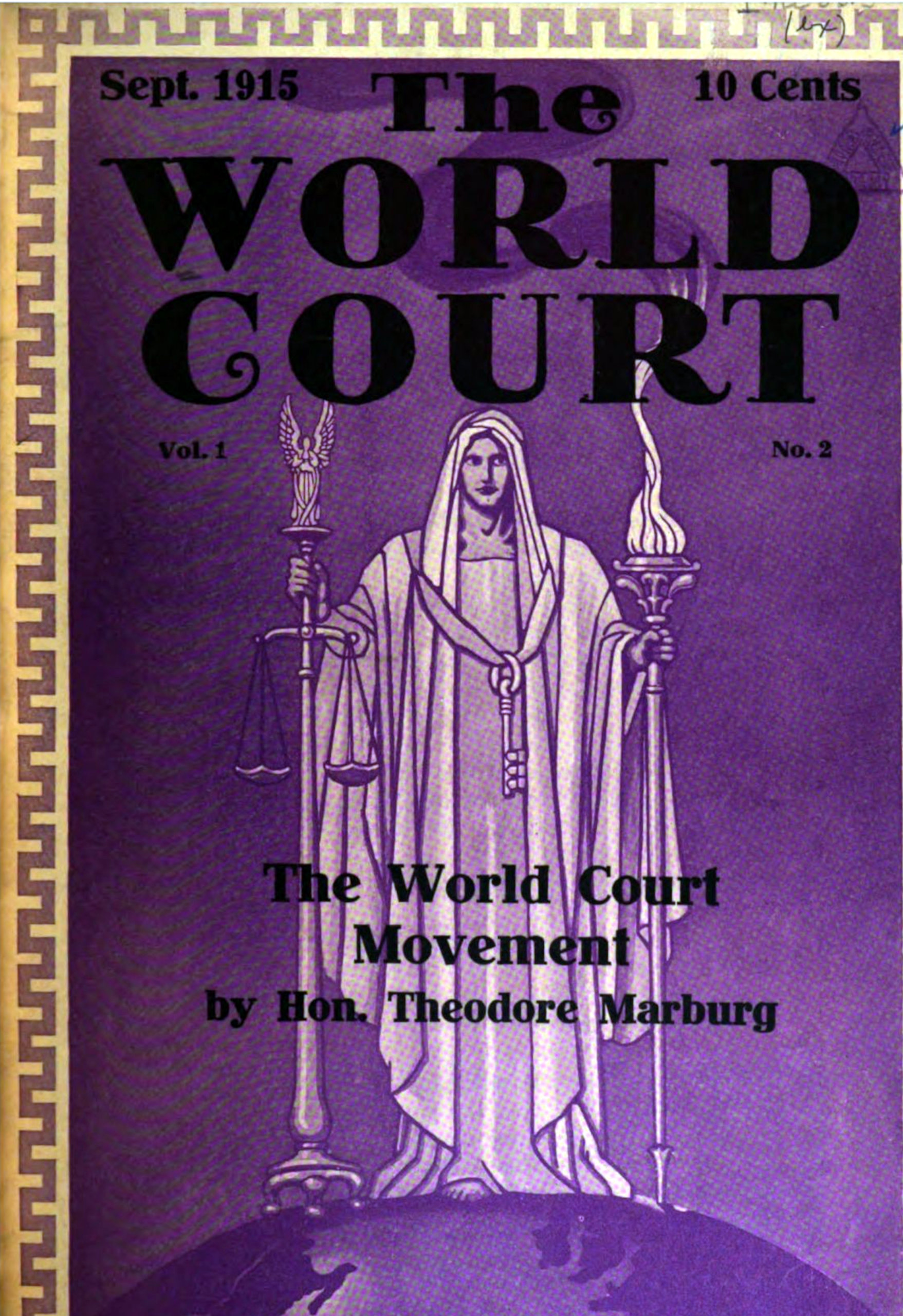
THE WORLD COURT MOVEMENT
The World Court idea is not new. It has been the thought of eminent men—scholars, churchmen, publicists, occasionally statesmen—at intervals for generations. Our own William Penn put forward in 1693 a plan to prevent wars. In 1795 the famous German philosopher, Immanuel Kant, published his essay on “Perpetual Peace,” a fundamental conception in which was that wars would not cease until all the governments of the world were democratic. The great English lawyer, Jeremy Bentham, whose speculations fertilized so many departments of law and social endeavor, likewise elaborated a plan. Other men at other times, before and since these, have turned their thoughts to this subject. In our own country we have had men such as Elihu Burritt (1810–79) and Charles Sumner (1811–74) who have influenced, not only the people of America, but of the whole world. The first peace society was formed in New York, 1815, followed by one in England the ensuing year. It was Burritt who organized the Brussels Congress of Friends of Peace in 1848 and this was followed by the important gatherings in Paris, Frankfurt, London, Manchester, and Edinburgh. The great congress in Paris (1849) was presided over by Victor Hugo. Then there burst upon the world a series of wars, beginning with the Crimean War and the war in Italy, followed by the Austro-Prussian War and the Franco-Prussian War, and the peace movement was stilled for a full generation. Presently, there came renewed interest. Men began to examine the records of peaceful settlement of disputes; they found hundreds of instances of successful arbitration, our country—direction having been given to it by the Jay Treaty—being distinctly a leader in this field. They found that the awards of the arbitral tribunals were uniformly respected, that it was not necessary to use force to execute the verdict.
It has been suggested that possibly one explanation of this fact is that the more acute questions, over which there was great popular feeling, were not submitted to arbitration. However this may be, the fact is that we had an unbroken record of the acceptance of the verdict of arbitral tribunals until within the last few years. The apparent exception in this record is the arbitration over the Canadian boundary between Great Britain and the United States. It was found that the arbitrator, the King of the Netherlands, had exceeded the terms of the “compromise”—the agreement under which the arbitration was submitted—and the award was set aside by mutual agreement of the two countries, so that this case can not really be looked upon as a refusal by the loser to accept the award.
Within the past few years we have seen arbitrations thrown down by three South American and Central American countries. I do not feel that this, either, is very significant, because of the character of the countries which brought about this break in the long and splendid record. Owing either to their undeveloped condition or to the nature of the people, or both, these countries are frequently unable to maintain law and order within their own borders and are at times either unwilling or unable to carry out the verdicts of an international tribunal. It would therefore seem unfair to let a valuable principle suffer because it has been disregarded by a people whose backward condition makes it unlikely in advance that they will prove equal to the task of living up to it.
74From this general criticism of the Latin-American countries must be excepted what are known as the “ABC” countries. Two of them, Argentine and Chile, enjoy a stable government. The stability of the other, Brazil, is less certain but still sufficient to place it among the progressive Powers of the world. This term, progressive Powers, I shall have occasion to use later and therefore should like to define it now. It is a mistake to follow the common disposition of the times and measure progress in terms of numbers—growth of population, pounds of steel, or yards of cotton turned out. Progress is to be sought in things other than the material, in the growth of the ethical, intellectual, and spiritual forces, above all, in justice: social justice, the justice of man to man, justice of employer to employe, justice of the State towards its people, justice written in the law, and justice of nation to nation.
Now, this recognition of the success of arbitration, combined with a realization of the unintelligent methods by which countries regulate their relations with each other, and above all the waste and danger of competition in armaments, led to the call for an international conference which met at The Hague in 1900. No progress whatever was made at the conference on the question of disarmament, for which primarily the conference was called. But there did emerge from it new institutions which were not looked for but which were a real gain to the world. I refer first of all to the Permanent Court of Arbitration, which you will remember has decided several difficult questions, among them the Casa Blanca affair between France and Germany, at one time quite acute. There emerged also an international Commission of Inquiry, which, in 1904, proved of the highest value. You will remember that the Russian Admiral Rodjesvensky, emerging from the Baltic, thought that he discovered an enemy in some innocent English fishermen. He attacked them sank a ship and killed several men. Now, in the minds of many men that incident might have led to war the next day—a generation before it would undoubtedly have led to war. But there happened to have been set up by the First Hague Conference this institution, the Commission of Inquiry. The question was referred to it and it was found that Rodjesvensky, however foolishly, still honestly believed he saw in these fishermen Japanese warships. Moreover time was given for national passion to subside. As a result there was no war between Russia and England and in the opinion of statesmen of the day, the fact that there was no war was due largely to the existence of this institution.
Then, too, at the First Hague Conference, Good Offices and Mediation were recognized for the first time as friendly functions. It was agreed that if a country should offer its good offices to two countries on the verge of war, or at war, this act should not be regarded as unwarranted interference but as a friendly act. It was under that institution, you will remember, that Mr. Roosevelt succeeded in bringing Japan and Russia together at Portsmouth and so terminating, earlier than would otherwise have been the case, the Russo-Japanese War. A second peace conference took place at The Hague in 1907. The task of improving the rules of war which had been begun at the First Conference was carried forward at the Second Conference. The Second Congress, moreover, adopted in fact an institution known as the International Court of Prize. Then it adopted in principle the Court of Arbitral Justice, intended to be a true international court of justice, composed of judges by profession, whose tenure should be permanent. This latter institution was to be brought into being through diplomatic channels as soon as the nations should agree upon the method of selecting the judges. The reason the court is not in existence to-day is that up to this time such a method of selecting the judges has not been found, and this is one of the subjects up for discussion this afternoon.
Now, why did the Second Hague Conference vote for this Court of Arbitral Justice when we already had in existence 75working successfully, the Permanent Court of Arbitration set up by the First Hague Conference? The reasons were several. In the first place, the Permanent Court of Arbitration was not a court of law. Its decisions were to be based upon the principles of law but at the same time its functions were those of arbitration, and, as you know, the main object of the arbitrator is to bring about the settlement of a dispute. That is to say, he is more interested in that, which often involves compromise, than he is in bringing out the true justice of the case which would tend to develop the principles of law and enlarge accepted practice.
Now, those of us who believe in this true court of justice for the world feel that international law would be built up by it in two ways. First, it would grow through the decisions of the judges themselves in cases actually coming before them, the judge being governed by previous decisions of the Court—the way in which the great Common Law of England has grown. That process produces the most natural, healthy, sound, and permanent kind of law. Then it is felt that the existence of this court will invite the codification of certain spheres of law. An example in point is the way in which the provision for the International Court of Prize led to the London Conference of 1908–1909, at which the law of prize was codified. England declined to proceed with the project of the International Prize Court until that was done. Hitherto the law of prize has depended upon the interpretation each nation has placed upon it. One nation might set up as contraband that which another nation declined to accept as contraband. Questions of how long an enemy’s ship should be suffered to remain in a neutral port, whether merchantmen may lawfully be converted into armed cruisers after leaving home waters, and numerous similar questions, were differently answered by different countries. England said “we must know what we are undertaking.” Therefore, at her instance the conference met at London and evolved the London Convention which codifies the law of prize. When the present war began, Germany announced her willingness to accept the Convention. On the other hand, England, who had not yet ratified the Convention (owing to the opposition of the Lords), proceeded to modify it and proclaimed it in this modified form. France did the same. It was accepted in its original form by the United States Senate but not promulgated by the President, who took the position that the United States could not accept a convention in which several nations had introduced their own amendments not agreed to by all. But the history of the London Convention shows how the existence of an international court will invite the codification of certain spheres of international law. I use that term advisedly because it is a tremendous undertaking to codify the whole body of international law, nor is it certain that it is advisable so to do. It may become too rigid.
Now, that project of the Second Hague Conference, the Court of Arbitral Justice, was accepted by the forty-four nations participating in the conference. It was indorsed in 1912 by the Institute of International Law. It has been supported earnestly by all the Powers, including Germany, France, and England; and every lawyer, every man who feels what justice means, approves of it. There is no difference of opinion as to the desirability of putting it into effect. The name of the proposed court, the Court of Arbitral Justice, is misleading. The word “arbitral” does not belong there. It was put in because Germany insisted on its being there. The word “court” carries with it the idea of obligation. When a court in municipal law renders a decision, usually an obligation goes with it. Now, Germany was not ready for anything obligatory in international institutions; therefore her demand. But a true court of justice is none the less provided for by the convention. From time to time for generations, isolated individuals have put forward the idea of such a court. The present 76movement to create it was really born in the mind of a man who sits upon this platform, James Brown Scott. He was connected with the Department of State under Mr. Root, and, as Mr. Root himself expressed it, he talked with Mr. Root once too often about this court. The result was that the American delegation to the Second Hague Conference went there with instructions from Mr. Root to establish the court if possible. Mr. Scott took an active part in drawing up the convention relating to the court and has been an earnest worker in the cause ever since. He has gotten a lot of us interested in it and may be said to be the father of the modern project.
In 1910 we formed a society known as the American Society for Judicial Settlement of International Disputes to promote this court.
The society has had four annual meetings, the proceedings of which have appeared in four substantial volumes. Besides, it publishes a quarterly usually limited to one article on the subject by some prominent man. The Proceedings have been translated, have been liberally quoted by foreign publicists, and have made a profound impression upon public opinion not only here but in other countries. The distinguished Foreign Minister of The Netherlands, Jonkheer Loudon, said we had demonstrated the feasibility and the necessity for this world court.
The Proceedings and the papers in the Quarterly published by the society have been of a scientific character designed to examine the project and to expose the principles which should guide the founders of the court and govern the court itself when established. But Mr. John Hays Hammond, an ex-president of the society, was not satisfied that this project should remain in the academic stage. He conceived the idea, with Dr. John Wesley Hill, of a public propaganda in the United States in favor of it. We have had several meetings in the West, a very large one in Akron, and a number in the East, all of which culminated in The World Court Congress held May 12, 1915, in Cleveland, Ohio.
Now, conjointly with this project there is in the minds of many of us a desire to have the world go a step farther and introduce the element of obligation.
Mr. Hamilton Holt is one of the principal advocates of this latter idea, which is nothing less than a league of peace. The subject was put forward by him in September in The Independent. Then he came to me with the suggestion that we should have a public conference. We first got together a group of about twenty scientific men, professors of political science, of international law, of history, of economics, threw the subject into the arena and had it torn to pieces by them at three meetings held at the Century Club in New York. In this way was worked out what we regarded as a “desirable” plan. We then took this “desirable” plan and on April ninth, laid it before men of wide practical experience, including Mr. Taft and Mr. A. Lawrence Lowell, in order to ascertain how much of it was, in their opinion, a “realizable” project. It was found that they were not ready to accept as realizable the whole of the plan of the first group, which was practically this: a league of peace which shall bind its members to resort to a tribunal for the settlement of all disputes to which a member of the league may be a party, and obligate them to use force, if necessary, both, to bring the nation law-breaker into court and to execute the verdict of the court.
Now, when you introduce the element of force into your plan you find that the unanimity of opinion to which I have referred as applying to the Court of Arbitral Justice as at present proposed, and to similar purely voluntary institutions, no longer exists; that there is very great diversity of opinion as to whether force should be used against a nation under any circumstances. The reason for this diversity of opinion is the shortcomings of the leagues of the past. The Quadruple Alliance, the Grand Alliance, and the Holy Alliance, all formed immediately after the Napoleonic wars, were by no means wholly beneficial. The Holy Alliance set up between Prussia, Russia, and 77Austria in 1815, ostensibly to promote Christianity, but really to support dynasties and combat the democratic tendency of the times, operated in fact to suppress liberty in Hungary, in Italy, and in Spain. You will remember that it was the Holy Alliance acting through France as a mandatory which overthrew the liberal form of government in Spain and restored full autocratic powers to the king. Then there were the partial successes and many failures of the Concert of Europe. The Concert of Europe has done some good things. It smashed the Turkish fleet in 1827 and liberated Greece. It has prevented more than one Balkan war. It has improved the lot of the Armenians in Turkey. But it has had many failures, this present disastrous war the most conspicuous of them. Then there were these groups like the Triple Alliance and the Triple Entente, which, though set up for purposes of peace, have really given to the present war its broad character. All of us felt that owing to their existence, when war came again to Europe it must be a general war. The breaking out of war surprised many people; its extent surprised no one.
Manifestly, then, the first step in planning a league of peace is to find out why the leagues of the past have failed. I think the answer lies in one thing: the narrowness of the group composing the league, permitting of the triumph of selfish interests, permitting of collusion, the swapping of favors, and resulting in injustice and oppression. That is what men fear.
Now, many of us believe that if we can set up a league so broad as to include all the progressive nations, big and little, it will be permanent and successful. I have defined what I mean by the word progressive. Such a league would include the eight great nations of the world, among them the United States and Japan. It would include the secondary Powers of Europe—Switzerland, Norway and Sweden, Denmark, Belgium, such as it was and such as it will be again, Spain, Greece, and in fact, all the countries of Europe, with the possible exception of some of the Balkan States and the certain exception of Turkey. The “ABC” countries of South America would also be included. It would not include the backward countries, because we feel that the country which can not maintain law and order within its own borders would bring no strength to the league.
Now, we believe that such a group would be successful. In the first place, it would embrace three great nations with common political ideals—England, France, and the United States. I put our country last for reasons of politeness only. These three peoples feel that democratic government is no longer a passing phase of political experiment but a permanent fact in politics. Therefore they would cling together. Then you have in the group two great nations—Great Britain and the United States—who may be said to be satisfied territorially; you have the secondary Powers of Europe who have no disturbing ambitions and whose voice would be for reason and justice, so that we think that if we could get these states associated together in a league, substantial justice would emerge, just as substantial justice results from the united action of the forty-eight states composing the American Union.
Whether you believe this league is practical or not depends on your answer to that question: whether justice would emerge from its united action. Unless it does justice it can not endure. Unless it does justice we don’t want it: we don’t want oppression. Injustice within a country—persistent injustice—sooner or later brings war; if not civil war then foreign war, or both; just as gross injustice in the conduct of a war will draw into the struggle an ever widening circle of nations, because there are irresistible forces which insist that justice shall emerge finally in the world.
Now, it was not proposed that this league should itself pass upon disputes. All it would do is to insist that members, party to the league, or any nation having a dispute with a member of the league shall not resort to war. It may refer 78the disputants to existing institutions at The Hague or to other institutions to be hereafter set up. They shall be privileged to go on with their dispute indefinitely if they choose, but they may not resort to war. The United States, under this plan, would have been permitted to continue the Fisheries dispute with Great Britain, as it did, for three-quarters of a century without interference; but if either Great Britain or the United States had shown a disposition to resort to arms the league would have been invoked and would have used its combined forces to prevent aggression.
There are four ideas or stages in the conception. The first is simply a true court of justice to which nations may refer their disputes, if they see fit to do so. This is the court called for by The Hague Convention of 1907 under the name of the Court of Arbitral Justice. It is the court which the Judicial Settlement Society was organized to promote. It is the court which we are endeavoring to get realized—simply a voluntary institution. Now, why did the World Court Congress plan to confine its efforts, its propaganda, to this voluntary institution, free from any element of force? I repeat, it is because there is unanimity of opinion as to the desirability of the project. You find no objectors to it. Practically all the Governments of the world have endorsed it, peoples have endorsed it, experts and plain men have endorsed it. In other words, it is a realizable project.
Now, the second stage of the larger and more problematic project is a league in which the element of obligation enters to this extent, that the members of the league, if you call it such—parties to the treaty—should obligate themselves to resort to the court. At present there is no obligation embodied in The Hague Convention. Like all our other international institutions, it is there for the nations to use or not, as they like.
In the third stage, the element of obligation is extended to forcing the nations into court. That is to say, if war threatens, we say to the disputants, “You must refer this dispute to the court. We will not force you to carry out the award nor do you bind yourself to do so, but you must go into court and have a hearing.”
Now, many men have come to realize that publicity is three-quarters of the battle for justice. Very often simply bringing out the facts stops not only illegal practices, but also unjust practices not covered by the law, and does it without resort to a court or even to arbitration.
The fourth stage is enforcing the award admittedly giving rise to the danger of oppression unless you have all the progressive nations in the league so that substantial justice would result from its action. The meeting of April 9th, to which I have referred, was unwilling to accept the fourth stage of this plan, namely: enforcing the verdict. Men like Mr. Taft, with his wide experience, Mr. Lowell, who has made a study of governmental institutions, in fact all except two out of the twenty eminent and experienced men gathered at that meeting, were willing to adopt the first three stages of the plan as a “realizable” project, namely, the court, for which this convention stands, the obligations of the States to each other to go into court, and the obligation of the league to force the nation law-breaker into court if recalcitrant.
If there is no obligation on the part of the nation entering the court to abide by the verdict and the league itself will not enforce the verdict, surely no oppression can result from the demand for a hearing. It is a reasonable demand as applied to any controversy whatsoever, whether it be a justiciable controversy or a controversy arising out of a conflict of political policies. The league would simply act as an international grand jury to hale the nation law-breaker into court for a hearing. That is as far as the meeting of April 9th was willing to go, and that is the project, represented in the recent World Court Congress. By starting with this minor project we get something which is practicable and out of the minor project, the larger plan may grow of its own accord.