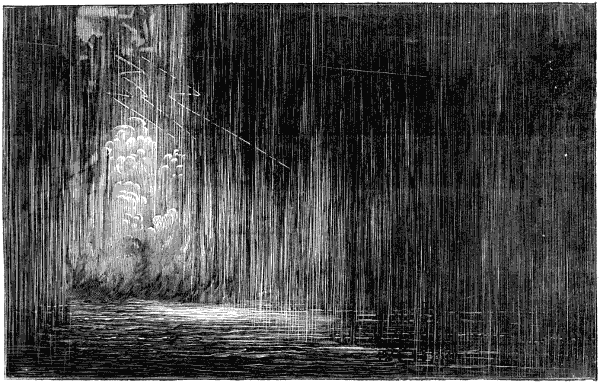
During the Primary Epoch our globe would appear to have been
chiefly appropriated to beings which lived in the waters—above all,
to the Crustaceans and Fishes; during the Secondary Epoch Reptiles
seem to have been its prevailing inhabitants. Animals of this class
assumed astonishing dimensions, and would seem to have multiplied
in a most singular manner; they were, apparently, the kings of the
earth. At the same time, however, that the animal kingdom thus
developed itself, the vegetation lost much of its importance.
Geologists have agreed among themselves to divide the Secondary
epoch into three periods: 1, the Cretaceous; 2, the Jurassic; 3, the
Triassic—a division which it is convenient to adopt.
This period has received the name of Triassic because the rocks
of which it is composed, which are more fully developed in Germany
than either in England or France, were called the Trias (or Triple
Group), by German writers, from its division into three groups, as
follows, in descending order:—
| England. |
|
France. |
|
Germany. |
| Saliferous and gypseous shales and sandstone |
|
– |
Marnes irisées |
– |
|
Keuper. 1,000 feet. |
| Wanting |
|
– |
Muschelkalk or Calcaire coquillier |
– |
|
Muschelkalk. 600 feet. |
| Sandstone and quartzose conglomerate |
|
– |
Grès bigarré |
– |
|
Bunter-Sandstein. 1,500 ft. |
The following has been shown by Mr. Ed. Hull to be the general
succession of the Triassic formation in the midland and north-western
counties of England, where it attains its greatest vertical
development, thinning away in the direction of the mouth of the
Thames:—
[186]
| |
Foreign Equivalents. |
TRIASSIC
SERIES. |
– |
|
New Red Marl. |
|
Red and grey shales and marls, sometimes micaceous, with beds of rock-salt and gypsum, containing
Estheria and Foraminifera (Chellaston). |
|
Keuper. |
Marnes irisées. |
| |
| Lower Keuper Sandstone. |
|
Thinly-laminated micaceous sandstones and marls (waterstones); passing downwards into white, brown,
or reddish sandstone, with a base of calcareous conglomerate or breccia. |
|
Letten Kohle (?) |
„ |
| |
| Wanting in England. |
|
... |
|
Muschelkalk. |
Calcaire coquillier. |
| |
| Upper Mottled Sandstone. |
|
Soft, bright-red and variegated sandstone (without pebbles). |
|
– |
Bunter Sandstein. |
Grès bigarré, or Grès des Vosges (in part). |
| |
| Pebble Beds. |
|
Harder reddish-brown sandstones with quartzose pebbles, passing into conglomerate; with a base of
calcareous breccia. |
| |
| Lower Mottled Sandstone. |
|
Soft bright-red and variegated sandstone (without pebbles). |
| |
PERMIAN
SERIES. |
– |
|
Upper Permian. |
|
Red marls, with thin-bedded fossiliferous limestones (Manchester). |
|
Zechstein. |
|
| |
| Lower |
– |
|
Red and variegated sandstone (Collyhurst, Manchester) represented by [...]. |
|
– |
Rothe-todte-liegende. |
Grès des Vosges (in part). |
| |
| Reddish-brown and purple sandstones and marls, with calcareous conglomerates and trappoid breccia.
(Central counties). |
[187]
In this new phase of the revolutions of the globe, the animated
beings on its surface differ much from those which belonged to the
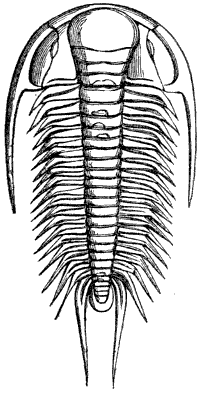
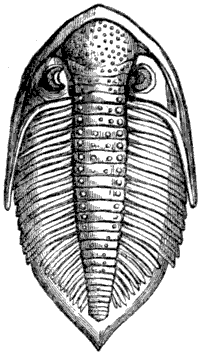
Primary epoch. The curious Crustaceans which we have described
under the name of Trilobites have disappeared; the molluscous
Cephalopods and Brachiopods are here few in number, as are the
Ganoid and Placoid Fishes, whose existence also seems to have
terminated during this period, and vegetation has undergone analogous
changes. The cryptogamic plants, which reached their maximum
in the Primary epoch, become now less numerous, while the
Conifers experienced a certain extension. Some kinds of terrestrial
animals have disappeared, but they are replaced by genera as
numerous as new. For the first time the Turtle appears in the
bosom of the sea, and on the borders of lakes. The Saurian reptiles
acquire a great development; they prepare the way for those enormous
Saurians, which appear in the following period, whose skeletons
present such vast proportions, and such a strange aspect, as to strike
with astonishment all who contemplate their gigantic, and, so to speak,
awe-inspiring remains.
The Variegated Sandstone, or Bunter, contains many vegetable,
but few animal, remains, although we constantly find imprints of the
footsteps of the Labyrinthodon.
The lowest Bunter formation shows itself in France, in the
Pyrenees, around the central plateau in the Var, and upon both
flanks of the Vosges mountains. It is represented in south-western
and central Germany, in Belgium, in Switzerland, in Sardinia, in
Spain, in Poland, in the Tyrol, in Bohemia, in Moravia, and in Russia.
M. D’Orbigny states, from his own observation, that it covers vast
surfaces in the mountainous regions of Bolivia, in South America. It
is recognised in the United States, in Columbia, in the Great Antilles,
and in Mexico.
The Bunter in France is reduced to the variegated sandstone,
except around the Vosges, in the Var, and the Black Forest, where it
is accompanied by the Muschelkalk. In Germany it furnishes
building-stone of excellent quality; many great edifices, in particular
the cathedrals, so much admired on the Rhine—such, for example,
as those of Strasbourg and Fribourg—are constructed of this stone,
the sombre tints of which singularly relieve the grandeur and majesty
of the Gothic architecture. Whole cities in Germany are built of the
brownish-red stones drawn from its mottled sandstone quarries. In
England, in Scotland, and in Ireland this formation extends from
north to south through the whole length of the country. “This old
land,” says Professor Ramsay,[54] “consisted in great part of what we
now know as Wales, and the adjacent counties of Hereford, Monmouth,
and Shropshire; of part of Devon and Cornwall, Cumberland,
the Pennine chain, and all the mountainous parts of Scotland.
Around old Wales, and part of Cumberland, and probably all round
and over great part of Devon and Cornwall, the New Red Sandstone
was deposited. Part, at least, of this oldest of the Secondary rocks
was formed of the material of the older Palæozoic strata, that had then
risen above the surface of the water. The New Red Sandstone series
consists in its lower members of beds of red sandstone and conglomerate,
more than 1,000 feet thick, and above them are placed red
and green marls, chiefly red, which in Germany are called the Keuper
strata, and in England the New Red Marl. These formations
range from the mouth of the Mersey, round the borders of Wales,
to the estuary of the Severn, eastwards into Warwickshire, and
thence northwards into Yorkshire and Northumberland, along the
eastern border of the Magnesian Limestone. They also form the
bottom of the valley of the Eden, and skirt Cumberland on the west;
in the centre of England the unequal hardness of its sub-divisions
sometimes giving rise to minor escarpments, overlooking plains and
undulating grounds of softer strata.”
“Different members of the group rest in England, in some region
or other,” says Lyell, “on almost every principal member of the
Palæozoic series, on Cambrian, Silurian, Devonian, Carboniferous,
and Permian rocks; and there is evidence everywhere of disturbance,
contortion, partial upheaval into land, and vast denudations which
the older rocks underwent before and during the deposition of the
successive strata of the New Red Sandstone group.” (“Elements of
Geology,” p. 439.)
The Muschelkalk consists of beds of compact limestone, often
greyish, sometimes black, alternating with marl and clay, and commonly
containing such numbers of shells that the name of shelly
limestone (Muschelkalk) has been given to the formation by the
Germans. The beds are sometimes magnesian, especially in the
lower strata, which contain deposits of gypsum and rock-salt.
The seas of this sub-period, which is named after the innumerable
masses of shells inclosed in the rocks which it represents, included,
besides great numbers of Mollusca, Saurian Reptiles of twelve different
genera, some Turtles, and six new genera of Fishes clothed with a
cuirass. Let us pause at the Mollusca which peopled the Triassic
seas.
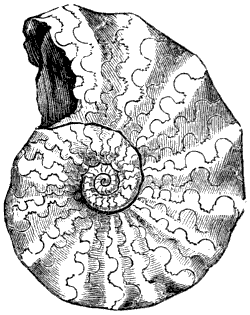
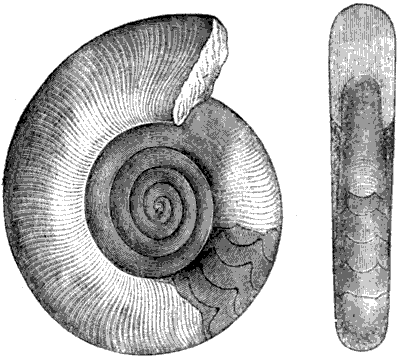
Fig. 81.—Ceratites nodosus.
(Muschelkalk.)
Among the shells characteristic of the Muschelkalk period, we
mention Natica Gaillardoti, Rostellaria antiqua, Lima striata, Avicula
socialis, Terebratula vulgaris, Turbonilla dubia, Myophoria vulgaris,
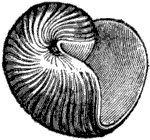
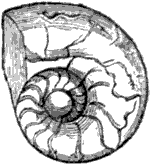
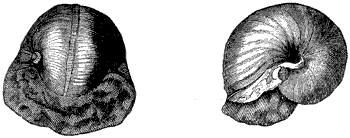
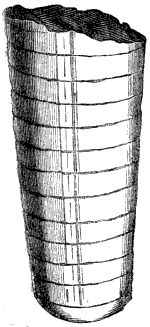
Nautilus hexagonalis, and Ceratites nodosus. The Ceratites, of which
a species is here represented (Fig. 81), form a genus closely allied to
the Ammonites, which seem to have
played such an important part in the
ancient seas, but which have no existence
in those of our era, either in
species or even in genus. This Ceratite
is found in the Muschelkalk of
Germany, a formation which has no
equivalent in England, but which is a
compact greyish limestone underlying
the saliferous rocks in Germany, and
including beds of dolomite with gypsum
and rock-salt.
The Mytilus or Mussel, which properly
belonged to this age, are acephalous
(or headless) Molluscs with
elongated triangular shells, of which
there are many species found in our
existing seas. Lima, Myophoria, Posidonia,
and Avicula, are acephalous
Molluscs of the same period. The two genera Natica and Rostellaria
belong to the Gasteropoda, and are abundant in the Muschelkalk
in France, Germany, and Poland.
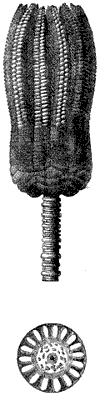
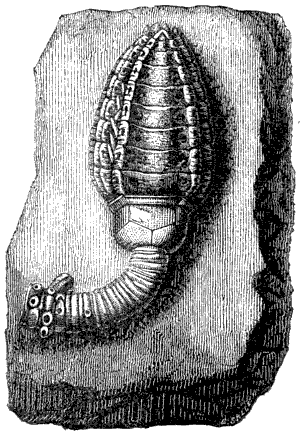
Fig. 82.—Encrinus
liliiformis.
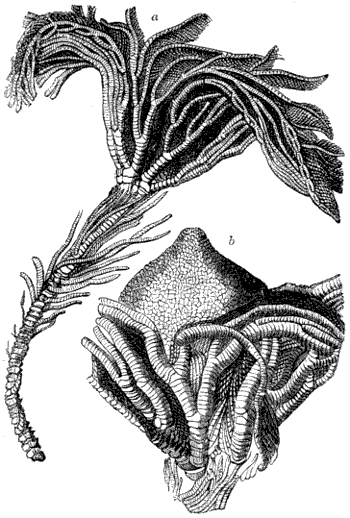
Among the Echinoderms belonging to this period may be mentioned
Encrinus moniliformis and E. liliiformis, or lily encrinite
(Fig. 82), whose remains, constituting in some localities whole beds
of rock, show the slow progress with which this zoophyte formed beds
of limestone in the clear seas of the period. To these may be added,
among the Mollusca, Avicula subcostata and Myophoria vulgaris.
In the Muschelkalk are found the skull and teeth of Placodus
gigas, a reptile which was originally placed by Agassiz among the class
of Fishes; but more perfect specimens have satisfied Professor Owen
that it was a Saurian Reptile.
It may be added, that the presence of a few genera, peculiar to
the Primary epoch, which entirely disappeared during the sub-period,
and the appearance for the first time of some other animals peculiar
to the Jurassic period, give to the Muschelkalk fauna the appearance
of being one of passage from one period to the other.
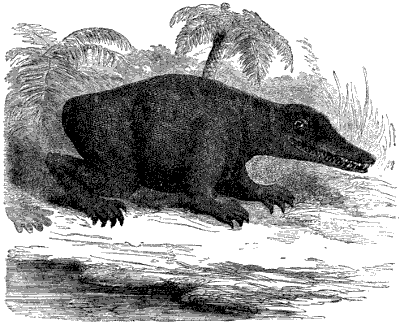
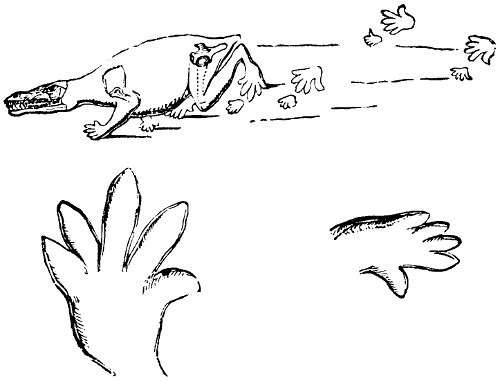
Fig. 83.—Labyrinthodon restored. One-twentieth natural size.
The seas, then, contained a few Reptiles,
probably inhabitants of the banks of rivers, as
Phytosaurus, Capitosaurus, &c., and sundry Fishes,
as Sphœrodus and Pycnodus. In this sub-period
we shall say nothing of the Land-Turtles, which
for the first time now appear; but, we should
note, that at the Bunter period a gigantic Reptile
appears, on which the opinions of geologists were
for a long while at variance. In the argillaceous
rocks of the Muschelkalk period imprints of the
foot of some animal were discovered in the sandstones
of Storeton Hill, in Cheshire, and in the
New Red Sandstone of parts of Warwickshire,
as well as in Thuringia, and Hesseburg in Saxony,
which very much resembled the impression that
might be made in soft clay by the outstretched
fingers and thumb of a human hand. These
traces were made by a species of Reptile furnished
with four feet, the two fore-feet being much broader
than the hinder two. The head, pelvis, and scapula
only of this strange-looking animal have been
found, but these are considered to have belonged
to a gigantic air-breathing reptile closely connected
with the Batrachians. It is thought that
the head was not naked, but protected by a bony
cushion; that its jaws were armed with conical
teeth, of great strength and of a complicated structure.
This curious and uncouth-looking creature,
of which the woodcut Fig. 83 is a restoration,
has been named the Cheirotherium, or Labyrinthodon,
from the complicated arrangement of the
cementing layer of the teeth. (See also Fig. 1, p. 12.)
Another Reptile of great dimensions—which would seem to have
been intended to prepare the way for the appearance of the enormous
Saurians which present themselves in the Jurassic period—was the
Nothosaurus, a species of marine Crocodile, of which a restoration
has been attempted in Plate XIII. opposite.
[191]
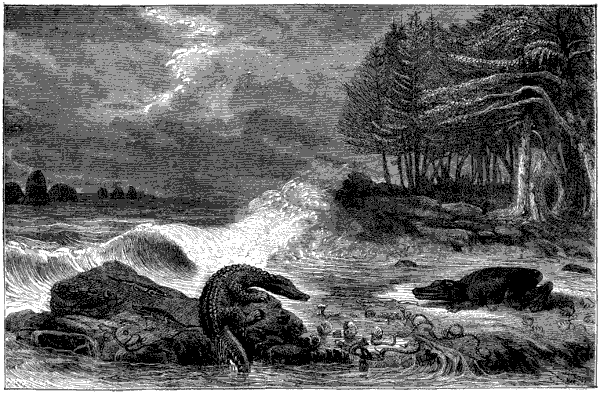
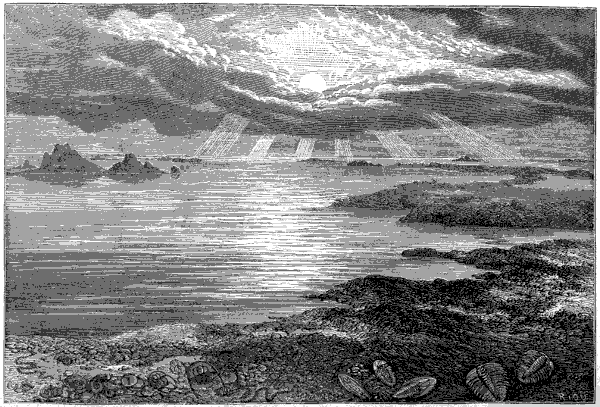
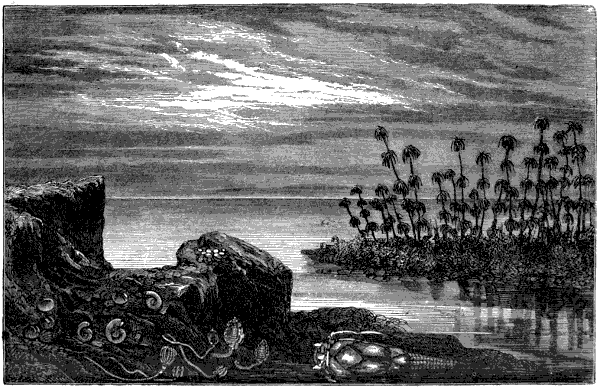
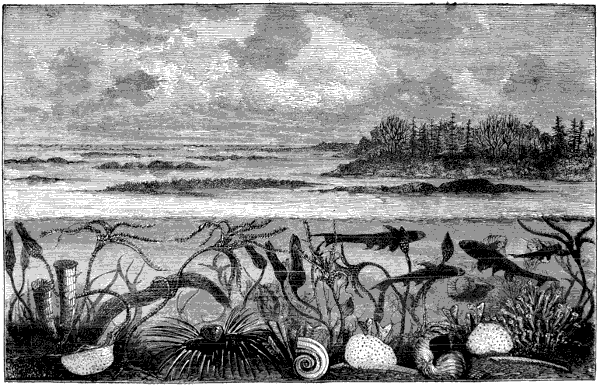
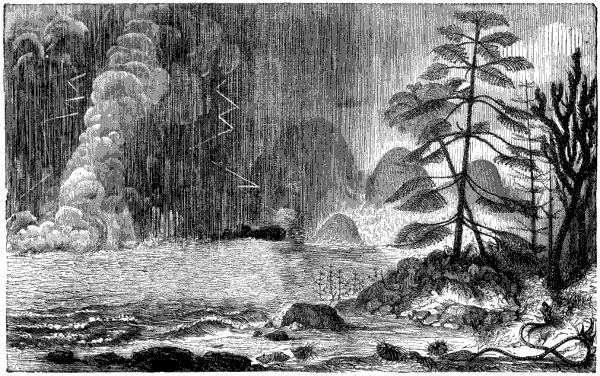
XIII.—Ideal Landscape of the Muschelkalk Sub-period.
It has been supposed, from certain impressions which appear in
the Keuper sandstones of the Connecticut river in North America,
that Birds made their appearance in the period which now occupies
us; the flags on which these occur by thousands show the tracks of
an animal of great size (some 20 inches long and 41⁄2 feet apart),
presenting the impression of three toes, like some of the Struthionidæ
or Ostriches, accompanied by raindrops. No remains of the skeletons
of birds have been met with in rocks of this period, and the footprints
in question are all that can be alleged in support of the
hypothesis.
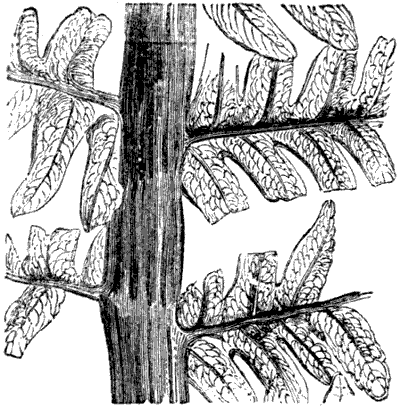
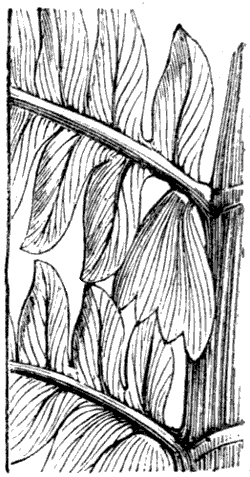
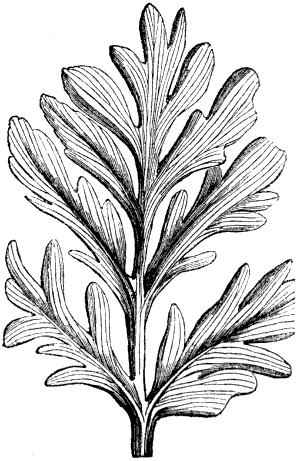
M. Ad. Brongniart places the commencement of dicotyledonous
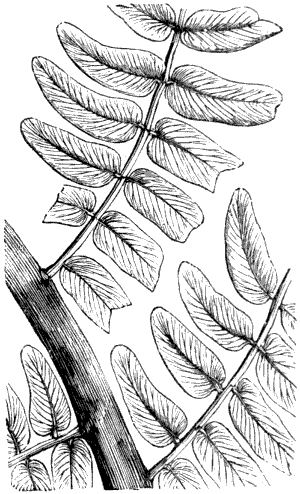
gymnosperm plants in this age. The characteristics of this Flora
consist in numerous Ferns, constituting genera now extinct, such as
Anomopteris and Crematopteris. The true Equiseta are rare in it. The
Calamites, or, rather, the Calamodendra, abound. The gymnosperms
are represented by the genera Conifer, Voltzia, and Haidingera,
of which both species and individuals are very numerous in the
formation of this period.
Among the species of plants which characterise this formation, we
may mention Neuropteris elegans, Calamites arenaceus, Voltzia heterophylla,
Haidingera speciosa. The Haidingera, belonging to the
tribe of Abietinæ, were plants with large leaves, analogous to those
of our Damara, growing close together, and nearly imbricated, as
in the Araucaria. Their fruit, which are cones with rounded scales,
are imbricated, and have only a single seed, thus bearing out the
strong resemblance which has been traced between these fossil plants,
and the Damara.
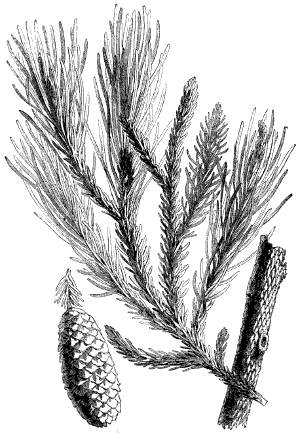
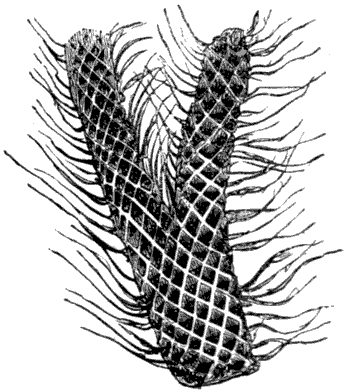
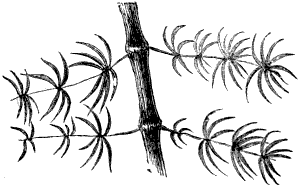
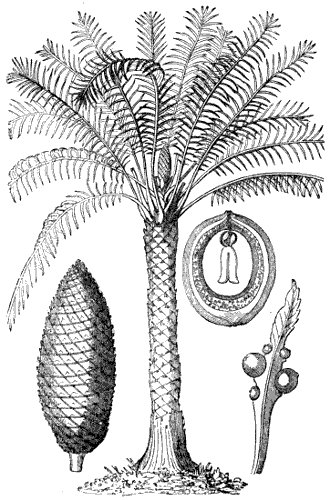
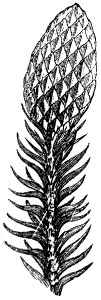
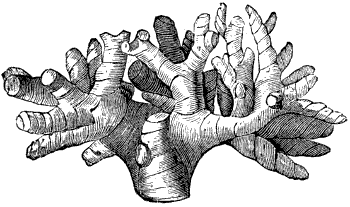
Fig. 84.—Branch and cone of Voltzia restored.
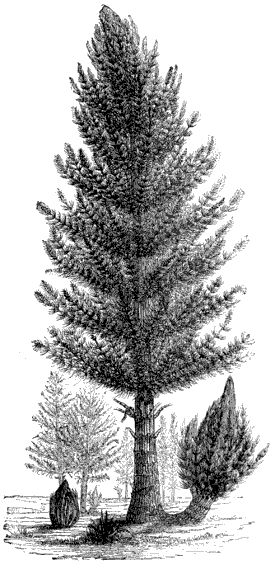
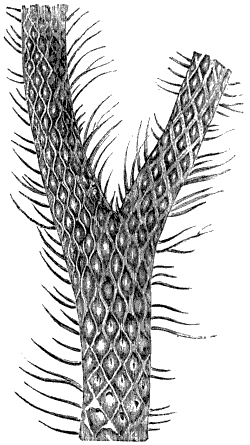
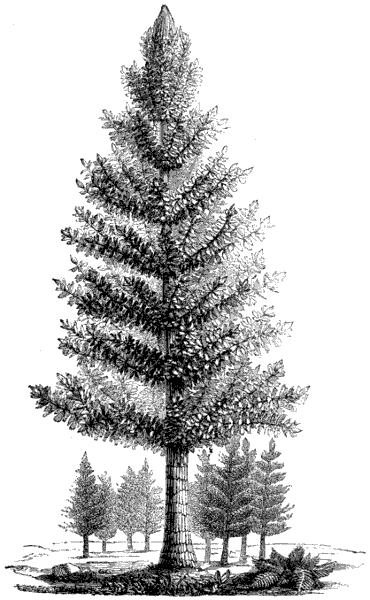
The Voltzias (Fig. 84), which seem to have formed the greater
part of the forests were a genus of Cupressinaceæ, now extinct,
which are well characterised among the fossil Conifers of the period.
The alternate spiral leaves, forming five to eight rows sessile, that is,
sitting close to the branch and drooping, have much in them analogous
to the Cryptomerias. Their fruit was an oblong cone with scales,
loosely imbricated, cuneiform or wedge-shaped, and, commonly,
composed of from three to five obtuse lobes. In Fig. 84 we have a
part of the stem, a branch with leaves and cone. In his “Botanic
Geography,” M. Lecoq thus describes the vegetation of the ancient
world in the first period of the Triassic age: “While the variegated
sandstone and mottled clays were being slowly deposited in regular
beds by the waters, magnificent Ferns still exhibited their light and
elegantly-carved leaves. Divers Protopteris and majestic Neuropteris
associated themselves in extensive forests, where vegetated also the
Crematopteris typica of Schimper, the Anomopteris Mongeotii of Brongniart,
and the pretty Trichomanites myriophyllum (Göppert). The Conifers
of this epoch attain a very considerable development, and would
form graceful forests of green trees. Elegant monocotyledons, representing
the forms of tropical countries, seem to show themselves for
the first time, the Yuccites Vogesiacus of Schimper constituted groups
at once thickly serried and of great extent.
“A family, hitherto doubtful, appears under the elegant form of
Nilssonia Hogardi, Schimp.; Ctenis Hogardi, Brongn. It is still
seen in the Zamites Vogesiacus, Schimp.; and the group of the
Cycads sharing at once in the organisation of the Conifers and the
elegance of the Palms, now decorate the earth, which reveals in these
new forms its vast fecundity. (See Fig. 72, p. 168.)
“Of the herbaceous plants which formed the undergrowth of the
forests, or which luxuriated in its cool marshes, the most remarkable is
the Ætheophyllum speciosum, Schimp. Their organisation approximates
to the Lycopodiaceæ and Thyphaceæ, the Ætheophyllum stipulare,
Brongn., and the curious Schizoneura paradoxa, Schimp. Thus we
can trace the commencement of the reign of the Dicotyledons with
naked seeds, which afterwards become so widely disseminated, in a
few Angiosperms, composed principally of two families, the Conifers
and Cycadeaceæ, still represented in the existing vegetation. The
former, very abundant at first, associated themselves with the cellular
Cryptogams, which still abound, although they are decreasing, then
with the Cycadeaceæ, which present themselves slowly, but will soon
be observed to take a large part in the brilliant harmonies of the
vegetable kingdom.”
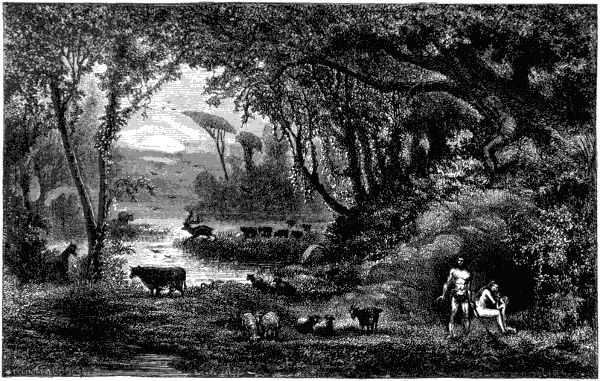
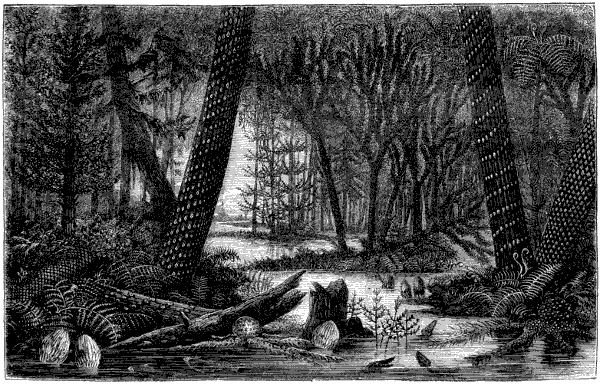
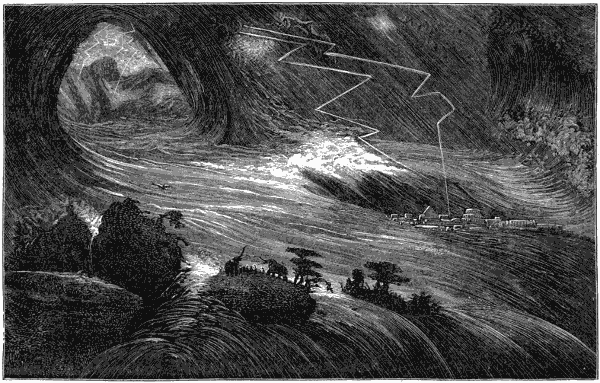
The engraving at page 191 (Plate XIII.) gives an idealised
picture of the plants and animals of the period. The reader must
imagine himself transported to the shores of the Muschelkalk sea at
a moment when its waves are agitated by a violent but passing storm.
The reflux of the tide exposes some of the aquatic animals of the
period. Some fine Encrinites are seen, with their long flexible
stems, and a few Mytili and Terebratulæ. The Reptile which
occupies the rocks, and prepares to throw itself on its prey, is the
Nothosaurus. Not far from it are other reptiles, its congeners, but of
a smaller species. Upon the dune on the shore is a fine group of
the trees of the period, that is, of Haidingeras, with large trunks,
with drooping branches and foliage, of which the cedars of our
own age give some idea. The elegant Voltzias are seen in the
second plane of this curtain of verdure. The Reptiles which lived in
these primitive forests, and which would give to it so strange a character,
are represented by the Labyrinthodon, which descends
towards the sea on the right, leaving upon the sandy shore those
curious tracks which have been so wonderfully preserved to our
days.
The footprints of the reptilian animals of this period prove that
they walked over moist surfaces; and, if these surfaces had been
simply left by a retiring tide, they would generally have been obliterated
by the returning flood, in the same manner that is seen every
day on our own sandy shores. It seems more likely that the surfaces,
on which fossil footprints are now found, were left bare by the summer
evaporation of a lake; that these surfaces were afterwards dried by
the sun, and the footprints hardened, so as to ensure their preservation,
before the rising waters brought by flooded muddy rivers again
submerged the low flat shores and deposited new layers of salt, just
as they do at the present day round the Dead Sea and the Salt Lake
of Utah.
[198]
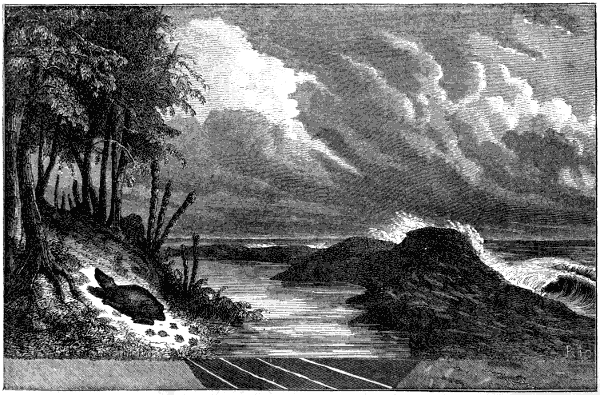
XIV.—Ideal Landscape of the Keuper Sub-period.
[199]
The formation which characterises the Keuper, or saliferous
period, is of moderate extent, and derives the latter name from the
salt deposits it contains.
These rocks consist of a vast number of argillaceous and marly
beds, variously coloured, but chiefly red, with tints of yellow and
green. These are the colours which gave the name of variegatea
(Poikilitic) to the series. The beds of red marl often alternate with
sandstones, which are also variegated in colour. As subordinate
rocks, we find in this formation some deposits of a poor pyritic coal
and of gypsum. But what especially characterises the formation are
the important deposits of rock-salt which are included in it. The
saliferous beds, often twenty-five to forty feet thick, alternate with
beds of clay, the whole attaining a thickness of 160 yards. In Germany
in Würtemberg, in France at Vic, at Dieuze, and at Château-Salins,
the rock-salt of the saliferous formation has become an
important branch of industry. In the Jura, salt is extracted from
the water charged with chlorides, which issues from this formation.
Some of these deposits are situated at great depths, and cannot be
reached without very considerable labour. The salt-mines of Wieliczka,
in Poland, for example, can be procured on the surface, or by
galleries of little depth, because the deposit belongs to the Tertiary
period; but the deposits of salt, in the Triassic age, lie so much
deeper, as to be only approachable by a regular process of mining by
galleries, and the ordinary mode of reaching the salt is by digging
pits, which are afterwards filled with water. This water, charged
with the salt, is then pumped up into troughs, where it is evaporated,
and the crystallised mineral obtained.
What is the origin of the great deposits of marine salt which occur
in this formation, and which always alternate with thin beds of clay
or marl? We can only attribute them to the evaporation of vast
quantities of sea-water introduced into depressions, cavities, or gulfs,
which the sandy dunes afterwards separated from the great open sea.
In Plate XIV. an attempt is made to represent the natural fact, which
must have been of frequent recurrence during the saliferous period,
to form the considerable masses of rock-salt which are now found in
the rocks of the period. On the right is the sea, with a dune of
considerable extent, separating it from a tranquil basin of smooth
water. At intervals, and from various causes, the sea, clearing the
dune, enters and fills the basin. We may even suppose that a gulf
exists here which, at one time, communicated with the sea; the winds
having raised this sandy dune, the gulf becomes transformed, by degrees,
into a basin or back-water, closed on all sides. However that may
be, it is pretty certain that if the waters of the sea were once shut up
in this basin, with an argillaceous bottom and without any opening,
evaporation from the effects of solar heat would take place, and a bed
of salt would be the result of this evaporation, mixed with other
mineral salts which accompany chloride of sodium in sea-water, such
as sulphate of magnesia, chloride of potassium, &c. This bed of salt,
left by the evaporation of the water, would soon receive an argillaceous
covering from the clay and silt suspended in the muddy
water of the basin, thus forming a first alternation of salt and of
clay or marl. The sea making fresh breaches across the barriers,
the same process took place with a similar result, until the basin was
filled up. By the regular and tranquil repetition of this phenomenon,
continued during a long succession of ages, this abundant deposit
of rock-salt has been formed, which occupies so important a position
in the Secondary rocks.
There is in the delta of the Indus a singular region, called the
Runn of Cutch, which extends over an area of 7,000 square
miles, which is neither land nor sea, but is under water during the
monsoons, and in the dry season is incrusted, here and there, with
salt about an inch thick, the result of evaporation. Dry land has
been largely increased here, during the present century, by subsidence
of the waters and upheavals by earthquakes. “That successive
layers of salt may have been thrown down one upon the other
on many thousand square miles, in such a region, is undeniable,”
says Lyell. “The supply of brine from the ocean is as inexhaustible
as the supply of heat from the sun. The only assumption required
to enable us to explain the great thickness of salt in such an area, is
the continuance for an indefinite period of a subsidence, the country
preserving all the time a general approach to horizontally.” The
observations of Mr. Darwin on the atolls of the Pacific, prove that
such a continuous subsidence is probable. Hugh Miller, after ably
discussing various spots of earth where, as in the Runn of Cutch,
evaporation and deposit take place, adds: “If we suppose that,
instead of a barrier of lava, sand-bars were raised by the surf on a
flat arenaceous coast, during a slow and equable sinking of the surface,
the waters of the outer gulf might occasionally topple over the
bar and supply a fresh brine when the first stock had been exhausted
by evaporation.”
Professor Ramsay has pointed out that both the sandstones and
marls of the Triassic epoch were formed in lakes. In the latter part
of this epoch, he is of opinion, that the Keuper marls of the British
Isles were deposited in a large lake, or lakes, which were fresh or
brackish at first, but afterwards salt and without outlets to the sea;
and that the same was occasionally the case with regard to other
portions of northern Europe and its adjoining seas.
By the silting up of such lakes with sediment, and the gradual
evaporation of their waters under favourable conditions, such as
increased heat and diminished rainfall—where the lakes might cease
to have an outflow into the sea and the loss of water by evaporation
would exceed the amount flowing into them—the salt or salts contained
in solution would, by degrees, become concentrated and finally
precipitated. In this way the great deposits of rock-salt and gypsum,
common in the Keuper formation, may be accounted for.
Subsequently, by increase of rainfall or decrease of heat, and
sinking of the district, the waters became comparatively less salt
again; and a recurrence of such conditions lasted until the close of
the Keuper period, when a partial influx of the sea took place, and
the Rhætic beds of England were deposited.
The red colour of the New Red Sandstones and marls is caused by
peroxide of iron, which may also have been carried into the lakes in
solution, as a carbonate, and afterwards converted into peroxide by
contact with air, and precipitated as a thin pellicle upon the sedimentary
grains of sandy mud, of which the Triassic beds more or less
consist. Professor Ramsay further considers that all the red-coloured
strata of England, including the Permian, Old Red Sandstone, and
even the Old Cambrian formation, were deposited in lakes or inland
waters.[55]
There is little to be said of the animals which belong to the
Saliferous period. They are nearly the same as those of the Muschelkalk,
&c.
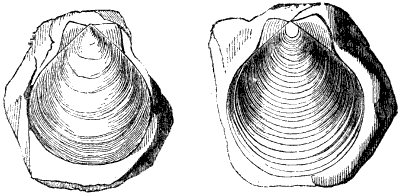
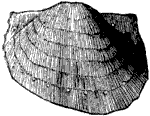
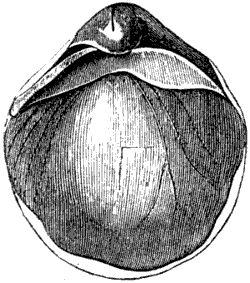
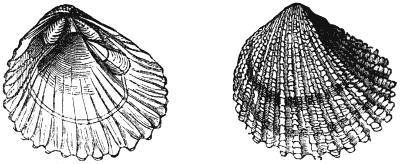
Fig. 85.—Pecten orbicularis.
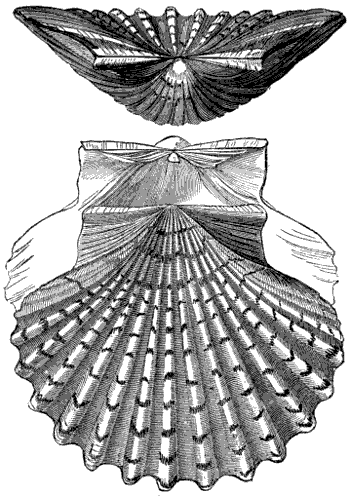
Among the most abundant of the shells belonging to the upper
Trias, in all the countries where it has been examined, are the Avicula,
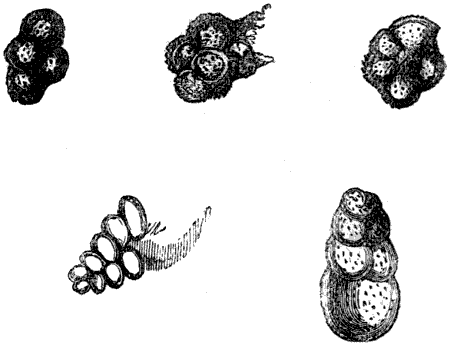
Cardium, and Pecten, one of which is given in Fig. 85. Foraminifera
are numerous in the Keuper marls. The remains of land-plants, and
the peculiarities of some of the reptiles of the Keuper period, tend to
confirm the opinion of Professor Ramsay, that the strata were
deposited in inland salt-lakes.
In the Keuper period the islands and continents presented few
mountains; they were intersected here and there by large lakes, with
flat and uniform banks. The vegetation on their shores was very
abundant, and we possess its remains in great numbers. The Keuper
Flora was very analogous to those of the Lias and Oolite, and consisted
of Ferns, Equisetaceæ, Cycads, Conifers, and a few plants,
which M. Ad. Brongniart classes among the dubious monocotyledons.
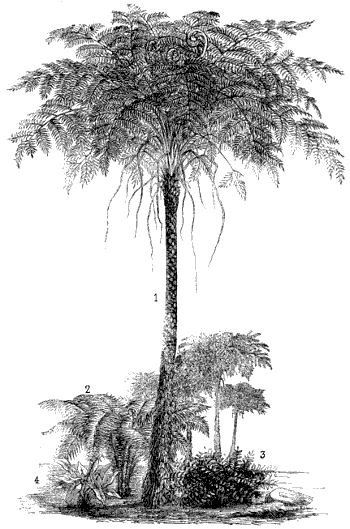
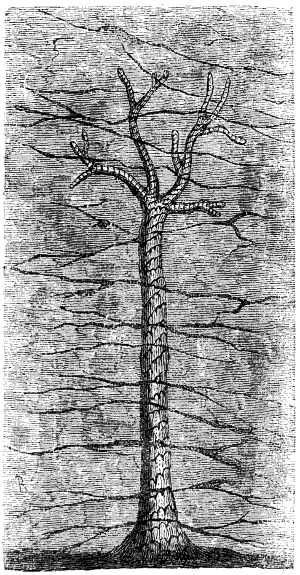
Among the Ferns may be quoted many species of Sphenopteris or
Pecopteris. Among them, Pecopteris Stuttgartiensis, a tree with
channelled trunk, which rises to a considerable height without throwing
out branches, and terminates in a crown of leaves finely cut and
with long petioles; the Equisetites columnaris, a great Equisetum
analogous to the horse-tails of our age, but of infinitely larger dimensions,
its long fluted trunk, surmounted by an elongated fructification,
towering over all the other trees of the marshy soil.
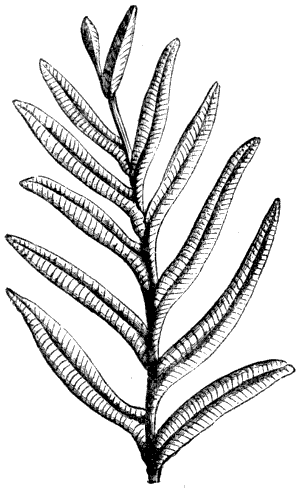
The Pterophyllum Jägeri and P. Münsteri represented the Cycads,
the Taxodites Münsterianus represented the Conifers, and, finally,
the trunk of the Calamites was covered with a creeping plant, having
elliptical leaves, with a re-curving nervature borne upon its long
petioles, and the fruit disposed in bunches; this is the Preissleria
antiqua, a doubtful monocotyledon, according to Brongniart, but M.
Unger places it in the family of Smilax, of which it will thus be the
earliest representative. The same botanist classes with the canes a
marsh-plant very common in this period, the Palæoxyris Münsteri,
which Brongniart classes with the Preissleria among his doubtful
Monocotyledons.
The vegetation of the latter part of the Triassic period is thus
characterised by Lecoq, in his “Botanical Geography”: “The cellular
Cryptogameæ predominate in this as they do in the Carboniferous
epoch, but the species have changed, and many of the genera also are
different; the Cladephlebis, the Sphenopteris, the Coniopteris, and
Pecopteris predominate over the others in the number of species.
The Equisetaceæ are more developed than in any other formation.
One of the finest species, the Calamites arenaceus of Brongniart,
must have formed great forests. The fluted trunks resemble immense
columns, terminating at the summit in leafy branches, disposed in
graceful verticillated tufts, foreshadowing the elegant forms of Equisetum
sylvaticum. Growing alongside of these were a curious Equisetum
and singular Equisetites, a species of which last, E. columnaris,
raised its herbaceous stem, with its sterile articulations, to a great
height.
“What a singular aspect these ancient rocks would present, if we
add to them the forest-trees Pterophyllum and the Zamites of the fine
family of Cycadeaceæ, and the Conifers, which seem to have made
their appearance in the humid soil at the same time!
“It is during this epoch, while yet under the reign of the
dicotyledonous angiosperms, that we discover the first true monocotyledons.
The Preissleria antiqua, with its long petals, drooping
and creeping round the old trunks, its bunches of bright-coloured
berries like the Smilax of our own age, to which family it appears to
have belonged. Besides, the Triassic marshes gave birth to tufts of
Palæoxyris Münsteri, a cane-like species of the Gramineæ, which, in
all probability, cheered the otherwise gloomy shore.
“During this long period the earth preserved its primitive vegetation;
new forms are slowly introduced, and they multiply slowly.
But if our present types of vegetation are deficient in these distant
epochs, we ought to recognise also that the plants which in our days
represent the vegetation of the primitive world are often shorn of their
grandeur. Our Equisetaceæ and Lycopodiaceæ are but poor representatives
of the Lepidodendrons; the Calamites and Asterophyllites
had already run their race before the epoch of which we write.”
The principal features of Triassic vegetation are represented in
Plate XIV., page 198. On the cliff, on the left of the ideal landscape,
the graceful stems and lofty trees are groups of Calamites
arenaceus; below are the great “horse-tails” of the epoch, Equisetum
columnare, a slender tapering species, of soft and pulpy consistence,
which, rising erect, would give a peculiar physiognomy to the
solitary shore.
The Keuper formation presents itself in Europe at many points,
and it is not difficult to trace its course. In France it appears in the
department of the Indre, of the Cher, of the Allier, of the Nièvre, of
the Saône-et-Loire; upon the western slopes of the Jura its outliers
crop out near Poligny and Salins, upon the western slopes of the
Vosges; in the Doubs it shows itself; then it skirts the Muschelkalk
area in the Haute-Marne; in the Vosges it assumes large proportions
in the Meurthe at Luneville and Dieuze; in the Moselle it extends
northward to Bouzonville; and on the Rhine to the east of Luxembourg
as far as Dockendorf. Some traces of it show themselves
upon the eastern slopes of the Vosges, on the lower Rhine.
It appears again in Switzerland and in Germany, in the canton of
Basle, in Argovia, in the Grand Duchy of Würtemberg, in the Tyrol,
and in Austria, where it gives its name to the city of Salzburg.
In the British Islands the Keuper formation commences in the
eastern parts of Devonshire, and a band, more or less regular, extends
into Somersetshire, through Gloucestershire, Worcestershire,
Warwick, Leicestershire, Nottinghamshire, to the banks of the Tees,
in Yorkshire, with a bed, independent of all the others in Cheshire,
which extends into Lancashire. “At Nantwich, in the upper Trias
of Cheshire,” Sir Charles Lyell states, “two beds of salt, in great part
unmixed with earthy matter, attain the thickness of 90 or 100 feet.
The upper surface of the highest bed is very uneven, forming cones
and irregular figures. Between the two masses there intervenes a bed
of indurated clay traversed by veins of salt. The highest bed thins
off towards the south-west, losing fifteen feet of its thickness in the
course of a mile, according to Mr. Ormerod. The horizontal extent
of these beds is not exactly known, but the area containing saliferous
clay and sandstones is supposed to exceed 150 miles in diameter,
while the total thickness of the Trias in the same region is estimated
by Mr. Ormerod at 1,700 feet. Ripple-marked sandstones and the
footprints of animals are observed at so many levels, that we may
safely assume the whole area to have undergone a slow and gradual
depression during the formation of the New Red Sandstone.”
Not to mention the importance of salt as a source of health, it is
in Great Britain, and, indeed, all over the world where the saliferous
rocks exist, a most important branch of industry. The quantity of the
mineral produced in England, from all sources, is between 5,000 and
6,000 tons annually, and the population engaged in producing the mineral,
from sources supposed to be inexhaustible, is upwards of 12,000.
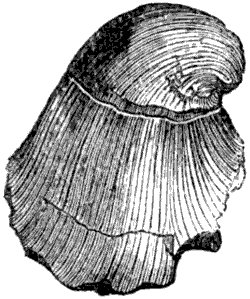
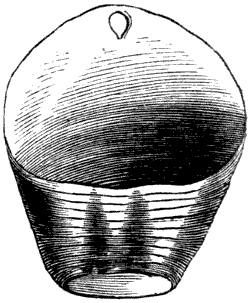
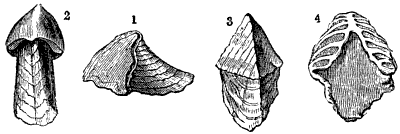
Fig. 86.—Productus Martini.
The lower Keuper sandstones, which lie at the base of the series
of red marls, frequently give rise to springs, and are in consequence
called “water-stones,” in Lancashire and Cheshire.
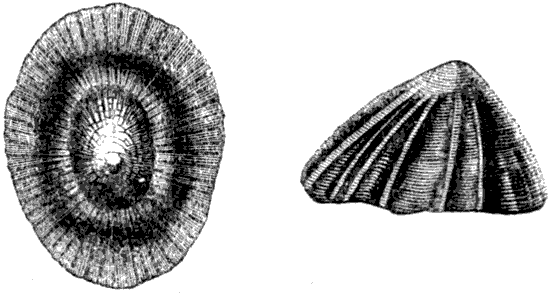
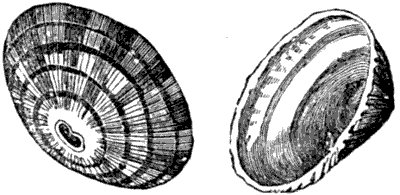
Fig. 87.—Patella vulgata.
(Living.)
If the Keuper formation is poor in organic remains in France, it
is by no means so on the other side of the Alps. In the Tyrol, and
in the remarkable beds of Saint Cassian, Aussec, and Hallstadt, the
rocks are made up of an immense number of marine fossils, among
them Cephalopods, Ceratites, and Ammonites of peculiar form. The
Orthoceras, which we have seen abounding in the Silurian period,
and continued during the deposit of the Devonian and Carboniferous
periods, appears here for the last time. We still find here a
great number of Gasteropods and of Lamellibranchs of the most
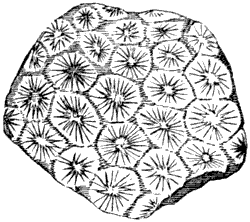
varied form. Sea Urchins—corals of elegant form—appear to have
occupied, on the other side of the Alps, the same seas which in
France and Germany seem to have been nearly destitute of animals.
Some beds are literally formed of accumulated shells belonging to
the genus Avicula; but these last-mentioned deposits are to be
considered as more properly belonging to the Rhætic or Penarth
strata, into which the New Red or Keuper Marl gradually passes
upwards, and which are more fully described at page 207.
In following the grand mountainous slopes of the Alps and Carpathians
we discover the saliferous rocks by this remarkable accumulation
of Aviculæ. The same facies presents itself under identical
conditions in Syria, in India, in New Caledonia, in New Zealand,
and in Australia. It is not the least curious part of this period, that
it presents, on one side of the site of the Alps, which were not yet
raised, an immense accumulation of sediment, charged with gypsum,
rock-salt, &c., without organic remains; while beyond, a region presents
itself equally remarkable for the extraordinary accumulation of
the remains of marine Mollusca. Among these were Myophoria
lineata, which is often confounded with Trigonia, and Stellispongia
variabilis.
France at this period was still the skeleton of what it has since
become. A map of that country represents the metamorphic rocks
occupying the site of the Alps, the Cévennes, and the Puy-de-Dôme,
the country round Nantes, and the Islands of Brittany. The Primary
rocks reach the foot of the Pyrenees, the Cotentin, the Vosges, and
the Eifel Mountains. Some bands of coal stretch away from Valenciennes
to the Rhine, and on the north of the Vosges, these mountains
themselves being chiefly composed of Triassic rocks.
[207]
The attention of geologists has been directed within the last few
years, more especially, to a series of deposits which intervene between
the New Red Marl of the Trias, and the blue argillaceous limestones
and shales of the Lower Lias. The first-mentioned beds, although
they attain no great thickness in this country, nevertheless form a
well-defined and persistent zone of strata between the unfossiliferous
Triassic marls and the lower Liassic limestone with Ostrea Liassica
and Ammonites planorbis, A. angulatus and A. Bucklandi; being
everywhere characterised by the presence of the same groups of
organic remains, and the same general lithological character of the
beds. These last may be described as consisting of three sub-divisions,
the lowermost composed of alternations of marls, clays, and
marly limestones in the lower part, forming a gradual passage downwards
into the New Red Marls upon which they repose. 2. A middle
group of black, thinly laminated or paper-like shales, with thin layers
of indurated limestone, and crowded in places with Pecten Valoniensis,
Cardium Rhæticum, Avicula contorta, and other characteristic shells,
as well as by the presence, nearly always, of a remarkable bed, which
is commonly known as the “Bone-bed.” This thin band of stone,
which is so well known at Aust, Axmouth, Westbury-on-Severn, and
elsewhere, is a brecciated or conglomerated band of variable thickness
which, sometimes a sandstone and sometimes a limestone, is
always more or less composed of the teeth, scales, and bones of
numerous genera of Fishes and Saurians, together with their fossilised
excrement, which will be more fully and subsequently described under
the name of Coprolites, under the Liassic period.
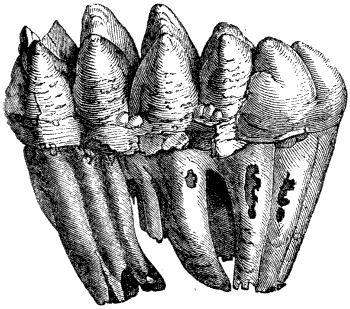
The molar tooth of a small predaceous fossil mammal of the
Microlestes family (μικρος, little; ληστης, beast), whose nearest living
representative appears to be some of the Hypsiprymnidæ or Kangaroo
Rats, has been found by Mr. Dawkins in some grey marls
underlying the bone-bed on the sea-shore at Watchett, in Somersetshire;
affording the earliest known trace of a fossil mammal in the
Secondary rocks. Several small teeth belonging to the genus Microlestes
have also been discovered by Mr. Charles Moore in a breccia
of Rhætic age, filling a fissure traversing Carboniferous Limestone
near Frome; and in addition to the discovery of the remains of
Microlestes, those of a mammal more closely allied to the Marsupials
than any other order, have been met with at Diegerloch, south-east of
Stuttgart, in a remarkable bone-breccia, which also yielded coprolites
and numerous traces of fishes and reptiles.
The uppermost sub-division includes certain beds of white and
cream-coloured limestone, resembling in appearance the smooth
fracture and closeness of texture of the lithographic limestone of
Solenhofen, and which, known to geologists and quarrymen under the
name “white lias,” given to it by Dr. William Smith, was formerly
always considered to belong to, and was included in, the Lias proper.
The most remarkable bed in this zone is one of only a few inches
in thickness, but it has long been known to collectors, and sought
after under the name of Cotham Marble or Landscape Stone, the latter
name having reference to the curious dendritic markings which make
their appearance on breaking the stone at right angles to its bedding,
bearing a singular resemblance to a landscape with trees, water, &c.;
while the first name is that derived from its occurrence abundantly
at Cotham, in the suburbs of Bristol, where the stone was originally
found and noticed.
This band of stone is interesting in another respect, because it
sometimes shows by its uneven, eroded, and water-worn upper surface,
that an interval took place soon after it had been deposited, when
the newly-formed stone became partially dissolved, eroded, or worn
away by water, before the stratum next in succession was deposited
upon it. The same phenomenon is displayed, in a more marked
degree, in the uppermost limestone or “white lias” bed of the series,
which not only shows an eroded surface, but the holes made by
boring Molluscs, exactly as is produced at the present day by the
same class of animals, which excavate holes in the rocks between
high and low-water marks, to serve for their dwelling-places, and as
a protection from the waves to their somewhat delicate shells.
The “White Lias” of Smith is the equivalent of the Koessen
beds which immediately underlie the Lower Lias of the Swabian
Jura, and have been traced for a hundred miles, from Geneva to the
environs of Vienna; and, also, of the Upper St. Cassian beds, which
are so called from their occurrence at St. Cassian in the Austrian
Alps.
The general character of the series of strata just described, is that
of a deposit formed in tolerably shallow water. In the Alps of Lombardy
and the Tyrol, in Luxembourg, in France, and, in fact,
throughout nearly the whole of Europe, they form a sort of fringe in
the margin of the Triassic sea; and, although of comparatively inconsiderable
thickness in England, they become highly developed in
Lombardy, &c., to an enormous thickness, and constitute the great
mass of the Rhætian Alps and a considerable part of the well-known
beds of St. Cassian, and Hallstadt in the Austrian Alps. (See
page 205.)
The Rhætic beds of Europe were, as a whole, formed under very
different conditions in different areas. The thickness of the strata
and the large and well-developed fauna (chiefly Mollusca) indicate
that the Rhætic strata of Lombardy, and other parts of the south and
east of Europe, were deposited in a broad open ocean. On the
other hand, the comparatively thin beds of this age in England and
north-western Europe, the fauna of which, besides being poor in
genera and species, consists of small and dwarfed forms, point to the
conclusion that they were in great part deposited in shallow seas and
in estuaries, or in lagoons, or in occasional salt lakes, under conditions
which lasted for a long period.[56]
In consequence of the importance they assume in Lombardy (the
ancient Rhætia), the name “Rhætic Beds” has been given to these
strata by Mr. Charles Moore; Dr. Thomas Wright has proposed the
designation “Avicula Contorta Zone,” from the plentiful occurrence
of that shell in the black shales forming the well-marked middle zone,
and which is everywhere present where this group of beds is found;
Jules Martin and others have proposed the term “Infra-lias,” or “Infra-liassic
strata;” while the name “Penarth Beds” has been assigned to
these deposits in this country by Mr. H. W. Bristow, at the suggestion
of Sir Roderick Murchison, in consequence of their conspicuous
appearance and well-exposed sections in the bold headlands and
cliffs of that locality, in the British Channel, west of Cardiff.
A fuller description of these beds will be found in the Reports of
the Bath Meeting of the British Association (1864), by Mr. Bristow;
also in communications to the Geological Magazine, for 1864, by
MM. Bristow and Dawkins;[57] in papers read before the Geological
Society by Dr. Thomas Wright,[58] Mr. Charles Moore,[59] and Mr.
Ralph Tate,[60] as printed in their Quarterly Journal; and by Mr.
Etheridge, in the Transactions of the Cotteswold Natural History
Club for 1865-66. The limits of the Penarth Beds have also been
lately accurately laid down by Mr. Bristow in the map of the Geological
Survey over the district comprised between Bath, Bristol, and
the Severn; and elaborately detailed typical sections of most of the
localities in England, where these beds occur, have been constructed
by MM. Bristow, Etheridge, and Woodward, of the Geological Survey
of Great Britain, which, when published, will greatly add to our
knowledge of this remarkable and interesting series of deposits.
[211]
This period, one of the most important in the physical history of the
globe, has received its name from the Jura mountains in France, the
Jura range being composed of the rocks deposited in the seas of the
period. In the term Jurassic, the formations designated as the
“Oolite” and “Lias” are included, both being found in the Jura
mountains. The Jurassic period presents a very striking assemblage
of characteristics, both in its vegetation and in the animal remains
which belong to it; many genera of animals existing in the preceding
age have disappeared, new genera have replaced them, comprising
a very specially organised group, containing not less than 4,000
species.
The Jurassic period is sub-divided into two sub-periods: those of
the Lias and the Oolite.
is an English provincial name given to an argillaceous limestone,
which, with marl and clay, forms the base of the Jurassic formation,
and passes almost imperceptibly into the Lower Oolite in some places,
where the Marlstone of the Lias partakes of the mineral character, as
well as the fossil remains of the Lower Oolite; and it is sometimes
treated of as belonging to that formation. “Nevertheless, the Lias
may be traced throughout a great part of Europe as a separate and
independent group, of considerable thickness, varying from 500 to
1,000 feet, containing many peculiar fossils, and having a very uniform
lithological aspect.”[61] The rocks which represent the Liassic
period form the base of the Jurassic system, and have a mean thickness
of about 1,200 feet. In the inferior part we find argillaceous
sandstones, which are called the sandstones of the Lias, and comprehend
the greater part of the Quadersandstein, or building-stone of the
Germans, above which comes compact limestone, argillaceous, bluish,
and yellowish; finally, the formation terminates in the marlstones
which are sometimes sandy, and occasionally bituminous.
The Lias, in England, is generally in three groups: 1, the upper,
clays and shales, underlying sands; 2, the middle, lias or marlstone;
and 3, the lower, clays and limestone; but these have been again sub-divided—the
last into six zones, each marked by its own peculiar
species of Ammonites; the second into three zones; the third consists
of clay, shale, and argillaceous limestone. For the purposes of description
we shall, therefore, divide the Lias into these three groups:—
1. Upper Lias Clay, consists of blue clay, or shale, containing
nodular bands of claystones at the base, crowded with Ammonites
serpentinus, A. bifrons, Belemnites, &c.
2. The Middle Lias, commonly known as the Marlstone, is
surmounted by a bed of oolitic ironstone, largely worked in Leicestershire
and in the north of England as a valuable ore of iron. The
underlying marls and sands, the latter of which become somewhat
argillaceous below, form beds from 200 to 300 feet thick in Dorsetshire
and Gloucestershire; the fossils are Ammonites margaritaceus,
A. spinatus, Belemnites tripartitus. The upper rock-beds, especially
the bed of ironstone on the top, is generally remarkably rich in fossils.
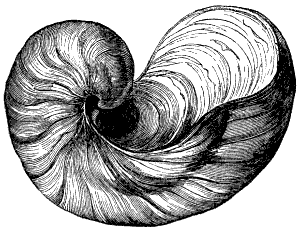
Fig. 88.—Gryphæa incurva.
3. Lower Lias (averaging from 600 to 900 feet in thickness)
consists, in the lower part,
of thin layers of bluish
argillaceous limestone,
alternating with shales
and clays; the whole
overlaid by the blue
clay of which the lower
member of the Liassic
group usually consists.
This member of the
series is well developed
in Yorkshire, at Lyme
Regis and Charmouth
in Dorsetshire, and
generally over the South-West
and Midland
Counties of England.
Gryphæa incurva (Fig. 88), with sandy bands, occurs at the base, in
addition to which we find Ammonites planorbis Bucklandi, A. Ostrea
liassica, Lima gigantea, Ammonites Bucklandi, &c., in the lower limestones
and shales.
Above the clay are yellow sands from 100 to 200 feet thick, underlying
the limestone of the Inferior Oolite. These sands were, until lately,
considered to belong to the latter formation—as they undoubtedly do
physically—until they were shown, by Dr. Thomas Wright, of Cheltenham,
to be more nearly allied, by their fossils, to the Lias below than
to the Inferior Oolite above, into which they form the passage-beds.
In France the Lias abounds in the Calvados, in Burgundy, Lorraine,
Normandy, and the Lyonnais. In the Vosges and Luxembourg,
M. Elie de Beaumont states that the Lias containing
Gryphæa incurva and Lima gigantea, and some other marine fossils,
becomes arenaceous; and around the Harz mountains, in Westphalia
and Bavaria, in its lower parts the formation is sandy, and is
sometimes a good building-stone.
“In England the Lias constitutes,” says Professor Ramsay, “a
well-defined belt of strata, running continuously from Lyme Regis,
on the south-west, through the whole of England, to Yorkshire on
the north-east, and is an extensive series of alternating beds of clay,
shale, and limestone, with occasional layers of jet in the upper part.
The unequal hardness of the clays and limestones of the Liassic
strata causes some of its members to stand out in the distinct minor
escarpments, often facing the west and north-west. The Marlstone
forms the most prominent of these, and overlooks the broad meadows
of the lower Lias-clay, that form much of the centre of England.”
In Scotland there are few traces of the Lias. Zoophytes, Mollusca,
and Fishes of a peculiar organisation, but, above all, Reptiles of
extraordinary size and structure gave to the sea of the Liassic period
an interest and features quite peculiar. Well might Cuvier exclaim,
when the drawings of the Plesiosaurus were sent to him: “Truly
this is altogether the most monstrous animal that has yet been dug out
of the ruins of a former world!” In the whole of the English Lias
there are about 243 genera, and 467 species of fossils. The whole
series has been divided into zones characterised by particular
Ammonites, which are found to be limited to them, at least locally.
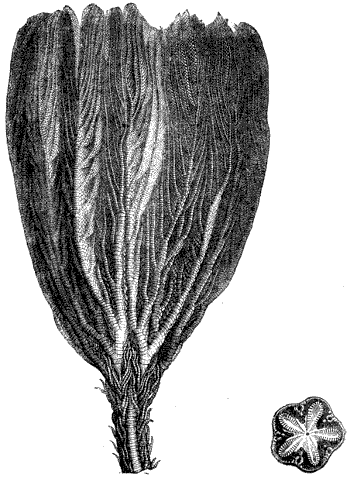
Fig. 89.—Pentacrinites Briareus. Half natural size.
Among the Echinodermata belonging to the Lias we may cite
Asterias lumbricalis and Palæocoma Furstembergii, which constitutes a
genus not dissimilar to the star-fishes, of which its radiated form
reminds us. The Pentacrinites, of which Pentacrinites Briareus is a
type, ornaments many collections by its elegant form, and is represented
in Figs. 79 and 89. It belongs to the order of Crinoidea,
which is represented at the present time by a single living species,
Pentacrinus caput-Medusæ, one of the rare and delicate Zoophytes
of the Caribbean sea.
Oysters (Ostrea) made their appearance in the Muschelkalk of
the last period, but only in a small number of species; they increased
greatly in importance in the Liassic seas.
The Ammonites, a curious genus of Cephalopoda, which made their
first appearance in small numbers towards the close of the preceding
Triassic period, become quite special in the Secondary epoch, with
the close of which they disappear altogether. They were very
abundant in the Jurassic period, and, as we have already said, each
zone is characterised by its peculiar species. The name is taken
from the resemblance of the shell to the ram’s-horn ornaments which
decorated the front of the temple of Jupiter Ammon and the bas-reliefs
and statues of that pagan deity. They were Cephalopodous
Mollusca with circular shells, rolled upon themselves symmetrically
in the same plane, and divided into a series of chambers. The
animal only occupied the outer chamber of the shell; all the others
were empty. A siphon or tube issuing
from the first chamber traversed all the
others in succession, as is seen in all
the Ammonites and Nautili. This tube
enabled the animal to rise to the surface,
or to sink to the bottom, for
the Ammonite could fill the chambers
with water at pleasure, or empty them,
thus rendering itself lighter or heavier as
occasion required. The Nautilus of our
seas is provided with the same curious
organisation, and reminds us forcibly of
the Ammonites of geological times.
Shells are the only traces which remain of the Ammonites. We
have no exact knowledge of the animal which occupied and built
them. The attempt at restoration, as exhibited in Fig. 91, will probably
convey a fair idea of the Ammonite when living. We assume
that it resembled the Nautilus of modern times. What a curious aspect
these early seas must have presented, covered by myriads of these
Molluscs of all sizes, swimming about in eager pursuit of their prey!
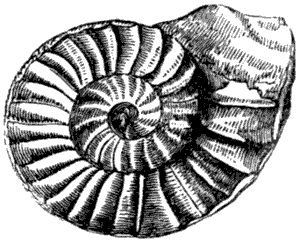
Fig. 90.—Ammonites Turneri,
from the Lower Lias.
The Ammonites of the Jurassic age present themselves in a great
variety of forms and sizes; some of them of great beauty. Ammonites
bifrons, A. Noditianus, A. bisulcatus, A. Turneri (Fig. 90), and
A. margaritatus, are forms characteristic of the Lias.
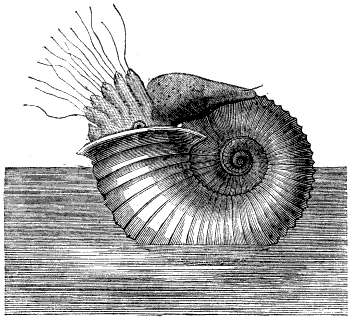
Fig. 91.—Ammonite restored.
The Belemnites, molluscous Cephalopods of a very curious organisation,
appeared in great numbers, and for the first time, in the
Jurassic seas. Of this Mollusc we only possess the fossilised internal
“bone,” analogous to that of the modern cuttle-fish and the calamary
of the present seas. This simple relic is very far from giving us
an exact idea of what the animal was to which the name of
Belemnite has been given (from Βελεμνον, a dart) from their supposed
resemblance to the head of a javelin. The slender cylindrical bone, the
only vestige remaining to us, was merely the internal skeleton of the
animal. When first discovered they were called, by the vulgar,
“Thunder-stones” and “Ladies’ fingers.” They were, at last,
inferred to be the shelly processes of some sort of ancient cuttle-fish.
Unlike the Ammonite, which floated on the surface and
sunk to the bottom at pleasure, the Belemnite, it has been thought,
swam nearer the bottom of the sea, and seized its prey from below.
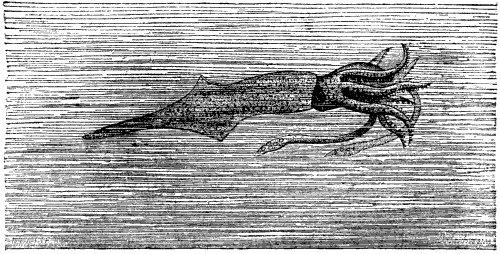
Fig. 92.—Belemnite restored.
In Fig. 92 is given a restoration of the living Belemnite, by Dr.
Buckland and Professor Owen, in which the terminal part of the
animal is marked in a slightly darker tint, to indicate the place of
the bone which alone represents in our days this fossilised being. A
sufficiently exact idea of this Mollusc may be arrived at from the
existing cuttle-fish. Like the cuttle-fish, the Belemnite secreted
a black liquid, a sort of ink or sepia; and the bag containing the
ink has frequently been found in a fossilised state, with the ink
dried up, and elaborate drawings have been made with this fossil
pigment.
The beaks, or horny mandibles of the mouth, which the Belemnite
possessed in common with the other naked Cephalopoda,
are represented in Fig. 78, p. 181.
As Sir H. De la Beche has pointed out, the destruction
of the animals whose remains are known to us by
the name of Belemnites was exceedingly great when the
upper part of the Lias of Lyme Regis was deposited.
Multitudes seem to have perished almost simultaneously,
and millions are entombed in a bed beneath Golden
Cap, a lofty cliff between Lyme Regis and Bridport
Harbour, as well as in the upper Lias generally.[62]
Among the Belemnites characteristic of the Liassic
period may be cited B. acutus (Fig. 93), B. pistiliformis,
and B. sulcatus.
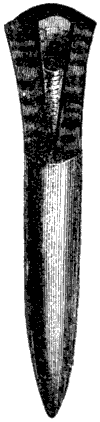
Fig. 93.—Belemnites
acutus.
The seas of the period contained a great number
of the fishes called Ganoids; which are so called from
the splendour of the hard and enamelled scales, which
formed a sort of defensive armour to protect their bodies.
Lepidotus gigas was a fish of great size belonging to this
age. A smaller fish was the Tetragonolepis, or Æchmodus
Buchii. The Acrodus nobilis, of which the teeth are
still preserved, and popularly known by the name of
fossil leeches, was a fish of which an entire skeleton has
never been met with. Neither are we better informed
as to the Hybodus reticulatus. The bony spines, which form the
anterior part of the dorsal fin of this fish, had long been an object of
curiosity to geologists, under the general name of Ichthyodorulites,
before they were known to be fragments of the fin of the Hybodus.
The Ichthyodorulites were supposed by some naturalists to be the
jaw of some animal—by others, weapons like those of the living
Balistes or Silurus;
but Agassiz has
shown them to be
neither the one nor
the other, but bony
spines on the fin, like
those of the living
genera of Cestracions
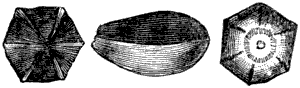
and Chimæras, in both of which the
concave face is armed with small spines
like those of the Hybodus. The spines
were simply imbedded in the flesh, and
attached to it by strong muscles. “They
served,” says Dr. Buckland, “as in the
Chimæra, to raise and depress the fin,
their action resembling that of a movable
mast lowering backward.”
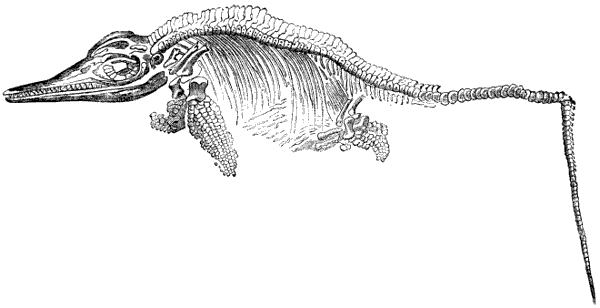
Fig. 94.—Ichthyosaurus communis.
Let us hasten to say, however, that
these are not the beings that characterised
the age, and were the salient
features of the generation of animals
which existed during the Jurassic period.
These distinguishing features are found
in the enormous reptiles with lizard’s
head, crocodile’s conical teeth, the trunk
and tail of a quadruped, whale-like
paddles, and the double-concave vertebræ
of fishes; and this strange form,
on such a gigantic scale that even
their inanimate remains are examined
with a curiosity not unmixed with awe.
The country round Lyme Regis, in
Dorsetshire, has long been celebrated
for the curious fossils discovered in its
quarries, and preserved in the muddy
accumulations of the sea of the Liassic
period. The country is hilly—“up
one hill and down another,” is a pretty
correct provincial description of the
walk from Bridport to Lyme Regis—where
some of the most frightful creatures
the living world has probably ever
beheld, sleep the sleep of stones. The quarries of Lyme Regis form
the cemetery of the Ichthyosauri; the sepulchre where lie interred
these dragons of the ancient seas.
In 1811 a country girl, who made her precarious living by picking
up fossils for which the neighbourhood was famous, was pursuing
her avocation, hammer in hand, when she perceived some bones projecting
a little out of the cliff. Finding, on examination, that it was
part of a large skeleton, she cleared away the rubbish, and laid bare the
whole creature imbedded in the block of stone. She hired workmen
to dig out the block of Lias in which it was buried. In this manner
was the first of these monsters brought to light: “a monster some
thirty feet long, with jaws nearly a fathom in length, and huge
saucer-eyes; which have since been found so perfect, that the petrified
lenses have been split off and used as magnifiers,” as a writer
in All the Year Round assures us.
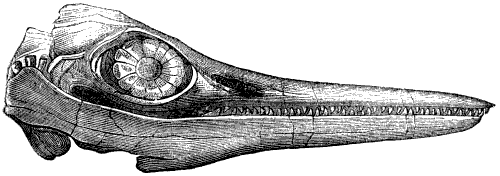
Fig. 95.—Head of Ichthyosaurus platydon.
In Fig. 95 the head of I. platydon is represented. As in the
Saurians, the openings of the nostrils are situated near the anterior
angle of the orbits of the eyes, while those of the Crocodile are near
the snout; but, on the other hand, in its osteology and its mode of
dentition it nearly resembles the Crocodile; the teeth are pointed and
conical—not, however, set in deep or separate sockets, but only
implanted in a long and deep continuous groove hollowed in the
bones of the jaw. These strong jaws have an enormous opening;
for, in some instances, they have been found eight feet in length and
armed with 160 teeth. Let us add that teeth lost through the voracity
of the animal, or in contests with other animals, could be renewed
many times; for, at the inner side of the base of every old tooth,
there is always the bony germ of a new one.
The eyes of this marine monster were much larger than those of
any animal now living; in volume they frequently exceed the human
head, and their structure was one of their most remarkable peculiarities.
In front of the sclerotic coat or capsule of the eye there is an
annular series of thin bony plates, surrounding the pupil. This structure,
which is now only met with in the eyes of certain turtles,
tortoises, and lizards, and in those of many birds, could be used so as
to increase or diminish the curvature of the transparent cornea, and
thus increase or diminish the magnifying power, according to the
requirements of the animal—performing the office, in short, of a
telescope or microscope at pleasure. The eyes of the Ichthyosaurus
were, then, an optical apparatus of wonderful power and of singular
perfection, enabling the animal, by their power of adaptation and
intensity of vision, to see its prey far and near, and to pursue it in
the darkness and in the depths of the sea. The curious arrangement
of bony plates we have described furnished, besides, to its globular
eye, the power necessary to bear the pressure of a considerable weight
of water, as well as the violence of the waves, when the animal came
to the surface to breathe, and raised its head above the waves. This
magnificent specimen of the fish-lizard, or Ichthyosaurus, as it was
named by Dr. Ure, now forms part of the treasures of the British
Museum.
At no period in the earth’s history have Reptiles occupied so
important a place as they did in the Jurassic period. Nature seems
to have wished to bring this class of animals to the highest state of
development. The great Reptiles of the Lias are as complicated in
their structure as the Mammals which appeared at a later period.
They probably lived, for the most part, by fishing in shallow creeks and
bays defended from heavy breakers, or in the open sea; but they seem
to have sought the shore from time to time; they crawled along the
beach, covered with a soft skin, perhaps not unlike some of our
Cetaceæ. The Ichthyosaurus, from its form and strength, may have
braved the waves of the sea as the porpoise does now. Its destructiveness
and voracity must have been prodigious, for Dr. Buckland
describes a specimen which had between its ribs, in the place where
the stomach might be supposed to have been placed, the skeleton of
a smaller one—a proof that this monster, not content with preying on
its weaker neighbours, was in the habit of devouring its own kind.
In the same waters lived the Plesiosaurus, with long neck and form
more strange than that of the Ichthyosaurus; and these potentates of
the seas were warmed by the same sun and tenanted the same banks,
in the midst of a vegetation not unlike that which the climate of
Africa now produces.
The great Saurians in the Lias of Lyme Regis seem to have
suffered a somewhat sudden death, partly in consequence of a series
of small catastrophes suddenly destroying the animals then existing
in particular spots. “In general the bones are not scattered about,
and in a detached state, as would happen if the dead animal had
descended to the bottom of the sea, to be decomposed, or devoured
piecemeal, as, indeed, might also happen if the creature floated for a
time on the surface, one animal devouring one part, and another
carrying off a different portion; on the contrary, the bones of the
skeleton, though frequently compressed, as must arise from the enormous
pressure to which they have so long been subjected, are
tolerably connected, frequently in perfect, or nearly perfect, order, as
if prepared by the anatomist. The skin, moreover, may sometimes
be traced, and the compressed contents of the intestines may at times
be also observed—all tending to show that the animals were suddenly
destroyed, and as suddenly preserved.”[63]
These strange and gigantic Saurians seem almost to disappear
during the succeeding geological periods; for, although they have
been discovered as low down as the Trias in Germany, and as high
up as the Chalk in England, they only appear as stragglers in these
epochs; so, too, the Reptiles, the existing Saurians are, as it were,
only the shadowy, feeble representatives of these powerful races of the
ancient world.
Confining ourselves to well-established facts, we shall consider in
some detail the best known of these fossil reptiles—the Ichthyosaurus,
Plesiosaurus, and Pterodactyle.
The extraordinary creature which bears the name of Ichthyosaurus
(from the Greek words Ιχθυς σαυρος, signifying fish-lizard), presents
certain dispositions and organic arrangements which are met with
dispersed in certain classes of animals now living, but they never seem
to be again reunited in any single individual. It possesses, as Cuvier
says, the snout of a dolphin, the head of a lizard, the jaws and teeth
of a crocodile, the vertebræ of a fish, the head and sternum of a
lizard, the paddles like those of a whale, and the trunk and tail of a
quadruped.
Bayle appears to have furnished the best idea of the Ichthyosaurus
by describing it as the Whale of the Saurians—the Cetacean of the
primitive seas. It was, in fact,
an animal exclusively marine;
which, on shore, would rest
motionless like an inert mass.
Its whale-like paddles, and fish-like
vertebræ, the length of the
tail and other parts of its structure,
prove that its habits were
aquatic; as the remains of fishes
and reptiles, and the form of its
teeth, show that it was carnivorous.
Like the Whale, also,
the Ichthyosaurus breathed atmospheric
air; so that it was
under the necessity of coming
frequently to the surface of the
water, like that inhabitant of the
deep. We can even believe, with
Bayle, that it was provided, like
the Whale, with vents or blowers,
through which it ejected, in
columns into the air, the water
it had swallowed.
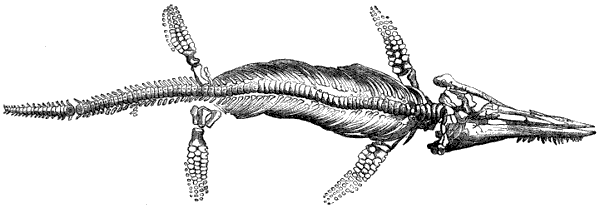
Fig. 96.—Ichthyosaurus platydon.
The dimensions of the Ichthyosaurus
varied with the species, of
which five are known and described.
These are Ichthyosaurus
communis, I. platydon, I. intermedius,
I. tenuirostris, and I.
Cuvierii, the largest being more
than thirty feet in length.
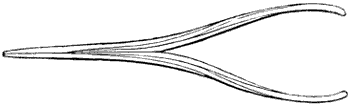
Fig. 97.—Lower jaw of Ichthyosaurus. (Dr. Buckland.)
The short, thick neck of the
Ichthyosaurus supported a capacious
head, and was continued
backwards, from behind the eyes,
in a column composed of more
than a hundred vertebræ. The
animal being adapted, like the
whale, for rapid movement
through the water, its vertebræ
had none of the invariable solidity
of those of the Lizard or Crocodile,
but rather the structure and lightness of those of Fishes.
The section of these vertebræ presents two hollow cones, connected
only by their summits to the centre of the vertebræ, which would
permit of the utmost flexibility of movement. The ribs extended
along the entire length of the vertebral column, from the head to the
pelvis. The bones of the sternum, or that part of the frame which
supported the paddles, present the same combinations with those of
the sternum in the Ornithorhynchus, or Duck-billed Platypus, of New
Holland, an animal which presents the singular combination of a
mammalian furred quadruped having the bill of a duck and webbed
feet; which dived to the bottom of the water in search of its food,
and returned to the surface to breathe the air. In this phenomenon
of living Nature the Creator seems to have repeated, in our days, the
organic arrangements which he had originally provided for the
Ichthyosaurus.
In order that the animal should be able to move with rapidity in
the water, both its anterior and posterior members were converted
into fins or paddles. The anterior fins were half as large again as
the posterior. In some species each paddle was made up of nearly
a hundred bones, of polygonal form, and disposed in series representing
the phalanges of the fingers. This hand, jointed at the arm, bears
resemblance, in osteological construction, to the paddles, without
distinct fingers, of the Porpoise and the Whale. A specimen of
the posterior fin of I. communis, discovered at Barrow-on-Soar, in
Leicestershire, in 1840, by Sir Philip Egerton, exhibited on its
posterior margin the remains of cartilaginous rays, which bifurcated
as they approached the edge, like those in the fins of a fish. “It
had previously been supposed,” says Professor Owen, “that the
locomotive organs were enveloped, while living, in a smooth integument,
like that of the turtle and porpoise, which has no other support
than is afforded by the bones and ligaments within; but it now
appears that the fin was much larger, expanding far beyond the
osseous frame-work, and deviating widely in its fish-like rays from the
ordinary reptilian type.” The Professor believes that, besides the
fore-paddles, these stiff-necked Saurians were furnished at the end of
the tail with a fin to assist them in turning, not placed horizontally, as
in the whale, but vertically, forming a powerful instrument of progression
and motion. It is obvious that the Ichthyosaurus was an
animal powerfully armed for offence and defence. We cannot say,
with certainty, whether the skin was smooth, like that of the whale
or lizard, or covered with scales, like the great reptiles of our own
age. Nevertheless, as the scales of the Fishes and the cuirass and
horny armour of other Reptiles of the Lias are preserved, and as no
such defensive scales have been found belonging to the Ichthyosaurus,
it is probable that the skin was naked and smooth. The
tail, composed of from eighty to eighty-five vertebræ, was provided
with large and long paddles, arranged vertically as in the Whale.
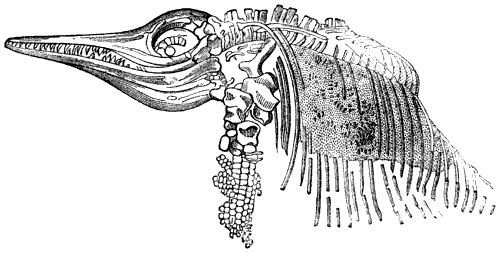
Fig. 98.—Skeleton of Ichthyosaurus.
Containing teeth and bones of Fishes in a coprolitic form. One-fifteenth natural size.
It is curious to see to what a degree of perfection has been carried,
in our days, the knowledge of the antediluvian animals, their
habits, and their economy. Fig. 98 represents the skeleton of an
Ichthyosaurus found in the Lias of Lyme Regis, which still retains in
its abdominal cavity coprolites, that is to say, the residue of digestion.
The soft parts of the intestinal canal have disappeared, but the fæces
themselves are preserved, and their examination informs us as to the
alimentary regimen of this animal which has perished from the earth
many thousands, perhaps millions, of years. Mary Anning, to whom
we owe many of the discoveries made in the neighbourhood of
Lyme Regis, her native place, had in her collection an enormous
coprolite of the Ichthyosaurus. This coprolite (Fig. 99) contained
some bones and scales of Fishes,
and of divers Reptiles, well
enough preserved to have their
species identified. It only remains
to be added that, among
the bones, those of the Ichthyosaurus
were often found,
especially those of young individuals.
The presence of the
undigested remains of vertebræ
and other bones of animals of its
own species in the coprolites of
the Ichthyosaurus proves, as we
have already had occasion to
remark, that this great Saurian
must have been a most voracious
monster, since it habitually devoured
not only fish, but individuals
of its own race—the
smaller becoming the prey of
the larger. The structure of the
jaw of the Ichthyosaurus leads
us to believe that the animal
swallowed its prey without dividing
it. Its stomach and intestines
must, then, have formed
a sort of pouch of great volume,
filling entirely the abdominal
cavity, and corresponding in
extent to the great development
of the teeth and jaws.
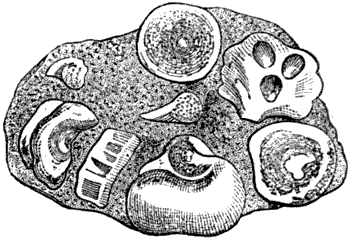
Fig. 99.—Coprolite, enclosing bones of small
Ichthyosaurus.
The perfection with which
its contents have been preserved in the fossilised coprolites, furnishes
indirect proofs that the intestinal canal of the Ichthyosaurus resembled
closely that of the shark and the dog-fish—fishes essentially voracious
and destructive, which have the intestinal canal spirally convoluted, an
arrangement which is exactly that indicated in some of the coprolites
of the Ichthyosaurus, as is evident from the impressions which the
folds of the intestine have left on the coprolite, of which Fig. 100 is
a representation. In the cliffs near Lyme Regis coprolites are abundant
in the Liassic formation, and have been found disseminated
through the shales and limestones along many miles of that coast.
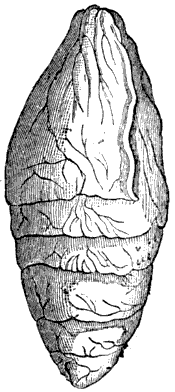
Fig. 100.—Coprolite of Ichthyosaurus.
What an admirable privilege of science, which is able, by an
examination of the simplest parts in the organisation of beings which
lived ages ago, to give to our minds such solid teachings and such
true enjoyments! “When we discover,” says Dr. Buckland, “in
the body of an Ichthyosaurus the food which it has engulfed an
instant before its death, when the intervals between its sides present
themselves still filled with the remains of fishes which it had swallowed
some ten thousand years ago, or a time even twice as great,
all these immense intervals vanish, time disappears, and we find
ourselves, so to speak, thrown into immediate contact with events
which took place in epochs immeasurably distant, as if we occupied
ourselves with the affairs of the previous day.”
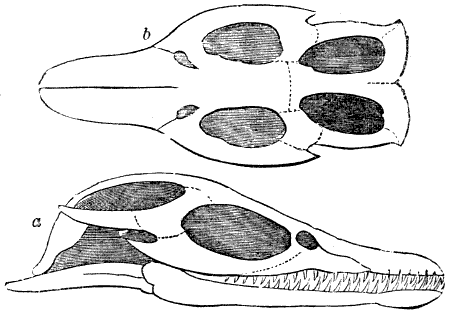
Fig. 101.—Skull of Plesiosaurus restored. (Conybeare.)
a, profile; b, seen from above.
The name of Plesiosaurus (from the Greek words πλησιος, near,
and σαυρος, lizard) reminds us that this animal, though presenting
many peculiarities of general structure, is allied by its organisation to
the Saurian or Lizard family, and, consequently, to the Ichthyosaurus.
The Plesiosaurus presents, in its organic structure, the most curious
assemblage we have met with among the
organic vestiges of the ancient world.
The Plesiosaurus was a marine, air-breathing,
carnivorous reptile, combining
the characters of the head of a
Lizard, the teeth of a Crocodile, a neck
of excessive length resembling that of a
Swan, the ribs of a Chameleon, a body
of moderate size, and a very short tail,
and, finally, four paddles resembling
those of a Whale. Let us bestow a
glance upon the remains of this strange
animal which the earth has revealed,
and which science has restored to us.
The head of the Plesiosaurus presents
a combination of the characters
belonging to the Ichthyosaurus, the
Crocodile, and the Lizard. Its enormously
long neck comprises a greater
number of vertebræ than the neck of
either the Camel, the Giraffe, or even
the Swan, which of all the feathered
race has the longest neck in comparison
to the rest of the body. And it is to
be remarked, that, contrary to what obtains
in the Mammals, where the vertebræ
of the neck are always seven,
the vertebræ in birds increase in number
with the length of the neck.
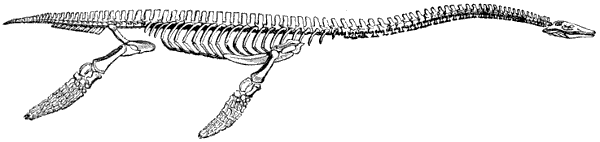
Fig. 102.—Skeleton of Plesiosaurus dolichodeirus restored. (Conybeare principally.)
The body is cylindrical and rounded,
like that of the great marine Turtles.
It was, doubtless, naked, i.e., not protected
with the scales or carapace with
which some authors have invested it;
for no traces of such coverings have
been found near any of the skeletons
which have been hitherto discovered.
The dorsal vertebræ are attached to
each other by nearly plane surfaces
like those of terrestrial quadrupeds, a
mode of arrangement which must have
deprived the whole of its vertebral
column of much of its flexibility. Each pair of ribs surrounded
the body with a complete girdle, formed of five pieces, as in the
Chameleon and Iguana; whence, no doubt, as with the Chameleon,
great facilities existed for the contraction and dilatation of the lungs.
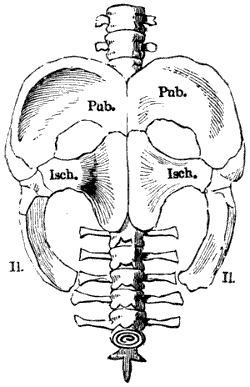
Fig. 103.—Sternum and pelvis of Plesiosaurus.
Pub., pubis; Isch., ischium;
Il., ilium.
The breast, the pelvis, and the bones of the anterior and posterior
extremities furnished an apparatus
which permitted the Plesiosaurus, like
the Ichthyosaurus and existing Cetaceans,
to sink in the water and return
to the surface at pleasure (Fig. 103).
Prof. Owen, in his “Report on British
Reptiles,” characterises them as air-breathing
and cold-blooded animals;
the proof that they respired atmospheric
air immediately, being found in
the position and structure of the nasal
passages, and the bony mechanism of the
thoracic duct and abdominal cavity. In
the first, the size and position of the external
nostrils (Fig. 102), combined with
the structure of the paddles, indicate
a striking analogy between the extinct
Saurians and the Cetaceans, offering,
as the Professor observes, “a beautiful
example of the adaptation of structure
to the peculiar exigencies of species.”
While the evidence that they were
cold-blooded animals is found in the
flexible or unanchylosed condition of the osseous pieces of the occiput
and other cranial bones of the lower jaw, and of the vertebral column;
from which the Professor draws the conclusion that the heart was
adapted for transmitting a part only of the blood through the
respiratory organs; the absence of the ball-and-socket articulations
of the bones of the vertebræ, the position of the nostrils near the
summit of the head, the numerous short and flat digital bones, which
must have been enveloped in a simple undivided integumentary
sheath, forming in both fore and hind extremities a paddle closely
resembling that of the living Cetacea. The paddles are larger and
more powerful than those of the Ichthyosaurus, to compensate for
the slight assistance the animal derived from the tail. The latter—shorter,
as compared with the length of the rest of the body, than in
the Ichthyosaurus—was more calculated to act the part of a rudder,
in directing the course of the animal through the water, than as a
powerful organ of propulsion.
Such were the strange combinations of form and structure in the
Plesiosaurus and Ichthyosaurus—genera of animals whose remains
have, after an interment extending to unknown thousands of years,
been revealed to light and submitted to examination; nay, rebuilt,
bone by bone, until we have the complete skeletons before us, and
the habits of the animals described, as if they had been observed in
life. Conybeare thus speaks of the supposed habits of these extinct
forms, which he had built up from scanty materials: “That the Plesiosaurus
was aquatic is evident from the form of its paddles; that it
was marine is equally so, from the remains with which it is universally
associated; that it may have occasionally visited the shore, the
resemblance of its extremities to the turtle may lead us to conjecture;
its motion, however, must have been very awkward on land; its long
neck must have impeded its progress through the water, presenting
a striking contrast to the organisation which so admirably fits the
Ichthyosaurus for cutting through the waves. May it not, therefore,
be concluded that it swam on or near the surface, arching back its
long neck like the swan, and occasionally darting it down at the fish
which happened to float within its reach? It may, perhaps, have
lurked in shallow water along the coasts, concealed among the sea-weeds,
and, raising its nostrils to the surface from a considerable
depth, may have found a secure retreat from the assaults of dangerous
enemies, while the length and flexibility of its neck may have compensated
for the want of strength in its jaws, and incapacity for swift
motion through the water, by the suddenness and agility of the
attack they enabled it to make on every animal fitted to become its
prey.”
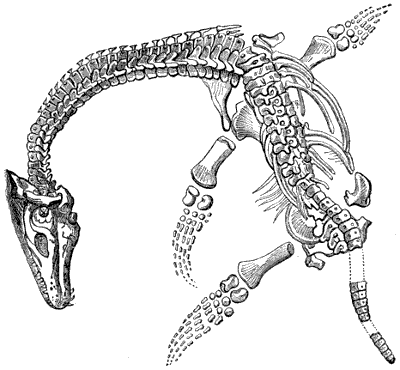
Fig. 104.—Remains of Plesiosaurus macrocephalus. One-twelfth natural size.
The Plesiosaurus was first described by the Rev. W. D. Conybeare
and Sir Henry De la Beche, in the “Geological Society’s
Transactions” for 1821, and a restoration of P. dolichodeirus, the
most common of these fossils, appeared in the same work for 1824.
The first specimen was discovered, as the Ichthyosaurus had been
previously, in the Lias of Lyme Regis; since then other individuals
and species have been found in the same geological formation in
various parts of England, Ireland, France, and Germany, and with
such variations of structure that Professor Owen has felt himself
justified in recording sixteen distinct species, of which we have
represented P. dolichodeirus (Fig. 102), as restored by Conybeare,
and P. macrocephalus (Fig. 104), with its skeleton, as moulded from
the limestone of Lyme Regis, which has been placed in the Palæontological
Gallery of the British Museum.
[231]
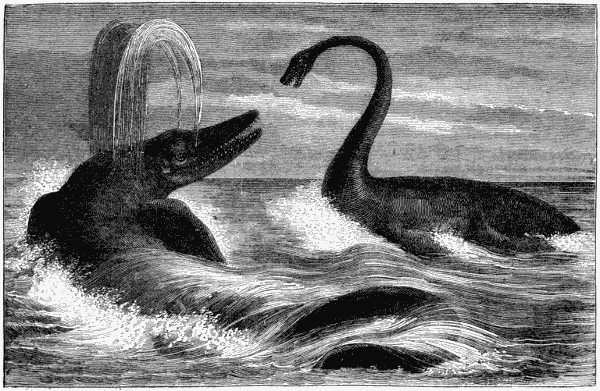
XV.—Ideal scene of the Lias with Ichthyosaurus and Plesiosaurus.
The Plesiosaurus was scarcely so large as the Ichthyosaurus.
The specimen of I. platydon in the British Museum probably belonged
to an animal four-and-twenty feet long, and some are said to indicate
thirty feet, while there are species of Plesiosauri measuring eighteen
and twenty, the largest known specimen of Plesiosaurus Cramptoni
found in the lias of Yorkshire, and now in the Museum of the Royal
Society of Dublin, being twenty-two feet four inches in length. On
the opposite page (Plate XV.) an attempt is made to represent
these grand reptiles of the Lias in their native element, and as
they lived.
Cuvier says of the Plesiosaurus, “that it presents the most monstrous
assemblage of characteristics that has been met with among
the races of the ancient world.” This expression should not be understood
in a literal sense; there are no monsters in Nature; in no
living creature are the laws of organisation ever positively infringed;
and it is more in accordance with the general perfection of creation
to see in an organisation so special, in a structure which differs so
notably from that of the animals of our own days, the simple development
of a type, and sometimes also the introduction of beings,
and successive changes in their structure. We shall see, in examining
the curious series of animals of the ancient world, that the organisation
and physiological functions go on improving unceasingly, and
that each of the extinct genera which preceded the appearance of
man, present, for each organ, modifications which always tend towards
greater perfection. The fins of the fishes of Devonian seas become
the paddles of the Ichthyosauri and of the Plesiosauri; these, in their
turn, become the membranous foot of the Pterodactyle, and, finally,
the wing of the bird. Afterwards comes the articulated fore-foot of
the terrestrial mammalia, which, after attaining remarkable perfection
in the hand of the ape, becomes, finally, the arm and hand of man,
an instrument of wonderful delicacy and power, belonging to an
enlightened being gifted with the divine attribute of reason! Let us,
then, dismiss any idea of monstrosity with regard to these antediluvian
animals; let us learn, on the contrary, to recognise, with admiration,
the divine proofs of design which they display, and in their organisation
to see only the handiwork of the Creator.
Another strange inhabitant of the ancient world, the Pterodactylus
(from πτερον, a wing, and δακτυλος, a finger), discovered in 1828, made
Cuvier pronounce it to be incontestably the most extraordinary of all
the extinct animals which had come under his consideration; and such
as, if we saw them restored to life, would appear most strange and
dissimilar to anything that now exists. In size and general form, and
in the disposition and character of its wings, this fossil genus, according
to Cuvier, somewhat resembled our modern bats and vampyres,
but had its beak elongated like the bill of a woodcock, and armed
with teeth like the snout of a crocodile; its vertebræ, ribs, pelvis,
legs, and feet resembled those of a lizard; its three anterior fingers
terminated in long hooked claws like that on the fore-finger of the
bat; and over its body was a covering, neither composed of feathers
as in the bird, nor of hair as in the bat, but probably a naked skin; in
short, it was a monster resembling nothing that has ever been heard
of upon earth, except the dragons of romance and heraldry. Moreover,
it was probably noctivagous and insectivorous, and in both
these points resembled the bat; but differed from it in having the
most important bones in its body constructed after the manner of
those of reptiles.
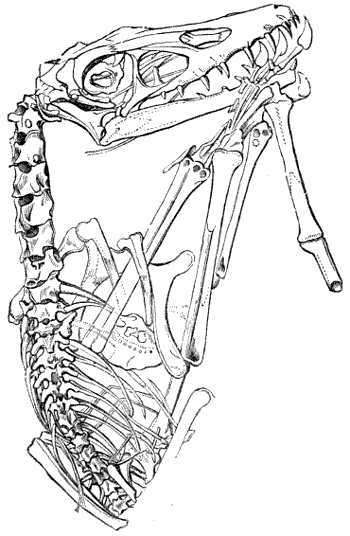
Fig. 105.—Pterodactylus crassirostris.
“Thus, like Milton’s fiend, all-qualified for all services and all
elements, the creature was a fit companion for the kindred reptiles
that swarmed in the seas, or crawled on the shores, of a turbulent
planet:
“The Fiend,
O’er bog, or steep, through strait, rough, dense, or rare,
With head, hands, wings, or feet, pursues his way,
And sinks, or swims, or wades, or creeps, or flies.
Paradise Lost, Book II., line 947.
“With flocks of such-like creatures flying in the air, and shoals
of Ichthyosauri and Plesiosauri swarming in the ocean, and gigantic
Crocodiles and Tortoises
crawling on the
shores of primæval
lakes and rivers—air,
sea, and land must
have been strangely
tenanted in these
early periods of our
infant world.”[64]
The strange structure
of this animal
gave rise to most
contradictory opinions
from the earlier
naturalists. One
supposed it to be a
bird, another a bat,
and others a flying
reptile. Cuvier was
the first to detect the
truth, and to prove, from its organisation, that the animal was a
Saurian. “Behold,” he says, “an animal which in its osteology,
from its teeth to the end of its claws, presents all the characters
of the Saurians; nor can we doubt that their characteristics existed
in its integuments and softer parts, in its scales, its circulation, its
generative organs: it was at the same time provided with the means
of flight; but when stationary it could not have made much use of its
anterior extremities, even if it did not keep them always folded
as birds fold their wings. It might, it is true, use its small
anterior fingers to suspend itself from the branches of trees; but
when at rest it must have been generally on its hind feet, like the
birds again, and like them it must have carried its neck half-erect
and curved backwards, so that its enormous head should not disturb
its equilibrium.” This diversity of opinion need not very much surprise
us after all, for, with the body and tail of an ordinary mammal,
it had the form of a bird in its head and the length of its neck, of
the bat in the structure and proportion of its wings, and of a reptile
in the smallness of its head and in its beak, armed with at least
sixty equal sharp-pointed teeth, differing little in form and size.
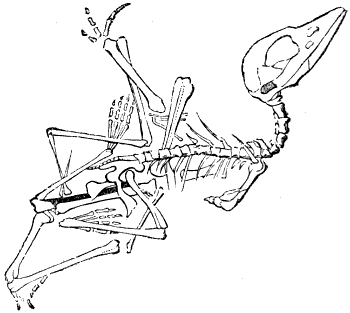
Fig. 106.—Pterodactylus brevirostris.
Dr. Buckland describes eight distinct species, varying in size from
a snipe to a cormorant. Of these, P. crassirostris (Fig. 105) and
P. brevirostris (Fig. 106), were both discovered in the Lias of
Solenhofen. P. macronyx belongs to the Lias of Lyme Regis.
The Pterodactyle was, then, a reptile provided with wings somewhat
resembling those of Bats, and formed, as in that Mammal, of a
membrane which connected the body with the excessively elongated
phalanges of the fourth finger, which served to expand the membrane
that answered the purposes of a wing. The Pterodactyle of the
Liassic period was, as we have seen, an animal of small size; the
largest species in the older Lias beds did not exceed ten or twelve
inches in length, or the size of a raven, while the later forms found
fossil in the Greensand and Wealden beds must have measured
more than sixteen feet between the tips of the expanded wings. On
the other hand, its head was of enormous dimensions compared
with the rest of the body. We cannot admit, therefore, that this
animal could really fly, and, like a bird, beat the air. The membranous
appendage which connected its long finger with its body
was rather a parachute than a wing. It served to moderate the
velocity of its descent when it dropped on its prey from a height.
Essentially a climber, it could only raise itself by climbing up tall
trees or rocks, after the manner of lizards, and throw itself thence to
the ground, or upon the lower branches, by making use of its natural
parachute.
The ordinary position of the Pterodactyle was probably upon its
two hind feet, the lower extremities being adapted for standing and
moving on the ground, after the manner of birds. Habitually, perhaps,
it perched on trees; it could creep, or climb along rocks and
cliffs, or suspend itself from trees, with the assistance of its claws and
feet, after the manner of existing Bats. It is even probable, Dr. Buckland
thought, that it had the power of swimming and diving, so
common to reptiles, and possessed by the Vampyre Bat of the island
of Bonin. It is believed that the smaller species lived upon insects,
and the larger preyed upon fishes, upon which it could throw itself
like the sea-gull.
The most startling feature in the organisation of this animal is
the strange combination of two powerful wings attached to the body
of a reptile. The imagination of the poets long dwelt on such a
combination; the Dragon was a creation of their fancy, and it
played a great part in fable and in pagan mythology. The Dragon,
or flying reptile, breathing fire and poisoning the air with his fiery
breath, had, according to the fable, disputed with man the possession
of the earth. Gods and demigods claimed, among their most famous
exploits, the glory of having vanquished this powerful and redoubtable
monster.
Among the animals of our epoch, only a single reptile is found
provided with wings, or digital appendages analogous to the membranous
wings of the bats, and which can be compared to the Pterodactyle.
This is called the Dragon, one of the Draconidæ, a family of
Saurians, which has been described by Daudin, as distinguished by
the first six ribs, instead of hooping round the abdomen, extending
in nearly a straight line, and sustaining a prolongation of skin which
forms a sort of wing analogous to that of the Pterodactyle. Independent
of the four feet, this wing sustains the animal, like a parachute,
as it leaps from branch to branch; but the creature has no
power to beat the air with it as birds do when flying. This reptile
lives in the forests of the hottest parts of Africa, and in some isles of
the Indian Ocean, especially in Sumatra and Java. The only known
species is that figured at page 238 (Fig. 107), which comes from the
East Indies.
What a strange population was that which occupied the earth at
this stage of its history, when the waters were filled with creatures so
extraordinary as those whose history we have traced! Plesiosauri
and Ichthyosauri filled the seas, upon the surface of which floated
innumerable Ammonites in light skiffs, some of them as large as a
good-sized cart-wheel, while gigantic Turtles and Crocodiles crawled
on the banks of the rivers and lakes. Only one genus of Mammals
had yet appeared, but no birds; nothing broke the silence of the air,
if we except the breathing of the terrestrial reptiles and the flight of
winged insects.
The earth cooled progressively up to the Jurassic period, the
rains lost their continuity and abundance, and the pressure of the
atmosphere sensibly diminished. All these circumstances favoured
the appearance and the multiplication of innumerable species of
animals, whose singular forms then showed themselves on the earth.
We can scarcely imagine the prodigious quantity of Molluscs and
Zoophytes whose remains lie buried in the Jurassic rocks, forming
entire strata of immense thickness and extent.
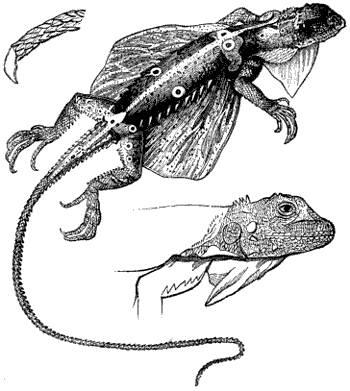
Fig. 107.—Draco volans.
The same circumstances concurred to favour the production of
plants. If the shores and seas of the period received such a terrible
aspect from the formidable animals we have described, the vegetation
which covered the land had also its peculiar character and
appearance. Nothing that we know of in the existing scenery of the
globe surpasses the rich vegetation which decorated the continents
of the Jurassic period. A temperature still of great elevation, a
humid atmosphere, and, we have no reason to doubt, a brilliant sun,
promoted the growth of a luxuriant vegetation, such as some of the
tropical islands, with their burning temperature and maritime climate,
can only give us an idea of, while it recalls some of the Jurassic
types of vegetation. The elegant Voltzias of the Trias had disappeared,
but the Horse-tails (Equiseta) remained, whose slender and
delicate stems rose erect in the air with their graceful panicles; the
gigantic rushes also remained; and though the tree-ferns had lost
their enormous dimensions of the Carboniferous age, they still preserved
their fine and delicately-cut leaves.
Alongside these vegetable families, which passed upwards from
the preceding age, an entire family—the Cycads (Fig. 72, p. 168)—appear
for the first time. They soon became numerous in genera,
such as Zamites, Pterophyllum (Williamsonia), and Nilssonia. Among
the species which characterise this age, we may cite the following,
arranging them in families:—
| FERNS. |
CYCADS. |
CONIFERS. |
| Odontopteris cycadea. |
Zamites distans. |
Taxodites. |
| Taumopteris Munsteri. |
Zamites heterophyllus. |
Pinites. |
| Camptopteris crenata. |
Zamites gracilis. |
|
| |
Pterophyllum dubium. |
|
| |
Nilssonia contigua. |
|
| |
Nilssonia elegantissima. |
|
| |
Nilssonia Sternbergii. |
|
The Zamites seem to be forerunners of the Palms, which make
their appearance in the following epoch; they were trees of elegant
appearance, closely resembling the existing Zamias, which are trees
of tropical America, and especially of the West India Islands; they
were so numerous in species and in individuals that they seem to
have formed, of themselves alone, one half of the forests during the
period which engages our attention. The number of their fossilised
species exceeds that of the living species. The trunk of the Zamites,
simple and covered with scars left by the old leaves, supports a thick
crown of leaves more than six feet in length, disposed in fan-like
shape, arising from a common centre.
The Pterophyllum (Williamsonia), formed great trees, of considerable
elevation, and covered with large pinnated leaves from top
to bottom. Their leaves, thin and membranous, were furnished with
leaflets truncated at the summit and traversed by fine nervures, not
convergent, but abutting on the terminal truncated edge.
The Nilssonia, finally, were Cycadeaceæ resembling the Pterophyllum,
but with thick and coriaceous leaves, and short leaflets contiguous
to, and in part attached to the base; they were obtuse or
nearly truncated at the summit, and would present nervures arched
or confluent towards that summit.
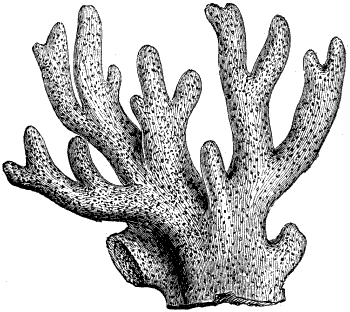
Fig. 108.—Millepora alcicornis.
(Recent Coral.)
The essential characters of the vegetation during the Liassic sub-period
were:—1. The great predominance of the Cycadeaceæ, thus
continuing the development which commenced in the previous
period, expanding into numerous genera belonging both to this
family and that of the Zamites and Nilssonia; 2. The existence
among the Ferns of many genera with reticulated veins or nervures,
and under forms of little variation, which scarcely show themselves in
the more ancient formations.
[241]
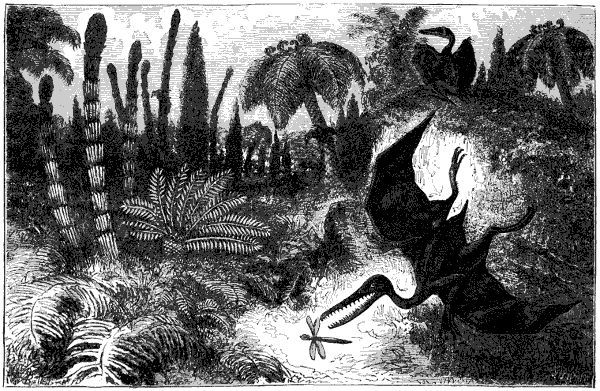
XVI.—Ideal Landscape of the Liassic Period.
On the opposite page (Plate XVI.) is an ideal landscape of the
Liassic period; the trees and shrubs characteristic of the age are the
elegant Pterophyllum, which appears in the extreme left of the
picture, and the Zamites, which are recognisable by their thick and
low trunk and fan-like tuft of foliage. The large horsetail, or
Equisetum of this epoch, mingles with the great Tree-ferns and the
Cypress, a Conifer allied to those of our own age. Among animals,
we see the Pterodactyle specially represented. One of these reptiles
is seen in a state of repose, resting on its hind feet. The other is
represented, not flying, after the manner of a bird, but throwing itself
from a rock in order to seize upon a winged insect, the dragon-fly
(Libellula), the remains of which have been discovered, associated
with the bones of the Pterodactyle, in the lithographic limestone of
Pappenheim and Solenhofen.
This period is so named because many of the limestones entering
into the composition of the formations it comprises, consist almost
entirely of an aggregation of rounded concretionary grains resembling,
in outward appearance, the roe or eggs of fishes, and each of which
contains a nucleus of sand, around which concentric layers of calcareous
matter have accumulated; whence the name, from ωον, egg,
and λιθος, stone.
The Oolite series is usually subdivided into three sections, the
Lower, Middle, and Upper Oolite. These rocks form in England a
band some thirty miles broad, ranging across the country from Yorkshire,
in the north-east, to Dorset, in the south-west, but with a great
diversity of mineral character, which has led to a further subdivision
of the series, founded on the existence of particular strata in the
central and south-western counties:—
| Upper. |
Middle. |
Lower. |
| 1. Purbeck Beds. |
1. Coral Rag. |
1. Cornbrash. |
| 2. Portland Stone and Sand. |
2. Oxford Clay. |
2. Great Oolite & Forest Marble. |
| 3. Kimeridge Clay. |
|
3. Stonesfield Slate. |
| |
|
4. Fuller’s Earth. |
| |
|
5. Inferior Oolite. |
The alternations of clay and masses of limestone in the Liassic
and Oolite formations impart some marked features to the outline of
the scenery both of France and England: forming broad valleys,
separated from each other by ranges of limestone hills of more or less
elevation. In France, the Jura mountains are composed of the
latter; in England, the slopes of this formation are more gentle—the
valleys are intersected by brooks, and clothed with a rich vegetation;
it forms what is called a tame landscape, as compared with the
wilder grandeur of the Primary rocks—it pleases more than it surprises.
It yields materials also, more useful than some of the older
formations, numerous quarries being met with which furnish excellent
building-materials, especially around Bath, where the stone, when
first quarried, is soft and easily worked, but
becomes harder on exposure to the air.
The annexed section (Fig. 109) will give
some idea of the configuration which the
stratification assumes, such as may be observed
in proceeding from the north-west
to the south-east, from Caermarthenshire
to the banks of the Ouse.

Fig. 109.—General view of the succession of British strata, with the elevations they reach above the
level of the sea.
G, Granitic rocks; a, Gneiss; b, Mica-schist; c, Skiddaw or Cumbrian Slates; d, Snowdon rocks; e, Plynlymmon rocks; f, Silurian rocks; g, Old
Red Sandstone; h, Carboniferous Limestone; i, Millstone Grit; k, Coal-measures; l, Magnesian Limestone; m, New Red Sandstone; n, Lias;
o, Lower, Middle, and Upper Oolites; p, Greensand; q, Chalk; r, Tertiary strata.
The most salient and characteristic
feature of this age is, undoubtedly, the appearance
of animals belonging to the class
of Mammals. But the organisation, quite
special, of the first of the Mammalia will
certainly be a matter of astonishment to the
reader, and must satisfy him that Nature proceeded
in the creation of animals by successive
steps, by transitions which, in an almost
imperceptible manner, connect the beings
of one age with others more complicated in
their organisation. The first Mammals which
appeared upon the earth, for example,
did not enjoy all the organic attributes
belonging to the more recent creations of
the class. In the latter the young are
brought forth living, and not from eggs,
like Birds, Reptiles, and Fishes. But the
former belonged to that order of animals
quite special, and never numerous, the
young of which are transferred in a half-developed
state, from the body of the
mother to an external pouch in which they
remain until they become perfected; in
short, to marsupial animals. The mother
nurses her young during a certain time in a
sort of pouch external to the body, in the
neighbourhood of the abdomen, and provided
with teats to which the young adhere.
After a more or less prolonged sojourn in
this pouch, the young animal, when sufficiently
matured and strong enough to battle with the world, emerges
from its warm retreat, and enters fully into life and light; the process
being a sort of middle course between oviparous generation, in which
the animals are hatched from eggs after exclusion from the mother’s
body, like Birds; and viviparous, in which the animals are brought
forth alive, as in the ordinary Mammals.
In standard works on natural history the animals under consideration
are classed as mammiferous Didelphæ. They are brought forth in
an imperfect state, and during their transitional condition are suckled
in a pouch supported by bones called marsupial, which are attached
by their extremities to the pelvis, and serve to support the marsupium,
whence the animals provided with these provisions for bringing up
their progeny are called Marsupial Mammals. The Opossum, Kangaroo,
and Ornithorhynchus are existing representatives of this group.
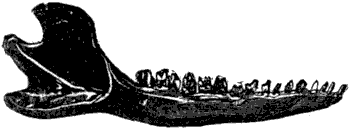
Fig. 110.—Jaw of Thylacotherium Prevostii.
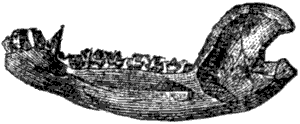
Fig. 111.—Jaw of Phascolotherium.
The name of Thylacotherium, or Amphitherium, or Phascolotherium,
is given to the first of these marsupial Mammals which made
their appearance, whose remains have been discovered in the Lower
Oolite, and in one of its higher stages, namely, that called the Great
Oolite. Fig. 110 represents the jaw of the first of these animals, and
Fig. 111 the other—both of the natural size. These jaw-bones
represent all that has been found belonging to these early marsupial
animals; and Baron Cuvier and Professor Owen have both decided
as to their origin. The first was found in the Stonesfield quarries.
The Phascolotherium, also a Stonesfield fossil, was the ornament of
Mr. Broderip’s collection. The animals which lived on the land
during the Lower Oolitic period would be nearly the same with
those of the Liassic. The insects were, perhaps, more numerous.
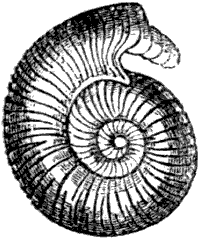
Fig. 112.—Ammonites
Herveyii.
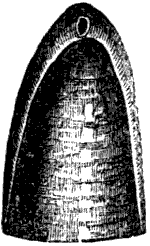
Fig. 113.—Terebratula digona.
The marine fauna included Reptiles, Fishes, Molluscs, and
Zoophytes. Among the first were the Pterodactyle, and a great
Saurian, the Teleosaurus, belonging to a family which made its
appearance in this age, and which reappears in the following epoch.
Among the Fishes, the Ganoids and Ophiopsis predominate. Among
the Ammonites, Ammonites Humphriesianus, A. Herveyii (Fig. 112),
A. Brongniarti, Nautilus lineatus, and many other representatives of
the cephalopodous Mollusca. Among
the Brachiopods are Terebratula digona
(Fig. 113) and T. spinosa. Among
the Gasteropoda the Pleurotomaria
conoidea is remarkable from its elegant
shape and markings, and very unlike
any of the living Pleurotoma as represented
by P. Babylonia (Fig. 114).
Ostrea Marshii and Lima proboscidea,
which belong to the Acephala, are
fossil Mollusca of this epoch, to which
also belong Entalophora cellarioides, Eschara Ranviliana, Bidiastopora
cervicornis; elegant and characteristic molluscous Polyzoa.
We give a representation of two living species, as exhibiting the
form of these curious beings. (Figs. 115 and 116.)
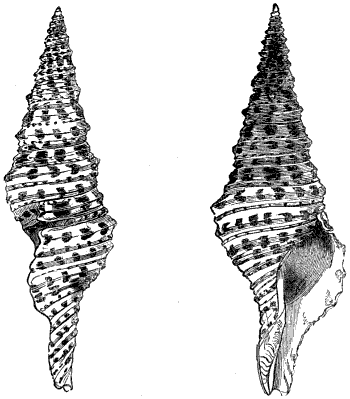
Fig. 114.—Pleurotoma Babylonia. (Recent.)
The Echinoderms and Polyps appear in great numbers in the
deposits of the Lower Oolite: Apiocrinus elegans, Hyboclypus
gibberulus, Dysaster Endesii represent the first; Montlivaltia caryophyllata,
Anabacia orbulites, Cryptocœnia bacciformis, and Eunomia
radiata represent the second.
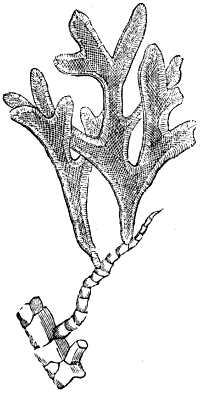
Fig. 115.—Adeona folifera.
(Recent Polyzoa.)
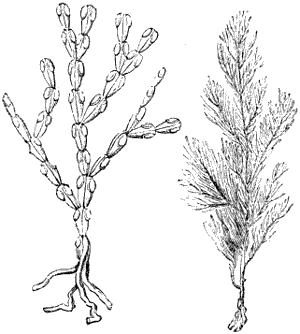
Fig. 116.—Cellaria loriculata.
(Recent Polyzoa.)
This last and most remarkable species of Zoophyte presents itself
in great masses many yards in circumference, and necessitates a long
period of time for its production. This assemblage of little creatures
living under the waters but only at a small depth beneath the surface,
as Mr. Darwin has demonstrated, has nevertheless produced banks, or
rather islets, of considerable extent, which at one time constituted
veritable reefs rising out of the ocean. These reefs were principally
constructed in the Jurassic period, and their extreme abundance is
one of the characteristics of this geological age. The same phenomenon
continues in our day, but by the agency of a new race of
zoophytes, which carry on their operations, preparing a new continent,
probably, in the atolls of the Pacific Ocean. (See Fig. 108, p. 240.)
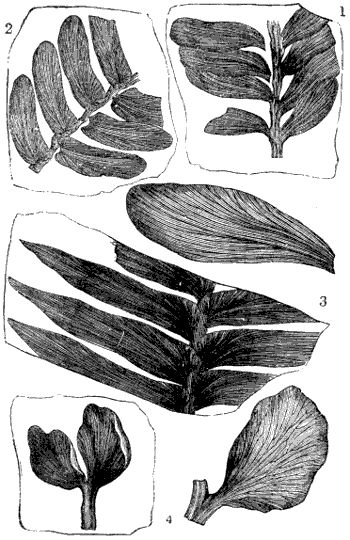
Fig. 117.
1, Otopteris dubia; 2, Otopteris obtusa; 3, Otopteris acuminata; 4, Otopteris cuneata.
The flora of the epoch was very rich. The Ferns continue to
exist, but their size and bearing were sensibly inferior to what they
had been in the preceding period. Among them Otopteris, distinguished
for its simply pinnated leaves, whose leaflets are auriculate
at the base: of the five species, 1, O. dubia; and 2, O. obtusa; and
3, O. acuminata; and 4, O. cuneata (Fig. 117), are from the Oolite.
In addition to these we may name Coniopteris Murrayana, Pecopteris
Desnoyersii, Pachypteris lanceolata, and Phlebopteris Phillipsii; and
among the Lycopods, Lycopodus falcatus.
The vegetation of this epoch has a peculiar facies, from the
presence of the family of the Pandanaceæ, or screw-pines, so remarkable
for their aërial roots, and for the magnificent tuft of leaves which
terminates their branches. Neither the leaves nor the roots of these
plants have, however, been found in the fossil state, but we possess
specimens of their large and spherical fruit, which leave no room for
doubt as to the nature of the entire plant.
The Cycads were still represented by the Zamias, and by many
species of Pterophyllum. The Conifers, that grand family of recent
times, to which the pines, firs, and other trees of our northern
forests belong, began to occupy an important part in the world’s
vegetation from this epoch. The earliest Conifers belonged to the
genera Thuites, Taxites, and Brachyphyllum. The Thuites were true
Thuyas, evergreen trees of the present epoch, with compressed
branches, small imbricated and serrated leaves, somewhat resembling
those of the Cypress, but distinguished by many points of special
organisation. The Taxites have been referred, with some doubts, to
the Yews. Finally, the Brachyphyllum were trees which, according
to the characteristics of their vegetation, seem to have approached
nearly to two existing genera, the Arthotaxis of Tasmania, and the
Weddringtonias of South Africa. The leaves of the Brachyphyllum
are short and fleshy, with a large and rhomboidal base.
The formation which represents the Lower Oolite, and which in
England attains an average thickness of from 500 to 600 feet, forms
a very complex system of stratification, which includes the two
formations, Bajocien and Bathonian, adopted by M. D’Orbigny and
his followers. The lowest beds of the Inferior Oolite occur in
Normandy, in the Lower Alps (Basses-Alpes), in the neighbourhoods of
Lyons and Neuchatel. They are remarkable near Bayeux for the
variety and beauty of their fossils: the rocks are composed principally
of limestones—yellowish-brown, or red, charged with hydrated
oxide of iron, often oolitic, and reposing on calcareous sands. These
deposits are surmounted by alternate layers of clay and marl, blue
or yellow—the well-known Fuller’s Earth, which is so called from its
use in the manufacture of woollen fabrics to extract the grease
from the wool. The second series of the Lower Oolite, which
attains a thickness of from 150 to 200 feet on the coast of Normandy,
and is well developed in the neighbourhood of Caen and in the
Jura, has been divided, in Britain, into four formations, in an
ascending scale:—
1. The Great or Bath Oolite, which consists principally of a
very characteristic, fine-grained, white, soft, and well-developed oolitic
limestone, at Bath, and also at Caen in Normandy. At the base of
the Great Oolite the Stonesfield beds occur, in which were found the
bones of the marsupial Mammals, to which we have already alluded;
and along with them bones of Reptiles, principally Pterodactyles,
together with some finely-preserved fossil plants, fruits, and
insects.
2. Bradford Clay, which is a bluish marl, containing many fine
Encrinites (commonly called stone-lilies), but which had only a local
existence, appearing to be almost entirely confined to this formation.
“In this case, however,” says Lyell, “it appears that the solid upper
surface of the ‘Great Oolite’ had supported, for a time, a thick
submarine forest of these beautiful Zoophytes, until the clear and
still water was invaded with a current charged with mud, which threw
down the stone-lilies, and broke most of their stems short off near
the point of attachment. The stumps still remain in their original
position.”[65]
See Fig. 1, Plate XIX., p. 261. (Bradford, or Pear,
Encrinite.)
3. Forest Marble, which consists of an argillaceous shelly limestone,
abounding in marine fossils, and sandy and quartzose marls, is
quarried in the forest of Wichwood, in Wiltshire, and in the counties
of Dorset, Wilts, and Somerset.
4. The Cornbrash (wheat-lands) consists of beds of rubbly cream-coloured
limestone, which forms a soil particularly favourable to the
cultivation of cereals; hence its name.[66]
The Lower Oolite ranges across the greater part of England, but
“attains its maximum development near Cheltenham, where it can
be subdivided, at least, into three parts. Passing north, the two
lower divisions, each more or less characterised by its own fossils,
disappear, and the Ragstone north-east of Cheltenham lies directly
upon the Lias; apparently as conformably as if it formed its true and
immediate successor, while at Dundry the equivalents of the upper
freestones and ragstones (the lower beds being absent) lie directly on
the exceedingly thin sands, which there overlie the Lower Lias. In
Dorsetshire, on the coast, the series is again perfect, though thin.
Near Chipping Norton, in Oxfordshire, the Inferior Oolite disappears
altogether, and the Great Oolite, having first overlapped the Fullers’
Earth, passes across the Inferior Oolite, and in its turn seems to lie
on the Upper Lias with a regularity as perfect as if no formation in
the neighbourhood came between them. In Yorkshire the changed
type of the Inferior Oolite, the prevalence of sands, land-plants, and
beds of coal, occur in such a manner as to leave no doubt of the
presence of terrestrial surfaces on which the plants grew, and all
these phenomena lead to the conclusion that various and considerable
oscillations of level took place in the British area during the deposition
of the strata, both of the Inferior Oolite and of the formations
which immediately succeed it.”[67]
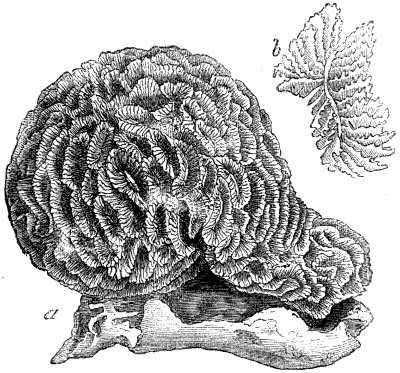
Fig. 118.—Meandrina Dædalæa.
a, entire figure, reduced; b, portion, natural size.
(Recent Coral.)
The Inferior Oolite here alluded to is a thin bed of calcareous
freestone, resting on, and sometimes replaced by yellow sand, which
constitutes the passage-beds from the Liassic series. The Fullers’
Earth clay lies between the limestones of the Inferior and Great
Oolite, at the base of which last lies the Stonesfield slate—a slightly
oolitic, shelly limestone, or flaggy and fissile sandstone, some six
feet thick, rich in organic remains, and ranging through Oxfordshire
towards the north-east, into Northamptonshire and Yorkshire. At
Colley Weston, in Northamptonshire, fossils of Pecopteris polypodioides
are found. In the Great Oolite formation, near Bath, are
many corals, among which the Eunomia radiata is very conspicuous.
The fossil is not unlike the existing brain-coral of the tropical seas
(Fig. 118). The work of this coral seems to have been suddenly stopped
by “an invasion,” says Lyell, “of argillaceous matter, which probably
put a sudden stop to the growth of Bradford Encrinites, and led to
their preservation in marine strata.”[68] The Cornbrash is, in general, a
cream-coloured limestone, about forty feet thick, in the south-west of
England, and occupying a considerable area in Dorsetshire and North
Wilts, as at Cricklade, Malmesbury, and Chippenham, in the latter
county. Terebratula obovata is its characteristic shell, and Nucleolites
clunicularis, Lima gibbosa, and Avicula echinata occur constantly in
great numbers. Wherever it occurs the Cornbrash affords a rich and
fertile soil, well adapted for the growth of wheat, while the Forest
Marble, as a soil, is generally poor. The Cornbrash passes downwards
into the Forest Marble, and sometimes, as at Bradford, near
Bath, is replaced by clay. This clay, called the Bradford clay, is
almost wholly confined to the county of Wilts. Terebratula decussata
is one of the most characteristic fossils, but the most common is the
Apiocrinites or pear-shaped encrinite, whose remains in this clay are so
perfectly preserved that the most minute articulations are often found
in their natural positions. Plate XIX., p. 261 (Fig. 1), represents an
adult attached by a solid base to the rocky bottom on which it grew,
whilst the smaller individuals show the Encrinite in its young state—one
with arms expanded, the other with them closed. Ripple-marked
slabs of fissile Forest Marble are used as a roofing-slate, and
may be traced over a broad band of country in Wiltshire and
Gloucestershire, separated from each other by thin seams of clay, in
which the undulating ridges of the sand are preserved, and even
the footmarks of small Crustaceans are still visible.
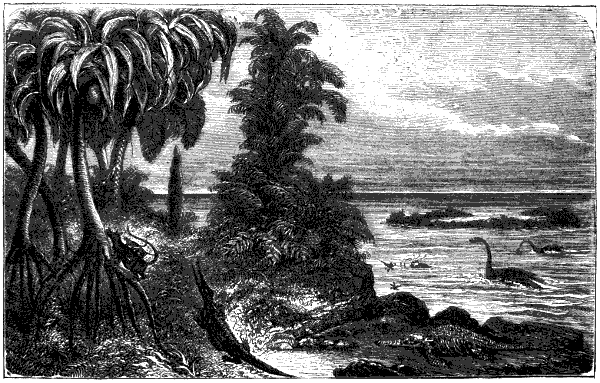
XVII.—Ideal Landscape of the Lower Oolite Period.
On the opposite page (Plate XVII.) is represented an ideal landscape
of the period of the Lower Oolite. On the shore are types of
the vegetation of the period. The Zamites, with large trunk covered
with fan-like leaves, resembled in form and bearing the existing
Zamias of tropical regions; a Pterophyllum, with its stem covered
from base to summit with its finely-cut feathery leaves; Conifers
closely resembling our Cypress, and an arborescent Fern. What distinguishes
this sub-period from that of the Lias is a group of magnificent
trees, Pandanus, remarkable for their aërial roots, their long
leaves, and globular fruit.
Upon one of the trees of this group the artist has placed the
Phascolotherium, not very unlike to our Opossum. It was amongst
the first of the Mammalia which appeared in the ancient world.
The artist has here enlarged the dimensions of the animal in order to
show its form. Let the reader reduce it in imagination one-sixth,
for it was not larger than an ordinary-sized cat.
A Crocodile and the fleshless skeleton of the Ichthyosaurus
remind us that Reptiles still occupied an important place in the
animal creation. A few Insects, especially Dragon-flies, fly about in
the air. Ammonites float on the surface of the waves, and the
terrible Plesiosaurus, like a gigantic swan, swims about in the sea.
The circular reef of coral, the work of ancient Polyps, foreshadows
the atolls of the great ocean, for it was during the Jurassic period
that the Polyps of the ancient world were most active in the production
of coral-reefs and islets.
The terrestrial flora of this age was composed of Ferns, Cycads,
and Conifers. The first represented by the Pachypteris microphylla,
the second by Zamites Moreana. Brachyphyllum Moreanum and
B. majus appear to have been the Conifers most characteristic of the
period; fruits have also been found in the rocks of the period,
which appear to belong to Palms, but this point is still obscure
and doubtful.
Numerous vestiges of the fauna which animated the period are
also revealed in the rocks of this age. Certain hemipterous insects
appear on the earth for the first time, and the Bees among the
Hymenoptera, Butterflies among the Lepidoptera, and Dragon-flies
among the Neuroptera. In the bosom of the ocean, or upon its
banks, roamed the Ichthyosaurus, Ceteosaurus, Pterodactylus crassirostris,
and the Geosaurus; the latter being very imperfectly known.
The Ceteosaurus whose bones have been discovered in the upper
beds of the Great Oolite at Enslow Rocks, at the Kirtlington Railway
Station, north of Oxford, and some other places, was a species of
Crocodile nearly resembling the modern Gavial or Crocodile of the
Ganges. This huge whale-like reptile has been described by Professor
John Phillips as unmatched in size and strength by any of the
largest inhabitants of the Mesozoic land or sea—perhaps the largest
animal that ever walked upon the earth. A full-grown Ceteosaurus
must have been at least fifty feet long, ten feet high, and of a proportionate
bulk. In its habits it was, probably, a marsh-loving or river-side
animal, dwelling amidst filicene, cycadaceous, and coniferous
shrubs and trees full of insects and small mammalia. The one small
and imperfect tooth which has been found resembles that of
Iguanodon more than of any other reptile; and it seems probable
that the Ceteosaurus was nourished by vegetable food, which abounded
in the vicinity of its haunts, and was not obliged to contend with the
Megalosaurus for a scanty supply of more stimulating diet.[69]
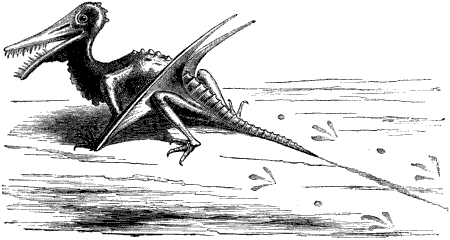
Fig. 119.—Ramphorynchus restored. One-quarter natural size.
Another reptile allied to the Pterodactyle lived in this epoch—the
Ramphorynchus, distinguished from the Pterodactyle by a long tail. The
imprints which this curious animal has left upon the sandstone of the
period are impressions of its feet and the linear furrow made by its tail.
Like the Pterodactyle, the Ramphorynchus, which was about the size
of a crow, could not precisely fly, but, aided by the wing (a sort of
natural parachute formed by the membrane connecting the fingers
with the body), it could throw itself from a height upon its prey.
Fig. 119 represents a restoration of this animal. The footprints in the
soil are in imitation of those which accompany the remains of the
Ramphorynchus in the Oolitic rocks, and they show the imprints of
the anterior and posterior feet and also the marks made by the tail.
This tail was very long, far surpassing in length the rest of the
vertebral column, and consisting of more than thirty vertebræ—which
were at first short, but rapidly elongate, retain their length for a considerable
distance, and then gradually diminish in size.
[258]
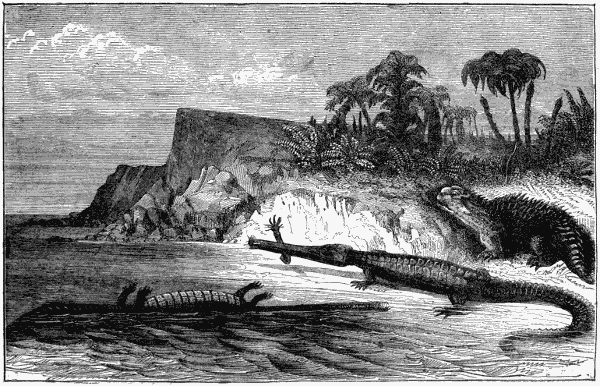
XVIII.—Ideal landscape of the Middle Oolitic Period.
Another genus of Reptiles appears in the Middle Oolite, of which
we have had a glimpse in the Lias and Great Oolite of the preceding
section. This is the Teleosaurus, which the recent investigations of
M. E. Deslongchamps allow of re-construction. The Teleosaurus
enables us to form a pretty exact idea of these Crocodiles of the
ancient seas—these cuirassed Reptiles, which the German geologist
Cotta describes as “the great barons of the kingdom of Neptune,
armed to the teeth, and clothed in an impenetrable panoply; the
true filibusters of the primitive seas.”
The Teleosaurus resembled the Gavials of India. The former
inhabited the banks of rivers, perhaps the sea itself; they were
longer, more slender, and more active than the living species; they
were about thirty feet in length, of which the head may be from three
to four feet, with their enormous jaws sometimes with an opening of
six feet, through which they could engulf, in the depths of their
enormous throat, animals of considerable size.
The Teleosaurus cadomensis is represented on the opposite page
(Plate XVIII.), after the sketch of M. E. Deslongchamps, carrying
from the sea in its mouth a Geoteuthis, a species of Calamary of the
Oolitic epoch. This creature was coated with a cuirass both on the
back and belly. In order to show this peculiarity, a living individual
is represented on the shore, and a dead one is floating on its back in
shallow water, leaving the ventral cuirass exposed.
Behind the Teleosaurus cadomensis in the engraving, another
Saurian, the Hylæosaurus, is represented, which makes its appearance
in the Cretaceous epoch. We have here adopted the restoration
which has been so ably executed by Mr. Waterhouse Hawkins, at
the Crystal Palace, Sydenham.
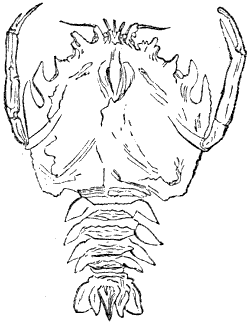
Fig. 120.—Eryon arctiformis.
Besides the numerous Fishes with which the Oolitic seas swarmed,
they contained some Crustaceans, Cirripedes, and various genera of
Mollusca and Zoophytes. Eryon arctiformis, represented in Fig. 119,
belongs to the class of Crustaceans, of which the spiny lobster is the
type. Among the Mollusca were some Ammonites, Belemnites, and
Oysters, of which many hundred species have been described. Of
these we may mention Ammonites refractus, A. Jason and A. cordatus,
Ostrea dilatata, Terebratula diphya, Diceras arietena, Belemnites hastatus,
and B. Puzosianus. In some of the finely-laminated clays the
Ammonites are very perfect, but somewhat compressed, with the outer
lip or margin of the aperture entire (Fig. 120). Similar prolongations
have been noticed in Belemnites found by Dr. Mantell in the Oxford
Clay, near Chippenham.
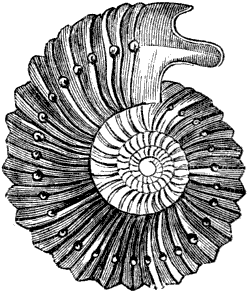
Fig. 121.—Perfect Ammonite.
[261]
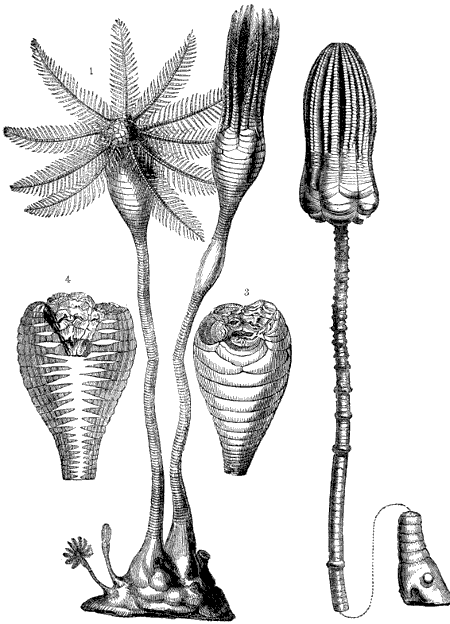
XIX.—Fig. 1.—Apiocrinites rotundus.
Fig. 2.—Encrinus liliiformis.
Among the Echinoderms, Cidaris glandiferus, Apiocrinus Roissyanus,
and A. rotundus, the graceful Saccocoma pectinata, Millericrinus
nodotianus, Comatula costata, and Hemicidaris crenularis may be mentioned;
Apiocrinites rotundus, figured in Plate XIX., is a reduced
restoration: 1, being expanded; a, closed; 3, a cross section of the
upper extremity of the pear-shaped head; 4, a vertical section
showing the enlargement of the alimentary canal, with the hollow
lenticular spaces which descend through the axis of the column,
forming the joints, and giving elasticity and flexure to the whole stem,
without risk of dislocation. A. rotundus is found at Bradford in
Wiltshire, Abbotsbury in Dorset, at Soissons, and Rochelle. This
species—known as the Bradford Pear-Encrinite—is only found in the
strata mentioned.
The Corals of this epoch occur in great abundance. We have
already remarked that these aggregations of Polyps are often met
with at a great depth in the strata. These small calcareous structures
have been formed in the ancient seas, and the same phenomenon is
extending the terrestrial surface in our days in the seas of Oceania,
where reefs and atolls of coral are rising by slow and imperceptible
steps, but with no less certainty. Although their mode of production
must always remain to some extent a mystery, the investigations of
M. Lamaroux, Mr. Charles Darwin, and M. D’Orbigny have gone a
long way towards explaining their operations; for the Zoophyte in
action is an aggregation of these minute Polyps. Describing what he
believes to be a sea-pen, a Zoophyte allied to Virgularia Patagonia,
Mr. Darwin says: “It consists of a thin, straight, fleshy stem, with
alternate rows of polypi on each side, and surrounding an elastic
stony axis. The stem at one extremity is truncate, but at the other
is terminated by a vermiform fleshy appendage. The stony axis
which gives strength to the stem, may be traced at this extremity into
a mere vessel filled with granular matter. At low water hundreds of
these zoophytes might be seen, projecting like stubble, with the truncate
end upwards, a few inches above the surface of the muddy sand. When
touched or pulled, they drew themselves in suddenly, with force, so
as nearly or quite to disappear. By this action, the highly-elastic
axis must be bent at the lower extremity, where it is naturally slightly
curved; and I imagine it is by this elasticity alone that the zoophyte
is enabled to rise again through the mud. Each polypus, though
closely united to its brethren, has a distinct mouth, body, and tentacula.
Of these polypi, in a large specimen there must be many
thousands. Yet we see that they act by one movement; that they
have one central axis, connected with a system of obscure circulation.”
Such is the brief account given by a very acute observer of
these singular beings. They secrete the calcareous matter held in
solution in the oceanic waters, and produce the wonderful structures
we have now under consideration; and these calcareous banks have
been in course of formation during many geological ages. They
just reach the level of the waters, for the polyps perish as soon as
they are so far above the surface that neither the waves nor the flow
of the tides can reach them. In the Oolitic rocks these banks
are frequently found from twelve to fifteen feet thick, and many
leagues in length, and preserving, for the most part, the relative
positions which they occupied in the sea while in course of
formation.
The rocks which now represent the Middle Oolitic Period are
usually divided into the Oxford Clay, the lower member of which is
an arenaceous limestone, known as the Kellaways Rock, which in
Wiltshire and other parts of the south-west of England attains a
thickness of eight or ten feet, with the impressions of numerous
Ammonites, and other shells. In Yorkshire, around Scarborough, it
reaches the thickness of thirty feet; and forms well-developed beds of
bluish-black marl in the department of Calvados, in France. It is
the base of this clay which forms the soil (Argile de Dives) of the
valley of the Auge, renowned for its rich pasturages and magnificent
cattle. The same beds form the base of the oddly-shaped but fine
rocks of La Manche, which are popularly known as the Vaches Noires
(or black cows)—a locality celebrated, also, for its fine Ammonites
transformed into pyrites.
The Oxford Clay constitutes the base of the hills in the neighbourhood
of Oxford, forming a bed of clay sometimes more than 600
feet thick. It is found well-developed in France, at Trouville, in
the department of the Calvados; and at Neuvisy, in the department
of the Ardennes, where it attains a thickness of about 300 feet. It
is a bluish, sometimes whitish limestone (often argillaceous), and
bluish marl. The Gryphæa dilatata is the most common fossil in
the Oxford Clay. The Coral Rag is so called from the fact that the
limestone of which it is chiefly composed consists, in part, of an
aggregation of considerable masses of petrified Corals; not unlike
those now existing in the Pacific Ocean, supposing them to be
covered up for ages and fossilised. This coral stratum extends
through the hills of Berkshire and North Wilts, and it occurs again
near Scarborough. In the counties of Dorset, Bedford, Buckingham,
and Cambridge, and some other parts of England, the limestone of
the Coral Rag disappears and is replaced by clay—in which case the
Oxford Clay is overlaid directly by the Kimeridge Clay. In France
it is found in the departments of the Meuse, of the Yonne, of the
Ain, of the Charente Inférieure. In the Alps the Diceras limestone
is regarded, by most geologists, as coeval with the English
Coral Rag.
[265]
Some marsupial Mammals have left their remains in the Upper
Oolite as in the Lower. They belong to the genus Sphalacotherium.
Besides the Plesiosauri and Teleosauri, there still lived in the maritime
regions a Crocodile, the Macrorhynchus; and the monstrous
Pœcilopleuron, with sharp cutting teeth, one of the most formidable
animals of this epoch; the Hylæosaurus, Cetiosaurus, Stenosaurus, and
Streptospondylus, and among the Turtles, the Emys and Platemys.
As in the Lower Oolite, so also in the Upper, Insects similar to
those by which we are surrounded, pursued their flight in the
meadows and hovered over the surface of the water. Of these,
however, too little is known for us to give any very precise indication
on the subject of their special organisation.
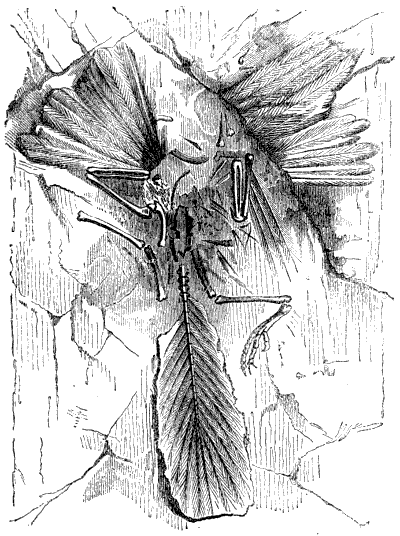
Fig. 122.—Bird of Solenhofen (Archæopteryx).
The most remarkable fact relating to this period is the appearance
of the first bird. Hitherto the Mammals, and of these only imperfectly-organised
species, namely, the Marsupials, have alone appeared.
It is interesting to witness birds appearing immediately after. In
the quarries of lithographic stone at Solenhofen, the remains of a
bird, with feet and feathers, have been found, but without the head.
These curious remains are represented in Fig. 122, in the position
in which they were discovered. The bird is usually designated the
Bird of Solenhofen.
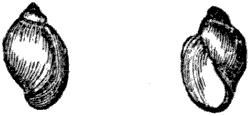
Fig. 123.
Shell of Physa fontinalis.
The Oolitic seas of this series contained Fishes belonging to the
genera Asteracanthus, Strephodes, Lepidotus, and Microdon. The
Cephalopodous Mollusca were not numerous, the predominating
genera belonging to the Lamellibranchs
and to the Gasteropods, which lived on
the shore. The reef-making Madrepores
or Corals were more numerous. A few
Zoophytes in the fossil state testify to the
existence of these extraordinary animals.
The fossils characteristic of the fauna of
the period include Ammonites decipiens and
A. giganteus, Natica elegans and hemispherica, Ostrea deltoidea and O.
virgula, Trigonia gibbosa, Pholadomya multicostata and P. acuticostata,
Terebratula subsella, and Hemicidaris Purbeckensis. Some Fishes, Turtles,
Paludina, Physa (Fig. 123), Unio, Planorbis (Fig. 201), and the
little crustacean bivalves, the Cypris, constituted the fresh-water fauna
of the period.
The terrestrial flora of the period consisted of Ferns, Cycadeaceæ,
and Conifers; in the ponds and swamps some Zosteræ. The
Zosteræ are monocotyledonous plants of the family of the Naïdaceæ,
which grow in the sandy mud of maritime regions, forming there, with
their long, narrow, and ribbon-like leaves, vast prairies of the most
beautiful green. At low tides these masses of verdure appear somewhat
exposed. They would form a retreat for a great number of
marine animals, and afford nourishment to others.
[267]
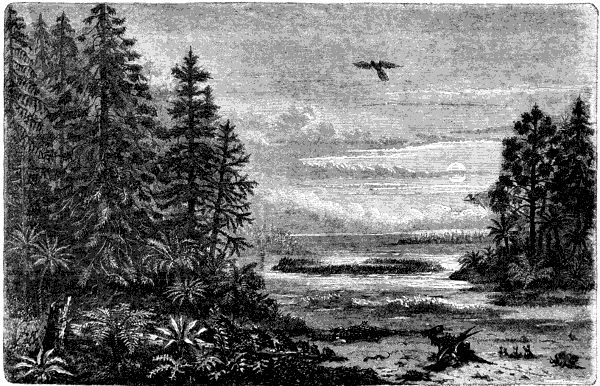
XX.—Ideal Landscape of the Upper Oolitic Period.
On the opposite page an ideal landscape of the period (Plate XX.)
represents some of the features of the Upper Oolite, especially the
vegetation of the Jurassic period. The Sphenophyllum, among the
Tree-ferns, is predominant in this vegetation; some Pandanas, a few
Zamites, and many Conifers, but we perceive no Palms. A coral islet
rises out of the sea, having somewhat of the form of the atolls of
Oceania, indicating the importance these formations assumed in the
Jurassic period. The animals represented are the Crocodileimus of
Jourdan, the Ramphorynchus, with the imprints which characterise its
footsteps, and some of the invertebrated animals of the period, as the
Asteria, Comatula, Hemicidaris, Pteroceras. Aloft in the air floats the
bird of Solenhofen, the Archæopteryx, which has been re-constructed
from the skeleton, with the exception of the head, which remains
undiscovered.
The rocks which represent the Upper Oolite are usually divided
into two series: 1. The Purbeck Beds; 2. The Portland Stone
and Sand; and 3. The Kimeridge Clay.
The Kimeridge Clay, which in many respects bears a remarkable
resemblance to the Oxford Clay, is composed of blue or yellowish
argillaceous beds, which occur in the state of clay and shale (containing
locally beds of bituminous schist, sometimes forming a sort of
earthy impure coal), and several hundred feet in thickness. These
beds are well developed at Kimeridge, in Dorsetshire, whence the
clay takes its name. In some parts of Wiltshire the beds of
bituminous matter have a shaly appearance, but there is an absence
of the impressions of plants which usually accompany the bitumen,
derived from the decomposition of plants. These rocks, with their
characteristic fossils, Cardium striatulum and Ostrea deltoidea, are
found throughout England: in France, at Tonnerre, Dept. Yonne;
at Havre; at Honfleur; at Mauvage; in the department of the
Meuse it is so rich in shells of Ostrea deltoidea and O. virgula, that,
“near Clermont in Argonne, a few leagues from St. Menehould,”
says Lyell,[70] “where these indurated marls crop out from beneath the
Gault, I have seen them (Gryphæa virgula) on decomposing leave the
surface of every ploughed field literally strewed over with this fossil
oyster.”
The second section of this series consists of the oolitic limestone of
Portland, which is quarried in the Isle of Portland and in the cliffs of
the Isle of Purbeck in Dorsetshire, and also at Chilmark in the Vale
of Wardour, in Wiltshire. In France, the Portland beds are found
near Boulogne, at Cirey-le-Château, Auxerre, and Gray (Haute Saône).
The Isle,
or rather peninsula of Portland,[71] off the Dorsetshire
coast, rises considerably above the sea-level, presenting on the side of
the port a bold line of cliffs, connected with the mainland by the
Chesil bank,[72] an extraordinary formation, consisting of a beach of
shingle and pebbles loosely piled on the blue Kimeridge clay, and
stretching ten miles westward along the coast. The quarries are
chiefly situated in the northerly part of the island. The story told of
this remarkable island is an epitome of the revolutions the surface of
the earth has undergone. The slaty Purbeck beds which overlie
the Portland stone are of a dark-yellowish colour; they are burnt in
the neighbourhood for lime. The next bed is of a whiter and more
lively colour. It is the stone of which the portico of St. Paul’s and
many of the houses of London, built in Queen Anne’s time, were
constructed. The building-stone contains fossils exclusively marine.
Upon this stratum rests a bed of limestone formed in lacustrine
waters. Finally, upon this bed rests another deposit of a substance
which consists of very well-preserved vegetable earth or humus, quite
analogous to our vegetable soil, of the thickness of from fifteen to
eighteen inches, and of a blackish colour; it contains a strong proportion
of carbonaceous earth; it abounds in the silicified remains of
Conifers and other plants, analogous to the Zamia and Cycas—this
soil is known as the “dirt-bed.” The trunks of great numbers of
silicified trees and tropical plants are found here erect, their roots
fixed in the soil, and of species differing from any of our forest trees.
“The ruins of a forest upon the ruins of a sea,” says Esquiros, “the
trunks of these trees were petrified while still growing. The region
now occupied by the narrow channel and its environs had been at
first a sea, in whose bed the Oolitic deposits which now form the
Portland stone accumulated: the bed of the sea gradually rose and
emerged from the waves. Upon the land thus rescued from the
deep, plants began to grow; they now constitute with their ruins the
soil of the dirt-bed. This soil, with its forest of trees, was afterwards
plunged again into the waters—not the bitter waters of the ocean, but
in the fresh waters of a lake formed at the mouth of some great river.”
Time passed on, however; a calcareous sediment brought from
the interior by the waters, formed a layer of mud over the dirt-bed;
finally, the whole region was covered by a succession of calcareous
deposits, until the day when the Isle of Portland was again revealed
to light. “From the facts observed,” says Lyell, “we may infer:—1.
That those beds of the Upper Oolite, called the Portland, which
are full of marine shells, were overspread with fluviatile mud,
which became dry land, and covered with a forest, throughout a
portion of space now occupied by the south of England, the climate
being such as to admit of the growth of the Zamia and Cycas. 2.
This land at length sank down and was submerged with its forest
beneath a body of fresh water from which sediment was thrown down
enveloping fluviatile shells. 3. The regular and uniform preservation
of this thin bed of black earth over a distance of many miles, shows
that the change from dry land to the state of a fresh-water lake, or
estuary, was not accompanied by any violent denudation or rush of
water, since the loose black earth, together with the trees which lay
prostrate on its surface, must inevitably have been swept away had
any such violent catastrophe taken place.”[73]
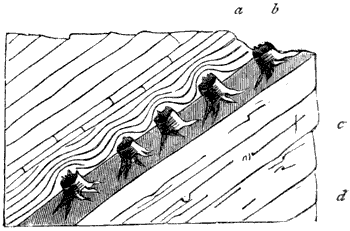
Fig. 124.—Geological humus. a, Fresh-water calcareous
slate (Purbeck); b, Dirt-bed, with roots and
stems of trees; c, Fresh-water beds; d, Portland Stone.
The soil known as the dirt-bed is nearly horizontal in the Isle of
Portland; but we discover it again not far from there in the sea-cliffs
of the Isle of Purbeck, having
an inclination of 45°, where
the trunks continue perfectly
parallel among themselves,
affording a fine example of a
change in the position of
beds originally horizontal.
Fig. 124 represents this
species of geological humus.
“Each dirt-bed” says Sir
Charles Lyell, “may, no
doubt, be the memorial of
many thousand years or centuries,
because we find that
two or three feet of vegetable
soil is the only monument which many a tropical forest has left of its
existence ever since the ground on which it now stands was first
covered with its shade.”[74]
This bed of vegetable soil is, then, near the summit of that long
and complicated series of beds which constitute the Jurassic period;
these ruins, still vegetable, remind us forcibly of the coal-beds, for
they are nothing else than a less advanced state of that kind of
vegetable fossilisation which was perfected on such an immense scale,
and during an infinite length of time in the coal period.
The Purbeck beds, which are sometimes subdivided into Lower,
Middle, and Upper, are mostly fresh-water formations, intimately
connected with the Upper Portland beds. But there they begin and
end, being scarcely recognisable except in Dorsetshire, in the sea-cliffs
of which they were first studied. They are finely exposed
in Durdlestone Bay, near Swanage, and at Lulworth Cove, on the
same coast. The lower beds consist of a purely fresh-water marl, eighty
feet thick, containing shells of Cypris, Limnæa, and some Serpulæ in
a bed of marl of brackish-water origin, and some Cypris-bearing
shales, strangely broken up at the west end of the Isle of Purbeck.
The Middle series consists of twelve feet of marine strata known as
the “cinder-beds,” formed of a vast accumulation of Ostrea distorta,
resting on fresh-water strata full of Cypris fasciculata, Planorbis, and
Limnæa, by which this strata has been identified as far inland as the
vale of Wardour in Wiltshire. Above the cinder-beds are shales and
limestones, partly of fresh-water and partly of brackish-water origin,
in which are Fishes, many species of Lepidotus, and the crocodilian
reptile, Macrorhynchus. On this rests a purely marine deposit, with
Pecten, Avicula, &c. Above, again, are brackish beds with Cyrena,
overlying which is thirty feet of fresh-water limestone, with Fishes,
Turtles, and Cyprides.
The upper beds are purely fresh-water strata, about fifty feet thick,
containing Paludina, Physa, Limnæa, all very abundant. In these
beds the Purbeck marble, formerly much used in the ornamental
architecture of the old English cathedrals, was formerly quarried.
(See Note, page 274.)
A few words may be added, in explanation of the term oolite,
applied to this sub-period of the Jurassic formation. In a great
number of rocks of this series the elements are neither crystalline nor
amorphous—they are, as we have already said, oolitic; that is to say,
the mass has the form of the roe of certain fishes. The question
naturally enough arises, Whence this singular oolitic structure assumed
by the components of certain rocks? It is asserted that the grinding
action of the sea acting upon the precipitated limestone produces
rounded forms analogous to grains of sand. This hypothesis may
be well founded in some cases. The marine sediments which are
deposited in some of the warm bays of Teneriffe are found to take
the spheroidal granulated form of the oolite. But these local facts
cannot be made to apply to the whole extent of the oolitic formations.
We must, therefore, look further for an explanation of the phenomena.
It is admitted that if the cascades of Tivoli, for example, can give
birth to the oolitic grains, the same thing happens in the quietest
basins, that in stalactite-caverns oolitic grains develop themselves,
which afterwards, becoming cemented together from the continued,
but very slow, affluence of the calcareous waters, give rise to certain
kinds of oolitic rocks.
On the other hand, it is known that nodules, more or less large,
develop themselves in marls in consequence of the concentration of
the calcareous elements, without the possibility of any wearing action
of water. Now, as there exists every gradation of size between the
smallest oolitic grains and the largest concretions, it is reasonable to
suppose that the oolites are equally the product of concentration.
Finally, from research to research, it is found that perfectly
constituted oolites—that is to say, concentric layers, as in the
Jurassic limestone—develop themselves in vegetable earth in places
where the effects of water in motion is not more admissible than in
the preceding instances.
Thus we arrive at the conclusion, that if Nature sometimes forms
crystals with perfect terminations in magmas in the course of solidification,
she gives rise also to spheroidal forms surrounding various
centres, which sometimes originate spontaneously, and in other cases
are accumulated round the débris of fossils, or even mere grains of
sand. Nevertheless, all mineral substances are not alike calculated
to produce oolitic rocks; putting aside some particular cases, this
property is confined to limestone and oxide of iron.
With regard to the distribution of the Jurassic formation on the
terrestrial globe, it may be stated that the Cotteswold Hills in
England, and in France the Jura mountains, are almost entirely composed
of these rocks, the several series of beds being all represented
in them—this circumstance, in fact, induced Von Humboldt to name
the formation after this latter range. The Upper Lias also exists in
the Pyrenees and in the Alps; in Spain; in many parts of Northern
Italy; in Russia, especially in the government of Moscow, and in
the Crimea; but it is in Germany where it occupies the most important
place. A thin bed of oolitic limestone presents, at Solenhofen
in Bavaria, a geological repository of great celebrity, containing
fossil Plants, Fishes, Insects, Crustaceans, with some Pterodactyles,
admirably preserved; it yielded also some of the earliest of the
feathered race. The fine quarries of lithographic stone at Pappenheim,
so celebrated all over Europe, belong to the Jurassic
formation.
It has recently been announced that these rocks have been found
in India; they contribute largely to the formation of the main mass
of the Himalayas, and to the chain of the Andes in South America;
finally, from recent investigations, they seem to be present in New
Zealand.
In England the Lias constitutes a well-defined belt about thirty
miles broad, extending from Dorsetshire, in the south, to Yorkshire,
in the north, formed of alternate beds of clay, shales, and limestone
(with layers of jet), on the coast near Whitby. It is rich, as we have
seen, in ancient life, and that in the strongest forms imaginable.
From the unequal hardness of the rocks it comprises, it stands out
boldly in some of the minor ranges of hills, adding greatly to the
picturesque beauty of the scenery in the centre of the country. In
Scotland the formation occupies a very limited space.
A map of the country at the close of the Jurassic period would
probably show double the extent of dry land in the British Islands,
compared with what it displayed as an island in the primordial ocean;
but Devon and Cornwall had long risen from the sea, and it is probable
that the Jurassic beds of Dorsetshire and France were connected
by a tongue of land running from Cherbourg to the Liassic beds of
Dorsetshire, and that Boulogne, still an island, was similarly connected
with the Weald.
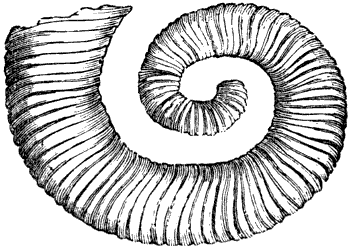
Fig. 125.—Crioceras Duvallii, Sowerby.
A non-involuted Ammonite.
(Neocomian.)
Note.—Sections of the Purbeck
strata of Dorsetshire have been constructed by
Mr. Bristow, from actual measurement, in the several localities in the Isle of
Purbeck, where they are most clearly and instructively displayed.
These sections, published by the Geological Survey, show in detail the beds
in their regular and natural order of succession, with the thickness, mineral
character, and contents, as well as the fossils, of each separate bed.
[275]
The name Cretaceous (from creta, chalk) is given to this epoch in the
history of our globe because the rocks deposited by the sea, towards
its close, are almost entirely composed of chalk (carbonate of lime).
Carbonate of lime, however, does not now appear for the first
time as a part of the earth’s crust; we have already seen limestone
occurring, among the terrestrial materials, from the Silurian period;
the Jurassic formation is largely composed of carbonate of lime in
many of its beds, which are enormous in number as well as extent; it
appears, therefore, that in the period called Cretaceous by geologists,
carbonate of lime was no new substance in the constitution of the
globe. If geologists have been led to give this name to the period, it
is because it accords better than any other with the characteristics of
the period; with the vast accumulations of chalky or earthy limestone
in the Paris basin, and the beds of so-called Greensand, and Chalk of
the same age, so largely developed in England.
We have already endeavoured to establish the origin of lime, in
speaking of the Silurian and Devonian periods, but it may be useful to
recapitulate the explanation here, even at the risk of repeating ourselves.
We have said that lime was, in all probability, introduced to the
globe by thermal waters flowing abundantly through the fissures, dislocations,
and fractures in the ground, which were themselves caused
by the gradual cooling of the globe; the central nucleus being the
grand reservoir and source of the materials which form the solid
crust. In the same manner, therefore, as the several eruptive substances—such
as granites, porphyries, trachytes, basalts, and lava—have
been ejected, so have thermal waters charged with carbonate
of lime, and often accompanied by silica, found their way to the
surface in great abundance, through the fissures, fractures, and dislocations
in the crust of the earth. We need only mention here the
Iceland geysers, the springs of Plombières, and the well-known
thermal springs of Bath and elsewhere in this country.
But how comes lime in a state of bicarbonate, dissolved in these
thermal waters, to form rocks? That is what we propose to
explain.
During the primary geological periods, thermal waters, as they
reached the surface, were discharged into the sea and united themselves
with the waves of the vast primordial ocean, and the waters of
the sea became sensibly calcareous—they contained, it is believed,
from one to two per cent. of lime. The innumerable animals, especially
Zoophytes, and Mollusca with solid shells, with which the
ancient seas swarmed, secreted this lime, out of which they built up
their mineral dwelling—or shell. In this liquid and chemically
calcareous medium, the Foraminifera and Polyps of all forms swarmed,
forming an innumerable population. Now what became of the bodies
of these creatures after death? They were of all sizes, but chiefly
microscopic; that is, so small as to be individually all but invisible to
the naked eye. The perishable animal matter disappeared in the
bosom of the waters by decomposition, but there still remained behind
the indestructible inorganic matter, that is to say, the carbonate of
lime forming their testaceous covering; these calcareous deposits
accumulating in thick beds at the bottom of the sea, became compacted
into a solid mass, and formed a series of continuous beds
superimposed on each other. These, increasing imperceptibly in the
course of ages, ultimately formed the rocks of the Cretaceous period,
which we have now under consideration.
These statements are not, as the reader might conceive from their
nature, a romantic conception invented to please the imagination of
those in search of a system—the time is past when geology should be
regarded as the romance of Nature—nor has what we advance at all
the character of an arbitrary conception. One is no doubt struck
with surprise on learning, for the first time, that all the limestone rocks,
all the calcareous stones employed in the construction of our dwellings,
our cities, our castles and cathedrals, were deposited in the seas
of an earlier world, and are only composed of an aggregation of
shells of Mollusca, or fragments of the testaceous coverings of Foraminifera
and other Zoophytes—nay, that they were secreted from
the water itself, and then assimilated by these minute creatures, and
that this would appear to have been the great object of their creation
in such myriads. Whoever will take the trouble to observe, and
reflect on what he observes, will find all his doubts vanish. If
chalk be examined with a microscope, it will be found to be composed
of the remains of numerous Zoophytes, of minute and divers
kinds of shells, and, above all, of Foraminifera, so small that their
very minuteness seems to have rendered them indestructible. A
hundred and fifty of these small beings placed end to end, in a
line, will only occupy the space of about one-twelfth part of an
inch.
Chalk under the Microscope.
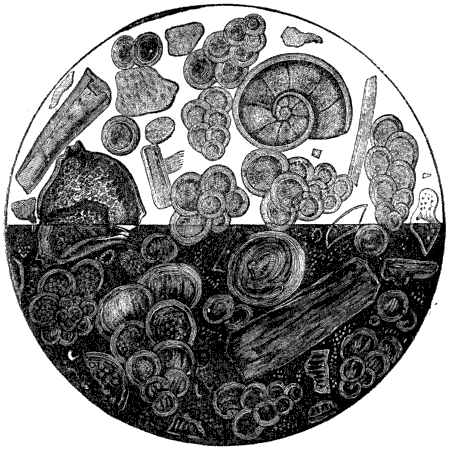
Fig. 126.—Chalk of Meudon (magnified).
Much of this curious information was unknown, or at least only
suspected, when Ehrenberg began his microscopical investigations.
From small samples of chalk reduced to powder, placed upon the
object-glass, and examined under the microscope, Ehrenberg prepared
the designs which we reproduce from his learned micrographical
work, in which some of the elegant forms discovered in the Chalk
are illustrated, greatly magnified. Fig. 126 represents the chalk of
Meudon, in France, in which ammonite-like forms of Foraminifera
and others, equally beautiful, appear. Fig. 127, from the chalk
of Gravesend, contains similar objects. Fig. 128 is an example
of chalk from the island of Moën, in Denmark; and Fig. 129, that
which is found in the Tertiary rocks of Cattolica, in Sicily. In all
these the shells of Ammonites appear, with clusters of round Foraminifera
and other Zoophytes. In two of these engravings (Figs.
126 and 128), the chalk is represented in two modes—in the upper
half, by transparency or transmitted light; in the lower half, the mass
is exhibited by superficial or reflected light.
Chalk under the Microscope.
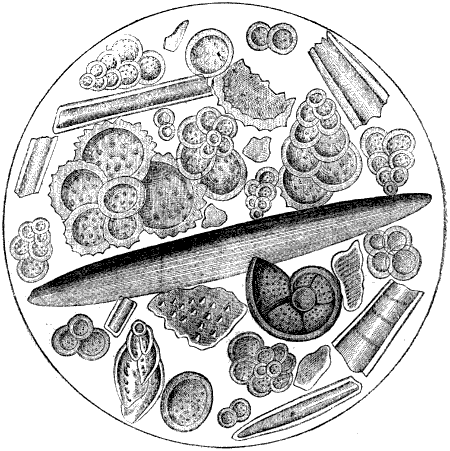
Fig. 127.—Chalk of Gravesend. (After Ehrenberg).—Magnified.
Observation, then, establishes the truth of the explanation we have
given concerning the formation of the chalky or Cretaceous rocks;
but the question still remains—How did these rocks, originally
deposited in the sea, become elevated into hills of great height, with
bold escarpments, like those known in England as the North and
South Downs? The answer to this involves the consideration of
other questions which have, at present, scarcely got beyond hypothesis.
Chalk under the Microscope.
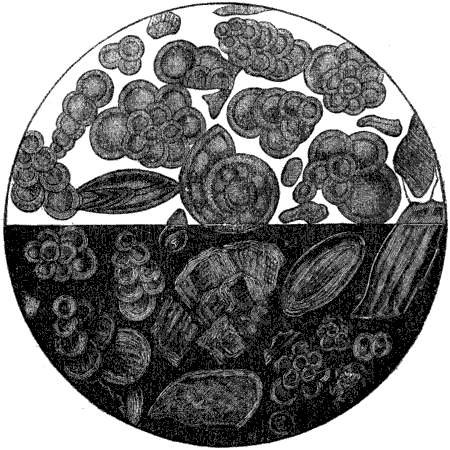
Fig. 128.—Chalk of the Isle of Moën, Denmark.
During and after the deposition of the Portland and Purbeck beds,
the entire Oolite Series, in the south and centre of England and
other regions, was raised above the sea-level and became dry land.
Above these Purbeck beds, as Professor Ramsay tells us [in the
district known as the Weald], “we have a series of beds of clays,
sandstones, and shelly limestones, indicating by their fossils that they
were deposited in an estuary where fresh water and occasionally
brackish water and marine conditions prevailed. The Wealden and
Purbeck beds indeed represent the delta of an immense river which
in size may have rivalled the Ganges, Mississippi, Amazon, &c.,
and whose waters carried down to its mouth the remains of land-plants,
small Mammals, and great terrestrial Reptiles, and mingled
them with the remains of Fishes, Molluscs, and other forms native to
its waters. I do not say that this immense river was formed or
supplied by the drainage of what we now call Great Britain—I do
not indeed know where this continent lay, but I do know that
England formed a part of it, and that in size it must have been
larger than Europe, and was probably as large as Asia, or the great
continent of America.” Speaking of the geographical extent of the
Wealden, Sir Charles Lyell says: “It cannot be accurately laid
down, because so much of it is concealed beneath the newer marine
formations. It has been traced about 200 miles from west to east;
from the coast of Dorsetshire to near Boulogne, in France; and
nearly 200 miles from north-west to south-east, from Surrey and
Hampshire to Beauvais, in France;”[75] but he expresses doubt,
supposing the formation to have been continuous, if the two areas
were contemporaneous, the region having undergone frequent changes,
the great estuary having altered its form, and even shifted its place.
Speaking of a hypothetical continent, Sir Charles Lyell says: “If it
be asked where the continent was placed from the ruins of which the
Wealden strata were derived, and by the drainage of which a great
river was fed, we are half tempted to speculate on the former
existence of the Atlantis of Plato. The story of the submergence of
an ancient continent, however fabulous in history, must have been
true again and again as a geological event.”[76]
Chalk under the Microscope.
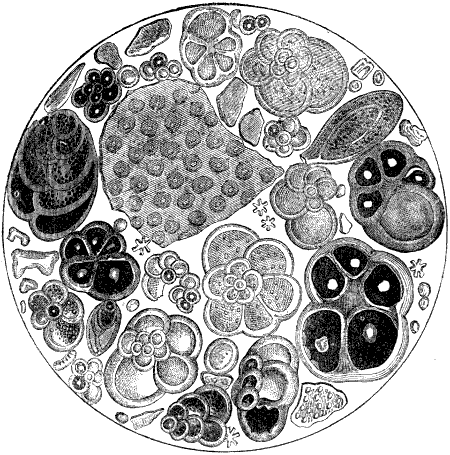
Fig. 129.—Chalk of Cattolica, Sicily (magnified).
The proof that the Wealden series were accumulated under fresh-water
conditions and as a river deposit[77] lies partly in the nature of the
strata, but chiefly in the nature of the organic remains. The fish give no
positive proof, but a number of Crocodilian reptiles give more conclusive
evidence, together with the shells, most of them being of fresh-water
origin, such as Paludina, Planorbis, Lymnæa, Physa, and such like,
which are found living in many ponds and rivers of the present day.
Now and then we find bands of marine remains, not mixed with fresh-water
deposits, but interstratified with them; showing that at times
the mouth and delta of the river had sunk a little, and that it had
been invaded by the sea; then by gradual change it was lifted up,
and became an extensive fresh-water area. This episode at last comes
to an end by the complete submergence of the Wealden area; and
upon these fresh-water strata a set of marine sands and clays, and
upon these again thick beds of pure white earthy limestone of the
Cretaceous period were deposited. The lowest of these formations
is known as the Lower Greensand; then followed the clays of the
Gault, which were succeeded by the Upper Greensand. Then,
resting upon the Upper Greensand, comes the vast mass of Chalk
which in England consists of soft white earthy limestone, containing,
in the upper part, numerous bands of interstratified flints, which were
mostly sponges originally, that have since become silicified and
converted into flint. The strata of chalk where thickest are from
1,000 to 1,200 feet in thickness. Their upheaval into dry land brought
this epoch to an end; the conditions which had contributed to its
formation ceased in our area, and as the uppermost member of the
Secondary rocks, it closes the record of Mesozoic times in England.
Let us add, to remove any remaining doubts, that in the basin of
a modern European sea—the Baltic—a curious assemblage of phenomena,
bearing on the question, is now in operation. The bed and
coast-line of the Baltic continue slowly but unceasingly to rise, and
have done so for several centuries, in consequence of the constant
deposit which takes place of calcareous shells, added to the natural
accumulations of sand and mud. The Baltic Sea will certainly be
filled up in time by these deposits, and this modern phenomenon,
which we find in progress, so to speak, brings directly under our observation
an explanation of the manner in which the cretaceous rocks
were produced in the ancient world, more especially when taken
in connection with another branch of the same subject to which
Sir Charles Lyell called attention, in an address to the Geological
Society. It appears that just as the northern part of the Scandinavian
continent is now rising, and while the middle part south of
Stockholm remains unmoved, the southern extremity in Scania is
sinking, or at least has sunk, within the historic period; from which
he argues that there may have been a slow upheaval in one region,
while the adjoining one was stationary, or in course of submergence.
After these explanations as to the manner in which the cretaceous
rocks were formed, let us examine into the state of animal and vegetable
life during this important period in the earth’s history.
The vegetable kingdom of this period forms an introduction to the
vegetation of the present time. Placed at the close of the Secondary
epoch, this vegetation prepares us for transition, as it were, to the
vegetation of the Tertiary epoch, which, as we shall see, has a great
affinity with that of our own times.
The landscapes of the ancient world have hitherto shown us some
species of plants of forms strange and little known, which are now
extinct. But during the period whose history we are tracing, the
vegetable kingdom begins to fashion itself in a less mysterious
manner; Palms appear, and among the regular species we recognise
some which differ little from those of the tropics of our days. The
dicotyledons increase slightly in number amid Ferns and Cycads,
which have lost much of their importance in numbers and size; we
observe an obvious increase in the dicotyledons of our own temperate
climate, such as the alder, the wych-elm, the maple, and the
walnut, &c.
“As we retire from the times of the primitive creation,” says
Lecoq, “and slowly approach those of our own epoch, the sediments
seem to withdraw themselves from the polar regions and
restrict themselves to the temperate or equatorial zones. The great
beds of sand and limestone, which constitute the Cretaceous formation,
announce a state of things very different from that of the preceding
ages. The seasons are no longer marked by indications of
central heat; zones of latitude already show signs of their existence.
“Hitherto two classes of vegetation predominated: the cellular
Cryptogams at first, the dicotyledonous Gymnosperms afterwards; and
in the epoch which we have reached—the transition epoch of vegetation—the
two classes which have reigned heretofore become
enfeebled, and a third, the dicotyledonous Angiosperms, timidly take
possession of the earth—they consist at first of a small number of
species, and occupy only a small part of the soil, of which they afterwards
take their full share; and in the succeeding periods, as in our
own times, we shall see that their reign is firmly established; during
the Cretaceous period, in short, we witness the appearance of the first
dicotyledonous Angiosperms. Some arborescent Ferns still maintain
their position, and the elegant Protopteris Singeri, Preissl., and P.
Buvigneri, Brongn., still unfold their light fronds to the winds of this
period. Some Pecopteri, differing from the Wealden species, live
along with them. Some Zamites, Cycads, and Zamiostrobi announce
that in the Cretaceous period the temperature was still high. New
Palms show themselves, and, among others, Flabellaria chamæropifolia
is especially remarkable for the majestic crown at its summit.
“The Conifers have endured better than the Cycadeæ; they
formed then, as now, great forests, where Damarites, Cunninghamias,
Araucarias, Eleoxylons, Abietites, and Pinites remind us of numerous
forms still existing, but dispersed all over the earth.
“From this epoch date the Comptonias, attributed to the Myricaceæ;
Almites Friesii, Nils., which we consider as one of the Betulaceæ;
Carpinites arenaceus, Gœp., which is one of the Cupuliferæ;
the Salicites, which are represented to us by the arborescent willows;
the Acerinæ would have their Acerites cretaceæ, Nils., and the
Juglanditæ, the Juglandites elegans, Gœp. But the most interesting
botanical event of this period is the appearance of the Credneria,
with its triple-veined leaves, of which no less than eight species have
been found and described, but whose place in the systems of classification
still remains uncertain. The Crednerias, like the Salicites,
were certainly trees, as were most of the species of this remote
epoch.”
In the following illustration are represented two of the Palms
belonging to the Cretaceous period, restored from the imprints and
fragments of the fossil remains left by the trunk and branches in the
rocks of the period (Fig. 130.)
[284]
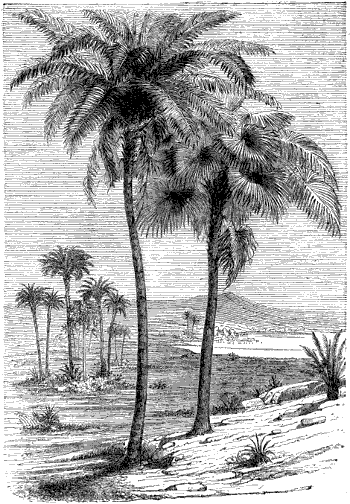
Fig. 130.—Fossil Palms restored.
But if the vegetation of the Cretaceous period exhibits sensible
signs of approximation to that of our present era, we cannot say the
same of the animal creation. The time has not yet come when
Mammals analogous to those of our epoch gave animation to the
forests, plains, and shores of the ancient world; even the Marsupial
Mammals, which made their appearance in the Liassic and Oolitic
formations, no longer exist, so far as is known, and no others of the
class have taken their place. No climbing Opossum, with its young
ones, appears among the leaves of the Zamites. The earth appears
to be still tenanted by Reptiles, which alone break the solitudes
of the woods and the silence of the valleys. The Reptiles, which
seem to have swarmed in the seas of the Jurassic period, partook
of the crocodilian organisation, and those of this period seem to bear
more resemblance to the Lizards of our day. In this period the
remains of certain forms indicate that they stood on higher legs; they no
longer creep on the earth, and this is apparently the only approximation
which seems to connect them more closely with higher forms.
It is not without surprise that we advert to the immense development,
the extraordinary dimensions which the Saurian family attained
at this epoch. These animals which, in our days, rarely exceed a
yard or so in length, attained in the Cretaceous period as much as
twenty. The marine lizard, which we notice under the name of
Mosasaurus, was then the scourge of the seas, playing the part of
the Ichthyosauri of the Jurassic period; for, from the age of the
Lias to that of the Chalk, the Ichthyosauri, the Plesiosauri, and
the Teleosauri were, judging from their organisation, the tyrants of
the waters. They appear to have become extinct at the close of
the Cretaceous period, and to give place to the Mosasaurus, to whom
fell the formidable task of keeping within proper limits the exuberant
production of the various tribes of Fishes and Crustaceans which
inhabited the seas. This creature was first discovered in the celebrated
rocks of St. Peter’s Mount at Maestricht, on the banks of the
Meuse. The skull alone was about four feet in length, while the
entire skeleton of Iguanodon Mantelli, discovered by Dr. Mantell in
the Wealden strata, has since been met with in the Hastings beds
of Tilgate Forest, measuring, as Professor Owen estimates, between
fifty and sixty feet in length. These enormous Saurians disappear
in their turn, to be replaced in the seas of the Tertiary epoch by the
Cetaceans; and henceforth animal life begins to assume, more and
more, the appearance it presents in the actually existing creation.
Seeing the great extent of the seas of the Cretaceous period,
Fishes were necessarily numerous. The pike, salmon, and dory
tribes, analogous to those of our days, lived in the seas of this
period; they fled before the sharks and voracious dog-fishes, which
now appeared in great numbers, after just showing themselves in the
Oolitic period.
The sea was still full of Polyps, Sea-urchins, Crustaceans of
various kinds, and many genera of Mollusca different from those of
the Jurassic period; alongside of gigantic Lizards are whole piles of
animalculæ—those Foraminifera whose remains are scattered in
infinite profusion in the Chalk, over an enormous area and of immense
thickness. The calcareous remains of these little beings, incalculable
in number, have indeed covered, in all probability, a great part of
the terrestrial surface. It will give a sufficient idea of the importance
of the Cretaceous period in connection with these organisms
to state that, in the rocks of the period, 268 genera of animals,
hitherto unknown, and more than 5,000 species of special living
beings have been found; the thickness of the rocks formed during
the period being enormous. Where is the geologist who will venture
to estimate the time occupied in creating and destroying the animated
masses of which this formation is at once both the cemetery
and the monument? For the purposes of description it will
be convenient to divide the Cretaceous series into lower and upper,
according to their relative ages and their peculiar fossils.
| English equivalents. |
French classification. |
| Lower Greensand, upper part. |
Étage |
Aptien st. |
| Lower Greensand, lower part. |
„ |
Néocomien supérieur. |
| Weald clay and Hastings sands. |
„ |
Néocomien inférieur. |
The Lower Wealden or Hastings Sand consists of sand, sandstone,
and calciferous grit, clay, and shale, the argillaceous strata predominating.
This part of the Wealden consists, in descending
order, of:—
| Feet. |
| Tunbridge Wells sand—Sandstone and loam |
150 |
| Wadhurst clay—Blue and brown shale and clay, with a little calc grit |
100 |
| Ashdown sands—Hard sand, with beds of calc grit |
160 |
| Ashburnham sands—Mottled, white, and red clay and sandstone |
330 |
The Hastings sand has a hard bed of white sand in its upper part, whose
steep natural cliffs produce the picturesque scenery of the “High
rocks” of Hastings in Sussex.
Calcareous sandstone and grit, in which Dr. Mantell found the
remains of the Iguanodon and Hylæosaurus, form an upper member
of the Tunbridge Wells Sand. The formation extends over Hanover
and Westphalia; the Wealden of these countries, according to Dr.
Dunker and Von Meyer, corresponding in their fossils and mineral
characters with those of the English series. So that “we can
scarcely hesitate,” says Lyell, “to refer the whole to one great
delta.”[78]
The overlying Weald clay crops out from beneath the Lower
Greensand in various parts of Kent and Sussex, and again in the
Isle of Wight, and in the Isle of Purbeck, where it reappears at the
base of the chalk.
The upper division (or the Weald clay) is, as we have said, of
purely fresh-water origin, and is supposed to have been the estuary
of some vast river which, like the African Quorra, may have formed a
delta some hundreds of miles broad, as suggested by Dr. Dunker
and Von Meyer.
The Lower Greensand is known, also, as the Néocomien, after
Neocomium, the Latin name of the city of Neufchatel, in Switzerland,
where this formation is largely developed, and where, also, it was first
recognised and established as a distinct formation. Dr. Fitton, in
his excellent monograph of the Lower Cretaceous formations, gives
the following descending succession of rocks as observable in many
parts of Kent:—
| |
Feet. |
| 1. |
Sand, white, yellowish, or brown, with concretions of limestone and chert |
70 |
| 2. |
Sand, with green matter |
70 to 100 |
| 3. |
Calcareous stone, called Kentish rag |
60 to 80 |
These divisions, which are traceable more or less from the
southern part of the Isle of Wight to Hythe in Kent, present considerable
variations. At Atherfield, where sixty-three distinct strata,
measuring 843 feet, have been noticed, the limestone is wholly
wanting, and some fossils range through the whole series, while
others are confined to particular divisions; but Prof. E. Forbes states,
that when the same conditions are repeated in overlying strata the
same species reappear; but that changes of depth, or of the mineral
nature of the sea-bottom, the presence or absence of lime or of
peroxide of iron, the occurrence of a muddy, sandy, or gravelly
bottom, are marked by the absence of certain species, and the predominance
of others.[79]
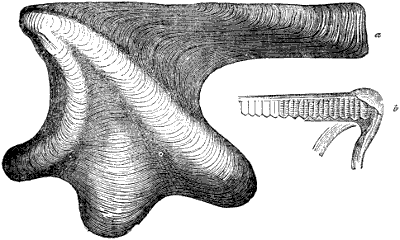
Fig. 131.—Perna Mulleti. One-quarter natural size.
a, exterior; b, part of the upper hinge.
Among the marine fauna of the Néocomian series the following
are the principal. Among the Acephala, one of the largest and most
abundant shells of the lower Néocomian, as displayed in the Atherfield
section, is the large Perna Mulleti (Fig. 131).
The Scaphites have a singular boat-shaped form, wound with
contiguous whorls in one part, which is detached at the last chamber,
and projects in a more or less elongated condition.
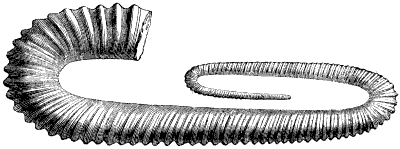
Fig. 132.—Hamites. One-third natural size.
Hamites, Crioceras, and Ancyloceras have club-like terminations at
both extremities; they may almost be considered as non-involuted
Ammonites with the spiral evolutions disconnected or partially
unrolled, as in the engraving (Figs. 125 and 132). Ancyloceras
Matheronianus seems to have had spines projecting from the ridge
of each of the convolutions.
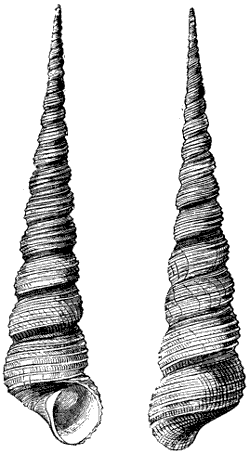
Fig. 133.—Shell of Turritella terebra.
(Living form.)
The Toxoceras had the shell also curved, and not spiral.
The Baculites had the shell differing from all Cephalopods, inasmuch
as it was elongated, conical, perfectly straight, sometimes very
slender, and tapering to a point.
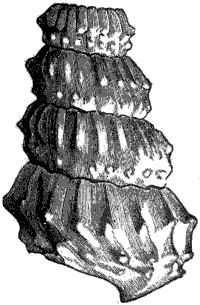
Fig. 134.—Turrillites costatus.
(Chalk.)
The Turrilites have the shell regular, spiral, and sinistral; that
is, turning to the left in an oblique spiral of contiguous whorls. The
engraving will convey the idea of their form (Fig. 134).
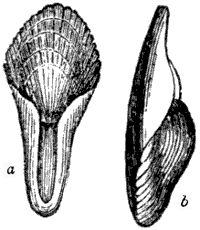
Fig. 135—Terebrirostra lyra.
a, back view; b, side view.
Among others, as examples of form, we append Figs. 133, 135, 136.
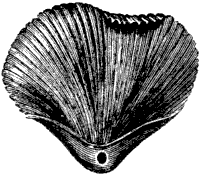
Fig. 136.—Terebratula deformis.
This analysis of the marine fauna belonging to the Néocomian
formation might be carried much further, did space permit, or did it
promise to be useful; but, without illustration, any further merely
verbal description would be almost valueless.
Numerous Reptiles, a few Birds, among which are some “Waders,”
belong to the genera of Palæornis or Cimoliornis; new Molluscs in
considerable quantities, and some extremely varied Zoophytes, constitute
the rich fauna of the Lower Chalk. A glance at the more
important of these animals, which we only know in a few mutilated
fragments, is all our space allows; they are true medals of the history
of our globe, medals, it is true, half effaced by time, but which
consecrate the memory of departed ages.
In the year 1832 Dr. Mantell added to the wonderful discoveries
he had made in the Weald of Sussex, that of the great Lizard-of-the-woods,
the hylæosaurus (ὑλη, wood, σαυρος, lizard). This discovery
was made in Tilgate forest, near Cuckfield, and the animal appears to
have been from twenty to thirty feet in length. The osteological
characters presented by the remains of the Hylæosaurus are described
by Dr. Mantell as affording another example of the blending
of the Crocodilian with the Lacertian type of structure; for we have,
in the pectoral arch, the scapula or omoplate of a crocodile associated
with the coracoid of a lizard. Another remarkable feature
in these fossils is the presence of the large angular bones or spines,
which, there is reason to infer, constituted a serrated crest along the
middle of the back; and the numerous small oval dermal bones
which appear to have been arranged in longitudinal series along
each side of the dorsal fringe.
The Megalosaurus, the earliest appearance of which is among the
more ancient beds of the Liassic and Oolitic series, is again found at
the base of the Cretaceous rocks. It was, as we have seen, an enormous
lizard, borne upon slightly raised feet; its length exceeded forty feet,
and in bulk it was equal to an elephant seven feet high.
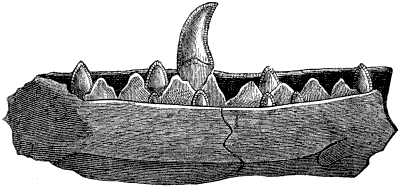
Fig. 137.—Lower Jaw of the Megalosaurus.
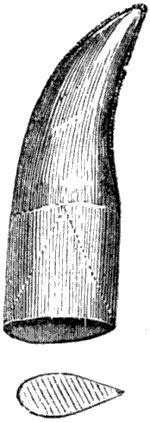
Fig. 138.—Tooth
of Megalosaurus.
The Megalosaurus found in the ferruginous sands of Cuckfield,
in Sussex, in the upper beds of the Hastings Sands, must have been
at least sixty or seventy feet long. Cuvier considered that it partook
both of the structure of the Iguana and the Monitors, the latter of which
belong to the Lacertian Reptiles which haunt the banks of the Nile
and tropical India. The Megalosaurus was probably an amphibious
Saurian. The complicated structure and marvellous arrangement of
the teeth prove that it was essentially carnivorous. It fed probably
on other Reptiles of moderate size, such as the Crocodiles and
Turtles which are found in a fossil state in the same beds. The jaw
represented in Fig. 137 is the most important fragment of the animal
we possess. It is the lower jaw, and supports many teeth: it shows
that the head terminated in a straight muzzle, thin and flat on the
sides, like that of the Gavial, the Crocodile of India. The teeth of
the Megalosaurus were in perfect accord with the destructive functions
with which this formidable creature was endowed. They partake at
once of the nature of a knife, sabre, and saw. Vertical at their junction
with the jaw, they assume, with the increased age of the animal, a
backward curve, giving them the form of a gardener’s pruning-knife
(Fig. 138; also c. Fig. 179). After mentioning some other particulars,
respecting the teeth, Buckland says: “With teeth constructed so as
to cut with the whole of their concave edge, each movement of the
jaws produced the combined effect of a knife and a saw, at the same
time that the point made a first incision like that made by a point
of a double-cutting sword. The backward curvature taken by the
teeth at their full growth renders the escape of the prey when once
seized impossible. We find here, then, the same arrangements which
enable mankind to put in operation many of the instruments which
they employ.”
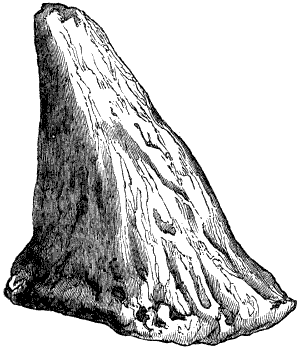
Fig. 139.—Nasal Horn of Iguanodon.
Two-thirds natural size.
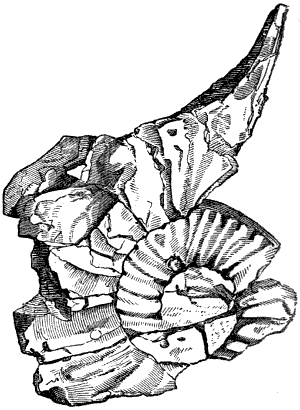
Fig. 140.—Ammonites rostratus.
(Upper Greensand.)
The Iguanodon, signifying Iguana-toothed (from the Greek word,
οδους, tooth), was more gigantic still than the Megalosaurus; one of the
most colossal, indeed, of all the Saurians of the ancient world which
research has yet exposed to the light of day. Professor Owen and
Dr. Mantell were not agreed as to the form of the tail; the former
gentleman assigning it a short tail, which would affect Dr. Mantell’s
estimate of its probable length of fifty or sixty feet; the largest thigh-bone
yet found measures four feet eight inches in length. The form
and disposition of the feet, added to the existence of a bony horn
(Fig. 139), on the upper part of the muzzle or snout, almost identifies
it as a species with the existing Iguanas, the only Reptile which is
known to be provided with such a horn upon the nose; there is,
therefore, no doubt as to the resemblance between these two animals;
but while the largest of living Iguanas scarcely exceeds a yard in
length, its fossil congener was probably fifteen or sixteen times that
length. It is difficult to resist the feeling of astonishment, not to say
incredulity, which creeps over one while contemplating so striking
a disproportion as that which subsists between this being of the
ancient world and its ally of the new.
The Iguanodon carried, as we have said, a horn on its muzzle;
the bone of its thigh, as we have seen, surpassed that of the Elephant
in size; the form of the bone and feet demonstrates that it was
formed for terrestrial locomotion; and its dental system shows that
it was herbivorous.
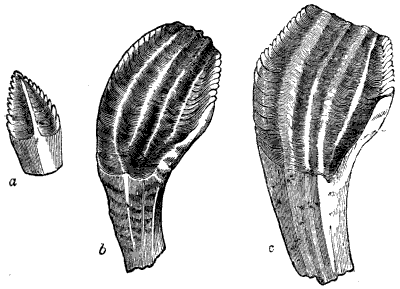
Fig. 141.—Teeth of Iguanodon.
a, young tooth; b, c, teeth further advanced, and worn.
(Wealden.)
The teeth (Fig. 141), which are the most important and characteristic
organs of the whole animal, are imbedded laterally in
grooves, or sockets, in the dentary bone; there are three or four
sockets of successional teeth on the inner side of the base of the old
teeth. The place thus occupied by the edges of the teeth, their
trenchant and saw-like form, their mode of curvature, the points
where they become broader or narrower which turn them into a
species of nippers or scissors—are all suitable for cutting and
tearing the tough vegetable substances which are also found
among the remains buried with this colossal reptile, a restoration of
which is represented in Plate XXI., p. 296.
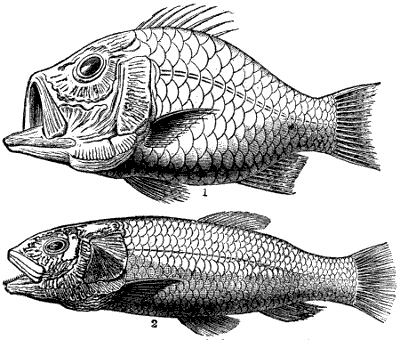
Fig. 142.—Fishes of the Cretaceous period.
1, Beryx Lewesiensis; 2, Osmeroides Mantelli.
The Cretaceous seas contained great numbers of Fishes, among
which some were remarkable for their strange forms. The Beryx
Lewesiensis (1), and the Osmeroides Mantelli (2) (Fig. 142), are
restorations of these two species as they are supposed to have been
in life. The Odontaspis is a new genus of Fishes which may be
mentioned. Ammonites rostratus (Fig. 140), and Exogyra conica
(Fig. 147), are common shells in the Upper Greensand.
[296]
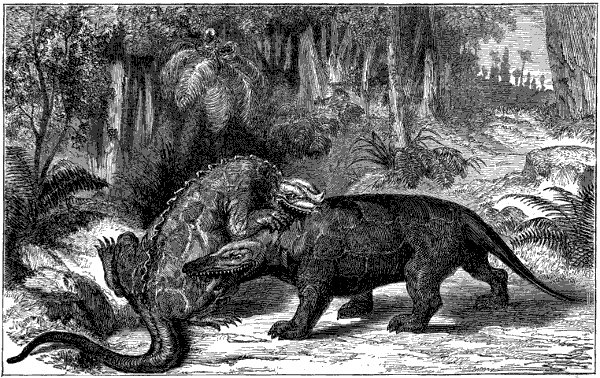
XXI.—Ideal scene in the Lower Cretaceous Period, with Iguanodon and Megalosaurus.
The seas of the Lower Cretaceous period were remarkable in
a zoological point of view for the great number of species and the
multiplicity of generic forms of molluscous Cephalopods. The
Ammonites assume quite gigantic dimensions; and we find among
them new species distinguished by their furrowed transverse spaces,
as in the Hamites (Fig. 132). Some of the Ancyloceras attained the
magnitude of six feet, and other genera, as the Scaphites, the
Toxoceras, the Crioceras (Fig. 125), and other Mollusca, unknown till
this period, appeared now. Many Echinoderms, or sea-urchins, and
Zoophytes, have enriched these rocks with their animal remains, and
would give its seas a condition quite peculiar.
On the opposite page an ideal landscape of the period is represented
(Plate XXI.), in which the Iguanodon and Megalosaurus
struggle for the mastery in the centre of a forest, which enables us
also to convey some idea of the vegetation of the period. Here we
note a vegetation at once exotic and temperate—a flora like that of
the tropics, and also resembling our own. On the left we observe
a group of trees, which resemble the dicotyledonous plants of our
forests. The elegant Credneria is there, whose botanical place is
still doubtful, for its fruit has not been found, although it is believed
to have belonged to plants with two seed-leaves, or dicotyledonous,
and the arborescent Amentaceæ. An entire group of trees, composed
of Ferns and Zamites, are in the background; in the extreme
distance are some Palms. We also recognise in the picture the
alder, the wych-elm, the maple, and the walnut-tree, or at least
species analogous to these.
The Néocomian beds in France are found in Champagne, in the
departments of the Aube, the Yonne, the Haute-Alps, &c. They
are largely developed in Switzerland at Neufchatel, and in Germany.
1. The Lower Néocomian consists of marls and greyish clay,
alternating with thin beds of grey limestone. It is very thick, and
occurs at Neufchatel and in the Drôme. The fossils are Spatangus
retusus, Crioceras (Fig. 125), Ammonites Asterianus, &c.
2. Orgonian (the limestone of Orgon). This group exists, also,
at Aix-les-Bains in Savoy, at Grenoble, and generally in the thick,
white, calcareous beds which form the precipices of the Drôme.
The fossils Chama ammonia, Pigaulus, &c.
3. The Aptien (or Greensand) consists generally of marls and
clay. In France it is found in the department of Vaucluse, at Apt
(whence the name Aptien), in the department of the Yonne, and in
the Haute-Marne. Fossils, Ancyloceras Matheronianus, Ostrea aquila,
and Plicatula placunea. These beds consist here of greyish clay,
which is used for making tiles; there of bluish argillaceous limestone,
in black or brownish flags. In the Isle of Wight it becomes a fine
sandstone, greyish and slightly argillaceous, which at Havre, and in
some parts of the country of Bray, become well-developed ferruginous
sandstones.
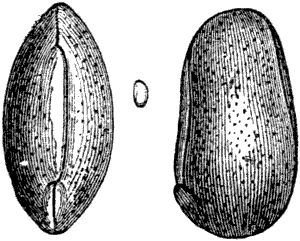
Fig. 143.—Cypris spinigera.
We have noted that the Lower Néocomian formation, although a
marine deposit, is in some respects the equivalent of the Weald Clay,
a fresh-water formation of considerable importance on account of its
fossils. We have seen that it was either formed at the mouth of a
great river, or the river was sufficiently powerful for the fresh-water
current to be carried out to sea, carrying with it some animals,
forming a fluviatile, or lacustrine fauna, on a small scale. These
were small Crustaceans of the genus Cypris, with some molluscous
Gasteropoda of the genera Melania, Paludina, and acephalous
Mollusca of the five genera Cyrena, Unio, Mytilus, Cyclas, and Ostrea.
Of these, Cypris spinigera (Fig. 143) and Cypris Valdensis (Fig. 144)
may be considered as among the most characteristic fossils of this
local fauna.
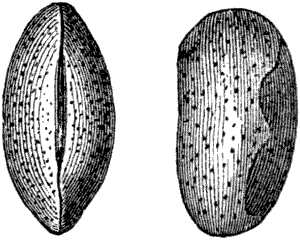
Fig. 144.—Cypris Valdensis.
The Cretaceous series is not interesting for its fossils alone; it
presents also an interesting subject for study in a mineralogical point
of view. The white Chalk, examined under the microscope by
Ehrenberg, shows a curious globiform structure. The green part of
its sandstone and limestone constitutes very singular compounds.
According to the result of Berthier’s analysis, we must consider them
as silicates of iron. The iron shows itself here not in beds, as in
the Jurassic rocks, but in masses, in a species of pocket in the
Orgonian beds. They are usually hydrates in the state of hematites,
accompanied by quantities of ochre so abundant that they are
frequently unworkable. In the south of France these veins were
mined to a great depth by the ancient monks, who were the metallurgists
of their age. But for the artist the important Orgonian beds
possess a special interest; their admirable vertical fractures, their
erect perpendicular peaks, each surpassing the other in boldness,
form his finest studies. In the Var, the defiles of Vésubia, of the
Esteron, and Tinéa, are jammed up between walls of peaks, for
many hundreds of yards, between which there is scarcely room for
a narrow road by the side of the roaring torrent. “In the Drôme,”
says Fournet, “the entrance to the beautiful valley of the Vercors is
closed during a part of the year, because, in order to enter, it is
necessary to cross the two gullies, the Great and Little Goulet,
through which the waters escape from the valley. Even during the
dry season, he who would enter the gorge must take a foot-bath.
“This state of things could not last; and in 1848 it was curious
to see miners suspended on the sides of one of these lateral precipices,
some 450 feet above the torrent, and about an equal distance below
the summit of the Chalk. There they began to excavate cavities or
niches in the face of the rock, all placed on the same level, and
successively enlarged. These were united together in such a manner
as to form a road practicable for carriages; now through a gallery,
now covered by a corbelling, to look over which affords a succession
of surprises to the traveller.
“This is not all,” adds M. Fournet: “he who traverses the high
plateaux of the country finds at every step deep diggings in the soil,
designated pits or scialets, the oldest of which have their sides
clothed with a curious vegetation, in which the Aucolin predominates;
shelter is found in these pits from the cutting winds which rage so
furiously in these elevated regions. Others form a kind of cavern, in
which a temperature obtains sufficient to freeze water even in the
middle of summer. These cavities form natural glaciers, which we
again find upon some of the table-lands of the Jura.
“The cracks and crevasses of the limestone receive the waters
produced by falling rain and melted snow; true to the laws of all
fluid bodies, they filter through the rocks until they reach the lower
and impervious marly beds, where they form sheets of water, which
in course of time find some outlet through which they discharge
themselves. In this manner subterranean galleries, sometimes of
great extent, are formed, in which are assembled all the marvels
which crumbling stalactites, stalagmites, placid lakes, and headlong
torrents can produce; finally, these waters, forcing their way through
the external orifices, give rise to those fine cascades which, with the
first gushing torrent, form an actual river.”
The Albien of Alc. D’Orbigny, which Lyell considers to be the
equivalent of the Gault, French authors treat as the “glauconie” formation,
the name being drawn from a rock composed of chalk with
greenish grains of glauconite, or silicate of iron, which is often mixed
with the limestone of this formation. The fossils by which it is identified
are very varied. Among its numerous types, we find Crustaceans
belonging to the genera Arcania and Corystes; many new Mollusca,
Buccinum, Solen, Pterodonta, Voluta, Chama, &c.; great numbers of
molluscous Brachiopods, forming highly-developed submarine strata;
some Echinoderms, unknown up to this period, and especially a great
number of Zoophytes; some Foraminifera, and many Polyzoa
(Bryozoa). The glauconitic formation consists of two groups of
strata: the Gault Clay and the glauconitic chalk, or Upper Greensand
and Chloritic Marl.
During this phase of the terrestrial evolutions, the continents, to
judge from the fossilised wood which we meet with in the rocks
which now represent it, would be covered with a very rich vegetation,
nearly identical, indeed, with that which we have described in the
preceding sub-period; according to Adolphe Brongniart, the “age
of angiosperms” had fairly set in; the Cretaceous flora displays, he
considers, a transitional character from the Secondary to the Tertiary
vegetation; that the line between the gymnosperms, or naked-seeded
plants, and the angiosperms, having their seeds enclosed in seed-vessels,
runs between the Upper and Lower Cretaceous formations.
“We can now affirm,” says Lyell, “that these Aix-la-Chapelle
plants, called Credneria, flourished before the rich reptilian fauna of
the secondary rocks had ceased to exist. The Ichthyosaurus,
Pterodactyle, and Mosasaurus were of coeval date with the oak, the
walnut, and the fig.”[80]
The terrestrial fauna, consisting of some new Reptiles haunting
the banks of rivers, and Birds of the genus Snipe, have certainly
only reached us in small numbers. The remains of the marine fauna
are, on the contrary, sufficiently numerous and well preserved to give
us a great idea of its riches, and to enable us to assign to it a
characteristic facies.
The sea of the Upper Cretaceous period bristled with numerous
submarine reefs, occupying a vast extent of its bed—reefs formed of
Rudistes (Lamarck), and of immense quantities of various kinds of
corals which are everywhere associated with them. The Polyps, in
short, attain here one of the principal epochs of their existence, and
present a remarkable development of forms; the same occurs with the
Polyzoa (Bryozoa) and Amorphozoa; while, on the contrary, the
reign of the Cephalopods seems to end. Beautiful types of these
ancient reefs have been revealed to us, and we discover that they
have been formed under the influence of submarine currents, which
accumulated masses of these animals at certain points. Nothing is
more curious than this assemblage of Rudistes—still standing erect,
isolated or in groups—as may be seen, for instance, at the summit of
the mountains of the Cornes in the Corbières, upon the banks of the
pond of Berre in Provence, and in the environs of Martigues, at
La Cadière, at Figuières, and particularly above Beausset, near
Toulon.
“It seems,” says Alcide D’Orbigny, “as if the sea had retired in
order to show us, still intact, the submarine fauna of this period, such
as it was when in life. There are here enormous groups of Hippurites
in their places, surrounded by Polyps, Echinoderms, and Molluscs,
which lived in union in these animal colonies, analogous to those
which still exist in the coral-reefs of the Antilles and Oceania. In
order that these groups should have been preserved intact, they must
first have been covered suddenly by sediment, which, being removed
by the action of the atmosphere, reveals to us, in their most secret
details, this Nature of the past.”
In the Jurassic period we have already met with these isles or
reefs formed by the accumulation of Coral and other Zoophytes; they
even constituted, at that period, an entire formation called the Coral-rag.
The same phenomenon, reproduced in the Cretaceous seas,
gave rise to similar calcareous formations. We need not repeat what
we have said already on this subject when describing the Jurassic
period. The coral or madrepore isles of the Jurassic epoch and the
reefs of Rudistes and Hippurites of the Cretaceous period have the
same origin, and the atolls of Oceania are reproductions in our own
day of precisely similar phenomena.
The invertebrate animals which characterise the Cretaceous age
are among
Cephalopoda.
Nautilus sublævigatus and N. Danicus; Ammonites rostratus; Belemnitella
mucronata.
Gasteropoda.
Voluta elongata; Phorus canaliculatus; Nerinea bisulcata; Pleurotomaria
Fleuriausa, and P. Santonensis; Natica supracretacea.
Acephala.
Trigonia scabra; Inoceramus problematicus and I. Lamarckii; Clavigella
cretacea; Pholadomya æquivalvis; Spondylus spinosus; Ostrea
vesicularis; Ostrea larva; Janira quadricostata; Arca Gravesii;
Hippurites Toucasianus and H. organisans; Caprina Aguilloni;
Radiolites radiosus, and R. acuticostus.
Brachiopoda.
Crania Ignabergensis; Terebratula obesa.
Polyzoa (Bryozoa) and Eschinodemata.
Reticulipora obliqua; Ananchytes ovatus; Micraster cor-anguinum,
Hemiaster bucardium and H. Fourneli; Galerites albogalerus;
Cidaris Forchammeri; Palæocoma Furstembergii.
1. Polypi; 2. Foraminifera; 3. Amorphozoa.
1. Cycollites elliptica; Thecosmilia rudis; Enallocœnia ramosa;
Meandrina Pyrenaica; Synhelia Sharpeana. 2. Orbitoides media;
Lituola nautiloidea; Flabellina rugosa. 3. Coscinopora cupuliformis;
Camerospongia fungiformis.
Among the numerous beings which inhabited the Upper Cretaceous
seas there is one which, by its organisation, its proportions, and
the despotic empire which it would exercise in the bosom of the
waters, is certainly most worthy of our attention. We speak of the
Mosasaurus, which was long known as the great animal of Maestricht,
because its remains were found near that city in the most modern of
the Cretaceous deposits.
In 1780 a discovery was made in the quarries of Saint Peter’s
Rocks, near Maestricht, of the head of a great Saurian, which may
now be seen in the Museum of Natural History in Paris. This discovery
baffled all the science of the naturalists, at a period when the
knowledge of these ancient beings was still in its infancy. One saw
in it the head of a Crocodile; another, that of a Whale; memoirs
and monographs rained down, without throwing much light on the
subject. It required all the efforts of Adrian Camper, joined to those
of the immortal Cuvier, to assign its true zoological place to the
Maestricht animal. The controversy over this fine fossil engaged
the attention of the learned for the remainder of the last century and
far into the present.
Maestricht is a city of the Netherlands, built on the banks of the
Meuse. At the gates of this city, in the hills which skirt the left or
western bank of the river, there rises a solid mass of cretaceous formation
known as Saint Peter’s Rocks. In composition these beds
correspond with the Meudon chalk beds, and they contain similar
fossils. The quarries are about 100 feet deep, consisting in the upper
part of twenty feet abounding in corals and Polyzoa, succeeded by
fifty feet of soft yellowish limestone, furnishing a fine building stone,
which has been quarried from time immemorial, and extends up to
the environs of Liège; this is succeeded by a few inches of greenish
soil with Encrinites, and then by a very white chalk with layers of
flints. The quarry is filled with marine fossils, often of great size.
These fossil remains, naturally enough, attracted the attention of
the curious, and led many to visit the quarries; but of all the discoveries
which attracted attention the greatest interest attached to
the gigantic animal under consideration. Among those interested by
the discovery of these strange vestiges was an officer of the garrison
of Maestricht, named Drouin. He purchased the bones of the
workmen as the pick disengaged them from the rock, and concluded
by forming a collection in Maestricht, which was spoken of with
admiration. In 1766, the trustees of the British Museum, hearing of
this curiosity, purchased it, and had it removed to London. Incited
by the example of Drouin, Hoffmann, the surgeon of the garrison,
set about forming a similar collection, and his collection soon exceeded
that of Drouin’s Museum in riches. It was in 1780 that he
purchased of the quarrymen the magnificent fossil head, exceeding
six feet in length, which has since so exercised the sagacity of
naturalists.
Hoffman did not long enjoy the fruits of his precious prize, however;
the chapter of the church of Maestricht claimed, with more or
less foundation, certain rights of property; and in spite of all protest,
the head of the Crocodile of Maestricht, as it was already called,
passed into the hands of the Dean of the Chapter, named Goddin,
who enjoyed the possession of his antediluvian trophy until an
unforeseen incident changed the aspect of things. This incident
was nothing less than the bombardment and surrender of Maestricht
to the Army of the North under Kleber, in 1794.
The Army of the North did not enter upon a campaign to obtain
the crania of Crocodiles, but it had on its staff a savant who was
devoted to such pacific conquests. Faujas de Saint-Fond, who was
the predecessor of Cordier in the Zoological Chair of the Jardin des
Plantes, was attached to the Army of the North as Scientific Commissioner;
and it is suspected that, in soliciting this mission, our
naturalist had in his eye the already famous head of the Crocodile of
the Meuse. However that may be, Maestricht fell into the hands of
the French, and Faujas eagerly claimed the famous fossil for the
French nation, which was packed with the care due to a relic numbering
so many thousands of ages, and dispatched to the Museum of
Natural History in Paris. On its arrival, Faujas undertook a labour
which, as he thought, was to cover him with glory. He commenced
the publication of a work entitled “The Mountain of Saint Peter of
Maestricht,” describing all the fossil objects found in the Dutch quarry
there, especially the Great Animal of Maestricht. He endeavoured
to prove that this animal was a Crocodile.
Unfortunately for the glory of Faujas, a Dutch savant had devoted
himself to the same study. Adrian Camper was the son of a great
anatomist of Leyden, Pierre Camper, who had purchased of the
heirs of the surgeon Hoffman some parts of the skeleton of the
animal found in the quarry of Saint Peter. He had even published
in the Philosophical Transactions of London, as early as 1786, a
memoir, in which the animal is classed as a Whale. At the death of
his father, Adrian Camper re-examined the skeleton, and in a work
which Cuvier quotes with admiration, he fixed the ideas which were
until then floating about. He proved that the bones belonged neither
to a Fish, nor a Whale, nor to a Crocodile, but rather to a particular
genus of Saurian Reptiles, or marine lizards, closely resembling in
many important structural characters, existing Monitors and Iguanas,
and peculiar to rocks of the Cretaceous period, both in Europe and
America. Long before Faujas had finished the publication of his work
on La Montagne de Saint-Pierre that of Adrian Camper had appeared,
and totally changed the ideas of the world on this subject. It did not,
however, hinder Faujas from continuing to call his animal the Crocodile
of Maestricht. He even announced, some time after, that Adrian
Camper was also of his opinion. “Nevertheless,” says Cuvier, “it
is as far from the Crocodile as it is from the Iguana; and these two
animals differ as much from each other in their teeth, bones, and
viscera, as the ape differs from the cat, or the elephant from the
horse.”
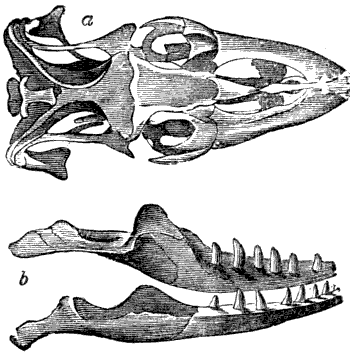
Fig. 145.
a, skull of Monitor Niloticus; b, under-jaw of same.
The masterly memoir of Cuvier, while confirming all the views of
Camper, has restored the individuality of this surprising being, which
has since received the name of Mosasaurus, that is to say, Saurian or
Lizard of the Meuse. It
appears, from the researches
of Camper and Cuvier, that
this reptile of the ancient
world formed an intermediate
genus between the
group of the Lacertilia,
which comprehends the
Monitors (represented in
Fig. 145), and the ordinary
Lizards; and the Lacertilia,
whose palates are armed
with teeth, a group which
embraces the Iguana and
the Anolis. In respect to
the Crocodiles, the Mosasaurus
resembles them in so
far as they all belong to the
same class of Reptiles.
The idea of a lizard,
adapted for living and
moving with rapidity at the bottom of the water, is not readily
conceived; but a careful study of the skeleton of the Mosasaurus
reveals to us the secret of this anatomical mechanism. The vertebræ
of the animal are concave in front and convex behind; they
are attached by means of orbicular or arched articulations, which
permitted it to execute easily movements of flexion in any direction.
From the middle of the back to the extremity of the tail
these vertebræ are deficient in the articular processes which support
and strengthen the trunk of terrestrial vertebrated animals: they
resemble in this respect the vertebræ of the Dolphins; an organisation
necessary to render swimming easy. The tail, compressed
laterally at the same time that it was thick in a vertical direction,
constituted a straight rudder, short, solid, and of great power.
An arched bone was firmly attached to the body of each caudal
vertebra in the same manner as in Fishes, for the purpose of
giving increased power to the tail; finally, the extremities of the
animal could scarcely be called feet, but rather paddles, like those
of the Ichthyosaurus, the Plesiosaurus, and the Whale. We see
in Fig. 146 that the jaws are armed with numerous teeth, fixed in
their sockets by an osseous base, both large and solid. Moreover,
an altogether peculiar dental system occupies the vault of the palate,
as in the case of certain Serpents and Fishes, where the teeth are
directed backwards, like the barb of a hook, thus opposing themselves
to the escape of prey. Such a disposition of the teeth
sufficiently proves the destructive character of this Saurian.
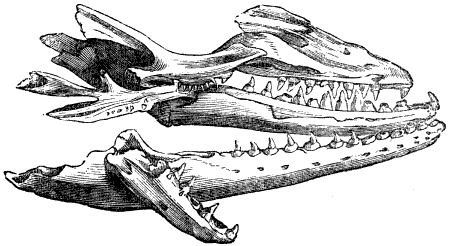
Fig. 146.—Head of Mosasaurus Camperi.
The dimensions of this aquatic lizard, estimated at twenty-four feet,
are calculated to excite surprise. But, as we have already seen, the
Ichthyosauri and Teleosauri were of great dimensions, as were also
the Iguanodon and Megalosaurus, which were ten times the size of
living Iguanas. In all these colossal forms we can only see a difference
of dimensions, the aggrandisement of a type; the laws which affected
the organisation of all these beings remain unchanged, they were not
errors of Nature—monstrosities, as we are sometimes tempted to call
them—but simply types, uniform in their structure, and adapted by
their dimensions to the physical conditions with which God had
surrounded them.
[307]
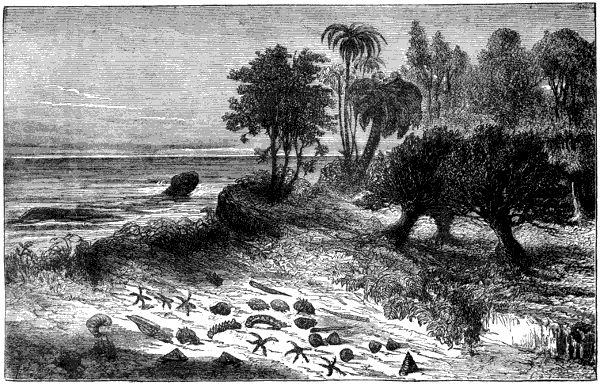
XXII.—Ideal Landscape of the Cretaceous Period.
In Plate XXII. is represented an ideal view of the earth during
the Upper Cretaceous period. In the sea swims the Mosasaurus;
Molluscs, Zoophytes, and other animals peculiar to the period are
seen on the shore. The vegetation seems to approach that of our
days; it consists of Ferns and Cycadeæ (Pterophyllums), mingled
with Palms, Willows, and some dicotyledons of species analogous to
those of our present epoch. Algæ, then very abundant, composed
the vegetation of the sea-shore.
We have said that the terrestrial flora of the Upper Cretaceous
period was nearly identical with that of the Lower. The marine flora
of these two epochs included some Algæ, Confervæ, and Naïadæ,
among which may be noted the following species: Confervites fasciculatus,
Chondrites Mantelli, Sargassites Hynghianus. Among the
Naïadæ, Zosterites Orbigniana, Z. lineata, and several others.
The Confervæ are fossils which may be referred, but with some
doubt, to the filamentous Algæ, which comprehend the great group of
the Confervæ. These plants were formed of simple or branching
filaments, diversely crossing each other; or subdivided, and presenting
traces of transverse partitions.
The Chondrites are, perhaps, fossil Algæ, with thick, smooth
branching fronds, pinnatifid, or divided into pairs, with smooth
cylindrical divisions, and resembling Chondrus, Dumontia, and
Halymenia among living genera.
The Sargassites, finally, have been vaguely referred to the genus
Sargassum, so abundant in tropical seas. These Algæ are distinguished
by a filiform, branched, or ramose stem, bearing foliaceous
appendages, regular, often petiolate, and altogether like leaves, and
globular vesicles, supported by a small stalk.
The rocks which actually represent the Upper Cretaceous period
divide themselves naturally into six series; but British and French
geologists make some distinction: the former dividing them into 1,
Maestricht and Faxoe beds, said not to occur in England; 2, White
Chalk, with flints; 3, White Chalk, without flints; 4, Chalk Marl;
5, Upper Greensand; and 6, Gault. The latter four are divided by
foreign geologists into 1, Turonian; 2, Senonian; 3, Danian.
The Gault is the lowest member of the Upper Cretaceous group.
It consists of a bluish-black clay mixed with greensand, which
underlies the Upper Greensand. Near Cambridge, where the Gault
is about 200 feet thick, a layer of shells, bones, and nodules, called
the “Coprolite Bed,” from nine inches to a foot thick, represents the
Upper Greensand, and rests on the top of the Gault Clay. These
nodules and fossils are extensively worked on account of the phosphatic
matter they contain, and when ground and converted into superphosphate
of lime they furnish a very valuable agricultural manure.
The Gault attains a thickness of about 100 feet on the south-east
coast of England. It extends into Devonshire, Mr. Sharpe considering
the Black Down beds of that country as its equivalents. It
shows itself in the Departments of the Pas-de-Calais, the Ardennes,
the Meuse, the Aube, the Yonne, the Ain, the Calvados, and the
Seine-Inférieure. It presents very many distinct mineral forms,
among which two predominate: green sandstone and blackish or
grey clays. It is important to know this formation, for it is at this
level that the Artesian waters flow in the wells of Passy and
Grenelle, near Paris.
The glaucous chalk, or Upper Greensand, which is represented
typically in the departments of the Sarthe, of the Charente-Inférieure,
of the Yonne and the Var, is composed of quartzose sand, clay,
sandstone, and limestone. In this formation, at the mouth of the
Charente, we find a remarkable bed, which has been described as a
submarine forest. It consists of large trees with their branches imbedded
horizontally in vegetable matter, containing kidney-shaped
nodules of amber, or fossilised resin.
The Turonian beds are so named because the province of
Touraine, between Saumur and Montrichard, possesses the best-developed
type of this strata. The mineralogical composition of the
beds is a fine and grey marly chalk, as at Vitry-le-François; of a pure
white chalk, with a very fine grain, slightly argillaceous, and poor in
fossils, in the Departments of the Yonne, the Aube, and the Seine-Inférieure;
granular tufaceous chalk, white or yellowish, mixed with
spangles of mica, and containing Ammonites, in Touraine and a part
of the Department of the Sarthe; white, grey, yellow, or bluish limestone,
inclosing Hippurites and Radiolites. In England the Lower
Chalk passes also into Chalk Marl, with Ammonites, and then into
beds known as the Upper Greensand, containing green particles of
glauconite, mixed, in Hampshire and Surrey, with much calcareous
matter. In the Isle of Wight this formation attains a thickness of 100
feet. The Senonian beds take their name from the ancient Senones.
The city of Sens is in the centre of the best-characterised portion of
this formation; Epernay, Meudon, Sens, Vendôme, Royau, Cognac,
Saintes, are the typical regions of the formation in France. In the
Paris basin, inclusive of the Tours beds, it attains a thickness of
upwards of 1,500 feet, as was proved by the samples brought up,
during the sinking of the Artesian well, at Grenelle, by the borings.
In its geographical distribution the Chalk has an immense range;
fine Chalk of nearly similar aspect and composition being met with
in all directions over hundreds of miles, alternating in its lower beds
with layers of flints. In England the higher beds usually consist of a
pure-white calcareous mass, generally too soft for building-stone, but
sometimes passing into a solid rock.
The Danian beds, which occupy the summit of the scale in the
Cretaceous formation, are finely developed at Maestricht, on the
Meuse; and in the Island of Zeeland, belonging to Denmark; where
they are represented by a slightly yellowish, compact limestone,
quarried for the construction of the city of Faxoe. It is slightly
represented in the Paris basin at Meudon, and Laversines, in the
Department of the Oise, by a white and often rubbly limestone
known as pisolitic limestone. In this formation Ammonites Danicus
is found. The yellowish sandy limestone of Maestricht is referred to
the Danian type. Besides Molluscs, Polyps, and Polyzoa (Bryozoa),
this limestone contains remains of Fishes, Turtles, and Crocodiles.
But what has rendered this rock so celebrated was that it contained
the remains of the great animal of Mæstricht, the Mæsasaurus.
At the close of the geological period, whose natural physiognomy
we have thus traced, Europe was still far from displaying the configuration
which it now presents. A map of the period would represent
the great basin of Paris (with the exception of a zone of Chalk), the
whole of Switzerland, the greater part of Spain and Italy, the whole
of Belgium, Holland, Prussia, Hungary, Wallachia, and Northern
Russia, as one vast sheet of water. A band of Jurassic rocks still
connected France and England at Cherbourg—which disappeared
at a later period, and caused the separation of the British Islands
from what is now France.
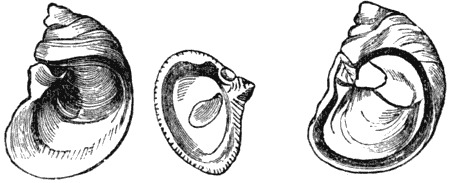
Fig. 147.—Exogym conica. Upper Greensand and Gault, from Blackdown Hill.
[312]