Mr. Bull, to whom the following poetical
epistle is addressed, has already been mentioned
as the person who suggested to
Cowper the translation of Madame Guion's
Hymns. Cowper used to say of him, that
he was the master of a fine imagination, or,
rather, that he was not master of it.
Olney, June 22, 1782.
My dear Friend,
If reading verse be your delight,
'Tis mine as much, or more, to write;
But what we would, so weak is man,
Lies oft remote from what we can.
For instance, at this very time,
I feel a wish, by cheerful rhyme,
To soothe my friend, and had I power,
To cheat him of an anxious hour;
Not meaning (for I must confess,
It were but folly to suppress,)
His pleasure or his good alone,
But squinting partly at my own.
But though the sun is flaming high
I' th' centre of yon arch, the sky,
And he had once (and who but he?)
The name for setting genius free;
Yet whether poets of past days
Yielded him undeserved praise,
And he by no uncommon lot
Was famed for virtues he had not;
Or whether, which is like enough,
His Highness may have taken huff,
So seldom sought with invocation,
Since it has been the reigning fashion
To disregard his inspiration,
I seem no brighter in my wits,
For all the radiance he emits,
Than if I saw through midnight vapour
The glimm'ring of a farthing taper.
O for a succedaneum, then,
T' accelerate a creeping pen,
O for a ready succedaneum,
Quod caput, cerebrum, et cranium
Pondere liberet exoso,
Et morbo jam caliginoso!
'Tis here; this oval box well fill'd
With best tobacco, finely mill'd,
Beats all Anticyra's pretences
To disengage the encumber'd senses.
O Nymph of Transatlantic fame,
Where'er thine haunt, whate'er thy name,
Whether reposing on the side
Of Oroonoquo's spacious tide,
Or list'ning with delight not small
To Niagara's distant fall,
'Tis thine to cherish and to feed
The pungent nose-refreshing weed,
Which, whether, pulverized it gain
A speedy passage to the brain,
Or, whether touch'd with fire, it rise
In circling eddies to the skies,
Does thought more quicken and refine
Than all the breath of all the Nine—
Forgive the Bard, if Bard he be,
Who once too wantonly made free
To touch with a satiric wipe
That symbol of thy power, the pipe;
So may no blight infest thy plains,
And no unseasonable rains,
And so may smiling Peace once more
Visit America's sad shore;
And thou, secure from all alarms
Of thund'ring drums and glitt'ring arms,
Rove unconfined beneath the shade
Thy wide-expanded leaves have made;
So may thy votaries increase,
And fumigation never cease.
May Newton, with renew'd delights,
Perform thine odorif'rous rites.
While clouds of incense half divine
Involve thy disappearing shrine;
And so may smoke-inhaling Bull
Be always filling, never full.
W. C.
Olney, July 16, 1782.
My dear Friend,—Though some people pretend
to be clever in the way of prophetical
forecast, and to have a peculiar talent of sagacity,
by which they can divine the meaning of
a providential dispensation while its consequences
are yet in embryo, I do not. There is
at this time to be found, I suppose, in the
cabinet, and in both houses, a greater assemblage
of able men, both as speakers and counsellors,
than ever were contemporary in the
same land. A man not accustomed to trace
the workings of Providence, as recorded in
Scripture, and that has given no attention to
this particular subject, while employed in the
study of profane history, would assert boldly,
that it is a token for good, that much may be
expected from them, and that the country,
though heavily afflicted, is not yet to be despaired
of, distinguished as she is by so many
characters of the highest class. Thus he would
say, and I do not deny that the event might
justify his skill in prognostics. God works by
means; and, in a case of great national perplexity
and distress, wisdom and political
ability seem to be the only natural means of
deliverance. But a mind more religiously inclined,
and perhaps a little tinctured with melancholy,
might with equal probability of success
hazard a conjecture directly opposite.
Alas! what is the wisdom of man, especially
when he trusts in it as the only god of his confidence?
When I consider the general contempt
that is poured upon all things sacred,
the profusion, the dissipation, the knavish cunning,
of some, the rapacity of others, and the
impenitence of all, I am rather inclined to fear
that God, who honours himself by bringing
human glory to shame, and by disappointing
the expectations of those whose trust is in
creatures, has signalized the present day as a
day of much human sufficiency and strength,
has brought together from all quarters of the
land the most illustrious men to be found in it,
only that he may prove the vanity of idols, and
that, when a great empire is falling, and he has
pronounced a sentence of ruin against it, the
inhabitants, be they weak or strong wise or
foolish, must fall with it. I am rather confirmed
in this persuasion by observing that
these luminaries of the state had no sooner
fixed themselves in the political heaven, than
the fall of the brightest of them shook all the
rest. The arch of their power was no sooner
struck than the key-stone slipped out of its
place, those that were closest in connexion with
it followed, and the whole building, new as it
is, seems to be already a ruin. If a man should
hold this language, who could convict him of
absurdity? The Marquis of Rockingham is
minister—all the world rejoices, anticipating
success in war and a glorious peace. The Marquis
of Rockingham is dead—all the world is
afflicted, and relapses into its former despondence.
What does this prove, but that the
Marquis was their Almighty, and that, now he
is gone, they know no other? But let us wait
a little, they will find another. Perhaps the
Duke of Portland, or perhaps the unpopular
——, whom they now represent as a devil, may
obtain that honour. Thus God is forgot, and
when he is, his judgments are generally his remembrancers.
How shall I comfort you upon the subject of
your present distress? Pardon me that I find
myself obliged to smile at it, because, who but
yourself would be distressed upon such an occasion?
You have behaved politely, and, like
a gentleman, you have hospitably offered your
house to a stranger, who could not, in your
neighbourhood at least, have been comfortably
accommodated any where else. He, by neither
refusing nor accepting an offer that did him
too much honour, has disgraced himself, but
not you. I think for the future you must be
more cautious of laying yourself open to a
stranger, and never again expose yourself to
incivilities from an archdeacon you are not acquainted
with.
Though I did not mention it, I felt with you
what you suffered by the loss of Miss ——;
I was only silent because I could minister no
consolation to you on such a subject, but what
I knew your mind to be already stored with.
Indeed, the application of comfort in such
cases is a nice business, and perhaps when
best managed might as well be let alone.
I remember reading many years ago a long
treatise on the subject of consolation, written
in French, the author's name I forgot, but I
wrote these words in the margin. Special
consolation! at least for a Frenchman, who is
a creature the most easily comforted of any in
the world!
We are as happy in Lady Austen, and she in
us, as ever—having a lively imagination, and
being passionately desirous of consolidating all
into one family (for she has taken her leave of
London), she has just sprung a project which
serves at least to amuse us and to make us
laugh; it is to hire Mr. Small's house, on the
top of Clifton-hill, which is large, commodious,
and handsome, will hold us conveniently,
and any friends who may occasionally
favour us with a visit; the house is furnished,
but, if it can be hired without the furniture
will let for a trifle—your sentiments if you
please upon this demarche!
I send you my last frank—our best love
attends you individually and all together. I
give you joy of a happy change in the season,
and myself also. I have filled four sides in
less time than two would have cost me a week
ago; such is the effect of sunshine upon such
a butterfly as I am.
Yours,
W. C.
Olney, Aug. 3, 1782.
My dear Friend,—Entertaining some hope
that Mr. Newton's next letter would furnish
me with the means of satisfying your inquiry
on the subject of Dr. Johnson's opinion, I
have till now delayed my answer to your last;
but the information is not yet come, Mr. Newton
having intermitted a week more than
usual, since his last writing. When I receive
it, favourable or not, it shall be communicated
to you; but I am not over-sanguine in my expectations
from that quarter. Very learned
and very critical heads are hard to please. He
may perhaps treat me with lenity for the sake
of the subject and design, but the composition,
I think, will hardly escape his censure. But
though all doctors may not be of the same
mind, there is one doctor at least, whom I
have lately discovered, my professed admirer.[151]
He too, like Johnson, was with difficulty persuaded
to read, having an aversion to all
poetry, except the "Night Thoughts," which,
on a certain occasion, when being confined on
board a ship he had no other employment, he
got by heart. He was however prevailed
upon, and read me several times over, so that
if my volume had sailed with him instead of
Dr. Young's, I perhaps might have occupied
that shelf in his memory which he then allotted
to the Doctor.
It is a sort of paradox, but it is true: we
are never more in danger than when we think
ourselves most secure, nor in reality more
secure than when we seem to be most in
danger. Both sides of this apparent contradiction
were lately verified in my experience:
passing from the green-house to the barn, I
saw three kittens (for we have so many in
our retinue) looking with fixed attention on
something which lay on the threshold of a
door nailed up. I took but little notice of
them at first, but a loud hiss engaged me to
attend more closely, when behold—a viper!
the largest that I remember to have seen,
rearing itself, darting its forked tongue, and
ejaculating the aforesaid hiss at the nose of a
kitten, almost in contact with his lips. I ran
into the hall for a hoe with a long handle, with
which I intended to assail him, and returning
in a few seconds, missed him: he was gone,
and I feared had escaped me. Still, however,
the kitten sat watching immoveably on the
same spot. I concluded, therefore, that sliding
between the door and the threshold, he had
found his way out of the garden into the yard.
I went round immediately, and there found
him in close conversation with the old cat,
whose curiosity being excited by so novel an
appearance, inclined her to pat his head repeatedly
with her fore foot, with her claws
however sheathed, and not in anger, but in the
way of philosophic inquiry and examination.
To prevent her falling a victim to so laudable
an exercise of her talents, I interposed in a
moment with the hoe, and performed upon
him an act of decapitation, which, though not
immediately mortal, proved so in the end.
Had he slid into the passages, where it is dark,
or had he, when in the yard, met with no interruption
from the cat, and secreted himself
in any of the out-houses, it is hardly possible
but that some of the family must have been
bitten; he might have been trodden upon
without being perceived, and have slipped
away before the sufferer could have distinguished
what foe had wounded him. Three
years ago we discovered one in the same place,
which the barber slew with a trowel.
Our proposed removal to Mr. Small's was, as
you may suppose, a jest, or rather a joco-serious
matter. We never looked upon it as entirely
feasible, yet we saw in it something so like
practicability that we did not esteem it altogether
unworthy of our attention. It was one
of those projects which people of lively imaginations
play with and admire for a few days,
and then break in pieces. Lady Austen returned
on Thursday from London, where she
spent the last fortnight, and whither she was
called by an unexpected opportunity to dispose
of the remainder of her lease. She has
therefore no longer any connexion with the
great city, and no house but at Olney. Her
abode is to be at the vicarage, where she has
hired as much room as she wants, which she
will embellish with her own furniture, and
which she will occupy as soon as the minister's
wife has produced another child, which is expected
to make its entry in October.
Mr. Bull, a dissenting minister of Newport,
a learned, ingenious, good-natured, pious
friend of ours, who sometimes visits us, and
whom we visited last week, put into my hands
three volumes of French poetry, composed by
Madame Guion—a quietist, say you, and a
fanatic, I will have nothing to do with her.—'Tis
very well, you are welcome to have nothing
to do with her, but, in the meantime, her verse
is the only French verse I ever read that
I found agreeable; there is a neatness in it
equal to that which we applaud, with so much
reason, in the compositions of Prior. I have
translated several of them, and shall proceed
in my translations till I have filled a Lilliputian
paper-book I happen to have by me, which,
when filled, I shall present to Mr. Bull. He is
her passionate admirer; rode twenty miles to
see her picture in the house of a stranger,
which stranger politely insisted on his acceptance
of it, and it now hangs over his chimney.
It is a striking portrait, too characteristic not
to be a strong resemblance, and, were it encompassed
with a glory, instead of being
dressed in a nun's hood, might pass for the
face of an angel.
Yours,
W. C.
To this letter we annex a very lively lusus
poeticus from the pen of Cowper, on the subject
mentioned in the former part of the preceding
letter.
THE COLUBRIAD.
Close by the threshold of a door nail'd fast,
Three kittens sat; each kitten look'd aghast.
I, passing swift and inattentive by,
At the three kittens cast a careless eye;
Not much concerned to know what they did there,
Not deeming kittens worth a poet's care.
But presently a loud and furious hiss
Caus'd me to stop, and to exclaim, "What's this?"
When, lo! upon the threshold met my view,
With head erect, and eyes of fiery hue,
A viper, long as Count de Grasse's queue.
Forth from his head his forked tongue he throws,
Darting it full against a kitten's nose;
Who, having never seen, in field or house,
The like, sat still and silent as a mouse:
Only projecting, with attention due,
Her whisker'd face, she ask'd him, "Who are you?"
On to the hall went I, with pace not slow,
But swift as lightning, for a long Dutch hoe:
With which well arm'd I hastened to the spot,
To find the viper, but I found him not.
And turning up the leaves and shrubs around,
Found only—that he was not to be found.
But still the kittens, sitting as before,
Sat watching close the bottom of the door.
"I hope," said I, "the villain I would kill
Has slipt between the door and the door's sill;
And, if I make despatch and follow hard,
No doubt but I shall find him in the yard;"
For long ere now it should have been rehearsed,
'Twas in the garden that I found him first.
Ev'n there I found him, there the full-grown cat
His head with velvet paw did gently pat:
As curious as the kittens erst had been
To learn what this phenomenon might mean.
Fill'd with heroic ardour at the sight,
And fearing every moment he would bite,
And rob our household of our only cat,
That was of age to combat with a rat;
With outstretched hoe I slew him at the door,
And taught him NEVER TO COME THERE NO MORE.
Lady Austen became a tenant of the vicarage
at Olney. When Mr. Newton occupied that
parsonage, he had opened a door in the garden-wall,
which admitted him in the most commodious
manner to visit the sequestered poet,
who resided in the next house. Lady Austen
had the advantage of this easy intercourse;
and so captivating was her society, both to
Cowper and to Mrs. Unwin, that these intimate
neighbours might be almost said to make one
family, as it became their custom to dine
always together, alternately in the houses of
the two ladies.
The musical talents of Lady Austen induced
Cowper to write a few songs of peculiar sweetness
and pathos, to suit particular airs that she
was accustomed to play on the harpsichord.
We insert three of these, as proofs that, even
in his hours of social amusement, the poet
loved to dwell on ideas of tender devotion and
pathetic solemnity.
Air—"My fond shepherds of late," &c.
No longer I follow a sound;
No longer a dream I pursue:
O happiness! not to be found,
Unattainable treasure, adieu!
I have sought thee in splendor and dress,
In the regions of pleasure and taste;
I have sought thee, and seem'd to possess,
But have proved thee a vision at last.
An humble ambition and hope
The voice of true wisdom inspires!
'Tis sufficient, if peace be the scope
And the summit of all our desires.
Peace may be the lot of the mind
That seeks it in meekness and love;
But rapture and bliss are confined
To the glorified spirits above!
Air—"The lass of Pattie's mill."
When all within is peace,
How nature seems to smile!
Delights that never cease,
The live-long day beguile.
From morn to dewy eve,
With open hand she showers
Fresh blessings to deceive
And soothe the silent hours.
It is content of heart
Gives Nature power to please;
The mind that feels no smart
Enlivens all it sees;
Can make a wint'ry sky
Seem bright as smiling May,
And evening's closing eye
As peep of early day.
The vast majestic globe,
So beauteously array'd
In Nature's various robe,
With wond'rous skill display'd,
Is to a mourner's heart
A dreary wild at best;
It flutters to depart,
And longs to be at rest.
The following song, adapted to the march in
Scipio, obtained too great a celebrity not to
merit insertion in this place. It relates to the
loss of the Royal George, the flag-ship of Admiral
Kempenfelt, which went down with nine
hundred persons on board, (among whom was
Rear-Admiral Kempenfelt,) at Spithead, August
29, 1782. The song was a favourite production
of the poet's; so much so, that he amused himself
by translating it into Latin verse. We
take the version from one of his subsequent
letters, for the sake of annexing it to the
original.
Toll for the brave!
The brave that are no more!
All sunk beneath the wave,
Fast by their native shore!
Eight hundred of the brave,
Whose courage well was tried,
Had made the vessel heel,
And laid her on her side.
A land-breeze shook the shrouds,
And she was overset;
Down went the Royal George,
With all her crew complete.
Toll for the brave!
Brave Kempenfelt is gone;
His last sea-fight is fought;
His work of glory done.
It was not in the battle;
No tempest gave the shock;
She sprang no fatal leak;
She ran upon no rock.
His sword was in its sheath;
His fingers held the pen,
When Kempenfelt went down
With twice four hundred men.
Weigh the vessel up,
Once dreaded by our foes!
And mingle with our cup
The tear that England owes.
Her timbers yet are sound,
And she may float again,
Full-charged with England's thunder,
And plough the distant main.[152]
But Kempenfelt is gone,
His victories are o'er;
And he and his eight hundred
Shall plough the wave no more.
Plangimus fortes. Periere fortes,
Patrium propter periere littus
Bis quatèr centum; subitò sub alto
Æquore mersi.
Navis, innitens lateri, jacebat,
Malus ad summas trepidabat undas,
Cùm levis, funes quatiens, ad imum
Depulit aura.
Plangimus fortes. Nimis, heu, caducam
Fortibus vitam voluere parcæ,
Nec sinunt ultrà tibi nos recentes
Nectere laurus.
Magne, qui nomen, licèt incanorum,
Traditum ex multis atavis tulisti!
At tuos olim memorabit ævum
Omne triumphos.
Non hyems illos furibunda mersit,
Non mari in clauso scopuli latentes,
Fissa non rimis abies, nec atrox
Abstulit ensis.
Navitæ sed tum nimium jocosi
Voce fallebant hilari laborem,
Et quiescebat, calamoque dextram im-
pleverat heros.
Vos, quibus cordi est grave opus piumque,
Humidum ex alto spolium levate,
Et putrescentes sub aquis amicos
Reddite amicis!
Hi quidem (sic dîis placuit) fuere:
Sed ratis, nondùm putris, ire possit
Rursùs in bellum, Britonumque nomen
Tollere ad astra.
Let the reader, who wishes to impress on
his mind a just idea of the variety and extent
of Cowper's poetical powers, contrast this
heroic ballad of exquisite pathos with his
diverting history of John Gilpin!
That admirable and highly popular piece of
pleasantry was composed at the period of
which we are now speaking. An elegant and
judicious writer, who has favoured the public
with three interesting volumes relating to the
early poets of our country,[153] conjectures, that
a poem, written by the celebrated Sir Thomas
More in his youth, (the merry jest of the
Serjeant and Frere) may have suggested to
Cowper his tale of John Gilpin; but this singularly
amusing ballad had a different origin;
and it is a very remarkable fact, that, full of
gaiety and humour as this favourite of the
public has abundantly proved itself to be, it
was really composed at a time when the
spirit of the poet was very deeply tinged with
his depressive malady. It happened one afternoon,
in those years when his accomplished
friend, Lady Austen, made a part of his
little evening circle, that she observed him
sinking into increasing dejection. It was her
custom on these occasions, to try all the resources
of her sprightly powers for his immediate
relief. She told him the story of John
Gilpin (which had been treasured in her memory
from her childhood) to dissipate the
gloom of the passing hour. Its effect on the
fancy of Cowper had the air of enchantment:
he informed her the next morning, that convulsions
of laughter, brought on by his recollection
of her story, had kept him waking
during the greatest part of the night, and that
he had turned it into a ballad.—So arose the
pleasant poem of John Gilpin. It was eagerly
copied, and, finding its way rapidly to the
newspapers, it was seized by the lively spirit of
Henderson the comedian, a man, like the
Yorick described by Shakspeare, "of infinite
jest, and most excellent fancy." By him it
was selected as a proper subject for the display
of his own comic powers, and, by reciting it in
his public readings, he gave uncommon celebrity
to the ballad, before the public suspected
to what poet they were indebted for
the sudden burst of ludicrous amusement.
Many readers were astonished when the poem
made its first authentic appearance in the
second volume of Cowper.
Olney, Sept. 6, 1782.
My dear Friend,—Yesterday, and not before,
I received your letter, dated the 11th of June,
from the hands of Mr. Small. I should have
been happy to have known him sooner; but,
whether being afraid of that horned monster,
a Methodist, or whether from a principle of
delicacy, or deterred by a flood, which has
rolled for some weeks between Clifton and
Olney, I know not,—he has favoured me only
with a taste of his company, and will leave me
on Saturday evening, to regret that our acquaintance,
so lately begun, must be so soon
suspended. He will dine with us that day,
which I reckon a fortunate circumstance, as I
shall have an opportunity to introduce him to
the liveliest and most entertaining woman in
the country.[155] I have seen him but for half an
hour, yet, without boasting of much discernment,
I see that he is polite, easy, cheerful, and
sensible. An old man thus qualified, cannot
fail to charm the lady in question. As to his
religion, I leave it—I am neither his bishop
nor his confessor. A man of his character,
and recommended by you, would be welcome
here, were he a Gentoo or a Mahometan.
I learn from him that certain friends of
mine, whom I have been afraid to inquire
about by letter, are alive and well. The current
of twenty years has swept away so many whom
I once knew, that I doubted whether it might
be advisable to send my love to your mother
and your sisters. They may have thought my
silence strange, but they have here the reason
of it. Assure them of my affectionate remembrance,
and that nothing would make me
happier than to receive you all in my greenhouse,
your own Mrs. Hill included. It is
fronted with myrtles, and lined with mats, and
would just hold us, for Mr. Small informs me
your dimensions are much the same as usual.
Yours, my dear Friend,
W. C.
Olney, Nov. 4, 1782.
My dear Friend,—You are too modest;
though your last consisted of three sides only,
I am certainly a letter in your debt. It is possible
that this present writing may prove as
short. Yet, short as it may be, it will be a
letter, and make me creditor, and you my
debtor. A letter, indeed, ought not to be
estimated by the length of it, but by the
contents, and how can the contents of any
letter be more agreeable than your last.
You tell me that John Gilpin made you
laugh tears, and that the ladies at court are
delighted with my poems. Much good may
they do them! May they become as wise as
the writer wishes them, and they will be much
happier than he! I know there is in the book
that wisdom which cometh from above, because
it was from above that I received it. May
they receive it too! For, whether they drink
it out of the cistern, or whether it falls upon
them immediately from the clouds, as it did on
me, it is all one. It is the water of life, which
whosoever drinketh shall thirst no more. As
to the famous horseman above-mentioned, he
and his feats are an inexhaustible source of
merriment. At least we find him so, and seldom
meet without refreshing ourselves with
the recollection of them. You are perfectly at
liberty to deal with them as you please. Auctore
tantùm anonymo, imprimantur; and when
printed send me a copy.
I congratulate you on the discharge of your
duty and your conscience, by the pains you
have taken for the relief of the prisoners.
You proceeded wisely, yet courageously, and
deserved better success. Your labours, however,
will be remembered elsewhere, when you
shall be forgotten here; and, if the poor folks
at Chelmsford should never receive the benefit
of them, you will yourself receive it in heaven.
It is pity that men of fortune should be determined
to acts of beneficence, sometimes by
popular whim or prejudice, and sometimes by
motives still more unworthy. The liberal subscription,
raised in behalf of the widows of
seamen lost in the Royal George was an instance
of the former. At least a plain, short
and sensible letter in the newspaper, convinced
me at the time that it was an unnecessary and
injudicious collection: and the difficulty you
found in effectuating your benevolent intentions
on this occasion, constrains me to think
that, had it been an affair of more notoriety
than merely to furnish a few poor fellows with
a little fuel to preserve their extremities from
the frost, you would have succeeded better.
Men really pious delight in doing good by
stealth. But nothing less than an ostentatious
display of bounty will satisfy mankind in
general. I feel myself disposed to furnish you
with an opportunity to shine in secret. We do
what we can. But that can is little. You
have rich friends, are eloquent on all occasions,
and know how to be pathetic on a proper one.
The winter will be severely felt at Olney by
many, whose sobriety, industry, and honesty,
recommend them to charitable notice: and we
think we could tell such persons as Mr. ——, or
Mr. ——, half a dozen tales of distress, that
would find their way into hearts as feeling as
theirs. You will do as you see good; and we
in the meantime shall remain convinced that
you will do your best. Lady Austen will, no
doubt, do something, for she has great sensibility
and compassion.
Yours, my dear Unwin,
W. C.
Olney, Nov. 5, 1782.
Charissime Taurorum—
Quot sunt, vel fuerunt, vel posthac aliis erunt in annis,
We shall rejoice to see you, and I just write
to tell you so. Whatever else I want, I have,
at least, this quality in common with publicans
and sinners, that I love those that love me, and
for that reason, you in particular. Your warm
and affectionate manner demands it of me.
And, though I consider your love as growing
out of a mistaken expectation that you shall
see me a spiritual man hereafter, I do not love
you much the less for it. I only regret that I
did not know you intimately in those happier
days, when the frame of my heart and mind
was such as might have made a connexion
with me not altogether unworthy of you.
I add only Mrs. Unwin's remembrances, and
that I am glad you believe me to be, what I
truly am,
Your faithful and affectionate
W. C.
Olney, Nov. 11, 1782.
My dear Friend,—Your shocking scrawl, as you
term it, was however a very welcome one. The
character indeed has not quite the neatness and
beauty of an engraving; but if it cost me some
pains to decipher it, they were well rewarded
by the minute information it conveyed. I am
glad your health is such that you have nothing
more to complain of than may be expected on
the down-hill side of life. If mine is better
than yours, it is to be attributed, I suppose,
principally to the constant enjoyment of country
air and retirement; the most perfect regularity
in matters of eating, drinking, and sleeping;
and a happy emancipation from every thing
that wears the face of business. I lead the
life I always wished for, and, the single circumstance
of dependence excepted, (which,
between ourselves, is very contrary to my predominant
humour and disposition,) have no
want left broad enough for another wish to
stand upon.
You may not, perhaps, live to see your trees
attain to the dignity of timber: I nevertheless
approve of your planting, and the disinterested
spirit that prompts you to it. Few people
plant when they are young; a thousand other
less profitable amusements divert their attention;
and most people, when the date of youth
is once expired, think it too late to begin. I
can tell you, however, for your comfort and encouragement,
that when a grove which Major
Cowper had planted was of eighteen years'
growth, it was no small ornament to his
grounds, and afforded as complete a shade as
could be desired. Were I as old as your mother,
in whose longevity I rejoice, and the more because
I consider it as in some sort a pledge and
assurance of yours, and should come to the
possession of land worth planting, I would
begin to-morrow, and even without previously
insisting upon a bond from Providence that I
should live five years longer.
I saw last week a gentleman who was lately
at Hastings. I asked him where he lodged.
He replied at P——'s. I next inquired after
the poor man's wife, whether alive or dead.
He answered, dead. So then, said I, she has
scolded her last; and a sensible old man will
go down to his grave in peace. Mr. P——, to
be sure, is of no great consequence either to
you or to me; but, having so fair an opportunity
to inform myself about him, I could not
neglect it. It gives me pleasure to learn somewhat
of a man I knew a little of so many
years since, and for that reason merely I mention
the circumstance to you.
I find a single expression in your letter
which needs correction. You say I carefully
avoid paying you a visit at Wargrave. Not
so; but connected as I happily am, and rooted
where I am, and not having travelled these
twenty years—being besides of an indolent
temper, and having spirits that cannot bear a
bustle—all these are so many insuperables in
the way. They are not however in yours; and
if you and Mrs. Hill will make the experiment,
you shall find yourselves as welcome here,
both to me and to Mrs. Unwin, as it is possible
you can be any where.
Yours affectionately,
W. C.
Olney, Nov. 1782.
My dear Friend,—I am to thank you for a
very fine cod, which came most opportunely to
make a figure on our table, on an occasion that
made him singularly welcome. I write, and
you send me a fish. This is very well, but not
altogether what I want. I wish to hear from
you, because the fish, though he serves to convince
me that you have me still in remembrance,
says not a word of those that sent
him; and, with respect to your and Mrs.
Hill's health, prosperity, and happiness, leaves
me as much in the dark as before. You are
aware, likewise, that where there is an exchange
of letters it is much easier to write.
But I know the multiplicity of your affairs,
and therefore perform my part of the correspondence
as well as I can, convinced that
you would not omit yours, if you could help it.
Three days since I received a note from old
Mr. Small, which was more than civil—it was
warm and friendly. The good veteran excuses
himself for not calling upon me, on account of
the feeble state in which a fit of the gout had
left him. He tells me however that he has
seen Mrs. Hill, and your improvements at
Wargrave, which will soon become an ornament
to the place. May they, and may you
both live long to enjoy them! I shall be sensibly
mortified if the season and his gout together
should deprive me of the pleasure of
receiving him here; for he is a man much to
my taste, and quite an unique in this country.
My eyes are in general better than I remember
them to have been since I first opened
them upon this sublunary stage, which is now
a little more than half a century ago. We are
growing old; but this is between ourselves:
the world knows nothing of the matter. Mr.
Small tells me you look much as you did; and
as for me, being grown rather plump, the ladies
tell me I am as young as ever.
Yours ever,
W. C.
Olney, Nov. 18, 1782.
My dear William,—On the part of the poor,
and on our part, be pleased to make acknowledgments,
such as the occasion calls for, to
our beneficent friend, Mr. ——. I call him
ours, because, having experienced his kindness
to myself, in a former instance, and in the
present his disinterested readiness to succour
the distressed, my ambition will be satisfied
with nothing less. He may depend upon the
strictest secrecy; no creature shall hear him
mentioned, either now or hereafter, as the
person from whom we have received this
bounty. But when I speak of him, or hear
him spoken of by others, which sometimes
happens, I shall not forget what is due to so
rare a character. I wish, and your mother
wishes too, that he could sometimes take us
in his way to ——: he will find us happy to
receive a person whom we must needs account
it an honour to know. We shall exercise our
best discretion in the disposal of the money;
but in this town, where the gospel has been
preached so many years, where the people
have been favoured so long with laborious and
conscientious ministers, it is not an easy thing
to find those who make no profession of religion
at all, and are yet proper objects of charity.
The profane are so profane, so drunken,
dissolute, and in every respect worthless, that to
make them partakers of his bounty would be to
abuse it. We promise, however, that none
shall touch it but such as are miserably poor,
yet at the same time industrious and honest,
two characters frequently united here, where
the most watchful and unremitting labour will
hardly procure them bread. We make none
but the cheapest laces, and the price of them
is fallen almost to nothing. Thanks are due
to yourself likewise, and are hereby accordingly
rendered, for waiving your claim in behalf of
your own parishioners. You are always with
them, and they are always, at least some of
them, the better for your residence among
them. Olney is a populous place, inhabited
chiefly by the half-starved and the ragged of
the earth, and it is not possible for our small
party and small ability to extend their operations
so far as to be much felt among such
numbers. Accept, therefore, your share of
their gratitude, and be convinced that, when
they pray for a blessing upon those who relieved
their wants, he that answers that prayer,
and when he answers it, will remember his
servant at Stock.
I little thought when I was writing the history
of John Gilpin, that he would appear in
print—I intended to laugh, and to make two
or three others laugh, of whom you were one.
But now all the world laugh, at least if they
have the same relish for a tale ridiculous in
itself, and quaintly told, as we have. Well,
they do not always laugh so innocently, and at
so small an expense, for, in a world like this,
abounding with subjects for satire, and with
satirical wits to mark them, a laugh that hurts
nobody has at least the grace of novelty to recommend
it. Swift's darling motto was, Vive
la bagatelle! a good wish for a philosopher of
his complexion, the greater part of whose wisdom,
whencesoever it came, most certainly
came not from above. La bagatelle has no
enemy in me, though it has neither so warm a
friend nor so able a one as it had in him. If
I trifle, and merely trifle, it is because I am
reduced to it by necessity—a melancholy that
nothing else so effectually disperses engages
me sometimes in the arduous task of being
merry by force. And, strange as it may seem,
the most ludicrous lines I ever wrote have
been written in the saddest mood, and but for
that saddest mood, perhaps, had never been
written at all.
I hear from Mrs. Newton that some great
persons have spoken with great approbation of
a certain book—who they are, and what they
have said, I am to be told in a future letter.
The Monthly Reviewers, in the meantime,
have satisfied me well enough.
Yours, my dear William,
W. C.
My dear William,—Dr. Beattie is a respectable
character.[158] I account him a man of
sense, a philosopher, a scholar, a person of distinguished
genius, and a good writer. I believe
him too a Christian; with a profound
reverence for the scripture, with great zeal and
ability to enforce the belief of it, both which
he exerts with the candour and good manners
of a gentleman: he seems well entitled to that
allowance; and to deny it him, would impeach
one's right to the appellation. With all these
good things to recommend him, there can be
no dearth of sufficient reasons to read his
writings. You favoured me some years since
with one of his volumes; by which I was both
pleased and instructed: and I beg you will
send me the new one, when you can conveniently
spare it, or rather bring it yourself, while
the swallows are yet upon the wing: for the
summer is going down apace.
You tell me you have been asked, if I am intent
upon another volume? I reply, not at
present, not being convinced that I have met
with sufficient encouragement. I account myself
happy in having pleased a few, but am not
rich enough to despise the many. I do not
know what sort of market my commodity has
found, but, if a slack one, I must beware how I
make a second attempt. My bookseller will
not be willing to incur a certain loss; and I
can as little afford it. Notwithstanding what
I have said, I write, and am even now writing,
for the press. I told you that I had translated
several of the poems of Madame Guion. I told
you too, or I am mistaken, that Mr. Bull designed
to print them. That gentleman is gone
to the sea-side with Mrs. Wilberforce, and will
be absent six weeks. My intention is to surprise
him at his return with the addition of as
much more translation as I have already given
him. This, however, is still less likely to be a
popular work than my former. Men that have
no religion would despise it; and men that
have no religious experience would not understand
it. But the strain of simple and unaffected
piety in the original is sweet beyond
expression. She sings like an angel, and for
that very reason has found but few admirers.
Other things I write too, as you will see on the
other side, but these merely for my amusement.[159]
Olney, Nov. 23, 1782.
My dear Madam,—Accept my thanks for the
trouble you take in vending my poems, and
still more for the interest you take in their
success. My authorship is undoubtedly pleased,
when I hear that they are approved either by
the great or the small; but to be approved by
the great, as Horace observed many years ago,
is fame indeed. Having met with encouragement,
I consequently wish to write again; but
wishes are a very small part of the qualifications
necessary for such a purpose. Many a
man, who has succeeded tolerably well in his
first attempt, has spoiled all by the second.
But it just occurs to me that I told you so once
before, and, if my memory had served me with
the intelligence a minute sooner, I would not
have repeated the observation now.
The winter sets in with great severity. The
rigour of the season, and the advanced price
of grain, are very threatening to the poor. It
is well with those that can feed upon a promise,
and wrap themselves up warm in the
robe of salvation. A good fire-side and a well-spread
table are but very indifferent substitutes
for these better accommodations; so very indifferent,
that I would gladly exchange them
both for the rags and the unsatisfied hunger of
the poorest creature that looks forward with
hope to a better world, and weeps tears of joy
in the midst of penury and distress. What a
world is this! How mysteriously governed,
and in appearance left to itself! One man,
having squandered thousands at a gaming-table,
finds it convenient to travel; gives his
estate to somebody to manage for him; amuses
himself a few years in France and Italy; returns,
perhaps, wiser than he went, having
acquired knowledge which, but for his follies,
he would never have acquired; again makes a
splendid figure at home, shines in the senate,
governs his country as its minister, is admired
for his abilities, and, if successful, adored at
least by a party. When he dies he is praised
as a demi-god, and his monument records every
thing but his vices. The exact contrast of such
a picture is to be found in many cottages at
Olney. I have no need to describe them; you
know the characters I mean. They love God,
they trust him, they pray to him in secret,
and, though he means to reward them openly,
the day of recompence is delayed. In the meantime
they suffer every thing that infirmity and
poverty can inflict upon them. Who would
suspect, that has not a spiritual eye to discern
it, that the fine gentleman was one whom his
Maker had in abhorrence, and the wretch last-mentioned
dear to him as the apple of his
eye! It is no wonder that the world, who are
not in the secret, find themselves obliged, some
of them, to doubt a Providence, and others
absolutely to deny it, when almost all the real
virtue there is in it is to be found living and
dying in a state of neglected obscurity, and all
the vices of others cannot exclude them from
the privilege of worship and honour! But
behind the curtain the matter is explained;
very little, however, to the satisfaction of the
great.
If you ask me why I have written thus, and
to you especially, to whom there was no need
to write thus, I can only reply, that, having a
letter to write, and no news to communicate, I
picked up the first subject I found, and pursued
it as far as was convenient for my
purpose.
Mr. Newton and I are of one mind on the
subject of patriotism. Our dispute was no
sooner begun than it ended. It would be well
perhaps, if, when two disputants begin to engage,
their friends would hurry each into a
separate chaise, and order them to opposite
points of the compass. Let one travel twenty
miles east, the other, as many west; then let
them write their opinions by the post. Much
altercation and chafing of the spirit would be
prevented; they would sooner come to a right
understanding, and, running away from each
other, would carry on the combat more
judiciously, in exact proportion to the distance.
My love to that gentleman, if you please;
and tell him that, like him, though I love my
country, I hate its follies and its sins, and had
rather see it scourged in mercy than judicially
hardened by prosperity.
Yours, my dear Madam, as ever,
W. C.
Olney, Dec. 7, 1782.
My dear Friend,—At seven o'clock this
evening, being the seventh of December, I
imagine I see you in your box at the coffee-house.
No doubt the waiter, as ingenious and
adroit as his predecessors were before him,
raises the tea-pot to the ceiling with his right
hand, while in his left the tea-cup descending
almost to the floor, receives a limpid stream;
limpid in its descent, but no sooner has it
reached its destination, than frothing and
foaming to the view, it becomes a roaring
syllabub. This is the nineteenth winter since
I saw you in this situation; and if nineteen
more pass over me before I die, I shall still remember
a circumstance we have often laughed
at.
How different is the complexion of your
evenings and mine!—yours, spent amid the
ceaseless hum that proceeds from the inside of
fifty noisy and busy periwigs; mine, by a domestic
fire-side, in a retreat as silent as retirement
can make it, where no noise is made but
what we make for our own amusement. For
instance, here are two rustics and your humble
servant in company. One of the ladies has
been playing on the harpsichord, while I with
the other have been playing at battledore and
shuttlecock. A little dog, in the meantime,
howling under the chair of the former, performed
in the vocal way to admiration. This
entertainment over, I began my letter, and,
having nothing more important to communicate,
have given you an account of it. I know
you love dearly to be idle, when you can find
an opportunity to be so; but, as such opportunities
are rare with you, I thought it possible
that a short description of the idleness I enjoy
might give you pleasure. The happiness we
cannot call our own we yet seem to possess,
while we sympathise with our friends
who can.
The papers tell me that peace is at hand,
and that it is at a great distance; that the
siege of Gibraltar is abandoned, and that it is
to be still continued. It is happy for me, that,
though I love my country, I have but little
curiosity. There was a time when these contradictions
would have distressed me; but I
have learned by experience that it is best for
little people like myself to be patient, and to
wait till time affords the intelligence which no
speculations of theirs can ever furnish.
I thank you for a fine cod with oysters, and
hope that ere long I shall have to thank you
for procuring me Elliott's medicines. Every
time I feel the least uneasiness in either eye, I
tremble lest, my Æsculapius being departed,
my infallible remedy should be lost for ever.
Adieu. My respects to Mrs. Hill.
Yours, faithfully,
W. C.
Olney, Jan. 19, 1783.
My dear William,—Not to retaliate, but for
want of opportunity, I have delayed writing.
From a scene of most uninterrupted retirement,
we have passed at once into a state of
constant engagement, not that our society is
much multiplied. The addition of an individual
has made all this difference. Lady
Austen and we pass our days alternately at
each other's château. In the morning I walk
with one or other of the ladies, and in the
afternoon wind thread. Thus did Hercules
and Sampson, and thus do I; and, were both
those heroes living, I should not fear to challenge
them to a trial of skill in that business,
or doubt to beat them both. As to killing
lions, and other amusements of that kind, with
which they were so delighted, I should be their
humble servant, and beg to be excused.
Having no frank, I cannot send you Mr.
——'s two letters, as I intended. We corresponded
as long as the occasion required, and
then ceased. Charmed with his good sense,
politeness, and liberality to the poor, I was indeed
ambitious of continuing a correspondence
with him, and told him so. Perhaps I had
done more prudently had I never proposed it.
But warm hearts are not famous for wisdom,
and mine was too warm to be very considerate
on such an occasion. I have not heard from
him since, and have long given up all expectation
of it. I know he is too busy a man to
have leisure for me, and I ought to have recollected
it sooner. He found time to do
much good, and to employ us, as his agents, in
doing it, and that might have satisfied me.
Though laid under the strictest injunctions of
secrecy, both by him, and by you on his behalf,
I consider myself as under no obligation
to conceal from you the remittances he made.
Only, in my turn, I beg leave to request secrecy
on your part, because, intimate as you
are with him, and highly as he values you, I
cannot yet be sure, that the communication
would please him, his delicacies on this subject
being as singular as his benevolence. He sent
forty pounds, twenty at a time. Olney has
not had such a friend as this many a day; nor
has there been an instance, at any time, of a
few families so effectually relieved, or so completely
encouraged to the pursuit of that honest
industry, by which, their debts being paid
and the parents and children comfortably
clothed, they are now enabled to maintain
themselves. Their labour was almost in vain
before; but now it answers: it earns them
bread, and all their other wants are plentifully
supplied.[162]
I wish that, by Mr. ——'s assistance, your
purpose in behalf of the prisoners may be
effectuated. A pen so formidable as his might
do much good, if properly directed. The dread
of a bold censure is ten times more moving
than the most eloquent persuasion. They that
cannot feel for others are the persons of all the
world who feel most sensibly for themselves.
Yours, my dear friend,
W. C.
Jan. 26, 1783.
My dear Friend,—It is reported among persons
of the best intelligence at Olney—the
barber, the schoolmaster, and the drummer of
a corps quartered at this place—that the belligerent
powers are at last reconciled, the articles
of the treaty adjusted, and that peace is
at the door.[164] I saw this morning, at nine
o'clock, a group of about twelve figures, very
closely engaged in a conference, as I suppose,
upon the same subject. The scene of consultation
was a blacksmith's shed, very comfortably
screened from the wind, and directly
opposed to the morning sun. Some held their
hands behind them, some had them folded
across their bosom, and others had thrust
them into their breeches pockets. Every
man's posture bespoke a pacific turn of mind;
but, the distance being too great for their
words to reach me, nothing transpired. I am
willing, however, to hope that the secret will
not be a secret long, and that you and I,
equally interested in the event, though not
perhaps equally well informed, shall soon have
an opportunity to rejoice in the completion of
it. The powers of Europe have clashed with
each other to a fine purpose;[165] that the Americans,
at length declared independent, may
keep themselves so, if they can; and that
what the parties, who have thought proper to
dispute upon that point have wrested from
each other in the course of the conflict may
be, in the issue of it, restored to the proper
owner. Nations may be guilty of a conduct
that would render an individual infamous for
ever; and yet carry their heads high, talk of
their glory, and despise their neighbours.
Your opinions and mine, I mean our political
ones, are not exactly of a piece, yet I cannot
think otherwise upon this subject than I have
always done. England, more perhaps through
the fault of her generals than her councils,
has, in some instances, acted with a spirit of
cruel animosity she was never chargeable with
till now. But this is the worst that can be
said. On the other hand, the Americans, who,
if they had contented themselves with a struggle
for lawful liberty, would have deserved
applause, seem to me to have incurred the
guilt of parricide, by renouncing their parent,
by making her ruin their favourite object, and
by associating themselves with her worst enemy
for the accomplishment of their purpose.
France, and of course Spain, have acted a
treacherous, a thievish part. They have stolen
America from England; and, whether they
are able to possess themselves of that jewel or
not hereafter, it was doubtless what they intended.
Holland appears to me in a meaner
light than any of them. They quarrelled with
a friend for an enemy's sake. The French
led them by the nose, and the English have
thrashed them for suffering it. My views of
the contest being, and having been always,
such, I have consequently brighter hopes for
England than her situation some time since
seemed to justify. She is the only injured
party. America may perhaps call her the aggressor;
but, if she were so, America has not
only repelled the injury, but done a greater.
As to the rest, if perfidy, treachery, avarice,
and ambition, can prove their cause to have
been a rotten one, those proofs are found upon
them. I think, therefore, that, whatever
scourge may be prepared for England on some
future day, her ruin is not yet to be expected.
Acknowledge now that I am worthy of a
place under the shed I described, and that I
should make no small figure among the
quidnuncs of Olney.
I wish the society you have formed may
prosper. Your subjects will be of greater importance,
and discussed with more sufficiency.[166]
The earth is a grain of sand, but the spiritual
interests of man are commensurate with the
heavens.
Yours, my dear friend, as ever,
W. C.
The humour of the following letter in reference
to the peace, is ingenious and amusing.
Olney, Feb. 2, 1783.
I give you joy of the restoration of that
sincere and firm friendship between the kings
of England and France, that has been so long
interrupted. It is a great pity when hearts so
cordially united are divided by trifles. Thirteen
pitiful colonies, which the king of England
chose to keep, and the king of France to
obtain, if he could, have disturbed that harmony
which would else no doubt have subsisted
between those illustrious personages to
this moment. If the king of France, whose
greatness of mind is only equalled by that of
his queen, had regarded them, unworthy of his
notice as they were, with an eye of suitable
indifference; or, had he thought it a matter
deserving in any degree his princely attention,
that they were in reality the property of his
good friend the king of England; or, had the
latter been less obstinately determined to hold
fast his interest in them, and could he, with
that civility and politeness in which monarchs
are expected to excel, have entreated his
majesty of France to accept a bagatelle, for
which he seemed to have conceived so strong a
predilection, all this mischief had been prevented.
But monarchs, alas! crowned and
sceptred as they are, are yet but men; they
fall out, and are reconciled, just like the
meanest of their subjects. I cannot, however,
sufficiently admire the moderation and magnanimity
of the king of England. His dear
friend on the other side of the Channel has
not indeed taken actual possession of the
colonies in question, but he has effectually
wrested them out of the hands of their original
owner, who, nevertheless, letting fall the extinguisher
of patience upon the flame of his
resentment, and glowing with no other flame
than that of the sincerest affection, embraces
the king of France again, gives him Senegal
and Goree in Africa, gives him the islands he
had taken from him in the West, gives him
his conquered territories in the East, gives him
a fishery upon the banks of Newfoundland;
and, as if all this were too little, merely because
he knows that Louis has a partiality for
the king of Spain, gives to the latter an island
in the Mediterranean, which thousands of
English had purchased with their lives; and
in America all that he wanted, at least all that
he could ask. No doubt there will be great
cordiality between this royal trio for the
future; and, though wars may perhaps be
kindled between their posterity some ages
hence, the present generation shall never be
witnesses of such a calamity again. I expect
soon to hear that the queen of France, who
just before this rupture happened, made the
queen of England a present of a watch, has,
in acknowledgment of all these acts of kindness,
sent her also a seal wherewith to ratify
the treaty. Surely she can do no less.
W. C.
Olney, Feb. 8, 1783.
My dear Friend,—When I consider the
peace as the work of our ministers, and reflect
that, with more wisdom, or more spirit, they
might perhaps have procured a better, I confess
it does not please me.[168] Such another peace
would ruin us, I suppose, as effectually as a
war protracted to the extremest inch of our
ability to bear it. I do not think it just
that the French should plunder us and be
paid for doing it; nor does it appear to me
that there was absolute necessity for such
tameness on our part as we discover in the
present treaty. We give away all that is
demanded, and receive nothing but what was
our own before. So far as this stain upon our
national honour, and this diminution of our
national property, are a judgment upon our
iniquities, I submit, and have no doubt but
that ultimately it will be found to be judgment
mixed with mercy. But so far as I see it to
be the effect of French knavery and British
despondency, I feel it as a disgrace, and
grumble at it as a wrong. I dislike it the
more, because the peacemaker has been so immoderately
praised for his performance, which
is, in my opinion, a contemptible one enough.
Had he made the French smart for their baseness,
I would have praised him too; a minister
should have shown his wisdom by securing
some points, at least for the benefit of his
country. A schoolboy might have made concessions.
After all perhaps the worst consequence
of this awkward business will be dissension
in the two Houses, and dissatisfaction
throughout the kingdom. They that love their
country will be grieved to see her trampled
upon; and they that love mischief will have a
fair opportunity of making it. Were I a member
of the Commons, even with the same
religious sentiments as impress me now, I
should think it my duty to condemn it.
You will suppose me a politician; but in
truth I am nothing less. These are the thoughts
that occur to me while I read the newspaper;
and, when I have laid it down, I feel myself
more interested in the success of my early
cucumbers than in any part of this great and
important subject. If I see them droop a
little, I forget that we have been many years
at war; that we have made a humiliating
peace; that we are deeply in debt, and unable
to pay. All these reflections are absorbed at
once in the anxiety I feel for a plant, the fruit
of which I cannot eat when I have procured
it. How wise, how consistent, how respectable
a creature is man!
Mrs. Unwin thanks Mrs. Newton for her
kind letter, and for executing her commissions.
We truly love you both, think of you often,
and one of us prays for you;—the other will,
when he can pray for himself.
W. C.
Olney, Feb. 13, 1783.
My dear Friend,—In writing to you I never
want a subject. Self is always at hand, and
self, with its concerns, is always interesting to
a friend.
You may think perhaps that, having commenced
poet by profession, I am always writing
verses. Not so; I have written nothing, at
least finished nothing, since I published, except
a certain facetious history of John Gilpin,
which Mrs. Unwin would send to the "Public
Advertiser," perhaps you might read it without
suspecting the author.
My book procures me favours, which my
modesty will not permit me to specify, except
one, which, modest as I am, I cannot suppress,
a very handsome letter from Dr. Franklin at
Passy. These fruits it has brought me.
I have been refreshing myself with a walk
in the garden, where I find that January (who
according to Chaucer was the husband of May)
being dead, February has married the widow.
Yours, &c.
W. C.
Olney, Jan. 20, 1783.
Suspecting that I should not have hinted at
Dr. Franklin's encomium under any other influence
than that of vanity, I was several
times on the point of burning my letter for
that very reason. But, not having time to
write another by the same post, and believing
that you would have the grace to pardon a
little self-complacency in an author on so
trying an occasion, I let it pass. One sin
naturally leads to another and a greater, and
thus it happens now, for I have no way to
gratify your curiosity, but by transcribing the
letter in question. It is addressed, by the
way, not to me, but to an acquaintance of
mine, who had transmitted the volume to him
without my knowledge.
"Passy,[169] May 8, 1782.
"Sir, I received the letter you did me the
honour of writing to me, and am much obliged
by your kind present of a book. The relish for
reading of poetry had long since left me, but
there is something so new in the manner, so
easy, and yet so correct in the language, so
clear in the expression, yet concise, and so just
in the sentiments, that I have read the whole
with great pleasure, and some of the pieces
more than once. I beg you to accept my
thankful acknowledgments, and to present my
respects to the author.
"Your most obedient humble servant,
"B. Franklin."
My dear Friend,—Great revolutions happen
in this ants' nest of ours. One emmet of illustrious
character and great abilities pushes out
another; parties are formed, they range themselves
in formidable opposition, they threaten
each other's ruin, they cross over and are
mingled together,[170] and like the coruscations
of the Northern Aurora amuse the spectator,
at the same time that by some they are supposed
to be forerunners of a general dissolution.
There are political earthquakes as well as
natural ones, the former less shocking to the
eye, but not always less fatal in their influence
than the latter. The image which Nebuchadnezzar
saw in his dream was made up of heterogeneous
and incompatible materials, and accordingly
broken. Whatever is so formed must
expect a like catastrophe.
I have an etching of the late Chancellor
hanging over the parlour chimney. I often
contemplate it, and call to mind the day when
I was intimate with the original. It is very
like him, but he is disguised by his hat, which,
though fashionable, is awkward; by his great
wig, the tie of which is hardly discernible in
profile, and by his band and gown, which give
him an appearance clumsily sacerdotal. Our
friendship is dead and buried; yours is the
only surviving one of all with which I was
once honoured.
Adieu.
W. C.
The sarcasm conveyed in the close of this
letter, and evidently pointed at Lord Thurlow,
is severe, and yet seems to be merited. It will
be remembered, that Lord Thurlow and Cowper
were on terms of great intimacy when at
Westminster school, though separated in after-life;
that Cowper subsequently presented him
with a copy of his poems, accompanied by a
letter, reminding him of their former friendship;
and that his lordship treated him with
forgetfulness and neglect. It is due, however,
to the memory of Lord Thurlow, to state that
instances are not wanting to prove the benevolence
of his character. When the south of
Europe was recommended to Dr. Johnson, to
renovate his declining strength, he generously
offered to advance the sum of five hundred
pounds for that purpose.[171]
Nor ought we to forget Lord Thurlow's treatment
of the poet Crabbe. The latter presented
to him one of his poems. "I have no time,"
said Lord Thurlow, "to read verses; my avocations
do not permit it." "There was a time,"
retorted the poet, "when the encouragement
of literature was considered to be a duty appertaining
to the illustrious station which your
lordship holds." Lord Thurlow frankly acknowledged
his error, and nobly redeemed it. "I
ought," he observed, "to have noticed your
poem, and I heartily forgive your rebuke:"
and in proof of his sincerity he generously
transmitted the sum of one hundred pounds,
and subsequently gave him preferment in the
church.
Olney, Feb. 24, 1783.
My dear Friend,—A weakness in one of my
eyes may possibly shorten my letter, but I
mean to make it as long as my present materials,
and my ability to write, can suffice for.
I am almost sorry to say that I am reconciled
to the peace, being reconciled to it not upon
principles of approbation but necessity. The
deplorable condition of the country, insisted on
by the friends of administration, and not denied
by their adversaries, convinces me that
our only refuge under Heaven was in the treaty
with which I quarrelled. The treaty itself I
find less objectionable than I did, Lord Shelburne
having given a colour to some of the
articles that makes them less painful in the
contemplation. But my opinion upon the
whole affair is, that now is the time (if indeed
there is salvation for the country) for Providence
to interpose to save it. A peace with
the greatest political advantages would not
have healed us; a peace with none may
procrastinate our ruin for a season, but cannot
ultimately prevent it. The prospect may make
all tremble who have no trust in God, and even
they that trust may tremble. The peace will
probably be of short duration; and in the
ordinary course of things another war must
end us. A great country in ruins will not be
beheld with eyes of indifference, even by those
who have a better country to look to. But
with them all will be well at last.
As to the Americans, perhaps I do not
forgive them as I ought; perhaps I shall
always think of them with some resentment,
as the destroyers, intentionally the destroyers,
of this country. They have pushed that point
farther than the house of Bourbon could have
carried it in half a century. I may be prejudiced
against them, but I do not think them
equal to the task of establishing an empire.
Great men are necessary for such a purpose:
and their great men, I believe, are yet unborn.[173]
They have had passion and obstinacy enough
to do us much mischief; but whether the
event will be salutary to themselves or not,
must wait for proof. I agree with you that it
is possible America may become a land of extraordinary
evangelical light,[174] but at the same
time, I cannot discover any thing in their new
situation peculiarly favourable to such a supposition.
They cannot have more liberty of conscience
than they had; at least, if that liberty
was under any restraint, it was a restraint of
their own making. Perhaps a new settlement
in church and state may leave them less.—Well—all
will be over soon. The time is at
hand when an empire will be established that
shall fill the earth. Neither statesmen nor
generals will lay the foundation of it, but it
shall rise at the sound of the trumpet.
I am well in body, but with a mind that
would wear out a frame of adamant; yet,
upon my frame, which is not very robust, its
effects are not discernible. Mrs. Unwin is in
health. Accept our unalienable love to you
both.
Yours, my dear friend, truly,
W. C.
Olney, March 7, 1783.
My dear Friend,—When will you come and
tell us what you think of the peace? Is it a
good peace in itself, or a good peace only in
reference to the ruinous condition of our
country? I quarrelled most bitterly with it at
first, finding nothing in the terms of it but
disgrace and destruction to Great Britain.
But, having learned since that we are already
destroyed and disgraced, as much as we can
be, I like it better, and think myself deeply indebted
to the King of France for treating us
with so much lenity. The olive-branch indeed
has neither leaf nor fruit, but it is still an olive-branch.
Mr. Newton and I have exchanged
several letters on the subject; sometimes considering,
like grave politicians as we are, the
state of Europe at large; sometimes the state
of England in particular; sometimes the conduct
of the house of Bourbon; sometimes that
of the Dutch; but most especially that of the
Americans. We have not differed perhaps
very widely, nor even so widely as we seemed
to do; but still we have differed. We have
however managed our dispute with temper,
and brought it to a peaceable conclusion. So
far at least we have given proof of a wisdom
which abler politicians than myself would do
well to imitate.
How do you like your northern mountaineers?[176]
Can a man be a good Christian that
goes without breeches? You are better qualified
to solve me this question than any man I
know, having, as I am informed, preached to
many of them, and conversed, no doubt, with
some. You must know I love a Highlander,
and think I can see in them what Englishmen
once were, but never will be again. Such have
been the effects of luxury!
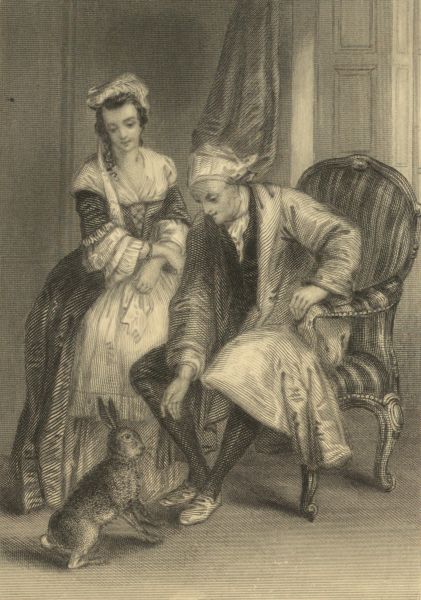
You know that I kept two hares. I have
written nothing since I saw you but an epitaph
on one of them, which died last week. I
send you the first impression of it.
Here lies, &c.[177]
Believe me, my dear friend, affectionately
yours,
W. C.
Olney, March 7, 1783.
My dear Friend,—Were my letters composed
of materials worthy of your acceptance, they
should be longer. There is a subject upon
which they who know themselves interested in
it are never weary of writing. That subject is
not within my reach; and there are few others
that do not soon fatigue me. Upon these,
however, I might possibly be more diffuse,
could I forget that I am writing to you, to
whom I think it just as improper and absurd
to send a sheet full of trifles, as it would be to
allow myself that liberty, were I writing to one
of the four evangelists. But, since you measure
me with so much exactness, give me leave
to requite you in your own way. Your manuscript
indeed is close, and I do not reckon
mine very lax. You make no margin, it is
true; if you did, you would have need of their
Lilliputian art, who can enclose the creed
within the circle of a shilling; for, upon the
nicest comparison, I find your paper an inch
smaller every way than mine. Were my writing
therefore as compact as yours, my letters
with a margin would be as long as yours without
one. Let this consideration, added to that
of their futility, prevail with you to think
them, if not long, yet long enough.
Yesterday a body of Highlanders passed
through Olney. They are part of that regiment
which lately mutinied at Portsmouth.
Convinced to a man that General —— had
sold them to the East India Company, they
breathe nothing but vengeance, and swear
they will pull down his house in Scotland, as
soon as they arrive there. The rest of them
are quartered at Dunstable, Woburn, and
Newport; in all eleven hundred. A party of
them, it is said, are to continue some days at
Olney. None of their principal officers are
with them; either conscious of guilt, or at
least knowing themselves to be suspected as
privy to and partners in the iniquitous bargain,
they fear the resentment of the corps.
The design of government seems to be to
break them into small divisions, that they may
find themselves, when they reach Scotland, too
weak to do much mischief. Forty of them attended
Mr. Bull, who found himself singularly
happy in an opportunity to address himself to
a flock bred upon the Caledonian mountains.
He told them he would walk to John O'Groat's
house to hear a soldier pray. They are in
general so far religious that they will hear
none but evangelical preaching; and many of
them are said to be truly so. Nevertheless,
General ——'s skull was in some danger among
them; for he was twice felled to the ground
with the butt end of a musket. The sergeant-major
rescued him, or he would have been for
ever rendered incapable of selling Highlanders
to the India Company. I am obliged to you
for your extract from Mr. Bowman's letter. I
feel myself sensibly pleased by the approbation
of men of taste and learning; but that my
vanity may not get too much to windward, my
spirits are kept under by a total inability to
renew my enterprises in the poetical way.
We are tolerably well, and love you both.
Yours, my dear friend,
W. C.
Olney, April 5, 1783.
My dear Friend,—When one has a letter to
write, there is nothing more useful than to
make a beginning. In the first place, because,
unless it be begun, there is no good reason to
hope it will ever be ended; and secondly, because
the beginning is half the business, it
being much more difficult to put the pen in
motion at first, than to continue the progress
of it when once moved.
Mrs. C——'s illness, likely to prove mortal,
and seizing her at such a time, has excited
much compassion in my breast, and in Mrs.
Unwin's, both for her and her daughter. To
have parted with a child she loves so much,
intending soon to follow her; to find herself
arrested before she could set out, and at so
great a distance from her most valued relations;
her daughter's life too threatened by a
disorder not often curable, are circumstances
truly affecting. She has indeed much natural
fortitude, and, to make her condition still more
tolerable, a good Christian hope for her support.
But so it is, that the distresses of those
who least need our pity excite it most; the
amiableness of the character engages our sympathy,
and we mourn for persons for whom
perhaps we might more reasonably rejoice.
There is still however a possibility that she
may recover; an event we must wish for,
though for her to depart would be far better.
Thus we would always withhold from the skies
those who alone can reach them, at least till
we are ready to bear them company.
Present our love, if you please, to Miss
C——.[178] I saw in the "Gentleman's Magazine"
for last month, an account of a physician
who has discovered a new method of treating
consumptive cases, which has succeeded wonderfully
in the trial. He finds the seat of the
distemper in the stomach, and cures it principally
by emetics. The old method of encountering
the disorder has proved so unequal to
the task, that I should be much inclined to
any new practice that comes well recommended.
He is spoken of as a sensible and judicious
man, but his name I have forgot.
Our love to all under your roof, and in particular
to Miss Catlett, if she is with you.
Yours, my dear friend,
W. C.
Olney, April 21, 1783.
My dear Friend,—My device was intended
to represent, not my own heart, but the heart
of a Christian, mourning and yet rejoicing,
pierced with thorns, yet wreathed about with
roses. I have the thorn without the rose.
My briar is a wintry one; the flowers are
withered, but the thorn remains. My days
are spent in vanity, and it is impossible for me
to spend them otherwise. No man upon earth
is more sensible of the unprofitableness of a
life like mine than I am, or groans more
heavily under the burden. The time when I
seem to be most rationally employed is when
I am reading. My studies however are very
much confined, and of little use, because I
have no books but what I borrow, and nobody
will lend me a memory. My own is almost
worn out. I read the Biographia and the Review.
If all the readers of the former had
memories like mine, the compilers of that
work would in vain have laboured to rescue
the great names of past ages from oblivion, for
what I read to-day I forget to-morrow. A bystander
might say, This is rather an advantage,
the book is always new;—but I beg the bystander's
pardon; I can recollect, though I
cannot remember, and with the book in my
hand I recognise those passages which, without
the book, I should never have thought of
more. The Review pleases me most, because,
if the contents escape me, I regret them less,
being a very supercilious reader of most modern
writers. Either I dislike the subject, or
the manner of treating it; the style is affected,
or the matter is disgusting.
I see —— (though he was a learned man, and
sometimes wrote like a wise one,) labouring
under invincible prejudices against the truth
and its professors; heterodox in his opinions
upon some religious subjects, and reasoning
most weakly in support of them. How has he
toiled to prove that the perdition of the wicked
is not eternal, that there may be repentance in
hell, and that the devils may be saved at last:
thus establishing, as far as in him lies, the
belief of a purgatory. When I think of him, I
think too of some who shall say hereafter,
"Have we not prophesied in thy name, and in
thy name done many wondrous works? Then
shall he say unto them, Depart from me, for I
never knew you." But perhaps he might be
enlightened in his last moments, and saved in
the very article of dissolution. It is much to
be wished, and indeed hoped, that he was.
Such a man reprobated in the great day would
be the most melancholy spectacle of all that
shall stand at the left hand hereafter. But
I do not think that many, or indeed any, will
be found there, who in their lives were sober,
virtuous, and sincere, truly pious in the use of
their little light, and, though ignorant of God,
in comparison with some others, yet sufficiently
informed to know that He is to be feared,
loved, and trusted. An operation is often performed
within the curtains of a dying bed,
in behalf of such men, that the nurse and the
doctor (I mean the doctor and the nurse) have
no suspicion of. The soul makes but one step
out of darkness into light, and makes that step
without a witness. My brother's case has made
me very charitable in my opinion about the
future state of such men.
Yours, my dear friend,
W. C.
Olney, May 5, 1783.
You may suppose that I did not hear Mr. —— preach,
but I heard of him. How different is
that plainness of speech which a spiritual theme
requires, from that vulgar dialect which this
gentleman has mistaken for it! Affectation of
every sort is odious, especially in a minister,
and more especially an affectation that betrays
him into expressions fit only for the mouths of
the illiterate. Truth indeed needs no ornament,
neither does a beautiful person; but to
clothe it therefore in rags, when a decent habit
was at hand, would be esteemed preposterous
and absurd. The best-proportioned figure may
be made offensive by beggary and filth, and
even truths, which came down from heaven,
though they cannot forego their nature, may
be disguised and disgraced by unsuitable language.
It is strange that a pupil of yours
should blunder thus. You may be consoled
however by reflecting, that he could not have
erred so grossly if he had not totally and wilfully
departed both from your instruction and
example. Were I to describe your style in two
words, I should call it plain and neat, simplicem
munditiis, and I do not know how I could give
it juster praise, or pay it a greater compliment.
He that speaks to be understood by a congregation
of rustics, and yet in terms that would
not offend academical ears, has found the happy
medium. This is certainly practicable to men
of taste and judgment, and the practice of
a few proves it. Hactenus de concionando.
We are truly glad to hear that Miss Catlett
is better, and heartily wish you more promising
accounts from Scotland. Debemur morti nos
nostraque. We all acknowledge the debt, but
are seldom pleased when those we love are
required to pay it. The demand will find you
prepared for it.
Yours, my dear friend,
W. C.
Olney, May 12, 1783.
My dear Friend,—A letter written from such
a place as this is a creation; and creation is a
work for which mere mortal man is very indifferently
qualified. Ex nihilo nihil fit, is a
maxim that applies itself in every case, where
Deity is not concerned. With this view of the
matter, I should charge myself with extreme
folly for pretending to work without materials,
did I not know that although nothing could be
the result, even that nothing will be welcome.
If I can tell you no news, I can tell you at least
that I esteem you highly; that my friendship
with you and yours is the only balm of my
life; a comfort sufficient to reconcile me to an
existence destitute of every other. This is not
the language of to-day, only the effect of a
transient cloud suddenly brought over me, and
suddenly to be removed, but punctually expressive
of my habitual frame of mind, such as
it has been these ten years.
In the "Review" of last month, I met with
an account of a sermon preached by Mr. Paley,
at the consecration of his friend, Bishop L.[180]
The critic admires and extols the preacher,
and devoutly prays the Lord of the harvest to
send forth more such labourers into his vineyard.
I rather differ from him in opinion, not
being able to conjecture in what respect the
vineyard will be benefited by such a measure.
He is certainly ingenious, and has stretched
his ingenuity to the uttermost, in order to exhibit
the church established, consisting of
bishops, priests, and deacons, in the most
favourable point of view. I lay it down for a
rule that when much ingenuity is necessary to
gain an argument credit, that argument is unsound
at bottom. So is his, and so are all the
petty devices by which he seeks to enforce it.
He says first, "that the appointment of various
orders in the church is attended with this good
consequence, that each class of people is supplied
with a clergy of their own level and description,
with whom they may live and associate
on terms of equality." But, in order to
effect this good purpose, there ought to be at
least three parsons in every parish, one for the
gentry, one for traders and mechanics, and one
for the lowest of the vulgar. Neither is it
easy to find many parishes, where the laity at
large have any society with their minister at
all. This therefore is fanciful, and a mere invention:
in the next place he says it gives
a dignity to the ministry itself, and the clergy
share in the respect paid to their superiors.
Much good may such participation do them!
They themselves know how little it amounts
to. The dignity a parson derives from the
lawn sleeves and square cap of his diocesan
will never endanger his humility.
Pope says truly—
Worth makes the man, and want of it the fellow,
The rest is all but leather or prunella.
Again—"Rich and splendid situations in the
church have been justly regarded as prizes,
held out to invite persons of good hopes and
ingenuous attainments." Agreed. But the prize
held out in the Scripture is of a very different
kind; and our ecclesiastical baits are too often
snapped by the worthless, and persons of no
attainments at all. They are indeed incentives
to avarice and ambition, but not to those acquirements,
by which only the ministerial
function can be adorned—zeal for the salvation
of men, humility, and self-denial. Mr. Paley
and I therefore cannot agree.
Yours, my dear friend,
W. C.
We think Cowper has treated Paley, as well
as his subject, with no small portion of severity.
What Paley's arguments may have
been, in establishing his first position, we know
not, but we should have expected that the
poet would have admitted the principle, however
he might have disapproved of the comment.
There was a time when the proper
constitution of a Christian church furnished a
subject of inquiry that engaged the councils of
princes, convulsed this empire to its basis, and
left the traces of an awful desolation behind.
We allude to the times of Charles the First,
and to the momentous events that characterized
that period. In the present age, the
matters in dispute are greatly changed. The
important question now agitated is the lawfulness
of the union of church and state, so far as
that lawfulness is decided by an appeal to the
authority of Scripture. Upon this subject it is
not our intention to enter. For able and
masterly argument, in defence of establishments,
we beg to refer to the work of Dr.
Chalmers,[181] and to the two last Visitation
Charges of Chancellor Dealtry. We trust, however,
that we may be allowed to express our
deep conviction that the timely removal of
abuses is not only essential to the efficiency
and preservation of the church of England, but
also imperatively due to our own honour and
credit, to the glory of God, and to the advancement
of true religion.
In the meantime we would appeal to every
intelligent observer, whether there has ever
been a period, in the annals of our church,
more characterized by an acknowledged increase
of true piety than in the era in which
we are now writing?—whether there is not a
perceptible revival of sound doctrine in our
pulpits, and of devotedness and zeal in the
lives of the clergy? Appealing then to these
facts, which he that runneth may read, may
we not, though in the spirit of profound humiliation,
exclaim with the wife of Manoah,
"If the Lord were pleased to kill us, he would
not have received a burnt-offering and a meat-offering
at our hands; neither would he have
showed us all these things; nor would, as
at this time, have told us such things as
these."[182]
Let, then, the sacred edifice be suffered to
remain, built as it is on the foundation of the
apostles and prophets, Jesus Christ himself
being the chief corner-stone; but let what
time hath impaired, or infirmity hath disfigured,
be restored and amended. And let
this be the language of her friends, as well as
of every honourable and conscientious opponent,
which was once expressed by the celebrated
Beza: "If now the reformed churches
of England, administered by the authority of
bishops and archbishops, do hold on, as this
hath happened to that church in our memory,
that she hath had men of that calling, not
only most notable martyrs of God, but also excellent
pastors and doctors; let her, in God's
name, enjoy this singular bounty of God, which
I wish she may hold for ever."[183]
Olney, May 26, 1783.
I feel for my uncle,[184] and do not wonder
that his loss afflicts him. A connexion that
has subsisted so many years, could not be rent
asunder without great pain to the survivor. I
hope, however, and doubt not, but when he
has had a little more time for recollection, he
will find that consolation in his own family,
which it is not the lot of every father to be
blessed with. It seldom happens that married
persons live together so long or so happily;
but this, which one feels one's self ready to
suggest as matter of alleviation, is the very
circumstance that aggravates his distress;
therefore he misses her the more, and feels
that he can but ill spare her. It is, however,
a necessary tax, which all who live long must
pay for their longevity, to lose many whom
they would be glad to detain (perhaps those in
whom all their happiness is centred), and to
see them step into the grave before them. In
one respect, at least, this is a merciful appointment.
When life has lost that to which
it owed its principal relish, we may ourselves
the more cheerfully resign it. I beg you would
present him with my most affectionate remembrance,
and tell him, if you think fit, how
much I wish that the evening of his long day
may be serene and happy.
W. C.
Olney, May 31, 1783.
We rather rejoice than mourn with you on
the occasion of Mrs. C——'s death. In the
case of believers, death has lost his sting, not
only with respect to those he takes away, but
with respect to survivors also. Nature indeed
will always suggest some causes of sorrow,
when an amiable and Christian friend departs,
but the scripture so many more and so much
more important reasons to rejoice, that, on
such occasions, perhaps more remarkably than
on any other, sorrow is turned into joy. The
law of our land is affronted if we say the king
dies, and insists on it that he only demises.
This, which is a fiction where a monarch only
is in question, in the case of a Christian is
reality and truth. He only lays aside a body
which it is his privilege to be encumbered
with no longer; and, instead of dying, in that
moment he begins to live. But this the world
does not understand, therefore the kings of it
must go on demising to the end of the chapter.
W. C.
Olney, June 3, 1783.
My dear Friend,—My green-house, fronted
with myrtles, and where I hear nothing but
the pattering of a fine shower and the sound
of distant thunder, wants only the fumes of
your pipe to make it perfectly delightful. Tobacco
was not known in the golden age. So
much the worse for the golden age. This age
of iron or lead would be insupportable without
it; and, therefore, we may reasonably suppose,
that the happiness of those better days would
have been much improved by the use of it.
We hope that you and your son are perfectly
recovered. The season has been most unfavourable
to animal life; and I, who am
merely animal, have suffered much by it.
Though I should be glad to write, I write
little or nothing. The time for such fruit is
not yet come; but I expect it, and I wish for
it. I want amusement; and, deprived of that,
have nothing to supply the place of it. I
send you, however, according to my promise
to send you every thing, two stanzas, composed
at the request of Lady Austen. She
wanted words to a tune she much admired,
and I wrote her the following,—
No longer I follow a sound, &c.[186]
Yours,
W. C.
Olney, June 8, 1783.
My dear William,—Our severest winter,
commonly called the spring, is now over, and
I find myself seated in my favourite recess,
the green-house. In such a situation, so silent,
so shady, where no human foot is heard, and
where only my myrtles presume to peep in at
the window, you may suppose I have no interruption
to complain of, and that my thoughts
are perfectly at my command. But the beauties
of the spot are themselves an interruption,
my attention being called upon by those very
myrtles, by a double row of grass pinks, just
beginning to blossom, and by a bed of beans
already in bloom; and you are to consider
it, if you please, as no small proof of my regard,
that, though you have so many powerful
rivals, I disengage myself from them all, and
devote this hour entirely to you.
You are not acquainted with the Rev. Mr.
Bull of Newport—perhaps it is as well for you
that you are not. You would regret still more
than you do, that there are so many miles interposed
between us. He spends part of the
day with us to-morrow. A dissenter, but a
liberal one; a man of letters, and of genius;
master of a fine imagination, or rather not
master of it—an imagination which, when he
finds himself in the company he loves, and can
confide in, runs away with him into such fields
of speculation, as amuse and enliven every
other imagination that has the happiness to be
of the party! at other times he has a tender
and delicate sort of melancholy in his disposition,
not less agreeable in its way. No men
are better qualified for companions in such a
world as this than men of such a temperament.
Every scene of life has two sides, a dark and a
bright one, and the mind that has an equal
mixture of melancholy and vivacity is best of
all qualified for the contemplation of either.
He can be lively without levity, and pensive
without dejection. Such a man is Mr. Bull.
But—he smokes tobacco—nothing is perfect——
Nihil est ab omni
Parte beatum.
On the other side I send you a something, a
song if you please, composed last Thursday:
the incident happened the day before.[187]
Yours,
W. C.
Olney, June 13, 1783.
My dear Friend,—I thank you for your Dutch
communications. The suffrage of such respectable
men must have given you much pleasure,
a pleasure only to be exceeded by the consciousness
you had before of having published truth,
and of having served a good master by doing
so.
I have always regretted that your ecclesiastical
history went no further; I never saw a
work that I thought more likely to serve the
cause of truth, nor history applied to so good a
purpose.[188] The facts incontestable, the grand
observation upon them all irrefragable, and the
style, in my judgment, incomparably better
than that of Robertson or Gibbon. I would
give you my reasons for thinking so, if I had
not a very urgent one for declining it. You
have no ear for such music, whoever may be
the performer. What you added, but never
printed, is quite equal to what has appeared,
which I think might have encouraged you to
proceed, though you missed that freedom in
writing which you found before. While you
were at Olney, this was at least possible; in a
state of retirement you had leisure, without
which I suppose Paul himself could not have
written his epistles. But those days are fled,
and every hope of a continuation is fled with
them.
The day of judgment is spoken of not only
as a surprise, but a snare, a snare upon all the
inhabitants of the earth. A difference indeed
will obtain in favour of the godly, which is,
that though a snare, a sudden, in some sense
an unexpected, and in every sense an awful,
event, yet it will find them prepared to meet it.
But, the day being thus characterized, a wide
field is consequently open to conjecture: some
will look for it at one period, and some at another;
we shall most of us prove at last to have
been mistaken, and if any should prove to have
guessed aright, they will reap no advantage,
the felicity of their conjecture being incapable
of proof, till the day itself shall prove it. My
own sentiments upon the subject appear to me
perfectly scriptural, though I have no doubt
that they differ totally from those of all who
have ever thought about it, being however so
singular, and of no importance to the happiness
of mankind, and being moreover difficult to
swallow just in proportion as they are peculiar,
I keep them to myself.
I am and always have been a great observer
of natural appearances, but I think not a superstitious
one. The fallibility of those speculations
which lead men of fanciful minds to interpret
scripture by the contingencies of the
day, is evident from this consideration, that
what the God of the scriptures has seen fit to
conceal he will not as the God of nature publish.
He is one and the same in both capacities,
and consistent with himself and his purpose,
if he designs a secret impenetrable in whatever
way we attempt to open it. It is impossible
however for an observer of natural phenomena
not to be struck with the singularity of the
present season. The fogs I mentioned in my
last still continue, though till yesterday the
earth was as dry as intense heat could make it.
The sun continues to rise and set without his
rays, and hardly shines at noon, even in a
cloudless sky. At eleven last night the moon
was a dull red; she was nearly at her highest
elevation, and had the colour of heated brick.
She would naturally, I know, have such an appearance
looking through a misty atmosphere,
but that such an atmosphere should obtain for
so long a time, in a country where it has not
happened in my remembrance, even in the
winter, is rather remarkable. We have had
more thunder-storms than have consisted well
with the peace of the fearful maidens in Olney,
though not so many as have happened in places
at no great distance, nor so violent. Yesterday
morning however, at seven o'clock, two fireballs
burst either on the steeple or close to it.
William Andrews saw them meet at that point,
and immediately after saw such a smoke issue
from the apertures in the steeple, as soon rendered
it invisible: the noise of the explosion
surpassed all the noises I ever heard; you would
have thought that a thousand sledge-hammers
were battering great stones to powder, all in
the same instant. The weather is still as hot,
and the air is full of vapour, as if there had
been neither rain nor thunder all the summer.
There was once a periodical paper published,
called Mist's Journal: a name well adapted to
the sheet before you. Misty however as I am,
I do not mean to be mystical, but to be understood,
like an almanack-maker, according to
the letter. As a poet nevertheless, I claim, if
any wonderful event should follow, a right to
apply all and every such post-prognostic to the
purposes of the tragic muse.
Yours,
W. C.
It is worthy of being recorded that these
singular appearances presented by the atmosphere
and heavens, with accompanying
thunder-storms, were prevalent in many parts
of England. At Dover, the fog was of such
long continuance, that the opposite shore could
not be discerned for three weeks. In other
places the storms of thunder and lightning were
awful, and destructive both to life and property.
But this phenomenon was not confined to England
only; it extended to France, Italy, Germany,
Hungary, Spain, and even to some parts of
Africa. In Paris, the appearances were so portentous,
and the alarm so considerable, that the
great astronomer Lalande addressed a letter to
one of the journals, in order to compose the
public mind. We subjoin it in a note for the
gratification of the reader, and as illustrating
his views on the subject.[189] In the preceding
February occurred the calamitous earthquakes
in Calabria and Sicily;[190] by which solemn
catastrophe the city of Messina was overthrown,
and the greater portion of its population, consisting
of thirty thousand souls, wholly destroyed.
This awful event was preceded by an horizon
full of black intense fog, the earthquake next
followed, with two successive shocks, and subsequently
a whirlpool of fire issued from the
earth, which completed the entire destruction
of the noble and great edifices that still remained.
We refer the reader for the terrible
details of this afflicting calamity to the narrative
of Sir William Hamilton, which cannot be read
without alarm and terror. Nor can we omit
the following just and impressive moral from
the pen of Cowper.
What then! were they the wicked above all,
And we the righteous, whose fast anchor'd isle
Mov'd not, while theirs was rock'd, like a light skiff,
The sport of every wave? No: none are clear,
And none than we more guilty. But, where all
Stand chargeable with guilt, and to the shafts
Of wrath obnoxious, God may choose his mark;
May punish, if he please, the less, to warn
The more malignant. If he spar'd not them,
Tremble and be amaz'd at thine escape,
Far guiltier England, lest he spare not thee.
Task, book ii.
Olney, June 17, 1783.
My dear Friend,—Your letter reached Mr.
S—— while Mr. —— was with him; whether
it wrought any change in his opinion of that
gentleman, as a preacher, I know not; but for
my own part I give you full credit for the
soundness and rectitude of yours. No man
was ever scolded out of his sins. The heart,
corrupt as it is, and because it is so, grows
angry if it be not treated with some management
and good manners, and scolds again.
A surly mastiff will bear perhaps to be
stroked, though he will growl even under
that operation, but, if you touch him roughly,
he will bite. There is no grace that the
spirit of self can counterfeit with more success
than a religious zeal. A man thinks
he is fighting for Christ, and he is fighting
for his own notions. He thinks that he is
skilfully searching the hearts of others, when
he is only gratifying the malignity of his
own, and charitably supposes his hearers destitute
of all grace, that he may shine the
more in his own eyes by comparison. When
he has performed this notable task, he wonders
that they are not converted, "he has
given it them soundly," and if they do not
tremble and confess that God is in him of a
truth, he gives them up as reprobate, incorrigible,
and lost for ever. But a man that
loves me, if he sees me in an error, will pity me,
and endeavour calmly to convince me of it,
and persuade me to forsake it. If he has
great and good news to tell me, he will not
do it angrily, and in much heat and discomposure
of spirit. It is not therefore easy to
conceive on what ground a minister can justify
a conduct, which only proves that he
does not understand his errand. The absurdity
of it would certainly strike him, if he
were not himself deluded.
A people will always love a minister, if a
minister seems to love his people. The old
maxim, Simile agit in simile, is in no case
more exactly verified; therefore you were
beloved at Olney, and, if you preached to
the Chicksaws and Chactaws, would be equally
beloved by them.
W. C.
Tenderness in a minister is a very important
qualification, and indispensable to his
success. The duty of it is enjoined in an
apostolical precept, and the wisdom of it inculcated
in another passage of scripture.
"Speaking the truth in love." "He that
winneth souls is wise." We have often
thought that one reason why a larger portion
of divine blessing fails to accompany the
ministrations of the sanctuary, is the want of
more affectionate expostulation, more earnest
entreaty, and more tenderness and sympathy
in the preacher. The heart that is unmoved
by our reproof may perhaps yield to the persuasiveness
of our appeal. We fully admit
that it is divine grace alone that can subdue
the power of sin in the soul; but, in the whole
economy of grace, as well as of Providence,
there is always perceptible a wise adaptation
of means to the end. Who is not impressed
by the tenderness and earnest solicitations of
St. Paul? Who can contemplate the Saviour
weeping over Jerusalem, without emotions of
the profoundest admiration? And who does
not know that the spectacle of man's misery
and guilt first suggested the great plan of redemption,
and that the scheme of mercy which
divine love devised in heaven dying love accomplished
on earth?
Olney, June 19, 1783.
My dear Friend,—The translation of your
letters[191] into Dutch was news that pleased me
much. I intended plain prose, but a rhyme
obtruded itself, and I became poetical when I
least expected it. When you wrote those
letters, you did not dream that you were designed
for an apostle to the Dutch. Yet, so it
proves, and such among many others are the
advantages we derive from the art of printing—an
art in which indisputably man was instructed
by the same great Teacher, who taught
him to embroider for the service of the sanctuary,
and which amounts almost to as great a
blessing as the gift of tongues.
The summer is passing away, and hitherto
has hardly been either seen or felt. Perpetual
clouds intercept the influence of the sun, and
for the most part there is an autumnal coldness
in the weather, though we are almost upon
the eve of the longest day.
We are well, and always mindful of you: be
mindful of us, and assured that we love you.
Yours, my dear friend,
W. C.
Olney, July 27, 1783.
My dear Friend,—You cannot have more
pleasure in receiving a letter from me than I
should find in writing it, were it not almost
impossible in such a place to find a subject.
I live in a world abounding with incidents,
upon which many grave and perhaps some
profitable observations might be made; but,
those incidents never reaching my unfortunate
ears, both the entertaining narrative, and the
reflection it might suggest, are to me annihilated
and lost. I look back to the past week
and say, what did it produce? I ask the same
question of the week preceding, and duly receive
the same answer from both—nothing!
A situation like this, in which I am as unknown
to the world as I am ignorant of all that passes
in it, in which I have nothing to do but to
think, would exactly suit me, were my subject
of meditation as agreeable as my leisure is
uninterrupted: my passion for retirement is
not at all abated, after so many years spent in
the most sequestered state, but rather increased.
A circumstance I should esteem wonderful to
a degree not to be accounted for, considering
the condition of my mind, did I not know that
we think as we are made to think, and of
course approve and prefer, as Providence, who
appoints the bounds of our habitation, chooses
for us. Thus I am both free and a prisoner at
the same time. The world is before me; I am
not shut up in the Bastile; there are no moats
about my castle, no locks upon my gates, of
which I have not the key—but an invisible,
uncontrollable agency, a local attachment, an
inclination more forcible than I ever felt, even
to the place of my birth, serves me for prison-walls,
and for bounds which I cannot pass. In
former years I have known sorrow, and before
I had ever tasted of spiritual trouble. The
effect was an abhorrence of the scene in which
I had suffered so much, and a weariness of those
objects which I had so long looked at with an
eye of despondency and dejection. But it is
otherwise with me now. The same cause subsisting,
and in a much more powerful degree,
fails to produce its natural effect. The very
stones in the garden-walls are my intimate acquaintance.
I should miss almost the minutest
object, and be disagreeably affected by its removal,
and am persuaded that, were it possible
I could leave this incommodious nook for a
twelvemonth, I should return to it again with
rapture, and be transported with the sight of
objects, which to all the world beside would be
at least indifferent; some of them, perhaps,
such as the ragged thatch and the tottering
walls of the neighbouring cottages, disgusting.
But so it is, and it is so, because here is to be
my abode, and because such is the appointment
of Him that placed me in it.
Iste terrarum mihi præter omnes
Angulus ridet.
It is the place of all the world I love the most,
not for any happiness it affords me, but because
here I can be miserable with most convenience
to myself, and with the least disturbance
to others.
You wonder, and (I dare say) unfeignedly,
because you do not think yourself entitled to
such praise, that I prefer your style, as an historian,
to that of the two most renowned writers
of history the present day has seen. That you
may not suspect me of having said more than
my real opinion will warrant, I will tell you
why. In your style I see no affectation, in
every line of theirs I see nothing else. They
disgust me always; Robertson with his pomp
and his strut, and Gibbon with his finical and
French manners. You are as correct as they.
You express yourself with as much precision.
Your words are ranged with as much propriety,
but you do not set your periods to a
tune. They discover a perpetual desire to exhibit
themselves to advantage, whereas your
subject engrosses you. They sing, and you
say; which, as history is a thing to be said
and not sung, is in my judgment very much to
your advantage. A writer that despises their
tricks, and is yet neither inelegant nor inharmonious,
proves himself, by that single
circumstance, a man of superior judgment and
ability to them both. You have my reasons.
I honour a manly character, in which good
sense and a desire of doing good are the predominant
features—but affectation is an emetic.
W. C.
It is impossible to read the former part of
the preceding letter without emotion. Who
has not felt the force of local associations, and
their power of presenting affecting recollections
to the mind?
"I could not bear," says Pope, in one of
his letters, "to have even an old post removed
out of the way with which my eyes had been
familiar from my youth."
Among the Swiss, the force of association is
so strong, that it is known by the appellation
of the "maladie du pays;" and it is recorded
that on hearing one of their national airs in a
foreign land, so overpowering was the effect
that, though engaged in warfare at the time,
they threw down their arms and returned to
their own country. The emotions awakened
by some of the Swiss airs, such as the "Rantz
des Vaches," and the affecting pathos of "La
Suissesse au bord du lac," when heard on their
native lakes, are always remembered by the
traveller with delight. The feelings of a still
higher kind connected with local associations
are expressed with so much grace and eloquence
in Dr. Johnson's celebrated allusion to
this subject, that we close our remarks by inserting
the passage,—
"We were now treading that illustrious
island, which was once the luminary of the
Caledonian regions, whence savage clans and
roving barbarians derived the benefits of knowledge
and the blessings of religion. To abstract
the mind from all local emotion would
be impossible, if it were endeavoured, and
would be foolish if it were possible. Whatever
withdraws us from the power of our senses,
whatever makes the past, the distant, or the
future, predominate over the present, advances
us in the dignity of thinking beings. Far
from me and from my friends be such frigid
philosophy, as may conduct us indifferent and
unmoved over any ground which has been
dignified by wisdom, bravery, or virtue. That
man is little to be envied, whose patriotism
would not gain force upon the plain of Marathon,
or whose piety would not grow warmer
among the ruins of Iona."[192]
Olney, Aug. 4, 1783.
My dear William,—I feel myself sensibly
obliged by the interest you take in the success
of my productions. Your feelings upon
the subject are such as I should have myself,
had I an opportunity of calling Johnson
aside to make the inquiry you propose. But I
am pretty well prepared for the worst, and so
long as I have the opinion of a few capable
judges in my favour, and am thereby convinced
that I have neither disgraced myself
nor my subject, shall not feel myself disposed
to any extreme anxiety about the sale. To
aim, with success, at the spiritual good of
mankind, and to become popular by writing
on scriptural subjects, were an unreasonable
ambition, even for a poet to entertain in days
like these. Verse may have many charms, but
has none powerful enough to conquer the
aversion of a dissipated age to such instruction.
Ask the question therefore boldly, and be not
mortified, even though he should shake his
head, and drop his chin; for it is no more
than we have reason to expect. We will lay
the fault upon the vice of the times, and we
will acquit the poet.
I am glad you were pleased with my Latin
ode, and indeed with my English dirge as
much as I was myself. The tune laid me
under a disadvantage, obliging me to write in
Alexandrines; which I suppose, would suit no
ear but a French one; neither did I intend
anything more than that the subject and the
words should be sufficiently accommodated to
the music. The ballad is a species of poetry, I
believe, peculiar to this country, equally
adapted to the drollest and the most tragical
subjects. Simplicity and ease are its proper
characteristics. Our forefathers excelled in
it; but we moderns have lost the art. It is
observed, that we have few good English odes.
But, to make amends, we have many excellent
ballads, not inferior, perhaps, in true poetical
merit to some of the very best odes that the
Greek or Latin languages have to boast of.
It is a sort of composition I was ever fond of,
and, if graver matters had not called me
another way, should have addicted myself to
it more than to any other. I inherit a taste
for it from my father, who succeeded well in
it himself, and who lived at a time when the
best pieces in that way were produced. What
can be prettier than Gay's ballad, or rather
Swift's, Arbuthnot's, Pope's, and Gay's, in the
What do ye call it—"'Twas when the seas
were roaring." I have been well informed
that they all contributed, and that the most
celebrated association of clever fellows this
country ever saw, did not think it beneath
them to unite their strength and abilities in
the composition of a song. The success, however,
answered their wishes. The ballads that
Bourne has translated, beautiful in themselves,
are still more beautiful in his version of them,
infinitely surpassing in my judgment all that
Ovid or Tibullus have left behind them. They
are quite as elegant, and far more touching
and pathetic, than the tenderest strokes of
either.
So much for ballads and ballad-writers.—"A
worthy subject," you will say, "for a man
whose head might be filled with better things;"—and
it is filled with better things, but to so
ill a purpose, that I thrust into it all manner
of topics that may prove more amusing; as, for
instance, I have two goldfinches, which in the
summer occupy the greenhouse. A few days
since, being employed in cleaning out their
cages, I placed that which I had in hand upon
the table, while the other hung against the
wall: the windows and the doors stood wide
open. I went to fill the fountain at the pump,
and, on my return, was not a little surprised
to find a goldfinch sitting on the top of the
cage I had been cleaning, and singing to and
kissing the goldfinch within. I approached
him, and he discovered no fear; still nearer,
and he discovered none. I advanced my hand
towards him, and he took no notice of it. I
seized him, and supposed I had caught a new
bird, but, casting my eye upon the other cage,
perceived my mistake. Its inhabitant, during
my absence, had contrived to find an opening,
where the wire had been a little bent, and
made no other use of the escape it afforded
him than to salute his friend, and to converse
with him more intimately than he had done
before. I returned him to his proper mansion,
but in vain. In less than a minute, he had
thrust his little person through the aperture
again, and again perched upon his neighbour's
cage, kissing him, as at the first, and singing, as
if transported with the fortunate adventure. I
could not but respect such friendship, as for
the sake of its gratification, had twice declined
an opportunity to be free, and consenting to
their union, resolved that for the future one
cage should hold them both. I am glad of
such incidents. For at a pinch, and when I
need entertainment, the versification of them
serves to divert me.
I transcribe for you a piece of Madam Guion,
not as the best, but as being shorter than
many, and as good as most of them.
Yours ever,
W. C.
The following letter contains a judicious and
excellent critique on the writings of Madame
Guion, and on the school of mystics to which
she belonged. The defect attributed to that
school is too much familiarity of address, and
a warmth of devotional fervour in their approach
to the Deity, exceeding the bounds of
just propriety. There is, however, much to
quicken piety, and to elevate the affections of
the heart.
Olney, Sept. 7, 1783.
My dear Friend,—So long a silence needs an
apology. I have been hindered by a three-weeks'
visit from our Hoxton friends,[193] and by
a cold and feverish complaint which are but
just removed.
The French poetess is certainly chargeable
with the fault you mention, though I thought
it not so glaring in the piece I sent you. I
have endeavoured indeed, in all the translations
I have made, to cure her of that evil,
either by the suppression of passages exceptionable
upon that account, or by a more sober
and respectful manner of expression. Still,
however, she will be found to have conversed
familiarly with God, but I hope not fulsomely,
nor so as to give reasonable disgust to a religious
reader. That God should deal familiarly
with man, or, which is the same thing, that he
should permit man to deal familiarly with him,
seems not very difficult to conceive, or presumptuous
to suppose, when some things are
taken into consideration. Woe to the sinner,
that shall dare to take a liberty with him that
is not warranted by his word, or to which he
himself has not encouraged him. When he
assumed man's nature, he revealed himself as
the friend of man, as the brother of every soul
that loves him. He conversed freely with man
while he was on earth, and as freely with him
after his resurrection. I doubt not, therefore,
that it is possible to enjoy an access to him
even now, unincumbered with ceremonious
awe, easy, delightful, and without constraint.
This, however, can only be the lot of those who
make it the business of their lives to please
him, and to cultivate communion with him.
And then I presume there can be no danger of
offence, because such a habit of the soul is of
his own creation, and, near as we come, we
come no nearer to him than he is pleased
to draw us. If we address him as children, it
is because he tells us he is our father. If we
unbosom ourselves to him as to a friend, it
is because he calls us friends, and if we speak
to him in the language of love, it is because he
first used it, thereby teaching us that it is the
language he delights to hear from his people.
But I confess that, through the weakness, the
folly, and corruption of human nature, this
privilege, like all other Christian privileges, is
liable to abuse. There is a mixture of evil in
every thing we do; indulgence encourages us
to encroach; and, while we exercise the rights
of children, we become childish. Here I think
is the point in which my authoress failed, and
here it is that I have particularly guarded my
translation, not afraid of representing her as
dealing with God familiarly, but foolishly, irreverently,
and without due attention to his
majesty, of which she is somewhat guilty. A
wonderful fault for such a woman to fall into,
who spent her life in the contemplation of his
glory, who seems to have been alway impressed
with a sense of it, and sometimes quite absorbed
by the views she had of it.
W. C.
Olney, Sept. 8, 1783.
My dear Friend,—Mrs. Unwin would have
answered your kind note from Bedford, had
not a pain in her side prevented her. I, who
am her secretary upon such occasions, should
certainly have answered it for her, but was
hindered by illness, having been myself seized
with a fever immediately after your departure.
The account of your recovery gave us great
pleasure, and I am persuaded that you will feel
yourself repaid by the information that I give
you of mine. The reveries your head was filled
with, while your disorder was most prevalent,
though they were but reveries, and the offspring
of a heated imagination, afforded you yet a
comfortable evidence of the predominant bias
of your heart and mind to the best subjects. I
had none such—indeed I was in no degree delirious,
nor has any thing less than a fever
really dangerous ever made me so. In this
respect, if in no other, I may be said to have a
strong head, and, perhaps for the same reason
that wine would never make me drunk, an ordinary
degree of fever has no effect upon my
understanding. The epidemic begins to be
more mortal as the autumn comes on, and in
Bedfordshire it is reported, how truly I cannot
say, to be nearly as fatal as the plague. I
heard lately of a clerk in a public office, whose
chief employment it was for many years to administer
oaths, who being light-headed in a
fever, of which he died, spent the last week of
his life, in crying day and night—"So help you
God—kiss the book—give me a shilling." What
a wretch in comparison with you!
Mr. Scott has been ill almost ever since you
left us, and last Saturday, as on many foregoing
Saturdays, was obliged to clap on a blister by
way of preparation for his Sunday labours.
He cannot draw breath upon any other terms.
If holy orders were always conferred upon such
conditions, I question but even bishoprics themselves
would want an occupant. But he is easy
and cheerful.
I beg you will mention me kindly to Mr.
Bacon, and make him sensible that if I did not
write the paragraph he wished for, it was not
owing to any want of respect for the desire he
expressed, but to mere inability. If, in a state
of mind that almost disqualifies me for society,
I could possibly wish to form a new connexion,
I should wish to know him; but I never shall,
and, things being as they are, I do not regret
it. You are my old friend, therefore I do not
spare you; having known you in better days,
I make you pay for any pleasure I might then
afford you by a communication of my present
pains. But I have no claims of this sort upon
Mr. Bacon.
Be pleased to remember us both, with much
affection, to Mrs. Newton, and to her and your
Eliza: to Miss C——,[194] likewise, if she is with
you. Poor Eliza droops and languishes; but
in the land to which she is going she will hold
up her head and droop no more. A sickness
that leads the way to everlasting life is better
than the health of an antediluvian. Accept
our united love.
My dear friend, sincerely yours, W. C.
Olney, Sept. 15, 1783.
My dear Friend,—I have been lately more
dejected and more distressed than usual; more
harassed by dreams in the night, and more
deeply poisoned by them in the following day.
I know not what is portended by an alteration
for the worse after eleven years of misery; but
firmly believe that it is not designed as the
introduction of a change for the better. You
know not what I suffered while you were here,
nor was there any need you should. Your
friendship for me would have made you in
some degree a partaker of my woes; and your
share in them would have been increased by
your inability to help me. Perhaps, indeed,
they took a keener edge from the consideration
of your presence. The friend of my heart, the
person with whom I had formerly taken sweet
counsel, no longer useful to me as a minister,
no longer pleasant to me as a Christian, was a
spectacle that must necessarily add the bitterness
of mortification to the sadness of despair.
I now see a long winter before me, and am to
get through it as I can. I know the ground
before I tread upon it. It is hollow; it is agitated;
it suffers shocks in every direction; it is
like the soil of Calabria—all whirlpool and
undulation.
Yours,
W. C.
Olney, Sept. 23, 1783.
My dear Friend,—We are glad that, having
been attacked by a fever, which has often
proved fatal, and almost always leaves the
sufferer debilitated to the last degree, you find
yourself so soon restored to health, and your
strength recovered. Your health and strength
are useful to others, and, in that view, important
in his account who dispenses both, and by
your means a more precious gift than either.
For my own part, though I have not been laid
up, I have never been perfectly well since you
left us. A smart fever, which lasted indeed
but a few hours, succeeded by lassitude and
want of spirits that seemed still to indicate a
feverish habit, has made for some time and
still makes me very unfit for my favourite occupations,
writing and reading: so that even
a letter, and even a letter to you, is not without
its burden.
John —— has had the epidemic, and has it
still, but grows better. When he was first
seized with it, he gave notice that he should
die, but in this only instance of prophetic exertion
he seems to have been mistaken: he
has however been very near it. I should have
told you that poor John has been very ready
to depart, and much comforted through his
whole illness. He, you know, though a silent,
has been a very steady professor. He indeed
fights battles and gains victories, but makes no
noise. Europe is not astonished at his feats,
foreign academies do not seek him for a member,
he will never discover the art of flying, or
send a globe of taffeta up to heaven. But he
will go thither himself.
Since you went, we dined with Mr. ——. I
had sent him notice of our visit a week before,
which, like a contemplative studious man as
he is, he put in his pocket and forgot. When
we arrived, the parlour windows were shut,
and the house had the appearance of being uninhabited.
After waiting some time, however,
the maid opened the door, and the master presented
himself. It is hardly worth while to
observe so repeatedly, that his garden seems a
spot contrived only for the growth of melancholy,
but being always affected by it in the
same way, I cannot help it. He showed me a
nook, in which he had placed a bench, and
where he said he found it very refreshing to
smoke his pipe and meditate. Here he sits
with his back against one brick wall and his
nose against another, which must, you know,
be very refreshing, and greatly assist meditation.
He rejoices the more in this niche, because
it is an acquisition made at some expense,
and with no small labour; several loads of
earth were removed in order to make it, which
loads of earth, had I the management of them,
I should carry thither again, and fill up a place
more fit in appearance to be a repository for
the dead than the living. I would on no account
put any man out of conceit with his
innocent enjoyments, and therefore never tell
him my thoughts upon this subject; but he is
not seldom low-spirited, and I cannot but suspect
that his situation helps to make him so.
I shall be obliged to you for Hawkesworth's
Voyages when it can be sent conveniently.
The long evenings are beginning, and nothing
shortens them so effectually as reading aloud.
Yours, my dear friend,
W. C.
Olney, Sept. 29, 1783.
My dear William,—We are sorry that you
and your household partake so largely of the
ill effects of this unhealthy season. You are
happy however in having hitherto escaped the
epidemic fever, which has prevailed much in
this part of the kingdom, and carried many
off. Your mother and I are well. After more
than a fortnight's indisposition, which slight
appellation is quite inadequate to the description
of all I suffered, I am at length restored
by a grain or two of emetic tartar. It is a tax
I generally pay in autumn. By this time, I
hope, a purer ether than we have seen for
months, and these brighter suns than the
summer had to boast, have cheered your spirits,
and made your existence more comfortable.
We are rational: but we are animal
too; and therefore subject to the influences of
the weather. The cattle in the fields show
evident symptoms of lassitude and disgust in
an unpleasant season: and we, their lords and
masters, are constrained to sympathize with
them: the only difference between us is, that
they know not the cause of their dejection,
and we do, but, for our humiliation, are equally
at a loss to cure it. Upon this account I have
sometimes wished myself a philosopher. How
happy, in comparison with myself, does the
sagacious investigator of nature seem, whose
fancy is ever employed in the invention of
hypotheses, and his reason in the support of
them! While he is accounting for the origin
of the winds, he has no leisure to attend to
their influence upon himself; and, while he
considers what the sun is made of, forgets that
he has not shone for a month. One project
indeed supplants another. The vortices of
Descartes gave way to the gravitation of Newton,
and this again is threatened by the electrical
fluid of a modern.[196] One generation
blows bubbles, and the next breaks them.
But in the meantime your philosopher is a
happy man. He escapes a thousand inquietudes
to which the indolent are subject, and
finds his occupation, whether it be the pursuit
of a butterfly or a demonstration, the wholesomest
exercise in the world. As he proceeds,
he applauds himself. His discoveries, though
eventually perhaps they prove but dreams, are
to him realities. The world gaze at him as he
does at new phenomena in the heavens, and
perhaps understand him as little. But this
does not prevent their praises, nor at all disturb
him in the enjoyment of that self-complacence,
to which his imaginary success
entitles him. He wears his honours while he
lives, and, if another strips them off when he
has been dead a century, it is no great matter;
he can then make shift without them.
I have said a great deal upon this subject,
and know not what it all amounts to. I did
not intend a syllable of it when I began. But,
currente calamo, I stumbled upon it. My end
is to amuse myself and you. The former of
these two points is secured. I shall be happy
if I do not miss the latter.
By the way, what is your opinion of these
air balloons? I am quite charmed with the
discovery. Is it not possible (do you suppose?)
to convey such a quantity of inflammable air
into the stomach and abdomen, that the philosopher,
no longer gravitating to a centre,
shall ascend by his own comparative levity,
and never stop till he has reached the medium
exactly in equilibrio with himself? May he
not, by the help of a pasteboard rudder attached
to his posteriors, steer himself in that
purer element with ease, and again by a slow
and gradual discharge of his aerial contents,
recover his former tendency to the earth, and
descend without the smallest danger or inconvenience?
These things are worth inquiry,
and (I dare say) they will be inquired after as
they deserve: the pennæ non homini datæ are
likely to be less regretted than they were;
and perhaps a flight of academicians and a
covey of fine ladies may be no uncommon
spectacle in the next generation. A letter
which appeared in the public prints last week
convinces me that the learned are not without
hopes of some such improvement upon this
discovery. The author is a sensible and ingenious
man, and, under a reasonable apprehension
that the ignorant may feel themselves
inclined to laugh upon a subject that affects
himself with the utmost seriousness, with
much good manners and management bespeaks
their patience, suggesting many good consequences
that may result from a course of experiments
upon this machine, and amongst
others, that it may be of use in ascertaining
the shape of continents and islands, and the
face of wide-extended and far distant countries,
an end not to be hoped for, unless by
these means of extraordinary elevation, the
human prospect may be immensely enlarged,
and the philosopher, exalted to the skies, attain
a view of the whole hemisphere at once. But
whether he is to ascend by the mere inflation
of his person, as hinted above, or whether in a
sort of band-box, supported upon balloons, is
not yet apparent, nor (I suppose) even in his
own idea perfectly decided.
Yours, my dear William,
W. C.
Olney, Oct. 6, 1783.
My dear Friend,—It is indeed a melancholy
consideration, that the gospel, whose direct
tendency is to promote the happiness of mankind,
in the present as well as in the life to
come, and which so effectually answers the
design of its author, whenever it is well understood
and sincerely believed, should, through
the ignorance, the bigotry, the superstition of
its professors, and the ambition of popes, and
princes, the tools of popes, have produced incidentally
so much mischief; only furnishing
the world with a plausible excuse to worry
each other, while they sanctified the worst
cause with the specious pretext of zeal for the
furtherance of the best.
Angels descend from heaven to publish
peace between man and his Maker—the Prince
of Peace himself comes to confirm and establish
it, and war, hatred, and desolation, are
the consequence. Thousands quarrel about
the interpretation of a book which none of
them understand. He that is slain dies firmly
persuaded that the crown of martyrdom expects
him, and he that slew him is equally
convinced that he has done God service.[197] In
reality, they are both mistaken, and equally
unentitled to the honour they arrogate to
themselves. If a multitude of blind men
should set out for a certain city, and dispute
about the right road till a battle ensued between
them, the probable effect would be,
that none of them would ever reach it; and
such a fray, preposterous and shocking in the
extreme, would exhibit a picture in some degree
resembling the original of which we have
been speaking. And why is not the world
thus occupied at present? even because they
have exchanged a zeal that was no better than
madness for an indifference equally pitiable
and absurd. The Holy Sepulchre has lost
its importance in the eyes of nations called
Christian, not because the light of true wisdom
has delivered them from a superstitious
attachment to the spot, but because he that
was buried in it is no longer regarded by them
as the Saviour of the world. The exercise of
reason, enlightened by philosophy, has cured
them indeed of the misery of an abused understanding;
but, together with the delusion, they
have lost the substance, and, for the sake of
the lies that were grafted upon it, have quarrelled
with the truth itself. Here then we
see the ne plus ultra of human wisdom, at least
in affairs of religion. It enlightens the mind
with respect to non-essentials, but, with respect
to that in which the essence of Christianity
consists, leaves it perfectly in the dark. It
can discover many errors that in different ages
have disgraced the faith, but it is only to make
way for the admission of one more fatal than
them all, which represents that faith itself as a
delusion. Why those evils have been permitted
shall be known hereafter. One thing in the
mean time is certain; that the folly and frenzy
of the professed disciples of the gospel have
been more dangerous to its interests than all
the avowed hostilities of its adversaries, and
perhaps for this cause these mischiefs might
be suffered to prevail for a season, that its divine
original and nature might be the more illustrated,
when it should appear that it was able
to stand its ground for ages against that most
formidable of all attacks, the indiscretion of its
friends. The outrages that have followed this
perversion of the truth have proved indeed a
stumbling-block to individuals; the wise of
this world, with all their wisdom, have not
been able to distinguish between the blessing
and abuse of it. Voltaire was offended, and
Gibbon has turned his back; but the flock of
Christ is still nourished and still increases,
notwithstanding the unbelief of a philosopher
is able to convert bread into a stone and a fish
into a serpent.
I am much obliged to you for the Voyages,
which I received[198] and began to read last night.
My imagination is so captivated upon these
occasions, that I seem to partake with the
navigators in all the dangers they encountered.[199]
I lose my anchor; my main-sail is
rent into shreds; I kill a shark, and by signs
converse with a Patagonian, and all this with
out moving from the fire-side. The principal
fruits of these circuits that have been made
round the globe seem likely to be the amusement
of those that stayed at home. Discoveries
have been made, but such discoveries as will
hardly satisfy the expense of such undertakings.
We brought away an Indian, and, having debauched
him, we sent him home again to communicate
the infection to his country—fine
sport to be sure, but such as will not defray
the cost. Nations that live upon bread-fruit,
and have no mines to make them worthy of
our acquaintance, will be but little visited for
the future. So much the better for them;
their poverty is indeed their mercy.
Yours, my dear friend,
W. C.
Olney, Oct. 10, 1783.
My dear Friend,—I have nothing to say on
political subjects, for two reasons; first, because
I know none that at present would
prove very amusing, especially to you, who
love your country; and, secondly, because
there are none that I have the vanity to think
myself qualified to discuss. I must beg leave,
however, to rejoice a little at the failure of the
Caisse d'Escomptes, because I think the French
have well deserved it; and to mourn equally
that the Royal George cannot be weighed: the
rather, because I wrote two poems, one Latin
and one English, to encourage the attempt.[201]
The former of these only having been published,
which the sailors would understand but
little of, may be the reason, perhaps, why they
have not succeeded. Believe me, my friend,
Affectionately yours,
W. C.
Olney, Oct. 13, 1783.
My dear Friend,—I am much obliged to you
for your American anecdotes, and feel the obligation
perhaps more sensibly, the labour of
transcribing being in particular that to which
I myself have the greatest aversion. The
loyalists are much to be pitied: driven from
all the comforts that depend upon, and are
intimately connected with, a residence in their
native land, and sent to cultivate a distant
one, without the means of doing it, abandoned
too through a deplorable necessity, by the
government to which they sacrificed all,[202] they
exhibit a spectacle of distress, which one cannot
view, even at this distance, without participating
in what they feel. Why could not
some of our useless wastes and forests have
been allotted to their support? To have built
them houses indeed, and furnished them with
implements of husbandry, would have put us
to no small expense; but I suppose the increase
of population and the improvement of the soil
would soon have been felt as a national advantage,
and have indemnified the state if not
enriched it. We are bountiful to foreigners,
and neglect those of our own household. I
remember that, compassionating the miseries
of the Portuguese, at the time of the Lisbon
earthquake,[203] we sent them a ship-load of tools
to clear away the rubbish with, and to assist
them in rebuilding the city. I remember too
it was reported at the time that the court of
Portugal accepted our wheelbarrows and spades
with a very ill grace, and treated our bounty
with contempt. An act like this in behalf of
our brethren, carried only a little farther, might
possibly have redeemed them from ruin, have
resulted in emolument to ourselves, have been
received with joy, and repaid with gratitude.
Such are my speculations upon the subject,
who, not being a politician by profession, and
very seldom giving my attention for a moment
to such a matter, may not be aware of
difficulties and objections, which they of
the cabinet can discern with half an eye.
Perhaps to have taken under our protection
a race of men proscribed by the Congress,
might be thought dangerous to the interests
we hope to have hereafter in their high and
mighty regards and affections. It is ever the
way of those who rule the earth, to leave out
of their reckoning Him who rules the universe.
They forget that the poor have a friend more
powerful to avenge than they can be to oppress,
and that treachery and perfidy must therefore
prove bad policy in the end. The Americans
themselves appear to me to be in a situation
little less pitiable than that of the deserted
loyalists. Their fears of arbitrary imposition
were certainly well founded. A struggle therefore
might be necessary, in order to prevent it,
and this end might surely have been answered
without a renunciation of dependence. But
the passions of a whole people, once put in
motion, are not soon quieted. Contests beget
aversion, a little success inspires more ambitious
hopes, and thus a slight quarrel terminates
at last in a breach never to be healed,
and perhaps in the ruin of both parties. It
does not seem likely that a country so distinguished
by the Creator with every thing that
can make it desirable should be given up to
desolation for ever; and they possibly have
reason on their side, who suppose that in time
it will have the pre-eminence over all others;
but the day of such prosperity seems far
distant—Omnipotence indeed can hasten it,
and it may dawn when it is least expected.
But we govern ourselves in all our reasonings
by present appearances. Persons at least no
better informed than myself are constrained to
do so.
I intended to have taken another subject
when I began, and I wish I had. No man
living is less qualified to settle nations than I
am; but, when I write to you, I talk, that is I
write as fast as my pen can run, and on this
occasion it ran away with me. I acknowledge
myself in your debt for your last favour, but
cannot pay you now, unless you will accept as
payment, what I know you value more than all
I can say beside, the most unfeigned assurances
of my affection for you and yours.
Yours, &c.
W. C.
Olney, Oct. 20, 1783.
My dear Friend,—I have made a point of
saying no fine things to Mr. Bacon,[205] upon an
occasion that would well have justified them;
deterred by a caveat he entered in his letter.
Nothing can be more handsome than the present,
nor more obliging than the manner in
which he has made it. I take it for granted
that the plate is, line for line, and stroke for
stroke, an exact representation of his performance,
as nearly, at least, as light and shade can
exhibit, upon a flat surface, the effect of a piece
of statuary. I may be allowed therefore to say
that I admire it. My situation affords me no
opportunity to cultivate the science of connoisseurship;
neither would there be much propriety
in my speaking the language of one to
you, who disclaim the character. But we both
know when we are pleased. It occurs to me,
however, that I ought to say what it is that
pleases me, for a general commendation, where
there are so many particular beauties, would
be insipid and unjust.
I think the figure of Lord Chatham singularly
graceful, and his countenance full of the
character that belongs to him. It speaks not
only great ability and consummate skill, but a
tender and heartfelt interest in the welfare of
the charge committed to him. In the figure
of the City, there is all that empressement,
(pardon a French term, it expresses my idea
better than any English one that occurs,) that
the importance of her errand calls for; and it
is noble in its air, though in a posture of supplication.
But the figure of Commerce is indeed
a perfect beauty. It is a literal truth,
that I felt the tears flush into my eyes while I
looked at her. The idea of so much elegance
and grace having found so powerful a protection,
was irresistible. There is a complacency
and serenity in the air and countenance of
Britannia, more suited to her dignity than that
exultation and triumph which a less judicious
hand might have dressed her in. She seems
happy to sit at the feet of her deliverer. I
have most of the monuments in the Abbey by
heart, but I recollect none that ever gave me
so much pleasure. The faces are all expressive,
and the figures are all graceful. If you think
the opinion of so unlearned a spectator worth
communicating, and that I have not said more
than Mr. Bacon's modesty can bear without
offence, you are welcome to make him privy to
my sentiments. I know not why he should be
hurt by just praise; his fine talent is a gift, and
all the merit of it is His property who gave it.
Believe me, my dear friend,
Sincerely and affectionately yours,
W. C.
I am out of your debt.
Olney, Oct. 20, 1783.
I should not have been thus long silent, had
I known with certainty where a letter of mine
might find you. Your summer excursions
however are now at an end, and, addressing a
line to you in the centre of the busy scene, in
which you spend your winter, I am pretty sure
of my mark.
I see the winter approaching without much
concern, though a passionate lover of fine
weather, and the pleasant scenes of summer;
but the long evenings have their comforts too,
and there is hardly to be found upon earth, I
suppose, so snug a creature as an Englishman
by his fire-side in the winter. I mean, however
an Englishman that lives in the country,
for in London it is not very easy to avoid intrusion.
I have two ladies to read to, sometimes
more, but never less—at present we are circumnavigating
the globe, and I find the old story
with which I amused myself some years since,
through the great felicity of a memory not very
retentive, almost new. I am however sadly
at a loss for Cook's Voyage—can you send it?
I shall be glad of Foster's too. These together
will make the winter pass merrily, and you
will much oblige me.
W. C.
The last letter contains a slight sketch of
those happy winter evenings, which the poet has
painted so exquisitely in verse.[206] The two
ladies, whom he mentions as his constant
auditors, were Mrs. Unwin and Lady Austen.
The public, already indebted to the friendly
and cheerful spirit of the latter, for the pleasant
ballad of John Gilpin, had soon to thank her
inspiring benevolence for a work of superior
dignity, the masterpiece of Cowper's rich and
fertile imagination.
This lady happened, as an admirer of Milton,
to be partial to blank verse, and often solicited
her poetical friend to try his powers in that
species of composition. After repeated solicitation,
he promised her, if she would furnish the
subject, to comply with her request. "Oh!"
she replied, "you can never be in want of a
subject:—you can write upon any: write upon
this sofa!" The poet obeyed her command,
and from the lively repartee of familiar conversation
arose a poem of many thousand verses,
unexampled perhaps both in its origin and excellence—a
poem of such infinite variety, that
it seems to include every subject and every
style without any violation of harmony and
order; which delineates nature, under her most
attractive forms, and breathes a spirit of the
purest and most exalted morality.
A great part of the "Task" appears to have
been composed in the winter—a circumstance
the more remarkable, as the wintry months
were generally unfavourable to the health of
the poet. In the commencement of the poem,
he marks both the season and the year, in the
tender address to his companion.
"Whose arm this twentieth winter I perceive
Fast lock'd in mine."
Any circumstances which tend to illustrate
the origin and progress of this poem deserve
to be recorded with minute attention. We
select a series of passages from Cowper's Letters
to Mr. Bull, as affording this interesting information.
August 3, 1783.—"Your sea-side situation,
your beautiful prospects, your fine rides, and
the sight of the palaces which you have seen,
we have not envied you; but we are glad that
you have enjoyed them. Why should we envy
any man? Is not our green-house a cabinet of
perfumes? It is at this moment fronted with
carnations and balsams, with mignonette and
roses, with jessamine and woodbine, and wants
nothing but your pipe to make it truly Arabian;—a
wilderness of sweets! The 'Sofa' is ended,
but not finished; a paradox, which your natural
acumen, sharpened by habits of logical attention,
will enable you to reconcile in a moment.
Do not imagine however that I lounge over it—on
the contrary I find it severe exercise to
mould and fashion it to my mind!"
February 22, 1784.—"I congratulate you on
the thaw: I suppose it is an universal blessing,
and probably felt all over Europe. I myself
am the better for it, who wanted nothing that
might make the frost supportable: what reason,
therefore, have they to rejoice, who, being in
want of all things, were exposed to its utmost
rigour? The ice in my ink however is not yet
dissolved. It was long before the frost seized
it, but it at last prevailed. The 'Sofa' has
consequently received little or no addition
since. It consists at present of four books and
part of a fifth: when the sixth is finished, the
work is accomplished; but, if I may judge by
my present inability, that period is at a considerable
distance."
The following extract, not only mentions the
completion of his great work, but gives a particular
account of his next production.
November 8, 1784.—"The Task," as you
know, is gone to the press; since it went I
have been employed in writing another poem,
which I am now transcribing, and which in a
short time I design shall follow. It is entitled
'Tirocinium, or a Review of Schools:' the
business and purpose of it are to censure the
want of discipline, and the scandalous inattention
to morals, that obtain in them, especially
in the largest; and to recommend private
tuition as a mode of education preferable on
all accounts; to call upon fathers to become
tutors to their own sons, where that is practicable;
to take home a domestic tutor, where
it is not; and, if neither can be done, to place
them under the care of such a man as he to
whom I am writing; some rural parson, whose
attention is limited to a few."
The reader will find the poet himself relating,
in more than one letter of the next year,
some particulars of the time in which his great
work, "The Task," was composed. Writing
to Mr. Newton, on the 20th of October, 1784,
Cowper says of his "Task," then in the press,
"I began it about this time twelvemonth."
These words of hasty and imperfect recollection
might give rise to a persuasion, that this
extensive and admirable production was completed
in a year. But, as it is proved by the
first extract from the poet's letters to Mr. Bull,
that the first book (entitled the "Sofa") was
ended on the 3rd of August, 1783, we may reasonably
conclude, that this interesting poem
was begun in June or July. It was not imparted,
as it advanced, to any of the poet's
confidential friends, except to the two ladies
with whom he lived at the time of its commencement,
and to his kind and sympathizing
neighbour, Mr. Bull, who had shown his benevolent
zeal in encouraging the spirit of Cowper
to cheer and amuse itself in poetical studies.
The final verses of "The Task" were probably
written in September, 1784, as Cowper sent a
transcript of the poem for the press to his
favourite young friend, Mr. Unwin, early in
October. His modest reserve appears very remarkable
in his not having communicated this
composition even to Mr. Unwin, till it was absolutely
finished, and his tender delicacy of
regard and attention to that young friend was
amiably displayed in assigning to him the honourable
office of revising and consigning to
the press a work so important.
Olney, Nov. 3, 1783.
My dear Friend,—My time is short, and my
opportunity not the most favourable. My letter
will consequently be short likewise, and
perhaps not very intelligible. I find it no very
easy matter to bring my mind into that degree
of composure, which is necessary to the
arrangement either of words or matter. You
will naturally expect to receive some account
of this confusion that I describe, some reason
given for it. On Saturday night, at eleven
o'clock, when I had not been in bed five
minutes, I was alarmed by a cry of fire, announced
by two or three shrill screams upon
our staircase. Our servants, who were going
to bed, saw it from their windows; and, in
appearance, so near, that they thought our
house in danger. I immediately rose, and,
putting by the curtain, saw sheets of fire
rising above the ridge of Mr. Palmer's house,
opposite to ours. The deception was such that
I had no doubt it had begun with him, but
soon found that it was rather farther off. In
fact, it was at three places. Having broke out
in three different parts, it is supposed to have
been maliciously kindled. A tar-barrel and
a quantity of tallow made a most tremendous
blaze; and the buildings it had seized upon
being all thatched, the appearance became
every moment more formidable. Providentially
the night was perfectly calm, so calm
that candles, without lanterns, of which there
were multitudes in the street, burnt as steadily
as in the house. By four in the morning it
was so far reduced that all danger seemed to
be over; but the confusion it had occasioned
was almost infinite. Every man who supposed
his dwelling-house in jeopardy, emptied
it as fast as he could, and conveyed his moveables
to the house of some neighbour, supposed
to be more secure. Ours, in the space of two
hours, was so filled with all sorts of lumber,
that we had not even room for a chair by the
fire-side. George —— is the principal sufferer.
He gave eighteen guineas, or nearly that sum,
to a woman, whom, in his hurry, he mistook
for his wife; but the supposed wife walked off
with the money, and he will probably never
recover it. He has likewise lost forty pounds'
worth of wool. London never exhibited a
scene of greater depredation, drunkenness, and
riot. Every thing was stolen that could be
got at, and every drop of liquor drunk that
was not guarded. Only one thief has yet been
detected; a woman of the name of J——, who
was stopped by young Handscomb with an
apron full of plunder. He was forced to strike
her down, before he could wrest it from her.
Could you visit the place, you would see a
most striking proof of a Providence interposing
to stop the progress of the flames. They
had almost reached, that is to say, within six
yards of Daniel Raban's wood-pile, in which
were fifty pounds' worth of faggots and furze;
and exactly there they were extinguished:
otherwise, especially if a breath of air had
happened to move, all that side of the town
must probably have been consumed. After all
this dreadful conflagration, we find nothing
burnt but the out-houses; and the dwellings
to which they belonged have suffered only the
damage of being unroofed on that side next
the fire. No lives were lost, nor any limbs
broken. Mrs. Unwin, whose spirits served her
while the hubbub lasted, and the day after,
begins to feel the effect of it now. But I hope
she will be relieved from it soon, being better
this evening than I expected. As for me, I
am impregnable to all such assaults. I have
nothing, however, but this subject in my
mind, and it is in vain that I invite any other
into it. Having, therefore, exhausted this, I
finish, assuring you of our united love, and
hoping to find myself in a frame of mind more
suited to my employment when I write next.
Yours, my dear friend,
W. C.
Olney, Nov. 10, 1783.
My dear William,—I have lost and wasted
almost all my writing time, in making an
alteration in the verses I either enclose or
subjoin, for I know not which will be the case
at present. If prose comes readily, I shall
transcribe them on another sheet, otherwise
on this. You will understand before you have
read many of them, that they are not for the
press. I lay you under no other injunctions.
The unkind behaviour of our acquaintance,
though it is possible that in some instances it
may not much affect our happiness, nor engage
many of our thoughts, will sometimes obtrude
itself upon us with a degree of importunity
not easily resisted, and then, perhaps, though
almost insensible of it before, we feel more
than the occasion will justify. In such a
moment it was that I conceived this poem, and
gave loose to a degree of resentment which,
perhaps, I ought not to have indulged, but
which in a cooler hour I cannot altogether
condemn. My former intimacy with the two
characters was such, that I could not but feel
myself provoked by the neglect with which
they both treated me on a late occasion.[208] So
much by way of preface.
You ought not to have supposed that, if you
had visited us last summer, the pleasure of the
interview would have been all your own. By
such an imagination you wrong both yourself
and us. Do you suppose we do not love you?
You cannot suspect your mother of coldness,
and as to me, assure yourself I have no friend
in the world with whom I communicate without
the least reserve, yourself excepted. Take
heart, then, and when you find a favourable
opportunity to come, assure yourself of such
a welcome from us both as you have a right
to look for. But I have observed in your two
last letters somewhat of a dejection and
melancholy, that I am afraid you do not
sufficiently strive against. I suspect you of
being too sedentary. "You cannot walk."
Why you cannot is best known to yourself. I
am sure your legs are long enough, and your
person does not overload them. But I beseech
you ride, and ride often. I think I have heard
you say you cannot even do that without an
object. Is not health an object? Is not a new
prospect, which in most countries is gained
at the end of every mile, an object? Assure
yourself that easy chairs are no friends to
cheerfulness, and that a long winter spent by
the fireside is a prelude to an unhealthy spring.
Every thing I see in the fields is to me an
object; and I can look at the same rivulet, or
at a handsome tree, every day of my life with
new pleasure. This indeed is partly the effect
of a natural taste for rural beauty, and partly
the effect of habit, for I never in all my life
have let slip the opportunity of breathing
fresh air, and conversing with nature, when I
could fairly catch it. I earnestly recommend
a cultivation of the same taste to you, suspecting
that you have neglected it, and suffer
for doing so.
Last Saturday se'nnight, the moment I had
composed myself in my bed, your mother too
having just got into hers, we were alarmed by
a cry of fire, on the staircase. I immediately
rose, and saw sheets of flame above the roof of
Mr. Palmer's house, our opposite neighbour.
The mischief, however, was not so near to him
as it seemed to be, having begun at a butcher's
yard, at a little distance. We made all haste
down stairs, and soon threw open the street
door, for the reception of as much lumber, of
all sorts, as our house would hold, brought
into it by several who thought it necessary to
move their furniture. In two hours' time we
had so much that we could hold no more, even
the uninhabited part of our building being
filled. Not that we ourselves were entirely
secure—an adjoining thatch, on which fell
showers of sparks, being rather a dangerous
neighbour. Providentially, however, the night
was perfectly calm, and we escaped. By four
in the morning it was extinguished, having
consumed many out-buildings, but no dwelling-house.
Your mother suffered a little in her
health, from the fatigue and bustle of the
night, but soon recovered; as for me, it hurt
me not. The slightest wind would have
carried the fire to the very extremity of the town,
there being multitudes of thatched buildings,
and faggot-piles so near to each other, that
they must have proved infallible conductors.
The balloons prosper; I congratulate you
upon it. Thanks to Montgolfier, we shall fly
at last.
Yours, my dear Friend,
W. C.
Olney, Nov. 17, 1783.
My dear Friend,—The country around us is
much alarmed with apprehensions of fire.
Two have happened since that of Olney. One
at Hitchin, where the damage is said to
amount to eleven thousand pounds, and
another at a place not far from Hitchin, of
which I have not learned the name. Letters
have been dropped at Bedford, threatening to
burn the town; and the inhabitants have been
so intimidated as to have placed a guard in
many parts of it, several nights past. Since
our conflagration here, we have sent two
women and a boy to the justice for depredation;
S—— R——, for stealing a piece of beef,
which, in her excuse, she said she intended to
take care of. This lady, whom you well remember,
escaped for want of evidence; not
that evidence was indeed wanting, but our
men of Gotham judged it unnecessary to send
it. With her went the woman whom I mentioned
before, who, it seems has made some
sort of profession, but upon this occasion
allowed herself a latitude of conduct rather
inconsistent with it, having filled her apron
with wearing apparel which she likewise intended
to take care of. She would have gone
to the county gaol, had William Raban, the
baker's son, who prosecuted, insisted upon it;
but he good-naturedly, though, I think, weakly,
interposed in her favour, and begged her off.
The young gentleman who accompanied these
fair ones is the junior son of Molly Boswell.
He had stolen some iron-work, the property of
Griggs, the butcher. Being convicted, he was
ordered to be whipped, which operation he
underwent at the cart's tail, from the stone-house
to the high arch and back again. He
seemed to show great fortitude, but it was all
an imposition upon the public. The beadle,
who performed it, had filled his left hand with
red ochre, through which after every stroke he
drew the lash of his whip, leaving the appearance
of a wound upon the skin, but in reality
not hurting him at all. This being perceived
by Mr. Constable H——, who followed the
beadle, he applied his cane, without any such
management or precaution, to the shoulders of
the too merciful executioner. The scene immediately
became more interesting. The
beadle could by no means be prevailed upon to
strike hard, which provoked the constable to
strike harder; and this double flogging continued,
till a lass of Silver-end, pitying the
pitiful beadle thus suffering under the hands
of the pitiless constable, joined the procession,
and placing herself immediately behind the
latter seized him by his capillary club, and
pulling him backwards by the same, slapped his
face with a most Amazonian fury. This concatenation
of events has taken up more of
my paper than I intended it should, but I
could not forbear to inform you how the beadle
thrashed the thief, the constable the beadle,
and the lady the constable, and how the thief
was the only person concerned who suffered
nothing. Mr. Teedon has been here, and is
gone again. He came to thank me for some
left off clothes. In answer to our inquiries
after his health, he replied that he had a slow
fever, which made him take all possible care
not to inflame his blood. I admitted his prudence,
but in his particular instance could not
very clearly discern the need of it. Pump
water will not heat him much; and, to speak
a little in his own style, more inebriating fluids
are to him, I fancy, not very attainable. He
brought us news, the truth of which, however,
I do not vouch for, that the town of Bedford
was actually on fire yesterday, and the flames
not extinguished when the bearer of the
tidings left it.[210]
Swift observes, when he is giving his reasons
why the preacher is elevated always above his
hearers, that, let the crowd be as great as it
will below, there is always room enough overhead.
If the French philosophers can carry
their art of flying to the perfection they desire,
the observation may be reversed, the
crowd will be overhead, and they will have
most room who stay below, I can assure you,
however, upon my own experience, that this
way of travelling is very delightful. I dreamt
a night or two since, that I drove myself
through the upper regions in a balloon and
pair, with the greatest ease and security.
Having finished the tour I intended, I made a
short turn, and with one flourish of my whip
descended; my horses prancing and curvetting
with an infinite share of spirit, but without
the least danger either to me or my
vehicle. The time, we may suppose, is at
hand, and seems to be prognosticated by my
dream, when these airy excursions will be
universal, when judges will fly the circuit and
bishops their visitations; and when the tour
of Europe will be performed with much greater
speed, and with equal advantage, by all who
travel merely for the sake of having it to say,
that they have made it.[211]
I beg you will accept for yourself and yours
our unfeigned love, and remember me affectionately
to Mr. Bacon, when you see him.
Yours, my dear Friend,
W. C.
Olney, Nov. 23, 1783.
My dear Friend,—Your opinion of voyages
and travels would spoil an appetite less keen
than mine; but being pretty much, perhaps
more than any man who can be said to enjoy
his liberty, confined to a spot, and being very
desirous of knowing all that can be known of
this same planet of ours while I have the
honour to belong to it,—and having, besides,
no other means of information at my command—I
am constrained to be satisfied with narratives,
not always, indeed, to be implicitly depended
upon, but which, being subjected to
the exercise of a little consideration, cannot
materially deceive us. Swinburn's is a book I
had fixed upon, and determined if possible to
procure, being pleased with some extracts from
it which I found in the Review. I need hardly
add, that I shall be much obliged to Mrs. Hill
for a sight of it. I account myself truly and
much indebted to that lady for the trouble she
is so kind as to take upon my account, and
shall esteem myself her debtor for all the
amusement I meet with in the southern hemisphere,
should I be so fortunate as to get there.
My reading is pretty much circumscribed
both by want of books and the influence of
particular reasons. Politics are my abhorrence,
being almost always hypothetical, fluctuating,
and impracticable. Philosophy—I
should have said natural philosophy, mathematically
studied, does not suit me; and such
exhibitions of that subject as are calculated
for less learned readers, I have read in former
days and remember in the present. Poetry,
English poetry, I never touch, being pretty
much addicted to the writing of it, and knowing
that much intercourse with those gentlemen
betrays us unavoidably into a habit of
imitation, which I hate and despise most cordially.
If he be the happiest man who has least
money in the funds, there are few upon earth
whom I have any occasion to envy. I would
consent, however, to have my pounds multiplied
into thousands, even at the hazard of all
I might feel from that tormenting passion. I
send nothing to the papers myself, but Unwin
sometimes sends for me. His receptacle of
my squibs is the Public Advertiser; but they
are very few, and my present occupations are
of a kind that will still have a tendency to
make them fewer.
Yours, my dear Friend,
W. C.
The neglect which Cowper had experienced
from a high quarter seems deeply to have
wounded his sensitive spirit, and to have dictated
some of the remarks to be found in the
following letter.
Olney, Nov. 24, 1783.
My dear Friend,—An evening unexpectedly
retired, and which your mother and I spend
without company (an occurrence far from frequent),
affords me a favourable opportunity to
write by to-morrow's post, which else I could
not have found. You are very good to consider
my literary necessities with so much attention,
and I feel proportionably grateful. Blair's
Lectures (though I suppose they must make a
part of my private studies, not being ad captum
fæminarum), will be perfectly welcome.
You say you felt my verses; I assure you that
in this you followed my example, for I felt
them first. A man's lordship is nothing to
me, any farther than in connexion with qualities
that entitle him to my respect. If he
thinks himself privileged by it to treat me
with neglect, I am his humble servant, and
shall never be at a loss to render him an equivalent.
I will not however belie my knowledge
of mankind so much as to seem surprised
at a treatment which I had abundant reason
to expect. To these men, with whom I was
once intimate, and for many years, I am no
longer necessary, no longer convenient, or in
any respect an object. They think of me as of
the man in the moon, and, whether I have a
lantern, or a dog and faggot, or whether I have
neither of those desirable accommodations, is
to them a matter of perfect indifference: upon
that point we are agreed; our indifference is
mutual; and, were I to publish again, which
is not possible, I should give them a proof of it.
L'Estrange's Josephus has lately furnished
us with evening lectures. But the historian is
so tediously circumstantial, and the translator
so insupportably coarse and vulgar, that we
are all three weary of him. How would Tacitus
have shone upon such a subject, great master
as he was of the art of description, concise
without obscurity, and affecting without being
poetical. But so it was ordered, and for wise
reasons no doubt, that the greatest calamities
any people ever suffered, and an accomplishment
of one of the most signal prophecies in
the Scripture, should be recorded by one of
the worst writers. The man was a temporizer
too, and courted the favour of his Roman
masters at the expense of his own creed, or
else an infidel and absolutely disbelieved it.
You will think me very difficult to please; I
quarrel with Josephus for the want of elegance,
and with some of our modern historians
for having too much—with him for running
right forward like a gazette, without stopping
to make a single observation by the way, and
with them for pretending to delineate characters
that existed two thousand years ago, and
to discover the motives by which they were
influenced, with the same precision as if they
had been their contemporaries. Simplicity is
become a very rare quality in a writer. In
the decline of great kingdoms, and where refinement
in all the arts is carried to an excess,
I suppose it is always rare. The latter Roman
writers are remarkable for false ornament,
they were yet no doubt admired by the readers
of their own day; and with respect to authors
of the present era, the most popular among
them appear to me equally censurable on the
same account. Swift and Addison were
simple.
Your mother wants room for a postscript,
so my lecture must conclude abruptly.
Yours,
W. C.
Olney, Nov. 30, 1783.
My dear Friend,—I have neither long visits
to pay nor to receive, nor ladies to spend
hours in telling me that which might be told
in five minutes, yet often find myself obliged
to be an economist of time, and to make the
most of a short opportunity. Let our station
be as retired as it may, there is no want of
playthings and avocations, nor much need to
seek them, in this world of ours. Business, or
what presents itself to us under that imposing
character, will find us out, even in the stillest
retreat, and plead its importance, however
trivial in reality, as a just demand upon our
attention. It is wonderful how, by means of
such real or seeming necessities, my time is
stolen away. I have just time to observe that
time is short, and, by the time I have made
the observation, time is gone. I have wondered
in former days at the patience of the
antediluvian world, that they could endure a
life almost millenary, with so little variety as
seems to have fallen to their share. It is probable
that they had much fewer employments
than we. Their affairs lay in a narrower compass;
their libraries were indifferently furnished;
philosophical researches were carried
on with much less industry and acuteness of
penetration, and fiddles, perhaps, were not
even invented. How then could seven or
eight hundred years of life be supportable?
I have asked this question formerly, and been
at a loss to resolve it; but I think I can answer
it now. I will suppose myself born a
thousand years before Noah was born or
thought of. I rise with the sun; I worship;
I prepare my breakfast; I swallow a bucket
of goats' milk, and a dozen good sizeable cakes.
I fasten a new string to my bow, and my
youngest boy, a lad of about thirty years of
age, having played with my arrows till he has
stripped off all the feathers, I find myself obliged
to repair them. The morning is thus spent in
preparing for the chace, and it is become necessary
that I should dine. I dig up my
roots; I wash them; I boil them; I find them
not done enough, I boil them again; my wife
is angry; we dispute; we settle the point;
but in the meantime the fire goes out, and
must be kindled again. All this is very amusing.
I hunt; I bring home the prey; with
the skin of it I mend an old coat, or I make a
new one. By this time the day is far spent;
I feel myself fatigued, and retire to rest. Thus,
what with tilling the ground, and eating the
fruit of it, hunting, and walking, and running,
and mending old clothes, and sleeping and
rising again, I can suppose an inhabitant of
the primæval world so much occupied as to
sigh over the shortness of life, and to find, at
the end of many centuries, that they had all
slipped through his fingers, and were passed
away like a shadow. What wonder then that
I, who live in a day of so much greater refinement,
when there is so much more to be
wanted, and wished, and to be enjoyed, should
feel myself now and then pinched in point of
opportunity, and at some loss for leisure to fill
four sides of a sheet like this? Thus, however,
it is, and, if the ancient gentlemen to
whom I have referred, and their complaints of
the disproportion of time to the occasions
they had for it, will not serve me as an excuse,
I must even plead guilty, and confess that I
am often in haste, when I have no good reason
for being so.
This by way of introduction; now for my
letter. Mr. Scott is desired by Mr. De
Coetlogon to contribute to the "Theological
Review," of which I suppose that gentleman is
a manager. He says he has ensured your assistance,
and at the same time desires mine, either
in prose or verse. He did well to apply to you,
because you can afford him substantial help;
but as for me, had he known me better, he
would never have suspected me for a theologian,
either in rhyme or otherwise.
Lord Dartmouth's Mr. Wright spent near
two hours with me this morning; a respectable
old man, whom I always see with pleasure,
both for his master's sake and for his own. I
was glad to learn from him that his lordship
has better health than he has enjoyed for some
years.
Believe me, my dear friend,
Your affectionate
W. C.
Olney, Dec. 15, 1783.
My dear Friend,—I know not how it fares
with you, at a time when philosophy has just
brought forth her most extraordinary production,
not excepting, perhaps, that prodigy, a
ship, in all respects complete, and equal to the
task of circumnavigating the globe. My mind,
however, is frequently getting into these balloons,
and is busy in multiplying speculations
as airy as the regions through which they pass.
The last account from France, which seems so
well authenticated, has changed my jocularity
upon this occasion into serious expectation.
The invention of these new vehicles is yet in
its infancy, yet already they seem to have attained
a degree of perfection which navigation
did not reach, till ages of experience had
matured it, and science had exhausted both
her industry and her skill in its improvement.
I am aware, indeed, that the first boat or canoe
that was ever formed, though rude in its construction—perhaps
not constructed at all, being
only a hollow tree that had fallen casually into
the water, and which, though furnished with
neither sails nor oars, might yet be guided by
a pole—was a more perfect creature in its kind
than a balloon at present; the single circumstance
of its manageable nature giving it a clear
superiority both in respect of safety and convenience.
But the atmosphere, though a much
thinner medium, we well know, resists the impression
made upon it by the tail of a bird,
as effectually as the water that of a ship's
rudder. Pope, when inculcating one of his few
useful lessons, and directing mankind to the
providence of God, as the true source of all
their wisdom, says beautifully—
Learn of the little Nautilus to sail,
Spread the thin oar, and catch the driving gale.
It is easy to parody those lines, so as to give
them an accommodation and suitableness to
the present purpose.
Learn of the circle-making kite to fly,
Spread the fan-tail, and wheel about the sky.
It is certain at least that nothing within the
reach of human ingenuity will be left unattempted
to accomplish and add all that is
wanting to this last effort of philosophical contrivance.[215]
The approximating powers of the
telescope, and the powers by which the thunder-storm
is delivered of its contents peaceably and
without mischief, were once perhaps in appearance
more remote from discovery, and seemed
less practicable, than we may now suppose it
to give direction to that which is already
buoyant; especially possessed as we are of such
consummate mechanical skill, already masters
of principles which we have nothing to do but
to apply, of which we have already availed ourselves
in the similar case of navigation, and
having in every fowl of the air a pattern, which
now at length it may be sufficient to imitate.
Wings and a tail indeed were of little use,
while the body, so much heavier than the space
of air it occupied, was sure to sink by its own
weight, and could never be held in equipoise
by any implements of the kind which human
strength could manage. But now we float; at
random indeed, pretty much, and as the wind
drives us; for want of nothing, however, but
that steerage which invention, the conqueror
of many equal, if not superior, difficulties may
be expected to supply. Should the point be
carried, and man at last become as familiar with
the air as he has long been with the ocean, will
it in its consequences prove a mercy or a judgment?
I think, a judgment. First, because,
if a power to convey himself from place to place,
like a bird, would have been good for him, his
Maker would have formed him with such a capacity.
But he has been a groveller upon the
earth for six thousand years, and now at last,
when the close of this present state of things
approaches, begins to exalt himself above it.
So much the worse for him. Like a truant
school-boy, he breaks his bounds, and will have
reason to repent of his presumption. Secondly,
I think it will prove a judgment, because with
the exercise of a very little foresight, it is easy
to prognosticate a thousand evils, which the
project must necessarily bring after it; amounting
at last to the confusion of all order, the annihilation
of all authority, with dangers both
to property and person, and impunity to the
offenders. Were I an absolute legislator, I
would therefore make it death for a man to be
convicted of flying, the moment he could be
caught; and to bring him down from his altitude
by a bullet sent through his head or his
carriage should be no murder. Philosophers
would call me a Vandal; the scholar would say
that, had it not been for me, the fable of Dædalus
would have been realised; and historians
would load my memory with reproaches of
phlegm, and stupidity, and oppression; but in
the meantime the world would go on quietly,
and, if it enjoyed less liberty, would at least be
more secure.
I know not what are your sentiments upon
the subject of the East India Bill.[216] This, too,
has frequently afforded me matter of speculation.
I can easily see that it is not without its
blemishes; but its beauties, in my eye, are
much predominant. Whatever may be its
author's views, if he delivers so large a portion
of mankind from such horrible tyranny as the
East has so long suffered, he deserves a statue
much more than Montgolfier,[217] who, it seems,
is to receive that honour. Perhaps he may
bring his own freedom into jeopardy; but to do
this for the sake of emancipating nations so
much more numerous than ourselves is at least
generous, and a design that should have my
encouragement, if I had any encouragement to
afford it.
We are well, and love you. Remember us,
as I doubt not you do, with the same affection,
and be content with my sentiments upon subjects
such as these, till I can send you, if that
day should ever come, a letter more worthy of
your reception.
Nous sommes les vôtres,
Guillaume et Marie.
Olney, Dec. 27, 1783.
My dear Friend,—Thanks to the patriotic
junto whose efforts have staved off the expected
dissolution, franks have not yet lost
their currency. Ignorant as they were that
my writing by this post depended upon the
existence of the present parliament, they have
conducted their deliberations with a sturdiness
and magnanimity that would almost tempt
one to suppose that they had known it. So
true it is that the actions of men are connected
with consequences they are little aware of;
and that events, comparatively trivial in
themselves, may give birth to the most important.
My thoughts of ministers and men in power
are nearly akin to yours. It is well for the
public, when the rulers of a state are actuated
by principles that may happen to coincide
with its interests. The ambition of an
individual has often been made subservient to
the general good; and many a man has served
his country, merely for the sake of immortalizing
himself by doing it. So far, it seems
to me, the natural man is to be trusted, and
no farther. Self it is at the bottom of all his
conduct. If self can be pleased, flattered,
enriched, exalted, by his exertions, and his
talents are such as qualify him for great
usefulness, his country shall be the better for
him. And this, perhaps, is all the patriotism
we have a right to look for. In the meantime,
however, I cannot but think such a man in
some degree a respectable character, and am
willing at least to do him honour so far as I
feel myself benefited by him. Ambition and
the love of fame are certainly no Christian
principles, but they are such as commonly
belong to men of superior minds, and the
fruits they produce may often plead their
apology. The great men of the world are of
a piece with the world to which they belong;
they are raised up to govern it, and in the
government of it are prompted by worldly
motives: but it prospers perhaps under their
management; and, when it does, the Christian
world, which is totally a distinct creation,
partaking of the advantage, has cause to be
thankful. The sun is a glorious creature; he
does much good, but without intending it. I,
however, who am conscious of the good he
does, though I know not what religion he is
of, or whether he has any or none, rejoice in
his effects, admire him, and am sensible that
it is every man's duty to be thankful for him.
In this sentiment I know you agree with me,
for I believe he has not a warmer votary than
yourself.
We say the king can do no wrong; and it
is well for poor George the Third that he
cannot. In my opinion, however, he has
lately been within a hair's-breadth of that
predicament.[219] His advisers indeed are guilty,
and not he: but he will probably find, however
hard it may seem, that if he can do no wrong,
he may yet suffer the consequences of the
wrong he cannot do. He has dismissed his
servants, but not disgraced them; they triumph
in their degradation, and no man is willing to
supply their places. Must their offices remain
unoccupied, or must they be courted to resume
them? Never was such a distracted state of
things within my remembrance; and I much
fear that this is but the beginning of sorrows.
It is not a time of day for a king to take
liberties with the people: there is a spirit in
the Commons that will not endure it: and his
Majesty's advisers must be less acquainted
with the temper of the times than it is possible
to suppose them, if they imagine that
such strides of prerogative will not be resented.
The address will gall him. I am sorry that
he has exposed himself to such a reprehension,
but I think it warranted by the occasion. I
pity him; but, king as he is, and much as I
have always honoured him, had I been a
member I should have voted for it.
I am obliged to Mr. Bacon for thinking of
me. That expression, however, does not do
justice to my feelings. Even with the little
knowledge I have of him, I should love him,
had I no reason to suppose myself at any time
an object of his attention; but, knowing that
I am so happy as to have a share in his remembrance,
I certainly love him the more.
Truly I am not in his debt: I cannot say
wherefore it is so, but certainly few days pass
in which I do not remember him. The print,
indeed, with which he favoured me, and which
is always in my view, must often suggest the
recollection of him; but though I greatly
value it, I do not believe it is my only prompter.
I finish with what I wish may make you
laugh, as it did me. Mr. Scott, exhorting the
people to frequent prayer, closed his address,
thus:—"You have nothing to do but to ask
and you will ever find Him ready to bestow.
Open your wide mouths, and he will fill them."
Mrs. Unwin is well. Accept an old but a
true conclusion—our united love to you and
yours, and believe me, my dear friend,
Nous sommes les vôtres
Your ever affectionate,
W. C.
No date.
My dear Friend,—It is hard upon us striplings,
who have uncles still living, (N. B. I
myself have an uncle still alive,) that those
venerable gentlemen should stand in our way,
even when the ladies are in question; that I,
for instance, should find in one page of your
letter a hope that Miss Shuttleworth would
be of your party, and be told in the next that
she is engaged to your uncle. Well, we may
perhaps never be uncles, but we may reasonably
hope that the time is coming, when others, as
young as we are now, shall envy us the privilege
of old age, and see us engross that
share in the attention of the ladies, to which
their youth must aspire in vain. Make our
compliments, if you please, to your sister
Eliza, and tell her that we are both mortified
at having missed the pleasure of seeing her.
Balloons are so much the mode, that even
in this country we have attempted a balloon.
You may possibly remember that at a place
called Weston, a little more than a mile from
Olney, there lives a family whose name is
Throckmorton. The present possessor is a
young man, whom I remember a boy. He has
a wife, who is young, genteel, and handsome.
They are Papists, but much more amiable than
many Protestants. We never had any intercourse
with the family, though ever since
we lived here we have enjoyed the range
of their pleasure grounds, having been favoured
with a key, which admits us into all.
When this man succeeded to the estate, on the
death of his elder brother, and came to settle
at Weston, I sent him a complimentary card,
requesting the continuance of that privilege,
having till then enjoyed it by favour of his
mother, who on that occasion went to finish
her days at Bath. You may conclude that he
granted it, and for about two years nothing
more passed between us. A fortnight ago I
received an invitation, in the civilest terms, in
which he told me that the next day he should
attempt to fill a balloon, and if it would be any
pleasure to me to be present, should be happy
to see me. Your mother and I went. The
whole country were there, but the balloon
could not be filled. The endeavour was, I
believe, very philosophically made, but such a
process depends for its success upon such
niceties as make it very precarious. Our reception
was, however, flattering to a great
degree, insomuch that more notice seemed to
be taken of us than we could possibly have
expected, indeed rather more than of any of
his other guests. They even seemed anxious
to recommend themselves to our regards. We
drank chocolate, and were asked to dine, but
were engaged. A day or two afterwards Mrs.
Unwin and I walked that way, and were overtaken
in a shower. I found a tree that I
thought would shelter us both, a large elm, in a
grove that fronts the mansion. Mrs. T. observed
us, and, running towards us in the rain,
insisted on our walking in. He was gone out.
We sat chatting with her till the weather
cleared up, and then at her instance took a
walk with her in the garden. The garden is
almost their only walk, and is certainly their
only retreat in which they are not liable
to interruption. She offered us a key of it, in
a manner that made it impossible not to accept
it, and said she would send us one. A
few days afterwards, in the cool of the evening,
we walked that way again. We saw them
going toward the house, and exchanged bows
and curtsies at a distance, but did not join
them. In a few minutes, when we had passed
the house, and had almost reached the gate
that opens out of the park into the adjoining
field, I heard the iron gate belonging to the
court-yard ring, and saw Mr. T. advancing
hastily towards us. We made equal haste to
meet him; he presented to us the key, which
I told him I esteemed a singular favour; and,
after a few such speeches as are made on such
occasions, we parted. This happened about a
week ago. I concluded nothing less than that
all this civility and attention was designed, on
their part, as a prelude to a nearer acquaintance;
but here at present the matter rests. I
should like exceedingly to be on an easy footing
there, to give a morning call now and then,
and to receive one, but nothing more. For,
though he is one of the most agreeable men I
ever saw, I could not wish to visit him in any
other way; neither our house, furniture, servants,
nor income, being such as qualify us to
make entertainments; neither would I on any
account be introduced to the neighbouring
gentry. Mr. T. is altogether a man of fashion,
and respectable on every account.[220]
I have told you a long story. Farewell. We
number the days as they pass, and are glad
that we shall see you and your sister soon.
Yours, &c.
W. C.
The year 1784 was a memorable period in
the life of the poet, not only as it witnessed
the completion of one extensive performance,
and the commencement of another (his translation
of Homer,) but as it terminated his intercourse
with that highly pleasing and valuable
friend, whose unremitting attention and seasonable
advice had induced him to engage in
both.
Delightful and advantageous as his friendship
with Lady Austen had proved, he now began to
feel that it grew impossible to preserve that
triple cord which his own pure heart had led
him to suppose not speedily to be broken.
Mrs. Unwin, though by no means destitute of
mental accomplishments, was eclipsed by the
brilliancy of the poet's new friend, and naturally
became apprehensive of losing that
influence which she had so long experienced
over a man of genius and virtue, and that honourable
share in his affections which she had
previously enjoyed without the fear of witnessing
its diminution.
Cowper perceived the painful necessity of
sacrificing a great portion of his present gratifications.
He felt that he must relinquish
that long-established friendship which had
formed the delight and happiness of his past
life, or the new associate, whom he cherished
as a sister, and whose heart and mind were so
peculiarly congenial with his own. His gratitude
for past services of unexampled magnitude
and weight would not allow him to hesitate;
with a resolution and delicacy that do the
highest honour to his feelings, he wrote a farewell
letter to Lady Austen, explaining and
lamenting the circumstances that forced him
to renounce the society of a friend, whose enchanting
talents and kindness had proved so
agreeably instrumental to the revival of his
spirits and to the exercise of his fancy.
As Hayley's further account of this event is
minute and particular, we shall present it to
the reader in his own words.
"In those very interesting conversations with
which I was honoured by Lady Austen, I was
irresistibly led to express an anxious desire for
the sight of a letter written by Cowper in a
situation that must have called forth all the
finest powers of his eloquence as a monitor and
a friend. The lady confirmed me in my opinion
that a more admirable letter could not be
written; and, had it existed at that time, I am
persuaded from her noble frankness and zeal
for the honour of the departed poet, she would
have given me a copy; but she ingenuously
confessed that in a moment of natural mortification
she burnt this very tender yet resolute
letter. I mention the circumstance, because a
literary correspondent whom I have great
reason to esteem, has recently expressed to me
a wish (which may perhaps be general) that I
could introduce into this compilation the letter
in question. Had it been confided to my care,
I am persuaded I should have thought it very
proper for publication, as it displayed both the
tenderness and the magnanimity of Cowper;
nor could I have deemed it a want of delicacy
towards the memory of Lady Austen, to exhibit
a proof that, animated by the warmest admiration
of the great poet, whose fancy she
could so successfully call forth, she was willing
to devote her life and fortune to his service
and protection. The sentiment is to be regarded
as honourable to the lady; it is still
more honourable to the poet, that with such
feelings as rendered him perfectly sensible of
all Lady Austen's fascinating powers, he could
return her tenderness with innocent regard,
and yet resolutely preclude himself from her
society when he could no longer enjoy it without
compromising what he owed to the
compassionate and generous guardian of his
sequestered life. No person can justly blame
Mrs. Unwin for feeling apprehensive that
Cowper's intimacy with a lady of such extraordinary
talents might lead him into perplexities
of which he was by no means aware.
This remark was suggested by a few elegant
and tender verses, addressed by the poet to
Lady Austen, and shown to me by that lady.
"Those who were acquainted with the unsuspecting
innocence and sportive gaiety of
Cowper would readily allow, if they had seen
the verses to which I allude, that they are such
as he might have addressed to a real sister;
but a lady only called by that endearing name
may be easily pardoned if she was induced by
them to hope that they might possibly be
a prelude to a still dearer alliance. To me
they appeared expressive of that peculiarity in
his character, a gay and tender gallantry, perfectly
distinct from the attachment of love.
If the lady, who was the subject of the verses,
had given them to me with a permission to
print them, I should have thought the poet
himself might have approved of their appearance,
accompanied with such a commentary.
"In the whole course of this work I have
endeavoured to recollect, on every doubtful
occasion, the feelings of Cowper, and made it
a rule to reject whatever my perfect intimacy
with those feelings could lead me to suppose
the spirit of the departed poet might wish me
to lay aside as unfit for publication. I consider
an editor as guilty of the basest injury
to the dead who admits into the posthumous
volumes of an author, whom he professes to
love and admire, any composition which his
own conscience informs him that author, if he
could speak from the tomb, would direct him
to suppress. On this principle I have declined
to print some letters which entered, more than
I think the public ought to enter, into the
history of a trifling feminine discord that disturbed
the perfect harmony of the happy trio
at Olney, when Lady Austen and Mrs. Unwin
were the united inspirers of the poet. Yet as
the brief and true account which I gave of
their separation has been thought to cast a
shade of censure on the temper of Mrs. Unwin,
which I was far from intending, in justice to
the memory of that exemplary and sublime
female friend, I here introduce a passage from
a letter of Cowper to the Rev. William Unwin,
honourable to both the ladies in question, as
it describes them in a moment of generous
reconciliation.
"'I enclose a letter from Lady Austen, which
I beg you to return me in your next.—We are
reconciled. She seized the first opportunity to
embrace your mother with tears of the tenderest
affection, and I of course am satisfied. We
were all a little awkward at first, but now are
as easy as ever.'
"This letter happens to have no date, but
the expressions I have cited from it are sufficient
to prove that Mrs. Unwin, instead of
having shown an envious infirmity of temper
on this occasion, must have conducted herself
with a delicate liberality of mind."
We now enter upon the correspondence of
the year.
Olney, Jan. 3, 1784.
My dear William,—Your silence began to
be distressing to both your mother and me,
and had I not received a letter from you
last night, I should have written by this
post to inquire after your health. How can
it be that you, who are not stationary like
me, but often change your situation, and
mix with a variety of company, should suppose
me furnished with such abundant materials
and yourself destitute? I assure you
faithfully that I do not find the soil of Olney
prolific in the growth of such articles as make
letter-writing a desirable employment. No
place contributes less to the catalogue of incidents,
or is more scantily supplied with anecdotes
worth notice.
We have
One parson, one poet, one bellman, one cryer,
And the poor poet is our only 'squire.
Guess then if I have not more reason to expect
two letters from you than you one from
me. The principal occurrence, and that which
affects me most at present, came to pass this
moment. The stair-foot door being swelled by
the thaw would do any thing better than it
would open. An attempt to force it upon that
office has been attended with such a horrible
dissolution of its parts that we were immediately
obliged to introduce a chirurgeon,
commonly called a carpenter, whose applications
we have some hope will cure it of a
locked jaw, and heal its numerous fractures.
His medicines are powerful chalybeates and a
certain glutinous salve, which he tells me is
made of the tails and ears of animals. The
consequences however are rather unfavourable
to my present employment, which does not
well brook noise, bustle, and interruption.
This being the case, I shall not perhaps be
either so perspicuous or so diffuse on the subject
of which you desire my sentiments as I
should be, but I will do my best. Know then
that I have learned long since, of Abbé Raynal,
to hate all monopolies as injurious, howsoever
managed, to the interests of commerce at large;
consequently the charter in question would not
at any rate be a favourite of mine. This however
is of itself I confess no sufficient reason to
justify the resumption of it. But such reasons
I think are not wanting. A grant of that kind,
it is well known, is always forfeited by the
non-performance of the conditions. And why
not equally forfeited if those conditions are
exceeded; if the design of it be perverted, and
its operation extended to objects which were
never in the contemplation of the donor?
This appears to me to be no misrepresentation
of their case, whose charter is supposed to be
in danger. It constitutes them a trading company,
and gives them an exclusive right to
traffic in the East Indies. But it does no
more. It invests them with no sovereignty;
it does not convey to them the royal prerogative
of making war and peace, which the king
cannot alienate if he would. But this prerogative
they have exercised, and, forgetting the
terms of their institution, have possessed themselves
of an immense territory, which they have
ruled with a rod of iron, to which it is impossible
they should even have a right, unless
such a one as it is a disgrace to plead—the
right of conquest. The potentates of this
country they dash in pieces like a potter's
vessel, as often as they please, making the
happiness of thirty millions of mankind a consideration
subordinate to that of their own
emolument, oppressing them as often as it
may serve a lucrative purpose, and in no
instance, that I have ever heard, consulting
their interest or advantage. That government
therefore is bound to interfere and to unking
these tyrants is to me self-evident. And if,
having subjugated so much of this miserable
world, it is therefore necessary that we must
keep possession of it, it appears to me a duty
so binding on the legislature to resume it from
the hands of those usurpers, that I should
think a curse, and a bitter one, must follow
the neglect of it. But, suppose this were done,
can they be legally deprived of their charter.
In truth I think so. If the abuse and perversion
of a charter can amount to a defeasance
of it, never were they so grossly palpable as in
this instance; never was charter so justly forfeited.
Neither am I at all afraid that such a
measure should be drawn into a precedent,
unless it could be alleged, as a sufficient reason
for not hanging a rogue, that perhaps magistracy
might grow wanton in the exercise of
such a power, and now and then hang up an
honest man for its amusement. When the
Governors of the Bank shall have deserved the
same severity, I hope they will meet with it.
In the meantime I do not think them a whit
more in jeopardy because a corporation of
plunderers have been brought to justice.
We are well, and love you all. I never
wrote in such a hurry, nor in such disturbance.
Pardon the effects, and believe me
yours affectionately,
W. C.
Olney, Jan. 5, 1784.
Dear Madam,—You will readily pardon the
trouble I give you by this line, when I plead
my attention to your husband's convenience in
my excuse. I know him to be so busy a man,
that I cannot in conscience trouble him with
a commission, which I know it is impossible he
should have leisure to execute. After all, the
labour would devolve upon you, and therefore
I may as well address you in the first instance.
I have read, and return the books you were
so kind as to procure for me. Mr. Hill gave
me hopes, in his last, that from the library, to
which I have subscribed, I might still be supplied
with more. I have not many more to
wish for, nor do I mean to make any unreasonable
use of your kindness. In about a fortnight
I shall be favoured, by a friend in Essex,
with as many as will serve me during the rest
of the winter. In summer I read but little.
In the meantime, I shall be much obliged to
you for Forster's Narrative of the same voyage,
if your librarian has it; and likewise for
"Swinburn's Travels," which Mr. Hill mentioned.
If they can be sent at once, which
perhaps the terms of subscription may not
allow, I shall be glad to receive them so. If
not, then Forster's first, and Swinburn afterwards:
and Swinburn, at any rate, if Forster
is not to be procured.
Reading over what I have written, I find it
perfectly free and easy; so much indeed in
that style, that had I not had repeated proofs
of your good-nature in other instances, I should
have modesty enough to suppress it, and attempt
something more civil, and becoming a
person who has never had the happiness of
seeing you. But I have always observed that
sensible people are best pleased with what is
natural and unaffected. Nor can I tell you a
plainer truth, than that I am, without the least
dissimulation, and with a warm remembrance
of past favours,
My dear Madam,
Your affectionate humble servant,
W. C.
I beg to be remembered to Mr. Hill.
Olney, Jan. 8, 1784.
My dear Friend,—I wish you had more
leisure, that you might oftener favour me
with a page of politics. The authority of a
newspaper is not of sufficient weight to determine
my opinions, and I have no other
documents to be set down by. I therefore
on this subject am suspended in a state of
constant scepticism, the most uneasy condition
in which the judgment can find itself.
But your politics have weight with me, because
I know your independent spirit, the
justness of your reasonings, and the opportunities
you have of information. But I know
likewise the urgency and the multiplicity of
your concerns; and therefore, like a neglected
clock, must be contented to go wrong, except
when perhaps twice in the year you shall come
to set me right.
Public credit is indeed shaken, and the
funds at a low ebb. How can they be otherwise,
when our western wing is already clipped
to the stumps, and the shears at this moment
threaten our eastern. Low however as our
public stock is, it is not lower than my private
one; and, this being the article that touches
me most nearly at present, I shall be obliged
to you if you will have recourse to such ways
and means for the replenishment of my exchequer
as your wisdom may suggest and your
best ability suffice to execute. The experience
I have had of your readiness upon all similar
occasions has been very agreeable to me; and
I doubt not but upon the present I shall find
you equally prompt to serve me. So,
Yours ever,
W. C.
Olney, Jan. 18, 1784.
My dear Friend,—I too have taken leave of
the old year, and parted with it just when you
did, but with very different sentiments and
feelings upon the occasion. I looked back upon
all the passages and occurrences of it as a traveller
looks back upon a wilderness, through
which he has passed with weariness and sorrow
of heart, reaping no other fruit of his labour
than the poor consolation that, dreary as the
desert was, he has left it all behind him. The
traveller would find even this comfort considerably
lessened, if, as soon as he had passed one
wilderness, another of equal length and equally
desolate should expect him. In this particular,
his experience and mine would exactly tally.
I should rejoice indeed that the old year is over
and gone, if I had not every reason to prophesy
a new one similar to it.
I am glad you have found so much hidden
treasure; and Mrs. Unwin desires me to tell
you, that you did her no more than justice in
believing that she would rejoice in it. It is
not easy to surmise the reason why the Reverend
Doctor, your predecessor, concealed it. Being
a subject of a free government, and I suppose
full of the divinity most in fashion, he could
not fear lest his great riches should expose him
to persecution. Nor can I suppose that he held
it any disgrace for a dignitary of the church to
be wealthy, at a time when churchmen in
general spare no pains to become so. But the
wisdom of some men has a droll sort of knavishness
in it, much like that of the magpie, who
hides what he finds with a deal of contrivance,
merely for the pleasure of doing it.
Yours,
W. C.
Olney, Jan. 1784.
My dear William,—When I first resolved to
write an answer to your last this evening, I had
no thought of any thing more sublime than
prose. But before I began, it occurred to me
that perhaps you would not be displeased with
an attempt to give a poetical translation of the
lines you sent me. They are so beautiful, that
I felt the temptation irresistible. At least, as
the French say, it was plus forte que moi; and
I accordingly complied. By this means I have
lost an hour; and whether I shall be able to
fill my sheet before supper is as yet doubtful.
But I will do my best.
For your remarks, I think them perfectly
just. You have no reason to distrust your
taste, or to submit the trial of it to me. You
understand the use and the force of language
as well as any man. You have quick feelings,
and you are fond of poetry. How is it possible
then that you should not be a judge of it? I
venture to hazard only one alteration, which,
as it appears to me, would amount to a little
improvement. The seventh and eighth lines I
think I should like better thus—
Aspirante levi zephyro et redeunte serenâ
Anni temperie fœcundo è cespite surgunt.
My reason is, that the word cum is repeated
too soon. At least my ear does not like it, and,
when it can be done without injury to the sense,
there seems to be an elegance in diversifying
the expression, as much as possible, upon similar
occasions. It discovers a command of phrase,
and gives a more masterly air to the piece. If
extincta stood unconnected with telis, I should
prefer your word micant, to the doctor's vigent.
But the latter seems to stand more in direct
opposition to that sort of extinction which is
effected by a shaft or arrow. In the daytime
the stars may be said to die, and in the night
to recover their strength. Perhaps the doctor
had in his eye that noble line of Gray's,
Hyperion's march they spy, and glitt'ring shafts of war!
But it is a beautiful composition. It is tender,
touching, and elegant. It is not easy to do it
justice in English, as for example.[223]
Many thanks for the books, which being most
admirably packed came safe. They will furnish
us with many a winter evening's amusement.
We are glad that you intend to be the
carrier back.
We rejoice too that your cousin has remembered
you in her will. The money she left to
those who attended her hearse, would have
been better bestowed upon you: and by this
time perhaps she thinks so. Alas! what an
inquiry does that thought suggest, and how impossible
to make it to any purpose! What are
the employments of the departed spirit? and
where does it subsist? Has it any cognizance
of earthly things? Is it transported to an immeasurable
distance; or is it still, though imperceptible
to us, conversant with the same
scene, and interested in what passes here?
How little we know of a state to which we are
all destined; and how does the obscurity that
hangs over that undiscovered country increase
the anxiety we sometimes feel as we are journeying
towards it! It is sufficient however
for such as you and a few more of my acquaintance
to know that in your separate state you
will be happy. Provision is made for your reception;
and you will have no cause to regret
aught that you have left behind.
I have written to Mr. ——. My letter went
this morning. How I love and honour that
man! For many reasons I dare not tell him
how much. But I hate the frigidity of the
style in which I am forced to address him.
That line of Horace,
Dii tibi divitias dederunt artemque fruendi,
was never so applicable to the poet's friend, as
to Mr. ——. My bosom burns to immortalize
him. But prudence says "Forbear!" and,
though a poet, I pay respect to her injunctions.[224]
I sincerely give you joy of the good you have
unconsciously done by your example and conversation.
That you seem to yourself not to
deserve the acknowledgment your friend makes
of it, is a proof that you do. Grace is blind to
its own beauty, whereas such virtues as men
may reach without it are remarkable self-admirers.
May you make such impressions
upon many of your order! I know none that
need them more.
You do not want my praises of your conduct
towards Mr. ——. It is well for him however,
and still better for yourself, that you are capable
of such a part. It was said of some good
man (my memory does not serve me with his
name) "do him an ill turn, and you make him
your friend for ever." But it is Christianity
only that forms such friends. I wish his father
may be duly affected by this instance and proof
of your superiority to those ideas of you which
he has so unreasonably harboured. He is not
in my favour now, nor will be upon any other
terms.
I laughed at the comments you make on
your own feelings, when the subject of them
was a newspaper eulogium. But it was a laugh
of pleasure, and approbation: such indeed is
the heart, and so is it made up. There are few
that can do good, and keep their own secret,
none perhaps without a struggle. Yourself
and your friend —— are no very common instances
of the fortitude that is necessary in
such a conflict. In former days I have felt my
heart beat, and every vein throb upon such
an occasion. To publish my own deed was
wrong. I knew it to be so. But to conceal it
seemed like a voluntary injury to myself.
Sometimes I could, and sometimes I could not
succeed. My occasions for such conflicts indeed
were not very numerous.
Yours,
W. C.
Olney, Jan. 25, 1784.
My dear Friend,—This contention about East
Indian patronage seems not unlikely to avenge
upon us by its consequences the mischiefs we
have done there. The matter in dispute is too
precious to be relinquished by either party;
and each is jealous of the influence the other
would derive from the possession of it. In a
country whose politics have so long rolled upon
the wheels of corruption, an affair of such value
must prove a weight in either scale, absolutely
destructive of the very idea of a balance.
Every man has his sentiments upon this subject,
and I have mine. Were I constituted
umpire of this strife, with full powers to decide
it, I would tie a talent of lead about the neck
of this patronage, and plunge it into the depths
of the sea. To speak less figuratively, I would
abandon all territorial interest in a country, to
which we can have no right, and which we
cannot govern with any security to the happiness
of the inhabitants, or without the danger
of incurring either perpetual broils, or the most
insupportable tyranny at home. That sort of
tyranny I mean, which flatters and tantalizes
the subject with a show of freedom, and in
reality allows him nothing more, bribing to the
right and left, rich enough to afford the purchase
of a thousand consciences, and consequently
strong enough, if it happen to meet
with an incorruptible one, to render all the
efforts of that man, or of twenty such men, if
they could be found, romantic and of no effect.
I am the king's most loyal subject, and most
obedient humble servant. But, by his majesty's
leave, I must acknowledge I am not altogether
convinced of the rectitude even of his own
measures, or of the simplicity of his views;
and, if I were satisfied that he himself is to be
trusted, it is nevertheless palpable that he cannot
answer for his successors. At the same
time he is my king, and I reverence him as
such. I account his prerogative sacred, and
shall never wish prosperity to a party that invades
it, and, under that pretence of patriotism,
would annihilate all the consequence of a character
essential to the very being of the constitution.
For these reasons I am sorry that we
have any dominion in the East; that we have
any such emoluments to contend about. Their
immense value will probably prolong the dispute,
and such struggles having been already
made in the conduct of it as have shaken our
very foundations, it seems not unreasonable to
suppose that still greater efforts and more fatal
are behind; and, after all, the decision in favour
of either side may be ruinous to the whole. In
the meantime, that the Company themselves
are but indifferently qualified for the kingship
is most deplorably evident. What shall I say
therefore? I distrust the court, I suspect the
patriots; I put the Company entirely aside, as
having forfeited all claim to confidence in such
a business, and see no remedy of course, but in
the annihilation, if that could be accomplished,
of the very existence of our authority in the
East Indies.
Yours, my dear friend,
W. C.
It was natural for Cowper to indulge in
such a reflection, if we consider, that in his
time India presented a melancholy scene of
rapine and corruption. It used to be said by
Mr. Burke, that every man became unbaptized
in going to India, and that, should it please
Providence, by some unforeseen dispensation,
to deprive Great Britain of her Indian empire,
she would leave behind no memorial but the
evidences of her ambition, and the traces of
her desolating wars.
Happily we have lived to see a great moral
revolution, and England has at length redeemed
her character. She has ennobled the
triumphs of her arms, by making them subservient
to the introduction of the Gospel;
and seems evidently destined by Providence to
be the honoured instrument of evangelizing
the nations of the East. Already the sacred
Scriptures have been translated, in whole or
in part, into nearly forty of the Oriental languages
or dialects. Schools have been established,
and are rapidly multiplying in the
three presidencies. The apparently insurmountable
barrier of caste is giving way, and
the great fabric of Indian superstition is crumbling
into dust, while on its ruins will arise
the everlasting empire of righteousness and
truth.
The following lines, written by Dr. Jortin,
to which we subjoin Cowper's translation,
were inclosed in the last letter.
Hei mihi! Lege ratâ sol occidit atque resurgit,
Lunaque mutatæ reparat dispendia formæ,
Astraque, purpurei telis extincta diei,
Rursus nocte vigent. Humiles telluris alumni,
Graminis herba virens, et florum picta propago,
Quos crudelis hyems lethali tabe peredit,
Cum zephyri vox blanda vocat, rediitque sereni
Temperies anni, fœcundo è cespite surgunt.
Nos domini rerum, nos, magna et pulchra minati,
Cum breve ver vitæ robustaque transiit ætas,
Deficimus; nec nos ordo revolubilis auras
Reddit in ætherias, tumuli neque claustra resolvit.
Suns that set, and moons that wane,
Rise, and are restored again.
Stars, that orient day subdues,
Night at her return renews.
Herbs and flowers, the beauteous birth
Of the genial womb of earth,
Suffer but a transient death
From the winter's cruel breath.
Zephyr speaks; serener skies
Warm the glebe, and they arise.
We, alas! earth's haughty kings,
We, that promise mighty things,
Losing soon life's happy prime,
Droop, and fade, in little time.
Spring returns, but not our bloom,
Still 'tis winter in the tomb.
Olney, Feb. 1784.
My dear Friend,—I am glad that you have
finished a work, of which I well remember the
beginning, and which I was sorry you thought
it expedient to discontinue.[225] Your reason for
not proceeding was, however, such as I was
obliged to acquiesce in, being suggested by a
jealousy you felt, "lest your spirit should be
betrayed into acrimony, in writing upon such
a subject." I doubt not you have sufficiently
guarded that point; and, indeed, at the time
I could not discover that you had failed in it.
I have busied myself this morning in contriving
a Greek title, and in seeking a motto.
The motto you mention is certainly apposite.
But I think it an objection that it has been so
much in use; almost every writer that has
claimed a liberty to think for himself, upon
whatever subject, having chosen it. I therefore
send you one which I never saw in that
shape yet, and which appears to me equally
apt and proper. The Greek word δεσμός,
which signifies literally a shackle, may figuratively
serve to express those chains which
bigotry and prejudice cast upon the mind. It
seems, therefore, to speak like a lawyer, no
misnomer of your book to call it—
Μισοδεσμος.
The following pleases me most of all the
mottos I have thought of. But with respect
both to that and the title you will use your
pleasure.
Querelis
Haud justis assurgis, et irrita jurgia jactas.
Æn. x. 94.
From the little I have seen, and the much I
have heard, of the manager of the Review you
mention, I cannot feel even the smallest push
of a desire to serve him in the capacity of a
poet. Indeed I dislike him so much, that,
had I a drawer full of pieces fit for his purpose,
I hardly think I should contribute to his
collection. It is possible too that I may live
to be once more a publisher myself; in which
case, I should be glad to find myself in possession
of any such original pieces as might decently
make their appearance in a volume of
my own. At present, however, I have nothing
that would be of use to him, nor have I many
opportunities of composing, Sunday being the
only day in the week which we spend alone.
I am at this moment pinched for time, but
was desirous of proving to you with what
alacrity my Greek and Latin memory are
always ready to obey you, and therefore, by
the first post, have to the best of my ability
complied with your request.
Believe me, my dear friend,
Affectionately yours,
W. C.
Olney, Feb. 10, 1784.
My dear Friend,—The morning is my writing
time, and in the morning I have no spirits.
So much the worse for my correspondents.
Sleep, that refreshes my body, seems to cripple
me in every other respect. As the evening
approaches, I grow more alert, and when I
am retiring to bed am more fit for mental
occupation than at any other time. So it
fares with us whom they call nervous. By
a strange inversion of the animal economy, we
are ready to sleep when we have most need to
be awake, and go to bed just when we might
sit up to some purpose. The watch is irregularly
wound up, it goes in the night when it is
not wanted, and in the day stands still. In
many respects we have the advantage of our
forefathers, the Picts. We sleep in a whole skin,
are not obliged to submit to the painful operation
of puncturing ourselves from head to foot,
in order that we may be decently dressed, and
fit to appear abroad. But, on the other hand,
we have reason enough to envy them their tone
of nerves, and that flow of spirits which effectually
secured them from all uncomfortable impressions
of a gloomy atmosphere, and from every
shade of melancholy from every other cause.
They understood, I suppose, the use of vulnerary
herbs, having frequent occasion for some
skill in surgery, but physicians I presume they
had none, having no need of any. Is it possible
that a creature like myself can be descended
from such progenitors, in whom there
appears not a single trace of family resemblance?
What an alteration have a few ages made!
They, without clothing, would defy the severest
season, and I, with all the accommodations that
art has since invented, am hardly secure even
in the mildest. If the wind blows upon me
when my pores are open, I catch cold. A cough
is the consequence. I suppose, if such a disorder
could have seized a Pict, his friends
would have concluded that a bone had stuck
in his throat, and that he was in some danger
of choking. They would perhaps have addressed
themselves to the cure of his cough by
thrusting their fingers into his gullet, which
would only have exasperated the case. But
they would never have thought of administering
laudanum, my only remedy. For this difference
however that has obtained between me
and my ancestors, I am indebted to the luxurious
practices and enfeebling self-indulgence of
a long line of grandsires, who from generation
to generation have been employed in deteriorating
the breed, till at last the collected effects
of all their follies have centred in my puny self—a
man, indeed, but not in the image of those
that went before me—a man who sighs and
groans, who wears out life in dejection and oppression
of spirits, and who never thinks of the
aborigines of the country to which I belong,
without wishing that I had been born among
them. The evil is without a remedy, unless
the ages that are passed could be recalled, my
whole pedigree be permitted to live again, and
being properly admonished to beware of enervating
sloth and refinement, would preserve
their hardiness of nature unimpaired, and
transmit the desirable quality to their posterity.
I once saw Adam in a dream. We sometimes
say of a picture that we doubt not its
likeness to the original, though we never saw
him; a judgment we have some reason to form,
when the face is strongly charactered, and the
features full of expression. So I think of my
visionary Adam, and for a similar reason. His
figure was awkward indeed in the extreme. It
was evident that he had never been taught by
a Frenchman to hold his head erect, or to turn
out his toes; to dispose of his arms, or to
simper without a meaning. But, if Mr. Bacon
was called upon to produce a statue of Hercules,
he need not wish for a juster pattern.
He stood like a rock; the size of his limbs, the
prominence of his muscles, and the height of
his stature, all conspired to bespeak him a
creature whose strength had suffered no diminution,
and who, being the first of his race, did
not come into the world under a necessity of
sustaining a load of infirmities, derived to him
from the intemperance of others. He was as
much stouter than a Pict, as I suppose a Pict
to be than I. Upon my hypothesis, therefore,
there has been a gradual declension in point
of bodily vigour, from Adam down to me; at
least, if my dream were a just representation
of that gentleman, and deserve the credit I
cannot help giving it, such must have been the
case.
Yours, my dear friend,
W. C.
Olney, Feb. 1784.
My dear Friend,—I give you joy of a thaw
that has put an end to a frost of nine weeks'
continuance with very little interruption; the
longest that has happened since the year 1739.
May I presume that you feel yourself indebted
to me for intelligence, which perhaps no
other of your correspondents will vouchsafe to
communicate, though they are as well apprised
of it, and as much convinced of the truth of
it, as myself? It is I suppose every where
felt as a blessing, but no where more sensibly
than at Olney; though even at Olney the
severity of it has been alleviated in behalf of
many. The same benefactor, who befriended
them last year, has with equal liberality administered
a supply to their necessities in the
present. Like the subterraneous flue that
warms my myrtles, he does good and is unseen.
His injunctions of secrecy are still as rigorous
as ever, and must therefore be observed with
the same attention. He however is a happy
man, whose philanthropy is not like mine, an
impotent principle, spending itself in fruitless
wishes. At the same time I confess it is a
consolation, and I feel it an honour, to be employed
as the conductor, and to be trusted as
the dispenser, of another man's bounty. Some
have been saved from perishing, and all that
could partake of it from the most pitiable
distress.
I will not apologize for my politics, or suspect
them of error, merely because they are
taken up from the newspapers. I take it for
granted that those reporters of the wisdom of
our representatives are tolerably correct and
faithful. Were they not, and were they guilty
of frequent and gross misrepresentation,
assuredly they would be chastised by the rod
of parliamentary criticism. Could I be present
at the debates, I should indeed have a
better opinion of my documents. But if the
House of Commons be the best school of
British politics, which I think an undeniable
assertion, then he that reads what passes there
has opportunities of information inferior only
to theirs who hear for themselves, and can be
present upon the spot. Thus qualified, I take
courage; and when a certain reverend neighbour
of ours curls his nose at me, and holds
my opinions cheap, merely because he has
passed through London, I am not altogether
convinced that he has reason on his side. I
do not know that the air of the metropolis has
a power to brighten the intellects, or that to
sleep a night in the great city is a necessary
cause of wisdom. He tells me that Mr. Fox
is a rascal, and that Lord North is a villain;
that every creature execrates them both, and
that I ought to do so too. But I beg to be
excused. Villain and rascal are appellations
which we, who do not converse with great
men, are rather sparing in the use of. I can
conceive them both to be most entirely persuaded
of the rectitude of their conduct, and
the rather because I feel myself much inclined
to believe that, being so, they are not mistaken.
I cannot think that secret influence
is a bugbear, a phantom conjured up to serve
a purpose, the mere shibboleth of a party:[226]
and being, and having always been, somewhat
of an enthusiast on the subject of British
liberty, I am not able to withhold my reverence
and good wishes from the man, whoever
he be, that exerts himself in a constitutional
way to oppose it.
Caraccioli upon the subject of self-acquaintance
was never I believe translated. I have
sometimes thought that the Theological Miscellany
might be glad of a chapter of it monthly.
It is a work which I much admire. You, who
are master of their plan, can tell me whether
such a contribution would be welcome. If you
think it would, I would be punctual in my
remittances; and a labour of that sort would
suit me better in my present state of mind
than original composition on religious subjects.
Remember us as those that love you, and
are never unmindful of you.
Yours, my dear friend,
W. C.
Olney, Feb. 22, 1784.
My dear Friend,—I owe you thanks for your
kind remembrance of me in your letter sent
me on occasion of your departure, and as many
for that which I received last night. I should
have answered, had I known where a line or
two from me might find you; but, uncertain
whether you were at home or abroad, my diligence
I confess wanted the necessary spur.
It makes a capital figure among the comforts
we enjoyed during the long severity of the
season, that the same incognito to all except
ourselves made us his almoners this year likewise,
as he did the last, and to the same amount.
Some we have been enabled I suppose to save
from perishing, and certainly many from the
most pinching necessity. Are you not afraid,
Tory as you are, to avow your principles to me,
who am a Whig? Know that I am in the
opposition; that, though I pity the king, I do
not wish him success in the present contest.[228]
But this is too long a battle to fight upon
paper. Make haste, that we may decide it face
to face.
Our respects wait upon Mrs. Bull, and our
love upon the young Hebræan.[229] I wish you
joy of his proficiency, and am glad that you
can say, with the old man in Terence,
Omnes continuò laudare fortunas meas,
Qui natum habeam tali ingenio præditum.
Yours,
W. C.
Olney, Feb. 29, 1784.
My dear Friend,—We are glad that you have
such a Lord Petre in your neighbourhood. He
must be a man of a liberal turn to employ a
heretic in such a service. I wish you a further
acquaintance with him, not doubting that the
more he knows you, he will find you the more
agreeable. You despair of becoming a prebendary,
for want of certain rhythmical talents,
which you suppose me possessed of. But what
think you of a cardinal's hat? Perhaps his
lordship may have interest at Rome, and that
greater honour may await you. Seriously,
however, I respect his character, and should
not be sorry if there were many such Papists
in the land.
Mr. —— has given free scope to his generosity,
and contributed as largely to the relief
of Olney as he did last year. Soon after I had
given you notice of his first remittance, we received
a second to the same amount, accompanied
indeed with an intimation that we were
to consider it as an anticipated supply, which,
but for the uncommon severity of the present
winter, he should have reserved for the next.
The inference is that next winter we are to
expect nothing. But the man, and his beneficent
turn of mind considered, there is some
reason to hope that logical as the inference
seems, it may yet be disappointed.
Adverting to your letter again, I perceive
that you wish for my opinion of your answer to
his lordship. Had I forgot to tell you that I
approve of it, I know you well enough to be
aware of the misinterpretation you would have
put upon my silence. I am glad therefore
that I happened to cast my eye upon your
appeal to my opinion, before it was too late.
A modest man, however able, has always some
reason to distrust himself upon extraordinary
occasions. Nothing is so apt to betray us into
absurdity as too great a dread of it; and the
application of more strength than enough is
sometimes as fatal as too little: but you have
escaped very well. For my own part, when I
write to a stranger, I feel myself deprived of
half my intellects. I suspect that I shall write
nonsense, and I do so. I tremble at the thought
of an inaccuracy, and become absolutely ungrammatical.
I feel myself sweat. I have
recourse to the knife and the pounce. I correct
half a dozen blunders, which in a common
case I should not have committed, and have
no sooner despatched what I have written,
than I recollect how much better I could have
made it; how easily and genteelly I could
have relaxed the stiffness of the phrase, and
have cured the insufferable awkwardness of
the whole, had they struck me a little earlier.
Thus we stand in awe of we know not what,
and miscarry through mere desire to excel.
I read Johnson's Prefaces every night, except
when the newspaper calls me off. At a
time like the present, what author can stand
in competition with a newspaper; or who, that
has a spark of patriotism, does not point all
his attention to the present crisis.
W. C.
I am so disgusted with ——, for allowing
himself to be silent, when so loudly called upon
to write to you, that I do not choose to express
my feelings. Woe to the man whom kindness
cannot soften!
Olney, March 8, 1784.
My dear Friend,—I thank you for the two
first numbers of the Theological Miscellany. I
have not read them regularly through, but
sufficiently to observe that they are much indebted
to Omicron.[230] An essay, signed Parvulus,
pleased me likewise; and I shall be glad
if a neighbour of ours, to whom I have lent
them, should be able to apply to his own use
the lesson it inculcates. On farther consideration,
I have seen reason to forego my purpose
of translating Caraccioli. Though I think no
book more calculated to teach the art of pious
meditation, or to enforce a conviction of the
vanity of all pursuits that have not the soul's
interests for their object, I can yet see a flaw
in his manner of instructing, that in a country
so enlightened as ours would escape nobody's
notice. Not enjoying the advantages of evangelical
ordinances and Christian communion,
he falls into a mistake, natural in his situation,
ascribing always the pleasures he found in a
holy life, to his own industrious perseverance
in a contemplative course, and not to the immediate
agency of the great Comforter of his
people, and directing the eye of his readers to
a spiritual principle within, which he supposes
to subsist in the soul of every man, as the
source of all divine enjoyment, and not to
Christ, as he would gladly have done, had he
fallen under Christian teachers. Allowing for
these defects, he is a charming writer, and by
those who know how to make such allowances
may be read with great delight and improvement.
But, with these defects in his manner,
though, I believe, no man ever had a heart
more devoted to God, he does not seem dressed
with sufficient exactness to be fit for the public
eye, where man is known to be nothing, and
Jesus all in all. He must therefore be dismissed,
as an unsuccessful candidate for a place
in this Miscellany, and will be less mortified at
being rejected in the first instance than if he
had met with a refusal from the publisher. I
can only therefore repeat what I said before,
that, when I find a proper subject, and myself
at liberty to pursue it, I will endeavour to contribute
my quota.
W. C.
Olney, March 11, 1784.
I return you many thanks for your Apology,
which I have read with great pleasure. You
know of old that your style always pleases me;
and having, in a former letter, given you the
reasons for which I like it, I spare you now the
pain of a repetition. The spirit too in which
you write pleases me as much. But I perceive
that in some cases it is possible to be severe,
and at the same time perfectly good-tempered;
in all cases, I suppose, where we suffer by an
injurious and unreasonable attack, and can
justify our conduct by a plain and simple narrative.
On such occasions truth itself seems a
satire, because by implication at least it convicts
our adversaries of the want of charity
and candour. For this reason perhaps you
will find that you have made many angry,
though you are not so; and it is possible they
may be the more angry upon that very account.
To assert and to prove that an enlightened
minister of the gospel may, without any
violation of his conscience, and even upon the
ground of prudence and propriety, continue in
the Establishment, and to do this with the
most absolute composure, must be very provoking
to the dignity of some dissenting
doctors; and, to nettle them still more, you
in a manner impose upon them the necessity
of being silent, by declaring that you will be
so yourself. Upon the whole, however, I have
no doubt that your Apology will do good. If
it should irritate some who have more zeal
than knowledge, and more of bigotry than of
either, it may serve to enlarge the views of
others, and to convince them that there may
be grace, truth, and efficacy in the ministry of
a church of which they are not members. I
wish it success, and all that attention to which,
both from the nature of the subject and the
manner in which you have treated it, it is
so well entitled.
The patronage of the East Indies will be
a dangerous weapon, in whatever hands. I
have no prospect of deliverance for this country,
but the same that I have of a possibility that
we may one day be disencumbered of our ruinous
possessions in the East.
Our good neighbours,[231] who have so successfully
knocked away our western crutch from
under us, seem to design us the same favour on
the opposite side, in which case we shall be
poor, but I think we shall stand a better chance
to be free; and I had rather drink water-gruel
for breakfast, and be no man's slave; than wear
a chain, and drink tea.
I have just room to add that we love you as
usual, and are your very affectionate William
and Mary.
W. C.
Olney, March 15, 1784.
My dear Friend,—I converse, you say, upon
other subjects than that of despair, and may
therefore write upon others. Indeed, my friend,
I am a man of very little conversation upon
any subject. From that of despair I abstain
as much as possible, for the sake of my company;
but I will venture to say that it is never
out of my mind one minute in the whole day.
I do not mean to say that I am never cheerful.
I am often so: always indeed when my nights
have been undisturbed for a season. But the
effect of such continual listening to the language
of a heart hopeless and deserted is that
I can never give much more than half my attention
to what is started by others, and very
rarely start any thing myself. My silence,
however, and my absence of mind, make me
sometimes as entertaining as if I had wit.
They furnish an occasion for friendly and good-natured
raillery; they raise a laugh, and I
partake of it. But you will easily perceive that
a mind thus occupied is but indifferently qualified
for the consideration of theological matters.
The most useful and the most delightful topics
of that kind are to me forbidden fruit;—I
tremble if I approach them. It has happened
to me sometimes that I have found myself imperceptibly
drawn in, and made a party in
such discourse. The consequence has been, dissatisfaction
and self-reproach. You will tell
me, perhaps, that I have written upon these
subjects in verse, and may therefore, if I please,
in prose. But there is a difference. The search
after poetical expression, the rhyme, and the
numbers, are all affairs of some difficulty; they
amuse, indeed, but are not to be attained without
study, and engross, perhaps, a larger share
of the attention than the subject itself. Persons
fond of music will sometimes find pleasure in
the tune, when the words afford them none.
There are, however, subjects that do not always
terrify me by their importance; such I mean
as relate to Christian life and manners; and
when such a one presents itself, and finds me
in a frame of mind that does not absolutely
forbid the employment, I shall most readily
gave it my attention, for the sake, however, of
your request merely. Verse is my favourite
occupation, and what I compose in that way I
reserve for my own use hereafter.
I have lately finished eight volumes of Johnson's
Prefaces, or Lives of the Poets. In all
that number I observe but one man—a poet
of no great fame—of whom I did not know
that he existed till I found him there, whose
mind seems to have had the slightest tincture
of religion; and he was hardly in his senses.
His name was Collins. He sank into a state
of melancholy, and died young. Not long before
his death he was found at his lodgings in Islington,
by his biographer, with the New
Testament in his hand. He said to Johnson,
"I have but one book, but it is the best." Of
him, therefore, there are some hopes. But
from the lives of all the rest there is but one
inference to be drawn—that poets are a very
worthless, wicked set of people.
Yours, my dear friend, truly,
W. C.
Olney, March 19, 1784.
My dear Friend,—I wish it were in my power
to give you any account of the Marquis Caraccioli.
Some years since I saw a short history
of him in the 'Review,' of which I recollect no
particulars, except that he was (and for aught
I know may be still) an officer in the Prussian
service. I have two volumes of his works, lent
me by Lady Austen. One is upon the subject
of self-acquaintance, and the other treats of the
art of conversing with the same gentleman.
Had I pursued my purpose of translating him,
my design was to have furnished myself, if
possible, with some authentic account of him,
which I suppose may be procured at any bookseller's
who deals in foreign publications. But
for the reasons given in my last I have laid
aside the design. There is something in his
style that touches me exceedingly, and which
I do not know how to describe. I should call
it pathetic, if it were occasional only, and never
occurred but when his subject happened to be
particularly affecting. But it is universal; he
has not a sentence that is not marked with it.
Perhaps therefore I may describe it better by
saying that his whole work has an air of pious
and tender melancholy, which to me at least is
extremely agreeable. This property of it, which
depends perhaps altogether upon the arrangement
of his words, and the modulation of his
sentences, it would be very difficult to preserve
in a translation. I do not know that our language
is capable of being so managed, and
rather suspect that it is not, and that it is
peculiar to the French, because it is not unfrequent
among their writers, and I never saw
any thing similar to it in our own.
My evenings are devoted to books. I read
aloud for the entertainment of the party, thus
making amends by a vociferation of two hours
for my silence at other times. We are in good
health, and waiting as patiently as we can for
the end of this second winter.
Yours, my dear friend,
W. C.
The following letter will be read with interest
as expressing Cowper's sentiments on
Dr. Johnson's "Lives of the Poets."
Olney, March 21, 1784.
My dear William,—I thank you for the
entertainment you have afforded me. I often
wish for a library, often regret my folly in
selling a good collection, but I have one in
Essex. It is rather remote indeed, too distant
for occasional reference; but it serves the
purpose of amusement, and a wagon being a
very suitable vehicle for an author, I find
myself commodiously supplied. Last night I
made an end of reading "Johnson's Prefaces;"
but the number of poets whom he has vouchsafed
to chronicle being fifty-six, there must
be many with whose history I am not yet acquainted.
These, or some of these, if it suits
you to give them a part of your chaise when
you come, will be heartily welcome. I am very
much the biographer's humble admirer. His
uncommon share of good sense, and his forcible
expression, secure to him that tribute from all
his readers. He has a penetrating insight
into character, and a happy talent of correcting
the popular opinion upon all occasions
where it is erroneous; and this he does with
the boldness of a man who will think for himself,
but at the same time with a justness of
sentiment that convinces us he does not differ
from others through affectation, but because
he has a sounder judgment. This remark,
however, has his narrative for its object rather
than his critical performance. In the latter I
do not think him always just, when he departs
from the general opinion. He finds no beauties
in Milton's Lycidas. He pours contempt upon
Prior, to such a degree, that, were he really as
undeserving of notice as he represents him, he
ought no longer to be numbered among the
poets. These indeed are the two capital instances
in which he has offended me. There
are others less important, which I have not
room to enumerate, and in which I am less
confident that he is wrong. What suggested
to him the thought that the Alma was written
in imitation of Hudibras, I cannot conceive.
In former years, they were both favourites of
mine, and I often read them; but never saw
in them the least resemblance to each other;
nor do I now, except that they are composed
in verse of the same measure. After all, it is
a melancholy observation, which it is impossible
not to make, after having run through this series
of poetical lives, that where there were such shining
talents there should be so little virtue. These
luminaries of our country seem to have been
kindled into a brighter blaze than others only
that their spots might be more noticed! So
much can nature do for our intellectual part,
and so little for our moral. What vanity, what
petulance in Pope! How painfully sensible of
censure, and yet how restless in provocation!
To what mean artifices could Addison stoop, in
hopes of injuring the reputation of his friend!
Savage, how sordidly vicious! and the more
condemned for the pains that are taken to
palliate his vices. Offensive as they appear
through a veil, how would they disgust without
one! What a sycophant to the public taste
was Dryden; sinning against his feelings, lewd
in his writings, though chaste in his conversation.
I know not but one might search
these eight volumes with a candle, as the prophet
says, to find a man, and not find one,
unless perhaps Arbuthnot were he. I shall
begin Beattie this evening, and propose to
myself much satisfaction in reading him. In
him at least I shall find a man whose faculties
have now and then a glimpse from heaven
upon them; a man, not indeed in possession of
much evangelical light, but faithful to what
he has, and never neglecting an opportunity to
use it! How much more respectable such a
character than that of thousands who would
call him blind, and yet have not the grace to
practise half his virtues! He too is a poet and
wrote the Minstrel. The specimens which I
have seen of it pleased me much. If you
have the whole, I should be glad to read it. I
may perhaps, since you allow me the liberty,
indulge myself here and there with a marginal
annotation, but shall not use that allowance
wantonly, so as to deface the volumes.
Yours, my dear William,
W. C.
Olney, March 29, 1784.
My dear Friend,—It being his majesty's
pleasure that I should yet have another opportunity
to write before he dissolves the parliament,
I avail myself of it with all possible
alacrity. I thank you for your last, which
was not the less welcome for coming, like an
extraordinary gazette, at a time when it was
not expected.
As, when the sea is uncommonly agitated,
the water finds its way into creeks and holes
of rocks, which in its calmer state it never
reaches, in like manner the effect of these
turbulent times is felt even at Orchard-side,
where in general we live as undisturbed by the
political element as shrimps or cockles, that
have been accidentally deposited in some
hollow beyond the water-mark, by the usual
dashing of the waves. We were sitting yesterday
after dinner, the two ladies and myself,
very composedly, and without the least apprehension
of any such intrusion in our snug
parlour, one lady knitting, the other netting,
and the gentleman winding worsted, when, to
our unspeakable surprise, a mob appeared
before the window; a smart rap was heard at
the door, the boys hallooed, and the maid
announced Mr. G——. Puss[234] was unfortunately
let out of her box, so that the candidate,
with all his good friends at his heels, was refused
admittance at the grand entry, and referred
to the back-door, as the only possible
way of approach.
Candidates are creatures not very susceptible
of affronts, and would rather, I suppose, climb
in at a window than be absolutely excluded.
In a minute, the yard, the kitchen, and the
parlour, were filled. Mr. G——, advancing
toward me, shook me by the hand with a degree
of cordiality that was extremely seducing. As
soon as he, and as many more as could find
chairs were seated, he began to open the intent
of his visit. I told him I had no vote, for
which he readily gave me credit. I assured
him I had no influence, which he was not
equally inclined to believe, and the less, no
doubt, because Mr. A——, addressing himself
to me at that moment, informed me that I
had a great deal. Supposing that I could not
be possessed of such a treasure without knowing
it, I ventured to confirm my first assertion,
by saying that if I had any, I was utterly at a
loss to imagine where it could be, or wherein
it consisted. Thus ended the conference. Mr.
G—— squeezed me by the hand again, kissed
the ladies, and withdrew. He kissed likewise
the maid in the kitchen, and seemed upon the
whole a most loving, kissing, kind-hearted gentleman.
He is very young, genteel, and handsome.
He has a pair of very good eyes in
his head, which not being sufficient as it
should seem for the many nice and difficult
purposes of a senator, he has a third also,
which he wore suspended by a ribbon from his
button-hole. The boys hallooed, the dogs
barked, Puss scampered, the hero, with his
long train of obsequious followers, withdrew.
We made ourselves very merry with the adventure,
and in a short time settled into our
former tranquillity, never probably to be thus
interrupted more. I thought myself however
happy in being able to affirm truly that I had
not that influence for which he sued, and for
which, had I been possessed of it, with my
present views of the dispute between the
Crown and the Commons,[235] I must have
refused him, for he is on the side of the
former. It is comfortable to be of no consequence
in a world, where one cannot
exercise any without disobliging somebody.
The town however seems to be much at his
service, and, if he be equally successful
throughout the county, he will undoubtedly
gain his election. Mr. A——, perhaps, was a
little mortified, because it was evident that I
owed the honour of this visit to his misrepresentation
of my importance. But had he
thought proper to assure Mr. G—— that I
had three heads, I should not I suppose have
been bound to produce them.
Mr. S——, who you say was so much
admired in your pulpit, would be equally
admired in his own, at least by all capable
judges, were he not so apt to be angry with
his congregation. This hurts him, and, had
he the understanding and eloquence of Paul
himself, would still hurt him. He seldom,
hardly ever indeed, preaches a gentle, well-tempered
sermon, but I hear it highly commended:
but warmth of temper, indulged to
a degree that may be called scolding, defeats
the end of preaching. It is a misapplication
of his powers, which it also cripples, and
teases away his hearers. But he is a good
man, and may perhaps out-grow it.
Yours,
W. C.
Olney, April, 1784.
People that are but little acquainted with
the terrors of divine wrath, are not much
afraid of trifling with their Maker. But, for
my own part, I would sooner take Empedocles's
leap, and fling myself into Mount Ætna than
I would do it in the slightest instance, were I
in circumstances to make an election. In the
scripture we find a broad and clear exhibition
of mercy; it is displayed in every page.
Wrath is in comparison but slightly touched
upon, because it is not so much a discovery of
wrath as of forgiveness. But, had the displeasure
of God been the principal subject of
the book, and had it circumstantially set forth
that measure of it only which may be endured
even in this life, the Christian world
perhaps would have been less comfortable; but
I believe presumptuous meddlers with the
gospel would have been less frequently met
with. The word is a flaming sword; and he
that touches it with unhallowed fingers,
thinking to make a tool of it, will find that
he has burned them.
What havoc in Calabria! Every house is
built upon the sand, whose inhabitants have no
God or only a false one. Solid and fluid are
such in respect to each other; but with reference
to the divine power they are equally fixed
or equally unstable. The inhabitants of a rock
shall sink, while a cock-boat shall save a man
alive in the midst of the fathomless ocean.
The Pope grants dispensations for folly and
madness during the carnival. But it seems
they are as offensive to him, whose vicegerent
he pretends himself, at that season as at any
other. Were I a Calabrian, I would not give
my papa at Rome one farthing for his amplest
indulgence, from this time forth for ever. There
is a word that makes this world tremble; and
the Pope cannot countermand it. A fig for
such a conjurer! Pharaoh's conjurers had twice
his ability.
Believe me, my dear friend,
Affectionately yours,
W. C.
We have already alluded to this awful catastrophe,
which occurred Feb. 5, 1783, though
the shocks of earthquake continued to be felt
sensibly, but less violently, till May 23rd. The
motions of the earth are described as having
been various, either whirling like a vortex,
horizontally, or by pulsations and beatings from
the bottom upwards; the rains continual and
violent, often accompanied with lightning and
irregular and furious gusts of wind. The sum
total of the mortality in Calabria and Sicily, by
the earthquakes alone, as returned to the Secretary
of State's office, in Naples, was 32,367,
and, including other casualties, was estimated
at 40,000.[236]
Olney, April 5, 1784.
My dear William,—I thanked you in my last
for Johnson; I now thank you with more emphasis
for Beattie, the most agreeable and
amiable writer I ever met with—the only author
I have seen whose critical and philosophical researches
are diversified and embellished by a
poetical imagination, that makes even the
driest subject and the leanest a feast for an
epicure in books. He is so much at his ease
too that his own character appears in every
page, and, which is very rare, we see not only
the writer but the man; and that man so gentle,
so well-tempered, so happy in his religion, and
so humane in his philosophy, that it is necessary
to love him if one has any sense of what
is lovely. If you have not his poem called the
Minstrel, and cannot borrow it, I must beg you
to buy it for me; for, though I cannot afford
to deal largely in so expensive a commodity as
books, I must afford to purchase at least the
poetical works of Beattie. I have read six of
Blair's Lectures, and what do I say of Blair?
That he is a sensible man, master of his subject,
and, excepting here and there a Scotticism, a
good writer, so far at least as perspicuity of expression
and method contribute to make one.
But, O the sterility of that man's fancy! if indeed
he has any such faculty belonging to him.
Perhaps philosophers, or men designed for such,
are sometimes born without one; or perhaps it
withers for want of exercise. However that
maybe, Dr. Blair has such a brain as Shakspeare
somewhere describes—"dry as the remainder
biscuit after a voyage."[237]
I take it for granted, that these good men
are philosophically correct (for they are both
agreed upon the subject) in their account of the
origin of language; and, if the Scripture had
left us in the dark upon that article, I should
very readily adopt their hypothesis for want of
better information. I should suppose for instance
that man made his first effort in speech,
in the way of an interjection, and that ah! or
oh! being uttered with wonderful gesticulation,
and variety of attitude, must have left his
powers of expression quite exhausted: that in
a course of time he would invent many names
for many things, but first for the objects of his
daily wants. An apple would consequently be
called an apple, and perhaps not many years
would elapse before the appellation would receive
the sanction of general use. In this case,
and upon this supposition, seeing one in the
hand of another man, he would exclaim with a
most moving pathos, "Oh apple!"—well and
good—oh apple! is a very affecting speech, but
in the meantime it profits him nothing. The
man that holds it, eats it, and he goes away
with Oh apple in his mouth, and with nothing
better. Reflecting on his disappointment, and
that perhaps it arose from his not being more
explicit, he contrives a term to denote his idea
of transfer or gratuitous communication, and,
the next occasion that offers of a similar kind,
performs his part accordingly. His speech now
stands thus, "Oh give apple!" The apple-holder
perceives himself called upon to part
with his fruit, and having satisfied his own
hunger is perhaps not unwilling to do so. But
unfortunately there is still room for a mistake,
and a third person being present he gives the
apple to him. Again disappointed, and again
perceiving that his language has not all the
precision that is requisite, the orator retires to
his study, and there, after much deep thinking,
conceives that the insertion of a pronoun,
whose office shall be to signify that he not only
wants the apple to be given but given to himself,
will remedy all defects, he uses it the next
opportunity, and succeeds to a wonder, obtains
the apple, and by his success such credit to his
invention, that pronouns continue to be in
great repute ever after.
Now, as my two syllable-mongers, Beattie
and Blair, both agree that language was originally
inspired, and that the great variety of
languages we find upon earth at present took
its rise from the confusion of tongues at Babel,
I am not perfectly convinced that there is any
just occasion to invent this very ingenious solution
of a difficulty which Scripture has
solved already. My opinion however is, if I
may presume to have an opinion of my own,
so different from theirs, who are so much wiser
than myself, that, if a man had been his own
teacher, and had acquired his words and his
phrases only as necessity or convenience had
prompted, his progress must have been considerably
slower than it was, and in Homer's
days the production of such a poem as the
Iliad impossible. On the contrary, I doubt not
Adam, on the very day of his creation, was
able to express himself in terms both forcible
and elegant, and that he was at no loss for
sublime diction and logical combination, when
he wanted to praise his Maker.
Yours, my dear friend,
W. C.
Olney, April 15, 1784.
My dear William,—I wish I had both burning
words and bright thoughts. But I have
at present neither. My head is not itself.
Having had an unpleasant night and a melancholy
day, and having already written a long
letter, I do not find myself in point of spirits
at all qualified either to burn or shine. The
post sets out early on Tuesday. The morning
is the only time of exercise with me. In order
therefore to keep it open for that purpose, and
to comply with your desire of an immediate
answer, I give you as much I can spare of the
present evening.
Since I despatched my last, Blair has crept
a little farther into my favour. As his subjects
improve, he improves with them; but upon
the whole I account him a dry writer, useful
no doubt as an instructor, but as little entertaining
as, with so much knowledge, it is possible
to be. His language is (except Swift's)
the least figurative I remember to have seen,
and the few figures found in it are not always
happily employed. I take him to be a critic
very little animated by what he reads, who
rather reasons about the beauties of an author
than really tastes them, and who finds that a
passage is praiseworthy, not because it charms
him, but because it is accommodated to the
laws of criticism in that case made and provided.
I have a little complied with your
desire of marginal annotations, and should
have dealt in them more largely had I read the
books to myself; but, being reader to the ladies,
I have not always time to settle my own
opinion of a doubtful expression, much less to
suggest an emendation. I have not censured
a particular observation in the book, though,
when I met with it, it displeased me. I this
moment recollect it, and may as well therefore
note it here. He is commending, and deservedly,
that most noble description of a thunder-storm
in the first Georgic, which ends with
....Ingeminant austri et densissimus imber.
Being in haste, I do not refer to the volume
for his very words, but my memory will serve
me with the matter. When poets describe, he
says, they should always select such circumstances
of the subject as are least obvious, and
therefore most striking. He therefore admires
the effects of the thunderbolt, splitting mountains,
and filling a nation with astonishment,
but quarrels with the closing member of the
period, as containing particulars of a storm
not worthy of Virgil's notice, because obvious
to the notice of all. But here I differ from
him; not being able to conceive that wind and
rain can be improper in the description of a
tempest, or how wind and rain could possibly
be more poetically described. Virgil is indeed
remarkable for finishing his periods well, and
never comes to a stop but with the most consummate
dignity of numbers and expression,
and in the instance in question I think his
skill in this respect is remarkably displayed.
The line is perfectly majestic in its march.
As to the wind, it is such only as the word ingeminant
could describe, and the words densissimus
imber give one an idea of a shower
indeed, but of such a shower as is not very
common, and such a one as only Virgil could
have done justice to by a single epithet. Far
therefore from agreeing with the Doctor in his
stricture, I do not think the Æneid contains
a nobler line, or a description more magnificently
finished.
We are glad that Dr. C—— has singled you
out upon this occasion. Your performance we
doubt not will justify his choice: fear not, you
have a heart that can feel upon charitable
occasions, and therefore will not fail you upon
this. The burning words will come fast
enough when the sensibility is such as yours.
Yours, my dear friend,
W. C.
The ingenuity and humour of the following
verses, as well as their poetical merit, give
them a just claim to admiration.
Olney, April 25, 1784.
My dear William,—Thanks for the fish, with
its companion, a lobster, which we mean to eat
to-morrow.
Where hast thou floated, in what seas pursued
Thy pastime? when wast thou an egg new-spawn'd
Lost in th' immensity of ocean's waste?
Roar as they might, the overbearing winds
That rock'd the deep, thy cradle, thou wast safe.
And in thy minikin and embryo state,
Attach'd to the firm leaf of some salt weed,
Didst outlive tempests, such as wrung and rack'd
The joints of many a stout and gallant bark,
And whelm'd them in the unexplored abyss.
Indebted to no magnet and no chart,
Nor under guidance of the polar fire,
Thou wast a voyager on many coasts,
Grazing at large in meadows submarine,
Where flat Batavia, just emerging, peeps
Above the brine—where Caledonia's rocks
Beat back the surge—and where Hibernia shoots
Her wondrous causeway far into the main.
—Wherever thou hast fed, thou little thought'st,
And I not more, that I should feed on thee.
Peace, therefore, and good health, and much good fish,
To him who sent thee! and success as oft
As it descends into the billowy gulf,
To the same drag that caught thee!—Fare thee well!
Thy lot, thy brethren of the slimy fin
Would envy, could they know that thou wast doom'd
To feed a bard, and to be praised in verse.
Olney, April 26, 1784.
We are glad that your book runs. It will
not indeed satisfy those whom nothing could
satisfy but your accession to their party; but
the liberal will say you do well, and it is in the
opinion of such men only that you can feel
yourself interested.
I have lately been employed in reading
Beattie and Blair's Lectures. The latter I
have not yet finished. I find the former the
most agreeable of the two, indeed the most
entertaining writer upon dry subjects I ever
met with. His imagination is highly poetical,
his language easy and elegant, and his manner
so familiar that we seem to be conversing with
an old friend upon terms of the most sociable
intercourse while we read him. Blair is on
the contrary rather stiff, not that his style is
pedantic, but his air is formal. He is a sensible
man, and understands his subjects, but
too conscious that he is addressing the public,
and too solicitous about his success, to indulge
himself for a moment in that play of fancy
which makes the other so agreeable. In Blair
we find a scholar, in Beattie both a scholar and
an amiable man, indeed so amiable that I have
wished for his acquaintance ever since I read
his book. Having never in my life perused a
page of Aristotle, I am glad to have had an
opportunity of learning more than (I suppose)
he would have taught me, from the writings
of two modern critics. I felt myself too a
little disposed to compliment my own acumen
upon the occasion. For, though the art of
writing and composing was never much my
study, I did not find that they had any great
news to tell me. They have assisted me in
putting my observations into some method,
but have not suggested many of which I was
not by some means or other previously apprized.
In fact, critics did not originally beget
authors, but authors made critics. Common
sense dictated to writers the necessity of method,
connexion, and thoughts congruous to
the nature of their subject; genius prompted
them with embellishments, and then came the
critics. Observing the good effects of an attention
to these items, they enacted laws for
the observance of them in time to come, and,
having drawn their rules for good writing from
what was actually well written, boasted themselves
the inventors of an art which yet the
authors of the day had already exemplified.
They are however useful in their way, giving
us at one view a map of the boundaries which
propriety sets to fancy, and serving as judges
to whom the public may at once appeal, when
pestered with the vagaries of those who have
had the hardiness to transgress them.
The candidates for this county have set an
example of economy which other candidates
would do well to follow, having come to an
agreement on both sides to defray the expenses
of their voters, but to open no houses
for the entertainment of the rabble; a reform,
however, which the rabble did not at all approve
of, and testified their dislike of it by a
riot. A stage was built, from which the orators
had designed to harangue the electors.
This became the first victim of their fury.
Having very little curiosity to hear what gentlemen
could say who would give them nothing
better than words, they broke it in pieces, and
threw the fragments upon the hustings. The
sheriff, the members, the lawyers, the voters,
were instantly put to flight. They rallied, but
were again routed by a second assault like the
former. They then proceeded to break the
windows of the inn to which they had fled;
and a fear prevailing that at night they would
fire the town, a proposal was made by the freeholders
to face about, and endeavour to secure
them. At that instant a rioter, dressed in a
merry Andrew's jacket, stepped forward and
challenged the best man among them. Olney
sent the hero to the field, who made him repent
of his presumption: Mr. A—— was he.
Seizing him by the throat, he shook him—he
threw him to the earth, he made the hollowness
of his scull resound by the application of
his fists, and dragged him into custody without
the least damage to his person. Animated
by this example, the other freeholders followed
it, and in five minutes twenty-eight out of
thirty ragamuffins were safely lodged in gaol.
Adieu, my dear friend,
We love you, and are yours,
W. & M.
Olney, May 3, 1784.
My dear Friend,—The subject of face-painting
may be considered (I think) in two points
of view. First, there is room for dispute with
respect to the consistency of the practice with
good morals; and, secondly, whether it be on
the whole convenient or not may be a matter
worthy of agitation. I set out with all the
formality of logical disquisition, but do not
promise to observe the same regularity any
farther than it may comport with my purpose
of writing as fast as I can.
As to the immorality of the custom, were I
in France, I should see none. On the contrary,
it seems in that country to be a symptom of
modest consciousness and a tacit confession of
what all know to be true, that French faces
have in fact neither red nor white of their own.
This humble acknowledgment of a defect looks
the more like a virtue, being found among a
people not remarkable for humility. Again,
before we can prove the practice to be immoral,
we must prove immorality in the design of
those who use it; either, that they intend a
deception or to kindle unlawful desires in the
beholders. But the French ladies, as far as
their purpose comes in question, must be acquitted
of both these charges. Nobody supposes
their colour to be natural for a moment, any
more than if it were blue or green: and this
unambiguous judgment of the matter is owing
to two causes; first, to the universal knowledge
we have that French women are naturally
brown or yellow, with very few exceptions, and,
secondly, to the inartificial manner in which
they paint: for they do not, as I am satisfactorily
informed, even attempt an imitation of
nature, but besmear themselves hastily and at
a venture, anxious only to lay on enough.
Where, therefore, there is no wanton intention
nor a wish to deceive, I can discover no immorality.
But in England (I am afraid) our
painted ladies are not clearly entitled to the
same apology. They even imitate nature with
such exactness that the whole public is sometimes
divided into parties, who litigate with
great warmth the question, whether painted or
not. This was remarkably the case with a Miss
B——, whom I well remember. Her roses and
lilies were never discovered to be spurious till
she attained an age that made the supposition
of their being natural impossible. This anxiety
to be not merely red and white, which is all
they aim at in France, but to be thought very
beautiful and much more beautiful than nature
has made them, is a symptom not very favourable
to the idea we would wish to entertain of
the chastity, purity, and modesty of our countrywomen.
That they are guilty of a design to
deceive is certain; otherwise, why so much
art? and if to deceive, wherefore and with
what purpose? Certainly either to gratify
vanity of the silliest kind, or, which is still
more criminal, to decoy and inveigle, and carry
on more successfully the business of temptation.
Here therefore my opinion splits itself
into two opposite sides upon the same question.
I can suppose a French woman, though painted
an inch deep, to be a virtuous, discreet, excellent
character, and in no instance should I
think the worse of one because she was painted.
But an English belle must pardon me if I have
not the same charity for her. She is at least
an impostor, whether she cheats me or not, because
she means to do so; and it is well if that
be all the censure she deserves.
This brings me to my second class of ideas
upon this topic: and here I feel that I should
be fearfully puzzled were I called upon to recommend
the practice on the score of convenience.
If a husband chose that his wife
should paint, perhaps it might be her duty as
well as her interest to comply; but I think he
would not much consult his own for reasons
that will follow. In the first place she would
admire herself the more, and, in the next, if
she managed the matter well, she might be
more admired by others; an acquisition that
might bring her virtue under trials to which
otherwise it might never have been exposed.
In no other case, however, can I imagine the
practice in this country to be either expedient
or convenient. As a general one, it certainly
is not expedient, because in general English
women have no occasion for it. A swarthy
complexion is a rarity here, and the sex, especially
since inoculation has been so much in
use, have very little cause to complain that
nature has not been kind to them in the article
of complexion. They may hide and spoil a good
one, but they cannot (at least they hardly can)
give themselves a better. But, even if they
could, there is yet a tragedy in the sequel,
which should make them tremble. I understand
that in France, though the use of rouge
be general, the use of white paint is far from
being so. In England, she that uses one commonly
uses both. Now all white paints, or
lotions, or whatever they be called, are mercurial,
consequently poisonous, consequently ruinous
in time to the constitution. The Miss
B—— above mentioned, was a miserable witness
of this truth, it being certain that her
flesh fell from her bones before she died. Lady
C—— was hardly a less melancholy proof of it;
and a London physician perhaps, were he at
liberty to blab, could publish a bill of female
mortality of a length that would astonish us.
For these reasons I utterly condemn the
practice as it obtains in England; and for a
reason superior to all these I must disapprove
it. I cannot indeed discover that Scripture
forbids it in so many words. But that anxious
solicitude about the person which such an artifice
evidently betrays is, I am sure, contrary to
the tenor and spirit of it throughout. Show
me a woman with a painted face, and I will
show you a woman whose heart is set on things
of the earth, and not on things above. But
this observation of mine applies to it only when
it is an imitative art: for, in the use of French
women, I think it as innocent as in the use of
the wild Indian, who draws a circle round her
face, and makes two spots, perhaps blue, perhaps
white, in the middle of it. Such are my thoughts
upon the matter.
Vive, valeque.
Yours, my dear friend,
W. C.
Olney, May 8, 1784.
My dear Friend,—You do well to make your
letters merry ones, though not very merry
yourself, and that both for my sake and your
own; for your own sake, because it sometimes
happens that, by assuming an air of cheerfulness,
we become cheerful in reality; and for
mine, because I have always more need of a
laugh than a cry, being somewhat disposed to
melancholy by natural temperament, as well as
by other causes.
It was long since, and even in the infancy of
John Gilpin, recommended to me by a lady,
now at Bristol, to write a sequel. But, having
always observed that authors, elated with the
success of a first part, have fallen below themselves
when they have attempted a second, I
had more prudence than to take her counsel.
I want you to read the history of that hero
published by Bladon, and to tell me what it is
made of. But buy it not. For, puffed as it is
in the papers, it can be but a bookseller's job,
and must be dear at the price of two shillings.
In the last packet but one that I received from
Johnson, he asked me if I had any improvements
of John Gilpin in hand, or if I designed any; for
that to print only the original again would be to
publish what has been hackneyed in every magazine,
in every newspaper, and in every street. I
answered that the copy which I sent him contained
two or three small variations from the
first, except which I had none to propose; and
if he thought him now too trite to make a part
of my volume, I should willingly acquiesce in
his judgment. I take it for granted therefore
that he will not bring up the rear of my Poems
according to my first intention, and shall not
be sorry for the omission. It may spring from
a principle of pride; but spring from what it
may, I feel and have long felt a disinclination
to a public avowal that he is mine; and since
he became so popular, I have felt it more than
ever; not that I should ever have expressed a
scruple, if Johnson had not. But a fear has
suggested itself to me, that I might expose
myself to a charge of vanity by admitting him
into my book, and that some people would impute
it to me as a crime. Consider what the
world is made of, and you will not find my
suspicions chimerical. Add to this, that when,
on correcting the latter part of the fifth book
of "The Task," I came to consider the solemnity
and sacred nature of the subjects there
handled, it seemed to me an incongruity at the
least, not to call it by a harsher name, to follow
up such premises with such a conclusion. I
am well content therefore with having laughed,
and made others laugh; and will build my
hopes of success as a poet upon more important
matter.
In our printing business we now jog on
merrily enough. The coming week will I hope
bring me to an end of "The Task," and the
next fortnight to an end of the whole. I am
glad to have Paley on my side in the affair of
education. He is certainly on all subjects a
sensible man, and, on such, a wise one. But I
am mistaken if "Tirocinium" do not make
some of my friends angry, and procure me
enemies not a few. There is a sting in verse
that prose neither has nor can have; and I do
not know that schools in the gross, and especially
public schools, have ever been so pointedly
condemned before. But they are become a
nuisance, a pest, an abomination; and it is fit
that the eyes and noses of mankind should if
possible be opened to perceive it.
This is indeed an author's letter; but it is
an author's letter to his friend. If you will be
the friend of an author, you must expect such
letters. Come July, and come yourself, with as
many of your exterior selves as can possibly
come with you!
Yours, my dear William, affectionately, and
with your mother's remembrances.
Adieu,
W. C.
Olney, May 10, 1784.
My dear Friend,—We rejoice in the account
you give us of Dr. Johnson. His conversion
will indeed be a singular proof the omnipotence
of grace; and the more singular, the
more decided. The world will set his age
against his wisdom, and comfort itself with the
thought that he must be superannuated. Perhaps
therefore in order to refute the slander,
and do honour to the cause to which he becomes
a convert, he could not do better than
devote his great abilities, and a considerable
part of the remainder of his years, to the production
of some important work, not immediately
connected with the interests of religion.
He would thus give proof that a man of profound
learning and the best sense may become
a child without being a fool; and that to embrace
the gospel is no evidence either of enthusiasm,
infirmity, or insanity. But He who calls
him will direct him.
On Friday, by particular invitation, we attended
an attempt to throw off a balloon at Mr.
Throckmorton's, but it did not succeed. We
expect however to be summoned again in the
course of the ensuing week. Mrs. Unwin and
I were the party. We were entertained with
the utmost politeness. It is not possible to
conceive a more engaging and agreeable character
than the gentleman's, or a more consummate
assemblage of all that is called good-nature,
complaisance, and innocent cheerfulness,
than is to be seen in the lady. They have
lately received many gross affronts from the
people of this place, on account of their religion.
We thought it therefore the more necessary to
treat them with respect.
Best love and best wishes,
W. C.
We think there must be an error of date in
this letter, because the period of time generally
ascribed to the fact recorded in the former
part of it, occurred in the last illness of Dr.
Johnson, which was in December, 1784. A
discussion has arisen respecting the circumstances
of this case, but not as to the fact itself.
As regards this latter point, it is satisfactorily
established that Dr. Johnson, throughout a long
life, had been peculiarly harassed by fears of
death, from which he was at length happily
delivered, and enabled to die in peace. This
happy change of mind is generally attributed
to the Rev. Mr. Latrobe having attended him
on his dying bed, and directed him to the only
sure ground of acceptance, viz. a reliance upon
God's promises of mercy in Christ Jesus. The
truth of this statement rests on the testimony
of the Rev. Christian Ignatius Latrobe, who received
the account from his own father. Some
again assign the instrumentality to another
pious individual, Mr. Winstanley.[240] We do
not see why the services of both may not have
been simultaneously employed, and equally
crowned with success. It is the fact itself
which most claims our own attention. We
here see a man of profound learning and great
moral attainments deficient in correct views of
the grand fundamental doctrine of the gospel,
the doctrine of the atonement; and consequently
unable to look forward to eternity
without alarm. We believe this state of mind
to be peculiar to many who are distinguished
by genius and learning. The gospel, clearly
understood in its design, as a revelation of
mercy to every penitent and believing sinner,
and cordially received into the heart, dispels
these fears, and by directing the eye of faith
to the Lamb of God that taketh away the sins
of the world, will infallibly fill the mind with
that blessed hope which is full of life and immortality.
Olney, May 22, 1784.
My dear Friend,—I am glad to have received
at last an account of Dr. Johnson's favourable
opinion of my book. I thought it wanting,
and had long since concluded that, not having
the happiness to please him, I owed my ignorance
of his sentiments to the tenderness of
my friends at Hoxton, who would not mortify
me with an account of his disapprobation. It
occurs to me, that I owe him thanks for interposing
between me and the resentment of the
Reviewers, who seldom show mercy to an advocate
for evangelical truth, whether in prose
or verse. I therefore enclose a short acknowledgment,
which, if you see no impropriety in
the measure, you can, I imagine, without much
difficulty, convey to him through the hands of
Mr. Latrobe. If on any account you judge it
an inexpedient step, you can very easily suppress
the letter.
I pity Mr. Bull. What harder task can any
man undertake than the management of those
who have reached the age of manhood without
having ever felt the force of authority, or
passed through any of the preparatory parts of
education? I had either forgot, or never adverted
to the circumstance, that his disciples
were to be men. At present, however, I am
not surprised that, being such, they are found
disobedient, untractable, insolent, and conceited;
qualities that generally prevail in the
minds of adults in exact proportion to their
ignorance. He dined with us since I received
your last. It was on Thursday that he was
here. He came dejected, burthened, full of
complaints. But we sent him away cheerful.
He is very sensible of the prudence, delicacy,
and attention to his character, which the Society
have discovered in their conduct towards
him upon this occasion; and indeed it does
them honour; for it were past all enduring, if
a charge of insufficiency should obtain a
moment's regard, when brought by five such
coxcombs against a man of his erudition and
ability.[241] Lady Austen is gone to Bath.
Yours, my dear friend,
W. C.
Olney, June 5, 1784.
When you told me that the critique upon
my volume was written, though not by Doctor
Johnson himself, yet by a friend of his, to
whom he recommended the book and the
business, I inferred from that expression that I
was indebted to him for an active interposition
in my favour, and consequently that he had a
right to thanks. But now I concur entirely in
sentiment with you, and heartily second your
vote for the suppression of thanks which do
not seem to be much called for. Yet even now,
were it possible that I could fall into his company,
I should not think a slight acknowledgment
misapplied. I was no other way anxious
about his opinion, nor could be so, after you
and some others had given a favourable one,
than it was natural I should be, knowing
as I did that his opinion had been consulted.
I am affectionately yours,
W. C.
Olney, June 21, 1784.
My dear Friend,—We are much pleased with
your designed improvement of the late preposterous
celebration, and have no doubt that
in good hands the foolish occasion will turn to
good account. A religious service, instituted
in honour of a musician, and performed in the
house of God, is a subject that calls loudly for
the animadversion of an enlightened minister;
and would be no mean one for a satirist, could
a poet of that description be found spiritual
enough to feel and to resent the profanation.
It is reasonable to suppose that in the next
year's almanack we shall find the name of
Handel among the red-lettered worthies, for it
would surely puzzle the Pope to add any thing
to his canonization.
This unpleasant summer makes me wish for
winter. The gloominess of that season is the
less felt, both because it is expected, and because
the days are short. But such weather,
when the days are longest, makes a double
winter, and my spirits feel that it does. We
have now frosty mornings, and so cold a wind
that even at high noon we have been obliged
to break off our walk in the southern side
of the garden, and seek shelter, I in the greenhouse,
and Mrs. Unwin by the fire-side. Hay-making
begins here to-morrow, and would
have begun sooner, had the weather permitted
it.
Mr. Wright called upon us last Sunday. The
old gentleman seems happy in being exempted
from the effects of time to such a degree that,
though we meet but once in the year, I cannot
perceive that the twelve months that have
elapsed have made any change in him. It
seems, however, that, as much as he loves his
master, and as easy as I suppose he has always
found his service, he now and then heaves
a sigh for liberty, and wishes to taste it before
he dies. But his wife is not so minded. She
cannot leave a family, the sons and daughters
of which seem all to be her own. Her brother
died lately in the East Indies, leaving twenty
thousand pounds behind him, and half of it to
her; but the ship that was bringing home this
treasure is supposed to be lost. Her husband
appears perfectly unaffected by the misfortune,
and she perhaps may even be glad of it. Such
an acquisition would have forced her into a
state of independence, and made her her own
mistress, whether she would or not. I charged
him with a petition to Lord Dartmouth to send
me Cook's last Voyage, which I have a great
curiosity to see, and no other means of procuring.
I dare say I shall obtain the favour,
and have great pleasure in taking my last trip
with a voyager whose memory I respect so
much. Farewell, my dear friend: our affectionate
remembrances are faithful to you and
yours.
W. C.
Olney, July 3, [probably 1784.]
My dear Friend,—I am writing in the greenhouse
for retirement's sake, where I shiver with
cold on this present 3rd of July. Summer
and winter therefore do not depend on the
position of the sun with respect to the earth,
but on His appointment who is sovereign in
all things. Last Saturday night the cold was
so severe that it pinched off many of the young
shoots of our peach-trees. The nurseryman
we deal with informs me that the wall-trees
are almost every where cut off; and that a
friend of his, near London, has lost all the full-grown
fruit-trees of an extensive garden. The
very walnuts, which are now no bigger than
small hazel-nuts, drop to the ground; and the
flowers, though they blow, seem to have lost
all their odours. I walked with your mother
yesterday in the garden, wrapped up in a winter
surtout, and found myself not at all incumbered
by it; not more indeed than I was in January.
Cucumbers contract that spot which is seldom
found upon them except late in the autumn;
and melons hardly grow. It is a comfort however
to reflect that, if we cannot have these
fruits in perfection, neither do we want them.
Our crops of wheat are said to be very indifferent;
the stalks of an unequal height, so
that some of the ears are in danger of being
smothered by the rest; and the ears, in general,
lean and scanty. I never knew a summer
in which we had not now and then a cold day
to conflict with; but such a wintry fortnight
as the last, at this season of the year, I never
remember. I fear you have made a discovery
of the webs you mention a day too late. The
vermin have probably by this time left them,
and may laugh at all human attempts to destroy
them. For every web they have hung
upon the trees and bushes this year, you will
next year probably find fifty, perhaps a hundred.
Their increase is almost infinite; so
that, if Providence does not interfere, and man
see fit to neglect them, the laughers you mention
may live to be sensible of their mistake.
Love to all.
Yours,
W. C.
Olney, July 5, 1784.
My dear Friend,—A dearth of materials, a
consciousness that my subjects are for the most
part, and must be, uninteresting and unimportant,
but above all, a poverty of animal
spirits, that makes writing much a great fatigue
to me, have occasioned my choice of smaller
paper. Acquiesce in the justice of these reasons
for the present; and, if ever the times should
mend with me, I sincerely promise to amend
with them.
Homer says, on a certain occasion, that
Jupiter, when he was wanted at home, was
gone to partake of an entertainment provided
for him by the Æthiopians. If by Jupiter we
understand the weather, or the season, as the
ancients frequently did, we may say that our
English Jupiter has been absent on account of
some such invitation: during the whole month
of June he left us to experience almost the
rigours of winter. This fine day, however,
affords us some hope that the feast is ended,
and that we shall enjoy his company without
the interference of his Æthiopian friends again.
Is it possible that the wise men of antiquity
could entertain a real reverence for the fabulous
rubbish which they dignified with the
name of religion? We, who have been favoured
from our infancy with so clear a light, are
perhaps hardly competent to decide the question,
and may strive in vain to imagine the
absurdities that even a good understanding
may receive as truths, when totally unaided by
revelation. It seems, however, that men, whose
conceptions upon other subjects were often
sublime, whose reasoning powers were undoubtedly
equal to our own, and whose management
in matters of jurisprudence, that required
a very industrious examination of evidence,
was as acute and subtle as that of a modern
Attorney-general, could not be the dupes of
such imposture as a child among us would
detect and laugh at. Juvenal, I remember,
introduces one of his Satires with an observation
that there were some in his day who had
the hardiness to laugh at the stories of Tartarus
and Styx, and Charon, and of the frogs that
croak upon the banks of the Lethe, giving his
reader, at the same time, cause to suspect that
he was himself one of that profane number.
Horace, on the other hand, declares in sober
sadness, that he would not for all the world
get into a boat with a man who had divulged
the Eleusinian mysteries. Yet we know that
those mysteries, whatever they might be, were
altogether as unworthy to be esteemed divine,
as the mythology of the vulgar. How then
must we determine? If Horace were a good
and orthodox heathen, how came Juvenal to
be such an ungracious libertine in principle as
to ridicule the doctrines which the other held
as sacred? Their opportunities of information,
and their mental advantages, were equal. I
feel myself rather inclined to believe that
Juvenal's avowed infidelity was sincere, and
that Horace was no better than a canting,
hypocritical professor.[244]
You must grant me a dispensation for saying
any thing, whether it be sense or nonsense,
upon the subject of politics. It is truly a
matter in which I am so little interested, that,
were it not that it sometimes serves me for a
theme when I can find no other, I should
never mention it. I would forfeit a large sum,
if, after advertising a month in the Gazette,
the minister of the day, whoever he may be,
could discover a man who cares about him or
his measures so little as I do. When I say
that I would forfeit a large sum, I mean to
have it understood that I would forfeit such a
sum if I had it. If Mr. Pitt be indeed a virtuous
man, as such I respect him. But, at the
best, I fear he will have to say at last with
Æneas,
Si Pergama dextrâ
Defendi possent, etiàm hâc defensa fuissent.
Be he what he may, I do not like his taxes.
At least I am much disposed to quarrel with
some of them. The additional duty upon
candles, by which the poor will be much
affected, hurts me most. He says indeed that
they will but little feel it, because even now
they can hardly afford the use of them. He
had certainly put no compassion into his
budget, when he produced from it this tax, and
such an argument to support it. Justly translated,
it seems to amount to this—"Make the
necessaries of life too expensive for the poor to
reach them, and you will save their money. If
they buy but few candles, they will pay but
little tax; and if they buy none, the tax, as to
them, will be annihilated." True. But in the
meantime they will break their shins against
their furniture, if they have any, and will be
but little the richer when the hours in which
they might work, if they could see, shall be
deducted.
I have bought a great dictionary, and want
nothing but Latin authors to furnish me with
the use of it. Had I purchased them first, I
had begun at the right end; but I could not
afford it. I beseech you admire my prudence.
Vivite, valete, et mementote nostrûm.
Yours, affectionately,
W. C.
Olney, July 12, 1784.
My dear William,—I think with you that
Vinny's[245] line is not pure. If he knew any
authority that would have justified his substitution
of a participle for a substantive, he
would have done well to have noted it in the
margin; but I am much inclined to think that
he did not. Poets are sometimes exposed to
difficulties insurmountable by lawful means,
whence I imagine was originally derived that
indulgence that allows them the use of what is
called the poetica licentia. But that liberty, I
believe, contents itself with the abbreviation
or protraction of a word, or an alteration in
the quantity of a syllable, and never presumes
to trespass upon grammatical propriety. I
have dared to attempt to correct my master,
but am not bold enough to say that I have
succeeded. Neither am I sure that my memory
serves me correctly with the line that follows;
but when I recollect the English, am persuaded
that it cannot differ much from the true one.
This therefore is my edition of the passage—
Basia amatori tot tum permissa beato;
Or,
Basia quæ juveni indulsit Susanna beato
Navarcha optaret maximus esse sua.
The preceding lines I have utterly forgotten,
and am consequently at a loss to know whether
the distich, thus managed, will connect itself
with them easily and as it ought.
We thank you for the drawing of your house.
I never knew my idea of what I had never
seen resemble the original so much. At some
time or other you have doubtless given me an
exact account of it, and I have retained the
faithful impression made by your description.
It is a comfortable abode, and the time I hope
will come when I shall enjoy more than the
mere representation of it.
I have not yet read the last "Review," but,
dipping into it, I accidentally fell upon their
account of "Hume's Essay on Suicide." I am
glad that they have liberality enough to condemn
the licentiousness of an author, whom
they so much admire. I say liberality, for
there is as much bigotry in the world to that
man's errors, as there is in the hearts of some
sectaries to their peculiar modes and tenets.
He is the Pope of thousands, as blind and presumptuous
as himself. God certainly infatuates
those who will not see. It were otherwise impossible
that a man, naturally shrewd and
sensible, and whose understanding has had all
the advantages of constant exercise and cultivation,
could have satisfied himself, or have
hoped to satisfy others, with such palpable
sophistry as has not even the grace of fallacy to
recommend it. His silly assertion, that, because
it would be no sin to divert the course
of the Danube, therefore it is none to let out a
few ounces of blood from an artery, would justify
not suicide only, but homicide also. For
the lives of ten thousand men are of less consequence
to their country than the course of
that river to the regions through which it
flows. Population would soon make society
amends for the loss of her ten thousand members,
but the loss of the Danube would be felt
by all the millions that dwell upon its banks,
to all generations. But the life of a man and
the water of a river can never come into competition
with each other in point of value,
unless in the estimation of an unprincipled
philosopher.
I thank you for your offer of the classics.
When I want I will borrow. Horace is my
own. Homer, with a clavis, I have had possession
of for some years. They are the property
of Mr. Jones. A Virgil, the property of
Mr. S——, I have had as long. I am nobody
in the affair of tenses, unless when you are
present.
Yours ever,
W. C.
Olney, July 13, 1784.
My dear William,—We rejoice that you had
a safe journey, and, though we should have rejoiced
still more had you had no occasion for a
physician, we are glad that, having had need
of one, you had the good fortune to find him—let
us hear soon that his advice has proved
effectual, and that you are delivered from all
ill symptoms.
Thanks for the care you have taken to furnish
me with a dictionary: it is rather strange
that, at my time of life, and after a youth
spent in classical pursuits, I should want one;
and stranger still that, being possessed at present
of only one Latin author in the world, I
should think it worth while to purchase one.
I say that it is strange, and indeed I think it
so myself. But I have a thought that, when
my present labours of the pen are ended, I
may go to school again, and refresh my spirits
by a little intercourse with the Mantuan and
the Sabine bard, and perhaps by a re-perusal
of some others, whose works we generally lay
by at that period of life when we are best qualified
to read them, when, the judgment and
the taste being formed, their beauties are least
likely to be overlooked.
This change of wind and weather comforts
me, and I should have enjoyed the first fine
morning I have seen this month with a peculiar
relish, if our new tax-maker had not put
me out of temper. I am angry with him, not
only for the matter, but for the manner of his
proposal. When he lays his impost upon
horses he is jocular, and laughs, though, considering
that wheels, and miles, and grooms
were taxed before, a graver countenance upon
the occasion would have been more decent.
But he provoked me still more by reasoning as
he does on the justification of the tax upon
candles. Some families he says will suffer
little by it. Why? because they are so poor
that they cannot afford themselves more than
ten pounds in the year. Excellent! They
can use but few, therefore they will pay but
little, and consequently will be but little burdened:
an argument which for its cruelty and
effrontery seems worthy of a hero: but he does
not avail himself of the whole force of it, nor
with all his wisdom had sagacity enough to
see that it contains, when pushed to its utmost
extent, a free discharge and acquittal of the
poor from the payment of any tax at all: a
commodity being once made too expensive for
their pockets, will cost them nothing, for they
will not buy it. Rejoice, therefore, O ye penniless!
the minister will indeed send you to
bed in the dark, but your remaining halfpenny
will be safe; instead of being spent in the useless
luxury of candle-light, it will buy you a
roll for breakfast, which you will eat no doubt
with gratitude to the man who so kindly lessens
the number of your disbursements, and,
while he seems to threaten your money, saves
it. I wish he would remember that the halfpenny
which government imposes the shopkeeper
will swell to twopence. I wish he
would visit the miserable huts of our lace-makers
at Olney, and see them working in the
winter months, by the light of a farthing
candle, from four in the afternoon till midnight:
I wish he had laid his tax upon the
ten thousand lamps that illuminate the Pantheon,
upon the flambeaux that wait upon
ten thousand chariots and sedans in an evening,
and upon the wax candles that give light
to ten thousand card-tables. I wish, in short,
that he would consider the pockets of the poor
as sacred, and that to tax a people already so
necessitous is but to discourage the little industry
that is left among us, by driving the
laborious to despair.
A neighbour of mine in Silver-end keeps an
ass; the ass lives on the other side of the
garden-wall, and I am writing in the greenhouse.
It happens that he is this morning
most musically disposed, whether cheered by
the fine weather, or some new tune which he
has just acquired, or by finding his voice more
harmonious than usual. It would be cruel to
mortify so fine a singer, therefore I do not tell
him that he interrupts and hinders me; but
I venture to tell you so, and to plead his
performance in excuse for my abrupt conclusion.
I send you the goldfinches, with which you
will do as you see good. We have an affectionate
remembrance of your late visit, and of
all our friends at Stock.
Believe me ever yours,
W. C.
Olney, July 14, 1784.
My dear Friend,—Notwithstanding the justness
of the comparison by which you illustrate
the folly and wickedness of a congregation assembled
to pay divine honours to the memory
of Handel, I could not help laughing at the
picture you have drawn of the musical convicts.
The subject indeed is awful, and your
manner of representing it is perfectly just;
yet I laughed, and must have laughed had I
been one of your hearers. But the ridicule
lies in the preposterous conduct which you reprove,
and not in your reproof of it. A people
so musically mad as to make not only their future
trial the subject of a concert, but even
the message of mercy from their King, and
the only one he will ever send them, must excuse
me if I am merry where there is more cause
to be sad; for, melancholy as their condition
is, their behaviour under it is too ludicrous not
to be felt as such, and would conquer even a
more settled gravity than mine.
Yours, my dear friend,
W. C.
The Commemoration of Handel, mentioned
in the above letter, which was performed with
great pomp in a place of religious worship,
and accompanied by his celebrated oratorio of
the Messiah, was considered by many pious
minds to resemble an act of canonization, and
therefore censured as profane. Mr. Newton,
being at that time rector of St. Mary Woolnoth,
in the city, preached a course of sermons
on the occasion, and delivered his sentiments
on the subject of oratorios generally, but with
such originality of thought in the following
passage that we insert it for the benefit of
those to whom it may be unknown. It is introduced
in the beginning of his fourth sermon
from Malachi iii. 1-3.
"'Whereunto shall we liken the people of
this generation, and to what are they like?' I
represent to myself a number of persons, of
various characters, involved in one common
charge of high treason. They are already in
a state of confinement, but not yet brought to
their trial. The facts, however, are so plain,
and the evidence against them so strong and
pointed, that there is not the least doubt of
their guilt being fully proved, and that nothing
but a pardon can preserve them from punishment.
In this situation, it should seem their
wisdom to avail themselves of every expedient
in their power for obtaining mercy. But they
are entirely regardless of their danger, and
wholly taken up with contriving methods of
amusing themselves, that they may pass away
the term of their imprisonment with as much
cheerfulness as possible. Among other resources,
they call in the assistance of music.
And, amidst a great variety of subjects in this
way, they are particularly pleased with one:
they choose to make the solemnities of their
impending trial, the character of their judge,
the methods of his procedure, and the awful
sentence to which they are exposed, the
groundwork of a musical entertainment: and,
as if they were quite unconcerned in the event,
their attention is chiefly fixed upon the skill of
the composer, in adapting the style of his music
to the very solemn language and subject with
which they are trifling. The King, however, out
of his great clemency and compassion towards
those who have no pity for themselves, presents
them with his goodness: undesired by them,
he sends them a gracious message: he assures
them, that he is unwilling they should suffer:
he requires, yea, he entreats them to submit:
he points out a way in which their confession
and submission shall be certainly accepted:
and, in this way, which he condescends to prescribe,
he offers them a free and full pardon.
But, instead of taking a single step towards a
compliance with his goodness, they set his message
likewise to music: and this, together with
a description of their present state, and of the
fearful doom awaiting them if they continue
obstinate, is sung for their diversion: accompanied
with the sound of cornet, flute, harp,
sackbut, psaltery, dulcimer, and all kinds of instruments.
Surely, if such a case as I have
supposed could be found in real life, though I
might admire the musical taste of these people,
I should commiserate their insensibility!"
Olney, July 19, 1784.
In those days when Bedlam was open to the
cruel curiosity of holiday ramblers, I have
been a visitor there. Though a boy, I was not
altogether insensible of the misery of the poor
captives, nor destitute of feeling for them.
But the madness of some of them had such a
humorous air, and displayed itself in so many
whimsical freaks, that it was impossible not to
be entertained, at the same time that I was
angry with myself for being so. A line of
Bourne's is very expressive of the spectacle
which this world exhibits, tragi-comical as the
incidents of it are, absurd in themselves, but
terrible in their consequences;
Sunt res humanæ flebile ludibrium.
An instance of this deplorable merriment has
occurred in the course of the last week at
Olney. A feast gave the occasion to a catastrophe
truly shocking.[246]
Yours, my dear friend,
W. C.
Olney, July 28, 1784.
My dear Friend,—I may perhaps be short,
but am not willing that you should go to
Lymington without first having had a line from
me. I know that place well, having spent six
weeks there above twenty years ago. The
town is neat and the country delightful.
You walk well, and will consequently find a
part of the coast, called Hall-cliff, within the
reach of your ten toes. It was a favourite
walk of mine; to the best of my remembrance
about three miles distant from Lymington.
There you may stand upon the beach and contemplate
the Needle-rock; at least, you might
have done so twenty years ago; but since that
time I think it is fallen from its base and is
drowned, and is no longer a visible object of
contemplation. I wish you may pass your
time there happily, as in all probability you
will, perhaps usefully too to others, undoubtedly
so to yourself.
The manner in which you have been previously
made acquainted with Mr. Gilpin gives
a providential air to your journey, and affords
reason to hope that you may be charged with
a message to him. I admire him as a biographer.
But, as Mrs. Unwin and I were
talking of him last night, we could not but
wonder that a man should see so much excellence
in the lives, and so much glory and
beauty in the death, of the martyrs whom he
has recorded, and at the same time disapprove
the principles that produced the very conduct
he admired. It seems however a step towards
the truth to applaud the fruits of it; and one
cannot help thinking that one step more
would put him in possession of the truth
itself. By your means may he be enabled to
take it!
We are obliged to you for the preference
you would have given to Olney, had not Providence
determined your course another way.
But as, when we saw you last summer, you
gave us no reason to expect you this, we are
the less disappointed. At your age and mine,
biennial visits have such a gap between them,
that we cannot promise ourselves upon those
terms very numerous future interviews. But,
whether ours are to be many or few, you will
always be welcome to me for the sake of the
comfortable days that are past. In my present
state of mind, my friendship for you indeed is
as warm as ever: but I feel myself very indifferently
qualified to be your companion.
Other days than these inglorious and unprofitable
ones are promised me, and when I see
them I shall rejoice.
I saw the advertisement of your adversary's
book. He is happy at least in this, that,
whether he have brains or none, he strikes
without the danger of being stricken again.
He could not wish to engage in a controversy
upon easier terms. The other, whose publication
is postponed till Christmas, is resolved I
suppose to do something. But, do what he
will, he cannot prove that you have not been
aspersed, or that you have not refuted the
charge; which, unless he can do, I think he
will do little to the purpose.
Mrs. Unwin thinks of you, and always with
a grateful recollection of yours and Mrs.
Newton's kindness. She has had a nervous
fever lately; but I hope she is better. The
weather forbids walking, a prohibition hurtful
to us both.
We heartily wish you a good journey, and
are affectionately yours,
W. C. & M. U.
Olney, Aug. 14, 1784.
My dear Friend,—I give you joy of a journey
performed without trouble or danger. You
have travelled five hundred miles without
having encountered either. Some neighbours
of ours about a fortnight since, made an excursion
only to a neighbouring village, and
brought home with them fractured sculls and
broken limbs, and one of them is dead. For
my own part, I seem pretty much exempted
from the dangers of the road. Thanks to that
tender interest and concern which the legislature
takes in my security! Having, no
doubt, their fears lest so precious a life should
determine too soon and by some untimely
stroke of misadventure, they have made
wheels and horses so expensive that I am not
likely to owe my death to either.
Your mother and I continue to visit Weston
daily, and find in those agreeable bowers such
amusement as leaves us but little room to
regret that we can go no farther. Having
touched that theme, I cannot abstain from the
pleasure of telling you that our neighbours in
that place, being about to leave it for some
time, and meeting us there but a few evenings
before their departure, entreated us, during
their absence, to consider the garden and all
its contents as our own, and to gather whatever
we liked without the least scruple. We
accordingly picked strawberries as often as we
went, and brought home as many bundles of
honeysuckles as served to perfume our dwelling
till they returned.
Once more, by the aid of Lord Dartmouth,
I find myself a voyager in the Pacific Ocean.
In our last night's lecture we made our acquaintance
with the island of Hapaee, where
we had never been before. The French and
Italians, it seems, have but little cause to
plume themselves on account of their achievements
in the dancing way, and we may hereafter,
without much repining at it, acknowledge
their superiority in that art. They are
equalled, perhaps excelled, by savages. How
wonderful that, without any intercourse with
a politer world, and having made no proficiency
in any other accomplishment, they
should in this however have made themselves
such adepts, that for regularity and grace of
motion they might even be our masters! How
wonderful too that with a tub and a stick they
should be able to produce such harmony, as
persons accustomed to the sweetest music
cannot but hear with pleasure! Is it not
very difficult to account for the striking difference
of character that obtains among the
inhabitants of these islands? Many of them
are near neighbours to each other: their opportunities
of improvement much the same;
yet some of them are in a degree polite, discover
symptoms of taste, and have a sense of
elegance; while others are as rude as we
naturally expect to find a people who have
never had any communication with the
northern hemisphere. These volumes furnish
much matter of philosophical speculation, and
often entertain me, even while I am not
employed in reading them.
I am sorry you have not been able to ascertain
the doubtful intelligence I have received
on the subject of cork skirts and bosoms. I
am now every day occupied in giving all the
grace I can to my new production and in
transcribing it; I shall soon arrive at the
passage that censures that folly, which I shall
be loath to expunge, but which I must not
spare unless the criminals can be convicted.
The world, however, is not so unproductive of
subjects of censure, but that it may probably
supply me with some other that may serve as
well.
If you know anybody that is writing, or
intends to write, an epic poem on the new
regulation of franks, you may give him my
compliments, and these two lines for a beginning—
Heu quot amatores nunc torquet epistola rara!
Vectigal certum perituraque gratia Franki!
Yours faithfully,
W. C.
We have elsewhere stated that the mode
originally used in franking, was for the member
to sign his name at the left corner of the
letter, with the word "free" attached to it,
leaving the writer of the letter to add the
superscription at his own convenience. But
instances of forgery having become frequent,
by persons erasing the word "free," and using
the name of the member for fraudulent purposes,
a new regulation was adopted at this
time to defeat so gross an abuse. In August,
1784, under the act of the 24th of George III.,
chap. 37, a new enactment passed, prescribing
the mode of franking for the future as it is
now practised.
Olney, Aug. 16, 1784.
My dear Friend,—Had you not expressed a
desire to hear from me before you take leave
of Lymington, I certainly should not have answered
you so soon. Knowing the place and
the amusements it affords, I should have had
more modesty than to suppose myself capable
of adding any thing to your present entertainments
worthy to rank with them. I am not,
however, totally destitute of such pleasures as
an inland country may pretend to. If my
windows do not command a view of the ocean,
at least they look out upon a profusion of
mignonette; which, if it be not so grand an
object, is, however, quite as fragrant; and, if
I have not an hermit in a grotto, I have,
nevertheless, myself in a greenhouse, a less
venerable figure perhaps, but not at all less
animated than he: nor are we in this nook
altogether unfurnished with such means of
philosophical experiment and speculation as at
present the world rings with. On Thursday
morning last, we sent up a balloon from Emberton
meadow. Thrice it rose and as oft
descended, and in the evening it performed
another flight at Newport, where it went up
and came down no more. Like the arrow discharged
at the pigeon in the Trojan games, it
kindled in the air and was consumed in a moment.
I have not heard what interpretation
the soothsayers have given to the omen, but
shall wonder a little if the Newton shepherd
prognosticate any thing less from it than the
most bloody war that was ever waged in
Europe.
I am reading Cook's last Voyage, and am
much pleased and amused with it. It seems
that in some of the Friendly Isles they excel
so much in dancing, and perform that operation
with such exquisite delicacy and grace,
that they are not surpassed even upon our
European stages. Oh! that Vestris had been
in the ship, that he might have seen himself
outdone by a savage! The paper indeed tells
us, that the queen of France has clapped this
king of capers up in prison, for declining to
dance before her on a pretence of sickness,
when, in fact, he was in perfect health. If
this be true, perhaps he may, by this time, be
prepared to second such a wish as mine, and
to think, that the durance he suffers would be
well exchanged for a dance at Annamooka. I
should, however, as little have expected to
hear that these islanders had such consummate
skill in an art that requires so much
taste in the conduct of the person, as that
they were good mathematicians and astronomers.
Defective as they are in every branch
of knowledge, and in every other species of refinement,
it seems wonderful that they should
arrive at such perfection in the dance, which
some of our English gentlemen, with all the
assistance of French instruction, find it impossible
to learn. We must conclude, therefore,
that particular nations have a genius for particular
feats, and that our neighbours in
France, and our friends in the South Sea, have
minds very nearly akin, though they inhabit
countries so very remote from each other.
Mrs. Unwin remembers to have been in
company with Mr. Gilpin at her brother's.
She thought him very sensible and polite, and
consequently very agreeable.
We are truly glad that Mrs. Newton and
yourself are so well, and that there is reason
to hope that Eliza is better. You will learn
from this letter that we are so, and that for
my own part I am not quite so low in spirits
as at some times. Learn too, what you knew
before, that we love you all, and that I am
your—
Affectionate friend,
W. C.
Olney, Sept. 11, 1784.
My dear Friend,—You have my thanks for
the inquiries you have made. Despairing,
however, of meeting with such confirmation of
that new mode as would warrant a general
stricture, I had, before the receipt of your
last, discarded the passage in which I had censured
it. I am proceeding in my transcript
with all possible despatch, having nearly
finished the fourth book, and hoping, by the
end of the month, to have completed the work.
When finished, that no time may be lost, I
purpose taking the first opportunity to transmit
it to Leman Street, but must beg that you
will give me in your next an exact direction,
that it may proceed to the mark without any
hazard of a miscarriage. A second transcript
of it would be a labour I should very reluctantly
undertake; for, though I have kept
copies of all the material alterations, there are
many minutiæ of which I have made none; it
is besides slavish work, and of all occupations
that which I dislike the most. I know that
you will lose no time in reading it, but I must
beg you likewise to lose none in conveying it
to Johnson, that, if he chooses to print it, it
may go to the press immediately; if not, that
it may be offered directly to your friend Longman,
or any other. Not that I doubt Johnson's
acceptance of it, for he will find it more
ad captum populi than the former. I have not
numbered the lines, except of the four first
books, which amount to three thousand two
hundred and seventy-six. I imagine, therefore,
that the whole contains about five thousand.
I mention this circumstance now, because
it may save him some trouble in casting
the size of the book, and I might possibly
forget it in another letter.
About a fortnight since, we had a visit from
Mr. ——, whom I had not seen many years.
He introduced himself to us very politely,
with many thanks on his own part, and on
the part of his family, for the amusement
which my book had afforded them. He said
he was sure that it must make its way, and
hoped that I had not laid down the pen. I
only told him, in general terms, that the use
of the pen was necessary to my well being, but
gave him no hint of this last production. He
said that one passage in particular had absolutely
electrified him, meaning the description
of the Briton in Table Talk. He seemed, indeed,
to emit some sparks, when he mentioned
it. I was glad to have that picture noticed
by a man of a cultivated mind, because I had
always thought well of it myself, and had
never heard it distinguished before. Assure
yourself, my William, that though I would not
write thus freely on the subject of me or mine,
to any but yourself, the pleasure I have in
doing it is a most innocent one, and partakes
not in the least degree, so far as my conscience
is to be credited, of that vanity with which
authors are in general so justly chargeable.
Whatever I do, I confess that I most sincerely
wish to do it well; and, when I have reason
to hope that I have succeeded, am pleased indeed,
but not proud; for He who has placed
every thing out of the reach of man, except
what he freely gives him, has made it impossible
for a reflecting mind that knows this, to
indulge so silly a passion for a moment.
Yours,
W. C.
Olney, Sept. 11, 1784.
My dear Friend,—I have never seen Doctor
Cotton's book, concerning which your sisters
question me, nor did I know, till you mentioned
it, that he had written any thing newer
than his Visions; I have no doubt that it is so
far worthy of him as to be pious and sensible,
and I believe no man living is better qualified
to write on such subjects as his title seems to
announce. Some years have passed since I
heard from him, and considering his great age
it is probable that I shall hear from him no
more; but I shall always respect him. He is
truly a philosopher, according to my judgment
of the character, every tittle of his knowledge
in natural subjects being connected in his mind
with the firm belief of an Omnipotent agent.
Yours, &c.
W. C.
Olney, Sept. 18, 1784.
My dear Friend,—Following your good example,
I lay before me a sheet of my largest
paper. It was this moment fair and unblemished,
but I have begun to blot it, and, having
begun, am not likely to cease till I have spoiled
it. I have sent you many a sheet that, in my
judgment of it, has been very unworthy of
your acceptance, but my conscience was in
some measure satisfied by reflecting that, if it
were good for nothing, at the same time it
cost you nothing, except the trouble of reading
it. But the case is altered now.[247] You must
pay a solid price for frothy matter, and though
I do not absolutely pick your pocket, yet you
lose your money, and, as the saying is, are
never the wiser.
My green-house is never so pleasant as when
we are just upon the point of being turned out
of it. The gentleness of the autumnal suns,
and the calmness of this latter season, make it
a much more agreeable retreat than we ever
find it in the summer; when, the winds being
generally brisk, we cannot cool it by admitting
a sufficient quantity of air, without being at
the same time incommoded by it. But now I
sit with all the windows and the door wide
open, and am regaled with the scent of every
flower, in a garden as full of flowers as I have
known how to make it. We keep no bees, but
if I lived in a hive, I should hardly hear more
of their music. All the bees in the neighbourhood
resort to a bed of mignonette, opposite to
the window, and pay me for the honey they get
out of it by a hum, which, though rather monotonous,
is as agreeable to my ear as the
whistling of my linnets. All the sounds that
nature utters are delightful, at least in this
country. I should not perhaps find the roaring
of lions in Africa or of bears in Russia very
pleasing, but I know no beast in England
whose voice I do not account musical, save and
except always the braying of an ass. The notes
of all our birds and fowls please me without
one exception. I should not indeed think of
keeping a goose in a cage, that I might hang
him up in the parlour for the sake of his
melody, but a goose upon a common or in
a farmyard is no bad performer: and as to
insects, if the black beetle, and beetles indeed
of all hues, will keep out of my way, I have no
objection to any of the rest; on the contrary,
in whatever key they sing, from the gnat's fine
treble to the bass of the humble bee, I admire
them all. Seriously, however, it strikes me
as a very observable instance of providential
kindness to man, that such an exact accord
has been contrived between his ear and the
sounds with which, at least in a rural situation,
it is almost every moment visited. All the
world is sensible of the uncomfortable effect
that certain sounds have upon the nerves, and
consequently upon the spirits. And if a sinful
world had been filled with such as would have
curdled the blood, and have made the sense of
hearing a perpetual inconvenience, I do not
know that we should have had a right to complain.
But now the fields, the woods, the gardens,
have each their concert, and the ear of
man is for ever regaled by creatures who seem
only to please themselves. Even the ears that
are deaf to the Gospel are continually entertained,
though without knowing it, by sounds
for which they are solely indebted to its Author.
There is somewhere in infinite space a world
that does not roll within the precincts of mercy,
and as it is reasonable, and even scriptural, to
suppose that there is music in heaven, in those
dismal regions perhaps the reverse of it is
found; tones so dismal, as to make woe itself
more insupportable, and to acuminate even
despair. But my paper admonishes me in
good time to draw the reins, and to check the
descent of my fancy into deeps with which she
is but too familiar.
Our best love attends you both.
Yours,
W. C.
Olney, Oct. 2, 1784.
My dear William,—A poet can but ill spare
time for prose. The truth is, I am in haste to
finish my transcript, that you may receive it
time enough to give it a leisurely reading before
you go to town; which, whether I shall
be able to accomplish, is at present uncertain.
I have the whole punctuation to settle, which
in blank verse is of the last importance, and of
a species peculiar to that composition; for I
know no use of points, unless to direct the
voice, the management of which, in the reading
of blank verse, being more difficult than in
the reading of any other poetry, requires perpetual
hints and notices to regulate the inflexions,
cadences, and pauses. This however
is an affair that, in spite of grammarians, must
be left pretty much ad libitum scriptoris. For,
I suppose, every author points according to
his own reading. If I can send the parcel to
the wagon by one o'clock next Wednesday,
you will have it on Saturday the ninth. But
this is more than I expect. Perhaps I shall
not be able to despatch it till the eleventh, in
which case it will not reach you till the thirteenth.
I the rather think that the latter of
these two periods will obtain, because, besides
the punctuation, I have the argument of each
book to transcribe. Add to this that, in writing
for the printer, I am forced to write my best,
which makes slow work. The motto of the
whole is—
Fit surculus arbor.
If you can put the author's name under it, do
so, if not, it must go without one; for I know
not to whom to ascribe it. It was a motto
taken by a certain prince of Orange, in the
year 1733, but not to a poem of his own writing,
or indeed to any poem at all, but, as I think,
to a medal.
Mr. —— is a Cornish member; but for what
place in Cornwall I know not. All I know of
him is, that I saw him once clap his two hands
upon a rail, meaning to leap over it. But he
did not think the attempt a safe one, and
therefore took them off again. He was in
company with Mr. Throckmorton. With that
gentleman we drank chocolate, since I wrote
last. The occasion of our visit was, as usual,
a balloon. Your mother invited her, and I
him, and they promised to return the visit, but
have not yet performed. Tout le monde se
trouvoit là, as you may suppose, among the rest
Mrs. W——. She was driven to the door by
her son, a boy of seventeen, in a phaeton,
drawn by four horses from Lilliput. This is
an ambiguous expression, and, should what I
write now be legible a thousand years hence,
might puzzle commentators. Be it known
therefore to the Alduses and the Stevenses of
ages yet to come, that I do not mean to affirm
that Mrs. W—— herself came from Lilliput
that morning, or indeed that she ever was
there, but merely to describe the horses, as
being so diminutive, that they might be with
propriety said to be Lilliputian.
The privilege of franking having been so
cropped, I know not in what manner I and my
bookseller are to settle the conveyance of proof
sheets hither and back again. They must
travel I imagine by coach, a large quantity of
them at a time; for, like other authors, I find
myself under a poetical necessity of being
frugal.
We love you all, jointly and separately, as
usual.
W. C.
I have not seen, nor shall see, the Dissenter's
answer to Mr. Newton, unless you can furnish
me with it.
Olney, Oct. 9, 1784.
My dear Friend,—The pains you have taken
to disengage our correspondence from the expense
with which it was threatened, convincing
me that my letters, trivial as they are, are yet
acceptable to you, encourage me to observe my
usual punctuality. You complain of unconnected
thoughts. I believe there is not a head
in the world but might utter the same complaint,
and that all would do so, were they all
as attentive to their own vagaries and as honest
as yours. The description of your meditations
at least suits mine; perhaps I can go a step beyond
you, upon the same ground, and assert
with the strictest truth that I not only do not
think with connexion, but that I frequently do
not think at all. I am much mistaken if I do
not often catch myself napping in this way;
for, when I ask myself, what was the last idea
(as the ushers at Westminster ask an idle boy
what was the last word,) I am not able to
answer, but, like the boy in question, am obliged
to stare and say nothing. This may be a very
unphilosophical account of myself, and may
clash very much with the general opinion of
the learned, that, the soul being an active
principle, and her activity consisting in thought,
she must consequently always think. But pardon
me, messieurs les philosophes, there are
moments when, if I think at all, I am utterly
unconscious of doing so, and the thought and
the consciousness of it seem to me at least, who
am no philosopher, to be inseparable from each
other. Perhaps however we may both be
right; and, if you will grant me that I do not
always think, I will in return concede to you
the activity you contend for, and will qualify
the difference between us by supposing that,
though the soul be in herself an active principle,
the influence of her present union with
a principle that is not such makes her often
dormant, suspends her operations, and affects
her with a sort of deliquium, in which she
suffers a temporary loss of all her functions. I
have related to you my experience truly and
without disguise; you must therefore either
admit my assertion, that the soul does not
necessarily always act, or deny that mine is a
human soul: a negative, that I am sure you
will not easily prove. So much for a dispute
which I little thought of being engaged in
to-day.
Last night I had a letter from Lord Dartmouth.
It was to apprise me of the safe arrival
of Cook's last Voyage, which he was so kind as
to lend me, in Saint James's Square. The
reading of those volumes afforded me much
amusement, and I hope some instruction. No
observation however forced itself upon me with
more violence than one, that I could not help
making on the death of Captain Cook. God is
a jealous God, and at Owhyhee the poor man
was content to be worshipped. From that
moment, the remarkable interposition of Providence
in his favour was converted into an
opposition that thwarted all his purposes. He
left the scene of his deification, but was driven
back to it by a most violent storm, in which
he suffered more than in any that had preceded
it. When he departed, he left his worshippers
still infatuated with an idea of his
godship, consequently well disposed to serve
him. At his return, he found them sullen,
distrustful, and mysterious. A trifling theft
was committed, which, by a blunder of his own
in pursuing the thief after the property had
been restored, was magnified to an affair of
the last importance. One of their favourite
chiefs was killed too by a blunder. Nothing
in short but blunder and mistake attended him,
till he fell breathless into the water, and then
all was smooth again. The world indeed will
not take notice or see that the dispensation
bore evident marks of divine displeasure; but
a mind, I think, in any degree spiritual cannot
overlook them. We know from truth itself
that the death of Herod was for a similar
offence. But Herod was in no sense a believer
in God, nor had enjoyed half the opportunities
with which our poor countryman had been
favoured. It may be urged perhaps that he
was in jest, that he meant nothing but his own
amusement, and that of his companions. I
doubt it. He knows little of the heart, who
does not know that even in a sensible man it
is flattered by every species of exaltation. But
be it so, that he was in sport—it was not
humane, to say no worse of it, to sport with
the ignorance of his friends, to mock their simplicity,
to humour and acquiesce in their blind
credulity. Besides, though a stock or stone
may be worshipped blameless, a baptized man
may not. He knows what he does, and, by
suffering such honours to be paid him, incurs
the guilt of sacrilege.[248]
We are glad that you are so happy in your
church, in your society, and in all your connexions.
I have not left myself room to say
any thing of the love we feel for you.
Yours, my dear friend,
W. C.
Several of the succeeding letters advert to
the poem of "The Task," and cannot fail to
inspire interest.
Olney, Oct. 10, 1784.
My dear William,—I send you four quires of
verse, which, having sent, I shall dismiss from
my thoughts, and think no more of till I see
them in print. I have not after all found time
or industry enough to give the last hand to
the points. I believe however they are not
very erroneous, though, in so long a work, and
in a work that requires nicety in this particular,
some inaccuracies will escape. Where
you find any, you will oblige me by correcting
them.
In some passages, especially in the second
book, you will observe me very satirical. Writing
on such subjects I could not be otherwise. I
can write nothing without aiming at least at
usefulness. It were beneath my years to do
it, and still more dishonourable to my religion.
I know that a reformation of such abuses as I
have censured is not to be expected from the
efforts of a poet; but to contemplate the world,
its follies, its vices, its indifference to duty, and
its strenuous attachment to what is evil, and
not to reprehend, were to approve it. From
this charge at least I shall be clear, for I have
neither tacitly nor expressly flattered either
its characters or its customs. I have paid one
and only one compliment, which was so justly
due that I did not know how to withhold it,
especially having so fair an occasion (I forget
myself, there is another in the first book to
Mr. Throckmorton,) but the compliment I mean
is to Mr. ——. It is however so managed, that
nobody but himself can make the application,
and you to whom I disclose the secret; a
delicacy on my part, which so much delicacy on
his obliged me to the observance of!
What there is of a religious cast in the
volume, I have thrown towards the end of it,
for two reasons—first, that I might not revolt
the reader at his entrance—and, secondly, that
my best impressions might be made last. Were
I to write as many volumes as Lopez de Vega,
or Voltaire, not one of them would be without
this tincture. If the world like it not, so much
the worse for them. I make all the concessions
I can, that I may please them, but I will not
please them at the expense of my conscience.
My descriptions are all from nature; not
one of them second-handed. My delineations
of the heart are from my own experience; not
one of them borrowed from books, or in the
least degree conjectural. In my numbers,
which I varied as much as I could, (for blank
verse without variety of numbers is no better
than bladder and string,) I have imitated nobody,
though sometimes perhaps there may be
an apparent resemblance; because, at the same
time that I would not imitate, I have not affectedly
differed.
If the work cannot boast a regular plan, (in
which respect however I do not think it altogether
indefensible,) it may yet boast that the
reflections are naturally suggested always by
the preceding passage, and that, except the
fifth book, which is rather of a political aspect,
the whole has one tendency; to discountenance
the modern enthusiasm after a London life, and
to recommend rural ease and leisure, as friendly
to the cause of piety and virtue.
If it pleases you I shall be happy, and collect
from your pleasure in it an omen of its general
acceptance.
Yours, my dear friend,
W. C.
Olney, Oct. 20, 1784.
My dear William,—Your letter has relieved
me from some anxiety, and given me a good
deal of positive pleasure. I have faith in your
judgment, and an implicit confidence in the
sincerity of your approbation. The writing of
so long a poem is a serious business; and the
author must know little of his own heart who
does not in some degree suspect himself of partiality
to his own production; and who is he
that would not be mortified by the discovery
that he had written five thousand lines in vain?
The poem, however, which you have in hand,
will not of itself make a volume so large as the
last, or as a bookseller would wish. I say this,
because when I had sent Johnson five thousand
verses, he applied for a thousand more. Two
years since I began a piece which grew to the
length of two hundred, and there stopped.[249] I
have lately resumed it, and (I believe) shall
finish it. But the subject is fruitful, and will
not be comprised in a smaller compass than
seven or eight hundred verses. It turns on
the question whether an education at school or
at home be preferable, and I shall give the preference
to the latter. I mean that it shall
pursue the track of the former. That is to say,
that it shall visit Stock in its way to publication.
My design also is to inscribe it to you.
But you must see it first; and if, after seeing it,
you should have any objection, though it should
be no bigger than the tittle of an i, I will deny
myself that pleasure, and find no fault with
your refusal. I have not been without thoughts
of adding John Gilpin at the tail of all. He
has made a good deal of noise in the world,
and perhaps it may not be amiss to show that
though I write generally with a serious intention,
I know how to be occasionally merry.
The Critical Reviewers charged me with an attempt
at humour. John, having been more
celebrated upon the score of humour than most
pieces that have appeared in modern days, may
serve to exonerate me from the imputation:
but in this article I am entirely under your
judgment, and mean to be set down by it. All
these together will make an octavo like the
last. I should have told you, that the piece
which now employs me is in rhyme. I do not
intend to write any more blank. It is more
difficult than rhyme, and not so amusing in the
composition. If, when you make the offer of
my book to Johnson, he should stroke his chin,
and look up to the ceiling, and cry, "Humph!"
anticipate him, I beseech you, at once, by saying,
"that you know I should be sorry that he
should undertake for me to his own disadvantage,
or that my volume should be in any degree
pressed upon him. I make him the offer
merely because I think he would have reason
to complain of me if I did not." But, that
punctilio once satisfied, it is a matter of indifference
to me what publisher sends me forth.
If Longman should have difficulties, which is
the more probable, as I understand from you
that he does not in these cases see with his own
eyes, but will consult a brother poet, take no
pains to conquer them. The idea of being
hawked about, and especially of your being the
hawker, is insupportable. Nichols, I have
heard, is the most learned printer of the present
day. He may be a man of taste as well as
learning; and I suppose that you would not
want a gentleman usher to introduce you. He
prints "The Gentlemen's Magazine," and may
serve us, if the others should decline; if not,
give yourself no farther trouble about the
matter. I may possibly envy authors who can
afford to publish at their own expense, and in
that case should write no more. But the mortification
would not break my heart.
I proceed to your corrections, for which I
most unaffectedly thank you, adverting to them
in their order.
Page 140.—Truth generally without the article
the, would not be sufficiently defined.
There are many sorts of truth, philosophical,
mathematical, moral, &c. and a reader not much
accustomed to hear of religious or scriptural
truth, might possibly and indeed easily doubt
what truth was particularly intended. I acknowledge
that grace, in my use of the word,
does not often occur in poetry. So neither
does the subject which I handle. Every subject
has its own terms, and religious ones take
theirs with most propriety from the scripture.
Thence I take the word grace. The sarcastic
use of it in the mouths of infidels I admit, but
not their authority to proscribe it, especially as
God's favour in the abstract has no other
word in all our language by which it can be
expressed.
Page 150.—Impress the mind faintly or not at
all.—I prefer this line, because of the interrupted
run of it, having always observed that
a little unevenness of this sort, in a long work,
has a good effect, used, as I mean, sparingly,
and with discretion.
Page 127.—This should have been noted
first, but was overlooked. Be pleased to alter
for me thus, with the difference of only one
word, from the alteration proposed by you—
We too are friends to royalty. We love
The king who loves the law, respects his bounds,
And reigns content within them.
You observed probably, in your second reading,
that I allow the life of an animal to be
fairly taken away, when it interferes either
with the interest or convenience of man. Consequently
snails and all reptiles that spoil our
crops, either of fruit or grain, may be destroyed,
if we can catch them. It gives me real pleasure
that Mrs. Unwin so readily understood me.
Blank verse, by the unusual arrangement of
the words, and by the frequent infusion of one
line into another, not less than by the style,
which requires a kind of tragical magnificence,
cannot be chargeable with much obscurity,
must rather be singularly perspicuous, to be so
easily comprehended. It is my labour, and my
principal one, to be as clear as possible. You
do not mistake me, when you suppose that I
have great respect for the virtue that flies
temptation. It is that sort of prowess, which
the whole train of scripture calls upon us to
manifest, when assailed by sensual evil. Interior
mischiefs must be grappled with. There
is no flight from them. But solicitations to
sin, that address themselves to our bodily
senses, are, I believe, seldom conquered in any
other way.
I can easily see that you may have very reasonable
objections to my dedicatory proposal.
You are a clergyman, and I have banged your
order. You are a child of alma mater, and I
have banged her too. Lay yourself, therefore,
under no constraints that I do not lay you under,
but consider yourself as perfectly free.
With our best love to you all, I bid you heartily
farewell. I am tired of this endless scribblement.
Adieu!
Yours,
W. C.
Olney, Oct. 22, 1784.
My dear Friend,—I am now reading a book
which you have never read, and will probably
never read—Knox's Essays. Perhaps I should
premise that I am driven to such reading by
the want of books that would please me better,
neither having any, nor the means of procuring
any. I am not sorry, however, that I have met
with him; though, when I have allowed him
the praise of being a sensible man, and in his
way a good one, I have allowed him all that I
can afford. Neither his style pleases me, which
is sometimes insufferably dry and hard, and
sometimes ornamented even to an Harveian
tawdriness; nor his manner, which is never
lively without being the worse for it: so unhappy
is he in his attempts at character and
narration. But, writing chiefly on the manners,
vices, and follies of the modern day, to me he
is at least so far useful, as that he gives me information
upon points which I neither can nor
would be informed upon except by hearsay.
Of such information, however, I have need,
being a writer upon those subjects myself, and
a satirical writer too. It is fit, therefore, in
order that I may find fault in the right place,
that I should know where fault may properly
be found.
W. C.
Olney, Oct. 30, 1784.
My dear Friend,—I accede most readily to
the justice of your remarks, on the subject of
the truly Roman heroism of the Sandwich
islanders. Proofs of such prowess, I believe,
are seldom exhibited by a people who have
attained to a high degree of civilization. Refinement
and profligacy are too nearly allied to
admit of anything so noble; and I question
whether any instances of faithful friendship,
like that which so much affected you in the
behaviour of the poor savage, were produced
even by the Romans themselves in the latter
days of the empire. They had been a nation,
whose virtues it is impossible not to wonder
at. But Greece, which was to them what
France is to us, a Pandora's box of mischief,
reduced them to her own standard, and they
naturally soon sunk still lower. Religion in this
case seems pretty much out of the question.
To the production of such heroism undebauched
nature herself is equal. When Italy
was a land of heroes, she knew no more of the
true God than her cicisbeos and her fiddlers
know now; and indeed it seems a matter of
indifference whether a man be born under a
truth, which does not influence him, or under
the actual influence of a lie; or, if there be
any difference between the cases, it seems to
be rather in favour of the latter: for a false
persuasion, such as the Mahometan for instance,
may animate the courage, and furnish motives
for the contempt of death, while despisers of
the true religion are punished for their folly,
by being abandoned to the last degrees of
depravity. Accordingly, we see a Sandwich
islander sacrificing himself to his dead friend,
and our Christian seamen and mariners, instead
of being impressed by a sense of his generosity,
butchering him with a persevering cruelty that
will disgrace them for ever; for he was a
defenceless, unresisting enemy, who meant
nothing more than to gratify his love for the
deceased. To slay him in such circumstances
was to murder him, and with every aggravation
of the crime that can be imagined.
I am again at Johnson's, in the shape of a
poem in blank verse, consisting of six books
and called "The Task." I began it about this
time twelvemonth, and writing sometimes an
hour in a day, sometimes half a one, and sometimes
two hours, have lately finished it. I
mentioned it not sooner, because almost to the
last I was doubtful whether I should ever bring
it to a conclusion, working often in such
distress of mind as, while it spurred me to the
work, at the same time threatened to disqualify
me for it. My bookseller, I suppose, will be
as tardy as before. I do not expect to be born
into the world till the month of March, when
I and the crocuses shall peep together. You
may assure yourself that I shall take my first
opportunity to wait on you. I mean likewise
to gratify myself by obtruding my muse upon
Mr. Bacon.
Adieu, my dear friend! We are well, and
love you.
W. C.
Olney, Nov. 1, 1784.
My dear Friend,—Were I to delay my answer,
I must yet write without a frank at last,
and may as well therefore write without one now,
especially feeling as I do a desire to thank you
for your friendly offices so well performed. I am
glad, for your sake as well as for my own, that
you succeeded in the first instance, and that
the first trouble proved the last. I am willing
too to consider Johnson's readiness to accept
a second volume of mine as an argument that
at least he was no loser by the former. I
collect from it some reasonable hope that the
volume in question may not wrong him neither.
My imagination tells me (for I know you
interest yourself in the success of my productions)
that your heart fluttered when you
approached Johnson's door, and that it felt
itself discharged of a burden when you came
out again. You did well to mention it at the
T——s; they will now know that you do
not pretend to a share in my confidence, whatever
be the value of it, greater than you actually
possess. I wrote to Mr. Newton by the
last post to tell him that I was gone to the
press again. He will be surprised and perhaps
not pleased. But I think he cannot complain,
for he keeps his own authorly secrets without
participating them with me. I do not think
myself in the least injured by his reserve,
neither should I, if he were to publish a whole
library without favouring me with any previous
notice of his intentions. In these cases it is
no violation of the laws of friendship not to
communicate, though there must be a friendship
where the communication is made. But
many reasons may concur in disposing a
writer to keep his work secret, and none of
them injurious to his friends. The influence
of one I have felt myself, for which none of
them would blame me—I mean the desire of
surprising agreeably. And, if I have denied
myself this pleasure in your instance, it was
only to give myself a greater, by eradicating
from your mind any little weeds of suspicion
that might still remain in it, that any man
living is nearer to me than yourself. Had not
this consideration forced up the lid of my
strong-box like a lever, it would have kept its
contents with an invisible closeness to the
last: and the first news that either you or any
of my friends would have heard of "The Task,"
they would have received from the public
papers. But you know now that neither as a
poet nor a man do I give to any man a precedence
in my estimation at your expense.
I am proceeding with my new work (which
at present I feel myself much inclined to call
by the name of Tirocinium) as fast as the
muse permits. It has reached the length of
seven hundred lines, and will probably receive
an addition of two or three hundred more.
When you see Mr. —— perhaps you will not
find it difficult to procure from him half-a-dozen
franks, addressed to yourself, and dated
the fifteenth of December, in which case they
will all go to the post, filled with my lucubrations,
on the evening of that day. I do not name an
earlier, because I hate to be hurried; and
Johnson cannot want it sooner than, thus
managed, it will reach him.
I am not sorry that "John Gilpin," though
hitherto he has been nobody's child, is likely
to be owned at last. Here and there I can
give him a touch that I think will mend him;
the language in some places not being quite so
quaint and old-fashioned as it should be; and
in one of the stanzas there is a false rhyme.
When I have thus given the finishing stroke to
his figure, I mean to grace him with two
mottoes, a Greek and a Latin one, which, when
the world shall see that I have only a little
one of three words to the volume itself, and
none to the books of which it consists, they
will perhaps understand as a stricture upon
that pompous display of literature, with which
some authors take occasion to crowd their
titles. Knox in particular, who is a sensible
man too, has not I think fewer than half-a-dozen
to his "Essays."
Adieu,
W. C.
Olney, Nov. 1784.
My dear Friend,—To condole with you on
the death of a mother aged eighty-seven would
be absurd—rather therefore, as is reasonable, I
congratulate you on the almost singular felicity
of having enjoyed the company of so amiable
and so near a relation so long. Your lot and
mine in this respect have been very different,
as indeed in almost every other. Your mother
lived to see you rise, at least to see you comfortably
established in the world. Mine, dying
when I was six years old, did not live to see
me sink in it. You may remember with
pleasure while you live a blessing vouchsafed
to you so long, and I while I live must regret a
comfort, of which I was deprived so early. I
can truly say that not a week passes (perhaps
I might with equal veracity say a day) in
which I do not think of her. Such was the
impression her tenderness made upon me,
though the opportunity she had for showing it
was so short. But the ways of God are equal—and,
when I reflect on the pangs she would
have suffered had she been a witness of all
mine, I see more cause to rejoice than to
mourn that she was hidden in the grave so
soon.
We have, as you say, lost a lively and
sensible neighbour in Lady Austen, but we
have been long accustomed to a state of retirement
within one degree of solitude, and, being
naturally lovers of still life, can relapse into
our former duality without being unhappy at
the change. To me indeed a third is not necessary,
while I can have the companion I
have had these twenty years.
I am gone to the press again; a volume of
mine will greet your hands some time either
in the course of the winter or early in the
spring. You will find it perhaps on the whole
more entertaining than the former, as it treats
a greater variety of subjects, and those, at
least the most, of a sublunary kind. It will
consist of a poem in six books, called "The
Task." To which will be added another,
which I finished yesterday, called I believe
"Tirocinium," on the subject of education.
You perceive that I have taken your advice,
and given the pen no rest.
W. C.
Olney, Nov. 27, 1784.
My dear Friend,—All the interest that you
take in my new publication, and all the pleas
that you urge in behalf of your right to my
confidence, the moment I had read your letter,
struck me as so many proofs of your regard;
of a friendship in which distance and time
make no abatement. But it is difficult to adjust
opposite claims to the satisfaction of all
parties. I have done my best, and must leave
it to your candour to put a just interpretation
upon all that has passed, and to give me credit
for it as a certain truth that, whatever seeming
defects in point of attention and attachment
to you my conduct on this occasion may
have appeared to have been chargeable with, I
am in reality as clear of all real ones as you
would wish to find me.
I send you enclosed, in the first place, a
copy of the advertisement to the reader, which
accounts for my title, not otherwise easily
accounted for: secondly, what is called an argument,
or a summary of the contents of each
book, more circumstantial and diffuse by far
than that which I have sent to the press. It
will give you a pretty accurate acquaintance
with my matter, though the tenons and mortices,
by which the several passages are connected
and let into each other, cannot be
explained in a syllabus: and lastly, an extract,
as you desired. The subject of it I am sure
will please you; and, as I have admitted into
my description no images but what are scriptural,
and have aimed as exactly as I could at
the plain and simple sublimity of the scripture
language, I have hopes the manner of it may
please you too. As far as the numbers and
diction are concerned, it may serve pretty well
for a sample of the whole. But, the subjects
being so various, no single passage can in all
respects be a specimen of the book at large.
My principal purpose is to allure the reader,
by character, by scenery, by imagery, and such
poetical embellishments, to the reading of
what may profit him; subordinately to this, to
combat that predilection in favour of a metropolis
that beggars and exhausts the country,
by evacuating it of all its principal inhabitants;
and collaterally, and, as far as is consistent
with this double intention, to have a
stroke at vice, vanity, and folly, wherever I
find them. I have not spared the Universities.
A letter, which appeared in the "General
Evening Post" of Saturday, said to have been
received by a general officer, and by him sent
to the press as worthy of public notice, and
which has all the appearance of authenticity,
would alone justify the severest censures of
those bodies, if any such justification were
wanted. By way of supplement to what I have
written on this subject, I have added a poem,
called "Tirocinium," which is in rhyme. It
treats of the scandalous relaxation of discipline
that obtains in almost all schools universally,
but especially in the largest, which are
so negligent in the article of morals that boys
are debauched in general the moment they are
capable of being so. It recommends the office
of tutor to the father where there is no real
impediment, the expedient of a domestic tutor
where there is, and the disposal of boys into
the hands of a respectable country clergyman,
who limits his attention to two, in all cases
where they cannot be conveniently educated
at home. Mr. Unwin happily affording me an
instance in point, the poem is inscribed to
him. You will now I hope command your
hunger to be patient, and be satisfied with the
luncheon that I send, till dinner comes. That
piecemeal perusal of the work, sheet by sheet,
would be so disadvantageous to the work itself,
and therefore so uncomfortable to me, that (I
dare say) you will waive your desire of it. A
poem thus disjointed cannot possibly be fit for
any body's inspection but the author's.
Tully's rule—Nulla dies sine lineâ—will
make a volume in less time than one would
suppose. I adhered to it so rigidly that,
though more than once I found three lines as
many as I had time to compass, still I wrote;
and, finding occasionally, and as it might happen,
a more fluent vein, the abundance of one
day made me amends for the barrenness of
another. But I do not mean to write blank
verse again. Not having the music of rhyme,
it secures so close an attention to the pause
and the cadence, and such a peculiar mode of
expression, as render it, to me at least, the
most difficult species of poetry that I have
ever meddled with.
I am obliged to you and to Mr. Bacon for
your kind remembrance of me when you meet.
No artist can excel, as he does, without the
finest feelings; and every man that has the
finest feelings is and must be amiable.
Adieu, my dear friend!
Affectionately yours,
W. C.
Olney, 1784.
My dear William,—The slice which (you observe)
has been taken from the top of the
sheet, it lost before I began to write; but,
being a part of the paper which is seldom
used, I thought it would be pity to discard, or
to degrade to meaner purposes, the fair and
ample remnant, on account of so immaterial a
defect. I therefore have destined it to be the
vehicle of a letter, which you will accept as
entire, though a lawyer perhaps would, without
much difficulty, prove it to be but a fragment.
The best recompence I can make you for writing
without a frank, is to propose it to you to
take your revenge by returning an answer under
the same predicament; and the best reason
I can give for doing it is the occasion following.
In my last I recommended it to you to
procure franks for the conveyance of "Tirocinium,"
dated on a day therein mentioned, and
the earliest which at that time I could venture
to appoint. It has happened, however, that
the poem is finished a month sooner than I expected,
and two-thirds of it are at this time
fairly transcribed; an accident to which the
riders of a Parnassian steed are liable, who
never know, before they mount him, at what
rate he will choose to travel. If he be indisposed
to despatch, it is impossible to accelerate
his pace; if otherwise, equally impossible to
stop him. Therefore my errand to you at this
time is to cancel the former assignation, and
to inform you that by whatever means you
please, and as soon as you please, the piece in
question will be ready to attend you; for,
without exerting any extraordinary diligence,
I shall have completed the transcript in a
week.
The critics will never know that four lines
of it were composed while I had a dose of ipecacuanha
on my stomach; in short, that I
was delivered of the emetic and the verses at
the same moment. Knew they this, they
would at least allow me to be a poet of singular
industry, and confess that I lose no time. I
have heard of poets who have found cathartics
of sovereign use, when they had occasion to be
particularly brilliant. Dryden always used
them, and, in commemoration of it, Bayes, in
"The Rehearsal," is made to inform the audience,
that in a poetical emergency he always
had recourse to stewed prunes. But I am the
only poet who has dared to reverse the prescription,
and whose enterprize, having succeeded
to admiration, warrants him to recommend
an emetic to all future bards, as the
most infallible means of producing a fluent
and easy versification.
My love to all your family.
Adieu.
W. C.
Olney, Nov 29, 1784.
My dear Friend,—I am happy that you are
pleased, and accept it as an earnest that I
shall not at least disgust the public. For,
though I know your partiality to me, I know
at the same time with what laudable tenderness
you feel for your own reputation, and
that, for the sake of that most delicate part of
your property, though you would not criticise
me with an unfriendly and undue severity,
you would however beware of being satisfied
too hastily, and with no warrantable cause of
being so. I called you the tutor of your two
sons, in contemplation of the certainty of
that event: it is a fact in suspense, not in
fiction.
My principal errand to you now is to give
you information on the following subject:—The
moment Mr. Newton knew (and I took
care that he should learn it first from me)
that I had communicated to you what I had
concealed from him, and that you were my
authorship's go-between with Johnson on this
occasion, he sent me a most friendly letter indeed,
but one in every line of which I could
hear the soft murmurs of something like mortification,
that could not be entirely suppressed.
It contained nothing however that you yourself
would have blamed, or that I had not
every reason to consider as evidence of his
regard to me. He concluded the subject with
desiring to know something of my plan, to be
favoured with an extract, by way of specimen,
or (which he should like better still) with
wishing me to order Johnson to send him a
proof as fast as they were printed off. Determining
not to accede to this last request for
many reasons (but especially because I would
no more show my poem piecemeal than I would
my house, if I had one; the merits of the
structure in either case being equally liable to
suffer by such a partial view of it), I have endeavoured
to compromise the difference between
us, and to satisfy him without disgracing myself.
The proof-sheets I have absolutely,
though civilly refused. But I have sent him
a copy of the arguments of each book, more
dilated and circumstantial than those inserted
in the work; and to these I have added an
extract as he desired; selecting, as most suited
to his taste, the view of the restoration of all
things—which you recollect to have seen near
the end of the last book. I hold it necessary
to tell you this, lest, if you should call upon
him, he should startle you by discovering a
degree of information upon the subject which
you could not otherwise know how to reconcile
or to account for.
You have executed your commissions à merveille.
We not only approve but admire. No
apology was wanting for the balance struck at
the bottom, which we accounted rather a
beauty than a deformity. Pardon a poor poet,
who cannot speak even of pounds, shillings,
and pence, but in his own way.
I have read Lunardi with pleasure. He is a
lively, sensible young fellow, and I suppose a
very favourable sample of the Italians. When
I look at his picture, I can fancy that I can
see in him that good sense and courage that
no doubt were legible in the face of a young
Roman two thousand years ago.
Your affectionate
W. C.
Olney, Dec. 4, 1784.
My dear Friend,—You have my hearty
thanks for a very good barrel of oysters;
which necessary acknowledgment once made,
I might perhaps show more kindness by cutting
short an epistle than by continuing one,
in which you are not likely to find your account,
either in the way of information or amusement.
The season of the year indeed is not
very friendly to such communications. A
damp atmosphere and a sunless sky will have
their effect upon the spirits; and when the
spirits are checked, farewell to all hope of
being good company, either by letter or otherwise.
I envy those happy voyagers, who with
so much ease ascend to regions unsullied with
a cloud, and date their epistles from an extra-mundane
situation. No wonder if they outshine
us, who poke about in the dark below, in
the vivacity of their sallies, as much as they
soar above us in their excursions. Not but
that I should be very sorry to go to the clouds
for wit: on the contrary, I am satisfied that I
discover more by continuing where I am.
Every man to his business. Their vocation is
to see fine prospects, and to make pithy observations
upon the world below; such as these,
for instance: that the earth, beheld from a
height that one trembles to think of, has the
appearance of a circular plain; that England
is a very rich and cultivated country, in which
every man's property is ascertained by the
hedges that intersect the lands; and that
London and Westminster, seen from the neighbourhood
of the moon, make but an insignificant
figure. I admit the utility of these
remarks; but, in the meantime, I say chacun
à son goût; and mine is rather to creep than
fly, and to carry with me, if possible, an unbroken
neck to the grave.
I remain, as ever,
Your affectionate
W. C.
Olney, Dec. 13, 1784.
My dear Friend,—Having imitated no man,
I may reasonably hope that I shall not incur
the disadvantage of a comparison with my
betters. Milton's manner was peculiar. So is
Thomson's. He that should write like either
of them would in my judgment deserve the
name of a copyist, but not a poet. A judicious
and sensible reader therefore, like yourself, will
not say that my manner is not good, because it
does not resemble theirs, but will rather consider
what it is in itself. Blank verse is susceptible
of a much greater diversification of
manner than verse in rhyme: and, why the
modern writers of it have all thought proper
to cast their numbers alike, I know not.
Certainly it was not necessity that compelled
them to it. I flatter myself however that I
have avoided that sameness with others, which
would entitle me to nothing but a share in one
common oblivion with them all. It is possible
that, as a reviewer of my former volume found
cause to say, that he knew not to what class of
writers to refer me, the reviewer of this, whoever
he shall be, may see occasion to remark
the same singularity. At any rate, though as
little apt to be sanguine as most men, and
more prone to fear and despond than to overrate
my own productions, I am persuaded that
I shall not forfeit any thing by this volume
that I gained by the last. As to the title, I
take it to be the best that is to be had. It is
not possible that a book including such a variety
of subjects, and in which no particular
one is predominant, should find a title adapted
to them all. In such a case it seemed almost
necessary to accommodate the name to the incident
that gave birth to the poem; nor does
it appear to me that, because I performed more
than my task, therefore "The Task" is not a
suitable title. A house would still be a house,
though the builder of it should make it ten
times as big as he at first intended. I might
indeed, following the example of the Sunday
newsmonger, call it the Olio. But I should do
myself wrong: for, though it have much variety,
it has I trust no confusion.
For the same reason none of the inferior
titles apply themselves to the contents at large
of that book to which they belong. They
are, every one of them, taken either from
the leading (I should say the introductory)
passage of that particular book, or from that
which makes the most conspicuous figure in
it. Had I set off with a design to write
upon a gridiron, and had I actually written
near two hundred lines upon that utensil, as
I have upon the Sofa, the gridiron should
have been my title. But the Sofa being, as
I may say, the starting-post, from which I
addressed myself to the long race that I
soon conceived a design to run, it acquired
a just pre-eminence in my account, and was
very worthily advanced to the titular honour
it enjoys, its right being at least so far a
good one, that no word in the language
could pretend a better.
The Time-piece appears to me, (though by
some accident the import of that title has
escaped you) to have a degree of propriety
beyond the most of them. The book to which
it belongs is intended to strike the hour that
gives notice of approaching judgment; and,
dealing pretty largely in the signs of the
times, seems to be denominated, as it is,
with a sufficient degree of accommodation
to the subject.
As to the word worm, it is the very appellation
which Milton himself, in a certain
passage of the Paradise Lost, gives to the
serpent. Not having the book at hand, I
cannot now refer to it, but I am sure of the
fact. I am mistaken too if Shakspeare's Cleopatra
do not call the asp by which she
thought fit to destroy herself by the same
name: but, not having read the play these
five-and-twenty years, I will not affirm it.
They are however without all doubt convertible
terms. A worm is a small serpent,
and a serpent is a large worm. And when
an epithet significant of the most terrible
species of those creatures is adjoined, the
idea is surely sufficiently ascertained. No
animal of the vermicular or serpentine kind
is crested but the most formidable of all.
Yours affectionately,
W. C.
The passages alluded to by Cowper are as
follows:—
O Eve, in evil hour thou didst give ear
To that false worm, of whomsoever taught
To counterfeit man's voice; &c.
Paradise Lost, book 9.
Hast thou the pretty worm of Nilus there,
That kills and pains not?
Shakspeare's Anthony & Cleopatra, Act 5.
Olney, Dec. 18, 1784.
My dear Friend,—I condole with you that
you had the trouble to ascend St. Paul's in
vain, but at the same time congratulate you
that you escaped an ague. I should be very
well pleased to have a fair prospect of a balloon
under sail with a philosopher or two on board,
but at the same time should be very sorry to
expose myself, for any length of time, to the
rigour of the upper regions at this season for
the sake of it. The travellers themselves, I
suppose, are secured from all injuries of the
weather by that fervency of spirit and agitation
of mind which must needs accompany
them in their flight; advantages which the
more composed and phlegmatic spectator is
not equally possessed of.
The inscription of the poem is more your
own affair than any other person's. You have
therefore an undoubted right to fashion it to
your mind, nor have I the least objection to
the slight alteration that you have made in it.
I inserted what you have erased for a reason
that was perhaps rather chimerical than solid.
I feared however that the reviewers, or some
of my sagacious readers not more merciful than
they, might suspect that there was a secret
design in the wind, and that author and friend
had consulted in what manner author might
introduce friend to public notice as a clergyman
every way qualified to entertain a pupil
or two, if peradventure any gentleman of
fortune were in want of a tutor for his children:
I therefore added the words, "And of
his two sons only," by way of insinuating that
you are perfectly satisfied with your present
charge, and that you do not wish for more;
thus meaning to obviate an illiberal construction
which we are both of us incapable of deserving.
But, the same caution not having
appeared to you to be necessary, I am very
willing and ready to suppose that it is not so.
I intended in my last to have given you my
reasons for the compliment that I paid Bishop
Bagot, lest, knowing that I have no personal
connexion with him, you should suspect me of
having done it rather too much at a venture.[252]
In the first place, then, I wished the world to
know that I have no objection to a bishop,
quia bishop. In the second place, the brothers
were all five my school-fellows, and very
amiable and valuable boys they were. Thirdly,
Lewis, the bishop, had been rudely and coarsely
treated in the Monthly Review, on account of
a sermon which appeared to me, when I read
their extract from it, to deserve the highest
commendations, as exhibiting explicit proof
both of his good sense and his unfeigned piety.
For these causes, me thereunto moving, I felt
myself happy in an opportunity to do public
honour to a worthy man who had been publicly
traduced; and indeed the reviewers themselves
have since repented of their aspersions, and
have travelled not a little out of their way in
order to retract them, having taken occasion,
by the sermon preached at the bishop's visitation
at Norwich, to say every thing handsome
of his lordship, who, whatever might be the
merit of the discourse, in that instance, at
least, could himself lay claim to no other than
that of being a hearer.
Since I wrote, I have had a letter from Mr.
Newton that did not please me, and returned
an answer to it that possibly may not have
pleased him. We shall come together again
soon (I suppose) upon as amicable terms as
usual: but at present he is in a state of mortification.
He would have been pleased had
the book passed out of his hands into yours, or
even out of yours into his, so that he had previously
had opportunity to advise a measure
which I pursued without his recommendation,
and had seen the poems in manuscript. But
my design was to pay you a whole compliment,
and I have done it. If he says more on
the subject, I shall speak freely, and perhaps
please him less than I have done already.
Yours, with our love to you all.
W. C.
Olney, Christmas-eve, 1784.
My dear Friend,—I am neither Mede nor
Persian, neither am I the son of any such, but
was born at Great Berkhamstead, in Hertfordshire,
and yet I can neither find a new title
for my book nor please myself with any addition
to the old one. I am, however, willing
to hope, that when the volume shall cast itself
at your feet, you will be in some measure reconciled
to the name it bears, especially when
you shall find it justified both by the exordium
of the poem and by the conclusion. But
enough, as you say with great truth, of a subject
very unworthy of so much consideration.
Had I heard any anecdotes of poor dying
——, that would have bid fair to deserve your
attention, I should have sent them. The little
that he is reported to have uttered, of a spiritual
import, was not very striking. That
little, however, I can give you upon good authority.
His brother asking him how he found
himself, he replied, "I am composed, and
think that I may safely believe myself entitled
to a portion." The world has had much to say
in his praise, and both prose and verse have
been employed to celebrate him in "The
Northampton Mercury." But Christians, I
suppose, have judged it best to be silent. If
he ever drank at the fountain of life, he certainly
drank also, and often too freely, of certain
other streams, which are not to be bought
without money and without price. He had
virtues that dazzled the natural eye, and failings
that shocked the spiritual one. But iste
dies indicabit.
W. C.
In reviewing the events in Cowper's Life,
recorded in the present volume, our remarks
must be brief. His personal history continues
to present the same afflicting spectacle of a
man, always struggling under the pressure of
a load from which no effort, either on his own
part, or on that of others, is able to extricate
him. We know nothing more touching than
some of the letters in the private correspondence,
in reference to this subject; and we consider
them indispensable to a clear elucidation
of the state of his mind and feelings. Their
deep pathos, their ingenuous disclosure of all
that he feels, and still more, of all that he
dreads; the delusion under which the mind
evidently labours, and yet the fixed and unalterable
integrity of principle that reigns within,
form a sublime scene that awakens sympathy
and commands admiration.
That under circumstances of such deep trial,
the powers of his mind should remain free and
unimpaired; that he should be able to produce
a work like "The Task," destined to survive
so long as taste, truth, and nature shall exercise
their empire over the heart, is not only a
phenomenon in the history of the human
mind, but serves to show that the greatest
calamities are not without their alleviation;
that God knows how to temper the wind to
the shorn lamb, and that the bush may be on
fire without being consumed.
It is by dispensations such as these that the
Moral Governor of the world admonishes and
instructs us; and that we learn to adore his
wisdom and overruling power and love. We
also see the value of mental resources, and
that literature, and art, and science, when
consecrated to the highest ends, not only ennoble
our existence, but are a solace under its
heaviest cares and disquietudes. It was this
divine philosophy, so richly poured over the
pages of the Task, that strengthened and
sustained the mind of Cowper. The Muse was
his delight and refuge, but it was the Muse
clad in the panoply of heaven, and soaring to
the heights of Zion. He taught the school of
poets a sublime moral lesson, not to debase a
noble art by ministering to the corrupt passions
of our nature, but to make it the vehicle
of pure and elevated thought, the honourable
ally of virtue, and the handmaid of true religion:
that it is not sufficient to captivate the
taste, and to lead through the regions of poetic
fancy;—
"The still small voice is wanted."
It is this characteristic feature that constitutes
the charm of Cowper's poetry, and his title to
immortality. He approached the temple of
fame through the vestibule of the sanctuary,
and snatched the live coal from the burning
altar. It is his object to reprove vice, to vindicate
truth from error, to endear home, by
making it the scene of our virtues, and the
source of our joys, to enlarge the bounds of
simple and harmless pleasure, to exhibit nature
in all its attractive forms, and to trace
God in the works of his Providence, and in the
mighty dispensation of his Grace.
The completion of the second volume of
Cowper's poems formed an important period in
his literary history. It was the era of the establishment
of his poetical fame. His first volume
had already laid the foundation; the second
raised the superstructure, which has secured
for him a reputation as honourable as it is
likely to be lasting. He was more particularly
indebted for this distinction to his inimitable
production, "The Task," a work which every
succeeding year has increasingly stamped with
the seal of public approbation. If we inquire
into the causes of its celebrity, they are to be
found not merely in the multitude of poetical
beauties, scattered throughout the poem; it is
the faithful delineation of nature and of the
scenes of real life; it is the vein of pure and
elevated morality, the exquisite sensibility of
feeling, and the powerful appeals to the heart
and conscience, which constitute its great charm
and interest. The court, the town, and the
country, all united in its praise, because conscience
and nature never suffer their rights to
be extinguished, except in minds the most
perverted or depraved. These rights are coeval
with our birth: they grow with our growth,
and yield only to that universal decree, which
levels taste, perception, and every moral feeling
with the dust; and which will finally dissolve
the whole system of created nature, and merge
time itself in eternity.
Cowper's second volume, containing his
"Task," and "Tirocinium," to which some
smaller pieces were afterwards attached, was
ready for the press in November, 1784,[253] though
its publication was delayed till June 1785. The
close of a literary undertaking is always contemplated
as an event of great interest to the
feelings of an author. It is the termination of
his labours and the commencement of his hopes
and fears. Gibbon the historian has thought
proper to record the precise hour and day, in
which he concluded his laborious work of the
"Decline and Fall of the Roman Empire,"
with feelings of a mingled and impressive character.
"I have presumed," he says, "to mark the
moment of conception; I shall now commemorate
the hour of my final deliverance. It was
on the day, or rather night, of the 27th of
June, 1787, between the hours of eleven and
twelve, that I wrote the last lines of the last
page, in a summer-house in my garden. After
laying down my pen, I took several turns in a
berceau, or covered walk of acacias, which commands
a prospect of the country, the lake, and
the mountains. The air was temperate, the
sky was serene, the silver orb of the moon was
reflected from the waters, and all nature was
silent. I will not dissemble the first emotions
of joy on the recovery of my freedom, and, perhaps,
the establishment of my fame. But my
pride was soon humbled, and a sober melancholy
was spread over my mind, by the idea
that I had taken an everlasting leave of an old
and agreeable companion, and that, whatever
might be the future fate of my history, the
life of the historian might be short and precarious."[254]
These chastened feelings are implanted by a
Divine Power, to check the pride and exultation
of genius, and to maintain the mind in lowly
humility. Nor is Pope's reflection less just and
affecting: "The morning after my exit," he
observes, "the sun will rise as bright as ever,
the flowers smell as sweet, the plants spring as
green, the world will proceed in its old course,
and people laugh and marry as they were used
to do."[255]
What then is the moral that is conveyed?
If life be so evanescent, if its toils and labours,
its sorrows and joys, so quickly pass away, it
becomes us to leave some memorial behind,
that we have not lived unprofitably either to
others or to ourselves; to keep the mind free
from prejudice, the heart from passion, and the
life from error; to enlighten the ignorant, to
raise the fallen, and to comfort the depressed; to
scatter around us the endearments of kindness,
and diffuse a spirit of righteousness, of benevolence,
and of truth; to enjoy the sunshine of
an approving conscience, and the blessedness of
inward joy and peace; that thus, when the
closing scene shall at length arrive, the ebbings
of the dissolving frame may be sustained by the
triumph of Christian hope, and death prove the
portal of immortality.
Olney, Jan. 5, 1785.
I have observed, and you must have had occasion
to observe it oftener than I, that when
a man who once seemed to be a Christian has
put off that character and resumed his old one,
he loses, together with the grace which he
seemed to possess, the most amiable part of the
character that he resumes. The best features
of his natural face seem to be struck out, that
after having worn religion only as a handsome
mask he may make a more disgusting appearance
than he did before he assumed it.
According to your request, I subjoin my
epitaph on Dr. Johnson; at least I mean to do
it, if a drum, which at this moment announces
the arrival of a giant in the town, will give me
leave.
Yours,
W. C.
Here Johnson lies—a sage, by all allow'd,
Whom to have bred may well make England proud;
Whose prose was eloquence by wisdom taught,
The graceful vehicle of virtuous thought;
Whose verse may claim, grave, masculine, and strong,
Superior praise to the mere poet's song;
Who many a noble gift from Heaven possess'd,
And faith at last—alone worth all the rest.
O man immortal by a double prize,
By fame on earth, by glory in the skies!
Olney, Jan. 15, 1785.
My dear William,—Your letters are always
welcome. You can always either find something
to say, or can amuse me and yourself
with a sociable and friendly way of saying nothing.
I never found that a letter was the
more easily written, because the writing of it
had been long delayed. On the contrary, experience
has taught me to answer soon, that I
may do it without difficulty. It is in vain to
wait for an accumulation of materials in a
situation such as yours and mine, productive
of few events. At the end of our expectations
we shall find ourselves as poor as at the beginning.
I can hardly tell you with any certainty of
information, upon what terms Mr. Newton and
I may be supposed to stand at present. A
month (I believe) has passed, since I heard
from him. But my friseur, having been in
London in the course of this week, whence he
returned last night, and having called at Hoxton,
brought me his love and an excuse for his
silence, which, he said, had been occasioned by
the frequency of his preachings at this season.
He was not pleased that my manuscript was
not first transmitted to him, and I have cause
to suspect that he was even mortified at being
informed that a certain inscribed poem was
not inscribed to himself. But we shall jumble
together again, as people that have an affection
for each other at bottom, notwithstanding
now and then a slight disagreement, always
do.
I know not whether Mr. —— has acted in
consequence of your hint, or whether, not needing
one, he transmitted to us his bounty before
he had received it. He has however sent us a
note for twenty pounds; with which we have
performed wonders in behalf of the ragged and
the starved. He is a most extraordinary young
man, and, though I shall probably never see
him, will always have a niche in the museum
of my reverential remembrance.
The death of Dr. Johnson has set a thousand
scribblers to work, and me among the rest.
While I lay in bed, waiting till I could reasonably
hope that the parlour might be ready for
me, I invoked the Muse and composed the following
epitaph.[257]
It is destined, I believe, to the "Gentleman's
Magazine," which I consider as a respectable
repository for small matters, which, when entrusted
to a newspaper, can expect but the
duration of a day. But, Nichols having at
present a small piece of mine in his hands, not
yet printed, (it is called the Poplar Field, and
I suppose you have it,) I wait till his obstetrical
aid has brought that to light, before I
send him a new one. In his last he published
my epitaph upon Tiney;[258] which I likewise
imagine, has been long in your collection.
Not a word yet from Johnson; I am easy
however upon the subject, being assured that,
so long as his own interest is at stake, he will
not want a monitor to remind him of the
proper time to publish.
You and your family have our sincere love.
Forget not to present my respectful compliments
to Miss Unwin, and, if you have not
done it already, thank her on my part for the
very agreeable narrative of Lunardi. He is a
young man, I presume, of great good sense
and spirit, (his letters at least and his enterprising
turn bespeak him such,) a man qualified
to shine not only among the stars,[259] but
in the more useful though humbler sphere of
terrestrial occupation.
I have been crossing the channel in a
balloon, ever since I read of that achievement
by Blanchard.[260] I have an insatiable thirst to
know the philosophical reason why his vehicle
had like to have fallen into the sea, when, for
aught that appears, the gas was not at all exhausted.
Did not the extreme cold condense
the inflammable air, and cause the globe to
collapse? Tell me, and be my Apollo for
ever!
Affectionately yours,
W. C.
The incident connected with the Poplar
Field, mentioned in the former part of the
above letter, is recorded in the verses. The
place where the poplars grew is called Lavendon
Mills, about a mile from Olney; it was
one of Cowper's favourite walks. After a
long absence, on revisiting the spot, he found
the greater part of his beloved trees lying
prostrate on the ground. Four only survived,
and they have but recently shared the same
fate. But poetry can dignify the minutest
events, and convert the ardour of hope or the
pang of disappointment into an occasion for
pouring forth the sweet melody of song. It is
to the above incident that we are indebted for
the following verses, which unite the charm of
simple imagery with a beautiful and affecting
moral at the close.
The poplars are felled, farewell to the shade,
And the whispering sound of the cool colonnade;
The winds play no longer and sing in the leaves,
Nor Ouse on his bosom their image receives.
Twelve years have elaps'd, since I last took a view
Of my favourite field, and the bank where they grew;
And now in the grass behold they are laid,
And the tree is my seat, that once lent me a shade.
The blackbird has fled to another retreat,
Where the hazels afford him a screen from the heat,
And the scene where his melody charm'd me before,
Resounds with his sweet-flowing ditty no more.
My fugitive years are hasting away,
And I must ere long lie as lowly as they,
With a turf on my breast and a stone at my head,
Ere another such grove shall arise in its stead.
The change both my heart and my fancy employs;
I reflect on the frailty of man and his joys;
Short-lived as we are, yet our pleasures, we see,
Have a still shorter date, and die sooner than we.
Olney, Jan. 22, 1785.
My dear Friend,—The departure of the
long frost, by which we were pinched and
squeezed together for three weeks, is a most
agreeable circumstance. The weather is now
(to speak poetically) genial and jocund; and
the appearance of the sun, after an eclipse,
peculiarly welcome. For, were it not that I
have a gravel walk about sixty yards long,
where I take my daily exercise, I should be
obliged to look at a fine day through the
window, without any other enjoyment of it; a
country rendered impassable by frost, that has
been at last resolved into rottenness, keeps me
so close a prisoner. Long live the inventors
and improvers of balloons! It is always clear
overhead, and by and by we shall use no other
road.
How will the Parliament employ themselves
when they meet?—to any purpose, or to none,
or only to a bad one? They are utterly out of
my favour. I despair of them altogether.
Will they pass an act for the cultivation of the
royal wildernesses? Will they make an
effectual provision for a northern fishery?
Will they establish a new sinking fund that
shall infallibly pay off the national debt? I
say nothing about a more equal representation,[262]
because, unless they bestow upon private gentlemen
of no property the privilege of voting,
I stand no chance of ever being represented
myself. Will they achieve all these wonders
or none of them? And shall I derive no other
advantage from the great Wittena-Gemot of
the nation, than merely to read their debates,
for twenty folios of which I would not give
one farthing?
Yours, my dear friend,
W. C.
Olney, Feb. 7, 1785.
My dear Friend,—We live in a state of such
uninterrupted retirement, in which incidents
worthy to be recorded occur so seldom, that I
always sit down to write with a discouraging
conviction that I have nothing to say. The
event commonly justifies the presage. For,
when I have filled my sheet, I find that I have
said nothing. Be it known to you, however,
that I may now at least communicate a piece
of intelligence to which you will not be altogether
indifferent; that I have received and
returned to Johnson the two first proof-sheets
of my new publication. The business was
despatched indeed a fortnight ago, since when
I have heard from him no further. From such
a beginning, however, I venture to prognosticate
the progress, and in due time the conclusion,
of the matter.
In the last Gentleman's Magazine my Poplar
Field appears. I have accordingly sent up
two pieces more, a Latin translation of it,
which you have never seen, and another on a
rose-bud, the neck of which I inadvertently
broke, which whether you have seen or not I
know not. As fast as Nichols prints off the
poems I send him, I send him new ones. My
remittance usually consists of two; and he
publishes one of them at a time. I may indeed
furnish him at this rate, without putting
myself to any great inconvenience. For my
last supply was transmitted to him in August,
and is but now exhausted.
I communicate the following at your mother's
instance, who will suffer no part of my praise
to be sunk in oblivion. A certain lord has
hired a house at Clifton, in our neighbourhood,
for a hunting seat.[263] There he lives at present
with his wife and daughter. They are an exemplary
family in some respects, and (I believe)
an amiable one in all. The Reverend Mr.
Jones, the curate of that parish, who often dines
with them by invitation on a Sunday, recommended
my volume to their reading; and his
lordship, after having perused a part of it, expressed
an ardent desire to be acquainted with
the author, from motives which my great
modesty will not suffer me to particularize.
Mr. Jones, however, like a wise man, informed
his lordship that, for certain special reasons
and causes, I had declined going into company
for many years, and that therefore he must
not hope for my acquaintance. His lordship
most civilly subjoined that he was sorry for it.
"And is that all?" say you. Now were I to
hear you say so, I should look foolish and say,
"Yes." But, having you at a distance, I snap
my fingers at you and say, "No that is not all."
Mr. ——, who favours us now and then with
his company in an evening as usual, was not
long since discoursing with that eloquence
which is so peculiar to himself, on the many
providential interpositions that had taken
place in his favour. "He had wished for
many things," he said, "which, at the time
when he formed these wishes, seemed distant
and improbable, some of them indeed impossible.
Among other wishes that he had
indulged, one was that he might be connected
with men of genius and ability—and, in my
connexion with this worthy gentleman," said
he, turning to me, "that wish, I am sure, is
amply gratified." You may suppose that I
felt the sweat gush out upon my forehead
when I heard this speech; and if you do, you
will not be at all mistaken. So much was I
delighted with the delicacy of that incense.
Thus far I proceeded easily enough; and
here I laid down my pen, and spent some
minutes in recollection, endeavouring to find
some subject with which I might fill the little
blank that remains. But none presents itself.
Farewell therefore, and remember those who
are mindful of you!
Present our love to all your comfortable
fireside, and believe me ever most affectionately
yours,
W. C.
They that read Greek with the accents,
would pronounce the ε in φιλεω as an η. But I
do not hold with that practice, though educated
in it. I should therefore utter it just as I do
the Latin word filio, taking the quantity for
my guide.
Olney, Feb. 19, 1785.
My dear Friend,—I am obliged to you for
apprising me of the various occasions of delay
to which your letters are liable. Furnished
with such a key, I shall be able to account for
any accidental tardiness, without supposing
any thing worse than that you yourself have
been interrupted, or that your messenger has
not been punctual.
Mr. Teedon has just left us.[265] He came to
exhibit to us a specimen of his kinsman's skill
in the art of book-binding. The book on which
he had exercised his ingenuity was your Life.
You did not indeed make a very splendid
appearance; but, considering that you were
dressed by an untaught artificer, and that it
was his first attempt, you had no cause to be
dissatisfied. The young man has evidently the
possession of talents, by which he might shine
for the benefit of others and for his own, did
not his situation smother him. He can make
a dulcimer, tune it, play upon it, and with
common advantages would undoubtedly have
been able to make a harpsichord. But unfortunately
he lives where neither the one nor
the other is at all in vogue. He can convert
the shell of a cocoa-nut into a decent drinking-cup;
but, when he has done, he must either
fill it at the pump, or use it merely as an ornament
of his own mantel-tree. In like manner,
he can bind a book; but, if he would have
books to bind, he must either make them or
buy them, for we have few or no literati at
Olney. Some men have talents with which
they do mischief; and others have talents with
which if they do no mischief to others, at least
they can do but little good to themselves.
They are however always a blessing, unless by
our own folly we make them a curse; for, if
we cannot turn them to a lucrative account,
they may however furnish us, at many a dull
season, with the means of innocent amusement.
Such is the use that Mr. Killingworth makes
of his; and this evening we have, I think, made
him happy, having furnished him with two
octavo volumes, in which the principles and
practice of all ingenious arts are inculcated
and explained. I make little doubt that, by
the help of them, he will in time be able to perform
many feats, for which he will never be
one farthing the richer, but by which nevertheless
himself and his kin will be much diverted.
The winter returning upon us at this late
season with redoubled severity is an event
unpleasant even to us who are well furnished
with fuel, and seldom feel much of it, unless
when we step into bed or get out of it; but
how much more formidable to the poor! When
ministers talk of resources, that word never
fails to send my imagination into the mud-wall
cottages of our poor at Olney. There I find
assembled in one individual the miseries of
age, sickness, and the extremest penury. We
have many such instances around us. The
parish perhaps allows such a one a shilling a
week; but, being numbed with cold and crippled
by disease, she cannot possibly earn herself
another. Such persons therefore suffer all that
famine can inflict upon them, only that they
are not actually starved; a catastrophe which
to many of them I suppose would prove a
happy release. One cause of all this misery is
the exorbitant taxation with which the country
is encumbered, so that to the poor the few
pence they are able to procure have almost lost
their value. Yet the budget will be opened
soon, and soon we shall hear of resources. But
I could conduct the statesman who rolls down
to the House in a chariot as splendid as that
of Phaëton into scenes that, if he had any sensibility
for the woes of others, would make him
tremble at the mention of the word.—This,
however, is not what I intended when I began
this paragraph. I was going to observe that,
of all the winters we have passed at Olney,
and this is the seventeenth, the present has
confined us most. Thrice, and but thrice, since
the middle of October, have we escaped into
the fields for a little fresh air and a little
change of motion. The last time indeed it was
at some peril that we did it, Mrs. Unwin having
slipped into a ditch, and, though I performed
the part of an active 'squire upon the occasion,
escaped out of it upon her hands and
knees.
If the town afford any other news than I
here send you, it has not reached me yet. I am
in perfect health, at least of body, and Mrs.
Unwin is tolerably well. Adieu! We remember
you always, you and yours, with as much affection
as you can desire; which being said,
and said truly, leaves me quite at a loss for any
other conclusion than that of
W. C.
Olney, Feb. 27, 1785.
My dear Friend,—I write merely to inquire
after your health, and with a sincere desire to
hear that you are better. Horace somewhere
advises his friend to give his client the slip,
and come and spend the evening with him. I
am not so inconsiderate as to recommend the
same measure to you, because we are not such
very near neighbours as a trip of that sort requires
that we should be. But I do verily
wish that you would favour me with just five
minutes of the time that properly belongs to
your clients, and place it to my account. Employ
it, I mean, in telling me that you are
better at least, if not recovered.
I have been pretty much indisposed myself
since I wrote last; but except in point of
strength am now as well as before. My disorder
was what is commonly called and best
understood by the name of a thorough cold;
which being interpreted, no doubt you well
know, signifies shiverings, aches, burnings, lassitude,
together with many other ills that flesh
is heir to. James's powder is my nostrum on
all such occasions, and never fails.
Yours, my dear friend,
W. C.
The next letter discovers the playful and
sportive wit of Cowper.
Olney, March 19, 1785.
My dear Friend,—You will wonder no doubt
when I tell you that I write upon a card-table;
and will be still more surprised when I add
that we breakfast, dine, sup, upon a card-table.
In short, it serves all purposes, except the only
one for which it was originally designed. The
solution of this mystery shall follow, lest it
should run in your head at a wrong time, and
should puzzle you perhaps when you are on the
point of ascending your pulpit: for I have
heard you say that at such seasons your mind
is often troubled with impertinent intrusions.
The round table which we formerly had in use
was unequal to the pressure of my superincumbent
breast and elbows. When I wrote
upon it, it creaked and tilted, and by a variety
of inconvenient tricks disturbed the process.
The fly-table was too slight and too small; the
square dining-table too heavy and too large,
occupying, when its leaves were spread, almost
the whole parlour; and the sideboard-table,
having its station at too great a distance from
the fire, and not being easily shifted out of its
place and into it again, by reason of its size,
was equally unfit for my purpose. The card-table,
therefore, which had for sixteen years
been banished as mere lumber; the card-table,
which is covered with green baize, and is therefore
preferable to any other that has a slippery
surface; the card-table, that stands firm and
never totters,—is advanced to the honour of
assisting me upon my scribbling occasions, and,
because we choose to avoid the trouble of
making frequent changes in the position of
our household furniture, proves equally serviceable
upon all others. It has cost us now
and then the downfall of a glass: for, when
covered with a table-cloth, the fish-ponds are
not easily discerned; and, not being seen, are
sometimes as little thought of. But, having
numerous good qualities which abundantly compensate
that single inconvenience, we spill upon
it our coffee, our wine, and our ale, without
murmuring, and resolve that it shall be our
table still to the exclusion of all others. Not
to be tedious, I will add but one more circumstance
upon the subject, and that only because
it will impress upon you, as much as any thing
that I have said, a sense of the value we set
upon its escritorial capacity. Parched and penetrated
on one side by the heat of the fire, it
has opened into a large fissure, which pervades
not the moulding of it only, but the very substance
of the plank. At the mouth of this
aperture a sharp splinter presents itself, which,
as sure as it comes in contact with a gown or
an apron, tears it. It happens unfortunately
to be on that side of this excellent and never-to-be-forgotten
table which Mrs. Unwin sweeps
with her apparel, almost as often as she rises
from her chair. The consequences need not,
to use the fashionable phrase, be given in detail:
but the needle sets all to rights; and the
card-table still holds possession of its functions
without a rival.
Clean roads and milder weather have once
more released us, opening a way for our escape
into our accustomed walks. We have both I
believe been sufferers by such a long confinement.
Mrs. Unwin has had a nervous fever
all the winter, and I a stomach that has quarrelled
with every thing, and not seldom even
with its bread and butter. Her complaint I
hope is at length removed; but mine seems
more obstinate, giving way to nothing that I
can oppose to it, except just in the moment
when the opposition is made. I ascribe this
malady—both our maladies, indeed—in a great
measure to our want of exercise. We have each
of us practised more in other days than lately
we have been able to take; and, for my own
part, till I was more than thirty years old, it
was almost essential to my comfort to be perpetually
in motion. My constitution therefore
misses, I doubt not, its usual aids of this kind;
and, unless for purposes which I cannot foresee,
Providence should interpose to prevent it, will
probably reach the moment of its dissolution
the sooner for being so little disturbed. A
vitiated digestion I believe always terminates,
if not cured, in the production of some chronical
disorder. In several I have known it produce
a dropsy. But no matter. Death is inevitable;
and whether we die to-day or to-morrow, a
watery death or a dry one, is of no consequence.
The state of our spiritual health is all. Could
I discover a few more symptoms of convalescence
there, this body might moulder into
its original dust, without one sigh from me.
Nothing of all this did I mean to say; but
I have said it, and must now seek another
subject.
One of our most favourite walks is spoiled.
The spinney is cut down to the stumps—even
the lilacs and the syringas, to the stumps.
Little did I think, (though indeed I might have
thought it,) that the trees which screened me
from the sun last summer would this winter be
employed in roasting potatoes and boiling tea-kettles
for the poor of Olney. But so it has
proved; and we ourselves have at this moment
more than two wagon-loads of them in our
wood-loft.
Such various services can trees perform;
Whom once they screen'd from heat, in time they warm.
A letter from Manchester reached our town
last Sunday, addressed to the mayor or other
chief magistrate of Olney. The purport of it
was to excite him and his neighbours to petition
Parliament against the concessions to Ireland
that Government has in contemplation.
Mr. Maurice Smith, as constable, took the
letter. But whether that most respectable personage
amongst us intends to comply with the
terms of it, or not, I am ignorant. For myself,
however, I can pretty well answer, that I shall
sign no petition of the sort; both because I do
not think myself competent to a right understanding
of the question, and because it appears
to me that, whatever be the event, no place in
England can be less concerned in it than
Olney.
We rejoice that you are all well. Our love
attends Mrs. Newton and yourself, and the
young ladies.
I am yours, my dear friend, as usual,
W. C.
Olney, March 20, 1785.
My dear William,—I thank you for your
letter. It made me laugh, and there are not
many things capable of being contained within
the dimensions of a letter for which I see cause
to be more thankful. I was pleased too to see
my opinion of his lordship's nonchalance, upon
a subject that you had so much at heart, completely
verified. I do not know that the eye
of a nobleman was ever dissected. I cannot
help supposing, however, that were that organ,
as it exists in the head of such a personage, to
be accurately examined, it would be found to
differ materially in its construction from the
eye of a commoner; so very different is the
view that men in an elevated and in an humble
station have of the same object. What appears
great, sublime, beautiful, and important to you
and to me, when submitted to my lord or his
grace, and submitted too with the utmost
humility, is either too minute to be visible at
all, or, if seen, seems trivial and of no account.
My supposition therefore seems not altogether
chimerical.
In two months I have corrected proof-sheets
to the amount of ninety-three pages, and no
more. In other words, I have received three
packets. Nothing is quick enough for impatience,
and I suppose that the impatience of
an author has the quickest of all possible movements.
It appears to me, however, that at this
rate we shall not publish till next autumn.
Should you happen therefore to pass Johnson's
door, pop in your head as you go, and just insinuate
to him that, were his remittances rather
more frequent, that frequency would be no inconvenience
to me. I much expected one this
evening, a fortnight having now elapsed since
the arrival of the last. But none came, and I
felt myself a little mortified. I took up the
newspaper, however, and read it. There I
found that the emperor and the Dutch are,
after all their negotiations, going to war. Such
reflections as these struck me. A great part of
Europe is going to be involved in the greatest
of all calamities: troops are in motion—artillery
is drawn together—cabinets are busied in
contriving schemes of blood and devastation—thousands
will perish who are incapable of understanding
the dispute, and thousands who,
whatever the event may be, are little more interested
in it than myself, will suffer unspeakable
hardships in the course of the quarrel.—Well!
Mr. Poet, and how then? You have
composed certain verses, which you are desirous
to see in print, and, because the impression
seems to be delayed, you are displeased, not to
say dispirited. Be ashamed of yourself! you
live in a world in which your feelings may find
worthier subjects—be concerned for the havoc
of nations, and mourn over your retarded volume
when you find a dearth of more important
tragedies!
You postpone certain topics of conference to
our next meeting. When shall it take place?
I do not wish for you just now, because the
garden is a wilderness, and so is all the country
around us. In May we shall have 'sparagus,
and weather in which we may stroll to Weston;
at least we may hope for it; therefore come in
May; you will find us happy to receive you
and as much of your fair household as you can
bring with you.
We are very sorry for your uncle's indisposition.
The approach of summer seems however
to be in his favour, that season being of
all remedies for the rheumatism, I believe, the
most effectual.
I thank you for your intelligence concerning
the celebrity of John Gilpin. You may be sure
that it was agreeable; but your own feelings,
on occasion of that article, pleased me most of
all. Well, my friend, be comforted! You had
not an opportunity of saying publicly, "I know
the author." But the author himself will say
as much for you soon, and perhaps will feel in
doing so a gratification equal to your own.[268]
In the affair of face-painting, I am precisely
of your opinion.
Adieu,
W. C.
Olney, April 9, 1785.
My dear Friend,—In a letter to the printer
of the Northampton Mercury, we have the following
history:—An ecclesiastic of the name
of Zichen, German superintendent or Lutheran
bishop of Zetterfeldt, in the year 1779 delivered
to the courts of Hanover and Brunswick a prediction
to the following purport: that an
earthquake is at hand, the greatest and most
destructive ever known; that it will originate
in the Alps and in their neighbourhood, especially
at Mount St. Gothard; at the foot of
which mountain it seems four rivers have their
source, of which the Rhine is one[270]—the names
of the rest I have forgotten—they are all to be
swallowed up; that the earth will open into
an immense fissure, which will divide all
Europe, reaching from the aforesaid mountain
to the states of Holland; that the Zuyder Sea
will be absorbed in the gulf; that the Bristol
Channel will be no more; in short, that the
north of Europe will be separated from the
south, and that seven thousand cities, towns,
and villages will be destroyed. This prediction
he delivered at the aforesaid courts in the year
seventy-nine, asserting that in February following
the commotion would begin, and that
by Easter 1786 the whole would be accomplished.
Accordingly, between the 15th and
27th of February, in the year eighty, the public
gazettes and newspapers took notice of several
earthquakes in the Alps, and in the regions at
their foot; particularly about Mount St. Gothard.
From this partial fulfilment, Mr. O——
argues the probability of a complete one, and
exhorts the world to watch and be prepared.
He adds moreover that Mr. Zichen was a pious
man, a man of science, and a man of sense;
and that when he gave in his writing he offered
to swear to it—I suppose, as a revelation from
above. He is since dead.
Nothing in the whole affair pleases me so
much as that he has named a short day for the
completion of his prophecy. It is tedious work
to hold the judgment in suspense for many
years; but anybody methinks may wait with
patience till a twelvemonth shall pass away, especially
when an earthquake of such magnitude
is in question. I do not say that Mr. Zichen
is deceived; but, if he be not, I will say that
he is the first modern prophet who has not
both been a subject of deception himself and a
deceiver of others. A year will show.
Our love attends all your family. Believe
me, my dear friend, affectionately yours,
W. C.
Olney, April 22, 1785.
My dear Friend,—When I received your account
of the great celebrity of John Gilpin, I
felt myself both flattered and grieved. Being
man, and having in my composition all the
ingredients of which other men are made, and
vanity among the rest, it pleased me to reflect
that I was on a sudden become so famous, and
that all the world was busy inquiring after
me: but the next moment, recollecting my
former self, and that thirteen years ago, as
harmless as John's history is, I should not
then have written it, my spirits sank, and I
was ashamed of my success. Your letter was
followed the next post by one from Mr. Unwin.
You tell me that I am rivalled by Mrs. Bellamy;[272]
and he, that I have a competitor for
fame not less formidable in the Learned Pig.
Alas! what is an author's popularity worth in
a world that can suffer a prostitute on one
side, and a pig on the other, to eclipse his
brightest glories? I am therefore sufficiently
humbled by these considerations; and, unless
I should hereafter be ordained to engross the
public attention by means more magnificent
than a song, am persuaded that I shall suffer
no real detriment by their applause. I have
produced many things, under the influence of
despair, which hope would not have permitted
to spring. But if the soil of that melancholy
in which I have walked so long, has thrown up
here and there an unprofitable fungus, it is
well at least that it is not chargeable with
having brought forth poison. Like you, I see,
or think I can see, that Gilpin may have his
use. Causes, in appearance trivial, produce
often the most beneficial consequences; and
perhaps my volumes may now travel to a
distance, which, if they had not been ushered
into the world by that notable horseman, they
would never have reached. Our temper differs
somewhat from that of the ancient Jews.
They would neither dance nor weep. We indeed
weep not, if a man mourn unto us; but
I must needs say that, if he pipe, we seem disposed
to dance with the greatest alacrity.
Yours,
W. C.
Olney, April 30, 1785.
My dear Friend,—I return you thanks for a
letter so warm with the intelligence of the celebrity
of John Gilpin. I little thought, when
I mounted him upon my Pegasus, that he
would become so famous. I have learned also
from Mr. Newton that he is equally renowned
in Scotland, and that a lady there had undertaken
to write a second part, on the subject of
Mrs. Gilpin's return to London; but, not succeeding
in it as she wished, she dropped it.
He tells me likewise that the head master of
St. Paul's school (who he is I know not) has
conceived, in consequence of the entertainment
that John has afforded him, a vehement
desire to write to me. Let us hope he will
alter his mind; for, should we even exchange
civilities on the occasion, Tirocinium will spoil
all. The great estimation however in which
this knight of the stone-bottles is held may
turn out a circumstance propitious to the
volume, of which his history will make a part.
Those events that prove the prelude to our
greatest success are often apparently trivial in
themselves, and such as seemed to promise nothing.
The disappointment that Horace mentions
is reversed—We design a mug, and it
proves a hogshead. It is a little hard that I
alone should be unfurnished with a printed
copy of this facetious story. When you visit
London next, you must buy the most elegant
impression of it, and bring it with you. I
thank you also for writing to Johnson. I
likewise wrote to him myself. Your letter
and mine together have operated to admiration.
There needs nothing more but that the
effect be lasting, and the whole will soon be
printed. We now draw towards the middle of
the fifth book of "The Task." The man,
Johnson, is like unto some vicious horses that
I have known. They would not budge till
they were spurred, and when they were spurred
they would kick. So did he—his temper was
somewhat disconcerted; but his pace was
quickened, and I was contented.
I was very much pleased with the following
sentence in Mr. Newton's last—"I am perfectly
satisfied with the propriety of your proceeding
as to the publication."—Now, therefore,
we are friends again. Now he once more
inquires after the work, which, till he had
disburdened himself of this acknowledgment,
neither he nor I in any of our letters to each
other ever mentioned. Some side-wind has
wafted to him a report of those reasons by
which I justified my conduct. I never made a
secret of them. Both your mother and I have
studiously deposited them with those who we
thought were most likely to transmit them to
him. They wanted only a hearing, which once
obtained, their solidity and cogency were such
that they were sure to prevail.
You mention ——. I formerly knew the
man you mention, but his elder brother much
better. We were school-fellows, and he was
one of a club of seven Westminster men, to
which I belonged, who dined together every
Thursday. Should it please God to give me
ability to perform the poet's part to some purpose,
many whom I once called friends, but
who have since treated me with a most magnificent
indifference, will be ready to take me by
the hand again, and some, whom I never held
in that estimation, will, like ——, who was
but a boy when I left London, boast of a connexion
with me which they never had. Had
I the virtues, and graces, and accomplishments
of St. Paul himself, I might have them at
Olney, and nobody would care a button about
me, yourself and one or two more excepted.
Fame begets favour, and one talent, if it be
rubbed a little bright by use and practice, will
procure a man more friends than a thousand
virtues. Dr. Johnson (I believe), in the life of
one of our poets, says that he retired from the
world flattering himself that he should be regretted.
But the world never missed him. I
think his observation upon it is, that the vacancy
made by the retreat of any individual is
soon filled up; that a man may always be obscure,
if he chooses to be so; and that he who
neglects the world will be by the world neglected.
Your mother and I walked yesterday in the
Wilderness. As we entered the gate, a glimpse
of something white, contained in a little hole
in the gate-post, caught my eye. I looked
again, and discovered a bird's-nest, with two
tiny eggs in it. By-and-by they will be
fledged, and tailed, and get wing-feathers, and
fly. My case is somewhat similar to that of
the parent bird. My nest is in a little nook.
Here I brood and hatch, and in due time my
progeny takes wing and whistles.
We wait for the time of your coming with
pleasant expectations.
Yours truly,
W. C.
The following letter records an impressive
instance of the instability of human life; and
also contains some references, of deep pathos,
to his own personal history and feelings.
Olney, May, 1785.
My dear Friend,—I do not know that I
shall send you news; but, whether it be news
or not, it is necessary that I should relate the
fact, lest I should omit an article of intelligence
important at least at Olney. The event
took place much nearer to you than to us, and
yet it is possible that no account of it may yet
have reached you.—Mr. Ashburner the elder
went to London on Tuesday se'nnight in perfect
health and in high spirits, so as to be
remarkably cheerful; and was brought home
in a hearse the Friday following. Soon after
his arrival in town, he complained of an acute
pain in his elbow, then in his shoulder, then
in both shoulders; was blooded; took two
doses of such medicine as an apothecary
thought might do him good; and died on
Thursday in the morning at ten o'clock. When
I first heard the tidings I could hardly credit
them; and yet have lived long enough myself
to have seen manifold and most convincing
proofs that neither health, great strength, nor
even youth itself, afford the least security
from the stroke of death. It is not common
however for men at the age of thirty-six to die
so suddenly. I saw him but a few days before,
with a bundle of gloves and hatbands under
his arm, at the door of Geary Ball, who lay at
that time a corpse. The following day I saw
him march before the coffin, and lead the procession
that attended Geary to the grave. He
might be truly said to march, for his step was
heroic, his figure athletic, and his countenance
as firm and confident as if he had been born
only to bury others, and was sure never to be
buried himself. Such he appeared to me,
while I stood at the window and contemplated
his deportment; and then he died.
I am sensible of the tenderness and affectionate
kindness with which you recollect our
past intercourse, and express your hopes of
my future restoration. I too within the last
eight months have had my hopes, though they
have been of short duration, cut off like the
foam upon the waters. Some previous adjustments
indeed are necessary, before a lasting
expectation of comfort can have place in me.
There are those persuasions in my mind which
either entirely forbid the entrance of hope, or,
if it enter, immediately eject it. They are
incompatible with any such inmate, and must
be turned out themselves before so desirable a
guest can possibly have secure possession.
This, you say, will be done. It may be, but
it is not done yet; nor has a single step in the
course of God's dealings with me been taken
towards it. If I mend, no creature ever mended
so slowly that recovered at last. I am like a
slug or snail, that has fallen into a deep well:
slug as he is, he performs his descent with an
alacrity proportioned to his weight; but he
does not crawl up again quite so fast. Mine
was a rapid plunge; but my return to daylight,
if I am indeed returning, is leisurely enough,
I wish you a swift progress, and a pleasant
one, through the great subject that you have
in hand;[274] and set that value upon your letters
to which they are in themselves entitled, but
which is certainly increased by that peculiar
attention which the writer of them pays to
me. Were I such as I once was, I should say
that I have a claim upon your particular notice
which nothing ought to supersede. Most of
your other connexions you may fairly be said
to have formed by your own act; but your
connexion with me was the work of God. The
kine that went up with the ark from Bethshemesh
left what they loved behind them, in
obedience to an impression which to them was
perfectly dark and unintelligible.[275] Your
journey to Huntingdon was not less wonderful.
He indeed who sent you knew well wherefore,
but you knew not. That dispensation therefore
would furnish me, as long as we can both
remember it, with a plea for some distinction
at your hands, had I occasion to use and urge
it, which I have not. But I am altered since
that time; and if your affection for me has
ceased, you might very reasonably justify your
change by mine. I can say nothing for myself
at present; but this I can venture to foretell,
that, should the restoration of which my
friends assure me obtain, I shall undoubtedly
love those who have continued to love me, even
in a state of transformation from my former
self, much more than ever. I doubt not that
Nebuchadnezzar had friends in his prosperity;
all kings have many. But when his nails
became like eagles' claws, and he ate grass
like an ox, I suppose he had few to pity him.
We are going to pay Mr. Pomfret[276] a morning
visit. Our errand is to see a fine bed of
tulips, a sight that I never saw. Fine painting,
and God the artist. Mrs. Unwin has something
to say in the cover. I leave her therefore
to make her own courtesy, and only add
that I am yours and Mrs. Newton's
Affectionate
W. C.
Olney, June 4, 1785.
My dear Friend,—Mr. Greatheed had your
letter the day after we received it.[278] He is a
well-bred, agreeable young man, and one
whose eyes have been opened, I doubt not, for
the benefit of others, as well as for his own.
He preached at Olney a day or two ago, and I
have reason to think with acceptance and
success. One person, at least, who had been
in prison some weeks, received his enlargement
under him. I should have been glad to
have been a hearer, but that privilege is not
allowed me yet.
My book is at length printed, and I returned
the last proof to Johnson on Tuesday. I have
ordered a copy to Charles Square, and have
directed Johnson to enclose one with it,
addressed to John Bacon, Esq. I was obliged
to give you this trouble, not being sure of the
place of his abode. I have taken the liberty
to mention him, as an artist, in terms that he
well deserves. The passage was written soon
after I received the engraving with which he
favoured me,[279] and while the impression that
it made upon me was yet warm. He will
therefore excuse the liberty that I have taken,
and place it to the account of those feelings
which he himself excited.
The walking season is returned. We visit
the Wildnerness daily. Mr. Throckmorton
last summer presented me with the key
of his garden. The family are all absent,
except the priest and a servant or two; so
that the honeysuckles, lilacs, and syringas, are
all our own.
We are well, and our united love attends
yourselves and the young ladies.
Yours, my dear friend,
With much affection,
W. C.
Olney, June 25, 1785.
My dear Friend,—I write in a nook that I
call my boudoir. It is a summer-house not
much bigger than a sedan-chair, the door of
which opens into the garden, that is now
crowded with pinks, roses, and honeysuckles,
and the window into my neighbour's orchard.
It formerly served an apothecary, now dead, as
a smoking-room; and under my feet is a trapdoor
which once covered a hole in the ground,
where he kept his bottles; at present, however,
it is dedicated to sublimer uses. Having
lined it with garden-mats, and furnished it
with a table and two chairs, here I write all
that I write in summer time, whether to my
friends or to the public. It is secure from all
noise, and a refuge from all intrusion; for
intruders sometimes trouble me in the winter
evenings at Olney: but (thanks to my boudoir!)
I can now hide myself from them. A poet's
retreat is sacred: they acknowledge the truth
of that proposition, and never presume to
violate it.[280]
The last sentence puts me in mind to tell
you that I have ordered my volume to your
door. My bookseller is the most dilatory of
all his fraternity, or you would have received
it long since. It is more than a month since
I returned him the last proof, and consequently,
since the printing was finished. I sent
him the manuscript at the beginning of last
November, that he might publish while the
town was full, and he will hit the exact moment
when it is entirely empty. Patience
(you will perceive) is in no situation exempted
from the severest trials; a remark that may
serve to comfort you under the numberless
trials of your own.
W.C.
Cowper again feelingly alludes in the letter
which follows, to that absence of mental comfort
under which he so habitually laboured.
Olney, June 25, 1785.
My dear Friend,—A note that we received
from Mr. Scott, by your desire, informing us
of the amendment of Mrs. Newton's health,
demands our thanks, having relieved us from
no little anxiety upon her account. The welcome
purport of it was soon after confirmed, so
that at present we feel ourselves at liberty to
hope that by this time Mrs. Newton's recovery
is complete. Sally's looks do credit to the air
of Hoxton. She seems to have lost nothing,
either in complexion or dimensions, by her
removal hence; and, which is still more to the
credit of your great town, she seems in spiritual
things also to be the very same Sally
whom we knew once at Olney. Situation
therefore is nothing. They who have the
means of grace and an art to use them, will
thrive anywhere; others, nowhere. More than
a few, who were formerly ornaments of this
garden which you once watered, here flourished,
and here have seemed to wither. Others,
transplanted into a soil apparently less favourable
to their growth, either find the exchange
an advantage, or at least are not
impaired by it. Of myself, who had once both
leaves and fruit, but who have now neither, I
say nothing, or only this,—that when I am
overwhelmed with despair I repine at my
barrenness, and think it hard to be thus
blighted; but when a glimpse of hope breaks
in upon me, I am contented to be the sapless
thing I am, knowing that He who has commanded
me to wither can command me to
flourish again when He pleases. My experiences
however of this latter kind are rare and
transient. The light that reaches me cannot
be compared either to that of the sun or of
the moon. It is a flash in a dark night, during
which the heavens seem opened only to shut
again.
We inquired, but could not learn, that any
thing memorable passed in the last moments
of poor Nathan. I listened in expectation that
he would at least acknowledge what all who
knew him in his more lively days had so long
seen and lamented, his neglect of the best
things, and his eager pursuit of riches. But
he was totally silent upon that subject. Yet it
was evident that the cares of this world had
choked in him much of the good seed, and that
he was no longer the Nathan whom we have
so often heard at the old house, rich in spirit,
though poor in expression: whose desires were
unutterable in every sense, both because they
were too big for language, and because Nathan
had no language for them. I believe with you
however that he is safe at home. He had a
weak head and strong passions, which He who
made him well knew, and for which He would
undoubtedly make great allowance. The forgiveness
of God is large and absolute; so large,
that though in general He calls for confession
of our sins, He sometimes dispenses with that
preliminary, and will not suffer even the delinquent
himself to mention his transgression.
He has so forgiven it, that He seems to have
forgotten it too, and will have the sinner to
forget it also. Such instances perhaps may
not be common, but I know that there have
been such, and it might be so with Nathan.
I know not what Johnson is about, neither
do I now inquire. It will be a month to-morrow
since I returned him the last proof.
He might, I suppose, have published by this
time without hurrying himself into a fever, or
breaking his neck through the violence of his
despatch. But having never seen the book
advertised, I conclude that he has not. Had
the Parliament risen at the usual time, he
would have been just too late, and though it
sits longer than usual, or is likely to do so, I
should not wonder if he were too late at last.
Dr. Johnson laughs at Savage for charging the
still-birth of a poem of his upon the bookseller's
delay; yet, when Dr. Johnson had a poem of
his own to publish, no man ever discovered
more anxiety to meet the market. But I have
taken thought about it till I am grown weary
of the subject, and at last have placed myself
much at my ease upon the cushion of this
one resolution, that, if ever I have dealings
hereafter with my present manager, we will
proceed upon other terms.
Mr. Wright called here last Sunday, by whom
Lord Dartmouth made obliging inquiries after
the volume, and was pleased to say that he was
impatient to see it. I told him that I had
ordered a copy to his lordship, which I hoped
he would receive, if not soon, at least before he
should retire into the country. I have also
ordered one to Mr. Barham.
We suffer in this country very much by
drought. The corn, I believe, is in most places
thin, and the hay harvest amounts in some to
not more than the fifth of a crop. Heavy
taxes, excessive levies for the poor, and lean
acres, have brought our farmers almost to their
wits' end; and many who are not farmers are
not very remote from the same point of despondency.
I do not despond, because I was
never much addicted to anxious thoughts about
the future in respect of temporals. But I feel
myself a little angry with a minister who, when
he imposed a tax upon gloves, was not ashamed
to call them a luxury. Caps and boots lined
with fur are not accounted a luxury in Russia,
neither can gloves be reasonably deemed such
in a climate sometimes hardly less severe than
that. Nature indeed is content with little,
and luxury seems, in some respect, rather relative
than of any fixed construction. Accordingly
it may become in time a luxury for an
Englishman to wear breeches, because it is
possible to exist without them, and because
persons of a moderate income may find them
too expensive. I hope however to be hid in
the dust before that day shall come; for, having,
worn them so many years, if they be indeed a
luxury, they are such a one as I could very ill
spare; yet spare them I must, if I cannot
afford to wear them.
We are tolerably well in health, and as to
spirits, much as usual—seldom better, sometimes
worse.
Yours, my dear friend, affectionately,
W. C.
Olney, July 9, 1785.
My dear Friend,—You wrong your own
judgment when you represent it as not to be
trusted; and mine, if you suppose that I have
that opinion of it. Had you disapproved, I
should have been hurt and mortified. No
man's disapprobation would have hurt me
more. Your favourable sentiments of my book
must consequently give me pleasure in the
same proportion. By the post, last Sunday, I
had a letter from Lord Dartmouth, in which
he thanked me for my volume, of which he had
read only a part. Of that part however he
expresses himself in terms with which my
authorship has abundant cause to be satisfied;
and adds that the specimen has made him impatient
for the whole. I have likewise received
a letter from a judicious friend of mine in
London, and a man of fine taste, unknown to
you, who speaks of it in the same language.
Fortified by these cordials, I feel myself qualified
to face the world without much anxiety,
and delivered in a great measure from those
fears which I suppose all men feel upon the
like occasion.
My first volume I sent, as you may remember,
to the Lord Chancellor, accompanied by a
friendly but respectful epistle. His Lordship
however thought it not worth his while to return
me any answer, or to take the least notice
of my present. I sent it also to Colman, with
whom I once was intimate. He likewise proved
too great a man to recollect me; and, though
he has published since, did not account it
necessary to return the compliment. I have
allowed myself to be a little pleased with an
opportunity to show them that I resent their
treatment of me, and have sent this book to
neither of them. They indeed are the former
friends to whom I particularly allude in my
epistle to Mr. Hill; and it is possible that they
may take to themselves a censure that they so
well deserve. If not, it matters not; for I
shall never have any communication with them
hereafter.
If Mr. Bates has found it difficult to furnish
you with a motto to your volumes, I have no
reason to imagine that I shall do it easily. I
shall not leave my books unransacked; but
there is something so new and peculiar in the
occasion that suggested your subject, that I
question whether in all the classics can be
found a sentence suited to it. Our sins and
follies, in this country, assume a shape that
heathen writers had never any opportunity to
notice. They deified the dead indeed, but not
in the Temple of Jupiter.[283] The new-made
god had an altar of his own; and they conducted
the ceremony without sacrilege or
confusion. It is possible however, and I think
barely so, that somewhat may occur susceptible
of accommodation to your purpose; and
if it should, I shall be happy to serve you
with it.
I told you, I believe, that the spinney has
been cut down; and, though it may seem sufficient
to have mentioned such an occurrence once,
I cannot help recurring to the melancholy theme.
Last night, at near nine o'clock, we entered it
for the first time this summer. We had not
walked many yards in it, before we perceived
that this pleasant retreat is destined never to
be a pleasant retreat again. In one more year,
the whole will be a thicket. That which was
once the serpentine walk is now in a state of
transformation, and is already become as woody
as the rest. Poplars and elms without number
are springing in the turf. They are now as
high as the knee. Before the summer is ended
they will be twice as high; and the growth of
another season will make them trees. It will
then be impossible for any but a sportsman
and his dog to penetrate it. The desolation of
the whole scene is such that it sank our spirits.
The ponds are dry. The circular one, in front
of the hermitage, is filled with flags and rushes;
so that if it contains any water, not a drop is
visible. The weeping willow at the side of it,
the only ornamental plant that has escaped
the axe, is dead. The ivy and the moss, with
which the hermitage was lined, are torn away;
and the very mats that covered the benches
have been stripped off, rent in tatters, and
trodden under foot. So farewell, spinney; I
have promised myself that I will never enter
it again. We have both prayed in it: you
for me, and I for you. But it is desecrated
from this time forth, and the voice of prayer
will be heard in it no more. The fate of it in
this respect, however deplorable, is not peculiar.
The spot where Jacob anointed his pillar,
and, which is more apposite, the spot once
honoured with the presence of Him who dwelt
in the bush, have long since suffered similar
disgrace, and are become common ground.
There is great severity in the application of
the text you mention—I am their music. But
it is not the worse for that. We both approve
it highly. The other in Ezekiel does not seem
quite so pat. The prophet complains that his
word was to the people like a pleasant song,
heard with delight, but soon forgotten. At
the Commemoration, I suppose that the word
is nothing, but the music all in all. The Bible
however will abundantly supply you with applicable
passages. All passages, indeed, that
animadvert upon the profanation of God's
house and worship seem to present themselves
upon the occasion.
Accept our love and best wishes; and believe
me, my dear friend, with warm and true
affection,
Yours,
W. C.
Olney, July 27, 1785.
My dear William,—You and your party left
me in a frame of mind that indisposed me
much to company. I comforted myself with
the hope that I should spend a silent day, in
which I should find abundant leisure to indulge
sensations, which, though of the melancholy
kind, I yet wished to nourish. But that
hope proved vain. In less than an hour after
your departure, Mr. —— made his appearance
at the green-house door. We were obliged to
ask him to dinner, and he dined with us. He
is an agreeable, sensible, well-bred young man,
but with all his recommendations I felt that
on that occasion I could have spared him. So
much better are the absent, whom we love
much, than the present whom we love a little.
I have however made myself amends since,
and, nothing else having interfered, have sent
many a thought after you.
You had been gone two days, when a violent
thunder-storm came over us. I was passing
out of the parlour into the hall, with
Mungo at my heels, when a flash seemed to fill
the room with fire. In the same instant came
the clap, so that the explosion was, I suppose,
perpendicular to the roof. Mungo's courage
upon the tremendous occasion constrained me
to smile, in spite of the solemn impression that
such an event never fails to affect me with—the
moment that he heard the thunder (which
was like the burst of a great gun) with a
wrinkled forehead, and with eyes directed to
the ceiling, whence the sound seemed to proceed,
he barked; but he barked exactly in
concert with the thunder. It thundered once,
and he barked once, and so precisely the very
instant when the thunder happened, that both
sounds seemed to begin and end together.
Some dogs will clap their tails close, and sneak
into a corner at such a time, but Mungo it
seems is of a more fearless family. A house at
no great distance from ours was the mark to
which the lightning was directed; it knocked
down the chimney, split the building, and carried
away the corner of the next house, in
which lay a fellow drunk, and asleep upon his
bed. It roused and terrified him, and he promises
to get drunk no more; but I have seen
a woeful end of many such conversions. I remember
but one such storm at Olney, since I
have known the place, and I am glad that it
did not happen two days sooner for the sake
of the ladies, who would probably, one of them
at least, have been alarmed by it. I have
received, since you went, two very flattering
letters of thanks, one from Mr. Bacon, and
one from Mr. Barham, such as might make a
lean poet plump and an humble poet proud.
But, being myself neither lean nor humble, I
know of no other effect they had than that
they pleased me; and I communicate the intelligence
to you not without an assured hope
that you will be pleased also. We are now
going to walk, and thus far I have written
before I have received your letter.
Friday.—I must now be as compact as possible.
When I began, I designed four sides,
but, my packet being transformed into two
single epistles, I can consequently afford you
but three. I have filled a large sheet with
animadversions upon Pope. I am proceeding
in my translation—
"Velis et remis, omnibus nervis,"
as Hudibras has it; and if God give me health
and ability, will put it into your hands when I
see you next. Mr. —— has just left us. He
has read my book, and, as if fearful that I had
overlooked some of them myself, has pointed
out to me all its beauties. I do assure you
the man has a very acute discernment, and a
taste that I have no fault to find with. I hope
that you are of the same opinion.
Be not sorry that your love of Christ was
excited in you by a picture. Could a dog or a
cat suggest to me the thought that Christ is
precious, I would not despise that thought, because
a dog or a cat suggested it. The meanness
of the instrument cannot debase the nobleness
of the principle. He that kneels before a
picture of Christ is an idolater. But he in
whose heart the sight of a picture kindles a
warm remembrance of the Saviour's sufferings,
must be a Christian. Suppose that I dream, as
Gardiner did, that Christ walks before me, that
he turns and smiles upon me, and fills my soul
with ineffable love and joy, will a man tell me
that I am deceived, that I ought not to love
or rejoice in him for such a reason, because a
dream is merely a picture drawn upon the
imagination? I hold not with such divinity.
To love Christ is the greatest dignity of man, be
that affection wrought in him how it may.
Adieu! May the blessing of God be upon
you all! It is your mother's heart's wish and
mine.
Yours ever,
W. C.
The humble and unostentatious spirit and
the fine tone of Christian feeling which pervade
the following letter, impart to it a peculiar
interest.
Olney, Aug. 6, 1785.
My dear Friend,—I found your account of
what you experienced in your state of maiden
authorship very entertaining, because very natural.
I suppose that no man ever made his
first sally from the press without a conviction
that all eyes and ears would be engaged to attend
him, at least, without a thousand anxieties
lest they should not. But, however arduous
and interesting such an enterprise may be in
the first instance, it seems to me that our feelings
on the occasion soon become obtuse. I
can answer at least for one. Mine are by no
means what they were when I published my
first volume. I am even so indifferent to the
matter, that I can truly assert myself guiltless
of the very idea of my book sometimes whole
days together. God knows that, my mind having
been occupied more than twelve years in the
contemplation of the most distressing subjects,
the world, and its opinion of what I write, is
become as unimportant to me as the whistling
of a bird in a bush. Despair made amusement
necessary, and I found poetry the most agreeable
amusement. Had I not endeavoured to
perform my best, it would not have amused
me at all. The mere blotting of so much paper
would have been but indifferent sport. God
gave me grace also to wish that I might not
write in vain. Accordingly I have mingled
much truth with much trifle; and such truths
as deserved at least to be clad as well and as
handsomely as I could clothe them. If the
world approve me not, so much the worse for
them, but not for me. I have only endeavoured
to serve them, and the loss will be their own.
And as to their commendations, if I should
chance to win them, I feel myself equally invulnerable
there. The view that I have had of
myself, for many years, has been so truly humiliating,
that I think the praises of all mankind
could not hurt me. God knows that I
speak my present sense of the matter at least
most truly, when I say that the admiration of
creatures like myself seems to me a weapon
the least dangerous that my worst enemy could
employ against me. I am fortified against it
by such solidity of real self-abasement, that I
deceive myself most egregiously if I do not
heartily despise it. Praise belongeth to God;
and I seem to myself to covet it no more than
I covet divine honours. Could I assuredly hope
that God would at last deliver me, I should
have reason to thank him for all that I have
suffered, were it only for the sake of this single
fruit of my affliction—that it has taught me
how much more contemptible I am in myself
than I ever before suspected, and has reduced
my former share of self-knowledge (of which at
that time I had a tolerably good opinion) to a
mere nullity, in comparison with what I have
acquired since. Self is a subject of inscrutable
misery and mischief, and can never be studied
to so much advantage as in the dark; for as
the bright beams of the sun seem to impart a
beauty to the foulest objects, and can make
even a dunghill smile, so the light of God's
countenance, vouchsafed to a fallen creature,
so sweetens him and softens him for the time,
that he seems, both to others and to himself,
to have nothing savage or sordid about him.
But the heart is a nest of serpents, and will be
such whilst it continues to beat. If God cover the
mouth of that nest with his hand, they are hush
and snug; but if he withdraw his hand, the
whole family lift up their heads and hiss, are as
active and venomous as ever. This I always
professed to believe from the time that I had
embraced the truth, but never knew it as I
know it now. To what end I have been made
to know it as I do, whether for the benefit of
others, or for my own, or for both, or for
neither, will appear hereafter.
What I have written leads me naturally to
the mention of a matter that I had forgot. I
should blame nobody, not even my intimate
friends, and those who have the most favourable
opinion of me, were they to charge the
publication of John Gilpin, at the end of so
much solemn and serious truth, to the score of
the author's vanity; and to suspect that, however
sober I may be upon proper occasions, I
have yet that itch of popularity that would not
suffer me to sink my title to a jest that had
been so successful. But the case is not such.
When I sent the copy of "The Task" to Johnson,
I desired, indeed, Mr. Unwin to ask him
the question whether or not he would choose
to make it a part of the volume? This I did
merely with a view to promote the sale of it.
Johnson answered, "By all means." Some
months afterwards he enclosed a note to me in
one of my packets, in which he expressed a
change of mind, alleging, that to print John
Gilpin would only be to print what had been
hackneyed in every magazine, in every shop,
and at the corner of every street. I answered
that I desired to be entirely governed by his
opinion; and that if he chose to waive it, I
should be better pleased with the omission.
Nothing more passed between us upon the subject,
and I concluded that I should never have
the immortal honour of being generally known
as the author of John Gilpin. In the last
packet, however, down came John, very fairly
printed and equipped for public appearance.
The business having taken this turn, I concluded
that Johnson had adopted my original
thought, that it might prove advantageous to
the sale; and as he had had the trouble and
expense of printing it, I corrected the copy,
and let it pass. Perhaps, however, neither the
book nor the writer may be made much more
famous by John's good company than they
would have been without it; for the volume
has never yet been advertised, nor can I learn
that Johnson intends it. He fears the expense,
and the consequence must be prejudicial. Many
who would purchase will remain uninformed:
but I am perfectly content.
I have considered your motto, and like the
purport of it; but the best, because the most
laconic manner of it, seems to be this—
Cum talis sis, sis noster;
utinam being, in my account of it, unnecessary.[285]
Yours, my dear friend, most truly, W. C.
Olney, Aug. 17, 1785.
My dear Friend,—I did very warmly and
very sincerely thank Mr. Bacon for his most
friendly and obliging letter; but, having written
my acknowledgments in the cover, I suppose
that they escaped your notice. I should not
have contented myself with transmitting them
through your hands, but should have addressed
them immediately to himself, but that I foresaw
plainly this inconvenience: that in writing to
him on such an occasion, I must almost unavoidably
make self and self's book the subject.
Therefore it was, as Mrs. Unwin can vouch for
me, that I denied myself that pleasure. I place
this matter now in the van of all that I have
to say: first, that you may not overlook it;
secondly, because it is uppermost in my consideration;
and thirdly, because I am impatient
to be exculpated from the seeming omission.
You told me, I think, that you seldom read
the papers. In our last we had an extract
from Johnson's Diary, or whatever else he
called it. It is certain that the publisher of it
is neither much a friend to the cause of religion,
nor to the author's memory; for, by the
specimen of it that has reached us, it seems to
contain only such stuff as has a direct tendency
to expose both to ridicule. His prayers for the
dead, and his minute account of the rigour with
which he observed church fasts, whether he
drank tea or coffee, whether with sugar or
without, and whether one or two dishes of either,
are the most important items to be found in
this childish register of the great Johnson,
supreme dictator in the chair of literature, and
almost a driveller in his closet: a melancholy
witness to testify how much of the wisdom of
this world may consist with almost infantine
ignorance of the affairs of a better. I remember
a good man at Huntingdon, who, I doubt not,
is now with God, and he also kept a Diary.
After his death, through the neglect or foolish
wantonness of his executors, it came abroad for
the amusement of his neighbours. All the
town saw it, and all the town found it highly
diverting. It contained much more valuable
matter than the poor Doctor's journal seems to
do; but it contained also a faithful record of
all his deliverances from wind, (for he was
much troubled with flatulence,) together with
pious acknowledgments of the mercy. There
is certainly a call for gratitude, whatsoever
benefit we receive; and it is equally certain
that we ought to be humbled under the recollection
of our least offences; but it would have
been as well if neither my old friend had recorded
his eructations, nor the Doctor his dishes
of sugarless tea, or the dinner at which he ate
too much. I wonder, indeed, that any man of
such learned eminence as Johnson, who knew
that every word he uttered was deemed oracular,
and that every scratch of his pen was
accounted a treasure, should leave behind him
what he would have blushed to exhibit while
he lived. If Virgil would have burnt his
Æneid, how much more reason had these good
men to have burnt their journals!
Mr. Perry will leave none such behind him.
He is dying, as I suppose you have heard. Dr.
Kerr, who, I think, has visited him twice or
thrice, desired at his last visit to be no more
sent for. He pronounced his case hopeless; for
that his thigh and leg must mortify. He is however
in a most comfortable frame of mind. So
long as he thought it possible that he might recover,
he was much occupied with a review of his
ministry; and, under a deep impression of his
deficiences in that function, assured Mr. R——
that he intended, when he should enter upon
it again, to be much more diligent than he had
been. He was conscious, he said, that many
fine things had been said of him; but that,
though he trusted he had found grace so to
walk as not to dishonour his office, he was conscious
at the same time how little he deserved
them. This, with much more to the same purport,
passed on Sunday last. On Thursday,
Mr. R—— was with him again; and at that
time Mr. Perry knew that he must die. The
rules and cautions that he had before prescribed
to himself, he then addressed directly to his
visitor. He exhorted him by all means to be
earnest and affectionate in his applications to
the unconverted, and not less solicitous to admonish
the careless, with a head full of light,
and a heart alienated from the ways of God;
and those, no less, who being wise in their own
conceit, were much occupied with matters
above their reach, and very little with subjects
of immediate and necessary concern. He added
that he had received from God, during his illness,
other views of sin than he had ever been
favoured with before; and exhorted him by all
means to be watchful. Mr. R—— being himself
the reporter of these conversations, it is to
be supposed that they impressed him. Admonitions
from such lips, and in a dying time too,
must have their weight; and it is well with
the hearer, when the instruction abides with
him. But our own view of these matters is, I
believe, that alone which can effectually serve
us. The representations of a dying man may
strike us at the time; and, if they stir up in
us a spirit of self-examination and inquiry, so
that we rest not till we have made his views
and experience our own, it is well; otherwise,
the wind that passes us is hardly sooner gone
than the effect of the most serious exhortations.
Farewell, my friend. My views of my spiritual
state are, as you say, altered; but they are
yet far from being such as they must be, before
I can be enduringly comforted.
Yours unfeignedly, W. C.
The Diary of Dr. Johnson, adverted to in the
last letter, created both surprise and disappointment.
The great moralist of the age there appears
in his real character, distinct from that
external splendour with which popular admiration
always encircles the brow of genius. The
portrait is drawn by his own hand. We cannot
withhold our praise from the ingenuousness
with which he discloses the secret recesses of
his heart, and the fidelity with which conscience
exercises its inquisitorial power over the life
and actions. We are also affected by the deep
humility, the confession of sin, and the earnest
appeal for mercy, discernible in many of the
prayers and meditations. But viewed as a
whole, this Diary creates painful feelings, and
affords occasion for much reflection. If therefore
we indulge in a few remarks, founded on
some of the extracts, it is not to detract from
the high fame of so distinguished a scholar,
whom we consider to have enlarged the bounds
of British literature, and to have acquired a
lasting title to public gratitude and esteem,
but to perform a solemn and conscientious
duty.[287] We are now arrived at a period when
it is high time to establish certain great and
momentous truths in the public mind; and,
among those that are of primary importance,
to prove that conversion is not a term but a
principle; not the designation of a party but
the enjoined precept of a Saviour; the evidence
of our claim to the title of Christian, and indispensable
to constitute our meetness for the
enjoyment of heaven.
We now extract the following passages from
the Diary of Dr. Johnson, with the intention of
adding a few comments.
Easter-day, 1765.—"Since the last Easter, I
have reformed no evil habit; my time has
been unprofitably spent, and seems as a dream,
that has left nothing behind. My memory
grows confused, and I know not how the days
pass over me."
"I purpose to rise at eight, because, though
I shall not yet rise early, it will be much
earlier than I now rise, for I often lie till two;
and will gain me much time, and tend to a
conquest over idleness, and give time for other
duties."
Sept. 18, 1768.—"I have now begun the
sixtieth year of my life. How the last year
has past, I am unwilling to terrify myself with
thinking."
Jan. 1, 1769.—"I am now about to begin
another year: how the last has past it would
be, in my state of weakness, perhaps not
prudent too solicitously to recollect."
1772.—"I resolved last Easter to read,
within the year, the whole Bible, a very great
part of which I had never looked upon. I
read the Greek Testament without construing,
and this day concluded the Apocalypse. I
think that no part was missed."
"My purpose of reading the rest of the
Bible was forgotten, till I took by chance the
resolutions of last Easter in my hand."
"I hope to read the whole Bible once a
year, as long as I live."
April 26.—"It is a comfort to me, that at
last, in my sixty-third year, I have attained to
know, even thus hastily, confusedly, and imperfectly,
what my Bible contains."
1775.—"Yesterday, I do not recollect that
to go to church came into my thoughts; but I
sat in my chamber preparing for preparation:
interrupted I know not how. I was near two
hours at dinner."
1777.—"I have this year omitted church on
most Sundays, intending to supply the deficiency
in the week. So that I owe twelve
attendances on worship."
"When I look back upon resolutions of improvement
and amendment which have, year
after year, been made and broken, either by
negligence, forgetfulness, vicious idleness,
casual interruption, or morbid infirmity; when
I find that so much of my life has stolen unprofitably
away, and that I can descry, by
retrospection, scarcely a few single days properly
and vigorously employed, why do I yet
try to resolve again? I try, because reformation
is necessary, and despair criminal; I try
in humble hope of the help of God."[288]
Our sole object, in the introduction of these
extracts, is to found upon them an appeal to
those who question the necessity of conversion,
in that higher sense and acceptation which
implies an inward principle of grace, changing
and transforming the heart. We would beg
to ask whether it was not the want of the
vital power and energy of this principle, that
produced in Johnson the vacillation of mind
and purpose, which we have just recorded;
the hours lost; the resolutions broken; the
sabbaths violated; and the sacred volume not
read, till the shades of evening advanced upon
him? What instance can be adduced that
more clearly demonstrates the insufficiency of
the highest acquirements of human learning,
and that nothing but a Divine power can
illuminate the mind, and convert the heart?
Happily, Johnson is known to have at length
found what he needed, and to have died with
a full hope of immortality.[289]
But we would go further. We maintain
that all men, without respect of character or
person, need conversion; for "all have sinned,
and come short of the glory of God;" all partake
of the corruption and infirmities of a
fallen nature, and inherit the primeval curse.
Shall reason, shall philosophy effect the cure?
Reason sees what is right; erring nature, in
despite of reason, follows what is wrong.
Philosophy can penetrate into the abstrusest
mysteries, ascertain by what laws the universe
is governed, and trace the heavenly bodies in
their courses, but cannot eradicate one evil
passion from the soul. Where then lies the
remedy? The Gospel reveals it. And what is
the Gospel? The Gospel is a dispensation of
grace and mercy, for the recovery of fallen
man, and the application of this remedy to the
heart and conscience effects that conversion of
which we are speaking. But by whom or by
what applied? By Him who holds "the keys
of heaven and of hell," who "openeth, and no
man shutteth," and whose prerogative it is to
say, "Behold, I make all things new."[290] And
how? By his word, and by his Spirit. "He
sent his word and healed them."[291] "Being
born again, not of corruptible seed, but of incorruptible,
by the word of God, which liveth
and abideth for ever."[292] The word is the
appointed instrument, the Spirit, the mighty
agent which gives the quickening power:[293] not
by any supernatural revelation, but in the
ordinary operations of divine grace, and consistently
with the freedom and co-operation of
man as a moral agent; speaking pardon and
peace to the conscience, and delivering from
the tyranny of sense and the slavery of fear,
by proclaiming "liberty to the captive, and
the opening of the prison to them that are
bound."
The last subject for reflection suggested by
the Diary of Dr. Johnson, is the frequent
neglect of the Sabbath, and his confession that
he had lived a stranger to the greater part of the
contents of his Bible till the sixty-third year of
his age. This is an afflicting record, and we
notice the fact, from a deep conviction that
piety can never retain its power and ascendancy
in the heart, where the Bible is not
read, and the ordinances of God are frequently
neglected. When will genius learn that its
noblest attribute is to light its fires at the
lamp of divine truth, and that the union of
piety and learning is the highest perfection
of our nature? We beg to commend to the
earnest attention of the student the following
eloquent testimony to the sacred volume from
the pen of Sir William Jones.
"I have carefully and regularly perused
these Holy Scriptures, and am of opinion that
the Volume, independently of its divine origin,
contains more sublimity, purer morality, more
important history, and finer strains of eloquence,
than can be collected from all other
books, in whatever language they may have
been written."[294]
Having quoted Sir William Jones's testimony,
we conclude by urging his example.
"Before thy mystic altar, heavenly Truth,
I kneel in manhood, as I knelt in youth:
Thus let me kneel, till this dull form decay.
And life's last shade be brighten'd by thy ray.
Then shall my soul, now lost in clouds below,
Soar without bound, without consuming glow."[295]
Olney, Aug. 27, 1785.
My dear Friend,—I was low in spirits yesterday
when your parcel came and raised
them. Every proof of attention and regard
to a man who lives in a vinegar-bottle is welcome
from his friends on the outside of it;
accordingly your books were welcome, (you
must not forget, by the way, that I want the
original, of which you have sent me the translation
only,) and the ruffles from Miss Shuttleworth
most welcome. I am covetous, if ever
man was, of living in the remembrance of
absentees, whom I highly value and esteem,
and consequently felt myself much gratified
by her very obliging present. I have had
more comfort, far more comfort, in the connexions
that I have formed within the last
twenty years, than in the more numerous ones
that I had before.
Memorandum.—The latter are almost all
Unwins or Unwinisms.
You are entitled to my thanks also for the
facetious engravings of John Gilpin. A serious
poem is like a swan: it flies heavily and never
far; but a jest has the wings of a swallow
that never tire, and that carry it into every
nook and corner. I am perfectly a stranger
however to the reception that my volume
meets with, and, I believe, in respect of my
nonchalance upon that subject, if authors
would but copy so fair an example, am a
most exemplary character. I must tell you
nevertheless that, although the laurels that I
gain at Olney will never minister much to my
pride, I have acquired some. The Rev. Mr.
Scott is my admirer, and thinks my second
volume superior to my first. It ought to be
so. If we do not improve by practice, then
nothing can mend us; and a man has no more
cause to be mortified at being told that he has
excelled himself, than the elephant had, whose
praise it was that he was the greatest elephant
in the world, himself excepted.
If it be fair to judge of a book by an extract,
I do not wonder that you were so little edified
by Johnson's Journal. It is even more ridiculous
than was poor ——'s, of flatulent memory.
The portion of it given to us in this
day's paper contains not one sentiment worth
one farthing except the last, in which he
resolves to bind himself with no more unbidden
obligations. Poor man! one would think that
to pray for his dead wife, and to pinch himself
with church-fasts had been almost the whole
of his religion. I am sorry that he who was
so manly an advocate for the cause of virtue
in all other places was so childishly employed,
and so superstitiously too, in his closet. Had
he studied his Bible more, to which by his own
confession he was in great part a stranger, he
had known better what use to make of his
retired hours, and had trifled less. His lucubrations
of this sort have rather the appearance
of religious dotage than of any vigorous
exertions towards God. It will be well if the
publication prove not hurtful in its effects, by
exposing the best cause, already too much
despised, to ridicule still more profane. On
the other side of the same paper, I find a long
string of aphorisms, and maxims, and rules for
the conduct of life, which, though they appear
not with his name, are so much in his manner,
with the above-mentioned, that I suspect them
for his. I have not read them all, but several
of them I read that were trivial enough: for
the sake of one however I forgive him the
rest—he advises never to banish hope entirely,
because it is the cordial of life, although it be
the greatest flatterer in the world. Such a
measure of hope as may not endanger my
peace by a disappointment I would wish to
cherish upon every subject in which I am
interested: but there lies the difficulty. A
cure however, and the only one, for all the
irregularities of hope and fear, is found in
submission to the will of God. Happy they
that have it!
This last sentence puts me in mind of your
reference to Blair in a former letter, whom
you there permitted to be your arbiter to
adjust the respective claims of who or that. I
do not rashly differ from so great a grammarian,
nor do, at any rate, differ from him
altogether—upon solemn occasions, as in
prayer or preaching, for instance, I would be
strictly correct, and upon stately ones; for
instance, were I writing an epic poem, I
would be so likewise, but not upon familiar
occasions. God, who heareth prayer, is right:
Hector, who saw Patroclus, is right: and the
man, that dresses me every day, is, in my
mind, right also; because the contrary would
give an air of stiffness and pedantry to an expression
that, in respect of the matter of it,
cannot be too negligently made up.
Adieu, my dear William! I have scribbled
with all my might, which, breakfast-time excepted,
has been my employment ever since I
rose, and it is now past one.
Yours,
W. C.
Olney, Sept. 24, 1785.
My dear Friend,—I am sorry that an excursion,
which you would otherwise have
found so agreeable, was attended with so great
a drawback upon its pleasures as Miss Cunningham's
illness must needs have been. Had
she been able to bathe in the sea, it might
have been of service to her, but I knew her
weakness and delicacy of habit to be such as
did not encourage any very sanguine hopes
that the regimen would suit her. I remember
Southampton well, having spent much time
there; but, though I was young, and had no
objections, on the score of conscience, either to
dancing or cards, I never was in the assembly-room
in my life. I never was fond of company,
and especially disliked it in the country.
A walk to Netley Abbey, or to Freemantle, or
to Redbridge, or a book by the fire-side, had
always more charms for me than any other
amusement that the place afforded. I was
also a sailor, and, being of Sir Thomas Hesketh's
party, who was himself born one, was
often pressed into the service. But, though I
gave myself an air and wore trowsers, I had
no genuine right to that honour, disliking
much to be occupied in great waters, unless in
the finest weather. How they continue to
elude the wearisomeness that attends a sea
life, who take long voyages, you know better
than I; but, for my own part, I seldom have
sailed so far as from Hampton river to Portsmouth
without feeling the confinement irksome,
and sometimes to a degree that was
almost insupportable. There is a certain perverseness,
of which I believe all men have a
share, but of which no man has a larger share
than I—I mean that temper, or humour, or
whatever it is to be called, that indisposes us
to a situation, though not unpleasant in itself,
merely because we cannot get out of it. I
could not endure the room in which I now
write, were I conscious that the door were
locked. In less than five minutes I should feel
myself a prisoner, though I can spend hours
in it under an assurance that I may leave it
when I please without experiencing any tedium
at all. It was for this reason, I suppose,
that the yacht was always disagreeable to me.
Could I have stepped out of it into a corn-field
or a garden, I should have liked it well
enough, but, being surrounded with water, I
was as much confined in it as if I had been
surrounded by fire, and did not find that it
made me any adequate compensation for such
an abridgment of my liberty. I make little
doubt but Noah was glad when he was enlarged
from the ark; and we are sure that
Jonah was, when he came out of the fish; and
so was I to escape from the good sloop the
Harriet.
In my last, I wrote you word that Mr. Perry
was given over by his friends, and pronounced
a dead man by his physician. Just when I
had reached the end of the foregoing paragraph,
he came in. His errand hither was to
bring two letters, which I enclose; one is to
yourself, in which he will give you, I doubt
not, such an account, both of his body and
mind, as will make all that I might say upon
those subjects superfluous. The only consequences
of his illness seem to be that he looks
a little pale, and that, though always a most
excellent man, he is still more angelic than he
was. Illness sanctified is better than health.
But I know a man who has been a sufferer by
a worse illness than his, almost these fourteen
years, and who, at present, is only the worse
for it.
Mr. Scott called upon us yesterday; he is
much inclined to set up a Sunday School, if he
can raise a fund for the purpose. Mr. Jones
has had one some time at Clifton, and Mr.
Unwin writes me word, that he has been
thinking of nothing else, day and night, for a
fortnight. It is a wholesome measure, that
seems to bid fair to be pretty generally adopted,
and, for the good effects that it promises,
deserves well to be so. I know not, indeed,
while the spread of the gospel continues so
limited as it is, how a reformation of manners
in the lower class of mankind can be brought
to pass; or by what other means the utter
abolition of all principle among them, moral
as well as religious, can possibly be prevented.
Heathenish parents can only bring up heathenish
children; an assertion nowhere oftener or
more clearly illustrated than at Olney; where
children, seven years of age, infest the streets
every evening with curses and with songs, to
which it would be unseemly to give their proper
epithet. Such urchins as these could not
be so diabolically accomplished, unless by the
connivance of their parents. It is well indeed
if, in some instances, their parents be not
themselves their instructors. Judging by their
proficiency, one can hardly suppose any other.
It is therefore, doubtless, an act of the greatest
charity, to snatch them out of such hands, before
the inveteracy of the evil shall have made
it desperate. Mr. Teedon, I should imagine,
will be employed as a teacher, should this expedient
be carried into effect. I know not at
least that we have any other person among us
so well qualified for the service. He is indisputably
a Christian man, and miserably poor,
whose revenues need improvement, as much
as any children in the world can possibly need
instruction.
Believe me, my dear friend,
With true affection, yours,
W. C.
The first establishment of Sunday schools in
England, which commenced about this time,
is too important an era to be passed over in
silence. The founder of this system, so beneficial
in its consequences to the rising generation,
was Robert Raikes, Esq., of Gloucester,
and from whose lips the writer once received
the history of their first institution. He had
observed, in going to divine worship on the
Sabbath, that the streets were generally filled
with groups of idle and ragged children, playing
and blaspheming in a manner that showed
their utter unconsciousness of the sacred obligations
of that day. The thought suggested
itself, that, if these children could be collected
together, and the time so misapplied be devoted
to instruction and attendance at the house of
God, a happy change might be effected in their
life and conduct. He consulted the clergyman
of the parish, who encouraged the attempt. A
respectable and pious female was immediately
selected, and twelve children, who were shortly
afterwards decently clothed, were placed under
her care. Rules and regulations were formed,
and the school opened and closed with prayer.
The ignorant were taught to read, the word of
God was introduced, and the children walked
in orderly procession to church. The visible
improvement in their moral habits, and their
proficiency in learning, led to an extension of
the plan. The principal inhabitants of the
town became interested in its success, and in
a short time the former noisy inmates of the
streets were found uniting in the accents of
prayer and praise in the temple of Jehovah.
The example manifested by the city of Gloucester
soon attracted public attention. The
queen of George the Third requested to be furnished
with the history and particulars of the
undertaking, and was so impressed with its
importance as to distinguish it by her sanction.
The result is well known. Sunday schools are
now universally established, and have been
adopted in Europe, in America, and wherever
the traces of civilisation are to be discerned.
Their sound has gone forth into all lands, and,
so long as knowledge is necessary to piety, and
both constitute the grace and ornament of the
young and the safeguard of society, the venerable
name of Raikes will be enrolled with
gratitude among the friends and benefactors of
mankind.[297]
Olney, Oct. 11, 1785.
My dear Sir,—You began your letter with
an apology for long silence, and it is now incumbent
upon me to do the same; and the
rather, as your kind invitation to Wargrave
entitled you to a speedier answer. The truth
is that I am become, if not a man of business,
yet a busy man, and have been engaged almost
this twelvemonth in a work that will allow of
no long interruption. On this account it was
impossible for me to accept your obliging summons;
and, having only to tell you that I
could not, it appeared to me as a matter of no
great moment whether you received that intelligence
soon or late.
You do me justice when you ascribe my
printed epistle to you to my friendship for
you; though, in fact, it was equally owing to
the opinion that I have of yours for me.[299]
Having, in one part or other of my two
volumes, distinguished by name the majority
of those few for whom I entertain a friendship,
it seemed to me that it would be unjustifiable
negligence to omit yourself; and, if I
took that step without communicating to you
my intention, it was only to gratify myself the
more with the hope of surprising you agreeably.
Poets are dangerous persons to be acquainted
with, especially if a man have that in his character
that promises to shine in verse. To that
very circumstance it is owing that you are now
figuring away in mine. For, notwithstanding
what you say on the subject of honesty and
friendship, that they are not splendid enough
for public celebration, I must still think of
them as I did before,—that there are no qualities
of the mind and heart that can deserve it
better. I can, at least for my own part, look
round about upon the generality, and, while I
see them deficient in those grand requisites of
a respectable character, am not able to discover
that they possess any other of value
enough to atone for the want of them.
I beg that you will present my respects to
Mrs. Hill, and believe me
Ever affectionately yours,
W. C.
The period at which we are now arrived was
marked by the renewal of an intimacy, long
suspended indeed, but which neither time nor
circumstances could efface from the affectionate
heart of Cowper. The person to whom we allude
is Lady Hesketh, a near relative of the
poet, and whose name has already appeared in
the early part of his history.
Their intercourse had been frequent, and endeared
by reciprocal esteem in their youthful
years; but the vicissitudes of life had separated
them far from each other. During Cowper's
long retirement, his accomplished cousin had
passed some years with her husband abroad,
and others, after her return, in a variety of
mournful duties. She was at this time a widow,
and her indelible regard for her poetical relation
being agreeably stimulated by the publication
of his recent works, she wrote to him,
on that occasion, a very affectionate letter.
It gave rise to many from him, which we
shall now introduce to the notice of the reader,
because they give a minute account of their
amiable author, at a very interesting period of
his life; and because they reflect lustre on his
character and genius in various points of view,
and cannot fail to inspire the conviction that
his letters are rivals to his poems, in the rare
excellence of representing life and nature with
graceful and endearing fidelity.
Olney, Oct. 12, 1785.
My dear Cousin,—It is no new thing with
you to give pleasure. But I will venture to
say that you do not often give more than you
gave me this morning. When I came down
to breakfast, and found upon the table a letter
franked by my uncle,[300] and when opening that
frank I found that it contained a letter from
you, I said within myself—"This is just as it
should be. We are all grown young again,
and the days that I thought I should see no
more are actually returned." You perceive,
therefore, that you judged well, when you conjectured
that a line from you would not be
disagreeable to me. It could not be otherwise
than as in fact it proved—a most agreeable
surprise, for I can truly boast of an affection
for you, that neither years nor interrupted intercourse
have at all abated. I need only
recollect how much I valued you once, and
with how much cause, immediately to feel a
revival of the same value; if that can be said
to revive, which at the most has only been
dormant for want of employment. But I
slander it when I say that it has slept. A
thousand times have I recollected a thousand
scenes, in which our two selves have formed
the whole of the drama, with the greatest
pleasure; at times too when I had no reason
to suppose that I should ever hear from you
again. I have laughed with you at the Arabian
Nights' Entertainments, which afforded us, as
you well know, a fund of merriment that deserves
never to be forgot. I have walked with
you to Netley Abbey, and have scrambled with
you over hedges in every direction, and many
other feats we have performed together upon
the field of my remembrance, and all within
these few years. Should I say within this
twelvemonth, I should not transgress the truth.
The hours that I have spent with you were
among the pleasantest of my former days, and
are therefore chronicled in my mind so deeply
as to fear no erasure. Neither do I forget my
poor friend, Sir Thomas; I should remember
him indeed at any rate, on account of his personal
kindness to myself, but the last testimony
that he gave of his regard for you endears him
to me still more. With his uncommon understanding
(for with many peculiarities he had
more sense than any of his acquaintance,) and
with his generous sensibilities, it was hardly
possible that he should not distinguish you as
he has done. As it was the last, so it was the
best proof that he could give of a judgment
that never deceived him, when he would allow
himself leisure to consult it.
You say that you have often heard of me;
that puzzles me. I cannot imagine from what
quarter, but it is no matter. I must tell you,
however, my cousin, that your information has
been a little defective. That I am happy in
my situation is true; I live, and have lived
these twenty years, with Mrs. Unwin, to whose
affectionate care of me, during the far greater
part of that time, it is, under Providence, owing
that I live at all. But I do not account myself
happy in having been, for thirteen of those
years, in a state of mind that has made all that
care and attention necessary; an attention and
a care that have injured her health, and which,
had she not been uncommonly supported, must
have brought her to the grave. But I will pass
to another subject; it would be cruel to particularize
only to give pain, neither would I by
any means give a sable hue to the first letter
of a correspondence so unexpectedly renewed.
I am delighted with what you tell me of my
uncle's good health. To enjoy any measure of
cheerfulness at so late a day is much. But to
have that late day enlivened with the vivacity
of youth is much more, and in these postdiluvian
times a rarity indeed. Happy for the most part
are parents who have daughters. Daughters
are not apt to outlive their natural affections,
which a son has generally survived, even before
his boyish years are expired. I rejoice particularly
in my uncle's felicity, who has three
female descendants from his little person, who
leave him nothing to wish for upon that
head.
My dear Cousin, dejection of spirits which (I
suppose) may have prevented many a man from
becoming an author, made me one. I find constant
employment necessary, and therefore take
care to be constantly employed. Manual occupations
do not engage the mind sufficiently, as
I know by experience, having tried many. But
composition, especially of verse, absorbs it
wholly. I write therefore generally three hours
in a morning, and in an evening I transcribe.
I read also, but less than I write, for I must
have bodily exercise, and therefore never pass
a day without it.
You ask me where I have been this summer.
I answer, at Olney. Should you ask me where
I spent the last seventeen summers, I should
still answer, at Olney. Ay, and the winters
also. I have seldom left it, except when I attended
my brother in his last illness; never I
believe a fortnight together.
Adieu, my beloved Cousin, I shall not always
be thus nimble in reply, but shall always have
great pleasure in answering you when I can.
Yours, my dear friend and Cousin,
W. C.
The letters addressed to Mr. Newton by
Cowper are frequently characterised by a
plaintiveness of feeling that powerfully awakens
the emotions of the heart. The following
contains some incidental allusions of this
kind.
Olney, Oct. 16, 1785.
My dear Friend,—To have sent a child to
heaven is a great honour and a great blessing,
and your feelings on such an occasion may
well be such as render you rather an object of
congratulation than of condolence. And were
it otherwise, yet, having yourself free access to
all the sources of genuine consolation, I feel
that it would be little better than impertinence
in me to suggest any. An escape from a life
of suffering to a life of happiness and glory is
such a deliverance as leaves no room for the
sorrow of survivors, unless they sorrow for
themselves. We cannot, indeed, lose what we
love without regretting it; but a Christian is
in possession of such alleviations of that regret
as the world knows nothing of. Their beloveds,
when they die, go they know not whither; and
if they suppose them, as they generally do, in
a state of happiness, they have yet but an indifferent
prospect of joining them in that state
hereafter. But it is not so with you. You
both know whither your beloved is gone, and
you know that you shall follow her; and you
know also that in the meantime she is incomparably
happier than yourself. So far, therefore,
as she is concerned, nothing has come to pass
but what was most fervently to be wished. I
do not know that I am singularly selfish; but
one of the first thoughts that your account
of Miss Cunningham's dying moments and departure
suggested to me had self for its object.
It struck me that she was not born when I
sank into darkness, and that she is gone to
heaven before I have emerged again. What a
lot, said I to myself, is mine! whose helmet is
fallen from my head, and whose sword from
my hand, in the midst of the battle; who was
stricken down to the earth when I least expected
it; who had just begun to cry victory!
when I was defeated myself; and who have
been trampled upon so long, that others have
had time to conquer and to receive their crown,
before I have been able to make one successful
effort to escape from under the feet of my
enemies. It seemed to me, therefore, that if
you mourned for Miss Cunningham you gave
those tears to her to which I only had a right,
and I was almost ready to exclaim, "I am the
dead, and not she; you misplace your sorrows."
I have sent you the history of my mind on this
subject without any disguise; if it does not
please you, pardon it at least, for it is the
truth. The unhappy, I believe, are always
selfish. I have, I confess, my comfortable moments;
but they are like the morning dew,
so suddenly do they pass away and are gone.
It should seem a matter of small moment to
me, who never hear him, whether Mr. Scott
shall be removed from Olney to the Lock, or
no; yet, in fact, I believe, that few interest
themselves more in that event than I. He
knows my manner of life, and has ceased long
since to wonder at it. A new minister would
need information, and I am not ambitious of
having my tale told to a stranger. He would
also perhaps think it necessary to assail me
with arguments, which would be more profitably
disposed of, if he should discharge them
against the walls of a tower. I wish, therefore,
for the continuance of Mr. Scott. He honoured
me so far as to consult me twice upon the subject.
At our first interview, he seemed to
discern but little in the proposal that entitled
it to his approbation. But, when he came the
second time, we observed that his views of it
were considerably altered. He was warm—he
was animated; difficulties had disappeared, and
allurements had started up in their place. I
could not say to him, Sir, you are naturally of
a sanguine temper; and he that is so cannot
too much distrust his own judgment;—but I
am glad that he will have the benefit of yours.
It seems to me, however, that the minister who
shall re-illumine the faded glories of the Lock
must not only practise great fidelity in his
preaching, to which task Mr. Scott is perfectly
equal, but must do it with much address; and
it is hardly worth while to observe that his excellence
does not lie that way, because he is
ever ready to acknowledge it himself. But I
have nothing to suggest upon this subject that
will be new to you, and therefore drop it; the
rather, indeed, because I may reasonably suppose
that by this time the point is decided.
I have reached that part of my paper which
I generally fill with intelligence, if I can find
any: but there is a great dearth of it at present;
and Mr. Scott has probably anticipated
me in all the little that there is. Lord P——
having dismissed Mr. Jones from his service,
the people of Turvey[302] have burnt him [Mr.
Jones] in effigy, with a bundle of quick-thorn[303]
under his arm. What consequences are to follow
his dismission is uncertain. His lordship
threatens him with a lawsuit; and, unless
their disputes can be settled by arbitration, it
is not unlikely that the profits of poor Jones's
stewardship will be melted down at Westminster.
He has laboured hard, and no doubt
with great integrity, and has been rewarded
with hard words and scandalous treatment.
Mr. Scott (which perhaps he may not have
told you, for he did not mention it here) has
met with similar treatment at a place in this
country called Hinksey, or by some such name.[304]
But he suffered in effigy for the Gospel's sake;—a
cause in which I presume he would not be
unwilling, if need were, to be burnt in propriâ
personâ.
I have nothing to add, but that we are well,
and remember you with much affection; and
that I am, my dear friend,
Sincerely yours,
W. C.
The following letters communicate various
interesting particulars respecting Cowper's
laborious undertaking, the new version of
Homer's Iliad.
Olney, Oct. 22, 1785.
My dear William,—You might well suppose
that your letter had miscarried, though in fact
it was duly received. I am not often so long
in arrear, and you may assure yourself that
when at any time it happens that I am so,
neither neglect nor idleness is the cause. I
have, as you well know, a daily occupation,
forty lines to translate, a task which I never
excuse myself, when it is possible to perform
it. Equally sedulous I am in the matter of
transcribing, so that between both my morning
and evening are most part completely engaged.
Add to this that, though my spirits
are seldom so bad but I can write verse, they
are often at so low an ebb as to make the production
of a letter impossible. So much for a
trespass, which called for some apology, but
for which to apologise further would be a
greater trespass still.
I am now in the twentieth book of Homer,
and shall assuredly proceed, because the further
I go the more I find myself justified in
the undertaking; and in due time, if I live,
shall assuredly publish. In the whole I shall
have composed about forty thousand verses,
about which forty thousand verses I shall have
taken great pains, on no occasion suffering a
slovenly line to escape me. I leave you to
guess therefore whether, such a labour once
achieved, I shall not determine to turn it to
some account, and to gain myself profit if I
can, if not at least some credit for my reward.
I perfectly approve of your course with
John. The most entertaining books are best
to begin with, and none in the world, so far as
entertainment is concerned, deserves the preference
to Homer. Neither do I know that
there is any where to be found Greek of easier
construction—poetical Greek I mean; and as
for prose, I should recommend Xenophon's
Cyropædia. That also is a most amusing narrative,
and ten times easier to understand than
the crabbed epigrams and scribblements of the
minor poets that are generally put into the
hands of boys. I took particular notice of the
neatness of John's Greek character, which (let
me tell you) deserves its share of commendation;
for to write the language legibly is not
the lot of every man who can read it. Witness
myself for one.
I like the little ode of Huntingford's that
you sent me. In such matters we do not expect
much novelty, or much depth of thought.
The expression is all in all, which to me at
least appears to be faultless.
Adieu, my dear William! We are well, and
you and yours are ever the objects of our affection.
W. C.
Olney, Nov. 5, 1785.
My dear Friend,—Were it with me as in
days past, you should have no cause to complain
of my tardiness in writing. You supposed
that I would have accepted your packet
as an answer to my last; and so indeed I did,
and felt myself overpaid; but, though a debtor,
and deeply indebted too, had not wherewithal
to discharge the arrear. You do not know
nor suspect what a conquest I sometimes gain,
when I only take up the pen with a design to
write. Many a time have I resolved to say to
all my few correspondents,—I take my leave
of you for the present; if I live to see better
days, you shall hear from me again.—I have
been driven to the very verge of this measure;
and even upon this occasion was upon the
point of desiring Mrs. Unwin to become my
substitute. She indeed offered to write in my
stead; but, fearing that you would understand
me to be even worse than I am, I rather chose
to answer for myself.—So much for a subject
with which I could easily fill the sheet, but
with which I have occupied too great a part of
it already. It is time that I should thank you,
and return you Mrs. Unwin's thanks for your
Narrative.[306] I told you in my last in what
manner I felt myself affected by the abridgment
of it contained in your letter; and have
therefore only to add, upon that point, that the
impression made upon me by the relation at
large was of a like kind. I envy all that live
in the enjoyment of a good hope, and much
more all who die to enjoy the fruit of it: but
I recollect myself in time; I resolved not to
touch that chord again, and yet was just going
to trespass upon my resolution. As to the
rest, your history of your happy niece is just
what it should be,—clear, affectionate, and
plain; worthy of her, and worthy of yourself.
How much more beneficial to the world might
such a memorial of an unknown, but pious
and believing child eventually prove, would
the supercilious learned condescend to read it,
than the history of all the kings and heroes
that ever lived! But the world has its objects
of admiration, and God has objects of his love.
Those make a noise and perish; and these
weep silently for a short season, and live for
ever. I had rather have been your niece, or
the writer of her story, than any Cæsar that
ever thundered.
The vanity of human attainments was never
so conspicuously exemplified as in the present
day. The sagacious moderns make discoveries,
which, how useful they may prove to themselves
I know not; certainly they do no honour
to the ancients. Homer and Virgil have enjoyed
(if the dead have any such enjoyments)
an unrivalled reputation as poets, through a
long succession of ages; but it is now shrewdly
suspected that Homer did not compose the
poems for which he has been so long applauded;[307]
and it is even asserted by a certain Robert
Heron, Esq., that Virgil never wrote a
line worth reading. He is a pitiful plagiary;
he is a servile imitator, a bungler in his plan,
and has not a thought in his whole work that
will bear examination. In short, he is any
thing but what the literati for two thousand
years have taken him to be—a man of genius
and a fine writer. I fear that Homer's case is
desperate. After the lapse of so many generations,
it would be a difficult matter to elucidate
a question which time and modern ingenuity
together combine to puzzle. And I
suppose that it were in vain for an honest plain
man to inquire, if Homer did not write the
Iliad and the Odyssey, who did? The answer
would undoubtedly be—it is no matter; he
did not: which is all that I undertook to
prove. For Virgil, however, there still remains
some consolation. The very same Mr.
Heron, who finds no beauties in the Æneid,
discovers not a single instance of the sublime
in Scripture. Particularly he says, speaking
of the prophets, that Ezekiel, although the
filthiest of all writers, is the best of them.
He therefore, being the first of the learned
who has reprobated even the style of the
Scriptures, may possibly make the fewer proselytes
to his judgment of the Heathen writer.
For my own part at least, had I been accustomed
to doubt whether the Æneid were a
noble composition or not, this gentleman would
at once have decided the question for me; and
I should have been immediately assured that
a work must necessarily abound in beauties
that had the happiness to displease a censurer
of the Word of God. What enterprises will
not an inordinate passion for fame suggest?
It prompted one man to fire the Temple of
Ephesus; another, to fling himself into a volcano;
and now has induced this wicked and
unfortunate Squire either to deny his own
feelings, or to publish to all the world that he
has no feelings at all.[308]
Mr. Scott is pestered with anonymous letters,
but he conducts himself wisely; and the question
whether he shall go to the Lock or not,
seems hasting to a decision in the affirmative.
We are tolerably well; and Mrs. Unwin
adds to mine her affectionate remembrances of
yourself and Mrs. Newton.
Yours, my dear friend,
W. C.
The work of Mr. Heron is entitled, "Letters
on Literature," in which he spares neither
things sacred nor profane. The author seems
to be a man of talent, but it is talent painfully
misapplied. After calling Virgil a servile imitator
of Homer, and indulging in various critiques,
he thus concludes his animadversions.
"Such is the Æneid, which the author, with
good reason, on his death-bed, condemned to
the flames; and, had it suffered that fate, real
poetry would have lost nothing by it. I have
said that, notwithstanding all, Virgil deserves
his fame; for his fame is now confined to
schools and academies; and his style (the
pickle that has preserved his mummy from
corruption) is pure and exquisite."
Wit, employed at the expense of taste and
sound judgment, can neither advance the reputation
of its author, nor promote the cause of
true literature. This supercilious treatment
of the noble productions of classic genius too
much resembles that period in the literary
history of France, when the question was agitated
(with Perrault at its head) as to the
relative superiority of the ancients or moderns.
It was at that time fashionable with one of
the contending parties to decry the pretensions
of the ancients. One of their writers exclaims,
"Dépouillons ces respects serviles
Que nous portons aux temps passés.
Les Homères et les Virgiles
Peuvent encore être effacés."—La Motte.
We trust that this corrupt spirit will never
infect the Lyceums of British literature; but
that they will be reserved ever to be the sanctuaries
of high-taught genius, chastened by a
refined and discriminating taste, and embellished
with the graces of a simple and noble
eloquence, formed on the pure models of classic
antiquity.
Olney, Nov. 7, 1785.
My dear Friend,—Your time being so much
occupied as to leave you no opportunity for a
word more than the needful, I am the more
obliged to you that you have found leisure
even for that, and thank you for the note above
acknowledged.
I know not at present what subject I could
enter upon, by which I should not put you to
an expense of moments that you can ill spare:
I have often been displeased when a neighbour
of mine, being himself an idle man, has delivered
himself from the burden of a vacant
hour or two, by coming to repose his idleness
upon me. Not to incur therefore, and deservedly,
the blame that I have charged upon him,
by interrupting you, who are certainly a busy
man, whatever may be the case with myself, I
shall only add that I am, with my respects to
Mrs. Hill.
Affectionately yours,
W. C.
The tried stability of Cowper's friendship,
after a long interval of separation, and the
delicacy with which he accepts Lady Hesketh's
offer of pecuniary aid, are here depicted in a
manner that reflects honour on both parties.
Olney, Nov. 9, 1785.
My dearest Cousin,—Whose last most affectionate
letter has run in my head ever since I
received it, and which I now sit down to answer,
two days sooner than the post will serve
me. I thank you for it, and with a warmth
for which I am sure you will give me credit,
though I do not spend many words in describing
it. I do not seek new friends, not being
altogether sure that I should find them, but
have unspeakable pleasure in being still beloved
by an old one. I hope that now our
correspondence has suffered its last interruption,
and that we shall go down together to
the grave, chatting and chirping as merrily as
such a scene of things as this will permit.
I am happy that my poems have pleased
you. My volume has afforded me no such
pleasure at any time, either while I was writing
it or since its publication, as I have derived
from yours and my uncle's opinion of it. I
make certain allowances for partiality, and for
that peculiar quickness of taste with which
you both relish what you like, and, after all
drawbacks upon those accounts duly made,
find myself rich in the measure of your approbation
that still remains. But, above all, I
honour John Gilpin, since it was he who first
encouraged you to write. I made him on purpose
to laugh at, and he served his purpose
well; but I am now indebted to him for a
more valuable acquisition than all the laughter
in the world amounts to, the recovery of my
intercourse with you, which is to me inestimable.
My benevolent and generous cousin,
when I was once asked if I wanted any thing,
and given delicately to understand that the
inquirer was ready to supply all my occasions,
I thankfully and civilly, but positively declined
the favour. I neither suffer, nor have suffered,
any such inconveniences as I had not much
rather endure than come under obligations of
that sort to a person comparatively with yourself
a stranger to me. But to you I answer
otherwise. I know you thoroughly, and the
liberality of your disposition, and have that
consummate confidence in the sincerity of your
wish to serve me, that delivers me from all
awkward constraint, and from all fear of trespassing
by acceptance. To you, therefore, I
reply, yes. Whensoever and whatsoever, and
in what manner soever you please; and add
moreover that my affection for the giver is
such as will increase to me tenfold the satisfaction
that I shall have in receiving. It is
necessary, however, that I should let you a
little into the state of my finances, that you
may not suppose them more narrowly circumscribed
than they are. Since Mrs. Unwin and
I have lived at Olney, we have had but one
purse, although during the whole time, till
lately, her income was nearly double mine.
Her revenues indeed are now in some measure
reduced, and not much exceed my own; the
worst consequence of this is, that we are forced
to deny ourselves some things which hitherto
we have been better able to afford, but they
are such things as neither life, nor the well-being
of life, depend upon. My own income
has been better than it is, but when it was
best, it would not have enabled me to live as
my connexions demanded that I should, had it
not been combined with a better than itself, at
least at this end of the kingdom. Of this I
had full proof during three months that I spent
in lodgings at Huntingdon, in which time, by
the help of good management and a clear
notion of economical matters, I contrived to
spend the income of a twelvemonth. Now,
my beloved cousin, you are in possession of
the whole case as it stands. Strain no points
to your own inconvenience or hurt, for there is
no need of it, but indulge yourself in communicating
(no matter what) that you can
spare without missing it, since by so doing,
you will be sure to add to the comforts of my
life one of the sweetest that I can enjoy—a
token and proof of your affection.
In the affair of my next publication,[310] toward
which you also offer me so kindly your assistance,
there will be no need that you should
help me in the manner that you propose. It
will be a large work, consisting I should
imagine of six volumes at least. The 12th
of this month I shall have spent a year upon
it, and it will cost me more than another. I
do not love the booksellers well enough to
make them a present of such a labour, but intend
to publish by subscription. Your vote
and interest, my dear cousin, upon the occasion,
if you please, but nothing more! I
will trouble you with some papers of proposals
when the time shall come, and am sure that
you will circulate as many for me as you can.
Now, my dear, I am going to tell you a secret.
It is a great secret, that you must not whisper
even to your cat. No creature is at this moment
apprized of it but Mrs. Unwin and her
son. I am making a new translation of Homer,
and am on the point of finishing the twenty-first
book of the Iliad. The reasons upon which
I undertake this Herculean labour, and by
which I justify an enterprise in which I seem
so effectually anticipated by Pope, although in
fact he has not anticipated me at all, I may
possibly give you, if you wish for them, when
I can find nothing more interesting to say. A
period which I do not conceive to be very near!
I have not answered many things in your
letter, nor can do it at present for want of
room. I cannot believe but that I should
know you, notwithstanding all that time may
have done. There is not a feature of your
face, could I meet it upon the road by itself,
that I should not instantly recollect. I should
say, that is my cousin's nose, or those are her
lips and her chin, and no woman upon earth
can claim them but herself. As for me, I am
a very smart youth of my years. I am not indeed
grown grey so much as I am grown bald.
No matter. There was more hair in the world
than ever had the honour to belong to me.
Accordingly having found just enough to curl
a little at my ears, and to intermix with a
little of my own that still hangs behind, I appear,
if you see me in an afternoon, to have a
very decent head-dress, not easily distinguished
from my natural growth, which being worn
with a small bag, and a black riband about
my neck, continues to me the charms of my
youth, even on the verge of age. Away with
the fear of writing too often.
W. C.
P.S.—That the view I give you of myself
may be complete I add the two following items—That
I am in debt to nobody, and that I
grow fat.
There is no date to the following letter, but
it evidently refers to this period of time.
My dearest Cousin,—I am glad that I
always loved you as I did. It releases me
from any occasion to suspect that my present
affection for you is indebted for its existence to
any selfish considerations. No, I am sure I
love you disinterestedly and for your own sake,
because I never thought of you with any other
sensations than those of the truest affection,
even while I was under the persuasion that
I should never hear from you again. But,
with my present feelings superadded to those
that I always had for you, I find it no easy
matter to do justice to my sensations. I perceive
myself in a state of mind similar to that
of the traveller described in Pope's Messiah,
who, as he passes through a sandy desert, starts
at the sudden and unexpected sound of a
waterfall.[311] You have placed me in a situation
new to me, and in which I feel myself somewhat
puzzled how to behave. At the same
time I would not grieve you by putting a
check upon your bounty, I would be as careful
not to abuse it, as if I were a miser, and the
question not about your money but my own.
Although I do not suspect that a secret to
you, my cousin, is any burden, yet, having
maturely considered that point since I wrote
my last, I feel myself altogether disposed to
release you from the injunction to that effect
under which I laid you. I have now made
such a progress in my translation that I need
neither fear that I shall stop short of the
end, nor that any other rider of Pegasus should
overtake me. Therefore, if at any time it
should fall fairly in your way, or you should
feel yourself invited to say I am so occupied,
you have my poetship's free permission. Dr.
Johnson read and recommended my first
volume.
W. C.
Olney, Nov. 9, 1785.
My dear Friend,—You desired me to return
your good brother the bishop's Charge,[313] as
soon as I conveniently could, and the weather
having forbidden us to hope for the pleasure of
seeing you and Mrs. Bagot with you this
morning, I return it now, lest, as you told me
that your stay in this country would be short,
you should be gone before it could reach you.
I wish as you do, that the Charge in question
could find its way into all the parsonages
in the nation. It is so generally applicable,
and yet so pointedly enforced, that it deserves
the most extensive spread. I find in it the
happiest mixture of spiritual authority, the
meekness of a Christian, and the good manners
of a gentleman. It has convinced me that
the poet who, like myself, shall take the liberty
to pay the author of such valuable admonition
a compliment, shall do at least as much honour
to himself as to his subject.
Yours,
W. C.
Olney, Dec. 3, 1785.
My dear Friend,—I am glad to hear that
there is such a demand for your last Narrative.
If I may judge of their general utility by the
effect that they have heretofore had upon me,
there are few things more edifying than deathbed
memoirs. They interest every reader,
because they speak of a period at which all
must arrive, and afford a solid ground of encouragement
to survivors to expect the same,
or similar, support and comfort, when it shall
be their turn to die.
I also am employed in writing narrative, but
not so useful. Employment, however, and
with the pen, is through habit become essential
to my well-being; and to produce always
original poems, especially of considerable
length, is not so easy. For some weeks after
I had finished "The Task," and sent away the
last sheet corrected, I was through necessity
idle, and suffered not a little in my spirits for
being so. One day, being in such distress of
mind as was hardly supportable, I took up the
Iliad; and, merely to divert attention, and
with no more preconception of what I was
then entering upon than I have at this moment
of what I shall be doing this day twenty years
hence, translated the twelve first lines of it.
The same necessity pressing me again, I had
recourse to the same expedient and translated
more. Every day bringing its occasion for
employment with it, every day consequently
added something to the work; till at last I
began to reflect thus:—The Iliad and the
Odyssey together consist of about forty thousand
verses. To translate these forty thousand
verses will furnish me with occupation for a
considerable time. I have already made some
progress, and I find it a most agreeable amusement.
Homer, in point of purity is a most
blameless writer; and though he was not an
enlightened man, has interspersed many great
and valuable truths throughout both his poems.
In short, he is in all respects a most venerable
old gentleman, by an acquaintance with whom
no man can disgrace himself. The literati are
all agreed to a man that, although Pope has
given us two pretty poems under Homer's
titles, there is not to be found in them the
least portion of Homer's spirit, nor the least
resemblance of his manner. I will try therefore
whether I cannot copy him somewhat more
happily myself. I have at least the advantage
of Pope's faults and failings, which, like so
many buoys upon a dangerous coast, will serve
me to steer by, and will make my chance for
success more probable. These and many other
considerations, but especially a mind that
abhorred a vacuum as its chief bane, impelled
me so effectually to the work, that ere long I
mean to publish proposals for a subscription
to it, having advanced so far as to be warranted
in doing so. I have connexions, and no few
such, by means of which I have the utmost
reason to expect that a brisk circulation may
be procured; and if it should prove a profitable
enterprise, the profit will not accrue to a man
who may be said not to want it. It is a
business such as it will not indeed lie much
in your way to promote; but among your
numerous connexions it is possible that you
may know some who would sufficiently interest
themselves in such a work to be not unwilling
to subscribe to it. I do not mean—far be it
from me—to put you upon making hazardous
applications, where you might possibly incur
a refusal, that would give you though but a
moment's pain. You know best your own
opportunities and powers in such a cause. If
you can do but little, I shall esteem it much;
and if you can do nothing, I am sure that
it will not be for want of a will.
I have lately had three visits from my old
schoolfellow Mr. Bagot, a brother of Lord
Bagot, and of Mr. Chester of Chicheley. At
his last visit he brought his wife with him, a
most amiable woman, to see Mrs. Unwin. I
told him my purpose and my progress. He
received the news with great pleasure; immediately
subscribed a draft of twenty pounds;
and promised me his whole heart, and his
whole interest, which lies principally among
people of the first fashion.
My correspondence has lately also been
renewed with my dear cousin, Lady Hesketh,
whom I ever loved as a sister, (for we were
in a manner brought up together,) and who
writes to me as affectionately as if she were
so. She also enters into my views and interests
upon this occasion with a warmth that gives
me great encouragement. The circle of her
acquaintance is likewise very extensive; and I
have no doubt that she will exert her influence
to its utmost possibilities among them. I have
other strings to my bow, (perhaps, as a translator
of Homer, I should say, to my lyre,)
which I cannot here enumerate; but, upon
the whole, my prospect seems promising
enough. I have not yet consulted Johnson
upon the occasion, but intend to do it soon.
My spirits are somewhat better than they
were. In the course of the last month, I
have perceived a very sensible amendment.
The hope of better days seems again to dawn
upon me; and I have now and then an intimation,
though slight and transient, that God
has not abandoned me for ever.
Having been for some years troubled with
an inconvenient stomach; and lately with a
stomach that will digest nothing without help;
and we having reached the bottom of our
own medical skill, into which we have dived
to little or no purpose; I have at length consented
to consult Dr. Kerr, and expect to see
him in a day or two. Engaged as I am and
am likely to be, so long as I am capable of it,
in writing for the press, I cannot well afford
to entertain a malady that is such an enemy to
all mental operations.
This morning is beautiful, and tempts me
forth into the garden. It is all the walk that
I can have at this season, but not all the exercise.
I ring a peal every day upon the dumb-bells.
I am, my dear friend, most truly,
Yours and Mrs. Newton's,
W. C.
Olney, Dec. 10, 1785.
My dear Friend,—What you say of my last
volume gives me the sincerest pleasure. I
have heard a like favourable report of it from
several different quarters, but never any (for
obvious reasons) that has gratified me more
than yours. I have a relish for moderate
praise, because it bids fair to be judicious; but
praise excessive, such as our poor friend ——'s,
(I have an uncle also who celebrates me exactly
in the same language,)—such praise is rather
too big for an ordinary swallow. I set down
nine-tenths of it to the account of family
partiality. I know no more than you what
kind of a market my book has found; but
this I believe, that had not Henderson died,[316]
and had it been worth my while to have given
him a hundred pounds to have read it in
public, it would have been more popular than
it is. I am at least very unwilling to esteem
John Gilpin as better worth than all the rest
that I have written, and he has been popular
enough.
Your sentiments of Pope's Homer agree
perfectly with those of every competent judge
with whom I have at any time conversed
about it. I never saw a copy so unlike the
original. There is not I believe in all the
world to be found an uninspired poem so
simple as those of Homer, nor in all the
world a poem more bedizened with ornaments
than Pope's translation of them. Accordingly,
the sublime of Homer in the hands of Pope
becomes bloated and tumid, and his description
tawdry. Neither had Pope the faintest conception
of those exquisite discriminations of
character for which Homer is so remarkable.
All his persons, and equally upon all occasions,
speak in an inflated and strutting phraseology
as Pope has managed them; although in the
original the dignity of their utterance, even
when they are most majestic, consists principally
in the simplicity of their sentiments and
of their language. Another censure I must
needs pass upon our Anglo-Grecian, out of
many that obtrude themselves upon me, but
for which I have neither time to spare, nor
room, which is, that with all his great abilities
he was defective in his feelings to a degree
that some passages in his own poems make it
difficult to account for. No writer more
pathetic than Homer, because none more
natural; and because none less natural than
Pope in his version of Homer, therefore than
he none less pathetic. But I shall tire you
with a theme with which I would not wish to
cloy you beforehand.
If the great change in my experience, of
which you express so lively an expectation,
should take place, and whenever it shall take
place, you may securely depend upon receiving
the first notice of it. But, whether you come
with congratulations, or whether without them,
I need not say that you and yours will always be
most welcome here. Mrs. Unwin's love both to
yourself and to Mrs. Newton joins itself as
usual, and as warmly as usual, to that of
Yours, my dear friend,
Affectionately and faithfully,
W. C.
The following this moment occurs to me as
a possible motto for the Messiah, if you do not
think it too sharp:—
——Nunquam inducunt animum cantare, rogati;
Injussi, nunquam desistunt.
Olney, Dec. 24, 1785.
My dear Friend,—You would have found a
letter from me at Mr. ——'s, according to your
assignation, had not the post, setting out two
hours sooner than the usual time, prevented
me. The Odyssey that you sent has but one
fault, at least but one that I have discovered,
which is that I cannot read it. The very attempt,
if persevered in, would soon make me
as blind as Homer was himself. I am now in
the last book of the Iliad, shall be obliged to
you therefore for a more legible one by the first
opportunity.
I wrote to Johnson lately, desiring him to
give me advice and information on the subject
of proposals for a subscription, and he desired
me in his answer not to use that mode of publication,
but to treat with him, adding that he
could make me such offers as (he believed) I
should approve. I have replied to his letter,
but abide by my first purpose.
Having occasion to write to Mr. ——,[317] concerning
his princely benevolence, extended this
year also to the poor of Olney, I put in a good
word for my poor self likewise, and have received
a very obliging and encouraging answer.
He promises me six names in particular, that
(he says) will do me no discredit, and expresses
a wish to be served with papers as soon as they
shall be printed.
I meet with encouragement from all quarters,
such as I find need of indeed in an enterprise
of such length and moment, but such as at the
same time I find effectual. Homer is not a
poet to be translated under the disadvantage
of doubts and dejection.
Let me sing the praises of the desk which
—— has sent me. In general, it is as elegant
as possible. In particular, it is of cedar beautifully
lacquered. When put together, it assumes
the form of a handsome small chest, and
contains all sorts of accommodations; it is
inlaid with ivory, and serves the purpose of a
reading desk.[318]
Your affectionate
W. C.
Olney, Dec. 24, 1785.
My dear Friend,—Till I had made such a
progress in my present undertaking as to put
it out of all doubt that, if I lived, I should proceed
in and finish it, I kept the matter to my
self. It would have done me little honour to
have told my friends that I had an arduous
enterprise in hand, if afterwards I must have
told them that I had dropped it. Knowing it
to have been universally the opinion of the
literati, ever since they have allowed themselves
to consider the matter coolly, that a translation,
properly so called, of Homer is, notwithstanding
what Pope has done, a desideratum
in the English language; it struck me that an
attempt to supply the deficiency would be an
honourable one, and having made myself, in
former years, somewhat critically a master of
the original, I was by this double consideration
induced to make the attempt myself. I am
now translating into blank verse the last
book of the Iliad, and mean to publish by subscription.
W. C.
Olney, Dec. 31, 1785.
My dear William,—You have learned from
my last that I am now conducting myself upon
the plan that you recommended to me in the
summer. But since I wrote it, I have made
still farther advances in my negotiation with
Johnson. The proposals are adjusted. The
proof-sheet has been printed off, corrected, and
returned. They will be sent abroad as soon
as I make up a complete list of the personages
and persons to whom I would have
them sent, which in a few days I hope to be
able to accomplish. Johnson behaves very
well, at least according to my conception of
the matter, and seems sensible that I dealt
liberally with him. He wishes me to be a
gainer by my labours, in his own words, "to
put something handsome into my pocket," and
recommends two large quartos for the whole.
He would not, he says, by any means advise an
extravagant price, and has fixed it at three
guineas, the half, as usual to be paid at the
time of subscribing, the remainder on delivery.
Five hundred names, he adds, at this price will
put above a thousand pounds into my purse.
I am doing my best to obtain them. Mr.
Newton is warm in my service, and can do not
a little. I have of course written to Mr.
Bagot, who, when he was here, with much
earnestness and affection intreated me so to do
as soon as I could have settled the conditions.
If I could get Sir Richard Sutton's address, I
would write to him also, though I have been
but once in his company since I left Westminster,
where he and I read the Iliad and Odyssey
through together. I enclose Lord Dartmouth's
answer to my application, which I will get you
to show to Lady Hesketh, because it will please
her. I shall be glad if you can make an opportunity
to call on her during your present stay
in town. You observe therefore that I am not
wanting to myself. He that is so has no just
claim on the assistance of others, neither shall
myself have cause to complain of me in other
respects. I thank you for your friendly hints
and precautions, and shall not fail to give them
the guidance of my pen. I respect the public
and I respect myself, and had rather want
bread than expose myself wantonly to the condemnation
of either. I hate the affectation,
so frequently found in authors, of negligence
and slovenly slightness, and in the present case
am sensible how necessary it is to shun them,
when I undertake the vast and invidious labour
of doing better than Pope has done before me.
I thank you for all that you have said and
done in my cause, and beforehand for all that
you shall do and say hereafter. I am sure that
there will be no deficiency on your part. In
particular, I thank you for taking such jealous
care of my honour and respectability, when the
man you mentioned applied for samples of my
translation. When I deal in wine, cloth, or
cheese, I will give samples, but of verse never.
No consideration would have induced me to
comply with the gentleman's demand, unless
he could have assured me that his wife had
longed.
I have frequently thought with pleasure of
the summer that you have had in your heart,
while you have been employed in softening the
severity of winter in behalf of so many who
must otherwise have been exposed to it. I
wish that you could make a general gaol-delivery,
leaving only those behind who cannot
elsewhere be so properly disposed of. You
never said a better thing in your life than
when you assured Mr. —— of the expedience
of a gift of bedding to the poor of Olney.
There is no one article of this world's comforts
with which, as Falstaff says, they are so heinously
unprovided. When a poor woman, and an
honest one, whom we know well, carried home
two pair of blankets, a pair for herself and
husband, and a pair for her six children; as
soon as the children saw them, they jumped
out of their straw, caught them in their arms,
kissed them, blessed them, and danced for joy.
An old woman, a very old one, the first night
that she found herself so comfortably covered,
could not sleep a wink, being kept awake by
the contrary emotions of transport on the one
hand, and the fear of not being thankful enough
on the other.
It just occurs to me to say that this manuscript
of mine will be ready for the press, as I
hope, by the end of February. I shall have
finished the Iliad in about ten days, and shall
proceed immediately to the revisal of the whole.
You must if possible come down to Olney, if it
be only that you may take charge of its safe
delivery to Johnson. For, if by any accident
it should be lost, I am undone—the first copy
being but a lean counterpart of the second.
Your mother joins with me in love and good
wishes of every kind to you and all yours.
Adieu,
W. C.
Olney, Jan. 10, 1786.
It gave me great pleasure that you found my
friend Unwin, what I was sure you would find
him, a most agreeable man. I did not usher
him in with the marrow-bones and cleavers of
high-sounding panegyric, both because I was
certain that, whatsoever merit he had, your
discernment would mark it, and because it is
possible to do a man material injury by making
his praise his harbinger. It is easy to raise
expectation to such a pitch that the reality, be
it ever so excellent, must necessarily fall below
it.
I hold myself much indebted to Mr. ——, of
whom I have the first information from yourself,
both for his friendly disposition towards
me, and for the manner in which he marks the
defects in my volume. An author must be
tender indeed to wince on being touched so
gently. It is undoubtedly as he says, and as
you and my uncle say, you cannot be all mistaken,
neither is it at all probable that any of
you should be so. I take it for granted, therefore,
that there are inequalities in the composition,
and I do assure you, my dear, most
faithfully, that, if it should reach a second
edition, I will spare no pains to improve it.
It may serve me for an agreeable amusement
perhaps when Homer shall be gone, and done
with. The first edition of poems has generally
been susceptible of improvement. Pope I believe
never published one in his life that did
not undergo variations, and his longest pieces
many. I will only observe that inequalities
there must be always, and in every work of
length. There are level parts of every subject,
parts which we cannot with propriety attempt
to elevate. They are by nature humble, and
can only be made to assume an awkward and
uncouth appearance by being mounted. But
again I take it for granted that this remark
does not apply to the matter of your objection.
You were sufficiently aware of it before, and
have no need that I should suggest it as an
apology, could it have served that office, but
would have made it for me yourself. In truth,
my dear, had you known in what anguish of
mind I wrote the whole of that poem, and
under what perpetual interruptions from a
cause that has since been removed, so that
sometimes I had not an opportunity of writing
more than three lines at a sitting, you would
long since have wondered as much as I do myself
that it turned out any thing better than
Grub-street.
My cousin, give yourself no trouble to find
out any of the magi to scrutinize my Homer. I
can do without them; and, if I were not conscious
that I have no need of their help, I would
be the first to call for it. Assure yourself that
I intend to be careful to the utmost line of all
possible caution, both with respect to language
and versification. I will not send a verse to
the press that shall not have undergone the
strictest examination.
A subscription is surely on every account the
most eligible mode of publication. When I
shall have emptied the purses of my friends and
of their friends into my own, I am still free to
levy contributions upon the world at large, and
I shall then have a fund to defray the expenses
of a new edition. I have ordered Johnson to
print the proposals immediately, and hope that
they will kiss your hands before the week is
expired.
I have had the kindest letter from Josephus
that I ever had. He mentioned my purpose to
one of the masters of Eton, who replied, that
"such a work is much wanted."
Affectionately yours,
W. C.
Olney, Jan. 14, 1786.
My dear William,—I am glad that you have
seen Lady Hesketh. I knew that you would
find her everything that is amiable and elegant.
Else, being my relation, I would never have
shown her to you. She was also delighted with
her visitor, and expects the greatest pleasure
in seeing you again; but is under some apprehensions
that a tender regard for the drum of
your ear may keep you from her. Never
mind! You have two drums, and if she should
crack both, I will buy you a trumpet.
General Cowper having much pressed me to
accompany my proposals with a specimen, I
have sent him one. It is taken from the
twenty-fourth book of the Iliad, and is part of
the interview between Priam and Achilles.
Tell me, if it be possible for any man to tell
me—why did Homer leave off at the burial of
Hector? Is it possible, that he could be determined
to it by a conceit so little worthy of him
as that, having made the number of his books
completely the alphabetical number, he would
not for the joke's sake proceed any further?
Why did he not give us the death of Achilles,
and the destruction of Troy? Tell me also if
the critics, with Aristotle at their head, have
not found that he left off exactly where he
should, and that every epic poem to all generations
is bound to conclude with the burial
of Hector? I do not in the least doubt it.
Therefore if I live to write a dozen epic poems,
I will always take care to bury Hector, and to
bring all matters at that point to an immediate
conclusion.
I had a truly kind letter from Mr. ——,
written immediately on his recovery from the
fever. I am bound to honour James's powder,
not only for the services it has often rendered
to myself, but still more for having been the
means of preserving a life ten times more
valuable to society than mine is ever likely
to be.
You say, "Why should I trouble you with
my troubles?" I answer, "Why not? What
is a friend good for, if we may not lay one end
of the sack upon his shoulders, while we ourselves
carry the other?"
You see your duty to God, and your duty to
your neighbour, and you practise both with
your best ability. Yet a certain person accounts
you blind. I would, that all the world
were so blind even as you are. But there are
some in it who, like the Chinese, say, "We
have two eyes; and other nations have but
one!" I am glad however that in your one
eye you have sight enough to discover that
such censures are not worth minding.
I thank you heartily for every step you take
in the advancement of my present purpose.
Contrive to pay Lady H. a long visit, for she
has a thousand things to say.
Yours, my dear William,
W. C.
Olney, Jan. 14, 1786.
My dear Friend,—My proposals are already
printed. I ought rather to say that they are
ready for printing; having near ten days ago
returned the correction of the proof. But a
cousin of mine, and one who will I dare say be
very active in my literary cause, (I mean General
Cowper,) having earnestly recommended it
to me to annex a specimen, I have accordingly
sent him one, extracted from the latter part of
the last book of the Iliad, and consisting of a
hundred and seven lines. I chose to extract
it from that part of the poem, because if the
reader should happen to find himself content
with it, he will naturally be encouraged by it
to hope well of the part preceding. Every
man who can do anything in the translating
way is pretty sure to set off with spirit; but
in works of such a length, there is always danger
of flagging near the close.
My subscription I hope will be more powerfully
promoted than subscriptions generally
are. I have a warm and affectionate friend in
Lady Hesketh; and one equally disposed, and
even still more able to serve me, in the General
above mentioned. The Bagot family all
undertake my cause with ardour; and I have
several others, of whose ability and good-will I
could not doubt without doing them injustice.
It will however be necessary to bestow yet
much time on the revisal of this work, for
many reasons; and especially, because he who
contends with Pope upon Homer's ground can
of all writers least afford to be negligent.
Mr. Scott brought me as much as he could
remember of a kind message from Lord Dartmouth;
but it was rather imperfectly delivered.
Enough of it however came to hand
to convince me that his lordship takes a
friendly interest in my success. When his
lordship and I sat side by side, on the sixth
form at Westminster, we little thought that
in process of time one of us was ordained to
give a new translation of Homer. Yet at that
very time it seems I was laying the foundation
of this superstructure.
Much love upon all accounts to you and
yours.
Adieu, my friend,
W. C.
Olney, Jan. 15, 1786.
My dear Friend,—I have just time to give
you a hasty line to explain to you the delay
that the publication of my proposals has unexpectedly
encountered, and at which I suppose
that you have been somewhat surprised.
I have a near relation in London, and a
warm friend in General Cowper; he is also a
person as able as willing to render me material
service. I lately made him acquainted
with my design of sending into the world a
new Translation of Homer, and told him that
my papers would soon attend him. He soon
after desired that I would annex to them a
specimen of the work. To this I at first objected,
for reasons that need not be enumerated
here, but at last acceded to his advice;
and accordingly the day before yesterday I
sent him a specimen. It consists of one hundred
and seven lines, and is taken from the
interview between Priam and Achilles in the
last book. I chose to extract from the latter
end of the poem, and as near to the close of
it as possible, that I might encourage a hope
in the readers of it, that if they found it in
some degree worthy of their approbation,
they would find the former parts of the work
not less so. For if a writer flags any where,
it must be when he is near the end.
My subscribers will have an option given
them in the proposals respecting the price.
My predecessor in the same business was not
quite so moderate. You may say, perhaps
(at least if your kindness for me did not prevent
it, you would be ready to say), "It is well—but
do you place yourself on a level with
Pope?" I answer, or rather should answer,
"By no means—not as a poet; but as a translator
of Homer, if I did not expect and believe
that I should even surpass him, why have I
meddled with this matter at all? If I confess
inferiority, I reprobate my own undertaking."
When I can hear of the rest of the bishops
that they preach and live as your brother
does, I will think more respectfully of them
than I feel inclined to do at present. They
may be learned, and I know that some of them
are; but your brother, learned as he is, has
other more powerful recommendations. Persuade
him to publish his poetry, and I promise
you that he shall find as warm and sincere an
admirer in me as in any man that lives.
Yours, my dear friend,
Very affectionately,
W. C.
Olney, Jan. 23, 1786.
My dear and faithful Friend,—
. . . . . . . . .
The paragraph that I am now beginning
will contain information of a kind that I am
not very fond of communicating, and on a subject
that I am not very fond of writing about.
Only to you I will open my budget without
any reserve, because I know that in what concerns
my authorship you take an interest that
demands my confidence, and will be pleased
with every occurrence that is at all propitious
to my endeavours. Lady Hesketh, who, had
she as many mouths as Virgil's Fame, with a
tongue in each, would employ them all in my
service, writes me word that Dr. Maty, of the
Museum, has read my "Task." I cannot,
even to you, relate what he says of it, though,
when I began this story, I thought I had
courage enough to tell it boldly. He designs,
however, to give his opinion of it in his next
Monthly Review; and, being informed that I
was about to finish a translation of Homer,
asked her ladyship's leave to mention the circumstance
on that occasion. This incident
pleases me the more, because I have authentic
intelligence of his being a critical character,
in all its forms, acute, sour, and blunt, and so
incorruptible withal, and so unsusceptible of
bias from undue motives, that, as my correspondent
informs me, he would not praise his
own mother, did he not think she deserved it.
The said "Task" is likewise gone to Oxford,
conveyed thither by an intimate friend of Dr.
——, with a purpose of putting it into his
hands. My friend, what will they do with me
at Oxford? Will they burn me at Carfax, or
will they anathematize me with bell, book, and
candle? I can say with more truth than Ovid
did—Parve, nec invideo.
The said Dr. —— has been heard to say,
and I give you his own words, (stop both your
ears while I utter them,) "that Homer has
never been translated, and that Pope was a
fool." Very irreverend language, to be sure,
but, in consideration of the subject on which
he used them, we will pardon it, even in a
dean.[320] One of the masters of Eton told a
friend of mine lately, that a translation of
Homer is much wanted. So now you have all
my news.
Yours, my dear friend, cordially,
W.C.
Olney, Jan. 31, 1786.
It is very pleasant, my dearest Cousin, to
receive a present so delicately conveyed as
that which I received so lately from Anonymous;
but it is also very painful to have
nobody to thank for it. I find myself, therefore,
driven by stress of necessity to the following
resolutions, viz. that I will constitute
you my thanks-receiver-general, for whatsoever
gift I shall receive hereafter, as well as
for those that I have already received from a
nameless benefactor. I therefore thank you,
my cousin, for a most elegant present, including
the most elegant compliment that ever
poet was honoured with; for a snuff-box of
tortoise-shell, with a beautiful landscape on the
lid of it, glazed with crystal, having the figures
of three hares in the fore-ground, and inscribed
above with these words, The Peasant's
Nest—and below with these, Tiney, Puss, and
Bess. For all and every of these I thank you,
and also for standing proxy on this occasion.
Nor must I forget to thank you, that so soon
after I had sent you the first letter of Anonymous,
I received another in the same hand.—There!
Now I am a little easier.
I have almost conceived a design to send up
half a dozen stout country fellows, to tie by
the leg to their respective bed-posts, the company
that so abridges your opportunity of
writing to me. Your letters are the joy of
my heart, and I cannot endure to be robbed,
by I know not whom, of half my treasure.
But there is no comfort without a drawback,
and therefore it is that I, who have unknown
friends, have unknown enemies also. Ever
since I wrote last, I find myself in better
health, and my nocturnal spasms and fever
considerably abated. I intend to write to Dr.
Kerr on Thursday, that I may gratify him
with an account of my amendment: for to
him I know that it will be a gratification.
Were he not a physician, I should regret that
he lives so distant, for he is a most agreeable
man;[321] but, being what he is, it would be impossible
to have his company, even if he were
a neighbour, unless in time of sickness, at
which time, whatever charms he might have
himself, my own must necessarily lose much
of their effect on him.
When I write to you, my dear, what I have
already related to the General, I am always
fearful lest I should tell you that for news with
which you are well acquainted. For once, however,
I will venture. On Wednesday last I
received from Johnson the MS. copy of a
specimen that I had sent to the General, and
inclosed in the same cover Notes upon it by an
unknown critic. Johnson, in a short letter,
recommended him to me as a man of unquestionable
learning and ability. On perusal and
consideration of his remarks, I found him such,
and, having nothing so much at heart as to
give all possible security to yourself and the
General that my work shall not come forth unfinished,
I answered Johnson that I would
gladly submit my MS. to his friend. He is in
truth a very clever fellow, perfectly a stranger
to me, and one who, I promise you, will not
spare for severity of animadversion, where he
shall find occasion. It is impossible for you,
my dearest cousin, to express a wish that I do
not equally feel a wish to gratify. You are desirous
that Maty should see a book of my
Homer, and for that reason, if Maty will see a
book of it, he shall be welcome, although time
is likely to be precious, and consequently any
delay that is not absolutely necessary as much
as possible to be avoided. I am now revising
the "Iliad." It is a business that will cost me
four months, perhaps five; for I compare the
very words as I go, and, if much alteration
should occur must transcribe the whole. The
first book I have almost transcribed already.
To these five months Johnson says that nine
more must be added for printing, and upon my
own experience, I will venture to assure you
that the tardiness of printers will make those
nine months twelve. There is danger therefore
that my subscribers may think that I make
them wait too long, and that they who know
me not may suspect a bubble. How glad shall
I be to read it over in an evening, book by
book, as fast as I settle the copy, to you and to
Mrs. Unwin! She has been my touchstone
always, and without reference to her taste and
judgment I have printed nothing. With one
of you at each elbow, I should think myself
the happiest of all poets.
The General and I, having broken the ice,
are upon the most comfortable terms of correspondence.
He writes very affectionately to
me, and I say every thing that comes uppermost.
I could not write frequently to any
creature living upon any other terms than
those. He tells me of infirmities that he has,
which make him less active than he was. I am
sorry to hear that he has any such. Alas!
alas! he was young when I saw him, only
twenty years ago.
I have the most affectionate letter imaginable
from Colman, who writes to me like a brother.
The Chancellor is yet dumb.
May God have you in his keeping, my beloved
cousin.
Farewell,
W. C.
Lady Hesketh having announced her intention
of paying a visit to Cowper, the following
letters abound in all that delightful anticipation
which the prospect of renewing so endeared an
intercourse naturally suggested.
Olney, Feb. 9, 1786.
My dearest Cousin,—I have been impatient
to tell you that I am impatient to see you
again. Mrs. Unwin partakes with me in all
my feelings upon this subject, and longs also
to see you. I should have told you so by the
last post, but have been so completely occupied
by this tormenting specimen, that it was impossible
to do it. I sent the General a letter
on Monday that would distress and alarm him;
I sent him another yesterday, that will, I hope,
quiet him again. Johnson has apologized very
civilly for the multitude of his friend's strictures;
and his friend has promised to confine
himself in future to a comparison with the
original, so that (I doubt not) we shall jog on
merrily together. And now, my dear, let me
tell you once more that your kindness in promising
us a visit has charmed us both. I shall
see you again. I shall hear your voice. We
shall take walks together. I will show you my
prospects, the hovel, the alcove, the Ouse, and
its banks, every thing that I have described. I
anticipate the pleasure of those days not very
far distant, and feel a part of it at this moment.
Talk not of an inn! Mention it not for your
life! We have never had so many visitors but
we could easily accommodate them all, though
we have received Unwin, and his wife, and his
sister, and his son, all at once. My dear, I
will not let you come till the end of May, or
beginning of June, because, before that time
my green-house will not be ready to receive us,
and it is the only pleasant room belonging to
us. When the plants go out, we go in. I line
it with mats, and spread the floor with mats;
and there you shall sit, with a bed of mignonette
at your side, and a hedge of honeysuckles,
roses, and jasmine; and I will make you a
bouquet of myrtle every day. Sooner than the
time I mention the country will not be in complete
beauty. And I will tell you what you
shall find at your first entrance. Imprimis, as
soon as you have entered the vestibule, if you
cast a look on either side of you, you shall see
on the right hand a box of my making. It is
the box in which have been lodged all my
hares, and in which lodges Puss at present.
But he, poor fellow, is worn out with age, and
promises to die before you can see him. On
the right-hand stands a cupboard, the work of
the same author; it was once a dove-cage, but
I transformed it. Opposite to you stands a
table, which I also made. But, a merciless
servant having scrubbed it until it became
paralytic, it serves no purpose now but of ornament;
and all my clean shoes stand under
it. On the left-hand, at the farther end of this
superb vestibule, you will find the door of the
parlour, into which I will conduct you, and
where I will introduce you to Mrs. Unwin, unless
we should meet her before, and where we
will be as happy as the day is long. Order
yourself, my cousin, to the Swan, at Newport,
and there you shall find me ready to conduct
you to Olney.
My dear, I have told Homer what you say
about casks and urns, and have asked him
whether he is sure that it is a cask in which
Jupiter keeps his wine. He swears that it is
a cask, and that it will never be any thing
better than a cask to eternity. So if the god
is content with it, we must even wonder at his
taste, and be so too.
Adieu! my dearest, dearest Cousin,
W. C.
Olney, Feb. 11, 1786.
My dearest Cousin,—It must be, I suppose,
a fortnight or thereabout since I wrote last, I
feel myself so alert and so ready to write again.
Be that as it may, here I come. We talk of
nobody but you, what we will do with you
when we get you, where you shall walk, where
you shall sleep, in short everything that bears
the remotest relation to your well-being at
Olney occupies all our talking time, which is
all that I do not spend at Troy.
I have every reason for writing to you as
often as I can, but I have a particular reason
for doing it now. I want to tell you, that by
the diligence on Wednesday next, I mean to
send you a quire of my Homer for Maty's
perusal. It will contain the first book, and as
much of the second as brings us to the catalogue
of the ships, and is every morsel of the
revised copy that I have transcribed. My
dearest cousin, read it yourself, let the General
read it, do what you please with it, so that it
reach Johnson in due time. But let Maty be
the only Critic that has anything to do with
it. The vexation, the perplexity, that attends
a multiplicity of criticisms by various hands,
many of which are sure to be futile, many of
them ill-founded, and some of them contradictory
to others, is inconceivable, except by the
author whose ill-fated work happens to be the
subject of them. This also appears to me self-evident,
that if a work have passed under the
review of one man of taste and learning, and
have had the good fortune to please him, his
approbation gives security for that of all others
qualified like himself. I speak thus, my dear,
after having just escaped from such a storm of
trouble, occasioned by endless remarks, hints,
suggestions, and objections as drove me almost
to despair, and to the very verge of a resolution
to drop my undertaking for ever. With
infinite difficulty I at last sifted the chaff from
the wheat, availing myself of what appeared to
me to be just, and rejected the rest, but not
till the labour and anxiety had nearly undone
all that Kerr had been doing for me. My beloved
cousin, trust me for it, as you safely may,
that temper, vanity, and self-importance, had
nothing to do in all this distress that I suffered.
It was merely the effect of an alarm that I
could not help taking, when I compared the
great trouble I had with a few lines only, thus
handled, with that which I foresaw such
handling of the whole must necessarily give
me. I felt beforehand that my constitution
would not bear it. I shall send up this second
specimen in a box that I have made on purpose;
and when Maty has done with the copy,
and you have done with it yourself, then you
must return it in said box to my translatorship.
Though Johnson's friend has teased me
sadly, I verily believe that I shall have no
more such cause to complain of him. We now
understand one another, and I firmly believe
that I might have gone the world through before
I had found his equal in an accurate and
familiar acquaintance with the original.
A letter to Mr. Urban in the last Gentleman's
Magazine, of which I's book is the subject,
pleases me more than anything I have
seen in the way of eulogium yet. I have no
guess of the author.
I do not wish to remind the Chancellor of
his promise. Ask you why, my Cousin? Because
I suppose it would be impossible. He
has, no doubt, forgotten it entirely, and would
be obliged to take my word for the truth of it,
which I could not bear. We drank tea together
with Mrs. C——e, and her sister, in
King-street, Bloomsbury, and there was the
promise made. I said, "Thurlow, I am nobody,
and shall be always nobody, and you will be
Chancellor. You shall provide for me when
you are." He smiled, and replied, "I surely
will." "These ladies," said I, "are witnesses."
He still smiled, and said, "Let them be so, for
I will certainly do it." But alas! twenty-four
years have passed since the day of the date
thereof; and to mention it now would be to
upbraid him with inattention to his plighted
troth. Neither do I suppose that he could
easily serve such a creature as I am, if he
would.
Adieu, whom I love entirely,
W. C.
Olney, Feb. 18, 1786.
My dear Friend,—I feel myself truly obliged
to you for the leave that you give me to be less
frequent in writing, and more brief than heretofore.
I have a long work upon my hands;
and standing engaged to the public (for by this
time I suppose my subscription papers to be
gone abroad, not only for the performance of
it, but for the performance of it in a reasonable
time), it seems necessary to me not to intermit
it often. My correspondence has also
lately been renewed with several of my relations,
and unavoidably engrosses now and then
one of the few opportunities that I can find for
writing. I nevertheless intend, in the exchange
of letters with you, to be as regular as
I can be, and to use, like a friend, the friendly
allowance that you have made me.
My reason for giving notice of an Odyssey as
well as an Iliad, was this: I feared that the
public, being left to doubt whether I should
ever translate the former, would be unwilling
to treat with me for the latter; which they
would be apt to consider as an odd volume,
and unworthy to stand upon their shelves
alone. It is hardly probable, however, that I
should begin the Odyssey for some months to
come, being now closely engaged in the revisal
of my translation of the Iliad, which I compare
as I go most minutely with the original. One
of the great defects of Pope's translation is
that it is licentious. To publish therefore a
translation now, that should be at all chargeable
with the same fault, that were not indeed
as close and as faithful as possible, would be only
actum agere, and had therefore better be left
undone. Whatever be said of mine when it
shall appear, it shall never be said that it is
not faithful.
I thank you heartily, both for your wishes
and prayers that, should a disappointment
occur, I may not be too much hurt by it.
Strange as it may seem to say it, and unwilling
as I should be to say it to any person less candid
than yourself, I will nevertheless say that
I have not entered on this work, unconnected
as it must needs appear with the interests of
the cause of God, without the direction of his
providence, nor altogether unassisted by him
in the performance of it. Time will show to
what it ultimately tends. I am inclined to
believe that it has a tendency to which I myself
am at present perfectly a stranger. Be
that as it may, he knows my frame, and will
consider that I am but dust; dust, into the
bargain, that has been so trampled under foot
and beaten, that a storm, less violent than an
unsuccessful issue of such a business might
occasion, would be sufficient to blow me quite
away. But I will tell you honestly, I have no
fears upon the subject. My predecessor has
given me every advantage.
As I know not to what end this my present
occupation may finally lead, so neither did I
know, when I wrote it, or at all suspect one
valuable end at least that was to be answered
by "The Task." It has pleased God to prosper
it; and, being composed in blank verse, it
is likely to prove as seasonable an introduction
to a blank verse Homer by the same hand as
any that could have been devised; yet, when
I wrote the last line of "The Task," I as little
suspected that I should ever engage in a version
of the old Asiatic tale as you do now.
I should choose for your general motto:—
Carmina tum melius, cum venerit ipse, canemus.
For Vol. I.
Unum pro multis dabitur caput.
For Vol. II.
Aspice, venture lætentur ut omnia sæclo.
It seems to me that you cannot have better
than these.
Yours, my dear friend,
W. C.
Olney, Feb. 19, 1786.
My dearest Cousin,—Since so it must be, so
it shall be. If you will not sleep under the
roof of a friend, may you never sleep under the
roof of an enemy! An enemy, however, you
will not presently find. Mrs. Unwin bids me
mention her affectionately, and tell you that
she willingly gives up a part, for the sake of
the rest—willingly, at least as far as willingly
may consist with some reluctance: I feel my
reluctance too. Our design was that you
should have slept in the room that serves me
for a study, and its having been occupied by
you would have been an additional recommendation
of it to me. But all reluctances are
superseded by the thought of seeing you; and
because we have nothing so much at heart as
the wish to see you happy and comfortable, we
are desirous therefore to accommodate you to
your own mind, and not to ours. Mrs. Unwin
has already secured for you an apartment, or
rather two, just such as we could wish. The
house in which you will find them is within
thirty yards of our own, and opposite to it.
The whole affair is thus commodiously adjusted;
and now I have nothing to do but to
wish for June; and June, my Cousin, was
never so wished for since June was made. I
shall have a thousand things to hear, and a
thousand to say, and they will all rush into my
mind together, till it will be so crowded with
things impatient to be said, that for some time
I shall say nothing. But no matter—sooner
or later they will all come out; and since we
shall have you the longer for not having you
under our own roof (a circumstance that more
than anything reconciles us to that measure),
they will stand the better chance. After so
long a separation,—a separation that of late
seemed likely to last for life—we shall meet
each other as alive from the dead; and for my
own part, I can truly say, that I have not a
friend in the other world whose resurrection
would give me greater pleasure.
I am truly happy, my dear, in having pleased
you with what you have seen of my Homer. I
wish that all English readers had your unsophisticated,
or rather unadulterated taste, and
could relish simplicity like you. But I am
well aware that in this respect I am under a
disadvantage, and that many, especially many
ladies, missing many turns and prettinesses of
expression, that they have admired in Pope,
will account my translation in those particulars
defective. But I comfort myself with the
thought, that in reality it is no defect; on the
contrary, that the want of all such embellishments
as do not belong to the original, will be
one of its principal merits with persons indeed
capable of relishing Homer. He is the best
poet that ever lived for many reasons, but for
none more than for that majestic plainness that
distinguishes him from all others. As an accomplished
person moves gracefully without
thinking of it, in like manner the dignity of
Homer seems to cost him no labour. It was
natural to him to say great things, and to say
them well, and little ornaments were beneath
his notice. If Maty, my dearest cousin,
should return to you my copy, with any such
strictures as may make it necessary for me to
see it again, before it goes to Johnson, in that
case you shall send it to me, otherwise to Johnson
immediately; for he writes me word he
wishes his friend to go to work upon it as soon
as possible. When you come, my dear, we
will hang all these critics together; for they
have worried me without remorse or conscience.
At least one of them has. I had actually
murdered more than a few of the best
lines in the specimen, in compliance with his
requisitions, but plucked up my courage at
last, and, in the very last opportunity that I
had, recovered them to life again by restoring
the original reading. At the same time I
readily confess that the specimen is the better
for all this discipline its author has undergone,
but then it has been more indebted for its improvement
to that pointed accuracy of examination
to which I was myself excited, than to
any proposed amendments from Mr. Critic;
for, as sure as you are my cousin, whom I long
to see at Olney, so surely would he have done
me irreparable mischief, if I would have given
him leave.
My friend Bagot writes to me in a most
friendly strain, and calls loudly upon me for
original poetry. When I shall have done with
Homer, probably he will not call in vain.
Having found the prime feather of a swan on
the banks of the smug and silver Trent, he
keeps it for me.
Adieu, dear Cousin,
W. C.
I am sorry that the General has such indifferent
health. He must not die. I can by no
means spare a person so kind to me.
Olney, Feb. 27, 1786.
Alas! alas! my dear, dear friend, may God
himself comfort you! I will not be so absurd
as to attempt it.[323] By the close of your letter,
it should seem that in this hour of great trial
he withholds not his consolations from you. I
know, by experience, that they are neither few
nor small; and though I feel for you as I never
felt for man before, yet do I sincerely rejoice
in this, that, whereas there is but one true
comforter in the universe, under afflictions
such as yours, you both know Him, and know
where to seek Him. I thought you a man the
most happily mated that I had ever seen, and
had great pleasure in your felicity. Pardon
me, if now I feel a wish that, short as my acquaintance
with her was, I had never seen her.
I should have mourned with you, but not as I
do now. Mrs. Unwin sympathizes with you
also most sincerely, and you neither are nor
will be soon forgotten in such prayers as we
can make at Olney. I will not detain you
longer now, my poor afflicted friend, than to
commit you to the tender mercy of God, and
to bid you a sorrowful adieu!
Adieu! Ever yours,
W. C.
Olney, March 6, 1786.
My dearest Cousin,—Your opinion has more
weight with me than that of all the critics in
the world; and, to give you a proof of it, I
make you a concession that I would hardly
have made to them all united. I do not indeed
absolutely covenant, promise, and agree, that
I will discard all my elisions, but I hereby
bind myself to dismiss as many of them as,
without sacrificing energy to sound, I can. It
is incumbent upon me in the meantime to say
something in justification of the few that I
shall retain, that I may not seem a poet
mounted rather on a mule than on Pegasus.
In the first place, The is a barbarism. We are
indebted for it to the Celts, or the Goths, or to
the Saxons, or perhaps to them all. In the
two best languages that ever were spoken, the
Greek and the Latin, there is no similar incumbrance
of expression to be found. Secondly,
the perpetual use of it in our language is, to
us miserable poets, attended with two great
inconveniences. Our verse consisting only of
ten syllables, it not unfrequently happens that
the fifth part of a line is to be engrossed, and
necessarily too, unless elision prevents it, by
this abominable intruder, and, which is worse
in my account, open vowels are continually
the consequence—The element—The air, &c.
Thirdly, the French, who are equally with the
English chargeable with barbarism in this particular,
dispose of their Le and their La without
ceremony, and always take care that they
shall be absorbed, both in verse and in prose,
in the vowel that immediately follows them.
Fourthly, and I believe lastly, (and for your
sake I wish it may prove so,) the practice of
cutting short The is warranted by Milton, who
of all English poets that ever lived, had certainly
the finest ear. Dr. Warton indeed has
dared to say that he had a bad one, for which
he deserves, as far as critical demerit can deserve
it, to lose his own. I thought I had
done, but there is still a fifthly behind; and
it is this, that the custom of abbreviating The,
belongs to the style in which, in my advertisement
annexed to the specimen, I profess to
write. The use of that style would have warranted
me in the practice of much greater
liberty of this sort than I ever intended to
take. In perfect consistence with that style,
I might say, I' th' tempest, I' th' doorway, &c.
which, however, I would not allow myself to
do, because I was aware that it would be objected
to, and with reason. But it seems to
me, for the causes above-said, that when I
shorten The, before a vowel, or before wh, as
in the line you mention,
"Than th' whole broad Hellespont in all its parts,"
my licence is not equally exceptionable, because
W, though he rank as a consonant, in
the word whole, is not allowed to announce
himself to the ear; and H is an aspirate. But
as I said in the beginning, so say I still, I am
most willing to conform myself to your very
sensible observation, that it is necessary, if we
would please, to consult the taste of our own
day; neither would I have pelted you, my
dearest cousin, with any part of this volley of
good reasons, had I not designed them as an
answer to those objections, which you say you
have heard from others. But I only mention
them. Though satisfactory to myself, I waive
them, and will allow to The his whole dimensions,
whensoever it can be done.
Thou only critic of my verse that is to be
found in all the earth, whom I love, what
shall I say in answer to your own objection
to that passage?
"Softly he placed his hand
On th' old man's hand, and pushed it gently away."
I can say neither more nor less than this, that
when our dear friend, the General, sent me his
opinion on the specimen, quoting those very
words from it, he added—"With this part I
was particularly pleased: there is nothing in
poetry more descriptive." Such were his very
words. Taste, my dear, is various; there is
nothing so various; and even between persons
of the best taste there are diversities of opinion
on the same subject, for which it is not possible
to account. So much for these matters.
You advise me to consult the General and
to confide in him. I follow your advice, and
have done both. By the last post I asked his
permission to send him the books of my Homer,
as fast as I should finish them off. I shall be
glad of his remarks, and more glad, than of any
thing, to do that which I hope may be agreeable
to him. They will of course pass into your
hands before they are sent to Johnson. The
quire that I sent is now in the hands of Johnson's
friend. I intended to have told you in
my last, but forgot it, that Johnson behaves
very handsomely in the affair of my two
volumes. He acts with a liberality not often
found in persons of his occupation, and to
mention it when occasion calls me to it is a
justice due to him.
I am very much pleased with Mr. Stanley's
letter—several compliments were paid me on
the subject of that first volume by my own
friends, but I do not recollect that I ever knew
the opinion of a stranger about it before,
whether favourable or otherwise; I only heard
by a side wind that it was very much read in
Scotland, and more than here.
Farewell, my dearest cousin, whom we expect,
of whom we talk continually, and whom
we continually long for.
W. C.
P. S. Your anxious wishes for my success
delight me, and you may rest assured, my
dear, that I have all the ambition on the
subject that you can wish me to feel. I more
than admire my author. I often stand astonished
at his beauties: I am for ever amused
with the translation of him, and I have received
a thousand encouragements. These are
all so many happy omens that I hope shall be
verified by the event.
Olney, March 13, 1786.
My dear Friend,—I seem to be about to
write to you, but I foresee that it will not be a
letter, but a scrap that I shall send you. I
could tell you things, that, knowing how much
you interest yourself in my success, I am sure
would please you, but every moment of my
leisure is necessarily spent at Troy. I am revising
my translation, and bestowing on it
more labour than at first. At the repeated
solicitation of General Cowper, who had doubtless
irrefragable reason on his side, I have put
my book into the hands of the most extraordinary
critic that I have ever heard of. He is
a Swiss; has an accurate knowledge of English,
and, for his knowledge of Homer, has I verily
believe no fellow. Johnson recommended him
to me. I am to send him the quires as fast as
I finish them off, and the first is now in his
hands. I have the comfort to be able to tell
you that he is very much pleased with what he
has seen: Johnson wrote to me lately on purpose
to tell me so. Things having taken this
turn, I fear that I must beg a release from my
engagement to put the MS. into your hands.
I am bound to print as soon as three hundred
shall have subscribed, and consequently have
not an hour to spare.
People generally love to go where they are
admired, yet Lady Hesketh complains of not
having seen you.
Yours,
W. C.
Olney, April 1, 1786.
My dear Friend,—I have made you wait
long for an answer, and am now obliged to
write in a hurry. But, lest my longer silence
should alarm you, hurried as I am, still I write.
I told you, if I mistake not, that the circle of
my correspondence has lately been enlarged,
and it seems still increasing; which, together
with my poetical business, makes an hour a
momentous affair. Pardon an unintentional
pun. You need not fear for my health: it
suffers nothing by my employment.
We who in general see no company are at
present in expectation of a great deal, at least,
if three different visits may be called so. Mr.
and Mrs. Powley, in the first place, are preparing
for a journey southward. She is far from
well, but thinks herself well enough to travel,
and feels an affectionate impatience for another
sight of Olney.[325]
In the next place, we expect, as soon as the
season shall turn up bright and warm, General
Cowper and his son. I have not seen him these
twenty years and upwards, but our intercourse,
having been lately revived, is likely to become
closer, warmer, and more intimate than
ever.
Lady Hesketh also comes down in June, and
if she can be accommodated with any thing in
the shape of a dwelling at Olney, talks of making
it always, in part, her summer residence. It
has pleased God that I should, like Joseph, be
put into a well, and, because there are no
Midianites in the way to deliver me, therefore
my friends are coming down into the well to
see me.
I wish you, we both wish you, all happiness
in your new habitation: at least you will be
sure to find the situation more commodious.
I thank you for all your hints concerning my
work, which shall be duly attended to. You
may assure all whom it may concern, that all
offensive elisions will be done away. With
Mrs. Unwin's love to yourself and Mrs. Newton,
I remain, my dear friend, affectionately yours,
W. C.
The friends of Cowper were not without
alarm at his engaging in so lengthened and
perilous an undertaking as a new version of
the Iliad, when the popular translation of Pope
seemed to render such an attempt superfluous.
To one of his correspondents, who urged this
objection, he makes the following reply.
Olney, April 5, 1786.
I did, as you suppose, bestow all possible consideration
on the subject of an apology for my
Homerican undertaking. I turned the matter
about in my mind a hundred different ways,
and, in every way in which it would present
itself, found it an impracticable business. It
is impossible for me, with what delicacy soever
I may manage it, to state the objections that
lie against Pope's translation, without incurring
odium and the imputation of arrogance; foreseeing
this danger, I choose to say nothing.
W. C.
P. S. You may well wonder at my courage,
who have undertaken a work of such enormous
length. You would wonder more if you knew
that I translated the whole Iliad with no other
help than a Clavis. But I have since equipped
myself better for this immense journey, and
am revising the work in company with a good
commentator.
The motives which induced Cowper to engage
in a new version of the Iliad originated in the
conviction, that, however Pope's translation
might be embellished with harmonious numbers,
and all the charm and grace of poetic diction,
it failed in being a correct and faithful representation
of that immortal production. Its
character is supposed to be justly designated
by its title of "Pope's Homer." It is not the
Homer of the heroic ages; it does not express
his majesty—his unadorned, yet sublime simplicity.
It is Homer in modern costume,
decked in a court dress, and in the trappings
of refined taste and fashion. His sententious
brevity, which possesses the art of conveying
much compressed in a short space, is also expanded
and dilated, till it resembles a paraphrase,
and an imitation, rather than a just
and accurate version of its expressive and
speaking original. We believe this to be the
general estimate of the merits of Pope's translation.
Profound scholars, and one especially,
whose discriminating taste and judgment conferred
authority on his decision, Dr. Cyril Jackson,
(formerly the well-known Dean of Christ
Church, Oxford,) concur in this opinion. But
notwithstanding this redundance of artificial
ornament, and the "laboured elegance of
polished version," the translation of Pope will
perhaps always retain its pre-eminence, and
be considered what Johnson calls it, "the
noblest version of poetry which the world
has ever seen," and "its publication one
of the greatest events in the annals of
learning."[326]
Of the merits of Cowper's translation, we
shall have occasion hereafter to speak. But it
is due to the cause of sound criticism, and to
the merited claims of his laborious undertaking,
to declare that he who would wish to
know and understand Homer must seek for
him in the expressive and unadorned version
of Cowper.
In the course of the following letters we shall
discover many interesting particulars of the
progress of this undertaking.
Cowper was now looking forward with great
anxiety, to the promised visit of Lady Hesketh.
The following letter adverts to the preparations
making at the vicarage at Olney for her reception;
and to her delicate mode of administering
to his personal comforts and enjoyments.
Olney, April 17, 1786.
My dearest Cousin,—If you will not quote
Solomon, my dearest cousin, I will. He says,
and as beautifully as truly—"Hope deferred
maketh the heart sick, but when the desire
cometh, it is a tree of life!" I feel how much
reason he had on his side when he made this
observation, and am myself sick of your fortnight's
delay.
The vicarage was built by Lord Dartmouth,
and was not finished till some time after we
arrived at Olney, consequently it is new. It is
a smart stone building, well sashed, by much
too good for the living, but just what I would
wish for you. It has, as you justly concluded
from my premises, a garden, but rather calculated
for use than ornament. It is square, and
well walled, but has neither arbour nor alcove
nor other shade, except the shadow of the
house. But we have two gardens, which are
yours. Between your mansion and ours is interposed
nothing but an orchard, into which a
door, opening out of our garden, affords us the
easiest communication imaginable, will save
the round about by the town, and make both
houses one. Your chamber windows look over
the river, and over the meadows, to a village
called Emberton, and command the whole length
of a long bridge, described by a certain poet,
together with a view of the road at a distance.[327]
Should you wish for books at Olney, you must
bring them with you, or you will wish in vain,
for I have none but the works of a certain poet,
Cowper, of whom perhaps you have heard, and
they are as yet but two volumes. They may
multiply hereafter, but at present they are no
more.
You are the first person for whom I have
heard Mrs. Unwin express such feelings as she
does for you. She is not profuse in professions,
nor forward to enter into treaties of friendship
with new faces, but when her friendship is
once engaged, it may be confided in, even unto
death. She loves you already, and how much
more will she love you before this time twelvemonth!
I have indeed endeavoured to describe
you to her, but, perfectly as I have you by
heart, I am sensible that my picture cannot do
you justice. I never saw one that did. Be you
what you may, you are much beloved, and will
be so at Olney, and Mrs. U. expects you with
the pleasure that one feels at the return of a
long absent, dear relation; that is to say, with
a pleasure such as mine. She sends you her
warmest affections.
On Friday, I received a letter from dear
Anonymous,[328] apprizing me of a parcel that
the coach would bring me on Saturday. Who
is there in the world that has, or thinks he
has, reason to love me to the degree that he
does? But it is no matter. He chooses to be
unknown, and his choice is, and ever shall be
so sacred to me, that, if his name lay on the
table before me reversed, I would not turn the
paper about, that I might read it. Much as it
would gratify me to thank him, I would turn
my eyes away from the forbidden discovery.
I long to assure him that those same eyes, concerning
which he expresses such kind apprehensions,
lest they should suffer by this laborious
undertaking, are as well as I could
expect them to be, if I were never to touch
either book or pen. Subject to weakness and
occasional slight inflammations it is probable
that they will always be, but I cannot remember
the time when they enjoyed anything so like
an exemption from those infirmities as at
present. One would almost suppose that
reading Homer were the best ophthalmic in
the world. I should be happy to remove his
solicitude on the subject, but it is a pleasure
that he will not let me enjoy. Well then, I
will be content without it; and so content,
that though I believe you, my dear, to be in
full possession of all this mystery, you shall
never know me, while you live, either directly,
or by hints of any sort, attempt to extort or
to steal the secret from you: I should think
myself as justly punishable as the Bethshemites,
for looking into the ark, which they
were not allowed to touch.
I have not sent for Kerr,[329] for Kerr can do
nothing but send me to Bath, and to Bath I
cannot go for a thousand reasons. The summer
will set me up again; I grow fat every day,
and shall be as big as Gog or Magog, or both
put together, before you come.
I did actually live three years with Mr.
Chapman, a solicitor, that is to say, I slept
three years in his house, but I lived, that is to
say, I spent my days in Southampton Row, as
you very well remember. There was I, and
the future Lord Chancellor, constantly employed
from morning to night in giggling and
making giggle, instead of studying the law.
Oh fie, cousin! how could you do so? I am
pleased with Lord Thurlow's inquiries about
me. If he takes it into that inimitable head
of his, he may make a man of me yet. I
could love him heartily, if he would deserve
it at my hands. That I did so once is certain.
The Duchess of ——, who in the world set
her agoing? But if all the duchesses in the
world were spinning, like so many whirligigs,
for my benefit, I would not stop them. It is
a noble thing to be a poet, it makes all the
world so lively. I might have preached more
sermons than even Tillotson did, and better,
and the world would have been still fast
asleep, but a volume of verse is a fiddle that
puts the universe in motion.
Yours,
My dear friend and cousin,
W. C.
Olney, April 24, 1786.
Your letters are so much my comfort, that
I often tremble lest by accident I should be
disappointed; and the more, because you
have been, more than once, so engaged in
company on the writing day, that I have had
a narrow escape. Let me give you a piece of
good counsel, my cousin: follow my laudable
example, write when you can, take time's forelock
in one hand, and a pen in the other, and
so make sure of your opportunity. It is well
for me that you write faster than anybody, and
more in an hour than other people in two, else
I know not what would become of me. When
I read your letters, I hear you talk, and I
love talking letters dearly, especially from
you. Well! the middle of June will not
be always a thousand years off, and when it
comes I shall hear you, and see you too, and
shall not care a farthing then if you do not
touch a pen in a month. By the way, you
must either send me or bring me some more
paper, for before the moon shall have performed
a few more revolutions, I shall not
have a scrap left, and tedious revolutions they
are just now, that is certain.
I give you leave to be as peremptory as you
please, especially at a distance; but, when you
say that you are a Cowper, (and the better it
is for the Cowpers that such you are, and I
give them joy of you, with all my heart,) you
must not forget, that I boast myself a Cowper
too, and have my humours, and fancies, and purposes,
and determinations, as well as others of my
name, and hold them as fast as they can. You
indeed tell me how often I shall see you when
you come. A pretty story truly. I am an he
Cowper, my dear, and claim the privileges
that belong to my noble sex. But these matters
shall be settled, as my cousin Agamemnon
used to say, at a more convenient time.
I shall rejoice to see the letter you promise
me, for, though I met with a morsel of praise
last week, I do not know that the week current
is likely to produce me any, and having lately
been pretty much pampered with that diet, I
expect to find myself rather hungry by the
time when your next letter shall arrive. It
will therefore be very opportune. The morsel
above alluded to came from—whom do you
think? From ——, but she desires that her
authorship may be a secret. And in my
answer I promised not to divulge it, except to
you. It is a pretty copy of verses, neatly
written and well turned, and when you come
you shall see them. I intend to keep all pretty
things to myself till then, that they may serve
me as a bait to lure you hither more effectually.
The last letter that I had from —— I received
so many years since, that it seems as if it had
reached me a good while before I was born.
I was grieved at the heart that the General
could not come, and that illness was in part
the cause that hindered him. I have sent him,
by his express desire, a new edition of the first
book and half of the second. He would not
suffer me to send it to you, my dear, lest you
should post it away to Maty at once. He did
not give that reason, but being shrewd I
found it.
The grass begins to grow, and the leaves to
bud, and every thing is preparing to be beautiful
against you come.
Adieu!
W. C.
P. S. You inquire of our walks, I perceive,
as well as our rides. They are beautiful. You
inquire also concerning a cellar. You have
two cellars. Oh! what years have passed
since we took the same walks, and drank out
of the same bottle! but a few more weeks,
and then!
Olney, May 8, 1786.
I did not at all doubt that your tenderness
for my feelings had inclined you to suppress in
your letters to me the intelligence concerning
Maty's critique, that yet reached me from
another quarter. When I wrote to you, I had
not learned it from the General, but from my
friend Bull, who only knew it by hearsay.
The next post brought me the news of it from
the first mentioned, and the critique itself inclosed.
Together with it came also a squib
discharged against me in the "Public Advertiser."
The General's letter found me in one
of my most melancholy moods, and my spirits
did not rise on the receipt of it. The letter
indeed that he had cut from the newspaper
gave me little pain, both because it contained
nothing formidable, though written with malevolence
enough, and because a nameless author
can have no more weight with his readers than
the reason which he has on his side can give
him. But Maty's animadversions hurt me
more. In part they appeared to me unjust,
and in part ill-natured, and yet, the man
himself being an oracle in every body's account,
I apprehended that he had done me
much mischief. Why he says that the translation
is far from exact is best known to himself.
For I know it to be as exact as is compatible
with poetry; and prose translations of Homer
are not wanted, the world has one already.
But I will not fill my letter to you with
hypercriticisms, I will only add an extract
from a letter of Colman's, that I received last
Friday, and will then dismiss the subject. It
came accompanied by a copy of the specimen
which he himself had amended, and with so
much taste and candour that it charmed me.
He says as follows:—
"One copy I have returned, with some remarks
prompted by my zeal for your success,
not, Heaven knows, by arrogance or impertinence.
I know no other way, at once so plain
and so short, of delivering my thoughts on the
specimen of your translation, which on the
whole, I admire exceedingly, thinking it
breathes the spirit and conveys the manner of
the original; though having here neither Homer,
nor Pope's Homer, I cannot speak precisely
of particular lines or expressions, or
compare your blank verse with his rhyme,
except by declaring that I think blank verse
infinitely more congenial to the magnificent
simplicity of Homer's hexameters, than the
confined couplets and the jingle of rhyme."
His amendments are chiefly bestowed on the
lines encumbered with elisions, and I will just
take this opportunity to tell you, my dear, because
I know you to be as much interested in
what I write as myself, that some of the most
offensive of those elisions were occasioned by
mere criticism. I was fairly hunted into them,
by vexatious objections made without end, by
—— and his friend, and altered, and altered,
till at last I did not care how I altered. Many
thanks for ——'s verses, which deserve just
the character you give of them. They are
neat and easy—but I would mumble her well,
if I could get at her, for allowing herself to
suppose for a moment that I praised the chancellor
with a view to emolument.[330] I wrote
those stanzas merely for my own amusement,
and they slept in a dark closet years after I
composed them; not in the least designed for
publication. But when Johnson had printed
off the longer pieces, of which the first volume
principally consists, he wrote me word that he
wanted yet two thousand lines to swell it to a
proper size. On that occasion it was that I
collected every scrap of verse that I could find,
and that among the rest. None of the smaller
poems had been introduced, or had been published
at all with my name, but for this
necessity.
Just as I wrote the last word, I was called
down to Dr. Kerr, who came to pay me a voluntary
visit. Were I sick, his cheerful and
friendly manner would almost restore me.
Air and exercise are his theme; them he
recommends as the best physic for me, and in
all weathers. Come, therefore, my dear, and
take a little of this good physic with me, for
you will find it beneficial as well as I; come
and assist Mrs. Unwin in the re-establishment
of your cousin's health. Air and exercise, and
she and you together, will make me a perfect
Samson. You will have a good house over
your head, comfortable apartments, obliging
neighbours, good roads, a pleasant country,
and in us, your constant companions, two who
will love you, and do already love you dearly,
and with all our hearts. If you are in any
danger of trouble, it is from myself, if any fits
of dejection seize me; and, as often as they
do, you will be grieved for me; but perhaps
by your assistance I shall be able to resist
them better. If there is a creature under
heaven, from whose co-operations with Mrs.
Unwin I can reasonably expect such a blessing,
that creature is yourself. I was not without
such attacks when I lived in London, though,
at that time, they were less oppressive, but in
your company I was never unhappy a whole
day in all my life.
Of how much importance is an author to
himself! I return to that abominable specimen
again, just to notice Maty's impatient
censure of the repetition that you mention. I
mean of the word hand. In the original there
is not a repetition of it. But to repeat a word
in that manner, and on such an occasion, is by
no means (what he calls it) a modern invention.
In Homer I could show him many such,
and in Virgil they abound. Colman, who in
his judgment of classical matters is inferior to
none, says, "I know not why Maty objects to
this expression." I could easily change it.
But, the case standing thus, I know not whether
my proud stomach will condescend so low.
I rather feel myself disinclined to it.
One evening last week, Mrs. Unwin and I
took our walk to Weston, and, as we were
returning through the grove opposite the
house, the Throckmortons presented themselves
at the door. They are owners of a
house at Weston, at present empty. It is a
very good one, infinitely superior to ours.
When we drank chocolate with them, they
both expressed their ardent desire that we
would take it, wishing to have us for nearer
neighbours. If you, my cousin, were not so
well provided for as you are, and at our very
elbow, I verily believe I should have mustered
all my rhetoric to recommend it to you. You
might have it for ever without danger of
ejectment, whereas your possession of the vicarage
depends on the life of the vicar, who is
eighty-six.[331] The environs are most beautiful,
and the village itself one of the prettiest I
ever saw. Add to this, you would step immediately
into Mr. Throckmorton's pleasure-ground,
where you would not soil your slipper
even in winter. A most unfortunate mistake
was made by that gentleman's bailiff in his
absence. Just before he left Weston last year
for the winter, he gave him orders to cut short
the tops of the flowering shrubs, that lined a
serpentine walk in a delightful grove, celebrated
by my poetship in a little piece, that
(you remember) was called "The Shrubbery."[332]
The dunce, misapprehending the order, cut
down and fagoted up the whole grove, leaving
neither tree, bush, nor twig; nothing but
stumps about as high as my ancle, Mrs. T.
told us that she never saw her husband so
angry in his life. I judge indeed by his physiognomy,
which has great sweetness in it,
that he is very little addicted to that infernal
passion. But, had he cudgelled the man for
his cruel blunder and the havoc made in consequence
of it, I could have excused him.
I felt myself really concerned for the chancellor's
illness, and, from what I learned of it,
both from the papers and from General Cowper,
concluded that he must die. I am accordingly
delighted in the same proportion with
the news of his recovery. May he live, and
live to be still the support of government! If
it shall be his good pleasure to render me personally
any material service, I have no objection
to it. But Heaven knows that it is
impossible for any living wight to bestow less
thought on that subject than myself.
May God be ever with you, my beloved
cousin!
W. C.
The mingled feelings with which we meet a
long absent friend, and the alternate sensations
of delight and nervous anxiety experienced
as the long wished for moment approaches,
are expressed with singular felicity
in the following letter.
Olney, May 15, 1786.
My dearest Cousin,—From this very morning
I begin to date the last month of our long
separation, and confidently and most comfortably
hope, that before the 15th of June shall
present itself we shall have seen each other.
Is it not so? And will it not be one of the
most extraordinary eras of my extraordinary
life? A year ago, we neither corresponded
nor expected to meet in this world. But this
world is a scene of marvellous events, many of
them more marvellous than fiction itself would
dare to hazard;[333] and, blessed be God! they
are not all of the distressing kind. Now and
then, in the course of an existence whose hue
is for the most part sable, a day turns up that
makes amends for many sighs and many subjects
of complaint. Such a day shall I account
the day of your arrival at Olney.
Wherefore is it (canst thou tell me?) that,
together with all those delightful sensations to
which the sight of a long absent dear friend
gives birth, there is a mixture of something
painful, flutterings, and tumults, and I know
not what accompaniments of our pleasure, that
are in fact perfectly foreign from the occasion?
Such I feel, when I think of our meeting, and
such, I suppose, feel you; and the nearer the
crisis approaches, the more I am sensible of
them. I know, beforehand, that they will increase
with every turn of the wheels that shall
convey me to Newport, when I shall set out to
meet you, and that, when we shall actually
meet, the pleasure, and this unaccountable
pain together, will be as much as I shall be
able to support. I am utterly at a loss for the
cause, and can only resolve it into that appointment
by which it has been foreordained that
all human delights shall be qualified and
mingled with their contraries. For there is
nothing formidable in you. To me at least
there is nothing such, no, not even in your
menaces, unless when you threaten me to
write no more. Nay, I verily believe, did I
not know you to be what you are, and had
less affection for you than I have, I should
have fewer of these emotions, of which I
would have none, if I could help it. But a fig
for them all! Let us resolve to combat with
and to conquer them. They are dreams. They
are illusions of the judgment. Some enemy,
that hates the happiness of human kind, and
is ever industrious to dash it, works them in
us; and their being so perfectly unreasonable
as they are is a proof of it. Nothing that is
such can be the work of a good agent. This I
know too by experience, that, like all other
illusions, they exist only by force of imagination,
are indebted for their prevalence to the
absence of their object, and in a few moments
after its appearance cease. So then this is a
settled point, and the case stands thus. You
will tremble as you draw near to Newport,
and so shall I. But we will both recollect that
there is no reason why we should; and this
recollection will at least have some little effect
in our favour. We will likewise both take the
comfort of what we know to be true, that the
tumult will soon cease, and the pleasure long
survive the pain, even as long, I trust, as we
ourselves shall survive it.
What you said of Maty gives me all the
consolation that you intended. We both think
it highly probable that you suggest the true
cause of his displeasure, when you suppose
him mortified at not having had a part of the
translation laid before him, ere the specimen
was published. The General was very much
hurt, and calls his censures harsh and unreasonable.
He likewise sent me a consolatory
letter on the occasion, in which he took the
kindest pains to heal the wound that (he supposed)
I might have suffered. I am not naturally
insensible, and the sensibilities that I
had by nature have been wonderfully enhanced
by a long series of shocks given to a
frame of nerves that was never very athletic.
I feel accordingly, whether painful or pleasant,
in the extreme, am easily elevated, and easily
cast down. The frown of a critic freezes my
poetical powers, and discourages me to a degree
that makes me ashamed of my own
weakness. Yet I presently recover my confidence
again. The half of what you so kindly
say in your last would, at any time, restore my
spirits; and, being said by you, is infallible. I
am not ashamed to confess, that, having commenced
an author, I am most abundantly desirous
to succeed as such. I have (what
perhaps you little suspect me of) in my nature
an infinite share of ambition. But with it I
have, at the same time, as you well know, an
equal share of diffidence. To this combination
of opposite qualities it has been owing that,
till lately, I stole through life without undertaking
any thing, yet always wishing to distinguish
myself. At last I ventured, ventured
too in the only path that, at so late a period,
was yet open to me; and am determined, if
God have not determined otherwise, to work
my way, through the obscurity that has been
so long my portion, into notice. Every thing,
therefore, that seems to threaten this my favourite
purpose with disappointment affects
me nearly. I suppose that all ambitious minds
are in the same predicament. He who seeks
distinction must be sensible of disapprobation,
exactly in the same proportion as he desires
applause. And now, my precious cousin, I
have unfolded my heart to you in this particular,
without a speck of dissimulation. Some
people, and good people too, would blame me.
But you will not; and they (I think) would
blame without just cause. We certainly do
not honour God, when we bury, or when we
neglect to improve, as far as we may, whatever
talent he may have bestowed on us,
whether it be little or much. In natural
things, as well as in spiritual, it is a never-failing
truth, that to him who hath (that is, to
him who occupies what he hath diligently and
so as to increase it) more shall be given. Set
me down, therefore, my dear, for an industrious
rhymer, so long as I shall have the ability.
For in this only way is it possible for me, so
far as I can see, either to honour God, or to
serve man, or even to serve myself.
I rejoice to hear that Mr. Throckmorton
wishes to be on a more intimate footing. I
am shy, and suspect that he is not very much
otherwise, and the consequence has been, that
we have mutually wished an acquaintance
without being able to accomplish it. Blessings
on you for the hint that you dropped on the
subject of the house at Weston! For the burthen
of my song is—"Since we have met once
again, let us never be separated, as we have
been, more."
W. C.
Olney, May 20, 1786.
My dear Friend,—About three weeks since I
met your sister Chester[334] at Mr. Throckmorton's,
and from her learned that you are at
Blithfield,[335] and in health. Upon the encouragement
of this information it is that I write
now; I should not otherwise have known with
certainty where to find you, or have been
equally free from the fear of unseasonable intrusion.
May God be with you, my friend, and
give you a just measure of submission to his
will, the most effectual of all remedies for the
evils of this changing scene. I doubt not that
he has granted you this blessing already, and
may he still continue it!
Now I will talk a little about myself: for
except myself, living in this terrarum angulo,
what can I have to talk about? In a scene of
perfect tranquillity and the profoundest silence,
I am kicking up the dust of heroic narrative
and besieging Troy again. I told you that I
had almost finished the translation of the Iliad,
and I verily thought so. But I was never
more mistaken. By the time when I had
reached the end of the poem, the first book of
my version was a twelvemonth old. When I
came to consider it after having laid it by so
long, it did not satisfy me. I set myself to
mend it, and I did so; but still it appeared to
me improveable, and that nothing would so
effectually secure that point as to give to the
whole book a new translation. With the exception
of a very few lines I have so done, and
was never in my life so convinced of the soundness
of Horace's advice, to publish nothing in
haste; so much advantage have I derived from
doing that twice which I thought I had accomplished
notably at once. He indeed recommends
nine years' imprisonment of your verses
before you send them abroad; but the ninth
part of that time is, I believe, as much as there
is need of to open a man's eyes upon his own
defects, and to secure him from the danger of
premature self-approbation. Neither ought it
to be forgotten, that nine years make so wide
an interval between the cup and the lip, that
a thousand things may fall out between. New
engagements may occur, which may make the
finishing of that which a poet has begun impossible.
In nine years he may rise into a
situation, or he may sink into one, utterly incompatible
with his purpose. His constitution
may break in nine years, and sickness may disqualify
him for improving what he enterprised
in the days of health. His inclination may
change, and he may find some other employment
more agreeable, or another poet may
enter upon the same work, and get the start of
him. Therefore, my friend Horace, though I
acknowledge your principle to be good, I must
confess that I think the practice you would
ground upon it carried to an extreme. The
rigour that I exercised upon the first book I
intend to exercise upon all that follow, and
have now actually advanced into the middle
of the seventh, no where admitting more than
one line in fifty of the first translation. You
must not imagine that I had been careless and
hasty in the first instance. In truth I had
not; but, in rendering so excellent a poet as
Homer into our language, there are so many
points to be attended to, both in respect of language
and numbers, that a first attempt must
be fortunate indeed if it does not call loud for
a second. You saw the specimen, and you saw
(I am sure) one great fault in it; I mean the
harshness of some of the elisions. I do not
altogether take the blame of these to myself;
for into some of them I was actually driven
and hunted by a series of reiterated objections
made by a critical friend, whose scruples and
delicacies teazed me out of all my patience. But
no such monsters will be found in the volume.
Your brother Chester has furnished me with
Barnes's Homer, from whose notes I collect
here and there some useful information, and
whose fair and legible type preserves from the
danger of being as blind as was my author. I
saw a sister of yours at Mr. Throckmorton's,
but I am not good at making myself heard
across a large room, and therefore nothing
passed between us. I however felt that she
was my friend's sister, and much esteemed her
for your sake.
Ever yours,
W. C.
P.S.—The swan is called argutus (I suppose)
a non arguendo, and canorus a non canendo.
But whether he be dumb or vocal, more poetical
than the eagle or less, it is no matter. A
feather of either, in token of your approbation
and esteem, will never, you may rest assured,
be an offence to me.
Cowper seems to have reserved for the tried
friendship of Newton the disclosure of those
secret sorrows which he so seldom intruded on
others. The communications which he makes
on these occasions are painfully affecting. The
mind labours, and the language responds to
the intensity of the inward emotion. Sorrow
is often sublime and eloquent, because the
source of eloquence is not so much to be found
in the powers of the intellect as in the acute
feelings of an ardent and sensitive heart. It
is the heart that unlocks the intellect.
These remarks will prepare the reader for
the following letter.
Olney, May 20, 1786.
My dear Friend,—Within this hour arrived
three sets of your new publication,[337] for which
we sincerely thank you. We have breakfasted
since they came, and consequently, as you may
suppose, have neither of us had yet an opportunity
to make ourselves acquainted with the
contents. I shall be happy (and when I say
that, I mean to be understood in the fullest
and most emphatical sense of the word) if my
frame of mind shall be such as may permit me
to study them. But Adam's approach to the
tree of life, after he had sinned, was not more
effectually prohibited by the flaming sword
that turned every way, than mine to its great
Antitype has been now almost these thirteen
years, a short interval of three or four days,
which passed about this time twelvemonth,
alone excepted. For what reason it is that I
am thus long excluded, if I am ever again to
be admitted, is known to God only. I can say
but this; that if he is still my Father, this
paternal severity has toward me been such as
that I have reason to account it unexampled.
For though others have suffered desertion, yet
few, I believe, for so long a time, and perhaps
none a desertion accompanied with such experiences.
But they have this belonging to them,
that, as they are not fit for recital, being made
up merely of infernal ingredients, so neither
are they susceptible of it; for I know no language
in which they could be expressed. They
are as truly things which it is not possible for
man to utter as those were which Paul heard
and saw in the third heaven. If the ladder of
Christian experience reaches, as I suppose it
does, to the very presence of God, it has nevertheless
its foot in the abyss. And if Paul
stood, as no doubt he did, in that experience
of his to which I have just alluded, on the topmost
round of it, I have been standing, and
still stand, on the lowest, in this thirteenth
year that has passed since I descended. In
such a situation of mind, encompassed by the
midnight of absolute despair, and a thousand
times filled with unspeakable horror, I first
commenced as an author. Distress drove me
to it, and the impossibility of subsisting without
some employment still recommends it. I
am not, indeed, so perfectly hopeless as I was;
but I am equally in need of an occupation,
being often as much, and sometimes even
more, worried than ever. I cannot amuse myself
as I once could, with carpenters' or with
gardeners' tools, or with squirrels and guinea-pigs.
At that time I was a child. But since
it has pleased God, whatever else he withholds,
to restore to me a man's mind, I have put
away childish things. Thus far, therefore, it
is plain that I have not chosen or prescribed
to myself my own way, but have been providentially
led to it; perhaps I might say with
equal propriety, compelled and scourged into
it; for certainly, could I have made my choice,
or were I permitted to make it even now, those
hours which I spend in poetry I would spend
with God. But it is evidently his will that I
should spend them as I do, because every other
way of employing them he himself continues
to make impossible. If in the course of such
an occupation, or by inevitable consequence
of it, either my former connexions are revived
or new ones occur, these things are as much
a part of the dispensation as the leading points
of it themselves; the effect as much as the
cause. If his purpose in thus directing me are
gracious, he will take care to prove them such
in the issue, and in the meantime will preserve
me (for he is able to do that in one condition
of life as in another) from all mistakes in conduct
that might prove pernicious to myself, or
give reasonable offence to others. I can say
it as truly as it was ever spoken—Here I am:
let him do with me as seemeth him good.
At present, however, I have no connexions
at which either you, I trust, or any who love
me and wish me well, have occasion to conceive
alarm. Much kindness indeed I have
experienced at the hands of several, some of
them near relations, others not related to me
at all; but I do not know that there is among
them a single person from whom I am likely
to catch contamination. I can say of them
all with more truth than Jacob uttered when
he called kid venison, "The Lord thy God
brought them unto me." I could show you
among them two men whose lives, though they
have but little of what we call evangelical
light, are ornaments to a Christian country;
men who fear God more than some who even
profess to love him. But I will not particularize
farther on such a subject. Be they
what they may, our situations are so distant,
and we are likely to meet so seldom, that,
were they, as they are not, persons of even exceptionable
manners, their manners would
have little to do with me. We correspond at
present only on the subject of what passed at
Troy three thousand years ago; and they are
matters that, if they can do no good, will at
least hurt nobody.
Your friendship for me, and the proof that I
see of it in your friendly concern for my welfare
on this occasion, demanded that I should
be explicit. Assure yourself that I love and
honour you, as upon all accounts, so especially
for the interest that you take and have ever
taken in my welfare, most sincerely. I wish
you all happiness in your new abode, all possible
success in your ministry, and much fruit
of your newly-published labours, and am, with
Mrs. Unwin's love to yourself and Mrs. Newton,
Most affectionately yours,
My dear friend,
W. C.
Of all the letters, addressed by Cowper to
Newton, that we have yet laid before the
reader, we consider the last to be the fullest
development of the afflicting and mysterious
dispensation under which he laboured. These
are indeed the deep waters, the sound of the
terrible storm and tempest. We contemplate
this state of mind with emotions of solemn
awe, deep interest, and merited admiration,
when we observe the spirit of patient resignation
by which it is accompanied. "Here I am,"
exclaims Cowper, "let him do with me as seemeth
him good." To acquiesce in submissive
silence, under circumstances the most opposed
to natural feeling, to bear an oppressive load
daily, continuously, and with little hope of intermission,
and amidst this pressure and anguish
of the soul to have produced writings characterised
by sound judgment, exalted morality,
and a train of lucid and elevated thought, is a
phenomenon that must ever remain a mystery;
but the poet's submission is the faith of a
suffering martyr, and will finally meet with a
martyr's triumphant crown.
But, after all, who does not see, in the case
of Cowper, the evident marks of an aberration
of mind on one particular subject, founded on
the delusion of supposing himself excluded from
the mercy of God, when his fear of offending
him, the blameless tenor of his life, and his
anxiety to render his works subservient to the
amelioration of the age, prove the fallacy of
the persuasion? How can a tree be corrupt
which produces good fruits? How can a gracious
Lord cast off those who delight in fearing
and serving him? The supposition is repugnant
to every just and sound view of the equity
of the Divine government: God cannot act inconsistently
with his own character and attributes.
The Bible is the record of what He is,
of his declarations to man, of his moral government,
and of his dealings with his people.
And what does the Bible proclaim? It tells
us, "God is love;" "he delighteth in mercy;"
he "does not willingly afflict the children of
men;" "in all their affliction he was afflicted,
and the angel of his presence saved them."
"Can a woman forget her sucking child, that
she should not have compassion on the son of
her womb? Yea, they may forget, yet will
I not forget thee." "Fear not, thou worm
Jacob; I will help thee, saith the Lord, and thy
Redeemer, the Holy One of Israel."[338] His moral
government and the history of his dealings
towards the most eminent saints is a powerful
illustration of these truths. He may indeed
infuse bitter ingredients in the cup of his
children: all of them, in due time, taste the
wormwood and the gall. It is a part of the
covenant; the token of his love, and essential
to the trial of their faith and to their purification.
But that he ever administers what
Cowper here painfully calls infernal ingredients
is impossible. These elements of evil spring
not from above but from below. They may
occur, as in the case of Job, by a permissive
Providence, but sooner or later a divine power
interposes, and vindicates his own wisdom and
equity. We know from various sources of information,
that Cowper fully admitted the force
of this reasoning, and the justness of its application
in every other possible instance, himself
alone excepted. The answer to this objection
is that the equity of God's moral dealings admits
of no exception. Men may change; they may
act in opposition to their own principles, falsify
their judgment, violate their most solemn engagements,
and be influenced by the variation
of time and circumstances. But this can never
be true of the Divine nature. "I, the Lord,
change not." "The same yesterday, to-day,
and for ever." "With him is no variableness,
nor shadow of turning." "Have I ever been a
wilderness unto Zion?"
We have indulged in this mode of reasoning,
because it has been our lot to meet with some
examples of this kind, and to have applied the
argument with success. If the consolations of
the Gospel, administered by an enlightened,
tender, and judicious minister, formed a more
prominent part in the treatment of cases of
disordered intellect and depressed spirit, we
feel persuaded that the instances of recovery
would be far more numerous than they are
found to be under existing circumstances—that
suicides would be diminished, and the ills
of life be borne with more submissive resignation.
We consider the ambassador of Christ to
be as essential as the medical practitioner. The
afflicted father, recorded in the Gospel,[339] as
having a lunatic son, "sore vexed," tried all
means for his recovery, but without success. It
is emphatically said, "they could not cure him;"
every thing failed. What followed? Jesus said,
"Bring him hither to me." The same command
is still addressed to us, and there is still the
same Lord, the same healing balm and antidote,
and the same Almighty power and will to administer
it. What was the final result? "And
the child was cured from that very hour," or, as
the narrative adds in another account of the
same event,[340] "Jesus took him by the hand, and
lifted him up, and he arose."
The miracles of Christ, recorded in the New
Testament, are but so many emblems of the
spiritual power and mercy that heals the infirmities
of a wounded spirit.
Other opportunities will occur in the course
of the ensuing history to resume the consideration
of this important subject.
The strain of affectionate feeling that pervades
the following letters to Lady Hesketh, is
strongly characteristic of the stability of Cowper's
friendships.
Olney, May 25, 1786.
I have at length, my cousin, found my way
into my summer abode. I believe that I described
it to you some time since, and will
therefore now leave it undescribed. I will only
say that I am writing in a band-box, situated,
at least in my account, delightfully, because it
has a window on one side that opens into that
orchard through which, as I am sitting here, I
shall see you often pass, and which, therefore I
already prefer to all the orchards in the world.
You do well to prepare me for all possible
delays, because in this life all sorts of disappointments
are possible, and I shall do well, if
any such delay of your journey should happen,
to practise that lesson of patience which you
inculcate. But it is a lesson which, even with
you for my teacher, I shall be slow to learn.
Being sure however that you will not procrastinate
without cause, I will make myself as
easy as I can about it, and hope the best. To
convince you how much I am under discipline
and good advice, I will lay aside a favourite
measure, influenced in doing so by nothing but
the good sense of your contrary opinion. I had
set my heart on meeting you at Newport: in
my haste to see you once again, I was willing
to overlook many awkwardnesses I could not
but foresee would attend it. I put them aside
so long as I only foresaw them myself, but
since I find that you foresee them too, I can no
longer deal so slightly with them: it is therefore
determined that we meet at Olney. Much
I shall feel, but I will not die if I can help it,
and I beg that you will take all possible care
to outlive it likewise, for I know what it is to
be balked in the moment of acquisition, and
should be loath to know it again.
Last Monday, in the evening, we walked to
Western, according to our usual custom. It
happened, owing to a mistake of time, that we
set out half an hour sooner than usual. This
mistake we discovered while we were in the
Wilderness: so finding that we had time before
us, as they say, Mrs. Unwin proposed that we
should go into the village, and take a view
of the house that I had just mentioned to you.
We did so, and found it such a one as in most
respects would suit you well.[341] But Moses
Brown, our vicar, who, as I told you, is in his
eighty-sixth year, is not bound to die for that
reason. He said himself, when he was here
last summer, that he should live ten years
longer, and for aught that appears so he may.
In which case, for the sake of its near neighbourhood
to us, the vicarage has charms for
me that no other place can rival. But this, and
a thousand things more, shall be talked over
when you come.
We have been industriously cultivating our
acquaintance with our Weston neighbours since
I wrote last, and they on their part have been
equally diligent in the same cause. I have a
notion that we shall all suit well. I see much
in them both that I admire. You know perhaps
that they are Catholics.
It is a delightful bundle of praise, my cousin,
that you have sent me: all jasmine and lavender.
Whoever the lady is, she has evidently an admirable
pen and a cultivated mind. If a
person reads, it is no matter in what language,
and if the mind be informed, it is no matter
whether that mind belongs to a man or a
woman: the taste and the judgment will receive
the benefit alike in both. Long before
the Task was published, I made an experiment
one day, being in a frolicsome mood, upon my
friend:—we were walking in the garden, and
conversing on a subject similar to these
lines—
The few that pray at all, pray oft amiss,
And, seeking grace t' improve the present good,
Would urge a wiser suit than asking more.
I repeated them, and said to him with an air
of nonchalance, "Do you recollect those lines?
I have seen them somewhere, where are they?"
He put on a considering face, and after some
deliberation replied, "Oh, I will tell you where
they must be—in the Night Thoughts." I
was glad my trial turned out so well, and did
not undeceive him. I mention this occurrence
only in confirmation of the letter-writer's
opinion, but at the same time I do assure you,
on the faith of an honest man, that I never in
my life designed an imitation of Young or of
any other writer; for mimicry is my abhorrence,
at least in poetry.
Assure yourself, my dearest cousin, that,
both for your sake, since you make a point of
it, and for my own, I will be as philosophically
careful as possible that these fine nerves of
mine shall not be beyond measure agitated
when you arrive. In truth, there is much
greater probability that they will be benefited,
and greatly too. Joy of heart, from whatever
occasion it may arise, is the best of all nervous
medicines, and I should not wonder if such a
turn given to my spirits should have even a
lasting effect, of the most advantageous kind,
upon them. You must not imagine, neither,
that I am on the whole in any great degree
subject to nervous affections; occasionally I
am, and have been these many years, much
liable to dejection. But, at intervals, and sometimes
for an interval of weeks, no creature
would suspect it; for I have not that which
commonly is a symptom of such a case belonging
to me: I mean extraordinary elevation in
the absence of Mr. Bluedevil. When I am in
the best health, my tide of animal sprightliness
flows with great equality, so that I am
never at any time exalted in proportion as I
am sometimes depressed. My depression has
a cause, and if that cause were to cease, I
should be as cheerful thenceforth, and perhaps
for ever, as any man need be. But, as I have
often said, Mrs. Unwin shall be my expositor.
Adieu, my beloved cousin. God grant that
our friendship which, while we could see each
other, never suffered a moment's interruption,
and which so long a separation has not in the
least abated, may glow in us to our last hour,
and be renewed in a better world, there to be
perpetuated for ever.
For you must know, that I should not love
you half so well, if I did not believe you would
be my friend to eternity. There is not room
enough for friendship to unfold itself in full
bloom in such a nook of life as this. Therefore
I am, and must and will be,
Yours for ever,
W. C.
Olney, May 29, 1786.
Thou dear, comfortable cousin, whose letters,
among all that I receive, have this property
peculiarly their own—that I expect them without
trembling, and never find any thing in
them that does not give me pleasure—for
which, therefore, I would take nothing in exchange
that the world could give me, save and
except that for which I must exchange them
soon—(and happy shall I be to do so)—your
own company. That indeed is delayed a little
too long; to my impatience, at least, it seems
so, who find the spring, backward as it is, too
forward, because many of its beauties will have
faded before you will have an opportunity to
see them. We took our customary walk yesterday
in the Wilderness at Weston, and saw,
with regret, the laburnums, syringas, and guelder-roses,
some of them blown, and others just
upon the point of blowing, and could not help
observing—all these will be gone before Lady
Hesketh comes. Still, however, there will be
roses, and jasmine, and honeysuckle, and shady
walks, and cool alcoves, and you will partake
them with us. But I want you to have a share
of every thing that is delightful here, and cannot
bear that the advance of the season should
steal away a single pleasure before you can
come to enjoy it.
Every day I think of you, and almost all day
long; I will venture to say, that even you were
never so expected in your life. I called last
week at the Quaker's, to see the furniture of
your bed, the fame of which had reached me.
It is, I assure you, superb, of printed cotton,
and the subject classical. Every morning you
will open your eyes on Phaeton kneeling to
Apollo, and imploring his father to grant him
the conduct of his chariot for a day. May
your sleep be as sound as your bed will be
sumptuous, and your nights, at least, will be
well provided for.
I shall send you up the sixth and seventh
books of the Iliad shortly, and shall address
them to you. You will forward them to the
General. I long to show you my workshop,
and to see you sitting on the opposite side of
my table. We shall be as close packed as two
wax figures in an old-fashioned picture-frame.
I am writing in it now. It is the place in
which I fabricate all my verse in summer time.
I rose an hour sooner than usual, this morning,
that I might finish my sheet before breakfast,
for I must write this day to the General.
The grass under my windows is all bespangled
with dew-drops, and the birds are singing in the
apple trees, among the blossoms. Never poet
had a more commodious oratory, in which to
invoke his muse.
I have made your heart ache too often, my
poor dear cousin, about my fits of dejection.
Something has happened that has led me to
the subject, or I would have mentioned them
more sparingly. Do not suppose, or suspect,
that I treat you with reserve; there is nothing
in which I am concerned that you shall not be
made acquainted with; but the tale is too long
for a letter. I will only add, for your present
satisfaction, that the cause is not exterior, that
it is not within the reach of human aid, and
that yet I have a hope myself, and Mrs. Unwin
a strong persuasion, of its removal. I am indeed
even now, and have been for a considerable
time, sensible of a change for the better,
and expect, with good reason, a comfortable
lift from you. Guess, then, my beloved cousin,
with what wishes I look forward to the time
of your arrival, from whose coming I promise
myself not only pleasure but peace of mind, at
least an additional share of it. At present it
is an uncertain and transient guest with me,
but the joy with which I shall see and converse
with you at Olney may perhaps make it an
abiding one.
W. C.
Olney, June 4 and 5, 1786.
Ah! my cousin, you begin already to fear
and quake. What a hero am I, compared with
you! I have no fears of you, on the contrary,
am as bold as a lion. I wish that your carriage
were even now at the door. You should
see with how much courage I would face you.
But what cause have you for fear? Am I not
your cousin, with whom you have wandered in
the fields of Freemantle and at Bevis's Mount?—who
used to read to you, laugh with you, till
our sides have ached at any thing, or nothing?
And am I in these respects at all altered?
You will not find me so, but just as ready to laugh
and to wander as you ever knew me. A cloud,
perhaps, may come over me now and then, for
a few hours, but from clouds I was never exempted.
And are not you the identical cousin
with whom I have performed all these feats?
the very Harriet whom I saw, for the first
time, at De Grey's, in Norfolk-street?[342] (It
was on a Sunday, when you came with my
uncle and aunt[343] to drink tea there, and I had
dined there, and was just going back to Westminster.)
If these things are so, and I am
sure that you cannot gainsay a syllable of
them all, then this consequence follows, that
I do not promise myself more pleasure from
your company than I shall be sure to find.
Then you are my cousin, in whom I always
delighted, and in whom I doubt not that I
shall delight, even to my latest hour. But
this wicked coach-maker has sunk my spirits.
What a miserable thing it is to depend, in any
degree, for the accomplishment of a wish, and
that wish so fervent, on the punctuality of a
creature, who, I suppose, was never punctual
in his life! Do tell him, my dear, in order to
quicken him, that if he performs his promise,
he shall make my coach, when I want one, and
that if he performs it not, I will most assuredly
employ some other man.
The Throckmortons sent us a note to invite
us to dinner: we went, and a very agreeable
day we had. They made no fuss with us,
which I was heartily glad to see, for where I
give trouble I am sure that I cannot be welcome.
Themselves, and their chaplain, and
we, were all the party. After dinner we had
much cheerful and pleasant talk, the particulars
of which might not perhaps be so entertaining
upon paper, therefore, all but one
I will omit, and that I will mention only because
it will of itself be sufficient to give you
an insight into their opinion on a very important
subject—their own religion. I happened
to say that in all professions and trades
mankind affected an air of mystery. Physicians,
I observed, in particular, were objects
of that remark, who persist in prescribing in
Latin, many times, no doubt, to the hazard of
a patient's life through the ignorance of an
apothecary. Mr. Throckmorton assented to
what I said, and, turning to his chaplain, to my
infinite surprise observed to him, "That is
just as absurd as our praying in Latin." I
could have hugged him for his liberality and
freedom from bigotry, but thought it rather
more decent to let the matter pass without
any visible notice. I therefore heard it with
pleasure, and kept my pleasure to myself. The
two ladies in the meantime were tête-a-tête in
the drawing-room. Their conversation turned
principally (as I afterwards learned from Mrs.
Unwin) on a most delightful topic, viz. myself.
In the first place, Mrs. Throckmorton admired
my book, from which she quoted by heart more
than I could repeat, though I so lately wrote
it. In short, my dear, I cannot proceed to
relate what she said of the book and the
book's author, for that abominable modesty
that I cannot even yet get rid of. Let it
suffice to say, that you, who are disposed to
love every body who speaks kindly of your
cousin, will certainly love Mrs. Throckmorton,
when you shall be told what she said of him,
and that you will be told is equally certain,
because it depends on Mrs. Unwin. It is
a very convenient thing to have a Mrs. Unwin,
who will tell you many a good long story for
me, that I am not able to tell for myself. I
am however not at all in arrears to our neighbours
in the matter of admiration and esteem,
but the more I know the more I like them,
and have nearly an affection for them both. I
am delighted that "The Task" has so large a
share of the approbation of your sensible Suffolk
friend.
I received yesterday from the General
another letter of T. S. An unknown auxiliary
having started up in my behalf, I believe I
shall leave the business of answering to him,
having no leisure myself for controversy. He
lies very open to a very effectual reply.
My dearest cousin, adieu! I hope to write
to you but once more before we meet. But oh!
this coach-maker! and oh! this holiday week!
Yours, with impatient desire to see you,
W. C.
Olney, June 9, 1786.
My dear Friend,—The little time that I can
devote to any other purpose than that of
poetry, is, as you may suppose, stolen. Homer
is urgent. Much is done, but much remains
undone, and no school-boy is more attentive to
the performance of his daily task than I am.
You will therefore excuse me, if, at present, I
am both unfrequent and short.
The paper tells me that the Chancellor has
relapsed, and I am truly sorry to hear it. The
first attack was dangerous, but a second must
be more formidable still. It is not probable
that I should ever hear from him again if he
survive; yet of the much that I should have
felt for him, had our connexion never been
interrupted, I still feel much. Every body
will feel the loss of a man, whose abilities have
made him of such general importance.
I correspond again with Colman, and upon
the most friendly footing, and find in his
instance, and in some others, that an intimate
intercourse, which has been only casually suspended,
not forfeited on either side by outrage,
is capable not only of revival but improvement.
I had a letter some time since from your
sister Fanny, that gave me great pleasure.
Such notices from old friends are always
pleasant, and of such pleasures I have received
many lately. They refresh the remembrance
of early days, and make me young again. The
noble institution of the Nonsense Club[344] will be
forgotten when we are gone who composed it,
but I often think of your most heroic line,
written at one of our meetings, and especially
think of it when I am translating Homer,
"To whom replied the Devil yard-long-tail'd."
There never was anything more truly Grecian
than that triple epithet, and, were it possible
to introduce it into either Iliad or Odyssey, I
should certainly steal it. I am now flushed
with expectation of Lady Hesketh, who spends
the summer with us. We hope to see her
next week. We have found admirable lodgings
both for her and her suite, and a Quaker in
this town, still more admirable than they, who,
as if he loved her as much as I do, furnishes
them for her with real elegance.
W. C.
The period so long and so fervently expected
at length approached. Lady Hesketh
arrived at Olney in the middle of June, 1786.
These two relatives and friends met together,
after a separation of twenty-three years,
anxious to testify to each other that time,
"that great innovator," had left inviolate the
claims of a friendship, which absence could not
impair, because it was founded on esteem, and
strengthened by the most endearing recollections.
It does not always happen, when the
mind has indulged in the anticipation of promised
joy, that the result corresponds with the
expectation. But, in the present case, the
cherished hope was amply realised, though its
first emotions were trying to the sensitive
frame of Cowper. He was truly delighted in
welcoming his endeared relative; and, as his
own house was inadequate for her reception,
Lady Hesketh was comfortably lodged in the
vicarage of Olney; a situation so near to his
own residence, and so eligible from the private
communication between their two houses, as
to admit of all the facilities of frequent intercourse
and union.
The influence of this event proved beneficial
to the health and spirits of Cowper. The
highly cultivated mind of Lady Hesketh,
the charm of her manners, and her endearing
qualities, called forth the development of
kindred feelings in his own character. As
she was furnished with a carriage and horses,
he was gradually induced to avail himself of
this opportunity of exploring the neighbourhood,
and of multiplying his innocent enjoyments.
His life had been so retired at Olney,
that he had not even extended his excursions
to the neighbouring town of Newport-Pagnell
in the course of many years; but the convenience
of a carriage led him, in August, to
visit Mr. Bull, who resided there—the friend
from whose assiduous attention he derived so
much benefit in a season of mental depression.
It was at his suggestion, as we have already
stated, that Cowper engaged in the translation
of Madame Guion's Poems. As it is some
time since we have had occasion to refer to
this justly esteemed character, we think the
following short letter, addressed to him by
Cowper, will exhibit an amusing portrait of his
character and habits.
"Mon aimable and très cher Ami,—It is
not in the power of chaises, or chariots, to
carry you where my affections will not follow
you; if I heard that you were gone to finish
your days in the moon, I should not love you
the less; but should contemplate the place of
your abode, as often as it appeared in the
heavens, and say—Farewell, my friend, for
ever! Lost! but not forgotten! Live happy
in thy lantern, and smoke the remainder of
thy pipes in peace! Thou art rid of earth, at
least of all its cares, and so far can I rejoice
in thy removal; and as to the cares that are
to be found in the moon, I am resolved to
suppose them lighter than those below—heavier
they can hardly be."
We also add the following beautiful description
of a thunder-storm, in a letter to
the same person, expressed with the feelings of
a poet, that knew how to embody the sublime
in language of corresponding grandeur.
"I was always an admirer of thunder-storms,
even before I knew whose voice I heard in
them; but especially an admirer of thunder
rolling over the great waters. There is something
singularly majestic in the sound of it at
sea, where the eye and the ear have uninterrupted
opportunity of observation, and the
concavity above being made spacious reflects
it with more advantage. I have consequently
envied you your situation, and the enjoyment
of those refreshing breezes that belong to it.
We have indeed been regaled with some of these
bursts of ethereal music. The peals have been
as loud, by the report of a gentleman who
lived many years in the West Indies, as were
ever heard in those islands, and the flashes as
splendid. But when the thunder preaches, an
horizon bounded by the ocean is the only
sounding-board."[345]
The visit of Lady Hesketh to Olney led to a
very favourable change in the residence of
Cowper. He had now passed nineteen years in
a scene that was far from being adapted to his
taste and feelings. The house which he inhabited
looked on a market-place, and once, in
a season of illness, he was so apprehensive of
being incommoded by the bustle of a fair, that
he requested to lodge for a single night under
the roof of his friend Mr. Newton, where he was
induced, by the more comfortable situation of
the vicarage, to remain fourteen months. His
intimacy with this excellent and highly esteemed
character was so great that Mr. Newton
has described it in the following remarkable
terms, in memoirs of the poet, which affection
induced him to begin, but which the troubles
and infirmities of very advanced life obliged
him to relinquish.
"For nearly twelve years we were seldom
separated for seven hours at a time, when we
were awake, and at home: the first six I passed
in daily admiring, and aiming to imitate him:
during the second six, I walked pensively with
him in the valley of the shadow of death."
Mr. Newton also bears the following honourable
testimony to the pious and benevolent
habits of Cowper. "He loved the poor. He
often visited them in their cottages, conversed
with them in the most condescending manner,
sympathized with them, counselled and comforted
them in their distresses; and those who
were seriously disposed were often cheered and
animated by his prayers!" These are pleasing
memorials, for we believe that the cottages of
the poor will ever be found to be the best school
for the improvement of the heart. After the
removal of Mr. Newton to London, and the departure
of Lady Austen, Olney had no particular
attractions for Cowper; and Lady Hesketh
was happy in promoting the project, which had
occurred to him, of removing with Mrs. Unwin
to the near and picturesque village of Weston—a
scene highly favourable to his health and
amusement. For, with a very comfortable
house, it afforded him a garden, and a field of
considerable extent, which he delighted to cultivate
and embellish. With these he had advantages
still more desirable—easy, and constant
access to the spacious and tranquil
pleasure-grounds of his accomplished and benevolent
landlord, Mr. Throckmorton, whose
neighbouring house supplied him with an intercourse
peculiarly suited to his gentle and
delicate spirit.
Cowper removed from Olney to Weston in
November 1786. The course of his life, in his
new situation, (the scene so happily embellished
by his Muse,) will be best described by the
subsequent series of his letters to that amiable
relative, to whom he considered himself chiefly
indebted for this improvement in his domestic
scenery and comforts. With these will be connected
a selection of his letters to other friends,
and particularly the letters addressed to one of
his most intimate correspondents, Samuel Rose,
Esq., who commenced his acquaintance in the
beginning of the year 1787. Another endeared
character will also be introduced to the notice
of the reader, whose affectionate and unremitting
attention to the poet, when he most needed
these kind and tender offices, will ever give
him a just title to the gratitude and love of the
admirers of Cowper: we allude to the late Rev.
Dr. Johnson.
We now resume the correspondence.
Olney, June 19, 1786.
My dear cousin's arrival has, as it could not
fail to do, made us happier than we ever were
at Olney. Her great kindness in giving us her
company is a cordial that I shall feel the effect
of not only while she is here, but while I live.
Olney will not be much longer the place of
our habitation. At a village two miles distant
we have hired a house of Mr. Throckmorton, a
much better than we occupy at present, and
yet not more expensive. It is situated very
near to our most agreeable landlord and his
agreeable pleasure-grounds. In him, and in
his wife, we shall find such companions as will
always make the time pass pleasantly while
they are in the country, and his grounds will
afford us good air and good walking room in
the winter; two advantages which we have not
enjoyed at Olney, where I have no neighbour
with whom I can converse, and where, seven
months in the year, I have been imprisoned by
dirty and impassable ways, till both my health
and Mrs. Unwin's have suffered materially.
Homer is ever importunate, and will not
suffer me to spend half the time with my
distant friends that I would gladly give them.
W. C.
Olney, June 22, 1786.
My dear Friend,—I am not glad that I am
obliged to apologise for an interval of three
weeks that have elapsed since the receipt of
yours; but, not having it in my power to write
oftener than I do, I am glad that my reason is
such a one as you admit. In truth, my time is
very much occupied; and the more because I
not only have a long and laborious work in
hand, for such it would prove at any rate, but
because I make it a point to bestow my utmost
attention upon it, and to give it all the finishing
that the most scrupulous accuracy can
command. As soon as breakfast is over, I
retire to my nutshell of a summer-house, which
is my verse-manufactory, and here I abide
seldom less than three hours, and not often
more. In the afternoon I return to it again;
and all the daylight that follows, except what
is devoted to a walk, is given to Homer. It is
well for me that a course which is now become
necessary is so much my choice. The regularity
of it indeed has been, in the course of this last
week, a little interrupted by the arrival of my
dear cousin, Lady Hesketh; but with the new
week I shall, as they say, turn over a new leaf,
and put myself under the same rigorous discipline
as before. Something, and not a little, is
due to the feelings that the sight of the kindest
relation that ever man was blessed with must
needs give birth to, after so long a separation.
But she, whose anxiety for my success is I believe
even greater than my own, will take care
that I shall not play truant and neglect my
proper business. It was an observation of a
sensible man, whom I knew well in ancient
days, (I mean when I was very young,) that
people are never in reality happy when they
boast much of being so. I feel myself accordingly
well content to say, without any enlargement
on the subject, that an inquirer after
happiness might travel far, and not find a
happier trio than meet every day either in our
parlour, or in the parlour at the vicarage. I
will not say that mine is not occasionally somewhat
dashed with the sable hue of those notions
concerning myself and my situation, that have
occupied or rather possessed me so long: but,
on the other hand, I can also affirm that my
cousin's affectionate behaviour to us both, the
sweetness of her temper, and the sprightliness
of her conversation, relieve me in no small degree
from the presence of them.
Mrs. Unwin is greatly pleased with your Sermons;
and has told me so repeatedly; and the
pleasure that they have given her awaits me
also in due time, as I am well and confidently
assured: both because the subject of them is
the greatest and the most interesting that can
fall under the pen of any writer, and because
no writer can be better qualified to discuss it
judiciously and feelingly than yourself. The
third set with which you favoured us we destined
to Lady Hesketh; and, in so disposing of
them, are inclined to believe that we shall not
err far from the mark at which you yourself
directed them.
Our affectionate remembrances attend yourself
and Mrs. Newton, to which you acquired
an everlasting right while you dwelt under the
roof where we dined yesterday. It is impossible
that we should set our foot over the
threshold of the vicarage without recollecting
all your kindness.
Yours, my dear friend,
W. C.
Olney, July 3, 1786.
My dear William,—After a long silence I
begin again. A day given to my friends is a
day taken from Homer; but to such an interruption
now and then occurring I have no
objection. Lady Hesketh is, as you observe,
arrived, and has been with us near a fortnight.
She pleases every body, and is pleased, in her
turn, with every thing she finds at Olney, is
always cheerful and sweet-tempered, and knows
no pleasure equal to that of communicating
pleasure to us and to all around her. This
disposition in her is the more comfortable, because
it is not the humour of the day, a sudden
flash of benevolence and good spirits
occasioned merely by a change of scene, but it
is her natural turn, and has governed all her
conduct ever since I knew her first. We are
consequently happy in her society, and shall
be happier still to have you partake with us
in our joy. I am fond of the sound of bells,
but was never more pleased with those of
Olney than when they rang her into her new
habitation. It is a compliment that our performers
upon those instruments have never
paid to any other personage (Lord Dartmouth
excepted) since we knew the town. In short,
she is, as she ever was, my pride and my joy,
and I am delighted with every thing that
means to do her honour. Her first appearance
was too much for me; my spirits, instead of
being gently raised, as I had inadvertently
supposed they would be, broke down with me
under the pressure of too much joy, and left
me flat, or rather melancholy, throughout the
day, to a degree that was mortifying to myself
and alarming to her. But I have made amends
for this failure since, and in point of cheerfulness
have far exceeded her expectations, for
she knew that sable had been my suit for
many years.
And now I shall communicate news that
will give you pleasure. When you first contemplated
the front of our abode, you were
shocked. In your eyes it had the appearance
of a prison, and you sighed at the thought
that your mother lived in it. Your view of it
was not only just, but prophetic. It had not
only the aspect of a place built for the purposes
of incarceration, but has actually served that
purpose through a long, long period, and we
have been the prisoners. But a jail-delivery
is at hand. The bolts and bars are to be
loosed, and we shall escape. A very different
mansion, both in point of appearance and accommodation,
expects us, and the expense of
living in it not greater than we are subjected
to in this. It is situated at Weston, one of
the prettiest villages in England, and belongs
to Mr. Throckmorton. We all three dine with
him to-day by invitation, and shall survey it in
the afternoon, point out the necessary repairs,
and finally adjust the treaty. I have my
cousin's promise that she will never let another
year pass without a visit to us, and the house
is large enough to take us and our suite, and
her also, with as many of hers as she shall
choose to bring. The change will, I hope,
prove advantageous both to your mother and
me in all respects. Here we have no neighbourhood;
there we shall have most agreeable
neighbours in the Throckmortons. Here we
have a bad air in winter, impregnated with
the fishy-smelling fumes of the marsh miasma;
there we shall breathe in an atmosphere untainted.
Here we are confined from September
to March, and sometimes longer; there
we shall be upon the very verge of pleasure-grounds
in which we can always ramble, and
shall not wade through almost impassable dirt
to get at them. Both your mother's constitution
and mine have suffered materially by
such close and long confinement, and it is high
time, unless we intend to retreat into the
grave, that we should seek out a more wholesome
residence. So far is well, the rest is left
to Heaven.
I have hardly left myself room for an answer
to your queries concerning my friend
John and his studies. I should recommend
the Civil War of Cæsar, because he wrote it
who ranks, I believe, as the best writer, as
well as soldier, of his day. There are books (I
know not what they are, but you do, and can
easily find them) that will inform him clearly
of both the civil and military management of
the Romans, the several officers, I mean, in
both departments, and what was the peculiar
province of each. The study of some such
book would, I should think, prove a good introduction
to that of Livy, unless you have a
Livy with notes to that effect. A want of intelligence
in those points has heretofore made
the Roman history very dark and difficult to
me; therefore I thus advise.
Yours ever,
W. C.
The following letter contains some particulars
relative to his version of Homer.
Olney, July 4, 1786.
I rejoice, my dear friend, that you have at
last received my proposals, and most cordially
thank you for all your labours in my service.
I have friends in the world, who, knowing that
I am apt to be careless when left to myself,
are determined to watch over me with a jealous
eye upon this occasion. The consequence
will be, that the work will be better executed,
but more tardy in the production. To them I
owe it, that my translation, as fast as it proceeds,
passes under the revisal of a most accurate
discerner of all blemishes. I know not
whether I told you before, or now tell you for
the first time, that I am in the hands of a very
extraordinary person. He is intimate with
my bookseller, and voluntarily offered his service.
I was at first doubtful whether to accept
it or not, but, finding that my friends abovesaid
were not to be satisfied on any other
terms, though myself a perfect stranger to the
man and his qualifications, except as he was
recommended by Johnson, I at length consented,
and have since found great reason to
rejoice that I did. I called him an extraordinary
person, and such he is. For he is not
only versed in Homer, and accurate in his
knowledge of the Greek to a degree that entitles
him to that appellation; but, though a
foreigner, is a perfect master of our language,
and has exquisite taste in English poetry. By
his assistance I have improved many passages,
supplied many oversights, and corrected many
mistakes, such as will of course escape the
most diligent and attentive labourer in such a
work. I ought to add, because it affords the
best assurance of his zeal and fidelity, that he
does not toil for hire, nor will accept of any
premium, but has entered on this business
merely for his amusement. In the last instance,
my sheets will pass through the hands
of our old schoolfellow Colman, who has engaged
to correct the press, and make any little
alterations that he may see expedient. With
all this precaution, little as I intended it once,
I am now well satisfied. Experience has convinced
me that other eyes than my own are
necessary, in order that so long and arduous a
task may be finished as it ought, and may
neither discredit me nor mortify and disappoint
my friends. You, who I know interest
yourself much and deeply in my success, will,
I dare say, be satisfied with it too. Pope had
many aids, and he who follows Pope ought not
to walk alone.
Though I announce myself by my very undertaking
to be one of Homer's most enraptured
admirers, I am not a blind one. Perhaps
the speech of Achilles, given in my
specimen, is, as you hint, rather too much in
the moralizing strain to suit so young a man
and of so much fire. But, whether it be or
not, in the course of the close application that
I am forced to give my author I discover inadvertences
not a few; some perhaps that have
escaped even the commentators themselves, or
perhaps, in the enthusiasm of their idolatry,
they resolved that they should pass for beauties.
Homer, however, say what they will,
was man; and in all the works of man, especially
in a work of such length and variety,
many things will of necessity occur that might
have been better. Pope and Addison had a
Dennis, and Dennis, if I mistake not, held up
as he has been to scorn and detestation, was a
sensible fellow, and passed some censures upon
both those writers, that, had they been less
just, would have hurt them less. Homer had
his Zoilus, and perhaps, if we knew all that
Zoilus said, we should be forced to acknowledge
that, sometimes at least, he had reason
on his side. But it is dangerous to find any
fault at all with what the world is determined
to esteem faultless.
I rejoice, my dear friend, that you enjoy
some composure and cheerfulness of spirits;
may God preserve and increase to you so great
a blessing!
I am affectionately and truly yours,
W. C.
Cowper again resumes the subject of his
painful dispensation, in the following letter to
Newton.
Olney, Aug. 5, 1786.
My dear Friend,—You have heard of our
intended removal. The house that is to receive
us is in a state of preparation, and, when
finished, will be both smarter and more commodious
than our present abode. But the circumstance
that recommends it chiefly is its
situation. Long confinement in the winter,
and, indeed, for the most part in the autumn
too, has hurt us both. A gravel-walk, thirty
yards long, affords but indifferent scope to the
locomotive faculty: yet it is all that we have
had to move in for eight months in the year,
during thirteen years that I have been a
prisoner. Had I been confined in the Tower,
the battlements of it would have furnished me
with a larger space. You say well, that there
was a time when I was happy at Olney; and I
am now as happy at Olney as I expect to be
any where without the presence of God.
Change of situation is with me no otherwise
an object than as both Mrs. Unwin's health
and mine may happen to be concerned in it.
A fever of the slow and spirit-oppressing kind
seems to belong to all, except the natives, who
have dwelt in Olney many years; and the natives
have putrid fevers. Both they and we,
I believe, are immediately indebted for our
respective maladies to an atmosphere encumbered
with raw vapours, issuing from flooded
meadows; and we in particular, perhaps, have
fared the worse for sitting so often, and sometimes
for months, over a cellar filled with
water. These ills we shall escape in the uplands;
and, as we may reasonably hope, of
course, their consequences. But, as for happiness,
he that has once had communion with
his Maker, must be more frantic than ever I
was yet, if he can dream of finding it at a distance
from Him. I no more expect happiness
at Weston than here, or than I should expect
it in company with felons and outlaws in the
hold of a ballast-lighter. Animal spirits, however,
have their value, and are especially desirable
to him who is condemned to carry a
burthen, which, at any rate, will tire him, but
which, without their aid, cannot fail to crush
him. The dealings of God with me are to
myself utterly unintelligible. I have never
met, either in books or in conversation, with
an experience at all similar to my own. More
than a twelvemonth has passed since I began
to hope that, having walked the whole breadth
of the bottom of this Red Sea, I was beginning
to climb the opposite shore, and I prepared to
sing the song of Moses. But I have been disappointed:
those hopes have been blasted;
those comforts have been wrested from me. I
could not be so duped, even by the arch-enemy
himself, as to be made to question the divine
nature of them; but I have been made to believe
(which, you will say, is being duped still
more) that God gave them to me in derision
and took them away in vengeance. Such,
however, is, and has been, my persuasion many
a long day, and when I shall think on that
subject more comfortably, or, as you will be
inclined to tell me, more rationally and scripturally,
I know not. In the meantime, I
embrace with alacrity every alleviation of my
case, and with the more alacrity, because
whatsoever proves a relief of my distress is a
cordial to Mrs. Unwin, whose sympathy with
me, through the whole of it, has been such
that, despair excepted, her burden has been
as heavy as mine. Lady Hesketh, by her
affectionate behaviour, the cheerfulness of her
conversation, and the constant sweetness of
her temper, has cheered us both, and Mrs.
Unwin not less than me. By her help we get
change of air and of scene, though still resident
at Olney, and by her means have intercourse
with some families in this country,
with whom, but for her, we could never have
been acquainted. Her presence here would,
at any time, even in my happiest days, have
been a comfort to me, but in the present day I
am doubly sensible of its value. She leaves
nothing unsaid, nothing undone, that she
thinks will be conducive to our well-being;
and, so far as she is concerned, I have nothing
to wish but that I could believe her sent
hither in mercy to myself,—then I should be
thankful.
I am, my dear friend, with Mrs. Unwin's
love to Mrs. N. and yourself, hers and yours,
as ever,
W. C.
Having so recently considered the peculiar
circumstances of Cowper's depression, we shall
not further advert to it than to state, on the
authority of John Higgins, Esq., of Turvey,
who, at that time, enjoyed frequent opportunities
of observing his manner and habits,
that there was no perceptible appearance of
his labouring under so oppressive a malady.
On the contrary his spirits, as far as outward
appearances testified, were remarkably cheerful,
and sometimes even gay and sportive. In
a letter to Mrs. King, which will subsequently
appear, will be found a remark to the same
effect.
Olney, Aug. 24, 1786.
My dear Friend,—I catch a minute by the
tail and hold it fast while I write to you. The
moment it is fled I must go to breakfast. I am
still occupied in refining and polishing, and
shall this morning give the finishing hand to
the seventh book. F—— does me the honour
to say that the most difficult and most interesting
parts of the poem are admirably rendered.
But, because he did not express himself equally
pleased with the more pedestrian parts of it,
my labour therefore has been principally given
to the dignification of them; not but that I
have retouched considerably, and made better
still the best. In short, I hope to make it all
of a piece, and shall exert myself to the utmost
to secure that desirable point. A story-teller,
so very circumstantial as Homer, must
of necessity present us often with much matter
in itself capable of no other embellishment than
purity of diction and harmony of versification
can give to it. Hic labor, hoc opus est. For our
language, unless it be very severely chastised,
has not the terseness, nor our measure the
music of the Greek, But I shall not fail through
want of industry.
We are likely to be very happy in our connexion
with the Throckmortons. His reserve
and mine wear off; and he talks with great
pleasure of the comfort that he proposes to
himself from our winter evening conversations.
His purpose seems to be that we should spend
them alternately with each other. Lady Hesketh
transcribes for me at present. When she
is gone, Mrs. Throckmorton takes up that business,
and will be my lady of the ink-bottle for
the rest of the winter. She solicited herself
that office.
Believe me,
My dear William, truly yours,
W. C.
Mr. Throckmorton will (I doubt not) procure
Lord Petre's name, if he can, without any hint
from me. He could not interest himself more
in my success than he seems to do. Could he
get the Pope to subscribe, I should have him,
and should be glad of him and the whole conclave.
The following letters are without a date; nor
do we know to what period they refer. We
insert them in the order in which we find
them.
My dear Friend,—You are my mahogany
box, with a slip in the lid of it, to which I commit
my productions of the lyric kind, in perfect
confidence that they are safe, and will go no
farther. All who are attached to the jingling
art have this peculiarity, that they would find
no pleasure in the exercise, had they not one
friend at least to whom they might publish
what they have composed. If you approve my
Latin, and your wife and sister my English,
this, together with the approbation of your
mother, is fame enough for me.
He who cannot look forward with comfort
must find what comfort he can in looking backward.
Upon this principle I the other day
sent my imagination upon a trip thirty years
behind me. She was very obedient and very
swift of foot, presently performed her journey,
and at last set me down in the sixth form at
Westminster. I fancied myself once more a
school-boy, a period of life in which, if I had
never tasted true happiness, I was at least
equally unacquainted with its contrary. No
manufacturer of waking dreams ever succeeded
better in his employment than I do. I can
weave such a piece of tapestry, in a few minutes,
as not only has all the charms of reality, but is
embellished also with a variety of beauties,
which, though they never existed, are more
captivating than any that ever did:—accordingly,
I was a school-boy, in high favour with
the master, received a silver groat for my
exercise, and had the pleasure of seeing it sent
from form to form, for the admiration of all
who were able to understand it. Do you wish
to see this highly applauded performance? It
follows on the other side.
[Torn off.][348]
By way of compensation, we subjoin some
verses addressed to a young lady, at the request
of Mr. Unwin, to whom he thus writes:—
"I have endeavoured to comply with your
request, though I am not good at writing upon
a given subject. Your mother however comforts
me by her approbation, and I steer myself
in all that I produce by her judgment. If she
does not understand me at the first reading, I
am sure the lines are obscure and always alter
them; if she laughs, I know it is not without
reason; and if she says, "That's well, it will
do," I have no fear lest any body else should
find fault with it. She is my lord chamberlain,
who licenses all I write.
How many between east and west
Disgrace their parent earth,
Whose deeds constrain us to detest
The day that gave them birth!
Not so when Stella's natal morn
Revolving months restore,
We can rejoice that she was born,
And wish her born once more!
If you like it, use it: if not, you know the remedy.
It is serious, yet epigrammatic—like a
bishop at a ball!"
W. C.
It is remarkable, that the laudable efforts
which are now making to enforce the better
observance of the Lord's day, to diminish the
temptations to perjury by the unnecessary multiplication
of oaths, and to arrest the progress
of the vice of drunkenness, appear from the
following letter to have been anticipated nearly
fifty years since, by the Rev. William Unwin.
Deeply impressed with a sense of the extent
and enormity of these national sins, his conscientious
mind (always seeking opportunities
for doing good) led him to urge the employment
of Cowper's pen in the correction of these
evils. What he suggested, as we believe, was
as follows, viz. to draw up a memorial or representation
on this subject to the bench of
bishops, as the constituted guardians of public
morals, and thus to call forth their united exertions;
secondly, to awaken the public mind
to the magnitude of these crimes, and, finally,
to obtain some legislative enactment for their
prevention.
We now insert Cowper's reply to the proposition
of his friend Mr. Unwin.
My dear Friend,—I am sensibly mortified at
finding myself obliged to disappoint you; but,
though I have had many thoughts upon the
subjects you propose to my consideration, I have
had none that have been favourable to the undertaking.
I applaud your purpose, for the
sake of the principle from which it springs,
but I look upon the evils you mean to animadvert
upon as too obstinate and inveterate
ever to be expelled by the means you mention.
The very persons to whom you would address
your remonstrance are themselves sufficiently
aware of their enormity; years ago, to my
knowledge, they were frequently the topics of
conversations at polite tables; they have been
frequently mentioned in both houses of parliament;
and, I suppose, there is hardly a member
of either who would not immediately assent to
the necessity of a reformation, were it proposed
to him in a reasonable way. But there it stops;
and there it will for ever stop, till the majority
are animated with a zeal in which they are at
present deplorably defective. A religious man
is unfeignedly shocked when he reflects upon
the prevalence of such crimes; a moral man
must needs be so in a degree, and will affect to
be much more so than he is. But how many
do you suppose there are among our worthy representatives
that come under either of these
descriptions? If all were such, yet to new
model the police of the country, which must be
done in order to make even unavoidable perjury
less frequent, were a task they would
hardly undertake, on account of the great difficulty
that would attend it. Government is
too much interested in the consumption of malt
liquor to reduce the number of venders. Such
plausible pleas may be offered in defence of
travelling on Sundays, especially by the trading
part of the world, as the whole bench of bishops
would find it difficult to overrule. And with
respect to the violation of oaths, till a certain
name is more generally respected than it is at
present, however such persons as yourself may
be grieved at it, the legislature are never likely
to lay it to heart. I do not mean, nor would
by any means attempt, to discourage you in so
laudable enterprise, but such is the light in
which it appears to me, that I do not feel the
least spark of courage qualifying or prompting
me to embark in it myself. An exhortation
therefore written by me, by hopeless, desponding
me, would be flat, insipid, and uninteresting;
and disgrace the cause instead of serving
it. If, after what I have said, however, you
still retain the same sentiments, Macte esto
virtute tuâ, there is nobody better qualified than
yourself, and may your success prove that I despaired
of it without a reason.
Adieu,
My dear friend,
W. C.
Cowper, it seems, declined his friend's proposal,
and was by no means sanguine in his
hopes of a remedy. The reasons he assigns are
sufficient to deter the generality of mankind.
Still there are men always raised up by the
the providence of God, in his own appointed
time—endowed from above with qualifications
necessary for great enterprises—distinguished
too by a perseverance that no toil can weary,
and which no opposition can divert from its
purpose, because they are inwardly supported
by the integrity of their motives, and by a
deep conviction of the importance of their object.
To men of this ethereal stamp, trials are
but an incentive to exertion, because they
never fail to see through those besetting difficulties,
which obstruct the progress of all good
undertakings, the final accomplishment of all
their labours.
Let no man despair of success in a righteous
cause. Let him well conceive his plan and
mature it: let him gain all the aid that can be
derived from the counsel of wise and reflecting
minds; and, above all, let him implore the
illuminating influences of that Holy Spirit,
which can alone impart what all want, "the
wisdom that is from above," which is "pure,
peaceable, gentle, and full of good fruits;" let
him be simple in his view, holy in his purpose,
zealous, prudent, and persevering in its pursuit;
and we feel no hesitation in saying, that
man will be "blessed in his deed." There are
no difficulties, if his object be practicable, and
prosecuted in a right spirit, that he may not
hope to conquer; no corrupt passions of men
over which he may not finally triumph, because
there is a Divine Power that can level the
highest mountains and exalt the lowest valleys,
and because it is recorded for our consolation
and instruction: "And the Lord went before
them by day in a pillar of a cloud, to lead them
the way; and by night in a pillar of fire, to
give them light, to go by day and night. He
took not away the pillar of the cloud by day,
nor the pillar of fire by night, from before the
people."[349]
With respect to the more immediate subject
of Cowper's letter, so far as it is applicable to
modern times, we must confess that we are
sanguine in our hopes of improvement, founded
on the increasing moral spirit of the times,
and the Divine agency, now so visibly interposing
in the affairs of men. Every abuse will
progressively receive its appropriate and counteracting
remedy. The Lord's day will be
rescued from gross profanation, and the claims
of the revenue be compelled to yield to the
weight and authority of public feeling. How
just and forcible is the following portrait drawn
by the Muse of Cowper!
"The Excise is fattened with the rich result
Of all this riot; and ten thousand casks,
For ever dribbling out their base contents,
Touched by the Midas finger of the state.
Bleed gold for ministers to sport away.
Drink, and be mad then; 'tis your country bids!
Gloriously drunk obey the important call!
Her cause demands the assistance of your throats;
Ye all can swallow, and she asks no more."
The Task, Book iv.
We know not to what event the following
letter refers, as it is without any date to guide
us. It may probably relate to the period of
Lord George Gordon's riots. We insert it as
we find it.[350]
Though we live in a nook, and the world is
quite unconscious that there are any such
beings in it as ourselves, yet we are not unconcerned
about what passes in it. The present
awful crisis, big with the fate of England, engages
much of our attention. The action is
probably over by this time, and though we
know it not, the grand question is decided,
whether the war shall roar in our once peaceful
fields, or whether we shall still only hear of
it at a distance. I can compare the nation to
no similitude more apt than that of an ancient
castle, that had been for days assaulted by the
battering-ram. It was long before the stroke
of that engine made any sensible impression,
but the continual repetition at length communicated
a slight tremor to the wall; the next,
and the next, and the next blow increased it.
Another shock puts the whole mass in motion,
from the top to the foundation; it bends forward,
and is every moment driven farther from
the perpendicular; till at last the decisive blow
is given, and down it comes. Every million
that has been raised within the last century,
has had an effect upon the constitution like
that of a blow from the aforesaid ram upon the
aforesaid wall. The impulse becomes more
and more important, and the impression it
makes is continually augmented; unless therefore
something extraordinary intervenes to
prevent it—you will find the consequence at
the end of my simile.
Yours,
W. C.
The letter which we next insert, is curious
and interesting, as it contains a critique on the
works of Churchill, whose style Cowper's is
supposed to resemble, in its nervous strength
and pungency. He calls him "the great Churchill."[351]
One of his productions, not here mentioned,
was entitled the Rosciad, containing
strictures on the theatrical performers of that
day, who trembled at his censures, or were
elated by his praise. He has passed along the
stream, and has ceased to be read, though
once a popular writer. It is much to be lamented
that his habits were irregular, his domestic
duties violated, and his life at length
shortened by intemperance. The reader may
form an estimate of his poetical pretensions
from the judgment here passed upon them by
Cowper.
My dear William,—How apt we are to deceive
ourselves where self is in question! You
say I am in your debt, and I accounted you in
mine: a mistake to which you must attribute
my arrears, if indeed I owe you any, for I am
not backward to write where the uppermost
thought is welcome.
I am obliged to you for all the books you
have occasionally furnished me with: I did
not indeed read many of Johnson's Classics—those
of established reputation are so fresh in
my memory, though many years have intervened
since I made them my companions, that
it was like reading what I read yesterday over
again; and, as to the minor Classics, I did not
think them worth reading at all. I tasted
most of them, and did not like them: it is a
great thing to be indeed a poet, and does not
happen to more than one man in a century.
Churchill, the great Churchill, deserved the
name of poet—I have read him twice, and
some of his pieces three times over, and the
last time with more pleasure than the first.
The pitiful scribbler of his life seems to have
undertaken that task, for which he was entirely
unqualified, merely because it afforded him an
opportunity to traduce him. He has inserted
in it but one anecdote of consequence, for which
he refers you to a novel, and introduces the
story, with doubts about the truth of it. But
his barrenness as a biographer I could forgive,
if the simpleton had not thought himself a
judge of his writings, and, under the erroneous
influence of that thought informs his reader
that Gotham, Independence, and the Times,
were catchpennies. Gotham, unless I am a
greater blockhead than he, which I am far
from believing, is a noble and beautiful poem,
and a poem with which I make no doubt the
author took as much pains as with any he ever
wrote. Making allowance (and Dryden, perhaps,
in his Absolom and Achitophel stands in
need of the same indulgence) for an unwarrantable
use of scripture, it appears to me to
be a masterly performance. Independence is
a most animated piece, full of strength and
spirit, and marked with that bold masculine
character which I think is the great peculiarity
of this writer. And the Times (except that the
subject is disgusting to the last degree) stands
equally high in my opinion. He is indeed a
careless writer for the most part, but where
shall we find, in any of those authors who
finish their works with the exactness of a
Flemish pencil, those bold and daring strokes
of fancy, those numbers so hazardously ventured
upon and so happily finished, the matter
so compressed and yet so clear, and the colouring
so sparingly laid on and yet with such a
beautiful effect? In short, it is not his least
praise that he is never guilty of those faults as
a writer which he lays to the charge of others:
a proof that he did not judge by a borrowed
standard, or from rules laid down by critics,
but that he was qualified to do it by his own
native powers and his great superiority of
genius: for he, that wrote so much and so
fast, would, through inadvertence and hurry,
unavoidably have departed from rules which
he might have found in books, but his own
truly poetical talent was a guide which could
not suffer him to err. A race-horse is graceful
in his swiftest pace, and never makes an awkward
motion, though he is pushed to his utmost
speed. A cart-horse might perhaps be
taught to play tricks in the riding-school, and
might prance and curvet like his betters, but
at some unlucky time would be sure to betray
the baseness of his original. It is an affair of
very little consequence perhaps to the well-being
of mankind, but I cannot help regretting
that he died so soon. Those words of Virgil,
upon the immature death of Marcellus, might
serve for his epitaph.
"Ostendent terris hunc tantum fata, neque ultra
Esse sinent."
Yours,
W. C.
My dear Friend,—I find the Register in all
respects an entertaining medley, but especially
in this, that it has brought to my view some
long forgotten pieces of my own production.
I mean by the way two or three. Those I have
marked with my own initials, and you may be
sure I found them peculiarly agreeable, as they
had not only the grace of being mine, but that
of novelty likewise to recommend them. It is
at least twenty years since I saw them. You, I
think, was never a dabbler in rhyme. I have
been one ever since I was fourteen years of
age, when I began with translating an elegy of
Tibullus. I have no more right to the name
of a poet than a maker of mouse-traps has to
that of an engineer; but my little exploits in
this way have at times amused me so much,
that I have often wished myself a good one.
Such a talent in verse as mine is like a child's
rattle, very entertaining to the trifler that uses
it and very disagreeable to all besides. But it
has served to rid me of some melancholy moments,
for I only take it up as a gentleman-performer
does his fiddle. I have this peculiarity
belonging to me as a rhymist, that
though I am charmed to a great degree with
my own work while it is on the anvil, I can
seldom bear to look at it when it is once
finished. The more I contemplate it the more
it loses its value, till I am at last disgusted
with it. I then throw it by, take it up again,
perhaps ten years after, and am as much delighted
with it as at the first.
Few people have the art of being agreeable
when they talk of themselves; if you are not
weary therefore, you pay me a high compliment.
I dare say Miss S——[352] was much diverted
with the conjecture of her friends. The true
key to the pleasure she found at Olney was
plain enough to be seen, but they chose to
overlook it. She brought with her a disposition
to be pleased, which, whoever does, is sure
to find a visit agreeable, because they make
it so.
Yours,
W. C.
Olney, August 31, 1786.
My dear Friend,—I began to fear for your
health, and every day said to myself—I must
write to Bagot soon, if it be only to ask him
how he does—a measure that I should certainly
have pursued long since, had I been less absorbed
in Homer than I am. But such are my
engagements in that quarter, that they make
me, I think, good for little else.
Many thanks, my friend, for the names that
you have sent me. The Bagots will make a
most conspicuous figure among my subscribers,
and I shall not, I hope, soon forget my obligations
to them.
The unacquaintedness of modern ears with
the divine harmony of Milton's numbers,[353] and
the principles upon which he constructed them,
is the cause of the quarrel that they have with
elisions in blank verse. But where is the remedy?
In vain should you or I, and a few
hundreds more perhaps who have studied his
versification, tell them of the superior majesty
of it, and that for that majesty it is greatly indebted
to those elisions. In their ears they are
discord and dissonance, they lengthen the line
beyond its due limits, and are therefore not to
be endured. There is a whimsical inconsistence
in the judgment of modern readers in
this particular. Ask them all round, Whom
do you account the best writer of blank verse?
and they will reply, almost to a man, Milton,
to be sure: Milton against the field! Yet if
a writer of the present day should construct
his numbers exactly upon Milton's plan, not
one in fifty of these professed admirers of Milton
would endure him. The case standing
thus, what is to be done? An author must
either be contented to give disgust to the
generality, or he must humour them by sinning
against his own judgment. This latter
course, so far as elisions are concerned, I have
adopted as essential to my success. In every
other respect, I give as much variety in my
measure as I can, I believe I may say as in ten
syllables it is possible to give, shifting perpetually
the pause and cadence, and accounting
myself happy that modern refinement has not
yet enacted laws against this also. If it had, I
protest to you I would have dropped my design
of translating Homer entirely; and with what
an indignant stateliness of reluctance I make
them the concession that I have mentioned,
Mrs. Unwin can witness, who hears all my
complaints upon the subject.
After having lived twenty years at Olney,
we are on the point of leaving it, but shall not
migrate far. We have taken a house in the
village of Weston. Lady Hesketh is our good
angel, by whose aid we are enabled to pass
into a better air and a more walkable country.
The imprisonment that we have suffered here,
for so many winters, has hurt us both. That
we may suffer it no longer, she stoops to Olney,
lifts us from our swamp, and sets us down on
the elevated grounds of Weston Underwood.
There, my dear friend, I shall be happy to see
you, and to thank you in person for all your
kindness.
I do not wonder at the judgment that you
form of—a foreigner; but you may assure
yourself that, foreigner as he is, he has an exquisite
taste in English verse. The man is all
fire, and an enthusiast in the highest degree
on the subject of Homer, and has given me
more than once a jog, when I have been inclined
to nap with my author. No cold water
is to be feared from him that might abate my
own fire, rather perhaps too much combustible.
Adieu! mon ami,
Yours faithfully,
W. C.
We reserve our remarks on the next letter
till its close.
Olney, Sept. 30, 1786.
My dear Friend,—No length of separation
will ever make us indifferent either to your
pleasures or your pains. We rejoice that you
have had so agreeable a jaunt and (excepting
Mrs. Newton's terrible fall, from which, however,
we are happy to find that she received so
little injury) a safe return. We, who live encompassed
by rural scenery, can afford to be
stationary; though we ourselves, were I not
too closely engaged with Homer, should perhaps
follow your example, and seek a little refreshment
from variety and change of place—a
course that we might find not only agreeable,
but, after a sameness of thirteen years, perhaps
useful. You must, undoubtedly, have found
your excursion beneficial, who at all other
times endure, if not so close a confinement as
we, yet a more unhealthy one, in city air and
in the centre of continual engagements.
Your letter to Mrs. Unwin, concerning our
conduct, and the offence taken at it in our
neighbourhood, gave us both a great deal of
concern; and she is still deeply affected by it.
Of this you may assure yourself, that, if our
friends in London have been grieved, they have
been misinformed; which is the more probable,
because the bearers of intelligence hence to
London are not always very scrupulous concerning
the truth of their reports; and that, if
any of our serious neighbours have been astonished,
they have been so without the smallest
real occasion. Poor people are never well employed
even when they judge one another; but
when they undertake to scan the motives and
estimate the behaviour of those whom Providence
has exalted a little above them, they are
utterly out of their province and their depth.
They often see us get into Lady Hesketh's
carriage, and rather uncharitably suppose
that it always carries us into a scene of dissipation,
which, in fact, it never does. We visit,
indeed, at Mr. Throckmorton's, and at Gayhurst;
rarely, however, at Gayhurst, on account
of the greater distance: more frequently,
though not very frequently, at Weston, both
because it is nearer, and because our business
in the house that is making ready for us often
calls us that way. The rest of our journeys
are to Bozeat turnpike and back again; or
perhaps, to the cabinet-maker's at Newport.
As Othello says,
The very head and front of my offending
Hath this extent, no more.
What good we can get or can do in these visits,
is another question; which they, I am sure,
are not at all qualified to solve. Of this we
are both sure, that under the guidance of
Providence we have formed these connexions;
that we should have hurt the Christian cause,
rather than have served it, by a prudish abstinence
from them; and that St. Paul himself,
conducted to them as we have been, would
have found it expedient to have done as we
have done. It is always impossible to conjecture,
to much purpose, from the beginnings
of a providence, in what it will terminate. If
we have neither received nor communicated
any spiritual good at present, while conversant
with our new acquaintance, at least no harm
has befallen on either side; and it were too
hazardous an assertion even for our censorious
neighbours to make, that, because the cause of
the Gospel does not appear to have been served
at present, therefore it never can be in any
future intercourse that we may have with
them. In the meantime, I speak a strict
truth, and as in the sight of God, when I say
that we are neither of us at all more addicted
to gadding than heretofore. We both naturally
love seclusion from company, and never go
into it without putting a force upon our disposition;
at the same time, I will confess, and
you will easily conceive, that the melancholy
incident to such close confinement as we have
so long endured finds itself a little relieved by
such amusements as a society so innocent
affords. You may look round the Christian
world, and find few, I believe, of our station,
who have so little intercourse as we with the
world that is not Christian.
We place all the uneasiness that you have
felt for us upon this subject to the account of
that cordial friendship of which you have long
given us proof. But you may be assured, that,
notwithstanding all rumours to the contrary,
we are exactly what we were when you saw
us last:—I, miserable on account of God's
departure from me, which I believe to be final;
and she, seeking his return to me in the path
of duty and by continual prayer.
Yours, my dear friend,
W. C.
That the above letter may be fully understood,
it is necessary to state that Mr. Newton
had received an intimation from Olney that
the habits of Cowper, since the arrival of Lady
Hesketh, had experienced a change; and that
an admonitory letter from himself might not
be without its use. Under these circumstances,
Newton addressed such a letter to his friend
as the occasion seemed to require. The answer
of Cowper is already before the reader, and in
our opinion amounts to a full justification of
the poet's conduct. We know, from various
testimonies of unquestionable authority, that
no charge tending to impeach the consistency
of Mrs. Unwin or of Cowper can justly be
alleged. If Newton should be considered as
giving too easy a credence to these reports, or
too rigid and ascetic in his spirit, we conceive
that he could not, consistently with his own
views as a faithful minister, and his deep
interest in the welfare of Cowper, have acted
otherwise, though he may possibly have expressed
himself too strongly. As to Newton's
own spirit and temper, no man was more
amiable and sociable in his feelings, nor the
object of more affectionate esteem and regard
in the circles where he was known. His
character has been already described by Cowper,
as that of a man that lived in an atmosphere
of Christian peace and love. "It is
therefore," observes the poet, "you were
beloved at Olney, and if you preached to the
Chicksaws and Chactaws, would be equally
beloved by them."[355]
Olney, Oct. 6, 1786.
You have not heard, I suppose, that the
ninth book of my translation is at the bottom
of the Thames. But it is even so. A storm
overtook it in its way to Kingston, and it sunk,
together with the whole cargo of the boat in
which it was a passenger. Not figuratively
foreshowing, I hope, by its submersion, the
fate of all the rest. My kind and generous
cousin, who leaves nothing undone that she
thinks can conduce to my comfort, encouragement,
or convenience, is my transcriber also.
She wrote the copy, and she will have to write
it again—hers, therefore, is the damage. I
have a thousand reasons to lament that the
time approaches when we must lose her. She
has made a winterly summer a most delightful
one, but the winter itself we must spend
without her.
W. C.
We are at length arrived at the period when
Cowper removed to Weston. He fixed his
residence there Nov. 15th, 1786. The first
letters addressed from that place are to his
friends Mr. Bagot and Mr. Newton.
Weston Underwood, Nov. 17, 1786.
My dear Friend,—There are some things
that do not actually shorten the life of man,
yet seem to do so, and frequent removals from
place to place are of that number. For my
own part, at least, I am apt to think if I had
been more stationary, I should seem to myself
to have lived longer. My many changes of
habitation have divided my time into many
short periods, and when I look back upon
them they appear only as the stages in a day's
journey, the first of which is at no very great
distance from the last.
I lived longer at Olney than any where.
There indeed I lived till mouldering walls and
a tottering house warned me to depart. I have
accordingly taken the hint, and two days since
arrived, or rather took up my abode, at
Weston. You perhaps have never made the
experiment, but I can assure you that the confusion
which attends a transmigration of this
kind is infinite, and has a terrible effect in
deranging the intellects. I have been obliged
to renounce my Homer on the occasion, and,
though not for many days, I yet feel as if study
and meditation, so long my confirmed habits,
were on a sudden become impracticable, and
that I shall certainly find them so when I
attempt them again. But, in a scene so much
quieter and pleasanter than that which I have
just escaped from, in a house so much more
commodious, and with furniture about me so
much more to my taste, I shall hope to recover
my literary tendency again, when once the
bustle of the occasion shall have subsided.
How glad I should be to receive you under
a roof where you would find me so much more
comfortably accommodated than at Olney! I
know your warmth of heart toward me, and
am sure that you would rejoice in my joy. At
present indeed I have not had time for much
self-gratulation, but have every reason to hope
nevertheless that in due time I shall derive
considerable advantage, both in health and
spirits, from the alteration made in my whereabout.
I have now the twelfth book of the Iliad in
hand, having settled the eleven first books
finally, as I think, or nearly so. The winter
is the time when I make the greatest riddance.
Adieu, my friend Walter! Let me hear
from you, and
Believe me, ever yours,
W. C.
Weston Underwood, Nov. 17, 1786.
My dear Friend,—My usual time of answering
your letters having been unavoidably
engrossed by occasions that would not be
thrust aside, I have been obliged to postpone the
payment of my debt for a whole week. Even
now it is not without some difficulty that I
discharge it: which you will easily believe,
when I tell you that this is only the second day
that has seen us inhabitants of our new abode.
When God speaks to a chaos, it becomes a
scene of order and harmony in a moment;
but when his creatures have thrown one house
into confusion by leaving it, and another by
tumbling themselves and their goods into it,
not less than many days' labour and contrivance
is necessary to give them their proper
places. And it belongs to furniture of all
kinds, however convenient it may be in its
place, to be a nuisance out of it. We find
ourselves here in a comfortable dwelling.
Such it is in itself; and my cousin, who has
spared no expense in dressing it up for us, has
made it a genteel one. Such, at least, it will
be when its contents are a little harmonized.
She left us on Tuesday, and on Wednesday in
the evening Mrs. Unwin and I took possession.
I could not help giving a last look to my old
prison and its precincts; and, though I cannot
easily account for it, having been miserable
there so many years, felt something like a
heart-ache when I took my last leave of a
scene that certainly in itself had nothing to
engage affection. But I recollected that I had
once been happy there, and could not, without
tears in my eyes, bid adieu to a place in which
God had so often found me. The human mind
is a great mystery; mine, at least, appeared to
me to be such upon this occasion. I found
that I not only had a tenderness for that
ruinous abode, because it had once known me
happy in the presence of God; but that even
the distress I had suffered for so long a time,
on account of his absence, had endeared it to
me as much. I was weary of every object, had
long wished for a change, yet could not take
leave without a pang at parting. What consequences
are to attend our removal, God only
knows. I know well that it is not in situation
to effect a cure of melancholy like mine. The
change, however, has been entirely a providential
one; for, much as I wished it, I never
uttered that wish, except to Mrs. Unwin.
When I learned that the house was to be let,
and had seen it, I had a strong desire that
Lady Hesketh should take it for herself, if she
should happen to like the country. That
desire, indeed, is not exactly fulfilled; and
yet, upon the whole, is exceeded. We are the
tenants; but she assures us that we shall often
have her for a guest; and here is room enough
for us all. You, I hope, my dear friend, and Mrs.
Newton, will want no assurances to convince
you that you will always be received here with
the sincerest welcome. More welcome than
you have been you cannot be; but better accommodated
you may and will be.
Adieu, my dear friend. Mrs. Unwin's affectionate
remembrances and mine conclude me ever
yours,
W. C.
Weston Lodge, Nov. 26, 1786.
It is my birth-day, my beloved cousin, and I
determine to employ a part of it, that it may
not be destitute of festivity, in writing to you.
The dark, thick fog that has obscured it would
have been a burden to me at Olney, but here
I have hardly attended to it. The neatness
and snugness of our abode compensates all the
dreariness of the season, and, whether the ways
are wet or dry, our house at least is always
warm and commodious. Oh! for you, my cousin,
to partake these comforts with us! I will not
begin already to tease you upon that subject,
but Mrs. Unwin remembers to have heard from
your own lips that you hate London in the
spring. Perhaps, therefore, by that time, you
may be glad to escape from a scene which will
be every day growing more disagreeable, that
you may enjoy the comforts of the Lodge. You
well know that the best house has a desolate
appearance unfurnished. This house accordingly,
since it has been occupied by us and our
meubles, is as much superior to what it was
when you saw it as you can imagine. The
parlour is even elegant. When I say that the
parlour is elegant, I do not mean to insinuate
that the study is not so. It is neat, warm, and
silent, and a much better study than I deserve,
if I do not produce in it an incomparable translation
of Homer. I think every day of those
lines of Milton, and congratulate myself on
having obtained, before I am quite superannuated,
what he seems not to have hoped
for sooner:
"And may at length my weary age
Find out the peaceful hermitage!"
For if it is not a hermitage, at least it is a
much better thing, and you must always understand,
my dear, that when poets talk of
cottages, hermitages, and such like things, they
mean a house with six sashes in front, two
comfortable parlours, a smart staircase, and
three bed-chambers, of convenient dimensions;
in short, exactly such a house as this.
The Throckmortons continue the most obliging
neighbours in the world. One morning
last week, they both went with me to the cliffs—a
scene, my dear, in which you would delight
beyond measure, but which you cannot visit,
except in the spring or autumn. The heat of
summer, and clinging dirt of winter, would
destroy you. What is called the cliff, is no
cliff, nor at all like one, but a beautiful terrace,
gently sloping down to the Ouse, and from the
brow of which, though not lofty, you have
a view of such a valley as makes that which
you see from the hills near Olney, and which I
have had the honour to celebrate, an affair of
no consideration.[357]
Wintry as the weather is, do not suspect
that it confines me. I ramble daily, and every
day change my ramble. Wherever I go, I find
short grass under my feet, and, when I have
travelled perhaps five miles, come home with
shoes not at all too dirty for a drawing-room.
I was pacing yesterday under the elms that
surround the field in which stands the great
alcove, when lifting my eyes I saw two black
genteel figures bolt through a hedge into the
path where I was walking. You guess already
who they were, and that they could be nobody
but our neighbours. They had seen me from
a hill at a distance, and had traversed a great
turnip field to get at me. You see, therefore,
my dear, that I am in some request. Alas! in
too much request with some people. The verses
of Cadwallader have found me at last.
I am charmed with your account of our
little cousin[358] at Kensington. If the world
does not spoil him hereafter, he will be a
valuable man.
Good night, and may God bless thee!
W. C.
In the midst of the brightening prospects
that seemed to await Cowper, by a change of
residence so conducive to his health and spirits,
his tender and affectionate feelings received a
severe shock, by the unexpected intelligence of
the death of Mr. Unwin. Few events could
have made a more sensible inroad on his happiness,
and on that of Mrs. Unwin. This zealous
and truly excellent man had been taking a tour
with Mr. Henry Thornton, when, on his return,
he was seized with an attack at Winchester,
which in a few days terminated his valuable
life. How precarious are our enjoyments! By
what a slender tenure do we hold every sublunary
blessing, and how mysterious are the
dispensations of Providence! The Rev. William
Unwin, the endeared friend and correspondent
of Cowper; the possessor of virtues that give a
charm to domestic life, while divine grace hallowed
their character and tendency; the devoted
minister of Christ, turning many to
righteousness, by the purity of his doctrine
and the eminence of his example, was cut off
in the midst of his career, when his continuance
was most needed by his family, and the influence
of his principles had begun to be felt
beyond the precincts of his parish. Happily
for himself and his surviving friends, he died
as he lived, supported by the hopes and consolations
of the gospel, and with the assured
prospect of a blessed immortality.
"And, behold, I come quickly, and my reward
is with me, to give every man according
as his work shall be." "He that overcometh
shall inherit all things, and I will be his God,
and he shall be my son."[359]
Cowper thus imparts the painful tidings to
Lady Hesketh.
The Lodge, Dec. 4, 1786.
I sent you, my dear, a melancholy letter,
and I do not know that I shall now send you
one very unlike it. Not that any thing occurs
in consequence of our late loss more afflictive
than was to be expected, but the mind does
not perfectly recover its tone after a shock like
that which has been felt so lately. This I observe,
that, though my experience has long
since taught me that this world is a world
of shadows, and that it is the more prudent as
well as the more Christian course to possess
the comforts that we find in it as if we possessed
them not, it is no easy matter to reduce this
doctrine into practice. We forget that that God
who gave them may, when he pleases, take
them away; and that perhaps it may please
him to take them at a time when we least expect,
or are least disposed to part from them.
Thus it has happened in the present case.
There never was a moment in Unwin's life
when there seemed to be more urgent want of
him than the moment in which he died. He
had attained to an age, when, if they are at
any time useful, men become more useful to
their families, their friends, and the world. His
parish began to feel and to be sensible of the
advantages of his ministry. The clergy around
him were many of them awed by his example.
His children were thriving under his own
tuition and management, and his eldest boy is
likely to feel his loss severely, being by his
years, in some respect, qualified to understand
the value of such a parent; by his literary
proficiency too clever for a school-boy, and too
young at the same time for the university.
The removal of a man in the prime of life, of
such a character, and with such connexions,
seems to make a void in society that can never
be filled. God seemed to have made him just
what he was, that he might be a blessing to
others, and, when the influence of his character
and abilities began to be felt, removed him.
These are mysteries, my dear, that we cannot
contemplate without astonishment, but which
will nevertheless be explained hereafter, and
must in the meantime be revered in silence. It
is well for his mother that she has spent her
life in the practice of an habitual acquiescence
in the dispensations of Providence, else I know
that this stroke would have been heavier, after
all that she has suffered upon another account,
than she could have borne. She derives, as
she well may, great consolation from the
thought that he lived the life and died the
death of a Christian. The consequence is, if
possible, more unavoidable than the most
mathematical conclusion that, therefore, he
is happy. So farewell, my friend Unwin! the
first man for whom I conceived a friendship
after my removal from St. Alban's, and for
whom I cannot but still continue to feel a
friendship, though I shall see thee with these
eyes no more!
W. C.
Weston, Dec. 9, 1786.
I am perfectly sure that you are mistaken,
though I do not wonder at it considering the
singular nature of the event, in the judgment
that you form of poor Unwin's death, as it affects
the interest of his intended pupil. When a
tutor was wanted for him, you sought out the
wisest and best man for the office within the
circle of your connexions. It pleased God to
take him home to himself. Men eminently
wise and good are very apt to die, because they
are fit to do so. You found in Unwin a man
worthy to succeed him, and He, in whose hands
are the issues of life and death, seeing no doubt
that Unwin was ripe for a removal into a better
state, removed him also. The matter viewed
in this light seems not so wonderful as to refuse
all explanation, except such as in a melancholy
moment you have given to it. And I am
so convinced that the little boy's destiny had
no influence at all in hastening the death of
his tutors elect, that, were it not impossible on
more accounts than one that I should be able
to serve him in that capacity, I would without
the least fear of dying a moment sooner, offer
myself to that office; I would even do it, were
I conscious of the same fitness for another and
a better state that I believe them to have been
both endowed with. In that case, I perhaps
might die too, but, if I should, it would not be
on account of that connexion. Neither, my
dear, had your interference in the business any
thing to do with the catastrophe. Your whole
conduct in it must have been acceptable in the
sight of God, as it was directed by principles of
the purest benevolence.[360]
I have not touched Homer to day. Yesterday
was one of my terrible seasons, and when I
arose this morning I found that I had not sufficiently
recovered myself to engage in such
an occupation. Having letters to write, I the
more willingly gave myself a dispensation.
Good night.
Yours ever,
W. C.
Weston, Dec. 9, 1786.
My dear Friend,—We had just begun to enjoy
the pleasantness of our new situation, to find
at least as much comfort in it as the season of
the year would permit, when affliction found
us out in our retreat, and the news reached us
of the death of Mr. Unwin. He had taken a
western tour with Mr. Henry Thornton, and in
his return, at Winchester, was seized with a
putrid fever which sent him to his grave. He
is gone to it, however, though young, as fit for
it as age itself could have made him. Regretted,
indeed, and always to be regretted, by those
who knew him, for he had every thing that
makes a man valuable both in his principles
and in his manners, but leaving still this consolation
to his surviving friends, that he was
desirable in this world chiefly because he was
so well prepared for a better.
I find myself here situated exactly to my
mind. Weston is one of the prettiest villages
in England, and the walks about it at all seasons
of the year delightful. I know that you will
rejoice with me in the change that we have
made, and for which I am altogether indebted
to Lady Hesketh. It is a change as great, as
(to compare metropolitan things with rural)
from St. Giles's to Grosvenor Square. Our
house is in all respects commodious, and in
some degree elegant; and I cannot give you a
better idea of that which we have left than by
telling you the present candidates for it are a
publican and a shoemaker.
W. C.
Weston, Dec. 16, 1786.
My dear Friend,—The death of one whom I
valued as I did Mr. Unwin is a subject on which
I could say much, and with much feeling. But,
habituated as my mind has been these many
years to melancholy themes, I am glad to excuse
myself the contemplation of them as much
as possible. I will only observe, that the death
of so young a man, whom I so lately saw in
good health, and whose life was so desirable on
every account, has something in it peculiarly
distressing. I cannot think of the widow and
the children that he has left, without a heart-ache
that I remember not to have felt before.
We may well say, that the ways of God are
mysterious: in truth they are so, and to a degree
that only such events can give us any conception
of. Mrs. Unwin begs me to give her
love to you, with thanks for your kind letter.
Hers has been so much a life of affliction, that
whatever occurs to her in that shape has not,
at least, the terrors of novelty to embitter it.
She is supported under this, as she has been
under a thousand others, with a submission of
which I never saw her deprived for a moment.
Once, since we left Olney, I had occasion to
call at our old dwelling; and never did I see
so forlorn and woeful a spectacle. Deserted of
its inhabitants, it seemed as if it could never
be dwelt in for ever. The coldness of it, the
dreariness, and the dirt, made me think it no
unapt resemblance of a soul that God has forsaken.
While he dwelt in it, and manifested
himself there, he could create his own accommodations,
and give it occasionally the appearance
of a palace; but the moment he withdraws,
and takes with him all the furniture and embellishment
of his graces, it becomes what it
was before he entered it—the habitation of
vermin, and the image of desolation. Sometimes
I envy the living, but not much or not
long; for, while they live, as we call it, they
too are liable to desertion. But the dead who
have died in the Lord I envy always; for they,
I take it for granted, can be no more forsaken.
This Babylon, however, that we have left behind
us, ruinous as it is, the ceilings cracked
and the walls crumbling, still finds some who
covet it. A shoemaker and an alemonger have
proposed themselves as joint candidates to succeed
us. Some small difference between them
and the landlord, on the subject of rent, has
hitherto kept them out; but at last they will
probably agree. In the meantime Mr. R——
prophesies its fall, and tells them that they will
occupy it at the hazard of their lives, unless it
be well propped before they enter it. We have
not, therefore, left it much too soon; and this
we knew before we migrated, though the same
prophet would never speak out, so long as only
our heads were in danger.
I wish you well through your laborious task
of transcribing. I hope the good lady's meditations
are such as amuse you rather more,
while you copy them, than meditations in general
would; which, for the most part, have appeared
to me the most laboured, insipid, and unnatural
of all productions.
Adieu, my dear friend. Our love attends you
both.
Ever yours,
W. C.
Weston, Dec. 21, 1786.
Your welcome letter, my beloved cousin,
which ought by the date to have arrived on
Sunday, being by some untoward accident delayed,
came not till yesterday. It came, however,
and has relieved me from a thousand
distressing apprehensions on your account.
The dew of your intelligence has refreshed
my poetical laurels. A little praise now and
then is very good for your hard-working poet,
who is apt to grow languid, and perhaps careless
without it. Praise I find affects us as
money does. The more a man gets of it, with
the more vigilance he watches over and preserves
it. Such at least is its effect on me, and
you may assure yourself that I will never lose
a mite of it for want of care.
I have already invited the good Padre[362] in
general terms, and he shall positively dine here
next week, whether he will or not. I do not
at all suspect that his kindness to Protestants
has any thing insidious in it, any more than I
suspect that he transcribes Homer for me with
a view for my conversion. He would find me
a tough piece of business I can tell him, for,
when I had no religion at all, I had yet a terrible
dread of the Pope. How much more
now!
I should have sent you a longer letter, but
was obliged to devote my last evening to the
melancholy employment of composing a Latin
inscription for the tombstone of poor William,
two copies of which I wrote out and inclosed,
one to Henry Thornton, and one to Mr.
Newton.
W. C.
Weston, Jan. 3, 1787.
My dear Friend,—You wish to hear from me
at any calm interval of epic frenzy. An interval
presents itself, but whether calm or not
is perhaps doubtful. Is it possible for a man
to be calm who for three weeks past has been
perpetually occupied in slaughter; letting out
one man's bowels, smiting another through the
gullet, transfixing the liver of another, and
lodging an arrow in a fourth? Read the thirteenth
book of the Iliad, and you will find such
amusing incidents as these the subject of it,
the sole subject. In order to interest myself
in it and to catch the spirit of it, I had need
discard all humanity. It is woeful work; and
were the best poet in the world to give us at
this day such a list of killed and wounded, he
would not escape universal censure, to the
praise of a more enlightened age be it spoken.
I have waded through much blood, and through
much more I must wade before I shall have
finished. I determine in the mean time to account
it all very sublime, and for two reasons:—first,
because all the learned think so, and
secondly, because I am to translate it. But,
were I an indifferent by-stander, perhaps I
should venture to wish that Homer had applied
his wonderful powers to a less disgusting subject:
he has in the Odyssey, and I long to get
at it.
I have not the good fortune to meet with
any of these fine things that you say are
printed in my praise. But I learn from certain
advertisements in the Morning Herald that I
make a conspicuous figure in the entertainments
of Freemasons' Hall. I learn also that
my volumes are out of print, and that a third
edition is soon to be published. But, if I am
not gratified with the sight of odes composed
to my honour and glory, I have at least been
tickled with some douceurs of a very flattering
nature by the post. A lady unknown addresses
the best of men—an unknown gentleman has
read my inimitable poems, and invites me to
his seat in Hampshire—another incognito
gives me hopes of a memorial in his garden,
and a Welsh attorney sends me his verses to
revise, and obligingly asks
"Say, shall my little bark attendant sail,
Pursue the triumph, and partake the gale?"
If you find me a little vain hereafter, my
friend, you must excuse it in consideration of
these powerful incentives, especially the latter;
for surely the poet who can charm an attorney,
especially a Welsh one, must be at least an
Orpheus, if not something greater.
Mrs. Unwin is as much delighted as myself
with our present situation. But it is a sort of
April weather life that we lead in this world.
A little sunshine is generally the prelude to a
storm. Hardly had we begun to enjoy the
change, when the death of her son cast a gloom
upon everything. He was a most exemplary
man; of your order; learned, polite, and
amiable; the father of lovely children, and the
husband of a wife (very much like dear Mrs.
Bagot) who adored him.
Adieu, my friend!
Your affectionate,
W. C.
The correspondence of Cowper was very
limited this year, owing to a severe attack of
nervous fever, which continued during a
period of eight months, and greatly affected
his health and spirits.
The Lodge, Jan. 8, 1787.
I have had a little nervous fever lately, my
dear, that has somewhat abridged my sleep;
and though I find myself better to day than I
have been since it seized me, yet I feel my
head lightish, and not in the best order for
writing. You will find me therefore perhaps
not only less alert in my manner than
I usually am when my spirits are good, but
rather shorter. I will however proceed to
scribble till I find that it fatigues me, and then
will do as I know you would bid me do were
you here, shut up my desk and take a walk.
The good General tells me that in the eight
first books which I have sent him he still finds
alterations and amendments necessary, of
which I myself am equally persuaded; and he
asks my leave to lay them before an intimate
friend of his, of whom he gives a character
that bespeaks him highly deserving such a
trust. To this I have no objection, desiring
only to make the translation as perfect as I
can make it. If God grant me life and health
I would spare no labour to secure that point.
The General's letter is extremely kind, and
both for matter and manner like all the rest
of his dealings with his cousin, the poet.
I had a letter also yesterday from Mr. Smith,
member for Nottingham. Though we never
saw each other, he writes to me in the most
friendly terms, and interests himself much in
my Homer, and in the success of my subscription.
Speaking on this latter subject, he says,
that my poems are read by hundreds who
know nothing of my proposals, and makes no
doubt that they would subscribe if they did.
I have myself always thought them imperfectly
or rather insufficiently announced.
I could pity the poor woman who has been
weak enough to claim my song: such pilferings
are sure to be detected. I wrote it, I
know not how long, but I suppose four years
ago. The "Rose" in question was a rose
given to Lady Austen by Mrs. Unwin, and the
incident that suggested the subject occurred in
the room in which you slept at the vicarage,
which Lady Austen made her dining-room.
Some time since, Mr. Bull going to London, I
gave him a copy of it, which he undertook to
convey to Nichols, the printer of the Gentleman's
Magazine. He showed it to a Mrs. C——,
who begged to copy it, and promised to send it
to the printer's by her servant. Three or four
months afterwards, and when I had concluded
it was lost, I saw it in the Gentleman's Magazine,
with my signature, "W. C." Poor simpleton!
She will find now perhaps that the
rose had a thorn, and that she has pricked her
fingers with it. Adieu! my beloved cousin.
W. C.
Though these verses, of which another
claimed the authorship, will appear in the collection
of poems, yet as they are so characterized
by taste and beauty, and the incident
which gave rise to them is mentioned in the
above letter, we think the reader will be
pleased with their insertion.
"The rose had been wash'd, just wash'd in a shower,
Which Mary[363] to Anna[364] convey'd;
The plentiful moisture encumber'd the flower
And weigh'd down its beautiful head.
The cup was all fill'd, and the leaves were all wet,
And it seemed to a fanciful view
To weep for the buds it had left with regret
On the flourishing bush where it grew.
I hastily seized it, unfit as it was,
For a nosegay, so dripping and drown'd;
And swinging it rudely, too rudely, alas!
I snapp'd it, it fell to the ground.
And such, I exclaim'd, is the pitiless part
Some act by the delicate mind;
Regardless of wringing and breaking a heart
Already to sorrow resign'd.
This elegant rose, had I shaken it less,
Might have bloom'd with its owner awhile,
And the tear that is wip'd with a little address.
May be followed perhaps by a smile."
Weston, Jan. 13, 1787.
My dear Friend,—It gave me pleasure, such
as it was, to learn by a letter from Mr. H.
Thornton, that the inscription for the tomb of
poor Unwin has been approved of. The dead
have nothing to do with human praises, but, if
they died in the Lord, they have abundant
praises to render to Him, which is far better.
The dead, whatever they leave behind them,
have nothing to regret. Good Christians are
the only creatures in the world that are truly
good, and them they will see again, and see
them improved; therefore them they regret
not. Regret is for the living: what we get,
we soon lose, and what we lose, we regret. The
most obvious consolation in this case seems to
be, that we who regret others shall quickly become
objects of regret ourselves; for mankind
are continually passing off in rapid succession.
I have many kind friends who, like yourself,
wish that, instead of turning my endeavours
to a translation of Homer, I had proceeded in
the way of original poetry. But I can truly
say, that it was ordered otherwise, not by me,
but by the Providence that governs all my
thoughts and directs my intentions as he
pleases. It may seem strange, but it is true,
that, after having written a volume, in general
with great ease to myself, I found it impossible
to write another page. The mind of man is
not a fountain, but a cistern; and mine, God
knows, a broken one. It is my creed, that the
intellect depends as much, both for the energy and
the multitude of its exertions, upon the operations
of God's agency upon it, as the heart, for the exercise
of its graces, upon the influence of the Holy
Spirit. According to this persuasion, I may
very reasonably affirm, that it was not God's
pleasure that I should proceed in the same
track, because he did not enable me to do it.
A whole year I waited, and waited in circumstances
of mind that made a state of non-employment
peculiarly irksome to me. I longed
for the pen, as the only remedy, but I could
find no subject: extreme distress of spirit at
last drove me as, if I mistake not, I told you
some time since, to lay Homer before me, and
translate for amusement. Why it pleased God
that I should be hunted into such a business,
of such enormous length and labour, by miseries
for which He did not see good to afford
me any other remedy, I know not. But so it
was: and jejune as the consolation may be, and
unsuited to the exigencies of a mind that once
was spiritual, yet a thousand times have I been
glad of it; for a thousand times it has served
at least to divert my attention, in some degree,
from such terrible tempests as I believe have
seldom been permitted to beat upon a human
mind. Let my friends, therefore, who wish me
some little measure of tranquillity in the performance
of the most turbulent voyage that
ever Christian mariner made, be contented,
that, having Homer's mountains and forests
to windward, I escape, under their shelter,
from the force of many a gust that would almost
overset me; especially when they consider
that, not by choice, but by necessity, I
make them my refuge. As to fame, and honour,
and glory, that may be acquired by poetical
feats of any sort: God knows, that if I could
lay me down in my grave with hope at my side,
or sit with hope at my side in a dungeon all
the residue of my days, I would cheerfully
waive them all. For the little fame that I
have already earned has never saved me from
one distressing night, or from one despairing
day, since I first acquired it. For what I am
reserved, or to what, is a mystery; I would
fain hope, not merely that I may amuse others,
or only to be a translator of Homer.
Sally Perry's case has given us much concern.
I have no doubt that it is distemper.
But distresses of mind, that are occasioned by
distemper, are the most difficult of all to deal
with. They refuse all consolation; they will
hear no reason. God only, by his own immediate
impressions, can remove them; as, after
an experience of thirteen years' misery, I can
abundantly testify.
Yours,
W. C.
The Lodge, Jan. 18, 1787.
I have been so much indisposed with the
fever that I told you had seized me, my nights
during the whole week may be said to have
been almost sleepless. The consequence has
been, that, except the translation of about
thirty lines at the conclusion of the thirteenth
book, I have been forced to abandon Homer
entirely. This was a sensible mortification to
me, as you may suppose, and felt the more, because,
my spirits of course failing with my
strength, I seemed to have peculiar need of my
old amusement. It seemed hard therefore to
be forced to resign it just when I wanted it
most. But Homer's battles cannot be fought
by a man who does not sleep well, and who has
not some little degree of animation in the daytime.
Last night, however, quite contrary to
my expectations, the fever left me entirely,
and I slept quietly, soundly, and long. If it
please God that it return not, I shall soon find
myself in a condition to proceed. I walk constantly,
that is to say, Mrs. Unwin and I together;
for at these times I keep her continually
employed, and never suffer her to be absent
from me many minutes. She gives me all her
time and all her attention, and forgets that
there is another object in the world.
Mrs. Carter thinks on the subject of dreams
as every body else does, that is to say, according
to her own experience. She has had no
extraordinary ones, and therefore accounts
them only the ordinary operations of the
fancy. Mine are of a texture that will not
suffer me to ascribe them to so inadequate a
cause, or to any cause but the operation of an
exterior agency. I have a mind, my dear (and
to you I will venture to boast of it) as free
from superstition as any man living, neither
do I give heed to dreams in general as predictive,
though particular dreams I believe to be
so. Some very sensible persons, and, I suppose,
Mrs. Carter among them, will acknowledge
that in old times God spoke by dreams,
but affirm with much boldness that he has
since ceased to do so. If you ask them why,
they answer, because he has now revealed his
will in the Scripture, and there is no longer
any need that he should instruct or admonish
us by dreams. I grant that with respect to
doctrines and precepts he has left us in want
of nothing, but has he thereby precluded himself
in any of the operations of his Providence?
Surely not. It is perfectly a different consideration;
and the same need that there ever
was of his interference in this way there is
still, and ever must be, while man continues
blind and fallible, and a creature beset with
dangers, which he can neither foresee nor obviate.
His operations however of this kind
are, I allow, very rare; and, as to the generality
of dreams, they are made of such stuff,
and are in themselves so insignificant, that,
though I believe them all to be the manufacture
of others, not our own, I account it not a
farthing-matter who manufactures them. So
much for dreams!
My fever is not yet gone, but sometimes
seems to leave me. It is altogether of the
nervous kind, and attended now and then with
much dejection.
A young gentleman called here yesterday
who came six miles out of his way to see me.
He was on a journey to London from Glasgow,
having just left the University there. He
came, I suppose, partly to satisfy his own curiosity,
but chiefly, as it seemed, to bring me
the thanks of some of the Scotch professors for
my two volumes. His name is Rose, an Englishman.
Your spirits being good, you will
derive more pleasure from this incident than I
can at present, therefore I send it.[366]
Adieu, very affectionately.
W. C.
Weston, July 24, 1787.
Dear Sir,—This is the first time I have written
these six months, and nothing but the
constraint of obligation could induce me to
write now. I cannot be so wanting to myself
as not to endeavour, at least, to thank you
both for the visits with which you have favoured
me, and the poems that you sent me;
in my present state of mind I taste nothing,
nevertheless I read, partly from habit, and
partly because it is the only thing I am capable
of.
I have therefore read Burns's poems, and
have read them twice; and, though they be
written in a language that is new to me, and
many of them on subjects much inferior to the
author's ability, I think them on the whole a
very extraordinary production. He is, I believe,
the only poet these kingdoms have produced
in the lower rank of life since Shakspeare
(I should rather say since Prior) who
need not be indebted for any part of his praise
to a charitable consideration of his origin and
the disadvantages under which he has laboured.
It will be a pity if he should not hereafter
divest himself of barbarism, and content himself
with writing pure English, in which he
appears perfectly qualified to excel. He who
can command admiration dishonours himself
if he aims no higher than to raise a laugh.
I am, dear sir, with my best wishes for your
prosperity, and with Mrs. Unwin's respects,
Your obliged and affectionate humble servant,
W. C.
Burns is one of those instances which the
annals of literature occasionally furnish of
genius surmounting every obstacle by its own
natural powers, and rising to commanding
eminence. He was a Scottish peasant, born
in Ayrshire, a native of that land where Fingal
lived and Ossian sung.[367] He rose from the
plough, to take his part in the polished and
intellectual society of Edinburgh, where he
was admitted to the intercourse of Robertson,
Blair, Lord Monboddo, Stewart, Alison, and
Mackenzie, and found a patron in the Earl of
Glencairn.
His poetry is distinguished by the powers of
a vivid imagination, a deep acquaintance with
the recesses of the human heart, and an ardent
and generous sensibility of feeling. It contains
beautiful delineations of the scenery and
manners of his country. "Many of her rivers
and mountains," observes his biographer,[368]
"formerly unknown to the muse, are now
consecrated by his immortal verse; the Doon,
the Lugar, the Ayr, the Nith, and the Cluden,
will in future, like the Yarrow, the Tweed, and
the Tay, be considered as classic streams, and
their borders will be trod with new and superior
emotions."
It is to be lamented that, owing to the dialect
in which his poems are for the most part
written, they are not sufficiently intelligible to
English readers. His popular songs have given
him much celebrity in his own country.[369]
Unhappily the fame of his genius attracted
around him the gay and social, and his fine
powers were wasted in midnight orgies; till
he ultimately fell a victim to intemperance, in
the thirty-eighth year of his age;[370] furnishing
one more melancholy instance of genius not
advancing the moral welfare and dignity of
its possessor, because he rejected the guidance
of prudence, and forgot that it is religion alone
that can make men truly great or happy. How
often is genius like a comet, eccentric in its
course, which, after astonishing the world by
its splendour, suddenly expires and vanishes!
We think that if a selection could be made
from his works, excluding what is offensive,
and retaining beauties which all must appreciate,
an acceptable service might be rendered
to the British public. Who can withhold their
admiration from passages like these?
"Still o'er these scenes my memory wakes,
And fondly broods with miser care;
Time but the impression stronger makes,
As streams their channels deeper wear."
Speaking of religion, he observes:—
"'Tis this, my friend, that streaks our morning bright,
'Tis this that gilds the horror of our night.
When wealth forsakes us, and when friends are few;
When friends are faithless, or when foes pursue;
'Tis this that wards the blow, or stills the smart,
Disarms affliction, or repels his dart;
Within the breast bids purest raptures rise,
Bids smiling conscience spread her cloudless skies."
We would also quote the following beautiful
lines from his Cotter's (or Cottager's) Saturday
Night, which represents the habits of domestic
piety in humble life.
"Perhaps the Christian volume is the theme,
How guiltless blood for guilty man was shed;
How He who bore in heaven the second name,
Had not on earth whereon to lay his head:
How his first followers and servants sped:
The precepts sage they wrote to many a land.
How he, who lone in Patmos banished,
Saw in the sun a mighty angel stand;
And heard great Babylon doom'd by Heaven's command."
"Then kneeling, unto Heaven's Eternal King,
The saint, the father, and the husband prays:[371]
Hope 'springs exulting on triumphant wing,'
That thus they all shall meet in future days;
There ever bask in uncreated rays,
No more to sigh, or shed the bitter tear;
Together hymning their Creator's praise,
In such society, yet still more dear,
While time moves round in an eternal sphere."
Weston, Aug. 27, 1787.
Dear Sir,—I have not yet taken up the pen
again, except to write to you. The little taste
that I have had of your company, and your
kindness in finding me out, make me wish that
we were nearer neighbours, and that there
were not so great a disparity in our years—that
is to say, not that you were older, but
that I were younger. Could we have met in
early life, I flatter myself that we might have
been more intimate than now we are likely to
be. But you shall not find me slow to cultivate
such a measure of your regard as your
friends of your own age can spare me. When
your route shall lie through this country, I
shall hope that the same kindness which has
prompted you twice to call on me, will prompt
you again, and I shall be happy if, on a future
occasion, I may be able to give you a more
cheerful reception than can be expected from
an invalid. My health and spirits are considerably
improved, and I once more associate
with my neighbours. My head however has
been the worst part of me, and still continues
so; is subject to giddiness and pain, maladies
very unfavourable to poetical employment;
but a preparation of the bark, which I take
regularly, has so far been of service to me in
those respects, as to encourage in me a hope
that, by perseverance in the use of it, I may
possibly find myself qualified to resume the
translation of Homer.
When I cannot walk, I read, and perhaps
more than is good for me. But I cannot be
idle. The only mercy that I show myself in
this respect, is, that I read nothing that requires
much closeness of application. I lately
finished the perusal of a book, which in former
years I have more than once attacked, but
never till now conquered; some other book
always interfered before I could finish it. The
work I mean is Barclay's "Argenis;"[372] and,
if ever you allow yourself to read for mere
amusement, I can recommend it to you
(provided you have not already perused it) as
the most amusing romance that ever was
written. It is the only one indeed of an old
date that I ever had the patience to go through
with. It is interesting in a high degree; richer
in incident than can be imagined; full of surprises,
which the reader never forestalls; and
yet free from all entanglement and confusion.
The style too appears to be such as would not
dishonour Tacitus himself.
Poor Burns loses much of his deserved praise
in this country, through our ignorance of his
language. I despair of meeting with any
Englishman who will take the pains that I
have taken to understand him. His candle is
bright, but shut up in a dark lantern. I lent
him to a very sensible neighbour of mine. But
his uncouth dialect spoiled all; and, before he
had half read him through, he was quite bamboozled.
W. C.
The Lodge, Aug. 30, 1787.
My dearest Cousin,—Though it costs me
something to write, it would cost me more to
be silent. My intercourse with my neighbours
being renewed, I can no longer seem to forget
how many reasons there are why you especially
should not be neglected; no neighbour indeed,
but the kindest of my friends, and ere long, I
hope, an inmate.
My health and spirits seem to be mending
daily. To what end I know not, neither will
conjecture, but endeavour, as far as I can, to
be content that they do so. I use exercise,
and take the air in the park and wilderness.
I read much, but as yet write not. Our friends
at the Hall make themselves more and more
amiable in our account, by treating us rather
as old friends than as friends newly acquired.
There are few days in which we do not meet,
and I am now almost as much at home in
their house as in our own. Mr. Throckmorton,
having long since put me in possession of all
his ground, has now given me possession of his
library. An acquisition of great value to me,
who never have been able to live without
books, since I first knew my letters, and who
have no books of my own. By his means I
have been so well supplied, that I have not
even yet looked at the "Lounger," for which
however I do not forget that I am obliged to
you. His turn comes next, and I shall probably
begin him to-morrow.
Mr. George Throckmorton is at the Hall. I
thought I had known these brothers long
enough to have found out all their talents and
accomplishments. But I was mistaken. The
day before yesterday, after having walked with
us, they carried us up to the library, (a more
accurate writer would have said conducted us,)
and then they showed me the contents of an
immense portfolio, the work of their own
hands. It was furnished with drawings of the
architectural kind, executed in a most masterly
manner, and, among others, contained outside
and inside views of the Pantheon, I mean the
Roman one. They were all, I believe, made at
Rome. Some men may be estimated at a first
interview, but the Throckmortons must be seen
often and known long before one can understand
all their value.[373]
They often inquire after you, and ask me
whether you visit Weston this autumn. I
answer, yes; and I charge you, my dearest
cousin, to authenticate my information. Write
to me, and tell us when we may expect to see
you. We were disappointed that we had no
letter from you this morning. You will find
me coated and buttoned according to your
recommendation.
I write but little, because writing has become
new to me; but I shall come on by degrees.
Mrs. Unwin begs to be affectionately remembered
to you. She is in tolerable health,
which is the chief comfort here that I have
to boast of.
Yours, my dearest cousin, as ever,
W. C.
The Lodge, Sept. 4, 1787.
My dearest Coz.—Come, when thou canst
come, secure of being always welcome! All
that is here is thine, together with the hearts
of those who dwell here. I am only sorry that
your journey hither is necessarily postponed
beyond the time when I did hope to have seen
you; sorry too that my uncle's infirmities are
the occasion of it. But years will have their
course and their effect; they are happiest, so
far as this life is concerned, who like him escape
those effects the longest, and who do not
grow old before their time. Trouble and
anguish do that for some, which only longevity
does for others. A few months since I was
older than your father is now, and, though I
have lately recovered, as Falstaff says, some
smatch of my youth, I have but little confidence,
in truth none, in so flattering a change, but
expect, when I least expect it, to wither again.
The past is a pledge for the future.
Mr. G. is here, Mrs. Throckmorton's uncle.
He is lately arrived from Italy, where he has
resided several years, and is so much the
gentleman that it is impossible to be more so.
Sensible, polite, obliging; slender in his figure,
and in manners most engaging—every way
worthy to be related to the Throckmortons.[374]
I have read Savary's Travels into Egypt;[375]
Memoires du Baron de Tott; Fenn's Original
Letters; the Letters of Frederick of Bohemia;
and am now reading Memoires d'Henri de
Lorraine, Duc de Guise. I have also read
Barclay's Argenis, a Latin romance, and the
best romance that ever was written—all these,
together with Madan's Letters to Priestly,
and several pamphlets, within these two
months. So I am a great reader.
W. C.
The Lodge, Sept. 15, 1787.
My dearest Cousin,—On Monday last I was
invited to meet your friend, Miss J——, at the
Hall, and there we found her. Her good nature,
her humorous manner, and her good
sense, are charming, insomuch that even I,
who was never much addicted to speech-making,
and who at present find myself particularly
indisposed to it, could not help saying
at parting, I am glad that I have seen you,
and sorry that I have seen so little of you.
We were sometimes many in company; on
Thursday we were fifteen, but we had not altogether
so much vivacity and cleverness as
Miss J——, whose talent at mirth-making has
this rare property to recommend it, that nobody
suffers by it.
I am making a gravel-walk for winter use,
under a warm hedge in the orchard. It shall
be furnished with a low seat for your accommodation,
and if you do but like it I shall be
satisfied. In wet weather, or rather after wet
weather, when the street is dirty, it will suit
you well, for, lying on an easy declivity through
its whole length, it must of course be immediately
dry.
You are very much wished for by our friends
at the Hall—how much by me I will not tell
you till the second week in October.
Yours,
W. C.
The Lodge, Sept. 29, 1787.
My dear Coz.—I thank you for your political
intelligence: retired as we are, and seemingly
excluded from the world, we are not indifferent
to what passes in it; on the contrary, the
arrival of a newspaper, at the present juncture,
never fails to furnish us with a theme for
discussion, short indeed, but satisfactory, for
we seldom differ in opinion.
I have received such an impression of the
Turks, from the Memoirs of Baron de Tott,
which I read lately, that I can hardly help presaging
the conquest of that empire by the
Russians. The disciples of Mahomet are such
babies in modern tactics, and so enervated by
the use of their favourite drug, so fatally secure
in their predestinarian dream, and so
prone to a spirit of mutiny against their
leaders, that nothing less can be expected. In
fact, they had not been their own masters at
this day, had but the Russians known the
weakness of their enemies half so well as they
undoubtedly know it now. Add to this, that
there is a popular prophecy current in both
countries, that Turkey is one day to fall under
the Russian sceptre. A prophecy, which, from
whatever authority it be derived, as it will
naturally encourage the Russians, and dispirit
the Turks, in exact proportion to the degree
of credit it has obtained on both sides, has a
direct tendency to effect its own accomplishment.
In the meantime, if I wish them conquered,
it is only because I think it will be
a blessing to them to be governed by any other
hand than their own. For under heaven has
there never been a throne so execrably tyrannical
as theirs. The heads of the innocent
that have been cut off to gratify the humour
or caprice of their tyrants, could they be all
collected and discharged against the walls of
their city, would not leave one stone on another.
O that you were here this beautiful day!
It is too fine by half to be spent in London. I
have a perpetual din in my head, and, though
I am not deaf, hear nothing aright, neither
my own voice, not that of others. I am under
a tub, from which tub accept my best love.
Yours,
W. C.
The following letter discovers an afflicting
instance of the delusion under which the interesting
mind of Cowper laboured in some particular
instances.
Weston Underwood, Oct. 2, 1787.
My dear Friend,—After a long but necessary
interruption of our correspondence, I return
to it again, in one respect at least better
qualified for it than before; I mean by a belief
of your identity, which for thirteen years I did
not believe. The acquisition of this light, if
light it may be called which leaves me as much
in the dark as ever on the most interesting
subjects, releases me however from the disagreeable
suspicion that I am addressing
myself to you as the friend whom I loved and
valued so highly in my better days, while in
fact you are not that friend, but a stranger.
I can now write to you without seeming to
act a part, and without having any need to
charge myself with dissimulation;—a charge
from which, in that state of mind and under such
an uncomfortable persuasion, I knew not how
to exculpate myself, and which, as you will
easily conceive, not seldom made my correspondence
with you a burden. Still, indeed,
it wants, and is likely to want, that best ingredient
which can alone make it truly pleasant
either to myself or you—that spirituality
which once enlivened all our intercourse. You
will tell me, no doubt, that the knowledge I
have gained is an earnest of more and more
valuable information, and that the dispersion
of the clouds, in part, promises, in due time,
their complete dispersion. I should be happy
to believe it; but the power to do so is at
present far from me. Never was the mind of
man benighted to the degree that mine has
been. The storms that have assailed me would
have overset the faith of every man that ever
had any; and the very remembrance of them,
even after they have been long passed by
makes hope impossible.
Mrs. Unwin, whose poor bark is still held
together, though shattered by being tossed and
agitated so long at the side of mine, does not
forget yours and Mrs. Newton's kindness on
this last occasion. Mrs. Newton's offer to come
to her assistance, and your readiness to have
rendered us the same service, could you have
hoped for any salutary effect of your presence,
neither Mrs. Unwin nor myself undervalue,
nor shall presently forget. But you judged
right when you supposed, that even your company
would have been no relief to me; the
company of my father or my brother, could
they have returned from the dead to visit me,
would have been none to me.
We are busied in preparing for the reception
of Lady Hesketh, whom we expect here shortly.
We have beds to put up, and furniture for beds
to make; workmen, and scouring, and bustle.
Mrs. Unwin's time has of course been lately
occupied to a degree that made writing to her
impracticable; and she excused herself the
rather, knowing my intentions to take her
office. It does not, however, suit me to write
much at a time. This last tempest has left
my nerves in a worse condition than it found
them; my head especially, though better
informed, is more infirm than ever. I will
therefore only add our joint love to yourself
and Mrs. Newton, and that I am, my dear
friend,
Your affectionate
W. C.[377]
Weston, Oct. 19, 1787.
Dear Sir,—A summons from Johnson, which
I received yesterday, calls my attention once
more to the business of translation. Before I
begin, I am willing to catch though but a
short opportunity to acknowledge your last
favour. The necessity of applying myself with
all diligence to a long work, that has been but
too long interrupted, will make my opportunities
of writing rare in future.
Air and exercise are necessary to all men,
but particularly so to the man whose mind
labours, and to him who has been all his life
accustomed to much of both they are necessary
in the extreme. My time, since we parted,
has been devoted entirely to the recovery of
health and strength for this service, and I am
willing to hope with good effect. Ten months
have passed since I discontinued my poetical
efforts; I do not expect to find the same
readiness as before, till exercise of the neglected
faculty, such as it is, shall have restored it
to me.
You find yourself, I hope, by this time as
comfortably situated in your new abode as
in a new abode one can be. I enter perfectly
into all your feelings on occasion of the change.
A sensible mind cannot do violence even to a
local attachment without much pain. When
my father died, I was young, too young to
have reflected much. He was Rector of Berkhamstead,
and there I was born. It had never
occurred to me that a parson has no fee-simple
in the house and glebe he occupies. There
was neither tree, nor gate, nor stile, in all
that country, to which I did not feel a relation,
and the house itself I preferred to a
palace. I was sent for from London to attend
him in his last illness, and he died just before
I arrived. Then, and not till then, I felt for
the first time that I and my native place were
disunited for ever. I sighed a long adieu to
fields and woods, from which I once thought
I should never be parted, and was at no time
so sensible of their beauties as just when I
left them all behind me, to return no more.
W. C.
Oct. 20, 1787.
My dear Friend,—My indisposition could
not be of a worse kind. Had I been afflicted
with a fever, or confined by a broken bone,
neither of these cases would have made it
impossible that we should meet. I am truly
sorry that the impediment was insurmountable
while it lasted, for such in fact it was. The
sight of any face, except Mrs. Unwin's, was to
me an insupportable grievance; and when it
has happened that, by forcing himself into my
hiding place, some friend has found me out,
he has had no great cause to exult in his
success, as Mr. Bull can tell you. From this
dreadful condition of mind I emerged suddenly;
so suddenly, that Mrs. Unwin, having no
notice of such a change herself, could give none
to any body; and when it obtained, how long
it might last, or how far it was to be depended
on, was a matter of the greatest uncertainty.
It affects me on the recollection with the more
concern, because I learn from your last, that I
have not only lost an interview with you
myself, but have stood in the way of visits
that you would have gladly paid to others, and
who would have been happy to have seen you.
You should have forgotten (but you are not
good at forgetting your friends) that such a
creature as myself existed.
I rejoice that Mrs. Cowper has been so comfortably
supported. She must have severely
felt the loss of her son. She has an affectionate
heart toward her children, and could but be
sensible of the bitterness of such a cup. But
God's presence sweetens every bitter. Desertion
is the only evil that a Christian cannot
bear.
I have done a deed for which I find some
people thank me little. Perhaps I have only
burned my fingers, and had better not have
meddled. Last Sunday se'nnight I drew up a
petition to Lord Dartmouth, in behalf of Mr.
Postlethwaite. We signed it, and all the
principal inhabitants of Weston followed our
example.[379] What we had done was soon known
in Olney, and an evening or two ago Mr. R——
called here, to inform me (for that seemed to
be his errand) how little the measure that I
had taken was relished by some of his neighbours.
I vindicated my proceeding on the
principles of justice and mercy to a laborious
and well-deserving minister, to whom I had the
satisfaction to find that none could allege one
serious objection, and that all, except one, who
objected at all, are persons who in reality
ought to have no vote upon such a question.
The affair seems still to remain undecided. If
his lordship waits, which I a little suspect, till
his steward shall have taken the sense of those
with whom he is likely to converse upon the
subject, and means to be determined by his
report, Mr. Postlethwaite's case is desperate.
I beg that you will remember me affectionately
to Mr. Bacon. We rejoice in Mrs. Newton's
amended health, and when we can hear
that she is restored, shall rejoice still more.
The next summer may prove more propitious
to us than the past: if it should, we shall be
happy to receive you and yours. Mrs. Unwin
unites with me in love to you all three. She
is tolerably well, and her writing was prevented
by nothing but her expectation that I
should soon do it myself.
Ever yours,
W. C.
The Lodge, Nov. 10, 1787.
The parliament, my dearest cousin, prorogued
continually, is a meteor dancing before
my eyes, promising me my wish only to disappoint
me, and none but the king and his
ministers can tell when you and I shall come
together. I hope, however, that the period,
though so often postponed, is not far distant,
and that once more I shall behold you, and
experience your power to make winter gay
and sprightly.
I have a kitten, the drollest of all creatures
that ever wore a cat's skin. Her gambols are
not to be described, and would be incredible,
if they could. In point of size she is likely to
be a kitten always, being extremely small of
her age, but time, I suppose, that spoils every
thing, will make her also a cat. You will see
her, I hope, before that melancholy period
shall arrive, for no wisdom that she may gain
by experience and reflection hereafter will
compensate the loss of her present hilarity.
She is dressed in a tortoise-shell suit, and I
know that you will delight in her.
Mrs. Throckmorton carries us to-morrow in
her chaise to Chicheley. The event, however,
must be supposed to depend on elements, at
least on the state of the atmosphere, which is
turbulent beyond measure. Yesterday it thundered,
last night it lightened, and at three this
morning I saw the sky as red as a city in
flames could have made it. I have a leech in
a bottle that foretells all these prodigies and
convulsions of nature. No, not as you will
naturally conjecture, by articulate utterance
of oracular notices, but by a variety of gesticulations,
which here I have not room to
give an account of. Suffice it to say, that no
change of weather surprises him, and that, in
point of the earliest and most accurate intelligence,
he is worth all the barometers in the
world. None of them all, indeed, can make
the least pretence to foretell thunder—a species
of capacity of which he has given the
most unequivocal evidence. I gave but sixpence
for him, which is a groat more than the
market price, though he is, in fact, or rather
would be, if leeches were not found in every
ditch, an invaluable acquisition.
W. C.
Nov. 16, 1787.
I thank you for the solicitude that you express
on the subject of my present studies.
The work is undoubtedly long and laborious,
but it has an end, and, proceeding leisurely,
with a due attention to the use of air and exercise,
it is possible that I may live to finish
it. Assure yourself of one thing, that, though
to a bystander it may seem an occupation surpassing
the powers of a constitution never
very athletic, and at present not a little the
worse for wear, I can invent for myself no employment
that does not exhaust my spirits
more. I will not pretend to account for this;
I will only say, that it is not the language of
predilection for a favourite amusement, but
that the fact is really so. I have even found
that those plaything-avocations which one may
execute almost without any attention, fatigue
me, and wear me away, while such as engage
me much and attach me closely, are rather
serviceable to me than otherwise.
W. C.
The Lodge, Nov. 27, 1787.
It is the part of wisdom, my dearest cousin,
to sit down contented under the demands of
necessity, because they are such. I am sensible
that you cannot, in my uncle's present
infirm state, and of which it is not possible to
expect any considerable amendment, indulge
either us or yourself with a journey to Weston.
Yourself, I say, both because I know it will
give you pleasure to see Causidice mi[380] once
more, especially in the comfortable abode
where you have placed him, and because, after
so long an imprisonment in London, you, who
love the country, and have a taste for it,
would, of course, be glad to return to it. For
my own part, to me it is ever new, and though
I have now been an inhabitant of this village
a twelvemonth, and have, during the half of
that time, been at liberty to expatiate and to
make discoveries, I am daily finding out fresh
scenes and walks, which you would never be
satisfied with enjoying—some of them are unapproachable
by you, either on foot or in your
carriage. Had you twenty toes (whereas I
suppose you have but ten) you could not reach
them; and coach-wheels have never been seen
there since the flood. Before it indeed, (as
Burnet says, that the earth was then perfectly
free from all inequalities in its surface,)[381] they
might have been seen there every day. We
have other walks, both upon hill tops and in
valleys beneath, some of which, by the help of
your carriage, and many of them without its
help, would be always at your command.
On Monday morning last, Sam brought me
word that there was a man in the kitchen who
desired to speak with me. I ordered him in.
A plain, decent, elderly figure made its appearance,
and, being desired to sit, spoke as follows:
"Sir, I am clerk of the parish of All-saints in
Northampton; brother of Mr. C. the upholsterer.
It is customary for the person in my
office to annex to a bill of mortality, which he
publishes at Christmas, a copy of verses. You
will do me a great favour, Sir, if you would
furnish me with one." To this I replied, "Mr.
C., you have several men of genius in your
town, why have you not applied to some of
them? There is a namesake of yours in particular,
C——, the statuary, who, every body
knows, is a first-rate maker of verses. He
surely is the man of all the world for your purpose."—"Alas!
Sir, I have heretofore borrowed
help from him, but he is a gentleman of
so much reading that the people of our town
cannot understand him." I confess to you, my
dear, I felt all the force of the compliment implied
in this speech, and was almost ready to
answer, "Perhaps, my good friend, they may
find me unintelligible too for the same reason."
But, on asking him whether he had walked
over to Weston on purpose to implore the assistance
of my muse, and on his replying in
the affirmative, I felt my mortified vanity a
little consoled, and, pitying the poor man's distress,
which appeared to be considerable, promised
to supply him. The wagon has accordingly
gone this day to Northampton loaded in
part with my effusions in the mortuary style.
A fig for poets who write epitaphs upon individuals!
I have written one that serves two
hundred persons.[382]
A few days since I received a second very
obliging letter from Mr. M——.[383] He tells me
that his own papers, which are by far (he is
sorry to say it) the most numerous, are marked
V.I.Z.[384] Accordingly, my dear, I am happy to
find that I am engaged in a correspondence with
Mr. Viz, a gentleman for whom I have always
entertained the profoundest veneration. But
the serious fact is, that the papers distinguished
by those signatures have ever pleased me most,
and struck me as the work of a sensible man,
who knows the world well, and has more of
Addison's delicate humour than any body.
A poor man begged food at the hall lately.
The cook gave him some vermicelli soup. He
ladled it about some time with the spoon, and
then returned it to her, "I am a poor man it
is true, and I am very hungry, but yet I cannot
eat broth with maggots in it." Once more, my
dear, a thousand thanks for your box full of
good things, useful things, and beautiful
things.
Yours ever,
W. C.
The Lodge, Dec. 4, 1787.
I am glad, my dearest coz, that my last letter
proved so diverting. You may assure yourself
of the literal truth of the whole narration, and
that, however droll, it was not in the least indebted
to any embellishments of mine.
You say well, my dear, that in Mr. Throckmorton
we have a peerless neighbour; we have
so. In point of information upon all important
subjects, in respect too of expression and
address, and, in short, every thing that enters
into the idea of a gentleman, I have not found
his equal (not often) anywhere. Were I asked,
who in my judgment approaches nearest to
him in all his amiable qualities and qualifications,
I should certainly answer, his brother
George, who, if he be not his exact counterpart,
endued with precisely the same measure
of the same accomplishments, is nevertheless
deficient in none of them, and is of a character
singularly agreeable, in respect of a certain
manly, I had almost said heroic, frankness,
with which his air strikes one almost immediately.
So far as his opportunities have gone,
he has ever been as friendly and obliging to us
as we could wish him, and, were he lord of the
Hall to-morrow, would, I dare say, conduct
himself toward us in such a manner as to leave
us as little sensible as possible of the removal
of its present owners. But all this I say, my
dear, merely for the sake of stating the matter
as it is; not in order to obviate or to prove the
inexpedience of any future plan of yours concerning
the place of our residence. Providence
and time shape every thing—I should rather
say Providence alone, for time has often no
hand in the wonderful changes that we experience;
they take place in a moment. It is
not therefore worth while perhaps to consider
much what we will or will not do in years to
come, concerning which all that I can say with
certainty at present is, that those years will
be the most welcome in which I can see the
most of you.
W. C.
Weston, Dec. 6, 1787.
My dear Friend,—A short time since, by the
help of Mrs. Throckmorton's chaise, Mrs. Unwin
and I reached Chichely. "Now," said I to
Mrs. Chester, "I shall write boldly to your
brother Walter, and will do it immediately. I
have passed the gulf that parted us, and he will
be glad to hear it." But let not the man who
translates Homer be so presumptuous as to
have a will of his own, or to promise any thing.
A fortnight has, I suppose, elapsed since I paid
this visit, and I am only now beginning to
fulfil what I then undertook to accomplish
without delay. The old Grecian must answer
for it.
I spent my morning there so agreeably that
I have ever since regretted more sensibly that
there are five miles of a dirty country interposed
between us. For the increase of my
pleasure, I had the good fortune to find your
brother, the Bishop, there. We had much talk
about many things, but most, I believe about
Homer; and great satisfaction it gave me to
find that on the most important points of that
subject his Lordship and I were exactly of one
mind. In the course of our conversation, he
produced from his pocket-book a translation of
the first ten or twelve lines of the Iliad, and,
in order to leave my judgment free, informed
me kindly at the same time that they were not
his own. I read them, and, according to the
best of my recollection of the original, found
them well executed. The Bishop indeed acknowledged
that they were not faultless, neither
did I find them so. Had they been such, I
should have felt their perfection as a discouragement
hardly to be surmounted; for at that
passage I have laboured more abundantly than
at any other, and hitherto with the least success.
I am convinced that Homer placed it at the
threshold of his work as a scarecrow to all
translators. Now, Walter, if thou knowest the
author of this version, and it be not treason
against thy brother's confidence in thy secrecy,
declare him to me. Had I been so happy as
to have seen the Bishop again before he left
this country, I should certainly have asked him
the question, having a curiosity upon the
matter that is extremely troublesome.[385]
The awkward situation in which you found
yourself on receiving a visit from an authoress,
whose works, though presented to you long
before, you had never read, made me laugh,
and it was no sin against my friendship for you
to do so. It was a ridiculous distress, and I
can laugh at it even now. I hope she catechized
you well. How did you extricate yourself?—Now
laugh at me. The clerk of the
parish of All Saints, in the town of Northampton,
having occasion for a poet, has appointed
me to the office. I found myself obliged to
comply. The bell-man comes next, and then,
I think, though even borne upon your swan's
quill, I can soar no higher!
I am, my dear friend, faithfully yours,
W. C.
The Lodge, Dec. 10, 1787.
I thank you for the snip of cloth, commonly
called a pattern. At present I have two coats,
and but one back. If at any time, hereafter,
I should find myself possessed of fewer coats,
or more backs, it will be of use to me.
Though I have thought proper never to take
any notice of the arrival of my MSS. together
with the other good things in the box, yet certain
it is that I received them. I have furbished
up the tenth book till it is as bright as
silver, and am now occupied in bestowing the
same labour upon the eleventh. The twelfth
and thirteenth are in the hands of ——, and the
fourteenth and fifteenth are ready to succeed
them. This notable job is the delight of my
heart, and how sorry shall I be when it is ended!
The smith and the carpenter, my dear, are
both in the room hanging a bell; if I therefore
make a thousand blunders let the said intruders
answer for them all.
I thank you, my dear, for your history of
the G——s. What changes in that family!
And how many thousand families have in the
same time experienced changes as violent as
theirs! The course of a rapid river is the justest
of all emblems to express the variableness of
our scene below. Shakspeare says, none ever
bathed himself twice in the same stream, and
it is equally true that the world upon which we
close our eyes at night is never the same with
that on which we open them in the morning.
I do not always say, give my love to my
uncle,[386] because he knows that I always love
him. I do not always present Mrs. Unwin's
love to you, partly for the same reason, (deuce
take the smith and the carpenter,) and partly
because I forget it. But to present my own,
I forget never, for I always have to finish my
letter, which I know not how to do, my dearest
Coz, without telling you, that I am
Ever yours,
W. C.
Weston, Dec. 13, 1787.
Dear Sir,—Unless my memory deceives me,
I forewarned you that I should prove a very unpunctual
correspondent. The work that lies before
me engages unavoidably my whole attention.
The length of it, the spirit of it, and the exactness
that is requisite to its due performance, are
so many most interesting subjects of consideration
to me, who find that my best attempts
are only introductory to others, and that what
to-day I suppose finished to-morrow I must
begin again. Thus it fares with a translator
of Homer. To exhibit the majesty of such a
poet in a modern language is a task that no
man can estimate the difficulty of till he attempts
it. To paraphrase him loosely, to hang
him with trappings that do not belong to him,
all this is comparatively easy. But to represent
him with only his own ornaments, and
still to preserve his dignity, is a labour that, if
I hope in any measure to achieve it, I am
sensible can only be achieved by the most assiduous
and most unremitting attention. Our
studies, however different in themselves, in
respect of the means by which they are to be
successfully carried on, bear some resemblance
to each other. A perseverance that nothing
can discourage, a minuteness of observation
that suffers nothing to escape, and a determination
not to be seduced from the straight line
that lies before us by any images with which
fancy may present us, are essentials that should
be common to us both. There are, perhaps,
few arduous undertakings that are not in fact
more arduous than we at first supposed them.
As we proceed, difficulties increase upon us,
but our hopes gather strength also, and we
conquer difficulties which, could we have foreseen
them, we should never have had the boldness
to encounter. May this be your experience,
as I doubt not that it will. You possess by
nature all that is necessary to success in the
profession that you have chosen. What remains
is in your own power. They say of
poets that they must be born such: so must
mathematicians, so must great generals, and
so must lawyers, and so indeed must men of
all denominations, or it is not possible that
they should excel. But, with whatever faculties
we are born, and to whatever studies our
genius may direct us, studies they must still be.
I am persuaded that Milton did not write his
"Paradise Lost," nor Homer his "Iliad," nor
Newton his "Principia," without immense labour.
Nature gave them a bias to their respective
pursuits, and that strong propensity,
I suppose, is what we mean by genius. The
rest they gave themselves. "Macte esto,"
therefore have no fears for the issue!
I have had a second kind letter from your
friend, Mr. ——, which I have just answered.
I must not, I find, hope to see him here, at
least, I must not much expect it. He has a
family that does not permit him to fly southward.
I have also a notion that we three could
spend a few days comfortably together, especially
in a country like this, abounding in scenes
with which I am sure you would both be delighted.
Having lived till lately at some distance
from the spot that I now inhabit, and having
never been master of any sort of vehicle whatever,
it is but just now that I begin myself to
be acquainted with the beauties of our situation.
To you I may hope one time or other to show
them, and shall be happy to do it when an opportunity
offers.
Yours, most affectionately,
W. C.
The Lodge, Jan. 1, 1788.
Now for another story almost incredible! A
story that would be quite such, if it was not
certain that you give me credit for any thing.
I have read the poem for the sake of which
you sent the paper, and was much entertained
by it. You think it perhaps, as very well you
may, the only piece of that kind that was ever
produced. It is indeed original, for I dare say
Mr. Merry[387] never saw mine; but certainly it
is not unique. For most true it is, my dear,
that ten years since, having a letter to write to
a friend of mine to whom I could write any
thing, I filled a whole sheet with a composition,
both in measure and in manner, precisely similar.
I have in vain searched for it. It is
either burnt or lost. Could I have found it,
you would have had double postage to pay.
For that one man in Italy and another in
England, who never saw each other, should
stumble on a species of verse, in which no
other man ever wrote (and I believe that to be
the case) and upon a style and manner too of
which, I suppose, that neither of them had
ever seen an example, appears to me so extraordinary
a fact that I must have sent you
mine, whatever it had cost you, and am really
vexed that I cannot authenticate the story by
producing a voucher. The measure I recollect
to have been perfectly the same, and as to the
manner I am equally sure of that, and from
this circumstance, that Mrs. Unwin and I never
laughed more at any production of mine, perhaps
not even at John Gilpin. But for all this,
my dear, you must, as I said, give me credit,
for the thing itself is gone to that limbo of
vanity where alone, says Milton, things lost on
earth are to be met with. Said limbo is, as
you know, in the moon, whither I could not at
present convey myself without a good deal of
difficulty and inconvenience.
This morning, being the morning of new
year's day, I sent to the Hall a copy of verses,
addressed to Mrs. Throckmorton, entitled, "The
Wish, or the Poet's New Year's Gift." We dine
there to-morrow, when I suppose I shall hear
news of them.[388] Their kindness is so great,
and they seize with such eagerness every opportunity
of doing all they think will please
us, that I held myself almost in duty bound to
treat them with this stroke of my profession.
The small-pox has done, I believe, all that it
has to do at Weston. Old folks, and even women
with child, have been inoculated. We talk of
our freedom, and some of us are free enough,
but not the poor. Dependent as they are upon
parish bounty, they are sometimes obliged to
submit to impositions which, perhaps in France
itself, could hardly be paralleled. Can man or
woman be said to be free, who is commanded
to take a distemper sometimes, at least, mortal,
and in circumstances most likely to make it
so? No circumstance whatever was permitted
to exempt the inhabitants of Weston. The
old as well as the young, and the pregnant as
well as they who had only themselves within
them, have been inoculated. Were I asked
who is the most arbitrary sovereign on earth,
I should answer, neither the king of France,
nor the grand signior, but an overseer of the
poor in England.[389]
I am as heretofore occupied with Homer:
my present occupation is the revisal of all I
have done, viz., the first fifteen books. I stand
amazed at my own exceeding dexterity in the
business, being verily persuaded that, as far as
I have gone, I have improved the work to
double its value.
That you may begin the new year and end
it in all health and happiness, and many more
when the present shall have been long an old
one, is the ardent wish of Mrs. Unwin and of
yours, my dearest coz. most cordially,
W. C.
Weston, Jan. 5, 1788.
My dear Friend,—I thank you for your information
concerning the author of the translation
of those lines. Had a man of less note
and ability than Lord Bagot produced it, I
should have been discouraged. As it is, I
comfort myself with the thought that even he
accounted it an achievement worthy of his
powers, and that even he found it difficult.
Though I never had the honour to be known
to his lordship, I remember him well at Westminster,
and the reputation in which he
stood there. Since that time I have never
seen him except once, many years ago, in the
House of Commons, when I heard him speak
on the subject of a drainage bill better than
any member there.
My first thirteen books have been criticised
in London; have been by me accommodated
to those criticisms, returned to London in their
improved state, and sent back to Weston with
an imprimatur. This would satisfy some poets
less anxious than myself about what they expose
in public; but it has not satisfied me. I am
now revising them again by the light of my own
critical taper, and make more alterations than
at first. But are they improvements? you will
ask. Is not the spirit of the work endangered
by all this attention to correctness? I think
and hope that it is not. Being well aware of
the possibility of such a catastrophe, I guard
particularly against it. Where I find that a
servile adherence to the original would render
the passage less animated than it would be, I
still, as at the first, allow myself a liberty. On
all other occasions I prune with an unsparing
hand, determined that there shall not be found
in the whole translation an idea that is not
Homer's. My ambition is to produce the
closest copy possible, and at the same time as
harmonious as I know how to make it. This
being my object, you will no longer think, if
indeed you have thought it at all, that I am unnecessarily
and over-much industrious. The original
surpasses everything; it is of an immense
length, is composed in the best language ever
used upon earth, and deserves, indeed demands,
all the labour that any translator, be he who
he may, can possibly bestow on it. Of this I
am sure; and your brother, the good bishop, is
of the same mind, that at present mere English
readers know no more of Homer in reality than
if he had never been translated. That consideration
indeed it was, which mainly induced me
to the undertaking; and if, after all, either
through idleness or dotage upon what I have
already done, I leave it chargeable with the
same incorrectness as my predecessors, or indeed
with any other that I may be able to
amend, I had better have amused myself otherwise:
and you, I know, are of my opinion.
I send you the clerk's verses, of which I told
you. They are very clerk-like, as you will
perceive. But plain truth in plain words
seemed to me to be the ne plus ultra of composition
on such an occasion. I might have
attempted something very fine, but then the
persons principally concerned, viz., my readers,
would not have understood me. If it puts them
in mind that they are mortal, its best end is
answered.
My dear Walter, adieu!
Yours faithfully,
W. C.
The Lodge, Jan. 19, 1788.
When I have prose enough to fill my paper,
which is always the case when I write to you,
I cannot find in my heart to give a third part
of it to verse. Yet this I must do, or I must
make my packets more costly than worshipful,
by doubling the postage upon you, which I
should hold to be unreasonable. See then the
true reason why I did not send you that same
scribblement[390] till you desired it. The thought
which naturally presents itself to me on all
such occasions is this:—Is not your cousin
coming? Why are you impatient? Will it
not be time enough to show her your fine
things when she arrives?
Fine things indeed I have few. He who has
Homer to transcribe may well be contented to
do little else. As when an ass, being harnessed
with ropes to a sand-cart, drags with hanging
ears his heavy burden, neither filling the long-echoing
streets with his harmonious bray, nor
throwing up his heels behind, frolicsome and
airy, as asses less engaged are wont to do; so
I, satisfied to find myself indispensably obliged
to render into the best possible English metre
eight-and-forty Greek books, of which the two
finest poems in the world consist, account it
quite sufficient if I may at last achieve that
labour, and seldom allow myself those pretty
little vagaries in which I should otherwise delight,
and of which, if I should live long
enough, I intend hereafter to enjoy my fill.
This is the reason, my dear cousin, if I may
be permitted to call you so in the same breath
with which I have uttered this truly heroic
comparison; this is the reason why I produce
at present but few occasional poems, and the
preceding reason is that which may account
satisfactorily enough for my withholding the
very few that I do produce. A thought sometimes
strikes me before I rise; if it runs readily
into verse, and I can finish it before breakfast,
it is well; otherwise it dies and is forgotten;
for all the subsequent hours are devoted to
Homer.
The day before yesterday I saw for the first
time Bunbury's[391] new print, the "Propagation
of a Lie." Mr. Throckmorton sent it for the
amusement of our party. Bunbury sells
humour by the yard, and is, I suppose, the
first vender of it who ever did so. He cannot
therefore be said to have humour without measure
(pardon a pun, my dear, from a man who
has not made one before these forty years)
though he may certainly be said to be immeasurably
droll.
The original thought is good, and the exemplification
of it in those very expressive figures,
admirable. A poem on the same subject, displaying
all that is displayed in those attitudes
and in those features (for faces they can hardly
be called) would be most excellent. The
affinity of the two arts, viz., verse and painting,
has been often observed; possibly the
happiest illustration of it would be found, if
some poet would ally himself to some draughtsman,
as Bunbury, and undertake to write
everything he should draw. Then let a musician
be admitted of the party. He should
compose the said poem, adapting notes to it
exactly accommodated to the theme; so should
the sister arts be proved to be indeed sisters,
and the world die of laughing.
W. C.
Jan. 21, 1788.
My dear Friend,—Your last letter informed
us that you were likely to be much occupied
for some time in writing on a subject that
must be interesting to a person of your feelings—the
slave trade. I was unwilling to interrupt
your progress in so good a work, and
have therefore enjoined myself a longer silence
than I should otherwise have thought excusable;
though, to say the truth, did not our
once intimate fellowship in the things of God
recur to my remembrance, and present me
with something like a warrant for doing it, I
should hardly prevail with myself to write at
all. Letters, such as mine, to a person of a
character such as yours, are like snow in harvest;
and you well say, that if I will send you
a letter that you can answer, I shall make your
part of the business easier than it is. This I
would gladly do; but though I abhor a vacuum
as much as nature herself is said to do, yet a
vacuum I am bound to feel of all such matter
as may merit your perusal.
I expected that before this time I should
have had the pleasure of seeing your friend
Mr. Bean,[393] but his stay in this country was so
short, that it was hardly possible he should find
an opportunity to call. I have not only heard
a high character of that gentleman from yourself,
whose opinion of men, as well as of other
matters, weighs more with me than anybody's;
but from two or three different persons likewise,
not ill qualified to judge. From all that
I have heard, both from you and them, I have
every reason to expect that I shall find him
both an agreeable and useful neighbour; and
if he can be content with me (for that seems
doubtful, poet as I am, and now, alas! nothing
more), it seems certain that I shall be highly
satisfied with him.
.
Here is much shifting and changing of ministers.
Two are passing away, and two are
stepping into the places. Mr. B——, I suppose,
whom I know not, is almost upon the
wing; and Mr. P——,[394] with whom I have
not been very much acquainted, is either going
or gone. A Mr. C—— is come to occupy, for
the present at least, the place of the former;
and if he can possess himself of the two curacies
of Ravenstone and Weston, will, I imagine,
take up his abode here. Having, as I understood,
no engagements elsewhere, he will
doubtless be happy to obtain a lasting one in
this country. What acceptance he finds among
the people of Ravenstone I have not heard,
but at Olney, where he has preached once, he
was hailed as the sun by the Greenlanders
after half a year of lamp-light.
Providence interposed to preserve me from
the heaviest affliction that I can now suffer, or
I had lately lost Mrs. Unwin, and in a way the
most shocking imaginable. Having kindled
her fire in the room where she dresses (an
office that she always performs for herself), she
placed the candle on the hearth, and, kneeling,
addressed herself to her devotions. A thought
struck her, while thus occupied, that the
candle, being short, might possibly catch her
clothes. She pinched it out with the tongs,
and set it on the table. In a few minutes the
chamber was so filled with smoke that her
eyes watered, and it was hardly possible to see
across it. Supposing that it proceeded from
the chimney, she pushed the billets backward,
and, while she did so, casting her eye downward,
perceived that her dress was on fire. In
fact, before she extinguished the candle, the
mischief that she apprehended was begun;
and when she related the matter to me, she
showed me her clothes with a hole burnt in
them as large as this sheet of paper. It is not
possible, perhaps, that so tragical a death
should overtake a person actually engaged in
prayer, for her escape seems almost a miracle.
Her presence of mind, by which she was enabled,
without calling for help or waiting for
it, to gather up her clothes and plunge them,
burning as they were, in water, seems as wonderful
a part of the occurrence as any. The
very report of fire, though distant, has rendered
hundreds torpid and incapable of self-succour;
how much more was such a disability
to be expected, when the fire had not seized a
neighbour's house, or begun its devastations on
our own, but was actually consuming the apparel
that she wore, and seemed in possession
of her person.
It draws toward supper-time. I therefore
heartily wish you a good night; and, with our
best affections to yourself, Mrs. Newton, and
Miss Catlett, I remain, my dear friend, truly
and warmly yours,
W. C.
The Lodge, Jan. 30, 1788.
My dearest Coz.—It is a fortnight since I
heard from you, that is to say, a week longer
than you have accustomed me to wait for a
letter. I do not forget that you have recommended
it to me, on occasions somewhat similar,
to banish all anxiety, and to ascribe your
silence only to the interruptions of company.
Good advice, my dear, but not easily taken by
a man circumstanced as I am. I have learned
in the school of adversity, a school from which
I have no expectation that I shall ever be
dismissed, to apprehend the worst, and have
ever found it the only course in which I can
indulge myself without the least danger of
incurring a disappointment. This kind of
experience, continued through many years,
has given me such an habitual bias to the
gloomy side of every thing, that I never have
a moment's ease on any subject to which I am
not indifferent. How then can I be easy when
I am left afloat upon a sea of endless conjectures,
of which you furnish the occasion.
Write, I beseech you, and do not forget that I
am now a battered actor upon this turbulent
stage; that what little vigour of mind I ever
had, of the self-supporting kind I mean, has
long since been broken; and that, though I
can bear nothing well, yet any thing better
than a state of ignorance concerning your welfare.
I have spent hours in the night leaning
upon my elbow, and wondering what your silence
means. I entreat you once more to put
an end to these speculations, which cost me
more animal spirits than I can spare; if you
cannot, without great trouble to yourself, which
in your situation may very possibly be the
case, contrive opportunities of writing so frequently
as usual, only say it, and I am content.
I will wait, if you desire it, as long for
every letter, but then let them arrive at the
period once fixed, exactly at the time, for my
patience will not hold out an hour beyond it.[395]
W. C.
The Lodge, Feb. 1, 1788.
Pardon me, my dearest cousin, the mournful
ditty that I sent you last. There are times
when I see every thing through a medium that
distresses me to an insupportable degree, and
that letter was written in one of them. A fog
that had for three days obliterated all the
beauties of Weston, and a north-east wind,
might possibly contribute not a little to the
melancholy that indited it. But my mind is
now easy; your letter has made it so, and I
feel myself as blithe as a bird in comparison.
I love you, my cousin, and cannot suspect,
either with or without cause, the least evil in
which you may be concerned, without being
greatly troubled! Oh, trouble! The portion
of all mortals—but mine in particular; would
I had never known thee, or could bid thee
farewell for ever; for I meet thee at every
turn: my pillows are stuffed with thee, my
very roses smell of thee, and even my cousin,
who would cure me of all trouble if she could,
is sometimes innocently the cause of trouble to
me.
I now see the unreasonableness of my late
trouble, and would, if I could trust myself so
far, promise never again to trouble either myself
or you in the same manner, unless warranted
by some more substantial ground of
apprehension.
What I said concerning Homer, my dear,
was spoken, or rather written, merely under
the influence of a certain jocularity that I felt
at that moment. I am in reality so far from
thinking myself an ass, and my translation a
sand-cart, that I rather seem, in my own account
of the matter, one of those flaming
steeds harnessed to the chariot of Apollo, of
which we read in the works of the ancients.
I have lately, I know not how, acquired a certain
superiority to myself in this business, and
in this last revisal have elevated the expression
to a degree far surpassing its former
boast. A few evenings since, I had an opportunity
to try how far I might venture to expect
such success of my labours as can alone
repay them, by reading the first book of my
Iliad to a friend of ours. He dined with you
once at Olney. His name is Greatheed, a man
of letters and of taste. He dined with us, and,
the evening proving dark and dirty, we persuaded
him to take a bed. I entertained him
as I tell you. He heard me with great attention,
and with evident symptoms of the highest
satisfaction, which, when I had finished the
exhibition, he put out of all doubt by expressions
which I cannot repeat. Only this he
said to Mrs. Unwin, while I was in another
room, that he had never entered into the spirit
of Homer before, nor had anything like a due
conception of his manner. This I have said,
knowing that it will please you, and will now
say no more.
Adieu! my dear, will you never speak of
coming to Weston more?
W. C.
Mrs. King, to whom the following letter is
addressed, was the wife of Mr. King, Rector of
Perten Hall, near Kimbolton, and a connexion
of the late Professor Martyn, well known for
his botanical researches. The perusal of
Cowper's Poems had been the means of conveying
impressions of piety to her mind; and
it was to record her gratitude, and to cultivate
his acquaintance, that she wrote a letter, to
which this is the reply.
Weston Lodge, Feb. 12, 1788.
Dear Madam,—A letter from a lady who was
once intimate with my brother could not fail of
being most acceptable to me. I lost him just
in the moment when those truths which have
recommended my volumes to your approbation
were become his daily sustenance, as they had
long been mine. But the will of God was done.
I have sometimes thought that had his life
been spared, being made brothers by a stricter
tie than ever in the bonds of the same faith,
hope, and love, we should have been happier
in each other than it was in the power of mere
natural affection to make us. But it was his
blessing to be taken from a world in which he
had no longer any wish to continue, and it will
be mine, if, while I dwell in it, my time may
not be altogether wasted. In order to effect
that good end, I wrote what I am happy to find
it has given you pleasure to read. But for that
pleasure, madam, you are indebted neither to
me, nor to my Muse; but (as you are well
aware) to Him who alone can make divine
truths palatable, in whatever vehicle conveyed.
It is an established philosophical axiom, that
nothing can communicate what it has not in
itself; but, in the effects of Christian communion,
a very strong exception is found to this
general rule, however self-evident it may seem.
A man himself destitute of all spiritual consolation
may, by occasion, impart it to others.
Thus I, it seems, who wrote those very poems
to amuse a mind oppressed with melancholy,
and who have myself derived from them no
other benefit, (for mere success in authorship
will do me no good,) have nevertheless, by so
doing, comforted others, at the same time that
they administer to me no consolation. But I
will proceed no farther in this strain, lest my
prose should damp a pleasure that my verse
has happily excited. On the contrary, I will
endeavour to rejoice in your joy, and especially
because I have been myself the instrument of
conveying it.
Since the receipt of your obliging letter, I
have naturally had recourse to my recollection,
to try if it would furnish me with the name
that I find at the bottom of it. At the same
time I am aware that there is nothing more
probable than that my brother might be
honoured with your friendship without mentioning
it to me; for, except a very short
period before his death, we lived necessarily
at a considerable distance from each other.
Ascribe it, madam, not to an impertinent
curiosity, but to a desire of better acquaintance
with you, if I take the liberty to ask
(since ladies' names, at least, are changeable,)
whether yours was at that time the same as
now.
Sincerely wishing you all happiness, and
especially that which I am sure you covet
most, the happiness which is from above, I
remain, dear madam—early as it may seem to
say it,
Affectionately yours,
W. C.
The Lodge, Feb. 14, 1788.
Dear Sir,—Though it be long since I received
your last, I have not yet forgotten the impression
it made upon me, nor how sensibly I felt
myself obliged by your unreserved and friendly
communications. I will not apologize for my
silence in the interim, because, apprized as you
are of my present occupation, the excuse that
I might allege will present itself to you of
course, and to dilate upon it would therefore
be waste of paper.
You are in possession of the best security
imaginable for the due improvement of your
time, which is a just sense of its value. Had
I been, when at your age, as much affected by
that important consideration as I am at present,
I should not have devoted, as I did, all the
earliest parts of my life to amusement only.
I am now in the predicament into which the
thoughtlessness of youth betrays nine-tenths of
mankind, who never discover that the health
and good spirits which generally accompany it
are in reality blessings only according to the
use we make of them, till advanced years begin
to threaten them with the loss of both. How
much wiser would thousands have been than
now they ever will be, had a puny constitution,
or some occasional infirmity, constrained them
to devote those hours to study and reflection,
which for want of some such check they had
given entirely to dissipation! I, therefore,
account you happy, who, young as you are,
need not be informed that you cannot always
be so, and who already know that the materials
upon which age can alone build its comfort
should be brought together at an earlier period.
You have indeed, in losing a father, lost a
friend, but you have not lost his instructions.
His example was not buried with him, but
happily for you (happily because you are desirous
to avail yourself of it) still lives in your
remembrance, and is cherished in your best
affections.
Your last letter was dated from the house of
a gentleman, who was, I believe, my schoolfellow.
For the Mr. C——, who lived at Watford,
while I had any connexion with Hertfordshire,
must have been the father of the present,
and, according to his age and the state of his
health when I saw him last, must have been
long dead. I never was acquainted with the
family further than by report, which always
spoke honourably of them, though, in all my
journeys to and from my fathers, I must have
passed the door. The circumstance however
reminds me of the beautiful reflection of Glaucus
in the sixth Iliad; beautiful as well for the
affecting nature of the observation as for the
justness of the comparison and the incomparable
simplicity of the expression. I feel
that I shall not be satisfied without transcribing
it, and yet perhaps my Greek may be difficult
to decipher.
Θιη περ φυλλων γενεη, τοιηδε και ανδρων.
Φυλλα τα μεν τ' ανεμος χαμαδις χεει, αλλα δε θ' υλη
Τηλεθοωσα φυει, εαροζ δ' επιγιγνεται ωοη.
Ως ανδρων γενεη, η μεν φυει, η δ' αποληγει.[397]
Excuse this piece of pedantry in a man
whose Homer is always before him! What
would I give that he were living now and
within my reach! I, of all men living, have
the best excuse for indulging such a wish,
unreasonable as it may seem; for I have no
doubt that the fire of his eye, and the smile of
his lips, would put me now and then in possession
of his full meaning more effectually
than any commentator. I return you many
thanks for the elegies which you sent me, both
which I think deserving of much commendation.
I should requite you but ill by sending
you my mortuary verses, neither at present
can I prevail on myself to do it, having no
frank, and being conscious that they are not
worth carriage without one. I have one copy
left, and that copy I will keep for you.
W. C.
The public mind was, at this time, greatly
excited by the slave trade—that nefarious
system, which was once characterised in the
House of Lords, by Bishop Horsley, as "the
greatest moral pestilence that ever withered
the happiness of mankind." The honour of
introducing this momentous question, in which
the interest of humanity and justice were
so deeply involved, was reserved for William
Wilberforce, Esq. How he executed that task
is too well known to require either detail or
panegyric. The final abolition of the slave
trade was an era in the history of Great Britain,
never to be forgotten; and the subsequent
legislative enactments for abolishing slavery
itself completed what was wanting, in this
noble triumph of national benevolence.
The following letter alludes to this interesting
subject.
The Lodge, Feb. 16, 1788.
I have now three letters of yours, my dearest
cousin, before me, all written in the space of a
week; and must be indeed insensible of kindness
did I not feel yours on this occasion. I cannot
describe to you, neither could you comprehend
it if I should, the manner in which my mind is
sometimes impressed with melancholy on particular
subjects. Your late silence was such a
subject. I heard, saw, and felt, a thousand
terrible things, which had no real existence,
and was haunted by them night and day, till
they at last extorted from me the doleful epistle
which I have since wished had been burned before
I sent it. But the cloud has passed, and,
as far as you are concerned, my heart is once
more at rest.
Before you gave me the hint, I had once or
twice, as I lay on my bed, watching the break
of day, ruminated on the subject which, in your
last but one, you recommended to me.
Slavery, or a release from slavery, such as
the poor negroes have endured, or perhaps
both these topics together, appeared to me a
theme so important at the present juncture,
and at the same time so susceptible of poetical
management, that I more than once perceived
myself ready to start in that career, could I
have allowed myself to desert Homer for so
long a time as it would have cost me to do
them justice.
While I was pondering these things, the
public prints informed me that Miss More was
on the point of publication, having actually
finished what I had not yet begun.[398]
The sight of her advertisement convinced
me that my best course would be that to which
I felt myself most inclined, to persevere without
turning aside to attend to any other call,
however alluring, in the business I have in
hand.
It occurred to me likewise, that I have
already borne my testimony in favour of my
black brethren, and that I was one of the
earliest, if not the first, of those, who have in
the present day expressed their detestation of
the diabolical traffic in question.[399]
On all these accounts I judged it best to be
silent, and especially because I cannot doubt
that some effectual measures will now be taken
to alleviate the miseries of their condition, the
whole nation being in possession of the case,
and it being impossible also to allege an argument
in behalf of man-merchandise that can
deserve a hearing. I should be glad to see
Hannah More's poem; she is a favourite
writer with me, and has more nerve and
energy both in her thoughts and language than
half the he-rhymers in the kingdom. The
"Thoughts on the Manners of the Great" will
likewise be most acceptable. I want to learn
as much of the world as I can, but to acquire
that learning at a distance; and a book with
such a title promises fair to serve the purpose
effectually.
I recommend it to you, my dear, by all means
to embrace the fair occasion, and to put yourself
in the way of being squeezed and incommoded
a few hours, for the sake of hearing
and seeing what you will never have an opportunity
to see and hear hereafter, the trial of a
man who has been greater and more feared
than the Great Mogul himself. Whatever we
are at home, we have certainly been tyrants in
the East, and if these men have, as they are
charged, rioted in the miseries of the innocent,
and dealt death to the guiltless, with an unsparing
hand, may they receive a retribution
that shall in future make all governors and
judges of ours, in those distant regions, tremble.
While I speak thus, I equally wish them acquitted.
They were both my school-fellows,
and for Hastings I had a particular value.
Farewell.[400]
W. C.
The Lodge, Feb. 22, 1788.
I do not wonder that your ears and feelings
were hurt by Mr. Burke's severe invective.
But you are to know, my dear, or probably
you know it already, that the prosecution of
public delinquents has always, and in all
countries, been thus conducted. The style of
a criminal charge of this kind has been an
affair settled among orators from the days of
Tully to the present, and, like all other practices
that have obtained for ages, this in particular
seems to have been founded originally
in reason and in the necessity of the case.
He who accuses another to the state must
not appear himself unmoved by the view of
crimes with which he charges him, lest he
should be suspected of fiction, or of precipitancy,
or of a consciousness that after all
he shall not be able to prove his allegations.
On the contrary, in order to impress the minds
of his hearers with a persuasion that he himself
at least is convinced of the criminality of
the prisoner, he must be vehement, energetic,
rapid; must call him tyrant, and traitor, and
every thing else that is odious, and all this to
his face, because all this, bad as it is, is no
more than he undertakes to prove in the
sequel, and if he cannot prove it he must himself
appear in a light very little more desirable,
and at the best to have trifled with the tribunal
to which he has summoned him.
Thus Tully, in the very first sentence of his
oration against Catiline, calls him a monster;
a manner of address in which he persisted till
said monster, unable to support the fury of
his accuser's eloquence any longer, rose from
his seat, elbowed for himself a passage through
the crowd, and at last burst from the senate
house in an agony, as if the Furies themselves
had followed him.
And now, my dear, though I have thus
spoken, and have seemed to plead the cause of
that species of eloquence which you, and
every creature who has your sentiments, must
necessarily dislike, perhaps I am not altogether
convinced of its propriety. Perhaps, at the
bottom, I am much more of opinion, that
if the charge, unaccompanied by any inflammatory
matter, and simply detailed,
being once delivered into the court, and read
aloud, the witnesses were immediately examined,
and sentence pronounced according
to the evidence, not only the process would be
shortened, much time and much expense saved,
but justice would have at least as fair play as
now she has. Prejudice is of no use in weighing
the question, guilty or not guilty, and the
principal aim, end, and effect of such introductory
harangues is to create as much prejudice
as possible. When you and I, therefore,
shall have the sole management of such a business
entrusted to us, we will order it otherwise.
I was glad to learn from the papers that
our cousin Henry shone as he did in reading
the charge. This must have given much
pleasure to the General.[401]
Thy ever affectionate
W. C.
Weston, March 1, 1788.
My dear Friend,—That my letters may not
be exactly an echo to those which I receive, I
seldom read a letter immediately before I
answer it; trusting to my memory to suggest
to me such of its contents as may call for particular
notice. Thus I dealt with your last,
which lay in my desk, while I was writing to
you. But my memory, or rather my recollection
failed me, in that instance. I had not
forgotten Mr. Bean's letter, nor my obligations
to you for the communication of it: but they
did not happen to present themselves to me in
the proper moment, nor till some hours after
my own had been despatched. I now return
it, with many thanks for so favourable a
specimen of its author. That he is a good
man, and a wise man, its testimony proves
sufficiently; and I doubt not, that when he
shall speak for himself he will be found an
agreeable one. For it is possible to be very
good, and in many respects very wise; yet at
the same time not the most delightful companion.
Excuse the shortness of an occasional
scratch, which I send in much haste; and
believe me, my dear friend, with our united
love to yourself and Mrs. Newton, of whose
health we hope to hear a more favourable
account as the year rises,
Your truly affectionate
W. C.
Weston Lodge, March 3, 1788.[403]
My dear Friend,—I had not as you may
imagine, read more than two or three lines of
the enclosed, before I perceived that I had
accidentally come to the possession of another
man's property; who, by the same misadventure,
has doubtless occupied mine. I accordingly
folded it again the moment after having
opened it, and now return it. The bells of
Olney, both last night and this morning, have
announced the arrival of Mr. Bean. I understand
that he is now come with his family. It
will not be long, therefore, before we shall be
acquainted. I rather wish than hope that he
may find himself comfortably situated; but
the parishioners' admiration of Mr. C——,
whatever the bells may say, is no good omen.
It is hardly to be expected that the same people
should admire both.
I have lately been engaged in a correspondence
with a lady whom I never saw. She lives
at Perten-hall, near Kimbolton, and is the wife
of a Dr. King, who has the living. She is evidently
a Christian, and a very gracious one.
I would that she had you for a correspondent
rather than me. One letter from you would
do her more good than a ream of mine. But
so it is; and, since I cannot depute my office
to you, and am bound by all sorts of considerations
to answer her this evening, I must
necessarily quit you that I may have time to
do it.
W. C.
Weston Lodge, March 3, 1788.
I owe you many acknowledgments, dear
madam, for that unreserved communication,
both of your history and of your sentiments
with which you favoured me in your last. It
gives me great pleasure to learn that you are
so happily circumstanced, both in respect of
situation and frame of mind. With your view
of religious subjects, you could not, indeed,
speaking properly, be pronounced unhappy in
any circumstances; but to have received from
above, not only that faith which reconciles the
heart to affliction, but many outward comforts
also, and especially that greatest of all earthly
comforts, a comfortable home, is happiness
indeed. May you long enjoy it! As to health
or sickness, you have learned already their
true value, and know well that the former is
no blessing, unless it be sanctified, and that
the latter is one of the greatest we can receive,
when we are enabled to make a proper
use of it.
There is nothing in my story that can possibly
be worth your knowledge; yet, lest I
should seem to treat you with a reserve which
at your hands I have not experienced, such as
it is, I will relate it.—I was bred to the law;
a profession to which I was never much inclined,
and in which I engaged rather because
I was desirous to gratify a most indulgent
father, than because I had any hope of success
in it myself. I spent twelve years in the Temple,
where I made no progress in that science,
to cultivate which I was sent thither. During
this time my father died; not long after him
died my mother-in-law: and at the expiration
of it a melancholy seized me, which obliged
me to quit London, and, consequently, to renounce
the bar. I lived some time at St.
Alban's. After having suffered in that place
long and extreme affliction, the storm was
suddenly dispelled, and the same day-spring
from on high which has arisen upon you, arose
on me also. I spent eight years in the enjoyment
of it; and have, ever since the expiration
of those eight years, been occasionally the
prey of the same melancholy as at first. In
the depths of it I wrote "The Task," and the
volume which preceded it; and in the same
deeps I am now translating Homer. But to
return to St. Alban's. I abode there a year
and half. Thence I went to Cambridge, where
I spent a short time with my brother, in
whose neighbourhood I determined, if possible,
to pass the remainder of my days. He
soon found a lodging for me at Huntingdon.
At that place I had not resided long, when I
was led to an intimate connexion with a
family of the name of Unwin. I soon quitted
my lodging, and took up my abode with them.
I had not lived long under their roof, when
Mr. Unwin, as he was riding one Sunday
morning to his cure at Gravely, was thrown
from his horse; of which fall he died. Mrs.
Unwin, having the same views of the gospel as
myself, and being desirous of attending a purer
ministration of it than was to be found at
Huntingdon, removed to Olney, where Mr.
Newton was at that time the preacher, and I
with her. There we continued till Mr. Newton,
whose family was the only one in the
place with which we could have a connexion,
and with whom we lived always on the most
intimate terms, left it. After his departure,
finding the situation no longer desirable, and
our house threatening to fall upon our heads,
we removed hither. Here we have a good
house in a most beautiful village, and, for the
greatest part of the year, a most agreeable
neighbourhood. Like you, madam, I stay
much at home, and have not travelled twenty
miles from this place and its environs more
than once these twenty years.
All this I have written, not for the singularity
of the matter, as you will perceive, but
partly for the reason which I gave at the outset,
and partly that, seeing we are become
correspondents, we may know as much of each
other as we can, and that as soon as possible.
I beg, madam, that you will present my
best respects to Mr. King, whom, together
with yourself, should you at any time hereafter
take wing for a longer flight than usual,
we shall be happy to receive at Weston; and
believe me, dear madam, his and your obliged
and affectionate,
W. C.
The Lodge, March 3, 1788.
One day last week, Mrs. Unwin and I,
having taken our morning walk, and returning
homeward through the Wilderness, met the
Throckmortons. A minute after we had met
them, we heard the cry of hounds at no great
distance, and, mounting the broad stump of
an elm, which had been felled, and by the aid
of which we were enabled to look over the
wall, we saw them. They were all at that
time in our orchard: presently we heard a
terrier, belonging to Mrs. Throckmorton, which
you may remember by the name of Fury,
yelping with much vehemence, and saw her
running through the thickets within a few
yards of us at her utmost speed, as if in
pursuit of something which we doubted not
was the fox. Before we could reach the other
end of the Wilderness, the hounds entered
also; and when we arrived at the gate which
opens into the grove, there we found the whole
weary cavalcade assembled. The huntsman,
dismounting, begged leave to follow his hounds
on foot, for he was sure, he said, that they had
killed him—a conclusion which I suppose he
drew from their profound silence. He was
accordingly admitted, and, with a sagacity
that would not have dishonoured the best
hound in the world, pursuing precisely the
same track which the fox and the dogs had
taken, though he had never had a glimpse of
either after their first entrance through the
rails, arrived where he found the slaughtered
prey. He soon produced dead reynard, and
rejoined us in the grove with all his dogs
about him. Having an opportunity to see a
ceremony, which I was pretty sure would
never fall in my way again, I determined to
stay and to notice all that passed with the
most minute attention. The huntsman, having,
by the aid of a pitchfork, lodged reynard on
the arm of an elm, at the height of about
nine feet from the ground, there left him for a
considerable time. The gentlemen sat on their
horses contemplating the fox, for which they
had toiled so hard; and the hounds, assembled
at the foot of the tree, with faces not less
expressive of the most rational delight, contemplated
the same object. The huntsman
remounted; cut off a foot, and threw it to the
hounds—one of them swallowed it whole like
a bolus. He then once more alighted, and,
drawing down the fox by the hinder legs,
desired the people, who by this time were
rather numerous, to open a lane for him to the
right and left. He was instantly obeyed, when,
throwing the fox to the distance of some yards,
and screaming like a fiend, "tear him to
pieces," at least six times repeatedly, he consigned
him over absolutely to the pack, who in
a few minutes devoured him completely. Thus,
my dear, as Virgil says, what none of the gods
could have ventured to promise me, time itself,
pursuing its accustomed course, has of its own
accord presented me with. I have been in at
the death of a fox, and you now know as much
of the matter as I, who am as well informed
as any sportsman in England.
Yours,
W. C.
The Lodge, March 12, 1788.
Slavery, and the Manners of the Great, I
have read. The former I admired, as I do all
that Miss More writes, as well for energy of
expression, as for the tendency of the design.
I have never yet seen any production of her
pen that has not recommended itself by both
these qualifications. There is likewise much
good sense in her manner of treating every
subject, and no mere poetic cant (which is the
thing that I abhor) in her manner of treating
any. And this I say, not because you now
know and visit her, but it has long been my
avowed opinion of her works, which I have
both spoken and written as often as I have
had occasion to mention them.[405]
Mr. Wilberforce's little book (if he was the
author of it) has also charmed me. It must,
I should imagine, engage the notice of those
to whom it is addressed. In that case one
may say to them, either answer it or be set
down by it. They will do neither. They will
approve, commend, and forget it. Such has
been the fate of all exhortations to reform,
whether in prose or verse, and however closely
pressed upon the conscience, in all ages: here
and there a happy individual, to whom God
gives grace and wisdom to profit by the admonition,
is the better for it. But the aggregate
body (as Gilbert Cooper used to call the multitude)
remain, though with a very good understanding
of the matter, like horse and mule
that have none.
We shall now soon lose our neighbours at
the Hall. We shall truly miss them and long
for their return. Mr. Throckmorton said to
me last night, with sparkling eyes, and a face
expressive of the highest pleasure—"We compared
you this morning with Pope; we read
your fourth Iliad and his, and I verily think we
shall beat him. He has many superfluous
lines, and does not interest one. When I read
your translation, I am deeply affected. I see
plainly your advantage, and am convinced that
Pope spoiled all by attempting the work in
rhyme." His brother George, who is my most
active amanuensis, and who indeed first introduced
the subject, seconded all he said. More
would have passed, but, Mrs. Throckmorton
having seated herself at the harpsichord, and
for my amusement merely, my attention was
of course turned to her. The new vicar of
Olney is arrived, and we have exchanged visits.
He is a plain, sensible man, and pleases me
much. A treasure for Olney, if Olney can
understand his value.
W. C.
The public mind, inflamed by details of the
most revolting atrocities, which characterised
the Slave Trade, became daily more agitated
on this important subject, and impressed with
a sense of its cruelty and injustice. To
strengthen the ardour of these generous
feelings, the relatives of Cowper solicited the
co-operation of his pen, which was already
known to have employed its powers in the
vindication of oppressed Africa.[406] General
Cowper, among others, suggested that the
composition of songs or ballads, written in the
simplicity peculiar to that style of poetry, and
adapted to popular airs, might perhaps be the
most efficient mode of promoting the interests
of the cause. The Poet lost no time in complying
with this solicitation, and composed
three ballads, one of which he transmitted to
the General, with the following letter.
Weston, 1788.
My dear General,—A letter is not pleasant
which excites curiosity, but does not gratify it.
Such a letter was my last, the defects of which
I therefore take the first opportunity to supply.
When the condition of our negroes in the
islands was first presented to me as a subject
for songs, I felt myself not at all allured to
the undertaking; it seemed to offer only
images of horror, which could by no means
be accommodated to the style of that sort of
composition. But, having a desire to comply,
if possible, with the request made to me, after
turning the matter in my mind as many ways
as I could, I at last, as I told you, produced
three, and that which appears to myself the
best of those three I have sent you. Of the
other two, one is serious, in a strain of thought
perhaps rather too serious, and I could not
help it. The other, of which the slave-trader
is himself the subject, is somewhat ludicrous.
If I could think them worth your seeing, I
would, as opportunity should occur, send them
also. If this amuses you I shall be glad.
W. C.
To the tune of "Tweed Side."[407]
'Twas in the glad season of spring,
Asleep at the dawn of the day,
I dream'd what I cannot but sing,
So pleasant it seem'd as I lay.
I dream'd that on ocean afloat,
Far hence to the westward I sail'd,
While the billows high lifted the boat,
And the fresh blowing breeze never fail'd.
In the steerage a woman I saw,
Such at least was the form that she wore,
Whose beauty impressed me with awe,
Ne'er taught me by woman before:
She sat, and a shield at her side
Shed light like a sun on the waves,
And, smiling divinely, she cried—
"I go to make freemen of slaves."
Then, raising her voice to a strain,
The sweetest that ear ever heard,
She sung of the slave's broken chain
Wherever her glory appear'd.
Some clouds which had over us hung
Fled, chas'd by her melody clear,
And methought, while she liberty sung,
'Twas liberty only to hear.
Thus swiftly dividing the flood,
To a slave-cultured island we came,
Where a demon, her enemy, stood,
Oppression his terrible name:
In his hand, as a sign of his sway,
A scourge hung with lashes he bore,
And stood looking out for his prey,
From Africa's sorrowful shore.
But soon as, approaching the land,
That goddess-like woman he view'd,
The scourge he let fall from his hand,
With blood of his subjects imbrued.
I saw him both sicken and die,
And, the moment the monster expir'd,
Heard shouts that ascended the sky,
From thousands with rapture inspir'd.
Awaking, how could I but muse
At what such a dream should betide,
But soon my ear caught the glad news,
Which serv'd my weak thought for a guide—
That Britannia, renown'd o'er the waves,
For the hatred she ever has shown
To the black-sceptred rulers of slaves,
Resolves to have none of her own.
Few subjects have agitated this country more
deeply than the important question of the
abolition of the Slave Trade; if we except, what
was its final and necessary consequence, the
extinction of Slavery itself. The wrongs of injured
Africa seemed at length to have come up
in remembrance before God, and the days of
mourning to be approaching to their end. The
strife of politics and the passions of contending
parties gave way to the great cause of humanity,
and a Pitt and a Fox, supported by many of
their respective adherents, here met on common
and neutral ground. The walls of parliament
re-echoed with the tones of an eloquence the
most sublime and impassioned, because it is the
generous emotions of the heart that invigorate
the intellect, and give to it a persuasive and
commanding power. In the meantime the
mammon of unrighteousness was not inactive;
commercial cupidity and self-interest raised up
a severe and determined resistance, which protracted
the final settlement of this question for
nearly twenty years. But its doom was sealed.
The moral feeling of the country pronounced
the solemn verdict of condemnation, long before
the decision of Parliament confirmed that verdict
by the authority and sanction of law.
William Wilberforce, Esq., the great champion
of this cause, who had pleaded its rights with
an eloquence that had never been surpassed,
and a perseverance and ardour that no opposition
could subdue, lived to see the traffic in
slaves declared illegal by a legislative enactment;
his own country rescued from an injurious
imputation; and himself distinguished
by the honourable and nobly earned title of
The Liberator of Africa.[408]
We have already stated that Cowper was
urged to contribute some popular ballads in
behalf of this benevolent enterprise, and that
he composed three, one of which is inserted
in the previous page. We now insert another
production of the same kind, which we think
possesses more pathos and spirit than the
former.
Forced from home and all its pleasures,
Afric's coast I left forlorn;
To increase a stranger's treasures,
O'er the raging billows borne.
Men from England bought and sold me,
Paid my price in paltry gold;
But, though slave they have enroll'd me,
Minds are never to be sold.
Still in thought as free as ever,
What are England's rights, I ask,
Me from my delights to sever,
Me to torture, me to task?
Fleecy locks and black complexion
Cannot forfeit Nature's claim;
Skins may differ, but affection
Dwells in white and black the same.
Why did all-creating Nature
Make the plant for which we toil?
Sighs must fan it, tears must water,
Sweat of ours must dress the soil.
Think, ye masters iron-hearted,
Lolling at your jovial boards,
Think how many backs have smarted
For the sweets your cane affords.
Is there, as ye sometimes tell us,
Is there One who reigns on high?
Has he bid you buy and sell us,
Speaking from his throne, the sky?
Ask him, if your knotted scourges,
Matches, blood-extorting screws,
Are the means that duty urges
Agents of his will to use?
Hark! he answers—wild tornadoes,
Strewing yonder sea with wrecks,
Wasting towns, plantations, meadows,
Are the voice with which he speaks.
He, foreseeing what vexations
Afric's sons should undergo,
Fix'd their tyrants' habitations
Where his whirlwinds answer—No.
By our blood in Afric wasted,
Ere our necks received the chain;
By the miseries that we tasted,
Crossing in your barks the main;
By our sufferings, since ye brought us
To the man-degrading mart;
All sustain'd by patience, taught us
Only by a broken heart:
Deem our nation brutes no longer,
Till some reason ye shall find
Worthier of regard, and stronger,
Than the colour of our kind.
Slaves of gold, whose sordid dealings
Tarnish all your boasted powers,
Prove that you have human feelings,
Ere you proudly question ours!
See Poems.
To the Christian and philosophic mind, which
is accustomed to trace the origin and operation
of principles that powerfully affect the moral
dignity and happiness of nations, it is interesting
to inquire what is the rise of that high
moral feeling, that keen and indignant sense of
wrong and oppression, which form so distinguishing
a feature in the character of this
country? Why, too, when the crime and guilt
of slavery attached to France, to Portugal, to
Spain, to Holland, and above all to America,
not less justly than to ourselves, was Great
Britain the first to lead the way in this noble
career of humanity, and to sacrifice sordid interest
to the claims of public duty?
This inquiry is by no means irrelevant, because
the same question suggested itself to the
mind of Cowper, and he thus answers it—
The cause, though worth the search, may yet elude
Conjecture and remark, however shrewd.
They take perhaps a well-directed aim,
Who seek it in his climate and his frame.
Liberal in all things else, yet Nature here
With stern severity deals out the year.
Winter invades the spring, and often pours
A chilling flood on summer's drooping flowers;
Unwelcome vapours quench autumnal beams,
Ungenial blasts attending curl the streams;
The peasants urge their harvest, ply the fork
With double toil, and shiver at their work;
Thus with a rigour, for his good designed,
She rears her favourite man of all mankind.
His form robust and of elastic tone,
Proportioned well, half muscle and half bone,
Supplies with warm activity and force
A mind well-lodged, and masculine of course.
Hence liberty, sweet liberty inspires,
And keeps alive his fierce but noble fires.[409]
Table Talk.
The foundation of this high national feeling
must evidently be sought in the causes here
specified. To these may be added the influence
arising from the constitution of our government,
the character of our institutions, and the
freedom with which every subject undergoes
the severe ordeal of public discussion.
May it always be so wisely directed, as never
to incur the risk of becoming the foaming and
heedless torrent; but rather resemble the majestic
river, so beautifully described by the
poet Denham:
"Strong without rage, without o'erflowing full."
Cooper's Hill.
It is due, however, to the venerable name of
Granville Sharp, to record, more particularly,
the zeal with which he called forth and fostered
these feelings, and devoted his time, his talents,
and his labours, in exposing the cruelty and injustice
of this nefarious traffic. He brought it
to the test of Scripture. He refuted those arguments
which pretended to justify the practice,
from the supposed authority of the Mosaic
law, by proving that the servitude there mentioned
was a limited service, and accompanied
by the year of release[410] and jubilee. He cited
passages from that law, expressly prohibiting
and condemning it. "Thou shalt not oppress a
stranger, for ye know the heart of a stranger,
seeing ye were strangers in the land of Egypt."
Exod. xxiii. 9. "If a stranger sojourn with
thee, in your land, ye shall not vex the stranger,"
&c. &c. "Thou shalt love him as thyself." Lev.
xix. 33. "Love ye therefore the stranger, for
ye were strangers in the land of Egypt." Deut.
x. 17-19. He showed at large that slavery
was directly opposed to the genius and spirit of
the Gospel, which connects all mankind in the
bonds of fellowship and love. He adduced the
beautiful and affecting remark of St. Paul, who,
in his address to Philemon, when he beseeches
him to take back his servant Onesimus, observes,
and yet "not now as a servant, but above
a servant, a brother beloved, specially to me, but
how much more unto thee, both in the flesh and
in the Lord." Ver. 16.
After urging various other arguments, and
insisting largely, in his "Law of Retribution,"
on the extent and enormity of the national
sin, and its fearful consequences, he draws an
affecting picture of the desolation of Africa,
quoting the following words of his illustrious
ancestor, Archbishop Sharp: "That Africa,
which is not now more fruitful of monsters,
than it was once of excellently wise and learned
men; that Africa, which formerly afforded us
our Clemens, our Origen, our Tertullian, our
Cyprian, our Augustine, and many other extraordinary
lights in the church of God; that
famous Africa, in whose soil Christianity did
thrive so prodigiously, and which could boast
of so many flourishing churches, alas! is now a
wilderness. 'The wild boar out of the wood
doth waste it, and the wild beast of the field
doth devour it,' 'and it bringeth forth nothing
but briars and thorns.'"
Such were the appeals of Granville Sharp to
the generation that is now swept away by the
rapid current of time. The grave has entombed
their prejudices. The great judgment
day will pronounce the final verdict. It is a
melancholy proof of the slow progress of truth,
and of the influence of prejudice and error,
that De Las Casas pleaded the injustice of
slavery, before the Emperor Charles V. nearly
three hundred years from the present time;
and that it required this long and protracted
period, before the cause of humanity finally
triumphed; and even then, the triumph was
restricted to the precincts of one single kingdom.
That kingdom is Great Britain! Five
millions are said to be still reserved in bondage
and oppression.[411] May this foul stain be speedily
effaced; and civilized nations learn, that
they can never found a title to true greatness
till the rights of humanity and justice are publicly
recognised and respected!
We could have dwelt with delight on the
zeal of Ramsay and Clarkson, but our limits do
not allow further digression, and the name of
Cowper demands and merits our attention.
How much the cause is indebted to his zeal
and benevolence, may be collected from the
following extracts.
Canst thou, and honoured with a Christian name,
Buy what is woman-born, and feel no shame;
Trade in the blood of innocence, and plead
Expedience as a warrant for the deed?
So may the wolf, whom famine has made bold
To quit the forest and invade the fold:
So may the ruffian, who with ghostly glide,
Dagger in hand, steals close to your bedside;
Not he, but his emergence forced the door,
He found it inconvenient to be poor.
Charity.
The verses which we next insert unite the
inspiration of poetry with the manly feelings
of the Englishman, and the ardour of genuine
humanity.
I would not have a slave to till my ground,
To carry me, to fan me while I sleep,
And tremble when I wake, for all the wealth
That sinews bought and sold have ever earn'd.
No: dear as freedom is, and in my heart's
Just estimation prized above all price,
I had much rather be myself the slave,
And wear the bonds, than fasten them on him.
We have no slaves at home.—Then why abroad?
And they themselves, once ferried o'er the wave
That parts us, are emancipate and loos'd.
Slaves cannot breathe in England: if their lungs
Receive our air, that moment they are free;
They touch our country, and their shackles fall.[412]
That's noble, and bespeaks a nation proud
And jealous of the blessing. Spread it then,
And let it circulate through every vein
Of all your empire; that, where Britain's power
Is felt, mankind may feel her mercy too.
The Task—The Timepiece.
But, highly as we appreciate the manly spirit
of the Englishman, and the ardour of the
philanthropist, in the foregoing verses, it is the
missionary feeling, glowing in the following
passage, that we most admire, as expressing
the only true mode of requiting injured Africa.
Let us not think that we have discharged the
debt by an act of emancipation.[413] In conferring
the boon of liberty, we restore only that
of which they ought never to have been deprived.
Restitution is not compensation. We
have granted compensation to the proprietor,
but where is the compensation to the negro?
Never will the accumulated wrongs of ages be
redressed, till we say to the sable sons of
Africa, Behold your God! We have burst the
chains from the body, let us now convey to
them the tidings of a nobler freedom, a deliverance
from a worse captivity than even
African bondage and oppression. Let us announce
to them that God "hath made of one
blood all nations of men that dwell on the face
of the earth." Acts xvii. 26. Let their minds
be expanded by instruction, and the Bible,
that great charter of salvation, be circulated
wherever it can be read, that thus Britain may
acquire a lasting and an honourable title to
their gratitude and love.
Inform his mind; one flash of heavenly day
Would heal his heart, and melt his chains away.
"Beauty for ashes" is a gift indeed,
And slaves, by truth enlarged, are doubly freed.
Then would he say, submissive at thy feet,
While gratitude and love made service sweet—
"My dear deliverer out of hopeless night,
Whose bounty bought me but to give me light,
I was a bondman on my native plain,
Sin forged, and ignorance made fast, the chain;
Thy lips have shed instruction as the dew,
Taught me what path to shun, and what pursue;
Farewell my former joys! I sigh no more
For Africa's once loved, benighted shore;
Serving a benefactor, I am free,
At my best home, if not exiled from thee."
Charity.
That Ethiopia shall one day stretch out her
hands unto God we have the assurance of a
specific prophecy, as well as the general declarations
of sacred scripture. "All the ends of the
world shall remember and turn unto the Lord,
and all the kindreds of the nations shall worship
before thee." At what time or in what
manner the prophecy will be accomplished, it
is not for us to determine. But should it
please divine providence that the light of the
gospel, through the instrumentality of Britain,
should first spring forth from among that
people in our own West India colonies, the
land of their former servitude and oppression;
should they subsequently, with bowels yearning
for their own country, see fit to return,
seized with a desire to communicate to the
land of their nativity that gospel, the power
of which they have previously felt for themselves;
and should the hitherto inaccessible
and unexplored parts of that vast continent
thus become evangelised, such an event will
furnish one of the most remarkable instances
of an over-ruling Power, educing good out of
positive evil, ever recorded in the annals of
mankind.
We beg to add one more remark. The blacks
are considered to be the descendants of Ham,
who first peopled Africa. It pleased God to
pronounce an awful curse on him and his posterity.
"Cursed be Canaan, a servant of servants
shall he be." For the long period of
four thousand years has that curse impended
over their heads. They have drunk the cup of
bitterness to its lowest dregs. We conceive
this terrible interdict to be now approaching
to its termination. The curse began to be repealed,
in part, when the abolition of slavery
was first proclaimed by a British parliament.
This was the seed-time of the future harvest:
the example of Britain cannot be exhibited in
vain: other nations must follow that example,
or suffer the consequences of their neglect.
They must concede the liberty which is the
great inherent right of all mankind, or expect
to behold it wrested from them amidst scenes
of carnage and blood. Policy, justice, and
humanity, therefore, require the concession.
We have said that the repeal of the curse had
begun in part; it will be completed when civil
privileges shall be considered to be only the
precursors of that more glorious liberty flowing
from the communication of the gospel of peace.
Then will Africa be raised up from her state of
moral degradation, and be elevated to the rank
and order of civilized nations. Then will she
once more boast of her Cyprians, her Tertullians,
and her Augustines; and the voice of the
Lord, speaking from his high and holy place,
will proclaim to her sable and afflicted sons,
"Arise, shine, for thy light is come, and the
glory of the Lord hath arisen upon thee."
"There is neither Greek nor Jew, circumcision
nor uncircumcision, barbarian, Scythian, bond,
nor free: but Christ is all, and in all."
Col. iii. 11.
How sweetly does the muse of Cowper proclaim
the blessings of this spiritual liberty!
But there is yet a liberty, unsung
By poets, and by senators unprais'd,
Which monarchs cannot grant, nor all the pow'rs
Of earth and hell confed'rate take away:
A liberty which persecution, fraud,
Oppression, prisons, have no power to bind:
Which whoso tastes can be enslav'd no more.
'Tis liberty of heart, deriv'd from heav'n,
Bought with His blood, who gave it to mankind,
And seal'd with the same token. It is held
By charter, and that charter sanction'd sure
By th' unimpeachable and awful oath
And promise of a God. His other gifts
All bear the royal stamp, that speaks them his,
They are august; but this transcends them all.
He is the freeman whom the truth makes free,
And all are slaves beside. There's not a chain
That hellish foes, confed'rate for his harm,
Can wind around him, but he casts it off
With as much ease as Sampson his green withes.
He looks abroad into the varied field
Of nature, and, though poor perhaps, compar'd
With those whose mansions glitter in his sight,
Calls the delightful scen'ry all his own.
His are the mountains, and the valleys his,
And the resplendent rivers. His t' enjoy
With a propriety that none can feel
But who, with filial confidence inspir'd,
Can lift to heav'n an unpresumptuous eye,
And smiling say—"My Father made them all!"
Winter Morning Walk.
The interesting nature of the subject, and
its popularity at the present moment, must
plead our excuse for these lengthened remarks
and extracts. But we were anxious to prove
how much this great cause of humanity was
indebted, in the earlier stages of its progress,
to the powerful appeals and representations of
Cowper.
We now resume the Correspondence.
Weston Lodge, March 17, 1788.
My dear Madam,—A thousand thanks to
you for your obliging and most acceptable present,
which I received safe this evening. Had
you known my occasions, you could not possibly
have timed it more exactly. The Throckmorton
family, who live in our neighbourhood,
and who sometimes take a dinner with us,
were, by engagement made with them two or
three days ago, appointed to dine with us just
at the time when your turkey will be in perfection.
A turkey from Wargrave, the residence
of my friend, and a turkey, as I conclude,
of your breeding, stands a fair chance, in my
account, to excel all other turkeys; and the
ham, its companion, will be no less welcome.
I shall be happy to hear that my friend
Joseph has recovered entirely from his late
indisposition, which I was informed was gout;
a distemper which, however painful in itself,
brings at least some comfort with it, both for
the patient and those who love him, the hope
of length of days, and an exemption from
numerous other evils. I wish him just so
much of it as may serve for a confirmation of
this hope, and not one twinge more.
Your husband, my dear madam, told me,
some time since, that a certain library of mine,
concerning which I have heard no other tidings
these five-and-twenty-years, is still in being.[415]
Hue and cry have been made after it in Old
Palace-yard, but hitherto in vain. If he can
inform a bookless student in what region, or
in what nook, his long-lost volumes may be
found, he will render me an important service.
I am likely to be furnished soon with shelves,
which my cousin of New Norfolk-street is about
to send me; but furniture for these shelves I
shall not presently procure, unless by recovering
my stray authors. I am not young enough
to think of making a new collection, and shall
probably possess myself of few books hereafter
but such as I may put forth myself, which cost
me nothing but what I can better spare than
money—time and consideration.
I beg, my dear madam, that you will give my
love to my friend, and believe me, with the
warmest sense of his and your kindness,
Your most obliged and affectionate,
W. C.
Weston Lodge, March 17, 1788.
My dear Friend,—The evening is almost
worn away while I have been writing a letter,
to which I was obliged to give immediate attention.
An application from a lady, and
backed by you, could not be less than irresistible.
The lady, too, a daughter of Mr. Thornton's.[417]
Neither are these words of course: since I returned
to Homer in good earnest, I turn out
of my way for no consideration that I can possibly
put aside.
With modern tunes I am unacquainted, and
have therefore accommodated my verse to an
old one; not so old, however, but that there
will be songsters found old enough to remember
it. The song is an admirable one for which
it was made, and, though political, nearly, if
not quite, as serious as mine. On such a subject
as I had before me, it seems impossible
not to be serious. I shall be happy if it meet
with your and Lady Balgonie's approbation.
Of Mr. Bean I could say much; but have
only time at present to say that I esteem and
love him. On some future occasion I shall
speak of him more at large.
We rejoice that Mrs. Newton is better, and
wish nothing more than her complete recovery.
Dr. Ford is to be pitied.[418] His wife, I suppose,
is going to heaven; a journey which she can
better afford to take than he to part with her.
I am, my dear friend, with our united love
to you all three, most truly yours,
W. C.
March 19, 1788.
My dear Friend,—The spring is come, but
not, I suppose, that spring which our poets
have celebrated. So I judge at least by the
extreme severity of the season, sunless skies,
and freezing blasts, surpassing all that we
experienced in the depth of winter. How do
you dispose of yourself in this howling month
of March? As for me, I walk daily, be the
weather what it may, take bark, and write
verses. By the aid of such means as these I
combat the north-east wind with some measure
of success, and look forward, with the hope of
enjoying it, to the warmth of summer.
Have you seen a little volume, lately published,
entitled, "The Manners of the Great?"
It is said to have been written by Mr. Wilberforce,
but whether actually written by him or
not, is undoubtedly the work of some man intimately
acquainted with the subject, a gentleman,
and a man of letters.[419] If it makes the
impression on those to whom it is addressed,
that may be in some degree expected from his
arguments, and from his manner of pressing
them, it will be well. But you and I have
lived long enough in the world to know that
the hope of a general reformation in any class
of men whatever, or of women either, may
easily be too sanguine.
I have now given the last revisal to as much
of my translation as was ready for it, and do
not know that I shall bestow another single
stroke of my pen on that part of it before I
send it to the press. My business at present
is with the sixteenth book, in which I have
made some progress, but have not yet actually
sent forth Patroclus to the battle. My first
translation lies always before me; line by line
I examine it as I proceed, and line by line reject
it. I do not, however, hold myself altogether
indebted to my critics for the better
judgment that I seem to exercise in this matter
now than in the first instance. By long
study of him, I am in fact become much more
familiar with Homer than at any time heretofore,
and have possessed myself of such a taste
of his manner, as is not to be attained by mere
cursory reading for amusement. But, alas!
'tis after all a mortifying consideration that
the majority of my judges hereafter, will be no
judges of this. Græcum est, non potest legi, is a
motto that would suit nine in ten of those who
will give themselves airs about it and pretend
to like or to dislike. No matter. I know I shall
please you, because I know what pleases you,
and I am sure that I have done it.
Adieu! my good friend,
Ever affectionately yours,
W. C.
Cowper alludes in the following letters, to
the progress of his version, and the obstructions
to the negro cause.
Weston, March 29, 1788.
My dear Friend,—I rejoice that you have
so successfully performed so long a journey
without the aid of hoofs or wheels. I do not
know that a journey on foot exposes a man
to more disasters than a carriage or a horse;
perhaps it may be the safer way of travelling,
but the novelty of it impressed me with some
anxiety on your account.
It seems almost incredible to myself that
my company should be at all desirable to you,
or to any man. I know so little of the world
as it goes at present, and labour generally
under such a depression of spirits, especially at
those times when I could wish to be most
cheerful, that my own share in every conversation
appears to me to be the most insipid thing
imaginable. But you say you found it otherwise,
and I will not for my own sake doubt
your sincerity: de gustibus non est disputandum,
and since such is yours, I shall leave you in
quiet possession of it, wishing indeed both its
continuance and increase. I shall not find a
properer place in which to say, accept of Mrs.
Unwin's acknowledgments, as well as mine,
for the kindness of your expressions on this
subject, and be assured of an undissembling
welcome at all times, when it shall suit you to
give us your company at Weston. As to her,
she is one of the sincerest of the human race,
and if she receives you with the appearance
of pleasure, it is because she feels it. Her
behaviour on such occasions is with her an
affair of conscience, and she dares no more
look a falsehood than utter one.
It is almost time to tell you, that I have
received the books safe; they have not suffered
the least detriment by the way, and I am much
obliged to you for them. If my translation
should be a little delayed in consequence of
this favour of yours, you must take the blame
on yourself. It is impossible not to read the
notes of a commentator so learned, so judicious,
and of so fine a taste as Dr. Clarke,[420] having
him at one's elbow. Though he has been but
few hours under my roof, I have already peeped
at him, and find that he will be instar omnium
to me. They are such notes exactly as I
wanted. A translator of Homer should ever
have somebody at hand to say, "That's a
beauty," lest he should slumber where his
author does not, not only depreciating, by such
inadvertency, the work of his original, but
depriving perhaps his own of an embellishment,
which wanted only to be noticed.
If you hear ballads sung in the streets on
the hardships of the negroes in the islands
they are probably mine.[421] It must be an
honour to any man to have given a stroke to
that chain, however feeble. I fear however
that the attempt will fail. The tidings which
have lately reached me from London concerning
it are not the most encouraging.
While the matter slept, or was but slightly
adverted to, the English only had their share
of shame in common with other nations on
account of it. But, since it has been canvassed
and searched to the bottom, since the public
attention has been riveted to the horrible
scheme, we can no longer plead either that we
did not know it, or did not think of it. Woe
be to us if we refuse the poor captives the
redress to which they have so clear a right,
and prove ourselves in the sight of God and
men, indifferent to all considerations but those
of gain![422]
Adieu,
W. C.
The Lodge, March 31, 1788.
My dearest Cousin,—Mrs. Throckmorton has
promised to write to me. I beg that, as often
as you shall see her, you will give her a smart
pinch, and say, "Have you written to my
cousin?" I build all my hopes of her performance
on this expedient, and for so doing
these my letters, not patent, shall be your
sufficient warrant. You are thus to give her
the question till she shall answer, "Yes." I
have written one more song, and sent it. It is
called the "Morning Dream," and may be
sung to the tune of Tweed-Side, or any other
tune that will suit it, for I am not nice on that
subject. I would have copied it for you, had
I not almost filled my sheet without it; but
now, my dear, you must stay till the sweet
sirens of London shall bring it to you, or, if
that happy day should never arrive, I hereby
acknowledge myself your debtor to that
amount. I shall now probably cease to sing
of tortured negroes, a theme which never
pleased me, but which, in the hope of doing
them some little service, I was not unwilling to
handle.
If anything could have raised Miss More to
a higher place in my opinion than she possessed
before, it could only be your information
that, after all, she, and not Mr. Wilberforce, is
author of that volume. How comes it to pass,
that she, being a woman, writes with a force
and energy, and a correctness hitherto arrogated
by the men, and not very frequently
displayed even by the men themselves?
Adieu,
W. C.
The object of this valuable treatise is not
to attack gross delinquencies, but to show the
danger of resting for acceptance on mere outward
decorum and general respectability of
character, while the internal principle, which
can alone elevate the affections of the heart
and influence the life, is wanting. We select
the following passage as powerfully illustrating
this view. Speaking of the rich man, who is
represented by our Lord as lifting up his eyes
in torments, Mrs. More observes, "He committed
no enormities, that have been transmitted
to us; for that he dined well and dressed
well could hardly incur the bitter penalty of
eternal misery. That his expenses were suitable
to his station, and his splendour proportioned
to his opulence, does not exhibit any
objection to his character. Nor are we told
that he refused the crumbs which Lazarus
solicited: and yet this man, on an authority
we are not permitted to question, is represented
in a future state as lifting up his eyes, being in
torments. His punishment seems to have been
the consequence of an irreligious, a worldly
spirit; a heart corrupted by the softnesses and
delights of life. It was not because he was
rich, but because he trusted in riches; or, if
even he was charitable, his charity wanted that
principle which alone could sanctify it. His
views terminated here; this world's good, and
this world's applause, were the motives and the
end of his actions. He forgot God; he was
destitute of piety; and the absence of this great
and first principle of human actions rendered his
shining deeds, however they might be admired
among men, of no value in the sight of God."
Admonitory statements like these are invaluable,
and demand the earnest attention of
those to whom they apply.
Nor is the next passage less important on
the subject of sins of omission.
"It is not less against negative than against
actual evil that affectionate exhortation, lively
remonstrance, and pointed parable, are exhausted.
It is against the tree which bore no
fruit, the lamp which had no oil, the unprofitable
servant who made no use of his talent,
that the severe sentence is denounced, as well
as against corrupt fruit, bad oil, and talents ill
employed. We are led to believe, from the same
high authority, that omitted duties and neglected
opportunities will furnish no inconsiderable
portion of our future condemnation. A very
awful part of the decision, in the great day
of account, seems to be reserved merely for
carelessness, omissions, and negatives. Ye
gave me no meat, ye gave me no drink; ye
took me not in, ye visited me not. On the
punishment attending positive crimes, as being
more naturally obvious, it was not, perhaps,
thought so necessary to insist."[423]
This work was the first important appeal in
those days, addressed to the fashionable world,
and Miss More's previous intercourse with it
admirably qualified her to write with judgment
and effect.
Weston Lodge, April 11, 1788.
Dear Madam,—The melancholy that I have
mentioned, and concerning which you are so
kind as to inquire, is of a kind, so far as I
know, peculiar to myself. It does not at all
affect the operations of my mind on any subject
to which I can attach it, whether serious
or ludicrous, or whatsoever it may be; for
which reason I am almost always employed
either in reading or writing when I am not
engaged in conversation. A vacant hour is my
abhorrence, because when I am not occupied I
suffer under the whole influence of my unhappy
temperament. I thank you for the recommendation
of a medicine from which you
have received benefit yourself; but there is
hardly anything that I have not proved, however
beneficial it may have been found by
others, in my own case utterly useless. I have,
therefore, long since bid adieu to all hope from
human means,—the means excepted of perpetual
employment.
I will not say that we shall never meet, because
it is not for a creature who knows not
what shall be to-morrow to assert any thing
positively concerning the future. Things more
unlikely I have yet seen brought to pass, and
things which, if I had expressed myself of them
at all, I should have said were impossible. But,
being respectively circumstanced as we are,
there seems no present probability of it. You
speak of insuperable hindrances; and I also
have hindrances that would be equally difficult
to surmount. One is, that I never ride, that I
am not able to perform a journey on foot, and
that chaises do not roll within the sphere of
that economy which my circumstances oblige
me to observe. If this were not of itself sufficient
to excuse me, when I decline so obliging
an invitation as yours, I could mention yet
other obstacles. But to what end? One impracticability
makes as effectual a barrier as a
thousand. It will be otherwise in other worlds.
Either we shall not bear about us a body, or it
will be more easily transportable than this. In
the meantime, by the help of the post, strangers
to each other may cease to be such, as you and
I have already begun to experience.
It is indeed, madam, as you say, a foolish
world, and likely to continue such till the Great
Teacher shall himself vouchsafe to make it
wiser. I am persuaded that time alone will
never mend it. But there is doubtless a day
appointed when there shall be a more general
manifestation of the beauty of holiness than
mankind have ever yet beheld. When that period
shall arrive there will be an end of profane
representations, whether of heaven or hell, on
the stage:—the great realities will supersede
them.
I have just discovered that I have written
to you on paper so transparent, that it will
hardly keep the contents a secret. Excuse the
mistake, and believe me, dear madam, with my
respects to Mr. King,
Affectionately yours,
W. C.
The slow progress of the abolition cause, and
the nature of the difficulties are adverted to in
the following letter.
Weston, April 19, 1788.
My dear Friend,—I thank you for your last,
and for the verses in particular therein contained,
in which there is not only rhyme but
reason. And yet I fear that neither you nor I,
with all our reasoning and rhyming, shall effect
much good in this matter. So far as I can
learn, and I have had intelligence from a
quarter within the reach of such as is respectable,
our governors are not animated
altogether with such heroic ardour as the occasion
might inspire. They consult frequently
indeed in the cabinet about it, but the frequency
of their consultations in a case so plain
as this would be, did not what Shakspeare calls
commodity, and what we call political expediency,
cast a cloud over it, rather bespeaks
a desire to save appearances than to interpose
to purpose. Laws will, I suppose, be enacted
for the more humane treatment of the negroes;
but who shall see to the execution of them?
The planters will not, and the negroes cannot.
In fact, we know that laws of this tendency
have not been wanting, enacted even amongst
themselves, but there has been always a want
of prosecutors, or righteous judges; deficiencies
which will not be very easily supplied. The
newspapers have lately told us that these merciful
masters have, on this occasion, been
occupied in passing ordinances, by which the
lives and limbs of their slaves are to be secured
from wanton cruelty hereafter. But who does
not immediately detect the artifice, or can give
them a moment's credit for any thing more
than a design, by this show of lenity, to avert
the storm which they think hangs over them?
On the whole, I fear there is reason to wish,
for the honour of England, that the nuisance
had never been troubled, lest we eventually
make ourselves justly chargeable with the
whole offence by not removing it. The enormity
cannot be palliated; we can no longer plead
that we were not aware of it, or that our
attention was otherwise engaged, and shall be
inexcusable therefore ourselves if we leave the
least part of it unredressed. Such arguments
as Pharaoh might have used to justify the
destruction of the Israelites, substituting only
sugar for bricks, may lie ready for our use
also; but I think we can find no better.
We are tolerably well, and shall rejoice to
hear that, as the year rises, Mrs. Newton's
health keeps pace with it. Believe me, my
dear friend,
Affectionately and truly yours,
W. C.
The Lodge, May 6, 1788.
My dearest Cousin,—You ask me how I like
Smollett's Don Quixote? I answer, Well; perhaps
better than any body's: but, having no
skill in the original, some diffidence becomes
me: that is to say, I do not know whether
I ought to prefer it or not. Yet there is so
little deviation from other versions which I
have seen that I do not much hesitate. It has
made me laugh I know immoderately, and
in such a case ç'a suffit.
A thousand thanks, my dear, for the new
convenience in the way of stowage which you
are so kind as to intend me. There is nothing
in which I am so deficient as repositories for
letters, papers, and litter of all sorts. Your
last present has helped me somewhat, but not
with respect to such things as require lock and
key, which are numerous. A box, therefore, so
secured, will be to me an invaluable acquisition.
And, since you leave me to my option,
what shall be the size thereof, I of course prefer
a folio. On the back of the book-seeming
box, some artist expert in those matters, may
inscribe these words,
Collectanea curiosa,
the English of which is, a collection of curiosities.
A title which I prefer to all others,
because if I live, I shall take care that the box
shall merit it, and because it will operate as an
incentive to open that which being locked cannot
be opened: for in these cases the greater
the baulk the more wit is discovered by the
ingenious contriver of it, viz. myself.
The General, I understand by his last letter,
is in town. In my last to him I told him news,
possibly it will give you pleasure, and ought
for that reason to be made known to you as
soon as possible. My friend Rowley, who I
told you has, after twenty-five years' silence,
renewed his correspondence with me, and who
now lives in Ireland, where he has many and
considerable connexions, has sent to me for
thirty subscription papers.[426] Rowley is one of
the most benevolent and friendly creatures in
the world, and will, I dare say, do all in his
power to serve me.
I am just recovered from a violent cold,
attended by a cough, which split my head
while it lasted. I escaped these tortures all
the winter, but whose constitution, or what
skin, can possibly be proof against our vernal
breezes in England? Mine never were, nor
will be.
When people are intimate, we say they are
as great as two inkle-weavers, on which expression
I have to remark, in the first place,
that the word great is here used in a sense
which the corresponding term has not, so far
as I know, in any other language, and secondly,
that inkle-weavers contract intimacies with
each other sooner than other people on account
of their juxtaposition in weaving of inkle.
Hence it is that Mr. Gregson and I emulate
those happy weavers in the closeness of our
connexion.[427] We live near to each other, and
while the Hall is empty are each other's only
extraforaneous comfort.
Most truly thine,
W. C.
Weston, May 8, 1788.
Alas! my library—I must now give it up for
a lost thing for ever. The only consolation belonging
to the circumstance is, or seems to be,
that no such loss did ever befall any other
man, or can ever befall me again. As far as
books are concerned I am
Totus teres atque rotundus,
and may set fortune at defiance. The books,
which had been my father's, had, most of them,
his arms on the inside cover, but the rest no
mark, neither his name nor mine. I could
mourn for them like Sancho for his Dapple,
but it would avail me nothing.
You will oblige me much by sending me
"Crazy Kate." A gentleman last winter
promised me both her and the "Lace-maker,"
but he went to London, that place in which,
as in the grave, "all things are forgotten,"
and I have never seen either of them.[428]
I begin to find some prospect of a conclusion,
of the Iliad at least, now opening upon me,
having reached the eighteenth book. Your
letter found me yesterday in the very fact of
dispersing the whole host of Troy, by the voice
only of Achilles. There is nothing extravagant
in the idea, for you have witnessed a
similar effect attending even such a voice as
mine, at midnight, from a garret window, on
the dogs of a whole parish, whom I have put to
flight in a moment.
W. C.
His high sense of the character and qualifications
of Lady Hesketh is pleasingly expressed
in the following letter, where Mrs. Montagu's
coteries in Portman-square are also alluded to.
The Lodge, May 12, 1788.
It is probable, my dearest coz, that I shall
not be able to write much, but as much as I
can I will. The time between rising and breakfast
is all that I can at present find, and this
morning I lay longer than usual.
In the style of the lady's note to you I can
easily perceive a smatch of her character.[429]
Neither men nor women write with such neatness
of expression, who have not given a good
deal of attention to language, and qualified
themselves by study. At the same time it
gave me much more pleasure to observe, that
my coz, though not standing on the pinnacle
of renown quite so elevated as that which lifts
Mrs. Montague to the clouds, falls in no degree
short of her in this particular; so that, should
she make you a member of her academy,[430] she
will do it honour. Suspect me not of flattering
you, for I abhor the thought; neither will you
suspect it. Recollect, that it is an invariable
rule with me never to pay compliments to
those I love.
Two days, en suite, I have walked to Gayhurst,[431]
a longer journey than I have walked
on foot these seventeen years. The first day I
went alone, designing merely to make the experiment,
and choosing to be at liberty to return
at whatsoever point of my pilgrimage I
should find myself fatigued. For I was not
without suspicion that years, and some other
things no less injurious than years, viz. melancholy
and distress of mind, might by this time
have unfitted me for such achievements. But I
found it otherwise. I reached the church,
which stands, as you know, in the garden, in
fifty-five minutes, and returned in ditto time
to Weston. The next day I took the same
walk with Mr. Powley, having a desire to show
him the prettiest place in the country.[432] I
not only performed these two excursions without
injury to my health, but have by means of
them gained indisputable proof that my ambulatory
faculty is not yet impaired; a discovery
which, considering that to my feet
alone I am likely, as I have ever been, to be
indebted always for my transportation from
place to place, I find very delectable.
You will find in the last Gentleman's Magazine
a sonnet, addressed to Henry Cowper,
signed T. H. I am the writer of it. No
creature knows this but yourself; you will
make what use of the intelligence you shall
see good.
W. C.
The Lodge, May 24, 1788.
My dear Friend,—For two excellent prints
I return you my sincere acknowledgments. I
cannot say that poor Kate resembles much the
original, who was neither so young nor so
handsome as the pencil has represented her;
but she has a figure well suited to the account
given of her in "The Task," and has a face
exceedingly expressive of despairing melancholy.
The Lace-maker is accidentally a good
likeness of a young woman, once our neighbour,
who was hardly less handsome than the picture
twenty years ago; but the loss of one
husband, and the acquisition of another, have,
since that time, impaired her much; yet she
might still be supposed to have sat to the
artist.[433]
We dined yesterday with your friend and
mine, the most companionable and domestic
Mr. C——.[434] The whole kingdom can hardly
furnish a spectacle more pleasing to a man
who has a taste for true happiness, than himself,
Mrs. C——, and their multitudinous
family. Seven long miles are interposed between
us, or perhaps I should oftener have
an opportunity of declaiming on this subject.
I am now in the nineteenth book of the
Iliad, and on the point of displaying such feats
of heroism performed by Achilles as make all
other achievements trivial. I may well exclaim,
"O for a Muse of fire!" especially
having not only a great host to cope with, but
a great river also; much, however, may be
done when Homer leads the way. I should
not have chosen to have been the original
author of such a business, even though all the
Nine had stood at my elbow. Time has wonderful
effects. We admire that in an ancient,
for which we should send a modern bard to
Bedlam.
I saw at Mr. C——'s a great curiosity—an
antique bust of Paris, in Parian marble. You
will conclude that it interested me exceedingly.
I pleased myself with supposing that it once
stood in Helen's chamber. It was in fact
brought from the Levant, and, though not
well mended, (for it had suffered much by
time,) is an admirable performance.
W. C.
Mr. Bull had urged Cowper once more to
employ the powers of his pen, in what he so
eminently excelled, the composition of hymns
expressive of resignation to the will of God.
It is much to be lamented that he here declines
what would so essentially have promoted the
interests of true religion.
Weston, May 25, 1788.
My dear Friend,—Ask possibilities and they
shall be performed; but ask not hymns from
a man suffering by despair as I do. I could
not sing the Lord's song were it to save my
life, banished as I am, not to a strange land,
but to a remoteness from his presence, in comparison
with which the distance from east to
west is no distance, is vicinity and cohesion.
I dare not, either in prose or verse, allow myself
to express a frame of mind which I am
conscious does not belong to me; least of all
can I venture to use the language of absolute
resignation, lest, only counterfeiting, I should
for that very reason be taken strictly at my
word, and lose all my remaining comfort. Can
there not be found among those translations of
Madame Guion somewhat that might serve the
purpose? I should think there might. Submission
to the will of Christ, my memory tells
me, is a theme that pervades them all. If so,
your request is performed already; and if any
alteration in them should be necessary, I will
with all my heart make it. I have no objection
to giving the graces of the foreigner an
English dress, but insuperable ones to all false
pretences and affected exhibitions of what I do
not feel.
Hoping that you will have the grace to be
resigned most perfectly to this disappointment,
which you should not have suffered had it
been in my power to prevent it, I remain, with
our best remembrances to Mr. Thornton,
Ever affectionately yours,
W. C.
The Lodge, May 27, 1788.
My dear Coz.—The General, in a letter which
came yesterday, sent me inclosed a copy of my
sonnet; thus introducing it.
"I send a copy of verses somebody has
written in the Gentleman's Magazine for April
last. Independent of my partiality towards
the subject, I think the lines themselves are
good."
Thus it appears that my poetical adventure
has succeeded to my wish, and I write to him
by this post, on purpose to inform him that the
somebody in question is myself.[436]
I no longer wonder that Mrs. Montagu stands
at the head of all that is called learned, and
that every critic vails his bonnet to her superior
judgment; I am now reading, and have reached
the middle of her Essay on the Genius of
Shakspeare; a book of which, strange as it may
seem, though I must have read it formerly, I
had absolutely forgot the existence.[437]
The learning, the good sense, the sound judgment,
and the wit displayed in it, fully justify
not only my compliment, but all compliments
that either have been already paid to her
talents, or shall be paid hereafter. Voltaire, I
doubt not, rejoiced that his antagonist wrote
in English, and that his countrymen could not
possibly be judges of the dispute. Could they
have known how much she was in the right,
and by how many thousand miles the bard of
Avon is superior to all their dramatists, the
French critic would have lost half his fame
among them.
I saw at Mr. Chester's a head of Paris; an
antique of Parian marble. His uncle, who left
him the estate, brought it, as I understand,
from the Levant: you may suppose I viewed
it with all the enthusiasm that belongs to a
translator of Homer. It is in reality a great
curiosity, and highly valuable.
Our friend Sephus[438] has sent me two prints;
the Lace-maker and Crazy Kate. These also
I have contemplated with pleasure, having, as
you know, a particular interest in them. The
former of them is not more beautiful than a
lace-maker once our neighbour at Olney; though
the artist has assembled as many charms in her
countenance as I ever saw in any countenance,
one excepted. Kate is both younger and handsomer
than the original from which I drew,
but she is in a good style, and as mad as need
be.
How does this hot weather suit thee, my dear,
in London? as for me, with all my colonnades
and bowers I am quite oppressed by it.
W. C.
The Lodge, June 3, 1788.
My dearest Cousin,—The excessive heat of
these last few days was indeed oppressive; but,
excepting the languor that it occasioned both
in my mind and body, it was far from being
prejudicial to me. It opened ten thousand
pores, by which as many mischiefs, the effects
of long obstruction, began to breathe themselves
forth abundantly. Then came an east wind,
baneful to me at all times, but following so
closely such a sultry season, uncommonly
noxious. To speak in the seaman's phrase,
not entirely strange to you, I was taken all
aback; and the humours which would have
escaped, if old Eurus would have given
them leave, finding every door shut, have
fallen into my eyes. But, in a country like
this, poor miserable mortals must be content
to suffer all that sudden and violent changes
can inflict; and if they are quit for about half
the plagues that Caliban calls down on Prospero,
they may say, "We are well off," and dance for
joy, if the rheumatism or cramp will let them.
Did you ever see an advertisement by one
Fowle, a dancing-master of Newport-Pagnel?
If not, I will contrive to send it to you for
your amusement. It is the most extravagantly
ludicrous affair of the kind I ever saw. The
author of it had the good hap to be crazed, or
he had never produced any thing half so clever;
for you will ever observe, that they who are
said to have lost their wits have more than
other people. It is therefore only a slander,
with which envy prompts the malignity of persons
in their senses to asperse those wittier than
themselves. But there are countries in the
world where the mad have justice done them,
where they are revered as the subjects of inspiration,
and consulted as oracles. Poor
Fowle would have made a figure there.
W. C.
In the next letter Cowper declines writing
further on the subject of the slave trade: the
horrors connected with it are the reasons assigned
for this refusal. His past efforts in that
cause are the best evidence of his ability to
write upon it with powerful effect. The sensitive
mind of Cowper shrunk with terror from
these appalling atrocities.
Weston Lodge, June 5, 1788.
My dear Friend,—It is a comfort to me that
you are so kind as to make allowance for me,
in consideration of my being so busy a man.
The truth is that, could I write with both
hands, and with both at the same time, verse
with one and prose with the other, I should not
even so be able to despatch both my poetry and
my arrears of correspondence faster than I have
need. The only opportunities that I can find
for conversing with distant friends are in the
early hour (and that sometimes reduced to half
a one) before breakfast. Neither am I exempt
from hindrances, which, while they last, are insurmountable;
especially one, by which I have
been occasionally a sufferer all my life. I mean
an inflammation of the eyes; a malady under
which I have lately laboured, and from which
I am at this moment only in a small degree relieved.
The last sudden change of the weather,
from heat almost insupportable to a cold as
severe as is commonly felt in midwinter, would
have disabled me entirely for all sorts of scribbling,
had I not favoured the weak part a little,
and given my eyes a respite.
It is certain that we do not live far from
Olney, but small as the distance is, it has too
often the effect of a separation between the
Beans and us. He is a man with whom, when
I can converse at all, I can converse on terms
perfectly agreeable to myself; who does not
distress me with forms, nor yet disgust me by
the neglect of them; whose manners are easy
and natural, and his observations always sensible.
I often, therefore, wish them nearer
neighbours.
We have heard nothing of the Powleys since
they left us, a fortnight ago, and should be uneasy
at their silence on such an occasion, did
we not know that she cannot write, and that
he, on his first return to his parish after a long
absence, may possibly find it difficult. Her we
found much improved in her health and spirits,
and him, as always, affectionate and obliging.
It was an agreeable visit, and, as it was ordered
for me, I happened to have better spirits than
I have enjoyed at any time since.
I shall rejoice if your friend Mr. Philips, influenced
by what you told him of my present
engagements, shall waive his application to me
for a poem on the slave trade. I account myself
honoured by his intention to solicit me on
the subject, and it would give me pain to refuse
him, which inevitably I shall be constrained
to do. The more I have considered it, the
more I have convinced myself that it is not a
promising theme for verse. General censure
on the iniquity of the practice will avail nothing.
The world has been overwhelmed with such remarks
already, and to particularize all the
horrors of it were an employment for the mind
both of the poet and his readers, of which they
would necessarily soon grow weary. For my
own part, I cannot contemplate the subject very
nearly without a degree of abhorrence that
affects my spirits, and sinks them below the
pitch requisite for success in verse. Lady Hesketh
recommended it to me some months since,
and then I declined it for these reasons, and
for others which need not be mentioned here.
I return you many thanks for all your intelligence
concerning the success of the gospel in
far countries, and shall rejoice in a sight of
Mr. Van Lier's letter,[440] which, being so voluminous,
I think you should bring with you,
when you take your flight to Weston, rather
than commit to any other conveyance.
Remember that it is now summer, and that
the summer flies fast, and that we shall be
happy to see you and yours as speedily and for
as long a time as you can afford. We are
sorry, truly so, that Mrs. Newton is so frequently
and so much indisposed. Accept our
best love to you both, and believe me, my dear
friend,
Affectionately yours,
W. C.
After what I have said on the subject of my
writing engagements, I doubt not but you will
excuse my transcribing the verses to Mrs.
Montagu,[441] especially considering that my eyes
are weary with what I have written this morning
already. I feel somewhat like an impropriety
in referring you to the next "Gentleman's
Magazine," but at the present juncture
I know not how to do better.
The death of Ashley Cowper, the father of
Lady Hesketh and of Miss Theodora Cowper,
the object of the poet's fond and early attachment,
occurred at this period, and is the subject
of the following letters. His reflections
on this occasion are interesting and edifying.
Weston, June 8, 1788.
My dear Friend,—Your letter brought me
the very first intelligence of the event it mentions.
My last letter from Lady Hesketh gave
me reason enough to expect it, but the certainty
of it was unknown to me till I learned
it by your information. If gradual decline,
the consequence of great age, be a sufficient
preparation of the mind to encounter such a
loss, our minds were certainly prepared to
meet it: yet to you I need not say, that no
preparation can supersede the feelings of the
heart on such occasions. While our friends
yet live inhabitants of the same world with
ourselves, they seem still to live to us; we are
sure that they sometimes think of us; and,
however improbable it may seem, it is never
impossible that we may see each other once
again. But the grave, like a great gulf, swallows
all such expectations, and, in the moment
when a beloved friend sinks into it, a thousand
tender recollections awaken a regret that
will be felt in spite of all reasonings, and let
our warnings have been what they may. Thus
it is I take my last leave of poor Ashley, whose
heart towards me was ever truly parental, and
to whose memory I owe a tenderness and
respect that will never leave me.
W. C.
The Lodge, June 10, 1788.
My dear Coz,—Your kind letter of precaution
to Mr. Gregson, sent him hither as soon
as chapel service was ended in the evening.
But he found me already apprized of the event
that occasioned it, by a line from 'Sephus, received
a few hours before. My dear uncle's
death awakened in me many reflections, which
for a time sunk my spirits. A man like him
would have been mourned had he doubled the
age he reached. At any age his death would
have been felt as a loss, that no survivor could
repair. And though it was not probable that,
for my own part, I should ever see him more,
yet the consciousness that he still lived was a
comfort to me. Let it comfort us now, that
we have lost him only at a time when nature
could afford him to us no longer; that, as his
life was blameless, so was his death without
anguish, and that he is gone to heaven. I
know not that human life, in its most prosperous
state, can present any thing to our
wishes half so desirable as such a close of it.
Not to mingle this subject with others that
would ill suit with it, I will add no more at
present than a warm hope, that you and your
sister[442] will be able effectually to avail yourselves
of all the consolatory matter with which
it abounds. You gave yourselves, while he
lived, to a father, whose life was doubtless
prolonged by your attentions, and whose tenderness
of disposition made him always deeply
sensible of your kindness in this respect, as
well as in many others. His old age was the
happiest that I have ever known, and I give
you both joy of having had so fair an opportunity,
and of having so well used it, to approve
yourselves equal to the calls of such a duty in
the sight of God and man.
W. C.
The Lodge, June 15, 1788.
Although I know that you must be very
much occupied on the present most affecting
occasion, yet, not hearing from you, I began to
be very uneasy on your account, and to fear
that your health might have suffered by the
fatigue both of body and spirits that you must
have undergone, till a letter that reached me
yesterday from the General[443] set my heart at
rest, so far as that cause of anxiety was in
question. He speaks of my uncle in the tenderest
terms, such as show how truly sensible
he was of the amiableness and excellence of his
character, and how deeply he regrets his loss.
We have indeed lost one who has not left his
like in the present generation of our family,
and whose equal, in all respects, no future of it
will probably produce. My memory retains so
perfect an impression of him, that, had I been
painter instead of poet, I could from those
faithful traces have perpetuated his face and
form with the most minute exactness; and this
I the rather wonder at, because some with
whom I was equally conversant five-and-twenty
years ago have almost faded out of all recollection
with me. But he made impression not soon
to be effaced, and was in figure, in temper, in
manner, and in numerous other respects such
as I shall never behold again. I often think
what a joyful interview there has been between
him and some of his contemporaries who went
before him. The truth of the matter is, my
dear, that they are the happy ones, and that
we shall never be such ourselves till we have
joined the party. Can there be anything so
worthy of our warmest wishes as to enter on
an eternal, unchangeable state, in blessed fellowship
and communion with those whose society
we valued most, and for the best reasons,
while they continued with us? A few steps
more through a vain, foolish world, and this
happiness will be yours. But be not hasty, my
dear, to accomplish thy journey! For of all
that live thou art one whom I can least spare;
for thou also art one, who shalt not leave thy
equal behind thee.
W. C.
The contrast between the awful scenes in
nature, and those produced by the passions of
men, is finely drawn in the following letter.
Weston, June 17, 1788.
My dear Walter,—You think me, no doubt,
a tardy correspondent, and such I am, but not
willingly. Many hindrances have intervened,
and the most difficult to surmount have been
those which the east and north-east winds have
occasioned, breathing winter upon the roses of
June, and inflaming my eyes, ten times more
sensible of the inconvenience than they. The
vegetables of England seem, like our animals,
of a hardier and bolder nature than those of
other countries. In France and Italy flowers
blow because it is warm, but here in spite of
the cold. The season however is somewhat
mended at present, and my eyes with it. Finding
myself this morning in perfect ease of
body, I seize the welcome opportunity to do
something at least towards the discharge of
my arrears to you.
I am glad that you liked my song, and, if I
liked the others myself so well as that I sent
you, I would transcribe for you them also.
But I sent that, because I accounted it the
best. Slavery, and especially negro slavery,
because the cruellest, is an odious and disgusting
subject. Twice or thrice I have been assailed
with entreaties to write a poem on that
theme. But, besides that it would be in some
sort treason against Homer to abandon him for
any other matter, I felt myself so much hurt
in my spirits the moment I entered on the
contemplation of it, that I have at last determined
absolutely to have nothing more to do
with it. There are some scenes of horror on
which my imagination can dwell not without
some complacence. But, then they are such
scenes as God, not man, produces. In earthquakes,
high winds, tempestuous seas, there is
the grand as well as the terrible. But, when
man is active to disturb, there is such meanness
in the design and such cruelty in the execution,
that I both hate and despise the
whole operation, and feel it a degradation of
Poetry to employ her in the description of it.
I hope also, that the generality of my countrymen
have more generosity in their nature than
to want the fiddle of verse to go before them
in the performance of an act to which they are
invited by the loudest calls of humanity.
Breakfast calls, and then Homer.
Ever yours,
W. C.
Erratum.—Instead of Mr. Wilberforce as
author of "Manners of the Great," read
Hannah More.
My paper mourns, and my seal. It is for
the death of a venerable uncle, Ashley Cowper,
at the age of eighty-seven.
Cowper's description of the variations of
climate, and their influence on the nerves and
constitution, is what most of his readers probably
know from frequent experience of their
effects.
The Lodge, June 19, 1788.
My dear Madam,—You must think me a
tardy correspondent, unless you have had
charity enough for me to suppose that I have
met with other hindrances than those of indolence
and inattention. With these I cannot
charge myself, for I am never idle by choice;
and inattentive to you I certainly have not
been, but, on the contrary, can safely affirm
that every day I have thought on you. My
silence has been occasioned by a malady to
which I have all my life been subject—an
inflammation of the eyes. The last sudden
change of weather from excessive heat to a
wintry degree of cold occasioned it, and at the
same time gave me a pinch of the rheumatic
kind; from both which disorders I have but
just recovered. I do not suppose that our
climate has been much altered since the days
of our forefathers, the Picts;[445] but certainly
the human constitution in this country has
been altered much. Inured as we are from
our cradles to every vicissitude in a climate
more various than any other, and in possession
of all that modern refinement has been able to
contrive for our security, we are yet as subject
to blights as the tenderest blossoms of spring;
and are so well admonished of every change in
the atmosphere by our bodily feelings as hardly
to have any need of a weather-glass to mark
them. For this we are, no doubt, indebted to
the multitude of our accommodations; for it
was not possible to retain the hardiness that
originally belonged to our race, under the
delicate management to which for many years
we have now been accustomed. I can hardly
doubt that a bull-dog or a game-cock might
be made just as susceptible of injuries from
weather as myself, were he dieted and in all
respects accommodated as I am. Or, if the
project did not succeed in the first instance,
(for we ourselves did not become what we are
at once,) in process of time, however, and in a
course of many generations, it would certainly
take effect. Let such a dog be fed in his infancy
with pap, Naples biscuit, and boiled
chicken; let him be wrapt in flannel at night,
sleep on a good feather-bed, and ride out
in a coach for an airing; and if his posterity
do not become slight-limbed, puny, and valetudinarian,
it will be a wonder. Thus our parents,
and their parents, and the parents of both were
managed; and thus ourselves; and the consequence
is, that instead of being weather-proof,
even without clothing, furs and flannels are
not warm enough to defend us. It is observable,
however, that though we have by these
means lost much of our pristine vigour, our
days are not the fewer. We live as long as
those whom, on account of the sturdiness of
their frame, the poets supposed to have been
the progeny of oaks. Perhaps too they had
little feeling, and for that reason also might be
imagined to be so descended. For a very
robust athletic habit seems inconsistent with
much sensibility. But sensibility is the sine
quâ non of real happiness. If, therefore, our
lives have not been shortened, and if our feelings
have been rendered more exquisite as our
habit of body has become more delicate, on the
whole perhaps we have no cause to complain,
but are rather gainers by our degeneracy.
Do you consider what you do, when you ask
one poet his opinion of another? Yet I think
I can give you an honest answer to your question,
and without the least wish to nibble.
Thompson was admirable in description: but
it always seemed to me that there was somewhat
of affectation in his style, and that his
numbers are sometimes not well harmonized.
I could wish too, with Dr. Johnson, that he
had confined himself to this country; for, when
he describes what he never saw, one is forced
to read him with some allowance for possible
misrepresentation. He was, however, a true
poet, and his lasting fame has proved it. Believe
me, my dear madam, with my best respects
to Mr. King, most truly yours,
W. C.
P. S.—I am extremely sorry that you have
been so much indisposed, and hope that your
next will bring me a more favourable account
of your health. I know not why, but
I rather suspect that you do not allow yourself
sufficient air and exercise. The physicians
call them non-naturals, I suppose to deter
their patients from the use of them.
The providence of God and the brevity of
human life are subjects of profitable remark in
the following letter.
Weston, June 23, 1788.
When I tell you that an unanswered letter
troubles my conscience in some degree like a
crime, you will think me endued with a most
heroic patience, who have so long submitted to
that trouble on account of yours not answered
yet. But the truth is, that I have been much
engaged. Homer (you know) affords me constant
employment; besides which, I have rather
what may be called, considering the privacy
with which I have long lived, a numerous correspondence:
to one of my friends, in particular,
a near and much loved relation, I write
weekly, and sometimes twice in a week; nor
are these my only excuses: the sudden changes
of the weather have much affected me, and
especially with a disorder most unfavourable
to letter-writing, an inflammation in my eyes.
With all these apologies, I approach you once
more, not altogether despairing of forgiveness.
It has pleased God to give us rain, without
which this part of the country at least must
soon have become a desert. The meadows
have been parched to a January brown, and
we have foddered our cattle for some time, as
in the winter. The goodness and power of God
are never (I believe) so universally acknowledged
as at the end of a long drought. Man
is naturally a self-sufficient animal, and, in all
concerns that seem to lie within the sphere of
his own ability, thinks little or not at all of
the need he always has of protection and furtherance
from above. But he is sensible that
the clouds will not assemble at his bidding,
and that, though the clouds assemble, they will
not fall down in showers, because he commands
them. When therefore at last the blessing
descends, you shall hear even in the streets the
most irreligious and thoughtless with one voice
exclaim, "Thank God!"—confessing themselves
indebted to his favour, and willing, at
least so far as words go, to give him the glory.
I can hardly doubt, therefore, that the earth is
sometimes parched, and the crops endangered,
in order that the multitude may not want a
memento to whom they owe them, nor absolutely
forget the power on which all depend
for all things.
Our solitary part of the year is over. Mrs.
Unwin's daughter and son-in-law have lately
spent some time with us. We shall shortly
receive from London our old friends the Newtons
(he was once minister of Olney), and,
when they leave us, we expect that Lady Hesketh
will succeed them, perhaps to spend the
summer here, and possibly the winter also.
The summer indeed is leaving us at a rapid
rate, as do all the seasons; and, though I have
marked their flight so often, I know not which
is the swiftest. Man is never so deluded as
when he dreams of his own duration. The
answer of the old patriarch to Pharaoh may be
adopted by every man at the close of the
longest life: "Few and evil have been the
days of the years of my pilgrimage." Whether
we look back from fifty, or from twice fifty,
the past appears equally a dream; and we can
only be said truly to have lived, while we have
been profitably employed. Alas! then, making
the necessary deductions, how short is life!
Were men in general to save themselves all
the steps they take to no purpose, or to a bad
one, what numbers, who are now active, would
become sedentary!
Thus I have sermonized through my paper.
Living where you live, you can bear with me
the better. I always follow the leading of my
unconstrained thoughts, when I write to a
friend, be they grave or otherwise. Homer
reminds me of you every day. I am now in
the twenty-first Iliad.
Adieu,
W. C.
June 24, 1788.
My dear Friend,—I rejoice that my letter
found you at all points so well prepared to answer
it according to our wishes. I have
written to Lady Hesketh to apprise her of your
intended journey hither, and she, having as
yet made no assignation with us herself, will
easily adjust her measures to the occasion.
I have not lately had an opportunity of seeing
Mr. Bean. The late rains, which have
revived the hopes of the farmers, have intercepted
our communication. I hear, however,
that he meets with not a little trouble in his
progress towards a reformation of Olney manners;
and that the Sabbath, which he wishes
to have hallowed by a stricter and more general
observation of it, is, through the brutality
of the lowest order, a day of more turbulence
and riot than any other. At the latter end of
last week he found himself obliged to make
another trip to the justice, in company with
two or three of the principal inhabitants. What
passed I have not learned; but I understand
their errand to have been, partly at least, to
efface the evil impressions made on his worship's
mind, by a man who had applied a day
or two before for a warrant against the constable;
which, however, he did not obtain. I
rather fear that the constables are not altogether
judicious in the exercise either of their
justice or their mercy. Some, who may have
seemed proper objects of punishment, they
have released, on a promise of better behaviour;
and others, whose offence has been
personal against themselves, though in other
respects less guilty, they have set in the stocks.
The ladies, however, and of course the ladies
of Silver-End in particular, give them most
trouble, being always active on these occasions,
as well as clamorous, and both with impunity.
For the sex are privileged in the free use of
their tongues and of their nails, the parliament
having never yet laid them under any penal
restrictions; and they employ them accordingly.
Johnson, the constable, lost much of
his skin, and still more of his coat, in one of
those Sunday battles; and had not Ashburner
hastened to his aid, had probably been completely
stripped of both. With such a zeal are
these fair ones animated, though, unfortunately
for all parties, rather erroneously.
What you tell me of the effect that the limitation
of numbers to tonnage is likely to have
on the slave trade, gives me the greatest pleasure.[447]
Should it amount, in the issue, to an
abolition of the traffic, I shall account it indeed
an argument of great wisdom in our youthful
minister. A silent and indirect way of doing it,
is, I suppose the only safe one. At the same
time, in how horrid a light does it place the
trade itself, when it comes to be proved by
consequences that the mere article of a little
elbow-room for the poor creatures in their passage
to the islands could not be secured by an
order of parliament, without the utter annihilation
of it! If so it prove, no man deserving
to be called a man, can say that it ought to
subsist a moment longer. My writing-time is
expended, and breakfast is at hand. With our
joint love to the trio, and our best wishes for
your good journey to Weston, I remain, my
dear friend,
Affectionately yours,
W. C.
The next letter contains an interesting incident,
recorded of his dog Beau, and the verses
composed on the occasion.
The Lodge, June 27, 1788.
For the sake of a longer visit, my dearest
Coz, I can be well content to wait. The country,
this country at least, is pleasant at all
times, and when winter is come, or near at
hand, we shall have the better chance for being
snug. I know your passion for retirement indeed,
or for what we call deedy retirement, and,
the F——s intending to return to Bath with
their mother, when her visit at the Hall is
over, you will then find here exactly the retirement
in question. I have made in the
orchard the best winter-walk in all the parish,
sheltered from the east and from the north-east,
and open to the sun, except at his rising,
all the day. Then we will have Homer and
Don Quixote; and then we will have saunter
and chat and one laugh more before we die.
Our orchard is alive with creatures of all kinds;
poultry of every denomination swarms in it,
and pigs, the drollest in the world!
I rejoice that we have a cousin Charles also,
as well as a cousin Henry, who has had the
address to win the good likings of the Chancellor.
May he fare the better for it. As to
myself, I have long since ceased to have any
expectations from that quarter. Yet, if he
were indeed mortified as you say (and no
doubt you have particular reasons for thinking
so), and repented to that degree of his hasty
exertions in favour of the present occupant,
who can tell? He wants neither means nor
management, but can easily at some future
period redress the evil, if he chooses to do it.
But in the mean time life steals away, and
shortly neither he will be in circumstances to
do me a kindness, nor I to receive one at his
hands. Let him make haste, therefore, or he
will die a promise in my debt, which he will
never be able to perform.[448] Your communications
on this subject are as safe as you can
wish them. We divulge nothing but what
might appear in the magazine, nor that without
great consideration.
I must tell you a feat of my dog Beau.
Walking by the river side, I observed some
water-lilies floating at a little distance from
the bank. They are a large white flower, with
an orange-coloured eye, very beautiful. I had
a desire to gather one, and, having your long
cane in my hand, by the help of it endeavoured
to bring one of them within my reach. But
the attempt proved vain, and I walked forward.
Beau had all the while observed me
very attentively. Returning soon after toward
the same place, I observed him plunge into the
river, while I was about forty yards distant
from him; and, when I had nearly reached the
spot, he swam to land with a lily in his mouth,
which he came and laid at my foot.
Mr. Rose, whom I have mentioned to you as
a visitor of mine for the first time soon after
you left us, writes me word that he has seen
my ballads against the slave-mongers, but not
in print.[449] Where he met with them I know
not. Mr. Bull begged hard for leave to print
them at Newport Pagnel, and I refused, thinking
that it would be wrong to anticipate the
nobility, gentry, and others, at whose pressing
instance I composed them, in their designs to
print them. But perhaps I need not have
been so squeamish: for the opportunity to
publish them in London seems now not only
ripe, but rotten. I am well content. There
is but one of them with which I am myself
satisfied, though I have heard them all well
spoken of. But there are very few things of
my own composition that I can endure to read,
when they have been written a month, though
at first they seem to me to be all perfection.
Mrs. Unwin, who has been much the happier
since the time of your return hither has
been in some sort settled, begs me to make her
kindest remembrance.
Yours, my dear, most truly,
W. C.
The following verses are so singularly beautiful,
and interesting from the incident which
gave rise to them, that, though they are inserted
in the Poems, we cannot refrain from
introducing them, in connexion with the letter
which records the occasion of their being
written.
No Fable.
The noon was shady, and soft airs
Swept Ouse's silent tide,
When, 'scaped from literary cares,
I wandered on his side.
My spaniel, prettiest of his race,
And high in pedigree,—
Two nymphs[450] adorned with every grace
That spaniel found for me,—
Now wantoned, lost in flags and reeds,
Now starting into sight,
Pursued the swallow o'er the meads
With scarce a slower flight.
It was the time when Ouse displayed
His lilies newly blown;
Their beauties I intent surveyed,
And one I wished my own.
With cane extended far I sought
To steer it close to land;
But still the prize, though nearly caught,
Escaped my eager hand.
Beau marked my unsuccessful pains
With fixed considerate face,
And, puzzling, set his puppy brains
To comprehend the case.
But, with a chirrup clear and strong,
Dispersing all his dream,
I thence withdrew, and followed long
The windings of the stream.
My ramble ended, I returned,
Beau, trotting far before,
The floating wreath again discerned,
And plunging left the shore.
I saw him, with that lily cropped,
Impatient swim, to meet
My quick approach, and soon he dropped
The treasure at my feet.
Charmed with the sight, "The world," I cried,
"Shall hear of this thy deed;"
My dog shall mortify the pride
Of man's superior breed.
But chief myself I will enjoin—
Awake at duty's call,
To show a love as prompt as thine
To Him who gives me all."
July 6, 1788.
My dear Friend,—"Bitter constraint and
sad occasion dear" have compelled me to draw
on you for the sum of twenty pounds, payable
to John Higgins, Esq. or order. The draft
bears date July 5th. You will excuse my
giving you this trouble, in consideration that
I am a poet, and can consequently draw for
money much easier than I can earn it.
I heard of you a few days since, from Walter
Bagot, who called here and told me that
you were gone, I think, into Rutlandshire, to
settle the accounts of a large estate unliquidated
many years. Intricacies that would turn
my brains are play to you. But I give you
joy of a long vacation at hand, when I suppose
that even you will find it pleasant, if not to be
idle, at least not to be hemmed around by
business.
Yours ever,
W. C.
The Lodge, July 28, 1788.
It is in vain that you tell me that you have
no talent at description, while in fact you describe
better than any body. You have given
me a most complete idea of your mansion and
its situation; and I doubt not that, with your
letter in my hand by way of map, could I be
set down on the spot in a moment, I should
find myself qualified to take my walks and my
pastime in whatever quarter of your paradise
it should please me the most to visit. We
also, as you know, have scenes at Weston
worthy of description; but, because you know
them well, I will only say, that one of them
has, within these few days, been much improved;
I mean the lime-walk. By the help
of the axe and the wood-bill, which have of
late been constantly employed in cutting out
all straggling branches that intercepted the
arch, Mr. Throckmorton has now defined it
with such exactness, that no cathedral in the
world can show one of more magnificence or
beauty. I bless myself that I live so near it;
for, were it distant several miles, it would be
well worth while to visit it, merely as an object
of taste; not to mention the refreshment of
such a gloom both to the eyes and spirits. And
these are the things which our modern improvers
of parks and pleasure-grounds have
displaced without mercy; because, forsooth,
they are rectilinear. It is a wonder that they
do not quarrel with the sunbeams for the same
reason.
Have you seen the account of five hundred
celebrated authors now living![452] I am one of
them; but stand charged with the high crime
and misdemeanour of totally neglecting method;
an accusation, which, if the gentleman would
take the pains to read me, he would find sufficiently
refuted. I am conscious at least myself
of having laboured much in the arrangement
of my matter, and of having given to the
several parts of every book of "The Task,"
as well as to each poem in the first volume,
that sort of slight connexion which poetry
demands; for in poetry (except professedly of
the didactic kind) a logical precision would be
stiff, pedantic, and ridiculous. But there is no
pleasing some critics; the comfort is, that I
contented whether they be pleased or not. At
the same time, to my honour be it spoken, the
chronicler of us five hundred prodigies bestows
on me, for aught I know, more commendations
than on any other of my confraternity. May
he live to write the histories of as many thousand
poets, and find me the very best among
them! Amen!
I join with you, my dearest coz, in wishing
that I owned the fee simple of all the beautiful
scenes around you, but such emoluments were
never designed for poets. Am I not happier
than ever poet was in having thee for my
cousin, and in the expectation of thy arrival
here whenever Strawberry-hill[453] shall lose thee?
Ever thine,
W. C.
The Lodge, August 9, 1788.
The Newtons are still here, and continue
with us, I believe, until the 15th of the month.
Here is also my friend, Mr. Rose, a valuable
young man, who, attracted by the effluvia of
my genius, found me out in my retirement
last January twelvemonth. I have not permitted
him to be idle, but have made him
transcribe for me the twelfth book of the Iliad.
He brings me the compliments of several of
the literati, with whom he is acquainted in
town, and tells me, that from Dr. Maclain,[454]
whom he saw lately, he learns that my book is
in the hands of sixty different persons at the
Hague, who are all enchanted with it; not
forgetting the said Dr. Maclain himself, who
tells him that he reads it every day, and is
always the better for it. O rare we!
I have been employed this morning in composing
a Latin motto for the king's clock, the
embellishments of which are by Mr. Bacon.
That gentleman breakfasted with us on Wednesday,
having come thirty-seven miles out of
his way on purpose to see your cousin. At
his request I have done it, and have made two,
he will choose that which liketh him best. Mr.
Bacon is a most excellent man, and a most
agreeable companion: I would that he lived
not so remote, or that he had more opportunity
of travelling.
There is not, so far as I know, a syllable
of the rhyming correspondence between me
and my poor brother left, save and except the six
lines of it quoted in yours. I had the whole
of it, but it perished in the wreck of a thousand
other things when I left the Temple.
Breakfast calls. Adieu!
W. C.
Weston, Aug. 18, 1788.
My dear Friend,—I left you with a sensible
regret, alleviated only by the consideration,
that I shall see you again in October. I was
under some concern also, lest, not being able
to give you any certain directions myself, nor
knowing where you might find a guide, you
should wander and fatigue yourself, good
walker as you are, before you could reach
Northampton. Perhaps you heard me whistle
just after our separation; it was to call back
Beau, who was running after you with all
speed to entreat you to return with me. For
my part, I took my own time to return, and
did not reach home till after one, and then so
weary that I was glad of my great chair; to
the comforts of which I added a crust, and a
glass of rum and water, not without great
occasion. Such a foot-traveller am I.
I am writing on Monday, but whether I
shall finish my letter this morning depends on
Mrs. Unwin's coming sooner or later down to
breakfast. Something tells me that you set
off to-day for Birmingham; and though it be
a sort of Irishism to say here, I beseech you
take care of yourself, for the day threatens
great heat, I cannot help it; the weather may
be cold enough at the time when that good
advice shall reach you, but, be it hot or be it
cold, to a man who travels as you travel, take
care of yourself can never be an unseasonable
caution. I am sometimes distressed on this
account, for though you are young, and well
made for such exploits, those very circumstances
are more likely than anything to betray
you into danger.
Consule quid valeant PLANTÆ, quid ferre recusent.
The Newtons left us on Friday. We frequently
talked about you after your departure,
and every thing that was spoken was to your
advantage. I know they will be glad to see
you in London, and perhaps, when your summer
and autumn rambles are over, you will afford
them that pleasure. The Throckmortons are
equally well disposed to you, and them also
I recommend to you as a valuable connexion,
the rather because you can only cultivate it at
Weston.
I have not been idle since you went, having
not only laboured as usual at the Iliad, but
composed a spick and span new piece, called
"The Dog and the Water-Lily," which you
shall see when we meet again. I believe I related
to you the incident which is the subject
of it. I have also read most of Lavater's
Aphorisms; they appear to me some of them
wise, many of them whimsical, a few of them
false, and not a few of them extravagant.
Nil illi medium. If he finds in a man the
feature or quality that he approves, he deifies
him; if the contrary, he is a devil. His verdict
is in neither case, I suppose, a just one.[455]
W. C.
August 28, 1788.
My dear Madam,—Should you discard me
from the number of your correspondents, you
would treat me as I seem to deserve, though I
do not actually deserve it. I have lately been
engaged with company at our house, who resided
with us five weeks, and have had much
of the rheumatism into the bargain. Not in
my fingers, you will say—True. But you
know as well as I, that pain, be it where it
may, indisposes us to writing.
You express some degree of wonder that I
found you out to be sedentary, at least much a
stayer within doors, without any sufficient data
for my direction. Now, if I should guess your
figure and stature with equal success, you will
deem me not only a poet but a conjurer. Yet
in fact I have no pretensions of that sort. I
have only formed a picture of you in my own
imagination, as we ever do of a person of whom
we think much, though we have never seen
that person. Your height I conceive to be
about five feet five inches, which, though it
would make a short man, is yet height enough
for a woman. If you insist on an inch or two
more, I have no objection. You are not very
fat, but somewhat inclined to be fat, and unless
you allow yourself a little more air and exercise,
will incur some danger of exceeding in
your dimensions before you die. Let me, therefore,
once more recommend to you to walk a
little more, at least in your garden, and to
amuse yourself occasionally with pulling up
here and there a weed, for it will be an inconvenience
to you to be much fatter than you
are, at a time of life when your strength will
be naturally on the decline. I have given you
a fair complexion, a slight tinge of the rose in
your cheeks, dark brown hair, and, if the fashion
would give you leave to show it, an open and
well-formed forehead. To all this I add a pair
of eyes not quite black, but nearly approaching
to that hue, and very animated. I have not
absolutely determined on the shape of your
nose, or the form of your mouth; but should
you tell me that I have in other respects drawn
a tolerable likeness, have no doubt but I can
describe them too. I assure you that though
I have a great desire to read him, I have never
seen Lavater, nor have availed myself in the
least of any of his rules on this occasion. Ah,
madam! if with all that sensibility of yours,
which exposes you to so much sorrow, and necessarily
must expose you to it, in a world like
this, I have had the good fortune to make you
smile, I have then painted you, whether with a
strong resemblance, or with none at all, to very
good purpose.[457]
I had intended to have sent you a little
poem, which I have lately finished, but have
no room to transcribe it.[458] You shall have it
by another opportunity. Breakfast is on the
table, and my time also fails, as well as my
paper. I rejoice that a cousin of yours found
my volumes agreeable to him, for, being your
cousin, I will be answerable for his good taste
and judgment.
When I wrote last, I was in mourning for a
dear and much-valued uncle, Ashley Cowper.
He died at the age of eighty-six. My best
respects attend Mr. King; and I am, dear
madam,
Most truly yours,
W. C.
Weston Lodge, Sept. 2, 1788.
My dear Friend,—I rejoice that you and yours
reached London safe, especially when I reflect
that you performed the journey on a day so
fatal, as I understand, to others travelling the
same road. I found those comforts in your
visit which have formerly sweetened all our
interviews, in part restored. I knew you; knew
you for the same shepherd who was sent to lead
me out of the wilderness into the pasture where
the chief Shepherd feeds his flock, and felt my
sentiments of affectionate friendship for you
the same as ever.[460] But one thing was still
wanting, and that thing the crown of all. I
shall find it in God's time, if it be not lost for
ever. When I say this, I say it trembling; for
at what time soever comfort shall come, it will
not come without its attendant evil; and, whatever
good thing may occur in the interval,
I have sad forebodings of the event, having
learned by experience that I was born to be
persecuted with peculiar fury, and assuredly
believing, that, such as my lot has been, it will
be so to the end. This belief is connected in
my mind with an observation I have often
made, and is perhaps founded in great part
upon it: that there is a certain style of dispensations
maintained by Providence in the
dealings of God with every man, which, however
the incidents of his life may vary, and
though he may be thrown into many different
situations, is never exchanged for another. The
style of dispensation peculiar to myself has
hitherto been that of sudden, violent, unlooked-for
change. When I have thought
myself falling into the abyss, I have been
caught up again; when I have thought myself
on the threshold of a happy eternity, I have
been thrust down to hell. The rough and the
smooth of such a lot, taken together, should
perhaps have taught me never to despair;
but, through an unhappy propensity in my
nature to forebode the worst, they have on the
contrary operated as an admonition to me
never to hope. A firm persuasion that I can
never durably enjoy a comfortable state of
mind, but must be depressed in proportion as
I have been elevated, withers my joys in the
bud, and, in a manner, entombs them before
they are born: for I have no expectation but
of sad vicissitude, and ever believe that the
last shock of all will be fatal.
Mr. Bean has still some trouble with his
parishioners. The suppression of five public-houses
is the occasion.[461] He called on me
yesterday morning for advice; though, discreet
as he is himself, he has little need of such
counsel as I can give him. ——, who is subtle
as a dozen foxes, met him on Sunday, exactly
at his descent from the pulpit, and proposed to
him a general meeting of the parish in vestry
on the subject. Mr. Bean, attacked so suddenly,
consented, but afterward repented that he had
done so, assured as he was that he should be
out-voted. There seemed no remedy but to
apprise them beforehand that he would meet
them indeed, but not with a view to have the
question decided by a majority: that he would
take that opportunity to make his allegations
against each of the houses in question, which
if they could refute, well: if not, they could no
longer reasonably oppose his measures. This
was what he came to submit to my opinion. I
could do no less than approve it; and he left
me with a purpose to declare his mind to them
immediately.
I beg that you will give my affectionate
respects to Mr. Bacon, and assure him of my
sincere desire that he should think himself
perfectly at liberty respecting the mottoes, to
choose one or to reject both, as likes him best.
I wish also to be remembered with much affection
to Mrs. Cowper, and always rejoice to
hear of her well-being.
Believe me, as I truly am, my dear friend,
most affectionately yours,
W. C.
Weston, Sept. 11, 1788.
My dear Friend,—Since your departure I
have twice visited the oak, and with an intention
to push my inquiries a mile beyond it,
where it seems I should have found another
oak, much larger and much more respectable
than the former; but once I was hindered by
the rain, and once by the sultriness of the day.
This latter oak has been known by the name
of Judith many ages, and is said to have been
an oak at the time of the Conquest.[462] If I have
not an opportunity to reach it before your
arrival here, we will attempt that exploit
together, and, even if I should have been able
to visit it ere you come, I shall yet be glad to
do so, for the pleasure of extraordinary sights,
like all other pleasures, is doubled by the participation
of a friend.
You wish for a copy of my little dog's eulogium,
which I will therefore transcribe, but by
so doing I shall leave myself but scanty room
for prose.
I shall be sorry if our neighbours at the Hall
should have left it, when we have the pleasure
of seeing you. I want you to see them soon
again, that a little consuetudo may wear off restraint;
and you may be able to improve the
advantage you have already gained in that
quarter. I pitied you for the fears which deprived
you of your uncle's company, and the
more having suffered so much by those fears
myself. Fight against that vicious fear, for
such it is, as strenuously as you can. It is the
worst enemy that can attack a man destined to
the forum—it ruined me. To associate as
much as possible with the most respectable
company, for good sense and good breeding, is,
I believe, the only, at least I am sure it is the
best remedy. The society of men of pleasure
will not cure it, but rather leaves us more exposed
to its influence in company of better
persons.
Now for the "Dog and the Water Lily."[463]
W. C.
Weston Lodge, Sept. 25, 1788.
My dearest Madam,—How surprised was I
this moment to meet a servant at the gate, who
told me that he came from you! He could not
have been more welcome unless he had announced
yourself. I am charmed with your
kindness and with all your elegant presents;
so is Mrs. Unwin, who begs me in particular to
thank you warmly for the housewife, the very
thing she had just begun to want. In the firescreen
you have sent me an enigma which at
present I have not the ingenuity to expound;
but some muse will help me, or I shall meet
with somebody able to instruct me. In all that
I have seen besides, for that I have not yet
seen, I admire both the taste and the execution.
A toothpick case I had; but one so large,
that no modern waistcoat pocket could possibly
contain it. It was some years since the Dean
of Durham's, for whose sake I valued it, though
to me useless. Yours is come opportunely to
supply the deficiency, and shall be my constant
companion to its last thread. The cakes and
apples we will eat, remembering who sent
them, and when I say this, I will add also, that
when we have neither apples nor cakes to eat,
we will still remember you.—What the MS.
poem can be, that you suppose to have been
written by me, I am not able to guess; and
since you will not allow that I have guessed
your person well, am become shy of exercising
conjecture on any meaner subject. Perhaps
they may be some mortuary verses, which I
wrote last year, at the request of a certain
parish-clerk. If not, and you have never seen
them, I will send you them hereafter.
You have been at Bedford. Bedford is but
twelve miles from Weston. When you are at
home we are but eighteen miles asunder. Is
it possible that such a paltry interval can separate
us always? I will never believe it. Our
house is going to be filled by a cousin of mine
and her train, who will, I hope, spend the
winter with us. I cannot, therefore, repeat my
invitation at present, but expect me to be very
troublesome on that theme next summer. I
could almost scold you for not making Weston
in your way home from Bedford. Though I
am neither a relation, nor quite eighty-six years
of age,[465] believe me, I should as much rejoice to
see you and Mr. King, as if I were both.
I send you, my dear madam, the poem I promised
you, and shall be glad to send you any
thing and every thing I write, as fast as it
flows. Behold my two volumes! which, though
your old acquaintance, I thought, might receive
an additional recommendation in the shape of
a present from myself.
What I have written I know not, for all has
been scribbled in haste. I will not tempt your
servant's honesty, who seems by his countenance
to have a great deal, being equally watchful
to preserve uncorrupted the honesty of my
own.
I am, my dearest madam, with a thousand
thanks for this stroke of friendship, which I
feel at my heart, and with Mrs. Unwin's very
best respects, most sincerely yours,
W. C.
P.S. My two hares died little more than two
years since, one of them aged ten years, the
other eleven years and eleven months.[466]
Our compliments attend Mr. King.
Weston, Sept. 25, 1788.
My dear Friend,—
Say what is the thing by my riddle design'd,
Which you carried to London, and yet left behind.
I expect your answer, and without a fee.—The
half hour next before breakfast I devote to you.
The moment Mrs. Unwin arrives in the study,
be what I have written much or little, I shall
make my bow, and take leave. If you live to
be a judge, as, if I augur right, you will, I shall
expect to hear of a walking circuit.
I was shocked at what you tell me of ——:
superior talents, it seems, give no security for
propriety of conduct; on the contrary, having
a natural tendency to nourish pride, they often
betray the possessor into such mistakes as men
more moderately gifted never commit. Ability
therefore is not wisdom, and an ounce of grace
is a better guard against gross absurdity than
the brightest talents in the world.
I rejoice that you are prepared for transcript
work: here will be plenty for you. The day
on which you shall receive this, I beg you will
remember to drink one glass at least to the
success of the Iliad, which I finished the day
before yesterday, and yesterday began the
Odyssey. It will be some time before I shall
perceive myself travelling in another road; the
objects around me are at present so much the
same; Olympus, and a council of gods, meet
me at my first entrance. To tell you the truth,
I am weary of heroes and deities, and, with reverence
be it spoken, shall be glad for variety's
sake, to exchange their company for that of a
Cyclops.
Weston has not been without its tragedies
since you left us; Mrs. Throckmorton's piping
bullfinch has been eaten by a rat, and the villain
left nothing but poor Bully's beak behind him.
It will be a wonder if this event does not at
some convenient time employ my versifying
passion. Did ever fair lady, from the Lesbia of
Catullus to the present day, lose her bird, and
find no poet to commemorate the loss?
W. C.
Cowper here gives an amusing account of the
manner in which he employed his hours of recreation,
at different periods of his life.
Weston Lodge, Oct. 11, 1788.
My dear Madam,—You are perfectly secure
from all danger of being overwhelmed with
presents from me. It is not much that a poet
can possibly have it in his power to give. When
he has presented his own works, he may be
supposed to have exhausted all means of donation.
They are his only superfluity. There
was a time, but that time was before I commenced
writer for the press, when I amused
myself in a way somewhat similar to yours;
allowing, I mean, for the difference between
masculine and female operations. The scissors
and the needle are your chief implements;
mine were the chisel and the saw. In those
days you might have been in some danger of
too plentiful a return for your favours. Tables,
such as they were, and joint-stools, such as never
were, might have travelled to Perten-hall in
most inconvenient abundance. But I have long
since discontinued this practice, and many
others which I found it necessary to adopt,
that I might escape the worst of all evils, both
in itself and in its consequences—an idle life.
Many arts I have exercised with this view, for
which nature never designed me; though
among them were some in which I arrived at
considerable proficiency, by mere dint of the
most heroic perseverance. There is not a
'squire in all this country who can boast of
having made better squirrel-houses, hutches
for rabbits, or bird-cages, than myself; and in
the article of cabbage-nets, I had no superior.
I even had the hardiness to take in hand the
pencil, and studied a whole year the art of
drawing. Many figures were the fruit of my
labours, which had, at least, the merit of being
unparalleled by any production either of art or
nature. But, before the year was ended, I had
occasion to wonder at the progress that may be
made, in despite of natural deficiency, by dint
alone of practice; for I actually produced three
landscapes, which a lady thought worthy to be
framed and glazed. I then judged it high time
to exchange this occupation for another, lest,
by any subsequent productions of inferior
merit, I should forfeit the honour I had so fortunately
acquired. But gardening was, of all
employments, that in which I succeeded best;
though even in this I did not suddenly attain
perfection. I began with lettuces and cauliflowers:
from them I proceeded to cucumbers;
next to melons. I then purchased an orange
tree, to which, in due time, I added two or
three myrtles. These served me day and night
with employment during a whole severe winter.
To defend them from the frost, in a situation
that exposed them to its severity, cost me
much ingenuity and much attendance. I contrived
to give them a fire heat; and have waded
night after night through the snow, with the
bellows under my arm, just before going to bed,
to give the latest possible puff to the embers,
lest the frost should seize them before the morning.
Very minute beginnings have sometimes
important consequences. From nursing two
or three little evergreens, I became ambitious
of a green-house, and accordingly built one;
which, verse excepted, afforded me amusement
for a longer time than any expedient of all the
many to which I have fled for refuge from the
misery of having nothing to do. When I left
Olney for Weston, I could no longer have a
green-house of my own; but in a neighbour's
garden I find a better, of which the sole management
is consigned to me.
I had need take care, when I begin a letter,
that the subject with which I set off be of some
importance; for before I can exhaust it, be it
what it may, I have generally filled my paper.
But self is a subject inexhaustible, which is the
reason that though I have said little, and nothing,
I am afraid, worth your hearing, I have
only room to add that I am, my dear madam,
Most truly yours,
W. C.
The Lodge, Nov. 29, 1788.
My dear Friend,—Not to fill my paper with
apologies, I will only say that you know my
occupation, and how little time it leaves me for
other employments; in which, had I leisure for
them, I could take much pleasure. Letter-writing
would be one of the most agreeable,
and especially writing to you.
Poor Jenny Raban is declining fast toward
the grave, and as fast aspiring to the
skies. I expected to have heard yesterday
of her death; but learned, on inquiry, that
she was better. Dr. Kerr has seen her, and,
by virtue I suppose of his prescriptions, her
fits, with which she was frequently troubled,
are become less frequent. But there is no
reason, I believe, to look for her recovery.
Her case is a consumption, into which I saw
her sliding swiftly in the spring. There is
not much to be lamented, or that ought to
be so, in the death of those that go to glory.
If you find many blots, and my writing
illegible, you must pardon them, in consideration
of the cause. Lady Hesketh and Mrs.
Unwin are both talking as if they designed
to make themselves amends for the silence
they are enjoined while I sit translating
Homer. Mrs. Unwin is preparing the breakfast,
and, not having seen each other since
they parted to go to bed, they have consequently
a deal to communicate.
I have seen Mr. Greatheed, both in his
own house and here.[469] Prosperity sits well
on him, and I cannot find that this advantageous
change in his condition has made
any alteration either in his views or his behaviour.
The winter is gliding merrily away,
while my cousin is with us. She annihilates
the difference between cold and heat, gloomy
skies and cloudless. I have written I know
not what, and with the despatch of legerdemain;
but, with the utmost truth and consciousness
of what I say, assure you, my dear
friend, that I am
Ever yours,
W. C.
Weston, Nov. 30, 1788.
My dear Friend,—Your letter, accompanying
the books with which you have favoured me,
and for which I return you a thousand thanks,
did not arrive till yesterday. I shall have great
pleasure in taking now and then a peep at my
old friend Vincent Bourne; the neatest of all
men in his versification, though, when I was
under his ushership at Westminster, the most
slovenly in his person. He was so inattentive
to his boys, and so indifferent whether they
brought him good or bad exercises, or none at
all, that he seemed determined, as he was the
best, so to be the last Latin poet of the Westminster
line; a plot which, I believe, he executed
very successfully, for I have not heard of
any who has deserved to be compared with
him.
We have had hardly any rain or snow since
you left us; the roads are accordingly as dry
as in the middle of summer, and the opportunity
of walking much more favourable. We
have no season, in my mind, so pleasant as
such a winter; and I account it particularly
fortunate, that such it proves, my cousin being
with us. She is in good health, and cheerful,
so are we all; and this I say, knowing you will
be glad to hear it, for you have seen the time
when this could not be said of all your friends
at Weston. We shall rejoice to see you here
at Christmas; but I recollect, when I hinted
such an excursion by word of mouth, you gave
me no great encouragement to expect you.
Minds alter, and yours may be of the number
of those that do so; and, if it should, you will
be entirely welcome to us all. Were there no
other reason for your coming than merely the
pleasure it will afford to us, that reason alone
would be sufficient: but, after so many toils,
and with so many more in prospect, it seems
essential to your well-being that you should
allow yourself a respite, which perhaps you can
take as comfortably (I am sure as quietly) here
as any where.
The ladies beg to be remembered to you
with all possible esteem and regard; they are
just come down to breakfast, and, being at this
moment extremely talkative, oblige me to put
an end to my letter. Adieu.
W. C.
The Lodge, Dec. 6, 1788.
My dear Madam,—It must, if you please, be
a point agreed between us, that we will not
make punctuality in writing the test of our
regard for each other, lest we should incur the
danger of pronouncing and suffering by an unjust
sentence, and this mutually. I have told
you, I believe, that the half hour before breakfast
is my only letter-writing opportunity. In
summer I rise rather early, and consequently
at that season can find more time for scribbling
than at present. If I enter my study now before
nine, I find all at sixes and sevens; for
servants will take, in part at least, the liberty
claimed by their masters. That you may not
suppose us all sluggards alike, it is necessary,
however, that I should add a word or two on
this subject, in justification of Mrs. Unwin,
who, because the days are too short for the
important concerns of knitting stockings and
mending them, rises generally by candle-light;
a practice so much in the style of all the
ladies of antiquity who were good for anything,
that it is impossible not to applaud it.
Mrs. Battison being dead, I began to fear
that you would have no more calls to Bedford;
but the marriage, so near at hand, of the
young lady you mention with a gentleman of
that place, gives me hope again that you may
occasionally approach us as heretofore, and
that on some of those occasions you will perhaps
find your way to Weston. The deaths of
some and the marriages of others make a new
world of it every thirty years. Within that
space of time, the majority are displaced, and
a new generation has succeeded. Here and
there one is permitted to stay a little longer,
that there may not be wanting a few grave
Dons like myself, to make the observation.
This thought struck me very forcibly the other
day, on reading a paper called the County
Chronicle, which came hither in the package
of some books from London. It contained
news from Hertfordshire, and informed me,
among other things, that at Great Berkhamstead,
the place of my birth, there is hardly a
family left of all those with whom, in my early
days, I was so familiar. The houses, no doubt,
remain, but the inhabitants are only to be
found now by their grave-stones; and it is
certain that I might pass through a town, in
which I was once a sort of principal figure, unknowing
and unknown. They are happy who
have not taken up their rest in a world fluctuating
as the sea, and passing away with the
rapidity of a river. I wish to my heart that
yourself and Mr. King may long continue, as
you have already long continued, exceptions
from the general truth of this remark. You
doubtless married early, and the thirty-six
years elapsed may have yet other years to succeed
them. I do not forget that your relation
Mrs. Battison lived to the age of eighty-six. I
am glad of her longevity, because it seems to
afford some assurance of yours; and I hope to
know you better yet before you die.
I have never seen the Observer, but am
pleased with being handsomely spoken of by
an old school-fellow. Cumberland[471] and I
boarded together in the same house at Westminster.
He was at that time clever, and I
suppose has given proof sufficient to the world
that he is still clever: but of all that he has
written, it has never fallen in my way to read
a syllable, except perhaps in a magazine or review,
the sole sources, at present, of all my
intelligence. Addison speaks of persons who
grow dumb in the study of eloquence, and I
have actually studied Homer till I am become
a mere ignoramus in every other province of
literature.
My letter-writing time is spent, and I must
now to Homer. With my best respects to Mr.
King, I remain, dear madam,
Most affectionately yours,
W. C.
P.S. When I wrote last, I told you, I believe,
that Lady Hesketh was with us. She is
with us now, making a cheerful winter for us
at Weston. The acquisition of a new friend,
and, at a late day, the recovery of the friend
of our youth, are two of the chief comforts of
which this life is susceptible.
The Lodge, Dec. 9, 1788.
My dear Friend,—That I may return you
the Latin manuscript as soon as possible,[473] I
take a short opportunity to scratch a few hasty
lines, that it may not arrive alone. I have
made here and there an alteration, which
appeared to me for the better; but, on the
whole, I cannot but wonder at your adroitness
in a business to which you have been probably
at no time much accustomed, and which,
for many years, you have not at all practised.
If, when you shall have written the whole, you
shall wish for a corrector of the rest, so far as
my own skill in the matter goes, it is entirely
at your service.
Lady Hesketh is obliged to you for the part
of your letter in which she is mentioned, and
returns her compliments. She loves all my
friends, and consequently cannot be indifferent
to you. The Throckmortons are gone into
Norfolk, on a visit to Lord Petre. They will
probably return this day fortnight. Mr. F—— is
now preacher at Ravenstone. Mr. C—— still
preaches here. The latter is warmly attended.
The former has heard him, having, I
suppose, a curiosity to know by what charm
he held his popularity; but whether he has
heard him to his own edification, or not, is
more than I can say. Probably he wonders,
for I have heard that he is a sensible man.
His successful competitor is wise in nothing
but his knowledge of the gospel.
I am summoned to breakfast, and am, my
dear friend, with our best love to Mrs. Newton,
Miss Catlett, and yourself,
Most affectionately yours,
W. C.
I have not the assurance to call this an answer
to your letter, in which were many things
deserving much notice: but it is the best that,
in the present moment, I am able to send you.
The Lodge, Jan. 19, 1789.
Dear Sir,—I have taken since you went
away many of the walks which we have taken
together, and none of them, I believe, without
thoughts of you. I have, though not a good
memory in general, yet a good local memory,
and can recollect, by the help of a tree or stile,
what you said on that particular spot. For
this reason I purpose, when the summer is
come, to walk with a book in my pockets:
what I read at my fire-side I forget, but what
I read under a hedge, or at the side of a pond,
that pond and that hedge will always bring to
my remembrance; and this is a sort of memoria
technica, which I would recommend to
you, if I did not know that you have no occasion
for it.
I am reading Sir John Hawkins, and still
hold the same opinion of his book as when you
were here.[474] There are in it undoubtedly some
awkwardnesses of phrase, and which is worse,
here and there, some unequivocal indications
of a vanity not easily pardonable in a man of
his years; but on the whole I find it amusing,
and to me at least, to whom every thing that
has passed in the literary world, within these
five-and-twenty years, is new, sufficiently replete
with information. Mr. Throckmorton
told me, about three days since, that it was
lately recommended to him by a sensible man,
as a book that would give him great insight
into the history of modern literature, and modern
men of letters, a commendation which I
really think it merits. Fifty years hence, perhaps,
the world will feel itself obliged to him.
W. C.
The Lodge, Jan. 24, 1789.
My dear Sir,—We have heard from my
cousin in Norfolk-street; she reached home
safely, and in good time. An observation suggests
itself, which, though I have but little
time for observation making, I must allow
myself time to mention. Accidents, as we call
them, generally occur when there seems least
reason to expect them; if a friend of ours travels
far in different roads, and at an unfavourable
season, we are reasonably alarmed for the
safety of one in whom we take so much interest,
yet how seldom do we hear a tragical
account of such a journey! It is, on the contrary,
at home, in our yard, or garden, perhaps
in our parlour, that disaster finds us; in any
place, in short, where we seem perfectly out of
the reach of danger. The lesson inculcated by
such a procedure on the part of Providence
towards us seems to be that of perpetual dependence.
Having preached this sermon, I must hasten
to a close; you know that I am not idle, nor
can I afford to be so; I would gladly spend
more time with you, but, by some means or
other, this day has hitherto proved a day of
hindrance and confusion.
W. C.
Weston, Jan. 29, 1789.
My dear Friend,—I shall be a better, at
least a more frequent, correspondent when I
have done with Homer. I am not forgetful of
any letters that I owe, and least of all forgetful
of my debts in that way to you; on the
contrary, I live in a continual state of self-reproach
for not writing more punctually; but
the old Grecian, whom I charge myself never
to neglect, lest I should never finish him, has,
at present, a voice that seems to drown all
other demands, and many to which I could
listen with more pleasure than even to his Os
rotundum. I am now in the eleventh book of
the Odyssey, conversing with the dead. Invoke
the muse in my behalf, that I may roll
the stone of Sisyphus with some success. To
do it as Homer has done it is, I suppose, in our
verse and language, impossible; but I will
hope not to labour altogether to as little purpose
as Sisyphus himself did.
Though I meddle little with politics, and can
find but little leisure to do so, the present state
of things unavoidably engages a share of my
attention. But, as they say, Archimedes, when
Syracuse was taken, was found busied in the
solution of a problem, so, come what may, I
shall be found translating Homer,
Sincerely yours,
W. C.
The Lodge, Jan. 29, 1789.
My dear Madam,—This morning I said to
Mrs. Unwin, "I must write to Mrs. King: her
long silence alarms me—something has happened."
These words of mine proved only a
prelude to the arrival of your messenger with
his most welcome charge, for which I return
you my sincerest thanks. You have sent me
the very things I wanted, and which I should
have continued to want, had not you sent
them. As often as the wine is set on the
table, I have said to myself, "This is all very
well; but I have no bottle-stands;" and myself
as often replied, "No matter; you can
make shift without them." Thus I and myself
have conferred together many a day; and
you, as if you had been privy to the conference,
have kindly supplied the deficiency, and
put an end to the debate for ever.
When your messenger arrived, I was beginning
to dress for dinner, being engaged to dine
with my neighbour, Mr. Throckmorton, from
whose house I am just returned, and snatch a
few moments before supper to tell you how
much I am obliged to you. You will not,
therefore, find me very prolix at present; but
it shall not be long before you shall hear
further from me. Your honest old neighbour
sleeps under our roof, and will be gone in the
morning before I shall have seen him.
I have more items than one by which to remember
the late frost: it has cost me the bitterest
uneasiness. Mrs. Unwin got a fall on
the gravel-walk covered with ice, which has
confined her to an upper chamber ever since.
She neither broke nor dislocated any bones;
but received such a contusion below the hip, as
crippled her completely. She now begins to
recover, after having been helpless as a child
for a whole fortnight, but so slowly at present,
that her amendment is even now almost imperceptible.
Engaged, however, as I am with my own
private anxieties, I yet find leisure to interest
myself not a little in the distresses of the royal
family, especially in those of the Queen.[476] The
Lord-Chancellor called the other morning on
Lord Stafford: entering the room, he threw
his hat into a sofa at the fireside, and, clasping
his hands, said, "I have heard of distress, and
I have read of it; but I never saw distress
equal to that of the Queen." This I know
from particular and certain authority.
My dear madam, I have not time to enlarge
at present on this subject, or to touch any
other. Once more, therefore, thanking you for
your kindness, of which I am truly sensible;
and thanking, too, Mr. King for the favour he
has done me in subscribing to my Homer, and
at the same time begging you to make my best
compliments to him, I conclude myself, with
Mrs. Unwin's acknowledgments of your most
acceptable present to her,
Your obliged and affectionate
W. C.
March 12, 1789.
My dear Madam,—I feel myself in no small
degree unworthy of the kind solicitude which
you express concerning me and my welfare,
after a silence so much longer than I gave you
reason to expect. I should indeed account myself
inexcusable, had I not to allege, in my
defence, perpetual engagements of such a kind
as would by no means be dispensed with. Had
Homer alone been in question, Homer should
have made room for you: but I have had other
work in hand at the same time, equally pressing
and more laborious. Let it suffice to say,
that I have not wilfully neglected you for a
moment, and that you have never been out of
my thoughts a day together. But I begin to
perceive that, if a man will be an author, he
must live neither to himself nor to his friends
so much as to others, whom he never saw nor
shall see.
My promise to follow my last letter with another
speedily, which promise I kept so ill, is
not the only only one which I am conscious of
having made to you, and but very indifferently
performed. I promised you all the smaller pieces
that I should produce, as fast as occasion called
them forth, and leisure occurred to write them.
Now the fact is, that I have produced several
since I made that fair profession, of which I
have sent you hardly any. The reason is that,
transcribed into the body of a letter, they
would leave me no room for prose; and that
other conveyance than by the post I cannot
find, even after inquiry made among all my
neighbours for a traveller to Kimbolton. Well,
we shall see you, I hope, in the summer; and
then I will show you all. I will transcribe one
for you every morning before breakfast, as long
as they last; and when you come down, you
shall find it laid on your napkin. I sent one
last week to London, which, by some kind body
or another, I know not whom, is to be presented
to the Queen. The subject, as you may
guess, is the King's recovery; a theme that
might make a bad poet a good one, and a good
one excel himself. This, too, you shall see when
we meet, unless it should bounce upon you before,
from some periodical register of all such
matters.
I shall commission my cousin, who lately left
us, to procure for me the book you mention.
Being, and having long been, so deep in the
business of translation, it was natural that I
should have many thoughts on that subject. I
have accordingly had as many as would of
themselves, perhaps, make a volume, and shall
be glad to compare them with those of any
other writer recommended by Mr. Martyn.
When you write next to that gentleman, I beg
you, madam, to present my compliments to
him, with thanks both for the mention of Mr.
Twining's[478] book, and for the honour of his
name among my subscribers.
I remain always, my dear madam,
Your affectionate
W. C.
The Lodge, April 22, 1789.
My dear Madam,—Having waited hitherto
in expectation of the messenger whom, in your
last, you mentioned a design to send, I have
at length sagaciously surmised that you delay
to send him, in expectation of hearing first
from me. I would that his errand hither were
better worthy the journey. I shall have no
very voluminous packet to charge him with
when he comes. Such, however, as it is, it is
ready; and has received an addition in the interim
of one copy, which would not have made
a part of it, had your Mercury arrived here
sooner. It is on the subject of the Queen's
visit to London on the night of the illuminations.
Mrs. Unwin, knowing the burden that
lies on my back too heavy for any but Atlantean
shoulders, has kindly performed the copyist's
part, and transcribed all that I had to
send you. Observe, madam, I do not write this
to hasten your messenger hither, but merely to
account for my own silence. It is probable
that the later he arrives, the more he will receive
when he comes; for I never fail to write
when I think I have found a favourable
subject.[480]
We mourn that we must give up the hope of
seeing you and Mr. King at Weston. Had our
correspondence commenced sooner, we had
certainly found the means of meeting; but it
seems that we were doomed to know each
other too late for a meeting in this world. May
a better world make us amends, as it certainly
will, if I ever reach a better! Our interviews
here are but imperfect pleasures at the best;
and generally from such as promise us most
gratification we receive the most disappointment.
But disappointment is, I suppose, confined
to the planet on which we dwell, the only
one in the universe, probably, that is inhabited
by sinners.
I did not know, or even suspect, that when I
received your last messenger, I received so
eminent a disciple of Hippocrates; a physician
of such absolute control over disease and the
human constitution, as to be able to put a pestilence
into his pocket, confine it there, and
let it loose at his pleasure. We are much indebted
to him that he did not give us here a
stroke of his ability.
I must not forget to mention that I have
received (probably not without your privity)
Mr. Twining's valuable volume.[481] For a long
time I supposed it to have come from my
bookseller, who now and then sends me a new
publication; but I find, on inquiry that it
came not from him. I beg, madam, if you
are aware that Mr. Twining himself sent it, or
your friend Mr. Martyn, that you will negotiate
for me on the occasion, and contrive to
convey to the obliging donor my very warmest
thanks. I am impatient till he receives them.
I have not yet had time to do justice to a
writer so sensible, elegant, and entertaining,
by a complete perusal of his work; but I
have with pleasure sought out all those passages
to which Mr. Martyn was so good as to
refer me, and am delighted to observe the
exact agreement in opinion on the subject of
translation in general, and on that of Mr.
Pope's in particular, that subsists between
Mr. Twining and myself.
With Mrs. Unwin's best compliments, I remain,
my dear madam,
Your obliged and affectionate
W. C.
April 30, 1789.
My dear Madam,—I thought to have sent
you, by the return of your messenger, a letter;
at least, something like one: but instead of
sleeping here, as I supposed he would, he purposes
to pass the night at Lavendon, a village
three miles off. This design of his is but
just made known to me, and it is now near
seven in the evening. Therefore, lest he
should be obliged to feel out his way, in an
unknown country, in the dark, I am forced to
scribble a hasty word or two, instead of devoting,
as I intended, the whole evening to
your service.
A thousand thanks for your basket, and all
the good things that it contained; particularly
for my brother's Poems,[483] whose hand-writing
struck me the moment I saw it. They gave
me some feelings of a melancholy kind, but
not painful. I will return them to you by the
next opportunity. I wish that mine, which I
send you, may prove half as pleasant to you as
your excellent cakes and apples have proved
to us. You will then think yourselves sufficiently
recompensed for your obliging present.
If a crab-stock can transform a pippin into a
nonpareil, what may not I effect in a translation
of Homer? Alas! I fear, nothing half
so valuable.
I have learned, at length, that I am indebted
for Twining's Aristotle to a relation of mine,
General Cowper.
Pardon me that I quit you so soon. It is
not willingly; but I have compassion on your
poor messenger.
Adieu, my dear madam, and believe me,
Affectionately yours,
W. C.
The Lodge, May 20, 1789.
My dear Sir,—Finding myself, between
twelve and one, at the end of the seventeenth
book of the Odyssey, I give the interval between
the present moment and the time of
walking, to you. If I write letters before I
sit down to Homer, I feel my spirits too flat for
poetry, and too flat for letter-writing if I
address myself to Homer first; but the last I
choose as the least evil, because my friends will
pardon my dullness, but the public will not.
I had been some days uneasy on your account
when yours arrived. We should have
rejoiced to have seen you, would your engagements
have permitted: but in the autumn, I
hope, if not before, we shall have the pleasure
to receive you. At what time we may expect
Lady Hesketh, at present, I know not; but
imagine that at any time after the month of
June you will be sure to find her with us,
which I mention, knowing that to meet you
would add a relish to all the pleasures she can
find at Weston.
When I wrote those lines on the Queen's
visit, I thought I had performed well; but it
belongs to me, as I have told you before, to
dislike whatever I write when it has been
written a month. The performance was therefore
sinking in my esteem, when your approbation
of it, arriving in good time, buoyed it
up again. It will now keep possession of the
place it holds in my good opinion, because it
has been favoured with yours; and a copy will
certainly be at your service whenever you
choose to have one.
Nothing is more certain than that when I
wrote the line,
God made the country, and man made the town,
I had not the least recollection of that very
similar one, which you quote from Hawkins
Brown. It convinces me that critics (and
none more than Warton, in his notes on
Milton's minor poems) have often charged
authors with borrowing what they drew from
their own fund. Brown was an entertaining
companion when he had drunk his bottle, but
not before: this proved a snare to him, and he
would sometimes drink too much; but I know
not that he was chargeable with any other
irregularities. He had those among his intimates,
who would not have been such, had he
been otherwise viciously inclined; the Duncombs,
in particular, father and son, who were
of unblemished morals.
W. C.
The Lodge, May 30, 1789.
Dearest Madam,—Many thanks for your
kind and valuable despatches, none of which,
except your letter, I have yet had time to read;
for true it is, and a sad truth too, that I was
in bed when your messenger arrived. He
waits only for my answer, for which reason
I answer as speedily as I can.
I am glad if my poetical packet pleased
you. Those stanzas on the Queen's visit were
presented some time since, by Miss Goldsworthy,[485]
to the princess Augusta, who has
probably given them to the Queen; but of
their reception I have heard nothing. I gratified
myself by complimenting two sovereigns
whom I love and honour; and that gratification
will be my reward. It would, indeed, be
unreasonable to expect that persons who keep
a Laureat in constant pay, should have either
praise or emolument to spare for every volunteer
who may choose to make them his subject.
I will take the greatest care of the papers
with which you have entrusted me, and will
return them by the next opportunity. It is
very unfortunate that the people of Bedford
should choose to have the small-pox, just at
the season when it would be sure to prevent
our meeting. God only knows, madam, when
we shall meet, or whether at all in this world;
but certain it is, that whether we meet or not,
I am most truly yours,
W. C.
The Lodge, June 5, 1789.
My dear Friend,—I am going to give you a
deal of trouble, but London folks must be content
to be troubled by country folks; for in
London only can our strange necessities be
supplied. You must buy for me, if you please,
a cuckoo clock; and now I will tell you where
they are sold, which, Londoner as you are, it is
possible you may not know. They are sold,
I am informed, at more houses than one in
that narrow part of Holborn which leads into
Broad St. Giles'. It seems they are well-going
clocks and cheap, which are the two best recommendations
of any clock. They are made
in Germany, and such numbers of them are
annually imported, that they are become even
a considerable article of commerce.
I return you many thanks for Boswell's
Tour.[486] I read it to Mrs. Unwin after supper,
and we find it amusing. There is much trash
in it, as there must always be in every narrative
that relates indiscriminately all that
passed. But now and then the Doctor speaks
like an oracle, and that makes amends for all.
Sir John was a coxcomb, and Boswell is not
less a coxcomb, though of another kind. I
fancy Johnson made coxcombs of all his friends,
and they in return made him a coxcomb; for,
with reverence be it spoken, such he certainly
was, and flattered as he was he was sure to
be so.
Thanks for your invitation to London, but,
unless London can come to me, I fear we shall
never meet. I was sure that you would love
my friend when you should once be well acquainted
with him,[487] and equally sure that he
would take kindly to you.
Now for Homer.
W. C.
Weston, June 16, 1789.
My dear Friend,—You will naturally suppose
that the letter in which you announced your
marriage occasioned me some concern, though
in my answer I had the wisdom to conceal it.
The account you gave me of the object of your
choice was such as left me at liberty to form
conjectures not very comfortable to myself, if
my friendship for you were indeed sincere. I
have since, however, been sufficiently consoled.
Your brother Chester has informed me that
you have married not only one of the most
agreeable, but one of the most accomplished,
women in the kingdom. It is an old maxim,
that it is better to exceed expectation than to
disappoint it; and with this maxim in your
view it was, no doubt, that you dwelt only on
circumstances of disadvantage, and would not
treat me with a recital of others which abundantly
overweigh them. I now congratulate
not you only but myself, and truly rejoice that
my friend has chosen for his fellow-traveller,
through the remaining stages of his journey, a
companion who will do honour to his discernment,
and make his way, so far as it can depend
on a wife to do so, pleasant to the last.
My verses on the Queen's visit to London
either have been printed, or soon will be, in
the "World." The finishing to which you objected
I have altered, and have substituted
two new stanzas instead of it. Two others
also I have struck out, another critic having
objected to them. I think I am a very tractable
sort of a poet. Most of my fraternity
would as soon shorten the noses of their children
because they were said to be too long, as
thus dock their compositions in compliance
with the opinions of others. I beg that when
my life shall be written hereafter, my authorship's
ductibility of temper may not be forgotten!
I am, my dear friend,
Ever yours,
W. C.
The Lodge, June 20, 1789.
Amico Mio,—I am truly sorry that it must
be so long before we can have an opportunity
to meet. My cousin in her last letter but one
inspired me with other expectations, expressing
a purpose, if the matter could be so contrived,
of bringing you with her: I was willing
to believe that you had consulted together
on the subject, and found it feasible. A month
was formerly a trifle in my account, but at my
present age I give it all its importance, and
grudge that so many months should yet pass
in which I have not even a glimpse of those I
love, and of whom, the course of nature considered,
I must ere long take leave for ever—but
I shall live till August.
Many thanks for the cuckoo, which arrived
perfectly safe and goes well, to the amusement
and amazement of all who hear it. Hannah
lies awake to hear it, and I am not sure that
we have not others in the house that admire
his music as much as she.
Having read both Hawkins and Boswell, I
now think myself as much a master of Johnson's
character as if I had known him personally,
and cannot but regret that our bards of
other times found no such biographers as these.
They have both been ridiculed, and the wits
have had their laugh; but such a history of
Milton or Shakspeare as they have given of
Johnson—O how desirable![488]
W. C.
July 18, 1789.
Many thanks, my dear madam, for your
extract from George's letter. I retain but
little Italian, yet that little was so forcibly
mustered by the consciousness that I was
myself the subject, that I presently became
master of it. I have always said that George
is a poet, and I am never in his company but
I discover proofs of it, and the delicate address
by which he has managed his complimentary
mention of me convinces me of it still more
than ever. Here are a thousand poets of us
who have impudence enough to write for the
public; but amongst the modest men who are
by diffidence restrained from such an enterprise
are those who would eclipse us all. I
wish that George would make the experiment,
I would bind on his laurels with my own hand.[489]
Your gardener has gone after his wife, but,
having neglected to take his lyre, alias fiddle,
with him, has not yet brought home his Eurydice.
Your clock in the hall has stopped, and
(strange to tell!) it stopped at sight of the
watchmaker: for he only looked at it, and it
has been motionless ever since. Mr. Gregson
is gone, and the Hall is a desolation. Pray
don't think any place pleasant that you may
find in your rambles, that we may see you the
sooner. Your aviary is all in good health; I
pass it every day, and often inquire at the lattice;
the inhabitants of it send their duty, and
wish for your return. I took notice of the inscription
on your seal, and had we an artist
here capable of furnishing me with another,
you should read on mine, "Encore une lettre."
Adieu!
W. C.
The importance of improving the early hours
of life, which, once lost, are never recovered,
is profitably enforced in the succeeding letter.
The Lodge, July 23, 1789.
You do well, my dear sir, to improve your
opportunity; to speak in the rural phrase, this
is your sowing time, and the sheaves you look
for can never be yours unless you make that
use of it. The colour of our whole life is generally
such as the three or four first years in
which we are our own masters make it. Then
it is that we may be said to shape our own
destiny, and to treasure up for ourselves a
series of future successes or disappointments.
Had I employed my time as wisely as you, in
a situation very similar to yours, I had never
been a poet perhaps; but I might by this time
have acquired a character of more importance
in society, and a situation in which my friends
would have been better pleased to see me. But
three years misspent in an attorney's office,
were almost of course followed by several more
equally misspent in the Temple, and the consequence
has been, as the Italian epitaph says,
"Sto qui." The only use I can make of myself
now, at least the best, is to serve in terrorem
to others, when occasion may happen to offer,
that they may escape (so far as my admonitions
can have any weight with them) my folly
and my fate. When you feel yourself tempted
to relax a little of the strictness of your present
discipline, and to indulge in amusement
incompatible with your future interests, think
on your friend at Weston.
Having said this, I shall next, with my whole
heart, invite you hither, and assure you that I
look forward to approaching August with great
pleasure, because it promises me your company.
After a little time (which we shall wish longer)
spent with us, you will return invigorated to
your studies, and pursue them with more advantage.
In the meantime, you have lost little,
in point of season, by being confined to London.
Incessant rains and meadows under water have
given to the summer the air of winter, and the
country has been deprived of half its beauties.
It is time to tell you that we are all well,
and often make you our subject. This is the
third meeting that my cousin and we have had
in this country, and a great instance of good
fortune I account it in such a world as this to
have expected such a pleasure thrice, without
being once disappointed. Add to this wonder
as soon as you can by making yourself of the
party.
W. C.
August 1, 1789.
My dear Madam,—The post brings me no
letters that do not grumble at my silence. Had
not you, therefore, taken me to task as roundly
as others, I should have concluded you perhaps
more indifferent to my epistles than the rest of
my correspondents; of whom one says,—"I
shall be glad when you have finished Homer;
then possibly you will find a little leisure for
an old friend." Another says—"I don't choose
to be neglected, unless you equally neglect
every one else." Thus I hear of it with both
ears, and shall, till I appear in the shape of
two great quarto volumes, the composition of
which, I confess, engrosses me to a degree that
gives my friends, to whom I feel myself much
obliged for their anxiety to hear from me, but
too much reason to complain. Johnson told
Mr. Martyn the truth, but your inference from
that truth is not altogether so just as most of
your conclusions are. Instead of finding myself
the more at leisure because my long labour
draws to a close, I find myself the more occupied.
As when a horse approaches the goal,
he does not, unless he be jaded, slacken his
pace, but quickens it: even so it fares with
me. The end is in view; I seem almost to
have reached the mark, and the nearness of it
inspires me with fresh alacrity. But, be it
known to you, that I have still two books of
the Odyssey before me, and when they are
finished, shall have almost the whole eight-and-forty
to revise. Judge, then, my dear
madam, if it is yet time for me to play or to
gratify myself with scribbling to those I love.
No: it is still necessary that waking I should
be all absorbed in Homer, and that sleeping I
should dream of nothing else.
I am a great lover of good paintings, but no
connoisseur, having never had an opportunity
to become one. In the last forty years of my
life, I have hardly seen six pictures that were
worth looking at; for I was never a frequenter
of auctions, having never had any spare money
in my pocket, and the public exhibitions of
them in London had hardly taken place when
I left it. My cousin, who is with us, saw
the gentleman whose pieces you mention, on
the top of a scaffold, copying a famous picture
in the Vatican. She has seen some of his performances,
and much admires them.
You have had a great loss, and a loss that
admits of no consolation, except such as will
naturally suggest itself to you, such, I mean, as
the Scripture furnishes. We must all leave, or
be left; and it is the circumstance of all others
that makes a long life the least desirable, that
others go while we stay, till at last we find ourselves
alone, like a tree on a hill-top.
Accept, my dear madam, mine and Mrs. Unwin's
best compliments to yourself and Mr.
King, and believe me, however unfrequent in
telling you that I am so,
Affectionately yours.
W. C.
Weston, August 8, 1789.
My dear Friend,—Come when you will, or
when you can, you cannot come at a wrong
time; but we shall expect you on the day
mentioned.
If you have any book that you think will
make pleasant evening reading, bring it with
you. I now read Mrs. Piozzi's[491] Travels to the
ladies after supper, and shall probably have
finished them before we shall have the pleasure
of seeing you. It is the fashion, I understand,
to condemn them. But we, who make books
ourselves, are more merciful to book-makers.
I would that every fastidious judge of authors
were himself obliged to write: there goes more
to the composition of a volume than many
critics imagine.[492] I have often wondered that
the same poet who wrote the "Dunciad," should
have written these lines,
The mercy I to others show,
That mercy show to me.
Alas! for Pope, if the mercy he showed to
others, was the measure of mercy he received!
He was the less pardonable too, because experienced
in all the difficulties of composition.
I scratch this between dinner and tea: a
time when I cannot write much without disordering
my noddle and bringing a flush into
my face. You will excuse me therefore, if,
through respect for the two important considerations
of health and beauty, I conclude
myself.
Ever yours,
W. C.
August 12, 1789.
My dear Friend,—I rejoice that you and
Mrs. Hill are so agreeably occupied in your
retreat.[494] August, I hope, will make us amends
for the gloom of its many wintry predecessors.
We are now gathering from our meadows, not
hay, but muck; such stuff as deserves not the
carriage, which yet it must have, that the after-crop
may have leave to grow. The Ouse has
hardly deigned to run in his channel since the
summer began.
My Muse were a vixen if she were not always
ready to fly in obedience to your commands.
But what can be done? I can write nothing in
the few hours that remain to me of this day
that will be fit for your purpose, and unless I
could despatch what I write by to-morrow's
post, it would not reach you in time. I must
add, too, that my friend, the vicar of the next
parish,[495] engaged me, the day before yesterday,
to furnish him by next Sunday with a hymn,
to be sung on the occasion of his preaching to
the children of the Sunday-school:[496] of which
hymn I have not yet produced a syllable. I
am somewhat in the case of lawyer Dowling, in
"Tom Jones;" and, could I split myself into
as many poets as there are muses, could find
employment for them all.
Adieu, my dear friend.
I am ever yours,
W. C.
August 16, 1789.
My dear Friend,—Mrs. Newton and you are
both kind and just in believing that I do not
love you less when I am long silent. Perhaps
a friend of mine, who wishes me to have him
always in my thoughts, is never so effectually
possessed of the accomplishment of that wish
as when I have been long his debtor; for then
I think of him not only every day, but day and
night, and all day long. But I confess at the
same time that my thoughts of you will be
more pleasant to myself when I shall have
exonerated my conscience by giving you the
letter so long your due. Therefore, here it
comes: little worth your having, but payment,
such as it is, that you have a right to expect,
and that is essential to my own tranquillity.
That the Iliad and the Odyssey should have
proved the occasion of my suspending my correspondence
with you, is a proof how little we
foresee the consequences of what we publish.
Homer, I dare say, hardly at all suspected that
at the fag-end of time two personages would
appear, the one ycleped Sir Newton and the
other Sir Cowper, who, loving each other
heartily, would nevertheless suffer the pains of
an interrupted intercourse, his poems the
cause. So, however, it has happened; and
though it would not, I suppose, extort from
the old bard a single sigh, if he knew it, yet to
me it suggests the serious reflection above-mentioned.
An author by profession had need
narrowly to watch his pen, lest a line should
escape it which by possibility may do mischief,
when he has been long dead and buried. What
we have done, when we have written a book,
will never be known till the day of judgment:
then the account will be liquidated, and all the
good that it has occasioned, and all the evil,
will witness either for or against us.
I am now in the last book of the Odyssey,
yet have still, I suppose, half a year's work
before me. The accurate revisal of two such
voluminous poems can hardly cost me less. I
rejoice, however, that the goal is in prospect;
for, though it has cost me years to run this
race, it is only now that I begin to have a
glimpse of it. That I shall never receive any
proportionable pecuniary recompence for my
long labours is pretty certain; and as to any
fame that I may possibly gain by it, that is a
commodity that daily sinks in value, in measure
as the consummation of all things approaches.
In the day when the lion shall
dandle the kid, and a little child shall lead
them, the world will have lost all relish for the
fabulous legends of antiquity, and Homer and
his translator may budge off the stage together.
Ever yours,
W. C.
Cowper's remarks on the subject of authors,
in the above letter, are truly impressive and
demand attention. If it indeed be true, that
authors are responsible for their writings, as
well as for their personal conduct, (of which
we presume there can be no reasonable doubt,)
how would the tone of literature be raised, and
the pen often be arrested in its course, if this
conviction were fully realized to the conscience!
Their writings are, in fact, the record of the
operations of their minds, and are destined to
survive, so far as metallic types and literary
talent can ensure durability and success. Nor
is it less true that the character of a nation
will generally be moulded by the spirit of its
authors. Allowing, therefore, the extent of
this powerful influence, we can conceive the
possibility of authors, at the last great day,
undergoing the ordeal of a solemn judicial
inquiry, when the subject for investigation will
be, how far their writings have enlarged the
bounds of useful knowledge, or subserved the
cause of piety and truth. If, instead of those
great ends being answered, it shall appear that
the foundations of religion have been undermined,
the cause of virtue weakened, and the
heart made more accessible to error; if, too,
a dread array of witnesses shall stand forth,
tracing the guilt of their lives and the ruin of
their hopes to the fatal influence of the books
which they had read, what image of horror
can equal the sensation of such a moment, save
the despair of hearing the irrevocable sentence,
"Depart from me, ye workers of iniquity; I
never knew you!"
Weston, Sept. 24, 1789.
My dear Friend,—You left us exactly at the
wrong time: had you stayed till now, you
would have had the pleasure of hearing even
my cousin say—"I am cold,"—and the still
greater pleasure of being warm yourself; for I
have had a fire in the study ever since you
went. It is the fault of our summers that
they are hardly ever warm or cold enough.
Were they warmer we should not want a fire,
and were they colder we should have one.
I have twice seen and conversed with Mr.
J——; he is witty, intelligent, and agreeable
beyond the common measure of men who are
so. But it is the constant effect of a spirit of
party to make those hateful to each other who
are truly amiable in themselves.
Beau sends his love; he was melancholy the
whole day after your departure.
W. C.
The power of poetry to embellish the most
simple incident is pleasingly evinced in the following
letter, by the Homeric muse of Cowper.
Weston, Oct. 4, 1789.
My dear Friend,—The hamper is come, and
come safe; and the contents I can affirm, on
my own knowledge, are excellent. It chanced
that another hamper and box came by the
same conveyance, all which I unpacked and
expounded in the hall, my cousin sitting meantime
on the stairs, spectatress of the business.
We diverted ourselves with imagining the
manner in which Homer would have described
the scene. Detailed in his circumstantial way,
it would have furnished materials for a paragraph
of considerable length in an Odyssey.
The straw-stuff'd hamper with his ruthless steel
He open'd, cutting sheer th' inserted cords,
Which bound the lid and lip secure. Forth came
The rustling package first, bright straw of wheat,
Or oats, or barley; next a bottle green
Throat-full, clear spirits the contents, distill'd
Drop after drop odorous, by the art
Of the fair mother of his friend—the Rose.
And so on.
I should rejoice to be the hero of such a tale
in the hands of Homer.
You will remember, I trust, that, when the
state of your health or spirits calls for rural
walks and fresh air, you have always a retreat
at Weston.
We are all well; all love you, down to the
very dog; and shall be glad to hear that you
have exchanged languor for alacrity, and the
debility that you mention for indefatigable
vigour.
Mr. Throckmorton has made me a handsome
present; Villoison's edition of the Iliad, elegantly
bound by Edwards.[498] If I live long
enough, by the contributions of my friends I
shall once more be possessed of a library.
Adieu!
W. C.
My dear Walter,—I know that you are too
reasonable a man to expect any thing like
punctuality of correspondence from a translator
of Homer, especially from one who is a
doer also of many other things at the same
time; for I labour hard not only to acquire a
little fame for myself, but to win it also for
others, men of whom I know nothing, not even
their names, who send me their poetry, that
by translating it out of prose into verse, I may
make it more like poetry than it was. Having
heard all this, you will feel yourself not only
inclined to pardon my long silence, but to pity
me also for the cause of it. You may if you
please believe likewise, for it is true, that I
have a faculty of remembering my friends
even when I do not write to them, and of
loving them not one jot the less, though I
leave them to starve for want of a letter from
me. And now I think you have an apology
both as to style, matter, and manner, altogether
unexceptionable.
Why is the winter like a backbiter? Because
Solomon says that a backbiter separates
between chief friends, and so does the winter;
to this dirty season it is owing that I see nothing
of the valuable Chesters, whom indeed I
see less at all times than serves at all to content
me. I hear of them indeed occasionally
from my neighbours at the Hall, but even of
that comfort I have lately enjoyed less than
usual, Mr. Throckmorton having been hindered
by his first fit of the gout from his usual visits
to Chicheley. The gout however has not prevented
his making me a handsome present of
a folio edition of the Iliad, published about a
year since at Venice, by a literato, who calls
himself Villoison. It is possible that you have
seen it, and that if you have it not yourself, it
has at least found its way to Lord Bagot's library.
If neither should be the case, when I
write next (for sooner or later I shall certainly
write to you again if I live) I will send you
some pretty stories out of his Prolegomena,
which will make your hair stand on end, as
mine has stood on end already, they so horribly
affect, in point of authenticity, the credit of
the works of the immortal Homer.
Wishing you and Mrs. Bagot all the happiness
that a new year can possibly bring with
it, I remain, with Mrs. Unwin's best respects,
yours, my dear friend, with all sincerity,
W. C.
My paper mourns for the death of Lord
Cowper, my valuable cousin, and much my
benefactor.
My dear Friend,—I am a terrible creature
for not writing sooner, but the old excuse must
serve; at least I will not occupy paper with
the addition of others unless you should insist
on it, in which case I can assure you that I
have them ready. Now to business.
From Villoison I learn that it was the
avowed opinion and persuasion of Callimachus
(whose hymns we both studied at Westminster)
that Homer was very imperfectly understood
even in his day; that his admirers, deceived
by the perspicuity of his style, fancied themselves
masters of his meaning, when in truth
they knew little about it.
Now we know that Callimachus, as I have
hinted, was himself a poet, and a good one; he
was also esteemed a good critic; he almost, if
not actually, adored Homer, and imitated him
as nearly as he could.
What shall we say to this? I will tell you
what I say to it. Callimachus meant, and he
could mean nothing more by this assertion,
than that the poems of Homer were in fact an
allegory; that under the obvious import of his
stories lay concealed a mystic sense, sometimes
philosophical, sometimes religious, sometimes
moral; and that the generality either wanted
penetration or industry, or had not been properly
qualified by their studies to discover it.
This I can readily believe, for I am myself an
ignoramus in these points, and, except here
and there, discern nothing more than the letter.
But if Callimachus will tell me that even of
that I am ignorant, I hope soon by two great
volumes to convince him of the contrary.
I learn also from the same Villoison, that
Pisistratus, who was a sort of Mæcenas in
Athens, where he gave great encouragement
to literature, and built and furnished a public
library, regretting that there was no complete
copy of Homer's works in the world, resolved
to make one. For this purpose, he advertised
rewards in all the newspapers to those, who,
being possessed memoriter of any part or parcel
of the poems of that bard, would resort to his
house, and repeat them to his secretaries, that
they might write them. Now, it happened
that more were desirous of the reward than
qualified to deserve it. The consequence was,
that the non-qualified persons, having many of
them a pretty knack at versification, imposed
on the generous Athenian most egregiously,
giving him, instead of Homer's verses, which
they had not to give, verses of their own invention.
He, good creature, suspecting no
such fraud, took them all for gospel, and
entered them into his volume accordingly.
Now, let him believe the story who can.
That Homer's works were in this manner
corrected, I can believe; but, that a learned
Athenian could be so imposed upon, with
sufficient means of detection at hand, I cannot.
Would he not be on his guard? Would
not a difference of style and manner have occurred?
Would not that difference have excited
a suspicion? Would not that suspicion
have led to inquiry, and would not that inquiry
have issued in detection? For how easy was
it in the multitude of Homer-conners to find
two, ten, twenty, possessed of the questionable
passage, and, by confronting him with the impudent
impostor, to convict him. Abeas ergo
in malam rem cum istis tuis hallucinationibus,
Villoisone![499]
Yours,
W. C.
Weston, Dec. 1, 1789.
My dear Friend,—On this fine first of December,
under an unclouded sky, and in a room
full of sunshine, I address myself to the payment
of a debt long in arrear, but never forgotten
by me, however I may have seemed to
forget it. I will not waste time in apologies.
I have but one, and that one will suggest itself
unmentioned. I will only add, that you are
the first to whom I write, of several to whom
I have not written many months, who all have
claims upon me; and who, I flatter myself, are
all grumbling at my silence. In your case,
perhaps, I have been less anxious than in the
case of some others; because, if you have not
heard from myself, you have heard from Mrs.
Unwin. From her you have learned that I
live, that I am as well as usual, and that I
translate Homer:—three short items, but in
which is comprised the whole detail of my
present history. Thus I fared when you were
here; thus I have fared ever since you were
here; and thus, if it please God, I shall continue
to fare for some time longer: for, though
the work is done, it is not finished: a riddle
which you, who are a brother of the press, will
solve easily.[501] I have also been the less anxious,
because I have had frequent opportunities to
hear of you; and have always heard that you are
in good health and happy. Of Mrs. Newton, too,
I have heard more favourable accounts of late,
which have given us both the sincerest pleasure.
Mrs. Unwin's case is, at present, my only subject
of uneasiness, that is not immediately
personal, and properly my own. She has almost
constant headaches; almost a constant pain in
her side, which nobody understands; and her
lameness, within the last half year, is very little
amended. But her spirits are good, because
supported by comforts which depend not on
the state of the body; and I do not know that,
with all these pains, her looks are at all altered
since we had the happiness to see you here,
unless, perhaps, they are altered a little for the
better. I have thus given you as circumstantial
an account of ourselves as I could;
the most interesting matter, I verily believe,
with which I could have filled my paper, unless
I could have made spiritual mercies to
myself the subject. In my next, perhaps, I
shall find leisure to bestow a few lines on what
is doing in France, and in the Austrian Netherlands;[502]
though, to say the truth, I am much
better qualified to write an essay on the siege
of Troy than to descant on any of these modern
revolutions. I question if, in either of
the countries just mentioned, full of bustle and
tumult as they are, there be a single character
whom Homer, were he living, would deign to
make his hero. The populace are the heroes
now, and the stuff of which gentlemen heroes
are made seems to be all expended.
I will endeavour that my next letter shall
not follow this so tardily as this has followed
the last; and, with our joint affectionate remembrances
to yourself and Mrs. Newton, remain
as ever,
Sincerely yours,
W. C.
Weston, Dec. 18, 1789.
My dear Friend,—The present appears to
me a wonderful period in the history of mankind.
That nations so long contentedly slaves
should on a sudden become enamoured of liberty,
and understand as suddenly their own
natural right to it, feeling themselves at the
same time inspired with resolution to assert it,
seems difficult to account for from natural
causes. With respect to the final issue of all
this, I can only say that if, having discovered
the value of liberty, they should next discover
the value of peace, and lastly the value of the
word of God, they will be happier than they
ever were since the rebellion of the first pair,
and as happy as it is possible they should be
in the present life.
Most sincerely yours,
W. C.
The French revolution, to which we have
now been led by the correspondence of Cowper,
whether we consider its immediate or ultimate
consequences, was one of the most
extraordinary events recorded in the history
of modern Europe. It fixed the contemplation
of the politician, the philosopher, and the moralist.
By the first, it was viewed according
to the political bias which marks the two great
divisions of party established in this country.
Mr. Fox designated it as one of the noblest
fabrics ever erected by human liberty for the
happiness of mankind. Mr. Burke asserted
that it was a system of demolition, and not of
reparation. The French revolution might possibly
have merited the eulogium of Mr. Fox, if
its promoters had known when to pause, or
how to regulate its progress. But unhappily
the spirit of democracy was let loose, and those
who first engaged in the work (influenced no
doubt by the purest motives) were obliged to
give way to men of more turbulent passions;
demagogues, who were willing to go all lengths;
who had nothing to lose, and every thing to
gain; and in whose eyes moderation was a
crime, and the fear of spoliation and carnage
an act of ignoble timidity. Contending factions
succeeded each other like the waves of
the sea, and were borne along with the same
irresistible power, till their fury was spent and
exhausted.
The sequel is well known. Property was
confiscated. Whatever was venerable in virtue,
splendid in rank, or sacred in religion,
became the object of popular violence. The
throne and the altar were overturned; and an
amiable and inoffensive monarch, whose only
crime was the title that he sustained, was led
in triumph to the scaffold, amidst the acclamations
of his people; and, as if to make
death more terrible, the place selected for his
execution was in view of the very palace which
had been the scene of his former greatness.[503]
The features which distinguished the revolution
in France from that of England in 1688
are thus finely drawn by Mr. Burke.
"In truth, the circumstances of our revolution
(as it is called) and that of France are just
the reverse of each other in almost every particular,
and in the whole spirit of the transaction.
With us it was the case of a legal monarch
attempting arbitrary power. In France
it is the case of an arbitrary monarch, beginning,
from whatever cause, to legalize his
authority. The one was to be resisted, the
other was to be managed and directed; but
in neither case was the order of the state to
be changed, lest government might be ruined,
which ought only to be corrected and legalized.
"What we did was, in truth and substance,
and in a constitutional light, a revolution, not
made, but prevented. We took solid securities;
we settled doubtful questions: we corrected
anomalies in our law. In the stable, fundamental
parts of our constitution we made no
revolution; no, nor any alteration at all. We
did not impair the monarchy.
"The nation kept the same ranks, the same
orders, the same privileges, the same franchises,
the same rules for property, the same subordinations,
the same order in the law, in the revenue,
and in the magistracy; the same lords,
the same commons, the same corporations, the
same electors."[504]
That we should have been so graciously preserved
in such a period of political convulsions,
will ever demand our gratitude and praise.
We owe it not to our arms, or to our councils,
but to the goodness and mercy of God. We
heard the loud echo of the thunder, and the
howlings of the storm. We even felt some
portion of the heavings of the earthquake; but
we were spared from falling into the abyss;
we survived the ruin and desolation. We
trust we shall still be preserved, by the same
superintending Providence, and that we may
say in the language of Burke,—
"We are not the converts of Rousseau; we
are not the disciples of Voltaire; Helvetius
has made no progress amongst us. Atheists
are not our preachers; madmen are not our
lawgivers."
But, if history be philosophy teaching by
example, what, we may ask, were the political
and moral causes of that extraordinary convulsion
in France, of which we are speaking?
They are to be traced to that spirit of ambition
and conquest, which, however splendid in military
prowess, ultimately exhausted the resources
of the state, and oppressed the people
with imposts and taxation. They are to be
found in the system of peculation and extravagance
that pervaded every department of the
government; in the profligacy of the court;
in the luxurious pomp and pride of the noblesse;
and in the universal corruption that
infected the whole mass of society. To the
above may be added, the zeal with which infidel
principles were propagated, and the systematic
attempts to undermine the whole fabric
of civil society, through the agency of the
press. The press became impious toward God,
and disloyal toward kings; and unfortunately
the church and the state, being enfeebled by
corruption, opposed an ineffectual resistance.
Religion had lost its hold on the public mind.
Men were required to believe too much, and
believed nothing. The consequences were inevitable.
When men have once cast off the
fear of God, it is an easy transition to forget
reverence to the authority of kings, and obedience
to the majesty of law. It is curious to
observe how the effects of this anti-social conspiracy
were distinctly foreseen and predicted.
"I hold it impossible," said Rousseau, "that
the great monarchies of Europe can subsist
much longer." "The high may be reduced
low, and the rich become poor, and even the
monarch dwindle into a subject."[505] The train
was laid, the match alone was wanting, to
produce the explosion.
The occasion was at length presented. The
immediate cause of the French revolution[506]
must be sought in the plains of America.
When Great Britain was involved with her
American colonies, France ungraciously interposed
in the quarrel. She paid the price of
her interference in a manner that she little
anticipated. The Marquis de la Fayette there
first acquired his ardour for the cause of liberty;
and, crossing the Atlantic, carried back
with him the spirit into France, and in a short
time lighted up a flame which has since spread
so great a conflagration.
But whence sprung the Revolution in
America?
To solve this momentous question, we must
overlook the more immediate causes, and extend
our inquiry to the political and religious
discussions of the times of James I. and Charles
I. and II. It is in that unfortunate period of
polemical controversy and excitement, that the
foundation of events was laid which have not
even yet spent their strength; and that the
philosophical inquirer, whose sole object is the
attainment of truth, will find it.
The Puritans proposed to carry forth the
principle of the Reformation to a still further
extent. The proposition was rejected, their
views were impugned, and the freedom of religious
inquiry was impeded by vexatious obstructions.
They found no asylum at home;
they sought it abroad, and on the American
continent planted the standard of civil and religious
liberty. The times of Charles I. followed.
There was the same spirit, and the same results.
The Star Chamber and the High Commission
Court supplied new victims to swell the
tide of angry feeling beyond the Atlantic. It
was persecution that first peopled America.
Time alone was wanting to mature the fruits.
The reign of Charles II. completed the eventful
crisis. The Act of Uniformity excluded, in
one day, two thousand ministers, (many of
whom were distinguished for profound piety and
learning) from the bosom of the Church of
England; and thus, by the acts of three successive
reigns, the spirit of independence was
established in America, and dissent in England,
from which such mighty results have
since followed.
We have indulged in these remarks, because
we wish to show the tendency of that high
feeling, which originating, as we sincerely believe,
in a cordial attachment to our Church,
endangers, by mistaking the means, the stability
of the edifice which it seeks to support. We
think this feeling, though abated in its intenseness,
still exists; and, cast as we now are into
perilous times, when Churches and States are
undergoing a most scrutinizing inquiry, we are
deeply solicitous that the past should operate
as a beacon for the future. If the Church of
England is to be preserved as a component
part of our institutions, and in its ascendancy
over the public mind, the members of that
Church must not too incautiously resist the
spirit of the age, but seek to guide what they
cannot arrest. Let the value and necessity of
an Established Church be recognized by the
evidence of its usefulness; let the pure doctrines
of the Gospel be proclaimed in our pulpits;
and a noble ardour and co-operation be manifested
in the prosperity of our great Institutions,—our
Bible, Missionary, and Jewish societies.
She will then attract the favour, the
love, and the veneration of the poor, and diffuse
a holy and purifying influence among all
classes in the community. Her priests will
thus be clothed with righteousness, and her
saints shout for joy. To her worshippers we
may then exclaim, with humble confidence and
joy, "Walk about Zion, and go round about
her; tell the towers thereof. Mark ye well her
bulwarks, consider her palaces, that ye may tell
it to the generation following. For this God
is our God for ever and ever; he will be our
guide even unto death."[507]
We now resume the correspondence of
Cowper.
The Lodge, Jan. 3, 1790.
My dear Sir,—I have been long silent, but
you have had the charity, I hope and believe,
not to ascribe my silence to a wrong cause.
The truth is, I have been too busy to write to
anybody, having been obliged to give my early
mornings to the revisal and correction of a little
volume of Hymns for Children, written by I
know not whom. This task I finished but yesterday,
and while it was in hand wrote only to
my cousin, and to her rarely. From her, however,
I knew that you would hear of my well-being,
which made me less anxious about my
debts to you than I could have been otherwise.
I am almost the only person at Weston
known to you who have enjoyed tolerable
health this winter. In your next letter give
us some account of your own state of health,
for I have had many anxieties about you. The
winter has been mild; but our winters are in
general such, that, that when a friend leaves
us in the beginning of that season, I always
feel in my heart a perhaps, importing that we
have possibly met for the last time, and that
the robins may whistle on the grave of one of
us before the return of summer.
I am still thrumming Homer's lyre; that is
to say, I am still employed in my last revisal;
and, to give you some idea of the intenseness
of my toils, I will inform you that it cost me
all the morning yesterday, and all the evening,
to translate a single simile to my mind. The
transitions from one member of the subject to
another, though easy and natural in the Greek,
turn out often so intolerably awkward in an
English version, that almost endless labour
and no little address are requisite to give them
grace and elegance. I forget if I told you that
your German Clavis has been of considerable
use to me. I am indebted to it for a right understanding
of the manner in which Achilles
prepared pork, mutton, and goat's flesh, for the
entertainment of his friends, in the night when
they came deputed by Agamemnon to negotiate
a reconciliation. A passage of which nobody
in the world is perfectly master, myself
only, and Slaukenbergius excepted, nor ever
was, except when Greek was a live language.
I do not know whether my cousin has told
you or not how I brag in my letters to her concerning
my Translation; perhaps her modesty
feels more for me than mine for myself, and
she would blush to let even you know the degree
of my self-conceit on that subject. I will
tell you, however, expressing myself as decently
as my vanity will permit, that it has undergone
such a change for the better in this last revisal,
that I have much warmer hopes of success than
formerly,
Yours,
W. C.
The Lodge, Jan. 4, 1790.
My dear Madam,—Your long silence has occasioned
me to have a thousand anxious
thoughts about you. So long it has been, that,
whether I now write to a Mrs. King at present
on earth, or already in heaven, I know not. I
have friends whose silence troubles me less,
though I have known them longer; because, if I
hear not from themselves, I yet hear from others
that they are still living, and likely to live.
But if your letters cease to bring me news of
your welfare, from whom can I gain the desirable
intelligence? The birds of the air will not
bring it, and third person there is none between
us by whom it might be conveyed. Nothing is
plain to me on this subject, but that either you
are dead, or very much indisposed; or, which
would affect me with perhaps as deep a concern,
though of a different kind, very much
offended. The latter of these suppositions I
think the least probable, conscious as I am of
an habitual desire to offend nobody, especially
a lady, and especially a lady to whom I have
many obligations. But all the three solutions
above mentioned are very uncomfortable; and
if you live, and can send me one that will cause
me less pain than either of them, I conjure you,
by the charity and benevolence which I know
influence you upon all occasions, to communicate
it without delay.
It is possible, notwithstanding appearances
to the contrary, that you are not become perfectly
indifferent to me and to what concerns
me. I will therefore add a word or two on a
subject which once interested you, and which
is, for that reason, worthy to be mentioned,
though truly for no other—meaning myself. I
am well, and have been so, (uneasiness on your
account excepted,) both in mind and body, ever
since I wrote to you last. I have still the same
employment. Homer in the morning, and
Homer in the evening, as constant as the day
goes round. In the spring I hope to send the
Iliad and Odyssey to the press. So much for
me and my occupations. Poor Mrs. Unwin has
hitherto had but an unpleasant winter; unpleasant
as constant pain, either in the head
or side, could make it. She joins me in affectionate
compliments to yourself and Mr. King,
and in earnest wishes that you will soon favour
me with a line that shall relieve me from all
my perplexities.
I am, dear madam,
Sincerely yours,
W. C.
The Lodge, Jan. 18, 1790.
My dear Madam,—The sincerest thanks
attend you, both from Mrs. Unwin and myself,
for many good things, on some of which I have
already regaled with an affectionate remembrance
of the giver.
The report that informed you of inquiries
made by Mrs. Unwin after a house at Huntingdon
was unfounded. We have no thought of
quitting Weston, unless the same Providence
that led us hither should lead us away. It is a situation
perfectly agreeable to us both; and to me
in particular, who write much, and walk much,
and consequently love silence and retirement,
one of the most eligible. If it has a fault, it is
that it seems to threaten us with a certainty of
never seeing you. But may we not hope that,
when a milder season shall have improved
your health, we may yet, notwithstanding the
distance, be favoured with Mr. King's and your
company? A better season will likewise improve
the roads, and, exactly in proportion as
it does so, will, in effect, lessen the interval between
us. I know not if Mr. Martyn be a mathematician,
but most probably he is a good
one, and he can tell you that this is a proposition
mathematically true, though rather paradoxical
in appearance.
I am obliged to that gentleman, and much
obliged to him for his favourable opinion of
my translation. What parts of Homer are particularly
intended by the critics as those in
which I shall probably fall short, I know not;
but let me fail where I may, I shall fail nowhere
through want of endeavours to avoid it.
The under parts of the poems (those I mean
which are merely narrative) I find the most
difficult. These can only be supported by the
diction, and on these, for that reason, I have
bestowed the most abundant labour. Fine
similes and fine speeches take care of themselves;
but the exact process of slaying a sheep,
and dressing it, it is not so easy to dignify in
our language, and in our measure. But I shall
have the comfort, as I said, to reflect, that,
whatever may be hereafter laid to my charge,
the sin of idleness will not. Justly, at least,
it never will. In the meantime, my dear
madam, I whisper to you a secret;—not to fall
short of the original in everything is impossible.
I send you, I believe, all my pieces that you
have never seen. Did I not send you "Catharina?"
If not, you shall have it hereafter. I
am, dear madam, ever, ever in haste,
Sincerely yours,
W. C.
We are here first introduced to the notice of
the Rev. John Johnson, the cousin of Cowper,
by the maternal line of the Donnes. The poet
often used familiarly to call him "Johnny of
Norfolk." His name will frequently appear in
the course of the ensuing correspondence. It
is to his watchful and affectionate care that
the poet was indebted for all the solace that
the most disinterested regard, and highly conscientious
sense of duty, could administer, under
circumstances the most afflicting. Nor did
he ever leave his beloved bard, till he had closed
his eyes in death, and paid the last sad offices,
due to departed worth and genius. His acquaintance
with Cowper commenced about this
time, by a voluntary introduction, on his own
part. He has recorded the particulars of this
first interview and visit in a poem, entitled
"Recollections of Cowper." We trust that his
estimable widow may see fit to communicate it
to the public, who we have no doubt will feel
a lively interest in a subject, issuing from the
kinsman of Cowper.
The Lodge, Jan. 22, 1790.
My dear Coz,—I had a letter yesterday from
the wild boy Johnson, for whom I have conceived
a great affection. It was just such a
letter as I like, of the true helter-skelter kind;
and, though he writes a remarkably good
hand, scribbled with such rapidity, that it was
barely legible. He gave me a droll account of
the adventures of Lord Howard's note, and of
his own in pursuit of it. The poem he brought
me came as from Lord Howard, with his Lordship's
request that I would revise it. It is in
the form of a pastoral, and is entitled, "The
Tale of the Lute, or the Beauties of Audley
End." I read it attentively, was much pleased
with part of it, and part of it I equally disliked.
I told him so, and in such terms as
one naturally uses when there seems to be no
occasion to qualify or to alleviate censure. I
observed him afterwards somewhat more
thoughtful and silent, but occasionally as pleasant
as usual; and in Kilwick-wood, where we
walked the next day, the truth came out—that
he was himself the author, and that Lord
Howard, not approving it altogether, and several
friends of his own age, to whom he had
shown it, differing from his Lordship in
opinion, and being highly pleased with it, he
had come at last to a resolution to abide by
my judgment; a measure to which Lord Howard
by all means advised him. He accordingly
brought it, and will bring it again in the summer,
when we shall lay our heads together and
try to mend it.
I have lately had a letter also from Mrs.
King, to whom I had written to inquire whether
she were living or dead: she tells me the
critics expect from my Homer every thing in
some parts, and that in others I shall fall
short. These are the Cambridge critics; and
she has her intelligence from the botanical
professor, Martyn. That gentleman in reply
answers them, that I shall fall short in
nothing, but shall disappoint them all. It
shall be my endeavour to do so, and I am not
without hope of succeeding.
W. C.
The Lodge, Feb. 2, 1790.
My dear Friend,—Should Heyne's[510] Homer
appear before mine, which I hope is not probable,
and should he adopt in it the opinion of
Bentley, that the whole of the last Odyssey is
spurious, I will dare to contradict both him
and the Doctor. I am only in part of Bentley's
mind (if indeed his mind were such) in
this matter, and, giant as he was in learning,
and eagle-eyed in criticism, am persuaded,
convinced, and sure (can I be more positive?)
that, except from the moment when the Ithacans
began to meditate an attack on the cottage
of Laertes, and thence to the end, that
book is the work of Homer. From the moment
aforesaid, I yield the point, or rather
have never, since I had any skill in Homer,
felt myself at all inclined to dispute it.[511] But
I believe perfectly at the same time, that
Homer himself alone excepted, the Greek poet
never existed, who could have written the
speeches made by the shade of Agamemnon,
in which there is more insight into the human
heart discovered, than I ever saw in any other
work, unless in Shakspeare's. I am equally
disposed to fight for the whole passage that
describes Laertes, and the interview between
him and Ulysses. Let Bentley grant these to
Homer, and I will shake hands with him as to
all the rest. The battle with which the book
concludes is, I think, a paltry battle, and there
is a huddle in the management of it altogether
unworthy of my favourite, and the favourite
of all ages.
If you should happen to fall into company
with Dr. Warton[512] again, you will not, I dare
say, forget to make him my respectful compliments,
and to assure him, that I felt myself
not a little flattered by the favourable mention
he was pleased to make of me and my labours.
The poet who pleases a man like him has
nothing left to wish for. I am glad that you
were pleased with my young cousin Johnson;
he is a boy, and bashful, but has great merit
in respect both of character and intellect. So
far at least as in a week's knowledge of him I
could possibly learn, he is very amiable and
very sensible, and inspired me with a warm
wish to know him better.
W. C.
The Lodge, Feb. 5, 1790.
My dear Friend,—Your kind letter deserved
a speedier answer, but you know my excuse,
which, were I to repeat always, my letters
would resemble the fag-end of a newspaper,
where we always find the price of stocks, detailed
with little or no variation.
When January returns, you have your feelings
concerning me, and such as prove the
faithfulness of your friendship.[514] I have mine
also concerning myself, but they are of a cast
different from yours. Yours have a mixture
of sympathy and tender solicitude, which
makes them, perhaps, not altogether unpleasant.
Mine, on the contrary, are of an unmixed
nature, and consist, simply and merely,
of the most alarming apprehensions. Twice
has that month returned upon me, accompanied
by such horrors as I have no reason to
suppose ever made part of the experience of
any other man. I accordingly look forward to
it, and meet it, with a dread not to be imagined.
I number the nights as they pass, and
in the morning bless myself that another night
is gone, and no harm has happened. This may
argue, perhaps, some imbecility of mind, and
no small degree of it; but it is natural, I believe,
and so natural as to be necessary and
unavoidable. I know that God is not governed
by secondary causes, in any of his operations,
and that, on the contrary, they are all
so many agents in his hand, which strike only
when he bids them. I know consequently that
one month is as dangerous to me as another,
and that, in the middle of summer, at noonday,
and in the clear sunshine, I am in reality,
unless guarded by him, as much exposed as
when fast asleep at midnight, and in midwinter.
But we are not always the wiser for
our knowledge, and I can no more avail myself
of mine, than if it were in the head of another
man, and not in my own. I have heard of
bodily aches and ails, that have been particularly
troublesome when the season returned in
which the hurt that occasioned them was received.
The mind, I believe (with my own,
however, I am sure it is so), is liable to similar
periodical affection. But February is come,
my terror is passed, and some shades of the
gloom that attended his presence have passed
with him. I look forward with a little cheerfulness
to the buds and the leaves that will
soon appear, and say to myself, till they turn
yellow I will make myself easy. The year will
go round, and January will approach. I shall
tremble again, and I know it; but in the meantime
I will be as comfortable as I can. Thus,
in respect to peace of mind, such as it is that
I enjoy, I subsist, as the poor are vulgarly said
to do, from hand to mouth; and of a Christian,
such as you once knew me, am, by a strange
transformation, become an Epicurean philosopher,
bearing this motto on my mind,—Quid
sit futurum cras, fuge quærere.
I have run on in a strain that the beginning
of your letter suggested to me, with such impetuosity,
that I have not left myself opportunity
to write more by the present post; and,
being unwilling that you should wait longer
for what will be worth nothing when you get
it, will only express the great pleasure we feel
on hearing, as we did lately from Mr. Bull, that
Mrs. Newton is so much better.
Truly yours,
W. C.
The Lodge, Feb. 9, 1790.
I have sent you lately scraps instead of letters,
having had occasion to answer immediately
on the receipt, which always happens
while I am deep in Homer.
I knew when I recommended Johnson to
you, that you would find some way to serve
him, and so it has happened; for, notwithstanding
your own apprehensions to the contrary,
you have already procured him a chaplainship:[515]
this is pretty well, considering that
it is an early day, and that you have but just
begun to know that there is such a man under
heaven. I had rather myself be patronized by
a person of small interest, with a heart like
yours, than by the Chancellor himself, if he
did not care a farthing for me.
If I did not desire you to make my acknowledgements
to Anonymous, as I believe I did
not, it was because I am not aware that I am
warranted to do so. But the omission is of
less consequence, because, whoever he is,
though he has no objection to doing the
kindest things, he seems to have an aversion
to the thanks they merit.
You must know that two odes composed by
Horace have lately been discovered at Rome.[516]
I wanted them transcribed into the blank
leaves of a little Horace of mine, and Mrs.
Throckmorton performed that service for me;
in a blank leaf, therefore, of the same book, I
wrote the following:—
On her beautiful Transcript of Horace's Ode,
Maria, could Horace have guess'd
What honours awaited his ode,
To his own little volume address'd,
The honour which you have bestow'd,
Who have traced it in characters here,
So elegant, even, and neat;
He had laugh'd at the critical sneer,
Which he seems to have trembled to meet.
And sneer, if you please, he had said,
Hereafter a nymph shall arise,
Who shall give me, when you are all dead,
The glory your malice denies,
Shall dignity give to my lay,
Although but a mere bagatelle;
And even a poet shall say,
Nothing ever was written so well.
The Lodge, Feb. 26, 1790.
You have set my heart at ease, my cousin,
so far as you were yourself the object of its
anxieties. What other troubles it feels can be
cured by God alone. But you are never silent
a week longer than usual, without giving an
opportunity to my imagination (ever fruitful
in flowers of a sable hue) to tease me with
them day and night. London is indeed a pestilent
place, as you call it; and I would, with
all my heart, that thou hadst less to do with
it; were you under the same roof with me, I
should know you to be safe, and should never
distress you with melancholy letters.
I feel myself well enough inclined to the
measure you propose, and will show to your
new acquaintance, with all my heart, a sample
of my translation, but it shall not be, if you
please, taken from the Odyssey. It is a poem
of a gentler character than the Iliad, and, as I
propose to carry her by a coup de main, I shall
employ Achilles, Agamemnon, and the two
armies of Greece and Troy in my service. I
will accordingly send you in the box that I
received from you last night the two first
books of the Iliad for that lady's perusal; to
those I have given a third revisal; for them
therefore I will be answerable, and am not
afraid to stake the credit of my work upon
them with her, or with any living wight, especially
one who understands the original. I do
not mean that even they are finished, for I shall
examine and cross-examine them yet again, and
so you may tell her; but I know that they will
not disgrace me: whereas it is so long since I
have looked at the Odyssey, that I know nothing
at all about it. They shall set sail from
Olney on Monday morning in the diligence,
and will reach you, I hope, in the evening. As
soon as she has done with them, I shall be
glad to have them again, for the time draws
near when I shall want to give them the last
touch.
I am delighted with Mrs. Bodham's[517] kindness
in giving me the only picture of my mother
that is to be found, I suppose, in all the
world. I had rather possess it than the richest
jewel in the British crown, for I loved her
with an affection that her death, fifty-two years
since, has not in the least abated. I remember
her too, young as I was when she died, well
enough to know that it is a very exact resemblance
of her, and as such it is to me invaluable.
Every body loved her, and, with an
amiable character so impressed upon all her
features, every body was sure to do so.
I have a very affectionate and a very clever
letter from Johnson, who promises me the
transcript of the books entrusted to him in a
few days. I have a great love for that young
man; he has some drops of the same stream
in his veins that once animated the original
of that dear picture.[518]
W. C.
Weston, Feb. 27, 1790.
My dearest Rose,[519]—Whom I thought
withered and fallen from the stalk, but whom
I find still alive: nothing could give me greater
pleasure than to know it, and to learn it from
yourself. I loved you dearly when you were a
child, and love you not a jot the less for having
ceased to be so. Every creature that bears
any affinity to my mother is dear to me, and
you, the daughter of her brother, are but one
remove distant from her: I love you therefore,
and love you much, both for her sake and for
your own. The world could not have furnished
you with a present so acceptable to me
as the picture which you have so kindly sent
me. I received it the night before last, and
viewed it with a trepidation of nerves and
spirits somewhat akin to what I should have
felt, had the dear original presented herself to
my embraces. I kissed it, and hung it where
it is the last object that I see at night, and, of
course, the first on which I open my eyes in
the morning. She died when I had completed
my sixth year, yet I remember her well, and
am an ocular witness of the great fidelity of
the copy. I remember too a multitude of the
maternal tendernesses which I received from
her, and which have endeared her memory to
me beyond expression.[520] There is in me, I
believe, more of the Donne than the Cowper,
and though I love all of both names, and have
a thousand reasons to love those of my own
name, yet I feel the bond of nature draw me
vehemently to your side. I was thought, in
the days of my childhood, much to resemble
my mother, and in my natural temper, of which
at the age of fifty-eight I must be supposed a
competent judge, can trace both her and my
late uncle, your father. Somewhat of his irritability,
and a little I would hope both of his
and of her ——, I know not what to call it
without seeming to praise myself, which is not
my intention, but speaking to you, I will even
speak out, and say good nature. Add to all
this, I deal much in poetry, as did our venerable
ancestor, the Dean of St. Paul's,[521] and I
think I shall have proved myself a Donne at
all points. The truth is, that whatever I am,
I love you all.
I account it a happy event that brought the
dear boy, your nephew, to my knowledge, and
that, breaking through all the restraints which
his natural bashfulness imposed on him, he
determined to find me out. He is amiable to
a degree that I have seldom seen, and I often
long with impatience to see him again.
My dearest cousin, what shall I say in answer
to your affectionate invitation? I must
say this, I cannot come now, nor soon, and I
wish with all my heart I could. But I will
tell you what may be done, perhaps, and it will
answer to us just as well: you and Mr. Bodham
can come to Weston, can you not? The
summer is at hand, there are roads and wheels
to bring you, and you are neither of you
translating Homer. I am crazed that I cannot
ask you altogether for want of house-room,
but for Mr. Bodham and yourself we have
good room, and equally good for any third in
the shape of a Donne, whether named Hewitt,[522]
Bodham, Balls, or Johnson, or by whatever
name distinguished. Mrs. Hewitt has particular
claims upon me; she was my playfellow
at Berkhamstead, and has a share in my
warmest affections. Pray tell her so! Neither
do I at all forget my cousin Harriet. She and
I have been many a time merry at Catfield,
and have made the parsonage ring with
laughter:—give my love to her. Assure yourself,
my dearest cousin, that I shall receive
you as if you were my sister, and Mrs. Unwin
is, for my sake, prepared to do the same. When
she has seen you she will love you for your
own.
I am much obliged to Mr. Bodham for his
kindness to my Homer, and with my love to
you all, and with Mrs. Unwin's kind respects,
am,
My dear, dear Rose, ever yours,
W. C.
P.S.—I mourn the death of your poor
brother Castres, whom I should have seen had
he lived, and should have seen with the greatest
pleasure. He was an amiable boy, and I was
very fond of him.
Still another P.S.—I find on consulting
Mrs. Unwin that I have underrated our capabilities,
and that we have not only room for
you and Mr. Bodham, but for two of your sex,
and even for your nephew into the bargain.
We shall be happy to have it all so occupied.
Your nephew tells me that his sister, in the
qualities of the mind, resembles you; that is
enough to make her dear to me, and I beg you
will assure her that she is so. Let it not be
long before I hear from you.
Weston, Feb. 28, 1790.
My dear Cousin John,—I have much wished
to hear from you, and, though you are welcome
to write to Mrs. Unwin as often as you please,
I wish myself to be numbered among your
correspondents.
I shall find time to answer you, doubt it not!
Be as busy as we may, we can always find time
to do what is agreeable to us. By the way,
had you a letter from Mrs. Unwin? I am
witness that she addressed one to you before
you went into Norfolk, but your mathematico-poetical
head forgot to acknowledge the receipt
of it.
I was never more pleased in my life than to
learn from herself, that my dearest Rose[523] is
still alive. Had she not engaged me to love
her by the sweetness of her character when a
child, she would have done it effectually now
by making me the most acceptable present in
the world, my own dear mother's picture. I
am perhaps the only person living who remembers
her, but I remember her well, and
can attest on my own knowledge the truth of
the resemblance. Amiable and elegant as the
countenance is, such exactly was her own; she
was one of the tenderest parents, and so just a
copy of her is therefore to me invaluable.
I wrote yesterday to my Rose, to tell her all
this, and to thank her for her kindness in
sending it. Neither do I forget your kindness,
who intimated to her that I should be happy
to possess it.
She invites me into Norfolk, but, alas! she
might as well invite the house in which I
dwell; for, all other considerations and impediments
apart, how is it possible that a translator
of Homer should lumber to such a distance!
But, though I cannot comply with her
kind invitation, I have made myself the best
amends in my power, by inviting her and all
the family of Donnes to Weston. Perhaps we
could not accommodate them all at once, but
in succession we could, and can at any time
find room for five, three of them being females,
and one a married one. You are a mathematician;
tell me then how five persons can be
lodged in three beds (two males and three
females) and I shall have good hope that you
will proceed a senior optime. It would make
me happy to see our house so furnished. As
to yourself, whom I know to be a subscalarian,
or a man that sleeps under the stairs,[524] I
should have no objection at all, neither could
you possibly have any yourself to the garret, as
a place in which you might be disposed of with
great felicity of accommodation.
I thank you much for your services in the
transcribing way, and would by no means have
you despair of an opportunity to serve me in
the same way yet again;—write to me soon,
and tell me when I shall see you.
I have not said the half that I have to say,
but breakfast is at hand, which always terminates
my epistles.
What have you done with your poem? The
trimming that it procured you here has not, I
hope, put you out of conceit with it entirely;
you are more than equal to the alteration that
it needs. Only remember that in writing, perspicuity
is always more than half the battle;
the want of it is the ruin of more than half the
poetry that is published. A meaning that
does not stare you in the face is as bad as no
meaning, because nobody will take the pains
to poke for it. So now adieu for the present.
Beware of killing yourself with problems, for,
if you do, you will never live to be another Sir
Isaac.
Mrs. Unwin's affectionate remembrances attend
you; Lady Hesketh is much disposed to
love you; perhaps most who know you have
some little tendency the same way.
The Lodge, March 8, 1790.
My dearest Cousin,—I thank thee much and
oft, for negotiating so well this poetical concern
with Mrs. ——, and for sending me her
opinion in her own hand. I should be unreasonable
indeed not to be highly gratified by it,
and I like it the better for being modestly expressed.
It is, as you know, and it shall be
some months longer, my daily business to
polish and improve what is done, that when
the whole shall appear she may find her expectations
answered. I am glad also that thou
didst send her the sixteenth Odyssey, though,
as I said before, I know not at all at present
whereof it is made; but I am sure that thou
wouldst not have sent it, hadst thou not conceived
a good opinion of it thyself, and thought
that it would do me credit. It was very kind
in thee to sacrifice to this Minerva on my account.
For my sentiments on the subject of the
Test Act, I cannot do better than refer thee to
my poem, entitled and called "Expostulation."
I have there expressed myself not much in its
favour, considering it in a religious view; and
in a political one, I like it not a jot the better.[525]
I am neither Tory nor high Churchman,
but an old Whig, as my father was before me;
and an enemy, consequently, to all tyrannical
impositions.
Mrs. Unwin bids me return thee many
thanks for thy inquiries so kindly made concerning
her health. She is a little better than
of late, but has been ill continually ever since
last November. Every thing that could try
patience and submission she has had, and
her submission and patience have answered in
the trial, though mine, on her account, have
often failed sadly.
I have a letter from Johnson, who tells me
that he has sent his transcript to you, begging
at the same time more copy. Let him have it
by all means; he is an industrious youth, and
I love him dearly. I told him that you are
disposed to love him a little. A new poem is
born on the receipt of my mother's picture:—thou
shalt have it.
W. C.
The Lodge, March 11, 1790.
My dear Friend,—I was glad to hear from
you, for a line from you gives me always much
pleasure, but was not much gladdened by the
contents of your letter. The state of your
health, which I have learned more accurately
perhaps from my cousin, except in this last
instance, than from yourself, has alarmed me,
and even she has collected her information
upon that subject more from your looks than
from your own acknowledgments. To complain
much and often of our indispositions
does not always ensure the pity of the hearer,
perhaps sometimes forfeits it; but to dissemble
them altogether, or at least to suppress the
worst, is attended ultimately with an inconvenience
greater still; the secret will out at
last, and our friends, unprepared to receive it,
are doubly distressed about us. In saying
this, I squint a little at Mrs. Unwin, who will
read it; it is with her, as with you, the only
subject on which she practices any dissimulation
at all; the consequence is that, when she
is much indisposed, I never believe myself in
possession of the whole truth, live in constant
expectation of hearing something worse, and
at the long run am seldom disappointed. It
seems therefore, as on all other occasions, so
even in this, the better course on the whole to
appear what we are; not to lay the fears of
our friends asleep by cheerful looks, which do
not probably belong to us, or by letters written
as if we were well, when in fact we are very
much otherwise. On condition however that
you act differently toward me for the future, I
will pardon the past, and she may gather from
my clemency shown to you some hopes, on the
same conditions, of similar clemency to herself.
W. C.
Weston, March 12, 1790.
My dear Madam,—I live in such a nook,
have so few opportunities of hearing news,
and so little time to read it, that to me to
begin a letter seems always a sort of forlorn
hope. Can it be possible, I say to myself, that
I should have anything to communicate?
These misgivings have an ill effect, so far as
my punctuality is concerned, and are apt to
deter me from the business of letter-writing,
as from an enterprise altogether impracticable.
I will not say that you are more pleased with
my trifles than they deserve, lest I should seem
to call your judgment in question; but I suspect
that a little partiality to the brother of
my brother, enters into the opinion you form
of them. No matter, however, by what you
are influenced, it is for my interest that you
should like them at any rate, because, such as
they are, they are the only return I can make
you for all your kindness. This consideration
will have two effects; it will have a tendency
to make me more industrious in the production
of such pieces, and more attentive to the
manner in which I write them. This reminds
me of a piece in your possession, which I will
entreat you to commit to the flames, because I
am somewhat ashamed of it. To make you
amends, I hereby promise to send you a new
edition of it when time shall serve, delivered
from the passages that I dislike in the first,
and in other respects amended. The piece
that I mean, is one entitled—"To Lady Hesketh
on her furnishing for me our house at
Weston"—or, as the lawyers say, words to
that amount. I have, likewise, since I sent
you the last packet, been delivered of two or
three other brats, and, as the year proceeds,
shall probably add to the number. All that
come shall be basketed in time, and conveyed
to your door.
I have lately received from a female cousin
of mine in Norfolk, whom I have not seen
these five-and-thirty years, a picture of my
own mother. She died when I wanted two
days of being six years old; yet I remember
her perfectly, find the picture a strong likeness
of her, and, because her memory has been ever
precious to me, have written a poem on the
receipt of it: a poem which, one excepted, I
had more pleasure in writing than any that I
ever wrote. That one was addressed to a lady
whom I expect in a few minutes to come down
to breakfast, and who has supplied to me the
place of my own mother—my own invaluable
mother, these six-and-twenty years. Some sons
may be said to have had many fathers, but a
plurality of mothers is not common.
Adieu, my dear madam; be assured that I
always think of you with much esteem and
affection, and am, with mine and Mrs. Unwin's
best compliments to you and yours, most unfeignedly
your friend and humble servant,
W. C.
The Lodge, March 21, 1790.
My dearest Madam,—I shall only observe on
the subject of your absence, that you have
stretched it since you went, and have made it
a week longer. Weston is sadly unked[527]without
you; and here are two of us, who will be
heartily glad to see you again. I believe you
are happier at home than any where, which is
a comfortable belief to your neighbours, because
it affords assurance that, since you are
neither likely to ramble for pleasure, nor to
meet with any avocations of business, while
Weston shall continue to be your home, it will
not often want you.
The two first books of my Iliad have been
submitted to the inspection and scrutiny of a
great critic of your sex, at the instance of my
cousin, as you may suppose. The lady is mistress
of more tongues than a few; (it is to be
hoped she is single); and particularly she is
mistress of the Greek.[528] She returned them
with expressions, that, if any thing could make
a poet prouder than all poets naturally are,
would have made me so. I tell you this, because
I know that you all interest yourselves
in the success of the said Iliad.
My periwig is arrived, and is the very perfection
of all periwigs, having only one fault;
which is, that my head will only go into the
first half of it, the other half, or the upper
part of it, continuing still unoccupied. My
artist in this way at Olney has however undertaken
to make the whole of it tenantable, and
then I shall be twenty years younger than you
have ever seen me.
I heard of your birth-day very early in the
morning; the news came from the steeple.
W. C.
The following letter is interesting as recording
his opinion of the style best adapted to a
translation of Homer.
The Lodge, March 22, 1790.
I rejoice, my dearest cousin, that my MSS.
have roamed the earth so successfully, and have
met with no disaster. The single book excepted,
that went to the bottom of the Thames,
and rose again, they have been fortunate without
exception. I am not superstitious, but
have nevertheless as good a right to believe
that adventure an omen, and a favourable one,
as Swift had to interpret as he did the loss of
a fine fish, which he had no sooner laid on the
bank than it flounced into the water again.
This, he tells us himself, he always considered
as a type of his future disappointments; and
why may not I as well consider the marvellous
recovery of my lost book from the bottom of
the Thames as typical of its future prosperity?
To say the truth, I have no fears now about
the success of my translation, though in time
past I have had many. I knew there was a
style somewhere, could I but find it, in which
Homer ought to be rendered, and which alone
would suit him. Long time I blundered about
it, ere I could attain to any decided judgment
on the matter; at first, I was betrayed by a
desire of accommodating my language to the
simplicity of his into much of the quaintness
that belonged to our writers of the fifteenth
century. In the course of many revisals I
have delivered myself from this evil, I believe,
entirely; but I have done it slowly, and as a
man separates himself from his mistress when
he is going to marry. I had so strong a predilection
in favour of this style at first, that I
was crazed to find that others were not as much
enamoured with it as myself. At every passage
of that sort which I obliterated, I groaned
bitterly, and said to myself, I am spoiling my
work to please those who have no taste for the
simple graces of antiquity. But, in measure
as I adopted a more modern phraseology, I became
a convert to their opinion, and, in the
last revisal, which I am now making, am not
sensible of having spared a single expression of
the obsolete kind. I see my work so much improved
by this alteration, that I am filled with
wonder at my own backwardness to assent to
the necessity of it, and the more when I consider
that Milton, with whose manner I account
myself intimately acquainted, is never
quaint, never twangs through the nose, but is
every where grand and elegant, without resorting
to musty antiquity for his beauties. On
the contrary, he took a long stride forward,
left the language of his own day far behind
him, and anticipated the expressions of a century
yet to come.
I have now, as I said, no longer any doubt
of the event, but I will give thee a shilling
if thou wilt tell me what I shall say in my
Preface. It is an affair of much delicacy, and
I have as many opinions about it as there are
whims in a weathercock.
Send my MSS. and thine when thou wilt.
In a day or two I shall enter on the last Iliad;
when I have finished it I shall give the Odyssey
one more reading, and shall therefore shortly
have occasion for the copy in thy possession,
but you see that there is no need to hurry.
I leave the little space for Mrs. Unwin's use,
who means, I believe, to occupy it,
And am evermore thine most truly,
W. C.
Postscript, in the hand of Mrs. Unwin.
You cannot imagine how much your ladyship
would oblige your unworthy servant, if you
would be so good to let me know in what point
I differ from you. All that at present I can
say is, that I will readily sacrifice my own
opinion, unless I can give you a substantial
reason for adhering to it.
Weston, March 23, 1790.
Your MSS. arrived safe in New Norfolk-street,
and I am much obliged to you for your
labours. Were you now at Weston, I could
furnish you with employment for some weeks,
and shall perhaps be equally able to do it in
summer, for I have lost my best amanuensis in
this place, Mr. G. Throckmorton, who is gone
to Bath.
You are a man to be envied, who have never
read the Odyssey, which is one of the most
amusing story-books in the world. There is
also much of the finest poetry in the world to
be found in it, notwithstanding all that Longinus
has insinuated to the contrary.[529] His
comparison of the Iliad and Odyssey to the
meridian and to the declining sun is pretty,
but, I am persuaded, not just. The prettiness
of it seduced him; he was otherwise too judicious
a reader of Homer to have made it. I
can find in the latter no symptoms of impaired
ability, none of the effects of age; on the contrary,
it seems to me a certainty, that Homer,
had he written the Odyssey in his youth, could
not have written it better; and if the Iliad in
his old age, that he would have written it just
as well. A critic would tell me that, instead
of written, I should have said composed. Very
likely—but I am not writing to one of that
snarling generation.
My boy, I long to see thee again. It has
happened some way or other, that Mrs. Unwin
and I have conceived a great affection
for thee. That I should is the less to be
wondered at, (because thou art a shred of
my own mother;) neither is the wonder
great, that she should fall into the same predicament:
for she loves every thing that I
love. You will observe that your own personal
right to be beloved makes no part of
the consideration. There is nothing that I
touch with so much tenderness as the vanity
of a young man; because, I know how extremely
susceptible he is of impressions that
might hurt him in that particular part of
his composition. If you should ever prove a
coxcomb,[530] from which character you stand
just now at a greater distance than any
young man I know, it shall never be said
that I have made you one; no, you will
gain nothing by me but the honour of being
much valued by a poor poet, who can do
you no good while he lives, and has nothing
to leave you when he dies. If you can be
contented to be dear to me on these conditions,
so you shall; but other terms more
advantageous than these, or more inviting,
none have I to propose.
Farewell. Puzzle not yourself about a subject
when you write to either of us: every
thing is subject enough from those we love.
W. C.
Weston, April 17, 1790.
Your letter, that now lies before me, is almost
three weeks old, and therefore of full age to receive
an answer, which it shall have without
delay, if the interval between the present moment
and that of breakfast should prove sufficient
for the purpose.
Yours to Mrs. Unwin was received yesterday,
for which she will thank you in due time. I
have also seen, and have now in my desk, your
letter to Lady Hesketh; she sent it thinking
that it would divert me; in which she was not
mistaken. I shall tell her when I write to her
next, that you long to receive a line from her.
Give yourself no trouble on the subject of the
politic device you saw good to recur to, when
you presented me with your manuscript;[531] it
was an innocent deception, at least it could
harm nobody save yourself; an effect which it
did not fail to produce; and, since the punishment
followed it so closely, by me at least it
may very well be forgiven. You ask, how I
can tell that you are not addicted to practices
of the deceptive kind? And certainly, if the
little time that I have had to study you were
alone to be considered, the question would not
be unreasonable; but in general a man who
reaches my years finds
"That long experience does attain
To something like prophetic strain."
I am very much of Lavater's opinion, and
persuaded that faces are as legible as books,
only with these circumstances to recommend
them to our perusal, that they are read in much
less time, and are much less likely to deceive
us. Yours gave me a favourable impression of
you the moment I beheld it, and, though I
shall not tell you in particular what I saw in
it, for reasons mentioned in my last, I will add,
that I have observed in you nothing since that
has not confirmed the opinion I then formed in
your favour. In fact, I cannot recollect that
my skill in physiognomy has ever deceived me,
and I should add more on this subject had I
room.
When you have shut up your mathematical
books, you must give yourself to the study of
Greek; not merely that you may be able to
read Homer and the other Greek classics with
ease, but the Greek Testament and the Greek
fathers also. Thus qualified, and by the aid of
your fiddle into the bargain, together with
some portion of the grace of God (without
which nothing can be done) to enable you to
look well to your flock, when you shall get one,
you will be set up for a parson. In which character,
if I live to see you in it, I shall expect
and hope that you will make a very different
figure from most of your fraternity.[532]
Ever yours,
W. C.
The Lodge, April 19, 1790.
My dearest Coz,—I thank thee for my cousin
Johnson's letter, which diverted me. I had one
from him lately, in which he expressed an ardent
desire of a line from you, and the delight
he would feel in receiving it. I know not
whether you will have the charity to satisfy
his longings, but mention the matter, thinking
it possible that you may. A letter from a lady
to a youth immersed in mathematics must be
singularly pleasant.
I am finishing Homer backward, having
begun at the last book, and designing to persevere
in that crab-like fashion till I arrive at
the first. This may remind you perhaps of a
certain poet's prisoner in the Bastille (thank
Heaven! in the Bastille now no more) counting
the nails in the door, for variety's sake, in all
directions.[533] I find so little to do in the last
revisal, that I shall soon reach the Odyssey,
and soon want those books of it which are in
thy possession; but the two first of the Iliad,
which are also in thy possession, much sooner;
thou mayst therefore send them by the first
fair opportunity. I am in high spirits on this
subject, and think that I have at last licked
the clumsy cub into a shape that will secure to
it the favourable notice of the public. Let not
—— retard me, and I shall hope to get it out
next winter.
I am glad that thou hast sent the General
those verses on my mother's picture. They
will amuse him—only I hope that he will not
miss my mother-in-law, and think that she
ought to have made a third. On such an occasion
it was not possible to mention her with
any propriety. I rejoice at the General's recovery;
may it prove a perfect one.
W. C.
Weston, April 30, 1790.
To my old friend, Dr. Madan,[534] thou couldst
not have spoken better than thou didst. Tell
him, I beseech you, that I have not forgotten
him; tell him also, that to my heart and home
he will be always welcome; nor he only, but
all that are his. His judgment of my translation
gave me the highest satisfaction, because
I know him to be a rare old Grecian.
The General's approbation of my picture
verses gave me also much pleasure. I wrote
them not without tears, therefore I presume it
may be that they are felt by others. Should he
offer me my father's picture I shall gladly accept
it. A melancholy pleasure is better than
none, nay, verily, better than most. He had a
sad task imposed on him, but no man could
acquit himself of such a one with more discretion
or with more tenderness. The death of
the unfortunate young man reminded me of
those lines in Lycidas,
"It was that fatal and perfidious bark,
Built in th' eclipse, and rigg'd with curses dark,
That sunk so low that sacred head of thine!"
How beautiful!
W. C.
The Lodge, May 2, 1790.
My dear Friend,—I am still at the old sport—Homer
all the morning, and Homer all the
evening. Thus have I been held in constant
employment, I know not exactly how many,
but I believe these six years, an interval of
eight months excepted. It is now become so
familiar to me to take Homer from my shelf at
a certain hour, that I shall no doubt continue
to take him from my shelf at the same time,
even after I have ceased to want him. That
period is not far distant. I am now giving the
last touches to a work, which, had I foreseen
the difficulty of it, I should never have meddled
with; but which, having at length nearly
finished it to my mind, I shall discontinue with
regret.
My very best compliments attend Mrs. Hill,
whom I love, "unsight unseen," as they say,
but yet truly.
Yours ever,
W. C.
The Lodge, May 10, 1790.
My dear Mrs. Frog,[536]—You have by this time
(I presume) heard from the Doctor, whom I
desired to present to you our best affections,
and to tell you that we are well. He sent an
urchin, (I do not mean a hedgehog, commonly
called an urchin in old times, but a boy, commonly
so called at present,) expecting that he
would find you at Buckland's, whither he supposed
you gone on Thursday. He sent him
charged with divers articles, and among others
with letters, or at least with a letter: which
I mention, that, if the boy should be lost, together
with his despatches, past all possibility of
recovery, you may yet know that the Doctor
stands acquitted of not writing. That he is
utterly lost (that is to say, the boy—for, the
Doctor being the last antecedent, as the grammarians
say, you might otherwise suppose that
he was intended) is the more probable, because
he was never four miles from his home before,
having only travelled at the side of a plough-team;
and, when the Doctor gave him his direction
to Buckland's,[537] he asked, very naturally,
if that place was in England. So, what
has become of him Heaven knows!
I do not know that any adventures have presented
themselves since your departure worth
mentioning, except that the rabbit that infested
your wilderness has been shot for devouring
your carnations; and that I myself
have been in some danger of being devoured in
like manner by a great dog, viz. Pearson's.
But I wrote him a letter on Friday (I mean a
letter to Pearson, not to his dog, which I
mention to prevent mistakes—for the said last
antecedent might occasion them in this place
also,) informing him, that, unless he tied up
his great mastiff in the day-time, I would send
him a worse thing, commonly called and known
by the name of an attorney. When I go forth
to ramble in the fields, I do not sally (like Don
Quixote) with a purpose of encountering monsters,
if any such can be found; but am a
peaceable, poor gentleman, and a poet, who
mean nobody any harm, the fox-hunters and
the two universities of this land excepted.
I cannot learn from any creature whether
the Turnpike Bill is alive or dead—so ignorant
am I, and by such ignoramuses surrounded.
But, if I know little else, this at least I know,
that I love you, and Mr. Frog; that I long for
your return, and that I am, with Mrs. Unwin's
best affections,
Ever yours,
W. C.
The Lodge, May 28, 1790.
My dearest Coz,—I thank thee for the offer
of thy best services on this occasion. But
Heaven guard my brows from the wreath you
mention, whatever wreath beside may hereafter
adorn them! It would be a leaden extinguisher
clapped on all the fire of my genius, and I
should never more produce a line worth reading.
To speak seriously, it would make me
miserable, and therefore I am sure that thou,
of all my friends, wouldst least wish me to
wear it.[538]
Adieu,
Ever thine—in Homer-hurry,
W. C.
Weston, June 3, 1790.
You will wonder, when I tell you, that I,
even I, am considered by people, who live at a
great distance, as having interest and influence
sufficient to procure a place at court, for those
who may happen to want one. I have accordingly
been applied to within these few days
by a Welchman, with a wife and many children,
to get him made Poet Laureat as fast as possible.
If thou wouldst wish to make the world
merry twice a year, thou canst not do better
than procure the office for him. I will promise
thee that he shall afford thee a hearty laugh in
return every birth-day and every new year.
He is an honest man.
Adieu!
W. C.
The poet's kinsman, having consulted him
on the subject of his future plans and studies,
receives the following reply. The letter is
striking, but admits of doubt as to the justness
of some of its sentiments.
Weston, June 7, 1790.
My dear John,—You know my engagements,
and are consequently able to account for my
silence. I will not therefore waste time and
paper in mentioning them, but will only say,
that, added to those with which you are acquainted,
I have had other hindrances, such as
business and a disorder of my spirits, to which
I have been all my life subject. At present I
am, thank God! perfectly well both in mind
and body. Of you I am always mindful, whether
I write or not, and very desirous to see you.
You will remember, I hope, that you are under
engagements to us, and, as soon as your Norfolk
friends can spare you, will fulfil them. Give us
all the time you can, and all that they can
spare to us!
You never pleased me more than when you
told me you had abandoned your mathematical
pursuits. It grieved me to think, that you
were wasting your time merely to gain a little
Cambridge fame, not worth your having. I
cannot be contented, that your renown should
thrive nowhere but on the banks of the Cam.
Conceive a nobler ambition, and never let your
honour be circumscribed by the paltry dimensions
of a university! It is well that you have
already, as you observe, acquired sufficient information
in that science to enable you to pass
creditably such examinations as I suppose you
must hereafter undergo. Keep what you have
gotten, and be content. More is needless.[539]
You could not apply to a worse than I am to
advise you concerning your studies. I was
never a regular student myself, but lost the
most valuable years of my life in an attorney's
office and in the Temple. I will not therefore
give myself airs, and affect to know what I
know not. The affair is of great importance
to you, and you should be directed in it by a
wiser than I. To speak however in very general
terms on the subject, it seems to me that
your chief concern is with history, natural
philosophy, logic, and divinity. As to metaphysics,
I know little about them. But
the very little that I do know has not taught
me to admire them. Life is too short to afford
time even for serious trifles. Pursue what you
know to be attainable, make truth your object,
and your studies will make you a wise man!
Let your divinity, if I may advise, be the divinity
of the glorious Reformation: I mean in
contradiction to Arminianism, and all the isms
that were ever broached in this world of error
and ignorance.
The divinity of the Reformation is called Calvinism,
but injuriously. It has been that of the
church of Christ in all ages. It is the divinity of
St. Paul, and of St. Paul's Master, who met him
in his way to Damascus.
I have written in great haste, that I might
finish, if possible, before breakfast. Adieu!
Let us see you soon; the sooner the better.
Give my love to the silent lady, the Rose, and
all my friends around you!
W. C.
There is an impressive grandeur and sublimity
in the concluding part of the above
letter, which entitles it to be written in characters
of gold. May it be engraven on the
heart of every minister! The divinity of the
glorious Reformation, as illustrated in the
works of Cranmer, Jewel, Latimer, and Ridley,
are in fact the essential doctrines of the gospel,
as distinguished from a mere system of moral
ethics. It is in proportion only as these great
and fundamental truths are clearly understood,
and fully, freely, and faithfully declared, that
religion can acquire its holy ascendancy over
the heart and practice. Moral preaching may
produce an external reformation, but it is the
gospel alone that can change the heart. The
corruption and lost state of man, the mercy of
God in Christ, the necessity of a living faith in
the Saviour, the office of the Holy Spirit, in his
enlightening, converting, and sanctifying influences;—these
are the grand themes of the
Christian ministry. Whenever they are urged
with the prominence that their incalculable
importance demands, and accompanied by a
divine influence, signal effects will never fail to
follow. The careless will be roused, the lover
of pleasure become the lover of God, and the
oppressed heart find pardon and peace.
The Lodge, June 8, 1790.
My dear Friend,—Among the many who
love and esteem you, there is none who rejoices
more in your felicity than myself. Far
from blaming, I commend you much for connecting
yourself, young as you are, with a
well-chosen companion for life. Entering on
the state with uncontaminated morals, you
have the best possible prospect of happiness,
and will be secure against a thousand and ten
thousand temptations to which, at an early
period of life, in such a Babylon as you must
necessarily inhabit, you would otherwise have
been exposed. I see it too in the light you
do, as likely to be advantageous to you in your
profession. Men of business have a better
opinion of a candidate for employment, who is
married, because he has given bond to the
world, as you observe, and to himself, for diligence,
industry, and attention. It is altogether
therefore a subject of much congratulation;
and mine, to which I add Mrs.
Unwin's, is very sincere. Samson, at his
marriage, proposed a riddle to the Philistines.
I am no Samson, neither are you a Philistine.
Yet expound to me the following if you can!
What are they which stand at a distance from
each other, and meet without ever moving![540]
Should you be so fortunate as to guess it,
you may propose it to the company, when you
celebrate your nuptials; and, if you can win
thirty changes of raiment by it, as Samson did
by his, let me tell you, they will be no contemptible
acquisition to a young beginner.
You will not, I hope, forget your way to
Weston, in consequence of your marriage,
where you and yours will always be welcome.
W. C.
The Lodge, June 14, 1790.
My dear Madam,—I have hardly a scrap of
paper belonging to me that is not scribbled
over with blank verse; and, taking out your
letter from a bundle of others, this moment, I
find it thus inscribed on the seal side:—
Meantime his steeds
Snorted, by Myrmidons detain'd, and loosed
From their own master's chariot, foam'd to fly.
You will easily guess to what they belong;
and I mention the circumstance merely in
proof of my perpetual engagement to Homer,
whether at home or abroad; for, when I committed
these lines to the back of your letter, I
was rambling at a considerable distance from
home. I set one foot on a mole-hill, placed
my hat, with the crown upward, on my knee,
laid your letter upon it, and with a pencil
wrote the fragment that I have sent you. In
the same posture I have written many and
many a passage of a work which I hope soon
to have done with. But all this is foreign to
what I intended when I first took pen in hand.
My purpose then was, to excuse my long
silence as well as I could, by telling you that I
am, at present, not only a labourer in verse,
but in prose also, having been requested by a
friend, to whom I could not refuse it, to translate
for him a series of Latin letters, received
from a Dutch minister of the gospel at the
Cape of Good Hope.[542] With this additional
occupation you will be sensible that my hands
are full; and it is a truth that, except to
yourself, I would, just at this time, have written
to nobody.
I felt a true concern for what you told me
in your last, respecting the ill state of health
of your much-valued friend, Mr. Martyn. You
say, if I knew half his worth, I should, with
you, wish his longer continuance below. Now
you must understand, that, ignorant as I am
of Mr. Martyn, except by your report of him,
I do nevertheless sincerely wish it—and that,
both for your sake and my own; nor less for
the sake of the public.[543] For your sake, because
you love and esteem him highly; for the
sake of the public, because, should it please
God to take him before he has completed his
great botanical work, I suppose no other person
will be able to finish it so well; and for
my own sake, because I know he has a kind
and favourable opinion beforehand of my
translation, and, consequently, should it justify
his prejudice when it appears, he will
stand my friend against an army of Cambridge
critics.—It would have been strange
indeed if self had not peeped out on this subject.—I
beg you will present my best respects
to him, and assure him that, were it possible
he could visit Weston, I should be most happy
to receive him.
Mrs. Unwin would have been employed in
transcribing my rhymes for you, would her
health have permitted; but it is very seldom
that she can write without being much a sufferer
by it. She has almost a constant pain in
her side, which forbids it. As soon as it leaves
her, or much abates, she will be glad to work
for you.
I am, like you and Mr. King, an admirer of
clouds, but only when there are blue intervals,
and pretty wide ones too, between them. One
cloud is too much for me, but a hundred are
not too many. So, with this riddle and with
my best respects to Mr. King, to which I add
Mrs. Unwin's to you both,—I remain, my dear
madam,
Truly yours,
W. C.
The Lodge, June 17, 1790.
My dear Coz,—Here am I, at eight in the
morning, in full dress, going a-visiting to
Chicheley. We are a strong party, and fill two
chaises; Mrs. F. the elder, and Mrs. G. in one;
Mrs. F. the younger, and myself in another.
Were it not that I shall find Chesters at the end
of my journey, I should be inconsolable. That
expectation alone supports my spirits: and,
even with this prospect before me, when I saw
this moment a poor old woman coming up the
lane, opposite my window, I could not help
sighing, and saying to myself, "Poor, but happy
old woman! Thou art exempted by thy situation
in life from riding in chaises, and making
thyself fine in a morning: happier therefore in
my account than I, who am under the cruel
necessity of doing both. Neither dost thou
write verses, neither hast thou ever heard of
the name of Homer, whom I am miserable to
abandon for a whole morning!" This, and
more of the same sort, passed in my mind on
seeing the old woman abovesaid.
The troublesome business with which I filled
my last letter is, I hope, by this time concluded,
and Mr. Archdeacon satisfied. I can, to be
sure, but ill afford to pay fifty pounds for another
man's negligence, but would be happy to
pay a hundred rather than be treated as if I
were insolvent; threatened with attorneys and
bums. One would think that, living where I
live, I might be exempted from trouble. But
alas! as the philosophers often affirm, there is
no nook under heaven in which trouble cannot
enter; and perhaps, had there never been one
philosopher in the world, this is a truth that
would not have been always altogether a secret.
I have made two inscriptions lately, at the
request of Thomas Gifford, Esq., who is sowing
twenty acres with acorns on one side of his
house, and twenty acres with ditto on the
other.[544] He erects two memorials of stone on
the occasion, that, when posterity shall be
curious to know the age of the oaks, their
curiosity may be gratified.
Other stones the era tell
When some feeble mortal fell.
I stand here to date the birth
Of these hardy sons of earth.
Anno 1790.
Reader! Behold a monument
That asks no sigh or tear,
Though it perpetuate the event
Of a great burial here.
Anno 1791.
My works therefore will not all perish, or
will not all perish soon, for he has ordered his
lapidary to cut the characters very deep, and
in stone extremely hard. It is not in vain,
then, that I have so long exercised the business
of a poet. I shall at last reap the reward
of my labours, and be immortal probably for
many years.
Ever thine,
W. C.
Weston, June 22, 1790.
My dear Friend,—
. . . . . . . . . . . . . . .
Villoison makes no mention of the serpent,
whose skin or bowels, or perhaps both, were
honoured with the Iliad and the Odyssey inscribed
upon them. But I have conversed with
a living eye-witness of an African serpent long
enough to have afforded skin and guts for the
purpose. In Africa there are ants also which
frequently destroy these monsters. They are
not much larger than ours, but they travel in
a column of immense length, and eat through
everything that opposes them. Their bite is
like a spark of fire. When these serpents have
killed their prey, lion or tiger, or any other
large animal, before they swallow him, they
take a considerable circuit round about the
carcass, to see if the ants are coming, because,
when they have gorged their prey, they are
unable to escape them. They are nevertheless
sometimes surprised by them in their unwieldy
state, and the ants make a passage through
them. Now if you thought your own story of
Homer, bound in snake-skin, worthy of three
notes of admiration, you cannot do less than
add six to mine, confessing at the same time,
that, if I put you to the expense of a letter, I
do not make you pay your money for nothing.
But this account I had from a person of most
unimpeached veracity.
I rejoice with you in the good Bishop's removal
to St. Asaph,[545] and especially because
the Norfolk parsons much more resemble the
ants above-mentioned than he the serpent. He
is neither of vast size, nor unwieldy, nor voracious;
neither, I dare say, does he sleep after
dinner, according to the practice of the said
serpent. But, harmless as he is, I am mistaken
if his mutinous clergy did not sometimes disturb
his rest, and if he did not find their bite,
though they could not actually eat through
him, in a degree resembling fire. Good men
like him, and peaceable, should have good and
peaceable folks to deal with; and I heartily
wish him such in his new diocese. But if he
will keep the clergy to their business, he shall
have trouble, let him go where he may; and
this is boldly spoken, considering that I speak
it to one of that reverend body. But ye are
like Jeremiah's basket of figs: some of you
cannot be better, and some of you are stark
naught. Ask the bishop himself if this be not
true!
W. C.
Weston, June 29, 1790.
My dearest Cousin,—It is true that I did
sometimes complain to Mrs. Unwin of your
long silence. But it is likewise true that I
made many excuses for you in my own mind,
and did not feel myself at all inclined to be
angry, not even much to wonder. There is an
awkwardness and a difficulty in writing to
those whom distance and length of time have
made in a manner new to us, that naturally
gives us a check, when you would otherwise be
glad to address them. But a time, I hope, is
near at hand when you and I shall be effectually
delivered from all such constraints, and
correspond as fluently as if our intercourse
had suffered much less interruption.
You must not suppose, my dear, that though
I may be said to have lived many years with
a pen in my hand, I am myself altogether at
my ease on this tremendous occasion. Imagine
rather, and you will come nearer the truth,
that when I placed this sheet before me, I
asked myself more than once, "how shall I fill
it? One subject indeed presents itself, the
pleasant prospect that opens upon me of our
coming once more together; but, that once
exhausted, with what shall I proceed?" Thus
I questioned myself; but finding neither end
nor profit of such questions, I bravely resolved
to dismiss them all at once, and to engage in
the great enterprise of a letter to my quondam
Rose at a venture. There is great truth in a
rant of Nat. Lee's, or of Dryden's, I know not
which, who makes an enamoured youth say to
his mistress,
And nonsense shall be eloquence in love.
For certain it is, that they who truly love one
another are not very nice examiners of each
other's style or matter; if an epistle comes, it
is always welcome, though it be perhaps
neither so wise, nor so witty, as one might
have wished to make it. And now, my cousin,
let me tell thee how much I feel myself obliged
to Mr. Bodham for the readiness he expresses to
accept my invitation. Assure him that,
stranger as he is to me at present, and natural
as the dread of strangers has ever been to me,
I shall yet receive him with open arms, because
he is your husband, and loves you dearly. That
consideration alone will endear him to me, and
I dare say that I shall not find it his only recommendation
to my best affections. May the
health of his relation (his mother, I suppose)
be soon restored, and long continued, and may
nothing melancholy, of what kind soever, interfere
to prevent our joyful meeting. Between
the present moment and September our house
is clear for your reception, and you have nothing
to do but to give us a day or two's notice
of your coming. In September we expect Lady
Hesketh, and I only regret that our house is
not large enough to hold all together, for, were
it possible that you could meet, you would love
each other.
Mrs. Unwin bids me offer you her best love.
She is never well, but always patient and always
cheerful, and feels beforehand that she shall be
loath to part with you.
My love to all the dear Donnes of every
name!—write soon, no matter about what.
W. C.
Weston, July 7, 1790.
Instead of beginning with the saffron-vested
morning, to which Homer invites me, on a
morning that has no saffron vest to boast, I
shall begin with you.
It is irksome to us both to wait so long as
we must for you, but we are willing to hope
that by a longer stay you will make us amends
for all this tedious procrastination.
Mrs. Unwin has made known her whole case
to Mr. Gregson, whose opinion of it has been
very consolatory to me. He says indeed it is a
case perfectly out of the reach of all physical
aid, but at the same time not at all dangerous.
Constant pain is a sad grievance, whatever part
is affected, and she is hardly ever free from an
aching head, as well as an uneasy side, but
patience is an anodyne of God's own preparation,
and of that he gives her largely.
The French, who like all lively folks are extreme
in everything, are such in their zeal for
freedom, and if it were possible to make so
noble a cause ridiculous, their manner of promoting
it could not fail to do so. Princes and
peers reduced to plain gentlemanship, and
gentles reduced to a level with their own lacqueys,
are excesses of which they will repent
hereafter.[546] Difference of rank and subordination
are, I believe, of God's appointment, and
consequently essential to the well-being of
society: but what we mean by fanaticism in
religion is exactly that which animates their
politics, and, unless time should sober them,
they will, after all, be an unhappy people.
Perhaps it deserves not much to be wondered
at, that, at their first escape from tyrannical
shackles, they should act extravagantly, and
treat their kings as they have sometimes treated
their idols. To these however they are reconciled
in due time again, but their respect for
monarchy is at an end. They want nothing
now but a little English sobriety, and that they
want extremely. I heartily wish them some
wit in their anger, for it were great pity that
so many millions should be miserable for want
of it.
Weston, July 8, 1790.
My dear Johnny,—You do well to perfect
yourself on the violin. Only beware that an
amusement so very bewitching as music, especially
when we produce it ourselves, do not
steal from you ALL those hours that should be
given to study. I can be well content that it
should serve you as a refreshment after severer
exercises, but not that it should engross you
wholly. Your own good sense will most probably
dictate to you this precaution, and I
might have spared you the trouble of it, but I
have a degree of zeal for your proficiency in
more important pursuits, that would not suffer
me to suppress it.
Having delivered my conscience by giving
you this sage admonition, I will convince you
that I am a censor not over and above severe,
by acknowledging in the next place that I have
known very good performers on the violin, very
learned also; and my cousin, Dr. Spencer Madan,
is an instance.
I am delighted that you have engaged your
sister to visit us; for I say to myself, if John
be amiable what must Catherine be? For we
males, be we angelic as we may, are always
surpassed by the ladies. But know this, that
I shall not be in love with either of you, if you
stay with us only a few days, for you talk of a
week or so. Correct this erratum, I beseech
you, and convince us, by a much longer continuance
here, that it was one.
W. C.
Mrs. Unwin has never been well since you
saw her. You are not passionately fond of
letter-writing, I perceive, who have dropped a
lady; but you will be a loser by the bargain;
for one letter of hers, in point of real utility
and sterling value, is worth twenty of mine,
and you will never have another from her till
you have earned it.
The Lodge, July 16, 1790.
My dear Madam,—Taking it for granted
that this will find you at Perten-hall, I follow
you with an early line and a hasty one, to tell
you how much we rejoice to have seen yourself
and Mr. King; and how much regret you have
left behind you. The wish that we expressed
when we were together, Mrs. Unwin and I have
more than once expressed since your departure,
and have always felt it—that it had pleased
Providence to appoint our habitations nearer
to each other. This is a life of wishes, and
they only are happy who have arrived where
wishes cannot enter. We shall live now in hope
of a second meeting and a longer interview;
which, if it please God to continue to you and
to Mr. King your present measure of health,
you will be able, I trust, to contrive hereafter.
You did not leave us without encouragement
to expect it; and I know that you do not raise
expectations but with a sincere design to fulfil
them.
Nothing shall be wanting, on our part, to accomplish
in due time a journey to Perten-hall.
But I am a strange creature, who am less able
than any man living to project anything out
of the common course, with a reasonable prospect
of performance. I have singularities, of
which, I believe, at present you know nothing;
and which would fill you with wonder, if you
knew them. I will add, however, in justice to
myself, that they would not lower me in your
good opinion; though, perhaps, they might
tempt you to question the soundness of my upper
story. Almost twenty years have I been thus
unhappily circumstanced; and the remedy is
in the hand of God only. That I make you this
partial communication on the subject, conscious,
at the same time, that you are well worthy to
be entrusted with the whole, is merely because
the recital would be too long for a letter, and
painful both to me and to you. But all this
may vanish in a moment; and, if it please
God, it shall. In the meantime, my dear
madam, remember me in your prayers, and
mention me at those times, as one whom
it has pleased God to afflict with singular
visitations.
How I regret, for poor Mrs. Unwin's sake,
your distance! She has no friend suitable as
you to her disposition and character, in all the
neighbourhood. Mr. King, too, is just the friend
and companion with whom I could be happy;
but such grow not in this country. Pray tell
him that I remember him with much esteem
and regard; and, believe me, my dear madam,
with the sincerest affection,
Yours entirely,
W. C.
Weston, July 31, 1790.
You have by this time, I presume, answered
Lady Hesketh's letter? if not, answer it without
delay, and this injunction I give you, judging
that it may not be entirely unnecessary,
for, though I have seen you but once, and only
for two or three days, I have found out that
you are a scatter-brain.[548] I made the discovery
perhaps the sooner, because in this you very
much resemble myself, who, in the course of
my life, through mere carelessness and inattention,
lost many advantages; an insuperable
shyness has also deprived me of many. And
here again there is a resemblance between us.
You will do well to guard against both, for of
both, I believe, you have a considerable share
as well as myself.
We long to see you again, and are only concerned
at the short stay you propose to make
with us. If time should seem to you as short
at Weston, as it seems to us, your visit here
will be gone "as a dream when one awaketh,
or as a watch in the night."
It is a life of dreams, but the pleasantest one
naturally wishes longest.
I shall find employment for you, having made
already some part of the fair copy of the
Odyssey a foul one. I am revising it for the
last time, and spare nothing that I can mend.
The Iliad is finished.
If you have Donne's poems, bring them with
you, for I have not seen them many years, and
should like to look them over.[549]
You may treat us too, if you please, with a
little of your music, for I seldom hear any, and
delight much in it. You need not fear a rival,
for we have but two fiddles in the neighbourhood—one
a gardener's, the other a tailor's:
terrible performers both!
W. C.
Mrs. Newton was at this time in very declining
health. It is to this subject that
Cowper alludes in the following letter.
The Lodge, Aug. 11, 1790.
My dear Friend,—That I may not seem unreasonably
tardy in answering your last kind
letter, I steal a few minutes from my customary
morning business, (at present the
translation of Mr. Van Lier's Narrative,) to
inform you that I received it safe from the
hands of Judith Hughes, whom we met in the
middle of Hill-field. Desirous of gaining the
earliest intelligence possible concerning Mrs.
Newton, we were going to call on her, and she
was on her way to us. It grieved us much
that her news on that subject corresponded so
little with our earnest wishes of Mrs. Newton's
amendment. But if Dr. Benamer[551] still gives
hope of her recovery, it is not, I trust, without
substantial reason for doing so; much less can
I suppose that he would do it contrary to his
own persuasions, because a thousand reasons,
that must influence, in such a case, the conduct
of a humane and sensible physician, concur
to forbid it. If it shall please God to restore
her, no tidings will give greater joy to us. In
the meantime, it is our comfort to know, that
in any event you will be sure of supports invaluable,
and that cannot fail you; though, at
the same time, I know well that, with your
feelings, and especially on so affecting a subject,
you will have need of the full exercise of all
your faith and resignation. To a greater trial
no man can be called, than that of being a
helpless eye-witness of the sufferings of one he
loves and loves tenderly. This I know by experience;
but it is long since I had any experience
of those communications from above,
which alone can enable us to acquit ourselves,
on such an occasion as we ought. But it is
otherwise with you, and I rejoice that it is so.
With respect to my own initiation into the
secret of animal magnetism, I have a thousand
doubts. Twice, as you know, I have been overwhelmed
with the blackest despair; and at
those times every thing in which I have been
at any period of my life concerned has afforded
to the enemy a handle against me. I tremble,
therefore, almost at every step I take, lest on
some future similar occasion it should yield
him opportunity, and furnish him with means
to torment me. Decide for me, if you can;
and in the meantime, present, if you please,
my respectful compliments and very best
thanks to Mr. Holloway, for his most obliging
offer.[552] I am, perhaps, the only man
living who would hesitate a moment, whether,
on such easy terms, he should or should not
accept it. But if he finds another like me, he
will make a greater discovery than even that
which he has already made of the principles of
this wonderful art. For I take it for granted,
that he is the gentleman whom you once mentioned
to me as indebted only to his own penetration
for the knowledge of it.
I shall proceed, you may depend on it,
with all possible despatch in your business.
Had it fallen into my hands a few months
later, I should have made a quicker riddance;
for, before the autumn shall be ended, I hope
to have done with Homer. But my first morning
hour or two (now and then a letter which
must be written excepted) shall always be at
your service till the whole is finished.
Commending you and Mrs. Newton, with all
the little power I have of that sort, to His
fatherly and tender care in whom you have
both believed, in which friendly office I am
fervently joined by Mrs. Unwin, I remain, with
our sincere love to you both and to Miss Catlett,
my dear friend, most affectionately yours,
W. C.
The termination of a laborious literary undertaking
is an eventful period in an author's
life. The following letter announces the termination
of Cowper's Homeric version, and its
conveyance to the press.
Weston, Sept. 9, 1790.
My dearest Cousin,—I am truly sorry to be
forced after all to resign the hope of seeing
you and Mr. Bodham at Weston this year; the
next may possibly be more propitious, and I
heartily wish it may. Poor Catherine's[553] unseasonable
indisposition has also cost us a disappointment
which we much regret. And,
were it not that Johnny has made shift to
reach us, we should think ourselves completely
unfortunate. But him we have, and him we
will hold as long as we can, so expect not very
soon to see him in Norfolk. He is so harmless,
cheerful, gentle, and good-tempered, and I am
so entirely at my ease with him, that I cannot
surrender him without a needs must, even to
those who have a superior claim upon him.
He left us yesterday morning, and whither do
you think he is gone, and on what errand?
Gone, as sure as you are alive, to London, and
to convey my Homer to the bookseller's. But
he will return the day after to-morrow, and I
mean to part with him no more till necessity
shall force us asunder. Suspect me not, my
cousin, of being such a monster as to have imposed
this task myself on your kind nephew,
or even to have thought of doing it. It happened
that one day, as we chatted by the fire-side,
I expressed a wish that I could hear of
some trusty body going to London, to whose
care I might consign my voluminous labours,
the work of five years. For I purpose never
to visit that city again myself, and should have
been uneasy to have left a charge, of so much
importance to me, altogether to the care of a
stage-coachman. Johnny had no sooner heard
my wish than, offering himself to the service,
he fulfilled it; and his offer was made in such
terms, and accompanied with a countenance
and manner expressive of so much alacrity,
that, unreasonable as I thought it at first to
give him so much trouble, I soon found that I
should mortify him by a refusal. He is gone
therefore with a box full of poetry, of which I
think nobody will plunder him. He has only
to say what it is, and there is no commodity I
think a freebooter would covet less.
W. C.
The marriage of his friend, Mr. Rose, was
too interesting an event not to claim Cowper's
warm congratulations.
The Lodge, Sept. 13, 1790.
My dear Friend,—Your letter was particularly
welcome to me, not only because it came
after a long silence, but because it brought me
good news—news of your marriage, and consequently,
I trust, of your happiness. May that
happiness be durable as your lives, and may
you be the Felices ter et amplius of whom
Horace sings so sweetly! This is my sincere
wish, and, though expressed in prose, shall
serve as your epithalamium. You comfort me
when you say that your marriage will not deprive
us of the sight of you hereafter. If you
do not wish that I should regret your union,
you must make that assurance good as often as
you have opportunity.
After perpetual versification during five years,
I find myself at last a vacant man, and reduced
to read for my amusement. My Homer is gone
to the press, and you will imagine that I feel a
void in consequence. The proofs however will
be coming soon, and I shall avail myself, with
all my force, of this last opportunity to make
my work as perfect as I wish it. I shall not
therefore be long time destitute of employment,
but shall have sufficient to keep me occupied
all the winter and part of the ensuing spring,
for Johnson purposes to publish either in
March, April, or May—my very preface is
finished. It did not cost me much trouble,
being neither long nor learned. I have spoken
my mind as freely as decency would permit on
the subject of Pope's version, allowing him at
the same time all the merit to which I think
him entitled. I have given my reasons for
translating in blank verse, and hold some discourse
on the mechanism of it, chiefly with a
view to obviate the prejudices of some people
against it. I expatiate a little on the manner
in which I think Homer ought to be rendered,
and in which I have endeavoured to render
him myself, and anticipated two or three cavils
to which I foresee that I shall be liable from
the ignorant or uncandid, in order, if possible,
to prevent them. These are the chief heads
of my preface, and the whole consists of about
twelve pages.
It is possible, when I come to treat with
Johnson about the copy, I may want some
person to negotiate for me, and knowing no
one so intelligent as yourself in books, or so
well qualified to estimate their just value, I
shall beg leave to resort to and rely on you as
my negotiator. But I will not trouble you
unless I should see occasion. My cousin was
the bearer of my MSS. to London. He went
on purpose, and returns to-morrow. Mrs. Unwin's
affectionate felicitations added to my
own, conclude me,
Dear friend,
Sincerely yours,
W. C.
The trees of a colonnade will solve my riddle.[554]
The Lodge, Sept. 17, 1790.
My dear Friend,—I received last night a
copy of my subscribers' names from Johnson,
in which I see how much I have been indebted
to yours and to Mrs. Hill's solicitations. Accept
my best thanks, so justly due to you both. It
is an illustrious catalogue, in respect of rank
and title, but methinks I should have liked it
as well had it been more numerous. The sum
subscribed, however, will defray the expense
of printing, which is as much as, in these unsubscribing
days, I had any reason to promise
myself. I devoutly second your droll wish,
that the booksellers may contend about me.
The more the better: seven times seven, if
they please; and let them fight with the fury
of Achilles,
Till ev'ry rubric-post be crimson'd o'er
With blood of booksellers, in battle slain
For me, and not a periwig untorn.
Most truly yours,
W. C.
Weston, Oct. 5, 1790.
My dear Madam,—I am truly concerned
that you have so good an excuse for your
silence. Were it proposed to my choice,
whether you should omit to write through illness
or indifference to me, I should be selfish
enough, perhaps, to find decision difficult for a
few moments; but have such an opinion at the
same time of my affection for you, as to be verily
persuaded that I should at last make a
right option, and wish you rather to forget me
than to be afflicted. But there is One wiser
and more your friend than I can possibly be,
who appoints all your sufferings, and who, by
a power altogether his own, is able to make
them good for you.
I wish heartily that my verses had been
more worthy of the counterpane, their subject.[557]
The gratitude I felt when you brought it, and
gave it to me, might have inspired better;
but a head full of Homer, I find, by sad experience,
is good for little else. Lady Hesketh,
who is here, has seen your gift, and pronounced
it the most beautiful and best executed of the
kind she ever saw.
I have lately received from my bookseller a
copy of my subscribers' names, and do not find
among them the name of Mr. Professor Martyn.
I mention it because you informed me,
some time since, of his kind intention to number
himself among my encouragers on this
occasion, and because I am unwilling to lose,
for want of speaking in time, the honour that
his name will do me. It is possible, too, that
he may have subscribed, and that his non-appearance
may be owing merely to Johnson's
having forgot to enter his name. Perhaps
you will have an opportunity to ascertain the
matter. The catalogue will be printed soon,
and published in the "Analytical Review," as
the last and most effectual way of advertising
my translation, and the name of the gentleman
in question will be particularly serviceable to
me in this first edition of it.
My whole work is in the bookseller's hands,
and ought by this time to be in the press. The
next spring is the time appointed for the publication.
It is a genial season, when people
who are ever good-tempered at all are sure to
be so; a circumstance well worthy of an
author's attention, especially of mine, who am
just going to give a thump on the outside of the
critics' hive, that will probably alarm them all.
Mrs. Unwin, I think, is on the whole rather
improved in her health since we had the pleasure
of your short visit; I should say the pleasure
of your visit, and the pain of its shortness.
I am, my dearest madam,
Most truly yours,
W. C.
The Lodge, Oct. 15, 1790.
My dear Friend,—We were surprised and
grieved at Mrs. Scott's[559] sudden departure;
grieved, you may suppose, not for her, but for
him, whose loss, except that in God he has an
all-sufficient good, is irreparable. The day of
separation between those who have loved long
and well is an awful day, inasmuch as it calls
the Christian's faith and submission to the
severest trial. Yet I account those happy,
who, if they are severely tried, shall yet be
supported, and carried safely through. What
would become of me on a similar occasion!
I have one comfort, and only one: bereft of
that, I should have nothing left to lean on;
for my spiritual props have been long struck
from under me.
I have no objection at all to being known as
the translator of Van Lier's Letters, when they
shall be published. Rather, I am ambitious of
it as an honour. It will serve to prove, that,
if I have spent much time to little purpose in
the translation of Homer, some small portion
of my time has, however, been well disposed of.
The honour of your preface prefixed to my
poems will be on my side; for surely to be
known as the friend of a much-favoured minister
of God's word is a more illustrious distinction,
in reality, than to have the friendship of
any poet in the world to boast of.
We sympathize truly with you under all
your tender concern for Mrs. Newton, and with
her in all her sufferings from such various and
discordant maladies. Alas! what a difference
have twenty-three years made in us and in our
condition! for just so long is it since Mrs. Unwin
and I came into Buckinghamshire. Yesterday
was the anniversary of that memorable
era. Farewell!
W. C.
The Lodge, Oct. 26, 1790.
My dear Friend,—We should have been
happy to have received from you a more favourable
account of Mrs. Newton's health. Yours
is indeed a post of observation, and of observation
the most interesting. It is well that you
are enabled to bear the stress and intenseness
of it without prejudice to your own health, or
impediment to your ministry.
The last time I wrote to Johnson I made
known to him your wishes to have your preface
printed, and affixed, as soon as an opportunity
shall offer; expressing at the same time
my own desires to have it done.[561] Whether I
shall have any answer to my proposal is a matter
of much uncertainty; for he is always
either too idle or too busy, I know not which,
to write to me. Should you happen to pass
his way, perhaps it would not be amiss to speak
to him on the subject; for it is easier to carry
a point by six words spoken, than by writing
as many sheets about it. I have asked him
hither, when my cousin Johnson shall leave
us, which will be in about a fortnight; and
should he come, will enforce the measure
myself.
A yellow shower of leaves is falling continually
from all the trees in the country. A few
moments only seem to have passed since they
were buds; and in a few moments more they
will have disappeared. It is one advantage of
a rural situation, that it affords many hints of
the rapidity with which life flies, that do not
occur in towns and cities. It is impossible for
a man conversant with such scenes as surround
me, not to advert daily to the shortness of his
existence here, admonished of it, as he must
be, by ten thousand objects. There was a
time when I could contemplate my present
state, and consider myself as a thing of a day
with pleasure; when I numbered the seasons
as they passed in swift rotation, as a schoolboy
numbers the days that interpose between the
next vacation, when he shall see his parents,
and enjoy his home again. But to make so
just an estimate of a life like this is no longer
in my power. The consideration of my short
continuance here, which was once grateful to
me, now fills me with regret. I would live
and live always, and am become such another
wretch as Mæcenas was, who wished for long
life, he cared not at what expense of sufferings.
The only consolation left me on this subject is,
that the voice of the Almighty can in one moment
cure me of this mental infirmity. That
he can, I know by experience; and there are
reasons for which I ought to believe that He
will. But from hope to despair is a transition
that I have made so often, that I can only
consider the hope that may come, and that
sometimes I believe will, as a short prelude of
joy to a miserable conclusion of sorrow that
shall never end. Thus are my brightest prospects
clouded, and thus, to me, is hope itself
become like a withered flower, that has lost
both its hue and its fragrance.
I ought not to have written in this dismal
strain to you, in your present trying situation,
nor did I intend it. You have more need to
be cheered than to be saddened; but a dearth
of other themes constrained me to choose myself
for a subject, and of myself I can write no
otherwise.
Adieu, my dear friend. We are well; and,
notwithstanding all that I have said, I am myself
as cheerful as usual. Lady Hesketh is
here, and in her company even I, except
now and then for a moment, forget my sorrows.
I remain sincerely yours,
W. C.
The purport of this letter is painful, but it
is explained by the peculiarity of Cowper's
case. The state of mind which the Christian
ought to realize, should be a willingness to remain
or to depart, as may seem best to the
supreme Disposer of events; though the predominating
feeling (where there is an assured
and lively hope) will be that of the apostle,
viz. that "to be with Christ is far better."
The question is, how is this lively hope and
assurance to be obtained? How is the sense
of guilt, and the fear of death and judgment, to
be overcome? The gospel proclaims the appointed
remedy. "Behold the Lamb of God,
which taketh away the sins of the world."[562]
"I, even I, am He, which blotteth out all thy
transgressions for mine own sake, and will not
remember thy sins."[563] "If any man sin, we
have an advocate with the Father, Jesus
Christ the righteous, and he is the propitiation
for our sins."[564] The cordial reception of this
great gospel truth into the heart, the humble
reliance upon God's pardoning mercy, through
the blood of the cross, will, by the grace of
God, infallibly lead to inward joy and peace.
"Therefore, being justified by faith, we have
peace with God, through our Lord Jesus Christ.
By whom also we have access by faith unto
this grace wherein we stand, and rejoice in
hope of the glory of God."[565] The same divine
grace that assures peace to the conscience, will
also change and renew the heart, and plant
within it those holy principles and affections
that will lead to newness of life. The promise
of the blood to pardon, and the Spirit to teach
and to sanctify, are the two great fundamental
doctrines of the gospel.[566]
Weston, Nov. 21, 1790.
My dear Coz,—Our kindness to your nephew
is no more than he must entitle himself to
wherever he goes. His amiable disposition
and manners will never fail to secure him a
warm place in the affection of all who know
him. The advice I gave respecting his poem
on Audley End was dictated by my love of
him, and a sincere desire of his success. It is
one thing to write what may please our friends,
who, because they are such, are apt to be a
little biassed in our favour; and another to
write what may please every body; because
they who have no connexion or even knowledge
of the author will be sure to find fault if
they can. My advice, however, salutary and
necessary as it seemed to me, was such as I
dare not have given to a poet of less diffidence
than he. Poets are to a proverb irritable, and
he is the only one I ever knew who seems to
have no spark of that fire about him. He has
left us about a fortnight, and sorry we were to
lose him; but had he been my son he must
have gone, and I could not have regretted him
more. If his sister be still with you, present
my love to her, and tell her how much I wish
to see them at Weston together.
Mrs. Hewitt probably remembers more of
my childhood than I can recollect either of
hers or my own; but this I recollect, that the
days of that period were happy days compared
with most I have seen since. There are few
perhaps in the world who have not cause to
look back with regret on the days of infancy;
yet, to say the truth, I suspect some deception
in this. For infancy itself has its cares, and
though we cannot now conceive how trifles
could affect us much, it is certain that they
did. Trifles they appear now, but such they
were not then.
W. C.
(MY BIRTH-DAY.)
Weston, Friday, Nov. 26, 1790.
My dearest Johnny,—I am happy that you
have escaped from the claws of Euclid into the
bosom of Justinian. It is useful, I suppose, to
every man to be well grounded in the principles
of jurisprudence, and I take it to be a
branch of science that bids much fairer to enlarge
the mind, and give an accuracy of reasoning,
than all the mathematics in the world.
Mind your studies, and you will soon be wiser
than I can hope to be.
We had a visit on Monday from one of the
first women in the world; in point of character,
I mean, and accomplishments, the dowager
Lady Spencer![567] I may receive, perhaps, some
honours hereafter, should my translation speed
according to my wishes, and the pains I have
taken with it; but shall never receive any that
I shall esteem so highly. She is indeed worthy
to whom I should dedicate, and, may but my
Odyssey prove as worthy of her, I shall have
nothing to fear from the critics.
Yours, my dear Johnny,
With much affection,
W. C.
The Lodge, Nov. 29, 1790.
My dear Madam,—I value highly, as I ought
and hope that I always shall, the favourable
opinion of such men as Mr. Martyn: though,
to say the truth, their commendations, instead
of making me proud, have rather a tendency
to humble me, conscious as I am that I am
over-rated. There is an old piece of advice,
given by an ancient poet and satirist, which it
behoves every man who stands well in the
opinion of others to lay up in his bosom:—Take
care to be what you are reported to be. By
due attention to this wise counsel, it is possible
to turn the praises of our friends to good account,
and to convert that which might prove
an incentive to vanity into a lesson of wisdom.
I will keep your good and respectable friend's
letter very safely, and restore it to you the first
opportunity. I beg, my dear madam, that you
will present my best compliments to Mr. Martyn,
when you shall either see him next or
write to him.
To that gentleman's inquiries I am, doubtless,
obliged for the recovery of no small proportion
of my subscription-list: for, in consequence of
his application to Johnson, and very soon after
it, I received from him no fewer than forty-five
names, that had been omitted in the list he
sent me, and that would probably never have
been thought of more. No author, I believe,
has a more inattentive or indolent bookseller:
but he has every body's good word for
liberality and honesty; therefore I must be
content.
The press proceeds at present as well as I
can reasonably wish. A month has passed since
we began, and I revised this morning the first
sheet of the sixth Iliad. Mrs. Unwin begs to
add a line from herself, so that I have only
room to subjoin my best respects to Mr. King,
and to say that I am truly,
My dear madam, yours,
W. C.
The Lodge, Nov. 30, 1790.
My dear Friend,—I will confess that I
thought your letter somewhat tardy, though,
at the same time, I made every excuse for you,
except, as it seems, the right. That indeed was
out of the reach of all possible conjecture. I
could not guess that your silence was occasioned
by your being occupied with either thieves or
thief-takers. Since, however, the cause was
such, I rejoice that your labours were not in
vain, and that the freebooters who had plundered
your friend are safe in limbo. I admire,
too, as much as I rejoice in your success, the
indefatigable spirit that prompted you to pursue,
with such unremitting perseverance, an
object not to be reached but at the expense of
infinite trouble, and that must have led you
into an acquaintance with scenes and characters
the most horrible to a mind like yours.
I see in this conduct the zeal and firmness of
your friendship, to whomsoever professed, and,
though I wanted not a proof of it myself, contemplate
so unequivocal an indication of what
you really are, and of what I always believed
you to be, with much pleasure. May you rise
from the condition of an humble prosecutor, or
witness, to the bench of judgment!
When your letter arrived, it found me with
the worst and most obstinate cold that I ever
caught. This was one reason why it had not a
speedier answer. Another is, that, except
Tuesday morning, there is none in the week in
which I am not engaged in the last revisal of
my translation; the revisal I mean of my proof-sheets.
To this business I give myself with an
assiduity and attention truly admirable, and
set an example, which, if other poets could be
apprised of, they would do well to follow. Miscarriages
in authorship (I am persuaded) are
as often to be ascribed to want of pains-taking
as to want of ability.
Lady Hesketh, Mrs. Unwin, and myself, often
mention you, and always in terms that, though
you would blush to hear them, you need not be
ashamed of; at the same time wishing much
that you could change our trio into a quartetto.
W. C.
Weston, Dec. 1, 1790.
My dear Friend,—It is plain that you understand
trap, as we used to say at school: for
you begin with accusing me of long silence,
conscious yourself, at the same time, that you
have been half a year in my debt, or thereabout.
But I will answer your accusations with a
boast—with a boast of having intended many
a day to write to you again, notwithstanding
your long insolvency. Your brother and sister
of Chicheley can both witness for me, that,
weeks since, I testified such an intention, and,
if I did not execute it, it was not for want of
good-will, but for want of leisure. When will
you be able to glory of such designs, so liberal
and magnificent, you who have nothing to do,
by your own confession, but to grow fat and
saucy? Add to all this, that I have had a violent
cold, such as I never have but at the first approach
of winter, and such as at that time I
seldom escape. A fever accompanied it, and
an incessant cough.
You measure the speed of printers, of my
printer at least, rather by your own wishes
than by any just standard. Mine (I believe) is
as nimble a one as falls to the share of poets in
general, though not nimble enough to satisfy
either the author or his friends. I told you
that my work would go to press in autumn,
and so it did. But it had been six weeks in
London ere the press began to work upon it.
About a month since we began to print, and,
at the rate of nine sheets in a fortnight, have
proceeded to about the middle of the sixth
Iliad. "No further?"—you say. I answer—"No,
nor even so far, without much scolding on
my part, both at the bookseller and the printer."
But courage, my friend! Fair and softly, as
we proceed, we shall find our way through at
last; and, in confirmation of this hope, while I
write this, another sheet arrives. I expect to
publish in the spring.
I love and thank you for the ardent desire
you express to hear me bruited abroad, et per
ora virûm volitantem. For your encouragement,
I will tell you that I read, myself at least,
with wonderful complacence what I have done;
and if the world, when it shall appear, do not
like it as well as I, we will both say and swear
with Fluellin, that "it is an ass and a fool
(look you!) and a prating coxcomb."
I felt no ambition of the laurel.[569] Else, though
vainly, perhaps, I had friends who would have
made a stir on my behalf on that occasion. I
confess that, when I learned the new condition
of the office, that odes were no longer required,
and that the salary was increased, I felt not the
same dislike of it. But I could neither go to
court, nor could I kiss hands, were it for a
much more valuable consideration. Therefore
never expect to hear that royal favours find
out me!
Adieu, my dear old friend! I will send you
a mortuary copy soon, and in the meantime
remain,
Ever yours,
W. C.
The Lodge, Dec. 5, 1790.
My dear Friend,—Sometimes I am too sad,
and sometimes too busy to write. Both these
causes have concurred lately to keep me silent.
But more than by either of these I have been
hindered, since I received your last, by a violent
cold, which oppressed me during almost the
whole month of November.
Your letter affects us with both joy and
sorrow: with sorrow and sympathy respecting
poor Mrs. Newton, whose feeble and dying
state suggests a wish for her release rather
than for her continuance; and joy on your account,
who are enabled to bear, with so much
resignation and cheerful acquiescence in the
will of God, the prospect of a loss, which even
they who know you best apprehended might
prove too much for you. As to Mrs. Newton's
interest in the best things, none, intimately
acquainted with her as we have been, could
doubt it. She doubted it indeed herself; but
though it is not our duty to doubt, any more
than it is our privilege, I have always considered
the self-condemning spirit, to which
such doubts are principally owing, as one of
the most favourable symptoms of a nature
spiritually renewed, and have many a time
heard you make the same observation.
[Torn off.]
We believe that the best Christian is occasionally
subject to doubts and fears; and that
they form a part of the great warfare. That it
is our privilege and duty to cultivate an habitual
sense of peace in the conscience, and that
this peace will be enjoyed in proportion as faith
is in exercise, and the soul is in communion
with God, we fully agree. But who that is acquainted
with the inward experiences of the
Christian, does not know that there are alternations
of joy and fear, of triumph and of
depression? The Psalms of David furnish many
instances of this fact, as well as the history of
the most eminent saints recorded in Scripture.
"Though I am sometime afraid, yet put I my
trust in thee." We conceive these words to be
an exemplification of the truth of the case.
When, therefore, we hear persons speak of the
entire absence of sin and infirmity, and exemption
from doubts and fears, we are strongly
disposed to believe that they labour under
great self-deception, and know little of their
own hearts, in thus arguing against the general
testimony of the Church of Christ in all ages.
A plain and pious Christian once told us of an
appropriate remark that he addressed to an individual
who professed to be wholly free from
any fears on this subject. "If," observed this
excellent man, "you have no fears for yourself,
you must allow me to entertain some for
you."
Weston, Dec. 18, 1790.
I perceive myself so flattered by the instances
of illustrious success mentioned in
your letter, that I feel all the amiable modesty,
for which I was once so famous, sensibly giving
way to a spirit of vain-glory.
The King's College subscription makes me
proud—the effect that my verses have had on
your two young friends, the mathematicians,
makes me proud, and I am, if possible, prouder
still of the contents of the letter that you
inclosed.
You complained of being stupid, and sent
me one of the cleverest letters. I have not
complained of being stupid, and sent you one
of the dullest. But it is no matter. I never
aim at anything above the pitch of every day's
scribble, when I write to those I love.
Homer proceeds, my boy! We shall get
through it in time, and (I hope) by the time
appointed. We are now in the tenth Iliad.
I expect the ladies every minute to breakfast.
You have their best love. Mine attends the
whole army of Donnes at Mattishall Green[571]
assembled. How happy should I find myself,
were I but one of the party! My capering
days are over. But do you caper for me, that
you may give them some idea of the happiness
I should feel were I in the midst of them!
W. C.
The Lodge, Dec. 31, 1790.
My dear Madam,—Returning from my walk
at half-past three, I found your welcome messenger
in the kitchen; and, entering the study,
found also the beautiful present with which
you had charged him.[573] We have all admired
it (for Lady Hesketh was here to assist us in
doing so;) and for my own particular, I return
you my sincerest thanks, a very inadequate
compensation. Mrs. Unwin, not satisfied to
send you thanks only, begs your acceptance
likewise of a turkey, which, though the figure
of it might not much embellish a counterpane,
may possibly serve hereafter to swell the
dimensions of a feather-bed.
I have lately been visited with an indisposition
much more formidable than that which I
mentioned to you in my last—a nervous fever;
a disorder to which I am subject, and which I
dread above all others, because it comes attended
by a melancholy perfectly insupportable.
This is the first day of my complete recovery,
the first in which I have perceived no symptoms
of my terrible malady; and the only
drawback on this comfort that I feel is the intelligence
contained in yours, that neither Mr.
King nor yourself are well. I dread always,
both for my own health and for that of my
friends, the unhappy influences of a year worn
out. But, my dear madam, this is the last
day of it; and I resolve to hope that the new
year shall obliterate all the disagreeables of the
old one. I can wish nothing more warmly than
that it may prove a propitious year to you.
My poetical operations, I mean of the occasional
kind, have lately been pretty much at a
stand. I told you, I believe, in my last, that
Homer, in the present stage of the process,
occupied me more intensely than ever. He
still continues to do so, and threatens, till he
shall be completely finished, to make all other
composition impracticable. I have, however,
written the mortuary verses as usual; but the
wicked clerk for whom I write them has not
yet sent me the impression. I transmit to
you the long promised Catharina; and, were
it possible that I could transcribe the others,
would send them also. There is a way, however,
by which I can procure a frank, and you
shall not want them long.
I remain, dearest madam,
Ever yours,
W. C.
We have now the pleasure of introducing to
the reader a lady, of whom we should say much,
if a sense of propriety did not impose silence
upon our pen. The Catharina, recorded by
the muse of Cowper, was Miss Stapleton at
that time, subsequently married to Mr. George
Throckmorton Courtney, and finally Lady
Throckmorton, by the decease of the elder brother
Sir John. As we cannot impose on the poet
the restraint which we are compelled to practise
in our own case, we shall beg leave to
insert the following verses, written on the
occasion of her visit to Weston.
She came—she is gone—we have met—
And meet perhaps never again;
The sun of that moment is set,
And seems to have risen in vain.
Catharina[574] has fled like a dream—
(So vanishes pleasure, alas!)
But has left a regret and esteem,
That will not so suddenly pass.
The last ev'ning ramble we made,
Catharina, Maria,[575] and I,
Our progress was often delay'd
By the nightingale warbling nigh.
We paus'd under many a tree,
And much she was charm'd with a tone,
Less sweet to Maria and me,
Who so lately had witness'd her own.
My numbers that day she had sung,
And gave them a grace so divine,
As only her musical tongue
Could infuse into numbers of mine.
The longer I heard, I esteem'd
The work of my fancy the more,
And e'en to myself never seem'd
So tuneful a poet before.
Though the pleasures of London exceed
In number the days of the year,
Catharina, did nothing impede,
Would feel herself happier here;
For the close woven arches of limes
On the banks of our river, I know,
Are sweeter to her many times
Than aught that the city can show.
So it is, when the mind is imbued
With a well-judging taste from above,
Then, whether embellish'd or rude,
'Tis nature alone that we love.
The achievements of art may amuse,
May even our wonder excite,
But groves, hills, and valleys, diffuse
A lasting, a sacred delight.
Since then in the rural recess
Catharina alone can rejoice,
May it still be her lot to possess
The scene of her sensible choice!
To inhabit a mansion remote
From the clatter of street-pacing steeds,
And by Philomel's annual note
To measure the life that she leads.
With her book, and her voice, and her lyre,
To wing all her moments at home,
And with scenes that new rapture inspire,
As oft as it suits her to roam,
She will have just the life she prefers,
With little to hope or to fear,
And ours would be pleasant as hers,
Might we view her enjoying it here.
Weston, Jan. 4, 1791.
My dear Friend,—You would long since have
received an answer to your last, had not the
wicked clerk of Northampton delayed to send
me the printed copy of my annual dirge, which
I waited to enclose. Here it is at last, and
much good may it do the readers![576]
I have regretted that I could not write
sooner, especially because it well became me to
reply as soon as possible to your kind inquiries
after my health, which has been both better
and worse since I wrote last. The cough was
cured, or nearly so, when I received your letter,
but I have lately been afflicted with a nervous
fever, a malady formidable to me above all
others, on account of the terror and dejection
of spirits that in my case always accompany it.
I even look forward, for this reason, to the
month now current, with the most miserable
apprehensions; for in this month the distemper
has twice seized me. I wish to be thankful,
however, to the sovereign Dispenser both of
health and sickness, that, though I have felt
cause enough to tremble, he gives me now encouragement
to hope that I may dismiss my
fears, and expect, for this January at least, to
escape it.
The mention of quantity reminds me of a
remark that I have seen somewhere, possibly
in Johnson, to this purport, that, the syllables
in our language being neither long nor short,
our verse accordingly is less beautiful than the
verse of the Greeks or Romans, because requiring
less artifice in its construction. But I
deny the fact, and am ready to depose on oath,
that I find every syllable as distinguishably and
clearly, either long or short, in our language, as
in any other. I know also, that without an
attention to the quantity of our syllables, good
verse cannot possibly be written, and that ignorance
of this matter is one reason why we see
so much that is good for nothing. The movement
of a verse is always either shuffling or
graceful, according to our management in this
particular, and Milton gives almost as many
proofs of it in his Paradise Lost as there are
lines in the poem. Away, therefore, with all
such unfounded observations! I would not
give a farthing for many bushels of them—nor
you perhaps for this letter. Yet, upon recollection,
forasmuch as I know you to be a dear
lover of literary gossip, I think it possible you
may esteem it highly.
Believe me, my dear friend, most truly yours,
W. C.
The following letter records the death of Mrs.
Newton, the object of so early and lasting an
attachment on the part of the Rev. John
Newton.
Weston, Jan. 20, 1791.
My dear Friend,—Had you been a man of
this world, I should have held myself bound
by the law of ceremonies to have sent you long
since my tribute of condolence. I have sincerely
mourned with you; and though you
have lost a wife, and I only a friend, yet do I
understand too well the value of such a friend
as Mrs. Newton not to have sympathised with
you very nearly. But you are not a man of
this world; neither can you, who have both
the Scripture and the Giver of Scripture to
console you, have any need of aid from others,
or expect it from such spiritual imbecility as
mine. I considered, likewise, that receiving a
letter from Mrs. Unwin, you, in fact, received
one from myself, with this difference only,—that
hers could not fail to be better adapted
to the occasion and to your own frame of
mind than any that I could send you.
[Torn off.]
Weston, Jan. 21, 1791.
I know that you have already been catechised
by Lady Hesketh on the subject of your return
hither, before the winter shall be over, and shall
therefore only say, that if you CAN come, we
shall be happy to receive you. Remember also,
that nothing can excuse the non-performance
of a promise, but absolute necessity! In the
meantime, my faith in your veracity is such
that I am persuaded you will suffer nothing
less than necessity to prevent it. Were you
not extremely pleasant to us, and just the sort
of youth that suits us, we should neither of us
have said half so much, or perhaps a word
on the subject.
Yours, my dear Johnny, are vagaries that I
shall never see practised by any other; and
whether you slap your ancle, or reel as if you
were fuddled, or dance in the path before me,
all is characteristic of yourself, and therefore
to me delightful.[578] I have hinted to you indeed
sometimes, that you should be cautious of
indulging antic habits and singularities of
all sorts, and young men in general have need
enough of such admonition. But yours are a
sort of fairy habits, such as might belong to
Puck or Robin Goodfellow, and therefore, good
as the advice is, I should be half sorry should
you take it.
This allowance at least I give you. Continue
to take your walks, if walks they may be called,
exactly in their present fashion, till you have
taken orders! Then indeed, forasmuch as
a skipping, curvetting, bounding divine might
be a spectacle not altogether seemly, I shall
consent to your adoption of a more grave
demeanour.
W. C.
The Lodge, Feb. 5, 1791.
My dear Friend,—My letters to you are all
either petitionary, or in the style of acknowledgments
and thanks, and such nearly in an
alternate order. In my last, I loaded you with
commissions, for the due discharge of which I
am now to say, and say truly, how much I feel
myself obliged to you; neither can I stop there,
but must thank you likewise for new honours
from Scotland, which have left me nothing to
wish for from that country; for my list is now,
I believe, graced with the subscription of all
its learned bodies. I regret only that some of
them arrived too late to do honour to my present
publication of names. But there are
those among them, and from Scotland too,
that may give a useful hint perhaps to our
own universities. Your very handsome present
of Pope's Homer has arrived safe, notwithstanding
an accident that befell him by
the way. The Hall-servant brought the parcel
from Olney, resting it on the pommel of the
saddle, and his horse fell with him. Pope was
in consequence rolled in the dirt, but being
well coated, got no damage. If augurs and
soothsayers were not out of fashion, I should
have consulted one or two of that order, in
hope of learning from them that this fall was
ominous. I have found a place for him in the
parlour, where he makes a splendid appearance,
and where he shall not long want a
neighbour, one, who if less popular than himself,
shall at least look as big as he. How has
it happened that, since Pope did certainly
dedicate both Iliad and Odyssey, no dedication
is found in this first edition of them?
W.C.
Weston, Feb. 13, 1791.
I now send you a full and true account of
this business. Having learned that your inn
at Woburn was the George, we sent Samuel
thither yesterday. Mr. Martin, master of the
George, told him.[579]
W.C.
P.S. I cannot help adding a circumstance
that will divert you. Martin, having learned
from Sam whose servant he was, told him that
he had never seen Mr. Cowper, but he had
heard him frequently spoken of by the companies
that had called at his house; and therefore,
when Sam would have paid for his breakfast,
would take nothing from him. Who says
that fame is only empty breath? On the contrary,
it is good ale, and cold beef into the
bargain.
Weston Underwood, Feb. 26, 1791.
My dear Friend,—
It is a maxim of much weight,
Worth conning o'er and o'er,
He who has Homer to translate,
Had need do nothing more.
But, notwithstanding the truth and importance
of this apophthegm, to which I lay claim
as the original author of it, it is not equally
true that my application to Homer, close as it
is, has been the sole cause of my delay to answer
you. No. In observing so long a silence
I have been influenced much more by a vindictive
purpose, a purpose to punish you for your
suspicion that I could possibly feel myself hurt
or offended by any critical suggestion of yours,
that seemed to reflect on the purity of my nonsense
verses. Understand, if you please, for
the future, that whether I disport myself in
Greek or Latin, or in whatsoever other language,
you are hereby, henceforth and for ever,
entitled and warranted to take any liberties
with it to which you shall feel yourself inclined,
not excepting even the lines themselves, which
stand at the head of this letter!
You delight me when you call blank verse
the English heroic; for I have always thought,
and often said, that we have no other verse
worthy to be so entitled. When you read my
preface, you will be made acquainted with my
sentiments on this subject pretty much at
large, for which reason I will curb my zeal,
and say the less about it at present. That
Johnson, who wrote harmoniously in rhyme,
should have had so defective an ear as never
to have discovered any music at all in blank
verse, till he heard a particular friend of his
reading it, is a wonder never sufficiently to be
wondered at. Yet this is true on his own
acknowledgment, and amounts to a plain confession,
(of which, perhaps, he was not aware
when he made it,) that he did not know how
to read blank verse himself. In short, he
either suffered prejudice to lead him in a
string whithersoever it would, or his taste in
poetry was worth little. I don't believe he
ever read any thing of that kind with enthusiasm
in his life; and as good poetry cannot
be composed without a considerable share of
that quality in the mind of the author, so
neither can it be read or tasted as it ought to
be without it.
I have said all this in the morning fasting,
but am soon going to my tea. When, therefore,
I shall have told you that we are now, in
the course of our printing, in the second book
of the Odyssey, I shall only have time to add,
that I am, my dear friend,
Most truly yours,
W. C.
I think your Latin quotations very applicable
to the present state of France. But France
is in a situation new and untried before.
Weston, Feb. 27, 1791.
Now, my dearest Johnny, I must tell thee
in few words, how much I love and am obliged
to thee for thy affectionate services.
My Cambridge honours are all to be ascribed
to you, and to you only. Yet you are but a
little man, and a little man, into the bargain,
who have kicked the mathematics, their idol,
out of your study. So important are the endings
which Providence frequently connects
with small beginnings. Had you been here, I
could have furnished you with much employment;
for I have so dealt with your fair MS.
in the course of my polishing and improving,
that I have almost blotted out the whole.
Such, however, as it is, I must now send it to
the printer, and he must be content with it,
for there is not time to make a fresh copy.
We are now printing the second book of the
Odyssey.
Should the Oxonians bestow none of their
notice on me on this occasion, it will happen
singularly enough, that, as Pope received all
his University honours in the subscription
way from Oxford, and none at all from Cambridge,
so I shall have received all mine from
Cambridge, and none from Oxford. This is
the more likely to be the case, because I understand,
that on whatsoever occasion either
of those learned bodies thinks fit to move, the
other always makes it a point to sit still, thus
proving its superiority.
I shall send up your letter to Lady Hesketh
in a day or two, knowing that the intelligence
contained in it will afford her the greatest
pleasure. Know likewise, for your own gratification,
that all the Scotch Universities have
subscribed, none excepted.
We are all as well as usual; that is to say,
as well as reasonable folks expect to be on the
crazy side of this frail existence.
I rejoice that we shall so soon have you
again at our fireside.
W. C.
Weston, March 2, 1791.
My dear Friend,—I am sick and ashamed
of myself that I forgot my promise; but it is
actually true that I did forget it. You, however,
I did not forget; nor did I forget to
wonder and to be alarmed at your silence,
being perfectly unconscious of my arrears. All
this, together with various other trespasses of
mine, must be set down to the account of
Homer; and, wherever he is, he is bound to
make his apology to all my correspondents,
but to you in particular. True it is, that if
Mrs. Unwin did not call me from that pursuit,
I should forget, in the ardour with which I
persevere in it, both to eat, and to drink, and
to retire to rest. This zeal has increased in
me regularly as I have proceeded, and in an
exact ratio, as a mathematician would say, to
the progress I have made toward the point at
which I have been aiming. You will believe
this, when I tell you, that, not contented with
my previous labours, I have actually revised
the whole work, and have made a thousand
alterations in it, since it has been in the press.
I have now, however, tolerably well satisfied
myself at least, and trust that the printer and
I shall trundle along merrily to the conclusion.
I expect to correct the proof-sheets of the
third book of the Odyssey to-day.
Thus it is, as I believe I have said to you
before, that you are doomed to hear of nothing
but Homer from me. There is less of gallantry
than of nature in this proceeding. When I
write to you, I think of nothing but the subject
that is uppermost, and that uppermost is
always Homer. Then I consider that though,
as a lady, you have a right to expect other
treatment at my hands, you are a lady who
has a husband, and that husband an old
schoolfellow of mine, and who, I know, interests
himself in my success.
I am likely, after all, to gather a better
harvest of subscribers at Cambridge than I
expected. A little cousin of mine, an undergraduate
of Caius College, suggested to me,
when he was here in the summer, that it
might not be amiss to advertise the work at
Merril's the bookseller. I acquiesced in the
measure, and at his return he pasted me on a
board, and hung me up in the shop, as it has
proved in the event, much to my emolument.
For many, as I understand, have subscribed in
consequence; and, among the rest, several of
the College libraries.
I am glad that you have seen the last Northampton
dirge, for the rogue of a clerk sent
me only half the number of printed copies for
which I stipulated with him at first, and they
were all expended immediately. The poor man
himself is dead now; and whether his successor
will continue me in my office, or seek another
laureat, has not yet transpired.
I am, dear madam,
Affectionately yours,
W. C.
Weston, March 6, 1791.
After all this ploughing and sowing on the
plains of Troy, once fruitful, such at least to
my translating predecessor, some harvest, I hope,
will arise for me also. My long work has received
its last, last touches; and I am now
giving my preface its final adjustment. We
are in the fourth Odyssey in the course of our
printing, and I expect that I and the swallows
shall appear together. They have slept all the
winter, but I, on the contrary, have been extremely
busy. Yet if I can "virûm volitare
per ora," as swiftly as they through the air, I
shall account myself well requited.
Adieu!
W. C.
The Rev. James Hurdis, to whom the next
letter is addressed, was formerly Professor of
Poetry in the University of Oxford, and considered
to have established his claim to the title
of poet, by his popular work, "The Village
Curate." But there is an observation which
has frequently suggested itself to us, in recording
the names of writers in the correspondence
of Cowper, how few have acquired more than
an ephemeral celebrity, and been transmitted
to the present day! Authors resemble the
waves of the sea, which pass on in quick succession,
and engage the eye, till it is diverted
by those which follow. Each in its turn yields
to a superior impelling force. Some tower above
the rest, and yet all, by their collective strength
and energy, form one grand and mighty expanse
of ocean.
Such are the vicissitudes of literature, the
effects of competition, and the appetite for
novelty, that few productions outlive the generation
in which they are written, unless they
bear a certain impress of immortality, a character
of moral or intellectual superiority.
They then survive to every age, and are the
property of every country, so long as taste,
genius, or religion preserve their empire over
mankind.
Cowper, having received an obliging letter
from Mr. Hurdis, though not personally acquainted
with him, addressed the following
reply.
Weston, March 6, 1791.
Sir,—I have always entertained, and have
occasionally avowed, a great degree of respect
for the abilities of the unknown author of "The
Village Curate,"—unknown at that time, but
now well known, and not to me only but to
many. For, before I was favoured with your
obliging letter, I knew your name, your place
of abode, your profession, and that you had
four sisters; all which I neither learned from
our bookseller, nor from any of his connexions.
You will perceive, therefore, that you are no
longer an author incognito. The writer indeed
of many passages that have fallen from your
pen could not long continue so. Let genius,
true genius, conceal itself where it may, we
may say of it, as the young man in Terence
of his beautiful mistress, "Diu latere non
potest."
I am obliged to you for your kind offers of
service, and will not say that I shall not be
troublesome to you hereafter; but at present I
have no need to be so. I have within these
two days given the very last stroke of my pen
to my long translation, and what will be my
next career I know not. At any rate we shall
not, I hope, hereafter be known to each other
as poets only, for your writings have made me
ambitious of a nearer approach to you. Your
door however will never be opened to me. My
fate and fortune have combined with my natural
disposition to draw a circle round me, which I
cannot pass; nor have I been more than thirteen
miles from home these twenty years, and
so far very seldom. But you are a younger man,
and therefore may not be quite so immoveable;
in which case should you choose at any time to
move Westonward, you will always find me
happy to receive you; and in the meantime I
remain, with much respect,
Your most obedient servant, critic, and friend,
W. C.
P.S.—I wish to know what you mean to do
with "Sir Thomas."[581] For, though I expressed
doubts about his theatrical possibilities, I think
him a very respectable person, and, with some
improvement, well worthy of being introduced
to the public.
Weston, March 10, 1791.
Give my affectionate remembrances to your
sisters, and tell them I am impatient to entertain
them with my old story new dressed.
I have two French prints hanging in my
study, both on Iliad subjects; and I have an
English one in the parlour, on a subject from
the same poem. In one of the former, Agamemnon
addresses Achilles exactly in the attitude
of a dancing-master turning miss in a
minuet: in the latter, the figures are plain,
and the attitudes plain also. This is, in some
considerable measure, I believe, the difference
between my translation and Pope's; and will
serve as an exemplification of what I am going
to lay before you and the public.
W. C.
Weston, March 18, 1791.
My dear Friend,—I give you joy that you are
about to receive some more of my elegant prose,
and I feel myself in danger of attempting to
make it even more elegant than usual, and
thereby of spoiling it, under the influence of
your commendations. But my old helter-skelter
manner has already succeeded so well, that I
will not, even for the sake of entitling myself
to a still greater portion of your praise, abandon
it.
I did not call in question Johnson's true
spirit of poetry, because he was not qualified to
relish blank verse, (though, to tell you the
truth, I think that but an ugly symptom,) but,
if I did not express it, I meant however to
infer it; from the perverse judgment that he
has formed of our poets in general; depreciating
some of the best, and making honourable
mention of others, in my opinion, not undeservedly
neglected. I will lay you sixpence
that, had he lived in the days of Milton, and
by any accident had met with his "Paradise
Lost," he would neither have directed the attention
of others to it, nor have much admired
it himself. Good sense, in short, and strength
of intellect, seem to me, rather than a fine taste,
to have been his distinguishing characteristics.
But should you think otherwise, you have my
free permission; for so long as you have yourself
a taste for the beauties of Cowper, I care
not a fig whether Johnson had a taste or not.
I wonder where you find all your quotations,
pat as they are to the present condition of
France. Do you make them yourself, or do
you actually find them? I am apt to suspect
sometimes that you impose them only on a poor
man who has but twenty books in the world,
and two of them are your brother Chester's.
They are, however, much to the purpose, be the
author of them who he may.
I was very sorry to learn lately, that my
friend at Chichely has been some time indisposed,
either with gout or rheumatism, (for it
seems to be uncertain which,) and attended by
Dr. Kerr. I am at a loss to conceive how so
temperate a man should acquire the gout, and
am resolved therefore to conclude that it must
be the rheumatism, which, bad as it is, is in
my judgment the best of the two, and will
afford me, besides, some opportunity to sympathize
with him, for I am not perfectly exempt
from it myself. Distant as you are in situation,
you are yet, perhaps, nearer to him in
point of intelligence than I, and if you can
send me any particular news of him, pray do it
in your next.
I love and thank you for your benediction.
If God forgive me my sins, surely I shall love
him much, for I have much to be forgiven.
But the quantum need not discourage me,
since there is One whose atonement can suffice
for all.
Του δε καθ' αιμα ῥεεν, και σοι, και εμοι, και αδελφοις
Ἡμετεροις, αυτου σωζομενους θανατω.
Accept our joint remembrance, and believe
me affectionately yours,
W. C.
Weston, March 19, 1791.
My dearest Johnny,—You ask, if it may
not be improper to solicit Lady Hesketh's subscription
to the poems of the Norwich maiden?
To which I reply, it will be by no means improper.
On the contrary, I am persuaded that
she will give her name with a very good will:
for she is much an admirer of poesy that is
worthy to be admired, and such I think,
judging by the specimen, the poesy of this
maiden, Elizabeth Bentley of Norwich, is likely
to prove.
Not that I am myself inclined to expect in
general great matters in the poetical way from
persons whose ill-fortune it has been to want
the common advantages of education: neither
do I account it in general a kindness to such
to encourage them in the indulgence of a propensity
more likely to do them harm in the
end, than to advance their interest. Many
such phenomena have arisen within my remembrance,
at which all the world has wondered
for a season, and has then forgot them.[582]
The fact is, that though strong natural
genius is always accompanied with strong
natural tendency to its object, yet it often
happens that the tendency is found where
the genius is wanting. In the present instance,
however, (the poems of a certain
Mrs. Leapor excepted, who published some
forty years ago,) I discern, I think, more
marks of true poetical talent than I remember
to have observed in the verses of any
other, male or female, so disadvantageously
circumstanced. I wish her therefore good
speed, and subscribe to her with all my heart.
You will rejoice when I tell you, that I
have some hopes, after all, of a harvest from
Oxford also; Mr. Throckmorton has written
to a person of considerable influence there,
which he has desired him to exert in my
favour, and his request, I should imagine, will
hardly prove a vain one.
Adieu,
W. C.
Weston, March 24, 1791.
My dear Friend,—You apologize for your
silence in a manner which affords me so
much pleasure, that I cannot but be satisfied.
Let business be the cause, and I am contented.
That is the cause to which I would even be
accessary myself, and would increase yours
by any means, except by a law-suit of my
own, at the expense of all your opportunities
of writing oftener than twice in a twelvemonth.
Your application to Dr. Dunbar reminds
me of two lines to be found somewhere in
Dr. Young—
"And now a poet's gratitude you see,
Grant him two favours, and he'll ask for three."
In this particular, therefore, I perceive, that a
poet and a poet's friend bear a striking resemblance
to each other. The Doctor will bless
himself that the number of Scotch universities
is not larger, assured that if they equalled
those in England in number of colleges, you
would give him no rest till he had engaged
them all. It is true, as Lady Hesketh told
you, that I shall not fear, in the matter of subscriptions,
a comparison even with Pope himself;
considered (I mean) that we live in days
of terrible taxation, and when verse, not being
a necessary of life, is accounted dear, be it
what it may, even at the lowest price. I am
no very good arithmetician, yet I calculated
the other day in my morning walk, that my
two volumes, at the price of three guineas, will
cost the purchaser less than the seventh part
of a farthing per line. Yet there are lines
among them, that have cost me the labour of
hours, and none that have not cost me some
labour.
W. C.
Friday night, March 25, 1791.
My dear Coz,—Johnson writes me word, that
he has repeatedly called on Horace Walpole,
and has never found him at home. He has
also written to him and received no answer. I
charge thee therefore on thy allegiance, that
thou move not a finger more in this business.
My back is up, and I cannot bear the thought
of wooing him any farther, nor would do it,
though he were as pig a gentleman (look you!)
as Lucifer himself. I have Welsh blood in me,
if the pedigree of the Donnes say true, and
every drop of it says—"Let him alone!"
I should have dined at the Hall to-day,
having engaged myself to do so. But an untoward
occurrence, that happened last night or
rather this morning, prevented me. It was a
thundering rap at the door, just after the clock
struck three. First, I thought the house was
on fire. Then I thought the Hall was on fire.
Then I thought it was a house-breaker's trick.
Then I thought it was an express. In any
case I thought, that if it should be repeated, it
would awaken and terrify Mrs. Unwin, and kill
her with spasms. The consequence of all these
thoughts was the worst nervous fever I ever
had in my life, although it was the shortest.
The rap was given but once, though a multifarious
one. Had I heard a second, I should
have risen myself at all adventures. It was
the only minute since you went, in which I
have been glad that you were not here. Soon
after I came down, I learned that a drunken
party had passed through the village at that
time, and they were, no doubt, the authors of
this witty but troublesome invention.
Our thanks are due to you for the book you
sent us. Mrs. Unwin has read to me several
parts of it, which I have much admired. The
observations are shrewd and pointed; and
there is much wit in the similes and illustrations.
Yet a remark struck me, which I could
not help making vivâ voce on the occasion. If
the book has any real value, and does in truth
deserve the notice taken of it by those to whom
it is addressed, its claim is founded neither on
the expression, nor on the style, nor on the wit
of it, but altogether on the truth that it contains.
Now the same truths are delivered, to
my knowledge, perpetually from the pulpit by
ministers, whom the admirers of this writer
would disdain to hear. Yet the truth is not
the less important for not being accompanied
and recommended by brilliant thoughts and
expressions; neither is God, from whom comes
all truth, any more a respecter of wit than he
is of persons. It will appear soon whether
they applaud the book for the sake of its unanswerable
arguments, or only tolerate the
argument for the sake of the splendid manner
in which it is enforced. I wish as heartily
that it may do them good as if I were myself
the author of it. But, alas! my wishes and
hopes are much at variance. It will be the
talk of the day, as another publication of the
same kind has been; and then the noise of
vanity-fair will drown the voice of the preacher.
I am glad to learn that the Chancellor does
not forget me, though more for his sake than
my own: for I see not how he can ever serve
a man like me.
Adieu, my dearest coz,
W. C.
Weston, March 29, 1791.
My dear Friend,—It affords me sincere
pleasure that you enjoy serenity of mind
after your great loss. It is well in all circumstances,
even in the most afflictive, with
those who have God for their comforter.
You do me justice in giving entire credit to
my expressions of friendship for you. No
day passes in which I do not look back to
the days that are fled; and, consequently
none in which I do not feel myself affectionately
reminded of you and of her whom
you have lost for a season. I cannot even
see Olney spire from any of the fields in
the neighbourhood, much less can I enter
the town, and still less the vicarage, without
experiencing the force of those mementoes,
and recollecting a multitude of passages
to which you and yours were parties.
The past would appear a dream were the remembrance
of it less affecting. It was in the
most important respects so unlike my present
moments that I am sometimes almost tempted
to suppose it a dream. But the difference between
dreams and realities long since elapsed
seems to consist chiefly in this—that a dream,
however painful or pleasant at the time, and
perhaps for a few ensuing hours, passes like
an arrow through the air, leaving no trace of
its flight behind it; but our actual experiences
make a lasting impression. We review those
which interested us much when they occurred,
with hardly less interest than in the first instance;
and whether few years or many have
intervened, our sensibility makes them still
present, such a mere nullity is time to a creature
to whom God gives a feeling heart and the faculty
of recollection.
That you have not the first sight and sometimes,
perhaps, have a late one of what I write,
is owing merely to your distant situation. Some
things I have written not worth your perusal;
and a few, a very few, of such length that, engaged
as I have been to Homer, it has not been
possible that I should find opportunity to transcribe
them. At the same time, Mrs. Unwin's
pain in her side has almost forbidden her the
use of the pen. She cannot use it long without
increasing that pain; for which reason I
am more unwilling than herself that she should
ever meddle with it. But, whether what I
write be a trifle, or whether it be serious, you
would certainly, were you present, see them all.
Others get a sight of them, by being so, who
would never otherwise see them; and I should
hardly withhold them from you, whose claim
upon me is of so much older a date than theirs.
It is not, indeed, with readiness and good-will
that I give them to anybody; for, if I live, I
shall probably print them; and my friends,
who are previously well acquainted with them,
will have the less reason to value the book in
which they shall appear. A trifle can have
nothing to recommend it but its novelty. I
have spoken of giving copies; but, in fact, I
have given none. They who have them made
them; for, till my whole work shall have fairly
passed the press, it will not leave me a moment
more than is necessarily due to my correspondents.
Their number has of late increased
upon me, by the addition of many of my maternal
relatives, who, having found me out about
a year since, have behaved to me in the most
affectionate manner, and have been singularly
serviceable to me in the article of my subscription.
Several of them are coming from Norfolk
to visit me in the course of the summer.
I enclose a copy of my last mortuary verses.
The clerk for whom they were written is since
dead; and whether his successor, the late sexton,
will choose to be his own dirge-maker, or
will employ me, is a piece of important news
which has not yet reached me.
Our best remembrances attend yourself and
Miss Catlett, and we rejoice in the kind Providence
that has given you in her so amiable and
comfortable a companion. Adieu, my dear
friend.
I am sincerely yours,
W.C.
Weston, April 1, 1791.
My dear Mrs. Frog,—A word or two before
breakfast: which is all that I shall have time
to send you! You have not, I hope, forgot to
tell Mr. Frog how much I am obliged to him
for his kind though unsuccessful attempt in my
favour at Oxford. It seems not a little extraordinary
that persons so nobly patronised
themselves on the score of literature should
resolve to give no encouragement to it in return.
Should I find a fair opportunity to
thank them hereafter, I will not neglect it.
Could Homer come himself, distress'd and poor,
And tune his harp at Rhedicina's door,
The rich old vixen would exclaim (I fear)
"Begone! no tramper gets a farthing here."
I have read your husband's pamphlet through
and through. You may think perhaps, and so
may he, that a question so remote from all
concern of mine could not interest me; but if
you think so, you are both mistaken. He can
write nothing that will not interest me: in the
first place, for the writer's sake, and in the
next place, because he writes better and reasons
better than anybody; with more candour,
and with more sufficiency, and, consequently,
with more satisfaction to all his readers, save
only his opponents. They, I think, by this
time, wish that they had let him alone.
Tom is delighted past measure with his
wooden nag, and gallops at a rate that would
kill any horse that had a life to lose.
Adieu!
W.C.
Weston, April 6, 1791.
My dear Johnny,—A thousand thanks for
your splendid assemblage of Cambridge luminaries!
If you are not contented with your
collection, it can only be because you are unreasonable;
for I, who may be supposed more
covetous on this occasion than anybody, am
highly satisfied, and even delighted with it. If
indeed you should find it practicable to add
still to the number, I have not the least objection.
But this charge I give you:
Αλλο δε τοι ερεω, συ δ' ενι φρεσι βαλλεο σησι.
Stay not an hour beyond the time you have
mentioned, even though you should be able to
add a thousand names by doing so! For I
cannot afford to purchase them at that cost. I
long to see you, and so do we both, and will
not suffer you to postpone your visit for any
such consideration. No, my dear boy! In
the affair of subscriptions, we are already illustrious
enough, shall be so at least, when you
shall have enlisted a college or two more;
which, perhaps, you may be able to do in the
course of the ensuing week. I feel myself much
obliged to your university, and much disposed
to admire the liberality of spirit which they have
shown on this occasion. Certainly I had not
deserved much favour at their hands, all things
considered. But the cause of literature seems
to have some weight with them, and to have
superseded the resentment they might be supposed
to entertain, on the score of certain censures
that you wot of. It is not so at Oxford.
W. C.
Weston, April 29, 1791.
My dear Friend,—I forget if I told you that
Mr. Throckmorton had applied through the
medium of —— to the university of Oxford.
He did so, but without success. Their answer
was, "that they subscribe to nothing."
Pope's subscriptions did not amount, I think,
to six hundred; and mine will not fall very
short of five. Noble doings, at a time of day
when Homer has no news to tell us, and when,
all other comforts of life having risen in price,
poetry has of course fallen. I call it a "comfort
of life:" it is so to others, but to myself
it is become even a necessary.
The holiday times are very unfavourable to
the printer's progress. He and all his demons
are making themselves merry and me sad, for
I mourn at every hindrance.
W. C.
Weston, May 2, 1791.
My dear Friend,—Monday being a day in
which Homer has now no demands upon me, I
shall give part of the present Monday to you.
But it this moment occurs to me that the proposition
with which I begin will be obscure to
you, unless followed by an explanation. You
are to understand, therefore, that Monday
being no post-day, I have consequently no
proof-sheets to correct, the correction of which
is nearly all that I have to do with Homer at
present. I say nearly all, because I am likewise
occasionally employed in reading over the
whole of what is already printed, that I may
make a table of errata to each of the poems.
How much is already printed? say you: I
answer—the whole Iliad, and almost seventeen
books of the Odyssey.
About a fortnight since, perhaps three weeks,
I had a visit from your nephew, Mr. Bagot, and
his tutor, Mr. Hurlock, who came hither under
conduct of your niece, Miss Barbara. So were
the friends of Ulysses conducted to the palace
of Antiphates the Læstrigonian by that monarch's
daughter. But mine is no palace,
neither am I a giant, neither did I devour one
of the party. On the contrary, I gave them
chocolate, and permitted them to depart in
peace. I was much pleased both with the
young man and his tutor. In the countenance
of the former I saw much Bagotism, and not less
in his manner. I will leave you to guess what
I mean by that expression. Physiognomy is a
study of which I have almost as high an opinion
as Lavater himself, the professor of it,
and for this good reason, because it never yet
deceived me. But perhaps I shall speak more
truly if I say, that I am somewhat of an adept
in the art, although I have never studied it; for
whether I will or not, I judge of every human
creature by the countenance, and, as I say,
have never yet seen reason to repent of my
judgment. Sometimes I feel myself powerfully
attracted, as I was by your nephew, and
sometimes with equal vehemence repulsed,
which attraction and repulsion have always
been justified in the sequel.
I have lately read, and with more attention
than I ever gave to them before, Milton's Latin
poems. But these I must make the subject of
some future letter, in which it will be ten to
one that your friend Samuel Johnson gets another
slap or two at the hands of your humble
servant. Pray read them yourself, and with as
much attention as I did; then read the Doctor's
remarks if you have them, and then tell me
what you think of both.[584] It will be pretty
sport for you on such a day as this, which is
the fourth that we have had of almost incessant
rain. The weather, and a cold, the effect of it,
have confined me ever since last Thursday.
Mrs. Unwin however is well, and joins me in
every good wish to yourself and family. I am,
my good friend,
Most truly yours,
W. C.
Weston, May 11, 1791.
My dear Sir,—You have sent me a beautiful
poem, wanting nothing but metre. I would to
heaven that you could give it that requisite
yourself; for he who could make the sketch
cannot but be well qualified to finish. But, if
you will not, I will; provided always, nevertheless,
that God gives me ability, for it will
require no common share to do justice to your
conceptions.[585]
I am much yours,
W. C.
Your little messenger vanished before I could
catch him.
The Lodge, May 18, 1791.
My dearest Coz,—Has another of my letters
fallen short of its destination; or wherefore is
it, that thou writest not? One letter in five
weeks is a poor allowance for your friends at
Weston. One, that I received two or three
days since from Mrs. Frog, has not at all enlightened
me on this head. But I wander in a
wilderness of vain conjecture.
I have had a letter lately from New York,
from a Dr. Cogswell of that place, to thank me
for my fine verses, and to tell me, which pleased
me particularly, that, after having read "The
Task," my first volume fell into his hands,
which he read also, and was equally pleased
with. This is the only instance I can recollect
of a reader doing justice to my first effusions:
for I am sure, that in point of expression they
do not fall a jot below my second, and that in
point of subject they are for the most part
superior. But enough, and too much of this.
"The Task" he tells me has been reprinted in
that city.
Adieu! my dearest coz.
We have blooming scenes under wintry skies,
and with icy blasts to fan them.
Ever thine,
W. C.
Weston, May 23, 1791.
My dearest Johnny,—Did I not know that
you are never more in your element than when
you are exerting yourself in my cause, I should
congratulate you on the hope there seems to be
that your labour will soon have an end.[586]
You will wonder, perhaps, my Johnny, that
Mrs. Unwin, by my desire, enjoined you to secrecy
concerning the translation of the Frogs
and Mice.[587] Wonderful it may well seem to
you, that I should wish to hide for a short
time from a few what I am just going to publish
to all. But I had more reasons than one
for this mysterious management; that is to
say, I had two. In the first place, I wished to
surprise my readers agreeably; and secondly, I
wished to allow none of my friends an opportunity
to object to the measure, who might
think it perhaps a measure more bountiful
than prudent. But I have had my sufficient
reward, though not a pecuniary one. It is a
poem of much humour, and accordingly I found
the translation of it very amusing. It struck
me too, that I must either make it part of the
present publication, or never publish it at all;
it would have been so terribly out of its place
in any other volume.
I long for the time that shall bring you once
more to Weston, and all your et ceteras with
you. Oh! what a month of May has this been!
Let never poet, English poet at least, give himself
to the praises of May again.
W. C.
We add the verses that he composed on this
occasion.
Two nymphs,[588] both nearly of an age,
Of numerous charms possess'd,
A warm dispute once chanc'd to wage,
Whose temper was the best.
The worth of each had been complete,
Had both alike been mild;
But one, although her smile was sweet,
Frown'd oft'ner than she smil'd.
And in her humour, when she frown'd,
Would raise her voice and roar;
And shake with fury to the ground,
The garland that she wore.
The other was of gentler cast,
From all such frenzy clear;
Her frowns were never known to last,
And never prov'd severe.
To poets of renown in song,
The nymphs referr'd the cause,
Who, strange to tell! all judg'd it wrong
And gave misplac'd applause.
They gentle call'd, and kind, and soft,
The flippant and the scold;
And, though she chang'd her mood so oft,
That failing left untold.
No judges sure were e'er so mad,
Or so resolv'd to err;
In short, the charms her sister had,
They lavish'd all on her.
Then thus the god, whom fondly they
Their great inspirer call,
Was heard one genial summer's day,
To reprimand them all:
"Since thus ye have combin'd," he said,
"My fav'rite nymph to slight,
Adorning May, that peevish maid!
With June's undoubted right;
"The minx shall, for your folly's sake,
Still prove herself a shrew;
Shall make your scribbling fingers ache,
And pinch your noses blue."
The Lodge, May 27, 1791.
My dearest Coz,—I, who am neither dead,
nor sick, nor idle, should have no excuse, were
I as tardy in answering as you in writing. I
live indeed where leisure abounds, and you
where leisure is not; a difference that accounts
sufficiently both for your silence and my
loquacity.
When you told Mrs. —— that my Homer
would come forth in May, you told her what
you believed, and therefore no falsehood. But
you told her at the same time what will not
happen, and therefore not a truth. There is a
medium between truth and falsehood; and I
believe the word mistake expresses it exactly.
I will therefore say that you were mistaken.
If instead of May you had mentioned June, I
flatter myself that you would have hit the mark.
For in June there is every probability that we
shall publish. You will say, "Hang the printer!—for
it is his fault!" But stay, my dear, hang
him not just now! For to execute him and
find another will cost us time, and so much too,
that I question if, in that case, we should publish
sooner than in August. To say truth, I
am not perfectly sure that there will be any
necessity to hang him at all; though that is a
matter which I desire to leave entirely at your
discretion, alleging only, in the meantime, that
the man does not appear to me during the last
half-year to have been at all in fault. His remittance
of sheets in all that time has been
punctual, save and except while the Easter
holidays lasted, when I suppose he found it impossible
to keep his devils to their business. I
shall however receive the last sheet of the
Odyssey to-morrow, and have already sent up
the Preface, together with all the needful. You
see, therefore, that the publication of this
famous work cannot be delayed much longer.
As for politics, I reck not, having no room
in my head for any thing but the Slave bill.
That is lost; and all the rest is a trifle. I
have not seen Paine's book,[589] but refused to
see it, when it was offered to me. No man
shall convince me that I am improperly governed
while I feel the contrary.
Adieu,
W. C.
Weston, June 1, 1791.
My dearest Johnny,—Now you may rest.
Now I can give you joy of the period, of which
I gave you hope in my last; the period of all
your labours in my service.[590] But this I can
foretell you also, that, if you persevere in serving
your friends at this rate, your life is likely
to be a life of labour. Yet persevere! Your
rest will be the sweeter hereafter! In the
meantime I wish you, if at any time you should
find occasion for him, just such a friend as you
have proved to me!
W. C.