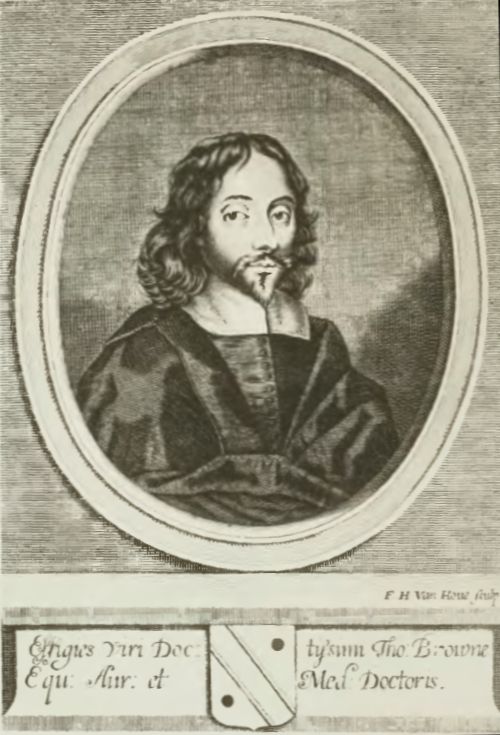
SECT. 1
For my Religion, though there be several Circumstances that might
perswade the World I have none at all, as the general scandal of my
Profession, the natural course of my Studies, the indifferency of my
Behaviour and Discourse in matters of Religion, neither violently
Defending one, nor with that common ardour and contention Opposing
another; yet, in despight hereof, I dare, without usurpation, assume the
honourable Stile of a Christian. Not that I meerly owe this Title to the
Font, my Education, or Clime wherein I was born, as being bred up either
to confirm those Principles my parents instilled into my Understanding,
or by a general consent proceed in the Religion of my Country: But
having in my riper years and confirmed Judgment, seen and examined all,
I find my self obliged by the Principles of Grace, and the Law of mine
own Reason, to embrace no other name but this: Neither doth herein my
zeal so far make me forget the general Charity I owe unto Humanity, as
rather to hate than pity Turks, Infidels, and (what is worse)
Jews; rather contenting my self to enjoy that happy Stile, than
maligning those who refuse so glorious a Title.
SECT. 2
But because the Name of a Christian is become too general to express our
Faith, there being a Geography of Religion as well as Lands, and every
Clime distinguished not only by their Laws and Limits, but circumscribed
by their Doctrines and Rules of Faith; to be particular, I am of that
Reformed new-cast Religion, wherein I dislike nothing but the Name; of
the same belief our Saviour taught, the Apostles disseminated, the
Fathers authorized, and the Martyrs confirmed, but by the sinister ends
of Princes, the ambition and avarice of Prelates, and the fatal
corruption of times, so decayed, impaired, and fallen from its native
Beauty, that it required the careful and charitable hands of these times
to restore it to its primitive Integrity. Now the accidental occasion
whereupon, the slender means whereby the low and abject condition of the
Person by whom so good a work was set on foot, which in our Adversaries
beget contempt and scorn, fills me with wonder, and is the very same
Objection the insolent Pagans first cast at Christ and his Disciples.
SECT.3
Yet have I not so shaken hands with those desperate Resolutions, who had
rather venture at large their decayed bottom, than bring her in to be
new trimm'd in the Dock; who had rather promiscuously retain all, than
abridge any, and obstinately be what they are, than what they have been,
as to stand in Diameter and Swords point with them: We have reformed
from them, not against them; for omitting those Improperations and Terms
of Scurrility betwixt us, which only difference our Affections, and not
our Cause, there is between us one common Name and Appellation, one
Faith and necessary body of Principles common to us both; and therefore
I am not scrupulous to converse and live with them, to enter their
Churches in defect of ours, and either pray with them, or for them. I
could never perceive any rational Consequence from those many Texts
which prohibit the Children of Israel to pollute themselves with the
Temples of the Heathens; we being all Christians, and not divided by
such detested impieties as might prophane our Prayers, or the place
wherein we make them; or that a resolved Conscience may not adore her
Creator any where, especially in places devoted to his Service; where,
if their Devotions offend him, mine may please him; if theirs prophane
it, mine may hallow it. Holy-water and Crucifix (dangerous to the common
people) deceive not my judgment, nor abuse my devotion at all: I am, I
confess, naturally inclined to that which misguided Zeal terms
Superstition: my common conversation I do acknowledge austere, my
behaviour full of rigour, sometimes not without morosity; yet at my
Devotion I love to use the civility of my knee, my hat, and hand, with
all those outward and sensible motions which may express or promote my
invisible Devotion. I should violate my own arm rather than a Church;
nor willingly deface the name of Saint or Martyr. At the sight of a
Cross or Crucifix I can dispense with my hat, but scarce with the
thought or memory of my Saviour: I cannot laugh at, but rather pity, the
fruitless journeys of Pilgrims, or contemn the miserable condition of
Fryars; for though misplaced in Circumstances there is something in it
of Devotion. I could never hear the Ave-Mary Bell[7] without an
elevation, or think it a sufficient warrant, because they erred in one
circumstance, for me to err in all, that is, in silence and dumb
contempt; whilst therefore they directed their Devotions to Her, I
offered mine to God, and rectifie the Errors of their Prayers by rightly
ordering mine own: At a solemn Procession I have wept abundantly, while
my consorts blind with opposition and prejudice, have fallen into an
excess of scorn and laughter: There are questionless both in Greek,
Roman, and African Churches, Solemnities and Ceremonies, whereof the
wiser Zeals do make a Christian use, and stand condemned by us, not as
evil in themselves, but as allurements and baits of superstition to
those vulgar heads that look asquint on the face of Truth, and those
unstable Judgments that cannot resist in the narrow point and centre of
Virtue without a reel or stagger to the Circumference.
SECT.4
As there were many Reformers, so likewise many Reformations; every
Country proceeding in a particular way and method, according as their
national Interest, together with their Constitution and Clime, inclined
them; some angrily, and with extremity; others calmly, and with
mediocrity; not rending, but easily dividing the community, and leaving
an honest possibility of a reconciliation; which though peaceable
Spirits do desire, and may conceive that revolution of time and the
mercies of God may effect, yet that judgment that shall continue the
present antipathies between the two extreams, their contrarieties in
condition, affection, and opinion, may with the same hopes expect an
union in the Poles of Heaven.
SECT.5
But to difference my self nearer, and draw into a lesser Circle, There
is no Church, whose every part so squares unto my Conscience; whose
Articles, Constitutions, and Customs, seem so consonant unto reason, and
as it were framed to my particular Devotion, as this whereof I hold my
Belief, the Church of England, to whose Faith I am a sworn Subject;
and therefore in a double Obligation subscribe unto her Articles, and
endeavour to observe her Constitutions; whatsoever is beyond, as points
indifferent, I observe according to the rules of my private reason, or
the humour and fashion of my Devotion; neither believing this, because
Luther affirmed it, or disproving that, because Calvin hath
disavouched it. I condemn not all things in the Council of Trent, nor
approve all in the Synod of Dort. In brief, where the Scripture is
silent, the Church is my Text; where that speaks, 'tis but my Comment:
where there is a joynt silence of both, I borrow not the rules of my
Religion from Rome or Geneva, but the dictates of my own reason. It
is an unjust scandal of our adversaries, and a gross errour in our
selves, to compute the Nativity of our Religion from Henry the Eighth,
who, though he rejected the Pope, refus'd not the faith of Rome, and
effected no more than what his own Predecessors desired and assayed in
Ages past, and was conceived the State of Venice would have attempted
in our days. It is as uncharitable a point in us to fall upon those
popular scurrilities and opprobrious scoffs of the Bishop of Rome, to
whom as a temporal Prince, we owe the duty of good language: I confess
there is cause of passion between us; by his sentence I stand
excommunicated, Heretick is the best language he affords me; yet can no
ear witness I ever returned him the name of Antichrist, Man of Sin, or
Whore of Babylon. It is the method of Charity to suffer without
reaction: Those usual Satyrs and invectives of the Pulpit may perchance
produce a good effect on the vulgar, whose ears are opener to Rhetorick
than Logick; yet do they in no wise confirm the faith of wiser
Believers, who know that a good cause needs not to be pardon'd by
passion, but can sustain it self upon a temperate dispute.
SECT.6
I could never divide my self from any man upon the difference of an
opinion, or be angry with his judgment for not agreeing with me in that
from which perhaps within a few days I should dissent my self. I have no
Genius to disputes in Religion, and have often thought it wisdom to
decline them, especially upon a disadvantage, or when the cause of truth
might suffer in the weakness of my patronage: Where we desire to be
informed, 'tis good to contest with men above our selves; but to confirm
and establish our opinions, 'tis best to argue with judgments below our
own, that the frequent spoils and Victories over their reasons may
settle in ourselves an esteem and confirmed Opinion of our own. Every
man is not a proper Champion for Truth, nor fit to take up the Gauntlet
in the cause of Verity: Many, from the ignorance of these Maximes, and
an inconsiderate Zeal unto Truth, have too rashly charged the Troops of
Error, and remain as Trophies unto the enemies of Truth: A man may be in
as just possession of Truth as of a City, and yet be forced to
surrender; 'tis therefore far better to enjoy her with peace, than to
hazzard her on a battle: if therefore there rise any doubts in my way, I
do forget them, or at least defer them till my better setled judgement
and more manly reason be able to resolve them; for I perceive every
man's own reason is his best Œdipus, and will upon a reasonable
truce, find a way to loose those bonds wherewith the subtleties of error
have enchained our more flexible and tender judgements. In Philosophy,
where Truth seems double-fac'd, there is no man more Paradoxical than my
self: but in Divinity I love to keep the Road; and, though not in an
implicite, yet an humble faith, follow the great wheel of the Church, by
which I move, not reserving any proper Poles or motion from the Epicycle
of my own brain; by this means I leave no gap for Heresie, Schismes, or
Errors, of which at present I hope I shall not injure Truth to say I
have no taint or tincture: I must confess my greener studies have been
polluted with two or three, not any begotten in the latter Centuries,
but old and obsolete, such as could never have been revived, but by such
extravagant and irregular heads as mine: for indeed Heresies perish not
with their Authors, but, like the river Arethusa, though they lose
their currents in one place, they rise up again in another: One General
Council is not able to extirpate one single Heresie; it may be cancell'd
for the present; but revolution of time, and the like aspects from
Heaven, will restore it, when it will flourish till it be condemned
again. For as though there were a Metempsuchosis, and the soul of one
man passed into another; Opinions do find, after certain Revolutions,
men and minds like those that first begat them. To see ourselves again,
we need not look for Plato's year:[8] every man is not only himself;
there hath been many Diogenes, and as many Timons, though but few of
that name; men are liv'd over again, the world is now as it was in Ages
past; there was none then, but there hath been some one since that
Parallels him, and is, as it were, his revived self.
SECT.7
Now the first of mine was that of the Arabians, That the Souls of men
perished with their Bodies, but should yet be raised again at the last
day: not that I did absolutely conceive a mortality of the Soul; but if
that were, which Faith, not Philosophy hath yet throughly disproved, and
that both entred the grave together, yet I held the same conceit thereof
that we all do of the body, that it should rise again. Surely it is but
the merits of our unworthy Natures, if we sleep in darkness until the
last Alarm. A serious reflex upon my own unworthiness did make me
backward from challenging this prerogative of my Soul; so that I might
enjoy my Saviour at the last, I could with patience be nothing almost
unto Eternity. The second was that of Origen, That God would not
persist in his vengeance for ever, but after a definite time of his
wrath, he would release the damned Souls from torture: which error I
fell into upon a serious contemplation of the great Attribute of God,
his Mercy; and did a little cherish it in my self, because I found
therein no malice, and a ready weight to sway me from the other extream
of despair, whereunto Melancholy and Contemplative Natures are too
easily disposed. A third there is which I did never positively maintain
or practise, but have often wished it had been consonant to Truth, and
not offensive to my Religion, and that is the Prayer for the dead;
whereunto I was inclin'd from some charitable inducements, whereby I
could scarce contain my Prayers for a friend at the ringing of a Bell,
or behold his Corps without an Orison for his Soul: 'Twas a good way,
methought, to be remembred by posterity, and far more noble than an
History. These opinions I never maintained with pertinacy, or
endeavoured to inveagle any mans belief unto mine, nor so much as ever
revealed or disputed them with my dearest friends; by which means I
neither propagated them in others, nor confirmed them in my self; but
suffering them to flame upon their own substance, without addition of
new fuel, they went out insensibly of themselves: therefore these
Opinions, though condemned by lawful Councels, were not Heresies in me,
but bare Errors, and single Lapses of my understanding, without a joynt
depravity of my will: Those have not onely depraved understandings, but
diseased affections, which cannot enjoy a singularity without an
Heresie, or be the Author of an Opinion without they be of a Sect also;
this was the villany of the first Schism of Lucifer, who was not
content to err alone, but drew into his Faction many Legions; and upon
this experience he tempted only Eve, as well understanding the
Communicable nature of Sin, and that to deceive but one, was tacitely
and upon consequence to delude them both.
SECT.8
That Heresies should arise, we have the Prophesie of Christ; but that
old ones should be abolished, we hold no prediction. That there must be
Heresies, is true, not only in our Church, but also in any other: even
in doctrines heretical, there will be super-heresies; and Arians not
only divided from their Church, but also among themselves: for heads
that are disposed unto Schism and complexionally propense to innovation,
are naturally disposed for a community; nor will be ever confined unto
the order or œconomy of one body; and therefore when they separate
from others, they knit but loosely among themselves, nor contented with
a general breach or dichotomy with their Church, do subdivide and mince
themselves almost into Atoms. 'Tis true, that men of singular parts and
humours have not been free from singular opinions and conceits in all
Ages; retaining something, not only beside the opinion of his own Church
or any other, but also any particular Author; which notwithstanding a
sober Judgment may do without offence or heresie; for there is yet,
after all the Decrees of Councils and the niceties of Schools, many
things untouch'd, unimagin'd, wherein the liberty of an honest reason
may play and expatiate with security, and far without the circle of an
Heresie.
SECT.9
As for those wingy Mysteries in Divinity, and airy subtleties in
Religion, which have unhing'd the brains of better heads, they never
stretched the Pia Mater of mine. Methinks there be not impossibilities
enough in Religion for an active faith; the deepest Mysteries ours
contains have not only been illustrated, but maintained, by Syllogism
and the rule of Reason. I love to lose my self in a mystery, to pursue
my Reason to an O altitudo! 'Tis my solitary recreation to pose my
apprehension with those involved Ænigma's and riddles of the Trinity,
with Incarnation, and Resurrection. I can answer all the Objections of
Satan and my rebellious reason with that odd resolution I learned of
Tertullian, Certum est quia impossibile est. I desire to exercise my
faith in the difficultest point; for to credit ordinary and visible
objects is not faith, but perswasion. Some believe the better for
seeing Christ's Sepulchre; and when they have seen the Red Sea, doubt
not of the Miracle. Now contrarily, I bless my self and am thankful that
I lived not in the days of Miracles, that I never saw Christ nor His
Disciples; I would not have been one of those Israelites that pass'd
the Red Sea, nor one of Christ's patients on whom he wrought his
wonders; then had my faith been thrust upon me, nor should I enjoy that
greater blessing pronounced to all that believe and saw not. 'Tis an
easie and necessary belief, to credit what our eye and sense hath
examined: I believe he was dead, and buried, and rose again; and desire
to see him in his glory, rather than to contemplate him in his Cenotaphe
or Sepulchre. Nor is this much to believe; as we have reason, we owe
this faith unto History: they only had the advantage of a bold and noble
Faith, who lived before his coming, who upon obscure prophesies and
mystical Types could raise a belief, and expect apparent
impossibilities.
SECT.10
'Tis true, there is an edge in all firm belief, and with an easie
Metaphor we may say, the Sword of Faith; but in these obscurities I
rather use it in the adjunct the Apostle gives it, a Buckler; under
which I conceive a wary combatant may lye invulnerable. Since I was of
understanding to know we knew nothing, my reason hath been more pliable
to the will of Faith; I am now content to understand a mystery without a
rigid definition, in an easie and Platonick description. That[9]
allegorical description of Hermes, pleaseth me beyond all the
Metaphysical definitions of Divines; where I cannot satisfie my reason,
I love to humour my fancy: I hadas live you tell me that anima est
angelus hominis, est Corpus Dei, as Entelechia; Lux est umbra Dei, as
actus perspicui; where there is an obscurity too deep for our Reason,
'tis good to sit down with a description, periphrasis, or adumbration;
for by acquainting our Reason how unable it is to display the visible
and obvious effects of nature, it becomes more humble and submissive
unto the subtleties of Faith; and thus I teach my haggard and
unreclaimed reason to stoop unto the lure of Faith. I believe there was
already a tree whose fruit our unhappy Parents tasted, though, in the
same Chapter when God forbids it, 'tis positively said, the plants of
the field were not yet grown, for God had not caus'd it to rain upon the
earth. I believe that the Serpent (if we shall literally understand it)
from his proper form and figure, made his motion on his belly before the
curse. I find the tryal of the Pucellage and virginity of Women, which
God ordained the Jews, is very fallible. Experience and History
informs me, that not onely many particular Women, but likewise whole
Nations have escaped the curse of Childbirth, which God seems to
pronounce upon the whole Sex; yet do I believe that all this is true,
which indeed my Reason would perswade me to be false; and this I think
is no vulgar part of Faith, to believe a thing not only above, but
contrary to Reason, and against the Arguments of our proper Senses.
SECT.11
In my solitary and retired imagination (Neque enim cum porticus, aut me
lectulus accepit, desum mihi) I remember I am not alone, and therefore
forget not to contemplate him and his Attributes who is ever with me,
especially those two mighty ones, his Wisdom and Eternity; with the one
I recreate, with the other I confound my understanding: for who can
speak of Eternity without a solœcism, or think thereof without an
Extasie? Time we may comprehend; 'tis but five days elder then our
selves, and hath the same Horoscope with the World; but to retire so far
back as to apprehend a beginning, to give such an infinite start
forwards as to conceive an end in an essence that we affirm hath neither
the one nor the other, it puts my Reason to St. Paul's Sanctuary: my
Philosophy dares not say the Angels can do it; God hath not made a
Creature that can comprehend him; 'tis a privilege of His own nature. I
am that I am, was his own definition unto Moses; and 'twas a short
one, to confound mortality, that durst question God, or ask him what he
was; indeed he onely is; all others have and shall be; but in Eternity
there is no distinction of Tenses; and therefore that terrible term
Predestination, which hath troubled so many weak heads to conceive,
and the wisest to explain, is in respect to God no prescious
determination of our Estates to come, but a definitive blast of his Will
already fulfilled, and at the instant that he first decreed it; for to
his Eternity which is indivisible and all together, the last Trump is
already sounded, the reprobates in the flame, and the blessed in
Abraham's bosome. St. Peter speaks modestly, when he saith, a
thousand years to God are but as one day: for to speak like a
Philosopher, those continued instances of time which flow into a
thousand years, make not to Him one moment; what to us is to come, to
his Eternity is present, his whole duration being but one permanent
point, without Succession, Parts, Flux, or Division.
SECT.12
There is no Attribute that adds more difficulty to the mystery of the
Trinity, where, though in a relative way of Father and Son, we must deny
a priority. I wonder how Aristotle could conceive the World eternal,
or how he could make good two Eternities: his similitude of a Triangle,
comprehended in a square, doth somewhat illustrate the Trinity of our
Souls, and that the Triple Unity of God; for there is in us not three,
but a Trinity of Souls, because there is in us, if not three distinct
Souls, yet differing faculties, that can and do subsist apart in
different Subjects, and yet in us are thus united as to make but one
Soul and substance: if one Soul were so perfect as to inform three
distinct Bodies, that were a pretty Trinity: conceive, the distinct
number of three, not divided nor separated by the Intellect, but
actually comprehended in its Unity, and that is a perfect Trinity. I
have often admired the mystical way of Pythagoras, and the secret
Magick of numbers. Beware of Philosophy, is a precept not to be received
in too large a sense; for in this Mass of Nature there is a set of
things that carry in their Front, though not in Capital Letters, yet in
Stenography and short Characters, something of Divinity, which to wiser
Reasons serve as Luminaries in the Abyss of Knowledge, and to judicious
beliefs as Scales and Roundles to mount the Pinacles and highest pieces
of Divinity. The severe Schools shall never laugh me out of the
Philosophy of Hermes, that this visible World is but a Picture of the
invisible, wherein as in a Pourtraict, things are not truely, but in
equivocal shapes, and as they counterfeit some more real substance in
that invisible Fabrick.
SECT.13
That other Attribute wherewith I recreate my devotion, is his Wisdom, in
which I am happy; and for the contemplation of this only, do not repent
me that I was bred in the way of Study: The advantage I have of the
vulgar, with the content and happiness I conceive therein, is an ample
recompence for all my endeavours, in what part of knowledge soever.
Wisdom is his most beauteous Attribute, no man can attain unto it, yet
Solomon pleased God when he desired it. He is wise, because he knows
all things; and he knoweth all things, because he made them all: but his
greatest knowledge is in comprehending that he made not, that is,
himself. And this is also the greatest knowledge in man. For this do I
honour my own profession, and embrace the Counsel even of the Devil
himself: had he read such a Lecture in Paradise as he did at
Delphos,[10] we had better known our selves; nor had we stood in fear
to know him. I know he is wise in all, wonderful in what we conceive,
but far more in what we comprehend not; for we behold him but asquint,
upon reflex or shadow; our understanding is dimmer than Moses Eye; we
are ignorant of the back-parts or lower side of his Divinity; therefore
to prie into the maze of his Counsels is not only folly in man, but
presumption even in Angels; like us, they are his Servants, not his
Senators; he holds no Counsel, but that mystical one of the Trinity,
wherein though there be three Persons, there is but one mind that
decrees without Contradiction: nor needs he any; his actions are not
begot with deliberation, his Wisdom naturally knows what's best; his
intellect stands ready fraught with the superlative and purest Idea's
of goodness; consultation and election, which are two motions in us,
make but one in him; his actions springing from his power at the first
touch of his will. These are Contemplations Metaphysical: my humble
speculations have another Method, and are content to trace and discover
those expressions he hath left in his Creatures, and the obvious effects
of Nature; there is no danger to profound these mysteries, no sanctum
sanctorum in Philosophy: the World was made to be inhabited by Beasts,
but studied and contemplated by Man: 'tis the Debt of our Reason we owe
unto God, and the homage we pay for not being Beasts; without this, the
World is still as though it had not been, or as it was before the sixth
day, when as yet there was not a Creature that could conceive, or say
there was a World. The wisdom of God receives small honour from those
vulgar Heads that rudely stare about, and with a gross rusticity admire
his works; those highly magnifie him, whose judicious inquiry into His
Acts, and deliberate research into His Creatures, return the duty of a
devout and learned admiration. Therefore,
Search while thou wilt, and let thy reason go,
To ransome truth, even to th' Abyss below;
Rally the scattered Causes; and that line
Which Nature twists, be able to untwine
It is thy Makers will, for unto none,
But unto reason can he e'er be known.
The Devils do know Thee, but those damn'd Meteors
Build not thy Glory, but confound thy Creatures.
Teach my indeavours so thy works to read,
That learning them in thee, I may proceed.
Give thou my reason that instructive flight,
Whose weary wings may on thy hands still light.
Teach me to soar aloft, yet ever so,
When neer the Sun, to stoop again below.
Thus shall my humble Feathers safely hover,
And, though near Earth, more than the Heavens discover
And then at last, when homeward I shall drive,
Rich with the Spoils of nature to my hive,
There will I sit like that industrious Flie,
Buzzing thy praises, which shall never die,
Till death abrupts them, and succeeding Glory
Bid me go on in a more lasting story.
And this is almost all wherein an humble Creature may endeavour to
requite and some way to retribute unto his Creator: for if not he that
saith, Lord, Lord, but he that doth the will of his Father, shall be
saved; certainly our wills must be our performances, and our intents
make out our Actions; otherwise our pious labours shall find anxiety in
our Graves, and our best endeavours not hope, but fear a resurrection.
SECT.14
There is but one first cause, and four second causes of all things; some
are without efficient, as God; others without matter, as Angels; some
without form, as the first matter: but every Essence created or
uncreated, hath its final cause, and some positive end both of its
Essence and Operation; this is the cause I grope after in the works of
Nature; on this hangs the providence of God: to raise so beauteous a
structure as the World and the Creatures thereof, was but his Art; but
their sundry and divided operations, with their predestinated ends, are
from the Treasure of his wisdom. In the causes, nature, and affections
of the Eclipses of the Sun and Moon, there is most excellent
speculation; but to profound farther, and to contemplate a reason why
his providence hath so disposed and ordered their motions in that vast
circle as to conjoyn and obscure each other, is a sweeter piece of
Reason, and a diviner point of Philosophy; therefore sometimes, and in
some things, there appears to me as much Divinity in Galen his books
De Usu Partium, as in Suarez Metaphysicks: Had Aristotle been as
curious in the enquiry of this cause as he was of the other, he had not
left behind him an imperfect piece of Philosophy, but an absolute tract
of Divinity.
SECT.15
Natura nihil aget frustra, is the only indisputed Axiome in
Philosophy; there are no Grotesques in nature; not any thing framed to
fill up empty Cantons, and unnecessary spaces: in the most imperfect
Creatures, and such as were not preserved in the Ark, but having their
Seeds and Principles in the womb of Nature, are every where, where the
power of the Sun is; in these is the Wisdom of his hand discovered. Out
of this rank Solomon chose the object of his admiration; indeed what
reason may not go to School to the wisdom of Bees, Ants, and Spiders?
what wise hand teacheth them to do what reason cannot teach us? ruder
heads stand amazed at those prodigious pieces of Nature, Whales,
Elephants, Dromidaries and Camels; these, I confess, are the Colossus
and Majestick pieces of her hand: but in these narrow Engines there is
more curious Mathematicks; and the civility of these little Citizens,
more neatly sets forth the Wisdom of their Maker. Who admires not
Regio-Montanus his Fly beyond his Eagle, or wonders not more at the
operation of two Souls in those little Bodies, than but one in the Trunk
of a Cedar? I could never content my contemplation with those general
pieces of wonder, the Flux and Reflux of the Sea, the increase of
Nile, the conversion of the Needle to the North; and have studied to
match and parallel those in the more obvious and neglected pieces of
Nature, which without further trouble I can do in the Cosmography of my
self; we carry with us the wonders we seek without us: There is all
Africa and her prodigies in us; we are that bold and adventurous piece
of nature, which he that studies wisely learns in a compendium what
others labour at in a divided piece and endless volume.
SECT.16
Thus there are two Books from which I collect my Divinity; besides that
written one of God, another of his servant Nature, that universal and
publick Manuscript, that lies expans'd unto the Eyes of all, those that
never saw him in the one, have discovered him in the other: this was the
Scripture and Theology of the Heathens: the natural motion of the Sun
made them more admire him, than its supernatural station did the
Children of Israel; the ordinary effects of nature wrought more
admiration in them than in the other all his Miracles; surely the
Heathens knew better how to joyn and read these mystical Letters than we
Christians, who cast a more careless Eye on these common Hieroglyphicks,
and disdain to suck Divinity from the flowers of Nature. Nor do I so
forget God as to adore the name of Nature; which I define not with the
Schools, to be the principle of motion and rest, but that streight and
regular line, that settled and constant course the Wisdom of God hath
ordained the actions of His creatures, according to their several kinds.
To make a revolution every day, is the Nature of the Sun, because of
that necessary course which God hath ordained it, from which it cannot
swerve but by a faculty from that voice which first did give it motion.
Now this course of Nature God seldome alters or perverts, but like an
excellent Artist hath so contrived his work, that with the self same
instrument, without a new creation, he may effect his obscurest designs.
Thus he sweetneth the Water with a Word, preserveth the Creatures in the
Ark, which the blast of his mouth might have as easily created; for God
is like a skilful Geometrician, who when more easily and with one stroak
of his Compass he might describe or divide a right line, had yet rather
do this in a circle or longer way; according to the constituted and
fore-laid principles of his Art: yet this rule of his he doth sometimes
pervert, to acquaint the World with his Prerogative, lest the arrogancy
of our reason should question his power, and conclude he could not; and
thus I call the effects of Nature the works of God, whose hand and
instrument she only is; and therefore to ascribe his actions unto her,
is to devolve the honour of the principal agent upon the instrument;
which if with reason we may do, then let our hammers rise up and boast
they have built our houses, and our pens receive the honour of our
writings. I hold there is a general beauty in the works of God, and
therefore no deformity in any kind or species of creature whatsoever: I
cannot tell by what Logick we call a Toad, a Bear, or an Elephant
ugly, they being created in those outward shapes and figures which best
express the actions of their inward forms. And having past that general
Visitation of God, who saw that all that he had made was good, that is,
conformable to his Will, which abhors deformity, and is the rule of
order and beauty; there is no deformity but in Monstrosity; wherein,
notwithstanding, there is a kind of Beauty. Nature so ingeniously
contriving the irregular parts, as they become sometimes more remarkable
than the principal Fabrick. To speak yet more narrowly, there was never
any thing ugly or mis-shapen, but the Chaos; wherein, notwithstanding,
to speak strictly, there was no deformity, because no form; nor was it
yet impregnant by the voice of God; now Nature was not at variance with
Art, nor Art with Nature, they being both servants of his providence:
Art is the perfection of Nature: were the World now as it was the sixth
day, there were yet a Chaos: Nature hath made one World, and Art
another. In brief, all things are artificial; for Nature is the Art of
God.
SECT.17
This is the ordinary and open way of his providence, which Art and
Industry have in a good part discovered, whose effects we may foretel
without an Oracle: to foreshew these, is not Prophesie, but
Prognostication. There is another way, full of Meanders and Labyrinths,
whereof the Devil and Spirits have no exact Ephemerides, and that is a
more particular and obscure method of his providence, directing the
operations of individuals and single Essences: this we call Fortune,
that serpentine and crooked line, whereby he draws those actions his
wisdom intends, in a more unknown and secret way: This cryptick and
involved method of his providence have I ever admired, nor can I relate
the History of my life, the occurrences of my days, the escapes of
dangers, and hits of chance, with a Bezo las Manos to Fortune, or a
bare Gramercy to my good Stars: Abraham might have thought the Ram
in the thicket came thither by accident; humane reason would have said,
that meer chance conveyed Moses in the Ark to the sight of Pharoh's
daughter: what a Labyrinth is there in the story of Joseph, able to
convert a Stoick? Surely there are in every man's Life certain rubs,
doublings, and wrenches, which pass a while under the effects of chance,
but at the last well examined, prove the meer hand of God. 'Twas not
dumb chance, that to discover the Fougade or Powder-plot, contrived a
miscarriage in the Letter. I like the victory of 88. the better for that
one occurrence, which our enemies imputed to our dishonour and the
partiality of Fortune, to wit, the tempests and contrariety of Winds.
King Philip did not detract from the Nation, when he said, he sent his
Armado to fight with men, and not to combate with the Winds. Where there
is a manifest disproportion between the powers and forces of two several
agents, upon a Maxime of reason we may promise the Victory to the
Superiour; but when unexpected accidents slip in, and unthought of
occurences intervene, these must proceed from a power that owes no
obedience to those Axioms; where, as in the writing upon the wall, we
may behold the hand, but see not the spring that moves it. The success
of that petty province of Holland (of which the Grand Seignour
proudly said, if they should trouble him as they did the Spaniard, he
would send his men with shovels and pick-axes, and throw it into the
Sea,) I cannot altogether ascribe to the ingenuity and industry of the
people, but the mercy of God, that hath disposed them to such a thriving
Genius; and to the will of his Providence, that disposeth her favour to
each Country in their pre-ordinate season. All cannot be happy at once;
for, because the glory of one State depends upon the ruine of another,
there is a revolution and vicissitude of their greatness, and must obey
the swing of that wheel, not moved by Intelligences, but by the hand of
God, whereby all Estates arise to their Zenith and Vertical points
according to their predestinated periods. For the lives, not only of
men, but of Commonwealths, and the whole World, run not upon an Helix
that still enlargeth; but on a Circle, where arriving to their Meridian,
they decline in obscurity, and fall under the Horizon again.
SECT.18
These must not therefore he named the effects of Fortune, but in a
relative way, and as we term the works of Nature: it was the ignorance
of mans reason that begat this very name, and by a careless term
miscalled the Providence of God: for there is no liberty for causes to
operate in a loose and stragling way; nor any effect whatsoever, but
hath its warrant from some universal or superiour Cause. 'Tis not a
ridiculous devotion to say a prayer before a game at Tables; for even in
sortilegies and matters of greatest uncertainty, there is a setled and
preordered course of effects. It is we that are blind, not Fortune:
because our Eye is too dim to discover the mystery of her effects, we
foolishly paint her blind, and hoodwink the Providence of the Almighty.
I cannot justifie that contemptible Proverb, That fools only are
Fortunate; or that insolent Paradox, That a wise man is out of the
reach of Fortune; much less those opprobrious epithets of Poets,
Whore, Bawd, and Strumpet. 'Tis, I confess, the common fate of men
of singular gifts of mind to be destitute of those of Fortune, which
doth not any way deject the Spirit of wiser judgements, who throughly
understand the justice of this proceeding; and being inrich'd with
higher donatives, cast a more careless eye on these vulgar parts of
felicity. It is a most unjust ambition to desire to engross the mercies
of the Almighty, not to be content with the goods of mind, without a
possession of those of body or Fortune: and it is an error worse than
heresie, to adore these complemental and circumstantial pieces of
felicity, and undervalue those perfections and essential points of
happiness wherein we resemble our Maker. To wiser desires it is
satisfaction enough to deserve, though not to enjoy the favours of
Fortune; let Providence provide for Fools: 'tis not partiality, but
equity in God, who deals with us but as our natural Parents; those that
are able of Body and Mind, he leaves to their deserts; to those of
weaker merits he imparts a larger portion, and pieces out the defect of
one, by the access of the other. Thus have we no just quarrel with
Nature, for leaving us naked; or to envy the Horns, Hoofs, Skins, and
Furs of other Creatures, being provided with Reason, that can supply
them all. We need not labour with so many Arguments to confute Judicial
Astrology; for if there be a truth therein, it doth not injure Divinity:
if to be born under Mercury disposeth us to be witty, under Jupiter
to be wealthy; I do not owe a Knee unto those, but unto that merciful
Hand that hath ordered my indifferent and uncertain nativity unto such
benevolous Aspects. Those that hold that all things are governed by
Fortune, had not erred, had they not persisted there: The Romans that
erected a temple to Fortune, acknowledged therein, though in a blinder
way, somewhat of Divinity; for in a wise supputation all things begin
and end in the Almighty. There is a nearer way to Heaven than Homer's
Chain; an easy Logick may conjoin heaven and Earth, in one Argument, and
with less than a Sorites resolve all things into God. For though we
christen effects by their most sensible and nearest Causes, yet is God
the true and infallible Cause of all, whose concourse though it be
general, yet doth it subdivide it self into the particular Actions of
every thing, and is that Spirit, by which each singular Essence not only
subsists, but performs its operation.
SECT.19
The bad construction, and perverse comment on these pair of second
Causes, or visible hands of God, have perverted the Devotion of many
unto Atheism; who, forgetting the honest Advisoes of Faith, have
listened unto the conspiracy of Passion and Reason. I have therefore
always endeavoured to compose those Feuds and angry Dissensions between
Affection, Faith and Reason: For there is in our Soul a kind of
Triumvirate, or triple Government of three Competitors, which distracts
the Peace of this our Common-wealth, not less than did that other the
State of Rome.
As Reason is a Rebel unto Faith, so Passion unto Reason: As the
Propositions of Faith seem absurd unto Reason, so the Theorems of Reason
unto Passion, and both unto Reason; yet a moderate and peaceable
discretion may so state and order the matter, that they may be all
Kings, and yet make but one Monarchy, every one exercising his
Soveraignty and Prerogative in a due time and place, according to the
restraint and limit of circumstance. There is, as in Philosophy, so in
Divinity, sturdy doubts and boisterous Objections, wherewith the
unhappiness of our knowledge too nearly acquainteth us. More of these no
man hath known than my self, which I confess I conquered, not in a
martial posture, but on my Knees. For our endeavours are not only to
combat with doubts, but always to dispute with the Devil: the villany of
that Spirit takes a hint of Infidelity from our Studies, and by
demonstrating a naturality in one way, makes us mistrust a miracle in
another. Thus having perused the Archidoxes and read the secret
Sympathies of things, he would disswade my belief from the miracle of
the Brazen Serpent, make me conceit that Image worked by Sympathy, and
was but an Ægyptian trick to cure their Diseases without a miracle.
Again, having seen some experiments of Bitumen, and having read far
more of Naphtha, he whispered to my curiosity the fire of the Altar
might be natural; and bid me mistrust a miracle in Elias, when he
entrenched the Altar round with Water: for that inflamable substance
yields not easily unto Water, but flames in the Arms of its Antagonist.
And thus would he inveagle my belief to think the combustion of Sodom
might be natural, and that there was an Asphaltick and Bituminous nature
in that Lake before the Fire of Gomorrah. I know that Manna is now
plentifully gathered in Calabria; and Josephus tells me, in his days
it was as plentiful in Arabia; the Devil therefore made the quære,
Where was then the miracle in the days of Moses: the Israelite saw
but that in his time, the Natives of those Countries behold in ours.
Thus the Devil played at Chess with me, and yielding a Pawn, thought to
gain a Queen of me, taking advantage of my honest endeavours; and whilst
I laboured to raise the structure of my Reason, he strived to undermine
the edifice of my Faith.
SECT.20
Neither had these or any other ever such advantage of me, as to incline
me to any point of Infidelity or desperate positions of Atheism; for I
have been these many years of opinion there was never any. Those that
held was the difference of Man from Beasts, have spoken probably, and
proceed upon a principle as inductive as the other. That doctrine of
Epicurus, that denied the Providence of God, was no Atheism, but a
magnificent and high strained conceit of his Majesty, which he deemed
too sublime to mind the trivial Actions of those inferiour Creatures.
That fatal Necessity of the Stoicks, is nothing but the immutable Law of
his will. Those that heretofore denied the Divinity of the Holy Ghost,
have been condemned, but as Hereticks; and those that now deny our
Saviour (though more than Hereticks) are not so much as Atheists: for
though they deny two persons in the Trinity, they hold as we do, there
is but one God.
That Villain and Secretary of Hell, that composed that miscreant piece
of the Three Impostors, though divided from all Religions, and was
neither Jew, Turk, nor Christian, was not a positive Atheist. I confess
every country hath its Machiavel, every Age its Lucian, whereof
common Heads must not hear, nor more advanced Judgments too rashly
venture on: It is the Rhetorick of Satan, and may pervert a loose or
prejudicate belief.
SECT.21
I confess I have perused them all, and can discover nothing that may
startle a discreet belief; yet are there heads carried off with the Wind
and breath of such motives. I remember a Doctor in Physick of Italy,
who could not perfectly believe the immortality of the Soul, because
Galen seemed to make a doubt thereof. With another I was familiarly
acquainted in France, a Divine, and a man of singular parts, that on
the same point was so plunged and gravelled with [11]three lines of
Seneca, that all our Antidotes, drawn from both Scripture and
Philosophy, could not expel the poyson of his errour. There are a set of
Heads, that can credit the relations of Mariners, yet question the
Testimonies of St. Paul; and peremptorily maintain the traditions of
Ælian or Pliny, yet in Histories of Scripture raise Queries and
Objections, believing no more than they can parallel in humane Authors.
I confess there are in Scripture Stories that do exceed the Fables of
Poets, and to a captious Reader sound like Garagantua or Bevis:
Search all the Legends of times past, and the fabulous conceits of these
present, and 'twill be hard to find one that deserves to carry the
Buckler unto Sampson; yet is all this of an easie possibility, if we
conceive a divine concourse, or an influence but from the little Finger
of the Almighty. It is impossible that either in the discourse of man,
or in the infallible Voice of God, to the weakness of our apprehensions,
there should not appear irregularities, contradictions, and antinomies:
my self could shew a Catalogue of doubts, never yet imagined nor
questioned, as I know, which are not resolved at the first hearing; not
fantastick Queries or Objections of Air; for I cannot hear of Atoms in
Divinity. I can read the History of the Pigeon that was sent out of the
Ark, and returned no more, yet not question how she found out her Mate
that was left behind: That Lazarus was raised from the dead, yet not
demand where in the interim his Soul awaited; or raise a Law-case,
whether his Heir might lawfully detain his inheritance bequeathed unto
him by his death, and he, though restored to life, have no Plea or Title
unto his former possessions. Whether Eve was framed out of the left
side of Adam, I dispute not; because I stand not yet assured which is
the right side of a man, or whether there be any such distinction in
Nature: that she was edified out of the Rib of Adam, I believe, yet
raise no question who shall arise with that Rib at the Resurrection.
Whether Adam was an Hermaphrodite, as the Rabbins contend upon the
Letter of the Text, because it is contrary to reason, there should be an
Hermaphrodite before there was a Woman; or a composition of two Natures
before there was a second composed. Likewise, whether the World was
created in Autumn, Summer, or the Spring, because it was created in them
all; for whatsoever Sign the Sun possesseth, those four Seasons are
actually existent: It is the Nature of this Luminary to distinguish the
several Seasons of the year, all which it makes at one time in the whole
Earth, and successive in any part thereof. There are a bundle of
curiosities, not only in Philosophy, but in Divinity, proposed and
discussed by men of most supposed abilities, which indeed are not worthy
our vacant hours, much less our serious Studies. In Rabbelais.Pieces only fit to be
placed in Pantagruel's Library, or bound up with Tartaretus, De modo
Cacandi.
SECT.22
These are niceties that become not those that peruse so serious a
Mystery: There are others more generally questioned and called to the
Bar, yet methinks of an easie and possible truth.
'Tis ridiculous to put off, or down the general Flood of Noah in that
particular inundation of Deucalion: that there was a Deluge once,
seems not to me so great a Miracle, as that there is not one always. How
all the kinds of Creatures, not only in their own bulks, but with a
competency of food and sustenance, might be preserved in one Ark, and
within the extent of three hundred Cubits, to a reason that rightly
examines it, will appear very feasible. There is another secret not
contained in the Scripture, which is more hard to comprehend, and put
the honest Father to the refuge of a Miracle: and that is, not only how
the distinct pieces of the World, and divided Islands should be first
planted by men, but inhabited by Tigers, Panthers, and Bears. How
America abounded with Beasts of prey, and noxious Animals, yet
contained not in it that necessary Creature, a Horse, is very strange.
By what passage those, not only Birds, but dangerous and unwelcome
Beasts, came over: How there be Creatures there (which are not found in
this Triple Continent); all which must needs be strange unto us, that
hold but one Ark, and that the Creatures began their progress from the
Mountains of Ararat: They who to salve this would make the Deluge
particular, proceed upon a principle that I can no way grant; not only
upon the negative of holy Scriptures, but of mine own Reason, whereby I
can make it probable, that the World was as well peopled in the time of
Noah, as in ours; and fifteen hundred years to people the World, as
full a time for them, as four thousand years since have been to us.
There are other assertions and common Tenents drawn from Scripture, and
generally believed as Scripture, whereunto notwithstanding, I would
never betray the liberty of my Reason. 'Tis a Paradox to me, that
Methusalem was the longest liv'd of all the Children of Adam: and no
man will be able to prove it; when from the process of the Text, I can
manifest it may be otherwise. That Judas perished by hanging himself,
there is no certainty in Scripture: though in one place it seems to
affirm it, and by a doubtful word hath given occasion to translate it;
yet in another place, in a more punctual description, it makes it
improbable, and seems to overthrow it. That our Fathers, after the
Flood, erected the Tower of Babel to preserve themselves against a
second Deluge, is generally opinioned and believed, yet is there another
intention of theirs expressed in Scripture: Besides, it is improbable
from the circumstance of the place, that is, a plain in the Land of
Shinar: These are no points of Faith, and therefore may admit a free
dispute. There are yet others, and those familiarly concluded from the
Text, wherein (under favour) I see no consequence: the Church of Rome,
confidently proves the opinion of Tutelary Angels, from that Answer when
Peter knockt at the Door; 'Tis not he, but his Angel; that is, might
some say, his Messenger, or some body from him; for so the Original
signifies, and is as likely to be the doubtful Families meaning. This
exposition I once suggested to a young Divine, that answered upon this
point; to which I remember the Franciscan Opponent replyed no more,
but That it was a new, and no authentick interpretation.
SECT.23
These are but the conclusions and fallible discourses of man upon the
Word of God, for such I do believe the holy Scriptures: yet were it of
man, I could not chuse but say, it was the singularest and superlative
piece that hath been extant since the Creation: were I a Pagan, I should
not refrain the Lecture of it; and cannot but commend the judgment of
Ptolomy, that thought not his Library compleat without it. The Alcoran
of the Turks (I speak without prejudice) is an ill composed Piece,
containing in it vain and ridiculous Errors in Philosophy,
impossibilities, fictions, and vanities beyond laughter, maintained by
evident and open Sophisms, the Policy of Ignorance, deposition of
Universities, and banishment of Learning, that hath gotten Foot by Arms
and violence: This without a blow, hath disseminated it self through the
whole Earth. It is not unremarkable what Philo first observed, That
the Law of Moses continued two thousand years without the least
alteration; whereas, we see, the Laws of other Common-weals do alter
with occasions; and even those, that pretended their Original from some
Divinity, to have vanished without trace or memory. I believe besides
Zoroaster, there were divers that writ before Moses, who,
notwithstanding, have suffered the common fate of time. Mens Works have
an age like themselves; and though they out-live their Authors, yet have
they a stint and period to their duration: This only is a work too hard
for the teeth of time, and cannot perish but in the general Flames, when
all things shall confess their Ashes.
SECT.24
I have heard some with deep sighs lament the lost lines of Cicero;
others with as many groans deplore the combustion of the Library of
Alexandria: for my own part, I think there be too many in the World,
and could with patience behold the urn and ashes of the Vatican, could
I, with a few others, recover the perished leaves of Solomon. I would
not omit a Copy of Enoch's Pillars, had they many nearer Authors than
Josephus, or did not relish somewhat of the Fable. Some men have
written more than others have spoken; [12]Pineda quotes more Authors in
one work, than are necessary in a whole World. Of those three great
inventions in Germany, there are two which are not without their
incommodities, and 'tis disputable whether they exceed not their use
and commodities. 'Tis not a melancholy Utinam of my own, but the
desires of better heads, that there were a general Synod; not to unite
the incompatible difference of Religion, but for the benefit of
learning, to reduce it as it lay at first, in a few, and solid Authors;
and to condemn to the fire those swarms & millions of Rhapsodies
begotten only to distract and abuse the weaker judgements of Scholars,
and to maintain the trade and mystery of Typographers.
SECT.25
I cannot but wonder with what exception the Samaritans could confine
their belief to the Pentateuch, or five Books of Moses. I am ashamed
at the Rabbinical Interpretation of the Jews, upon the Old Testament, as
much as their defection from the New. And truly it is beyond wonder, how
that contemptible and degenerate issue of Jacob, once so devoted to
Ethnick Superstition, and so easily seduced to the Idolatry of their
Neighbours, should now in such an obstinate and peremptory belief adhere
unto their own Doctrine, expect impossibilities, and, in the face and
eye of the Church, persist without the least hope of Conversion. This is
a vice in them, that were a vertue in us; for obstinacy in a bad Cause
is but constancy in a good. And herein I must accuse those of my own
Religion; for there is not any of such a fugitive Faith, such an
unstable belief, as a Christian; none that do so oft transform
themselves, not unto several shapes of Christianity and of the same
Species, but unto more unnatural and contrary Forms, of Jew and
Mahometan; that, from the name of Saviour, can condescend to the bare
term of Prophet; and from an old belief that he is come, fall to a new
expectation of his coming. It is the promise of Christ to make us all
one Flock; but how and when this Union shall be, is as obscure to me as
the last day. Of those four Members of Religion we hold a slender
proportion; there are, I confess, some new additions, yet small to those
which accrew to our Adversaries, and those only drawn from the revolt of
Pagans, men but of negative Impieties, and such as deny Christ, but
because they never heard of him: but the Religion of the Jew is
expressly against the Christian, and the Mahometan against both. For the
Turk, in the bulk he now stands, he is beyond all hope of conversion; if
he fall asunder, there may be conceived hopes, but not without strong
improbabilities. The Jew is obstinate in all fortunes; the persecution
of fifteen hundred years hath but confirmed them in their Errour: they
have already endured whatsoever may be inflicted, and have suffered, in
a bad cause, even to the condemnation of their enemies. Persecution is a
bad and indirect way to plant Religion: It hath been the unhappy method
of angry Devotions, not only to confirm honest Religion, but wicked
Heresies, and extravagant Opinions. It was the first stone and Basis of
our Faith; none can more justly boast of Persecutions, and glory in the
number and valour of Martyrs; for, to speak properly, those are true and
almost only examples of fortitude: Those that are fetch'd from the
field, or drawn from the actions of the Camp, are not oft-times so
truely precedents of valour as audacity, and at the best attain but to
some bastard piece of fortitude: If we shall strictly examine the
circumstances and requisites which Aristotle requires to true and
perfect valour, we shall find the name only in his Master Alexander,
and as little in that Roman Worthy, Julius Cæsar; and if any, in that
easie and active way have done so nobly as to deserve that name, yet in
the passive and more terrible piece these have surpassed, and in a more
heroical way may claim the honour of that Title. 'Tis not in the power
of every honest Faith to proceed thus far, or pass to Heaven through the
flames; every one hath it not in that full measure, nor in so audacious
and resolute a temper, as to endure those terrible tests and trials; who
notwithstanding, in a peaceable way do truely adore their Saviour, and
have (no doubt) a Faith acceptable in the eyes of God.
SECT.26
Now as all that dye in the War are not termed Souldiers; so neither can
I properly term all those that suffer in matters of Religion, Martyrs.
The Council of Constance condemns John Huss for an Heretick; the
Stories of his own Party stile him a Martyr: He must needs offend the
Divinity of both, that says he was neither the one nor the other: There
are many (questionless) canonised on earth, that shall never be Saints
in Heaven; and have their names in Histories and Martyrologies, who in
the eyes of God are not so perfect Martyrs, as was that wise Heathen
Socrates, that suffered on a fundamental point of Religion, the Unity
of God. I have often pitied the miserable Bishop that suffered in the
cause of Antipodes, yet cannot chuse but accuse him of as much
madness, for exposing his living on such a trifle; as those of ignorance
and folly, that condemned him. I think my conscience will not give me
the lye, if I say there are not many extant that in a noble way fear the
face of death less than myself; yet, from the moral duty I owe to the
Commandment of God, and the natural respects that I tender unto the
conservation of my essence and being, I would not perish upon a
Ceremony, Politick points, or indifferency: nor is my belief of that
untractible temper, as not to bow at their obstacles, or connive at
matters wherein there are not manifest impieties: The leaven therefore
and ferment of all, not only Civil, but Religious actions, is Wisdom;
without which, to commit our selves to the flames is Homicide, and (I
fear) but to pass through one fire into another.
SECT.27
That Miracles are ceased, I can neither prove, nor absolutely deny, much
less define the time and period of their cessation: that they survived
Christ, is manifest upon the Record of Scripture: that they out-lived
the Apostles also, and were revived at the Conversion of Nations, many
years after, we cannot deny, if we shall not question those Writers
whose testimonies we do not controvert in points that make for our own
opinions; therefore that may have some truth in it that is reported by
the Jesuites of their Miracles in the Indies; I could wish it were
true, or had any other testimony than their own Pens. They may easily
believe those Miracles abroad, who daily conceive a greater at home, the
transmutation of those visible elements into the Body and Blood of our
Saviour: for the conversion of Water into Wine, which he wrought in
Cana, or what the Devil would have had him done in the Wilderness, of
Stones into Bread, compared to this, will scarce deserve the name of a
Miracle. Though indeed to speak properly, there is not one Miracle
greater than another, they being the extraordinary effects of the Hand
of God, to which all things are of an equal facility; and to create the
World as easie as one single Creature. For this is also a Miracle, not
onely to produce effects against, or above Nature, but before Nature;
and to create Nature as great a Miracle as to contradict or transcend
her. We do too narrowly define the Power of God, restraining it to our
capacities. I hold that God can do all things; how he should work
contradictions, I do not understand, yet dare not therefore deny. I
cannot see why the Angel of God should question Esdras to recal the
time past, if it were beyond his own power; or that God should pose
mortality in that, which he was not able to perform himself. I will not
say God cannot, but he will not perform many things, which we plainly
affirm he cannot: this I am sure is the mannerliest proposition,
wherein, notwithstanding, I hold no Paradox. For strictly his power is
the same with his will, and they both with all the rest do make but one
God.
SECT.28
Therefore that Miracles have been, I do believe; that they may yet be
wrought by the living, I do not deny: but have no confidence in those
which are fathered on the dead; and this hath ever made me suspect the
efficacy of reliques, to examine the bones, question the habits and
appurtenances of Saints, and even of Christ himself. I cannot conceive
why the Cross that Helena found, and whereon Christ himself dyed,
should have power to restore others unto life: I excuse not
Constantine from a fall off his Horse, or a mischief from his enemies,
upon the wearing those nails on his bridle, which our Saviour bore upon
the Cross in his hands. I compute among Piæ fraudes, nor many degrees
before consecrated Swords and Roses, that which Baldwyn, King of
Jerusalem, return'd the Genovese for their cost and pains in his
War, to wit, the ashes of John the Baptist. Those that hold the
sanctity of their Souls doth leave behind a tincture and sacred faculty
on their bodies, speak naturally of Miracles, and do not salve the
doubt. Now one reason I tender so little Devotion unto Reliques, is, I
think, the slender and doubtful respect I have always held unto
Antiquities: for that indeed which I admire, is far before Antiquity,
that is, Eternity; and that is, God himself; who, though he be styled
the ancient of days, cannot receive the adjunct of Antiquity, who was
before the World, and shall be after it, yet is not older than it; for
in his years there is no Climacter; his duration is Eternity, and far
more venerable than Antiquity.
SECT.29
But above all things I wonder how the curiosity of wiser heads could
pass that great and indisputable Miracle, the cessation of Oracles; and
in what swoun their Reasons lay, to content themselves, and sit down
with such a far-fetch'd and ridiculous reason as Plutarch alleadgeth
for it. The Jews, that can believe the supernatural Solstice of the Sun
in the days of Joshua, have yet the impudence to deny the Eclipse,
which every Pagan confessed, at his death: but for this, it is evident
beyond all contradiction,[13] the Devil himself confessed it. Certainly
it is not a warrantable curiosity, to examine the verity of Scripture by
the concordance of humane history, or seek to confirm the Chronicle of
Hester or Daniel by the authority of Megasthenes or Herodotus. I
confess, I have had an unhappy curiosity this way, till I laughed my
self out of it with a piece of Justine, where he delivers that the
Children of Israel for being scabbed were banished out of Egypt. And
truely since I have understood the occurrences of the World, and know in
what counterfeit shapes, and deceitful vizards times present represent
on the stage things past; I do believe them little more then things to
come. Some have been of my opinion, and endeavoured to write the History
of their own lives; wherein Moses hath outgone them all, and left not
onely the story of his life, but as some will have it, of his death
also.
SECT.30
It is a riddle to me, how this story of Oracles hath not worm'd out of
the World that doubtful conceit of Spirits and Witches; how so many
learned heads should so far forget their Metaphysicks, and destroy the
ladder and scale of creatures, as to question the existence of Spirits:
for my part, I have ever believed, and do now know, that there are
Witches: they that doubt of these, do not onely deny them, but spirits;
and are obliquely and upon consequence a sort not of Infidels, but
Atheists. Those that to confute their incredulity desire to see
apparitions, shall questionless never behold any, nor have the power to
be so much as Witches; the Devil hath them already in a heresie as
capital as Witchcraft; and to appear to them, were but to convert them.
Of all the delusions wherewith he deceives mortality, there is not any
that puzleth me more than the Legerdemain of Changelings; I do not
credit those transformations of reasonable creatures into beasts, or
that the Devil hath a power to transpeciate a man into a Horse, who
tempted Christ (as a trial of his Divinity) to convert but stones into
bread. I could believe that Spirits use with man the act of carnality,
and that in both sexes; I conceive they may assume, steal, or contrive a
body, wherein there may be action enough to content decrepit lust, or
passion to satisfie more active veneries; yet in both, without a
possibility of generation: and therefore that opinion that Antichrist
should be born of the Tribe of Dan, by conjunction with the Devil, is
ridiculous, and a conceit fitter for a Rabbin than a Christian. I hold
that the Devil doth really possess some men, the spirit of Melancholly
others, the spirit of Delusion others; that as the Devil is concealed
and denyed by some, so God and good Angels are pretended by others
whereof the late defection of the Maid of Germany hath left a pregnant
example.
Sect. 31
Again, I believe that all that use sorceries, incantations, and spells,
are not Witches, or, as we term them, Magicians; I conceive there is a
traditional Magick, not learned immediately from the Devil, but at
second hand from his Scholars, who having once the secret betrayed, are
able, and do emperically practise without his advice, they both
proceeding upon the principles of Nature; where actives, aptly conjoyned
to disposed passives, will under any Master produce their effects. Thus
I think at first a great part of Philosophy was Witchcraft, which being
afterward derived to one another, proved but Philosophy, and was indeed
no more but the honest effects of Nature: What invented by us is
Philosophy, learned from him is Magick. We do surely owe the discovery
of many secrets to the discovery of good and bad Angels. I could never
pass that sentence of Paracelsus, without an asterisk, or annotation;
[14]Ascendens constellatum multa revelat, quærentibus magnalia naturæ,
i.e. opera Dei. I do think that many mysteries ascribed to our own
inventions, have been the courteous revelations of Spirits; for those
noble essences in Heaven bear a friendly regard unto their fellow
Natures on Earth; and therefore believe that those many prodigies and
ominous prognosticks, which fore-run the ruines of States, Princes, and
private persons, are the charitable premonitions of good Angels, which
more careless enquiries term but the effects of chance and nature.
SECT.32
Now, besides these particular and divided Spirits, there may be (for
ought I know) an universal and common Spirit to the whole World. It was
the opinion of Plato, and it is yet of the Hermetical Philosophers:
if there be a common nature that unites and tyes the scattered and
divided individuals into one species, why may there not be one that
unites them all? However, I am sure there is a common Spirit that plays
within us, yet makes no part of us; and that is the Spirit of God, the
fire and scintillation of that noble and mighty Essence, which is the
life and radical heat of Spirits, and those essences that know not the
vertue of the Sun, a fire quite contrary to the fire of Hell: This is
that gentle heat that broodeth on the waters, and in six days hatched
the World; this is that irradiation that dispels the mists of Hell, the
clouds of horrour, fear, sorrow, despair; and preserves the region of
the mind in serenity: Whatsoever feels not the warm gale and gentle
ventilation of this Spirit, (though I feel his pulse) I dare not say he
lives; for truely without this, to me there is no heat under the
Tropick; nor any light, though I dwelt in the body of the Sun.
As when the labouring Sun hath wrought his track
Up to the top of lofty Cancers back,
The ycie Ocean cracks, the frozen pole
Thaws with the heat of the Celestial coale;
So when thy absent beams begin t' impart
Again a Solstice on my frozen heart,
My winter 's ov'r; my drooping spirits sing,
And every part revives into a Spring.
But if thy quickening beams a while decline,
And with their light bless not this Orb of mine,
A chilly frost surpriseth every member,
And in the midst of June I feel December.
O how this earthly temper doth debase
The noble Soul in this her humble place.
Whose wingy nature ever doth aspire
To reach that place whence first it took its fire.
These flames I feel, which in my heart do dwell,
Are not thy beams, but take their fire from Hell.
O quench them all, and let thy light divine
Be as the Sun to this poor Orb of mine;
And to thy sacred Spirit convert those fires,
Whose earthly fumes choak my devout aspires.
SECT.33
Therefore for Spirits, I am so far from denying their existence, that I
could easily believe, that not onely whole Countries, but particular
persons, have their Tutelary and Guardian Angels: It is not a new
opinion of the Church of Rome, but an old one of Pythagoras and
Plato; there is no heresie in it; and if not manifestly defin'd in
Scripture, yet is it an opinion of a good and wholesome use in the
course and actions of a mans life, and would serve as an Hypothesis to
salve many doubts, whereof common Philosophy affordeth no solution. Now
if you demand my opinion and Metaphysicks of their natures, I confess
them very shallow, most of them in a negative way, like that of God; or
in a comparative, between our selves and fellow-creatures; for there is
in this Universe a Stair, or manifest Scale of creatures, rising not
disorderly, or in confusion, but with a comely method and proportion.
Between creatures of meer existence and things of life, there is a large
disproportion of nature; between plants and animals or creatures of
sense, a wider difference; between them and man, a far greater: and if
the proportion hold one, between Man and Angels there should be yet a
greater. We do not comprehend their natures, who retain the first
definition of Porphyry, and distinguish them from our selves by
immortality; for before his Fall, 'tis thought, Man also was Immortal;
yet must we needs affirm that he had a different essence from the
Angels; having therefore no certain knowledge of their Natures, 'tis no
bad method of the Schools, whatsoever perfection we find obscurely in
our selves, in a more compleat and absolute way to ascribe unto them. I
believe they have an extemporary knowledge, and upon the first motion of
their reason do what we cannot without study or deliberation; that they
know things by their forms, and define by specifical difference what we
describe by accidents and properties; and therefore probabilities to us
may be demonstrations unto them: that they have knowledge not onely of
the specifical, but numerical forms of individuals, and understand by
what reserved difference each single Hypostasis (besides the relation
to its species) becomes its numerical self. That as the Soul hath a
power to move the body it informs, so there's a faculty to move any,
though inform none; ours upon restraint of time, place, and distance;
but that invisible hand that conveyed Habakkuk to the Lyons Den, or
Philip to Azotus, infringeth this rule, and hath a secret
conveyance, wherewith mortality is not acquainted: if they have that
intuitive knowledge, whereby as in reflexion they behold the thoughts of
one another, I cannot peremptorily deny but they know a great part of
ours. They that to refute the Invocation of Saints, have denied that
they have any knowledge of our affairs below, have proceeded too far,
and must pardon my opinion, till I can thoroughly answer that piece of
Scripture, At the conversion of a sinner the Angels in Heaven rejoyce.
I cannot with those in that great Father securely interpret the work of
the first day, Fiat lux, to the creation of Angels, though I confess
there is not any creature that hath so neer a glympse of their nature,
as light in the Sun and Elements. We stile it a bare accident, but where
it subsists alone, 'tis a spiritual Substance, and may be an Angel: in
brief, conceive light invisible, and that is a Spirit.
SECT.34
These are certainly the Magisterial and master-pieces of the Creator,
the Flower, or (as we may say) the best part of nothing, actually
existing, what we are but in hopes and probability; we are onely that
amphibious piece between a corporal and spiritual Essence, that middle
form that links those two together, and makes good the Method of God and
Nature, that jumps not from extreams, but unites the incompatible
distances by some middle and participating natures: that we are the
breath and similitude of God, it is indisputable, and upon record of
holy Scripture; but to call ourselves a Microcosm, or little World, I
thought it only a pleasant trope of Rhetorick, till my neer judgement
and second thoughts told me there was a real truth therein: for first we
are a rude mass, and in the rank of creatures, which onely are, and
have a dull kind of being, not yet privileged with life, or preferred to
sense or reason; next we live the life of Plants, the life of Animals,
the life of Men, and at last the life of Spirits, running on in one
mysterious nature those five kinds of existences, which comprehend the
creatures not onely of the World, but of the Universe; thus is man that
great and true Amphibium, whose nature is disposed to live not onely
like other creatures in divers elements, but in divided and
distinguished worlds: for though there be but one to sense, there are
two to reason, the one visible, the other invisible, whereof Moses
seems to have left description, and of the other so obscurely, that some
parts thereof are yet in controversie. And truely for the first chapters
of Genesis, I must confess a great deal of obscurity; though Divines
have to the power of humane reason endeavoured to make all go in a
literal meaning, yet those allegorical interpretations are also
probable, and perhaps the mystical method of Moses bred up in the
Hieroglyphical Schools of the Egyptians.
SECT.35
Now for that immaterial world, methinks we need not wander so far as
beyond the first moveable; for even in this material Fabrick the spirits
walk as freely exempt from the affection of time, place, and motion, as
beyond the extreamest circumference: do but extract from the corpulency
of bodies, or resolve things beyond their first matter, and you discover
the habitation of Angels, which if I call the ubiquitary and omnipresent
essence of God, I hope I shall not offend Divinity: for before the
Creation of the World God was really all things. For the Angels he
created no new World, or determinate mansion, and therefore they are
everywhere where is his Essence, and do live at a distance even in
himself. That God made all things for man, is in some sense true, yet
not so far as to subordinate the Creation of those purer Creatures unto
ours, though as ministring Spirits they do, and are willing to fulfil
the will of God in these lower and sublunary affairs of man: God made
all things for himself, and it is impossible he should make them for any
other end than his own Glory; it is all he can receive, and all that is
without himself: for honour being an external adjunct, and in the
honourer rather than in the person honoured, it was necessary to make a
Creature, from whom he might receive this homage; and that is in the
other world Angels, in this, Man; which when we neglect, we forget the
very end of our Creation, and may justly provoke God, not onely to
repent that he hath made the World, but that he hath sworn he would not
destroy it. That there is but one World, is a conclusion of Faith.
Aristotle with all his Philosophy hath not been able to prove it, and
as weakly that the world was eternal; that dispute much troubled the Pen
of the Philosophers, but Moses decided that question, and all is
salved with the new term of a Creation, that is, a production of
something out of nothing; and what is that? Whatsoever is opposite to
something; or more exactly, that which is truely contrary unto God; for
he onely is, all others have an existence with dependency, and are
something but by a distinction; and herein is Divinity conformant unto
Philosophy, and generation not onely founded on contrarieties, but also
creation; God being all things, is contrary unto nothing, out of which
were made all things, and so nothing became something, and Omneity
informed Nullity into an Essence.
SECT.36
The whole Creation is a Mystery, and particularly that of Man; at the
blast of his mouth were the rest of the Creatures made, and at his bare
word they started out of nothing: but in the frame of Man (as the Text
describes it) he played the sensible operator, and seemed not so much to
create, as make him; when he had separated the materials of other
creatures, there consequently resulted a form and soul; but having
raised the walls of man, he has driven to a second and harder creation
of a substance like himself, an incorruptible and immortal Soul. For
these two affections we have the Philosophy and opinion of the Heathens,
the flat affirmative of Plato, and not a negative from Aristotle:
there is another scruple cast in by Divinity (concerning its production)
much disputed in the Germane auditories, and with that indifferency
and equality of arguments, as leave the controversie undetermined. I am
not of Paracelsus mind, that boldly delivers a receipt to make a man
without conjunction; yet cannot but wonder at the multitude of heads
that do deny traduction, having no other argument to confirm their
belief, then that Rhetorical sentence, and Antimetathesis of
Augustine, Creando infunditur, infundendo creatur: either opinion
will consist well enough with Religion; yet I should rather incline to
this, did not one objection haunt me, not wrung from speculations and
subtilties, but from common sense and observation; not pickt from the
leaves of any Author, but bred amongst the weeds and tares of mine own
brain: And this is a conclusion from the equivocal and monstrous
productions in the copulation of Man with Beast: for if the Soul of man
be not transmitted, and transfused in the seed of the Parents, why are
not those productions meerly beasts, but have also an impression and
tincture of reason in as high a measure, as it can evidence it self in
those improper Organs? Nor truely can I peremptorily deny, that the Soul
in this her sublunary estate, is wholly, and in all acceptions
inorganical, but that for the performance of her ordinary actions, there
is required not onely a symmetry and proper disposition of Organs, but a
Crasis and temper correspondent to its operations. Yet is not this mass
of flesh and visible structure the instrument and proper corps of the
Soul, but rather of Sense, and that the hand of Reason. In our study of
Anatomy there is a mass of mysterious Philosophy, and such as reduced
the very Heathens to Divinity: yet amongst all those rare discourses,
and curious pieces I find in the Fabrick of man, I do not so much
content my self, as in that I find not, there is no Organ or Instrument
for the rational soul: for in the brain, which we term the seat of
reason, there is not any thing of moment more than I can discover in the
crany of a beast: and this is a sensible and no inconsiderable argument
of the inorganity of the Soul, at least in that sense we usually so
conceive it. Thus we are men, and we know not how; there is something in
us that can be without us, and will be after us, though it is strange
that it hath no history, what it was before us, nor cannot tell how it
entred in us.
SECT.37
Now for these walls of flesh, wherein the Soul doth seem to be immured,
before the Resurrection, it is nothing but an elemental composition, and
a Fabrick that must fall to ashes. All flesh is grass, is not onely
metaphorically, but litterally, true; for all those creatures we
behold, are but the herbs of the field, digested into flesh in them, or
more remotely carnified in our selves. Nay further, we are what we all
abhor, Anthropophagi and Cannibals, devourers not onely of men, but of
our selves; and that not in an allegory, but a positive truth: for all
this mass of flesh which we behold, came in at our mouths; this frame we
look upon, hath been upon our trenchers; in brief, we have devour'd our
selves. I cannot believe the wisdom of Pythagoras did ever positively,
and in a literal sense, affirm his Metempsychosis, or impossible
transmigration of the Souls of men into beasts: of all Metamorphoses, or
transmigrations, I believe only one, that is of Lots wife; for that of
Nebuchodonosor proceeded not so far; in all others I conceive there is
no further verity than is contained in their implicite sense and
morality. I believe that the whole frame of a beast doth perish, and is
left in the same state after death as before it was materialled unto
life; that the souls of men know neither contrary nor corruption; that
they subsist beyond the body, and outlive death by the priviledge of
their proper natures, and without a Miracle; that the Souls of the
faithful, as they leave Earth, take possession of Heaven: that those
apparitions and ghosts of departed persons are not the wandring souls of
men, but the unquiet walks of Devils, prompting and suggesting us unto
mischief, blood, and villany; instilling and stealing into our hearts
that the blessed spirits are not at rest in their graves, but wander
sollicitous of the affairs of the World; but that those phantasms appear
often, and do frequent Cœmeteries, Charnel-houses, and Churches, it
is because those are the dormitories of the dead, where the Devil like
an insolent Champion beholds with pride the spoils and Trophies of his
Victory over Adam.
SECT.38
This is that dismal conquest we all deplore, that makes us so often cry
(O) Adam, quid fecisti? I thank God I have not those strait ligaments,
or narrow obligations to the World, as to dote on life, or be convulst
and tremble at the name of death: Not that I am insensible of the dread
and horrour thereof, or by raking into the bowels of the deceased,
continual sight of Anatomies, Skeletons, or Cadaverous reliques, like
Vespilloes, or Gravemakers, I am become stupid, or have forgot the
apprehension of Mortality; but that marshalling all the horrours, and
contemplating the extremities thereof, I find not any thing therein able
to daunt the courage of a man, much less a well-resolved Christian: And
therefore am not angry at the errour of our first Parents, or unwilling
to bear a part of this common fate, and like the best of them to dye,
that is, to cease to breathe, to take a farewel of the elements, to be a
kind of nothing for a moment, to be within one instant of a spirit. When
I take a full view and circle of my self, without this reasonable
moderator, and equal piece of Justice, Death, I do conceive my self the
miserablest person extant; were there not another life that I hope for,
all the vanities of this World should not intreat a moment's breath from
me: could the Devil work my belief to imagine I could never dye, I would
not outlive that very thought; I have so abject a conceit of this common
way of existence, this retaining to the Sun and Elements, I cannot think
this is to be a man, or to live according to the dignity of humanity: in
exspectation of a better, I can with patience embrace this life, yet in
my best meditations do often defie death: I honour any man that contemns
it, nor can I highly love any that is afraid of it: this makes me
naturally love a Souldier, and honour those tattered and contemptible
Regiments, that will dye at the command of a Sergeant. For a Pagan there
may be some motives to be in love with life; but for a Christian to be
amazed at death, I see not how he can escape this Dilemma, that he is
too sensible of this life, or hopeless of the life to come.
SECT.39
Some Divines count Adam 30 years old at his creation, because they
suppose him created in the perfect age and stature of man. And surely we
are all out of the computation of our age, and every man is some months
elder than he bethinks him; for we live, move, have a being, and are
subject to the actions of the elements, and the malice of diseases, in
that other world, the truest Microcosm, the Womb of our Mother. For
besides that general and common existence we are conceived to hold in
our Chaos, and whilst we sleep within the bosome of our causes, we enjoy
a being and life in three distinct worlds, wherein we receive most
manifest graduations: In that obscure World and womb of our mother, our
time is short, computed by the Moon; yet longer then the days of many
creatures that behold the Sun, our selves being not yet without life,
sense, and reason; though for the manifestation of its actions, it
awaits the opportunity of objects, and seems to live there but in its
root and soul of vegetation; entring afterwards upon the scene of the
World, we arise up and become another creature, performing the
reasonable actions of man, and obscurely manifesting that part of
Divinity in us, but not in complement and perfection, till we have once
more cast our secondine, that is, this slough of flesh, and are
delivered into the last world, that is, that ineffable place of Paul,
that proper ubi of spirits. The smattering I have of the Philosophers
Stone (which is something more then the perfect exaltation of Gold) hath
taught me a great deal of Divinity, and instructed my belief, how that
immortal spirit and incorruptible substance of my Soul may lye obscure,
and sleep a while within this house of flesh. Those strange and mystical
transmigrations that I have observed in Silk-worms, turned my Philosophy
into Divinity. There is in these works of nature, which seem to puzzle
reason, something Divine, and hath more in it then the eye of a common
spectator doth discover.
SECT.40
I am naturally bashful, nor hath conversation, age or travel, been able
to effront, or enharden me; yet I have one part of modesty which I have
seldom discovered in another, that is, (to speak truely) I am not so
much afraid of death, as ashamed thereof; 'tis the very disgrace and
ignominy of our natures, that in a moment can so disfigure us, that our
nearest friends, Wife, and Children stand afraid and start at us. The
Birds and Beasts of the field, that before in a natural fear obeyed us,
forgetting all allegiance, begin to prey upon us. This very conceit hath
in a tempest disposed and left me willing to be swallowed up in the
abyss of waters; wherein I had perished unseen, unpityed, without
wondering eyes, tears of pity, Lectures of mortality, and none had said,
Quantum mutatus ab illo! Not that I am ashamed of the Anatomy of my
parts, or can accuse Nature for playing the bungler in any part of me,
or my own vitious life for contracting any shameful disease upon me,
whereby I might not call my self as wholesome a morsel for the worms as
any.
SECT.41
Some upon the courage of a fruitful issue, wherein, as in the truest
Chronicle, they seem to outlive themselves, can with greater patience
away with death. This conceit and counterfeit subsisting in our
progenies, seems to me a meer fallacy, unworthy the desires of a man,
that can but conceive a thought of the next World; who, in a nobler
ambition, should desire to live in his substance in Heaven, rather than
his name and shadow in the earth. And therefore at my death I mean to
take a total adieu of the world, not caring for a Monument, History, or
Epitaph, not so much as the memory of my name to be found any where, but
in the universal Register of God. I am not yet so Cynical, as to approve
the [15]Testament of Diogenes, nor do I altogether allow that
Rodomontodo of Lucan;
——Cœlo tegitur, qui non habet urnam.
He that unburied lies wants not his Herse,
For unto him a Tomb's the Universe.
But commend in my calmer judgement, those ingenuous intentions that
desire to sleep by the urns of their Fathers, and strive to go the
neatest way unto corruption. I do not envy the temper of Crows and Daws,
nor the numerous and weary days of our Fathers before the Flood. If
there be any truth in Astrology, I may outlive a Jubilee; as yet I have
not seen one revolution of Saturn, nor hath my pulse beat thirty years;
and yet excepting one, have seen the Ashes, & left under ground all the
Kings of Europe; have been contemporary to three Emperours, four Grand
Signiours, and as many Popes: methinks I have outlived my self, and
begin to be weary of the Sun; I have shaken hands with delight: in my
warm blood and Canicular days, I perceive I do anticipate the vices of
age; the World to me is but a dream or mock-show, and we all therein but
Pantalones and Anticks, to my severer contemplations.
SECT.42
It is not, I confess, an unlawful prayer to desire to surpass the days
of our Saviour, or wish to outlive that age wherein he thought fittest
to dye; yet if (as Divinity affirms) there shall be no gray hairs in
Heaven, but all shall rise in the perfect state of men, we do but
outlive those perfections in this World, to be recalled unto them by a
greater Miracle in the next, and run on here but to be retrograde
hereafter. Were there any hopes to outlive vice, or a point to be
super-annuated from sin, it were worthy our knees to implore the days of
Methuselah. But age doth not rectifie, but incurvate our natures,
turning bad dispositions into worser habits, and (like diseases) brings
on incurable vices; for every day as we grow weaker in age, we grow
stronger in sin; and the number of our days doth make but our sins
innumerable. The same vice committed at sixteen, is not the same, though
it agree in all other circumstances, at forty, but swells and doubles
from the circumstance of our ages, wherein, besides the constant and
inexcusable habit of transgressing, the maturity of our judgement cuts
off pretence unto excuse or pardon: every sin the oftner it is
committed, the more it acquireth in the quality of evil; as it succeeds
in time, so it proceeds in degrees of badness; for as they proceed they
ever multiply, and like figures in Arithmetick, the last stands for more
than all that went before it. And though I think no man can live well
once, but he that could live twice, yet for my own part I would not live
over my hours past, or begin again the thred of my days: not upon
Cicero's ground, because I have lived them well, but for fear I should
live them worse: I find my growing Judgment daily instruct me how to be
better, but my untamed affections and confirmed vitiosity makes me daily
do worse; I find in my confirmed age the same sins I discovered in my
youth; I committed many then because I was a Child, and because I commit
them still, I am yet an infant. Therefore I perceive a man may be twice
a Child before the days of dotage; and stands in need of Æsons Bath
before threescore.
SECT.43
And truely there goes a great deal of providence to produce a mans life
unto three-score: there is more required than an able temper for those
years; though the radical humour contain in it sufficient oyl for
seventy, yet I perceive in some it gives no light past thirty: men
assign not all the causes of long life, that write whole Books thereof.
They that found themselves on the radical balsome, or vital sulphur of
the parts, determine not why Abel lived not so long as Adam. There
is therefore a secret glome or bottome of our days: 'twas his wisdom to
determine them, but his perpetual and waking providence that fulfils and
accomplisheth them; wherein the spirits, our selves, and all the
creatures of God in a secret and disputed way do execute his will. Let
them not therefore complain of immaturity that die about thirty; they
fall but like the whole World, whose solid and well-composed substance
must not expect the duration and period of its constitution: when all
things are compleated in it, its age is accomplished; and the last and
general fever may as naturally destroy it before six thousand, as me
before forty; there is therefore some other hand that twines the thread
of life than that of Nature: we are not onely ignorant in Antipathies
and occult qualities; our ends are as obscure as our beginnings; the
line of our days is drawn by night, and the various effects therein by a
pensil that is invisible; wherein though we confess our ignorance, I am
sure we do not err if we say it is the hand of God.
SECT.44
I am much taken with two verses of Lucan, since I have been able not
onely as we do at School, to construe, but understand.
Victurosque Dei celant ut vivere durent.
Felix esse mori.
We're all deluded, vainly searching ways
To make us happy by the length of days;
For cunningly to make's protract this breath,
The Gods conceal the happiness of Death.
There be many excellent strains in that Poet, wherewith his Stoical
Genius hath liberally supplied him; and truely there are singular pieces
in the Philosophy of Zeno, and doctrine of the Stoicks, which I
perceive, delivered in a Pulpit, pass for current Divinity: yet herein
are they in extreams, that can allow a man to be his own Assassine,
and so highly extol the end and suicide of Cato; this is indeed not to
fear death, but yet to be afraid of life. It is a brave act of valour to
contemn death; but where life is more terrible than death, it is then
the truest valour to dare to live; and herein Religion hath taught us a
noble example: For all the valiant acts of Curtius, Scevola, or
Codrus, do not parallel or match that one of Job; and sure there is
no torture to the rack of a disease, nor any Ponyards in death it self
like those in the way or prologue to it. Emori nolo, sed me esse
mortuum nihil curo; I would not die, but care not to be dead. Were I of
Cæsar's Religion, I should be of his desires, and wish rather to go
off at one blow, then to be sawed in pieces by the grating torture of a
disease. Men that look no farther than their outsides, think health an
appurtenance unto life, and quarrel with their constitutions for being
sick; but I, that have examined the parts of man, and know upon what
tender filaments that Fabrick hangs, do wonder that we are not always
so; and considering the thousand doors that lead to death, do thank my
God that we can die but once. 'Tis not onely the mischief of diseases,
and villany of poysons, that make an end of us; we vainly accuse the
fury of Guns, and the new inventions of death; it is in the power of
every hand to destroy us, and we are beholding unto every one we meet,
he doth not kill us. There is therefore but one comfort left, that,
though it be in the power of the weakest arm to take away life, it is
not in the strongest to deprive us of death: God would not exempt
himself from that, the misery of immortality in the flesh; he undertook
not that was immortal. Certainly there is no happiness within this
circle of flesh, nor is it in the Opticks of these eyes to behold
felicity; the first day of our Jubilee is Death; the Devil hath
therefore failed of his desires; we are happier with death than we
should have been without it: there is no misery but in himself, where
there is no end of misery; and so indeed in his own sense the Stoick is
in the right. He forgets that he can dye who complains of misery; we are
in the power of no calamity while death is in our own.
SECT.45
Now besides the literal and positive kind of death, there are others
whereof Divines make mention, and those I think, not meerly
Metaphorical, as mortification, dying unto sin and the World; therefore,
I say, every man hath a double Horoscope, one of his humanity, his
birth; another of his Christianity, his baptism, and from this do I
compute or calculate my Nativity; not reckoning those Horæ combustæ
and odd days, or esteeming my self any thing, before I was my Saviours,
and inrolled in the Register of Christ: Whosoever enjoys not this life,
I count him but an apparition, though he wear about him the sensible
affections of flesh. In these moral acceptions, the way to be immortal
is to dye daily; nor can I think I have the true Theory of death, when I
contemplate a skull, or behold a Skeleton with those vulgar imaginations
it casts upon us; I have therefore enlarged that common Memento mori,
into a more Christian memorandum, Memento quatuor Novissima, those
four inevitable points of us all, Death, Judgement, Heaven, and Hell.
Neither did the contemplations of the Heathens rest in their graves,
without further thought of Rhadamanth or some judicial proceeding after
death, though in another way, and upon suggestion of their natural
reasons. I cannot but marvail from what Sibyl or Oracle they stole the
Prophesie of the worlds destruction by fire, or whence Lucan learned
to say,
Communis mundo superest rogus, assibus astra Misturus.
There yet remains to th' World one common Fire,
Wherein our bones with stars shall make one Pyre.
I believe the World grows near its end, yet is neither old nor decayed,
nor shall ever perish upon the ruines of its own Principles. As the work
of Creation was above nature, so its adversary annihilation; without
which the World hath not its end, but its mutation. Now what force
should be able to consume it thus far, without the breath of God, which
is the truest consuming flame, my Philosophy cannot inform me. Some
believe there went not a minute to the Worlds creation, nor shall there
go to its destruction; those six days, so punctually described, make not
to them one moment, but rather seem to manifest the method and Idea of
the great work of the intellect of God, than the manner how he proceeded
in its operation. I cannot dream that there should be at the last day
any such Judicial proceeding, or calling to the Bar, as indeed the
Scripture seems to imply, and the literal Commentators do conceive: for
unspeakable mysteries in the Scriptures are often delivered in a vulgar
and illustrative way; and being written unto man, are delivered, not as
they truely are, but as they may be understood; wherein notwithstanding
the different interpretations according to different capacities may
stand firm with our devotion, nor be any way prejudicial to each single
edification.
SECT.46
In those days there shall come lyars and false prophets.
Now to determine the day and year of this inevitable time, is not onely
convincible and statute-madness, but also manifest impiety: How shall we
interpret Elias 6000 years, or imagine the secret communicated to a
Rabbi, which God hath denyed unto his Angels? It had been an excellent
Quære to have posed the Devil of Delphos, and must needs have forced
him to some strange amphibology; it hath not onely mocked the
predictions of sundry Astrologers in Ages past, but the prophesies of
many melancholy heads in these present, who neither understanding
reasonably things past or present, pretend a knowledge of things to
come; heads ordained onely to manifest the incredible effects of
melancholy, and to fulfil old prophecies rather than be the authors of
new. In those days there shall come Wars and rumours of Wars, to me
seems no prophecy, but a constant truth, in all times verified since it
was pronounced: There shall be signs in the Moon and Stars; how comes he
then like a Thief in the night, when he gives an item of his coming?
That common sign drawn from the revelation of Antichrist, is as obscure
as any: in our common compute he hath been come these many years; but
for my own part to speak freely, I am half of opinion that Antichrist is
the Philosophers stone in Divinity; for the discovery and invention
thereof, though there be prescribed rules and probable inductions, yet
hath hardly any man attained the perfect discovery thereof. That general
opinion that the World grows neer its end, hath possessed all ages past
as neerly as ours; I am afraid that the Souls that now depart, cannot
escape that lingring expostulation of the Saints under the Altar,
Quousque, Domine? How long, O Lord? and groan in the expectation of
that great Jubilee.
SECT.47
This is the day that must make good that great attribute of God, his
Justice; that must reconcile those unanswerable doubts that torment the
wisest understandings, and reduce those seeming inequalities, and
respective distributions in this world, to an equality and recompensive
Justice in the next. This is that one day, that shall include and
comprehend all that went before it; wherein, as in the last scene, all
the Actors must enter, to compleat and make up the Catastrophe of this
great piece. This is the day whose memory hath onely power to make us
honest in the dark, and to be vertuous without a witness. Ipsa sui
pretium virtus sibi, that Vertue is her own reward, is but a cold
principle, and not able to maintain our variable resolutions in a
constant and setled way of goodness. I have practised that honest
artifice of Seneca, and in my retired and solitary imaginations, to
detain me from the foulness of vice, have fancied to my self the
presence of my dear and worthiest friends, before whom I should lose my
head, rather than be vitious: yet herein I found that there was nought
but moral honesty, and this was not to be vertuous for his sake who must
reward us at the last. I have tryed if I could reach that great
resolution of his, to be honest without a thought of Heaven or Hell; and
indeed I found, upon a natural inclination, and inbred loyalty unto
virtue, that I could serve her without a livery; yet not in that
resolved and venerable way, but that the frailty of my nature, upon[A]
easie temptation, might be induced to forget her. The life therefore and
spirit of all our actions, is the resurrection, and a stable
apprehension that our ashes shall enjoy the fruit of our pious
endeavours: without this, all Religion is a fallacy, and those impieties
of Lucian, Euripides, and Julian, are no blasphemies, but subtle
verities, and Atheists have been the onely Philosophers.
SECT.48
How shall the dead arise, is no question of my Faith; to believe only
possibilities, is not Faith, but meer Philosophy. Many things are true
in Divinity, which are neither inducible by reason, nor confirmable by
sense; and many things in Philosophy confirmable by sense, yet not
inducible by reason. Thus it is impossible by any solid or demonstrative
reasons to perswade a man to believe the conversion of the Needle to the
North; though this be possible and true, and easily credible, upon a
single experiment unto the sense. I believe that our estranged and
divided ashes shall unite again; that our separated dust after so many
Pilgrimages and transformations into the parts of Minerals, Plants,
Animals, Elements, shall at the Voice of God return into their primitive
shapes, and joyn again to make up their primary and predestinate forms.
As at the Creation there was a separation of that confused mass into its
pieces; so at the destruction thereof there shall be a separation into
its distinct individuals. As at the Creation of the World, all the
distinct species that we behold lay involved in one mass, till the
fruitful Voice of God separated this united multitude into its several
species: so at the last day, when those corrupted reliques shall be
scattered in the Wilderness of forms, and seem to have forgot their
proper habits, God by a powerful Voice shall command them back into
their proper shapes, and call them out by their single individuals: Then
shall appear the fertility of Adam, and the magick of that sperm that
hath dilated into so many millions. I have often beheld as a miracle,
that artificial resurrection and revivification of Mercury, how being
mortified into a thousand shapes, it assumes again its own, and returns
into its numerical self. Let us speak naturally, and like Philosophers,
the forms of alterable bodies in these sensible corruptions perish not;
nor as we imagine, wholly quit their mansions, but retire and contract
themselves into their secret and inaccessible parts, where they may best
protect themselves from the action of their Antagonist. A plant or
vegetable consumed to ashes, by a contemplative and school-Philosopher
seems utterly destroyed, and the form to have taken his leave for ever:
But to a sensible Artist the forms are not perished, but withdrawn into
their incombustible part, where they lie secure from the action of that
devouring element. This is made good by experience, which can from the
Ashes of a Plant revive the plant, and from its cinders recal it into
its stalk and leaves again. What the Art of man can do in these
inferiour pieces, what blasphemy is it to affirm the finger of God
cannot do in these more perfect and sensible structures? This is that
mystical Philosophy, from whence no true Scholar becomes an Atheist, but
from the visible effects of nature grows up a real Divine, and beholds
not in a dream, as Ezekiel, but in an ocular and visible object the
types of his resurrection.
SECT.49
Now, the necessary Mansions of our restored selves, are those two
contrary and incompatible places we call Heaven and Hell; to define
them, or strictly to determine what and where these are, surpasseth my
Divinity. That elegant Apostle which seemed to have a glimpse of Heaven,
hath left but a negative description thereof; which neither eye hath
seen, nor ear hath heard, nor can enter into the heart of man: he was
translated out of himself to behold it; but being returned into himself,
could not express it. St. John's description by Emerals, Chrysolites,
and precious Stones, is too weak to express the material Heaven we
behold. Briefly therefore, where the Soul hath the full measure and
complement of happiness; where the boundless appetite of that spirit
remains compleatly satisfied, that it can neither desire addition nor
alteration; that I think is truly Heaven: and this can onely be in the
injoynient of that essence, whose infinite goodness is able to terminate
the desires of it self, and the unsatiable wishes of ours; wherever God
will thus manifest himself, there is Heaven though within the circle of
this sensible world. Thus the Soul of man may be in Heaven any where,
even within the limits of his own proper body; and when it ceaseth to
live in the body, it may remain in its own soul, that is, its Creator:
and thus we may say that St. Paul, whether in the body, or out of the
body, was yet in Heaven. To place it in the Empyreal, or beyond the
tenth sphear, is to forget the world's destruction; for when this
sensible world shall be destroyed, all shall then be here as it is now
there, an Empyreal Heaven, a quasi vacuity; when to ask where Heaven
is, is to demand where the Presence of God is, or where we have the
glory of that happy vision. Moses that was bred up in all the learning
of the Egyptians, committed a gross absurdity in Philosophy, when with
these eyes of flesh he desired to see God, and petitioned his Maker,
that is, truth it self, to a contradiction. Those that imagine Heaven
and Hell neighbours, and conceive a vicinity between those two extreams,
upon consequence of the Parable, where Dives discoursed with Lazarus
in Abraham's bosome, do too grosly conceive of those glorified
creatures, whose eyes shall easily out-see the Sun, and behold without a
perspective the extreamest distances: for if there shall be in our
glorified eyes, the faculty of sight and reception of objects, I could
think the visible species there to be in as unlimitable a way as now the
intellectual. I grant that two bodies placed beyond the tenth sphear,
or in a vacuity, according to Aristotle's Philosophy, could not behold
each other, because there wants a body or Medium to hand and transport
the visible rays of the object unto the sense; but when there shall be a
general defect of either Medium to convey, or light to prepare and
dispose that Medium, and yet a perfect vision, we must suspend the rules
of our Philosophy, and make all good by a more absolute piece of
opticks.
SECT.50
I cannot tell how to say that fire is the essence of Hell: I know not
what to make of Purgatory, or conceive a flame that can either prey
upon, or purifie the substance of a Soul: those flames of sulphur
mention'd in the Scriptures, I take not to be understood of this present
Hell, but of that to come, where fire shall make up the complement of
our tortures, and have a body or subject wherein to manifest its
tyranny. Some who have had the honour to be textuary in Divinity, are of
opinion it shall be the same specifical fire with ours. This is hard to
conceive, yet can I make good how even that may prey upon our bodies,
and yet not consume us: for in this material World there are bodies that
persist invincible in the powerfullest flames; and though by the action
of fire they fall into ignition and liquation, yet will they never
suffer a destruction. I would gladly know how Moses with an actual
fire calcin'd, or burnt the Golden Calf into powder: for that mystical
metal of Gold, whose solary and celestial nature I admire, exposed unto
the violence of fire, grows onely hot, and liquifies, but consumeth not;
so when the consumable and volatile pieces of our bodies shall be
refined into a more impregnable and fixed temper, like Gold, though they
suffer from the action of flames, they shall never perish, but lye
immortal in the arms of fire. And surely if this frame must suffer onely
by the action of this element, there will many bodies escape, and not
onely Heaven, but Earth will not be at an end, but rather a beginning.
For at present it is not earth, but a composition of fire, water, earth,
and air; but at that time, spoiled of these ingredients, it shall appear
in a substance more like it self, its ashes. Philosophers that opinioned
the worlds destruction by fire, did never dream of annihilation, which
is beyond the power of sublunary causes; for the last[B] action of that
element is but vitrification, or a reduction of a body into glass; and
therefore some of our Chymicks facetiously affirm, that at the last fire
all shall be christallized and reverberated into glass, which is the
utmost action of that element. Nor need we fear this term annihilation,
or wonder that God will destroy the works of his Creation: for man
subsisting, who is, and will then truely appear, a Microcosm, the world
cannot be said to be destroyed. For the eyes of God, and perhaps also of
our glorified selves, shall as really behold and contemplate the World
in its Epitome or contracted essence, as now it doth at large and in its
dilated substance. In the seed of a Plant to the eyes of God, and to the
understanding of man, there exists, though in an invisible way, the
perfect leaves, flowers, and fruit thereof: (for things that are in
posse to the sense, are actually existent to the understanding). Thus
God beholds all things, who contemplates as fully his works in their
Epitome, as in their full volume; and beheld as amply the whole world in
that little compendium of the sixth day, as in the scattered and dilated
pieces of those five before.
SECT.51
Men commonly set forth the torments of Hell by fire, and the extremity
of corporal afflictions, and describe Hell in the same method that
Mahomet doth Heaven. This indeed makes a noise, and drums in popular
ears; but if this be the terrible piece thereof, it is not worthy to
stand in diameter with Heaven, whose happiness consists in that part
that is best able to comprehend it, that immortal essence, that
translated divinity and colony of God, the Soul. Surely though we place
Hell under Earth, the Devil's walk and purlue is about it: men speak too
popularly who place it in those flaming mountains, which to grosser
apprehensions represent Hell. The heart of man is the place the Devils
dwell in; I feel sometimes a Hell within my self; Lucifer keeps his
Court in my breast; Legion is revived in me. There are as many Hells,
as Anaxagoras conceited worlds; there was more than one Hell in
Magdalene, when there were seven Devils; for every Devil is an Hell
unto himself; he holds enough of torture in his own ubi, and needs not
the misery of circumference to afflict him. And thus a distracted
Conscience here, is a shadow or introduction unto Hell hereafter. Who
can but pity the merciful intention of those hands that do destroy
themselves? the Devil, were it in his power, would do the like; which
being impossible, his miseries are endless, and he suffers most in that
attribute wherein he is impassible, his immortality.
SECT.52
I thank God that with joy I mention it, I was never afraid of Hell, nor
never grew pale at the description of that place; I have so fixed my
contemplations on Heaven, that I have almost forgot the Idea of Hell,
and am afraid rather to lose the Joys of the one, than endure the
misery of the other: to be deprived of them is a perfect Hell, and needs
methinks no addition to compleat our afflictions; that terrible term
hath never detained me from sin, nor do I owe any good action to the
name thereof; I fear God, yet am not afraid of him; his mercies make me
ashamed of my sins, before his Judgements afraid thereof: these are the
forced and secondary method of his wisdom, which he useth but as the
last remedy, and upon provocation; a course rather to deter the wicked,
than incite the virtuous to his worship. I can hardly think there was
ever any scared into Heaven; they go the fairest way to Heaven that
would serve God without a Hell; other Mercenaries, that crouch into him
in fear of Hell, though they term themselves the servants, are indeed
but the slaves of the Almighty.
SECT.53
And to be true, and speak my soul, when I survey the occurrences of my
life, and call into account the Finger of God, I can perceive nothing
but an abyss and mass of mercies, either in general to mankind, or in
particular to my self: and whether out of the prejudice of my affection,
or an inverting and partial conceit of his mercies, I know not; but
those which others term crosses, afflictions, judgements, misfortunes,
to me who inquire farther into them then their visible effects, they
both appear, and in event have ever proved, the secret and dissembled
favours of his affection. It is a singular piece of Wisdom to apprehend
truly, and without passion, the Works of God, and so well to distinguish
his Justice from his Mercy, as not miscall those noble Attributes: yet
it is likewise an honest piece of Logick, so to dispute and argue the
proceedings of God, as to distinguish even his judgments into mercies.
For God is merciful unto all, because better to the worst, than the best
deserve; and to say he punisheth none in this world, though it be a
Paradox, is no absurdity. To one that hath committed Murther, if the
Judge should only ordain a Fine, it were a madness to call this a
punishment, and to repine at the sentence, rather than admire the
clemency of the Judge. Thus our offences being mortal, and deserving not
onely Death, but Damnation; if the goodness of God be content to
traverse and pass them over with a loss, misfortune, or disease; what
frensie were it to term this a punishment, rather than an extremity of
mercy; and to groan under the rod of his Judgements, rather than admire
the Scepter of his Mercies? Therefore to adore, honour, and admire him,
is a debt of gratitude due from the obligation of our nature, states,
and conditions; and with these thoughts, he that knows them best, will
not deny that I adore him. That I obtain Heaven, and the bliss thereof,
is accidental, and not the intended work of my devotion; it being a
felicity I can neither think to deserve, nor scarce in modesty to
expect. For these two ends of us all, either as rewards or punishments,
are mercifully ordained and disproportionably disposed unto our actions;
the one being so far beyond our deserts, the other so infinitely below
our demerits.
SECT.54
There is no Salvation to those that believe not in Christ, that is,
say some, since his Nativity, and as Divinity affirmeth, before also;
which makes me much apprehend the ends of those honest Worthies and
Philosophers which dyed before his Incarnation. It is hard to place
those Souls in Hell, whose worthy lives do teach us Virtue on Earth:
methinks amongst those many subdivisions of Hell, there might have been
one Limbo left for these. What a strange vision will it be to see their
Poetical fictions converted into Verities, and their imagined and
fancied Furies into real Devils? how strange to them will sound the
History of Adam, when they shall suffer for him they never heard of?
when they who derive their genealogy from the Gods, shall know they are
the unhappy issue of sinful man? It is an insolent part of reason, to
controvert the Works of God, or question the Justice of his proceedings.
Could Humility teach others, as it hath instructed me, to contemplate
the infinite and incomprehensible distance betwixt the Creator and the
Creature; or did we seriously perpend that one simile of St. Paul,
Shall the Vessel say to the Potter, Why hast thou made me thus? it
would prevent these arrogant disputes of reason, nor would we argue the
definitive sentence of God, either to Heaven or Hell. Men that live
according to the right rule and law of reason, live but in their own
kind, as beasts do in theirs; who justly obey the prescript of their
natures, and therefore cannot reasonably demand a reward of their
actions, as onely obeying the natural dictates of their reason. It will
therefore, and must at last appear, that all salvation is through
Christ; which verity I fear these great examples of virtue must
confirm, and make it good, how the perfectest actions of earth have no
title or claim unto Heaven.
SECT.55
Nor truely do I think the lives of these or of any other, were ever
correspondent, or in all points conformable unto their doctrines. It is
evident that Aristotle transgressed the rule of his own Ethicks; the
Stoicks that condemn passion, and command a man to laugh in Phalaris
his Bull, could not endure without a groan a fit of the Stone or Colick.
The Scepticks that affirmed they knew nothing, even in that opinion
confute themselves, and thought they knew more than all the World
beside. Diogenes I hold to be the most vain-glorious man of his time,
and more ambitious in refusing all Honours, than Alexander in
rejecting none. Vice and the Devil put a Fallacy upon our Reasons, and
provoking us too hastily to run from it, entangle and profound us deeper
in it. The Duke of Venice, that weds himself unto the Sea by a Ring of
Gold, I will not argue of prodigality, because it is a solemnity of good
use and consequence in the State: but the Philosopher that threw his
money into the Sea to avoid Avarice, was a notorious prodigal. There is
no road or ready way to virtue; it is not an easie point of art to
disentangle our selves from this riddle, or web of Sin: To perfect
virtue, as to Religion, there is required a Panoplia, or compleat
armour; that whilst we lye at close ward against one Vice, we lye not
open to the venny of another. And indeed wiser discretions that have the
thred of reason to conduct them, offend without pardon; whereas,
under-heads may stumble without dishonour. There go so many
circumstances to piece up one good action, that it is a lesson to be
good, and we are forced to be virtuous by the book. Again, the Practice
of men holds not an equal pace, yea, and often runs counter to their
Theory; we naturally know what is good, but naturally pursue what is
evil: the Rhetorick wherewith I perswade another, cannot perswade my
self: there is a depraved appetite in us, that will with patience hear
the learned instructions of Reason, but yet perform no farther than
agrees to its own irregular humour. In brief, we all are monsters, that
is, a composition of Man and Beast; wherein we must endeavour to be as
the Poets fancy that wise man Chiron, that is, to have the region of
Man above that of Beast, and Sense to sit but at the feet of Reason.
Lastly, I do desire with God that all, but yet affirm with men, that few
shall know Salvation; that the bridge is narrow, the passage strait unto
life: yet those who do confine the Church of God, either to particular
Nations, Churches or Families, have made it far narrower then our
Saviour ever meant it.
SECT.56
The vulgarity of those judgements that wrap the Church of God in
Strabo's cloak, and restrain it unto Europe, seem to me as bad
Geographers as Alexander, who thought he had Conquer'd all the World,
when he had not subdued the half of any part thereof. For we cannot deny
the Church of God both in Asia and Africa, if we do not forget the
Peregrinations of the Apostles, the deaths of the Martyrs, the Sessions
of many, and, even in our reformed judgement, lawful Councils, held in
those parts in the minority and nonage of ours. Nor must a few
differences, more remarkable in the eyes of man than perhaps in the
judgement of God, excommunicate from Heaven one another, much less those
Christians who are in a manner all Martyrs, maintaining their Faith, in
the noble way of persecution, and serving God in the Fire, whereas we
honour him in the Sunshine. 'Tis true, we all hold there is a number of
Elect, and many to be saved; yet take our Opinions together, and from
the confusion thereof there will be no such thing as salvation, nor
shall any one be saved. For first, the Church of Rome condemneth us,
we likewise them; the Sub-reformists and Sectaries sentence the Doctrine
of our Church as damnable; the Atomist, or Familist, reprobates all
these; and all these, them again. Thus whilst the Mercies of God do
promise us Heaven, our conceits and opinions exclude us from that place.
There must be, therefore, more than one St. Peter: particular Churches
and Sects usurp the gates of Heaven, and turn the key against each
other: and thus we go to Heaven against each others wills, conceits and
opinions; and with as much uncharity as ignorance, do err I fear in
points not only of our own, but one an others salvation.
SECT.57
I believe many are saved, who to man seem reprobated; and many are
reprobated, who in the opinion and sentence of man, stand elected: there
will appear at the Last day, strange and unexpected examples both of his
Justice and his Mercy; and therefore to define either, is folly in man,
and insolency even in the Devils: those acute and subtil spirits in all
their sagacity, can hardly divine who shall be saved; which if they
could Prognostick, their labour were at an end; nor need they compass
the earth seeking whom they may devour. Those who upon a rigid
application of the Law, sentence Solomon unto damnation, condemn not
onely him, but themselves, and the whole World: for by the Letter and
written Word of God, we are without exception in the state of Death;
but there is a prerogative of God, and an arbitrary pleasure above the
Letter of his own Law, by which alone we can pretend unto Salvation, and
through which Solomon might be as easily saved as those who condemn
him.
SECT.58
The number of those who pretend unto Salvation, and those infinite
swarms who think to pass through the eye of this Needle, have much
amazed me. That name and compellation of little Flock, doth not
comfort, but deject my Devotion; especially when I reflect upon mine own
unworthiness, wherein, according to my humble apprehensions, I am below
them all. I believe there shall never be an Anarchy in Heaven, but as
there are Hierarchies amongst the Angels, so shall there be degrees of
priority amongst the Saints. Yet is it (I protest) beyond my ambition to
aspire unto the first ranks; my desires onely are, and I shall be happy
therein, to be but the last man, and bring up the Rere in Heaven.
SECT.59
Again, I am confident and fully perswaded, yet dare not take my oath, of
my Salvation: I am as it were sure, and do believe without all doubt,
that there is such a City as Constantinople; yet for me to take my
Oath thereon were a kind of Perjury, because I hold no infallible
warrant from my own sense to confirm me in the certainty thereof: And
truly, though many pretend an absolute certainty of their Salvation, yet
when an humble Soul shall contemplate our own unworthiness, she shall
meet with many doubts, and suddenly find how little we stand in need of
the Precept of St. Paul, Work out your salvation with fear and
trembling. That which is the cause of my Election, I hold to be the
cause of my Salvation, which was the mercy and beneplacit of God, before
I was, or the foundation of the World. Before Abraham was, I am, is
the saying of Christ; yet is it true in some sense, if I say it of
myself; for I was not onely before myself, but Adam, that is, in the
Idea of God, and the decree of that Synod held from all Eternity. And in
this sense, I say, the World was before the Creation, and at an end
before it had a beginning; and thus was I dead before I was alive:
though my grave be England, my dying place was Paradise: and Eve
miscarried of me, before she conceived of Cain.
SECT.60
Insolent zeals that do decry good Works, and rely onely upon Faith, take
not away merit: for depending upon the efficacy of their Faith, they
enforce the condition of God, and in a more sophistical way do seem to
challenge Heaven. It was decreed by God, that only those that lapt in
the water like Dogs, should have the honour to destroy the Midianites;
yet could none of those justly challenge, or imagine he deserved that
honour thereupon. I do not deny, but that true Faith, and such as God
requires, is not onely a mark or token, but also a means of our
Salvation; but where to find this, is as obscure to me, as my last end.
And if our Saviour could object unto his own Disciples and Favourites, a
Faith, that, to the quantity of a grain of Mustard-seed, is able to
remove Mountains; surely that which we boast of, is not any thing, or at
the most, but a remove from nothing. This is the Tenor of my belief;
wherein, though there be many things singular, and to the humour of my
irregular self; yet if they square not with maturer Judgements I
disclaim them, and do no further favour them, than the learned and best
judgements shall authorize them.