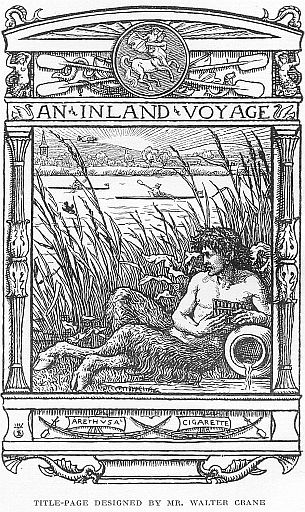
So much has been written on R. L. Stevenson, as a boy, a man, and a man
of letters, so much has been written both by himself and others, that I
can hope to add nothing essential to the world's knowledge of his
character and appreciation of his genius. What is essential has been
said, once for all, by Sir Sidney Colvin in "Notes and Introductions" to
R. L. S.'s "Letters to His Family and Friends." I can but contribute the
personal views of one who knew, loved, and esteemed his junior that is
already a classic; but who never was of the inner circle of his
intimates. We shared, however, a common appreciation of his genius, for
he was not so dull as to suppose, or so absurd as to pretend to suppose,
that much of his work was not excellent. His tale "Thrawn Janet" "is
good," he says in a letter, with less vigour than but with as much truth
as Thackeray exclaiming "that's genius," when he describes Becky's
admiration of Rawdon's treatment of Lord Steyne, in the affray in Curzon
Street. About the work of other men and novelists, or poets, we were
almost invariably of the same mind; we were of one mind about the great
Charles Gordon. "He was filled," too, "with enthusiasm for Joan of Arc,"
says his biographer, "a devotion, and also a cool headed admiration,
which he never lost." In a letter he quotes Byron as having said that
Jeanne "was a fanatical strumpet," and he cries shame on the noble
poet. He projected an essay on the Blessed Maid, which is not in "the
veniable part of things lost."
Thus we were so much of the same sentiments, in so many ways, that I can
hope to speak with sympathy, if not always with complete understanding,
of Stevenson. Like a true Scot, he was interested in his ancestry, his
heredity; regarding Robert Fergusson, the young Scottish poet, who died
so young, in an asylum, as his spiritual forefather, and hoping to
attach himself to a branch of the Royal Clan Alpine, the MacGregors, as
the root of the Stevensons. Of Fergusson, he had, in early youth, the
waywardness, the liking for taverns and tavern talk, the half-rueful
appreciation of the old closes and wynds of Old Edinburgh, a touch of
the recklessness and more than all the pictorial power which, in
Fergusson, Burns so magnanimously admired.
But genealogical research shows that Stevenson drew nothing from the
dispossessed MacGregors, a clan greatly wronged, from Robert Bruce's
day, and greatly given to wronging others. Alan Breck did not like "the
Gregara," apart from their courage, and in Alan's day they were not
consistent walkers.
Stevenson, as far as one can learn, had no Celtic blood; none, at least,
of traceable infusion: he was more purely Lowland than Sir Walter Scott.
His paternal line could be traced back to a West Country Stevenson of
1675; probably a tenant farmer, who was contemporary with the Whig
rising at Bothwell Bridge, with the murder of Archbishop Sharp, with
Claverhouse, and Sir George Mackenzie, called "the bluidy Advocate." An
earnest student of Mr. Wodrow's "History of the Sufferings," Louis did
not find "James Stevenson in Nether Carsewell" among the many martyrs
who live in the Libre d'Or of the Remnant. But he had "a Covenanting
childhood;" his father, Mr. Thomas Stevenson, was loyal to the positions
of John Knox (the theological positions); and, brought up in these,
Louis had a taste, when the tenets of Calvin ceased to convince his
reason, of what non-Covenanters endured at the hands of the godly in
their day of power.
Every little Presbyterian, fifty years ago, was compelled to be familiar
with the Genevan creed, as expressed in "The Shorter Catechism," but
most little Presbyterians regarded that document as a necessary but
unintelligible evil—the sorrow that haunted the Sabbath. I knew it by
rote, Effectual Calling and all, but did not perceive that it possessed
either meaning or actuality. Nobody was so unkind as to interpret the
significance of the questions and answers; but somebody did interpret
them for Stevenson, or his early genius enabled him to discover what it
is all about, as he told me once, and it seems that the tendency of the
theology is terribly depressing. A happier though more or less
theological influence on his childhood he found in the adventures and
sufferings of the Covenanters. It is curious (and shows how much early
education can do) that he never was a little Royalist: always his heart,
like Lockhart's, which is no less strange, was with the true blue
Remnant. I can remember no proof that he was fascinated by the greatness
of Montrose.
As is well known, at about the age of sixteen he perverted a romance of
his own making, "Hackston of Rathillet" (a fanatic of Fife), into a
treatise: "The Pentland Rising, a Page of History," published in 1866.
One would rather have possessed the romance.
Stevenson came from the Balfours of Pilrig, and was of gentle blood, on
the spindle side. An ancestress of his mother was a granddaughter of Sir
Gilbert Elliot (as a "law lord," or judge, Lord Minto), and so he could
say: "I have shaken a spear in the debatable land, and shouted the
slogan of the Elliots": perhaps "And wha dares meddle wi' me!" In "Weir
of Hermiston" he returns to "the auld bauld Elliots" with zest. He was
not, perhaps, aware that, through some remote ancestress on the spindle
side, he "came of Harden's line," so that he and I had a common forebear
with Sir Walter Scott, and were hundredth cousins of each other, if we
reckon in the primitive manner by female descent. Of these Border
ancestors, Louis inherited the courage; he was a fearless person, but
one would not trace his genius to "The Bard of Rule," an Elliot named
"Sweet Milk" who was slain in a duel by another minstrel, about 1627.
Genius is untraceable; the granite intellect of Louis's great
engineering forefathers, the Stevensons, was not, like his, tuneful:
though his father was imaginative, diverting himself with daydreams; and
his uncle, Alan Stevenson, the builder of Skerryvore, yielded to the
fascinations of the religious Muse. A volume of verse was the pledge of
this dalliance. His mother, who gave him her gay indifference to
discomfort and readiness for travel, also read to him, in his childhood,
much good literature; for not till he was eight years of age was he an
unreluctant reader—which is strange. The whole record of his life, from
his eighteenth month, is a chronicle of fever and ill-health, borne
always with heroic fortitude. His dear nurse, Alison Cunningham, seems
to have been a kind of festive Cameronian. Her recitation of hymns was,
though she hated "the playhouse," "grand and dramatic." There is a hymn,
"Jehovah Tsidkenu," in which he rejoiced; and no wonder, for the refrain
"Jehovah Tsidkenu was nothing to me," moves with the galloping
hoof-beats of
"'Tis up wi' the bonnets o' Bonny Dundee!"
I have, however, ascertained that this theological piece is not sung to
the tune, "The cavalry canter of Bonny Dundee." When the experiment is
made, the results are unspeakably strange.
It need not be said, Stevenson has told us in verse and prose, that in
childhood "his whole vocation was endless imitation." He was the hunter
and the pirate and the king—throwing his fancy very seriously into each
of his rôles, though visualizing never passed with him, as with some
children it does, into actual hallucination. He had none of the
invisible playmates that, to some children, are visible and real. He was
less successful than Shelley in seeing apparitions: but the dreams which
he communicated to Mr. Frederic Myers were curious illustrations of his
subconscious activities—his Brownies, as he called them. They told him
stories of which he could not foresee the end; one led up to a love
affair forbidden even by exogamous law (with male descent and the
sub-class system), and thus a fine plot was ruined.
Throughout life, he always played his part, as in childhood, with full
conscious and picturesque effect, as did the great Montrose and the
English Admirals, in whom he notes this dramatic trait. He was not a
poseur; he was merely sensitively conscious of himself and of life as
an art. As a little boy with curls and a velvet tunic, he read
"Ministering Children," and yearned to be a ministering child. An
opportunity seemed to present itself; the class of boys called "keelies"
by the more comfortable boys in Edinburgh, used to play in the street
under the windows of his father's house. One lame boy, a baker's son,
could only look on. Here was a chance to minister! Louis, with a beating
heart, walked out on his angelic mission.
"Little boy, would you like to play with me?" he asked.
"You go to ——!" was the answer of the independent son of the hardy
baker.
It is difficult to pass from the enchanted childhood of this eternal
child, with its imaginative playing at everything, broken only by fevers
whereof the dreams were the nightmares of unconscious genius. He has
told of all this as only he could tell it.
As a boy, despite his interrupted education, he laid the foundations of
a knowledge of French and German, acquired Latin, and was not like that
other boy who, Euclide viso, cohorruit et evasit. He was a
mathematician! He never played cricket, I deeply regret to say, and his
early love of football deserted him. He was no golfer, and a good day's
trout-fishing, during which he neglected to kill each trout as it was
taken, caused remorse, and made him abandon the contemplative boy's
recreation. Boating, riding, and walking were his exercises. He read the
good books that never lose their charm—Scott, Dumas, Shakespeare, "The
Arabian Nights"; when very young he was delighted with "The Book of
Snobs"; he also read Mayne Reid and "Ballantyne the Brave," and any
story that contained Skeltica, cloaks, swords, wigs on the green,
pirates and great adventures. He lived in literature, for Romance.
His doings at Edinburgh University, and as a budding engineer, he has
chronicled; he took part in snowball rows, in the debates of the
Speculative Society, and in private dramatic performances, organized by
his senior and friend, Professor Fleeming Jenkin. To "dress up" in old
costumes always pleased him. He happened to praise the acting of a girl
of fourteen, who, in her family circle, said, "Perhaps when I am old,
like the lady in Ronsard, I will say 'R. L. Stevenson sang of me.'" His
gambols "with the wild Prince and Poins" are not unrecorded. These were
his Fergussonian years. Perhaps he might have expressed Burns's esteem
for the "class of men called black-guards," as far as their
unconventionality is concerned. He saw a great deal of life in many
varieties; like Scott in Liddesdale, "he was making himsel' a' the
time." With his cousin R. A. M. Stevenson, Walter Ferrier, Mr. Charles
Baxter, and Sir Walter Simpson (a good golfer and not a bad bat), he
performed "acts of Libbelism," and discussed all things in the universe.
He was wildly gay, and profoundly serious, he had the earnestness of the
Covenanter in forming speculations more or less unorthodox. It is
needless to dwell on the strain caused by his theological ideals and
those of a loving but sternly Calvinistic sire, to whom his love was
ever loyal.
These things bred melancholy, of necessity, and melancholy was purged by
an almost unexampled interest, not in literature alone, but in the
technique of style, and the construction of sentences and periods. Few
of his confessions are better known than those on his apprenticeship in
style to the great authors of the past. He gave himself up to the
schools of Hazlitt, Lamb, Wordsworth, Sir Thomas Browne, Defoe,
Hawthorne, Montaigne, Baudelaire, William Morris, and Obermann (De
Senancour).
This he did when he was aged about eighteen, when other lads are trying
to write Latin prose like Cicero, or Livy, or Tacitus (Tacitus is the
easiest to ape, in a way), and Latin verse like Ovid, or Horace, or
Virgil. This they do because it is "part of the curricoolum," as the
Scottish baronet said, of school and college. But I do not remember
anecdotes of other boys with a genius for English prose who set
themselves to acquire style before they deemed that they had anything in
particular to say.
In English essays at college a young fellow may be told by his tutor not
to imitate Carlyle or Macaulay: the attempt to repeat the tones of
Thackeray is most incident to youth. But to aim, like Stevenson while a
student of Edinburgh University, at "the choice of the essential note
and the right word," in exercises written for his own improvement, is a
thing so original that it keeps me wondering. Like most of us, I have
always thought, with Mr. Froude, when asked how he acquired his style,
that a man sits down and says what he has to say, and there is an end of
it. We must not write like Clarendon now, even if we could; our
sentences must be brief. It would be affectation to write like Sir
Thomas Browne, if we could; or like de Quincey; and nobody can write
like Mr. Ruskin, when he is simple, or like the late Master of Balliol,
Mr. Jowett.
How far and how early Stevenson succeeded in the pursuit of style may be
seen in his "Juvenilia": for example, in the essay on the Old Gardener.
But one is inclined to think that he succeeded because he had a very
keen natural perception of all things, was a most minute observer, knew
what told in the matter of words, in fact, had a genius of his own; and
that these graces came to him, though he says that they did not, by
nature. He tells us how often he wrote and rewrote some of his
chapters, some of his books. His prima cura we have not seen; perhaps
it was as good as his most polished copy. "Prince Otto" has even seemed
to me, in places, over-written. He now and then ran near the rock of
preciosity, though he very seldom piled up his barque on that reef. His
style is, to the right reader, a perpetual feast, "a dreiping roast,"
and his style cannot be parodied. I never saw a parody that came within
a league of the jest it aimed at, save one burlesque of the deliberately
stilted manner of his "New Arabian Nights." This triumph was achieved by
Mr. Walter Pollock.
Stevenson's manner was too appropriate to his matter for parody: for
nobody could reproduce his matter and the vividness of his
visualization. When his characters were Scots, Lowlanders or
Highlanders, it seems to me that their style has no rival except in the
talk of Sir Walter's countrymen. A minute student who knew Stevenson,
has told me that he once suggested "chafts," where Louis had written
"cheeks" or "jaws," and that the emendation was accepted, but his Scots
always use "the right word," and never (in prose) say "tae" for "to," I
think. Theirs is the good Scots.
Perhaps I am biased in my doubt concerning the usefulness of his
persistence in re-writing, by my regret that he destroyed so many of his
romances, as not worthy of him. "King's chaff is better than other
folk's corn" says our proverb. In his day, I bored him by pressing him
to write more, and more rapidly; he never could have been commonplace,
he never could have been less than excellent. But his conscience was
adamant: no man was less of an improviser, as, fortunately, Scott was;
had he not been, there would not be so many Waverley Novels.
Stevenson was hard on Scott, who wrote much as he himself did in
boyhood. "I forgot to say," remarks the early Stevensonian hero, after
describing a day full of adventures with Red Indians, "that I had made
love to a beautiful girl." There is a faint resemblance to this
over-sight in a long sentence of "Guy Mannering," which Stevenson
criticized; but "Guy Mannering" was written in about six weeks, "to
refresh the machine." Fastidious himself, conscientious almost to a
fault in style, Stevenson's joy was in the romances of Xavier de
Montépin and Fortuné du Boisgobey, names which suggest
"Old crusading knights austere,
That bore King Louis company."
When Dumas and Scott, and perhaps Mrs. Radcliffe, had been read too
recently, Louis went to Fortuné and Xavier, and, doubtless, to the
father of them, Gaboriau. None of these benefactors of the race was a
student of style, but they gave him what Thackeray liked, stories "hot,
with," as he says, briefly but adequately.
All of us are led, like that ancient people Israel, like all humanity,
by a way we know not, and a path we do not understand. If some
benevolent genie, who understood Stevenson's qualities and genius, could
have directed his career, how would that spirit have educated him?
For some reason not intelligible he was put on an allowance of five
shillings weekly, for his menus plaisirs, till he was twenty-three
years of age. He never was an expensive man (except in giving, wherein
he knew no stint); his favourite velvet coats, his yellow shoes, his
black shirts, with a necktie of a scrap of carpet, he said (I failed to
guess its nature), were not extravagant. (The last occasion on which I
saw him in the legendary velvet coat was also the only moment in which I
viewed the author of his being. The circumstances were of the wildest
comedy, but the tale can never be told; though in all respects it
redounds to the credit of everybody concerned. Not one of us let a laugh
out of himself.)
But a young man in his position likes to do many harmless things which
cannot be done on five shillings a week, and so he sought the haunts of
"thieves and chimney sweeps!" he says, and wrote sonnets in those shy
retreats, which are known, perhaps, in Scotland, as "shebeens." Why
"shebeens"? Is the word Gaelic misspelled? Cases of "shebeening" are
tried before the Edinburgh magistrates, and as "my circle was being
continually changed by the action of the police magistrates" (he says)
conceivably his was a shebeening circle.
Another lad of his age, some eighty years earlier, was partial, like
him, to taverns and old clothes. "They be good enough for drinking in,"
said Walter Scott, when Erskine, or some other friend, ventured to
remonstrate. Scott, like Stevenson, knew queer people, knew beggars—but
had not one of them shaken hands with Prince Charles? Certainly, after
Scott met Green Mantle, and sheltered her, as she came from church,
under his umbrella (a piece of furniture which Stevenson can never have
possessed), he left off his old clothes, and went into the best company.
But R. L. S. did not delight in the good company of his native town; nor
did he suffer gladly the conventional raiment of the evening hours.
Green Mantle there was none, as far as we learn. He was not popular with
the young Scots of his age, his biographer says so candidly; candidly
have they said as much to me, yet they were good fellows.
From childhood he had enjoyed all the indulgences of an only son, and an
invalid; now he was "brought up short," and there were the religious
disputes with a sire to whom he was devoted. The climate of his own
romantic town (the worst in the world) was his foe; the wandering spirit
in his blood called him to the south and the sun; he tells of months in
which he had no mortal to whom he could speak freely, his cousin Bob
being absent; he was unhappy; he was out of his milieu.
What would the genie have done for him? Neither of the English
Universities would have been to his taste; the rebel in him would have
kicked at morning chapel, lectures, cap and gown, Proctors, the talk of
"oars" and "bats"; manifestly Balliol was not the place for R. L. S.,
though he might have been happy with his contemporary John Churton
Collins. He, I remember—even to the velvet coat—was like Stevenson,
and was a rebel. Grant Allen, too, would have been his contemporary—the
only man in Oxford who took to Herbert Spencer, whom Stevenson also read
with much edification.
Yet it is clear that Stevenson should not have been domiciled in the
paternal mansion of Heriot Row. The genie might have transported him to
a German University, perhaps to Heidelberg.
Dis aliter visum, and the result, for us, is his matchless book on
Edinburgh. To see a copy thereof is to take it up, and read through it
again; it is better at every reading.
In 1871 he broke to his father the news that the profession of
engineering was not for him. The Scottish Bar (1874-1875) was not more
attractive, and in 1873 his meeting with Mr. (now Sir) Sidney Colvin
(then Slade Professor of Fine Art at Cambridge, and already well known
as a critic), and with a lady, Mrs. Sitwell, to whom many of his most
carefully written early letters are addressed, probably sealed Stevenson
into the profession of literature.
He has left this note on his prospects:
"I think now, this 5th or 6th of April, 1873, that I can see my
future life. I think it will run stiller and stiller year by year; a
very quiet, desultorily studious existence. If God only gives me
tolerable health, I think now I shall be very happy; work and
science calm the mind and stop gnawing in the brain; and as I am
glad to say that I do now recognise that I shall never be a great
man, I may set myself peacefully on a smaller journey; not without
hope of coming to the inn before nightfall.
O dass mein Leben
Nach diesem Ziel ein ewig Wandeln sey!
DESIDERATA
I. Good Health
II. 2 to 3 hundred a year
III. O du lieber Gott, friends!
AMEN
Robert Louis Stevenson"
He wrote an article, this born wayfarer, on "Roads," which was accepted
by P. G. Hamerton for the "Portfolio," but in November, 1873, "nervous
exhaustion, with a threatening of phthisis," caused him to be "Ordered
South" to Mentone—a lonely exile. Here he was joined by Mr. Colvin, and
in Mr. Colvin's rooms, for I also was "ordered South," I first met this
surprising figure. Our schooldays had just overlapped; he was a "gyte"
(a child in the lowest form; "class" we called it), when I was in the
highest, but I had never seen him, nor heard of him.
In some rhymes of his later years, when Count Nerli was painting his
portrait, Louis wrote:
"Oh, will he paint me the way I like, and as bonny as a girlie,
Or will he make me an ugly tyke; and be d—— to Mr. Nerli?"
When first we met, he really was "as bonny as a girlie"; with his oval
face, his flushed cheeks, his brown eyes, large and radiant, and his
hair of a length more romantic than conventional. He wore a wide blue
cloak, with a grace which hovered between that of an Italian poet and an
early pirate.
It was impossible not to discover, in a short conversation, that he was
very clever, but, as a girl said once of her first meeting with another
girl, "We looked at each other with horny eyes of disapproval." I
thought that he was affecting the poet, and in me he found a donnish
affectation of the British sportsman. He said later that I complained,
concerning Monsieur Paul de St. Victor, that he was "no sportsman,"
though his style was effulgent.
We seldom met again, unhappily, for I was then with a family in whose
company he would have been happy: all young, all kind, simple, and
beautiful, and all doomed. Stevenson was then seriously ill, certainly a
short walk fatigued him.
The next news I had of him was in his essay, "Ordered South," concerning
the emotions, apathies, and pleasures, on that then fairy coast, of a
young man who thinks that his days are numbered. After reading this
paper, I was absolutely convinced that, among the writers of our
generation, Stevenson was first, like Eclipse, and the rest nowhere.
There was nobody to be spoken of in his company as a writer. It was not
his style alone—Pater's style had bewitched me in his first book—but
it was the life that underlay the style of Stevenson.
He came home, and found peace at home, and a less inadequate allowance,
and he put up a brazen plate, "R.L. Stevenson, Advocate," on the door in
Heriot Row. But his practice was a jest. Some senior men sought his
society, his old friends were with him; his articles were welcomed by
Mr. Leslie Stephen in "The Cornhill Magazine," and were eagerly expected
by a few. Directed by Mr. Stephen, he found Mr. Henley in the Edinburgh
Infirmary, and that friendship began which was of such considerable
influence in his life and work.
Mr. Henley's "maimed strength," his impeded vigour, even his blond
upstanding hair and "beard all tangled," his uncomplaining fortitude
under the most cruel trials, and the candid freshness of his
conversation on men and books, won Stevenson's heart.
In London, Stevenson appeared now and again at the Savile Club, then
tenanting a rather gloomy little house in Savile Row. The members were
mostly connected with science, literature, journalism, and the stage,
and Stevenson became intimate with many of them, especially with the
staff and the sub-editor (in those days) of "The Saturday Review," Mr.
Walter Pollock; and with Mr. Saintsbury, Mr. Traill, Mr. Charles
Brookfield, Sir Walter Besant; a little later with Mr. Edmund Gosse, who
was by much his favourite in this little society. In addition to the
chaff of the "Saturday" reviewers, he enjoyed the talk of Prof.
Robertson Smith, Prof. W. H. Clifford, and Prof. Fleeming Jenkin.
Stevenson never wrote, to my knowledge, in "The Saturday Review";
journalism never "set his genius." For one reason among many, his manner
was by far too personal in those days of unsigned contributions. He
needed money, he wished to be financially independent, but, in the
Press, his independence could not be all that he desired. He did not
wield the ready, punctual pen of him whom Lockhart most invidiously
calls "the bronzed and mother-naked gentleman of the Press."
His conversation at luncheon, and after luncheon, in the Club was the
delight of all, but, for various reasons, I was seldom present. I do
remember an afternoon when I had him all to myself, but that was later.
He poured out stories of his American wanderings, including a tale of a
murderous lonely inn, kept by Scots, whose genius tended to
assassination. He knew nothing of their exploits at home, but, then or
afterwards, I heard of them from a boatman on Loch Awe. Their mother was
a witch!
At this period Stevenson was much in Paris, and alone, or with his
cousin Bob dwelt at Barbizon and other forest haunts of painters. The
chronicle of these merry days is written in the early chapters of "The
Wrecker."
In literature he was "finding himself," in his Essays, but the world did
not find him easily or early.
History much attracted him, as it did Thackeray, who said, "I like
history, it is so gentlemanly." But it can only be written by gentlemen
of independent means. Stevenson's favourite period was that of the
France of the fifteenth century, and he studied later some aspects of
that time in essays on Charles d'Orleans, in his admirable picture of
Villon as a man and poet, and especially in "A Lodging for the Night,"
and "The Sieur de Malétroit's Door," shut on a windy night in the month
after the Maid failed at Paris (September, 1429).
These unexcelled short stories really revealed Stevenson as the
narrator, his path lay clear before him. But even his friends were then
divided in opinion; some preferring his essays, and his two books of
sentimental travel, "An Inland Voyage" (1878) and "Travels with a
Donkey" (1879). These were, indeed, admirable in style, humour,
description, and incident, but the creative imagination in the stories
of Villon's night and of the Sieur de Malétroit's door, the painting of
character, the romance, the vividness, were worth many such volumes.
They were well received by the Press, these sketches of travel, but, as
Monsieur Got says in his "Journal" (1857), "Les succès des délicats
sont, même quand ils s'établissent, trop lents à s'établir. La foule
s'est tellement démocratisée qu'il n'a pas de salut si l'on ne frappe
brutalement." The needful brutality was not employed till Stevenson
"knocked them" with "Jekyll and Hyde."
"The world is so full of a number of things," that a few essays, two or
three short stories in a magazine, a little book of sketches in prose,
may be masterpieces in their three several ways, but they escape the
notice of all but a few amateurs. Mr. Kipling's knock was much more
insistent; he could not be unheard. It was not by essays on Burns and
Knox, however independently done, that Stevenson could make his mark.
Concerning these heroes, Scotland has a vision of her own, and no man
must undo it; no man must tell, about Knox, facts ignored by Professors
of Church History. Indeed, to study Knox afresh demands research for
which Stevenson had not the opportunity. The Covenanting side of his
nature appeared in his study of the moral aspect of Burns; his feet of
clay. It is agreed that we must veil the feet of clay. As Lockhart says,
Scott infuriated Mr. Alexander Peterkin by remarking that Burns "was not
chivalrous." Stevenson went further, and annoyed the Peterkins of his
day. His task required courage: it was not found wanting.
In 1877, Stevenson had a new, if very narrow, opening. A friend of his
at Edinburgh University, a young Mr. Caldwell Brown (so Stevenson named
him to me; his real name seems to have been Glasgow Brown), came to the
great metropolis to found a Conservative weekly journal. "London" was
its name, but Edinburgh was its nature, and base, if a base it had. The
editor was "in the air"; he knew nothing of his business and its
difficulties; nothing of what the Conservative public, with sixpences to
spend, was likely to want. He approached some of Stevenson's friends,
and he gave the Conservative party scores of lively ballades,
villanelles, and rondeaux. They were brilliant. Stevenson would not
tell me the author's name; he proved to be Mr. Henley, who came to town,
and, on the death of Mr. Brown, edited this unread periodical. There
were "Society" notes, although Mr. Henley's haunts were not those of
that kind of society, and one occasional contributor ventured to
remonstrate about the chatter on the "professional beauties" of that
distant day.
The "New Arabian Nights," with all their humour, and horror, all their
intellectual high spirits, and reckless absurdity, were poured by
Stevenson into this outcast flutterer of a Tory paper, to the great joy
of some of the very irregular contributors. (It was an honest
flutterer—its contributors received their wages.)
Then "London" died, and then seriousness enough came into the life of
our Arabian author. In August, 1879, he disappeared; he went to America
to marry the lady whom he had first met at Fontainebleau, whom he wedded
at San Francisco (1880), and loved with all his heart.
Reconciled to his father, he returned to Scotland. His health had been
anew impaired by troubles and privations, and the rest of his life in
the Old World was occupied by a series of maladies, vain roamings in
search of climate, and hard work constantly interrupted.
From his early childhood onwards, an army of maladies surrounded him,
invested him, cut him off if, in an hour of health, he ventured on any
sally; but they never overcame his invincible resolution. He was, as one
of his favourite old authors says about I forget what emperor, "an
entertainer of fortune by the day," making the most of every sunny hour,
and the best of every hour passed under the shadow of imminent death. I
remember that, soon after his marriage, he was staying in London at the
house of a friend. Going to see him, I noted in him a somewhat anxious
look, and I did not wonder at it! Mr. Henley was seated in a great
chair, the whole of his face, from the eyes downwards, muffled in a huge
crimson silk pocket handkerchief, of which the point covered his aureate
beard.
The room was a large room, and as Louis flitted about it, more suo, he
managed to tell me privily that Henley had a very bad cold, and that he
himself caught every cold which came within a limited radius. He did
catch that cold, I heard, and when once such an invader entered his
system, nobody knew what the end of it might be. His lungs usually
suffered; hemorrhage was frequent and often alarming. In one of these
accesses, unable to speak, he wrote, "Do not be frightened. If this is
the end it is an easy one."
Many scraps written by him in circumstances like these used to exist;
some of them, though brief, were rich in the simple eloquence of
indignation.
Almost no climate did him any good: in 1880-1881, he chiefly suffered at
Davos, and in the tempests of September, in Braemar. At Davos he had few
consolations except the society of Mr. J. A. Symonds (the Opalstein of
his essay on "Talk and Talkers") and his family. He was still attached
to the indigent Muse of History: meditating a "History of the
Highlands," and another book on that much trampled topic, the Union of
1707. When one thinks of the commercial statistics necessary to the
student of the Union—to take that grim aspect of it alone—enfin, "I
have been there, and would not go." In the nature of things the History
of the Union would have become a romance, with that impudent,
entertaining rogue, Ker of Kersland, and his bewildered Cameronians, for
the heroes: with Hamilton the waverer, and the dark, sardonic Lockhart
of Carnwath, and Daniel Defoe as the English looker-on. The study of
Highland history led to the reading of the Trial of James of the Glens,
and the vain hunt for Alan Breck, and so to "Kidnapped."
Stevenson felt and described the exhilaration of Alpine mornings, but
his style was as sensitive as his bronchial apparatus, and he declares
that when he tried to write, the style suffered from "yeasty inflation,"
while his nights were haunted by the nightmares of his childhood.
The next change carried him to a cottage near Pitlochry, whence he wrote
that he was engaged in the composition of "crawlers." The first and best
of these, "Thrawn Janet," was (with his "Tod Lapraik" in "Kidnapped")
the only pendant to Scott's "Wandering Willie's Tale," in the northern
vernacular. The tale has a limited circle; no Southern can appreciate
all its merits, the thing is so absolutely and essentially Scots;
especially the atmosphere. He said that it was "true for a hill parish
in Scotland in old days, not true for mankind and the world." So it is
fortunate to be a native of a hill parish in Scotland!
"The Merry Men," as "a fantasia or vision of the sea," is excellent; the
poor negro never was, to myself, "convincing." However, knowing
Stevenson's taste in art, I designed for him, in Skeltic taste, an
illustration (coloured) of the negro pursuing the wicked uncle (in the
philabeg) over the crests of Ben Mor, Mull.
Descending from these heights, Stevenson, like every bookish Scot,
"ettled at" a professorial chair—that of "History and Constitutional
Law," in the University of Edinburgh.
The election was in the winter, the legist and historian occupied the
autumn in composing the first half of "Treasure Island" (originally "The
Sea Cook").
Everyone knows the story: how, playing with his stepson, Stevenson drew
a map of an island—an island like a dragon seyant; considered the
caves and hills and streams, and thought of the place as a haunt of
these serviceable pirates, who always dumped down their hard-earned swag
on distant and on deadly shores, which they carefully abstained from
revisiting. The legends of Captain Kidd's caches have long haunted the
imagination; the idea of Hidden Treasure has its eternal charm, and the
story thereof was told, once for all, by Poe. Soon after "Treasure
Island" appeared there was a real treasure hunt. The deposit, so I was
informed, was "put down by a Fin," and Mr. Rider Haggard and I were
actually paying (at least Mr. Haggard sent me a cheque) for shares in
this alluring enterprise, when I learned that the Fin (or Finn? a native
of Finland), had looted the church plate of some Spanish cathedral in
America. Knowing this, I returned his cheque to Mr. Haggard; happily,
for the isle was the playroom of young earthquakes, which had upset the
soil and the landmarks to such a degree that the gentleman adventurer
returned—bredouille! I hope Stevenson had nothing on.
In the Highland cottage, during the rain eternal, he amused himself with
writing his story, as Shelley, Byron, Polidori, and Mary Godwin had
diverted themselves in Swiss wet weather, with their ghost stories,
"Frankenstein," and Byron's good opening of a romance of a vampire.
Visitors came—Mr. Colvin, Mr. Gosse, and Dr. Japp—they liked the tale
as chapter by chapter was read aloud, and it was offered to a penny
periodical for boys. A much better market might easily have been found;
indeed, Stevenson "wasted his mercies." He was paid like the humblest of
unknown scribblers; not even illustrations were given to the obscure
romance running in dim inner pages of the periodical, and it appears
that, as Théophile Gautier's editor said about one of his narratives,
"the abonné was bored with the style."
It was an audacious thing for a man of Louis's health, and intermittent
inspiration, to send in half the "copy," meaning to send the rest later
from Davos. He might not be able, physically, to write—the inspiration
might vanish—and there was John Addington Symonds, eager for him to
write on the "Characters" of Theophrastus! He might as well have
written, or better, on the "Characters" of Sir Thomas Overbury, which
are rather less remote from the ken of the British public than those of
the Greek.
If any young man or woman, not in possession of independent means, reads
these lines of mine, let him or her take warning, and deserting history,
morals, the essay, biography, and shunning anthropology as they would
kippered sturgeon or the devil, cleave only to fiction!
Biography also allured Stevenson—his literary tastes were nearly his
ruin; he wanted, at Davos, to write a "Life of Hazlitt," and at
Bournemouth a biography of Arthur, Duke of Wellington. But time and
strength were lacking; nor have we R. L. S.'s mature opinion of the
strategy and tactics of the victor of Assaye. The Muse of piratical
enterprise returned, and "Treasure Island" reached its haven, with no
applause, in the paper for boys.
In the following May, Messrs. Cassell proposed to publish "Treasure
Island" in book form, being spirited up, I suppose, by Mr. Henley, who
was editing for them "The Magazine of Art," in which Stevenson wrote two
or three articles. (I remember that a letter of my own to "The Editor,"
as Mr. Henley had proudly signed himself, came automatically into the
hands of the General Editor, a clergyman, if I do not err, and that my
observations on the Art of Savages, lighting on the wrong sort of
ground, sprang up and nearly choked Mr. Henley.) Stevenson was already
the victim of the Yankee pirate, whose industry, at least, made his
name, though wrongly spelled, known to the community which later paid
him so well for his work, and displayed for him an enthusiasm of
affectionate admiration.
In 1884 he worked at the often rewritten "Prince Otto," and did a
pot-boiler—"The Black Arrow"—which pleased the boy public of the paper
much better than "Treasure Island." His time, from January, 1883, to
May, 1884, was passed at Hyères. In the end of November, "Treasure
Island" was published in book form, and was warmly welcomed by the Press
and by such friends of the author as retained, at least in letters, any
smack of youth. It was forced, as far as "You must read it, please,"
even on the friends of the friends, and so on in successive waves, yet
it did not reach a wide circle: five or six thousand copies were sold in
the first year. That is failure in the eyes of many of our novelists
whose style does not bore the unfastidious abonné. Stevenson, in
writing an article for a magazine on his "First Book," chose "Treasure
Island," for books other than novels do not count as books. He spoke of
terror as the motive and interest of the tale; the dread for each and
all of a mutiny headed by his ruthless favourite, John Silver. Indeed,
terror, whether caused by the eccentric furies of Mr. William Bones,
mariner, or of the awful blind Pew with his tapping staff, runs through
the volume as the dominant motive. But there is so much else: the many
landscapes, so various and so vivid; the humour of the Doctor and the
Squire, the variety of the seamen's characters; the Man of the Island,
with his craving for a piece of cheese; above all, John Silver. He is
terrible, this coldly cruel, crafty, and masterful Odysseus of the
Pacific. His creator liked him, but I could have seen Silver withering
on the wuddie at Execution Dock, or suspended from a yardarm, without
shedding the tears of sensibility. "A pirate is rather a beast than
otherwise," says a young critic in "The Human Boy," and I cannot get
over Silver gloating on the prospect of torturing Trelawny. At all
events, he is an original creation, and a miraculous portent in a boy's
book.
Fiercer attacks of illness in various forms drove Stevenson to
Bournemouth; he was engaged, when he had the strength, on those plays
(in collaboration with Mr. Henley) which prove that he had not the
mysterious gift of writing for the stage. "I hope Mr. Henley wrote most
of it," said a lady, as she left the theatre where she had seen "Deacon
Brodie" played. Had Deacon Brodie been Archdeacon Brodie, there would
have been more piquancy in the contrast of his "double life."
This idea of the double life of each man had long haunted Stevenson. He
told me once that he meant to write a story "about a fellow who was two
fellows," which did not, when thus stated, seem a fortunate idea.
However, happily, he continued to think of Hyde and Jekyll, yet knew not
how to manage them. One night, after eating bread and jam freely, he had
a nightmare; he saw Hyde, pursued, take refuge in a closet, swallow "the
mixture as before"—the mysterious powder or potion—and change horribly
into Jekyll.
He set to work at once, and in three feverish days completed the first
draft of his parable. In this the Hyde aspect was only Jekyll's
unassuming disguise, adopted at hours when he wished to be a little gay.
Stevenson burned his first draft, and rewrote the whole in three days.
He knew, it seems, that the magical powder was an error. One sees how
the thing could be managed otherwise, with a slight strain on the
resources of psychical research. But in no way could the story have
attained "the probable impossible," which Aristotle preferred to "the
improbable possible."
Stevenson sent the manuscript to my friend Mr. Charles Longman, who, in
turn, sent it to me. I began to read it one night, in the security of a
modest London drawing-room, and, naturally, it fascinated me from the
first page. Then I came to a certain page, which produced such an
emotion that I threw the manuscript on a chair, and scuttled
apprehensively to the safety of bed. Later, a kinsman, who seldom read a
book, told me that, living alone in a great Highland house, he had
thrown down the printed book at the same passage, and made the same
inglorious retreat. Anyone who knows the book, knows what the passage
is.
The story was produced in a paper-covered volume costing a shilling, and
was little heeded till a reviewer in The Times "caught this great
stupid public by the ear," as Thackeray said.
The clergy of all denominations did the rest. As they had preached on
"Pamela," a hundred and forty years earlier, so they called the
attention of their flocks to Hyde and to Jekyll. "Who are Hyde and
Jekyll, my brethren? You are Hyde and Jekyll. I am Jekyll and Hyde;
each of us is Jekyll, and, alas, each of us is Hyde!"
Stevenson had long ago "found himself"; now he was found by the public.
The names of his two rascally heroes (Dr. Jekyll is even less of a
gentleman than Hyde) became proverbial.
The gruesome parable occupied an interval in the making of what I
suppose is his masterpiece—"Kidnapped." The story centres on the Appin
Murder of 1751, about which he had made inquiries in the neighbourhood
of Rannoch, where Alan Breck skulked after the shooting of Campbell of
Glenure in the hanging wood south of Ballachulish. Stevenson could not
learn who "the other man" was—the real murderer in the romance. I know,
but respect the Celtic secret. The fatal gun was found, very many years
after the deed, by an old woman, in a hollow tree, and it was not the
gun of James Stewart.
(I have a friend whose great-great-grandfather was standing beside James
of the Glens, watching the digging of potatoes. A horse was heard
approaching at such a pace that James said, "Whoever the rider is, the
horse is not his own." As he galloped past, the rider shouted: "Glenure
is shot!" "Who did it I don't know, but I am the man that will hang for
it," said James, too truly.)
Of "Kidnapped," Stevenson said (as Thackeray said of Henry Esmond and
Lady Castlewood, as Scott says of Dugald Dalgetty) that, in this book
alone of his, "the characters took the bit in their teeth," at a certain
point. "It was they who spoke, it was they who wrote the remainder of
the story."
They are spontaneous, they are living. Balfour, in the scenario of the
tale, was to have been kidnapped and carried to the American
plantations. But he and Alan "went their ain gait." At the end, you can
see the pen drop from the weary fingers; they left half-told the story
of Alan, to be continued in "Catriona."
A love of Jacobite times, and of Alan Breck's country, Lochaber,
Glencoe, Mamore, may bias me; but in "Kidnapped" Stevenson appears to me
to reach the height of his genius in designing character and landscape;
in humour, dialogue, and creative power. As in his preceding stories,
there is hardly the flutter of a petticoat, but the tale, like Prince
Charles at Holyrood, can point to a Highland man of the sword, and say,
"These are my beauties." I remember that Mr. Matthew Arnold admired the
story greatly, and he had no Jacobite or local bias.
In May, 1887, Stevenson lost his father, and paid his last visit to his
native country.
It was during this period, in 1886 probably, that I, for the first time,
saw Stevenson confined to bed in one of his frequent illnesses, and
then, also, I saw him for the last time. So emaciated was he (we need
not dwell on what seemed that "last face of Hippocrates"), that we could
not believe there remained for him some crowded years of life and
comparatively healthy and joy-bestowing energy. If the ocean was
henceforth to roll between us, at least he said that we were always best
friends when furthest apart; though, indeed, we were never so intimate
as to be otherwise than friendly. It was never the man that I knew best;
but the genius that I delighted in, "on this side idolatry." Always, in
verse or in prose, in Scots or in English, he made one reader happy; by
a kind of pre-established harmony of taste which might not have
prevailed in the intercourse of every day's life.
In August, 1887, Stevenson left England for ever, arriving at New York
as a lion, hunted by reporters, whom, no doubt, he received with the
majestic courtesy of his own Prince of Bohemia. Two versions of Jekyll
and Hyde were being acted; all this was very unlike the calm
indifference of his native land. It seems that in Jekyll, as "Terryfled"
(in Scott's phrase), there is a "love interest"; love is alien to Dr.
Jekyll, as to the shepherd before he found that Love was a dweller on
the rocks. The Terryfication was, at least, an advertisement. To
advertise himself, in the modern way, Stevenson was not competent. He
never was interviewed as a Celebrity at Home, as far as I am aware.
Indeed, he loved not society papers, and lit a bonfire and danced a
dance around it in his garden, when some editor of a journal of that
sort was committed to prison. His name is not mentioned, but Stevenson
and I had against him a grudge of very old standing.
Dollars in sufficient profusion were offered for his works, and in the
Adirondack Hills, beside a frozen river in the starlit night, he dreamed
of "a story of many years and countries, of the sea and the land,
savagery and civilization." He thought of that old Indian marvel, the
suspended life of the buried fakir, over whose grave the corn is sown
and grown. He thought of an evil genius on whom this method should be
tried in frozen Canadian earth. Thus, what seems like the far-fetched
idea of a wearied fancy in "The Master of Ballantrae" was, from the
first, of the essence of that bitter romance. The new conception fitted
in with a tale, already dreamed of on the Perthshire moors, about the
dark adventurous years of the Jacobite eclipse. The Prince was hidden in
a convent of Paris, or flashing for a moment in the Mall, or cruising, a
dingy bearded wanderer, in Germany or the Netherlands; while his
followers were serving under French colours, under Montcalm or
Lally-Tolendal. Men who had charged side by side at Gledsmuir and
Culloden, might meet as foes in Canada or Hindostan. There is matter
enough, in 1750-1765, for scores of romances, but who now can write
them? But the Master did not now begin his deeds of bale. Stevenson's
stepson, Mr. Osbourne, then very young, himself wrote "The Finsbury
Tontine; or The Game of Bluff," and I was informed at the time by
Stevenson's devoted admirer, Mr. McClure, that the book was completed by
Mr. Osbourne for the Press. Then Stevenson took up the manuscript, and,
as Mr. Osbourne says, "forced the thing to live as it had never lived
before." Indeed, the style of "The Wrong Box" throughout, is Louis's
style in such romantic farces as "The New Arabian Nights," a manner of
his own creation.
I seem to remember that I saw the finished manuscript, or perhaps an
early copy of the book, and I did not care for it. Mr. Kipling rather
surprised me by finding it so very amusing. Mr. Osbourne says that the
story "still retains (it seems to me) a sense of failure," and that the
public does not relish it. For my own part, on later re-readings, the
little farce has made me laugh hysterically at the sorrows of Mr.
William Pitman, that mild drawing-master, caught up and whirled away
into adventures worthy of the great Fortuné du Boisgobey. The scene in
which he is described as the American Broadwood, a person inured to a
simple patriarchal life, a being of violent passions; with the immortal
John in the character of the Great Vance; and that joy for ever, Uncle
Joseph, with his deathless thirst for popular information and
instruction—these personages, this "educated insolence," never cease to
amuse. Uncle Joseph is no caricature. But the world likes its
sensational novels to be written with becoming seriousness; in short,
"The Wrong Box" is aimed at a small but devoted circle of admirers.
People constantly ask men who have collaborated how they do the
business? As a rule, so some French collaborator says, "some one is the
dupe, and he is the man of genius." This was not true, too notably, in
the case of Alexandre Dumas, nor was it true in Stevenson's case. As a
rule, one man does the work, and the other looks on, but, again, this
was not the way in which Stevenson and Mr. Osbourne worked. They first
talked over the book together, and ideas were struck out in the
encounter of minds. This practice may, very probably, prove unfruitful,
or even injurious, to many writers; they are confused rather than
assisted. After or during the course of the conversations (when he had
an ally), after reflection, when he had not, Stevenson used to write out
a series of chapter headings. One, I remember, was "The Master of
Ballantrae to the Rescue," an incident in a tale which he began about
the obscure adventures of Prince Charles in 1749-1750. "Ballantrae to
the Rescue"—the sound was promising, but I do not know who was to be
obliged by the Master.
After the list of chapters was completed, Mr. Osbourne used to write the
first draft, "to break the ground," and then each wrote and rewrote, an
indefinite number of times. The style, the general effect produced, are
the style and the effect of Stevenson. "He liked the comradeship." More
care was taken than on a novel of which I and another were greatly
guilty. My partner represented Mr. Nicholas Wogan as rubbing his hands
after a bullet at Fontenoy (as history and I made quite clear) had
deprived Mr. Wogan of one of his arms. There is no such error in the
"Iliad," despite the unnumbered multitude of collaborators detected by
the Higher Criticism.
In June, 1888, Stevenson sailed out on the Pacific in search of health,
and followed the shining shadow through the isles and seas till he made
his last home at Samoa. It was a three years' cruise among "summer isles
of Eden." Perhaps no book of Stevenson's is less popular than his
narrative of storm and calm, of beachcombers and brown Polynesian
princes. The scenery is too exotic for the general taste. The joy and
sorrow of Stevenson was to find a society "in much the same
convulsionary and transitional state" as the Highlands and Islands after
1745. He was always haunted, and in popularity retarded, by History. He
wanted to know about details of savage custom and of superstitious
belief, a taste very far from being universal even in the most highly
cultivated circles, where Folklore is a name of fear. He found among the
natives such fatal Polynesian fairy ladies as they of Glenfinlas, on
whom Scott wrote the ballad. He found a medicine-man who hypnotized him
from behind his back, which nobody at home had been able to do before
his face. He exchanged stories with the clansmen—Scots for Polynesian;
they were much the same in character and incident. He had found, in
Polynesia, the way out of our own present. He met a Polynesian Queen—a
Mary Stuart or a Helen of Troy grown old. "She had been passed from
chief to chief; she had been fought for and taken in war"; a "Queen of
Cannibals, tattooed from head to foot." Now she had reached the Elysian
plain and a windless age, living in religion, as it were: "she passes
all her days with the sisters."
She was not a white woman: none of these people, so courteous and kind,
were white, were up-to-date. In London and New York amateurs did not
want to be told about them in Stevenson's "Letters from the South
Seas." Stevenson "collected songs and legends": fortunately he also
worked at "The Master of Ballantrae," in spite of frequent illnesses,
and many perils of the sea. "The Master of Ballantrae" was finished at
Honolulu; the closing chapters are the work of a weary pen.
He had made tryst with an evil genius that was essential to the
conception of the book, and with a hideous tale of fraternal hatred,
told by a constitutional coward. Everything is under the shadow of
thunder and lit by lightning. A glimpse of Allan Breck, and the
babblings of the Chevalier Bourke, are the only relief. But the life is
as clearly seen as life in Stevenson's books always is, for example when
the guinea is thrown through the stained window pane, or the old
serving-man holds the candle to light the duel of brothers who are born
foes; or as in the final scenes of desperate wanderings in the company
of murderers through Canadian snows. But the book, as Sir Henry Yule
said, is "as grim as the road to Lucknow"—as it was intended to be.
A fresh cruise, in the following year, bettered his health, and brought
him the anecdote of a mystery of the sea which was the germ of "The
Wrecker." He saw Samoa, and bought land there—Vailima—the last and
best of his resting-places; and here he was joined, in 1891, by his
intrepid mother. He was now a lord of land, a householder in his
unpretentious Abbotsford, and "a great chief" among the natives,
distracted as they were by a king de facto, and a king over the water,
with the sonorous names of Malietoa and Mataafa. Samoan politics, the
strifes of Germany, England, and the States, were labyrinthine: their
chronicle is written in his "Footnote to History." My conjectures as to
the romantic side of his dealings with the rightful king are vague and
need not be recorded. "You can be in a new conspiracy every day," said
an Irishman with zest, but conspiracies are better things in fiction
than in real life; and Stevenson had no personal ambitions, and, withal,
as much common sense as Shelley displayed in certain late events of his
life. He turned to the half-finished "Wrecker" and completed it.
When the story began to appear in "Scribner's Magazine" it seemed full
of vivacity and promise. The opening scenes in the Pacific were like
Paradise, as the author said, to dwellers in Brixton, or other purlieus
of London. The financial school at which Loudon Dodd was educated in
Stock Exchange flutters was rather less convincing than any dream of
Paradise, but none the less amusing. At home in Edinburgh, with the old
Scottish master of jerry-building and of "plinths," the atmosphere was
truly Scots, tea-coseys and all, while the reminiscences of Paris and
Fontainebleau, and the grandeurs et misères of "the young
Americo-Parisienne sculptor" were perfectly fresh to the world, though
some of the anecdotes were known to Stevenson's intimates. Mr. James
Pinkerton is a laudable creation, with his loyalty, his innocence, his
total ignorance and complete lack of taste, and his scampers too near
the wind of commercial probity. The spirit of hustle incarnate in a man
otherwise so innocent, the ideals caught from heaven knows what American
works for the young, and the inspired patriotism, the blundering
enthusiastic affection, make the early Pinkerton a study as original as
it is entertaining.
The sale by auction of the wreck, which, by arrangement, is to be
Pinkerton's prey, the mysterious opposition of the other bidder, so
determined to win an object apparently so worthless, is no less
thrilling than the sale of the fur coat in Boisgobey's "Crime de
l'Opéra." But the reader knows why the fur coat is so much desired,
whereas I remember being driven so wild by curiosity about the value of
the wreck that I wrote to Louis, desiring to learn the secret. He would
not divulge it, and when, after the voyage to the island and the
excitement of knocking the wreck to pieces were over—when the secret
came out, it was neither pleasant nor probable. That a mild British
amateur of water-colour drawing should have taken part in a massacre of
men, shot painfully with cheap revolvers, was an example of "the
possible improbable," and much more of a tax on belief than the
transformation of Dr. Jekyll. When I mildly urged this criticism, I
learned, by return of post, from a correspondent usually as dilatory as
Wordsworth, that I was a stay-at-home person ignorant of the world, and
of life as it is lived by full-blooded men on the high seas. That was
very true, but the amateur in water-colour was also a mild kind of good
being. "What would I have done with the crew who were such compromising
witnesses, and were butchered?" I would have marooned them.
"The Beach of Falesá" is a revelation of unfamiliar life and character,
and one is attached to the little brown heroine. There was to have been
"a supernatural element," better, probably, than the device of the
Æolian harps hung in the thicket. "I have got the smell and the look of
the thing a good deal," he said, and he had got the style of his rough
English narrator, who was, as he told the missionary, "what you call a
sinner, what I call a sweep," but repented in time.
A period of many projects followed; one, "The Young Chevalier," had a
germ in "The Letter of Henry Goring" (1749-1750), with which I brought
him acquainted, not knowing then that it was merely a romance by the
prolific Eliza Heywood. It was in this tale that the Master of
Ballantrae was to come to the rescue, and I think that a Scottish
assassin (who lurks obscure in real history) and Mandrin, the famed
French robber, were to appear, but only a chapter is published among
other fragments. As it stands, Prince Charles's eyes are alternately
blue and brown; brown was their actual colour—they were like
Stevenson's own.
Fortunately, the "Chevalier" was deserted for the continuation of
"Kidnapped," a sequel which is as good as, or, thanks to the two
heroines, Catriona and Barbara Grant, is even better than, the original.
To think of it is to wish to take it from the shelf and read it again.
It is all excellent, from the scenes where Alan is hiding under a
haystack (suggested by an adventure of the Chevalier Johnstone after
Culloden), and the first meeting with that good daughter of Clan Alpine
and of James Mor, onwards.
Stevenson excited a good deal of odium among fiery Celts by his
scoundrel Master of Lovat. There is no reason, as far as I am aware, to
suppose that Simon was a scoundrel, but, as a figure in fiction, he is
very firmly drawn. The abortive duel of Balfour with the Highland
Ensign, who conceives high esteem of "Palfour," is in the author's best
manner, as are the days of prison in that "unco place, the Bass," and he
was justly proud of the wizard tale of Tod Lapraik. The bristling
demeanour of Alan Breck and James Mor (a very gallant but distinctly
unfortunate son of Rob Roy), seems a correct picture. Indeed, James Mor
was correctly divined, probably from letters of his published in Scott's
"Rob Roy." It does not appear that Stevenson ever saw a number of
James's letters in the character of a spy (a spy who appears to be
carefully bamboozling his employers), which exist in the Newcastle MSS.
in the British Museum. But the James of these letters is the James of
"Catriona." The scenes with the advocates of James of the Glens, at
Inveraray, read as if they had been recorded in shorthand, at the
moment. David himself is, of course, the Lowland prig he is meant to be,
but Catriona, at last, was a moving heroine, though Stevenson, justly,
preferred to her the beautiful Miss Grant, and entirely overcame the
difficulty of making us realise her beauty. The Princess, in "Prince
Otto," is a fair shadow, compared to Miss Grant, and Stevenson at last
convinced most readers that if he had omitted the interest of womanhood,
it was not from incompetence—though it may have been from diffidence.
At this time we used to receive letters from him not infrequently; he
sent me the "Luck of Apemama," which he sacrilegiously purchased from
its holder. This fetish, the palladium of the island, was in one point
remarkable—a very ordinary shell in a perfectly new box of native make.
Why it was thought "great medicine" and ignorantly worshipped, the
pale-face student of magic and religion could not understand. However,
it was the Luck of the island, and when it crossed the sea to Europe a
pestilence of measles fell on the native population. There was no
manifest connection of cause and effect.
Stevenson's letters to me were merely such notes as he might have
written had we both been living within the four-mile radius; usually
notes about books which he needed, always brightened with a quip and
some original application of slang. Occasionally there were rhymes. One
was about a lady:
"Who beckled, beckled, beckled gaily."
Another had the refrain:
"The dibs that take the islands
Are the dollars of Peru."
One long and lively piece was on the Achaean hero of a fantastic romance
by Mr. Rider Haggard and myself: the Ithacan, the Stormer of the City.
Stevenson exclaimed:
"Ye wily auld blackguard,
How far ye hae staggered,
Frae Homer to Haggard
And Lang."
How variously excellent he was as a letter-writer the readers of his
correspondence know, and how vast, considering his labours and his
health, that correspondence is! Often it is freakish, often it is
serious, but except in some epistles of the period of his
apprenticeship, it is never written as if he anticipated the publisher
and the editor. Good examples are his letters to a reviewer, who,
criticizing him without knowing him, wrote as if he were either an
insensible athletic optimist, or a sufferer who was a poseur. "The
fact is, consciously or not, you doubt my honesty.... Any brave man may
make out a life which shall be happy for himself, and, by so being,
beneficent to those about him. And if he fail, why should I hear him
weeping?" Why, indeed? Think of Mr. Carlyle! "Did I groan loud, or did I
groan low, Wackford?" said Mr. Squeers. Mr. Carlyle groaned loud,
sometimes with fair reason. Stevenson did not groan at all. If he
posed, if his silence was a pose, it was heroic. But his intellectual
high spirits were almost invincible. If he had a pen in his hand, the
follet of Molière rode it. Mr. Thomas Emmett, that famous Yorkshire
cricketer, has spoken words of gold: "I was always happy as long as I
was bowling." Stevenson, I think, was almost always happy when he was
writing, when the instrument of his art was in his fingers.
Consider the deliberate and self-conscious glumness; the willful making
the worst of things (in themselves pretty bad, I admit), that mark the
novels of eminent moderns who thrive on their inexpensive pessimism, and
have a name as Psychologues! Ohé, les Psychologues! Does anyone
suppose that Stevenson could not have dipped his pencil in squalor and
gloom, and psychology, and "oppositions of science falsely so-called,"
as St. Paul, in the spirit of prophecy, remarks? "Ugliness is only the
prose of horror," he said. "It is when you are not able to write
'Macbeth' that you write 'Thérèse Raquin' ... In any case, and under any
fashion, the great man produces beauty, terror, and mirth, and the
little man produces——" We know what he produces, and though his books
may be praised as if the little man were a Sophocles up to date, he and
his works are a weariness to think upon. In them is neither beauty,
mirth, nor terror, except the terror of illimitable ennui.
None the less, I believe that the little men of woe are happy; are
enjoying themselves, while they are writing, while they are doing their
best to make the public comfortably miserable. If these authors were as
candid as Stevenson they would admit that they enjoy their "merry days
of desolation," and that the world is not such a bad place for them,
after all. But perhaps before this truth can be accepted and confessed
by these eminent practitioners in pessimism, a gleam of humour must
arise on their darkness—and that is past praying for. There is a burden
of a Scots song which, perhaps, may have sung itself in the ear of
Louis, when life was at its darkest:
"And werena my heart licht I wad die!"
Having finished "Catriona," at about the age that Scott had when he
wrote his first novel, "Waverley," Stevenson thought of "Weir of
Hermiston," ("I thought of Mr. Pickwick," says Dickens with admirable
simplicity), and fell to that work furiously, as was his wont when a
great theme dawned on him. But soon, as usual, came the cold fit; his
inspirations being intermittent for some untraced reason, physical or
psychological. Possibly he foresaw the practical difficulty of his
initial idea: that the Roman Father should sit on the bench of Scottish
Themis and try his own son on a capital charge. This would not have been
permitted to occur in Scotland, even when "the Fifteen" were first
constituted into a Court. If humane emotions did not forbid, it must
have been clear that no Scottish judge (they were not "kinless loons")
would have permitted his son to be found guilty. Conceivably this
damping circumstance occurred to Stevenson. He dropped, for a while, the
hanging judge, and began "St. Ives" as a short story. It was now that,
early in 1893, under an attack of hemorrhage, Stevenson dictated his
tale to his stepdaughter, on his fingers, in the gesture alphabet of the
dumb. Perhaps this feat is as marvelous as Scott's dictating "The Bride
of Lammermoor," in tormentis, to Will Laidlaw.
We see how his maladies hung on Stevenson's flank, even in Samoa, where
his health had so remarkably improved, and permitted to him unwonted
activities. After a visit to Sydney, he took up "The Ebb-Tide" in
collaboration with Mr. Osbourne, whose draft of the first chapters he
warmly applauded. It is not one of his central successes. His pencil was
dipped in moral gloom, but even to the odious Cockney scoundrel, Huish,
his Shakespearian tolerance accorded the virtue of indomitable courage.
He could not help filling the book full with his abundant vitality and
his keen observation of the islands and the beachcombers. The thing, to
use an obsolete piece of slang, is vécu. There were other projects,
many of them, which dawned rosily, and faded into the grey; and there
was the rich and copious correspondence dated from Vailima. His friends,
no doubt, hearing of his good health, now and then, hoped to see his
face again; the grouse on the hills of home were calling their eternal
Come back! come back!
Stevenson, who himself could live contentedly on so little, was the most
open-handed of men, the most liberal and cheerful of givers; and whether
to Samoans in distressful times, or to others who sought his aid, his
purse was never closed; while his hospitality was like Sir Walter's.
Probably, in his hour of greatest success, he never was among "the best
sellers." But any financial anxieties which may have beset him were
assuaged, and his heart was greatly held up, by the success of the
beautiful "Edinburgh Edition" of his works, conceived and carried out by
the energy of his friend of old Edinburgh days, Mr. Charles Baxter.
His latest work was "Weir of Hermiston"; the plenitude of his genius
shines in every page. He himself thought that this was his best work;
so far as we can judge by the considerable fragment that exists, he was
in the right. There is nothing immature, nothing here of the boy; he is
approaching, in his tale, a fateful point of passion and disaster; his
characters, especially the elder woman, the nurse, are entirely human,
with no touch of caprice; they all live their separate lives in our
memories. Then the end came. One moment of bewildered
consciousness—then unconsciousness and death. He had written to me,
some months before, a letter full of apprehensions of the fate of Scott
and Swift; whether warned by some monitory experience, or whether he had
merely chanced to be thinking of the two great men who outlived
themselves. To him death had come almost as a friend in the fullness of
his powers; there was no touch of weakness or decay, and he was mourned
like a king by his Samoans, by his family, by all who had known him, and
by many thousands who had never seen his face. There was mourning at
home in Scotland (where we hoped against hope that the news was untrue),
in England, in Europe, in America, in Australia and the Isles. He who
had been such "a friendly writer," who had created for us so many
friends in his characters, had made more friends for himself, friends
more and more various in age, race, tastes, character, and temper, than
any British writer, perhaps, since Dickens. He was taken from us
untimely; broken was our strong hope in the future gifts of his genius,
and there was a pain that does not attend the peaceful passing, in the
fullness of years and wisdom and honour, of an immortal like Tennyson.
Any attempt by a contemporary to "place" Stevenson, to give him his
"class" in English literature, would be a folly. The future must judge
for itself, and, if we may estimate the taste of the future by that of
the present, the reading public will not often look behind the most
recent publications of its own day. But les délicats will look back on
Stevenson as they now look back on Fielding, who, to my simple thinking,
remains unsurpassed as a novelist; and as they turn to Lamb and Hazlitt
as essayists. The poet is, of course, at his best immortal—time cannot
stale Beowulf, or the nameless lyrists of the fourteenth century, or
Chaucer, or Spenser, and so with the rest, la mort n'y mord. But it is
as a writer of prose that Stevenson must be remembered. If he is not the
master British essayist of the later nineteenth century, I really cannot
imagine who is to be preferred to him. His vivacity, vitality, his
original reflections on life, his personal and fascinating style, claim
for him the crown. Nobody, perhaps, places him beside Lamb, and he would
not have dreamed of being equaled in renown with Hazlitt, while he is,
I conceive, more generally sympathetic than Mr. Pater, whose place is
apart, whose province is entirely his own. When we think of Stevenson as
a novelist, there is this conspicuous drawback, that he never did write
a novel on characters and conditions in the mid-stream of the life that
was contemporary with himself. He does not compete, therefore, with
Thackeray and Dickens, Mr. Hardy and Mr. Meredith, but Scott is also no
competitor.
"St. Ronan's Well" is Scott's only novel that deals with precisely
contemporary life, and "St. Ronan's Well" is a kind of backwater; the
story of a remote contemporary watering-place, of local squireens, and
of a tragedy, mangled in deference to James Ballantyne. Scott did not
often care to trust himself out of the last echoes of "the pipes that
played for Charlie," and though his knowledge of contemporary life was
infinitely wider than Stevenson's, we see many good reasons for his
abstention from use of his knowledge. For example, it is obvious that he
could not attempt a romance of the War in the Peninsula, and of life in
London, let us say, while Wellington was holding Torres Vedras. Even
among Stevenson's abandoned projects, there is not, I think, one which
deals with English society in the 'eighties. His health and his fugitive
life imposed on him those limitations against which his taste did not
rebel, for his taste led him to the past, and to adventure in a present
not English, but exotic. He is not in the same field, so to speak, as
Richardson and Fielding, Dickens and Thackeray, Mr. Hardy and Mr.
Meredith; and their field, the great living world of their time, is what
the general reader wants the novelist to deal with as he best may.
Shakespeare, to be sure, wrote no drama on Elizabethan times in England;
we must go to Heywood and Ben Jonson for the drama of his contemporary
world. Many circumstances caused Stevenson, when at his best, to be a
historical novelist, and he is, since Scott and Thackeray, the best
historical novelist whom we have.
Add to all this his notable eminence in tales of shorter scope; in
essays, whether on life or on literature, so various and original, so
graceful and so strong; add the fantasies of his fables, and remember
that almost all he did is good—and we must, I think, give to Stevenson
a very high place in the literature of his century.
Of his verse I have hitherto said nothing, and I do not think that if he
had written verse alone, his place would have been highly distinguished.
His "Child's Garden of Verse" is a little masterpiece in a genre of
his own invention. His verses in Scots are full of humour, and he had a
complete mastery of the old Northern English of the Lowlands. His more
serious poems often contain ideas and the expression of moods which he
handled better, I think, in his prose. Even the story of "Ticonderoga" I
would rather have received from him in prose than in his ballad measure.
Possibly I am prejudiced a little by his willfulness in giving to a
Cameron the part of the generous hero; true to his word, in spite of the
desire to avenge a brother, and of the thrice-repeated monition of the
dead. It is not that I grudge any glory to the children of Lochiel, a
clan, in General Wolfe's opinion, the bravest where all were brave, a
clan of constant and boundless loyalty. But in Stevenson's own note to
his poem, the Cameron "swears by his sword and Ben Cruachan," and
"Cruachan" is a slogan of the Campbells. The hero, as a matter of fact,
was a Campbell of Inverawe. "Between the name of Cameron and that of
Campbell the Muse will never hesitate," says Stevenson. One name means
"Wry mouth," the other "Crooked nose"; so far, the Muse has a poor
choice! But the tale is a tale of the Campbells, of Clan Diarmaid, and
the Muse must adhere to the historic truth.
This essay must not close on a difference of opinion concerning
historical events—a jarring note.
There are points enough in Stevenson's character and opinions which I
have not touched; such as his religious views. He never mentioned the
topic of religion in my hearing; it is to his printed words that the
reader must turn, and he cannot but perceive that Stevenson's was a
deeply religious nature. With his faith, whatever its tenets may have
been, was implicated his uneasily active conscience; his sense of duty.
This appears to have directed his life; and was practically the same
thing as his sense of honour. Honour, I conceive, is, in a phrase of
Aristotle's, duty "with a bloom on it."
Readers of his Letters, and of his Biography by his cousin, Mr. Balfour;
readers of his essays, and of his novels, must see that he was keenly
interested in cases of conscience; in the right course to steer in an
apparent conflict of duties. To say that his theory of the right course,
in a hypothetical instance, was always the same as my own would be to
abuse the confidence of the reader. As Preston-grange observes: "I would
never charge myself with Mr. David's conscience; and if you could cast
some part of it (as you went by) in a moss bog, you would find yourself
to ride much easier without it"; and not, perhaps, always in the wrong
direction. There is a case of conscience in "The Wrecker," something
about opium-smuggling, and the conscience of Mr. Loudon Dodd (a truly
Balfourian character), which I have studied, aided by other casuists,
for a summer's day. We never could agree as to what the case really was,
as to what was the moral issue.
Casuistry may not be my strong point. I have found myself between no
less authorities than a Chancellor of England and a learned Jesuit, both
of whom, I thought, would certainly accept my view of a very unusual
case of conduct. A certain cleric, in his ecclesiastical duties,
happened to overhear an automatically uttered remark by another person;
who never meant to speak or to be overheard. The cleric acted on this
information, with results distressing to a pair of true lovers. I
maintained that he did wrong. "There was no appeal," I said, "to the
umpire. Nobody in the field asked 'How's that?'" But the Chancellor and
the learned Jesuit backed the clergyman.
Now, I never knew for certain how "Mr. David's conscience" would decide,
but I think he would have been with me on this occasion, and with the
Rules of the Game.
There was a very pleasant trait in Stevenson's character which, perhaps,
does not display itself in most of his writings; his great affection for
children. In "A Child's Garden of Verse," delightful as it is, and not
to be read without "a great inclination to cry," the child is himself,
the child "that is gone." But, in an early letter, he writes: "Kids is
what is the matter with me ... Children are too good to be true." He had
a natural infatuation, so to say, for children as children, which many
men of the pen overcome with no apparent difficulty. He could not
overcome it; little boys and girls were his delight, and he was theirs.
At Molokai, the Leper Island, he played croquet with the little girls;
refusing to wear gloves, lest he should remind them of their condition.
Sensitive and weak in body as he was, Nelson was not more fearless. It
was equally characteristic of another quality of his, the open hand,
that he gave a grand piano to these leper children.
He says:
"But the nearest friends are the auldest friends,
And the grave's the place to seek them."
Among the nearest and the oldest friends of his I never was, but to few
friends, nearer and older, does my desiderium go back so frequently;
simply because almost every day brings something newly learned or known,
which would have appealed most to his unequaled breadth of knowledge
and interest and sympathy.
ANDREW LANG.