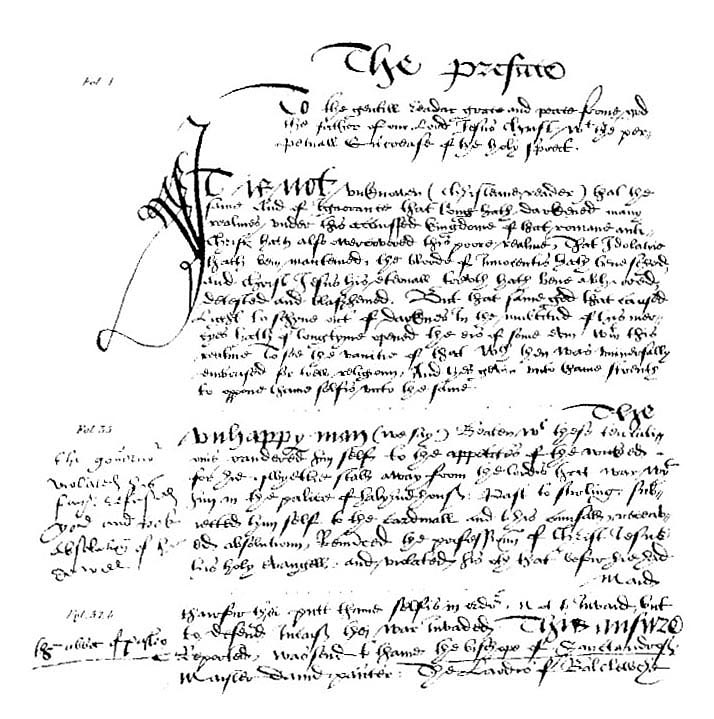
TO THE GENTILL READAR, GRACE AND PEACE FROME GOD THE FATHER OF OUR LORD
JESUS CHRIST, WITH THE PERPETUALL ENCREASE OF THE HOLY SPREIT.[10]
It is not unknowen, Christeane Reader, that the same clud[11] of
ignorance, that long hath darkened many realmes under this accurssed
kingdome of that Romane Antichrist, hath also owercovered this poore
Realme; that idolatrie[12] hath bein manteined, the bloode of innocentis
hath bene sched, and Christ Jesus his eternall treuth hath bene
abhorred, detested, and blasphemed. But that same God that caused light
to schyne out of darknes, in the multitud of his mercyes, hath of long
tyme opened the eis[13] of some evin within this Realme, to see the
vanitie of that which then was universally embrased for trew religioun;
and hes gevin unto them strenth to oppone thame selfis unto the same:
and now, into these our last and moist corrupt dayis, hath maid his
treuth so to triumphe amonges us, that, in despyte of Sathan,
hipochrisye is disclosed, and the trew wyrschipping of God is manifested
to all the inhabitantis of this realme whose eis[14] Sathan blyndis not,
eyther by thair fylthy lustes, or ellis by ambitioun, and insatiable
covetousnes, which maek them repung to the power of God working by his
worde.
And becaus we ar not ignorant what diverse bruittis war dispersed of us,
the professoures of Jesus Christ within this realme, in the begynnyng
of our interprise, ordour was lackin, that all our proceidingis should
be committed to register; as that thei war, by such as then paynfullie
travailled[15] boith by toung and pen; and so was collected a just
volume, (as after will appeir,) conteanyng thingis done frome the
fyftie-awght[16] year of God, till the arrivall of the Quenis Majestie
furth of France,[17] with the which the Collectour and Writtar for that
tyme was content, and never mynded further to have travailled in that
kynd of writting.[18] But, after invocatioun of the name of God, and
after consultatioun with some faythfull,[19] what was thought by thame
expedient to advance Goddis glorie, and to edifie this present
generatioun, and the posteritie to come, it was concluded, that
faythfull rehersall should be maid of such personages as God had maid
instrumentis of his glorie, by opponyng of thame selfis to manifest
abuses, superstitioun, and idolatrie; and, albeit thare be no great
nomber, yet ar thei mo then the Collectour wold have looked for at the
begynnyng, and thairfoir is the volume some what enlarged abuif his
expectatioun: And yit, in the begynnyng, mon we crave of all the gentill
Readaris, not to look of us such ane History as shall expresse all
thingis that have occurred within this Realme, during the tyme of this
terrible conflict that hes bene betuix the sanctes of God and these
bloody wolves who clame to thame selves the titill of clargie, and to
have authoritie ower the saules of men; for, with the Pollicey,[20] mynd
we to meddill no further then it hath Religioun mixed with it. And
thairfoir albeit that many thingis which wer don be omitted, yit, yf we
invent no leys, we think our selves blamless in that behalf. Of one
other [thing] we mon foirwarne the discreat Readaris, which is, that
thei be not offended that the sempill treuth be spokin without
partialitie; for seing that of men we neyther hunt for reward, nor yitt
for vane[21] glorie, we litill pass by the approbatioun of such as
seldome judge weill of God and of his workis. Lett not thairfoir the
Readar wonder, albeit that our style vary and speik diverslie of men,
according as thei have declared thame selves sometymes ennemyes and
sometymes freindis, sometymes fervent, sometymes cold, sometymes
constant, and sometymes changeable in the cause of God and of his holy
religioun: for, in this our simplicitie, we suppoise that the Godlie
shall espy our purpose, which is, that God may be praised for his mercy
schawin, this present age may be admonished to be thankfull for Goddis
benefittis offerred, and the posteritie to cum may be instructed how
wonderouslie hath the light of Christ Jesus prevailled against darkness
in this last and most corrupted age.
HISTORIÆ INITIUM.[22]
In the Scrollis of Glasgw is found mentioun of one whais name is not
expressed,[23] that, in the year of God 1422, was burnt for heresye;[24]
bot what war his opinionis, or by what ordour he was condempned, it
appearis not evidentlie. But our Cronikilles mack mentioun, that in the
dayis of King James the First, about the year of God 1431, was
deprehended in the Universitie of Sanctandrose, one named Paull
Craw,[25] a Bohame,[26] who was accused of heresye befoir such as then
war called Doctouris of Theologie. His accusatioun consisted
principallye, that he followed Johnne Husse and Wyckleif, in the
opinioun of the sacrament, who denyed that the substance of braid and
wyn war changed be vertew of any wourdis; or that confessioun should be
maid to preastis; or yitt prayeris to sanctes departed. Whill that God
geve unto him grace to resist thame, and not to consent to thair
impietie, he was committed to the secular judge, (for our bischoppis
follow Pilat, who boith did condempne, and also wesche[27] his handis,)
who condempned him to the fyre; in the quhilk he was consumed in the
said citie of Sanctandrose, about the time afoir writtin. And to declair
thame selvis to be the generatioun of Sathan, who, from the begynnyng,
hath bein ennemy to the treuth, and he that desyrith the same to be hyd
frome the knowledge of men, thei putt a ball of brass in his mouth, to
the end that he should nott geve confessioun of his fayth to the people,
neyther yit that thei should understand the defence which he had against
thair injust accusatioun and condemnatioun.
Bot that thair fatheris practise did nott greatlie advance thair
kingdome of darknes, nether yit was it able utterlie to extingueise the
trewth: For albeit, that in the dayis of Kingis James the Secund and
Thrid, we fynd small questioun of religioun moved within this Realme,
yit in the tyme of King James the Fourt, in the saxt year of his reigne,
and in the twenty-twa yeir of his age, which was in the year of God
1494, war summoned befoir the King and his Great Counsell, by Robert
Blackedar called Archebischope of Glasgw,[28] the nomber of thretty
personis, remanyng some in Kyle-Stewart, some in Kingis-Kyile, and some
in Cunyghame;[29] amonges whome,[30] George Campbell of Sesnok, Adame
Reid of Barskymming, Johne Campbell of New Mylnes, Andro Shaw of
Polkemmate, Helen Chalmour Lady Pokillie,[31] [Marion][32] Chalmours
Lady Stairs: These war called the Lolardis of Kyle. Thei war accused of
the Articles following, as we have receaved thame furth of the
Register[33] Glasgw.
i. First, That Images ar not to be had, nor yitt to be wirschepped.
ii. That the Reliques of Sanctes are not to be wirschepped.
iii. That Lawis and Ordinances of men vary frome tyme to tyme, and that
by the Pape.
iv. That it is not lauchfull to feght, or to defend the fayth. (We
translait according to the barbarousnes of thair Latine and
dictament.[34])
v. That Christ gave power to Petir onlie, and not to his successouris,
to bynd and lowse within the Kyrk.
vi. That Christ ordeyned no Preastis to consecrat.
vii. That after the consecratioun in the Messe, thare remanes braid;[35]
and that thair is nott the naturall body of Christ.
viii. That teythes aught not to be given to Ecclesiasticall men, (as
thei war then called.)
ix. That Christ at his cuming has tackin away power from Kingis to
judge.[36] (This article we dowbt not to be the vennemouse accusatioun
of the ennemyes, whose practise has ever bene to mack the doctrin of
Jesus Christ suspect to Kingis and rewllaris, as that God thairby wold
depose thame of thair royall seattis, whare by the contrair, nothing
confermes the power of magistrates more then dois Goddis wourd.—But to
the Articles.)
x. That everie faythfull man or woman is a preast.
xi. That the unctioun of Kingis ceassed at the cuming of Christ.
xii. That the Pape is not the successour of Petir, but whare he said,
"Go behynd me, Sathan."
xiii. That the Pape deceavis the people by his Bulles and his
Indulgenses.
xiv. That the Messe profiteth not the soules that ar in purgatorye.
xv. That the Pape and the bischoppis deceave the people by thare
pardonis.
xvi. That Indulgenses aught not to be granted to feght against the
Saracenes.
xvii. That the Pape exaltis him self against God, and abuf God.
xviii. That the Pape can nott remitt the panes of purgatorye.
xix. That the blessingis of the Bischoppis (of dum doggis thei should
have bein stilled) ar of non valew.
xx. That the excommunicatioun of the Kirk is not to be feared.
xxi. That in to no case is it lauchfull to swear.
xxii. That Preastis mycht have wieffis, according to the constitutioun
of the law.
xxiii. That trew Christianes receave the body of Jesus Christ everie
day.
xxiv. That after matrimonye be contracted, the Kyrk may mack no
divorcement.
xxv. That excommunicatioun byndis nott.
xxvi. That the Pape forgevis not synnes, bot only God.
xxvii. That fayth should not be gevin to miracules.
xxviii. That we should not pray to the glorious Virgyn Marie, butt to
God only.
xxix. That we ar na mair bound to pray in the Kirk then in other
plaices.
xxx. That we ar nott bound to beleve all that the Doctouris of the Kyrk
have writtin.
xxxi. That such as wirschep the Sacrament of the Kyrk (We suppoise thei
ment the Sacrament of the altar) committis idolatrie.
xxxii. That the Pape is the head of the Kyrk of Antichrist.
xxxiii. That the Pape and his ministeris ar murtheraris.
xxxiv. That thei which ar called principallis in the Church, ar thevis
and robbaris.
By these Articles,[37] which God of his mercyfull providence caused the
ennemies of his trewth to keip in thare Registeris, may appeir how
mercyfullie God hath looked upoun this Realme, reteanyng within it some
sponk of his light, evin in the tyme of grettast darkness. Nether yit
awght any man to wonder, albeit that some thingis be obscurly, and some
thingis scabruslie spokin;[38] but rather awght all faythfull to
magnifye Goddis mercy, who without publict doctrin gave so great light.
And farther, we awght to considder, that seing that the ennemies of
Jesus Christ gathered the foirsaid Articles, thairupoun to accuse the
personis foirsaid, that thei wold deprave the meanyng of Goddis
servandis so far as thei could; as we dowbt not bot thei have done, in
the headis of Excommunicatioun, Swearing, and of Matrimonye. In the
which it is no dowbt but the servandis of God did dampne the abuse
only, and not the rycht ordinance of God; for who knowes not, that
Excommunicatioun in these dayis was altogether abused! That Swearing
abounded without punishment, or remorse of conscience! And that
Divorsementis war maid for such causes as worldly men had invented!—But
to our History.
Albeit that the accusatioun of the Bischop and his complices was verray
grevouse, yitt God so assisted his servandis, partly be inclineing the
Kingis hart to gentilness, (for diverse of thame war his great
familiaris,) and partly by geving bold and godly answeris to thair
accusatouris, that the ennemies in the end war frustrat of thair
purpoise. For whill the Bischop, in mocking, said to Adam Reid of
Barskemyng,[39] "Reid, Beleve ye that God is in heavin?" He answered,
"Not as I do the Sacramentis sevin." Whairat the Bischop thinking to
have triumphed, said, "Sir, Lo, he denyes that God is in heavin."
Whairat the King wondering, said, "Adam Reid, what say ye?" The other
answered, "Please your Grace to heir the end betuix the churle and me."
And thairwith he turned to the Bischope, and said, "I nether think nor
beleve, as thou thinkis, that God is in heavin; but I am most assured,
that he is not only in the heavin, bot also in the earth. Bott thou and
thy factioun declayre by your workis, that eyther ye think thair is no
God at all, or ellis that he is so shett up[40] in the heavin, that he
regardis not what is done into the earth; for yf thou fermelie beleved
that God war in the heavin, thou should not mack thy self chek-meat to
the King, and altogether forgett the charge that Jesus Christ the Sone
of God gave to his apostles, which was, to preach his Evangell, and not
to play the proud prelatts, as all the rabill of yow do this day. And
now, Sir, (said he to the King,) judge ye whither the Bischop or I
beleve best that God is in heavin." Whill the Bischope and his band
could not weill revenge thame selfis, and whill many tantis war gevin
thame in thair teith, the King, willing to putt ane end to farther
reassonyng, said to the said Adam Reid, "Will thou burne thy bill?" He
answered, "Sir, the Bischope and ye will." With those and the lyik
scoffis the Bischop and his band war so dashed out of countenance, that
the greattest part of the accusatioun was turned to lawchter.
After that dyet, we fynd almoist no questioun for materis of religioun,
the space ney of thretty yearis. For not long after, to witt in the year
of God 1508,[41] the said Bischop Blackcater departed this lief, going
in his superstitious devotioun to Hierusalem; unto whome succeided Mr.
James Beatoun, sone to the Lard of Balfour, in Fyfe, who was moir
cairfull for the world then he was to preach Christ, or yitt to advance
any religioun, but for the fassioun only; and as he soght the warld, it
fled him nott,[42] it was weill knowin that at onis he was Archbischop
of Sanctandrosse, Abbot of Dumfermeling, Abirbroth, Kylwynnyng, and
Chancellare of Scotland: for after the unhappy feild of Flowdoun,[43]
the which perrished King James the Fourt, with the grettast parte of the
nobilitie of the realme, the said Beatoun, with the rest of the
Prelattis, had the haill regiment of the realme; and by reassone
thairof, held and travailled to hold the treuth of God in thraldome and
bondage, till that it pleased God of his great mercy, in the year of God
1527, to raise up his servand, Maister Patrik Hammyltoun, at whome our
Hystorie doith begyn. Of whose progenye, lyif, and eruditioun, becaus
men of fame and renune have in diverse workis writtin, we omitt all
curiouse repetitioun, sending such as wald knaw farther of him then we
write to Franciss Lambert,[44] Johne Firth, and to that notable
wark,[45] laitlie sette furth be Johne Fox, Englisman, of the Lyvis and
Deathis of Martyrs within this yle, in this our aige.
This servand of God, the said Maister Patrik, being in his youth
providit to reassonable honouris and leving, (he was intitulat Abbot of
Fern,[46]) as one haiting the world and the vanitie thairof, left
Scotland, and passed to the schoollis in Germany; for then the fame of
the Universitie of Whittinberge was greatlie divulgat in all countreis,
whare, by Goddis providence, he became familiare with these lyghtis and
notable servandis of Christ Jesus of that tyme, Martyne Luther, Philipp
Melanthon, and the said Franciss Lambert,[47] and did so grow and
advance in godly knowledge, joyned with fervencie and integretie of
lyiff, that he was in admiratioun with many. The zeall of Goddis glorie
did so eat him up, that he could of no long continuance remane thair,
bot returned to his countrie, whair the brycht beames of the trew light
which by Goddis grace was planted in his harte, began most aboundantlie
to burst furth, also weall in publict as in secreat: For he was, besydis
his godlie knowledge, weill learned in philosophie: he abhorred
sophistrye, and wold that the text of Aristotelis should have bene
better understand and more used in the schoolles then than it was; for
sophistrie had corrupted all asweil in divinitie as in humanitie. In
schort proces of tyme, the fame of his reasonis and doctrin trubled the
Clargye, and came to the earis of Bischope James Beatoun, of whome
befoir we have maid mentioun, who being ane conjured ennemye to Christ
Jesus, and one that long had had the whole regiment of this realme, bare
impatientlie that any truble should be maid to that kingdome of darknes,
whairof within this realme he was the head. And, thairfoir, he so
travailled[48] with the said Maister Patrik, that he gat him to
Sanctandrosse, whair, eftir the conference of diverse dayis, he had his
freedome and libertie. The said Bischop and his blooddy bucheouris,
called Doctouris, seamed to approve his doctryne, and to grant that many
thingis craved reformatioun in the Ecclesiastical regiment. And amanges
the rest, thair was ane that secreatlie consented with him almest in
all thingis, named Frear Alexander Campbell, a man of good wytt and
learnyng, butt yitt corrupt by the warld, as aftir we will hear. When
the bischoppis and the clergye had fully understand the mynd and
judgement of the said Maistir Patrik, and fearing that by him thair
kingdome should be endomaged, thei travailled with the King, who then
was young, and altogitther addict to thair commandiment, that he should
pass in pilgramaige to Sanct Dothess in Rosse,[49] to the end that no
intercessioun should be maid for the life[50] of the innocent servant of
God, who suspecting no such crueltie as in thair hartes was concluded,
remaned still, (a lambe amonges the wolfis,) till that upoun a nycht hie
was intercepted in his chalmer, and by the bischoppes band was caryed to
the Castell, whare that nycht he was keapt; and upoun the morne,
produccid in judgement, he was condampned to dye by fyre for the
testimonye of Goddis trewth. The Articles for the which he suffered war
bot of Pilgramage, Purgatorye, Prayer to Sanctes, and for the Dead, and
such trifilles; albeit that materis of grettar importance had bein in
questioun, as his Treatise,[51] which in the end we have added, may
witness. Now that the condempnatioun of the said Mr. Patrik should have
greattar authoritie, thei caused the same to be subscrived by all those
of any estimatioun that with tham war present, and to mack thair nomber
great, thei tuck the subscriptionis of childrin, yf thei war of the
nobilitie; for the Erle of Cassilles, which last decessed in France,[52]
then being bot twelf or threttein yearis of age, was compelled to
subscrive his death, as him self did confesse. Immediatlie after dennar,
the fyre was prepaired befoir the Ald Colledge,[53] and he led to the
place of executioun. And yitt men suppoised that all was done but to
geve unto him ane terrour, and to have caused him to have recanted, and
have become recreant to those bloody beastis. But God, for his awin
glorie, for the comforte of his servand, and for manifestatioun of thare
beastly tyranny, had otherwiese decreed; for he so strenthened his
faythfull witnes, that nether the luif of lyif, nor yitt the fear of
that cruell death, could move him a joit to swarve from the trewth ones
professed. At the plaice of executioun he gave to his servand, who had
bene chalmer-child to him of a long tyme, his gown, his coit, bonet, and
such lych garments, saying, "These will nott proffeit in the fyre; thei
will proffeit thee: Aftir this, of me thow cane receave no commoditie,
except the example of my death, which, I pray thee, bear in mynd; for
albeit it be bitter to the flesche, and feirfull befoir men, yet is it
the entress unto eternall lyif, quhilk non shall possesse that denyis
Christ Jesus befoir this wicked generatioun."
The innocent servand of God being bound to the staik in the myddest of
some coallis, some tymmer, and other mater appointed for the fyre, a
trane of powder was maid and sett a fyre, quhilk gave to the blessed
martyre of God a glaise, skrimpled[54] his left hand, and that syd of
his face, but nether kendilled the wood, nor yett the coallis.[55] And
so remaned the appointed to death in torment, till that men rane to the
Castell agane for moir poulder, and for wood more able to tack fyre;
which at last being kendilled, with lowd voce he cryed, "Lord Jesus,
receave my spreit! How long shall darknes owerquhelme this realme? And
how long will thow suffer this tyranny of men?"—The fyre was slow, and
thairfoir was his torment the more. Bott moist of all was he greved by
certane wicked men, amongis whome Campbell the Blak Freir (of whome we
spak befoir[56]) was principall, who continuallie cryed, "Convert,
heretick: call upoun our Lady: say Salve Regina," etc. To whome he
answered, "Departe, and truble me not, ye messingeris of Sathan." Bott
whill that the foirsaid Freir still roared one thing in great vehemency,
he said unto him, "Wicked man, thou knawis the contrair, and the
contrair to me thou hast confessed: I appeall thee befoir the tribunall
seatt of Jesus Christ!" After which and other wordis, which weall could
nott be understand nor marked, bayth for the tumult, and vehemencye of
the fyre, the witness of Jesus Christ gat victorie, after long
sufferance, the last of Februar, in the zeir of God Jm. Ve. twenty and
sevin zearis.[57] The said Freir departed this lyif within few dayis
after, in what estait we referr to the manifestatioun of the generall
day. But it was plainlie knawin that he dyed, in Glaskow, in a
phrenesye, and as one dispared.[58]
Now that all men may understand what was the singular eruditioun and
godly knowledge of the said Mr. Patrik, we have inserted this his litill
pithie werk, conteanyng his Assertionis and Determinationis concernyng
the Law, the Office of the same, concernyng Fayth, and the fruittis[59]
thairof; first, be the foirsaid Maister Patrik collected in Latine, and
after translated in Inglisch.
[A Brief Treatise of Mr. Patrike Hamelton, called Patrike's Places,
translated into English by John Frith; with whe Epistle of the sayd
Frith prefixed before the same, as followeth.[60]
John Frith unto the Christian Reader.
Blessed be God the Father of our Lord Jesus Christ, which in these last
dayes and perillous tymes, hath styrred up in all countreys, witnesses
unto his Sonne, to testifye the truth unto the unfaythfull, to save at
the least some from the snares of Antichrist, which leade to perdition,
as ye may here perceave by that excellent and well learned young man
Patrike Hamelton, borne in Scotland of a noble progeny; who to testifie
the truth, sought all meanes, and tooke upon him Priesthode, (even as
Paule circumcised Timothy, to wynne the weake Jewes,) that he might be
admitted to preache the pure word of God. Notwithstandyng, as soone as
the Chamberleyne [Chancellor[61]] and other Byshops of Scotland had
perceaved that the light began to shyne, which disclosed their falsehode
that they conveyed in darkenes, they layde handes on hym, and because he
wold not deny his Saviour Christ at their instance, they burnt him to
ashes. Nevertheles, God of his bounteous mercy (to publishe to the whole
world what a man these monsters have murthered) hath reserved a little
Treatise, made by this Patrike,[62] which, if ye lyst, ye may call
Patrik's Places: For it treateth exactly of certaine Common Places,
which knowen, ye have the pith of all Divinitie. This Treatise have I
turned into the English toung, to the profite of my natioun; to whom I
besech God to geve lyght, that they may espye the deceitfull pathes of
perdition, and returne to the right way which leadeth to lyfe
everlastyng.[63] Amen.]
[The Doctrine] of the Law.
The Law is a doctrine that biddeth good, and forbiddeth evill, as the
Commandimentis heir contenit do specifie:
The Ten Commandimentis.
1. Thow shalt worschepp but one God. 2. Thow shalt maik thee nane image
to worschipp it. 3. Thow shalt not sweare be his name in vane. 4. Hold
the Sabbath day holy. 5. Honour thie father and mother. 6. Thow shalt
not kill. 7. Thow shalt not committ adulterie. 8. Thow shalt nott
steall. 9. Thow shalt bear no fals witness. 10. Thow shalt not desyre
owght that belongeth unto thie nychtboure.
[All these Commandments are briefly comprised in these two here under
ensuing]:—"Love the Lord thy God with all thyne harte, wyth all thy
saule, and with all thy mynd." (Deut. 6.)—"This is the first and great
commandiment. The secund is lyik unto this, Love thy nychtbour as thy
selve. On these two commandimentis hang all the Law and the
Propheittis." (Matth. 12.)
[CERTAINE GENERALL PROPOSITIONS PROVED BY THE SCRIPTURE.][64]
I. He that loveth God, loveth his nychtbour.[65]—"If anie man say, I
love God, and yit hattith his nychtbour, he is a lyer: He that lovith
not his brother whome he hath sene, how can he love God whome he hath
nott sein." (1 Joan. 4.)
II. He that lovith his nychtbour as him self, keapeth the whole
commandimentis of God.—"Quhatsoever ye wald that men should do unto
yow, evin so do unto thame: for this is the law and the propheittis."
(Matth. 7.)—He that loveth his nychtbour fulfilleth the law. "Thow
shalt not committ adulterie: Thow shalt not kyll: Thow shalt not steall:
Thow shalt not bear fals witnesse against thy nychtbour: Thow shalt not
desyre; and so furth: And yf thair be any uther commandiment, all ar
comprehendit under this saying, Love thy nychtbour as thy self." (Rom.
13; Gallat. 5.)
"He that loveth his nychtbour, kepith all the commandimentis of God."
"He that loveth God, loveth his nychtboure." (Roma. 13; 1 Joan.
4.)—Ergo, he that loveth God, kepith all his commandimentis.
III. He that hath the faith, loveth God.—"My father loveth yow, becaus
ye luif me, and beleve that I came of God." (Joan. 19.)—He that hath
the faith, keapith all the commandimentis of God. He that hath the
faith, loveth God; and he that loveth God, keapith all the
commandimentis of God.—Ergo, he that hath faith, keapith all the
commandimentis of God.
IV. He that keapeth one commandiment, keapeth thame all.—"For without
fayth it is impossible to keap any of the commandimentis of God."—And
he that hath the fayth, keapeth all the commandimentis of God.—Ergo, he
that keapith one commandiment of God, keapith thame all.
V. He that keapith nott all the commandimentis of God, he keapith nane
of thame.—He that keapith one of the commandimentis, he keapith
all.—Ergo, he that keapith not all the commandimentis, he keapith nane
of thame.
VI. It is not in our power, without grace, to keap anie of Goddis
commandimentis.—Without grace it is impossible to keap ane of Goddis
commandimentis; and grace is not in our power.—Ergo, it is not in our
power to keap any of the commandimentis of God.
Evin so may ye reassone concerning the Holy Ghost, and fayth.
VII. The law was gevin to schaw us our synne.—"Be the law cumith the
knowledge of the synne. I knew not what synne meant, bot throw the law.
I knew not what lust had ment, except the law had said, Thow shalt not
lust. Without the law, synne was dead:" that is, It moved me nott,
nether wist I that it was synne, which notwithstanding was synne, and
forbidden be the law.
VIII. The law biddith us do that which is impossible for us.—For it
biddith us keape all the commandimentis of God: yitt it is not in oure
power to keape any of thame.—Ergo, it biddeth us doo that which is
impossible for us.
Thow wilt say, "Whairfoir doith God command us that which is impossible
for us." I ansuere, "To mack thee know that thow arte bot evill, and
that thair is no remeady to save thee in thine awin hand, and that thow
mayest seak reamedy at some uther; for the law doith nothing butt
command thee."
[The Doctrine] of the Gospell.
The Gospell, is as moche to say, in oure tong, as Good
Tydingis: lyk as everie one of these sentences be—
Christ is the Saviour of the world.
Christ is our Saviour.
Christ deid for us.
Christ deid for our synnes.
Christ offerred him selve for us.
Christ bare our synnes upoun his back.
Christ bought us with his blood.
Christ woushe us with his blood.
Christ came in the warld to save synnaris.
Christ came in the warld to tak away our synnes.
Christ was the price that was gevin for us and for our synnes.
Christ was maid dettour for our synnes.
Christ hath payed our debt, for he deid for us.
Christ hath maid satisfactioun for us and for our synne.
Christ is our rychteousness.
Christ is oure wisdome.
Christ is our sanctifcatioun.
Christ is our redemptioun.
Christ is our satisfactioun.
Christ is our goodness.
Christ hath pacifeid the Father of Heavin.
Christ is ouris, and all his.
Christ hath delivered us frome the law, frome the devill, and hell.
The Father of Heavin hath forgevin us for Christis saik.
Or anie such other, as declair unto us the mercyes of God.
the nature [and office] of the law, and of the gospell.
The Law schawith us,
Our synne.
Our condemnatioun,
Is the word of ire.
Is the word of dispair.
Is the word of displeasure.
The Gospell schawith us,
A reamedy for it.
Oure redemptioun,
Is the word of grace.
Is the word of conforte.
Is the word of peace.
a disputatioun betuix the law and the gospell.
The Law sayith,
Paye thy debt,
Thow art a synnar desparat.
And thow shalt die.
The Gospell sayith,
Christ hath payed it.
Thy synnes ar forgevin thee.
Be of good conforte, thow shalt be saved.
The Law sayith,
Mack a mendis for thy synne.
The Father of Heaven is wraith wyth thee.
Quhair is thy rychteousnes, goodnes, and satisfactioun?
Thou art bound and obligat unto me, [to] the devill, and [to] hell.
The Gospell sayith,
Christ hath maid it for thee.
Christ hath pacefeid him with his blood.
Christ is thy rychteousnes, thy goodnes, and satisfactioun
Christ hath delivered thee from thame all.
[The Doctrine] off Faith.
Faith is to beleve God; "lyck as Abraham beleved God, and it was compted
unto him for rychteousnes." (Gen. 15.)—"He that beleved God, beleved
his word." (Joan. 5.)—To beleve in him, is to beleve his word, and
accompt it trew that he speikith. He that belevith not Goddis word,
beleveth not him self. He that belevith nott Goddis word, he compteth
him fals, and ane lyar, and beleveth not that he may and will fulfill
his word; and so he denyeth both the myght of God and him self.
IX. Faith is the gift of God.—"Everie good thing is the gift of God."
(Jacob. 1.)—Fayth is good.—Ergo, faith is the gift of God.
X. [Faith is not in our power.]—The gift of God is not in oure
power.—"Faith is the gift of God."—Ergo, fayth is not in oure power.
XI. [He that lacketh faith cannot please God.]—"Without faith it is
impossible to please God." (Hebr. 11.)—All that cummith nott of fayth,
is synne; for without faith can no man please God.—Besydis, that he
that lacketh faith, he trusteth nott God. He that trusteth not God,
trusteth nott in his wourd. He that trusteth not in his wourd, hauldeth
him self fals, and a liear. He that haldeth him self false and a lyer,
he belevith not that he may doo that he promeseth, and so denyeth he
that he is God. And how can a man, being of this fassioun, please him?
No maner of way. Yea, suppoise he did all the werkis of man and angell.
XII. All that is done in fayth, pleaseth God.—"Richt is the wourde of
God, and all his werkis in faith." "Lord, thine eis look to faith." That
is asmuch to saye as, Lord, thow delitest in fayth. God loveth him that
belevith in him. How cane thei then displease him?
XIII. He that hath the faith, is just and good.—And a good trie
bringeth furth good fruite.—Ergo, all that is in faith done pleaseth
God.
XIV. [He that hath faith, and believeth God, cannot displease
him.]—Moreovir, he that hath the faith belevith God.—He that belevith
God, belevith his worde. He that belevith his word, woteth weall that he
is trew and faithfull, and may nott lie: But knowith weall that he may
and will boith fulfill his word. How can he then displease him? For thow
canst not do ane greattar honor unto God, then to count him trew. Thow
wilt then say, that thift, murther, adulterie, and all vices, please
God? Nane, verrelie; for thei can not be done in faith: "for a good tree
beareth good frute." He that hath the faith, woteth weall that he
pleaseth God; for all that is done in fayth pleaseth God. (Hebr. 11.)
XV. Faith is a suirness.—"Faith is a suir confidence of thingis quhilk
ar hoped for, and a certantie of thinges which ar not sene." (Hebr.
11.)—"The same spreit certifieth our spreit that we are the children of
God." (Rom. 8.)—Moirovir, he that hath the faith, woteth weill that
God will fulfill his word.—Ergo, fayth is a suirness.
a man is justifeid be faith.
"Abraham beleveth God, and it was impueted unto him for ryghteousnes."
"We suppose thirfoir that a man is justified (saith the Apostill)
without the workis of law." (Rom. 4.)—"He that workith not, but
belevith in him that justifieth the ungodlie, his faith is compted unto
him for ryghteousnes." "The just man levith by faith." (Abac. 2; Rom.
1.)—"We wote, that a man that is justifeid, is not justifeid be the
workis of the law, but be the faith of Jesus Christ, and not by the
deadis of the law."
of the faith of christ
The faith of Christ is, to beleve in him; that is, to beleve his wourd,
and to beleve that he will helpe thee in all thy neid, and deliver thee
frome evill. Thow wilt ask me, What word? I answer, The Gospell. "He
that beleveth on Christ shalbe saved." "He that belevith the Sone hath
eternall lyif." "Verrelie, verrelie, I say unto yow, he that belevith on
me hath everlasting lyif." (Joan. 6.)—"This I wret unto yow, that
beleving in the name of the Sone of God, ye may know that ye have
eternall lyif." (1 Joan. 5.)—"Thomas, becaus thow hast sein me thow
belevest; but happie ar thei that have nott sein, and yit beleve in me."
"All the Propheittis to him bare witness, that whosoevir belevith in him
shall have remissioun of thair synnes." (Act. 10.)—"What must I do that
I may be saved?" The Apostill answerid, "Beleve in the Lord Jesus
Christ, and thow shalt be saved." "Yf thow acknowledge wyth the mouth,
that Jesus is the Lord, and beleve in thyn harte that God raissed him up
from the death, thow shalt be save." (Rom. 10.)—"He that beleveth not
in Christ shalbe condemned." "He that beleveth nott the Sone shall
never see lyif; but the ire of God abydith upoun him." (Joan. 3.)—"The
Holy Ghost shall reprove the world of synne, becaus thei beleve not in
me." "Thei that beleve in Jesus Christ ar the sones of God." Ye ar all
the sones of God, because ye beleve in Jesus Christ.
He that belevith in Christ the Sone of God is save. (Galat. 3.)—"Petir
said, Thow art Christ, the Sone of the leving God. Jesus ansuered and
said unto him, Happie arte thow, Symon, the sone of Jonas; for flesch
and blood hath nott oppened unto thee that, bot my Father which is in
heavin." (Matth. 16.)—"We have beloved and knowin that thow arte Christ
the Sone of the leving God." "I beleve that thow arte Christ the Sone of
the leving God, which should come into the warld." "These thingis ar
written that ye mycht beleve that Jesus Christ is the Sone of God, and
that in beleving ye mycht have lyef. I beleve that Jesus is the Sone of
the leving God." (Joan. 9.)
XVI. He that belevith God, belevith the Gospell.—He that belevith God,
belevith his Word:—And the Gospell is his Word. Thairfoir he that
belevith God, belevith his Gospell. As Christ is the Saviour of the
world, Christ is our Saviour. Christ bought us with his bloode. Christ
woushe us with his blood. Christ offerred him self for us. Christ baire
oure synnes upoun his back.
XVII. He that belevith nott the Gospell, belevith not God.—He that
belevith not Goddis Word belevith nott him self:—And the Gospell is
Goddis Word.—Ergo, he that belevith nott the Gospell belevith nott God
him self; and consequentlie thei that beleve nott as is above written,
and such other, beleve not God.
XVIII. He that belevith the Gospell, shalbe saved.—"Go ye into all the
world and preach the Gospell unto everie creature: he that belevith and
is baptised shalbe saved; bot he that belevith not shalbe condemned."
a comparison betuix faith and indredulitie.
Faith is the root of all good:—
Makith God and man freindis.
Bringith God and man to gither.
Incredulitie is the root of all evill:—
Makith thame deidlie foes.
Bringith thame syndrie.
All that proceidis frome Faith pleaseth God.
All that proceidith from Incredulitie displeaseth God.
Faith only maketh a man good and rychteouse.
Incredulitie maketh him injust and evill.
Faith only maketh a man,
The member of Christ;
The inheritour of heavin;
The servand of God.
Faith schewith God to be a sweit Father.
Fayth hauldith styff be the Word of God: Countith God to be trew.
Faith knowith God: Lovith God and his nychtboure.
Faith only savith: Extolleth God and his werkis.
Incredulitie maketh him,
The member of the devill;
The inheritour of hell;
The servand of the devill.
Incredulitie maketh God a terrible Judge: It causeth man wandir heir and
thair: Maketh him fals and a liear.
Incredulitie knoweth him nott.
Incredulitie lovith nether God nor nychtbour: Onlie condemneth:
Extolleth flesche and hir awin deidis.
off hope.
Hope is a trustie looking for of thingis that ar promesed to come unto
us: as we hope the everlasting joy which Christ hath promesed unto all
that beleve on him. We should putt our hoipe and trust in God onlie, and
no other thing. "It is good to trust in God, and nott in man." "He that
trustith in his awin harte, he is a fuill." "It is good to trust in God,
and not in princes." (Psal. 117.)—"Thei shal be lyik unto images that
mack thame, and all that trust in thame." He that trusteth in his awin
thoughts doeth ungodlie. "Curssed be he that trustith in man." "Bidd the
rich men of this warld, that thei trust nott in thair unstable riches,
but that thei trust in the leving God." "It is hard for them that trust
in money to enter in the kingdome of God." Moirovir, we should trust in
him onelie, that may help us [God onlie can help us.]—Ergo, we should
trust in him onelie. Weill is thame that trust in God: and wo to thame
that trust him nott. "Weill is the man that trustis in God; for God
shalbe his trust." He that trusteth in him shall understand the trewth.
"Thei shall all rejoyse that trust in thee: thei shall all evir be
glaid; and thow wilt defend thame."
off charitie.
Charitie is the love of thy nychtboure. The rewll of charitie is to doo
as thow woldest wer done unto thee: for charitie esteameth all
alyke;[66] the riche and the poore; the friend and the foe; the
thankfull and the unthankfull; the kynnesman and stranger.
a comparison betuix faith, hope, and charitie.
Faith commeth of the wourd of God: Hope commeth of
faith; and Charitie springis of thame boith.
Faith belevis the word: Hope trustith eftir that which is
promessed be the wourd: and Charitie doith good unto hir
nychtbour, throw the love that sche hath to God, and glaidnes
that is within hir selve.
Faith looketh to God and his worde: Hope lookith unto
his gift and reward: Charitie lookith unto hir nychtbouris
proffeit.
Faith receavith God: Hoipe receaveth his reward: Charitie
lookith to hir nychtbour wyth a glaid hart, and that without
any respect of reward.
Faith perteaneth to God onelie: Hope to his reward, and
Charitie to hir nychtbour.
[The Doctrine] of Good Workis.
No maner of werkis mack us rychteouse.—"We beleve that a man shalbe
justifeid without werkis." (Galat. 3.)—"No man is justifeid be the
deidis of the law; but be the faith of Jesus Christ. And we beleve in
Jesus Christ, that we may be justifeid be the faith of Christ, and nott
be the deidis of the law. Yf rychteousnes came be the law, then Christ
deid in vane." That no man is justifeid be the law, it is manifest: for
a rychteouse man levith by his faith; but the law is nott of faith.
Moirovir, since Christ, the makar of heavin and earth, and all that
thair in is, behoved to die for us; we ar compelled to grant, that we
wer so far drowned in synne, that nether our deidis, nor all the
treasouris that ever God maid, or might maik, might have help us out of
thame: Ergo, no deidis nor werkis maie mack us rychteouse.
No werkis mak us unrychteouse.—For yf any werke maid us unrychteouse,
then the contrarie werkis wold maik us rychteouse. Butt it is provin,
that no werkis can maik us righteouse: Ergo, no werkis maik us
unrychteouse.
werkis maik us nether good nor evill.
It is proven, that werkis nether maik us rychteouse nor unrychteouse:
Ergo, no werkis nether maik us good nor evill. For rychteouse and good
ar one thing, and unrighteouse and evill, one. Good werkis maik not ane
good man, nor evill werkis ane evill man: But a good man makith good
werkis, and ane evill man evill werkis. Good fruct makith not the tree
good, nor evill fruict the tree evill: But a good tree bearith good
fruict, and ane evill tree evill fruict. A good man can not do evill
werkis, nor ane evill man good werkis; for ane evill tree can not beare
good fruct, nor ane good tree evill fruct. A man is good befoir he do
good werkis, and ane evill man is evill before he do evill werkis; for
the tree is good befoir it bear good fruict, and evill befoir it beir
evill fruct. Everie man is either good or evill. Either maik the tree
good, and the fruct good also, or ellis maik the tree evill, and the
fruct lyikwyise evill. Everie manes werkis ar eyther good or evill: for
all fructis ar either good or evill. "Either maik the tree good and the
fruct also, or ellis maik the tree evill and the fruct of it lyikwyise
evill." (Matth. 13.)—A good man is knowin be his werkis; for a good man
doith good werkis, and ane evill, evill werkis. "Ye shall knaw thame be
thair fruct; for ane good tree bringeth furth good fruct, and ane evill
tree evill fruict." (Matth. 7.)—A man is likened to the tree, and his
werkis to the fruct of the trie. "Bewar of the fals propheittis, which
come unto yow in scheippis clothing; but inwardlie thei ar raveening
wolves. Ye shall knaw thame be thair fructis."
none of oure werkis nether save us, nor condempne us.
It is provin, that no werkis maik us either righteouse or unryghteouse,
good nor evill: but first we are good befoir that we do good werkis, and
evill befoir we do evill warkis: Ergo, no werk neither save us nor
condempne us. Thow wilt say then, Makith it no mater what we do? I
answer thee, Yes; for yf thow dost evill, it is a suir argument that
thow art evill, and wantest faith. Yf thow do good, it is ane argument
that thow art good and hast faith; for a good tree bearith good fruct,
and an evill tree evill fruct. Yit good fruct maketh nott the tree good,
nor evill fruct the tree evill. So that man is good befoir he do good
werkis, and evill befoir he do evill werkis.
The man is the tree: the werkis ar the fruct. Faith maekith the good
tree: Incredulitie the evill tree. Such a tree, such a fruct: such man,
such warkis. For all that is done in faith pleasith God, and ar gud
werkis; and all that is done without faith displeaseth God, and ar evill
workis. Quhosoevir thinketh to be saved by his werkis, denyeth Christ is
oure Saviour, that Christ deid for him, and, fynallie, all thing that
belongeth to Christ. For how is he thy Saviour, yf thow mychtest save
thy self by thy werkis? Or to what end should he have deid for thee, yf
any werkis of thine might have saved thee? What is this to say, Christ
deid for thee? It is nott that thow shouldest have deid perpetuallie,
and that Christ, to deliver thee frome death, deid for thee, and changed
thy perpetuall death in his awin death. For thow madest the falt, and he
suffered the pane, and that for the luif he had to thee, befoir ever
thow wast borne, when thow haddest done neither good nor evill. Now,
since he hath payed thy debt, thow deist nott: no, thow canst nott, bot
shouldest have bene damned, yf his death war not.[67] Bot since he was
punished for thee, thow shalt not be punished. Fynallie, he hath
delivered thee from thye condemnatioun, and desyrith nought of thee,
but that thow shouldest acknowledge what he hath done for thee, and bear
it in mynd; and that thow woldest helpe other for his saik, boith in
worde and deid, evin as he hath helped thee for nought, and without
reward. O how ready would we be to help otheris, yf we knew his goodnes
and gentilnes towardis us! He is a good and a gentill Lord, and he doith
all thingis for nought. Let us, I beseich yow, follow his footsteps,
whome all the world ought to prayse and wirschep. Amen.
he that thinkith to be savid be his werkis, calleth him selve christ:—
For he callith him self a Saviour, which aparteaneth to Christ onlie.
What is a Saviour, butt he that savith? And thow sayist, I save my self;
which is asmuch to say as, I am Christ; for Christ is onlie the Saviour
of the world.
We should do no good werkis, for that intent to get the inheritance of
heavin, or remissioun of synnes throw thame. For whosoevir belevith to
gett the inheritance of heavin or remissioun of synnes, throw werkis, he
belevith nott to gett that for Christis saik. And thei that beleve not,
that thair synnes ar forgeivin thame, and that thei sal be saved for
Christis saik, thei beleve not the Gospell; for the Gospell sayith, Yow
sal be saved for Christis saik: synnes ar forgevin yow, for Christis
saik.
He that belevith not the Gospell, belevith not God. And consequentlie,
thei which beleve to be saved be thair werkis, or to gett remissioun of
synnes be thair awin deidis, beleve not God, bot raccompt him a liear,
and so utterlie denye him to be God. Thow wilt say, Shall we then do no
good werkis? I say not so, but I say, We should do no good werkis for
that intent to gett the kingdome of heavin, or remissioun of synnes. For
yf we beleve to gett the inheritance of heavin throw good werkis, then
we beleve nott to gett it throw the promesse of God. Or, yf we think to
gett remissioun of our synnes, as said is, we beleve nott that thei ar
forgevin us by Christ, and so we compt God a liear. For God sayith, Thow
shalt have the inheritance of heavin for my Sonnes saik. Yow say, It is
nott so; but I will wynne it throw my awin werkis. So, I condempne not
good werkis; but I condempne the fals trust in any werkis; for all the
werkis that a man putteth confidence in, are thairwyth intoxicat or
empoisoned, and become evill. Quhairfoir, do good werkis; but be war
thow do thame to gett any good throw thame; for yf thow do, thow
receavest the good, not as the gift of God, bott as debte unto thee, and
maikest thy self fellow with God, becaus thow wilt tack no thing from
him for nought. What nedith he any thing of thyne, who gevith all thing,
and is not the poorare? Thairfoir do nothing to him, but tack of him;
for he is ane gentill Lord, and with, a glaidar harte will geve us all
thingis that we neid, than we taik it of him. So that yf we want any
thing, lett us witt our selfis. Prease not then to the inheritance of
heavin, throwght presumptioun of thy good werkis; for yf thow do, thow
comptest thy selve holy and equall unto him, becaus thow wilt tack
nothing of him for nowght; and so salt thow fall as Lucifer fell from
heavin for his pride.
Thus endis the said Maistir Patrikis Articles.[68] And so we returne to
oure Hystory.
THE FORME AND CAUSSIS OF THE PREASTIS OLD CURSSING.
When those cruell wolves had, as thei supposed, cleane devored the pray,
thei fynd thame selfis in warse caise then thei war befoir; for then
within Sanctandrose, yea, almost within the hole realme, (who heard of
that fact,) thair was none found who begane not to inquyre, Whairfoir
was Maistir Patrik Hammyltoun brunt? And when his Articles war rehersed,
questioun was holden, yf such Articles war necessarie to be beleved
under the pane of damnatioun. And so within schort space many begane to
call in dowbt that which befoir thei held for a certane veritie, in so
much that the Universitie of Sanctandrose, and Sanct Leonardis Colledge
principallie, by the labouris of Maistir Gawin Logy,[69] and the
novises[70] of the Abbay, by the Suppriour,[71] begane to smell somwhat
of the veritie, and to espy the vanitie of the receaved superstitioun.
Yea, within few yearis eftir, begane baith Black and Gray Frearis
publictlie to preache against the pride and idile lief of Bischoppis,
and against the abuses of the whole ecclesiasticall estaite. Amongis
whome was one called Frear Williame Arth,[72] who, in a sermone preached
in Dundye, spak somwhat moir liberallie against the licentious lyifes of
the Bischoppis nor thei could weall beair. He spaik farther against the
abuse of curssing and of miracles. The Bischop of Brechin,[73] having
his placeboes and jackmen in the toun, buffatted the Freir, and called
him Heretick. The Freir, impatient of the injury receaved, past to
Sanctandrose, and did communicat the headis of his sermone with Maister
Johnne Mair,[74] whose wourd then was holden as ane oracle, in materis
of religioun; and being assured of him, that such doctrin mycht weall be
defendid, and that he wald defend it, for it conteaned no heresye; thair
was ane day appointed to the said Frear, to maik repetitioun of the sam
sermon; and advertisment was gevin to all such as war offended att the
formar to be present. And so, in the parishe kirk of Sanctandrose, upoun
the day appointed, appeared the said Frear, and had amonges his
auditouris Maistir Johnne Mair, Maistir George Lockart,[75] the Abbot of
Cambuskynneth,[76] Maistir Patrik Hepburne the Priour of
Sanctandrose,[77] with all the Doctouris and Maistires of the
Universities. The theame of his sermone was, "Veritie is the strongest
of all thingis." His discourse of Curssing was, "That yf it war rychtlie
used, it was the moist fearfull thing upoun the face of the earth; for
it was the verray separatioun of man frome God: but that it should nott
be used rashlie, and for everie light cause, but onlie against open and
incorrigible synnaris. But now, (said he,) the avarice of preastis, and
the ignorance of thair office, has caused it altogitther to be
vilipended;[78] for the preast, (said he,) whose dewitie and office is
to pray for the people, standis up on Sounday, and cryes, 'Ane hes tynt
a spurtill. Thair is ane flaill stollin from thame beyound the burne.
The goodwyiff of the other syd of the gait hes tynt a horne spune.
Goddis maleson and myne I geve to thame that knowis of this geyre, and
restoris it not.'"—How the people mocked thair curssing, he ferther
told a meary tale; how, after a sermoun that he had maid at Dumfermling,
he came to a house whair gossoppis was drynking thair Soundayis penny,
and he, being dry, asked drynk. "Yis, Father, (said ane of the
gossoppes,) ye shall haif drynk; bot ye mon first resolve ane doubt
which is rissen amongis us, to witt, What servand will serve a man beast
on least expenssis." "The good Angell, (said I,) who is manis keapar,
who maikis great service without expenssis." "Tush, (said the gossope,)
we meane no so heigh materis: we meane, What honest man will do greatest
service for least expensses?" And whill I was musing, (said the Frear,)
what that should meane, he said, "I see, Father, that the greatest
clerkis ar nott the wysest men. Know ye not how the Bischoppis and thair
officiallis servis us husband men? Will thei not give to us a lettir of
Curssing for a plack, to laste for a year, to curse all that looke ower
our dick [dyke]? and that keapis our corne better nor the sleaping boy,
that will have three schillingis of fye, a sark, and payre of schone in
the year. And thairfoir, yf thair curssing dow any thing, we held the
Bischoppis beast chaip servandis, in that behalf, that ar within the
realme." As concernyng miracles, he declaired, what diligence the
ancientis took to try trew miracles frome false. "But now, (said he,)
the greadynes of preastis not onlie receave false miracles, bot also
thei cherise and feis knaiffis for that purpoise, that thair chapellis
may be the better renouned, and thair offerand may be augmented. And
thairupoun ar many chapelles founded, as that our Lady war mychttiar,
and that sche took more pleasour in one plaice then in ane uther; as of
laite dayis our Lady of Karsgreng hes hopped fra ane grene hillock to
ane uther. But honest men of Sanctandrose, (said he,) yf ye luif your
wyffis and your doughtaris, hald thame at hame, or ellis send thame in
honest companye; for yf ye knew what miracles war kithed thaire, ye wold
neyther thank God nor our Lady." And thus he mearelie tanted thare
trystis of hurdome and adulterye used at such devotioun.
Ane uther article was judged more hard; for he alledged the commoun
law,[79] That the Civyle Magistrate mycht correct the Churchmen,[80] and
deprive thame of thaire benefices, for oppin vices.
Ane uther day, the same Frear maid ane uther sermoun of the Abbote [of]
Unreassone,[81] unto whome and whose lawis he compared the prelattis of
that age; for thei war subdewid to no lawis, no moir then was the Abbote
[of] Unreassoun. And amonges uther thingis he told such a meary bourd.
"Thare was (said he) a Prelatt, or at least a Prelattis peir, a trew
servand to the King of luif, who, upoun a nycht after suppar, asked at
his gentillmen, be the fayth that thei awght to the king of luif, that
thei should trewlie declare how many syndrie wemen everie ane of thame
had haid, and how many of thame war menis wyffis. Ane answered, He had
lyne with fyve, and two of thame war maryed. The other answered, I have
haid sevin, and three of thame ar maryed. It came at last to my Lord
him self, who macking it veray nyce for a lytill space, gave in the end
ane plain confessioun, and said, 'I am the yongest man, and yitt have I
haid the round desone; and sevin of thame ar menis wyffis.' Now, (said
the Frear,) this god and king of luif, to whome our Prelaittis maikis
homage, is the maistir devill of hell, from whome such werkis and
fruitis doo procead." This Prelatt was knowin by his proper tockenes to
have bene Priour Patrik Hepburne,[82] now Bischop of Murray, who to this
day hes continewed in the professioun that he anes maid to his god and
king of luif.[83]
It was supposed, notwithstanding this kynd of preaching, that this Frear
remaned papist in his heart; for the rest of the Frearis, fearing to
losse the benedictioun of the Bischoppes, to witt, thair malt and thair
maill, and thair other appoineted pensioun, cawsed the said Frear to
flye to England, whair, for defence of the Paipe and Paipistrie, his was
cast in preasone[84] at King Hary his commandiment. But so it pleasith
God to open up the mouth of Baalames awin asse, to cry out againest the
vitious lyves of the clergie of that aige. Schorte after this, new
consultatioun was tackin, that some should be brunt; for men began
verray liberallie to speak. A meary gentillman, named Johnne Lyndesay,
famylliar to Bisehope James Betoun, standing by when consultatioun was
had, said, "My Lord, yf ye burne any mo, except ye follow my counsall,
ye will utterlye destroy your selves. Yf ye will burne thame, lett thame
be brunt in how sellarris; for the reik of Maister Patrik Hammyltoun hes
infected as many as it blew upoun."[85] Thus it pleased God, that thei
should be tanted in thair awin face. But hear followis the moist meary
of all. Sandie Furrour, who had bene empreasoned sevin yearis in the
Toure of Londone, Sir Johnne Dignwaill,[86] according to the cheritie of
Churche men,[87] enterteneid his wyiff, and waisted the poore manes
substance. For the which caus, at his returnyng, he spaik more
liberallie of preastis then thei could bear, and so was he declaired[88]
to be accused of heresye, and called to his ansuer to Sanctandrose. He
lapp up mearely upoun the scaffold, and, casting a gawmound, said,
"Whair ar the rest of the playaris?" Maistir Audro Olephant,[89]
offended thairwyth, said, "It shalbe no play to yow, Sir, befoir that ye
depart." And so began to read his accusatioun. The first article whareof
was, That he dispyssed the Messe. His ansuer was, "I hear mo Messis in
awght dayis, then thre Bischoppis thair sitting sayis in a year."
Accused secoundarly, Of contemptioun of the sacramentis. "The preastis,
(said he,) war the maist commoun contempnaris of sacramentis, and
especiallie of matrimonye," and that he witnessed by any of the preastis
thare present, and named the menis wyffis with whome thei had medled,
and especiallie Sir Johnne Dignwaill, who had sevin yearis togitther
abused his awin wyff and consumed his substance; and said, "Becaus I
complayne of such injuries, I am hear summoned, and accused, as one that
is worthy to be brunt. For Goddis saik, (said he,) wil ye taick wyeffis
of your awin, that I and utheris, whose wyiffis ye have abused, may be
revenged upoun yow." Then Bisehope Gawin Dumbar,[90] named the Old
Bischop of Abirdein, thinking to justifye him self befoir the people,
said, "Carll, thow shalt not know my wyff." The said Alexander ansuered,
"My Lord, ye ar too old; bot, with the grace of God, I shall drynk with
your dochtter or I departe." And thareat was smylling of the best, and
lowd laughtter of some; for the Bisehop had a dowghter maryed with Andro
Balfour[91] in that same toune. Then the Bischoppis bad, "Away with the
earll." But he ansured, "Nay; I will not departe this houre; for I have
more to speak against the vices of preastis, then I cane expresse this
haill[92] day." And so, after diverse purposes, thei commanded him to
burne his bill. And he demanding the caus, thei said, "Becaus ye have
spoken these articles whairof ye ar accused." His ansuer was, "The
mekill devill bear thame away, that first and last said thame." And so
he tack the bill, and chowing it, hee after spatt it in Mr. Andro
Oliphantis face, saying, "Now burne it or drune it, whitther ye will: ye
heir na mair of me. Butt I man have somewhat of everie ane of yow to
begyn my pack agane, which a preast and my wyif, a preastis hoore, hes
spentt." And so everie prelate and riche preast, glaid to be qwyte of
his evill, gave him somwhat; and so departed hie, for he understood
nothing of religioun.
But so fearfull it was then to speak any thing against preastis, that
the least word spokin against thame, yea, albeit it was spokin in a
manes sleip, was judged heresye; and that was practised upoun Richart
Carmichaell, yet leving in Fyfe,[93] who being young, and ane singar in
the Chapell Royal of Striveling, happened in his sleepe to say, "The
devill tak away the preastis, for thei ar a gready pack." Hie,
thairfor, accused be Sir George Clappertoun, Deane[94] of the said
Chapell, was compelled tharefore to burne his bill.
But God schort after raised up against thame strongar campionis. For
Alexander Setoun,[95] a Blak Frear, of good learning and estimatioun,
began to tax the corrupt doctrin of the Papistrye. For the space of a
hole Lentran,[96] he tawght the commandimentis of God onlye, ever
beatting in the earis of his auditouris, That the law of God had of many
yearis not bein trewlie tawght; for menis traditionis had obscured the
puritie of it. These war his accustomed propositionis: First, Christ
Jesus is the end and perfectioun of the law. 2. Thair is no syne quhair
Goddis law is not violated. 3. To satisfie for syne lyes not in manis
power, but the remissioun thairof cumis by unfeaned reapentance, and by
faith apprehending God the Father mercifull in Christ Jesus, his sone.
Whill often tymes he puttis his auditouris in mynd of thir and the lyik
headis, and maikis no mentioun of purgatorye, pardones, pilgramage,
prayer to sanctes, nor such trifillis, the dum Doctouris, and the rest
of that forsworne rable, begane to suspect him; and yitt said thei
nothing publictlie, till Lentrain[97] was ended, and he passed to
Dundie. And then, in his absence, ane hired for that purpose openlie
damned the hole doctrin[98] that befoir he had tawght. Which cuming to
the earis of the said Frear Alexander, then being in Dundye, without
delay he returned to Sanctandrose, caused immediatlie to jow the bell,
and to give significatioun that he wald preach; as that he did in deid.
In the which sermon he affirmed, (and that more plainlie then at any
uther tyme,) whatsoever in all his hole sermones hie had tawght befoir
the haill Lentrantyde preceding;[99] adding, that within Scotland thair
was no trew Bischoppe, yf that Bischoppes should be knawin by such notes
and vertewis, as Sanct Paule requyres in Bischoppis. This delatioun flew
with wyngis to the Bischoppis earis, who, butt farther delay, send for
the said Frear Alexander, who began greveouslie to complayne, and
sharplye to accuse, that he had so sclanderouslie spokin of the dignitie
of the Bischoppes, as to say, "That it behoved a Bischope to be a
preachear, or ellis he was but a dume dogg, and fed not the flock, but
fed his awin bellye." The man being witty, and mynded of that which was
his most assured defence, said, "My Lord, the reaportaris of such
thingis ar manifest lyearis." Whareat the Bischope[100] rejosed, and
said, "Your ansour pleasses me weall: I never could think of yow, that
ye wold be so foolische as to affirme such thingis. Whare ar thei
knaiffis that have brought me this tale?" Who compearing, and affirmyng
the same that thei did befoir, hie still replyed, That thei ware
leyaris. But whill the witnesses war multiplyed, and men war browght to
attentioun, he turned him to the Bischope, and said, "My Lord, ye may
see[101] and considder what caris these asses have, who cane nott
discerne betuix Paull, Isai, Zacharie, and Malachie and Frear Alexander
Setoun. In verray deid, My Lord, I said that Paule sayis, 'It behoveth a
Bischop to be ane teichear.' Isai sayith, 'That thei that feid nott the
flock ar dum doggis.' And Zacharie sayeth, 'Thei ar idoll pastouris.' I
of my awin head affirmed nothing, butt declared what the Spreitt of God
had befoir pronunced; at whome, my Lord, yf ye be nott offended, justly
ye cane nott be offended at me. And so yit agane, my Lord, I say, that
thei ar manifest leyaris that reported unto yow, that I said, That ye
and utheris that preach nott ar no Bischoppis, but belly Goddis."
Albeit after that, the Bischope was heightly offended, asweill at the
skwff[102] and bitter mock, as at the bold libertie of that learned man;
yitt durst he nott hasard for that present to execute his malice
conceaved; for nott onlye feared he the learnyng and bold spreit of the
man, bot also the favour that he had, alsweall of the people, as of the
Prince, King James the Fyft, of whome he had good credite; for he was at
that tyme his Confessour, and had exhorted him to the feare of God, to
the meditatioun of Goddis law, and unto puritie of lyiff. Butt the said
Bischope, with his complices, foirseing what danger mycht cume to thair
Estaite, yf such familiaritie should continew betuix the Prince and a
man so learned, and so repugnyng to thair affectionis, laubored by all
meanes to mack the said Frear Alexander odiouse unto the Kingis Grace,
and easely fand the meanes by the Gray Frearis, (who by thare
hypochrisye deceaved many,) to traduce the innocent as ane heretyk. This
accusatioun was easely receaved and more easelye beleved[103] of the
carnall Prince, who altogitther was gevin to the filthy loostis of the
fleshe, abhorred all counsall that repugned thairto. And becaus he did
remember what a terrour the admonitionis of the said Alexander was unto
his corrupted conscience, without resistance he subscrived to thair
accusatioun, affirmyng that he knew mair then thei did in that mater;
for he understood weall ynewcht, that he smelled of the new doctrin, by
such thingis as he had schawin to him under confessioun. And tharefoir
he promessed, that he should follow the counsall of the Bischoppes in
punishing of him and of all utheris of that sect. These thingis
understand by the said Alexander, alsweall by informatioun of his
freindis and familliaris, as by the strange contenance of the King unto
him, provydit the nixt way to avoid the fury of a blynded Prince: and
so, in his habite,[104] hie departed the realme,[105] and cuming to
Berwik, wraitt back agane to the Kingis grace his complaint and
admonitioun, the verray tennour and copy whareof followis, and is
this:—
Maist Gratious and Sovering Lord under the Lord and King of all, of
whome only thy Hienes and Majestie has power and authoritie to exercise
justice within this thy Realme, under God, who is King and Lorde of all
realmes, and thy Grace and all mortale Kingis ar bott onlye servandis
unto that onlie immortall Prince Christ Jesus, etc. It is nott (I wate)
unknawin to thy gratious[106] Hieness, how that thy Grace's umquhill
servand and Oratour, (and ever shalbe to my lyves end,) is departed out
of thy Realme unto the nixt adjacent of Ingland. Nochtheless I beleve
the causse of my departing is unknawin to thy gratious[107] Majestie:
quhilk only is, becaus the Bischoppis and Kirkmen of thy Realme hes had
heirtofoir sick authoritie upoun thy subjectis, that appearandly thei
war rather King, and thow the subject, (quhilk injust regiment is of the
selfe false, and contrair to holy Scripture and law of God,) than thow
thair King and maistir, and thei thy subjectis, (quhilk is verray trew,
and testifiet expreasslie be the Word of God.) And also, becaus thei
will give no man of onye degree or staite (whome thei oft falslie call
Heretykis) audience, tyme, nor place to speak and have defence; quhilk
is aganist all law, boith the Ald law, called the Law of Moses, and the
New law of the Evangell. So that, gif I mycht have had audience and
place to speak, and have schawin my just defence, conforme to the law of
God, I should never have fled to any uther realme, suppose it should
haif cost me my lyiff. Bot becaus I beleved that I should haif haid no
audience nor place to answer, (thei ar so great with thy Grace,) I
departed, not dowttand, bott moved of God, unto ane bettire tyme that
God illuminate thy Grace's eyn, to give everie man audience (as thow
should and may, and is bound of the law of God,) who ar accused to the
death. And to certifie thy Hienes that thir ar no vane wordis, bot of
dead and effect, heir I offer me to thy Grace to come in thy realme
agane, so that thy Grace will give me audience, and hear what I have for
me of the law of God: and caus ony Bischope or Abbot, Frear or Secular,
quhilk is maist cuning, (some of thame cane not read thair matynes who
ar maid judgeis in heresye!) to impugne me be the law of God; and give
my parte be found wrang, thy Grace being present and judge, I refuse no
pane worthie or condigne for my falt. And give that I convict thame by
the lawe of God, and that thei have nothing to lay to my charge, bot the
law of man, and thair awin inventionis to uphald thair vane glorie and
prydfull lyif, and dalye scorgeing of thy poore liegis; I reporte me to
thy Grace, as judge, Whither he hes the victorye that haldis him at the
law of God, quhilk cane not faill nor be false, or thei that haldis
thame at the law of man, quhilk is rycht oft plane contrarie and aganis
the law of God, and thairfoir of necessitie fals, and full of lesingis?
for all thing that is contrarie to the veritie, (quhilk is Christ and
his law,) is of necessitie ane lesing.
And to witnes that this cumis of all my harte, I shall remane in Berwik
whill I gett thy Grace's answer, and shall without faill returne,
haveing thy hand wreitt that I may haif audience, and place to speak. No
more I desyre of thee; whaireof gif I had bene suire, I should never
have departed. And that thow may know the treuth thairof, gif feare of
the justness of my cause, or dredour of persequutioun for the same, had
moved me to departe, I wold not so pleasandlie reverte: only distrust
thairfoir was the caus of my departing. Pardone me to say that quhilk
lyes to thy Grace's charge. Thow arte bound by the law of God, (suppoise
thei falslie lye, saying it perteanes nott to thy Grace till intromett
wyth sic materis,) to caus everie man, in any case, accused of his lyef,
to have his just defence, and his accusaris produceit conforme to thair
awin law. Thei blynd thy Grace's eyn, that knawis nothing of thair law:
bot gif I prove nocht this out of thair awin law, I offer me to the
death. Thy Grace, thairfoir, by experience may daly learne, (seing thei
nether fear the King of Heavin, as thair lyves testiffis, neyther thee
thair naturall Prince, as thare usurped power in thy actionis schawis,)
why thy Hienes should lye no langar blindit. Thow may considder, that
thei pretend nothing ellis bot only the mantenance and uphald of thair
bardit mullis,[108] augmenting of thare insatiable avarice, and
continewall doune thringing and swallowing up thy poore lieges; nether
preaching nor teaching out of the law of God, (as thei should,) to the
rude, ignorant people, bot ay contending wha may be maist hie, maist
riche, and nerrest thy Grace, to putt the temporall Lordis and liegis
out of thy counsall[109] and favour, who should be, and ar, maist tendir
servandis to thy Grace in all tyme of neid, to the defence of thee and
thy croune.
And whare thei desyre thy Grace to putt at thy temporale Lordis and
liegis, because thei dispise thair vitiouse lyif, what ellis intend thei
bot only thy death and destructioun? as thow may easilie perceave,
suppoise thei cullour thair false intent and mynd, with the persute of
heresye. For when thy baronis ar putt doun, what arte thow bot the King
of Bane?[110] and then of necessitie man be guydit be thame: and thare,
(no doubt,) whare ane blynd man is guyd, mon be ane fall in the myre.
Thairfoir lett thy Grace tack hardiment and authoritie, quhilk thow hes
of God, and suffer nott thair crewell persecutioun to procead, without
audience geving to him that is accused, and just place of defence. And
then, (no dowbt,) thow shall haif thy liegis hartis, and all that thei
cane or may doo in tyme of neid; tranquillitie, justice, and policie in
thy realme, and finallie, the kingdom of the heavins. Please to gar have
this, or the copy, to the clergy and kirkmen, and keap the principale,
and thy Grace shall have experience gif I go aganis ane worde that I
haif hecht. I shall daylie maik my hartlie devotioun for thy Grace, and
for the prosperitie and wealfair of thy body and saule. I doubt nott
bott thy gratiouse Hienes will gif answere to thir presentis unto the
presentar of this to thy Hienes. Of Berwik, by thy Hienes servand and
Oratour.
(Sic subscribitur,) Alexander Setoun
This letter was delivered to the Kingis awin handis, and of many
redd.[111] But what could greatlie[112] admonitionis availl, whare the
pryde and corruptioun of prelattis commanded what thei pleased, and the
flatterie of courteouris fostered the insolent Prince in all impietie.
Frome the death of that constant witness of Jesus Christ, Maistir Patrik
Hammyltoun, God disclosing the wickednes of the wicked, as befoir we
have hearde, thare was one Forress of Lynlythqw[113] tacken, who, after
long empreasonment in the Sea toure[114] of Sanctandross, was adjudgeit
to the fyre by the said Bischop James Betoun, and his doctouris, for non
uther cryme but becaus he had ane New Testament in Engliss. Farther of
that history we have nott, except that he deid constantlie, and with
great patience, at Sanctandross. After whose death, the flame of
persecutioun ceassed, till the death of Maistir Normound Gowrlaw, the
space of ten yearis[115] or neyrby; not that thei bloody beastis ceassed
by all meanes to suppresse the light of God, and to truble such as in
any sorte war suspected to abhore thair corruptioun; but becaus the
realme was trubled with intestine and civile warres, in the which much
blood was sched; first, at Melrose, betuix the Dowglasse and Baleleweh,
in the yeir of God Jm. Vc. twenty sax, the xviiij day of Julij; nixt,
at Lynlythqw, betuix the Hammyltonis and the Erle of Levenax, whair the
said Erle, with many utheris, lost his lyif, the thretten day of
September, the year foirsaid; and last, betuix the King him self and the
said Dowglasses,[116] whome he banished the realme, and held thame in
exyle during his hole dayis. Be reassone of these, we say, and of other
trubles, the Bischoppis and thair bloody bandis cold not fynd the tyme
so favorable unto thame as thei requyred, to execut thair tyranny.
In this mydd tyme, so did the wisdome of God provide, that Hary the
Eyght, King of England, did abolishe frome his realme the name and
authoritie of the Pape of Rome; suppress the Abbayis, and uther places
of Idolatrie; which geve esperance to diverse realmes, that some godlye
reformatioun should thairof have ensewed. And thairfoir, frome this our
countrey, did diverse learned men, and utheris that leved in fear of
persecutioun, repayre to that realme; whair albeit thei fand not such
puritie as thei wished, (and thairfoir diverse of thame socht other
countreis,) yit thei eschaped the tyranny of merciless men, and war
reserved to better tymes, that thei mycht fructifie within His Church,
in diverse places and partis, and in diverse vocationis. Alexander
Setoun remaned in England, and publictlie, (with great praise and
conforte of many,) tawght the Evangell in all sinceritie certane yearis.
And albeit the craftynes of Wyncester,[117] and of otheris, circumvened
the said Alexander, that thei caused him at Paules Croce to affirme
certane thingis that repugned to his formar trew doctrin;[118] yit it is
no dowbt, but that as God potentlie had rung with him in all his lyiff,
but that also in his death, (which schortlie after followed,) he fand
the mercy of his God, whareupoun he ever exhorted all men to depend.
Alexander Alæsius, Maistir Johnne Fyfe, and that famouse man Doctor
Machabeus, departed unto Duch land,[119] whare by Goddis providence thei
war distributed to severall places.[120] Makdwell, for his singular
prudence,[121] besydis his learnyng and godlynes, was elected borrow
maistir in one of the Steadis.[122] Alesius was appointed to the
Universitie of Lipsia;[123] and so was Maistir Johnne Fyff,[124] whare,
for thare honest behaveour and great cruditioun, thei war halden in
admiratioun with all the godly. And in what honour, credite, and
estimatioun, Doctor Machabeus[125] was with Christianus King of Denmark,
Cawpmanhoven,[126] and famowse men of diverse nationis, cane testifie.
Thus did God provid for his servandis, and did frustrat the expectatioun
of these bloody beastis, who by the death of one, in whome the lyght of
God did clearly schyne, intended to have suppressed Christis trewth for
ever within this realme. But the contrary had God decryed; for his death
was the cause, (as said is,) that many did awaik frome the deadly sleape
of ignorance, and so did Jesus Christ, the onlye trew Light, schyne unto
many, for the way-tackin of one. And albeit that these notable men did
never after, (Maistir Johnne Fyfe onlie excepted,) conforte this
countree with thair bodelye presence; yit maid thame fructifie in His
Churche, and raissed thame up lightis out of darkness, to the prase of
his awin mercy, and to the just condempnatioun of thame that then
rewled, to wit, of the King, counsall, and nobilitie, yea of the hole
people, who sufferred such notable personages, without crymes committed,
to be injustlie persecuted, and so exyled. Otheris war after evin so
entraited: but of thame we shall speak in thair awin places.
No soonare gatt the Bischoppis oportunitie, (which alwyise thei sought,)
but so sone renewed thei the battell against Jesus Christ; for the
foirsaid leprouse Bischop, in the year of God Jm. Vc. thretty four,
caused to be summoned Sir Williame Kirk, Adam Dayis, Hendrie Karnes,
Johnne Stewart, indwellaris of Leyth,[127] with diverse otheris, such
as, Maistir Williame Johnestoun,[128] Maister Henry Hendyrson,
schoolmaister of Edinburgh,[129] of whome some compeired in the Abbay
Kirk of Halyrudhouse, and so abjured and publictlie brynt thare
byllis:[130] otheris compeared nott, and tharefoir war exyled. Butt in
judgement war produced two, to wit, David Stratoun,[131] a gentilman,
and Maister Normound Gowrlay,[132] a man of reassonable eruditioun, of
whom we mon schortlye speak. In Maister Normound appeared knawledge,
albeit joyned with weakness. But in David Stratoun, could onlye be
espyed, for the first, a haterent against the pride and avaritiousnes of
the preastis; for the causse of his delatioun was, he had maid to him
self ane fische boit to go to the sea. The Bischop of Murray, (then
being Priour of Sanctandross,[133]) and his factouris, urgeid him for
the teind thairof. His ansuer was, Yf thei wald haif teynd of that which
his servandis wane in the sea, it war but reassoun, that thei should
come and receave it whare his gatt the stock; and so, as was constantlye
affirmed, he caused his servandis cast the tenth fische in the sea
agane. Processe of curssing was led against him, for non payment of
such teindis:[134] which when he contempned, he was delaited to answer
for heresye. It trubled him vehementlie; and thairfoir he begane to
frequent the company of such as war godlie; for befoir he had bene ane
man verry stubburne, and one that dispysed all reading, (cheaflie of
those thingis that war godly;) but miraculouslie, as it war, his
appeared to be changeid; for he delyted in nothing but in reading,
(albeit him self could not reid,) and was ane vehement exhortar of all
men to concord, to qwyetness, and to the contempt of the warld. He
frequented much the company of the Lard of Dun, whome God, in those
dayis, had marvelouslie illuminated. Upoun a day, as the Lard of
Lowristoun,[135] that yit lyveth, then being ane young man, was reading
unto him upoun the New Testament, in ane certane qwyet place in the
feildis, as God had appointed, he chaunced to read these sentenceis of
our Maistir, Jesus Christ: "He that denyis me befoir men, or is eschamed
of me in the myddest of this wicked generatioun, I will deny him in the
presence of my Father, and befoir his angellis." At which wordis, he
suddandlie being as one ravissed, platt him self[136] upoun his knees,
and extending baith handis and visage constantlie to the heavin a
reassonable tyme, at lenth he burst furth in these wourdis, "O Lorde, I
have bene wicked, and justlie may thow extract thy grace from me. But,
Lord, for thy mercyis saik, lett me never deny thee, nor thy trewth, for
fear of death or corporall pane." The ischew declaired that his prayer
was not vane: for when he, with the foirsaid Maistir Normound, was
produceid in judgement in the Abbey of Halyrudhouse, the King him self,
(all cled in redd,) being present, great laubouris war maid, that the
said David Stratoun should have recanteid, and brunt his bill. But he
ever standing at his defence, alledgeing that he had not offended, in
the end was adjudgeid unto the fyre; and then, when that he perceaved
the danger, asked grace of the King, (which he wold willinglye have
granted unto him:) The Bischoppes proudly answered, That the Kingis
handis war bound in that case, and that he had no grace to give to such
as by thare law war condempned. And so was he, with the said Maistir
Normond, after dennar, upoun the twentye sevin day of August, the zeir
of God Jm. Vc. thretty four foirsaid, lead to a place besydis the
Roode of Greynsyd;[137] and thair thei two war boyth hanged, and brunt,
according to the mercy of the Papisticall Kirk.[138] To that same dyett
war summoned, as befoir we have said, otheris of whome some eschaiped in
England,[139] and so for that present eschaiped the death.
This thaire tyranny notwithstanding, the knowledge of God did
wonderouslie increase within this realme, partlie by reading, partlie by
brotherlye conferance, which in those dangerouse dayis was used to the
comforte of many; butt cheaflie by merchantis and marinaris, who,
frequenting other cuntreis, heard the trew doctrin affirmed, and the
vanitie of the Papisticall religioun openlye rebucked: Amongis whome war
Dundy and Leyth principalles, against whome was maid ane verry strayte
inquisitioun, by David Betoun, cruell Cardinall;[140] and diverse war
compelled to abjure and burne thair byllis, some in Sanctandross, and
some at Edinburgh. About the same tyme, Capitane Johnne Borthwik was
brunt in figure, but by Goddis providence eschaiped thair fury.[141] And
this was done, for a spectackle and triumphe to Marie of Loreane,[142]
laitlie arrived fra France, as wyff to James the Fyft, King of Scottis.
What plagues sche brought with hir, and how thei yitt continew, such as
ar nott blynd may manifestlie see.
The raige of those bloody beastis proceadith so that the Kingis Courte
it self eschaipit nott that danger; for in it diverse war suspected,
and some accused. And yitt ever still did some lycht burst out in the
myddis of darknes; for the trewth of Christ Jesus entered evin in the
cloastearis, alsweall of Frearis, as of Monkis and Channounes. Johnne
Lyn, ane Gray freare, left his hipocryticall habite, and the den of
those murtheraris the Gray Frearis. Ane Black freir, called Frear
Kyllour,[143] sett furth the Historye of Christis Passioun in forme of a
play, quhilk he boith preached and practised opinlie in Striveling, the
King him salf being present, upoun a Good Friday in the mornyng: In the
which, all thingis war so levelye expressed, that the verray sempill
people understood and confessed, that as the Preastis and obstinat
Pharisyes persuaded the people to refuise Christ Jesus, and caused Pilat
to condampne him; so did the Bischoppes, and men called Religious, blynd
the people, and perswaid Princes and Judgeis to persecute sick as
professis Jesus Christ his blessed Evangell.
This plane speaking so enflammed the hartes of all that bare the beastis
mark, that thei ceassed nott, till that the said Frear Kyllour, and with
him Frear Beverage, Sir Duncane Symesoun,[144] Robert Froster,[145] ane
gentilman, and Dene Thomas Forret,[146] Channoun Regulare and Vicar of
Dolour, ane man of upright lief, who all togetther war cruelly murthered
in one fyre,[147] the last day of Februar, in the zeir of [God]
1538.[148] This cruelty was used be the said Cardinall, the Chancellar,
Bischope of Glasgw, and the incesteous Bischope of Dumblane.[149]
After that this cruelty was used in Edinburght, upon the Castell Hill,
to the effect that the rest of the Bischoppes mycht schaw thame selfis
no less fervent to suppress the light of God, than hie of Sanctandrose
was, war apprehended two in the Diosey of Glasgw. The one was named
Jeronimus Russall,[150] a Cordyleyr frear, a young man of a meak
nature, qwyk spreat, and good letteris; and one Kennedy,[151] who
passed not xviij yearis of aige, one of excellent injyne in Scotish
poesye. To assist the Bischope of Glasgw in that cruell judgement, or
att least to caus him dippe his handis in the blood of the Sanctes of
God, war send Maister John Lawder,[152] Maister Andro Oliphant,[153] and
Frear Maltman, sergeantis of Sathan,[154] apt for that purpose. The day
appointed to thare crueltie approched, the two poore sanctis of God war
presented befoir those bloody bowcheouris: grevouse war the crymes that
war layed to thare charge. Kennedy at the first was faynt, and glaidly
wald have recanted. But whill that place of reapentance was denyed unto
him, the Spreit of God, which is the Spreit of all conforte, begane to
wyrk into him, yea the inward conforte begane to burst furth, alsweall
in visage, as in tung and wourd; for his countenance begane to be
chearfull, and with a joyfull voce upoun his kneis, hie said, "O eternal
God! how wonderouse is that luf and mercy that thow bearest unto
mankynd, and unto me the moist cative and miserable wrache above all
utheris; for, evin now, when I wold have denyed thee, and thy Sone, our
Lord Jesus Christ, my onlye Saveour, and so have casten my self in
everlesting damnatioun; thow, by thy awin hand, has pulled me frome the
verray bottome of hell, and mackis me to feall that heavinlie conforte
which tackis fra me that ungodly fear, whairwyth befoir I was oppressed.
Now I defy death; do what ye please: I praise my God I am readdy." The
godly and learned Jeronimus, rayled upoun by those godless tyrantes,
ansured, "This is your houre and the power of darknes: now sytt ye as
judgeis; and we stand wrongfullie accused, and more wrongfullie to be
condempned; but the day shall come, when our innocency shall appeare,
and that ye shall see your awin blyndness, to your everlesting
confusioun. Go fordward, and fulfill the measur of your iniquitie."
Whill that these servandis of God thus behaved thame selfis, aryseth a
variance betuix the Bischope and the beastis that came from the
Cardinall; for the Bischope said, "I think it better to spayr these men,
nor to putt thame to death."[155] Wharat the idiot Doctouris offended,
said, "What will yo do, my Lord? Will ye condempne all that my Lord
Cardinall and the other Bischoppes and we have done? Yf so ye do, ye
schaw your self ennemye to the Kirk and us, and so we will reputt yow,
be ye assured." At which wordis, the faythless man effrayed, adjudgeed
the innocentis to dye, according to the desyre of the wicked. The meak
and gentill Jerome Russall conforted the other with many confortable
sentences, oft saying unto him, "Brother, fear nott: more potent is He
that is in us, then is hie that is in the world: The pane that we shall
suffer is schorte, and shalbe lycht; but our joy and consolatioun shall
never have end: And thairfoir lett us contend to enter in unto our
Maister and Saveour, by the same strait way, which he has traidd[156]
befoir us. Death cane not destroy us; for it is destroyed allreaddy by
him for whose saik we suffer." Wyth these and the like confortable
sentences, thei passed to the place of executioun; and constantlie
triumphed owir death and Sathan, evin in the myddest of the flammyng
fyre.
And thus did those cruell beastis intend nothing but murther in all the
quarteris of this Realme.[157] For so far had that blynded and most
vitious man, the Prince, (most vitious, we shall call him, for hie
nether spaired manis wieff nor madyn, no more after his mariage then he
did befoir,)—so far, we say, had he gevin him self to obey the tyranny
of those bloody beastis, that he had maid a solempned vow, That none
should be spaired that was suspect of Heresye, yea, althought it war
his awin sone. To press and push him fordward in that his fury, he
lacked not flatteraris ynew; for many of his miazeonis war pensionaris
to preastis; amangis whome, Oliver Synclar, yitt remaning ennemy to God,
was the principale. And yit did not God cease to give to that blynded
Prince documentis, that some suddane plague was to fall upoun him, in
case hie did not reapent his wicked lief; and that his awin mouth did
confesse. For after that Sir James Hammyltoun was beheaded,[158]
(justlie or injustlie we disput nott,) this visioun came unto him, as to
his familiaris him self did declare: The said Sir James appeared unto
him, having in his handis a drawin sworde, by the which fra the King hie
stroke boith the armes, saying to him these wourdis, "Tak that, whill
thow receave a finall payment for all thy impietie." This visioun,[159]
with sorowfull conteanance, hie schew on the morow; and schortlie
thaireftir deid his two sonnes, boith within the space of 24 houris;
yea, some say, within the space of sex houris.[160] In his awin
presence, Georde Steill, his greattest flatterar, and greattest ennemy
to God that was in his Courte, dropped of his horse, and deid without
worde,[161] that same day that, in oppin audience of many, the said
George had refuisscd his portioun of Christis kingdome, yf the prayeris
of the Virgin Marie should not bring him thairto. How terrible a visioun
the said Prince saw, lying in Lynlythqw, that nycht that Thomas
Scott,[162] Justice Clerk, dyed in Edinburgh, men of good credite cane
yitt reporte. For effrayed at mydnycht, or after, hie cryed for torches,
and reissed all that lay besyd him in the Palice, and told that Thome
Scott was dead; for hie had bene at him with a company of devillis, and
had said unto him these wordes, "O wo to the day, that ever I knew thee,
or thy service; for, for serving of thee against God, against his
servandis, and against justice, I am adjudgeid to endless torment." How
terrible voces the said Thomas Scott pronunced befoir his death, men of
all estaitis heard; and some that yitt lyve cane witness;[163] his voce
was ever, "Justo Dei judicio condemnatus sum:" that is, I am
condempned by Goddis just judgement. He was most oppressed for the
delatioun and fals accusatioun of such as professed Christis Evangell,
as Maister Thomas Marjoribankis,[164] and Maister Hew Rig,[165] then
advocattis, did confesse to Maister Henrie Balnavis; who, from the said
Thome Scott, cam to him, as he and Maister Thomas Ballenden[166] war
sytting in Sanet Geillis Kirk, and asked him forgevance in the name of
the said Thomas. None of these terrible forwarnynges could eyther
change or mollifie the heart of the indurat, licherous, and avaritious
tyranne; but still he dois procead frome impietie to impietie. For, in
the myddest of these admonitionis, he caused putt handis in that notable
man, Maister George Balquhannan,[167] to whome, for his singulare
eruditioun and honest behaveour, was committed the charge to instruct
some of his bastard children.[168] Butt, by the mercifull providence of
God, he eschaped (albeit with great difficultie,) the rage of these that
sought his blood, and remancs alyve to this day, in the yeare of God
Jm. Vc. threseor sax yearis, to the glorie of God, to the great honour
of his natioun, and unto the conforte of those that delyte in letteris
and vertew. That singulare werke of David his Psalmes in Latine meter
and poesie,[169] besydis many utheris, cane witness the rare graces of
God gevin to that man, which that tyrant, by instigatioun of the Gray
Frearis, and of his other flatteraris, wold altogither have devored, yf
God had nott providit remeady to his servand by eschaping.[170]
This cruelty and persecutioun[171] notwithstanding, thei monstouris and
hypocreattis the Gray Frearis, day by day, came farther in contempt; for
not only did the learned espy[172] thare abhominable hypocrisye, but
also men, in whom no such graces nor giftis ware thought to have bene,
begane plainlie to paynt the same furth to the people; as this Ryme,
which here we have inserted for the same purpose, maid by Alexander Erle
of Glencarne,[173] yitt alyve, can witnesse, intitulat,
Ane Epistle direct fra the Holye Armite of Allarit,[174] to his
Bretheren the Gray Freires.
I, Thomas, Armite in Larite,
Sainet Frances brether[175] hartlie greit,
Beseiking yow with ferme[176] intent,
To be walkryfe and diligent;
For thir Lutherians, rissen of new,
Our Ordour daylie dois persew:
Thay smaikis do sett their haill intent,
To reid this English New Testament;
And sayes, We have thame clene disceavit.
Therefore, in haist, they man be stoppit.[177]
Our stait hypocrisie they prysse,
And us blaspheamis on this wyse,
Sayand, That we are heretikes,
And fals, loud, liand, mastif tykes;
Cumerars and quellars of Christes kirk,
Sueir swongeouris[178] that will not wirk,
But ydlelie our living wynnes,
Devouring woulves into sheip skynnes,
Hurkland with huides into our neck,
Wyth Judas mynd to jouck and beck,
Seikand Christes peple to devoir,
The down thringars of God his[179] glore,
Professouris of hipocrisie,
And doctouris in idolatrie,
Stout fyschares with the Feindis nett,
The upclosars of Heavins yett,
Cankcarit corruptars of the Creid,
Homlok sawares amangest good seid,
To trow in traytouris, that do men tyiste,
The hie way kennand thame fra Chryst,
Monstouris with the Beast his mark,
Dogges that never stintes to bark,
Kirk men that are with[180] Christ unkend,
A sect that Sathane self hes send,
Lurkand in holes, lyke traytour toddes,
Mantenaris of idoles and false goddes,
Fantastik fooles and feynzeit fleachearis,
To turne fra the treuth[181] the verie teachearis.
For to declair thair haill sentence,
Wald mekle cummer your conscience.
Thay say your fayth it is sa stark,
Your cord and lowsie coit and sark,
Ye lippin, may bring yow to salvatioun,
And quyte excludes Christ his passioun.
I dreid this doctryne, yf it last,
Sall either gar us wirk or fast;
Therfor, with speid we mon provyde,
And not our proffit to oureslyde.
I schaip my selfe, within schort quhyle,
To turse[182] our Ladie in Argyle;
And there, uncraftie[183] wyse to wirk,
Till that we bigged have ane kirk;
Syne miracles mak be your avyse.
Thay kettereles, though they had but lyse,
The twa part to us they will bring:
But ordourlie to dress this thing,
A gaist I purpose to gar gang,
Be counsall of Freir Walter Lang,[184]
Quhilk sall mak certane demonstrations,
To help us in our procurations,
Your haly Ordour to decoir:
That practik he proved anes before,
Betuix Kirkcaldie and Kingorne;
But lymmars made therat sic skorne,
And to his fame maide sic degressioun,
Sensyne he hard not the Kinges confessioun.[185]
Thoicht at that tyme he came na speid,
I pray yow tak guid will as deid;
And him amongest your selves receave,
As ane worth mony of the leave.
Quhat I obteyne may, through his arte,
Ressoun wald ye had your parte.
Your Ordour handles na monye,
But for uther casualitie,
As beif, meill, butter, and cheiss,
Or quhat that we have, that ye plese,
Send your Bretheren et habete.
As now nocht elles, but valete.
Be Thomas your brother at command,
A cullurune kythed throw many a land.[186]
When God had gevin unto that indurat Prince sufficient documentis, that
his rebellioun against his blessed Evangell should not prosperouslie
succeid, hie rases up against him warr, as that he did against obstinat
Saull, in the which he miserablie perrished, as we shall after hear.
The occasioun of the Warr was this. Hary the Eight, King of England, had
a great desyre to have spokin with oure King; and in that poynt
travailled so long, till that he gat a full promesse[187] maid to his
Ambassadour, Lord Williame Hawart. The place of meatting was appointed
[at] York; which the King of England keap[t] with such solempnitie and
preparationis, as never for such ane purpoise was sein in England
befoir. Great brute of that jorney, and some preparatioun for the same
was maid in Scotland; but in the end, by persuasioun of the Cardinall
David Betoun, and by otheris of his factioun, that jorney was stayed,
and the Kinges promesse falsefeid. Whareupoun war scharpe letteris of
reproch send unto the King,[188] and also unto his Counsall. King Hary
frustrat, returned to London, and after his indignatioun declaired,
began to fortifie with men his frontearis foranent Scotland. Thare war
send to the Bordouris Sir Robert Bowis, the Erle of Anguss, and his
brother, Sir George Duglass. Upoun what uther trifeling questionis, (as
for the debatable land and such like,) the war brak up, we omitt to
wryte. The principall occasioun was the falsefeing of the promeisse
befoir maid. Oure King perceaving that the warr wald ryse, asked the
Prelattis and Kirkmen, what supporte thei wald maik to the susteanyng of
the same; for rather wald he yitt satisfie the desyre of his Uncle, then
he wald hasard warr, whare hie saw nott his force able to resist. Thei
promissed montanes of gold, (as Sathan thaire father did to Christ Jesus
yf he wold wirschipe him;) for rather wold thei have gone to hell, or he
should have mett wyth King Hary: for then, thought thei, Fayr weill our
kingdome; and fayr weill, thought the Cardinall, his credite and glorie
in France. In the end, thei promissed fyftie thousand crownes by
year,[189] to be weall payed, so long as the warres lested; and
farther, that thaire servandis, and otheris that appartened unto thame,
and war exemed from common service, should not the less serve in tyme of
necessitie. These vane promisses lifted up in pryde the harte of the
unhappye King: and so begynnis the warr. The realme was quartered, and
men war laid in Jedburgh and Kelso. All man, (foollis we meane,) bragged
of victorie; and in verray deid the begynnyng gave us a fayr schaw. For
at the first wardane raid, which was maid at the Sanct Bartholomess
day,[190] in the zeir of God Jm. Vc. fourty twa, was the Wardane Sir
Robert Bowis, his brother Richard Bowis, Capitane of Norhame, Sir
Williame Mallerie[191] knycht, a bastarde sone of the Erle of Anguss,
and James Dowglas of Parkhead, then rebelles, with a great number of
borderaris, soldeouris, and gentilmen, tackin.
HALDANE RIG.
The Reade was termed Haldane Rig.[192] The Erle of Anguss, and Sir
George his brother, did narrowlie eschaipe. Our Papistis and Preastis,
proude of this victorye, encouraged the King, so that thare was nothing
heard but, "All is owres. Thei ar butt heretyckis. Yf we be a thousand
and thei ten thousand, thei dar not feght. France shall enter the ane
parte, and we the other, and so shall England be conqueast within a
year." Yf any man was sein to smyle att sick vanitie, his was no more
bot a tratour and ane heretyck. And yitt by these meanes, men had
greattar libertie then thei had befoir, as concernyng thair conscience;
for then ceassed the persecutioun. The warr continued till mydd
September; and then was send doune the old Duck of Northfolk,[193] with
such ane army as a hundreth yearis befoir had not come in Scotland. Thei
wer in amassing thaire forses, and setting fordwarte of thare
preparationis and munitionis, which ware exceading great, till mydd
October, and after; and then thei merched from Berwik, and tended to the
west, ever holding Tweid upoun thair one syd, and never camped from that
ryver the space of a myle, during the hole tyme thei continewed in
Scotland, which was ten or twelf dayis. Forresse war runne upon the day
to Smallame,[194] Stichell, and such place nere about, but many
snapparis thei gate. Some cornes thei brunt, besydis that which the
great host consumed, but small butting thei caryed away. FALA
RAID. The King assembled his forse att Falow,[195] (for hie was
advertised that thei had promessed to come to Edinburght,) and tackin
the mustaris all att ane howre, two dayis befoir Alhallow evein,[196]
thair war found with him auchttein thousand able men. Upoun the
bordouris, that awaited upoun the Engliss army, war ten thousand men,
with the Erle of Huntlie, Lordis Erskyn, Seytoun, and Home. These ware
judgeid men ynew to hasard battell, albeit the other war esteamed
fourtie thousand. Whill the King lyis at Fawla, abyding upoun the
gunnes, and upoun advertisment frome the armye, the Lordis begyne to
remember how the King had bene long abused by his flatteraris, and
principallie by the pensionaris of the preastis. It was anes concluded,
that thei wald mack some new remembrance of Lauder-brig[197] to see yf
that wald, for a seassoun, somewhat help the estait of thare cuntrie.
But, becaus the Lordis could nott aggrie amonges thame selfis, upoun the
persones that deserved punishment, (for everie man favored his friend,)
the hole eschaiped; and the purpoise was opened unto the King, and by
him to the Curteouris, who after that, till that thei came to Edinburgh,
stood in no litill feare: But that was suddandly foryett, as we shall
after hear. Whill tyme is thus protracted, the Engliss army, for
skarstye of victualles, (as was bruted,) retearis thame owir Twead upoun
the nycht, and so begynnes to skaill. Whareof the King advertissed,
desyris the Lordis and barronis to assist him, to follow thame in
England. Whose answer was, with one consent, "That to defend his persone
and realme, thei wold hasard lyef and whatsoever thei had; butt to
invaid England, nether had thei so just titill as thei desyred; nether
yit could thei be then able to do any thing to the hurte of England,
considering that thei had long befoir bene absent fra thair houssis,
thare provisioun was spent, thare horse wereyed, and that which was
greatest of all, the tyme of year did utterlie reclame." This thare
answer seamed to satisfie the King; for hie in woordis praised thare
prudent foresight and wyse counsall. But the mynt maid to his
Curteouris, and that bald repulse of his desyres gevin to him in his
awin face, so wounded his proud harte, (for long had hie roung[198] as
him self list,) that he decreed a notable revenge, which, no doubt, he
had not failled to have executed, yf God by his awin hand had not cutted
the coardis of his impietie. He returnes to Edinburgh; the nobilitie,
barones, gentilmen, and commones to thair awin habitationis: And this
was the secund and thrid dayis of November.
Without longar delay, at the Palice of Halyrudhouse, was a new Counsall
convened, a Counsall, we meane, of his abusaris; wharein war
accusationis laide against the most parte of the nobilitie. Some war
heretickis, some favoraris of England, some freindis to the Dowglassis,
and so could thare be none faythfull to the King, in thaire opinioun.
The Cardinall and the Preastis cast fagottis in the fyre with all thare
force; and fynding the King hollie addict to thare devotioun, delivered
unto him ane Scroll,[199] conteanyng the names of such as thei, in thare
inquisitioun, had convict for Heretickis. For this was the ordour of
justice, which these holy fatheris keapt in dampnying of innocent men.
Whosoevir wald delaite any of heresye, he was heard: no respect nor
consideratioun had what mynd the delatour bayre to the persone delated;
whosoever war produced for witnesses war admitted, how suspitious and
infame that ever thei ware; yf two or thre had provin any poynt, that by
thare law was holden heresye, that was ane heretick: rested no moir but
a day to be affixed to his condempnatioun, and to the executioun of
thare corrupted sentence. What man could be innocent, whare such judgeis
was party, the world may this day considder. Trew it is, by fals
judgement and false witnesses, have innocentis bene oppressed from the
begynnyng. Butt this fredome to sched innocent blood gatt never the
Devill but in the kingdome of Antichrist, "that the innocent should dye,
and neyther knaw accusatour nor yitt the witnesses that testifeid
against him." Butt how shall the Antichrist be knowin, yf he shall not
be contrarious to God the Father, and his Sone Christ Jesus, in law,
lief, and doctrin. Butt this we omitt.
A ANSURE WORTHIE OF ANE PRINCE.
The same Scroll had the Cardinall and Prelattis ones[200] presented unto
the King befoir, what tyme he returned frome the Navigatioun about the
Ylis.[201] Butt then it was refuissed by the prudent and stowt counsall
of the Lard of Grange,[202] who opened clearly to the King the practise
of the Prelattis, and the danger that thairof mycht ensew. Which
considered by the King, (for being out of his passioun, he was
tractable,) gave this answer, in the Palice of Halyrudhouse, to the
Cardinall and Prelattis, after that thei had uttered thair malice, and
schew what profit[203] mycht arise to the Croune, yf hie wold follow
thair counsall. "Pack you, Jefwellis:[204] gett yow to your chargeis,
and reforme your awin lyves, and be nott instrumentis of discord betuix
my nobilitie and me; or ellis, I avow to God, I shall reforme yow, not
as the King of Denmark by impreasonment does, neythor yitt as the King
of England does, by hanging and heading; but I shall reforme yow by
scharpe whingaris,[205] yf ever I heir such motioun of yow againe." The
Prelattis dascht and astonyed with this ansure, ceassed for a seassoun
to tempt any farther, by rigour against the nobilitie. But now, being
informed of all proceadingis by thaire pensionaris, Oliver Synclar, Ross
lard of Cragye,[206] and utheris, who war to thame faythfull in all
thingis, thei conclude to hasarde ones[207] agane thare formar suyt;
which was no sonar proponed but as sone it was accepted, with no small
regrate maid by the Kingis awin mouth, that he had so long dyspised
thare counsall; "For, (said hie,) now I plainlie see your woordis to be
trew. The nobilitie neyther desyres my honour nor continuance; for thei
wold nott rydd a myle for my pleasur to follow my ennemyes. SOLAN
MOSS, HOW IT BEGAN. Will ye tharefor fynd me the meanes, how that I may
have a Raid maid in England, without thare knawledge and consent, that
may be knawin to be my awin Raide? and I shall bynd me to your counsall
for ever." Thare concurred togitther Achab and his false prophettis;
thare war gratulationis and clappin of handis; thare war promisses of
diligence, closenes, and felicitie. Finally, conclusioun was tackin,
that the West bordour of England, which was moist empty of men and
garresonis, should be invaided; the Kingis awin banner should be thare;
Oliver,[208] the great moynzeoun,[209] should be generall levetenant;
but no man should be pryvey, (except the Counsall that was thare then
present,) of the interprise, till the verray day and executioun
thaireof. The Bischoppes glaidly took the charge of that Raid. Letteris
war sent to such as thei wold charge to meat the King, day and place
appointed. The Cardinall, with the Earle of Errane, war directed to go
to Haddingtoun, to mack a shaw against the East bordour, when the
utheris ware in readdynes to invaid the Weast. And thus neather lacked
counsall, practise, closenes, nor diligence, to sett fordwarte that
interprise: And so, amanges these consultaris, thare was no doubt of ane
good successe; and so was the Scroll thankfullie receaved by the King
him self, and putt into his awin pocket, whare it remaned to the day of
his death, and then was found. In it war conteaned mo then ane hundreth
landed men, besydis otheris of meaner degree, amonges whome was the Lord
Hammyltoun him self,[210] then secound persone of the realme, delaited.
It was bruted, that this Read was devised by the Lord Maxwell;[211] butt
the certaintie thairof we have not. The nyght befoir the day appointed
to the interprise, the King was found at Lowmabane.[212] To him cumis
cumpanyes frome all quarteris, as thei war appointed, no man knowing of
ane uther, (for no generall proclamatioun past, but prevey letteris,)
nether yitt did the multitude know any thing of the purpose till after
mydnycht, when that the trompet blew, and commanded all man to march
fordwart, and to follow the King, (who was constantlye supposed to have
bene in the host.) Guydes war appointed to conduct thame towardis
England, as boith faythfullye and closlye thei did. Upon the point of
day, thei approched to the ennemys ground; and so passes the wattir
without any great resistance maid unto thame. The forrow[213] goes
furth, fyre ryses, herschip mycht have bein sein on everie syd. The
unprovedeid people war all together amased; for brycht day appearing,
thei saw ane army of ten thowsand men; thare cornes and howssis[214]
upoun every syd send flambes of fyre unto the heavin. To thame it was
more then a wonder, that such a multitud could have bene assembled and
convoyed, no knowledge thairof cuming to any of thare Wardanes. For
supporte thei looked nott; and so at the first thei ware utterlie
dispared. And yitt begane thei to assemble togitther, ten in one
company, twenty in ane uther; and so, as the fray proceaded, thare
troopes encreassed, but to no number; (for Carleyle, fearing to have
bein assaulted, suffered no man to ishe out of thare yettis;) and so the
greatast nomber, that ever appeared or approched befoir the
discomfitour, past nott thre or foure hundreth men; and yitt thei maid
hott skarmisching, as in thair awin ground, in such fates,[215] thei ar
most experte. About ten houris, when fyris war kendilled and almost
slokned[216] on every syd, thought Olyver tyme to schaw his glorie; and
so incontinent was displayed the Kingis baner; Oliver upoun spearis lyft
up upoun menis schoulderis, and thair with sound of trompett was he
proclamed generall lievtenneant, and all man commanded to obey him, as
the Kingis awin persone under all hieast panes. Thare was present the
Lord Maxwaill, Wardane, to whome the regiment,[217] in absence of the
King, propirlie apperteaned: he heard and saw all, butt thought more
then he spak. Thare war also present the Erles Glencarne and Cassiles,
with the Lord Flemyng, and many uther Lordis, Baronis, and gentilmen of
Lotheane, Fyf, Anguss, and Mearnes. In this mean tyme did the
skirmishing grow hottar[218] then it was befoir: schouttis war heard on
everie syd. Some Scottismen war stryckin doune; some not knowing the
ground lared, and lost thair horse.[219] Some Engliss horse of purpose
war lett lowse, to provok gready and imprudent men to preak[220] at
thame; as many did, but fand no advantage. Whill such disordour ryses
more and more in the army, men cryed in everie care, "My Lord
Lievetennant, what will ye do." Charge was gevin, that all man should
lyght and go to array; for thei wald fight it. Otheris cryed, "Against
whome will ye feght? Yone men will feght non utherwyise then ye see
thame do, yf ye will stand hear whill the morne." New purpose was
tackin, that the foott men, (thei had with thame certane bandis of
soldeouris,[221]) should softlye retear towardis Scotland, and the
horsemen should tack thare horse agane, and so follow in ordour. Great
was the noyse and confusioun that was heard, whill that everie man
calles his awin sloghorne.[222] The day was neyre spent, and that was
the cause of the greatast fear. The Lord Maxwell perceiving what wold be
the end of such begynnynges, stood upoun his foote with his freandis,
who being admonissed to tack his horse, and provide for him self;
ansured, "Nay, I will rather abyd hear the chance that it shall please
God to send me, then to go home and thare be hanged." And so hie remaned
upoun his foote, and was tackin, whill the multitud fledd, and took the
greattar schame. The ennemeis perceaving the disordour, increassed in
courage. Befoir thei shouted; but then thei strok. Thei schote spearis
and dagged arrowis, whare the cumpanyes war thikest. Some reacuntaris
war maid, but nothing availled. The soldeouris caist from thame thaire
pickis, culveringis, and utheris weaponis fensable; the horsmen left
thair spearis; and so, without judgement, all man fled. The sea was
filling, and so the watter maid great stope; but the fear was such as
happy was hie that mycht gett a tackar. Such as passed the watter and
eschaped that danger, nott weill acquented with the ground, fell into
the Sollen Moss.[223] The entrie thairof was pleasing yneuch, but as
thei proceaded, all that took that way, eyther lost thare horse, or
ellis thame selfis and horse boith. To be schort, a greattar feir and
disconfiture, without cause, hes seldome bein sein. For it is said,
That whare the men war nott sufficient to tack the handis of
presonaris, some rane to houssis, and randred thame selfis to wemen.
Stout Oliver[224] was without strack tackin, fleing full manfully; and
so was his glorie (stincking and foolishe proudnes we should call it,)
suddandly turned to confusioun and schame. In that disconfiture war
tackin the two Erles foirsaid, the Lordis Flemyng, Somervaill, and many
otheris baronis and gentilmen, besydis the great multitud of servandis.
Worldly men may think, that all this came but by mysordour and fortoun,
(as thei terme it;) but whosoever has the least sponk of the knowledge
of God, may as evidentlie see the werk of his hand in this disconfiture,
as ever was sein in any of the battelles left to us in registre by the
Holy Ghost. 1. REG. 20. For what more evident declaratioun have
we, that God faught against Benhadab, King of Aram, when he was
disconfited at Samaria, then that we have that God faught with his awin
arme against Scotland? In this formare disconfiture, thare did two
hundreth and thretty personis in the skyrmyshe, with sevin thousand
following them in the great battell, putt to flyght the said Benhadad
with thretty Kingis in his cumpany. But hear thare is, in this
schamefull disconfiture of Scotland, verray few mo then three hundreth
men, without knowledge of any back or battell to follow, putt to flight
ten thowsand men without resistance maide. Thare did everie man
reaconter his marrow, till that the 230 slew such as matched thame. But
heir without slawchter the multitud fled. Thare had those of Samaria the
prophete of God to conforte, to instruct, and to promesse victorie unto
thame. But England, in that persute, had nothing, but as God secreatlie
wrought by his providence in these men that knew nothing of his wirking,
nether yitt of the causes thareof, more then the wall that fell upoun
the rest of Benhadadis army knew what it did. And tharefor, yit agane we
say, that such as in that suddane dejectioun beholdis not the hand of
God, feghting against pride for fredome of his awin litill flock,
injustly persecutted, dois willingly and malitiouslie obscure the glorie
of God. But the end thairof is yitt more notable.
The certane knowledge of the disconfiture cuming to the Kingis earis,
(who wated upoun newes at Lowmaban,[225]) hie was stryckin with ane
suddane feare and astonisment, so that skarslye could hie speak, or
had[226] purpoise with any man. The nycht constrayned him to remane
whare he was, and so yead[227] to bed; but raise without rest or qwyet
sleape. His continuall complaint was, "Oh, fled Oliver! Is Oliver tane?
Oh, fled Oliver!" And these woordis in his melancholie, and as it war
caryed away in ane transe, repeated hie from tyme to tyme, to the verray
hour of his death. Upone the morne, which was Sanct Katherins day,[228]
returned he to Edinburgh, and so did the Cardinall from Hadingtoun. But
the one being eschamed of the other, the brute of thare communicatioun
came nott to publict audience. The King maid inventorie of his poise, of
all his juwellis and other substance;[229] and tharefter, as eschamed to
look any man in the face, secreatlie departed to Fyfe, and cuming to the
Hall-yardis,[230] was humanlie receaved of the Ladye[231] Grange, ane
ancient and godly matron, (the Lard at his cuming was absent.) In his
cumpany war only with him Williame Kirkaldy, now Lard of Grange, and
some otheris that wated upoun his chalmer. The Lady at suppar, persaving
him pensive, begane to conforte him, and willed him to tack the werk of
God in good parte. "My portioun, (said he,) of this world is schorte,
for I will nott be with you fyvetene dayis." His servandis reparing unto
him, asked, Whare hie wold have provisioun maid for his Yule?[232]
quhilk then approched. He ansuered, with a disdanefull smyrk, "I can
nott tell: chuse ye the place. Butt this I cane tell you, or Yule
day,[233] ye wilbe maisterless, and the realme without ane King." Becaus
of his displeasur, no man durst mack contradictioun unto him. So after
that hie had visited the Castell of Carny,[234] perteanyng to the Erle
of Crawfurd, whare the said Erles dowghter, ane of his hoores,[235] was,
hie returned to Falkland and took bedd. And albeit thare appeared unto
him no signes of death, yet hie constantly affirmed, befoir such ane
day, "I shalbe dead."
REGINÆ NATIVITAS
In this meantyme, was the Quene upoun the point of hir delivery in
Linlithqw, who was delivered the awcht day of December,[236] in the
yeare of God Jm. Vc. fourty twa yearis, of Marie, that then was borne,
and now dois ring for a plague to this realme, as the progress of hir
hole lief hath to this day declaired. The certantie that a dowghter was
borne unto him cuming to his earis, he turned from such as spak with
him, and said, "The devill go with it! It will end as it begane: it came
from a woman; and it will end in a woman." After that, hie spak nott
many woordis that war sensible. But ever hie harped upoun his old song,
"Fy, fled Oliver! Is Oliver tane? All is loist." REGIS EXITUS In
this meantyme, in his great extremitie, cumes the Cardinall, (ane apt
confortare for a desperat man.) He cryes in his ear, "Tak ordour, Schir,
with your realme: who shall rewill during the minoritie of your
Dowghter? Ye have knawin my service: what will ye have done? Shall thare
nott be four Regentes chosyn? and shall nott I be principall of thame?"
Whatsoever the King answered, documentis war tackin that so should be,
as my Lord Cardinall thought expedient.[237] As many affirme, a dead
manes hand was maid to subscrive ane blank, that thei mycht wryte above
it what pleased thame best. This finissed, the Cardinall posted to the
Quene, laitly befoir delivered, as said is. At the first sight of the
Cardinall, sche said, "Welcome, my Lord: Is nott the King dead?" What
moved hir so to conjecture, diverse men ar of diverse judgementis. Many
whisper, that of old his parte was in the pott, and that the suspition
thairof caused him to be inhibite the Quenis cumpany. Howsoever it was
befoir, it is plane that after the Kingis death, and during the
Cardinallis lyif, whosoever guyded the Court, he gat his secreat besynes
sped of that gratiouse Lady, eyther by day or by nycht. Howsoever the
tydingis lyked hir, she mended with als great expeditioun of that
dowghter as ever she did befoir of any sone she bayre. The tyme of hir
purificatioun was sonar then the Leviticall law appointes. But she was
no Jewess, and thairefore in that she offended nott.[238]
The noyse of the death of King James divulgat, who departed this lyef,
the threttene day of December, the year of God 1542 foirsaid,[239] the
hartes of men begane to be disclossed. All man lamented that the realme
was left without a male to succeid; yit some rejosed that such ane
ennemy to Goddis treuth was tackin away. Hie was called of some, a good
poore manis King: of otheris hie was termed a murtherare of the
nobilitie, and one that had decreed thair hole destructioun. Some prased
him for the repressing of thyft and oppressioun; otheris disprased him
for the defoulling of menis wyffis and virgines. And thus men spak evin
as affectionis led thame. And yitt none spack all together besydis the
treuth; for a parte of all these foresaidis war so manifest, that as the
verteuis could nott be denyed, so could nott the vices by any craft be
clocked. The questioun of governement was throught this realme
universallie moved. The Cardinall proclamed the Kingis Last Will,[240]
and thairin war expressed foure Protectouris, or Regentis, of whome him
self was the first and principall, and with him war joyned the Erles
Huntley, Ergyle, and Murray.[241] This was done the Mononday at the
Mercat Croce of Edinburgh. But the Mononday following, took the hole
Regentis remissioun for there usurpatioun; for by the stout and wyese
counsall of the Larde of Grange, did the Erle of Errane, then secound
persone to the Croune,[242] causse assemble the nobilitie of the realme,
and required the equitie of thare judgementis in that his just suyt to
the governement of this realm, during the minoritie of hir to whome hie
was to succeid, failling of hir and of hir lauchfull successioun.[243]
His freindis convened, the nobilitie assembled, the day of decisioun is
appointed. THE CARDINALIS REASSONIS AGAINST THE GOVERNEMENT OF
HAMMYLTONIS The Cardinall and his factioun oppones[244] thame to the
governement of one man, and especiallie to the regiment of any called
Hammyltoun: "For who knowis nott, (say the Cardinall,) that the
Hammyltonis ar cruell murtheraris, oppressouris of innocentis, proud,
avaritiouse, duble, and false; and finallie, the pestilence in this
commoun wealth." Whairto the said Erle ansured, "Defraude me not of my
right, and call me what ye please. Whatsoever my freindis have bene,
yitt, unto this day, hes no man caus to complaine upoun me, nether yitt
am I mynded to flatter any of my freindis in thare evill doing; but by
Goddis grace shalbe as fordwarte to correct thare enormities, as any
within the realme cane reassonablie requyre of me. And tharefor, yit
agane, my Lordis, in Goddis name I crave that ye do me no wrong, nor
defraud me not of my just titill befoir that ye have experience of my
governement." At these woordis, war all that feared God or loved
honestie so moved, that with one voce thei cryed, "That petitioun is
most just, and onless we will do against God, justice, and equitie, it
can nott be denyed." And, in dispyte of the Cardinall and his suborned
factioun, was he declaired Governour, and with publict proclamatioun so
denunceid to the people. The Kingis Palace, treasure, jewellis,
garmentis, horse, and plate,[245] war delivered unto him by the
officiaris that had the formar charge; and he honored, feared, and
obeyed more hartlie, then ever any King was befoir, so long as his abood
at God. The caus of the great favor that was borne unto him was, that it
was bruted that hie favored Goddis woord; and becaus it was weall
knowin, that hie was one appointed to have bene persecuted, as the
Scroll found in the Kingis pockat, after his death, did witnesse. These
two thingis to gitther, with ane opinioun that men had of his
simplicitie, bowed the hartes of many unto him in the begynnyng, who
after, with dolour of hartes, war compelled to change thare opinionis:
But heirof will after be spoken. The varietie of materis that occurred
we omitt, such as the ordour tackin for keaping of the young Quene;[246]
of the provisioun for the Mother; the home calling of the Dowglassis;
and other such, as apperteane to ane universall Historye of the tyme:
For, as befoir we have said, we mynd only to follow the progresse of the
Religioun, and of the matteris that cane not be dissevered from the
same.
The Governour[247] establissed in governement, godly men repaired unto
him, exhorted him to call to mynd for what end God had exalted him; out
of what danger he had delivered him; and what expectatioun all men of
honestie had of him. At thare instant suyting, more then of his awin
motioun, was Thomas Guylliame,[248] a Blak Freare, called to be
precher. The man was of solid judgement, reassonable letteris, (as for
that age,) and of a prompt and good utterance: his doctrine was holsome,
without great vehemency against superstitioun. Preached also sometymes
Johnne Rowght, (who after, for the veritie of Christ Jesus, sufferred in
England, in the dayis of Marie of curssed memorie,[249]) albeit not so
learned, yett more sempill, and more vehement against all impietie. The
doctrine of these two provoked against thame, and against the Governour
also, the hatterent of all such as more favored darknes then light, and
thare awin bellyes more then God. The Gray Frearis, (and amonges the
rest Frear Scott,[250] who befoir had geavin him self furth for the
greatest professour of Christ Jesus within Scotland, and under that
cullour had disclosed, and so endangered many,) these slaves of Sathan,
we say, rowped as thei had bein ravinis, yea, rather thei yelled and
rored as devillis in hell, "Heresy! heresy! Guylliame and Rought will
cary the Govornour to the Dewill." The Toune of Edinburgh, for the most
parte, was drouned in superstitioun: Edwarte Hope,[251] young Williame
Adamsone, Sibilla Lyndesay, Patrik Lyndesay,[252] Francess Aikman; and
in the Cannogait, Johnne Mackaw, and Ryngzeane Broune, with few otheris,
had the bruyte of knowledge in those dayis. Ane Wilsone, servand to the
Bisehope of Dunkell, who nether knew the New Testament nor the Old, made
a dispytfull rayling ballat against the Preachcouris, and against the
Govenour, for the which he narrowly eschaped hanging. The Cardinall
moved boith heavin and hell to trouble the Governour, and to stay the
preaching; but yitt was the battell stowtlye foughtin for a seassone;
for he was tackin, and was put first in Dalkeith, after in Seatoun. But
at lenth by buddis gevin[253] to the said Lord Seatoun, and to the old
Larde of Lethingtoun,[254] he was restored to Sanctandross,[255] frome
whense he wrought all myscheif, as we shall after heare.
The Parliament approched, which was befoir the Pashe;[256] thare begane
questioun of the abolishing of certane tyrannicall Actes, made
befoir,[257] at devotioun of the Prelattis, for manteanyng of thair
kingdom of darkness, to witt, "That under pane of heresye, no man should
reade any parte of the Scriptures in the Engliss toung, nether yitt any
tractat or expositioun of any place of Scripture." Such articles begane
to come in questioun we say, and men begane to inquyre, yf it was nott
als lauchfull to men that understoode no Latyne, to use the woorde of
thare salvatioun in the toung thei understood, as it was for Latine men
to have it in Latyne, Græcianes or Hebrewis to have it in thare tounges.
It was ansured, That the Kirk first had forbiddin all tounges but thei
three. But men demanded, when that inhibitioun was gevin; and what
counsall had ordeaned that, considering, that in the dayis of
Chrisostome he compleanes, that the people used not the Psalmes, and
other holy bookis, in thare awin toungis? And yf ye will say thei war
Greakis, and understoode the Greak toung; we ansure, that Christ Jesus
commanded his woorde to be preached to all nationis. Now, yf it aught to
be preached to all nationis,[258] it must be preached in the tung thei
understand: Now, yf it be lauchfull to preach it, and to hear it
preached[259] in all tounges, why shall it not be lauchfull to read it,
and to hear it red in all tounges? to the end that the people may trye
the spreittis, according to the commandiment of the Apostill. Beaten
with these and other reassonis, thei denyed not but it may be red in the
Vulgar toung, providit that the translatioun war trew. It was demanded,
what could be reprehended in it? And when much searching was maid,
nothing could be found, but that Luif, say thei, was putt in the place
of Cheritie. When the questioun was asked, What difference was betuix
the one and the other, and yf thei understud the nature of the Greak
terme Αγαπε?[260] thei war dume. Ressoned for the party of the
Secularis, the Lord Ruthven, (father to him that prudentlie gave
counsall to tack just punishment upoun that knaif Dawie,[261] for that
he abused the unhappy King Hary[262] in mo cases then one,) a stout and
discreat man in the cause of God, and Maister Henrie Balnevis, ane old
professour: For the parte of the Clargie, Hay, Dene of Restalrige,[263]
and certane old Boses with him.
[G]ET THE NAME.
The conclusioun was, the Commissionaris of browghtis, and a parte of the
Nobilitie requyred of the Parliament, that it mycht be ennacted, "That
it should be lauchfull[264] to everie man to use the benefite of the
translatioun which then thei had of the Bibill and New Testament,
togitther with the benefite of other tractises conteanyng holsome
doctrine, unto such tyme as the Prelattis and Kirk men should geve and
sett furth unto thame ane translatioun more correct." The Clargy hearto
long repugned; butt in the end, convicted by reassonis and by multitud
of votes in thare contrare, thei also condiscended; and so by Act of
Parliament, it was maid free to all man and woman to reid the Scriptures
in thair awin toung, or in the Engliss toung:[265] and so war all Actes
maid in the contrair abolished.
This was no small victorie of Christ Jesus, feghting against the
conjured ennemyes of his veritie; not small conforte to such as befoir
war holdin in such bondage, that thei durst not have red the Lordis
Prayer, the Ten Commandimentis, nor Articules of thare fayth, in the
Engliss toung, but thei should have bene accused of heresye. Then mycht
have bene sein the Byble lying almaist upoun everie gentilmanis table.
The New Testament was borne about in many manis handes. We grant, that
some (alace!) prophaned that blessed wourd; for some that, perchance,
had never red ten sentenses in it, had it maist common in thare hand;
thei wold chope thare familiares on the cheak with it, and say, "This
hes lyne hyd under my bed-feitt these ten yearis." Otheris wold glorie,
"O! how oft have I bein in danger for this booke: How secreatlie have I
stollen fra my wyff at mydnyeht to reid upoun it." And this was done of
many to maik courte thairby; for all man esteamed the Governour to have
bein the most fervent Protestand that was in Europa. Albeit we say that
many abused that libertie granted of God miraculouslye, yitt thairby did
the knowledge of God wonderouslie increase, and God geve his Holy Spreit
to sempill men in great aboundance. Then ware sett furth werkis in our
awin toung, besydis those that came from England, that did disclose the
pryde, the craft, the tyranny, and abuses of that Romane Antichrist.
The fame of our Governour was spred in diverse cuntreis, and many
praised God for him. King Hary send unto him his Ambassadour, Mr.
Saidlar,[266] who lay in Edinburgh a great parte of the sommer. His
commissioun and negotiatioun was, to contract a perpetuall amitie betuix
England and Scotland: the occasion wharof God had so offerred, that to
many men it appeared that from heavin He had declared his good pleasur
in that behalf. For to King Hary, of Jane Somer,[267] (after the death
of Quene Katherin, and of all utheris that mycht haif maid his mariage
suspect,) was gevin a sone, Edwarte the Saxt of blessed memory, eldar
some yearis then our Maistress, and unto us was left a Quene, as befoir
we have heard. This wonderfull providence of God caused men of greatast
judgement to enter in disputatioun with thame self, whither that, with
good conscience, any man mycht repugne to the desyres of the King of
England, considdering that thairby all occasioun of warr mycht be cutt
of, and great commoditie mycht ensew to his realme. The offerris of King
Hary war so large, and his demandis so reassonable, that all that lovith
quyetness war content tharewith. Thare war sent from the Parliament to
King Hary, in commissioun, Schir Williame Hammyltoun,[268] Schir James
Lermont, and Maister Henry Balnevis;[269] who long remaynyng in England,
so travailled that all thingis concernyng the mariage betuix Edwart the
Saxt and Marie Quene of Scottis was aggreed upoun, except the tyme of
hyr deliverance to the custody of Englismen. Upoun the finall
conclusioun of the which head, war added to the formare Commissionaris
Williame Erle of Glencarne and Schir George Dowglasse, to whome was
gevin ample commissioun and good instructionis. In Scotland remaned
Maister Saidlare. NOTE WEALL Advertismentis past so frequentlie
betuix, yea, the handis of our Lordis so liberallie war anoynted,[270]
besydis other commodities promissed, and of some receaved; for diverse
presonaris tackin at Solane Mosse[271] war send home ransome free,
upoun promesse of thair fidelitie, which, as it was keapt, the ishew
will witnesse. Butt in the end, so weall war all ones content, (the
Cardinall, the Quene, and the factioun of France, ever excepted,) that
solempnedlye, in the Abbay of Halyrudhouse, was the contract of mariage
betuix the personis foirsaid, togetther with all the clausis and
conditionis requisite, for the faythfull observatioun tharof, red in
publict audience, subscryved, sealled, approved and allowed of the
Governour for his parte, Nobilitie and Lordis for thare partes; and that
nothing should lack that mycht fortifie the mater, was Christis body
sacrat, (as Papistes terme it,) brokin betuix the said Governour and
Maister Saydlar, Ambassadour, and receaved of thame boyth as a signe and
tockin of the unitie of thare myndis, inviolablye[272] to keap that
contract,[273] in all poyntis, as thei looked of Christ Jesus to be
saved, and after to be reputed men wourthy of credite befoir the world.
THE QUENIS MARIAGE THE SECOUND TYM RATIFIED.
The Papistes raged against the Governour, and against the Lordis that
consented, and abaide suyre at the contract foirsaide; and they made a
brag to depose the Governour,[274] and to confund all: And without delay
rased their forces, and came to Linlitliqw, where the yong Quene was
kept.[275] But, upoun the returneyng of the saidis Ambassadouris from
England, pacyficatioun was maid for that tyme; for, by the judgements of
eyght personis for ather party, chosyn to judge, Whitther that any thing
was done by the said Ambassadouris, in the contracting of that mariage,
which to do thei had not sufficient power fra the Counsall and
Parliament, it was found, That all thingis war done according to thare
commissioun, and that so thei should stand: and so war the Seallis of
England and Scotland interchanged. Maister James Fowles,[276] then Clerk
of Registre, receaved the Great Seall of England; and Maister Sadlare
receaved the Great Seall of Scotland. The headis of the contract we pass
by. Those thingis newly ratifeid, the merchantis maid frack[277] to
saill, and to thare trafique, which, by the truble of warris, had some
yearis bein hindered. Frome Edinburgh war frauchted xii schippis richlie
ladin, according to the wares of Scotland. From other tounes and portes
departed other, who all arryved upoun the coast of England, towardis
the south, to witt, in Yarmouht; and without any great necessitie,
entered not only within readis, bot also within portes and places of
commandiment, and whare that schippis mycht be arreisted. And becaus of
the lait contracted amitie, and gentill intertenement that thei found at
the first, thei maid no great expeditioun. Bot being, as thei supposed,
in securitie, in merynes thei spend the tyme, abyding upoun the wynd.
In this meantyme, arryves from France to Scotland the Abbot of
Paislay,[278] called bastard brother to the Governour, (whome yitt many
esteamed sone to the old Bischope of Dunkelden, called Crychtoun,[279])
and with him Maister David Panteyr, (who after was maid Bischope of
Ross.) The brut of the learnyng of these two, and thare honest lyiff,
and of thare fervencye and uprychtnes in religioun, was such, that great
esperance thare was, that thare presence should haif bene confortable to
the Kirk of God. For it was constandlye affirmed of some, that without
delay, the one and the other wald occupy the pulpete, and trewly preach
Jesus Christ. But few dayis disclosed thair hypochrisye; for what
terrouris, what promisses, or what enchanting boxis thei brought fra
France, the commoun people knew not. But schort after, it was sein, that
Frear Guylliame was inhibite to preach, and so departed to England;
Johnne Rowght to Kyle,[280] (a receptakle of Goddis servandis of old.)
The men of counsall, judgement, and godlynes, that had travailled to
promote the Governour, and that gave him faythfull counsall in all
dowtfull materis, war eyther craftely conveyed from him, or ellis, by
threatnyng to be hanged, war compelled to leave him. Of the one nomber,
war the Lard of Grange foirsaid, Maister Henry Balnavis, Maister Thomas
Ballentyne,[281] and Schir David Lyndesay of the Mont;[282] men by whose
laubouris he was promoted to honour, and by whose counsall he so used
him self at the begynnyng, that the obedience gevin to him was nothing
inferiour to that obedience that any King of Scotland of many yearis had
befoir him. Yea, in this it did surmont the commoun obedience, that it
proceaded from luif of those vertewis that was supposed to have bene in
him. Off the number of those that war threatned, war Maister Michaell
Durham,[283] Maister David Borthwik,[284] David Foresse, and David
Bothwell; who counsalled him to have in his cumpany men fearing God, and
not to foster wicked men in thare iniquitie, albeit thei war called his
freindis, and war of his surname. This counsall understand by the
foirsaid Abbote, and by the Hammyltonis, (who then repaired to the
Courte as ravenes to the carioun,) in plane wourdis it was said, "My
Lord Governour nor his freandis will never be at qwyetness, till that a
dosone of thire knaiffis that abuse his Grace be hanged." These wourdis
was spokin in his awin presence, and in the presence of some of thame
that had better deserved then so to have bene entracted: the speakar was
allowed for his bold and plane speakin. And so the wicked counsall
deprehended, honest and godly men left the Court and him in the handis
of such, as by thare wicked counsall led him so far from God, that he
falsefeid his promeise, dipt his handis in the bloode of the Sanctes of
God, and brought this commoun welth to the verray poynt of utter
ruyne.[285] And these war the first fructis of the Abbot of Paisley his
godlynes and learnyng: butt heirefter we will hear more.
THE GOVERNOUR VIOLATED HIS FAYTH, REFUSED GOD, AND TOOK
ABSOLUTIOUN OF THE DEWILL.
All honest and godly men banished from the Courte, the Abbot and his
counsall begynnis to lay befoir the inconstant Governour, the dangeris
that mycht ensew the alteratioun and change of religioun; the power of
the King of France; the commoditie that mycht come to him and his house,
by reatenyng the ancient league with France; and the great danger that
he brought upoun him self, yf, in any joyt, he sufferred the authoritie
of the Pape to be violated or called in dowbt within this realme:
considering that thairupoun only stood the securitie of his rycht to the
successioun of the Croune of this realme; for by Goddis word wold not
the devorcement of his father frome Elizabeth Home, his first wyf,[286]
be found lauchfull, and so wald his secound mariage be judgeit null,
and he declaired bastard. Caiaphas spak profesy, and yitt wist not what
he spak; for, at that tyme, thare was no man that trewlie feared God,
that mynded any such thing, but with thare hole force wold have
fortifeid the titill that God had gevin unto him, and wold never have
called in questioun thingis doun in tyme of darknes. But this head we
pas by till God declair his will thairintill. Ane other practise was
used; for the Cardinall being sett at libertie, (as befoir we have
heard,) ceassed not to trafique with such of the nobilitie as he mycht
draw to his factioun, or corrupt by any meanes, to raise a party against
the said Governour, and against such as stoode fast at the contract of
mariage and peace with England; and so assemblit at Linlythqw, the said
Cardinall, the Earlis Ergyle, Huntely, Bothwell, the Bischoppis and
thare bandis; and thairefter thei passed to Striveling, and tooke with
thame bayth the Quenis, the Mother and the Dowghter,[287] and threatned
the depositioun of the said Governour, as inobedient to thare Haly
Mother the Kirk, (so terme thei that harlott of Babilon, Rome.) The
inconstant man, not throwghtlie grounded upoun God, left in his awin
default destitut of all good counsall, and having the wicked ever
blawing in his earis, "What will ye do! Ye will destroy your self and
your house for ever:"—The unhappy man, (we say,) beaten with these
tentationis, randered him self to the appetites of the wicked; for he
qwyetlie stall away from the Lordis that war wyth him in[288] the Palice
of Halyrudhouse, past to Stirling, subjected him self to the Cardinall
and to his counsall, receaved absolutioun, renunced the professioun of
Christ Jesus his holy Evangell, and violated his oath that befoir he had
maid, for observatioun of the contract and league with England.[289]
At that tyme was our Quene crouned,[290] and new promess maid to France.
The certaintie heirof cuming to King Hary, our Schotish schippis war
stayed, the sayles tackin from thare rayes, and the merchantis and
marynaris war commanded to suyre custody. New commissioun was send to
Maister Saidlar, (who then still remaned in Scotland,[291]) to demand
the caussis of that suddane alteratioun, and to travaill by all meanes
possible, that the Governour mycht be called back to his formar godly
purpoise, and that he wold not do so foolishlie and inhonestlye, yea, so
cruelly and unmercyfullie to the realme of Scotland; that he wold not
only lose the commodities offerred, and that war presentlie to be
receaved, but that also he wold expone it to the hasard of fyre and
suord, and other inconvenientis that mycht insew the warr that was to
follow upoun the violatioun of his fayth: but nothing could availl. The
Devill keapt fast the grippe that he gatt, yea, evin all the dayis of
his governement. For the Cardinall gatt his eldast sone in pledge, whom
he keapt in the Castell of Sanctandross, whill the day that Goddis hand
punished his pryde.
King Hary perceaving that all hope of the Governouris reapentance was
lost, called back his Ambassadour, and that with fearfull threatnyngis,
as Edinburgh after felt; denunced warr, maid our schippis pryses, and
merchantis and marynaris lauchfull preasonaris, which, to the browghtis
of Scotland, was no small hearschipp. Butt thairat did the Cardinall and
Preastis lawch, and jestinglye he said, "When we shall conqueise
England, the merchantis shalbe recompenssed." The somar and the harvist
pass ower without any notable thing; for the Cardinall and Abbot of
Paislie parted the pray amonges thame: the abused Governour bayre the
name only.
In the begynnyng of the wynter, came the Erle of Levenox to
Scotland,[292] sent fra France in haterent of the Governour, whome the
King, (by the Cardinallis advise,) promessed to pronunce bastard, and so
to maik the said Erle Governour. The Cardinall forther putt the said
Erle in vane hoipe that the Quene Dowager should marye him. He browght
with him some money, and more he after receaved fra the handis of La
Broche. Butt at lenth, perceaving him self frustrate of all expectatioun
that he had, eyther by France, or yitt by the promeise of the Cardinall,
he concluded to leave France, and to seak the favouris of England, and
so begane to drawe a factioun aganis the Governour; and in haterent of
the otheris inconstancie, many favored him in the begynning; for thare
assembled at the Yule, in the toune of Ayre, the Erles of Anguss,
Glencarne, Cassilles, the Lordis Maxwaill, [and Somerville,][293] the
Lard of Drumlangrig, the Schireff of Ayre,[294] with all the force that
thei, and the Lordis that remaned constant at the opinioun of England,
mycht mack; and after the Yule, thei came to Leyth. The Governoure and
Cardinall, with thare forces, keape Edinburgh, (for thei war slaklie
persewed.) Men excuse the Erle of Levenox in that behalf, and layd the
blame upoun some that had no will of Stewartis regiment. Howsoever it
was, such ane appointment was maid, that the said Erle of Levenox was
disapoynted of his purpose, and narrowly eschaiped; and first gat him to
Glasgw, and after to Dumbertane. Schir George Dowglass was delivered to
be keapt as pledge. The Erle his brother,[295] was, in the Lentrane
after, tackin at the sege of Glasgw. It was bruyted, that boyth the
brethren, and otheris with thame, had lossed thare headis, yf by the
providence of God the Engliss army had nott arryved the sonare.
After that the Cardinall had gottin the Governour hole addict to his
devotioun, and had obtened his intent above a parte of his ennemyes, he
begane to practise, how that such as he feared, and thairfoir deadly
haited, should be sett by the earis one against ane other, (for in that,
thowght the carnall man, stood his greatast securitie.) The Lord Ruthven
he haited, be reassone of his knowledge of Goddis woord: the Lord Gray
he feared, becaus at that tyme he used the cumpany of such as professed
godliness, and bare small favour to the Cardinall. Now, thus reassoned
the worldly wise man, "Yf I can putt ennimitie betuix those two, I
shalbe rydd of a great nomber of unfreindis; for the most parte of the
cuntrey will either assist the one or the other; and so will thei be
otherwise occupied, then to watch for my displeasur." He fyndes the
meanes, without longe process; for he laubouris with Johnne Charterowse,
(a man of stout corage and many freindis,)[296] to accept the provostrie
of Sanct Johnestoun, which he purchasses to him by donatioun of the
Governour, with a charge to the said Toune to obey him as thare
lauchfull Provest. Whareat, not only the said Lord Ruthven, but also the
toune, being offended, gave ane negative ansuer, alledging, That such
intrusioun of men in office was hurtfull to thare priviledge and fredom;
which granted unto thame free electioun of thare Provest from year to
year, at a certane tyme appointed, quhilk thei could not nor wold nott
prevent. Heirat the said Johnne offended said, "That he wold occupie
that office by force, yf thei wold not give it unto him of benevolence;"
and so departed and communicat the mater with the Lord Gray, with
Normond Leslie, and with other his freindis; whome he easily persuaded
to assist him in that persuyt, becaus he appeared to have the
Governouris ryght, and had nott only a charge to the toune, as said is,
but also he purchassed letteris to beseige it, and to tack it by strong
hand, yf any resistance war maid unto him. Such letteris, we say, made
many to favour his actioun. The other maid for defence, and so tuk the
Maister of Ruthven (the Lord that after departed in England,)[297] the
mantenance of the toune, having in his cumpany the Lard of
Moncreif,[298] and other freindis adjacent. The said Johnne maid frack
for the persuyt; and upoun the Magdelane day,[299] in the mornyng, anno
1543, approched with his forses; the Lord Gray tacking upoun him the
principall charge. It was appointed, that Normond Leslye, with his
freandis, should have come by schip, with munitioun and ordnance, as
thei war in reddynes. But becaus the tyde served nott so soone as thei
wold, the other thinking him self of sufficient forse, for all that war
in the toune, entered in by the brig, whare thei fand no resistance,
till that the formar parte was entered a pretty space within the Fische
Gate;[300] and then the said Maister of Ruthven, with his cumpany,
stowtlie recountred thame, and so rudlye repulsed the formest, that such
as war behynd gave back. The place of the retear was so straite, that
men that durst not feght, could not flye at thare pleasur, (for the
moist part of the Lord Gray his freindis war upoun the brig;) and so the
slaughter was great; for thare fell in the edge of the suord threescoir
men. The Cardinall had rather that the unhappe had fallen on the other
parte; but howsoever it was, he thowght that such truble was his
conforte and advantage. The knowledge whareof came unto the earis of the
partie that had receaved the disconfiture, and was unto thame no small
greaff; for as many of thame entered in that actioun for his pleasour,
so thowght thei to have had his fortificatioun and assistance, whairof
fynding thame selfis frustrat, thei begane to looke more narrowly to
thame selfis, and did not so much attend upon the Cardinallis devotioun,
as thei had wont to do befoir: and so was a new jelosey engendered
amanges thame; for whosoever wold nott play to him the good vallett, was
reputed amangis his ennemyes. The Cardinall drew the Governour to
Dundye;[301] for he understood that the Erle of Rothess and Maister
Henrie Balnaves war with the Lord Gray in the Castell of Huntlie.[302]
The Governour send and commanded the saidis Erle and Lord, with the
foirsaid Maister Henrie, to come unto him to Dundy, and appointeid the
nixt day, at ten houris befoir none; which hour thei decreid to keap;
and for that purpose assemblet thare folkis at Bawgawy,[303] or thareby.
The Cardinall advertissed of thare nomber, (thei war mo then thre
hundreth men,) thowght it nott good that thei should joyn with the
toune, for he feared his awin estaite; and so he persuaded the Governour
to pas furth of Dundy befoir nyne houris, and to tak the strayth way to
Sanct Johnnestoun.[304] Which perceaved by the foirsaid Lordis, thei
begane to feare that thei war come to persew thame, and so putt thame
selves in ordour and array, and merched fordward of purpose to have
biddin the uttermost. But the craftie fox foirseing, that in feghtting
stood nott his securitie, rane to his last refuge, that is, to manifest
treasone; and so consultatioun was tackin how that the force of the
otheris mycht be brokin. And at the first, war send the Lard of Grange
and the Provest of Sanctandross,[305] (knowing nothing of treason,) to
ask "Why thei molested my Lord Governour in his jorney?" Whairto thei
ansuered, "That thei ment nothing less; for thei came at his Grace's
commandiment, to have keap the hour in Dundy appointed by him, which
becaus thei saw prevented, and knawing the Cardinall to be thare
unfreand,[306] thei could nott butt suspect thare unprovided cuming
furth of the toune; and thairfoir, thei putt thame selfis in ordour not
to invaid, but to defend in caise thei war invaded." This ansure
reported, was send to thame the Bischope of Sanctandross,* THE
ABBOT OF PASLEY[307]* Maister David Panter, the Lardis of Balclewhe and
Coldinknowis, to desyre certane of the other cumpany to talk with thame;
which thei easelie obteined, (for thei suspected no treasone.) After
long communicatioun, it was demanded, Yf that the Erle and Lord and
Maister Henrie foirsaid, wold nott be content to talk with the
Governour, providit that the Cardinall and his cumpany war of the
ground? Thei ansuerit, "That the Governour mycht command thame in all
thinges lauchfull, but thei had no will to be in the Cardinalles
mercye." Fayre promisses ynew war maid for thare securitie. Than was the
Cardinall and his band commanded to depart; as that he did according to
the purpoise tackin. The Governour remaned and ane certane with him; to
whom came without cumpany the saidis Erle, Lord, and Maister Henrye.
After many fair woordis gevin unto thame all, to witt, "That he wold
have thame aggreed with the Cardinall; and that he wold have Maister
Henrye Balnaves the wyrkar and instrument thairof," he drew thame
fordwartes with him towardis Sanet Johnnestoun, whether to the Cardinall
was ridden. Thei begane to suspect, (albeit it was to lett,) and
tharefor thei desyred to have returned to thare folkis, for putting
ordour unto thame. But it was ansuerid, "Thei should send back fra the
toune, but thei most neidis go fordwart with my Lord Governour." And so,
partlye by flatterye and partlye by force, thei war compelled to obey.
And how sone that ever thei war within the toune, thei war apprehended,
and upoun the morne send all three to the Black Nesse, whare thei
remaned so long as that it pleased the Cardinallis graceless Grace, and
that was till that the band of manrent and of service, sett some of
thame at libertie. And thus the Cardinall with his craft prevalled on
everie syd; so that the Scotesh proverbe was trew in him, "So long
rynnis the fox, as he fute hes."[308]
Whether it was at this his jorney, or at ane other, that that bloody
bowchar executed his crueltye upoun the innocent personis in Sanct
Johnestoun, we can not affirme; neyther yett thairin study we to be
curious; but rather we travall to expresse the veritie, whersoever it
was done, then scrupluslye and exactly to appoint the tymes,[309] which
yitt we omitt nott when the certaintye occurres. The veritie of that
cruell fact is this. At Sanct Paules day,[310] befoir the first burnyng
of Edinburgh, came to Sanct Johnestoun the Governour and Cardinall, and
there, upoun invyous delatioun, war a great nomber of honest men and
wemen called befoir the Cardinall, accused of heresye; and albeit that
thei could be convict of nothing but only of suspitioun that thei had
eittin a guse upoun Fryday, four men war adjudged to be hanged, and a
woman to be drouned; which cruell and most injust sentence was without
mercy putt in executioun. The husband was hanged, and the wyfe, having
ane suckin babe upoun hir breast, was drowned.—"O Lorde, the land is
nott yitt purged from such beastlye crueltye; neyther has thy just
vengence yitt strickin all that war criminall of thare blood: But the
day approchcs when that the punishment of that cruelty and of otheris
will evidentlye appear." The names of the men that war hanged, war James
Huntar, Williame Lambe,[311] Williame Andersoun, James Rannelt,
burgesses of Sanct Johnestoun. At that same tyme war banissed Schir
Henrie Eldar,[312] Johnne Eldar, Walter Pyper, Laurence Pullare, with
diverse utheris, whose names came nott to our knowledge. That sworne
ennemye to Christ Jesus, and unto all in whome any sponk of trew
knowledge appeared, had about that same tyme in preason diverse;
amonges whome was Johne Roger, a Blak Freir, godly, learned, and ane
that had fruetfully preached Christ Jesus, to the conforte of many in
Anguss and Mearnes, whome that bloody man caused murther in the ground
of the Sea-toure of Sanctandross, and then caused to cast him ower the
craig, sparsing a false bruyt, "That the said Johnne, seaking to flie,
had broken[313] his awin craig."
Thus ceassed nott Sathan, by all meanes, to manteane his kingdome of
darkness, and to suppresse the light of Christis Evangell. But potent is
he against whome thei faught; for when thay wicked war in greatast
securitie, then begane God to schaw his anger. For the thride day of
Maij, in the year of God Jm. Vc. xliiij yearis, without knowledge of
any man in Scotland, (we meane of such as should haif had the care of
the realme,) was seene a great navye of schippis arryving towardis the
Firth. The postis came to the Governour and Cardinall, (who boith war in
Edinburgh,) what multitud of schippis ware sene, and what course thei
took. This was upoun the Setterday befoir nune. Questioun was had, what
should thei meane? Borne said, It is no doubt but thei ar Englismen, and
we fear that thei shall land. The Cardinall scripped and said, "It is
but the Island flote: thei ar come to mak a schaw, and to putt us in
feare. I shall lodge all the men-of-ware into my cae,[314] that shall
land in Scotland." Still sittis the Cardinall at his dennare, eavin as
that thare had bene no danger appearing. Men convenis to gase upoun the
schippis, some to the Castell Hill, some to the Craiggis, and other
places eminent. But thare was no questioun, "With what forces shall we
resist, yf we be invadit?" Sone after sax houris at nycht, war arryved
and had casten anker in the Read of Leyth, mo then two hundreth
sailles. Schortlie thare after the Admirall schot a flote boite, which,
frome Grantoun craigis[315] till be east Leyth, sounded the deipe, and
so returned to hir schippe. Heirof war diverse opinionis. Men of
judgement foresaw what it ment. But no credite was geavin to any that
wold say, "Thei mynd to land." And so past all man to his rest, as yf
thei schippis had bene a gard for thare defence.
Upone the poynt of day, upon Sounday, the fourt of Maij, addressed thei
for landing, and ordered thei thare schippis so that a galay or two lade
thare snowttis to the craiggis.[316] The small schippis called pinaces,
and light horsmen approched als neir as thei could. The great schippis
discharged thare souldiouris in the smallare veschellis, and thei by
bottis, sett upon dry land befoir ten houris ten thousand men, as was
judged, and mo. The Governour and Cardinall seing then the thing that
thei could nott, or att least thei wold nott beleve befoir, after that
thei had maid a brag to feght, fled as fast as horse wold cary them; so
that after, thei approched nott within twenty myllis of the danger. The
Erle of Anguss, and George[317] Dowglas war that nycht freed of ward,
(thei war in Blakness.)[318] The said Schir George in merynes said, "I
thank King Hary and my gentill Maisteris of England."
THE BIRNING OF EDINBURGH.
The Engliss army betuix twelf and one hour[319] entered in Leyth, fand
the tables covered, the dennaris prepared, such aboundance of wyne and
victuallis, besydis the other substance, that the lyik riches within the
lyik boundis was nott to be found, neyther in Scotland nor England.
Upone the Mononday the fyft of Maij, came to thame from Berwik and the
Bordour, two thowsand horsmen, who being somewhat reposed, the army,
upoun the Wedinsday marched towardis the Toune of Edinburgh, spoyled and
brynt the same, and so did thei the Palice of Halyrudhouse.[320] The
horsmen took the House of Cragmyllare, and gatt great spoyle tharein;
for it being judged[321] the strongast house near the Toune, other then
the Castell of Edinburgh, all man sowght to saif thare movables thairin.
But the stoutness of the Larde gave it over without schote of
hack-que-boote, and for his reward was caused to merch upoun his foote
to Londoun. He is now Capitane of Dumbar and Provest of Edinburgh.[322]
The Englismen seing no resistance, hurlled by force of men cannounes up
the calsay to the Butter-throne,[323] or above, and hasarded a schoote
at the for-entree of the Castell. Butt that was to thare awin paines;
for thei lying without trinche or gabioun, war exponed to the force of
the hole ordinance of the said Castell, which schote, and that nott all
in vane; for the quheill and extrye of one of the Engliss cannownes war
brokin, and some of thare men slayne; and so thei left with small honour
that interprise, tackin rather of rashnes, then of any advised counsall.
When the most parte of the day thei had spoyled and brynt, towardis the
nyeht thei returned to Leyth, and upoun the morow returned to Edinburgh,
and executed the rest of Goddis judgementis for that tyme. And so when
thei had consumed boyth the Tounes, thai laded the schippis with spoyle
thareof,[324] and thei by land returned to Berwik, using the cuntry for
the most parte at thare awin pleasur.
This was a parte of the punishment, which God took upoun the realme for
infidelitie of the Governour, and for the violatioun of his solempned
oath. Butt this was nott the end; for the realme was devided in two
factionis; the one favored France; the other the league laitly
contracted with England: The one did in no thingis throwghlie credite
the uther; so that the countrey was in extreame calamitie; for to the
Englismen war delivered diverse strenthis, such as Carelaverok, Lowmaben
and Longhame. The maist parte of the Bordouris war confederat with
England. And albeit that first, at Ankrome Mure, in Februare, in the
year of God Jm. Vc. fourty four, was Schir Raif Evers,[325] with many
other Englismen slayne, and the yeare after war some of the saidis
strenthis recovered; yitt was it nott without great loss and detriment
to the commoun wealth. For in the moneth of Junij, in the year of God
Jm. Vc. fourty fyve, Monsoure de Lorge,[326] with bandis of men of
warr, came frome France for a further destructioun to Scotland; for
upoun thare brag was ane army rased. Fordwarte go thei towardis
Wark,[327] evin in the myddist of harvist. The Cardinallis baner was
that day displayed, and all his fecallis war charged to be under it.
Many had befoir promissed, but at the poynt it was left so bayre, that
with schame it was schut up in the pock againe, and thei after a schaw
returned with more schame to the realme, then skaith to thare ennemyes.
The black booke of Hammyltoun maikis mentioun of great vassalege[328]
done at that tyme by the Governour, and the Frenche.[329] But such as
with thare eyis saw the hole progresse, knew that to be a lye, and dois
repute it amonges the veniale synnes of that race, which is to speake
the best of thameselves thei can.
That wynter following, so nurtored the French men, that thei learned to
eatt, (yea, to beg,) caikes which at thare entrie thei skorned. Without
jesting, thei war so miserable entreated, that few returned to France
agane with thare lyves. The Cardinall had then almost fortifeid the
Castell of Sanctandross, which he maid so strong, in his opinioun, that
he regarded neyther England nor France. The Erle of Levenox, as said is,
disapoynted of all thingis in Scotland, past to England, whare he was
receaved of King Hary in protectioun, who gave him to wyffe Lady
Margaret Dowglas,[330] of whome was borne Hary, umquhile husband to our
Jezabell Maistres.
Whill the inconstant Governour was sometymes dejected and sometymes
resed up againe be the Abbot of Paslay,[331] who befoir was called
"chaster then any madyn," begane[332] to schaw him self; for after he
had tackin by craft the Castellis of Edinburgh and Dumbar, he tooke also
possessioun of his Eme's wyiff,[333] the Lady Stennoss:[334] the woman
is and hes bein famouse, and is called Lady Gylton. Hir Ladiship was
holdin alwayis in propertie;[335] but how many wyiffis and virgenes he
hes had sen that tyme in commoun, the world knowis, albeit nott all, and
his bastard byrdis[336] bear some witness. Such is the example of
holynes that the flock may receave of the Papisticall Bischoppis.
THE WOORDIS OF MAISTER GEORGE WISHARTE IN DONDYE.
In the myddest of all the calamities that came upoun the realme after
the defectioun of the Governour from Christ Jesus, came in Scotland that
blissed Martyre of God Maister George Wisharte,[337] in cumpany of the
Commissionaris befoir mentionat, in the year of God 1544; a man of such
graces as befoir him war never hard within this realme, yea, and ar rare
to be found yit in any man, nocht withstanding this great lyght of God
that sence his dayis hes schyned unto us. He was not onlye singularlye
learned, aisweall in godlye knowledge, as in all honest humane science;
bot also he was so clearlye illummated with the spreat of prophesye,
that he saw nott only thingis perteanyng to him self, but also such
thingis as some Tounes and the hole Realme afterward felt, which he
foir-spak, nott in secreat, but in the audience of many, as in thare
awin places shalbe declaired. The begynnyng of his doctrin was in
Montrose. Tharefra hie departed to Dundy, whare, with great admiratioun
of all that heard him, he tawght the Epistill to the Romanes, till that,
by procurement of the Cardinall, Robert Myll, then one of the principall
men in Dundye, and a man that of old had professed knowledge, and for
the same had sufferred trublc, gave, in the Quenis and Governouris name,
inhibitioun to the said Maister George, that he should truble thare
toune no more; for thei wold not suffer it. And this was said unto him,
being in the publict place; which heard, he mused a pretty space,[338]
with his eis bent unto the heavin, and thareafter looking sorowfullie to
the speakar, and unto the people, he said, "God is witness, that I never
mynded your truble, but your conforte. Yea, your truble is more dolorous
unto me, then it is unto your selves. But I am assured that to refuse
Goddis Word, and to chase from yow his messinger, shall not preserve yow
frome truble; but it shall bring yow into it. For God shall send unto
yow messingeris, who will not be efinayed of bornyng, nor yitt for
banishment. I have offerred unto yow the woorde of salvatioun, and with
the hasarde of my lyef I have remaned amanges yow. Now ye your selves
refuise me, and tharefoir man I leave my innocencye to be declared by my
God. Yf it be long prosperus with yow, I am nott ledd with the Spreitt
of treuth. Butt and yf truble unlooked for apprehend yow, acknowledge
the caus, and turne to God, for he is mercifull. But yf ye turne not at
the first, he shall viseitt yow with fyre and sword." These woordis
pronunsed, he came doune frome the preaching place. In the kirk present
was the Lord Merschell,[339] and diverse noblemen, who wold have had the
said Maister George to have remaned, or ellis to have gone with him in
the countrey. Butt for no requeast wold he eyther tary in the toune or
on that syd of Tay any longar. Butt with possible expeditioun past to
the west-land, whare he begane to offerr Goddis woord, which was of
many gladlye received, till that the Bischop of Glasgw, Dumbar, by
instigatioun of the Cardinall came with his gatheringis to the toune of
Ayr, to mack resistance to the said Maister George, and did first occupy
the kirk. The Erle of Glencarne being thairof advertissed, repaired with
his freindis to the toune with diligence, and so did diverse gentilmen
of Kyle, (amonges whome was the Lard of Lefnoryss,[340] a man far
different frome him that now lyvith*, ANNO 1566.* in maneris and
religioun,) of whome to this day yitt many lyve, and have declared thame
selfis alwayes zelous and bold in the caus of God, as after wilbe heard.
When all war assembled, conclusioun was tackin that thei wold have the
kirk; wharto the said Maister George utterlye repugned, saying, "Lett
him allone; his sermon will nott much hurte: Lett us go to the Merkate
Croce;" and so thei did, whare he made so notable a sermon, that the
verray ennemies thame selves war confounded. THE BISCHOPE OF
GLASGOW HIS PREACHING IN AYRE The Bischope preached to his jackmen,
and to some old bosses of the toune. The summe of all his sermon was:
"Thei say that we shuld preach: why nott? Bettir late thrive then never
thrive: had us still for your Bischop, and we shall provid better for
the next tyme." This was the begynnyng and the end of the Bischoppis
sermon, who with haist departed the toune, butt returned nott agane to
fulfill his promisse.
The said Maister George remaned with the gentilmen in Kyle, till that he
gate suyre knowledge of the estate of Dondye. Hie preached commonlie at
the kirk of Gaston,[341] and used much in the Barr.[342] He was requyred
to come to the kirk of Mauchlyne, as that he did. But the Schiref of
Ayr[343] caused man the kirk, for preservatioun of a tabernakle that was
thare, bewtyfull to the eie. The personis that held the kirk was George
Campbell of Mongaswood, that yitt lyveth,* ANNO 1566.* Mongo
Campbell of Brounesyd, George Read in Dawdeling, the Lard of
Tempilland.[344] Some zelous of the parishyne, amangis whome Hew
Campbell of Kingzeanclewch,[345] offended that thei shuld be debarred
thare parish kirk, concludit by force to enter. But the said Maister
George withdrew the said Hew, and said unto him, "Brother, Christ Jesus
is as potent upoun the feildis as in the kirk; and I fynd that he him
self often preached in the deserte, at the sea syd, and other places
judged prophane, then that he did in the Tempill of Hierusalem. It is
the woord of peace that God sendis by me: the blood of no man shalbe
sched this day for the preaching of it." And so with drawing the hole
people, he came to a dyck in a mure edge, upoun the sowth-west syd of
Mauchlyne, upoun the which he ascended. The hole multitude stood and sat
about him, (God gave the day pleasing and hote.) He continewed in
preach[ing] more then three houris. In that sermoun, God wrowght so
wonderfullye with him, that ane of the most wicked men that was in that
countrey, named Laurence Ranckin lard of Scheill,[346] was converted.
The tearis rane from his eis in such habundance, that all men wondered.
His conversioun was without hipochrysye, for his lyif and conversatioun
witnessed it in all tymes to come.
Whill this faithfull servand of God was thus occupyed in Kyle, woord
rais that the plague of pestilence was rissen in Dondye,[347] which
begane within foure dayis, after that the said Maister George was
inhibite preaching, and was so vehement, that it almost passed
credibilitie, to hear what nomber departed everie foure and twenty
houris. The certantie understand, the said Maister George tooke his
leave of Kyle, and that with the regrate of many. Bot no requeist could
mack him to remane: his reassone was, "Thei ar now in truble, and thei
nead conforte: Perchance this hand of God will make thame now to
magnifie and reverence that woord, which befoir (for the fear of men,)
thei sett at light price."[348] Cuming unto Dondye, the joy of the
faythfull was exceading great. He delayed no tyme, bot evin upoun the
morow gave significatioun that he wold preache. And becaus the most
parte war eyther seak, or ellis war in cumpany with those that war seak,
he chosed the head of the East Porte of the Toune for his preaching
place; and so the whole sat or stood within, the seik and suspected
without the Porte.[349] The text upoun the which his first sermoun was
made, he took fra the hundreth and sevin Psalme; the sentence thareof,
"He send his woorde and heallod thame;" and tharewith joyned these
woordis, "It is neather herbe nor plaster, O Lord, butt thy woord
healleth all." In the which sermoun, he maist confortablie did intreat
the dignitie and utilitie of Goddis woord; the punishment that cumis for
the contempt of the same; the promptitude of Goddis mercy to such as
trewlye turne to him; yea, the great happynes of thame whome God tackis
from this miserie, evin in his awin gentill visitatioun, which the
malice of man cane neyther eak nor paire. By the which sermoun he so
rased up the hartis of all that heard him, that thei regarded nott
death, but judged thame more happy that should departe, then such as
should remane behynd; considering that thei knew nott yf thei shuld have
such a confortar with thame at all tymes. He spared not to viseit thame
that lay in the verray extreamitie; he conforted thame as that he mycht
in such a multitude; he caused minister all thingis necessarye to those
that mycht use meat or drynk; and in that poynt was the Toune wonderouse
beneficiall; for the poore was no more neglected then was the rich.
Whill he was spending his lyve to conforte the afflicted, the Devill
ceassed nott to stirr up his awin sone the Cardinall agane, who
corrupted by money a disperat preast, named Schir Johne Wightone, to
slay the said Maister George, who looked not to him self in all thingis
so circumspectlie as worldlie men wold have wissed. And upoun a day, the
sermoun ended, and the people departing, no man suspecting danger, and
tharefore nott heading the said Maister George, the Preast that was
corrupted stood wating at the foot of the steppis, his goune lowse, and
his whinger drawin into his hand under his gown, the said Maister
George, as that he was most scharpe of eie and judgement, marked him,
and as he came neyr, he said, "My friend, what wald ye do?" And
tharewith he clapped his hand upoun the Preastis hand, wharein the
whingar was, which he tooke from him. The Preast abassed, fell down at
his feitt, and openly confessed the veritie as it was. The noyse rysing,
and cuming to the earis of the seik, thei cryed, "Deliver the tratour to
us, or ellis we will tack him by forse;" and so thei birst[350] in at
the yett. But Maister George took him in his armes, and said, "Whosoevir
trubles him shall truble me; for he has hurte me in nothing, bot he hes
done great conforte boyth to yow and me, to witt, he hes lattin us
understand what we may feare in tymes to come. We will watch better."
And so he appeased boith the one parte and the other, and saved the lyif
of him that soght his.
When the plague was so ceassed, that almost thare war none seak, he
tooke his leave of thame, and said, "That God had almost putt end to
that battell: he fand him self called to ane other." The gentilmen of
the West had written unto him, That he should meitt thame at Edinburgh;
for thei wald requyre disputatioun of the Bischoppis, and that he should
be publictlie heard. Whaireto he willinglye aggreed; but first, he
passed to Montrose, to salute the Kirk thare; whare he remaned occupyed
sometymes in preaching, but most parte in secreat meditatioun, in the
which he was so earnest, that nycht and day he wold continew in it.
Whill he was so occupyed with his God, the Cardinall drew a secreat
drawght for his slawchter. He caused to writt unto him a letter, as it
had bein frome his most familiare friend, the Larde of Kynneyre,[351]
"Desyring him with all possible diligence to come unto him, for he was
strickin with a suddane seakness." In this meantyme, had the tratour
provided thre score men, with jackis and spearis, to lye in wate within
a myll and a half of the toune of Montrose, for his dispatche. The
letter cuming to his hand, he maid haste at the first, (for the boy had
brought a horse,) and so with some honest men, he passes forth of the
toune. But suddandlye he stayed, and musing a space, returned back;
whareat thei wondering, he said, "I will nott go: I am forbiddin of God:
I am assured thare is treasone. Lett some of yow, (sayis he,) go to
yonder place, and tell me what ye fynd." Diligence made, thei fand the
treassone, as it was; which being schawin with expeditioun to Maister
George, he ansured, "I know that I shall finysh this[352] my lief in
that blood-thrusty manis handis; butt it will not be of this maner."
The tyme approching that he had appointed to meit the gentilmen at
Edinburght, he took his leave of Montrose, and, sore against the
judgement of the Lard of Dune,[353] he entered in his jorney, and so
returned to Dondy; but remaned not, but passed to the hous of a
faythfull brother, named James Watsone, who dwelt in Inner Gowrye,
distant frome the said toune two myles, and that nycht, (as informatioun
was gevin to us by Williame Spadin and Johnne Watsoun, both men of good
credyte,) befoir day a litill he passed furth into a yard. The said
Williame and Johne followed previlie, and took head what he did. When he
had gone up and doune into ane alay a ressonable space, with many sobbes
and deape grones, he platt upoun[354] his knees, and setting thareon,
his grones increassed; and frome his knees he fell upoun his face; and
then the personis fornamed heard weaping and, as it war ane indigest
sound, as it war of prayeris, in the which he continewed neyre ane hour,
and after begane to be qwiet; and so arrose and came in to his bed. They
that awated prevented him, as thei had bein ignorant, till that he came
in; and than begane thei to demand whare he had bein? Butt that nycht he
wold ansuer nothing. Upoun the morow, thei urged him agane; and whill
that he dissimuled, thei said, "Maister George, be plaine with us; for
we heard your grones; yea, we heard your bitter murning, and saw yow
boyth upoun your kneis and upoun your face." With dejected visage, he
said, "I had rather ye had bein in your beddis, and it had bein more
profitable to yow, for I was skarse weall occupyed." When thei
instantlie urged him to lett thame know some conforte; he said, "I will
tell yow, that I am assured that my travail is neir ane end; and
tharefor call to God with me, that now I schrink not when the battell
waxis moist hoote." And whill that thei weaped, and said, "That was
small conforte unto thame;" PROPHECIE SPOKIN BY MAISTER GEORGE
WISHARTE he ansured, "God shall send yow conforte after me. This
realme shalbe illuminated with the light of Christis Evangell, as
clearlie as ever was any realme sence the dayis of the Apostles. The
house of God shalbe builded in to it. Yea, it sall not lack, (whatsoever
the ennemye imagyne in the contrare,) the verray cope stone:"[355]
Meanyng that it shuld anes be browght to the full perfectioun. "Neyther,
(said he,) shall this be long to: Thare shall nott many suffer after me,
till that the glorie of God shall evidently appear, and shall anes
triumphe in dispyte of Sathan. Butt, allace! yf the people shall after
be unthankfull, then fearfull and terrible shall the plagues be that
after shall follow." And with these woordis he marched fordwardis in his
jorney towardis Sanct Johnestoun; and so to Fyff, and then to Leyth.
Whare arryved, and hearing no wourd of those that appointed to meitt
him, (to witt, the Erle of Cassilles, and the gentill men of Kyle and
Cunynghame,[356]) keap him self secreat a day or two. But begynnyng to
wax sorowfull in spreit, and being demanded of the caus, of such as war
nott into his cumpany of befoir, he said, "What differ I from a dead
man, except that I eat and drynk? To this tyme God hes used my laubouris
to the instructioun of otheris, and unto the disclosing of darknes; and
now I lurk as a man that war eschamed, and durst not schaw him self
befoir men." By these and lyik woordis, thei that heard him understoode
that his desyre was to preach; and tharefoir said, "Maist confortable it
war unto us to hear yow: but becaus we know the danger wharein ye stand,
we dar not desyre yow." "But dar ye and otheris hear, (said he,) and
then lett my God provide for me, as best pleasith him." Finally, it was
concluded, that the nixt Sounday he should preach in Leyth; as that he
did, and took the text, "The Parable of the Sowar that went furth to saw
sead," Mathæi, 13. And this was upoun a fyvetene dayis[357] befoir Yule.
The sermon ended, the gentill men of Lotheane, who then war earnest
professouris of Christ Jesus, thought not expedient that he shuld remane
in Leyth, becaus that the Governour and Cardinall war schortlie to come
to Edinburgh; and tharefore thei tooke him with thame, and keapt him
sometymes in Brounestoun, sometymes in Langnudry, and sometymes in
Ormestoun; for those thrie[358] diligentlie awated upoun him. The
Sounday following, he preached in the kirk of Enresk,[359] besydis
Mussilburght, both befoir and at after none, whare thare was a great
confluence of people, amonges whome was Schir George Douglass,[360] who
after the sermon said publictlie, THE WOORDIS OF SIR GEORGE
DOWGLASS "I know that my Lord Governour and my Lord Cardinall shall
hear that I have bein at this preaching, (for thei war then in
Edinburght.) Say unto thame that I will avow it, and will nott onlye
manteane the doctrin that I have hard, bot also the persone of the
teachare to the uttermost of my power." Which woordis greatly rejosed
the people and the gentilmen then present.
MAISTER GEORGE WISHARTE HIS THREATNYNG TO TWO GRAY FREIRIS.
One thing notable in that sermon we can not pass by. Amonges otheris
thare came two Gray Frearis, and standing in the entrie of the kirk
doore, thei made some whispering to such as came in. Which perceaved,
the preachar said to the people that stoode ney thame, "I hartlye pray
yow to mack roome to those two men: It may be that thei be come to
learne." And unto thame he said, "Come neyr, (for thei stoode in the
verray entrye of the doore,) for I assure yow ye shall heare the woord
of veritie, which shall eyther seall in to yow this same day your
salvatioun, or condempnatioun." And so proceaded he in doctrin,
supposing that thei wold have bein qwyette. But when he perceaved them
still to truble the people that stood ney thame, (for vehement was he
against the false wirschipping of God,) he turned unto thame the secound
tyme, and with ane awfull countenance said, "O sergeantis of Sathan, and
deceavaris of the soules of men, will ye nether hear Goddis trewth, nor
suffer otheris to hear it? Departe and tack this for your portioun,—God
shall schortlie confound and disclose your hipochrisie: Within this
realme ye shall be abhominable unto men, and your places and
habitationis shalbe desolate." This sentence he pronunced with great
vehemeneye, in the myddist of the sermoun; and turneying to the people,
he said, "Yone wicked men have provocked the Spreat of God to angar."
And so he returned to his mater, and proceaded to the end. That dayis
travaill ended, he came to Langnudrye; and the two nixt Soundayis
preached in Tranent, with the lyik grace and lyik confluence of people.
In all his sermonis, after his departure from Anguss, he forespake the
schortnes of the tyme that he had to traval, and of his death, the day
whairof he said approched neyar then any wold beleve.
In the hynder end of those dayis that ar called the Holy dayis of Yule,
past he, by consent of the gentilmen, to Hadingtoun, whare it was
supposed the greatast confluence of people should be, boyth be reassoun
of the toune and of the countrey adjacent. The first day befoir nune the
auditouris[361] was reassonable, and yitt nothing in comparisone of that
which used to be in that kyrk. Butt the after nune, and the nixt day
following befoir nune, the auditure[362] was so selender, that many
wondered. The cause was judged to have bein, that the Erle Bothwell,
who in those boundis used to have great credite and obedience, by
procurement of the Cardinall, had gevin inhibitioun, asweell unto the
toune, as unto the countrey, that thei should nott hear him under the
pane of his displeasur. The first nycht he lay within the toune with
David Forress, now called the Generall,[363] ane man that long hes
professed the trueth, and upoun whom many in that tyme depended. The
secound nycht, he lay in Lethingtoun, the Lard[364] whareof was ever
civile, albeit not persuaded in religioun. The day following, befoir the
said Maister George past to the sermoun, thare came to him a boy with
ane letter from the West land, which receaved and red, he called for
Johne Knox,[365] who had awaited upoun him carefullie frome the tyme he
came to Lotheane; with whome he began to enter in purpose, "that he
weryed of the world:" for he perceaved that men begane to weary of
God.[366] The caus of his complaint was, the gentilmen of the West had
writtin unto him, that thei could nott keape dyet at Edinburgh. The said
Johne Knox wondering that he desyred to keape any purpoise befoir
sermoun, (for that was never his accustomed use befoir,) said, "Schir,
the tyme of sermoun approches: I will leave yow for the present to your
meditatioun;" and so took the bill conteanyng the purpose foirsaid, and
left him. The said Maister George spaced up and doune behynd the hie
altar more then half ane houre: his verray contenance and visage
declared the greaf and alteratioun of his mynd. At last, he passed to
the pulpett, but the auditure was small. He should have begune to have
entreated the secound table of the Law; But thareof in that sermoun he
spak verray litill, but begane on this maner; "O Lord, how long shall it
be, that thy holy woord shalbe despysed, and men shall not regard thare
awin salvatioun. I have heard of thee, Hadingtoun, that in thee wold
have bein at ane vane Clerk play[367] two or three thowsand people; and
now to hear the messinger of the Eternall God, of all thy toune nor
parishe can not be nombred a hundreth personis. Sore and feirfull shall
the plagues be that shall ensew this thy contempt: with fyre and sword
thow shalt be plagued; yea, thow Haddingtoun, in speciall, strangearis
shall possesse thee, and yow, the present inhabitantes shall eyther in
bondage serve your ennemyes, or ellis ye shalbe chassed fra your awin
habitationis; and that becaus ye have not knawin, nor will nott know the
tyme of Goddis mercifull visitatioun." In such vehemency and threatnyng
continewed that servand of God neyr ane hour and ane half, in the which
he declared all the plagues that ensewed, as plainlie as after our eyes
saw thame performed. In the end he said, "I have forgotten my self and
the mater that I should have entraited; but lett these my last woordis
as concernyng publict preaching, remane in your myndis, till that God
send yow new conforte." Thairefter he maid a schorte paraphrasis upoun
the Secound Table, with ane exhortatioun to patience, to the fear of
God, and unto the werkis of mercy; and so putt end, as it war macking
his last testament, as the ischew declaired, that the spreat of trewth
and of trew judgement war both in his harte and mouth. For that same
nycht was he apprehended, befoir mydnycht, in the house of Ormestoun, by
the Erle Bothwell, made for money bucheour to the Cardinall.
The maner of his tackin was thus: departing frome the toune of
Hadingtoun, he tuk his good nyght, as it war for ever, of all his
acquentance, especiallie from Hew Dowglas of Langnudrye. Johne Knox
preassing to have gone with the said Maister George, he said, "Nay,
returne to your barnes, and God blisse yow. One is sufficient for one
sacrifice." And so he caused a twa handed sweard, (which commonly was
caiyed with the said Maister George,) be tackin fra the said Johnne
Knox, who, albeit unwillinglie, obeyit, and returned with Hew Dowglass
of Langnudrye.[368] Maister George having to accompany him the Lard of
Ormestoun, Johnne Sandelandis of Caldar youngar, the Lard of
Brounestoun, and otheris, with thare servandis, passed upoun foote, (for
it was a vehement frost,) to Ormestoun. After suppar he held confortable
purpose of the death of Goddis chosen childrin, and mearely[369] said,
"Methink that I desyre earnestlye to sleap;" and thairwith he said,
"Will we sing a Psalme?" And so he appointed the 51st Psalme, which was
put in Scotishe meter, and begane thus,—
Have mercy on me now, good Lord,
After thy great mercy, &c.:[370]
Which being ended, he past to chalmer, and sonar then his commoun dyet
was past to bed, with these wourdis, "God grant qwyet rest." Befoir
mydnycht, the place was besett about that none could eschape to mack
advertisment. The Erle Bothwell[371] came and called for the Lard, and
declaired the purpose, and said, "that it was but vane to maik him to
hold his house; for the Governour and the Cardinall with all thare power
war cuming," (and indead the Cardinall was at Elphinstoun,[372] not a
myle distant frome Ormestoun;) THE LORD BOTHWELLIS PROMESSE "butt
and yf he wald deliver the man to him, he wold promeise upoun his
honour, that he should be saif, and that it should pass the power of the
Cardinall to do him any harme or skaith." Allured with these wordis,
and tackin counsall with the said Maister George, (who at the first word
said, "Open the yettis: the blissed will of my God be doun,") thei
receaved in the Erle Bothwell him self, with some gentilmen with him, to
whome Maister George said, MAISTER GEORGE HIS WOORDIS TO THE ERLE
BOTHWELL "I praise my God that sa honorable a man as ye, my Lord,
receavis me this nycht, in the presence of these noble men; for now, I
am assured, that for your honouris saik, ye will suffer nothing to be
done unto me besydis the ordour of law. I am nott ignorant, that thaire
law is nothing but corruptioun, and a clock to sched the bloode of the
sanctes; but yitt I lesse fear to dye openlye, then secreatlye to be
murthered." The said Erle Bothwell ansured, "I shall not onlye preserve
your body frome all violence, that shalbe purposed against yow without
ordour of law, but also I promeisse, hear in the presence of these
gentilmen, that neyther shall the Governour nor Cardinall have thare
will of yow;[373] but I shall reteane yow in my awin handis, and in my
awin place, till that eyther I shall mack yow free, or ellis restoir yow
in the same place whare I receave yow." The Lardis foirsaid said, "My
Lord, yf ye will do as ye have spokin, and as we think your Lordship
will do, then do we hear promesse unto your Lordschip, that not only we
our selfis shall serve yow all the dayis of our lyiff, but also we shall
procure the haill professouris within Lotheane to do the same. And upoun
eyther the preservatioun[374] of this our brother, or upoun his
delyverie agane to our handis, we being reassonable advertissed to
receave him, that we, in the name and behalf of our freindis, shall
deliver to your Lordschip, or to any sufficient man, that shall deliver
to us agane this servand of God, our band of manrent in manor foirsaid."
As thus promesse maid in the presence of God, and handis stracked upon
boith the parties, for observatioun of the premisses,[375] the said
Maister George was delivered to the handis of the said Erle Bothwell,
who immediatlye departing with him, came to Elphinstoun, whare the
Cardinall was; who knowing that Caldar yongar and Brunestoun war with
the Larde of Ormestoun, send back with expeditioun to apprehend thame
also. The noyse of horsmen being hard, the servandis gave advertisment,
that mo then departed, or that war thare befoir, war returned; and whill
that thei disput, what should be the motive, the Cardinallis garison had
ceased both the utter and the inner close. Thei called for the Larde,
and for the Larde of Calder, who presenting thame selves, demanded what
thare commissioun was. "To bring yow two," say thei, "and the Larde of
Brunestoun to my Lord Governour." Thei war nothing content, (as thei had
no cause,) and yitt thei maid fayr contenance, and entreated the
gentilmen to tack a drynk, and to bate thare horse, till that thei mycht
putt thame selves in redynes to ryd with thame. In this meantyme,
Brunestoun convoyed him self, fyrst secreatlye, and then by spead of
foote, to Ormestoun wood, and frome thense to Drundallon,[376] and so
eschaped that danger. The other two war putt in the Castell of
Edinburght, whare the one, to witt Caldar youngar, remaned whill his
band of manrent to the Cardinall was the meanes of his deliverance, and
the other, to witt Ormestoun, fread him self by leapping of the wall of
the Castell, betuix ten houris and allevin befoir none; and so breakin
ward,[377] he eschaped preassone, which he injustlye sufferred.
The servand of God, Maister George Wisharte, was caryed first to
Edinburgh; thareafter browght back, for the fassionis saik, to the hous
of Hales[378] agane, which was the principall place that then the Erle
Bothwell had in Lotheane. But as gold and wemen have corrupted all
wordlye and fleschlye men from the begynning, so did thei him. For the
Cardinall gave gold, and that largelye, and the Quene, with whome the
said Erle was then in the glondouris, promissed favouris in all his
lauchfull suyttis to wemen, yf he wold deliver the said Maister George
to be keap[379] in the Castell of Edinburgh. He made some resistance at
the first, be reassone of his promesse:[380] IRONICE. butt
ane effeminat man cane nott long withstand the assaultes of a gratious
Quein. And so was the servand of God transported to Edinburgh Castell,
whare he remaned nott many dayis. For that bloody wolfe the Cardinall,
ever thrusting the blood of the servand of God, so travailled with the
abused Governour, that he was content that Goddis servand should be
delivered to the power of that tyranne. And so, small inversioun being
maid, Pilate obeyed the petitioun of Cayiaphas and of his fellowis, and
adjugeid Christ to be crucifeid. The servand of God delivered to the
hande of that proude and mercyless tyranne, triumphe was maid by the
preastis. The godly lamented, and accused the foolishnes of the
Governour; for, by the reteanyng of the said Maister George, he mycht
have caused Protestantis and Papistis, (rather proude Romanistis,) to
have served, the ane to the end, That the lyef of thare preachear mycht
have bene saved, the other, For fear that he should have sett him at
libertie agane, to the confusioun of the Bischoppis. But where God is
left, (as he had plainlie renunced him before,) what can counsall or
judgement availl?
How the servand of God was entreated, and what he did frome the day that
he entered within the Sea-tour of Sanctandrose, quhilk was in the end of
Januare, in the year of God Jm. Vc. xlvj, unto the first of Merch[381]
the same year, when he sufferred, we can not certanelye[382] tell,
except we understand that he wrett somewhat being in preason; but that
was suppressed by the ennemyes. The Cardinall delayed no tyme, but
caused all Bischoppis, yea, all the cleargy that had any preheminance,
to be convocat to Sanctandrose against the penult of Februare, that
consultatioun mycht be had in that questioun, which in his mynd was no
less resolved then Christis death was in the mynd of Caiaphas; butt that
the rest should bear the lyek burdein with him, he wold that thei should
befoir the world subscrive whatsoever he did.[383] In that day was
wrought no less a wonder than was at the accusatioun and death of Jesus
Christ, when that Pilate and Herode, who befoir war ennemyes, war maid
freindis, by consenting of thame boith to Christis condempnatioun,
differris nothing, except that Pilate and Herode war brethrene under
thare father the Devill, in the Estaite called Temporall, and these two,
of whome we ar to speak, war brethren (sonnes of the same father the
Devill) in the Estaite Ecclesiasticall. Yf we enterlase merynes with
earnest materis, pardon us, goode Readar; for the fact is so notable
that it deservith long memorye.
THE PROUDE CARDINALL AND THE GLORIOUS FOOLE DUMBAR.
The Cardinall was knowin proude; and Dumbare, Archibischope of Glasgw,
was knowin a glorious foole; and yitt, becaus sometymes he was called
the Kingis Maister,[384] he was Chancelour of Scotland. The Cardinall
cumis evin thus same year, in the end of harvest befoir, to Glasgw;
upoun what purpose we omitt.[385]A QUESTION WORTHY OF SUCH TWO
PRELATTIS. But whill they remane togither, the one in the toune, the
other in the Castell,[386] questioun ryses for bearing of thare croces.
The Cardinall alledgeid, by reassoun of his Cardinallschip, and that he
was Legatus Natus, and Primat within Scotland, in the kingdom of
Antichrist, that he should have the pre-eminence, and that his croce
should not onlye go befoir, but that also it should onlye be borne,
wharesoever he was. Good Gukstoun Glaikstour, the foirsaid Archibischop,
lacked no reassonis, as he thowght, for mantenance of his glorie: He was
ane Archibischope in his awin dioscy, and in his awin Cathedrall seat
and Church, and tharefor awght to give place to no man: The power of the
Cardinall was but begged from Rome, and apperteined but to his awin
persone, and nott to his bischoprik; for it mycht be, that his
successour should nott be Cardinall: Bot his dignitie was annexed with
his office, and did apperteane to all that ever should be Bischoppis of
Glasgw. Howsoever these dowbtis war resolved by the doctouris of
divinitie of boith the Prelattis; yitt the decisioun was as ye shall
hear. Cuming furth, (or going in, all is one,) att the qweir doore of
Glasgw Kirk, begynnes stryving for state betuix the two croce beraris,
so that from glowmyng thei come to schouldering; frome schouldering,
thei go to buffettis, and from dry blawes, by neffis and neffelling; and
then for cheriteis saik, thei crye, Dispersit, dedit pauperibus, and
assayis quhilk of the croces war fynast mettall, which staf was
strongast, and which berar could best defend his maisteris pre-eminence;
and that thare should be no superioritie in that behalf, to the ground
gois boyth the croces. And then begane no litill fray, but yitt a meary
game; for rockettis war rent, typpetis war torne, crounis war
knapped,[387] and syd gounis mycht have bene sein wantonly wag from the
one wall to the other: Many of thame lacked beardis, and that was the
more pitie; and tharefore could not bukkill other by the byrse, as[388]
bold men wold haif doune. Butt fy on the jackmen that did nott thare
dewitie; for had the one parte of thame reacontered the other, then had
all gone rycht. But the sanctuarye, we suppose, saved the lyves of many.
How mearelye[389] that ever this be writtin, it was bitter bowrding[390]
to the Cardinall and his courte. It was more then irregularitie; yea, it
mycht weall have bene judged lease majestie to the sone of perdition,
the Papes awin persone; and yitt the other in his foly, as proud as a
packoke, wold lett the Cardinall know that he was a Bischop when the
other was butt Betoun, befoir he gat Abirbrothok.[391] This inemitie was
judged mortall, and without all hope of reconsiliatioun.
Butt the blood of the innocent servand of God buryed in oblivioun all
that braggine and boast. For the Archibischope of Glasgw was the first
unto whome the Cardinall wraitt, signifeing unto him what was done, and
earnestly craving of him, that he wold assist with his presence and
counsall, how that such are ennemye unto thare estaite mycht be
suppressed. And thareto was nott the other slow, but keapt tyme
appointed, satt nixt to the Cardinall, voted and subscrivit first in the
ranck, and lay ower the East blok-house[392] with the said Cardinall,
till the Martyre of God was consumed by fyre. For this we man note, that
as all thei beastis consented in harte to the slawchter of that
innocent, so did thei approve it with thare presence, having the hole
ordinance of the Castell of Sanctandrose bent towardis the place of
executioun, which was ney to the said Castell, reddy to have schote yf
any wold have maid defence, or reskew to Goddis servand.
The maner of his Accusatioun, Process, and Ansueris followis, as we have
receaved the same frome the Book of the Martyres,[393] which, woord by
woord, we have hear inserted, and that becaus the said book, for the
great price thairof, is rare to be had.
[The Condemnation of M. George Wischeart, Gentleman, who suffered
Martyrdome for the Fayth of Christ Jesus, at Saint Andrewes in Scotland,
anno 1546, Marche 1; with the Articles objected against him, and his
Answeres to the same.[394]
With moste tender affection and unfayned hart consider, (gentle Reader,)
the uncharitable maner of the Accusation of Maister George Wischart,
made by the bloudye enemies of Christes fayth. Note also the Articles
whereof he was accused, by order digested, and his meeke answeares, so
farre as he had leave and leysure to speake. Finally, ponder with no
dissemblyng spirite the furious rage, and tragicall cruelnes of the
malignant Churche, in persecuting of this blessed man of God; and, of
the contrarye, his humble, pacient, and most godly answeares, made to
them sodaynely without al feare, not having respect to their glorious
manasinges and boysterous threates, but charitably and without stop
answearing: not movyng his countenance, nor changing his visage, as in
his Accusation hereafter folowyng manifestly shal appeare.]
Upone the last of Februare, was send to the preason, quhare the servand
of God lay, the Deane of the toune, by the commandiment of the Cardinall
and his wicked counsall, and thai summoned the said Maister George, that
he should upoun the morne following appeir befoir the Judge, then and
thare to give accompt of his seditious and hereticall doctrine. To whome
the said Maister George ansuered, "What needith, (said he,) my Lord
Cardinall to summound me to ansuere for my doctrine oppinlie befoir him,
under whose power and dominioun I am thus straitlie bound in irnes. May
not my Lord compell me to ansuer to his extorte power? Or belevith he
that I am unprovided to rander accompt of my doctrine? To manifest your
selves what men ye ar, it is weall done that ye keapt your old
ceremonyes and constitutions maid by men."
Upoun the nixt morne, my Lord Cardinall caused his servandis to address
thame selves in thare most warlyk array, with jack, knapscall, splent,
speir, and axe, more semyng for the war, then for the preaching of the
trew word of God. And when these armed campionis, marching in warlyk
ordour, had conveyed the Bischoppis unto the Abbay Church,
incontinentlye thei sent for Maistor George, who was conveyed unto the
said churche by the Capitane of the Castell, and the nomber of ane
hundreth men, addressed in maner foirsaid, lyik a lambe led thei him to
sacrifice. As he entered in at the Abbay Church doore, there was a poore
man lying vexed with great infirmities, asking of his almouse, to whome
he flang his purse. And when he came befoir the Cardinall, by and by the
Suppriour of the Abbay, called Dene Johne Wynreme,[395] stoode up in the
pulpete, and maid a sermon to all the congregatioun there then
assembled, taking his mater out of the xiij chaptour of Matthew; whose
sermon was devided into four principall partes. The First was, a schorte
and breaf declaratioun of the Evangelist. The Secound, of the
interpretatioun of the good seid; and becaus he called the Word of God
the Good seid, and Heresye the Evill seid, he declaired what Heresye
wes, and how it should be knowin. BONA HÆRESEOS DEFINITIO He
defyned it on this maner: "Heresye is a fals opinioun, defended with
pertinacie, cleirlye repugning to the word of God." The Third parte of
his sermoun was, the caus of Heresye within that realme, and all other
realmes. "The caus of Heresie, (quod he,) is the ignorance of thame
which have the cure of menis saules, to whome it necessarelie belongeth
to have the trew understanding of the word of God, that thei may be able
to wyn agane the fals doctouris of heresyes, with the sword of the
Spreat, which is the word of God; and not only to wyne agane, bot also
to owircum:—as saith[396] Paule, 'A bischope most be faltles, as
becumith the minister of God, not stubburne, not angrie, no drunkard, no
feghtar, not gevin to filthy lucre; but harberous, one that loveth
goodnes, sober mynded, rychteous, holy, temperat, and such as cleaveth
unto the trew word of the doctrine, that he may be able to exhorte with
holsome learning, and to improve that which thei say against him.'" The
Fourte parte of his sermon was, how Heresyes should be knowin. "Heresyes
(quod he) be knawin on this maner: As the goldsmyth knowith the fyne
gold frome the unperfite, by the towch stone, so lyikwyise may we know
heresye by the undowbted towch stone, that is, the trew, syncere, and
undefyled worde of God." At the last, he added, "That heretikis should
he putt down in this present lyef: To the which propositioun the Gospell
appeired to repunge whilk he entreated of, 'Lett thame boith grow unto
the harvist:' The harvest is the end of the world; nevertheles, he
affirmed, that thei should be putt down by the Civile Magistrat and
law."
And when he ended his Sermone, incontinent thei caused Maister George to
ascend into the pulpet, there to heir his Accusatioun and Articles; for
rycht against him stood up one of the fedd flok, a monstere,[397] Johnne
Lawder, ladin full of cursingis, writtin in paper, of the which he took
out a roll boyth long and also full of cursingis,[398] threatnynges,
maledictionis, and wordis of devillesh spyte and malice, saying to the
innocent Maister George so many cruell and abhominable wordis, and hit
him so spytfullie with the Popis thunder, that the ignorant people
dreded least the earth then wold have swallowed him up qwick.
Nochtwythstanding, he stood still with great patience hearing thare
sayingis, not ones moving or changeing his countenance. When that this
fedd sow had red throwghout all his lying minasingis, his face runnyng
doune with sweat, and frothing at the mouth lyik ane bayre, he[399]
spate at Maister George his face, saying, "What ansuerist thow to these
sayingis, thow runnigat, tratour, theef, which we have dewlye proved by
sufficient witnes against thee." Maister George hearing this, satt doune
upoun his kneis in the pulpete, making his prayer to God. When he had
ended his prayer, sweitlye and Christianelie he answered to thame all in
this maner.
Maister George his Oratioun.
"Many and horrible sayingis unto me, a Christiane man, many wordis
abhominable for to hear, ye haif spokin heir this day, which not only to
teach, but also to think, I thowght it ever great abhominatioun.
Wharefore, I pray your discretionis quietlie to hear me, that ye may
know what war my sayingis, and the maner of my doctrin. This my
petitioun, my Lordis, I desyre to be heard for three causes: The First
is, Becaus throw preaching of the word of God, his glorie is maid
manifest: it is ressonabill tharefoir, for the avanceing of the glorie
of God, that ye heare me teaching treulye the pure and syncere worde of
God, without any dissimulatioun. The Second reassone is, Becaus that
your helth springeth of the worde of God, for he workith all thing by
his word: it war tharefoir ane unrychteous thing, yf ye should stope
your earis from me teiching trewlye the word of God. The Thrid reason
is, Becaus your doctrine speaketh furth many pestilentious,[400]
blasphemous, and abhominable wordis, not cuming by the inspiratioun of
God, bot of the devill, on[401] no less pearrell then my lyif: It is
just tharefoir, and ressonable, your discreationis to know what my
wordis and doctrine are, and what I have ever tawght in my tyme in this
realme, that I perish not injustlye, to the great perrell of your
soulles. Wharfoir, boyth for the glorie and honour of God, your awin
health, and savegard of my lyef, I beseik your discretionis to hear me,
and in the meantyme I sall recyte my doctrin without any cullour.
First, and cheiflie, since the tyme I came into this realme, I tawght
nothing but the Ten Commandimentis of God, the Twelf Articles of the
Fayth, and the Prayer of the Lord, in the mother toung. Moirovir, in
Dundy, I tawcht the Epistill of Sanct Paule to the Romanes; and I shall
schaw your discretionis faythfullie what fassion and maner I used when I
tawcht, without any humane dread, so that your discretionis give me your
earis benevolent and attent."
Suddanlie then, with ane heycht voce,[402] cryed the Accusare, the fed
sow, "Thow heretike, runnigate, tratour, and theif, it was not lauchfull
for thee to preach. Thow hes tackin the power at thyne awin hand,
without any autoritie of the Church. We forthink that thow hes bene a
preachar so long." Then said all the hole congregatioun of the
Prelattis, with thare complices, these woordis, "Yf we give him licience
to preach, he is so craftie, and in Holy Scriptures so exercised, that
he will perswaid the people to his opinioun, and rase them against us."
Maister George, seing thare maliciouse and wicked intent, appealed [from
the Lord Cardinall to the Lord Governour, as[403]] to ane indifferent
and equall judge.[404] To whome the Accusare, Johne Lauder foirsaid,
with hoggish voce answered, "Is not my Lord Cardinall the secund persone
within this realme, Chancellar of Scotland, Archibischope of
Sanctandross, Bischope of Meropose, Commendatour of Abirbrothok,
Legatus Natus, Legatus a Latere?" And so reciting as many titilles of
his unworthy honouris[405] as wold have lodin a schip, much sonare ane
asse; "Is not he, (quod Johnne Lauder,) ane equall judge apparantlye to
thee? Whome other desyrest thow to be thy judge?"
To whome this humble man answered, saying, "I refuise not my Lord
Cardinall, but I desyre the word of God to be my judge, and the
Temporall Estate, with some of your Lordschippis myne auditoures; becaus
I am hear my Lord Governouris presonar." Whareupone the pridefull and
scornefull people that stood by, mocked him, saying, "Suche man, such
judge," speaking seditious and reprochfull wordis aganis the Governour,
and other the Nobles, meanyng thame also to be Heretykis. And
incontinent, without all delay, thei wold have gevin sentence upoun
Maister George, and that without farther process, had not certane men
thare counselled my Lord Cardinall to reid agane the Articles, and to
heir his ansueris thareupoun, that the people mycht nott complaine of
his wrongfull condemnatioun.
And schortlie for to declair, these war the Articles following, with his
Ansueris, as far as thei wold give him leave to speak; for when he
intended to mitigate thare lesingis, and schaw the maner of his
doctrine, by and by thei stoped his mouth with ane other Article.
The First Article.
Thow fals Heretyk, runiagate, tratour, and theif, deceavar of the
people, dispysest the holy Churches, and in lyik case contemnest my Lord
Governouris authoritie. And this we know for suyrtie, that when thow
preached in Dundye, and was charged be my Lord Governouris authoritie to
desist, nevertheles thow woldest not obey, but persevered in the same.
And tharefoir the Bischope of Brechin curssed thee,[406] and delivered
thee into the Devillis handis, and gave thee in commandiment that thow
souldest preach no more: Yitt nochtwythstanding, thow didest continew
obstinatlye.
The Ansuer.
My Lordis, I have red in the Actes of the Apostles, that it is not
lauchfull, for the threattis and minacinges of men, to desist from the
preaching of the Evangell.[407] Tharefoir it is writtin, "We shall
rather obey God then men." I have also red [in] the Propheit Malachie,
"I shall curse your blissinges, and bliss your cursingis, sayeis the
Lord:" beleving firmelie, that he wold turne your cursingis into
blissinges.
The Secund Article.
Thow fals Heretike did say, that a preast standing at the altare saying
Masse, was lyik a fox wagging his taill in Julie.
The Ansuer.
My Lordis, I said not so. These war my sayinges: The moving of the body
outward, without the inward moving of the harte, is nocht ellis bott the
playing of ane ape, and nott the trew serving of God; for God is a
secreit searchare of menis hartes: Tharefoir, who will trewlye adorne
and honour God, he must in spreit and veritie honour him.
Then the Accusatour stopped his mouth with ane other Article.
The Thrid Article.
Thow fals Heretik preachest aganis the Sacramentis, saying, That thare
ar not Sevin Sacramentis.
The Answer.
My Lordis, if it[408] be your pleasuris, I tawght never of the nomber of
the Sacramentis, whither thei war sevin, or ane ellevin. So many as ar
instituted by Christ, and ar schawin to us by the Evangell, I professe
opinlie. Except it be the word of God, I dar affirme nothing.
The Fourte Article.
Thow fals Heretike hes oppinlie tawght, that Auriculare Confessioun is
not a blessed Sacrament; and thow sayest, that we should only confess us
to God, and to no preast.
The Answer.
My Lordis, I say, that Auriculare Confessioun, seing that it hath no
promeis of the Evangell,[409] tharefoir it can not be a Sacrament. Of
the Confessioun to be maid to God, thare ar many testimonyes in
Scripture; as when David sayeth, "I thowght that I wold knowledge my
iniquitie against my self unto the Lord; and he forgave the
trespasses[410] of my synnes." Heir, Confessioun signifieth the secreat
knowledge of our synnes befoir God: when I exhorted the people on this
maner, I reproved no maner of Confessioun. And farther, Sanct James
sayith, "Knowledge your synnes[411] one to ane uther, and so lett yow to
have peace amonge your selfes." Heir the Apostle meaneth nothing of
Auriculare Confessioun, but that we should acknawledge and confesse our
selfis to be synneris befoir our brethrene, and befoir the world, and
not to esteame our selfis as the Gray Freiris dois, thinking thame
selfis allreddy purgeid.[412]
When that he had said these wordis, the horned Bischopis and thare
complices cryed, and girned[413] with thare teith, saying, "See ye not
what colouris he hath in his speich, that he may begile us, and seduce
us to his opinioun."
The Fyft Article.
Thow Heretike didest say openlye, that it was necessarie to everie man
to know and understand his Baptisme, and that it was contrarie to
Generall Counsallis, and the Estaites of Holy Churche.
The Answer.
My Lordis, I beleve thare be none so unwyse hear, that will mak
merchandise with ane Frenche man, or any other unknawin stranger, except
he know and understand first the conditioun or promeise maid by the
French man or stranger. So lyikwyse I wold that we understood what thing
we promeis in the name of the infante unto God in Baptisme: For this
caus, I beleve, ye have Confirmatioun.
Then said Maister Bleiter,[414] chaplen, that he had the Devill within
him, and the spreit of errour. Then answered him a cheild,[415] saying,
"The Devill cane not speik such wordis as yonder man doith speik."
The Saxt Article.
Thow fals Heretike, tratour, and theif, thow saidest that the Sacrament
of the Altare was but a pece of bread, backin upon the asches, and no
other thing elles; and all that is thare done, is but a superstitious
ryte aganis the commandiment of God.
The Answer.
Oh Lord God! so manifest lyes and blasphemyes the Scripture doith not
so teach yow. As concernyng the Sacrament of the Altare, (my Lordis,) I
never tawght any thing against the Scripture, the which I shall, (by
Goddis grace,) mak manifest this day, I being ready tharefore to suffer
death.
The lauchfull use of the Sacrament is most acceptable unto God: but the
great abuse of it is verray detestable unto him. But what occasioun thei
have to say such wordis of me, I sall schortlie schaw your Lordschippes.
I once chanced to meitt with a Jew, when I was sailling upoun the watter
of Rhene.[416] I did inqueir of him, what was the caus of his
pertinacie, that he did not beleve that the trew Messias was come,
considering that thei had sene all the prophecyes, which war speking of
him, to be fulfilled: moreover, the prophecyes tackin away, and the
Scepter of Juda. By many other testimonyes of the Scriptour, I vanquest
him, and approved that Messias was come, the which thei called Jesus of
Nazareth. This Jew answered agane unto me, "When Messias cumith, he
shall restore all thingis, and he sall not abrogate the Law, which was
gevin to our fatheris, as ye do. For why? we see the poore almost perish
throw hunger amang yow, yitt yow ar nott moved with pitie towardis
thame; butt among us Jewes, thowght we be puir, thare ar no beggares
found. Secundarly, It is forbiddin by the Law, to faine any kynd of
imagrie of thingis in heavin above, or in the erth beneth, or in the scy
under the erth; but one God only to honour; but your sanctuaries and
churches ar full of idolles. Thridly, A peice of braid backin upone the
aschis, ye adore and wirschip, and say, that it is your God." I have
rehersed hear but the sayingis of the Jew,[417] which I never affirmed
to be trew.
Then the Bischoppis schooke thare headis, and spitted into the earth:
And what he ment in this mater farther, thei wold nott heare.[418]
The Sevint Article.
Thow fals Heretike did say, that Extreme Unctioun was not a Sacrament.
The Answer.
My Lord, forsuyth, I never tawght any thing of Extreme Unctioun in my
doctrine, whetther it war a Sacrament or no.
The Eyght Article.
Thow fals Heretike saidest that the Holy Watter is no sa good as wasche,
and suche lyik. Thow contempnest Conjuring, and sayest, that Holy
Churches cursing availled nott.
The Answere.
My Lordis, as for Holy Watter, what strenth it is of, I tawght never in
my doctrine. Conjuringes and Exorzismes, yf thei war conformable to the
word of God, I wold commend thame. But in so far as thei ar not
conformeable to the commandiment and worde of God, I reprove thame.
The Nynt Article.
Thow fals Heretike and runnagate hast said, that everie Layman is a
Preast; and such lyik thow sayest, that the Pope hath no more power then
any other man.
The Answere.
My Lordis, I tawght nothing but the worde of God. I remember that I
have red in some places in Sanct Johnne and Sanct Petir, of the which
one sayeth, "He hath made us kingis and preastis;" the other sayeth, "He
hath made us the kinglye preasthode:" Wharefoir, I have affirmed, any
man being cuning and perfite in the word of God, and the trew faith of
Jesus Christ, to have his power gevin him frome God, and not by the
power or violence of men, but by the vertew of the word of God, the
which word is called the power of God, as witnesseth Sanct Paule
evidentlie ynewgh. And agane, I say, any unlearned man, and not
exercised in the woord of God, nor yit constant in his faith, whatsoever
estaite or order he be of; I say, he hath no power to bynd or loose,
seing he wanteth the instrument by the which he bindeth or looseth, that
is to say, the word of God.
After that he had said these wordis, all the Bischoppes lawghed, and
mocked him. When that he beheld thare lawghing, "Lawgh ye, (sayeth he,)
my Lordis? Thowght that these my sayingis appeir scornefull and worthy
of derisioun to your Lordschippis, nevertheless thei ar verray weightye
to me, and of a great valow; becaus that thei stand not only upon my
lyif, bot also the honour and glorie of God." In the meantyme many godly
men, beholding the wodness and great crueltie of the Bischoppis, and the
invincible patience of the said Maister George, did greatlie mourne and
lament.
The Tent Article.
Thow fals Heretike saidst, that a man hath no Free Will; but is lyik to
the Stoickis, which say, That it is nott in man's will to do any thing,
but that all concupiscence and desyre cumith of God, of whatsoever kynd
it be of.
The Answer.
My Lordis, I said nott so, trewlie: I say, that as many as beleve in
Christ firmelie, unto thame is gevin libertie, conformable to the saying
of Sanct Johnne, "If the Sone mak yow free, then shall ye verelie be
free." Of the contrarie, as many as beleve not in Christ Jesus, thei ar
bound servandis of synne: "He that synneth is bound to synne."
The Ellevint Article.
Thow fals Heretike sayest, It is as lawfull to eitt flesche upoun
Fryday, as on Sonday.
The Answere.
Pleasith it your Lordschippis, I have redd in the Epistles of Sanct
Paule, "That who is cleane, unto thame all thingis is cleane." Of the
contrarie, "To the filthie men, all thingis ar uncleane." A faithfull
man, cleane and holy, sanctifieth by the worde the creature of God; but
the creature maketh no man acceptable unto God: so that a creature may
not sanctifie any impure and unfaithfull man. But to the faythfull man,
all thingis ar sanctifeid, by the prayer of the worde of God.
After these sayingis of Maister George, then said all the Bischoppes,
with thare complices, "Quhat nedeth us any witnesse against him: hath he
nott oppinlie hear spokin blasphemie?"
The Twelth Article.
Thow fals Heretike doest say, That we should nott pray to Sanctes, butt
to God onlye: Say whetther thow hast said this or no: say schortlye.
The Answer.
For the weaknes and the infirmitie of the heararis, (he said,) without
doubt plainelie, that Sanctis should not be honored nor incalled upone.
My Lordis, (said he,) thare ar two thingis worthy of note: the one is
certane, and the other uncertane. It is found plainlie and certane in
Scriptures, that we should wirschipe and honour one God, according to
the saying of the first Commandiment, "Thow sall onlie wirschip and
honour thy Lord God with all thy harte." But as for praying to and
honoring of Sanctes, thare is great dowbt amang many, whether thei hear
or no invocatioun maid unto thame. Tharefoir, I exhorted all men
equallye in my doctrine, that thei should laif the unsure way, and
follow the way which was taught us by our Maister Christ:
He is onlye our Mediatour, and maketh intercessioun for us to God his
Father:
He is the doore, by which we must enter in:
He that entereth not in by this doore, but clymeth ane other way, is a
theif and a murtherare:
He is the Veritie and Lyef:
He that goeth out of this way, thare is no dowbt but he shall fall into
the myre; yea, verrelye, he is fallin in to it all readdy. This is the
fassioun of my doctrine, the which I have ever followed. Verrelie that
which I have heard and redd in the woorde of God, I taught opinelye and
in no cornerris, and now ye shall witness the same, yf your Lordschippis
will hear me: Except it stand by the worde of God, I dar nott be so bold
to affirme any thing. These sayingis he rehersed diverse tymes.
The xiii Article.
Thow fals Heretike has preached plainelie, saying, That thare is no
Purgatorie, and that it is a fayned thing, any man, after this lyfe, to
be punished in Purgatorie.
The Answere.
My Lordis, as I haif oftentymes said heirtofoir, without expresse witnes
and testimonye of Scripture, I dar affirme nothing. I have oft and
divers tymes redd ower the Bible, and yitt such a terme fand I never,
nor yet any place of Scripture applicable thairunto. Tharefore, I was
eschamed ever to teach of that thing, which I could nott fynd in
Scripture.
Then said he to Maister Johnne Lauder, his accusare, "Yf yow have any
testimonye of the Scripture, by the which ye may prove any such place,
schew it now befoir this auditoure."[419] But that dolt had not a worde
to say for him self, but was as doume as a bitle[420] in that mater.
The xiiii Article.
Thow fals Heretyke hast taught plainelie against the vowis of Monkis,
Freiris, Nonnes, and Preastis, saying, That whosoever was bound to such
lyik vowis, thei vowed thame selves to the estate of damnatioun:
Moreover, that it was lauchfull for Preastis to marye wyffis, and not to
leve sole.
The Answer.
Of suth, my Lordis, I have redd in the Evangell, that thare ar three
kynd of chast men: some ar gelded frome thare motheris wombe; some ar
gelded by men; and some have gelded thame selfis for the kingdome of
heavinis saik: verrelye, I say, these men ar blessed by the Scripture of
God. But as many as have nott the gyft of Chastitie, nor yitt for the
Evangell have nott owercome the concupiscence of the flesche, and have
vowed chastitie, ye have experience, althowght I suld hold my
toung,[421] to what inconvenience thei have vowed thame selfis.
When he had said these wordis, thei were all doume,[422] thinking better
to have ten concubynes, then one maryed wyfe.
The xv Article.
Thow fals Heretike and runnagate, sayest, That thow will not obey our
Generall nor Principale[423] Councellis.
The Answer.
My Lordis, what your Generall Counsallis ar, I know not: I was never
exercised in thame; butt to the pure woord of God I gave my laubouris.
Read hear your Generall Counsallis, or ellis give me a book, whairin
thei ar conteaned, that I may reid thame: Yf that thei aggree with the
word of God, I will not disagree.
THIS WAS FREIR SCOT.
Then the ravineyng wolves turned into madnes,[424] and said, "Whareunto
lett we him speak any further? Reid furth the rest of the Articles, and
stay not upoun thame." Amonges these cruell tygres, thare was one fals
hypocryte, a seducer of the people, called Johnne Scot,[425] standing
behynd Johnne Lauderis back, hasting him to reid the rest of the
Articles, and nott to tary upone his wittie and godlye ansueris; "For we
may not abyde thame, (quod he,) no more then the Devill may abyde the
sign of the croce, when it is named."
The xvi Article.
Thow Heretike sayest, That it is vane to buyld to the honour of God
costlie Churches, seing that God remaneth not in Churches made by menis
handis, nor yit can God be in so litill space, as betuix the Preastis
handis.
The Answer.
My Lordis, Salomon sayith, "Yf that the heavin of heavinis can not
comprehend thee, how much less this house that I have buylded." And Job
consenteth to the same sentence, saying, "Seing that he is heychtar then
the heavins, tharefor what can thow buyld unto him? He is deapar then
the hell, then how sall thow know him? He is longar then the earth, and
breadar then the sea." So that God can nott be comprehended into one
space, becaus that he is infinite. These sayingis, nochtwithstanding, I
said never that churches should be destroyed; bot of the contrarie, I
affirmed ever, that churches should be susteaned and upholdin, that the
people should be congregat in thame to hear the worde of God preached.
Moreover, wharesoever is the trew preaching of the word of God, and the
lauchfull use of the Sacramentes, undoubtedlye thare is God him self. So
that both these sayingis ar trew together: God can nott be comprehended
into any one place: And, "Wharesoever thare ar two or three gathered in
his name, thare is he present in the myddest of thame." Then said he to
his Accusar, "Yf thow thinkest any otherwyise then I say, schaw furth
thy reasonis befoir this auditorie." Then he, without all reassone, was
dome,[426] and could not answer a worde.
The xvii Article.
Thow fals Heretike contemnest Fasting, and sayest, thow shouldest not
fast.
The Answer.
My Lordis, I find that Fasting is commended in the Scripture; tharefor I
war a sclanderar of the Gospell, yf I contemned fasting. And not so
onlye, but I have learned by experience, that fasting is good for the
health and conservatioun of the body. But God knowith onlye who fastith
the trew fast.
The xviii Article.
Thow fals Heretike hes preached opinlie, saying, That the Soulles of men
shall sleip to the latter day of judgement, and shall not obtene lyfe
immortale untill that day.
The Answer.
God, full of mercy and goodnes, forgeve thame that sayeth such thingis
of me. I wote and know suirelie by the word of God, that he which hath
begone to have the faith of Jesus Christ, and belevith fermelie in him,
I know suirelie, that the sawll of that man shall never sleape, bot ever
shall leve ane immortall lyef; the which lyef, frome day to day, is
renewed in grace and augmented; nor yitt shall ever perish, or have ane
end, but shall ever leve immortall with Christ thare heid: To the which
lyfe all that beleve in him shall come, and rest in eternall glorie.
Amen.
When that the Bischoppis, with thare complices, had accused this
innocent man, in maner and forme afoirsaid, incontinentlie thei
condemned him to be brynt as are Heretike, not having respect to his
godly answeris and trew reassones which he alledged, nor yitt to thare
awin consciences, thinking verelye, that thei should do to God good
sacrifice, conformable to the sayingis of Jesus Christ in the Gospell of
Sanct Johnne, chapter 16: "Thei shall excommunicat yow; yea, and the
tyme shall come, that he which killeth yow shall think that he hath done
to God good service."
The Prayer of Maister George.
"O Immortall God! how long sall thow suffer the woodnes and great
crudelitie of the ungodlie to exercise thare furie upoun thy servandes,
which do further thy word in this world, seing thei desyre to do the
contrarie, that is, to chok and destroy thy trew doctrin and veritie,
by the which thow hast schewed thee unto the world, which was all
drouned in blyndness and mysknowledge of thy name. O Lord, we know
suirlie, that thy trew servandes most neidis suffer, for thy names saik,
persecutioun, afflictioun, and troubles in this present lyef, which is
but a schaddow, as thow hast schewed to us, by thy Propheittis and
Apostles. But yitt we desyre thee, (Mercyfull Father,) that thow
conserve, defend, and help thy Congregatioun, which thow hast chosen
befoir the begynning of the world, and give thame thy grace to hear thy
word, and to be thy trew servandis in this present lyef."
Then, by and by, thei caused the commoun people to remove,[427] whose
desyre was alwyise to hear that innocent speak. And the sonis of darknes
pronunced thare sentence definitive, not having respect to the judgement
of God. When all this was done and said, my Lord Cardinall caused his
tormentares[428] to pas agane with the meke lambe unto the Castell,
untill such tyme the fyre was maid reddy. When he was come into the
Castell, then thare came two Gray feindis, Freir Scott and his mate,
saying, "Schir, ye must maik your confessioun unto us." He answered, and
said, "I will mak no confessioun unto yow. Go fetch me yonder man that
preached this day, and I will maik my confessioun unto him." Then thei
sent for the Suppriour of the Abbay,[429] who came to him with all
dilegence; but what he said in this confessioun, I can not schaw.[430]
When the fyre was maid reddy, and the gallowse, at the West parte of the
Castell, neir to the Priorie, my Lord Cardinall, dreading that Maister
George should have bene takin away by his freindis, tharefoir he
commanded to bend all the ordinance of the Castell richit against the
place of executioun, and commanded all his gunnaris to be readdy, and
stand besyde thare gunnes, unto such tyme as he war burned. All this
being done, thei bound Maister George's handis behind his back, and led
him furth with thare soldeouris, from the Castell, to the place of thare
cruell and wicked executioun. As he came furth of the Castell gate,
thare mett him certane beggeris, asking of his almes, for Goddis saik.
To whome he answered, "I want my handis, wharewith I wont to geve yow
almes. But the mercyfull Lord, of his benignitie and aboundand grace,
that fedith all men, votschafe to geve yow necessaries, boith unto your
bodyes and soules." Then afterward mett him two fals feindis, (I should
say, Freiris,) saying, "Maister George, pray to our Lady, that sche may
be a mediatrix for yow to hir Sone." To whome he answered meiklie,
"Cease: tempt me not, my brethrene." After this, he was led to the fyre,
with a rope about his neck, and a chaine of irne about his myddill.
When that he came to the fyre, he sat doun upoun his knees, and rose
agane; and thrise he said these wordis, "O thow Saviour of the warld,
have mercy upon me: Father of heavin, I commend my spreit into thy holy
handis." When he had maid this prayer, he turned him to the people, and
said these wordis: "I beseik yow, Christiane brethrene and sisteris,
that ye be nott offended att the word of God, for the afflictioun and
tormentis which ye see already prepared for me. But I exhorte yow, that
ye love the word of God, your salvatioun, and suffer patientlie, and
with a confortable harte, for the wordis saik, which is your undoubted
salvatioun and everlesting conforte. Moirover, I pray yow, shew my
brethrene and sisteris, which have heard me oft befoir, that thei cease
nott nor leve of to learne the word of God, which I taught unto thame,
after the grace gevin unto me, for no persequutionis nor trubles in
this world, which lestith nott. And schaw unto thame, that my doctrine
was no wyffes fables, after the constitutions maid by men; and yf I had
taught menis doctrin, I had gottin grettar thankis by men. Bot for the
wordis saik, and trew Evangell, which was gevin to me by the grace of
God, I suffer this day by men, not sorowfullie, but with a glaid harte
and mynd. For this caus I was sent, that I should suffer this fyre for
Christis saik. Considder and behold my visage, ye sall not see me change
my cullour. This gryme fyre I fear nott; and so I pray yow for to do, yf
that any persecutioun come unto yow for the wordis saik; and nott to
fear thame that slay the body, and afterwarte have no power to slay the
saule. Some have said of me, that I taught, that the saule of man should
sleap untill the last day; but I know suirlie, and my faith is such,
that my saule sail sowp[431] with my Saviour this nycht, or it be sex
houris, for whome I suffer this." Then he prayed for thame which accused
him, saying, "I beseik the Father of Heavin to forgive thame that have
of any ignorance, or ellis of any evill mynd, forged lyes upone me; I
forgeve thame with all myne hearte: I beseik Christ to forgeve thame
that have condemned me to death this day ignorantlye." And last of all,
he said to the people on this maner, "I beseik yow, brethrene and
sisteris, to exhorte your Prelattis to the learnyng of the word of God,
that thei at the least may be eschamed to do evill, and learne to do
good; and yf thei will not converte thame selves frome thare wicked
errour, thare shall hastelie come upone thame the wrath of God,[432]
which thei sail not eschew."
Many faythfull wordis said he in the meane tyme, takin no head or cair
of the cruell tormentis which war then prepared for him. Then, last of
all, the hangman, that was his tormentour, sat doune upoun his kneis,
and said, "Schir, I pray yow, forgive me, for I am nott guiltie of your
death." To whome he answered, "Come hither to me." When he was come to
him, he kissed his cheik, and said, "Lo! hear is a tokin that I forgeve
thee: My harte, do thyn office." And then by and by, he was putt upoun
the gibbet, and hanged, and there brynt to poulder.[433] When that the
people beheld the great tormenting of that innocent, thei mycht not
withhold frome piteous morning and complaining of the innocent lambes
slawchter.[434]
THE WORLDLY STRENTH OF THE CARDINALL OF SCOTLAND.
After the death of this blissed martyre of God, begane the people, in
plaine speaking, to dampne and detest the crueltie that was used. Yea,
men of great byrth, estimatioun, and honour, at open tables avowed, That
the blood of the said Maister George should be revenged, or ellis thei
should cost lyef for lyef. Amonges whome Johnne Leslye,[435] brother to
the Erle of Rothess, was the cheaf; for he, in all cumpanyes, spared not
to say, "That same whingar, (schawin furth his dager,) and that same
hand, should be preastis to the Cardinall." These bruytis came to the
Cardinalles earis; but he thought him self stout yneuch for all
Scotland; for in Babylon, that is, in his new blok-house, he was suyre,
as he thought; and upoun the feildis, he was able to matche all his
ennemies. And to wryte the trewth, the most parte of the Nobilitie of
Scotland had ether gevin unto him thare bandis of manrent, or ellis war
in confideracye, and promessed amitie with him. He onlye feared thame in
whose handis God did deliver him, and for thame had he laid his neattis
so secreatlie, (as that he maid a full compt,) that thare feit could not
eschap, as we shall after heare; and something of his formare practises
we man reacompt.
After the Pasche he came to Edinburgh, to hold the seinze,[436] (as the
Papistes terme thare unhappy assemblie of Baallis schaven sorte.) It was
bruyted that something was purposed against him, at that tyme, by the
Erle of Anguss and his freindis, whome he mortally hated, and whose
destructioun he sought. But it failled, and so returned he to his
strenth; yea, to his God and only conforte, asweill in heavin as in
earth. And thare he remaned without all fear of death, promissing unto
him self no less pleasur, nor did the riche man, of whome mentioun is
maid by our Maister in the Evangell; for he did nott onlie rejois and
say, "Eitt and be glade, my saule, for thow hast great riches laid up in
store for many dayis;" THE BRAGGYN OF THE CARDINALL A LITLE BEFOIR
HIS DEATH bot also he said, "Tush, a feg for the fead, and a buttoun
for the braggyne of all the heretikis and thare assistance in Scotland.
Is nott my Lord Governour myne? Witness his eldast sone[437] thare
pledge at my table? Have I not the Quene at my awin devotioun? (He ment
of the mother to Mary that now myschevouslie regnes.) Is not France my
freind, and I freind to France? What danger should I fear?" And thus, in
vanitie, the carnall Cardinall delyted him self a lytill befoir his
death. But yit he had devised to have cutt of such as he thought mycht
cummer him; for he had appointed the haill gentilmen of Fyff to have
mett him at Falkland, the Mononday after that he was slane upoun the
Setterday. THE TREASOUN OF THE CARDINALL His treasonable purpoise
was nott understand but by his secreat counsall; and it was this: That
Normond Leslie, Schireff of Fyff,[438] and appearing air to his father,
the Erle of Rothess; the said Johnne Leslye, father-brother to Normound;
the Lardis of Grange, eldar and youngar; Schir James Lermound of
Darsye,[439] and Provest of Sanctandrose; and the faythfull Lard of
Raith;[440] should eyther have bene slane, or ellis tane, and after to
have bene used at his pleasur. This interprise was disclosed after his
slawchtter, partlye by letteris and memorialles found in his chalmer,
butt playnlie affirmed by suche as war of the consall. Many purposes war
devised, how that wicked man mycht have bene tackin away. But all
failled, till Fryday, the xxviij of Maij, Anno 1546, when the foirsaid
Normound came at nycht to Sanctandross; Williame Kirkcaldye of Grange
youngar was in the toune befoir, awaitting upoun the purpoise; last came
Johnne Leslye foirsaid, who was most suspected. What conclusion thei
took that nycht, it was nott knawin, butt by the ischew which followed.
HOW THE CARDINALL WAS OCCUPYED THE NYCHT BEFOIR THAT THE
MORNYNG HE WAS SLAINE.
But airlie upoun the Setterday, in the mornyng, the 29. of Maij, war
thei in syndree cumpanyes in the Abbay kirk-yard, not far distant frome
the Castell. First, the yettis being oppin, and the draw-brig lettin
doun, for receaving of lyme and stanes, and other thingis necessar for
buylding, (for Babylon was almost finished,)—first, we say, assayed
Williame Kirkcaldy of Grange youngar, and with him sex personis, and
gottin enteress, held purpose with the portare, "Yf My Lord was
walking?" who ansuered, "No." (And so it was in dead; for he had bene
busy at his comptis with Maistres Marioun Ogilbye[441] that nycht, who
was espyed to departe frome him by the previe posterne that morning;
and tharefor qwyetness, after the reuillis of phisick, and a morne
sleap[442] was requisite for My Lord.) Whill the said Williame and the
Portar talked, and his servandis maid thame to look the work and the
workemen, approched Normound Leslye with his company; and becaus thei
war in no great nomber, thei easilie gat entress. Thei address thame to
the myddest of the close, and immediatlie came Johnne Leslye, somewhat
rudlye, and four personis with him. The portar, fearing, wold have
drawin the brig; but the said Johnne, being entered thairon, stayed, and
lap in. And whill the portar maid him for defence, his head was brokin,
the keyis tackin frome him, and he castin in the fowsea;[443] and so the
place was seased. The schowt arises:[444] the workemen, to the nomber of
mo then a hundreth, ran of the wallis, and war without hurte put furth
at the wicked yett.[445] The first thing that ever was done, Williame
Kirkcaldye took the garde of the prevey posterne, fearing that the fox
should have eschaped. Then go the rest to the gentilmenis chalmeris, and
without violence done to any man, thei put mo then fyftie personis to
the yett: The nomber that interprised and did this, was but sextein
personis. The Cardinall, awalkned with the schouttis, asked from his
windo, What ment that noyse? It was answered, That Normound Leslye had
tackin his Castell. Which understand, he ran to the posterne; but
perceaving the passage to be keapt without, he returned qwicklye to his
chalmer, took his twahanded sword, and garte his chalmer child cast
kystes, and other impedimentis to the doore. THE CARDINALLIS
DEMAND In this meane tyme came Johnne Leslye unto it, and biddis open.
The Cardinall askyne, "Who calles?" he answeris, "My name is Leslye." He
re-demandis, "Is that Normond?" The other sayis, "Nay; my name is
Johnne." "I will have Normound," sayis the Cardinall; "for he is my
friend."[446] "Content your self with such as ar hear; for other shall
ye gett nane." Thare war with the said Johnne, James Melven,[447] a man
familiarlie acquented with Maister George Wisharte, and Petir
Caremichaell,[448] a stout gentilman. In this meanetyme, whill thei
force at the doore, the Cardinall hydis a box of gold under coallis that
war laide in a secreat cornar. At lenth he asked, "Will ye save my
lyef?" The said Johnne answered, "It may be that we will." "Nay," sayis
the Cardinall, "Swear unto me by Goddis woundis, and I will open unto
yow." Then answered the said Johnne, "It that was said, is unsaid;" and
so cryed, "Fyre, fyre;" (for the doore was verray stark;) and so was
brought ane chymlay full of burnyng coallis. Which perceaved, the
Cardinall or his chalmer child, (it is uncertane,) opened the doore, and
the Cardinall satt doune in a chyre, and cryed, THE CARDINALLIS
CONFESSIOUN "I am a preast; I am a preast: ye will nott slay me." The
said Johnne Leslye, (according to his formar vowes,) strook him first
anes or twyse, and so did the said Petir. But James Melven, (a man of
nature most gentill and most modest,[449]) perceaving thame boyth in
cholere, withdrew thame, and said, "This worke and judgement of God,
(althought it be secreit,) aught to be done with greattar gravitie;" and
presenting unto him the point of the sweard, said, THE GODLY FACT
AND WOORDIS OF JAMES MELVEN.[450] "Repent thee of thy formar wicked
lyef, but especiallie of the schedding of the blood of that notable
instrument of God, Maister George Wisharte, which albeit the flame of
fyre consumed befoir men; yitt cryes it, a vengeance upoun thee, and we
from God ar sent to revenge it: For heir, befoir my God, I protest, that
nether the hetterent of thy persone, the luif of thy riches, nor the
fear of any truble thow could have done to me in particulare, moved, nor
movis me to stryk thee; but only becaus thow hast bein, and remanes ane
obstinat ennemye against Christ Jesus and his holy Evangell." And so he
stroke him twyse or thrise trowght with a stog sweard; and so he fell,
never word heard out of his mouth, but THE CARDINALLIS LAST
WOORDIS "I am a preast, I am a preast: fy, fy: all is gone."[451]
Whill they war thus occupyed with the Cardinall, the fray rises in the
toune. The Provest[452] assembles the communitie, and cumis to the
fowseis syd, crying, "What have ye done with my Lord Cardinall? Whare is
my Lord Cardinall? Have ye slayne my Lord Cardinall? Lett us see my Lord
Cardinall?" Thei that war within answered gentilye, "Best it war unto
yow to returne to your awin houssis; for the man ye call the Cardinall
has receaved his reward, and in his awin persone will truble the warld
no more." But then more enraigedlye, thei cry, "We shall never departe
till that we see him." And so was he brought to the East blok-house
head, and schawen dead ower the wall to the faythless multitude, which
wold not beleve bofoir it saw: How miserably lay David Betoun, cairfull
Cardinall.[453] And so thei departed, without Requiem æternam, and
Requiescant in pace, song for his saule. Now, becaus the wether was
hote, (for it was in Maij, as yo have heard,) and his funerallis could
not suddandly be prepared, it was thowght best, to keap him frome
styncking, to geve him great salt ynewcht, a cope of lead, and a
nuk[454] in the boddome of the Sea-toore, (a place whare many of Goddis
childrene had bein empreasoncd befoir,) to await what exequeis his
brethrene the Bischoppes wold prepare for him.[455]
ADVERTISMENT TO THE READAR.
These thingis we wreat mearelie.[456] But we wold, that the Reader
should observe Goddis just judgementis, and how that he can deprehend
the worldly wyse in thare awin wisdome, mak thare table to be a snare to
trape thare awin feit, and thare awin presupposed strenth to be thare
awin destructioun. These ar the workis of our God, wharby he wold
admonish the tyrantis of this earth, that in the end he will be revenged
of thare crueltye, what strenth so ever thei mack in the contrare. But
such is the blyndnes of man, (as David speakis,) "That the posteritie
does ever follow the footsteppes of thare wicked fatheris, and
principallie in thare impietie;" for how litill differres the cruelty of
that bastarde, that yitt is called Bischope of Sanctandrois,[457] frome
the crueltie of the formar, we will after heare.
THE BISCHOPE OF SANCTANDROIS WAS GLAID, AND YITT MAID HIMSELF
TO BE ANGREE AT THE SLAUCHTER OF THE CARDINALL.
The death of this foirsaid tyrant was dolorous to the preastis, dolorous
to the Governour, most dolorous to the Quene Dowager;[458] for in him
perished faythfulnes to France, and the conforte to all gentilwemen, and
especiallie to wantoun wedowis: His death most be revenged. To the
Courte agane repares the Erle of Anguss, and his brother Schir George.
Laubour is maid for the Abbacy of Abirbrothok, and a grant was ones maid
of the samyn, (in memorie whareof George Dowglas,[459] bastard sone to
the said Erle, is yet called Postulat.) Butt it was more proper, (think
the Hammyltonis,) for the Governouris keching, nor for reward to the
Dowglasses. And yitt in esperance thairof, the saidis Erle and George
his brother war the first that voted, that the Castell of Sanctandrois
should he beseiged. The Bischope, to declair the zeall that he had to
revenge the death of him that was his predecessour, (and yit for his
wishe he wold nott haif had him leaving agane,) still blew the coallis.
And first, he caused summound, then denunce accurssed, and then last,
rebelles,[460] not only the first interprisaris, but all such also as
after did accumpany thame.[461] And last of all, the seige was
concluded, which begane in the end of August; (for the 23 day thairof
departed the soldeouris from Edinburgh,) and continewed near to the end
of Januare. At what tyme, becaus thei had no other hope of wynnyng of it
butt by hounger; and thairof also thei war dispared; for thei within had
brockin throwght the east wall, and maid a plaine passage, by ane yron
yett to the sea, which greatly releaved the besegeid, and abased the
beseagearis; for then thei saw that thei could nott stope thame of
victualles, onless that thei should be maisteris of the sea, and that
thei clearlie understood thei could not be; for the Engliss schippis had
ones bein thare, and had browght Williame Kirkcaldy frome London, and
with much difficultie, (becaus the said yett was nott then prepared,)
and some loss of men, had randered him to the Castell agane, and had
tackin with thame to the Courte of England, Johnne Lesly and Maister
Henry Balnavis, for perfyting of all contractes betuix thame and King
Harye, UPON WHAT CONDITIONIS KING HARY TOOK THE CASTELL OF
SANCTANDROIS IN HIS PROTECTIOUN who promissed to tak thame in his
protectioun, upoun conditioun onlye, that thei should keape the
Governouris sone, my Lord of Errane,[462] and stand freindis to the
contract of mariage, whareof befoir we have made mentioun. These thingis
clearly understand, (we say,) by the Governour and his Counsall, the
preastis and the schavin sorte, thei conclude to make ane Appointment,
to the end, that under treuth thei mycht eyther gett the Castell
betrayed, or elles some principall men of the cumpany tackin at
unwarres. In the which head was the Abbot of Dumfermling[463]
principall; and for that purpose had the Lard of Monquhany,[464] (who
was most familiar with those of the Castell,) laubored at foote and
hand, and proceaded so in his trafique, that from entress upoun daylyght
at his pleasur, he gat licience to come upoun the nycht whensoever it
pleased him. But God had nott appointed so many to be betrayed, albeit
that he wold that thei should be punished, and that justlye, as
heirafter we will hear.
The Headis of the Coloured Appointment war:—
1. That thei should keap the Castell of Sanctandrois, ay and whill that
the Governour, and the authoritie of Scotland, should gett unto thame
ane sufficient absolutioun from the Pape, (Antichrist of Rome,) for the
slawchtter of the Cardinall foirsaid.
2. That thei should deliver pledges for deliverie of that House, how
sone the foirsaid absolutioun was delivered unto thame.
3. That thei, thare freindis, familiaris, servandes, and otheris to
thame pertenyng, should never be persewed in the law, nor by the
law,[465] be the authoritie, for the slauchter foirsaid. But that thei
should bruik[466] commodities spirituall or temporall, whatsoever thei
possessed befoir the said slauchter, evin as yf it had never bein
committed.
4. That thei of the Castell should keape the Erle of Errane,[467] so
long as thare pledges war keape.—And such lyik Articles, liberall
yneuch; for thei never mynded to keape word of thame, as the ischew did
declaire.
The Appointment maid, all the godly war glaid; for some esperance[468]
thei had, that thairby Goddis woord should somewhat bud, as in deid so
it did. For Johnne Rowgh,[469] (who sone after the Cardinalles slawghter
entered within the Castell, and had continewed with thame the hole
seige,) begane to preach in Sanctandrois; and albeit he was nott the
most learned, yit was his doctrin without corruptioun, and tharefoir
weall lyiked of the people.
At the Pasche[470] after, ANNO 1547.came to the Castell of
Sanctandrois Johnne Knox, who, weareid of removing from place to place,
be reassone of the persecutioun that came upoun him by this Bischope of
Sanctandros, was determinat to have left Scotland, and to have vesitid
the schooles of Germany, (of England then he had no pleasur, be reassone
that the Paipes name being suppressed, his lawes and corruptionis
remaned in full vigour.) But becaus he had the cair of some gentilmenes
childrene, whome certane yearis he had nurished in godlynes, thare
fatheris solisted him to go to Sanctandrois, that himself mycht have the
benefite of the Castell, and thare childrene the benefite of his
doctrine; and so, (we say,) came he the tyme foirsaid to the said place,
and, having in his cumpanye Franciss Dowglass of Langnudrye, George his
brother,[471] and Alexander Cockburne, eldast sone then to the Lard of
Ormestoun,[472] begane to exercise thame after his accustomed maner.
Besydis thare grammare, and other humane authoris, he redd unto thame a
catechisme, a compt whairof he caused thame geve publictlie in the
parishe Kirk of Sanctandrois. He redd moreover unto thame the Evangell
of Johnne, proceading whare he left at his departing from Langnudrye,
whare befoir his residence was; and that lecture he redd in the chapell,
within the Castell, at a certane hour. Thei of the place, but
especiallie Maister Henry Balnaves and Johne Rowght, preachear,
perceaving the manor of his doctrin, begane earnestlie to travaill with
him, that he wold tack the preaching place upoun him. But he utterlie
refuissed, alledgeing "That he wold nott ryne whare God had nott called
him;" meanyng, that he wold do nothing without a lauchfull vocatioun.
THE FIRST VOCATIOUN BY NAME OF JOHNE KNOX TO PREACHE.
Whareupone thei prively amonges thame selfis advising, having with thame
in counsall[473] Schir David Lyndesay of the Mont, thei concluded, that
thei wold geve a charge to the said Johnne, and that publictlie by the
mouth of thare preachear. And so upoun a certane day, a sermone had of
the electioun of ministeris, What power the congregatioun (how small
that ever it was, passing the nomber of two or three) had above any man,
in whome thei supposed and espyed the giftes of God to be, and how
dangerous it was to refuise, and not to hear the voce of such as desyre
to be instructed. These and other headis, (we say,) declaired, the said
Johnne Rowght,[474] prcachear, directed his wordis to the said Johne
Knox, saying, "Brother, ye shall nott be offended, albeit that I speak
unto yow that which I have in charge, evin from all those that ar hear
present, which is this: In the name of God, and of his Sone Jesus
Christ, and in the name of these that presentlie calles yow by my mouth,
I charge yow, that ye refuise not this holy vocatioun, but that as ye
tender the glorie of God, the encrease of Christ his kingdome, the
edificatioun of your brethrene, and the conforte of me, whome ye
understand weill yneuch to be oppressed by the multitude of laubouris,
that ye tack upoun yow the publict office and charge of preaching, evin
as ye looke to avoid Goddis heavye displeasur, and desyre that he shall
multiplye his graces with yow." And in the end, he said to those that
war present, "Was not this your charge to me? And do ye not approve this
vocatioun?" Thei answered, "It was; and we approve it." Whairat the said
Johnne[475] abashed, byrst furth in moist abundand tearis, and withdrew
him self to his chalmer. His conteanance and behaveour, fra that day
till the day that he was compelled to present him self to the publict
place of preaching, did sufficiently declair the greaf and truble of his
hearte; for no man saw any sign of myrth of him, neyther yitt had he
pleasur to accumpany any man, many dayis togetther.
DEAN JOHNE ANNAN.
The necessitie that caused him to enter in the publict place, besydis
the vocatioun foirsaid, was: Dean[476] Johne Annane,[477] (a rottin
Papist,) had long trubled Johnne Rowght in his preaching: The said
Johnne Knox had fortifeid the doctrine of the Preachear by his pen, and
had beattin the said Dean Johne from all defences, that he was compelled
to fly to his last refuge, that is, to the authoritie of the Church,
"Which authoritie, (said he,) damned all Lutherianes and heretikes; and
tharefoir he nedith no farther disputatioun." Johne Knox answered,
"Befoir we hold our selfis, or that ye can prove us sufficientlie
convict, we must defyne the Church, by the; rycht notes gevin to us in
Goddis Scriptures of the trew Church. We must decerne the immaculat
spous of Jesus Christ, frome the Mother of confusioun, spirituall
Babylon, least that imprudentlie we embrase a harlote instead of the
cheast spous; yea, to speak it in plaine wordes, least that we submitt
our selves to Sathan, thinking that we submitt our selfis to Jesus
Christ. For, as for your Romane Kirk, as it is now corrupted, and the
authoritie thairof, whairin standis the hope of your victorie, I no more
dowbt but that it is the synagog of Sathan, and the head thairof, called
the Pape, to be that man of syne, of whome the Apostle speakis, then
that I doubt that Jesus Christ suffurred by the procurement of the
visible Kirk of Hierusalem. THE OFFER OF JOHNE KNOX FIRST AND LAST
UNTO THE PAPISTIS Yea, I offer my selve, by woord or wryte, to prove
the Romane Church this day farther degenerat from the puritie which was
in the dayis of the Apostles, then was the Church of the Jewes from the
ordinance gevin by Moses, when thei consented to the innocent death of
Jesus Christ." These woordis war spokin in open audience, in the parishe
Kirk of Sanctandrois, after that the said Dean Johne Annane had spokin
what it pleasith him, and had refuissed to dispute. The people hearing
the offer, cryed with one consent, "We can not all read your writtingis,
butt we may all hear your preaching: Tharefore we requyre yow, in the
name of God, that ye will lett us hear the probatioun of that which ye
have affirmed; for yf it be trew, we have bene miserable deceaved."
THE FIRST PUBLICT SERMON[478] OF JOHNE KNOX MAID IN THE
PARISH KIRK OF SANCTANDROIS.
And so the nixt Sounday was appointed to the said Johne, to expresse his
mynd in the publict preaching place. Which day approching, the said
Johne took the text writtin in Daniel, the sevint chapter, begynnyng
thus: "And ane other king shall rise after thame, and he shall be unlyik
unto the first, and he shall subdew three kinges, and shall speak wordis
against the Most Heigh, and shall consome the sanctes of the Most Heigh,
and think that he may change tymes and lawes, and thei shalbe gevin into
his handis, untill a tyme, and tymes, and deviding of tymes."
1. In the begynnyng of his sermon, he schew the great luif of God
towardis his Church, whome it pleaseth to foirwarne of dangeris to come
so many yearis befoir thei come to pas. 2. He breavelie[479] entraited
the estait of the Israelitis, who thane war in bondage in Babylon, for
the most parte; and maid a schorte discourse of the foure Impyres, the
Babyloniane, the Persiane, that of the Greakis, and the fourte of the
Romanes; in the destructioun whairof, rase up that last Beast, which he
affirmed to be the Romane Church; for to none other power that ever has
yitt bein, do all the notes that God hes schawin to the Propheit
appertane, except to it allone; and unto it thei do so propirlie
apperteane, that such as ar not more then blynd, may clearlie see thame.
3. But befoir he begane to opin the corruptionis of the Papistrie, he
defyned the trew Kirk, schew the trew notes of it, whairupoun it was
buylded, why it was the pillare of veritie, and why it could nott err,
to witt, "Becaus it heard the voce of the awin pastor, Jesus Christ,
wold not hear a strangere, nether yitt wold be caryed about with everie
kynd of doctrin."
Every ane of these headis sufficientlie declared, he entered to the
contrar; and upoun the notes gevin in his text, he schew that the Spreit
of God in the New Testament gave to this king other names,[480] to witt,
"the Man of Syn," "the Antichrist," "the Hoore of Babylon." He schew,
that this man of syn, or Antichrist, was not to be restreaned to the
person of any one man onlie, no more then by the fourte beast was to be
understand the persone of any one Emperour. But by sic meanes[481] the
Spreat of God wold forewarne his chosyn of a body and a multitud, having
a wicked head, which should not only be synefull him self, butt that
also should be occasioun of syne to all that should be subject unto him,
(as Christ Jesus is caus of justice to all the membres of his body;) and
is called the Antichrist, that is to say, one contrare to Christ,
becaus that he is contrare to him in lyeff, doctrin, lawes, and
subjectes. And thane begane he to dissipher the lyves of diverse Papes,
and the lyves of all the scheavelynges for the most parte; thare
doctrine and lawes he plainelie proved to repugne directlye to the
doctrin and lawes of God the Father, and of Christ Jesus his Sone.
CONTRA DEI SPIRITUM AD GALATOS CA. 2. VERSU 16, ET 3, 11. This he
proved by conferring the doctrin of justificatioun, expressed in the
Scriptures, which teach that man is "justifyed by faith only;" "that the
blood of Jesus Christ purges us from all our synnes;" and the doctrin of
the Papistes, which attributeth justificatioun to the workis of the law,
yea, to the workis of manis inventioun, as pilgremage, pardonis, and
otheris sic baggage. That the Papisticall lawes repugned to the lawes of
the Evangell, he proved by the lawis maid of observatioun of dayis,
absteanyng from meattis, and frome mariage, which Christ Jesus maid
free; and the forbidding whereof, Sanct Paule called "the doctrin of
devillis." In handilling the notes of that Beast gevin in the text, he
willed men to considder yf these notes, THE GREAT WOORDIS WHICH THE
ANTICHRIST SPEAKITH "Thare shall ane arise unlyk to the other, heaving
a mouth speaking great thinges and blasphemous," could be applyed to any
other, but to the Pape and his kingdome; for "yf these, (said he,) be
not great woordis and blasphemous, 'the Successor of Petir,' 'the Vicare
of Christ,' 'the Head of the Kirk,' 'most holy,' 'most blessed,' 'that
can not err;' that 'may maik rycht of wrong, and wrong of rycht;' that
'of nothing, may mak somewhat;' and that 'hath all veritie in the
schryne of his breast;' yea, 'that hes power of all, and none power of
him:' Nay, 'not to say that he dois wrong, althought he draw ten
thowsand millioun of saules with him self to hell.' Yf these, (said he,)
and many other, able to be schawin in his awin Cannone Law, be not great
and blasphemous woordis, and such as never mortall man spak befoir, lett
the world judge. And yitt, (said he,) is thare one most evident of all,
to wit, Johnne, in his Revelatioun, sayis, 'That the merchandeise of
that Babyloniane harlot, amonges otheris thingis, shalbe the bodyes and
saules of men.' Now, lett the verray Papistes thame selfis judge, yf
ever any befoir thame took upoun thame power to relax the paines of
thame that war in Purgatorie, as thei affirme to the people that daily
thei do, by the merites of thare Messe, and of thare other trifilles."
In the end he said, "Yf any here, (and thare war present Maister Johne
Mayre,[482] the Universitie, the Suppriour,[483] and many Channonis,
with some Freiris of boyth the ordouris,) that will say, That I have
alledgeid Scripture, doctour, or historye, otherwyise then it is
writtin, lett thame come unto me with sufficient witness, and by
conference I shall lett thame see, not onlye the originall whare my
testimonyes ar writtin, but I shall prove, that the wrettaris ment as I
have spokin."
Of this sermon, which was the first that ever Johne Knox maid in
publict, was thare diverse bruyttis. Some said, "Otheris sned[484] the
branches of the Papistrie, but he stryekis at the roote, to destroy the
hole." Otheris said, "Yf the doctouris, and Magistri nostri, defend
nott now the Pape and his authoritie, which in thare awin presence is so
manifestlie impugned, the Devill have my parte of him, and of his lawes
boyth." Otheris said, "Maister George Wishart spak never so plainelye,
and yitt he was brunt: evin so will he be." In the end, otheris said,
"The tyranny of the Cardinall maid nott his cause the bettir, nether
yitt the sufferring of Goddis servand maid his cause the worse. And
tharefoir we wold counsall yow and thame, to provide bettir defenses
then fyre and sweard; for it may be that ellis ye wilbe disapointed:
men now have other eyes then thei had than." This answer gave the Lard
of Nydie,[485] a man fervent and uprycht in religioun.
The bastard Bischope, who yit was not execrated, (consecrated[486] thei
call it,) wrait to the Suppriour of Sanctandrois, who (Sede vacante)
was Vicare Generall, "That he wondered that he sufferred sic hereticall
and schismaticall doctrin to be tawght, and nott to oppone him self to
the same." Upoun this rebuck, was a conventioun of Gray Freiris and Blak
feindis appointed, with the said Suppriour Dean Johnne Wynrame, in Sanct
Leonardis yardis, whareunto was first called Johne Rowght, and certane
Articles redd unto him; and thairafter was Johnne Knox called for. The
caus of thare conventioun, and why that thei war called, was exponed;
and the Articles war read, which war these:—
i. No mortall man can be the head of the Church.
ii. The Pape is ane Antichrist, and so is no member of Christis
misticall body.
iii. Man may nether maik nor devise a religioun that is acceptable to
God: butt man is bound to observe and keap the religioun that fra God is
receaved, without chopping or changeing thairof.
iv. The Sacramentis of the New Testament aucht to be ministred as thei
war institut by Christ Jesus, and practised by his Apostles: nothing
awght to be added unto thame; nothing awght to be diminished from thame.
v. The Messe is abominable idolatrie, blasphemous to the death of
Christ, and a prophanatioun of the Lordis Suppar.
vi. Thare is no Purgatorie, in the which the saules of men can eyther be
pyned or purged after this lyef: butt heavin restis to the faythfull,
and hell to the reprobat and unthankfull.[487]
vii. Praying for the dead is vane, and to the dead is idolatrie.
viii. Thare is no Bischoppes, except thei preach evin by thame selfis,
without any substitut.
ix. The teindis by Goddis law do not apperteane of necessitie to the
Kirkmen.
"The strangeness, (said the Suppriour,) of these Articles, which ar
gaddered furth of your doctrin, have moved us to call for you, to hear
your awin answeres." John Knox said, "I, for my parte, praise my God
that I see so honorable, and appearandlye so modest and qwyet are
auditure. But becaus it is long since that I have heard, that ye ar one
that is not ignorant of the treuth, I man crave of yow, in the name of
God, yea, and I appell your conscience befoir that Suppreme Judge, that
yf ye think any Article thare expressed contrarious unto the treuth of
God, that ye oppone your self plainelie unto it, and suffer nott the
people to be tharewith deceaved. But, and yf in your conscience ye knaw
the doctrin to be trew, then will I crave your patrocinye thareto; that,
by your authoritie, the people may be moved the rather to beleve the
trewth, whareof many dowbtes be reassone of our yowght."[488]
The Suppriour answered, "I came nott hear as a judge, but only
familiarlie to talk; and tharefore, I will nether allow nor condempne;
butt yf ye list, I will reassone. Why may nott the Kirk, (said he,) for
good causes, devise Ceremonies to decore the Sacramentis, and other
Goddis service?"
Johne Knox.
"Becaus the Kirk awght to do nothing, butt in fayth, and awght not to go
befoir; but is bound to follow the voce of the trew Pastor."
The Suppriour.
"It is in fayth that the ceremonyes ar commanded, and thei have proper
significationis to help our fayth; as the hardis in Baptisme signifie
the rowchnes of the law, and the oyle the softnes of Goddis mercy; and
lyikwyese, everie ane of the ceremonyes has a godly significatioun, and
tharefoir thei boyth procead frome fayth, and ar done into faith."
Johne Knox.
"It is not yneucht that man invent a ceremonye, and then geve it a
significatioun, according to his pleasur. For so mycht the ceremonyes of
the Gentiles, and this day the ceremonyes of Mahomeit, be manteaned. But
yf that any thing procead frome fayth, it man have the word of God for
the assurance; for ye ar nott ignorant, 'That fayth cumis by hearing,
and hearing by the word of God.' Now, yf ye will prove that your
ceremonyes procead from fayth, and do pleas God, ye man prove that God
in expressed wordis hes commanded thame: Or ellis shall ye never prove,
That thei proceid from fayth, nor yitt that thei please God; but that
thei ar synne, and do displease him, according to the wordis of the
Apostill, 'Whatsoever is nott of fayth is synne.'"
The Suppriour.
"Will ye bynd us so strait, that we may do nothing without the expresse
word of God? What! and I ask a drynk? think ye that I synne? and yitt I
have nott Goddis word for me."
This answer gave he, as mycht appear, to schift ower the argument upon
the Freare, as that he did.
Johne Knox.
"I wald we should not jest in so grave a mater; nether wold I that ye
should begyn to illud the trewth with sophistrie; and yf ye do, I will
defend me the best that I can. And first, to your drinking, I say, that
yf ye eyther eat or drynk without assurance of Goddis worde, that in so
doing ye displease God, and ye synne into your verray eatting and
drynking. For sayis nott the Apostle, speaking evin of meatt and drynk,
'That the creatures ar sanctifeid unto man, evin by the word and by
prayer.' The word is this: 'All thingis ar clean to the clean,' &c. Now,
let me hear thus much of your ceremonyes, and I sall geve you the
argument; bot I wonder that ye compare thingis prophane and holy thingis
so indiscreatlie togetther. The questioun wes not, nor is nott of meat
or drynk, whairinto the kingdome of God consistis nott; butt the
questioun is of Goddis trew wirschiping, without the quhilk we can have
no societie with God. And, hear it is dowbted, yf we may tack the same
fredome in the using of Christis Sacramentis, that we may do in eatting
and drynking. One meat I may eatt, another I may refuise, and that
without scrupill of conscience. I may change ane with ane other, evin as
oft as I please. Whither may we do the same in materis of religioun? May
we cast away what we please, and reteane what we please? Yf I be weill
remembred, Moses, in the name of God, sayis to the people of Israell,
'All that the Lord thy God commandis thee to do, that do thow to the
Lord thy God: add nothing to it; diminyshe nothing from it.' Be this
rewill, think I, that the Kirk of Christ will measur Goddis religioun,
and not by that which seames good in thare awin eis."
The Suppriour.
"Forgeve me: I spak it but in mowes, and I was dry. And now, Father,
(said he to the Freir,) follow the argument. Ye have heard what I have
said, and what is answered unto me agane."
Arbuckill Gray-Freir.[489]
"I shall prove plainlye that Ceremonyes ar ordeyned by God."
Johne Knox.
"Such as God hes ordeyned we allow, and with reverence we use thame. But
the questioun is of those that God hes nott ordeyned, such as, in
Baptisme, ar spattill, salt, candill, cuide, (except it be to keap the
barne from cald,) hardis, oyle, and the rest of the Papisticall
inventionis."
Arbuckill.
"I will evin prove these that ye dampne to be ordeyned of God."
Johne Knox.
"The pruif thareof I wald glaidly hear."
Arbuckill.
"Sayis not Sanct Paule, 'That another fundatioun then Jesus Christ may
no man lay.' But upone this fundatioun some buyld, gold, silver, and
precious stones; some hay, stuble, and wood. The gold, sylver, and
precious stones, ar the Ceremonyes of the Church, which do abyd the
fyre, and consumes nott away.' This place of Scripture is most plaine,"
(sayis the foolish Feind.)
Johne Knox.
"I prayse my God, throwght Jesus Christ, for I fynd his promeis suyre,
trew, and stable. Christ Jesus biddis us 'Nott fear, when we shalbe
called befoir men, to geve confessioun of his trewth;' for he promisses,
'that it salbe gevin unto us in that hour, what we shall speak.' Yf I
had sowght the hole Scripturis, I could not have produced a place more
propir for my purpose, nor more potent to confound yow. Now to your
argument: The Ceremonyes of the Kirk, (say ye,) ar gold, silver, and
pretious stonis, becaus thei ar able to abyd the fyre; but, I wold
learne of yow, what fyre is it which your Ceremonies does abyd? And in
the meantyme, till that ye be advised to answer, I will schaw my mynd,
and make ane argument against youris, upoun the same text. And first, I
say, that I have heard this text adduced, for a pruf of Purgatorie; but
for defence of Ceremonies, I never heard, nor yitt red it. But omitting
whetther ye understand the mynd of the Apostill or nott, I maik my
argument, and say, That which may abyd the fyre, may abyd the word of
God: But your Ceremonies may not abyd the word of God: Ergo, Thei may
not abyd the fyre; and yf they may not abyd the fyre, then ar they not
gold, silver, nor precious stones. Now, yf ye find any ambiguitie in
this terme, Fyre, which I interpret to be the woord, fynd ye me ane
other fyre, by the which thingis buylded upoun Christ Jesus should be
tryed then God and his woord, which both in the Scriptures ar called
fyre, and I shall correct my argument."
Arbuckill.
"I stand nott thairupoun; but I deny your Minor, to wit, that our
Ceremonies may not abyd the tryall of Goddis woord."
Johne Knox.
OPTIMA COLLATIO.
"I prove, that abydis not the tryall of Goddis word, which Goddis word
condempnes But Goddis word condempnes your Ceremonies: Therefor thei do
not abyd the tryall thairof. But as the theaf abydis the tryall of the
inqueist, and tharby is condempned to be hanged, evin so may your
ceremonies abyd the tryall of Goddis word; but not ellis. And now, in
few wordis to maik plane that wharein ye may seme to dowbt, to wit, That
Goddis woord damnes your Ceremonies, it is evident; for the plaine and
strate commandiment of God is, 'Not that thing which appearis good in
thy eis, shalt thow do to the Lord thy God, but what the Lord thy God
hes commanded thee, that do thow: add nothing to it; diminish nothing
from it'. DEUTE. 4 Now onless that ye be able to prove that God
hes commanded your Ceremonies, this his formar commandiment will dampne
boyth yow and thame."
The Freir, somewhat abased[490] what first to answer, whill he wanderis
about in the myst, he falles in a fowll myre; for alledgeing that we may
nott be so bound to the woord, he affirmed, "That the Apostles had not
receaved the Holy Ghost, when thei did wryte thare Epistles; but after,
thei receaved him, and then thei did ordeyn the Ceremonies." (Few wold
have thought, that so learned a man wold have gevin so foolishe ane
answer; and yitt it is evin as trew as he bayre a gray cowll.) Johne
Knox, hearing the answer, starte, and said, "Yf that be trew, I have
long bein in ane errour, and I think I shall dye thairintill." The
Suppriour said to him, "Father, what say ye? God forbide that ye
affirme that; for then fayre weall the ground of our fayth." The Freir
astonyed, made the best schift that he could to correct his fall;[491]
but it wold not be. Johne Knox brought him oft agane to the ground of
the argument: but he wold never answer directlie, but ever fled to the
authoritie of the Kyrk. Whairto the said Johnne answered ofter then
ones, "That the spous of Christ had nether power nor authoritie against
the word of God." Then said the Freir, "Yf so be, ye will leave us na
Kirk." "Indead, (said the other,) in David I read that thare is a church
of the malignantis, for he sayis, Odi ecclesiam malignantium. That
church ye may have, without the word, and doing many thingis directly
feghtting against the word of God. Of that church yf ye wilbe, I can not
impead[492] yow. Bott as for me, I wilbe of none other church, except of
that which hath Christ Jesus to be pastor, which hearis his voce, and
will nott hear a strangeir."
FREIR ARBUCKILLIS PRUF FOR PURGATORYE.
In this Disputatioun many other thingis war merealy skooft ower;[493]
for the Freir, after his fall, could speak nothing to a purpose. For
Purgatorie he had no better pruf, but the authoritie of Vergile in his
sext Æneidos; and the panes thareof to him was ane evill wyff. How Johne
Knox answered that, and many other thingis, him self did witness in a
treatise that he wrate in the gallayis, conteanyng the some of his
doctrin, and Confessioun of his fayth,[494] and send it to his
familiaris in Scotland; with his exhortatioun, that thei should
continew in the trewth, which thei had professed, nochtwithstanding any
worldly adversitie that mycht ensew thareof. THE CAUS OF THE
INSERTING OF THIS DISPUTATIOUN. Thus much of that Disputatioun have we
inserted hear, to the intent that men may see, how that Sathan ever
travellis to obscure the lyght; and yitt how God by his power, in his
weak veschellis, confoundis his craft, and discloses his darkness.
THE PRACTISE OF PAPISTIS THAT THARE WICKIDNES SHOULD NOT BE
DISCLOSED.
After this, the Papistes nor Frearis had not great heart of farther
disputatioun or reassonyng; butt invented ane other schift, which
appeared to proceid frome godlynes; and it was this. Everie learned man
in the Abbay, and in the Universitie, should preach in the parishe kirk
his Sonday about. The Suppriour began, followed the Officiall called
Spittall,[495] (sermones penned to offend no man,) followed all the rest
in thare ranckes. And so Johne Knox smelled out the craft, and in his
sermonis, which he maid upone the Weak dayis, he prayed to God, that
thei should be als busye in preaching when thare should be more myster
of it, then thare was then. THE PROTESTATIOUN OF JOHNE KNOX
"Allwyise, (said he,) I praise God, that Christ Jesus is preached, and
nothing is said publictlie against the doctrin ye have heard. Yf in my
absence thei shall speak any thing, which in my presence thei do nott, I
protest that ye suspend your judgement till that it please God ye hear
me agane."
MAISTER JAMES BALFOUR ANES JOYNED WITH THE CHURCH, AND DID
PROFESSE ALL DOCTRINE TAWGHT BE JOHNE KNOX.
God so assisted his weak soldeour, and so blessed his laubouris, that
not onlye all those of the Castell, but also a great nomber of the
toune, openlie professed, by participatioun of the Lordis Table, in the
same puritie that now it is ministrat in the churches of Scotland, wyth
that same doctrin, that he had taught unto thame. Amongis whome was he
that now eyther rewillis, or ellis misrewillis Scotland, to wit, Schir
James Balfour, (sometymes called Maister James,[496]) the cheaf and
principall Protestant that then was to be found in this realme. This we
wryte, becaus we have heard that the said Maister James alledgeis, that
he was never of this our religioun; but that he was brought up in
Martine's[497] opinioun of the Sacrament, and tharefoir he can nott
communicat with us. But his awin conscience, and two hundreth witness
besydes, know that he lyes; and that he was ane of the cheaff, (yf he
had not bein after Coppis,) that wold have gevin his lyef, yf men mycht
credite his wordis, for defence of the doctrin that the said Johnne Knox
tawght. But albeit, that those that never war of us, (as none of
Monquhanye's sones have schawin thame selfis to be,) departe from us, it
is no great wonder; for it is propir and naturall that the children
follow the father; and lett the godly levar of that rase and progeny be
schawen;[498] for yf in thame be eather fear of God, or luf of vertew,
farther then the present commoditie persuades thame, men of judgement ar
deceaved. Butt to returne to our Historye.
THE RAGE OF THE MARKED BEASTIS AT THE PREACHING OF THE
TREUTH.
The Preastis and Bischoppis, enraged at these proceadingis, that war in
Sanctandrois, ran now upoun the Governour, now upoun the Quene, now
upoun the hole Counsall, and thare mycht have been hard complainetes and
cryes, "What ar we doing? Shall ye suffer this hole realme to be
infected with pernicious doctrin? Fy upoun yow, and fy upoun us." The
Quein and Monsieur Dosell,[499] (who then was a secretis mulierum in
the Courte,) conforted thame, and willed thame to be quyet, for thei
should see remeady or it was long. THE FIRST CUMING OF THE GALAYES
ANNO 1547 And so was provin in dead; for upoun the penult day of
Junij, appeared in the sight of the Castell of Sanctandrois twenty ane
Frenche galayis, with a skeife of an army,[500] the lyik whairof was
never sein in that Fyrth befoir. THE TREASONABLE FACT OF THE
GOVERNOUR AND THE QUEIN DOWAGER This treassonable meane had the
Governour, the Bischope, the Quein, and Monsieur Dosell, under the
Appointment drawin. Bot to excuse thare treasone, viij dayis befoir,
thei had presented ane absolutioun unto thame, as sent from Rome,
conteanyng, after the aggravatioun of the cryme, this clause,
Remittimus Irremissibile, that is, We remitt the cryme that can nott
be remitted. Which considdered by the worst of the company[501] that was
in the Castell, answer was gevin, THE ANSWER GEVIN TO THE GOVERNOUR
WHEN THE CASTELL OF SANCTANDROIS WAS REQUIRED TO BE DELIVERED "That
the Governour and Counsall of the Realme had promissed unto thame a
sufficient and assured absolutioun, which that appeared nott to be; and
tharefor could thei nott deliver the house, nether thought thei that any
reassonable man wald requyre thame so to do, considering that promeis
was nott keapt unto thame." The nixt day, after that the galayis
arryved, thei summoned the hous, which being denyed, (becaus thei knew
thame no magistrattis in Scotland,) thei prepared for seage. And, first
thei begane to assalt by sey, and schote two dayis. Bott thairof thei
nether gat advantage nor honour; for thei dang the sclattis of houssis,
but neyther slew man, nor did harme to any wall. THE GUNNARRIS
GODDESS But the Castell handilled thame so, that Sancta Barbara, (the
gunnaris goddess,) helped thame nothing; for thei lost many of thare
rowaris, men chained in the galayis, and some soldeouris, bayth by sea
and land. And farther, a galay that approched neyar then the rest, was
so doung with the cannoun and other ordinance, that she was stopped
under watter, and so almost drowned, and so had bein, war nott that the
rest gave hir succourse in tyme, and drew hir first to the west sandis,
without the schot of the Castell, and thaireftir to Dondye, whare thei
remaned, till that the Governour, who then was at the seige of
Langhope,[502] came unto thame, with the rest of the French factioun.
The seige by land was confirmed about the Castell of Sanctandrois, the
xviiij day of Julij. The trenchess war cast; ordinance was planted upoun
the Abbay Kirk, and upoun Sanct Salvatouris Colledge, and yitt was the
steaple thairof brunt; which so noyed the Castell, that neyther could
thei keape thare blok-houssis, the Sea-tour head, nor the west wall; for
in all these places war men slaine by great ordinance. Yea, thei monted
the ordinance so height upoun the Abbay Kirk, that thei mycht discover
the ground of the close[503] in diverse places. Moreover, within the
Castell was the pest,[504] (and diverse thairin dyed,) which more
effrayed some that was thairin, then did the externall force without.
THE SENTENCE OF JOHNE KNOX TO THE CASTELL OF SANCTANDROIS BEFOIR IT
WAS WON But Johne Knox was of ane other judgement, for he ever said,
"That thare corrupt lyef could nott eschape punishment of God;" and that
was his continuall advertisment, fra the tyme that he was called to
preache. When thei triumphed of thare victorie, (the first twenty dayis
thei had many prosperous chances,) he lamented, and ever said, "Thei
saw not what he saw." When thei bragged of the force and thicknes of
thare walles, he said, "Thei should be butt eggeschellis."[505] When
thei vanted, "England will reskew us," he said, "Ye shall not see thame;
but ye shalbe delivered in your ennemyis handis, and shalbe caryed to
ane strange countrey."
PRIOR OF CAPPUA
Upone the penult of Julij,[506] at nycht, was the ordinance planted for
the battery; xiiij cannons, whareof four was cannons royall, called
double cannons, besydis other peices. The battery begane att iiij houris
in the mornyng, and befoir ten houris of the day, the haill sowth
qwarter, betuix the foir tour and the East blok-house, was maid
saltable. The lawer transe was condempned, diverse slane into it, and
the East blok-house was schote of fra the rest of the place, betuix ten
houris and ellevin. Thare fell a schour of rane, that continewed neir
ane hour, the lyek wharof had seldom bein sein: It was so vehement, that
no man myeht abyd without a house: The cannounes war left allone. Some
within the Castell war of judgement, that men should have ished, and
putt all in the handis of God. But becaus that Williame Kirkcaldy was
commonyng[507] with the Priour of Cappua,[508] who had the commissioun
of that jorney from the King of France, nothing was interprysed. And so
was appointment maid, and the Castell randered upone Setterday, the last
of Julij.
THE CASTELL OF SANCTANDROIS REFUISED IN THARE GREATEST
EXTREMITIE TO APPOINT WITH THE GOVERNOUR.
The headis of the Appointment war; "That the lyefis of all within the
Castell should be saved, alsweall Engliss as Scottish; That thei should
be saiflie transported to France; and in case that, upoun conditionis
that by the King of France should be offerred unto thame, thei could
nott be content to remane in service and fredome thare, thei should,
upoun the King of France expenssis, be saiflie conveyed to what contrey
thei wold requyre, other then Scotland." Wyth the Governour thei wold
have nothing ado, neyther yitt with any Scottishe man; for thei had all
tratorouslye betrayed them, "Which," said the Lard of Grange eldar, (a
man sempill, and of most stout corage,) "I am assured God shall revenge
it, or it be long."
MAISTER JAMES BALFOUR WAS FLEYED YNEUCH.
The galayes, weall furnessed with the spoyle of the Castell foirsaid,
after certane dayis, returned to France; and eschaping a great danger,
(for upon the back of the sandis thei all schopped,) thei arryved first
at Fekcam,[509] and thareafter past up the watter of Sequane,[510] and
lay befoir Rowane; whare the principall gentilmen, who looked for
fredome, war dispersed and putt in syndrie preasonis. The rest war left
in the galayis, and thare miserable entreated, amonges whome the
foirsaid Maister James Balfour was, with his two brethrein, David and
Gilbert, men without God. Which we wryt, becaus that we hear, that the
said Maister James, principall mysgydar now of Scotland, denyes that he
had any thing to do with the Castell of Sanctandrois, or yet that ever
he was in the galayis. Then was the joy of the Papistis boyth of
Scotland and France evin in full perfectioun; for this was thare song of
triumphe:—
Preastis content yow now; Preastis content yow now;
For Normond and his cumpany hes filled the galayis fow.
The Pope wrote his letters to the King of France, and so did he to the
Governour of Scotland, thanking thame hartlie for the tacking panes to
revenge the death of his kynd creature, the Cardinall of Scotland;
desyring thame to continew in thare begune severitie, that such thingis
after should not be attemptat. And so war all these that war deprehended
in the Castell dampned to perpetuall preasone; and so judged the
ungodly, that after that in Scotland should Christ Jesus never have
triumphed. One thing we can not pass by: From Scotland was send a famous
clerk, (lawghe not, readar,) Maister Johnne Hammyltoun of Mylburne,[511]
with credite to the King of France, and unto the Cardinall of Lorane,
(and yitt he nether had French nor Latine, and some say his Scottishe
toung was nott verray good.) The sume of all his negotiatioun was, That
those of the Castell should be scharplie handilled. In which suyt, he
was heard with favouris, and was dispatched fra the Courte of France
with letteris, and great credyte, which that famouse clark foryett by
the way; for passing up to the craig[512] of Dumbertane, befoir his
letteris war delyvered, he brack his nek; and so God took away a proude
ignorant ennemye. Butt now to our Historie.
NULLA FIDES REGNI SOCIIS, ETC.
These thingis against promeissis, (but Princes have no fidelitie farther
then for thare awin advantage,) done at Rowane,[513] the galayes
departed to Nantes, in Bartainzie, whare upone the watter of Lore[514]
thei lay the hole wyntar.
In Scotland, that somer, was nothing but myrth; for all yead[515] with
the preastis eavin at thare awin pleasur. The Castell of Sanctandrois
was rased to the ground,[516] the block houssis thairof cast doune, and
the walles round about demolissed. Whitther this was to fulfill thare
law, which commandis places whare Cartlinalles ar slane so to be used;
or ellis for fear that England should have takin it, as after thei did
Broughty Crage, we remitt to the judgement of such as was of counsall.
PYNCKEY CLEUCHT.
This same year, in the begynnyng of September, entered in Scotland ane
army of ten thowsand men from England, by land, some schippes with
ordinance came by sea. The Governour and the Bischope, heirof
advertissed, gathered togetther the forces of Scotland, and assembled at
Edinburgh. The Protectour of England,[517] with the Erle of Warwik, and
thare army, remaned at Preastoun, and about Preastoun Pannes:[518] for
thei had certane offerres to have bein proponed unto the Nobilitie of
Scotland, concernyng the promeissis befoir maid by thame, unto the which
King Hary befoir his death gentillye required thame to stand fast; and
yf thei so wald do, of him nor of his Realme thei should have no truble,
but the helpe and the conforte that he could maike thame in all thingis
lauchfull. And heirupoun was thare a letter direct to the Governour and
Counsall;[519] which cuming to the handis of the Bischope of
Sanctandros, he thought it could nott be for his advantage that it
should be divulgat, and thairfoir by his craft it was suppressed.
THE SECURITIE OF THE SCOTISMEN AT PYNKEY CLEUCHT.
Upone the Fryday, the [ixth[520]] of September, the Engliss army marched
towardis Leyth, and the Scottishe army marched from Edinburgh to
Enresk.[521] The hole Scottishe army was nott assembled, and yitt the
skirmissing begane; for nothing was concluded but victorie without
strok. The Protectour, the Erle of Warwik, the Lord Gray, and all the
Engliss Capitanes, war played[522] at the dyce. No men war stowttar then
the Preastis and Channounes, with thare schaven crownes and blak
jackis. FRYDAYIS CHASE The Erle of Warwik and the Lord Gray, who
had the cheaf charge of the horsmen, perecaving the host to be molested
with the Scotishe preakaris,[523] and knowing that the multitud war
nether under ordour nor obedience, (for thei war devided fra the great
army,) sent furth certane troupes horsmen, and some of thare Borderaris,
eyther to feght thame, or ellis to putt thame out of thare syght, so
that thei mycht not annoy the host. The skarmuch grewe hote, and at
lenth the Scottishmen gave back, and fled without gane turne. The chase
continewed far, bayth towardis the East and towardis the Weast; in the
which many war slayne, and he that now is Lord Home was tane, which was
the occasioun, that the Castell of Home[524] was after randered to the
Engliss men. BRAGGIS The lose of these men neyther moved the
Governour, nor yitt the Bischope, his bastard brother: Thei should
revenge the mater weall yneuch upoun the morne; for thei war handis
ynew, (no word of God;) the Engliss heretyckis had no faces; thei wald
not abyd.
THE REPULSE OF THE HORSMEN OF ENGLAND.
Upone the Setterday, the armyis of boyth sydis past to array. The
Engliss army tackis the mydd parte of Fawsyd hill,[525] having thare
ordinance planted befoir thame, and having thare schippes and two
galayis brought as neir the land as watter wald serve. The Scottishe
army stood first in ane ressonable strenth and good ordour, having
betuix thame and the Engliss army the Watter of Esk, (otherwyese called
Mussilburgh Watter;) butt at length a charge was gevin in the
Governouris behalf, with sound of trumpett, that all men should merche
fordwarte, and go ower the watter.[526] Some say, that this was procured
by the Abbote of Dumfermeling,[527] and Maister Hew Rig,[528] for
preservatioun of Carbarry. Men of judgement lyeked not the jorney; for
thei thought it no wisdome to leave thare strenth. But commandiment
upoun commandiment, and charge upoun charge, was gevin, which urged
thame so, that unwillinglie thei obeyed. The Erle of Anguss,[529] being
in the vantgard, had in his cumpany the gentilmen of Fyfe, of Anguss,
Mernes, and the Westland, with many otheris that of luif resorted to
him, and especiallie those that war professouris of the Evangell; for
thei supposed, that England wold not have maid gret persuyt of him. He
passed first throwght the watter, and arrayed his host direct befoir the
ennemies. Followed the Erle of Huntlie, with his Northland men. Last
came the Duke, having in his cumpany the Erle of Ergyle,[530] with his
awin freindis, and the body of the realme. The Englesmen perceaving the
danger, and how that the Scottishe men intended to have tane the tope of
the hill, maid hast to prevent the perrell. The Lord Gray was commanded
to geve the charge with his men of armes, which he did, albeit the
hasard[531] was verray unliklye; for the Erle of Anguss host[532] stood
evin as a wall, and receaved the first assaultairis upon the pointis of
thare spearis, (which war longar then those of the Englismen,) so
ruidlye, that fyftie horse and men of the first rank lay dead at ones,
without any hurte done to the Scottishe army, except that the spearis of
the formar two rankis war brokin. Which discomfitur receaved, the rest
of the hors men fled; yea, some passed beyound Fawsyd hill. The Lord
Gray him self was hurte in the mouth, and plainelie denyed to charge
agane; for he said, "it was alyik as to ryne against a wall." The
galayis and the schippes, and so did the ordinance planted upoun the
mydd hill, schote terriblye. But the ordinance of the galayis schooting
longis the Scotish army effrayed thame wonderuslye.[533] And whill that
everie man laubouris to draw from the north, whense the danger appeired,
thei begyne to reyll, and with that war the Engliss foot men marching
fordwarte, albeit that some of thare horsmen war upoun the flight. The
Erle of Anguss army stood still, looking that eyther Huntlie[534] or the
Duke should have recountered the nixt battell; but thei had decreid that
the favoraris of England, and the Heretickis, (as the Preastis called
thame,) and the Englismen should parte it betuix thame for the day.
The fear ryses, and at ane instant thei, which befoir war victouris, and
war nott yitt assaulted with any force, (except with ordinance, as said
is,) cast frome thame thare spearis and fled. So that Goddis power was
so evidentlie sein, that in one moment, yea, at one instant tyme, boyth
the armyes war fleing. The schout came from the hill frome those that
hoped no victorie upone the Engliss parte; the schout ryses, (we say,)
"Thei flye, thei flie;" but at the first it could nott be beleved, till
at the last it was clearlie sein, that all had gevin backis, and then
begane a cruell slawchtter, (which was the greattar be reassone of the
lait displeasur of the men of armes.) The chase and slaughter lasted
till ney Edinburght, upoun the one parte, and be-west Dalkeith, upon the
other.[535] The number of the slane upoun the Scotishe syd war judged
ney ten thowsand men. The Erle of Huntley was tackin, and caryed to
London; but he releved him self, being suyrtie for many ransonis,
honestlie or unhonestlie[536] we know nott; but, as the bruyt past, he
used pollicye with England. In that same battell was slane the Maister
of Erskin,[537] deirlie beloved of the Quein, for whome she maid great
lamentatioun, and bayre his death many dayis in mind. When the
certaintie of the disconfiture came, sche was in Edinburgh abyding upon
tydinges; but with expeditioun she posted that same nycht to Stryveling,
with Monsieur Dosell, who was als fleyed as "a fox when his hole is
smoked." And thus did God tak the secound revenge upoun the perjured
Governour, with such as assisted him to defend ane injust qwerrell;
albeit that many innocentis fell amonges the myddest of the wicked. The
Engliss army came to Leyth, and thare tackin ordour with thare
preasonaris and spoile, thei returned with this victorie, (which thei
looked nott for,) to England.
That wynter following was great heirschippes maid upoun all the
Bordouris of Scotland. Browghty crag[538] was tane by the Englismen,
beseiged by the Governour, but still keapt; and at it was slane Gawen,
the best of the Hammyltonis,[539] and the ordinance left. Whareupon,
the Englismen encouraged, begane to fortifie upoun the hill above
Broughty hous, which was called the Forte of Broughty, and was verray
noysome to Dondy, which it brunt and laid waist; and so did it the moist
parte of Anguss, which was not assured, and under freindschipe with
thame.
That Lentran[540] following, 1548 was Haddingtoun fortified by
the Engliss men. The maist parte of Lothiane, from Edinburgh east, was
eyther assured or laid wast. Thus did God plague in everie qwarter; butt
men war blynd, and wald nott, nor could nott, considder the cause. The
Lardes Ormestoun[541] and Brunestoun[542] war banissed, and after
forfalted,[543] and so war all those of the Castell of Sanctandrois.
The suyre knowledge of the trubles of Scotland cuming to France, thare
was prepared a navy and army. The navy was such as never was sein to
come fra France, for the supporte of Scotland; for besydis the galayis,
being twenty twa then in nomber, thei had threscoir great schippis,
besydis vittallaris. Howsone soever thei took the playne seas, the read
lyoun of Scotland was displayed, and thei holdin as rebelles unto
France, (such pollicye is no falsett in Princes,) for good peax stoode
betuix France and England, and the King of France approved nothing that
thei did. The cheaf men, to whome the conducting of that army was
committed, war Monsieur Dandelot, Monsieur de Termes, and Peir de
Strois. In thare jorney thei maid some hereschepe upoun the coast of
England; but it was nott great. 1549 They arryved in Scotland in
Maij, anno 1549.[544] The galayis did visitt the forte of Browghty, but
did no more at that tyme. Preparationis war maid for the seig of
Hadyngtoun; but it was ane other thing that thei ment, as the ischew
declared. THE PARLIAMENT ATT HADINGTOUN The hole body of the
realme assembled, the forme of a Parliament was sett to be holdin thare,
to witt, in the Abbay of Haddingtoun.[545] The principall head was the
mariage of the Princess (by thame befoir contracted to King Edwarte,) to
the King of France, and of hir present deliverie, be reassone of the
danger that she stood into, by the invasioun of our old ennemies of
England. Some war corrupted with buddis, some deceaved by flattering
promessis, and some for fear war compelled to consent; for the French
soldartis war the officiaris of armes in that Parliament. The Lard of
Balclewcht,[546] a bloody man, with many Goddis woundis, sware, "Thei
that wold nott consent should do war." The Governour gat the Duchry of
Chattellerawlt,[547] with the Ordour of the Cokill, and a full discharge
of all intromissionis with King James the Fyft his treasure and
substance whatsoever, with possessioun of the Castell of Dumbertane,
till that ischew should be sein of the Quenis body. THE DUKIS FACT,
AND WHAT APPEARIS TO FOLLOW THAREOF With these, and other conditionis,
stood he content to sell his Soverane furth of his awin handis, which in
the end wilbe his destructioun; God thairby punishing his formar
wickedness, (yf speady reapentance prevent not Goddis judgementis, which
we hartly wishe.) Huntley, Ergyle, and Anguss, was lykwiese maid
Knyghtis of the Cockill;[548] and for that and other good deid
receaved, thei sold also thare parte. EXPERIENCE HES TAWGHT, AND
FARTHER WILL DECLAIR Schortlie, none was found to resist that injust
demand; and so was she sold to go to France, to the end that in hir
youth she should drynk of that lycour, that should remane with hir all
hir lyfetyme, for a plague to this realme, and for hir finall
destructioun. And tharefoir, albeit that now a fyre cumes out frome hir,
that consumes many, lett no man wonder, she is Goddis hand, in his
displeasur punishing our formare ingratitude. PERFICE QUOD CEPISTI
ME DEUS PROPTER TUI NOMINIS GLORIAM. 15 JUNIJ 1567.[549] Lett men
patientlie abyd, and turne unto thare God, and then shall he eyther
destroy that hoore in hir hurdome, or ellis he shall putt it in the
harttis of a multitude, to tak the same vengeance upoun hir, that hes
bein tane of Jesabell and Athalia, yea, and of otheris, of whome
prophane historyis mak mentioun; for greattar abominatioun was never in
the nature of any woman, then is in hir, whareof we have but sein only
the buddis; butt we will after taist of the rype frutt of hir impietie,
yf God cutt not hir dayis schorte. WRITTIN THE—— OF APRILE, ANNO
1566 But to returne to our Historie.
THE SEIGE OF HADINGTOUN.
This conclusioun tackin, that our Quein, (butt farther delay,) should be
delivered to France, the seig continewis, great schooting, but no
assaulting; and yitt thei had fair occasioun offered unto thame. For
the Englismen approching to the toune, for the conforting of the
beseiged, with powder, vittalles, and men, lost ane army of sax thowsand
men. TUESDAYIS CHASE Schir Robert Bowes[550] so was tane, and the
most parte of the Borderaris war eyther tackin or slane. And so mycht
the Toune justlye have dispared of any farther succourse to have bein
loked for; butt yit it held good; for the stout corage and prudent
governement of Schir James Wolfurd,[551] generall, who did so encorage
the hole capitanes and soldartis, that thei determined to dye upon thare
wallis. But from the tyme that the Frenche men had gottin the bone for
the which the dog barked, the persuyt of the toune was slow. The seig
was rased, and she was convoyed by the Weast seas to France,[552] with
four galayis, and some schippis; and so the Cardinall of Lorane gatt
hir in his keping, a morsall, assuyre yow,[553] meit for his awin mouth.
We omitt many thingis that, occurred in this tyme; as the sitting doun
of the schip called the Cardinall, (the farest schip in France,) betuix
Sanct Colmes Inch and Crawmond,[554] without any occasioun, except
negligence, for the day was fair, and the wetther calme; but God wold
schaw, that the countrie of Scotland can bear no Cardinallis. In this
tyme also, was thare a combate betuix the galayis and the Engliss
schippis; thei schote fracklie a whill. Ane Engliss schip took fyre, or
ellis the galayis had come schorte hame, and, as it was, thei fled
without mercy, till that thei war abuf Sanct Colmes Inch.[555] The
Capitanes left the galayes, and took a forte maid upoun the Inch for
thare defence. But the Engliss schippis maid no persuyt, (except that
thei brunt the Cardinall whare that she lay,) and so the galayis and the
galay-men did boyth eschape.
Ordoure was lackin, that nixt September, that some galayes should remane
in Scotland, and that the rest should returne to France; as that thei
did all, except one that was tackin by ane Engliss schip, (by one
Engliss schip onlye, we say,) as that thei war passing betuix Dover and
Calice.
That wynter remaned Monsieur De Arfe[556] in Scotland, with the bandis
of French men. Thei fortified Enresk, to stay that the Engliss should
not invaid Edinburgh and Leyth. Some skarmessis[557] thare war betuix
the one and the other, butt no notable thing done, except that the
French had almost tackin Hadingtoun; the occasioun whareof was this.
The French men thinking thame selfis moir then maisteris in all partes
of Scotland, and in Edinburgh principallie, thought that thei could do
no wrong to no Scottishe man; for a certane French man delivred a
coulvering to George Tod, Scottisman, to be stocked, who bringing it
throwght the streat, ane other French man clamed it, and wold have reft
it from the said George; but he resisted, alledgeing that the Frenche
man did wronge. And so begane parties to assemble, asweall to the
Scottishman, as to the French; so that two of the French men war
stryckin doune, and the rest chassed from the Croce to Nudrye's Wynd
head.[558] The Provost being upoun the streat, apprehended two of the
French, and was carying thame to the Tolbuyth; but from Monsieur de
Essie's loodgeing and close isched furth French men, to the nomber of
threscoir persones, with drawin sweardis, and resisted the said Provest.
But yitt the toune assembling repulsed thame, till that thei came to
the Nether Bow;[559] and thare Monsieur La Chapell, with the hole bandis
of French men enarmed, rencontered the said Provest, and[560] repulsed
him, (for the toune war without weapones, for the maist parte,) and so
maid invasioun upoun all that thei mett. THE SLAUGHTER OF THE
CAPITANE OF THE CASTELL OF EDINBURGH And first, in the throt of the
Bow, war slane David Kirk and David Barbour, (being at the Provostes
back,) and thareafter war slane the said Provest himself, being Lard of
Stannoss, and Capitane of the Castell,[561] James Hammyltoun his
sone,[562] Williame Chapman, a godly man, Maister Williame
Stewarte,[563] Williame Purvess, and a woman, named Elizabeth Stewarte;
and thareafter taryed within the toune, by force, from fyve houris, till
after sevin at nycht, and then reteared to the Cannogat, as to thare
receptackle and refuge.
HADINGTOUN ALMOST SURPRISED BY THE FRENCH.
The hole Toun, yea, the Governour and Nobilitie commoved at the
unwoorthynes of this bold attemptat, craved justice upoun the
malefactouris, or ellis thei wold tack justice of the hole. The Quein,
crafty yneweht, Monsieur de Essye, and Monsieur Dosel, laubored for
pacificatioun, and did promeise, "That onless the French men, by thame
selfis allone, should do such ane act, as mycht recompense the wrong
that thei had done, that then thei should not refuise, but that justice
should be executed to the rigour." These fayre woordis pleased our
foollis, and so war the Frenche bandis the nixt nycht direct to
Hadingtoun,[564] to the which thei approched a lytill after mydnycht, so
secreatlye, that thei war never espyed, till that the formar war within
the basse courte, and the haill cumpany in the church yard, nott two
payre of boot lenthis distant frome the toune. The soldartis,
Englishmen, war all a sleape, exceapt the watch, the which was sklender,
and yitt the schowt arises, "Bowes and billes: Bowes and billes;" which
is significatioun of extreame defence, to avoid the present danger, in
all tounes of warr. The effrayed aryses: weapones that first come to
hand serve for the nead. One[565] amongis many cumes to the East porte,
whare lay two great pieces of ordinance, and whare the ennemies war
knowin to be, and cryed to his fellowes that war at the yett macking
defence, "Ware befoir;" and so fyres a great peace, and thareafter
another, which God so conducted, that after thame was no farther persuyt
maid; for the bullates redounded fra the wall of the Freir Kirk, to the
wall of Sanct Katherine's Chapell, which stood direct foiranent it, and
fra the wall of the said Chapell to the said Kirk wall agane, so oft,
that thare fell mo then ane hundreth of the French, att those two
schottis only. Thei schott oft, but the French reteired with diligence,
and returned to Edinburgh, without harme done, except the destructioun
of some drynkin bear, which lay in the saidis Chappell and Kirk. And
this was satisfactioun more then yneuht,[566] for the slawchter of the
said Capitane and Provest, and for the slawghter of such as war slane
with him. This was the begynnyng of the French fruittis.
THE RECOVERY OF THE CASTELL OF HOME.
This wynter, in the tyme of Christen Masse, was the Castell of Home
recovered from the Engliss, by the negligence of the Capitane named
Dudley.[567]
THE DEATH OF THE LARD OF RAYTH.
This wynter also did the Lard of Rayth most innocentlie suffer, and
after was forfalted, becaus that he wrait a bill to his sone, Johne
Melvin,[568] who then was in England, which was alleged to have bein
found in the house of Ormestoun; but many suspected the pauckis[569] and
craft of Ringzen Cockburne, (now called Capitane Ringzeane,[570]) to
whome the said letter was delivered. Butt howsoever it was, thei cruell
beastis, the Bischope of Sanctandrois and Abbot of Dumfermling, ceassed
nott, till that the head of the said noble man was strickin from him;
especiallie becaus that he was knawin to be ane that unfeanedlie favored
the treuth of Goddis word, and was a great freind to those that war in
the Castell of Sanctandrois; of whose deliverance, and of Goddis
wonderouse wyrking with thame during the tyme of thare bondage, we man
now speak, least that in suppressing of so notable a wark of God, we
mycht justlie be accused of ingratitude.
THE ENTREATMENT OF THESE OF THE CASTELL OF SANCTANDROIS
DURING THARE CAPTIVITY.
And, first, the principalles being putt in severall houssis, as befoir
we have said, great laubouris was maid to mack thame have a good
opinioun of the Messe. But cheaflie travail was takin upoun Normond
Leslye,[571] the Lard of Grange, and the Lard of Petmyllie,[572] who war
in the Castell of Scherisburgh,[573] that thei wold come to the Messe
with the Capitane: Who answered, "That the Capitane had commandiment to
keape thare bodyes, but he had no power to command thare conscience."
The Capitane replyed, "That he had power to command and to compell thame
to go whare he yead." Thei answered, "That to go to any lauchfull place
with him, thei wold nott refuise; but to do any thing that was against
thare conscience thei wold not, nether for him, nor yitt for the King."
The Capitane said, "Will ye nott go to the Messe?" Thai answered, "No;
and yf ye wald compell us, yitt will we displease yow farther; for we
will so use our selfis thare, that all those that ar present shall knaw
that we dispite it." These same answeris, (and somewhat scharpar,)
Williame Kirkcaldye, Petir Carmichaell, and such as war with thame in
Mont Sanct Michaell, gave to thare Capitane; for thei said, "Thei wold
nott only hear Messe everie day, but that thei wold help to say it,
provided that thei mycht stick the preastis, or ellis thei wold nott."
Maister Henry Balnaves,[574] who was in the Castell of Rowane, was most
sharplie assaulted of all; for becaus he was judged learned, (as he was,
and is, in deid,) tharefoir learned men war appointed to trawall with
him, with whome he had many conflictes; but God so ever assisted him,
that thei departed confounded, and he, by the power of Goddis Spreit,
remaned constant in the trewth and profession of the same, without any
wavering or declynyng to idolatrie. In the preasone he wrait a most
profitable Treatise of Justificatioun,[575] and of the workis and
conversatioun of a justifeid man: but how it is suppressed, we know
nott. These that war in the galayis war threatned with tormentis, yf
thei wold not geve reverence to the Messe, (for at certane tymes the
Messe was said in the galay, or ellis heard upoun the schoar, in[576]
presence of the forsaris;) butt thei could never mack the poorest of
that cumpanye to geve reverence to that idole. Yea, when upoun the
Setterday at nycht, thei song thare Salve Regina, the hole Scottishmen
putt on thare cappes, thare hoodis, or such thing as thei had to cover
thare headis; and when that otheris war compelled to kyss a paynted
brod, (which thei called "Nostre Dame,") thei war not preassed after
ones; for this was the chance. MEARY FACT Sone after the arrivall
at Nances,[577] thare great Salve was song, and a glorious painted
Lady was brought in to be kissed, and, amongis otheris, was presented to
one of the Scotishmen then cheyned. He gentillye said, "Truble me nott;
such ane idole[578] is accurssed; and tharefoir I will not tuich it."
The Patron and the Arguesyn, with two officeris, having the cheaf charge
of all such materis, said, "Thow salt handill it;" and so thei
violentlie thrust it to his face, and putt it betuix his handis; who
seing the extremitie, tooke the idole, and advisitlie looking about, he
caist it in the rivare, and said, "Lett our Lady now saif hir self: sche
is lycht aneuch; lett hir learne to swyme." After that was no Scotish
man urged with that idolatrie.
These ar thingis that appear to be of no great importance; and yit yf we
do rychtlie considder, thei expresse the same obedience that God
requyred of his people Israell, when that thei should be caryed to
Babylon; for he gave charge unto thame, that when thei should see the
Babylonians wirschipe thare goddis of gold, silver, mettall, and woid,
that thei should say, JERE. 10 "The goddis that have nott maid
the heavin and the earth shall perish frome the heavin, and out of the
earth." That confessioun gave that hole nomber, during the tyme of thare
bondage: in the which, wald God thei had continewed in thare fredome;
for then had nott Maister James Balfour bein Officiall,[579] neyther
yitt borne a cope[580] for pleasur of the Bischope. But to proceid. The
said Maister James and Johne Knox being intill one galay, and being
wounderous familiare with him, wold often tymes ask his judgement, "Yf
he thought that ever thei should be delivered?" Whose answer was ever,
fra the day that thei entered in the galayis, "That God wald deliver
thame from that bondage, to his glorie, evin in this lyef." QUÆVIS
MULTA SINT JUSTORUM MALA. And lyeing betuix Dundye and Sanctandrois,
the secound tyme[581] that the galayis returned to Scotland, the said
Johne being so extreamlye seak, that few hoped his lyeff, the said
Maister James willed him to look to the land, and asked yf he knew it?
Who answered, "Yes: I knaw it weall; for I see the stepill of that
place, whare God first in publict opened my mouth to his glorie, and I
am fullie persuaded, how weak that ever I now appear, that I shall nott
departe this lyif, till that my toung shall glorifie his godlie name in
the same place." This reported the said Maister James in presence of
many famous witness, many zearis befoir that ever the said Johne sett
his futt in Scotland, this last tyme, to preache.
JOHNE KNOX HIS ANSUER AND COUNSALL TO THE CAPTIVES.
Williame Kirkcaldy, then of Grange, youngar, Petir Carmichaell, Robert
and Williame Leslyes, who war altogetther in Mont Sanct Michaell,[582]
wrait to the said Johnne, asking his counsall, "Yf thei mycht with saif
conscience break thare preasone?" Whose answer was, "That yf without the
blood of any sched of spilt by thame for thare deliverance, thei mycht
sett thame selfis at fredome, that thei mycht saiflye tak it: but to
sched any manes bloode for thare fredome, thairto wold he never
consent." Adding farther, "That he was assured that God wold deliver
thame, and the rest of that cumpany, evin in the eis[583] of the world;
but not by such meanes as we had looked for, that was by the force of
freindis, or by thare other labouris." By such meanes he affirmed thei
should nott be delivered, but that God wold so wirk in the deliverance
of thame, that the praise thairof should redound to his glorie onlye. He
willed, tharefoir, everie one to tack the occasioun that God offerred
unto thame, providing that thei committed nothing against Goddis
expresse commandiment, for deliverance of thame selves. He was the more
earnest in geving his counsall, becaus that the old Larde of
Grange,[584] and otheris, repugned to thare purpoise, fearing least that
the eschaping of the otheris should be ane occasioun of thare warse
entreatment. Whareunto the said Johnne answered, "That such fear
proceided nott from Goddis Spreat, but only from ane blynd luif of the
self; and tharefor, that no good purpoise was to be stayed for thingis
that war in the handis and power of God." And added, "That in one
instant God delivered all that cumpany in the handis of unfaythfull men,
but so wald he nott releave thame. But some wald he deliver by one
meanes, and at one tyme, and otheris must abyd for a season upon his
good pleasur." This counsall in the end embrased, upoun the Kinges
Evin,[585] when French men commonlie use to drynk liberallie, the
foirsaid four personis, having the helpe and conducting of a boy of the
house, band all those that war in the Castell, putt thame in syndrie
houssis, locked the doores upon thame, took the keyis from the Capitane,
and departed, without harme done to the persone of any, or without
tueching of any thing that apparteaned to the King, the Capitane, or the
house.
THE ESCHAPING OF WILLIAME KIRKCALDYE AND HIS FELLOWIS FURTH
OF MONT SANCT MICHAELL.
Great search was maid throweh the hole countrey for thame.[586] But it
was Goddis gud pleasur so to conduct thame, that thei eschaped the
handis of the faithless, albeit it was with long travaill, and grait
pane and povertie susteaned; for the French boy left thame, and took
with him the small poise that thei had; and so nether having money, nor
knawledge of the countrey, and farther fearing that the boy should
discrive thame, (as that in verray dead he did,) thei took purpose[587]
to devid thame selfis, to change thare garmentis, and to go in sindrie
partes. The two brethrein, Williame and Robert Leslyes,[588] (who now ar
become, the said Robert especiall, ennemies to Christ Jesus and to all
vertew,) came to Rowane. Williame Kirkcaldy and Petir Carmichael, in
beggaris garment, came to Conqwet,[589] and by the space of twelf or
threttein weakis, thei travalled as poore marinaris, frome porte to
porte, till at lenth thei gat a French schipe, and landed in the Weast,
and from thense came to England, whare thei mett befoir thame the said
Johne Knox, who that same wynter was delivered, and Alexander Clerk[590]
in his cumpany.
The said Johne[591] was first appointed preachar to Berwik, then to
Newcastell; last he was called to London, and to the sowth partes of
England, whare he remaned to the death of King Edwart the Sext.[592]
When he left England, then he passed to Geneva, and thare remaned at his
privat study, till that he was called by the Engliss[593] congregatioun,
that then was assembled at Franctfoorde, to be preachear to thame:
Which vocatioun he obeyed, (albeit unwillinglye,) at the commandiment of
that notable servand of God, Johne Calvyne. At Franctfoord he remaned,
till that some of the learned, (whose names we suppress,) moir gevin to
unprofitable ceremonies,[594] then to synceritie of religioun, began to
qwerrall with the said Johnne; and becaus thei dispared to prevaill
befoir the Magistrat thare, for the establissing of thare corruptionis,
thei accused him of treasone committed against the Emperour, and against
thare Soverane Quein Marie, that in his Admonitioun to England,[595] he
called the one lytill inferiour to Nero, and the other more cruell then
Jezabell. The Magistrat perceaving thare malice, and fearing that the
said Johnne should fall in the handis of his accusatouris, by one meane
or by other, gave advertisment secreatlie to him to departe thare citie;
for thei could not saif him yf he ware required by the Emperour, or by
the Quein of England in the Emperouris name; and so the said Johne
returned to Geneva, from thense to Deape, and thairafter to Scotland, as
we shall after hear.
The tyme and that wynter that the galayes remaned in Scotland, war
delivered Maister James Balfour, his twa brethrein, David and Gilbert,
Johne Auchinlek, Johnne Sibbald, Johne Gray, William Gutthery, and
Stevin Bell.[596] The gentilmen that remaned in preasonis war, by the
procurement of the Quein Dowager, to the Cardinall of Lorane and to the
King of France, sett at libertie in the moneth of Julij, Anno 1550; who
schorte tharefter war called to Scotland,[597] thare peax proclamed, and
thei thame selfis restored to thare landis, in dyspite of thare
ennemies. And that was done in hatterent of the Duck, becaus that then
France begane to thrist to have the regiment of Scotland in thare awin
handis. How soever it was, God maid the heartis of thare ennemyes to
sett thame at libertie and fredome. Thare rested a nomber of commoun
servandis yitt in the galayes, who war all delivered upoun the contract
of peace that was maid betuix France and England, after the tackin of
Bullon; and so was the haill cumpany sett at libertie, none
perishing,[598] (no nott befoir the world,) except James Melvin, who
departed from the miserie of this lyif in the Castell of Byrst in
Bartainzea.[599]
THE SLAUGHTER OF THAT VILLANE DAVY.
This we wryte to lett the posteriteis to come understand, how potentlye
God wrought in preserving and delivering of these that had butt a small
knowledge of his trewth, and for the luif of the same hasarded all; that
yf that eyther we now in our dayis, having grettar lycht, or our
posteriteis that shall follow us, shall see ane fearfull dispersioun of
such as oppone thame selfis to impietie, or tack upoun thame to punishe
the same, otherwiese then lawis of men will permite: yf, (we say,) we or
thei[600] shall see such left of men, yea, as it war, dispyssed and
punished of God; yit lett us nott dampne the personis that punish vice,
(and that for just caussis;) nor yitt dispare, butt that the same God
that dejectes, (for causes unknawin to us,) will raise up agane the
personis dejected, to his glorye and thare conforte. And to lett the
world understand in plane termes what we meane, that great abusar of
this commoun wealth, that pultron and vyle knave Davie, was justlie
punished, the nynt of Merch, in the year of God[601] Jm. Vc. threscore
fyve, for abusing of the commoun wealth, and for his other villany,[602]
which we list nott to express, by the counsall and handis of James
Dowglas, Erle of Morton, Patrik Lord Lyndesay, and the Lord Ruthven,
with otheris assistaris in thare cumpany, who all, for thare just act,
and most worthy of all praise, ar now unworthely left of thare
brethrein, and suffer the bitterness of banishement and exyle. But this
is our hope in the mercyes of our God, that this same blynd generatioun,
whither it will or nott, shalbe compelled to see that he will have
respect to thame that ar injustlye persewed; that he will apardoun thare
formar offenses; that he will restore thame to the libertie of thare
countrey and common wealth agane; and that he will punish, (in dispyte
of man,) the head and the taill, that now trubles the just, and
manteanes impietie. THE REULARIS OF MARY, ANNO 1566, AND THAIRE
PREDICTIOUN The head is knawin: the taill hes two branches; the
temporall Lordis that manteane hir abhominationis, and hir flattering
counsallouris, blasphemous Balfour, now called Clerk of Register,[603]
Sinclar Deane of Restalrige and Bischope of Brechin, blynd of ane eie in
the body, but of boithe in his saule,[604] upoun whome God schortlie
after took vengeance; [John[605]] Leslye, preastis gett,[606] Abbot of
Londorse and Bischope of Ross, Symon Preastoun of Craigmyllare,[607] a
right epicureane, whose end wilbe, or it be long, according to thare
warkis. Butt now to returne to our Historye.
Haddingtoun being keapt,[608] and much hearschipe done about in the
countrey, (for what the Engliss men destroyed nott, that was consumed by
the French,) God begynnis to feght for Schotland; for in the toun he
send a peast so contagious, that with great difficultie could thei have
thare dead buryed. Thei war oft refresched with new men, but all was in
vane. Hunger and pest within, and the persuyt of the ennemy with a campe
volant lay about thame, and intercepted all victuallis, (except when
thei war brought by ane convoy from Berwik,) so constrayned thame that
the Counsall of England was compelled in spring tyme to call thare
forses from that place; and so spuilzeing and burnyng some parte of the
toune, thei left it to be occupyed to such as first should tack
possessioun,—and those war the Frenchmen, with a meane nomber of the
ancient inhabitantis. And so did God performe the woordis and threatnyng
of his servand, Maister George Wisharte, who said, "That for thare
contempt of Goddis messinger, thei should be visited with sweard and
fyre, with pestilence, strangearis, and famyne;" which all thei fand in
such perfectioun, that to this day yitt, that toune hes neyther
recovered the formar beautie, nor yit men of such wisdome and
habilitie, as then did inhabite it.
Hearafter was Peace contracted betuix France and England and
Scotland;[609] yea, a severall Peace was contracted betuix Scotland and
Flanderis, togetther with all the Easterlingis; so that Scotland had
peace with the world.[610] Butt yitt wold thare Bischopcs maik warr
against God; for how sone that ever thei gat any qwyetness, thei
apprehended Adame Wallace,[611] alias Fean, a sempill man, without great
learnyng, but ane that was zelous in godlynes and of ane uprycht lyeff.
He, with his wyif Beatrice Levingstoun, frequented the cumpany of the
Lady Ormestoun,[612] for instructioun of hir childrein, during the
truble of hir husband, who then was banissed. This bastard, called
Bischope of Sanctandrois, took the said Adame furth of the place of
Wyntoun,[613] (men supposed that thei thowght to have apprehended the
Lard,) and caryed him to Edinburgh; whare, after certane dayis, he was
presented to judgement in the Kirk of the Blak thevis alias
Freiris,[614] befoir the Duik, the Erle of Huntley, and diverse otheris
besydis, the Bischoppes and thare rable. Thei begyn to accuse him,
(Maister Johnne Lauder[615] was Accusatour,) THE ACCUSATIOUN OF
ADAME WALLACE AND HIS ANSWERIS "That he took upoun him to preach." He
answered, "That he never judged himself worthy of sa excellent a
vocatioun, and tharefoir he never took upoun him to preach; but he wold
not deny, butt sometymes at the table, and sometymes in other prevey
places, he wald reid, and had red the Scriptures, and had gevin such
exhortatioun as God pleaseth to geve to him, to such as pleased to hear
him." THE PAPISTICALL MANER OF ACCUSATIOUN "Knave, (quod ane,)
what have ye to do to medle with the Scriptures?" "I think, (said he,)
it is the dewitie of everie Christiane to seak the will of his God, and
the assurance of his salvatioun, whare it is to be found, and that is
within his Old and New Testament." "What then, (said ane other,) shall
we leave to the Bischoppis and Kirkmen to do, yf everie man shalbe a
babler upoun the Byble?" "It becumith[616] yow, (said he,) to speak more
reverentlie of God, and of his blessed worde: Yf the judge war
uncorrupt, he wald punish yow for your blasphemye. But to your
questioun, I answer, That albeit ye and I, and other fyve thowsand
within this realme, should read the Byble, and speak of it what God
should geve us to speak, yitt left we more to the Bischoppes to do, nor
eyther thei will or yit can weill do; for we leave to thame publictly to
preach the Evangell of Jesus Christ, and to fead the flock, which he
hath redeamed by his awin bloode, and hes commanded the same to the
cayre of all trew pastouris. And when we leave this unto thame, me think
we leave to thame a heavy burdein; and that we do unto thame na wrong,
althowght we search our awin salvatioun whare it is to be found,
considdering that thei ar but dum doggis, and unsavery salt, that hes
altogither lost the seasson." The Bischoppes heirat offended, said,
"What pratting is this? Lett his accusatioun be redd."
And than was begun, "False tratour, heretik, thow baptised thy awin
barne: Thow said, thare is no Purgatorie: Thow said, that to pray to
Sanctes and for the dead is idolatrie and a vane superstitioun, &c. What
sayis thow of these thinges?" He answered, "Yf I should be bound to
answer, I wold requyre an uprycht and indifferent judge." The Erle of
Hunteley[617] disdanefullie said, "Foolishe man, wilt thow desyre ane
uther judge nor my Lorde Dukis Grace, great Governour of Scotland, and
my Lordis the Bischoppes, and the Clargy hear present?" Whairto he
answered, "The Bischoppes can be no judges to me; for thei ar oppen
ennemyes to me and to the doctrin that I professe. And as for my Lord
Duck, I can not tell yf he hes the knowledge that should be in him that
should judge and decerne betuix lyes and the trewth, the inventionis of
men and the trew wirschipping of God. I desyre Goddis word (and with
that he produced the Byble) to be judge betuix the Bischoppes and me,
and I am content that ye all hear, and yf by this book, I salbe convict
to have tawght, spokin, or done, in materis of religioun, any thing that
repugnes to Goddis will, I refuise not to dye; but yf I can nott be
convict, (as I am assured by Goddis woord I sall nott,) then I in Goddis
name desyre your assistance, that malicious men execut not upoun me
injust tyranny." The Erle of Hunteley said, "What a babling foole is
this? Thow shalt gett none other judges then those that sitt heir."
Wharunto the said Adam ansured, "The good will of God be done. But be ye
assured, my Lord, with sic measur as ye mett to otheris, with the same
measur it shalbe mett to yow agane. I know that I shall dye, but be ye
assured, that my blood shalbe requyred of your handis."
PROTESTATIOUN OF THE ERLE OF GLENCARNE.
Alexander Erle of Glencarne,[618] yitt alyve, said to the Bischope of
Orknay,[619] and otheris that satt ney him, "Tack yow yon, my Lordis of
the Clargye;[620] for hear I protest, for my parte, that I consent nott
to his death." And so, without fear, prepared the said Adam to answer.
And first, to the baptising of his awin child, he said, "It was and is
als lauchfull to me, for lack of a trew minister, to baptise my awin
child, as that it was to Abraham to circumcise his sone Ismael and his
familie. And as for Purgatorie, praying to Sanctes, and for the dead, I
have oft redd, (said he,) boith the New and Old Testamentis, but I
nether could find mentioun nor assurance of thame; and tharefoir, I
beleve, that thei ar but mear inventionis of men, devised for
covetousnes saik." "Weall, (quod the Bischope,) ye hear this, my
Lordis." "What sayis thow of the Messe?" spearis the Erle of Huntley. He
ansuered, "I say, my Lord, as my master Jesus Christ sayis, 'That which
is in greatast estimatioun befoir men, is abomination befoir God.'"
LUCÆ. [16.] Then all cryed out, "Heresye! heresye!" And so was the
sempill servand of God adjudged to the fyre; which he patientlie
susteaned that same day, at after nune, upoun the Castell-hill.[621]
And so began thei agane to pollute the land, which God had laitlie
plagued; for yitt thare iniquitie was nott come to so full rypnes, as
that God wold that thei should be manifested to this hole realme, (as
this day thei ar,) to be faggottis prepared for the everlesting fyre,
and to be men whome nether plagues may correct, nor the light of Goddis
woorde converte from thare darknes and impietie.
The Peace, as said is, contracted, the Quein Dowager past by sea to
France, with galayes,[622] that for that purpose war prepared, and took
with hir diverse of the nobilitie of Scotland, to witt, the Erles
Huntley, Glencarne, Marschell, Cassilles, the Lordis Maxwell, Fleyming,
Schir George Dowglass, togither with all the Kinges Sonnes, and diverse
baronis and gentillmen of ecclesiasticall estait, the Bischope of
Galloway, and many otheris, with promisses that thei should be richely
rewarded for thare good service. What thei receaved we can nott tell;
but few maid ruse at thare returnyng. The Dowager had to practise
somewhat with hir brethrein, the Duck of Gueise, and the Cardinall of
Lorane, the weght wharof the Governour after felt: for schortly after
hir returnyng, was the Governour deposed of the governement, (justly by
God, but most injustly by men,) and she maid Regent in the year of God
Jm. Vc. fyfty four;[623] and a croune putt upone hir head, als seimlye
a sight, (yf men had eis,) as to putt a sadill upoun the back of ane
unrewly kow. And so began she to practise practise upoun practise, how
France mycht be advanced, hir freindis maid riche, and sche brought to
immortall glorie: for that was hir commoun talk, "So that I may procure
the wealth and honour of my freindis, and a good fame unto my self, I
regard nott what God do after with me." And in verray deid, in deap
dissimulatioun, to bring hir awin purpose to effect, sche passed the
commoun sorte of wemen, as we will after heare. Butt yit God, to whose
Evangell she declared hir self ennemye, in the end frustrat hir of all
hir devises.
THE DEATH AND VERTEUS OF EDWARD THE SEXT.
Thus did light and darknes stryve within the realme of Scotland; the
darknes ever befoir the world suppressing the light, from the death of
that notable servand of God, Maister Patrik Hammyltoun, unto the death
of Edwarde the Saxt, that most godly and most verteous King that hath
bein knowin to have rounge in England, or elles whare, these many
yearis bypast, who departed the miserie of this lyef the vj of Julij,
Anno, &c., 1553. The death of this Prince was lamented of all the godly
within Europe; for the graces gevin unto him of God, as weall of nature
as of eruditioun and godlines, passed the measur that accustomablye
useth to be gevin to other Princes in thare grettast perfectioun, and
yitt exceaded he nott sextein yearis of aige. What gravitie abuf age,
what wisdome passing all expectatioun of man,[624] and what dexteritie
in answering in all thingis proponed, war into that excellent Prince,
the Ambassadouris of all countreeis, (yea, some that war mortall
ennemyes to him and to his realme, amonges whome the Quein Dowager of
Scotland was not the least,) could and did testifie; for the said Quein
Dowager, returnyng from France throwght England, commoned with him at
lenth,[625] and gave record when sche came to this Realme, "That sche
fand more wisdome and solidd judgement in young King Edward, then she
wold have looked for in any three Princes that war then in Europe." His
liberalitie towardis the godly and learned, that war in other realmes
persecuted, was such as Germanes, Frenchmen, Italianes, Scottis,
Spainzardis, Polonianes, Grecianis, and Hebrewis borne, can yitt geve
sufficient document; for how honorablie war Martyn Buceir,[626] Petir
Martyre, Joannes Alasco, ...[627] Emanuel Gualterus,[628] and many
otheris, upoun his publict stipendis interteaned, thare patentis can
witnesse, and thei thame selfis during thare lyffis wold never have
denyed.
After the death of this most verteous Prince, of whome the godless
people of England, (for the most parte,) was nott worthy, Sathan
intended nothing less then the light of Jesus Christ utterly to have
bein extinguissed, within the hole Ile of Britannye; for after him was
rased up, in Goddis hote displeasur, that idolatress Jesabel, mischevous
Marie, of the Spaynyardis bloode;[629] a cruell persecutrix of Goddis
people, as the actes of hir unhappy regne can sufficiently
witnesse.[630] And in to Scotland, that same tyme, (as we have
hard,[631]) rang that crafty practisar, Marie of Lorane, then named
Regent of Scotland; who, bound to the devotioun of hir two brethrein,
the Duck of Gueise, and Cardinall of Lorane, did onlye abyd the
oportunitie to cutt the throttis of all those in whome she suspected any
knowledge of God to be, within the realme of Scotland. And so thought
Sathan, that his kingdome of darkness was in qwietness and rest, asweall
in the one realme, as in the other: but that provident eie of the
Eternall our God, who continually watches for preservatioun of his
Church, did so dispone all thingis, that Sathane schorte after fand him
self far disapointed of his conclusioun tackin. For in that cruell
persecutioun, used by that monstour, Marie of England, war godlie men
dispersed in diverse nationis, of whom it pleaseth the goodnes of our
God to send some unto us, for our conforte and instructioun.
WHO FIRST AFTER THE DEATH OF KING EDWARDE BEGANE TO PREACH IN
SCOTLAND.
And first cam a sempill man, Williame Harlaw,[632] whose eruditioun,
althowght it excell nott, yit for his zeill, and diligent plainess in
doctrin, is he to this day worthy of praise, and remanes a fruitfull
member within the Church of Scotland. After him cam that notable man,
Johne Willok,[633] as one that had some commissioun to the Quein Regent,
from the Duchess of Emden. Butt his principall purpose was to assay what
God wald wirk by him in his native countrey. These two did sometymes, in
severall cumpanyes, assemble the brethrein, who by thare exhortationis
begane greatlie to be encoraged, and did schaw that thei had ane earnest
thrist of godlines.
ELIZABETH ADAMESOUN AND HIR DEATH.
And last came Johne Knox,[634] in the end of the harvest, in the year
of God Jm. Vc. fyfty fyve; who first being loodged in the house of
that notable man of God, James Syme, begane to exhorte secreatly in that
same house; whareunto repared the Lard of Dun, David Forress, and some
certane personages of the toune, amonges whome was Elizabeth Adamsoun,
then spous to James Barroun,[635] burges of Edinburgh, who be reasson
that she had a trubled conscience, delyted much in the cumpany of the
said Johne, becaus that he, according to the grace gevin unto him,
opened more fullie the fontane of Goddis mercyes, then did the commoun
sorte of teachearis that sche had hard befoir, (for sche had heard none
except Freiris,) and did with such gredynes drynk thairof, that at hir
death she did expresse the frute of hir hearing, to the great conforte
of all those that repared to hir; for albeit that she sufferred most
grevous torment in hir body, yitt out of hir mouth was heard nothing but
praising of God, except that somtymes she wold lament the trubles of
those that war trubled by hir. Being somtymes demanded by hir Sisteris,
"What she thought of that pane, which she than sufferred in body, in
respect of that wharewith sometymes she was trubled in spreit?" She
ansuered, "A thowsand year of this torment, and ten tymes more joyned
unto it, is not to be compared to the qwarter of ane hour that I
sufferred in my spreit. I thank my God, throught Jesus Christ, that hes
delivered me from that most fearfull pane; and welcome be this, evin so
long as it pleassed his godlie Majestie to exercise me thairwith." A
litill befoir hir departuyre, she desyred hir Sisteris, and some otheris
that war besyd hir, to sing a psalme, and amonges others, she appointed
the 103. Psalme, begynnyng, "My saule praise thow the Lord
alwyes;"[636] which ended, sche said, "At the teaching of this Psalme,
begane my trubled soule first effectually to taist of the mercy of my
God, which now to me is more sweat and precious, then[637] all the
kingdomes of the earth war gevin to me to possesse thame a thowsand
yearis." The Preastis urged hir with thare ceremonies and
superstitionis; to whome she answered, "Depart from me, ye
sergeantis[638] of Sathan; for I have refused, and in your awin presence
do refuise, all your abominationis. That which ye call your Sacrament
and Christes body, (as ye have deceaved us to beleve in tymes past,) is
nothing but ane idole, and hes nothing to do with the rycht institutioun
of Jesus Christ; and thairfor, in Goddis name, I command yow nott to
truble me." Thei departed, allegeing, That she raved, and wist not what
sche said. And she short thereafter sleapt in the Lord Jesus, to no
small conforte of those that saw hir blessed departing. This we could
nott omitt of this wourthy woman, who gave sa notable a confessioun,
befoir that the great lycht of Goddis word did universallie schyne
throwght this realme.
At the first cuming of the said Johne Knox, he perceaving diverse who
had a zeall to godlynes maik small scrupill to go to the Messe, or to
communicat with the abused Sacramentis in the Papisticall maner, begane
alsweall in privy conferance as in doctrin, to schaw the impietie of the
Messe, and how dangerous a thing it was to communicat in any sort with
idolatrie. Wharewith the conscience of some being effrayed, the mater
began to be agitat fra man to man, and so was the said Johne called to
suppar by the Lard of Dun, for that same purpose, whare war conveaned
David Forress, Maister Robert Lockart, Johne Willock, and Williame
Maitland of Lethingtoun youngar, a man of good learnyng, and of scharpe
witt and reassonyng. The questioun was proponed, and it was answered by
the said Johne, "That no-wyise it was lauchfull to a Christiane to
present him self to that idoll." Nothing was omitted that mycht maik for
the temperisar,[639] and yitt was everie head so fullie ansuered, and
especially one whairinto thei thought thare great defence stood, to wit,
"That Paule at the commandiment of James, and of the eldaris of
Jerusalem, passed to the tempill and fanzeid him self to pay his vow
with otheris." This, we say, and otheris, war so fullye ansuered, that
Williame Maitland concluded, saying, "I see perfytlye, that our schiftis
will serve nothing befoir God, seing that thei stand us in so small
stead befoir man." The answer of Johne Knox to the fact of Paule, and to
the commandiment of James, was, "That Paule's fact had nothing to do
with thare going to the Messe; for to pay vowes was sometymes Goddis
commandiment, and was never idolatrie: but thare Messe, from the
originall, was and remaned odiouse idolatrie; tharefor the factes war
moist unlyik. Secundarly, (said he,) I greatly dowbt whitther eyther
James's commandiment or Paule's obedience proceaded frome the Holy
Ghost. We knaw thare counsall tended to this, That Paule should schaw
him self one that observed the verray small pointes of the law, to the
end that he mycht purchase to him the favouris of the Jewes, who war
offended at him be reassone of the bruittis that war sparsed, that he
tawght defectioun from Moses. Now, whill he obeyed thare counsall, he
fell into the most disperat danger that ever he susteaned befor, whareof
it was evident, that God approved nott that meane of reconciliatioun;
but rather that he plainelie declaired, 'That evill should not be done
that good mycht come of it.' Evill it was to Paule to confirme those
obstinat Jewes in thare superstitioun by his exampill; worse it was to
him to expone him self, and the doctrin which befoir he had tawght, to
sklander and mockage; and tharefoir, (concluded the said Johne,) that
the fact of Paule, and the seqwell that tharof followed, appeired
rather to feght against thame that wold go to the Messe, than to geve
unto thame any assurance to follow his example, onless that thei wold,
that the lyik truble should instantlye apprehend thame that apprehended
him, for obeying worldly wyise counsall." After these and lyik
reassonynges, the Messe began to be abhorred of such as befoir used it
for the fassioun, and avoiding of sclander, (as then thei termed it.)
Johne Knox, at the request of the Lard of Dun,[640] followed him to his
place of Dun, whare he remaned a moneth, dalye exercised in doctrin,
whairunto resorted the principall men of that countrey. After his
returnyng, his residence was most in Calder,[641] whare repared unto him
the Lord Erskin that now is,[642] the Erle of Argyle, then Lord of
Lorne,[643] and Lord James, then Priour of Sanctandrois,[644] and now
Erle of Murray; whare thei hard and so approved his doctrin, that thei
wissed it to have bein publict. That same wynter[645] he tawght commonly
in Edinburgh; and after the Youle, by the conduct of the Lard of Barr,
and Robert Campbell of Kingyeancleucht, he came to Kyle,[646] and tawght
in the Barr, in the house of the Carnell, in the Kingyeancleuch, in the
toune of Air, and in the houssis of Uchiltrie, and Gathgyrth, and in
some of thame ministrat the Lordis Table. Befoir the Pasche,[647] the
Erle of Glencarne send for him to his place of Fynlastoun;[648] whare,
after doctrin, he lyikwiese ministrat the Lordis Table, whairof besydis
him self war parttakaris, his Lady, two of his sonnis, and certane of
his freindis; and so returned he to Calder, whare diverse frome
Edinburgh, and frome the countrey about, convened, asweall for the
doctrin, as for the rycht use of the Lordis Table, which befoir thei had
never practised. From thense he departed the secound tyme to the Lard of
Dun; and teiching then in grettar libertie, the gentilmen required that
he should ministrat lyikwiese unto thame the Table of the Lord Jesus,
whairof war partakaris the moist parte of the gentilmen of the Mernse;
who, God be praised, to this day constantlie do remane in the same
doctrin which then thei professed, to witt, that thei refuissed all
societie with idolatrie, and band thame selfis,[649] to the uttermost
of thare poweris, to manteane the trew preaching of the Evangell of
Jesus Christ, as God should offer unto thame preachearis and
oportunitie.
The bruyt heirof sparsed, (for the Freiris from all qwarteris flokked to
the Bischoppes,) the said Johne Knox was summond to compeir in the Kirk
of the Black Freiris in Edinburgh, the xv day of Maij [1556,] which day
the said Johne decread to keape; and for that purpose Johne Erskin of
Dun, with diverse otheris gentilmen, convened to the toune of Edinburgh.
Butt that dyet held nott; for whitther that the Bischoppis perceaved
informalitie in thare awin proceidyngis, or yf thei feared danger to
ensew upoun thare extremitie, it was unknown unto us. But the Setterday
befoir the day appointed, thei caist thare awin summondis; and the said
Johne, the same day of the summondis, tawght in Edinburgh in a greattar
audience then ever befoir he had done in that toune: The place was the
Bischope of Dunkellis his great loodgeing, whare he continewed in
doctrin ten dayis, boyth befoir and after nune. The Erle of Glencarne
allured the Erle Merschall,[650] who with Harye Drummound,[651] (his
counsallour for that tyme,) heard ane exhortation, (but it was upone
the nycht,) who war so weall contented with it, that thei boyth willed
the said Johne to wrait unto the Quein Regent somwhat that mycht move
hir to heir the word of God. He obeyed thare desyre, and wrait that
which after was imprinted, and is called "The Letter to the Quein
Dowager;"[652] which was delivered into hir awin handis by the said
Alexander Erle of Glencarne. Which letter, when sche had redd, within a
day or two, she delivered it to that proud Prelate, Betoun,[653]
Bischope of Glasgw, and said in mockage, "Please yow, my Lord, to reid a
pasqwill." Which woordis cuming to the earis of the said Johne, war the
occasioun that to his Letter he maid his additionis,[654] as yitt may be
sein. NOTA. As concernyng the threatnyngis pronunccd against hir
awin persone, and the most principale of hir freindis, lett thare verray
flatteraris see what hath failled of all that he hes writtin. And
tharefor it war expedient that hir Dochtter, now mischevouslye rynging,
should look to that which hath passed befoir, least that in following
the counsallis of the wicked, she end more miserablie then hir crafty
Mother did.
Whill Johne Knox was thus occupyed in Scotland, letteris came unto him
from the Engliss Kirk that was assembled in Geneva, (which was separated
from that superstitious and contentious cumpany that war at
Franckfoord,) commanding him in Goddis name, as he that was thare chosin
pastor, to repayre unto thame, for thare conforte. Upone the which, the
said Johne took his leave from us, almost in everie congregatioun whare
befor he had preached, and exhorted us to prayaris, to reading of the
Scriptures, and mutuall conference, unto such tyme as God should geve
unto us grettar libertie. And hearupon he send befoir him to Deape, his
mother in law Elizabeth Bowes,[655] and his wyef Marjory, with no small
dolour to thare hartes, and unto many of us. He him self, by procurement
and laubouris of Robert Campbell of Kingzeanclewch,[656] remaned behynd
in Scotland, and passed to the old Erle of Ergyle,[657] who then was in
the Castell of Campbell,[658] whare he tawght certane dayis. The Lard of
Glenurquhare,[659] (which yit liveth,) being one of his auditouris,
willed the said Erle of Ergyle to reateane him still; but he, purposed
upoun his jorney, wold not att that tyme stay for no requeast, adding,
"That yf God so blessed thei small begynnynes, that thei continewed in
godlyness, whensoever thei pleased to command him, thei should fynd him
obedient;" but said, "That ones he must neadis visit that lytill flock
which the wickedness of men had compelled him to leave." And so in the
moneth of Julij he left this realme, and past to France, and so to
Geneva. Immediatly after, the Bischoppis summoned him, and for none
compeirance, brunt him in effigie at the Croce of Edinburgh, in the year
of God 1555.[660] Fra the which injust sentence the said Johnne maid his
Appellatioun, and caused to print the same, and direct it to the
Nobilitie and Commounes of Scotland,[661] as yitt may be redd.
WARR AGAINST ENGLAND BY THE MEANES OF QUEIN REGENT.
In[662] the wynter that the said Johne aboad in Scotland, appeired a
comet, the course whairof was from the south and south-west, to the
north and north-east. It was sein the monethis of November, December,
and Januare. It was called "The fyrie boosome."[663] Sune after dyed
Christierne, King of Denmark: And warr raise betuix Scotland and
England; for the Commissionaris of boyth realmes, who almost the space
of sex monethis entraitted upoun the conditionis of peace, and war upoun
a neyr point of conclusioun [war disappointed.] The Quein Regent with
hir Counsall of the French factioun decreatted war at Newbattil,[664]
without geving any advertisment to the Commissionaris for the parte of
Scotland. Such is the fidelitie of Princes, guyded by Preastis, when
soever thei seik thare awin affectionis to be served.
A CALF WITH TWO HEADIS.
In the end of that nixt harvest, was sein upoun the Bordouris of England
and Scotland a strange fyre, which discended from the heavin, and brunt
diverse cornes in boyth the realmes, but most in England. Thare was
presented to the Quein Regent, by Robert Ormestoun, a calf having two
headdis, whareat sche scripped, and said, "It was but a commoun thing."
The warr begane in the end of the harvest, as said is, and conclusioun
was tackin that Wark[665] should be asseged. The army and ordinance past
fordwarte to Maxwell Heucht.[666] The Quein Regent remaned in the
Castell of Home,[667] and thinking that all thingis war in assurance,
Monsieur Dosell, then Lieutenant for France, gave charge that the
cannonis should be transported ower the watter of Twead, which was done
with expeditioun, (for the French in such factes ar experte;) THE
FACT OF THE NOBILITIE OF SCOTLAND AT MAXWELL HEWCHT but the nobilitie
of Scotland nothing content of such proceadingis, after consultatioun
amongis thame selfis, past to the palzeon[668] of Monsieur Dosell, and
in his awin face declared, "That in no wiese wald thei invade England,"
and tharefoir command the ordinance to be reteired; and that it was,
without farther delay.[669]
This putt ane effray in Monsieur Dosell his breathe,[670] and kendilled
such a fyre in the Quein Regentis stomak, as was nott weall slockened
till hir braith failled. And thus was that enterprise frustrate. Butt
yitt warre continewed, during the which the Evangell of Jesus Christ
begane wonderouslye to floriss; for in Edinburgh begane publictlie to
exhorte, Williame Harlaw; Johnne Dowglass,[671] who had (being with the
Erle of Ergyle) preached in Leyth, and sometymes exhorted in Edinburgh;
Paule Meaffen begane publictly to preach in Dondye; and so did diverse
otheris in Anguss and the Mernse.
THE SECUND RETURNE OF JOHNE WILLOK TO SCOTLAND.
And last, at Goddis good pleasur, arryved Johnne Wyllok the secound tyme
from Emden;[672] whose returne was so joyfull to the brethrein, that
thare zeall and godly courage daly encreassed. And albeit he contracted
a dangerous seaknes, yitt he ceassed nott from laubouris, but tawght and
exhorted from his bed: some of the nobilitie, LORD SETOUN ANE
APOSTAT (of whome some ar fallen back, amongis whome the Lord
Setoun[673] is cheaf,) with many baronis and gentilmen, war his
auditouris, and by him war godly instructed, and wonderouslie conforted.
Thei keapt thare conventionis, and held counsallis with such gravitie
and closnes, that the ennemyes trembled. THE ABOLISHING OF IMAGES
AND TRUDLE THAREFOIR The images war stollen away in all partes of the
countrie; and in Edinburgh was that great idole called Sanct Geyle,[674]
first drouned in the North Loch,[675] after brunt, which rased no small
truble in the toun. For the Freiris rowping lyik reavins upoun the
Bischoppes, the Bischoppes ran upoun the Quein, who to thame was
favorable yneweh, but that she thowght it could not stand with hir
advantage to offend such a multitud as then took upon thame the defence
of the Evangell, and the name of Protestantes. THE PREACHARIS
SUMMONED And yitt consented sche to summond the Preachearis; whareat
the Protestantis neyther offended, neyther yitt thairof effrayed,
determined to keape the day of summondis,[676] as that thei did.
THE PRACTISE OF PRELATTIS, WHAT THAIROF ENSEWED Which perceaved by
the Prelattis and Preastis, thei procured a proclamatioun to be
publictlie maid, "That all men that war come to the toune without
commandiment of the authoritie, should with all diligence repayre to the
Bordouris, and thare remane xv dayis:" for the Bischope of
Galloway,[677] in this maner of ryme, said to the Quein, "Madame,
Becaus thei ar come without ordour,
I red ye, send thame to the Bordour."
THE BOLD WOURDIS OF JAMES CHALMERIS OF GAITHGYRTH.
Now so had God provided, that the qwarter of the West-land, (in to the
which war many faythfull men,) was that same day returned from the
Bordour; who understanding the mater to procead from the malice of the
Preastis, assembled thame selfis together, and maid passage to thame
selfis, till thei came to the verray prevey chalmer, whare the Quein
Regent and the Bischoppes war. The Gentilmen begane to complane upoun
thare strange intertenement, considdering that hir Grace had found into
thame so faithfull obedience in all thingis lauchfull. Whill that the
Quein begane to craft, a zelous and a bold man, James Chalmeris of
Gaitgyrth,[678] said, "Madame, we know that this is the malice and
devise of thei Jefwellis, and of that Bastard, (meanyng the Bischope of
Sanctandrois,) that standis by yow: We avow to God we shall maik ane day
of it. Thei oppresse us and our tennantis for feading of thare idill
bellyes: thei truble our preacheris, and wold murther thame and us:
Shall we suffer this any longare? Na, Madame: It shall nott be." And
tharewith everie man putt on his steill bonet. Thare was hard nothing of
the Quenis parte but "My joyes, my hartes, what ailes yow? Me[679]
meanes no evill to yow nor to your preachearis. The Bischoppes shall do
yow no wrong. Ye ar all my loving subjectes. Me knew nathing of this
proclamatioun. The day of your preachearis shalbe discharged, and me
will hear the controversie that is betuix the Bischoppes and yow. Thei
shall do yow no wrong. My Lordis," said she to the Bischoppes, "I forbid
yow eyther to truble thame or thare preachearis." O CRAFTY
FLATTERAR! And unto the gentilmen who war wonderouslye commoved, she
turned agane, and said, "O my heartis, should ye nott love the Lord your
God with all your harte, with all your mynd? and should ye nott luif
your nychtbouris as your selfis?" With these and the lyik fair wordis,
she keapt the Bischoppes from buffattis at that tyme.
THE COMMAND OF THE BISCHOPPIS.
And so the day of summondis being discharged, begane the brethrein
universallie to be farther encoraged. But yit could the Bischoppes in no
sorte be qwyet; for Sanct Geillis day approcheing, thei gave charge to
the Provest, Baillies, and Counsall of Edinburgh, eyther to gett agane
the ald Sanct Geile, or ellis upoun thaire expenssis to maik ane new
image. THE ANSWER OF EDINBURGH The Counsall answered, "That to
thame the charge appeired verray injust; for thei understood that God in
some plaices had commanded idolles and images to be distroyed; but
whare he had commanded ymages to be sett up, thei had nott redd; and
desyred the Bischope to fynd a warrant for his commandiment."
EDINBURGH APPELLED FROM THE SENTENCE OF THE BISCHOPE OF SANCTANDROSE
Whareat the Bischope offended, admonissed under pane of curssing; which
thei prevented by a formall Appellatioun;[680] appelling from him, as
from a parciall and corrupt judge, unto the Pape's holynes; and so
grettar thingis schortly following, that passed in oblivioun. Yit wold
nott the Preastis and Freiris cease to have that great solempnitie and
manifest abhominatioun which thei accustomablie had upoun Sanct Geillis
day,[681] to witt, thei wold have that idole borne; and tharefor was all
preparatioun necessar deuly maid. A marmouset idole was borrowed fra the
Gray Freiris, (a silver peise of James Carmichaell[682] was laid in
pledge:) It was fast fixed with irne nailles upon a barrow, called thare
fertour. TRIUMPH FOR BEARING OF STOCK GEILL Thare assembled
Preastis, Frearis, Channonis, and rottin Papistes, with tabornes and
trumpettis, banerris and bage-pypes, and who was thare to led the ring,
but the Quein Regent hir self, with all hir schaivelingis, for honour of
that feast. West about goes it, and cumis doun the Hie Streat, and doun
to the Canno Croce.[683] The Quein Regent dyned that day in Sandie
Carpetyne's housse, betuix the Bowes,[684] and so when the idole
returned back agane, sche left it, and past in to hir dennar. The
heartes of the brethrein war wonderouslie inflammed, and seing such
abominatioun so manifestlie manteaned, war decreed to be revenged. Thei
war devided in severall cumpanyes, wharof not one knew of ane other.
Thare war some temperisaris that day, (amonges whome David Forress,
called the Generall,[685] was one,) who, fearing the chance to be dune
as it fell, laubored to stay the brethrein. Butt that could not be; for
immediatlie after that the Quein was entered in the loodgeing, some of
those that war of the interprise drew ney to the idole, as willing to
helpe to bear him, and getting the fertour upon thare schulderis, begane
to schudder, thinking that thairby the idole should have fallin.
THE DOUNCASTING OF STOCK GEILL, AND DISCONFITUR OF BAALIS PREASTIS But
that was provided and prevented by the irne nailles, as we have said;
and so, begane one to cry "Doun with the idole; doun with it;" and so
without delay it was pulled doun. Some brag maid the Preastis patrons at
the first; but when thei saw the febilness of thare god, (for one took
him by the heillis, and dadding his head to the calsay, left Dagon
without head or handis, and said, "Fye upon thee, thow young Sanct
Geile, thy father wold haif taryed four such:") this considdered, (we
say,) the Preastis and Freiris fled faster then thei did at Pynckey
Clewcht.[686] Thare mycht have bein sein so suddane a fray as seildome
hes bein sein amonges that sorte of men within this realme; for doun
goes the croses, of goes the surpleise, round cappes cornar with the
crounes. The Gray Freiris gapped, the Blak Frearis blew, the Preastis
panted, and fled, and happy was he that first gate the house; for such
ane suddan fray came never amonges the generatioun of Antichrist within
this realme befoir. A MEARY ENGLISMAN By chance thare lay upoun a
stare a meary Englissman, and seing the discomfiture to be without
blood, thought he wold add some mearynes to the mater, and so cryed he
ower a stayr, and said, "Fy upoun yow, hoorsones, why have ye brockin
ordour! Doun the streat ye passed in array and with great myrth. Why
flie ye, vilanes, now, without ordour? Turne and stryk everie one a
strok for the honour of his god. Fy, cowardis, fy, ye shall never be
judged worthy of your wages agane!" But exhortationis war then
unprofitable; for after that Bell had brokin his neck, thare was no
conforte to his confused army.
The Quein Regent lade up this amonges hir other mementoes, till that
sche mycht have sein the tyme proper to have revenged it. Search was
maid for the doaris, but none could be deprehended; for the brethrein
assembled thame selfis in such sorte, in companyes, synging psalmes, and
prasing God, that the proudast of the ennemies war astonied.
THE DEATH OF THE BISCHOPE OF GALLOWAY, AND HIS LAST
CONFESSIOUN.
This tragedy of Sanct Geill was so terrible to some Papistes, that Dury,
sometymes called for his filthines Abbot Stottikin, and then intitulat
Bischope of Galloway,[687] left his rymyng wharewith he was accustumed,
and departed this lyef, evin as that he leved: For the articles of his
beleve war; "I Referr: Decarte yow: Ha, ha, the four Kinges and all
maid: The Devill go with it: It is but a varlett:
Fra France we thought to have gottin a Rooby;[688]
And yit is he nothing but a cowhuby."
THE VOW OF THAT MARKED BEAST DURY BISCHOPE OF GALLOWAY.
With such faith and such prayeris, departed out of this lyeff that
ennemy of God, who had vowed and plainelie said, "That in dispyte of
God, so long as thei that then war Prelattis lyved, should that word
(called the Evangell) never be preached within this realme." THE
DEATH OF DAVID PANTER After him followed that belly-god, Maister David
Panter,[689] called Bischope of Ross, evin with the lyik documentis,
exceapt that he departed eatting and drynking, which, togitther with the
rest that tharupoun dependis, was the pastyme of his lyef.
THE DEATH OF THE BISCHOPE OF ORKNAY, REID.
The most parte of the Lordis that war in France at the Quenis mariage,
althought that thei gat thare congie fra the Courte, yit thei forget to
returne to Scotland.[690] For whitther it was by ane Italiane posset, or
by French fegges, or by the potage of thare potingar, (he was a French
man,) thare departed fra this lyef the Erle of Cassilles,[691] the Erle
of Rothose,[692] Lord Flemyng,[693] and the Bischope of Orknay, whose
end was evin according to his lyfe:[694] For after that he was dryvin
back by a contrarious wynd, and forced to land agane at Deape,
perceaving his seiknes to encrease, he caused maik his bed betuix his
two cofferis, (some said upoun thame:) such was his god, the gold that
tharein was inclosed, that he could not departe tharefra, so long as
memorie wold serve him. The Lord James, then Priour of Sanctandrois, had
(by all appearance) lyked of the same bust[695] that dispatched the
rest, for thareof to this day his stomack doeth testifie: but God
preserved him for a bettir purpose. This same Lord James, now Erle of
Murray, and the said Bischope, war commonlye at debate for materis of
religioun; and tharefoir the said Lord, hearing of the Bischoppis
disease, came to visitt him, and fynding him not sa weall at a point as
he thowght he should have bein, and as the honour of the country
requyred, said unto him, "Fy, my Lord, how ly ye so? Will ye not go to
your chalmer, and not ly hear into this commoun house?" ORKNAYIS
ANSWER, AND HIS FREINDIS WHOME His answer was, "I am weall whare I am,
my Lord, so long as I can tary; for I am neir unto my freindis, (meanyng
his cofferis and the gold tharein.) But, my Lord, (said he,) long have
ye and I bein in pley for Purgatory: I think that I shall know or it be
long whetther thare be such a place or not." Whill the other did exhorte
him to call to mynd the promisses of God, and the vertew of Christis
death; he answered, "Nay, my Lord, lett me allon; for ye and I never
aggreid in our lyiff, and I think we shall nott aggree now at my death;
and tharefor lett me allone." The said Lord James departed to his
loodgeing, and the other schort after departed this lyef; whitther, the
great day of the Lord will declare.
THE QUEIN REGENTIS SENTENCE OF THE DEATH OF HIR
PAPISTIS.[696]
When the word of the departing of so many patrons of the Papistrye, and
of the maner of thare departing, cam unto the Quein Regent, after
astonisment and musing, she said, "What shall I say of such men? Thei
lieved as beastis, and as beastis thei dye: God is not with thame,
nether with that which thei interprise."
DEAN OF RESTALRIG, HYPOCRITE, BEGAN TO PREACHE.
Whill these thingis war in doing in Scotland and France, that perfyt
hipocryte Maister Johne Sinclare, then Dene of Restalrige,[697] and now
Lord President and Bischope of Brechin, begane to preache in his Kirk
of Restalrig; and at the begynnyng held himself so indifferent, that
many had opinion of him, that he was nott far from the kingdom of God.
But his hypochrisie could nott long be clocked; for when he understood
that such as feared God began to have a good opinioun of him, and that
the Freiris and otheris of that sect begane to whisper, "That yf he took
not head in tyme to him self, and unto his doctrin, he wold be the
destructioun of the hole estait of the Kirk." This by him understand, he
appointed a sermon, in the which he promissed to geve his judgement
upoun all such headis as then war in controversie in the materis of
religioun. The bruyte heirof maid his audience great at the first; but
that day he so handilled him self, that after that, no godly man did
creditt him; for not only ganesaid he the doctrin of Justificatioun and
of Prayer which befoir he had tawght, but also he sett up and manteaned
the Papistrie to the uttermost prick; yea, Holy Watter, Pilgramage,
Purgatory, and Pardonis war of such vertew in his conceit, that without
thame he looked not, to be saved.
MAISTER DAVID PANTER HIS CONSALL TO HIS FORSWORNE BRETHREIN
THE BISCHOPPIS.
In this meantyme, the Clargye maid a brag that thei wald disput. But
Maister David Panter,[698] which then lived and lay at Restalrig,
dissuaded thame tharefra, affirmyng, "That yf ever thei disputed, but
whare thame selfis war bayth judge and party, and whare that fyre and
swerd should obey thare decrie, that then thare caus was wracked for
ever; for thare victorie stood neyther in God, nor in his word, but in
thare awin willis, and in the thingis concluded by thare awin
Counsallis, (togitther with sword and fyre,) whareto, (said he,) these
new starte-up fellowis will give no place. But thei will call yow to
your compt booke, and that is to the Bible; and by it ye will no more be
found the men that ye ar called, then the Devill wilbe approvin to be
God. And therefor, yf ye love your selfis, enter never in disputatioun;
nether yitt call ye the mater in questioun; but defend your possessioun,
or ellis all is lost." Cayaphas could not geve ane bettir counsall to
his companizeons; but yitt God disapointed boith thame and him, as after
we shall hear.
At this same tyme, some of the Nobilitie direct thare letteris to call
Johne Knox from Geneva, for thare conforte, and for the conforte of
thare brethrein the preachearis, and otheris that then couragiouslye
faught against the ennemyes of Goddis trewth. The tenour of thare lettre
is this:
Grace, Mercy, and Peace, for Salutatioun, &c.
Deirlie Beloved in the Lord, the Faithfull that ar of your acquentance
in thir partes, (thankis be unto God,) ar stedfast in the beleveTHE SECOUND VOCATION OF JOHNE KNOX BY LETTERIS OF THE
LORDIS.
whareinto ye left thame, and hes ane godly thrist and desyre, day by
day, of your presence agane; quhilk, gif the Spreat of God will sua move
and permitt tyme unto yow, we will hartly desyre yow, in the name of the
Lord, that ye will returne agane in thir partes, whare ye shall fynd all
faithfull that ye left behynd yow, not only glaid to hear your doctrin,
but wilbe reddy to jeopard lyffis and goodis in the forward setting of
the glorie of God, as he will permitt tyme. And albeit the Magistraittis
in this countrey be as yitt but in the staite ye left thame, yitt at the
maiking heirof, we have na experience of any mair crueltie to be used
nor was befoir; but rather we have beleve, that God will augment his
flock, becaus we see daly the Freiris, ennemyes to Christis Evangell, in
less estimatioun, baith with the Quenis Grace, and the rest of the
Nobilitie of our realme. This in few wordis is the mynd of the
faithfull, being present, and otheris absent. The rest of our myndis
this faythfull berare will schaw you at lenth. This, fair ye weill in
the Lord.
Off Striveling, the tent of Marche, Anno 1556.[699] (This is the trew
copy of the bill, being subscrived by the names underwrittin,)
Sic subscribitur,
Glencarne.
Lorne, (now Ergyle.)
Erskyn.
James Stewart.
These letteris war delivered to the said Johne in Geneva, by the handis
of James Sym, who now resteth with Christ, and of James Barroun, that
yit liveth,[700] in the moneth of Maij immediatlie tharefter. Which
receaved, and advised upoun, he took consultatioun alsweall with his
awin church as with that notable servand of God, Johne Calvin, and with
other godlie ministers, who all with one consent, said, "That he could
nott refuise that Vocatioun, onless he wald declair him self rebellious
unto his God, and unmercyfull to his contrie." And so he returned
answer, with promessis to visite thame with ressonable expeditioun, and
so sone as he mycht putt ordour to that dear flock that was committed to
his charge. And so, in the end of the nixt September after, he departed
from Geneva, and came to Deape, whare thare mett him contrare letteris;
as by this his answer thareto we may understand.
The Spreit of wisdom, constancie, and strenth be multiplied with yow,
by the favour of God our Father, and by the grace of our Lord Jesus
Christ.
According to my promeis, Rycht Honorable, I came to Deape, the xxiiij of
October, of full mynd, by the good will of God, with the first schippes
to have visited yow. Bot becaus two letteris, not verray pleassing to
the flesche, wer there presented unto me, I was compelled to stay for a
tyme. The one was directed to myself from a faithfull brother, which
maid mentioun, that new consultatioun was appointed for finall
conclusioun of the mater befoir purposed, and willed me tharefoir to
abyd in these partes, till the determinatioun of the same. The other
letter was direct from a gentilman to a friend, with charge to advertise
me, that he had communed with all those that seamed most frack and
fervent in the mater, and that into none did he fynd such boldness and
constancie, as was requisite for such ane interprise; bot that some did
(as he writteth) reapent that ever any such thing was moved; some war
partlie eschamed; and otheris war able to deny, that ever thei did
consent to any such purpose, yf any triall or questioun should be tackin
thareof, &c. Which letteris, when I had considdered, I partlie was
confounded, and partlye was persed with anguise and sorrow. Confounded I
was, that I had so far travelled in the mater, moving the same to the
most godly and the most learned that this day we know to lyve in Europe,
to the effect that I mycht have thare judgements and grave counsalles,
for assurance alsweall of your consciences as of myne, in all
interprises: And then that nothing should succead so long consultatioun,
can not but redound eyther to your schame or myne; for eyther it shall
appear; that I was mervelouse vane, being so solist whare no necessitie
requyred, or ellis, that such as war my moveris thareto lacked the
rypnes of judgement in thare first vocatioun. To some it may appear ane
small and lycht mater, that I have cast of, and as it war abandoned,
alsweall my particulare care, as my publict office and charge, leaving
my house and poore familie destitut of all head, save God only, and
committing that small (but to Christ deirlie belovit) flock, ower the
which I was appointed one of the ministeris, to the charge of ane other.
This, I say, to worldly men may appear a small mater, but to me it was,
and yit is such, that more worldly sustance then I will expresse, could
not have caused me willinglie behold the eies of so many grave men weape
at ones for my caus, as that I did, in tackin of my last good nycht
frome thame. To whome, yf it please God that I returne, and questioun be
demanded, What was the impediment of my purposed jorney? judge yow what
I shall answer. The caus of my dolour and sorrow (God is witnes) is for
nothing pertenyng eyther to my corporall contentment or worldly
displeasur; butt it is for the grevouse plagues and punishmentis of God,
which assuredly shall apprehend nott only yow, but everie inhabitant of
that miserable Realme and Ile, except that the power of God, by the
libertie of his Evangell, deliver yow from bondage. THE
MATRIMONIALL CROUN WAS GRANTED, AND FRENCHE BANDIS WAR ARRYVED I meane
not only that perpetuall fyre and torment, prepared for the Devill, and
for such as denying Christ Jesus and his knawin veritie, do follow the
sones of wickednes to perditioun, (which most is to be feared;) butt
also that thraldome and miserie shall apprehend your awin bodyes, your
childrein, subjectis, and posteritie, whome ye have betrayed, (in
conscience, I can except none that bear the name of Nobilitie,) and
presentlie do feght to betray thame and your Realme to the slavrie of
strangeris. The warr begune, (althocht I acknawledge it to be the wark
of God,) shalbe your destructioun, unless that, be tyme, remedy be
provided. God opin your eis, that ye may espy and considder your awin
miserable estaite. My wordis shall appeir to some scharpe and
undiscreitlie spokin; but as charitie awght to interpreit all thingis to
the best, so awght wyse men to understand, that a trew friend can nott
be a flatterar, especiallie when the questions of salvatioun, boith of
body and saule, ar moved; and that nott of one nor of two, but as it war
of a hole realme and natioun. What ar the sobbes, and what is the
affectioun[701] of my trubled heart, God shall one day declare. But this
will I add to my formar rigour and severitie, to wit, yf any perswad
yow, for feir of dangeris that may follow, to faint in your formar
purpose, be he never esteamed so wyse and freindly, lett him be judged
of yow boith foolish and your mortall ennemy: foolishe, for becaus he
understandeth nothing of Goddis approved wisedome; and ennemye unto yow,
becaus he lauboureth to separat yow from Goddis favour; provoking his
vengeance and grevouse plagues against yow, becaus he wald that ye
should prefer your worldly rest to Goddis prase and glorie, and the
freindschipe of the wicked to the salvatioun of your brethrein.
LETT THE PAPISTIS THAME SELVIS JUDGE OF WHAT SPREIT THOSE
SENTENSES COULD PROCEAD "I am nott ignorant, that feirfull trubles
shall ensew your enterprise, (as in my formar letters I did signifie
unto yow;) but O joyfull and confortable ar those trubles and
adversities, which man susteaneth for accomplishment of Goddis will,
reveilled by his woord! For how terrible that ever thei appear to the
judgement of the naturall man, yit ar thei never able to devore nor
utterlie to consume the sufferraris: For the invisible and invincible
power of God susteaneth and preserveth, according to his promeis, all
such as with simplicitie do obey him." The subtell craft of Pharao,
many years joyned wyth his bloody cruelty, was not able to destroy the
male childrein of Israell, nether war the watteris of the Redd Sea, much
less the rage of Pharao, able to confound Moses and the cumpany which he
conducted; and that because the one had Goddis promisse that thei shouldTHE DEUTIE OF THE NOBILITIE
multiplie, and the other had his commandiment to enter into such
dangeris. I wold your Wisedomes should considder, that our God remaneth
one, and is immutable; and that the Church of Christ Jesus hath the same
promeis of protectioun and defence that Israell had of multiplicatioun;
and farther, that no less caus have ye to enter in your formar
interprise, then Moses had to go to the presence of Pharao; for your
subjectis, yea, your brethrein ar oppressed, thare bodyis and saules
haldin in bondage: and God speaketh to your consciences, (onles ye be
dead with the blynd warld,) THAT LETTER LOST BY NEGLIGENCE AND
TRUBLES
that yow awght to hasard your awin lyves, (be it against Kingis or
Empriouris,) for thare deliverance; for only for that caus ar ye called
Princes of the people, and ye receave of your brethrein honour, tribute,
and homage at Goddis commandiment; not be reasson of your birth andGOD GRANT THAT OUR NOBILITIE WOULD
YITT UNDERSTAND
progenye, (as the most parte of men falslie do suppose,) but by ressoun
of your office and dewtie, which is to vindicat and deliver your
subjectes and brethrein from all violence and oppressioun, to the
uttermost of your power. Advise diligentlie, I beseik yow, with the pointis of that
Letter, which I directed to the hole Nobilitie, and lett everie man
apply the mater and case to him self; for your conscience shall one day
be compelled to acknowledge, that the Reformatioun of religioun, and of
publict enormities, doith appertene to mo then to the Clargie, or cheaf
reularis called Kingis. The mychtie Spreit of the Lord Jesus rewle and guyde
your counsellis, to his glorie, your eternall conforte, and to the
consolatioun of your brethrene. Amen.
From Deape, the 27 of October 1557.
These letteris receaved and redd, togetther with otheris direct to the
hole Nobilitie, and some particular gentilmen, as to the Lardis of Dun
and Pettarrow, new consultatioun was had what was best to be done: and
in the end it was concluded, that thei wold follow fordwart thare
purpose anes intended, and wold committ thame selfis, and whatsoever God
had gevin unto thame, in his handis, rather then thei wold suffer
idolatrie so manifestlie to regne, and the subjectes of that Realme so
to be defrauded, as long thei had bein, of the only food of thare
saules, the trew preaching of Christes Evangell. And that everie ane
should be the more assured of other, a commoun Band was maid, and by
some subscrived, the tennour whareof followis:—
"We, perceaving how Sathan in his memberis, the Antichristis of our
tyme, cruelly doeth rage, seaking to dounethring and to destroy the
Evangell of Christ, and his Congregatioun, aught, according to our
bonden deuitie, to stryve in our Maisteris caus, evin unto the death,
being certane of the victorie in him. The quhilk our dewitie being weall
considdered, We do promesse befoir the Majestie of God, and his
congregatioun, that we (be his grace,) shall with all diligence
continually apply our hole power, substance, and our verray lyves, to
manteane, sett fordward, and establish the most blessed word of God and
his Congregatioun; and shall laubour at our possibilitie to have
faythfull Ministeris purely and trewlie to minister Christis Evangell
and Sacramentes to his people. We shall manteane thame, nuriss thame,
and defend thame, the haill congregatioun of Christ, and everie membour
thairof, at our haill poweris and waring of our lyves, against Sathan,
and all wicked power that does intend tyranny or truble against the
foirsaid congregatioun. Onto the quhilk holy woord and congregatioun we
do joyne us, and also dois forsaike and renunce the congregatioun of
Sathan, with all the superstitious abominatioun and idolatrie thareof:
And moreover, shall declare our selfis manifestlie ennemies thairto, be
this oure faithfull promesse befoir God, testifeid to his Congregatioun,
be our subscriptionis at thir presentis:—
"At Edinburgh, the thrid day of December, the year of God Jm. Vc.
fyfty sevin yearis: God called to witnesse.[702]
(Sic subscribitur,)
A. Erle of Ergile.
Glencarne.
Morton.
Archibald Lord of Lorne.
Johnne Erskyne of Doun.[703]
Et cetera.
THE THIRD VOCATIOUN OF JOHNE KNOX BY THE LORDIS AND CHURCHE
OF SCOTLAND.
Befoir a litill that this Band was subscryved, by the foirwrittin and
many otheris, letteris war direct agane to Johne Knox fra the said
Lordis, togitther with thare letteris to Maister Calvin, craving of him,
that by his authoritie he wold command the said Johne anes agane to
visit thame. These letteris war delivered by the handis of Maister Johne
Gray,[704] in the moneth of November, the yeir of God Jm. Vc. fyfty
awght, who at that same tyme past to Rome for expeditioun of the
bowes[705] of Ross to Maister Henry Sinclare.[706]
Immediatlie after the subscriptioun of this foirsaid Band, the Lordis
and Barons professing Christ Jesus, conveined frequentlie in counsall;
in the which these Headis war concluded:—
First, It is thought expedient, devised, and ordeaned, that in all
parochines of this Realme the Commoun Prayeris[707] be redd owklie on
Sounday, and other festuall dayis, publictlie in the Paroche Kirkis,
with the Lessonis of the New and Old Testament, conforme to the ordour
of the Book of Common Prayeris: And yf the curattis of the parochynes be
qualified, to cause thame to reid the samyn; and yf thei be nott, or yf
thei refuise, that the maist qualifeid in the parish use and read the
same.
Secoundly, It is thought necessare, that doctrin, preacheing, and
interpretatioun of Scriptures be had and used privatlie in qwyet
houssis, without great conventionis of the people tharto, whill
afterward that God move the Prince to grant publict preacheing be
faithfull and trew ministeris.
These two Headis concernyng the religioun, and some otheris concernyng
the Polecy, being concluded, the old Erle of Ergile took the mantenance
of Johne Dowglass, caused him preache publictlie in his hous, and
reformed many thingis according to his consall. The same boldness took
diverse otheris, alsweall within townes as to landwarte; which did not a
litle truble the Bischoppis and Quein Regent, as by this lettre and
credite, committed to Sir David Hammyltoun [708] fra the Bischope of
Sanctandrois to the said Erle of Ergile, may be clearlic understand.
The Bischoppis Letter to the old Erle of Ergyle.
My Lord, After maist hartlie commendatioun. This is to advertise your
Lordship, we have direct this berar, our Cousing, towart your
Lordschipis, in sick besynes and effaris as concernes your Lordschipis
honour, proffeitt, and great weall; lyk as the said berar will declare
your Lordsehipe at mare lenth. Praying your Lordschipe effectuously to
adverte thairto, and geve attendance to us, your Lordschipis freindis,
that ay hes willed the honour, proffeit, and uter wealth of your
Lordschipis house, as of our awin; and credite to the berar. And Jesu
haif your Lordschipe in everlesting keaping.
Of Edinburgh, the xxv day of Merche, Anno 1558.
(Sic subscribitur,) Your Lordschippes att all power,
J. Sanctandrois.
Followis the Credite.—Memorandum to Schir David Hammyltoun, to my Lord
Erle of Ergile, in my behalf, and lett him see and heare everie
Articule.
In primis, To repeit the ancient blood of his House, how long it hes
stand, how notable it hes bein, and so many noble men hes bein Erles,
Lordis, and Knychtis thairof; how long thei have rong in thei partes,
ever trew and obedient bayth to God and the Prince, without any smote to
thir dayis in any maner of sorte: and to remember how many notable men
ar cuming of his house.
Secoundly, To schaw him the great affectioun I bear towardis him, his
blood, house, and freindis, and of the ardent desyre I have of the
perpetuall standing of it in honour and fame, with all thame that ar
come of it: quhilk is my parte for many and diverse caussis, as ye shall
schaw.
Thridly, To schaw my Lord, how havy and displeasing[709] it is to me now
to hear, that he, wha is and hes bein sa noble a man, should be seduced
and abused by the flattery of sick ane infamet person of the law[710]
and mensworne apostate, that under the pretense that he geves him self
furth as a preachcar of the Evangell and veritie, under that cullour
settis furth schismes and divisionis in the Haly Kirk of God, with
hereticall propositions, thinkand that under his mantenance and defence,
to infect this countrey with heresy, perswading my said Lord and otheris
his barnes and freindis, that all that he speakis is Scripture, and
conforme thairto, albeit that many of his propositionis ar many yearis
past condempned be Generall Counsallis and the haill estaite of
Christiane people.
4. To schaw to my Lord, how perrelous this is to his Lordschip and his
house, and decay thareof, in caise the Authoritie wold be scharpe, and
wold use conforme bayth to civile and cannon, and als your awin
municipall law of this Realme.
5. To schaw his Lordschipe, how wa[711] I wold be eyther to hear, see,
or knaw any displeasur that mycht come to him, his Sone, or any of his
house, or freindis, and especiallie in his awin tyme and dayis; and als
how great displeasur I have ellis to hear great and evill bruyte of him,
that should now in his aige, in a maner vary in[712] his fayth; and to
be alterat tharein, when the tyme is that he should be maist suir and
firme thairin.
6. To schaw his Lordschipe, that thare is dilatioun of that man, called
Dowglass or Grant, of syndrie Articules of heresye, quhilk lyes to my
charge and conscience to put remeady to, or ellis all the pestilentious
doctrin he sawes, and siclyik all that ar corrupt be his doctrin, and
all that he drawes fra our fayth and Christiane religioun, will ly to my
charge afoir God, and I to be accused befoir God for ower seing of him,
yf I putt nott remedy tharto, and correct him for sick thingis he is
delaited of. And tharefor that my Lord considder, and weay it weall, how
heychtlie it lyes bayth to my honour and conscience: for yf I thole him,
I wilbe accused for all thame that he infectis and corruptis in heresye.
Heirfor, I pray My Lord, in my maist hartly manor, to tack this mater in
the best parte, for his awin conscience, honour, and weall of him self,
hous, freindis, and servandis; and sick lyik for my parte, and for my
conscience and honour, that considdering that thare ar diverse Articules
of heresey to be laid to him that he is delated of, and that he is
presentlie in my Lordis cumpany, that my Lord wold, be some honest way,
departe with this man, and putt him fra him and fra his Sonnes cumpanye;
for I wold be richt sory that any being in any of thare cumpanyes
should be called for sick causses, or that any of thame should be
bruited to hold any sick men. And this I wold advertise my Lord, and
have his Lordschippis answer and resolutioun, ere any summondis passed
upoun him, togitther with my Lordis answer.
Item, Yf my Lord wald have a man to instruct him trewlie in the fayth,
and preache to him, I wold provide a cunning man to him, wharefoir I
shall answer for his trew doctrin, and shall putt my saule tharefoir,
that he shall teach nathing but trewly according to our Catholik faith.
Off Edinburgh, this last of Merch, 1558.
(Sic subscribitur,)
J. Sanctandrois.[713]
Item, Attour, your Lordschipe shall draw to good remembrance, and wey
the great and havye murmur against me, bayth be the Quenis Grace, theFLESCHE AND BLOOD IS PREFERRED TO GOD WITH THE BISCHOPE.
Kirk men, Spirituall and Temporall Estaitis, and weall gevin people,
meanyng, crying, and murmuring me greattumlie, that I do nott my office
to thole sick infamouse persons with sick perversett doctrin, within my
Diosey and this Realme, be ressoun of my Legasey and Primacey;[714]
quhilkis I have rather susteaned and long sufferred, for the great luif
that I had to your Lordschip and posteritie, and your freindis, and your
house; als beleving suyrly your Lordschippis wisedom should not have
manteaned and mulled with sick thingis that mycht do me dishonour or
displeasur, considdering I being reddy to have putt good ordour thairto
alwayes; but hes allanerlie absteaned, for the luif of your Lordschip
and house foirsaid, that I bear trewly, knawing and seing the great
skaith and dishonour and lack appeirandlye that mycht come tharthrowght,
incaise your Lordschip remeid not the samyn haistelly, whareby we mycht
bayth be qwyet of all danger, quhilkis dowbtless will come upoun us
bayth, yf I use nott my office, or that he be called, the tyme that he
is now with your Lordschip, and under your Lordschippis protectioun.
(Subserivit agane,)
J. Sanctandrois.
By these formar Instructions, thow may perceave, Gentill Readar, what
was the cayre that this pastor, with his complices, took to fead the
flock committed to thare charge, (as thei alledge,) and to ganestand
fals teachearis. Hear is oft mentioun of conscience, of heresy, and
suche other termes, that may fray the ignorant, and deceave the sempill.
But we hear no cryme in particulare laid to the charge of the
accused;[715] and yit is he dampned as ane mensworne apostate. This was
my Lordis conscience, which he learned of his fatheris, the Pharesies,
old ennemyes to Christ Jesus, who damned him befoir thei hard him. But
who rewlled my Lordis conscience, when he took his Eme's wyff, Lady
Giltoun?[716] Considder thow the rest of his persuasioun, and thow
shall clearlie see, that honour, estimatioun, luif to housse and
freindis, is the best ground that my Lord Bischope hes, why he should
persecut Jesus Christ in his members. We thowght good to insert the
Answeris of the said Erle, which follow:—
The most remarkable notice of this lady occurs in the Records of the
Town Council of Edinburgh, 26th November 1561, on which day the Provost
and other members of Council ordained "actis to be set furth, charging
Grizzell Simpill Lady Stanehous adulterar, to remuif her self furth of
the town betuix and Mununday nixt, under the panys contenit in the
proclamation set furth aganis adulteraris." As the Archbishop of St.
Andrews had a residence in Edinburgh, it was no doubt her living openly
with him, that occasioned this peremptory enactment. Without enlarging
further, it may be added, that she acquired the lands of Blair, in the
lordship of Culross, and was sometimes called "Lady Blair." She died in
October 1575, and in the Confirmation of her Testament Dative, she is
styled "ane honorabill Lady Gryssell Sympill, Lady Stanehous."
Memorandum.—This present wryte is to mak Answer particularly to everilk
Article, directed be my Lord of Sanctandrois to me, with Schir David
Hammyltoun; quhilkis Articles ar in nomber IX, and hear repeted and
answered as I traist to his Lordschippis contentment.
1. The First Article puttis me in remembrance of the ancianitie of the
blood of my Hous, how many Erles, Lordis, and Knychtes, hes bein
thairof; how many Noble men discended of the same hous, how long it
continewed trew to God and the Prince, without smot in thare dayis, in
any maner of sorte.
[Answer.]—Trew it is, my Lord, that thare is weall long continewance of
my Hous, be Goddis providence and benevolence of our Princes, whome we
have served, and shall serve trewly nixt to God: And the lyik obedience
towardis God and our Princes remanes with us yitt, or rather bettir,
(praised be the Lordis name,) nother know we any spot towardis our
Princess and hir dew obedience. And yf thare be offence towardis God, he
is mercifull to remitt our offences; for "He will not the death of a
synnar." Lyik as, it standis in his Omnipotent power to maik up housses,
to continew the samyn, to alter thame, to maik thame small or great, or
to extinguish thame, according to his awin inscrutable wisedome; for in
exalting, depressing, and changeing of houssis, the laude and praise
most be gevin to that ane eternall God, in whais hand the same standis.
2. The Secound Article bearis the great affectioun and love your
Lordschip bearis towardis me and my House; and of the ardent desyre ye
have of the perpetuall standing thairof in honour and fame, with all
thame that is cuming of it.
[Answer.]—Forsuyth, it is your dewitie to wische good unto my Hous, and
unto thame that ar cuming of the same, not allanerlie for the
faythfulnes, amitie, and societie, that hes bein betuix our foirbearis,
but also for the lait conjunction of blood[717] that is betuix oure
saidis Houssis, gif it be Goddis pleasur that it have success; quhilk
should give sufficient occasioun to your Lordschip to wische good to my
Housse, and perpetuitie with Goddis gloir, without quhilk nothing is
perpetuall, unto whome be praise and wirschipe for ever and ever. Amen.
3. Thridly, your Lordschip declares how displeasand it is to yow, that I
should be seduced be ane infamed persone of the law,[718] and be the
flatterie of ane mensworne apostate, that, under pretence of his furth
geving, maikis us to understand, that he is ane preachear of the
Evangell, and tharewith rases schismes and divisionis in the haill Kirk
of God; and be our mantenance and defence, wald infect this countrey
with heresye; alledgeand that to be Scripture, whilk thir many yearis
bygane, hes bein condemned as heresye be the Generall Counsallis and
haill estate of Christiane people.
Ansure.—The God that creatted heavin and earth, and all that thairin
is, preserve me fra seduceing; and I dread otheris many under the
cullour of godlynes ar seduceid, and thinkis that thei do God a pleasur,
when thei persecute ane of thame that professes his name. What that man
is of the law we know nott: we hear nane of his flatterie: his mensworne
aith of apostasie is ignorant to us. But yf he had maid ane unlefull
aith, contrair Goddis command, it war bettir to violate it then to
observe it. He preaches nathing to us but the Evangell. Giff he wald
otherwiese do, we wold nott beleve him, nor yitt ane angell of heavin.
We hear him sawe na schismes nor divisiones, but sic as may stand with
Goddis word, whilk we shall caus him confesse in presence of your
Lordschip and the Clargie, when ye requyre us thairto. And as to it that
hes bein condempned be the Generall Counsallis, we traist ye knaw weall
that all the Generall Counsalles hes bein at diversitie amanges thame
selfis, and never twa of thame universallie aggreing in all pointis, in
samekle as thei ar of men. But the Spreit of veritie that bearis
testimony of our Lord Jesus hes nott, nether can not, err; "for heavin
and earth shall perishe or ane jote of it perishe." By this, my Lord,
nether teaches he, nether will we accept of him, but that whilk aggreis
with Goddis synceir word, sett furth be Patriarkis, Prophetis, Apostles,
and Evangelistis, left to our salvatioun in his expresse word. And swa,
my Lord, to condempne the doctrin not examinat is not requyred; for when
your Lordschip pleassis to hear the confessioun of that manis faith, the
maner of his doctrin, which aggreis with the Evangell of Jesus Christ, I
will caus him to assist to judgement, and shalbe present thairat with
Goddis pleasur, that he may rander recknyng of his beleve and our
doctrin, to the superiour-poweris, according to the prescriptioun of
that blood of the eternall Testament, seilled be the immaculate Lambe,
to whome, with the Father, and the Holy Spreit, be all honour and
glorie, for ever and ever. Amen.
4. The Ferd Article puttis me in remembrance, how dangerous it is, gif
the authoritie wald putt at me and my House, according to civile and
cannon lawes, and our awin municipale lawis of this Realme, and how it
appeareth to the decay of our house.
Ansure.—All lawis ar (or at the least should be) subject to Goddis law,
whilk law should be first placed and planted in everie manes hearte; it
should have na impediment: men should not abrogat it for the defence and
upsetting of thare awin advantage. Gif it wald please Authorities to put
at our housse, for confessing of Goddis word, or for mantenance of his
law, God is mychtie yneuch in his awin caus: He should be rather obeyed
nor man. I will serve my Princess with bodye, harte, goodis, strenth,
and all that is in my power, except that whilk is Goddis dewitie, quhilk
I will reserve to him self alone: That is, to wirschipe him in trewth
and veritie, and als near as I can, conforme to his prescrived worde,
to his awin honour and obedience of my Princess.
5. The Fyft Article puttis me in remembrance how wa your Lordschip wald
be to hear, see, or know any displeasur that mycht come to me, my sone,
or any of my house, and speciallie in my tyme and dayis, and als to hear
the great and evill bruyte of me that should now in my aige in a maner
begyn to warie fra[719] my faith, and to be altered thairin, when the
tyme is, that I should be maist suir and firme thairin.
Ansure.—Youre Lordschippis gud will is ever maid manifest to me in all
your Articles, that wald not hear, see, or knaw my displeasur, for the
quhilkis I am bound to rander your Lordschip thankis, and shall do the
samyn assuredly. But as for wavering in my faith, God forbyd that I
should sa do; for I beleve in God the Father, Almyghtie maikar of heavin
and earth, and in Jesus Christ his onlie Sone our Salveour. My Lord, I
vary not in my faith; bot I praise God that of his goodnes now in my
latter dayis hes of his infinit mercy oppynned his bosome of grace to
me, to acknawledge him the Eternall Wisedome, his Sone Jesus Christ, my
omnisufficient satisfactioun to refuise all maner of idolatrie,
superstitioun, and ignorance, whairwyth I haif bein blynded in tymes
bygane, and now belevis that God wilbe mercyfull to me, for now he hes
declared his blessed will clearlie to me, befoir my departing of this
transitorie lyiff.
6. The Sext Article declaired that thare ar delationis of syndrie
pointis of heresye upoun that man, called Dowglas or Grant, whilk lyes
to your charge and conscience to putt remeady to, or ellis that all the
pestilentiouse doctrin he sawis, and all whome he corruptes with his
seid, wilbe requyred at your handis, and all whome he drawes fra your
Christiane faith; and yf ye should thole him, that ye wilbe accused for
all thame whome he infectes with heresey; and tharefoir to regard your
Lordschippis honour and conscience heirintill.
Ansure.—What is his surname I knaw nott, but he calles him self
Dowglas;[720] for I know nother his father nor his mother. I have heard
him teache na Articles of heresye; bot that quhilk aggreis with Goddis
word; for I wold manteane na man in heresey or errour. Your Lordschip
regardis your conscience in the punishement thairof. I pray God that ye
sua do, and examyn weall your conscience. He preaches aganis idolatrie:
I remit to your Lordschippis conscience yf it be heresye or not. He
preaches aganis adulterie and fornicatioun: I referr that to your
Lordschippis conscience. He preaches aganis hypocrisye: I referr that to
your Lordschippis conscience. He preaches aganis all maner of abuses and
corruptioun of Christes synceir religioun: I refer that to your
Lordschippis conscience. My Lord, I exhorte yow, in Christis name, to
wey all thir effaris in your conscience,[721] and considder yf it be
your dewitie also, not only to thole this, but in lyk maner to do the
same. This is all, my Lord, that I varye in my aige, and na uther thing,
but that I knew nott befoir these offenses to be abhominable to God, and
now knowing his will be manifestatioun of his word, abhorres thame.
7. The Sevint Article desyres me to way thir materis in maist hartlie
maner, and to tack thame in best parte, for the weall of bayth our
consciences, my Hous, freindis, and servandis, and to put sic ane man
out of my cumpany, for feir of the cummer and bruyt that should follow
thairupoun, be reasson he is dilated of sindry hereseyis: and that your
Lordschip wald be sory to hear ony of our servandis delated or bruited
for sic caussis, or for halding of any sic men; and that your Lordschip
wald understand my ansuer hearintill, or ony summondis passed
thairupoun.
ANSURE.—I thank your Lordschip greatlie that ye ar so solist for the
weall of me and my House, and is sa humane as to maik me the
advertisment befoir ye have summoned, of your awin good will and
benevolence; and hes weyed thir materis, als heychtlie as my judgement
can serve me, bayth for your Lordschippis honour and myn. And when I
have reassoned all that I can do with my self in it, I think it ay best
to serve God, and obey his manifest word, and nott be obstinat in his
contrarie: syne to give thare dew obedience to our Princes, rewllaris,
and magistratis, and to hear the voce of Goddis propheittis, declairing
his good promisses to thame that reapentis, and threatnyng to obstinat
wicked doaris, everlesting destructioun. Your Lordschip knawis weall the
man: he hes spoking with your Lordschip: I thought yow content with him.
I heard na occasioun of offence in him. I can nott weall want him, or
some preachar. I can nott put away sic ane man, without I knew him ane
offendar, as I know nott; for I hear nothing of him, but sic as your
Lordschippis self heard of him, and sick as he yitt will professe in
your presence, whenever your Lordschip requires. Sic ane man that is
readdy to assist him self to judgement, should not be expelled without
cognitioun of the cause; for lyik as I answered befoir in ane other
Article, when your Lordschip pleassis that all the spirituall and
temporall men of estaite in Scotland beis convened, I shall caus him
render ane accompt of his beleve and doctrin in your presences: Then gif
he deserves punishment and correctioun, lett him so suffer; give he be
found faythfull, lett him leve in his faith.
8. The Aucht Article proponis to me, that your Lordschip wald tack the
laubour to gett me a man to instruct me in your Catholick faith, and to
be my preachear, for whais doctrine ye wald lay your saule, that he wald
teach nathing but trewly conforme to your faith.
ANSURE.—God Almychtie send us many of that sorte, that will preache
trewlie, and nathing but ane Catholik universall Christiane faith; and
we Heland rud people hes mister of thame. And yf your Lordschip wald
gett and provid me sic a man, I should provid him a corporall leving, as
to my self, with great thankis to your Lordschip; for trewly, I and many
ma hes great myster of sick men. And becaus I am able to susteane ma nor
ane of thame, I will requeist your Lordschip earnestlie to provid me sic
a man as yo wrait; "for the harvist is great, and thare ar few
lauboraris."
9. The last and Nynt Article puttis me in remembrance, to considder what
murmour your Lordschip thollis, and great bruyt, at many manis handis,
bayth Spirituall and Temporall, and at the Quenis Grace hand, and
utheris weall gevin people, for nott putting of ordour to thir effaris;
and that your Lordschip hes absteaned fra executioun heirof, for luif of
my house and posteritie, to the effect that my self should remaid it,
for feir of the dishonour mycht come upoun us bayth for the same; whilk
beand remeaded, mycht bring us out of all danger.
ANSURE.—My Lord, I knaw weall what murmur and indignatioun your
Lordschip thoillis at ennemies handis of all estaitis, for non-persewing
of pure sempill Christianes; and I know, that gif your Lordschip wald
use thare counsall, that wald be blud-schedding and burnyng of pure men,
to maik your Lordschip serve thare wicked appetites. Yit your Lordschip
knawis your awin dewitie, and should not feare the danger of men, as of
him whom ye professe. And verrely, my Lord, thare is nathing that may be
to your Lordschippis releaf in this behalf, bot I will use your
Lordschippis counsall thairintill, and further the samyn, Goddis honour
being first provided, and the treuth of his eternall word having
libertie. And to absteane for my luif fra persuyt, as your Lordschip hes
signified, I am addetted to your Lordschip, as I have writtin diverse
tymes befoir. But thare is ane above, for whais fear ye man absteane fra
blude-schedding, or ellis, my Lord, knok on your conscience. Last of
all, your Lordschip please to considder, how desyrous some ar to have
sedition amongis freindis; how mychtie the Devill is to saw discord; how
that mony wald desyre na better game but to hunt us at uther. I pray
your Lordschip begyle thame: we will aggree upoun all purpose, with
Goddis pleasur, standing to his honour. Thare ar diverse Houssis in
Scotland by us, that professe the same God secreatly. Thei desyre but
that ye begyn the bargane at us; and when it begynnis at us, God knawis
the end thairof, and wha sall byd the nixt putt. My Lord, considder
this: mak na preparative of us. Lett nott the vane exhortatioun of thame
that regardis litill of the weall and strenth of bayth our Houssis,
sture up your Lordschip, as thei wald to do aganis God, your awin
conscience, and the weall of your posteritie for ever. And thairfoir now
in the end, I pray your Lordschip, wey thir thingis wysely; and gif ye
do utherwyise, God is God, wes, and shalbe God, when all is wrocht that
man can wirk.
This ansuer receaved, the Bischope and his complices fand thame selfis
somewhat disapointed; for the Bischoppes looked for nothing less then
for such ansueris frome the Erle of Ergile; and thairfoir thei maid
thame for thare extreame defence; that is, to corrupt and by buddis to
styre up the Quein Regent in our contrare; as in the Secound Booke we
shall more plainly heare.
Schorte after this, God called to his mercy the said Erle of Ergyle from
the miseries of this lyef;[722] whareof the Bischoppis war glaid; for
thei thowght that thare great ennemye was takin out of the way: but God
disapointed thame. For as the said Erle departed most constant in the
trew faith of Jesus Christ, with a plane renunciatioun of all impietie,
superstitioun, and idolatrie; so left he it to his Sone in his
Testament, "That he should study to set fordwarte the publict and trew
preaching of the Evangell of Jesus Christ, and to suppress all
superstitioun and idolatrie, to the uttermost of his power." In which
poynt small falt can be found with him[723] to this day. God be
mercifull to his other offensses. Amen. 10 MAIJ, ANNO 1566.[724]
The Bischoppis continewed in thare Provinciall Counsall[726] evin unto
that day that Johne Knox arryved in Scotland.[727] And that thei mycht
geve some schaw to the People that thei mynded Reformatioun, thei
sparsed abrod a rumor thairof, and sett furth somewhat in print, which
of the People was called "The Twa-penny Fayth."[728]
1. Amonges thare Actes, thare was much ado for cappes, schavin crounes,
tippettis, long gounes, and such other trifilles.
2. Item, That nane should enjoy office or benefice ecclesiasticall,
except a Preast.
BROTHERLIE CHARITIE.
3. Item, That na Kirk-man should nuriss his awin barnes in his awin
cumpanye: but that everie one should hold the childrein of otheris.
4. That none should putt his awin sone in his awin benefice.
5. That yf any war found in open adultery, for the first falt, he should
lose the thrid of his benefice; for the secound cryme, the half; and for
the thrid, the hole benefice.
But hearfra appelled the Bischope of Murray,[729] and otheris Prelattis,
saying, "That thei wold abyd at the Cannoun law." And so mycht thei
weall yneuch do, so long as thei remaned interpretouris, dispensatouris,
maikaris, and disannullaris of that law. But lett the same law have the
trew interpretatioun and just executioun, and the Devill shall als
schone be provin a trew and obedient servand unto God, as any of that
sorte shalbe provin a Bischope, or yit to have any just authoritie
within the Church of Christ Jesus. But we returne to oure Historye.
THE QUEIN REGENT HIR PRACTISES.
The persecutioun was decreid, asweall by the Quein Regent as by the
Prelattis; but thare rested a point, which the Quein Regent and France
had nott at that tyme obteaned; to witt, That the Croune Matrimoniall
should be granted to Frances, husband to our Soverane, and so should
France and Scotland be but one kingdome, the subjectes of boyth realmes
to have equall libertie, Scotismen in France, and French men in
Scotland. The glister of the proffeit that was judged heirof to have
ensewed to Scotishmen at the first sight, blynded many menis eyis. But a
small wynd caused that myst suddantlye to vaniss away; for the greatast
offices and benefices within the Realme war appointed for French men.
Monsieur Ruby[730] keapt the Great Seall. Vielmort was
Comptrollar.[731] Melrose and Kelso[732] should have bein a Commend to
the poore Cardinall of Lorane. The fredomes of Scotish merchantis war
restreaned in Rowan, and thei compelled to pay toll and taxationis
otheris then thare ancient liberties did bear. To bring this head to
pass, to witt, to gett the Matrimoniall Croune, the Quein Regent left no
point of the compas unsailled. With the Bischoppis and Preastis, sche
practised on this maner: "Ye may clearlie see, that I can not do what I
wald within this Realme; for these heretickis and confidderatis of
England ar so band togitther, that thei stop all good ordour. Butt will
ye be favorable unto me in this suyt of the Matrimoniall Croune to be
granted to my Dowghtaris housband, then shall ye see how I shall handill
these heretickis and tratouris or it be long." And in verray dead, in
these hir promessis, sche ment no deceat in that behalf. Unto the
Protestantis she said, "I am nott unmyndfull how oft ye have suyted me
for Reformatioun in religioun, and glaidly wald I consent thairunto;
but ye see the power and craft of the Bischop of Sanctandrois,
togetther with the power of the Duck, and of the Kirkmen, ever to be
bent against me in all my proceadingis: So that I may do nothing, onless
the full authoritie of this Realme be devolved to the King of France,
which can nott be butt by donatioun of the Croune Matrimoniall; which
thing yf ye will bring to passe, then devise ye what ye please in
materis of religioun, and thei shalbe granted."
Wyth this commission and credytt was Lord James, then Priour of
Sanctandrois, direct to the Erle of Ergyle, with mo other promessis then
we list to reherse. By such dissimulatioun to those that war sempill and
trew of harte, inflambed sche thame to be more fervent in hir petitioun,
then hir self appeared to be. And so at the Parliament, haldin at
Edinburght in the moneth of October,[733] the yeir of God 1558, it was
clearlie voted, no man reclamyng, (except the Duck[734] for his
entress;[735]) and yitt for it thare was no better law produced, except
that thare was ane solempned Messe appointed for that purpose in the
Pontificall.
This head obteaned, whaireat France and sche principallie schote, what
faith sche keapt unto the Protestantis, in this our Secound Book shalbe
declared: In the begynnyng whairof, we man more amplie reherse some
thingis, that in this our First ar summarly tweiched.
THE END OF THE FIRST BOOK.
Τελος
THE SECOUND BOOK OF THE HISTORYE OF THINGIS DONE IN SCOTLAND, IN THE
REFORMATIOUN OF RELIGIOUN, BEGYNNYNG IN THE YEAR OF GOD JM. VC. FYFTY
AUCHT.
Oure purpose was to have maid the begynnyng of our Historie from the
thingis that war done from the year of God J
m.
V
c.
fyfty aucht yearis,
till the Reformatioun of Religioun, which of Goddis mercy we anes
possessed;[736] and yitt, in doctrin and in the rycht use of
administratioun of Sacramentis, do possesse. But becaus diverse of the
godlie, (as befoir is said,) earnestlye requyred, that such Personis as
God raised up in the myddis of darknes, to oppone thame selfis to the
same, should nott be omitted; we obeyed thare requeast, and have maid a
schorte rehersall of all such materis as concerne Religion, frome the
death of that notable servand of God, Maister Patrik Hammyltoun, unto
the foirsaid year, when that it pleased God to look upoun us more
mercyfullie then we deserved, and to geve unto us greattar boldness and
better (albeit not without hasard and truble) successe in all our
interprises then we looked for, as the trew Narratioun of this Secound
Book shall witness: The Preface whareof followis.