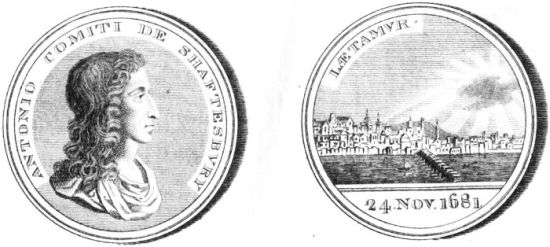
Note I.
Michal, of royal blood, the crown did wear,
A soil ungrateful to the tiller's care.—P.
217.
Queen Catherine of Portugal, the wife of Charles II., resembled
the daughter of Saul in the circumstance mentioned in the text.
She was plain in her person, and consequently possessed little influence
over her gallant husband. She was, however, always
treated by him with decent civility; and indeed, when persecuted
by the popular party, experienced his warmest protection. Her
greatest fault was her being educated a Catholic; her greatest
misfortune, her bearing the king no children; and her greatest
foible an excessive love of dancing. It might have occurred to
the good people of these times, that loving a ball was not a capital
sin, even in a person whose figure excluded her from the hopes of
gracing it; that a princess of Portugal must be a Catholic, if she
had any religion at all; and, finally, that to bear children, it is
necessary some one should take the trouble of getting them. But
these obvious considerations did not prevent her being grossly
abused in the libels of the times,[294] and very nearly made a party
in Dr Titus Oates' Appendix to his Original Plot.
Note II.
Not so the rest; for several mothers bore
To god-like David several sons before.—P.
217.
Charles left a numerous family of illegitimate children by his
various mistresses. Besides the Duke of Monmouth to be presently
mentioned, he had a daughter by Lady Shannon, and the
Earl of Plymouth by Mrs Catherine Pegge; by the Duchess of
Cleveland he had the Dukes of Cleveland, Gratton, and Northumberland,
and three daughters; by Mrs Eleanor Gwyn he had
the Duke of St Alban's, and James Beauclerk; the Duchess of
Portsmouth bore him the Duke of Richmond and Lennox: with
a daughter by Mrs Mary Davies, the king's children amounted
to the number of eight sons and five daughters.
Note III.
Of all the numerous progeny, was none
So beautiful, so brave, as Absalon.—P.
217.
James Stuart, Duke of Monmouth and Buccleuch, was born at
Rotterdam, 9th April, 1649, in the very heat of the civil wars.
He was the son of Charles II. and Mrs Lucy Walters, or Waters,
otherwise called Barlow, a beautiful young lady, of a good Welch
family. He was educated privately in Holland, under the assumed
name of James Crofts; and the respect with which his mother
and he were treated by the cavalier, afforded a foundation
for the argument of his adherents, who afterwards contended, that
the king had been privately married to that lady. After the Restoration,
the king sent for this young gentleman to court, where
the royal favour and his own personal and acquired accomplishments
soon made him very remarkable. Of his outward appearance,
Count Hamilton, the gay recorder of the gaieties of the
court of Charles, has given us a most interesting description,
which is not belied by portraits which are still preserved. "Nature,"
says the count, "perhaps never formed any thing so perfect
as the external graces of his person." His face was beautiful;
but it was a masculine beauty, unmixed with any thing weak or
effeminate: each feature had its own peculiar and interesting turn
of expression. He had admirable address in all active exercises,
an attractive manner, and an air of princely majesty. Yet his
mental qualities did not altogether support this prepossessing exterior;
or rather his fate plunged him into scenes where more was
necessary than the mind and manners which, in more regular
times, would have distinguished him as an accomplished cavalier
in peace and war. He was married, by the king's interference, to
Anne Scott, Countess of Buccleuch, sole surviving child of Francis,
Earl of Buccleuch, and heiress of the extensive estate which
the powerful family she represented had acquired on the frontiers
of Scotland. The young prince had been previously created Duke
of Orkney, a title now changed for that of Monmouth; and the
king, upon his marriage, added to his honours the dukedom of
Buccleuch. Thus favoured at home, he was also fortunate enough
to have an opportunity of acquiring military fame, by serving two
campaigns as a volunteer in Louis XIV.'s army against the Dutch.
He particularly distinguished himself at the siege of Maestricht,
where he led the storming party, took possession of the counterscarp,
and made good his quarters against the repeated and desperate
attempts of the besieged to dislodge him. Monmouth also
served a campaign with the Dutch against the French, in 1678, and is
on all hands allowed to have displayed great personal bravery; especially
in the famous attack on the Duke of Luxemburgh's line
before Mons, when the Prince of Orange, whose judgment can
hardly be doubted, formed that good opinion of his military skill,
which he stated when he offered to command the forces of his
father-in-law against the Duke on his last unfortunate expedition.
With that renown which is so willingly conferred upon the noble
and the beautiful, the Duke returned to England, and met with a
distinguished reception from Charles, by whom he was loaded with
favours, as will appear from the following list of his titles and offices.
He was Duke of Monmouth and Buccleuch; Earl of Doncaster
and Dalkeith; Lord Scott of Tinedale, Whichester, and Eskdale;
Lord Great Chamberlain of Scotland, Lord-Lieutenant of the east
Riding of Yorkshire; Governor of the town and citadel of Kingston
upon Hull; Chief Justice in Eyre of all his Majesty's forests,
chases, parks, and warrens on the south side of the Trent; Lord-General
of all his Majesty's land forces; Captain of his Majesty's
Life-guards of horse; Chancellor of the university of Cambridge;
Master of horse to the King; one of the Lords of the Privy Council,
and Knight of the order of the Garter.
Thus highly distinguished by rank, reputation, and royal favour,
he appears for some time to have dedicated himself chiefly
to the pleasures of the court, when an unfortunate quarrel with
the Duke of York, in the rivalry of an intrigue,[295] laid the foundation
for that difference, which was one great means of embroiling
the latter years of Charles's reign, and finally cost Monmouth his
head. When his quarrel with his uncle, whose unforgiving temper
was well known, had become inveterate and irreconcileable, the
Duke of Monmouth was led to head the faction most inimical to the
interests of York, and speedily became distinguished by the name of
the Protestant Duke, the dearest title that his party could bestow.
The prospect which now opened itself before Monmouth was such
as might have turned the head of a man of deeper political capacity.
The heir apparent, his personal enemy, had become the object
of popular hatred to such a degree, that the bill, excluding
him from the succession, seemed to have every chance of being
carried through the House of Lords, as it had already passed the
Commons. The rights of the Queen were not likely to interest
any one; and it seems generally to have been believed, however
unjustly as it proved, that Charles was too fond of Monmouth, too
jealous of his brother, and too little scrupulous of ways and means,
to hesitate at declaring this favourite youth his legitimate successor.
Under such favourable circumstances, it is no wonder that
Monmouth gave way to the dictates of ambition; and while he
probably conceived that he was only giving his father an opportunity
to manifest his secret partiality, he became more and more
deeply involved in the plots of Shaftesbury, whose bustling and
intriguing spirit saw at once the use to be made of Monmouth's
favour with the king, and popularity with the public. From that
time, their union became close and inseparable; even while Shaftesbury
was yet a member of the king's administration. Their
meetings were conducted with a secrecy and mystery which argued
their importance. According to Carte, they were held at
Lord Shaftesbury's and Charleton's houses, both parties coming
in private, and in hackney coaches. Some of Monmouth's partizans
had even the boldness to assert the legitimacy of their patron,
to prepare for his supplanting the Duke of York. When the
insurrection of the Covenanters broke out in Scotland, Monmouth
was employed against them, a duty which he executed with fidelity
and success. He completely defeated the insurgents in the
battle of Bothwell Bridge, and returned to the court in all the
freshness of his laurels. This was in the year 1679, and Monmouth's
good fortune had then attained its summit. He was beloved
by the people, general of all the forces both in England and
Scotland; London was at the devotion of Shaftesbury, the Duke
of York banished to Brussels, and universally detested on account
of his religion. At this important moment Charles fell ill of a
fever at Windsor. Had he died it is very probable that Monmouth
would have found himself in a condition to agitate successfully
a title to the crown. But either the king's attachment
to the Catholic religion, in the profession of which he finally died,
or his sense of justice and hereditary right occasioned an extraordinary
alteration of measures at this momentous crisis. The
Duke of York was summoned from abroad, arrived at Windsor,
and by his presence and activity at once resumed that ascendance
over Charles, which his more stern genius had always possessed,
and animated the sunken spirit of his own partizans. By a most sudden
and surprising revolution, York was restored to all his brother's
favour. For although he was obliged to retire to Scotland to avoid
the fury of the exclusionists, yet a sharper exile awaited his rival
Monmouth, who, deprived of all his offices, was sent into the foreign
banishment from which his uncle had just been recalled.
Accordingly he retired to Holland, where he was courteously received
by the States; and where Charles himself appears to have
been desirous, that his darling son should find an honourable asylum.
Meanwhile the factions waxed still more furious; and
Shaftesbury, whose boast it was to "ride in the whirlwind and direct
the storm," utterly embroiled the kingdom, by persuading
Monmouth to return to England without licence from his father,
and to furnish an ostensible head to that body of which the wily
politician was himself the soul. This conduct deeply injured Monmouth
in his father's favour, who refused to see him; and, by an
enquiry and subsequent declaration made openly in council, and
published in the Gazette, endeavoured to put an end to his hopes,
by publicly declaring his illegitimacy. Wonderful as it may seem,
this avowal was ascribed to the king's fear for his brother; and
two daring pamphlets were actually published, to assert the legitimacy
of Monmouth, against the express and solemn declaration
of his father.[296] Monmouth himself, by various progresses
through the kingdom, with an affectation of popularity which
gained the vulgar but terrified the reflecting, above all, by a
close alliance with the Machiavel, Shaftesbury, shewed his avowed
determination to maintain his pretensions against those of the lawful
successor. This was the state of parties in 1681, when "Absalom
and Achitophel" first appeared.
The permission of so sharp a satire against the party of Monmouth,
though much qualified as to his individual person, plainly
shewed the king's intention to proceed with energy against the
country party. Monmouth, in the midst of one of those splendid
journies which he had made to display his strength, was arrested
at Stafford, September 20, 1682, and obliged to enter bail for his
peaceable deportment and appearance when called on, to answer
any suit against him by the king. In the mean while, the dubious
and mysterious cabal, called the Rye-house Plot, was concocted by
two separate parties, moving in some degree towards the same
point, but actuated by very different motives, adopting different
modes of conduct, and in their mutual intrigues but slightly connected
with each other. It appears certain, that Monmouth utterly
abominated the proposal of Rumbold, and those who made
the assassination of the King and Duke of York the groundwork of
their proposed insurrection. It is equally certain, that, with Sidney
and Russell, he engaged in plans of reformation, or revolution,
of that dubious description, which might have turned out good or
evil, according to their power of managing the machine they were
about to set in motion; a power almost always over-rated till
the awful moment of experiment. Upon the discovery of these
proceedings, Monmouth absconded, but generously signified to
Lord Russell his determination to surrender himself if it could
serve his friend; an offer which Russell, with the same generosity,
positively rejected.
Notwithstanding the discovery which involved perhaps a charge
of high treason, the king was so much convinced of Monmouth's
innocence, so far as the safety of his person was concerned, that
the influence of Halifax, who always strove to balance the power
of the Duke of York by that of his nephew, procured him an opportunity
of being restored to the king's favour, for which the minister
had little thanks from the heir of the crown.[297] But Monmouth,
by an excess of imprudence, in which, however, he displayed
a noble spirit, forfeited the advantages he might have obtained
at this crisis. Although he signed an acknowledgment of
his guilt, in listening to counsels which could not be carried into
effect, without a restraint on the king's person; he would not, on
reflection, authorize the publication of a declaration, which must
have had a fatal influence on the impending trial of his friends.
He demanded it back, and received it; but accompanied with an
order to leave the kingdom. He obeyed, and remained in honourable
banishment in Holland, till after the accession of James
II. to the throne. There is room to believe, that Monmouth
would never have disturbed his uncle, had James not evinced a
desire to follow him with vengeance even into his retreat. Wellwood
has published a letter from him, in which he says, ambition is
mortified within him, and expresses himself determined to live in retirement.
But when the King insisted on the Prince of Orange driving
him out of Holland, and proceeded to take measures to exclude
him from Brussels, he appears to have become desperate. Even yet
he prepared to retire to Sweden, but he was surrounded by fugitives
from England and Scotland, who, as is always the case, represented
the nation as agitated by their passions, and feeling for their
individual oppression: Argyle, in particular, and the Scottish exiles,
fired by the aggressions on their liberty and religion, anticipated
a more warm support than they afterwards experienced.
Monmouth, thus driven upon his fate, set sail with three
ships; landed at Lyme with hardly an hundred followers; and,
such was the magic of his popularity, soon found himself at
the head of a considerable force. He baffled the Duke of
Albemarle who attempted to coop him up at Lyme, and, advancing
to Taunton took upon him fatally the title of King. At
length, he surprised the Earl of Feversham, James's general, in
his entrenchments near Bridgewater; and the native stubborn valour
of his followers nearly proved too much for the discipline of
the veterans, whom they attacked. The cowardice of Lord Grey,[298]
who fled with the cavalry, led to a total defeat and much slaughter
among Monmouth's forces. Still more fell a sacrifice to the bloody
zeal of the brutal Jefferies. The Duke himself was taken in his flight;
and, depressed by fatigue and disappointment, shewed some symptoms
of weakness, inconsistent with his former character. He solicited
his life by submissive letters to James, and, at length, obtained
an interview with the king. But James forgot the noble,
though homely popular saying,
A king's face
Should give grace.
With the natural sternness of his character, he only strove to extort
from Monmouth a disavowal of his legitimacy, and a confession
of his accomplices. To the former the Duke submitted; but,
when urged to the latter, rose from the posture of supplication,
and retorted with dignity the reproaches of James. When he returned
to the Tower, he wrote a letter to the king, supposed
to contain a secret, the revealing of which might have purchased
his life. This letter he intrusted to Captain Scott of
Dumbarton's regiment, a descendant of the family of Harden, and,
consequently, related to the Duchess of Monmouth. The famous
Blood is said to have compelled Scott to deliver up the letter,
and carried it to Sunderland, who destroyed it.[299]
The Duke of Monmouth, finding all efforts to procure a pardon
ineffectual, met death with great resolution. He smiled on the
guards who surrounded the scaffold, and whom in his better days
he had commanded; bowed to the populace, who expressed by
sighs and tears their interest in his fate; and submitted to his doom.
His death was cruelly prolonged by the hesitation of the executioner,
who, after several ineffectual strokes of the axe, threw
it down, and could scarcely be prevailed on to finish his bloody
work. The execution took place on the 15th of July, 1685.
It would be difficult, were it here necessary, to draw a character
of the unfortunate Duke of Monmouth. His qualities and
accomplishments were fitted for times more gentle than those in
which he lived, where he might be compared to a pleasure barge
struggling against a hurricane. In gentler times, he had proved
a successful leader in war; and in peace, what the reviver of tragedy
has aptly stiled, "An honoured courtly gentleman." Count
Basil. Act I. Scene II.
Note IV.
And made the charming Annabel his bride.—P.
218.
Anne, Duchess of Buccleuch and Monmouth, a lady of high
spirit, great beauty, and unimpeachable honour. We have had
repeated occasion to mention her in the course of these notes.
She was reckoned the richest heiress in Europe; as, upon the death
of her elder sister, Anne Countess of Buccleuch, wife of Walter
Earl of Tarras, she succeeded to the extensive land estate of that
family. Charles made this advantageous match for his son, by the
intervention of the young lady's mother, the Countess of Wemyss.
The Duchess of Buccleuch was a distinguished protectress of
poetical merit, and evinced her discriminating taste, by early selecting
Dryden as the object of her patronage; she cultivated the
friendship of the Duke of York, and established an intimacy between
him and her husband, which paved the way for the advancement
of the latter.[300] When by an occasional rivalry they
quarrelled, and became irreconcileable enemies, she still opposed
her prudence to the precipitate counsels of Monmouth's
worse advisers. It is probable her influence saved his life, by determining
him to make a timely confession, concerning all he knew
of the Rye-house conspiracy, upon condition, it was not to be
used against his friends. When he imprudently retracted that
confession, her advice prevailed on him to offer a renewal of
it.[301] Their last interview before the Duke's execution, is thus
narrated in a MS. now before me.
"His behaviour all the time was brave and unmoved, and,
even during the last conversation and farewell with his lady and
children, which was the movingest scene in the world, and which
no bye-standers could see without melting in tears, he did not shew
the least concerndness. He declared before all the company, how
averse the duchess had been to all his irregular courses, and that
she had never been uneasy to him on any occasion whatsoever,
but about women, and his failing of dutie to the late king. And
that she knew nothing of his last designe, not having heard from
himself a year before, which was his own fault, and noe unkindness
in her, because she knew not how to direct her letters to him.
In that, he gave her the kyndest character that could be, and begged
her pardon of his many failings and offences to her, and prayed
her to continue her kyndness and care to her poore children.
At this expression she fell down on her knees, with her eyes full of
teares, and begged him to pardon her if ever she had done any
thing to offend and displease him; and embracing his knees, fell
into a swoon, out of which they had much adoe to raise her up
in a good while after. A little before, his children were brought
to him, all crying about him; but he acquitted himself of these
last adewes with much composure, shewing nothing of weakness
and unmanliness." Account of the Actions and Behaviour of the
Duke of Monmouth, from the time he was taken to his Execution,
in a letter, dated July 16, 1685, MS., in the Duke of Buccleuch's
library.
The Duchess of Monmouth's turn of mind, and her aversion to
her husband's political intrigues, lead me to imagine, that Dryden
sketched out her character under that of Marmoutiere in "the
Duke of Guise;" whose expostulations with her lover apply exactly
to the situation of this noble pair. If the Duke of Monmouth
entertained a causeless jealousy of the intimacy of York with
his lady, as the Duke of Buckingham seems to hint,[302] something
like an allusion to this circumstance may be traced in the suspicions
of Guise, and vindication of Marmoutiere.[303]
The Duchess of Buccleuch and Monmouth survived the catastrophe
of her husband many years; during which she was resolute
in asserting her right to be treated as a princess of the blood. She
had two surviving sons by Monmouth; one of whom carried on
the line of Buccleuch, and the other was created Earl of Deloraine.
She was married a second time, in 1688, to Lord Cornwallis,
by whom she had two surviving daughters. The Duchess
died in 1732, in the eighty-first year of her life. King James
made her Grace and her family a gift of all her original property,
so far as forfeited by the Duke of Monmouth's condemnation.
Note V.
And Amnon's murder, by a specious name,
Was called a just revenge for injured fame.—P.
218.
There is a libel among the State Poems, relating to some obscure
fray, in which the duke of Monmouth and some of his brothers
appear to have been concerned. This was probably one of
the youthful excesses alluded to.[304] But Amnon's murder seems
to refer to the more noted assault upon sir John Coventry, which
the reader may take in the words of Andrew Marvell.
"But an accident happened, which had like to have spoiled all.
Sir John Coventry having moved (in the house of commons) for
an imposition on the play houses, sir John Berkenhead, to excuse
them, said they had been of great service to the king. Upon which,
sir John Coventry desired that gentleman to explain "whether
he meant the men or women players?"[305] Hereupon it is imagined,
that the house adjourning from Tuesday, before, till Thursday
after Christmas day, on the very Tuesday night of the adjournment,
twenty-five of the duke of Monmouth's troop,[306] and some
few foot, laid in wait from ten at night, till two in the morning, and
as he returned from the Cock, where he supped, to his own
house, they threw him down, and with a knife cut off almost
all the end of his nose; but company coming, made them fearful
to finish it; so they marched off. Sir Thomas Sands, lieutenant
of the troop, commanded the party, and Obrian, the earl
of Inchequin's son, was a principal actor. The court hereupon
sometimes thought to carry it with a high hand, and
question sir John for his words, and maintain the action; sometimes
they flagged in their councils. However, the king commanded
sir Thomas Clarges, and sir W. Pulteney, to release Wroth,
and Lake, who were two of the actors, and taken. But the night
before the house met, they surrendered (to) him again. The house
being but sullen the next day, the court did not oppose adjourning
for some days longer, till it was filled. Then the house went upon
Coventry's business, and voted that they would go upon nothing
else whatever, till they had passed a bill, as they did, for Sands,
Obrian, Parry, and Reeves, to come in by the sixteenth of February,
or else be condemned, and never to be pardoned, but by an
express act of parliament, and their names therein inserted, for
fear of being pardoned in some general act of grace. Farther, all
such actions, for the future, on any man, felony without clergy;
and who shall otherwise strike or wound any parliament man, during
his attendance, or going or coming, imprisonment for a year,
treble damages, and incapacity. The bill having in some few days
been despatched to the lords, the house has since gone on in grand
committee upon the first 800,000l. bill, but are not yet half way.
But now the lords, instead of the sixteenth of February, put twenty-five
days after the king's royal assent, and that registered in their
journal; they disagree in several other things, but adhere in that
first which is material. So that, in this week, the houses will be in
danger of splitting, without much wisdom or force. For, considering
that sir Thomas Sands was the very person sent to Clarges and
Pulteney, that Obrian was concealed in the duke of Monmouth's
lodgings, that Wroth and Lake were bailed at sessions, by order
from Mr Attorney, and, that all persons and things are perfectly
discovered, that act will not be passed without great consequence."
Letter from Andrew Marvel, to William Romsden, in Marvel's
Works, Vol. I. p. 413.
This aggression led to what, from the name of the sufferer, is
called the Coventry act, making cutting, and maiming the person,
with intent to disfigure it, felony without benefit of clergy. A satirical
ballad on this subject, called the Haymarket Hectors, was
written by Andrew Marvel, which may be found in his works,
and, with some variations, in the third vol. of the State poems.
It has very little wit, to atone for a great deal of grossness.
Note VI.
From hence began that plot, the nation's curse;
Bad in itself, but represented worse:
Raised in extremes, and in extremes decried;
With oaths affirmed, with dying vows denied.—P.
220.
The Papist plot, like every criminal and mysterious transaction,
where accomplices alone can give evidence, is involved in
much mystery. It is well known, that the zeal for making proselytes,
with all its good and all its evil consequences, is deeply
engrafted upon the catholic faith. There can be no doubt, from
Coleman's correspondence, that there was in agitation, among the
Catholics, a grand scheme to bring about the conversion of the
British kingdoms to the Romish religion. Much seemed to favour
this in the reign of Charles II. The king, though a latitudinarian,
was believed addicted to the religion of those countries
which had afforded him refuge in his adversity, and the
Duke of York was an open and zealous Papist. From the letters
of his secretary Coleman, it is obvious, that hopes were entertained
of eradicating the great northern heresy; and the real existence
of intrigues carried on with this purpose, unfortunately gave
a colour to the monstrous and absurd falsehoods which the witnesses
of the plot contrived to heap together. It is probable, that
Oates, by whom the affair was first started, knew nothing, but by
vague report and surmise, of the real designs of the Roman catholic
party; since he would otherwise have accommodated his story
better to their obvious interests. The catholics might gain much
by the life of Charles; but a plot to assassinate him, would have
been far from placing them an inch nearer their point, even supposing
them to escape the odium of so horrible a crime. The
Duke, it was true, was nearest in blood; but his succession to the
throne, had the king been taken off by those of his sect, would
have been a very difficult matter, since the very suspicion of such
a catastrophe had nearly caused his exclusion. But when the faction
involved the king also in the plot, which Oates positively
charges upon him in his last publication, and thereby renders him
an accessory before the fact to an attempt on his own life, the absurdity
is fully completed. Even according to the statement of
those who suppose that Charles had irritated the Roman catholics,
by preferring his ease and quiet to their interest and his own religious
feelings, his situation appears ludicrously distressing. For,
on the one hand, he incurred the hatred of those who called themselves
the Protestant party, for his obstinacy in exposing himself
to be murdered by the papists; and, on the other hand, he was
to be assassinated by the catholics, for not doing what, according
to this supposition, he himself most wished to do. It would be
far beyond our bounds, to notice the numberless gross absurdities
to which Oates and the other witnesses deposed upon oath. It
may appear almost incredible, in the present day, how such extravagant
fictions should be successfully palmed upon the deluded
public; but at that time there was not the same ready communication
by the press, which now allows opportunity to canvass an
extraordinary charge as soon as it is brought forward. The public
at large had no means of judging of state matters, but from
the bribed libellers of faction, and the haranguers in coffee-houses,
who gave what colour they pleased to the public news of the
day.[307] Besides, the catholics had given an handle against themselves,
by their own obscure intrigues; and it was impossible to forget
the desperate scheme of the Gunpowder Plot, by which they had
resolved to cut off the heresy in the time of King James. The
crime of the fathers was, in this case, visited on the children;
for no person probably would, or could, have believed in the catholic
plot of 1678, had not the same religious sect meditated
something equally desperate in 1606. It is true, the gunpowder
conspiracy was proved by the most unexceptionable testimony;
and the plot in Charles' time rested on the oaths of a few boldfaced
villains, who contradicted both themselves and each other;
but still popular credulity was prepared to believe any thing
charged on a sect, who had shown themselves so devoted to
their religious zeal, and so little scrupulous about means to
gratify it. Another main prop of the Catholic plot was the mystery
in which it was involved. If inconsistencies were pointed
out, or improbabilities urged, the answer was, that the discovery
had not yet reached the bottom of the plot. Thus the disposition
of the vulgar to believe the atrocious and the marvellous,
was heightened by the stimulus of ungratified curiosity, and
still impending danger. "Every new witness," says North, "that
came in, made us start—now we shall come to the bottom. And
so it continued from one witness to another, year after year, till at
length it had no bottom but in the bottomless pit."[308] Thus, betwixt
villainy and credulity, the spirits of the people were exasperated
and kept afloat, till the bloodhounds of the plot, like
those formerly used in pursuit of marauders, had drenched their
scent, and annihilated their powers of quest in the best blood in
the kingdom.
The unfortunate victims, whose lives were sworn away by Oates
and his accomplices, died averring their innocence; but the infuriated
people for some time gave little credit to this solemn exculpation;
believing that the religion of the criminals, or at least
the injunctions of their priests, imposed on them the obligation of
denying, with their last breath, whatever, if confessed, could have
prejudiced the catholic cause. As all high wrought frenzies are
incapable of duration, that of the Roman catholic plot decayed
greatly after the execution of the venerable Stafford. The decent
and manly sobriety of his demeanour on the scaffold, the recollection
of how much blood had been spilled, and how much more
might be poured out like water, excited the late and repentant
commiseration of the multitude: His protestations of innocence
were answered by broken exclamations of "God bless you, my
lord! we believe you." And after this last victim, the Popish
plot, like a serpent which had wasted its poison, though its
wreaths entangled many, and its terrors held their sway over
more, did little effectual mischief. Even when long lifeless, and
extinguished, this chimera, far in the succeeding reigns, continued,
like the dragon slain by the Red-cross Knight, to be the object of
popular fear, and the theme of credulous terrorists:
Some feared, and fled; some feared, and well it fained.
One, that would wiser seem than all the rest,
Warned him not touch; for yet, perhaps, remained
Some lingering life within his hollow breast;
Or, in his womb might lurk some hidden nest
Of many dragonettes, his fruitful seed;
Another said, that in his eyes did rest
Yet sparkling fire, and bade thereof take heed;
Another said, he saw him move his eyes indeed.
Note VII.
Some thought they God's anointed meant to slay
By guns, invented since full many a day.—P.
221.
The author alludes to the wonderful project to assassinate the
king by Pickering and Groves, to which Oates bore testimony.
Pickering, a man in easy circumstances, and whom religious zeal
alone induced to murder his sovereign, was to have 30,000 masses;
and Groves, a more mercenary ruffian, was to be recompensed
with a sum, which, reckoning at a shilling a mass, should be an
equivalent in money. But this scheme misgave, because, according
to the evidence, the conscientious and opulent Mr Pickering
had furnished himself for the exploit with an old pistol, the cock
whereof was too loose to hold a flint. Another time they were
to come to Windsor, to execute their bloody purpose with
sword and dagger; but could find no better conveyance than miserable
hack horses, one of which became lame, and disconcerted
the expedition. Such at least was the apology made by Oates for
their not appearing, when a party were, upon his information, stationed
to apprehend them.
Note VIII.
Of these, the false Achitophel was first.—P.
222.
Anthony, Earl of Shaftesbury, one of the principal heroes of
this poem, was in the Tower when it was published, and very soon
after was served with a bill of indictment for high treason; which
was thrown out by the grand jury, who returned a verdict of Ignoramus.
This gave rise to our author's next poem, "The Medal,"
and in the notes is contained some account of his lordship's life,
to which the reader is referred for further information. We have
already stated, that he was the counsellor of Monmouth, and the
very soul of his party. Nothing can be more exquisitely satirical
than the description which Dryden has here given of this famous
statesman.
Note IX.
And all to leave what with his toil he won,
To that unfeathered, two-legged thing, a son;
Got while his soul did huddled notions try,
And born a shapeless lump, like anarchy.—P.
222.
Anthony Ashley Cooper, second Earl of Shaftesbury, and son
of the great statesman, whom Dryden has dubbed his Achitophel.
The contemptuous language used towards him, is said not to have
reference to his outward appearance; for the portraits which remain
represent him at uncommonly handsome. Nay, so much
was his personal beauty an object of his attention, that he is said
to have hastened his decease by his solicitude to remove, by violent
means, an excrescence which disfigured his face. But the authority,
from which these circumstances are quoted, seems to admit,
that he was of a very insignificant character, at least not at all
distinguished by mental abilities. Biographia Britannica, Vol. IV.
p. 266. His want of capacity was a standing joke among the
Tories. In an ironical pamphlet, called "A modest Vindication
of the Earl of Shaftesbury, in a letter to a friend concerning his
being elected King of Poland," we have, among the list of his
officers of the crown, "Prince Prettyman Perkinoski (i.e. Monmouth),
our adopted heir, because a little wiser than our own son,
and designed to be offered to the diet as our successor."
It often happens, that men are more jealous of their own, or
their ancestors' reputation for talents, than for virtue. The third
Earl of Shaftesbury, author of the "Characteristics," is said to
have resented more deeply this occasional attack on his father's
understanding, than the satire against his grandfather, in which Dryden
has poured forth his whole energy. This passage is alleged
to have been the occasion of his mentioning Dryden disrespectfully
in several places of his works; a revenge more dishonourable to
his Lordship's taste than to the object of his spleen.[309]
Note X.
To compass this, the triple bond he broke,
The pillars of the public safety shook,
And fitted Israel for a foreign yoke.—P.
222.
The Earl of Shaftesbury is allowed to have been a principal adviser
of the Dutch war in 1672; by which the triple alliance between
England, Sweden, and Holland, the chef d'œuvre of Sir
William Temple's negociation, by which France and Spain were
forced into the treaty of Aix-la-Chapelle, was for ever broken. It
was he who applied to Holland the famous saying, Delenda est
Carthago; and who, with all his wit and eloquence, furthered a
closer connection with France, to the destruction of our natural
ally. But when the success of the Dutch war was inferior to the
expectations of this ardent statesman, when he found himself
rivalled by Clifford and others in the favour of Charles, and when
he perceived that the king, to preserve his quiet, would not hesitate
to sacrifice an obnoxious minister, he chose to make what
some of his biographers have called a short turn; and, by going
over to the popular party, to escape the odium attached to the
measures he had himself recommended.
Note XI.
In Israel's courts ne'er sat an Abethdin
With more discerning eyes, or hands more clean;
Unbribed, unsought, the wretched to redress,
Swift of dispatch, and easy of access.—P.
223.
In 1672, the seals were given to the Earl of Shaftesbury, on the
resignation of the Lord Keeper, Sir Orlando Bridgeman; and he
was invested with the office of Lord High Chancellor. In the judicial
part of his duty, he appears to have merited the eulogium
so elegantly expressed in the text. One of his biographers uses
the following strong expressions: "With what prudence and candour,
honour, and integrity, he acquitted himself in that great and
weighty employment, the transactions of the Court of Chancery,
during the time of his chancellorship, will best testify. Justice,
then, ran in an equal channel; so that the cause of the rich was
not suffered to swallow up the rights of the poor, nor was the
strong or cunning oppressor permitted to devour the weak or unskilful
opposer: but the abused found relief suitable to their distress;
and those by whom they were abused, a severe reprehension,
answerable to their crimes. The mischievous consequences,
which commonly arise from the delays and other practices of that
court, were, by his ingenious and judicious management, very
much abated, and every thing weighed and determined with such
an exact judgment and equity, that it almost exceeds all possibility
of belief."[310] Yet even in this high situation, Shaftesbury could
not help displaying something of a temper more lively and freakish
than was consistent with the gravity of his place. His dress
was an odd mixture of the courtier and lawyer; being an ash-coloured
gown, silver-laced, with pantaloons garnished with ribbons;
nothing being black about him, save, peradventure, his hat, which
North, though he saw him, cannot positively affirm to have been
so.[311] Besides, he occasioned much dismay and discomfiture upon
the first day of the term, which succeeded his appointment,
by obliging the judges, law officers, &c. who came, as usual, to
attend the great seal to Westminster-hall, to make this solemn procession
on horseback, according to ancient custom. As long as
the cavalcade was in the open street, this did well enough; but
when they came to strait passages and interruptions, "for want
of gravity in the beasts, and too much in the riders, there happened
some curvetting, which made no small disorder. Judge
Twisden, to his great affright, and the consternation of his
grave brethren, was laid all along in the dirt; but all at length
arrived safe, without loss of life or limb in the service."[312] This
whimsical fancy of setting grave judges on managed horses, with
hazard both of damage and ridicule, to say nothing of bodily distress
and terror, is a curious trait of the mercurial Earl of Shaftesbury.
Note XII.
And proves the king himself a Jebusite.—P.
223.
As it was pretty well understood that Charles was friendly to
the Catholic religion, which indeed he had secretly embraced, no
pains were spared to point out this tendency to the people, who
connected with the faith of Rome all the bugbear horrors of the
plot, as well as the real reasons which they had to dread its influence.
Dryden probably alludes to the language held by Colledge,
which was that of his party. Smith deposed against
him, that, while he was carrying him to dine with one Alderman
Willcox, he told him, "He was a man as true as steel, and a
man that would endeavour to root out Popery.'—Says I, 'That
may be easily done, if you can but prevail with the king to
pass the bill against the duke of York.'—'No, no, (said he) now
you are mistaken, for Rowley is as great a papist as the duke of
York is, (now he called the king, Rowley,) and every way as dangerous
to the Protestant interest, as is too apparent by his arbitrary
ruling."—State Trials, Vol. iii. p. 359.
Note XIII.
And nobler is a limited command,
Given by the love of all your native land,
Than a successive title, long and dark,
Drawn from the mouldy rolls of Noah's ark.—P.
226.
The legitimacy of the duke of Monmouth, though boldly and
repeatedly asserted by his immediate partizans, did not receive general
credit even in the popular faction. It was one of Shaftesbury's
principal advantages, to have chosen, for the ostensible head
of his party, a candidate, whose right, had he ever attained the
crown, must have fluctuated betwixt an elective and hereditary
title. The consciousness of how much he was to depend upon
Shaftesbury's arts, for stating and supporting so dubious a claim,
obliged the duke to remain at the devotion of that intriguing politician.
It seems to have been shrewdly suspected by some of
Monmouth's friends, that Shaftesbury had no real intention of serving
his interest. A poem, written by one of Monmouth's followers,
called "Judah Betrayed, or the Egyptian Plot turned on the
Israelites," expresses their fears, and very plainly intimates this
suspicion: and the reader may bear with some bad poetry, to be
convinced how far this faction was from being firmly united together:
For depth in politics, and statesman's brain,
Draw Hushai
[313] next, attended by a train
Of peevish votaries, heart-sick with pride,
Too numerous for an apostate guide;
The odious name of patriot he does own,
And prophecies the downfall of a throne:
Forms in his aged fancy, robbed of health,
The strange ideas of a Commonwealth,
Then gains the proselyte dissenting Jews,
And arguments from liberty does use:
So treason veiled for liberty may go,
And traitors' heads like royalists may show.
All Judah's people had united been,
Had not he interposed, and stept between;
David in's subjects love had held his reign,
Had not he cut the fastening bond in twain,
And fatal discord sown in sanhedrin,
The much lamented hasty Judah's sin.
When either faction does produce their right
To succession, they tacitly do slight
The present king, and silent reasons bring
That he is not, or should not be, a king.—
We need not care; for heaven ne'er will own
Egyptian heir on Israelitish throne;
Nor will it ere auspiciously defend
Hushai, that only strives for's private end.
He wheedles Absalon with hopes of king,
And glistering toys of crowns does 'fore him fling;
Thus does he sooth to overthrow a crown,
And Absalon's the tool to beat it down;
And easy Absalon, by gentleness drawn,
(Though he has courage paralleled by none,)
The loss of crowns to come he now does dread,
Can heaven place them on a nobler head?
So great a soul as his 'twill never own
Should rule on any thing beneath a throne;
Or ere see Judah plagued or robbed of health,
By that unbounded thing a Commonwealth.
Note XIV.
The next successor, whom I fear and hate,
My arts have made obnoxious to the State;
Turned all his virtues to his overthrow,
And gained our elders to pronounce a foe.—P.
229.
In 1679, when the antipathy to popery had taken the deepest
root in men's minds, the House of Commons passed a vote, "That
the Duke of York's being a papist, and the hopes of his coming to
the crown, had given the highest countenance to the present conspiracies
and designs of the papists, against the king and the protestant
religion." Charles endeavoured to parry the obvious consequences
of this vote, by proposing to the council a set of limitations,
which deprived his successor, if a catholic, of the chief
branches of royalty. Shaftesbury, then president of the council,
argued against this plan as totally ineffectual; urging, that when
the future king should find a parliament to his mind, the limitations
might be as effectually taken off as they could be imposed.
When the bill was brought in, for the total exclusion of the Duke
of York from the succession, Shaftesbury favoured it with all his
influence. It passed the Lower House by a very large majority,
but was rejected by the House of Lords, where Halifax opposed it
with very great ability. Shaftesbury, who had taken so decided a
part against the Duke of York in his dearest interests, was now irreconcilable
with him, and could only look for safety in his ruin.
Note XV.
'Till time shall ever-wanting David draw,
To pass your doubtful title into law:
If not, the people have a right supreme
To make their kings; for kings are made for them.—P.
229.
If we can believe the honourable Roger North, Lord Shaftesbury
made a fair experiment, for the purpose of ascertaining
whether Charles's love of ease and affection for Monmouth would
induce him to consent to an alteration of the succession in his favour,
to the prejudice of the Duke of York. He quotes a pamphlet,
called, "The Earl of Shaftesbury's expedient to settle the nation,
discoursed with his Majesty at Oxford, 24 March, 1681," which
gives the following account of the transaction; and, as it was published
at the time, and remained uncontradicted, either by Shaftesbury,
or the king, probably contains some essential truth. The
Earl of Shaftesbury having received, or pretended to receive, an
unsigned letter, in a disguised hand, bustled away to court, "as
hard," says the pamphleteer, "as legs, stick, and man could carry
him." When he arrived there, the Lord Chamberlain conceiving
the Duke of Monmouth might be in the secret, applied to him to
know what the great concern was. His grace answered, with an
appearance of hesitation, that it was something relating to himself,
in which, as in other affairs of his, Lord Shaftesbury took a deeper
concern than he desired. Meanwhile. Shaftesbury was introduced
to the audience he solicited with the king, and produced the letter,
containing, as he said, a plan for settling the interests of religion
and state, which proved to be a proposal for calling the Duke of
Monmouth to the succession. The king answered, he was surprized
such a plan should be pressed upon him, after all the declarations
he had made on the subject, and that, far from being
more timorous, he became more resolute the nearer he approached
his grave. Shaftesbury expressing great horror at such an expression,
the king assured him he was no less anxious for his own
preservation, than those who pretended to so much concern for the
security of his person; and yet, that he would rather lay down his
life than alter the true succession of the crown, against both law
and conscience. For that, said the earl, let us alone; we will make
a law for it. To which the king replied, that, if such was his lordship's
conscience, it was not his; and that he did not think even his
life of sufficient value to be preserved with the forfeiture of his
honour, and essential injury to the laws of the land.—North's
Examen, p. 100. 123.
Note XVI.
Then the next heir, a prince severe and wise,
Already looks on you with jealous eyes.—P.
230.
Before James went to Flanders, he had testified a jealousy of
Monmouth. "The Duke of York, before he went abroad," says
Carte, "was concerned to see that the king could observe his frequent
whispers at court to the Lord Shaftesbury, without being
moved or expressing his dislike of it, but was much more alarmed
at hearing of their frequent and clandestine meetings, without any
apparent dissatisfaction expressed by his Majesty." p. 493. vol. II.
Note XVII.
The Solymæan rout—— ——
Saw with disdain an Ethnic plot begun,
And scorned by Jebusites to be outdone.—P.
232.
The royalists recriminated upon the popular party, the charge
of plots and machinations against the government. There is no
doubt that every engine was put in motion, to secure the mob of
London, "the Solymean rout" of Dryden, to Shaftesbury's party.
Every one has heard of the 30,000 brisk boys, who were ready to
follow the wagging of his finger. The plots, and sham-plots, charged
by the parties against each other, form a dismal picture of the
depravity of the times. Settle thus ridicules the idea of the protestant,
or fanatical plot for seizing the king at Oxford.
This hellish Ethnick plot the court alarms;
The traytors, seventy thousand strong, in arms,
Near Endor town lay ready at a call,
And garrisoned in airy castles all:
These warriors, on a sort of coursers rid,
Ne'er lodged in stables, or by man bestrid.
What though the steel, with which the rebels fought,
No forge ere felt, or anvil ever wrought;
Yet this magnetick plot for black designs,
Can raise cold iron from the very mines;
To this, were twenty under plots contrived
By malice, and by ignorance believed;
Till shams met shams, and plots with plots so crost,
That the true plot amongst the false was lost.
Absalom Senior.
Note XVIII.
In the first rank of these did Zimri stand;
A man so various, that he seemed to be
Not one, but all mankind's epitome.—P.
233.
This inimitable description refers, as is well known, to the famous
George Villiers, Duke of Buckingham, son of the favourite of
Charles I., who was murdered by Felton. The Restoration put
into the hands of the most lively, mercurial, ambitious, and licentious
genius, who ever lived, an estate of 20,000l a-year, to be
squandered in every wild scheme which the lust of power, of pleasure,
of licence, or of whim, could dictate to an unrestrained imagination.
Being refused the situation of President of the North,
he was suspected of having favoured the disaffected in that part
of England, and was disgraced accordingly. But, in 1666, he
regained the favour of the king, and became a member of the
famous administration called the Cabal, which first led Charles
into unpopular and arbitrary measures, and laid the foundation
for the troubles of his future reign. Buckingham changed
sides about 1675, and, becoming attached to the country party,
made a most active figure in all proceedings which had relation
to the Popish plot; intrigued deeply with Shaftesbury, and distinguished
himself as a promoter of the bill of exclusion. Hence,
he stood an eminent mark for Dryden's satire; which, we may believe,
was not the less poignant, that the poet had sustained a personal
affront, from being depicted by his grace under the character
of Bayes in the Rehearsal. As Dryden owed the Duke no favour,
he has shewn him none. Yet, even here, the ridiculous, rather
than the infamous part of his character, is touched upon; and the
unprincipled libertine, who slew the Earl of Shrewsbury while his
adulterous countess held his horse in the disguise of a page, and
who boasted of caressing her before he changed the bloody cloaths
in which he had murdered her husband,[314] is not exposed to hatred,
while the spendthrift and castle-builder are held up to contempt.
So just, however, is the picture drawn by Dryden, that it differs
little from the following sober historical character.
"The Duke of Buckingham was a man of great parts, and an
infinite deal of wit and humour; but wanted judgement, and had
no virtue, or principle of any kind. These essential defects made
his whole life one continued train of inconsistencies. He was ambitious
beyond measure, and implacable in his resentments; these
qualities were the effects, or different faces of his pride; which,
whenever he pleased to lay aside, no man living could be more entertaining
in conversation. He had a wonderful talent in turning
all things into ridicule; but, by his own conduct, made a more
ridiculous figure in the world, than any other he could, with all
his vivacity of wit, and turn of imagination, draw of others.
Frolick and pleasure took up the greatest part of his life; and in
these he neither had any taste, nor set himself any bounds; running
into the wildest extravagancies, and pushing his debaucheries
to a height, which even a libertine age could not help censuring as
downright madness. He inherited the best estate which any subject
had at that time in England; yet, his profuseness made him
always necessitous; as that necessity made him grasp at every
thing that would help to support his expences. He was lavish
without generosity, and proud without magnanimity; and, though
he did not want some bright talents, yet, no good one ever made
part of his composition; for there was nothing so mean that he
would not stoop to, nor any thing so flagrantly impious, but he
was capable of undertaking."[315]
A patron like Buckingham, who piqued himself on his knowledge
of literature, and had the means, if not the inclination, to be
liberal, was not likely to want champions, such as they were, to
repel the sharp attack of Dryden. Elkanah Settle compliments
him with the following lines in his "Absalom Senior," some of
which are really tolerable.
But who can Amiel's charming wit withstand,
The great state-pillar of the muses' land;
For lawless and ungoverned had the age
The nine wild sisters seen run mad with rage;
Debauched to savages, till his keen pen
Brought their long banished reason back again;
Driven by his satyrs into reason's fence,
And lashed the idle rovers into sense.
— — — — — — —
Amiel, whose generous gallantry, while fame
Shall have a tongue, shall never want a name;
Who, whilst his pomp his lavish gold consumes,
Moulted his wings to lend a throne his plumes;
Whilst an ungrateful court he did attend,
Too poor to pay, what it had pride to spend.
Another poet, at a period when interest could little sway his
panegyrick, has apologized for the versatility and extravagance of
the then deceased Duke of Buckingham:
What though black envy, with her ran'crous tongue,
And angry poets in embittered song,
While to new tracks thy boundless soul aspires,
Charge thee with roving change, and wandring fires?
Envy more base did never virtue wrong:
Thy wit, a torrent for the bank too strong,
In twenty smaller rills o'erflowed the dam,
Though the main channel still was Buckingham.
[316]
Buckingham himself, smarting under the severity of Dryden's
satire, strove to answer it in kind. He engaged in this work with
more zeal and anger, than wit or prudence. It is one thing to
write a farce, and another to support such a controversy with such
an author. The Duke's pamphlet, however, sold at a high price,
and had a celebrity, which is certainly rather to be imputed to the
rank and reputation of the author, than to the merit of the performance.
As it is the work of such an applauded wit, is exceedingly
scarce, and relates entirely to the poem which I am illustrating,
I shall here insert the introduction, and some extracts from the
piece itself.
It is entitled "Poetic Reflections on a late Poem, entituled,
Absalom and Achitophel, by a Person of Honour. London, printed
for Richard Janeway, 1682. (14 December.)"
To the Reader.—"To epitomize which scandalous pamphlet, unworthy
the denomination of poesy, no eye can inspect it without a
prodigious amazement, the abuses being so gross and deliberate,
that it seems rather a capital or national libel, than personal exposures,
in order to an infamous detraction. For how does he
character the King, but as a broad figure of scandalous inclinations,
or contrived into such irregularities, as renders him rather
the property of parasites and vice, than suitable to the accomplishment
of so excellent a prince. Nay, he forces on king David such
a royal resemblance, that he darkens his sanctity, in spite of illuminations
from holy writ.
"Next, to take as near our king as he could, he calumniates the
Duke of Monmouth, with that height of impudence, that his sense
is far blacker than his ink, exposing him to all the censures that a
murderer, a traitor, or what a subject of most ambitious evil
can possibly comprehend.
"As to my Lord Shaftesbury, in his collusive Achitophel, what
does he other than exceed malice itself, or that the more prudent
deserts of that Peer were to be so impeached before hand by his
impious poem, as that he might be granted more emphatically
condign of the hangman's axe, and which his muse does in effect
take upon her to hasten.
"And if the season be well observed when this adulterate poem
was spread, it will be found purposely divulged near the time when
this lord, with his other noble partner, were to be brought to their
trial; and, I suppose this poet thought himself enough assured of
their condemnation, at least that his genius had not otherwise
ventured to have trampled on persons of such eminent abilities
and interest in the nation; a consideration, I confess, incited my
pen, its preceding respect being paid to the duke of Monmouth, to
vindicate their reputations where I thought it due.
When late Protector-ship was cannon proof,
And, cap-a-pe, had seized on Whitehall roof;
And next on Israelites durst look so big,
That, Tory-like, it loved not much the Whig;
A poet there starts up of wondrous fame,
Whether Scribe, or Pharisee, his race doth name,
Or more to intrigue the metaphor of man,
Got on a muse by father Publican;
[317]For 'tis not harder much if we tax nature,
That lines should give a poet such a feature,
Than that his verse a hero should us show,
[318]Produced by such a feat, as famous too;
His mingle such, what man presumes to think,
But he can figures daub with pen and ink.
A grace our mighty Nimrod late beheld,
When he within the royal palace dwelled;
And saw 'twas of import, if lines could bring
His greatness from usurper to be king;
[319]Or varnish so his praise, that little odds
Should seem 'twixt him and such called earthly gods;
And though no wit can royal blood infuse,
No more than melt a mother to a muse,
Yet much a certain poet undertook,
That men and manners deals in without book,
And might not more to gospel truth belong,
Than he if christened does by name of John.
— — — — — — —
Fame's impious hireling, and mean reward,
The knave that in his lines turns up his card;
Who, though no Raby thought in Hebrew writ,
He forced allusions that can closely fit;
To Jews, or English, much unknown before,
He made a talmud on his muses score;
Though hoped few critics will its genius carp,
So purely metaphors king David's harp;
And, by a soft encomium, near at hand,
Shews Bathsheba embraced throughout the land.
After much unintelligible panegyric on Shaftesbury, his Grace
comes to Seymour:[320]
For Amiel, Amiel, who cannot endite,
Of his then value wont disdain to write;
The very him, with gown and mace did rule
The Sanhedrim, when guided by a fool;
The him that did both sense and reason shift.
That he to gainful place himself might lift;
The very him, that did adjust the seed
Of such as did their votes for money breed;
The mighty him, that frothy notions vents,
In hope to turn them into presidents;
The him of hims, although in judgment small,
That fain would be the biggest at Whitehall;
The he, that does for justice coin postpone,
As on account may be hereafter shown.
The noble author, with what cause the reader is now enabled to
determine, piqued himself especially upon the satirical vigour of
these last verses. "As to the character of Amiel, I confess my
lines are something pointed: the one reason being, that it alludes
much to a manner of expression of this writer's, as may be seen by
the marginal notes; and a second will soon be allowed. The figure
of Amiel has been so squeezed into paint, that his soul is seen in
spite of the varnish." As these verses were written on an occasion,
when personal indignation must have fired his Grace's wit,
they incline us to believe, with Mr Malone, that his friends, Clifford
and Sprat, had the greatest share in the lively farce of "The
Rehearsal."
Buckingham's death was as awful a beacon as his life. He had
dissipated a princely fortune, and lost both the means of procuring,
and the power of enjoying, the pleasures to which he was
devoted. He had fallen from the highest pinnacle of ambition,
into the last degree of contempt and disregard. His dying scene,
in a paltry inn in Yorkshire, has been immortalized by Pope's
beautiful lines:
In the worst inn's worst room, with mat half hung,
The floors of plaister, and the walls of dung;
On once a flock-bed, but repaired with straw,
With tape-tied curtains, never meant to draw,
The George and Garter dangling from that bed,
Where tawdry yellow strove with dirty red,
Great Villiers lies! alas, how changed from him!
That life of pleasure, and that soul of whim;
Gallant and gay, in Cliefden's proud alcove,
The bower of wanton Shrewsbury and love;
Or just as gay at council, in a ring
Of mimicked statesmen, and a merry king;
No wit to flatter left of all his store,
No fool to laugh at, which he valued more;
There, victor of his health, of fortune, friends,
And fame, this lord of useless thousands ends!
Note XIX.
———Balaam.—P. 234.
The Earl of Huntington. A coarse reason is given by Luttrel
in his MS. notes, for the epithet by which he is distinguished in
the text.[321] He was one of the seventeen peers who signed a petition,
beseeching Charles to have recourse to the advice of his parliament;
and he himself presented it at Whitehall, on the 7th of
December, 1679, in the name of the other lords subscribing. This
advice was received very coldly by the king, who answered, "That
he would consider of what they had offered, and could heartily
wish, that all other people were as solicitous for the peace and
good of the nation, as he would ever be." The Earl of Huntington
also subscribed the petition and advice, presented by fifteen
peers to the king, against removing the parliament to Oxford;
where they stated, "Neither Lords nor Commons can be in safety,
but will be daily exposed to the swords of the Papists, and their
adherents, of whom too many are crept into your majesty's
guards." Yet Lord Huntington did not go all the lengths of
the Whig party. He became a privy councillor, was admitted to the
honour of kissing the king's hand, and was stated in the Public
Intelligencer, of the 25th of October, 1681, to have then confessed,
that he had found by experience, "That they who promoted
the bill of exclusion, were for the subversion of monarchy itself."
Monmouth, Grey, and Herbert, state, in a paper published on this
occasion, that Lord Huntington had denied the utterance of the
said words; but, from the stile of their manifesto, it is obvious,
they no longer regarded him as attached to their party. Ralph's
History. Vol. I. p. 657. 709. Note.
Note XX.
———Cold Caleb.—P. 234.
Ford, Lord Grey of Wark, described among Absalom's IX worthies as
Chaste Caleb next, whose chill embraces charm
Women to ice, was yet in treason warm;
Of the ancient race of Jewish nobles come,
Whose title never lay in Christendom.
He appears to have been a man of very great indifference
to his domestic concerns; as the Duke of Monmouth, under
whose banners he enlisted himself, was generally believed to have
an intrigue with Lady Grey. In an account of a mock apparition,
which that lady is supposed to witness, she is made to state,
"That on Saturday, the 29th of January, 1680, being alone in
her closet about nine o'clock at night, she heard a voice behind
her, which mildly said, sweetheart. At which she was at first not
at all frightened, supposing it to be an apparition, which she says
has often of late appeared to her in the absence of her lord, in the
shape of a bright star and blue garter, but without hurting, or so
much as frightening her." Lord Grey, ignorant or indifferent
about these scandalous reports, went step for step with Monmouth
in all his projects. He was a man of a restless temper, and
lively talents, which he exercised in the service of the popular
party. He was deep in the Rye-house Plot, and probably engaged
in the very worst part of it; at least, Lord Howard deposed,
that Grey was full of expectation of some great thing to
be attempted on the day of the king's coming from Newmarket,
which was that fixed by the inferior conspirators for his assassination.
Upon the trial of Lord Russel, Howard was yet more
particular, and said, that upon a dark intimation of an attempt on
the king's person, the Duke of Monmouth, "with great emotion,
struck his breast, and cried out, 'God so! kill the king! I will never
suffer them.' That Lord Grey, with an oath, also observed
upon it, that if they made such an attempt, they could not fail."
Ramsey charged Lord Grey with arguing with Ferguson, on the
project of the rising at Taunton. Grey, on the first discovery of
this conspiracy, was arrested, but, filling the officers drunk, he escaped
in a boat, and fled into Holland. He was afterwards very
active in pushing on Monmouth to his desperate expedition in
1685. He landed with the duke at Lyme, and held the rank of
general of horse in his army. Like many other politicians, his
lordship proved totally devoid of that courage in executing bold
plans, which he displayed in forming or abetting them. At
the first skirmish at Bridport he ran away, although the troops he
commanded did not follow his example, but actually gained a victory,
while he returned on the gallop to announce a total defeat.
Monmouth, much shocked, asked Colonel Mathews what he should
do with him? who answered, he believed there was not another general
in Europe would have asked such a question. Lord Grey, however,
fatally for Monmouth, continued in his trust, and commanded
the horse at the battle of Sedgemore. There he behaved like a
poltroon as formerly, fled with the whole cavalry, and left the foot,
who behaved most gallantly, to be cut to pieces by the horse of
King James, who, without amusing themselves with pursuit, wheeled,
and fell upon the rear of the hardy western peasants. So infamous
was Grey's conduct, that many writers at the time, thinking
mere cowardice insufficient to account for it, have surmised,
some, that he was employed by the king to decoy Monmouth to
his destruction; and others, that jealousy of the domestic injury
he had received from the duke, induced him to betray the army.[322]
This caitiff peer was taken in the disguise of a shepherd, near
Holt Lodge, in Dorsetshire; and confessed, that "since his landing
in England, he had never enjoyed a quiet meal, or a night's repose."
He was conveyed to London, and would probably have
been executed, had it not been discovered, that his estate, which
had been given to Lord Rochester, was so strictly entailed, that nothing
could be got by his death. He, therefore, by the liberal
distribution, it is said, of large sums of money, received a pardon
from the king, and appeared as a witness on the trial of Lord
Delamere; and was ready to do so on that of Hampden; yet he is supposed
to have kept some secrets with respect to the politics of the
Prince of Orange, in reward of which, he was raised to the rank
of an Earl after the Revolution.—Dalrymple's Memoirs, Vol. I. p.
185.
Notwithstanding the attribute which Dryden has ascribed to
Lord Grey in this poem, he afterwards proved a man of unprincipled
gallantry; and 23d of November, 1682, was tried in the
King's Bench for debauching lady Henrietta Berkeley, daughter of
the Earl of Berkeley, to whose sister, lady Mary, he was himself
married. See State Trials, Vol. III. p. 519.
Note XXI
And canting Nadab let oblivion damn,
Who made new porridge for the paschal lamb.—P.
234.
Lord Howard of Escricke, although an abandoned debauchee,
made occasional pretensions to piety. He was an intimate of
Shaftesbury and of Monmouth, but detested by Russel on account
of the infamy of his character. Plots, counter-plots, and
sham-plots, were at this time wrought like mine and countermine
by each party, under the other's vantage-ground. One Fitzharris
had written a virulent libel against the court party, which
he probably intended to father upon the whigs; but being seized
by Sir William Waller, he changed his note, and averred, that he
had been employed by the court to write this libel, and to fix it
upon the exclusionists; and to this probable story he added, ex
mera gratia, a new account of the old Popish Plot. The court resolved
to make an example of Fitzharris; they tried and convicted
him of treason, for the libel fell nothing short of it. When condemned,
finding his sole resource in the mercy of the crown, he
retracted his evidence against the court, and affirmed, that Treby,
the recorder, and Bethel and Cornish, the two sheriffs, had induced
him to forge that accusation; and that Lord Howard was the
person who drew up instructions, pointing out to him what he was
to swear, and urging him so to manage his evidence, as to criminate
the Queen and the Duke of York. The confession of Fitzharris
did not save his life, although he adhered to it upon the
scaffold. Lord Howard, as involved in this criminal intrigue, was
sent to the Tower, where he uttered and published a canting declaration,
asserting his innocence, upon the truth of which he received
the sacrament. He is said, however, to have taken the communion
in lamb's wool, (i. e. ale poured on roasted apples and
sugar,) to which profanation Dryden alludes, with too much levity,
in the second line above quoted. The circumstance is also
mentioned in "Absalom's IX Worthies:"
Then prophane Nadab, that hates all sacred things,
And on that score abominateth kings;
With Mahomet wine he damneth, with intent
To erect his Paschal-lamb's-wool-sacrament.
Lord Howard was at length set at liberty from the Tower, upon
finding bail, when he engaged under Shaftesbury, and ran into
all the excesses of the party. Being deeply involved in the Rye-house
Plot, he fled upon the discovery of that affair, and was detected
in his shirt, covered with soot, in a chimney; a sordid
place of concealment, which well suited the spirit of the man.
A tory ballad-maker has the following strain of prophetic exultation
on Howard's commitment:
Next valiant and noble Lord Howard,
That formerly dealt in lambs-wool;
Who knowing what it is to be towered,
By impeaching may fill the jails full.
The Conspiracy, or the Discovery of the Fanatic Plot.
Accustomed to tamper with evidence, Howard did not hesitate
to contaminate the noblest name in England, by practising
the meannesses and villainies he had taught to others. For the
sake of his shameful life, he bore witness against Russel and
Sidney to all he knew, and probably to a great deal more. The
former had always hated and despised Howard, and had only
been induced to tolerate his company by the persuasions of Essex:
The recollection, that, by introducing his best friend to the contagion
of such company, he had, in fact, prepared his ruin, was
one of the reasons assigned for that unfortunate peer's remorse and
suicide.
Note XXII.
Not bull-faced Jonas, who could statutes draw
To mean rebellion, and make treason law.—P.
234.
Sir William Jones was an excellent lawyer, and, in his private
character, an upright, worthy, and virtuous man; in his religion
he had some tendency to nonconformity, and his political principles
were of the popular cast. He was the king's attorney-general,
and as such conducted all the prosecutions against those concerned
in the Popish plot. He was, or affected to be, so deeply infected by
the epidemic terror excited by this supposed conspiracy, that he had
all his billets removed from his cellar, lest the Papists should throw
in fire-balls, and set his house on fire. He closed, nevertheless, with
the court, in an attempt to prohibit coffee-houses, on account of the
facility which they afforded in propagating faction and scandal; for
this, he was threatened by the country party with an impeachment
in parliament. Sir William Jones shortly after resigned his office
under government, and went into open opposition. He distinguished
himself particularly, by supporting the bill of exclusion, and by
a violent speech in the Oxford parliament, on the subject of the
clerk's mislaying the Bill for repealing the 35th of Elizabeth, an
act against dissenters. He was on his legs, as the phrase is, in the
same house, arguing vehemently on the subject of Fitzharris, when
the Black Rod knocked at the door, to announce the sudden and
unexpected dissolution of the parliament. A well written pamphlet,
entitled, "Advice to Grand Juries," which appeared on the
eve of the presentment against Shaftesbury, is said to have had
some effect in producing the ignoramus verdict, on that bill.
Sir William Jones is said to have regretted the share he took
in the prosecutions on account of the plot; which is extremely
probable, as his excellent talents, and sound legal principles, could
not fail, when clamour and alarm were over, to teach him how far
he had been misled. His anxiety for the situation of the country
is supposed to have accelerated his death, which took place in
1682, at Mr Hampden's house, in Buckingham-shire.
Note XXIII.
Shimei, whose youth did early promise bring
Of zeal to God, and hatred to his king.—P.
235.
Slingsby Bethel was son of Sir Walter Bethel, knight, by Mary,
daughter of Sir Henry Slingsby of Scriven, in Yorkshire, and sister
to Sir Henry Slingsby, a steady loyalist, who was condemned by
Cromwell's high court of justice, and beheaded on Towerhill in
1655. Bethel was early attached to the fanatical interest, both
by religious and political tenets; he was even a member of the
Committee of Safety. But he was a staunch republican, and no
friend to the Protector; being, it is believed, the author of that
famous treatise, entitled "The World's Mistake in Oliver Cromwell."
He was elected sheriff, with Cornish, on Midsummer-day
1680, and the choice was, in many respects, disadvantageous
to the popular party. In the first place, they were both
Independents; and, before taking upon them their offices, they
conformed, and took the sacrament according to the church
of England's ritual. It was believed, that nothing but the necessity
of qualifying themselves to serve their party in this office,
could have prevailed on them to have done so, and this gave advantages
against their whole party. Besides, Cornish was a downright,
plain-spoken republican, and Bethel had expressed himself very
bluntly in justification of the execution of Charles I.; and was,
therefore, obnoxious to every slur which the royalists could bring
against him, as ill-disposed to monarchy. Further still, Bethel's
extreme and sordid meanness gave great disgust to the citizens,
who were accustomed to consider the exercise of a splendid
and ostentatious hospitality as the principal part of a sheriff's duty.
He kept no table, lived in a chop-house, and, long afterwards,
whoever neglected to entertain during his shrievalty, was said to
"Bethel the city." Bethel is mentioned among the subjects of deprecation
in "The Loyal Litany:"
From serving great Charles, as his father before;
And disinheriting York, without why or wherefore;
And from such as Absalom has been, or more;
Libera nos, &c.
From Vulcan's treasons, late forged by the fan;
From starving of mice to be parliament-man;
From his copper face, that out-face all things can;
Libera nos, &c.
These two sheriffs first set the example of packing juries, when
persons were to be tried for party offences; for they took the task
of settling the pannels for juries out of the Compters into their
own hands, and left the secondaries of the Compters, who had
usually discharged that duty, only to return the lists, thus previously
made up. In Middlesex, they had the assistance of Goodenough,
the under-sheriff, a bustling and active partizan, who very
narrowly escaped being hanged for the Rye-house Plot. By this
selection of jurymen, the sheriffs insured a certainty of casting
such bills as might be presented to the Grand Jury against any
of their partizans. This practice was so openly avowed, that Settle
has ventured to make it a subject of eulogy:
Next Hethriel write Baal's watchful foe, and late
Jerusalem's protecting magistrate;
Who, when false jurors were to frenzy charmed,
And, against innocence, even tribunals armed,
Saw depraved justice ope her ravenous maw,
And timely broke her canine teeth of law.
The Earl of Shaftesbury himself reaped the advantage of this manœuvre;
which, from the technical word employed in the return
of these bills, was called Ignoramus. Stephen Colledge, the Protestant
joiner, also experienced the benefit of a packed jury, though
concerned in all the seditious practices of the time. He was afterwards
tried, condemned, and executed at Oxford, where he was
out of the magic circle of the sheriff's protection; and, though I
believe the man deserved to die, he certainly at last met with hard
measure. His death was supposed to have broke the talisman of
Ignoramus, and was considered as a triumph by the Tories, who,
for a long time, had been unable to persuade a jury to find for the
king.[323] When Lord Stafford was most unjustly condemned, Bethel
and his brother sheriff affected a barbarous scruple, whether
the king was entitled to commute the statutory punishment of high
treason into simple decapitation. The House of Commons ordered
that the king's writ be obeyed. This hard-hearted conduct
was an indulgence of their republican humour. Shortly after, Mr
Bethel was found guilty of a riot and assault upon one of the king's
watermen at the election of members of parliament for Southwark,
5th October, 1681. This person being active in the poll, Mr Bethel
caned him, and told him he would have his coat (the king's
livery) stripped over his ears. For this he was fined five merks.
Bethel, notwithstanding his violence, was so fortunate as to escape
the business of the Rye-house Plot. His brother sheriff, Cornish,
was not so fortunate: He was a plain republican, and highly esteemed
by Lord Russell, for having treated with indifference the
apprehension of the Tower firing on the city, saying, they could
only demolish a few chimneys. He was executed as an accomplice
in the Rye-house conspiracy, upon the evidence of that very
Goodenough, who had been his tool in packing the illegal juries;
so that his death seemed a retribution for dishonouring and perverting
the course of justice. James II. was afterwards satisfied that
Cornish had been unjustly executed, and restored his estate to his
family.
Note XXIV.
Yet Corah, thou shalt from oblivion pass;
Erect thyself, thou monumental brass,
High as the serpent of thy metal made,
While nations stand secure beneath thy shade!—P.
236.
Titus Oates, once called and believed the Saviour of his country,
was one of the most infamous villains whom history is obliged
to record. He was the son of an anabaptist ribbon-weaver, received a
tolerably good education, and, having taken orders, was preferred to
a small vicarage in Kent. Here the future protestant witness was
guilty of various irregularities, for which he was at length silenced
by the bishop, and by the Duke of Norfolk deprived of his qualification
as chaplain. At this pinching emergency he became a papist,
either for bread, or, as he afterwards boasted, for the purpose of insinuating
himself into the secrets of the Jesuits, and betraying them.[324]
The Jesuits setting little store by their proselyte, whose talents lay
only in cunning and impudence, he skulked about St Omers and
other foreign seminaries in a miserable condition. Undoubtedly
he had then the opportunity of acquiring that list of names of the
order of Jesus with which he graced his plot, and might perhaps hear
something generally of the plans, which these intriguing churchmen
hoped to carry through in England by means of the Duke of York.
Of these, however, he must have had a very imperfect suspicion;
for the scheme which is displayed in the letters of Coleman, the
duke's secretary, does not at all quadrate with the doctor's pretended
discovery. When confronted with Coleman, he did not
even know him personally. When the king asked him about the
personal appearance of Don John of Austria, he described him, at
a venture, as a tall thin black man, being the usual Spanish figure
and complexion; but, unfortunately, he was little, fair, and fat.
In a word, it was impossible such a villain could have obtained a
moment's credit, but for the discovery of Coleman's actual intrigues,
the furious temper of the times, and the mysterious death of
Sir Edmondbury Godfrey. On that last occasion he displayed
much dexterity. There was some difficulty in managing the evidence,
whether to bring the assassination to the conspiracy, or the
conspiracy to the assassination; but Oates contrived the matter
with such ingenuity, that the murder became a proof, and the
plot became a proof of the murder, to the universal conviction of
the public. As to Oates' other qualities, he was, like every renegade,
a licentious scoffer at religion, and, in his manners, addicted,
it is said, to the most foul and unnatural debaucheries. When we
consider his acts and monuments, it is almost impossible to believe,
how so base a tool should have ever obtained credit and
opportunity to do such mighty mischief.[325]
As for his family, to which Dryden alludes a little below, "he
would needs," says North, "be descended of some ancient and worshipful
stock; but there were not so many noble families strove
for him, as there were cities strove for the parentele of Homer.
However, the heralds were sent for, to make out his pedigree, and
give him a blazon. They were posed at the first of these, but they
made good the blazon for him in a trice, and delivered it authenticamente,
and it was engraved on his table and other plate; for
he was rich, set up for a solemn housekeeper, and lived up to his
quality."[326]
Dryden compares Oates to the brazen serpent raised up in the
wilderness, by looking on which, the Israelites were cured of the
bites of the fiery snakes. Sprat had applied the same simile, in
a favourable sense, to Oliver Cromwell:
Thou, as once the healing serpent rose,
Was lifted up, not for thyself, but us.
Note XXV.
Sunk were his eyes, his voice was harsh and loud;
Sure signs he neither choleric was, nor proud:
His long chin proved his wit; his saint-like grace
A church vermilion, and a Moses' face.—P.
236.
North has left us some specimens of Oates' peculiar mode of pronounciation.
Bedloe, his brother-witness in the plot, had been taken
ill at Bristol, and, on his death-bed, held some conference with
the Lord Chief-Justice North, then upon a circuit, who took
down his examination, concerning which numerous reports went
forth. It proved, however, to be the same story he had formerly
told. Even Dr Oates himself was disappointed; and was heard
to say aloud, as the Lord Chief-Justice passed through the court
on a council-day, at all which times he was a diligent attendant,
"Maay Laird Chaife-Jaistaice, whay this baisness of Baidlaw caims
to naithaing." But his Lordship walked on without attending to
his discourse.[327]
In personal appearance North informs us, that "he was a low
man, of an ill-cut very short neck; and his visage and features
were most particular. His mouth was the centre of his face, and
a compass there would sweep his nose, forehead, and chin, within
the perimeter. Cave quos Deus ipse notavit."[328] An engraving of
the doctor, now before me, bears witness to this last peculiarity,
and does justice to the cherubic plenitude of countenance and chin
mentioned in the text. It is drawn and engraved by Richard
White, and bears to be "the true originall, taken from the life,
done for Henry Brome and Richard Chiswel; all others are counterfeit."
As the doctor's portrait is not now quite so common as
when the lady, mentioned in the Spectator, wore it upon her fan,
gloves, and handkerchief, the curious reader may be pleased to be
informed, that this "true original" is prefixed to "The Witch of
Endor, or the Witchcrafts of the Roman Jezebel, by Titus Oates,
D. D. folio 1679." It is dedicated to the Earl of Shaftesbury,
&c.; "the Publisher's affectionate good friend, and singular good
Lord."
Note XXVI.
And gave him his rabinical degree,
Unknown to foreign university.—P.
237.
Oates pretended to have taken his doctor's degree at Salamanca,
where it is shrewdly suspected he never was; at least where he
certainly never took orders. The Tory libels of the time contain
innumerable girds concerning this degree. There is, in the
Luttrel Collection, "An Address from Salamanca to her (unknown)
offspring, Dr T. O." Dryden often alludes to the circumstance;
thus, in the epilogue to "Mithridates," acted 1681-2,
Shall we take orders? that will parts require;
Our colleges give no degrees for hire.—
Would Salamanca were a little nigher!
Note XXVII.
And Corah might for Agag's murder call,
In terms as coarse as Samuel used to Saul.—P.
237.
In the first book of Samuel, chap. xv., the reader will find the reproaches
with which that prophet loaded Saul, for sparing, contrary
to God's commandment, Agag, king of the Amalekites; concluding
with the awful denunciation, that for his disobedience the Lord
had rejected him from being king over Israel.
Agag's murder is to be understood of the mysterious death of
Sir Edmondbury Godfrey. This gentleman was an active justice
of peace, and had been knighted by Charles II., on account of his
exertions during the fire of London. In other respects, he was
low-spirited, and rather a timorous man, and, in the exercise of
his office, favourable to the Catholics. Oates, finding the information
he had lodged with the ministers concerning the Popish plot
rather less ardently listened to than he expected, chose to utter
before this magistrate a full declaration on the subject upon oath.
His intention was probably to make the matter as public as possible.
Godfrey expressed much unwillingness to have any thing to
do with the matter at all; and when he had heard the story out, expressed
to his friends his fear that he should have no thanks for his
pains, but would probably be the first martyr. This strange, and
one would think absurd, boding proved too true; after having been
missing for several days, this unfortunate man was found lying
in a ditch, near Primrose-hill. There were marks of strangling
round his neck; and although his own sword was thrust through his
body, yet it turned out to have been done after death. His money
and rings were safe; robbery was therefore out of the question.
This murder ever will remain among the riddles of history. Three
opinions have been entertained: 1st, North does not hesitate to
affirm, that the contrivers and abettors of the plot murdered this
poor man, to give some colour to the story of the bloody machinations
of the Papists: But this seems too strange and desperate
a course to be imputed to the opposition party at large without
some positive proof; and as for Oates and his brother witnesses,
(whom we will not injure by suspecting them capable of remorseful,
or compunctious visitings,) their steps were, at this time, too
much the object of observation to admit of their executing so
bloody a plan with the necessary degree of secrecy. 2d, It has been
thought that Godfrey, a man of a melancholy temperament, whose
dark and cloudy spirit had been just agitated by a strange tale of
blood and mystery, may have been wrought up to take that time to
commit suicide. It is even positively asserted, that he hanged himself
at home, and that his brothers conveyed the body to the place
where it was found, to avoid the shame and other consequences of his
fate becoming public. There is something plausible in this account;
but it is entirely unsupported by proof of any kind. 3d, The grand
solution, and indeed the only one which would go down at the time,
was, that Godfrey had fallen by the papists. There were probably
enough of fanatics in that sect to have executed such a deed, had it
been of consequence to the progress of their religion: But there
appears no adequate motive for taking off Godfrey, who had merely
taken down a deposition which he could not refuse to receive, and
who had besides endeavoured to serve the accused parties, by transmitting
to Coleman an account of the affidavit; while Oates and
his companions, the depositaries of the supposed secret, and whose
death would stifle the plot for ever, were suffered to walk about,
even unattempted. Positive evidence was however obtained, to silence
all hypothetical reasoning on the subject. One Bedlow, a
very infamous character, amid a thousand dreadful stories of fires
raised by the Jesuits from 1666 downwards, charged the Catholics,
and particularly Miles Prance, a silver-smith, with the death of
Godfrey[329]. This man was imprisoned in Newgate; and, after
much communing with Shaftesbury and Buckingham, in which,
it is said, neither threats, promises, nor actual tortures were spared,
confessed himself an accomplice in the murder.[330] He retracted
this confession before the privy-council; but being remanded to
prison, new terrors, promises, and sufferings, induced him to retract
that retractation. His story was a tissue of improbabilities; and
he and Bedlow, when adduced as evidence on the trial of three
poor men, whom they charged with strangling Godfrey, concealing
the body in Somerset-House, and afterwards disposing of it
on Primrose-hill, contradicted each other, and contradicted themselves.
All was in vain: the three innocent victims of perjury
were condemned and executed, and the witnesses promoted and
rewarded, not with money only, but, strange to say, with universal
respect and regard; although their merit, supposing it to be real,
was that of murderers and incendiaries, who had turned evidence
for the crown against their accomplices.
The outcry raised about Godfrey's murder at the time, and for
long after, gave the plot its surest foundation and support. When
his funeral rites were performed, the crowd was prodigious, and
the papists were sufficiently cautious to keep within doors, or
some might have been offered up as an oblation to the manes of
Justice Godfrey. While the clergyman preached the funeral sermon
of the protestant victim, two robust divines stood by him in
the pulpit, lest, while rendering this last duty to the murdered magistrate,
he should in facie ecclesiæ be murdered by the papists.
At the formal pope-burnings of the party, Sir Edmondbury, supported
on a steed by his murderers, was a principal figure in the
procession, preceded by a harbinger, who rung a bell, and admonished
the people to remember Justice Godfrey. In short, this unfortunate
gentleman's death, however it came about, continued
long to be the watch-word and war-cry of those, who called themselves
the true protestant party.
Note XXVIII.
The crowd, that still believe their kings oppress,
With lifted hands their young Messiah bless;
Who now begins his progress to ordain,
With chariots, horsemen, and a numerous train.—P.
239.
"In August, 1680, the Duke of Monmouth went into the country
to divert himself, visiting several gentlemen in the west of England,
by whom he was received and entertained with a gallantry suitable
to the greatness of his birth, and the relation he stood in to his majesty;
incredible numbers of people flocking from all the adjacent
parts to see this great champion of the English nation, who had
been so successful against both the Dutch, French, and Scots.
He went first into Wiltshire, and was pleased to honour the worthy
esquire Thynne with his company for some days. From thence he
went to Mr Speak's, in Somersetshire, in which progress he was caressed
with the joyful acclamations of the country people, who
came from all parts; twenty miles about the lanes and hedges being
every where lined with men, women, and children, who, with
incessant shouts, cried, "God bless King Charles and the Protestant
Duke!" In some towns and parishes which he passed
through, they strewed the streets and highways where he was to
pass with herbs and flowers, especially at Ilchester and Pithyton;
others presenting him with bottles of wine. When he came within
ten miles of Mr Speak's, he was met by two thousand persons on
horseback, whose numbers still increased as they drew nearer to
Mr Speak's, and when they arrived there, they were reputed to
be twenty thousand; wherefore they were forced to break down
several pearch of his park pales to enlarge their passage to the
house, where his grace and all this numerous company were entertained
and treated, in an extraordinary manner.
"On the 26th, he went to Brompton; being met on the road by
a great company of gentry and country people, who conducted
him to Sir J. Sydenham's, where he was entertained at a noble and
splendid dinner. The next day he went to Barrington, where he
was pleased to honour Mr William Stroud with his company at
dinner; the entertainment being nothing inferior to what his Grace
had met with in all other places. After dinner he went to
Chard, where he arrived about five in the afternoon, attended
with a train of five thousand horsemen; and there he was met and
welcomed by a crowd of men, women, and children, who had not
a mute among them, but were almost all of them made deaf by
their own shouts and acclamations of joy. His Grace lay there
that night, being treated at a very splendid supper; he lodged at the
house of M. Prideaux.[331] The next day, having been entertained at
a sumptuous dinner, he rid to Ilminster, and in the afternoon he
went to Whitelackindon, where he lay that night; and the day
following, which was Sunday, his grace observed the Sabbath with
a religious care, and went to Ilminster church. On the 30th, he
went to Calliton, where he was entertained by Sir Walter Young.
The next day he went to Overton, where he was entertained, and
lodged by Mr Dukes. From thence he went to Exeter, and was
met by the citizens and the people of all the adjacent parts, to the
number of twenty thousand persons; but that which was more remarkable,
was the appearance of a brave company of brisk, stout young
men, all clothed in linen waistcoats and drawers, white, and harmless,
having not so much as a stick in their hands; they were in number
about nine hundred or a thousand; they went three miles out of
the city to meet his Grace, where they were drawn up all on a little
hill, and divided into two parts, in which order they attended
the Duke's coming, who rid up first between them, and then round
each company; after which they united, and went hand in hand
in order before, where he was no sooner arrived, but a universal
shout from all parts echoed forth his welcome; the numerous
concourse of people, the incredible and amazing acclamations, and
the universal joy which then filled the whole city, far exceeding
my pen to describe.[332]
"From thence he returned to Mr Speake's, where the whole
country flocked again to see and admire him, not being enough satisfied
with their former sight. From thence he went the next
day to Mr Harvie's, near Yeovil, where he dined, and in the afternoon
he rid to Esquire Thynne's; people flocking from all the
towns and villages thereabout to Howden-hill, where they attended
the Duke's coming; and after they had, by loud acclamations,
proclaimed his welcome amongst them, and expressed their joy
for his safe return, they took their leave of him, returning his
Grace their humble and hearty thanks for that kind visit, and for
his having condescended to accept of their plain, but true-hearted
entertainment. From thence he returned to London, wonderfully
pleased with the noble and generous entertainment he met with
at the several places where he came; every place striving to out-vye
each other."[333]
At Tunbridge Wells. "Abundance of country people rudely
crowded, after their rustic manner, to see the eldest son of their
king and sovereign, every one extolling him to the skies, crying to
one another, 'O what a brave man he is!' Some admired the
beauty and make of his person; some the majesty and port of his
carriage; and others, who had seen the king, the exact resemblance
he bare to his majesty; affirming, they never, in all their
lives, saw a son resemble a father more than the duke did the
king; but all admired his affable and courteous disposition."[334]
These assemblies were chiefly made under pretence of cock-matches,
horse-races, and other popular amusements; pretexts the
more dangerous, as they were the well-known signals of rendezvous
at which the cavaliers were wont to concert their plots
against Cromwell. See the tract called "Killing no Murder."
Foot races, wrestling matches, and other country pastimes, were
also resorted to as an ostensible cause of meeting. These gave
Monmouth an opportunity to display his personal agility and liberality.
He wrestled, he ran, and carried off the prize, in both
exercises; he then ran in his boots against the peasants in their
shoes, and still obtained the victory. The prizes which he gained
were freely distributed among his competitors. All these arts of
popularity became the derision of his enemies, when he was forced
into exile; as, for example, in the following verses:
Monmouth, for wit, who was able
To make to a crown a pretence;
The head and the hope of the rabble,
A loyal and politic prince:
But now he's gone into Holland
To be a king of no land,
Or else must be monarch of Poland;
Was ever son so loyal as he?
Was ever son so loyal as he?
Lord Gray, and Armstrong the bully,
That prudent and politic knight,
Who made of his grace such a cully,
Together have taken their flight,
Is this your races, horse-matches,
His grace's swift dispatches,
From shire to shire,
Under the hatches?
Now above deck you dare not appear.
The Conspiracy, or the Discovery of the Fanatic Plot.
These ostentatious progresses were devised by Shaftesbury, as a
mode of manifesting the strength of Monmouth's party, and increasing
his partizans and popularity. Among the higher ranks,
they carried an air of defiance which rather hurt his cause; for
reflecting and cautious men were slow to join in what seemed to
be a preliminary for civil war. It was different with the lower orders,
who, always biassed by what is more immediately addressed
to their eye-sight, were led by these showy processions, and by the
courtesy, activity, and fine presence of Monmouth, to doat on him
to an incredible degree. Not only did the western peasantry, on his
landing in 1685, crowd to join him in multitudes beyond what he
could arm, but their attachment survived even his defeat and
death; and they long believed, with fond credulity, that another
person had been executed in his stead, and that their beloved
protestant prince was still alive.
The arts of Absalom, in stealing the hearts of Israel from his
father, form an exact parallel to the language which Dryden puts
in the mouth of Monmouth.
"And it came to pass after this, that Absalom prepared him
chariots and horses, and fifty men to run before him. And Absalom
rose up early, and stood beside the way of the gate: and it
was so, that when any man that had a controversy came to the
king for judgment, then Absalom called unto him, and said, Of
what city art thou? And he said, Thy servant is one of the tribes
of Israel. And Absalom said unto him, See, thy matters are good
and right; but there is no man deputed of the king to hear thee.
Absalom said moreover, Oh that I were made judge in the land,
that every man, which hath any suit or cause, might come unto
me, and I would do him justice! And it was so, that when any
man came nigh unto him to do him obeisance, he put forth
his hand, and took him, and kissed him. And on this manner did
Absalom to all Israel, that came to the king for judgment. So
Absalom stole the hearts of the men of Israel." 2d Sam. chap.
xv. v. 1, 2, 3, 4, 5, 6.
Note XXX.
But hospitable treats did most commend
Wise Issachar, his western wealthy friend.—P.
239.
Thomas Thynne, esquire, of Longleat-hall, called, from his great
wealth, Tom of Ten Thousand. He had been formerly a friend of
the Duke of York, but, upon some quarrel between them, he attached
himself warmly to Monmouth. Mr Thynne was one of those gentlemen,
who petitioned for the speedy meeting of parliament, after it
was prorogued in 1679, on account of the heat with which the house
pursued the Exclusion Bill. The king received the intimation very
ill; told Mr Thynne, he was surprised at persons of property countenancing
such proceedings, and that he wished they would mind
their own affairs, and leave him to attend to his. When Monmouth
made his progress through the west of England, as mentioned
in the last note, Mr Thynne received him at his country-seat
with all the splendour and liberality of ancient English hospitality.
This gentleman's tragical fate is well known. He was
married to the Lady Ogle, sole heiress of the Northumberland
estate; but, his bride going abroad, the marriage was never consummated.
Count Konigsmark met the lady, fell in love with
her person, or with her fortune, and could see no better road
to both than by assassinating her husband. Accordingly, three
foreigners, hired by the count, or dependents upon him, waylaid
Mr Thynne's carriage, as it passed through Pall-Mall, and shot
him with a blunderbuss, in the manner represented on his tombstone
in Westminster Abbey.[335] The Duke of Monmouth had
left the carriage about an hour before the murder; and sir John
Reresby received the thanks of the king for his activity in
apprehending the assassins, without which, suspicions might have
arisen that the attempt was intended against Monmouth by the
court party.[336] Monmouth himself remained all night with his dying
friend, and distinguished himself by his zeal and assiduity in furthering
the search after the murderers. At length, Count Konigsmark
was taken by Gibbons, one of Monmouth's attendants, who
seized him, as he was going on ship-board. When apprehended, Gibbons
charged him with the fact, and added, that he had like to have
killed his master, the Duke of Monmouth; to which the Count answered,
"they would not have killed him." The three actual assassins
were condemned to death; but, by some foul play,[337] Konigsmark,
who had employed them, and who came over to England expressly
to see that they executed their bloody commission, was acquitted.
Monmouth went to see these subaltern villains executed.
Stern, at the gallows, complained that he died for a man's fortune
whom he never spoke to, for a woman whom he never saw, for a
dead man whom he never had a view of. True Narrative of the
Horrid Plot, &c. fol. 1679. p. 64. State Trials, Vol. II. p. 503.
Note XXXI.
———Good King David's life,
Endangered by a brother and a wife.—P.
239.
The accusations against York and the Queen were no part of
Oate's original plot. On the contrary, in the summary of his
"True Narrative," he informs us, that the "Royal family of the
Stuarts are condemned to be cut off, root and branch, and namely,
the King, Duke of York, and Prince of Orange, because that
family have not answered their expectation, nor have they any hopes
that any of them will comply fully with this their bloody design,
when fully discovered to them." And on the next page, it is again affirmed,
that notwithstanding the Duke of York's zeal for the Catholic
religion, "they design to dispose of him as is aforesaid." But
when the public belief in the plot had taken root, and Shaftesbury
had grafted upon it his doctrine of exclusion, Oates, by degrees,
charged the Duke, first with being the innocent and blind tool of the
Catholics whom they intended to succeed his brother, though he
knew nothing of their designs; and finally, with being at the very
depth of all the villainy, and the immediate author of the Fire of
London. As for the queen, her barrenness was a reason, for
all the exclusionists desiring she should be removed, that the
king might have a chance of legitimate issue, to the exclusion
of the Duke of York. Animated by a belief, that this would be
agreeable to the king, Oates had the boldness, at the bar of the
House of Commons, to utter these words, in his affected phraseology,
"Aye, Taitus Oates, accause Catherine, Quean of England,
of haigh traison!" The grounds of his accusation are stated in
the trial of Wakeman, the queen's physician, who, he alleged, was
bribed with 15,000l to poison the king, in case he should escape
the poniard of a Jesuit, named Coniers, and the pistols of Pickering
and Groves. Oates then swore, that three Jesuits carried him
with them to Somerset-house, where they were summoned to attend
the Queen; that he remained in an anti-chamber when they
were ushered into her presence; that he heard a female voice say,
she would assist Sir George Wakeman in his project, and would no
longer bear these repeated violations of her bed. When the fathers
came out, he desired to see the queen, and when admitted
into the anti-chamber, whence the female voice had proceeded,
he saw the queen, who smiled graciously on him, and there
was no other woman present. These impudent stories, with some
blunders into which the best-breathed witness may fall, saved
Wakeman's life.
The King immediately saw the tendency of this charge, and observed,
"They think I have a mind for a new wife; but for all
that, I will not see an innocent woman abused;" and certainly,
had he given way to it, the Queen would have been in great danger.
Note XXXII.
In this short file Barzillai first appears,
Barzillai, crowned with honour and with years;
Long since the rising rebels he withstood,
In regions waste, beyond the Jordan's flood, &c.
James Butler, Duke, Marquis, and Earl of Ormond, Earl of
Ossory and Brecknock, &c. &c. was as illustrious for his talents,
as for his rank, and distinguished by virtues superior to both. In
the difficult and dangerous situation of Lord-Lieutenant of Ireland,
he had to maintain the cause of Charles I. in that kingdom, with
very slender means, at once against the confederated Irish Catholics,
and the parliamentary forces, the more formidable, though
less numerous, enemies of the royal cause. In 1649, he was able,
through consummate skill, both as a politician and general, to boast
that he had reduced almost all Ireland under the royal authority,
excepting the cities of Dublin and Londonderry. But Cromwell's
arrival, with 8000 disciplined and veteran forces, effectually changed
the scene. His first exploit was the storm of Tredagh, or Drogheda,
where the besiegers put the whole garrison to the sword,
and committed the most dreadful excesses of barbarity. After
this terrible example of severity, hardly any of the royal garrisons
could be prevailed on to make such a defence, as might expose
them to the same extremity. Wexford, and New Ross, both very
strong places, surrendered without a blow; all the forces under
Lord Inchiquin revolted to the side of the parliament; and, at
length, in 1650, Ormond saw himself under the necessity of abandoning
the kingdom, which he had so long and valiantly defended.
From Ireland he retreated to France, and accompanied King
Charles during his exile. He was much trusted by that prince; and
was charged with the task of withdrawing the Duke of Gloucester
from the family of the queen mother, Henrietta, who was making
every possible attempt to induce him to change his religion. This
delicate commission he executed with dexterity and success. He
had afterwards the satisfaction to forward a reconciliation between
the king and his mother, who had been on bad terms on account of
the queen's imprudent interference with her son's religious tenets.
At the Restoration, the Marquis of Ormond, for such was then
his title, was liberally rewarded, in lands and honours, for his steady
attachment to the royal party. He was created Duke of Ormond
in Ireland, and appointed steward of the household, groom of the
stole, and privy counsellor for the three kingdoms. In 1661, he
was made Lord-Lieutenant of Ireland. As the duke was a steady
friend of the great Clarendon, his services, and faithful zeal for
the king's real interests, did not prevent his sharing in the disgrace
of the chancellor. He had quarrelled with Lady Castlemaine,
then the favourite mistress, who gave vent to her rage in the most
abusive reproaches, and finally told the duke, she hoped to see
him hanged; to which he made the memorable reply, that, far from
wishing her ladyship's days shortened in return, his greatest desire
was to see her grow old. When Clarendon was banished, the prevailing
party, and especially the Duke of Buckingham, entertained
a design of impeaching the Duke of Ormond, and succeeded so far as
to deprive him of the lieutenancy of Ireland. The profligate Buckingham
agitated a still darker project, and is supposed to have
hired the famous Blood to attempt the assassination of his rival,
in which the ruffian had nearly succeeded. When Blood was
afterwards taken in his attempt to steal the regalia, the king
being desirous to spare his life, sent to Ormond to intimate
his wish, that his grace would consent to the proposed pardon.
Ormond nobly answered, if his majesty could forgive him
the stealing of his crown, he might easily pardon the assault
on his life. The gallant Earl of Ossery,[338] who guessed whence the
attempt originally proceeded, seeing the Duke of Buckingham
shortly afterwards in the presence, charged him with being the author
of the intended assassination; and added, "if his father came
to a violent end, he should be at no loss to know the author,
should consider Buckingham as the murderer, and pistol him, if
he stood behind the king's chair: this" he boldly added, "I tell
you in the king's presence, that you may be sure I shall keep my
word." It does not appear that this spirited speech met either a
retort from Buckingham, or a check from the king. Although
the Duke of Ormond escaped the more open, as well as the more
secret practices of his enemies, he experienced much coldness
from the king, partly on account of his disliking the French intrigues,
and partly because he disdained to pay court to the royal
mistresses. Yet he would not throw up the staff, which he held
as lord-steward of the household, but continued his attendance on
court with as much punctuality as if in the highest favour. This
mode of conduct greatly embarrassed the good-natured, though
unprincipled Charles, to whom Ormond's silent and unreproachful
attentions were the most cutting memento of his own ingratitude.
On one occasion, the king appeared so much confused, that the
Duke of Buckingham asked him, whether he had lost the Duke of
Ormond's favour, or Ormond had lost his, since, of the two, his
majesty seemed most out of countenance?—In this neglected situation,
the duke used good-humouredly to compare himself to an
old neglected rusty clock; "yet, even that," said he, "points right
once in the twelve hours, and so perhaps may I." On another occasion,
when Colonel Cary Dillon pressed him for his interest
with the king, and said, he had no friend at court, save God and
his grace,—"Alas! poor Cary," said the duke, "thou couldst
not have two friends who have so little influence there, and are so
much neglected." During all the king's coldness, the duke never
altered his political principles, although Charles carried his estrangement
to the pitch of not even speaking to him. His opinion
of Shaftesbury, and his party, may be learned from an incident
which happened during his disgrace at court. "The day that the
Earl of Shatesbury was declared lord-chancellor, the king broke
through his ordinary rule (of not addressing the duke) and either
in doubt about the wisdom of the step he had taken, or out of curiosity
to know the Duke of Ormond's sentiments of it, went up to
him, and, taking him aside to a window, asked what he thought
of his giving the seals to Lord Shaftesbury, whether he had done
prudently or not? His grace replied, you have doubtless acted
very prudently in so doing, if you know how to get them from
him again." Carte, Vol. II. p. 462. At length, after the duke
had attended court for a year without receiving a civil word from
his sovereign, he suddenly received a message, that the king meant
to sup with him. At the entertainment, no word of explanation
took place, although the ancient cordiality between the king and
his subject seemed to be fully restored. The next day, when the
duke came to the court, as usual, the king observed, "Yonder
comes Ormond; I have done all I can to disoblige him, and render
him as discontented as others; but he will be loyal in spite of
my teeth: I must even take him in again, as the fittest man to govern
Ireland." Accordingly, the duke was restored to his office
of lord-lieutenant in 1677.
He held this high situation during the ferment occasioned
by the Popish plot; and although, according to Oates and Bedloe's
information, one branch of that conspiracy was the murder of
the duke, yet he did not escape suspicion of being accessary to it
any more than the king, who was in the same predicament. Lord
Shaftesbury, in the parliament of 1679, insinuated an accusation
against the duke, on account of the alleged favour he shewed to
Papists. From this charge he was vindicated by the Earl of Ossory,
with an uncommon degree of spirited eloquence. Alter pleading
his father's services against the Roman Catholic rebels, the danger
of assassination from them which he had repeatedly escaped, and the
active share he had in preventing the perversion of the Duke of
Gloucester from the Protestant faith, he thus retorted upon Shaftesbury;
"Having spoke of what he has done, I presume with the
same truth to tell your lordship what he has not done. He never
advised the breaking the triple league; he never advised the shutting
up of the exchequer; he never advised the declaration for a
toleration; he never advised the falling out with the Dutch, and
the joining with France; he was not the author of that most excellent
position, Delenda est Carthago; that Holland, a Protestant
country, should, contrary to the true interest of England, be totally
destroyed. I beg your lordship will be so just, as to judge of
my father, and of all men, according to their actions and counsels."[339]
Shaftesbury, abashed at this summary of his former political
conduct, so different from that he was now pursuing, retracted
his accusation with some symptoms of confusion. It remained,
however, a capital object with the Whigs, to remove, if possible,
the Duke of Ormond from the management of Ireland, at least
to put in such a council as should trammel his measures. The
King's firmness disconcerted both these plans. At the momentous
period when Shaftesbury was committed to the Tower, the
Duke of Ormond was sent for to England, that his presence might
add respectability and weight to the king's councils. He entered
the city with great pomp; and was every where received with the
veneration due to his rank, his age, and his services. He had
never linked himself to any political faction; contented to serve
the crown upon the old cavalier principles, which he always asserted.
He was thought, however, to go too great lengths in advising
the king to maintain his authority by harsh measures;
nor were his experience and authority sufficient to prevent much
confused jarring in the king's councils, betwixt Halifax, who was for
holding the scales even between the factions, and the high-flying
Tories, who were posting towards arbitrary power. Yet, as a steady
supporter of the interests of the crown, particularly in the course
of the city elections, he deserved the honour which Dryden has
assigned him, of standing the first in the file of the king's friends.
The King was pleased to reward the services of Ormond by
giving him the rank of an English Duke, in 1682. After having
been so long threatened with removal, as a favourer of the Papists,
he was actually deprived of the lieutenancy of Ireland, in 1684,
for not being disposed to second James II. in the countenance
which he meant to afford that sect. The great Duke of Ormond,
to which epithet he has a just title, died on the 21 July, 1688,
without witnessing the second banishment of the house of Stewart.
This great statesman was a particular patron of Dryden, as is
evident from the dedication of "Plutarch's Lives;" where our
author again expresses his respect for the father, and his regret
for the son. After the death of both, our poet continued to enjoy
the countenance of their successor, James, second Duke of Ormond,
son of the gallant Ossory, to whom he has dedicated the
Fables.
Note XXXIII.
His bed could once a fruitful issue boast;
Now more than half a father's name is lost.
His eldest hope, with every grace adorned,
By me, so heaven will have it, always mourned,
And always honoured, snatched, in manhood's prime,
By unequal fates, and providence's crime.—P.
242.
The Duke of Ormond had eight sons, and two daughters. Six
of those sons were dead in 1681, when this poem was published.
He, over whom Dryden pours forth this lamentation, was the gallant
Thomas, Earl of Ossory, whom, in the last note, we have exhibited
as the guardian of his father's life and reputation. At the
age of twenty-one, his external appearance and accomplishments
are thus described by one who knew him well:[340] "He is a young
man, with a very handsome face, a good head of hair, a pretty big
voice, well set, and a good round leg. He pleaseth me exceedingly;
being very good-natured, asking many questions, and humouring
the answers. He rides the great horse very well, is a good
tennis player, fencer, and dancer. He understands music, and
plays on the guittar and lute; speaks French eloquently, reads
Italian fluently; is a good historian, and so well versed in romances,
that, if a gallery be full of pictures, or hangings, he will tell
the story of all that are there described. He shuts up his door at
eight o'clock in the evening, and studies till midnight. He is temperate,
courteous, and excellent in all his behaviour." When the
Duke of Ormond went into exile, his son was imprisoned by Cromwell,
but, being afterwards released, he went abroad. In 1659, he
married the daughter of Beverwaert, governor of Sluys, a leading
man in the States-General. Upon the Restoration, he was promoted
in the army, which did not prevent his exerting his gallantry
on another element; for, during the desperate action of four
days in 1666, upon hearing the sound of the cannon, he contrived
to get off from Harwich, and to get on board the Duke of Albemarle,
to whom he brought the first news, that Prince Rupert
was recalled to support him. He distinguished himself by his
bravery during the battle in Southwold Bay, and by his liberality
to the wounded seamen after the action. In 1673 he was made rear-admiral
of the blue squadron; and, in the great battle in which
Sir Edward Spragge was killed, he lay by to defend and bring off
that admiral's disabled vessel. He is said to have formed a plan
for revenging the surprise at Chatham, by a descent at Helvoetsluys;
when he averred he would burn the Royal Charles, which the
Dutch preserved as a trophy, and the whole Dutch fleet, with a half-penny
candle, or consent, in case of failure, that his head should be
placed beside Cromwell's on Westminster-Hall. But the scheme
was not attempted; being prevented, it is said, by the envious interposition
of Buckingham. In November 1674, the Earl of Ossory had
the honour to be intrusted with the charge of arranging the match
between the Prince of Orange and the Lady Mary. He served under
the prince against the French with great credit, particularly
in the famous battle of Mons, fought 1678, where, with the British
regiments under his command, he executed with glory the
desperate service of beating the French out of their entrenchments.
In April 1680, he was designed Governor of Tangiers, an appointment
with which he was highly pleased; for his courage, being of a
romantic and wild nature, delighted in the prospect of being opposed
to such uncommon adversaries as the Moors. But, while he
was busily preparing for his departure, he was seized with a malignant
fever, during the delirium of which his mind was observed
constantly to be occupied with his intended exploits against the
besiegers of Tangiers.[341] He died on the 30th July, 1680, aged forty-six
years. The lamentation for his loss was general and excessive;
the noble reply of his venerable father, to those who offered him
consolation, is well known: "Since he had borne the death of
his king, he could support," he said, "that of his child; and
would rather have his dead son, than any living son in Christendom."
The Earl of Ossory was a patron of learning; and was mourned,
both in verse and prose, by many other writers, as well as
Dryden. Settle, who then seems to have been in the Tory interest,
published a heroic poem on his death. Flatman wrote a
pindaric ode on the same occasion; for which he received, from
the Duke of Ormond, a diamond ring of 100 guineas value.—See
WOOD'S Athenæ Oxon. There is another ode written by K. C.,
perhaps Katherine Cockburn; finally, one bard, resolving to amuse
the nation's mourning by his own, dedicates to Ossory's memory
some exquisite stanzas, beginning thus: "Upon the Earl of Ossory,
who died of a fever, 30th July, 1680."
The best sized pillar of the fairest pile,
That has of late been built on Ireland's isle,
Is fallen; some were too short, others too long,
Some are too old, and others much too young.
— — — — — — —
Who knew him well, could not believe that ever
He meant to die thus tamely of a fever.
After lamenting, in similar strains, that the subject of his muse
had not
————fallen down a scaling ladder;
First by grenadoes rent, or, what is sadder,
Some royal ship his coffin should have been;
he complains, "weeps, and frets," that
————the king, the nation,
Ireland, his house, and the whole confederation
Of worthy men, his children, and his wife,
Were all trepanned and cozen'd of his life;
For he (who fire and hail was proof) with ice
Was burned, and with a peach shot in a trice.
It is curious, and not quite useless, to see how admirably such
a poet can succeed in turning into farce the most lofty subject.
Note XXXIV.
Zadoc the priest, whom, shunning power and place,
His lowly mind advanced to David's grace.—P.
243.
Sancroft, Archbishop of Canterbury, was, in principle and practice,
a rigid high-church man. He even harboured notions favourable
to the celibacy of the clergy, and other ascetic doctrines
of the church of Rome. Burnet says, "that he was a man of
solemn deportment, sullen gravity, and some learning." He made
profession of the old cavalier faith and principles of loyalty,
which rendered him acceptable to the court and the high-church
party in general, although his temper was austere and reserved,
and his manners dry and distant. Yet the Archbishop, though
so harshly described by his brother of Sarum, displayed, on one
urgent occasion, a becoming readiness to assert the doctrine of the
church of England against those of Rome; and on another, the
steadiness of his own political principles, although his adherence,
in both instances, exposed him to persecution from those in power.
While the head of the high-church party, this primate was the
first to encourage the bishops and clergy to a refusal to read the
king's declaration of indulgence; he concerted also, and signed
the memorable petition, for which, with six other prelates, he suffered
imprisonment and trial, by one of the most imprudent exertions
of power which an infatuated monarch ever attempted. On
the 16th of July, 1688, this primate recommended a set of articles
to the bishops within his metropolitan jurisdiction, inculcating
residence and attention to parochial duties; but especially,
that the clergy should take heed of Romish emissaries, who, like
the old serpent, insidiantur calcaneo, and besiege the beds of dying
persons, to unsettle their faith. He also recommends a tender regard
to their "brethren, the protestant dissenters," and an union
with them against the church of Rome. At the Revolution, the
Archbishop was one of those privy counsellors who invited the
Prince of Orange to take charge of the government; but as
his principles did not permit him to accede to any step for removing
King James from the throne, he declined sitting in the
Convention of the estates. In conformity to the same principles,
he refused to take the oaths of allegiance to the Revolution
government; and was, in consequence, first suspended, and
finally deprived of his dignity, in which he was succeeded by
the famous Tillotson. He was regarded by the high-church party
as a confessor, if not a martyr, for the doctrine of passive obedience.
Sancroft died in 1693.
Note XXXV.
With him the Sagan of Jerusalem,
Of hospitable soul, and noble stem.—P.
243.
Compton, Bishop of London, was youngest son of the late, and
brother to the then Earl of Northampton. He had been a soldier
until he was thirty and upwards, when he exchanged the
sword for the gown. He is said by Burnet to have been a great
hater of Popery, and exact in performing the duties of his diocese;
but unlearned, weak, and wilful. He was a high-church man,
and held some reputation in the party, from his personal rank,
and the dignity of his situation. In other respects, the bishop
seems to have been good-tempered and hospitable, but much at
the devotion of the Earl of Danby, who had early assisted him
with his patronage. Although the Duke of York hated Compton,
yet the charge of the education of the Princesses Mary and
Anne devolved upon him. In the reign of James II., he distinguished
himself in the House of Peers, by a severe rebuff to the
insolence of Jefferies, the Chancellor. Soon after, the Bishop was
cited before the illegal court, called the Ecclesiastical Commission,
to answer for having refused to obey the king's command, by suspending
Sharpe, a clergyman, who had preached a sermon against
Popery. He requested a copy of their commission; but Jefferies,
with his usual violence, told him, he might have it for a penny
in any coffeehouse, and he might believe, in the mean while, that
they were not such fools as to sit there without an effectual one.
After some delay, he was suspended from his function, until the
news of the Prince of Orange's intended expedition, when his suspension
was removed. The credit which the bishop acquired
by this persecution, amounted to what Mulgrave called a "reverential
popularity, which," his lordship adds, "he of all the
bishops would have found it most difficult to have acquired otherwise."
This led to the Bishop of London playing what, considering
his age and situation, was rather a remarkable part in
the Revolution; when Prince George of Denmark went over to
the Prince of Orange, and the princess, his wife, afterwards Queen
Anne, either fearing the resentment of her father, or determined
by the councils of Lady Churchill, (afterwards the famous
Duchess of Marlborough,) resolved to leave Whitehall, and abandon
her father's party. The Bishop acted as her escort on this
occasion; and, the time and circumstances reviving his military
habits, he rode before her coach to Northampton, with pistols
at his saddle, and a drawn sword in his hand. It may easily
be believed, that Dryden did not greatly approve of this last exploit
of his hospitable and noble Sagan; and he has left a pretty
strong testimony of his latter opinion, if the verses called "Suum
Cuique" are really written by him:
I should admit the booted prelate now,
But he is even for lampoon too low;
The scum and outcast of a royal race,
The nation's grievance, and the gown's disgrace.
None so unlearned did e'er at London sit;
This driveller does the holy chair b——.
I need not brand the spiritual parricide,
Nor draw the weapon dangling by his side;
The astonished world remembers that offence,
And knows he stole the daughter of his prince.
'Tis time enough, in some succeeding age,
To bring this mitred captain on the stage.
Note XXXVI.
Him of the western dome, whose weighty sense
Flows in fit words, and heavenly eloquence.—P.
243.
Dolben, Bishop of Rochester, and Dean of Westminster, had
borne arms in his youth for Charles I., who made him a major.
He was, according to Burnet, an excellent preacher, but a man
of more spirit than discretion, and imprudent in his behaviour.
He is unanimously allowed to have been a good-natured easy man,
of most amiable manners. In 1683, he was promoted to the see
of York, and made a very good archbishop. Dolben died in
1686.
Settle attempts to droll upon the praises bestowed by Dryden
on these three bishops, and assures us,
Not David's lyre could more his touch obey;
As their princes breathe and strike, they play.
}
{ 'Gainst royal will they never can dispute;
{ But, by a strange tarantula struck mute,
{ Dance to no other tune but absolute:
Besides, they've sense of honour and who knows
How far the gratitude of priestcraft goes?
— — — — — — —
And what if now, like old Elisha fed,
To praise the sooty bird that brought them bread,
In pure acknowledgment, though in despite
Of their own sense, they paint the raven white?
Absalom Senior.
Note XXXVII.
Sharp-judging Adriel, the muses friend,
Adriel is the Earl of Mulgrave, afterwards Marquis of Normanby
and Duke of Buckingham. He was one of Dryden's most
early and effectual patrons. The "Essay upon Satire" was their
joint composition, and Dryden inscribed to him his play of "Aureng-Zebe."
The praise bestowed by Dryden is, as usual, discriminating
and appropriate. Mulgrave exhibits his "sharp judgement"
in his "Essay on Poetry," which contains some good critical
remarks; but of his lordship's poetical talents we have spoken
sufficiently elsewhere.[342] His political principles were those of
a staunch Tory, which he maintained through his whole life; and
was zealous for the royal prerogative, although he had no small
reason to complain of Charles II., who, to avenge himself of Mulgrave,
for a supposed attachment to the Princess Anne, sent him
to Tangiers, at the head of some troops, in a leaky vessel, which
it was supposed must have perished in the voyage. Though Mulgrave
was apprized of the danger, he scorned to shun it; and the
Earl of Plymouth, a favourite son of the king, generously insisted
upon sharing it along with him. This ungenerous attempt to destroy
him, in the very act of performing his duty, with the refusal
of a regiment, made a temporary change in Mulgrave's conduct.
He connected himself for a time with the country party;[343] but he
soon returned to his original principles, and continued steadily to
support the court during the progress of the Exclusion Bill, and in
all the stormy debates of the troubled period to which Dryden's
poem refers. Yet he evinced, that he was not a "slave of state;"
for, although James II. made him Lord High Chamberlain, he
withstood all the measures which that ill-advised prince adopted
in behalf of the Catholic religion. He silenced a priest, who was
labouring for his conversion, and had begun with the doctrine of
transubstantiation, by the famous repartee, that "though he believed
God made man, he could not believe that man was quits by
making God in return." But he stood gallantly by King James to
the very last, and had the courage to insist upon the council taking
measures for the safety of that unfortunate monarch's person,
when, after his first flight, he was seized by the sailors at Feversham.
Dryden says, Adriel was adorned with the "honours torn from his
disobedient son;" because, when Monmouth was deprived of the
government of Hull and lieutenancy of Yorkshire, the king conferred
them upon the Earl of Mulgrave.
Note XXXVIII.
Jotham, of piercing wit, and pregnant thought,
Endued by nature, and by learning taught,
To move assemblies, who but only tried
The worse awhile, then chose the better side:
Nor chose alone, but turned the balance too;
So much the weight of one brave man, can do.—P.
243.
Sir George Saville, Viscount, Earl, and at length Marquis of
Halifax, was the prime minister of Charles during the last years
of his reign. He was a man of fine genius and lively imagination;
but, as a politician, was guided rather by a desire to display the
full extent of artful and nice management of parties, than by any
steady or consistent principle of his own. He was at the head of the
small party called Trimmers, who affected a sort of neutrality between
the Whig and Tory factions, and were, of course, suspected
and hated by both. He originally made a figure in opposition to
the court, particularly upon the great debates concerning the test,
which he keenly opposed. He voted at first for the bill of Exclusion;
and used the jocular argument against hereditary government,
that no man would chuse a man to drive his carriage,
merely because his father had been a good coachman. But when
that great question came finally to be debated in the House of
Lords, on the 15th November, 1680, Halifax had changed his opinion;
and he even conducted the opposition to the bill, and displayed
an extent of capacity and eloquence, equally astonishing to friends
and foes, and which, perhaps, never was surpassed in that assembly.
Even Shaftesbury sank before this versatile orator; and
there seems little doubt, that his eloquence had a great effect in deciding
the issue of that day's famous debate, by which the Exclusion
Bill was thrown out for ever. The House of Commons was so much
incensed against Halifax, that they voted an address for his removal
from the king's councils. The king, however, found his own advantage
in the fine and balancing policy of Halifax; and, far from consenting
to his disgrace, promoted him to the rank of Marquis, and
office of Privy Seal, which was hardly more displeasing to the Whigs
than to the Duke of York. To the over-bearing measures of this
prince, Halifax was secretly a determined opponent; it was his
uniform object to detach Monmouth so far from the violent councils
and party of Shaftesbury, that the interest which he still retained
in the king's affections might be employed as a counterbalance
to that of his brother. He prevailed upon the king to see
Monmouth, after the discovery of the Rye-house Plot; and, had
the duke then proved more practicable, it is possible, that, backed
with the interest of Halifax, he might have regained his place
in the king's favour. Upon this occasion, the Duke of York was
not consulted, and made open show of his displeasure. Indeed
Halifax told Sir John Reresby, that the Duke would never forgive
him.[344] It is even said, that, immediately before the death of
Charles, there was a scheme in agitation, under the management
of Halifax, for recalling Monmouth, sending York to Scotland,
calling a parliament, and totally changing the violent measures of
the last two years.[345] If so, it was prevented by the king's sudden
death, and left Halifax exposed to the resentment of his successor.
For some time, James, in consideration of his great services during
the dependence of the Bill of Exclusion, treated him with seeming
confidence; but finding him unwilling to go the lengths he proposed
in religious matters, and particularly in the proposed repeal
of the test acts, he was totally disgraced. Alter this period, the
Marquis of Halifax engaged with those lords who invited over
the Prince of Orange; and joined so cordially in the Revolution,
that he was made Keeper of the Seals by King William. He died
in April 1695.
Amidst the various political changes of this thorough-paced
statesman, it ought not to be forgotten, that, though he sided with
the court during the last years of King Charles, his councils were a
salutary check on the arbitrary measures urged by the Duke of York;
and that he probably merited the praise, which Dryden elsewhere
bestows on him, "of preventing a civil war, and extinguishing
a growing fire, which was just ready to have broken forth."[346]
Note XXXIX.
Hushai, the friend of David in distress;
In public storms, of manly stedfastness;
By foreign treaties he informed his youth,
And joined experience to his native truth.—P.
244.
Laurence Hyde, second son to the great Earl of Clarendon,
created Earl of Rochester by Charles II. Even after his father's
fall, he contrived to retain the confidence of Charles, and in 1676
was employed on an embassy to Poland. He was also one of the
plenipotentiaries at the treaty of Nimeguen, and for some time
ambassador in Holland; to which diplomatic situations Dryden
alludes in the text. He was named one of the commissioners of
the treasury in 1679, and had very considerable influence, by
which the poet reaped some advantage; for, notwithstanding the
exhausted state of the exchequer, he acknowledges, that, contrary
to the famous comparison of Cowley, Gideon's fleece had
been moistened, when all the ground around was parched. Rochester
was a steady opposer of the Bill of Exclusion, for which,
in 1681, he was voted a public enemy by the House of Commons.
Indeed, that measure must have materially affected the
interests of the Duke of York's daughters, to whom Rochester
stood in the relation of maternal uncle. For the same reason, as
well as from political principle, he as keenly withstood the Duke
of Monmouth s pretensions; for which he is stigmatised by Settle,
in lines of which the following is a specimen:
Of these, than subtile Caleb none more great;
Caleb, who shines where his lost father set.
— — — — — — —
Caleb, who does that hardy pilot make,
Steering in that hereditary track,
Blind to the sea-mark of a father's wrack.
Notwithstanding the compliments bestowed by Dryden on Rochester
for his management of the exchequer, he was, when in the
high situation of Lord Treasurer, 1682, accused of peculation by
his rival Halifax, who so far prevailed, that Rochester was removed
to the more honourable but less important office, of President
of the Council; on which occasion his witty adversary first applied
the since well-known phrase, of "his lordship's being kicked
up stairs." After the accession of King James, Rochester was
again made Lord Treasurer, but soon lost the staff for his repugnance
to enter into the violent measures of that monarch. He had
consented to be present at a conference between some Catholic
and Protestant divines, but treated the arguments of the former
with a contempt which James could not forgive. At the Revolution
he observed a sullen neutrality; and, though uncle to Queen
Mary, never heartily acquiesced in her title to the crown, or reaped
any benefit from its being occupied by so near a relation.
King William never could forgive his once having passed through
the Low Countries without waiting upon him.
He was a particular patron of Dryden, who inscribed to him
the "Duke of Guise" and "Cleomenes," with expressions of
great gratitude and respect. See Vol. VII. p. 13. Vol. VIII.
p. 191.
Note XL.
Indulge one labour more, my weary muse,
For Amiel; who can Amiel's praise refuse?
Of ancient race by birth, but nobler yet
In his own worth, and without title great:
The Sanhedrim long time as chief he ruled,
Their reason guided, and their passion cooled.—P.
244.
Edward Seymour, afterward Sir Edward Seymour, Bart., was
descended of the elder branch of the illustrious family of that
name, and was ancestor of the present Duke of Somerset. He is
said to have attached great importance to his high birth, and to
have been esteemed the proudest commoner in England. He was
speaker of the House of Commons under the Earl of Danby's
administration; a post which he filled with a mixture of dexterity
and dignity. Burnet says, he knew the House and every man of
it so well, that at one glance he could tell the fate of every motion.
This he used as a means of serving the court; contriving
usually to protract the debate when their party were not assembled
in strength. It was alleged by his enemies, that he was the
channel through which gratuities were distributed to the court
members; which charge is grossly urged in Settle's poem called
"Absalom Senior."[347] These charges seem to be exaggerated;
at least it is certain, that Seymour's conduct as speaker was not
uniformly, or servilely, guided by devotion to the court; and
that he was acceptable to the Commons, for the Parliament, in
1679, chose him speaker anew, in opposition to Mr Meres, who
was proposed by the court party. But when Seymour was next day
presented as speaker to the king, he refused to receive him as
such, and said, he had indispensable occasion for his services in
another capacity. At this time the crown claimed a voice in the
nomination of the speaker, and the dispute became very warm,
till it was terminated by the king conceding, that the right of
election was in the House, upon their passing from the election of
Mr Seymour, and chusing Mr Sergeant Gregory. He was afterwards
made Treasurer of the Navy, and was in that office in 1680,
when an impeachment was moved against him for corruption and
mal-administration. But the House of Lords repelled the impeachment;
which seems only to have been founded in party
clamour. In the following year he was voted a public enemy,
for opposing the Bill of Exclusion. In the slavish parliament
of 1685, Seymour had the boldness to deliver a speech on the
irregularity of the elections, which had been much biassed by
the crown. He told the House, that many doubted whether
they were the true representatives of the people; and that little
justice was expected on petitions, where too many were guilty
to judge justly and impartially. He said, it concerned the House
to look to this; for, if the nation saw no equity was to be expected
from them, they might take means to make the members
suffer that justice which they would not grant. No one among
the astonished members had been aware of Seymour's intentions,
so none were prepared either to second or answer this
bold harangue. This statesman was a friend to the Revolution;
he joined the Prince of Orange at Exeter, and was the first to propose
that an association should be signed, without which, he observed,
the insurgents were as a rope of sand. On this occasion,
the Prince, meaning a compliment, asked Seymour if he was
not of the Duke of Somerset's family? "No, please your royal
highness," was the reply; "the Duke is of mine." This gave the
Prince the first idea of the conscious dignity of an English commoner.
William placed Devonshire under his government. In
the parliament of 1700-1, Sir Edward Seymour was active in detecting
the corrupt practices of elections, and received the thanks
of the House for having protected its constitution.
Note XLI.
Thus, from his royal throne, by heaven inspired,
The godlike David spoke, &c.—P.
245.
Spence, on the authority of a priest whom he often met at Mr
Pope's, has stated, that the king obliged Dryden to put his speech
to the Oxford Parliament into verse, and insert it at the close of
"Absalom and Achitophel." Mr Malone has extracted the following
parallel passages, which give some countenance to the tradition;
although Dryden is just as likely to have versified them of
his own accord as by the royal command; for this speech was
the talisman by which he was to extricate David from all his difficulties.[348]
"The unwarrantable proceedings of the last House of Commons
were the occasion of my parting with the last parliament;
for I, who will never use arbitrary government myself, am resolved
not to suffer it in others. —— I am unwilling to mention particulars,
because I am desirous to forget faults; but whoever shall
calmly consider what offers I have formerly made, and what assurances
I made to the last Parliament,——and then shall
reflect upon the strange unsuitable returns made to such propositions
by men who were called together to consult, perhaps may
wonder more that I had patience so long, than that at last I grew
weary of their proceedings. —— I conclude with this one advice
to you, that the rules and measures of all your votes may be
the known and established laws of the land, which neither can nor
ought to be departed from, nor changed, but by act of Parliament;
and I may the more reasonably require, that you make the
laws of the land your rule, because I am resolved they shall be
mine."
Note XLII.
The offenders question my forgiving right.—P.
245.
In the case of the Earl of Danby, the King's power of granting
him a pardon was warmly disputed; it being supposed, that the
crown had no power to remit the penalty of high treason. So
far was this notion stretched, that, as we have already seen, the
sheriffs, Bethel and Cornish, contested, in the case of Lord Stafford,
the king's right to exchange the statutory punishment of
hanging, drawing, and quartering, for that of beheading. They applied
by petition to the House of Commons to have their scruples
removed, and, proh pudor! received the countenance of Lord
Russell in this brutal scruple. The king did not forget this circumstance
when the writ was issued for Russell's execution: "He
shall find," said Charles, in appointing the commutation of punishment,
"that I have the privilege which he was pleased to
deny in the case of Lord Stafford."
The petitioners, mentioned immediately afterwards, are those
who called upon the king by petition to summon the parliament.
These applications were highly displeasing to Charles, whose followers,
to balance them, made equally violent addresses, expressing
their abhorrence of tumultuary petitions. Almost every
county and town was thus divided into petitioners, and addressers,
or abhorrers, as they were sometimes called. The former experienced,
on occasion of presenting their petitions, the royal frowns;
while the latter were in a very summary manner committed, by
the House of Commons, to the custody of their serjeant. This arbitrary
course was ended by the refusal of one Stowel to submit to
the arrest, which contempt the House were fain to pass over, by
voting that he was indisposed.
Note XLIV.
By their own arts 'tis righteously decreed,
Those dire atificers of death shall bleed.
Against themselves their witnesses will swear,
Till, viper-like, their mother-plot they tear.—P.
247.
This is rather an imprudent avowal of what was actually the
policy of the court faction at this time. They contrived to turn
against Shaftesbury and his party, many of those very witnesses by
whom so many Catholics had been brought to execution. Dugdale,
Turberville, Haynes, and Smith, all of whom had been witnesses
of the plot, now came as readily forward to convict Colledge,
Howard, and Shaftesbury himself, of high treason. Such
infamous traffic ought to have deprived them of credit on all sides;
but it was the misfortune of the time, that, swear what they would
one day, and the exact contrary the next, they, on each occasion,
found a party to countenance, believe, and reward them.