WEDNESDAY, June 26, 1754.—On this day the most melancholy sun I had
ever beheld arose, and found me awake at my house at Fordhook. By the
light of this sun I was, in my own opinion, last to behold and take
leave of some of those creatures on whom I doated with a mother-like
fondness, guided by nature and passion, and uncured and unhardened by
all the doctrine of that philosophical school where I had learned to
bear pains and to despise death.
In this situation, as I could not conquer Nature, I submitted entirely
to her, and she made as great a fool of me as she had ever done of any
woman whatsoever; under pretence of giving me leave to enjoy, she drew
me in to suffer, the company of my little ones during eight hours; and I
doubt not whether, in that time, I did not undergo more than in all my
distemper.
At twelve precisely my coach was at the door, which was no sooner told
me than I kissed my children round, and went into it with some little
resolution. My wife, who behaved more like a heroine and philosopher,
though at the same time the tenderest mother in the world, and my eldest
daughter, followed me; some friends went with us, and others here took
their leave; and I heard my behaviour applauded, with many murmurs and
praises to which I well knew I had no title; as all other such
philosophers may, if they have any modesty, confess on the like
occasions.
In two hours we arrived in Rotherhithe, and immediately went on board,
and were to have sailed the next morning; but, as this was the king’s
proclamation-day, and consequently a holiday at the custom-house, the
captain could not clear his vessel till the Thursday; for these holidays
are as strictly observed as those in the popish calendar, and are almost
as numerous. I might add that both are opposite to the genius of trade,
and consequently contra bonum publicum.
To go on board the ship it was necessary first to go into a boat; a
matter of no small difficulty, as I had no use of my limbs, and was to
be carried by men who, though sufficiently strong for their burthen,
were, like Archimedes, puzzled to find a steady footing. Of this, as few
of my readers have not gone into wherries on the Thames, they will
easily be able to form to themselves an idea. However, by the assistance
of my friend Mr Welch, whom I never think or speak of but with love and
esteem, I conquered this difficulty, as I did afterwards that of
ascending the ship, into which I was hoisted with more ease by a chair
lifted with pulleys. I was soon seated in a great chair in the cabin, to
refresh myself after a fatigue which had been more intolerable, in a
quarter of a mile’s passage from my coach to the ship, than I had before
undergone in a land-journey of twelve miles, which I had travelled with
the utmost expedition.
This latter fatigue was, perhaps, somewhat heightened by an indignation
which I could not prevent arising in my mind. I think, upon my entrance
into the boat, I presented a spectacle of the highest horror. The total
loss of limbs was apparent to all who saw me, and my face contained
marks of a most diseased state, if not of death itself. Indeed, so
ghastly was my countenance, that timorous women with child had abstained
from my house, for fear of the ill consequences of looking at me. In
this condition I ran the gauntlope (so I think I may justly call it)
through rows of sailors and watermen, few of whom failed of paying their
compliments to me by all manner of insults and jests on my misery. No
man who knew me will think I conceived any personal resentment at this
behaviour; but it was a lively picture of that cruelty and inhumanity in
the nature of men which I have often contemplated with concern, and
which leads the mind into a train of very uncomfortable and melancholy
thoughts. It may be said that this barbarous custom is peculiar to the
English, and of them only to the lowest degree; that it is an
excrescence of an uncontrouled licentiousness mistaken for liberty, and
never shews itself in men who are polished and refined in such manner as
human nature requires to produce that perfection of which it is
susceptible, and to purge away that malevolence of disposition of which,
at our birth, we partake in common with the savage creation.
This may be said, and this is all that can be said; and it is, I am
afraid, but little satisfactory to account for the inhumanity of those
who, while they boast of being made after God’s own image, seem to bear
in their minds a resemblance of the vilest species of brutes; or rather,
indeed, of our idea of devils; for I don’t know that any brutes can be
taxed with such malevolence.
A surloin of beef was now placed on the table, for which, though little
better than carrion, as much was charged by the master of the little
paltry ale-house who dressed it as would have been demanded for all the
elegance of the King’s Arms, or any other polite tavern or eating-house!
for, indeed, the difference between the best house and the worst is,
that at the former you pay largely for luxury, at the latter for
nothing.
Thursday, June 27.—This morning the captain, who lay on shore at his
own house, paid us a visit in the cabin, and behaved like an angry
bashaw, declaring that, had he known we were not to be pleased, he would
not have carried us for five hundred pounds. He added many asseverations
that he was a gentleman, and despised money; not forgetting several
hints of the presents which had been made him for his cabin, of twenty,
thirty, and forty guineas, by several gentlemen, over and above the sum
for which they had contracted. This behaviour greatly surprised me, as I
knew not how to account for it, nothing having happened since we parted
from the captain the evening before in perfect good-humour; and all this
broke forth on the first moment of his arrival this morning. He did not,
however, suffer my amazement to have any long continuance before he
clearly shewed me that all this was meant only as an apology to
introduce another procrastination (being the fifth) of his weighing
anchor, which was now postponed till Saturday, for such was his will and
pleasure.
Besides the disagreeable situation in which we then lay, in the confines
of Wapping and Rotherhithe, tasting a delicious mixture of the air of
both these sweet places, and enjoying the concord of sweet sounds of
seamen, watermen, fish-women, oyster-women, and of all the vociferous
inhabitants of both shores, composing altogether a greater variety of
harmony than Hogarth’s imagination hath brought together in that print
of his, which is enough to make a man deaf to look at—I had a more
urgent cause to press our departure, which was, that the dropsy, for
which I had undergone three tappings, seemed to threaten me with a
fourth discharge before I should reach Lisbon, and when I should have
nobody on board capable of performing the operation; but I was obliged
to hearken to the voice of reason, if I may use the captain’s own words,
and to rest myself contented. Indeed, there was no alternative within my
reach but what would have cost me much too dear.
There are many evils in society from which people of the highest rank
are so entirely exempt, that they have not the least knowledge or idea
of them; nor indeed of the characters which are formed by them. Such,
for instance, is the conveyance of goods and passengers from one place
to another. Now there is no such thing as any kind of knowledge
contemptible in itself; and, as the particular knowledge I here mean is
entirely necessary to the well understanding and well enjoying this
journal; and, lastly, as in this case the most ignorant will be those
very readers whose amusement we chiefly consult, and to whom we wish to
be supposed principally to write, we will here enter somewhat largely
into the discussion of this matter; the rather, for that no antient or
modern author (if we can trust the catalogue of doctor Mead’s library)
hath ever undertaken it, but that it seems (in the style of Don Quixote)
a task reserved for my pen alone.
When I first conceived this intention I began to entertain thoughts of
enquiring into the antiquity of travelling; and, as many persons have
performed in this way (I mean have travelled) at the expence of the
public, I flattered myself that the spirit of improving arts and
sciences, and of advancing useful and substantial learning, which so
eminently distinguishes this age, and hath given rise to more
speculative societies in Europe than I at present can recollect the
names of—perhaps, indeed, than I or any other, besides their very near
neighbours, ever heard mentioned—would assist in promoting so curious a
work; a work begun with the same views, calculated for the same
purposes, and fitted for the same uses, with the labours which those
right honourable societies have so chearfully undertaken themselves, and
encouraged in others; sometimes with the highest honours, even with
admission into their colleges, and with inrolment among their members.
From these societies I promised myself all assistance in their power,
particularly the communication of such valuable manuscripts and records
as they must be supposed to have collected from those obscure ages of
antiquity when history yields us such imperfect accounts of the
residence, and much more imperfect of the travels, of the human race;
unless, perhaps, as a curious and learned member of the young Society of
Antiquarians is said to have hinted his conjectures, that their
residence and their travels were one and the same; and this discovery
(for such it seems to be) he is said to have owed to the lighting by
accident on a book, which we shall have occasion to mention presently,
the contents of which were then little known to the society.
The king of Prussia, moreover, who, from a degree of benevolence and
taste which in either case is a rare production in so northern a
climate, is the great encourager of art and science, I was well assured
would promote so useful a design, and order his archives to be searched
on my behalf.
But after well weighing all these advantages, and much meditation on the
order of my work, my whole design was subverted in a moment by hearing
of the discovery just mentioned to have been made by the young
antiquarian, who, from the most antient record in the world (though I
don’t find the society are all agreed on this point), one long preceding
the date of the earliest modern collections, either of books or
butterflies, none of which pretend to go beyond the flood, shews us that
the first man was a traveller, and that he and his family were scarce
settled in Paradise before they disliked their own home, and became
passengers to another place. Hence it appears that the humour of
travelling is as old as the human race, and that it was their curse from
the beginning.
By this discovery my plan became much shortened, and I found it only
necessary to treat of the conveyance of goods and passengers from place
to place; which, not being universally known, seemed proper to be
explained before we examined into its original. There are indeed two
different ways of tracing all things used by the historian and the
antiquary; these are upwards and downwards. The former shews you how
things are, and leaves to others to discover when they began to be so.
The latter shews you how things were, and leaves their present existence
to be examined by others. Hence the former is more useful, the latter
more curious. The former receives the thanks of mankind; the latter of
that valuable part, the virtuosi.
In explaining, therefore, this mystery of carrying goods and passengers
from one place to another, hitherto so profound a secret to the very
best of our readers, we shall pursue the historical method, and
endeavour to shew by what means it is at present performed, referring
the more curious enquiry either to some other pen or to some other
opportunity.
Now there are two general ways of performing (if God permit) this
conveyance, viz., by land and water, both of which have much variety;
that by land being performed in different vehicles, such as coaches,
caravans, waggons, &c.; and that by water in ships, barges, and boats,
of various sizes and denominations. But, as all these methods of
conveyance are formed on the same principles, they agree so well
together, that it is fully sufficient to comprehend them all in the
general view, without descending to such minute particulars as would
distinguish one method from another.
Common to all of these is one general principle, that, as the goods to
be conveyed are usually the larger, so they are to be chiefly considered
in the conveyance; the owner being indeed little more than an appendage
to his trunk, or box, or bale, or at best a small part of his own
baggage, very little care is to be taken in stowing or packing them up
with convenience to himself; for the conveyance is not of passengers and
goods, but of goods and passengers.
Secondly, from this conveyance arises a new kind of relation, or rather
of subjection, in the society, by which the passenger becomes bound in
allegiance to his conveyer. This allegiance is indeed only temporary and
local, but the most absolute during its continuance of any known in
Great Britain, and, to say truth, scarce consistent with the liberties
of a free people, nor could it be reconciled with them, did it not move
downwards; a circumstance universally apprehended to be incompatible to
all kinds of slavery; for Aristotle in his Politicks hath proved
abundantly to my satisfaction that no men are born to be slaves, except
barbarians; and these only to such as are not themselves barbarians; and
indeed Mr Montesquieu hath carried it very little farther in the case of
the Africans; the real truth being that no man is born to be a slave,
unless to him who is able to make him so.
Thirdly, this subjection is absolute, and consists of a perfect
resignation both of body and soul to the disposal of another; after
which resignation, during a certain time, his subject retains no more
power over his own will than an Asiatic slave, or an English wife, by
the laws of both countries, and by the customs of one of them. If I
should mention the instance of a stage-coachman, many of my readers
would recognise the truth of what I have here observed; all, indeed,
that ever have been under the dominion of that tyrant, who in this free
country is as absolute as a Turkish bashaw. In two particulars only his
power is defective; he cannot press you into his service, and if you
enter yourself at one place, on condition of being discharged at a
certain time at another, he is obliged to perform his agreement, if God
permit, but all the intermediate time you are absolutely under his
government; he carries you how he will, when he will, and whither he
will, provided it be not much out of the road; you have nothing to eat
or to drink, but what, and when, and where he pleases. Nay, you cannot
sleep unless he pleases you should; for he will order you sometimes out
of bed at midnight and hurry you away at a moment’s warning: indeed, if
you can sleep in his vehicle he cannot prevent it; nay, indeed, to give
him his due, this he is ordinarily disposed to encourage: for the
earlier he forces you to rise in the morning, the more time he will give
you in the heat of the day, sometimes even six hours at an ale-house, or
at their doors, where he always gives you the same indulgence which he
allows himself; and for this he is generally very moderate in his
demands. I have known a whole bundle of passengers charged no more than
half-a-crown for being suffered to remain quiet at an ale-house door for
above a whole hour, and that even in the hottest day in summer.
But as this kind of tyranny, though it hath escaped our political
writers, hath been I think touched by our dramatic, and is more trite
among the generality of readers; and as this and all other kinds of such
subjection are alike unknown to my friends, I will quit the passengers
by land, and treat of those who travel by water; for whatever is said on
this subject is applicable to both alike, and we may bring them together
as closely as they are brought in the liturgy, when they are recommended
to the prayers of all Christian congregations; and (which I have often
thought very remarkable) where they are joined with other miserable
wretches, such as women in labour, people in sickness, infants just
born, prisoners and captives.
Goods and passengers are conveyed by water in divers vehicles, the
principal of which being a ship, it shall suffice to mention that alone.
Here the tyrant doth not derive his title, as the stage-coachman doth,
from the vehicle itself in which he stows his goods and passengers, but
he is called the captain—a word of such various use and uncertain
signification, that it seems very difficult to fix any positive idea to
it: if, indeed, there be any general meaning which may comprehend all
its different uses, that of the head or chief of any body of men seems
to be most capable of this comprehension; for whether they be a company
of soldiers, a crew of sailors, or a gang of rogues, he who is at the
head of them is always stiled the captain.
The particular tyrant whose fortune it was to stow us aboard laid a
farther claim to this appellation than the bare command of a vehicle of
conveyance. He had been the captain of a privateer, which he chose to
call being in the king’s service, and thence derived a right of hoisting
the military ornament of a cockade over the button of his hat. He
likewise wore a sword of no ordinary length by his side, with which he
swaggered in his cabin, among the wretches his passengers, whom he had
stowed in cupboards on each side. He was a person of a very singular
character. He had taken it into his head that he was a gentleman, from
those very reasons that proved he was not one; and to shew himself a
fine gentleman, by a behaviour which seemed to insinuate he had never
seen one. He was, moreover, a man of gallantry; at the age of seventy he
had the finicalness of Sir Courtly Nice, with the roughness of Surly;
and, while he was deaf himself, had a voice capable of deafening all
others.
Now, as I saw myself in danger by the delays of the captain, who was, in
reality, waiting for more freight, and as the wind had been long nested,
as it were, in the south-west, where it constantly blew hurricanes, I
began with great reason to apprehend that our voyage might be long, and
that my belly, which began already to be much extended, would require
the water to be let out at a time when no assistance was at hand;
though, indeed, the captain comforted me with assurances that he had a
pretty young fellow on board who acted as his surgeon, as I found he
likewise did as steward, cook, butler, sailor. In short, he had as many
offices as Scrub in the play, and went through them all with great
dexterity; this of surgeon was, perhaps, the only one in which his skill
was somewhat deficient, at least that branch of tapping for the dropsy;
for he very ingenuously and modestly confessed he had never seen the
operation performed, nor was possessed of that chirurgical instrument
with which it is performed.
Friday, June 28.—By way of prevention, therefore, I this day sent for
my friend Mr Hunter, the great surgeon and anatomist of Covent-garden;
and, though my belly was not yet very full and tight, let out ten quarts
of water; the young sea-surgeon attended the operation, not as a
performer, but as a student.
I was now eased of the greatest apprehension which I had from the length
of the passage; and I told the captain I was become indifferent as to
the time of his sailing. He expressed much satisfaction in this
declaration, and at hearing from me that I found myself, since my
tapping, much lighter and better. In this, I believe, he was sincere;
for he was, as we shall have occasion to observe more than once, a very
good-natured man; and, as he was a very brave one too, I found that the
heroic constancy with which I had borne an operation that is attended
with scarce any degree of pain had not a little raised me in his esteem.
That he might adhere, therefore, in the most religious and rigorous
manner to his word, when he had no longer any temptation from interest
to break it, as he had no longer any hopes of more goods or passengers,
he ordered his ship to fall down to Gravesend on Sunday morning, and
there to wait his arrival.
Sunday, June 30.—Nothing worth notice passed till that morning, when
my poor wife, after passing a night in the utmost torments of the
toothache, resolved to have it drawn. I despatched therefore a servant
into Wapping to bring in haste the best tooth-drawer he could find. He
soon found out a female of great eminence in the art; but when he
brought her to the boat, at the water-side, they were informed that the
ship was gone; for indeed she had set out a few minutes after his
quitting her; nor did the pilot, who well knew the errand on which I had
sent my servant, think fit to wait a moment for his return, or to give
me any notice of his setting out, though I had very patiently attended
the delays of the captain four days, after many solemn promises of
weighing anchor every one of the three last.
But of all the petty bashaws or turbulent tyrants I ever beheld, this
sour-faced pilot was the worst tempered; for, during the time that he
had the guidance of the ship, which was till we arrived in the Downs, he
complied with no one’s desires, nor did he give a civil word, or indeed
a civil look, to any on board.
The tooth-drawer, who, as I said before, was one of great eminence among
her neighbours, refused to follow the ship; so that my man made himself
the best of his way, and with some difficulty came up with us before we
were got under full sail; for after that, as we had both wind and tide
with us, he would have found it impossible to overtake the ship till she
was come to an anchor at Gravesend.
The morning was fair and bright, and we had a passage thither, I think,
as pleasant as can be conceived: for, take it with all its advantages,
particularly the number of fine ships you are always sure of seeing by
the way, there is nothing to equal it in all the rivers of the world.
The yards of Deptford and of Woolwich are noble sights, and give us a
just idea of the great perfection to which we are arrived in building
those floating castles, and the figure which we may always make in
Europe among the other maritime powers. That of Woolwich, at least, very
strongly imprinted this idea on my mind; for there was now on the stocks
there the Royal Anne, supposed to be the largest ship ever built, and
which contains ten carriage-guns more than had ever yet equipped a
first-rate.
It is true, perhaps, that there is more of ostentation than of real
utility in ships of this vast and unwieldy burthen, which are rarely
capable of acting against an enemy; but if the building such contributes
to preserve, among other nations, the notion of the British superiority
in naval affairs, the expence, though very great, is well incurred, and
the ostentation is laudable and truly political. Indeed, I should be
sorry to allow that Holland, France, or Spain, possessed a vessel larger
and more beautiful than the largest and most beautiful of ours; for this
honour I would always administer to the pride of our sailors, who should
challenge it from all their neighbours with truth and success. And sure
I am that not our honest tars alone, but every inhabitant of this
island, may exult in the comparison, when he considers the king of Great
Britain as a maritime prince, in opposition to any other prince in
Europe; but I am not so certain that the same idea of superiority will
result from comparing our land forces with those of many other crowned
heads. In numbers they all far exceed us, and in the goodness and
splendour of their troops many nations, particularly the Germans and
French, and perhaps the Dutch, cast us at a distance; for, however we
may flatter ourselves with the Edwards and Henrys of former ages, the
change of the whole art of war since those days, by which the advantage
of personal strength is in a manner entirely lost, hath produced a
change in military affairs to the advantage of our enemies. As for our
successes in later days, if they were not entirely owing to the superior
genius of our general, they were not a little due to the superior force
of his money. Indeed, if we should arraign marshal Saxe of ostentation
when he shewed his army, drawn up, to our captive general, the day after
the battle of La Val, we cannot say that the ostentation was entirely
vain; since he certainly shewed him an army which had not been often
equalled, either in the number or goodness of the troops, and which, in
those respects, so far exceeded ours, that none can ever cast any
reflexion on the brave young prince who could not reap the lawrels of
conquest in that day; but his retreat will be always mentioned as an
addition to his glory.
In our marine the case is entirely the reverse, and it must be our own
fault if it doth not continue so; for continue so it will as long as the
flourishing state of our trade shall support it, and this support it can
never want till our legislature shall cease to give sufficient attention
to the protection of our trade, and our magistrates want sufficient
power, ability, and honesty, to execute the laws; a circumstance not to
be apprehended, as it cannot happen till our senates and our benches
shall be filled with the blindest ignorance, or with the blackest
corruption.
Besides the ships in the docks, we saw many on the water: the yatchts
are sights of great parade, and the king’s body yatcht is, I believe,
unequalled in any country for convenience as well as magnificence; both
which are consulted in building and equipping her with the most
exquisite art and workmanship.
We saw likewise several Indiamen just returned from their voyage. These
are, I believe, the largest and finest vessels which are anywhere
employed in commercial affairs. The colliers, likewise, which are very
numerous, and even assemble in fleets, are ships of great bulk; and if
we descend to those used in the American, African, and European trades,
and pass through those which visit our own coasts, to the small craft
that lie between Chatham and the Tower, the whole forms a most pleasing
object to the eye, as well as highly warming to the heart of an
Englishman who has any degree of love for his country, or can recognise
any effect of the patriot in his constitution.
Lastly, the Royal Hospital at Greenwich, which presents so delightful a
front to the water, and doth such honour at once to its builder and the
nation, to the great skill and ingenuity of the one, and to the no less
sensible gratitude of the other, very properly closes the account of
this scene; which may well appear romantic to those who have not
themselves seen that, in this one instance, truth and reality are
capable, perhaps, of exceeding the power of fiction.
When we had past by Greenwich we saw only two or three gentlemen’s
houses, all of very moderate account, till we reached Gravesend: these
are all on the Kentish shore, which affords a much drier, wholesomer,
and pleasanter situation, than doth that of its opposite, Essex. This
circumstance, I own, is somewhat surprising to me, when I reflect on the
numerous villas that crowd the river from Chelsea upwards as far as
Shepperton, where the narrower channel affords not half so noble a
prospect, and where the continual succession of the small craft, like
the frequent repetition of all things, which have nothing in them great,
beautiful, or admirable, tire the eye, and give us distaste and
aversion, instead of pleasure. With some of these situations, such as
Barnes, Mortlake, &c., even the shore of Essex might contend, not upon
very unequal terms; but on the Kentish borders there are many spots to
be chosen by the builder which might justly claim the preference over
almost the very finest of those in Middlesex and Surrey.
How shall we account for this depravity in taste? for surely there are
none so very mean and contemptible as to bring the pleasure of seeing a
number of little wherries, gliding along after one another, in
competition with what we enjoy in viewing a succession of ships, with
all their sails expanded to the winds, bounding over the waves before
us.
And here I cannot pass by another observation on the deplorable want of
taste in our enjoyments, which we shew by almost totally neglecting the
pursuit of what seems to me the highest degree of amusement; this is,
the sailing ourselves in little vessels of our own, contrived only for
our ease and accommodation, to which such situations of our villas as I
have recommended would be so convenient, and even necessary.
This amusement, I confess, if enjoyed in any perfection, would be of the
expensive kind; but such expence would not exceed the reach of a
moderate fortune, and would fall very short of the prices which are
daily paid for pleasures of a far inferior rate. The truth, I believe,
is, that sailing in the manner I have just mentioned is a pleasure
rather unknown, or unthought of, than rejected by those who have
experienced it; unless, perhaps, the apprehension of danger or
sea-sickness may be supposed, by the timorous and delicate, to make too
large deductions—insisting that all their enjoyments shall come to them
pure and unmixed, and being ever ready to cry out,
——Nocet empta dolore voluptas.
This, however, was my present case; for the ease and lightness which I
felt from my tapping, the gaiety of the morning, the pleasant sailing
with wind and tide, and the many agreeable objects with which I was
constantly entertained during the whole way, were all suppressed and
overcome by the single consideration of my wife’s pain, which continued
incessantly to torment her till we came to an anchor, when I dispatched
a messenger in great haste for the best reputed operator in Gravesend. A
surgeon of some eminence now appeared, who did not decline
tooth-drawing, though he certainly would have been offended with the
appellation of tooth-drawer no less than his brethren, the members of
that venerable body, would be with that of barber, since the late
separation between those long-united companies, by which, if the
surgeons have gained much, the barbers are supposed to have lost very
little.
This able and careful person (for so I sincerely believe he is) after
examining the guilty tooth, declared that it was such a rotten shell,
and so placed at the very remotest end of the upper jaw, where it was in
a manner covered and secured by a large fine firm tooth, that he
despaired of his power of drawing it.
He said, indeed, more to my wife, and used more rhetoric to dissuade her
from having it drawn, than is generally employed to persuade young
ladies to prefer a pain of three moments to one of three months’
continuance, especially if those young ladies happen to be past forty
and fifty years of age, when, by submitting to support a racking
torment, the only good circumstance attending which is, it is so short
that scarce one in a thousand can cry out “I feel it,” they are to do a
violence to their charms, and lose one of those beautiful holders with
which alone Sir Courtly Nice declares a lady can ever lay hold of his
heart.
He said at last so much, and seemed to reason so justly, that I came
over to his side, and assisted him in prevailing on my wife (for it was
no easy matter) to resolve on keeping her tooth a little longer, and to
apply palliatives only for relief. These were opium applied to the
tooth, and blisters behind the ears.
Whilst we were at dinner this day in the cabin, on a sudden the window
on one side was beat into the room with a crash as if a twenty-pounder
had been discharged among us. We were all alarmed at the suddenness of
the accident, for which, however, we were soon able to account, for the
sash, which was shivered all to pieces, was pursued into the middle of
the cabin by the bowsprit of a little ship called a cod-smack, the
master of which made us amends for running (carelessly at best) against
us, and injuring the ship, in the sea-way; that is to say, by damning
us all to hell, and uttering several pious wishes that it had done us
much more mischief. All which were answered in their own kind and phrase
by our men, between whom and the other crew a dialogue of oaths and
scurrility was carried on as long as they continued in each other’s
hearing.
It is difficult, I think, to assign a satisfactory reason why sailors in
general should, of all others, think themselves entirely discharged from
the common bands of humanity, and should seem to glory in the language
and behaviour of savages! They see more of the world, and have, most of
them, a more erudite education than is the portion of landmen of their
degree. Nor do I believe that in any country they visit (Holland itself
not excepted) they can ever find a parallel to what daily passes on the
river Thames. Is it that they think true courage (for they are the
bravest fellows upon earth) inconsistent with all the gentleness of a
humane carriage, and that the contempt of civil order springs up in
minds but little cultivated, at the same time and from the same
principles with the contempt of danger and death? Is it——? in short,
it is so; and how it comes to be so I leave to form a question in the
Robin Hood Society, or to be propounded for solution among the ænigmas
in the Woman’s Almanac for the next year.
Monday, July 1.—This day Mr Welch took his leave of me after dinner,
as did a young lady of her sister, who was proceeding with my wife to
Lisbon. They both set out together in a post-chaise for London.
Soon after their departure our cabin, where my wife and I were sitting
together, was visited by two ruffians, whose appearance greatly
corresponded with that of the sheriffs, or rather the knight-marshal’s
bailiffs. One of these especially, who seemed to affect a more than
ordinary degree of rudeness and insolence, came in without any kind of
ceremony, with a broad gold lace on his hat, which was cocked with much
military fierceness on his head. An inkhorn at his button-hole and some
papers in his hand sufficiently assured me what he was, and I asked him
if he and his companion were not custom-house officers: he answered with
sufficient dignity that they were, as an information which he seemed to
conclude would strike the hearer with awe, and suppress all further
enquiry; but, on the contrary, I proceeded to ask of what rank he was in
the custom-house, and, receiving an answer from his companion, as I
remember, that the gentleman was a riding surveyor, I replied that he
might be a riding surveyor, but could be no gentleman, for that none who
had any title to that denomination would break into the presence of a
lady without an apology or even moving his hat. He then took his
covering from his head and laid it on the table, saying, he asked
pardon, and blamed the mate, who should, he said, have informed him if
any persons of distinction were below. I told him he might guess by our
appearance (which, perhaps, was rather more than could be said with the
strictest adherence to truth) that he was before a gentleman and lady,
which should teach him to be very civil in his behaviour, though we
should not happen to be of that number whom the world calls people of
fashion and distinction. However, I said, that as he seemed sensible of
his error, and had asked pardon, the lady would permit him to put his
hat on again if he chose it. This he refused with some degree of
surliness, and failed not to convince me that, if I should condescend to
become more gentle, he would soon grow more rude.
I now renewed a reflexion, which I have often seen occasion to make,
that there is nothing so incongruous in nature as any kind of power with
lowness of mind and of ability, and that there is nothing more
deplorable than the want of truth in the whimsical notion of Plato, who
tells us that “Saturn, well knowing the state of human affairs, gave us
kings and rulers, not of human but divine original; for, as we make not
shepherds of sheep, nor oxherds of oxen, nor goatherds of goats, but
place some of our own kind over all as being better and fitter to govern
them; in the same manner were demons by the divine love set over us as a
race of beings of a superior order to men, and who, with great ease to
themselves, might regulate our affairs and establish peace, modesty,
freedom, and justice, and, totally destroying all sedition, might
complete the happiness of the human race. So far, at least, may even now
be said with truth, that in all states which are under the government of
mere man, without any divine assistance, there is nothing but labour and
misery to be found. From what I have said, therefore, we may at least
learn, with our utmost endeavours, to imitate the Saturnian institution;
borrowing all assistance from our immortal part, while we pay to this
the strictest obedience, we should form both our private œconomy and
public policy from its dictates. By this dispensation of our immortal
minds we are to establish a law and to call it by that name. But if any
government be in the hands of a single person, of the few, or of the
many, and such governor or governors shall abandon himself or themselves
to the unbridled pursuit of the wildest pleasures or desires, unable to
restrain any passion, but possessed with an insatiable bad disease; if
such shall attempt to govern, and at the same time to trample on all
laws, there can be no means of preservation left for the wretched
people” Plato de Leg., lib. iv. p. 713, c. 714, edit. Serrani.
It is true that Plato is here treating of the highest or sovereign power
in a state, but it is as true that his observations are general and may
be applied to all inferior powers; and, indeed, every subordinate degree
is immediately derived from the highest; and, as it is equally protected
by the same force and sanctified by the same authority, is alike
dangerous to the well-being of the subject.
Of all powers, perhaps, there is none so sanctified and protected as
this which is under our present consideration. So numerous, indeed, and
strong, are the sanctions given to it by many acts of parliament, that,
having once established the laws of customs on merchandize, it seems to
have been the sole view of the legislature to strengthen the hands and
to protect the persons of the officers who became established by those
laws, many of whom are so far from bearing any resemblance to the
Saturnian institution, and to be chosen from a degree of beings superior
to the rest of human race, that they sometimes seem industriously picked
out of the lowest and vilest orders of mankind.
There is, indeed, nothing so useful to man in general, nor so beneficial
to particular societies and individuals, as trade. This is that alma
mater at whose plentiful breast all mankind are nourished. It is true,
like other parents, she is not always equally indulgent to all her
children, but, though she gives to her favourites a vast proportion of
redundancy and superfluity, there are very few whom she refuses to
supply with the conveniences, and none with the necessaries, of life.
Such a benefactress as this must naturally be beloved by mankind in
general; it would be wonderful, therefore, if her interest was not
considered by them, and protected from the fraud and violence of some of
her rebellious offspring, who, coveting more than their share or more
than she thinks proper to allow them, are daily employed in meditating
mischief against her, and in endeavouring to steal from their brethren
those shares which this great alma mater had allowed them.
At length our governor came on board, and about six in the evening we
weighed anchor, and fell down to the Nore, whither our passage was
extremely pleasant, the evening being very delightful, the moon just
past the full, and both wind and tide favourable to us.
Tuesday, July 2.—This morning we again set sail, under all the
advantages we had enjoyed the evening before. This day we left the shore
of Essex and coasted along Kent, passing by the pleasant island of
Thanet, which is an island, and that of Sheppy, which is not an island,
and about three o’clock, the wind being now full in our teeth, we came
to an anchor in the Downs, within two miles of Deal.—My wife, having
suffered intolerable pain from her tooth, again renewed her resolution
of having it drawn, and another surgeon was sent for from Deal, but with
no better success than the former. He likewise declined the operation,
for the same reason which had been assigned by the former: however, such
was her resolution, backed with pain, that he was obliged to make the
attempt, which concluded more in honour of his judgment than of his
operation; for, after having put my poor wife to inexpressible torment,
he was obliged to leave her tooth in statu quo; and she had now the
comfortable prospect of a long fit of pain, which might have lasted her
whole voyage, without any possibility of relief.
In these pleasing sensations, of which I had my just share, nature,
overcome with fatigue, about eight in the evening resigned her to
rest—a circumstance which would have given me some happiness, could I
have known how to employ those spirits which were raised by it; but,
unfortunately for me, I was left in a disposition of enjoying an
agreeable hour without the assistance of a companion, which has always
appeared to me necessary to such enjoyment; my daughter and her
companion were both retired sea-sick to bed; the other passengers were a
rude school-boy of fourteen years old and an illiterate Portuguese
friar, who understood no language but his own, in which I had not the
least smattering. The captain was the only person left in whose
conversation I might indulge myself; but unluckily, besides a total
ignorance of everything in the world but a ship, he had the misfortune
of being so deaf, that to make him hear, I will not say understand, my
words, I must run the risque of conveying them to the ears of my wife,
who, though in another room (called, I think, the state-room—being,
indeed, a most stately apartment, capable of containing one human body
in length, if not very tall, and three bodies in breadth), lay asleep
within a yard of me. In this situation necessity and choice were one and
the same thing; the captain and I sat down together to a small bowl of
punch, over which we both soon fell fast asleep, and so concluded the
evening.
Wednesday, July 3.—This morning I awaked at four o’clock, for my
distemper seldom suffered me to sleep later. I presently got up, and had
the pleasure of enjoying the sight of a tempestuous sea for four hours
before the captain was stirring; for he loved to indulge himself in
morning slumbers, which were attended with a wind-music, much more
agreeable to the performers than to the hearers, especially such as
have, as I had, the privilege of sitting in the orchestra. At eight
o’clock the captain rose, and sent his boat on shore. I ordered my man
likewise to go in it, as my distemper was not of that kind which
entirely deprives us of appetite. Now, though the captain had well
victualled his ship with all manner of salt provisions for the voyage,
and had added great quantities of fresh stores, particularly of
vegetables, at Gravesend, such as beans and peas, which had been on
board only two days, and had possibly not been gathered above two more,
I apprehended I could provide better for myself at Deal than the ship’s
ordinary seemed to promise. I accordingly sent for fresh provisions of
all kinds from the shore, in order to put off the evil day of starving
as long as possible. My man returned with most of the articles I sent
for, and I now thought myself in a condition of living a week on my own
provisions. I therefore ordered my own dinner, which I wanted nothing
but a cook to dress and a proper fire to dress it at; but those were not
to be had, nor indeed any addition to my roast mutton, except the
pleasure of the captain’s company, with that of the other passengers;
for my wife continued the whole day in a state of dozing, and my other
females, whose sickness did not abate by the rolling of the ship at
anchor, seemed more inclined to empty their stomachs than to fill them.
Thus I passed the whole day (except about an hour at dinner) by myself,
and the evening concluded with the captain as the preceding one had
done; one comfortable piece of news he communicated to me, which was,
that he had no doubt of a prosperous wind in the morning; but as he did
not divulge the reasons of this confidence, and as I saw none myself
besides the wind being directly opposite, my faith in this prophecy was
not strong enough to build any great hopes upon.
Thursday, July 4.—This morning, however, the captain seemed resolved
to fulfil his own predictions, whether the wind would or no; he
accordingly weighed anchor, and, taking the advantage of the tide when
the wind was not very boisterous, he hoisted his sails; and, as if his
power had been no less absolute over Æolus than it was over Neptune, he
forced the wind to blow him on in its own despight.
But as all men who have ever been at sea well know how weak such
attempts are, and want no authorities of Scripture to prove that the
most absolute power of a captain of a ship is very contemptible in the
wind’s eye, so did it befal our noble commander, who, having struggled
with the wind three or four hours, was obliged to give over, and lost in
a few minutes all that he had been so long a-gaining; in short, we
returned to our former station, and once more cast anchor in the
neighbourhood of Deal.
Here, though we lay near the shore, that we might promise ourselves all
the emolument which could be derived from it, we found ourselves
deceived; and that we might with as much conveniency be out of the sight
of land; for, except when the captain launched forth his own boat, which
he did always with great reluctance, we were incapable of procuring
anything from Deal, but at a price too exorbitant, and beyond the reach
even of modern luxury—the fair of a boat from Deal, which lay at two
miles’ distance, being at least three half-crowns, and, if we had been
in any distress for it, as many half-guineas; for these good people
consider the sea as a large common appendant to their manor, in which
when they find any of their fellow-creatures impounded, they conclude
that they have a full right of making them pay at their own discretion
for their deliverance: to say the truth, whether it be that men who live
on the sea-shore are of an amphibious kind, and do not entirely partake
of human nature, or whatever else may be the reason, they are so far
from taking any share in the distresses of mankind, or of being moved
with any compassion for them, that they look upon them as blessings
showered down from above, and which the more they improve to their own
use, the greater is their gratitude and piety. Thus at Gravesend a
sculler requires a shilling for going less way than he would row in
London for threepence; and at Deal a boat often brings more profit in a
day than it can produce in London in a week, or perhaps in a month; in
both places the owner of the boat founds his demand on the necessity and
distress of one who stands more or less in absolute want of his
assistance, and with the urgency of these always rises in the
exorbitancy of his demand, without ever considering that, from these
very circumstances, the power or ease of gratifying such demand is in
like proportion lessened. Now, as I am unwilling that some conclusions,
which may be, I am aware, too justly drawn from these observations,
should be imputed to human nature in general, I have endeavoured to
account for them in a way more consistent with the goodness and dignity
of that nature. However it be, it seems a little to reflect on the
governors of such monsters that they do not take some means to restrain
these impositions, and prevent them from triumphing any longer in the
miseries of those who are, in many circumstances at least, their
fellow-creatures, and considering the distresses of a wretched seaman,
from his being wrecked to his being barely wind-bound, as a blessing
sent among them from above, and calling it by that blasphemous name.
Friday, July 5.—This day I sent a servant on board a man-of-war that
was stationed here, with my compliments to the captain, to represent to
him the distress of the ladies, and to desire the favour of his
long-boat to conduct us to Dover, at about seven miles’ distance; and at
the same time presumed to make use of a great lady’s name, the wife of
the first lord commissioner of the admiralty, who would, I told him, be
pleased with any kindness shewn by him towards us in our miserable
condition. And this I am convinced was true, from the humanity of the
lady, though she was entirely unknown to me.
The captain returned a verbal answer to a long letter acquainting me
that what I desired could not be complied with, it being a favour not in
his power to grant. This might be, and I suppose was, true; but it is as
true that, if he was able to write, and had pen, ink, and paper on
board, he might have sent a written answer, and that it was the part of
a gentleman so to have done; but this is a character seldom maintained
on the watery element, especially by those who exercise any power on it.
Every commander of a vessel here seems to think himself entirely free
from all those rules of decency and civility which direct and restrain
the conduct of the members of a society on shore; and each, claiming
absolute dominion in his little wooden world, rules by his own laws and
his own discretion. I do not, indeed, know so pregnant an instance of
the dangerous consequences of absolute power, and its aptness to
intoxicate the mind, as that of those petty tyrants, who become such in
a moment, from very well-disposed and social members of that communion
in which they affect no superiority, but live in an orderly state of
legal subjection with their fellow-citizens.
Saturday, July 6.—This morning our commander, declaring he was sure
the wind would change, took the advantage of an ebbing tide, and weighed
his anchor. His assurance, however, had the same completion, and his
endeavours the same success, with his formal trial; and he was soon
obliged to return once more to his old quarters. Just before we let go
our anchor, a small sloop, rather than submit to yield us an inch of
way, ran foul of our ship, and carried off her bowsprit. This obstinate
frolic would have cost those aboard the sloop very dear, if our
steersman had not been too generous to exert his superiority, the
certain consequence of which would have been the immediate sinking of
the other. This contention of the inferior with a might capable of
crushing it in an instant may seem to argue no small share of folly or
madness, as well as of impudence; but I am convinced there is very
little danger in it: contempt is a port to which the pride of man
submits to fly with reluctance, but those who are within it are always
in a place of the most assured security; for whosoever throws away his
sword prefers, indeed, a less honourable but much safer means of
avoiding danger than he who defends himself with it. And here we shall
offer another distinction, of the truth of which much reading and
experience have well convinced us, that as in the most absolute
governments there is a regular progression of slavery downwards, from
the top to the bottom, the mischief of which is seldom felt with any
great force and bitterness but by the next immediate degree; so in the
most dissolute and anarchical states there is as regular an ascent of
what is called rank or condition, which is always laying hold of the
head of him who is advanced but one step higher on the ladder, who
might, if he did not too much despise such efforts, kick his pursuer
headlong to the bottom. We will conclude this digression with one
general and short observation, which will, perhaps, set the whole matter
in a clearer light than the longest and most laboured harangue. Whereas
envy of all things most exposes us to danger from others, so contempt of
all things best secures us from them. And thus, while the dung-cart and
the sloop are always meditating mischief against the coach and the ship,
and throwing themselves designedly in their way, the latter consider
only their own security, and are not ashamed to break the road and let
the other pass by them.
Monday, July 8.—Having past our Sunday without anything remarkable,
unless the catching a great number of whitings in the afternoon may be
thought so, we now set sail on Monday at six o’clock, with a little
variation of wind; but this was so very little, and the breeze itself so
small, that the tide was our best and indeed almost our only friend.
This conducted us along the short remainder of the Kentish shore. Here
we past that cliff of Dover which makes so tremendous a figure in
Shakspeare, and which whoever reads without being giddy, must, according
to Mr Addison’s observation, have either a very good head or a very bad
one; but which, whoever contracts any such ideas from the sight of, must
have at least a poetic if not a Shaksperian genius. In truth, mountains,
rivers, heroes, and gods owe great part of their existence to the poets;
and Greece and Italy do so plentifully abound in the former, because
they furnish so glorious a number of the latter; who, while they
bestowed immortality on every little hillock and blind stream, left the
noblest rivers and mountains in the world to share the same obscurity
with the eastern and western poets, in which they are celebrated.
This evening we beat the sea of Sussex in sight of Dungeness, with much
more pleasure than progress; for the weather was almost a perfect calm,
and the moon, which was almost at the full, scarce suffered a single
cloud to veil her from our sight.
Tuesday, Wednesday, July 9, 10.—These two days we had much the same
fine weather, and made much the same way; but in the evening of the
latter day a pretty fresh gale sprung up at N.N.W., which brought us by
the morning in sight of the Isle of Wight.
Thursday, July 11.—This gale continued till towards noon; when the
east end of the island bore but little ahead of us. The captain
swaggered and declared he would keep the sea; but the wind got the
better of him, so that about three he gave up the victory, and making a
sudden tack stood in for the shore, passed by Spithead and Portsmouth,
and came to an anchor at a place called Ryde on the island.
A most tragical incident fell out this day at sea. While the ship was
under sail, but making as will appear no great way, a kitten, one of
four of the feline inhabitants of the cabin, fell from the window into
the water: an alarm was immediately given to the captain, who was then
upon deck, and received it with the utmost concern and many bitter
oaths. He immediately gave orders to the steersman in favour of the poor
thing, as he called it; the sails were instantly slackened, and all
hands, as the phrase is, employed to recover the poor animal. I was, I
own, extremely surprised at all this; less indeed at the captain’s
extreme tenderness than at his conceiving any possibility of success;
for if puss had had nine thousand instead of nine lives, I concluded
they had been all lost. The boatswain, however, had more sanguine hopes,
for, having stripped himself of his jacket, breeches, and shirt, he
leaped boldly into the water, and to my great astonishment in a few
minutes returned to the ship, bearing the motionless animal in his
mouth. Nor was this, I observed, a matter of such great difficulty as it
appeared to my ignorance, and possibly may seem to that of my
fresh-water reader. The kitten was now exposed to air and sun on the
deck, where its life, of which it retained no symptoms, was despaired of
by all.
The captain’s humanity, if I may so call it, did not so totally destroy
his philosophy as to make him yield himself up to affliction on this
melancholy occasion. Having felt his loss like a man, he resolved to
shew he could bear it like one; and, having declared he had rather have
lost a cask of rum or brandy, betook himself to threshing at backgammon
with the Portuguese friar, in which innocent amusement they had passed
about two-thirds of their time.
But as I have, perhaps, a little too wantonly endeavoured to raise the
tender passions of my readers in this narrative, I should think myself
unpardonable if I concluded it without giving them the satisfaction of
hearing that the kitten at last recovered, to the great joy of the good
captain, but to the great disappointment of some of the sailors, who
asserted that the drowning a cat was the very surest way of raising a
favourable wind; a supposition of which, though we have heard several
plausible accounts, we will not presume to assign the true original
reason.
Friday, July 12.—This day our ladies went ashore at Ryde, and drank
their afternoon tea at an ale-house there with great satisfaction: here
they were regaled with fresh cream, to which they had been strangers
since they left the Downs.
Saturday, July 13.—The wind seeming likely to continue in the same
corner where it had been almost constantly for two months together, I
was persuaded by my wife to go ashore and stay at Ryde till we sailed. I
approved the motion much; for though I am a great lover of the sea, I
now fancied there was more pleasure in breathing the fresh air of the
land; but how to get thither was the question; for, being really that
dead luggage which I considered all passengers to be in the beginning of
this narrative, and incapable of any bodily motion without external
impulse, it was in vain to leave the ship, or to determine to do it,
without the assistance of others. In one instance, perhaps, the living
luggage is more difficult to be moved or removed than an equal or much
superior weight of dead matter; which, if of the brittle kind, may
indeed be liable to be broken through negligence; but this, by proper
care, may be almost certainly prevented; whereas the fractures to which
the living lumps are exposed are sometimes by no caution avoidable, and
often by no art to be amended.
I was deliberating on the means of conveyance, not so much out of the
ship to the boat as out of a little tottering boat to the land; a matter
which, as I had already experienced in the Thames, was not extremely
easy, when to be performed by any other limbs than your own. Whilst I
weighed all that could suggest itself on this head, without strictly
examining the merit of the several schemes which were advanced by the
captain and sailors, and, indeed, giving no very deep attention even to
my wife, who, as well as her friend and my daughter, were exerting their
tender concern for my ease and safety, Fortune, for I am convinced she
had a hand in it, sent me a present of a buck; a present welcome enough
of itself, but more welcome on account of the vessel in which it came,
being a large hoy, which in some places would pass for a ship, and many
people would go some miles to see the sight. I was pretty easily
conveyed on board this hoy; but to get from hence to the shore was not
so easy a task; for, however strange it may appear, the water itself did
not extend so far; an instance which seems to explain those lines of
Ovid,
Omnia pontus erant, deerant quoque littora ponto,
in a less tautological sense than hath generally been imputed to them.
In fact, between the sea and the shore there was, at low water, an
impassable gulph, if I may so call it, of deep mud, which could neither
be traversed by walking nor swimming; so that for near one half of the
twenty-four hours Ryde was inaccessible by friend or foe. But as the
magistrates of this place seemed more to desire the company of the
former than to fear that of the latter, they had begun to make a small
causeway to the low-water mark, so that foot passengers might land
whenever they pleased; but as this work was of a public kind, and would
have cost a large sum of money, at least ten pounds, and the
magistrates, that is to say, the churchwardens, the overseers,
constable, and tithing-man, and the principal inhabitants, had every one
of them some separate scheme of private interest to advance at the
expence of the public, they fell out among themselves; and, after having
thrown away one half of the requisite sum, resolved at least to save the
other half, and rather be contented to sit down losers themselves than
to enjoy any benefit which might bring in a greater profit to another.
Thus that unanimity which is so necessary in all public affairs became
wanting, and every man, from the fear of being a bubble to another, was,
in reality, a bubble to himself.
However, as there is scarce any difficulty to which the strength of men,
assisted with the cunning of art, is not equal, I was at last hoisted
into a small boat, and, being rowed pretty near the shore, was taken up
by two sailors, who waded with me through the mud, and placed me in a
chair on the land, whence they afterwards conveyed me a quarter of a
mile farther, and brought me to a house which seemed to bid the fairest
for hospitality of any in Ryde.
We brought with us our provisions from the ship, so that we wanted
nothing but a fire to dress our dinner, and a room in which we might eat
it. In neither of these had we any reason to apprehend a disappointment,
our dinner consisting only of beans and bacon; and the worst apartment
in his majesty’s dominions, either at home or abroad, being fully
sufficient to answer our present ideas of delicacy.
Unluckily, however, we were disappointed in both; for when we arrived
about four at our inn, exulting in the hopes of immediately seeing our
beans smoking on the table, we had the mortification of seeing them on
the table indeed, but without that circumstance which would have made
the sight agreeable, being in the same state in which we had dispatched
them from our ship.
In excuse for this delay, though we had exceeded, almost purposely, the
time appointed, and our provision had arrived three hours before, the
mistress of the house acquainted us that it was not for want of time to
dress them that they were not ready, but for fear of their being cold or
overdone before we should come; which she assured us was much worse than
waiting a few minutes for our dinner; an observation so very just, that
it is impossible to find any objection in it; but, indeed, it was not
altogether so proper at this time, for we had given the most absolute
orders to have them ready at four, and had been ourselves, not without
much care and difficulty, most exactly punctual in keeping to the very
minute of our appointment. But tradesmen, inn-keepers, and servants,
never care to indulge us in matters contrary to our true interest, which
they always know better than ourselves; nor can any bribes corrupt them
to go out of their way whilst they are consulting our good in our own
despight.
Our disappointment in the other particular, in defiance of our humility,
as it was more extraordinary, was more provoking. In short, Mrs Francis
(for that was the name of the good woman of the house) no sooner
received the news of our intended arrival than she considered more the
gentility than the humanity of her guests, and applied herself not to
that which kindles but to that which extinguishes fire, and, forgetting
to put on her pot, fell to washing her house.
As the messenger who had brought my venison was impatient to be
despatched, I ordered it to be brought and laid on the table in the room
where I was seated; and the table not being large enough, one side, and
that a very bloody one, was laid on the brick floor. I then ordered Mrs
Francis to be called in, in order to give her instructions concerning
it; in particular, what I would have roasted and what baked; concluding
that she would be highly pleased with the prospect of so much money
being spent in her house as she might have now reason to expect, if the
wind continued only a few days longer to blow from the same points
whence it had blown for several weeks past.
I soon saw good cause, I must confess, to despise my own sagacity. Mrs
Francis, having received her orders, without making any answer, snatched
the side from the floor, which remained stained with blood, and, bidding
a servant to take up that on the table, left the room with no pleasant
countenance, muttering to herself that, “had she known the litter which
was to have been made, she would not have taken such pains to wash her
house that morning. If this was gentility, much good may it do such
gentlefolks; for her part she had no notion of it.”
From these murmurs I received two hints. The one, that it was not from a
mistake of our inclination that the good woman had starved us, but from
wisely consulting her own dignity, or rather perhaps her vanity, to
which our hunger was offered up as a sacrifice. The other, that I was
now sitting in a damp room, a circumstance, though it had hitherto
escaped my notice from the colour of the bricks, which was by no means
to be neglected in a valetudinary state.
My wife, who, besides discharging excellently well her own and all the
tender offices becoming the female character; who, besides being a
faithful friend, an amiable companion, and a tender nurse, could
likewise supply the wants of a decrepit husband, and occasionally
perform his part, had, before this, discovered the immoderate attention
to neatness in Mrs Francis, and provided against its ill consequences.
She had found, though not under the same roof, a very snug apartment
belonging to Mr Francis, and which had escaped the mop by his wife’s
being satisfied it could not possibly be visited by gentlefolks.
This was a dry, warm, oaken-floored barn, lined on both sides with
wheaten straw, and opening at one end into a green field and a beautiful
prospect. Here, without hesitation, she ordered the cloth to be laid,
and came hastily to snatch me from worse perils by water than the common
dangers of the sea.
Mrs Francis, who could not trust her own ears, or could not believe a
footman in so extraordinary a phenomenon, followed my wife, and asked
her if she had indeed ordered the cloth to be laid in the barn? She
answered in the affirmative; upon which Mrs Francis declared she would
not dispute her pleasure, but it was the first time she believed that
quality had ever preferred a barn to a house. She shewed at the same
time the most pregnant marks of contempt, and again lamented the labour
she had undergone, through her ignorance of the absurd taste of her
guests.
At length, we were seated in one of the most pleasant spots I believe in
the kingdom, and were regaled with our beans and bacon, in which there
was nothing deficient but the quantity. This defect was however so
deplorable that we had consumed our whole dish before we had visibly
lessened our hunger. We now waited with impatience the arrival of our
second course, which necessity, and not luxury, had dictated. This was a
joint of mutton which Mrs Francis had been ordered to provide; but when,
being tired with expectation, we ordered our servants to see for
something else, we were informed that there was nothing else; on which
Mrs Francis, being summoned, declared there was no such thing as mutton
to be had at Ryde. When I expressed some astonishment at their having no
butcher in a village so situated, she answered they had a very good one,
and one that killed all sorts of meat in season, beef two or three times
a year, and mutton the whole year round; but that, it being then beans
and peas time, he killed no meat, by reason he was not sure of selling
it. This she had not thought worthy of communication, any more than that
there lived a fisherman at next door, who was then provided with plenty
of soles, and whitings, and lobsters, far superior to those which adorn
a city feast. This discovery being made by accident, we completed the
best, the pleasantest, and the merriest meal, with more appetite, more
real solid luxury, and more festivity, than was ever seen in an
entertainment at White’s.
It may be wondered at, perhaps, that Mrs Francis should be so negligent
of providing for her guests, as she may seem to be thus inattentive to
her own interest; but this was not the case; for, having clapped a
poll-tax on our heads at our arrival, and determined at what price to
discharge our bodies from her house, the less she suffered any other to
share in the levy the clearer it came into her own pocket; and that it
was better to get twelve pence in a shilling than ten pence, which
latter would be the case if she afforded us fish at any rate.
Thus we past a most agreeable day owing to good appetites and good
humour; two hearty feeders which will devour with satisfaction whatever
food you place before them; whereas, without these, the elegance of St
James’s, the charde, the perigord-pie, or the ortolan, the venison, the
turtle, or the custard, may titillate the throat, but will never convey
happiness to the heart or chearfulness to the countenance.
As the wind appeared still immovable, my wife proposed my lying on
shore. I presently agreed, though in defiance of an act of parliament,
by which persons wandering abroad and lodging in ale-houses are decreed
to be rogues and vagabonds; and this too after having been very
singularly officious in putting that law in execution.
My wife, having reconnoitred the house, reported that there was one room
in which were two beds. It was concluded, therefore, that she and
Harriot should occupy one and myself take possession of the other. She
added likewise an ingenious recommendation of this room to one who had
so long been in a cabin, which it exactly resembled, as it was sunk down
with age on one side, and was in the form of a ship with gunwales too.
For my own part, I make little doubt but this apartment was an ancient
temple, built with the materials of a wreck, and probably dedicated to
Neptune in honour of THE BLESSING sent by him to the inhabitants; such
blessings having in all ages been very common to them. The timber
employed in it confirms this opinion, being such as is seldom used by
any but ship-builders. I do not find indeed any mention of this matter
in Hearn; but perhaps its antiquity was too modern to deserve his
notice. Certain it is that this island of Wight was not an early
convert to Christianity; nay, there is some reason to doubt whether it
was ever entirely converted. But I have only time to touch slightly on
things of this kind, which, luckily for us, we have a society whose
peculiar profession it is to discuss and develop.
Sunday, July 19.—This morning early I summoned Mrs Francis, in order
to pay her the preceding day’s account. As I could recollect only two or
three articles I thought there was no necessity of pen and ink. In a
single instance only we had exceeded what the law allows gratis to a
foot-soldier on his march, viz., vinegar, salt, &c., and dressing his
meat. I found, however, I was mistaken in my calculation; for when the
good woman attended with her bill it contained as follows:—
| | £ | s. | d. |
| Bread and beer | 0 | 2 | 4 |
| Wind | 0 | 2 | 0 |
| Rum | 0 | 2 | 0 |
| Dressing dinner | 0 | 3 | 0 |
| Tea | 0 | 1 | 6 |
| Firing | 0 | 1 | 0 |
| Lodging | 0 | 1 | 6 |
| Servants’ lodging | 0 | 0 | 6 |
| | £0 |
13 |
10 |
Now that five people and two servants should live a day and night at a
public-house for so small a sum will appear incredible to any person in
London above the degree of a chimney-sweeper; but more astonishing will
it seem that these people should remain so long at such a house without
tasting any other delicacy than bread, small beer, a teacupfull of milk
called cream, a glass of rum converted into punch by their own
materials, and one bottle of wind, of which we only tasted a single
glass, though possibly, indeed, our servants drank the remainder of the
bottle.
This wind is a liquor of English manufacture, and its flavour is
thought very delicious by the generality of the English, who drink it in
great quantities. Every seventh year is thought to produce as much as
the other six. It is then drank so plentifully that the whole nation are
in a manner intoxicated by it; and consequently very little business is
carried on at that season.
It resembles in colour the red wine which is imported from Portugal, as
it doth in its intoxicating quality; hence, and from this agreement in
the orthography, the one is often confounded with the other, though both
are seldom esteemed by the same person. It is to be had in every parish
of the kingdom, and a pretty large quantity is consumed in the
metropolis, where several taverns are set apart solely for the vendition
of this liquor, the masters never dealing in any other.
The disagreement in our computation produced some small remonstrance to
Mrs Francis on my side; but this received an immediate answer: “She
scorned to overcharge gentlemen; her house had been always frequented by
the very best gentry of the island; and she had never had a bill found
fault with in her life, though she had lived upwards of forty years in
the house, and within that time the greatest gentry in Hampshire had
been at it; and that lawyer Willis never went to any other when he came
to those parts. That for her part she did not get her livelihood by
travellers, who were gone and away, and she never expected to see them
more, but that her neighbours might come again; wherefore, to be sure,
they had the only right to complain.”
She was proceeding thus, and from her volubility of tongue seemed likely
to stretch the discourse to an immoderate length, when I suddenly cut
all short by paying the bill.
This morning our ladies went to church, more, I fear, from curiosity
than religion; they were attended by the captain in a most military
attire, with his cockade in his hat and his sword by his side. So
unusual an appearance in this little chapel drew the attention of all
present, and probably disconcerted the women, who were in dishabille,
and wished themselves drest, for the sake of the curate, who was the
greatest of their beholders.
While I was left alone I received a visit from Mr Francis himself, who
was much more considerable as a farmer than as an inn-holder. Indeed, he
left the latter entirely to the care of his wife, and he acted wisely, I
believe, in so doing.
As nothing more remarkable past on this day I will close it with the
account of these two characters, as far as a few days’ residence could
inform me of them. If they should appear as new to the reader as they
did to me, he will not be displeased at finding them here.
This amiable couple seemed to border hard on their grand climacteric;
nor indeed were they shy of owning enough to fix their ages within a
year or two of that time. They appeared to be rather proud of having
employed their time well than ashamed of having lived so long; the only
reason which I could ever assign why some fine ladies, and fine
gentlemen too, should desire to be thought younger than they really are
by the contemporaries of their grandchildren. Some, indeed, who too
hastily credit appearances, might doubt whether they had made so good a
use of their time as I would insinuate, since there was no appearance of
anything but poverty, want, and wretchedness, about their house; nor
could they produce anything to a customer in exchange for his money but
a few bottles of wind, and spirituous liquors, and some very bad ale,
to drink; with rusty bacon and worse cheese to eat. But then it should
be considered, on the other side, that whatever they received was almost
as entirely clear profit as the blessing of a wreck itself; such an inn
being the very reverse of a coffee-house; for here you can neither sit
for nothing nor have anything for your money.
Again, as many marks of want abounded everywhere, so were the marks of
antiquity visible. Scarce anything was to be seen which had not some
scar upon it, made by the hand of Time; not an utensil, it was manifest,
had been purchased within a dozen years last past; so that whatever
money had come into the house during that period at least must have
remained in it, unless it had been sent abroad for food, or other
perishable commodities; but these were supplied by a small portion of
the fruits of the farm, in which the farmer allowed he had a very good
bargain. In fact, it is inconceivable what sums may be collected by
starving only, and how easy it is for a man to die rich if he will but
be contented to live miserable.
Nor is there in this kind of starving anything so terrible as some
apprehend. It neither wastes a man’s flesh nor robs him of his
chearfulness. The famous Cornaro’s case well proves the contrary; and so
did farmer Francis, who was of a round stature, had a plump round face,
with a kind of smile on it, and seemed to borrow an air of wretchedness
rather from his coat’s age than from his own.
The truth is, there is a certain diet which emaciates men more than any
possible degree of abstinence; though I do not remember to have seen any
caution against it, either in Cheney, Arbuthnot, or in any other modern
writer or regimen. Nay, the very name is not, I believe, in the learned
Dr James’s Dictionary; all which is the more extraordinary as it is a
very common food in this kingdom, and the college themselves were not
long since very liberally entertained with it by the present attorney
and other eminent lawyers in Lincoln’s-inn-hall, and were all made
horribly sick by it.
But though it should not be found among our English physical writers, we
may be assured of meeting with it among the Greeks; for nothing
considerable in nature escapes their notice, though many things
considerable in them, it is to be feared, have escaped the notice of
their readers. The Greeks, then, to all such as feed too voraciously on
this diet, give the name of Heautofagi, which our physicians will, I
suppose, translate men that eat themselves.
As nothing is so destructive to the body as this kind of food, so
nothing is so plentiful and cheap; but it was perhaps the only cheap
thing the farmer disliked. Probably living much on fish might produce
this disgust; for Diodorus Siculus attributes the same aversion in a
people of Æthiopia to the same cause; he calls them the fish-eaters, and
asserts that they cannot be brought to eat a single meal with the
Heautofagi by any persuasion, threat, or violence whatever, not even
though they should kill their children before their faces.
What hath puzzled our physicians, and prevented them from setting this
matter in the clearest light, is possibly one simple mistake, arising
from a very excusable ignorance; that the passions of men are capable of
swallowing food as well as their appetites; that the former, in feeding,
resemble the state of those animals who chew the cud; and therefore,
such men, in some sense, may be said to prey on themselves, and as it
were to devour their own entrails. And hence ensues a meagre aspect and
thin habit of body, as surely as from what is called a consumption.
Our farmer was one of these. He had no more passion than an
Ichthuofagus or Æthiopian fisher. He wished not for anything, thought
not of anything; indeed, he scarce did anything or said anything. Here I
cannot be understood strictly; for then I must describe a nonentity,
whereas I would rob him of nothing but that free agency which is the
cause of all the corruption and of all the misery of human nature. No
man, indeed, ever did more than the farmer, for he was an absolute slave
to labour all the week; but in truth, as my sagacious reader must have
at first apprehended, when I said he resigned the care of the house to
his wife, I meant more than I then expressed, even the house and all
that belonged to it; for he was really a farmer only under the direction
of his wife. In a word, so composed, so serene, so placid a countenance,
I never saw; and he satisfied himself by answering to every question he
was asked, “I don’t know anything about it, sir; I leaves all that to my
wife.”
Now, as a couple of this kind would, like two vessels of oil, have made
no composition in life, and for want of all savour must have palled
every taste; nature or fortune, or both of them, took care to provide a
proper quantity of acid in the materials that formed the wife, and to
render her a perfect helpmate for so tranquil a husband. She abounded in
whatsoever he was defective; that is to say, in almost everything. She
was indeed as vinegar to oil, or a brisk wind to a standing-pool, and
preserved all from stagnation and corruption.
Quin the player, on taking a nice and severe survey of a
fellow-comedian, burst forth into this exclamation:—“If that fellow be
not a rogue, God Almighty doth not write a legible hand.” Whether he
guessed right or no is not worth my while to examine; certain it is that
the latter, having wrought his features into a proper harmony to become
the characters of Iago, Shylock, and others of the same cast, gave us a
semblance of truth to the observation that was sufficient to confirm the
wit of it. Indeed, we may remark, in favour of the physiognomist, though
the law has made him a rogue and vagabond, that Nature is seldom curious
in her works within, without employing some little pains on the outside;
and this more particularly in mischievous characters, in forming which,
as Mr Derham observes, in venomous insects, as the sting or saw of a
wasp, she is sometimes wonderfully industrious. Now, when she hath thus
completely armed our hero to carry on a war with man, she never fails of
furnishing that innocent lambkin with some means of knowing his enemy,
and foreseeing his designs. Thus she hath been observed to act in the
case of a rattlesnake, which never meditates a human prey without giving
warning of his approach.
This observation will, I am convinced, hold most true, if applied to the
most venomous individuals of human insects. A tyrant, a trickster, and a
bully, generally wear the marks of their several dispositions in their
countenances; so do the vixen, the shrew, the scold, and all other
females of the like kind. But, perhaps, nature hath never afforded a
stronger example of all this than in the case of Mrs Francis. She was a
short, squat woman; her head was closely joined to her shoulders, where
it was fixed somewhat awry; every feature of her countenance was sharp
and pointed; her face was furrowed with the small-pox; and her
complexion, which seemed to be able to turn milk to curds, not a little
resembled in colour such milk as had already undergone that operation.
She appeared, indeed, to have many symptoms of a deep jaundice in her
look; but the strength and firmness of her voice overbalanced them all;
the tone of this was a sharp treble at a distance, for I seldom heard
it on the same floor, but was usually waked with it in the morning, and
entertained with it almost continually through the whole day.
Though vocal be usually put in opposition to instrumental music, I
question whether this might not be thought to partake of the nature of
both; for she played on two instruments, which she seemed to keep for no
other use from morning till night; these were two maids, or rather
scolding-stocks, who, I suppose, by some means or other, earned their
board, and she gave them their lodging gratis, or for no other service
than to keep her lungs in constant exercise.
She differed, as I have said, in every particular from her husband; but
very remarkably in this, that, as it was impossible to displease him, so
it was as impossible to please her; and as no art could remove a smile
from his countenance, so could no art carry it into hers. If her bills
were remonstrated against she was offended with the tacit censure of her
fair-dealing; if they were not, she seemed to regard it as a tacit
sarcasm on her folly, which might have set down larger prices with the
same success. On this latter hint she did indeed improve, for she daily
raised some of her articles. A pennyworth of fire was to-day rated at a
shilling, to-morrow at eighteen-pence; and if she dressed us two dishes
for two shillings on the Saturday, we paid half-a-crown for the cookery
of one on the Sunday; and, whenever she was paid, she never left the
room without lamenting the small amount of her bill, saying, “she knew
not how it was that others got their money by gentlefolks, but for her
part she had not the art of it.” When she was asked why she complained,
when she was paid all she demanded, she answered, “she could not deny
that, nor did she know she had omitted anything; but that it was but a
poor bill for gentlefolks to pay.”
I accounted for all this by her having heard, that it is a maxim with
the principal inn-holders on the continent, to levy considerable sums on
their guests, who travel with many horses and servants, though such
guests should eat little or nothing in their houses; the method being, I
believe, in such cases, to lay a capitation on the horses, and not on
their masters. But she did not consider that in most of these inns a
very great degree of hunger, without any degree of delicacy, may be
satisfied; and that in all such inns there is some appearance, at least,
of provision, as well as of a man-cook to dress it, one of the hostlers
being always furnished with a cook’s cap, waistcoat, and apron, ready to
attend gentlemen and ladies on their summons; that the case therefore of
such inns differed from hers, where there was nothing to eat or to
drink, and in reality no house to inhabit, no chair to sit upon, nor any
bed to lie in; that one third or fourth part therefore of the levy
imposed at inns was, in truth, a higher tax than the whole was when laid
on in the other, where, in order to raise a small sum, a man is obliged
to submit to pay as many various ways for the same thing as he doth to
the government for the light which enters through his own window into
his own house, from his own estate; such are the articles of bread and
beer, firing, eating and dressing dinner.
The foregoing is a very imperfect sketch of this extraordinary couple;
for everything is here lowered instead of being heightened. Those who
would see them set forth in more lively colours, and with the proper
ornaments, may read the descriptions of the Furies in some of the
classical poets, or of the Stoic philosophers in the works of Lucian.
Monday, July 20.—This day nothing remarkable passed; Mrs Francis
levied a tax of fourteen shillings for the Sunday. We regaled ourselves
at dinner with venison and good claret of our own; and, in the
afternoon, the women, attended by the captain, walked to see a
delightful scene two miles distant, with the beauties of which they
declared themselves most highly charmed at their return, as well as with
the goodness of the lady of the mansion, who had slipt out of the way,
that my wife and their company might refresh themselves with the flowers
and fruits with which her garden abounded.
Tuesday, July 21.—This day, having paid our taxes of yesterday, we
were permitted to regale ourselves with more venison. Some of this we
would willingly have exchanged for mutton; but no such flesh was to be
had nearer than Portsmouth, from whence it would have cost more to
convey a joint to us than the freight of a Portugal ham from Lisbon to
London amounts to; for though the water-carriage be somewhat cheaper
here than at Deal, yet can you find no waterman who will go on board his
boat, unless by two or three hours’ rowing he can get drunk for the
residue of the week.
And here I have an opportunity, which possibly may not offer again, of
publishing some observations on that political œconomy of this
nation, which, as it concerns only the regulation of the mob, is below
the notice of our great men; though on the due regulation of this order
depend many emoluments, which the great men themselves, or at least many
who tread close on their heels, may enjoy, as well as some dangers which
may some time or other arise from introducing a pure state of anarchy
among them. I will represent the case, as it appears to me, very fairly
and impartially between the mob and their betters.
The whole mischief which infects this part of our œconomy arises
from the vague and uncertain use of a word called liberty, of which, as
scarce any two men with whom I have ever conversed seem to have one and
the same idea, I am inclined to doubt whether there be any simple
universal notion represented by this word, or whether it conveys any
clearer or more determinate idea than some of those old Punic
compositions of syllables preserved in one of the comedies of Plautus,
but at present, as I conceive, not supposed to be understood by any one.
By liberty, however, I apprehend, is commonly understood the power of
doing what we please; not absolutely, for then it would be inconsistent
with law, by whose control the liberty of the freest people, except only
the Hottentots and wild Indians, must always be restrained.
But, indeed, however largely we extend, or however moderately we
confine, the sense of the word, no politician will, I presume, contend
that it is to pervade in an equal degree, and be, with the same extent,
enjoyed by, every member of society; no such polity having been ever
found, unless among those vile people just before commemorated. Among
the Greeks and Romans the servile and free conditions were opposed to
each other; and no man who had the misfortune to be enrolled under the
former could lay any claim to liberty till the right was conveyed to him
by that master whose slave he was, either by the means of conquest, of
purchase, or of birth.
This was the state of all the free nations in the world; and this, till
very lately, was understood to be the case of our own.
I will not indeed say this is the case at present, the lowest class of
our people having shaken off all the shackles of their superiors, and
become not only as free, but even freer, than most of their superiors.
I believe it cannot be doubted, though perhaps we have no recent
instance of it, that the personal attendance of every man who hath three
hundred pounds per annum, in parliament, is indispensably his duty; and
that, if the citizens and burgesses of any city or borough shall chuse
such a one, however reluctant he appear, he may be obliged to attend,
and be forcibly brought to his duty by the serjeant-at-arms.
Again, there are numbers of subordinate offices, some of which are of
burthen, and others of expence, in the civil government—all of which
persons who are qualified are liable to have imposed on them, may be
obliged to undertake and properly execute, notwithstanding any bodily
labour, or even danger, to which they may subject themselves, under the
penalty of fines and imprisonment; nay, and what may appear somewhat
hard, may be compelled to satisfy the losses which are eventually
incident, to that of sheriff in particular, out of their own private
fortunes; and though this should prove the ruin of a family, yet the
public, to whom the price is due, incurs no debt or obligation to
preserve its officer harmless, let his innocence appear ever so clearly.
I purposely omit the mention of those military or militiary duties which
our old constitution laid upon its greatest members. These might,
indeed, supply their posts with some other able-bodied men; but if no
such could have been found, the obligation nevertheless remained, and
they were compellable to serve in their own proper persons.
The only one, therefore, who is possessed of absolute liberty is the
lowest member of the society, who, if he prefers hunger, or the wild
product of the fields, hedges, lanes, and rivers, with the indulgence of
ease and laziness, to a food a little more delicate, but purchased at
the expence of labour, may lay himself under a shade; nor can be forced
to take the other alternative from that which he hath, I will not affirm
whether wisely or foolishly, chosen.
Here I may, perhaps, be reminded of the last Vagrant Act, where all such
persons are compellable to work for the usual and accustomed wages
allowed in the place; but this is a clause little known to the justices
of the peace, and least likely to be executed by those who do know it,
as they know likewise that it is formed on the antient power of the
justices to fix and settle these wages every year, making proper
allowances for the scarcity and plenty of the times, the cheapness and
dearness of the place; and that the usual and accustomed wages are
words without any force or meaning, when there are no such; but every
man spunges and raps whatever he can get; and will haggle as long and
struggle as hard to cheat his employer of twopence in a day’s labour as
an honest tradesman will to cheat his customers of the same sum in a
yard of cloth or silk.
It is a great pity then that this power, or rather this practice, was
not revived; but, this having been so long omitted that it is become
obsolete, will be best done by a new law, in which this power, as well
as the consequent power of forcing the poor to labour at a moderate and
reasonable rate, should be well considered and their execution
facilitated; for gentlemen who give their time and labour gratis, and
even voluntarily, to the public, have a right to expect that all their
business be made as easy as possible; and to enact laws without doing
this is to fill our statute-books, much too full already, still fuller
with dead letter, of no use but to the printer of the acts of
parliament.
That the evil which I have here pointed at is of itself worth
redressing, is, I apprehend, no subject of dispute; for why should any
persons in distress be deprived of the assistance of their
fellow-subjects, when they are willing amply to reward them for their
labour? or, why should the lowest of the people be permitted to exact
ten times the value of their work? For those exactions encrease with the
degrees of necessity in their object, insomuch that on the former side
many are horribly imposed upon, and that often in no trifling matters. I
was very well assured that at Deal no less than ten guineas was
required, and paid by the supercargo of an Indiaman, for carrying him on
board two miles from the shore when she was just ready to sail; so that
his necessity, as his pillager well understood, was absolute. Again,
many others, whose indignation will not submit to such plunder, are
forced to refuse the assistance, though they are often great sufferers
by so doing. On the latter side, the lowest of the people are encouraged
in laziness and idleness; while they live by a twentieth part of the
labour that ought to maintain them, which is diametrically opposite to
the interest of the public; for that requires a great deal to be done,
not to be paid, for a little. And moreover, they are confirmed in habits
of exaction, and are taught to consider the distresses of their
superiors as their own fair emolument.
But enough of this matter, of which I at first intended only to convey a
hint to those who are alone capable of applying the remedy, though they
are the last to whom the notice of those evils would occur, without some
such monitor as myself, who am forced to travel about the world in the
form of a passenger. I cannot but say I heartily wish our governors
would attentively consider this method of fixing the price of labour,
and by that means of compelling the poor to work, since the due
execution of such powers will, I apprehend, be found the true and only
means of making them useful, and of advancing trade from its present
visibly declining state to the height to which Sir William Petty, in his
Political Arithmetic, thinks it capable of being carried.
In the afternoon the lady of the above-mentioned mansion called at our
inn, and left her compliments to us with Mrs Francis, with an assurance
that while we continued wind-bound in that place, where she feared we
could be but indifferently accommodated, we were extremely welcome to
the use of anything which her garden or her house afforded. So polite a
message convinced us, in spite of some arguments to the contrary, that
we were not on the coast of Africa, or on some island where the few
savage inhabitants have little of human in them besides their form.
And here I mean nothing less than to derogate from the merit of this
lady, who is not only extremely polite in her behaviour to strangers of
her own rank, but so extremely good and charitable to all her poor
neighbours who stand in need of her assistance, that she hath the
universal love and praises of all who live near her. But, in reality,
how little doth the acquisition of so valuable a character, and the full
indulgence of so worthy a disposition, cost those who possess it! Both
are accomplished by the very offals which fall from a table moderately
plentiful. That they are enjoyed therefore by so few arises truly from
there being so few who have any such disposition to gratify, or who aim
at any such character.
Wednesday, July 22.—This morning, after having been mulcted as usual,
we dispatched a servant with proper acknowledgments of the lady’s
goodness; but confined our wants entirely to the productions of her
garden. He soon returned, in company with the gardener, both richly
laden with almost every particular which a garden at this most fruitful
season of the year produces.
While we were regaling ourselves with these, towards the close of our
dinner, we received orders from our commander, who had dined that day
with some inferior officers on board a man-of-war, to return instantly
to the ship; for that the wind was become favourable, and he should
weigh that evening. These orders were soon followed by the captain
himself, who was still in the utmost hurry, though the occasion of it
had long since ceased; for the wind had, indeed, a little shifted that
afternoon, but was before this very quietly set down in its old
quarters.
This last was a lucky hit for me; for, as the captain, to whose orders
we resolved to pay no obedience, unless delivered by himself, did not
return till past six, so much time seemed requisite to put up the
furniture of our bed-chamber or dining-room, for almost every article,
even to some of the chairs, were either our own or the captain’s
property; so much more in conveying it as well as myself, as dead a
luggage as any, to the shore, and thence to the ship, that the night
threatened first to overtake us. A terrible circumstance to me, in my
decayed condition; especially as very heavy showers of rain, attended
with a high wind, continued to fall incessantly; the being carried
through which two miles in the dark, in a wet and open boat, seemed
little less than certain death.
However, as my commander was absolute, his orders peremptory, and my
obedience necessary, I resolved to avail myself of a philosophy which
hath been of notable use to me in the latter part of my life, and which
is contained in this hemistich of Virgil:—
——Superanda omnis fortuna ferendo est.
The meaning of which, if Virgil had any, I think I rightly understood,
and rightly applied.
As I was therefore to be entirely passive in my motion, I resolved to
abandon myself to the conduct of those who were to carry me into a cart
when it returned from unloading the goods.
But before this, the captain, perceiving what had happened in the
clouds, and that the wind remained as much his enemy as ever, came
upstairs to me with a reprieve till the morning. This was, I own, very
agreeable news, and I little regretted the trouble of refurnishing my
apartment, by sending back for the goods.
Mrs Francis was not well pleased with this. As she understood the
reprieve to be only till the morning, she saw nothing but lodging to be
possibly added, out of which she was to deduct fire and candle, and the
remainder, she thought, would scarce pay her for her trouble. She
exerted therefore all the ill-humour of which she was mistress, and did
all she could to thwart and perplex everything during the whole evening.
Thursday, July 23.—Early in the morning the captain, who had remained
on shore all night, came to visit us, and to press us to make haste on
board. “I am resolved,” says he, “not to lose a moment now the wind is
coming about fair: for my own part, I never was surer of a wind in all
my life.” I use his very words; nor will I presume to interpret or
comment upon them farther than by observing that they were spoke in the
utmost hurry.
We promised to be ready as soon as breakfast was over, but this was not
so soon as was expected; for, in removing our goods the evening before,
the tea-chest was unhappily lost.
Every place was immediately searched, and many where it was impossible
for it to be; for this was a loss of much greater consequence than it
may at first seem to many of my readers. Ladies and valetudinarians do
not easily dispense with the use of this sovereign cordial in a single
instance; but to undertake a long voyage, without any probability of
being supplied with it the whole way, was above the reach of patience.
And yet, dreadful as this calamity was, it seemed unavoidable. The whole
town of Ryde could not supply a single leaf; for, as to what Mrs Francis
and the shop called by that name, it was not of Chinese growth. It did
not indeed in the least resemble tea, either in smell or taste, or in
any particular, unless in being a leaf; for it was in truth no other
than a tobacco of the mundungus species. And as for the hopes of relief
in any other port, they were not to be depended upon, for the captain
had positively declared he was sure of a wind, and would let go his
anchor no more till he arrived in the Tajo.
When a good deal of time had been spent, most of it indeed wasted on
this occasion, a thought occurred which every one wondered at its not
having presented itself the first moment. This was to apply to the good
lady, who could not fail of pitying and relieving such distress. A
messenger was immediately despatched with an account of our misfortune,
till whose return we employed ourselves in preparatives for our
departure, that we might have nothing to do but to swallow our breakfast
when it arrived. The tea-chest, though of no less consequence to us than
the military-chest to a general, was given up as lost, or rather as
stolen; for though I would not, for the world, mention any particular
name, it is certain we had suspicions, and all, I am afraid, fell on the
same person.
The man returned from the worthy lady with much expedition, and brought
with him a canister of tea, despatched with so true a generosity, as
well as politeness, that if our voyage had been as long again we should
have incurred no danger of being brought to a short allowance in this
most important article. At the very same instant likewise arrived
William the footman with our own tea-chest. It had been, indeed, left in
the hoy, when the other goods were re-landed, as William, when he first
heard it was missing, had suspected; and whence, had not the owner of
the hoy been unluckily out of the way, he had retrieved it soon enough
to have prevented our giving the lady an opportunity of displaying some
part of her goodness.
To search the hoy was, indeed, too natural a suggestion to have escaped
any one, nor did it escape being mentioned by many of us; but we were
dissuaded from it by my wife’s maid, who perfectly well remembered she
had left the chest in the bed-chamber; for that she had never given it
out of her hand in her way to or from the hoy; but William perhaps knew
the maid better, and best understood how far she was to be believed; for
otherwise he would hardly of his own accord, after hearing her
declaration, have hunted out the hoy-man, with much pains and
difficulty.
Thus ended this scene, which begun with such appearance of distress, and
ended with becoming the subject of mirth and laughter.
Nothing now remained but to pay our taxes, which were indeed laid with
inconceivable severity. Lodging was raised sixpence, fire in the same
proportion, and even candles, which had hitherto escaped, were charged
with a wantonness of imposition, from the beginning, and placed under
the stile of oversight. We were raised a whole pound, whereas we had
only burned ten, in five nights, and the pound consisted of twenty-four.
Lastly, an attempt was made which almost as far exceeds human credulity
to believe as it did human patience to submit to. This was to make us
pay as much for existing an hour or two as for existing a whole day; and
dressing dinner was introduced as an article, though we left the house
before either pot or spit had approached the fire. Here I own my
patience failed me, and I became an example of the truth of the
observation, “That all tyranny and oppression may be carried too far,
and that a yoke may be made too intolerable for the neck of the tamest
slave.” When I remonstrated, with some warmth, against this grievance,
Mrs Francis gave me a look, and left the room without making any answer.
She returned in a minute, running to me with pen, ink, and paper, in her
hand, and desired me to make my own bill; “for she hoped,” she said, “I
did not expect that her house was to be dirtied, and her goods spoiled
and consumed, for nothing. The whole is but thirteen shillings. Can
gentlefolks lie a whole night at a public-house for less? If they can I
am sure it is time to give off being a landlady: but pay me what you
please; I would have people know that I value money as little as other
folks. But I was always a fool, as I says to my husband, and never knows
which side my bread is buttered of. And yet, to be sure, your honour
shall be my warning not to be bit so again. Some folks knows better than
other some how to make their bills. Candles! why yes, to be sure; why
should not travellers pay for candles? I am sure I pays for my candles,
and the chandler pays the king’s majesty for them; and if he did not I
must, so as it comes to the same thing in the end. To be sure I am out
of sixteens at present, but these burn as white and as clear, though not
quite so large. I expects my chandler here soon, or I would send to
Portsmouth, if your honour was to stay any time longer. But when folks
stays only for a wind, you knows there can be no dependence on such!”
Here she put on a little slyness of aspect, and seemed willing to submit
to interruption. I interrupted her accordingly by throwing down half a
guinea, and declared I had no more English money, which was indeed
true; and, as she could not immediately change the thirty-six shilling
pieces, it put a final end to the dispute. Mrs Francis soon left the
room, and we soon after left the house; nor would this good woman see us
or wish us a good voyage.
I must not, however, quit this place, where we had been so ill-treated,
without doing it impartial justice, and recording what may, with the
strictest truth, be said in its favour.
First, then, as to its situation, it is, I think, most delightful, and
in the most pleasant spot in the whole island. It is true it wants the
advantage of that beautiful river which leads from Newport to Cowes; but
the prospect here extending to the sea, and taking in Portsmouth,
Spithead, and St Helen’s, would be more than a recompence for the loss
of the Thames itself, even in the most delightful part of Berkshire or
Buckinghamshire, though another Denham, or another Pope, should unite in
celebrating it. For my own part, I confess myself so entirely fond of a
sea prospect, that I think nothing on the land can equal it; and if it
be set off with shipping, I desire to borrow no ornament from the terra
firma. A fleet of ships is, in my opinion, the noblest object which the
art of man hath ever produced; and far beyond the power of those
architects who deal in brick, in stone, or in marble.
When the late Sir Robert Walpole, one of the best of men and of
ministers, used to equip us a yearly fleet at Spithead, his enemies of
taste must have allowed that he, at least, treated the nation with a
fine sight for their money. A much finer, indeed, than the same expence
in an encampment could have produced. For what indeed is the best idea
which the prospect of a number of huts can furnish to the mind, but of a
number of men forming themselves into a society before the art of
building more substantial houses was known? This, perhaps, would be
agreeable enough; but, in truth, there is a much worse idea ready to
step in before it, and that is of a body of cut-throats, the supports of
tyranny, the invaders of the just liberties and properties of mankind,
the plunderers of the industrious, the ravishers of the chaste, the
murderers of the innocent, and, in a word, the destroyers of the plenty,
the peace, and the safety, of their fellow-creatures.
And what, it may be said, are these men-of-war which seem so delightful
an object to our eyes? Are they not alike the support of tyranny and
oppression of innocence, carrying with them desolation and ruin wherever
their masters please to send them? This is indeed too true; and however
the ship of war may, in its bulk and equipment, exceed the honest
merchantman, I heartily wish there was no necessity for it; for, though
I must own the superior beauty of the object on one side, I am more
pleased with the superior excellence of the idea which I can raise in my
mind on the other, while I reflect on the art and industry of mankind
engaged in the daily improvements of commerce to the mutual benefit of
all countries, and to the establishment and happiness of social life.
This pleasant village is situated on a gentle ascent from the water,
whence it affords that charming prospect I have above described. Its
soil is a gravel, which, assisted with its declivity, preserves it
always so dry that immediately after the most violent rain a fine lady
may walk without wetting her silken shoes. The fertility of the place is
apparent from its extraordinary verdure, and it is so shaded with large
and flourishing elms, that its narrow lanes are a natural grove or walk,
which, in the regularity of its plantation, vies with the power of art,
and in its wanton exuberancy greatly exceeds it.
In a field in the ascent of this hill, about a quarter of a mile from
the sea, stands a neat little chapel. It is very small, but adequate to
the number of inhabitants; for the parish doth not seem to contain above
thirty houses.
At about two miles distant from this parish lives that polite and good
lady to whose kindness we were so much obliged. It is placed on a hill
whose bottom is washed by the sea, and which, from its eminence at top,
commands a view of great part of the island as well as it does that of
the opposite shore. This house was formerly built by one Boyce, who,
from a blacksmith at Gosport, became possessed, by great success in
smuggling, of forty thousand pound. With part of this he purchased an
estate here, and, by chance probably, fixed on this spot for building a
large house. Perhaps the convenience of carrying on his business, to
which it is so well adapted, might dictate the situation to him. We can
hardly, at least, attribute it to the same taste with which he furnished
his house, or at least his library, by sending an order to a bookseller
in London to pack him up five hundred pounds’ worth of his handsomest
books. They tell here several almost incredible stories of the
ignorance, the folly, and the pride, which this poor man and his wife
discovered during the short continuance of his prosperity; for he did
not long escape the sharp eyes of the revenue solicitors, and was, by
extents from the court of Exchequer, soon reduced below his original
state to that of confinement in the Fleet. All his effects were sold,
and among the rest his books, by an auction at Portsmouth, for a very
small price; for the bookseller was now discovered to have been
perfectly a master of his trade, and, relying on Mr Boyce’s finding
little time to read, had sent him not only the most lasting wares of
his shop, but duplicates of the same, under different titles.
His estate and house were purchased by a gentleman of these parts, whose
widow now enjoys them, and who hath improved them, particularly her
gardens, with so elegant a taste, that the painter who would assist his
imagination in the composition of a most exquisite landscape, or the
poet who would describe an earthly paradise, could nowhere furnish
themselves with a richer pattern.
We left this place about eleven in the morning, and were again conveyed,
with more sunshine than wind, aboard our ship.
Whence our captain had acquired his power of prophecy, when he promised
us and himself a prosperous wind, I will not determine; it is sufficient
to observe that he was a false prophet, and that the weathercocks
continued to point as before.
He would not, however, so easily give up his skill in prediction. He
persevered in asserting that the wind was changed, and, having weighed
his anchor, fell down that afternoon to St Helen’s, which was at about
the distance of five miles; and whither his friend the tide, in defiance
of the wind, which was most manifestly against him, softly wafted him in
as many hours.
Here, about seven in the evening, before which time we could not procure
it, we sat down to regale ourselves with some roasted venison, which was
much better drest than we imagined it would be, and an excellent cold
pasty which my wife had made at Ryde, and which we had reserved uncut to
eat on board our ship, whither we all chearfully exulted in being
returned from the presence of Mrs Francis, who, by the exact resemblance
she bore to a fury, seemed to have been with no great propriety settled
in paradise.
Friday, July 24.—As we passed by Spithead on the preceding evening we
saw the two regiments of soldiers who were just returned from Gibraltar
and Minorca; and this day a lieutenant belonging to one of them, who was
the captain’s nephew, came to pay a visit to his uncle. He was what is
called by some a very pretty fellow; indeed, much too pretty a fellow at
his years; for he was turned of thirty-four, though his address and
conversation would have become him more before he had reached twenty. In
his conversation, it is true, there was something military enough, as it
consisted chiefly of oaths, and of the great actions and wise sayings of
Jack, and Will, and Tom of our regiment, a phrase eternally in his
mouth; and he seemed to conclude that it conveyed to all the officers
such a degree of public notoriety and importance that it intitled him,
like the head of a profession, or a first minister, to be the subject of
conversation among those who had not the least personal acquaintance
with him. This did not much surprise me, as I have seen several examples
of the same; but the defects in his address, especially to the women,
were so great that they seemed absolutely inconsistent with the
behaviour of a pretty fellow, much less of one in a red coat; and yet,
besides having been eleven years in the army, he had had, as his uncle
informed me, an education in France. This, I own, would have appeared to
have been absolutely thrown away had not his animal spirits, which were
likewise thrown away upon him in great abundance, borne the visible
stamp of the growth of that country. The character to which he had an
indisputable title was that of a merry fellow; so very merry was he that
he laughed at everything he said, and always before he spoke. Possibly,
indeed, he often laughed at what he did not utter, for every speech
begun with a laugh, though it did not always end with a jest. There was
no great analogy between the characters of the uncle and the nephew, and
yet they seemed intirely to agree in enjoying the honour which the
red-coat did to his family. This the uncle expressed with great pleasure
in his countenance, and seemed desirous of shewing all present the
honour which he had for his nephew, who, on his side, was at some pains
to convince us of his concurring in this opinion, and at the same time
of displaying the contempt he had for the parts, as well as the
occupation, of his uncle, which he seemed to think reflected some
disgrace on himself, who was a member of that profession which makes
every man a gentleman. Not that I would be understood to insinuate that
the nephew endeavoured to shake off or disown his uncle, or indeed to
keep him at any distance. On the contrary, he treated him with the
utmost familiarity, often calling him Dick, and dear Dick, and old Dick,
and frequently beginning an oration with D——n me, Dick.
All this condescension on the part of the young man was received with
suitable marks of complaisance and obligation by the old one; especially
when it was attended with evidences of the same familiarity with general
officers and other persons of rank; one of whom, in particular, I know
to have the pride and insolence of the devil himself, and who, without
some strong bias of interest, is no more liable to converse familiarly
with a lieutenant than of being mistaken in his judgment of a fool;
which was not, perhaps, so certainly the case of the worthy lieutenant,
who, in declaring to us the qualifications which recommended men to his
countenance and conversation, as well as what effectually set a bar to
all hopes of that honour, exclaimed, “No, sir, by the d—I hate all
fools—No, d——n me, excuse me for that. That’s a little too much, old
Dick. There are two or three officers of our regiment whom I know to be
fools; but d——n me if I am ever seen in their company. If a man hath a
fool of a relation, Dick, you know he can’t help that, old boy.”
Such jokes as these the old man not only took in good part, but glibly
gulped down the whole narrative of his nephew; nor did he, I am
convinced, in the least doubt of our as readily swallowing the same.
This made him so charmed with the lieutenant, that it is probable we
should have been pestered with him the whole evening, had not the north
wind, dearer to our sea-captain even than this glory of his family,
sprung suddenly up, and called aloud to him to weigh his anchor.
While this ceremony was performing, the sea-captain ordered out his boat
to row the land-captain to shore; not indeed on an uninhabited island,
but one which, in this part, looked but little better, not presenting us
the view of a single house. Indeed, our old friend, when his boat
returned on shore, perhaps being no longer able to stifle his envy of
the superiority of his nephew, told us with a smile that the young man
had a good five mile to walk before he could be accommodated with a
passage to Portsmouth.
It appeared now that the captain had been only mistaken in the date of
his prediction, by placing the event a day earlier than it happened; for
the wind which now arose was not only favourable but brisk, and was no
sooner in reach of our sails than it swept us away by the back of the
Isle of Wight, and, having in the night carried us by Christchurch and
Peveral-point, brought us the next noon, Saturday, July 25, off the
island of Portland, so famous for the smallness and sweetness of its
mutton, of which a leg seldom weighs four pounds. We would have bought a
sheep, but our captain would not permit it; though he needed not have
been in such a hurry, for presently the wind, I will not positively
assert in resentment of his surliness, shewed him a dog’s trick, and
slily slipt back again to his summer-house in the south-west.
The captain now grew outrageous, and, declaring open war with the wind,
took a resolution, rather more bold than wise, of sailing in defiance of
it, and in its teeth. He swore he would let go his anchor no more, but
would beat the sea while he had either yard or sail left. He accordingly
stood from the shore, and made so large a tack that before night, though
he seemed to advance but little on his way, he was got out of sight of
land.
Towards the evening the wind began, in the captain’s own language, and
indeed it freshened so much, that before ten it blew a perfect
hurricane.
The captain having got, as he supposed, to a safe distance, tacked again
towards the English shore; and now the wind veered a point only in his
favour, and continued to blow with such violence, that the ship ran
above eight knots or miles an hour during this whole day and tempestuous
night till bed-time. I was obliged to betake myself once more to my
solitude, for my women were again all down in their sea-sickness, and
the captain was busy on deck; for he began to grow uneasy, chiefly, I
believe, because he did not well know where he was, and would, I am
convinced, have been very glad to have been in Portland-road, eating
some sheep’s-head broth.
Having contracted no great degree of good-humour by living a whole day
alone, without a single soul to converse with, I took but ill physic to
purge it off, by a bed-conversation with the captain, who, amongst many
bitter lamentations of his fate, and protesting he had more patience
than a Job, frequently intermixed summons to the commanding officer on
the deck, who now happened to be one Morrison, a carpenter, the only
fellow that had either common sense or common civility in the ship. Of
Morrison he enquired every quarter of an hour concerning the state of
affairs: the wind, the care of the ship, and other matters of
navigation. The frequency of these summons, as well as the solicitude
with which they were made, sufficiently testified the state of the
captain’s mind; he endeavoured to conceal it, and would have given no
small alarm to a man who had either not learnt what it is to die, or
known what it is to be miserable. And my dear wife and child must pardon
me, if what I did not conceive to be any great evil to myself I was not
much terrified with the thoughts of happening to them; in truth, I have
often thought they are both too good and too gentle to be trusted to the
power of any man I know, to whom they could possibly be so trusted.
Can I say then I had no fear? indeed I cannot. Reader, I was afraid for
thee, lest thou shouldst have been deprived of that pleasure thou art
now enjoying; and that I should not live to draw out on paper that
military character which thou didst peruse in the journal of yesterday.
From all these fears we were relieved, at six in the morning, by the
arrival of Mr Morrison, who acquainted us that he was sure he beheld
land very near; for he could not see half a mile, by reason of the
haziness of the weather. This land he said was, he believed, the
Berry-head, which forms one side of Torbay: the captain declared that it
was impossible, and swore, on condition he was right, he would give him
his mother for a maid. A forfeit which became afterwards strictly due
and payable; for the captain, whipping on his night-gown, ran up without
his breeches, and within half an hour returning into the cabin, wished
me joy of our lying safe at anchor in the bay.
Sunday, July 26.—Things now began to put on an aspect very different
from what they had lately worn; the news that the ship had almost lost
its mizen, and that we had procured very fine clouted cream and fresh
bread and butter from the shore, restored health and spirits to our
women, and we all sat down to a very chearful breakfast.
But, however pleasant our stay promised to be here, we were all desirous
it should be short: I resolved immediately to despatch my man into the
country to purchase a present of cider, for my friends of that which is
called Southam, as well as to take with me a hogshead of it to Lisbon;
for it is, in my opinion, much more delicious than that which is the
growth of Herefordshire. I purchased three hogsheads for five pounds ten
shillings, all which I should have scarce thought worth mentioning, had
I not believed it might be of equal service to the honest farmer who
sold it me, and who is by the neighbouring gentlemen reputed to deal in
the very best; and to the reader, who, from ignorance of the means of
providing better for himself, swallows at a dearer rate the juice of
Middlesex turnip, instead of that Vinum Pomonæ which Mr Giles Leverance
of Cheeshurst, near Dartmouth in Devon, will, at the price of forty
shillings per hogshead, send in double casks to any part of the world.
Had the wind been very sudden in shifting, I had lost my cider by an
attempt of a boatman to exact, according to custom. He required five
shillings for conveying my man a mile and a half to the shore, and four
more if he staid to bring him back. This I thought to be such
insufferable impudence that I ordered him to be immediately chased from
the ship, without any answer. Indeed, there are few inconveniences that
I would not rather encounter than encourage the insolent demands of
these wretches, at the expence of my own indignation, of which I own
they are not the only objects, but rather those who purchase a paultry
convenience by encouraging them. But of this I have already spoken very
largely. I shall conclude, therefore, with the leave which this fellow
took of our ship; saying he should know it again, and would not put off
from the shore to relieve it in any distress whatever.
It will, doubtless, surprise many of my readers to hear that, when we
lay at anchor within a mile or two of a town several days together, and
even in the most temperate weather, we should frequently want fresh
provisions and herbage, and other emoluments of the shore, as much as if
we had been a hundred leagues from land. And this too while numbers of
boats were in our sight, whose owners get their livelihood by rowing
people up and down, and could be at any time summoned by a signal to our
assistance, and while the captain had a little boat of his own, with men
always ready to row it at his command.
This, however, hath been partly accounted for already by the imposing
disposition of the people, who asked so much more than the proper price
of their labour. And as to the usefulness of the captain’s boat, it
requires to be a little expatiated upon, as it will tend to lay open
some of the grievances which demand the utmost regard of our
legislature, as they affect the most valuable part of the king’s
subjects—those by whom the commerce of the nation is carried into
execution.
Our captain then, who was a very good and experienced seaman, having
been above thirty years the master of a vessel, part of which he had
served, so he phrased it, as commander of a privateer, and had
discharged himself with great courage and conduct, and with as great
success, discovered the utmost aversion to the sending his boat ashore
whenever we lay wind-bound in any of our harbours. This aversion did not
arise from any fear of wearing out his boat by using it, but was, in
truth, the result of experience, that it was easier to send his men on
shore than to recal them. They acknowledged him to be their master while
they remained on shipboard, but did not allow his power to extend to the
shores, where they had no sooner set their foot than every man became
sui juris, and thought himself at full liberty to return when he
pleased. Now it is not any delight that these fellows have in the fresh
air or verdant fields on the land. Every one of them would prefer his
ship and his hammock to all the sweets of Arabia the Happy; but,
unluckily for them, there are in every seaport in England certain houses
whose chief livelihood depends on providing entertainment for the
gentlemen of the jacket. For this purpose they are always well furnished
with those cordial liquors which do immediately inspire the heart with
gladness, banishing all careful thoughts, and indeed all others, from
the mind, and opening the mouth with songs of chearfulness and
thanksgiving for the many wonderful blessings with which a sea-faring
life overflows.
For my own part, however whimsical it may appear, I confess I have
thought the strange story of Circe in the Odyssey no other than an
ingenious allegory, in which Homer intended to convey to his countrymen
the same kind of instruction which we intend to communicate to our own
in this digression. As teaching the art of war to the Greeks was the
plain design of the Iliad, so was teaching them the art of navigation
the no less manifest intention of the Odyssey. For the improvement of
this, their situation was most excellently adapted; and accordingly we
find Thucydides, in the beginning of his history, considers the Greeks
as a sett of pirates or privateers, plundering each other by sea. This
being probably the first institution of commerce before the Ars
Cauponaria was invented, and merchants, instead of robbing, began to
cheat and outwit each other, and by degrees changed the Metabletic, the
only kind of traffic allowed by Aristotle in his Politics, into the
Chrematistic.
By this allegory then I suppose Ulysses to have been the captain of a
merchant-ship, and Circe some good ale-wife, who made his crew drunk
with the spirituous liquors of those days. With this the transformation
into swine, as well as all other incidents of the fable, will notably
agree; and thus a key will be found out for unlocking the whole mystery,
and forging at least some meaning to a story which, at present, appears
very strange and absurd.
Hence, moreover, will appear the very near resemblance between the
sea-faring men of all ages and nations; and here perhaps may be
established the truth and justice of that observation, which will occur
oftener than once in this voyage, that all human flesh is not the same
flesh, but that there is one kind of flesh of landmen, and another of
seamen.
Philosophers, divines, and others, who have treated the gratification of
human appetites with contempt, have, among other instances, insisted
very strongly on that satiety which is so apt to overtake them even in
the very act of enjoyment. And here they more particularly deserve our
attention, as most of them may be supposed to speak from their own
experience, and very probably gave us their lessons with a full stomach.
Thus hunger and thirst, whatever delight they may afford while we are
eating and drinking, pass both away from us with the plate and the cup;
and though we should imitate the Romans, if, indeed, they were such
dull beasts, which I can scarce believe, to unload the belly like a
dung-pot, in order to fill it again with another load, yet would the
pleasure be so considerably lessened that it would scarce repay us the
trouble of purchasing it with swallowing a bason of camomile tea. A
second haunch of venison, or a second dose of turtle, would hardly
allure a city glutton with its smell. Even the celebrated Jew himself,
when well filled with calipash and calipee, goes contentedly home to
tell his money, and expects no more pleasure from his throat during the
next twenty-four hours. Hence I suppose Dr South took that elegant
comparison of the joys of a speculative man to the solemn silence of an
Archimedes over a problem, and those of a glutton to the stillness of a
sow at her wash. A simile which, if it became the pulpit at all, could
only become it in the afternoon.
Whereas in those potations which the mind seems to enjoy, rather than
the bodily appetite, there is happily no such satiety; but the more a
man drinks, the more he desires; as if, like Mark Anthony in Dryden, his
appetite encreased with feeding, and this to such an immoderate degree,
ut nullus sit desiderio aut pudor aut modus. Hence, as with the gang
of Captain Ulysses, ensues so total a transformation, that the man no
more continues what he was. Perhaps he ceases for a time to be at all;
or, though he may retain the same outward form and figure he had before,
yet is his nobler part, as we are taught to call it, so changed, that,
instead of being the same man, he scarce remembers what he was a few
hours before. And this transformation, being once obtained, is so easily
preserved by the same potations, which induced no satiety, that the
captain in vain sends or goes in quest of his crew. They know him no
longer; or, if they do, they acknowledge not his power, having indeed
as entirely forgotten themselves as if they had taken a large draught of
the river of Lethe.
Nor is the captain always sure of even finding out the place to which
Circe hath conveyed them. There are many of those houses in every
port-town. Nay, there are some where the sorceress doth not trust only
to her drugs; but hath instruments of a different kind to execute her
purposes, by whose means the tar is effectually secreted from the
knowledge and pursuit of his captain. This would, indeed, be very fatal,
was it not for one circumstance; that the sailor is seldom provided with
the proper bait for these harpies. However, the contrary sometimes
happens, as these harpies will bite at almost anything, and will snap at
a pair of silver buttons, or buckles, as surely as at the specie itself.
Nay, sometimes they are so voracious, that the very naked hook will go
down, and the jolly young sailor is sacrificed for his own sake.
In vain, at such a season as this, would the vows of a pious heathen
have prevailed over Neptune, Æolus, or any other marine deity. In vain
would the prayers of a Christian captain be attended with the like
success. The wind may change how it pleases while all hands are on
shore; the anchor would remain firm in the ground, and the ship would
continue in durance, unless, like other forcible prison-breakers, it
forcibly got loose for no good purpose.
Now, as the favour of winds and courts, and such like, is always to be
laid hold on at the very first motion, for within twenty-four hours all
may be changed again; so, in the former case, the loss of a day may be
the loss of a voyage: for, though it may appear to persons not well
skilled in navigation, who see ships meet and sail by each other, that
the wind sometimes east and west, north and south, backwards and
forwards, at the same instant; yet, certain it is that the land is so
contrived, that even the same wind will not, like the same horse, always
bring a man to the end of his journey; but, that the gale which the
mariner prayed heartily for yesterday, he may as heartily deprecate
to-morrow; while all use and benefit which would have arisen to him from
the westerly wind of to-morrow may be totally lost and thrown away by
neglecting the offer of the easterly blast which blows to-day.
Hence ensues grief and disreputation to the innocent captain, loss and
disappointment to the worthy merchant, and not seldom great prejudice to
the trade of a nation whose manufactures are thus liable to lie unsold
in a foreign warehouse, the market being forestalled by some rival whose
sailors are under a better discipline. To guard against these
inconveniences the prudent captain takes every precaution in his power;
he makes the strongest contracts with his crew, and thereby binds them
so firmly, that none but the greatest or least of men can break through
them with impunity; but for one of these two reasons, which I will not
determine, the sailor, like his brother fish the eel, is too slippery to
be held, and plunges into his element with perfect impunity.
To speak a plain truth, there is no trusting to any contract with one
whom the wise citizens of London call a bad man; for, with such a one,
though your bond be ever so strong, it will prove in the end good for
nothing.
What then is to be done in this case? What, indeed, but to call in the
assistance of that tremendous magistrate, the justice of peace, who can,
and often doth, lay good and bad men in equal durance; and, though he
seldom cares to stretch his bonds to what is great, never finds anything
too minute for their detention, but will hold the smallest reptile
alive so fast in his noose, that he can never get out till he is let
drop through it.
Why, therefore, upon the breach of those contracts, should not an
immediate application be made to the nearest magistrate of this order,
who should be empowered to convey the delinquent either to ship or to
prison, at the election of the captain, to be fettered by the leg in
either place?
But, as the case now stands, the condition of this poor captain without
any commission, and of this absolute commander without any power, is
much worse than we have hitherto shewn it to be; for, notwithstanding
all the aforesaid contracts to sail in the good ship the Elizabeth, if
the sailor should, for better wages, find it more his interest to go on
board the better ship the Mary, either before their setting out or on
their speedy meeting in some port, he may prefer the latter without any
other danger than that of “doing what he ought not to have done,”
contrary to a rule which he is seldom Christian enough to have much at
heart, while the captain is generally too good a Christian to punish a
man out of revenge only, when he is to be at a considerable expense for
so doing. There are many other deficiencies in our laws relating to
maritime affairs, and which would probably have been long since
corrected, had we any seamen in the House of Commons. Not that I would
insinuate that the legislature wants a supply of many gentlemen in the
sea-service; but, as these gentlemen are by their attendance in the
house unfortunately prevented from ever going to sea, and there learning
what they might communicate to their landed brethren, these latter
remain as ignorant in that branch of knowledge as they would be if none
but courtiers and fox-hunters had been elected into parliament, without
a single fish among them. The following seems to me to be an effect of
this kind, and it strikes me the stronger as I remember the case to have
happened, and remember it to have been dispunishable. A captain of a
trading vessel, of which he was part owner, took in a large freight of
oats at Liverpool, consigned to the market at Bearkey: this he carried
to a port in Hampshire, and there sold it as his own, and, freighting
his vessel with wheat for the port of Cadiz, in Spain, dropt it at
Oporto in his way; and there, selling it for his own use, took in a
lading of wine, with which he sailed again, and, having converted it in
the same manner, together with a large sum of money with which he was
intrusted, for the benefit of certain merchants, sold the ship and cargo
in another port, and then wisely sat down contented with the fortune he
had made, and returned to London to enjoy the remainder of his days,
with the fruits of his former labours and a good conscience.
The sum he brought home with him consisted of near six thousand pounds,
all in specie, and most of it in that coin which Portugal distributes so
liberally over Europe.
He was not yet old enough to be past all sense of pleasure, nor so
puffed up with the pride of his good fortune as to overlook his old
acquaintances the journeymen taylors, from among whom he had been
formerly pressed into the sea-service, and, having there laid the
foundation of his future success by his shares in prizes, had afterwards
become captain of a trading vessel, in which he purchased an interest,
and had soon begun to trade in the honourable manner above mentioned.
The captain now took up his residence at an ale-house in Drury-lane,
where, having all his money by him in a trunk, he spent about five
pounds a day among his old friends the gentlemen and ladies of those
parts.
The merchant of Liverpool, having luckily had notice from a friend
during the blaze of his fortune, did, by the assistance of a justice of
peace, without the assistance of the law, recover his whole loss. The
captain, however, wisely chose to refund no more; but, perceiving with
what hasty strides Envy was pursuing his fortune, he took speedy means
to retire out of her reach, and to enjoy the rest of his wealth in an
inglorious obscurity; nor could the same justice overtake him time
enough to assist a second merchant as he had done the first.
This was a very extraordinary case, and the more so as the ingenious
gentleman had steered entirely clear of all crimes in our law.
Now, how it comes about that a robbery so very easy to be committed, and
to which there is such immediate temptation always before the eyes of
these fellows, should receive the encouragement of impunity, is to be
accounted for only from the oversight of the legislature, as that
oversight can only be, I think, derived from the reasons I have assigned
for it.
But I will dwell no longer on this subject. If what I have here said
should seem of sufficient consequence to engage the attention of any man
in power, and should thus be the means of applying any remedy to the
most inveterate evils, at least, I have obtained my whole desire, and
shall have lain so long wind-bound in the ports of this kingdom to some
purpose. I would, indeed, have this work—which, if I should live to
finish it, a matter of no great certainty, if indeed of any great hope
to me, will be probably the last I shall ever undertake—to produce some
better end than the mere diversion of the reader.
Monday.—This day our captain went ashore, to dine with a gentleman
who lives in these parts, and who so exactly resembles the character
given by Homer of Axylus, that the only difference I can trace between
them is, the one, living by the highway, erected his hospitality chiefly
in favour of land-travellers; and the other, living by the water-side,
gratified his humanity by accommodating the wants of the mariner.
In the evening our commander received a visit from a brother bashaw, who
lay wind-bound in the same harbour. This latter captain was a Swiss. He
was then master of a vessel bound to Guinea, and had formerly been a
privateering, when our own hero was employed in the same laudable
service. The honesty and freedom of the Switzer, his vivacity, in which
he was in no respect inferior to his near neighbours the French, the
aukward and affected politeness, which was likewise of French
extraction, mixed with the brutal roughness of the English tar—for he
had served under the colours of this nation and his crew had been of the
same—made such an odd variety, such a hotchpotch of character, that I
should have been much diverted with him, had not his voice, which was as
loud as a speaking-trumpet, unfortunately made my head ach. The noise
which he conveyed into the deaf ears of his brother captain, who sat on
one side of him, the soft addresses with which, mixed with aukward bows,
he saluted the ladies on the other, were so agreeably contrasted, that a
man must not only have been void of all taste of humour, and insensible
of mirth, but duller than Cibber is represented in the Dunciad, who
could be unentertained with him a little while; for, I confess, such
entertainments should always be very short, as they are very liable to
pall. But he suffered not this to happen at present; for, having given
us his company a quarter of an hour only, he retired, after many
apologies for the shortness of his visit.
Tuesday.—The wind being less boisterous than it had hitherto been
since our arrival here, several fishing-boats, which the tempestuous
weather yesterday had prevented from working, came on board us with
fish. This was so fresh, so good in kind, and so very cheap, that we
supplied ourselves in great numbers, among which were very large soles
at fourpence a pair, and whitings of almost a preposterous size at
ninepence a score.
The only fish which bore any price was a john dorée, as it is called. I
bought one of at least four pounds weight for as many shillings. It
resembles a turbot in shape, but exceeds it in firmness and flavour. The
price had the appearance of being considerable when opposed to the
extraordinary cheapness of others of value, but was, in truth, so very
reasonable when estimated by its goodness, that it left me under no
other surprise than how the gentlemen of this country, not greatly
eminent for the delicacy of their taste, had discovered the preference
of the dorée to all other fish: but I was informed that Mr Quin, whose
distinguishing tooth hath been so justly celebrated, had lately visited
Plymouth, and had done those honours to the dorée which are so justly
due to it from that sect of modern philosophers who, with Sir Epicure
Mammon, or Sir Epicure Quin, their head, seem more to delight in a
fish-pond than in a garden, as the old Epicureans are said to have done.
Unfortunately for the fishmongers of London, the dorée resides only in
those seas; for, could any of this company but convey one to the temple
of luxury under the Piazza, where Macklin the high-priest daily serves
up his rich offerings to that goddess, great would be the reward of that
fishmonger, in blessings poured down upon him from the goddess, as great
would his merit be towards the high-priest, who could never be thought
to overrate such valuable incense.
And here, having mentioned the extreme cheapness of fish in the
Devonshire sea, and given some little hint of the extreme dearness with
which this commodity is dispensed by those who deal in it in London, I
cannot pass on without throwing forth an observation or two, with the
same view with which I have scattered my several remarks through this
voyage, sufficiently satisfied in having finished my life, as I have
probably lost it, in the service of my country, from the best of
motives, though it should be attended with the worst of success. Means
are always in our power; ends are very seldom so.
Of all the animal foods with which man is furnished, there are none so
plenty as fish. A little rivulet, that glides almost unperceived through
a vast tract of rich land, will support more hundreds with the flesh of
its inhabitants than the meadow will nourish individuals. But if this be
true of rivers, it is much truer of the seashores, which abound with
such immense variety of fish that the curious fisherman, after he hath
made his draught, often culls only the daintiest part and leaves the
rest of his prey to perish on the shore.
If this be true it would appear, I think, that there is nothing which
might be had in such abundance, and consequently so cheap, as fish, of
which Nature seems to have provided such inexhaustible stores with some
peculiar design. In the production of terrestrial animals she proceeds
with such slowness, that in the larger kind a single female seldom
produces more than one a-year, and this again requires three, four, or
five years more to bring it to perfection. And though the lesser
quadrupeds, those of the wild kind particularly, with the birds, do
multiply much faster, yet can none of these bear any proportion with the
aquatic animals, of whom every female matrix is furnished with an annual
offspring almost exceeding the power of numbers, and which, in many
instances at least, a single year is capable of bringing to some degree
of maturity.
What then ought in general to be so plentiful, what so cheap, as fish?
What then so properly the food of the poor? So in many places they are,
and so might they always be in great cities, which are always situated
near the sea, or on the conflux of large rivers. How comes it then, to
look no farther abroad for instances, that in our city of London the
case is so far otherwise that, except that of sprats, there is not one
poor palate in a hundred that knows the taste of fish?
It is true indeed that this taste is generally of such excellent flavour
that it exceeds the power of French cookery to treat the palates of the
rich with anything more exquisitely delicate; so that was fish the
common food of the poor it might put them too much upon an equality with
their betters in the great article of eating, in which, at present, in
the opinion of some, the great difference in happiness between man and
man consists. But this argument I shall treat with the utmost disdain:
for if ortolans were as big as bustards, and at the same time as plenty
as sparrows, I should hold it yet reasonable to indulge the poor with
the dainty, and that for this cause especially, that the rich would soon
find a sparrow, if as scarce as an ortolan, to be much the greater, as
it would certainly be the rarer, dainty of the two.
Vanity or scarcity will be always the favourite of luxury; but honest
hunger will be satisfied with plenty. Not to search deeper into the
cause of the evil, I should think it abundantly sufficient to propose
the remedies of it. And, first, I humbly submit the absolute necessity
of immediately hanging all the fishmongers within the bills of
mortality; and, however it might have been some time ago the opinion of
mild and temporizing men that the evil complained of might be removed
by gentler methods, I suppose at this day there are none who do not see
the impossibility of using such with any effect. Cuncta prius tentanda
might have been formerly urged with some plausibility, but cuncta prius
tentata may now be replied: for surely, if a few monopolizing
fishmongers could defeat that excellent scheme of the Westminster
market, to the erecting which so many justices of peace, as well as
other wise and learned men, did so vehemently apply themselves, that
they might be truly said not only to have laid the whole strength of
their heads, but of their shoulders too, to the business, it would be a
vain endeavour for any other body of men to attempt to remove so
stubborn a nusance.
If it should be doubted whether we can bring this case within the letter
of any capital law now subsisting, I am ashamed to own it cannot; for
surely no crime better deserves such punishment; but the remedy may,
nevertheless, be immediate; and if a law was made at the beginning of
next session, to take place immediately, by which the starving thousands
of poor was declared to be felony, without benefit of clergy, the
fishmongers would be hanged before the end of the session.
A second method of filling the mouths of the poor, if not with loaves at
least with fishes, is to desire the magistrates to carry into execution
one at least out of near a hundred acts of parliament, for preserving
the small fry of the river of Thames, by which means as few fish would
satisfy thousands as may now be devoured by a small number of
individuals. But while a fisherman can break through the strongest
meshes of an act of parliament, we may be assured he will learn so to
contrive his own meshes that the smallest fry will not be able to swim
through them.
Other methods may, we doubt not, be suggested by those who shall
attentively consider the evil here hinted at; but we have dwelt too long
on it already, and shall conclude with observing that it is difficult to
affirm whether the atrocity of the evil itself, the facility of curing
it, or the shameful neglect of the cure, be the more scandalous or more
astonishing.
After having, however, gloriously regaled myself with this food, I was
washing it down with some good claret with my wife and her friend, in
the cabin, when the captain’s valet-de-chambre, head cook, house and
ship steward, footman in livery and out on’t, secretary and fore-mast
man, all burst into the cabin at once, being, indeed, all but one
person, and, without saying by your leave, began to pack half a hogshead
of small beer in bottles, the necessary consequence of which must have
been either a total stop to conversation at that chearful season when it
is most agreeable, or the admitting that polyonymous officer aforesaid
to the participation of it. I desired him therefore to delay his purpose
a little longer, but he refused to grant my request; nor was he
prevailed on to quit the room till he was threatened with having one
bottle to pack more than his number, which then happened to stand empty
within my reach.
With these menaces he retired at last, but not without muttering some
menaces on his side, and which, to our great terror, he failed not to
put into immediate execution.
Our captain was gone to dinner this day with his Swiss brother; and,
though he was a very sober man, was a little elevated with some
champagne, which, as it cost the Swiss little or nothing, he dispensed
at his table more liberally than our hospitable English noblemen put
about those bottles, which the ingenious Peter Taylor teaches a led
captain to avoid by distinguishing by the name of that generous liquor,
which all humble companions are taught to postpone to the flavour of
methuen, or honest port.
While our two captains were thus regaling themselves, and celebrating
their own heroic exploits with all the inspiration which the liquor, at
least, of wit could afford them, the polyonymous officer arrived, and,
being saluted by the name of Honest Tom, was ordered to sit down and
take his glass before he delivered his message; for every sailor is by
turns his captain’s mate over a cann, except only that captain bashaw
who presides in a man-of-war, and who upon earth has no other mate,
unless it be another of the same bashaws.
Tom had no sooner swallowed his draught than he hastily began his
narrative, and faithfully related what had happened on board our ship;
we say faithfully, though from what happened it may be suspected that
Tom chose to add perhaps only five or six immaterial circumstances, as
is always I believe the case, and may possibly have been done by me in
relating this very story, though it happened not many hours ago.
No sooner was the captain informed of the interruption which had been
given to his officer, and indeed to his orders, for he thought no time
so convenient as that of his absence for causing any confusion in the
cabin, than he leapt with such haste from his chair that he had like to
have broke his sword, with which he always begirt himself when he walked
out of his ship, and sometimes when he walked about in it; at the same
time, grasping eagerly that other implement called a cockade, which
modern soldiers wear on their helmets with the same view as the antients
did their crests—to terrify the enemy, he muttered something, but so
inarticulately that the word damn was only intelligible; he then
hastily took leave of the Swiss captain, who was too well bred to press
his stay on such an occasion, and leapt first from the ship to his
boat, and then from his boat to his own ship, with as much fierceness
in his looks as he had ever expressed on boarding his defenceless prey
in the honourable calling of a privateer.
Having regained the middle deck, he paused a moment while Tom and others
loaded themselves with bottles, and then descending into the cabin
exclaimed with a thundering voice, “D—n me, why arn’t the bottles stoed
in, according to my orders?”
I answered him very mildly that I had prevented his man from doing it,
as it was at an inconvenient time to me, and as in his absence, at
least, I esteemed the cabin to be my own. “Your cabin!” repeated he many
times; “no, d——n me! ’tis my cabin. Your cabin! d——n me! I have brought
my hogs to a fair market. I suppose indeed you think it your cabin, and
your ship, by your commanding in it; but I will command in it, d——n me!
I will shew the world I am the commander, and nobody but I! Did you
think I sold you the command of my ship for that pitiful thirty pounds?
I wish I had not seen you nor your thirty pounds aboard of her.” He then
repeated the words thirty pounds often, with great disdain, and with a
contempt which I own the sum did not seem to deserve in my eye, either
in itself or on the present occasion; being, indeed, paid for the
freight of —— weight of human flesh, which is above fifty per cent.
dearer than the freight of any other luggage, whilst in reality it takes
up less room; in fact, no room at all.
In truth, the sum was paid for nothing more than for a liberty to six
persons (two of them servants) to stay on board a ship while she sails
from one port to another, every shilling of which comes clear into the
captain’s pocket. Ignorant people may perhaps imagine, especially when
they are told that the captain is obliged to sustain them, that their
diet at least is worth something, which may probably be now and then so
far the case as to deduct a tenth part from the neat profits on this
account; but it was otherwise at present; for when I had contracted with
the captain at a price which I by no means thought moderate, I had some
content in thinking I should have no more to pay for my voyage; but I
was whispered that it was expected the passengers should find themselves
in several things; such as tea, wine, and such like; and particularly
that gentlemen should stowe of the latter a much larger quantity than
they could use, in order to leave the remainder as a present to the
captain at the end of the voyage; and it was expected likewise that
gentlemen should put aboard some fresh stores, and the more of such
things were put aboard the welcomer they would be to the captain.
I was prevailed with by these hints to follow the advice proposed; and
accordingly, besides tea and a large hamper of wine, with several hams
and tongues, I caused a number of live chickens and sheep to be conveyed
aboard; in truth, treble the quantity of provisions which would have
supported the persons I took with me, had the voyage continued three
weeks, as it was supposed, with a bare possibility, it might.
Indeed it continued much longer; but as this was occasioned by our being
wind-bound in our own ports, it was by no means of any ill consequence
to the captain, as the additional stores of fish, fresh meat, butter,
bread, &c., which I constantly laid in, greatly exceeded the
consumption, and went some way in maintaining the ship’s crew. It is
true I was not obliged to do this; but it seemed to be expected; for the
captain did not think himself obliged to do it, and I can truly say I
soon ceased to expect it of him. He had, I confess, on board a number of
fowls and ducks sufficient for a West India voyage; all of them, as he
often said, “Very fine birds, and of the largest breed.” This I believe
was really the fact, and I can add that they were all arrived at the
full perfection of their size. Nor was there, I am convinced, any want
of provisions of a more substantial kind; such as dried beef, pork, and
fish; so that the captain seemed ready to perform his contract, and
amply to provide for his passengers. What I did then was not from
necessity, but, perhaps, from a less excusable motive, and was by no
means chargeable to the account of the captain.
But, let the motive have been what it would, the consequence was still
the same; and this was such that I am firmly persuaded the whole pitiful
thirty pounds came pure and neat into the captain’s pocket, and not only
so, but attended with the value of ten pound more in sundries into the
bargain. I must confess myself therefore at a loss how the epithet
pitiful came to be annexed to the above sum; for, not being a pitiful
price for what it was given, I cannot conceive it to be pitiful in
itself; nor do I believe it is thought by the greatest men in the
kingdom; none of whom would scruple to search for it in the dirtiest
kennel, where they had only a reasonable hope of success.
How, therefore, such a sum should acquire the idea of pitiful in the
eyes of the master of a ship seems not easy to be accounted for; since
it appears more likely to produce in him ideas of a different kind. Some
men, perhaps, are no more sincere in the contempt for it which they
express than others in their contempt of money in general; and I am the
rather inclined to this persuasion, as I have seldom heard of either who
have refused or refunded this their despised object. Besides, it is
sometimes impossible to believe these professions, as every action of
the man’s life is a contradiction to it. Who can believe a tradesman who
says he would not tell his name for the profit he gets by he selling
such a parcel of goods, when he hath told a thousand lies in order to
get it?
Pitiful, indeed, is often applied to an object not absolutely, but
comparatively with our expectations, or with a greater object: in which
sense it is not easy to set any bounds to the use of the word. Thus, a
handful of halfpence daily appear pitiful to a porter, and a handful of
silver to a drawer. The latter, I am convinced, at a polite tavern, will
not tell his name (for he will not give you any answer) under the price
of gold. And in this sense thirty pound may be accounted pitiful by the
lowest mechanic.
One difficulty only seems to occur, and that is this, how comes it that,
if the profits of the meanest arts are so considerable, the professors
of them are not richer than we generally see them? One answer to this
shall suffice. Men do not become rich by what they get, but by what they
keep. He who is worth no more than his annual wages or salary, spends
the whole; he will be always a beggar let his income be what it will,
and so will be his family when he dies. This we see daily to be the case
of ecclesiastics, who, during their lives, are extremely well provided
for, only because they desire to maintain the honour of the cloth by
living like gentlemen, which would, perhaps, be better maintained by
living unlike them.
But, to return from so long a digression, to which the use of so
improper an epithet gave occasion, and to which the novelty of the
subject allured, I will make the reader amends by concisely telling him
that the captain poured forth such a torrent of abuse that I very
hastily and very foolishly resolved to quit the ship. I gave immediate
orders to summon a hoy to carry me that evening to Dartmouth, without
considering any consequence. Those orders I gave in no very low voice,
so that those above stairs might possibly conceive there was more than
one master in the cabin. In the same tone I likewise threatened the
captain with that which, he afterwards said, he feared more than any
rock or quicksand. Nor can we wonder at this when we are told he had
been twice obliged to bring to and cast anchor there before, and had
neither time escaped without the loss of almost his whole cargo.
The most distant sound of law thus frightened a man who had often, I am
convinced, heard numbers of cannon roar round him with intrepidity. Nor
did he sooner see the hoy approaching the vessel than he ran down again
into the cabin, and, his rage being perfectly subsided, he tumbled on
his knees, and a little too abjectly implored for mercy.
I did not suffer a brave man and an old man to remain a moment in this
posture, but I immediately forgave him.
And here, that I may not be thought the sly trumpeter of my own praises,
I do utterly disclaim all praise on the occasion. Neither did the
greatness of my mind dictate, nor the force of my Christianity exact,
this forgiveness. To speak truth, I forgave him from a motive which
would make men much more forgiving if they were much wiser than they
are, because it was convenient for me so to do.
Wednesday.—This morning the captain drest himself in scarlet in order
to pay a visit to a Devonshire squire, to whom a captain of a ship is a
guest of no ordinary consequence, as he is a stranger and a gentleman,
who hath seen a great deal of the world in foreign parts, and knows all
the news of the times.
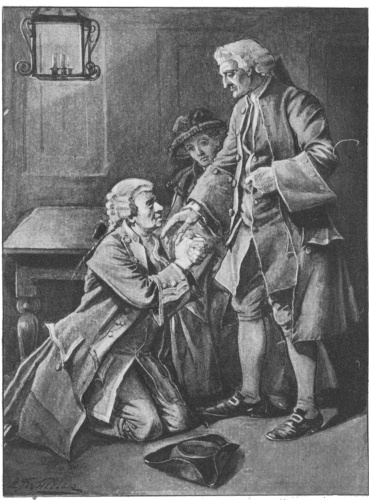
He abjectly implored for mercy
The squire, therefore, was to send his boat for the captain, but a most
unfortunate accident happened; for, as the wind was extremely rough and
against the hoy, while this was endeavouring to avail itself of great
seamanship in hawling up against the wind, a sudden squall carried
off sail and yard, or at least so disabled them that they were no longer
of any use and unable to reach the ship; but the captain, from the deck,
saw his hopes of venison disappointed, and was forced either to stay on
board his ship, or to hoist forth his own long-boat, which he could not
prevail with himself to think of, though the smell of the venison had
had twenty times its attraction. He did, indeed, love his ship as his
wife, and his boats as children, and never willingly trusted the latter,
poor things! to the dangers of the seas.
To say truth, notwithstanding the strict rigour with which he preserved
the dignity of his station, and the hasty impatience with which he
resented any affront to his person or orders, disobedience to which he
could in no instance brook in any person on board, he was one of the
best natured fellows alive. He acted the part of a father to his
sailors; he expressed great tenderness for any of them when ill, and
never suffered any the least work of supererogation to go unrewarded by
a glass of gin. He even extended his humanity, if I may so call it, to
animals, and even his cats and kittens had large shares in his
affections. An instance of which we saw this evening, when the cat,
which had shewn it could not be drowned, was found suffocated under a
feather-bed in the cabin. I will not endeavour to describe his
lamentations with more prolixity than barely by saying they were
grievous, and seemed to have some mixture of the Irish howl in them.
Nay, he carried his fondness even to inanimate objects, of which we have
above set down a pregnant example in his demonstration of love and
tenderness towards his boats and ship. He spoke of a ship which he had
commanded formerly, and which was long since no more, which he had
called the Princess of Brazil, as a widower of a deceased wife. This
ship, after having followed the honest business of carrying goods and
passengers for hire many years, did at last take to evil courses and
turn privateer, in which service, to use his own words, she received
many dreadful wounds, which he himself had felt as if they had been his
own.
Thursday.—As the wind did not yesterday discover any purpose of
shifting, and the water in my belly grew troublesome and rendered me
short-breathed, I began a second time to have apprehensions of wanting
the assistance of a trochar when none was to be found; I therefore
concluded to be tapped again by way of precaution, and accordingly I
this morning summoned on board a surgeon from a neighbouring parish, one
whom the captain greatly recommended, and who did indeed perform his
office with much dexterity. He was, I believe, likewise a man of great
judgment and knowledge in the profession; but of this I cannot speak
with perfect certainty, for, when he was going to open on the dropsy at
large and on the particular degree of the distemper under which I
laboured, I was obliged to stop him short, for the wind was changed, and
the captain in the utmost hurry to depart; and to desire him, instead of
his opinion, to assist me with his execution.
I was now once more delivered from my burthen, which was not indeed so
great as I had apprehended, wanting two quarts of what was let out at
the last operation.
While the surgeon was drawing away my water the sailors were drawing up
the anchor; both were finished at the same time; we unfurled our sails
and soon passed the Berry-head, which forms the mouth of the bay.
We had not however sailed far when the wind, which had, though with a
slow pace, kept us company about six miles, suddenly turned about, and
offered to conduct us back again; a favour which, though sorely against
the grain, we were obliged to accept.
Nothing remarkable happened this day; for as to the firm persuasion of
the captain that he was under the spell of witchcraft, I would not
repeat it too often, though indeed he repeated it an hundred times every
day; in truth, he talked of nothing else, and seemed not only to be
satisfied in general of his being bewitched, but actually to have fixed
with good certainty on the person of the witch, whom, had he lived in
the days of Sir Matthew Hale, he would have infallibly indicted, and
very possibly have hanged, for the detestable sin of witchcraft; but
that law, and the whole doctrine that supported it, are now out of
fashion; and witches, as a learned divine once chose to express himself,
are put down by act of parliament. This witch, in the captain’s opinion,
was no other than Mrs Francis of Ryde, who, as he insinuated, out of
anger to me for not spending more money in her house than she could
produce anything to exchange for, or any pretence to charge for, had
laid this spell on his ship.
Though we were again got near our harbour by three in the afternoon, yet
it seemed to require a full hour or more before we could come to our
former place of anchoring, or berth, as the captain called it. On this
occasion we exemplified one of the few advantages which the travellers
by water have over the travellers by land. What would the latter often
give for the sight of one of those hospitable mansions where he is
assured that there is good entertainment for man and horse; and where
both may consequently promise themselves to assuage that hunger which
exercise is so sure to raise in a healthy constitution.
At their arrival at this mansion, how much happier is the state of the
horse than that of the master! The former is immediately led to his
repast, such as it is, and, whatever it is, he falls to it with
appetite. But the latter is in a much worse situation. His hunger,
however violent, is always in some degree delicate, and his food must
have some kind of ornament, or, as the more usual phrase is, of
dressing, to recommend it. Now all dressing requires time, and
therefore, though perhaps the sheep might be just killed before you came
to the inn, yet in cutting him up, fetching the joint, which the
landlord by mistake said he had in the house, from the butcher at two
miles’ distance, and afterwards warming it a little by the fire, two
hours at least must be consumed, while hunger, for want of better food,
preys all the time on the vitals of the man.
How different was the case with us! we carried our provision, our
kitchen, and our cook with us, and we were at one and the same time
travelling on our road, and sitting down to a repast of fish, with which
the greatest table in London can scarce at any rate be supplied.
Friday.—As we were disappointed of our wind, and obliged to return
back the preceding evening, we resolved to extract all the good we could
out of our misfortune, and to add considerably to our fresh stores of
meat and bread, with which we were very indifferently provided when we
hurried away yesterday. By the captain’s advice we likewise laid in some
stores of butter, which we salted and potted ourselves, for our use at
Lisbon, and we had great reason afterwards to thank him for his advice.
In the afternoon I persuaded my wife, whom it was no easy matter for me
to force from my side, to take a walk on shore, whither the gallant
captain declared he was ready to attend her. Accordingly the ladies set
out, and left me to enjoy a sweet and comfortable nap after the
operation of the preceding day.
Thus we enjoyed our separate pleasures full three hours, when we met
again, and my wife gave the foregoing account of the gentleman whom I
have before compared to Axylus, and of his habitation, to both which she
had been introduced by the captain, in the stile of an old friend and
acquaintance, though this foundation of intimacy seemed to her to be no
deeper laid than in an accidental dinner, eaten many years before, at
this temple of hospitality, when the captain lay wind-bound in the same
bay.
Saturday.—Early this morning the wind seemed inclined to change in
our favour. Our alert captain snatched its very first motion, and got
under sail with so very gentle a breeze that, as the tide was against
him, he recommended to a fishing hoy to bring after him a vast salmon
and some other provisions which lay ready for him on shore.
Our anchor was up at six, and before nine in the morning we had doubled
the Berry-head, and were arrived off Dartmouth, having gone full three
miles in as many hours, in direct opposition to the tide, which only
befriended us out of our harbour; and though the wind was perhaps our
friend, it was so very silent, and exerted itself so little in our
favour, that, like some cool partisans, it was difficult to say whether
it was with us or against us. The captain, however, declared the former
to be the case during the whole three hours; but at last he perceived
his error, or rather, perhaps, this friend, which had hitherto wavered
in chusing his side, became now more determined. The captain then
suddenly tacked about, and, asserting that he was bewitched, submitted
to return to the place from whence he came. Now, though I am as free
from superstition as any man breathing, and never did believe in
witches, notwithstanding all the excellent arguments of my lord
chief-justice Hale in their favour, and long before they were put down
by act of parliament, yet by what power a ship of burthen should sail
three miles against both wind and tide, I cannot conceive, unless there
was some supernatural interposition in the case; nay, could we admit
that the wind stood neuter, the difficulty would still remain. So that
we must of necessity conclude that the ship was either bewinded or
bewitched.
The captain, perhaps, had another meaning. He imagined himself, I
believe, bewitched, because the wind, instead of persevering in its
change in his favour, for change it certainly did that morning, should
suddenly return to its favourite station, and blow him back towards the
bay. But, if this was his opinion, he soon saw cause to alter; for he
had not measured half the way back when the wind again declared in his
favour, and so loudly, that there was no possibility of being mistaken.
The orders for the second tack were given, and obeyed with much more
alacrity than those had been for the first. We were all of us indeed in
high spirits on the occasion; though some of us a little regretted the
good things we were likely to leave behind us by the fisherman’s
neglect; I might give it a worse name, for he faithfully promised to
execute the commission, which he had had abundant opportunity to do; but
nautica fides deserves as much to be proverbial as ever Punica fides
could formerly have done. Nay, when we consider that the Carthaginians
came from the Phenicians, who are supposed to have produced the first
mariners, we may probably see the true reason of the adage, and it may
open a field of very curious discoveries to the antiquarian.
We were, however, too eager to pursue our voyage to suffer anything we
left behind us to interrupt our happiness, which, indeed, many
agreeable circumstances conspired to advance. The weather was
inexpressibly pleasant, and we were all seated on the deck, when our
canvas began to swell with the wind. We had likewise in our view above
thirty other sail around us, all in the same situation. Here an
observation occurred to me, which, perhaps, though extremely obvious,
did not offer itself to every individual in our little fleet: when I
perceived with what different success we proceeded under the influence
of a superior power, which, while we lay almost idle ourselves, pushed
us forward on our intended voyage, and compared this with the slow
progress which we had made in the morning, of ourselves, and without any
such assistance, I could not help reflecting how often the greatest
abilities lie wind-bound as it were in life; or, if they venture out and
attempt to beat the seas, they struggle in vain against wind and tide,
and, if they have not sufficient prudence to put back, are most probably
cast away on the rocks and quicksands which are every day ready to
devour them.
It was now our fortune to set out melioribus avibus. The wind
freshened so briskly in our poop that the shore appeared to move from us
as fast as we did from the shore. The captain declared he was sure of a
wind, meaning its continuance; but he had disappointed us so often that
he had lost all credit. However, he kept his word a little better now,
and we lost sight of our native land as joyfully, at least, as it is
usual to regain it.
Sunday.—The next morning the captain told me he thought himself
thirty miles to the westward of Plymouth, and before evening declared
that the Lizard Point, which is the extremity of Cornwall, bore several
leagues to leeward. Nothing remarkable passed this day, except the
captain’s devotion, who, in his own phrase, summoned all hands to
prayers, which were read by a common sailor upon deck, with more devout
force and address than they are commonly read by a country curate, and
received with more decency and attention by the sailors than are usually
preserved in city congregations. I am indeed assured, that if any such
affected disregard of the solemn office in which they were engaged, as I
have seen practised by fine gentlemen and ladies, expressing a kind of
apprehension lest they should be suspected of being really in earnest in
their devotion, had been shewn here, they would have contracted the
contempt of the whole audience. To say the truth, from what I observed
in the behaviour of the sailors in this voyage, and on comparing it with
what I have formerly seen of them at sea and on shore, I am convinced
that on land there is nothing more idle and dissolute; in their own
element there are no persons near the level of their degree who live in
the constant practice of half so many good qualities. They are, for much
the greater part, perfect masters of their business, and always
extremely alert, and ready in executing it, without any regard to
fatigue or hazard. The soldiers themselves are not better disciplined
nor more obedient to orders than these whilst aboard; they submit to
every difficulty which attends their calling with chearfulness, and no
less virtues and patience and fortitude are exercised by them every day
of their lives.
All these good qualities, however, they always leave behind them on
shipboard; the sailor out of water is, indeed, as wretched an animal as
the fish out of water; for though the former hath, in common with
amphibious animals, the bare power of existing on the land, yet if he be
kept there any time he never fails to become a nuisance.
The ship having had a good deal of motion since she was last under
sail, our women returned to their sickness, and I to my solitude;
having, for twenty-four hours together, scarce opened my lips to a
single person. This circumstance of being shut up within the
circumference of a few yards, with a score of human creatures, with not
one of whom it was possible to converse, was perhaps so rare as scarce
ever to have happened before, nor could it ever happen to one who
disliked it more than myself, or to myself at a season when I wanted
more food for my social disposition, or could converse less wholesomely
and happily with my own thoughts. To this accident, which fortune opened
to me in the Downs, was owing the first serious thought which I ever
entertained of enrolling myself among the voyage-writers; some of the
most amusing pages, if, indeed, there be any which deserve that name,
were possibly the production of the most disagreeable hours which ever
haunted the author.
Monday.—At noon the captain took an observation, by which it appeared
that Ushant bore some leagues northward of us, and that we were just
entering the bay of Biscay. We had advanced a very few miles in this bay
before we were entirely becalmed: we furled our sails, as being of no
use to us while we lay in this most disagreeable situation, more
detested by the sailors than the most violent tempest: we were alarmed
with the loss of a fine piece of salt beef, which had been hung in the
sea to freshen it; this being, it seems, the strange property of
salt-water. The thief was immediately suspected, and presently
afterwards taken by the sailors. He was, indeed, no other than a huge
shark, who, not knowing when he was well off, swallowed another piece of
beef, together with a great iron crook on which it was hung, and by
which he was dragged into the ship.
I should scarce have mentioned the catching this shark, though so
exactly conformable to the rules and practice of voyage-writing, had it
not been for a strange circumstance that attended it. This was the
recovery of the stolen beef out of the shark’s maw, where it lay
unchewed and undigested, and whence, being conveyed into the pot, the
flesh, and the thief that had stolen it, joined together in furnishing
variety to the ship’s crew.
During this calm we likewise found the mast of a large vessel, which the
captain thought had lain at least three years in the sea. It was stuck
all over with a little shell-fish or reptile, called a barnacle, and
which probably are the prey of the rock-fish, as our captain calls it,
asserting that it is the finest fish in the world; for which we are
obliged to confide entirely to his taste; for, though he struck the fish
with a kind of harping-iron, and wounded him, I am convinced, to death,
yet he could not possess himself of his body; but the poor wretch
escaped to linger out a few hours with probably great torments.
In the evening our wind returned, and so briskly, that we ran upwards of
twenty leagues before the next day’s [Tuesday’s] observation, which
brought us to lat. 47° 42´. The captain promised us a very speedy
passage through the bay; but he deceived us, or the wind deceived him,
for it so slackened at sunset, that it scarce carried us a mile in an
hour during the whole succeeding night.
Wednesday.—A gale struck up a little after sun-rising, which carried
us between three and four knots or miles an hour. We were this day at
noon about the middle of the bay of Biscay, when the wind once more
deserted us, and we were so entirely becalmed, that we did not advance a
mile in many hours. My fresh-water reader will perhaps conceive no
unpleasant idea from this calm; but it affected us much more than a
storm could have done; for, as the irascible passions of men are apt to
swell with indignation long after the injury which first raised them is
over, so fared it with the sea. It rose mountains high, and lifted our
poor ship up and down, backwards and forwards, with so violent an
emotion, that there was scarce a man in the ship better able to stand
than myself. Every utensil in our cabin rolled up and down, as we should
have rolled ourselves, had not our chairs been fast lashed to the floor.
In this situation, with our tables likewise fastened by ropes, the
captain and myself took our meal with some difficulty, and swallowed a
little of our broth, for we spilt much the greater part. The remainder
of our dinner being an old, lean, tame duck roasted, I regretted but
little the loss of, my teeth not being good enough to have chewed it.
Our women, who began to creep out of their holes in the morning, retired
again within the cabin to their beds, and were no more heard of this
day, in which my whole comfort was to find by the captain’s relation
that the swelling was sometimes much worse; he did, indeed, take this
occasion to be more communicative than ever, and informed me of such
misadventures that had befallen him within forty-six years at sea as
might frighten a very bold spirit from undertaking even the shortest
voyage. Were these, indeed, but universally known, our matrons of
quality would possibly be deterred from venturing their tender offspring
at sea; by which means our navy would lose the honour of many a young
commodore, who at twenty-two is better versed in maritime affairs than
real seamen are made by experience at sixty.
And this may, perhaps, appear the more extraordinary, as the education
of both seems to be pretty much the same; neither of them having had
their courage tried by Virgil’s description of a storm, in which,
inspired as he was, I doubt whether our captain doth not exceed him.
In the evening the wind, which continued in the N.W., again freshened,
and that so briskly that Cape Finisterre appeared by this day’s
observation to bear a few miles to the southward. We now indeed sailed,
or rather flew, near ten knots an hour; and the captain, in the
redundancy of his good-humour, declared he would go to church at Lisbon
on Sunday next, for that he was sure of a wind; and, indeed, we all
firmly believed him. But the event again contradicted him; for we were
again visited by a calm in the evening.
But here, though our voyage was retarded, we were entertained with a
scene, which as no one can behold without going to sea, so no one can
form an idea of anything equal to it on shore. We were seated on the
deck, women and all, in the serenest evening that can be imagined. Not a
single cloud presented itself to our view, and the sun himself was the
only object which engrossed our whole attention. He did indeed set with
a majesty which is incapable of description, with which, while the
horizon was yet blazing with glory, our eyes were called off to the
opposite part to survey the moon, which was then at full, and which in
rising presented us with the second object that this world hath offered
to our vision. Compared to these the pageantry of theatres, or splendour
of courts, are sights almost below the regard of children.
We did not return from the deck till late in the evening; the weather
being inexpressibly pleasant, and so warm that even my old distemper
perceived the alteration of the climate. There was indeed a swell, but
nothing comparable to what we had felt before, and it affected us on the
deck much less than in the cabin.
Friday.—The calm continued till sun-rising, when the wind likewise
arose, but unluckily for us it came from a wrong quarter; it was
S.S.E., which is that very wind which Juno would have solicited of
Æolus, had Æneas been in our latitude bound for Lisbon.
The captain now put on his most melancholy aspect, and resumed his
former opinion that he was bewitched. He declared with great solemnity
that this was worse and worse, for that a wind directly in his teeth was
worse than no wind at all. Had we pursued the course which the wind
persuaded us to take we had gone directly for Newfoundland, if we had
not fallen in with Ireland in our way. Two ways remained to avoid this;
one was to put into a port of Galicia; the other, to beat to the
westward with as little sail as possible: and this was our captain’s
election.
As for us, poor passengers, any port would have been welcome to us;
especially, as not only our fresh provisions, except a great number of
old ducks and fowls, but even our bread was come to an end, and nothing
but sea-biscuit remained, which I could not chew. So that now for the
first time in my life I saw what it was to want a bit of bread.
The wind however was not so unkind as we had apprehended; but, having
declined with the sun, it changed at the approach of the moon, and
became again favourable to us, though so gentle that the next day’s
observation carried us very little to the southward of Cape Finisterre.
This evening at six the wind, which had been very quiet all day, rose
very high, and continuing in our favour drove us seven knots an hour.
This day we saw a sail, the only one, as I heard of, we had seen in our
whole passage through the bay. I mention this on account of what
appeared to me somewhat extraordinary. Though she was at such a distance
that I could only perceive she was a ship, the sailors discovered that
she was a snow, bound to a port in Galicia.
Sunday.—After prayers, which our good captain read on the deck with
an audible voice, and with but one mistake, of a lion for Elias, in the
second lesson for this day, we found ourselves far advanced in 42°, and
the captain declared we should sup off Porte. We had not much wind this
day; but, as this was directly in our favour, we made it up with sail,
of which we crowded all we had. We went only at the rate of four miles
an hour, but with so uneasy a motion, continually rolling from side to
side, that I suffered more than I had done in our whole voyage; my
bowels being almost twisted out of my belly. However, the day was very
serene and bright, and the captain, who was in high spirits, affirmed he
had never passed a pleasanter at sea.
The wind continued so brisk that we ran upward of six knots an hour the
whole night.
Monday.—In the morning our captain concluded that he was got into
lat. 40°, and was very little short of the Burlings, as they are called
in the charts. We came up with them at five in the afternoon, being the
first land we had distinctly seen since we left Devonshire. They consist
of abundance of little rocky islands, a little distant from the shore,
three of them only shewing themselves above the water.
Here the Portuguese maintain a kind of garrison, if we may allow it that
name. It consists of malefactors, who are banished hither for a term,
for divers small offences—a policy which they may have copied from the
Egyptians, as we may read in Diodorus Siculus. That wise people, to
prevent the corruption of good manners by evil communication, built a
town on the Red Sea, whither they transported a great number of their
criminals, having first set an indelible mark on them, to prevent their
returning and mixing with the sober part of their citizens.
These rocks lie about fifteen leagues north-west of Cape Roxent, or, as
it is commonly called, the Rock of Lisbon, which we past early the next
morning. The wind, indeed, would have carried us thither sooner; but the
captain was not in a hurry, as he was to lose nothing by his delay.
Tuesday.—This is a very high mountain, situated on the northern side
of the mouth of the river Tajo, which, rising about Madrid, in Spain,
and soon becoming navigable for small craft, empties itself, after a
long course, into the sea, about four leagues below Lisbon.
On the summit of the rock stands a hermitage, which is now in the
possession of an Englishman, who was formerly master of a vessel trading
to Lisbon; and, having changed his religion and his manners, the latter
of which, at least, were none of the best, betook himself to this place,
in order to do penance for his sins. He is now very old, and hath
inhabited this hermitage for a great number of years, during which he
hath received some countenance from the royal family, and particularly
from the present queen dowager, whose piety refuses no trouble or
expence by which she may make a proselyte, being used to say that the
saving one soul would repay all the endeavours of her life.
Here we waited for the tide, and had the pleasure of surveying the face
of the country, the soil of which, at this season, exactly resembles an
old brick-kill, or a field where the green sward is pared up and set a
burning, or rather a smoaking, in little heaps to manure the land. This
sight will, perhaps, of all others, make an Englishman proud of, and
pleased with, his own country, which in verdure excels, I believe, every
other country. Another deficiency here is the want of large trees,
nothing above a shrub being here to be discovered in the circumference
of many miles.
At this place we took a pilot on board, who, being the first Portuguese
we spoke to, gave us an instance of that religious observance which is
paid by all nations to their laws; for, whereas it is here a capital
offence to assist any person in going on shore from a foreign vessel
before it hath been examined, and every person in it viewed by the
magistrates of health, as they are called, this worthy pilot, for a very
small reward, rowed the Portuguese priest to shore at this place, beyond
which he did not dare to advance, and in venturing whither he had given
sufficient testimony of love for his native country.
We did not enter the Tajo till noon, when, after passing several old
castles and other buildings which had greatly the aspect of ruins, we
came to the castle of Bellisle, where we had a full prospect of Lisbon,
and were, indeed, within three miles of it.
Here we were saluted with a gun, which was a signal to pass no farther
till we had complied with certain ceremonies which the laws of this
country require to be observed by all ships which arrive in this port.
We were obliged then to cast anchor, and expect the arrival of the
officers of the customs, without whose passport no ship must proceed
farther than this place.
Here likewise we received a visit from one of those magistrates of
health before mentioned. He refused to come on board the ship till every
person in her had been drawn up on deck and personally viewed by him.
This occasioned some delay on my part, as it was not the work of a
minute to lift me from the cabin to the deck. The captain thought my
particular case might have been excused from this ceremony, and that it
would be abundantly sufficient if the magistrate, who was obliged
afterwards to visit the cabin, surveyed me there. But this did not
satisfy the magistrate’s strict regard to his duty. When he was told of
my lameness, he called out, with a voice of authority, “Let him be
brought up,” and his orders were presently complied with. He was,
indeed, a person of great dignity, as well as of the most exact
fidelity in the discharge of his trust. Both which are the more
admirable as his salary is less than thirty pounds English per annum.
Before a ship hath been visited by one of those magistrates no person
can lawfully go on board her, nor can any on board depart from her. This
I saw exemplified in a remarkable instance. The young lad whom I have
mentioned as one of our passengers was here met by his father, who, on
the first news of the captain’s arrival, came from Lisbon to Bellisle in
a boat, being eager to embrace a son whom he had not seen for many
years. But when he came alongside our ship neither did the father dare
ascend nor the son descend, as the magistrate of health had not yet been
on board.
Some of our readers will, perhaps, admire the great caution of this
policy, so nicely calculated for the preservation of this country from
all pestilential distempers. Others will as probably regard it as too
exact and formal to be constantly persisted in, in seasons of the utmost
safety, as well as in times of danger. I will not decide either way, but
will content myself with observing that I never yet saw or heard of a
place where a traveller had so much trouble given him at his landing as
here. The only use of which, as all such matters begin and end in form
only, is to put it into the power of low and mean fellows to be either
rudely officious or grossly corrupt, as they shall see occasion to
prefer the gratification of their pride or of their avarice.
Of this kind, likewise, is that power which is lodged with other
officers here, of taking away every grain of snuff and every leaf of
tobacco brought hither from other countries, though only for the
temporary use of the person during his residence here. This is executed
with great insolence, and, as it is in the hands of the dregs of the
people, very scandalously; for, under pretence of searching for tobacco
and snuff, they are sure to steal whatever they can find, insomuch that
when they came on board our sailors addressed us in the Covent-garden
language: “Pray, gentlemen and ladies, take care of your swords and
watches.” Indeed, I never yet saw anything equal to the contempt and
hatred which our honest tars every moment expressed for these Portuguese
officers.
At Bellisle lies buried Catharine of Arragon, widow of prince Arthur,
eldest son of our Henry VII., afterwards married to, and divorced from,
Henry VIII. Close by the church where her remains are deposited is a
large convent of Geronymites, one of the most beautiful piles of
building in all Portugal.
In the evening, at twelve, our ship, having received previous visits
from all the necessary parties, took the advantage of the tide, and
having sailed up to Lisbon cast anchor there, in a calm and moonshiny
night, which made the passage incredibly pleasant to the women, who
remained three hours enjoying it, whilst I was left to the cooler
transports of enjoying their pleasures at second-hand; and yet, cooler
as they may be, whoever is totally ignorant of such sensation is, at the
same time, void of all ideas of friendship.
Wednesday.—Lisbon, before which we now lay at anchor, is said to be
built on the same number of hills with old Rome; but these do not all
appear to the water; on the contrary, one sees from thence one vast high
hill and rock, with buildings arising above one another, and that in so
steep and almost perpendicular a manner, that they all seem to have but
one foundation.
As the houses, convents, churches, &c., are large, and all built with
white stone, they look very beautiful at a distance; but as you
approach nearer, and find them to want every kind of ornament, all idea
of beauty vanishes at once. While I was surveying the prospect of this
city, which bears so little resemblance to any other that I have ever
seen, a reflexion occurred to me that, if a man was suddenly to be
removed from Palmyra hither, and should take a view of no other city, in
how glorious a light would the antient architecture appear to him! and
what desolation and destruction of arts and sciences would he conclude
had happened between the several æras of these cities!
I had now waited full three hours upon deck for the return of my man,
whom I had sent to bespeak a good dinner (a thing which had been long
unknown to me) on shore, and then to bring a Lisbon chaise with him to
the sea-shore; but it seems the impertinence of the providore was not
yet brought to a conclusion. At three o’clock, when I was, from
emptiness, rather faint than hungry, my man returned, and told me there
was a new law lately made that no passenger should set his foot on shore
without a special order from the providore, and that he himself would
have been sent to prison for disobeying it, had he not been protected as
the servant of the captain. He informed me likewise that the captain had
been very industrious to get this order, but that it was then the
providore’s hour of sleep, a time when no man, except the king himself,
durst disturb him.
To avoid prolixity, though in a part of my narrative which may be more
agreeable to my reader than it was to me, the providore, having at last
finished his nap, dispatched this absurd matter of form, and gave me
leave to come, or rather to be carried, on shore.
What it was that gave the first hint of this strange law is not easy to
guess. Possibly, in the infancy of their defection, and before their
government could be well established, they were willing to guard against
the bare possibility of surprise, of the success of which bare
possibility the Trojan horse will remain for ever on record, as a great
and memorable example. Now the Portuguese have no walls to secure them,
and a vessel of two or three hundred tons will contain a much larger
body of troops than could be concealed in that famous machine, though
Virgil tells us (somewhat hyperbolically, I believe) that it was as big
as a mountain.
About seven in the evening I got into a chaise on shore, and was driven
through the nastiest city in the world, though at the same time one of
the most populous, to a kind of coffee-house, which is very pleasantly
situated on the brow of a hill, about a mile from the city, and hath a
very fine prospect of the river Tajo from Lisbon to the sea.
Here we regaled ourselves with a good supper, for which we were as well
charged as if the bill had been made on the Bath-road, between Newbury
and London.
And now we could joyfully say,
Egressi optata Troes potiuntur arena.
Therefore, in the words of Horace,
—hic Finis chartæque viæque.
END OF VOL. I.
BALLANTYNE PRESS: EDINBURGH AND LONDON

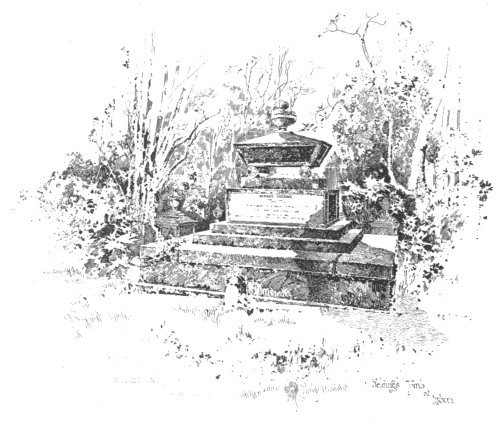
 BY
BY