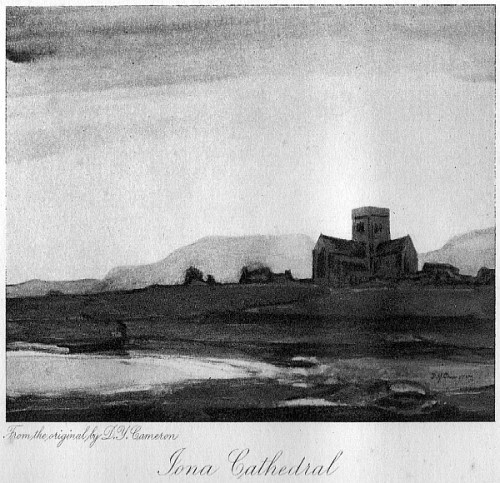
A few places in the world are to be held holy,
because of the love which consecrates them and
the faith which enshrines them. Their names
are themselves talismans of spiritual beauty. Of
these is Iona.
The Arabs speak of Mecca as a holy place
before the time of the prophet, saying that
Adam himself lies buried here: and, before
Adam, that the Sons of Allah, who are called
Angels, worshipped; and that when Allah
Himself stood upon perfected Earth it was on
this spot. And here, they add, when there is
no man left upon earth, an angel shall gather
up the dust of this world, and say to Allah,
"There is nothing left of the whole earth but
Mecca: and now Mecca is but the few grains
of sand that I hold in the hollow of my palm,
O Allah."
In spiritual geography Iona is the Mecca of
the Gael.
It is but a small isle, fashioned of a little
sand, a few grasses salt with the spray of an
ever-restless wave, a few rocks that wade in
heather and upon whose brows the sea-wind
weaves the yellow lichen. But since the
remotest days sacrosanct men have bowed
here in worship. In this little island a lamp
was lit whose flame lighted pagan Europe, from
the Saxon in his fens to the swarthy folk who
came by Greek waters to trade the Orient.
Here Learning and Faith had their tranquil
home, when the shadow of the sword lay
upon all lands, from Syracuse by the Tyrrhene
Sea to the rainy isles of Orcc. From age to
age, lowly hearts have never ceased to bring
their burthen here. Iona herself has given
us for remembrance a fount of youth more
wonderful than that which lies under her
own boulders of Dûn-I. And here Hope
waits.
To tell the story of Iona is to go back to God,
and to end in God.
But to write of Iona, there are many ways
of approach. No place that has a spiritual
history can be revealed to those who know
nothing of it by facts and descriptions. The
approach may be through the obscure glens
of another's mind and so out by the moonlit
way, as well as by the track that thousands
travel. I have nothing to say of Iona's acreage,
or fisheries, or pastures: nothing of how
the islanders live. These things are the accidental.
There is small difference in simple life
anywhere. Moreover, there are many to tell
all that need be known.
There is one Iona, a little island of the
west. There is another Iona, of which I
would speak. I do not say that it lies open
to all. It is as we come that we find. If we
come, bringing nothing with us, we go away
ill-content, having seen and heard nothing of
what we had vaguely expected to see or hear.
It is another Iona than the Iona of sacred
memories and prophecies: Iona the metropolis
of dreams. None can understand it who
does not see it through its pagan light, its
Christian light, its singular blending of
paganism and romance and spiritual beauty.
There is, too, an Iona that is more than Gaelic,
that is more than a place rainbow-lit with the
seven desires of the world, the Iona that, if we
will it so, is a mirror of your heart and of
mine.
History may be written in many ways, but
I think that in days to come the method of
spiritual history will be found more suggestive
than the method of statistical history.
The one will, in its own way, reveal inward
life, and hidden significance, and palpable
destiny: as the other, in the good but
narrow way of convention, does with exactitude
delineate features, narrate facts, and relate
events. The true interpreter will as little
despise the one as he will claim all for the
other.
And that is why I would speak here of
Iona as befalls my pen, rather than as perhaps
my pen should go: and choose legend and
remembrance, and my own and other memories
and associations, and knowledge of my own
and others, and hidden meanings, and beauty
and strangeness surviving in dreams and
imaginations, rather than facts and figures, that
others could adduce more deftly and with more
will.
In the Félire na Naomh Nerennach is a
strangely beautiful if fantastic legend of one
Mochaoi, Abbot of n'-Aondruim in Uladh.
With some companions he was at the edge
of a wood, and while busy in cutting wattles
wherewith to build a church, "he heard a
bright bird singing on the blackthorn near
him. It was more beautiful than the birds
of the world." Mochaoi listened entranced.
There was more in that voice than in the
throat of any bird he had ever heard, so he
stopped his wattle-cutting, and, looking at the
bird, courteously asked who was thus delighting
him. The bird at once answered,
"A man of the people of my Lord" (that is,
an angel). "Hail," said Mochaoi, "and for
why that, O bird that is an angel?" "I am
come here by command to encourage you in
your good work, but also, because of the love
in your heart, to amuse you for a time with
my sweet singing." "I am glad of that," said
the saint. Thereupon the bird sang a single
surpassing sweet air, and then fixed his
beak in the feathers of his wing, and slept.
But Mochaoi heard the beauty and sweetness
and infinite range of that song for three hundred
years. Three hundred years were in
that angelic song, but to Mochaoi it was less
than an hour. For three hundred years he
remained listening, in the spell of beauty:
nor in that enchanted hour did any age come
upon him, or any withering upon the wattles
he had gathered; nor in the wood itself did a
single leaf turn to a red or yellow flame
before his eyes. Where the spider spun her
web, she spun no more: where the dove
leaned her grey breast from the fir, she leaned
still.
Then suddenly the bird took its beak from
its wing-feathers, and said farewell. When
it was gone, Mochaoi lifted his wattles, and
went homeward as one in a dream. He stared,
when he looked for the little wattled cells of
the Sons of Patrick. A great church built of
stone stood before his wondering eyes. A
man passed him, and told the stranger that it
was the church of St. Mochaoi. When he
spoke to the assembled brothers, none knew
him: some thought he had been taken away
by the people of the Shee, and come back at
fairy-nightfall, which is the last hour of the
last day of three hundred years. "Tell us
your name and lineage," they cried. "I am
Mochaoi, Abbot of n'-Aondruim," he said,
and then he told his tale, and they knew him,
and made him abbot again. In the enchanted
wood a shrine was built, and about it a church
grew, "and surpassingly white angels often
alighted there, or sang hymns to it from
the branches of the forest trees, or leaned
with their foot on tiptoe, their eyes on
the horizon, their ear on the ground, their
wings flapping, their bodies trembling, waiting
to send tidings of prayer and repentance
with a beat of their wings to the King of the
Everlasting."
There are many who thought that
Mochaoi was dead, when he was seen no
more of his fellow-monks at the forest
monastery of n'Aondruim in Uladh. But his
chronicler knew: "a sleep without decay of
the body Mochaoi of Antrim slept."
I am reminded of the story of Mochaoi
when I think of Iona. I think she too, beautiful
isle, while gathering the help of human
longing and tears and hopes, strewn upon her
beaches by wild waves of the world, stood,
enchanted, to listen to a Song of Beauty.
"That is a new voice I hear in the wave,"
we can dream of her saying, and of the answer:
"we are the angelic flocks of the Shepherd:
we are the Voices of the Eternal: listen a
while!"
It has been a long sleep, that enchanted
swoon. But Mochaoi awoke, after three
hundred years, and there was neither time
upon his head, nor age in his body, nor a
single withered leaf of the forest at his feet.
And shall not that be possible for the Isle of
Dreams, whose sands are the dust of martyrs
and noble and beautiful lives, which was
granted to one man by "one of the people of
my Lord?"
When I think of Iona I think often, too, of a
prophecy once connected with Iona; though
perhaps current no more in a day when prophetical
hopes are fallen dumb and blind.
It is commonly said that, if he would be
heard, none should write in advance of his
times. That I do not believe. Only, it does
not matter how few listen. I believe that
we are close upon a great and deep spiritual
change. I believe a new redemption is even
now conceived of the Divine Spirit in the
human heart, that is itself as a woman, broken
in dreams, and yet sustained in faith, patient,
long-suffering, looking towards home. I
believe that though the Reign of Peace may
be yet a long way off, it is drawing near: and
that Who shall save us anew shall come
divinely as a Woman, to save as Christ saved,
but not, as He did, to bring with Her a sword.
But whether this Divine Woman, this Mary
of so many passionate hopes and dreams,
is to come through mortal birth, or as an
immortal Breathing upon our souls, none can
yet know.
Sometimes I dream of the old prophecy
that Christ shall come again upon Iona, and
of that later and obscure prophecy which
foretells, now as the Bride of Christ, now as
the Daughter of God, now as the Divine
Spirit embodied through mortal birth in a
Woman, as once through mortal birth in a
Man, the coming of a new Presence and
Power: and dream that this may be upon
Iona, so that the little Gaelic island may
become as the little Syrian Bethlehem. But
more wise it is to dream, not of hallowed
ground, but of the hallowed gardens of the
soul wherein She shall appear white and
radiant. Or, that upon the hills, where we
are wandered, the Shepherdess shall call us
home.
From one man only, on Iona itself, I have
heard any allusion to the prophecy as to the
Saviour who shall yet come: and he in part
was obscure, and confused the advent of Mary
into the spiritual world with the possible
coming again to earth of Mary, as another
Redeemer, or with a descending of the
Divine Womanhood upon the human heart as
a universal spirit descending upon awaiting
souls. But in intimate remembrance I recall
the words and faith of one or two whom
I loved well. Nor must I forget that my
old nurse, Barabal, used to sing a strange
"oran," to the effect that when St. Bride
came again to Iona it would be to bind the
hair and wash the feet of the Bride of
Christ.
One of those to whom I allude was a young
Hebridean priest, who died in Venice, after
troubled years, whose bitterest vicissitude was
the clouding of his soul's hope by the
wings of a strange multitude of dreams—one
of whom and whose end I have elsewhere
written: and he told me once how, "as our
forefathers and elders believed and still believe,
that Holy Spirit shall come again which
once was mortally born among us as the Son
of God, but, then, shall be the Daughter of
God. The Divine Spirit shall come again as
a Woman. Then for the first time the world
will know peace." And when I asked him if
it were not prophesied that the Woman is to
be born in Iona, he said that if this prophecy
had been made it was doubtless of an Iona
that was symbolic, but that this was a matter
of no moment, for She would rise suddenly in
many hearts, and have her habitation among
dreams and hopes. The other who spoke to
me of this Woman who is to save was an old
fisherman of a remote island of the Hebrides,
and one to whom I owe more than to any
other spiritual influence in my childhood, for
it was he who opened to me the three gates of
Beauty. Once this old man, Seumas Macleod,
took me with him to a lonely haven in the
rocks, and held me on his knee as we sat
watching the sun sink and the moon climb out
of the eastern wave. I saw no one, but
abruptly he rose and put me from him, and
bowed his grey head as he knelt before one
who suddenly was standing in that place. I
asked eagerly who it was. He told me that
it was an Angel. Later, I learned (I remember
my disappointment that the beautiful
vision was not winged with great white
wings) that the Angel was one soft flame of
pure white, and that below the soles of his
feet were curling scarlet flames. He had
come in answer to the old man's prayer. He
had come to say that we could not see the
Divine One whom we awaited. "But you
will yet see that Holy Beauty," said the Angel,
and Seumas believed, and I too believed, and
believe. He took my hand, and I knelt
beside him, and he bade me repeat the words
he said. And that was how I first prayed
to Her who shall yet be the Balm of the
World.
And since then I have learned, and do see,
that not only prophecies and hopes, and
desires unclothed yet in word or thought,
foretell her coming, but already a multitude
of spirits are in the gardens of the soul, and
are sowing seed and calling upon the wind of
the south; and that everywhere are watching
eyes and uplifted hands, and signs which
cannot be mistaken, in many lands, in many
peoples, in many minds; and, in the heaven
itself that the soul sees, the surpassing
signature.
I recall one whom I knew, a fisherman of
the little green island: and I tell this story
of Coll here, for it is to me more than the
story of a dreaming islander. One night,
lying upon the hillock that is called Cnoc-nan-Aingeal,
because it is here that St. Colum
was wont to hold converse with an angel
out of heaven, he watched the moonlight
move like a slow fin through the sea: and
in his heart were desires as infinite as the
waves of the sea, the moving homes of the
dead.
And while he lay and dreamed, his thoughts
idly adrift as a net in deep waters, he closed
his eyes, muttering the Gaelic words of an
old line,
In the Isle of Dreams God shall yet fulfil Himself anew.
Hearing a footfall, he stirred. A man stood
beside him. He did not know the man, who
was young, and had eyes dark as hill-tarns,
with hair light and soft as thistledown; and
moved light as a shadow, delicately treading
the grass as the wind treads it. In his hair
he had twined the fantastic leaf of the horn-poppy.
The islander did not move or speak: it was
as though a spell were upon him.
"God be with you," he said at last, uttering
the common salutation.
"And with you, Coll mac Coll," answered
the stranger. Coll looked at him. Who was
this man, with the sea-poppy in his hair, who,
unknown, knew him by name? He had heard
of one whom he did not wish to meet, the
Green Harper: also of a grey man of the sea
whom islesmen seldom alluded to by name:
again, there was the Amadan Dhû ... but at
that name Coll made the sign of the cross, and
remembering what Father Allan had told him
in South Uist, muttered a holy exorcism of the
Trinity.
The man smiled.
"You need have no fear, Coll mac Coll," he
said quietly.
"You that know my name so well are welcome,
but if you in turn would tell me your name I
should be glad."
"I have no name that I can tell you,"
answered the stranger gravely; "but I am not
of those who are unfriendly. And because you
can see me and speak to me, I will help you to
whatsoever you may wish."
Coll laughed.
"Neither you nor any man can do that.
For now that I have neither father nor
mother, nor brother nor sister, and my lass
too is dead, I wish neither for sheep nor cattle,
nor for new nets and a fine boat, nor a big
house, nor as much money as MacCailein Mòr
has in the bank at Inveraora."
"What then do you wish for, Coll mac
Coll?"
"I do not wish for what cannot be, or I
would wish to see again the dear face of Morag,
my lass. But I wish for all the glory and
wonder and power there is in the world, and to
have it all at my feet, and to know everything
that the Holy Father himself knows, and have
kings coming to me as the crofters come to
MacCailein Mòr's factor."
"You can have that, Coll mac Coll," said the
Green Harper, and he waved a withe of hazel
he had in his hand.
"What is that for?" said Coll.
"It is to open a door that is in the air. And
now, Coll, if that is your wish of all wishes, and
you will give up all other wishes for that wish,
you can have the sovereignty of the world.
Ay, and more than that: you shall have the
sun like a golden jewel in the hollow of your
right hand, and all the stars as pearls in your
left, and have the moon as a white shining
opal above your brows, with all knowledge
behind the sun, within the moon, and beyond
the stars."
Coll's face shone. He stood, waiting. Just
then he heard a familiar sound in the dusk.
The tears came into his eyes.
"Give me instead," he cried, "give me a
warm breast-feather from that grey dove of
the woods that is winging home to her
young." He looked as one moon-dazed. None
stood beside him. He was alone. Was it a
dream, he wondered? But a weight was
lifted from his heart. Peace fell upon him as
dew upon grey pastures. Slowly he walked
homeward. Once, glancing back, he saw a
white figure upon the knoll, with a face noble
and beautiful. Was it Colum himself come
again? he mused: or that white angel with
whom the Saint was wont to discourse, and
who brought him intimacies of God? or was
it but the wave-fire of his dreaming mind, as
lonely and cold and unreal as that which the
wind of the south makes upon the wandering
hearths of the sea?
I tell this story of Coll here, for, as I have
said, it is to me more than the story of a
dreaming islander. He stands for the soul of
a race. It is because, to me, he stands for
the sorrowful genius of our race, that I have
spoken of him here. Below all the strife of
lesser desires, below all that he has in common
with other men, he has the livelong
unquenchable thirst for the things of the spirit.
This is the thirst that makes him turn so often
from the near securities and prosperities,
and indeed all beside, setting his heart aflame
with vain, because illimitable, desires. For
him, the wisdom before which knowledge is
a frosty breath: the beauty that is beyond
what is beautiful. For, like Coll, the world
itself has not enough to give him. And at
the last, and above all, he is like Coll in this,
that the sun and moon and stars themselves
may become as trampled dust, for only a
breast-feather of that Dove of the Eternal,
which may have its birth in mortal love, but
has its evening home where are the dews of
immortality.
"The Dove of the Eternal." It was from
the lips of an old priest of the Hebrides that I
first heard these words. I was a child, and
asked him if it was a white dove, such
as I had seen fanning the sunglow in Icolmkill.
"Yes," he told me, "the Dove is white, and
it was beloved of Colum, and is of you, little
one, and of me."
"Then it is not dead?"
"It is not dead."
I was in a more wild and rocky isle than
Iona then, and when I went into a solitary
place close by my home it was to a stony
wilderness so desolate that in many moods I
could not bear it. But that day, though there
were no sheep lying beside boulders as grey
and still, nor whinnying goats (creatures
that have always seemed to me strangely
homeless, so that, as a child, it was often my
noon-fancy on hot days to play to them on a
little reed-flute I was skilled in making,
thwarting the hill-wind at the small holes to
the fashioning of a rude furtive music, which
I believed comforted the goats, though why
I did not know, and probably did not try to
know): and though I could hear nothing but
the soft, swift, slipping feet of the wind
among the rocks and grass and a noise of the
tide crawling up from a shore hidden behind
crags (beloved of swallows for the small
honey-flies which fed upon the thyme): still,
on that day, I was not ill at ease, nor in any
way disquieted. But before me I saw a white
rock-dove, and followed it gladly. It flew
circling among the crags, and once I thought
it had passed seaward; but it came again, and
alit on a boulder.
I went upon my knees, and prayed to it,
and, as nearly as I can remember, in these
words:—
"O Dove of the Eternal, I want to love
you, and you to love me: and if you live on
Iona, I want you to show me, when I go
there again, the place where Colum the Holy
talked with an angel. And I want to live as
long as you, Dove" (I remember thinking this
might seem disrespectful, and that I added
hurriedly and apologetically), "Dove of the
Eternal."
That evening I told Father Ivor what I had
done. He did not laugh at me. He took me
on his knee, and stroked my hair, and for a
long time was so silent that I thought he was
dreaming. He put me gently from him,
and kneeled at the chair, and made this simple
prayer which I have never forgotten: "O
Dove of the Eternal, grant the little one's
prayer."
That is a long while ago now, and I have
sojourned since in Iona, and there and
elsewhere known the wild doves of thought
and dream. But I have not, though I have
longed, seen again the White Dove that Colum
so loved. For long I thought it must have
left Iona and Barra too, when Father Ivor
died.
Yet I have not forgotten that it is not dead.
"I want to live as long as you," was my
child's plea: and the words of the old priest,
knowing and believing were, "O Dove of the
Eternal, grant the little one's prayer."
It was not in Barra, but in Iona, that, while
yet a child, I set out one evening to find the
Divine Forges. A Gaelic sermon, preached
on the shoreside by an earnest man, who, going
poor and homeless through the west, had
tramped the long roads of Mull over against
us, and there fed to flame a smouldering fire,
had been my ministrant in these words. The
"revivalist" had spoken of God as one who
would hammer the evil out of the soul and
weld it to good, as a blacksmith at his anvil:
and suddenly, with a dramatic gesture, he
cried: "This little island of Iona is this anvil;
God is your blacksmith: but oh, poor people,
who among you knows the narrow way to the
Divine Forges?"
There is a spot on Iona that has always
had a strange enchantment for me. Behind
the ruined walls of the Columban church,
the slopes rise, and the one isolated hill of
Iona is, there, a steep and sudden wilderness.
It is commonly called Dûn-I (Doon-ee), for at
the summit in old days was an island fortress;
but the Gaelic name of the whole of
this uplifted shoulder of the isle is Slibh
Meanach. Hidden under a wave of heath
and boulder, near the broken rocks, is a little
pool. From generation to generation this has
been known, and frequented, as the Fountain
of Youth.
There, through boggy pastures, where the
huge-horned shaggy cattle stared at me, and up
through the ling and roitch, I climbed: for, if
anywhere, I thought that from there I might
see the Divine Forges, or at least might discover
a hidden way, because of the power of that
water, touched on the eyelids at sunlift, at
sunset, or at the rising of the moon.
From where I stood I could see the people
still gathered upon the dunes by the shore,
and the tall, ungainly figure of the preacher.
In the narrow strait were two boats, one
being rowed across to Fionnaphort, and the
other, with a dun sail burning flame-brown,
hanging like a bird's wing against Glas
Eilean, on the tideway to the promontory of
Earraid. Was the preacher still talking of
the Divine Forges? I wondered; or were
the men and women in the ferry hurrying
across to the Ross of Mull to look for them
among the inland hills? And the Earraid
men in the fishing-smack: were they sailing
to see if they lay hidden in the wilderness of
rocks, where the muffled barking of the seals
made the loneliness more wild and remote?
I wetted my eyelids, as I had so often
done before (and not always vainly, though
whether vision came from the water, or from
a more quenchless spring within, I know
not), and looked into the little pool. Alas!
I could see nothing but the reflection of a
star, too obscured by light as yet for me to
see in the sky, and, for a moment, the shadow
of a gull's wing as the bird flew by far overhead.
I was too young then to be content
with the symbols of coincidence, or I might
have thought that the shadow of a wing from
Heaven, and the light of a star out of the
East, were enough indication. But, as it
was, I turned, and walked idly northward,
down the rough side of Dun Bhuirg (at Cul
Bhuirg, a furlong westward, I had once seen
a phantom, which I believed to be that of
the Culdee, Oran, and so never went that
way again after sundown) to a thyme-covered
mound that had for me a most singular fascination.
It is a place to this day called Dûn Mananain.
Here, a friend who told me many
things, a Gaelic farmer named Macarthur,
had related once a fantastic legend about a
god of the sea. Manaun was his name, and
he lived in the times when Iona was part of
the kingdom of the Suderöer. Whenever he
willed he was like the sea, and that is not
wonderful, for he was born of the sea. Thus
his body was made of a green wave. His
hair was of wrack and tangle, glistening with
spray; his robe was of windy foam; his feet,
of white sand. That is, when he was with
his own, or when he willed; otherwise, he
was as men are. He loved a woman of the
south so beautiful that she was named Dèar-sadh-na-Ghréne
(Sunshine). He captured
her and brought her to Iona in September,
when it is the month of peace. For one
month she was happy: when the wet gales
from the west set in, she pined for her own
land: yet in the dream-days of November,
she smiled so often that Manaun hoped; but
when Winter was come, her lover saw that
she could not live. So he changed her into
a seal. "You shall be a sleeping woman by
day," he said, "and sleep in my dûn here on
Iona: and by night, when the dews fall, you
shall be a seal, and shall hear me calling to
you from a wave, and shall come out and
meet me."
They have mortal offspring also, it is
said.
There is a story of a man who went to the
mainland, but could not see to plough, because
the brown fallows became waves that
splashed noisily about him. The same man
went to Canada, and got work in a great
warehouse; but among the bales of merchandise
he heard the singular note of the sandpiper,
and every hour the sea-fowl confused
him with their crying.
Probably some thought was in my mind
that there, by Dûn Mananain, I might find
a hidden way. That summer I had been
thrilled to the inmost life by coming suddenly,
by moonlight, on a seal moving across the
last sand-dune between this place and the
bay called Port Ban. A strange voice, too, I
heard upon the sea. True, I saw no white
arms upthrown, as the seal plunged into the
long wave that swept the shore; and it was
a grey skua that wailed above me, winging
inland; yet had I not had a vision of the
miracle?
But alas! that evening there was not even
a barking seal. Some sheep fed upon the
green slope of Manaun's mound.
So, still seeking a way to the Divine
Forges, I skirted the shore and crossed the
sandy plain of the Machar, and mounted the
upland district known as Sliav Starr (the Hill
of Noises), and walked to a place, to me
sacred. This was a deserted green airidh
between great rocks. From here I could
look across the extreme western part of
Iona, to where it shelved precipitously around
the little Port-na-Churaich, the Haven of the
Coracle, the spot where St. Columba landed
when he came to the island.
I knew every foot of ground here, as every
cave along the wave-worn shore. How often
I had wandered in these solitudes, to see
the great spout of water rise through the
grass from the caverns beneath, forced upward
when tide and wind harried the sea-flocks
from the north; or to look across the ocean
to the cliffs of Antrim, from the Carn cul
Ri Eirinn, the Cairn of the Hermit King of
Ireland, about whom I had woven many a
romance.
I was tired, and fell asleep. Perhaps the
Druid of a neighbouring mound, or the
lonely Irish King, or Colum himself (whose
own Mound of the Outlook was near), or one
of his angels who ministered to him, watched,
and shepherded my dreams to the desired
fold. At least I dreamed, and thus:—
The skies to the west beyond the seas were
not built of flushed clouds, but of transparent
flame. These flames rose in solemn stillness
above a vast forge, whose anvil was the shining
breast of the sea. Three great Spirits
stood by it, and one lifted a soul out of the
deep shadow that was below; and one with
his hands forged the soul of its dross and
welded it anew; and the third breathed upon
it, so that it was winged and beautiful.
Suddenly the glory-cloud waned, and I saw
the multitude of the stars. Each star was
the gate of a long, shining road. Many—a
countless number—travelled these roads. Far
off I saw white walls, built of the pale gold
and ivory of sunrise. There again I saw the
three Spirits, standing and waiting. So these,
I thought, were not the walls of Heaven, but
the Divine Forges.
That was my dream. When I awaked, the
curlews were crying under the stars.
When I reached the shadowy glebe, behind
the manse by the sea, I saw the preacher
walking there by himself, and doubtless praying.
I told him I had seen the Divine Forges,
and twice; and in crude, childish words told
how I had seen them.
"It is not a dream," he said.
I know now what he meant.
It would seem to be difficult for most of
us to believe that what has perished can be
reborn. It is the same whether we look
upon the dust of ancient cities, broken
peoples, nations that stand and wait, old
faiths, defeated dreams. It is so hard to
believe that what has fallen may arise. Yet
we have perpetual symbols; the tree, that the
winds of Autumn ravage and the Spring
restores; the trodden weed, that in April
awakes white and fragrant; the swallow, that
in the south remembers the north. We
forget the ebbing wave that from the sea-depths
comes again: the Day, shod with
sunrise while his head is crowned with
stars.
Far-seeing was the vision of the old Gael,
who prophesied that Iona would never
wholly cease to be "the lamp of faith," but
would in the end shine forth as gloriously as
of yore, and that, after dark days, a new hope
would go hence into the world. But before
that (and he prophesied when the island was
in its greatness)—
"Man tig so gu crich
Bithidh I mar a bha,
Gun a ghuth mannaich
Findh shalchar ba...."
quaint old-world Erse words, which mean—
"Before this happens,
Iona will be as it was,
Without the voice of a monk,
Under the dung of cows."[2]
And truly enough the little island was for
long given over to the sea-wind, whose
mournful chant even now fills the ruins where
once the monks sang matins and evensong;
for generations, sheep and long-horned shaggy
kine found their silent pastures in the wilderness
that of old was "this our little seabounded
Garden of Eden."
But now that Iona has been "as it was," the
other and greater change may yet be, may well
have already come.
Strange, that to this day none knows with
surety the derivation or original significance
of the name Iona. Many ingenious guesses
have been made, but of these some are
obviously far-fetched, others are impossible in
Gaelic, and all but impossible to the mind
of any Gael speaking his ancient tongue.
Nearly all these guesses concern the Iona of
Columba: few attempt the name of the sacred
island of the Druids. Another people once
lived here with a forgotten faith; possibly
before the Picts there was yet another, who
worshipped at strange altars and bowed down
before Shadow and Fear, the earliest of the
gods.
The most improbable derivation is one that
finds much acceptance. When Columba and
his few followers were sailing northward from
the isle of Oronsay, in quest, it is said, of this
sacred island of the Druids, suddenly one
of the monks cried sud i (? siod e!) "yonder
it!" With sudden exultation Columba exclaimed,
Mar sud bithe I, goir thear II, "Be
it so, and let it be called I" (I or EE). We
are not the wiser for this obviously monkish
invention. It accounts for a syllable only,
and seems like an effort to explain the use
of I (II, Y, Hy, Hee) for "island" in place
of the vernacular Innis, Inch, Eilean, etc.
Except in connection with Iona I doubt if I
for island is ever now used in modern Gaelic.
Icolmkill is familiar: the anglicised Gaelic
of the Isle of Colum of the Church. But
it is doubtful if any now living has ever
heard a Gael speak of an island as I; I doubt
if an instance could be adduced. On the
other hand, I might well have been, and
doubtless is, used in written speech as a sign
for Innis, as 's is the common writing of
agus, and. As for the ancient word Idh or Iy
I do not know that its derivation has been
ascertained, though certain Gaelic linguists
claim that Idh and Innis are of the same root.
I do not know on what authority, but an
anonymous Gaelic writer, in an account of
Iona in 1771, alludes to the probability that
Christianity was introduced there before St.
Columba's advent, and that the island was
already dedicated to the Apostle St. John,
"for it was originally called I'Eoin, i.e. the
Isle of John, whence Iona." I'eoin certainly
is very close in sound, as a Gael would pronounce
it, to Iona, and there can be little
doubt that the island had druids (whether
Christian monks also with or without) when
Columba landed. Before Conall, King of
Alba (as he was called, though only Dalriadic
King of Argyll), invited Colum to Iona, to
make that island his home and sanctuary,
there were certainly Christian monks on the
island. Among them was the half-mythical
Odran or Oran, who is chronicled in the
Annals of the Four Masters as having been
a missionary priest, and as having died in
Iona fifteen years before Colum landed.
Equally certainly there were druids at this late
date, though discredited of the Pictish king
and his people, for a Cymric priest of the old
faith was at that time Ard-Druid. This man
Gwendollen, through his bard or second-druid
Myrddin (Merlin), deplored the persecution
to which he was subject, in that now he and
his no longer dared to practise the sacred
druidical rites "in raised circles"—adding
bitterly, "the grey stones themselves, even,
they have removed."
Again, Davies in his Celtic Researches speaks
of Colum as having on his settlement in
Iona burnt a heap of druidical books. It
is at any rate certain that druidical believers
(helots perhaps) remained to Colum's time,
even if the last druidic priest had left. In
the explicit accounts which survive there is
no word of any dispossession of the druidic
priests. It is more than likely that the Pictish
king, who had been converted to Christianity,
and gave the island to Columba by special
grant, had either already seen Irish monks
inhabit it, or at least had withdrawn the
lingering priests of the ancient faith of his
people. Neither Columba nor Adamnan nor
any other early chronicler speaks of Iona
as held by the Druids when the little coracle
with the cross came into Port-na-Churaich.
Others have derived the name from Aon,
an isthmus, but the objections to this are that
it is not applicable to the island, and perhaps
never was; and, again, the Gaelic pronunciation.
Some have thought that the word,
when given as I-Eoin, was intended, not
for the Isle of John, but the Isle of Birds.
Here, again, the objection is that there is no
reason why Iona should be called by a
designation equally applicable to every one of
the numberless isles of the west. To the
mountaineers of Mull, however, the little low-lying
seaward isle must have appeared the haunt
of the myriad sea-fowl of the Moyle; and if
the name thus derives, doubtless a Mull man
gave it.
Again, it is said that Iona is a miswriting
of Ioua, "the avowed ancient name of the
island." It is easy to see how the scribes who
copied older manuscripts might have made
the mistake; and easy to understand how,
the mistake once become the habit, fanciful
interpretations were adduced to explain
"Iona."
There is little reasonable doubt that Ioua
was the ancient Gaelic or Pictish name of the
island. I have frequently seen allusions to
its having been called Innis nan Dhruidnechean,
or Dhruidhnean, the Isle of the
Druids: but that is not ancient Gaelic, and I
do not think there is any record of Iona being
so called in any of the early manuscripts.
Doubtless it was a name given by the Shenachies
or bardic story-tellers of a later date,
though of course it is quite possible that
Iona was of old commonly called the Isle of
the Druids. In this connection I may put on
record that a few years ago I heard an old
man of the western part of the Long Island
(Lewis), speak of the priests and ministers
of to-day as "druids"; and once, in either
Coll or Tiree, I heard a man say, in English,
alluding to the Established minister, "Yes,
yes, that will be the way of it, for sure, for
Mr. —— is a wise druid." It might well
be, therefore, that in modern use the Isle of
Druids signified only the Isle of Priests.
There is a little island of the Outer Hebrides
called Innis Chailleachan Dhubh—the isle of
the black old women; and a legend has
grown up that witches once dwelt here and
brewed storms and evil spells. But the name
is not an ancient name, and was given not so
long ago, because of a small sisterhood of
black-cowled nuns who settled there.
St. Adamnan, ninth Abbot of Iona, writing
at the end of the seventh century, invariably
calls the island Ioua or the Iouan
Island. Unless the hypothesis of the careless
scribes be accepted, this should be conclusive.
For myself I do not believe that there has
been any slip of n for u. And I am confirmed
in this opinion by the following circumstance.
Three years ago I was sailing
on one of the sea-lochs of Argyll. My only
companion was the boatman, and incidentally
I happened to speak of some skerries (a
group of sea-set rocks) off the Ross of Mull,
similarly named to rocks in the narrow kyle
we were then passing; and learned with
surprise that my companion knew them well,
and was not only an Iona man, but had lived
on the island till he was twenty. I asked him
about his people, and when he found that I
knew them he became more confidential.
But he professed a strange ignorance of all
concerning Iona. There was an old Iona
iorram, or boat-song, I was anxious to have:
he had never heard of it. Still more did I
desire some rendering or even some lines of
an ancient chant of whose existence I knew,
but had never heard recited, even fragmentarily.
He did not know of it: he "did not
know Gaelic," that is, he remembered only a
little of it. Well, no, he added, perhaps he
did remember some, "but only just to talk
to fishermen an' the like."
Suddenly a squall came down out of the
hills. The loch blackened. In a moment a
froth of angry foam drove in upon us, but
the boat righted, and we flew before the blast,
as though an arrow shot by the wind. I
noticed a startling change in my companion.
His blue eyes were wide and luminous; his
lips twitched; his hands trembled. Suddenly
he stooped slightly, laughed, cried some
words I did not catch, and abruptly broke
into a fierce and strange sea-chant. It was
no other than the old Iona rann I had so
vainly sought!
Some memory had awakened in the man,
perhaps in part from what I had said—with
the old spell of the sea, the old cry of the
wind.
Then he ceased abruptly, he relapsed, and
with a sheepish exclamation and awkward
movement shrank beside me. Alas, I could
recall only a few lines; and I failed in every
effort to persuade him to repeat the rann.
But I had heard enough to excite me, for
again and again he had called or alluded to
Iona by its ancient pre-Columban name of
Ioua, and once at least I was sure, from the
words, that the chant was also to Ioua the
Moon.
That night, however, he promised to tell
me on the morrow all he could remember of
the old Ioua chant. On the morrow, alas, he
had to leave upon an unexpected business
that could not be postponed, and before his
return, three days later, I was gone. I have
not seen him again, but it is to him I am indebted
for the loan of an ancient manuscript
map of Iona, a copy of which I made and
have by me still. It was an heirloom: by his
own account had been in his family, in Iona,
for seven generations, "an it's Himself knows
how much more." He had been to the
island the summer before, because of his
father's death, and had brought this coarsely
painted and rudely framed map away with
him. He told me too, that night, how the
oldest folk on the island—"some three or
four o' them, anyway; them as has the
Gaelic"—had the old Ioua chant in their
minds. As a boy he had heard it at many
a winter ceilidh. "Ay, ay, for sure, Iona
was called Ioua in them old ancient days."
My friend also had a little book of his
mother's which contained, in a neat hand,
copies of Gaelic songs, among them some of
the old Islay and Skye oar-chants of the
iorram kind. I recall an iorram that had
hardly a word in it, but was only a series
of barbaric cries, sometimes full of lament
(hò-ro-aroo-aròne, ho-ro, ah-hòne, ah-hòne!),
which was the Iona fisherman's song to entice
seals to come near. I remember, too, the
opening of a "maighdean-mhara" or mermaid
song, by a little-known namesake of my
own, a sister of Mary Macleod, "the sweet
singer of the Hebrides," because it had as a
heading (perhaps put there by the Iona
scribe) some lines of Mary's that I liked well.
I quote from memory, but these were to
the effect that, in his home, what the Macleod
loved, was playing at chess
Agus fuaim air a chlarsaich
Gus e h'eachdraidh na dheigh sin
Greis air ursgeul na Fèine
[and the music of the harp, and the telling of
tales of the feats of the Féinn (the Fingalians).]
There are not many now, I fear, who could
find entertainment thus, or care to sit before
the peat-fires.
On one other occasion I have heard the
name Ioua used by a fisherman. I was at
Strachnr, on Loch Fyne, and was speaking to
the skipper of a boat's crew of Macleods from
the Lews, when I was attracted by an old
man. He knew my Uist friend, then at
Strachur, who told me more than one strange
legend of the Sliochd-nan-Ron, the seal-men.
I met the old man that night before the peat-glow,
and while he was narrating a story of
a Princess of Spain who married the King of
Ireland's son, he spoke incidentally of their
being wrecked on Iona, "that was then called
Ioua, ay, an' that for one hundred and two
hundred and three hundred years and thrice
a hundred on the top o' that before it was
Icolmkill."
I did not know him, but a friend told me
that the late Mr. Cameron, the minister of
Brodick, in Arran, had the M.S. of an old Iona
(or Hebridean) iorram, in the refrain of which
Ioua was used throughout.
Neither do I think the name the island now
bears has anything in common with Ioua.
In a word, I am sure that the derivations of
Iona are commonly fanciful, and that the
word is simply Gaelic for the Isle of Saints,
and was so given it because of Columba and
the abbots and monks who succeeded him
and his. In Gaelic, the letters sh at the
beginning of a word are invariably mute; so
that I-shona, the Isle of Saints, would be
pronounced Iona. I think that any lingering
doubt I had about the meaning of the name
went when I got the old map of which I have
spoken, and found that in the left corner was
written in large rude letters II-SHONA.
How great a man was the Irish monk
Crimthan, called Colum, the Dove: Columcille,
the Dove of the Church. One may read
all that has been written of him since the
sixth century, and not reach the depths of his
nature. I doubt if any other than a Gael can
understand him aright. More than any Celt
of whom history tells, he is the epitome of
the Celt. In war, Cuchullin himself was not
more brave and resourceful. Finn, calling
his champions to the pursuit of Grania, or
Oìsin boasting of the Fianna before Patrick,
was not more arrogant, yet his tenderness
could be as his Master's was, and he could
be as gentle as a young mother with her
child, and had a child's simplicity. He knew
the continual restlessness of his race. He
was forty-two when he settled in Iona, and
had led a life of frequent and severe vicissitude,
often a wanderer, sometimes with blood
against him and upon his head, once in
extremity of danger, an outlaw, excommunicated.
But even in his haven of Iona he
was not content. He journeyed northward
through the Pictish realms, a more dangerous
and obscure adventure then than to cross
Africa to-day. He sailed to "the Ethican
island" as St. Adamnan calls Tiree, and made
of it a sanctuary, where prayer might rise as
a continual smoke from quiet homes. No fear
of the savage clans of Skye—where a woman
had once reigned with so great a fame in war
that even the foremost champion of Ireland
went to her in his youth to learn arms and
battle-wisdom—restrained him from facing
the island Picts. Long before Hakon the
Dane fought the great seafight off Largs on
the mainland, Colum had built a church
there. In the far Perthshire wilds, before
Macbeth slew Duncan the king, the strong
abbot of Iona had founded a monastery in
that thanedom. At remote Inbhir Nis, the
Inverness of to-day, he overcame the King
of the Picts and his sullen Druids, by his
daring, the fierce magnetism of his will, his
dauntless resource. Once, in a savage region,
far north-eastward, towards the Scandinavian
sea, he was told that there his Cross would not
long protect either wattled church or monk's
cell: on that spot he built the monastery of
Deir, that stood for a thousand years, and
whose priceless manuscript is now one of the
treasures of Northumbria.
Columba was at once a saint, a warrior, a
soldier of Christ, a great abbot, a dauntless
explorer, and militant Prince of the Church;
and a student, a man of great learning, a
poet, an artist, a visionary, an architect,
administrator, law-maker, judge, arbiter. As
a youth this prince, for he was of royal blood,
was so beautiful that he was likened to an
angel. In mature manhood, there was none
to equal him in stature, manly beauty, strength,
and with a voice so deep and powerful that
it was like a bell and could be heard on
occasion a mile away, and once, indeed, at
the court of King Bruidh, literally overbore
and drowned a concerted chorus of sullen
druids. These had tried to outvoice him
and his monks, little knowing what a mighty
force the sixty-fourth Psalm could be in the
throat of this terrible Culdee, who to them
must have seemed much more befitting his
house-name, Crimthan (Wolf), than "the
Dove"!
This vocal duel was a characteristic device
of the Druids. I recall one notable instance
long before Colum's time, though the Leabhar
na H'Uidhre in which it is to be found
was not compiled till A.D. 1000. In the story
of the love of Connla, son of Conn of the
Hundred Battles, for a woman of the other
world, a druid asks her whence she has come,
and when she answers that it is from the lands
of those who live a beautiful and deathless life,
he knows that she is a woman of the Sidhe. So
he chants against the fair woman till the spell
of her voice is overcome, and she goes away as
a mist that falls on the shore, as a Hebridean
poet would say.[3]
Later, she comes again, and now invisible
to all save Connla. Conn the king hears her
chanting to Connla that it is no such lofty
place he holds "amid short-lived mortals
awaiting fearful death" that he need dread
to leave it, "the more as the ever-living ones
invite thee to be the ruler over Tethra (a
Kingdom of Joy)." So once more the king
calls upon the Ard-Druid to dispel the woman
by his incantations. For a moment Connla
wavers, but the Fairy Woman, with a music
of mockery, sings to him that Druidism is
in ill-favour "over yonder," little loved and
little honoured "there," for, in effect, the
nations of the Shee do not need that idle
dream. Connla's longing is more great to
him than his kingdom or the fires of home,
and he goes with his leannanshee in a boat, till
those on the strand see him dimly and then no
more in that sundown glow, nor ever again.
Columba, a poet and scholar familiar with the
old tables of his beloved Eiré, probably did
not forget on occasion to turn this druidic tale
against Druidism itself, repeating how, in its
own time, before the little bell of the tonsured
folk was heard in Ireland (so little a bell to be
the tocsin of fallen gods and broken nations),
"Druidism is not loved, for little has it
progressed to honour on the great Righteous
Strand."
For one thing of great Gaelic import,
Columba has been given a singular pre-ëminence—not
for his love of country, pride of
race, passionate loyalty to his clan, to every
blood-claim and foster-claim, and friendship-claim,
though in all this he was the very
archetype of the clannish Gael—but because
(so it is averred) he was the first of our race
of whom is recorded the systematic use of the
strange gift of spiritual foresight, "second-sight."
It has been stated authoritatively that
he is the first of whom there is record as
having possessed this faculty; but that could
only be averred by one ignorant of ancient
Gaelic literature. Even in Adamnan's chronicle,
within some seventy years after the death of
Columba, there is record of others having
this faculty, apart from the perhaps more
purely spiritual vision of his mother Aithnê,
when an angel raimented her with the beauty
of her unborn son, or of his foster-father, the
priest Cruithnechan, who saw the singular
light of the soul about his sleeping pupil, or
of the abbot Brendan who redeemed the saint
from excommunication and perhaps death by
his vision of him advancing with a pillar of
fire before him and an angel on either side.
(When, long years afterwards, Brendan died
in Ireland, Colum in Iona startled his monks
by calling for an immediate celebration of the
Eucharist, because it had been revealed to him
that St. Brendan had gone to the heavenly
fatherland yesternight: "Angels came to meet
his soul: I saw the whole earth illumined
with their glory.") Among others there is
the story of Abbot Kenneth, who, sitting at
supper, rose so suddenly as to leave without
his sandals, and at the altar of his church
prayed for Colum, at that moment in dire
peril upon the sea: the story of Ernan, who,
fishing in the river Fenda, saw the death of
Colum in a symbol of flame: the story of
Lugh mac Tailchan, who, at Cloinfinchoil,
beheld Iona (which he had never visited), and
above it a blaze of angels' wings, and Colum's
soul. In the most ancient tales there is frequent
allusion to what we call second-sight. The
writers alluded to could not have heard of the
warning of the dread Mor-Rigân to Cuchullin
before the fatal strife of the Táin-Bó-Cuailgne;
or Cuchullin's own pre-vision (among a score
as striking) of the hostings and gatherings
on the fatal plain of Muirthemne; or the
Amazonian queen, Scathach's, fore-knowledge
of the career and early death of the champion
of the Gaels:
"(At the last) great peril awaits thee ...
Alone against a vast herd:
Thirty years I reckon the length of thy years
(literally, the strength of thy valour);
Further than this I do not add;"
or of Deirdre's second-sight, when by the
white cairn on Sliav Fuad she saw the sons
of Usna headless, and Illann the Fair headless
too, but Buimne the Ruthless Red with his
head upon his shoulders, smiling a grim
smile—when she saw over Naois, her beloved,
a cloud of blood—or that, alas, too bitter-true
a foreseeing, when in the Craebh Derg, the
House of the Red Branch, she cried to her
lover and his two brothers that death was at
the door and "grievous to me is the deed
O darling friends—and till the world's end
Emain will not be better for a single night
than it is to-night." Or, again, of that pathetic,
simultaneous death-vision of Bailê the Sweet-Spoken
and Aillinn, he in the north, she in the
south, so that each out of a grief unbearable
straightway died, as told in one of the oldest
as well as loveliest of ancient Gaelic tales, the
Scél Baili Binnbérlaig.
There is something strangely beautiful in
most of these "second-sight" stories of
Columba. The faculty itself is so apt to the
spiritual law that one wonders why it is so
set apart in doubt. It would, I think, be far
stranger if there were no such faculty.
That I believe, it were needless to say,
were it not that these words may be read by
many to whom this quickened inward vision
is a superstition, or a fantastic glorification of
insight. I believe; not only because there is
nothing too strange for the soul, whose vision
surely I will not deny, while I accept what is
lesser, the mind's prescience, and, what is
least, the testimony of the eyes. That I have
cause to believe is perhaps too personal a
statement, and is of little account; but in that
interior wisdom, which is no longer the flicker
of one little green leaf but the light and
sound of a forest, of which the leaf is a part,
I know that to be true, which I should as soon
doubt as that the tide returns or that the sap
rises or that dawn is a ceaseless flashing light
beneath the circuit of the stars. Spiritual
logic demands it.
It would ill become me to do otherwise. I
would as little, however, deny that this inward
vision is sometimes imperfect and untrustworthy,
as I would assert that it is infallible.
There is no common face of good or evil;
and in like fashion the aspect of this so-called
mystery is variable as the lives of those in
whom it dwells. With some it is a prescience,
more akin to instinct than to reason, and
obtains only among the lesser possibilities,
as when one beholds another where in the
body none is; or a scene not possible, there,
in that place; or a face, a meeting of shadows,
a disclosure of hazard or accident, a coming
into view of happenings not yet fulfilled.
With some it is simply a larger sight,
more wide, more deep; not habitual, because
there is none of us who is not subject to
the law of the body; and sudden, because
all tense vision is a passion of the moment.
It is as the lightning, whose sustenance is
sure for all that it has a second's life. With
a few it is a more constant companion, a
dweller by the morning thought, by the noon
reverie, by the evening dream. It lies upon
the pillow for some: to some it as though
the wind disclosed pathways of the air;
a swaying branch, a dazzle on the wave,
the quick recognition in unfamiliar eyes, is,
for others, sufficient signal. Not that these
accidents of the manner need concern us
much. We have the faculty, or we do not
have it. Nor must we forget that it can be
the portion of the ignoble as well as of those
whose souls are clear. When it is in truth a
spiritual vision, then we are in company of
what is the essential life, that which we call
divine.
It was this that Columba had, this serene
perspicuity. That it was a conscious possession
we know from his own words, for he
gave this answer to one who marvelled:
"Heaven has granted to some to see on
occasion in their mind, clearly and surely, the
whole of earth and sea and sky."
It is not unlikely that in the seventy years
which elapsed between Colum's death and
the writing of that lovely classic of the Church,
Adamnan's Vita St. Columbæ, some stories
grew around the saint's memory which were
rather the tribute of childlike reverence and
love than the actual experiences of the holy
man himself. What then? A field in May
is not the less a daughter of Spring, because
the cowslip-wreaths found there may have
been brought from little wayward garths
by children who wove them lovingly as they
came.
Many of these strange records are mere
coincidences; others reveal so happy a surety
in the simple faith of the teller that we need
only smile, and with no more resentment than
at a child who runs to say he has found stars
in a wayside pool. Others are rather the keen
insight of a ceaseless observation than the
seeing of an inward sense. But, and perhaps
oftener, they are not inherently incredible. I
do not think our forebears did ill to give haven
to these little ones of faith, rather than to
despise, or to drive them away.
I have already spoken of Columba as another
St. Francis, because of his tenderness
for creatures. I recall now the lovely legend
(for I do not think Colum himself attributed
"second-sight" to an animal) which tells
how the old white pony which daily brought
the milk from the cow-shed to the monastery
came and put its head in the lap of the aged
and feeble abbot, thus mutely to bid farewell.
Let Adamnan tell it: "This creature
then coming up to the saint, and knowing that
his master would soon depart from him, and
that he would see his face no more, began to
utter plaintive moans, and, as if a man, to
shed tears in abundance into the saint's lap,
and so to weep, frothing greatly. Which
when the attendant saw, he began to drive
away that weeping mourner. But the saint
forbade him, saying, 'Let him alone? As he
loves me so, let him alone, that into this my
bosom he may pour out the tears of his most
bitter lamentation. Behold, thou, a man, that
hast a soul, yet in no way hast knowledge of
my end save what I have myself shown thee;
but to this brute animal the Master Himself
hath revealed that his master is about to go
away from him.' And so saying, he blessed his
sorrowing servant the horse."
If there be any to whom the aged Colum
comforting the grief of his old white pony is
a matter of disdain or derision, I would not
have his soul in exchange for the dumb
sorrow of that creature. One would fare
further with that sorrow, though soulless,
than with the soul that could not understand
that sorrow.
If one were to quote from Adamnan's
three Books of the Prophecies, Miracles, and
Visions of Columba, there would be another
book. Amid much that is childlike, and a
little that is childish, what store of spiritual
beauty and living symbol in these three books—the
Book of Prophetic Revelations, the
Book of Miracles of Power, the Book of
Angelic Visitations. But there, as elsewhere,
one must bear in remembrance that, in
spiritual sight, there is symbolic vision as well
as actual vision. When Colum saw his friend
Columbanus (who, unknown to any on Iona,
had set out in his frail coracle from the Isle of
Rathlin) tossed in the surges of Corryvrechan;
or when, nigh Glen Urquhart, he hurried
forward to minister to an old dying Pict "who
had lived well by the light of nature," and
whose house, condition, and end had been
suddenly revealed to him: then we have actual
vision. When Aithnê, his mother, dreamed
that an angel showed her a garment of so
surpassing a loveliness that it was as though
woven of flowers and rainbows, and then
threw it on high, till its folds expanded and
covered every mountain-top from the brows
of Connaught to the feet of the Danish sea,
and so revealed to her what manner of son
she bore within her womb; or when, in the
hour of Colum's death, the aged son of Tailchan
beheld the whole expanse of air flooded with
the blaze of angels' wings, which trembled
with their songs: then we have symbolic
vision. And sometimes we have that which
partakes of each, as when (as Adamnan tells us
in his third book) Colum saw angels standing
upon the rocks on the opposite side of the
Sound which divides Iona from the Ross of
Mull, calling to his soul to cross to them, yet,
as they assembled and beckoned, mysteriously
and suddenly restrained, for his hour was not
come.
And in all actual vision there is gradation;
from what is so common, premonition, to
what is not common, prescience, and to what
is rare, revelation. Thus when the labourers
on Iona looked up from the fields and saw
the aged abbot whom they so loved, borne in
a wagon to give them benediction at seed-sowing,
many among them knew that they
would not see Colum again, and Colum knew
it, and so shared that premonition. And when,
many years before, he and the abbot Comgell,
returning from a futile conference of the
kings Aedh and Aidan, rested by a spring,
concerning which Colum said that the day
would come when it would be filled with
human blood, "because my people, the Hy-Neill,
and the Pictish folk, thy relations
according to the flesh, will wage war by
this fortress of Cethirn close by," Comgell
learned, through Colum's foreknowledge, of
what did in truth come to pass. Again, when
Colum bade a brother go three days thence
to the sea-shore on the west side of Iona, and
lie in readiness to help "a certain guest, a
crane to wit, beaten by the winds during long
and circuitous and aerial flights, which will
arrive after the ninth hour of the day, very
weary and sore distressed," and bade him to
lift it and tend it lovingly for three days and
three nights till it should have strength to
return to "its former sweet home," and to do
this out of love and courtesy because "it comes
from our fatherland"—and when all happens
and is done as the saint foretold and commanded,
then we have revelation, the vision
that is absolute, the knowledge that is the
atmosphere of the inevitable. It would take a
book indeed to tell all the stories of Columba's
visionary and prophetic powers. That I write
at this length concerning him, indeed, is because
he is himself Iona. Columba is Christian
Iona, as much as Iona is Icolmkill. I have
often wondered (because of a passage in
Adamnan) if the island be not indeed named
after him, the Dove: for as Adamnan says
incidentally, the name Columba is identical
with the Hebrew name Jonah, also signifying
a Dove, and by the Hebrews pronounced
Iona.
It is enough now to recall that this man, so
often erring but so human always, in whose
life we see the soul of Iona as in a glass, is
become the archetype of his race, as Iona is
the microcosm of the Gaelic world. That he
came into this life heralded by dreams and
visions, that from his youth onward to old
age he knew every mystery of dream and
vision, and that before and after his death
his soul was revealed to others through dreams
and visions, is but an added hieratic grace:
yet we do well to recall often how these dreams
before and these visions after were angelical,
and nobly beautiful: how there was left of
him, and to his little company, and to us for
remembrance, that last signal vision of a blaze
of angelic wings, more intolerable than the sun
at noon, the tempestuous multitude trembling
with the storm of song.
Columba and Oran ... these are the
two great names in Iona. Love and Faith
have made one immortal; the other lives
also, clothed in legend. I am afraid there is
not much definite basis for the popular Iona
legend of Oran. It is now the wont of guides
and others to speak of the Réilig Odhrain,
Oran's burial-place, as that of Columba's
friend (and victim), but it seems likelier that
the Oran who lies here is he who is spoken
of in the Annals of the Four Masters as having
died in the year 548, that is fifteen years before
Colum came to the island. This, however,
might well be a mistake: what is more
convincing is that Adamnan never mentions
the episode, nor even the name of Oran, nor
is there mention of him in that book of
Colum's intimate friend and successor, Baithene,
which Adamnan practically incorporated.
On the other hand, the Oran legend is
certainly very old. The best modern rendering
we have of it is that of Mr. Whitley
Stokes in his Three Middle-Irish Homilies, and
readers of Dr. Skene's valuable Celtic Scotland
recollect the translation there redacted.
The episode occurs first in an ancient
Irish life of St. Columba. The legend,
which has crystallised into a popular saying,
"Uir, ùir, air sùil Odhrain! mu'n labhair e
tuille comhraidh"—"Earth, earth on Oran's
eyes, lest he further blab"—avers that three
days after the monk Oran or Odran was
entombed alive (some say in the earth, some
in a cavity), Colum opened the grave, to look
once more on the face of the dead brother,
when to the amazed fear of the monks and
the bitter anger of the abbot himself, Oran
opened his eyes and exclaimed, "There is no
such great wonder in death, nor is Hell what
it has been described." (Ifrinn, or Ifurin—the
word used—is the Gaelic Hell, the Land
of Eternal Cold.) At this, Colum straightway
cried the now famous Gaelic words, and
then covered up poor Oran again lest he
should blab further of that uncertain world
whither he was supposed to have gone. In
the version given by Mr. Whitley Stokes
there is no mention of Odran's grave having
been uncovered after his entombment. But
what is strangely suggestive is that both in
the oral legend and in that early monkish
chronicle alluded to, Columba is represented
as either suggesting or accepting
immolation of a living victim as a sacrifice
to consecrate the church he intended to
build.
One story is that he received a divine
intimation to the effect that a monk of his
company must be buried alive, and that
Odran offered himself. In the earliest known
rendering "Colum Cille said to his people:
'It is well for us that our roots should go
underground here'; and he said to them, 'It
is permitted to you that some one of you go
under the earth of this island to consecrate it.'
Odran rose up readily, and thus he said: 'If
thou wouldst accept me,' he said, 'I am
ready for that.' ... Odran then went to
heaven. Colum Cille then founded the
Church of Hii."
It would be a dark stain on Columba if
this legend were true. But apart from the
fact that Adamnan does not speak of it or
of Oran, the probabilities are against its
truth. On the other hand, it is, perhaps,
quite as improbable that there was no basis
for the legend. I imagine the likelier basis to
be that a druid suffered death in this fashion
under that earlier Odran of whom there is
mention in the Annals of the Four Masters:
possibly, that Odran himself was the martyr,
and the Ard-Druid the person who had
"the divine intimation." Again, before it be
attributed to Columba, one would have to find
if there is record of such an act having been
performed among the Irish of that day. We
have no record of it. It is not improbable
that the whole legend is a symbolical survival,
an ancient teaching of some elementary
mystery through some real or apparent sacrificial
rite.
Among the people of Iona to-day there is a
very confused idea about St. Oran. To some
he is a saint: to others an evil-doer: some think
he was a martyr, some that he was punished
for a lapse from virtue. Some swear by his
grave, as though it were almost as sacred
as the Black Stone of Iona: to others, perhaps
most, his is now but an idle name.
By the Black Stone of Iona! One may hear
that in Icolmkill or anywhere in the west. It
used to be the most binding oath in the
Highlands, and even now is held as an indisputable
warrant of truth. In Iona itself,
strangely enough, one would be much more
likely to hear a statement affirmed "by St.
Martin's Cross." On this stone—the old
Druidic Stone of Destiny, sacred among
the Gael before Christ was born—Columba
crowned Aidan King of Argyll. Later, the
stone was taken to Dunstaffnage, where the
Lords of the Isles were made princes: thence
to Scone, where the last of the Celtic Kings
of Scotland was crowned on it. It now lies
in Westminster Abbey, a part of the Coronation
Chair, and since Edward I. every British
monarch has been crowned upon it. If ever
the Stone of Destiny be moved again, that
writing on the wall will be the signature of a
falling dynasty; but perhaps, like Iona in the
island saying, this can be left to the Gaelic
equivalent of Nevermas, "gus am bi MacCailein
na' rìgh," "till Argyll be a king."
In my childhood I well recall meeting in
Iona an old man who had come from the
glens of Antrim, to me memorable because he
was the last Gaelic minstrel of the old kind I
have seen. "It was a poor land, Antrim," he
said, "with no Gaelic, a bitter lot o' protestantry,
an' little music."
I remember, too, his adding in effect:
"It is in the west you should be if you
want music, an' men and women without
coldness or the hard mouth. In Donegal an'
Mayo an' all down Connemara-way to the
cliffs of Moher you'll hear the wind an' the
voices o' the Shee with never a man to curse
the one or the other." I asked him why he
had come to Iona. It was to see the isle of
Colum, he said, "St. Bridget's brother, God
bless the pair av' thim." He was on his way
to Oban, thence to go to a far place in the
Athole country, where his daughter had
married a factor who had returned to his
own land from the Irish west, and was the
more dear to the old man because his only
living blood-kin, and because she had called
her little girl by the name of the old harper's
long-lost love, "my love an' my
wife."
The last harper, though he had not his harp
with him. He had come from Drogheda in a
cattle-boat to Islay (whence he had sailed in
a fishing-smack to Iona), and his friend the
mate had promised to leave the harp and his
other belongings at Oban in safe keeping. He
had with him, however, a small instrument
that he called his little clar. It was something
between a guitar and a cithern, suggestive of
a primitive violin, and he played on it sometimes
with his fingers, sometimes with a
short bit of wood like a child's tipcat; and,
he said, could make good music with a
hazel-wand or "the dry straight rod of a
quicken when that's to be had." He said
this quaint instrument had come down to
him through fifty-one generations: literally,
"eleven and twice twenty sheanairean (grandfathers,
or elders or forebears)," of whom
he could at any moment give the pedigree
of ceithir deug air 'fhichead, "four and
ten upon twenty"—that is, to translate
the Gaelic method of enumeration, "thirty-four."
This was at the house of a minister then
lodging in the island, and it was he who
hosted the old harper. He told me, later,
that he had no doubt this was the old-world
cruit, the Welsh crwth of to-day, and the
once colloquial Lowland "crowther," akin to
the Roman canora cythara, the "forebear" of
the modern Spanish guitar. To this day, I
may add, Highlanders (at least in the west)
call the guitar the Cruit-Spànteach. There
seems to have been four kinds of "harp"
in the old days: the clar or clarsach, the
kairneen (ceirnine), the kreemtheencrooth
(cream-thine-cruit), and the cionar cruit.
The clarsach was the harp proper; that is,
the small Celtic harp. The ceirnine was the
smaller hand-harp. The "creamthine cruit"
had six strings, and was probably used chiefly
at festivals, possibly for a strong sonance to
accentuate chants; while the cionar cruit had
ten strings, and was played either by a bow
or with a wooden or other instrument. It
must have been a cionar-cruit, ancient or a
rude later-day imitation, that the old harper
had.
Poor old man, I fear he never played on his
harp again; for I learned later that he had
found his Athole haven broken up, and his
daughter and her husband about to emigrate
to Canada, so that he went with them, and
died on the way—perhaps as much from the
mountain-longing and home-sickness as from
any more tangible ill.
I have a double memento of him that I
value. In Islay he had bought or been given
a little book of Gaelic songs (the Scoto-Gaelic
must have puzzled him sorely, poor old eirionnach),
and this he left behind him, and my
minister friend gave it to me, with much of
the above noted down on its end-pages. The
little book had been printed early in the
century, and was called Ceilleirean Binn nan
Creagan Aosda, literally "Melodious Little
Warblings from the Aged Rocks"; and it
has always been dear to me because of one
lovely phrase in it about birds, where the
unknown Gaelic singer calls them "clann
bheag' nam preas," the small clan of the
bushes, equivalent in English to "the children
of the bushes." This occurs in a lovely
verse—
"Mu'n cuairt do bhruachaibh ard mo glinn,
Biodh luba gheuga 's orra blath,
's clann bheag' nam preas a' tabhairst seinn
Do chreagaibh aosd oran graidh."
("Along the lofty sides of my glen let there
be bending boughs clad in blossom, and
the children of the bushes making the aged
rocks re-echo their songs of love")—truly a
characteristic Gaelic wish, characteristically
expressed.
And though this that I am about to say did
not happen on Iona, I may tell it here, for it
was there and from an islander I heard it,
an old man herding among the troubled
rocky pastures of Sguir Mòr and Cnoc na
Fhiona, in the south of that western part called
Sliav Starr—one translation of which might
be Wuthering Heights, for the word can be
rendered wind-blustery or wind-noisy; though
I fancy that starr is, on Iona, commonly
taken to mean a strong coarse grass. (Fhiona
here I take to be not the genitive of a name,
nor that of "wine," but a mis-spelling of
fionna, grain.)
When he was a boy he was in the island of
Barra, he said, and he had a foster-brother
called Iain Macneil. Iain was born with
music in his mind, for though he was ever a
poor creature as a man, having as a child
eaten of the bird's heart, he could hear a
power o' wonder in the wind.[4] He had never
come to any good in a worldly sense, my old
herdsman Micheil said; but it was not from
want of cleverness only, but because "he had
enough with his music." "Poor man, he
failed in everything he did but that—and,
sure, that was not against him, for is ann air
an tràghadh a rugadh e—wasn't he born when
the tide was ebbing?" Besides, there was a
mystery. Iain's father was said to be an
Iona man, but that was only a politeness and
a play upon words ("The Holy Isle of the
Western Sea" could mean either Iona or the
mystic Hy-Bràsil, or Tir-na-thonn of the
underworld); for he had no mortal father,
but a man of the Smiling Distant People was
his father. Iain's mother had loved her
Leannan-shee, her fairy sweetheart, but that
love is too strong for a woman to bear, and
she died. Before Iain was born she lay
under a bush of whitethorn, and her Leannan
appeared to her. "I can't give you life," he
said, "unless you'll come away with me."
But she would not; for she wished the child
to have Christian baptism. "Well, good-bye,"
he said, "but you are a weak love. A
woman should care more for her lover than
her child. But I'll do this: I'll give the child
the dew, an' he won't die, an' we'll take him
away when we want him. An' for a gift to
him, you can have either beauty or music."
"I don't want the dew," she said, "for I'd
rather he lay below the grass beside me when
his time comes: an' as for beauty, it's been
my sorrow. But because I love the songs you
have sung to me an' wooed me with, an'
made me forget to hide my soul from you—an'
it fallen as helpless as a broken wave on
damp sand—let the child have the binn-beul
an' the làmh clarsaireachd (the melodious mouth
an' the harping hand)."
And truly enough Iain Macneil "went away."
He went back to his own people. It must
have been a grief to him not to lie under
the grass beside his mother, but it was not for
his helping. For days before he mysteriously
disappeared he went about making a ciucharan
like a November wind, a singular plaintive
moaning. When asked by his foster-brother
Micheil why he was not content, he answered
only "Far am bi mo ghaol, bidh
mo thathaich" (Where my Love is, there
must my returning be). He had for days,
said Micheil, the mournful crying in the ear
that is so often a presage of death or sorrow;
and himself had said once "Tha 'n éabh
a' m' chenais"—the cry is in my ear. When
he went away, that going was the way of the
snow.
It is no wonder that legends of Finn and
Oisein, of Oscur and Gaul and Diarmid, of
Cuchullin, and many of the old stories of the
Gaelic chivalry survive in the isles. There,
more than in Ireland, Gaelic has survived as
the living speech, and though now in the
Inner Hebrides it is dying before "an a'
Beurla," the English tongue, and still more
before the degraded "Bheurla leathan" or
Glasgow-English of the lowland west, the
old vernacular still holds an ancient
treasure.
The last time I sailed to Staffa from Ulva,
a dead calm set in, and we took a man from
Gometra to help with an oar—his recommendation
being that he was "cho làidir ri
Cuchullin," as strong as Coohoolin. But
neither in Iona nor in the northward isles
nor in Skye itself, have I found or heard
of much concerning the great Gaelic hero.
Fionn and Oisìn and Diarmid are the names
oftenest heard, both in legend and proverbial
allusion. An habitual mistake is made by
writers who speak of the famous Cuchullin
or Cuthullin mountains in Skye as having
been named after Cuchullin; and though
sometimes the local guides to summer tourists
may speak of the Gaelic hero in connection
with the mountains north of Coruisk, that is
only because of hearsay. The Gaelic name
should never be rendered as the Cuthullin or
Cohoolin mountains, but as the Coolins. The
most obvious meaning of the name Cuilfhion
(Kyoolyun or Coolun), is "the fine corner,"
but, as has been suggested, the hills may have
got their name because of the "cuillionn
mara" or sea-holly, which is pronounced
Ku' l'-unn or coolin. This is most probably
the origin of the name.
In fine weather one may see from Iona the
Coolins standing out in lovely blue against
the northern sky-line, their contours the most
beautiful feature in a view of surpassing
beauty. How often I have watched them,
have often dreamed of what they have seen,
since Oisìn passed that way with Malvina:
since Cuchullin learned the feats of war at
Dûn Scaaiah, from that great queen whose
name, it is said, the island bears in remembrance
of her; since Connlaoch, his son, set
sail to meet so tragic a death in Ireland.
There are two women of Gaelic antiquity
who above all others have always held my
imagination as with a spell: Scathach or
Sgathàith (sky-ah), the sombre Amazonian
queen of the mountain-island (then perhaps,
as now, known also as the Isle of
Mist), and Meave, the great queen of Connaught,
whose name has its mountain bases
in gigantic wars, and its summits among
the wild poetry and romance of the
Shee.
My earliest knowledge of the heroic cycle
of Celtic mythology and history came to me,
as a child, when I spent my first summer in
Iona. How well I remember a fantastic
legend I was told: how that these far blue
mountains, so freaked into a savage beauty,
were due to the sword-play of Cuchullin.
And this happened because the Queen o' Skye
had put a spear through the two breasts of his
love, so that he went in among her warrior
women and slew every one, and severed the
head of Sgàyah herself, and threw it into
Coruisk, where to this day it floats as Eilean
Dubh, the dark isle. Thereafter, Cuchullin
hewed the mountain-tops into great clefts, and
trampled the hills into a craggy wilderness,
and then rushed into the waves and fought
with the sea-hordes till far away the bewildered
and terrified stallions of the ocean
dashed upon the rocks of Man and uttermost
shores of Erin.
This magnificent mountain range can be
seen better still from Lunga near Iona, whence
it is a short sail with a southerly wind. In
Lunga there is a hill called Cnoc Cruit or
Dun Cruit, and thence one may see, as in a
vast illuminated missal whose pages are of
deep blue with bindings of azure and pale
gold, innumerable green isles and peaks and
hills of the hue of the wild plum. When
last I was there it was a day of cloudless June.
There was not a sound but the hum of
the wild bee foraging in the long garths of
white clover, and the continual sighing of a
wave. Listening, I thought I heard a harper
playing in the hollow of the hill. It may have
been the bees heavy with the wine of honey,
but I was content with my fancy and fell
asleep, and dreamed that a harper came out
of the hill, at first so small that he seemed like
the green stalk of a lily and had hands like
daisies, and then go great that I saw his
breath darkening the waves far out on the
Hebrid sea. He played, till I saw the stars
fall in a ceaseless, dazzling rain upon Iona. A
wind blew that rain away, and out of the
wave that had been Iona I saw thousands
upon thousands of white doves rise from the
foam and fly down the four great highways
of the wind. When I woke, there was no
one near. Iona lay like an emerald under
the wild-plum bloom of the Mull mountains.
The bees stumbled through the clover; a
heron stood silver-grey upon the grey-blue
stone; the continual wave was, as before,
as one wave, and with the same hushed
sighing.
Two or three years ago I heard a boatman
using a singular phrase, to the effect that a
certain deed was as kindly a thought as that
of the piper who played to St. Micheil in
his grave. I had never heard of this before,
or anything like it, nor have I since, on lip
or in book. He told me that he spoke of a
wandering piper known as Piobaire Raonull
Dall, Blind Piper Ronald, who fifty years or so
ago used to wander through the isles and
West Highlands; and how he never failed to
play a spring on his pipes, either to please or
to console, or maybe to air a lament for what's
lost now and can't come again, when on any
holy day he stood before a figure of the Virgin
(as he might well do in Barra or South Uist),
or by old tombs or habitations of saints.
My friend's father or one of his people, once,
in the Kyles of Bute, when sailing past the
little ruinous graveyard of Kilmichael on
the Bute shore, had come upon Raonull-Dall,
pacing slowly before the broken stones
and the little cell which legend says is both
the hermitage and the grave of St. Micheil.
When asked what he was playing and what
for, in that lonely spot, he said it was an
old ancient pibroch, the Gathering of the
Clerics, which he was playing just to cheer
the heart of the good man down below.
When told that St. Micheil would be having
his fill of good music where he was, the
old man came away in the boat, and for
long sat silent and strangely disheartened. I
have more than once since then sailed to that
little lonely ancient grave of Kilmichael in
the Kyles of Bute, from Tignabruaich or
further Cantyre, and have wished that I too
could play a spring upon the pipes, for if so
I would play to the kind heart of "Piobaire
Raonull Dall."
Of all the saints of the west, from St.
Molios or Molossius (Maol-Iosa? the servant
by Jesus?) who has left his name in the chief
township in Arran, to St. Barr, who has
given his to the largest of the Bishop's Isles,
as the great Barra island-chain in the South
Hebrides used to be called, there is none
so commonly remembered and so frequently
invoked as St. Micheil. There used to be no
festival in the Western Isles so popular as
that held on 29th September, "La' Fheill
Mhicheil," the Day of the Festival of Michael;
and the Eve of Michael's Day is still
in a few places one of the gayest nights in
the year, though no longer is every barn turned
into a dancing place or a place of merry-making
or, at least, a place for lovers to
meet and give betrothal gifts. The day
itself, in the Catholic Isles, was begun with
a special Mass, and from hour to hour
was filled with traditional duties and pleasures.
The whole of the St. Micheil ceremonies
were of a remote origin, and some, as the
ancient and almost inexplicable dances, and
their archaic accompaniment of word and
gesture far older than the sacrificial slaying
of the Michaelmas Lamb. It is, however,
not improbable that this latter rite was a
survival of a pagan custom long anterior to
the substitution of the Christian for the Druidic
faith.
The "Iollach Mhicheil"—the triumphal
song of Michael—is quite as much pagan as
Christian. We have here, indeed, one of the
most interesting and convincing instances of
the transmutation of a personal symbol. St.
Michael is on the surface a saint of extraordinary
powers and the patron of the shores
and the shore-folk: deeper, he is an angel,
who is upon the sea what the angelical saint,
St. George, is upon the land: deeper, he is
a blending of the Roman Neptune and the
Greek Poseidon: deeper, he is himself an
ancient Celtic god: deeper, he is no other
than Manannan, the god of ocean and all
waters, in the Gaelic Pantheon: as, once more,
Manannan himself is dimly revealed to us as
still more ancient, more primitive, and even as
supreme in remote godhead, the Father of an
immortal Clan.
To this day Micheil is sometimes alluded to
as the god Micheil, and I have seen some very
strange Gaelic lines which run in effect:—
"It was well thou hadst the horse of the god Micheil
Who goes without a bit in his mouth,
So that thou couldst ride him through the fields of the air,
And with him leap over the knowledge of Nature"—
presumably not very ancient as they stand,
because of the use of "steud" for horse, and
"naduir" for nature, obvious adaptations from
English and Latin. Certainly St. Michael
has left his name in many places, from the
shores of the Hebrides to the famous Mont
St. Michel of Brittany, and I doubt not that
everywhere an earlier folk, at the same places,
called him Manannan. In a most unlikely
place to find a record of old hymns and
folk-songs, one of the volumes of Reports of
the Highlands and Islands Commission, Mr.
Carmichael many years ago contributed some
of his unequalled store of Hebridean reminiscence
and knowledge. Among these old
things saved, there is none that is better
worth saving than the beautiful Catholic
hymn or invocation sung at the time of the
midsummer migration to the hill-pastures.
In this shealing-hymn the three powers who
are invoked are St. Micheil (for he is a
patron saint of horses and travel, as well as of
the sea and seafarers), St. Columba, guardian
of Cattle, and the Virgin Mary, "Mathair
Uain ghil," "Mother of the White Lamb,"
as the tender Gaelic has it, who is so
beautifully called the golden-haired Virgin
Shepherdess.
It is pleasant to think of Columba, who
loved animals, and whose care for his shepherd-people
was always so great, as having
become the patron saint of cattle. It is thus
that the gods are shaped out of a little mortal
clay, the great desire of the heart, and immortal
dreams.
I may give the whole hymn in English, as
rendered by Mr. Carmichael:
I
"Thou gentle Michael of the white steed,
Who subdued the Dragon of blood,
For love of God and the Son of Mary,
Spread over us thy wing, shield us all!
Spread over us thy wing, shield us all!
II
"Mary beloved! Mother of the White Lamb,
Protect us, thou Virgin of nobleness,
Queen of beauty! Shepherdess of the flocks!
Keep our cattle, surround us together,
Keep our cattle, surround us together.
III
"Thou Columba, the friendly, the kind,
In name of the Father, the Son, and the Holy Spirit,
Through the Three-in-One, through the Three,
Encompass us, guard our procession,
Encompass us, guard our procession.
IV
"Thou Father! Thou Son! Thou Holy Spirit!
Be the Three-One with us day and night,
On the machair plain, on the mountain ridge,
The Three-one is with us, with His arm around our head,
The Three-One is with us, with his arm around our head."
I have heard a paraphrase of this hymn,
both in Gaelic and English, on Iona; and
once, off Soa, a little island to the south of
Icolmkill, took down a verse which I thought
was local, but which I afterwards found (with
very slight variance) in Mr. Carmichael's
Governmental Uist-Record. It was sung by
Barra fishermen, and ran in effect "O Father,
Son, and Holy Ghost! O Holy Trinity, be
with us day and night. On the crested wave
as on the mountain-side! Our Mother, Holy
Mary Mother, has her arm under our head;
our pillow is the arm of Mary, Mary the Holy
Mother."
It is perhaps the saddest commentary that
could be made on what we have lost that the
children of those who were wont to go to
rest, or upon any adventure, or to stand in
the shadow of death, with some such words as
"My soul is with the Light on the mountains,
Archangel Micheil shield my soul!"
now go or stand in a scornful or heedless
silence, or without remembrance, as others did
who forgot to trim their lamps.
Who now would go up to the hill-pastures
singing the Beannachadh Buachailleag, the
Herding Blessing? With the passing of the
old language the old solemnity goes, and the
old beauty, and the old patient, loving wonder.
I do not like to think of what songs are likely
to replace the Herding Blessing, whose first
verse runs thus:
"I place this flock before me
As ordained by the King of the World,
Mary Virgin to keep them, to wait them, to watch them.
On hill and glen and plain,
On hill, in glen, on plain."
In the maelstrom of the cities the old race
perishes, drowns. How common the foolish
utterance of narrow lives, that all these old
ways of thought are superstitious. To have
a superstition is, for these, a worse ill than
to have a shrunken soul. I do not believe in
spells and charms and foolish incantations,
but I think that ancient wisdom out of the
simple and primitive heart of an older time is
not an ill heritage; and if to believe in the
power of the spirit is to be superstitious, I am
well content to be of the company that is now
forsaken.
But even in what may more fairly be called
superstitious, have we surety that we have
done well in our exchange?
A short while ago I was on the hillside
above one of the much-frequented lochs in
eastern Argyll. Something brought to my
mind, as I went farther up into the clean
solitudes, one of the verses of the Herding
Blessing:
"From rocks, from snow-wreaths, from streams,
From crooked ways, from destructive pits,
From the arrows of the slim fairy women,
From the heart of envy, the eye of evil,
Keep us, Holy St. Bride."
"From the arrows of the slim fairy women."
And I—do I believe in that? At least it will
be admitted that it is worth a belief; it is a
pleasant dream; it is a gate into a lovely
world; it is a secret garden, where are old
sweet echoes; it has the rainbow-light of
poetry. Is it not poetry? And I—oh yes,
I believe it, that superstition: a thousand-fold
more real is it, more believable, than that
coarse-tongued, ill-mannered, boorish people,
desperate in slovenly pleasure. For that will
stay, and they will go. And if I am wrong,
then I will rather go with it than stay with
them. And yet—surely, surely the day will
come when this sordidness of life as it is so
often revealed to us will sink into deep waters,
and the stream become purified, and again by
its banks be seen the slim fairy women of
health and beauty and all noble and dignified
things.
This is a far cry from Iona! And I had
meant to write only of how I heard so recently
as three or four summers ago a verse of the
Uist Herding Chant. It was recited to me,
over against Dûn-I, by a friend who is a
crofter in that part of Iona. It was not quite
as Mr. Carmichael translates it, but near
enough. The Rann Buachhailleag is, I should
add, addressed to the cattle.
"The protection of God and Columba
Encompass your going and coming,
And about you be the milkmaid of the smooth white palms,
Briget of the clustering hair, golden brown."
On Iona, however, there is, so far as I remember,
no special spot sacred to St. Micheil:
but there is a legend that on the night Columba
died Micheil came over the waves on a
rippling flood of light, which was a cloud of
angelic wings, and that he sang a hymn to
the soul of the saint before it took flight for
its heavenly fatherland. No one heard that
hymn save Colum, but I think that he who
first spoke of it remembered a more ancient
legend of how Manannan came to Cuchullin
when he was in the country of the Shee, when
Liban laughed.
I spoke of Port-na-Churaich, the Haven of
the Coracle, a little ago. How strange a
history is that of Iona since the coming of the
Irish priest, Crimthan, or Crimmon as we call
the name, surnamed Colum Cille, the Dove
of the Church. Perhaps its unwritten history
is not less strange. God was revered on
Iona by priests of a forgotten faith before
the Cross was raised. The sun-priest and the
moon-worshipper had their revelation here.
I do not think their offerings were despised.
Colum, who loved the Trinity so well that on
one occasion he subsisted for three days on
the mystery of the mere word, did not forego
the luxury of human sacrifice, though he abhorred
the blood-stained altar. For, to him,
an obstinate pagan slain was to the glory of
God. The moon-worshipper did no worse
when he led the chosen victim to the dolmen.
But the moon-worshipper was a Pict without
the marvel of the written word; so he remained
a heathen, and the Christian named
himself saint or martyr.
None knows with surety who dwelled on
this mysterious island before the famous son
of Feilim of Clan Domnhuil, great-grandson
of Niall of the Nine Hostages, came with his
fellow-monks and raised the Cross among the
wondering Picts. But the furthest record
tells of worship. Legend itself is more ancient
here than elsewhere. Once a woman was
worshipped. Some say she was the moon,
but this was before the dim day of the moon-worshippers.
(In Gaelic too, as with all the
Celtic peoples, it is not the moon but the sun
that is feminine.) She may have been an
ancestral Brighde, or that mysterious Anait
whose Scythian name survives elsewhere in
the Gaelic west, and nothing else of all her
ancient glory but that shadowy word. Perhaps,
here, the Celts remembered one whom they
had heard of in Asian valleys or by the waters
of Nilus, and called upon Isis under a new
name.
The Haven of the Coracle! It was not
Colum and his white-robe company who first
made the isle sacred. I have heard that when
Mary Macleod (our best-loved Hebridean
poet) was asked what she thought of Iona,
she replied that she thought it was the one bit
of Eden that had not been destroyed, and that
it was none other than the central isle in the
Garden untouched of Eve or Adam, where
the angels waited.
Many others have dreamed by that lonely
cairn of the Irish king, before Colum, and,
doubtless, many since the child who sought
the Divine forges.
Years afterwards I wrote, in the same place,
after an absence wherein Iona had become as
a dream to me, the story of St. Briget, in
the Hebrides called Bride, under the love-name
commonly given her, Muime Chriosd—Christ's
Foster-Mother. May I quote again,
here, as so apposite to what I have written,
to what indirectly I am trying to convey of
the spiritual history of Iona, some portion of
it?
In my legendary story I tell of how one
called Dùghall, of a kingly line, sailing from
Ireland, came to be cast upon the ocean-shore
of Iona, then called Innis-nan-Dhruidhneach,
the Isle of the Druids—for this was before
the cry of the Sacred Wolf was heard, as an
old-time island-poet has it, playing upon
Colum's house-name, Crimthan, signifying a
wolf. The frail coracle in which he and
others had crossed the Moyle had been driven
before a tempest, and cast at sunrise like a
spent fish upon the rocks of the little haven
that is now called Port-na-Churaich. All had
found death in the wave except himself and
the little girl-child he had brought with him
from Ireland, the child of so much tragic
mystery.
When, warmed by the sun, they rose, they
found themselves in a waste place. Dùghall
was ill in his mind because of the portents,
and now to his fear and amaze the child
Briget knelt on the stones, and, with claspt
hands, frail and pink as the sea-shells round
about her, sang a song of words which were
unknown to him. This was the more marvellous,
as she was yet but an infant, and could say
few words even of Erse, the only tongue she
had heard.
At this portent, he knew that Aodh the
Arch-Druid had spoken seeingly. Truly this
child was not of human parentage. So he,
too, kneeled; and, bowing before her, asked
if she were of the race of the Tuatha de
Danann, or of the older gods, and what her
will was, that he might be her servant. Then
it was that the kneeling child looked at him,
and sang in a low sweet voice in Erse:
"I am but a little child,
Dùghall, son of Hugh, son of Art,
But my garment shall be laid
On the lord of the world,
Yea, surely it shall be that He,
The King of Elements Himself,
Shall lean against my bosom,
And I will give him peace,
And peace will I give to all who ask
Because of this mighty Prince,
And because of his Mother that is the Daughter of Peace."
And while Dùghall Donn was still marvelling
at this thing, the Arch-Druid of Iona approached,
with his white-robed priests. A
grave welcome was given to the stranger.
While the youngest of the servants of God
was entrusted with the child, the Arch-Druid
took Dùghall aside and questioned him. It
was not till the third day that the old man
gave his decision. Dùghall Don was to
abide on Iona if he so willed; but the child
was to stay. His life would be spared, nor
would he be a bondager of any kind, and a
little land to till would be given him, and all
that he might need. But of his past he was
to say no word. His name was to become as
nought, and he was to be known simply as
Dùvach. The child, too, was to be named
Bride, for that was the way the name Briget
is called in the Erse of the Isles.
To the question of Dùghall, that was
thenceforth Dùvach, as to why he laid so
great stress on the child, who was a girl, and
the reputed offspring of shame at that, Cathal
the Arch-Druid replied thus: "My kinsman
Aodh of the golden hair, who sent you here,
was wiser than Hugh the king, and all the
Druids of Aoimag. Truly, this child is an
Immortal. There is an ancient prophecy concerning
her: surely of her who is now here,
and no other. There shall be, it says, a spotless
maid born of a virgin of the ancient divine
race in Innisfail. And when for the seventh
time the sacred year has come, she will hold
Eternity in her lap as a white flower. Her
maiden breasts shall swell with milk for the
Prince of the World. She shall give suck to
the King of the Elements. So I say unto you,
Dùvach, go in peace. Take unto yourself a
wife, and live upon the place I will allot on the
east side of Ioua. Treat Bride as though she
were your soul, and leave her much alone, and
let her learn of the sun and the wind. In
the fulness of time the prophecy shall be
fulfilled."
So was it, from that day of the days.
Dùvach took a wife unto himself, who weaned
the little Bride, who grew in beauty and grace,
so that all men marvelled. Year by year for
seven years the wife of Dùvach bore him a son,
and these grew apace in strength, so that by
the beginning of the third year of the seventh
circle of Bride's life there were three stalwart
youths to brother her, and three comely and
strong lads, and one young boy fair to see.
Nor did any one, not even Bride herself,
saving Cathal the Arch-Druid, know that
Dùvach the herdsman was Dùghall Donn, of a
princely race in Innisfail.
In the end, too, Dùvach came to think that
he had dreamed, or at the least that Cathal
had not interpreted the prophecy aright. For
though Bride was of exceeding beauty, and
of a holiness that made the young druids bow
before her as though she were a bàndia, yet
the world went on as before, and the days
brought no change. Often, while she was
still a child, he had questioned her about the
words she had said as a babe, but she had
no memory of them. Once, in her ninth year,
he came upon her on the hillside of Dûn-I
singing these self-same words. Her eyes
dreamed far away. He bowed his head, and,
praying to the Giver of Light, hurried to Cathal.
The old man bade him speak no more to the
child concerning the mysteries.
Bride lived the hours of her days upon
the slopes of Dûn-I, herding the sheep, or in
following the kye upon the green hillocks and
grassy dunes of what then, as now, was called
the Machar. The beauty of the world was her
daily food. The spirit within her was like
sunlight behind a white flower. The birdeens
in the green bushes sang for joy when they
saw her blue eyes. The tender prayers that
were in her heart were often seen flying
above her head in the form of white doves of
sunshine.
But when the middle of the year came that
was (though Dùvach had forgotten it) the
year of the prophecy, his eldest son, Conn,
who was now a man, murmured against the
virginity of Bride, because of her beauty and
because a chieftain of the mainland was eager
to wed her. "I shall wed Bride or raid Ioua,"
was the message he had sent.
So one day, before the Great Fire of the
Summer Festival, Conn and his brothers reproached
Bride.
"Idle are these pure eyes, O Bride, not to be
as lamps at thy marriage-bed."
"Truly, it is not by the eyes that we live,"
replied the maiden gently, while to their fear
and amazement she passed her hand before
her face and let them see that the sockets were
empty.
Trembling with awe at this portent, Dùvach
intervened:
"By the sun I swear it, O Bride, that thou
shalt marry whomsoever thou wilt and none
other, and when thou wilt, or not at all, if such
be thy will."
And when he had spoken, Bride smiled,
and passed her hand before her face again,
and all there were abashed because of the
blue light as of morning that was in her
shining eyes.
It was while the dew was yet wet on the
grass that on the morrow Bride came out of
her father's house, and went up the steep slope
of Dûn-I. The crying of the ewes and
lambs at the pastures came plaintively against
the dawn. The lowing of the kye arose from
the sandy hollows by the shore, or from the
meadows on the lower slopes. Through the
whole island went a rapid, trickling sound,
most sweet to hear: the myriad voices of
twittering birds, from the dotterel in the seaweed,
to the larks climbing the blue slopes of
heaven.
This was the festival of her birth, and she
was clad in white. About her waist was a
girdle of the sacred rowan, the feathery green
leaves flickering dusky shadows upon her robe
as she moved. The light upon her yellow hair
was as when morning wakes, laughing in wind
amid the tall corn. As she went she sang to
herself, softly as the crooning of a dove. If
any had been there to hear he would have
been abashed, for the words were not in Erse,
and the eyes of the beautiful girl were as those
of one in a vision.
When, at last, a brief while before sunrise,
she reached the summit of the Scuir, that is so
small a hill and yet seems so big in Iona,
where it is the sole peak, she found three
young druids there, ready to tend the sacred
fire the moment the sunrays should kindle it.
Each was clad in a white robe, with fillets of oak
leaves; and each had a golden armlet. They
made a quiet obeisance as she approached.
One stepped forward, with a flush in his face
because of her beauty, that was as a sea-wave
for grace and a flower for purity, as sunlight
for joy and moonlight for peace.
"Thou mayst draw near if thou wilt,
Bride, daughter of Dùvach," he said, with
something of reverence as well as of grave
courtesy in his voice; "for the holy Cathal
hath said that the breath of the Source of All
is upon thee. It is not lawful for women to be
here at this moment, but thou hast the law
shining upon thy face and in thine eyes. Hast
thou come to pray?"
But at that moment a cry came from one of
his companions. He turned, and rejoined his
fellows. Then all three sank upon their knees,
and with outstretched arms hailed the rising of
God.
As the sun rose, a solemn chant swelled
from their lips, ascending as incense through
the silent air. The glory of the new day
came soundlessly. Peace was in the blue
heaven, on the blue-green sea, and on the
green land. There was no wind, even where
the currents of the deep moved in shadowy
purple. The sea itself was silent, making no
more than a sighing slumber-breath round the
white sands of the isle, or a dull whisper
where the tide lifted the long weed that clung
to the rocks.
In what strange, mysterious way, Bride did
not see; but as the three druids held their
hands before the sacred fire there was a faint
crackling, then three thin spirals of blue smoke
rose, and soon dusky red and wan yellow
tongues of flame moved to and fro. The
sacrifice of God was made. Out of the immeasurable
heaven He had come, in His
golden chariot. Now, in the wonder and
mystery of His love, He was re-born upon the
world, re-born a little fugitive flame upon a
low hill in a remote isle. Great must be His
love that He could die thus daily in a thousand
places: so great His love that he could
give up His own body to daily death, and
suffer the holy flame that was in the embers
He illumined to be lighted and revered and
then scattered to the four quarters of the
world.
Bride could bear no longer the mystery of
this great love. It moved her to an ecstasy.
What tenderness of divine love that could
thus redeem the world daily: what long-suffering
for all the evil and cruelty done
hourly upon the weeping earth: what patience
with the bitterness of the blind fates! The
beauty of the worship of Be'al was upon her as
a golden glory. Her heart leaped to a song
that could not be sung.
Bowing her head, so that the tears fell upon
her hands, she rose and moved away.
Elsewhere I have told how a good man of
Iona sailed along the coast one Sabbath afternoon
with the Holy Book, and put the Word
upon the seals of Soa: and, in another tale,
how a lonely man fought with a sea-woman
that was a seal; as, again, how two fishermen
strove with the sea-witch of Earraid: and, in
"The Dan-nan-Ron," of a man who went
mad with the sea-madness, because of the
seal-blood that was in his veins, he being a
MacOdrum of Uist, and one of the Sliochd nan Ron,
the Tribe of the Seal. And those
who have read the tale, twice printed, once as
"The Annir Choille," and again as "Cathal
of the Woods," will remember how, at the
end, the good hermit Molios, when near
death in his sea-cave of Arran, called the
seals to come out of the wave and listen to
him, so that he might tell them the white
story of Christ; and how in the moonshine,
with the flowing tide stealing from his feet to
his knees, the old saint preached the gospel of
love, while the seals crouched upon the rocks,
with their brown eyes filled with glad tears:
and how, before his death at dawn, he was
comforted by hearing them splashing to and
fro in the moon-dazzle, and calling one to the
other, "We, too, are of the sons of God."
What has so often been written about is a
reflection of what is in the mind: and though
stories of the seals may be heard from the
Rhinns of Islay to the Seven Hunters (and I
first heard that of the MacOdrums, the seal-folk,
from a Uist man), I think that it was
because of what I heard of the sea-people on
Iona, when I was a child, that they have been
so much with me in remembrance.
In the short tale of the Moon-child, I told
how two seals that had been wronged by a
curse which had been put upon them by
Columba, forgave the saint, and gave him a
sore-won peace. I recall another (unpublished)
tale, where a seal called Domnhuil Dhu—a
name of evil omen—was heard laughing one
Hallowe'en on the rocks below the ruined
abbey, and calling to the creatures of the sea
that God was dead: and how the man who
heard him laughed, and was therewith
stricken with paralysis, and so fell sidelong
from the rocks into the deep wave, and was
afterwards found beaten as with hammers
and shredded as with sharp fangs.
But, as most characteristic, I would rather
tell here the story of Black Angus, though
the longer tale of which it forms a part has
been printed before.
One night, a dark rainy night it was, with
an uplift wind battering as with the palms of
savage hands the heavy clouds that hid the
moon, I went to the cottage near Spanish
Port, where my friend Ivor Maclean lived
with his old deaf mother. He had reluctantly
promised to tell me the legend of Black
Angus, a request he had ignored in a sullen
silence when he and Padruic Macrae and I
were on the Sound that day. No tales of the
kind should be told upon the water.
When I entered, he was sitting before the
flaming coal-fire; for on Iona now, by decree
of MacCailein Mòr, there is no more peat
burned.
"You will tell me now, Ivor?" was all I
said.
"Yes; I will be telling you now. And the
reason why I never told you before was
because it is not a wise or a good thing to tell
ancient stories about the sea while still on the
running wave. Macrae should not have done
that thing. It may be we shall suffer for it
when next we go out with the nets. We were
to go to-night; but, no, not I, no, no, for sure,
not for all the herring in the Sound."
"Is it an ancient sgeul, Ivor?"
"Ay. I am not for knowing the age of
these things. It may be as old as the days of
the Féinn, for all I know. It has come
down to us. Alasdair MacAlasdair of Tiree,
him that used to boast of having all the
stories of Colum and Brigdhe, it was he
told it to the mother of my mother, and she
to me."
"What is it called?"
"Well, this and that; but there is no
harm in saying it is called the Dark Nameless
One."
"The Dark Nameless One!"
"It is this way. But will you ever have
heard of the MacOdrums of Uist?"
"Ay; the Sliochd-nan-ròn."
"That is so. God knows. The Sliochd-nan-ron
... the progeny of the Seal.... Well,
well, no man knows what moves in the
shadow of life. And now I will be telling you
that old ancient tale, as it was given to me by
the mother of my mother."
On a day of the days, Colum was walking
alone by the sea-shore. The monks were at
the hoe or the spade, and some milking the
kye, and some at the fishing. They say it
was on the first day of the Faoilleach Geamhraidh,
the day that is called Am Fhéill
Brighde, and that they call Candlemas over
yonder.
The holy man had wandered on to where
the rocks are, opposite to Soa. He was praying
and praying; and it is said that whenever
he prayed aloud, the barren egg in the nest
would quicken, and the blighted bud unfold,
and the butterfly break its shroud.
Of a sudden he came upon a great black
seal, lying silent on the rocks, with wicked
eyes.
"My blessing upon you, O Ròn," he said,
with the good kind courteousness that was
his. "Droch spadadh ort," answered the
seal, "A bad end to you, Colum of the
Gown."
"Sure now," said Colum angrily, "I am
knowing by that curse that you are no friend
of Christ, but of the evil pagan faith out of
the north. For here I am known ever as
Colum the White, or as Colum the Saint; and
it is only the Picts and the wanton Normen
who deride me because of the holy white robe
I wear."
"Well, well," replied the seal, speaking
the good Gaelic as though it were the tongue
of the deep sea, as God knows it may be for
all you, I, or the blind wind can say; "well,
well, let that thing be: it's a wave-way here
or a wave-way there. But now, if it is a
druid you are, whether of fire or of Christ, be
telling me where my woman is, and where my
little daughter."
At this, Colum looked at him for a long
while. Then he knew.
"It is a man you were once, O Ròn?"
"Maybe ay and maybe no."
"And with that thick Gaelic that you
have, it will be out of the north isles you
come?"
"That is a true thing."
"Now I am for knowing at last who and
what you are. You are one of the race of
Odrum the Pagan?"
"Well, I am not denying it, Colum. And
what is more, I am Angus MacOdrum, Aonghas
mac Torcall mhic Odrum, and the name I am
known by is Black Angus."
"A fitting name too," said Colum the
Holy, "because of the black sin in your heart,
and the black end God has in store for
you."
At that Black Angus laughed.
"Why is the laughter upon you, Man-Seal?"
"Well, it is because of the good company
I'll be having. But, now, give me the word:
Are you for having seen or heard of a woman
called Kirsteen M'Vurich?"
"Kirsteen—Kirsteen—that is the good name
of a nun it is, and no sea-wanton!"
"O, a name here or a name there is soft
sand. And so you cannot be for telling me
where my woman is?"
"No."
"Then a stake for your belly, and nails
through your hands, thirst on your tongue, and
the corbies at your eyne!"
And, with that, Black Angus louped into
the green water, and the hoarse wild laugh of
him sprang into the air and fell dead upon the
shore like a wind-spent mew.
Colum went slowly back to the brethren,
brooding deep. "God is good," he said in a
low voice, again and again; and each time that
he spoke there came a daisy into the grass, or
a bird rose, with song to it for the first time,
wonderful and sweet to hear.
As he drew near to the House of God he
met Murtagh, an old monk of the ancient race
of the isles.
"Who is Kirsteen M'Vurich, Murtagh?" he
asked.
"She was a good servant of Christ, she was,
in the south isles, O Colum, till Black Angus
won her to the sea."
"And when was that?"
"Nigh upon a thousand years ago."
"But can mortal sin live as long as that?"
"Ay, it endureth. Long, long ago, before
Oisìn sang, before Fionn, before Cuchullin,
was a glorious great prince, and in the days
when the Tuatha-de-Danann were sole lords
in all green Banba, Black Angus made the
woman Kirsteen M'Vurich leave the place of
prayer and go down to the sea-shore, and there
he leaped upon her and made her his prey, and
she followed him into the sea."
"And is death above her now?"
"No. She is the woman that weaves the
sea-spells at the wild place out yonder that is
known as Earraid: she that is called the sea-witch."
"Then why was Black Angus for the seeking
her here and the seeking her there?"
"It is the Doom. It is Adam's first wife she
is, that sea-witch over there, where the foam is
ever in the sharp fangs of the rocks."
"And who will he be?"
"His body is the body of Angus, the son of
Torcall of the race of Odrum, for all that a
seal he is to the seeming; but the soul of him
is Judas."
"Black Judas, Murtagh?"
"Ay, Black Judas, Colum."
But with that, Ivor Macrae rose abruptly
from before the fire, saying that he would
speak no more that night. And truly enough
there was a wild, lone, desolate cry in the
wind, and a slapping of the waves one upon
the other with an eerie laughing sound, and
the screaming of a seamew that was like a
human thing.
So I touched the shawl of his mother, who
looked up with startled eyes and said, "God
be with us"; and then I opened the door, and
the salt smell of the wrack was in my nostrils,
and the great drowning blackness of the night.
When I was a child I used to throw offerings—small
coins, flowers, shells, even a
newly caught trout, once a treasured flint
arrow-head—into the sea-loch by which we
lived. My Hebridean nurse had often told
me of Shony, a mysterious sea-god, and I
know I spent much time in wasted adoration:
a fearful worship, not unmixed with disappointment
and some anger. Not once did I
see him. I was frighted time after time, but
the sudden cry of a heron, or the snort of a
pollack chasing the mackerel, or the abrupt
uplifting of a seal's head, became over-familiar,
and I desired terror, and could not find it
by the shore. Inland, after dusk, there was
always the mysterious multitude of shadow.
There too, I could hear the wind leaping and
growling. But by the shore I never knew any
dread, even in the darkest night. The sound
and company of the sea washed away all
fears.
I was amused not long ago to hear a little
girl singing, as she ran wading through the
foam of a troubled sunlit sea, as it broke on
those wonderful white sands of Iona—
"Shanny, Shanny, Shanny,
Catch my feet and tickle my toes!
And if you can, Shanny, Shanny, Shanny,
I'll go with you where no one knows!"
I have no doubt this daintier Shanny was my
old friend Shony, whose more terrifying way
was to clutch boats by the keel and drown the
sailors, and make a death-necklace of their
teeth. An evil Shony; for once he netted a
young girl who was swimming in a loch, and
when she would not give him her love he tied
her to a rock, and to this day her long brown
hair may be seen floating in the shallow green
wave at the ebb of the tide. One need not
name the place!
The Shanny song recalls to me an old
Gaelic alphabet rhyme, wherein a Maigh-deann-M'hara,
or Mermaid, stood for M, and
a Suire (also a mermaid) stood for S; and
my long perplexities as to whether I would
know a shuera from a midianmara when I saw
either. It also recalls to me that it was from
a young schoolmaster priest, who had come
back from Ireland to die at home, that I first
heard of the Beth-Luis-Nuin, the Gaelic
equivalent of "the A B C." Every letter in
the Gaelic alphabet is represented by a tree,
and Beithe and Luis and Nuin are the Birch,
the Rowan, and the Ash. The reason why
the alphabet is called the Beth-Luis-Nuin is
that B, L, N, and not A, B, C, are its first
three letters. It consists of eighteen letters—and
in ancient Gaelic seventeen, for H (the
Uath, or Whitethorn) does not exist there, I
believe: and these run, B, L, N, F, S (H),
D, T, C, M, G, P, R, A, O, U, E, I—each letter
represented by the name of a tree, Birch,
Rowan, Ash, etc. Properly, there is no C in
Gaelic, for though the letter C is common, it
has always the sound of K.
Since this page first appeared I have had
so many letters about the Gaelic alphabet of
to-day that I take the opportunity to add a few
lines. To-day as of old all the letters of the
Gaelic alphabet are called after trees, from
the oak to the shrub-like elder, with the exception
of G, T, and U, which stand for Ivy,
Furze and Heather. It no longer runs B, L,
N, etc., but in sequence follows the familiar
and among western peoples, universal A, B,
C, etc. It is, however, short of our Roman
alphabet by eight letters J, K, Q, V, W, X,
Y and Z. On the other hand, each of these
is represented, either by some other letter
having a like value or by a combination:
thus K is identical with C, which does not
exist in Gaelic as a soft sound any more than
it does in Greek, but only as the C in English
words such as cat or cart, or in combination
with h as a gutteral as in loch—while v as
common a sound in Gaelic as the hiss of s in
English exists in almost every second or third
word as bh or mh. The Gaelic A, B, C of
to-day, then, runs as follows: Ailm, Beite, Coll,
Durr, Eagh, Fearn, Gath, Huath, Togh, Luis,
Muin, Nuin, Oir, Peith, Ruis, Suil, Teine, Ur—which
again is equivalent to saying Elm,
Birch, Hazel, Oak, Aspen, Alder, Ivy, Whitethorn,
Yew, Rowan or Quicken, Vine, Ash,
Spindle-tree, Pine, Elder, Willow, Furze,
Heath.
The little girl who knew so much about
Shanny knew nothing about her own A B C.
But I owe her a debt, since through her I
came upon my good friend "Gunainm." From
her I heard first, there on Iona, on a chance
visit of a few summer days, of two of the most
beautiful of the ancient Gaelic hymns, the
Fiacc Hymn and the Hymn of Broccán. My
friend had delineated them as missals, with
a strangely beautiful design to each. How
often I have thought of one, illustrative of
a line in the Fiacc Hymn: "There was
pagan darkness in Eiré in those days: the
people adored Faerie." In the Broccán
Hymn (composed by one Broccán in the
time of Lugaid, son of Loegaire, A.D. 500)
is one particularly lovely line: "Victorious
Bride (Briget) loved not this vain world:
here, ever, she sat the seat of a bird on
a cliff."
In a dream I dream frequently, that of
being the wind, and drifting over fragrant
hedgerows and pastures, I have often, through
unconscious remembrance of that image of
St. Bride sitting the seat of a bird on the
edge of the cliff that is this world, felt
myself, when not lifted on sudden warm fans
of dusk, propelled as on a swift wing from
the edge of a precipice.
I would that we had these winds of dream
to command. I would, now that I am far
from it, that this night at least I might pass
over Iona, and hear the sea-doves by the ruins
making their sweet mournful croon of peace,
and lift, as a shadow gathering phantom
flowers, the pale orchis by the lapwing's nest.
One day, walking by a reedy lochan on the
Ross of Mull, not far inland from Fionnaphort,
where is the ferry for Baile-Mòr of
Iona, I met an old man who seemed in sorrow.
When he spoke I was puzzled by some words
which were not native there, and then I
learned that he had long lived in Edinburgh
and later in Dunfermline, and in his work
had associated with Hollanders and others of
the east seas.
He had come back, in his old age, to "see
the place of his two loves"—the hamlet in
Earraid, where his old mother had blessed
him "forty year back," and the little farm
where Jean Cameron had kissed him and
promised to be true. He had gone away as a
soldier, and news reached them of his death;
and when he came out of the Indies, and went
up Leith Walk to the great post-house in Edinburgh,
it was to learn that the Earraid cottage
was empty, and that Jean was no longer
Jean Cameron.
There was not a touch of bitterness in the
old man's words. "It was my name, for one
thing," he said simply: "you see, there's many
a 'J. Macdonald' in the Highland regiments;
and the mistake got about that way. No,
no—the dear lass wasna to blame. And I
never lost her love. When I found out where
she was I went to see her once more, an'
to tell her I understood, an' loved her all the
same. It was hard, in a way, when I found
she had made a loveless marriage, but human
nature's human nature, an' I could not
but be proud and glad that she had nane but
puir Jamie Macdonald in her heart. I told
her I would be true to her, and since she
was poor, would help her, an' wi' God's
kindness true I was, an' helped her too. For
her man did an awfu' business one day, and
was sentenced for life. She had three bairns.
Well, I keepit her an' them—though I ne'er
saw them but once in the year, for she had
come back to the west, her heart brast with
the towns. First one bairn died, then another.
Then Jean died."
The old man resumed suddenly: "I had
put all my savings into the Grand North
Bank. When that failed I had nothing, for
with the little that was got back I bought a
good 'prenticeship for Jean's eldest. Since
then I've lived by odd jobs. But I'm old
now, an' broke. Every day an' every night
I think o' them two, my mother an' Jean."
"She must have been a leal fine woman," I
said, but in Gaelic. With a flash he looked at
me, and then said slowly, as if remembering,
"Eudail de mhnathan an domhain," "Treasure
of all the women in the world."
I have often thought of old "Jamie Macdonald"
since. How wonderful his deep
love! This man was loyal to his love in long
absence, and was not less loyal when he found
that she was the wife of another; and gave
up thought of home and comfort and companionship,
so that he might make life more
easy for her and the children that were not
his. He had no outer reward for this, nor
looked for any.
We crossed to Baile-Mòr together, and
when I came upon him next day by the Reilig
Odhrain, I asked him what he thought of
Iona.
He looked at the grey worn stones, "the
stairway of the kings," the tombs, the carved
crosses, the grey ruins of the wind-harried
cathedral, and with a wave of his hand, said
simply, "Comunn mo ghaoil," "'Tis a companionship
after my heart."
I do not doubt that the old man went on his
way comforted by the grey silence and grey
beauty of this ancient place, and that he found
in Iona what would be near him for the rest
of his days.
As a child I had some wise as well as
foolish instruction concerning the nations of
Faerie. If, in common with nearly all happy
children, I was brought up in intimate, even
in circumstantial, knowledge of "the fairies"—being
charitably taught, for one thing, so
that I have often left a little bowl of milk, a
saucerful of oatcake and honey, and the like,
under a wooden seat, where they would be
sure to see it—I was told also of the Sìdhe,
often so rashly and ignorantly alluded to
as the fairies in the sense of a pretty,
diminutive, harmless, natural folk; and by
my nurse Barabal instructed in some of
the ways, spells, influences, and even appearances
of these powerful and mysterious
clans.
I do not think, unless as a very young
child, I ever confused them. I recollect well
my pleasure at a sign of gratitude. I was
fond of making little reed or bulrush or ash
flutes, but once I was in a place where these
were difficult to get, and I lost the only one
I had. That night I put aside a small portion
of my supper of bread and milk and honey,
and remember also the sacrifice of a gooseberry
of noble proportions, relinquished, not
without a sigh, in favour of any wandering
fairy lad.
Next morning when I ran out—three of us
then had a wild morning performance we
called some fantastic, forgotten name, and
ourselves the Sun-dancers—I saw by the
emptied saucer my little reed-flute! Here was
proof positive! I was so grateful for that
fairy's gratitude, that when dusk came again
I not only left a larger supper-dole than
usual, but, decked with white fox-glove bells
(in which I had unbounded faith), sat drenched
in the dew and played my little reed. Any
moment (I was sure) a small green fellow
would appear, and with wild indignation I
found myself snatched from the grass, and my
ears dinned now with reproaches about the
dew, now with remonstrances against "that
frightfu' reed-screeching that scared awa' the
varry hens."
Ah, there are souls that know nothing of
fairies, or music!
But the Sìdhe are a very different people
from the small clans of the earth's delight.
However (though I could write of both a
great volume), I have little to say of either
just now, except in one connection.
It is commonly said that the People of the
Sìdhe dwell within the hills, or in the underworld.
In some of the isles their home, now,
is spoken of as Tir-na-thonn, the Land of the
Wave, or Tir-fo-Tuinn, the Land under the
Sea.
But from a friend, an Islander of Iona, I
have learned many things, and among them,
that the Shee no longer dwell within the inland
hills, and that though many of them inhabit
the lonelier isles of the west, and in particular
The Seven Hunters, their Kingdom is in the
North.
Some say it is among the pathless mountains
of Iceland. But my friend spoke to an Iceland
man, and he said he had never seen them.
There were Secret People there, but not the
Gaelic Sìdhe.
Their Kingdom is in the North, under the
Fir-Chlisneach, the Dancing Men, as the
Hebrideans call the polar aurora. They are
always young there. Their bodies are white
as the wild swan, their hair yellow as honey,
their eyes blue as ice. Their feet leave no
mark on the snow. The women are white as
milk, with eyes like sloes, and lips like red
rowans. They fight with shadows, and are
glad; but the shadows are not shadows to
them. The Shee slay great numbers at the
full moon, but never hunt on moonless nights,
or at the rising of the moon, or when the dew
is falling. Their lances are made of reeds
that glitter like shafts of ice, and it is ill for a
mortal to find one of these lances, for it is
tipped with the salt of a wave that no living
thing has touched, neither the wailing mew
nor the finned sgádan nor his tribe, nor the
narwhal. There are no men of the human
clans there, and no shores, and the tides are
forbidden.
Long ago one of the monks of Columba
sailed there. He sailed for thrice seven days
till he lost the rocks of the north; and for
thrice thirty days, till Iceland in the south
was like a small bluebell in a great grey plain;
and for thrice three years among bergs. For
the first three years the finned things of the
sea brought him food; for the second three
years he knew the kindness of the creatures of
the air; in the last three years angels fed him.
He lived among the Sìdhe for three hundred
years. When he came back to Iona, he was
asked where he had been all that long night
since evensong to matins. The monks had
sought him everywhere, and at dawn had
found him lying in the hollow of the long
wave that washes Iona on the north. He
laughed at that, and said he had been on the
tops of the billows for nine years and three
months and twenty-one days, and for three
hundred years had lived among a deathless
people. He had drunk sweet ale every day,
and every day had known love among flowers
and green bushes, and at dusk had sung old
beautiful forgotten songs, and with star-flame
had lit strange fires, and at the full of the
moon had gone forth laughing to slay. It was
heaven, there, under the Lights of the North.
When he was asked how that people might
be known, he said that away from there they
had a cold, cold hand, a cold, still voice, and
cold ice-blue eyes. They had four cities at the
four ends of the green diamond that is the
world. That in the north was made of earth;
that in the east, of air; that in the south, of
fire; that in the west, of water. In the middle
of the green diamond that is the world is
the Glen of Precious Stones. It is in the
shape of a heart, and glows like a ruby,
though all stones and gems are there. It is
there the Sìdhe go to refresh their deathless
life.
The holy monks said that this kingdom was
certainly Ifurin, the Gaelic Hell. So they put
their comrade alive in a grave in the sand, and
stamped the sand down upon his head, and
sang hymns so that mayhap even yet his soul
might be saved, or, at least, that when he
went back to that place he might remember
other songs than those sung by the milk-white
women with eyes like sloes and lips red as
rowans. "Tell that honey-mouthed cruel
people they are in Hell," said the abbot,
"and give them my ban and my curse
unless they will cease laughing and loving
sinfully and slaying with bright lances, and
will come out of their secret places and be
baptized."
They have not yet come.
This adventurer of the dreaming mind is
another Oran, that fabulous Oran of whom the
later Columban legends tell. I think that other
Orans go out, even yet, to the Country of the
Sìdhe. But few come again. It must be hard
to find that glen at the heart of the green
diamond that is the world; but, when found,
harder to return by the way one came.
Once when I was sailing to Tiree, I stopped
at Iona, and went to see an old woman named
Giorsal. She was of my own people, and,
not being Iona-born, the islanders called her
the foreigner. She had a daughter named
Ealàsaidh, or Elsie as it is generally given in
English, and I wanted to see her even more
than the old woman.
"Where is Elsie?" I asked, after our
greetings were done.
Giorsal looked at me sidelong, and then
shifted the kettle, and busied herself with the
teapot.
I repeated the question.
"She is gone," the old woman said, without
looking at me.
"Gone? Where has she gone to?"
"I might as well ask you to tell me that."
"Is she married ... had she a lover ...
or ... or ... do you mean that she ...
that you ... have lost her?"
"She's gone. That's all I know. But she
isn't married, so far as I know: an' I never
knew any man she fancied: an' neither I nor
any other on Iona has seen her dead body; an'
by St. Martin's Cross, neither I nor any other
saw her leave the island. And that was more
than a year ago."
"But, Giorsal, she must have left Iona and
gone to Mull, or maybe gone away in a
steamer, or——"
"It was in midwinter, an' when a heavy gale
was tearing through the Sound. There was no
steamer an' no boat that day. There isn't a
boat of Iona that could have taken the sea that
day. And no—Elsie wasna drowned. I see
that's what's in your mind. She just went out
o' the house again cryin'. I asked her what
was wrong wi' her. She turned an' smiled, an'
because o' that terrifying smile I couldna say a
word. She went up behind the Ruins, an' no
one saw her after that but Ian Donn. He saw
her among the bulrushes in the swamp over by
Staonaig. She was laughing an' talking to the
reeds, or to the wind in the reeds. So Ian
Donn says."
"And what do you say, Giorsal?"
The old woman went to the door, looked
out, and closed it. When she returned, she
put another bit on the fire, and kept her gaze
on the red glow.
"Do you know much about them old Iona
monks?" she asked abruptly.
"What old monks?"
"Them as they call the Culdees. You used
to be askin' lots o' questions about them.
Ay? well ... they aye hated folk from the
North, an' women-folk above all."
I waited, silent.
"And Elsie, poor lass, she hated them in
turn. She was all for the wild clansmen out
o' Skye and the Long Island. She said she
wished the Siól Leoid had come to Iona
before Colum built the big church. And for
why? Well, there's this, for one thing: For
months a monk had come to her o' nights in
her sleep, an' said he would kill her, because
she was a heathen. She went to the minister
at last, an' said her say. He told her she was
a foolish wench, an' was sore angry with
her. So then she went to old Mary Gillespie,
out by the lochan beyond Fionnaphort on
the Ross yonder—her that has the sight
an' a power o' the old wisdom. After that
she took to meeting friends in the moonshine."
"Friends?"
"Ay. There's no call to name names.
One day she told me that she had been bidden
to go over to them. If she didn't, the monks
would kill her, they said. The monks are still
the strongest here, they told her, or she me,
I forget which. That is, except over by
Staonaig. Up between Sgéur Iolaire and
Cnoc Druidean there's a path that no monk
can go. There, in the old days, they burned
a woman. She was not a woman, but they
thought she was. She was one o' the Sorrows
of the Sheen, that they put out to suffer for
them, an' get the mortal ill. That's the plague
to them. It's ill to any that brings harm on
them. That's why the monks arena strong
over by Staonaig way. But I told my girl
not to mind. She was safe wi' me, I said.
She said that was true. For weeks I heard no
more o' that monk. One night Elsie came
in smiling an' pluckin' wild roses. "Breisleach!"
I cried, "what's the meanin' o' roses
in January?" She looked at me, frighted,
an' said nothin', but threw the things on the
fire. It was next day she went away."
"And——"
"An' that's all. Here's the tea. Ay, an'
for sure here's my good man. Whist, now!
Rob, do you see who's here?"
Nothing is more strange than the confused
survival of legends and pagan faiths and early
Christian beliefs, such as may be found still
in some of the isles. A Tiree man, whom I
met some time ago on the boat that was
taking us both to the west, told me there's a
story that Mary Magdalene lies in a cave in
Iona. She roamed the world with a blind
man who loved her, but they had no sin. One
day they came to Knoidart in Argyll. Mary
Magdalene's first husband had tracked her
there, and she knew that he would kill the
blind man. So she bade him lie down among
some swine, and she herself herded them.
But her husband came and laughed at her.
"That is a fine boar you have there," he said.
Then he put a spear through the blind man.
"Now I will take your beautiful hair," he said.
He did this and went away. She wept till she
died. One of Colum's monks found her, and
took her to Iona, and she was buried in a cave.
No one but Colum knew who she was. Colum
sent away the man, because he was always
mooning and lamenting. She had a great
wonderful beauty to her.
It is characteristic enough, even to the quaint
confusion that could make Mary Magdalene
and St. Columba contemporary. But as for
the story, what is it but the universal Gaelic
legend of Diarmid and Grania? They too
wandered far to escape the avenger. It does
not matter that their "beds" are shown in
rock and moor, from Glenmoriston to Loch
Awe, from Lora Water to West Loch Tarbert,
with an authenticity as absolute as that which
discovers them almost anywhere between
Donegal and Clare; nor that the death-place
has many sites betwixt Argyll and Connemara.
In Gaelic Scotland every one knows that
Diarmid was wounded to the death on the
rocky ground between Tarbert of Loch Fyne
and the West Loch. Every one knows the
part the boar played, and the part Finn
played.
Doubtless the story came by way of the
Shannon to the Loch of Shadows, or from
Cuchullin's land to Dûn Sobhairce on the Antrim
coast, and thence to the Scottish mainland.
In wandering to the isles, it lost something
both of Eiré and Alba. The Campbells, too,
claimed Diarmid; and so the Hebrideans
would as soon forget him. So, there, by one
byplay of the mind or another, it survived in
changing raiment. Perhaps an islesman had
heard a strange legend about Mary Magdalene,
and so named Grania anew. Perhaps a story-teller
consciously wove it the new way.
Perhaps an Iona man, hearing the tale in
distant Barra or Uist, in Coll or Tiree,
"buried" Mary in a cave of Icolmkill.
The notable thing is, not that a primitive
legend should love fantastic raiment, but that
it should be so much alike, where the Syrian
wanders from waste to waste, by the camp-fires
of the Basque muleteers, and in the rainy
lands of the Gael.
In Mingulay, one of the south isles of the
Hebrides, in South Uist, and in Iona, I have
heard a practically identical tale told with
striking variations. It is a tale so wide-spread
that it has given rise to a pathetic
proverb, "Is mairg a loisgeadh a chlarsach
dut," "Pity on him who would burn the harp
for you."
In Mingulay, the "harper" who broke his
"harp" for a woman's love was a young man,
a fiddler. For three years he wandered out of
the west into the east, and when he had made
enough money to buy a good share in a fishing-boat,
or even a boat itself, he came back to
Mingulay. When he reached his Mary's cottage,
at dusk, he played her favourite air, an
"oran leannanachd," but when she came out it
was with a silver ring on her left hand and a
baby in her arms. Thus poor Padruig Macneill
knew Mary had broken her troth and
married another man, and so he went down
to the shore and played a "marbh-rann," and
then broke his fiddle on the rocks; and when
they came upon them in the morning he had
the strings of it round his neck. In Uist, the
instrument is more vaguely called a "tiompan,"
and here, on a bitter cold night in a famine
time, the musician breaks it so as to feed the
fire to warm his wife—a sacrifice ill repaid by
the elopement of the hard woman that night.
In Iona, the tale is of an Irish piper who came
over to Icolmkill on a pilgrimage, and to lay
his "peeb-h'yanna"[5] on "the holy stones";
but, when there, he got word that his young
wife was ill, so he "made a loan of his clar,"
and with the money returned to Derry, only
to find that his dear had gone away with a
soldier for the Americas.
The legendary history of Iona would be as
much Pagan as Christian. To-day, at many
a ceilidh by the warm hearths in winter, one
may hear allusions to the Scandinavian pirates,
or to their more ancient and obscure kin,
the Fomór.... The Fomór or Fomórians
were a people that lived before the Gael, and
had their habitations on the isles: fierce
prowlers of the sea, who loved darkness and
cold and storm, and drove herds of wolves
across the deeps. In other words, they were
elemental forces. But the name is sometimes
used for the Norse pirates who ravaged the
west, from the Lews to the town of the
Hurdle-ford.
In poetic narration "the men of Lochlin"
occurs oftener: sometimes the Summer-sailors,
as the Vikings called themselves; sometimes,
perhaps oftenest, the Danes. The Vikings
have left numerous personal names among
the islanders, notably the general term
"summer-sailors," somerlédi, which survives
as Somerled. Many Macleods and Macdonalds
are called Somerled, Torquil (also Torcall,
Thorkill), and Mànus (Magnus), and in the
Hebrides surnames such as Odrum betray a
Norse origin. A glance at any good map
will reveal how largely the capes and promontories
and headlands, and small bays and
havens of the west, remember the lords of
the Suderöer.
The fascination of this legendary history is
in its contrast of the barbaric and the spiritual.
Since I was a child I have been held spellbound
by this singular union. To see the
Virgin Mary in the sombre and terrible figure
of the Washer of the Ford, or spiritual destiny
in that of the Woman with the Net, was
natural: as to believe that the same Columba
could be as tender as St. Bride or gentle as
St. Francis, and yet could thrust the living
Oran back into his grave, or prophesy, as
though himself a believer in the druidic
wisdom, by the barking of a favourite hound
that had a white spot on his forehead—Donnalaich
chon chinain.
Of this characteristic blending of pagan
and Christian thought and legend I have tried
elsewhere to convey some sense—oftener,
perhaps, have instinctively expressed: and
here, as they are apposite to Iona, I would
like to select some pages as representative of
three phases—namely, of the barbaric history
of Iona, of the primitive spiritual history
which is so childlike in its simplicity, and of
that direct grafting of Christian thought and
imagery upon pagan thought and imagery
which at one time, and doubtless for many
generations (for it still survives), was a normal
unconscious method. Some five years ago
I wrote three short Columban stories, collectively
called The Three Marvels of Iona, one
named "The Festival of the Birds," another
"The Sabbath of the Fishes and the Flies,"
and the third "The Moon-Child." It is
the second of these that, somewhat altered
to its present use by running into it part of
another Columban tale, I add now.
Before dawn, on the morning of the hundredth
Sabbath after Colum the White had
made glory to God in Hy, that was theretofore
called Ioua, or the Druid Isle, and is
now Iona, the saint beheld his own sleep in a
vision.
Much fasting and long pondering over the
missals, with their golden and azure and sea-green
initials and earth-brown branching letters,
had made Colum weary. He had brooded
much of late upon the mystery of the living
world that was not man's world.
On the eve of that hundredth Sabbath,
which was to be a holy festival in Iona, he
had talked long with an ancient greybeard
out of a remote isle in the north, the wild
Isle of the Mountains, where Scathach the
queen hanged the men of Lochlin by their
yellow hair.
This man's name was Ardan, and he was
of the ancient people. He had come to Iona
because of two things. Maolmòr, the king of
the northern Picts, had sent him to learn of
Colum what was this god-teaching he had
brought out of Eiré: and for himself he had
come when old age was upon him, to see what
manner of man this Colum was, who had made
Ioua, that was "Innis-nan-Dhruidhnean"—the
Isle of the Druids—into a place of new
worship.
For three hours Ardan and Colum had
walked by the sea-shore. Each learned of the
other. Ardan bowed his head before the
wisdom. Colum knew in his heart that the
Druid saw mysteries.
In the first hour they talked of God.
"Ay, sure: and now," said the saint, "O
Ardan the wise, is my God thy God?"
At that Ardan turned his eyes to the west.
With his right hand he pointed to the sun that
was like a great golden flower. "Truly, He
is thy God and my God." Colum was silent.
Then he said: "Thee and thine, O Ardan,
from Maolmòr the Pictish king to the least
of his slaves, shall have a long weariness in
Hell. That fiery globe yonder is but the Lamp
of the World: and sad is the case of the man
who knows not the torch from the torch-bearer."
In the second hour they talked of Man.
While Ardan spoke, Colum smiled in his deep,
grey eyes.
"It is for laughter that," he said, when
Ardan ceased.
"And why will that be, O Colum Cille?"
Ardan asked. Then the smile went out of
Colum's grey eyes, and he turned and looked
about him.
He saw near, a crow, a horse, and a hound.
"These are thy brethren," he said scornfully.
But Ardan answered quietly, "Even so."
The third hour they talked about the beasts
of the earth and the fowls of the air.
At the last Ardan said: "The ancient
wisdom hath it that these are the souls of
men and women that have been, or are to be."
Whereat Colum answered: "The new wisdom,
that is old as eternity, declareth that God
created all things in love. Therefore are we
at one, O Ardan, though we sail to the Isle
of Truth from the west and the east. Let
there be peace between us." "Peace," said
Ardan.
That eve, Ardan of the Picts sat with the
monks of Iona.
Colum blessed him and said a saying. Cathal
of the Songs sang a hymn of beauty. Ardan
rose, and put the wine of guests to his lips, and
chanted this rann:
O Colum and monks of Christ,
It is peace we are having this night:
Sure, peace is a good thing,
And I am glad with the gladness.
We worship one God,
Though ye call him Dia—
And I say not, O Dè!
But cry Bea'uil Bêl!
For it is one faith for man,
And one for the living world,
And no man is wiser than another—
And none knoweth much.
None knoweth a better thing than this:
The Sword, Love, Song, Honour, Sleep.
None knoweth a surer thing than this:
Birth, Sorrow, Pain, Weariness, Death.
Sure, peace is a good thing;
Let us be glad of peace:
We are not men of the Sword,
But of the Rune and the Wisdom.
I have learned a truth of Colum,
And he hath learned of me:
All ye on the morrow shall see
A wonder of the wonders.
Ardan would say no more after that, though
all besought him. Many pondered long that
night. Cathal made a song of mystery. Colum
brooded through the dark; but before dawn
he fell asleep upon the fern that strewed his
cell. At dawn, with waking eyes, and weary,
he saw his Sleep in a vision.
It stood grey and wan beside him.
"What art thou, O Spirit?" he said.
"I am thy Sleep, Colum."
"And is it peace?"
"It is peace."
"What wouldst thou?"
"I have wisdom. Thy mind and thy soul
were closed. I could not give what I brought.
I brought wisdom."
"Give it."
"Behold!"
And Colum, sitting upon the strewed fern
that was his bed, rubbed his eyes that were
heavy with weariness and fasting and long
prayer. He could not see his Sleep now. It
was gone as smoke that is licked up by the
wind....
For three days thereafter Colum fasted,
save for a handful of meal at dawn, a piece
of rye-bread at noon, and a mouthful of dulse
and spring-water at sun-down. On the night
of the third day, Oran and Keir came to him
in his cell. Colum was on his knees lost
in prayer. No sound was there, save the
faint whispered muttering of his lips and
on the plastered wall the weary buzzing of
a fly.
"Holy One!" said Oran in a low voice, soft
with pity and awe; "Holy One!"
But Colum took no notice. His lips still
moved, and the tangled hairs below his nether
lip shivered with his failing breath.
"Father!" said Keir, tender as a woman;
"Father!"
Colum did not turn his eyes from the wall.
The fly droned his drowsy hum upon the
rough plaster. It crawled wearily for a
space, then stopped. The slow hot drone filled
the cell.
"Father," said Oran, "it is the will of the
brethren that thou shouldst break thy fast.
Thou art old, and God has thy glory. Give us
peace."
"Father," urged Keir, seeing that Colum
kneeled unnoticingly, his lips still moving
above his grey beard, with the white hair of
him falling about his head like a snowdrift
slipping from a boulder. "Father, be pitiful!
We hunger and thirst for thy presence. We
can fast no longer, yet we have no heart to
break our fast if thou art not with us. Come,
holy one, and be of our company, and
eat of the good broiled fish that awaiteth
us. We perish for the benediction of thine
eyes."
Then it was that Colum rose, and walked
slowly towards the wall.
"Little black beast," he said to the fly that
droned its drowsy hum and moved not at all;
"little black beast, sure it is well I am knowing
what you are. You are thinking you are going
to get my blessing, you that have come out of
hell for the soul of me!"
At that the fly flew heavily from the wall, and
slowly circled round and round the head of
Colum the White.
"What think ye of that, brother Oran,
brother Keir?" he asked in a low voice, hoarse
because of his long fast and the weariness that
was upon him.
"It is a fiend," said Oran.
"It is an angel," said Keir.
Thereupon the fly settled upon the wall again,
and again droned his drowsy hot hum.
"Little black beast," said Colum, with the
frown coming down into his eyes, "is it for
peace you are here, or for sin? Answer, I
conjure you in the name of the Father, the Son,
and the Holy Ghost!"
"An ainn an Athar, 's an Mhic, 's an
Spioraid Naoimh," repeated Oran below his
breath.
"An ainn an Athar, 's an Mhic, 's an Spioraid
Naoimh," repeated Keir below his breath.
Then the fly that was upon the wall flew
up to the roof and circled to and fro. And
it sang a beautiful song, and its song was
this:
Praise be to God, and a blessing too at that, and a blessing!
For Colum the White, Colum the Dove, hath worshipped;
Yea, he hath worshipped and made of a desert a garden,
And out of the dung of men's souls have made a sweet savour of burning.
A savour of burning, most sweet, a fire for the altar,
This he hath made in the desert; the hell-saved all gladden.
Sure he hath put his benison, too, on milch-cow and bullock,
On the fowls of the air, and the man-eyed seals, and the otter.
But high in His Dûn in the great blue mainland of heaven,
God the All-Father broodeth, where the harpers are harping His glory:
There where He sitteth, where a river of ale poureth ever,
His great sword broken, His spear in the dust, He broodeth.
And this is the thought that moves in his brain, as a cloud filled with thunder
Moves through the vast hollow sky filled with the dust of the stars—
"What boots it the glory of Colum, when he maketh a Sabbath to bless me,
And hath no thought of my sons in the deeps of the air and the sea?"
And with that the fly passed from their
vision. In the cell was a most wondrous
sweet song, like the sound of far-off pipes
over water.
Oran said in a low voice of awe, "O God,
our God!"
Keir whispered, white with fear, "O God,
my God!"
But Colum rose, and took a scourge from
where it hung on the wall. "It shall be for
peace, Oran," he said, with a grim smile flitting
like a bird above the nest of his grey beard;
"it shall be for peace, Keir!"
And with that he laid the scourge heavily
upon the bent backs of Keir and Oran, nor
stayed his hand, nor let his three days' fast
weaken the deep piety that was in the might
of his arm, and because of the glory of
God.
Then, when he was weary, peace came into
his heart, and he sighed Amen!"
"Amen!" said Oran the monk.
"Amen!" said Keir the monk.
"And this thing has been done," said Colum,
"because of your evil wish and the brethren,
that I should break my fast, and eat of fish, till
God will it. And lo, I have learned a mystery.
Ye shall all witness to it on the morrow, which
is the Sabbath."
That night the monks wondered much.
Only Oran and Keir cursed the fishes in the
deeps of the sea and the flies in the deeps of
the air.
On the morrow, when the sun was yellow
on the brown seaweed, and there was peace
on the isle and upon the waters, Colum and
the brotherhood went slowly towards the
sea.
At the meadows that are close to the
sea, the saint stood still. All bowed their
heads.
"O winged things of the air," cried Colum,
"draw near!"
With that the air was full of the hum of
innumerous flies, midges, bees, wasps, moths,
and all winged insects. These settled upon
the monks, who moved not, but praised God
in silence.
"Glory and praise to God," cried Colum,
"behold the Sabbath of the children of God
that inhabit the deeps of the air! Blessing
and peace be upon them."
"Peace! Peace!" cried the monks, with
one voice.
"In the name of the Father, the Son, and
the Holy Ghost!" cried Colum the White,
glad because of the glory to God.
"An ainn an Athar, 's an Mhic, 's an Spioraid
Naoimh," cried the monks, bowing
reverently, and Oran and Keir deepest of all,
because they saw the fly that was of Colum's
cell leading the whole host, as though it were
its captain, and singing to them a marvellous
sweet song.
Oran and Keir testified to this thing, and
all were full of awe and wonder, and Colum
praised God.
Then the saints and the brotherhood moved
onward and went upon the rocks. When all
stood ankle-deep in the seaweed that was
swaying in the tide, Colum cried:
"O finny creatures of the deep, draw
near!"
And with that the whole sea shimmered as
with silver and gold. All the fishes of the
sea, and the great eels, and the lobsters and
the crabs, came in a swift and terrible procession.
Great was the glory.
Then Colum cried, "O fishes of the deep,
who is your king?" Whereupon the herring,
the mackerel, and the dogfish swam forward,
and each claimed to be king. But the echo
that ran from wave to wave said, The Herring
is King!
Then Colum said to the mackerel, "Sing the
song that is upon you."
And the mackerel sang the song of the
wild rovers of the sea, and the lust of
pleasure.
Then Colum said, "But for God's mercy, I
would curse you, O false fish."
Then he spoke likewise to the dogfish, and
the dogfish sang of slaughter and the chase,
and the joy of blood.
And Colum said, "Hell shall be your
portion."
Then there was peace. And the herring
said:
"In the name of the Father, the Son, and
the Holy Ghost."
Whereat all that mighty multitude, before
they sank into the deep, waved their fins and
their claws, each after its kind, and repeated as
with one voice:
"An ain ann Athar, 's an Mhic, 's an Spioraid Naoimh!"
And the glory that was upon the Sound of
Iona was as though God trailed a starry net
upon the waters, with a shining star in every
little hollow, and a flowing moon of gold on
every wave.
Then Colum the White put out both his
arms, and blessed the children of God that
are in the deeps of the sea and that are in the
deeps of the air.
That is how Sabbath came upon all living
things upon Ioua that is called Iona, and
within the air above Ioua, and within the sea
that is around Ioua.
And the glory is Colum's.
To illustrate the history of the island I
select the following episode from Barbaric
Tales. It deals with The Flight of the Culdees.
The name culdee is somewhat loosely used
both by mediæval and modern writers, for
it does not appear to have been given to the
Brotherhood of the Columban Church till two
hundred years after Columba's death. The
word may be taken to mean the Cleric of
God; perhaps, later, it was the equivalent of
anchorite. This episode is, in date, about A.D.
800 or soon after.
On the wane of the moon, on the day following
the ruin of Bail'-tiorail, sails were
seen far east of Stromness.
Olaus the White called his men together.
The boats coming before the wind were
doubtless his own galleys which he had lost
when the south-gale had blown them against
Skye; but no man can know when and how
the gods may smile grimly, and let the swords
that whirl be broken, or the spears that are
flat become a hedge of death.
An hour later, a startled word went from
viking to viking. The galleys in the offing
were the fleet of Sweno the Hammerer. Why
had he come so far southward, and why were
oars so swift and the stained sails distended
before the wind? They were soon to know.
Sweno himself was the first to land. A
great man he was, broad and burly, with a
sword-slash across his face that brought his
brows in a perpetual frown above his savage
blood-shot eyes.
In few words he told how he had met a
galley, with only half its crew, and of these
many who were wounded. It was the last of
the fleet of Haco the Laugher. A fleet of
fifteen war-birlinns had set out from the Long
Island, and had given battle. Haco had gone
into the strife, laughing loud as was his wont,
and he and all his men had the berserk rage,
and fought with joy and foam at the mouth.
Never had the Sword sung a sweeter song.
"Well," said Olaus the White grimly,
"well, how did the Raven fly?"
"When Haco laughed for the last time, his
sword waving out of the death-tide where he
sank, there was only one galley left. No
more than nine vikings lived thereafter to tell
the tale. These nine we took out of their
boat, which was below waves soon. Haco and
his men are all fighting the sea-shadows by
now."
A loud snarling went from man to man.
This became a cry of rage. Then savage
shouts filled the air. Swords were lifted up
against the sky; and the fierce glitter of blue
eyes and the bristling of tawny beards were
fair to see, thought the captive women, though
their hearts beat in their breasts like eaglets
behind the bars of a cage.
Sweno the Hammerer frowned a deep frown
when he heard that Olaus was there with only
the Svart-Alf out of the galleys which had
gone the southward way.
"If the islanders come upon us now with
their birlinns we shall have to make a running
fight," he said.
Olaus laughed.
"Ay, but the running shall be after the
birlinns, Sweno."
"I hear there are fifty and nine men of
these Culdees yonder under the sword-priest,
Maoliosa?"
"It is a true word. But to-night, after the
moon is up, there shall be none."
At that, all who heard laughed, and were
less heavy in their hearts because of the slaying
and drowning of Haco the Laugher and all his
crew.
"Where is the woman Brenda that you
took?" Olaus asked, as he stared at Sweno's
boat and saw no woman there.
"She is in the sea."
Olaus the White looked. It was his eyes
that asked.
"I flung her into the sea because she
laughed when she heard of how the birlinns
that were under Somhairle the Renegade
drove in upon our ships, and how Haco
laughed no more, and the sea was red with
viking blood."
"She was a woman, Sweno—and none
more fair in the isles, after Morna that is
mine."
"Woman or no woman, I flung her into the
sea. The Gael call us Gall: then I will let no
Gael laugh at the Gall. It is enough. She is
drowned. There are always women: one
here, one there—it is but a wave blown this
way or that."
At this moment a viking came running
across the ruined town with tidings. Maoliosa
and his culdees were crowding into a great
birlinn. Perhaps they were coming to give
battle: perhaps they were for sailing away
from that place.
Olaus and Sweno stared across the fjord.
At first they knew not what to do. If Maoliosa
thought of battle he would hardly choose that
hour and place. Or was it that he knew the
Gael were coming in force, and that the vikings
were caught in a trap?
At last it was clear. Sweno gave a great
laugh.
"By the blood of Odin," he cried, "they
come to sue for peace!"
Filled with white-robed culdees, the birlinn
drew slowly across the loch. A tall, old man
stood at the prow, with streaming hair and
beard, white as sea-foam. In his right hand
he grasped a great Cross, whereon Christ was
crucified.
The vikings drew close to one another.
"Hail them in their own tongue, Sweno,"
said Olaus.
The Hammerer moved to the water-edge,
as the birlinn stopped, a short arrow-flight
away.
"Ho, there, priests of the Christ-faith!"
"What would you, viking?" It was Maoliosa
himself that spoke.
"Why do you come here among us, you that
are Maoliosa?"
"To win you and yours to God, Pagan."
"Is it madness that is upon you, old man?
We have swords and spears here, if we lack
hymns and prayers."
All this time Olaus kept a wary watch inland
and seaward, for he feared that Maoliosa came
because of an ambush.
Truly the old monk was mad. He had told
his culdees that God would prevail, and that
the pagans would melt away before the Cross.
The ebb-tide was running swift. Even while
Sweno spoke, the birlinn touched a low sea-hidden
ledge of rock. A cry of consternation
went up from the white-robes. Loud laughter
came from the vikings.
"Arrows!" cried Olaus.
With that threescore men took their bows.
A hail of death-shafts fell. Many pierced the
water, but some pierced the necks and hearts
of the culdees.
Maoliosa himself, stood in death transfixed
to the mast. With a scream the monks swept
their oars backward. Then they leaped to
their feet, and changed their place, and rowed
for life.
The summer-sailors sprang into their galley.
Sweno the Hammerer was at the bow. The
foam curled and hissed. The birlinn of the
culdees grided upon the opposite shore at
the moment when Sweno brought down his
battle-axe upon the monk who steered. The
man was cleft to the shoulder. Sweno swayed
with the blow, stumbled, and fell headlong
into the sea. A culdee thrust at him with an
oar, and pinned him among the sea-tangle.
Thus died Sweno the Hammerer.
Like a flock of sheep the white-robes leaped
upon the shore. Yet Olaus was quicker than
they. With a score of vikings he raced to the
Church of the Cells, and gained the sanctuary.
The monks uttered a cry of despair, and,
turning, fled across the sands. Olaus counted
them. There were now forty in all.
"Let forty men follow," he cried.
The monks fled this way and that. Olaus,
and those who watched, laughed to see how
they stumbled, because of their robes. One
by one fell, sword-cleft or spear-thrust. The
sand-dunes were red.
Soon there were fewer than a score—then
twelve only—ten!
"Bring them back!" Olaus shouted.
When the ten fugitives were captured and
brought back, Olaus took the crucifix that
Maoliosa had raised, and held it before each in
turn.
"Smite!" he said to the first monk. But
the man would not.
"Smite!" he said to the second; but he
would not. And so it was to the tenth.
"Good!" said Olaus the White; "they shall
witness to their God."
With that he bade his vikings break up the
birlinn, and drive the planks into the ground
and shore them up with logs. When this was
done he crucified each culdee. With nails and
with ropes he did unto each what their God
had suffered. Then all were left there by the
water-side.
That night, when Olaus the White and the
laughing Morna left the great bonfire where
the vikings sang and drank horn after horn
of strong ale, they stood and looked across
the strait. In the moonlight, upon the dim
verge of the island shore, they could see ten
crosses. On each was a motionless white
splatch.
Once more, for an instance of the grafting
of Christian thought and imagery on pagan
thought and imagery, I take a few pages of
the introductory part to the story of "The
Woman with the Net," in a later volume.[6]
They tell of a young monk who, inspired by
Colum's holy example, went out of Iona as
a missionary to the Pictish heathen of the
north.
When Artân had kissed the brow of every
white-robed brother on Iona, and had been
thrice kissed by the aged Colum, his heart
was filled with gladness.
It was late summer, and in the afternoon-light
peace lay on the green waters of the
Sound, on the green grass of the dunes, on
the domed wicker-woven cells of the culdees
over whom the holy Colum ruled, and on
the little rock-strewn hill which rose above
where stood Colum's wattled church of sun-baked
mud. The abbot walked slowly by the
side of the young man. Colum was tall,
with hair long and heavy but white as the
canna, and with a beard that hung low on
his breast, grey as the moss on old firs. His
blue eyes were tender. The youth—for
though he was a grown man he seemed a
youth beside Colum—had beauty. He was
tall and comely, with yellow curling hair, and
dark-blue eyes, and a skin so white that it
troubled some of the monks who dreamed
old dreams and washed them away in tears
and scourgings.
"You have the bitter fever of youth upon
you, Artân," said Colum, as they crossed the
dunes beyond Dûn-I; "but you have no fear,
and you will be a flame among these Pictish
idolaters, and you will be a lamp to show
them the way."
"And when I come again, there will be
clappings of hands, and hymns, and many
rejoicings?"
"I do not think you will come again," said
Colum. "The wild people of these northlands
will burn you, or crucify you, or put
you upon the crahslat, or give you thirst
and hunger till you die. It will be a great
joy for you to die like that, Artân, my
son?"
"Ay, a great joy," answered the young
monk, but with his eyes dreaming away from
his words.
Silence was between them as they neared
the cove where a large coracle lay, with three
men in it.
"Will God be coming to Iona when I am
away?" asked Artân.
Colum stared at him.
"Is it likely that God would come here in a
coracle?" he asked, with scornful eyes.
The young man looked abashed. For
sure, God would not come in a coracle, just
as he himself might come. He knew by that
how Colum had reproved him. He would
come in a cloud of fire, and would be seen
from far and near. Artân wondered if the
place he was going to was too far north for
him to see that greatness; but he feared to
ask.
"Give me a new name," he asked; "give me
a new name, my father."
"What name will you have?"
"Servant of Mary."
"So be it, Artân Gille-Mhoire."
With that Colum kissed him and bade farewell,
and Artân sat down in the coracle, and
covered his head with his mantle, and wept
and prayed.
The last word he heard was, Peace!
"That is a good word, and a good thing,"
he said to himself; "and because I am the
Servant of Mary, and the Brother of Jesu the
Son, I will take peace to the Cruitnè, who
know nothing of that blessing of the blessings."
When he unfolded his mantle, he saw that
the coracle was already far from Iona. The
south wind blew, and the tides swept northward,
and the boat moved swiftly across the
water. The sea was ashine with froth and
small waves leaping like lambs.
In the boat were Thorkeld, a helot of
Iona, and two dark wild-eyed men of the
north. They were Picts, but could speak the
tongue of the Gael. Myrdu, the Pictish king
of Skye, had sent them to Iona, to bring
back from Colum a culdee who could show
wonders.
"And tell the chief Druid of the Godmen,"
Myrdu had said, "that if his culdee does not
show me good wonders, and so make me
believe in his two gods and the woman, I will
put an ash-shaft through his body from the
hips and out at his mouth, and send him back
on the north tide to the Isle of the White-Robes."
The sun was already among the
outer isles when the coracle passed near the
Isle of Columns. A great noise was in the
air: the noise of the waves in the caverns,
and the noise of the tide, like sea-wolves
growling, and like bulls bellowing in a narrow
pass of the hills.
A sudden current caught the boat, and it
began to drift towards great reefs white with
ceaseless torn streams.
Thorkeld leaned from the helm, and shouted
to the two Picts. They did not stir, but sat
staring, idle with fear.
Artân knew now that it was as Colum had
said. God would give him glory soon.
So he took the little clarsach he had for
hymns, for he was the best harper on Iona,
and struck the strings, and sang. But the
Latin words tangled in his throat, and he
knew too that the men in the boat would not
understand what he sang; also that the older
gods still came far south, and in the caves of
the Isle of Columns were demons. There
was only one tongue common to all; and
since God has wisdom beyond that of Colum
himself, He would know the song in Gaelic
as well as though sung in Latin.
So Artân let the wind take his broken
hymn, and he made a song of his own, and
sang:
O Heavenly Mary, Queen of the Elements,
And you, Brigit the fair with the little harp,
And all the saints, and all the old gods
(And it is not one of them I'd be disowning),
Speak to the Father, that he may save us from drowning.
Then seeing that the boat drifted closer,
he sang again:
Save us from the rocks and the sea, Queen of Heaven!
And remember that I am a Culdee of Iona,
And that Colum has sent me to the Cruitnè
To sing them the song of peace lest they be damned for ever!
Thorkeld laughed at that.
"Can the woman put swimming upon you?"
he said roughly. "I would rather have the
good fin of a great fish now than any woman
in the skies."
"You will burn in hell for that," said Artân,
the holy zeal warm at his heart.
But Thorkeld answered nothing. His hand
was on the helm, his eyes on the foaming
rocks. Besides, what had he to do with the
culdee's hell or heaven? When he died, he,
who was a man of Lochlann, would go to his
own place.
One of the dark men stood, holding the
mast. His eyes shone. Thick words swung
from his lips like seaweed thrown out of a
hollow by an ebbing wave.
The coracle swerved, and the four men were
wet with the heavy spray.
Thorkeld put his oar in the water, and the
swaying craft righted.
"Glory to God," said Artân.
"There is no glory to your god in this,"
said Thorkeld scornfully. "Did you not hear
what Necta sang? He sang to the woman in
there that drags men into the caves, and throws
their bones on the next tide. He put an
incantation upon her, and she shrank, and the
boat slid away from the rocks."
"That is a true thing," thought Artân. He
wondered if it was because he had not sung his
hymn in the holy Latin.
When the last flame died out of the west,
and the stars came like sheep gathering at the
call of the shepherd, Artân remembered that
he had not said his prayers and sang the vesper
hymn.
He lay back and listened. There were no
bells calling across the water. He looked into
the depths. It was Manann's kingdom, and
he had never heard that God was there; but
he looked. Then he stared into the dark-blue
star-strewn sky.
Suddenly he touched Thorkeld.
"Tell me," he said, "how far north has the
Cross of Christ come?"
"By the sea way it has not come here yet.
Murdoch the Freckled came with it this way,
but he was pulled into the sea, and he died."
"Who pulled him into the sea?"
Thorkeld stared into the running wave.
He had no words.
Artân lay still for a long while.
"It will go ill with me," he thought, "if
Mary cannot see me so far away from Iona,
and if God will not listen to me. Colum
should have known that, and given me a holy
leaf with the fair branching letters on it, and
the Latin words that are the words of God."
Then he spoke to the man who had sung.
"Do you know of Mary, and God, and the
Son, and the Spirit?"
"You have too many Gods, Culdee," answered
the Pict sullenly: "for of these one is
your god's son, and the other is the woman
his mother, and the third is the ghost of an
ancestor."
Artân frowned.
"The curse of the God of Peace upon you
for that," he said angrily; "do you know that
you have hell for your dwelling-place if you
speak evil of God the Father, and the Son, and
the Mother of God?"
"How long have they been in Iona, White-Robe?"
The man spoke scornfully. Artân knew they
had not been there many years. He had no
words.
"My father worshipped the Sun on the Holy
Isle before ever your great Druid that is called
Colum crossed the Moyle. Were your three
gods in the coracle with Colum? They were
not on the Holy Isle when he came."
"They were coming there," answered
Artân confusedly. "It is a long, long way
from—from—from the place they were sailing
from."
Necta listened sullenly.
"Let them stay on Iona," he said: "gods
though they be, it would fare ill with them if
they came upon the Woman with the Net."
Then he turned on his side, and lay by the
man Darach, who was staring at the moon
and muttering words that neither Artân nor
Thorkeld knew.
A white calm fell. The boat lay like a
leaf on a silent pool. There was nothing
between that dim wilderness and the vast
sweeping blackness filled with quivering
stars, but the coracle, that a wave could
crush.
At times, I doubt not, there must have been
weaker brethren among these simple and
devoted Culdees of Iona, though in Colum's
own day there was probably none (unless it
were Oran) who was not the visible outward
shrine of a pure flame.
Thinking of such an one, and not without
furtive pagan sympathy, I wrote the other day
these lines, which I may also add here as a
further side-light upon that half-Pagan, half-Christian
basis upon which the Columban
Church of Iona stood.
Balva the old monk I am called: when I was young, Balva Honeymouth.
That was before Colum the White came to Iona in the West.
She whom I loved was a woman whom I won out of the South.
And I had a good heaven with my lips on hers and with breast to breast.
Balva the old monk I am called: were it not for the fear
That the soul of Colum the White would meet my soul in the Narrows
That sever the living and dead, I would rise up from here,
And go back to where men pray with spears and arrows.
Balva the old monk I am called: ugh! ugh! the cold bell of the matins—'tis dawn!
Sure it's a dream I have had that I was in a warm wood with the sun ashine,
And that against me in the pleasant greenness was a soft fawn,
And a voice that whispered "Balva Honeymouth, drink, I am thy wine!"
As I write,[7] here on the hill-slope of Dûn-I,
the sound of the furtive wave is as the
sighing in a shell. I am alone between sea
and sky, for there is no other on this bouldered
height, nothing visible but a single blue
shadow that slowly sails the hillside. The
bleating of lambs and ewes, the lowing of
kine, these come up from the Machar that
lies between the west slopes and the shoreless
sea to the west; these ascend as the very
smoke of sound. All round the island there
is a continuous breathing; deeper and more
prolonged on the west, where the open sea is;
but audible everywhere. The seals on Soa are
even now putting their breasts against the
running tide; for I see a flashing of fins here
and there in patches at the north end of the
Sound, and already from the ruddy granite
shores of the Ross there is a congregation of
seafowl—gannets and guillemots, skuas and
herring-gulls, the long-necked northern diver,
the tern, the cormorant. In the sunblaze, the
waters of the Sound dance their blue bodies
and swirl their flashing white hair o' foam;
and, as I look, they seem to me like children
of the wind and the sunshine, leaping and
running in these flowing pastures, with a
laughter as sweet against the ears as the voices
of children at play.
The joy of life vibrates everywhere. Yet
the Weaver does not sleep, but only dreams.
He loves the sun-drowned shadows. They
are invisible thus, but they are there, in the
sunlight itself. Sure, they may be heard:
as, an hour ago, when on my way hither by
the Stairway of the Kings—for so sometimes
they call here the ancient stones of the
mouldered princes of long ago—I heard a
mother moaning because of the son that had
had to go over-sea and leave her in her old
age; and heard also a child sobbing, because
of the sorrow of childhood—that sorrow so
unfathomable, so incommunicable. And yet
not a stone's-throw from where I lie, half
hidden beneath an overhanging rock, is the
Pool of Healing. To this small, black-brown
tarn, pilgrims of every generation, for hundreds
of years, have come. Solitary, these; not
only because the pilgrim to the Fount of
Eternal Youth must fare hither alone, and at
dawn, so as to touch the healing water the
moment the first sunray quickens it—but
solitary, also, because those who go in quest
of this Fount of Youth are the dreamers and
the Children of Dream, and these are not
many, and few come now to this lonely place.
Yet, an Isle of Dream Iona is, indeed. Here
the last sun-worshippers bowed before the
Rising of God; here Columba and his hymning
priests laboured and brooded; and here Oran
or his kin dreamed beneath the monkish cowl
that pagan dream of his. Here, too, the eyes
of Fionn and Oisìn, and of many another
of the heroic men and women of the Fiànna,
may have lingered; here the Pict and the
Celt bowed beneath the yoke of the Norse
pirate, who, too, left his dreams, or rather
his strangely beautiful soul-rainbows, as a
heritage to the stricken; here, for century after
century, the Gael has lived, suffered, joyed,
dreamed his impossible, beautiful dream; as
here, now, he still lives, still suffers patiently,
still dreams, and through all and over all,
broods upon the incalculable mysteries. He
is an elemental, among the elemental forces.
He knows the voices of wind and sea: and it
is because the Fount of Youth upon Dûn-I of
Iona is not the only wellspring of peace, that
the Gael can front destiny as he does, and can
endure. Who knows where its tributaries are?
They may be in your heart, or in mine, and in
a myriad others.
I would that the birds of Angus Òg might,
for once, be changed, not, as fabled, into the
kisses of love, but into doves of peace, that
they might fly into the green world, and nest
there in many hearts, in many minds,
crooning their incommunicable song of joy
and hope.
A doomed and passing race. I have been
taken to task for these words. But they are
true, in the deep reality where they obtain.
Yes, but true only in one sense, however vital
that is. The Breton's eyes are slowly turning
from the enchanted West, and slowly his ears
are forgetting the whisper of the wind around
menhir and dolmen. The Manxman has
ever been the mere yeoman of the Celtic
chivalry; but even his rude dialect perishes
year by year. In Wales, a great tradition
survives; in Ireland, a supreme tradition
fades through sunset-hued horizons; in Celtic
Scotland, a passionate regret, a despairing
love and longing, narrows yearly before a
dull and incredibly selfish alienism. The
Celt has at last reached his horizon. There
is no shore beyond. He knows it. This
has been the burden of his song since Malvina
led the blind Oisìn to his grave by the sea:
"Even the Children of Light must go down
into darkness." But this apparition of a
passing race is no more than the fulfilment of
a glorious resurrection before our very eyes.
For the genius of the Celtic race stands out
now with averted torch, and the light of it is a
glory before the eyes, and the flame of it is
blown into the hearts of the stronger people.
The Celt fades, but his spirit rises in the
heart and the mind of the Anglo-Celtic peoples,
with whom are the destinies of generations to
come.
I stop, and look seaward from this hillslope
of Dûn-I. Yes, even in this Isle of Joy, as
it seems in this dazzle of golden light and
splashing wave, there is the like mortal gloom
and immortal mystery which moved the minds
of the old seers and bards. Yonder, where
that thin spray quivers against the thyme-set
cliff, is the Spouting Cave, where to this day
the Mar-Tarbh, dread creature of the sea,
swims at the full of the tide. Beyond, out of
sight behind these craggy steeps, is Port-na-Churaich,
where, a thousand years ago,
Columba landed in his coracle. Here, eastward,
is the landing-place, for the dead of old,
brought hence out of Christendom for sacred
burial in the Isle of the Saints. All the story
of the Gael is here. Iona is the microcosm of
the Gaelic world.
Last night, about the hour of the sun's
going, I lay upon the heights near the Cave,
overlooking the Machar—the sandy, rock-frontiered
plain of duneland on the west side
of Iona, exposed to the Atlantic. There was
neither bird nor beast, no living thing to see,
save one solitary human creature. The man
toiled at kelp-burning. I watched the smoke
till it merged into the sea-mist that came
creeping swiftly out of the north, and down
from Dûn-I eastward. At last nothing was
visible. The mist shrouded everything. I
could hear the dull, rhythmic beat of the
waves. That was all. No sound, nothing
visible.
It was, or seemed, a long while before a
rapid thud-thud trampled the heavy air.
Then I heard the rush, the stamping and
neighing, of some young mares, pasturing
there, as they raced to and fro, bewildered or
perchance in play. A glimpse I caught of
three, with flying manes and tails; the others
were blurred shadows only. A swirl, and the
mist disclosed them; a swirl, and the mist
enfolded them again. Then, silence once
more.
Abruptly, though not for a long time thereafter,
the mist rose and drifted seaward.
All was as before. The kelp-burner still
stood, straking the smouldering seaweed.
Above him a column ascended, bluely spiral,
dusked with shadow.
The kelp-burner: who was he but the Gael
of the Isles? Who but the Gael in his old-world
sorrow? The mist falls and the mist
rises. He is there all the same, behind it,
part of it; and the column of smoke is the
incense out of his longing heart that desires
Heaven and Earth, and is dowered only with
poverty and pain, hunger and weariness, a
little isle of the seas, a great hope, and the
love of love.
But ... to the island-story once more!
Some day, surely, the historian of Iona will
appear.
How many "history-books" there are like
dead leaves. The simile is a travesty. There
is no little russet leaf of the forest that could
not carry more real, more intimate knowledge.
There is no leaf that could not reveal mystery
of form, mystery of colour, wonder of
structure, secret of growth, the law of harmony;
that could not testify to birth, and
change, and decay, and death; and what
history tells us more?—that could not, to the
inward ear, bring the sound of the south wind
making a greenness in the woods of Spring,
the west wind calling his brown and red flocks
to the fold.
What a book it will be! It will reveal to us
the secret of what Oisìn sang, what Merlin
knew, what Columba dreamed, what Adamnan
hoped: what this little "lamp of Christ" was
to pagan Europe; what incense of testimony
it flung upon the winds; what saints and
heroes went out of it; how the dust of kings
and princes were brought there to mingle
with its sands; how the noble and the ignoble
came to it across long seas and perilous
countries. It will tell, too, how the Danes
ravaged the isles of the west, and left not only
their seed for the strengthening of an older
race, but imageries and words, words and
imageries so alive to-day that the listener in
the mind may hear the cries of the viking
above the voice of the Gael and the more
ancient tongue of the Pict. It will tell, too,
how the nettle came to shed her snow above
kings' heads, and the thistle to wave where
bishops' mitres stood; how a simple people
out of the hills and moors, remembering
ancient wisdom or blindly cherishing forgotten
symbols, sought here the fount of youth; and
how, slowly, a long sleep fell upon the island,
and only the grasses shaken in the wind, and
the wind itself, and the broken shadows of
dreams in the minds of the old, held the secret
of Iona. And, at the last—with what lift,
with what joy—it will tell how once more the
doves of hope and peace have passed over its
white sands, this little holy land! This little
holy land! Ah, white doves, come again! A
thousand thousand wait.