The prose of Lamb's Works, 1818, was dedicated to Martin Burney in the
following sonnet:—
Forgive me, Burney, if to thee these late
And hasty products of a critic pen,
Thyself no common judge of books and men,
In feeling of thy worth I dedicate.
My verse was offered to an older friend;
The humbler prose has fallen to thy share:
Nor could I miss the occasion to declare,
What spoken in thy presence must offend—
That, set aside some few caprices wild,
Those humorous clouds that flit o'er brightest days,
In all my threadings of this worldly maze,
(And I have watched thee almost from a child),
Free from self-seeking, envy, low design,
I have not found a whiter soul than thine.
Martin Burney was the son of Rear-Admiral Burney, who had sailed with
Cook, and was the nephew of Madame D'Arblay. He was a barrister and very
nearly Lamb's contemporary. Both Charles Lamb and his sister had for him
a deep affection, although they made fun of his oddities, many of which
are recorded in the correspondence. Burney lived to attend, and weep
distressingly at, Mary Lamb's funeral in 1847.
Lamb seems to have meditated a collected edition of his works as early
as 1816, for we find him telling Wordsworth (Sept. 23, 1816), that he
had offered the book to Murray through Barron Field, but that Gifford
had opposed the project successfully.
Page 1. Rosamund Gray.
First printed, 1798. Reprinted in the Works, 1818.
Rosamund Gray was published in 1798 by Lee & Hurst under the title A
Tale of Rosamund Gray and old Blind Margaret, by Charles Lamb. It then
had this dedication:—
This Tale
is
Inscribed in Friendship
to
Marmaduke Thompson,
of
Pembroke Hall,
Cambridge.
Thompson was at Christ's Hospital with Lamb. In the essay on that school
in Elia, written in 1820, he is called "mildest of Missionaries" and
the writer's good friend still, but there is no evidence that the
intimacy was actively continued after the early days.
At the time that Rosamund Gray was written Lamb was twenty-two to
twenty-three. It was his first prose of which we know anything.
Lamb reprinted the story without the dedication, under the title
Rosamund Gray, a Tale, in his Works, 1818, the text of which is
followed here. The differences of punctuation are numerous, but the text
is mainly the same. In Chapter VI. (page 14, line 9) the phrase "take a
cup of tea with her," ran, twenty years earlier, "drink a dish"; page
14, line 8 from foot, after "beauties of the season" old Margaret
originally said, "I can still remember them with pleasure, and rejoice
that younger eyes than mine can see and enjoy them. I shall be," etc.;
and at the end of the same chapter (page 16), in the 1798 edition, came
the quaintly particular passage which I have thrown into italics:—
"Besides, it was Margaret's bed-time, for she kept very good
hours—indeed, in the distribution of her meals, and sundry other
particulars, she resembled the livers in the antique world, more than
might well beseem a creature of this—none but Rosamund could get her
mess of broth ready, or put her night caps on—(she wore seven, the
undermost was of flannel)—
"'You know, love, I can do nothing to help myself—here I must stay till
you return.'
"So the new friends parted for that night—Elinor having made Margaret
promise to give Rosamund leave to come and see her the next day."
Shelley's praise of Rosamund Gray has often been quoted: writing to
Leigh Hunt, in 1819, he said, "What a lovely thing is Rosamund Gray!
How much knowledge of the sweetest and deepest parts of our nature is in
it!" Lamb mentions Julia de Roubigné in the text, and there is little
doubt that he was influenced by Mackenzie's story. The epistolary form
into which Rosamund Gray lapses is maintained throughout in Julia de
Roubigné (1777), and there is a similar intensity of emotion and
suggestion of fatality in both correspondences. There is, however, in
Julia de Roubigné nothing of the sweet simplicity and limpid clarity
of Lamb's earlier chapters; which may be described as his (perhaps
unconscious) contribution to the revolt against convention that
Coleridge and Wordsworth were leading in the same year in the Lyrical
Ballads.
How far Lamb was recording fact in this story we do not know; but the
letters seem to reflect his own frame of mind at that time—following
upon his mother's death and his abandonment of his daydreams with the
fair-haired maid of his sonnets. In this case we have the unusual
spectacle of a masculine writer conveying his feelings through a
feminine medium. But on pages 17-18 Lamb seems to be writing both as
himself and his sister. Compare the passage at the foot of page 17 with
Lamb's letter to Coleridge of October 17, 1796, where he quotes his
sister as saying, "The spirit of my mother seems to descend and smile
upon me," and the last paragraph on page 17 is paraphrased in Lamb's
lines (composed at the same time that he was working on Rosamund Gray)
"Written soon after the Preceding Poem," October, 1797. Again, the
second paragraph on page 21 must exactly represent Lamb's hopes and
wishes in connection with his sister at that date.
Rosamund Gray and her grandmother (if they had any real existence) are
said to have lived in one of the group of cottages called Blenheims,
between Blakesware and Ware, in the days when Lamb visited his
grandmother at Blakesware house. These cottages were pulled down in
1895. But then Lamb's Anna—of the love sonnets—is also said to have
lived at Blenheims; and they cannot possibly be identical. Old Margaret
and Mrs. Field, Lamb's grandmother, may have had some traits in common,
and the description of Blakesware, where Mrs. Field was housekeeper, is
recognisable; but these researches cannot be pursued to any real
purpose. According to a letter to Southey in October, 1798, "nothing but
the first words" of the ballad—
An old woman clothed in gray,
Whose daughter was charming and young,
And she was deluded away
By Roger's false flattering tongue—
put Lamb "upon scribbling ... Rosamund." This is quite conceivably the
case. Whether we are to suppose that Lamb took not only the motive of
his story, but also the word Gray, from this stanza, cannot be said; but
it is generally thought that he found the name Rosamund Gray in a song
thus entitled in his friend Charles Lloyd's Poems on Various
Occasions, 1795. There is a suggestion that Lloyd may have had
particular interest in the book in the circumstance that copies exist
bearing the imprint of Pearson, a bookseller at Birmingham, where Lloyd
lived. The Birmingham edition indeed is considered to be the first.
Writing to Southey in May, 1799, Lamb says that Rosamund sells well in
London.
Old Thomas Billet (page 28) was not the true name of the Widford
innkeeper. It was Clemitson (see the poem "Going or Gone"). Lamb again
used the name Billet, for his father's old Lincoln friend, in "Poor
Relations." Nor was Ben Moxam the name of the Blakesware gardener, but
Ben Carter. The Wilderness was actually the name given to the wood at
the back of Blakesware house.
On the passage concerning the epitaphs, on pages 29-30, Talfourd wrote:
"The reflections he [Lamb] makes on the eulogistic character of all the
inscriptions are drawn from his own childhood; for when a very little
boy, walking with his sister in a churchyard, he suddenly asked her,
'Mary, where do the naughty people lie?'"
Southey has a poem, "The Ruined Cottage," among his English Eclogues,
which is practically a poetical paraphase of Rosamund Gray. I do not
know whether Southey's version was taken from an independent source or
whether it was a compliment to Lamb. Lamb's tale had, however, come
first.
Finally, it may be remarked that in Barry Cornwall's Poems, Galignani,
1829, is a poem entitled "Rosamund Gray," which from the evidence of its
few opening lines was to have been a blank verse adaptation of Lamb's
theme.
Page 35. Curious Fragments.
John Woodvil, 1802, and Works, 1818.
Lamb engaged upon these experiments in the manner of Burton, always a
favourite author with him, at the suggestion of Coleridge. We find him
writing to Manning (March 17, 1800): "He [Coleridge] has lugged me to
the brink of engaging to a newspaper, and has suggested to me, for a
first plan, the forgery of a supposed manuscript of Burton, the
anatomist of melancholy." Writing again to Manning a little later,
probably in April, 1800, Lamb mentions having submitted two imitations
of Burton to Stuart, the editor of the Morning Post, and states also
that he has written the lines entitled "Conceipt of Diabolic
Possession"—originally, in the John Woodvil volume, a part of these
"Fragments," but afterwards, in the Works, separated from them. In
August, 1800, Lamb tells Coleridge he has written the ballad in the
manner of the "Old and Young Courtier," also originally part of these
"Fragments," and mentions further that Stuart had rejected the proposed
contribution.
Of Lamb's imitations the first two are most akin to the original in
spirit, but the whole performance is curiously happy and a perfect
illustration of his fellowship with the Elizabethans. Our language
probably contains no more successful impersonation of any author: for
the time being Lamb's mind approximated to that of Burton, while
reserving enough individuality to make a new thing as well as a very
subtle and exact echo. The Burton extracts and the Letters of Sir John
Falstaff, written four or five years earlier (in which Lamb certainly
had a hand: see pp. 225 and 491), represent in prose the same devotion
to the Elizabethans that John Woodvil represents in verse. With 1800,
when Lamb was twenty-five, this immediately derivative impulse ceased;
but it is certain that without such interesting exercises in the manner
of his favourite period his ripest work would have been far less rich.
The differences in text between the 1802 and 1818 editions are very
slight. They are merely changes of punctuation and spelling—some
twenty-four in all—with the exception that on page 39, line 18 "common
sort" was originally "mobbe." Concerning this change Mr. Thomas
Hutchinson, in The Athenæum, December 28, 1901, has an interesting
note. Lamb, he says, made it "for the best of good reasons, because in
the meantime he had recollected that to attribute the word mob to the
pen of Robert Burton was to commit a linguistic anachronism. The
earliest known examples of mob occur in Shadwell (1688) and Dryden
(1690), whereas Burton died in January, 1640." I might add that "jokers"
was another anachronism; since, according to the New English
Dictionary, its first use is in the works of T. Cooke, 1729.
"Inerudite" and "incomposite" seem to have been Lamb's coinage, but they
are very Burtonian. The New English Dictionary gives Lamb's reference
alone to the word "hebetant," meaning making dull.
Lamb's affection for Burton was profound. His own copy was a quarto of
1621, which is now, I believe, in America. The following passage from
John Payne Collier's An Old Man's Diary (for 1832) is interesting in
this connection:—
This led him [Lamb] to ask me, whether I remembered two or three
passages in his book of books, Burton's Anatomy of Melancholy,
illustrating Shakespeare's notions regarding Witches and Fairies. I
replied that if I had seen them, I did not then recollect them. I
took down the book, the contents of which he knew so well that he
opened upon the place almost immediately: the first passage was
this, respecting Macbeth and Banquo and their meeting with the
three Witches: "And Hector Boethius [relates] of Macbeth and Banco,
two Scottish Lords, that, as they were wandering in woods, had
their fortunes told them by three strange women." I said that I
remembered to have seen that passage quoted, or referred to by more
than one editor of Shakespeare. "Have you seen this quoted," he
inquired, "which relates to fairies? 'Some put our fairies into
this rank, which have been in former times adored with much
superstition, with sweeping their houses and setting of a pail of
clean water, good victuals and the like; and then they should not
be pinched, but find money in their shoes and be fortunate in their
enterprises ... and, Olaus Magnus adds, leave that green circle
which we commonly find in plain fields.' Farther on Burton gives
them the very name assigned to one of them by Shakespeare, for he
adds, 'These have several names in several places: we commonly call
them Pucks' (part i., sect. 2), which Ben Jonson degrades to
Pug."
Page 41. Early Journalism. I.—G. F. Cooke's "Richard the Third."
Morning Post, January 4, 1802. Not reprinted by Lamb.
This paper was printed by the late Mr. Dykes Campbell in The Athenæum,
August 4, 1888, and was identified by him by means of a then unpublished
letter of Lamb to John Rickman, January 9, 1802. Early in January, 1802,
says Mr. Campbell, "Lamb ceased to contribute dramatic criticism to the
Morning Post; the editor wanted the paragraphs to be written on the
night of the performance for next day's paper; and this Lamb could not
manage. He had tried it on one occasion [see below], but found he could
not 'write against time.'"
Writing to Robert Lloyd at about the same time as this criticism, Lamb
took up the subject again:—
"Cooke in 'Richard the Third' is a perfect caricature. He gives you
the monster Richard, but not the man Richard. Shakespear's
bloody character impresses you with awe and deep admiration of his
witty parts, his consummate hypocrisy, and indefatigable
prosecution of purpose. You despise, detest, and loathe the
cunning, vulgar, low and fierce Richard, which Cooke substitutes in
his place. He gives you no other idea than of a vulgar villain,
rejoycing in his being able to over reach, and not possessing that
joy in silent consciousness, but betraying it, like a poor
villain, in sneers and distortions of the face, like a droll at a
country fair: not to add that cunning so self-betraying and manner
so vulgar could never have deceived the politic Buckingham nor the
soft Lady Anne: both bred in courts, would have turned with
disgust from such a fellow. Not but Cooke has powers; but not of
discrimination. His manner is strong, coarse, and vigorous, and
well adapted to some characters. But the lofty imagery and high
sentiments and high passions of Poetry come black and
prose-smoked from his prose Lips.... I am possessed with an
admiration of the genuine Richard, his genius, and his mounting
spirit, which no consideration of his cruelties can depress.
Shakespear has not made Richard so black a Monster as is supposed.
Where-ever he is monstrous, it was to conform to vulgar opinion.
But he is generally a Man. Read his most exquisite address to the
Widowed Queen to court her daughter for him—the topics of maternal
feeling, of a deep knowledge of the heart, are such as no monster
could have supplied [see Act IV., Scene 4]. Richard must have
felt before he could feign so well; tho' ambition choked the good
seed. I think it the most finished piece of Eloquence in the
world; of persuasive oratory far above Demosthenes, Burke, or any
man, far exceeding the courtship of Lady Anne."
George Frederick Cooke who produced "Richard III." at Covent Garden on
October 31, 1801, with great success, lived from 1756-1811.
I imagine that the following article on another performance of Cooke's,
printed in the Morning Post for January 9, 1802, is also Lamb's,
probably written on the "one occasion" referred to above and the last
that he wrote. No other bears so many signs of his authorship:—
"Theatre
"Covent Garden
"Mr. Cooke performed Lear in the celebrated Tragedy of that name
at this Theatre last night. It is a character little suited to his
talents. In the expression of strong and turbulent passions, he
will always find his forte; but he wants gentleness and softness
for melting and melancholy scenes. Whatever, therefore, may be his
excellence in the ambitious and heroic Richard, those who have
duly weighed his peculiar powers could not expect much from his
representation of the broken-hearted Lear. No principle can be
more clear, than that cruelty and ingratitude are black in
proportion to the weakness and helplessness of the object on which
they are exercised. The great master of the human heart accordingly
makes this good old King represent himself as a man standing upon
the last verge of life—a man 'eighty years old and upwards.' It is
from turning such a man as this out of doors, and by his ungrateful
children, too, to 'bide the pelting of the pityless storm,' that
the interest principally arises. In this line, so clearly marked by
the poet, Mr. Cooke showed a total want of discrimination. His step
was almost uniformly firm, and his whole deportment too vigorous
for his years. The heart, therefore, could not feel that pity which
the sight of a deserving object, physically unable to contend with
unmerited hardships, never fails to produce. His enunciation also,
which was clear and strong, had none of the tremulousness of feeble
old age, and his voice seldom succeeded in the modulation of tones
sufficiently plaintive and delicate to express the agonies of a
broken heart. The scene where he imprecates a curse upon the
undutiful Goneril was given with energy, but without that anguish
which must wring a parent's bosom in such a situation. The mad
scene with Edgar was also a very imperfect piece of acting, and
few of the beautiful passages with which the piece abounds,
received that excellent colouring and embellishment with which Mr.
Kemble in the same character calls down such plaudits in the other
House. Mr. Cooke having so evidently placed himself in the way of
comparison, this allusion cannot be deemed invidious.—This new
essay should, however, make him slow to venture beyond his depth,
and justifies our apprehension that he does not possess an
elasticity of mind, a pliancy of powers, to enable him to pursue
his rival through all the variety of his characters with the same
success that he encounters him on Bosworth field.
"Mr. H. Siddons was an excellent Edgar; his mad scenes displayed
much chaste and natural acting, and several passages were marked
with beauties peculiarly his own. His representation of the
character would be still more interesting, were he to infuse into
his manner more fondness for his mistress, Cordelia, and his
unfortunate father, the Earl of Gloucester. Miss Murray, whose
excellence in characters of simple pathos is so well known, was a
most interesting portrait of Cordelia. She played the part with
great delicacy and feeling, sweetness and simplicity.
"Mr. Hull, in Glo'ster, was natural and impressive; and Mr.
Waddy, though a little coarse as Earl of Kent, was a good picture
of blunt honesty in his humble disguise as Caius. The other
characters did not possess much merit, or deserve much notice."
Page 44. II.—Grand State Bed.
Writing to Rickman about his Morning Post work, in January, 1802, Lamb
says that in addition to certain other things it was he who made the
Lord Mayor's bed. The reference is undoubtedly to this little article on
January 4, 1802.
Page 44. III.—Fable for Twelfth Day.
On January 6 (Twelfth Night), 1802, this fable was printed in the
Morning Post. That Lamb was the author no one need have any doubt
after reading the Elia essay, "Rejoicings on the New Year's Coming of
Age."
Page 46. IV.—The Londoner.
Morning Post. February 1, 1802. Works, 1818.
This paper, although it is included in the Works among "Letters under
assumed signatures, published in The Reflector," and although it is
nominally addressed to the editor of that paper, did not, however,
appear in it. It was first printed in the Morning Post for February 1,
1802, during Lamb's brief connection with that paper, the story of which
is told in the note to the essay on "Newspapers" in Elia.
"The Londoner" in the Morning Post differed from the version
subsequently reprinted. See notes to vol. I. of my large edition.
John Forster, in his memoir of Lamb in the New Monthly Magazine in
1835, has the following passage, which, applying to Lamb's later life
(Forster was only twenty-two when Lamb died), rounds off, with certain
ecstatic passages in the letters, the present London eulogium. The lines
quoted by Forster are from "The Old Familiar Faces":—
"We recollect being once sent by her [Mary Lamb] to seek 'Charles,'
who had rambled away from her. We found him in the Temple, looking
up, near Crown-office-row, at the house where he was born. Such was
his ever-touching habit of seeking alliance with the scenes of old
times. They were the dearer to him that distance had withdrawn
them. He wished to pass his life among things gone by yet not
forgotten; we shall never forget the affectionate 'Yes, boy,' with
which he returned our repeating his own striking lines:—
"'Ghost-like I paced round the haunts of my childhood,
Earth seemed a desert I was bound to traverse.'"
Page 46, line 11. Great annual feast. In stating that he was born on
Lord Mayor's Day, Lamb stretched a point. His birthday was February 10.
Page 48. Characters of Dramatic Writers Contemporary with Shakspeare.
Specimens, 1808, and Works, 1818.
These notes are abridgments of the notes to Lamb's Specimens of English
Dramatic Poets, 1808. The whole work is reproduced in my large edition,
where such annotation as seems desirable may be found. The abridgment is
printed here in order that the text of Lamb's own edition of his
Works, 1818, may be preserved.
Page 65. On the Inconveniences Resulting from Being Hanged.
To the circumstance that Leigh Hunt edited The Reflector, which was
founded by his brother in 1810 as a literary and political quarterly,
may be attributed in a large measure the beginning of Lamb's career as
an essayist. Leigh Hunt, himself a Christ's Hospitaller, sought his
contributors among old scholars of that school; from whom, as he
remarked in the little note prefixed to the two-volume edition of the
periodical, came "the largest and most entertaining part." Among these
contributors were Lamb, George Dyer, Thomas Barnes, afterwards editor of
The Times, Thomes Mitchell, classical scholar, James Scholefield,
afterwards Greek Professor at Cambridge, Hunt himself, and Barron Field,
who, though not actually a Christ's Hospitaller, was through his father,
Henry Field, apothecary to the school, connected with it.
Until Lamb received Hunt's invitation to let his fancy play to what
extent he would in The Reflector's pages, he had received little or no
encouragement as a writer; and he was naturally so diffident that
without some external impulse he rarely brought himself to do his own
work at all. Between John Woodvil (1802) and the first Reflector
papers (1810) he had written "Mr. H.," performed his share in the
children's books, and compiled the Dramatic Specimens: a tale of work
which, considering that it was also a social period, and a busy period
at the India House, is not trifling. But between the last Reflector
paper (1811 or 1812) and the first Elia essay (1820) Lamb seems to
have written nothing save the essays on Christ's Hospital, the
"Confessions of a Drunkard," a few brief notes, reviews and dramatic
criticisms, mainly at the instigation of Leigh Hunt, and some scraps of
verse chiefly for The Champion. The world owes a great debt to Leigh
Hunt for discerning Lamb's gifts and allowing him free rein. The comic
letters to The Reflector may not be Lamb at his best, though they are
excellent stepping-stones to that state; but upon the essays on
Shakespeare's tragedies and Hogarth's genius it is doubtful if Lamb
could have improved at any period.
The Reflector ran only to four numbers, which were very irregularly
issued, and it then ceased. It ran nominally from October 1810 to
December 1811. Crabb Robinson mentions reading No. I. on May 15, 1811.
Lamb, it may be remarked here, was destined to contribute to yet another
Reflector. In 1832 Moxon started a weekly paper of that name in which
part of Lamb's Elia essay on the "Defect of Imagination in Modern
Paintings" was printed. The venture, however, quickly failed, and all
trace of it seems to have vanished.
Lamb's first Reflector paper was entitled "On the Inconveniences
Resulting from Being Hanged."
It appeared in No. II., 1811, and was reprinted in the Works, 1818.
He made yet another use of the central idea of this essay. The farce,
"The Pawnbroker's Daughter," written in 1825, turns upon the
resuscitation of a hanged man, Jack Pendulous.
Page 68, line 6. Smoke his cravat. To smoke was old slang for to see,
to notice. East-enders to-day would say "Pipe his necktie!"
Page 72, line 1. The solution ... in "Hamlet."
First Clown. What is he that builds stronger than either the
mason, the shipwright, or the carpenter?
Second Clown. The gallows-maker; for that frame outlives a
thousand tenants.
Act V., Scene I, lines 46-50.
Page 72. Footnote. "The Spanish Tragedy." A play by Thomas Kyd
(1557?-1595?), from which Lamb quoted largely in his Specimens, 1808.
This line is in Act III., in Hieronimo's instructions to the painter:
"And then at last, sir, starting, behold a man hanging, and tott'ring,
and tott'ring, as you know the wind will wave a man...."
Page 72, line 3. That scene in "Measure for Measure."
Pompey. Master Barnardine! you must rise and be hanged, Master
Barnardine!
Abhorson. What, ho, Barnardine!
Bar. [Within.] A pox o' your throats! Who makes that noise
there? What are you?
Pom. Your friends, sir; the hangman. You must be so good, sir, to
rise and be put to death.
Bar. [Within.] Away, you rogue, away! I am sleepy.
Abhor. Tell him he must awake, and that quickly too.
Pom. Pray, Master Barnardine, awake till you are executed, and
sleep afterwards.
Abhor. Go in to him, and fetch him out.
Pom. He is coming, sir, he is coming; I hear his straw rustle.
Abhor. Is the axe upon the block, sirrah?
Pom. Very ready, sir.
Act IV., Scene 3, lines 23-40.
Page 73, line 3. The Angel in Milton.
Made so adorn for they delight the more,
So awful, that with honour thou may'st love
Thy mate, who sees when thou art seen least wise.
Paradise Lost, VIII., 576-578.
Page 73, line 10. An ancestor. This punctilious hero may have been an
ancestor of the Plumers, of Blakesware. See the Elia essay on
"Blakesmoor, in H——shire."
Page 73, line 7 from foot. A waistcoat that had been mine. The clothes
of his clients became the hangman's perquisites. In Lamb's letter to
Bernard Barton concerning Thurtell (January 9, 1824) this subject is
again played with.
The present essay led to some amusing speculation in the next number of
The Reflector, signed M., as to the origin of Jack Ketch. Some of the
questions propounded to Pensilis are almost in Lamb's own manner:—
Supposing the race of Ketches to be extinct, what cross does
Pensilis think necessary to re-produce the breed? I have a very
pretty knack myself at guessing what mixtures of different bloods
will generate the ordinary professions of life; as a judge, an
alderman, a bishop, &c., &c. but shall be happy to defer to his
superior knowledge in this particular experiment of the art. Your
correspondent, no doubt, is aware, how many generations it will
frequently take a family, who value themselves upon their exterior,
to wear out any little deformity; as, for instance, a snub nose, or
a long chin. I could mention one noble family, whom it has cost a
dozen intermarriages with the yeomanry, to introduce a stouter pair
of legs among them; and another, which has been obliged to go
through a course of milk-maids, to throw a little colour into their
cheeks. Has your correspondent ever considered in what term of
years a spirit of Ketchicism may be introduced into a family; and
conversely, in how many generations the milk of human kindness may
be instilled into, what Burke would call, a pure, unsophisticated
dephlegmated, defecated Ketch?
Page 74. On the Danger of Confounding Moral with Personal Deformity.
The Reflector, No. II. Reprinted in the Works, 1818.
Page 79, line 16. The tales of our nursery. In his Elia essay "Dream
Children" Lamb recalls his grandmother's narration of the old story of
the "Children in the Wood."
Page 79, lines 20-21. Mrs. Radcliffe ... Mr. Monk Lewis. The
popularity of Mrs. Ann Radcliffe (1764-1823), whose Mysteries of
Udolpho appeared in 1794, and of Matthew Gregory Lewis (1775-1818),
whose rival exercise in grisly romance, The Monk, was published in
1795, was then (1811) still considerable, although on the wane.
Page 80. On the Ambiguities Arising from Proper Names.
The Reflector, No. II., 1811. Not reprinted by Lamb.
This paper is known to be Lamb's because he tells the story, in much the
same words, in a letter to Wordsworth dated February 1, 1806. The young
man who made the mistake of confusing Spencer and Spenser was a brother
of Coleridge's Mary Evans. The Hon. William Robert Spencer (1769-1834),
the second son of the third Duke of Marlborough, was a Society poet well
enough known in his day—the first decade of the last century. His only
poem that has survived is "Beth Gelert," a ballad often included in
children's poetry books.
In Lamb's Letters the poet Spenser is usually spelt Spencer.
Page 81. On the Genius and Character of Hogarth.
The Reflector, No. III., 1811. The title there ran: "On the Genius and
Character of Hogarth; with some Remarks on a Passage in the Writings of
the late Mr. Barry." The article was signed L. It was reprinted in the
Works, 1818.
Many of Hogarth's pictures, framed in black, hung round Lamb's
sitting-room in his various homes. In 1817 Mary Lamb, writing to Dorothy
Wordsworth, says that the Hogarths have been taken down from the walls
and pasted into a book, but there is proof that some at any rate were
framed both at Islington and Enfield.
Hazlitt in his Sketches of the Principal Picture-galleries in England,
1824, wrote, "Of the pictures in the Rake's Progress we shall not here
say anything ... because they have already been criticised by a writer,
to whom we could add nothing, in a paper which ought to be read by every
lover of Hogarth and of English genius." The reference was to Lamb's
essay.
Page 82, line 1. Old-fashioned house in ——shire. Lamb refers again
to Blakesware, in Hertfordshire. In a letter to Southey, Oct. 31, 1799,
Lamb mentions the Blakesware Hogarths. This would suggest that Hogarth
was the first artist that he knew, so many of his recollections dating
from the old Hertfordshire days.
Page 84, line 1. Kent, or Caius. See "Table Talk," pages 401-2 of the
present volume, for an amplification of this passage many years later.
Lamb's version of "Lear" in Tales from Shakespear, 1807, has similar
praise of Kent.
Page 84, last line. Ferdinand Count Fathom. See Chapter XXVII. of
Smollett's Adventures of Ferdinand Count Fathom, 1754:—
When he beheld the white cliffs of Albion, his heart throbbed with
all the joy of a beloved son, who, after a tedious and fatiguing
voyage, reviews the chimnies of his father's house: he surveyed the
neighbouring coast of England with fond and longing eyes, like
another Moses reconnoitring the land of Canaan from the top of
mount Pisgah; and to such a degree of impatience was he inflamed by
the sight, that instead of proceeding to Calais, he resolved to
take his passage directly from Boulogne, even if he should hire a
vessel for the purpose.
Page 88. Footnote. Somewhere in his [Reynolds'] lectures. The
passage is in the fourteenth of the Discourses on Painting—on
Gainsborough:—
After this admirable artist [Hogarth] had spent the greater part of
his life in an active, busy, and, we may add, successful attention
to the ridicule of life; after he had invented a new species of
dramatic painting, in which probably he will never be equalled, and
had stored his mind with infinite materials to explain and
illustrate the domestic and familiar scenes of common life, which
were generally, and ought to have been always, the subject of his
pencil; he very imprudently, or rather presumptuously, attempted
the great historical style, for which his previous habits had by no
means prepared him: he was indeed so entirely unacquainted with the
principles of this style, that he was not even aware that any
artificial preparation was at all necessary. It is to be regretted,
that any part of the life of such a genius should be fruitlessly
employed. Let his failure teach us not to indulge ourselves in the
vain imagination, that by a momentary resolution we can give either
dexterity to the hand, or a new habit to the mind.
Page 95, line 10. Children's books. The Reflector version added, "or
the tale of Carlo the Dog."
Page 97, line 8 from foot. With Dr. Swift. The page opposite the title
of the Tale of a Tub contains a (fictitious) list of "Treatises writ
by the same author." The fifth of these is "A Panegyric upon the World."
It is probable that Lamb had this in mind.
Page 101. On the Custom of Hissing at the Theatres.
The Reflector, No. III., 1811. Not reprinted by Lamb.
Lamb omits to say that he joined in the hissing of his farce, "Mr. H.,"
on the unhappy night of December 10, 1806. In its ill fortune he seems
always to have taken a kind of humorous sympathetic pride. When he
printed the play at the end of his Works, 1818, he prefixed a
quotation from Hazlitt's essay on "Great and Little Things," of which
this is a portion:—
Mr. H.—— thou wert damned. Bright shone the morning on the
play-bills that announced thy appearance, and the streets were
filled with the buzz of persons asking one another if they would go
to see Mr. H.——, and answering that they would certainly; but
before night the gaiety, not of the author, but of his friends, and
the town, was eclipsed, for thou wert damned!
Writing to Manning concerning the play's failure, Lamb said:—"Damn 'em,
how they hissed! It was not a hiss neither, but a sort of a frantic
yell, like a congregation of mad geese, with roaring sometimes, like
bears, mows and mops like apes, sometimes snakes, that hiss'd me into
madness. 'Twas like St. Anthony's temptations. Mercy on us, that God
should give his favourite children, men, mouths to speak with, to
discourse rationally, to promise smoothly, to flatter agreeably, to
encourage warmly, to counsel wisely, to sing with, to drink with, and to
kiss with, and that they should turn them into mouths of adders, bears,
wolves, hyenas, and whistle like tempests, and emit breath through them
like distillations of aspic poison, to asperse and vilify the innocent
labours of their fellow-creatures who are desirous to please them!"
Page 101, line 3 of essay. That memorable season, 1806-1807. Lamb here
exaggerates. It is true that ten new pieces were tried at Drury Lane in
the season mentioned; but five were successful, and Monk Lewis's
"Adelgitha," the only tragedy, could hardly be called a failure. Of the
remaining four plays which failed, Holcroft's "Vindictive Man" was the
most notable.
Page 101, line 9 of essay. The Clerk of Chatham.
Cade. Dost thou use to write thy name? or hast thou a mark to
thyself, like an honest plain-dealing man?
Clerk of Chatham. Sir, I thank God, I have been so well brought
up that I can write my name.
All. He hath confessed: away with him! he's a villain and a
traitor.
Cade. Away with him, I say! hang him with his pen and ink-horn
about his neck.
"II. Henry VI.," Act IV., Scene 2, lines 109-117.
Page 101, line 7 from foot. "The Vindictive Man." This was the comedy
by Thomas Holcroft, Lamb's friend, the failure of which occurred a few
nights before that of "Mr. H." Lamb describes the luckless performance
in a letter to Manning dated December 5, 1806.
Page 102, line 5. "Our nonsense did not ... suit their nonsense." From
Burnet's History of His Own Times, Vol. II.: "He [Charles II.] told me
he had a chaplain that was a very honest man, but a very great
blockhead, to whom he had given a living in Suffolk, that was full of
that sort of people: he had gone about among them from house to house,
though he could not imagine what he could say to them, for, he said, he
was a very silly fellow, but that he believed his nonsense suited their
nonsense; yet he had brought them all to church: and, in reward of his
diligence, he had given him a bishopric in Ireland." (A note by Swift
states the cleric to be Bishop Woolly of Clonfert.)
Page 102, line 25. A Syren Catalani. Angelica Catalani (1779-1849),
one of the most beautiful of all singers.
Page 104, line 19. The O.P. differences. The O.P.—Old Prices—Riots
raged in 1809. On September 18 of that year the new Covent Garden
Theatre was opened under the management of John Philip Kemble and
Charles Kemble, with a revised price list. The opposition to this
revision was so determined that "Macbeth," with John Philip Kemble as
Macbeth, and Mrs. Siddons as Lady Macbeth, was played practically in
dumb show, and in the end the theatre was closed again for a while. The
battle was waged not only by fists but by pamphlets. After two months'
fighting a compromise was effected.
Page 105, line 17. Obstinate, in John Bunyan. At the beginning of the
Pilgrim's Progress. It was not Obstinate, however, but Christian who
put his fingers in his ears. Obstinate pursued and caught him. Lamb made
the same mistake again in some verses to Bernard Barton.
A club of hissed authors existed in Paris in the 1870's. Flaubert,
Daudet and Zola were members.
Page 107. On Burial Societies; and the Character of an Undertaker.
Reflector, No. III., 1811. The letter there begins "Sir." Printed
again in part, in The Yellow Dwarf, January 17, 1818. Reprinted in the
Works, 1818.
Page 110. The following short Essay. "The Character of an Undertaker"
is, of course, Lamb's own. Sable is the undertaker in Sir Richard
Steele's "Funeral; or, Grief à la Mode," 1702. Two of his remarks run
thus: "There is often nothing more ... deeply Joyful than a Young Widow
in her Weeds and Black Train," and "The poor Dead are deliver'd to my
Custody ... not to do them Honour, but to satisfy the Vanity or Interest
of their Survivors."
Page 112. On the Tragedies of Shakespeare.
Printed in The Reflector, No. IV. (1811), under the title "Theatralia,
No. I. On Garrick, and Acting; and the Plays of Shakespeare, considered
with reference to their fitness for Stage-Representation." Reprinted in
the Works, 1818.
At the close of the Reflector article Lamb wrote: "I have hitherto
confined my observation to the Tragic parts of Shakespeare; in some
future Number I propose to extend this inquiry to the Comedies." The
Reflector ending with the fourth number, the project was not carried
out. From time to time, however, throughout his life, Lamb returned
incidentally to Shakespearian criticism, as in several essays in the
present volume, and the Elia essay "The Old Actors," with its masterly
analysis of the character of Malvolio. David Garrick died in 1779, just
before Lamb's fourth birthday. Lamb's father often talked of him.
Page 113, line 6. "To paint fair Nature," etc. These lines on
Garrick's monument, which have been corrected from the stone, were by
Samuel Jackson Pratt (1749-1814), the same author whose Gleanings Lamb
described in a letter to Southey in 1798 as "a contemptible book, a
wretched assortment of vapid feelings." Pratt's lines on Garrick were
chosen in place of a prose epitaph written by Edmund Burke.
Page 114, line 23. Mr. K. John Philip Kemble (1757-1823), who first
appeared as Hamlet in London at Drury Lane, September 30, 1783.
Page 114, line 24. Mrs. S. Mrs. Siddons, John Philip Kemble's sister
(1755-1831). Her regular stage career ended on June 29, 1812, when she
played Lady Macbeth. Her first part in London was Portia on December 29,
1775. Lamb admired her greatly. As early as 1794 he wrote, with
Coleridge's collaboration, a sonnet on the impression which Mrs. Siddons
made upon him.
Page 118, line 4. Banks and Lillo. John Banks, a very inferior
Restoration melodramatist. George Lillo (1693-1739), the author among
other plays of "George Barnwell—The London Merchant; or The History of
George Barnwell," 1731 (mentioned a little later), which held the stage
for a century. The story, the original of which is to be found in the
Percy Reliques, tells how George, an apprentice, robs his master and
kills his uncle at the instigation of Millwood, an adventuress. Lamb's
footnote (page 118) refers to the custom, which was of long endurance,
of playing "George Barnwell" in the Christmas and Easter holidays as an
object-lesson to apprentices.
Page 121, line 25. The Hills and the Murphys and the Browns. Dr. John
Hill (1716?-1775), the herbalist, controversialist, and miscellaneous
writer, who quarrelled with Garrick. In The Reflector Lamb had written
the Hooles. It was changed to Hills afterwards. Hoole would be John
Hoole (1727-1803), translator of Tasso and the author of some turgid
tragedies, who had been in his time an India House clerk. Arthur Murphy
(1727-1805), actor and author, who wrote, in addition to many plays and
books, a Life of Garrick (1801). The Rev. John Brown (1715-1766), the
author of "Barbarossa" and "Athelstane," in both of which Garrick acted.
Page 122, line 8 from foot. Mr. C. G. F. Cooke. See above.
Page 123, line 25. Glenalvon. In Home's "Douglas." Lamb wrote an early
poem on this tragedy, which seems to have so dominated his youthful
imagination that when in 1795-1796 he was for a while in confinement he
believed himself at times to be young Norval.
Page 127, line 12. A ghost by chandelier light ... It should perhaps
be borne in mind that in 1811, and for many years after, the stage was
still lighted by candles, so that the regulation of light, which can be
effected with such nicety on the modern stage, was then impossible. This
is especially to be remembered with regard to such details as the
presentation of the Witches in "Macbeth." It would be simple enough,
with our electric switchboard, to frighten a nervous child in that scene
to-day.
Page 129, line 3. Webb. Webb was a theatrical robemaker at 98 Chancery
Lane.
Page 130. Specimens from the Writings of Fuller.
The Reflector, No. IV., 1812. Works, 1818. In The Reflector the
signature Y was appended to the introductory paragraphs.
Thomas Fuller (1608-1661), the divine and historian. The passages
selected by Lamb are identified in the notes to my large edition, the
references being to The Holy State, 1642; The History of the Worthies
of England, 1662; A Pisgah-sight of Palestine and the Confines
thereof, with the Histories of the Old and New Testaments acted
thereon, 1650; and The Church History of Britain from the Birth of
Jesus Christ until the year MDCXLVIII., 1655. Lamb's transcriptions
are, of course, not exact.
Page 135. Footnote. Fuller's bird. Lamb's friend Procter (Barry
Cornwall) was also greatly impressed by this legend. His English
Songs, 1832, contains a poem on the subject.
Page 137. Footnote. Wickliffe's ashes. Landor has a passage on this
subject in his poem "On Swift joining Avon near Rugby." Wordsworth's
fine sonnet, in the Ecclesiastical Sketches, Part II., may have been
suggested by this very quotation in Lamb's essay:—
Once more the Church is seized with sudden fear,
And at her call is Wicliffe disinhumed;
Yea, his dry bones to ashes are consumed,
And flung into the brook that travels near;
Forthwith that ancient Voice which streams can hear,
Thus speaks (that Voice which walks upon the wind,
Though seldom heard by busy human kind)—
"As thou these ashes, little Brook! wilt bear
Into the Avon, Avon to the tide
Of Severn, Severn to the narrow seas,
Into main Ocean they, this deed accurst
An emblem yields to friends and enemies
How the bold Teacher's Doctrine, sanctified
By truth, shall spread, throughout the world dispersed."
When printed in The Reflector, in 1812, Lamb's footnote continued
thus:—
"We are too apt to indemnify ourselves for some characteristic
excellence we are kind enough to concede to a great author, by
denying him every thing else. Thus Donne and Cowley, by happening
to possess more wit and faculty of illustration than other men, are
supposed to have been incapable of nature or feeling; they are
usually opposed to such writers as Shenstone and Parnel; whereas in
the very thickest of their conceits,—in the bewildering maze of
their tropes and figures, a warmth of soul and generous feeling
shines through, the 'sum' of which 'forty thousand' of those
natural poets, as they are called, 'with all their quantity, could
not make up.'—Without any intention of setting Fuller on a level
with Donne or Cowley, I think the injustice which has been done him
in the denial that he possesses any other qualities than those of a
quaint and conceited writer, is of the same kind as that with which
those two great Poets have been treated."
Page 138. Edax on Appetite.
The Reflector, No. IV., 1811. Works, 1818.
Page 138, line 14 from foot. The best of parents. Lamb, of course, is
not here autobiographical. His father was no clergyman.
Page 139, line 21. Ventri natus, etc. These nicknames may be roughly
translated: Ventri natus, glutton-born; ventri deditus,
gluttony-dedicated; vesana gula, greedy gullet; escarum gurges, sink
of eatables; dapibus indulgens, feast-lover; non dans fræna gulæ,
not curbing the gullet; sectans lautæ fercula mensæ, dainty-hunting.
Page 141, line 15. Mandeville. Bernard Mandeville (1670?-1733), whose
Fable of the Bees, 1714, was one of Lamb's favourite books.
Page 145. Hospita on the Immoderate Indulgence of the Palate.
The Reflector, No. IV., 1811. Works, 1818. In The Reflector this
letter followed immediately upon that of Edax (see page 138). In his
Works Lamb reversed this order. In The Reflector the following
footnote was appended, signed Ref.:—
To all appearance, the obnoxious visitor of Hospita can be no other
than my inordinate friend Edax, whose misfortunes are detailed, ore
rotundo, in the preceding article. He will of course see the
complaint that is made against him; but it can hardly be any
benefit either to himself or his entertainers. The man's appetite
is not a bad habit but a disease; and if he had not thought proper
to relate his own story, I do not know whether it would have been
altogether justifiable to be so amusing upon such a subject.
Page 147, second paragraph. Mr. Malthus. Thomas Robert Malthus
(1766-1834), author of the Essay on Population, 1798. He wrote On the
High Price of Provisions in 1800.
Page 148. The Good Clerk, a Character.
The Reflector, No. IV., 1811. Signed L. B., possibly as the first and
last letters of Lamb. Not reprinted by Lamb.
Page 153, line 12. As Solomon says. Defoe seems to be remembering
Proverbs XXII. 7, and possibly Isaiah XXIV. 2.
Sixteen years later, in 1827, William Hone reprinted "The Good Clerk" in
his Table Book, I., columns 562-567. The first half was given under
its own title; the second half under this title, "Defoeana, No. I., The
Tradesman;" followed by a kindred passage from The Fable of the Bees,
to which the following note was appended, signed L.:—
"We have copied the above from Mandeville's Fable of the Bees,
Edition 1725. How far, and in what way, the practice between the
same parties differs at this day, we respectfully leave to our fair
shopping friends, of this present year 1827, to determine."
Page 153. Memoir of Robert Lloyd.
Gentleman's Magazine, November, 1811. Not reprinted by Lamb.
Robert Lloyd (1778-1811) was a younger brother of Charles Lloyd, for a
while Coleridge's pupil and Lamb's friend of the later nineties, with
whom he collaborated in Blank Verse, 1798. They were sons of Charles
Lloyd, of Birmingham (1748-1828), the Quaker banker, philanthropist,
and, in a quiet private way, a writer of verse (see Charles Lamb and
the Lloyds).
Robert Lloyd first met Lamb in 1797; he was then nineteen years old, an
apprentice at Saffron Walden. He was inclined to morbidness, though not
to the same extent as his brother Charles, and Lamb did what he could to
get more health and contentment into him. In 1799 Robert Lloyd seems to
have left his father's roof in a state of revolt, and to have settled
with Lamb for a while. He returned home, however, and met Manning (who
was then teaching Charles Lloyd mathematics at Cambridge), and, after
drawing from Lamb several fine letters—notably upon Jeremy Taylor, and
that upon Cooke from which I have quoted in the notes above—he passed
out of his life until 1809, when, paying a short visit to London, he saw
the Lambs again several times.
The autumn of 1811 was a sad one for the Lloyd family. Thomas Lloyd died
on September 12, Caroline on October 15, and Robert on October 26. The
Gentleman's Magazine obituary just mentions Thomas and Caroline, and
passes on to Robert. We know the article to be Lamb's from a letter from
Charles Lloyd to Robert's widow, enclosing the memoir (which Lamb had
sent to him), and adding, "If I loved him for nothing else, I should now
love [Charles Lamb] for the affecting interest that he has taken in the
memory of my dearest Brother and Friend."
Page 154. Confessions of a Drunkard.
The Philanthropist, No. IX., 1813. Some Enquiries into the Effects of
Fermented Liquors, 1814; second edition, 1818. London Magazine,
August, 1822. Last Essays of Elia, second edition, 1835.
The first appearance of this paper was in a quarterly magazine entitled
The Philanthropist; or, Repository for Hints and Suggestions
calculated to promote the Comfort and Happiness of Man. Vol. III., No.
IX., 1813. It was there unsigned and addressed "To the Editor of The
Philanthropist." The editor of this magazine was William Allen
(1770-1843), the Quaker, and his chief associate was James Mill, the
Father of John Stuart Mill. Lamb's friend, Basil Montagu (1770-1851),
was among the contributors; and another prominent name was that of
Benjamin Meggot Forster (1764-1829), who, like Montagu, opposed capital
punishment, and was zealous in the cause of chimney-sweepers.
In its original Philanthropist form the essay differs from its later
appearances. Concerning the differences I should like to quote from an
interesting article by Mr. Thomas Hutchinson in The Athenæum of August
16, 1902:—
The text of the "Confessions," as it stands in The
Philanthropist, bears evident traces of Mill's editorial hand; the
verbal changes smack of those precise and literal modes of thought
and expression which Lamb found so uncongenial in the Scotsman.
"They seemed to have something noble about them," writes Lamb of
the friends of 1801. "But moral qualities are not external to us,
they are resident in us," objects Mill; and so "about" is struck
out and "in" substituted. "Avoid the bottle as you would fly your
greatest destruction," says Lamb. "But," interposes the precisian,
"the idea of destruction does not admit of more or less;
besides, 'to fly' is properly a verb intransitive"—and thus the
sentence is rewritten: "... fly from certain destruction." "The
pain of the self-denial is all one"—"is equal," substitutes
the Scot. "I scarce knew what it was to ail anything"—"to have
an ailment," corrects the lover of plain words; and so on. Of the
sixth paragraph of the essay only the opening sentence ("Why should
I hesitate," etc.) is suffered to stand. The rest is
cancelled—doubtless as at variance with Utilitarian views. Again
the close of the fourteenth paragraph ("But he is too hard for us,"
etc., onwards) is struck out—either by Mill, as too broadly
implying the existence of the "muckle deil," or by Allen, as too
flippant an allusion to that fearsome personage. Lastly, the second
paragraph is wanting and the third reduced by half, the conclusion
(from "Trample not," etc., on), in which the miracle of the raising
of Lazarus is referred to, being omitted.
I cannot, however, quite accept Mr. Hutchinson's theory that Lamb wrote
the "Confessions" as a joke at the expense of the seriousness of the
Quaker editor and his Benthamite assistant. Mr. Hutchinson writes: "We
can fancy with what glee the sly humorist, who found the world as it was
so lovable and good to live in, prepared to hoax the fussy John
Amend-All of Plough Court and his fiery lieutenant, James Mill," and he
adds later, "An amusing feature of the 'Confessions' is the
introduction, twice over, of the sacred Benthamite catchword, 'Springs
of Action,' and, once, of its equivalent, the 'Springs of the Will,' a
plausible device to bribe the judgment of the editors." But Lamb's jokes
were always jokes, and it is difficult, sitting down to these
"Confessions" with what anticipation we will of humour or whimsicality,
to rise from them in anything but sadness. They are too real for a
"flam." Of this, however, more below.
The "Confessions" made their second appearance in Basil Montagu's
collection of arguments in favour of teetotalism—Some Enquiries into
the Effects of Fermented Liquors. By a Water Drinker. 1814; and second
edition, 1818. This volume was divided into sections, Lamb's
contribution being ranged under the question, "Do Fermented Liquors
Contribute to Moral Excellence?" Montagu's book was reprinted in 1841,
when Lamb's contribution was acknowledged as from the Essays of Elia
by Charles Lamb (more properly the Last Essays). Lamb's "Confessions"
were also reprinted separately in a series of tracts called "Beacon
Lights," in 1854, as being a true statement of their unhappy author's
case, under the title, "Charles Lamb's Confessions." This
misrepresentation led to some correspondence in the press, and the tract
was withdrawn, a new edition being substituted in 1856 with the
harrowing story of poor Hartley Coleridge in the place of Lamb's essay.
The "Confessions" were reprinted in the London Magazine, August, 1822,
under the following circumstances. In the summer of 1822 Lamb and his
sister visited the Kenneys at Versailles—an absence which interrupted
the regular course of the Elia essays. The Editor therefore reprinted
one or two of Lamb's old papers, the first being these "Confessions,"
advising his readers of his action in a note in which Lamb's own hand is
plainly apparent. This is the note:—
"Reprints of Elia.—Many are the sayings of Elia, painful and
frequent his lucubrations, set forth for the most part (such his
modesty!) without a name, scattered about in obscure periodicals
and forgotten miscellanies. From the dust of some of these, it is
our intention, occasionally, to revive a Tract or two, that shall
seem worthy of a better fate; especially, at a time like the
present, when the pen of our industrious Contributor, engaged in a
laborious digest of his recent Continental Tour, may haply want the
leisure to expatiate in more miscellaneous speculations. We have
been induced, in the first instance, to re-print a Thing, which he
put forth in a friend's volume some years since, entitled the
Confessions of a Drunkard, seeing that Messieurs the Quarterly
Reviewers have chosen to embellish their last dry pages with
fruitful quotations therefrom; adding, from their peculiar brains,
the gratuitous affirmation, that they have reason to believe that
the describer (in his delineations of a drunkard forsooth!) partly
sate for his own picture. The truth is, that our friend had been
reading among the Essays of a contemporary, who has perversely been
confounded with him, a paper in which Edax (or the Great Eater)
humorously complaineth of an inordinate appetite; and it struck
him, that a better paper—of deeper interest, and wider
usefulness—might be made out of the imagined experiences of a
Great Drinker. Accordingly he set to work, and with that mock
fervor, and counterfeit earnestness, with which he is too apt to
over-realise his descriptions, has given us—a frightful picture
indeed—but no more resembling the man Elia, than the fictitious
Edax may be supposed to identify itself with Mr. L., its author.
It is indeed a compound extracted out of his long observations of
the effects of drinking upon all the world about him; and this
accumulated mass of misery he hath centered (as the custom is with
judicious essayists) in a single figure. We deny not that a portion
of his own experiences may have passed into the picture, (as who,
that is not a washy fellow, but must at some times have felt the
after-operation of a too generous cup?)—but then how heightened!
how exaggerated!—how little within the sense of the Review, where
a part, in their slanderous usage, must be understood to stand for
the whole!—but it is useless to expostulate with this Quarterly
slime, brood of Nilus, watery heads with hearts of jelly, spawned
under the sign of Aquarius, incapable of Bacchus, and therefore
cold, washy, spiteful, bloodless.——Elia shall string them up one
day, and show their colours—or rather how colourless and vapid the
whole fry—when he putteth forth his long promised, but
unaccountably hitherto delayed, Confessions of a Water-drinker."
The remarks in the Quarterly Review, to which Lamb very naturally
objected, and which are believed to have been written by Dr. Robert
Gooch (1784-1830), a friend of Southey, had occurred in an article, in
the number for April, 1822, on Reid's Essays on Hypochondriasis and
other Nervous Affections. There, in a passage introducing quotations
from Lamb's "Confessions of a Drunkard," the reviewer says:—
In a collection of tracts "On the Effects of Spirituous Liquors,"
by an eminent living barrister, there is a paper entitled the
"Confessions of a Drunkard," which affords a fearful picture of the
consequences of intemperance, and which we have reason to know is a
true tale.
It was, we may suppose, as a kind of challenge to this statement that
Lamb authorised the republication of his "Confessions." It cannot be
denied, however, that the circumstantiality of the story gave a handle
to the Quarterly's theory. For example, twelve years before 1813 (when
the essay was probably first written), Lamb had completed his
twenty-sixth year. He was known to have an impediment in his speech. He
was known also to have been in bondage to tobacco. The two sets of
friends (see pp. 156 and 157) correspond to Fenwick, Fell & Co., and the
Burney whist players.
If a portion of the "Confessions" was true, it was more likely to be
true in 1812-1813 than at any time in Lamb's life. He was then between
thirty-seven and thirty-nine, a critical age. He had apparently
abandoned most of his literary ambition and was beginning the least
productive period of his life; if a man is at all given to seeking
alcoholic stimulant he resorts to it more when his ambition sleeps than
when it is lively. In 1812-1813 Lamb was hard worked at the East India
House; and with the failure of The Reflector, to which he was an
important contributor, immediately behind him, the failure of John
Woodvil (in which he had believed) more remotely behind him, his
children's book vein dry, and little but office routine and
disappointment to look forward to, he may conceivably have indulged now
and then, after a festive night with his friends, in some such gloomy
thoughts as are expressed in this essay. Crabb Robinson, indeed, who saw
much of Lamb at this season, records in his unpublished Diary that the
"Confessions" seemed to him sadly true. Robinson, however, was disposed
to be rather a severe judge of any weakness, and we may perhaps discount
such an impression; but the fact remains that among Lamb's friends there
was one who, wishing him all happiness, looked on the "Confessions" in
this way.
Yet whatever proportion of truth may have been in the "Confessions" when
they were written (possibly when Mary Lamb was ill and hope was with
Lamb at its lowest) Lamb soon recovered. We may feel confident of that.
He remained to the end conscious of the stimulating effect of wine and
spirits and too easily influenced by them, as are so many persons of
sensitive habit and quick imagination: that is all. As Talfourd wrote:—
Drinking with him [Lamb], except so far as it cooled a feverish
thirst, was not a sensual but an intellectual pleasure; it lighted
up his fading fancy, enriched his humour, and impelled the
struggling thought or beautiful image into day.
One of the best proofs of the untruth of the "Confessions" is urged by
Charles Robert Leslie, the painter, and it becomes particularly cogent
when we remember the case of Tommy Bye, described by Lamb in two of his
letters, who was reduced to a paltry income at the East India House as a
punishment for insobriety. Leslie wrote in his Autobiographical
Recollections, 1860:—
I have noticed that Lamb sometimes did himself injustice by his odd
sayings and actions, and he now and then did the same by his
writings. His "Confessions of a Drunkard" greatly exaggerate any
habits of excess he may ever have indulged. The regularity of his
attendance at the India House, and the liberal manner in which he
was rewarded for that attendance, proved that he never could have
been a drunkard. Well, indeed, would it be for the world if such
extraordinary virtues as he possessed were often found in company
with so very few faults.
In all modern editions of Lamb the "Confessions of a Drunkard" are
included with the Last Essays of Elia. But Lamb did not himself
originally place them there. Apparently his intention was not to reprint
them after their appearance in the London Magazine in 1822. When,
however, the Last Essays of Elia was published, in 1833, the paper
called "A Death-Bed" was objected to by Mrs. Randal Norris, as bearing
too publicly upon her poverty. When, therefore, the next edition was
preparing, "A Death-Bed" was taken out, and the "Confessions" put in its
place, but whether Lamb made the substitution, or whether it was decided
upon after his death, I do not know.
Page 160. Footnote. Poor M——. Probably George Morland, who died a
drunkard in 1804. In The Life of George Morland, by George Dawe
(Lamb's "Royal Academician"), we read: "When he [Morland] arose in the
morning his hand trembled so as to render him incapable of guiding the
pencil, until he had recruited his spirits with his fatal remedy."
Page 162. Recollections of Christ's Hospital.
This article was first printed in the Gentleman's Magazine for June,
1813, and in the supplement for that year, under the title "On Christ's
Hospital and the Character of the Christ's Hospital Boys." In that place
it had the following opening, which, having lost its timeliness, was
discarded when in 1818 the essay was printed in the Works:—
"A great deal has been said about the Governors of this Hospital
abusing their right of presentation, by presenting the children of
opulent parents to the Institution. This may have been the case in
an instance or two; and what wonder, in an establishment
consisting, in town and country, of upwards of a thousand boys! But
I believe there is no great danger of an abuse of this sort ever
becoming very general. There is an old quality in human nature,
which will perpetually present an adequate preventive to this evil.
While the coarse blue coat and the yellow hose shall continue to be
the costume of the school, (and never may modern refinement
innovate upon the venerable fashion!) the sons of the Aristocracy
of this country, cleric or laic, will not often be obtruded upon
this seminary.
"I own, I wish there was more room for such complaints. I cannot
but think that a sprinkling of the sons of respectable parents
among them has an admirable tendency to liberalize the whole mass;
and that to the great proportion of Clergymen's children in
particular which are to be found among them it is owing, that the
foundation has not long since degenerated into a mere
Charity-school, as it must do, upon the plan so hotly recommended
by some reformists, of recruiting its ranks from the offspring of
none but the very lowest of the people.
"I am not learned enough in the history of the Hospital to say by
what steps it may have departed from the letter of its original
charter; but believing it, as it is at present constituted, to be a
great practical benefit, I am not anxious to revert to first
principles, to overturn a positive good, under pretence of
restoring something which existed in the days of Edward the Sixth,
when the face of every thing around us was as different as can be
from the present. Since that time the opportunities of instruction
to the very lowest classes (of as much instruction as may be
beneficial and not pernicious to them) have multiplied beyond what
the prophetic spirit of the first suggester of this charity[64]
could have predicted, or the wishes of that holy man have even
aspired to. There are parochial schools, and Bell's and
Lancaster's, with their arms open to receive every son of
ignorance, and disperse the last fog of uninstructed darkness which
dwells upon the land. What harm, then, if in the heart of this
noble City there should be left one receptacle, where parents of
rather more liberal views, but whose time-straitened circumstances
do not admit of affording their children that better sort of
education which they themselves, not without cost to their parents,
have received, may without cost send their sons? For such Christ's
Hospital unfolds her bounty.
"To comfort, &c."
Concerning this original opening a few words are necessary. Lamb had
found the impetus to write his article in the public charges of
favouritism and the undue distribution of influence, that were made by
Robert Waithman (1764-1833), the reformer, against the governors of
Christ's Hospital, in an open letter to those gentlemen in 1808. The
newspapers naturally had much to say on the question, which was for some
time a prominent one. The Examiner, for example, edited by Leigh
Hunt—himself an old Christ's Hospitaller—spoke thus strongly (December
25, 1808): "That hundreds of unfortunate objects have applied in vain
for admission is sufficiently notorious; and that many persons with
abundant means of educating and providing for their children and
relatives have obtained their admission into the School is also equally
well known." The son of the Vicar of Edmonton, Mr. Dawson Warren, and a
boy named Carysfoot Proby, whose father had two livings as well as his
own and his wife's fortune, were the chief scapegoats.
Coleridge also wrote an article on the subject, which appeared in The
Courier—a vigorous denial of Waithman's contention that the Hospital
was intended for the poorest children, and the expression of a wish that
the governors would permit no influence to change its aforetime policy.
At the same time Coleridge expressed disapproval of the admission of
boys whose fathers were in easy circumstances.
The Gentleman's Magazine version of Lamb's essay had one other
difference from that of 1818. The second paragraph of the essay as it
now stands did not then end at the words "would do well to go a little
out of their way to see" (page 163). At the word "see" was a colon, and
then came this passage:—
"let those judge, I say, who have compared this scene with the
abject countenances, the squalid mirth, the broken-down spirit, and
crouching, or else fierce and brutal deportment to strangers, of
the very different sets of little beings who range round the
precincts of common orphan schools and places of charity."
Lamb's essay was also printed in a quaint little book entitled A Brief
History of Christ's Hospital from its Foundation by King Edward the
Sixth to the Present Time, by J. I. W[ilson], published in 1820. It is
there credited to Mr. Charles Lambe. In 1835, it was reissued as a
pamphlet by some of Lamb's schoolfellows and friends "in testimony of
their respect for the author, and of their regard for the Institution."
Christ's Hospital was founded in 1552 by Edward VI. in response to a
sermon on charity by Ridley; his charge to Ridley being:—
To take out of the streets all the fatherless children and other
poor men's children that were not able to keep them, and to bring
them to the late dissolved house of the Greyfriars, which they
devised to be a Hospital for them, where they should have meat,
drink, and clothes, lodging and learning, and officers to attend
upon them.
Later, this intention was somewhat modified, with the purpose of
benefiting rather the reduced or embarrassed parents than the very poor.
The London history of the school is now ended. The boys have gone to
Sussex, where, near Horsham, the new buildings have been erected, and
the old Newgate Street structure has been demolished to make room for
offices, warehouses, and an extension of St. Bartholomew's Hospital.
John Lamb's appeal for his son Charles to be received into Christ's
Hospital is dated March 30, 1781, and it states that the petitioner has
"a Wife and three Children, and he finds it difficult to maintain and
educate his Family without some Assistance." One of the children, John
Lamb jr., then aged nearly eighteen, should, however, have been
practically self-supporting. The presentation was made by Timothy Yeats,
a friend of Samuel Salt, who himself signed the necessary bond for £100
and made himself responsible for the boy's discharge. Lamb was admitted
July 17, 1782, and clothed October 9, 1782; he remained until November
23, 1789.
The notes that follow apply solely to the few points in the text that
call for remark. More exhaustive comments on Lamb and Christ's Hospital
will be found in the notes to the Elia essay on the same subject.
Page 163, line 23. The old Grey Friars. This monastery had been
suppressed by Henry VIII. It was reinhabited by the Christ's Hospital
boys; but was in great part destroyed in the Fire of London, the
cloisters alone remaining. The other old part of Christ's Hospital, as
this generation knows it, dates from after the Fire.
Page 165, line 9 from foot. Philip Quarll's Island. One of the
imitations of Robinson Crusoe. The full title ran: The Hermit: or the
unparalleled sufferings and surprising adventures of Mr. Philip Quarll,
an Englishman, who was lately discovered by Mr. Dorrington, a Bristol
Merchant, upon an uninhabited island in the South Seas; where he has
lived above Fifty Years, without any human assistance, still continues
to reside, and will not come away, 1727. Lamb refers again to these
excursions in his Elia essay on "Newspapers."
Page 168, line 8 from foot. The Rev. James Boyer. Lamb writes more
fully of his old schoolmaster in the Elia essay. Boyer was elected
1776, and retired in 1799, when the governors presented him with a
staff. He died in 1814.
Page 170, line 4 from foot. Grecians. Lamb writes more fully of the
Grecians in his Elia essay. He was himself never more than
Deputy-Grecian.
Page 171, line 4 from foot. William Wales. William Wales was appointed
1776, and died 1798. The King's Boys are now called "Mathemats," i.e.,
Members of the Royal Mathematical Foundation for Sea Service. Leigh Hunt
says of William Wales in his Autobiography: "He was a good man, of
plain, simple manners, with a heavy large person and a benign
countenance. When he was at Otaheite, the natives played him a trick
while bathing, and stole his small-clothes; which we used to think a
liberty scarcely credible."
Page 172, line 5 from foot. Processions ... at Easter. The boys when
in London visited the Lord Mayor on Easter Tuesday.
Page 173, line 4. St. Matthew's day. September 21. Speech Day is now
at the end of the Summer Term.
Page 173, line 8. Barnes ... Markland ... Camden. Joshua Barnes
(1654-1712), Greek scholar and antiquary; Jeremiah Markland (1693-1776),
Greek scholar; and William Camden (1551-1623), the antiquary—all
Christ's Hospital boys.
Page 173, line 18. The carol. I cannot give the words of this
particular carol. Mr. E. H. Pearce, the latest historian of Christ's
Hospital, tells me that it was probably not a school carol peculiar to
Christ's Hospital, like the Easter anthems (which were composed
annually), but an ordinary Christmas hymn. "An old Crug," i.e., Old
Christ's Hospitaller, wrote to Notes and Queries, December 22, 1855,
asking if any reader could supply the missing stanzas of a Christmas
carol which the Blue Coat boys used to sing fifty years before. This was
one stanza (from memory):—
The wise men of the Eastern globe did spy
A blazing star in the bright glittering sky;
And well they knew it fully did portend,
Christ came to the earth for some great end.
Page 174. Table-Talk in "The Examiner."
In 1813 Leigh Hunt added to his paper, The Examiner, a more or less
regular collection of notes under the heading "Table-Talk." At first
they were unsigned, but on May 30 he announced that each contributor
would in future have his own mark. From unmistakable evidence—for
example, the similarity between the "Playhouse Memoranda" on page 184,
and the Elia essay "My First Play"—we may confidently consider Lamb
to be the author of all those pieces signed, like that, ‡, seven of
which are here included. The first contribution thus signed was the note
on "Reynolds and Leonardo da Vinci," on page 174, usually printed in
editions of Lamb's works as "The Reynolds Gallery."
Lamb had other signatures in The Examiner. The Dramatic Criticisms and
Reviews of Books, pages 217 to 234, were signed with four stars; the
notice of "Don Giovanni in London" (see page 215) was signed †, and
"Valentine's Day" (in Elia) was signed * * *.
Page 174. I.—Reynolds and Leonardo da Vinci.
The Examiner, June 6, 1813.
Lamb had very little admiration for Sir Joshua Reynolds. See also his
remarks in the essay on "Hogarth," page 88 for example.
Page 174, line 1 of essay. The Reynolds' Gallery. The exhibition of
142 of Sir Joshua Reynolds' works, held in 1813 at the Shakespeare
Gallery in Pall Mall, afterwards the British Institution. The
Marlborough Club now stands on its site. Reynolds had died in 1792.
Page 174, line 9 of essay. Mrs. Anne Clark. The notorious Mary Anne
Clarke (1776-1852), the mistress of Frederick, Duke of York. After
keeping London society in a state of ferment for some years, by reason
of her disclosures and claims, she was, in 1813, condemned to nine
months' imprisonment for libel. Lamb has a very humorous passage about
this lady in a letter to Manning on March 28, 1809. Reynolds, it need
hardly be said, did not paint her, since, when he died, she was but
sixteen and a nobody.—Kitty Fisher was Catherine Maria Fisher, who died
in 1767, and was painted by Sir Joshua several times. A very notorious
person in her early days; afterwards she married an M.P.
Page 174, line 7 from foot. Mrs. Long. Mrs. Long was Amelia Long,
wife of Charles Long, afterwards first Baron Farnborough.—Reynolds
painted a number of Infant Jupiters and Bacchuses. His "Infant Samuel"
is well known. Few pictures of that time have been more often
reproduced.
Page 176. II.—[The New Acting.]
The Examiner, July 18, 1813.
This note adds still another to Lamb's many remarks on the stage, and
stands as a kind of trial sketch for the papers on "The Old Actors,"
which Lamb contributed to the London Magazine nine years later. "The
New Acting" is also noteworthy in containing Lamb's earliest praises of
Miss Kelly, the favourite actress of his later years, of whom he always
wrote so finely.
Page 176, line 4 of essay. Parsons and Dodd. William Parsons
(1736-1795), the comedian. Foresight in Congreve's "Love for Love" was
one of his best parts. James William Dodd (1740?-1796), famous for his
Aguecheek, in "Twelfth Night," which Lamb extols in "The Old Actors."
Page 176, line 10 of essay. Bannister and Dowton. Two actors of a
later generation. John Bannister (1760-1836), whom Lamb admired as
Walter in Morton's "Children in the Wood," left the stage in 1815;
William Dowton (1764-1851), famous as Falstaff, left the stage in 1836.
Page 176, line 6 from foot. Russell's Jerry Sneak. Samuel Thomas
Russell (1769?-1845), celebrated for his Jerry Sneak in Foote's "Mayor
of Garratt." Russell left the stage in 1842.
Page 177, line 8. Liston's Lord Grizzle. John Liston (1776?-1846), the
comedian, whose bogus biography by Lamb will be found at page 292 of
this volume. Lord Grizzle is a character in Fielding's "Tom Thumb."
Page 177, line 12. Nicolaus Klimius. Baron Holberg's Nicolai Klimii
Iter Subterraneum was translated into English under the title A
Journey to the World Underground, 1742. It describes the surprising
subterranean adventures of a Norwegian divinity student.
Page 177, line 19. Mrs. Mattocks, Miss Pope and Mrs. Jordan. Isabella
Mattocks (1746-1826), comedienne, took leave of the stage in 1808; Jane
Pope (1742-1818), famous as Audrey in "As You Like It," retired in the
same year; and Dorothea Jordan (1762-1816), the greatest comedienne of
her time, left the London stage in 1814.
Page 177, line 24. Mrs. Abingdon ... Mrs. Cibber, etc. Frances
Abington (1737-1815) left the stage in 1799. Mrs. Susannah Maria Cibber
(1714-1766) and Anne (or Nance) Oldfield (1683-1730) were, of course,
before Lamb's time.
Page 177, line 25. Whole artillery of charms. Lamb is here recalling
Colley Cibber's account of Mrs. Bountiful's Melantha in Marriage a la
Mode in his Apology.
Page 177, line 34. Miss Kelly. Lamb's friend, Frances Maria Kelly
(1790-1882), of whom he wrote so much (see pages 217 to 223 of the
present volume, and "Barbara S——" in Elia essays. See also note to
"Miss Kelly at Bath," page 486).
Page 177, at foot. The Glovers ... Johnstons ... St. Legers. Mrs.
Julia Glover (1779-1850), the original Alhadra in Coleridge's "Remorse"
in 1813. Mrs. Johnstone, a well-known Elvira in "Pizarro." She made her
London début in 1797. Mrs. Saint Ledger (née Williams) made her London
début in 1799, and began well, but declined into pantomime.
Page 178, line 1. Miss Candour. Probably a misprint for Mrs. Candour
in "The School for Scandal," a part created by Miss Pope.
Page 178. III.—[Books with One Idea in Them.]
The Examiner, July 18, 1813. Reprinted by Leigh Hunt in The
Indicator, December 13, 1820, under the title of Table Talk, together
with the notes on "Gray's Bard" and "Playhouse Memoranda," on pages
181 and 184 of the present volume. Leigh Hunt thus introduced these
reprints:—
It has been a great relief to us during our illness (from which, we
trust, we are now recovering) to find that the re-publication of
some former pieces from other periodical works has not been
disapproved. Being still compelled to make up our numbers in this
way, we have the pleasure of supplying the greater part of the
present one with some Table-Talk, with which a friend entertained
us on a similar occasion a few years ago in The Examiner. To the
reader who happens not to be acquainted with them they will be
acceptable for very obvious reasons: those who remember them, will
be glad to read them again; and as for ourselves, besides the other
reasons for being gratified, we feel particular satisfaction in
recalling to the author's memory as well as our own, some genuine
morsels of writing which he appears to have forgotten.
Page 178, line 11., Patrick's "Pilgrim." The Parable of the Pilgrim,
1664, by Simon Patrick, Bishop of Ely (1626-1707), which bears a curious
accidental likeness to Bunyan's Pilgrim's Progress. Writing to
Wordsworth, in 1815, Lamb says: "Did you ever read Charron on Wisdom
or Patrick's Pilgrim? If neither, you have two great pleasures to
come." The particular passage quoted from Patrick is in one of Lamb's
Commonplace Books.
Page 178, line 22. Single-Speech Hamiltons. William Gerard Hamilton
(1729-1796). He entered Parliament in 1754, and made his famous maiden
speech in 1755. It was not, however, by any means his only speech,
although his nickname still prevails.
Page 178, line 24. Killigrew's play. "The Parson's Wedding," a comedy,
by Thomas Killigrew (1612-1683). Lamb included this speech of the Fine
Lady under the heading Facetiæ in his extracts from the Garrick plays in
Hone's Table Book, 1827.
Page 178, line 32. Charron on "Wisdom." Two translations of the Sieur
de Charron, De la Sagesse, might have been read by Lamb: Dean
Stanhope's (1697) and Samson Lennard's (1612). Probably it was
Lennard's, since the passage may be found on page 129 of his 1670
edition, a quarto, and page 145 in the 1640 edition, whereas in Stanhope
it is page 371. Lennard's translation runs thus (Book I., Chap. 39):—
The action of planting and making man is shameful, and all the
parts thereof; the congredients, the preparations, the instruments,
and whatsoever serves thereunto is called and accounted shameful;
and there is nothing more unclean, in the whole Nature of man. The
action of destroying and killing him [is] honorable, and that which
serves thereunto glorious: we guild it, we enrich it, we adorn
ourselves with it, we carry it by our sides, in our hands, upon our
shoulders. We disdain to go to the birth of man; every man runs to
see him die, whether it be in his bed, or in some public place, or
in the field. When we go about to make a man, we hide ourselves, we
put out the candle, we do it by stealth. It is a glory and pomp to
unmake a man, to kill himself; we light the candles to see him die,
we execute him at high noon, we sound a trumpet, we enter the
combat, and we slaughter him when the sun is at highest. There is
but one way to beget, to make a man, a thousand and a thousand
means, inventions, arts to destroy him. There is no reward, honour
or recompense assigned to those that know how to encrease, to
preserve human nature; all honour, greatness, riches, dignities,
empires, triumphs, trophies are appointed for those that know how
to afflict, trouble, destroy it.
Page 178, last line. What could Pope mean?
What made (say Montaigne, or more sage Charron)
Otho a warrior, Cromwell a buffoon?
Pope's Moral Essays, Ep. I., 87-88.
It has been held that Pope called Charron more sage because he somewhat
mitigated the excessive fatalism (Pyrrhonism) of Montaigne.
Page 179. IV.—[A Sylvan Surprise.]
The Examiner, September 12, 1813. Reprinted in The Indicator,
January 3, 1821. We know it to be Lamb's by the signature ‡; also from a
sentence in Leigh Hunt's essay on the "Suburbs of Genoa," in The
Literary Examiner, August 23, 1823, where, speaking of an expected
sight, he says: "C. L. could not have been more startled when he saw the
chimney-sweeper reclining in Richmond meadows."
Page 179. V.—[Street Conversation.]
The Examiner, September 12, 1813. Signed ‡.
Page 180. VI.—[A Town Residence.]
The Examiner, September 12, 1813. Signed ‡.
This note is another contribution to Lamb's many remarks on London.
Allsop, in his reminiscences of Lamb in his Letters, Conversations and
Recollections of S. T. Coleridge, 1836, remarks:—
Somerset House, Whitehall Chapel (the old Banqueting Hall), the
church at Limehouse and the new church at Chelsea, with the Bell
house at Chelsea College, which always reminded him of Trinity
College, Cambridge, were the objects most interesting to him [Lamb]
in London.
Page 181. VII.—[Gray's "Bard."]
The Examiner, September 12, 1813. Signed ‡. Reprinted by Leigh Hunt
under the above title in The Indicator, December 13, 1820. In the
Appendix (pages 425-6) will be found other critical comments upon Gray,
which I conjecture to be Lamb's.
Page 181, line 1 of essay. The beard of Gray's bard.
Loose his beard, and hoary hair
Stream'd like a meteor, to the troubled air.
The Bard.
Gray himself noted the Miltonic anticipation of this line (see Gosse's
edition, 1884). The lines Lamb quotes are from Paradise Lost, I.,
lines 536-537.
Page 181, line 6 of essay. Heywood's old play. "The Four 'Prentices of
London," by Thomas Heywood. The speech is that of Turnus respecting the
Persian Sophy. It is copied in one of Lamb's Commonplace Books.
Page 182. VIII.—[An American War for Helen.]
The Examiner, September 26, 1813. Signed ‡. Reprinted under the above
title by Leigh Hunt in The Indicator, January 3, 1821.
Page 182, line 1 of essay. A curious volume. Hazlitt's Handbook to
the Popular, Poetical and Dramatic Literature of Great Britain, 1867,
gives the title as Alexandri Fultoni Scoti Epigrammatum Libri Quimque.
Perth, 1679. 8vo.
Page 182, line 9. "The master of a seminary ... at Islington." This
was the Rev. John Evans, a Baptist minister, whose school was in
Pullin's Row, Islington. Gray's Elegy was published as Lamb indicates
in 1806. The headline covering the first three stanzas is "Interesting
Silence."
Page 183. IX.—[Dryden and Collier.]
The Examiner, September 26, 1813. Signed ‡.
Page 183, line 3. Jeremy Collier. Jeremy Collier (1650-1726), the
nonjuror and controversialist. His Essays upon Several Moral Subjects,
Part II., were published in 1697. The passage quoted is from that "On
Musick," the second essay in Part II. I have restored his italics and
capitals.
Page 183, at foot. "His genius...." Collier's words are: "His genius
was jocular, but when disposed he could be very serious."
Page 184. X.—[Playhouse Memoranda.]
The Examiner, December 19, 1813. Signed ‡. Leigh Hunt reprinted it in
The Indicator, December 13, 1820.
The paper, towards the end, becomes a first sketch for the Elia essay
"My First Play," 1821. As a whole it is hardly less charming than that
essay, while its analysis of the Theatre audience gives it an
independent interest and value.
Page 185, line 3. They had come to see Mr. C——. It was George
Frederick Cooke, of whom Lamb writes in the criticism on page 41, that
they had come to see. Possibly the Cooke they saw was T. P. Cooke
(1786-1864), afterwards famous for his sailor parts; but more probably
an obscure Cooke who never rose to fame. A Mr. Cook played a small part
in Lamb's "Mr. H." in 1806.
Page 186, line 6. The system of Lucretius. Lucretius, in De Rerum
Natura, imagined the gods to be above passion or emotion, heedless of
this world's concerns, figures of absolute peace.
Page 186, line 22. It was "Artaxerxes." An opera by Thomas Augustine
Arne, produced in 1762, founded upon Metastasio's "Artaserse." From the
other particulars of Lamb's early play-going, given in the Elia essay
"My First Play," we know the date of this performance to be December 1,
1780, that being the only occasion in that or the next season when
"Artaxerxes" was followed by "Harlequin's Invasion." But none of the
singers named by Lamb were in the caste on that occasion. "Who played,
or who sang in it, I know not," he says; merely setting down likely and
well-known names at random. As a matter of fact Artaxerxes was played by
Mrs. Baddeley, Arbaces by Miss Pruden, and Mandane by "a young lady."
Mr. Beard was John Beard (1716?-1791), the tenor. Leoni was the
discoverer and instructor of Braham. He made his début in "Artaxerxes"
in 1775. Mrs. Kennedy, formerly Mrs. Farrell, was a contralto. She died
in 1793.
Page 186, line 10 from foot. I was, with Uriel.
Th' archangel Uriel, one of the sev'n
Who in God's presence, nearest to his throne,
Stand ready at command.
Paradise Lost, III., lines 648-650.
Uriel's station was the sun. See also Paradise Lost, III. 160, IV. 577
and 589, and IX. 60.
Page 187. Wordsworth's "Excursion."
The Quarterly Review, October, 1814. Not reprinted by Lamb.
Wordsworth's Excursion was published in 1814; and it seems to have
been upon his own suggestion, made, probably, to Southey, who was a
power in the Quarterly office, that Lamb should review it. In his
letter to Wordsworth of August 29, 1814, Lamb expressed a not too ready
willingness. Writing again a little later, when the review was done, he
spoke of "the circumstances of haste and peculiar bad spirits" under
which it was written, viewing it without much confidence; and adding,
"But it must speak for itself, if Gifford and his crew do not put words
in its mouth, which I expect." As Lamb expected, so it happened. Lamb's
next letter, after the publication of the October Quarterly (which
does not seem to have come out until very late in the year), ran thus:—
"Dear Wordsworth,—I told you my Review was a very imperfect one. But
what you will see in the Quarterly is a spurious one which Mr. Baviad
Gifford has palm'd upon it for mine. I never felt more vexd in my life
than when I read it. I cannot give you an idea of what he has done to it
out of spite at me because he once sufferd me to be called a lunatic in
his Thing. The language he has alterd throughout. Whatever
inadequateness it had to its subject, it was in point of composition the
prettiest piece of prose I ever writ, and so my sister (to whom alone I
read the MS.) said. That charm if it had any is all gone: more than a
third of the substance is cut away and that not all from one place, but
passim, so as to make utter nonsense. Every warm expression is changed
for a nasty cold one. I have not the cursed alteration by me, I shall
never look at it again, but for a specimen I remember—I had said the
Poet of the Excursn 'walks thro' common forests as thro' some Dodona or
enchanted wood and every casual bird that flits upon the boughs, like
that miraculous one in Tasso, but in language more piercing than any
articulate sounds, reveals to him far higher lovelays.' It is now
(besides half a dozen alterations in the same half dozen lines) 'but in
language more intelligent reveals to him'—that is one I remember. But
that would have been little, putting his damnd Shoemaker phraseology
(for he was a shoemaker) in stead of mine which has been tinctured with
better authors than his ignorance can comprehend—for I reckon myself a
dab at Prose—verse I leave to my betters—God help them, if they are
to be so reviewed by friend and foe as you have been this quarter. I
have read 'It won't do.'[65] But worse than altering words, he has kept
a few members only of the part I had done best which was to explain all
I could of your 'scheme of harmonies' as I had ventured to call it
between the external universe and what within us answers to it. To do
this I had accumulated a good many short passages, rising in length to
the end, weaving in the Extracts as if they came in as a part of the
text, naturally, not obtruding them as specimens. Of this part a little
is left, but so as without conjuration no man could tell what I was
driving it [? at]. A proof of it you may see (tho' not judge of the
whole of the injustice) by these words—I had spoken something about
'natural methodism—' and after follows 'and therefore the tale of
Margaret shd have been postponed' (I forget my words, or his words):
now the reasons for postponing it are as deducible from what goes
before, as they are from the 104th psalm. The passage whence I deduced
it, has vanished, but clapping a colon before a therefore is always
reason enough for Mr. Baviad Gifford to allow to a reviewer that is not
himself. I assure you my complaints are founded. I know how sore a word
alterd makes one, but indeed of this Review the whole complexion is
gone. I regret only that I did not keep a copy. I am sure you would have
been pleased with it, because I have been feeding my fancy for some
months with the notion of pleasing you. Its imperfection or
inadequateness in size and method I knew, but for the writing part of
it, I was fully satisfied. I hoped it would make more than atonement.
Ten or twelve distinct passages come to my mind which are gone, and what
is left is of course the worse for their having been there, the eyes are
pulld out and the bleeding sockets are left. I read it at Arch's shop
with my face burning with vexation secretly, with just such a feeling as
if it had been a review written against myself, making false quotations
from me. But I am ashamd to say so much about a short piece. How are
you served! and the labors of years turn'd into contempt by
scoundrels.
"But I could not but protest against your taking that thing as mine.
Every pretty expression, (I know there were many) every warm
expression, there was nothing else, is vulgarised and frozen—but if
they catch me in their camps again let them spitchcock me. They had a
right to do it, as no name appears to it, and Mr. Shoemaker Gifford I
suppose never waved a right he had since he commencd author. God
confound him and all caitiffs.
"C. L."
The word "lunatic" refers to the Quarterly's review in December, 1811,
of The Dramatic Works of John Ford, by Henry William Weber, Sir Walter
Scott's assistant, where, alluding to the comments on Ford in Lamb's
Specimens, quoted by Weber, the reviewer described them as "the
blasphemies of a maniac." See page 57 of this volume for Lamb's actual
remarks on Ford. Southey wrote Gifford a letter of remonstrance, and
Gifford explained that he had used the words without knowledge of Lamb's
history—knowing of him nothing but his name—and adding that he would
have lost his right arm sooner than have written what he did had he
known the circumstances. The late Mr. Dykes Campbell, whose opinion in
such matters was of the weightiest, declined to let Gifford escape with
this apology. Reviewing in The Athenæum for August 25, 1894, a new
edition of Lamb's Dramatic Specimens, Mr. Campbell wrote thus:—
Had Gifford merely called Lamb a "fool" or a "madman," the epithet
would have been mere "common form" as addressed by the Quarterly
of those days to a wretch who was a friend of other wretches such
as Hunt and Hazlitt; but he went far beyond such common form and
used language of the utmost precision. Weber, wrote Gifford, "has
polluted his pages with the blasphemies of a poor maniac, who it
seems once published some detached scenes from the 'Broken Heart.'
For this unfortunate creature every feeling mind will find an
apology in his calamitous situation." This passage has no meaning
at all if it is not to be taken as a positive statement that Lamb
suffered from chronic mental derangement; yet Gifford when
challenged confessed that when he wrote it he had known absolutely
nothing of Lamb, except his name! It seems to have struck neither
Gifford nor Southey that this was no excuse at all, and something a
good deal worse than no excuse—that even as an explanation it was
not such as an honourable man would have cared to offer. Gifford
added a strongly-worded expression of his feeling of remorse on
learning that his blows had fallen with cruel effect on a sore
place. Both feeling and expression may have been sincere, for,
under the circumstances, only a fiend would be incapable of
remorse. But the excuse or explanation is open to much suspicion,
owing to the fact (revealed in the Murray "Memoirs") that Lamb's
friend Barron Field had been Gifford's collaborator in the
preparation of the article in which the offending passage occurs.
Field was well acquainted with Lamb's personal and family history,
and while the article was in progress the collaborators could
hardly have avoided some exchange of ideas on a subject which
stirred one of them so deeply. Gifford may have said honestly
enough, according to his lights, that only a maniac could have
written the note quoted by Weber, a remark which would naturally
draw from Field some confidences regarding Lamb's history. This is,
of course, pure assumption, but it is vastly more reasonable and
much more likely to be in substantial accordance with the facts
than Gifford's statement that when he called Lamb a poor maniac,
whose calamitous situation offered a sufficient apology for his
blasphemies, he was imaginatively describing a man of whom he knew
absolutely nothing, except that he was "a thoughtless scribbler."
If, as seems only too possible, Gifford deliberately poisoned his
darts, it is also probable that he did not realize what he was
doing. It would be unfair to accept Hazlitt's picture of him as a
true portrait; but Lamb's apology for Hazlitt himself applies with
at least equal force to the first editor of the Quarterly. "He
does bad actions without being a bad man." Perhaps it is too
lenient, for though Gifford's attack on Lamb was undoubtedly one of
the bad actions of his life, it was, after all, a matter of
conduct. The apology, whether truthful or the opposite, reveals
deep-seated corruption of principle if not of character.
Lamb's phrase, "Mr. Shoemaker Gifford," had reason for its existence.
William Gifford (1756-1826) was apprenticed to a shoemaker in 1772. Lamb
later repaid some of his debt in the sonnet "St. Crispin to Mr.
Gifford," which appeared in The Examiner, October 3, 1819, and was
reprinted in The Poetical Recreations of "The Champion" in 1822.
Gifford, who was editor of the Quarterly on its establishment in 1809,
held the post until his death, in 1826.
The original copy of Lamb's review of Wordsworth, Mr. John Murray
informs me, no longer exists. I have collated the extracts with the
first edition of the Excursion and have also corrected the Tasso.
Page 187, line 3 of essay. To be called the Recluse. Wordsworth never
completed this scheme. A fragment called The Recluse, Book I., was
published in 1888.
Page 188, line 7. Which Thomson so feelingly describes. This is the
passage, from Thomson's Seasons, "Winter," 799-809:—
There, through the prison of unbounded wilds,
Barr'd by the hand of Nature from escape,
Wide roams the Russian exile. Nought around
Strikes his sad eye, but deserts lost in snow;
And heavy-loaded groves; and solid floods,
That stretch'd, athwart the solitary vast,
Their icy horrors to the frozen main;
And cheerless towns far-distant, never bless'd,
Save when its annual course the caravan
Bends to the golden coast of rich Cathay,
With news of human-kind.
Page 200. On the Melancholy of Tailors.
The Champion, December 4, 1814. Works, 1818.
The editor of The Champion was then John Scott, afterwards editor of
the London Magazine, which printed Lamb's best work. From a letter
written by Lamb to Scott in 1814 (in the late Dr. Birkbeck Hill's Talks
about Autographs, 1896) it seems that he was to contribute more or less
regularly to The Champion. Lamb wrote:—
"Sir,—Your explanation is perfectly pleasant to me, and I accede
to your proposal most willingly.
"As I began with the beginning of this month, I will if you please
call upon you for your part of the engagement (supposing I shall
have performed mine) on the 1st of March next, and thence forward
if it suit you quarterly—you will occasionally wink at Briskets
and Veiny Pieces.
"Your Obt. Svt.,
C. Lamb.
This essay on "Tailors" is, however, the only piece by Lamb that can be
identified, although probably many of the passages from old authors
quoted in The Champion in Scott's time were contributed by Lamb. These
might be the briskets and veiny pieces he refers to. On January 23,
1814, is "A Challenge" of the Learned Dog at Drury Lane which he might
have written; but it is not interesting now. Later, after John Thelwall
took over The Champion in 1818, Lamb contributed various epigrams,
which will be found in Vol. IV. of the present edition.
Lamb seems to have sent the present essay to Wordsworth, whose reply we
may imagine took the form of an account of certain tailors within his
own experience that did not comply with Lamb's scription; since Lamb's
answer to that letter is the one dated beginning, "Your experience
about tailors seems to be in point blank opposition to Burton [Lamb's
essay is signed 'Burton, Junior']" and so forth.
When preparing this essay for the Works, 1818, Lamb omitted certain
portions. The footnote on page 202 originally continued thus:—
"But commend me above all to a shop opposite Middle Row, in
Holborn, where, by the ingenious contrivance of the master taking
in three partners, there is a physical impossibility of the
conversation ever flagging, while 'the four' alternately toss it
from one to the other, and at whatever time you drop in, you are
sure of a discussion: an expedient which Mr. A——m would do well
to think on, for with all the alacrity with which he and his
excellent family are so dexterous to furnish their successive
contributions, I have sometimes known the continuity of the
dialogue broken into, and silence for a few seconds to intervene."
In connection with Mr. A——m there is a passage in a letter from Mary
Lamb to Miss Hutchinson in 1818, wherein she says that when the Lambs,
finding London insupportable after a long visit to Calne, in Wiltshire
(at the Morgans'), had taken lodgings in Dalston, Charles was so much
the creature of habit, or the slave of his barber, that he went to the
Temple every morning to be shaved, on a roundabout way to the India
House. This would very likely be Mr. A——m, Flower de Luce Court being
just opposite the Temple, off Fetter Lane. The London directories in
those days ignored barbers; hence his name must remain in disguise.
In The Champion, also, the paragraph on page 203, beginning, "I
think," etc., ran thus:—
"I think, then, that they [the causes of tailors' melancholy] may
be reduced to three, omitting some subordinate ones; viz.
"The sedentary habits of the tailor.—
Something peculiar in his diet.—
Mental perturbation from a sense of reproach, &c.—"
And at the end of the article, as it now stands, came the following
exposition of the third theory:—
"Thirdly, and lastly, mental perturbation, arising from a sense of
shame; in other words, that painful consciousness which he always
carries about with him, of lying under a sort of disrepute in
popular estimation. It is easy to talk of despising public
opinion, of its being unworthy the attention of a wise man &c. The
theory is excellent; but, somehow, in practice
"still the world prevails and its dread laugh.
"Tailors are men (it is well if so much be allowed them,) and as
such, it is not in human nature not to feel sore at being
misprized, undervalued, and made a word of scorn.[66] I have often
racked my brains to discover the grounds of this unaccountable
prejudice, which is known to exist against a useful and industrious
body of men. I confess I can discover none, except in the sedentary
posture, before touched upon, which from long experience has been
found by these artists to be the one most convenient for the
exercise of their vocation. But I would beg the more stirring and
locomotive part of the community, to whom the quiescent state of
the tailor furnishes a perpetual fund of rudeness, to consider,
that in the mere action of sitting (which they make so merry
with) there is nothing necessarily ridiculous. That, in particular,
it is the posture best suited to contemplation. That it is that, in
which the hen (a creature of all others best fitted to be a pattern
of careful provision for a family) performs the most beautiful part
of her maternal office. That it is that, in which judges
deliberate, and senators take counsel. That a Speaker of the House
of Commons at a debate, or a Lord Chancellor over a suit, will
oftentimes sit as long as many tailors. Lastly, let these
scoffers take heed, lest themselves, while they mock at others, be
found 'sitting in the seat of the scornful.'"
It is told of Lamb that he once said he would sit with anything but a
hen or a tailor.
Page 200. Motto. From Virgil's Æneid, Book VI., lines 617, 618.
"There luckless Theseus sits, and shall sit for ever."
Page 201, line 25. Beautiful motto. Charles Brandon, Duke of Suffolk,
who married Mary Tudor, sister of Henry VIII., appeared at a tournament
with a saddle-cloth made half of frieze and half of cloth of gold. Each
side had a symbolical motto. One ran:—
Cloth of frize, be not too bold,
Though thou art match'd with cloth of gold.
The other:—
Cloth of gold do not despise,
Though thou art match'd with cloth of frize.
Page 201, line 3 from foot. Eliot's famous troop. General George
Augustus Eliott (afterwards Lord Heathfield), the defender of Gibraltar
and the founder of the 15th or King's Own Royal Light Dragoons, now the
15th Hussars, whose first action was at Emsdorf. At the time that
regiment was being collected, there was a strike of tailors, many of
whom joined it. Eliott, one version of the incident says, wished to get
men who never having ridden had not to unlearn any bad methods of
riding. Later they were engaged against the Spaniards in Cuba in
1762-1763.
Page 202, line 6. Speculative politicians. Lamb was probably referring
to Francis Place (1771-1854), the tailor-reformer, among whose friends
were certain of Lamb's own—William Frend, for example.
Page 202. Footnote. "Gladden life." From Johnson's Life of Edmund
Smith—"one who has gladdened life"; or possibly from Coombe's "Peasant
of Auburn":—
And whilst thy breast matures each patriot plan
That gladdens life and man endears to man.
Page 203, line 22. Dr. Norris's famous narrative. The Narrative of
Dr. Robert Norris concerning the strange and deplorable Frenzy of Mr.
John Dennis was a satirical squib by Pope against the critic John
Dennis (1657-1734). The passage referred to by Lamb runs:—
Doct. Pray, Sir, how did you contract the Swelling?
Denn. By a Criticism.
Doct. A Criticism! that's a Distemper I never read of in Galen.
Denn. S' Death, Sir, a Distemper! It is no Distemper, but a Noble
Art. I have sat fourteen Hours a Day at it; and are you a Doctor,
and don't know there's a Communication between the Legs and the
Brain?
Doct. What made you sit so many Hours, Sir?
Denn. Cato, Sir.
Doct. Sir, I speak of your Distemper, what gave you this Tumour?
Denn. Cato, Cato, Cato.
Page 204, line 2. Envious Junos. Lucina, at Juno's bidding, sat
cross-legged before Alcmena to prolong her travail. Sir Thomas Browne in
his Pseudodoxia Epidemica; or, Enquiry into Vulgar Errors, Book V.,
speaks of the posture as "veneficious," and cites Juno's case.
Page 204, at the end. Well known that this last-named vegetable. This
is the old joke about tailors "cabbaging," that is to say, stealing
cloth. The term is thus explained in Phillips' History of Cultivated
Vegetables:—
The word cabbage ... means the firm head or ball that is formed by
the leaves turning close over each other.... From thence arose the
cant word applied to tailors, who formerly worked at the private
houses of their customers, where they were often accused of
cabbaging: which means the rolling up of pieces of cloth instead of
the list and shreds, which they claim as their due.
Lamb returned to this jest against tailors in his verses "Satan in
Search of a Wife," in 1831.
In The Champion for December 11, 1814, was printed a letter defending
tailors against Lamb.
Page 204. On Needle-Work.
The British Lady's Magazine and Monthly Miscellany, April 1, 1815. By
Mary Lamb.
The authority for attributing this paper to Mary Lamb is Crabb Robinson.
In his Diary for December 11, 1814, he writes: "I called on Miss Lamb,
and chatted with her. She was not unwell, but she had undergone great
fatigue from writing an article about needle-work for the new Ladies'
British Magazine. She spoke of writing as a most painful occupation,
which only necessity could make her attempt."
We know that Mary Lamb's needle was required to help keep the Lamb
family, not only after Samuel Salt's death in 1792, when they had to
move from the Temple, but very likely while they were there also. In one
of the newspaper accounts of the tragedy of September, 1796, she is
described as "a mantua-maker." Possibly she continued to sew for a while
after she joined her brother, in 1799, but she would hardly call that
"early life," being thirty-five in that year.
Page 210. On the Poetical Works of George Wither.
This is the one prose article that, to the best of our knowledge, made
its first and only appearance in the Works (1818). It was inspired by
John Mathew Gutch (1776-1861), Lamb's schoolfellow at Christ's Hospital,
with whom he shared rooms in Southampton Buildings in 1800. Later, when
Gutch had become proprietor, at Bristol, of Felix Farley's Bristol
Journal (in which many of Chatterton's poems had appeared), he took
advantage of his press to set up a private edition of selections from
Wither, a poet then little known and not easily accessible, an
interleaved copy of which, in two volumes, was sent to Lamb in 1809 or
1810. Gutch told the story in an Appendix to his Lytell Geste of Robin
Hoode (1847), wherein he printed a letter from Lamb dated April 9,
1810, concerning the edition, in the course of which Lamb remarks: "I
never saw Philarete before—judge of my pleasure. I could not forbear
scribbling certain critiques in pencil on the blank leaves.... Perhaps I
could digest the few critiques prefixed to the 'Satires,' 'Shepherd's
Hunting,' etc., into a short abstract of Wither's character and
works...."
Lamb returned the book with this letter; and Gutch seems to have then
sent it to Dr. John Nott (1751-1825), of the Hot Wells, Bristol, a
medical man with literary tastes, and the author of a number of
translations, medical treatises, and subsequently of an edition of
Herrick; who added comments of his own both upon Wither and upon Lamb.
Lamb, Gutch tells us, subsequently asked for the book again, with the
intention of preparing from it the present essay on Wither, and coming
then upon Nott's criticisms of himself, superimposed sarcastic
criticisms of Nott. Thus the volumes contain first Wither, then Gutch
and Lamb on Wither, then Nott on Wither and Lamb, and then Lamb on Nott
again and incidentally on Wither again, too, for some of his earlier
opinions were slightly modified.
Lamb gave the volume to his friend John Brook Pulham of the East India
House, and the treasure passed to the fitting possession of the late Mr.
Swinburne, who described it in a paper in the Nineteenth Century for
January, 1885, afterwards republished in his Miscellanies, 1886. Mr.
Swinburne permitted me to quote from his very entertaining analysis:—
The second fly-leaf of the first volume bears the inscription, "Jas
Pulham Esqr. from Charles Lamb." A proof impression of the
well-known profile sketch of Lamb by Pulham has been inserted
between this and the preceding fly-leaf. The same place is occupied
in the second volume by the original pencil drawing, to which is
attached an engraving of it "Scratched on Copper by his Friend
Brook Pulham;" and on the fly-leaf following is a second
inscription—"James Pulham Esq. from his friend Chas Lamb." On the
reverse of the leaf inscribed with these names in the first volume
begins the commentary afterwards republished, with slight
alterations and transpositions, as an essay "on the poetical works
of George Wither...."
After the quotation from Drayton, with which the printed essay
concludes, the manuscript proceeds thus:—
"The whole poem, for the delicacy of the thoughts, and height of
the passion, is equal to the best of Spenser's, Daniel's or
Drayton's love verses; with the advantage of comprising in a whole
all the fine things which lie scatter'd in their works, in sonnets,
and smaller addresses—The happy chearful spirit of the author goes
with it all the way; that sanguine temperament, which gives to
all Wither's lines (in his most loved metre especially, where
chiefly he is a Poet) an elasticity, like a dancing measure; it
[is] as full of joy, and confidence, and high and happy thoughts,
as if it were his own Epithalamium which, like Spenser, he were
singing, and not a piece of perambulary, probationary
flattery...."[67]
On page 70 Lamb has proposed a new reading which speaks for
itself—"Jove's endeared Ganimed," for the meaningless "endured" of
the text before him. Against a couplet now made famous by his
enthusiastic citation of it—
"Thoughts too deep to be expressed
And too strong to be suppressed—"
he has written—"Two eminently beautiful lines." Opposite the
couplet in which Wither mentions the poets
"whose verse set forth
Rosalind and Stella's worth"
Gutch (as I suppose) has written the names of Lodge and Sidney;
under which Lamb has pencilled the words "Qu. Spenser and Sidney;"
perhaps the more plausible conjecture, as the date of Lodge's
popularity was out, or nearly so, before Wither began to write.
The next verses [The Shepherd's Hunting] are worth transcription
on their own account no less than on account of Lamb's annotation.
"It is known what thou canst do,
For it is not long ago
When that Cuddy, thou, and I,
Each the other's skill to try,
At St. Dunstan's charmèd well,
(As some present there can tell)
Sang upon a sudden theme,
Sitting by the crimson stream;
Where if thou didst well or no
Yet remains the song to show."
To the fifth of these verses the following note is appended:—
"The Devil Tavern, Fleet Street, where Child's Place now stands,
and where a sign hung in my memory within 18" (substituted for 16)
"years, of the Devil and St. Dunstan—Ben Jonson made this a famous
place of resort for poets by drawing up a set of Leges Convivales
which were engraven in marble on the chimney piece in the room
called Apollo. One of Drayton's poems is called The Sacrifice to
Apollo; it is addrest to the priests or Wits of Apollo, and is a
kind of poetical paraphrase upon the Leges Convivales—This tavern
to the very last kept up a room with that name. C. L."—who might
have added point and freshness to this brief account by citing the
splendid description of a revel held there under the jovial old
Master's auspices, given by Careless to Aurelia [Carlesse to
Æmilia] in Shakerley Marmion's admirable comedy, A Fine
Companion. But it is remarkable that Lamb—if I mistake not—has
never quoted or mentioned that brilliant young dramatist and poet
who divided with Randolph the best part of Jonson's mantle....
At the close of Wither's high-spirited and manly postscript to the
poem on which, as he tells us, his publisher had bestowed the name
of The Shepherd's Hunting, a passage occurs which has provoked
one of the most characteristic outbreaks of wrath and mirth to be
found among all Lamb's notes on Nott's notes on Lamb's notes on the
text of Wither. "Neither am I so cynical but that I think a
modest expression of such amorous conceits as suit with reason,
will yet very well become my years; in which not to have feeling of
the power of love, were as great an argument of much stupidity,
as an over-sottish affection were of extreme folly." In
illustration of this simple and dignified sentence Lamb cites the
following most apt and admirable parallel.
"'Nor blame it, readers, in those years to propose to themselves
such a reward, as the noblest dispositions above other things in
this life have sometimes preferred; whereof not to be sensible,
when good and fair in one person meet, argues both a gross and
shallow judgment, and withall an ungentle and swainish breast.'
"Milton—Apology for Smectymn[u]us."
"Why is this quoted?" demands the too inquisitive Nott; "I see
little similarity." "It was quoted for those who can see,"
rejoins Lamb, with three thick strokes of his contemptuous pencil
under the luckless Doctor's poor personal pronoun; on which this
special note of indignation is added beneath.
"I. I. I. I. I. in Capitals!—
for shame, write your Ego thus
little i with a dot
stupid Nott!"
At the opening of the second we find the notes on Abuses stript
and whipt which in their revised condition as part of the essay on
Wither are familiar to all lovers of English letters. They begin
with the second paragraph of that essay, in which sundry slight and
delicate touches of improvement have fortified or simplified the
original form of expression. After the sentence which describes the
vehemence of Wither's love for goodness and hatred of baseness, the
manuscript proceeds thus: "His moral feeling is work'd up into a
sort of passion, something as Milton describes himself at a like
early age, that night and day he laboured to attain to a certain
idea which he had of perfection." Another cancelled passage is one
which originally followed on the reflection that "perhaps his
premature defiance often exposed him" (altered in the published
essay to "sometimes made him obnoxious") "to censures, which he
would otherwise have slipped by." The manuscript continues: "But in
this he is as faulty as some of the primitive Christians are
described to have been, who were ever ready to outrun the
executioner...."
This not immoderate satire on clerical ambition seems to have
ruffled the spiritual plumage of Dr. Nott, who brands it as a "very
dull essay indeed." To whom, in place of exculpation or apology,
Lamb returns this question by way of answer:—"Why double-dull it
with thy dull commentary? have you nothing to cry out but 'very
dull,' 'a little better,' 'this has some spirit,' 'this is
prosaic,' foh!
"If the sun of Wither withdraw a while, Clamour not for joy, Owl,
it will out again, and blear thy envious Eyes!..."
The commentary on 'Wither's Motto' will be remembered by all
students of the most exquisite critical essays in any language.
They will not be surprised to learn that neither the style nor the
matter of it found any favour in the judicial eye of Nott. "There
is some tautology in this, and some of the sentences are
harsh—These repetitions are very awkward; but the whole sentence
is obscure and far-fetched in sentiment;" such is the fashion in
which this unlucky particle of a pedant has bescribbled the margin
of Lamb's beautiful manuscript. But those for whom alone I write
will share my pleasure in reading the original paragraph as it came
fresh from the spontaneous hand of the writer, not as yet adapted
or accommodated by any process of revision to the eye of the
general reader.
"Wither's Motto.
"The poem which Wither calls his Motto is a continued
self-eulogy" (originally written "self-eulogium") "of two thousand
lines: yet one reads it to the end without feeling any distaste, or
being hardly conscious of having listen'd so long to a man praising
himself. There are none of the cold particles of vanity in it; no
hardness or self-ends" (altered to "no want of feeling, no
selfishness;" but restored in the published text), "which are the
qualities that make Egotism hateful—The writer's mind was
continually glowing with images of virtue, and a noble scorn of
vice: what it felt, it honestly believed it possessed, and as
honestly avowed it; yet so little is this consciousness mixed up
with any alloy of selfishness, that the writer seems to be praising
qualities in another person rather than in himself; or, to speak
more properly, we feel that it was indifferent to him, where he
found the virtues; but that being best acquainted with himself, he
chose to celebrate himself as their best known receptacle. We feel
that he would give to goodness its praise, wherever found; that it
is not a quality which he loves for his own low self which
possesses it; but himself that he respects for the qualities which
he imagines he finds in himself. With these feelings, and without
them, it is impossible to read it, it is as beautiful a piece of
self-confession as the Religio Medici of Browne.
"It will lose nothing also if we contrast it" (or, as previously
written, "It may be worth while also to contrast it") "with the
Confessions of Rousseau." ("How is Rousseau analogous?" queries the
interrogatory Nott: on whom Lamb retorts—"analogous?!! why, this
note was written to show the difference not the analogy between
them. C. L.") "In every page of the latter we are disgusted with
the vanity, which brings forth faults, and begs us to take them (or
at least the acknowledgment of them) for virtue. But in Wither we
listen to a downright confession of unambiguous virtues; and love
the heart which has the confidence to pour itself out." Here, at a
later period, Lamb has written—"C. L. thus far." On the phrase
"confession of unambiguous virtues" Dr. Nott has obliged us with
the remark—"this seems an odd association:" and has received this
answer:—"It was meant to be an odd one, to puzzle a certain sort
of people. C. L."—whose words should be borne in mind by every
reader of his essays or letters who may chance to take exception to
some passing turn of speech intended, or at least not wholly
undesigned, to give occasion for that same "certain sort of people"
to stumble or to trip.
So far Mr. Swinburne. After his death the Wither was sold to America by
Mr. Watts-Dunton and is now in the library of Mr. John A. Spoor of
Chicago. Mr. Swinburne's description was supplemented by the American
bibliophile Mr. Luther S. Livingston in the New York Evening Post,
April 30, 1910.
Gutch, it seems, was sufficiently interested in Wither to undertake a
really representative edition, the editorship of which was entrusted to
Nott. The work was issued in 1820, without either date or publisher's
name. There is a copy in the British Museum which is in four volumes,
the fourth incomplete. On the fly-leaf is written: "This selection of
the Poems of Wither was printed by Gutch, of Bristol, about twenty years
since, and was edited by Dr. Nott. The work remained unfinished, and was
sold for waste-paper; a few copies only were preserved. 1839."
Mr. Livingston says that there is another copy of this work, in New
York. "It is in four volumes, with the title, 'Selections from the
Juvenilia and Other Poems of George Wither, with a prefatory Essay by
John Matthew Gutch, F.S.A., and His Life, by Robert Aris Wilmott, Esq.,
Vol. I. [etc.] Typ. Felix Farley: Bristol.' In addition, the first
volume has another title-page, 'Poems by George Wither, in four volumes.
Vol. I. London: 1839.' On the verso of this is the following Preface:—
"These Poems were many years ago edited and printed at Bristol by
Mr. Gutch: Proof sheets being submitted to Dr. Nott, and the
celebrated Charles Lamb, who wrote some very pithy comments on the
Notes of the Doctor, which have not been printed. The work was
never completed, and the whole impression was consigned to the
'Tomb of the Capulets' and supposed to be effectually destroyed.
Now, however, by the resuscitating powers of sundry Bristol Book
Chapmen, 'Monsieur Tonson's come again!' etc.
Signed 'J. R. S.' and dated 'London, 1839'."
Gutch himself prepared a life of Wither, but it was not printed in this
edition and is still unpublished. The amusing feature of the edition is
that Nott, sometimes with slight and deteriorating changes, and
sometimes without alteration, uses, in addition to his own comments,
many of Lamb's notes also as his own; which, if 1820 is really the date,
is the more curious, since a comparison with Lamb's essay in the
Works, 1818, would expose the conveyance. Probably the edition was in
type some time before it was issued. We know at any rate that it was
prepared before 1818, because Lamb had his notes back again in time to
use them in writing his essay published early in that year, and finished
probably some time earlier. If Lamb ever saw Nott's edition—which is
more than probable—it is a pity that in his correspondence is preserved
no letter containing his opinion on the matter.
Nott, for example, lifted the whole of the passage in praise of "Fair
Virtue or the Mistress of Philarete," beginning "There is a singular
beauty," and ending with "probationary courtship," as described above by
Mr. Swinburne, and signed it "Editor." He also annexed the reminiscence
of the Devil Tavern, making it "within the memory of the Editor," and
adapted the criticisms beginning "Wither's prison notes" (fifth
paragraph of the present essay) and "Wither's motto" (first paragraph)
to his own uses. As a specimen of Nott's treatment of his predecessor's
notes we may take that on long lines, which stands as a note at the end
of the essay. This is Nott's version:—
If thy verse do bravely tower. A long line is a line we are
long in repeating. Mark the time which it takes to repeat these
lines properly! What slow movements could Alexandrines express more
than these? "As she makes wing, she gets power." One makes a foot
of every syllable. Wither was certainly a perfect master of this
species of verse.
There is, however, enough genuine un-negatived Lamb (as he would say)
remaining to make this edition of Wither a very desirable possession of
all collectors of Lamb.
What is even more surprising than Lamb's silence on the subject—which
may easily be accounted for by the incomplete state of his
correspondence—is the silence of Gutch himself. In 1847, when he told
the story of Wither, he made no reference whatever to any use of Lamb's
notes beyond Lamb's own, nor even mentioned the fact that a fuller
edition of Wither was published by himself, although he refers his
readers to two other editions, one earlier and one later, and remarks on
the poet's growing popularity. He quotes, however, a long passage from
Lamb's 1818 essay, remarking that it was based upon the notes made in
the original copy of Wither.
Gutch was wrong in stating that it was through him that Lamb became
acquainted with Wither. It was only to Philarete that Gutch introduced
him. Lamb was first drawn to Wither by Coleridge, as he admits in the
letter of July 1, 1796. In 1798 he wrote to Southey on the subject:
"Quarles is a wittier writer, but Wither lays more hold of the heart....
I always love Wither ... the extract from Shepherd's Hunting places
him in a starry height far above Quarles."
This note is already so long that I hesitate to add to it by quoting
from Wither the passages referred to by Lamb. They are, moreover, easily
identifiable.
George Wither, or Withers, was born in 1588. His Abuses Stript and
Whipt was published in 1613; his Shepherd's Hunting, written in part
while its author was in the Marshalsea prison for his plain speaking in
Abuses, was published in 1615; Wither's Motto in 1621, and Fair
Virtue, the Mistress of Philarete, in 1622, but it may have been
composed long before. Wither died in 1667. His light remained under a
bushel for many years. The Percy Reliques, 1765, began the revival of
Wither's fame; George Ellis's Specimens, 1805, continued it; and then
came Lamb, and Gutch, and Southey, and it was assured.
Page 211, line 10. No Shaftesbury, no Villiers, no Wharton. Referring
to the victims of Dryden and Pope's satires—the first Earl of
Shaftesbury in Dryden's "Absalom and Achitophel," "Albion and Albanius"
and "The Medal;" Villiers, second Duke of Buckingham, in "Absalom and
Achitophel" and in Pope's third "Moral Essay;" Philip, Duke of Wharton
in Pope's "Epistle to Sir Richard Temple."
Page 211, line 23. Where Faithful is arraigned. Faithful was accused
of railing also upon Lord Desire of Vain Glory, my old Lord Lechery and
Sir Having Greedy.
Page 215. Five Dramatic Criticisms.
None of these were reprinted by Lamb.
During the year 1819 Leigh Hunt's Examiner gave Lamb his first
encouragement to indulge in those raptures upon comedians which no one
has expressed so well as he. The notices that follow preceded his Elia
essays on the "Old Actors" by some three years, although, as is pointed
out in the notes to that work, the essay on the "Acting of Munden" first
saw the light in The Examiner of November 7 and 8, 1819, as one of the
present series. The central figure, however, of the five pieces here
collected together is Miss Kelly, Lamb's friend and favourite actress of
his middle and later life, whom he began to praise in 1813 (see "The New
Acting," page 177), and in praising whom he never tired.
Lamb's sweet allusion to Miss Kelly's "divine plain face" is well known.
It may be interesting, to add Oxberry's description: "Her face is round
and pleasing, though not handsome; her eyes are light blue; her forehead
is peculiarly low ... her smile is peculiarly beautiful and may be said
to completely sun her countenance."
In The Examiner for December 20, 1818, after Leigh Hunt's criticism of
Kenney's comedy "A Word for the Ladies" is the following paragraph.
Leigh Hunt's criticism is signed: this is not, nor is it joined to the
article. There is, I think, good reason to believe it to be Lamb's:—
"It was not without a feeling of pain, that we observed Miss Kelly among
the spectators on the first night of the new comedy. What does she do
before the curtain? She should have been on the stage. With such youth,
such talents,—
Those powers of pleasing, with that will to please,
it is too much that she should be forgotten, discarded, laid aside like
an old fashion. It really is not yet the season for her 'among the
wastes of time to go.' Is it Mr. Stephen Kemble, or the Sub-Committee;
or what heavy body is it, which interposes itself between us and this
light of the stage?"
With these Eulogies of Miss Kelly is associated one of the most
interesting days in Lamb's life, as the note on page 487 tells.
Page 215. I.—Mrs. Gould (Miss Burrell) in "Don Giovanni in London."
The Examiner, November 22, 1818. Signed †.
This criticism we know to be Lamb's upon Talfourd's testimony. He
writes:—
Miss Burrell, a lady of more limited powers, but with a frank and
noble style, was discovered by Lamb on one of the visits which he
paid, on the invitation of his old friend Elliston, to the Olympic,
where the lady performed the hero of that happy parody of
Moncrieff's, "Giovanni in London." To her Lamb devoted a little
article, which he sent to The Examiner [a portion of the article
is quoted]. Miss Burrell soon married a person named Gold, and
disappeared from the stage.
Lamb pasted the article in his Album or Commonplace Book accompanied by
a portrait of the actress. Writing to Mrs. Wordsworth in February, 1818,
he speaks of his power, during business, of reserving "in some corner of
my mind 'some darling thoughts, all my own,'—faint memory of some
passage in a book, or the tone of an absent friend's voice—a snatch of
Miss Burrell's singing, or a gleam of Fanny Kelly's divine plain face."
Page 215, line 2 of essay. A burletta founded, etc. This was
"Rochester; or, King Charles the Second's Merry Days," by William Thomas
Moncrieff (1794-1857).
Page 215, line 8 of essay. Elliston and Mrs. Edwin. Robert William
Elliston (1774-1831), a famous comedian, and the lessee of the Olympic
at that date, of whom Lamb wrote with enthusiasm in his Elia essays,
"To the Shade of Elliston," and "Ellistoniana." Elizabeth Rebecca Edwin
(1771?-1854) was the wife of John Edwin the younger, a favourite actress
in Mrs. Jordan's parts.
Page 215, line 11 of essay. "Don Giovanni." "Giovanni in London; or,
The Libertine Reclaimed," 1817, also by Moncrieff—the play in which
Madame Vestris made so great a hit a year or so later.
Page 216, line 14 from foot. We have seen Mrs. Jordan. Mrs. Jordan had
left the London stage in 1815.
Page 216, line 10 from foot. Great house in the Haymarket. This was
the King's Theatre (afterwards His Majesty's) where Mozart's "Don
Giovanni" was produced in 1817, with Ambrogetti, the buffo, in the
caste. Lamb's friend, William Ayrton, was the moving spirit in this
representation.
Page 217. II.—Miss Kelly at Bath.
Felix Farley's Bristol Journal, January 30, 1819. The present article
has been set up from that paper. Usually, however, it has been set up
from Leigh Hunt's copy in The Examiner, February 7 and 8, 1819, where
it was quoted with the following introduction:—
The Reader, we are sure, will thank us for extracting the following
observations on a favourite Actress, from a Provincial Paper, the
Bristol Journal. We should have guessed the masterly and cordial
hand that wrote them had we met with it in the East Indies. There
is but one praise belonging to Miss Kelly which it has omitted, and
which it could not supply;—and that is, that she has had finer
criticism written upon her, than any performer that ever trod the
stage.
The letter was written to John Mathew Gutch (see notes to Lamb's essay
on "George Wither"), who in 1803 became proprietor of Felix Farley's
Bristol Journal. Miss Kelly was at Bath in 1819 at the end of January
and first half of February.
Page 217, first line of essay. Our old play-going days. The Lambs
lodged with Gutch, who was then a law-stationer, at 34 Southampton
Buildings, in 1800. Lamb was there alone for some time, during his
sister's illness, and it is probably to this period that he refers.
Page 217, second line. Mrs. Jordan. See note above. Miss Kelly played
many of Mrs. Jordan's parts.
Page 217, third line. Dodd and Parsons. See note to "The New Acting,"
page 465.
Page 217, fourth line. Smith or Jack Palmer. William Smith
(1730?-1819), known as Gentleman Smith. Lamb perhaps saw him on the
night of May 18, 1798, his sole appearance for ten years; otherwise his
knowledge of his acting could be but small. On that occasion Smith
played Charles Surface in "The School for Scandal," Joseph Surface being
Jack Palmer's great part (see the Elia essay on "The Artificial
Comedy," for an analysis of Palmer's acting).
Page 217, sixth line. Miss Kelly. See note to "The New Acting," page
466. Frances Maria Kelly (1790-1882) made her début at the age of seven
in "Bluebeard" (the music by her uncle, Michael Kelly), at Drury Lane,
in 1798. She was enrolled as a chorister of Drury Lane in 1799. She made
her farewell appearance at Drury Lane in 1835.
Page 218, line 20. Yarico. In "Inkle and Yarico," 1787, by George
Colman the younger (1762-1836).
Page 218, line 11 from foot. A Phœbe or a Dinah Cropley. Phœbe, in
"Rosina," by Mrs. Frances Brooke (1724-1789). I do not find a Dinah
Cropley among Miss Kelly's parts. She played Dinah Primrose in
O'Keeffe's "Young Quaker"—Lamb may have been thinking of that.
Page 218, line 5 from foot. "The Merry Mourners." "Modern Antiques;
or, The Merry Mourners," 1791, by John O'Keeffe. It was while playing in
this farce on February 17, 1816, that Miss Kelly was fired at by a
lunatic in the pit. Some of the shot is said to have fallen into the lap
of Mary Lamb, who was present with her brother.
Page 218, foot. Inebriation in Nell. Nell, in "The Devil to Pay,"
1731, originally by Charles Coffey (d. 1745), but much adapted. Nell was
one of Mrs. Jordan's great parts.
Page 219, line 2. Our friend C. Coleridge, who was also at Christ's
Hospital with Gutch. He says, in Biographia Literaria: "Men of Letters
and literary genius are too often what is styled in trivial irony 'fine
gentlemen spoilt in the making.' They care not for show and grandeur in
what surrounds them, having enough within ... but they are fine
gentlemen in all that concerns ease and pleasurable, or at least
comfortable, sensation." In one of his lectures on "Poetry, the Drama
and Shakespeare" in 1818, Coleridge says: "As it must not, so genius can
not, be lawless;" which is the reverse of Lamb's recollection.
Page 219. III.—Richard Brome's "Jovial Crew."
Examiner, July 4 and 5, 1819. Signed ****. Richard Brome's "Jovial
Crew; or, The Merry Beggars," was first acted in 1641, and continually
revived since then, although it is now no longer seen. Indeed our
opportunities are few to-day of seeing most of the plays that Lamb
praised. The revival criticised by Lamb began at the English Opera House
(the Lyceum) on June 29, 1819.
Page 219, line 7 from foot. Lovegrove. William Lovegrove (1778-1816),
a famous character actor. He ceased to be seen at except rare intervals
after 1814.
Page 219, line 5 from foot. Dowton. See note to "The New Acting," page
465.
Page 220, line 3. Wrench. Benjamin Wrench (1778-1843), a comedian of
the school of Elliston.
Page 220, line 6. Miss Stevenson. This actress afterwards became Mrs.
Wiepperts.
Page 220, line 12. She that played Rachel. Miss Kelly. Lamb returned
to his praise of this piece and of Miss Kelly in it in a note to the
"Garrick Plays," but he there credited her with playing Meriel.
Page 220, line 15 from foot. "Pretty Bessy." In the old ballad "The
Beggar's Daughter of Bednall Green," Bessie was the daughter of Henry,
son of Simon de Montfort.
Page 220, line 6 from foot. Society for the Suppression of Mendicity.
Lamb returned to the attack upon this body in his Elia essay "On the
Decay of Beggars," in 1822.
It has recently come to light that Charles Lamb proposed marriage to
Miss Kelly on July 20, 1819, and was refused; and this proposal is so
intimately associated with two of the Examiner articles that I place
the story of it here.
On July 4th appeared Lamb's article on "The Jovial Crew" with Miss Kelly
as Rachel. To read this article in ignorance of the critic's innermost
feelings for the actress is to experience no more than the customary
intellectual titillation that is imparted by a piece of rich
appreciation from such a pen; but to read it knowing what was in his
mind at the time is a totally different thing. What before was mere
inspired dramatic criticism becomes a revelation charged with human
interest. Read again the passage from "But the Princess of Mumpers,
and Lady Paramount, of beggarly counterfeit accents, was she that
played Rachel," down to "'What a lass that were,' said a stranger who
sate beside us, speaking of Miss Kelly in Rachel, 'to go a gypseying
through the world with.'" Knowing what we do of Charles Lamb's little
ways, we can be in no doubt as to the identity of the stranger who was
fabled to have sate beside him.
Miss Kelly would of course read the criticism, and being a woman, and a
woman of genius, would probably be not wholly unaware of the
significance of a portion of it; and therefore perhaps she was not
wholly unprepared for Lamb's letter of proposal, which he wrote a
fortnight later.
"20 July, 1819.
"Dear Miss Kelly,—We had the pleasure, pain I might better call
it, of seeing you last night in the new Play. It was a most
consummate piece of Acting, but what a task for you to undergo! at
a time when your heart is sore from real sorrow! it has given rise
to a train of thinking, which I cannot suppress.
"Would to God you were released from this way of life; that you
could bring your mind to consent to take your lot with us, and
throw off for ever the whole burden of your Profession. I neither
expect or wish you to take notice of this which I am writing, in
your present over occupied & hurried state.—But to think of it at
your leisure. I have quite income enough, if that were all, to
justify for me making such a proposal, with what I may call even a
handsome provision for my survivor. What you possess of your own
would naturally be appropriated to those, for whose sakes chiefly
you have made so many hard sacrifices. I am not so foolish as not
to know that I am a most unworthy match for such a one as you, but
you have for years been a principal object in my mind. In many a
sweet assumed character I have learned to love you, but simply as
F. M. Kelly I love you better than them all. Can you quit these
shadows of existence, & come & be a reality to us? can you leave
off harrassing yourself to please a thankless multitude, who know
nothing of you, & begin at last to live to yourself & your friends?
"As plainly & frankly as I have seen you give or refuse assent in
some feigned scene, so frankly do me the justice to answer me. It
is impossible I should feel injured or aggrieved by your telling me
at once, that the proposal does not suit you. It is impossible that
I should ever think of molesting you with idle importunity and
persecution after your mind once firmly spoken—but happier, far
happier, could I have leave to hope a time might come, when our
friends might be your friends; our interests yours; our
book-knowledge, if in that inconsiderable particular we have any
little advantage, might impart something to you, which you would
every day have it in your power ten thousand fold to repay by the
added cheerfulness and joy which you could not fail to bring as a
dowry into whatever family should have the honor and happiness of
receiving you, the most welcome accession that could be made to
it.
"In haste, but with entire respect & deepest affection, I subscribe
myself
C. Lamb."
This was Miss Kelly's reply to Lamb's letter, returned by hand—the way,
I imagine, in which his proposal had reached her:—
"Henrietta Street, July 20th, 1819.
"An early & deeply rooted attachment has fixed my heart on one from
whom no worldly prospect can well induce me to withdraw it, but
while I thus frankly & decidedly decline your proposal, believe
me, I am not insensible to the high honour which the preference of
such a mind as yours confers upon me—let me, however, hope that
all thought upon this subject will end with this letter, & that you
will henceforth encourage no other sentiment towards me than esteem
in my private character and a continuance of that approbation of my
humble talents which you have already expressed so much & so often
to my advantage and gratification.
"Believe me I feel proud to acknowledge myself
"Your obliged friend
"F. M. Kelly."
Lamb also replied at once, and his little romance was over, July 20th,
1819, seeing the whole drama played.
"July 20th, 1819.
"Dear Miss Kelly,—Your injunctions shall be obeyed to a tittle.
I feel myself in a lackadaisacal no-how-ish kind of a humour. I
believe it is the rain, or something. I had thought to have written
seriously, but I fancy I succeed best in epistles of mere fun; puns
& that nonsense. You will be good friends with us, will you not?
let what has past 'break no bones' between us. You will not refuse
us them next time we send for them?[68]
"Yours very truly,
"C. L.
"Do you observe the delicacy of not signing my full name? N.B. Do
not paste that last letter of mine into your Book."
I have said that the drama was played to the end on July 20th; but it
had a little epilogue. In The Examiner for August 1st Lamb wrote of
the Lyceum again. The play was "The Hypocrite," and this is how he spoke
of Miss Kelly: "She is in truth not framed to tease or torment even in
jest, but to utter a hearty Yes or No; to yield or refuse assent
with a noble sincerity. We have not the pleasure of being acquainted
with her, but we have been told that she carries the same cordial
manners into private life."
That Lamb's wishes with regard to the old footing were realised we may
feel sure, for she continued to visit her friends, both in London and at
Enfield, and in later years was taught Latin by Mary Lamb. Miss Kelly
died unmarried at the age of ninety-two; Charles Lamb died unmarried at
the age of fifty-nine.
Page 221. IV.—Isaac Bickerstaff's "Hypocrite."
Examiner, August 1 and 2, 1819. Signed ****. This play was produced,
in its operatic form, at the English Opera House on July 27, 1819. It
was announced as from "Tartuffe," by Molière, with alterations by
Cibber, Bickerstaff and others. The music was arranged by Mr. Jolly.
Miss Kelly played Charlotte.
Page 221, line 4. Dowton in Dr. Cantwell. For Dowton see note to "The
New Acting," page 465. Dr. Cantwell was the chief character in "The
Hypocrite."
Page 221, line 5. Mr. Arnold. Samuel James Arnold (1774-1852),
dramatist and manager of the Lyceum. Lamb's friend, William Ayrton,
married Arnold's sister.
Page 221, line 6. Mathews. The great Charles Mathews (1776-1835), whom
Lamb afterwards came to know personally, whose special gift was the
rapid impersonation of differing types.
Page 221, line 9. Our favourite theatre. The English Opera House—the
Lyceum—rebuilt 1816.
Page 221, line 10 from foot. Mr. Kean. Edmund Kean (1787-1833).
Page 221, line 9 from foot. "The City Madam." A play by Philip
Massinger, licensed 1632, in which Luke Frugal is the leading character.
Page 222, lines 3-5. Whitfield ... Lady Huntingdon. George Whitefield
(1714-1770), the great Methodist preacher, and chaplain to the Countess
of Huntingdon. Whitefield was actually put on the stage, in "The
Mirror," by Foote, in 1760, as Dr. Squintum.
Page 222, line 13. Mr. Pearman. William Pearman, the tenor, a popular
singer, second only to Braham in sea songs.
Page 222. V.—New Pieces at the Lyceum.
Examiner, August 8 and 9, 1819. Signed ****. This criticism was
introduced by the following note by Leigh Hunt:—
We must make the public acquainted with a hard case of ours.—Here
had we been writing a long elaborate, critical, and analytical
account of the new pieces at the Lyceum, poring over the desk for
two hours in the morning after a late night, and melting away what
little had been left of our brains and nerves from the usual
distillation of the week, when an impudent rogue of a friend, whose
most daring tricks and pretences carry as good a countenance with
them as virtues in any other man, and who has the face, above all,
to be a better critic than ourselves, sends us the following
remarks of his own on those two very pieces. What do we do? The
self-love of your inferior critic must vent itself somehow; and so
we take this opportunity of showing our virtue at the expense of
our talents, and fairly making way for the interloper.
Dear, nine closely-written octavo pages! you were very good after
all, between you and me; and should have given way to nobody else.
If there is room left, a piece of you shall be got in at the end;
for virtue is undoubtedly its own reward, but not quite.
Page 222, foot. "Belles without Beaux." This was probably, says
Genest, another version of the French piece from which "Ladies at Home;
or, Gentlemen, we can do without You" (by J. G. Millingen, and produced
also in 1819) was taken. The date of production was August 6, 1819.
Page 223, lines 2-7. There is Miss Carew, etc. The seven ladies in the
play were: Miss Kelly, who played Mrs. Dashington; Mrs. W. S. Chatterly,
née Louisa Simeon (b. 1797), wife of William Simmonds Chatterly, the
actor (1787-1822): she was said to be the best representative of a
Frenchwoman on the English stage; Miss Carew (b. 1799), a comic opera
prima donna, at first the understudy of Miss Stephens, and a special
favourite with Barry Cornwall, who says in his Sicilian Story, "Give
me (but p'r'aps I'm partial) Miss Carew;" Mrs. Grove, probably the wife
of Grove, an excellent impersonator of whimsical old men and scheming
servants; Miss Love (b. 1801), excellent in chambermaids, to whom
Colonel Berkeley turned (see note on page 521) after leaving Miss Foote;
Miss Stevenson (see note above); and Mrs. Richardson, who was probably
the wife of Richardson, a member of the Covent Garden Company.
Page 223, line 15. Holcroft's last Comedy. "The Vindictive Man" (see
note "On the Custom of Hissing," page 450).
Page 223, line 19. Mrs. Harlow. Sarah Harlowe (1765-1852), a
low-comedy actress, who played many of Mrs. Jordan's parts. She left the
stage in 1826.
Page 224, line 5. Wilkinson ... in a "Walk for a Wager." In "Walk for
a Wager; or, A Bailiff's Bet," a musical farce, the hero, Hookey Walker,
was impersonated by John Penbury Wilkinson, and Miss Kelly played Emma.
Page 224, line 12. "Amateurs and Actors" ... Mr. Peak. A musical
farce, by Richard Brinsley Peake (1792-1847), produced in 1818.
Page 224, last paragraph. Last week's article. That on "The
Hypocrite," preceding this (see notes above). "A New Way to Pay Old
Debts," published 1632, is a comedy by Massinger, in which Sir Giles
Overreach is the leading character.
Page 225. Four Reviews.
These four reviews, together with that of Wordsworth's Excursion,
written five years earlier (see page 187), and that of Hood and
Reynolds' Odes and Addresses (see page 335), make up the total number
of reviews that Lamb is known positively to have written. We know from
his Letters that in 1803 he was trying to review Godwin's Chaucer,
and again in 1821 he writes to Taylor that he is busy on a review for a
friend; but neither of these articles has come to light. The fact is
that Lamb always reviewed with difficulty, and after his bitter
experience with Gifford (see note on page 470) he was more than ever
disinclined to attempt that form of writing.
Page 225. I.—"Falstaff's Letters."
Examiner, September 5 and 6, 1819. Signed ****. Reprinted in The
Indicator, January 24, 1821. Not reprinted by Lamb.
James White, born in the same year as Lamb, was nominally the author of
this book, but there is strong reason to believe that Lamb had a big
share in it. Jem White, who is now known solely by the pleasant figure
that he cuts in the Elia essay "The Praise of Chimney Sweepers," was
at school with Lamb at Christ's Hospital, receiving his nomination from
Thomas Coventry, Samuel Salt's friend and fellow Bencher. Lamb saw much
of White for a few years after leaving school, finding him, on the merry
side, as congenial a companion as he could wish.
It was Lamb who, probably in 1795, when they both were only twenty,
induced White to study Shakespeare; and it is impossible to believe that
a friend of Lamb's, whom he saw nearly every night, could have been
composing a full-blooded Shakespearian joke, and Lamb have no hand in
it. Southey, indeed, in a letter to Edward Moxon after Lamb's death,
states the fact that Lamb and White were joint authors of Falstaff's
Letters, as if there were no doubt about it.
My own impression is that Lamb's fingers certainly held the pen when the
Dedication to Master Samuel Irelaunde was written.
And very characteristically Elian is the following explanation, in the
preface, of certain gaps in the Letters:—
"Reader, whenever as journeying onward in thy epistolary progress, a
chasm should occur to interrupt the chain of events, I beseech thee
blame not me, but curse the rump of roast pig. This maiden-sister,
conceive with what pathos I relate it, absolutely made use of several,
no doubt invaluable letters, to shade the jutting protuberances of that
animal from disproportionate excoriation in its circuitous approaches to
the fire."
Either Lamb wrote that, or to James White's influence we owe some of the
most cherished mannerisms of Elia. Be that as it may, it is probably
true that White's zest in the making of this book helped towards Lamb's
Elizabethanising.
Lamb admired Falstaff's Letters more than it is possible quite to
understand except on the supposition that he had a share in it; or, at
any rate, that it brought back to him the memory of so many pleasant
nights. He never, says Talfourd, omitted to buy a copy when he saw one
in the sixpenny box of a bookstall, in order to give it with superlative
recommendations to a friend. For example, after sending it to Manning,
he asks: "I hope by this time you are prepared to say the Falstaff
Letters are a bundle of the sharpest, queerest, profoundest humours of
any these juice-drained latter times have spawned?" The little volume is
now very rare. A second edition was published in 1797 and reprints in
1877 and 1905. The full title runs: Original Letters, &c., of Sir John
Falstaff and his friends; now first made public by a gentleman, a
descendant of Dame Quickly, from genuine manuscripts which have been in
the possession of the Quickly Family near four hundred years. 1796.
"White," said J. M. Gutch, another schoolfellow, "was known as Sir John
among his friends." See the footnote to the Elia essay on "The Old
Actors".
Page 225, first line of essay. The Roxburgh sale. The library of the
third Duke of Roxburgh was sold, in a forty-five days' sale, between May
18 and July 8, 1812.
Page 229. II.—Charles Lloyd's Poems.
Examiner, October 24 and 25, 1819. Signed ****. Not reprinted by Lamb.
Lamb and Lloyd had been intimate friends in 1797 and 1798, when they
produced together Blank Verse, and when for a while Lloyd shared rooms
with James White. But serious differences arose which need not be
inquired into here, and after 1800 they drifted apart and were never
really friendly again. Lloyd settled among the Lakes, where at frequent
intervals for many years he became the prey of religious mania. In 1818,
however, the clouds effectually dispersed for a while, and, returning to
London, he resumed the poetical activity of his early life. The new
pieces in Nugæ Canoræ, 1819, were the first-fruit of this period,
which lasted until 1823. He then relapsed into his old state and died,
lost to the world, in 1839. Writing to Lloyd concerning his later poetry
Lamb said: "Your lines are not to be understood reading on one leg."
In Lloyd's poem, "Desultory Thoughts in London," 1821, are portraits of
both Coleridge and Lamb. One stanza on Lamb has these lines:—
It is a dainty banquet, known to few,
To thy mind's inner shrine to have access;
While choicest stores of intellect endue
That sanctuary, in marvellous excess.
Those lambent glories ever bright and new,
Those, privileged to be its inmates, bless!
This shows that Lloyd retained his old affection and admiration for
Lamb, just as Lamb's willingness to review Lloyd shows that he had
forgotten the past. The quotations have been corrected from Lloyd's
pages.
Page 230, line 15. Mary Wolstonecraft Godwin. Mary Wollstonecraft
Godwin (1759-1797), the first wife of William Godwin, and the advocate
of women's independence. Charles Lloyd had known her in his early London
days.
Page 232. III.—Barron Field's Poems.
Examiner, January 16 and 17, 1820. Signed ****. Not reprinted by Lamb.
Barron Field (1786-1846), son of Henry Field, apothecary to Christ's
Hospital, was long one of Lamb's friends, possibly through his brother,
a fellow clerk of Lamb's in the India House. See the Elia essays on
"Distant Correspondents" and "Mackery End," and notes. Field was in
Australia from 1817 to 1824 as Judge of the Supreme Court of New South
Wales. His First-Fruits of Australian Poetry was printed privately in
1819 and afterwards added as an appendix to Geographical Memoirs on
New South Wales, 1825.
Page 232. Motto. "I first adventure...." An adaptation of the couplet
in Hall's satires:—
I first adventure. Follow me who list,
And be the second English satirist.
This couplet was placed by Field on the threshold of the poems in the
Geographical Memoirs, borrowed, I imagine, from Lamb's review.
Page 232, line 11 from foot. Thiefland. Compare the Elia essay
"Distant Correspondents."
Page 232, line 8 from foot. A merry Captain. Captain (afterwards
Rear-Admiral) James Burney (1750-1821), Lamb's friend, who sailed with
Cook on two voyages. Lamb told Mrs. Shelley of the Captain's pun in much
the same words; but the pun itself we do not know.
Page 233, line 16. Jobson, etc. These characters are in "The Devil to
Pay," by Charles Coffey, 1731.
Page 233, line 26. Braham or Stephens. John Braham, the tenor; Miss
Stephens made her first appearance at Drury Lane, as Polly in "The
Beggar's Opera," in 1798.
Page 233, line 12 from foot. The first.... The first poem was entitled
"Botany Bay Flowers."
Page 234. "The Kangaroo." Writing to Barron Field in 1820 Lamb says:
"We received your 'Australian First-Fruits,' of which I shall say
nothing here, but refer you to **** of 'The Examiner,' who speaks our
mind on all public subjects. I can only assure you that both Coleridge
and Wordsworth ... were hugely taken with your Kangaroo." The poem is
here corrected from the author's text.
Page 235. IV.—Keats' "Lamia."
The New Times, July 19, 1820. This is the article referred to by
Cowden Clarke in his Recollections of Writers, 1878: "Upon the
publication of the last volume of poems [Lamia, etc.] Charles Lamb
wrote one of his finely appreciative and cordial critiques in the
Morning Chronicle." By a slip of memory Clarke gave the wrong paper.
Lamb wrote in the Morning Chronicle occasionally (his sonnet to Sarah
Burney appeared in it as near to the date in question as July 13, 1820),
but it was in The New Times that he reviewed Keats. The New Times
was founded by John (afterwards Sir John) Stoddart (1773-1856), Lamb and
Coleridge's friend, and the brother-in-law of Hazlitt.
Two days after the appearance of Lamb's review—on July 21, 1820—The
New Times printed some further extracts from the book, which presumably
had been crowded out of the article.
There is so little doubt in my own mind that this is Lamb's review that
I have placed it in the body of this book and not in the Appendix. The
internal evidence is very strong, particularly at the end, and in the
use of such phrases as "joint strengths" and "younger impressibilities."
But there is external evidence too. Leigh Hunt, writing of Keats, in his
Lord Byron and his Contemporaries, 1828, says:—
I remember Charles Lamb's delight and admiration on reading this
work [Lamia]; how pleased he was with the designation of Mercury
as the "star of Lethe" (rising, as it were, and glittering, as he
came upon that pale region); with the fine daring anticipation in
that passage of the second poem,—
"So the two brothers and their murdered man,
Rode past fair Florence;"
and with the description, at once delicate and gorgeous, of Agnes
[i.e., Madeline], praying beneath the painted window.
Lamb did not know Keats well. He had met him only a few times, the
historic occasion being the dinner at Haydon's, in December, 1817, when
the Comptroller of Stamps was present. But he admired his work (he told
Crabb Robinson he considered it next to Wordsworth's), and he hated the
treatment that Keats received from certain critics. Keats, by the way,
mentions meeting Lamb at Novello's and having to endure some wretched
puns.
Page 239. Sir Thomas More.
The Indicator, December 20, 1820. Signed ****. Leigh Hunt introduced
the article in these words:—
The author of the Table-Talk in our last [see note on p. 466] has
obliged us with the following pungent morsels of Sir Thomas
More,—devils, we may call them. Brantome, noticing the oaths of
some eminent Christian manslayers, and informing us that "the good
man, Monsieur de la Roche du Maine, swore by 'God's head full of
relics,'" adds in a parenthesis,—"Where the devil did he get
that?"—"Ou diable avoit-il trouvè celuy-la?" We may apply this
vivacious mode of questioning, with a more critical propriety, to
those eminent Christian opposers of reformation, past, present, and
to come, and ask them, where the devil they get a notion that they
are on the side of charity? It is possible to hate for the sake of
a loving theory; but it is a dangerous piece of self-flattery, and
more likely to spring up in hating than loving minds. If it
partakes of the reverent privileges of sorrow in those who are
unsuccessful or oppressed, it is odious in those who are
flourishing, and we are afraid is nothing but sheer dogmatism and
tyranny even in men as great as Sir Thomas More.
Further proof of Lamb's authorship is contained in the circumstance that
the passages here quoted are copied in one of his Commonplace Books.
Page 246. The Confessions of H. F. V. H. Delamore, Esq.
London Magazine, April, 1821. First reprinted in Mr. Dobell's
Sidelights on Charles Lamb, 1903.
Lamb's "Chapter on Ears" had appeared in the March number, containing
the sentence, "I was never, I thank my stars, in the pillory; nor, if I
read them aright, is it within the compass of my destiny, that I ever
should be." The main confession aroused by this statement, although it
is hedged about by a host of inventions, seems to be perfectly true:
Lamb did on one occasion sit in the stocks. Our evidence, which,
fortified by this little article (a discovery of Mr. Bertram Dobell's),
is very strong, is to be found on the fly-leaf of the annotated copy of
Wither described above. On this fly-leaf Pulham has recorded that during
a country walk on a certain Sunday Lamb was set in the stocks for
brawling while service was in progress. According to Mr. Delamore, the
indignity was suffered at Barnet, and it was probably, if what he says
about the short duration of the punishment be true, nearly as much a
joke on the part of the authorities as on the part of Lamb. I cannot
find any record of the incident in the Barnet archives, but the stocks
are still standing, on the outskirts of Barnet, on Hadley Green.
Additional proof that Lamb wrote these "Confessions" is to be found in
the little note inserted in the following (May) number of the London
Magazine, under the "Lion's Head":—
"Spes may be assured, that the fact related in the paper in our last
Number, signed 'Delamore,' and dated 'Sackville Street,' is genuine,
with the exception of the name and date. It is the writer's own story.
"——quæque ipse mìserrima vidi,
Et quorum pars magna fui.
"* * * *."
Four stars was, of course, one of Lamb's commonest non-Elia signatures
(see note on page 464). The quotation is from Aeneid, II., 5. "The
most unhappy scenes which I beheld, and in which I played a leading
part."
Page 247, line 15. * * * * * * * * * * *. In the stocks.
Page 247, line 19. O Clarencieux! O Norroy! The two provincial
kings-at-arms, Clarencieux, after the Duke of Clarence, son of Edward
III., whose office is south of the Trent, and Norroy (North-roy), whose
office is north of the Trent.
Page 248, line 4. Barnet ... Red Rose. Referring to the battle of
Barnet on April 14, 1471, when Edward IV. defeated and slew the Earl of
Warwick, and practically destroyed the Lancastrian, or Red Rose, cause,
finally doing so at the battle of Tewkesbury a little later.
Page 248. The Gentle Giantess.
London Magazine, December, 1822. Not reprinted by Lamb.
We find the germ of this essay in a letter from Lamb to Dorothy
Wordsworth, in 1821, when she was staying with her uncle, Christopher
Wordsworth, the Master of Trinity:—
"Ask any body you meet, who is the biggest woman in Cambridge, and I'll
hold you a wager they'll say Mrs. Smith. She broke down two benches in
Trinity Gardens, one on the confines of St. John's, which occasioned a
litigation between the societies as to repairing it. In warm weather she
retires into an ice-cellar (literally!), and dates the returns of the
years from a hot Thursday some 20 years back. She sits in a room with
opposite doors and windows, to let in a thorough draft, which gives her
slenderer friends toothaches. She is to be seen in the market every
morning, at 10 cheapening fowls, which I observe the Cambridge
Poulterers are not sufficiently careful to stump."
It was characteristic of Lamb that finding the widow at Cambridge he
should have set her in the essay at Oxford. He did the same thing in his
Elia essay "On Oxford in the Vacation," which he conceived at the sister
university.
Page 248, line 4 of essay. The maid's aunt of Brainford. The maid's
aunt of Brentford; otherwise Sir John Falstaff in petticoats (see "The
Merry Wives of Windsor," Act IV., Scene 2).
Page 251. Letter to an Old Gentleman whose Education has been Neglected.
London Magazine, January, 1825. Not reprinted by Lamb.
De Quincey's "Letters to a Young Man whose Education has been Neglected"
began in the London Magazine in January, 1823. There were five
altogether, ending in July of the same year. From the date at the end of
Lamb's "Letter," and from a passage in a Letter to Barton of March 5,
1823, we may suppose him to have meant his parody to appear at the same
time. "Your poem," he says, "found me engaged about a humorous Paper for
the London, which I had called 'A Letter to an Old Gentleman whose
Education had been Neglected'—and when it was done Taylor & Hessey
would not print it, and it discouraged me from doing anything else."
The problem of De Quincey's "Young Man" was contained in this sentence
in the first letter: "To your first question,—whether to you, with your
purposes and at your age of thirty-two, a residence at either of our
English universities—or at any foreign university, can be of much
service."—Writing to Miss Hutchinson in January, 1825, Lamb says: "De
Quincey's Parody was submitted to him before printed, and had his
Probatum."
I have not been able to discover whether or no any special significance
attaches to the name of Grierson; or whether Lamb took the name at
random.
Page 255, line 25. Mr. Hartlib. Milton's friend, Samuel Hartlib (died
about 1670), to whom the Tractate on Education, which Lamb slyly plays
upon in this paragraph, was addressed by Milton in 1644. Hartlib is said
to have brought himself to poverty by his generosity to poor scholars.
Page 257. Ritson versus John Scott the Quaker.
London Magazine, April, 1823. Not reprinted by Lamb.
This was a hoax, as Lamb explained in a letter to Bernard Barton (March
5, 1823): "I took up Scott, where I had scribbled some petulant remarks,
and for a make-shift father'd them on Ritson." Scott was John Scott, the
Quaker, better known as Scott of Amwell (1730-1783), whose Critical
Essays, 1785, do actually contain the passages quoted by Lamb, with
slight errors of transcription. Joseph Ritson (1752-1803), antiquary and
critic, might easily have commented as Lamb has done, but with more
savagery. Ritson's library was sold in December, 1803.
Page 265. Letter of Elia to Robert Southey.
London Magazine, October, 1823. Not reprinted by Lamb, except in part.
See below.
It was Lamb's fate to be misunderstood by the Quarterly Review; and in
that misunderstanding lay the real origin of the "Letter to Southey." On
at least four occasions Lamb was unfairly treated by this powerful
organ: in December, 1811, when, in a review of Weber's edition of Ford's
works, Lamb was called a poor maniac (see note on page 471); in October,
1814, when his review of Wordsworth's Excursion was hacked to pieces
(see same note); in April, 1822, when a reviewer of Reid's
Hypochondriasis (believed to be Dr. Robert Gooch, a friend of Southey)
stated that he knew for a fact that Lamb's "Confessions of a Drunkard"
were autobiographical (see note on page 458); and lastly, in January,
1823, when Southey, in an article on "Theo-philanthropism in France and
the Spread of Infidelity," remarked, incidentally and quite needlessly,
of Elia, then just published, that it wanted a sounder religious
feeling, and went on to rebuke Lamb's friend, Leigh Hunt, for his lack
of Christian faith. It was this accumulation of affront that stirred
Lamb to his remonstrance, far more than anger with Southey—although
anger he naturally had. Lamb's real opponent was Gifford; as in a
private letter to Southey, after the publication of the article and
after Southey had written to him on the matter, he admitted (see below).
Lamb's own remark concerning the "Letter to Southey," there
expressed—"My guardian angel was absent at that time"—is perhaps
right, although the passage in the article in defence of his friends
could be ill spared. As for Southey, while one can see his point of view
and respect his honesty, one is glad that so poor a piece of literary
criticism and so unlovely a display of self-righteousness should be
chastised; without, however, too greatly admiring the chastisement.
Lamb's first idea was to let the review pass without notice, as we see
from the following remark to Bernard Barton in July, 1823:—
"Southey has attacked 'Elia' on the score of infidelity in the
Quarterly article, 'Progress of Infidelity.' I had not, nor have seen
the Monthly. He might have spared an old friend such a construction of
a few careless flights, that meant no harm to religion. If all his
unguarded expressions were to be collected—! But I love and respect
Southey, and will not retort. I hate his review, and his being a
reviewer. The hint he has dropped will knock the sale of the book on the
head, which was almost at a stop before. Let it stop, there is corn in
Egypt, while there is cash at Leadenhall. You and I are something
besides being writers, thank God!"
But Lamb thought better, or worse, of his first intention, and wrote the
"Letter."
It appeared in October, 1823, and caused some talk among literary
people. Southey had many enemies who were glad to see him trounced. The
Times, for example, of October 2, said:—
The number just published of the London Magazine contains a
curious letter from Elia (Charles Lamb) to Mr. Southey. It treats
the laureat with that contempt which his always uncandid and
frequently malignant spirit deserves. When it is considered that
Mr. Lamb has been the fast friend of Southey, and is besides of a
particularly kind and peaceable nature, it is evident that nothing
but gross provocation could have roused him to this public
declaration of his disgust.
On the other hand, Christopher North (John Wilson), of Blackwood, made
the letter the text of a homily to literary men, in Blackwood, for
October, 1823, under the heading of "A Manifesto." After some general
remarks on the tendency of authors to take themselves, or at any rate
their position in the public eye, too seriously, he continued:—
Our dearly-beloved friend, Charles Lamb, (we would fain call him
Elia; but that, as he himself says, "would be as good as naming
him,") what is this you are doing? Mr. Southey, having read your
Essays, wished to pay you a compliment, and called them, in the
"Quarterly," "a book which wants only a sounder religious feeling,
to be as delightful as it is original!" And with this eulogy you
are not only dissatisfied, but so irate at the Laureate, that
nothing will relieve your bile, but a Letter to the Doctor of seven
good pages in "The London." Prodigious! Nothing would content your
highness (not serene) of the India-House, but such a sentence as
would sell your lucubrations as a puff; and because Taylor and
Hessey cannot send this to the newspapers, you wax sour, sulky, and
vituperative of your old crony, and twit him with his "old familiar
faces." This is, our dear Charles, most unreasonable—most unworthy
of you; and we know not how to punish you with sufficient severity,
now that Hodge of Tortola[69] is no more; but the inflexible
Higgins of Nevis still survives, and we must import him to flog you
in the market-place.
Are you, or are you not, a friend to the liberty of the press? of
human thought? feeling? opinion? Is it, Charles, enormous
wickedness in Southey thus to characterize your Essays? If so, what
do you think of the invasion of Spain, the murder of the Franks
family, Pygmalion's amour with the tailor's daughter, the military
execution of the Duc d'Enghien, Palm's death, the massacre at Scio,
Z.'s Letters on the Cockney-School, Don Juan, John Knox, Calvin,
Cock-fighting, the French Revolution, the Reduction of the Five Per
Cents Navy, Godwin's Political Justice, the Tread-Mill, the
Crusades, Gas fighting booty, D'Israeli's Quarrels of Authors,
Byron's conduct to the Hunts, and the doctrine of the universal
depravity of the human race?
Is there a sound religious feeling in your Essays, or is there not?
And what is a sound religious feeling? You declare yourself a
Unitarian; but, as a set-off to that heterodoxy, you vaunt your
bosom-friendship with T. N. T., "a little tainted with
Socinianism," and "——, a sturdy old Athanasian." With this
vaunting anomaly you make the Laureate blush, till his face tinges
Derwent-water with a ruddy lustre as of the setting sun. O Charles,
Charles——if we could but "see ourselves as others see us!" Would
that we ourselves could do so! But how would that benefit you? You
are too amiable to wish to see Christopher North humiliated in his
own estimation, and startled at the sight of Public Derision,
like yourself! Yes——even Cockneys blush for you; and the many
clerks of the India-House hang down their heads and are ashamed.
You present the Public with a list of your friends. "W., the light,
and warm—as light-hearted Janus of the London!" Who the devil is
he? Let him cover both his faces with a handkerchief. "H. C. R.,
unwearied in the offices of a friend;" the correspondent and
caricaturist of Wordsworth, the very identical "W——th," who
"estated" you in so many "possessions," and made you proud of your
"rent-roll." "W. A., the last and steadiest of that little knot of
whist-players." Ah! lack-a-day, Charles, what are trumps? And "M.,
the noble-minded kinsman by wedlock" of the same eternal "W——th."
Pray, what is his wife's name? and were the banns published in St.
Pancras Church?——All this is very vain and very virulent; and you
indeed give us portraits of your friends, each in the
clare-obscure.
We were in the number of your earliest, sincerest, best, and most
powerful friends, Charles; and yet, alas! for the ingratitude of
the human heart, you have never so much as fortified yourself with
the initials of our formidable name——"C. N. the Editor of
Blackwood." Oh, that would have been worth P——r, A—— P——,
G——n, and "the rest," all in a lump; better than the
"Four-and-twenty Fiddlers all in a row." Or had you had the
courage and the conscience to print, at full length, "Christopher
North," why, these sixteen magical letters would have opened every
door for you, like Sesame in the Arabian Tales. These four magical
syllables, triumphant over the Laureate's "ugly characters,
standing in the very front of his notice, like some bug-bear, to
frighten all good Christians from purchasing," would have been a
passport for Elia throughout all the kingdoms of Christianity, and
billetted you, a true soldier of the Faith, in any serious family
you chose, with morning and evening prayers; a hot, heavy supper
every night; a pan of hot-coals ere you were sheeted; and a good
motherly body, with six unmarried daughters, to tap at your
bed-room door at day-light, and summon you down stairs from a state
of "otium cum dignitate" to one of "gaiety and innocence," among
damsels with scriptural names, short petticoats, and a zealous
attachment to religious establishments.
We may set off against this the comment of Crabb Robinson:—
Nothing that Lamb has ever written has impressed me more strongly
with the sweetness of his disposition and the strength of his
affections.
Coleridge and Hazlitt also both commended the "Letter." Southey
displayed a fine temper. He wrote to Lamb on November 19, 1823:—
My Dear Lamb—On Monday I saw your letter in the London Magazine,
which I had not before had an opportunity of seeing, and I now take
the first interval of leisure for replying to it.
Nothing could be further from my mind than any intention or
apprehension of any way offending or injuring a man concerning whom
I have never spoken, thought, or felt otherwise than with
affection, esteem, and admiration.
If you had let me know in any private or friendly manner that you
felt wounded by a sentence in which nothing but kindness was
intended—or that you found it might injure the sale of your
book—I would most readily and gladly have inserted a note in the
next Review to qualify and explain what had hurt you.
You have made this impossible, and I am sorry for it. But I will
not engage in controversy with you to make sport for the
Philistines.
The provocation must be strong indeed that can rouse me to do this,
even with an enemy. And if you can forgive an unintended offence as
heartily as I do the way in which you have resented it, there will
be nothing to prevent our meeting as we have heretofore done, and
feeling towards each other as we have always been wont to do.
Only signify a correspondent willingness on your part, and send me
your address, and my first business next week shall be to reach
your door, and shake hands with you and your sister. Remember me to
her most kindly and believe me—Yours, with unabated esteem and
regards,
Robert Southey.
Lamb replied at once—November 21, 1823:—
Dear Southey—The kindness of your note has melted away the mist
which was upon me. I have been fighting against a shadow. That
accursed Q. R. had vexed me by a gratuitous speaking, of its own
knowledge, that the Confessions of a D——d was a genuine
description of the state of the writer. Little things, that are not
ill meant, may produce much ill. That might have injured me alive
and dead. I am in a public office, and my life is insured. I was
prepared for anger, and I thought I saw, in a few obnoxious words,
a hard case of repetition directed against me. I wished both
magazine and review at the bottom of the sea. I shall be ashamed to
see you, and my sister (though innocent) will be still more so; for
the folly was done without her knowledge, and has made her uneasy
ever since. My guardian angel was absent at that time.
I will muster up courage to see you, however, any day next week
(Wednesday excepted). We shall hope that you will bring Edith with
you. That will be a second mortification. She will hate to see us;
but come and heap embers. We deserve it; I for what I've done, and
she for being my sister.
Do come early in the day, by sun-light, that you may see my
Milton.
I am at Colebrook Cottage, Colebrook Row, Islington: a detached
whitish house, close to the New River end of Colebrook Terrace,
left hand from Sadler's Wells.
Will you let me know the day before?
P.S.—I do not think your handwriting at all like ****'s. I do
not think many things I did think.
There the matter ended. Seven years later, however, when The Literary
Gazette fell upon Lamb's Album Verses, in a paltry attack, Southey
sent to The Times a poem in defence and praise of his friend,
beginning:—
Charles Lamb, to those who know thee justly dear,
For rarest genius, and for sterling worth,
Unchanging friendship, warmth of heart sincere,
And wit that never gave an ill thought birth ...
Page 265, line 4 of essay. A recent paper on "Infidelity." The passage
relating to Lamb and Thornton Hunt ran as follows:—
Unbelievers have not always been honest enough thus to express
their real feelings; but this we know concerning them, that when
they have renounced their birthright of hope, they have not been
able to divest themselves of fear. From the nature of the human
mind this might be presumed, and in fact it is so. They may deaden
the heart and stupify the conscience, but they cannot destroy the
imaginative faculty. There is a remarkable proof of this in Elia's
Essays, a book which wants only a sounder religious feeling, to be
as delightful as it is original. In that upon "Witches and other
Night Fears," he says: "It is not book, or picture, or the stories
of foolish servants, which create these terrors in children. They
can at most but give them a direction. Dear little T. H., who of
all children has been brought up with the most scrupulous exclusion
of every taint of superstition, who was never allowed to hear of
goblin or apparition, or scarcely to be told of bad men, or to hear
or read of any distressing story, finds all this world of fear,
from which he, has been so rigidly excluded ab extra, in his own
'thick-coming fancies; and from his little midnight pillow this
nurse-child of optimism will start at shapes, unborrowed of
tradition, in sweats to which the reveries of the cell-damned
murderer are tranquillity." This poor child, instead of being
trained up in the way which he should go, had been bred in the ways
of modern philosophy; he had systematically been prevented from
knowing any thing of that Saviour who said, "Suffer little children
to come unto me, and forbid them not; for of such is the kingdom of
heaven;" care had been taken that he should not pray to God, nor
lie down at night in reliance upon His good Providence.
Page 267, line 14 from foot. "Given king" in bliss and a "given
chamberlain" in torment. A reference to Southey's "Vision of Judgment,"
1820, wherein George III. is received into heaven, among those coming
from hell to arraign him being Wilkes, thus described:—
Beholding the foremost,
Him by the cast of his eye oblique, I knew as the firebrand
Whom the unthinking populace held for their idol and hero,
Lord of Misrule in his day.
Page 268, line 5. A jest of the Devil. Southey's early "Ballads and
Metrical Tales" are rich in legends of the Devil, somewhat in the vein
of Ingoldsby, though lacking Barham's rollicking fun.
Page 268, line 10. A noble Lord. Lord Byron, whose "Vision of
Judgment," written in 1821 in ridicule of Southey's, begins:—
Saint Peter sat by the celestial gate:
His keys were rusty, and the lock was dull.
Page 268, line 19. A life of George Fox. Southey was collecting for
some years materials for a life of George Fox, the first Quaker, but he
did not carry out the project.
Page 268, line 22. The Methodists are shy. Southey's Life of Wesley
was published in 1820. It was greatly admired by Coleridge.
Page 268, line 24. The errors of that Church. See Southey's "Ballads
and Metrical Tales" again, for comic versions of legends of saints.
Page 269, line 26. And N. Randal Norris, Sub-Treasurer of the Inner
Temple, who died in 1827.
Page 269, line 27. T. N. T. Thomas Noon Talfourd (1795-1854), the
advocate, author of "Ion" who was to become Lamb's executor and
biographer. He wrote an enthusiastic and discriminating essay on
Wordsworth's genius in the New Monthly Magazine.
Page 269, line 31. And W. Thomas Griffiths Wainewright (1794-1852),
essayist, painter and criminal, who contributed gay and whimsical
articles to the London Magazine over the signature "Janus
Weathercock." Subsequently Wainewright was convicted of forgery, and he
became also a poisoner; but he seems to have shown Lamb only his most
charming side.
Page 269, line 32. The translator of Dante. Henry Francis Cary
(1772-1844), whose Inferno appeared in 1805, the whole poem being
completed in 1812. He contributed to the London Magazine. Later in
life Cary, then assistant keeper of the printed books in the British
Museum, became one of Lamb's closer friends. He wrote the epitaph on his
grave.
Page 269, line 33. And Allan C. Allan Cunningham (1784-1842), the
Scotch ballad writer and author, and a regular contributor to the
London Magazine over the signature "Nalla."
Page 269, line 34. And P——r. Bryan Walter Procter (1787-1874),
better known as Barry Cornwall, another contributor to the London
Magazine. He afterwards, 1866-1868, wrote a Memoir of Lamb.
Page 269, line 35. A——p. Thomas Allsop (1795-1880), a stock-broker,
whose sympathies were with advanced social movements. He has been called
the favourite disciple of Coleridge. In 1836 he issued a volume entitled
Letters, Conversations and Recollections of Coleridge, which contains
many interesting references to Lamb.
Page 269, line 35. G——n. James Gillman, a doctor, residing at the
Grove, Highgate, who received Coleridge into his house, in 1816, as a
patient, and kept him there to the end as a friend. He afterwards began
a Life of him, which was not, however, completed. Coleridge at this
time, 1823, was nearly fifty-one.
Page 269, line 38. Salutation tavern. The Salutation and Cat, the
tavern at 17 Newgate Street, opposite Christ's Hospital, where Lamb and
Coleridge most resorted in the '90's. Now a new building.
Page 269, line 39. Pantisocracy. The chief Pantisocrats—Coleridge,
Southey and Robert Lovell—who all married sisters, a Miss Fricker
falling to each—were, with a few others—George Burnett among them and
Favell—to establish a new and ideal communism in America on the banks
of the Susquehanna. Two hours' work a day was to suffice them for
subsistence, the remaining time being spent in the cultivation of the
intellect. This was in 1794. Southey, however, went to Portugal, Lovell
died, Coleridge was Coleridge, and Pantisocracy disappeared.
Page 269, line 40. W——th. William Wordsworth, the poet.
Page 270, line 1. And M. Thomas Monkhouse, who died in 1825, a cousin
of Mary Hutchinson, William Wordsworth's wife, and of Sarah Hutchinson,
her sister, and Lamb's correspondent.
Page 270, line 2. H. C. R. Henry Crabb Robinson (1775-1867), the
diarist and the friend of the Lambs until their death. In Crabb
Robinson's reminiscences of Lamb is this passage:—
I felt flattered by the being mingled with the other of Lamb's
friends under the initials of my name. I mention it as an anecdote
which shows that Lamb's reputation was spread even among lawyers,
that a 4 guinea brief was brought to me by an Attorney an entire
stranger, at the following Assizes, by direction of another
Attorney also a stranger, who knew nothing more of me than that I
was Elia's H. C. R.
Page 270, line 3. Clarkson. Thomas Clarkson (1760-1846), the great
opponent of slavery, whom Lamb met in the Lakes in 1802.
Page 270, line 6. Dyer. George Dyer (1755-1841), whom we meet so often
in Lamb's writings.
Page 270, line 7. The veteran Colonel. Colonel Phillips, Admiral
Burney's brother-in-law. He married Susanna Burney, who died in 1800.
Phillips, once an officer in the Marines, had sailed with Cook, and was
a witness of his death. He had known Dr. Johnson, and a letter on the
great man from his pen is printed in J. T. Smith's Book for a Rainy
Day.
Page 270, line 9. W. A. William Ayrton (1777-1858), the musical
critic; in Hazlitt's praise, "the Will Honeycomb of our set."
Page 270, line 12. Admiral Burney. Rear-Admiral Burney (1750-1821),
brother of Fanny Burney, Madame D'Arblay. The Admiral lived in Little
James Street, Pimlico. For a further account of this circle of friends
see Hazlitt's essay "On the Conversation of Authors" (The Plain
Speaker). Hazlitt's own share in the gathering ceased after an
unfortunate discussion of Fanny Burney's Wanderer, which Hazlitt
condemned in terms that her brother, the Admiral, could not forgive.
Hence, perhaps, to some extent, Hazlitt's description of the old seaman
as one who "had you at an advantage by never understanding you." Later,
in his essay "On the Pleasures of Hating," also in The Plain Speaker,
Hazlitt wrote:—
What is become of "that set of whist-players," celebrated by Elia
in his notable Epistle to Robert Southey, Esq. (and now I think
of it—that I myself have celebrated in this very volume), "that
for so many years called Admiral Burney friend?" They are
scattered, like last year's snow. Some of them are dead, or gone to
live at a distance, or pass one another in the street like
strangers, or if they stop to speak, do it as coolly and try to
cut one another as soon as possible. Some of us have grown rich,
others poor. Some have got places under Government, others a
niche in the Quarterly Review. Some of us have dearly earned a
name in the world; whilst others remain in their original privacy.
We despise the one, and envy and are glad to mortify the other.
On the next page Hazlitt added:—
I think I must be friends with Lamb again, since he has written
that magnanimous Letter to Southey, and told him a piece of his
mind!
It was very soon after that Hazlitt began to visit the Lambs once more;
and they never were on bad terms again.
Page 270, line 18. Authors of "Rimini" and "Table Talk." Leigh Hunt
(1784-1859), whose Story of Rimini was published in 1816; and William
Hazlitt (1778-1830), whose Table Talk, first series, which appeared in
the London Magazine, was published in 1821-1822; other series coming
later.
Page 271, line 15. "Here," say you ... This is the passage in
Southey's article to which Lamb refers:—
But if the sincere inquirer would see the authenticity of the
Gospels proved by a chain of testimony, step by step, through all
ages, from the days of the Apostles, he is referred to the exact
and diligent Lardner. Even then, perhaps, it may surprize him to be
told that more critical labour, and that too of a severer kind, has
been bestowed upon the New Testament, than upon all other books of
all ages and countries; that there is not a difficult text, a
disputed meaning, or doubtful word, which has not been
investigated, not only through every accessible manuscript, but
through every ancient version; and that the most profound and
laborious scholars whom the world ever produced, generation after
generation, have devoted themselves to these researches, and past
in them their patient, meritorious, and honourable lives. Let him
read Michaelis's Introduction to the New Testament, and he will be
satisfied that there is no exaggeration in this statement. The
unwearied diligence, the profound sagacity, and the comprehensive
erudition with which the New Testament has been scrutinized, and
its authenticity ascertained, cannot be estimated too highly; and
we will boldly assert, cannot possibly have been conceived by any
person unacquainted with biblical studies. But here, as in the
history of the Mosaic dispensation, if the books are authentic, the
events which they relate must be true; if they were written by the
evangelists, Christ is our Redeemer and our God:—there is no other
possible conclusion.
Page 272, line 5. The poor child. Thornton Leigh Hunt, who afterwards
became a journalist, dying in 1873, was born in 1810. Lamb was very fond
of this little boy, whom he first saw when he visited Leigh Hunt in
prison (1813-1815). He addressed a poem to him, ending:—
Thornton Hunt, my favourite child.
Page 272, line 22. Thomas Holcroft. Thomas Holcroft (1745-1809), the
playwright and miscellaneous author, one of Lamb's friends, was a
republican and a freethinker.
Page 272, line 27. Accident introduced me ... The first literary
connection between Lamb and Leigh Hunt was set up by The Reflector
(see note on page 445). Leigh Hunt, however, tells us in his
Autobiography that he had as a schoolboy at Christ's Hospital seen
Lamb—then an old boy: he was by nine and a half years Hunt's senior.
Probably Lamb's first real intimacy with Leigh Hunt began with Lamb's
visits to him in prison, 1813-1815.
Page 272, line 6 from foot. An equivocal term. Hunt's Story of
Rimini was reviewed, with Maga's deepest scorn, in Blackwood for
November, 1817, under the heading, "The Cockney School of Poetry."
Precisely what was the equivocal term referred to by Lamb I do not
discover; but unfair emphasis was laid by the reviewer on the poem's
alleged incestuous character.
Page 273, line 11. His handwriting. In the postscript to his private
letter (of apology) to Southey (see above), Lamb took this back.
Page 273, line 18. The "Political Justice." Godwin's Enquiry into
Political Justice, 1793, wherein the marriage ceremony meets with
little respect.
Page 273, line 28. Sundry harsh things ... against our friend C.
Perhaps a reference to The Examiner's criticism of Remorse, in 1813.
Coleridge, writing to Southey about it, says:—
They were forced to affect admiration of the Tragedy, but yet abuse
me they must, and so comes the old infamous crambe bis millies
cocta of the "sentimentalities, puerilities, whinings, and
meannesses, both of style and thought" in my former writings....
Page 274, line 3. "Foliage." Leigh Hunt published Foliage in 1818.
It contains, among other familiar epistles, one to Charles Lamb,
reprinted, as was the poem on his son, from The Examiner. This is one
stanza to Thornton Hunt:—
Ah, first-born of thy mother,
When life and hope were new,
Kind playmate of thy brother,
Thy sister, father too;
My light, where'er I go,
My bird, when prison bound,
My hand in hand companion,—no,
My prayers shall hold thee round.
Page 274, line 10. The other gentleman. William Hazlitt. Lamb first
met Hazlitt about 1805, and they were intimate, with occasional
differences, until Hazlitt's death in 1830. Lamb was with him at the
end.
Page 275, line 1. You were pleased (you know where). Lamb had been a
Unitarian, as had Coleridge and many others of his friends. Later,
indeed, he claimed communion with no sect; while Coleridge became as
much against Unitarianism as he had once been for it. Southey was
himself converted to Unitarianism by Coleridge, in 1794. Later, however,
the Church of England had few stouter supporters. What Lamb means by
"You know where" I have not been able to discover—a memory possessed
possibly only by Lamb and Southey.
Page 275, line 12. The last time. The only portion of this "Letter"
which Lamb preserved began at this point. He rewrote this particular
paragraph and included the remainder in Last Essays of Elia, in 1833,
under the title, "The Tombs in the Abbey."
Page 276, line 25. Two shillings. The fees cannot have been reduced
for at least ten years, for in 1833 Lamb reprinted this passage as it
stood in 1823. The Abbey is not yet wholly free on every day of the
week; but there is no charge except to view the chapels, and that has
been reduced to sixpence. The first reduction after Lamb's protest was
made by Dean Ireland, whose term of office lasted from 1816 to 1842. It
was he also who appointed official guides. Lamb was not alone in this
protest against the fees. One of Hood and Reynolds' Odes and
Addresses, 1825, took up the point again.
Page 277, line 20. Major André. John André (1751-1780), a major in the
British army in America in the War of Independence. In his capacity as
Clinton's Adjutant-General he corresponded with one Arnold, who was
plotting to deliver West Point to the British. In the course of his
negotiations with Arnold, he crossed into the American lines and was
compelled by circumstances to adopt civilian clothes. Being caught in
this costume, he was charged as a spy, and, though every effort was made
to save him, was, by the necessities of war, shot as such by Washington
on October 2, 1780. He died like a hero. The British army donned
mourning for his death, and a monument to his memory was erected in
Westminster Abbey. Lamb alludes to the mutilation of this monument by
the fracture of a nose, but as a matter of fact the whole head of
Washington had to be renewed more than once. According to Mrs. Gordon's
Life of Dean Buckland, two heads taken from the monument were returned
from America to the Dean many years ago, with the request that they
might be replaced. They had been appropriated as relics. Lamb's
reference to Transatlantic Freedom was another hit at Southey's
Pantisocratic tendencies (see note above) and his Joan of Arc rebel
days.
In the London Magazine for December, 1823, under "The Lion's Head," is
the following:—
We have to thank an unknown correspondent for the following
Sonnet
Occasioned by reading in Elia's Letter to Dr. Southey, that the
admirable translator of Dante, the modest and amiable C——, still
remained a curate—or, as a waggish friend observed,—after such a
Translation should still be without Preferment.[70]
O Thou! who enteredst the tangled wood,
By that same spirit trusting to be led,
That on the first discoverer's footsteps shed
The light with which another world was view'd;
Thou hast well scann'd the path, and firmly stood
With measured niceness in his holy tread,
Till, mounting up thy star-illumined head,
Thou lookedst in upon the perfect good!
What treasures does thy golden key unfold!
Riches immense, the pearl beyond all price,
And saintly truths to gross ears vainly told!
Say, gilds thy earthly path some Beatrice?—
If bread thou want'st, they will but give thee stones,
And when thou'rt gone, will quarrel for thy bones!
—An Unworthy Rector.
Page 278. Guy Faux.
London Magazine, November, 1823. Not reprinted by Lamb.
This essay is a blend of new and old. The first portion is new; but at
the words (page 279, line 3 from foot) "The Gunpowder Treason was the
subject," begins a reprint, with very slight modifications, of an
article contributed by Lamb to The Reflector, No. II., in 1811, under
the title "On the Probable Effects of the Gunpowder Treason in this
country if the Conspirators had accomplished their Object." The
Reflector essay was signed "Speculator."
Page 278, line 1. Ingenious and subtle writer. This was Hazlitt, whose
article on "Guy Faux," from which Lamb quotes, appeared in The
Examiner of November 11, 18 and 25, 1821, signed "Z." Lamb seems to
have suggested to Hazlitt this whitewashing of Guido. See Hazlitt's
essay on "Persons one would wish to have seen" (1826), reprinted in
Winterslow, the report of a conversation "twenty years ago," where,
after stating that it was Lamb's wish that Guy Faux should be defended,
Hazlitt remarks that he supposes he will have to undertake the task
himself. Later in the same essay Hazlitt quotes Lamb as mentioning Guy
Faux and Judas Iscariot as two persons he would wish to see; adding, of
the conspirator:—
I cannot but think that Guy Faux, that poor, fluttering, annual
scarecrow of straw and rags, is an ill-used gentleman. I would give
something to see him sitting pale and emaciated, surrounded by his
matches and his barrels of gunpowder, and expecting the moment that
was to transport him to Paradise for his heroic self-devotion.
Again, in the article on "Lamb" in the Spirit of the Age (1825)
Hazlitt wrote:—
Whittington and his Cat are a fine hallucination for Mr. Lamb's
historic Muse, and we believe he never heartily forgave a certain
writer who took the subject of Guy Faux out of his hands.
A few years afterwards Lamb told Carlyle he regretted that the Faux
conspiracy had failed—there would have been such a magnificent
explosion. Carlyle cites this remark in his diary in evidence of
Lamb's imbecility, but I fancy that Lamb had merely taken the measure of
his visitor.
Lamb's reference to Hazlitt as an ex-Jesuit with the mention of Douay
and M——th (Maynooth, the Irish Roman Catholic College), is, of course,
chaff, resulting from Hazlitt's defence of this arch-Romanist.
After "Father of the Church" (page 280, line 7) Lamb had written in The
Reflector:—
"The conclusion of his discourse is so pertinent to my subject, that I
must beg your patience while I transcribe it. He has been drawing a
parallel between the fire which Vaux and his accomplices meditated, and
that which James and John were willing to have called down from heaven
upon the heads of the Samaritans who would not receive our Saviour into
their houses. 'Lastly,' he says, 'it (the powder treason) was a fire so
strange that it had no example. The apostles, indeed, pleaded a mistaken
precedent for the reasonableness of their demand, they desired leave to
do but even as Elias did. The Greeks only retain this clause, it is
not in the Bibles of the Church of Rome. And, really," etc.
I have collated the passage quoted by Lamb with the original edition of
the sermon. Of the Latin phrases which Taylor does not translate, the
first is from Sidonius Apollinaris, Carm., XXII.: "The stall of the
Thracian King, the altars of Busiris, the feasts of Antiphates, and the
Tauric sovereignty of Thoas." Rex Bistonius was Diomed, King of the
Bistones, in Thrace, who fed his horses with human flesh, and was
himself thrown to be their food by Hercules. Busiris, King of Egypt,
seized and sacrificed all foreigners who visited this country, and he
also was slain by Hercules. Antiphates was King of the Læstrygonians in
Sicily, man-eating giants, who destroyed eleven of the ships of Ulysses.
Thoas was King of Lemnos, and when the Lemnian women killed all the men
in the island, his daughter, Hypsipylé, then elected queen, saved him,
and he fled to Taurus where he became a king. This is the only legend of
cruelty associated with the name of Thoas, and of course he is not the
prepetrator; the crime is that of the women.
Concerning Taylor's second quotation, I am informed that the words
"ergo quæ ... tuas qui" occur (virtually) in Prudentius,
Cathemerinon, V., 81. The Latin is monkish, but means evidently: "But
that massacre of princes who fell unavenged, Christ brooked not, lest
perchance the house that His Father had built should be overthrown. And
so what tongue can unfold Thy praise, O Christ, who dost abase the
disloyal people and its treacherous ruler?"
Page 284, line 11 from foot. Bellamy's room. The old refreshment room
of the House. There is a description of it in Sketches by Boz—"A
Parliamentary Sketch."
Page 284, line 6 from foot. Berenice's curl. After these words came,
in The Reflector version of the essay, this passage:—
"—all, in their degrees, glittering somewhere. Sussex misses her
member[71] on earth, but is consoled to view him, on a starry night,
siding the Great Bear. Cambridge beholds hers[72] next Scorpio. The
gentle Castlereagh curdles in the Milky Way."
The member for Sussex at the time this essay was written (1811) was John
Fuller, or Jack Fuller, of Rosehill, Sussex, and Devonshire Place, a
bluff, eccentric character about town in those days, of huge stature and
great wealth, whose house was famous for its musical soirées. Lamb calls
him Ursa Major; his friend Jekyll, the wit, and one of Lamb's Old
Benchers, called him the Hippopotamus. He once was forcibly removed from
the House for refusing to give way and calling the Speaker "the
insignificant little person in a wig." Fuller did not sit after 1812. He
died in 1834. The member for Cambridge University was Sir Vicary Gibbs,
then Attorney General, who in that capacity was a fierce opponent of the
press, amongst those prosecuted by him being John and Leigh Hunt. From
his caustic tongue he was known as Vinegar Gibbs—hence the reference to
Scorpio. Castlereagh was, in 1823, no more; he had committed suicide in
1821.
Page 285. On a Passage in "The Tempest."
London Magazine, November 1823. Not reprinted by Lamb.
In the Magazine it was entitled "Nugæ Criticæ. By the author of
Elia. II. On a Passage in 'The Tempest,'" the first contribution under
this general title being the essay on Sir Philip Sidney's sonnets in the
London Magazine, September, 1823, reprinted in the Last Essays of
Elia. Lamb did not continue the series. The present paper was signed
"L."
An ingenious commentary upon Lamb's theory was contributed by "Lælius"
to the December London Magazine. After detailing his objections to
Ogilby's narrative as a final solution, he put forward a theory of his
own which is interesting enough to be reprinted here. Lælius wrote:—
The sense which I always attributed to the passage is this: uno
verbo, the Witch Sycorax was pregnant;—and that humanity which
teaches us to spare the guilty mother for the sake of her embryo
innocent, was imputed by Shakespeare to the Algerines on this
occasion.... The "one thing she did" is evidently what Shakespeare
in his "Merchant of Venice" with great delicacy calls "the deed of
kind;" and this sense, though by no means obvious, is justly
inferrible from the context. Why then should it not be preferred? I
have not been able to discover any thing in the rest of the piece
inconsistent with the meaning here attributed to these lines; you,
perhaps, may be more successful. A friend objected to me, that the
law is,—to spare the mother only till the birth of her child,
and therefore that the Witch, instead of being exiled at once,
would have been kept till she was delivered, and then punished
with death for her "manifold mischiefs." But poets are not
expected to dispense justice with such nice and legal
discrimination,—not to speak of what might have been the immediate
necessity of expelling Sycorax from the Algerine community, either
by death or banishment; the former of which was forbidden by the
existing circumstances of her situation.
In connection with this theory it may be remarked that it was an old
belief that during pregnancy a woman's eyes became blue. Webster, in the
"Duchess of Malfi," makes Bosola say of the Duchess:—
The fins of her eyelids look most teeming blue.
I do not know of any editor of Shakespeare who has adopted Lamb's
suggestion.
Page 288. Original Letter of James Thomson.
London Magazine, November, 1824. Not reprinted by Lamb.
This letter of James Thomson is printed in this edition, because Lamb
was sufficiently interested in it to copy it out; but it is believed to
be a genuine work of the author of the Seasons, and not, as has been
stated, a hoax of Lamb's. In the memoir of Thomson by Sir Harris Nicolas
(revised by Peter Cunningham), prefixed to the Aldine edition of
Thomson's poems, the letter will be found in its right place. It is
addressed to Dr. Cramston, September, 1725.
Page 292. Biographical Memoir of Mr. Liston.
London Magazine, January, 1825. Not reprinted by Lamb.
This article was not signed, but we know it to be Lamb's from a
reference in a letter to Miss Hutchinson, of January 20, 1825:—
"But did you read the 'Memoir of Liston'? and did you guess whose it
was? Of all the Lies I ever put off, I value this most. It is from top
to toe, every paragraph, Pure Invention; and has passed for Gospel, has
been republished in newspapers, and in the penny play-bills of the
Night, as an authentic Account. I shall certainly go to the Naughty Man
some day for my Fibbings."
Writing to Barton on February 10, 1825, Lamb alludes to it again,
remarking, "A life more improbable for him [Liston] to have lived would
not be easily invented."
To come from Lamb to facts—according to the best accounts that we have,
the father of John Liston (1776?-1846) was either a watchmaker, or a
subordinate official in the Custom House. He went to Soho School,
afterwards became an usher at Dr. Burney's school at Gosport, and in
1799 was a master at the Grammar School of St. Martin's in Castle
Street, Leicester Square. His first appearance on the stage proper was
at Weymouth, where he failed utterly. Later he joined a touring company
in the north of England as a serious actor, and again failed. At last,
however, a manager induced him to take up comic old men's and bumpkins'
parts, and his real talents were at once discovered. Thereafter he
succeeded steadily, until his salary was larger than that paid to any
other comedian of his time. His greatest part was Paul Pry in John
Poole's play of that name, which was produced in September in the year
of Lamb's essay. Liston left the stage in 1837. He married a Miss Tyrer,
a favourite actress in burlesque. Liston's own tendency to punning and
practical jokes must have led him to look upon this spurious biography
with much favour.
Mrs. Cowden Clarke in her autobiography, My Long Life, says that she
often met Mr. and Mrs. Liston in the Lambs' rooms in Great Russell
Street.
It is interesting, in connection with Lamb's joke, to know that Liston's
library contained a number of works of biblical criticism.
Page 299. A Vision of Horns.
London Magazine, January, 1825. Signed "Elia." Not reprinted by Lamb.
I had some little doubt as to whether or no to include in the present
edition this fantasia on a theme no longer acceptable, since Lamb
himself says he did not care to be associated with it. "The Horns is in
poor taste [he wrote to Miss Hutchinson], resembling the most laboured
papers in the Spectator. I had sign'd it 'Jack Horner:' but Taylor and
Hessey said, it would be thought an offensive article, unless I put my
known signature to it; and wrung from me my slow consent." And again, to
Barton: "I am vexed that ugly paper should have offended. I kept it as
clear from objectionable phrases as possible, and it was Hessey's fault,
and my weakness, that it did not appear anonymous. No more of it, for
God's sake."
Lamb's objections being, however, lodged rather against the publicity of
the essay's paternity than the essay itself, and the aim of the present
edition being to be as complete as possible, the essay stands. Moreover
it has a peculiar interest as being to a large extent an experiment in
what we might call Congrevism: forming a whimsical appendix to the
Elia essay on the "Artificial Comedy," wherein Lamb urges upon the
readers of the old licentious plays the value of dissociating them in
their minds altogether from real life; looking upon them purely as
fanciful dramas of an impossible society; and thus being able to enjoy
their wit and high spirits without shock to the moral sensibilities. In
his "Vision of Horns" Lamb seems to me to be himself dramatising this
genial and reasonable view. He has carried out Congreve's method to a
still higher power, and imagined a land peopled wholly by cuckolds—a
reductio ad absurdum of the old English and modern French comedy
theory of society. Rightly the essay should follow that on the
"Artificial Comedy" as an ironical postscript.
Page 304. The Illustrious Defunct.
New Monthly Magazine, January, 1825. Not reprinted by Lamb.
The footnote with which the article properly begins refers to the last
effort, then in preparation, which was made to add to the life of the
State Lottery. Actually, the last State Lottery in England was held on
October 18, 1826.
Page 305, line 4. Devout Chancellors of the Exchequer. The lottery
produced between £250,000 and £300,000 per annum. Its death was decreed
by a Parliamentary Committee which had inquired into its merits and
demerits as a means of replenishing the national coffers.
Page 305, line 9. Sorrowing contractors. It was customary to apportion
the sale of lottery tickets among speculators, who sold them again, if
possible at a profit. The most prominent of these at the last was T.
Bish (see below).
Page 305, line 28. The Blue-coat Boy. It was the habit, which began
about 1694, for a dozen boys from Christ's Hospital to be requisitioned
by the lottery controllers, from whom two were selected to draw the
tickets from the wheels in Coopers' Hall. An old print, given in the
Rev. E. H. Pearce's Annals of Christ's Hospital, 1901, shows them at
their work.
Page 309, line 3. The art and mystery of puffing. An interesting
collection of lottery puffs will be found in Hone's Every-Day Book,
Vol. II., November 15. The arch-professor of puffery in the lottery's
later days was T. Bish, of Cornhill and Charing Cross, whose
blandishments to the public were often presented in ingenious verse. We
know from one of Mary Lamb's letters that Lamb (in addition to
speculating in lottery tickets) had himself written lottery puffs twenty
years earlier than this essay; but I have not been able confidently to
trace any to his hand.
Page 310. Unitarian Protests.
London Magazine, February, 1825. Not reprinted by Lamb.
The marriages of Unitarian and other Dissenters had to be solemnised in
English established churches until the end of 1836. Lord Hardwicke's Act
of 1753, in force, with certain modifications, at the time of Lamb's
essay, provided that all marriages not performed in church, with due
publication of banns and licence duly granted, were null and void. It
was customary, after the ceremony in an established church, to lodge a
protest against the terms of the service. Hence Lamb's scathing
strictures. Lamb was himself nominally a Unitarian, as were many of his
friends. In 1796, as he told Coleridge, he adored Priestley almost to
the point of sin. But in later life Lamb dropped away from all sects,
although he says, in a late letter, that he is as old a "one-goddite" as
George Dyer himself. Hood, who knew Lamb well, and wrote of him as
lovingly as any one, remarked in his "Literary Reminiscences" in Hood's
Own, probably with truth:—
As regards his Unitarianism, it strikes me as more probable that he
was what the unco' guid people call "Nothing at all," which means
that he was every thing but a Bigot. As he was in spirit an Old
Author, so was he in faith an Ancient Christian, too ancient to
belong to any of the modern sub-hubbub divisions of—Ists,—Arians,
and—Inians.
And it is told of Lamb that he once complained that the Unitarians had
robbed him of two-thirds of his God.
I do not identify M——, the friend to whom this letter was written.
Page 314. Autobiography of Mr. Munden.
London Magazine, February, 1825. Not reprinted by Lamb.
This skit followed "The Biography of Mr. Liston" (page 292) which was
printed in the preceding month's issue. Leigh Hunt, referring in his own
Autobiography to this exercise of invention, says: "Munden he [Lamb]
made born at 'Stoke Pogis;' the very sound of which was like the actor
speaking and digging his words."
To come to fact, Joseph Shepherd Munden (b. 1758) was the son of a
poulterer in Leather Lane, Holborn, where he was born. At the age of
twelve he was errand boy to an apothecary and afterwards was apprenticed
to a law stationer. More than once—incited by admiration of Garrick—he
ran away to join strolling companies, and at last he took to the stage
altogether. Of his powers as an actor Lamb's other descriptions of him
(see page 397 of this volume and the famous Elia essay) say enough.
Munden's last appearance was on May 31, 1824. He died in 1832. His son
was Thomas Shepherd Munden, who died, aged fifty, in 1850. He wrote his
father's life.
In Raymond's Memoirs of Elliston is an account of an excursion which
Lamb once made with Elliston and Munden. I quote it in the notes in Vol.
II.
Page 317. The "Lepus" Papers.
These papers appeared in The New Times at various dates in 1825. We
know them to be Lamb's from internal evidence and from the following
allusion in Crabb Robinson's MS. Diary preserved at Dr. Williams'
Library:—
"January 7, 1825. Called on Lamb and chatted. He has written in The New
Times an article against visitors. He means to express his feelings
towards young Godwin, for it is chiefly against the children of old
friends that he humorously vents his spleen." The article in question,
No. I. of the series, is No. X. of a series called Variorum. Lamb's
signature, Lepus (a hare), is appended to all that are here included.
The Variorum series lasted flaggingly until April, one of the last
articles in it being Lamb's review of the Odes and Addresses (see page
335), which, however, was not signed Lepus. It then died. In August a
new series, entitled "Sketches Original and Select," was begun, with an
article—"A Character"—by Lepus, but this also soon flagged. Lamb does
not seem to have contributed to it again.
Page 317. I.—Many Friends.
The New Times, January 8, 1825. Signed "Lepus."
Another proof of Lamb's authorship of this essay will be found in a
letter from him to Walter Savage Landor on October 9, 1832, where he
writes:—
"Next, I forgot to tell you I knew all your Welsh annoyancers, the
measureless B.'s. I knew a quarter of a mile of them. Seventeen brothers
and sixteen sisters, as they appear to me in memory. There was one of
them that used to fix his long legs on my fender, and tell a tale of a
shark every night, endless, immortal. How have I grudged the salt-sea
ravener not having had his gorge of him! The shortest of the daughters
measured five foot eleven without her shoes. Well, some day we may
confer about them. But they were tall. Truly, I have discover'd the
longitude."
Lamb also returned to the charge a little later in the Popular Fallacy
"That Home is Home." The first idea for both this essay and the Fallacy
we find in the letter to Mrs. Wordsworth dated February 18, 1818. Lamb
also utilised a portion of this essay in his Popular Fallacy "That You
must Love Me, and Love My Dog," published in February, 1826.
Page 318, last line. Captain Beacham. From the letter to Landor we
know this name to have disguised that of a brother of the Lambs' friend,
Matilda Betham, the author of The Lay of Marie.
Page 319. II.—Readers against the Grain.
The New Times, January 13, 1825. Signed "Lepus."
Page 322. III.—Mortifications of an Author.
The New Times, January 31, 1825. Signed "Lepus."
Page 322, line 7 from foot. A——n C——m. Allan Cunningham.
Page 324. IV.—Tom Pry.
The New Times, February 8, 1825. Signed "Lepus."
The original of this character sketch was probably Thomas Hill, the
drysalter, whom Lamb knew well. S. C. Hall's Book of Memories, p. 157,
says: "His peculiar faculty was to find out what everybody did, from a
minister of state to a stable-boy," etc. etc. John Poole's famous play
"Paul Pry," in which Liston played so admirably, was not produced until
September of this year, 1825. Lamb and Poole had a slight acquaintance
through the London Magazine, to which Poole contributed dramatic
burlesques. Lamb had given to the landlord in "Mr. H.," in 1806, the
name and character of Pry.
Page 324, line 5 of essay. Like the man in the play. Chremes, in the
opening scene of the Heauton Timoroumenos by Terence (line 77), says:
"Homo sum: humani nihil a me alienum puto". I am a man and to nothing
that concerns mankind am I indifferent.
Page 325, line 8. "Usque recurrit." Horace's Epist., L, x., lines
24-25:—
Naturam expelles furca, tamen usque recurret,
Et mala perrumpet furtim fastidia victrix.
(You may drive Nature out with a pitchfork, yet she will persistently
return, and will stealthily break through depraved fancies, and be
winner.)
Page 326. V.—Tom Pry's Wife.
The New Times, February 28, 1825. Signed "Lepus."
In a letter from Lamb to the Kenneys, of which the date is uncertain, we
get an inkling as to the identity of Mrs. Pry:—
"I suppose you know we've left the Temple pro tempore. By the way, this
conduct has caused many strange surmises in a good lady of our
acquaintance. She lately sent for a young gentleman of the India House,
who lives opposite her at Monroe's the flute shop in Skinner Street,
Snowhill,—I mention no names. You shall never get out of me what lady I
mean,—on purpose to ask all he knew about us. I had previously
introduced him to her whist table. Her inquiries embraced every possible
thing that could be known of me—how I stood in the India House, what
was the amount of my salary, what it was likely to be hereafter, whether
I was thought clever in business, why I had taken country lodgings, why
at Kingsland in particular, had I friends in that road, was anybody
expected to visit me, did I wish for visitors, would an unexpected call
be gratifying or not, would it be better that she sent beforehand, did
any body come to see me, was not there a gentleman of the name of
Morgan, did he know him, didn't he come to see me, did he know how Mr.
Morgan lived, she could never make out how they were maintained, was it
true he lived out of the profits of a linen draper's shop in Bishopsgate
Street?"
Mrs. Godwin's address was 41 Skinner Street.
Again, Mary Lamb tells Sarah Hazlitt on November 7, 1809: "Charles told
Mrs. Godwin Hazlitt had found a well in his garden which, water being
scarce in your country, would bring him in two hundred a year; and she
came in great haste the next morning to ask me if it were true."
Page 327. VI.—A Character.
The New Times, August 25, 1825. Signed "Lepus."
This differed from the five papers that have preceded it in inaugurating
a new series entitled "Sketches Original and Select." Lepus, however,
contributed no more. I have no idea who the original Egomet was,
possibly an India House clerk. Thomas Griffiths Wainewright, the Janus
Weathercock of the London Magazine, had occasionally used the
pseudonym Egomet Bonmot, and Lamb may have borrowed it.
Page 328, line 26. "There is no reciprocity." Lamb may have been
remembering a story in Joe Miller about the reciprocity being "all on
one side."
Page 328, line 6 from foot. "Nimium vicini." In allusion to Virgil's
(Ecl., IX., 28) "Mantua væ miseræ nimium vicina Cremonæ"—"Mantua
alas, too near ill-starred Cremona" (for it shared the fate of Cremona,
which had rebelled against Augustus and suffered confiscation). Lamb
comments in his "Popular Fallacies" upon Swift's punning use of the
phrase.
Page 329. Reflections in the Pillory.
London Magazine, March, 1825. Not reprinted by Lamb.
The editor's note is undoubtedly Lamb's, as is, of course, the whole
imaginary story. It must have been about this time that Lamb was writing
his "Ode to the Treadmill" which appeared in The New Times in October,
1825.
The pillory, which has not been used in this country since 1837, was
latterly kept principally for seditious and libellous offenders. In May,
1812, for instance, Eaton, the publisher of Tom Paine's Age of Reason,
stood in the pillory. The time was usually one hour, as in the case of
Lamb's hero, the victim being a quarter turned at each fifteen minutes,
in order that every member of the crowd might witness the disgrace. The
offender's neck and wrists were fixed in holes cut for the purpose in a
plank fastened crosswise to an upright pole. The London pillories were
erected in different spots—at Charing Cross, in the Haymarket, in St.
Martin's Lane, opposite the Royal Exchange, and elsewhere.
Page 331, line 1. My friends from over the water. Referring to the
prisoners in the King's Bench Prison at Southwark, who would be allowed
out during the day—hence "ephemeral Romans," or freemen, and "flies of
a day": being obliged to return at night. (Shakespeare uses flies in
this sense. "The slaves of chance and flies of every wind that blows,"
he says in "The Winter's Tale.") Lamb's friend, William Hone, was
imprisoned in the King's Bench for a while from 1826, editing in
confinement the end of his Every-Day Book and the whole of the Table
Book.
Page 332, lines 16 and 17. Bastwick ... Prynne ... Defoe ...
Shebbeare. John Bastwick (1593-1654) was condemned to lose his ears in
the pillory for writing the Letanie of Dr. John Bastwicke, an attack
on the bishops.—William Prynne (1600-1669) was pilloried twice, the
first time for his Histrio-Mastix (referred to by Lamb in the
biography of Liston on page 292), and the second time for his support of
Bastwick against the bishops, particularly Laud. He also lost his
ears.—John Shebbeare (1709-1788) was pilloried for satirising the House
of Hanover. An Irishman held an umbrella over his head the
while.—Concerning Defoe and the pillory see Lamb's "Ode to the
Treadmill" and note in the volume devoted to his poems and plays.
Page 332, line 28. Charles closed the Exchequer. This was in 1671. In
Green's Short History of the English People we read: "So great was the
national opposition to his schemes that Charles was driven to plunge
hastily into hostilities. The attack on a Dutch convoy was at once
followed by a declaration of war, and fresh supplies were obtained for
the coming struggle by closing the Exchequer, and suspending under
Clifford's advice the payment of either principal or interest on loans
advanced to the public Treasury." The present Royal Exchange was begun
in 1842.
Page 333. The Last Peach.
London Magazine, April, 1825. Not reprinted by Lamb.
Lamb's letter to Bernard Barton of December 1, 1824, warning him against
peculation, probably suggested this essay, which contains yet another
glimpse of Blakesware house and Lamb's boyhood there.
Page 333, line 8. That unfortunate man. Henry Fauntleroy (1785-1824)
was partner in the bank of Marsh, Sibbald & Co., of Berners Street. In
1815 he began a series of forgeries of trustees' signatures—as he
affirmed, entirely in the interests of the credit of the house, and in
no way for his own gratification—which culminated in the failure of the
bank in 1824. His trial caused intense excitement in the country. On
November 2, 1824, sentence of death was passed, and on the 30th
Fauntleroy was hanged. Many attempts were made to obtain a reprieve, and
an Italian twice offered to suffer death in his place. The story was
long current that Fauntleroy had secreted a silver tube in his windpipe,
had thereby escaped strangulation, and was living abroad. This would
appeal peculiarly to Lamb, since his essay on "The Inconveniences of
Being Hanged" and his farce "The Pawnbroker's Daughter," alike bear on
that subject.
Page 335. "Odes and Addresses to Great People."
The New Times, April 12, 1825. Now reprinted for the first time.
We know this review to be by Lamb from the evidence of a letter to
Coleridge on July 2, 1825, in reply to one in which Coleridge taxed Lamb
with the authorship of the book. Coleridge wrote:—
But my dear Charles, it was certainly written by you, or under you,
or una cum you. I know none of your frequent visitors capacious
and assimilative enough of your converse to have reproduced you so
honestly, supposing you had left yourself in pledge in his lockup
house.... [Added later] No! Charles, it is you. I have read them
over again, and I understand why you have an'on'd the book. The
puns are nine in ten good, many excellent, the Newgatory
transcendent!... Then moreover and besides, to speak with becoming
modesty, excepting my own self, who is there but you who could
write the musical lines and stanzas that are intermixed [with the
personalities and puns]?
(The "Newgatory" pun was in the Friendly Epistle to Mrs. Elizabeth
Fry:—
I like your carriage, and your silken grey,
Your dove-like habits, and your silent teaching,
But I don't like your Newgatory preaching.)
Lamb replied:—
"The Odes are four-fifths done by Hood, a silentish young man you met at
Islington one day, an invalid. The rest are Reynolds's, whose sister H.
has recently married. I have not had a broken finger in them. They are
hearty, good-natured things, and I would put my name to 'em cheerfully,
if I could as honestly. I complimented 'em in a newspaper, with an
abatement for those puns you laud so. They are generally an excess. A
Pun is a thing of too much consequence to be thrown in as a make-weight.
You shall read one of the 'Addresses' over and miss the puns, and it
shall be quite as good, and better, than when you discover 'em. A Pun is
a noble thing per se: O never lug it in as an accessory. A Pun is a
sole object for Reflection (vide my 'Aids' to that recessment from a
savage state)—it is entire, it fills the mind; it is perfect as a
sonnet, better. It limps ashamed in the train and retinue of Humour: it
knows it should have an establishment of its own. The one, for instance,
I made the other day,——I forget what it was.
"Hood will be gratified, as much as I am, by your mistake. I liked
'Grimaldi' the best; it is true painting of abstract clowning, and that
precious concrete of a clown: and the rich succession of images, and
words almost such, in the first half of the 'Magnum Ignotum.'"
Other evidence is supplied by the Forster collection at South
Kensington, which contains a copy of the review with a message for Lamb
scribbled on it.
Thomas Hood (1799-1845), whom Lamb first met in connection with the
London Magazine, of which Hood acted as sub-editor, married Jane
Reynolds in 1824. John Hamilton Reynolds (1796-1852), her brother, wrote
for the London Magazine over the signature "Edward Herbert." The Odes
and Addresses appeared anonymously in the spring of 1825. Coleridge's
attribution of the work to Lamb was not very happy; its amazing agility
was quite out of his power. But Coleridge occasionally nodded in these
matters, or he would not have been equally positive a few years earlier
that Lamb was the author of Reynolds' Peter Bell.
In at least two of the odes and addresses the authors followed in Lamb's
own footsteps and adapted to their own use some of his thunder. In the
address to the Dean and Chapter of Westminster the argument for free
admission, as expressed in Lamb's "Letter to Southey" in 1823 (see pages
275-277), is extended, with additional levity; and again in the ode to
Mr. Bodkin, the Hon. Secretary to the Society for the Suppression of
Mendicity, Lamb's Elia essay on "The Decay of Beggars" is emphasised.
According to a copy of the book marked by Hood, now in the possession of
Mr. Buxton Forman, Reynolds wrote only the odes to M'Adam, Dymoke,
Sylvanus Urban, Elliston and the Dean and Chapter.
Compare Lamb's other remarks on punning in "Popular Fallacies" and
"Distant Correspondents."
Page 335, line 9. Peter Pindar ... Colman. Peter Pindar was the name
assumed by Dr. John Wolcot (1738-1819) when he lashed and satirised his
contemporaries in his very numerous odes. Colman was George Colman the
younger (1762-1836), the dramatist, and author of Broad Grins, 1802, a
collection of free and easy comic verse.
Page 335, foot. The immortal Grimaldi. Joseph Grimaldi (1779-1837),
the clown. He did not actually leave the stage until 1828, but his
appearances had been only occasional for several years.
Page 336, second stanza. "Berkeley's Foote." This was Maria Foote
(1797?-1867), the actress, afterwards Countess of Harrington, who was
abandoned by Colonel Berkeley after the birth of two children, and whose
woes were made public through a breach-of-promise action brought by her
against "Pea Green" Hayes a little later.
Page 337. The Religion of Actors.
New Monthly Magazine, April, 1826. Not reprinted by Lamb; but known to
be his by a sentence in a letter to Bernard Barton. This paper is of
course as nonsensical as that on Liston.
Page 337, line 4 of essay. A celebrated tragic actor. Referring to the
action for criminal conversation brought by Alderman Cox against Edmund
Kean, in 1824, in which Kean was cast in £800 damages, and which led
during the following seasons to hostile demonstrations against him both
in England and America. For many performances he played only to men.
Page 337, line 11 of essay. Miss Pope. See note on page 465.
Page 338, line 1. The present licenser. George Colman the younger,
whose pedantic severity was out of all proportion to the freedom which
in his earlier play-writing and verse-writing days he had allowed
himself. In his evidence before a committee of the House of Commons, in
an inquiry into the state of the drama in 1832, he admitted having
refused to pass the term "angel," addressed by a lover to his lady, on
the ground that "an angel was a heavenly body."
Page 338, line 3. Fawcett. This would be John Fawcett (1768-1837),
famous in bluff parts. He was treasurer and trustee of the Covent Garden
Theatrical Fund for many years.
Page 338, line 3. The five points. The Five Points of Doctrine,
maintained by the Calvinists, were Original Sin, Predestination,
Irresistible Grace, Particular Redemption and the Final Perseverance of
the Saints.
Page 338, line 4. Dicky Suett. Richard Suett (1755-1805), the comedian
of whom Lamb wrote so enthusiastically in "The Old Actors."
Page 338, line 7. Br——'s "Religio Dramatici." I imagine that John
Braham, the tenor (1774?-1856), né Abraham, had put forth a manifesto
stating that he had embraced the Christian faith; but I can get no
information on the subject. See Lamb's other references to Braham in the
Elia essay "Imperfect Sympathies."
Page 338, line 8 from foot. Dr. Watts. Dr. Isaac Watts' version of the
Psalms, 1719, takes great liberties with the originals, evangelising
them, omitting much, and even substituting "Britain" for "Israel."
Page 338, foot. St. Martin's ... St. Paul's, Covent Garden. The two
parishes in which the chief theatres were situated.
Page 339, line 3. Two great bodies. The Covent Garden Company and the
Drury Lane Company.
Page 339, line 7. Mr. Bengough ... Mr. Powell. Two useful actors in
their day.
Page 339, line 18. Notorious education of the manager. Charles Kemble
(1775-1854), then manager of Covent Garden, had been educated at the
English Jesuit College at Douay, where his brother, John Philip Kemble,
had preceded him.
Page 339, line 20. Mr. T——y. This would probably be Daniel Terry
(1780-1829), then manager, with Yates, of the Adelphi. The allusion to
him as a member of the Kirk of Scotland probably refers to his
well-known adoration and imitation of Sir Walter Scott, whom he closely
resembled.
Page 339, line 25. Mr. Fletcher. The Rev. Alexander Fletcher, minister
of the Albion Chapel in Moorfields, who was suspended by the Synod of
the Presbyterian Church in 1824 for his share in a breach-of-promise
case.
Page 339, lines 29 and 30. Miss F——e and Madame V——s. Miss F——e
would probably be Miss Foote (see note on page 521). Madame Vestris
(1797-1856), the comedienne and wife of Charles James Mathews. It might
not be out of place to state that Sublapsarians consider the election
of grace as a remedy for an existing evil, and Supralapsarians view it
as a part of God's original purpose in regard to men.
Page 339, lines 32 and 33. Mr. Pope ... Mr. Sinclair. Alexander Pope
(1752-1835), the comedian. John Sinclair (1791-1857), the singer.
Page 339, line 33. Mr. Grimaldi. See the note on page 521. Grimaldi's
son Joseph S. Grimaldi made his début as Man Friday in 1814 and died in
1832. The Jumpers were a Welsh sect of Calvinist Methodists.
Page 340, line 7. Mr. Elliston. Robert William Elliston (1774-1831),
the comedian, who had been manager of Drury Lane, 1821-1826. Lamb's
Elia essays on this character lend point to his suggestion that
Elliston leaned towards the Muggletonians, a sect which by that time was
almost extinct, after two centuries' existence.
Page 340. A Popular Fallacy.
New Monthly Magazine, June, 1826, where it formed part of the series
of "Popular Fallacies," of which all the others were reprinted in the
Last Essays of Elia. Lamb did not reprint it.
The unnamed works referred to are The Register of the Most Noble Order
of the Garter, 1724, by John Anstis (not Anstey), Garter King-at-Arms,
and Elias Ashmole's Institutions, Laws and Ceremonies of the Order of
the Garter, 1672. In the passage quoted from William Hay's Deformity,
an Essay, 1754, the author is speaking of his experiences when in a
mob.
Page 342. Reminiscences of Juke Judkins, Esq.
New Monthly Magazine, June, 1826. Signed "Elia." Not reprinted by
Lamb.
Lamb seems to have intended to write a story of some length, for the
promise "To be continued" was appended to the first instalment. But he
did not return to it.
Page 349. Contributions To Hone's "Every-Day Book" and "Table Book."
I have arranged together all Lamb's prose contributions (except "A
Death-Bed" and the Garrick Extracts) to William Hone's volumes—the
Every-Day Book, both series, and the Table Book—in order to give
them unity. It seemed better to do this than to interrupt the series for
the sake of a chronological order which at this period of Lamb's life
(1825-1827) was of very little importance. Three not absolutely certain
pieces will be found in the Appendix.
William Hone (1780-1842) was a man of independent mind and chequered
career. He started life in an attorney's office, but in 1800 exchanged
the law for book-and-print selling, and began to exercise his thoughts
upon public questions, always siding with the unpopular minority. He
examined into what he considered public scandals with curiosity and
persistence, undiscouraged by such private calamities as bankruptcy, and
in many ways showed himself an "Enemy of the People." Some squibs
against the Government, in the form of parodies of the Litany, the
Church Catechism and the Athanasian Creed, led to a famous trial on
December 17-19, 1817, in which, after a prolonged sitting—Hone's speech
in his own defence lasting seven hours—he was acquitted, in spite of
the adverse summing up of Lord Ellenborough. The verdict is said to have
hastened Ellenborough's death. A public subscription for Hone realised
upwards of £3,000, and he thereupon entered upon a more materially
successful period of his career. He became more of a publisher and
author, and less of a firebrand. He issued a number of cheap but worthy
books, and in 1823 his own first important work, Ancient Mysteries.
Hone's title to fame, however, rests upon his discovery of George
Cruikshank's genius and his Every-Day Book (Vol. I. running through
1825 and published in 1826; Vol. II. running through 1826 and published
in 1827), his Table Talk, 1827, and his Year Book, 1831. These are
admirable collections of old English lore, legends and curiosities,
brought together by a kind-hearted, simple-minded man, to whom thousands
of readers and hundreds of makers of books are indebted.
William Hone and financial complexity were unhappily never strangers,
and in 1826 he was in prison for debt; indeed he finished the Every-Day
Book and edited the Table Book there. A few years later, largely by
Lamb's instrumentality, he was placed by his friends in a
coffee-house—the Grasshopper, in Gracechurch Street—but he did not
make it succeed. He died in 1842.
Lamb and Hone first met probably in 1823. In May of that year Lamb
acknowledges Hone's gift of a copy of Ancient Mysteries and asks him
to call. In 1825 Lamb is contributing to the Every-Day Book, and in
July he lends Hone his house at Islington, while Mary and himself are at
Enfield. The Every-Day Book, July 14, 1825, has a humorous letter from
Hone to Lamb, written from Islington, entitled "A Hot Letter," which
Lamb acknowledges in a reply to Hone on the 25th. This letter was
addressed to Captain Lion—Hone's joke upon Lamb's name. In the answers
to correspondents on the wrapper of one of the periodical parts of the
Every-Day Book Mr. Bertram Dobell has found quoted one of Lion's good
things: "'J. M.' is a wag. His 'derivation' reminds the Editor of an
observation the other day by his witty friend Mr. LION. Being pressed to
take some rhubarb pie, Mr. L. declined because it was physic; to the
reply that it was pleasant and innocent, he rejoined, 'So is a daisy,
but I don't therefore like daisy pie.' 'Daisy pie! who ever heard of
daisy pies?' 'My authority is Shakespeare; he expressly mentions daisies
pied.'"
It was in the number of the London Magazine for July, 1825, that
Lamb's signed verses to the editor of the Every-Day Book appeared,
beginning:—
I like you, and your book, ingenuous Hone,
(still too often printed "ingenious"); a testimonial which must have
meant much to Hone at that time. Hone copied them into the Every-Day
Book for July 9, 1825, with a rhymed reply.
Hone had for Lamb's genius and character an intense enthusiasm. The
Every-Day Book is enriched by many quotations from Lamb's writings,
with occasional bursts of eulogy. For example, on December 31, of Vol.
I., when quoting from "New Year's Eve," he remarks:—
among the other delightful essays of his volume entitled "Elia"—a
little book, whereof to say that it is of more gracious feeling and
truer beauty than any of our century is poor praise ...
And on September 23, of Vol. II., when quoting "My First Play":—
After the robbery of "Elia," my conscience forces me to declare
that I wish every reader would save me from the shame of further
temptation to transgress, by ordering "Elia" into his collection.
There is no volume in our language so full of beauty, truth and
feeling, as the volume of "Elia." I am convinced that every person
who has not seen it, and may take the hint, will thank me for
acquainting him with a work which we cannot look into without
pleasure, nor lay down without regret. It is a delicious book.
The Every-Day Book appeared periodically through 1825 and 1826. The
first volume was published as a book in May, 1826, with the following
dedication:—
To
Charles Lamb, Esq.
Dear L——
Your letter to me, within the first two months from the
commencement of the present work, approving my notice of St. Chad's
Well, and your afterwards daring to publish me your "friend," with
your "proper name" annexed, I shall never forget. Nor can I forget
your and Miss Lamb's sympathy and kindness when glooms outmastered
me; and that your pen spontaneously sparkled in the book, when my
mind was in clouds and darkness. These "trifles," as each of you
would call them, are benefits scored upon my heart; and
I Dedicate This Volume,
To You and Miss Lamb,
With Affectionate Respect,
W. Hone.
May 5, 1826.
It has been held that the inference that Mary Lamb also contributed to
Vol. I. of the Every-Day Book is a fair one to draw from these words.
But beyond her recollections in the paper on "Starkey" nothing from her
pen has been identified. Her brother's certain contributions to Vol. I.
are, the "Remarkable Correspondent," "Captain Starkey," the "Twelfth of
August," "The Ass," and "Squirrels." To Vol. II. he sent "An Appearance
of the Season," "The Months," and "Reminiscences of Jeffery Dunstan."
My impression is that Lamb's hand is to be seen far oftener than this:
but we have no definite proof. I feel convinced that many of Hone's
quotations from old plays and old books were supplied to him by his more
leisured friend.
In column 857 of The Table Book, 1827, Vol. II., for example, is the
following letter to Hone, which is very likely to be from Lamb's pen.
Waltham Abbey was a favourite objective of his in his long Essex and
Hertfordshire rambles:—
Waltham, Essex
To the Editor
Sir,—The following epitaph is upon a plain gravestone in the
churchyard of Waltham Abbey. Having some point, it may perhaps be
acceptable for the Table Book. I was told that the memory of the
worthy curate is still held in great esteem by the inhabitants of
that place.
Rev. Isaac Colnett,
Fifteen years curate of this Parish,
Died March 1, 1801—Aged 43 years.
Shall pride a heap of sculptured marble raise,
Some worthless, unmourn'd, titled fool to praise,
And shall we not by one poor gravestone show
Where pious, worthy Colnett sleeps below?
Surely common decency, if they are deficient in antiquarian
feeling, should induce the inhabitants of Waltham Cross to take
some measures, if not to restore, at least to preserve from further
decay and dilapidation the remains of that beautiful monument of
conjugal affection, the cross erected by Edward I. It is now in a
sad disgraceful state.
I am, &c.,
Z.
Lamb's first contribution to the Table Book, always excepting his
regular supply of Garrick Play extracts was "A Death-Bed," an account of
the last moments of his friend, Randal Norris, which he included in the
Last Essays of Elia. His other original prose was the letter about
Mrs. Gilpin at Edmonton, and "The Defeat of Time." A few pages after "A
Death-Bed," there is an extract from an article from Blackwood's
Magazine for April, 1827, entitled "Le Revenant"—the story of a man
who survived hanging. Lamb suggested to Hone that he should print
this.—"There is in Blackwood this month [he wrote in a private
letter] an article most affecting indeed, called Le Revenant, and
would do more towards abolishing capital punishment, than 40,000
Romillies or Montagues. I beg you to read it and see if you can extract
any of it—the trial scene in particular." This is another instance of
the fascination that resuscitation after hanging exerted upon Lamb.
We know also, as is stated in the note to "The Good Clerk" (page 455),
that Lamb supplied Hone with the extracts from Defoe and Mandeville in
columns 567-569 and 626-628 of the Table Book, Vol. I. He probably
sent many others.
In columns 773-774 of the Table Book, Vol. I., are Lamb's verses
"Going or Gone."
In column 55 of the Table Book, Vol. II., is Lamb's sonnet to Miss
Kelly, and in column 68 his explanation that Moxon probably sent it.
To Hone's Year Book, 1831, Lamb contributed no original prose that is
identifiable. On April 30, however, was printed Sir T. Overbury's
character of a "Free and Happy Milkmaid," of which we know Lamb to have
been fond—he copied it into one of his Extract Books—together with two
passages from Jeremy Taylor, all probably sent to Hone by Lamb. It was
on this day that FitzGerald's "Meadows in Spring" was printed in the
Year Book, and afterwards copied in The Athenæum, where it was
attributed by suggestion to Lamb.
Page 349. I.—Remarkable Correspondent.
Hone's Every-Day Book, Vol. I., May 1, 1825. Not reprinted by Lamb.
Hone's Every-Day Book, which purported to take account of every day in
the year, had passed without a word from February 28 to March 1. Hence
this protest.
Page 350, line 13. An antique scroll. On February 28 Hone printed
these lines:—
Old Memorandum of the Months
Thirty days hath September,
April, June, and November,
All the rest have thirty and one,
Except February, which hath twenty-eight alone.
The omitted couplet runs:—
Except in Leap Year, at which time
February's days are twenty-nine.
To Lamb's protests Hone replied as follows, on May 1:—
To this correspondent it may be demurred and given in proof, that
neither in February, nor at any other time in the year 1825, had
he, or could he, have had existence; and that whenever he is seen,
he is only an impertinence and an interpolation upon his betters.
To his "floral honours" he is welcome; in the year 992, he slew St.
Oswald, archbishop of York, in the midst of his monks, to whom the
greater periwinkle, Vinca Major, is dedicated. For this honour
our correspondent should have waited till his turn arrived for
distinction. His ignorant impatience of notoriety is a mark of
weakness, and indeed it is only in compassion to his infirmity that
he has been condescended to; his brothers have seen more of the
world, and he should have been satisfied by having been allowed to
be in their company at stated times, and like all little ones, he
ought to have kept respectful silence. Besides, he forgets his
origin; he is illegitimate; and as a burthen to "the family," and
an upstart, it has been long in contemplation to disown him, and
then what will become of him? If he has done any good in the world
he may have some claim upon it, but whenever he appears, he seems
to throw things into confusion. His desire to alter the title of
this work excites a smile—however, when he calls upon the editor
he shall have justice, and be compelled to own that it is calumny
to call this the Every-Day—but—one—Book.
In Vol. II. of the Every-Day Book February 29 was again omitted. He
did not come to his own until the Year Book in 1831.
Page 351. II.—Captain Starkey.
Hone's Every-Day Book, Vol. I., July 21, 1825. Signed "C. L." Not
reprinted by Lamb.
On July 9 Hone gave extracts from a small pamphlet entitled Memoirs of
the Life of Benj. Starkey, late of London, but now an inmate of the
Freemen's Hospital, in Newcastle. Written by himself. With a portrait of
the Author and a Facsimile of his handwriting. William Hall, Newcastle,
1818. This pamphlet is not interesting, except in calling forth Lamb's
reminiscences.
Page 351, line 9. My sister. Mary Lamb, who was born in 1764, would
probably have been at Bird's school at the time of her brother's birth.
Her period there may have been 1774-1778.
Page 351, line 25. Fetter Lane. In a directory for 1773 I find William
Bird, Academy, 3 Bond Stables, Fetter Lane. Bond Stables have now
disappeared, although there is still the passage joining Fetter Lane and
Bartlett's Buildings.
Page 354. III.—Twelfth of August.
Hone's Every-Day Book, Vol. I., August 12, 1825. Not reprinted by
Lamb.
While George IV., who was born on August 12, 1762, was Prince of Wales,
a very long period, his birthday was kept on its true date. But after
his accession to the throne in 1820 his birthday was kept on April 23,
St. George's Day. Hence Lamb's protest. This is probably the only kind
reference to George IV. in all Lamb's writings.
Lamb already (Morning Post, 1802, see page 44, and London Magazine,
1823) had rehearsed the theme both of this letter and of that on the
"Twenty-ninth of February." In his "Rejoicings upon the New Year's
Coming of Age" the forlorn condition of February 29 is more than once
mentioned, while the grievance of August 12 against April 23 is thus
described:—
"The King's health being called for after this, a notable dispute arose
between the Twelfth of August (a jealous old Whig gentlewoman) and the
Twenty-Third of April (a new-fangled lady of the Tory stamp) as to
which of them should have the honour to propose it. August grew hot
upon the matter, affirming time out of mind the prescriptive right to
have lain with her, till her rival had basely supplanted her; whom she
represented as little better than a kept mistress, who went about in
fine clothes, while she (the legitimate Birthday) had scarcely a rag,
&c."
Page 354, line 4 of letter. Poor relative of ours. February 29 (see
page 349).
Page 355, line 11. George of Cappadocia, etc. George of Cappadocia was
a Bishop of Alexandria in the fourth century, murdered by the populace.
There was once a tendency to confuse him with St. George of England.
George of Leyden was probably a slip of the pen for John of Leyden, the
Anabaptist of Münster. George-a-Green, the hero of the History of
George-a-Green, the Pindar of Wakefield, the stoutest opponent that
Robin Hood ever met. The story was dramatised in a play attributed to
Robert Green. George Dyer was Lamb's friend.
Page 355, line 15. Dismission of a set of men. Referring to the King's
overthrow of the Whigs in the Caroline of Brunswick ferment.
To Lamb's letter Hone printed a clever reply.
Page 356. IV.—The Ass.
Hone's Every-Day Book, Vol. I., October 5, 1825. Signed "C. L." Not
reprinted by Lamb.
The germ of this paper is found in a letter from Lamb to John Payne
Collier in 1821 thanking him for the gift of his Poetical Decameron.
After quoting the three lines also quoted in this essay, Lamb remarks,
in the letter, "Cervantes, Sterne, and Coleridge, have said positively
nothing for asses compared with this."
The immediate cause of the communication to the Every-Day Book was a
previous article in praise of asses. Hone prefixed to Lamb's paper the
following remarks: "The cantering of Tim Tims [who had written of asses
on September 19] startles him who told of his 'youthful days,' at the
school wherein poor 'Starkey' cyphered part of his little life. C. L.,
'getting well, but weak' from painful and severe indisposition, is 'off
and away' for a short discursion. Better health to him, and good be to
him all his life. Here he is."
Lamb wrote to Hone in humorous protest against the implication of the
phrase "Here he is," immediately above the title "The Ass." "My friends
are fairly surprised [he said] that you should set me down so
unequivocally for an ass.... Call you that friendship?"
Page 356, foot. "Between the years 1790 and 1800." This passage refers
to an article in a previous issue of the Every-Day Book (see Vol. I.,
September 19) on cruelty to animals, where we read:—
Legislative discussion and interference have raised a feeling of
kindness towards the brute creation which slumbered and slept in
our forefathers. Formerly, the costermonger was accustomed to make
wounds for the express purpose of producing torture. He prepared to
drive an ass, that had not been driven, with his knife. On each
side of the back bone, at the lower end, just above the tail, he
made an incision of two or three inches in length through the skin,
and beat into these incisions with his stick till they became open
wounds, and so remained, while the ass lived to be driven to and
from market, or through the streets of the metropolis. A
costermonger, now, would shrink from this, which was a common
practice between the years 1790 and 1800.
Page 357, line 9. "Lay on," etc. Anaxarchus, the philosopher, having
offended Alexander the Great, was pounded in a stone mortar. During the
process he exclaimed: "Pound the body of Anaxarchus; thou dost not pound
the soul." Lamb proposed to use the phrase "You beat but on the case of
Elia" in the preface to the Essays of Elia as a monition to adverse
critics, but he changed his mind.
Page 358, foot. Jem Boyer. See the Elia essay on "Christ's Hospital"
in Vol. II. (page 22), and notes to same. "As in præsenti perfectum
format in avi"—"as in the present tense makes avi in the
perfect"—was the first of the mnemonic rules for the formation of verbs
in the old Latin primer (see the old Eton Latin Grammar). Lamb himself
makes the pun in a letter to Mrs. Shelley in 1827.
Page 359. V.—In Re Squirrels.
Hone's Every-Day Book, Vol. I., October 18, 1825. Signed "C. L." Not
reprinted by Lamb.
On October 7 Hone had reprinted a letter on squirrels from the
Gentleman's Magazine. Lamb's postscript to that letter, as this little
communication may be called, was thus introduced:—
"Be it remembered, that C. L. comes here and represents his relations,
that is to say, on behalf of the recollections, being the next of kin,
of him, the said C. L., and of sundry persons who are 'aye treading' in
the manner of squirrels aforesaid; and thus he saith:—"
Page 359, line 12. Mr. Urban's correspondent. Mr. Urban—Sylvanus
Urban—the dynastic name of the editor of the Gentleman's Magazine.
"I know not," says the correspondent, "whether any naturalist has
observed that their [squirrels'] teeth are of a deep orange colour."
Page 359, line 22. The author of the "Task" somewhere ...
The squirrel, flippant, pert, and full of play,
He sees me, and at once, swift as a bird,
Ascends the neighb'ring beech; there whisks his brush,
And perks his ears, and stamps and scolds aloud,
With all the prettiness of feigned alarm,
And anger insignificantly fierce.
Cowper, The Task, Book VI., "The Winter's Walk at Noon," lines 315-320.
Page 359, foot. As for their "six quavers," etc. The writer in the
Gentleman's Magazine describes his squirrels as dancing in their cages
to exact time.
Page 359, foot. Along with the "melodious," etc. Referring to the
preceding essay, "The Ass."
Page 360. VI.—An Appearance of the Season.
Every-Day Book, Vol. II., January 28, 1826. /a>Not reprinted by Lamb.
We know this to be Lamb's because the original copy was preserved at
Rowfant, together with that of many other of Lamb's contributions to
Hone's books.
The article in the London Magazine for December, 1822, to which Lamb
refers, is entitled "A Few Words about Christmas." It is one of the best
of the imitations of Lamb, of which there are many in that periodical,
and was possibly from Hood's pen. A full description of Hood's "Progress
of Cant" follows Lamb's little paper in the Every-Day Book, probably
written by Hone. See page 431.
The motto under the Beadle's picture is from "Lear," Act IV., Scene 6,
line 162.
Page 360, line 6 of essay. Within the bills. Within the bills of
mortality. Geographically speaking, the phrase "within the bills" was
the seventeenth, eighteenth and early nineteenth century counterpart of
our phrase "within the radius." But the associations of the two terms
are very different. The bills were the Bills of Mortality, or lists of
deaths (also births) drawn up by the Parish Clerks of London and
published by them on Thursdays. Devised as a means of publishing the
increase or decrease of the ever-recurrent Plague, the bills were begun
in 1592, were resumed during a visitation in 1603, and from that year,
except for some interruption at the time of the Great Fire, they
appeared week by week, until the middle of the nineteenth century.
Page 361. VII.—The Months.
Hone's Every-Day Book, Vol. II., April 16, 1826. Signed "C. L." Not
reprinted by Lamb. I have collated the extracts with Lamb's edition of
The Queene-like Closet.
Hone's prefixed note runs: "C. L., whose papers under these initials on
'Captain Starkey,' 'The Ass, No. 2,' and 'Squirrels,' besides other
communications, are in the first volume, drops the following pleasant
article 'in an hour of need.'"
Mrs. Hannah Woolley, afterwards Mrs. Challinor, was born about 1623. The
first edition of The Queene-like Closet was 1672; she wrote also, or
is supposed to have written, The Ladies' Directory, or Choice
Experiments of Preserving and Candying, 1661; The Cook's Guide, 1664;
The Ladies' Delight, 1672; The Gentlewoman's Companion, 1675.
Page 365, line 3. I remember Bacon ... This possibly is the passage
referred to:—
Neither let us be thought to sacrifice to our mother the earth,
though we advise, that in digging or ploughing the earth for
health, a quantity of claret wine be poured thereon (History of
Life and Death, Operation 5, No. 33).
Page 365, last line of essay. Surely Swift must have seen ... Swift's
Directions to Servants was published in 1745, after the author's
death.
Page 366. VIII.—Reminiscence of Sir Jeffery Dunstan.
Hone's Every-Day Book, Vol. II., June 22, 1826. Signed "C. L." Not
reprinted by Lamb.
The following account of the Garrat election was given in Sir Richard
Phillips' A Morning's Walk from London to Kew, 1817, quoted by Hone:—
Southward of Wandsworth, a road extends nearly two miles to the
village of Lower Tooting, and nearly midway are a few houses, or
hamlet, by the side of a small common, called Garrat, from which
the road itself is called Garrat Lane. Various encroachments on
this common led to an association of the neighbours about
three-score years since, when they chose a president, or mayor,
to protect their rights; and the time of their first election being
the period of a new parliament, it was agreed that the mayor should
be re-chosen after every general election. Some facetious members
of the club gave, in a few years, local notoriety to this election;
and, when party spirit ran high in the days of Wilkes and
Liberty, it was easy to create an appetite for a burlesque
election among the lower orders of the Metropolis. The publicans at
Wandsworth, Tooting, Battersea, Clapham, and Vauxhall, made a purse
to give it character; and Mr. Foote rendered its interest
universal, by calling one of his inimitable farces "The Mayor of
Garrat."
In 1826, the year of Hone's literary outburst on the subject, which
should be referred to by any one curious in the matter, an attempt was
made to revive the Garrat humours; but it was too late for success; the
joke was dead.
Dunstan was a stunted, quick-witted and quick-tongued dealer in old
wigs—a well-known street and tavern figure in his day. He contested
Garrat in 1781 against "Sir" John Harper ("who made an oath against work
in his youth and was never known to break it"). Sir John then won.
Dunstan's speech is quoted in full by Hone from an old broadside.
"Gentlemen," he said, "as I am not an orator or personable man, be
assured I am an honest member." When Harper died in 1785 Sir Jeffery was
returned, as many as 50,000 people attending the election. Dunstan used
to recite his speeches in public-houses, where collections were made for
him; but this means of livelihood was impaired by the loss of his teeth,
which he sold one night for ten shillings and a sufficiency of liquor to
some merry London Hospital students. He died in 1797 when Lamb was
twenty-two.
Page 366, line 5 of essay. About 1790 or 1791. Lamb was at the
South-Sea House.
Page 367, line 27. Dr. Last. In Samuel Foote's play, "The Devil on Two
Sticks," 1778.
Page 367, foot. My Lord Foppington. Lord Foppington in "The Relapse,"
by Congreve. Foppington remarks: "To mind the inside of a book is to
entertain one's self with the forced product of another man's brain. Now
I think a man of quality and breeding may be much amused with the
natural sprouts of his own." Lamb uses the same speech for the motto of
his "Detached Thoughts on Books and Reading."
Page 368. IX.—Mrs. Gilpin Riding To Edmonton.
Hone's Table Book, Vol. II., columns 79-81, 1827. Not reprinted by
Lamb.
We know Lamb to have written this, from the evidence of an unpublished
letter and the original "copy" and picture, once preserved at Rowfant.
Lamb's letter to Hone, enclosing Hood's drawing, runs thus:—
[No date: early July, 1827.]
"Dear H.,
"This is Hood's, done from the life, of Mary getting over a style
here. Mary, out of a pleasant revenge, wants you to get it
engrav'd in Table Book to surprise H., who I know will be amus'd
with you so doing.
"Append some observations about the awkwardness of country styles
about Edmonton, and the difficulty of elderly Ladies getting over
'em.——
"That is to say, if you think the sketch good enough.
"I take on myself the warranty.
"Can you slip down here some day and go a Green-dragoning?
"C. L.
"Enfield (Mrs. Leishman's, Chase).
"If you do, send Hood the number, No. 2 Robert St., Adelphi, and
keep the sketch for me."
Lamb subsequently appended the observations himself. The text of his
little article, changing Mary Lamb into Mrs. Gilpin, followed in Mr.
Locker-Lampson's album. The postmark is July 17, 1827.
Lamb was fond of jokes about styles. Writing to Dodwell, of the India
House, from Calne, in the summer of 1816, he said, after dating his
letter old style: "No new style here, all the styles are old, and some
of the gates too for that matter."
Page 369. X.—The Defeat of Time.
Hone's Table Book, Vol. II., columns 335-340, 1827. Not reprinted by
Lamb.
In 1827 was published Thomas Hood's poem, The Plea of the Midsummer
Fairies, with the following dedication to Lamb:—
To Charles Lamb
My Dear Friend,
I thank my literary fortune that I am not reduced, like many better
wits, to barter dedications, for the hope or promise of patronage,
with some nominally great man; but that where true affection
points, and honest respect, I am free to gratify my head and heart
by a sincere inscription. An intimacy and dearness, worthy of a
much earlier date than our acquaintance can refer to, direct me at
once to your name: and with this acknowledgment of your ever kind
feeling towards me, I desire to record a respect and admiration for
you as a writer, which no one acquainted with our literature, save
Elia himself, will think disproportionate or misplaced. If I had
not these better reasons to govern me, I should be guided to the
same selection by your intense yet critical relish for the works of
our great Dramatist, and for that favourite play in particular
which has furnished the subject of my verses.
It is my design, in the following Poem, to celebrate an allegory,
that immortality which Shakespeare has conferred on the Fairy
mythology by his Midsummer Night's Dream. But for him, those pretty
children of our childhood would leave barely their names to our
maturer years; they belong, as the mites upon the plum, to the
bloom of fancy, a thing generally too frail and beautiful to
withstand the rude handling of Time: but the Poet has made this
most perishable part of the mind's creation equal to the most
enduring; he has so intertwined the Elfins with human sympathies,
and linked them by so many delightful associations with the
productions of nature, that they are as real to the mind's eye, as
their green magical circles to the outer sense.
It would have been a pity for such a race to go extinct, even
though they were but as the butterflies that hover about the leaves
and blossoms of the visible world.
I am,
My dear Friend,
Yours most truly,
T. Hood.
Lamb's "Defeat of Time" is a paraphrase of the first part of Hood's
poem.
Page 371, line 10. "In the flowery spring," etc. From Chapman's
Translation of Homer's "Hymn to Pan," 31-33.
Page 373, line 15 from foot. Sir Thomas Gresham. It is told of Sir
Thomas Gresham (1519?-1579), the founder of the Royal Exchange, that as
a baby his life was saved by the chirping of a grasshopper, as related
here. But cold veracity says not. The legend seems to have had its
origin in the grasshopper crest of the Greshams, but it has been found
that this crest was worn by an ancestor of Sir Thomas's who lived a
hundred years earlier.
Page 375. An Autobiographical Sketch.
Lamb wrote this little sketch for William Upcott (1779-1845), the
autograph collector and assistant librarian of the London Institution.
Upcott permitted John Forster to quote it in the New Monthly Magazine
for April, 1835, shortly after Lamb's death. It is here printed from the
original MS. in the possession of Mr. B. B. MacGeorge, of Glasgow,
contained in a MS. volume entitled "Reliques of my Contemporaries.
William Upcott." Whether or no Lamb ever caught a swallow flying is not
known; but everything else in the autobiography is true. The reference
to Mr. Upcott's book may be to the album in which this sketch was
written, or to a new edition of the Biographical Dictionary of Living
Authors, published in 1816, in which Upcott is supposed to have had a
hand. I cannot discover whether a second edition of this work was
published. There is none at the British Museum, nor at the London
Institution, of which Upcott was librarian. In the first edition, A
Biographical Dictionary of the Living Authors of Great Britain and
Ireland ... 1816, Lamb figures thus:—
"Lamb, Charles, was born in London, in 1775, and educated at Christ's
Hospital. He is at present a clerk in the India House, and has published
[a list of six books follows] ..."
"Lamb, Miss, sister of the preceding, has published Mrs. Leicester's
School, 12mo, 1808; Poetry for Children, 2 vs., 12mo, 1809."
Upcott is not considered to have done more than to collect some of the
materials for the Dictionary, which was the work of John Watkins and
Frederick Shoberl.
Lamb's sense of time was never good: the Elia essays were published in
1823 and the Specimens in 1808, fully four years and nineteen years
before the date of this autobiography. The joke about the Works will
be found also in the original version of the "Character of the Late
Elia."
Page 376. Shakespeare's Improvers.
The Spectator, November 22, 1828. Not reprinted by Lamb.
This letter was drawn forth by some remarks on the spurious version of
"King Lear," which was then being played; or, as The Spectator
phrased it, "Shakespeare murdered by Nahum Tate—Covent Garden aiding
and abetting." See page 383 for another letter to the same paper. See
also the essay on "Shakespeare's Tragedies," 1810, for a first idea of
the indictment now more fully drawn up.
Page 376, line 2 of letter. Tate's "King Lear." Nahum Tate
(1652-1715), Poet Laureate, was the author, with Nicholas Brady
(1659-1726), of the rhymed version of the Psalms which bears their
names, 1696, a rival of the version of 1549 by Thomas Sternhold and John
Hopkins. He also wrote verses and plays, original and doctored. His
version of "King Lear"—"The History of King Lear"—was produced in
1681. Therein Cordelia and Edgar are at the outset shown to be in love.
After the usual frustrations they are united at the close, and Lear, who
does not die, pronounces his blessing over them. Cordelia thus addresses
Edgar in the first act:—
When, Edgar, I permitted your addresses,
I was the darling daughter of a king,
Nor can I now forget my royal birth,
And live dependent on my lover's fortune.
I cannot to so low a fate submit,
And therefore study to forget your passions,
And trouble me upon this theme no more.
Tate also rewrote "Richard II." and Webster's "White Devil."
Page 376, foot. "Coriolanus." Lamb refers to Tate's play, "The
Ingratitude of a Commonwealth," produced in 1682. Aufidius threatens to
violate only Virgilia:—
For soon as I've secur'd my rival's life,
All stain'd i' th' husband's blood, I'll force the wife.—
She stabs herself rather than be dishonoured; and it is Nigridius who
mangles, gashes, racks and distorts the little son of Coriolanus.
Page 377, line 3. Shadwell. The version of "Timon of Athens," by
Thomas Shadwell (1642?-1692), Poet Laureate, is "The History of Timon of
Athens, the Man Hater," produced at the Dorset Garden Theatre in 1678.
Timon's last words are:—
Timon. I charge thee live, Evandra.
Thou lov'st me not if thou wilt not obey me;
Thou only! Dearest! Kind! Constant thing on earth,
Farewell.
Dies.
Evandra. He's gone! he's gone! would all the world were so.
I must make haste, or I shall not o'ertake
Him in his flight. Timon, I come, stay for me,
Farewell, base world.
Stabs herself. Dies.
Evandra was played not only by Mrs. Betterton, but also by Mrs.
Bracegirdle.
Page 377, foot. "Macbeth." The new version of "Macbeth" was probably
by Sir William Davenant (1606-1668). There is an edition as early as
1673.
Macduff's chariot is greatly insisted upon. His servant remarks in the
same scene:—
This is the entrance o' th' Heath; and here
He order'd me to attend him with the chariot,
and a little later, to Macduff's question, "Where are our children?"
Lady Macduff replies:—
They are securely sleeping in the chariot.
Lady Macbeth's final repentance leads her to address her husband thus:—
You may in peace resign the ill-gain'd crown.
Why should you labour still to be unjust?
There has been too much blood already spilt.
Make not the subjects victims to your guilt.
resign your kingdom now,
And with your crown put off your guilt.
Page 379. Saturday Night.
The Gem, 1830. Signed "Nepos." Not reprinted by Lamb.
This little essay was written to accompany an engraving of Wilkie's
picture with the same title. Whether Lamb's grandmother was as he has
recorded we cannot know; his reminiscences of her in "Dream Children"
and "The Grandam" are very different. That was Mrs. Field; Lamb, I
think, never knew a paternal grandmother. The recollection of the fly in
the eye seems to have an authentic air.
Page 380, line 9. Burking. After Burke and Hare, who suffocated their
victims and sold them to the hospitals for dissection. Burke was
executed in January, 1829.
Page 381. Estimate of De Foe's Secondary Novels.
This criticism was written for Wilson's Memoirs of the Life and Times
of Daniel de Foe, 1830. It will be found on page 636 of the third of
Wilson's volumes. Lamb never reprinted it.
Walter Wilson (1781-1847) had been a bookseller, and a fellow-clerk of
Lamb's at the India House. Later he entered at the Inner Temple. In
addition to his work on De Foe, he wrote The History and Antiquities of
Dissenting Churches in London, Westminster and Southwark, including the
Lives of their Ministers, a work in four volumes. Lamb, as his
Letters tell us, helped Wilson with advice concerning De Foe. He also
seems to have wished the "Ode to the Treadmill" to be included; but it
was not.
This criticism of the Secondary Novels is usually preceded in the
editions of Lamb's works by the following remarks contained in Lamb's
letter to Wilson of December 16, 1822, which Wilson printed as page 428
of Vol. III., but they do not rightly form part of the article, which
Lamb wrote seven years later, in 1829. I quote from the original MS. in
the Bodleian:—
"In the appearance of truth, in all the incidents and conversations
that occur in them, they exceed any works of fiction I am acquainted
with. It is perfect illusion. The Author never appears in these
self-narratives (for so they ought to be called, or rather
Autobiographies) but the Narrator chains us down to an implicit belief
in every thing he says. There is all the minute detail of a log-book in
it. Dates are painfully pressed upon the memory. Facts are repeated over
and over in varying phrases, till you cannot chuse but believe them. It
is like reading Evidence given in a Court of Justice. So anxious the
storyteller seems that the truth should be clearly comprehended, that
when he has told us a matter of fact, or a motive, in a line or two
farther down he repeats it, with his favourite figure of speech, 'I
say,' so and so—though he had made it abundantly plain before. This is
in imitation of the common people's way of speaking, or rather of the
way in which they are addressed by a master or mistress, who wishes to
impress something upon their memories, and has a wonderful effect upon
matter-of-fact readers. Indeed it is to such principally that he writes.
His style is elsewhere beautiful, but plain and homely. Robinson
Crusoe is delightful to all ranks and classes, but it is easy to see
that it is written in phraseology peculiarly adapted to the lower
conditions of readers; hence it is an especial favourite with sea-faring
men, poor boys, servant-maids, &c. His novels are capital
kitchen-reading, while they are worthy from their deep interest to find
a shelf in the Libraries of the wealthiest, and the most learned. His
passion for matter-of-fact narrative, sometimes betrayed him into a
long relation of common incidents which might happen to any man, and
have no interest but the intense appearance of truth in them, to
recommend them. The whole latter half, or two thirds, of Colonel Jack is
of this description. The beginning of Colonel Jack is the most affecting
natural picture of a young thief that was ever drawn. His losing the
stolen money in the hollow of a tree, and finding it again when in
despair, and then being in equal distress at not knowing how to dispose
of it, and several similar touches in the early history of the Colonel,
evince a deep knowledge of human nature; and, putting out of question
the superior romantic interest of the latter, in my mind very much
exceed Crusoe. Roxana (1st edition) is the next in Interest, though he
left out the best part of it [in] subsequent Editions, from a foolish
hyper criticism of his friend Southerne. But Moll Flanders, the account
of the Plague, &c. &c. are all of one family, and have the same stamp of
character."
One point in this 1822 criticism requires notice—that touching the
first edition of Roxana. According to a letter from Lamb to Wilson,
Lamb considered the curiosity of Roxana's daughter to be the best part
of Roxana. But the episode of the daughter does not come into the
first edition of the book (1724) at all, and is thought by some critics
not to be De Foe's. Mr. Aitken, De Foe's latest editor, doubts the
Southerne story altogether. In any case, Lamb was wrong in recommending
the first edition for its completeness, for the later ones are fuller.
It was upon the episode of Susannah that Godwin based his play,
"Faulkener," for which Lamb wrote a prologue in praise of De Foe.
Godwin's preface stated that the only edition of Roxana then
available—in 1807—in which to find the full story of Roxana's
daughter, was that of 1745. Godwin turned the avenging daughter into a
son.
Writing to Wilson on the publication of his Memoirs of De Foe, Lamb
says: "The two papers of mine will puzzle the reader, being so akin.
Odd, that never keeping a scrap of my own letters, with some fifteen
years' interval I should have nearly said the same things." (According
to the dating of the letters the interval was not fifteen years, but
seven.) Lamb also remarks, "De Foe was always my darling."
For a further criticism of De Foe see "The Good Clerk," page 148 of the
present volume, and the notes to the same.
In introducing the criticism of the Secondary Novels, Wilson wrote:—
It may call for some surprise that De Foe should be so little known
as a novelist, beyond the range of "Robinson Crusoe." To recall the
attention of the public to his other fictions, the present writer
is happy to enrich his work with some original remarks upon his
secondary novels by his early friend, Charles Lamb, whose
competency to form an accurate judgment upon the subject, no one
will doubt who is acquainted with his genius.
Page 382, foot. Mr. Coleridge has anticipated us.... Referring to
Coleridge's remarks, see the Biographia Literaria, Vol. II., chapter
iv.
Page 383, line 8. An ingenious critic. Lamb himself, in the 1822
criticism quoted above.
Page 383. Clarence Songs.
The Spectator, July 24, 1830.
Concerning Lamb's theory that "Sweet Lass of Richmond Hill" was written
upon Prince William, the editor of The Spectator remarks that it had
reference to George IV.—a monarch upon whom Lamb himself had done his
share of rhyming. Lamb was at Christ's Hospital from 1782-1789. Prince
William, who was born in 1765, became a midshipman in 1779. His
promotion to lieutenant came in 1785, and to captain in the following
year. The ballad to which Lamb refers is called "Duke William's
Frolic." It relates how Duke William and a nobleman, dressing themselves
like sailors, repaired to an inn to drink. While there the Press gang
came; the Duke was said to have been impudent to the lieutenant and was
condemned to be flogged. The ballad (as given in Mr. John Ashton's
Modern Street Ballads, 1888) ends:—
Then instantly the boatswain's mate began for to undress him,
But, presently, he did espy the star upon his breast, sir;
Then on their knees they straight did fall, and for mercy soon did call,
He replied, You're base villains, thus using us poor sailors.
No wonder that my royal father cannot man his shipping,
'Tis by using them so barbarously, and always them a-whipping.
But for the future, sailors all, shall have good usage, great and small,
To hear the news, together all cried, May God bless Duke William.
He ordered them fresh officers that stood in need of wealth,
And with the crew he left some gold, that they might drink his health,
And when that they did go away, the sailors loud huzzaèd,
Crying, Blessed be that happy day whereon was born Duke William.
Tom Sheridan, the dramatist's son, was born in 1775, and died in 1817,
so that in 1783 he was only eight years old.
Page 385. Recollections of a Late Royal Academician.
The Englishman's Magazine, September, 1831. Not reprinted by Lamb.
In the magazine the title ran:—
"PETER'S NET
"'All is fish that comes to my net'
"No. 1.—Recollections of a Late Royal Academician"
Moxon had taken over The Englishman's Magazine, started in April,
1831, in time to control the August number, in which had appeared a
notice stating, of Elia, that "in succeeding months he promiseth to
grace" the pages of the magazine "with a series of essays, under the
quaint appellation of 'Peter's Net.'" The magazine, however, lived only
until the October number. Writing to Moxon at the time that he sent the
MS. of this essay, Lamb remarked:—
"The R. A. here memorised was George Dawe, whom I knew well, and heard
many anecdotes of, from Daniels and Westall, at H. Rogers's; to each of
them it will be well to send a magazine in my name. It will fly like
wildfire among the Royal Academicians and artists.... The 'Peter's Net'
does not intend funny things only. All is fish. And leave out the
sickening 'Elia' at the end. Then it may comprise letters and characters
addressed to Peter; but a signature forces it to be all characteristic
of the one man, Elia, or the one man, Peter, which cramped me formerly."
George Dawe was born in 1781, the son of Philip Dawe, a mezzotint
engraver. At first he engraved too, but after a course of study in the
Royal Academy schools he took to portrait-painting, among his early
sitters being William Godwin. Throughout his career he painted
portraits, varied at first with figure subjects of the kind described by
Lamb. He was made an Associate in 1809 and an R.A. in 1814. His
introduction to royal circles came with the marriage of the Princess
Charlotte and Prince Leopold in 1816. After her death he went to
Brussels in the suite of the Duke of Kent, and painted the Duke of
Wellington. It was in 1819 that he visited St. Petersburg, remaining
nine years, and painting nearly four hundred portraits, first of the
officers who fought against Napoleon, and afterwards of other
personages. He left in 1828, but returned in 1829 after a visit to
England, and a short but profitable sojourn in Berlin. He died in 1829,
and was buried in the crypt of St. Paul's. A passage in his will shows
Dawe to have been a rather more interesting character than Lamb
suggests, and his Life of George Morland, 1807, has considerable
merit.
Coleridge also knew Dawe well. Dawe painted a picture on a subject in
"Love," drew Coleridge's portrait and took a cast of his face; and in
1812 Coleridge thus recommends him to Mrs. Coleridge's hospitality:—
He is a very modest man, his manners not over polished, and his
worst point is that he is (at least, I have found him so) a fearful
questionist, whenever he thinks he can pick up any information, or
ideas, poetical, historical, topographical, or artistical, that he
can make bear on his own profession. But he is sincere, friendly,
strictly moral in every respect, I firmly believe even to
innocence, and in point of cheerful indefatigableness of
industry, in regularity, and temperance—in short, in a glad, yet
quiet, devotion of his whole being to the art he has made choice
of, he is the only man I ever knew who goes near to rival
Southey—gentlemanly address, person, physiognomy, knowledge,
learning and genius being of course wholly excluded from the
comparison.
Many years later, however, Coleridge endorsed Dawe's funeral card in the
following terms, "The Grub" being the nickname by which Dawe was
known:—
I really would have attended the Grub's Canonization in St. Paul's,
under the impression that it would gratify his sister, Mrs. Wright;
but Mr. G. interposed a conditional but sufficiently decorous
negative. "No! Unless you wish to follow his Grubship still further
down." So I pleaded ill health. But the very Thursday morning I
went to Town to see my daughter, for the first time, as Mrs. Henry
Coleridge, in Gower Street, and, odd enough, the stage was stopped
by the Pompous Funeral of the unchangeable and predestinated Grub,
and I extemporised:—
"As Grub Dawe pass'd beneath the Hearse's Lid,
On which a large Resurgam met the eye,
Col, who well knew the Grub, cried, Lord forbid!
I trust, he's only telling us a lie!"
S. T. Coleridge.
Page 385, line 2 of essay. To the Russian. Among Dawe's court
paintings was an equestrian portrait of Alexander I., twenty feet high.
His collection of portraits painted during his residence in Russia was
lodged in a gallery built for it in the Winter Palace.
Page 385, line 11 of essay. "Timon" as it was last acted. Referring to
the performance of "Timon of Athens," given exactly as in Shakespeare's
day, with no women in the cast, at Drury Lane on October 28, 1816.
Page 385, line 9 from foot. The Haytian. I can find no authority for
Lamb's suggestion that Dawe might have gone to Hayti to paint the court
of Christophe. Probably Lamb based the theory, as a joke, upon a story
of Dawe which Sir Anthony Carlisle, the surgeon, and a friend of Lamb's,
used to tell. The story is told in The Library of the Fine Arts, 1831,
in the following terms:—
In a conversation with Sir A. Carlisle, that eminent surgeon told
Dawe that he had lately sent to Bartholemew's Hospital a negro of
prodigious power and fine form, such as he had never before seen,
and the sight of whom had given him better conceptions of the
beauty of Grecian sculpture than he had previously possessed.
Struck with this account Dawe went to the Hospital where he found
the man had been discharged. Any other person would here have given
up the pursuit, but Dawe was not to be baffled in a favourite
object; he accordingly commenced a strict search through all those
parts of the town where such a person was likely to be found; and
at length, after much inquiry, found him on board a ship about to
sail for the West Indies. Dawe, though his means at that time were
not so great as they afterwards became, induced the man to go home
with him, where he maintained him some time; and the Negro having
among other instances of his strength, told him of his once seizing
a buffalo by the nostrils and bearing it down to the ground, Dawe
was so struck by the fact as suited for the composition of a
powerful picture, that he placed the man in the posture he
described, and drew him in that attitude. When the picture was sent
for the premium of the British Institution, several of the
governors objected to it as being a portrait and not an historical
picture; notwithstanding this, however, the better judgment of the
majority awarded it the prize.
Page 386, line 2. Widow H. This was probably Mrs. Hope, wife of Thomas
Hope, the famous virtuoso and patron, who had just died—in February,
1831. Dawe was one of his less capable protégés. It was Mr. and Mrs.
Hope whom Dubost, the French painter, out of pique, caricatured as
"Beauty and the Beast." On the exhibition of the picture in public, the
incident caused some notoriety, and George Dyer's friend Jekyll was
engaged in the subsequent law-suit.
Page 386, line 16 from foot. His father. Philip Dawe, mezzotint
engraver, who flourished 1760-1780, the friend of George Morland and the
pupil of that painter's father, Henry Robert Morland (1730?-1797), and
engraver of many of his pictures. George Dawe wrote George Morland's
life.
Page 386, line 13 from foot. Carrington and Bowles. Properly,
Carington Bowles, of 69 St. Paul's Churchyard. The laundress washing was
probably Lamb's recollection of one of the well-known pair, "Lady's-Maid
Ironing" and "Lady's-Maid Soaping Linen," by Henry Morland, the
originals of which are in the National Gallery. I cannot identify among
the hundreds of Carington Bowles' publications in the British Museum the
picture that Lamb so much admired in the Hornsey Road. But the inn would
probably be that which is now The King's Head (or Yard of Pork), at the
corner of Crouch End Hill (a continuation of Hornsey Lane), Crouch Hill,
Coleridge Road and Broadway. The picture has gone.
Page 387, line 14 from foot. He proceeded Academician. Lamb wrote to
Manning in 1810, "Mr. Dawe is made associate of the Royal Academy. By
what law of association, I can't guess."
Page 388, line 15 from foot. Sampson ... Dalilah. The letters contain
an earlier account of the picture. Writing to Hazlitt in 1805 Lamb says:
"I have seen no pictures of note since, except Mr. Dawe's gallery. It is
curious to see how differently two great men treat the same subject, yet
both excellent in their way: for instance, Milton and Mr. Dawe. Mr. Dawe
has chosen to illustrate the story of Sampson exactly in the point of
view in which Milton has been most happy: the interview between the
Jewish Hero, blind and captive, and Dalilah. Milton has imagined his
Locks grown again, strong as horse-hair or porcupine's bristles;
doubtless shaggy and black, as being hairs 'which of a nation armed
contained the strength.' I don't remember, he says black: but could
Milton imagine them to be yellow? Do you? Mr. Dawe with striking
originality of conception has crowned him with a thin yellow wig, in
colour precisely like Dyson's, in curl and quantity resembling Mrs.
Professor's,[73] his Limbs rather stout, about such a man as my Brother
or Rickman—but no Atlas nor Hercules, nor yet so bony as Dubois, the
Clown of Sadler's Wells. This was judicious, taking the spirit of the
story rather than the fact: for doubtless God could communicate national
salvation to the trust of flax and tow as well as hemp and cordage, and
could draw down a Temple with a golden tress as soon as with all the
cables of the British navy."
Page 390, line 11. Half a million. Probably nearer £100,000. Dawe,
however, lost much of this by money-lending, and died worth only
£25,000.
Page 391. The Latin Poems of Vincent Bourne.
The Englishman's Magazine, September, 1831.
This article was unsigned, but it is known to be by Lamb from internal
evidence and from the following letter to Moxon, the publisher of the
magazine:—
"Dear M.,—I have ingeniously contrived to review myself.
"Tell me if this will do. Mind, for such things as these—half
quotations—I do not charge Elia price. Let me hear of, if not see
you.
"Peter."
Lamb's Album Verses, the book reviewed, had been published by Moxon a
year earlier. It contained nine translations from Vincent Bourne.
Further particulars of Vincent Bourne (1695-1747), a master at
Westminster, are given in the notes to Lamb's translations in the
poetical volume. His Poemata appeared in 1734, the best edition being
that of the Rev. John Mitford, Bernard Barton's friend, published in
1840. Lamb first read Bourne as late as 1815. Writing to Wordsworth in
April of that year he says of Bourne: "What a heart that man had, all
laid out upon town scenes, a proper counterpoise to some people's
rural extravagances." And again in the same letter: "What a sweet,
unpretending, pretty-mannered, matter-ful creature, sucking from every
flower, making a flower of every thing—his diction all Latin, and his
thoughts all English." And in the Elia essay "On the Decay of Beggars"
Bourne is called "most classical, and at the same time, most English, of
the Latinists!"
Page 391, foot. Cowper ... out of the four. Cowper, who was Bourne's
pupil at Westminster, translated twenty-three of the poems, but there
were only four in early editions of his works. Lamb and Cowper did not
clash in their translations, except in the case of the lines on the
sleeping infant quoted later in this essay. Cowper's version ran thus:—
Sweet babe, whose image here expressed,
Does thy peaceful slumbers show,
Guilt or fear, to break thy rest,
Never did thy spirit know.
Softly slumber, soft repose,
Such as mock the painter's skill,
Such as innocence bestows,
Harmless infant, lull thee still!
The line quoted by Lamb from Cowper is the first of "The Jackdaw."
Cowper's praise of Bourne resembles Lamb's. He writes: "I love the
memory of Vinny Bourne. I think him a better Latin poet than Tibullus,
Propertius, Ausonius, or any of the writers in his way, except Ovid,
and not at all inferior to him."
Page 392, line 4. A recent writer. Lamb himself.
Page 395, line 19. There is a tragic Drama. "The Wife's Trial" (see
Vol. IV.). More properly a comic drama.
Page 395, line 27. But if to write in Albums be a sin. A reference
probably to the attack on Lamb's book made a year earlier in the
Literary Gazette, which occasioned Southey's spirited lines to The
Times in defence of his friend.
Page 396, middle. But the disease has gone forth. Four years before,
in 1827, Lamb had protested to Bernard Barton against the Album
exactions:—
"If I go to —— thou art there also, O all pervading Album! All over
the Leeward Islands, in Newfoundland, and the Back Settlements, I
understand there is no other reading. They haunt me. I die of
Albophobia!"
Page 397. The Death Of Munden.
The Athenæum, February 11, 1832, under the title, "Munden, the
Comedian." Signed "C. Lamb." Not reprinted by Lamb.
The article was preceded by this editorial note:—
A brief Memoir in a paper like the Athenæum, is due to departed
genius, and would certainly have been paid to Munden, whose fame is
so interwoven with all our early and pleasant recollections, even
though we had nothing to add to the poor detail of dates and facts
already registered in the daily papers. The memory of a player, it
has been said, is limited to one generation; he
"—struts and frets his hour upon the stage,
And then is heard no more!"
But this cannot be true, seeing that many whose fame will soon be
counted by centuries, yet live to delight us in Cibber; and that
others of our latter days, have been enbalmed, in all their vital
spirit, by Elia himself; in whose unrivalled volume Cockletop is
preserved as in amber, and where Munden will live for aye, making
mouths at Time and Oblivion. We were thus apologizing to ourselves
for the unworthy epithet we were about to scratch on perishable
paper to this inimitable actor, when we received the following
letter, which our readers will agree with us is worth a whole
volume of bald biographies.
This preamble was probably written by Charles Wentworth Dilke
(1789-1864), who became supreme editor of The Athenæum in 1830. Joseph
Shepherd Munden died on February 6, 1832. He had first made his mark in
1780, when Lamb was five. His Covent Garden career lasted, with
occasional migrations, from 1790 to 1811. Munden's first appearance at
Drury Lane was in 1813. It was in 1815 that he created the part of Old
Dozy, in T. Dibdin's "Past Ten O'clock and a Rainy Night." His farewell
of the stage was taken in 1824.
Page 397, line 7. Lewis. "Gentleman" Lewis (1748?-1811), the original
Faulkland in "The Rivals." It was he who said that Lamb's farce, "Mr.
H.," might easily have been turned into a success by a practical
dramatist. Hazlitt called him "the greatest comic mannerist perhaps that
ever lived." His full name is William Thomas Lewis.
Page 397, line 8. Parsons, Dodd, etc. See note on page 465. Parsons
was at Drury Lane practically from 1762 to 1795 and Dodd from 1766 to
1796.
Page 398, line 4. "Johnny Gilpin." This benefit, for William Dowton
(1764-1851), was held on April 28, 1817. The first piece was "The
Rivals," with Dowton as Mrs. Malaprop. In "Johnny Gilpin" (Genest gives
no author's name) Munden played Anthony Brittle.
Page 398, line 6. Liston's Lubin Log. This was one of Listen's great
parts—in "Love, Law and Physic," by Lamb's friend, James Kenney
(1780-1849), produced in 1812.
Page 398, at the end. A gentleman ... whose criticism I think
masterly. This was Talfourd, who several years before had been dramatic
critic to The Champion. I quote the first portion of his article: "Mr.
Munden appears to us to be the most classical of actors. He is that in
high farce, which Kemble was in high tragedy. The lines of these great
artists are, it must be admitted, sufficiently distinct; but the same
elements are in both,—the same directness of purpose, the same
singleness of aim, the same concentration of power, the same iron-casing
of inflexible manner, the same statue-like precision of gesture,
movement and attitude. The hero of farce is as little affected with
impulses from without, as the retired Prince of Tragedians. There is
something solid, sterling, almost adamantine, in the building up of his
most grotesque characters. When he fixes his wonder-working face in any
of its most amazing varieties, it looks as if the picture were carved
out from a rock by Nature in a sportive vein, and might last for ever.
It is like what we can imagine a mask of the old Grecian Comedy to have
been, only that it lives, and breathes, and changes. His most
fantastical gestures are the grand ideal of farce. He seems as though he
belonged to the earliest and the stateliest age of Comedy, when instead
of superficial foibles and the airy varieties of fashion, she had the
grand asperities of man to work on, when her grotesque images had
something romantic about them, and when humour and parody were
themselves heroic."
Page 398. Thoughts on Presents of Game, &c.
The Athenæum, November 30, 1833. Signed "Elia." Not reprinted by Lamb.
The quoted passage at the head of this little essay is from Lamb's
"Popular Fallacy," XV., "That we must not look a gift-horse in the
mouth." It was probably placed there by the editor of The Athenæum.
The present essay may be taken as a postscript to the "Dissertation on
Roast Pig." The late Mr. Charles Kent, in his Centenary edition of Lamb,
printed it next that essay, under the heading "A Recantation."
Page 399, line 1. Old Mr. Chambers. The Rev. Thomas Chambers, Vicar of
Radway-Edgehill, in Warwickshire, and father of Charles and John
Chambers, who were at Christ's Hospital, but after Lamb's day. John was
a fellow clerk of Lamb's at the India House. A letter from Lamb to
Charles Chambers is in existence (see Hazlitt's The Lambs, page 138),
in which Lamb makes other ecstatic remarks on delicate feeding.
Incidentally he says that bullock's heart is a substitute for hare. Mr.
Hazlitt says that the Warwickshire vicar left a diary in which he
recorded little beyond the dinners he used to give or eat.
Page 399, line 10. Mrs. Minikin. Writing to his friend Dodwell in
October, 1827, concerning the gift of a little pig (which suggests that
the "Recantation" was of more recent date than the reader is asked to
suppose), Lamb uses "crips" again. "'And do it nice and crips.'
(That's the Cook's word.) You'll excuse me, I have been only speaking to
Becky about the dinner to-morrow." This seems to establish the fact that
Mrs. Minikin was Becky's name when she was exalted into print. Becky
however had left long before 1833.
Page 400. Table-Talk by the Late Elia.
The Athæneum, January 4, May 31, June 7, July 19, 1834. Not reprinted
by Lamb.
The phrase, "the late Elia," has reference to the preface to the Last
Essays of Elia, published in 1833, in which his death is spoken of.
Page 400, line 3 of essay. 'Tis unpleasant to meet a beggar. A
different note is struck in the Elia essay "On the Decay of Beggars":
"Reader, do not be frightened at the hard words, imposition,
imposture—give, and ask no questions."
Page 400, line 4 from foot. Will Dockwray. I have not been able to
find anything about this Will Dockwray. Such Ware records as I have
consulted are silent concerning him. There was a Joseph Dockwray, a rich
Quaker maltster, at Ware in the eighteenth century. In the poem "Going
or Gone," which mentions many of Lamb's acquaintances in his early
Widford days (Widford is only three miles from Ware), there is mentioned
a Tom Dockwra, who also eludes research.
Page 401, line 15. "We read the 'Paradise Lost' as a task." Johnson,
in his "Life of Milton," in the Lives of the Poets, says: "'Paradise
Lost' is one of the books which the reader admires and lays down, and
forgets to take up again. None ever wished it longer than it is. Its
perusal is a duty rather than a pleasure." For other remarks on Milton
see page 428.
Page 401, foot. So ends "King Lear." Lamb means that the tragedy is
virtually done. There are of course some dozen lines more, after the
last of those quoted in Lamb's piecemeal; which I have corrected by the
Globe Edition. Lear's praise of Caius—"he's a good fellow ... and will
strike"—was applied by Lamb to his father in the character sketch of
him in the Elia essay "On the Old Benchers" (see also the essay on the
"Genius of Hogarth," for earlier remarks, 1810, on this subject).
Page 402, first quotation. "Served not for gain...." From the Fool's
song in "Lear," Act II., Scene 4:—
That, sir, which serves and seeks for gain,
And follows but for form,
Will pack when it begins to rain,
And leave thee in the storm.
Page 402, second and third quotations. "The Nut-Brown Maid." This poem
is given in the Percy Reliques. The oldest form of it is in Arnolde's
Chronicle, 1502. Lamb quotes from the penultimate stanza. Matthew
Prior (1664-1721), who wrote a version under the title "Henry and Emma,"
was a favourite with Lamb. In Miss Isola's Extract Book he copied
Prior's "Female Phaeton." In this connection a passage from the obituary
notice of Lamb, written by Barren Field in the Annual Biography and
Obituary, 1836, has peculiar interest. The doctrine referred to is
"suppression in writing":—
We remember, at the very last supper we ate with him (Mr. Serjeant
Talfourd will recollect it too), he quoted a passage from Prior's
"Henry and Emma," in illustration of this doctrine and discipline;
and yet he said he loved Prior as much as any man, but that his
"Henry and Emma" was a vapid paraphrase of the old poem of "The
Nutbrowne Mayde." For example, at the dénouement of the ballad,
Prior made Henry rant out to his devoted Emma:—
"In me behold the potent Edgar's heir,
Illustrious earl; him terrible in war
Let Loire confess, for she has felt his sword,
And trembling fled before the British Lord,"
and so on for a dozen couplets, heroic, as they are called. And
then Mr. Lamb made us mark the modest simplicity with which the
noble youth disclosed himself to his mistress in the old poem:—
"Now understand,
To Westmoreland,
Which is my heritage,
(in a parenthesis, as it were,)
I will you bring;
And with a ring,
By way of marriage,
I will you take
And lady make
As shortly as I can:
Thus have ye won
An earle's son
And not a banish'd man."
Page 403, line 14 from foot. M—— sent to his friend L——. M——
probably stands for Basil Montagu, Lamb's friend, and the editor of the
volume in which "Confessions of a Drunkard" appeared. L—— was probably
Lamb himself.
Page 403, line 11 from foot. Penotier. The friend disguised under this
name has not been identified. Nor has Parson W—— or F—— in a later
paragraph. Mr. B. B. MacGeorge tells me that he has a copy of John
Woodvil inscribed in Lamb's hand to the Rev. J. Walton (or Watson).
Page 404, line 19. 39th of Exodus. Lamb meant 39th of Genesis—the
story of Joseph.
Page 405, line 12. C——. See Allsop's Letters and Conversations of
S. T. Coleridge, 1836, Vol. I., page 206, or where Allsop quotes Lamb
as saying, "I made that joke first (the Scotch corner in hell, fire
without brimstone), though Coleridge somewhat licked it into shape."
Page 405, line 7 from foot. Chapman's Homer. It would have been quite
possible for Shakespeare to have read part of Chapman's Homer before he
wrote "Troilus and Cressida." That play was probably written in 1603,
and seven books of Chapman's Iliad came out in 1598, and the whole
edition somewhere about 1609. Mr. Lee thinks that Shakespeare had read
Chapman. The whole of the Odyssey was published in 1614. It was from
this version that Lamb prepared his Adventures of Ulysses, 1808.
Page 406. The Death of Coleridge.
Not printed by Lamb. These reflections were copied from the album of Mr.
Keymer by John Forster, and quoted in the memorial article upon Lamb
written by him in the New Monthly Magazine for February, 1835, which
he then edited. "Lamb never fairly recovered from the death of
Coleridge," said Forster.
He thought of little else (his sister was but another portion of
himself) until his own great spirit joined his friend. He had a
habit of venting his melancholy in a sort of mirth. He would, with
nothing graver than a pun, "cleanse his bosom of the perilous stuff
that weighed" upon it. In a jest, or a few light phrases, he would
lay open the last recesses of his heart. So in respect of the death
of Coleridge. Some old friends of his saw him two or three weeks
ago, and remarked the constant turning and reference of his mind.
He interrupted himself and them almost every instant with some play
of affected wonder, or astonishment, or humorous melancholy, on the
words, "Coleridge is dead." Nothing could divert him from that,
for the thought of it never left him.
It was then that Forster asked Lamb to inscribe something in Mr.
Keymer's album: the passage on Coleridge was the result. Keymer was a
London bookseller—the same to whom Bernard Barton, after Lamb's death,
sent a character sketch of Lamb (see Bernard Barton and His Friends,
page 113). Lamb, I might add, was much offended, as he told Mr. Fuller
Russell, by a request from The Athenæum, immediately after Coleridge's
death, for an article upon him.
Coleridge died in the house of James Gillman, in the Grove, Highgate,
July 25, 1834, five months before Lamb's death. On his deathbed
Coleridge had written, in pencil, in a copy of his Poetical Works,
against the poem "This Lime-Tree Bower my Prison," the words: "Ch. and
Mary Lamb—dear to my heart, yea, as it were, my heart. S. T. C. Aet.
63, 1834. 1797-1834—37 years!"
Coleridge's will contained this clause:—
And further, as a relief to my own feelings by the opportunity of
mentioning their names, that I request of my executor, that a small
plain gold mourning ring, with my hair, may be presented to the
following persons, namely: To my close friend and ever-beloved
schoolfellow, Charles Lamb—and in the deep and almost life-long
affection of which this is the slender record; his equally-beloved
sister, Mary Lamb, will know herself to be included ...
The names of five other friends followed.
Page 407. Cupid's Revenge.
This paraphrase of Beaumont and Fletcher's play of the same name is
placed here on account of the mystery of its date. Probably it belongs
to a stage in Lamb's career some years earlier. It was printed first in
Harper's Magazine, December, 1858, with the following prefatory
note:—
The autograph MS. of this unpublished Tale by Charles Lamb came
into our hands in the following manner: Thomas Allsop, Esq., who
came to this country a few months since in consequence of his
alleged complicity in the attempt made upon the life of Louis
Napoleon by Orsini, was for many years an intimate friend and
correspondent of Coleridge and Lamb. He is known as the author of
the Recollections, etc., of Samuel Taylor Coleridge, published
nearly a quarter of a century ago. He brought with him in his
flight to America a number of manuscripts of his friends. Among
these were a volume of "Marginalia" by Coleridge; a series of notes
by Lamb, nearly a hundred in all, many of them highly
characteristic of the writer; and the tale of "Cupid's Revenge"
which appears to have remained unpublished in consequence of the
cessation of the magazine for which it was written. These MSS. have
all been placed in our hands. In an early number we propose to
publish a selection from the letters of Lamb, and the "Marginalia"
of Coleridge.
(Editors of Harper's Magazine.)
A large number of the notes from Lamb to Allsop were published, as
promised, under the editorship of George William Curtis. Allsop died in
1880.
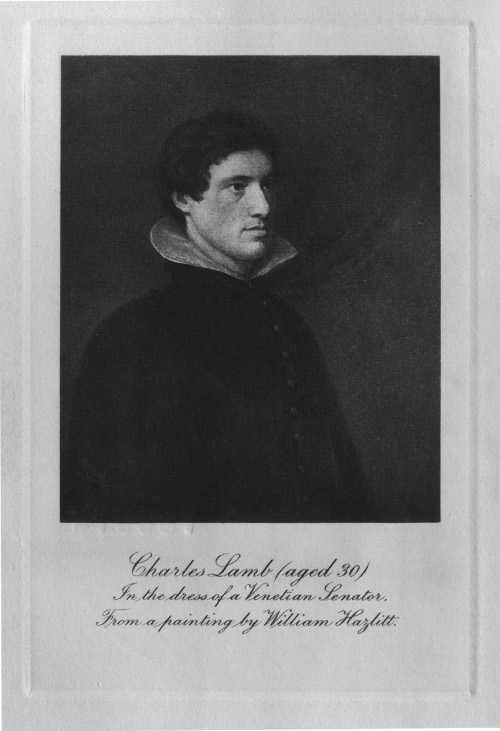 Charles Lamb (aged 30)