ARISTOTLE’S WORKS: CONTAINING THE MASTER-PIECE, DIRECTIONS FOR MIDWIVES, AND COUNSEL AND ADVICE TO CHILD-BEARING WOMEN. WITH VARIOUS USEFUL REMEDIES.
Transcriber’s Note:
The cover image was created by the transcriber and is placed in the public domain.
ARISTOTLE’S MASTER-PIECE.
ADVERTISEMENT.
At the present time, when so many of the female sex, in the hour of Nature’s extremity, depend solely upon the skill and practical experience of the Midwife, we regard every attempt to assist the female accoucheur in her difficult, and sometimes dangerous operation, as a blessing conferred upon society.
This treatise enters fully into every department of Midwifery; and lays down excellent rules, and proposes valuable suggestions for the guidance of the female operator, which, if acted upon, will not only redound to the credit of the practitioner, but will be of immense benefit to those operated upon. Another valuable feature of this work is, that it contains important directions for the guidance of child-bearing women during the time of their pregnancy: how they should conduct themselves with regard to regimen, medical treatment, and other matters, each month, until the time of their delivery. In short, we venture to assert that if the counsel and advice given in the Experienced Midwife be strictly adhered to by all parties interested therein, the travail in child-birth, instead of being many times difficult and dangerous, will be safe, speedy, and comparatively easy.
CONTENTS. — THE MASTER-PIECE. — THE MATRIMONIAL STATE CONSIDERED. — CHAPTER I. FALSE STEPS IN MATRIMONIAL ALLIANCES. — CHAPTER II. THE ORIGINAL APPOINTMENT OF MARRIAGE. — CHAPTER III. THE HAPPY STATE OF MATRIMONY. — CHAPTER IV. PRECAUTIONARY HINTS. — CHAPTER V. THE VAGARIES OF NATURE, IN THE BIRTHS OF MONSTERS. — CHAPTER VI. OF THE WOMB IN GENERAL. — CHAPTER VII. OF THE RETENTION OF THE MENSES. — CHAPTER VIII. OF THE OVERFLOWING OF THE MENSES. — CHAPTER IX. OF THE WEEPING OF THE WOMB. — CHAPTER X. OF THE FALSE MENSES, OR WHITES. — CHAPTER XI. OF THE SUFFOCATION OF THE MOTHER. — CHAPTER XII. FALLING OF THE WOMB. — CHAPTER XIII. OF THE INFLAMMATION OF THE WOMB. — CHAPTER XIV. OF SCHIRROSITY OR HARDNESS OF THE WOMB. — CHAPTER XV. OF THE DROPSY IN THE WOMB. — CHAPTER XVI. OF MOLES AND FALSE CONCEPTIONS. — CHAPTER XVII. OF CONCEPTION, AND HOW A WOMAN MAY KNOW WHETHER SHE HAS CONCEIVED OR NOT, AND WHETHER MALE OR FEMALE. — CHAPTER XVIII. OF UNTIMELY BIRTHS. — CHAPTER XIX. DIRECTIONS FOR PREGNANT WOMEN. — CHAPTER XX. DIRECTIONS TO BE OBSERVED BY WOMEN, AT THE TIME OF THEIR FALLING IN LABOUR. — CHAPTER XXI. IN CASES OF EXTREMITY, WHAT OUGHT TO BE DONE. — THE MIDWIFE. GUIDE TO CHILD-BEARING WOMEN. — BOOK I.—CHAPTER I. — Sect. I. Of the Womb. — Sect. II. — Of the Difference between the Ancient and Modern Physicians, touching the Woman’s contributing Seed to the Formation of the Child. — CHAPTER II. OF CONCEPTION; WHAT IT IS; HOW WOMEN ARE TO ORDER THEMSELVES AFTER CONCEPTION. — Sect. I. What Conception is. — Sect. II. How a Woman ought to order herself after Conception. — CHAPTER III. Of the Parts proper to a Child in the Womb. How it is formed there, and the Manner of its Situation therein. — Sect. I. Of the Parts proper to a Child in the womb. — Sect. II. Of the Formation of the Child in the Womb. — Sect. III. Of the manner of the Child’s lying in the Womb. — CHAP. IV. A Guide to Women in Travail, showing what is to be done when they fall in Labour, in order to their Delivery. — Sect. I. The Signs of the true Time of a Woman’s Labour. — Sect. II. How a woman ought to be ordered when the Time if her Labour is come. — CHAPTER V. OF NATURAL LABOUR; WHAT IT IS; AND WHAT THE MIDWIFE IS TO DO IN SUCH A LABOUR. — Sect. I. What Natural Labour is. — Sect. II. Of the Cutting of the Child’s Navel-String. — Sect. III. How to bring away the After-burden. — Sect. IV. Of Laborious and Difficult Labours, and how the Midwife is to proceed therein. — Sect. V. Of Women labouring with a dead Child. — CHAPTER VI. Of unnatural Labour. — Sect. I. How to deliver a Woman of a Dead Child, by Manual Operation. — Sect. II. How a Woman must be Delivered, when the Child’s Feet come first. — Sect. III. How to bring away the Head of the Child, when separated from the Body, and left behind in the Womb. — Sect. IV. How to deliver a Woman when the Child’s Head is presented to the Birth. — Sect. V. How to Deliver a Woman when the Child presents one or both Hands together with the Head. — Sect. VI. How a Woman ought to be delivered, when the Hands and Feet of the Infant come together. — Sect. VII. How a Woman should be delivered that has Twins, which present themselves in different Postures. — CHAPTER VII. DIRECTIONS FOR CHILD-BEARING WOMEN IN THEIR LYING-IN. — Sect. I. How a Woman newly Delivered ought to be ordered. — Sect. II. How to remedy those Accidents which a Lying-in Woman is subject to. — CHAPTER VIII. Directions for the Nurses, in ordering Newly-born Children. — CHAPTER IX. — Sect. I. Of Gripes and Pains in the Bellies of young Children. — Sect. II. Of Weakness in newly-born Infants. — Sect. III. Of the Fundament being closed up in a newly-born Infant. — Sect. IV. Of the Thrush, or Ulcers in the Mouth of the Infant. — Sect. V. Of Pains in the Ears, Inflammation, Moisture, &c. — Sect. VI. Of Redness, and Inflammation of the Buttocks, Groin, and the Thighs of a Young Child. — Sect. VII. Of Vomiting in young Children. — Sect. VIII. Of breeding Teeth in young Children. — Sect. IX. Of the Flux of the Belly, or Looseness in Infants. — Sect. X. Of the Epilepsy and Convulsions in Children.
| THE MASTER-PIECE. | |||
| PAGE | |||
|---|---|---|---|
| The Matrimonial State considered | 9 | ||
| Chap. | I. | —False Steps in Matrimonial Alliances | 10 |
| „ | II. | —The original appointment of Marriage | 14 |
| „ | III. | —The happy state of Matrimony | 20 |
| „ | IV. | —Precautionary Hints | 29 |
| „ | V. | —The Vagaries of Nature in the birth of Monsters | 34 |
| „ | VI. | —Of the Womb in general | 41 |
| „ | VII. | —Of the retention of the Terms | 43 |
| „ | VIII. | —Of the overflowing of the Terms | 49 |
| „ | IX. | —Of the Weeping of the Womb | 53 |
| „ | X. | —Of the false Terms, or Whites | 54 |
| „ | XI. | —Of the Suffocation of the Mother | 57 |
| „ | XII. | —Falling of the Womb | 62 |
| „ | XIII. | —Of the Inflammation of the Womb | 64 |
| „ | XIV. | —Of the Schirrosity or Hardness of the Womb | 66 |
| „ | XV. | —Of the Dropsy of the Womb | 68 |
| „ | XVI. | —Of Moles and False Conceptions | 70 |
| „ | XVII. | —Of Conception, and how a woman may know whether she has conceived or not, and whether male or female | 74 |
| „ | XVIII. | —Of untimely Births | 76 |
| „ | XIX. | —Directions for Pregnant Women | 77 |
| „ | XX. | —Directions to be observed by women at the time of their falling in labour | 80 |
| „ | XXI. | —In cases of extremity, what ought to be done | 82 |
| vii | |||
| THE MIDWIFE. | |||
| CHAPTER I. | |||
| Sect. I. Of the Womb | 85 | ||
| Sect. II. Of the Difference between Ancient and Modern Physicians, touching the Woman’s contributing Seed for the formation of the Child | 90 | ||
| CHAPTER II. | |||
| Sect. I. What Conception is | 93 | ||
| Sect. II. How a Woman ought to order herself after Conception | ib. | ||
| CHAPTER III. | |||
| Sect. I. Of the Parts proper to a Child in the Womb. How it is formed there, and the Manner of its Situation therein | 104 | ||
| Of the Secundine, or After-Birth | 107 | ||
| Sect. II. Of the Formation of the Child in the Womb | 109 | ||
| Sect. III. Of the manner of the Child’s lying in the Womb | 110 | ||
| CHAPTER IV. | |||
| A Guide for Women in Travail, shewing what is to be done when they Fall in Labour, in order to their Delivery | 113 | ||
| Sect. I. The Signs of the true Time of Woman’s Labour | 114 | ||
| Sect. II. How a Woman ought to be ordered when the time of her Labour is come | 116 | ||
| CHAPTER V. | |||
| Sect. I. What Natural Labour is | 123 | ||
| Sect. II. Of the Cutting of the Child’s Navel-String | 128 | ||
| Sect. III. How to bring away the After-burden | 130 | ||
| Sect. IV. Of Laborious and Difficult Labours, and how the Midwife is to proceed therein | 131 | ||
| Sect. V. Of Women Labouring with a dead Child | 138 | ||
| CHAPTER VI. | |||
| Of Unnatural Labour | 142 | ||
| Sect. I. How to deliver a woman of a Dead Child, by Manual Operation | 143 | ||
| Sect. II. How a Woman must be Delivered, when the Child’s Feet come first | 146 | ||
| Sect. III. How to bring away the Head of the Child, when separated from the Body, and left behind in the Womb | 149 | ||
| viiiSect. IV. How to deliver a Woman, when the Child’s Head is presented to the Birth | 151 | ||
| Sect. V. How to deliver a Woman when the Child presents one or both Hands together with the Head | 153 | ||
| Sect. VI. How a Woman ought to be delivered, when the Hands and Feet of the Infant come together | 154 | ||
| Sect. VII. How a Woman should be delivered that has Twins, which present themselves in different Postures | 156 | ||
| CHAPTER VII. | |||
| Sect. I. How a Woman newly delivered ought to be ordered | 160 | ||
| Sect. II. How to remedy those Accidents which a Lying-in Woman is subject to | 162 | ||
| CHAPTER VIII. | |||
| Directions for Nurses, in ordering Newly-born Children | 168 | ||
| CHAPTER IX. | |||
| Sect. I. Of Gripes and Pains in the Bowels of young Children | 171 | ||
| Sect. II. Of Weakness in newly-born Infants | 173 | ||
| Sect. III. Of the Fundament being closed up in a newly-born Infant | 174 | ||
| Sect. IV. Of the Thrush, or Ulcers in the Mouth of the Infant | 176 | ||
| Sect. V. Of Pains in the Ears, Inflammation, Moisture, &c. | 177 | ||
| Sect. VI. Of Redness, or Inflammation of the Buttocks, Groin, and the thighs of the Young Child | 178 | ||
| Sect. VII. Of Vomiting in young Children | 179 | ||
| Sect. VIII. Of breeding Teeth in young Children | 180 | ||
| Sect. IX. Of the Flux in the Belly, or Looseness in Infants | 182 | ||
| Sect. X. Of the Epilepsy and Convulsions in Children | 185 | ||
| Proper and Safe Remedies for Curing all those Distempers that are Peculiar to the Female Sex | 186 | ||
| Aristotle’s Book of Problems | 202 | ||
| The Secrets relating to Physiognomy | 275 | ||
| The Midwife’s Vade-Mecum | 307 | ||
| The Venereal Disease | 317 | ||
The subject of Matrimony is one of deep interest to both sexes: and it behoves every one before marriage to study it with the most serious attention, and ponder over it with an earnest desire to acquire a full knowledge of its duties, responsibilities, and enjoyments. It is an attractive subject to both male and female, except those who subscribe to the principles of Malthus; and old bachelors and old maids are looked upon with contempt and scorn by the generality of young people. Celibacy is regarded now with different views from that with which it used to be some centuries back; and this change is perceptible in some portions of the Romish church. The celibacy of the priesthood is not now insisted on with that strictness which was the case in former times. Marriage is considered the legitimate and proper order of things: husband and wife the relative condition of male and female, and celibacy ought to be, if possible, avoided.
10It is our intention to examine the subject in regard to the prejudicial influence which arises from the false steps which are often taken in matrimonial alliances; the original appointment of marriage; and the happy state of matrimony when in strict accordance with that which was originally appointed; with other subjects connected with Love and Marriage.
When we peruse the yearly returns which are furnished by the Registrar General of the marriages which have taken place in our own country, we are forcibly struck with the many false steps which have been taken by both males and females, even in one year. Parties joined together of the most unequal ages—May and December—plainly declare that there are other motives actuating the one or the other, in the step taken, than the one that should always be predominant at the hymeneal altar.
Another list in the Registrar’s Return will show us what numbers enter the marriage state long before they have come to the age of maturity. In Oriental countries the custom is to marry at an early age; but there the climate, it is said, has an influence on the human frame which earlier developes the state of puberty than is the case in our own northern clime; and that in those countries human decay commences earlier than it does in Europe. Still we hesitate not to say, that 11early marriages even in hot climates, are injudicious. We are not advocating marriages taking place between the sexes when the vigour and stamina have begun to decay; on the other hand, we would say, that early marriages are preferable to those contracted when the bloom of youth has passed away. But when those are joined together who are not physiologically prepared for the requirements and enjoyments of the matrimonial state, they attempt that for which nature has not fitted them, and impair their physical organs, debilitate their vital powers, and exhaust their strength. We would, therefore, caution our readers not to marry too young.
Another false step taken by those who enter the marriage state is one that requires great discrimination and judgment to avoid: we allude to the bodily or mental disqualification of the one or the other for the true enjoyment of that state. What misery has been experienced by thousands for want of a thorough knowledge of each other bodily and mentally before the knot was tied. The Divorce Court has been, and is, crowded with applicants for redress, who are the victims of their own folly, and who rushed into the connubial state without having a clear and perfect understanding of each other’s qualifications for rendering the marriage state one of enjoyment.
Again, much misery is often productive of the want of a thorough knowledge of the temper and disposition of each other before the consummation of marriage. The lover finds in the object adored, all perfection; and neglects to view this object in its true light, until the irrevocable vow is uttered, and wedded life reveals the unwholesome truth that the temper and disposition of 12the one, or the other, or both, are of such a nature as to render the domestic hearth any thing but pleasant.
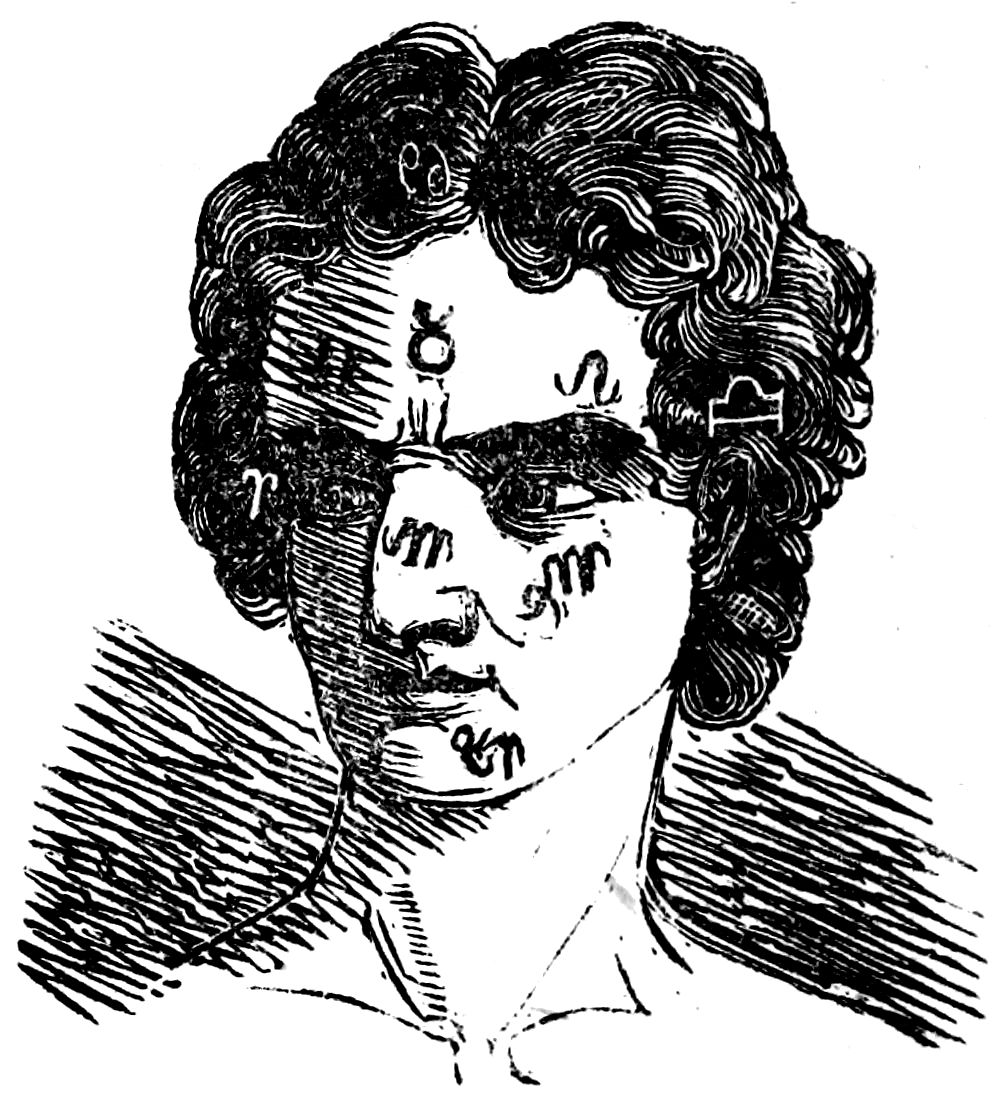
Again, a common error committed by those wishing to enter the marriage state, is that of being dazzled and decoyed by the beauty of the object sought. The beauty of the face is not among women one of universal agreement, as is generally supposed. Voltaire has said, “Ask a toad what is handsome, and he will answer, ‘My mate, with his big eyes and slimy skin.’” The negro’s type of beauty, no doubt, consists in a blackness equal to his own; but is there no specific and positive state of perfection, regularity, harmony, organization, in each species? Have not all their ideas of beauty, independent of the preferences or prepossessions of others? The face of a woman is a mirror of the affections of her soul, as has been often remarked, but the fact has not yet been promulgated, that the different features of a face indicate a particular species of affection.
Again, an error frequently committed by those anxious to enter the matrimonial life is that of seeking for wealth, not the true enjoyment of domestic happiness. Alas! what numbers have made fatal shipwreck by being dashed to pieces, like Sinbad, on this loadstone rock! The man that wishes to find the true enjoyment of married life should not look for a large dower along with the partner of his life, but for a woman of a virtuous, well-educated, and amiable disposition. Such a partner will be of more value than all the gold that has been discovered in California, Australia, and all the other El Dorados yet heard of. But although the lover should not be actuated 13by an inordinate craving after wealth, still there should be a due foresight exercised to provide for a proper maintenance before entering the marriage state. Many couples get united together before they have provided a home of their own wherein to dwell, and are therefore compelled to be dependent upon others, for a habitation. This is a sad state of things; and has frequently been the cause of embittering the married life of those who would otherwise have enjoyed much of its sweets.
Again, another error which is often committed by those entering the married state, is that of an utter disregard for the tastes and inclinations of each other. For want of due appreciation of the unity of feeling on this subject much unhappiness has been experienced by husband and wife. The husband, perhaps, has a taste for a particular class of literature, and takes a delight in perusing his favourite authors, whilst the wife takes a pleasure in reading works of quite a different description altogether, and persists in maintaining her judgment in opposition to that of her husband, hence unpleasant bickerings and recriminations take place. And as their tastes disagree in regard to the food for the mind, so also they disagree in regard to the food for the body. What she likes, he dislikes, and what he likes, she dislikes. It behoves every one, entering the matrimonial state to have a perfect understanding, and a reciprocity in taste and inclination with each other.
Again, another error into which many fall who are entering the wedded life, is a departure from that candour and uprightness which ought to govern and actuate mankind in every transaction of 14daily life but more especially in the important one now under consideration. What lamentable consequences have resulted from the deception and subterfuge which have been practised by both male and female, when about to be joined together in the holy bands of wedlock! The man who would deceive the partner whom he vows to cherish and comfort, or the woman who would practice deception on him whom she vows to honour and obey, deserve to taste the bitter fruit of their own sin and folly. It should ever be known by those who are about to become man and wife, that every matter which they are anxious to conceal before marriage, will, very probably, be disclosed at one time or another; and perhaps disclosed in such a way so as to make the secret appear of ten times more importance than it really is. Unbosom every secret, confide in each other; and be assured that, whatever may be the consequence, a clear conscience, truth, and uprightness will comfort and sustain you in every trouble.
The Author of our being, when he formed the first pair of human beings, left them not to the mere instincts of nature, as he did in the case of the inferior animals; but for them he especially instituted the contract of marriage; so that marriage is a divine appointment. At the Almighty’s command the waters brought forth in abundance; 15myriads of fishes swam in the sea; innumerable birds of every description winged their way in the firmament; animals of all kinds, from the gigantic elephant to the smallest creature imaginable, wandered up and down on the earth, and every kind of creeping thing; the largest of the feathered tribe built nests on the inaccessible cliffs; the lion and the tiger, with other ferocious beasts, prowled the forests; cattle and sheep and the mild animals cropped the herbage; the dove chose her mate; the nightingale warbled her song; the small insects, to which the leaf was a world, and the minute animalcule, whose universe was a water-drop—all were formed by the Almighty—and He commanded that they were to “Be fruitful, and multiply, in the earth.”
It was different, however, with regard to the human family. As the members of that family were formed with an elaboration not displayed in other departments of creation, as their structure was different from that of any other creature, as man was formed from the dust of the earth, and God breathed into him the breath of life, as the woman was made from a portion of the man—bone of his bone, and flesh of his flesh,—consequently there was a difference in the way in which they were directed to fulfil the great purpose of their creation, namely, to replenish the earth.
The Almighty declared that it was not good for man to be alone, therefore woman was formed for an helpmeet for him. Throughout the teeming earth, the blue expanse, and the deep water, there was not a creature but what had found a mate; our first parent stood alone, without the society of one bearing his nature—isolated 16from the company of one with whom he could hold converse, and who could share in the enjoyments of the happy sphere in which he was at first placed. The Great Creator made woman, brought them together, and instituted marriage. Equal power and dominion over the inferior creatures was given to the woman, as that exercised by the man; and it was not until the disobedience and sin of our first parents, that the original order of things was changed, and that anything was heard of the subjection of Eve to Adam.
The institution of Marriage was a wise and judicious arrangement, and peculiarly adapted to the position of the human race. It was of the greatest consequence to man that he should have a companion, a friend, a wife; and for this purpose it was ordained that a man should leave his father and mother, and cleave unto his own wife, and they twain should be one flesh.
In what emphatic language is the union of husband and wife enforced: “they twain shall be one flesh.” For the future their joys and their sorrows are to be identical. They are not separate individuals as two male persons are considered, but male and female—wife and husband—one. Alas! how frequently is this oneness marred and broken—a diversity of interest and feeling appears to exist between many married couples, and how often the adage of, “a house divided against itself cannot stand,” is verified. It would be well if such couples would oftener remember the solemn injunction—“they twain shall be one flesh.” It seems to an observer, that if such couples ever loved one another, they lavished and exhausted that love in the early days of marriage, and filled up the void by feelings of enmity and strife. This ought not to be the state of a domestic household; for though the wife may be possessed of the key of every drawer and cupboard in the house, if she does not possess the key of her husband’s heart, she is destitute of that which is of more value to her than every other earthly treasure. The husband may be affectionate, kind, and respectful to his wife, but if she is not identical with himself, the depository and confidante of all his feelings and aspirations, there is something amiss. It is an impossibility for married people to love and trust each other too much, and as impossible for them to feel a strong and deep affection for each other, if they do not consider their interests to be identical.
17When Adam awoke out of the deep sleep into which he had been cast by the Almighty, and beheld the lovely being in his presence, he was told by his and her maker, that the woman was given to be with him, not given to him; for so we understand by the words of Adam, when he would have framed an excuse for his sin—“The woman that thou gavest to be with me.” Therefore the inference is plain that woman was not given to man to be his slave, nor the victim of his caprice or violence, nor the plaything of an hour, but a partner and confidante in all that concerned him; the sharer of his joys and sorrows, of his prosperity and adversity. Woman was not to be subjected to harsh and cruel treatment, but to be cherished and protected; and to be on an equality in every way with man. There is great force and truth in what was penned by an aged writer—“Man and wife are equally 18concerned to avoid all offences to each other in the beginning of their conversation; a very little thing can blast an infant blossom; and the breath of the south can shake the little rings of the vine, when first they begin to curl like the locks of a new-weaned boy; but when by age and consolidation they stiffen into the hardness of a stem, and have by the warm embraces of the sun, and the kisses of heaven, brought forth their clusters they can endure the storms of the north, and the loud noise of the tempest, and yet never be broken.”
Peculiar scope is given for the exercise of the highest qualities of the heart, through the obligations which belong to the state of matrimony. The presence of our Lord and Saviour at a marriage feast, and the example of the early Christians, give force to the statement that marriage is a divine institution. Marriage was held in great esteem by the venerable fathers of ancient days, and considered highly honourable, whilst celibacy was discountenanced by them.
Among the Jews, marriage was held in the greatest esteem and favour, and it is said that the early Christians would never allow any one to sustain the office of a magistrate except those who were married. Laws were made by the Pagans to promote the institution of marriage. A festival was instituted by the Lacedæmonians, at which those men, who were unmarried, were reviled and scourged by the women, and deemed unworthy to serve the republic. Among the Romans, those who had been several times married were distinguished, and received great honour from their fellow countrymen, crowns and wreaths, were placed on their heads, and in their public 19rejoicings they appeared with palms in their hands, signifying that they had been instrumental in adding to the glory of the empire. It is related by St. Jerome, that they covered a man with bays, and ordered him to accompany his wife’s corpse in funeral pomp, with a crown on his head, and a palm branch in his hand, it being considered highly necessary that he should be thus honoured and carried in triumph, seeing that he had been married twenty times, and his wife twenty-two.
The marriage ceremony being solemnized in accordance with the rites of the early Christian Church, the veil (a Pagan custom of former times) was preserved, and from this observance of veiling the word nuptials is derived. The use of the ring was also a matter of importance in the ceremony; the solemn kiss was imparted, and the practice of joining hands was observed. Usually, at the conclusion of the ceremony, the bride was crowned—occasionally both the bride and the bridegroom—with wreaths of myrtle.—The lace veil and the wreath of orange blossoms, which is now such a necessary adornment in bridal attire, may be traced to the practice pursued by bridal parties in former times.
The wedding ring is an emblem of many significant qualifications. Gold being the noblest and purest, as well as the most enduring—it is made of that metal.—Its circular form denotes that form to be the most perfect of all figures, and the hieroglyphic of eternity. Its being entirely free from ornament denotes the perfect simplicity and plainness of wedded life. The ring is put on the left hand because of its being nearest the heart; and on the fourth finger on account of some supposed 20connection between that finger, more than the others, with the seat of life. The ring is the acknowledged pledge of the bestowal of authority, as in former times the giving of it was regarded as the delegation of all the husband’s authority, and conferred upon the person receiving it, entire supremacy over every thing in the husband’s possession.
It would be an easy task to continue this chapter much farther, by attempting to pourtray the beauty and virtue of marriage, and endeavouring to enforce the obligation of it on all who are proper subjects to engage in it, but we will now close the chapter by saying, that the instincts of nature yearn towards the opposite sex. We long to love and be loved. We feel that within us which inclines us to seek the society of the other sex; a monitor that warns us to refrain from unhallowed love: and a voice which invites us to seek that state of matrimony, which is sanctioned by human and divine law.
Without doubt the uniting of hearts in holy wedlock is of all conditions the happiest; for then a man has a second self to whom he can reveal his thoughts, as well as a sweet companion in his labours, toils, trials, and difficulties. He has one in whose breast, as in a safe cabinet, he can confide his inmost secrets, especially where reciprocal love and inviolable faith is centred: for there no 21care, fear, jealousy, mistrust, or hatred can ever interpose. For base is the man that hateth his own flesh! And truly a wife if rightly considered, as Adam well observed, is or ought to be esteemed of every honest man as “Bone of his bone, and flesh of his flesh,” &c. Nor was it the least care of the Almighty to ordain so near a union, and that for two causes; the first, for the increase of posterity; the second, to restrain man’s wandering desires and affections; nay, that they might be yet happier, when God had joined them together, he “blessed them,” as in Gen. ii. An ancient writer, contemplating this happy state, says, in the economy of Zenophon, “that the marriage-bed is not only the most pleasant, but profitable course of life, that may be entered on for the preservation and increase of posterity. Wherefore since marriage is the most safe, and delightful situation of man, he does in no ways provide amiss for his own tranquillity who enters into it, especially when he comes to maturity of years.”
Enviable is the state of that man who has fixed his choice upon a virtuous, chaste wife, centring her entire love upon her husband, and submitting to him as her head and king, by whose directions she ought to steer in all lawful courses, will like a faithful companion, share patiently with him in all his adversities, run with cheerfulness through all difficulties and dangers, though ever so hazardous, to preserve or assist him in poverty, sickness, or whatever misfortune may befall him, acting according to her duty in all things.
“Marriage,” says one of our most gifted poets—who had experienced some varieties of married 22life—“is a covenant, the very being whereof consists not in a forced cohabitation and counterfeit performance of duties, but in unfeigned love and peace. Matrimonial love, no doubt, was chiefly meant, which by the ancient sages was thus parabled: Love, if it be not twin-born, yet hath a brother wondrous like him, called Anteros; whom, while he seeks all about, his chance is to meet with many false and feigning desires, that wander singly up and down in his likeness: by them, in their borrowed garb, Love though not wholly blind, as poets wrong him, yet having but one eye—on being born an archer, aiming—and that eye not the quickest in this region here below—which is not Love’s proper sphere—partly out of the simplicity of credulity, which is native to him, often deceived, embraces and consorts him with these obvious and suborned striplings, as if they were her mother’s own sons; for so he thinks them, while they subtly keep themselves most on his blind side. But, after a while, as the manner is, when soaring up into the high tower of his opqueum, above the shadow of the earth, he darts out the direct rays of his then most piercing eye-sight upon the impostures and trim disguises that were used with him, and discerns that this was not his genuine brother, as he imagined. He has no longer the power to hold fellowship with such a personated mate; for straight his arrows lose their golden heads, and shed their purple feathers, his silken braids entwine, and slip their knots, and that original and fiery virtue given him by fate, all on a sudden goes out, and leaves him undeified and despoiled of all his force; till, finding Anteros at 23last, he kindles and repairs the almost faded ammunition of his deity, by the reflection of a coequal and homogenial fire.”
This is a deep and serious verity, showing us that love in marriage cannot live nor subsist unless it be mutual, and where love cannot be, there can be left of wedlock nothing but the empty husk of an outside matrimony, as undelightful and unpleasing to God, as any other kind of hypocrisy.
Man experiences a feeling of want for some one to whom he can unbosom himself of all his secrets, and tell the longings and aspirations of his heart; and who so fit and proper to be trusted as the partner of his joys and sorrows, and the wife of his bosom? In his boyish days he may confide in some youthful companion, but as he verges towards manhood, he hesitates to entrust the secrets of his heart to his equals in age, fearful of a betrayal of confidence. Men are following the bent of their inclinations and pursuits—seeking wealth, reputation, or pleasure—in various ways; and if you told your dearest friend the secrets of your heart, he would soon be wearied with your officiousness, however much he might appreciate your friendship, and might be anxious for your success, but your success, or even your friendship, are not of paramount importance in his estimation. Very different, however is the case with a wife. When you conducted her to the altar, and vowed to love and cherish her so long as life should last, she became one with you—“no more twain but one flesh.” To her you may safely confide all your wishes, difficulties, and disappointments. Pleasure is all the more ecstatic when there are two to partake of it; and 24every burden feels lighter, when there are two to help to bear it. Pliny, speaking of his wife, says,—“Her ingenuity is admirable; her frugality is extraordinary; she reads my writings, studies them, and even gets them by heart. You would smile to see the concern she is in when I have a cause to plead, and the joy she shows when it is over. She finds means to have the first news brought to her of the success I meet with in court, how I am heard, and what decree is made. She feasts upon my applauses. Sometimes she sings my verses, and accompanies them with the lute without any other master, except love, the best of instructors.” Ecstatic and soul-cheering are the delights which spring from a trusting, loving, and honourable marriage. How the very presence of the loved wife is prized! For should circumstances cause a short separation, with what anxiety does the fond husband look for the return of her on whom his soul doats; and whose returning presence throws a halo of sunshine over his domestic hearth, which gladdens the heart of the loving husband. How the faithful husband will seek to shield the loving wife from every harm; and how firmly he relies on her faith and purity! What energy does the thought of her sterling fidelity give him in life’s struggles! What a peculiar charm is imparted to enjoyments when we can share them with one whom we fondly love, and by whom we are fondly loved in return. Sympathy renders such communion ecstatic, but if that is taken away, the remains are but the hollow mockery of pleasure, vanity, and vexation of spirit.
A clever female writer thus speaks of marriage—“Many a marriage begins like the rosy morning, 25and then falls away like a snow-wreath. And why? Because the married pair neglect to be as well pleasing to each other after marriage as before. Endeavour always to please one another; but at the same time keep God in your thoughts.—Lavish not all your love on to-day, for remember that marriage has its to-morrow, likewise, and its day after to-morrow, too. Spare, as one may say, fuel for the winter.—Deceive not one another in small things or in great. One little lie has, before now, disturbed a whole married life.—A small cause has often great consequences.—Fold not the hands together and sit idle. ‘Laziness is the devil’s cushion!’ Do not run much from home. ‘One’s own hearth is gold-worth.’—The married woman is her husband’s domestic faith; in her hands he must be able to confide house and family; be able to entrust to her the key of his heart, as well as the key of his eating-room. His honour and his home are under her keeping; his well-being is in her hand. Think of this, oh wife!—Young men, be faithful husbands and good fathers of families. Act so that your wives shall esteem and love you. Read the word of God industriously; that will conduct you through storm and calm, and safely bring you to the haven at last.”
Much happiness may result from the state of matrimony. The good man beholds his children rising around him, like olive branches; he feels himself strengthened and encouraged to fulfil the responsibilities devolving upon him; and he had before no idea of the fountain of joy that was in the word “father.” It appears to him as if his boyish days were returned, when he is surrounded by two or three of the pledges of his 26affection, witnessing their youthful gambols, and listening to their clear ringing shouts of glee and delight as they scamper up and down before him. He takes a pride in his children. No toil or trial appears harassing which is endured for their benefit. He indulges in bright anticipations regarding their future career, and prays and hopes that they will be a comfort and honour to his declining years; and he endeavours to train them up in the way they should go, trusting that when they are old, they will not depart from it. And this is not a selfish feeling; he is well aware that the man who gives a brave son or a virtuous daughter to society, has conferred an inestimable blessing on society. When declining age approaches, and the partner of his joys and sorrows manifests the effects of time’s corroding blight on the fair structure which won his youthful affections,—still the flame of love burns as pure if not as ardent, as when they stood before the hymeneal altar. The aged pair are still happy in each other’s smile; and the reflection that they have led their children in that good path which shall make their memory blessed, sustains and comforts them in life’s closing scene.
An old divine says, “They that enter into marriage, cast a die of the greatest contingency, and yet of the greatest interest in the world, next to the last throw for eternity. Life or death, felicity or lasting sorrow, are in the power of marriage.—A woman, indeed, ventures most; for she hath no sanctuary to retire to.—The man can run from many hours of sadness, yet he must return to it again, and when he sits among his neighbours, he remembers the dejection that is in his bosom, and sighs deeply.—After the hearts 27of the man and wife are endeared and strengthened, by a mutual confidence and experience longer than artifice and presence can last, there are a great many remembrances, and some things present, that dash all little unkindnesses in pieces.—Let man and wife be careful to stifle little things, that as fast as they spring they be cast down and trod upon; for if they be suffered to grow, by numbers, they make the spirits peevish, and the society troublesome, and the affections loose and easy by an habitual aversion. Some men are more vexed with a fly than with a wound; and when the gnats disturb our sleep, and the reason is disquieted but not perfectly awakened, it is often seen that he is fuller of trouble than if, in the day-light of his reason he were to contest with a potent enemy. In the frequent little accidents of a family a man’s reason cannot always be awake; and when the discourses are imperfect, and a trifling trouble makes him yet more restless, he is soon betrayed to the violence of passion.—Let them be sure to abstain from all those things which by experience and observation, they find to be contrary to each other.—Let the husband and wife avoid a curious distinction of mine and thine; for this hath caused all the laws, and all the suits, and all the wars of the world.—Let them who have but one purse, have but one interest.—There is nothing that can please a man without love; for nothing can sweeten felicity itself but love.—No man can tell, but he that loves his children, how many delicious accents make a man’s heart dance in the pretty conversations of those dear ones; their childishness, their stammering, their little angers, their innocence, their imperfections, their 28necessities, are so many little emanations of joy and comfort to him that delights in their persons and society.—A man should set a good example to his wife.—Ulysses was a prudent man, and a wary counsellor, sober and severe; and he formed his wife into such imagery as he desired; and she was chaste as the snows upon the mountains; diligent as the fatal sisters; always busy and always faithful, she had a lazy tongue and a busy hand.—A husband’s chastity should be unspotted, his faith inviolable, for this is the “Marriage Ring;” it ties two hearts by an eternal band; it is like the cherubim’s flaming sword, set for the guard of paradise.”
“Let a man love his wife even as himself,” and “be not bitter against her.” Marcus Aurelius said, that “a wise man ought often to admonish his wife, to reprove her seldom, but never to lay his hands on her.” The marital love is infinitely removed from all possibility of such rudeness; it is a thing pure as light, sacred as a temple, lasting as the world.
There is nothing can please a man without love; and if a man be weary of the wise discourses of the Apostles, and of the innocency of an even and private fortune, or hates peace or a fruitful year, he has reaped thorns and thistles from the choicest flowers of paradise, “for nothing can sweeten felicity itself, but love;” but when a man dwells in love, then the breasts of his wife are pleasant as the droppings upon the hill of Hermon, her eyes are fair as the light of heaven, she is a fountain sealed, and he can quench his thirst, and ease his cares, and lay his sorrow down in her lap, and can retire home to his sanctuary and refectory, and his gardens of sweetness and chaste refreshment.
He that proposes to marry, and wishes to enjoy happiness in that state, should choose a wife descended from honest parents, she being chaste, well bred, and of good manners. For if a woman has good qualities, she has portion enough. That of Alcmena, in Plautus, is much to the purpose, where he brings in a young woman speaking thus:—
And undoubtedly she was right, for such a wife is more precious than rubies.
It is assuredly the duty of parents to be very careful in training up their children in the ways of virtue, and to have a due regard for their honour and reputation: and more especially to young women, when grown up to be marriageable. Parental authority in most cases ought to be obeyed by children; but when an undue severity is exercised by parents in attempting to thwart the affections of a son or daughter, and compel the one or the other to violently snap asunder the tenderest ties, then that authority becomes questionable; and except for the most weighty reasons, ought not to be exercised. Alas! what numerous 30lamentable illustrations of undue parental authority in regard to the affections of their children are constantly occurring—sons leaving the parental abode, rushing into the haunts of vice and dissipation, and wrecking their fair prospects on the numerous shoals and quicksands which are so fatal to the unwary—daughters flying from the domestic assylum, which ought to shelter them from every storm, and subjecting themselves to perhaps a far worse condition than that they are fleeing from, in being exposed to the attacks of the human wolves who are nightly prowling in the streets of our large cities, in search of the defenceless females who are wandering about homeless and disconsolate. And when these victims of parental severity have fallen into the pit which has been dug for them, probably the parents, too late, repent of their severity, which has brought an indelible stain upon their family. Parents, be cautious of thwarting the affection of your children.
Vicious indulgence is certain to produce its legitimate results, and bring down ruin upon the man or woman who is addicted to the same. Cast your eyes upon the blighted wrecks of what was once female beauty, but now loathsome to behold, notwithstanding the adventitious aid of paint, and all the adjuncts of tawdry finery that may be put on to hide the miserable wrecks of humanity. Traverse the streets in our large cities, and though illuminated by the glare of gaslight, numbers with unblushing fronts meet you at almost every step. These are the victims of vicious indulgence. Ask any of these to tell you whether she feels herself happy in the “gay” 31life she is pursuing; and if she is sincere, she will answer you with a heart-breaking sigh that she is far from being happy—that she is most miserable—that she remembers a happier time—remembrances which she attempts to stifle by quaffing liquid slow poison at the gin-palace. She had a home once—and she remembers her mother—dead a long time ago—and oh, agony! she remembers the day when her own foot first turned into the path of guilt. Peradventure she was the victim of some base libertine, and was decoyed away from virtue’s path by a deceptive tale; or, probably, she may have willingly swerved from that chaste and virtuous life which is the brightest adornment in female attire. Whatever was the cause there she is—a miserable wreck of humanity! Better, far better, that she had died; that the grass had grown rank over her corpse as it mouldered away in the portion of ground allotted to the pauper dead. Thus it is with the wretched female who gives way to vicious indulgence.—The once gay courtezan eventually is bereft of all splendour; no devoted admirer rushes to her aid; she coughs her way through life; and sinks into an early grave—perhaps a watery grave. Beware, young women, of the siren tempter! Deviate not in the least from the paths of virtue! Chastity is your brightest adornment, and that once sullied, your fair fame is irretrievably damaged.
The baneful effects of giving way to vicious indulgence may probably not, in every case, be so serious to the male portion of the creation as to that of the female, yet there are numerous instances of the libertine and debauchee having had to pay the penalty of their misdeeds by an 32emaciated frame, a broken constitution, and an early death. How many young men have commenced the struggle of life with fair fame and bright prospects, with business habits which gave them buoyant hopes of gaining an independence, who, giving way to vicious indulgence, have ruined their health, blighted their fair fame, and become bankrupts in every thing that belongs to the man of honour and integrity. Young man, beware of giving way to vicious indulgence!
Love is a passion of the human soul; and when properly under control, it is capable of affording the greatest amount of happiness; but, like other passions of the heart, when uncontrolled, or wrongly directed, it entails great misery on those who experience it. This may be the case with that love which is called forth by family relationship and intimate friendship, as well as that intense love which is felt by the opposite sex, man for woman, woman for man.
Various are the means which the libertine and debauchee adopt to gratify their sensual appetite. Some will follow the “strange woman”—the street harlot to her den of infamy and shame; others will attempt to allure the simple trusting maiden by promises, oaths as false and deceitful as ever were uttered by the arch enemy of our souls:—and by these means the trusting and confiding are lured to commit the sin which society condemns in the female, but which is treated with lenity and forbearance in regard to the male transgressor.
Examine the first of these two cases. “A young man deficient in understanding,” seeks the company of unfortunate women, and exhausts his precious vigour and stamina in criminal pleasure. 33The period of youth is the heyday of nature, and the healthful development of all the resources of strength in our nature is the glory of our youth. It is a most lamentable spectacle to behold, in the streets of the metropolis, and large towns, such numbers of men, young in years, but through sensual gratification, broken down in strength, emaciated in body, and apparently worn-out decrepid old men. And alas! how numerous are the allurements spread to entrap the unwary, and cause them to enter on a vicious course of life. “The lips of a strange woman drop as a honey-comb, and her mouth is smoother than oil.” Every attraction which beauty can borrow from art is employed; prostitution wears various kinds of guises to accomplish its object, but is most dangerous when decked out the fairest, and sports the best. And, therefore, the wise teacher before quoted, very appropriately remarks, “Lust not after her beauty in thine heart; neither let her take thee with her eye-lids.” The disastrous consequences of such “pleasures,” are as certain as they are terrible. The sweetness of the honey never provides an antidote for the sting. Such a course most frequently ruins the prospects of success in life—“a man is brought to a piece of bread;” “it ruins the health,”—“thy flesh and thy body are consumed, till a dart strike through thy liver.” And along with property and health goes the character, for “the name of the wicked shall rot,” and their end is shrouded in gloom; their “feet go down to death, and their steps take hold on hell.”
The pleasing anticipations of the wedded pair are sometimes disappointed and seriously blighted by the birth of a deformed and malformed offspring. Sometimes the child is born with some one or more of the usual members of the body deficient; at others there are births of children possessed with more than the usual members of the body; and in various ways the eccentricities of nature are displayed in the production of the fruits of the womb contrary to the usual construction of the human frame.
It would be presumptuous in any finite creature to attempt to give a clear and uncontrovertible reason for these monstrous births. Suffice it to say, that several have at various times been recorded in history; a few of those we shall now introduce to the notice of the reader.
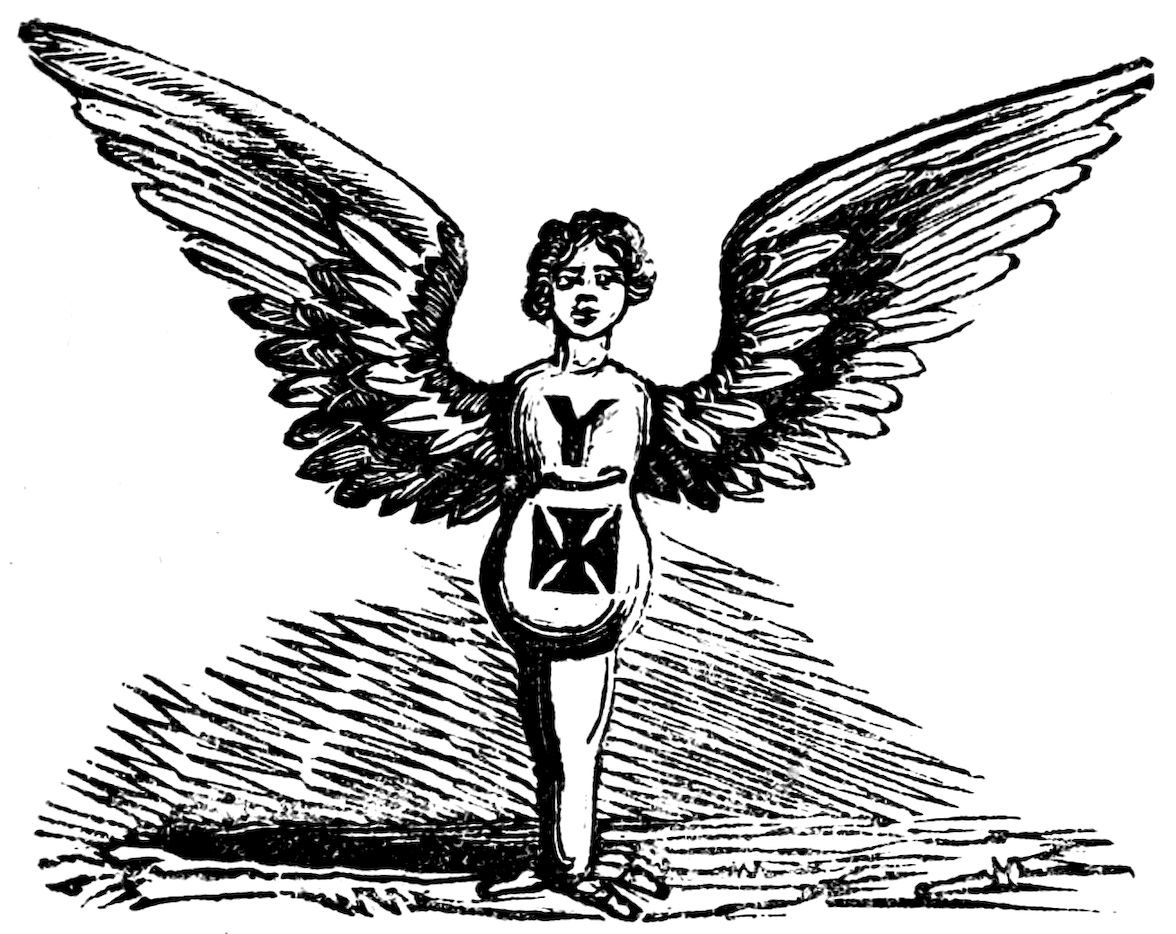
We are told by old historians of a monster which was born at Ravenna, in Italy, about the year 1512, which had wings instead of arms; and some peculiar marks on its body. We present the following figure of this singular creature.
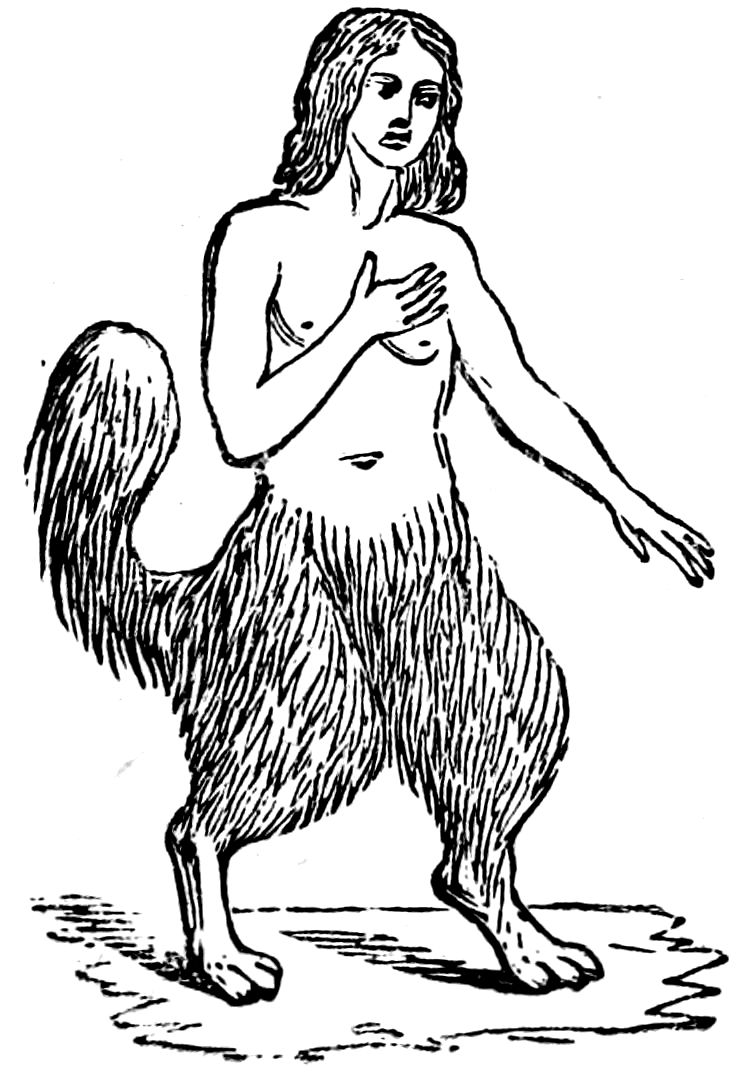
Another monster was born about the year 1603, which from the account handed down to us, was from the navel upwards like a woman, and the lower parts like those of a beast. The following figure of this curious creature is taken from an 36ancient record of the subject. This monster appears to approach nearer to the figure of the fabled satyrs than any we have before seen, and may probably have given rise to those fabled monsters.
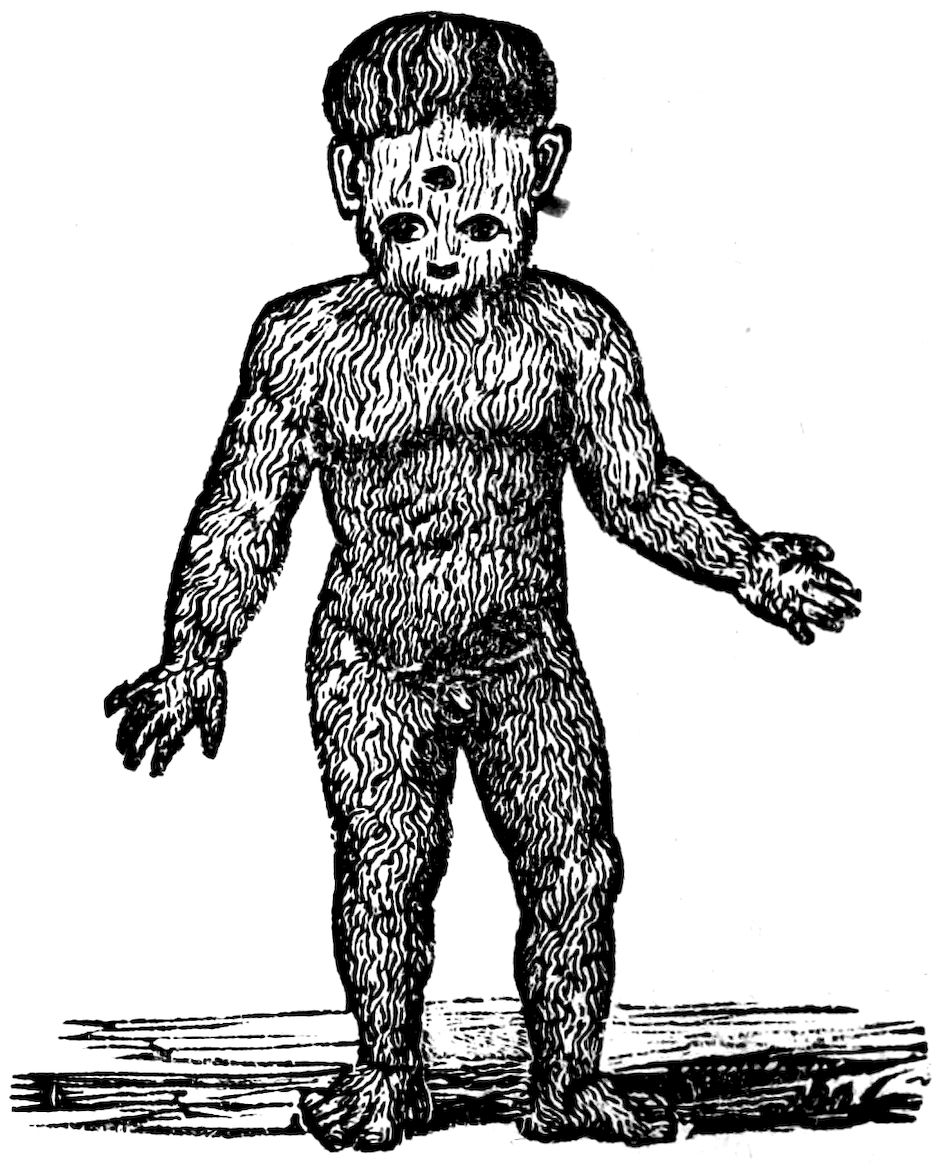
Where children thus are born with hairy coats,
Heaven’s wrath unto the kingdom it denotes.
Another monster was produced, representing a hairy child. It was all covered with hair like a beast. That which rendered it more frightful, was, that its navel was in the place where its nose should stand, and its eyes placed where the mouth should have been; and its mouth placed in the chin. It was of the male kind, and was born in France, in the year 1597, at a town called Arles, in Provence, and lived a few days, 37frightening all who beheld it. It was looked upon by the superstitious as a forerunner of those desolations which soon afterwards happened to that unhappy kingdom, where men to each other, were more like beasts than human creatures. The foregoing engraving from an old print—with two lines attached—give a clearer idea of the monster than any description of ours.
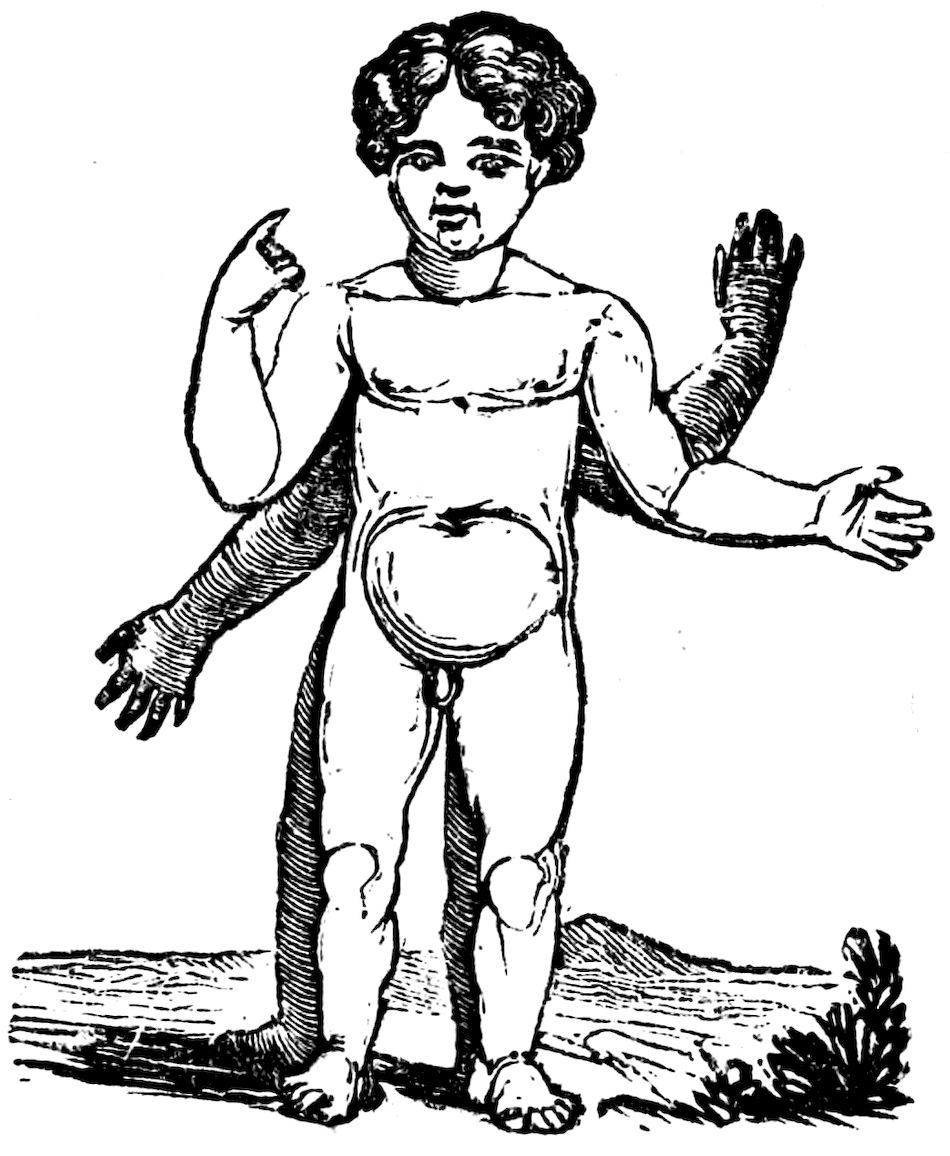
In the year 1581, a monster was born at Nazara, which had four arms and four legs, of a similar form to the figure above. Whether this monster lived for any length of time after its birth, or whether it perished soon after, we have no reliable account on which to rest our conclusions. There is no doubt but that many such 38unnatural births would be concealed: for the doctors of a former age would consider themselves justified in putting an end to the existence of such monsters. With regard to the formation of the child in this case, so far as can be gathered from the account of it, there was nothing to prevent it living: its vital organs were single, it was only the arms and legs that were double.
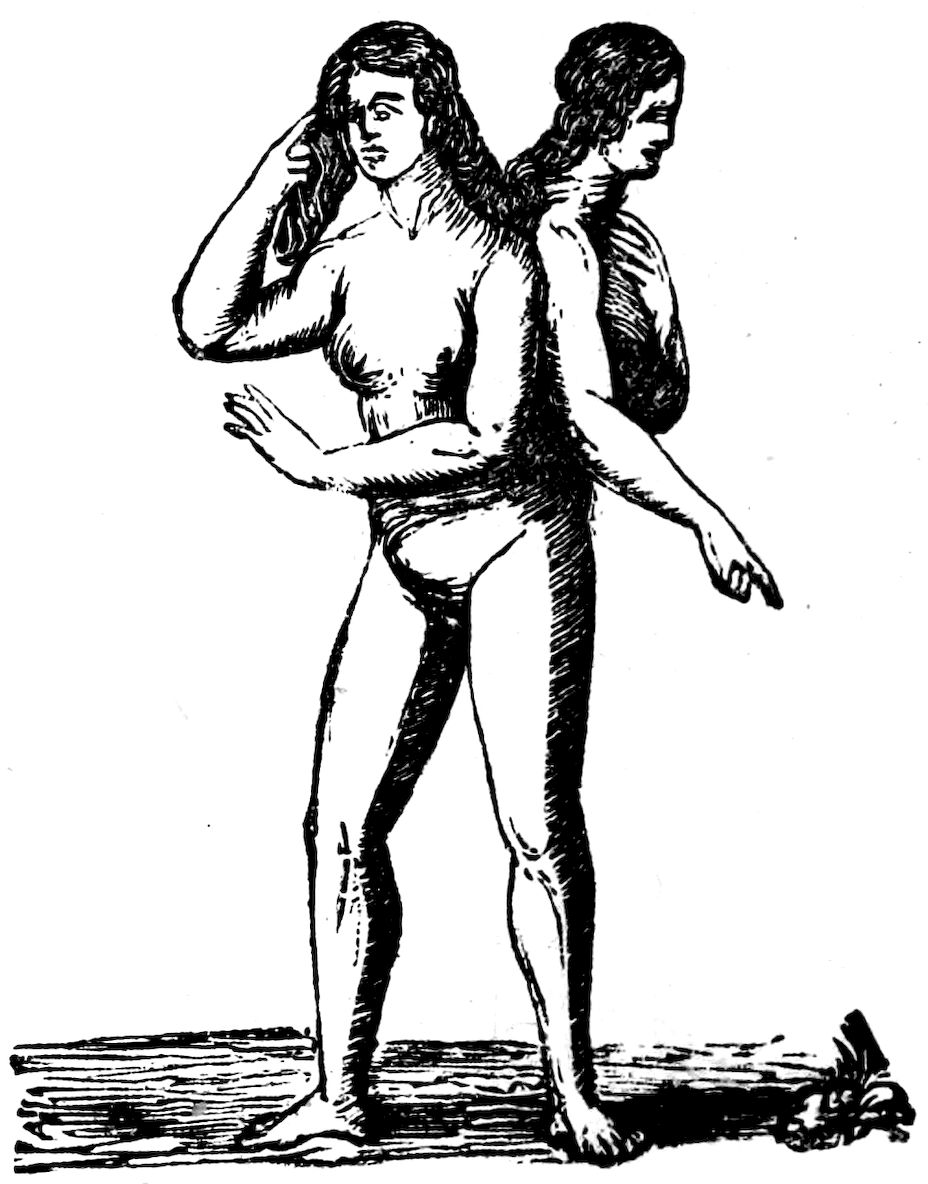
In the reign of Henry III. of England, there was a woman delivered of a child, having two heads and four arms, and the bodies were joined at the back; the heads were so placed, that they looked contrary ways; each had two distinct arms and hands; they would both laugh, both speak, and both cry, and be hungry together; sometimes the one would speak, and the other would keep silent, and sometimes both speak together. 39It lived several years, but one outlived the other three years, carrying the dead one, (for there was no separating them), till it fainted with the burden, and more with the stench of the dead carcase.
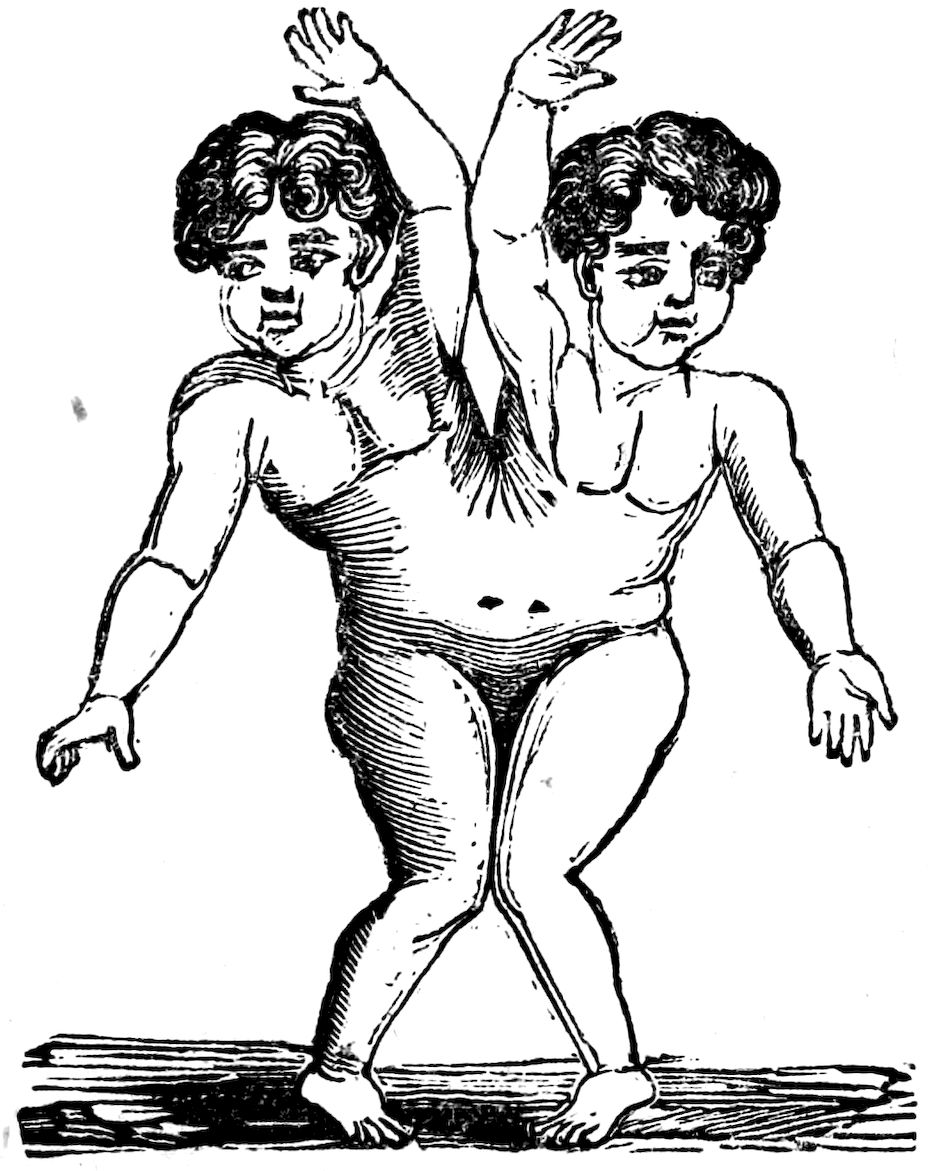
In Flanders, between Antwerp and Mechlin, in a village called Uthaton, a child was born which had two heads and four arms, seeming like two girls joined together, having two of her arms lifted up between and above their heads: the thighs being placed as it were across one another, according to the following figure. How long they lived is not known; but, probably, life would not be sustained for any length of time; for, even supposing the vital organs were unaffected, by the curious junction of the two bodies, the singular 40position of the limbs would, to some extent, interfere with the free actions of life, as well as produce misery to the creature all its days. These vagaries of nature happily seldom occur, and when they do, the friendly stroke of death gives relief.
The following figure shows that though some of the members of the body may be wanting, yet they are commonly supplied by others—by members which serve the same purpose as those which are deficient.
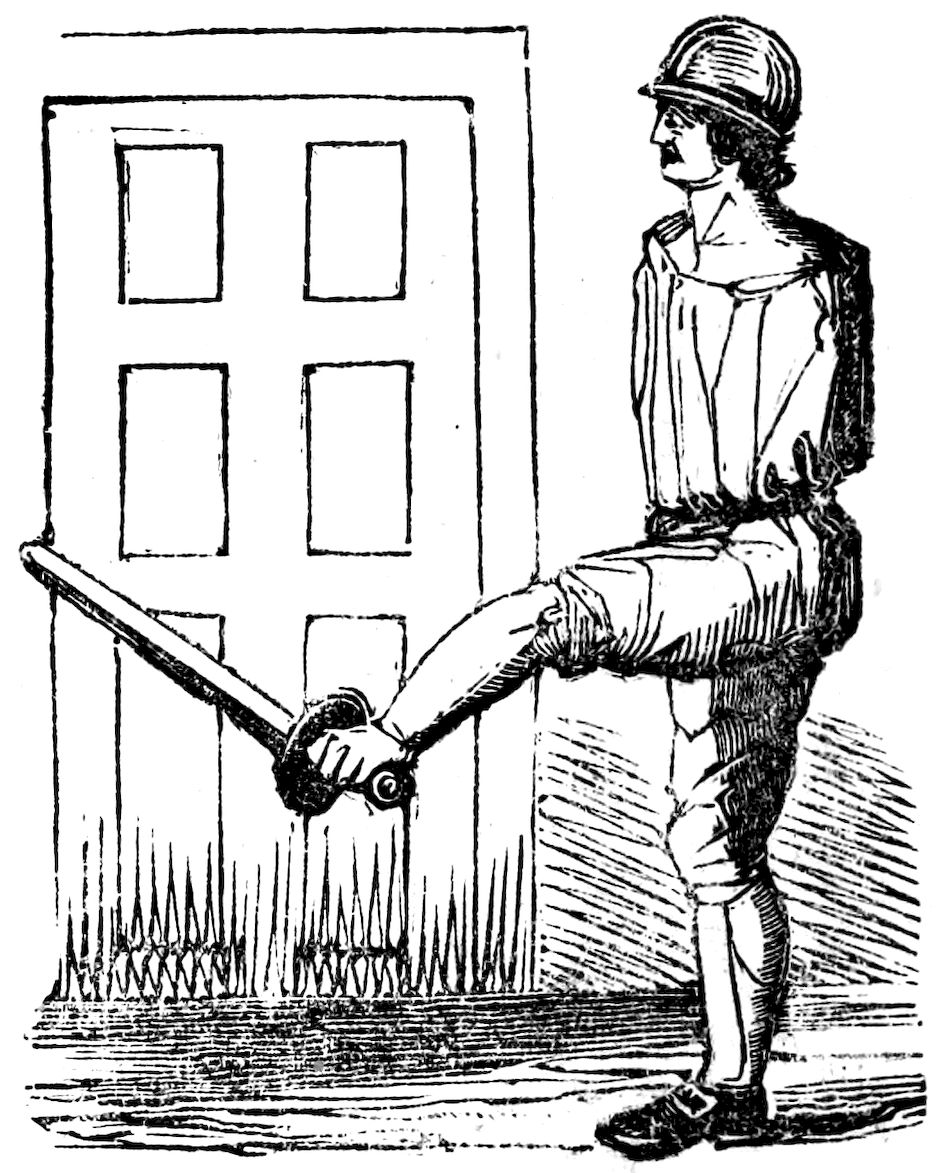
Without doubt some of the stories of monsters are fabulous, but we hesitate not to state that we believe many of them to be true. Nearly every accoucheur has, at some time or other, had cases when they have had to assist in bringing 41into the world specimens of the freaks of nature, either deficient of their natural properties, or a superabundance of them. It frequently happens that these prodigies exist but for a short time—death speedily putting an end to what must otherwise be a miserable existence, and little is said about them. The surgical museums in our country contain sufficient proof of the birth of monsters: and there is no denying the fact, that there are cases in which people are born into the world, and from certain peculiarities in their structure have been exhibited to the public as monsters.
Herein I propose to treat of the womb, and the various maladies to which it is subject. By the Grecians it is called metra, the mother; adelphos, says Priscian, because it makes us all brothers.
It is placed in the hypogastrium, or lower part of the body, in the cavity called pelvis, having the strait gut on one side, to keep it from the other side of the backbone, and the bladder on the other side to defend it from blows.
It is divided into the neck and the body. The neck consists of a hard fleshy substance, much like cartilage, at the end whereof is a membrane transversely placed, called hymen, or engion. Near to the neck there is a prominent pinnacle, 42which is called by Montinus the door of the womb, because it preserves the matrix from cold and dust; by the Grecians it is called clytoris; by the Latins, præputium muliebre.
The body of the womb is that wherein the child is conceived; and this is not altogether round, but dilates itself into two angles, the outward part of it nervous and full of sinews, which are the cause of its motion, but inwardly it is fleshy. In the cavity of the womb there are two cells or receptacles for the seed, divided by a line running through the midst of it. In the right side of the cavity, by reason of the heat of the liver, males are conceived; and in the left side, by the coldness of the spleen, females. Most of our moderns hold the above as an infallible truth, yet Hippocrates holds it but in general: “For in whom (saith he) the spermatic vessels on the right side come from the reins, and the spermatic vessels on the left side from the hollow vein, in them males are conceived in the left side, and females in the right.” Empedocles, in giving his opinion, says, “Such sometimes is in the power of the seed, that the male may be conceived in the left side, as well as in the right.” In the bottom of the cavity, there are little holes called the cotiledones, which are the ends of certain veins and arteries, serving in breeding women to convey substance to the child which is received by the umbilical veins; and others to carry their courses into the matrix.
The menstruals are a monthly flux of excrementitious blood, which is to be understood of the surplus or redundance of it. For it is an excrement in quality, its quality being poor and corrupt, like unto the blood in the veins. This 43is proved two ways; first, from the final cause of the blood, which is the propagation and conservation of mankind, that man might be conceived; and being begotten, he might be comforted and preserved both in the womb and out of the womb. And all will grant it for a truth, that a child, in the matrix, is nourished with the blood. And being out of the womb, it is still nourished with the same; for the milk is nothing but the menstruous blood made white in the breast. Secondly, it is proved to be true, from the generation of it, it being the superfluity of the last aliment of the fleshy part.
The natural end of man and woman’s being is to propagate; and this injunction was imposed upon them by God at their first creation, and again after the deluge. Now, in the act of conception, there must be an agent and patient; for if they be both every way of one constitution, they cannot propagate: man therefore is hot and dry, woman cold and moist; he is the agent, she the patient or weaker vessel, that she should be subject to the office of the man. It is necessary the woman should be of a cold constitution, because in her is required a redundancy of nature for the infant depending upon her; for otherwise, if there were not a surplus of nourishment for the child, more than is convenient for the mother, then would the infant detract and weaken the principal parts of the mother, and like unto the viper, the generating of the infant would be the destruction of the parent.
The monthly purgations continue from the 15th year to the 46th or 50th; yet often there happens a suppression, which is either natural or morbical: they are naturally suppressed in breeding women, and such as give suck.
The suppression of the terms is an interception of that accustomed evacuation of blood which every month comes from the matrix, proceeding from the instrument or matter vitiated. The part affected is the womb, and that of itself or by consent.
Cause.—The cause of this suppression is either external or internal. The external cause may be heat, or dryness of air, immoderate watching, great labour, vehement motion, &c. whereby the matter is so consumed and the body so exhausted, that there is not a surplus remaining to be expelled. Or it may be caused by cold, making the blood vicious and gross, condensing and binding up the passages, that it cannot flow forth.
The internal cause is either instrumental or material, in the womb or in the blood. In the womb it may be divers ways; by imposthumes, humours, ulcers, by the narrowness of the veins and passages, or by the omentum, in fat bodies, pressing the neck of the matrix, but then they must have hernia, zirthilis, for in mankind the caul reacheth not so low; by overmuch cold or heat, the one vitiating the action, the other consuming the matter by an evil composition of the uterine parts, by the neck of the womb being turned aside, and sometimes, though rarely, by a membrane or excrescence of the flesh growing about the mouth or neck of the womb. The blood may be in fault two ways, in quantity or quality: in quantity, when it is so consumed 45that there is not a superplus left, as in viragos, or virile women, who, through their heat and strength of nature, digest and consume all in their last nourishment. The blood likewise may be consumed, and consequently the terms staid, by bleeding at the nose, by a flux of the hemorrhoids, by a dysentery, or bloody flux, by many other evacuations, and by continual and chronical diseases. Secondly, the matter may be vicious in quality; and suppose it to be sanguineous, phlegmatical, bilious, or melancholic; every one of these, if they offend in grossness, will cause an obstruction in the veins.
Signs.—Pains in the head, neck, back, and loins; weariness of the whole body, (but especially of the hips and legs, trembling of the heart.) If the suppression proceed from cold, she is heavy, sluggish, of a pale colour, and has a slow pulse; the urine curdles, the blood becomes waterish and much in quantity, and the excrements are retained. If of heat, the signs are contrary to those now recited. If the retention come of conception, this may be known by drinking of water and honey, after supper, going to bed, by the effect which it worketh; for if, after taking of it, she feels a beating pain upon the stomach, and the lower part of the belly, it is a sign she hath conceived, and that the suppression is natural; if not, then it is vicious, and ought medicinally to be taken away.
Prognostics.—With the evil quality of the womb, the whole body stands charged, but especially the heart, the liver, and the brain; and betwixt the womb and these three principal parts there is a singular concert: First, the womb communicates to the heart by those arteries 46which come from the aorta. Hence, the terms being suppressed, will ensue faintings, swoonings, intermission of pulse, cessation of breath. Secondly, it communicates to the liver by the veins derived from the hollow vein. Hence will follow obstructions, jaundice, dropsies, hardness of spleen. Thirdly, it communicates to the brain by the nervous membrane of the back: hence will arise epilepsies, frenzies, melancholy passion, pain in the after parts of the head, fearfulness, and inability of speaking. Hippocrates says, if the months be suppressed, many dangerous diseases will follow.
Cure.—The suppression is a plethoric effect, and must be taken away by evacuation; and therefore we begin with the phlebotomy. In the midst of the menstrual period open the liver vein; and for the reservation of the humour, two days before the evacuation, open the saphena in both feet; if the repletion be not great, apply cupping-glasses to the legs and thighs, although there should be no hopes of removing the suppression. As in some the cotiledones are so closed, it will be convenient, as much as may be, to ease nature of her burden, by opening the hemorrhoid veins with a leech. After bleeding, let the humours be prepared and made flexible with syrup of calamint, betony, hyssop, mugwort, horehound, fumitory, maiden-hair. Bathe with camomile, pennyroyal, savin, bay-leaves, juniper-berries, rue, marjoram, feverfew. Take of the leaves of maiden-hair, succory, and betony, of each a handful, make a decoction; take thereof three ounces. Syrup of maiden-hair, mugwort, and succory; mix of each half an ounce. After 47she comes out of the bath, let her drink it off. Purge with pill de agarice, fley-bang, corb, feriæ. Galen commends pilulæ de caberica, coloquintida; as they purge the humour of offending, and open the womb, and strengthen the faculty by their aromatical quality.
If the stomach be overcharged, let her take a vomit, such a one as may work both ways, lest working only upward, it should too much turn back the humour.
After the humour hath been purged, proceed to more proper and forcible remedies. Take of troschisk of myrrh one drachm and a half; of musk ten grains with the juice of smallage; make twelve pills; take six every morning, or after supper going to bed. Take of cinnamon half an ounce, smirutium, valerian aristolochia, of each two drachms; roots of astrumone, drachm saffron, of each two scruples; spec. diambia, two drachms; troschisk of myrrh, four scruples; make half into a powder; with mugwort water and sugar a sufficient quantity, make lozenges, take one drachm of them every morning; or mingle one drachm of the powder with one drachm of the sugar, and take it in white wine. Take of prepared steel, spec. hair, of each two drachms; borax, spec. of myrrh, of each one scruple, with the juice of savin; make it up with the lozenges, and take three every other day before dinner. Take of castor one scruple, wild carrot seed half a drachm, with syrup of mugwort, make four pills; take them in a morning fasting, for three days together, before the wonted time of the purgation. Take of juice of horehound, of each five drachms; rhubarb, spikenard, aniseed, galbanum, asafœtida, 48marrow root, gentian, with honey, make an electuary, take of it three drachms for a dose. In phlegmatic bodies nothing can be better given than the decoction of the wood guiacum, taken in the morning fasting, and so for twelve days together, without provoking of sweat.
Administer to the lower parts by suffumigations, pessaries, unctions, injections: make suffumigations of cinnamon, nutmeg, cloves, bay berries, mugwort, galbanum, molanthium, amber, &c. Make pessaries of figs, and the leaves of mercury bruised, and rolled up with lint. Make injections of the decoction of origane, mugwort, betony, and eggs; inject it into the womb by an instrument for that purpose. Take of oil of almonds, lilies, capers, camomile, of each an ounce; laudani, oil of myrrh, of each two drachms; with wax make an unguent, with which let the place be anointed; make infusions of fenugreek, camomile, melilot, dill, marjoram, pennyroyal, feverfew, juniper-berries, and calamint; but if the suppression comes by a defect of matter, then ought not the menses to be provoked until the spirits be animated, and the blood again increased; or, by proper effects of the womb, as dropsies, inflammations, &c. then must particular care be used.
If the retention comes from repulsion or fulness, if the air be hot or dry, use moderate exercise before meals, and your meat and drink attenuating; use with your meat garden savory, thyme, origane, and cyche peason: if from emptiness or defect of matter, if the air be moist and moderately hot, shun exercise and watching; let your meat be nourishing and of light digestion, as raw eggs, lamb, chickens, almonds, milk.
I shall now treat on the overflowing of the menses, an effect no less dangerous than the former. This immoderate flux is a sanguineous excrement, proceeding from the womb, exceeding both in quantity and time. First, it is sanguineous: the matter of the flux being only blood, wherein it differs from that which is commonly called the false menses, or the whites. Secondly, it proceeds from the womb: for there are two ways from which the blood flows; one by the internal veins of the body of the womb,—and this is called the monthly flux; the other is by those veins which are terminated in the neck of the matrix,—and this is called the hemorrhoids of the womb. Lastly, it is said to exceed both in quantity and time. In quantity, saith Hippocrates, when they flow about eighteen ounces: in time, when they flow about three days: but it is inordinate flowing, when the faculties of the body are thereby weakened. In bodies abounding with gross humours, this immoderate flux sometimes unburdens nature of her load, and ought not to be staid without the counsel of a physician.
Cause.—The cause is internal or external. The internal cause is threefold; in the matter, instrument, or faculty. The matter, which is the blood, may be vicious, by the heat of constitution, climate, or season, heating the blood, whereby the passages are dilated, and the faculty weakened, that it cannot retain the blood; and, by 50falls, blows, violent motion, breaking of the veins, &c. The external cause may be lifting, carrying of heavy burdens, unnatural child-birth, &c.
Signs.—The appetite is decayed, the conception is depraved, and the actions weakened; the feet are swelled, the colour of the face is changed, and a general feebleness of the body. If the flux comes by the breaking of a vein, the body is sometimes cold, the blood flows forth in heaps, and that suddenly, with great pain. If it comes through heat, the orifice of the vein being dilated, then there is little or no pain, yet the blood flows faster than it doth in an erosion, and not so fast as it doth in a rupture. If by erosion, or sharpness of blood, she feels a great heat scalding the passage; it differs from the other two, in that it flows not so suddenly, nor so copiously as they do. Lastly, if it proceeds from bad blood drop some of it on a cloth, and when it is dry, you may judge of the quality by the colour. If it be choleric, it will be yellow; if melancholy, black; if phlegmatic, waterish and whitish.
Prognostics.—If with the flux be joined a convulsion, it is dangerous, because it intimates the more noble parts are vitiated: and a convulsion caused by emptiness is deadly. If it continues long, it will be cured with great difficulty: for it was one of the miracles which our Saviour, Christ, wrought, to cure this disease, when it had continued twelve years. If the flux be inordinate, many diseases will ensue, and without remedy; the blood, with the native heat, being consumed, either cachetical, hydropical, or paralytical diseases will follow.
51Cure.—The cure is, first, in repelling and carrying away the blood: Secondly, in correcting and taking away the fluxibility of the matter: Thirdly, in incorporating the veins and faculties. For the first, open a vein in the arm, and draw out so much blood as the strength of the patient will permit; and at several times, for thereby the spirits are less weakened, and the refraction so much the greater.
Apply cupping-glasses to the breasts, and also the liver, that the reversion may be in the fountain.
To correct the fluxibility of the matter, cathartical means, moderated with the astrictories, may be used.
If it be caused by erosion, or sharpness of blood, prepare with syrup of violets, wormwood, roses, citron-pill, succory, &c.
If by adust choler, prepare the body with syrup of roses, myrtles, sorrel, and purslain, mixed with water of plantain, knot-grass, and endive. Then purge with rhubarb, one drachm, cinnamon fifteen grains; infuse them one night in endive water; add to the straining, pulp of tamarind, cassia, of each half an ounce; make a potion. If the blood be waterish as it is in hydropical bodies, and flows forth by reason of thinness, to draw off the water it will be profitable to purge with agaric, coloquintida: sweating is proper, for thereby the matter offending is taken away, and the blood carried to the other parts. To procure sweat, use cardus water, with mithridate, or the decoction of guaiacum, and sarsaparilla. The pills of sarsaparilla are commended.
52Take of bole ammoniac one scruple, London treacle one drachm, old conserve of roses half an ounce, with syrup of myrtle make an electuary: or, if the flux hath continued long, take of mastic two drachms, olibani troch de carbara, of each one drachm; balustium, one scruple; make a powder;—with syrup of quinces make it into pills; take one before meals. Take the juice of knot-grass, comfrey, and quinces, of each one ounce, camphor, one drachm; dip silk or cotton therein, and apply it to the place. Take of oil of mastic, myrtles, quinces, of each half an ounce; fine bole, trock, decarda, of each one drachm; sanguis draconis a sufficient quantity; make an unguent, and apply it before and behind. Take the plantain, shepherd’s purse, red rose leaves, of each one ounce:—boil all these in plantain water, and make of it two plasters; apply one before and one behind. If the blood flow from those veins which terminated in the neck of the matrix, then it is not the overflowing of the terms, but the hemorrhoids of the womb; yet the same cure will serve both, only the instrumental cure will a little differ: for, in the uterine hemorrhoids, the ends of the veins hang over like teats or bushes, which must be taken away by incision, and then the veins closed up with aloes, fine bole, burnt alum, troch de terrs fiall; myrrh, mastic, with the juice of comfrey and knot-grass, laid plaster-ways thereto.
The air must be cold and dry. All motion of the body must be forbidden. Let her meat be pheasant, partridge, mountain birds, coneys, calf-feet, &c.
The weeping of the womb is a flux of blood, unnaturally coming from thence by drops, after the manner of tears, causing violent pains, keeping neither period nor time. By some it is referred unto the immoderate evacuation of the menses, yet they are distinguished in the quantity and manner of overflowing, in that they flow copiously and free; this is continual, by little and little, and with great pain and difficulty.
The cause is in the faculty, by being enfeebled that it cannot expel the blood resting there, makes that part of the womb grow hard, and stretcheth the vessels; from whence proceeds the pain of the womb. It may be the matter of the blood which may offend in too great a quantity; or it may be so gross and thick as to flow by drops. The signs will be pains in the head, stomach, and back, with inflammations, suffocations, and excoriations of the matrix. If the strength of the patient will permit, first open a vein in the arm, rub the upper parts, and let her arm be corded, that the force of the blood may be carried backwards: then apply such things as may laxate and mollify the strengthening of the womb, and assuage the sharpness of the blood, as cataplasms made of bran, linseed, and mallows. If the blood be vicious and gross, add thereto mugwort, calamint, dictam, and betony; and let her take of Venice treacle the size of a nutmeg, and the syrup of mugwort every 54morning; make an injection of the decoction of mallows, linseed, groundsel, mugwort, with oil of sweet almonds.
Sometimes it is caused by the wind, and then phlebotomy is to be omitted, and instead, take syrup of feverfew one ounce; honey, roses, syrup of roses, of each half an ounce; water of calamint, mugwort, betony, and hyssop, of each an ounce; make a julep. If the pain continues, employ this purgation: take of hieræ one drachm; syrup of roses and luxative one ounce; with the decoction of mugwort make a potion. If it come through the weakness of the faculty, let that be corroborated. If through the grossness and sharpness of the blood, let the quality of it be altered, as I have shown in the foregoing chapter. Lastly, if the excrements be retained, provoke them by a clyster of the decoction of camomile, betony, feverfew, mallows, linseed, juniper berries, aniseed, adding thereto of diacatholicon, half an ounce; hiera picra, two drachms; honey and oil, of each one ounce; nitre a drachm and a half.
From the womb proceed not only menstruous blood, but a distillation of a variety of corrupt humours through the womb, keeping neither courses nor colour, but varying in both.
Cause.—The cause is either promiscuously in the whole body, by a cocochymia, or weakness of 55the same, or in some of the parts, as in the liver, which causeth a generation of corrupt blood, and then the matter is reddish; sometimes the gall being sluggish in its office, not drawing away those choleric superfluities engendered in the liver, the matter is yellowish; sometimes in the spleen, not deficiating and cleansing the blood of the excrementitious parts. It may also come from the catarrh in the head, or from any other corrupt member; but if the matter of the flux be white, the cause is in the stomach by a crude matter there, and vitiated through grief and melancholy, for, otherwise, if the matter were only pituitous, crude phlegm, it might be converted into blood; for phlegm in the ventrical is called nourishment half digested; but being corrupt, though sent into the liver, yet it cannot be turned into nutriment; for the second decoction cannot correct that which the first hath corrupted; and therefore the liver sends it to the womb, which can neither digest nor repel it, and so it is voided out with the same colour it had in the ventricle. The cause also may be in the reins being over-heated, whereby the spermatical causes may be moistness of air, eating of corrupt meats, anger, grief, slothfulness, immoderate sleeping, costiveness.
The signs are, extenuation of the body, shortness and stinking of the breath, loathing of meat, pain in the head, swelling of the eyes and feet, and melancholy: humidity from the womb of divers colours, as red, black, green, yellow, and white. It differs from the menses, in that it keeps no certain period, and is of many colours, all of which generate from blood.
Prognostics.—If the flux be phlegmatical, it 56will continue long and be difficult to cure, yet if vomiting or diarrhœa happeneth, it diverts the humour and cures the disease. If it be choleric, it is not so permanent, yet more perilous, for it will cause a cliff in the neck of the womb, and sometimes make an excoriation of the matrix; if melancholic, it must be dangerous and contumacious. Yet the flux of the hemorrhoids administer cure.
If the matter flowing forth be reddish, open a vein in the arm; if not, apply ligatures to the arms and shoulders. Galen cured the wife of Brutus, by rubbing the upper part with crude honey.
If it be caused by a distillation from the brain, take syrup of betony, and marjoram; with sugar and betony water make lozenges, to be taken every morning and evening; Auri Alexandria, half a drachm at night going to bed. If these things help not, use the suffumigation and plaster, as they are prescribed.
If the flux be melancholic, prepare with syrup of maiden-hair, borage, buglos. Purges for melancholy are stamped prunes, two oz.; senna, one drachm; fumitory, a drachm; sour dates, one ounce; with endive water, make a decoction; take of it four ounces, add unto it confections, hamesech three drachms, manna three drachms. Take conserves of borage, violets, buglos, of each a drachm; citron peel candied one drachm; sugar, seven ounces; with rose-water make lozenges.
Lastly, let the womb be cleansed from the corrupt matter. Make injections of the decoction of betony, feverfew, spikenard, bistort, mercury, and sage, adding thereto sugar, oil of sweet almonds, of each two ounces; pessaries also may 57be made of silk or cotton, mollified in the juice of the aforesaid herbs.
A dry diet is commended as the best, because in this effect the body most commonly abounds with phlegmatical and crude humours. For this cause Hippocrates counsels the patient to go to bed supperless. Let her meat be partridge, pheasant, and mountain birds, rather roasted than boiled. Immoderate sleep is forbidden, moderate exercise is commended.
This is called in English, “the suffocation of the mother;” because it causeth the womb to be choked. It is a retraction of the womb towards the midriff and the stomach, which so presseth and crusheth up the same, that the instrumental cause of respiration, the midriff, is suffocated, and causes the animating faculty, the efficient cause of respiration, also to be intercepted, while the body being refrigerated, and the action depraved, she falls to the ground as one dead. Many instances are recorded of those who have been considered dead, even by the medical men, in this disorder.
To distinguish the living from the dead the ancients prescribe three experiments: the first is, to lay a light feather to the mouth, and by its motion you may judge whether the patient be living or dead: the second is to place, a glass of water on the breast, and if you perceive it to 58move, it betokeneth life: third, to hold a looking-glass to the mouth and nose; and if the glass appears thick, with a little dew upon it, it betokens life. You ought not to depend upon these; for the motion of the lungs, by which the respiration is made, may be taken away so that she cannot breathe, yet the internal transpiration of the heat may remain; which is not manifest by the motion of the breast or lungs, but lies occult in the heart and inward arteries: examples whereof we have in the fly and swallow, who, in cold winters, seem dead, and breathe not at all; yet they live by the transpiration of that heat which is reserved in the heart and inward arteries: therefore, when the summer approacheth, the internal heat being revocated to the outer parts, they revive out of their sleepy ecstacy.
Those women therefore, who seem to die suddenly, let them not be committed unto the earth until the end of three days, lest the living be buried for the dead.
Cause.—The part affected is the womb, of which there is a twofold motion—natural and symptomatical. The natural motion is, when the womb attracteth the seed, or excludeth the infant or secundine. The symptomatical motion, of which we are to speak, is a convulsive drawing up of the womb.
The cause is the retention of the seed, or the suppression of the menses, causing a repletion of the corrupt humours in the womb, from whence proceeds a flatuous refrigeration, causing a convulsion of the ligaments of the womb. And as it may come from humidity or repletion, being a convulsion, it may be caused by emptiness 59or dryness. And by abortion, or difficult child-birth.
Signs.—At the approaching of the suffocation, there is a paleness in the face, weakness of the legs, shortness of breath, frigidity of the whole body, with a working in the throat, and then she falls down as one void of sense and motion; the mouth of the womb is closed up, and being touched with the fingers feels hard. The paroxysm of the fit being past, she openeth her eyes, and feeling her stomach oppressed, she offers to vomit.
It differs from apoplexy, by reason it comes without shrieking out; also in the hysterical passion the sense of feeling is not altogether destroyed and lost, as it is in the apoplectic disease: and it differs from the epilepsies in that the eyes are not wrested, neither doth any spongy froth come from the mouth; and that convulsive motion, which sometimes, is joined to suffocations, is not universal, and it is in the epilepsies, only this or that matter is convulsed without vehement agitation. In the syncope, both respiration and pulse are taken away, and she swoons away suddenly; but in the hysterical passion, there is both respiration and pulse, though it cannot be well perceived; her face looks red, and she hath a fore-warning of her fit. Lastly, it is distinguished from the lethargy by the pulse, which in one is great, and the other little.
Prognostics.—If the disease arises from the corruption of the seed, it foretells more danger than if it proceed from the suppression of the menses, because the seed is concocted, and of a purer quality than the menstruous blood; and the more pure being corrupted becomes the more 60foul. If it be accompanied with a syncope, it shows nature is weak, and that the spirits are almost exhausted; but if sneezing follows, it shows that the heat begins to return, and that nature will subdue the disease.
Cure.—In the cure observe: first, that during the paroxysm, nature must be provoked to expel those malignant vapours which stupify the senses, that she may be called out of that sleepy ecstacy. Secondly, that in the intermission of the fit, proper medicines may be applied to take away the cause.
To stir up nature, fasten cupping-glasses to the hips and navel, apply ligatures unto the thigh, rub the extreme parts with salt, vinegar, and mustard: cause loud clamours and thundering in the ears. Apply to the nose asafœtida, castor, and sal volatile; provoke her to sneeze by blowing up into her nostrils the powder of castor, white pepper, and hellebore; hold under her nose partridge feathers, hair, and burnt leather. The brain is sometimes so oppressed, that there is a necessity for burning the outward skin of the head with hot oil, or with a hot iron. Sharp clysters are available. Take of sage, calamint, horehound, feverfew, marjoram, betony, hyssop, of each one handful; aniseed, half an ounce; coloquintida, white hellebore, of each two drachms; boil in two pounds of water to the half; add the straining oil of castor two ounces, hiera picra two drachms, and make a clyster of it. Hippocrates writes of an hysterical woman, who could not be freed from the paroxysm but by pouring cold water upon her; yet this cure is singular, and ought to be administered only in the heat of summer.
61If it be caused by the retention and corruption of the seed, let the midwife take oil of lilies, marjoram, and bays, dissolving in the same two grains of civet, and musk; let her dip her finger therein, and put into the neck of the womb, tickling and rubbing the same.
If it arise from the suppression of the menses look to the cure in chap. XVI. If from the retention of the seed, use such things as will dry up and diminish the seed, as diacimina, diacalaminhes, &c. Amongst potions, the seed of agnus is well esteemed, whether taken inwardly, applied outwardly, or received as suffumigation. Make an issue on the inside of her leg, a hand-breadth below the knee. Make trochisks of agaric, two scruples, wild carrot seed, lign-aloes, of each half a scruple; washed turpentine, three drachms; with conserve of anthos make a bolus. Castor is of excellent use in this case, eight drachms of it taken in white wine: or make pills of it with mithridate, and take them going to bed. Take of white briony root, dried and cut after the manner of carrots, one ounce put in a draught of wine, placing it by the fire, and when it is warm, drink it. Take myrrh, castor, and asafœtida, of each one scruple; saffron and rue-seed, of each four grains; make eight pills, and take two every night going to bed.
Galen, by his own example, commends unto us agaric pulverized one scruple in white wine. Lay to the navel, at bed-time, a head of garlic bruised, fastening it with a swathed band. Make a girdle of galbanum for the waist, and also a plaster for the belly, placing in one part of it civet and musk, which must be laid upon the navel. Take pulveris, benedict, trochisk of 62agaric, of each two drachms; of mithridate a sufficient quantity; and so make two pessaries, and it will purge the matrix of wind and phlegm; foment the natural part with salad oil, in which hath been boiled rue, feverfew, and camomile. Take of rose leaves a handful, cloves two scruples; quilt them in a little cloth, and boil them in malmsey the eighth part of an hour, and apply them to the mouth of the womb, as hot as may be endured, but let not the smell get to her nose. A dry diet must still be observed. Let her bread be aniseed biscuit, and her flesh meat roasted.
The falling down of the womb is a relaxation of the ligature, whereby the matrix is carried backward, and in some hangs out the size of an egg. The falling of the womb is, when it sinks down to the entrance of the privities, and appears to the eye either very little or not at all. The precipitation is, when the womb, like a purse is turned inside outward, and hangs betwixt the thighs in the size of a cupping-glass.
Cause.—The external cause is difficult child-birth, violent pulling away of the secundine, rashness and inexperience in drawing away the child, violent coughing, sneezing, falls, blows, and carrying heavy burdens. The internal cause is overmuch humidity flowing into these parts, hindering the operations of the womb, whereby the ligaments by which the womb is supported are 63relaxed. The cause in particular is referred to be in the retention of the seed, or in the suppression of the monthly terms.
Signs.—The intestines and bladder are oftentimes so crushed, that the passage of the excrements is hindered; if the urine flows forth white and thick, and the midriff moistened, the loins are grieved, the privities pained, and the womb sinks down to the private parts, or else comes clean out.
Prognostics.—In an old woman it is cured with great difficulty; because it weakens the faculty of the womb, and therefore, though it be reduced to its proper place, yet upon very little illness it returns; and so it is with the younger sort, if the disease be inveterate. If it be caused by a putrefaction of the nerves, it is incurable.
Cures.—The womb being naturally placed between the strait gut and the bladder, and now fallen down, ought not to be put up again, until the faculty, both of the gut and of the bladder, be stirred up. Nature being unloaded of her burden, let the woman be laid on her back, her legs higher than her head; let her feet be drawn up to her hinder parts, with her knees spread; then mollify the swelling with oil of lilies and sweet almonds, or with the decoction of mallows, beets, fenugreek, and linseed; when the inflammation is dissipated, let the midwife anoint her hand with oil of mastic, and reduce the womb into its place. The matrix being up, the situation of the patient must be changed, let her legs be put out at length, and laid together; six cupping-glasses to her breast and navel; boil mugwort, feverfew, red roses, and comfrey in red wine; make a suffumigation for the matrix; and 64at her coming out of the bath, give her syrup of feverfew one ounce, with a drachm of mithridate. Take laudani, mastic, of each three drachms, make a plaster of it for the navel; then make pessaries of asafœtida, saffron, comfrey, and mastic, adding thereto a little castor.
The matrix seated in its natural abode, the remote cause must be removed. If the body be plethoric, open a vein; prepare with syrup of betony, calamint, hyssop, and feverfew. Purge with pil. hierac, agaric, pil. de colocin. If the stomach be oppressed with crudities, unburden it by vomiting; sudorifical decoctions of lignum sanctum, and sassafras, taken twenty days together, dry up the superfluous moisture, and consequently suppress the cause of the disease.
Let the air be hot and dry, your diet hot and attenuating; abstain from all motion, both of body and mind; eat sparingly, drink little, sleep moderately.
The inflammation of the matrix, is a humour possessing the whole of the womb, accompanied with unnatural heat, by obstructing, and gathering of corrupt blood.
Cause.—The cause of this effect is suppression of the menses, repletion of the whole body, difficult child-birth, vehement agitation of the body, falls, blows, &c.
Signs.—Anguish, pain in the head and stomach; vomiting, coldness of the knees, convulsion 65of the neck, trembling of the heart; a straitness of breath, by reason of the heat which is communicated to the midriff, the breasts sympathising with the womb, pained and swelled. If the fore part of the matrix be inflamed, the privities are grieved, the urine is suppressed, or flows forth with difficulty. If the after part, the loin and back suffer, the excrements are retained on the right side, the right hip suffers, the right leg is heavy and slow to motion; and so if the left side of the womb be inflamed, the left hip is pained, and the left leg is weaker than the right. If the neck of the womb be refreshed, the midwife shall feel the mouth of it retracted, and closed up with a hardness about it.
Prognostics.—All inflammations of the womb are dangerous, if not deadly; and especially if the total substance of the matrix be inflamed; but they are very perilous if in the neck of the womb.
Cure.—Let the humours flowing to the womb be repelled, for effecting which, after cooling clysters, open a vein in the arm, if she be not enceinte; the day after strike the saphena on both feet, fasten ligatures and cupping-glasses to the arm, and rub the upper part. Purge gently with cassia, rhubarb, and senna two drachms, aniseed one scruple, barley-water a sufficient quantity; make a decoction. At the beginning of the disease anoint the privities and reins with oil of roses and quinces; make plasters of plantain, linseed, barley-meal, white of eggs, and, if the pain be vehement, a little opium; ferment the genitals with the decoction of poppy heads. In the declining of the disease, use incisions of sage, linseed, mugwort, pennyroyal, horehound, 66and fenugreek; anoint the lower part of the belly with the oil of camomile and violets.
Take lily roots and mallow-roots, of each four ounces; mercury one handful; mugwort, and feverfew, camomile flowers, and melilot, of each a handful and a half; bruise the herbs and fruits, and boil them in a sufficient quantity of milk; then add fresh butter, oil of camomile, and lilies, of each two ounces; bean meal a sufficient quantity; make two plasters,—one before, the other behind.
If the tumour cannot be removed, but tends to suppuration, take fenugreek, mallow-roots, decocted figs, linseed, barley-meal, turpentine, of each three drachms; deer’s suet, half a drachm, opium half a scruple; with wax make a plaster.
Take wormwood and betony of each half a handful; white wine and milk, of each half a pound; boil them until one part be confirmed; then take of this decoction four ounces, honey of roses two ounces, and make an injection. Yet beware that the humours are not brought down to the womb. Take roasted figs and mercury bruised, of each three drachms; turpentine and duck’s grease, of each three drachms; opium, two grains; with wax make a pessary.
Of phlegm neglected, or not perfectly cured, is generated a schirrus of the matrix, which is a hard unnatural swelling, insensibly hindering the 67operation of the womb, and disposing the whole body to slothfulness.
Cause.—One cause of this disease may be ascribed to want of judgment in the physician; as many empyrics ministering to an inflammation of the womb, do overmuch refrigerate the humour, that it can neither pass forward nor backward; hence the matter being condensed, degenerates into a hard substance. Other causes may be the suppression or the menstruous retention of the lochi, or after purging; eating of corrupt meats, &c. It may proceed also from obstructions and ulcers in the matrix, or from evil effects in the liver and spleen.
Signs.—If the bottom of the womb be affected, she feels a heavy burden representing a mole; yet differing in that the breasts are attenuated, and that the whole body becomes less. If the neck of the womb be affected, no outward humours will appear; the mouth of it is retracted, and feels hard.
Prognostics.—Schirrus confirmed is incurable, and will turn into a cancer, or incurable dropsy, and ending in a cancer, proves deadly.
Cure.—Where there is a repletion, bleeding is advisable; open the medina on both arms, and the saphena on both feet, more especially if the menses be suppressed. Prepare the humour with syrup of borage, succory, and clarified whey: then take of the following pills according to the strength of the patient:
Take of hiera picra six drachms, black helebore, polybody, of each two drachms and a half; agaric, lapis lazuli, abluti salindiæ, coloquintida, of each one drachm and a half; mix them and make pills. The body being purged, proceed to mollify 68the hardness as follows: the privities and neck of the womb with unguent, decalthea, and agrippa; or take opapanax, bdellium, ammoniac, and myrrh, of each two drachms, saffron half a drachm; dissolve the gum in oil of lilies and sweet almonds; with wax and turpentine make an unguent; apply below the navel diacoon, ferelina; make infusion of figs, mugwort, mallows, pennyroyal, althea, fennel roots, melilot, fenugreek, boiled in water. Make an injection of calamint, linseed, melilot, fenugreek, and the four mollifying herbs, with oil of dill, camomile, and lilies dissolved in the same. Three drachms of the gum bdellium; cast the stone pyrites on the coals, and let her receive the fume into the womb. Foment the secret parts with the decoction of the roots and leaves of danewort. Take gum galbanum, opapanax, of each one drachm, juice of danewort, mucilage, fenugreek, of each one drachm; calf’s marrow an ounce, wax a sufficient quantity; make a pessary.
The air must be temperate; use no salt meats.
The uterine dropsy is an unnatural swelling, by the gathering of the wind and phlegm in the cavity, membranes, or substance of the womb, by reason of the debility of the native heat and aliment received.
The causes are overmuch cold or moistness of 69the milt and liver, immoderate drinking, eating of crude meats; all which, causing a repletion, do suffocate the natural heat. It may be caused by the overflowing of the menses, or by any other immoderate evacuation, and by abortions, phlegmons and schirrosities of the womb.
Signs.—The lower parts of the belly, with the genitals, are puffed up, and pained; the feet swell, the natural colour of the face decays, and the appetite is depraved. If she turns herself in the bed, a noise like the flowing of water is heard. Water sometimes comes from the matrix. If the swelling be caused by wind, the belly sounds like a drum; and the wind breaks through the neck of the womb with a murmuring noise. It is distinguished from a general dropsy, in that the lower parts of the belly are most swelled.
Prognostics.—This effect foretells the ruin of the natural functions, by that singular consent the womb hath with the liver, and that therefore general dropsy will follow.
Cure.—Mitigate the pain with fomentation of melilot, mercury, mallows, linseed, camomile, and althea; then let the womb be prepared with hyssop, calamint, mugwort, with the decoction of elder, marjoram, sage, pennyroyal, betony; purge with senna, agaric, and rhubarb. Take rhubarb, and trochisks of agaric, of each one scruple: with juice of iros make pills.
In diseases which have their rise from moisture, purge with pills. And in these effects which are caused by emptiness or dryness, purge with a potion. Fasten a cupping-glass to the belly, with a great fume, and also the navel, especially if the swelling be flatulent: make an issue on the 70inside of each leg, a hand-breadth below the knee. Apply to the bottom of the belly, as hot as may be endured, a little bag of camomile, cummin, and melilot, boiled in oil of rue; anoint the belly and secret parts with unguent agrippa and unguent aragons; mingle therewith oil of iros: cover the lower parts of the belly with the plaster of bay-berries, or a cataplasm made of cummin, camomile, and briony roots.
Our moderns ascribe great virtues to tobacco-water distilled, and poured into the womb by a metrenchyta. Take balm, southernwood, origen, wormwood, calamint, bay-leaves, marjoram, of each one handful: juniper-berries four drachms; with water make a decoction: of this may be made fomentations and infusions: make pessaries of storax, aloes, with the roots of dictau, aristolochia, and gentian.
The air must be hot and dry; moderate exercise. She may eat the flesh of partridges, larks, chickens, mountain birds. Let her drink be thin wine.
This disease is called by the Greeks mole; and is taken from the load or heavy weight of it, it being a mole or great lump of hard flesh burdening the womb.
It is an inarticulate piece of flesh without form, 71begotten in the matrix as if it were a true conception. Note two things: first, a mole is said to be inarticulate and without form, it differs from monsters, which are both formate and articulate: secondly, it puts a difference between a true conception and a mole; first, in the genus, in that a mole cannot be said to be an animal: secondly, in the species, because it hath no human figure, and bears not the character of a man: thirdly, in the individual, for it hath no affinity with the parent, either in the whole body or any particular part.
Cause.—The true cause of this fleshy mole proceeds from both the man and from the woman, from corrupt and barren seed in man, and from the menstruous blood in the woman, both emitted together in the womb, where nature finding herself weak, labours to bring forth a vicious conception rather than none; and instead of a living creature, generates a lump of flesh.
Signs.—The menses are suppressed, the appetite is depraved, the breasts swell, and the belly is suddenly puffed up, and waxeth hard. Thus the signs of a breeding woman, and one that breedeth a mole, are one. The first sign of difference is in the motion of the mole; it may be felt to move in the womb before the third month, which an infant cannot; yet the motion cannot be understood of any intelligent power in the mole, but the faculty of the womb and the animal spirits diffused through the substance of the mole; for it hath not an animal but a vegetative source of life, in manner of a plant: secondly, if a mole, the belly is suddenly puffed up; but 72if a true conception, the belly is suddenly retracted; and then riseth up by degrees: thirdly, the belly being pressed with the hand, the mole gives way; and the hand being taken away, it returns to the place again; but a child in the womb, though pressed with the hand, moves not presently; and being removed, returns slowly, or not at all: lastly, the child continues in the womb not above ten months, but a mole continues sometimes four or five years, more or less, according as it is fastened in the matrix. I have known a mole to fall away in four or five months. If it remain until the eleventh month, the legs wax feeble, and the whole body consumes.
Prognostics.—If, at the delivery of a mole, the flux of the blood be great, it shows the more danger, because nutrition, having been violated by the flowing back of the superfluous humours, where the natural heat is consumed; and parting with so much of her blood, the woman is so weakened in all her faculties, that she cannot subsist without difficulty.
Cause.—We are taught by Hippocrates, that phlebotomy causeth abortion by taking all that nourishment which should preserve the life of the child: wherefore, open the liver vein and saphena in both feet, fasten cupping-glasses to the loins and sides of the belly, let the uterine parts be first mollified, and then the expulsive faculty provoked to expel the burden.
To laxate the ligature of the mole, take mallows with the roots, three handfuls; camomile, melilot, pelitory of the wall, violet leaves, mercury, root of fennel, parsley, of each two handfuls; linseed, fenugreek, each one pound; boil 73them in water, and let her sit therein up to the navel. At her going out of the bath, anoint the privities and reins with the following unguent. Take mercury and althea roots, of each half a handful: flos, bracho, ursini, half a handful; linseed, barley-meal, of each six ounces; boil all these with water and honey, and make a plaster; make pessaries of the gum galbanum, bdellium, antimoniacum, figs, hog’s suet, and honey.
After the ligaments of the moles are loosed, let the expulsive faculty be stirred up to expel the moles. Take troch de myrrh, one ounce; castor astrolochia, gentian, dictam, of each an ounce; make a powder; take one drachm in four ounces of mugwort water. Take of hypericon, calamint, pennyroyal, betony, hyssop, sage, horehound, valeria, madder, savine: with water make a decoction; take three ounces of it, with one ounce and a half of feverfew.
But if these things prove not available, then must the mole be drawn away with an instrument put up into the womb, which may be performed by a skilful surgeon. After the delivery of the mole let the flux of blood be stayed as soon as may be. Fasten cupping-glasses to the shoulders and ligatures of the arms. If this help not, open the liver vein in the right arm.
The natural instinct that nature has implanted in men and women to propagate their own species, puts them upon making use of those ways that nature has ordained for that end, which, afterwards, the woman many times, through ignorance of having conceived, is little better than a murderer of her child: for, after conception, finding herself not well, and not knowing what is the matter with her, goes to a doctor; and he, not thinking of her being enceinte, gives cathartical potions, which destroy conception. And some, out of a foolish coyness, though they know they have conceived, will not confess it, that they might be instructed how to order themselves.
Signs.—If under the eye the vein be swelled, the veins in the eyes appearing clearly, and the eyes sometimes discoloured, if the woman has not the terms upon her, nor watched the night before, you may certainly conclude her to be with child; the first two months I never knew this sign to fail.
Keep the urine of the woman close in a glass three days, and then strain it through a fine linen cloth; if you find small living creatures in it she hath conceived.
A coldness and chillness of the outward parts, the heat being retired to make conception. 75The veins of the breast are more clearly seen than usual. The body is weakened, and the face discoloured. The belly waxeth very flat, because the womb closeth itself together to nourish and cherish the seed. If cold water be drank, a coldness is left in the breasts. Loss of appetite to victuals, sour belchings, and exceeding weakness of the stomach. The breasts swell and wax hard, not without pain and soreness. Griping pains, like the cramp, in the belly about the navel. Divers appetites and longings. The veins of the eyes are clearly seen, and the eyes discoloured. The excrements of the guts are voided painfully, because the womb swelling thrusteth the guts together. Take a handsome green nettle, put it into the urine of the woman; cover it close, and let it remain a whole night; if the woman be with child, it will be full of red spots on the morrow; if she be not, it will be blackish.
Signs of a Male Child.—The woman breeds a boy easier and with less pain than a girl, and is more nimble. The child is first felt by her on the right side; for male children lie on the right side of the womb. The woman, when she riseth up from a chair doth sooner stay herself upon her right hand than her left. The belly lies rounder and higher than when it is a female. The right breast is more hard and plump than the left, and the right nipple redder. The colour of a woman is not so swarthy as when she conceives a girl. The contrary to these are signs of the conception of a female.
If the circle under the eye is of a wan blue colour, be more apparent and most discoloured, 76she is enceinte of a boy; if the marks be most apparent in her left eye, of a girl.
Again, let a drop of her milk fall into a basin of fair water; if it sinks to the bottom, as it drops in, round in a drop, it is a girl; but if it be a boy, it will spread and swim on the top.
When the fruit of the womb comes forth before the seventh month, before it comes to maturity, it is abortive; and, in effect, the child proves abortive in the eighth month. And why children born in the seventh and ninth month may live, and not in the eighth month may seem strange, yet it is true. Hippocrates gives a reason, viz. the infant being perfect in the seventh month, desires more air and nutriment; and it labours for a passage to get out; and if it has not strength sufficient to break the membranes and come forth, it shall continue in the womb till the ninth month, and in that time may again be strengthened; but if it strive again in the eighth month, and be born, it cannot live, because the day of its birth is either past or to come. For, in the eighth month, saith Aven, he is weak and infirm; and, therefore, being then cast into the cold air, his spirits cannot be supported.
Cause.—Untimely births may be caused by cold; or by humidity weakening the faculty; and the fruit cannot be retained till the due time; by dryness 77or emptiness, defrauding the child of nourishment; by fluxes, phlebotomy, and other evacuations; by inflammations of the womb. Sometimes it is caused by laughter, joy, anger and fear. Abortion also may be caused by corrupt air, filthy odours, and especially by the smell of the snuff of a candle; also by falls, blows, violent exercise, leaping, dancing, &c.
Signs.—Signs of future abortion are, extenuation of the breasts, flux of watery milk, pain in the womb, heaviness in the head, unusual weariness in the hips and thighs, flowing of the menses. Signs foretelling the fruit of the dead in the womb, are hollowness in the eyes, pain in the head, anguish, horror, paleness of the face and lips, gnawing of the stomach, no motion of the infant, coldness and looseness of the mouth of the womb, and thickness of the belly, and watery and bloody excrements come from the matrix.
Before conception, if the body be over hot, dry, or moist, correct it with the contraries; if couchmical, purge it; if plethoric, open the liver vein; if too gross, attenuate it: if too lean, nourish it.
After conception, let the air be temperate; sleep not overmuch, avoid watchings, much exercise, passions of the mind, filthy smells, and sweet odours are hysterical. Abstain from things which provoke urine; from salt and windy meats.
78If the excrements be retained, lenify with clysters made of the decoction of mallows, violets, with sugar and common oil. If with looseness, let it not be stayed without the judgment of a physician; for all the uterine fluxes have a malign quality in them, which must be evacuated before the flux is stayed.
The cough of pregnant women puts them in danger of miscarrying. To prevent which, shave away the hair on the coronal coiffure, and apply thereon the following plaster: take of resinæ half an ounce, laudana one drachm, citron peel, lign-aloes, olibani, of each a drachm; stirachis liquidæ, and sicca, a sufficient quantity; dissolve the gums in vinegar, and make a plaster; at night going to bed let her take the fumes of these trochisks cast upon the coals. Also take of frankincense, storax powder, and red roses, of each a drachm and a half, sandrich eight drachms, mastic, benjamin, amber, of each one drachm; with turpentine make trochisks, apply a cautery to the nape of the neck. Every night let her take these pills following: take hypocistides, terriæ, sigillate, fine bole, of each half an ounce; bistort, alcatia, styracis, calamint, of each two drachms, cloves, one drachm; with syrup of myrtles make pills.
In pregnant women there is often a flux which greatly distresses the womb. To prevent this danger, the stomach must be corroborated as follows: take lign-aloes and nutmeg, of each one drachm; mace, clove, mastic, and laudanum, of each two scruples; oil of spike an ounce; musk, two grains; oil of mastic, quinces, and wormwood, of each half an ounce; make an unguent for the stomach to be applied before meals. Take a 79conserve of borage, buglos, and atthos, of each half an ounce; confect. de hyacinth, lemon-peel candied, specie-rum, dismarg. pulv. de gemnis, of each two drachms; nutmeg and diambra, of each two scruples; peony roots and diacorati, of each two drachms; with syrup of roses make an electuary; of which she must take twice a day, two hours before meals. A pregnant woman is subject to swelling of the legs, which happens the first three months, by humours falling down from the stomach and liver: for the cure, take oil of roses, two drachms, salt and vinegar, of each one drachm; shake them together until the salt be dissolved, and anoint the legs therewith hot, chafing it with the hand; it may be done without danger in the fourth, fifth, or sixth months of pregnancy. And if the body is in real need of purging, she may do it without danger in the fourth, fifth or sixth months; but not before nor after, unless in some sharp diseases, in which the mother and child are like to perish. Apply plasters and unguents to strengthen the fruit of the womb. Take of gum agaric, galagane, bistort, hypocostid, and storax, of each one drachm; fine bole, nutmeg, mastic, bollust, sanguis draconis, and myrtle-berries, a drachm and a half; wax and turpentine a sufficient quantity; make a plaster. Apply to the reins in the winter time, and remove it every twenty-four hours, lest the reins be over hot therewith. In the interim anoint the privities and reins with unguent and censitisssæ; but if it be summer time, and the reins hot, the following plaster is more proper; take of red roses one pound, mastic and red sanders of each two drachms; bole ammoniac, red coral and bistort, each two drachms; pomegranate 80peel prepared, and coriander, of each two drachms and a half; barberries, two scruples; oil of mastic and quinces, of each an ounce; juice of planastic two drachms; with pitch make a plaster; anoint the reins with unguentum sandal. Once every week wash the reins with two parts of rose-water, and one part of white wine mingled together and warmed at the fire.
The time of birth drawing near, let her send for a skilful medical man or midwife; let her prepare a bed or couch, and place it near the fire, that the midwife and assistants may pass round, and help on every side as occasion requires, having a change of linen ready, and a stool to rest her feet against, she having more force when they are bowed.
When the pain comes, let her walk about the room, resting by turns upon the bed, and so expect the coming down of the water, which is a humour contracted in the outward membranes, and flows thence when it is broke by the struggling of the child. Motion causes the womb to open and dilate itself, when from lying long in bed it is uneasy. If the patient is weak, let her take some gentle cordial to refresh herself, if her pain will admit.
If her travail be tedious, she may take chicken or mutton broth, or poached egg.
81In delivery, the midwife must wait with patience till the child bursts the membrane; for if she tear the membrane with her nails, she endangers both the woman and the child; for by lying dry, and wanting that slipperiness that should make it easy, it comes forth with great pains.
When the head appears, the midwife must gently hold it between her hands, and draw the child at such times as the woman’s pains are upon her, and at no other, slipping by degrees her forefingers under its arm-pits, not using a rough hand, lest the tender infant may receive any deformation of the body. As soon as the child is taken forth, let it be laid on its back, that it may freely receive external respiration; then cut the navel-string about three inches from the body, tying that end which adheres to the body with a silken string; as near as you can; then cover the head and stomach of the child well.
Let the midwife regard the patient in drawing forth the secundine, by wagging and stirring them up and down, afterwards with a gentle hand drawing them forth; if the work be difficult, let the woman hold salt in her hands, shut them close, breathe hard into them, and thereby she will know whether the membrane be broken or not.
The woman being across the bed, let the operator put up his or her hand, if the neck of the womb be dilated, and remove the contracted blood that obstructs the passage of the birth; and having by degrees gently made way, let him tenderly move the infant, his hand being first anointed with sweet butter or a harmless pomatum. And if the waters be not come down, then without difficulty may they be let forth; when, if the infant should attempt to break out with the head foremost or cross, he may gently turn it to find the feet; which having done, let him draw forth the one and fasten it to the riband, then put it up again, and by degrees find the other, bringing them close and even, and let the woman breathe, urging her to strain, in helping nature to perform the birth, and that the hold may be surer, wrap a linen cloth about the child’s thighs observing to bring it into the world with its face downwards.
In case of a flux of blood, if the neck of the womb be open, it must be considered whether the infant or secundine come first, which the latter sometimes happening to do, stops the mouth of the womb, and hinders the birth, endangering both the woman and child; but in this case the secundine must be removed by a swift turn; and 83they have by their so coming down deceived many, who feeling their softness supposed the womb was not dilated, and thus the woman and child have been lost. The secundine moved, the child must be sought for, and drawn forth; and in such a case if the woman or child die, the midwife or surgeon is blameless, because they did their best.
If it appears upon inquiry that the secundine comes first, let the woman be delivered with all convenient expedition, because a great flux of blood will follow.
In drawing forth a dead child, let these directions be carefully observed by the surgeon, viz. If the child be found dead, its head being foremost, the delivery will be more difficult; for it is an apparent sign, by the woman’s strength beginning to fail her that the child being dead, and wanting its natural force, can be no ways assisting to its delivery; wherefore the most safe way for the surgeon is to put up his left hand, sliding it as hollow in the palm as he can into the neck of the womb, and into the lower part thereof towards the feet, and then between the head of the infant and the neck of the matrix; then having a hook in the right hand couch it close, and slip it up above the left hand, between the head of the child, and the flat of his hand, fixing it in the bars of the temple towards the eye. For want of a convenient coming at these in the occiputal bone, observe still to keep the left hand in its place, and with it gently moving and stirring the head, and so with the right hand and hook draw the child forward, admonish the woman to put forth her utmost strength, still drawing when 84the woman’s pangs are upon her. The head being drawn out, with all speed he must slip his hand under the arm-holes of the child, and take it quite out; giving these things to the woman, viz. a toast of fine wheaten bread in a quarter of a pint of Ipocras wine.
In this Chapter I am to treat of the womb, which the Latins call matrix. Its parts are two; the mouth of the womb, and the bottom of it. The mouth is an orifice at the entrance into it, which may be shut together like a purse. When a woman is not pregnant, it is a little oblong, and of substance very thick and close; but when she is pregnant it is shortened, and its thickness diminisheth proportionably to its distension: and therefore it is a mistake of anatomists, who affirm that its substance waxeth thicker a little before a woman’s labour; for any one’s reason will inform him, that the more distended it is, the 86thinner it must be; and the nearer a woman is to the time of her delivery, the shorter her womb must be extended.
The Author of Nature has placed the womb in the belly, that the heat might always be maintained by the warmth of the parts surrounding it: it is therefore seated in the middle of the hypogastrium (or lower part of the belly,) between the bladder and the rectum (or right gut) by which also it is defended from any hurt through the hardness of the bones: and it is placed in the lower part of the belly for the conveniency of a birth being thrust out at the full time.
It is of a figure almost round, inclining somewhat to an oblong, in part resembling a pear; for, being broad at the bottom, it gradually terminates in the point of the orifice, which is narrow.
The length, breadth, and thickness of the womb differ according to the age and the disposition of the body. For in virgins not ripe it is very small in all its dimensions; but, in women whose terms flow in great quantities, it is much larger; and if they have had children, it is larger in them than in such as have had none; but, in women of a good stature, and well shaped, it is, (as I have said before), from the entry of the privy parts to the bottom of the womb, usually about eight inches; but the length of the body of the womb alone does not exceed three; the breadth thereof is near about the same, and of the thickness of the little finger, when the womb is not pregnant; but, when the woman is pregnant, it becomes of a prodigious greatness, and 87the nearer she is to her delivery the more is the womb extended.
It is not without reason, then, that nature (or the God of Nature) has made the womb of a membranous substance; for thereby it does the easier conceive, is gradually dilated by the growth of the fœtus, or young one, and is afterwards contracted and closed again, to thrust forth both it and the after-burden, and it is to retire to its primitive seat. Hence also then enabled to expel any obnoxious humours which may sometimes happen to be contained within it.
Before I have done with the womb, which is the field of generation, and ought therefore to be the more particularly taken care of, I shall proceed to a more particular description of its parts, and the uses for which nature hath designed them.
The womb then is composed of various similar parts, that is, of membranes, veins, arteries, and nerves. Its membranes are two, and they compose the principal parts of the body; the outermost of which ariseth from the peritoneum, or caul, and is very thin; without smooth, and within equal, that it may the better cleave to the womb, as it is fleshier and thicker than anything else we meet with in the body when the woman is not pregnant, and is interwoven with all sorts of fibres and small strings, that it may the better suffer the extension of the child and the waters caused during pregnancy, and also that it may the easier close again after delivery.
The veins and arteries proceed both from the hypogastrics and the spermatic vessels, of which I shall speak by and by; all these are inserted and terminated in the proper membrane of the 88womb. The arteries supply it with food for nourishment, which, being brought together in too great a quantity, sweats through the substance of it, and distils as it were a dew at the bottom of the cavity; from hence do proceed both the terms in ripe virgins, and the blood which nourisheth the embryo in enceinte women. The branches which issue from the spermatic vessels are inserted on each side of the bottom of the womb, and are much less than those which proceed from the hypogastrics, those being greater, and bedewing the whole substance of it. There are yet some other small vessels, which, arising the one from the other, are conducted to the internal orifice, and by these, those that are pregnant do purge away the superfluity of the terms, when they happen to have more than is used in the nourishment of the infant; by which means nature hath taken such care of the womb, that during its pregnancy it shall not be obliged to open itself for the passing away those excrementitious humours, which, should it be forced to do, might often endanger abortion.
As touching the nerves, they proceed from the brain, which furnishes all the inner parts of the lower belly with them, which is the true reason it hath so great a sympathy with the stomach, which is likewise very considerably furnished from the same, part; so that the womb cannot be afflicted with any pain but the stomach is immediately sensible thereof, which is the cause of those loathings or frequent vomitings which happen to it.
But, besides all these parts which compose the womb, it hath yet four ligaments, whose office is to keep it firm in its place, and prevent its 89constant agitation, by the continual motion of the intestines which surround it; two of which are above, and two below. Those above are called the broad ligaments, because of their broad and membranous figure, and are nothing else but the production of the peritoneum, which growing out of the side of the loins, towards the reins, come to be inserted in the sides of the bottom of the womb, to hinder the body from bearing too much on the neck, and so from suffering a precipitation, as will sometimes happen when the ligaments are too much relaxed; and do also contain the testicles, and as well safely conduct the different vessels as the ejaculatories to the womb. The lowermost are called round ligaments, taking their original from the side of the womb near the horn, from whence they pass the groin, together with the production of the peritoneum, which accompanies them through the rings and holes of the oblique and transverse muscles of the belly, by which they divide themselves into many little branches, resembling the foot of a goose, of which are some inserted into the os pubis, and the rest are lost and confounded with the membranes that cover the upper and interior parts of the thigh; and it is that which causeth the numbness which pregnant women feel in their thighs. These two ligaments are long, round, and nervous, and pretty big in their beginning, near the matrix, hollow in their rise, and all along to the os pubis, where they are a little smaller, and become flat, the better to be inserted in the manner aforesaid. It is by their means the womb is hindered from rising too high. Now, although the womb is held in its natural situation by these four ligaments, it has liberty 90enough to extend itself when pregnant, because they are very loose, and so easily yield to its distension. But besides these ligaments, which keep the womb as it were in a poise, yet it is fastened, for greater security, by its neck, both to the bladder and rectum, between which it is situated.—Whence it comes to pass, that if at any time the womb be inflamed, it communicates the inflammation to the neighbouring parts.
Its use or proper action, in the work of generation, is to receive and retain the seed, and deduce from its power and action, by its heat for the generation of the infant; and is therefore absolutely necessary for the conservation of the species. It also seems by accident to receive and expel the impurities of the whole body, as when women have abundance of whites; and to purge away, from time to time, the superfluity of the blood, as when a woman is not pregnant.
Our modern anatomists and physicians are of different sentiments from the ancients touching the woman’s contributing of seed for the formation of the child, as well as the man; the ancients strongly affirming it, but our modern authors being generally of another judgment. I will not make myself a party in this controversy, but set down impartially, yet briefly, the arguments on each side, and leave the judicious reader to judge for himself.
Though it is apparent, say the ancients, that 91the seed of man is the principal efficient and beginning of action, motion, and generation, yet that the woman affords seed, and contributes to the procreation of the child, it is evident from hence, that the woman has seminal vessels, which had been given her in vain if she wanted seminal excrescence; but since nature forms nothing in vain, it must be granted they were made for use of seed and procreation, and fixed in their proper places, to operate, and contribute virtue and efficiency to the seed.
But against all this, our modern authors affirm, that the ancients are very erroneous, inasmuch as the testicles in woman do not afford seed, but are two eggs, like those of fowls and other creatures; neither have they any such offices as in men, but are indeed an ovarium, or receptacle for eggs, wherein these eggs are nourished by the sanguinary vessels dispersed through them; and from thence one or more, as they are fecundated by the man’s seed, are conveyed into the womb by the ovaducts. And the truth of this, say they, is so plain, that if you boil them, the liquor will have the same taste, colour, and consistency, with the taste of birds’ eggs. And if it be objected, that they have no shells, the answer is easy; for the eggs of fowls, while they are in the ovary, nay, after they have fallen into the uterus, have no shell; and though they have one when they are laid, yet it is no more than a fence which nature has provided for them against outward injuries, they being hatched without the body; but those of women being hatched within the body, have no need of any other fence than the womb to secure them.
They also further say, there are in the generation 92of the fœtus, or young ones, two principles, active and passive; the active is the man’s seed elaborated in the testicles, out of the arterial blood and animal spirit; the passive principle is the ovum, or egg, impregnated by the man’s seed: for to say that women have true seed, say they, is erroneous. But the manner of conception is this: the most spirituous part of man’s seed, reaching up to the ovarium or testicles of the woman (which contains divers eggs, sometimes more, sometimes fewer), impregnates one of them; which being conveyed by the ovaducts to the bottom of the womb, presently begins to swell bigger and bigger, and drinks in the moisture that is plentifully sent thither, after the same manner that the seeds in the ground suck in the fertile moisture thereof, to make them sprout.
Having thus laid the foundation of this work. I will now proceed to speak of conception, and of those things that are necessary to be observed by women from the time of their conception to the time of their delivery.
Conception is nothing else but an action of the womb, by which the prolific seed is received and retained, that an infant may be engendered and formed out of it. There are two sorts of conception: the one according to nature, which is followed by the generation of the infant in the womb; the other false, and wholly against nature, in which the seed changes into water, and produces only false conceptions, moles, or other strange matter.
My design in this treatise being brevity, I shall bring forward a little of what the learned have said of the causes of twins, and whether there be any such things as superfœtations, or a second conception, in a woman, (which is yet common enough) when I come to show you how the midwife ought to proceed in the delivery of the women that are pregnant with them. But, having already spoke of conception, I think it now necessary to show how such as have conceived ought to order themselves during their pregnancy, that they may avoid those inconveniences which 94often endanger the life of the child, and many times their own.
A woman, after conception, during the time of her being pregnant, ought to be looked upon as indisposed or sick, though in good health: for child-bearing is a kind of nine months’ sickness, being all that time in expectation of many inconveniences which such a condition usually causes to those that are not well governed during that time; and therefore ought to resemble a good pilot, who, when sailing on a rough sea, and full of rocks, avoids and shuns the danger, if he steers with prudence; but if not, it is a thousand to one but he suffers shipwreck. In like manner, a pregnant woman is often in danger of miscarrying and losing her life, if she is not very careful to prevent those accidents to which she is subject all the time of her pregnancy: all which time her care must be double, first of herself, and secondly, of the child she goes with; for otherwise, a single error may produce a double mischief; for, if she receives a prejudice, her child also suffers with her. Let a woman, therefore, after conception, observe a good diet, suitable to her temperament, custom, condition, and quality: and if she can, let the air where she ordinarily dwells be clear and well tempered, free from extremes either of heat or cold; for being too hot it dissipateth the spirits too much, and causeth many weaknesses; and by being too cold and foggy, it may bring down rheums and distillations on the lungs, and so cause her to cough, which, by its impetuous motion, forcing downwards, may make her miscarry. She ought always to avoid all nauseous and ill smells; for sometimes the stench of a candle, not well put out, may cause 95her to come before her time; and I have known the smell of charcoal to have the same effect. Let her also avoid smelling of rue, mint, pennyroyal, castor, brimstone, &c.
But, with respect to their diet, pregnant women have generally so great loathings, and so many different longings, that it is very difficult to prescribe an exact diet for them. Only this I think advisable, that they may use those meats and drinks which are to them most desirable, though perhaps not in themselves so wholesome as some others, and, it may be, not so pleasant; but this liberty must be made use of with this caution, that what they desire be not in itself unwholesome: and also, that in every thing they take care of excess. But, if a pregnant woman finds herself not troubled with such longings as we have spoken of, let her take simple food, and in such quantity as may be sufficient for herself and the child, which her appetite may in a great measure regulate; for it is alike hurtful for her to fast too long, or eat too much; and, therefore, rather let her eat a little and often; especially let her avoid eating too much at night; because the stomach being too much filled, compresseth the diaphragm, and thereby causeth difficulty of breathing. Let her meat be easy of digestion, such as the tenderest parts of beef, mutton, veal, sows, pullets, capons, pigeons, and partridges, either boiled or roasted, as she likes best; new-laid eggs are also very good for her; and let her put into her broth those herbs that purify it, as sorrel, lettuce, succory, and burrage; for they will purge and purify the blood. Let her avoid whatever is hot seasoned, especially pies and baked meats, which, being of hot digestion, 96overcharge the stomach. If she desires fish, let it be fresh, and such as is taken out of rivers and running streams. Let her eat quinces of marmalade, to strengthen her child; sweet almonds, honey, sweet apples, and full ripe grapes, are also good. Let her abstain from all sharp, sour, bitter, and salt things; and all things that tend to provoke the terms—such as garlic, onions, mustard, fennel, pepper, and all spices except cinnamon, which in the last two months is good for her. If at first her diet be sparing, as she increases in bigness let her diet be increased; for she ought to consider she has a child as well as herself to nourish. Let her be moderate in her drinking; and if she drinks wine, let it be rather claret than white, (which will make good blood, help the digestion, and comfort the stomach, which is always weakly during her pregnancy); but white wine being diuretic, or that which provokes urine, ought to be avoided. Let her have a care of too much exercise; let her avoid dancing, riding in a coach, or whatever else puts the body into violent motion, especially in her first month. But to be more particular, I shall here set down rules proper for every month for the child-bearing woman to order herself, from the time she has first conceived to the time of her delivery.
Rules for the First Two Months.
As soon as a woman knows (or has reason to believe) she hath conceived, she ought to abstain from all violent motions and exercises; whether she walks on foot, or rides on horseback, or in a coach, it ought to be very gently. Let her beware she lift not her arms too high, nor carry 97great burdens, nor repose herself on hard and uneasy seats. Let her use moderately good juicy meat, and of easy digestion; and let her wine be neither too strong nor too sharp, but a little mingled with water; or if she be very abstemious, she may use water wherein cinnamon is boiled. Let her avoid fastings, thirst, watchings, mourning, sadness, anger, and all other perturbations of the mind. Let none present any strange or unwholesome thing to her, nor so much as name it, lest she should desire it, and not be able to get it, and so either cause her to miscarry, or the child to have some deformity on that account. Let her bowels be kept loose with prunes, raisins, or manna, in her broth; and let her use the following electuary, to strengthen the womb and the child:—
“Take conserve of burrage, buglos, and red roses, each two ounces; of balm an ounce; citron peel and shreds, myrobalans candied, each an ounce; extract of wood aloes, a scruple; pearl prepared, half a drachm; red coral, ivory, each a drachm; candied nutmegs, two drachms; and with syrup of apples and quinces make an electuary.”
Let her observe the following.
“Take pearls prepared, a drachm; red coral prepared and ivory, each half a drachm; yellow citron peel, mace, cinnamon, cloves, each half a drachm; saffron, a scruple; wood aloes, half a scruple; ambergris, six drachms; and with six ounces of sugar dissolved in rose-water, make rolls.” Let her also apply strengtheners to the navel, of nutmeg, 98mace, mastich, made up in bags, or a toast dipped in malmsey, sprinkled with powder of mint. If she happens to desire clay, chalk, or coals, (as many pregnant women do), give her beans boiled with sugar; and if she happens to long for any thing she cannot obtain, let her drink a large draught of pure cold water.
Rules for the Third Month.
In this month and the next, be sure to keep from bleeding; for though it may be safe and proper at other times, yet it will not be so to the end of the fourth month; and yet if blood abound, or some incidental disease happen, which requires evacuation, you may use a cupping-glass, with scarification, and a little blood may be drawn from the shoulders and arms, especially if she has been accustomed to bleed. Let her also take care of lacing herself too straitly, but give herself more liberty than she used to do; for, inclosing her abdomen in too strait a mould, she hinders the infant from taking its free growth, and often makes it come before its time.
Rules for the Fourth Month.
In this month also you ought to keep the child-bearing woman from bleeding, unless in extraordinary cases; but when the month is past, bloodletting and physic may be permitted, if it be gentle and mild; and perhaps it may be necessary to prevent abortion. In this month she may purge, in the acute disease; but purging may be used only from the beginning of this month to the end of the sixth: but let her take 99care that in purging she use no vehement medicine, nor any bitter, as aloes, which is disagreeable and hurtful to the child, and opens the mouth of the vessels; neither let her use coloquintida, scammony, nor turbith; she may use cassia, manna, rhubarb, agaric, and senna: but dyacidodium purgans is best, with a little of electuary of the juice of roses.
Rules for the Fifth, Sixth, and Seventh Months.
In these months child-bearing women are troubled with coughs, heart-beating, fainting, watching, pains in the loins and hips, and bleeding. The cough is from a sharp vapour that comes to the jaws and rough artery from the terms, or the thin part of that blood gotten into the veins of the breast, or falling from the head to the breast; this endangers abortion, and strength fails from watching; therefore purge the humours that come to the breast with rhubarb and agaric, and strengthen the head as in a catarrh, and give sweet lenitives, as in a cough. Palpitation and fainting arise from vapours that go to it by the arteries, or from blood that aboundeth, and cannot get out at the womb, but ascends, and oppresseth the heart; and in this case, cordials, should be used both inwardly and outwardly. Watching is from sharp dry vapours that trouble the animal spirits, and in this case use frictions, and let the woman wash her feet at bed-time, and let her take syrup of poppies, dried roses, emulsions of sweet almonds, and white poppy seed. If she be troubled with pains in her loins and hips, as in these months she is subject to be, from the weight of her child, who is now 100grown big and heavy, and so stretcheth the ligaments of the womb, and parts adjacent, let her hold it up with swathing bands about her neck. About this time also the woman often happens to have a flux of blood; either at the nose, womb, or hemorrhoids, from plenty of blood, or from the weakness of the child that takes it not in; or else from evil humour in the blood, that stirs up nature to send it forth. And sometimes it happens that the vessels of the womb may be broken, either by some violent motion, fall, cough, or trouble of mind, (for any of these will work that effect); and this is so dangerous, that in such a case the child cannot be well; but if it be from blood only, the danger is less, provided it flows by the veins of the neck of the womb; for then it prevents plethory, and takes not away the nourishment of the child; but if it proceeds from the weakness of the child, that draws it not in, abortion of the child often follows, or hard travail, or else she goes beyond her time. But if it flows by the inward veins of the womb, there is more danger by the openness of the womb, if it come from evil blood; the danger is alike from cacochimy, which is like to fall upon both. If it arises from plethory, open a vein, but with great caution, and use astringents, of which the following will do well:—Take pearls prepared, a scruple; red coral, two scruples; mace, nutmeg, each a drachm; cinnamon, half a drachm; make a powder: or, with sugar, make rolls. Or give this powder in broth: “Take red coral, a drachm; red sander, half a drachm; bole, a drachm; sealed earth, tormentil roots, each two scruples, with sugar of roses, and manus Christa; with pearl, five drachms; make a 101powder.” You may also strengthen the child at the navel; and if there be a cacochimy, alter the humours; and if you may do it safely, evacuate: you may likewise use amulets in her hands and about her neck. In a flux of hemorrhoids wear off the pain; and let her drink hot wine with a toasted nutmeg. In these months the bowels are also subject to be bound; but if it be without any apparent disease, the broth of a chicken, or veal sodden with oil, or with the decoction of mallows, or of marshmallows, mercury, or linseed, put up in a clyster, will not be amiss, but in less quantity than is given in other cases: viz. of the decoction five ounces, of cassia fistula one ounce. But if she will not take a clyster, one or two yolks of new-laid eggs, or a little peaspottage warm, a little salt and sugar, supped a little before meat, will be very convenient. But if her bowels be distended and stretched out with wind, a little fennel seed and aniseed reduced into a powder, and mingled with honey and sugar, made after the manner of an electuary, will do very well. Also, if the thighs and feet swell, let them be anointed with exphrodinum (which is a liquid medicine made with vinegar and rose-water, mingled with salt.)
Rules for the Eighth Month.
The eighth is commonly the most dangerous, therefore the greatest care and caution ought to be used; the diet better in quality, but no more, nor indeed so much in quantity as before; but she must abate her exercise: and because then pregnant women, by reason that sharp humours alter the belly, are accustomed to weaken 102their spirit and strength, they may well take before meat an electuary of diarrhaden or aromaticum rosatum, or diamagarton; and sometimes they may lick a little honey: as they will loath and nauseate their meat, they may take green ginger candied with sugar, or the rinds of citron and oranges candied; and let them often use honey for the strengthening of the infant. When she is not far from her labour, let her eat every day seven roasted figs before her meat, and sometimes let her lick a little honey. But let her beware of salt and powdered meat, for it is neither good for her nor the child.
Rules for the Ninth Month.
In the ninth month let her refrain from lifting any great weight; but let her move a little more, to dilate the parts and stir up natural heat. Let her take heed of stooping, and neither sit too much, nor lie on her sides; neither ought she to bend herself much, lest the child be unfolded in the umbilical ligament, by which means it often perisheth. Let her walk and stir often, and let her exercise be rather to go upwards than downwards. Let her diet, now especially, be light and easy of digestion; and damask prunes with sugar, or figs with raisins, before meat; as also the yolks of eggs, flesh and broth of chickens, birds, partridges and pheasants; astringent and roasted meats, with rice, hard eggs, millet, and such like other things, are proper. Baths of sweet water, with emollient herbs, ought to be used by her this month with some intermission; and after the baths, let her belly be anointed with oil of violets; but for her privy parts it is 103better to anoint them with the fat of hens, geese, or ducks, or with oil of lilies, and the decoction of linseed and fenugreek, boiled with oil of linseed and marshmallows, or with the following liniment:—
“Take of mallows and marshmallows, cut and shred, of each an ounce; of linseed one ounce; let them be boiled from twenty ounces of water to ten; then let her take three ounces of the boiled broth; of oil of almonds and oil of flower-de-luce, of each one ounce; of deer’s suet three ounces.” Let her bathe with this, and anoint herself with it warm.
If for fourteen days before the birth she do every morning and evening bathe and moisten her belly with muscadine and lavender water, the child will be much strengthened thereby. And if every day she eat toasted bread, it will hinder any thing from growing to the child. Her privy parts may be gently stroked down with this fomentation.
“Take three ounces of linseed, and one handful each of mallows and marshmallows sliced, then let them be put into a bag and immediately boiled.” Let the pregnant woman, every morning and evening, take the vapour of this decoction in a hollow stool, taking great heed that no wind or air come to her in-parts, and then let her wipe the parts so anointed with a linen cloth, and she may anoint the abdomen and groin as at first.
When she is come so near her time as to be within ten or fourteen days thereof, if she begins to feel any more than ordinary pain, let her use every day the following:—“Take mallows and marshmallows, of each one handful; camomile, 104hard mercury, maiden-hair, of each a handful; of linseed, four ounces; let them be boiled in a sufficient quantity of water as to make a bath therewith.” But let her not sit too hot upon the seat, nor higher than a little above the navel; nor let her sit on it longer than about half an hour, lest her strength languish and decay; for it is better to use it often than to stay too long in it.
And thus have I shown how a child-bearing woman ought to govern herself each month during her pregnancy. How she must order herself at her delivery, shall be shown in another chapter, after I have first shown the intended midwife how the child is first formed in the womb, and the manner of its decumbiture there.
In the last chapter I treated of conception, showing what it was, how accomplished, its signs, and how she who has conceived ought to order herself during the time of her pregnancy. Now, before I come to speak of her delivery, it is necessary that the midwife be first made acquainted with the parts proper to a child in the womb, and also, that she be shown how it is formed; and the manner of its situation and decumbiture there; which are so necessary to her, that without the knowledge thereof, no one can tell how 105to deliver a woman as she ought. This, therefore, shall be the work of this chapter. I shall begin with the first of these.
In this section I must first tell you what I mean by the parts proper to a child in the womb; and they are only those that either help or nourish it, whilst it is lodged in that dark repository of nature, and that help to clothe and defend it there, and are cast away, as of no more use, after it is born; and these are two: viz. the umbilicurs, or navel vessels, and the secundinum. By the first it is nourished, and by the second clothed and defended from wrong. Of each of these I shall speak distinctly: and, first,
Of the Umbilicurs, or Navel Vessels.
These are four in number: viz. one vein, two arteries, and the vessel which is called the urachos.
1. The vein is that by which the infant is nourished, from the time of its conception till the time of its delivery; till, being brought into the light of this world it has the same way of concocting its food that we have. This vein ariseth from the liver of the child, and is divided into parts when it has passed the navel; and these two are divided and subdivided, the branches being upheld by the skin called chorion (of which I shall speak by and by), and are joined to the veins of the mother’s womb, from whence 106they have their blood for the nourishment of the child.
2. The arteries are two on each side, which proceed from the back branches of the great artery of the mother; and the vital blood is carried by those to the child, being ready concocted by the mother.
3. A nervous or sinewy production is led from the bottom of the bladder of the infant to the navel, and this is called urachos; and its use is to convey the urine of the infant from the bladder to the alantois. Anatomists do very much vary in their opinions concerning this; some denying any such thing to be in the delivery of the woman; and others, on the contrary, affirming it: but experience has testified there is such a thing; for Bartholomew Carbrolius, the ordinary doctor of anatomy to the College of Physicians at Montpelier, in France, records the history of a maid, whose water, being a long time stopped, at last issued out through the navel. And Johannes Fernelius speaks of the same thing that happened to a man of thirty years of age, who, having a stoppage at the neck of the bladder, his urine issued out of his navel many months together, and that without any prejudice at all to his health; which he ascribes to the ill lying of his navel whereby the urachos was not well dried. And Volchier Coitas quotes such another instance in a maid of thirty-four years of age, at Nuremberg, in Germany. These instances, though they happen but seldom, are sufficient to prove that there is such a thing as an urachos in men.
These four vessels before-mentioned, viz. one vein, two arteries, and the urachos, do join near 107to the navel, and are united by a skin, which they have from the chorion, and so become like a gut or rope, and are altogether void of sense, and this is that which women call the navel-string. The vessels are thus joined together, that so they may neither be broken, severed nor entangled; and when the infant is born are of no use, save only to make up the ligament which stops the hole of the navel, and some other physical use, &c.
Of the Secundine, or After-Birth.
Setting aside the name given to this by the Greeks and Latins, it is called in English by the name of secundine, after-birth, or after-burden; which are held to be four in number.
I. The first is called placentia, because it resembles the form of a cake, and is knit both to the navel and chorion, and makes up the greatest part of the secundine, or after-birth. The flesh of it is like that of the melt, or spleen, soft, red, and tending something to blackness, and hath many small veins and arteries in it; and certainly the chief use of it is, for containing the child in the womb.
2. The second is the chorion. This skin, and that called the amnios, involve the child round, both above and underneath, and on both sides, which the alantois doth not. This skin is that which is most commonly called the secundine, as it is thick and white, garnished with many small veins and arteries, ending in the placentia before named, being very light and slippery. Its use is not only to cover the child round about, but also to receive and safely bind up the roots 108of the veins and arteries or navel vessels before described.
3. The third thing which makes up the secundine is the alantois, of which there is a great dispute among anatomists. Some say, there is such a thing, and others that there is not. Those that will have it to be a membrane, say it is white, soft, and exceeding thin, and just under the placentia, where it is knit to the urachos, from whence it receives the urine; and its office is to keep it separate from the sweat, that the saltness may not offend the tender skin of the child.
4. The fourth and last covering of the child is called amnios; and it is white, soft, and transparent, being nourished by some very small veins and arteries. Its use is not only to enwrap the child, but also to retain the sweat of the child.
Having thus described the parts proper to a child in the womb, I will next proceed to speak of the formation of the child therein, as soon as I have explained the hard terms of this section, that those for whose help it is designed, may understand what they read. A vein is that which receives blood from the liver, and distributes it in several branches to all parts of the body. Arteries proceed from the heart, are in continual motion, and by their continual motion quicken the body. Nerve is the same with sinew, and is that by which the brain adds sense and motion to the body. Placentia properly signifies a sugar cake; but in this section it is used to signify a spongy piece of flesh, resembling a cake, full of veins and arteries, and is made to receive the mother’s blood appointed for the infant’s nourishment in the womb. The chorion is the outward skin which compasseth the child in the womb. The 109alantois is the skin that holds the urine of the child during the time that it abides in the womb. The urachos is the vessel that conveys the urine from the child in the womb to the allantois. I now proceed to
The woman having conceived, the first thing which is operative in the conception is the spirit whereof the seed is full, which nature quickening by the heat of the womb, stirs up to action. The internal spirits therefore, separate the parts that are less pure, which are thick, cold and clammy, from those that are more pure and noble. The less pure are cast to the outside, and with these the seed is circled round, and the membranes made, in which that seed which is most pure is wrapped round, and kept close together, that it may be defended from cold and other accidents, and operate the better.
The first thing that is formed is the amnios; the next the chorion; and they enwrap the seed round like a curtain. Soon after this (for the seed thus shut up in the woman lies not idle) the navel vein is bred, which pierceth those skins, being yet very tender, and carries a drop of blood from the veins of the mother’s womb to the seed: from which drop the vena cava, or chief vein, proceeds, from which all the rest of the veins which nourish the body spring; and now the seed hath something to nourish it, whilst it performs the rest of nature’s work, also blood administered to every part of it, to form flesh.
110This vein being formed, the navel arteries are soon after formed; then the great artery, of which all the others are but branches; and then the heart; for the liver furnisheth the arteries with blood to form the heart, the arteries being made of seed, but the heart and the flesh of blood. After this the brain is formed, then the nerves to give sense and motion to the infant. Afterwards the bones and flesh are formed; and of the bones, first the vertebræ or chine bones, and then the skull, &c. As to the time this curious part of workmanship is formed, having already in the preceding Chapter, spoken distinctly and at large upon this point, and also of the nourishment of the child in the womb, I shall here only refer the reader thereto, and proceed to show the manner in which the child lies in the womb.
This is a thing so essential for a midwife to know, that she can be no midwife who is ignorant of it: and yet even about this, authors extremely differ; for there are not two in ten that agree what is the form that the child lies in the womb, or in what fashion it lies there; and yet this may arise in a great measure from the different figures that the child is found in, according to the different times of the woman’s pregnancy; for near the time of its deliverance out of the winding chambers of nature, it oftentimes changes the form in which it lay before for another.
I will now show the several situations of the child in the mother’s womb, according to the 111different times of pregnancy, by which those that are contrary to nature, and are the chief cause of all ill labours, will be more easily conceived by the understanding midwife. It ought, therefore, in the first place, to be observed, that the infant, as well male as female, is generally situated in the midst of the womb; for though sometimes, to appearance, a woman’s belly seems higher on one side than another, yet it is so with respect to the belly only, and not to her womb, in the midst of which it is always placed.
But, in the second place, a woman’s great belly makes different figures, according to the different times of pregnancy; for, when she is young with child, the embryo is always found of a round figure, a little oblong, having the spine moderately turned inwards, the thighs folded, and a little raised, to which the legs are so raised, and her heels touch the buttocks; the arms are bending, and the hands placed upon the knees, towards which the head is inclining forwards, so that the chin toucheth the breast; in which posture it resembles one sitting to ease nature, and stooping down with the head to see what comes from him. The spine of its back is at that time placed towards the mother’s, the head uppermost, the face downwards; and proportionably to its growth, it extends its members by a little and little, which were exactly folded in the first month.
In this posture it usually keeps till the seventh or eighth month; and then by a natural propensity and disposition of the upper part of the body, the head is turned downwards toward the inward orifice of the womb, tumbling as it were over its 112head, so that then the feet are uppermost, and the face towards the mother’s great gut; and this turning of the infant in this manner, with its head downwards, towards the latter end of a woman’s reckoning, is so ordered by nature, that it may be thereby the better disposed for its passage into the world at the time of its mother’s labour, which is not then far off (and, indeed, some children turn not at all until the very time of birth); for in this posture all its joints are most easily extended in coming forth; for, by this means the arms and legs cannot hinder its birth, because they cannot be bended against the inward orifice of the womb; and the rest of the body being very supple, passeth without any difficulty after the head which is hard and big, being past the birth. It is true, there are divers children that lie in the womb in another posture, and come to birth with their feet downwards, especially if there be twins; for then by the different motions they do disturb one another, that they seldom come both in the same posture at the time of labour, but when one will come with the head, and another with the feet, or perhaps lie across; and sometimes neither of them will come right. But, however the child may be situated in the womb, or in whatever posture it presents itself at the time of birth, if it be not with its head forwards, as I have before described, it is always against nature, and the delivery will occasion the more pain and danger, and require greater care and skill from the midwife, than when the labour is more natural.
The end of all that we have been treating of is, the bringing forth a child into the world with safety both to the mother and infant, as the whole time of a woman’s pregnancy may very well be termed a kind of labour; for, from the time of her conception to the time of her delivery, she labours under many difficulties, is subject to many distempers, and in continual danger, from one effect or other, till the time of birth comes; and when that comes, the great labour and travail come along with it, insomuch that then all the other labours are forgotten, and that only is called the time of her labour; and to deliver her safely is the principal business of the midwife; and to assist her therein, shall be the chief design of this chapter. The time of the child’s being ready for its birth, when nature endeavours to ease it forth, is that which is properly the time of a woman’s labour; nature then labouring to be eased of its burden. And since many child-bearing women (especially the first child) are often mistaken in their reckoning, and so, when they draw near their time, take every pain they meet with for their labour, which often proves prejudicial and troublesome to them, when it is not so; I will in the first section of this chapter, set down some signs, by which a woman may know when the true time of her labour is come.
When pregnant women, especially of their first, perceive any extraordinary pain in the abdomen, they immediately send for their midwife, as taking it for their labour; and then if the midwife be not a skilful and experienced woman, to know the time of labour, but takes it for granted without further inquiry (for some such there are), and so goes about to put her into labour before nature is prepared for it, she may endanger the lives of both mother and child by breaking the amnios and chorion. These pains, which are often mistaken for labour, are removed by warm cloths laid to the abdomen, and the application of a clyster or two, by which those pains which precede a true labour are rather furthered than hindered. There are also other pains incident to a woman in that condition from a flux of the abdomen, which are easily known by the frequent stools that follow them.
The signs, therefore, of labour, some few days before, are, that the woman’s abdomen, which before lay high, sinks down, and hinders her from walking so easily as she used to do; also there flows from the womb slimy humours, which nature has appointed to moisten and smooth the passage, that its inward orifice may be the more easily dilated when there is occasion; which beginning to open at this time, suffers that slime to fall away, which proceeds from the glandules, called prostata. These are signs preceding the labour; but when she is presently 115falling into labour, the signs are, great pains about the region of the reins and loins, which, coming and retreating by intervals, are answered in the bottom of the abdomen by congruous throes, and sometimes the face is red and inflamed, the blood being much heated by the endeavours a woman makes to bring forth her child; and likewise, because during these strong throes her respiration is intercepted, which causes the blood to have recourse to her face; also her privy parts are swelled by the infant’s head lying in the birth, which, by often thrusting, causes those parts to descend outwards. She is much subject to vomiting, which is a sign of labour and speedy delivery, though by ignorant people thought otherwise; for good pains are thereby excited by the sympathy there is between the womb and the stomach. Also when the birth is near, women are troubled with a trembling in the thighs and legs, not with cold, like the beginning of an ague fit, but with the heat of the whole body; though, it must be granted, this does not happen always. Also, if the humours which then flow from the womb are discoloured with blood, which the midwives call shows, it is an infallible mark of the birth being near. And if then the midwife puts up her fingers into the neck of the womb, she will find the inner orifice dilated; at the opening of which, the membranes of the infant, containing the water, present themselves, and are strongly forced down with each pain she hath; at which time one may perceive them sometimes to resist, and then again press forward the finger, being more or less hard and extended, according as the pains are stronger or weaker. These membranes, with the waters in them when they are 116before the head of the child, which the midwives call the gathering of the waters, resemble to the touch of the finger those eggs which have no shell, but are covered only with a simple membrane. After this, the pains still redoubling, the membranes are broken by a strong impulsion of the waters, which flow away, and the head of the infant is presently felt naked, and presents itself at the inward orifice of the womb. When these waters come thus away, then the midwife may be assured the birth is very near, this being the most certain sign there can be; for the amnios alantios, which contained those waters, being broken by the pressing forward of the birth, the child is no better able to subsist long in the womb afterwards, than a naked man in a heap of snow. Now, these waters, if the child comes presently after them, facilitate the labour, by making the passage slippery; and, therefore, let no midwife (as some have foolishly done) endeavour to force away the water, for nature knows best when the true time of the birth is, and therefore refrains the water till that time. But if by accident the water breaks away too long before the birth, then such things as will hasten may be safely administered, and what these are I will show in another section.
When it is known that the true time of her labour is come by the signs laid down in the foregoing section, of which those that are most to be relied on are pains and strong throes in the abdomen, forcing downwards towards the 117womb, and a dilation of the inward orifice, which may be perceived by touching it with the finger, and the gathering of the waters before the head of the child, and thrusting down of the membranes which contain them; through which, between the pains, one may in some manner with the finger discover the part which presents (as we said before), especially if it be the head of the child, by its roundness and hardness; I say, if these things concur and are evident, the midwife may be sure it is the time of the woman’s labour; and care must be taken to get all things necessary to comfort her in that time. And the better to help her, be sure to see she be not strait-laced: you may also give her one strong clyster or more, if there be occasion, provided it be done at the beginning, and before the child be too forward; for it will be difficult for her to receive them afterwards. The benefit accruing thereby will be, that they excite her gut to discharge itself of its excrements, that so, the rectum being emptied, there may be more space for the dilation of the passage; likewise to cause the pains to bear the more downward, through endeavours she makes when she is at stool; and in the meantime, all other necessary things for her labour should be put in order, both for the mother and the child. To this end, some get a midwife’s stool; but a pallet-bed, girded, is much the best way, placed near the fire, if the reason require; which pallet ought to be placed, that there may be easy access to it on every side, that the woman may be more readily assisted as there is occasion.
If the woman abounds with blood, to bleed her a little may not be improper, for thereby 118she will both breathe better, and have her breasts more at liberty, and likewise the more strength to bear down her pains; and this may be done without danger, because the child being about that time ready to be born, has no more need of the mother’s blood for its nourishment: besides, this evacuation does many times prevent her having a fever after delivery. Also, before her delivery, if her strength will permit, let her walk up and down her chamber; and that she may have strength so to do, it will be necessary to give her some good strengthening things, such as jelly, broth, new-laid eggs, or some spoonfuls of burnt wine; and let her by all means hold out her pains, bearing them down as much as she can at the time when they take her; and let the midwife from time to time touch the inward orifice with her finger, to know whether the waters are ready to break, and whether the birth will follow soon after. Let her also anoint the woman’s privities with emollient oil, hog’s grease, and fresh butter, if she find they are hard to be dilated. Let the midwife likewise be all the time near the labouring woman, and diligently observe her gestures, complaints, and pains; for by this she may guess pretty well how her labour advanceth, because when she changes her ordinary groans into loud cries, it is a sign the child is very near the birth; for at that time her pains are greater and more frequent. Let the woman, likewise, by intervals rest herself on the bed, to regain her strength, but not too long, especially if she be little, short, and thick; for such women have always worse labour, if they lie long on their beds in their travail. It is better, therefore, that she walk about her 119chamber as much as she can, the woman supporting her under the arms, if it be necessary; for by this means, the weight of the child causeth the inward orifice of the womb to dilate the sooner than in bed; and if her pains be stronger and more frequent, her labour will not be near so long.
Let not the labouring women be concerned at those qualms and vomitings which perhaps she may find come upon her, for they will be much for her advantage in the issue, however uneasy she may be for the time, as they further her throes and pains by provoking downwards.
When the waters of the child are ready and gathered (which may be perceived through the membranes to present themselves to the inward orifice) to the bigness of the whole dilation, the midwife ought to let them break of themselves, and not, like some hasty midwives, who being impatient of the woman’s long labour, break them, intending thereby to hasten their business, when instead thereof they retard it; for, by the too hasty breaking of these waters (which nature designed to cause the infant to slide forth more easy) the passage remains dry, by which means the pains and throes of the labouring woman are less efficacious to bring forth than they would otherwise have been. It is therefore much the better way to let the waters break of themselves; after which the midwife may with ease feel the child by that part which first presents, and thereby discerns whether it comes right, that is, with the head foremost, for that is the most proper and natural way of its birth. If the head comes right, she will find it round, big, hard, and equal; but if it be any other part, she will find it unequal, 120rugged, and soft or hard, according to the nature of the part it is. And this being the true time when a woman ought to be delivered, if nature be not wanting to perform its office; therefore, when the midwife finds the birth thus coming forward, let her hasten to assist and deliver it, for it ordinarily happens soon after, if it be natural.
But if it happens, as sometimes it may, that the waters break away too long before the birth, in such a case those things that hasten nature may be safely administered. For which purpose, make use of pennyroyal, dittany, juniper-berries, betony, and feverfew, boiled in white wine, and give a draught of it; or it would be much better to take the juice of it when it is in its prime, which is in May, and having clarified it, make it into syrup, with double its weight of sugar, and keep it all the year, to use when occasion calls for it: mugwort used in the same manner, is also good in this case; also, a drachm of cinnamon powder, given inwardly, profits much in this case; and so does tansey, boiled, and applied to the privities; or an oil of it, so made and used, as you were taught before. The following prescriptions are very good to speedy deliverance to women in travail.
1. A decoction of white wine made in savory, and drank.
2. Take wild tansey, or silver weed, bruise it, and apply it to the woman’s nostrils.
3. Take date stones, and beat them to powder, and let her take half a drachm of them in white wine at a time.
4. Take parsley and bruise it, and press out the juice, and dip a linen cloth in it, and put it 121up so dipped into the mouth of the womb: it will presently cause the child to come away, though it be dead, and will bring away the after-burden. Also, the juice of parsley is a thing of so great virtue (especially stone parsley) that being drunk by a pregnant woman it cleanseth not only the womb, but also the child in the womb, of all gross humours.
5. A scruple of castorum in powder, in any convenient liquor, is very good to be taken in such a case; and so also is two or three drops of spirit of castorum in any convenient liquor; also eight or nine drops of spirit of myrrh, given in any convenient liquor, gives speedy deliverance.
6. Give a woman in such a case another woman’s milk to drink: it will cause speedy delivery, and almost without pain.
7. The juice of leeks, being drunk with warm water, highly operates to cause speedy delivery.
8. Take peony seeds, and beat them into powder, and mix the powder with oil, with which oil anoint the loins and privities of the woman and child; it will give her deliverance speedily, and with less pain than can be imagined.
9. Take a swallow’s nest, and dissolve it in water, strain it, and drink it warm; it gives delivery with great speed and much ease.
Note this also in general, that all things that move the terms, are good for making the delivery easy; such as myrrh, white amber in white wine, or lily-water, two scruples or a drachm; or cassia lignea, dittany, each a drachm; cinnamon half a drachm, saffron a scruple; give a drachm: or take borax mineral a drachm; and give it in sack: or take cassia lignea a drachm: dittany, amber, of each a drachm; cinnamon, 122borax, of each a drachm and a half; saffron a scruple; and give her half a drachm: or give her some drops of oil of hazel in convenient liquor; or two or three drops of oil of cinnamon in vervain water. Some prepare the secundine thus:—Take the navel-string and dry it in an oven, take two drachms of the powder, cinnamon a drachm, saffron half a scruple, with juice of savin make trochisks; give two drachms: or wash the secundine in wine, and bake it in a pot; then wash it in endive water and wine; take half a drachm of it: long pepper, galangal, of each half a drachm: plantain and endive seed, of each half a drachm; lavender seed four scruples; make a powder: or take laudanum two drachms; storax, calamile, benzoin, of each half a drachm; musk ambergris, each six grains; make a powder, or trochisks for a fume. Or use pessaries to provoke the birth; take galbanum dissolved in vinegar, an ounce; myrrh two drachms; with oil of oats make a pessary.
An Ointment for the Navel.
Take oil of keir two ounces, juice of savin an ounce, of leeks and mercury each half an ounce; boil them to the consumption of the juice; add galbanum dissolved in vinegar half an ounce; myrrh two drachms, storax liquid a drachm; round bistort, sowbread, cinnamon, saffron a drachm; with wax make an ointment, and apply it.
If the birth be retarded through the weakness of the mother, refresh her by applying wine and soap to the nose; confect. alkermas diamarg.
These things may be applied to help nature in her delivery, when the child comes to the birth the right way, and yet the birth be retarded: 123but if she finds the child comes the wrong way, and is not able to deliver the woman as she ought to be, by helping nature, and saving both mother and child (for it is not enough to lay a woman, if it might be done any other way with more safety and ease, and less hazard both to woman and child), then let her send speedily for better and more able help; and not as I once knew a midwife do, who, when a woman she was to deliver had hard labour, rather than a man-midwife should be sent for, undertook to deliver the woman herself (though told it was a man’s business), and in her attempting it brought away the child but left the head in the mother’s womb; and had not a man-midwife been presently sent for, the mother had lost her life as well as the child: such persons may rather be termed butchers than midwives. But supposing the woman’s labour be natural, I will next show what the midwife ought to do, in order to her delivery.
There are four things which denominate a woman’s natural labour; the first, that it be at the full time; for, if a woman comes before her time, it cannot be termed natural labour; neither will it be easy as though she had completed her nine months. The second thing is, that it be speedy and without any ill accident: for, when 124the time of her birth is come, nature is not dilatory in the bringing of it forth, without some ill accident intervene which renders it unnatural. The third is, that the child be alive; for all will grant that the being delivered of a dead child is very unnatural. The fourth thing requisite to a natural birth is, that the child come right: for if the position of the child in the womb be contrary to what is natural, the event will prove it so, by making that which should be a time of life, the death of both the mother and the child.
Having thus told you what I mean by natural labour, I shall next show how the midwife is to proceed therein, in order to the woman’s delivery. When all the foregoing requisites concur, and after the waters be broke of themselves, let there rather be a quilt upon the pallet bedstead than a feather bed, having thereon linen, and cloths in many folds, with other such things as are necessary, and that may be changed according to the exigency requiring it, so that the woman may not be incommoded with the blood, waters, and other filth which are voided in labour. The bed ought so to be ordered, that the woman, being ready to be delivered, should lie on her back upon it, having her body in a convenient posture; that is, her head and breast a little raised, so that she be between lying and sitting; for being so placed, she is best capable of breathing, and likewise will have more strength to bear her pains than if she lays otherwise, or sunk down in bed. Being so placed, she must spread her thighs abroad, folding her legs a little towards her loins, somewhat raised by a small pillow underneath, to the end her groin should have more liberty to retire back; 125and let her feet be stayed against some firm thing: besides this, let her take hold of some of the good women attending her with her hands, that she may the better stay herself during her pains. She being thus placed at the side of her bed, having her midwife at hand the better to assist as nature requires, let her take courage, and help her pains the best she can, bearing them down when they take her, which she must do by holding her breath, and forcing them as much as possible, in like manner as when she goes to stool; for by such straining, the diaphragm, or midriff, being strongly thrust downwards, necessarily forces down the womb and the child in it. In the meantime, let the midwife endeavour to comfort her all she can, exhorting her to bear her labour courageously, telling her it will be quickly over, and that there is no fear but she will have a speedy delivery. Let her midwife also, having no rings on her fingers, anoint them with oil of fresh butter, and thereby dilate gently the inward orifice of the womb, putting her finger ends into the entry thereof, and then stretch them one from the other, when her pains take her; by this means endeavouring to help forward the child, and thrusting, by little and little, the sides of the orifice towards the hinder part of the child’s head, anointing it with fresh butter, if it be necessary.
When the head of the infant is a little advanced into the inward orifice, the midwife’s phrase is, “It is crowned;” because it girds and surrounds it just as a crown; but when it is so far that the extremities begin to appear without the privy parts, then they say, “The child is in the passage;” and at this time the woman 126feels herself as it were scratched, or pricked with pins, and is ready to imagine that the midwife hurts her, when it is occasioned by the violent distention of those parts, and the laceration which the sometimes bigness of the child’s head causeth there. When things are in this posture, let the midwife seat herself conveniently to receive the child, which will come quickly, and with her finger ends (which she must be sure to keep close pared) let her endeavour to thrust the crowning of the womb (of which I have spoken before) back over the head of the child; and as soon as it is advanced as far as the ears, or thereabouts, let her take hold of the two sides with her two hands, that when a good pain comes she may quickly draw forth the child, taking care that the navel-string be not entangled about the neck, or any other part, as sometimes it is, lest thereby the after-burden be pulled with violence, and perhaps the womb also, to which it is fastened, and so either cause her to flood, or else break the strings, both which are of bad consequence to the woman, whose delivery may thereby be rendered the more difficult. It must also be carefully observed, that the head should not be drawn forth straight, but shaking it a little from one side to the other, that the shoulders may sooner and easier take their place immediately after it is past, without losing any time, lest the head being past, the child be stopped there by the largeness of the shoulders, and so come in danger of being suffocated and strangled in the passage, as it sometimes happens, for the want of care therein. But as soon as the head is born, if there be need, she may slide her fingers under the arm-pits, and 127the rest of the body will follow without any difficulty.
As soon as the midwife hath in this manner drawn forth the child, let her put it on one side, lest the blood and water which follow immediately, should do it an injury, by running into its mouth and nose, as they would do if it lay on its back, and so endanger the choaking of it. The child being thus born, the next thing requisite is, to bring away the after-burden: but before that, let the midwife be very careful to examine whether there be more children in the womb; for sometimes a woman may have twins that expected it not; which the midwife may easily know, by the continuance of the pains after the child is born, and the bigness of the mother’s abdomen. But the midwife may be sure of it, if she puts her hand up the entry of the womb, and finds there another watery gathering, and a child in it presenting to the passage; and if she finds it so, she must have a care of going to fetch the after-birth, till the woman be delivered of all the children she is pregnant with. Wherefore the first string must be cut, being first tied with a thread three or four double, and fasten the other end with a string to the woman’s thighs; and then removing the child already born, she must take care to deliver her of the rest, observing all the circumstances as with the first; after which it will be necessary to fetch away the after-birth or births. But of that I shall treat in another section; and first show what is to be done to the new-born infant.
Though this is accounted by many but a trifle, yet great care is to be taken about it; and it shows none of the least art and skill of a midwife to do it as it should be; and that it may be so done, the midwife ought to observe, 1. The time. 2. The place. 3. The manner. 4. The event.
1. The time is, as soon as ever the infant comes out of the womb, whether it brings part of the after-burden with it or not; for sometimes the child brings into the world a piece of the amnios upon its head, and is what midwives call the caul, and ignorantly, attribute some extraordinary virtue to the child that is so born: but this opinion is only the effect of their ignorance; for when the child is born with such a crown (as some call it) upon its brows, it generally betokens weakness, and denotes a short life. But to proceed to the matter in hand. As soon as the child is come into the world, it should be considered whether it is weak or strong; and if it be weak, let the midwife gently put back part of the vital and natural blood into the body of the child by its navel; for that recruits a weak child (the vital and natural spirits being communicated by the mother to the child by its navel-string); but if the child be strong, the operation is needless. Only let me advise you, that many children that are born seemingly dead, may be soon brought to life again, if you squeeze six or seven drops of blood out of that part of the navel-string which is cut off, and give it to the child inwardly.
2. As to the place in which it should be cut, 129that is, whether it should be cut long or short, it is that which authors can scarcely agree in, and which many midwives quarrel about; some prescribing it to be cut at four fingers’ breadth, which is, at best, but an uncertain rule, unless all fingers were of one size.
3. As to the manner in which it must be cut, let the midwife take a brown thread, four or five times double, of an ell long or thereabouts, tied with a single knot at each of the ends, to prevent their entangling; and with this thread so accommodated (which the midwife must have in readiness before the woman’s labour, as also a good pair of scissors, that no time may be lost) let her tie the string within an inch of the abdomen with a double knot, and, turning about the end of the thread, let her tie two more on the other side of the string, reiterating it again, if it be necessary; then let her cut off the navel another inch below the ligatures, towards the after-birth, so that there only remains but two inches of the string, in the midst of which will be the knot we speak of, which must be so close knit as not to suffer a drop of blood to squeeze out of the vessels; but care must be taken, not to knit it so strait as to cut it in two, and therefore, the thread must be pretty thick, and pretty strait cut, it being better too strait than too loose; for some children have miserably lost their lives, with all their blood, before it was discovered, because the navel-string was not well tied; therefore great care must be taken that no blood squeeze through; for if there do, a new knot must be made with the rest of the string. You need not fear to bind the navel-string very hard, because it is void of sense, and 130that part which you leave falls off in a very few days, sometimes in six or seven, or sooner, but never tarries longer than eight or nine.
4. The last thing I mentioned was the event or consequence, or what follows cutting the navel-string. As soon as the navel-string is cut off, apply a little cotton or lint to the place to keep it warm, lest the cold enter into the body of the child, which it most certainly will do, if you have not bound it hard enough. If the lint or cotton you apply to it be dipped in the oil of roses, it will be the better; and then put another small rag three or four times double upon the abdomen: upon the top of all, put another small bolster; and then swathe it with a linen swathe, four fingers broad, to keep it steady, lest by moving too much, or by being continually stirred from side to side, it comes to fall off before the navel-string which you left remaining is falling off. It is the usual custom of midwives to put a piece of burnt rag to it, which we commonly call tinder; but I would advise them to put a little ammoniac to it, because of its drying quality.
A woman cannot be said to be fairly delivered, though the child be born, till the after-burden be also taken from her; herein differing from most animals, who, when they have brought forth their young cast forth nothing else but some water, and the membranes which contained them. But women have an after-labour, which sometimes proves more dangerous than 131the first: and how to bring it safely away, without prejudice to her, shall be my business to show in this section.
As soon as the child is born, before the midwife either ties or cuts the navel-string, lest the womb should close, let her take the string and wind it once or twice about one or two of the fingers of her left hand joined together, the better to hold it, with which she may draw it moderately, and with the right hand she may only take a single hold of it above the left near the privities, drawing likewise with that very gently, resting the while the fore-finger of the string towards the same hand, extended and stretched forth along the entrance of the vagina, always observing, for greater facility, to draw it from the side where the burden cleaves least; for, in so doing, the rest will separate the better: and special care must be taken that it be not drawn forth with too much violence, lest by breaking the string near the burden the midwife be obliged to put the whole hand into the womb to deliver the woman; and she need to be a very skilful person that undertakes it, lest the womb, to which this burden is sometimes very strongly fastened, be drawn away with it, as it has sometimes happened. It is, therefore, best to use such remedies as may assist nature. And here take notice, that what brings away the birth, will also bring away the after-birth. And therefore, for affecting this work, I will lay down the following rules.
1. Use the same means in bringing away the after-birth that you made use of to bring away the birth; for the same care and circumspection are needful now that were then.
2. Considering the labouring woman cannot 132but be much spent by what she has already undergone in bringing forth the infant; be therefore sure to give her something to comfort her. And in this case good jelly broths, also a little wine and toast in it, and other comforting things, will be very necessary.
3. A little hellebore in powder, to make her sneeze, is in this case very proper.
4. Tansey and the stone ætites, applied as before directed, are also of good use in this case.
5. If you take the herb vervain, and either boil it in wine, or make a syrup with the juice of it, which you may do by adding to it double its weight of sugar, (having clarified the juice before you boil it), a spoonful of that given to the woman is very efficacious to bring away the secundine; and featherfew and mugwort have the same operation, taken as the former.
6. Alexander boiled in wine, and the wine drank, also sweet servile, sweet cicily, angelica roots, and muster-wort, are excellent remedies in this case.
7. Or, if this fail, the smoke of marigolds, received up a woman’s privities by a funnel, has been known to bring away the after-birth, even when the midwife let go her hand.
8. Boil mugwort in water till it be very soft; then take it out, and apply it in the manner of a poultice to the navel of the labouring woman, and it instantly brings away the birth and after-birth. But special care must be taken to remove it as soon as they come away, lest by its longer tarrying it should draw away the womb also.
There are three sorts of bad labours, all painful and difficult, but not all properly unnatural. It will be necessary therefore to distinguish these.
The first of these labours is that wherein the mother and child suffer very much by extreme pain and difficulty, even though the child come right; and this is distinguishably called the laborious labour.
The second is that which is difficult, and differs not much from the former, except that, besides those extraordinary pains, it is generally attended with some unhappy accident, which by retarding the birth, causes the difficulty: but these difficulties being removed, it accelerates the birth, and hastens the delivery.
Some have asked, what is the reason that women bring forth their children with so much pain? I answer, the sense of feeling is distributed to the whole body by the nerves; and the mouth of the womb being so strait that it must of necessity be dilated at the time of the woman’s delivery, the dilating thereof stretches the nerves, and from thence comes the pain. And therefore the reason why some women have more pain in their labour than others, proceeds from their having the mouth of the matrix more full of nerves than others. The best way to remove those difficulties that occasion hard pains and labour, is to show first from whence they proceed. Now the difficulty of labour proceeds either from the mother, or child, or both.
134From the mother, by reason of the indisposition of the body, or from some particular part only, and chiefly the womb, as when the woman is weak, and the mother is not active to expel the burden, or from weakness or disease, or want of spirits; or it may be from some strong passion of the mind with which she was once possessed; she may be too young, and so may have the passage too strait; or too old, and then, if it be her first child, because her pains are too dry and hard, and cannot easily be dilated, as happens also to them which are too lean; likewise those who are either small, short or deformed, as crooked women, who have not breath enough to help their pains, and to bear them down, and persons that are crooked having sometimes the bones of the passage not well shaped. The cholic also hinders labour, by preventing the true pains; and all great and active pains, as when the woman is taken with a violent fever, a great flooding, frequent convulsions, bloody flux, or any other great distemper. Also, excrements retained cause much difficulty, and so does a stone in the bladder or when the bladder is full of urine, without being able to void it; or when the woman is troubled with great and painful piles. It may also be from the passages, when the membranes are thick, the orifice too strait, and the neck of the womb not sufficiently open, the passages pressed and strained by tumours in the adjacent parts, or when the bones are too firm, and will not open, which very much endangers the mother and child; or when the passages are not slippery, by reason of the waters being broke too soon, or the membranes being too thin. The womb may also be 135out of order with respect to its bad situation, or conformation, having its neck too strait, hard, and callous, which may easily be so naturally, or may come by accident, being many times caused by a tumor, an imposthume, ulcer, or superfluous flesh.
As to hard labour occasioned by the child it is when the child happens to stick to a mole, or when it is so weak it cannot break the membranes; or if it be too big all over, or at the head only, or if the natural vessels are twisted about its neck; when the belly is hydropical; or when it is monstrous, having two heads, or joined to another child; also, when the child is dead, or so weak that it can contribute nothing to its birth; likewise when it comes wrong; or when there are two or more. And to all these various difficulties there is oftentimes one more, and that is, the ignorance of the midwife, who, for want of understanding in her business, hinders nature in her work instead of helping her.
Having thus looked into the cases of hard labour, I will now show the industrious midwife how she may minister some relief to the labouring woman under these difficult circumstances. But it will require judgment and understanding in the midwife, when she finds a woman in difficult labour, to know the particular obstruction, or cause thereof, that so a suitable remedy may be applied; as, for instance, when it happens by the mother’s being too young or too strait, she must be gently treated, and the passages anointed with oil, hog’s lard, or fresh butter, to relax and dilate them the easier, lest there should happen a rupture of any part when the child is born; 136for sometimes the peritoneum breaks, with the skin from the privities of the fundament.
But if the woman be in years with her first child, let her lower parts be anointed to mollify the inward orifice, which, in such a case being more hard and callous, does not easily yield to the distention of labour, which is the true cause why such women are longer in labour, and also why their children, being forced against the inward orifice of the womb (which, as I have said, is a little callous) are born with great humps and bruises on their heads.
Those women that are very small and misshapen, should not be put to bed, at least, till their waters are broke, but rather kept upright, and assisted to walk about the chamber, by being supported under the arms; for, by that means, they will breathe more freely, and mend their pains better than on the bed, because there they lie on a heap. As for those that are very lean, and have hard labour from that cause, let them moisten the parts with oil and ointments, to make them more smooth and slippery, that the head of the infant and the womb be not so compressed and bruised by the hardness of the mother’s bones which forms the passage. If the cause be weakness, she ought to be strengthened, the better to support her pains; to which end give her good jelly broths, and a little wine with a toast in it. If she fears her pains, let her be comforted, assuring her that she will not endure many more, but be delivered in a little time. But if her pains be slow and small, or none at all, they must be provoked by frequent and pretty strong clysters; let her walk about the chamber, that so the weight of 137child may help them forwards. If she flood, or have strong convulsions, she must be then helped by a speedy delivery; the operation I shall relate in the section of unnatural labours. If she be costive, let her use clysters which may also help to dispel the cholic, at those times very injurious, because attended with useless pains, and because such bear not downward, and so help not to forward the birth. If she find an obstruction or stoppage of the urine, by reason the womb bears too much on the bladder, let her lift up her abdomen a little with her hand, and try if she receives any benefit; if she finds she does not, it will be necessary to introduce a catheter into her bladder, and thereby draw forth her urine. If the difficulty be from the ill posture of the woman, let her be placed otherwise, in a posture more suitable and convenient for her; also if it proceed from the indisposition of the womb, as from its oblique situation, &c. it must be remedied, as well as it can, by placing her body accordingly; or, if it be a vicious conformation, having the neck too hard, too callous, and too strait, it must be anointed with oils and ointments, as before directed. If the membranes be so strong as that the waters do not break in due time, they may be broken with the fingers, if the midwife be first well assured that the child is forward in the passage, or else, by breaking the waters too soon, the child may remain in danger of remaining dry a long time; to supply which defect, you may moisten the parts with fomentations, decoctions, and emollient oils: which yet is not half so well as when nature does her work in her own time, with the ordinary slime and water. These membranes sometimes do press forth with the 138waters three or four fingers’ breadth out of the body before the child, resembling a bladder full of water; but there is then no great danger to break them, if they be not already broken; for when the case is so, the child is always in readiness to follow, being in the passage; but let the midwife be very careful not to pull it with her hand, lest the after-burden be thereby loosened before its time, for it adheres thereto very strongly. If the navel-string happen to come first, it must presently be put in again, and kept so, if possible, or otherwise the woman must be immediately delivered. But if the after-burden should come first, it must not be put up again by any means; for the infant having no further occasion for it, it would be but an obstacle if it were put up; in this case it must be cut off, having tied the navel-string, and afterwards draw forth the child with all the speed that may be, lest it be suffocated.
When the difficulty of labour arises from a dead child, it is a case of great danger to the mother, and great care ought to be taken therein; but before any thing be done, the midwife ought to be well assured the child is dead indeed, which may be known by these signs.
1. The breast suddenly slacks, or falls flat, or bags down. 2. A great coldness, possesses the abdomen of the mother, especially about the navel. 3. Her urine is thick, and a filthy stinking settles at the bottom. 4. No motion of the child can be perceived; for the trial whereof, let the 139midwife put her hand in warm water, and lay it upon the abdomen; for that, if it is alive, will make it stir. 5. She is very subject to dream of dead men, and be affrighted therewith. 6. She has extravagant longings to eat such things as are contrary to nature. 7. Her breath stinks, though not used so to do. 8. When she turns herself in bed, the child sways that way like a lump of lead.
These things being carefully observed, the midwife may make a judgment whether the child be alive or dead, especially if the woman take the following prescription: “Take half a pint of white wine and burn it, and add thereto half an ounce of cinnamon, but no other spice whatever; and when she has drank it, if her travailing pains come upon her the child is certainly dead; but if not, the child may possibly be either weak or sick, but not dead; this will bring her pains upon her, if it be dead, and will refresh the child, if it be living; for cinnamon refresheth and strengtheneth the child.”
Now, if upon trial, it be found that the child is dead, let the mother do all she can to forward the delivery, because a dead child can be nowise helpful therein. It will be necessary, therefore, that she make some comfortable things to prevent her fainting, by reason of the putrid vapours ascending from the dead child. And in order to her delivery, let her take the following herbs boiled in white wine, (or at least as many of them as you can get), viz. dittany, betony, pennyroyal, sage, featherfew, centuary, ivy leaves, and berries. Let her also take sweet basil, in powder, and half a drachm at a time, in white wine; let her privities be also anointed with the juice of the 140garden-tansey. Or take the tansey in the summer, when it can be most plentifully had, and before it runs up to the flower, and having bruised it well, boil it in oil till the juice of it be consumed. If you set it in the sun, after you have mixed it with oil, it will be more effectual. This an industrious midwife, who would be prepared against all events, ought to have always by her. As to the manner of her delivery, the same methods must be used as are mentioned in the section of natural labour. And here again I cannot but commend the stone ætites, held near the privities, whose magnetic virtue renders it exceedingly necessary on this occasion, for it draws the child any way, with the same facility that the loadstone draws iron.
Let the midwife also make a strong decoction of hyssop with water, and let the woman drink it very hot, and it will in a little time bring away the dead child.
If, as soon as she is delivered of the dead child, you are in doubt that part of the after-birth is left behind in the body (for in such cases as these, many times, it rots, and comes away piecemeal), let her continue drinking the same decoction till her body be cleansed.
A decoction made of the herb muster-wort, used as you did the decoction of hyssop, works the same effect. Let the midwife also take roots of pollodum, and stamp them well; warm them a little, and bind them on the soles of her feet, and it will soon bring away the child, either dead or alive.
The following medicines likewise are such as stir up the expulsive faculty; but in this case 141they must be stronger, because the motion of the child ceaseth.
Take savin, round birthwort, trochisks of myrrh, afaran roots, cinnamon, saffron, each half a drachm; make a powder, give a drachm.
Or she may purge first, and then apply an emollient, anointing her about the womb with oil of lilies, sweet almonds, camomile, hen and goose grease. Also foment, to get out the child with a decoction of mercury, orris, wild cucumbers, sæcus, broom flowers. Then anoint the privities and loins with ointment of sowbread. Or, take coloquintida, birthwort, of each a drachm; make a powder; add ammoniacum dissolved in wine, ox-gall, each two drachms; with oil of keir make an ointment. Or this pessary:
Take birthwort, orris, black hellebore, coloquintida, myrrh, each a drachm; powdered ammoniacum dissolved in wine, ox-gall, each two drachms. Or make a fume with an ass’s hoof burnt, or gallianum, or castor, and let it be taken in with a funnel.
To take away pains, and strengthen the parts, foment with the decoction of mugwort, mallows, rosemary, with wood myrtle, St. John’s wort, each half an ounce, spermatic two drachms; deer’s suet an ounce; with wax make anointment. Or,
Take wax six ounces, spermaceti an ounce; melt them, dip flax therein, and lay it all over her abdomen.
If none of these things will do, the last remedy is to use surgery, and then the midwife ought without delay to send for an expert and able man-midwife, to deliver her by manual operation; of which I shall treat more in the next chapter.
In showing the duty of a midwife, when the child-bearing woman’s labour is unnatural, it will be requisite to show, in the first place, what I mean by unnatural labour; for that women do bring forth children in pain and sorrow is natural and common to all. Therefore that which I call unnatural is, when the child comes to the birth in a contrary posture to that which nature ordained, and in which the generality of children come into the world.
The right and natural birth is, when the child comes with its head first; and yet this is too short a definition of a natural birth: for if any part of the head but the crown comes first, so that the body follows not in a straight line, it is a wrong and difficult birth, even though the head comes first. Therefore, if the child comes with its feet first, or with the side across, it is quite contrary to nature, or, to speak more plainly, that which I call unnatural.
Now, there are four general ways a child may come wrong. 1. When any of the fore parts of the body first present themselves. 2. When, by an unhappy transportation, any of the hinder parts of the body first present themselves. 3. When either of the sides, or, 4. the feet present themselves first. To these the different wrong postures that a child can present itself may be reduced.
When manual operation is necessary, let the operator acquaint the woman of the absolute necessity there is for such an operation; and that, as the child has already lost its life, there is no other way left for the saving of hers. Let him also inform her, for her encouragement, that he doubts not, with the divine blessing, to deliver her safely; and that the pain arising thereby will not to be so great as she fears. Then let him stir up the woman’s pains by giving her some sharp clyster, to excite her throes to bear down and bring forth the child. And if this prevail not, let him proceed with the manual operation.
First, therefore, let her be placed across the bed that he may operate the easier, and let her lie on her back, with her hips a little higher than her head, or at least the body equally placed, when it is necessary to put back or turn the infant to give it a better posture. Being thus situated, she must fold her legs so as her heels be towards her body, and her thighs spread, and held so by a couple of strong persons: there must be others also to support her under her arms, that the body may not slide down when the child is drawn forth; for which, sometimes, a great strength is required. Let the sheets and blankets cover her thighs, for decency’s sake, and with respect to the assistance, and also to prevent her catching cold; the operator herein governing himself as well with respect to his convenience, and the facility and surety of the operation, 144as to other things. Then let him anoint the entrance of the womb with oil or fresh butter, if necessary, that so with more ease he may introduce his hand, which must also be anointed; and having, by the signs before-mentioned, received satisfaction that the child is dead, he must do his endeavours to fetch it away as soon as he possibly can. If the child offer the head first, he must gently put it back, until he hath liberty to introduce his hand quite into the womb; then sliding it along to find the feet, let him draw it forth by them, being very careful to keep the head from being locked into the passage, and that it be not separated from the body; which may be effected the more easily, because the child being very rotten and putrefied, the operator needs not be so mindful to keep the breast and face downwards as he is in living births. But if, notwithstanding all these precautions, by reason of the child’s putrefaction, the head should be separated and left behind in the womb, it must be drawn forth according to the directions which have been given in the third section of this chapter. But when the head, coming first, is so far advanced that it cannot well be put back, it is better to draw it forth so, than to torment the woman too much by putting it back to turn it and bring it by the feet: but the head being a part round and slippery, it may so happen that the operator cannot take hold of it by reason of its moisture, nor put them up to the side of it, because of its bigness; he must therefore take a proper instrument, and put it up as far as he can, without violence, between the womb and the child’s head, observing to keep the point of it towards the head (for the 145child being dead before, there can be no danger in the operation,) and let him fasten it there, giving it hold of the bones of the skull, that it may not slide; and after it is well fixed in the head, he may therewith draw it forth, keeping the ends of his left hand flat upon the opposite side, the better to help to disengage it, and by wagging it a little, to conduct it directly out of the passage, until the head be quite born; and then taking hold of it with the hands only, the shoulders may be drawn into the passage, and so sliding the fingers of both hands under the arm-pits, the child may be quite delivered; and then the after-burden fetched, to finish the operation, being careful not to pluck the navel-string too hard, lest it break, as often happens, when it is corrupt.
If the dead child comes with the arms up to the shoulder so extremely swelled that the woman must suffer too great violence to have it put back, it is then (being first well assured that the child is dead) best to take it off by the shoulder points, by twisting three or four times about, which is very easily done by reason of the softness and tenderness of the body. After the arm is so separated, and no longer possesses the passage, the operator will have more room to put up his hand into the womb, to fetch the child by the feet and bring it away.
But although the operator be sure the child is dead in the womb, yet he must not therefore presently use instruments, because they are never to be used but when hands are not sufficient, and there is no other remedy to prevent the woman’s danger, or to bring forth the child any other way; and the judicious operator will 146choose that way which is the least hazardous and most safe.
There is nothing more obvious to those whose business it is to assist labouring women, than that the several unnatural postures in which children present themselves at their birth, are the occasion of most of the bad labour and ill accidents that happen unto them in that condition.
And since midwives are very often obliged, because of the unnatural situations, to draw the children forth by the feet, I conceive it to be most proper first to show how a child must be brought forth that presents itself in that posture, because it will be a guide to several of the rest.
I know indeed in this case it is the advice of several authors to change the figure, and place the head so that it may present to the birth; and this counsel I should be very inclinable to follow, could they but also show how it may be done. But it will appear very difficult, if not impossible, to be performed, if we would avoid the danger that by such violent agitations both the mother and the child must be put into; and therefore my opinion is, that it is better to draw forth by the feet, when it presents itself in that posture, than to venture a worse accident by turning it.
As soon, therefore, as the waters are broken, and it is known that the child comes thus, and that the womb is open enough to admit the midwife’s 147or operator’s hand into it, or else by anointing the passage with oil or hog’s grease, to endeavour to dilate it by degrees, using her fingers to this purpose, spreading them one from the other, after they are together entered, and continuing to do so till they be sufficiently dilated, then, taking care that her nails be well pared, no rings on her fingers, and her hands well anointed with oil or fresh butter, and the woman placed in the manner directed in the former section, let her gently introduce her hand into the entrance of the womb, where, finding the child’s feet, let her draw it forth in the manner I shall presently direct; only let her first see whether it presents one foot or both; and if but one foot, she ought to consider whether it be the right foot or left, and also in what fashion it comes: for, by that means, she will soon come to know where to find the other, which, as soon as she knows and finds, let her gently draw it forth with the other; but of this she must be especially careful, viz. that the second be not the foot of another child; for, if so, it may be of the utmost consequence, for she may sooner split both mother and child, than draw them forth: but this may be easily prevented, if she but slide the hand up by the first leg and thigh to the twist, and there find both thighs joined together, and descending from one and the same body. And this is also the best means to find the other foot, when it comes but with one.
As soon as the midwife has found both the child’s feet, she may draw them forth, and holding them together, may bring them by little in this manner; taking afterwards hold of the arms and thighs, as soon as she can come at 148them, drawing them so till the hips come forth. While this is doing, let her observe to wrap the parts in a single cloth, that so her hands, being always greasy, slide not on the infant’s body, which is very slippery, because of the vicious humours which are all over it; which being done, she may take hold under the hips, so as to draw it forth to the beginning of the breast; and let her on both sides with her hand bring down the child’s hand along its body, which she may easily find; and then let her take care that the belly and face of the child be downwards: for, if they should be upwards, there would be some danger of its being stopped by the chin, over the share-bone; and therefore, if it be not so, she must turn it to the posture; which may easily be done, if she takes proper hold of the body when the breast and arms are forth, in the manner as we have said, and draws it, turning it in proportion on that side which it most inclines to, till it be turned with the face downwards; and so, having brought it to the shoulders, let her lose no time, desiring the woman at the same time to bear down, that so drawing the head at that instant may take its place, and not be stopped in the passage. Some children there are whose heads are so big, that when the whole body is born, yet that stops the passage, though the midwife takes all possible care to prevent it. And when this happens, she must endeavour to draw forth the child by the shoulders, taking care that she separate not the body from the head, (as I have known it done by the midwife,) discharging it by little and little from the bones in the passage with the fingers of each hand, sliding them on each side opposite the 149other, sometimes above and sometimes under, till the work be ended; endeavouring to despatch it as soon as possible, lest the child be suffocated, as it will unavoidably be, if it remain long in that posture; and this being well and carefully effected, she may soon after fetch away the after-birth, as I have before directed.
Though the utmost care be taken in bringing away the child by the feet, yet if it happen to be dead, it is sometimes so putrefied and corrupt, that with the least pull the head separates from the body, and remains alone in the womb, and cannot be brought away but with a manual operation and great difficulty, it being extremely slippery, by reason of the place where it is, and from the roundness of its figure, on which no hold can be taken; and so very great is the difficulty in this case, that sometimes two or three able practitioners of midwifery have, one after the other, left the operation unfinished, as not able to effect it, after the utmost industry, skill and strength; so that the woman, not being able to be delivered, perished. To prevent which fatal accident, let the following operation be observed.
When the infant’s head separates from the body, and is left alone behind, whether through putrefaction or otherwise, let the operator immediately, without any delay, whilst the womb is still open, direct up his right hand to the mouth of the head (for no other hole can there 150be had), and having found it, let him put one or two of his fingers into it, and the thumb under its chin; then let him draw it by little and little, holding it by the jaws: but if that fails, as sometimes it will, when putrefied, then let him pull out the right hand, and slide up his left with which he must support the head, and with the right let him take a narrow instrument called a crotchet, but let it be strong, and with a single branch, which he must guide along the inside of his hand, with the point of it towards it, for fear of hurting the womb; and having thus introduced it, let him turn it towards the head, to strike either in an eye-hole, or the hole of an ear, or behind the head, or else between the sutures, as he finds it most convenient and easy; and then draw forth the head so fastened with the said instrument, still helping to conduct it with his left hand; but when he hath it brought near the passage, being strongly fastened to the instrument, let him remember to draw forth his hand, that the passage, not being filled with it, may be larger and easier, keeping still a finger or two on the side of the head, the better to disengage it.
There is also another method, with more ease and less hardship than the former: let the operator take a soft fillet or linen slip, of about four fingers’ breadth, and the length of three quarters of an ell, or thereabouts, taking the two ends with the left hand, and the middle with the right, and let him so put it up with his right as that it may be beyond the head, to embrace it as a sling doth a stone, and afterwards draw forth the fillet by the two ends together; it will thus be easily drawn forth, the fillet not 151hindering the least passage, because it takes up little or no space.
When the head is fetched out of the womb, care must be taken that not the least part of it be left behind, and likewise to cleanse the womb of the after-burden, if yet remaining. If the burden be wholly separated from the side of the womb, that ought to be first brought away, because it may also hinder the taking hold of the head. But if it still adheres to the womb, it must not be meddled with till the head be brought away; for if one should endeavour to separate it from the womb, it might then cause a flooding, which would be augmented by the violence of the operation; the vessels to which it is joined remaining for the most part open as long as the womb is distended, which the head causeth while it is retained in it, and cannot be closed till this strange body be voided, and this it doth by contracting and compressing itself together, as has been more fully before explained. Besides, the after-birth remaining thus cleaving to the womb during the operation prevents it from receiving easily either bruise or hurt.
Though some may think it a natural labour, when the child’s head comes first; yet, if the child’s head present not the right way, even that is an unnatural labour; and therefore, though the head comes first, yet if it be the side of the head instead of the crown, it is very dangerous both to the mother and child, for the child’s neck would be broken, if born in 152that manner; and by how much the mother’s pains continue to bear the child, which is impossible unless the head be rightly placed, the more the passages are stopped. Therefore, as soon as the position of the child is known, the woman must be laid with all speed, lest the child should advance further into this vicious posture, and thereby render it more difficult to thrust it back, which must be done, in order to place the head right in the passage, as it ought to be.
To this purpose, therefore, place the woman so that her thighs may be a little higher than her head and shoulders, causing her to lean a little upon the opposite side to the child’s ill posture; then let the operator slide up his hand, well anointed with oil, by the side of the child’s head, to bring it right gently with his fingers between the head and the womb; but if the head be so engaged that it cannot be done that way, he must put his hand up to the shoulders, that so by thrusting them back a little into the womb, sometimes on the one side and sometimes on the other, he may, by little and little, give a natural position. I confess it would be better, if the operator could put back the child by its shoulders with both hands: but the head takes up so much room, that he can only make use of his fingers, with which he must perform this operation, and with the help of the finger ends of the other hand put forward the child’s birth, as in natural labour.
Some children present their face first, having their hands turned back, in which posture it is extremely difficult for a child to be born; and if it continues so long, the face will be swelled, 153and become black and blue, so that it will at first appear monstrous, which is occasioned as well by the compression of it in that place, as by the midwife’s fingers in handling it, in order to place it in a better posture. But this blackness will wear away in three or four days’ time, by anointing it often with oil of sweet almonds. To deliver the birth, the same operation must be used as in the former, when the child comes first with the side of the head; only let the midwife or operator work very gently, to avoid as much as possible the bruising the face.
Sometimes the infant will present some other part together with its head; which if it does, it is usually with one or both its hands; and this hinders the birth, because the hands take up part of that passage which is little enough for the head alone: besides when this happens, they generally cause the head to lean on one side; and therefore this position may be well styled unnatural. When the child presents thus, the first thing to be done, after it is perceived, must be to prevent it from coming down more, or engaging further in the passage; and therefore the operator having placed the woman on the bed, with her head lower than her thighs, must guide and put back the infant’s hand with his own as much as may be, or both of them, if they both come down, to give way to the child’s head; and this being done, if the head be on one side, it must be brought into its natural posture, 154in the middle of the passage, that it may come in a straight line, and then proceed as directed in the foregoing section.
There are none but will readily grant, that when the hands and feet of an infant present together, the labour must be unnatural; because it is possible a child can be born in that manner. In this case therefore, when the midwife guides her hand to the orifice of the womb, she will perceive only many fingers close together; and if it be not sufficiently dilated, it will be a good while before the hands and feet be sufficiently distinguished; for they are sometimes so shut and pressed together, that they seem to be all of one and the same shape: but where the womb is open enough to introduce the hand into it, she will easily know which are the hands and which are the feet; and having taken particular notice thereof, let her slide up her hand, and presently direct it towards the infant’s breast, which she will find very near, and then let her very gently thrust back the body towards the bottom of the womb leaving the feet in the same place where she found them: and then, having placed the woman in a convenient posture, that is to say, her thighs a little raised above her breast, and (which situation ought also to be observed when the child is to be put back into the womb), let the midwife afterwards take hold of the child 155by the feet, and draw it forth, as is directed in the second section.
This labour, though somewhat troublesome, yet is much better than when the child presents only its hands; for then the child must be quite turned round before it can be drawn forth; but in this they are ready, presenting themselves, and there is little to do but to lift and thrust back the upper part of the body, which is almost done of itself, by drawing by the feet alone.
I confess there are many authors that have written of labours, who would have all wrong births reduced to a natural figure; which is, to turn it that it may come with the head first. But those that have written thus are such as never understood the practical part; for if they had the least experience therein, they would know that it is impossible; at least, if it were to be done, that violence must necessarily be used in doing it, that would very probably be the death of both mother and child in the operation.
I would therefore lay down, as a general rule, that whensoever a child presents itself wrong to the birth, in what posture soever, from the shoulders to the feet, it is the best way, and the soonest done, to draw it out by the feet; and that it is better to search for them, if they do not present themselves, than to try to put them into their natural posture, and place the head foremost; for the great endeavours necessary to be used in turning the child in the womb, do so much weaken both the mother and the child, that there remains not afterwards strength enough to commit the operation to the work of nature; for, usually, the woman hath no more throes or pains fit for labour after she has been 156so wrought upon: for which reason it would be difficult, and tedious at best; and the child by such an operation made very weak, would be in extreme danger of perishing before it could be born. It is therefore much better in these cases to bring it away immediately by the feet; searching for them, as I have already directed, when they do not present themselves; by which the mother will be prevented a tedious labour, and the child be often brought alive into the world, who otherwise could hardly escape death.
We have already spoken something of the birth of twins in the chapter of natural labour; for it is not an unnatural labour barely to have twins, provided they come in a right position to the birth. But when they present themselves in different postures, they come properly under the denomination of unnatural labours; and if when one child presents itself in a wrong figure, it makes the labour dangerous and unnatural, it must needs make it much more so when there are several, and render it not only more painful to the mother and children, but to the operator also; for they often trouble each other, and hinder both their births. Besides which, the womb is so filled with them, that the operator can hardly introduce his hand without much violence, which he must do, if they are to be turned or thrust back to give them a better position.
When a woman is pregnant with two children, 157they rarely present to the birth together, the one generally being more forward than the other; and that is the reason that but one is felt, and that many times the midwife knows not that there are twins till the first is born, and that she is going to fetch away the after-birth. In the first chapter, wherein I treated of natural labour, I have showed how a woman should be delivered of twins, presenting themselves both right; and therefore, before I close the chapter of unnatural labour, it only remains that I show what ought to be done when they either both come wrong, or one of them only, as for the most part it happens; the first generally coming right, and the second with the feet forward, or in some worse posture. In such a case, the birth of the first must be hastened as much as possible, to make way for the second, which is best brought away by the feet, without endeavouring to place it right, because it has been, as well as its mother, already tired and weakened by the birth of the first, and there would be greater danger of its death than likelihood of its coming out of the womb that way.
But if, when the first is born naturally, the second should likewise offer its head to the birth, it would be then best to leave nature to finish what she has so well begun; and if nature should be too slow in her work, some of those things mentioned in the fourth chapter, to accelerate the birth, may be properly enough applied: and if, after that, the second birth should be yet delayed, let a manual operation be deferred no longer; but the woman being properly placed, as has been before directed, let the operator direct his hand gently into the 158womb to find the feet, and so draw forth the second child, which will be the more easily effected, because there is a way made sufficiently by the birth of the first; and if the waters of this second child be not broke, as it often happens, yet, intending to bring it by the feet, he need not scruple to break the membranes with his fingers; for though, when the birth of a child is left to the operation of nature, it is necessary that the waters should break of themselves, yet when the child is brought out of the womb by art, there is no danger of breaking them; nay, on the contrary, it becomes necessary; for without the waters are broken, it would be impossible to turn the child.
But herein principally lies the cares of the operator, that he be not deceived, when either the hands or feet of both children offer themselves together to the birth; in this case he ought well to consider the operation, as, whether they be not joined together, or any way monstrous; and which part belongs to one child, and which to the other; that so they may be fetched one after the other, and not both together, as may be, if it were not duly considered; taking the right foot of the one and the left of the other, and so drawing them together, as if they belonged to one body, because there is a left and a right, by which means it would be impossible ever to deliver them. But a skilful operator will easily prevent this, if, having found two or three of several children presenting together in the passage, and taking aside two of the forwardest, a right and a left, and sliding his arm along the legs and thighs up to the wrist, he finds they both belong to one body; of which 159being thus assured, he may begin to draw forth the nearest, without regarding which is the strongest or weakest, bigger or less, living or dead, having first put aside that part of the other child which offers to have the more way, and so dispatch the first as soon as may be, observing the same rules as if there were but one, that is keeping the breast and face downwards, with every circumstance directed in that section where the child comes with its feet first, and not fetch the burden till the second child is born. And therefore, when the operator hath drawn forth one child, he must separate it from the burden, having tied and cut the navel-string, and then fetch the other by the feet in the same manner, and afterwards bring away the after-burden with the two strings as hath been before showed. If the children present any other part but the feet, the operator may follow the same method as directed in the foregoing section where the several unnatural positions are fully treated of.
As soon as she is laid in her bed, let her be placed in it conveniently for ease and rest, which she stands in great need of, to recover herself of the great fatigue she underwent during her travail; and that she may lie the more easily let her hands and body be a little raised, that she may breathe more freely, and cleanse the better, especially of that blood which then comes away, that so it may not clot, which being restrained causeth great pain.
Having thus placed her in bed, let her take a draught of burnt white wine, having a drachm of spermaceti melted therein. The herb vervain is also singularly good for a woman in this condition, boiling it in what she either eats or drinks, fortifying the womb so exceedingly, that it will do more good in two days, than any other thing does in double that time, having no offensive taste. And this is no more than what she stands in need of; for her lower parts being greatly distended till the birth of the infant, it is good to endeavour the prevention of an inflammation there. Let there also be outwardly applied, all over the bottom of her abdomen and privities, the following anodyne 161and cataplasm: Take two ounces of oil of sweet almonds, and two or three new-laid eggs, yolks and whites, stirring them together in an earthen pipkin over hot embers, till they come to the consistence of a poultice; which being spread upon a cloth, must be applied to those parts, indifferently warm, having first taken away the closure (which was put to her presently after her delivery,) and likewise such clots of blood as were then left. Let this lie on five or six hours, and then renew it again as you see cause.
Great care ought to be taken at first, that if her body be very weak, she be not kept too hot, for extremity of heat weakens nature and dissolves the strength; and whether she be weak or strong, be sure that no cold air comes near her first; for cold is an enemy to the spermatic parts, and if it get into the womb, it increases the after-pains, causes swelling in the womb, and hurts the nerves. As to her diet, let it be hot, and let her eat but a little at a time. Let her avoid the light for the first three days, and longer if she be weak, for her labour weakens her eyes exceedingly, by a harmony between the womb and them. Let her also avoid great noise, sadness, and trouble of mind.
If the womb be foul, which may be easily perceived by the impurity of the blood (which will then easily come away in clots or stinking, of if you suspect any of the after-burden to be left behind, which may sometimes happen,) make her drink of featherfew, mugwort, pennyroyal, and mother of thyme, boiled in white wine and sweetened with sugar.
Panado and new-laid eggs are the best meat for her at first; of which she may eat often 162but not too much at a time. And let her nurse use cinnamon in all her meats and drinks, for it generally strengthens the womb.
Let her stir as little as may be, till after the fifth, sixth, or seventh day of her delivery, if she be weak; and let her take as little meat as possible, for that tends to weaken her very much.
If she goes not well to stool, give a clyster made only with the decoction of mallows and a little brown sugar.
When she hath lain-in a week or more, let her use such things as close the womb, of which knot-grass and comfrey are very good; and to them you may add a little polypodium, for it will do her good, both leaves and root being bruised.
I. The first common and usual accident that troubles women in their lying-in, is after-pains. They proceed from cold and wind contained in the bowels, with which they are easily filled after labour, because then they have more room to dilate than when the child was in the womb, by which they were compressed; and also because nourishment and matter, contained as well in them as in the stomach, have been so confusedly agitated from side to side during the pains of labour, by the throes which always must compress the belly, that they could not be well digested, whence the wind is afterwards generated, and by consequence the gripes which the woman feels running in her bowels from side to side, according as the wind moves more or less, and 163sometimes likewise from the womb, because of the compression and commotion which the bowels make. These being generally the case, let us now apply a suitable remedy.
1. Boil an egg soft, and pour out the yolk of it: with which mix a spoonful of cinnamon-water, and let her drink it; and if you mix in it two grains of ambergris, it will be better; and yet vervain taken in any thing she drinks, will be as effectual as the other.
2. Give the lying-in woman, immediately after delivery, oil of sweet almonds and syrup of maiden-hair mixed together. Some prefer oil of walnuts, provided it be made of nuts that are very good; but it tastes worse than the other at best. This will lenify the inside of the intestines by unctuousness, and by that means bring away that which is contained in them more easily.
3. Take and boil onions well in water, then stamp them with oil of cinnamon, spread them on a cloth, and apply them to the region of the womb.
4. Let her be careful to keep her body warm, and not to drink too cold; and if the pain prove violent, hot cloths, from time to time, must be laid on her abdomen, or a pancake fried in walnut oil may be applied to it, without swathing her body too strait. And for the better evacuating the wind out of the intestines, give her a clyster, which may be repeated as often as necessity requires.
5. Take bay-berries, beat them to powder, put the powder upon a chafing-dish of coals, and let her receive the smoke of them up her privities.
1646. Take tar and bear’s grease, of each an equal quantity, boil them together, and whilst it is boiling, add a little pigeon’s dung to it. Spread some of this upon a linen cloth, and apply it to the reins of the back of her that is troubled with after-pains, and it will give her speedy ease.
Lastly, Let her take half a drachm of bay-berries beaten into a powder in a draught of muscadel or tent.
II. Another accident to which women in child-bed are subject is the hemorrhoids, or piles, occasioned through the great straining in bringing the child into the world. To cure this,
1. Let her be let blood in the saphæna vein.
2. Let her use polypodium in her meat and drink, bruised and boiled.
3. Take an onion, and having made a hole in the middle of it, fill it full of oil, roast it, and having bruised it all together, apply it to the fundament.
4. Take a dozen of snails, without shells if you can get them, or else so many shell snails, and pull them out, and having bruised them with a little oil, apply them warm as before.
5. If she go not well to stool, let her take an ounce of cassia fistula drawn at night going to bed; she needs no change of diet after.
III. Retention of the menses is another accident happening to women in child-bed; and which is of so dangerous a consequence, that, if not timely remedied, it proves mortal. When this happens,
1. Let the woman take such medicines as strongly provoke the terms, such as dittany, betony, 165pennyroyal, featherfew, centuary, juniper-berries, peony roots.
2. Let her take two or three spoonfuls of briony water each morning.
3. Gentian roots beaten into a powder, and a drachm of it taken every morning in wine, are an extraordinary remedy.
4. The root of birthwort, either long or round, so used and taken as the former, are very good.
5. Take twelve peony seeds, and beat them into a very fine powder, and let her drink them in a draught of hot cardus posset, and let her sweat after. And if this last medicine do not bring them down the first time she takes it, let her take as much more three hours after, and it seldom fails.
IV. Overflowing of the menses is another accident incidental to child-bearing women. For which,
1. Take shepherd’s purse, either boiled in any convenient liquor, or dried and beaten into a powder, and it will be an admirable remedy to stop them, this being especially appropriated to the privities.
2. The flower and leaves of brambles, or either of them, being dried and beaten into a powder, and a drachm of them taken every morning in a spoonful of red wine, or in a decoction of leaves of the same (which perhaps is much better,) is an admirable remedy for the immoderate flowing of the terms in women.
V. Excoriations, bruises, and rents of the lower part of the womb are often occasioned by that violent distention and separation of the four carbuncles in a woman’s labour. For the healing 166whereof, as soon as the woman is laid, if there be only simple contusions and excoriations, then let the anodyne cataplasms, formerly directed, be applied to the lower parts to ease the pain, made of the yolks and whites of new-laid egg and oil of roses, boiled a little over warm embers, continually stirring it till it is mixed, and then spread on a fine cloth; it must be applied very warm to the bearing-place for five or six hours, and when it is taken away, lay some fine rags, dipped in oil of St. John’s wort twice or thrice a day; also foment the parts with barley-water and honey of roses, to cleanse them from the excrements which pass.
VI. The curding and clotting of the milk is another accident which happens to women in child-bed; for, in the beginning of child-bed, the woman’s milk is not purified, because of the great commotions her body suffered during her labour, which affected all the parts, and it is then moved with many humours. Now this clotting of the milk does, for the most part, proceed from the breasts not being fully drawn, and that either because she has too much milk, and that the infant is too small and weak to suck all, or because she does not desire to be a nurse; for the milk, in those cases remaining in the breast after concoction, without being drawn, loseth the sweetness and the balsamic quality it had, and by reason of the heat it acquires, and the too long stay it makes there, it sours, curds, and clots, in like manner as we see runnet put into ordinary milk turn it into curds. The curding of the milk may be also caused by having taken a great cold, and not keeping the breast well covered.
167But from what cause soever this curding of the milk proceeds, the most certain remedy is, speedily to draw the breasts until it is emitted and dried. But in regard that the infant, by reason of weakness, cannot draw strong enough, the woman being hard marked when her milk is curded, it will be most proper to get another woman to draw her breasts until the milk comes freely, and then she may give her child suck. And that she may not afterwards be troubled with a surplus of milk, she must eat such diet as gives but little nourishment, and keep her body open.
But if the case be such, that the woman neither can nor will be a nurse, it is necessary to apply other remedies for the curing of this distemper: for then it will be best not to draw the breasts: for that will be the way to bring more milk into them. For which purpose, it will be necessary to empty the body, by bleeding the arm: besides which, let the humours be drawn by strong clysters and bleeding in the feet: nor will it be amiss to purge gently; and to digest, dissolve, and dissipate the curded milk, apply a cataplasm of pure honey, or that of the four brains dissolved in a decoction of sage, milk, smallage, and fennel, mixing with it oil of camomile, with which oil let the breasts be well anointed. The following liniment is also good to scatter and dissipate the milk.
A Liniment to Scatter and Dissipate the Milk.
That the milk flowing back to the breast may without offence be dissipated, you must use this ointment; “Take pure wax two ounces, linseed 168half a pound; when the wax is melted, let the liniment be made, wherein linen cloths must be dipped, and, according to their largeness, be laid upon the breast; and when it shall be dispersed, and pains no more, let other linen cloths be dipped in the distilled water of acorns, and put them upon them.”
Note. That the cloths dipped into distilled water of acorns must be used only by those who cannot nurse their own children: but if a swelling in the breast of her who gives suck do arise from abundance of milk, and threatens an inflammation, let her use the former ointment, but abstain from using the distilled water of acorns.
When the child’s navel-string hath been cut, according to the rules prescribed, let the midwife presently cleanse it from the excrements and filth it brings with it; of which some are within the body, as the urine in the bladder, and the excrements found in the guts; and others without, which are thick, whitish, and clammy, proceeding from the sliminess of the waters. There are children sometimes covered all over with this, that one would think they were rubbed over with soft cheese; and some women are of so easy a belief, that they really think it so, because they had eaten some while they were enceinte. From these excrements let the child be 169cleansed with wine and water a little warmed, washing every part therewith, but chiefly the head, because of the hair, also on the folds of the groin, arm-pits, and privities; which parts must be gently cleansed with a linen rag, or a soft sponge, dipped in lukewarm wine. If this clammy or viscous excrement stick so close that it will not easily be washed off from those places, it may be fetched off with oil of sweet almonds, or a little fresh butter melted with wine, and afterwards well dried off; also make tents of fine rags, and wetting them in this liquor, clear the ears and nostrils; but for the eyes, wipe them only with a dry soft rag, and dipping it in the wine, lest it should make them smart.
The child being thus washed, and cleansed from the native blood and impurities which attend it into the world, it must in the next place be searched, to see whether all things be right about it, and that there is no fault or dislocation; whether it has suffered any violence by its birth, in any part of its body; and whether all the parts be well and duly shaped; that suitable remedies may be applied, if any thing be found not right. Nor is it enough to see that all be right without, and that the outside of the body be cleansed, but she must chiefly observe whether it dischargeth the excrements contained within, and whether the passage be open; for some have been born without having been perforated. Therefore, let her examine whether the conduits of the urine and stool be clear, for want of which some have died, not being able to void their excrements, because timely care was not taken at first. As to the urine, all children, as well males as females, do 170make water as soon as they are born, if they can, especially if they feel the heat of the fire, and sometimes also void the excrements, but not so soon as the urine. If the infant does not ordure the first day, then put up into its fundament a small suppository, to stir it up to be discharged, that it may not cause painful gripes by remaining so long in the belly. A sugar almond may be proper for this purpose, anointed over with a little boiled honey; or else a small piece of Castile-soap rubbed over with fresh butter; also give the child for this purpose a little syrup of roses or violets at the mouth, mixed with some oil of sweet almonds drawn without a fire, anointing the belly also with the same oil or fresh butter.
The midwife having thus washed and cleansed the child, according to the before-mentioned directions, let her begin to swaddle it in swathing clothes, and when she dresses the head, let her put small rags behind the ears to dry up the filth which usually engenders there, and so let her do also in the folds of the arm-pits and groin, and so swathe it; then wrap it up warm in a bed with blankets, which there is scarcely any woman so ignorant but knows well enough how to do: only let me give them this caution, that they swathe not the child too strait in its blankets, especially about the breast and stomach, that it may breathe the more freely, and not be forced to vomit up the milk it sucks, because the stomach cannot be sufficiently extended to contain it; therefore let its arms and legs be wrapped in its bed stretched and straight, and swathed to keep them so, viz, the arms along its sides, and its legs equally both together, 171with a little of the bed between them, that they may not be galled by rubbing each other; then let the head be kept steady and straight, with a stay fastened on each side of the blanket; and then wrap the child up in a mantle and blankets to keep it warm. Let none think this of swathing the infant is needless to set down, for it is necessary it should be thus swaddled, to give its little body a straight figure, which is most decent and proper for a man, and to accustom him to keep upon his feet, who otherwise would go upon all fours, as most other animals do.
This I mention first, as it is often the first and most common distemper which happens to little infants after their birth; many children being so troubled therewith, that it causes them to cry night and day, and at last die of it. The cause of it for the most part comes from the sudden change of their nourishment, for having always received it from the umbilical vessel whilst in the mother’s womb, they come on a sudden not only to change the manner of receiving it, but the nature and quality of what they receive, as soon as they are born; for instead of purified blood only, which is conveyed to them by means of the umbilical vein only, they are now obliged to be nourished by their 172mother’s milk, which they suck with their mouths, and from which are engendered many excrements, causing gripes and pains; and not only because it is not so pure as the blood with which it was nourished in the womb, because the stomach and the intestines cannot make a good digestion, being unaccustomed to it. It is also caused sometimes by a rough phlegm, and sometimes by worms; for physicians affirm, that worms have been bred in children even in their mother’s womb.
Cure.—If it proceed from the too sudden change of nourishment, the remedy must be to forbear giving the child suck for some days, lest the milk be mixed with phlegm, which is then in the stomach corrupt: and at first it must suck but little, until it is accustomed to digest it. If it be the excrements in the intestines, which, by their long stay, increase these pains, give it at the mouth a little oil of sweet almonds and syrup of roses: if it be worms, lay a cloth dipped in oil of wormwood, mixed with ox-gall upon the belly, or a small cataplasm mixed with the powder of rue, wormwood, coloquintida, aloes, and the seeds of citron incorporated with ox-gall and the powder of lupines. Or give it oil of sweet almonds, with sugar-candy, and a scruple of aniseed: it purgeth new-born babes from green choler and stinking phlegm; and, if it be given with sugar-pap, it allays the griping pains of the belly. Also, anoint the belly with oil of dill, or pelitory stamp, with oil of camomile.
Weakness is an accident that many children bring into the world along with them, and is often occasioned by the labour of the mother; by the violence and length whereof they suffer so much, that they are born with great weakness, and many times it is difficult to know whether they are alive or dead, their body appearing so senseless and their face so blue and livid, that they seem to be quite choked; and even after some hours, their showing any signs of life is attained with weakness, that it looks like a return from death, and that they are still in a dying condition.
Cure.—Lay the infant speedily in a warm blanket, and carry it to the fire, and then let the midwife take a little wine in her mouth and spout it into its mouth, repeating it often, if there be occasion. Let her apply linen to the breast and belly dipped in wine, and let the face be uncovered, that it may breathe the more freely; also, let the midwife keep its mouth a little open, cleanse the nostrils with small linen tents dipped in white wine, that it may receive the smell of it; and let her chafe every part of its body well with warm cloths, to bring back its blood and spirits, which, being retired inwards, through weakness, often puts it in danger of being choked. By the application of these means, the infant will gradually recover strength, and begin to stir its limbs by degrees, and at length to cry; and though it be but weakly at first, yet afterwards, as it breathes more freely, its cry will become strong.
Another defect that new-born infants are liable to is, to have their fundaments closed up; by which they can never evacuate the new excrements engendered by the milk they suck, nor that which was amassed in their intestines before birth, which is certainly mortal without a speedy remedy. There have been some female children who have had their fundaments quite closed, and yet have voided the excrements of the guts by an orifice, which nature, to supply that defect, had made within the neck of the womb.
Cure.—Here we must take notice, that the fundament is closed two ways: either by a single skin, through which one may discover some black and blue marks, proceeding from the excrements retained, which, if one touch with the finger, there is a softness felt within, and thereabout it ought to be pierced; or else it is quite stopped by a thick fleshy substance, in such sort that there appears nothing without by which its true situation may be known. When there is nothing but the single skin which makes the closure, the operation is very easy, and the children may do very well; for then an aperture or opening may be made with a small incision-knife, cross ways, that it may the better receive a round form, and that the place may not afterwards grow together, taking care not to prejudice the sphincter or muscles of the rectum. The incision being thus made, the excrements will certainly have issue. But if, by reason of their 175long stay in the belly, they become so dry that the infant cannot void them, then let a clyster be given to moisten and bring them away; afterwards put a linen tent into the new-made fundament, which, at first, had best be anointed with honey of roses, and towards the end, with a drying cicatrizing ointment, such as unguentum album, or ponphilex, observing to cleanse the infant of its excrements, and dry it again as soon and as often as it evacuates them, that so the aperture may be prevented from turning into a malignant ulcer.
But if the fundament be stopped up in such a manner, that neither mark nor appearance of it can be seen or felt, then the operation is much more difficult; and even when it is done, the danger is much greater, that the infant will not survive it. Then if it be a female, and it sends forth its excrements by the way I have mentioned before, it is better not to meddle, than, by endeavouring to remedy an inconvenience, run an extreme hazard of the infant’s death. But when there is no vent for the excrements, without which death is unavoidable, then the operation is justifiable.
Operation.—Let the operator, with a small incision-knife that hath but one edge, enter into the void place, and turning the back of it upwards, within half a finger’s breadth from the child’s anus, which is the place where he will certainly find the intestine; let him thrust it forward, that it may be open enough to give free vent to the matter there contained, being especially careful of the sphincter; after which, let the wound be dressed according to the method directed.
This thrush is a distemper that children are very subject to, and it arises from bad milk, or from foul humour in the stomach; for sometimes, though there be not ill humour in the milk itself, yet it may corrupt the child’s stomach because of its weakness, or some other indisposition; in which, acquiring an acrimony instead of being well digested, there arise from thence biting vapours, which, forming a thick viscosity, do thereby produce this distemper.
Cure.—It is often difficult, as physicians tell us, because it is seated in hot and moist places, where the putrefaction is easily augmented; and because the remedies applied cannot lodge there, being soon washed with spittle. But if it arises from too hot quality in the nurse’s milk, care must be taken to temper and cool, prescribing her cool diet, bleeding and purging her also, if there be occasion.
Take lentiles husked, powder them, and lay a little of them upon the child’s gums. Or take bdellium flower half an ounce, and with oil of roses make a liniment. Also wash the child’s mouth with barley and plantain water, and honey of roses, or syrup of dry roses, mixing with them a little verjuice of lemons, as well to loosen and cleanse the vicious humours which cleave to the inside of the child’s mouth, as to cool those parts which are already over-heated. This may be done by means of a small fine rag fastened to the end of a little stick, and dipped therein, whereby the ulcers may be gently rubbed, being 177careful not to put the child in too much pain, lest an inflammation make the distemper worse. The child’s body must also be kept open, that the humours being carried to the lower parts, the vapours may not ascend, as it is usual for them to do when the body is costive, and the excrements too long retained.
If the ulcers appear malignant, let such remedies be used to do their work speedily, that the evil qualities that cause them being thereby instantly corrected, their malignity may be prevented; and in this case touch the ulcers with plantain water, sharpened with the spirits of vitriol; for the remedy must be made sharp according to the malignity of the distemper. It will be necessary to purge these ill humours out of the whole habit of the child, by giving half an ounce of succory with rhubarb.
The brain in infants is very moist, and hath many excrements which nature cannot send out at the proper passages; they get often to the ears, and there cause pains, flux of blood, with inflammation, and matter with pain; this in children is hard to be known, as they have no other way to make it known but by constant crying; you will perceive them ready to feel their ears themselves, but will not let others touch them if they can prevent it; and sometimes you may discern the parts above the ears to be very red.
These pains, if let alone, are of dangerous consequences, because they may bring forth watchings 178and epilepsy; for the moisture breeds worms there, and fouls the spongy bones, and by degrees causes incurable deafness.
Cure.—Allay the pain with convenient speed, but have a care of using strong remedies. Therefore only use warm milk about the ears, with the decoction of poppy tops, or oil of violets: to take away the moisture, use honey of roses, and let aquamollis be dropped into the ears; or take virgin honey, half an ounce; red wine two ounces; alum, saffron, saltpetre, each a drachm; mix them at the fire; or drop in hemp seed oil with a little wine.
If there be no care taken to change and wash the child’s bed as soon as it is fouled with the excrements, and to keep the child very clean, the acrimony will be sure to cause redness, and beget a smarting in the buttocks, groin, and thighs of the child, which, by reason of the pain will afterwards be subject to inflammations, which follow the sooner, through the delicacy and tenderness of their skin, from which the outward skin of the body is in a short time separated and worn away.
Cure.—First, keep the child cleanly: and, secondly, take off the sharpness of its urine. As to keeping it cleanly, she must be a sorry nurse that needs to be taught how to do it; for if she lets it have but dry, clean, and warm beds, and clothes, as often and as soon as it has fouled and wet them, either by its urine or excrements, it 179will be sufficient. And as to taking off the sharpness of the child’s urine, that must be done by the nurse’s taking a cool diet, that her milk may have the same quality; and therefore she ought to abstain from all things that may tend to heat it.
But besides these cooling and drying remedies are requisite to be applied to the inflamed parts; therefore let the parts be bathed with plantain water, with a fourth of lime-water added to it, each time the child’s excrements are wiped off; and if the pain be very great, let it only be fomented with lukewarm milk. Some kind of drying powder, or a little milldust strewed upon the parts affected, may be proper enough, and is used by many women. Also, unguentum album, or diapampholigos, spread upon a small piece of leather, in form of a plaster, will not be amiss.
But the chief thing must be the nurse’s taking great care to wrap the inflamed parts with fine rags when she opens the child, that those parts may not gather and be pained by rubbing together.
Vomiting in children proceeds sometimes from too much milk, and sometimes from bad milk, and as often from a moist loose stomach; for as dryness retains, so looseness lets go. This is, for the most part, without danger in children; and they that vomit from their birth are the lustiest; for the stomach not being used to meat, and milk being taken too much, crudities are easily bred, or the milk is corrupted; and it is better to vomit these up than to keep them 180in; but if vomiting last long, it will cause an atrophy, or consumption, for want of nourishment.
Cure.—If this be from too much milk, that which is emitted is yellow and green, or otherwise ill-coloured and stinking; in this case, mend the milk, as has been shown before; cleanse the child with honey of roses, and strengthen its stomach with syrup of milk and quinces made into an electuary. If the humours be hot and sharp, give the syrup of pomegranates, currants, and coral; and apply to the bowels the plaster of bread, the stomach cerate, or bread dipped in hot wine; or oil of mastich, quinces, mint, wormwood, each half an ounce; of nutmegs, by expression, half a drachm; chemical oil of mint, three drops. Coral hath an occult property to prevent vomiting, and is therefore hung about the neck.
This is a very great yet necessary evil in all children, having a variety of symptoms joined with it. They begin to come forth, not all at once, but one after the other, about the sixth or seventh month; the fore-teeth coming first, then the eye-teeth, and, last of all, the grinders. The eye-teeth cause more pain to the child than any of the rest, because they have a deep root, and a small nerve which hath communication with that which makes the eye move.
In the breeding of the teeth, first they feel an itching in their gums, then they are pierced as with a needle, and pricked by the sharp bones, 181whence proceed great pains, watching, inflammation of the gums, fever, looseness, and convulsions, especially when they breed their eye-teeth.
The signs when children breed their teeth are these.
1. It is known by the time, which is usually about the seventh month.
2. Their gums are swelled, and they feel a great heat there, with an itching, which makes them put their fingers into their mouths to rub them, a moisture also distils from the gums into the mouth, because of the pains they feel there.
3. They hold the nipple faster than before.
4. The gums are white when the teeth begin to come; and the nurse, in giving them suck, finds the mouth hotter, and that they are much changed, crying every moment, and cannot sleep, or but very little at a time.
The fever that follows breeding of teeth comes from choleric humours, inflamed by watching, pain, and heat. And the longer teeth are breeding, the more dangerous it is; so that many, in the breeding of them, die of fevers and convulsions.
Cure.—Two things are to be regarded:—one is, to preserve the child from the evil accidents that may happen to it by reason of the great pain; the other, to assist, as much as may be, the cutting of the teeth, when they can hardly cut the gums themselves.
For the first of these, viz. the preventing those accidents of the child, the nurse ought to take great care to keep a good diet and to use all things that may cool and temper milk, that 182so a fever may not follow the pain of the teeth. And to prevent the humour from falling too much upon the inflamed gums, let the child’s belly be kept always loose by gentle clysters, if it be bound; though oftentimes there is no need of them, because they are at those times usually troubled with a looseness; and yet, for all that, clysters may not be improper.
As to the other, which is to assist in cutting the teeth; that the nurse must do from time to time by mollifying and loosening them, and by rubbing them with the fingers dipped in butter or honey; or let the child have a virgin-wax candle to chew upon; or anoint the gums with the mucilage of quince made with mallow-waters, or with the brains of a hare; also foment the cheeks with the decoction of althœa, and camomile flower and dill, or with the juice of mallows and fresh butter. If the gums are inflamed, add juice of nightshade and lettuce. I have already said, the nurse ought to take a temperate diet: I shall now only add, that barley-broth, water-gruel, raw eggs, prunes, lettuce, and endive, are good for her; but let her avoid salt, sharp, biting, and peppered meats and wine.
It is very common for infants to have the flux of the belly, or looseness, especially upon the least indisposition: nor is it to be wondered at, seeing their natural moistness contributes so much thereto; and even if it be so extraordinary violent, such are in a better state of health than those that are bound. The flux, if violent, 183proceeds from divers causes: as, 1. From breeding of the teeth, and it is then commonly attended with a fever, in which the concoction is hindered, and the nourishment corrupted. 2. From watching. 3. From pain. 4. From stirring up the humours by a fever. 5. When they suck or drink too much in a fever. Sometimes they have a flux without breeding of teeth, from inward cold in the guts or stomach that obstructs concoction. If it be from the teeth, it is easily known; for the signs in breeding of teeth will discover it. If it be from external cold, there are signs of other causes. If from a humour flowing from the head, there are signs of a catarrh, and the excrements are frothy. If crude and raw humours are voided, and there be wind, belching, and phlegmatic excrements; or if they be yellow, green, and stink, the flux is from a hot sharp humour. It is best in breeding of teeth when the belly is loose, as I have said before: but if it be too violent, and you are afraid it may end in a consumption, it must be stopped; and if the excrements that are voided be black, and attended with a fever, it is very bad.
Cure.—The remedy in this case is principally with respect to the nurse, and the condition of the milk must be chiefly observed; the nurse must be cautioned that she eat no green fruit, nor things of hard concoction. If the child suck not, remove the flux with such purges as leave the cooling quality behind them, as syrup of honey or roses, or a clyster. Take the decoction of millium, myrobalans, of each two or three ounces, with an ounce or two of syrup of roses, and make a clyster. After cleansing, if 184it proceed from a hot cause, give syrup of dried roses, quinces, myrtles, with a little sanguis draconis. Also anoint with oil of roses, myrtles, mastich, each two drachms; with oil of myrtles and wax make an ointment. Or take red roses and moulin, of each a handful; cypress roots two drachms; make a bag, boil it in red wine, and apply it to the belly. Or, use the plaster of bread, or stomach ointment. If the cause be cold, and the excrements white, give syrup of mastich and quinces, with mint-water. Use outwardly mint, mastich, cummin; or take rose seeds an ounce; cummin, aniseeds, each two drachms; with oil of mastich, wormwood, and wax, make an ointment.
This is a distemper that is often fatal to young children, and frequently proceeds from the brain, as when the humours that cause it are bred in the brain, originating either from the parents, or from vapours and bad humours that twitch the membranes of the brain: it is also sometimes caused by other distempers, and by bad diet: likewise the toothache, when the brain consents, causes it, and so does a sudden fright. As to the distemper itself, it is as manifest and well enough known where it is; and as to the cause whence it comes, you may know by the signs of the disease whether it come from bad milk, or worms, or teeth; if these are all absent, it is certain that the brain is first affected; if it comes from the small-pox or measles, it ceaseth 185when they come forth, if nature be strong enough.
Cure.—For the remedy of this grievous and often mortal distemper, give the following powder, to prevent it, to a child as soon as it is born: take male peony roots, gathered in the decrease of the moon, a scruple; with leaf gold make a powder; take peony roots a drachm; peony seeds, misteltoe of the oak, elk’s hoofs, amber, each a scruple; musk, two grains; make a powder. The best part of the cure is taking care of the nurse’s diet, which must be regular, by all means. If it be from corrupt milk provoke a vomit; to do which, hold down the tongue, and put a quill, dipped in sweet almonds, down the throat. If it come from the worms, give such things as will kill the worms. If there be a fever, with respect to that also, give coral smaraged with elk’s hoof. In the fit, give epileptic water, as lavender water, and rub with oil of amber, or hang a peony root, and elk’s hoof smaraged, about the child’s neck.
As to a convulsion, it is when the brain labours to cast out that which troubles it: the manner is in the narrow of the back, and fountain of the nerves; it is a stubborn disease, and often kills.
Wash the body, when in the fit, with decoction of althea, lily roots, peony and camomile flowerets, and anoint it with goose grease, orris, lilies, foxes, turpentine, mastich, storax, and calamint. The sun-flower is also very good, boiled in water, to wash the child.