Now I shall tell you how naughty elephants are punished. I have already
told you that if a naughty elephant attacks any other elephant in the
herd, all the other bulls surround him and keep him there, till the
president of the herd comes and punishes him. Now I shall tell you how
that is done.
The bull elephants stand in a ring a few yards away from the culprit;
but they all face him, so that they can watch him all the time. Then the
president of the herd steps into the ring, and walks toward the back of
the culprit.
"But if the culprit keeps turning round, so that the president cannot
get behind him?" you may ask.
Then two of the bulls forming the ring step in; and they come and dig
the culprit in the ribs with their tusks, one on the right side and the
other on the left side. Then the culprit cannot turn; he must stand
still and take his punishment.
And this is the way the punishment is given. The president gores him
with his tusks on the hind quarter, just as a father spanks his naughty
boy—only much harder! In fact, after two or three blows from the
president's tusks, the culprit's back is very sore.
How long does this punishment last? Well, just about as long as the
spanking of a naughty boy by his father. How long is that?
"Till he says he is sorry, and won't be naughty again," you may say.
That is exactly what happens to the bad elephant. The president goes on
goring him till he says and shows that he won't be wicked any more.
Yes, an elephant can say that he won't be wicked again by whining; and
he can show it by the way he holds his head and trunk. You will
understand that better from the story I shall now tell you. It is a true
story. It is about a bad elephant in the service of men after the
elephant had been tamed; but the punishment for being wicked would have
been just the same if he had been a wild elephant in the jungle.
It happened a few years ago, when King George and Queen Mary of England
went to India. At that time a young reigning prince in India had just
succeeded to his father's throne. So there were many ceremonies at the
palace, and festivities among the people. These functions lasted a whole
week, and several elephants were used in processions.
One day the elephants were taken to a place ten miles away to do useful
work, such as to pile timber for building a bridge. Among these
elephants was one called Mukna.
Mukna was a bad-tempered elephant. His tusks never grew more than
half-size. Bull elephants whose tusks do not grow to their full size are
sometimes bad-tempered; they seem to have a grudge against everybody.
Such elephants are always treated with special kindness, as if to make
up to them for their loss.
But in spite of all the kindness Mukna received, his temper grew worse
and worse. He was punished for that, though very lightly; he was merely
deprived of delicacies in his food. Elephants in the service of men
usually get hay, grass, and leaves to eat; but on special days they get
sugar cane, bananas, and a kind of pancake, all of which are great
delicacies to an elephant.
Mukna's keeper had deprived him of these delicacies for his bad temper,
just as a naughty boy's father may deprive the boy of ice-cream. That
should have been a lesson to Mukna to be good. But it was not. Instead,
he got worse.
One morning, when all the elephants were working, Mukna's keeper ordered
him to lift a log. Mukna did not obey. He merely stood still.
Now, disobedience is a serious fault in an elephant—just as it is in a
child. In fact, it is the beginning of all faults on earth, as the Bible
says. If people once allowed even an elephant to be disobedient, they
could not control him any more—just as if a naughty boy were to be left
unpunished for disobeying his parents or teacher, he would get worse,
and disobey his superiors, and even the law, when he grew up.
So Mukna's keeper looked at him sternly and said, "I command you for the
second time to lift that log!"
But Mukna would not yet obey. He merely stood still.
Then all the other elephants looked up from their work, just as grown-up
men in a workshop look up if they hear the foreman scolding a bad
workman. Those other elephants knew what an awful crime disobedience
was.
Then in a deep and stern voice Mukna's keeper said to him, "I command
you for the third and last time to lift that log!"
But for the third time Mukna refused to obey.
"Then you shall hear about this!" the keeper said, just as if he were
talking to a disobedient workman.
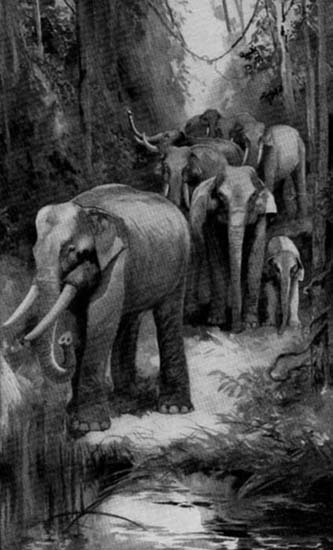
The keeper did not say anything more. But two of the nearest bull
elephants stepped up to Mukna, one on each side of him—just like a
couple of policemen arresting a criminal. Then a third bull came up in
front of Mukna, and stood with his back to him, so that all three police
elephants faced the same way as Mukna—as you see in the picture on page
45.
Then at the same time the three police elephants stepped backward, so
that Mukna also was forced to step backward. Step by step the three
police elephants went backward till Mukna's hind legs came against the
trunk of a tree. There Mukna was held for a moment, so that he could not
wriggle away. For the elephant in front prevented him from moving
forward, and the tree prevented him from moving backward; and the two
elephants on the sides prevented him from moving sideways.
Then the keeper stepped to the tree and fastened one of Mukna's hind
legs to the tree with a chain—so that he could not run away. The three
police elephants then went back to their work.
Now I must tell you that in a herd in the jungle a bad elephant is
punished at once by the president. But it is slightly different among
elephants in the service of men, because there they have no elephant
president, but a man president, who might be away at that time. That man
is called the elephant master.
That is just what happened when Mukna was disobedient. The elephant
master happened to have gone to the palace on a visit. So Mukna's keeper
called a messenger and sent him to the palace to report Mukna's
disobedience. The messenger had to ride on another elephant to go that
distance.
Mukna saw that elephant going toward the palace with the messenger.
Mukna knew why! It was to fetch the elephant master, who would punish
him! Even a dog that has been naughty will cringe and whine at the sight
of a whip, because it knows that its punishment is coming.
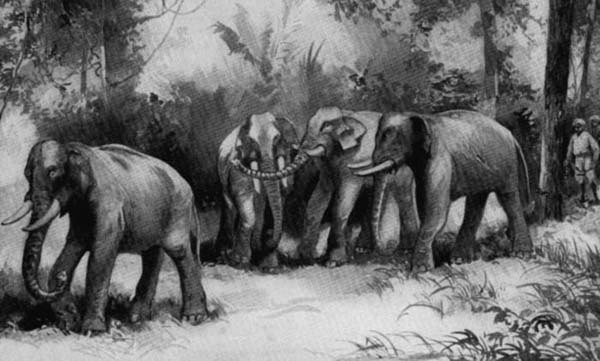 Policemen Elephants Arresting a Criminal Elephant
But Mukna did not cringe and whine. Instead he became defiant—just like
a very bad boy. He held up his head and curled his trunk tight in a
spiral in front of his chest. In an elephant that is a sign that he is
defiant or determined, just like a man who folds his arms tight across
his chest. Mukna was unrepentant.
The messenger reached the palace and reported Mukna's disobedience; and
the elephant master said that he would come that afternoon to punish
Mukna.
The reigning prince said that he also would come. As he had just
ascended his throne, he wanted to teach a lesson to all criminals in his
domain from the beginning of his reign, and Mukna was the first to
commit a crime in the prince's reign. For, I must tell you, all
elephants in service in India are treated just like men; they are
rewarded as good citizens or punished as criminals. So Mukna was
regarded as a criminal.
The prince asked three other young princes, his cousins, to come with
him. A young American was then staying in the palace as a guest, and he
also was invited to come.
That afternoon the royal party went with the elephant master to the
place where the elephants were; there were about thirty bulls, besides
Mukna. The place was a clear space, about a hundred yards across, with
a lot of trees along the sides. Mukna was tied by the hind leg to one of
those trees.
The royal party got out of their carriages and entered the open space on
foot, quite near the spot where Mukna was tied up. They were not
thinking of Mukna just at that moment, as they were talking of the grand
feasts at the palace. So they did not notice Mukna at once.
Meanwhile Mukna had been brooding all day. He knew that his punishment
would come very soon. "I will do it—I will do it!" he must have been
saying to himself all the time. In that way he had worked himself into a
fury.
When the royal party entered the open space, the young American happened
to be nearest to Mukna. As he had just arrived from America, he did not
know much about elephants; so the young American did not notice that
Mukna was chained up to the tree by the hind leg, and that he was the
bad elephant they had come to punish. Instead, the young American
thought that Mukna was just one of the ordinary tame elephants working
there.
So as the royal party happened to pass about ten yards in front of
Mukna, the young American stepped aside and said, "Hello, I must pat
you!" Saying that, he raised his hand and stepped toward Mukna to pat
him.
But meanwhile, when Mukna had seen the elephant master arrive with the
royal party, he knew that the moment of his punishment had come! "I will
do it—I will do it!" he had kept saying before. So when the young
American raised his hand, Mukna suddenly made up his mind to do it
now!
Mukna gave just one short trumpet. The next instant he gave a vicious
tug with his hind leg—and snapped the chain! With a huge stride he came
toward the American and the royal party. He would "do it" now! He would
kill them all!
Nothing could stop him from doing it, it seemed. He would knock them
down and trample them to death.
But meanwhile the elephant master had heard the trumpet Mukna had given
a moment before he broke the chain. And in an instant the elephant
master realized what would happen.
"Run for your lives!" he shouted to the young American and the four
princes. And he ran himself.
But an elephant can run much faster than any man. It seemed that nothing
could save those six men; they would all be trampled to death. The only
direction in which they could run was toward the middle of the open
space—away from Mukna. Even if they reached it, they would still have
to run toward the trees on the far side. Could they reach the trees in
time? No! Mukna was gaining upon them. It seemed that in a few more
strides Mukna would hurl himself upon them, and there was nobody to stop
him.
But yes—there was!
For meanwhile, just as the elephant master had heard the trumpet Mukna
had given, all the thirty bull elephants had also heard it. Most of them
were too far off, near the line of trees; but there happened to be a
bull a little nearer the middle of the open space. He saw at once that
he could not overtake Mukna, if he merely chased him. So, how could he
stop Mukna from murdering the six men?
I shall tell you. This is what that bull elephant did. As soon as the
men had started running, he saw in what direction they were going. So he
turned slightly, and ran also in that direction. As Mukna gained
upon the men, he too came nearer and nearer to the men.
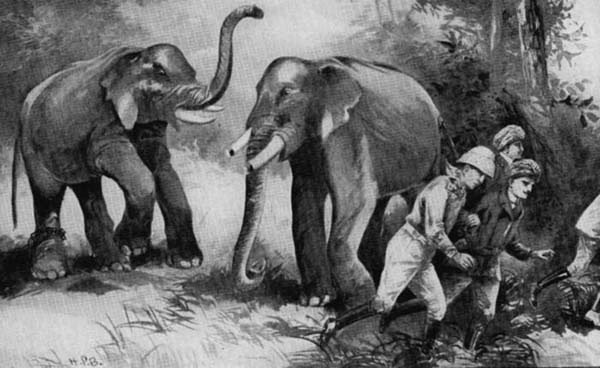 Good Elephant Heading off a
Criminal Elephant
Good Elephant Heading off a
Criminal Elephant
Mukna had come within three yards of the young American and the reigning
prince, who were running together. "Now I have got them!" Mukna must
have thought. One more stride, and he would trample them to death!
But that instant the other bull elephant also ran close up to the two
men—and hurled himself between Mukna and the two men.
Mukna's blow fell upon the bull elephant's side, and knocked him down.
But Mukna tripped over him, and also fell. The two elephants rolled over
and over upon the ground.
Meanwhile the young American and the reigning prince and all the other
men, ran on to safety behind the trees.
When Mukna regained his feet, he realized that the men he had attempted
to kill had escaped. And he also realized that now his punishment would
be most terrible—first for the disobedience, then for the attempted
murder. So in an instant he made up his mind to run away; he would
escape to the jungle and become a wild elephant once more—even if he
had to be a solitary wanderer in the jungle.
Sometimes in the wild West of America in the past, men who had
committed crimes would escape from the sheriff into the wilds and become
outlaws. Mukna wanted to do just that. So he turned toward the trees on
the side of the open space, to run away into the jungle.
But a most wonderful thing had happened. Without a word of command from
anyone, all the other bull elephants had stepped to the gaps between the
trees, each to the gap nearest him—as they would have done when they
were wild elephants in a herd, to stop a criminal among them. And all of
them were now facing Mukna.
Mukna turned to the right to find a way of escape to the jungle; but all
the gaps on the right were guarded by bull elephants. Mukna turned to
the left; but all the gaps on the left were guarded likewise. Mukna
turned in all directions; but in all directions the gaps were guarded.
He could not escape.
Then the elephant master recovered from his fright. He stepped out from
behind the tree where he had hidden. For the first time he gave a
command.
"March!" he cried to the elephants.
And the elephants marched toward Mukna. They came nearer and nearer,
till they formed a ring around Mukna near the middle of the open space.
Mukna looked frantically this way and that way; but he saw a ring of
elephants all round him, a dozen yards away; and the tusks of all were
pointed toward him like a row of bayonets.
Then the elephant master and the royal party came and stood just outside
the ring, at the back of the elephants.
There they held a trial, just as in a court of law. Mukna was accused of
two crimes: first, disobedience; second, attempted murder. A man was
appointed to defend him at the trial, just as in a court of law a
criminal may have a lawyer to defend him.
The elephant master presided at the trial of Mukna. He was the judge.
When the trial began, Mukna's keeper first gave evidence; that is, he
said that Mukna had disobeyed his order, not only once, but three times.
Then several other keepers came forward as witnesses, and gave evidence;
that is, they said that they saw Mukna disobey the order.
Then the man who was appointed to defend Mukna spoke for him; he was
called the elephant counsel. The elephant counsel argued that Mukna must
have been ill-treated to make him disobedient. So he questioned all the
keepers. But all the keepers said that Mukna had not been ill-treated to
make him disobedient.
"He may not have been ill-treated just that minute," the elephant
counsel still argued. "But was he not ill-treated before? An elephant
has a long memory; he never forgets an injury, or an act of kindness.
An elephant has been known to remember both injury and kindness for more
than twenty years. Then did not Mukna's keeper ever ill-treat him?"
But all the other men who were in charge of all the elephants gave
evidence that Mukna's keeper had never ill-treated him; nor had anybody
else ill-treated him—except that Mukna had been punished before for bad
temper by being deprived of delicacies in his food. So Mukna had no true
cause for disobeying the order that day.
Thus the charge of disobedience was proved against Mukna.
Then came the second crime of which Mukna was accused, namely, attempted
murder. And that was very quickly proved, as everybody there had just
seen that crime.
So the elephant master, who was the judge, pronounced sentence of
punishment on Mukna. Mukna was ordered to receive ten blows for the
disobedience, and ten blows more for the attempted murder.
Now among the bull elephants forming the ring around Mukna was one who
had huge tusks. So the elephant master ordered him to give Mukna the
twenty blows. Of course the elephant could not count the number of
blows he was to give. So the elephant master was to count for him, and
tell him when to stop.
The elephant who had the huge tusks stepped into the ring, and tried to
get behind Mukna, but Mukna turned around to prevent him from doing so.
Then the elephant master ordered two other elephants to step into the
ring. These two came and pointed their tusks at Mukna's ribs on each
side. So Mukna could not turn. In defiance he held up his head, and
curled his trunk tight before him.
"Hit me, if you like, but I won't give in!" he seemed to say.
Five blows he took from the other elephant's tusks without flinching.
But at the sixth blow he stumbled forward, and fell to the ground.
The elephant master stepped into the ring.
"Arise!" he commanded.
But Mukna would not rise.
Then the elephant master made a sign to the two bulls. They came to
Mukna from each side, and prodded him in the ribs with their tusks. So
Mukna was forced to stand up.
He steadied himself and received four more blows. Then at the next blow,
which was the eleventh, he fell again.
"Arise!" the elephant master commanded.
Mukna again refused to arise. So the two bulls on the sides prodded him
again, and forced him to arise.
This time Mukna stood only two more blows; then he fell again. The place
where he was receiving the blows was now raw and bleeding. So the
elephant master gave him a chance.
"Is it enough?" he asked.
But Mukna defiantly arose to his feet, without waiting to be prodded.
And he defiantly held up his head and curled up his trunk.
"You may hit me as much as you like, but I won't give in!" he seemed to
say.
At the next blow, which was the fourteenth, Mukna again fell. He was
getting weaker and weaker, and now he could not stand more than one blow
at a time.
Seeing his weakness, the elephant master allowed him to lie there for
five minutes.
Then he asked Mukna, "Is it now enough?"
Slowly, painfully, Mukna got up. He looked around with bleary, bloodshot
eyes; he thought, "Can I not yet escape?"
But a row of tusks, like a row of bayonets, faced him on all sides.
Still he would not give in. With a fierce resolution he tried to curl up
his trunk in defiance. He could not do so at once, but after an effort
he succeeded.
"I won't give in, even if I die!" he seemed to say, though he was
rocking unsteadily in growing weakness.
"Then we shall break your obstinate spirit!" the elephant master cried.
So Mukna received the next blow, which was the fifteenth. He fell. But
after a while he rose again in defiance, and received the sixteenth
blow. Then he fell in a heap. The side of his head hit the ground, and
he rolled over.
"Is it enough at last?" the elephant master asked. He waited.
Three times Mukna tried to raise his head in defiance, even as he lay on
the ground; and three times he tried to curl up his trunk. His head went
half-way up, and his trunk curled half-way. He lay on the ground just
like that for a minute or two, his whole body quivering with pain and
weakness.
Then perhaps the memory of all the kindnesses he had formerly received
came back to his mind. Yes, an elephant never forgets an injury, but he
never forgets a kindness either. Perhaps Mukna remembered at that moment
all the petting he had received when he was a good elephant, all the
sugar-canes and bananas and pancakes—and all the rewards for being
gentle and docile and obedient. And now he realized that, instead of
receiving these good things, he was receiving a most terrible punishment
for being wicked, and for being obstinate in wickedness. How foolish
he was!
He saw it all clearly in that moment, as he lay in shame and disgrace
before all his comrades, all the other elephants. Then Mukna's head
began to droop and droop; and his trunk began to unwind. The trunk hung
loose and limp before him; and his head sank lower and lower, till it
lay humbly in the dust.
A low cry, almost like a moan, escaped his lips. It seemed to say, "I am
sorry for being wicked and obstinate! I repent! Forgive me!"
Immediately the elephant master gave a sign. All the other elephants
fell back. Their task was done. They returned to their usual work.
Then several of the keepers came with buckets of water, and bathed
Mukna's wounds. Afterward they put on the wounds a poultice of herbs, to
cure the wounds in due time.
So Mukna received only sixteen blows, instead of the twenty, because he
repented of his crime.
"But if he had not repented?" you may ask.
Then he would have received the four remaining blows later on, when he
was strong enough again to receive them. For the sentence of punishment
must be carried out fully, like the sentence of a court of law, unless
the criminal repents.
Among wild elephants in the jungle it sometimes happens that an elephant
becomes so wicked that he does not repent when he is being punished by
the president of the herd. Then the president gives him as many blows as
he can bear; that is, till he cannot rise from the ground. Then he is
left there to recover by himself.
Sometimes such an elephant goes from bad to worse. For a few months his
wounds may hurt him; and so he may be on his good behavior. But
afterward, when the wounds have healed completely, he may commit a fresh
crime. Then, of course, he is punished again. And now the place gets so
sore and raw that it takes much longer to heal, and even then the place
is full of scars.
If he should get unruly and commit a crime once more, would he be
punished just the same? Yes, he would be. But I must tell you that a
herd of elephants does not want a criminal among them. So after the
third or fourth crime all the other elephants drive him out of the herd.
Then this very bad elephant meets a most awful fate. He becomes a
solitary wanderer in the jungle. No other elephant will have anything to
do with him. He is a rogue elephant.
"But could he not go to another part of the jungle and join some other
herd of elephants who don't know that he is a rogue?" you may ask.
He could. But those elephants would find out at once that he had been
driven out of his own herd for being a rogue.
How would they find that out at once? By seeing the scars of the wounds
on the place where he had been repeatedly punished. Those scars are the
brand of the rogue elephant.
So the new herd also would drive him out, for neither do they want a
rogue among them.
Thus, no matter what herd the rogue elephant tried to join, he would be
driven out.
Then he would be fated to roam the jungle by himself all his life—which
is a most awful punishment. An outlaw among men has a similar fate, as
he is shunned by all honest people.
A rogue elephant, being the outlaw of the jungle, does not live long.
Just as an outlaw among men gets shot by the sheriff's men sooner or
later, so also a rogue elephant gets shot by hunters. For, although the
hunters must not shoot an ordinary wild elephant that is a member of a
herd, they may shoot at sight a rogue elephant that is roaming in
solitude.
So, my dear children, remember that such a terrible fate comes to a
rogue elephant who may have begun his downward path by just one act of
disobedience or some other fault—and who obstinately persisted in his
wickedness, and would not repent.
On the other hand, how much wiser it is to repent, even if one has been
so foolish as to do wrong! Mukna committed the most terrible crime—he
actually tried to kill people; and then he tried to run away into the
jungle and perhaps become a rogue elephant. But afterward, when he was
being punished, he repented of his crimes. So, what happened?
I shall tell you. Mukna was put on probation for a year; that is, the
keepers watched him for a year to see if he would behave well. And for
the whole year Mukna was on his best behavior; he was gentle and docile
and obedient, and he did whatever he was ordered to do, even the hardest
work. And he did that willingly, as if to prove that he had truly
repented.
Then those very princes whom he had tried to kill felt sure that Mukna
had begun a new life, and would always be good in the future. So the
princes took him back into favor.
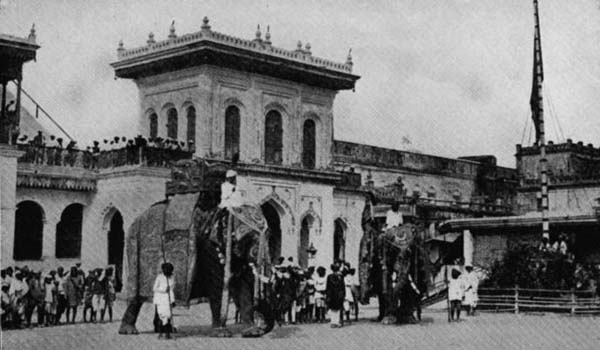
And today Mukna wears a cloth-of-gold, with gold rings on his tusks, and
he walks in a royal procession. Sometimes he carries grand people on his
back, and sometimes children. And no elephant is more gentle and
thoughtful with little children than he is. For he actually curls the
end of his trunk near the ground for them to sit upon—and then he lifts
them up to his back, three at a time!
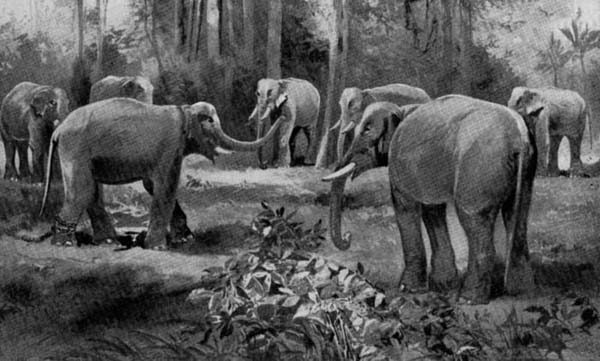
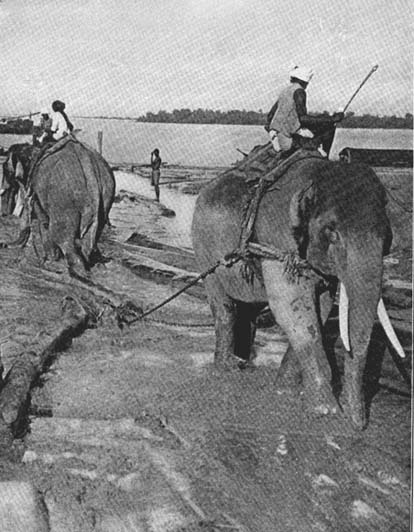 Elephants at Work