THE WONDERS OF SCIENCE; OR, YOUNG HUMPHRY DAVY (THE CORNISH APOTHECARY’S BOY, WHO TAUGHT HIMSELF NATURAL
PHILOSOPHY, AND EVENTUALLY BECAME PRESIDENT
OF THE ROYAL SOCIETY).
The Life of a Wonderful Boy
WRITTEN FOR BOYS.
BY
HENRY MAYHEW, AUTHOR OF “THE STORY OF THE PEASANT-BOY PHILOSOPHER,” ETC.
“Majestic steep! ah, yet I love,
With many a lingering step to rove,
Thy ivied rocks among;
Thy ivied, wave-beat rocks recall
The former pleasures of my soul,
When life was gay and young.
Enthusiasm—Nature’s child—
Here sung to me her wood-songs wild,
All warm with native fire;
I felt her soul-awakening flame,
It bade my bosom burn for fame,
It bade me strike the lyre.”
Davy’sOde to St. Michael’s Mount in
Cornwall. Written at the age of 18.
NEW YORK: HARPER & BROTHERS, PUBLISHERS, PEARL STREET, FRANKLIN SQUARE.
1878.
A WORD OR TWO BY WAY OF EXPLANATION AND DEDICATION TO MICHAEL FARADAY.
My Dear Sir,—
I inscribe your name on one of the fly-leaves of
this little book, with the same devotion as youths
are wont to carve upon the trunk of some forest
tree the name of those whom they admire most in
the world; and I do so for many reasons.
First of all, because Davy was, as it were, the
foster-father of your great genius; and, secondly,
because it allows me to tell the lads for whom this
book has been written the graceful story of the way
in which the hero of it first befriended you—the
young “bookseller’s apprentice, very fond of experiment,
and very averse to trade”—in your own dignified
language; and, moreover, because I know
your zeal in the cause of education, and that you
are, like all generous minds when fired with the
beauty of fine truths and discoveries, unable to rest,
as it were, till you have imparted them to others,
and so made them as happy as yourself with the
wondrous knowledge. Indeed, it is the glorious
privilege of intellectual pursuits that they are not
marked by that “selfishness,” which made you as a
boy “desirous of escaping from trade;” for wisdom,
happily, can share its riches with the world, and yet
be all the richer for the sharing. None know better
than yourself that every science is built up of an infinity
of such contributions; and that, had the human
mind been impressed with a desire to hoard its
intellectual gains—to keep them locked in the coffers
of the brain—how little even you—who have
added, by your many profound discoveries, more to
the knowledge-fund of the world than any other single
philosopher—could yourself have known. There
is no finer instance, perhaps, of human magnanimity
than the chemist working unseen in his laboratory—watching
alone for hours the action of different kinds
of so-called dead matter upon each other, in the hope
of being able to add his little mite of truth to that
store of mental riches, which is to benefit not only
his own generation, but all those to come for ages after.
Nor can we detract from the natural greatness
of the act by ascribing it to any lower principle of
our soul—such as that petty craving for praise which
we call “vanity” in women, and a desire for fame
among poets and philosophers; for every true scientific
mind knows that there is sufficient reward in
the intense beauty of a new discovery—the first flash
across the brain of some deep insight into the mysteries
of Nature—to repay him, over and over again,
for all the long puzzling of his thoughts; and that,
were he even alone in the world, without a voice to
cheer him on, he must still continue spelling out passage
after passage of the Great Poem of Creation,
from the mere love of the Poem itself.
I can readily understand that it was some such
generous purpose that first rendered you anxious “to
enter the service of science, which,” as you say, you
“imagined made its pursuers amiable and liberal,”
for this is impressed in every line of the following
letter, which becomes peculiarly interesting as a record
of the circumstances which brought together two
of the greatest chemical geniuses that the world has
yet seen.
“To J. A. PARIS, M.D.
“Royal Institution, Dec. 23, 1829.
“My dear Sir,—You asked me to give you an
account of my first introduction to Sir H. Davy,
which I am very happy to do, as I think the circumstance
will bear testimony to his goodness of
heart.
“When I was a bookseller’s apprentice, I was
very fond of experiment, and very averse to trade.
It happened that a gentleman, a member of the
Royal Institution, took me to hear some of Sir H.
Davy’s last lectures in Albemarle Street. I took
notes, and afterwards wrote them out more fairly
in a quarto volume.
“My desire to escape from trade, which I thought
vicious and selfish, and to enter into the service of
Science, which I imagined made its pursuers amiable
and liberal, induced me at last to take the bold and
simple step of writing to Sir H. Davy, expressing my
wishes, and a hope that, if an opportunity came in
his way, he would favour my views; at the same
time, I sent the notes I had taken at his lectures.
“The answer, which makes all the point of my
communication, I send you in the original, requesting
you to take great care of it, and to let me have
it back, for you may imagine how much I value it.
“You will observe that this took place at the end
of the year 1812, and early in 1813 he requested to
see me, and told me of the situation of Assistant in the
Laboratory of the Royal Institution, then just vacant.
“At the same time that he thus gratified my desires
as to scientific employment, he still advised me
not to give up the prospects I had before me, telling
me that Science was a harsh mistress; and, in a pecuniary
point of view, but poorly rewarding those
who devoted themselves to her service. He smiled
at my notion of the superior moral feelings of philosophic
men, and said he would leave me to the experience
of a few years to set me right on the matter.
“Finally, through his good efforts, I went to the
Royal Institution early in March of 1813, as Assistant
in the Laboratory; and in October of the same
year went with him abroad, as his assistant in experiments
and in writing. I returned with him in April,
1815, resumed my station in the Royal Institution,
and have, as you know, ever since remained there.
“I am, dear Sir, very truly yours,
“M. Faraday.”
The following is the note of Sir H. Davy, alluded
to in Mr. Faraday’s letter:
“To Mr. Faraday.
“December 24, 1812.
“Sir,—I am far from displeased with the proof
you have given me of your confidence, and which
displays great zeal, power of memory, and attention.
I am obliged to go out of town, and shall not be settled
in town till the end of January: I will then see
you at any time you wish.
“It would gratify me to be of any service to you.
I wish it may be in my power.
And now let me add, by way of excuse for the
many short-comings of the present volume, that I
have found some little difficulty in developing my
object, which was to show youths how one of the
greatest natural philosophers had, when a lad, like
themselves, made himself acquainted with the principles
of science, and thus to induce them to “go and
do likewise;” for, assuredly, there is no education
like that self-education which is sure to follow directly
a fervent taste is created for any particular
branch of knowledge. To create such a taste was
my sole motive for writing this book. Nevertheless,
when I came to deal with the subject, I discovered
that it was impossible to follow literally the scientific
history of Davy’s mind, since he had begun by adopting
the most flighty theories. To have evolved all
his visionary notions when a lad, in a work that was
meant to have an educational tendency, would have
been merely to have taught error. I have, however,
in adapting the book to the present state of science,
deviated as little as possible from the biographical
facts, and I have, moreover, in all things striven to
be true to the character of my hero, which after all
is the great truth required in “story-books.” Again,
by a pardonable license, I believe I have made the
boy foreshadow some of his after-discoveries—such
as the safety-lamp—and for all these deviations I can
only plead a desire to show youths that they have it
in their own power to do as the Cornish apothecary’s
boy did, if they will but set about the work
quickened with the same determination to succeed.
It is my belief that our present system of education
begets in the minds of youths too great a sense of
dependence, and too little reliance on their own powers,
so that it is thought by a lad on leaving school
to be impossible to learn any thing without the help
of a master to teach it. Now my object in such
books as the present is to show boys that some of the
greatest minds the world has yet seen have been self-taught;
and by letting the young note how the great
men, when they were young too, set about the task
of informing themselves, thus to breed in youthful
minds not only a faith in their own capabilities, but
a taste for the beauties of knowledge, as well as
a strong purpose to number themselves, if possible,
among the future teachers of mankind.
And now, my dear Sir, let me, in conclusion, thank
you for your generous encouragement of my labours
when I was engaged in inquiring into the condition
of the “London Poor.” Many know your wisdom,
but none are better acquainted with your goodness
than
THE WONDERS OF SCIENCE. — CHAPTER I. THE WIDOWED AND THE FATHERLESS.
“Well, gentlemen, I have gone over your several
accounts, and find that the debts of the late Mr. Robert
Davy amount altogether to the sum of £1300.”
These words were addressed to a little group of
tradesmen and others who were assembled in a
small room over a mercer’s shop, in the town of
Penzance. There was Jan Penberthy, the neighbouring
miller, who, though in his holiday clothes,
had sufficient of the flour clinging to his black eyebrows
and whiskers to indicate his calling; and
Malachy Carteret, the carpenter and builder, who
had slipped on his best coat, as he ran out from his
work, to be present at the meeting, and had still
the brass ends of his foot-rule projecting from the
little fob at the side of his fustian trousers. There
was Mr. Trevisky, too, the sporting lawyer, in his
check shooting-jacket, all over pockets, and those
at the hips large enough for game or law papers,
and who held in his hand a square, horny-looking
parchment deed; and close beside him sat the
village apothecary, in a long, snuff-brown greatcoat,
between the skirts of which might be seen,
shining in the light, his high boots, that reached
well up to his knees; and there were two or three
other of the village tradespeople besides, all seated
at the end of the little apartment, and who, when
they heard the amount of their united claims, exchanged
glances with one another in astonishment
at the largeness of the sum.
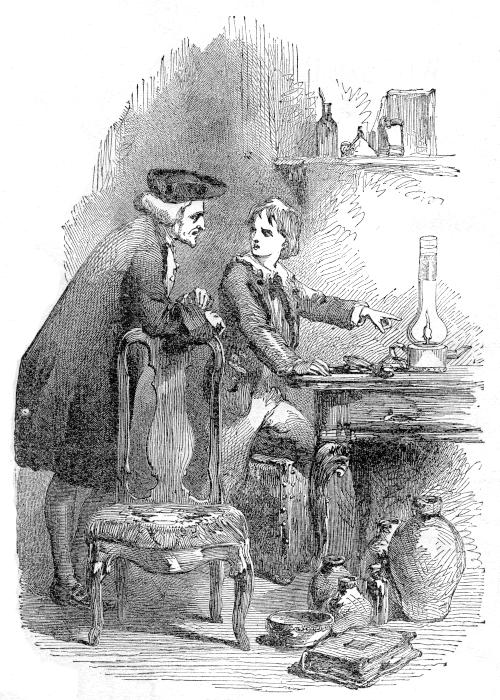
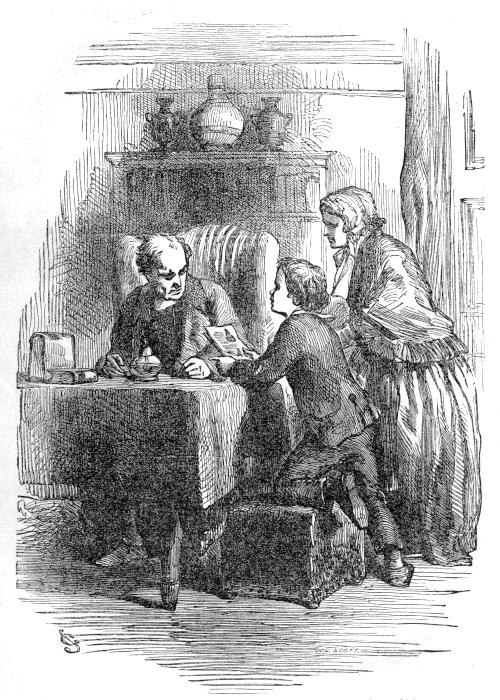
At a table in front of the little assembly sat
Mr. John Tonkin, the old gentleman who had
addressed them. Nor was he the least remarkable
among the company, for he was habited in the
costume that had been fashionable in the previous
century. Over his shrivelled and veiny hands
flapped deep lace-ruffles, and the top of his head
was white as a twelfth-cake, with the large
powdered wig that surmounted it. The straight,
stand-up collar of his Quaker-cut coat was as if
mildewed at the back with the powder that fell
from his peruke, and the large fan-like frill that
protruded from his waistcoat—which was long as
a modern groom’s—was speckled brown in places
with snuff, as thick as nutmeg on a custard; while
from underneath the table at which he sat peeped a
pair of gold shoe-buckles and black silk stockings.
On a chair by his side lay the cocked hat which
completed his antiquated costume, and the underneath
part of which was greyed with hair-powder
and long usage.
Peculiar as was the old gentleman’s dress, yet it
had more of a quaint than comical appearance with
him; for his features, though creased with age, and
his form, though slightly bowed with his load of
years, were still of too manly a cast to excite any
irreverent feeling, even in the lightest minds; indeed,
he had too stern and austere a look to dispose any to
smile at the oddity of his costume.[2]
After a short pause the old gentleman continued
his address to the company before him. “Now to
meet this sum of £1300 there is the property of the
farm at Varfell, which is valued at about £150 a
year, and upon which Mr. Trevisky’s client has a
mortgage to a small amount.”[3]
At the mention of the name of the attorney, that
gentleman proceeded to open the square deed before
him, and to throw back the huge skins, that looked
like large sheets of bladder, as he glanced his eye
down them one after another.
“This little property, gentlemen,” proceeded
Mr. Tonkin, “is all that the widow and her five
children—the eldest of whom, you will permit me
to remind you, is but sixteen years of age—have to
subsist upon. Mrs. Davy, therefore, I think, has a
claim to some little indulgence and sympathy at
your hands. Some years must pass before her
children are old enough to obtain a maintenance
for themselves, and in the mean time they have to
be supported, educated, and apprenticed. How
this is all to be done upon such slender means is a
matter that I need not tell you adds severely to the
widow’s distress; for not only has she the grief to
bear on losing the partner with whom she had lived
in happiness for nearly twenty years, but she has
the greater grief, if possible, of knowing that her
children are fatherless, and that she herself lacks
the means of providing for them in comfort. Her
sorrow, then, gentlemen, has a double sting. It
arises not only from regret for the past, but a dread
of the future. I am sure, therefore, she will, under
her great affliction, meet with every consideration
from you.”
At this point Mr. Malachy Carteret—a little man,
remarkable for the blackness and bushiness of his eyebrows,
which grew so close together as to look like
one long one, rather than a pair, and who, from his
being considered a “good prayer-maker” at the chapel
to which he belonged, was always glad of an opportunity
of displaying his oratorical powers—ventured
to observe, that he was sure all then present
felt for Mrs. Davy under her trials, but they had
most of them children of their own, and it was their
duty to look at home first; for who could tell how
soon they themselves might be called away, and their
little ones left in the same distressing situation, unless
their bills were duly paid? “Now my little
account,” proceeded the carpenter, “has been standing
so long as the new house at Varfell has been
built, and that were the same year as Dolly Pentreath
died—I mean her as were 102 year old—and
that’s some time agone, you know; so I’m sure no
one can’t say as I’ve been hard about my little matter.
But we were a thinking among ourselves, Mr.
Tonkin, that as you’d always been suchy kind friend
to the family, and as we hadn’t no wish to trouble
Mrs. Davy under her affliction, that maybe a—a—you—you—you
wudn’t mind becoming security
yourself for the debts, and then they cud stand over
for another year or two if need be. You’ll excuse
ma making maself so bould, sir; but I’m a plain
man, and think plain speaking is better than double-dealing
at ale times.”
The old gentleman’s brow fell suddenly, and
looking the carpenter full in the face, he said,
scornfully, “Though you have no wish to trouble
Mrs. Davy under her afflictions, you would not
object, it seems, to involve her friends in her liabilities.
You allude, sir, to my past services, and
surely the recollection of the melancholy occasion
which, rendered such services necessary should
have made you less eager after what is due to you,
and less anxious to entangle in the family difficulties
a person who, when he found that his assistance
was needed, has never added to the distress by
waiting till asked for it. In this very house, now
thirty-seven years ago, it was my sad lot to see
three young girls deprived of both father and mother
in the same week. Mrs. Davy was one, and
the youngest of those three—left almost in her
infancy without a friend or counsellor to help her
through the world. And now in her womanhood
the same hard fate attends her—bereft of him whose
affection had made him her protector, and finding
her children fatherless, as she herself was, at the
very time when needing most a father’s care.
Surely the remembrance of a double bereavement
like this, sir—for hardly is she out of her orphan
age before she is doomed to enter on her widowhood—should
teach you that Providence must have
some special design in visiting so much misery upon
this poor lady.[4] Nevertheless, I am happy to say
that Mrs. Davy needs no pecuniary assistance from
her friends, and requires but little indulgence from
those to whom her husband was indebted. It is
proposed to increase the mortgage upon the farm
at Varfell to the amount of £1300, though this—even
if Mr. Trevisky can obtain the money at 4
per cent.—will reduce the family income to less
than £100 a year; and immediately the mortgage
is completed and the money paid, your accounts,
gentlemen, will be discharged. The reason of my
requesting your attendance here to-day was not to
seek to make any compromise with you, nor to
crave any unusual indulgence at your hand, but
merely to ascertain the amount of the collected
claims against the late Mr. Davy, and to inform
you that steps were being taken for a speedy payment
of them, so that you might not trouble his
widow with any importunities on the matter. She,
poor soul, has enough to bear with in the privation
she has recently suffered, and those wordly ones
which threaten herself and children in the future;
but, thank Heaven, she is prepared to meet all her
trials with resignation and courage.”
Then, rising from his seat, he bowed haughtily to
the company as he said, “Now, gentlemen, I wish
you a good day.”
The words were no sooner uttered than Mr. Trevisky,
who had previously folded up the deed, and
sat fidgetting on his chair for the last quarter of an
hour—now twisting a piece of red tape round and
round—then paring his nails—and then twiddling
the brass fox’s-head buttons of his shooting-jacket—the
words were no sooner uttered, we repeat, than
the lawyer started to his feet, and, pulling out his
watch, said, half to himself, “Egad, I shall be in
time for the cock-fight yet;” and then, waving his
hand rapidly in the air, shouted as he darted from
the room, “I’ll see to that directly, Mr. Tonkin—I’ll
see to it directly.”
Malachy Carteret was the last to leave, for he
purposely remained behind to plead his excuse
to Mr. Tonkin for the use he had made of his
name.
“I hope no offence, I’m sure, sir,” began the little
carpenter. “I always thoft ma money safe enow,
but ya see times is hard, and there’s the men to pay
every Saturday night, and that’s a great pull. No
one feels more for Mrs. Davy than your humble
servant M. C. does. Her husband always behaved
honourable to me, and M. C. is ‘ever grateful for
past favours,’ as my card says. That there wor a
bit of poor Mr. Davy’s handiwork, worn’t it, Mr.
Tonkin?” added Malachy, pointing to the oak mantel-piece,
that was elaborately and beautifully carved
with birds, fruit, and flowers.
“Yes,” returned the old gentleman, dryly: “Mr.
Davy presented it to me when he used to come
courting here, at the time his wife and her sisters
were under my care.”
“Ah, he wor very clever with his tools,” continued
the carpenter. “‘The last of the carvers,’ we
used to call him. I remember him afore he went to
London to larn the business—he lived with his uncle
Robert then. I used to work for the uncle; indeed
I sarved my time with the late Mr. Davy’s father—the
builder, ya know—so, of coose, I cudn’t mean
anything but kindly to the family—only money’s
very scarce just now, sir, and I’ve a-mashes of bills
to meet this quarter: so I hope no offence, I hope
no offence, sir. You doan’t want nothing in my
way, do you, Mr. Tonkin?”
The old gentleman shook his head.
“Very well, sir,” proceeded the tradesman;
“when you do, M. C. will be proud to take your
orders—ever grateful for past favours, sir, and
hoping for a continuance of your kind support.
Allow me to give you one of my new cards, sir;
you’ll see I says as much there.” So saying, the
pushing little carpenter thrust one of the printed
bits of pasteboard into the old gentleman’s hand.
Suddenly a loud shout was heard in the street
beneath.
Malachy and Mr. Tonkin looked vacantly at one
another, as they both inwardly wondered as to the
cause of the noise.
In a few minutes the shouting was repeated, and
this time the ear, quickened by curiosity, could distinguish
the shrill cries of the village boys and women
among the rest.
The carpenter, in the excitement of the moment,
forgot his customary obsequiousness, and rushing towards
the window threw open the little diamond-paned
casement, making its metal frame twang
again as he did so; and as he craned his neck over
into the street he cried, “Oh, Mr. Tonkin, Mr.
Tonkin! here, you never saw suchy thing in ale
your life!”
The old gentleman was sufficiently curious to be
unable to resist sharing in the excitement, and proceeded
to join the little carpenter, who was still
eagerly surveying the mob that was gathered round
about the “Star Inn,” on the opposite side of the
street.
“It’s Squire Giddy’s new conveyance, sir!” exclaimed
Malachy. “The gardener told me last
night it had come down from London the day
afore, with all its wheels done up in haybands
like an Irish reaper’s legs. It’s the fust as has
ever bin seen in these parts, and so of coose the
whole town has come to have a peep at it.”
Ay, so it had! All Penzance was out to behold
the first carriage that had ever appeared in its
streets.
There were the fishwomen from the neighbouring
villages of Mousehole and Newlyn, who had stopped
in their rounds to join in the throng, and who had
their “cowals” or panniers of fish slung round the
crown of their broad-brimmed hats, with the load
of pilchards glittering like lumps of silver at their
backs. And there were the ruddy-faced oil-girls,
who had put down their heavy pitchers and ceased
for a while their cries of “Buy ma traa-in! Buy
ma traa-in!” to eye “the big box upon wheels,”
as they called it. The portly town-crier, too, was
there, with his huge dustman-like bell turned
upwards, and looking like a big tulip in his hand;
for having found that his audience had suddenly
deserted him, and were more attracted by the sight
of the new conveyance than with his announcement
that the grocer “had just received several
chests of the best tea from London,” the bellman
had himself helped to swell the crowd, and was
now as eager as any to obtain a view of the new
wonder. Mingling with these might be seen the
forms of the boatmen—half-smugglers, half-fishermen—from
the neighbouring shore, with their tight-fitting
blue “Guernseys,” their yellow, greasy-looking,
fan-tail hats, and their large high jack-boots,
that bagged about their legs and looked as rusty as
if they had been made out of brown paper; whilst
at the outside of the motley group the eye fell upon
the news-boy, mounted on a podgy pony, with his
long tin horn in his hand and pad of “Sherborne
Mercurys” under his arm; and he, in his eagerness
to catch sight of the strange-looking vehicle, was
leaning over on one side of the saddle, as a butcher-boy
loves to ride. All the shop people were at their
doors: some in long aprons, and others with white
sleeves on their arms over their coats; and the boys
kept darting across from the houses towards the mob;
while the upper windows all down the street were
knobbed over with heads, each bent towards the one
grand focus of attraction.
“It’s a queer-looking consarn, aint it, sir?” inquired
Malachy; “and there’s a good bit a work in
it, I’ve no doubt.”
“It’s a hideous lumbering affair,” responded the
old gentleman, as he turned away from the window,
“and it’s a great pity that persons haven’t
something better to excite their admiration than the
follies of the rich; but there’s such a love of luxury
coming over our people, that soon we shall become
as effeminate as those of the East, who are
borne about upon couches when they journey from
one place to another. In times past we were a
sturdy, energetic race, inured to hardship, and loving,
rather than avoiding, exercise; but now we
must have soft, easy seats, and beds of down, or we
cannot rest. Not many years back the floors of
our nobles’ houses were strewn with rushes, but at
present even our gentry are beginning to find a
sanded room unpleasant to their feet, and so they
must needs have soft carpets to tread upon—as if
they had all at once grown as tender-footed as negroes.
There’s Squire Austell has already carpetted
his best sitting-room; and mark my words!
there’s sufficient of the monkey in our natures to
make his great and little neighbours ape the Squire’s
manners. Ugh! We shall be as unmanly as fiddlers
before many years have passed over our heads.
Haven’t we got to drink slops for breakfast instead
of a horn or two of good strong ale, as they did in
our fathers’ time? and do you think, sir, strength,
and courage, and energy are to be got out of teacups?
Soon we shall find it impossible to eat without
silver forks, as they do in London already; and,
by and by, the dinner-bell will ring at the same
hour as the curfew-bell used to toll in olden times—for
what’s called fashion is setting nearer that
way every day. But, thank goodness, we still dine
at noon here, and our parties are limited to tea
and Pope Joan at three o’clock, instead of grand
dinners or dances with Frenchified gavottes, and
minuets that begin with the owls and end with the
lark. I hate such new-fangled customs! they
would put John Bull into stays like a Frenchman,
and exchange his top-boots for dancing pumps.
Take my word for it, sir, since that four-wheeled
aid-to-laziness has appeared in our town we shall
shortly find every one of our would-be fine ladies
unable to stir a yard from their homes without
one.”[5]
“You’re quite right, Mr. Tonkin, quite right, sir,”
chimed in the little carpenter; “our rich folk are
getting more proud and fond of luxuries and vanities
every day of their lives. Why, what do you think?
they’re talking of putting cushions to all the seats
of the pews in our chapel, sir, just because the gentlefolks
has ’em to their sittings in Madern church!
and I give you my word, sir, I’ve only just finished
setting a bright polished steel grate in the withdrawing-room,
as they call it, at Castle Horneck. It’s
just bin had down from London, and I declare one
might see to shave one’s self in any part of it. It
never was made to put a fire in, I’m sure. But
there’s nothing I can do for you in my little way;
is there, Mr. Tonkin? I’ve got the newest designs
for furniture just arrived from town by the pack-horse
as came in last Monday.”
Mr. Tonkin shook his head, and turned, towards
the window.
“I hope no offence, sir,” continued Malachy;
“another time, maybe, I shall be honoured with
your commands, and then I can only say that your
orders shall be punctually attended to by your humble
servant, M. C.;” and, having delivered himself
of this speech, the pushing little carpenter bowed
himself backwards out of the room.
CHAPTER II. YOUNG HUMPHRY’S RESOLVES.
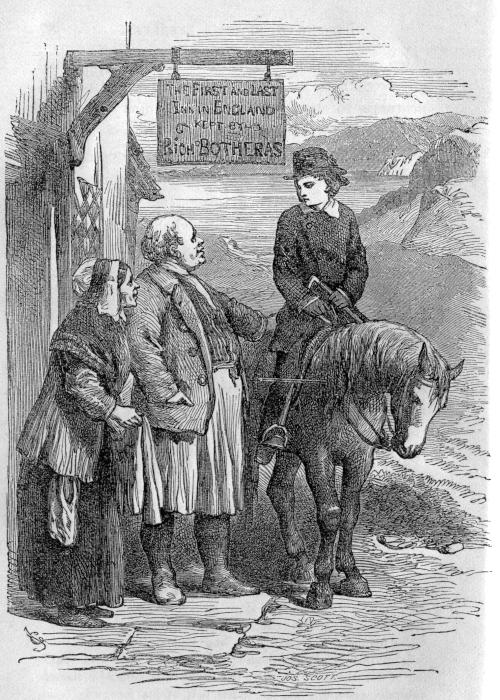
“The First and Last Inn in England, kept by
Richard Botheras,” was the inscription recorded
on both sides of a sign-board that swung backwards
and forwards outside a little lonely homestead—more
like a cottage than a tavern—standing at the extreme
western point of Cornwall.
The open door revealed a room without a visitor;
the floor was white with sea-sand, and you could tell
at a glance, from the evenness with which the sand
was strewn, how scanty were the customers in that
part of the world, for it was plain that no foot had
trodden it that day. Above the ample chimney-board
was ranged a row of bright tin mugs, that
had been worn more by polishing than use. The
top of the little round deal table that stood in the
centre of the room was as clean as if it had been
newly planed; and over the painted chest of drawers,
in one corner, stood what appeared like a quire
of tea-boards, which, together with the written
paper pasted against the wall, and informing
the stranger that “parties were supplied with
hot water,” gave one a notion of the many visitors
who came in summer to take tea at the Land’s
End.
The host, from lack of custom, was busy in the
garden at the back, digging in refuse fish as manure
for his next year’s crop; and the hostess might be
seen in the adjoining out-house, with her arms half
buried in a cushion of dough, preparing the week’s
bread for the humble family.
Suddenly the innkeeper paused, with his foot
resting on his spade. His quick ear had caught
the clink of a horse’s hoofs on the neighbouring
granite. The man put his hand across his brows,
and looked under it in every direction to see who
was coming.
In a minute or two afterwards he ran to his wife,
crying, “Come, tidy thaself a bit, dame! Here’s
Master Davy on his pony Derby jist at hand: he’s
ale in deep black, too.”
The good wife was not long in scraping the
dough from her hands, and, having invested herself
in a clean apron, was quickly at the door beside
her husband, awaiting the arrival of the youthful
visitor.
As the innkeeper had stated, the lad was dressed
in deep mourning, and the beaver of his hat was
completely hidden by the broad crape band that
encircled it, while the gloss upon his clothes indicated
the recent loss he had met with. To a casual
observer there was but little in the youth’s appearance
to mark the budding genius which inspired
him, excepting the ample forehead and the
full black eyes beneath it. He was, however, generally
considered an “extraordinary-looking boy.”
He was of diminutive stature, while the roundness
of his shoulders gave him somewhat—as it has been
termed—of a “bucolic aspect.” His hair was
chestnut brown, and hung in neglected curls about
his brow; his eyes were dark and piercing, but the
rest of his features were anything but finely chiselled.
His complexion appeared paler than ordinary,
from the contrast of the suit of black in which
he was habited, and the dejected air and wet-looking
eye gave a melancholy tone to his appearance
that immediately enlisted the heart towards the
boy.[6]
The lad said but a word or two in answer to the
greeting of the couple, and jumping from the saddle,
gave the reins to the innkeeper, who forthwith led
the plump little animal round to the stable.
The instant after the youth had disappeared among
the rocks.
“Poor lad! he seems deeply cut up; doan’t he,
Richard?” said the wife, following her husband to
the shed.
“Ah, that he doa,” returned Richard, as he stooped
down under the pony to loosen its girths. “He’s
not tha maze-gerry boy he was a little while agone,
when he used to come over here, Greace, with a
hammer a cracking all the stones that lay in his way
into ‘midjons and jouds,’ and scrambling, like a
young goat, over the rocks after some trumpery bit
of stone as took his fancy—just as our Jan do after
daws’ eggs.”
“Yes, that he used to,” returned the wife, taking
off her clean apron, and carefully folding it
up as she talked; “and I’ve seed Master Humphry
come back, after being out all day among
the rocks, with his cap full of old stones, as he
seemed to prize like as if they was lumps of goold,
but such as I wodn’t a picked out of ‘a stomps’—not
I. Ah! there’s sad trouble at Varfell now,
take my word for it, Richard. Mistress Davy, poor
thing! has seen enough sorrow in her time to ha’
broke many a stout heart; and here she’s left with
five young ones, and not a ‘cheeld-vean’ among
’em as can get a penny to help her. Master Humphry’s
a good scholard, they say; but larning won’t
fill the cupboard, Dick; and they tells me, down
at Penzance, that Mr. Davy (rest his soul!) was too
fond of wasting his money in mines—as we’ve seen
many a family ruined with in our day—to leave
his wife anything to fall back upon at this time;
though I’m sure I pity the poor widow and her
little ones from the bottom of my heart, for it isn’t
none of their bringings on. Sometimes, do you
know, Dick, I fancy as there’s a spell on that poor
woman.”
“Go along with you and your spells!” indignantly
shouted the husband, as he held the pail
of water for the pony to drink from; “you’ve
always got some stuff of that kind in your head,
Greace.”
“Well, you may talk as you like, but I shall
b’lieve in such things to my dying day,” retorted the
superstitious little body. “Didn’t I go to Madern
Well and drop some pins into it; and didn’t they fall
with their pints together, I should like to know?
And wasn’t our old sow took ill the very week afterwards,
and died on the very day as we’d settled to
kill her—eh? Oh! you’re as unb’lieving as a Jew;
you are, indeed, Dick.”
The innkeeper treated his wife’s argument with
a hearty laugh, whereupon the dame proceeded to
cite to him a hundred and one such instances as were
current throughout the county, and in the midst of
which we must leave the worthy couple for the present.
The restless, pensive boy, had wandered to the
extreme point of the land, and here, resting upon
a shelf of crag far above the sea, that roared and
dashed against the base, he sat for a while, with
his tearful eye peering across the Atlantic, vacantly
gazing at the huge watery disc that heaved like a
giant breast before him. Behind the lad towered
tremendous pinnacles of granite, some with their
monster blocks ranged in cubes one above the
other, like Nature’s solid masonry; others with
massive stones standing right on end; while some
seemed tossed about in such confusion as if the
“sixth seal” itself had opened, and the heavens
had rained rocks upon the land. Here a large
square lump protruded like a bond-stone from the
straight sides of some tall pile; there a huge mass
was scored through at the top, leaving the blocks
standing up on either side of it, as if castellated;
and there again was seen a ponderous lump, so
delicately balanced on some high peak, that it
seemed as if the least gust would topple it over
into the sea beneath; while the outline of the
whole was as jagged as if it had been gnawed, or
as if the entire granite pile were some immense
crystal that the sea was gradually dissolving away.
Below the height the crags stretched far out into
the sea, their black and bluff heads peeping up
at different distances through the waves which
compassed them with a ring of the whitest foam;
while at the end of the winding, broken line, there
rose one rock higher than the rest, and on top of
this glistened the silver tower of the light-house,
that, like a star-tipped wand, pointed the way,
as it gave the first glimpse of home to the returning
mariner.[7] Far beyond this, again, the eye
could just trace, in the mist of the distance, the
cloud-like islands[8] studding the crystal ring of the
horizon, while all the rest was one wide desert of
water stretching away to the Western World, that
even the fancy was weary-winged in its struggle to
reach.
Nor was the scene behind the narrow tongue of
land that forms the very end of our island less grand
and solemn than that which lay before it. To the
southward the pathway was along the edge of a
precipice that the sea beneath had scooped into a
curve, and here, at one extremity, the ocean had
drilled huge caldron-like cavities in the rock,[9] and
pouring into these boiled with a roar that made the
cliffs boom again with the noise. Beyond this rose
the majestic headland of “Carn-y-Voel” its summit
half veiled by a light scarf of clouds, and its
tall sides, built of granite cubes, rising straight as a
fortress wall from out the sea. Here the ocean
had worked for itself a little bay, where the smooth
green water lay like a mirror, with the shadows of
the yellowish-red cliffs above it reflected deep into
the pool, and trembling, as the surface rippled, into
zigzag lines that played with a thousand lights and
shades. On the other side of this bay a low granite
cliff jutted out like a buttress, the green ground
above sloping abruptly down; and against this the
waves beat and dashed till the spray played around
the rocks like a cloud of smoke, and sparkled in the
sun delicately tinted with many a prismatic hue.
Here, again, the ocean had burrowed into the thick
granite wall, while near the verge of the cliff there
was a perpendicular shaft, the sides of which were
smooth and circular, as if they had been drilled
out of the solid rock; and looking down these, as
down a dark well, the eye could see the white
waves tumbling and tossing below with a terrible
fury.[10]
On the northern side of the promontory, called in
Cornish “Antyer Deweth,” or the Land’s End, the
headlands were higher than those even on the south,
for there one tall rock rose out of the waves towering
high into the air, and formed also of granite
cubes, which looked in the distance so like a suit of
mail, that it had acquired the name of the “Armed
Knight;” and here at the very top of one of the
craggy summits a singular cross of rock was to be
seen, while as the eye travelled along the curved
and crumpled shore, far away to the north, it rested
on the point of land known by the name of “Cape
Cornwall,” the outlines and tints of whose slate
cliffs, seen through the atmospheric veil, appeared
soft and blue with the haze of distance.
Despite the blocks of granite that protruded
through the land, like the bones of the earth itself,
the ground roundabout was rich in parts with flowers.
Now the soil was purple with the richest
heaths, and now it was yellow as a plate of gold
with the bloom of the dwarf-furze, the latter filling
the air with a perfume like apricots, while the
green patches of grass were almost iridescent with
the various wild flowers that peeped with their delicate
blossoms from out the blades. The air, too,
was savoury with the odour of the sea, and fresh
with the spray that, like a dew, brushed against the
cheek. Still amidst the solemn convulsion of rocks
and the vast belt of water which encompassed the
beholder as far as the sight could stretch, a feeling
of overpowering loneliness—a sense of one’s own insignificance
and helplessness, such as travellers are
said to feel in deserts—oppressed the mind there—there,
at the very brink, as it were, of one’s native
country—the last bit of the land with which all
one’s affections and associations were linked—and
rapt in a ghastly silence, that was broken only by
the moan-like booming of the monster sea, as it beat
into the cavities of the cliff far beneath the feet, or,
now and then, by the shrill shrieking of the cormorant,
or the whirr of some passing sea-mew’s
wing.[11]
The boy sat, as we said, for a while staring vacantly
at the waves that pranced, like curvetting
steeds, before him, and as he did so a heavy teardrop
fell now and then on the moss that spotted the
rock at his feet. Sometimes his lips would move,
though not a word escaped them, and he would
strike the air with his clenched fist as though a
sudden resolution had crossed his mind; then a
shudder would pass over his frame, and he would
clasp his forehead with both his hands, and sway
his body to and fro, as he bent his head almost to
his knees. Presently, after a slight pause, he would
raise his head, and with his neck stretched back,
look steadfastly at the heavens as if gazing at some
spirit there. And when this fit was passed, he
would resume his seat, and clasp his hands as in
prayer.
Suddenly the boy started to his feet, crying,
“Yes, I’ll do it—that I will. I will rescue them
all—every one—from the poverty that threatens
them. I have promised my dead father to do so.
I have prayed God to give me the strength and
firmness to carry out my purpose, and in a few years
our home shall be as happy as it’s wretched now.
I feel as if I had just woke from a long dream. What
a thoughtless, idle fool, I’ve been! but it’s past—never
to return. Poor mother! I’ve cost her many
a tear, I know, of late. How have I wasted this
last year, when I should have been at some business
seeking the means of adding to my mother’s comforts,
instead of lessening the little that is left her at
such a time as this! If I had only worked instead
of squandering my time in silly pleasures, I might
now have been a help to her rather than the wretched
burden I am—without the power to earn a crust
for myself. What do I know that is of use to any
one? Who would give me a penny for anything
that I can do? and yet I’m old and strong enough to
get my own living. Oh, shame! shame! that I, at
my time of life, should have to take from poor mother’s
little store. If I’d had a proper spirit, I should
have felt this long ago: but no matter, it’s ended
now; and I’ll go to work and so fill my mind with
knowledge that mother shall soon be as pleased about
me, as I know, poor thing! she has been pained of
late. Yes, and father will watch over me; I know
he will. Oh! if I could only have changed before he
died, what a comfort it would have been to him in
his last moments: but as it was, I, like a wretch,
let him leave me in doubt as to what was to become
of me. Why didn’t I wake up before? If it had
only been a month ago, he might have felt no pain
on my account. Oh, shame! shame! but, thank
God, I’m different now, and I’ll go back home and
tell mother all I mean to do. I’ve the power in me—I
know I have. I’ll go back and tell her not to
grieve, and that I’ll do all I can to help her and my
brother and sisters for the future.”[12]
CHAPTER III. HUMPHRY AND HIS MOTHER.
The resolution once formed, young Humphry
hastened to convey the glad tidings to his mother,
and as he rode along he kept talking to himself all
the way, running over the many “fine things” he
meant to do for the future, and dreaming that some
day he might perhaps become distinguished for his
learning and wisdom. He amused himself, too, by
speculating as to what he would do with his money
if he ever got to be rich. He would have his little
brother John well educated then, and comfortably
started in life. Yes! and he would give up his share
in the property at Varfell to his mother and sisters—that
he would do first of all; and if he grew to be a
very wealthy man, he would give a certain sum of
money to the Grammar-school, so that the boys
might have a holiday every year on his birthday—he
would like to be able to do that, for then he
would be remembered by them as long as the school
lasted. Further, he would give something a year
to his aunt Sampson’s Phillis, and his aunt Millett’s
maid as well. Poor Mary Launder and Betty
White should get something, too; and he would
have a number of old pensioners besides, that had
known him when he was young. He would take
care, moreover, that his pony Derby and his dog
Chloe wanted for nothing in their old age, and
wherever he might be he would have a box of
apples sent him at Christmas from the tree he
had planted in the garden when he was a little fellow.[13]
On reaching the humble farm at Varfell, Humphry
found his mother seated beside a table, the
top of which was black with a hillock of little
skirts and bodies that she had been busy making
up for the children’s week-day wear. The quick
eye of the boy could distinguish as he glanced at the
pile of mourning that the gloss of the bombazeen
was dulled in places with the tears that had fallen
upon it.
Humphry, from a sense of the grief that pervaded
the house, had entered the room so softly that
his presence was unperceived by the widow, and
for a minute or two he stood watching his mother
as she sat there with her flooded eyes fixed intently
on the large carved oak-chair (her late husband’s
handiwork) that stood beside the mantel-piece. Her
cheek rested on her hand, and it was plain by the
fixedness of her gaze that the seat was no longer
empty to her, and that her mind was far away in
the past.
The sight of that sad wife, widowed almost in her
youth, was sufficient to have touched many a stouter
heart than young Humphry’s. The widow’s
hair was still unsilvered by age, and its blackness
contrasted forcibly, and even painfully, with the close
white muslin cap that half concealed it. The dead
black of the crape made her cheek as pale as marble,
while the tears that dewed her eyes gave them an
almost glassy look, so that they seemed jettier than
usual. Her face, though young in years, was prematurely
old in expression, for the features, which
were naturally well formed, were pinched; and there
was an air of mild resignation over the countenance
that told you the poor woman had long ago learnt
to bear affliction, almost without complaint. Nor
did it need a second glance to discern the tenderness
and affection of her nature[14]—for though there
was a settled melancholy in her face, there was still
so much kindliness in its expression that the heart
could not help extending to her the sympathy that
it knew she would be the first to afford to others
who had seen as much trouble as she herself had in
the course of the few years that had passed over her
head.
Humphry drew towards his mother’s chair, and
resting against the back curled his arm gently about
her neck. So unexpected, however, was the embrace,
that the widow shrieked with alarm as she
was suddenly roused from her melancholy reverie.
The next moment, pleased at the idleness of her
fright, she clasped the pet boy to her; and while the
tears gushed from her eyes she kissed him again and
again, as though she loved him the more now that
he and her other children were all that she had left
to engross her affection.
“What! in tears again, mother?” said Humphry,
in a tone of kindly remonstrance. “Nay, do
not grieve,” he added, as the widow rested her head
on his bosom, “I have come to promise you that
I will do all in my power for my brother and
sisters.”[15]
“But what can you do, Humphry, my good lad?”
asked the mother, as she looked up through her
tears and smiled at the youth. “It will take you
some years before you can earn a livelihood, and even
then perhaps you will gain only sufficient for your
own wants. What is to become of my little ones is
more than I can bear to think of. How you, too,
Humphry, are to be put out in the world, I’m sure
I cannot say. My means, when all the debts are
paid, will be only £100 a-year, if that.”
“There, there; have no trouble on my account,
mother,” returned the lad. “I’ve made up my mind
to lay aside all my idle habits, and to set hard to
work at something directly—though I cannot tell
what, just now; and you shall see I won’t be long
before I make you all happy here.”
The mother half laughed at the sanguineness of
her son, and said, when she had kissed him for his
kindness, “But you talk like a boy, Humphry.
You don’t know how hard it is to earn money yet.”
“Yes I do, mother,” replied the determined youth,
as he pressed her hand. “But I feel I have the
power in me, and I’ll do it, you shall see—all by
myself too—aye, that I will, if I have to study
night and day. You don’t know what a lesson
poor father’s death has been to me. I never saw
you in grief before, and all this last week my mind
has been at work, for your tears were more than I
could bear. Not a night of late has past but I
have reproached myself over and over again that
I had wasted the last year of my life, instead of
doing something that would have given me the
power to help you at such a time as this. When
I heard Mr. Tonkin, too, talking with you the other
day about the money you would have to live upon,
and heard him say that it was high time I should
cease being a burden to you—yes, those were his
words, mother—a burden” (and the boy would have
turned away from the widow, but she held his
hand), “I felt the blood rush into my face with
shame, and a new spirit came over me. I didn’t
say anything to you, mother, at the time, because I
thought I could hardly trust myself; but I went on
thinking I was a burden to you, and the heaviest
burden of all, too. So I kept brooding and brooding
it over, until at last I made a solemn determination
that, instead of a burden, I would be a
help to you and my brother and sisters for the
future. I have sworn it, mother! I have promised
my poor father to do so this very day—alone
among the rocks I made the vow, and I’m sure he
heard me, for I feel as I never felt before, and I
know I’ve the power to do as I have said.”
The mother in her delight hugged the boy passionately
to her bosom, and as her tears fell thick
and hot upon him she said through her sobs, “You
have the power, I know, Humphry; and if this sad
bereavement which has come upon us all does but
stir you to make use of the genius that is in you,
it will be indeed almost a recompense for the heavy
loss we have sustained. When you were but a
child, I used to tell your dear father of the bright
hopes I had of you, Humphry, and that I was sure
you would be very clever some day; though he, poor
man! only smiled at my words, and thought it was
my over-fondness that made me fancy as much, saying
all mothers did the same. But I knew differently,
Humphry; I could see you were not like other
children, and even from an infant there was hardly
anything babyish about you. When you were only
five years old you made rhymes of your own, and
used to recite them in the Christmas gambols, and I
knew there was no little thing of that age that could
do the same thing in these parts.”
“Yes, I’ve often heard you say so, mother,”
added the boy, smiling at the youthful reminiscence.
“You were a very forward child—from a baby I
may say, Humphry,” continued the proud mother,
as she passed her fingers through the lad’s hair, and
brushed it from his forehead—for she half forgot
her sorrow as the recollection of her pet boy’s feats
stole, one after another, across her mind. “Why,
you were only nine months old when you walked
off, all by yourself; and you could speak as well,
and fluently, as a little man, before you were two
years of age. Shall I tell you, too, what you said
when your sister Kitty was born? little sharp thing
as you were! The servant had been assuring you
day after day, that when the baby came you’d be no
longer petted in the way you had been—for then, as
the maid said, ‘your nose would be put out of joint.’
This seemed to make a great impression upon you,
for directly you saw little Kitty you put your chubby
fat hand up to your face, and cried, ‘Mamma!
my nose not out of joint at all.’”
“Did I?” laughed Humphry.
“Yes, that you did,” said the mother. “Ay,
and before you had learned to write you used to
copy the figures in ‘Æsop’s Fables,’ and print the
names of them in big letters underneath. I really
think, too, you couldn’t have been more than four
years old when you could recite a good part of
‘Pilgrim’s Progress.’ All I know is, you did so
before you could read well the book; for your
memory was so great, that anything you had heard
once or twice you could repeat, almost without a
mistake, afterwards; and when you were sent to
Mr. Bushell’s school—you remember old Mr. Bushell,
Humphry—you made such rapid progress there
in your reading and writing, that though you were
only six years of age, the old gentleman, against his
own interest, recommended your poor father to remove
you to the Grammar-school.[16]
“When you could read, too, I often watched you
at your books, and saw you turn over the pages so
fast, that I fancied you were merely counting them,
or hunting for pictures; but on talking to you about
the book I used to find, to my astonishment, that you
had read it through in that short time, and that you
really knew all about it, and could give a much better
account of it than children who might have taken
hours, or perhaps days, to get through it.”
Humphry drew closer to his mother, and pressed
her hand between his palms as he looked up in her
face, and smiled with delight to hear her run over
all the feats of his youthful genius; for with the
history of each little wonder he felt the faith he wished
to have in his own powers grow stronger in him,
and he shook his head proudly as he inwardly thought
of the greater wonders he would achieve in the time
to come.
“Go on, mother,” he said, as he seated himself on
the stool at the widow’s feet, “tell me some more
things I used to do when I was a little fellow—tell
me some more, they fill me with the same hope as
you say they did you, and I want to have all the
trust I can in myself; for I’ve made up my mind to
be a great man, and if I doubt my power to accomplish
the task I have set myself, I shall, perhaps, give
it up almost at the first difficulty. Tell me something
more, mother; I want all the faith in myself
you can give.”
“I wish I could give you as much confidence in
your own powers, Humphry, as I have in them,”
returned the widow, “though now you begin to
speak with all the aspirations I have longed to see
coming upon you; and for the last year I cannot
tell you how grieved I have been to behold one, of
whom I had formed such high hopes, giving himself
up to pleasures that serve to breed only habits
of thoughtless amusement rather than wise reflection.”
“I know I have pained you, mother,” added Humphry,
“but it’s all at an end now. You remember
when I was at the Grammar-school, how Mr. Coryton
used to pull my ears for not minding the lessons
he set me. But do you know, mother, I have often
thought, that though I learnt little at Mr. Coryton’s
school, it was, perhaps, better after all that I should
have been left to teach myself; for what we learn
from our own liking, we seldom forget; and I am
sure I remember more about the books I have had
from Mr. Tonkin, and that I used to read through
one after the other as fast as I could get them, than
all the Latin and Greek I was forced to get by heart
at school.”[17]
“Ah, but Mr. Coryton,” interrupted the mother,
“was a man little fitted for teaching youth, Humphry.
He was careless about the boys’ studies,
and often very severe for the slightest faults. I remember
once you went to school, unknown to me,
with a large plaster on each ear, and when Mr.
Coryton asked you ‘what was the matter with your
ears,’ you told him ‘that you had put the plasters on
to prevent a mortification.’ But if you didn’t stand
very well with the master, you were at least in high
favour with the boys, Humphry, for you used to do
the Latin and English verses for half the school;
and as for writing valentines and love-verses, why
I am sure your play-time was mostly taken up with
scribbling rhymes to first Miss This and then Miss
That for some little urchin in a jacket, who fancied
himself to be smitten with the young lady. Then
of an evening you were always to be found under
the balcony of the Star Inn—for you were sheltered
there—with a group of boys round about you;
and, if there happened to be a cart on the spot, you
would be sure to mount it, and there you’d remain
narrating all kinds of romantic stories to the little
mob of school-fellows who came regularly to listen
to you. I never knew such a boy for story-telling
as you were, Humphry! I have many a time heard
you make up the strangest kind of tales out of your
own head; and while I was in the parlour at work,
I used to listen to you, as you and young Batten
sat out in the porch, with your arms curled round
each other’s necks, and you would be there hour
after hour; for you were never tired of inventing,
nor he tired of listening to the stories of wonder
and terror you both delighted in.”
“I can remember it all well, mother,” added
Humphry. “And do you recollect how fond I was
of making fire-works, and how Kitty used to help me
till her fingers were as black as sticks of liquorice
with the gunpowder; and how we used to mix up
the composition for our squibs and crackers on the
spring-boards of old Dr. Tonkin’s chamber-horse
that stood in the empty room, when we lived at
Penzance, and that the poor old gentleman used to
take his exercise upon in wet weather?”
“Yes, that I do, Humphry,” smiled Mrs. Davy;
“and many a time you have nearly frightened me
out of my wits with your ‘thunder-powder,’ as
you called it, which you used to delight in putting
under the chairs, so that the moment any one sat
down, there was such an explosion that everybody
in the room felt as though all their bones had
been suddenly broken. Your poor father only perceived
in such tricks an idle, thoughtless disposition;
but women see more keenly into character
than men, and I not only recollected, but knew, the
quick boy you were, and how rapidly you could
acquire anything to which you applied yourself;
besides, I had noticed your inventive turn from
a child, and the force of your imagination in the
stories you made up and the poems you had written—for
at twelve you had composed an epic that
I have by me still—and all these things gave me
assurances that one day you would take a foremost
place among the great men of the country. A
mother’s heart may have led me to have these
hopes of you, Humphry; my understanding, however,
convinced me that they were not mere dreams
begotten by affection, but conclusions calmly come
to after narrowly watching—as a mother only can
watch—every little turn and trait in your character.”
“No, mother!” burst out the boy; “they are
not dreams, but clear foreseeings; and you yourself
shall witness the realisation of them before many
years have passed.”
“God grant that I may live to do so, my boy,”
murmured the widow, as she raised her eyes to
heaven. “‘Life,’ as some wise man says, ‘has
few better things to give than a talented son,’ and
it seems to me there can be no greater pleasure
to a mother’s heart than to witness the genius
which she has watched bud and expand from year
to year ripen into excellent wisdom, and come to
be acknowledged and reverenced by the world at
large—no joy more exquisite to a woman’s nature
than that which she must surely experience on
finding that the mind which she had tended from
its very dawn—catching up the first glimpses of intellect,
and garnering them in her bosom as household
wonders and bright things of promise—has
fulfilled all her best hopes, and that the visions she
had formed of the fame and honour that were to
attend her boy in after-life have not been mere
dreams of her admiration or her pride. But rather,
that the being whom she has loved, and wished
to have loved by others, lives to be at length
praised and esteemed by all, for the talents and
virtues that she was the first to notice and to foster.
This, Humphry, is the brightest and sweetest
reward a woman can meet with in her old age;
and, having reaped it, she parts from life with a
sense of duty fulfilled, and a feeling that the affection
with which she welcomed her child into existence,
and the care with which she tended him in
his youth, have not been unprofitably bestowed, but
repaid her in the richest coin the world can offer to
a parent.”
Humphry for a while remained in silence, while
his mother’s words sank deep into his soul; then
he said, softly, “May it be my proud lot, mother,
to render you such a reward. I am thankful to
the Creator that I have passed through the most
dangerous portion of my life with few errors, and
I hope to devote myself for the future to pursuits
useful to mankind, and which in after years may
perhaps obtain for me the applause of enlightened
men.”[18]
The widow laid her hand on the boy’s head as he
sat at her feet, and she said, solemnly, “My blessing
be on you, my son. May God give you strength to
maintain your noble purpose!”
Then she threw her arms about him, and bursting
into a flood of tears, cried, “Oh, my boy! my
boy! you know not how happy you have made
me. Your words are like oil to my wounded heart.
Sometimes, of late, I have wondered why it should
please Providence to visit me so sorely—me, who
never knowingly injured any one in thought or
act. And yet, even almost in my infancy, I was
deprived of father and mother at one blow, so
that the very features of my parents are unremembered
by me, and the blessing of their love
a joy I was scarcely allowed to taste. And now,
before my own children are able to help themselves,
he who would have been their best protector
is snatched from me, and I again am alone
in life, bereft of the love and care I had hoped
to share for years to come, and left with five
young children, and only a woman’s arm to shield
them from the buffetings of the world. It needs
no little faith in the goodness of God, Humphry,
to believe that there is a mercy in all this; and often,
in the bitterness of my tribulation, I have been
wicked enough to doubt it: for I, with my mind
distempered by suffering, could discover no trace of
kindness in it all. But now I see the purpose of
my affliction. It was to stir you, Humphry, to be
a protector to your brother and sisters—to develop
the high and noble nature with which you had been
gifted, and to raise up to me a son, the glory of
whose future renown should be something like a
recompense to me for the partner I have lost—a son
who should be the means of contributing not only
to the comfort and happiness of my children, but to
the welfare of mankind at large. Yes! I understand
the reason of my trials now: and look you,
my dear boy, how good comes of evil. The first
privation I and your aunts suffered was the means
of creating for us such a friend as is seldom met
with in this world; I mean Mr. Tonkin, who was
not only a father to me and my sisters, but has extended
his goodness to our children—for you, Humphry,
have passed more of your time with him than
under your poor father’s roof. And now, no sooner
is my husband taken from me than you—the giddy
boy, who had of late been so absorbed in pleasure
that I had almost begun to think the hopes I had
formed were nothing but a mother’s vanity—become
quickened in an instant with a new nature,
as if suddenly exalted into manhood, instinct with
generous purposes and noble determinations; and,
though you are but a mere youth in years, ready to
supply the place of a father to your brother and sisters,
and a friend and protector to me.”
CHAPTER IV. THE FIRST DRINK AT THE WELL.
A few months had wrought a great change in
the household at Varfell.
The widow, when the stupor of her grief had
passed away, and the mental absorption of her first
sorrow had given place to the calm reflection of
melancholy, soon began to see that the comforts and
education of her children demanded energy rather
than tears from her.
Then came the struggle. What could she do to
help them? And what would the people think and
say if this or that were done?
But Mrs. Davy was not the woman to be daunted
by the petty exultation of neighbours; so that
when an opportunity offered for her to embark in
business as a milliner in the neighbouring town,
it cost her hardly a pang—free as she was from
all silly pride—to sink from the worldly rank of
the gentlewoman into the humbler station of the
trader.
Accordingly, after consulting with Mr. Tonkin
upon the matter, she was duly installed, in conjunction
with a young French lady, as dressmaker
and milliner, in a little shop in the town of Penzance.
Nor was Humphry long in finding a fitting occupation.
Mr. Tonkin, to whom the youth had communicated
all his determinations, and who loved
the youth almost as if he had been a child of his
own (for the greater part of Humphry’s life had
been passed with the old gentleman), was as
pleased as the widow had been to hear of the new
spirit that had come upon the lad; and although
the boy’s foster-father was not so sanguine as his
mother had been of the world-wide renown that
awaited Humphry in after life, he had, nevertheless,
sufficient faith in the talents of the youth to
believe that he might, by application, ultimately win
his way to competence and respect among the circle
of his native town. Accordingly, when the ardent
boy spoke to the calm old man of the fame
and honours he had made up his mind to gain
throughout Europe—saying, with all the fervour of
a boy-poet’s nature, that he was resolved his mind
should become a light to all nations, and that his
name should be linked with noble associations in
every enlightened country, Mr. Tonkin smiled incredulously
(but still with good humour) at the
ambitious dreams of the lad, and told him he was
afraid one so young as he knew not how difficult it
was to excel, even in the most trivial thing, when
we had the entire world for rivals; and that powers
which appeared great in the narrow circle of
our own family, grew less and less as the arena
of competition was widened. Therefore, if the
youth, instead of regarding the whole of Christendom
as the theatre in which his future powers
were to be displayed, would but limit his views
to the humble town of Penzance, Mr. Tonkin said
he thought Humphry might, with industry and
prudence, some day attain a reputable position
in the neighbourhood;[19] adding, that he should
consider himself well rewarded for the care and
affection he had bestowed upon Humphry if he
should live to see him settled as a surgeon in his
native town.
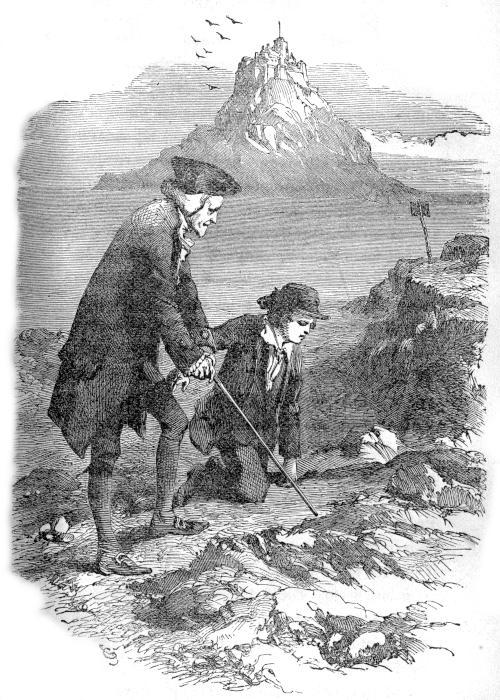
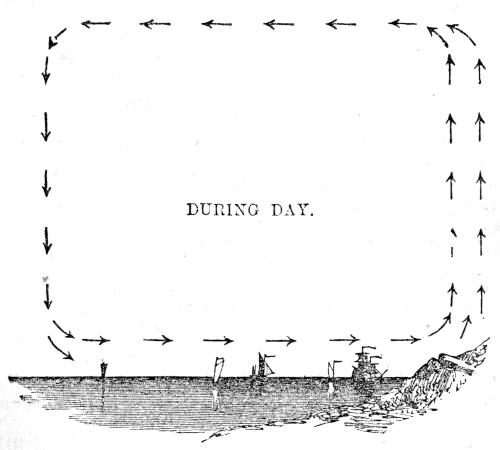
It was a lovely autumn evening—such an evening
as, at the decline of the year, is known only in
those parts of our island which, from the mildness
of their climate, have been styled “the Florence of
the North.” Mr. Tonkin and Humphry had strolled
out by Marazion towards St. Michael’s Mount,
journeying along the curved shore of the magnificent
bay, with the ocean spread out on one side, in
a broad expanse of unsullied azure, and fringed
with a thin border of silver foam, as the waves
came rippling lazily over the yellow sands. As
they sauntered along, the breeze at sundown began
to set from the land towards the ocean, and, sweeping
across the warm earth, it came laden with the
perfumes of the many exotics that bloom in the
open air in that part of the world—the garden of
England; for it was just the hour when the flowers
love to pour their odours into the lightened air,
like incense from a thousand chalices. The rays
of the declining sun gave a faint tint of purple to
the atmosphere, and the green sward, that was still
lustrous with the slanting light, was striped, here
and there, with the long shadows that streamed
from every object intercepting the beams; while
the outlines of each form were growing more and
more definite, and the sides and peaks of the rocks
glittered towards the west, as if they were blazoned
with red gold. The brown cattle were quiet in the
fields, and the tranquil flocks on the distant hillsides
rested there like clouds; the branches of the trees
beside the roadway were shaggy, almost to the tops,
with the long stalks of wheat that dangled from the
twigs, telling of some high-laden harvest-waggon that
had lately swept by them. The white-bellied swallows
skimmed low over the earth in zigzag lines,
twittering as they went; and there was a soothing
stillness all around that bathed the soul in balmy
quietude.
Towards the sea the scene was no less beautiful.
The ocean was like a huge green gem, and here
and there on its surface tiny boats seemed to revel
in the sundown breeze, now that it had sprung up,
and leant over on one side, as they went ploughing
through the liquid field, turning up the white
surf on their way, and leaving far behind them
a long trail, that looked in the distance like a
seam upon the water; while in the offing tall ships
stood against the sky, with their sails pouting and
shining white in the sun, like a pigeon’s breast.
Nearer the shore rose the majestic rocky mount of
St. Michael, towering above the sea like one of
Nature’s pyramids, with the broken outline of its
ivied sides showing sharp and clear against the
grey, ariel distance; one half of it, towards the
east, was dusked in deep rich shadow, while the other,
towards the west, was bathed in such a glory of
ruby light, that the Mount shone as if it had been
one huge carbuncle studding the bright shield of the
ocean. Then, in the far west, the sky and the sea
were as a sheet of molten gold; and, almost resting
on the ring of the horizon, was seen the round, liquid
orb of the sun, trembling like a well of light, with
the broad beams streaming upwards from it, and
tinting the distant masses of cloud, now ruby and
now purple, till they looked like islands of garnet and
amethyst in the heavens.
It was low water, and the couple crossed by the
sands from Marazion to the Mount; and here, after
passing the little cluster of fishermen’s houses that
skirted the base of the rocky pyramid, and mounting
a short distance up the cliff, they sat for a while
enjoying and discoursing of the many beauties of
the majestic scene that encompassed them on every
side.
And the prospect thence was indeed of the grandest
character. The shore stretched away, revealing
headland after headland, to where the Lizard shot
out far into the wave, the rocks there seeming almost
phosphorescent in the sun. Then appeared St.
Clement’s Island and the coast towards the Land’s
End, forming a shorter cape, and completing the
horn of the crescent of land towards the west, that
looked, as the waves grew crimson in the sunset, as
if bathed in a sea of wine. The ocean here wore its
most imposing attribute of uncontrollable immensity;
for the Atlantic, across the Bay of Biscay to
the most western land of Spain, lay on the south,
and melted into distance there; while, beyond the
extremity of our own island, no shore intervened on
the north between the line of the horizon and the
land of the New World.
It was a sight that Humphry loved as deeply as
old Mr. Tonkin to look upon, and the couple sat for
some time silently watching both the seas rolling
there towards the far distant Spanish and American
shores.
The boy, however, less capable of continuous attention
to the same subject, got to weary of the scene
sooner than the old man; and when Mr. Tonkin noticed
Humphry’s admiration begin to flag, he availed
himself of the quietude of the time and place to incite
a taste in the lad for the profession he wished him
to follow.
Presently the old doctor caught sight of one of the
little transparent zoophytes that had been left on the
rocks by the receding tide. In size it was not larger
than a bird’s egg, of a globular form, with several
transparent ridges ranged along it, from pole to pole,
as it were, and it was nearly as pellucid as the purest
rock-crystal.
“Look, my boy,” said Mr. Tonkin, turning to
Humphry, and pointing to the little ball of jelly at
his feet; “here is an orb almost as wonderful as the
sun we have been lately gazing at. It gives light,
too, like it; and though it looks there as if it were
only a few drops of the ocean gelatinised, it is quickened
with life, and performs motions that our wisest
engineers can but clumsily imitate.”
The eager boy was about to seize the wonder, so
that he might examine it more minutely.
“Nay, if you touch it,” cried the old man, hastily,
as he grasped the youth’s arm, and held him back,
“it will immediately dissolve—thaw, as it were, to
death—so frail is its life, and nothing but a little
pool of water will remain of a creature that once
could make the sea glow with its fire. These little
things are by some styled the ‘lucid gems of the waters.’
By daylight, when in the ocean, they are visible
only by the bright rainbow hues that mark their
path as they paddle along; but by night, Humphry,
they blaze with phosphorescent fire, so that some
have termed them ‘the stars of the sea.’ In warm
and calm evenings they often look like balls of light
rolling on the surface of the water, and the more
rapid their motion the more intense is the glow
they emit. Those eight transparent ridges you see
there,” continued the doctor, as he pointed with his
cane to the tiny watery globe, “support as many
rows of broad, pellucid paddles, and these are all instinct
with life, and by their rapid motion cause the
animal to glide, meteor-like, through the waves. We
wonder at the recent invention of the steam-boat,
and speak with pride of the paddle-wheels with
which we are to walk upon the waters; but the tiny
paddles here, boy, are far more perfect than any
ever contrived by human ingenuity, for in that little
aqueous ball the cumbrous machinery which is required
to move our vessels along, is not needed, since
each float, self-moving without even a visible muscle
or nerve to stir it, keeps time with all the rest.”[20]
“What wonder,” cried the poetic boy, “is here
packed in a little living crystal, as it were, that can
make fire flash from what looks almost like a globe
of water, and that can perform the most rapid motions
without, as you say, Mr. Tonkin, any visible
means of movement!”
“Yes, indeed, my lad,” went on the old man;
“there is a large store of marvels locked in that little
glassy casket. How does it get its food? How
digest it? and how is its frail body nourished? for
we can trace no blood-vessels, nor heart, nor glands—indeed,
hardly any organs at all—in the little
clot of half-liquid life. All we know, is, that it
is furnished underneath with so many tentacles
or filaments, that serve it for claws, and that
these, which are set round an aperture that we
call a mouth, draw the food it lives upon into its
body—which is literally nothing but a stomach. If
we were to watch long enough, we should see the
food thus seized and swallowed gradually dissolve
and be reduced to a fluid state, while the more
solid and indigestible portion would be rejected by
the aperture through which it entered. The nutritive
matter we know to be absorbed by the walls of
the stomach, every part of which appears to be endowed
with equal power in this respect; and it is
then conveyed to the remoter portion of the body
by the simple inbibition of one part from another,
without any proper circulation through vessels. In
some animals of this class the external covering of
the body and the lining of the stomach so closely
correspond in their structure as to admit of being
changed one for the other—for the animal may be
turned inside out without its functions being in any
way deranged.”
“Can it be?” said Humphry, filled with delight.
“Where can I learn these things, sir? Why was I
not taught them at school?”
“You shall learn them, my boy,” replied the old
man, pressing the lad’s hand with pleasure to find
the taste that he had longed to develope for his own
favourite study springing up in Humphry’s mind.
“And think, if that little lump of jelly—which is,
perhaps, the simplest form of life, where the vital
mechanism is seen in its rudest form—can stir you
to so much wonder—think, I say, Humphry, what
admiration will be excited in you when you come
to comprehend the beautiful processes and organism
exhibited in complicate animals like ourselves! If
a living, digesting creature—a thing almost without
sense—a mere moving mouth—can appear so wonderful
to you in its structure, what marvels shall
you not find in the constitution of a thinking, speaking,
reasoning being like man!”
Then the old doctor ran over to the youth the
many sources of knowledge that the study of human
life opens up to the thoughtful and inquiring
mind.
He told the eager boy—as they sat there in the
subdued light of the evening, with the hum of the
sea that rippled into the caverns at the base of the
Mount, falling almost musically on the ear—how, in
the organism of the nerves and brain, we get our
first insight, rude though it be, into the subtle processes
of the senses, and even the mind itself. He
told him, also, how, in the senses themselves, lay
the rudiments of all the sciences; how, without the
sense of vision, there could have been no “optics,”
and consequently no astronomy—for to the blind
the movements of the planets, and even the very
existence of the stars, must, of course, have remained
unknown: in like manner, without the sense of
hearing there could have been no “acoustics” and
no music; and without the sense of muscular effort
no knowledge of weight, and consequently of
“gravitation”—the main-spring, as it were, of the mechanism
of the universe.
Mr. Tonkin explained to the youth, moreover, that
had we been formed without the exquisite organ of
the hand there would have been little work done,
and but little art achieved; and without the organs
of the mouth, there could have been no inter-communication
of thought—no transfusion of mind into
mind, by which one wise man nowadays contains
stored in his own brain the wisdom of almost all
those who have preceded him. And further, if we
had had no appetites, and no pains nor uneasinesses
to stir us to action, we should, even with the beautiful
muscular apparatus with which our frames are
fitted, have remained idle and inactive all our time,
starving to death with delight.
“Some persons,” said Mr. Tonkin, “have supposed
that plants may be susceptible of feeling, as
well as ourselves and the rest of the animal race.
But that trees and herbs are incapable of knowing
either pain or pleasure” (he added) “is made evident,
physiologically, by the fact that they are supplied
with no organs of locomotion, and consequently
deprived of the means of avoiding the one
and seeking the other. For, so benevolently is the
world arranged, that wherever feeling is given, the
power of acting is immediately associated with it;
indeed, it requires hardly a moment’s thought to
perceive that it would have been incompatible with
All-Kindness to have made creatures sensible to
pain, and yet have denied them the means of escape
from it.”
After this the old man pointed out to Humphry,
that in the comparison of one system of life with
another, and so tracing the delicately interwoven
chain of animal creation, we perceive that the first
type of sentient existence was a mere stomach—a life
of pure appetite—susceptible of no other feeling than
hunger, and fitted only with organs for seizing and
assimilating its food; while as we advance gradually
in the scale of development, we find nerve after
nerve added, and a new set of feelings and actions
brought out, with each new set of fibres. “We discover,
besides,” he continued, “that when a little
kernel of nervous matter was superadded to the
previous sentient apparatus, the wondrous sense of
vision was first awakened in animal life, and how
the addition of another such little kernel made an
animal for the first time hear, and another gave the
first sense of odour to the world, while another added
taste to the food and drink.”
And when he had thus briefly explained to the
youth the uses and characteristics of the several
organs in man and the lower animals, the old
gentleman went on to point out to him how these
same organs were nourished, and the destruction
that was continually going on in the body—“for,”
said he, “we cannot move a muscle, not even
wink our eyelids, without wasting some tissue or
other”—was being as continually repaired by the
food consumed. Pursuing this subject, he then
proceeded to explain to young Humphry how the
blood was made to circulate by means of the cunningly-wrought
chambers of the heart through the
veins and arteries, distributing health and vigour
to the different organs in its course—now renovating
the tissues, now depositing little specks of bone,
then extending the filaments of hair, and then exciting
thought and developing feeling in the nerves
and brain, stimulating action in the muscles, and
diffusing warmth throughout the whole frame—all
these different functions being performed by the
one wondrous substance in which, even when examined
by the highest microscopic power, it was
impossible to detect even the rudiments of the many
various tissues it formed.
“Such,” said Mr. Tonkin, “is a part of the marvellous
process of secretion—a process so subtle that
even the wisest can only wonder in their ignorance
concerning the function; for it is a mystery to them
how, by means merely of little glands, so many
different things can be produced from one and the
same fluid. How, for instance, skin, cartilages,
muscles, hair, nails, bones, tears, and the infinite
variety of products which our bodies are made up
of and evolve, can all come from the same ruby
stream, and that a small nut-like organ only shall
be necessary to eliminate each different substance
from it. Then, again, there is the beautiful process
of breathing, by which the vital air is combined
with the blood, and the blue fluid of the veins
changed into the crimson stream of the arteries;”
and he recounted to him the while how respiration
among animals was merely a process of burning,
accompanied with the evolution at each exhalation
of so much invisible smoke from the lungs—the same
smoke, indeed, as comes from burning charcoal:
and he told Humphry that he would one day come
to see how the rotting wood underwent precisely
the same chemical change as the breathing man, and
that what is a process of death and decay in the one
is a process of life and health in the other.
“Indeed,” concluded the old gentleman, “there
is, perhaps, no sphere of knowledge so replete with
wonder and beauty as that which unfolds to us the
mysteries of our own existence—no science which
gives us greater wisdom or deeper insight into the
constitution of our natures, as well as that of the
elements around us. To comprehend such a subject,
even vaguely, requires an intimacy with almost
every branch of learning, dealing as it does at
once with the material and spiritual; while a just
appreciation of the wonders it reveals cannot fail to
inspire us with the highest regard for life, even in
its rudest forms, and render us more keenly alive
to suffering than the rest of humanity, from the
greater sense it gives us of the causes of pain,
while it arms us, at the same time, with the means
of relieving anguish, restoring health, and often of
prolonging existence.
“Some there are,” he added, “who prefer poetry
to philosophy; but science, Humphry, rightly understood,
is merely the translation of the Great Poem
of Nature—that which the Almighty himself conceived
when he designed Creation. There may be
high beauty in music, boy; but, to my mind, there
is even higher beauty still in comprehending the phenomena
by which the Creator has fitted us to enjoy
it. In the rich glories of colour there is, certainly,
an exquisite feast of visual delight; but what array
of tints, be they ever so beautifully blended—what
tracery of form, be it ever so cunningly put together—can
fill the mind with ecstasy equal to
the contemplation of that splendid little translucent
globe, the eye—a crystal world in itself, filled with
an infinity of wonders—by which we are enabled to
perceive the light, and to tell one hue from another?
What work of art, however consummate the execution—what
picture, however choice the painting or
grand the composition—what architecture, however
commanding the mass or harmonious the details—and
what poem, even though the verse be mellifluent
as music on the water, though the imagery
be luminous and profuse as the stars in winter, and
the thoughts subtle as the mountain air, can bear
the least comparison, either as regards the skill of its
art, the craft of its design, or the nice adjustment of
its parts, with the organism of the smallest animalcule
fashioned by the Great Artist, Architect, and
Poet of All?”
The sentence was barely finished when the sharp
report of a gun rattled amidst the rocks, and Humphry,
whose eyes had been turned upward as he
listened to the wonders recounted by the doctor,
saw the gull, which but a moment before he had
noticed almost lying on the air, poised on its white
outstretched wings, bound suddenly upwards with a
shriek, and the instant afterwards it tumbled heavily
on the crag at Mr. Tonkin’s side.
The old gentleman stretched out his hand and
grasped the still warm and quivering form of the
bird. “If the wings of this body had been moved
by some piece of curious mechanism, Humphry,” he
said—“if by some cunning combination of cogwheels,
and levers, and springs, it had been made to
beat the air and to rise by clock-work into the sky,
how would men have prized the marvellous apparatus!
Monarchs would have given immense wealth
to possess it: and yet the machine would have been,
at best, but a clumsy toy compared with the exquisite
arrangement here; for in this wonderful piece of
divine mechanism the force was supplied by means
of little threads of nerves that the unaided eye can
scarcely trace—the movement given by muscles so
beautifully elastic that no artificial fabric can imitate
their play—and the bones jointed together so
aptly, that when our wisest engineers wish to get
movements in all directions, they can only copy
their arrangement, instead of designing any such
hinges for themselves. Then, again, to give lightness
to the whole, these same bones were filled with
air, and the living, flying machine, so made more
buoyant in the thin fluid in which it was destined
to soar. But let us suppose, Humphry, that it might
be within the compass of art to reproduce such an
apparatus as this by mechanical means; still what
mechanism, however skilful, could have supplied the
wonderful motive power that lately quickened it?
What spring, or arrangement of weights, could imitate
the action of life? Could steam even, or electricity
itself, have moved the wings and guided them,
like the subtle principle that stirred and directed
this body only a few moments past? And then, what
cunning engineery could ever have performed the
function of the senses? Could mechanism have
made the animal see? Could the galvanic fluid—the
most spiritual, perhaps, of all our motive powers—have
made it love its young, or know when to
repair its strength with food? Ah! had the thoughtless
fool who, for wanton sport, Humphry—who
for the mere sake of hitting a moving mark in the
air—known and pondered over all this, do you
not think he would have found more pleasure
in watching the performance of all its wondrous
functions than in destroying the beautiful principle
which animated them? Had he needed its body for
food, hunger would have excused him. But no! It
was simply the petty pleasure—the little spasm of
exultation—that we derive from success in trials of
skill which led him to put an end to the life of the
poor bird, that had surely as much divine right to
its place in creation as even a king himself.”
Humphry was overjoyed with the lesson of kindness
and wisdom he had learnt. He had been so enraptured
with the knowledge that Mr. Tonkin had
poured into his mind that he sat almost like one
entranced, with his spirit lulled in a dream of bright
things he had never heard or thought of before.
The boy till now had been more smitten with the
beauty of creation than curious as to its mysteries.
True, in his romantic visits to the extremity of the
island, as well as to the Mount of St. Michael, he
had been often led to wonder how the huge masses
of rock had come there; and he had many times
pondered over the origin of metals, as in his rambles
he had passed the openings of the mines that
perforated the surface of his native country, wondering
as he went along why a vein of one ore should
be deposited here, and another there. As he noticed,
too, the Atlantic waves lashing the Land’s
End, he would repeatedly question himself as to
what became of the rocks that the sea was for ever
crumbling into sand; and he would form fanciful
theories in his own mind, as to how the detritus of
one ancient country became at last the substratum
of some new one. Again, the ebbing and flowing
of the ocean had led his mind to ruminate vaguely
upon the mighty pulsation of the tides, while the
sight of the liquid orb of the sun sinking below
the ring of the horizon, away towards the invisible
shores of America, had often turned his thoughts to
the revolutions of the planets, and set him rudely
speculating as to the source of the light and the heat
of the sun itself.
Still the youth as yet had found more pleasure
in contemplating the golden glories of sunset, than
in seeking to comprehend the wisdom that designed
them. The sea, too, to him had been more
an object of grandeur than a stimulus to thought,
while the sight of the rocks had filled his mind
with admiration far oftener than they had quickened
it with inquiry. The mystery, and even the
beauty, of the principle of life, however, had never
before been heeded by Humphry; so that, when he
heard Mr. Tonkin relate the many wonders wrought
in the changes that were continually going on in his
own frame, the boy was almost overwhelmed with
the flood of new thoughts that poured through his
brain, and he felt as if he could have sat and
listened to the old man the long night through.
Accordingly, when Mr. Tonkin came to a conclusion,
Humphry begged him to proceed, saying
he had begotten emotions in him that he had never
known before; and he felt as if a burning thirst had
come upon him for the truth, and he could drink of
such knowledge for ever without quenching it.
Mr. Tonkin was pleased to find he had stirred
the boy’s thoughts so effectively; and he promised
him that, before long, he would place him in a position
where he should be able to pursue the subject
as far as his powers could carry him.
Not many weeks after the above conversation,
Humphry, to his exceeding delight, was articled to
Mr. Bingham Borlase, the surgeon and apothecary
of Penzance; and there, alone in his little chamber,
at night, he wrote the following passage in his note-book:
“I have neither riches nor birth to recommend
me; yet, if I live, I trust I shall not be of less
service to mankind and to my friends than if I had
been born with these advantages.”[21]
CHAPTER V. THE FIRST GLIMMER OF THE SAFETY-LAMP.
Humphry was hardly at home in his new quarters,
when an incident occurred that directed his mind
towards the investigation of one of the most subtle
and mysterious principles in nature.
Mr. Borlase had returned from his day’s rounds,
and as he was busy unfastening the long leggings
that covered his black silk stockings, he informed
the family, who, with the boy, were gathered round
the tea-table in the little parlour adjoining the shop,
that he had heard that day of a fearful explosion
which had occurred, during the last month, in one
of the Welsh coal-mines.
“It seems,” said the doctor, as he took his place
at the table, “that there were two ‘shifts,’ or sets,
of men employed at the pit. The first went to work
at four in the morning, and were relieved by the
next set at eleven; and so secure was the mine considered—so
little thought of danger, indeed, entered
the minds of the pitmen—that the second shift of
men often entered the mine before the first had
left it. This happened to be the case, they tell
me, at the time of the accident; for shortly after
the second set of hands had descended the shaft,
the people above-ground were alarmed by a terrible
report, followed by others so quickly, that it sounded
like the firing of infantry, and a sheet of flame was
seen to flash from the mouth of one of the shafts.
The ground shook as if with an earthquake, the
tremor being felt for half-a-mile round the workings;
while the dull, subterranean boom of the explosion
was heard, they say, nearly four miles off.
Vast clouds of dust rose high in the air, in the
form of an inverted cone, and large masses of
timber and fragments of coal were shot straight
up from the pit-mouth, as from a huge piece of
artillery, and fell with a heavy crash near it; while
the dust, borne by the wind, descended in a shower
upwards of a mile from the spot, and as it did so, it
caused a gloom, I am assured, like early twilight, in
the neighbouring villages, inhabited chiefly by the
families of the miners.
“The boom was no sooner heard,” continued
Mr. Borlase, “the tremor of the earth felt, and
the darkness from the shower of ashes perceived,
than the wives and children of the miners rushed
frantically towards the pit. Horror and dismay
were painted on every face. The crowd thickened
from all sides, so that in a short time several hundreds
of women and children were gathered round
the shaft. The air, the people say, resounded with
shrieks and cries of despair for the fate of husbands,
fathers, and sons, from many a bursting heart.
“The machinery, it was then found, had been
rendered useless by the explosion, so that it was
near upon an hour before thirty-two persons—all
that survived that dreadful catastrophe—had been
brought to daylight, and of these twenty-nine only
lived to relate what had occurred in the mine below.
“It was now discovered that one hundred and
twenty-one, men and boys, had been in the pit when
the accident happened, so that eighty-nine poor souls
still remained entombed in the workings. Those
who had their friends restored to them appeared,
it is said, to suffer for a while as much from an
excess of joy as they had, a short time before, from
the depth of despair; while those who were yet in
the agony of suspense filled the air with shrieks
and howlings, and ran about wringing their hands
and throwing their bodies into the most frantic and
extravagant gestures.
“After some little time, it appears that nine
persons volunteered to descend into the pit, with
the faint hope that some engulfed below might
still survive. As the fire-damp, however, would
have been instantly ignited by candles, those who
went to search the mine lighted their way by ‘steel-mills,’
as they are called, which,” added Mr. Borlase,
turning round to Humphry, “are small machines
for giving light, by turning a cylinder of
steel against a piece of flint; for it has been found,
I should tell you, that though the fire-damp is immediately
ignited by flame, it is not explosible by
sparks.”
The remark evidently sank deep into the boy’s
mind, for he knit his brows and bit his lips as if a
sudden thought had flashed across his brain. But
Humphry was too much interested in the narrative
to interrupt the doctor, so he said not a word, and
waited anxiously for Mr. Borlase to proceed.
“The men who had descended the pit,” continued
that gentleman, “attempted to make their way towards
the spot where they knew the miners must
have been at the time when the explosion happened.
Their progress, however, was soon intercepted by
the prevalence of what is called the ‘choke-damp’—an
atmosphere which it is suffocation to inhale—and
the sparks from the steel-mill, they say, fell into
this like dark drops of blood.
“Deprived of light, therefore, and nearly stifled,
they were forced to grope their way back to the shaft.
“As each came up he was surrounded by a group
of anxious inquirers, but not a ray of hope could be
elicited. It was impossible, they told the people,
for any breathing thing to live in the mine. At
first, the assertion seemed to obtain some credit,
but hope still lingered. All there recollected how
persons had survived similar accidents, and stories
were told how, upon opening a mine forty days
after an explosion, men had been found still alive,
having subsisted during the time on horse-beans
and candle-ends. Then distrust began to enter the
minds of the crowd, and some suggested that want
of courage or bribery had induced the men who had
descended to magnify the danger; so that when it
was proposed by the owners to close the mouth of
the pit, and so shut out the air from it—for the most
experienced ‘viewers’ had pronounced the mine to
be on fire—the proposition was received with cries
of ‘Murder!’ and with expressions of determination
to oppose such a proceeding with violence!
“All that night, they tell me,” the doctor proceeded,
“many of the widows lingered about the mouth
of the pit, with the hope of hearing the cries of a
husband or a son.
“The next morning it was again proposed to
exclude the air; still the populace, made furious by
their misery, would not allow the project to be
carried out until some others had again descended
the shaft. But none could now be found hardy
enough to enter the jaws of the burning cavern.
At length, however, two brave fellows were induced
to make the perilous attempt, and they nearly lost
their lives in so doing.
“The account given by these adventurers (for
they confirmed the opinion as to the pit being on
fire) ultimately convinced the people of the impossibility
of their friends surviving in so deadly an
atmosphere, and reconciled them to the plan of excluding
the air. Accordingly the shaft was closed,
with the eighty-nine poor souls entombed in it, and
more than a month elapsed before the mine was
opened again and in a state to admit of an examination.
“During this interval, I leave you to imagine,”
went on the apothecary, “what must have been the
terrible suspense of those whose love made it impossible
to eradicate all hope from their bosoms. The
widows, anxious to believe that their husbands still
lived in the closed mine, gave a ready credence to
the idle tales of escape that were continually being
circulated through the country. These inventions,
however, had the effect of daily harrowing up afresh
the sorrows of the people; so that when the morning
came that had been appointed for the re-opening
of the pit, the distress of the neighbourhood burst
forth once more with almost redoubled fury.
“A great concourse of people assembled round the
mine on that sad day: some came out of curiosity,
others out of public sympathy, but the greater part
came there with broken hearts and streaming eyes,
intent on once more beholding the loved form of a
father, brother, husband, or son.
“Soon a message was despatched for a number
of coffins to be in readiness at the pit-mouth. Upwards
of eighty of these had been ready prepared,
and they had to pass by the miners’ villages on their
way to the shaft. As soon as a cart-load of them
was seen, the howling of the women, who had not
yet found their way to the melancholy spot, floated
on the breeze in low, fitful gusts, presaging a scene
of the greatest distraction and confusion; and as
each load of coffins came to the pit, it brought a long
train of wretched mourners in its wake.
“The bodies of the ill-fated men were found
under various circumstances. One, from his position,
must have been asleep when the explosion
happened; others were huddled together in ghastly
confusion—twenty-one were found in a heap in one
spot. The power of fire was visible upon all:
some were scorched; others almost torn to pieces;
while others, again, appeared as if they had been
stifled at their work.
“Then came the heart-rending scene,” added Mr.
Borlase, “of mothers and widows examining the
mangled remains for marks by which to identify the
bodies of their lost sons and husbands. Few, however,
were able to recognise their relatives by their
features; their clothes, their shoes, and—when these
were too much burnt to be known again—their tobacco-boxes,
or some token of affection, were often
the only indications by which the lost friend could
be singled out from the rest.
“Every family had made some arrangements for
receiving the dead bodies of their kindred, but the
doctor had very properly stated that, in his opinion,
such a proceeding might spread a putrid fever
through the neighbourhood, and the first body,
when exposed to observation, presented so horrible
and corrupt an appearance, that the people were
induced to consent that each corpse should be interred
as soon as it was discovered—on condition
that the hearse, in its way to the chapel-yard,
should pass by the door of the deceased.
“And the condition was duly complied with,”
concluded the doctor, solemnly. “Hour after hour,
and day after day—for the finding and removal of
the bodies continued for upwards of a week—the
funeral carriage might be seen slowly wending its
way through the half-desolate miners’ villages,
passing first by the door of one closed cottage,
and then by another, while at the hatches of the
others stood groups of women, the greater part of
whom were habited in black, with little things by
their side, and some with infants in their arms,
mostly wearing some humble mark of mourning.
As the hearse moved on, the women, with tears in
their eyes, would tell one another whose body was
then on its way to its last home, and each would
have some little story to recite of good done and
charity bestowed by the ill-fated man, while all
would sigh to think what would become of the
wretched widows and little orphans who, as the
bier stopped at the cottage, might be seen, with
streaming eyes and dejected heads, to issue forth and
follow the funeral carriage slowly and sadly to the
grave.
“For ten long, melancholy days,” said Mr. Borlase,
mournfully, “were the shutters of the houses
closed in the miners’ villages, and for ten days did
the bell of the neighbouring chapel continually toll—for
the finding of the bodies lasted all this time:
and by this one terrible accident there were no less
than ninety-two pitmen hurled into eternity, while
as many as forty widows and one hundred and six
orphan children were deprived of their protectors
and ordinary means of subsistence.”[22]
Mr. Borlase, on finishing his melancholy story,
turned to Humphry, and saw the tears trickling
from his cheeks.
There was a silence among all present, as if the
awe of the calamity was still pressing on their
hearts.
Presently the impulsive boy started to his feet
and cried, “I’ll put an end to this shocking misery,
please God I will, some day.”
The quick eye of young Humphry saw a smile
play faintly on the doctor’s lip, and he added, “I
know, sir, you have reason to doubt my power to
do as I say, and, perhaps, it may take me years of
hard study to gain the knowledge to enable me to
compass my end; but though it cost me a lifetime
I will master it at last. I have sufficient faith
in the goodness of the Creator, to believe that these
terrible afflictions come upon us only through our
ignorance, and that if we but study His will, as
expressed in the laws of the universe in which He
has placed us, He has given us the faculty to avert
misery, and to turn the current of Nature to our own
welfare rather than injury.”
Mrs. Foxell (Mr. Borlase’s sister), who was presiding
at the tea-table, and who had already learnt
to esteem Humphry highly for the generous qualities
of his nature, was moved almost to tears with the
benevolent impulses of the boy; for she was naturally
of a kindly disposition, and the melancholy
details of the accident had so affected her, that
when she heard the youth vow he would one day
put an end to such calamities, the transport of
joy she felt was too much for her woman’s heart,
and though she would have cheered him on, there
was an hysteric spasm in her throat that prevented
her utterance for a time.
Presently the lady said, “Do not be discouraged
by what my brother may say to you, Humphry.
He has lived too long in the world to be as hopeful
as you are, and he is so accustomed to scenes of
anguish that suffering is, with him, almost an everyday
occurrence. But you and I, boy, are, thank
Heaven, unused to such sights, so that the mere
recital of them stirs us to the depths of our natures.
Besides, it is only a woman who can fully comprehend
the distress wrought by such a catastrophe as
my brother has recounted to us; for the real suffering
in all such cases falls lighter on those who are
even destroyed by it than it does upon those who
are left behind. It is not so much the dead husbands
I grieve for as the living widows; the lost
fathers felt but a momentary pang, but the fatherless
children have years of misery to pass through: and
it is because my sex teaches me to understand these
things deeper than yours, that I, for the sake of the
poor living victims—the wives and babes, beggared
in heart as well as in means—would not have a
word said that would take away one spark of hope
from your noble purpose. Though the prospect of
success may appear barren to some minds, nevertheless
if you, Humphry, can, in the ardour of your
sympathy, imagine such an object to be barely possible
of attainment, I say to you, Go on; and God
speed you in your good work. You wish such a
result to be possible, and therefore believe it to be so,
and believing it, perhaps you may find it to be as you
fancy; whereas if you had no faith in it you would
never work at it, and consequently could never accomplish
it. Think, too, if you should one day gain
your end, what honour would await you—how many
thousand poor creatures would hail you as their preserver—what
evils you would be the means of preventing—ay,
and even what wealth you might reap
from such a discovery, for you could secure it to yourself,
and so derive a large income from the profits of
it.”
“No, my good madam,” replied Humphry, half
indignant at the idea of enriching himself by such
means, “I would never think of such a thing. My
sole object would be to serve the cause of humanity,
and, if I succeeded, I should be amply rewarded in
the gratifying reflection of having done so. All I
desire is a competence, and this, I hope, my profession
will yield me; more wealth might be troublesome,
and distract my attention from pursuits in
which, even now, I delight. Riches,” he added,
“could not give me either fame or happiness; they
might, undoubtedly, enable me to put four horses to
my carriage, but what would it avail me to have it
said that Humphry Davy drives his carriage and
four?”[23]
The noble disinterestedness of these sentiments
produced a deep impression upon all present, for they
were uttered, not in the same passionate tone as that
in which the boy had previously spoken, but calmly
and almost gravely, as if they were the result of long
reflection, and showed that the youth had already
learnt to prize fame more than wealth—that his
mind was bent on winning an honourable reputation
rather than amassing a worldly fortune.
Old Mr. Borlase, the venerable father of Humphry’s
master, looked with wonder and admiration
at the youth, and drawing him closely to him, exclaimed,
“There’s a brave lad! You remind me,
Humphry, of my poor brother the clergyman, who
is dead and gone now, rest his soul!—I mean him,
you know, that wrote the ‘History of Cornwall;’
a wonderful book it is, too!—he’d just the same notions
when he was a youngster, and used to say
that money was only of value for the happiness it
could bring, and that there was more real pleasure
to be found in seeking and discovering the truth
than the richest fortune could purchase. I am
sure, for my part, lad, I hope you may succeed in
your noble object; and I have seen quite enough
changes in my time to think nothing impossible
now. Why, I have heard my grandfather say that,
when he was a boy, coal itself was seldom used as
fuel, and now see what wonders are being worked
by it. Haven’t we just had one of those wonderful
steam-engines, which have been of late years invented
by Mr. Watt, put up at the Wherry Mine close
by?”[24]
The boy nodded quickly, as if he was well acquainted
with the locality.
“And there,” continued the old gentleman, “that
great monster of brass and iron goes on, day after day
and night after night (though the shaft of the mine,
you know, is in the sea, and the workings entirely
underneath the sands), acting at a distance over the
surface of the ocean, and drawing up the water from
beneath its bed; and all, too, by means of a few
bushels of coals. I am sure when I first saw the
engine lifting up its arms, and snorting away as if
with the heavy labour it was doing, it put me in
mind of the old fable, I learnt at school, of Prometheus,
who stole fire from the sun, you know, boy,
and made men with it out of the materials of the
earth. For it struck me as being a huge steam man—a
kind of monster labourer, as it were, that would
work on for ever, without needing any sleep, and
without knowing any fatigue; and that wanted only
coals, instead of bread and meat, to keep it going.
Ah! we live in wonderful times, my lad, that we
do; and whatever the world will come to in a few
years, when I am dead and gone, is more than I can
say. Why, Mrs. Foxell here was reading to me the
other day, out of the ‘Sherborne Mercury,’ a paragraph,
saying, that a Mr.—Mr.—What was the
name, my dear?”
“Symington,” answered the lady appealed to.
“Yes; that’s it!—Mr. Symington,” proceeded
the old gentleman, “had been making some experiments
on the Clyde to propel a vessel, without sails
or oars, over the water—what do you think of that?—and
that he had actually got a large boat to move
some three or four miles an hour by means of paddles
worked by a steam-engine on board the vessel.[25]
Dear, dear! What shall we come to next, I wonder!
They say in the paper, too, that the experiment was
perfectly successful; so that, I dare say, in a few
years our sailors will be no longer at the mercy of the
winds, and if they have only a stock of coals aboard,
they’ll be able to traverse the seas which way they
like. Ah! coal is a wonderful thing, that it is,
Humphry. But I’m afraid that when we sit and
warm ourselves by the fire, we seldom give heed to
the dangers and hardships suffered by the poor creatures
who are far away underground, digging it out
of the bowels of the earth for us.”
“That’s true enough,” interposed the doctor,
“and it’s long been an opinion of mine that the
greatness of England will soon depend, not so much
on the energy of its people as the extent of its coal-fields.
You have heard, doubtlessly, that Mr. Murdoch,
in our own county here, has, within the last
year or two, made a successful application of the
gas from coal to the purposes of illumination; he
has produced by it a light much more brilliant than
that of any lamp, and which requires no feeding nor
trimming, nor has it any wick; and I am told that
he speaks confidently of its being possible to light
our streets and houses by such means.[26] But I must
confess, that I myself can hardly go with the gentleman
so far as that.”
“Well, for my part, Bingham,” interrupted the
father, “I am ready to believe anything. I have
lived to see mail-coaches introduced throughout the
country for expediting the post, and letters that
used to take near upon a fortnight to go from here
to London, now carried the same distance in little
more than two days.[27] So nothing they could do
would astonish me after that! No, not even if I
was to hear that the mail-coaches themselves were
driven by coals, and at twice the rate they go at
now.”
This was considered so wonderful a stretch of imagination
on the part of the old gentleman, that the
whole company laughed heartily at the apparent impossibility
of such an achievement.
“You may smile,” went on the old man, “but
steam is only in its infancy yet, depend upon it;
and the engineer at the Wherry Mine, when I
was talking to him about the machine there, told
me that there was force enough in a bushel, or
eighty-four pounds of coals, when properly consumed,
to raise 70,000,000 pounds weight one foot
high. Now, the ascent of Mont Blanc, from the
valley of Chamouni, is said by travellers to be
the most toilsome feat that a strong man can
execute in two days; nevertheless, I find by calculation”
(and the old gentleman drew a bit of
paper from his waistcoat pocket) “that the combustion
of only two pounds of coal would be sufficient,
by means of a steam-engine, to lift a man to
the summit. Again, the great Pyramid of Egypt
is composed entirely of granite, it stands on eleven
acres of ground, and is 500 feet high, so that
its entire weight has been calculated to be about
13,000 million pounds; consequently about 180
bushels of coal would be sufficient to raise the
entire mass twelve inches from its base.[28] So that
you see, Humphry, what a wonderful thing coal is,
and the large amount of force that lies locked up in
every pound of it.”
“I do, sir,” said the boy, “and it is this which
makes me wish to decrease the suffering attendant
upon the working of so valuable a mineral. The
account of the accident which Dr. Borlase has just
told us, has so harrowed my feelings, that I shall
spare neither time nor labour in seeking to discover
the causes upon which such calamities depend, so
as to find out the means by which to prevent them
for the future. It may be some years before I shall
be able to perfect my plans, but perfected they shall
be one day if my life be spared; and then I have
no fear that a discovery, having for its object the
preservation of human life and the diminution of
human misery, will be either neglected or forgotten.
However high the gratification of possessing
the good opinion of society, there is a still more
exalting pleasure in the consciousness of having laboured
to be useful.”[29]
CHAPTER VI. THE WONDERS OF HEAT: ITS SOURCES.
Humphry was so full of his project, that all the
day long he could think of little else, and at night
he lay awake in his bed for many hours, planning
an infinity of rude schemes for accomplishing the object
he had in view. He devised and fashioned a
number of odd contrivances, too, for the purpose, but
each in its turn was found to be of little or no avail.
Nevertheless, the idea was too great to be hastily
abandoned, and the sense of the fame that success
in such an undertaking would assuredly give to his
name had entered so deep into the boy’s mind, that
he got to crave more and more for worldly honours;
and he would sit of an evening, alone among the
rocks, dreaming of the time when he, a poor Cornish
boy, was to be ranked among the intellectually
noble, and reverenced throughout Europe for his
genius and his benevolence.
Nor did the lad fail, when he visited his mother,
to confide to her all his hopes of success and renown;
and when the widow heard that he was bent on discovering
the means of saving the lives of the poor
miners—a class whom she had long learnt to pity,
for she had been brought up in the midst of them,
as it were—she felt prouder than ever of her darling
boy, and shed many a tear of joy over him.
Mrs. Foxell, too, when she beheld Humphry’s vexation
at the repeated failures of the models he constructed,
encouraged the lad in every way, reminding
him that he himself had said the project would
cost him years of hard study to accomplish.
Accordingly, after many disappointments, Humphry
himself began to see that he could only hope
to attain the result he desired by making himself
acquainted with all that was already known upon
the matter. He was ignorant even of the laws of
combustion in general, and the rude experiments he
had made had set his mind craving for knowledge
on the subject. “Why did this thing burn, and
that not?” he would inwardly inquire. “How
came it that one body, as gunpowder for example,
went alight all of an instant, and another, like tinder,
took a long time to smoulder away? And
why was phosphorous so easy to kindle, and wood,
comparatively, so difficult, that the slightest friction
would inflame the one, whereas it required a long
time to light the other by such means? What
mysterious process,” he would ask himself, “went
on when any substance burst into flame, and whence
came the light and heat that were then given out
from materials that, a few moments before, had been
dark and cold? Could the light and heat have been
imprisoned in the substance, and were they set free
during the combustion; or were these powers generated
merely by the burning of the bodies?”
Then Humphry’s mind darted off to the deeper
question, “What were the principles of light and
heat themselves? Were they one and the same, or
two distinct powers in nature? In a winter’s day,”
he mused, “we have the same light from the sun,
and but little heat; whilst in all cases of artificial
illumination there is great heat and but little light,
compared with that of the solar rays.”
These and many other such puzzling inquiries
passed through Humphry’s brain, and left his mind
in such a state of perplexity that he could not rest
without a clearer insight into the subject. He soon
saw, too, how silly he had been in setting to work
before he had availed himself of the discoveries of
those who had gone before him; for, he would say,
how could he think of finding out, by himself, all
that was known of the science of heat and light,
when each of those sciences, as Mr. Tonkin had told
him, had taken thousands of the wisest minds—ay,
and thousands of years of intense study—to build
up; for in them was contained the accumulated experience
of all mankind from all time. Yet, because
the truths were free to the world, he had refused to
avail himself of them, and, like a proud fool, had
though he could compass his end without any such
knowledge at all.
It was not long before Humphry was hard at
work making himself master of the laws of heat.
He had borrowed of Mr. Tonkin the best book then
extant upon the subject, and often when the streets
of the little town in which he lived were silent as
the tomb—and the distant bell of Madern Church,
as it tolled the morning hours, was heard to boom
upon the still air, almost like a moan—and the sound
of the waves that rippled upon the neighbouring
shore stole on the ear softly as the murmur of a
sea-shell—the candle might be seen burning in the
boy’s chamber, making the little diamond panes of
the casement shine like plates of amber in the darkness
(for every other window in the street looked
black from the want of light), while the observant
eye could trace on the white wall on one side of the
room, the huge distorted shadow of the lad bending
over his books.
As Humphry read on, and got to see clearer and
deeper into the nature and properties of the subtle
principle he was studying, he grew more and more
enraptured with the wonders and the knowledge
that were opened up to him at every step; and often
when some new discovery burst upon his mind he
would, in the fervour of his admiration, fall upon
his knees, there alone in his chamber at night-time,
and thank God that he had come to know so much
of His goodness and glory; then he would rebuke
himself, too, for having remained so long ignorant
of the many beauties that lay concealed in the wisdom
and exquisite fitness with which the phenomena
of the universe are linked together. “What fairy
tale of enchantment,” he would say to himself, “can
display magic like this? What work of human
invention can fill the mind with such amazement
and delight at the subtlety of the art, as the mind
feels when it first learns the wondrous story of
Creation?”
When Humphry had read through the books that
he had obtained of Mr. Tonkin and Mr. Borlase,
he proceeded to repeat the most striking of the experiments
in connexion with the subject, so as to
impress the knowledge more firmly on his mind.
But before doing this he reviewed the whole matter,
and arranged it after his own manner—for he
was not the boy to follow in a beaten track, and
found no little delight in the exercise of his own
genius.
“First,” said Humphry, as he pondered over the
science of heat in general, “the sources of it have
to be considered; that is to say, whence is the heat
of the earth derived? The universe is a vast reservoir
of caloric, and it is capable of being evolved,
by some means or other, from almost every substance
that surrounds us; and though its production artificially
is now so common that it has lost all wonder
with us, there must have been a time when the
elimination of it from substances on the earth must
have been a matter of such amazement as to have
produced a feeling of awe, on the part of the multitude,
towards those who first discovered the art.
This, perhaps,” the boy went on, “is the origin of
the fable of Prometheus, who was, probably, the
first man who found out the way to kindle a fire,
and so was thought to have stolen the heat from
the sun. Tradition says, the first artificial fire was
produced by lightning striking a decayed tree. Our
minds can, even now, almost conceive the terrible
awe of the people who first witnessed the liberation
of fire on the earth—who beheld, for the first time,
the transparent red flames burst forth from the combustible
and lick the air like burning tongues, while
the smoke rolled upwards from them in dense leaden
clouds. Then the intense pain felt on touching the
fire must have made the populace almost believe
that they had been stung by demon serpents, while
the roar of the wind, as it rushed towards the blazing
mass to supply the place of the lighter air that had
been driven upwards by it, must have sounded to
the people like spectral voices, and the ultimate dissipation
of the huge solid substance into invisible
gases must have appeared like the most marvellous
magic to them. Thus it came that men at last got
to worship the fire, for its wonders and its terror,
though we kindle it nowadays almost without a
thought or a fear.
“The sources of heat at present known to man,”
continued the boy, as he wrote down the divisions
of the subject in his note-book, “are many. First,
there is the heat of the sun, and, perhaps, that of
the moon; philosophers, however, have concentrated
the moonbeams upwards of 300 times, by means of
a burning-glass, nearly 3 feet in diameter, and yet
the most delicate thermometers have shown not
the least increase of temperature. This is said to
arise from the feebleness of the light of the moon,
as compared with that of the sun; for the lunar
rays have been calculated to possess 300,000 times
less illuminating power than the solar ones, whilst
the light of the sun itself has been shown by experiment
to have 12,000 times the intensity of the
flame of a wax-candle, so that a little fragment of
the great luminary the size of such a flame would
possess the illuminating power of 12,000 wax-candles;
and, since the diameter of the sun is nearly
four times greater than the distance of the earth
from the moon, this may give us some notion of the
vast flood of light and (if the two are connected) of
heat that are being continually streamed forth from
the sun into the universe. Of the intensity of the
solar heat, the law of the decrease of all radiant
matter enables us to form some conception; for this
teaches us that the heat of the sun’s rays, after travelling
to the distance of the earth, must be diffused
over at least 300,000 times a greater space than it
is at the sun itself, and consequently that the intensity
of the heat must be that number of times
more highly concentrated at the sun’s surface than
it is on reaching our atmosphere. Now, one of the
largest burning mirrors that have ever been constructed,
and which had the power of concentrating
the sun’s rays rather more than 17,000 times,
melted a piece of Pompey’s pillar in less than a
minute, a piece of cast-iron in a quarter of a minute,
a copper halfpenny in sixteen seconds, and fragments
of slate and tile in three and four seconds.
A lens that increased the intensity of the sun’s heat
about 10,000 times fused pieces of platinum, gold,
asbestos, quartz, &c., in three seconds; so that—as
the solar fire must, at the sun itself, be 30 times
more intense than the calorific power of its rays,
even when thus concentrated, at the surface of the
earth—it is evident that the fury of the sun’s heat
must at its source be sufficient to dissipate the most
obstinate metals in vapour, and to make the most
infusible of the earths as liquid as glass.
“Then, again, there is the heat of the stars; for
if each of these be suns, and they, like our own
sun, give off heat, together with light, while the
heat radiated by them decreases in the same proportion
as their light, it is clear that the united
beams of the starry host must give a certain general
temperature to the realms of space. This temperature
philosophers have calculated to be as low as
that at which quicksilver freezes, and which degree
of cold appears to be attained in the Arctic regions,
during the long absence of the sun through a polar
winter. According to the principles which regulate
the radiation of light and heat, it is demonstrable
that the starbeams can only maintain a temperature
in infinite space which, when compared with the
heat we derive from the sun, must be as much inferior
to it as the light of a moonless midnight is to
the light of mid-day at the equator; and it is plain,
that the rate at which the earth cools down or radiates
back into space the heat it receives from the
sun must have its limit in the temperature of planetary
space itself, so that, had this been higher or
lower, the earth’s surface must have been hotter or
colder than it is.
“But, besides the preceding celestial sources of
heat in nature, we must also (if we suppose that
such things as give light to the earth radiate heat
as well to it—though in ever so minute a degree)
enumerate that peculiar cone or pyramid of luminous
mist which is seen an hour or two after sunset,
at certain months of the year, in the line of the
ecliptic, and to which astronomers have given the
name of ‘the zodiacal light.’ Travellers in tropical
regions tell us that this is sometimes so brilliant
that it seems a second sunset, lasting almost to midnight,
and that the clouds which are scattered over
the deep azure of the distant horizon appear to flit
past the glowing nebulosity as before a golden curtain,
while above these other clouds are seen reflecting
from time to time brightly variegated colours.
“Then, again, there are the brilliant coruscations
of the aurora borealis (or ‘northern dawn,’ or
‘polar light,’ as it is sometimes called), though this
appears to be rather an emanation from the earth
itself than any celestial phenomenon. According
to the best accounts, the light of the aurora exists
almost within the bounds of our own atmosphere,
and seems to stream from one of the poles of our
globe, as if the earth had suddenly acquired the
power of becoming self-luminous like the stars and
sun.[30] This brilliant exhalation is rendered more
interesting by the fact, that the great Herschel
himself, from repeated observations of the spots on
the sun, came to the conclusion that such spots are
parts of the dark solid body of the sun itself, laid
bare to our view by fluctuations in the solar atmosphere,
and that from that atmosphere alone the light
and heat proceed—the shining matter of the sun
being, not a fluid, but a mass of brilliant or phosphoric
clouds, glowing with the beams of the luminous
strata of the solar atmosphere far above
them—in the same manner as the aurora with us
is said sometimes to illuminate a stratum of clouds
below it.
“It is impossible to say what increase of heat our
atmosphere may derive from the beams of the aurora
and the zodiacal light, but as we have no reason
for supposing the rays in these cases to be destitute
of all heat, it is evident that, when enumerating
the several sources of caloric in the universe,
some mention should be made of them; for who can
tell what would have been the effect upon the general
stock of heat in nature without such phenomena,
or how low the temperature of the earth’s surface
might have been if the heat of the planetary
space in which it moves had been less than it is?
“But a far more important source of caloric to
the earth lies in its subterranean heat, or the increase
of temperature which is found to ensue as we descend
below the surface of our globe. Carefully conducted
experiments have shown that, in our own climate,
the temperature increases about 1° for every
50 feet that we go down. At 354 feet below the
ground the heat is found to be 60°, in those parts
where the surface of the earth itself has a mean
temperature of but 50°. At 792 feet under the
soil the thermometer rises to 70°; at 1434 feet it
marks 80°; at 1872 feet it reaches 90°; whereas
at 2556 feet it is as high as 100°. Now, if this
rate of increase (viz. 1° in every 50 odd feet)
continued uniformly as we descended, it would follow
that, at a depth of rather less than 2 miles,
water would be constantly at the boiling point,
and at 9 miles below the surface everything would
be red-hot, whilst at rather more than 20 miles the
granite rocks themselves would be in a continual
state of fusion. In the ‘United Mines’ of Cornwall
one of the levels is so hot, that though a stream of
cold water is allowed to flow through it, in order to
reduce the temperature, the miners are compelled
to work nearly naked, and will bathe in water at
80° to cool themselves. At the Tresavean Mine,
in the same county, which is nearly 2000 feet deep,
the temperature is greater than the intensest heat
of summer in the dog-days.
“There is, however, no evidence to prove that
the increase of temperature beneath the surface
proceeds at a uniform rate when we descend to a
greater depth than 1500 feet below the level of the
sea. It will be seen by the rates of increase above
given that the temperature underground rises at
first 1° in every 35½ feet, whereas at great depths
the increase amounts only to 1° in every 68 feet;
and, as far as our observations have extended, the
subterranean heat appears to bear a close relation
to the thermic condition of the climate at the surface;
for it is found, on descending to a depth of
about 60 feet in our own climate, the heat of the
earth no longer fluctuates with the different seasons,
but remains always at the same point during winter
and summer, whilst at the tropics the stratum
of invariable temperature is situate at only 1 foot
below the soil.
“But whether the subterranean heat be due to
the absorption of the solar rays, or whether it arises
(as some have supposed) from a vast body of central
fire in the earth, it is certain that we have many
indications of prodigious elevations of temperature
beneath the soil. These appear to be due to great
chemical changes taking place in the substances
forming the crust of the earth. Every schoolboy
knows that a mixture of sulphur and iron-filings
buried under the ground will, in a short time,
become so heated as to burst into flames. Now
these two materials form the mineral called ‘iron
pyrites,’ which prevails through every coal-field,
and the moisture acting on these is known to generate
heat enough to inflame neighbouring combustibles—many
coal-mines having been set on fire
spontaneously by such means. In the ‘United
Mines,’ where the heat is found so oppressive, it is
undoubtedly owing to the decomposition of immense
quantities of pyrites that are known to exist at a
short distance from the works.
“Of the prodigious subterranean heat existing
in some parts of the earth we have the most unmistakeable
evidence. In some places boiling hot
springs—as the Geysers of Iceland—issue from the
ground (in these eggs have been cooked in 4 minutes);
and even in our own country the wells of
Bath have a temperature of 115°, while at those
of Carlsbad, in Bohemia, the heat of the water is
as high as 167°. In other parts, ‘fumaroles,’ or
eruptions of steam, burst from the soil; while in
others there are ‘solfataras,’ or jets of sulphurous
vapour; and in others, again—as in the valleys
of the Eifel, at the lake of Laach in Germany—‘mofettes,’
or vast exhalations of carbonic acid gas,
occur. Further, there are Artesian fire-springs—like
those termed ‘ho-tsing’ in China, where a province
has been lighted (by the gas issuing from them)
for several thousand years. Moreover, eruptions of
boiling acid mud, called ‘salses,’ are not unfrequent.
The volcano at Carguaraizo, in Peru, threw up a
torrent of hot mud in the year 1698, that covered
nearly 80,000 acres of ground; and in 1797, an entire
village near Rio Bambo was buried under a similar
mass.
“All these phenomena are evidences of intense
subterranean heat, many of them being simply the
products of underground combustion: but lofty jets
of flame have likewise been known to blaze up from
the earth, to such a height that they could be seen
at a distance of 24 miles from the eruption; as, for
instance, at the village of Baklichli, near Baku, on
the Caspian Sea. During earthquakes, too, the
earth has been known to open and to vomit forth
flames, and gases, and enormous fragments of rocks,
accompanied with a noise of subterranean thunder;
while in some places the heaving soil has been inflated
by the force of the compressed vapours beneath,
and expanded like a bladder filled with air. Such
was the case among the plains of Malpais in Mexico,
in the month of September, 1759, when a tract of
ground, 3 to 4 miles in extent, rose up like a huge
bubble—flames bursting from the earth the while
over more than half a square league—and the volcano
of Jorullo being formed at the summit.
“In volcanoes, or burning mountains, again, we
have manifestations of the intense elevation of temperature
existing at certain places within the crust
of the earth. The explosions from the volcano of
Guacamayo, in South America, are heard almost
daily at a distance of 80 miles; whilst the noise of
the detonations from one in the Sunda Islands, near
Java, have been distinguished 970 miles from the
spot. But the most remarkable instance on record
of the fury and power of the subterranean fires is
to be found in the eruption of one of the Icelandic
volcanoes, called ‘Skaptaa Jokul,’ which occurred
on the 8th of June, 1783. During this eruption
the large river Skaptaa entirely disappeared, and the
day after, a torrent of burning lava rushed down the
sides of the mountain and not only filled, but overflowed
the channel of the stream, though in many
places it was 600 feet deep and 200 feet broad.
Then pursuing the course of the river, the fiery
current poured over a lofty cataract, and filled up
in a few days an enormous cavity that the waters
had been hollowing out for ages. A short while
after this another large river, the Hverfisfliot, disappeared
from its bed, and this was filled up by
another fiery torrent, which overflowed the country
in one night to the extent of more than 4 miles.
It has been estimated that these two streams of
burning molten rocks were together 90 miles in
length by 20 odd miles in breadth, and, in some
places, between 500 and 600 feet deep, while there
were in the aggregate forty thousand million tons
of red-hot rock poured out of the bowels of the
earth in the short space of ten weeks, during which
the eruption lasted.[31]
“Another of the natural sources of heat to the
earth is to be found in the electric discharges known
under the names of forked and sheet lightning.
Of lightning there appear to be three kinds: (1) The
zigzag, which is linear and sharply defined at the
edges; (2) the sheet, which illuminates whole clouds,
that seem to open and reveal the light within them;
and (3) the globular, which appears in the form of
fire-balls. The two first of these kinds last but for
the thousandth part of a second, while the globular
form moves much more slowly. Of the amount
of heat contained in each of the different species we
have no precise knowledge, though, from the experiments
by which we produce discharges of electricity
artificially, on a small scale, we learn that
it must be considerable. If a spark which is drawn
from a small Leyden jar, and which has force enough
to leap only some few inches through the air, has
power to inflame combustibles, and even to fuse the
metals in an attenuated form, what must be the
heat evolved from an electric discharge where the
insulating body consists of whole acres of clouds
rather than a few square inches of tin-foil, and
whence the fluid has power to leap through hundreds
of feet of the atmosphere towards the nearest
conductor? That the electric flash possesses great
heating power, we have repeated proofs; for it
melts all wires that are not sufficiently substantial
to allow it a free passage, inflames decayed trees,
overthrows buildings, and often fuses even the
rocks themselves—the tubes called ‘fulgurites,’
which occur in beds of sandstone, and consist of
fused sand (glass), are known to geologists to have
been produced by such means—while at Funzie, in
Fetlar, the lightning is recorded to have torn up a
rock 105 feet long from its bed, and hurled the
fragments to a considerable distance from the spot.
Moreover, the electric heat is the greatest that we
are enabled to produce artificially, and so much exceeds
that of the strongest furnace, that platinum,
which remains stubborn and infusible in a forge at
a white heat, melts in the arc of flame produced by
a powerful voltaic battery—like wax.
“These are the natural sources of heat,” the
youth wrote on; “the artificial methods of generating
heat, however, are much more various. We
can evolve heat by mechanical means—as, for instance,
by percussion or pressure. The blacksmith
hammers a nail until it becomes red-hot, and from
it he lights his match; and in coining, the blank
piece of metal becomes greatly heated by the sudden
and violent action of the press. By the compression
of air in a small tube, by means of a condensing
syringe, a sufficient quantity of heat may
be evolved to light German tinder; and it has been
well said, ‘that, locked in a pint measure of air,
there exists sufficient heat to make several square
inches of metal red-hot.’ A piece of Indian-rubber,
suddenly and forcibly drawn out, becomes warm
in consequence of the extension, as may be easily
perceived by applying it to the lip the moment
it is stretched. Again, by the concussion of a
flint and steel so much heat is produced that the
sparks which fly off consist of small particles of
iron that have been fused by it. Moreover, when
a few grains of fulminating silver are struck by a
hammer, the heat produced is sufficient to ignite
gunpowder and to cause a violent explosion.
Again, friction is a prolific source of heat. The
Indian ignites two pieces of wood by rubbing them
together; and even two pieces of ice may be made
to melt each other by the same means. It has been
truly observed, too, that an unlimited supply of
heat seems capable of being derived by friction
from certain materials. Water has been made to
boil in two hours and a half, merely by boring
into a mass of metal that was surrounded by the
fluid.
“But not only can we produce heat artificially
by mechanical means; we can do so far more plentifully
and easily by chemical action, for it has been
found, that whenever two or more substances rapidly
combine, heat is invariably produced. In fermentation
(which is nothing more than a decomposition
of elements loosely united, and their reunion
in a more perfect state of combination) considerable
increase of temperature takes place. During
the making of vinegar there is much heat
evolved—the temperature rising, in some processes,
from 60° to 85°. Again, in the process of respiration
(which is merely the combination of the charcoal
in the blood, with a certain portion of the air
drawn into the lungs) the heat evolved is supposed
to be the cause of our bodies remaining almost
at a constant temperature. A little powder
of the metal called antimony thrown into a jar
of chlorine gas spontaneously ignites and burns
with brilliancy, combining with the gas so readily
that it takes fire and produces at first a liquid,
and afterwards a soft solid called the ‘butter
of antimony.’ Further, there is an oil-like fluid
consisting of two gases (nitrogen and chlorine)
that have been made to unite with each other, and
this compound has such an affinity for combustible
bodies, that even if a long rod, the extremity
of which has been dipped in oil, be made to touch
only a globule of it—the size of a mustard-seed—confined
under water, it instantly explodes with
a flash of light, and with such violence that it
disperses the water in a shower, and breaks into
atoms the vessel in which it is contained; so that
experienced chemists always protect the face by a
mask when making the experiment. Again, if oil
of vitriol and spirits of wine, or if aquafortis and
spirits of turpentine, be suddenly mixed, sufficient
heat is set free to ignite the spirits. When caustic
potash, too, dissolves in water, a considerable
increase of temperature ensues. So if spirits of
wine and water are mixed together, the mixture
becomes much hotter and occupies a smaller space;
whilst if four parts of strong oil of vitriol be mixed
with one part of snow or pounded ice, the heat developed
is sufficient to boil water, whereas if one
part of the acid be added to four parts of snow, intense
cold is produced. More than this, if a piece
of clean platinum be immersed in a vessel containing
a mixture of oxygen and hydrogen gases, such
intense heat is evolved that the metal becomes suddenly
red-hot, and the gases are made to combine
so rapidly that a violent explosion ensues, and the
two gases become water.
“But the most ordinary mode of obtaining heat
artificially is combustion, though this is merely a
process of rapid combination after all. It is by the
heat evolved during the process of combustion that
our houses are warmed in winter, our food cooked,
the steam-engines of our factories and mines set in
motion, our metals smelted, cast, and wrought, our
glass made, our dishes hardened, and an infinity of
useful services rendered to us; indeed, so much do
we owe to combustion, that we are unable to comprehend
the state which man must have been in
before the method of producing heat artificially by
such means was discovered.
“Lastly, there is the heat generated by nervous
energy; for if the sole source of warmth to the
animal frame lay in the chemical processes that
are continually going on within it, why should a
suddenly excited emotion (as in states of anger and
blushing) have power to produce so considerable
an increase of temperature in the human frame?
Indeed we have personal knowledge, that almost every
muscular movement produces sensible warmth,
even as any violent excitement of the mind is attended
with the same result. We know, too, that
the injury of one little thread-like nerve can reduce
a member of the body to a state of stony coldness;
and that after death, when the chemical decompositions
are proceeding as actively as during life, the
body possesses no animal heat whatever.” Physiologists,
moreover, have shown that, if the respiration
be kept up artificially in an animal after its head has
been cut off, the blood becomes arterialized, and the
several chemical changes go on as during life—but
without the body being in the least warmed by them.
CHAPTER VII. THE WONDERFUL DIFFUSION OF HEAT.
When Humphry had written thus far concerning
the sources of heat (for the boy was delighted to
note down his thoughts on the various subjects he
was studying),[32] he began to ponder over the several
modes in which heat was communicated to
bodies removed from the different sources of it;
for, said he to himself, “if there had been no means
of propagating heat from one part of space to another,
the fires could not have warmed us, and the
sun would have been only a moon to our globe,
while we should have been deprived of some of our
most agreeable sensations. Hence, in the consideration
of such a subject, it becomes necessary to attend
to, and distinguish between, the several ways in
which a body at an elevated temperature communicates
its heat to others that are either in contact
with it or at a distance from it, as well as the several
conditions which determine the reception or absorption
of the heat by different substances.
“Now, heat may be communicated from one body
to another in three different ways—
1. By emission of rays of heat from a distance;
2. By conduction along the particles of a solid
body;
3. By convection or circulation among the particles
of a fluid.
“The propagation of heat by the emission of heat-rays
from a warm or burning body at a distance, is
the one that first demands attention. This mode of
communication is generally styled ‘radiation of heat,’
and it is evident that the heat-rays emanating from
one body may be communicated to another, either directly,
by the process of transmission through the intervening
substances, or indirectly, by reflexion from the
surfaces of those opposing them; for the heat-rays,
like those of light, always proceed in a straight line,
and are susceptible, likewise, of being reflected or
driven off at an equal angle from polished surfaces.”
Having settled thus much in his own mind, and
arranged the subject with that logical precision
which was a marked feature in the genius of the
youth, he proceeded to test experimentally the emissive
energies, or, in other words, the radiating powers
of different substances.
For this purpose he provided himself with a
square tin canister: one of the four sides of this
he brought to as high a polish as he possibly could;
the second side he coated with a mixture of lamp-black
and gum-water; over the third side he
pasted a piece of paper, and the fourth he covered
with glass. Then, having provided himself with a
thermometer from the surgery below, he proceeded
to arrange the canister at some distance from the
thermometer, but on a level with it. After this he
filled the canister with boiling-hot water, and then
proceeded to note how the thermometer was affected
when the canister was turned round, and each of
its sides successively brought before the instrument.
The boy soon ascertained, to his great joy, that the
heat was thrown off most rapidly from the blackened
side of the canister; next to that, he found the surface
covered with paper to radiate heat more rapidly
than the other two; then the glass side was discovered
to possess more emissive power than the polished
surface, while the polished surface itself had the
least radiating power of all.
Delighted with the result of the experiment, and
pleased with the knowledge it gave him as to the
emissive energies of different substances for heat,
the boy, to assure himself that he was not mistaken,
held his hand at a short distance from the
canister, and caused the differently-coated sides to
pass successively before it. As he did so, he could
feel the heat increase gradually as the polished side
passed from before his hand and the blackened one
came round in front of it; so that, had he not been
aware of the fact, he would hardly have believed
that the water in the canister was as hot at that
part where the bright tin had been left as it was
where the side had been blackened over.
Next the lad tried another modification of the
same experiment. Having blackened one canister
entirely over, and brightly polished the outside of
another which was of the same size, he filled the
two vessels with boiling water, and putting a thermometer
into each he placed them upon a table at
opposite corners of an empty room, and then found
that the thermometer in the blackened vessel fell
much quicker than that in the polished tin one; so
he now saw that the reason why the black side of
the canister in the first experiment felt hotter than
the polished surface did to his hand was, that the
water there was parting with its heat at a more
rapid rate, so that in the entirely blackened vessel
it necessarily cooled down sooner than in the
bright tin one.
Humphry was so delighted with the truths he
had thus discovered, that he tried a number of
other experiments as to the radiating power of different
substances, and at last came to the conclusion
that lamp-black, sealing-wax, wool, paper,
glass, and black-lead, were much better radiators
of heat than the metals; their power of giving
off heat being in the order in which they are
here mentioned—a surface of lamp-black cooling
quicker than one of sealing-wax, and sealing-wax
again more rapidly than writing-paper, and so on
down to the metals, which cooled the slowest of
all.
Then, having dealt with different substances, the
youth set to work to ascertain what effect an alteration
in the arrangement of the surface produced
in the radiating power of the same substance. Accordingly
he tarnished, by means of acid, one of the
sides of the polished tin canister he had previously
employed, and found, on filling the vessel again with
hot water, that the dulled surface parted with its
heat quicker than the bright one. After this, he proceeded
to roughen another of the sides with some
emery paper, and then, on re-filling the vessel, he
discovered that the scratched surface cooled at a
greater rate than the smooth polished one.
“So, then,” said young Humphry to himself,
“not only have different substances various radiating
powers for heat, but also a difference in the
arrangement of the surface of the same substance is
attended with a like effect.”
Still the lad had to examine the result produced
by bodies of different densities, and this he did by
means of a vessel of cast-iron and one of wrought-iron,
when he found that the cast metal parted with
its heat quicker than the hammered or wrought metal;
so that it was evident a lighter material was a
better radiator of caloric than a heavier one—for
the particles of the iron in being wrought had been
brought closer together, and the metal thus rendered
of greater density.
This done, Humphry made an entry in his note-book,
“that not only did rough or dull surfaces part
with their heat quicker than smooth or bright surfaces,
but that light bodies were better radiators than
heavy ones.”
The young experimentalist was overjoyed with the
progress he had made, and he would have rambled
off into a number of speculations as to the effect
which the principles he had discovered must produce
in nature (for he saw that the different surfaces of
different countries must yield a like result); but he
was too intent on pursuing the investigations he
had undertaken to allow himself, yet awhile, to apply
them to the explanation of terrestrial phenomena.
Moreover, he had still to learn the different
rates of cooling among bodies in the air and in a
vacuum. To do this, however, an air-pump was
necessary, and how he was to obtain such an apparatus
puzzled his ingenuity for a considerable time.
At length the youth remembered to have seen a
large syringe among Mr. Tonkin’s instruments, and
having obtained the loan of this, he applied it to a
stand, and used it as the pump for extracting the
air from the receiver. When the instrument was
complete, Humphry found that bodies which took
between two and three minutes to cool in the air
were as long as five minutes in parting with the
same quantity of heat in a vessel from which all the
air had been exhausted. So he now perceived, that
the same substances gave off their heat twice as
quick in the open air as they did in vacuo.
The next step was to ascertain the different
amounts of radiation among different bodies on the
earth. For this purpose the boy borrowed as many
thermometers as he could procure among his friends
in the town; and early one evening, after the sun
had declined, and when the soil was parting with
the heat it had received in the course of the day, he
proceeded to test, by means of the instruments, the
several rates at which the various substances upon
the earth were being cooled down. One of the
thermometers he suspended in the air four feet above
the grass-plat in the garden at the back of the
doctor’s house; another he placed on some wool
which he had spread on a raised board; another he
deposited on the surface of the raised board itself;
and a fourth he rested on the grass-plat. Shortly
afterwards he proceeded to note the temperatures
indicated by the several thermometers in the different
situations, when he found that the one in the
air stood at rather more than 60°, while that resting
on the wool was at 54½°, and that lying on the
board at 57°, whereas the one on the grass-plat
marked only 51°. In an hour or two after this, the
boy noticed that the blades of grass were suffused
with dew, and that the fibres of the wool also were
beaded over with little drops of moisture, but to a
less extent than the grass, while the surface of the
board remained almost dry.
“So then,” he said to himself, “wool is a better
radiator than wood, and, cooling quicker, condenses
the moisture of the air more rapidly upon it; but
grass again, as the thermometer showed, cooled quicker
even than the wool, and therefore collects more
dew than either.”
This induced young Humphry to try another experiment,
in order to ascertain whether those bodies
which cooled most rapidly collected the most dew
on their surfaces. Accordingly he placed a piece of
bright polished metal and a piece of glass (for the
surfaces of these substances were nearly the same)
on the gravel-path, and was delighted to perceive
that in a short time the glass was covered with moisture
while the metal remained perfectly dry. A strip
of flannel was then put beside the other two, and,
being a good radiator, it soon became spotted with
dew-drops. After this the boy coated the piece of
polished metal with lamp-black, and found it then,
like the others, capable of condensing the moisture
of the air upon its surface.
“It is as I expected,” cried the lad; “the dew
which the ancients imagined to be shed from the
stars is simply the condensation of the vapour in the
atmosphere upon cold surfaces; and, consequently,
those bodies which have the greatest radiating power,
and so become cold the quickest, are found to
have the largest deposition of dew formed upon
them, while those which, like polished metals, part
with their heat but slowly, and so remain for a long
time at the same temperature, have but little moisture
condensed upon their surface. The deposition
of dew,” he went on musing, “is precisely similar
to the condensation of moisture that occurs on the
outside of a bottle of very cold water when brought
into a warm room. The cold surface of the glass
abstracts heat from the vapour in the air of the
apartment, and so causes it to be condensed in the
form of little watery globules on the surface. In
the same manner the earth, parting at night with
the heat it has received during the day from the
sun, becomes cooler than the atmosphere above it—for
thermometers show, that when the grass is at
51° in the evening, the air only four feet above it is
more than 60°—and accordingly the cold surface of
the blades acts upon the vapour in the atmosphere,
precisely the same as the outside of the cold bottle
does upon the air in a warm room.”
So pleased was the lad with the insight that his
investigations had given him into some of the mysteries
of nature, that he continued his experiments
on this subject for many nights; and in the course
of these he found, that not only had different bodies
different dew-collecting powers, but that different
colours even possessed the same property; for on
exposing a piece of yellow, of green, of red, and of
black glass to the night air, he perceived that the
moisture appeared first on the yellow glass, then on
the green, but that none at all showed itself on
either the red or black glasses.
To his astonishment, however, he at length discovered,
that when the evenings were cloudy, and
there seemed to be a greater quantity of moisture in
the atmosphere, the pieces of flannel and glass, and
little piles of swan’s-down with which he had studded
the gravel-walk, remained unmoistened with
dew; whereas, when the nights were clear and apparently
dry, they, one and all, with the exception
of the polished metals, became rapidly suffused with
moisture. This for awhile entirely baffled the boy’s
comprehension. “How came it that more dew was
deposited on dry clear nights than on dull damp
ones?” Surely, such being the case, the dew cannot
be said to proceed from the vapour in the atmosphere;
for if it does, reasoned Humphry, it is evident
that when there is more moisture in the air
there should be more dew deposited on the earth.
At length it struck the boy that, perhaps, the
clouds themselves might interfere in some way or
other with the result; so the next fine clear night
he strewed the gravel-walk, as before, with fragments
of such substances as he had already found to
be the best collectors of dew; and then, at the other
end of the path, he placed pieces of the same substances
under a small awning, which he made out
of his pocket-handkerchief, fastened at each corner
to a short stick. This he did in order to see what
effect would be produced by screening bodies from
the sky—since the clouds, he fancied, might act in
some such manner.
On returning to the garden after a short interval,
Humphry was rejoiced to find that there was a copious
deposition of dew on the pieces of glass and
wool that he had left exposed to the sky, while the
surfaces of those which were screened by the little
awning above them remained perfectly dry.
“Yes,” cried the lad, “the clouds do act as screens.
They give back, perhaps, some of the heat that the
earth at night is radiating into space, and so prevent
bodies cooling down as rapidly as they otherwise
would.”
However, to satisfy himself that the clouds really
did interfere with the radiation of bodies on the
earth, Humphry arranged an apparatus for testing
the point. This consisted of a thermometer, the
bulb of which was first incased in wool (for that
substance he knew to part readily with heat) and
afterwards fixed in the focus of a small concave
mirror. Then on the next windy night, when the
clouds were drifting swiftly across the sky—leaving
the heavens occasionally clear, and occasionally hiding
the light of the stars—the anxious lad turned
the mirror towards the blue vault above, and, on
doing so, he could hardly repress his glee as he
beheld the quicksilver in the tube of the thermometer
descend and ascend, each time the sky became
clear or clouded. Though, by means of another
thermometer, he knew the temperature of the surrounding
atmosphere to be 60°, Humphry nevertheless
found that, when the sky was unclouded, the
mercury in the one attached to the mirror indicated
only 45°, whilst immediately that a cloud passed
over the firmament, and so prevented the bulb from
parting with its heat, the quicksilver rose rapidly
again to the temperature of the air around. So intensely
did Humphry exult in the result of this experiment,
that he remained long, watching the thermometer
rise and fall, as the clouds swept one after
another across the sky.
The next day, Humphry, now that he had made
himself acquainted with the circumstances that regulated
the emission or radiation of heat from bodies,
began to turn his attention to the reflexion of it from
such substances as impeded the progress of the rays;
“for,” said he, “if bodies at an elevated temperature
have the power of sending out rays of heat in all
directions—in the same manner as luminous bodies
emit rays of light—it follows that substances opposing
the passage of the heat-rays must either absorb
them, and so become heated themselves—or they
must transmit them and so allow the rays to proceed
in their original direction—or else they must reflect
them and so bend them into another course.”
For the study of the reflexion of heat the lad procured
two concave mirrors, made of tin-plate and
about 1 foot in diameter. These he arranged so as
to slide up and down a pillar, to which they were
respectively attached. Thus provided, Humphry
proceeded to place a small “Florence flask,” filled
with hot water, in the focus of one of the mirrors,
while in the other focus he arranged a thermometer
after this fashion:
Now, though the mirrors were some feet apart, the
mercury in the tube, to the boy’s great delight, rose
almost to the heat of the boiling water in the flask.
After a few moments’ reflection, the lad fancied
the effect might perhaps be due to the radiation of
the heat from the flask itself, rather than to the reflexion
of it from the mirrors. So, to satisfy himself
whether or not such were the case, he placed
a sheet of pasteboard immediately in front of the
mirror near the thermometer, and thus prevented
any rays being reflected from the one to the other.
No sooner, however, had he done so than the mercury
was seen to fall in the tube—even though the
source of heat was as near to the thermometer as
before; but directly he removed the pasteboard from
between the mirror and the thermometer, the quicksilver
rose rapidly again, and stood at the same number
of degrees as it previously did.
Having convinced himself upon this point, he
then drew the thermometer away from the focus
and nearer to the heated flask, so that, if the effect
were due to radiation, the mercury, as it approached
the source of heat, should rise higher in the tube.
The contrary result, however, was found to ensue;
and it will be seen on reference to the preceding engraving,
that by radiation only a few of the heat-rays
(which are indicated by the diverging unbroken
lines) would fall upon the thermometer, whereas by
reflexion a much larger number of such rays become
concentrated upon the bulb in the focus of the opposite
mirror—as shown by the dotted lines in the
diagram.
Humphry was now anxious to see whether, by
reflexion of the heat-rays, he could ignite combustible
bodies at a distance; but for this purpose he
changed the situation of the mirrors, arranging
them vertically one above the other, instead of horizontally,
or each on a
level with the other, as
before. Then he made
a small basket of iron
wire, and having filled
this with burning charcoal,
he suspended it
below the upper mirror,
so that it hung
exactly in its focus,
whilst above the lower
mirror he fixed a small
piece of phosphorus,
and this was exactly in
the focus also. Thus,
on the
completion
of
the arrangement, the boy was as astonished as he
was delighted to perceive that the phosphorus was
immediately inflamed by the reflected rays of heat.
Some fulminating silver was then exploded in like
manner. After this Humphry boiled some water
in a flask that he substituted for the piece of phosphorus
in the focus of the lower mirror, and finally
cooked a chop, by the same means, at some considerable
distance from the fire.
Next, instead of the two mirrors, he rolled up a
sheet of bright gilt paper, with the metallic side inwards,
into the form of a long cone or funnel, so that
the opening was larger at one end than at the other;
then holding the larger end towards a clear fire, he
found the rays of heat were concentrated into a focus
at a little distance beyond the smaller end, and there
he caused a bit of phosphorus again to inflame, by
means of the reflected heat. The subjoined diagram
exhibits the arrangement.[33]
Humphry now began to wonder what effect would
be produced by a piece of ice placed in the focus of one
of the mirrors; and he thought for a long time whether
the rays of cold would be reflected from the ice, as
those of heat had been from the hot water and the
burning charcoal. As the winter had long set in, he
found no difficulty in obtaining such a piece as he required
from one of the neighbouring ponds, and then
arranging the mirrors as before, he placed it in the focus
of one of them, while in that of the other he fixed
the thermometer which he had previously employed.
To the lad’s astonishment he discovered that the
mercury immediately began to fall, and at length
stood at 32°, or the freezing point. “So then!”
he cried, “it is possible to reflect rays of cold as
well as those of heat. And yet,” said he to himself,
after musing for a while, “is it the ice, after all,
that is radiating cold to the thermometer, or the
thermometer itself, which, being warmer than the
frozen water, is really and truly radiating heat to the
ice?” If, instead of the thermometer, he had placed
a red-hot body in the one focus, while the ice remained
in the other, Humphry knew well enough
that the warmer body, as it became cool, would be
giving off heat to the colder one. “Why then,” he
asked himself, “should he fancy that the thermometer
itself—because it was only a few degrees warmer
than the ice—lacked the power of parting with its
heat to the colder body, in the same manner as the
red-hot charcoal?”
The lad was soon convinced of his previous fallacy;
and when he saw that the apparently contradictory
effect was no anomaly after all, he could
hardly refrain from smiling at the simplicity which
had led him to believe at first that rays of cold were
reflected from the ice to the thermometer, instead
of the rays of heat being given off by the thermometer
to the ice.
As yet, however, Humphry had experimented concerning
the reflexion of heat with mirrors only of
polished metal; and one day, when he was recounting
to Mr. Tonkin the curious effects he had produced,
the old gentleman asked the lad what he imagined
would have been the effect if, instead of metal
mirrors, he had used glass ones.
Humphry answered confidently, that, as the results
were due only to the reflexion of the rays from
the concave surface, a glass mirror, of course, would
have given precisely the same effects as the metal
ones.
“Try it,” was all the old man said, as he smiled
at the positiveness of the boy’s reply.
Nor was the young experimentalist long in doing
so, for he saw by Mr. Tonkin’s manner that some
strange difference in the effect would ensue—though
for the life of him he could not divine what it was
to be.
Accordingly, at the earliest opportunity, the boy
substituted the glass concave mirror, which Mr.
Tonkin had lent him for the purpose, for one of
the metal ones which he had previously employed;
then filling the little wire basket with red-hot
charcoal, as before, and hanging it in the focus
of the upper mirror, he once more suspended a
piece of phosphorus in the focus of the lower mirror,
which was now of glass instead of metal. To
his utter amazement, however, the phosphorus was
no longer capable of being inflamed in such a manner.
It was but the work of a moment to remove the
combustible from the focus of the glass mirror, and
to place a thermometer there in its stead; and this
soon showed that there was now little, if any, heat
reflected.
“How wonderful!” cried the startled boy.
“What can be the cause of it? I’ll arrange the
mirrors differently,” he added, “and see if I can find
it out.”
HUMPHRY’S EXPERIMENTS ON THE DIFFUSION OF HEAT.—Page 157.
But no sooner did Humphry put his finger on
the glass than he drew it suddenly back, as he exclaimed,
“How hot the lower mirror has become!
and I remember when I used the metal one, that
I was surprised to find, on removing it, though
the heat was sufficient to boil water and ignite
bodies in its focus, the metal surface of the mirror
itself was scarcely warmed. But now that glass is
used,” he went on, “the mirror itself is rendered
hot, while in the focus of it there is scarcely any
perceptible increase of temperature. So, then,” he
added, “the glass absorbs the heat-rays, and therefore
does not reflect them, while the metal on the
other hand reflects, because it does not absorb them.
Still it’s very strange,” mused Humphry, as he proceeded
to blacken a small card, “for the glass mirror
must reflect the light of the fire, though it absorbs
the heat from it. I’ll try whether such is the case
or not.”
The card was then placed in the focus, and a
bright spot of light was seen shining like silver in
the centre of the blackened surface.
“Yes,” cried the lad, “it reflects the light, but
not the heat of the fire. How strange! I wonder
whether the same effect would be produced by the
sun’s rays!”
Accordingly the next day, when the sun was
shining brightly, Humphry arranged the mirror in
the garden, so that the beams might be concentrated
in its focus; and then, to his greater astonishment,
he found that he could inflame combustibles by the
solar heat with the glass mirror, in the same manner
as he had previously done by artificial heat with the
metal ones.
“The light and heat of the sun, then,” said Humphry,
as he stood watching the white fumes of the
burning phosphorus rise in the air, “are capable
of being reflected by glass, whereas the light only
of an artificial fire can be concentrated into a focus
by it—the heat in the latter case being absorbed.”
The metal mirror, likewise, was found to possess
the power of reflecting both the solar light and heat,
in the same manner as it had been before made to
reflect both the light and heat of an artificial fire.
The experiment with the glass mirror, however,
clearly showed that solar heat differed in some way
or other from terrestrial heat; but how, was a source
of continual wonder to the lad.
From the reflexion of heat, Humphry proceeded to
the transmission of it.
Light passes readily through certain substances,
which are therefore said to be transparent, while
others impede the progress of the beams, and are
consequently called opaque. “Is there, then,” mused
the boy, “such a property as transparence and opacity
for heat, as well as light, among bodies? Are some
substances pellucid, as it were, to heat like they are
to light? and are some as impermeable to the one
as they are to the other?”
The lad knew well that the heat of the sun was
capable of being transmitted through glass as well
as its light, for he had often concentrated the solar
beams by means of a magnifying or “burning” lens,
as it is called: glass, therefore, was transparent to
the solar heat as well as light; but was it so to the
rays of artificial heat?
To ascertain this, Humphry borrowed old Dr.
Tonkin’s large reading lens, and held it before the
fire so that the focus fell upon the bulb of a thermometer.
But though the light of the burning coals
was seen concentrated into a bright spot upon the
bulb, still the mercury in the tube gave no indications
of any increase of temperature. The lens, however,
which was scarcely warmed when the sun’s rays
passed through it, became greatly heated when the
rays of the artificial fire were made to fall upon it—thus
showing, that while it transmitted the solar heat
it absorbed the terrestrial.
It was evident, therefore, that though the heat of
the sun has the power of passing freely through glass,
artificial heat, on the other hand, is completely stopped
by it.
Humphry then thought he should like to try the
effect of a piece of black glass, for this would be
perfectly opaque to light, and he longed much to
see whether it would be equally impermeable to
heat. On holding a square piece before the fire, the
boy was surprised to perceive the thermometer he
had arranged behind it rise rapidly, thus showing
that though black glass was in-transparent to light, it
was by no means opaque to heat. That the quicksilver
was made to mount in the tube solely by the
influence of the heat-rays which traversed the black
glass—and not by any indirect radiation from the
fire—Humphry assured himself, by placing a piece
of white glass, of the same size and thickness as the
black one, before the thermometer: the quicksilver,
however, was immediately seen to fall. “How marvellous
is this!” he exclaimed. “Light and heat,
then, are capable of being separated one from the other;
and there are bodies in nature which, like white
glass, are transparent to light, but opaque to heat;
while there are others, like black glass, that allow
the heat-rays to pass through them, though they
are incapable of being traversed by the luminous
ones.”
The boy was so full of the new truth that had
thus become impressed upon his mind, that he hurried
off to Mr. Tonkin to confer with him on the
result. From him Humphry learnt that there were
other substances, besides glass, that gave equally curious
effects—the most striking of these, the old
gentleman told the boy, were alum and rock-salt, for
though both were transparent to light, they had by
no means the same power of transmitting heat; for
it would be found that while a small plate of rock-salt
allowed the rays of heat to pass almost freely
through it, a similar plate of alum was nearly impermeable
to them.
The young philosopher was not long in trying
the experiment. Having procured two such plates
as Mr. Tonkin had advised, he used them as small
screens in front of the fire, and found that a thermometer
behind the rock-salt rose rapidly; whereas,
behind the alum, it was scarcely affected, for the
heat was nearly all stopped by it.
The possibility of separating heat from light
made a powerful impression upon the ardent boy,
and he wondered whether he could arrive at the
same result with the solar beams as he had with
the rays of an artificial fire. For a long time he
pondered over the matter, and conceived and tried
a number of fruitless experiments in connexion
with it.
At length, however, he remembered to have read
somewhere, that by means of a glass prism the
beam of white light proceeding from the sun might
be separated into all the colours of the rainbow.
Accordingly he set to work to repeat the experiment.
Having darkened his room he made a hole
in the window-shutter, and placed behind it a glass
prism, with one of the sharp edges downwards and
one of the flat sides uppermost, as shown in the annexed
illustration:
Immediately that the arrangement was complete,
and the beam from without fell on the glass within,
the wall on the opposite side was iridescent with a
strip of variegated light, as if a slice of a bright
rainbow were clinging to it. The lower end of
the luminous band was a rich warm red, and this
passed, by a tint of orange, into a bright yellow,
which again died away, by deepening hues of green,
into a narrow strip of dark blue, while, at the upper
end, the indigo tint became warmed into a brilliant
edging of violet.
When the rapture of the boy on first beholding
the sight had, in a measure, subsided, he proceeded,
by means of a thermometer, to ascertain the temperature
of the several rays. First he tried the upper
end of the spectrum, and found that in the blue
ray the mercury marked 56°. Then passing downwards
Humphry was overjoyed to see the quicksilver
mount as he proceeded towards the middle,
where, in the yellow ray, the instrument indicated a
temperature of 62°, i.e. 6° higher than in the blue;
while at the lower end—at the extremity of the red
ray—the temperature was found to be as high as
79°, i.e. 17° higher than it was in the yellow.
There was then, altogether, as much as 23° difference
between the heat at the extreme ends of the
luminous band—the red ray being upwards of half
as hot again as the blue one—so that light and heat
were capable of being separated even in the solar
beams themselves; for the yellow contained the
most light of all, and yet it was 17° colder than the
extreme verge of the red ray, where there was only
a faint luminous blush to be perceived.
The next step was to ascertain the circumstances
regulating the reception or absorption of heat.
Humphry had now investigated the laws which
governed the radiation or emission of the rays of heat
from bodies at an elevated temperature. He had
ascertained that these rays not only emanated from
heated substances at different rates, and so caused
them to cool down more or less rapidly, but that—though
their tendency was to proceed, like the rays
of light, in a straight line—they were capable of being
reflected or bent back by certain bodies opposing
their progress, and that in such cases the reflecting
bodies themselves did not become heated by them.
Other bodies, again, he had found to have the power
of transmitting the rays of heat, that is to say, of
allowing them to pass through their substance rather
than reflecting or driving them back from their
surface; and such transmitting bodies, moreover,
were likewise scarcely warmed by the heat that
traversed them. Now he was about to investigate
the conditions that determined the absorption of the
heat-rays, by bodies upon which they fell after being
given off by radiation from others of a higher
temperature.
The lad’s first experiment upon this subject was
to blacken the surface of one of the metal mirrors
that he had previously found to reflect the heat,
without being itself warmed in so doing.
The result proved to be as Humphry had anticipated.
The mirror no longer had the power of concentrating
the heat in a focus, at a short distance in
front of it: for now, instead of reflecting the rays and
remaining cool as before, it absorbed all the heat that
fell upon it, and became itself warmed by the neighbouring
radiator.
The same effect ensued when the surface of the
mirror was whitened with chalk, and the same again
when it was roughened, or scratched, with emery paper:
so that rough and dull bodies proved to be better
absorbers of heat—even as they were better radiators—than
bright or polished ones.
Hence there appeared to be some connexion between
the radiating and absorbing powers of different
substances—those which cool the quickest seeming
to be capable, also, of being heated in the shortest
time.
To test this the lad placed a blackened and a
bright-polished vessel in front of the fire, and found
that the thermometer in the black vessel rose much
more rapidly than did that in the bright one.
Humphry then availed himself of these two vessels
as a means of testing the relation between
the absorbing and radiating powers of black and
bright-polished surfaces. Into the mouths of the
black and the bright tin vessel he inserted a thermometer,
and then placed between them one of the
square canisters he had previously employed, and
which, it will be remembered, had one of its sides
bright, while the opposite one was coated with
lamp-black.
Having filled the middle canister with boiling-hot
water, he proceeded first to note the radiating and
absorbing effects when the different surfaces were
opposed to each other. On arranging the middle
canister so that its black side was turned towards
the polished vessel at one end, and its polished side
to the blackened vessel at the other end, there was
no effect produced upon either of the thermometers;
for then the opposite powers of the different
surfaces exactly balanced each other. When, however,
the apparatus was so adjusted that similar
surfaces were opposed—that is to say, so that the
blackened side of the canister in the middle was
turned towards the black vessel, and the bright-polished
side to the bright-polished vessel—the
thermometer in the black vessel immediately indicated
a great excess of heat; for then not only was
there a good radiator opposed to a good absorber,
but, on the other side, the two bright surfaces
were facing each other—that is, the bad radiator
was turned towards the bad absorber—so that even
the little heat which was given off from the polished
side of the canister was driven back again
to it by the surface of the neighbouring bright
vessel. Hence everything favoured the radiation
and absorption of the heat on the one side, where
black was opposed to black, and prevented it on
the other, where metal was facing metal; and thus
the great elevation of the thermometer was accounted
for.
As it was now winter time and the snow lay
thick upon the earth, Humphry availed himself of
the circumstance to test the absorbing powers of
different colours. For this purpose he took a number
of pieces of different coloured cloths, and placing
them at mid-day upon the snow, so that the sun’s
rays could fall directly upon them, he found that
the dark colours sank the deepest into the frozen
mass beneath, while the lighter hues produced scarcely
any thawing effect, and the white remained utterly
inactive.
The same result was obtained by means of coloured
glasses; for against a window-pane that was
covered with hoar-frost the lad placed some pieces
of black, red, green, and yellow glass, and the consequence
was, that the ice opposite to the black and
red pieces was melted long before any thawing effect
was visible upon the frozen film screened by the other
colours.
When the weather grew warm Humphry obtained
another very curious illustration of the power
of black substances to absorb the heat of the
sun’s rays. Having filled a glass tube with spirits
of wine, he placed it in the focus of a lens, and
found that the solar heat traversed the transparent
liquid without warming it. On immersing a small
piece of charcoal, however, in the alcohol, so great
was the absorptive power of the black surface that
the fluid immediately began to boil. By the same
means, too, he succeeded in raising the temperature
of water to the boiling point. This showed that
water, as well as spirits of wine, was a good transmitter
and bad absorber of heat; that is to say, that
the rays passed freely through each without warming
either, unless some substance were immersed in
the liquid in order to detain and absorb their heat.
Air, on the other hand, the boy knew to have
little or no heat-absorbing power; for the rays
emitted by a distant hot body traversed the atmosphere
without sensibly raising its temperature. He
had read, too, that philosophers had calculated that
only one-fifth of the solar heat was absorbed in
passing through 1000 feet of the air, and that but
one-third of the entire heat of the sun was taken
up by the passage of the beams through the whole
atmosphere.
Humphry, moreover, sought to discover whether
the sun’s heat, reflected from a mirror, would produce
the same effect as the direct solar beams.
Accordingly, before the winter passed away, he
placed two pieces of blackened card upon the snow,
at a considerable distance apart. One of these he
left exposed to the direct rays of the sun, while
upon the other he caused the sunbeams to fall indirectly,
by reflecting them from a polished metal
surface. The black card that was submitted to the
direct solar beams sank, after a little time, deep
into the snow, while the frozen mass around—though
the beams fell full upon it—was but slightly
thawed. With the black card, however, upon which
the sun’s rays were reflected, a precisely opposite result
ensued. In that case the surrounding snow itself
was the first to melt, while the blackened surface
seemed to have been deprived of its power of
absorbing heat, and remained high on the unthawed
pile beneath it.
Further, Humphry noticed that the snow which
lay near the trunks of trees, or wooden posts, melted
much sooner than that which was at a distance
from them, and that the thawing always commenced
at the side facing the sun. Hence it was evident
that the solar heat, after being either reflected or
radiated from bodies on the earth, and so made to
fall indirectly upon other bodies, was rendered capable
of being absorbed by substances which, like snow,
had but little or no power of being warmed by it
directly.
Why this should be, or what alteration the solar
rays underwent in impinging upon terrestrial bodies,
so that substances which before absorbed the
sun’s heat with difficulty became afterwards more
easily warmed by it, was more than Humphry’s
philosophy could explain—though it cost him many
a day’s hard thinking in trying to account for the
result.
Having now investigated the conditions which
governed the diffusion of heat from a distant point,
Humphry next proceeded to inquire into the circumstances
which regulated the communication of
heat to bodies in contact with others at an elevated
temperature.
This constitutes what is called the conduction of
caloric, and occurs between different bodies, or
parts of the same body, immediately adjoining
each other. The communication of heat by conduction
is a slow process compared with that of
radiation, which is, probably, as rapid as the diffusion
of light itself. Philosophers have calculated,
that even if the crust of the earth were made of
cast-iron (which is a much better conductor than
rocks and stones), it would take myriads of years
to transfer the heat from a depth of 150 miles below
the surface to the surface itself; whereas by radiation
the solar heat travels from the sun to us in
8½ minutes.
The laws which regulate the communication of
caloric to distant objects are similar to those which
would ensue if the heat really consisted of so many
hot particles darted out from the heated body in all
directions; and colder bodies placed in the neighbourhood
of heated ones, either become hot in the
same manner as they would if such particles were
positively absorbed by them, and entered into their
substance; or they reflect the heat to other bodies,
while they themselves are unwarmed by it—as if
(according to the hypothesis) the caloric particles
were elastic, and had the power of bounding off from
smooth surfaces interfering with their progress; or
else they transmit the heat rays, as if the imaginary
particles of caloric were capable of freely traversing
certain substances, and that, also, without sensibly
raising the temperature of the permeated mass.
But all bodies, or parts of bodies, which are in
immediate contact with some other at a higher temperature,
become themselves warmed; not by rays
thrown out from the heated mass, but by conducting
or diffusing the heat from one point to another, and
so disseminating it ultimately throughout their whole
substance.
Humphry was thus particular in impressing upon
his mind the precise difference between the radiation
and conduction of caloric before entering upon
the study of the latter process; for he knew that
without clear and distinct views upon the subject
it was impossible for him to arrive at any absolute
knowledge.
To illustrate the gradual progress of heat by
conduction, the lad took a square bar of iron, about
20 inches long, and he attached to the under side
of it (by means of a little wax) 10 small wooden
balls, so that they were about 2 inches apart from
each other. Then he heated one end of the bar in
the flame of a lamp, and found that the balls fell
from under it
one after another,
as the heat
found its way
along the metal and melted the wax below. The
arrangement of this simple and instructive experiment
is here shown.
The next step was to learn the different conducting
powers of different substances. For this
purpose Humphry had several small metal cones
made, all of the same size; one of these was of
copper, another of iron,
a third of zinc, a fourth
of tin, a fifth of lead, a
sixth of marble, and a
seventh of brick. Then
having tipped each of
them with a small piece
of wax, he stood them,
all a short distance apart
from each other, on the
metal plate at the top
of the iron stove by which Mr. Borlase’s surgery
was heated. The result was, that the wax
at the top of the copper cone was the first to
melt. Some little time afterwards, that at the
apex of the iron began to liquefy; and soon after
the iron, that upon the zinc was rendered fluid;
while, shortly following the zinc, the wax on the
tin commenced trickling down the sides. A short
interval elapsed, and then the cerate at the top
of the lead became fluid. Again a lapse of a
few moments occurred, after which the wax with
which the marble cone was tipped began to flow;
and, last of all, that upon the piece of brick was
liquefied.
The different conducting powers for heat among
the several substances employed were thus made
evident. The metals were more capable than either
marble or brick of diffusing the caloric from one
part of them to another; while among the metallic
substances themselves copper was proved to be a
much better conductor than iron; iron, again, a little
better conductor than zinc; and zinc, too, slightly
better than tin. Lead, on the other hand, was
the worst metallic conductor of all.
The limited means of the young experimentalist,
however (for Humphry was obliged to seek Mr.
Tonkin’s assistance for any particular apparatus he
required), did not admit of his testing the conducting
powers of either gold or silver. But had he
done so, he would have found that the precious
metals were much better conductors than any other—gold
being the best of all, and silver only a little
inferior to it. Platinum, however, was a striking
exception, its heat-conducting power being only a
little superior to that of iron.
Humphry after this sought to discover what would
be the effect if he placed a good conducting metal
in connexion with a bad one. For this purpose he
employed a short curved bar of copper; and having
heated it, he set it across the top of a small leaden
pillar to cool, thus: when, to his utter
astonishment, a series of musical sounds
were given forth as the copper cooled,
the tones now rising and now falling like those of
an Æolian harp.
By the same means as Humphry had employed
for testing the conducting powers of the metals, he
ascertained that wood was a very bad conductor
of heat, and that the lightest woods were the worst.
Charcoal, too, he found to have but little power of
diffusing the heat from one part of it to another.
This explained to the boy the reason why a piece
of charcoal, red-hot at one end, may be held—at a
short distance even from the heated part—without
burning the fingers.
Humphry now set to work to raise to a considerable
temperature several pieces of such substances
as he had ascertained to be good and bad conductors,
so that he might learn what effect they respectively
produced upon the touch when highly heated.
As he had anticipated, the bad conductors—such as
the wood and brick—could be handled without pain,
whereas the good conductors—like the metals—burnt
the fingers immediately they were brought into contact
with them.
Pursuing this result, the lad, eager to display his
knowledge to the servant of the house, took the boiling
kettle from the kitchen fire, and, to the amazement
of the maid, allowed the sooty bottom of it to
rest upon his palm; for the crust of charcoal with
which (by long usage) the vessel had become coated
underneath—being a non-conductor—prevented the
heat of the boiling water within being communicated
to the hand.[34]
On recounting to Mr. Borlase the experiments
he had performed concerning the conduction of
heat, Humphry was informed by that gentleman
that it was painful to touch good conductors like
the metals when they were heated about 120°.
Air, however, he told the boy, might have its
temperature raised even to 300°, without producing
any sense of burning; adding, that some
eminent sculptors had large ovens in connexion
with their studios, for drying the moulds they
employed in bronze castings; and though these
places were often heated far above the boiling
point of water, the workmen entered, and remained
there for some minutes without much inconvenience;
and even persons unused to such high temperatures
might walk in and out of the ovens
with impunity, though to such any attempt to
remain occasioned a difficulty in breathing and
a painful sensation about the eyes. It was found
necessary, however, under such circumstances, to
carefully avoid the contact of any good conductor;
for if, while in the heated oven, a piece of metal
were touched, it would inevitably burn—even the
coins in the pocket were sufficient to produce intense
pain. “A story is told,” he continued, “of
a person who once, inadvertently, entered such a
place with his spectacles on, and these, being
mounted in silver, soon blistered the parts of his
face with which they were in contact. On the
other hand,” proceeded the surgeon, “it has been
found that in high northern latitudes, where the
cold is sometimes sufficiently intense to freeze mercury—though
this requires the temperature to be
72° below that required to freeze water—yet even
such excessive cold may be borne without uneasiness,
provided the air be tranquil, and the persons well
clothed in good non-conductors, such as wool and
fur. If, however, metallic substances be touched at
this low temperature, a sensation like that of burning
is experienced, and the part quickly becomes
blistered. The reason of this,” the doctor concluded,
“is, that the heat, being as it were free to
move in all those substances which are, like the metals,
good conductors of it, is readily communicated
to us by such substances when at a higher temperature
than ourselves, while our heat is as readily abstracted
by them when they are colder than we are.
Hence good conductors, like metals, always feel colder
to the touch than bad conductors, like wood or
fur—even though these latter bodies can be shown
by the thermometer to be of the same temperature
as the others.”
Humphry’s conversation with the doctor induced
him to try another experiment, illustrative of the
conducting power of wood and metal. He took a
small rod of polished brass, about a foot in length,
and stretching a strip of writing-paper tightly over
it at one end, he tried to burn the paper in the
flame of a lamp, but discovered that it was impossible
even to scorch it; for the heat, as soon as
applied, was conducted away so rapidly along the
metal, that it prevented the temperature of the paper
being raised sufficiently to char it. On substituting,
however, a smooth piece of wood for the
brass rod, he found that the paper stretched over
the end of it soon began to scorch in the flame, and
that the wood itself shortly became ignited in consequence
of its bad conducting power, which, opposing
the diffusion of the heat along it, concentrated
the effects upon the spot to which the flame
was applied.
After this, the boy began to turn his attention to
the conducting powers of liquids, rather than solids,
with which he had previously dealt.
That liquids are very imperfect conductors of
heat, Humphry made out in the following manner:
He filled a tumbler with water, and in this he
placed a piece of “fusible alloy,” which is a composition
of metals melting at a temperature below
boiling heat. Then a thin copper basin was made
to float on the surface; and into this he put some
pieces of red-hot charcoal; so that, after a time,
the stratum of water at the top of the tumbler began
to boil; but, even though the
upper part of the liquid was at
boiling-point, so slight was the
power of the water to conduct the
heat from one part of it to another,
that the stick of alloy, which
reached within an inch of the top,
remained wholly unmelted by it.
The same effect was found to ensue with heated
oil, though this the lad tried in a somewhat different
manner. In a thin glass tube a small quantity
of water was frozen by plunging it into a mixture
of salt and snow. Then, upon the lump of ice
at the bottom a small quantity of oil was poured;
and, lastly, upon the oil some spirits of wine was
made to float. The tube was
now held over the chimney of a
lamp, and the spirit made to boil
until the whole was evaporated,
when, on plunging a thermometer
into the oil, it was found
to be but slightly heated, while
the ice itself had undergone no
change, but remained still solid at the lower part of
the tube.
Next, in due order, came the conduction of heat
by gases and vapours; and of this Humphry obtained
a remarkable illustration in a fact which he
learnt of the engineer at the Wherry Mine, who
told the lad that high-pressure steam did not burn,
though its temperature was some hundred degrees
above that of steam at a low pressure. The scalding
effect of the vapour at a low pressure, the man
informed the youth, arose from the small particles
of hot water that were diffused throughout it, and
which, indeed, rendered it visible in the air; whereas
in high-pressure steam no such watery particles
existed, and the vapour was consequently not only
imperceptible to the sight, but, being a bad conductor
of heat, it had no more power to burn than so
much hot air.
Again, that gases, in a state of combustion, are
bad conductors of heat, Humphry was aware, from
having repeatedly passed his finger through the flame
of a spirit-lamp without burning it, and yet the temperature
of such a flame might be shown to be many
hundred degrees beyond that of a piece of red-hot
metal. Air, again, he knew to have little or no
conducting power; and he had heard from Mr.
Tonkin that in Russia and other cold countries
double windows, with a stratum of air between
them, were used to prevent the heat of the apartment
being carried off. So, again, in furnaces,
double walls with a stratum of confined air in the
middle are employed to stop the egress of heat:
even as in ice-houses the same means are adopted
to stay the ingress of it.
The diffusion of heat by the process of conduction,
however, generally occurs among solid bodies,
in which the particles are more or less firmly
united; but liquids and gases (where the particles,
owing to the want of cohesion among them, are
free to move) mostly became warmed by a very
different process; that is to say, the heat applied
to them is spread from one part to another—not
by being propagated, as in solids, from one fixed
particle to that which is next to it—but by the motion
or circulation of the heated particles themselves, so
that each in its turn receives a portion of the heat
applied, and then giving place to another particle,
the whole mass ultimately becomes raised to one
uniform temperature by the direct agency of the
radiant body, rather than by the indirect process of
transference from atom to atom along the entire
substance. The one process is termed the conduction
of heat, the other the convection of it; and while
the former prevails among the cohering particles of
solid bodies, the latter generally obtains among fluids
whose atoms are free to move.
In order to render visible this same circulation of
the particles of fluids while in a heated
state, Humphry bruised in a mortar a
small piece of amber, and then having
filled a glass tube with water, he threw
in a few pinches of the powder, which,
being nearly of the same specific gravity
as the liquid, neither sank nor floated in
it. Then applying a gentle heat to the
centre of the bottom of the tube, the boy
saw, by means of the amber-dust suspended
in the fluid, that currents immediately
began to ascend in the middle
of the water, and to descend in it at the
sides of the vessel—in the direction of the darts in
the above engraving.
If, however, he heated the sides of the
tube, the currents were found to take a
contrary direction, going upwards at the
sides and downwards in the centre.
On continuing the heat, Humphry perceived
the currents to become more and more rapid,
till the water boiled, and when the whole of the
liquid had acquired an uniform temperature, he observed
that they ceased altogether. He then endeavoured
to ascertain if it were possible to produce
these currents in a liquid by heating it at the
top, but the boy discovered, on applying
a spirit-lamp to the upper part of
the tube, thus—that though the top
of the water was made to boil, and
the amber-dust there thrown into rapid
circulation, the particles at the bottom remained
unmoved, the fluid below being undisturbed and
cold.
The reason of this was almost self-evident. The
warm water was lighter than the cold, and therefore
rose to the top immediately it became heated,
while the cooler and heavier portions descended to
occupy its place. Hence, in heating the tube at
the bottom the current was observed to go upwards
in the middle and downwards at the sides, these
being kept comparatively cool by the action of the
external air.
Pursuing this subject, Humphry took a large
and a small Florence flask, and into the mouth of
the large one he fitted two long bent glass tubes, by
means of a perforated cork and cement. These, together
with the large flask, were filled with water
and then made to dip into the open mouth of
the smaller flask, which
was likewise filled with
water, but tinged a deep
blue with indigo. One
of the tubes was arranged
so as to dip only about half an inch below
the surface of the blue liquid, while
the other descended nearly to the bottom
of it, and was slightly curved upwards at
its extremity. The arrangement will be
readily understood by reference to the
annexed engraving. On applying the
flame of a spirit-lamp to the lower flask,
the blue liquid was seen to ascend by the
tube on the left side; then reaching the
large flask at the top, it there circulated
through it, in the direction of the darts,
and descended by the other tube, back
again to the small flask at the bottom.
Thus a perfect circulation was seen to
be kept up, and the heat, by means of
convection, carried from one flask to the
other.
After this Humphry sought for some
means of rendering the currents of heated
air visible in the same manner. For such
purpose he took a large glass jar, having a
wide opening at the bottom and a narrow
one at the top. Into the upper aperture
he inserted a long lamp-glass, and down this he
placed a diaphragm of card, so as to divide the
glass chimney into two channels. Then the lad
procured a shallow pan, and having poured a little
water into it, he set a piece of lighted candle in it
and covered it over with the jar and chimney, so
that when the whole was duly arranged it appeared
as here shown. Then
having lighted a piece
of brown paper and
blown it out again, he
held the smouldering
end over the chimney,
and saw, by the
curling of the smoke
from the paper, that
the heated air from
within was ascending
the lamp-glass by one
side of the diaphragm,
and descending by the
other, in the direction
of the arrows in the
illustration; whereas, when the card-board partition
was removed from the chimney, the currents ceased,
and the light was soon extinguished.
The boy applied the same simple means, likewise,
to learn the direction of the currents of air on opening
the door of a heated apartment, and found, by
the smoke from a piece of smouldering paper, that
at the upper part of the door the heated air from
within was rushing outwards, and at the lower part
the cold air from without was setting inwards, whilst
at the middle scarcely any draught, one way or the
other, was perceptible.
This naturally turned the boy’s attention to the
subject of the wind, which appeared to him to be
merely a vast current set up in the atmosphere by
the heating power of the sun’s rays. He had noticed,
too, that, shortly after sunrise, a breeze frequently
sprang up at sea and blew towards the land,
increasing as the day advanced, and declining and
ultimately expiring at about sunset; whilst in the
evening, after sundown, a wind often arose in the
opposite direction—namely, from the land towards
the sea—and lasted the whole of the night, ceasing
only with the reappearance of the sun.
Humphry was therefore anxious to discover some
experimental means of reproducing these effects on
a small scale.
Having procured a large shallow milk-pan, he
filled it with cold water, and then took a metal
“hot-water plate,” and having poured some boiling
water into this, he set it in the middle of the pan,
saying to himself as he did so, “the cold water
there, in the outer vessel, represents the ocean,
while the heated metal plate in the centre stands
for an island warmed by the rays of the sun; for
the land, being a better absorber of heat than the
sea, will have its temperature raised some degrees
higher than the water in the course of the day.”
This done, the eager boy proceeded, by means of
the smoke from a piece of smouldering paper as before,
to discover the direction of the currents that
would be set up in the air under such circumstances.
As he held the smoking paper at the edge of the
pan, Humphry was delighted to see the white fumes
drawn towards the hot plate in the middle, or, in
other words, from the miniature ocean towards the
mimic island encompassed by it; and this he knew
was precisely the current that was found to prevail
throughout the day in tropical countries.
DURING DAY.
Then, to impress the phenomena firmly upon his
mind, the boy drew in his note-book the annexed diagrams,
illustrative of the currents produced in the
atmosphere by the heating of the earth during the day,
and the cooling of it during the night. “But if the
inequality of the temperature between the land and
the sea gives rise to such results, how much greater,”
mused the boy to himself, “must be the effect
produced by the difference between the heat of the
earth at the equator—where the average temperature
is said to be 80°—and at the poles, where it is
calculated to be as low as 56° below zero, the difference
being as much as 136°! What a vast aërial
current must be set up by such means!”
DURING NIGHT.
Then the lad made another drawing, illustrative
of the effect that would ensue under such conditions,
and he set above it a series of arrows to
show the direction of the currents that would be
thus induced in the atmosphere. For the air, being
heated by the vertical sun at the tropics, rises there,
as it does up a chimney, while the colder air from
the northern and southern hemispheres glides in
from below, on both sides of the equator, to supply
the place of that which has been made to ascend
by the heat; precisely in the same manner as, when
the fire burns, fresh air is continually rushing in
under the door and windows. Then the heated air,
after rising to a considerable height above the earth,
at length flows over, as it were, and forms in the
atmosphere an upper current from the equator to
the poles, where it becomes cooled, and is then
drawn down to supply the place of that which has
been drafted from the colder to the warmer regions.
“But,” said the boy, as he surveyed the drawing,
“according to this the winds which are found to
prevail in the tropics should blow north and south;
whereas they are found to come from the north-east
and south-east quarters.”
Humphry puzzled himself for a long time in endeavouring
to explain the phenomenon, but it was
more than his philosophy could accomplish; so he
had to consult his old friend Mr. Tonkin again, and
from him he learnt that the change in the direction
of the currents is due to the motion of the globe and
the unequal rates at which different parts of the
earth’s surface revolve. Consequently, as the currents
of air which set in towards the equator from
the poles come from parts that revolve about the
axis at a much slower rate than the equator itself,
they hang back, or drag, upon the surface, in a contrary
direction to the rotation of the earth itself; so
that, while the globe turns eastward, they acquire
somewhat of a westerly course, and, appearing to
come from the opposite quarter, assume, therefore,
the character of permanent north-easterly and south-easterly
winds.
But to make the matter clearer, Mr. Tonkin exhibited
the following illustration to the boy, in
which the effect of the earth’s motion in changing
the direction of the atmospheric currents is immediately
apparent.
The old gentleman, however, informed Humphry
that there are other terrestrial currents produced
by the process of convection. In the ocean the
same circulation of hot and cold streams is found to
obtain; for the sea, warmed by the heated shores
of the tropical regions, is made by convection to
move from the equator like a vast river, while from
the poles an immense current of colder liquid streams
forward to supply its place. For the same reason
as was before explained in connexion with the trade-winds,
the polar current, having a slower rate of
rotatory motion, assumes, on reaching the equator,
a westerly direction, and so flows in one broad
stream across the globe; then, striking against the
vast continent of America, it divides into two large
streams. One of these flows southward down the
eastern coast of Southern America, and finally enters
the Pacific Ocean through the Straits of Magellan.
The other turns northward, enters the Gulf
of Mexico, sweeps round the coast in a powerful
current known as the Gulf Stream, and then proceeds
along the Northern American shores to the
coast of Newfoundland, where it crosses the world
again, and occasionally extends even to the western
shores of the British Isles.
The direction of these oceanic currents is indicated
in the subjoined chart:
“There is, however,” continued Mr. Tonkin,
“another great heat-stream traversing the earth,
though this takes place within the crust itself, and
is due more to conduction than convection, as in the
other cases. For philosophers tell us, that the
daily impressions of heat which the earth receives
from the sun, follow each other into the interior of
the mass, like the waves which start from the edge
of a canal, and, like them, become more and more
faint as they flow on, one after another, till they
melt into the general level of the internal temperature.
The parts of the earth near the equator,”
added the old man, “are more heated by the sun
than other parts, and on this account there is a perpetual
internal conduction of heat from the equatorial
to the northern and southern regions. Then, as all
parts of the earth’s surface throw off heat into space
by radiation, it is plain that at the poles, where the
surface receives but little warmth from the sun, a
constant waste of caloric is produced. There is
thus a perpetual dispersion of heat from the polar
parts into surrounding space, which is supplied by
a perpetual internal flow of heat from the equator
towards the poles. The radiation from the surface
of the earth,” Mr. Tonkin concluded, “has its limit
in the temperature of the planetary space in which
it moves (for we may conceive our globe to be like
a heated ball cooling down, in vacuo), and this has
been calculated to be not more than 56° below zero,—which
low temperature, indeed, appears to be attained
in the long absence of the sun in a polar winter.”
The poetic boy was lost in wonder at the marvellous
results to which his investigations had led
him, and his mind was filled with a sense of sublimity
at the thought of the enormous heat-tides that
are continually flowing through the atmosphere, the
ocean, and the solid crust of the earth itself.
“I’ll work it all out myself,” he cried; “that I
will. I’ll not rest until I know all that is known
of Nature and her wondrous ways.”
CHAPTER VIII. THE WONDERFUL EFFECTS OF HEAT.
The effects of heat are manifold.
In the first place, an increase of temperature expands
or enlarges almost all bodies, while a decrease
causes them to contract or become diminished in
bulk.
Secondly. Heat changes the form of bodies, converting
solids into liquids, and liquids into vapours;
while cold, on the other hand, condenses vapours
into liquids, and causes liquids again to solidify or
congeal.
Thirdly. Heat causes ignition; that is to say, it
changes dark opaque substances to a bright transparent
red, rendering them capable of giving out light,
when their temperatures are raised to a high degree,
and, when increased to the highest point, causing
them to become even white in the fire, and then endowing
them with the properties of the solar beams,
so that their rays have the same power of traversing
plates of glass, and of producing chemical changes,
even as the rays of the sun itself.
Fourthly. Combustion, or the burning of bodies,
with the evolution of flame, is another effect of
heat. There is also a species of combustion called
slow (erema-causis is the chemical term for it), which
is unaccompanied with flame—as in the rotting of
wood and other organic tissues, the rusting of metals,
and even the breathing of animals and ourselves.
In each of these processes there is the same combination
of a combustible body with the oxygen of the
atmosphere—but at a much slower rate—than in
the more rapid and energetic forms of combustion;
and hence but slight increase of temperature (if any)
is discernible, while no flames or luminous gases
that are perceptible to our senses are evolved under
such conditions.
Fifthly. Phosphorescence is likewise produced by
heat. During combustion and ignition, bodies become
temporarily luminous; but in states of what is
called phosphorescence they are permanently so; and
there are many substances—such as the compact
phosphate of lime, the dark-blue kind of Derbyshire
spar, several varieties of heavy spar, and powdered
quartz—which acquire the property of shining constantly
in the dark after having been made nearly
red hot.
Sixthly. Electricity is induced by heat; for it has
been discovered that if a bar of the metal called antimony
be heated at one end, while the other is kept
cool, an electric current ensues.
Lastly. Heat promotes both vegetable and animal
life. For not only is intense cold destructive of organic
existence, but the increased warmth of the
summer invariably calls into being an infinite number
of plants, flowers, insects, and the many forms
of organised nature that give variety and grace to
the earth. Moreover, heat produces in ourselves,
and other sentient animals, a feeling of warmth, and
the absence of it a sensation of cold; by which we
are enabled to measure—though hardly with perfect
accuracy—the different changes of temperature occurring
in the substances around us, and also, by the
agreeable impression which we derive from warmth,
induced to seek that degree of heat which is best
fitted for the promotion of our health and development
of our faculties.
Humphry began by studying the laws which regulate
the expansion of bodies under the three different
forms in which they exist in nature, viz. solids,
liquids, and gases or vapours. To determine the expansion
of different solids, the youth procured short
bars of the several substances upon which he had
decided to experiment. The bars were all of the
same length and thickness, and were accompanied
with a gauge, which measured their dimensions at
ordinary temperatures.
The following diagram illustrates the apparatus
employed. The first step was to
test the length and breadth of
each bar that was to be used.
This was performed first, by placing
it in the gap at the upper part
of the gauge, and seeing whether
it exactly fitted between the notches;
and secondly, ascertaining whether it was precisely
of the same diameter as the hole at the bottom
part of the plate. This done, the bars were
successively plunged into hot water, when, on applying
them once more to the gauge, they were
found to be so much enlarged in all their dimensions
that it was impossible to make them pass
through either of the apertures. After this they
were severally cooled down, by immersion in a mixture
of snow and salt, to the temperature of the
freezing-point of water, when they were discovered
to have considerably contracted in bulk; so that they
could be passed through both of the openings with
perfect ease.
It was by such means Humphry ascertained
that different solids possessed different degrees of
expansibility, and that metals are more susceptible
of change of bulk than other solid bodies.
Each solid, however, was found to have a rate of
dilatation peculiar to itself. Lead, for instance,
when heated, from the freezing to the boiling-point
of water, was discovered by measurement to have
expanded one-350th; iron, one-800th; and glass,
one-1000th.
Platinum, however, was found to be less expansible
than iron, and copper more so. Silver, on the
other hand, was more expansible than copper, while
tin was more so than silver; lead, again, more than
tin, and zinc even more than lead: so that glass was
proved to be less capable of being increased in bulk
by heat than the metals; whilst, among the metals
themselves, platinum was ascertained to be the least
expansible, and zinc the most so.
On talking over these matters with Mr. Borlase,
the doctor told Humphry that the expansion of metals
was a matter of considerable importance in many
arts. “For instance,” said the gentleman, “coopers
put the iron hoops upon their casks in a heated state,
so that they may gradually contract on cooling, and
firmly bind the staves together. With the same view
the wheelwright heats the tire of his wheel, in order
that it may, as it cools, press strongly upon the
‘felly,’ or circumference; and, for the same reason,
the plates of large boilers are united with red-hot
rivets, which, during their contraction on cooling,
draw the sheets of metal closely and securely together.
“In the iron bridge,” continued the doctor,
“which was constructed over the Severn in Shropshire,
when I was a lad, it has been found that the
arches are nearly one inch longer in summer than
they are in winter; so that, if due allowance had
not been made for the expansion of the metal, the
stone piers, on which the arches rest, must have
given way to the pressure long before this. The
same allowance for expansion, Humphry, has to be
made in the clamping together of stones in the construction
of church steeples; for the changes of bulk
which occur in metals at different temperatures,
though comparatively small in amount, take place
with irresistible force.”
The perpendicularity of the walls of the Museum
of Arts and Manufactures, in Paris, it may be
added, were restored by Molard, upon the same principle.
In consequence of the weight of the roof, the
walls were bulging outward, and, in order to straighten
them, iron rods were laid across the interior of
the building, their ends being made to project through
the brickwork outside. These rods were then heated,
and, when in an expanded state, a strong iron
plate was passed over each end of them, and screwed
firmly up against the exterior of the walls. As the
rods cooled, they naturally contracted, and drew the
walls somewhat nearer together. The bars were afterwards
again elongated by heat, and again screwed
up previous to their contraction; and so, by a repetition
of the process, the walls were gradually brought
to a perpendicular position.
Humphry was delighted with the ingenious applications
of the expansion and contraction of metals
by heat and cold, and Mr. Borlase, observing the
interest he took in the subject, proceeded to explain
to him how, by the same principle, the alterations
in the length of the pendulum of a clock were “compensated,”
and the instrument so made to vibrate
seconds at all seasons. For a pendulum to beat
exactly sixty times a minute, he told the boy, it
was necessary that it should be a fraction more
than 39 inches long, in the latitude of London.
“If, however, the pendulum be made of metal,” he
said, “it will be liable to be longer in summer and
shorter in winter; so that the clock will be slow
in the warm weather season and fast in the cold: for
when the bob is let down the one-100th part of an
inch the clock loses 10 seconds in 24 hours, and a
change of temperature equal to 30° (which is nearly
the difference between summer and winter, in our
climate), will alter the length of the pendulum-rod
about one-5000th part, and so occasion an error in
the rate of going of 8 seconds a day.
“To counteract the expansions of the metal rod
of the pendulum,” continued his preceptor, “there
are many ingenious contrivances. The simplest of
these, perhaps, is as follows: A compound bar of
two differently expansive metals, such as steel and
brass, is formed by rivetting or soldering the two
metals together; for if such a bar, with the brass
uppermost, be placed upon a heated plate, it will be
found to warp or curve downwards, in consequence
of the expansion of the brass being greater than that
of the steel. If, however, on the other hand, the
compound bar be placed on a plate cooled down by
a mixture of snow and salt, it will be found to warp
or curve upwards, because the brass will contract the
more with the cold. Now, if two such compound
bars, with the most expansible metal at top, be placed
at the upper part of a pendulum-rod, one on either
side of it, and firmly fixed at one end, they will, as
they warp upwards or downwards, tend to shorten
the pendulum-rod when it becomes lengthened by
the heat, and to lengthen it when it becomes contracted
by the cold.”
To make this more readily intelligible to Humphry,
the doctor exhibited to him the following engravings:
“Let us now,” said Mr. Borlase, as he placed his
finger on the centre drawing, “suppose the pendulum,
with the compensation-bars perfectly horizontal,
to be vibrating seconds at a temperature of 60°,
and that, some few months afterwards, the heat rises
to 80°; in such a case, of course, the pendulum-rod
would be elongated by the heat, and the longer the rod
the slower the vibrations, so that it would then vibrate
less than sixty times in the minute. The effect
of the increase of temperature, however, on the
compensation-bars (the most expansible metal being
uppermost), would be to warp them downwards (as
shown in the left-hand drawing),” said the doctor,
pointing to the illustration, “and thus they would
shorten the pendulum-rod as much as the heat had
lengthened it. In cold weather, however, Humphry,
the metal rod of the pendulum would be diminished
in length; but then the compensation-bars
would warp upwards, and so tend to elongate it, to
the same extent as it had been contracted by the
cold (as may be seen on reference to the picture on
the right hand).”
The next day Humphry was busy making experiments
concerning the expansion of liquids. He first
took a large thermometer tube and poured into it a
sufficient quantity of spirits of wine to fill the bulb
at the bottom and make the fluid rise some few inches
in the stem above. Then, having marked upon the
glass with a file the level at which the spirit stood
at an ordinary temperature, the boy plunged the instrument
into a vessel of boiling water, and immediately
beheld the liquid rise in the tube till it stood
several inches above its former level. After this he
immersed the tube in a mixture of snow and salt,
and found the liquid contract, so that it fell in the
stem almost down to the bulb. On removing the
instrument, however, the fluid immediately commenced
rising again, and so pleased was the youth
with the motions that he repeated the experiment
over and over again, being not a little delighted to
perceive that each time, as he plunged the instrument
into the hot or cold bath, the spirit invariably rose
or fell to precisely the same place in the tube.
To measure the different rates of expansion among
different liquids, the young chemist provided himself
with a long and narrow glass tube, which was graduated
into cubic inches, and into this he poured a
certain quantity of the liquid he wished to experiment
upon. Then plunging the graduated tube into
the snow-and-salt mixture, he noted the precise volume
of the fluid at that temperature; after which
he immersed it in a vessel of boiling water, and then
noted again how many cubic inches it occupied in
the tube at the higher temperature; so that the difference
told him how much the liquid had been expanded
between 32° and 212°, or the freezing and
boiling point of water.
It was thus the lad ascertained that 9 measures
of spirits of wine at 32° become expanded into 10
measures at 212°, and 9 measures of strong aquafortis
also become 10, between the same extremes
of temperature. Again, 12 measures of olive oil
are increased into 13, while 14 of ether and the
same quantity of oil of turpentine swell each into
15, with the like increase of heat. Then 17 measures
of oil of vitriol, at the freezing-point of water,
are dilated into 18 at the boiling-point, and 22¾
measures of water are increased to 23¾ within the
same range of temperature, while 55½ of quicksilver
become 56½ when similarly treated; consequently
spirits of wine is no less than 6 times more expansible
than quicksilver, so that in the depth of winter
100 pints of spirits of wine are dilated into 105 in
the height of summer.
While making his experiments, however, as to the
rate of expansion in liquids, the boy had been astonished
to perceive, when the tube contained water,
that, on placing it in the mixture of snow and salt,
the liquid, as it was cooled down, continued to shrink
till it had attained the temperature of about 40°;
and then, instead of contracting any farther (as was
the case with other liquids till they froze), it began
to expand slowly, and kept rising in the tube until it congealed.
He noticed, too, that, when the water was
at its freezing point, or 32°, it was of the same bulk
as it was at 48°; so that it expanded just as much
for the 8° below 40° as it had contracted in the 8°
above that point.
Humphry then tried another experiment illustrative
of this remarkable property of water. Having
produced two cylindrical glass vessels, he surrounded
one of them at the bottom with a circular tin tray,
that fitted closely to the exterior of the cylinder, and
affixed to the other a similar tray, but this he placed
at the upper, instead of the lower part of the cylinder
as before—in the manner represented in the subjoined
engraving:
A thermometer then having been placed in each
of the glass vessels, they were respectively filled
with water at 50°, while a freezing mixture of
pounded ice and salt was placed in each of the
trays.
After the temperature of the whole of the water
in both vessels had been reduced to 40°, it was
found by the thermometer in the vessel, with the
freezing mixture at the top, that the cooling effect
would not proceed downwards, but was limited to
the surface, where the water ultimately froze; for
the ice-cold water being lighter than the water below
at 40°, necessarily floated like oil upon the surface.
In the other cylinder, however, where the
cold was applied at the lower rather than the upper
part of the water, the effect was very different; for
there, the liquid becoming lighter, as its temperature
sank below 40°, ascended, whilst the warmer
and heavier water at the top descended, until it was
cooled, and so expanded in its turn; and thus the
whole of the liquid was ultimately reduced to the
freezing-point; whereas in the other cylinder this
effect was limited to the surface only. Humphry
now could see the reason why lakes and ponds froze
only on the surface, and why, on breaking the ice
(as he had repeatedly done when out snipe-shooting
with his uncle, Leonard Millett), the water underneath
was always found to be warmer than the air
above.
The lad had now but to investigate the rate of
expansion among aëriform bodies, or gases, to complete
this part of the subject.
Accordingly, he took the thermometer tube he
had before used, and placed it, with its open end,
downwards, in a glass of water, thus:
The tube was of course filled with air, so he applied
his palm to the bulb, and found the heat of
the hand sufficient to expand the air within, and
drive a stream of bubbles up through the water.
On removing the source of heat, however, the volume
of air began to contract, and the liquid to
mount in the tube, so that he could see by the
height the water rose in the stem the amount of expansion
which the air had undergone.
Humphry then proceeded to ascertain the amount
of expansion produced in a given quantity of air,
when heated from the freezing to the boiling point
of water, and discovered that 100 cubic inches of
air at 32° become dilated to 137½ cubic inches at
212°. Air, therefore, at the freezing-point, expands
one-480th for every degree of heat that is added to
it; so that 480 cubic inches at 32° become 481 at
33°, and 482 at 34°, and so on, the volume expanding
one cubic inch with each additional degree of
heat. A volume of air, therefore, at 32° would be
doubled at 480°, and tripled at 960°, the latter temperature
being that of a dull-red heat.
Steam, and other vapours, when heated by themselves,
are subject to the same law of expansion as
air.
But although the expansion produced in aëriform
bodies by heat is great in amount, the actual force
which is thus developed is small when compared
with that of solids and liquids under the same circumstances.
This is owing to the extreme elasticity
of aëriform bodies; so that, although air becomes
tripled in volume at a red heat, vessels are easily
found capable of sustaining the pressure of the expanded
fluid. It is only when a portion of liquid is
present, so that volume after volume of vapour is
added to those already generated—as in the production
of steam—that, on resisting the expansion, the
pressure becomes enormous, and mounts up to a dangerous
point.
CHAPTER IX. THE WONDERFUL EFFECTS OF HEAT—( continued ).
“But heat,” said Humphry to himself, as he reviewed
his previous experiments, “not only expands
the bulk of different bodies, but it changes their form,
rendering certain solids liquid, and converting liquids
into vapours. Let us see now what occurs during
such changes.”
Accordingly, the youth proceeded to pound some
ice, and to cool it down in a tumbler by means of a
freezing mixture to the temperature of zero. The
tumbler was then inserted in a bath of tepid water,
the temperature of which was maintained, by an
argand-lamp beneath it, constantly at 60°. A thermometer
having been plunged in the ice, the quicksilver
was observed to mount rapidly in the tube
until it reached 32°, when the ice began to liquefy.
But, though another thermometer in the water-bath
showed that the liquid there was still 60° hot—the
same temperature, indeed, as when the ice was first
immersed in it—nevertheless the thermometer in the
tumbler remained stationary at 32°—the freezing-point.
Nor did it begin to rise until the whole of
the ice was melted; after which it mounted gradually,
and ultimately settled at 60°, the temperature
of the surrounding water.
Humphry was astonished at the effect. “Why
did the thermometer,” he asked himself, “remain
fixed at the freezing-point until the whole of the
ice was melted? The heat from the surrounding
water must have been entering the ice as much
when it began to dissolve, as it did before the
thawing occurred, or even afterwards. How, then,
came it that the thermometer was not affected by
it?”
The eager boy was so puzzled with the mystery,
that he could not rest till he had tested the result by
another experiment.
Having procured two small glass globes, he filled
them both with the same quantity of water. The
liquid in one he froze, and that in the other he cooled
down to 33°, so that it might be as near as possible
to the temperature of the first, without being solid.
When the ice in the one globe had just begun to
melt, and the thermometer in that vessel marked
32°, the two globes were plunged into a water-bath,
the temperature of which was kept at 47° throughout
the experiment.
The vessels, therefore, were, as near as possible,
under similar conditions of temperature, within and
without, and with similar contents—except that the
one contained ice, and the other water.
The progress of the heating was then noted.
In the globe which contained the water, Humphry
found the thermometer rose in half an hour to 40°.
In the globe, however, which contained the ice, no
less than 10½ hours elapsed before the whole was
melted, and the temperature of the resulting liquid
raised to 40°, like the other; so that the rate of heating
in the ice-vessel was 21 times slower than in that
which held the water.
“How can this be?” mused the boy-philosopher.
“The actual amount of heat received by
the two must have been uniform during the whole
time, and yet the ice took 10½ hours to have its
temperature raised to 40°, while the ice-cold water
needed only ½ an hour to acquire the same heat.
How extraordinary!” he inwardly exclaimed;
“what can be the cause of it? For,” said the lad,
as he jotted the figures down in his note-book, “the
water in the globe had its temperature raised 7°
in half an hour, consequently that must have been
the rate at which the warmer liquid in the external
bath was giving out its heat to the two globes.
Accordingly, in 10½ hours it must have given 10½
times 7°, or 147° in all, to the one containing the
ice. Consequently the ice required 140 more degrees
of heat to raise its temperature to 40° than the water
did.”
Humphry still doubted the accuracy of his conclusions;
for they were so marvellous and unexpected
by him, that he sat for a long time considering
by what experiment he could bring the
matter to a positive test. “If,” he inwardly exclaimed,
“the ice really received 140° more heat
than the water, what became of them? The two
were each, in the end, of the same temperature;
and the thermometer didn’t show, nor could I
feel, that the one had imbibed more heat than the
other.”
Presently the boy started to his feet, for a sudden
thought had struck him. He would take 12 oz. of
pounded ice, and upon this he would pour the same
weight of hot water, at a temperature of 172°; so
that the difference between the heat of the ice and
that of the water would be 172°-32°, or exactly
140°, and this was precisely the quantity of heat
that the ice in the previous experiment had received
over and above the water.
Humphry wondered again and again, as he prepared
the experiment, what the result would be;
and when he mixed the warm water with the ice,
he was overjoyed to find that the temperature produced
was only 32°—the same as that of the pounded
ice itself. Hence it was plain the water had lost
exactly 140° of its heat, and, moreover, that these
had entirely disappeared, since the temperature of the
colder substance remained the same as at the outset
of the experiment.
Then came the question—What had become of
the lost heat? Where had it gone? What effect
had it produced?
There was but one answer! and this Humphry
was not long in divining. The heat which had disappeared
had combined with the ice, and its effect
had been, not to raise its sensible temperature, but
simply to convert the solid body into a liquid one,
so that the caloric had become latent, or imperceptible
to the senses, as well as incapable of being detected
by the most delicate thermometer.
“So, then,” cried the boy, as the new thought
flashed upon him, “a liquid is merely a solid, whose
particles are kept asunder by so much heat, which is
insensible to us. In this piece of wax the particles
are held together by a certain force, which is called
the ‘attraction of cohesion,’ so that when I press
upon it I am incapable of separating one part of it
from another. If, however, I apply but a little heat
to the substance, the cohesion is soon destroyed, and
the particles, instead of then firmly adhering one to
another, become free to move, and are, consequently,
easily separable; so that a rod can be plunged into
it when liquefied, and moved about in it with little
or no difficulty.”
“Yes,” he repeated, “a liquid is merely a solid,
whose particles are kept asunder by heat.”
Humphry was so pleased with the result he had
arrived at, that he varied the experiment in a number
of different forms.
First, he took some spermaceti (a substance which
melts at 112°), and found that a thermometer
plunged in this (as in the ice) remained stationary
at the melting-point until the whole was liquefied,
and that it was not till then that the temperature
could be raised above the point of liquefaction.
Next he tried the same experiment with some
lead, and found that, though he heated a ladle-full
nearly red hot, the temperature of the whole was
immediately cooled down again to the fusing-point
by the addition of a piece of the solid metal.
Hence the law was manifest, that in all cases of
liquefaction a certain quantity of heat, not indicated by
the thermometer, is absorbed, or disappears—this heat being
withdrawn from surrounding bodies, and so leaving
them comparatively cold.
Accordingly, now that Humphry had ascertained
that liquefaction itself was a source of cold, he proceeded
to try what degree of cold he could produce
by causing certain substances to melt rapidly.
For this purpose he took some snow and sprinkled
a little salt over it, when he observed that the
two solids immediately formed a liquid; and then,
plunging a thermometer into the mixture, he beheld
the quicksilver sink and sink, until it had nearly
reached zero, so that it fell from 32° to 0°. Then
the boy made a mixture of 5 parts of smelling salts,
5 parts saltpetre, and 16 parts water, and plunging
the thermometer into this, he found that it sank
from 50° (the temperature of the room in which the
experiment was made) to 10° (which is several degrees
below freezing-point). With a mixture, consisting
of equal parts of saltpetre, ammonia, and
water, the thermometer fell 6° lower than in the previous
experiment—or from 50° to 4°. Again, with
5 parts of Glauber’s salts and 4 parts of oil of vitriol
and water, the temperature sank 1° lower still—or
from 50° to 3°. Further, having finely powdered
some of the crystals of the last-mentioned salt, he
drenched them with muriatic acid, when the salt
dissolved to a greater extent than it had previously
done in the water, and the consequence was that
the temperature fell even lower than before—or
from 50° to 0°, while the vessel in which the mixture
was made became covered with hoar frost;
and when some water in a tube was plunged into
the liquefied salt, it was speedily converted into a
mass of ice.
Humphry was now anxious to see whether the
heat which is absorbed, and becomes latent or insensible
during the liquefaction of bodies, really remains
in the liquid, and whether it is given out again
or emitted during their solidification.
To satisfy himself upon this point he prepared
two vessels, one full of water and the other full of
brine, the temperatures of the liquids in each being,
at first, precisely 52°. On a very cold day, when
the thermometer stood at 22° (i.e. 10° below freezing-point),
the boy exposed the fluids in these two
vessels, with thermometers in each, to the open air,
and found that they both gradually parted with
their heat to the surrounding atmosphere, and were
soon cooled down to 32°; then the water began to
freeze very slowly, and during this the thermometer
in the water-vessel remained perfectly stationary.
The brine, however (which does not congeal till its
temperature sinks to 4°), continued to cool on, the
thermometer in it sinking without interruption, until
it gradually reached the temperature of the external
air, or 22°.
Now it was plain that both liquids, in cooling,
were alike parting with their heat to the colder air.
Why, then, should one and not the other suddenly
cease giving out caloric, and refuse for a certain time
to be cooled down to the same level as the atmosphere
around it?
The only explanation of the problem was, that
the water, during the process of freezing, was parting
with the 140° of heat which Humphry had
before seen were necessary to retain it in a liquid
form, and that it was the evolution of this amount
of caloric which served to keep the temperature of
the water for a considerable time at 32°—notwithstanding
the cooling effect of the surrounding atmosphere.
Still this experiment hardly satisfied the boy.
He wanted to have some sensible proof of the evolution
of heat from water during the act of freezing.
It was true, there was no way of accounting for the
fact of the thermometer remaining stationary in one
vessel while it was continually sinking in the other,
except by supposing that the latent insensible heat
was being given off from the water as it passed into
the solid form. Humphry desired, however, to see,
as it were, the heat so given off—that is to say, he
wished to behold the thermometer rise instead of
merely remaining fixed at one point.
Accordingly it struck the lad, that if he was to
keep some water in a vessel perfectly still, and to
prevent even the air from agitating its surface, he
might be able to cool it down some few degrees
below the freezing-point, and then he should be
able to see if, in the act of freezing afterwards, the
thermometer would really rise as the water solidified.
So successfully did Humphry perform this
experiment, that he was enabled, by great care, to
cool some water in a vessel down to 22° without
freezing it. Then he felt a thrill dart through his
frame as he agitated the water, and beheld it immediately
shoot into a thousand transparent crystals—whereupon
the thermometer in the vessel instantly
began to rise, and soon stood at 32°, thus
showing that the water had acquired 10° of heat
almost in an instant.
Whence came this heat, then?
But one answer was possible. It was manifest
that the water, in the act of solidifying, gave out
heat, even as in the act of liquefying ice absorbed
it.
“But do all things,” said Humphry to himself,
“give off heat as they pass from a liquid to a solid
form? And is solidification, therefore, a heating
process to surrounding bodies, in the same manner
as liquefaction (from the absorption of heat at such
times) is a cooling one?”
The youth had heard that, if a strong solution of
Glauber’s salts be poured, while hot, into a flask,
and corked tightly down, it will remain liquid when
cold, and that on removing the cork it will immediately
shoot into a fibrous mass of crystals. He
wished to see, therefore, whether, in the act of solidification,
heat is evolved from such a solution.
Humphry was not long in preparing the requisites
for the experiment, and was then delighted to
find, as he watched the crystals, immediately that
he withdrew the cork, dart from the surface downwards,
the temperature of the substance became so
much increased, that the bottle which contained it
grew sensibly warm in his hand, though it was perfectly
cold before.
Now the lad knew, that in making the solution
he had added 2 ounces of water to 3 ounces of the
salts, and as the whole of this became solidified on
opening the bottle, it was clear that the elevation of
temperature arose principally from the solidification
of the water in the crystalline mass.
Next Humphry added a saturated solution of
tartaric acid to some strong liquid ammonia, and
found, immediately that the two fluids were poured
together, a solid substance was thrown down, and
considerable heat evolved.
Again, the lad was aware that, on mixing powdered
plaster of Paris with water, there is a like
increase of temperature at the moment of the composition
“setting;” or, in other words, when the water
with which the plaster has been mixed passes
into the solid form.
Further, he could now perceive that the great increase
of heat which occurs during the slacking of
lime is due merely to the same cause, viz. the solidification
of the water poured upon it. Consequently
it was plain that water, in passing from the liquid
to the solid form, invariably evolves the heat which
is necessary to retain it in a liquid state, and which
as it passes, on the other hand, from the solid to the
liquid state, it as invariably absorbs.
Not only, however, is there an increase of temperature
when water becomes solid, but Humphry
found the same result to ensue, even when the same
liquid is condensed. On mixing 4 parts of strong
oil of vitriol with 1 part of water, cooled down to
the freezing-point, he perceived that the two together
occupied considerably less space than they
did alone, and that the mixture rose rapidly from
32° to 212°, or from the freezing to the boiling point.
The same result ensued when 1 part of snow was
substituted for the 1 part cold water; but, strange
to say, when the proportions were reversed, so that
there were 4 parts of snow to 1 part of oil of vitriol,
intense cold instead of intense heat was produced—the
increase of temperature in the one case arising
from the condensation of the water from the snow,
and the decrease of temperature, on the other hand,
being due to the liquefaction of the snow itself.
Moreover, the boy was aware that a piece of soft
iron, when hammered, becomes intensely heated; and
he had heard that when a bar of red-hot iron is passed
through a rolling-mill, its temperature is so much
raised that it is rendered nearly white-hot by the
extreme pressure, and the consequent condensation
of the particles.
Sudden expansion, on the other hand, Humphry
found to be a cooling process; and this is one of
the reasons why high-pressure steam, on issuing from
a small aperture, instead of scalding the hand as ordinary
steam would, scarcely feels warm, even though
its temperature be some hundred degrees higher than
the vapour at a low pressure; for as the compressed
steam escapes into the atmosphere, its instantaneous
expansion so far cools it, that it is deprived of all
power of burning.
Moreover, at the fountain of Hiero, in Hungary,
a part of the machinery for working the mines consists
of a column of water 260 feet high, which
presses upon a large volume of air, enclosed in a
tight reservoir, so that the air within is greatly
condensed by the enormous weight of the water;
and that when a pipe communicating with this reservoir
is suddenly opened, the condensed air rushes
out with extreme velocity, and then instantly expanding,
absorbs so much heat as to precipitate the
moisture it contains in a shower of snow—a hat
held in the blast being immediately covered with it.
So strong, however, is the current of condensed air,
that the workman who holds the hat is obliged to
lean his back against the wall to retain it in its position.
Another illustration of the cooling effect produced
by the sudden expansion of condensed air is afforded
in the fact, that if the blast from an air-gun be directed
upon a delicate thermometer, the temperature
will be found to be lowered at the moment of the
discharge.
As yet Humphry had dealt only with the effects
produced by the conversion of solids into liquids,
or liquids into solids, and there still remained for
him to learn what results ensued when liquids were
changed into vapours, or vapours into liquids.
Accordingly he proceeded to heat some water in
an open vessel, and found, as the temperature gradually
rose, that the vapour continued to form on its
surface till the thermometer reached 212°, when
the liquid became violently agitated. But then,
although the fire was kept up beneath the vessel
as strong as at first, and the heat continued to flow
into it as before, the quicksilver in the thermometer
became stationary, and remained so until the
whole of the liquid had been dissipated in the form
of steam.
Here, then, was another instance of the absorption
of heat during a change of form; and it was
evident, that as water required a certain amount
of temperature in order to convert it from a solid
into a liquid state, so did it need a proportionate
supply of heat to change it from a liquid into a
vapour.
“The heat absorbed during the boiling passed off,
perhaps, in the steam,” thought Humphry.
On testing the temperature of the vapour, however,
it was found to be no hotter than that of the
water during its ebullition.
What, then, had become of the heat which had
been added since the boiling commenced?
Why, it had been rendered latent or insensible,
being necessary for retaining the liquid in a more
rarified form; for as a liquid is but a solid whose
particles have been separated, and so made free to
move, by the latent heat existing between them, so
a vapour is merely a liquid, whose atoms have been
driven farther asunder, and made still more easily
separable, by the heat imbibed during the process
of vaporization. It was evident, therefore, that the
production of vapour is attended with a loss of sensible
heat, and that, as in the case of liquefaction,
heat disappears in order to constitute the liquid, so
in the case of evaporation a considerable quantity
of heat becomes latent in the vapour.
To render this part of the subject still more
clear, Humphry filled a flat-bottomed tin vessel
with a definite quantity of water, at the temperature
of 50°. Then, having placed the vessel upon
a heated plate, he found that in 4 minutes it had
acquired a temperature of 212°, and began to boil,
whilst in 20 minutes the whole had evaporated,
having been dissipated in the form of steam. The
water, therefore, had received 212° - 50°, or 162° of
heat in 4 minutes, which is at the rate of 40½° in
each minute. The heat, however, continued to flow
into the water at the same rate during the whole 20
minutes, so that the entire amount of heat received
must have been 40½° × 20, or 810°, and this had
become latent in the steam. Consequently the total
quantity of heat required to evaporate boiling water
would be sufficient to raise the water—provided it
remained all the time in the liquid state, instead of
being converted into steam—as much as 810° above
the boiling-point, or altogether to 1022°.
To verify this conclusion, Humphry heated some
water under pressure in a “Papin’s digester,” so that
the liquid was prevented evaporating, and raised the
temperature of it to 400°. Then the lad opened
the valve, and part of the water suddenly rushed
out in the form of steam, when the temperature
of that remaining in the digester sank immediately
to 212°. Consequently 188° (400° - 212°) of
heat had suddenly disappeared, having been carried
off by the steam. It was afterwards found that
only ⅕th of the water had gone off in vapour, so that
this vapour must have contained not only its own
188°, but the 188° lost by the 4 other parts remaining
in the digester; that is to say, the steam
must have contained 188° × 5, or 940° of heat altogether.
This experiment therefore showed, that
steam is water combined with nearly 1000° of heat;
and in the same manner as the water had been previously
observed to give out its heat of liquidity, and
to make the thermometer rise at the moment of
its conversion into ice, so was it now seen to absorb
a considerable amount of heat, and to make the
thermometer fall at the moment of its conversion
into vapour.
Evaporation, therefore, should be a means of producing
cold, in the same manner as liquefaction had
been previously proved to be; for if it be necessary,
in order to convert liquids into vapours, that a certain
amount of heat be absorbed, it is plain that
such heat must be drawn from surrounding substances,
and thus the vaporization of one body will be
a cooling process to others near it.
To test this, Humphry spread out a wet cloth in
a keen wind when the atmosphere was a few degrees
above the freezing-point, and found that the
particles of water, as they passed into the form of
vapour,[35] carried off so much heat from the liquid
in the cloth (in the same manner as the steam did
in the Papin’s digester) that the remainder became
frozen, while the cloth itself was rendered hard and
stiff by the formation of ice in its pores.
Humphry, however, knew that ether was much
more vaporizable than water at ordinary temperatures.
Accordingly he availed himself of this substance
in the production of cold by spontaneous
evaporation.
First, he folded a strip of cambric round the
bulb of a small thermometer, and allowed some
ether to dribble over it, while he increased the
evaporation by projecting a current of air upon it
by means of a bellows. The quicksilver was immediately
seen to fall several degrees below the
freezing-point, and on substituting a thin glass tube
containing a small quantity of water for the thermometer
previously used, the boy was enabled to
produce ice by the same means.
Next, the lad made use of the air-pump which he
had previously constructed out of the rudest materials,[36]
in order to facilitate the spontaneous evaporation
of water, by removing the pressure of the atmosphere
from the surface of it.
Upon the plate of the apparatus he placed a soup-plate,
and this he half filled with oil of vitriol; above
the soup-plate he stood a tin basin, supported on
three pieces of tobacco-pipe, and three parts filled
with water, in which a small thermometer was immersed;
while over the whole he put the glass receiver.
The arrangement is shown in the annexed
illustration:
The pump was now set to work, and the air
gradually drawn out from the glass receiver, whereupon
the thermometer was observed to sink; for as
the pressure of the atmosphere was removed the
evaporation from the water was increased, while
the oil of vitriol at the bottom served to absorb the
vapour as fast as it was produced: so that, though
the temperature was considerably lowered, the evaporation
from the water ultimately became so rapid
that it had all the appearance of boiling, and in the
course of 5 or 10 minutes the liquid was converted
into ice.
Before the solidification took place, however, the
thermometer was observed to fall several degrees
below the freezing-point, whilst at the moment of
its freezing it rose to 32°, in consequence of the
escape of the heat which had previously served to
keep the water liquid.
The explanation of the process is almost obvious.
As in the case of the steam issuing from the Papin’s
digester, that part of the water passing off in the
form of vapour abstracted heat from the remainder
of the fluid portion, which, thus losing the caloric
that served to keep it liquid, became solid, or froze.
Humphry was now anxious to see what effect the
simultaneous evaporation of ether and water would
produce under the air-pump. Accordingly he procured
a thin glass flask, and this he inserted in a
tumbler, so that it fitted almost close. Having
poured a little ether into the flask, and some cold
water into the tumbler, he placed the whole apparatus
under the receiver of the air-pump, as here
represented:
On exhausting the receiver the ether was observed
to boil, from the rapidity of its evaporation,
while the water in which it was immersed soon became
solidified, or converted into ice.
The apparent anomaly of two liquids made to
boil and freeze at one and the same time puzzled
the lad for a while. At length, however, he divined
the reason. The ether, in passing into the form of
vapour, required a certain amount of heat to sustain
it in that state, and this it absorbed principally
from the water that surrounded it, which soon
became congealed owing to the loss of that portion
of heat which was requisite for its maintenance in
a fluid form.
Humphry had now discovered that, by removing
the pressure of the atmosphere, the evaporation of
liquids proceeded at a much greater rate, and he
was anxious to learn whether they could be made
to boil at a lower temperature by the same means.
Accordingly, he fitted a stop-cock into the neck
of a Florence flask, and then turning the cock on,
so that the vapour might escape, he proceeded to
heat the water, over the flame of a spirit-lamp, till it
boiled; whereupon he removed the flask from the
flame and closed the cock. The liquid then soon
ceased to boil; on plunging the flask, however, into
a vessel of cold water, he found the ebullition instantly
to recommence, but to cease again directly
the vessel was held near the fire or over the lamp.
Now during the boiling, in the first instance, all
the air above the liquid had been driven out of the
flask, and replaced by an atmosphere of steam; this,
upon plunging the vessel into cold water, had become
condensed into a liquid form, so that a vacuum
being formed above the water, the fluid boiled
at a lower temperature under the diminished pressure.
On removing the flask, however, from the cold
medium, a new atmosphere of steam was generated,
and the pressure of this on the surface of the liquid
prevented its boiling any longer; and thus the
water was made to boil by being cooled, and to cease
boiling by being heated.
Humphry afterwards ascertained, that if a glass
of water of the temperature of 90° or 100° be placed
under the receiver of an air-pump, and the pressure
of the atmosphere removed by exhausting the air,
the water boils violently at that temperature, and
continues to do so until the whole receiver becomes
filled with the vapour; which then, pressing upon
the surface of the liquid, again prevents its ebullition.
By continuing to pump out the vapour, however,
the boy was enabled to keep the water boiling at no
less than 112° below its boiling-point in the open
air.
With alcohol and ether, however, it was not even
necessary to warm them, for these fluids boil under
the air-pump at all ordinary temperatures.
It has likewise been found that water boils at
less than 212° upon the summits of hills and mountains,
where the pressure of the atmosphere is considerably
diminished. At the top of Mont Blanc
water has been made to boil at 187°, and even when
the air is lighter at the surface of the earth the
boiling-point of all liquids is reduced; so that in
this country, where the density of the atmosphere
fluctuates considerably, water boils sometimes at 2°
lower than 212°, whilst on heavy days it requires
to be raised to 214° in order to produce ebullition.
Even the cleanliness of the vessels in which
the liquid is heated has been ascertained to alter
the boiling-point. In glass vessels, from which all
chemical and mechanical impurities have been removed
by perfect cleaning, water may have its
temperature raised as high as 220° without being
made to boil; whereas a few metallic filings, or
other finely-divided or insoluble materials, have the
effect of causing it to boil at a lower temperature
than 212°.
Humphry would now have sought to learn how
much water becomes expanded in passing into the
form of steam. But, though he made several rude
experiments on the subject, he was unable, from the
want of proper apparatus, to arrive at any definite
result, and so was obliged to rest contented with
the knowledge which his books afforded him; viz.
that a cubic inch of water becomes converted, at
212°, into very nearly a cubic foot of steam, the
expansion being about 1700 times the bulk of the
original fluid.
Spirits of wine, on the other hand, expand only
493 times, ether about 212 times, and oil of turpentine
192 times; each at the temperature of 212°.
Steam, however, is lighter than air—whereas the
vapours of spirits of wine, ether, and turpentine,
are much heavier than it, the last being nearly 5
times the density of our atmosphere at the same
temperature.
Before quitting this part of the subject, there is
one striking anomaly connected with the production
of vapour that deserves mention here, though it is
but a recent discovery.
If a silver, or other metal spoon, be heated to redness
in the flame of a lamp, and some water be
dropped into it while red hot, it will be found that
the liquid, instead of passing off at once into steam,
will instantly assume a globular, or spheroidal form,
and float about the heated metal, revolving with rapidity,
and evaporating very slowly; while the temperature
of the liquid will remain constantly below the
boiling point—so long as the red heat is maintained.
If, however, the lamp be withdrawn, the water, as
the spoon cools down, will suddenly be made to boil
with violence, and be dissipated in vapour with almost
explosive energy.
The cause of this singular phenomenon is, that
the water is separated from the red-hot metal by an
atmosphere of highly-elastic steam, which is generated
immediately the liquid is projected on the heated
surface, and which, encircling the water, serves to
keep it in a spheroidal, or globular state; whilst the
vapour, being a bad conductor of heat, prevents the
temperature of the hot metal being communicated to
the fluid in connexion with it.
This is the reason why water, when accidentally
dropped upon the heated bars, or hobs of a grate,
is occasionally observed to run along them like globules
of quicksilver. If these, however, be smartly
struck with a hammer, so as to bring them suddenly
into contact with the hot metal, the globules
will be instantaneously converted into steam, and
the change of form attended with a slight explosion.
Another form of the same singular phenomenon
consists in plunging a mass of white-hot metal
into a vessel of cold water, when the incandescence
will be found to continue, rather than to be
quenched, in the liquid, the metal still shining
with a bright white light, while the water may be
seen to circulate around, though at some distance
from, the glowing mass, being separated from it by
an atmosphere of non-conducting vapour, which,
for a time, prevents its heat being communicated
to, and so reduced by, the surrounding fluid. At
length, as the metal cools, the water around it is
brought into contact with the heated surface, when
it is made suddenly to boil with energy.
Moreover, if an iron shell containing water be
made red hot, and a hole then drilled in it, no water
will be found to flow through the orifice until the
iron has been considerably cooled, when it will suddenly
issue forth with great violence, in the form of
steam.
So, again, if water be poured upon an iron sieve,
the wires of which have been heated to redness, it
will not pass through the interstices. As the sieve
cools down, however, it will be found to run through
rapidly.
Further, if a red-hot cinder be let fall into a pan
of water, it will be seen to swim upon the surface,
and then to sink with a hissing sound, accompanied
with a sudden irruption of steam.
But a far more striking illustration of this strange
property consists in heating to redness a silver or
platinum capsule (or small crucible), and filling it
while red hot with a freezing mixture, when the
whole mass will instantly be thrown into the
spheroidal state, and on introducing a thermometer
therein the temperature of the liquid will be found
to be scarcely increased, so that a small tube filled
with water soon becomes frozen when immersed in
it; and thus ice may thus be produced even in a vessel,
the heat of which is no less than 1000°. Indeed,
by introducing some ether and solid carbonic acid
into an incandescent crucible, even quicksilver itself
has been made to freeze in it, though this requires
a temperature of 82° below the freezing-point of
water; and yet this extreme cold (equal to that of
a Polar winter) has been produced, and mercury frozen
inside a red-hot vessel.
Humphry, however, was anxious not to conclude
his investigations concerning the changes of form
produced by heat without ascertaining whether all
bodies, in passing from a lower to a higher temperature—or,
on the other hand, from a higher to a
lower one—absorbed the same quantities of caloric;
that is to say, did one body require a greater
amount of heat to raise it to a given temperature
than another, and did some bodies give off more heat
than others in cooling?
First, the lad dealt with equal quantities of the
same fluid at different temperatures, in order to determine
whether, on mixing the two together, the
resulting temperature amounted to the mean of both.
He added ½ pint of cold water at 50° to ½ pint of
warm water at 100° and found that the two together
gave a mean temperature of 75° (⁽¹⁰⁰⁺⁵⁰⁾⁄₂);
so that the hot water had lost 25°, whilst the cold
had gained precisely the same amount.
Then Humphry proceeded to try whether the
result was the same with equal quantities of different
fluids. Accordingly, he took the same
amount of water at 50° as he had previously employed
for one portion, but, instead of the water
at 100° for the other, he substituted a like quantity
of quicksilver at the same temperature, and found
to his astonishment, on pouring the one to the
other, that the heat of both together was no longer
the mean of the two (or 75° as before), but only
66⅔°. In this case, therefore, the quicksilver had
lost as much as 33⅓° (100 - 66⅔), whilst the water
had gained only 16⅔° (66⅔ - 50); so that the quicksilver
had parted with twice as much heat as the
water had absorbed. Consequently it was evident
that, in order to raise a certain measure of water to
a given temperature, it required just double the
quantity of heat to be added to it that an equal
measure of quicksilver did; or, in other words,
the capacity of water for heat was twice that of
quicksilver.
This referred, however, only to equal measures
of the two fluids; so Humphry wished to ascertain
whether the effect would be the same with equal
weights of them. He mixed, therefore, 1 pound of
water at 50° with 1 pound of quicksilver at 100°,
and discovered that the resulting temperature was
not quite 52°. Here, then, the quicksilver had
lost rather more than 48° of heat, while this amount
had served to increase the warmth of the water
only about 2°. There was but one conclusion to
be arrived at, therefore; namely, that the capacity
of a given weight of water for heat is about 30
times greater than an equal weight of quicksilver,
whereas the capacity of a given measure of the former
is only twice that of an equal measure of the
latter.
After this the boy added 1 pound of water at
50° to an equal weight of spermaceti oil at 100°,
when the temperature of the mixture was found to
be 66⅔°; so that the oil had parted with twice as
much heat as the water had gained.
Thus it was evident that different substances
required different quantities of heat to raise them
to the same temperature; and that in order to
warm a certain weight of water to the same degree
as an equal weight of oil and quicksilver, twice
as much heat must be given to the water as to
the oil, and 30 times as much as to the quicksilver.
Still the cautious boy was anxious to test the
truth of this result by another experiment.
Accordingly, he took 1 pound weight of each of
the three substances above mentioned, and having
brought them severally to a temperature of 50°, he
placed the flasks in which they were respectively
contained in a large bath of warm water, the heat
of which he kept constantly at 100°. This done,
he proceeded to note the time and manner in which
each of the fluids was heated, and found that when
the thermometer in the quicksilver had reached
80°, that in the oil stood at 52°, while the one in
the flask of water marked only 51°; and, though
the three liquids ultimately attained the same temperature
as the water-bath in which they were
immersed, the water took 30 times longer to acquire
that heat than the quicksilver, and twice as long as the
oil.
Now it was manifest that each of the liquids in
this experiment must have been receiving heat
alike, so that the only feasible explanation was that
the water, in order to have its temperature raised
to a given degree, required 30 times the quantity
of heat that the metallic fluid did, and double the
quantity of the oleaginous one.
Nevertheless, to avoid all possible chance of error,
Humphry repeated the experiment in another
form, so as to see whether, in cooling, the water
would part with more caloric than either the oil or
the quicksilver; and just as much more, too, as it
had been found to imbibe while being heated.
With this view Humphry filled three Florence
flasks—one with a pound of water, another with a
pound of oil, and the third with an equal weight of
quicksilver—all at the temperature of 212°, and
having placed each of the flasks in a large funnel,
that rested on a graduated glass jar, he surrounded
them one after another with pounded ice, as here
shown:
When the fluids had been severally cooled down
to the same temperature as the ice around them,
the lad proceeded to ascertain, by the quantity of
water produced by the thawing of the ice surrounding
each flask, how much heat had been given out by
the three liquids respectively, in sinking from 212°
to 32°; and he ultimately found that the hot water,
in cooling, had thawed twice as much ice as
the hot oil, and 30 times as much as the equally
hot quicksilver. Hence it was beyond doubt
that water, at a given temperature, contained considerably
more heat than either of the other fluids,
and hence the reason why it took a longer time
than they to be warmed or cooled to the same
extent.
These experiments naturally led the boy to think
how great a magazine of heat the sea must be, and
what a beneficial influence its slow rate of heating
and cooling must have in equalizing the temperature
of the atmosphere. Quicksilver, on the other hand,
however, having a small capacity for heat, and, consequently,
being quickly warmed and cooled, becomes
of great value as a liquid for the thermometer, since
it is this property that gives great sensibility to the
instrument.
It now only remained for Humphry to ascertain
the relative capacities for heat among solids. This
he did by cooling down equal weights of the metals
and other bodies under the exhausted receiver of
his air-pump, and noting how long they took to
pass each from a like higher to a like lower temperature.
By such means the youth ascertained that Lead
had the smallest capacity for heat among the
metals, cooling more rapidly than even quicksilver
itself, and 34½ times quicker than water. Next in
order came Platinum, which again had less capacity
than quicksilver, and cooled 32¼ times quicker than
water. After this, Silver was found to cool 18 times
quicker than water; Zinc, 10¾ times; Copper, 10½
times; and, lastly, Iron, which was ascertained to
part with its heat only 9 times quicker than water.
Glass, however, was found to occupy a longer time
in cooling than any of the metals, giving off its caloric
but 8½ times quicker than water; while sulphur,
on the other hand, retained its warmth longer
even than glass, but still cooled 5⅓ times quicker
than water.
The capacities for heat, therefore, among the
above-mentioned substances, were inversely as their
rates of cooling: that is to say, lead, which cooled
the quickest, contained the least quantity of heat,
and, therefore, required less caloric to raise it to a
given temperature; while sulphur, on the other hand,
which took nearly 7 times as long to cool as lead,
contained 7 times more heat, and required to be
warmed for just so much longer a period.
The relative capacity for heat among substances
is generally termed their “specific heat;” for as
different bodies are found to possess unequal quantities
of heat at equal temperatures, and as this exists in
them in a latent or insensible state, the term specific
heat has therefore been adopted to express the relative
amount of latent caloric existing in different substances
at the same temperatures.
CHAPTER X. THE WONDERFUL EFFECTS OF HEAT—( concluded ).
The young philosopher had now investigated the
effects produced by an elevation of temperature, not
only upon the bulk, but upon the form of different
bodies. He had found, first, that heat increased
the size of certain substances, without destroying
the cohesion among their constituent particles;
and, secondly, that it loosened the attraction between
the atoms of other substances, and rendered
them free to move: so that solids became converted
by it into liquids, and liquids into vapours,
while the heat which was absorbed and disappeared
during the production of such changes he had
ascertained not only to exist between the molecules
of the resulting liquid or vapour in a latent or insensible
state, but to be again evolved in a sensible
form when the vapours became condensed or the
liquids solidified.
The next step, therefore, was to study the circumstances
regulating the ignition and combustion of
bodies.
That there is an intimate connexion between the
principles of light and heat, Humphry had little
doubt. Indeed, it was plain to him that the two
are mutually disposed to produce each other. He
had, however, as yet considered only the laws of
heat, divested of luminosity; but, at present, he was
about to examine the one in connexion with the
other; the laws of ignition and combustion being
those of the production of artificial heat, accompanied
with light for the time being.
Whether substances, when merely warm, are capable
of emitting rays of light, it is impossible to
determine; “but,” said the lad to himself, “the
slightest increase of temperature is perhaps accompanied
with some kind of luminous power that our
sense of vision is incapable of perceiving, since it is
only when the temperature of bodies is raised to a
high point that they acquire the property of becoming
luminous to our eyes.”
It is extremely difficult to ascertain the precise
temperature at which bodies, when heated, acquire
the property of giving out light; for the result is
greatly modified, not only by the sensitiveness of
the eye of the observer, but also by the clearness of
the atmosphere at the time of making the experiment.
The amount of heat necessary for producing luminosity,
however, certainly exceeds 650°, since
this is the temperature at which quicksilver boils;
and though Humphry heated the metallic fluid to
ebullition in a dark room, it did not become, so far
as he could detect, in the least degree luminous.
Subsequent experiments, however, induced him
to place the degree at which heated bodies begin to
emit light in the dark at 810°; though the investigations
which have since been made in connexion
with the subject lead to the conclusion that the first
gleam of light which is given out from a heated
platinum wire occurs at a temperature of about
865°. The luminous rays emitted at this heat,
however, are not red, but of a lavender-grey colour
(similar to those which exist in the solar spectrum
beyond the violet band), and seem to be the first
transition from darkness to ordinary light.
At the temperature of about 1000° the light
emitted by the heated body becomes visible in daylight,
and is then of a dull-red hue.
At 1200° the tint of incandescence brightens into
a vivid crimson, or “cherry-red,” as it is termed.
Then, as the temperature increases, the light emitted
by the glowing body assumes partly a yellow colour;
so that at 1700° an “orange heat,” as it is
called, is produced.
At length, however, when the heat rises to the
highest point, the light emitted acquires such brilliancy
as to be painful to the eye; the incandescent
substances then appearing no longer tinted, but
positively colourless in the fire. This constitutes
what is denominated a “white heat,” and occurs at
no less a temperature than 3000°.[37]
At this intense temperature a remarkable change
is found to occur in the character of the heat itself,
for it has been before shown that the heat-rays
emanating from an ordinary fire are stopped by
glass; so that while the light emitted by the burning
coals passes freely through plates of glass, and is
capable of being reflected by glass mirrors, like the
light of the sun itself, the heat radiated by them—unlike
that of the solar beams—has neither the power
to traverse the transparent substance, nor is it susceptible
of being concentrated into a focus by reflexion
from a glassy surface.
Artificial heat, however, when at a very high temperature,
is found to have all the properties of solar
heat. Not only does it then admit of being focussed
by burning-glasses in the same manner as the sunbeams,
but the light emitted by it darkens solutions
of silver as effectually as the light of day; so that
(as more recent experiments have proved) a photographic
portrait can be taken as well by the rays
from coke at a white heat, as they can by the rays
of the sun itself.
But only those substances are capable of being
rendered incandescent, which have power to sustain
the high temperatures requisite for ignition,
without being vaporized or decomposed by the heat.
Many bodies, however, are either dissipated or destroyed
long before they attain this intense temperature;
while, on the other hand, those termed combustibles,
when heated in the air, burst into flame,
and undergo what is termed combustion.
“Now what is combustion?” said Humphry to
himself, as he thought over the subject. “What are
the phenomena which occur when substances burn
with the evolution of flame?”
The boy knew, that formerly it was supposed
bodies owed their combustibility to the presence of
a certain principle called “phlogiston,” which during
combustion, said the philosophers, escaped from
them, producing light and heat; whereas when the
bodies had lost their phlogiston—and had become
“dephlogisticated,” as it was termed—they ceased
to be combustible.
Phlogiston, however, Humphry was well aware,
was a purely imaginary principle, of whose existence
no proof had been given, and which had been
invented merely to explain a process that appeared
to be otherwise incomprehensible.
Moreover, Humphry had learnt from the books
he had already read upon the subject, that the
metals were increased in weight after being burnt;
so that it was impossible to attribute the combustion
in such cases to the escape of phlogiston, since
it was inconceivable how a body could be rendered
heavier by losing something which had previously
been combined with it.
Nevertheless, the belief in this visionary phlogiston
had continued for nearly half a century;
and it was only in the year 1775 that more correct
views had been propounded concerning the process.
At the time of young Davy’s commencing the
study of this subject, Lavoisier’s new theory of
combustion had been in existence but a few years,
and the boy having obtained from Mr. Tonkin the
loan of the treatise in which the more correct views
were originally propounded, had eagerly perused the
volume, being not a little delighted with the precision
of reasoning and the boldness of speculation
contained in it.
Still Humphry was not satisfied with merely
reading and acquiring the ideas of others. He criticised
the theoretical speculations of the great French
philosopher, doubted, and rejected, and advanced
speculations of his own, while speculation led him
to experiment.[38]
Humphry began the investigation of the phenomena
of combustion by an experiment, to prove that
the air in which combustibles are suffered to burn
till they are extinguished undergoes a very remarkable
change.
For this purpose the lad put a little water in a
soup-plate, and on it he placed a small piece of
candle, so that it might swim on the surface.
Having lighted the wick he covered it over with a
large tumbler, and found that the candle then burnt
only for a short time, whilst immediately the flame
was extinguished the water rose in the tumbler considerably
above its level in the soup-plate.
Hence it was evident, that the portion of the air
which was necessary for combustion had been
removed by the burning candle from the atmosphere
confined within the tumbler, and that, therefore,
it was no longer capable of sustaining the
flame.
“But maybe,” thought Humphry, “the candle,
in burning, gives off some gas, which is prejudicial
to combustion.”
So, to satisfy himself whether such were the
case or not, the boy burnt some charcoal in an old
iron saucepan, that he had previously drilled full of
holes, in order to admit the air. Then, having fitted
a tin tube into the lid of this, he, by means of
the chimney so formed, conducted the gas evolved
by the burning charcoal into a wide-mouthed bottle,
that he had previously filled and placed with its
mouth downwards, on a perforated stand in a pail
of cold water; so that as the combustion went on
the gas produced kept bubbling up in the pail from
the end of the tube, and displacing the water as it
rose into the inverted bottle that stood immediately
above it. The arrangement, however, will
be more readily comprehended by reference to the
subjoined engraving:
As soon as sufficient gas had been collected
Humphry removed the tube from the pail, and
corked the bottle under water; then having set
the bottle of gas on a table, he attached a piece of
candle to the crooked end of a long wire, and
lowering this, while alight, into the gas, found, to
his astonishment, that the flame was immediately
extinguished.
“So then,” cried the delighted boy, “here is a
kind of air that I can neither see, nor feel, nor
smell, and yet it extinguishes burning bodies like
water.”
But Humphry was too eager to examine the
properties of the gas he had collected to wait to
reflect upon the curious results it afforded him.
Accordingly he procured a tall glass jar, and having
placed a piece of burning candle at the bottom
of this, he proceeded to empty the gas from the
bottle into the jar, when to his surprise he discovered
that he could pour out the heavy air that had
come from the burning charcoal as though it had
been a liquid, while, immediately it fell upon the
lighted candle at the bottom of the jar, the flame
disappeared as suddenly as if so much water had
been showered upon it.
After this the boy amused himself by decanting
the gas backwards and forwards from one vessel to
the other, and ultimately found that it was instantaneously
fatal to animals, destroying sentient life
as rapidly as it extinguished burning substances.
Humphry’s next step was to discover what substance
was capable of readily absorbing this gas,
and after many trials he found that lime-water did
so with great facility.
Accordingly he added about an ounce of quick-lime
to a quart of water in a glass bottle, and corking
it up closely he shook it several times, so as
to dissolve as much of the lime as possible; after
which he allowed it to settle, and then decanted off
the transparent and colourless liquid into a clean
bottle with a glass stopper. This transparent solution
of lime in water he then poured into the glass
jar containing the gas from the burning charcoal,
and having corked the vessel tightly up, he shook
it about, and immediately perceived that the lime-water
was rendered turbid by the gas, being no
longer clear and transparent as before, but changed
to an opaque milky white; then having filtered the
turbid water, and so separated from it all the white
particles that had rendered the solution opaque, he
dried and weighed the sediment, and found that the
quantity of lime which had been dissolved by the
water had become nearly doubled in weight by the
gas which it had absorbed.
The youth had now learned how to remove the
products of combustion, and he was consequently
in a position to determine whether the air, after a
substance had been burned in it, really had or had
not been deprived of anything during the process.
Humphry therefore placed a small quantity of
lime-water at the bottom of a wide-mouthed bottle,
and through the cork of this he passed one end of a
long wire, while to the other end of it he attached
a small piece of wax taper. This he lighted, and
then lowered down into the air that stood above the
lime-water in the vessel. The cork was now forced
tightly into the mouth of the bottle, and in a
minute or two the taper was extinguished. After
this the jar was shaken well up, when the youth
beheld, to his great delight, the lime-water rendered
turbid by the gas evolved during the burning of the
taper.
The next step was to discover whether the air
which remained in the bottle (and from which the
products of the burning taper had been removed
by the lime-water) was still capable of sustaining
combustion.
Accordingly another lighted taper was lowered
into it, but this was as rapidly extinguished as the
one had been by the gas from the burning charcoal
itself. It was afterwards found, too, that that part
of the air which remained after combustion was as
destructive of animal life as even the charcoal gas
had been discovered to be.
“How wonderful!” exclaimed the boy, “that
the atmosphere round about us should be made up
of two different kinds of air—one that enables
combustibles to burn and animals to live in it, while
the other immediately extinguishes flame and destroys
sentient life! How can I collect that portion
of the air which supports combustion and maintains
life, apart from that which puts an end to it? I
should like to see what it would do by itself, and
whether substances would burn brighter in it alone;
for surely such must be the case, since in the atmosphere
it is mixed with another kind of air that
extinguishes flame and destroys living creatures, so
that the one must constantly be counteracting the
effects of the other.”
Humphry racked his brains for a long time for
the means whereby to separate the two kinds of air
from each other. At last he remembered one of
Lavoisier’s experiments in connexion with the subject,
and immediately set to work to repeat it.
With this view the lad obtained some “calcined
mercury,” for this substance he knew to have been
produced merely by burning metallic mercury for a
long time in a tube exposed to the air, so that the
portion of the atmosphere which supported combustion
(instead of being evolved in a gaseous form,
as in the case of the burning charcoal) had become
fixed, or rendered solid, in the “calx” which resulted
from the process. The boy was therefore anxious
to see whether it were not possible, by burning the
calcined product once more, to drive off that portion
of air which had been taken up by it during the
previous burning, and so to discover what are the
peculiar and distinctive properties of the air which
had been absorbed. Consequently, he submitted
some of this calcined mercury to a red heat in a
retort, and collected the gas that was given off from
it in a wide-mouthed bottle from which he had cut
off the bottom. This, having corked, he filled with
water, and stood on a perforated ledge in a pail—the
gas being collected as before described. When
the water had all been displaced from the bottle,
and it was consequently full of gas, Humphry slid
it, while under the water, off the ledge into a soup-plate,
and then, removing it to a table, proceeded to
investigate its properties.
Here, then, he had a jar-ful of the gas (named
oxygen by chemists) that maintained the combustion
of bodies in the open air, and separate, too, from
the other gas, which tended rather to retard their
burning in the atmosphere.
Humphry’s first experiment was to introduce into
the gas thus obtained a lighted taper, placed at
the end of the wire as before, and the boy was
enraptured as he beheld the flame immediately enlarge
(instead of diminishing, as when confined in a
jar of mere atmospheric air), and become intensely
bright, while the combustion proceeded at so rapid
a rate that the piece of taper itself was soon consumed.
Then another piece of taper was used, but
this was blown out immediately after being lighted,
so that the wick was merely glowing on its introduction
into the gas. On being plunged into the
jar, however, it was instantly rekindled, and burst
into the same vivid flame as before.
Next, the combustion of sulphur was tried in
the gas. This substance burns in the open air,
as is well known, with a small blue flame. On
placing a small piece of lighted sulphur, however,
in a copper capsule attached to the end of a long
wire, it was no sooner lowered into the jar than it
began to burn with a beautiful purple or lilac-coloured
light, the flame becoming suddenly enlarged,
and the sulphur itself appearing to dissolve
in the gas. At the conclusion of the experiment
the water in the soup-plate, in which the jar stood,
was set carefully on one side, for after-examination.
After this the lad tried the combustion of phosphorus
in another jar of gas, in the same manner.
Humphry knew the combustion of this to
be very vivid, even when inflamed in the atmosphere;
so, to prevent accidents, he used in the jar
a piece not larger than a pea: but even this, when
lowered alight into the gas, produced so intensely
white a flame that he could scarcely bear to look at
it, while clouds of white flaky matter were evolved
from it like smoke; the heat, too, was so great,
that he was afraid the jar would crack: and so it
would have done, had he not, luckily, employed a
very large one.
The young experimentalist was overjoyed at the
splendour of the combustion of these substances,
and longed to see whether it were possible to burn
the metals by such means. So, having made another
jar-ful of the same gas, and placed it over
some water in a soup-plate, he took a piece of watch-spring,
and when he had affixed the sulphur tip of a
match to the end of this, he lighted the match and
plunged the whole into the gas. He was soon well
repaid for his pains; for in a short while the metal
burst into vivid combustion, throwing off a
shower of the most brilliant sparks, which played
around it like a fountain of fire, whilst goutes of the
white-hot metal fell hissing through the water, and
lay beneath it for some time, red hot upon the plate,
the glaze of which was afterwards found to have
been even fused at the points where the molten
iron had fallen upon it.
But the boy’s rapture on beholding the wonder of
combustible iron was not altogether unmingled with
fear; for the heat produced by the burning of the
metal was so intense, that he grew nervous lest the
glass jar should break during the experiment. He
was wise enough, however, to hold it in his hand,
so as to allow a little of the gas to escape, as well as
to prevent the jarring of the glass on the plate beneath.
Humphry was now nearly exhausted with his
labours, and it was time to reflect upon all that had
occurred.
In the first place, then, it was certain that a considerable
quantity of the gas used in these experiments
had disappeared during the combustion, for
the water had each time risen in the jar above the
level of that in the soup-plate. “What, then, had
become of the lost gas?” he asked himself. There
was but one answer—It had combined with the burning
body, and formed a new substance with it. In the
case of the burning sulphur, the water that had
been in the soup-plate below the jar was found,
on examination, to be sour to the taste, and to
redden vegetable-blue colours; so that here the gas
had combined with the combustible and produced
an acid that was soluble in water. Again, with
the burning phosphorus, the white flakes that had
been evolved during the combustion had been
ultimately dissolved by the water, which likewise
tasted sour, while it stained vegetable colours in the
same manner as the sulphur product did; whereas,
in the case of the burning iron, the metal appeared
to have been rusted, for the particles remaining at
the bottom of the soup-plate were found, after the
experiment, to have lost their metallic nature, and
to have assumed all the character of a “calx,” or
rust.
“Well, then,” said the lad, “it seems that during
combustion one part of the air combines with the
burning bodies, and so either rusts or acidifies them.”
In confirmation of this view, he recollected “that
the gas evolved from the burning charcoal also
gave a slightly sour taste to the water it passed
through.”
“Still,” mused Humphry, “if a part of the air
really does combine with the combustible burning
in it, the result, of course, should be, that the combustible,
after being burnt, should be heavier than before—even
as the lime with which I absorbed the
gas from the burning charcoal became greatly increased
in weight by it.”
The youth was not long in putting this part of
the matter to a practical test. Having accurately
weighed a small quantity of calcined mercury
(which, as we said before, he knew to be a rust of
the metal), he set to work again to make it red hot,
and to drive off the air with which it had previously
been made to combine while burning. This gas
he collected in a small glass jar, open at the bottom,
and having a stop-cock at the top of it. Then the
boy took a thin hollow ball of glass, which had also
a stop-cock fitted to it. Having screwed this on to
the metal plate of his air-pump, he exhausted the
glass ball as entirely of air as he could, and then
closing the cock he detached it from the pump,
and proceeded to ascertain the weight of the ball
now that it was divested of air. This done, Humphry
screwed the stop-cock of the glass ball on to
that of the glass jar in which he had collected the
gas from the calcined mercury; then, turning on
both the cocks, the gas rose from the jar into the
ball, and when the jar itself was full of liquid, and
all the gas had consequently been removed from it,
he closed the stop-cock once more, and, unscrewing
the glass ball from the jar, proceeded to ascertain
how much the ball had gained in weight, now that
it contained the whole of the gas evolved from the
calcined mercury.
The next step was to weigh the mercury itself.
This, however, was no longer the red powder that
it was before the gas had been driven off from it,
but had now become “reduced” into so much bright
liquid metal; and on being put into the scales it
was found to have lost just as many grains in weight
as the gas, which had been collected from it, required
to balance it in the scales.
But this was not enough to satisfy the cautious
young experimentalist, for he still desired to see
whether, if the same quantity of metallic mercury
were burned in the same quantity of gas, the resulting
compound of the metal and the air would
weigh exactly as much as the air and the metal did
separately.
Accordingly, Humphry proceeded now to burn
the metallic mercury in the gas, and so to cause
them to combine once more. By keeping the metal
at a red heat with the gas above it, the combination
was at length effected, and then, on weighing the
red “calx,” or rust, that resulted from the process,
it was ascertained to be precisely as heavy as the
metal and the gas had weighed when separate.
Here, then, it was manifest that substances by
burning were increased in weight, and that they were
just as much heavier after combustion as the weight of the
quantity of air which had been absorbed by them during
the process.
“Is it true, therefore,” mused the boy, “that the
candle and the coals, which appear to us to be destroyed
by combustion, become positively increased
in weight by it?”
The experiment which Humphry had already
performed in collecting the gas from burning charcoal
assured him that such was positively the case,
for he knew that this gas, though invisible, had an
absolute weight, being so much heavier than the atmosphere
that it admitted of being poured, like water,
from one vessel to another. The experiment
with the calcined mercury, moreover, told him, that
if he had weighed the charcoal before it was burnt,
as well as the quantity of air which it had consumed
while burning, he would have found the whole
of the gas which resulted from the combustion would
have been precisely as heavy as the air and the charcoal
added together.
For the same reason, if the gases evolved from a
burning candle were to be collected, they, likewise,
would be found to be heavier than the candle itself;
and just as much heavier, too, as the quantity
of air which had disappeared during the combustion.
Combustion, therefore, was merely the rapid combination
of a portion of the air with a combustible body,
accompanied with the evolution of heat and light.
Still Humphry could not quit the subject without
examining the conditions which were necessary to
produce such a combination. The principal requisite
was manifestly elevation of temperature.
Some substances, however, inflame at ordinary
temperatures—immediately on entering the atmosphere—as,
for instance, the gas called “phosphuretted
hydrogen.” This was a new discovery in young
Humphry’s time, and the boy delighted to produce
the gas by heating a small quantity of phosphorus in
a retort completely filled with a moderately strong
solution of caustic potash—the heat being carefully
applied until the solution boiled, while the beak of
the retort was kept under the shelf of a water-bath.
Upon coming into contact with the air, Humphry
saw the bubbles of gas, as they left the surface of
the water, suddenly inflame, with a slight explosion;
and as the atmosphere was still, each bubble, on
bursting, produced a beautiful expanding ring of
white smoke.
It is this gas which gives rise to the production
of those lights in the air which are known by the
names of “ignes fatui” (“will-o’-the-wisps,” or “Jack-o’-lanterns,”)
and “corpse-candles”—the former appearing
over marshes, and the latter being seen to
rise from recent graves—but both alike proceeding
from the decomposition of organic matter.[39]
Again, phosphorus dissolved in sulphuret of carbon
produces a spontaneously inflammable solution; so
that if a small quantity of the liquid be poured on
a piece of paper it evaporates rapidly, and leaves
the phosphorus behind, which immediately bursts into
flame.
The same phenomenon of spontaneous combustion
also occurs with the substance called “pyrophorus.”
This is generally formed of powdered alum
heated with an equal weight of brown sugar or
honey. After the materials have been melted and
well mixed in an iron ladle, they are made red hot
in a phial coated with clay, and placed in a crucible
of sand—the heating process being continued
until a blue flame appears at the mouth of the bottle;
this is allowed to burn for about five minutes,
when the phial is well stopped and removed from the
fire.
The compound, on being cooled and exposed to
the air, is spontaneously combustible.
Sulphate of potassa, likewise, when heated to redness
with half its weight of lamp-black, forms a
compound, which takes fire immediately on exposure
to air.
Again, tartrate of lead, heated to a dull red in a
glass tube, forms, when cool, a very perfect pyrophorus,
which immediately inflames on being shaken out
into the atmosphere. Further, when iron is in a state
of extreme mechanical division—such as very fine powder—its
affinity for the oxygen of the atmosphere
is such that it heats, and even ignites, on exposure
to the air. This is the case with the finely-divided
metal as obtained by the action of hydrogen gas
upon red-hot iron-rust, so that, when suffered to cool
in this gas, the iron is as spontaneously oxidizable
as even potassium itself.
Moreover, if a small piece of spongy platinum be
held in a jet of hydrogen, issuing from a small
tube into the atmosphere, the platinum immediately
becomes red hot, while the gas itself bursts into
flame.
Platinum wire, or foil, if the surface be perfectly
clean, acts so rapidly at common temperatures
on a mixture of oxygen and hydrogen gases (mixed
in the proportion of 1 to 2), that it often becomes
red hot on being introduced into a vessel containing
them, and kindles the mixture. Handling the
platinum, however, wiping it with a towel, or exposing
it to the atmosphere for a few days, suffices
to soil the surface of the metal, and so to prevent
its action.
Finally, a piece of the metal called potassium
(procured from potash) has so strong an affinity for
oxygen, that when thrown upon water, at ordinary
temperatures, the metal decomposes it the instant
it touches the liquid, and so much heat is disengaged
that the potassium is inflamed, and burns vividly
while swimming on the surface. The same
spontaneous combustion ensues, indeed, with ice—so
that the cold body appears to heat the metal even
to inflammation.
But a still more curious instance of spontaneous
inflammation is to be found in the sudden explosion
of a mixture of Chlorine and Hydrogen gases when
exposed to sunshine; for though the two gases, when
mixed together in equal volumes, may be preserved
without change in a dark place for any length of
time, nevertheless, immediately they are submitted
to the direct solar rays, the whole mixture becomes
suddenly inflamed, and a violent explosion
ensues.
Next to those substances which are spontaneously
combustible comes phosphorus, which inflames,
when perfectly dry, at the low temperature of 60°.
Indeed, such is its tendency to combine with the
air, that, if free from all moisture, it takes fire
by the heat of the hand alone. Slight friction, as
when rubbed upon a piece of coarse paper, also produces
the same result. It is very difficult, however,
to light a piece of paper by the flame of phosphorus,
for the paper becomes coated with a crust
of the solid phosphorous acid, which is produced by
the combustion, and serves to protect it from the
flame.
There is, likewise, a gas (for the knowledge of
which we are indebted to the after-discoveries of
Davy himself), called protoxide of chlorine, which
requires so slight an elevation of temperature to
decompose it, that even the heat of the hand is
sufficient to cause it to explode with the evolution
of heat and light. This gas is produced by the
action of hydrochloric acid on chlorate of potash
and water, and it is so explosive that it frequently
detonates violently in being transferred from one
vessel to another. It should, therefore, be dealt
with by none but experienced chemists. A small
piece of phosphorus let up into it instantly takes
fire, and burns with much brilliancy. Sulphur likewise
decomposes it with violent detonation, and even
a piece of blotting-paper introduced into the gas is
sufficient to cause it to be suddenly resolved into its
elements.
The gas termed Binoxide of Chlorine (called also
the Peroxide) is even more explosive than the Protoxide.
It detonates violently when heated to 212°,
emits a strong light, and undergoes a greater expansion
than the simple oxide above described.
Again, the Binoxide of Hydrogen (or Peroxide,
as it is sometimes denominated), when heated to
212°, gives off oxygen so rapidly as to cause an
explosion, while the rusts (oxides) of some of the
metals act upon it with such energy, that, when
dropped into it, a violent detonation immediately
ensues, and the glass tube on which the experiment
is conducted becomes red hot.
Further, the gas called Binoxide of Nitrogen, when
combined with sulphurous acid gas, produced a compound
called Nitro-sulphuric Acid, which is so prone
to decomposition that it cannot be collected in a
separate state, and the salts of which are held together
with such slight affinity that even a little charcoal
powder, or spongy platinum, is sufficient to cause a
violent evolution of gas, while at a temperature only
a few degrees above that of boiling water, an explosion
ensues.
Moreover, the Bisulphuret (called, also, the Persulphuret)
of Hydrogen, which is a yellow oil-like
liquid, has its elements so feebly united, that at a
heat short of 212° it is instantaneously resolved
into sulphur, and the simple Sulphuretted Hydrogen
which is evolved in the form of gas, with almost
explosive violence. The same effect is produced by
the mere contact of most substances—especially the
metals, flint, and even the earths in powder—while
the oxides of gold and silver are “reduced” by it
with such energy that they are rendered instantaneously
red hot.
These binary compounds of oxygen or sulphur
have most of them been discovered since Davy’s
time. They are, however, remarkable in possessing
kindred affinities, and being severally decomposible
at a temperature of 212°.
After these, in the order of ready decomposibility,
come the compounds of Nitrogen.
The peculiar black powder, called by chemists
iodide of nitrogen, which is produced by pouring
some strong ammonia upon a very small quantity of
iodine, is so explosive, that it detonates violently
as soon as it is dried; and the slightest pressure,
even when moist, produces a similar effect. If
put into pure ammonia, it explodes when lightly
pressed in that liquid. Heat and light are emitted
during the detonation, which is merely a species of
instantaneous combustion. So dangerous is this
compound, that the most experienced chemists seldom
operate on more than a few grains of iodine at
once.
The yellow oil-like liquid, called chloride of nitrogen,
which results from the action of chlorine gas
upon sal ammoniac, also enters into instantaneous
combustion at very low temperatures; so that,
when it is heated to a little above 200°, it detonates
with tremendous violence, a vivid flash of light
being produced at the same time, while the vessel—which,
to prevent accidents, is covered with a
wire cage—is broken to atoms. This compound is
so dangerous, being one of the most explosive substances
yet known, that in dealing with it the face
is always protected by a mask, and only a small
globule of it, no larger than a mustard seed, experimented
upon. Dulong, the French chemist
who discovered it, lost an eye and the use of a
finger whilst operating with it; and Davy himself,
in after-life, was wounded in the face by the
effects of its detonation. The mere contact of this
substance with certain combustibles causes it to
explode violently, even under water, at ordinary
temperatures. If touched with phosphorus, India
rubber, common oil, turpentine, caustic potash, or
even soap, it detonates so violently as to break to
pieces the vessel containing it, and to scatter the
water in which it is immersed in a shower all
around.
Bromide of nitrogen, again, is said to be even
more easily decomposed than the chloride. It is a
dark-red oily liquid, having a fœtid odour, and giving
off a vapour that is very irritating to the eyes.
This compound, when touched with phosphorus, or
even a small piece of arsenic, detonates with tremendous
violence.
Next to the above remarkable compounds of
Nitrogen, the fulminates of the precious metals
(into the composition of which, however, Nitrogen
also enters) must be ranked in the order of ready
combustibility; for these likewise explode at very
low temperatures, with the production of heat and
light.
First come the Nitrurets of Mercury and Silver—that
is to say, compounds of those metals with
Nitrogen. These are formed by the action of Ammonia
on the oxide of Mercury or Silver. The
Nitruret of Silver explodes with tremendous violence
when gently rubbed or heated, and the Nitruret of
Mercury when struck with a hammer, or acted upon
by strong oil of vitriol.
Fulminating Gold, when suddenly heated to
about 290°, detonates with great force and a
vivid flash; and if exploded upon platinum foil,
the metal is torn at the point of contact. Friction
with hard bodies, or an electric shock, also explodes
it. The more it is washed and dried, the
more explosive this compound becomes; and if
long retained at the temperature of boiling water,
so as to become perfectly dry, the slightest friction
causes it to detonate immediately and violently.
If it be moist, however, it does not explode on
the application of heat till dried, and those portions
which first become dry explode the soonest; so
that, in such a case, a succession of detonations is
produced.
Fulminating Mercury requires a temperature of
300° to cause it to explode, which it then does
with a bright flame. It also detonates by friction,
so that the greatest caution is required in preparing
and dealing with it. This compound has
even been known to explode in a moist state, and
in the most careful and skilful hands it cannot
be touched without considerable danger.[40] This is
the substance used in the percussion caps; it is
introduced into the caps moistened with a little
tincture of benzoin, so as to be dropped into them,
and then carefully dried. Howard, the discoverer
of the compound, endeavoured to substitute it for
gunpowder, but the explosion was found to be so
sudden that it burst the gun without expelling the
shot.
Fulminating Silver likewise explodes, with the evolution
of light and heat, at nearly the same low
temperature. A grain, or merely half a grain of
this substance, detonates with great violence, when
heated or when touched with any hard body. On
being placed upon a piece of rock crystal, and
rubbed in the slightest manner by another crystal,
it explodes with great force. It has sometimes
exploded upon the contact of a glass rod, even under
water; so that merely the feather of a common
quill is generally used to collect it. It is dangerous
to keep it in a cork-stoppered phial, for serious
accidents have arisen from its unexpected explosion
in a confined state. In short, persons cannot be too
careful in meddling with it, and its use for detonating
balls and other purposes of amusement is highly
perilous and reprehensible.
Fulminating Platinum, on the other hand, explodes
at a temperature of 420° with a loud report.
There is likewise a fulminating powder, composed
of a mixture of 3 parts nitre with 1 of sulphur,
and 2 of dry carbonate of potash. This substance
explodes with much violence at the low temperature
of 330°; so that if a little of the compound
be heated up to that point upon a metallic
plate, it blackens, fuses, and detonates with great
force.
Again, a mixture of 3 parts chlorate of potash
and 1 of sulphur detonates loudly when struck
upon an anvil with a hammer, and even sometimes
explodes spontaneously. If 2 or 3 grains of chlorate
of potash be reduced to powder in a mortar,
and some very fine flour of brimstone be then
added to it, the two substances, when rubbed together,
will detonate with a smart noise, like the
cracking of a whip. A mixture of chlorate of
potash and sulphuret of antimony takes fire by
gentle trituration, and deflagrates with a bright
puff of flame and smoke. Chlorate of potash was
proposed by Berthollet (the French chemist) as a
substitute for nitre in gunpowder. The attempt
was made at Essone, in 1778; but no sooner was
the mixture of the chlorate with the sulphur and
charcoal submitted to trituration than it exploded
with violence, and proved fatal to several persons.
With phosphorus and chlorate of potash the explosion
is dangerously violent: 1 grain of phosphorus
with two of the chlorate, if placed in a small
piece of paper and struck with a hammer upon an
anvil, will immediately explode, and the phosphorus
be thrown about in an inflamed state. Gunpowder,
again, if mixed with powdered glass and
struck with a heavy hammer upon an anvil, almost
always explodes.
Moreover, a mixture of oxygen and hydrogen gases,
suddenly submitted to violent mechanical compression,
unite with a vivid flash of light and produce
water.
Next to Phosphorus and the Fulminates, Sulphur
is the most easily kindled. This body enters
into combustion at about 500°. It is the comparatively
low temperature at which sulphur bursts into
flame, that makes it so important an ingredient in
gunpowder, matches, &c. The easy combustibility
of sulphur may be well illustrated by propelling a
small quantity of it in powder into the current of
hot air issuing from the glass chimney of a gas lamp,
when it will be seen to take fire at a considerable
height above the flame.
Wood, cotton, paper, &c. require, on the other
hand, their temperatures to be raised much higher
than that required for the inflaming of sulphur,
in order to be made to enter into combustion.[41]
Paper merely becomes brown or scorched at the
heat of 440°, nor can it be lighted at a red heat,
though the temperature of this is 1000°. Cotton
or tow, however, when greased with oil, occasionally
absorbs air so rapidly, and produces so much heat
during the process, that spontaneous combustion frequently
occurs from this cause. The same effect
sometimes arises from hay being stacked before being
perfectly dry; the moisture sets up a kind of
fermentation in the interior of the stack, and this
evolves so much heat that the temperature becomes
raised to the point required for the material to enter
into rapid combination with the atmosphere, so
that spontaneous combustion is the result.
Again, there are certain mixtures of gases which
are explosible at a red heat, while others cannot be
made to enter into combustion at that temperature,
but require the presence of flame in order to fire them.
Carburetted hydrogen (coal gas), sulphuretted hydrogen,
and carbonic oxide, can be made to inflame
in air by red-hot iron or charcoal; and a mixture
of oxygen and hydrogen gases can be exploded
by a red heat visible in daylight, whereas a dull red
heat only causes the two gases to combine silently
without detonation. Fire-damp, however, (which
is light carburetted-hydrogen gas, and the same as
that which rises from stagnant pools on disturbing
the mud at the bottom), cannot be inflamed by
the strongest red heat; so that a fire made of charcoal,
that will burn without flame, may be blown
up to whiteness without exploding a mixture of
this gas with air. A piece of iron also, at the
highest degree of red heat, and even at an ordinary
white heat, does not inflame an explosive mixture
of fire-damp, but when brought to its highest
point of white heat, iron immediately causes the fire-damp
to combine with the air with a violent detonation.
The knowledge of this fact, which we owe to the
researches of Davy himself, was of immense importance
in the construction of the safety-lamp, and, once
discovered, it was treasured in the brain for after
use, for the preservation of life and the mitigation
of suffering.
Again, there are some substances which are so
readily inflammable that they take light even at the
approach of flame. These bodies consist of highly
vaporizable liquids, such as alcohol, ether, naphtha,
sulphuret of carbon, oil of turpentine, &c. From the
tendency of these combustible liquids to pass into
vapour, the surrounding atmosphere (immediately
on opening any vessels containing them) becomes
charged with their fumes, so that an almost explosive
mixture is formed with the air; and as this extends
to some distance from the liquid itself, the approach
of a lighted body instantaneously causes the whole
volume of vapour to pass into one sheet of flame—an
effect which is occasionally attended with the most
disastrous results.
On the other hand, some combustible liquids require
their temperatures to be highly raised before
they can be inflamed; such is the case with the
common fixed oils—as lamp-oil, and others. For
this purpose a cotton wick is usually employed in
burning them, so that, by the capillary attraction
of the fibres, a small portion of the liquid may be
raised above the level of the rest, and the oil thus
be brought into connexion with the flame by minute
quantities at a time; the consequence being
that, as each small portion of the liquid is heated,
it is converted into vapour, or gas—and this, by the
high temperature maintained by the burning wick,
is made to enter into combustion with the surrounding
air, and so to be continually inflamed above it.
Any porous substance which is a bad conductor of
heat (such as Bath-brick or sandstone), will, if cut
to a fine edge, answer all the purposes of the ordinary
cotton lamp-wick; for if a light be applied to
this, so as to raise its temperature sufficient to convert
into gas the film of oil at the summit, the fluid
will be readily inflamed, and continue burning until
such an incrustation of charcoal ensues at the tip as
to prevent the oil being heated any longer by the
flame.
Further, some substances cannot be made to burn
at ordinary temperatures in the open air, though, on
being confined in a vessel of oxygen gas, they readily
enter into combustion when their temperature is
raised. This is the case, as we have seen, with iron,
and some of the other metals.
The next problem to be resolved was, Whence
come the light and heat that are emitted during the
process of combustion?
“All cases of combination with oxygen,” mused
the youth, “such as the rotting of wood, and the
gradual rusting of metals in the open air, are, probably,
attended with the evolution of heat; but
in such instances the process is so slow, that the
heat evolved is unobserved, and dissipated without
accumulation. When the combination, however,
takes place in a shorter time, as in the production
of vinegar, the heat becomes proportionately sensible;
and when the combination with the oxygen is
so rapid that the whole of the heat is evolved in
a much more limited period, as during combustion,
the increase of temperature is rendered considerably
more intense. A pound of charcoal, for instance,
combining with oxygen in the process of respiration,
gives off the same amount of heat as it does
when in a state of ignition, and takes up precisely
the same quantity of the gas. In the one case,
however, the combination is spread over 30 hours,
whereas in the other it occupies but as many minutes.”
Humphry reflected for a long time as to the origin
of the light and heat evolved during the burning
of substances.
“Are the light and heat,” said he to himself,
“originally imprisoned, as it were, in the combustible,
and set free during the burning of it?
or are they merely the result of the rapid and energetic
combination of the oxygen of the air with the
burning substance?”
The former assumption the boy knew to be Lavoisier’s
theory of the subject, but such an explanation
appeared to him to be inconsistent with the
facts.
The products of combustion are not always the
same. In some cases they consist of gases, as in the
burning of Charcoal and Sulphur, &c.; in others,
liquids are produced, as by the combustion of oxygen
and hydrogen gases, the product in that case being
merely water; while in others, again, a solid product
is the result—as when phosphorus is burnt a
white solid, called “phosphorous acid,” being then
formed: and so with zinc, the combustion of which
produces a solid white rust, or oxide.
“Now, if the heat evolved during combustion,”
thought Humphry, “proceeds from the liberation
of the latent caloric, or that which previously existed
in the substances in an insensible state, it would
follow that such heat should be given off only when
the combustibles pass from a rarer to a denser
form; as, for instance, when water is produced by
the burning of its two constituent gases, or when
the oxygen of the atmosphere becomes fixed in
some solid product, as in the oxides of zinc or mercury.
“But by combustion,” the boy went on, “many
solid bodies are converted into gases; and in such
cases, according to Lavoisier’s theory, instead of heat
being evolved, it should be absorbed, and positive
cold produced by the process of burning.
“This, however, is not the case,” added Humphry.
“The explosion of Gunpowder, for example, is attended
by immense heat, and yet the ingredients
composing it, in passing from the solid to the gaseous
state, expand some hundred-fold, having their
volume increased, it is said, no less than 250 times.
So, again, the gas called Protoxide of Chlorine, at
the instant of decomposition evolves light and heat
with explosive violence, and yet it is known to become
one-fifth greater in volume afterwards. The
oily substance, too, called Chloride of Nitrogen, on
being made to enter into combustion, is resolved
into its elements with tremendous force of inflammation,
expanding into more than 600 times its
bulk: so that, according to Lavoisier’s theory, a prodigious
degree of cold ought to be produced by such
an expansion, whereas light and heat are evolved
by it.”
That the heat of combustion is due rather to intense
chemical action going on at such times, Humphry
made many experiments to prove.
First, he generated some Chlorine, or green gas.[42]
This he did by mixing in a retort some common
salt with a little black oxide manganese, and some
sulphuric acid and water. The gas which came over
was of a greenish-yellow colour, and had a pungent,
disagreeable smell, exciting cough and great
irritation in the lungs when inhaled. Having collected
some of this gas over warm water in a receiver,
with a stop-cock at the top, the boy took
a retort which had another stop-cock fitted to the
end of it, and having introduced into this some copper-leaf,
he screwed the retort on to the plate of
his air-pump, and proceeded to exhaust it of air as
perfectly as he could. This done, he screwed the
stop-cock of the retort on to that of the receiver in
which he had collected the gas; then, turning on
both cocks, the chlorine rushed up into the retort,
and the metal immediately became spontaneously
ignited by it, and burnt in the gas with considerable
energy.
The experiment was then repeated with a little
powdered antimony, and the same vivid combustion
ensued.
Now these Humphry knew to be cases of mere
chemical affinity. The chlorine gas had a strong
tendency to combine with the metals employed, and
as these were used in the best form for promoting
the combination, the union of the gas with the copper
and antimony was so rapid and energetic, that
combustion was the consequence.[43]
Next, the lad took some Sulphur, and in this he
heated some shavings of iron in a close vessel, when
the metal, in a short time, was seen to become intensely
ignited, and to burn, as it were, in the vapour
of the sulphur. This was most curious, for
sulphur he had never thought to be a supporter of
combustion.
Further, Humphry heated some platinum and tin-foil,
and at the moment when the two metals fused
into one mass they became, to his astonishment, vividly
ignited.
Nor was this all: the boy slacked some recently-burnt
lime in a dark place, and found that, when
the water was thrown upon it, the heat rose to upwards
of 500°, while a faint light was emitted.
Another substance, discovered since the date of
the above experiments, affords a striking illustration
of the heat produced by energetic chemical action.
This is a peculiar liquid called Peroxide of
Hydrogen (see p. 264), consisting merely of water
combined with an extra quantity of oxygen. So
readily decomposible is this fluid, that at the heat of
boiling water evolutions of gas are produced with
such violence as to cause an explosion; and almost
all the metals, when in a state of minute division,
resolve it rapidly into its elements. The peroxides
of lead, mercury, gold, platinum, &c., act on the
liquid with surprising energy, the decomposition of
it being complete and instantaneous upon dropping
those substances into the liquid; for oxygen gas is
then given off with such force as to produce a detonation,
while the temperature becomes so intense
that the glass tube in which the experiment is conducted
grows suddenly red hot.
Subsequently, Humphry amused himself by mixing
a little Chlorate of Potash, about the size of a
pea, with the same quantity of loaf sugar, having
previously reduced each to powder. Then he placed
the mixture on a piece of tile, and, dipping a glass
rod into a bottle of strong Oil of Vitriol, let the acid
drop from the rod upon the powdered Chlorate and
sugar, when they were instantly kindled, and burnt
with a red and blue flame. For the Vitriol immediately
decomposed the Chlorate of Potash, and so
produced heat enough to ignite the materials; while
the oxygen given out from the Chlorate maintained
the sugar in a state of vivid combustion. A little
Camphor, mixed with Chlorate of Potash, and touched
with a drop of Oil of Vitriol, may be made to inflame
in the same manner. A like effect is also
produced when the Chlorate is mixed with Spirits of
Wine.
After this, the lad placed a small piece of Phosphorus,
and a few grains of Chlorate of Potash, at
the bottom of a thin glass vessel, and then poured
gently upon them some hot water. The heat of
the water was sufficient to inflame the Phosphorus,
while the oxygen evolved from the Chlorate of Potash
in connexion with it tended to keep up the
combustion; so that the two burnt with a vivid
and pleasing light under the water.
Now Humphry knew that the reason of these effects
was, that the Chlorate of Potash contains a
large quantity of oxygen, which, having a strong
tendency to combine with the combustibles, enters
rapidly and energetically into union with them immediately
their temperatures are elevated, and so
gives rise to the phenomena of heat and light which
are evolved during the combustion.
The same result is produced by Nitre in ordinary
gunpowder, for this also contains a large quantity
of oxygen gas, which serves to inflame the small
particles of charcoal that are mixed with it, while
the sulphur—which forms the other ingredient—being
inflammable at a low temperature, renders
the gunpowder capable of being united by a mere
spark.
Oxygen thus appeared to Humphry to be the main
“supporter of combustion,” while the body burnt
seemed to be the “combustible.”
But Humphry had seen that bodies burnt in
Chlorine gas as well as in oxygen: this, therefore,
was another “supporter of combustion.” The same
effect, again, he had found to be produced in the vapour
of sulphur. Sulphur, however, was a “combustible
body;” so that, in this instance, the same substance
was both a combustible and a supporter of
combustion.
The division of all bodies, therefore, into these
two classes, as propounded by the French chemists,
appeared to have no foundation in nature.
Nevertheless, Humphry was determined to put
the matter to the test of experiment, and to see
whether the light and heat evolved during combustion
proceeded from the combustible itself, or from
the combination of it with the air during the burning.
Accordingly, the lad inflamed a jet of hydrogen
gas in a vessel of oxygen, when the light and heat
certainly appeared to proceed from the jet of hydrogen,
while the oxygen seemed to act merely as the
supporter of the combustion.
On reversing the experiment, however, and causing
the oxygen gas to issue from the jet, Humphry
found that he could inflame it in a vessel of hydrogen,
and that then the light and heat seemed to be
evolved from the burning oxygen, while the hydrogen
appeared only to keep it inflamed.
It was evident, therefore, from the last experiment,
that even oxygen itself might be ranked
among the combustibles, and hydrogen be considered
as a supporter of combustion; but Humphry now saw
that the real truth of the matter was, that the heat
and light evolved during combustion came from neither
one substance nor the other, but arose simply from
the rapid and energetic chemical union of the two:
for even two metals, at the moment of their union,
evolve heat and light, as shown in the experiment
of the fusion of platinum with tin-foil.
Combustion, therefore, is simply the consequence
of the rapid chemical action of one body upon another;
and the reason why it is necessary to elevate
the temperatures of certain bodies before they can
be inflamed, is merely because heat promotes the
chemical action of substances upon each other.
CHAPTER XI. HUMPHRY AND HIS “WONDERFUL LAMP.”
Humphry found it impossible to quit the subject
of Combustion without some inquiry as to the nature
of flame.
“What,” said he to himself, “are those brilliant
sheets of light that dart from burning substances?
And why is it that certain bodies burn with the evolution
of flame, and that others are merely capable
of being rendered incandescent at the highest
heat?”
Now the boy had before reflected upon the production
of heat by the slow combination of oxygen
with certain combustible substances, so he immediately
passed to the consideration of the production
of light by the same means.
He knew well that a stick of phosphorus always
appears luminous in the dark, and that lines of fire
can be written with it on a wall: the reason of this
being simply that the air combines with it slowly
at ordinary temperatures. Again, the lad was
aware that decayed wood emits a faint light, which
is visible by night, the light being due to the same
cause, viz. the slow combustion which is continually
going on in it; for chemists have discovered that
the rotting vegetable substance is constantly absorbing
oxygen from the atmosphere, and evolving carbonic
acid gas—the same as if it were really burning—though
at a less rapid rate. Moreover, the decay
of many animal substances, Humphry had read,
is attended with like phenomena—the flesh of many
fresh and saltwater fish becoming luminous previous
to putrefaction.
But, in all such cases, the light emitted is more
like a halo, or feeble glow, than the character of
flame; or, rather, it seems as if the substance had
become incandescent in the cold, and acquired the property
of ignition at ordinary temperatures, so that it
was capable of giving out light without being sensibly
heated.[44]
Humphry had noticed, too, that a green wax taper—the
colour of which he knew to be produced
by “verdigris” (acetate of copper)—on being lighted
and blown out shortly afterwards, will continue
glowing in the wick, or burning without flame, until
the whole of the taper be consumed.
Now this, the boy was well aware, was another
case of combustion, going on at a temperature below
that of flame, though it was a state of continuous
incandescence, requiring a higher heat for its production
than the phosphorescence of decaying vegetable
and animal matter.
Having thought the matter well over for some
little time, the boy-Chemist eventually conceived
that it might be possible, by some such means, to
produce a lamp which would burn continuously,
and give light, without flame; and this he imagined
might be found of great service in the coal-mines,
since the fire-damp was not explosible at the highest
red heat, and required positive flame to cause it
to enter into combustion.
In the case of the glowing wick of a green
taper, the youth saw that it was necessary for the
wick itself to be made red hot before the ignition
could be maintained; and he concluded that it
was merely the incandescence of the wick which
caused the gases given off from the taper to combine
with the air, and so to keep it continually red
hot. It struck him, therefore, that if he were to use
some combustible liquid that was highly vaporizable,
like ether, and to suspend above this a spiral
coil of fine platinum wire, which had been previously
heated to redness, the same continuous state
of ignition might be made to go on, and that in a
much simpler manner.
Accordingly, Humphry procured a tall ale-glass,
and having poured into it a tea-spoonful of ether,
he suspended within it a coil of platinum-wire,
which had been made red
hot in the flame of a spirit-lamp.
The arrangement of the little apparatus
is represented in the annexed engraving.
Immediately the red-hot coil was
placed in the vapour from the liquid, the excited
boy was overjoyed to see it glow with a bright red
heat. He stood watching it for a long time, and
was rejoiced to find that there was not the least
diminution of the incandescence till the whole of
the liquid had disappeared, and the vapour been
made by the heat of the wire to combine with the
surrounding air.
HUMPHRY’S FIRST ATTEMPT AT THE SAFETY LAMP.—Page 291.
Still it struck Humphry that a more convenient
mode of attaining the same end might be devised;
so he took an ordinary spirit-lamp (for spirits of
wine he was aware had the same tendency to give
off vapour as the liquid he had previously employed),
and wound a coil of
fine platinum wire round the
wick—thus. Then, having
lighted the lamp, he suffered it
to burn a few seconds, after
which he put an extinguisher
over the flame, and instantaneously
removed it. The consequence
was, that the coil retained heat enough to
carry on the slow combustion of the vapour from the
spirit, so that the ignition was kept up, and the
wire continued glowing, till the whole of the spirit
had evaporated from the lamp.
Overjoyed at the discovery he had made, Humphry
hastened to exhibit his lamp without a flame
to Mr. Borlase and Mrs. Foxell, and his old friend
Mr. Tonkin: and as he did so, the boy descanted
fervently upon the superiority of such a means of
obtaining light in coal-mines over the “steel-mills”
which were then used for the purpose.
Mrs. Foxell was as pleased as the boy himself at
what she considered the successful termination of
his labours; and when Humphry ran over to her
the long train of investigation he had pursued in
order to arrive at the object, she was warm in her
praises of his perseverance and genius, and assured
him that, by such patient inquiry, he must ultimately
gain the honours and the universal esteem
which he so much desired.
Mr. Borlase was surprised at the talent of his
young pupil, and went with him to Mr. Tonkin to
talk over the matter; and when Humphry’s foster-father
saw what he had achieved, and was informed
of the benevolent spirit which had stirred him to
the discovery, the old gentleman hugged the lad to
him, and told him he was well repaid for all the care
and affection he had bestowed upon him.
When, however, the first impressions had subsided,
and Humphry’s exultation at the discovery
he had made had been toned down by continually
reflecting upon the subject, he began to think his
little safety-lamp might be much improved if he
could only increase the light from it. In its present
form he thought it would be available merely
in such cases as the steel-mill was used, viz. to explore
those mines which were known to be charged
with fire-damp. The miners, nevertheless, needed
some light at their work, and if candles or lanterns
were employed, the flame would be sure to ignite
any fire-damp that might accidentally become mixed
with the atmosphere, and so to cause the whole to
explode.
What was required, therefore, was a light which
would be as bright as those the miners employed at
their work, but which would, at the same time, be
incapable of inflaming the explosive gases evolved
from the coals.
Such a light Humphry knew could be obtained
only from flame itself, for he was now satisfied that
it was impossible for any one to see to work by the
rays from a red-hot wire. Still the difficulty was,
that the presence of flame would be sure to cause
the fire-damp to explode whenever it became mixed
with the air in the mines, and it was impossible to
make a lamp burn without air.
For a time the difficulties involved in the construction
of such a lamp appeared to the lad to
be insurmountable. At length, however, nothing
daunted, he set to work to discover the nature of
flame itself, and so to find out what conditions
were necessary for the production and maintenance
of it.
“Flame,” said Humphry, while reflecting upon
the subject, “may be regarded merely as a sheet,
or film, of gas, in a high state of ignition. The temperature
of flame is always very intense, since it will
ignite substances that cannot be lighted, even with
the highest heat of incandescence. The light, however,
emitted by different flames is by no means
equally vivid, since there are gases which burn with
the production of a flame so feeble as to be scarcely
visible in broad daylight.”
Accordingly it struck the boy, that the best way
to proceed would be to produce a feeble light first,
and then to ascertain by what means he could increase
the brilliance of it. So Humphry made a
large bladder full of hydrogen gas, and then another
bladder of oxygen, and proceeded to burn the gases
together by means of two blow-pipes.
The flame produced was of a very faint blue colour,
and though the boy closed the shutters, he
could barely see to read by the light, and yet the
heat of it was almost as intense as any that could
be artificially generated;[45] for, on holding a platinum
wire in the flame, it immediately became
white hot, and the light was considerably augmented.
“So, then,” cried Humphry, “the light emitted
by a flame seems to be increased by solid substances
introduced into it, and ignited by it.”
This set the boy wondering what would be the
effect if he were to cause some fine dust to pass continually
through the flame, and whether the brightness
of the light would be as much increased then
as it was when the platinum wire was introduced
into it.
The idea had no sooner struck him than he ran
down to the shop, and procuring a little magnesia
in fine powder, proceeded to sift this into the flame
produced by the oxygen and hydrogen gases.
The result was almost magical.
No sooner did the fine white particles fall into
the flame, than the light was changed from a faint
blue into a brilliant white; while the little solid
specks shone like so many gem-points in the sunshine,
producing a glare that it pained the eyes to
look at, and that instantly lighted up the little dark
chamber almost with the vividness of daylight.
“It is as I expected!” shouted Humphry, as he
gazed with admiration at the beautiful white light;
“the luminosity of a flame depends chiefly upon
the particles of solid matter diffused through it, and
rendered incandescent by the burning gases. The
flame of a candle or oil-lamp,” the boy continued,
“owes its brightness merely to the same cause; for
there the oil, or grease, is converted into gas by the
heat of the wick, and this gas consists chiefly of
carburetted hydrogen—that is to say, of charcoal
and hydrogen combined together: so that in burning,
the hydrogen unites with the oxygen of the air
and forms water, while the charcoal is set free, and
passes up through the flame in the form of very
minute particles, which being burnt there, and so
rendered nearly white hot, cause the light to shine
with great vividness.”
To prove that the light of an ordinary candle, or
oil-lamp, is due merely to the brilliancy of the
incandescent particles of charcoal continually passing
through the flame, the lad was not satisfied merely
with holding a burning candle against the ceiling,
and so causing the unburnt charcoal to be deposited
upon it in the form of “lamp-black,” as it is called;
but he passed some hydrogen gas through a small
reservoir of naphtha, and found that the brilliancy
of the light was greatly increased by it: for, the
naphtha being merely a liquid form of charcoal and
hydrogen in combination, the gas, on traversing the
fluid, took up a certain portion of the naphtha in
vapour, and this being very rich in charcoal, was
the cause of the increased illuminating power given
to the flame.
The same principle has been applied since Humphry’s
time to the production of some of the most
vivid of our artificial lights. The “Drummond
light,” for instance—which consists merely of a jet
of oxygen and hydrogen gases projected against
a cylinder of lime—owes its intense brilliancy
solely to the particles of lime that are rendered
white hot by the flame of the burning gases; and
that the lime passes off in vapour is proved by the
fact, that, during the combustion, the roof of the
lantern becomes covered with the sublimed particles.
Again, the brilliancy of the electric light itself is
known to arise from the particles of white-hot
charcoal that pass over in vapour from one pole
of the battery to the other; for it is found that
the charcoal point in connexion with the positive
pole becomes decreased and burnt into a cavity,
while that in connexion with the negative pole is
proportionately increased, having a small knob
or protuberance of charcoal deposited upon it:
so that, strange as it may appear, the brilliancy
of the flame of a common tallow-candle depends
upon the same cause as that of the electric light
itself. In the one case, however, the combustion
being imperfect, the points of charcoal are less
vividly ignited; whereas in the other, the heat
being the most intense that can be produced by
artificial means, the incandescence is proportionately
higher, and the brilliancy of the light, therefore,
increased to the greatest point. In a word,
the particles of charcoal in the flame of a candle
are only at an orange heat, whereas those in the
voltaic flame are at the highest white heat that art
can generate.
Accordingly, artificial light would appear to be
due solely to artificial heat, and the illuminating
power of even flame itself to depend upon the incandescence
of the particles of solid matter diffused
through the burning gases.
Humphry’s next object was to discover whether
flame really consisted, as he before said, of a sheet
or film of gas in a state of combustion.
“The flame of a common candle,” he mused,
“appears to be a solid cone of luminous matter. Is
it, however, really alight in the middle?” the boy
mentally inquired; “or is it burning at the outside
only, so that the thin film of white-hot vapour incloses
a portion of combustible matter within it,
which cannot burn for want of air? How can I
ascertain this?”
Humphry thought for a while, and then it struck
him, that if he were to place a piece of thin glass
upon the flame itself, so as to press it down as it
were, he could then see whether or not it were
alight in the middle; for if it were alight round
the edge only, he would behold through the glass a
bright ring of flame, with a dark spot in the centre,
indicating the portion where the combustion was not
going on.
The experiment was soon tried, and the result
proved as Humphry had anticipated. A luminous
circle was seen through the glass, at the point
where the flame touched the surface, and in the
centre of this there was a dark
spot, like a black wafer, showing
where the decomposed charcoal
gas existed in the interior of the
flame in an unburnt state. The
appearance, however, is represented
in the subjoined illustration.
Indeed Humphry perceived, that as air was necessary
for combustion, and it was impossible for the
atmosphere to get to the interior of the flame, the
outside only of the cone of combustible gases, evolved
from the decomposed tallow, could be alight; while
the vapour in the centre could be burnt merely as
it passed off into the air at the upper part of the
flame.
The next step was to see whether the interior
dark part of the flame really consisted of the same
inflammable gases as were in a state of combustion
at the exterior, or surface of it.
Accordingly, Humphry placed a small glass tube
within the centre of the flame
from an ordinary candle, and found
that the unburnt gas from the interior
readily made its way up
the tube, and escaped at the top
of it, and that on applying a light
to this it was immediately ignited;
so that two flames were thus produced
from one candle, as here
shown.
Another proof that the gases in the interior of
the flame were not in a state of combustion was
afforded by lighting some spirits of wine in a large
spoon; for Humphry then found that he could
introduce some grains of gunpowder, and even
some pieces of phosphorus, by means of a tube,
into the middle of the flame, without igniting
them.
Humphry, moreover, could now see that the reason
why the blow-pipe so much increased the heat
of an ordinary flame is simply because a current of
air is made by such means to traverse the interior
part of it, so that the combustion being rendered
more perfect, the temperature, of course, becomes
proportionately higher.
Again, the wick of the “Argand Lamp” is constructed
circular, so that a current of air may be
supplied to the interior of the flame; and hence the
superior brilliancy of this kind of burner. Table-lamps
are now generally made upon the same principle,
and so, indeed, are the gas-burners in shops.
Sometimes, however, a jet is used, with the holes so
arranged as to spread the gas into a thin wide sheet,
and thus allow the air to act upon a large surface
of combustible matter at each side. These are called
“bat’s wing” and “fish-tail” burners, &c., according
to the shape of the flat broad flames produced by
them.
The next point in the inquiry was to discover
what would be the effect of cooling down a flame,
since it was evident that it required a very high temperature
for its existence.
Humphry was well aware that, by projecting a
current of cold air upon substances in a state of
combustion, the flames were generally extinguished.
Still he wished to see whether it was not possible
to lower the temperature of a flame by some other
means.
Accordingly he procured a piece of wax-candle,
and proceeded to pull out all the wick, except one
thread, so that when it was lighted the flame from it
should be as small as possible. Then the boy made
a little ring of iron wire, about the eighth of an inch
in diameter, and this he affixed to a wooden handle.
Passing the wire ring over the lighted wick he found,
that on bringing it a little below the flame the light
was immediately extinguished, for the metal, being
a good conductor of caloric, served to carry off the
heat which was necessary for the maintenance of the
flame.
It then struck Humphry that the pins which
housewives stuck in rushlights that they wished to
be extinguished at a certain time, acted merely upon
the same principle—the metal carrying off the heat,
and so lowering the temperature requisite for the existence
of the light.
The youth thought for a long time as to whether
he could avail himself of this principle in any way
for the construction of his safety-lamp, for, as he
had now discovered that it was possible to extinguish
flame merely by reducing its temperature—and
that a piece of wire, placed in connexion with
it, did this most effectually—he fancied he might
take advantage of some such means for preventing
the passage of flame to fire-damp. But though he
racked his brain long he could hit upon no plan for
accomplishing his object. So he contented himself
with merely making a memorandum of the fact in
his note-book, saying to himself, that he knew it
would prove serviceable some day—and then passed
on to another part of his inquiry.
Fire-damp, he was well aware, is explosible only
when mixed with the atmosphere; for the air is
necessary for the combustion of all substances, and
explosion, as before observed, is merely the result
of instantaneous combustion. Still, certain liquids,
Humphry knew, are attracted by the sides of fine
tubes, so that the fluid in which they are immersed
is maintained within them above the level of that
without. He knew, too, that by the same principle
a certain quantity of water might be retained
in a fine sieve without running through the holes;
and that a vessel full of small holes might, for
the like reason, be immersed to a certain depth in
water without sinking, or any of the liquid entering
it.
So the lad was anxious to see what would be the
effect of fine tubes upon gases, and whether, upon
passing an explosive mixture of carburetted hydrogen
and air along a narrow glass pipe, the flame
would pass down it, or be arrested in its progress.
Accordingly, having prepared some carburetted
hydrogen gas, and mixed it with eight parts of air—for
these proportions he had found to be the most
explosive—he passed the mixture along a glass tube,
the bore of which was only ⅛th of an inch in diameter,
and discovered, on lighting the gas that issued
from the end of it, that the flame, instead of travelling
down the narrow channel, and being instantly
communicated to the whole of the explosive mixture,
remained stationary at the orifice of the tube,
where the gases burnt as slowly and quietly as with
an ordinary candle.
Humphry was half-bewildered with joy at the discovery
he had made. Fire-damp he had now ascertained
was not explosible within narrow tubes, and
instantly a hundred and one plans flashed across his
mind for rendering the fact serviceable to those engaged
in the coal-mines.
Still there was much to work out. It was necessary
to know through how large a tube flame was
capable of being transmitted; so he procured another
glass pipe, the bore of which was a quarter of an inch
in diameter, or double that of the one he had first
employed, and passing the same explosive mixture
along it, he found that, on lighting the gases at the
end of this, the flame no longer remained stationary
at the orifice, but travelled slowly down the channel,
taking more than a second before it reached the
other end, though the tube itself was only a foot
long.
Then pursuing the same course of experiments,
Humphry subsequently discovered that by diminishing
the diameter of the tube he could shorten the
length of it without any danger of the flame travelling
along it, and so causing the gases without to explode.
Moreover, the lad ascertained that when fine
metal tubes were substituted for glass ones, the security
was even more perfect.
To insure greater safety, however, by making the
channel through which the explosive gases passed as
fine as possible, he ultimately inserted some short
pieces of metal tubing, one within the other; so
that the bores being of different
diameters, they formed
a series of broad concentric
rings, each enclosing another,
and having a fine channel
between them—thus.
These Humphry proved to
be perfectly secure against all
explosion, and then proceeded to fix one set at the
bottom of a lamp, and another at the top of a glass
chimney that was made to fit air-tight round the
flame. The concentric tubes at the bottom were for
the supply of air to the light, and those at the top for
the issue of the smoke; so that thus, if any fire-damp
were present in the mine, and entered with
the atmosphere through the air-tubes at the bottom,
the flame would not be communicated to the explosive
gases outside the lamp—and thus the safety of
the miner would be thoroughly ensured.
For rendering the arrangement adopted more intelligible,
a design of Davy’s first Safety-Lamp is
here given.
The principle upon which this
lamp depended for its security
had been so carefully worked out
that it scarcely required testing.
To assure himself, however, of
its efficacy, the boy immersed the
lamp in the most explosive mixture
of carburetted hydrogen and
air that he could possibly form,
and was well repaid for all his
labours by seeing that the flame
was incapable of being transmitted
to the combustible gases
without; so that, upon their entering the lamp,
the light itself was extinguished. In a word, he
found that his lamp was “absolutely safe,” and
that the fire-damp had been disarmed by him of
its terrors.
Humphry’s friends were as delighted as the boy
himself at the successful termination of his labours.
Mrs. Foxell, who had, in the first instance, encouraged
him to proceed, was, perhaps, the most gratified
of all; nor did she refrain from lecturing her
brother, Mr. Borlase, upon his previous want of
faith in the accomplishment of the result, telling
him that it was cruel, where so many lives were
at stake, to damp the ardour of any one who could
believe in the possibility of rendering them secure
for the future.
Mr. Borlase was sufficiently generous to confess
his error, and frankly acknowledged that he never
thought Humphry would be able to accomplish half
as much as he had.
The boy’s old friend, Mr. Tonkin, too, felt prouder
than ever of his foster-son, when he saw the lad
test the powers of the lamp in his presence; and
the old gentleman made Humphry’s heart swell
again with the praises he heaped upon him, and the
tears start to his eyes with the confession of the
long love he had borne the boy.
At length, however, Mr. Tonkin said that he
thought one improvement still was required, though
how it was to be effected he must leave Humphry
to find out, for it was more than he could manage.
On the admission of the fire-damp into the lamp
the light was extinguished. “This,” the old gentleman
observed, “appeared to be a great defect,
for the extinction of the flame was a sure indication
that danger surrounded those who carried the
lamp; and to leave the miner in darkness at a time
when immediate flight was necessary, struck him as
being a serious drawback to its utility. If Humphry,
therefore,” he said, “could, by some means
or other, arrange it so that the light should continue
burning, even in the presence of the fire-damp
itself, the ingenuity of the apparatus would not only
be much greater, but its value be considerably enhanced.”
Humphry saw the force of Mr. Tonkin’s objection,
and it struck him that the defect was almost
irremediable. He was, therefore, not a little vexed
to find that an instrument which he had fancied
perfect, was not altogether faultless.
The lad pondered over the matter for many days,
and tried a number of experiments to overcome the
difficulty which had been raised. It proved, however,
beyond his powers; so, exhausted by his long
study, and vexed at the idea of his comparative failure,
Humphry, at length, dismissed the subject from
his mind, and locked the safety-lamp in his cupboard,
determined that it never should be made public until
it was perfect in all its arrangements.
It was in vain that Mrs. Foxell urged him to
make known the invention, even in an unfinished
state; but the boy was firm in his resolve. “Some
day,” said he, “it shall be completed, and then the
world may have it, and welcome; but as it is now,
it is hardly worth either the giving or accepting, and
no honours can come of it. When I know more,”
he added, “I can do better: nor do I intend, because
I have been baffled in this my first project,
to give over studying; for I find such delight in
the perception of the new truths which are daily
unfolded to me, that I would rather forego any
source of pleasure than that which comes from scientific
discovery.”
It was many years before the Safety-Lamp was
perfected; and when it was, the alteration was so
slight, that it has been well observed—“The history
of this elaborate inquiry affords a striking proof
of the inability of the human mind to apprehend
simplicities without a long process of previous complication.”[46]
Humphry Davy, as we have narrated, had already
discovered, while experimenting upon the inflaming
of explosive gases in narrow tubes, that,
provided he diminished the bore, he could shorten
the length of them in a corresponding ratio. Now
a sheet of wire-gauze, it is obvious, consists merely
of a series of fine tubes, of very short lengths. It
appears strange, therefore, that our hero was some
time before he conceived the happy idea of constructing
his lamp entirely of wire-gauze, instead
of feeding it with air through narrow channels, or
“safety canals,” as he called them; for, as flame
cannot be transmitted along small tubes, it is manifest
that, on surrounding a lamp with a wire-gauze
cylinder, or cage, the fire-damp, as it enters with
the air, will burn within the cage itself, and the
flame be incapable of passing through the small apertures
in the gauze, and thus exploding the gas
outside of it.
To render the action of wire-gauze in this respect
more intelligible, a few of Humphry Davy’s after-experiments
may be cited in connexion with this
part of the subject.
If a small piece of wire-gauze (say about 9 inches
square, and having about 30 meshes to the square
inch) be gradually brought down upon the flame
of a candle, the flame itself will be cut off where it
touches the gauze, and merely a dark spot be there
observed, encircled by a ring of light, while the
combustible matter of the flame will issue through
the small apertures in the form of smoke; for during
the passage of the burning gases through the
metallic meshes they will be so far cooled down
that the flame will be extinguished, and thus rendered
incapable of traversing the gauze itself.
If, however, a lighted taper be held above the
wire-gauze, the inflammable gas or smoke from the
candle will be immediately rekindled, and the flame
continue to burn then, both on the upper and under
side of the tissue.
But the impermeability of metallic gauze to flame
may be rendered still more evident, by placing a
piece of fine wire web above a jet of gas previous
to lighting it, when it will be found that, if a burning
taper be held over the wire web, the gas will
be kindled above it, and continue to burn upon the
gauze itself, while the combustible
matter beneath will remain unignited;
for the metallic threads,
being good conductors of heat,
will so cool the flame as to prevent
it passing through to the gas
on the lower side.
Again, if a small piece of camphor
be laid in the centre of a sheet of wire-gauze,
and a light held beneath it, the vapour from the
camphor, which is very inflammable,
will be made to burn with a bright
flame downwards—instead of upwards,
as flames usually do—while
the camphor itself will lie upon the upper side of the
tissue in an uninflamed state.
The power of metallic webbing thus to intercept
or extinguish flame, depends simply upon the
cooling effect it produces; so that as flame requires
a high temperature for its existence, it is plain
that it no sooner becomes cooled, by being passed
through a good conductor of heat, than it is extinguished.
If, however, the meshes of the wire-gauze be
not sufficiently small, or if the wire of the gauze
itself becomes intensely heated, the flame will traverse
it in either instance; because the cooling
power is reduced, in the one case, by the largeness
of the apertures, and in the other by the high temperature
of the wire.
For the knowledge of these facts, we repeat, we
are indebted to the after-investigations of Davy himself.
Now it is evident from the above experiments,
that if a lamp be covered with a cylindrical cage
of wire-gauze, no flame will be able to pass from the
interior of the lamp to the exterior of it, in consequence
of the cooling power of the metallic web encompassing
it; so that, if the surrounding air be
charged with an explosive gas, it will enter the lamp
through the meshes of the web and burn within the
cage, while that without will remain unkindled.
Such, then, is the principle of the “Safe-Lamp”
as perfected by Davy, and which is here shown:
The safety of this lamp may be exhibited by immersing
it in a large jar, at the bottom of which is
a little Ether; for the vapour from this liquid, on
mingling with the air, forms a highly inflammable
atmosphere. On introducing the lamp into this,
the flame first becomes enlarged and is then extinguished,
while the whole of the cage remains filled
with a lambent blue light. On withdrawing the
lamp, however, and bringing it into the open air,
the wick is suddenly rekindled, and the flame returns
to its natural size and colour.
For perfect safety, it is necessary that the wire-gauze
of these lamps should contain about 30 wires,
or 900 apertures in every square inch, and that the
heat of the wire itself should never rise above redness;
for “if,” as Davy said, “the iron wire become
white hot, the lamp will be no longer safe.
This, however,” he adds, “need never happen in a
colliery; for if a workman finds the temperature of
the wire increasing rapidly in an explosive atmosphere,
he can easily diminish the heat by turning
his back upon the current, and keeping it from playing
upon the gauze by means of his clothes.”
Of this wonderful lamp it has been well said,
“that it is a present from Philosophy to the Arts,
and to the class of men farthest removed from the
interests of science. We know of no discovery in
which the admirer of Science and the lover of mankind
have greater reason to congratulate one another.
The discovery,” adds the late Professor Playfair,
“is in no degree the effect of accident; and
chance, which comes in for so large a share in the
credit of human inventions, has no claims on this,
which is altogether the result of patient and enlightened
research. The great use of an immediate and
constant appeal to experiment cannot be better
evinced than in this example. The result is as
wonderful as it is important. An invisible and impalpable
barrier, made effectual against a force the
most violent and irresistible in its operations, and a
power that, in its tremendous effects, seemed to
emulate the lightning and the earthquake, confined
within a narrow space, and shut up in a net of the
most slender texture; these are facts which must
excite a degree of wonder and astonishment, from
which neither ignorance nor wisdom can defend the
beholder. When to this we add the beneficial consequences,
and the saving of the lives of men, and
consider that the effects are to remain as long as
coal continues to be dug from the bowels of the
earth, it may fairly be said that there is hardly, in
the whole compass of art or science, a single invention
of which one would rather wish to be the author.”[47]
It should be borne in mind, moreover, that Davy
in the accomplishment of his noble task, not only
did not seek, but positively rejected all pecuniary reward;
so that it becomes difficult which to admire
the most—the benevolence which prompted him to
undertake the long train of laborious investigations,
the genius which carried him to so successful an
issue, or the noble disinterestedness which bade him
refuse to traffic in an invention that was destined to
mitigate the sufferings of some of the poorest and
least educated of his fellow-creatures.[48]
CHAPTER XII. HUMPHRY PRACTISES AS A SURGEON—ON HIMSELF.
Humphry by this time desired some little recreation.
He had been at work for many weeks uninterruptedly—his
days given to his profession, and
his leisure, in the evenings, devoted to the prosecution
of his scientific discoveries; and what with
the exhaustion of continuous thought, and the vexation
at his inability to perfect the lamp, from which
he had such high hopes of honour, the lad felt incompetent
to resume his labours until his mind, by
diversion, had recovered somewhat of its ordinary
elasticity.
Accordingly, he determined upon enjoying a day
or two’s fishing with his uncle Millett—for this was
Humphry’s favourite pastime throughout life; and
the sport, his biographer tells us, “was alike his relief
in toil and his solace in sorrow.”[49]
It was now spring, moreover, when the small
streams, the youth knew, were in the best state
for angling—turbid, in a slight degree, from the
mild rains common in April and May; so Humphry,
having arranged his tackle on the over-night,
sallied forth the next morning to join his uncle at
Marazion.
The lad’s fishing costume was singular enough to
claim some notice. It consisted of an entire suit
of green—that colour being considered by him the
most likely to elude the observation of the fish.
The coat was half covered with lappets of the
many pockets for holding the necessary tackle;
and his hat (which was a round felt one, with a
broad brim like a wagoner’s), had been dyed of
the same colour as his clothes by a pigment of his
own composition; while round the hemispherical
crown were coiled a series of fine lines, each terminating
in some peculiarly-coloured artificial fly:
so that the hat appeared somewhat like a clod of
turf upon which so many bees and moths had settled.
His legs, again, were encased in a huge pair
of jack-boots, which, for the convenience of wading
through the water, reached above his knees; indeed,
as Macbeth says of the witches, “He looked
not like an inhabitant o’ the earth, and yet was
on’t.”[50]
HUMPHRY EQUIPPED FOR A FISHING EXCURSION.—Page 319.
Thus equipped, Humphry, as we said, sallied
forth, with the joints of his rod strapped together—like
a small bundle of fagots—and resting on his
shoulder, while at his back projected the wicker fish-basket,
as if it were a huge cartouche-box. Over
the other shoulder were slung the heavy jack-boots,
and at his side ambled his favourite water-spaniel
“Chloe,” her long tail wagging as she stopped now
and then to look up in her master’s face, for she
seemed to be as delighted as the boy himself at the
anticipation of the sport that she knew was about
to ensue.
The youth paused occasionally to fondle the
knowing creature, for he had her since a pup—having
begged the gift of her when she was taken
from her mother, and about to be drowned with the
rest of the litter as soon as born, and it was only by
great care that he had been able to rear her, so that
the two were as attached to each other as any human
friends could be; nor did Humphry treat her
as a dumb animal, but spoke to her as though she
understood every word he said: and, perhaps, in his
heart, the boy (with his half-poetic and half-metaphysic
theories) believed she did.[51]
It was late that evening before the couple returned
from the day’s sport, and then Chloe carried in
her mouth a small basket containing a portion of
the spoil, for Humphry’s wicker knapsack was not
capacious enough for the whole, as he and his uncle
Millett—so runs the record—had caught no less
than “seven dozen trout in the rivulet and mill-pond
near the residence of the Rev. Mr. Giddy, in
the parish of St. Earth.”
Humphry’s success at his sport had made him
too light-hearted to feel the fatigues of the day, and
although he was somewhat foot-sore from the long
use of the heavy boots he now carried over his
shoulder, the boy and Chloe jogged merrily past the
tanneries at the extreme west of the town; for the
dog knew as well as her master, by the leathery
smell that filled the air at that quarter, that they
were not far from home then; and Humphry, as he
patted the fond animal, promised her a good supper
of fish for all that she had done that day.
As they passed down Market-Jew Street the oil-lamps
and candles were being lighted in some of the
little shops, and Humphry saw, as he looked towards
the Town-Hall at the end of the street, that the sun
had long since set, for the sky was grey with the
thickening dusk, and the stars were beginning to
peep out of the haze, one after another, through the
darkening firmament.
At length the Town-Hall itself was reached, and
the youth was telling Chloe that she should soon
have her supper now, when suddenly a loud cry
was heard. As the lad turned round towards the
street that led to Madern Church to ascertain the
cause of the noise, he beheld to his horror a huge
dog, at full speed, hurrying in that direction, white
with foam at the mouth, and followed by a mob of
affrighted people, hooting and hallooing at its heels.
Some of the men were armed with pikes, and others
carried muskets, intent on the destruction of the
rabid animal.
Humphry, with Chloe still by his side, was within
a few paces of the furious creature. The boy saw in
an instant that flight was impossible, and dreading
lest his favourite dog should be attacked, he shouted
“Back! back!” to her in his most commanding
tone. The order, however, was too late, for Chloe,
being a little in advance of her master, had already
attracted the notice of the infuriated brute, and
Humphry saw her danger at a glance. In another
moment his own dog would be seized by the rabid
one, and the slightest graze from its teeth he knew
would be sufficient to render Chloe’s immediate destruction
a matter of duty. It was no time for reflection,
so the excited boy, eager to save the life of
his favourite spaniel, rushed past her with his heavy
fishing-rod raised high in the air, and ready to fell
the dangerous brute to the earth.
Ere he could aim a blow, however, the hunted
dog had fastened on Humphry’s leg, and fixing his
fangs in the flesh, inflicted a wound that made the
lad shriek again with the suddenness of the pain.
The cry of her master brought Chloe instantly
to the rescue, and dropping her basket of fish she
sprang, yelping, towards the savage brute. Humphry
knew the peril of the encounter, and finding
the animal about to relax its hold of his flesh, he
seized it by the neck and held its head firmly to the
ground, while the townsfolk rushed immediately to
the spot, and with their weapons soon put an end to
all the danger.
“Tha bee’st bitten, Master Humphry,” shouted
Malachy Carteret, as he drew his adze from the
head of the animal; “run tha to Dr. Borlase directly,
and ha’ the bite looked to, or tha life, poor
boy, a’n’t worth a dried pilchard.”
Then came Jan Penberthy the miller—as white
as plaster-cast in his working dress—and he, with
a cluster of others behind, were anxious in their
inquiries as to what was the nature of the wound,
while each had some novel and different remedy to
recommend.
Humphry, however, knew sufficient of his profession
to be aware that it was no time for hesitation;
so, while the eager throng crowded around
him, he raised the leg of his trousers, and observing
the marks of the animal’s teeth in his flesh, he deliberately
drew his knife from his pocket, and there,
upon the spot, cut out the lacerated part without a
wince.
This striking instance of the boy’s intrepidity
was hailed with wonder by the people about him,
and one and all were loud in their praises of his
courage and decision. Many who had known him
from a child rushed up and shook him warmly by
the hand, while others, who had been the companions
of his father, declared he was Robert Davy’s
own son every inch of him—indeed all there had
some encouraging word to say or some kindness to
proffer.
Humphry, however, was too sick and faint from
loss of blood to be able to listen to the remarks of
those about him; so, having tied his handkerchief
round the wound, he begged Malachy Carteret to
help him home to Dr. Borlase’s. And as the little
carpenter curled the boy’s arm about his neck
Humphry limped along with Chloe at his side, who
kept looking up sadly in his face, as if she was
aware of all that had happened, while the boy exclaimed
as he went, “Thank God I have saved your
life, poor Chloe, even though it be at the expense of
my own.”
Following in the wake of Humphry and Malachy
walked many of the crowd—one carrying
the boy’s fishing-rod, another his jack-boots, and
another the basket of trout that Chloe had dropped
in the road; and as they went along, they wondered
among themselves whether Master Humphry
would get the better of the bite; and some told curious
country tales as to how the poison had remained
in the blood for years afterwards, so that a
person’s life was never safe from it.
On reaching the surgery, Humphry found that
Mr. Borlase had been called to visit a patient in
the country that evening; so, being left to his own
resources, he proceeded forthwith to apply some
lunar caustic to the wound himself, and having
done this, he begged Mrs. Foxell (who was frightened
to tears at the dangerous accident he had
met with) to make his excuses to her brother, the
doctor, when he returned, for the poor boy told her
he was anxious to reach his mother’s house before
the news of his having been bitten by a mad dog
was carried home, so that he might lighten her
alarms on his account.
Humphry, however, had barely taken leave of
Mrs. Foxell before Mrs. Davy herself rushed into
the surgery, half frantic with fear at what she had
heard; and she no sooner caught sight of him than
she fell upon his neck, and wept and laughed by
turns, hysteric with the intensity of her emotion.
The boy endeavoured to assuage her, assuring
her that from the promptness and vigour of the
remedies he had applied there was little cause for
alarm. But to no avail: the poor woman was
satisfied her darling boy was doomed to the most
frightful of all deaths sooner or later, saying, “that
if she was deprived of him her cup of bitterness
would be full indeed.” Then the heavy privations
she had already suffered in life rose again to her
mind, and in the agony of her despair at the calamity
which now threatened her she wrung her
hands, and cried aloud to God to have mercy upon
her.
Nor could she in any way be soothed until the
lad told her it was necessary for him at such a time
to remain in perfect quietude, and that the least excitement
might develope the very symptoms which
she dreaded.
This had the desired effect. Such was her love
and care of the boy, that not another tear did she
afterwards shed in his presence; but, dismissing her
own trials, she talked to him only of the subjects
she knew he delighted in; and, when she had him
removed to her own house, she sat by his bed, day
after day and night after night, reading to him from
works on the different sciences till his eyes were
closed in sleep, and then the poor widow would fall
upon her knees, and with her pent-up tears streaming
in secret from her eyes, and her voice choked
with her sobs, pray the Great Ruler of All to spare
the only protector left her.
HUMPHRY’S MOTHER READING TO HIM DURING HIS ILLNESS.—Page 326.
CHAPTER XIII. THE FIRST SUN-PICTURES.
Humphry remained confined to his bed for many
weeks, and every day his mother dreaded seeing some
development of the symptoms which generally ensue
from the bite of so rabid an animal; but the
boy assured her, again and again, that, owing to the
promptitude of the remedies he had applied, there
was no cause for alarm.
While the youth was still a prisoner in his room,
a gentleman came to lodge at the house, and Humphry,
to his great delight, learnt, in a few days afterwards,
that the new lodger was no less a person
than Mr. Gregory Watt, son of the celebrated
James Watt, the inventor of the present steam-engine.
It did not take long before the two became acquainted,
and then Humphry ascertained that the
young Mr. Watt had but recently quitted the University
of Glasgow, and had been recommended by
his physicians, owing to his declining state of health,
to reside for some time in the West of England;
hence the cause of his visit to Penzance.
Nor was Humphry long in discovering that the
mind of his new friend was enriched beyond his age
with science and literature, and that he possessed,
like himself, a spirit devoted to the acquisition of
knowledge, and soaring far above the little vanities
and distinctions of the world. The two kindred
spirits, therefore, soon contracted an intimacy of the
warmest nature; and this ultimately ripened into a
friendship which continued to the period of Mr.
Watt’s premature dissolution.
Mr. Gregory Watt felt not a little astonished,
on being introduced to the son of his landlady,
to find him shortly afterwards speaking upon subjects
of metaphysics and poetry; for when Mr.
Watt spoke to him of the courage he had displayed
at the time of the accident in excising the wounded
parts of his leg, Humphry confessed “that he
had no belief in the existence of pain, whenever
the energies of the mind were directed to counteract
it.”[52] “For,” went on the boy, “in states of
profound attention, all perception of external things
fades from the mind; the clock in the room ticks,
and we hear it not; persons enter the apartment,
and their presence is unheeded by us. And if
by the intensity of the intellectual operations the
senses can cease performing their functions in the
one case, why not in the other? Martyrs at the
stake have, while in deep prayer, held their hand
unmoved in the flames, and who can say that the
very fervour of their heavenly aspirations did not
deprive them of all sense of pain for the time being?”
Mr. Gregory Watt, however, had but little taste
for metaphysical discussions; and, smiling at Humphry’s
stoicism, sought to divert the conversation
into a more congenial and practical channel.
The steam-engine that had been recently set up
at the Wherry Mine by Mr. Watt’s father became
the theme of their converse; this soon led to comments
on the theory upon which its powers depended,
and then Humphry’s companion was surprised
to find that a youth, who had been brought
up in an obscure town in Cornwall, was as well
acquainted with the doctrine of “latent heat”—and,
indeed, the whole science of caloric—as he
himself, who had been reared, as it were, in a factory,
where the workings of it were every day visible.
The new laws of combustion naturally followed
as the next subject of discussion, when Humphry observed,
“that he would undertake to demolish the
French theory in half-an-hour;” and so saying, he
rapidly ran over the experiments he had performed,
to prove the falsity of Lavoisier’s notions respecting
the origin of heat during the burning of substances.[53]
The lad had now touched the true chord, and the
interest of Mr. Watt becoming more excited, he conversed
with young Davy upon his chemical pursuits,
and was at once astonished and delighted at his sagacity;
so that the couple—congenial in taste—already
began to feel a growing friendship for each
other.
Humphry had quitted his chamber, but was still
confined to the house, from his inability to walk,
when Mr. Watt—who had now known the youth
long enough to be proud of his acquaintance—returned
from his morning’s stroll along the sea-shore,
in company with two friends whom he had met in
the town.
The gentlemen proved to be Mr. Josiah Wedgwood,
the eminent potter of Staffordshire, and his
brother Thomas, who was alike distinguished for his
scientific abilities.
The learned potter was not long in Humphry’s
company before he discovered the high merits of
the lad; nor was he a little pleased when he found
that the young Cornish apothecary knew all about
the pyrometer he had invented for measuring high
degrees of heat by the contraction of a ball of
clay; and the old gentleman found considerable
delight in explaining to the boy the various processes
concerned in the manufacture of earthenware
and porcelain, telling him anecdotes as to
how Bernard Palissy—who was the first to discover
the means of giving a glaze to the baked clay—had
been reduced to such poverty by his experiments,
that he was forced to burn the doors, and
even the boards, of the house in which he lived,
in order to get a supply of fuel for his furnaces;
and how he afterwards amassed an immense fortune
by the invention, and ultimately died in the
French Bastille, a martyr to the Protestant creed,
which he had espoused. Mr. Wedgwood added that,
“When we eat our food we little think of the labour
and privations that have been endured in order to
give a glassy surface to the plates and dishes upon
which it is served; for but few are aware that, previous
to this invention, the ordinary earthenware
articles were more like tiles than our present crockery.”
Then Mr. Wedgwood talked with the youth
about the rocks, inquiring whether he had ever noticed
any of the finer species of clay in those parts,
and was surprised to find how closely the boy had
marked the changes in the soil; for Humphry told
him “he had observed that the felspar in the granite
decomposed long before either the mica or the
quartz, and that it was chiefly by the action of the
atmosphere upon this same felspar that the huge
granite rocks became disintegrated, or broken up;
and that, as the felspar consisted principally of clay
in the purest form, he fancied that some advantage
might be taken of this in producing a finer species of
porcelain than had yet been manufactured in this
country.”
The old gentleman thanked Humphry for his suggestion,
and warmly praised him for his observation
and sagacity; whereupon the youth promised, immediately
that his leg would permit of his accompanying
him, to point out to Mr. Wedgwood the places
where he had noticed the finest deposits of felspar
to occur.
The conversation then changed to a subject that
Mr. Josiah Wedgwood said “he had no doubt
would be highly interesting to one of Humphry’s
turn of mind.” The old gentleman told the boy
how his brother Thomas had discovered a means
of copying pictures upon glass, and even of fixing
the images of the camera obscura, by the action of
light; “so that,” he said, “the sun itself could be
made to turn artist, and to produce a representation
of an object that no human hand could possibly
rival.”
Humphry was enraptured with the new wonder,
and more eager than ever to learn all about it; so
he begged Mr. Thomas Wedgwood to explain to
him the whole process.
“I should tell you, then,” said the potter’s brother,
“that it has been long known to chemists that
a solution of nitrate of silver (called lunar caustic in
the shops), when washed over a sheet of paper—although
it does not undergo any change while kept
in a dark place—will speedily change colour on being
exposed to daylight, and that then it passes
through different shades of grey and brown, and ultimately
becomes nearly black. These alterations
in colour,” continued Mr. Thomas Wedgwood, “take
place more rapidly according as the light is more intense.
In the direct beams of the sun, two or three
minutes are sufficient to cause it to darken; whereas
in the shade, several hours are required to produce
the full effect. The light, too, when transmitted
through different-coloured glasses, acts upon
the nitrate of silver with different degrees of intensity.
It is found, for instance, that the sunbeams,
when passed through red or yellow glass (so that
only red or yellow light shall fall upon the paper),
have very little action upon the lunar caustic;
green glass, however, is more efficacious, while blue
and violet produce the most decided and rapid
changes.
“Now to make you clearly comprehend,” went
on the gentleman, “the reason of these changes, I
should tell you that nitrate of silver consists of
nitric acid (aquafortis) and silver,[54] and that if a
vessel of pure and colourless nitric acid be exposed
to the sun’s rays, it will become decomposed, so
that red fumes of nitrous acid will be evolved, and
these mixing partly with the liquid itself, will shortly
turn it to a reddish-brown tint. Well, the same
change takes place when the nitric acid is combined
with the silver, and so made to form nitrate of silver.
The consequence is, that as the nitrous acid
which is evolved is unable to combine directly with
the silver, the decomposed aquafortis is dissipated
in the form of vapour, while the silver itself remains
behind in the paper; and in such an extreme
state of minute division, that the particles, instead
of being white, like ordinary silver, appear black to
our eyes.”
Humphry expressed himself delighted with the explanation,
and said he could now see how it was possible
to produce sun-pictures by such means. Still
he begged Mr. Wedgwood to proceed.
That gentleman then told Humphry that his first
attempt concerning the production of sun-pictures,
was to fix the evanescent images formed by the
camera obscura, but though he was able to impress
these upon paper in a bright sunlight, he found
that he could not produce them in any moderate
time in ordinary daylight; so that, from the length
of time required before the impression was taken,
the effects of light and shade had materially altered.
“With paintings on glass, however,” he added, “I
have been more successful; in order to copy these
I apply the solution of nitrate of silver to leather,
for this I find to be more readily acted upon than
paper—probably owing to the tanning in the material.
When the surface of leather is thus prepared,
I place it behind a painting upon glass, and
expose it to the solar light, when the rays, being
transmitted through the different parts of the picture,
produce distinct gradations of black and white,
according to the lights and shades in the original;
for where the light passes freely through the glass,
the colour of the nitrate of silver, of course, becomes
the deepest. By this means, then, you will
perceive that the lights and shades of my picture
are entirely reversed: all the black parts in the original
being left white in the copy, since the light,
being unable to pass through these, cannot act upon
the solution; while all the white parts of the original,
on the other hand, become the blackest in the
copy, owing to the rays passing freely through the
glass there, and so producing the strongest effect.
Accordingly, I am obliged to have the original
pictures painted, in the first instance, with their
lights and shades reversed, or else I cover another
glass with a thin coating of isinglass, and apply the
solution of nitrate of silver to this; so that, when
I have transferred the original picture by this means
to a second plate of glass, in which the lights and
shades are the direct opposite to what they are in
nature, I proceed to take a second copy of it—but
this I do upon leather, as before explained—and
so obtain a perfect reproduction of the original,
with all the lights and shades in their proper
places.
“But the same method of copying,” proceeded
Mr. Wedgwood, “may be applied to other purposes.
It may be rendered subservient, for instance,
for making delineations of all such objects
as are partly opaque and partly transparent, such
as leaves and the wings of insects. For this purpose
it is only necessary to put the objects to be
copied between a plate of glass and the prepared
leather itself, when the sunlight, being more or less
intercepted by their forms, will leave the figures
accurately impressed upon the leather, so that they
will appear as beautiful white pictures upon a
black ground. There is, however,” added Mr.
Thomas Wedgwood, “one great defect connected
with the production of sun-pictures by the means I
have described, and this consists in the impossibility
of fixing them so that they shall be no longer
susceptible of being darkened when exposed to the
light. I have already tried several methods of
obviating this difficulty. I have covered the sun-pictures
with a thin coating of varnish, but to no
purpose, for they darken almost as rapidly with
the varnish over them as others do without it.
Again, I have submitted the pictures to frequent
washings, in the hopes of dissolving out of the
paper or leather all the undecomposed nitrate of
silver; yet, even after this, a certain portion of the
active matter still adheres to the white parts of the
sun-picture, and so causes them to blacken all over
on being exposed to the light. The consequence
is, that the pictures produced by the action of the
sun must, in order to be preserved, be examined
always in the dark, and be kept continually in some
place where no light can penetrate.”
Humphry no sooner heard this than he suggested
a number of expedients by which he fancied the
difficulty might be overcome; and as the lad explained
his reasons for the various methods he proposed,
both Mr. Wedgwood and his brother were
as astonished at the extent of the boy’s knowledge,
as they were delighted with the acuteness of his
sagacity.
The evening was passed in examining a portfolio
of the sun-pictures that Mr. Thomas Wedgwood
had brought with him, and Humphry grew so
charmed with the then entirely novel process of
“photography” that he declared he would not rest
until he had investigated the matter himself, and
ascertained experimentally whether any means
could be found of rendering the pictures permanent.
CHAPTER XIV. THE WONDERS OF THE REFRACTION OF LIGHT.
Our young hero was still too weak to leave the
house, for the wound in his leg was of so dangerous
a description that Mr. Borlase had strictly
enjoined him to take as little exercise as possible;
consequently, while Humphry’s evenings were passed
in conversation with young Mr. Watt, and
occasionally the Wedgwoods, his mornings were
spent in his chamber alone, so that he was glad to
resort to study as a means of enlivening his solitude.
Still the lad wanted some incentive to stir him
to enter upon a fresh branch of science. This,
however, he had now found in the wonderful photographic
impressions Mr. Wedgwood had shown
him, and he was eager to make himself acquainted
with the laws of the mysterious principle by which
they had been obtained.
The contemplation of the sun-pictures naturally
led Humphry to think of the more transient pictures
formed in the camera obscura by the light;
and he passed from the fixing of the images to the
consideration of the conditions by which the images
themselves are produced.
“How comes it,” he mentally inquired, “that a
piece of glass, merely because it is rounded on one
or both sides, is able to copy the forms and colours
of external objects? And why do several of such
glasses, in combination, bring the images of even
the most distant things so close to us, that we are
enabled to make out their minutest parts?”
Humphry knew that the effect could arise only
from some alteration in the direction of the rays of
light as they passed through the glass itself; and,
accordingly, he determined to set to work and discover
the precise change that a luminous ray undergoes
on traversing different substances.
In the first place, however, it was necessary to
determine what was the natural direction of a ray
of light emitted by a luminous body.
For this purpose Humphry—who was still unable
to undergo the exertion of arranging his own
experiments—had to avail himself of the assistance
of his sister Kitty; and so pleased was the girl with
the office, that she readily gave up to her brother
every moment she could spare from her household
duties.
Kitty Davy was some two years younger than
Humphry himself, so that they had been infant
playmates together, sharing the same toys and
taking parts in the same childish gambols. It was
to Kitty, too, that the boy had first recounted the
fairy stories he loved to invent; and when, in his
after-youth, Humphry compounded his celebrated
“thunder-powder,” Kitty invariably aided him in
the manufacture of the composition: so that each
year had served to increase the love which, from
the remembrance of the pleasures they had enjoyed
together, had been begotten almost with the dawn
of memory itself.
Kitty was now budding into womanhood. She
had grown so tall within the last year, that her figure
was spare, and not particularly comely; while
the curls, which once fell, with childish beauty,
in tortuous profusion about her neck, had now been
displaced, and her hair twisted into the more womanly,
but less gainly, protuberance at the back.
This style of head-dress had long been a point of
ambition with the young lady, and now that she
had risen to the dignity of wearing her hair like
her mother, Miss Kitty had grown to fancy that
she was no longer a child.
Nor was she. The increasing strength of her
affection for her brother showed that her woman’s
nature was developing, and she seemed to cling to
Humphry and her mother with a new tenderness,
as if she needed some one to heap her strengthened
love upon. The doll upon which she had, until
the last year or so, bestowed her caresses, had been
given to one of her younger sisters; and now she
appeared to take almost a mother’s pride in tending
little Johnny, her brother, instead.
Humphry during his illness had been constantly
“nursed” by her, and now that she was allowed to
officiate in the kitchen, the girl loved to surprise
him each day with some new posset or jelly which
she had prepared for his gratification. She had read
to him, too, so long by his bed-side from the scientific
books which her brother loved to listen to, that,
aided by his explanations of the more difficult parts
of the subject, she herself had acquired a slight
knowledge of the phenomena of the universe: so
that, while assisting him in his experiments, she felt
almost the same taste for the work as Humphry
did, and was not a little delighted when the hour
came for her to take her accustomed post in her
brother’s sick chamber.
Humphry, as we said, was intent upon discovering
the natural direction of a ray of light proceeding
from a luminous body. With this view
he got Kitty to close the shutters so as to completely
darken the room, and then to pierce a fine
hole through them. This being done, Humphry
pointed out to the girl that the beam was in a
perfectly straight line—for the course of it was
rendered plain by the little particles of dust that
floated in the atmosphere, flashing, as they danced
in the ray, like so many tiny fire-flies. Then as
Kitty wheeled her brother’s chair so that the light
fell directly upon his eye, the boy could see the sun
itself shining through the hole; thus proving that
the beam proceeded in a direct straight line from
the orb of light to him.
The next step was to procure a flexible tube, and
with this held straight before the eye, Humphry
could still distinguish the sun through the hole in
the shutter, though when the tube was curved the
effect was totally different, for then no light at all
could be perceived.
Kitty was not a little delighted with the demonstration
that a ray of light proceeds in a straight
line; and Humphry, to make her understand, as
well as to prove to himself experimentally, that
all luminous bodies projected an infinity of such
straight rays in every possible direction, bade the willing
girl fetch him the rushlight and shade from below.
While the shutters were still closed the candle
was lighted, and then Humphry pointed out to his
sister how the little luminous circles that were
spattered over the wall all round the room, as the
light passed through the holes in the shade, showed
that the rays proceeded from it in every direction;
and that they travelled in a straight course
was easily proved, by covering with the finger any
one of the holes in the shade, when the luminous
circle on the wall, which was in a direct line
with the hole, and the flame became immediately
obscured.
It was plain, then, that a ray of light travelled
naturally in a straight line. Still, as a further
proof of this phenomenon, Humphry threw the shadow
of an opaque body, of a certain size, upon a
white screen, and there measured its dimensions.
Having cut a piece of millboard, exactly a foot
square, he placed it 1 foot distant from the flame
of a candle, and then arranging the screen at
double the distance, or two feet from the light, he
found upon measuring the shadow of the millboard
that it was exactly (2 × 2) 4 times larger
than the millboard. When the screen was three
feet distant from the candle, or 3 times as far
from the light as the millboard, the shadow was
ascertained to be (3 × 3) 9 times larger than the
surface from which it was projected; while at the
distance of 4 feet, the dark space upon the screen
was discovered to be (4 × 4) 16 times greater than
the millboard itself.
This effect could arise solely from the rays of the
candle proceeding in a straight direction, as will be
rendered evident by the preceding diagrams; where
it will be seen that the opaque body, interposed between
the light and the screen, prevents the rays
which fall upon it reaching the screen itself, so that
a dark space appears upon the latter, as many times
larger than the opaque body, as the distance of the
screen from the candle is greater than the body
projecting the shadow; for it is manifest, that if a
series of right lines be drawn from the luminous
point to the edges of the opaque body, and thence
to the screen itself, they will exactly circumscribe a
space whose dimensions will be proportional to the
distance of the one to the other.
“Well,” said Humphry to his sister, “we now
see that luminous bodies emit rays of light in all
directions, and that each ray from them proceeds
in a straight line, while those substances which
are called opaque prevent, when placed before the
light, the rays from reaching other substances behind
them—the rays, in such cases, being stopped
or intercepted. Some bodies, however,” added
the boy, “are capable of transmitting the rays of
light: that is to say, they allow the beams to pass
through them, and these are, therefore, termed
transparent; since, unlike opaque bodies, they project
no shadows when placed between the light
and other bodies. Let us now see what occurs
when a ray of light passes through a transparent
body.”
Accordingly, Humphry procured a small open
vessel, in one of the sides of which there was a hole
near the top, large enough to admit the light from
a candle. The lad then proceeded to ascertain the
exact place where the ray of light from the flame
fell at the bottom of the vessel; and found that,
when the vessel was empty and the candle placed
at a short distance from
the hole, there was a
small circle of light
formed at the bottom,
which was, of course,
in a direct line with the hole and the flame, as here
shown.
Having then set a mark at A, where the circle
of light appeared, he directed Kitty to pour water
into the vessel until it was half full; and when she
had done so, he noticed that the ray of light from
the candle no longer fell upon the same spot as it
did when the vessel was empty, but at a little distance
nearer the candle, so that it was plain that
the ray, instead of proceeding
in a straight
line as before, had, in
passing through the
water, been bent down
out of its visual course,
in the manner indicated at B.
“You see, then,” remarked Humphry, “that a
ray of light, when it falls in a slanting direction
upon a transparent body, no longer travels on in a
straight line, but is refracted,” as it is called, “or bent
out of its previous course, at a certain angle. Consequently,
if the spot B was a fish lying at the bottom
of a river, it would be seen by a person on the
shore in the direction of the point A; and thus it
would appear out of its true place, and, in order to
strike it with a spear, we should have to direct the
weapon at a spot nearer to us than where the fish
seemed to be lying.”
Then her brother told her that it was for the
same reason that a straight stick appeared to be
crooked when half immersed in a pool of water,
and a crooked stick a straight one under the same
circumstances; “for,” said he, “if instead of the
straight ray of light we imagine a straight stick to
be passed through the hole, so that the point of it
may be at the spot A, it is plain that in the water
the end of the stick will appear at B, since the part
of it which is immersed will seem to be bent in that
direction; whereas if the stick itself be bent, so that
the end of it is at B, it will, for the same reason,
appear when in the water at A, and, consequently,
seem to be perfectly straight.”
The next step was to try and measure the degree
of refraction, or, in other words, to find out how
much a ray of light was bent out of its usual
course on passing through different transparent substances.
Accordingly, Humphry procured his old school-slate,
and having managed, with Kitty’s assistance,
to mount this on a heavy pedestal, he described
upon the slate a circle with two diameters, each
perpendicular to the other; then having bored a
hole in the centre, he fitted into it a large cork;
this had a straight tube afterwards let into it, so
that the tube, by means of the cork in the middle,
could be moved freely round
the circle, turning, as it did,
upon the centre of it. The
whole apparatus was then inserted
in a vessel of water, so
that the fluid reached exactly
to the level of the horizontal
diameter—thus, without touching the end of the
tube.
The youth then found, that when the tube A
was directly perpendicular to the surface of the
water, a ray of light, on passing down it, suffered
no change at all in its direction; and that on placing
a sixpence in the water, exactly in a line with
the perpendicular diameter, B, it could be seen distinctly
through the tube, so that the rays from the
coin, on quitting the water, proceeded in the same
straight course as they had pursued while passing
through the fluid.
Hence it was evident that a ray of light, on
entering or quitting a refracting surface in a perpendicular
line, is not refracted or bent out of its
course.
It was different, however, when the tube was
slanted, instead of being placed
straight above the surface of
the water, for when a ray of
light passed down it in that
direction, the ray was found
to be refracted, or bent out of
a straight course, as shown
in the above diagram.
Now the precise direction of the refracted ray
having been marked upon the slate, the apparatus
was removed from the water, and the distance of
the tube A from B, the vertical diameter, measured,
as well as the distance of the refracted ray,
a, from the same perpendicular line, b, and it
was then found that the refracted ray, a, was
as near as possible 3 inches from the diameter,
b, while the ray A, which passed down the tube,
was as much as 4 inches distant from B, the same
line.
The tube A was then set at about 1⅓ inches from
the diameter B, and the apparatus replaced in the
water, when it was discovered that a ray of light, a,
on passing down it, fell exactly at 1 inch from b, the
perpendicular line.
Several other positions of the tube were afterwards
tried, and invariably with the same result: let the
tube be slanted as it might, the distance A ... B
of the ray which passed down it, when compared
with the distance a ... b of the refracted ray from
the perpendicular line, was always ascertained to be in
the same proportion—viz. very nearly as 1⅓ to 1; or,
more correctly speaking, when A ... B, the sine of
the angle at which the ray entered the water, was
1⅓, then a ... b, the sine of the angle formed by the
refracted ray, was exactly 1.
On referring to his books, Humphry found that
the number 1³³⁶⁄₁₀₀₀ constituted what was termed the
index of refraction for water.
On performing the same experiment with oil of
turpentine the lad discovered, that when the ray
which passed down the tube was almost as much
as 1½ inch distant from the perpendicular, the refracted
ray was 1 inch distant from the same line;
whereas with sulphuret of carbon (though with
this the experiment was performed on a smaller
scale), when the ray passing down the tube was
1⅔ inch removed from the perpendicular—the refracted
ray was still only 1 inch away from the
same line.
Humphry then consulted a table of the refractive
power of different bodies, and learned that hydrogen
gas is the least refractive of all known substances
(that is to say, a ray of light passing through this
gas is bent down by it out of its previous course,
less than by any other known body), and that the
diamond has very nearly the greatest refractive power
of all, while the refraction of the air in its ordinary
state is only 294 millionths greater than that
of a vacuum.
This, however, is the refractive power of the atmosphere
at its average density near the earth’s surface.
But we learn from the barometer that the
density of the air diminishes as we mount above the
earth, and it has been found by experiment that the
refractive power of the atmosphere decreases in
proportion as it becomes more and more rarified;
so that the atmospheric refraction is greatest at
the earth’s surface, and gradually diminishes upwards,
till the air becomes so rare as to be able to
produce scarcely any effect at all upon the rays of
light.
“In order to understand
this,” said Humphry to his
sister, “we must consider the
earth to be encased in a series
of shells, as it were, of atmosphere,
each of a less density
than the one below it, and,
consequently, of a less refractive power—thus.
“Let us suppose,” the lad continued, “the round
ball in the centre here to represent the earth, and
the ring of atmosphere immediately next to it to
have a refractive power nearly 300 millionths greater
than a vacuum; and the refractive power of the
ring, or shell of atmosphere immediately above this,
to be equal to only 200 millionths compared with
the same standard, while the power of the third
ring decreases to 100 millionths, and that of the
outer one to 50 millionths, whereas beyond this no
refraction whatever exists, so that the rays moving
through free space will continue in the same line
as that in which they are emitted from the sun.
What, then, will be the effect of such a series of atmospheric
shells upon a ray of light passing through
them?”
To illustrate this Humphry drew the lines here
shown through the following diagram.
“The orb S, outside the earth,” continued Humphry,
“represents
the sun below the
horizon, emitting,
let us suppose, his
rays in all directions.
These, passing
through free
space, proceed onwards
in a perfectly straight line; and one of them
is here made to fall upon the outer ring of the
earth’s atmosphere, where it is slightly refracted, or
bent down out of its former course, so that, instead
of continuing in the direction of the dotted line a, it
proceeds through the upper portion of our atmosphere
in the direction of the unbroken line, until it
reaches a part of the atmosphere of greater density—as
in the second ring; when, instead of going on
in the direction of the second dotted line b, it is again
refracted, or bent down, in a greater degree than before.
Then travelling onwards, it reaches the third
ring, where the atmosphere, being of a still greater
density, and, consequently, having a greater refractive
power, it is once more bent out of its course c,
and that to a still greater extent than before. In
this manner it ultimately arrives at a stratum of atmosphere
which immediately envelopes the surface
of the earth, and which, having the greatest density
of all, has the greatest refractive power; so that the
ray, instead of continuing in the direction d, is here
bent down more than ever, and finally reaches the
eye in the direction e, which is in a direct line with
the orb s. The consequence is, that as every object
is seen in the direction that the ray has at the instant
of arriving at the eye, the sun itself appears to be
above the horizon when it is positively below it,
as at S; so that, by the refraction of the atmosphere,
the sun is seen by us before he rises in the
morning, and for a short time after he sets in the
evening.”
Kitty was so astonished at the above conclusion,
that, though she understood the explanation, she
told her brother that she could hardly help doubting
the fact; saying, “it was almost the same as
asserting that we could see a thing that was out of
sight.”
Humphry undertook to prove to his sister, by
experiment, that such a result was quite possible by
refraction.
Accordingly, he bade Kitty place the wash-hand
basin upon the table, and then having deposited a
shilling at the bottom of it, he told the girl herself
to recede from the table until the edge of the basin
obscured the shilling from her sight; and when
Kitty assured him that she could no longer see the
coin, he poured some water into the vessel, and
immediately the girl exclaimed—“Dear, dear,
how odd! I can see the shilling quite plainly
now.”
“You perceive, then, Miss Kitty,” cried the boy,
triumphantly, “it is quite possible by refraction to
see things that are out of sight, for the ray from
the shilling, A, on passing out of the water into
the air, is bent out of its
course, and you behold it in
the direction of the line in
which it enters your eye—thus,
at a.
“But far more wonderful things than this have
been brought to pass by the same means, Kitty,”
said her brother, delighted to impart the knowledge
he had obtained from his books on this
subject, “and these are what are called mirages,
or optical illusions, produced by extraordinary refractions
in the atmosphere. For instance, the
cliffs on the French coast are 50 miles distant
from Hastings, on the coast of Sussex, and they are
actually hidden from the eye by the convexity of
the earth; that is to say, a straight line drawn
from Hastings to Calais or Boulogne would pass
through the sea. A year or two ago, however,
Mr. Latham, a Fellow of the Royal Society, who
was residing at Hastings, was surprised to see a
crowd of people running to the sea-side. Upon inquiry
into the cause of this, he was informed that
the coast of France could be seen by the naked
eye. He immediately went down to the shore to
witness so singular a sight, and there discovered
distinctly the French cliffs extending for some
leagues along the horizon, and so vividly that they
appeared to be only a few miles off. The sailors
and fishermen, with whom Mr. Latham walked
along the water’s edge, could hardly, at first, be persuaded
of the reality of the appearance; but as the
cliffs gradually became more elevated, they were so
convinced that they pointed out to Mr. Latham the
different places they had been accustomed to visit:
such as the bay and the windmill at Boulogne, St.
Vallery, and other places on the coast of Picardy,
even as far as Dieppe, all the French shores appearing
to the English sailors as if they were sailing
at a short distance from them towards the harbours.
With the aid of a telescope the French fishing-boats
were plainly seen at anchor, and the different colours
of the land upon the heights, together with the buildings,
were perfectly discernible. The day when this
occurred is said to have been extremely hot, without
a breath of wind stirring, and the phenomenon continued
visible in the highest splendour until past 8
o’clock in the evening, having been seen for three
hours continuously.”
Some few years after the date of the above, a no-less-marvellous
optical illusion was seen by Professor
Vince of Cambridge, in company with another
gentleman, at Ramsgate. Between this town and
Dover there is a hill, on the farther side of which
stands Dover Castle, the summits of whose four turrets
can, in ordinary states of the atmosphere, be
just seen projecting above the brow, while the body
of the castle itself is usually hidden from view by
the rising earth between it and Ramsgate. On the
evening of the 6th of August, 1806, however, when
the air was very still, and a little hazy, not only
were the tops of the four towers of the castle
visible above the brow of the hill in the distance,
but the whole of the castle itself appeared transferred
to the side of the hill next Ramsgate, as if
it had been really built there, instead of on the
other side of the eminence. This phenomenon was
so singular and unexpected that Dr. Vince, at
first sight, thought it an illusion. On continuing
his observations, however, he became satisfied that
what he saw was a real image of the castle. To
assure himself that it was no deception, he gave the
telescope to a gentleman who was with him at the
time, and who also saw the same clear image of the
entire castle, situate on the near side of the hill, as
the Doctor himself had witnessed. The view of
the castle was very strong, and well defined; and
though the rays from the farther side of the hill
must, undoubtedly, have reached the eye at the
same time, still the strength of the image of the
castle itself so far obscured the background that it
made no sensible impression on the spectators. Dr.
Vince continued to observe the image for about
20 minutes, during which time the appearance remained
precisely the same, but rain then came on,
and he was prevented making any further observations.
Humphry now began to study how, by means of
extraordinary refraction, inverted images of objects
might be seen in the atmosphere.
With this view he drew the subjoined diagram.
“There, Kitty,” said the lad, as he laid down
his pencil and compasses, “the drawing represents
a ship below the horizon, and concealed from
the eye of an observer by the convexity of the
earth. Well, if we suppose the refractive power
of the air at a little above the earth’s surface to be
less than it is at the surface itself, then the rays
which proceed upward from the ship, and which
never could, in the ordinary state of the atmosphere,
reach the eye in the position here shown, will be
refracted into curved lines, so that they will cross
one another; while the ray which came from the
masthead, instead of being uppermost, will change
places with that coming from the hull, and becoming
the undermost of the two, will enter the eye in
that position: consequently, as every object is seen,
as I said before, in the direction of the rays at the
moment of their arriving at the eye, without reference
to their previous course, an inverted image of the
ship will be perceived in the air, in the direction of
the dotted lines, and thus appear elevated above the
horizon.”
Kitty said she could hardly follow the explanation,
and wished to know whether her brother could
not devise some experiment in proof of it.
After a few moments’ consideration, Humphry
requested his sister to fetch him a square phial,
and to make him a little clear syrup with some
lump-sugar and water. When this was prepared,
the boy poured a small quantity of the syrup into
the phial, and upon this again he poured very carefully
an equal quantity of pure water, so that it
might float upon the syrup. Now the syrup, being
a fluid of greater density than the water, had a proportionately
greater refractive power, and as the
two combined with each other they formed strata,
having different refractive powers, the same as those
which had been supposed to exist in the atmosphere
at certain times, at a little distance above the surface
of the earth. Then having printed the word
Syrup upon a card, Humphry held this behind the
bottle, and the letters were seen erect through the
stratum of syrup at the bottom, but upside down at
the part where the syrup was mixing with the water,
and erect again through the layer of water itself
at the top.
After this the lad poured the same quantity of
spirits of wine carefully over the water itself, so that
the spirit being lighter than this might float above
this again; and then having printed the word Spirit
on the upper part of the same card, the letters of
this were seen erect through the layer of water, but
topsy-turvy at the part where the spirit and water
were mingling, and in their proper form through the
uppermost stratum of spirit itself.
Humphry afterwards produced the same effect by
holding a heated iron above a tumbler of water, so
that the upper surface of it became warmed while
the lower remained cold, and the portion in the middle
became tepid. The heat, therefore, expanded,
and so rendered rarer the upper portions of the
liquid; and as it forced its way downwards, produced
strata of different densities, and, consequently,
of different refractive powers. The result was,
that on looking through the glass vessel three images
were seen as before; the upper and the lower
ones—which arose from the rays passing through
the colder and the warmer strata—being erect,
and the middle one, or that which proceeded from
the rays passing through the portion in the middle,
being inverted—as previously observed. The
same effect may be produced by looking along the
side of a red-hot poker, at an object 10 or 12 feet
off, when an inverted image will be seen at the
distance of about ⅜ths of an inch from the line of
the poker, and an erect image within and without
this.
The youth, having now demonstrated to his sister
how it was possible to produce three distinct
images, and one of these inverted, from the same
object, when seen through strata of different densities,
proceeded to recount to Kitty stories of similar
phenomena observed at sea. He told her how
Dr. Vince had seen at Ramsgate a ship whose top-masts
only were visible above the horizon, while
over this, in the air, two images of the complete
ship were observed, the uppermost being erect, and
the under one inverted, with the pennant from the
masthead of the inverted image nearly touching that
from the real ship, seen peeping above the horizon.
This was distinctly visible through the telescope;
the sea appearing between the two ships in the air,
as here represented:
“As the ship rose to the horizon,” said Humphry,
“the upper image gradually disappeared, and
while this was going on the lower and inverted
image as gradually descended; but the mastheads
of the real and the spectral inverted ship never
exactly touched. On the real ship becoming entirely
visible, the aërial images were found to have
been perfect representations of it, even though the
whole of the vessel at the time must have been concealed
below the horizon.”
There is, however, it may here be added, a still
more marvellous story in connexion with this part
of the subject, though it occurred at a more recent
date than that recounted by Humphry. During a
voyage to the coast of Greenland in the year 1822,
Captain Scoresby, having seen an image of an inverted
ship in the air, directed his telescope to it,
and was able to discover that it was his father’s
vessel, which was at the time below the horizon, and
cruising in a neighbouring inlet. “The image,”
says the captain, “was so well defined that I could
distinguish by a telescope every sail, the general
‘rig of the ship,’ and its particular character, insomuch
that I confidently pronounced it to be
my father’s ship the ‘Fame,’ which it afterwards
proved to be; though, on comparing notes with
my father, I found that our relative position at the
time gave our distance from one another 30 miles,
which is about 17 miles beyond the horizon, and
some leagues beyond the limit of direct vision. I
was so much struck by the peculiarity of the circumstance,”
adds the captain, “that I mentioned it
to the officer of the watch, stating my full conviction
that the ‘Fame’ was then cruising in the neighbouring
inlet.”
The same officer, while navigating the Greenland
sea in 1820, saw the images of several ships
in the air. Some of these were double, and inverted,
while along with them there appeared aërial
images of the ice, in two strata; the highest of
which had an altitude of a quarter of a degree.
The representation of ships in the air by unequal
refraction has, no doubt, given rise in early
time to the superstitions of phantom-ships, which
are always said to sail in the eye of the wind, and
to plough their way through the sea when there is
not a breath of wind to ruffle its surface. The
story of the “Flying Dutchman” had, probably, a
similar origin; and the legend of the wizard beacon-keeper
of the Isle of France, who saw in the air the
vessels bound to the island long before they were
visible in the horizon, doubtlessly arose from the
man’s observation of some such phenomena.
CHAPTER XV. THE WONDERS OF THE REFRACTION OF LIGHT ( continued ).
Young Humphry now sought to discover the
circumstances upon which the formation of images,
or pictorial representations of objects, depends.
“In the first place,” said he to his sister, “you
must bear in mind that all objects throw off from
them, in all directions, rays of light, which are of
the same colour as the objects themselves. The soldier’s
coat appears red to us, because it sends red
rays to the eye; the fields are green, because they
emit rays of green light; and the summer clouds are
white, because the light they reflect to us is of
that colour. Indeed every flower, whatever may be
its tint, is seen by us coloured as it is merely because
the rays of light proceeding from it are of
the same hue as the flower itself appears in our
eyes.”
Kitty told Humphry that she could hardly comprehend
this; saying, “that the pattern of the
paper on the wall was green and yellow, and yet,
let her look at it in whatever way she might,
she could see no green and yellow rays coming
from it.”
Her brother, however, assured her that, if no
rays from the paper entered her pupil, she would
not be able to see it at all; that is to say, the wall
would appear absolutely black in her eyes; whereas,
if the rays it reflected were colourless, it would seem
perfectly white to her.
“In ancient times,” continued Humphry, “it
was believed that the eye itself had some peculiar
power of emitting light, and thus of distinguishing
objects by its own agency; but now we know that
no such power resides in the organ of sight, the
eye being almost passive during vision, and seeing
only those objects which emit or reflect rays
of light to it: for it is merely by such rays of light
entering the pupil, and forming a picture of the
object at the back of the eye, that we are enabled
to distinguish the forms, as well as the colours,
of the things around us. So you must bear in
mind, Kitty,” he added, “that the figures and tints
which you see come to your eye, instead of your eye
sending out anything to them; for, were it otherwise,
you would be able to see without any light
at all.”
Humphry then applied himself to prove, experimentally,
that all objects send off rays of light of
the same colour as themselves.
Accordingly, he took an empty cigar-box, and
having drilled a fine pin-hole at one end of it, he
bored another small hole in the lid—the latter being
for the purpose of looking through. Then, inside
the box, at the end opposite the pin-hole, he pasted
a piece of white paper, and placed a rose-tree at
some short distance in front of the box itself, so
that the rays of light from the plant might pass
through the pin-hole, and be projected upon the
white paper at the farther end of the dark box.
The arrangement being complete, he bade Kitty
apply her eye to the hole in the lid, and tell him
what she saw.
“Dear, dear!” cried the astonished girl, “I declare
if there isn’t a little tiny picture of the rose-tree
painted on the paper inside the box. It isn’t
very plain though, Humphry; but I can just see
patches of red for the roses, and patches of green
for the leaves.”
“Yes,” said her brother, “and how could the
colours come there, unless the plant itself was giving
off different tinted rays from its leaves and flowers?”
“But, Humphry,” the girl exclaimed, as she continued
gazing through the hole, “I do believe it’s
upside down; for the patches of red that I see are
below the green, and in the rose-tree itself the
flowers are up above, and the leaves underneath.
How very strange!”
The lad having had a peep himself at the image,
proceeded to explain to Kitty the reason of the picture
appearing inverted.
With this view he drew the annexed diagram:
“The rose-bush,” said he, “is sending off rays
of light in all directions. Well, let us suppose two
of these rays to pass through the pin-hole in front
of the dark box, one coming from the top, and
another from the bottom of the plant. Now the
consequence would be, that the two rays, on passing
through the pin-hole, would cross each other;
so that the one which was uppermost would be
transferred to the lower part, and that which was
originally the bottom ray take the place of the top
one. Hence it is plain that the image, or picture,
of the object must appear upside down.”
Kitty was perfectly satisfied with the explanation,
but, wishing to see the picture of the rose
more plainly upon the paper, she asked Humphry
whether he could not admit more light into the
box.
The brother smiled at the simplicity of the request;
but, to let the girl see the result of enlarging
the light-hole, he set to work to make a greater
aperture in front of the box. This done, he told
Kitty once more to peep through the hole in the
lid.
“Why, what’s the matter with it, Humphry?”
cried the sister; “I don’t see anything at all
now.”
Humphry smiled at his sister’s wonder, and proceeded
to recount to her the reason why the picture
had become obliterated. He told her that when the
hole was a very small one, no two rays from different
parts of the object fell upon the same place;
but that, now the hole was enlarged, the rays
that were being sent off in all directions from every
part of the rose-tree became confused with one another,
so that those from the green leaves fell upon
the same part of the paper as those from the red
flowers, and the consequence was that the one colour
obliterated the other.
For the easier comprehension of this part of the
subject, Humphry drew the subjoined representation
of the rays proceeding from one of the flowers
and one of the leaves; where it will be seen that,
owing to the enlargement of the aperture at the
front of the box, the red ray from the flower, and
the green ray from the leaf, fall upon the same part
of the paper at the back; for as the leaf and the
blossom each send off rays in all directions, it is evident
that—supposing only two of these, for simplification’s
sake, to pass through the aperture—one of
the green leaf-rays would fall upon the same spot
with one of the red blossom-rays, and one of the blossom-rays,
on the other hand, become blended with
one of the leaf-rays.
Kitty was not a little disappointed at the result
which had followed the enlargement of the light-hole;
but Humphry, to console her, said that it
was possible, by means of a lens, to increase the
light, and yet to prevent the rays from different
points of the object falling upon the same part of
the paper at the end of the box.
For this purpose the lad placed a double convex
lens, which he had previously made out of two
watch-glasses cemented together, into the aperture
at the front of the cigar-box, and then told his
sister to look once more through the hole in the
lid.
Kitty no sooner applied her eye to the sight-hole
than she cried aloud, “O how beautiful! I
declare it is much brighter than the first, and I
can now see every leaf and blossom perfectly made
out. It’s the picture of a little fairy rose—that it
is. But tell me, Humphry,” said the girl, “how
could a little bit of rounded glass like that which
you put into the box produce so wonderful a
change?”
“Well,” returned the brother, “you recollect I
told you that every object which we see is sending
off rays of light from every part of it in all directions.
In the first case, when there was a mere
pin-hole in front of the box, the aperture was so
small that only one ray from each point of the rose-tree
passed through it, and, therefore, the image
was so dim you could scarcely make it out. With
the convex lens, however, as many more rays enter
the box from every part of the plant, as the lens
itself is bigger than the small hole which we had
in the box at first; and the reason, again, why
these rays are prevented from becoming confused
one with the other, and so obliterating the picture—as
was the case when we enlarged the light-hole
in front of the box, without inserting any lens in it—is
because they are all duly refracted by the lens,
so that they severally fall in their proper places.
But you will understand this better by a drawing.”
And, so saying, Humphry prepared the illustration
below given:
“Here you see there are three rays,” continued
the lad, “drawn from the top, bottom, and centre
of the object; three only are given for the sake
of simplicity, though every point of the plant is
sending light from it in the same manner as here
indicated. Well, Kitty, the rays from the flower
at the top of the tree fall upon every part of the
glass, and, by the laws of refraction, are made to
come together at a point on the other side of it.
Again, the rays from the leaves at the bottom of
the tree fall upon every part of the lens, and are so
refracted that they all meet at another point on the
other side of the glass; while those from the rosebud
in the centre are likewise blended into a focus
at the same distance behind the lens. But you
will perceive, that the rays which come from the
upper part of the object fall at the lower part of
the image; and those, on the other hand, which
proceed from the top, fall at the bottom. This is
because the rays from these parts cross one another
in the centre of the lens, while those which are sent
off from the rosebud in the middle suffer no change
of position, because they proceed—as you observe by
the dotted lines in the drawing—directly through
the glass, rather than traversing it obliquely as the
others do.”
“Oh, thank you, Humphry,” said Kitty; “I can
make it out well now. The image from the lens is
so much brighter because it not only allows more
light to pass through the aperture, but prevents the
rays from the different parts of the object mingling
one with the other. But, Humphry,” ejaculated
the girl, as a new thought struck her, “the image,
as you call it, is much smaller than the rose-tree itself:
why is that?”
“To make you understand this, Kitty,” answered
the boy, “I will place the tree farther from the lens,
and you shall tell me the effect.”
Humphry had no sooner removed the plant to a
greater distance, than the girl cried, “Oh, it’s much
smaller than ever now!”
“And now that I bring it nearer the box, what
do you see?” inquired the youth.
“Why it seems to grow and grow, Humphry,”
replied Kitty, as she continued peeping through the
hole in the lid, “so that I fancy it would get as big
as the tree itself. The picture, though, is not nearly
so bright.”
“No,” returned her brother; “that is because it
gets out of focus. Now look you here, Kitty; I
will do another drawing, to enable you to comprehend
how the size of the image depends upon the distance
of the object from the lens.
“You must bear in mind,” proceeded Humphry,
on the completion of the diagram, “that the rays
which pass through the centre of a lens never change
their direction. Well, I have drawn here, you
see, one ray from the tip of the arrow, and one
from the bottom; and as these rays necessarily
form the extremes of the image, and so regulate its
size, you will readily comprehend that, when the
object is, as here represented, 4 yards, or feet—or,
indeed, 4 measures of any kind—in front of the
lens, and the image falls, also, at 4 such measures
behind it, as at the arrow 4, the image itself must
be exactly of the same size as the object. If, however,
the image fell at half the distance behind the
lens which the object was from the front of it, then
the picture would be only half the size of the body
producing it—as here, at the arrow 2; whereas if
the image was at twice the distance of the object
from the lens, as at the arrow 8, then it would be
exactly twice the size of it. Consequently, the dimensions
of the image produced by a lens bear always
the same proportion to the object as the distance
of the object from the lens does to that of the
image: that is to say, if the object be 3 times as far
from the lens as the image is, then the image will
be 3 times smaller than the object itself, and vice
versâ, if the object be 3 times nearer the lens than
the image, then the image will be 3 times larger
than the object.”
Kitty having informed her brother that she thoroughly
understood the matter now, Humphry went
on to tell her that, in order to produce an image,
it was necessary that the picture should be received
upon some opaque or in-transparent substance, otherwise
the rays of light would pass through the substance
itself without being reflected from it or sent
back to the eye.
“The opaque body,” continued the youth, “upon
which the image is thrown, should be of a white
colour, for this reflects the greatest amount of
light.”
To elucidate this part of the subject, Humphry
removed the wooden end of the cigar-box that he
had previously employed, and substituted a piece of
ground glass in its stead; when Kitty, on placing
her eye behind the box, saw the picture of the rose-tree
once more portrayed upon it.
“Now,” added her brother, “if I smear the
ground glass over with any grease, or even water,
so as to increase its transparency, you will see that
the image immediately disappears.”
This done, Humphry explained to Kitty that the
image might be received upon smoke, or, indeed,
any vapour that consisted of a number of opaque
white particles, and then he recounted to her the
story of the “spectre of the Brocken.”
“The Brocken,” said he, “is the name given to
the loftiest of the Hartz mountains, which is a picturesque
chain of hills situate in the kingdom of
Hanover. The highest of these is elevated 3300
feet above the sea, and commands the view of a plain
upwards of 200 miles in extent. This spot has been
the seat of the marvellous from the earliest periods.
One of the accounts given of the ‘Spectre of the
Brocken’ is that of M. Haue. After having been
on the summit of the mountain no less than thirty
times, he had, at last, the good fortune of witnessing
the object of his curiosity. The sun rose at
about 4 o’clock in the morning through a serene
atmosphere. In the south-west, towards Achtermannshohe,
a brisk wind carried before it the
transparent vapours which had not yet been condensed
into thick, heavy clouds. About a quarter
past 4 M. Haue looked round to see whether the
atmosphere would afford him a free prospect towards
the south-west, when he observed, at a very
great distance towards Achtermannshohe, a human
figure, of a monstrous size. At this moment a
violent gust of wind ensued, and M. Haue suddenly
raised his hand to his head, to prevent his
hat being carried away, when, to his great astonishment,
he beheld the colossal figure in the distance
do the same. He immediately made another
movement by bending his body, and this action,
too, was instantly repeated by the spectral figure.
There was now no doubt that what was termed the
‘Spectre of the Brocken’ was an enormous image
of the spectator himself seen in the distance. M.
Haue was desirous of making other experiments,
but the figure disappeared. He remained, however,
in the same position, expecting its return;
and in a few minutes it again made its appearance
on the Achtermannshohe, when it once more
mimicked his gestures as before. M. Haue then
called another person to him, and having both
taken the same position which he himself had previously
occupied, they looked towards the Achtermannshohe,
but saw nothing. In a very short
space of time, however, two colossal figures were
formed above the eminence, and, after bending
their bodies, and imitating the gestures of the spectators,
they disappeared. M. Haue and his companion,
nevertheless, retained their position, and
kept their eyes still fixed upon the same spot, when
the two gigantic spectres were again beheld by
them, but this time they were joined by a third,
and, strange to say, every movement they made
was imitated by all the three figures. The effect,
however, varied in its intensity, being sometimes
weak and faint, and sometimes strong and well-defined.
“These figures were merely shadows of the observers,
projected on dense vapour, or thin fleecy
clouds, which have the power of reflecting much
light. They are seen most frequently at sunrise,
because at that time the vapours and clouds necessary
for their production are usually generated;
and they can be perceived only when the sun is
throwing his beams horizontally, because the shadow
of the observer would be otherwise projected up
in the air, or down upon the ground. It is very
probable that the third figure observed by M. Haue
was formed by a duplication of one of the others,
produced by unequal refraction; though M. Haue
himself does not state which of the two figures was
doubled.”
It may here be added, that another story of the
same kind is told by Sir David Brewster. “A
young lady had ascended to the top of the Mynydd,
a steep hill, about 500 feet above the valley of New
Rednor, in South Wales. The sun was bright and
hot (it being about 2 o’clock in the day). Having
picked some flowers on the top of the hill, the girl
descended a little way, to a spot from which she
could see the road and the carriage with her companions
whom she had left in it below. After waving
the scarf which she held in her hand to her
friends, she suddenly perceived, upon turning round,
a figure standing a few yards from her upon a wet
spot, from which a little thin mist was rising. The figure
stood exactly facing her, and wavered a little;
but she did not discover it to be her own image, till
she observed that, like herself, it held a scarf and a
bunch of flowers in one hand. The dress and flowers
were precisely similar to her own, and the colours
so vivid that she could even trace her own features
in the image. The effect was the same as if
she had been before a looking-glass—when she
moved her hand, the figure did the same. The two
friends in the carriage saw the image of the young
lady, and asked her, when she joined them, what
companion she had had on the hill. There can be
no doubt,” adds Sir David Brewster, “that the figure
was a reflexion of the young lady, produced by
the thin mist rising from the damp ground; for it
may be proved, by experiment, that when the particles
of vapour are sufficiently small, they reflect
light as distinctly as a surface of glass.”
From the production of images, Humphry passed
to the consideration of the circumstances by which
lenses appear to increase the size of objects, and so to
make them seem as if brought nearer to us.
“When a shilling,” said Humphry, “is at the
distance of 6 or 8 inches from the eye, we can
read the inscription round it with perfect distinctness.
At the distance of 3 yards, however, we
can no longer make out the inscription, but see only
the king’s head upon it. Again, at the distance of
only 20 or 30 yards, we lose sight of the head, and
can then just distinguish that it is a round body;
whilst, when placed at about 100 yards from us,
the coin is scarcely visible. The reason of this is,
that the shilling decreases in size the farther it is
removed from us, for we then see it under a smaller
angle, as it is termed; and it is found that the
smallest angle under which an object can be seen,
is, upon an average for different sights, the 60th
part of a degree, or one minute in space; so that
when an object is removed from the eye about
3000 times its own diameter, it will only just be
distinguishable. Consequently, the greatest distance
at which we can behold an object like a shilling,
of an inch in diameter, is 3000 inches, or 250
feet.
“Another drawing,” added Humphry, “will enable
you, Kitty, readily to comprehend how an object
appears to diminish in size, according as it becomes
more and more distant from us, and so gets to
be seen under a smaller angle.”
“There,” continued the boy, “the first arrow is
seen under an angle of 120°,[55] whereas the angle
under which the second arrow is regarded is only
60°. Consequently, though the objects are the
same in size, the one will appear only ½ the length
of the other. The third arrow, again, being seen
under an angle 4 times smaller, will seem to be
only ¼th the size of the first; whilst the fourth
arrow, for the same reason, will look as if it were
only ⅛th the height of the one next the eye; and
the farthest arrow of all but ¹⁄₁₂th as large as the
nearest. Moreover, if we suppose another arrow
still to be so far removed that the angle under which
it is seen dwindles down to the 60th part of a degree,
or 1′, as it is called, this will then appear so
reduced in size as to be only just distinguishable
to us.
“Well, Kitty,” the youth went on, “you now
understand that an object appears to diminish in
size the farther it is removed from us, merely because
it is seen under a lesser angle; and, consequently,
an object must seem to us, on the other
hand, to increase in size when the image of it is
brought nearer to the eye, and so gets to be
viewed under a greater angle. This, then, is all
that lenses really do when they appear to magnify
objects: that is to say, they do not absolutely
increase the dimensions of the bodies under view,
but merely bring their images nearer to the eye, and
so enable us to see them under a larger angle.
You remember I told you that, with a shilling, we
can just see the king’s head upon it at the distance
of about 10 feet from the eye. Now, when the
coin is at that distance, if a convex lens, having a
focus 2½ feet long, be placed midway between the
shilling and the eye, the lens will, of course, be 5
feet from the eye and 5 from the shilling; so that,
in this case, it is plain, from what I before explained
to you about the size of images,[56] that the
image of the shilling seen behind the lens will be
exactly of the same dimensions as the shilling itself
in front of it. The object, therefore, will not
have been directly magnified by the lens. The image,
however, will be thus brought so near to the
eye, that the coin may be seen by us at the distance
of 6 inches, instead of 10 feet; and, consequently,
being viewed under a proportionately larger angle,
the shilling will seem to be magnified as many times
as 10 feet is greater than 6 inches; or, in other
words, it will be made to appear 20 times larger
in our eyes. Hence the shilling will have been, apparently,
magnified 20 times, merely by bringing the
image of it 20 times nearer the eye—thus. Whereupon
the boy proceeded to delineate the following
diagram; in which the dotted lines from the object
A represent the angle that the shilling itself would
be viewed under without the lens, C, by the eye at
B, while the dotted lines from the image D show the
much larger angle that such image would be seen
under with the lens.”
Humphry then prepared an experiment illustrative
of the apparent magnifying of objects by lenses,
when their images are brought nearer to the eye.
For this purpose he got Kitty to bore a hole in the
shutter large enough to allow a lens to be inserted in
it. Then fixing the glass in the aperture, he bade his
sister close the shutters, and place her eye at about
2½ feet from the lens, for such he knew to be the
length of its focus.
“How beautiful!” cried the girl, as she gazed
through the transparent circle. “I see a tiny image
of Madern Church; and so close, too, that I
could fancy it was in the room here.”
“Well,” said Humphry, “the church itself, you
know, is about 1½ mile distant, or, let us say, 7500
feet, and the focus of the lens is 2½ feet; consequently
it follows, from what I have before told you,
that the image of the church you see is 3000 times
smaller than the church itself, for 7500 / 2½ = 3000.
Nevertheless, if we could copy the image of the
church upon a piece of paper—or, what would be
better still, fix it upon a sheet of glass, we should
find that, on holding it just as far from the eye as it is
now from the lens, the tiny image that you now see
would exactly cover every part of the distant object,
and so appear precisely of the same size as the
church itself—in this manner.
“Let us suppose the large dart, marked A here,”
the lad continued, as he drew the plan upon paper,
“to be the height of the church, and the smaller
dart, a, on the other side of the lens, C, to be the
size of the image that we see. Well, if you were
to place your eye where the lens now is, and the
image just as far in front of the glass as it now stands
behind it, it is plain, by the dotted eye and arrow at
a′, that the one would exactly cover the other.
“Hence it is evident,” added Humphry, “that
the image which you see behind the lens is really
of the same size as the distant object appears to be,
even though, as in the case of Madern Church, the
image is no less than 3000 times smaller than the
object itself really is. But when you look through
a glass, Kitty, the image of the distant object is only
about 6 inches from your eyes; so that, though it
is of the same size as the object itself appears to be,
you are viewing it at a shorter distance than the
length of the focus of the lens; and, therefore, owing
to your regarding it under a greater angle, it seems
to be magnified. Now, as I told you, the focus of
the lens we employed was 2½ feet, or 30 inches
long; and, supposing your eye to have been where
the lens was, and the image transferred to the other
side of the lens (as indicated by the dotted eye and
arrow marked a′), the image would have seemed
exactly the same size as the object itself, provided
it had been placed at a distance of 30 inches in
front of you. If, however, the image had been
placed only 6 inches away from your eye, it is plain
that you would have been viewing it 5 times closer
than 2½ feet, and this would be the same as if the
dotted arrow had been shifted from a′ to x; consequently,
it would then have looked to you 5 times
larger than it really was, because you were regarding
it under an angle 5 times greater than its
own.
“The result which we come to is, therefore,”
concluded the youth, “that the magnifying power
of a lens is always equal to its focal length, divided
by the distance at which the eye regards the image.
The latter, in your case, Kitty, was about 6 inches;
so that the lens, having its focus 30 inches off, the
magnifying power of it is arrived at in this manner:
30 / 6 = 5.”
Kitty asked whether it was possible to magnify
an object any more than that; when Humphry
told her that, had the focus of the lens he employed
been longer, its magnifying power would
have been greater; “as for instance,” said he, “if
the length of the focus had been 5 feet, instead
of 2½, it would have magnified 10 times instead of
only 5, for 60 inches / 6 inches = 10. So, again, had the focus
of the lens been 10 feet, its magnifying power
would have been doubled again, for 120 inches / 6 inches = 20.
But,” continued the boy, “the magnifying power
might be increased in another way—namely, by
bringing the eye nearer to the image. As yet we
have estimated the distance at which the eye views
the image produced by the lens at 6 inches, because
that is the length at which we see near objects
distinctly. Hold your finger before your eye,
Kitty, and you will see that when you bring it
very close you can scarcely distinguish it. With
a lens, however, having a short focus, you would
be able to see the finger much nearer than naturally;
and then, for the reason I have before given
you, it would appear to be as much magnified as
the distance at which you beheld it distinctly with
the lens was less than 6 inches, which is the distance
at which you beheld it distinctly without
the lens. In my cupboard you will find a burning-glass,
and that has a focus of only 2 inches.
Do you get it, Kitty, and look at your finger
through it.”
The girl did as she was bidden, and immediately
cried, “Oh, Humphry! what a horribly ugly,
coarse, thick-looking thing it is! Why, I declare
my skin looks like an elephant’s hide through it;
and I can see every line in it, like the veins on a
leaf!”
“Yes,” returned her brother, “that is because
you are now looking at your finger 3 times nearer
than you could see it distinctly without the lens,
and, consequently, you behold it under a proportionately
larger angle; so that it appears to you to
be 3 times magnified—for 6 inches / 2 inches = 3. Let us then
apply the same principle to the image of Madern
Church as seen through the lens in the shutter,
and which, you remember, appeared to be magnified
5 times, because you saw it at 6 inches from
your eye instead of 30 inches, which was the focal
length of the lens. But now, by means of this
burning-glass held near your eye, do you look at
the image once more, and tell me, Kitty, what you
see.”
The shutters were accordingly closed again, and
the girl proceeded to take another peep at the distant
church through the two lenses.
“Oh, Humphry!” she cried, “I see it much
plainer than ever; and it is, as you say, a great
deal bigger, too.”
“Of course it is,” returned the brother, “for the
length of the focus of the burning-glass is, as I
said, 2 inches; so that you now see the image of
the church at that distance from your eye, instead
of 6 inches, as before. The image, therefore, appears
to be magnified 5 times by the first lens, and
3 times by the second, or 5 × 3 = 15 times in all;
and the reason of its appearing to be that number
of times larger to you, is simply because you are
looking at it at 15 times a shorter distance than
the focal length of the lens in the shutter, which is
called the ‘object-glass,’ and so seeing it by means
of the other lens, which is called the ‘eye-glass,’
under 15 times a greater angle than you behold the object
itself with your naked eye.”
“I understand it now perfectly, Humphry, thank
you,” said the sister, pleased with the explanation.
“And are the telescopes that the sailors use made
upon the same principle?”
“Precisely so, Kitty,” responded the brother.
“And in order to find out the magnifying power
of any of these, we have merely to divide the length
of the focus of the object-glass by that of the eye-glass,
and the quotient will tell us how many times
the objects are enlarged by them; whilst in order
to make a telescope for ourselves, we have merely
to procure a lens of a long focus—say 12 inches,
and one of a short focus—say 2 inches, and
then to set these in a tube at the length of the
two foci, or 12 + 2 = 14 inches apart. This tube,
however, should be a sliding one, so as to admit
of the distance between the two lenses being increased
according as the objects viewed are nearer
at hand; for I told you before, you remember,
that the nearer the object the farther is the image
from the lens, and vice versâ, the more distant
the object, the shorter the focus of the glass becomes.”[57]
Now that Kitty understood the principle upon
which telescopes were constructed, she begged her
brother to promise to construct one as soon as he
was well; and Humphry having consented, the two
then passed on to the consideration of the principle
of the microscope.
“I have already told you,” said Humphry, on
entering upon the subject, “that the nearer an object
comes to us, the larger it appears. But, as you
saw, when you held your finger close before your
eye, it grew so indistinct and confused, that the
form of it was almost as obscure as if it had been
at a great distance from you. Now this effect is
produced by the greater divergence of the rays of
light, whenever an object is brought nearer to
us; and when the divergence is very great, the
crystalline lens within the eye has not power to
collect the rays into a focus on the retina at the
back of the eyeball. You will understand how the
rays come to diverge more and more the nearer an
object approaches to us,
by the following illustration.
“There, we will suppose
the eye to be looking
at some very minute object,
like a speck of the dust from a butterfly’s wing,
at the distance of 6 inches, 4 inches, and 2 inches.
Well, at 6 inches, the rays of light given off by it,
you perceive, diverge but slightly in comparison
with the angle at which they enter the eye at 2
inches. Consequently, the image produced within
the eye itself would, in the latter case, be so dim
that we should be almost unable to distinguish it.
In order, however, to look at a very small object,
we must bring it as close as possible to the eye;
so that, to enable us to see it distinctly at a short
distance, we must find out some means of decreasing
the divergence of the rays of light from
near objects—or, what would be better still,
of making the rays enter the pupil in parallel
lines.
“Now I showed you, a short while back, that a
convex lens causes the rays of light from objects
placed in its focus to pass out on the other side of
the glass parallel to each other. Consequently you
perceive that, by means of a double convex glass,
we can see objects distinctly when held at ½ an inch—or
even the ⅒th of an inch—from our eye, provided
such be the focal length of the lens employed;
and thus we shall, for the reasons before explained,
obtain a magnifying power which will be
equal to the distance at which the naked eye can
see minute objects distinctly divided by the focal
length of the lens employed. For example, the distance
of distinct vision for very minute objects may
be taken at 5 inches, so that if we make use of a
lens having a focus of 1 inch, the magnifying power
will be equal to 5 inches divided by 1; that is to
say, an object viewed with such a glass will appear
to have its length and breadth increased five-fold;
so that its length being magnified 5 times, and its
breadth 5 times also, its entire surface will be increased
as much as 25 times, or 5 × 5. If, however,
we employ a lens having a focus of only ⅒th
of an inch, the linear magnifying power will be
equal to 5 inches divided by ⅒ (or ⁵⁰⁄₁), that is
to say, to 50-fold; while the superficial magnifying
power will amount to 50 × 50, or 2500-fold;
and if, again,” went on the lad, “the lens employed
have a focus of only ¹⁄₁₀₀th of an inch, then the
linear magnifying power will be equal to 5 inches
divided by ¹⁄₁₀₀th (or ⁵⁰⁰⁄₁),—that is to say, to 500,
and the superficial magnifying power to 500 × 500,
or 250,000.
“A lens of a very short focus,” added Humphry,
“constitutes what is termed the single microscope.
For this purpose the lens is usually made spherical,—as
a sphere, or round ball of glass, has its focus
at a distance from its centre equal to 1½ its own
radius; so that if we had a small glass ball, of 1
inch in diameter, the focus of such a lens would
fall at ¾ths of an inch from the centre of the ball
itself; whereas if the ball was ¼th of an inch in
diameter, it would have the focus at ³⁄₁₆ths of an
inch from its centre: so that you will readily comprehend,
Kitty, how tiny a sphere must be used
in order to give great magnifying power with a
single microscope. To have a lens of ⅒th of an
inch focus that will, consequently, be able to magnify
an object 50 times in length and breadth,
it would require the glass sphere to be only about
¹³⁄₁₀₀ths of an inch in diameter. The perfect execution
of such lenses requires considerable skill in the
grinding and polishing, therefore other means of
constructing them have been desired. One simple
method of forming a microscopic lens consists in
drawing out (by means of a spirit-lamp) a thin strip
of window-glass into threads, and holding the end
of one of such threads in the flame until it runs
into a globule. The globule is then cut off and
set in a small aperture, in such a manner that none
of the rays may pass through that part of the tiny
ball where it was originally united to the thread.
Another process,” continued the youth, “consists
in taking up some fine-pounded glass on the wetted
point of a needle, and then melting it by a spirit-lamp
into a globule, after which the globule is removed,
and once more taken up, by the wetted
point of the needle, on its round side, when it is
again inserted in the flame, until it becomes a perfect
sphere. Moreover, drops of water, as well as
drops of oil or varnish, have been used for microscopic
lenses. These are placed on a small piece
of plate glass, and have considerable magnifying
powers. Further, the lenses from the eyes of fish
have been used for the same purpose; but, in this
case, it is necessary to look through the lens in the
direction of its axis—or, in other words, in the same
manner as the fish did.[58]
“A good extempore microscope may be formed out
of two test-tubes filled with water, and placed one
across the other, like the algebraic sign +.”
To please his sister, Humphry had his spirit-lamp
lighted, and proceeded to form some little globules
of glass in the flame, in the manner before explained;
and then, having set these upon a plate of brass,
he showed the delighted girl how wonderfully objects
were magnified by them; and afterwards he
went on to explain to her how it was possible to
increase the microscopic power of lenses, even without
diminishing their size.
“Suppose,” said he, “that we have a lens of ½
an inch focus, and which would, therefore, magnify
the diameter of objects 10 times; and then suppose
that, instead of looking directly at the image, we
place another lens of a short focus—say 1 inch—between
it and our eye, and so view the image
through the second lens. Well, this second lens
would, for the reasons before given, magnify the
object 5 times more; so that it would thus be made
to appear 50 times bigger in all, the image being
rendered ten times greater by the first lens, and that
image, again, 5 times greater by the second. This
constitutes what is termed the compound microscope;
and, by means of this instrument, objects may be
magnified to almost any extent.”
Humphry having now thoroughly made out to
himself, as well as his sister, the principle upon
which the power of the microscope and telescope depends,
concluded the subject by drawing the following
diagrams, illustrative of the opposite action of
the two instruments:
“There,” said the boy, “in the one case, as in
the preceding diagram, the object is at a considerable
distance from the lens, and the image near it;
while in the other, as in the above diagram, the
object is near the lens, and the image at a considerable
distance from it. Now if we suppose,
Kitty, the object to be 10,000 feet in front of the
first lens, and the image 10 feet behind it, it follows
that the image, in this case, would be 1000
times smaller than the object itself; and if we
suppose, on the other hand, the object to be ¹⁄₁₀₀th
of an inch in front of the second lens, and the
image to be 10 inches behind it, then the image,
in that case, would be 1000 times larger than the
object itself. Let us now imagine another lens to
be placed before each of the images—as here
shown—so that the eye may view them at a
shorter distance than it could see them distinctly
without any such aid; and let us say, again, that
the focal length of this second lens is, in both cases,
1 inch. Well, then, we should be regarding the
image in the upper diagram at a distance of 1
inch instead of 10 feet, which is the focal length
of the object-glass, and so bringing it 100 times
nearer to our eye; the consequence would be, that
it would appear to us to be 100 times larger than
it would at the distance of 10,000 feet, so that
this would be the magnifying power of the instrument,
which, as I said before, is always equal to
the focal length of the object-glass, divided by that of
the eye-glass. Such, then, constitutes the arrangement
of the astronomical telescope. In the compound
microscope, however,” added Humphry,
“the magnifying power is estimated by multiplying
instead of dividing the power of the object-glass
by that of the eye-glass; so that, as we supposed
the first lens in the lower diagram to magnify
the object 1000 times, and the second lens
now enables us to view the image distinctly
at 5 times nearer the eye than we could without
it, the gross magnifying power, therefore,
must amount to no less than 1000 × 5, or 5000
times.”
The youth then went on to explain to his sister
that the same relation which exists between the
telescope and the microscope, also holds good between
the camera-obscura and the magic-lantern.
In the camera-obscura, for instance, the object, as
in the telescope, is at a considerable distance in
front of the object-glass, and the image at a short
distance behind it; whereas in the magic-lantern,
the object, as in the microscope, is at a short distance
in front of the object-glass, and the image
at a considerable distance behind it. In the camera,
therefore, the image is as much diminished
as it is nearer the lens than the object; whilst
in the magic-lantern the image is as much magnified
as it is farther from the lens than the object.
The annexed drawing will illustrate the action
of these two instruments clearer than words can describe
them:
The reader has only to suppose the image produced
by the camera—a portrait, let us say—to be
fixed upon glass (by the “collodion process” of photography,
an invention since Davy’s time), and this
image to be made to serve as the object (or, in plainer
language, the slide) of the magic-lantern, in order
to comprehend how the object in the one instrument
may be made the image in the other, and vice versâ,
the image of the first the object of the second.
CHAPTER XVI. THE WONDERS OF THE REFLEXION OF LIGHT.
Hitherto Humphry had considered only the
laws which regulate the transmission of light
through transparent bodies. This constitutes the
branch of the subject called dioptrics (from δια,
through, and οπτομαι, to see). The other branch,
termed catoptrics (from κατα, from, or against, and
οπτομαι, to see), deals with the laws of light when
it is reflected or thrown back from the surface of
any body against which it falls. Accordingly the
lad passed, in due order, from the transmission to the
reflexion of the luminous rays.
To explain this part of the subject the youth first
procured a piece of an old looking-glass, and having
got Kitty to close the shutters once more, he placed
the looking-glass upon the ground, so that the ray
might fall just in the middle of it; when, as the
room was thoroughly darkened, it was easy to observe
the inclination, or angle, at which the light
fell on the reflector, as well as to perceive the course
it took afterwards.
“Why, I declare,” cried Kitty, as she looked at
the bright streak, “it goes down and then up
again; and I can see the beam slanting away from
the glass on each side, for all the world like a big
letter V!”
“Yes,” returned Humphry, “you see the course
of the beam is stopped by the looking-glass, and
instead of going through it, the thread of light
that streams down from the hole in the shutter no
sooner falls on the mirror than it is driven up
from it, precisely in the same manner as if the luminous
particles were a series of hard balls projected
against the glass, and so made to bound off from
its surface.”
The youth then called for his arc, and proceeded
to measure the angle at
which the light fell upon
the glass, and also the angle
at which it was reflected
from it—thus:
“Do you see, Kitty,”
he cried, as the eager
girl stooped down beside her brother, “the ray
that slants down from the shutter falls upon the
glass at an angle of 45°, and this is what is called
the angle of incidence; while the ray which slants
upwards from it is reflected from the glass at 45°
also, and this is what is called the angle of reflexion:
so that, you perceive, the one is exactly
equal to the other, and this constitutes what is
termed the law of reflexion. For, no matter what
the form of the mirror itself, or in what direction a
ray of light falls upon it, it is always reflected or
driven back from the surface at precisely the same
angle as it strikes upon it. As you say, the two
rays form a kind of letter V, and one prong
of the letter always slants just as much as the
other.”
“But suppose the surface of the glass, Humphry,
was to be hollowed out like a bowl, would it do so
then?” inquired the girl.
“Certainly,” was the reply; “and if the rays
falling upon it then were parallel one to the other,
you would find, upon drawing the figure on paper,
that they would all meet together at one point in
front of the glass, which would, consequently, be
the focus—the distance of such focus being equal to
half the radius, or semi-diameter, of the curvature
of the mirror itself. Give me the compasses and
open the shutters, Kitty, and you shall soon see
what I mean.”
In a few minutes the following diagram was described:
“There!” cried Humphry, as he put the last
touch to the drawing, “the two curved lines represent
the surfaces of a convex and a concave mirror,
the curvatures of which form portions of a circle,
having its centre at the point where the unbroken
lines meet. Now, these unbroken lines, being
drawn in each case from the centre to the surface
of the mirror itself, are exactly perpendicular to
the points where the rays of light fall; and if you
measure with the arc the angle which the dotted
parallel lines form on one side of the unbroken
ones, you will find that they are, in every case,
here equal to that which the dotted slanting lines
form on the other side of the same perpendicular.
Consequently, you perceive that, by a concave
mirror, the rays are made to converge to a focus in
front of the mirror itself; whereas by a convex
mirror the rays are made to diverge, as if they
came from a focus behind the mirror itself. Now
this, you remember, is precisely the same as what
takes place with concave and convex lenses; for a
concave lens has its focus in front of it, like a
concave mirror, but, owing to the rays passing
through the lens in the one case, and being driven
back from the mirror in the other, they are made
by the lens to diverge and by the mirror to converge.
So that, while the concave lens diminishes
the apparent size of objects, the concave mirror
magnifies them. The same thing holds good,” continued
the boy, “with a convex lens and a convex
mirror; they both have their focus behind them,
but the rays, in passing through the lens, converge
to a point, whereas, being driven back from the
mirror, they diverge; and so, while the convex lens
magnifies, the mirror diminishes the apparent size of
objects.”
Next, Humphry directed his sister to place herself
alongside the looking-glass over the mantel-piece,
while he did the same facing her, and in
such a manner that neither could see their own
figure reflected in the mirror. It would then be
found, he said, that they would each behold the
other, and at exactly the same distance behind the
glass as they were in front of it. In this manner:
“Now the reason why I see you,” said the lad,
“and you see me in another place than we really occupy,
is, because the rays reflected by the glass enter
our eyes in that direction; and, as I told you before,
an object is always seen by us in the direction
which the ray has at the moment of reaching the
eye, without regard to what may have been its course
previously. Your image, of course, Kitty, is on
the surface of the glass itself, and not behind it,
as it appears to you to be; and what, I dare say,
will sound stranger to you, is, that the image itself
upon the glass is exactly half the size that it seems
to be behind it: for since, when you look at yourself
in the glass, your image appears to be just as
far at the back as you are standing in front of the
mirror, it is evident that the mirror itself must be
half-way between you and your apparent image;
so that it will cut in half the cone of rays which
enter your eye from the surface of the looking-glass.
“There is a picture,” continued Humphry, as he
put the drawing before his sister, “of a person
looking at himself in the glass; and you will see,
by the rays from his chin and forehead, which are
reflected in a point to the eye, that a vertical line
A...B, at the surface of the glass, must be exactly
equal to half the length of the image, since the image
and the eye of the spectator are always at equal distances
from the glass itself. But the image, which
appears to be behind the glass, is seen under the
same angle as the image, which is really on the surface
of it; and so, for the reasons I before gave you,
when speaking of the apparent size of objects in
general, the one behind the glass appearing to be
at twice the distance of the other, naturally seems
to be twice as large as the image on the surface
really is.
“I have already shown you, Kitty,” went on the
youth, after a pause, “that if two persons stand in
front of a mirror, and each at opposite sides to it,
they will see one another, but not themselves; and
this constitutes the principle of what is termed the
‘magician’s mirror.’
“Here is a plan,” said
Humphry, “of the ordinary
arrangement. The
black lines we will suppose to represent the walls of
two adjoining apartments. At the end of each of
the rooms there is an aperture, made large enough
to place behind it a looking-glass that is capable of
reflecting the whole figure. In each of these apertures
there is inserted a sheet of plate-glass, which
is surrounded with a gilt frame, so as to have the
appearance of an ordinary mirror; and behind this
a real looking-glass is placed, slanting at an angle
of 45°, and so large, that a person looking into the
sheet of plate-glass cannot see the edges of the
slanting mirror behind it. With such an arrangement,
it is plain that a person looking into either
of the mirrors will not see himself, but any one
who may chance to be looking at the same time
into the mirror in the adjoining room. Consequently,
on looking into the mirror and believing
that he should see his own figure reflected in it as in
an ordinary looking glass, his astonishment will be
great in beholding himself transformed into another
person, or, indeed, into some living animal that may
be placed in front of the neighbouring glass.”
Kitty observed to her brother, that she remembered
having seen the same kind of an apparatus in
a booth in a fair; and by it persons were said to be
shown their future lovers.
Humphry told her that it was by the same means
that people were made to see, apparently, through
paving-stones.
“For if,” said the boy, “by the arrangement I
have explained to you, it is possible to see a figure
in another apartment—a brick wall intervening—it
is obvious that, by the same device, an object placed
on one side of a paving-stone could be readily seen
on the other.
“But the concave mirror,” continued Humphry,
“is capable of producing far more wonderful effects,
for the image from this appears suspended in the air;
so that if the mirror and the object are hidden from
view, the effect is almost, supernatural. This illustration
represents the arrangement usually employed
in such cases—
“Here you perceive, Kitty,” added the lad, “the
two sides of a room, at the end of which there is a
square opening, with a picture-frame surrounding
it. Outside the room, in an adjoining apartment,
is placed a large concave mirror; and so arranged,
that when an object is set a little above the floor in
front of it, a distinct image of it may be formed in
the centre of the aperture at the end of the room,
where the spectators are assembled. Now, if the
opening be filled with smoke, that is made to rise
in clouds from a chafing-dish concealed outside, the
image of any object placed in the one focus of the
mirror in the adjoining apartment will appear in
the other focus at the centre of the frame, and seem
to be depicted on the clouds of smoke there as a
background. It is a favourite experiment to place
a skull, strongly illuminated, in the outer apartment,
and to reflect an image of it amid the smoke,
so as to be visible to the spectators in the inner room.
The trick of the mysterious dagger, too, is very
popular. The ordinary way of performing this is by
placing a basket of fruit in the one focus of the mirror,
so that a distinct aërial image may be formed
of it in the frame. One of the spectators is then
desired to take some fruit from the basket; and as
he approaches for that purpose, a person, properly
concealed, withdraws the real basket of fruit
with one hand, and with the other substitutes a
dagger, the image of which seems to strike at the
body of the spectator, and the thrust of the bright
polished steel at his breast never fails to produce
a powerful impression. Now, it can scarcely be
doubted that a concave mirror was the principal
instrument by which the heathen gods were made
to appear in the ancient temples. Jamblichus informs
us, that the ancient magicians made the gods
visible to the people among clouds of incense. And
in the middle ages the Pontiff, Theodore Santabaren,
who was celebrated for his power in working
miracles, exhibited to the Emperor Basil of
Macedonia the image of his lost son, magnificently
dressed, and mounted on a superb charger. The
apparition of the youth seemed to rush towards his
father; and, throwing himself into his arms, vanished.
This effect was doubtlessly produced by
reflecting the image of a picture of the emperor’s
son on horseback; and the picture being brought
nearer to the mirror, the image, of course, appeared
to advance until it reached the emperor’s
arms, where it naturally eluded his grasp. The
celebrated Benvenuto Cellini has left us an account
of a more modern necromancy, in which he himself
took a part, in the middle of the sixteenth century.
“‘It happens,’ says Cellini, proceeded Humphry,
as he read the account to his sister, ‘through a
variety of odd accidents, that I made acquaintance
with a Sicilian priest, who was a man of genius,
and well versed in the Latin and Greek authors.
Chancing one day to have some conversation with
him, when the subject turned upon the art of necromancy,
I, who had a great desire to know something
of the matter, told him that I had all my
life felt a curiosity to be acquainted with the mysteries
of the art. The priest made answer, that the
man must be of a resolute and steady temper who
enters upon that study. I replied, that I had fortitude
and resolution enough, if I could but find an
opportunity. The priest subjoined, ‘If you think
you have the heart to venture, I will give you all
the satisfaction you can desire.’ Thus we agreed to
enter upon a plan of necromancy. The priest, one
evening, prepared to satisfy me, and desired me to
look out for a companion or two. I invited one
Vincenzio Romoli, who was my intimate acquaintance;
and he brought another with him. We repaired
to the Coliseum; and the priest, according
to the custom of necromancers, began to draw circles
upon the ground, with the most impressive ceremonies
imaginable. He likewise brought hither
asafœtida, several precious perfumes and fire, with
some compositions also, which diffused noisome vapours.
As soon as he was in readiness, he made an
opening to the circle; and having taken us by the
hand, ordered the other necromancer, his partner, to
throw the perfumes into the fire at a proper time,
entrusting the care of the fire and the perfumes to
the rest; and thus he began his incantations. This
ceremony lasted above an hour and a half, when
there appeared several legions of devils, insomuch
that the amphitheatre was quite filled with them.
Cellini afterwards tells us, ‘that the necromancer
called by their names a multitude of demons, who
were the leaders of the several legions, and questioned
them by the power of the eternal, uncreated
God, who lives for ever, in the Hebrew language,
and likewise in Latin and Greek, and then the
amphitheatre was almost in an instant filled with
demons, more numerous than at the former conjuration.
The necromancer requested me to stand
resolutely by him, because the legions were now
above a thousand more in number than he had designed;
and, besides, these were the most dangerous.
The boy who had accompanied us was in a
terrible fright, saying that there were in that place
a million of fierce men, who threatened to destroy
us; and that, moreover, four armed giants of enormous
stature were endeavouring to break into our
circle. Vincenzio Romoli quivered like an aspen
leaf. Though I was as much terrified as any, I did
my utmost to conceal the terror I felt; so that I
greatly contributed to inspire the rest with resolution.
But the truth is, I inwardly gave myself over
as a dead man. The boy placed his head between
his knees, and said, ‘In this posture will I die, for
we shall all surely perish.’ In this condition, concludes
Benvenuto, we stayed till the bell rang for
morning prayers.’”
CHAPTER XVII. THE WONDERS OF COLOUR AND PHOTOGRAPHY.
The young philosopher had now completed his investigations
concerning the refraction and reflexion
of light. He had ascertained—
1. That all substances in nature are divisible
into two classes, viz. luminous and non-luminous
bodies.
2. That luminous bodies send off rays of light
from them in all directions, and that such rays proceed
in straight lines while traversing the same medium.
3. That non-luminous bodies are transparent, or
opaque; that is to say, they either allow the rays of
light emitted by luminous bodies to pass through
them, or else they arrest their progress; sometimes,
in the latter case, driving them off from their surfaces,
and sometimes absorbing them.
4. That when a ray of light falls obliquely on a
transparent body it is, on entering it, refracted or
bent, in a greater or less degree, out of its previous
straight course.
5. That when a ray of light is driven off or reflected
from opaque (or even transparent) bodies, the
angle of reflexion is invariably equal to the angle at
which the ray falls upon their surfaces.
As yet, however, Humphry had dealt only with
white or ordinary uncoloured light, and he was now
about to study the phenomena of colour itself—to
investigate the laws which regulate the production
of the varied tints on the earth, and to ascertain, if
possible, the means by which the soil is painted with
a thousand hues, and how the colourless sunbeam
becomes broken up into countless dyes as it falls
upon the flowers and the rocks, and is driven back
by them to the eye, arrayed in all the charm of variegated
lustre.
“How comes it,” said Humphry to himself, as he
thought over the subject, “that the earth by night
is black and sombre, as if a pall were spread over
the dead globe—that the trees have then a dim,
spectral look—that the sky is dusky as a canopy
of smoke, and that the buildings seem like masses
of dense shadow darkening the air, so that the world
about us is as colourless as a cavern, and the beauty
of surrounding nature blotted out with the universal
gloom? And how is it, too,” mused the poetic boy,
“that the beams of the returning sun have power
to dye the fields and sky with the richest hues—to
crimson the clouds with the glowing tints of dawn,
and to revive, as it were, in an instant, the infinite
colours of the flowers, so that the ground grows
suddenly iridescent with their various dyes? How
comes it, again, that at the tropics, where the sun
steeps the earth in a flood of light, the plumage
of the birds and the blossoms of the plants are unrivalled
for the gorgeousness of their colours; and
that as we proceed thence to colder climates we
find a regularly declining chromatic scale, the tints
becoming less and less vivid till we reach the Poles,
where Nature is arrayed in one unvarying robe of
white?”
But Humphry was too anxious to experiment
to continue dreaming over the matter, and, accordingly,
he got his sister to darken the room once
more, and then attaching a prism in front of the
hole in the shutter, he proceeded to throw the
spectrum on the wall in the manner before described.
Kitty was as delighted as the boy with the
beauty of the image, nor could she help wondering
how it happened that a simple stick of white
glass could resolve the sunbeam into such exquisite
tints.
Humphry told her that the image she saw on the
wall was merely an oblong picture of the sun itself,
the orb being drawn out to that figure by the refraction
of the glass. The vividness of the colours depends
upon the smallness of the aperture through
which the light is admitted, and the distance of
the screen upon which the spectrum is made to
fall; so that if the hole in the shutter were smaller,
and the wall farther off, the spectrum would be
much brighter. The colours, he added, came from
the decomposition of the sunbeam into its elementary
tints.
“You, doubtless, Kitty, think the light of the
sun to be simple and uncompounded, and little
dream that every ray of white light which meets
your eye is made up of seven other beams, and
each coloured with some one of the tints you see
in the spectrum here; and it is solely because the
sunbeam is a compound rather than a simple thing,
and that each of the seven rays of which it is composed
have different properties and refrangibilities,
that this glass prism has the power of separating
them one from the other, and so of resolving the
compound beam into its seven elementary rays.
Look here,” he continued; “were it not for this
prism the beam which comes through the hole in
the shutter would proceed in its previous course,
and strike upon the floor; but by means of this
instrument it is refracted, or bent out of its path,
and as the coloured beams of which it is composed
are, as I said, all differently refrangible, the red
ray here, being the least refrangible of all, is the
least bent out of its course, and so made to appear
at the bottom of the spectrum; whereas the violet
ray, which is the most refrangible, undergoes the
most deviation, and thus is found at the upper part
of the coloured image.”
Kitty acknowledged that it was beyond her power
to comprehend how a beam of white light, which
appeared to her to be devoid of all colour whatever,
could be really composed of every kind of colour.
“How was it possible,” she said, “for violet, and
blue, and green, and yellow, and red, when mixed
together, to form white?”
Humphry smiled at his sister’s incredulity, and
said he would show her that it was quite possible to
put the parts of the sunbeam together again—for
by the same means as he had decomposed the white
beam into its seven coloured rays, so would he compound
those seven coloured rays again into one colourless
beam.
The girl was all eagerness to see the composite
nature of light thus practically demonstrated, and in
obedience to her brother’s instructions she proceeded
to place a sheet of white pasteboard against the wall,
so that the spectrum might fall upon it, and then
to bring it gradually nearer the prism.
As Kitty did this, she noticed that the spectrum
grew smaller and dimmer; but though the colours
began to mix and encroach upon one another as
she advanced towards the prism, she found that,
even when the pasteboard screen was brought close
to the face of the glass she could still recognise the
separation of the light into its elementary coloured
beams.
This done, Humphry proceeded to annex to the
prism already employed another, which was exactly
similar in all respects—being made of the like kind
of glass, and having a like refracting angle—to the
previous one. The second prism, however, was
placed in the opposite direction to the first, so that
while the base of the one was uppermost, that of the
other was underneath—as here shown:
The reason of this arrangement was, as Humphry
explained, that the second prism might exactly undo
what the first had previously done, so that the rays
being now refracted by the one in an opposite direction
to the other, they would be all brought together
again, and made to strike upon the same spot as they
would have fallen upon had no such instruments
been interposed.
The apparatus being fixed, the ray from the hole
in the window-shutter no sooner passed through the
two prisms than the coloured spectrum which the
beam had been previously resolved into vanished
from the wall, and a round white spot of light appeared
upon the floor.
Kitty was so wonder-stricken at what she saw,
that she looked at Humphry with the same fixed
stare as a child gazes at some parlour magician.
“You see, then, sister,” said the lad, “that seven
coloured rays may be compounded again into one
white one, even as one white beam can be decompounded
into seven coloured ones. So that, incredible
as it may seem to you, it is impossible to avoid
the conclusion that white light is a composite thing,
and made up of a number of other kinds of light
that are widely different from it. But,” continued
Humphry, “there is another and simpler means of
proving this point to you.”
For this purpose the girl had to procure from the
colour-shop seven different colours in powder, each
of the same tint as one of the rays in the spectrum.
These were afterwards mixed in the same proportion
as the rays themselves bore to one another, and, to
Kitty’s astonishment, the result was a kind of greyish
white, produced by the mingling of the whole;
and Humphry told her that, were it possible to obtain
colours of precisely the same tint as those in
the spectrum, a perfect white would be the consequence.
“Again,” the youth continued, “if we take a circle,
and paint round it the several prismatic tints
in the same proportion as they exist in the spectrum
itself, and cause these to revolve so rapidly
that the eye is unable to see any one of them,
but rather perceives the whole at once, the paper
will no longer appear coloured like the rainbow to
us, but seem really white as it flashes past the
eye.”
It was necessary, however, before doing this, to
measure the several lengths of the coloured spaces in
the spectrum itself, when it was found that the various
prismatic tints were in the proportions hereunder
given:
The next step was to colour a circular piece of
paper, as nearly as possible in the same manner as
the spectrum, and this was done after the following
fashion—where it will be seen that the outer coloured
circle is nothing more than the prismatic spectrum
bent round till its two ends meet at the point
between the violet and red—the entire circle itself
being supposed to be divided into 360 parts.
The circular spectrum, when finished, was placed
upon a humming-top, and the top being made to
spin as rapidly as possible, the prismatic disc, as it
whirled past the eye, appeared to be absolutely colourless;
for each tint as it revolved left its impression
upon the retina but for an instant, and this being
immediately afterwards covered by the tint which
was next to it, the result naturally was, that the
whole of the seven colours fell upon precisely the
same part of the retina itself, and so produced a
composite impression—the seven coloured rays being
perceived all at once, rather than one after another.
Hence the circle seemed to be devoid of any one of
the colours painted upon it, and to partake of that
white tint which naturally results from the blending
of the whole.
Humphry himself was almost as delighted as his
sister with the result of his experiments. It was demonstrable
that the light of the sun which fills the
air by day, and seems absolutely colourless to us, is
not of that simple homogeneous nature which we are
naturally led to believe, but really made up of seven
coloured rays, which the eye itself is unable to separate,
and from which proceed all the several hues
with which the earth is painted, for the composite
white beam falling upon the different objects around
is broken up by them into its elementary tints, and
some one of these reflected by them to us, so that the
object itself naturally appears of the same colour as
the beam it sends to the eye.
Humphry had now to investigate the several properties
of the spectrum itself.
It will be remembered that he before found the
point of greatest heat to exist at the very extremity
of the red ray, and he now ascertained by means
of a photometer (or an instrument for measuring the
relative intensity of different lights) that the point of
greatest light existed at the boundary of the orange
and the yellow rays. Consequently, as the red (or
calorific) rays were less refrangible than the yellow
(or luminous) rays, there was but one conclusion
to come to—light was itself more refrangible than
heat; that is to say, the light in passing through
the prism, and being there separated from the heat
with which it was previously associated, was bent
farther out of its course than the heat was, so that
the two principles were differently acted upon by
the glass, and consequently possess different powers
and susceptibilities.
“But if,” said Humphry, “the red rays are the
calorific ones, and the yellow rays the luminous
ones, what peculiar properties belong to the rays at
the upper end of the spectrum, where the sunbeam
is bent the farthest of all out of its previous course?
What special power appertains to the violet and blue
portion of the coloured image?”
The youth knew, from the books he had studied
upon the subject, that these constituted the chemical
beams—that is to say, the violet extremity of
the spectrum had been found to possess the power
of separating silver from some of its compounds, and
Humphry was now anxious to observe the effect for
himself.
Having brushed a paper over with a solution of
nitrate of silver (lunar caustic), he placed a strip of
it a little way beyond the violet extremity of the
spectrum; another strip he deposited in the violet
ray itself; a third was left in the blue ray; while
in each of the other coloured portions a piece of the
same paper was exposed, and the light admitted to
them all at the same time.
It was then found that the nitrate of silver
darkened the most rapidly at that part of the spectrum
a little beyond the violet extremity—that the
chemical effect was the greatest after this in the
violet ray itself. Next, the blue ray possessed a
greater decomposing power than the green; whilst
in the yellow and red rays no such power was perceptible,
for the solution of silver remained undarkened
there.
“So, then,” cried Humphry, “the wonderful
sunbeams that stream every day upon the earth
contain not only all the colours of the rainbow, but
three distinct, subtle principles, locked up in them—heat,
light, and chemical influence; each of
these being differently refrangible and existing in
a ray of a different colour; the heat inhering in
the red or lower portion of the spectrum, and the
chemical power in the violet or opposite extremity,
whilst the light occupies, as it were, a middle place,
residing principally in the yellow portion.”
Humphry then delighted his sister by preparing
different chemical solutions, to be acted upon by the
violet rays of the sun.
First, he made some chloride of silver by steeping
a paper in salt and water and then brushing
it over with a solution of lunar caustic. This he
found to darken even more rapidly than the nitrate
of silver itself, and he then set to work to ascertain
the cause.
Now chloride of silver he knew to consist of chlorine
(a green coloured gas) and silver, and he was
anxious to see whether light would act upon chlorine
more powerfully than it did upon nitric acid,
as Mr. Wedgwood had told him.
Accordingly he filled a jar with equal portions of
hydrogen and chlorine gases, and submitted this to
the action of the sun’s rays, when, to the astonishment
of himself and terror of Kitty, the jar was no
sooner placed in the sunshine than the two gases
detonated with the noise of the report of a pistol,
and the jar itself was almost shivered to pieces in
the explosion.
Delighted with the result, and anxious to repeat
the experiment in a less dangerous form,
he filled a tube, about half an inch in diameter
and twelve inches long, with the same gases, and
while the end of the tube was inserted in a vessel
of water, the upper part of it was shaded with an
opaque cover, so that by removing this for an instant
he could allow the gases within the tube to be
acted upon by the light for as short a time as he
pleased.
In this manner the ingenious youth found, that
the moment the opaque cover was removed and the
tube exposed, even to the diffused light of day, a
cloudiness appeared within it, owing to the instantaneous,
though silent, combination of the two
gases, while the water rose more or less rapidly
within it according to the intensity of the light.
The effect even of a passing cloud was thus distinctly
seen to retard the rapidity of the combination,
while, when exposed to the full solar light,
the union of the two was so instantaneous that
the gases suddenly disappeared from the tube, and
the water rushed violently up into it to fill the
vacuum.
Next Humphry found that the two gases, when
exposed to the sun’s rays in a tube of violet-coloured
glass, combine rapidly, but, strange to say, without
explosion; whereas when they are submitted to
the action of sunlight in a tube of red glass, the
gases scarcely act upon one another. It was, moreover,
ascertained, that when standing in a perfectly
dark place, the two gases do not enter into combination
in any length of time.
The lad could now understand why the chloride
of silver darkened so rapidly in the sun’s rays.
The chlorine with which the metal was combined
was attacked by the moisture in the atmosphere,
and as this moisture consisted of oxygen and hydrogen
in the form of water, the hydrogen of it
was made by the chemical influence of the sunbeam
to enter into rapid combination with the
chlorine, and thus the silver was left behind, but
in such minute particles that the metal, instead of
appearing white as it usually does, assumed the form
of a black powder, which, being fixed in the paper,
naturally caused it to darken in those parts where
the light had fallen upon it.
Filled with the knowledge he had thus obtained,
Humphry set to work to produce some sun-pictures
for his sister. Patterns of pieces of lace were thus
made to impress their forms in a few seconds upon
paper that had been prepared over-night with a coating
of chloride of silver. Where the light fell, the
silver was separated from the chlorine, and precipitated
in minute black particles, so that the paper
was darkened in those parts; while in the places
where the threads of the lace prevented the rays
from reaching the paper, the solution was undecomposed,
so that a white line exactly corresponding to
the pattern of the lace itself became impressed upon
the black ground.
Kitty was overjoyed at the first picture she beheld
her brother produce by the light, and Humphry
smiled as he saw her take it to the window to
examine it more minutely, for he knew that as she
looked at it the light would begin to act upon the
parts that had been previously screened by the lace
itself, and where the solution still remained undecomposed
in the paper; and sure enough, in a few
minutes, she gradually saw the pattern vanish, and
the whole ultimately become of one uniform dark-brown
tint.
“What a pity,” cried the girl, “that so beautiful
a thing should be so perishable! If you could only
find out, Humphry, how to fix the pictures, what a
great thing it would be for you to do!”
The brother told her, that in order to accomplish
this it was necessary to discover some substance that
would remove the undecomposed chloride of silver,
forming the white parts of the picture, and which
would not attack the decomposed silver itself, forming
the dark parts of it.
To attain this end, the young chemist made an infinity
of experiments, but without avail; for though
he tried a number of acids and alkaline solutions, he
could find no liquid that would remove the undecomposed
chloride from the paper, and after weeks
of toil and disappointment he was obliged to confess,
unwillingly, that the difficulty was one he lacked
the power to master.
Many years after Davy’s time, however, it was
discovered that the chemical substance termed hyposulphite
of soda readily dissolves chloride of silver,
and has little or no action upon the precipitated
silver itself; and from this period may be dated the
perfection of the wonderful art of photography (or
sun-painting) that Thomas Wedgwood was the first
to attempt, and at which Davy himself was one of
the early but unsuccessful experimenters.
Of this art there are now two distinct branches,
viz. one in which the pictures are produced upon
metal, the other upon paper or glass. In the metallic
process, iodide of silver is the chemical agent
rather than the chloride; this is formed by submitting
a perfectly clean plate of polished silver to
the action of the vapour of iodine, and sometimes
to bromine afterwards, in order to quicken the action.
The plate thus prepared is placed in the
camera, so that an image of the object to be copied
may fall upon it; the consequence is, that in the
“lights” of the picture the iodide of silver becomes
decomposed, the iodine itself going off in the form
of hydriodic acid gas, by combining with hydrogen
in the moisture of the air, and the pure silver being
left behind; whereas in the shades of the picture
where no light reaches, the iodide of silver remains
undecomposed. The action usually takes place in
some few seconds, according to the intensity of the
light and the nature of the “quick” used. When
the plate is removed from the camera no picture
is visible upon its surface, so that the developing
part of the process has then to be performed. This
consists in submitting the plate to the fumes of mercury,
which attach themselves to the parts where
the pure silver has been separated from the iodine
with which it was combined. These parts constitute,
as we said before, the “lights” of the picture,
and there the mercurial vapour is condensed,
and clings in the form of minute globules; whilst
to the parts which have been undecomposed the
mercury does not attach itself, having no affinity
whatever with the iodide of silver that remains there.
The consequence is, the globules of mercury which
cling to the portions where the rays have fallen,
reflect so much light to the eye that they form
the “whites” of the picture; whereas the undecomposed
iodide of silver, sending no light to the retina,
constitutes the “blacks:” and thus the image,
which was latent on the plate, is developed,
or brought out, with such marvellous fidelity, that
when examined with a microscope, characters that
were several miles distant in the original may be
clearly read in the minute sun-copy.
After this comes the fixing process, and that consists
merely in submitting the plate to the action
of hyposulphite of soda, which dissolves, and so removes
all the undecomposed iodide of silver from it,
and thus renders it incapable of being further acted
upon by the light.
The above constitutes what is now usually known
as the “Daguerreotype process.”
The production of photographic pictures upon
paper, on the other hand, forms what is termed the
“Talbotype process”—the names of the two types
being derived from, those of their inventors. In
the latter method of producing sun-pictures there
are almost the same different stages to be gone
through. The paper itself has first to be iodised,
or rendered sensitive to the action of light, by
means of coating it with a surface of iodide of
silver. This is done by washing it over first with
a solution of nitrate of silver, and when this is dry,
with a solution of iodide of potassium; the consequence
is, the one solution decomposes the other,
so that nitrate of potash and iodide of silver are
formed. The nitrate of potash, being soluble, is
then washed out of the paper, while the insoluble
iodide of silver remains fixed in it. Then follows
the “quickening” part of the process. This consists
in washing the sheet of iodised paper over with a
solution of what is termed gallo-nitrate of silver,
which consists of a small proportion of gallic acid
(the acid from gall-nuts) dissolved in water, and
added to a solution of lunar caustic, having a little
acetic acid, or pure vinegar, in it. The gallic and
acetic acids are used because it is found that the
presence of any vegetable or organic matter hastens
the decomposition of nitrate of silver when exposed
to light. The paper is now ready for the camera,
and is so sensitive to the action of light that it
is said to transcend the ordinary iodised paper in
this respect more than a hundred-fold, so that even
a second or two of time is sufficient to impress a
latent image upon it.
Then, as in the daguerreotype method, the developing
process has to be resorted to in order to bring
out the picture, which is imperceptible on removing
the paper from the camera, and the existence
of which would not be suspected by any one who
had not been forewarned of it by previous experiments.
To render the picture visible, the paper is
washed over once more with the gallo-nitrate of
silver before described, and then warmed gently
before the fire; whereupon that part of the paper
upon which the light has acted begins to darken,
while the other part of the paper retains its whiteness.
After this, as in the “Daguerreotype” method,
the fixing process has to be resorted to. This,
for “Talbotypes,” consists in washing the paper in
bromide of potassium, which dissolves out all the undecomposed
chemicals, and so leaves an indelible impression
behind.
The picture thus produced, however, is what
is termed a “negative” one—that is to say, the
lights in the original are represented by shades in
the photographic copy, and vice versâ, the shades
in nature are rendered as lights in the picture.
The Talbotype, therefore, has to be again copied,
in order that the lights and shades may be accurately
represented. For this purpose, however,
the paper need not be so highly sensitive; so
that the ordinary quickening part of the process by
means of the gallo-nitrate may be dispensed with,
or the paper may be coated with chloride of silver
instead of the iodide before described. Again, the
developing process is no longer necessary, the picture
being produced directly by the action of light,
rather than indirectly by means of some developing
agent. The fixing process in this stage is usually
performed by means of hyposulphite of soda, and
by these means the negative picture before produced
is rendered positive, and the lights and shades
thus made an accurate representation of those in
nature.
It will now be seen that the art of producing
sun-pictures, whether by the Daguerreotype or the
Talbotype, comprises usually four distinct processes,
viz.:
1. The preparatory process, which consists in
preparing the plate or paper—that is to say, in
coating it with some solution of silver that is
capable of being decomposed by the action of
light.
2. The quickening process, which consists, again,
in rendering the plate or paper more highly sensitive
to light by the addition of some other chemical,
which facilitates the decomposition of the compound
of silver, with which the surface has been previously
coated.
3. The developing process, which consists in rendering
visible the latent picture which has been impressed
upon the plate or paper while exposed to
the action of the light in the camera.
4. The fixing process, or the dissolving out of
all the undecomposed silver compound, and so preventing
the light from having any further action
upon it.
Now it must not be supposed that the compounds
of silver are those only which are capable
of being decomposed by the sun’s rays, for photographic
pictures have been produced by compounds
of all the precious metals—such as gold, platinum,
mercury, &c., these substances having but slight
affinities, and so being easily separable from the
elements with which they are united. Again, iron
has been used successfully for the same purpose—for
this body, also, is readily decomposed when combined
with certain substances. Further, the gum-resins
and bitumens admit of being employed in
the same manner, and many vegetable juices have
been used by Sir John Herschel for a like purpose.
Indeed it has been truly said, that almost every
substance in nature is affected, in some way or other,
by the solar rays, for we now know that no substance
can be exposed to the sun’s rays without undergoing
chemical action.
The changes, therefore, that are continually occurring
in the external world are quickened by the
rays, which at one time it was believed gave only
light and heat to the globe that we inhabit; and
even the very changes of the seasons, the growth
of vegetation, the blossoming of the flowers, and
the ripening of the fruits, are all due, in a measure,
to the chemical influence of those elementary rays
which lie concealed in the compound sunbeam:
for it has been proved that the sunshine itself is
necessary, even to the breathing of plants through
their leaves, and that in the shade they cease absorbing
the carbon from the atmosphere which is
ultimately destined to form part of their woody
structure. Thus light becomes not only the source
of beauty to the world, and the agent upon which
one of our most wondrous senses depends, namely,
that by which we are enabled to recognise the
form and nature of objects at a distance from us,
but it is also the source of health and vigour to
our frames, by maturing the products of the earth
upon which we live, as well as by promoting in
our own frames those subtle chemical changes, by
which our bodies are nourished and our faculties
developed, since in darkness men can no more thrive
than plants.
Had Davy lived to see the development of the
chemical influence of light that has been opened up
to us since his time, he would have been the loudest
in his praises of the marvels wrought by it, and,
doubtless, among the foremost to have extended
our knowledge of its action. But these are discoveries
made since his time, and discoveries which
he, with his deep insight into Nature, was unable
to foresee, or even to assist. To such perfection,
however, has the photographic art been carried
since the days when Davy vainly essayed to fix the
images which took him some quarter of an hour to
produce, that not only can stationary objects have
their forms indelibly impressed upon paper by the
very light itself which renders those forms visible to
us, but the passing shadows that give beauty to the
landscape can be made permanent, the very undulation
of the corn can be seized, the rustling of the
leaves detained, and even the rippling of the waters,
the playing of the fountains, and the curling of the
smoke, whose particles never for two moments together
remain in the same place, can be arrested, and
their evanescent forms painted by themselves, as it
were, upon the tablets; so that the effect of a mere
instant can, by its marvellous agency, be prolonged
for years. Thus time, which is known to us only
by the changes which are continually occurring without
and within us, has all the fixity of space; and
those historical events which our forefathers were
unable to convey to us, from the want of some such
art, can now be handed down, rendered with all
the truth of light itself, so that future generations
gazing at them may behold the same scenes that
were impressed at the back of our eyes years before.
Indeed, the photographic art itself is but the
process of individual and transient vision made universal
and permanent; for the eye itself is but the
camera through which we gaze at the world without,
and the retina at the back of the organ of sight
no more than a photographic plate, as it were, impressing
the images that flit before our vision more
or less permanently upon our memories.
As an instance, however, of the perfection, we repeat,
to which this process of fixing the most transient
images has been carried, we need only mention
the experiment performed by Mr. Talbot, in which
a moving body, that was made to revolve at an enormous
speed, and that was illuminated but for an instant
by the electric spark, was photographed as a
stationary object.
It is well known that a wheel revolving at a rapid
rate is barely visible to us, the spokes passing
with such velocity before the eye that we are unable
to distinguish one from the other, so that the
whole appears to us almost as one entire disc; such
a wheel, however, if made to rotate in the dark, and
then suddenly illuminated for that inappreciable portion
of time which the electric spark—the miniature
lightning of the laboratory—endures, then appears
to us as if absolutely standing still; for as we see it
under such circumstances only in that place which
it occupies so long as the light lasts, and this being
but for the least conceivable term of duration, it has
no time—however rapidly it may be turning on its
axis—to pass from one point of space to another, so
that it can but appear to us as if utterly stationary.
In the experiment we allude to, a wheel was thus
made to revolve so rapidly, that its revolutions
were counted by the musical note produced by the
vibrations of a spring, that moved backwards and
forwards once at each turn. The revolutions were
performed in the dark; and during this the chamber
and wheel were suddenly lighted by one spark
drawn from a powerful electric machine. At this
moment a photographic apparatus was presented to
the wheel itself, and on developing the image thus
produced upon the paper which had been previously
inserted in the camera, it was found to be impressed
with a perfect copy of the wheel itself, with
all its spokes distinctly visible, and precisely the
same as if the image had been taken from the wheel
while in a state of rest. It was the same stationary
image, too, as the spectators themselves had beheld
during the instantaneous illumination of the object;
and thus, by the aid of the same fluid as the lightning
itself, and with the assistance of music to register
the rate of revolution, that mysterious principle
of motion which has puzzled philosophers since
philosophy began, was made to appear like rest, and
even the sensibility of the eye itself rivalled by photographic
agency, so that the dead paper was made
to be impressed with the very same figure as the living
retina itself perceived.
CHAPTER XVIII. CONCLUSION.
During the prosecution of his later experiments
Humphry had formed the acquaintance of Mr. Davies
Giddy, a gentleman of high scientific attainments,
better known under the name of Davies Gilbert,
and who was then resident at Tredrea, near
Penzance.
This gentleman, who ultimately became President
of the Royal Society, proved of great service
to young Davy, for not only did he lend the boy
such apparatus as he required for the carrying out
of his experiments, but he delighted to converse
with Humphry; and though he could not help
smiling occasionally at the strangeness of his theories,
he grew to have a lively sense of the ardour of
the youth’s imagination, and the originality of his
mind.
Now it so happened that Davies Giddy was
acquainted with Dr. Beddoes, who had formerly
been one of the Oxford Professors, but who had
recently opened a Pneumatic Institution at Bristol
for the cure of diseases by the inhalation of gases;
and it was during one of Dr. Beddoes’ visits to
Davies Giddy that Humphry made the acquaintance
of the Doctor, and so favourable an impression
did he make upon the gentleman, that
not long afterwards a letter was sent, offering
Humphry the post of Assistant to the Bristol Institution.
The lad was delighted at the prospect of removing
from so remote a place as his native town,
and lost no time in talking the matter over with
his friends. Mr. Giddy told him of the Doctor’s
influence, and how his Institution was already the
resort of some of the most eminent persons in the
country, and warmly advised him to avail himself
of the offer.
Mr. Borlase, to whom Humphry repeated all that
Mr. Giddy had said, counselled the boy to take the
same step, and added, that he had been so pleased
with his conduct while under his roof that he would
in no way impede his advancement, but would rather
cancel his indentures, even though he was just
beginning to be of service to him.
Mrs. Davy, too, was anxious that her boy—whom
she felt more and more convinced was destined
to take a high rank in the world—should
be transferred to a wider sphere, where his abilities
would have greater chance of being called into play,
and she gladly accompanied Humphry to their old
friend, Mr. Tonkin, to break the matter to him, and
hear what he thought of the proposal.
The old gentleman, however, could not be made
to listen to the project, and did not hesitate to denounce
Humphry’s desire for worldly honour as the
“wild-goose chase” which led many an ambitious
simpleton astray, saying, that if the boy would
make up his mind to settle in his native place, he
might be assured of a comfortable independence,
for he would find but few able to compete with
him there. Nevertheless, in a large town—however
striking his talents might appear in a small
one—the circle of his competitors would be so much
increased, that he would sink into a mere nobody,
and end his days as one of the many fools who
had struggled after the world’s prizes, and found,
when too late, that there was no chance of obtaining
them.
Mrs. Davy, however, mother-like, felt satisfied
that Mr. Tonkin took an erroneous view of her
son’s powers, and she strove to assure her old
friend that he did not know what Humphry was
capable of doing so well as she did, and that if he
did, he would have as little fear as herself of his
failure.
Mr. Tonkin, however, was not to be argued out
of the notion he had taken up, and ultimately grew
so annoyed with what he fancied to be merely a
mother’s silly prejudice on Mrs. Davy’s part, that
he ended the interview by vowing that the boy
should never quit Penzance with his consent.
This, for a time, put a stop to the correspondence
on the subject. At length, however, Dr. Beddoes
became so urgent that Humphry should join him,
that, despite the objections of Mr. Tonkin, who still
would not listen to the plan, his friends advised him
to accept the offer; and it was accordingly arranged
that young Davy should leave Penzance as soon as
he conveniently could.
Accordingly, on the 2d of October, in the year
1798, Humphry, not then twenty years of age, quitted
his native town for the first time in his life, and
that to commence fighting his way in the world.
His mother parted from him as full of high hope
as the boy himself; and as the boy hugged the widow
to his heart alone in her chamber, before he left
her, he said, with the sobs in his throat, “Mr.
Tonkin does not know me, mother, yet: but be
you of good cheer, I will live to be an honour and
a glory to you still; and it shall be my proud lot to
say some day that I was the means of raising you
and all that belong to me to a position of comfort
and eminence. Years ago now, mother, I told you
I would do it, and the resolve is still deep in my
heart.”
Mrs. Davy assured him she had every confidence
in his attaining the noble object he had in view, and
she parted from him, though with tears in her eyes,
with a smile of high hope upon her lip.
Mr. Tonkin, however, was resolute to the last, and
at his leave-taking denounced Humphry’s plans as
visionary schemes; and when the boy had left, and
the old gentleman found his favourite plan of settling
Humphry in his native town as a surgeon had
been thwarted, he altered his will, and revoked the
legacy of the house that he had previously bequeathed
to his foster-son.
On young Humphry’s journey to Bath he met his
friend Mr. Davies Giddy at Oakhampton, and while
breakfasting there, the mail-coach from London
drew up at the door of the inn, covered with laurels
and ribbons, and bringing the first news of Nelson’s
victory of the Nile.
“I have a greater fight than that to fight,” said
Humphry to himself; “and, please God, I will gain
the victory, too.”
It was Mrs. Davy’s happy lot to witness the
realisation of all the hopes she had formed of her
boy in his youth; for, during her life, he rose to be
elected President of the Royal Society, and to be
created a Baronet, for the many additions he had
made to the stock of knowledge; to be rewarded
with the first prize instituted by the Emperor Napoleon
for the greatest scientific discovery of the time;
and to be allowed a free passage through France at
a time when all other Englishmen, no matter how
high their rank or character, were denied admission
into that country.
[2] Mr. Tonkin (says Dr. John Davy, in his Memoirs of the
Life of his brother) “will long be remembered in Penzance,
both for excellences and peculiarities. The latter marked him
as a person of the gone-by time, and attracted the notice even of
the careless observer. He held in aversion modern changes of
fashion, and in his old age wore the dress of his youth—the
cocked hat, large powdered wig, hand-ruffles, upright collar; in
brief, the professional dress of the beginning of the last century—and
his manly form and countenance suited well with this
venerable costume.” Dr. Davy says, moreover, that Mr. Tonkin
“held a distinguished place among his fellow-townsmen, being
looked up to for his sterling worth and strength of judgment,
and very dear to his friends for his benevolence, kindness, and
very generous and friendly disposition.” He was “of a quick
temper,” he adds, “but his anger was of short duration.”—See
Life of Sir Humphry Davy, vol. i. p. 109.
Sir Humphry himself, in his last letter to Mr. Tonkin, says,
“If I was nearer I would endeavour to be useful to you. I
would endeavour to pay some of the debts of gratitude I owe to
you, my first protector and earliest friend. As it is, I must look
forward to a futurity that will enable me to do this; but believe
me, wherever I am, and whatever may be my situation, I shall
never lose the remembrance of obligations conferred on me, or
the sense of gratitude which ought to accompany them.”
[3] “When Mrs. Davy became a widow, she was in her thirty-fourth
year, with five children, all of whom were still to be educated,
excepting Humphry, her eldest son. Her income at this
time was about £150 a year, and it was encumbered with a debt
of £1300.”—Dr. Davy’s Life of Sir Humphry, vol. i. p. 7.
[4] “Mrs. Davy was the third and youngest daughter of Grace
and Humphry Millett.... Mr. Millett was engaged in business
in the town of Penzance as a mercer. He and his wife died
young, and in the same week—he on the 3d of June, 1757, and
she on the 9th.... Mr. John Tonkin was their friend, and
supplied the place of a father to them (the orphan children), and
they retained through life a most grateful sense of his kindness,
and of the great obligations they owed to him. At the time of
the death of Mr. and Mrs. Millett, he (Mr. Tonkin) was residing
in their house (I suppose in lodgings), and there he continued to
reside for some years, the children being under the care of a Miss
Peggy Adams, their cousin, in whose name the mercer’s business
was continued, by the profits of which the family was chiefly supported.”—Dr.
John Davy, p. 7, vol. i.
Dr. Paris, in his life of Sir Humphry Davy (p. 2), says, speaking
of the philosopher’s mother, “Her maiden name was Grace
Millett, and she was remarkable for the placidity of her temper
and the amiable and benevolent tendency of her disposition.
She had been adopted and brought up with her two sisters, under
circumstances of affecting interest, by Mr. John Tonkin....
To withhold a narrative of the circumstances which led Mr.
Tonkin to the adoption of these orphan children would be to deprive
the world of one of those bright examples of pure and disinterested
benevolence which cheer the heart and ornament our
nature.... The parents of these children having been attacked
by a fatal fever expired within a few hours of each other.
The dying agonies of the surviving mother were sharpened by
her reflecting on the forlorn condition in which her children
would be left. For, although the Milletts were originally aristocratic
and wealthy, the property had undergone so many sub-divisions
as to have left but a very slender provision for the
member of the family to whom she had united herself.” On the
decease of Mrs. Millett (Dr. Paris tells us), Mr. Tonkin immediately
took charge of her three orphan daughters, and “continued
their kind benefactor until each in succession found a
home by marriage.”
[5] “The state of society in the Mount’s Bay only half a century
ago,” says Dr. John Davy, “was peculiar and different from
what it is at present. Cornwall was then without great roads.
The roads which traversed the country were bridle-paths rather
than carriage roads. Carriages were almost unknown, and carts
even very little used. I have heard my mother relate that when
she was a girl there was only one cart in the town of Penzance,
and if a carriage appeared in the streets it attracted universal
attention. Pack-horses were then in general use for conveying
merchandise, and the prevailing manner of travelling was on
horseback. In the same town, where the population was about
2000 persons, there was only one carpet; the floors of rooms were
sprinkled with sea sand, and there was not a silver fork. The
only newspaper which then circulated in the West of England
was the ‘Sherborne Mercury,’ and it was carried through the
country, not by the post, but by a man on horseback, specially
employed in distributing it.... Visiting was then conducted
differently from what it is at present. Dinner-parties were
almost unknown, excepting at the annual feast time. Christmas,
too, was then a season of peculiar indulgence and conviviality,
and a round of entertainments were given, consisting of tea and
supper. Excepting at these two periods, visiting was almost
entirely confined to tea-parties, which assembled at three o’clock
and broke up at nine, and the amusement of the evening was
commonly some round game at cards, as Pope Joan or Commerce....
Amongst the middle and higher classes
there was little taste for literature, still less for science, and their
pursuits were rarely of a dignified or intellectual kind. Hunting,
shooting, wrestling, cock-fighting, generally ending in drunkenness,
were what they most delighted in. Smuggling was carried
on to a great extent, and drunkenness and a low scale of
morals were naturally associated with it.... Few places
have exhibited greater changes within the last half century than
Penzance. Not a single family belonging to the great gentry
now in existence west of Hayle, or in the Mount’s Bay, was
known one hundred years ago.”
“Carriages, it may be added, are of French invention. Under
Francis I. (A.D. 1515-1547), who was contemporary with our
Henry VIII., there were but two in Paris, one of which belonged
to the Queen, and the other to Diana, the natural daughter of the
French Henry II. There were but three in Paris in 1550; Henry
IV. of France (A.D. 1589-1610) had one, but of very rude construction,
and without straps or springs. The first courtier who
set up this equipage in France was John de Laval de Bois-Dauphin,
who could not travel otherwise on account of his enormous
bulk. Previously to the use of carriages the kings of France
travelled on horseback, the princesses were carried in litters, and
ladies rode behind their squires. The first carriage seen in England
was in the reign of Mary, about 1553; but the art of making
them was unknown in this country at that time. Close carriages
of good workmanship began to be used by persons of the highest
quality at the close of the sixteenth century; Fitz-Allen earl of
Arundel is said to have been the first who used them, and this
was in 1580; their construction was various. They were first
made in England about the year 1590, when they were called
‘whirlicotes.’ In the year 1601, an Act was passed to prevent
the effeminacy of men riding in carriages (43d Elizabeth). The
Duke of Buckingham, in 1619, was the first who had a carriage
with six horses to it; and the Duke of Northumberland, on obtaining
his liberation from the Tower (where he had been imprisoned
since the Gunpowder Plot) and hearing that Buckingham
was drawn about with six horses to his carriage, ordered, out of
rivalry, eight horses to be put to his, and in that manner passed
from the Tower through the City.”—Haydn’s Dictionary.
“In the twelfth century carpets were articles of luxury. It is
mentioned by old English historians, as an instance of Becket’s
splendid style of living, that his sumptuous apartments were,
every day in winter, strewn with clean straw or hay. This was
about the year 1160. The manufacture of woollen carpets was
introduced into France from Persia at the end of the sixteenth
or beginning of the seventeenth century. Some artisans, who
had quitted France in disgust, came over to England and established
the carpet manufacture among us about 1750. Our
Kidderminster, Axminster, and Wilton manufactures are the
growth of the last hundred years.”—Ibid.
[6] “Davy, it may be remarked, possessed, when a boy, a countenance
which, in its natural state, was very far from comely;
while his round shoulders, inharmonious voice, and insignificant
manner, were calculated to produce anything rather than a
favourable impression. In riper years he was what might be
called ‘good-looking;’ although, as a wit of the day observed,
his aspect certainly was of the ‘bucolic’ character.”—Dr. Paris’
Life of Sir Humphry Davy, p. 33. The Doctor afterwards
describes young Davy as an “extraordinary-looking boy.”
“His manners were retreating and modest,” says Mr. Poole
(one of Davy’s oldest friends), in a letter to Dr. Paris, speaking
of Sir Humphry in early life; “he was generally thought
naturally graceful, and the upper part of his face was beautiful.
When he first lectured at the Royal Institution, the
ladies said, ‘Those eyes were made for something besides poring
over crucibles.’”—Dr. John Davy’s Life of his Brother, vol.
i. p. 136. “I was very young,” Lady Brownrigg says, in a
letter to Dr. Davy, “when I first had the pleasure of seeing
your highly-gifted brother. We had been invited by Dr. Richardson
to go to his cottage at Portrush, to meet the famous
Mr. Davy. We arrived a short time before dinner; in passing
through a room we saw a youth, as he appeared,” (Davy was
twenty-eight years of age at this time) “who had come in from
fishing, and who, with a little note-book, was seated in a window-seat,
having left a bag, rod, &c. on the ground. He was
very intent on this little book, and we passed through unnoticed.
When I went into the drawing-room I felt some little awe at
this great philosopher, annexing to such a character, at least,
the idea of an elderly grave gentleman—not, perhaps, with so
large a wig as Dr. Parr, or so sententious a manner as Dr.
Johnson—but certainly I never calculated on being introduced
to the identical youth, with a little brown head like a boy, that
we had seen with his book at the window-seat, and who when I
came into the drawing-room was, in the most animated manner,
recounting an adventure which had entertained him on the
Causeway, and, from his mode of telling it, was causing loud
laughing in the whole room.”—Given in the Life of Sir Humphry,
by Dr. John Davy, who speaks of the above account as being
“very descriptive of the appearance and manner” of his brother
“at this time.”
[7] These are called the “Long Ships’ Rocks,” and on one of
them is a “light.” British ships passing this pay one halfpenny
a ton, and foreigners one shilling each vessel; the annual revenue
thus obtained amounting to three thousand pounds.
[10] This is called in Cornish “Tol-Pedn-Penwith,” which signifies
the holed headland on the left hand.
[11] Davy is said to have delighted as a boy in visiting the Land’s
End. In one of his early poems occurs the following passage, in
which the spot is spoken of under its Latin name, “Bolerium:”
“Thy awful height, Bolerium, is not loved
By busy man; and no one wanders there
Save he who follows Nature—he who seeks
Amidst thy crags and storm-beat rocks to find
The marks of changes, teaching the great laws
That raised the globe from chaos; or he whose soul
Is warm with fire poetic.”
“It is surely not difficult,” says Dr. Paris, “to understand how
it happened that a mind endowed with the genius and sensibility
of Davy should have been directed to the study of chemistry
and mineralogy, when we consider the nature and scenery of
the country in which accident had placed him.... Nor could
he have wandered along the rocky coast, nor have reposed for a
moment to contemplate its wild scenery, without being invited
to geological inquiry.... ‘How often, when a boy,’ said
Davy to me (adds the Doctor), on my showing him a drawing of
the wild rock scenery of Botallack Mine, ‘have I wandered about
those rocks in search of new minerals, and, when fatigued, sat
down upon the turf, and exercised my fancy in anticipation of
scientific renown.’” (Botallack Mine is situate at St. Just, a
town near to Cape Cornwall, and but a short distance from the
Land’s End.) “The granite and serpentine rocks of his native
county were, I believe,” says Dr. John Davy, “the first he
studied when he commenced the pursuit of geology, and both of
them were to him particularly attractive. The finest examples of
these rocks were within a day’s ride of Penzance; and when he
visited home, a young man, he never failed paying the Lizard and
the Land’s End a visit, and generally in company with some of
his old school-fellows. I remember, when a boy,” Dr. D. continues,
“being allowed to join one of these parties to the Land’s
End, and it was a merry one—as youthful parties commonly are.
After exploring the cliff scenery, we dined at a tavern at St. Just,
and I well recollect the boisterous mirth indulged in when the
repast was concluded—the gymnastic feats attempted, the shouts
of applause, the unconstrained laughter, and all that abandonment
of spirit to mirth so common to young persons under excitement,
and which, excepting in youth, can scarcely be felt or enjoyed.”—Life
of Sir Humphry Davy.
In the commencement of a work designed by Sir Humphry
Davy upon “The Geology of Cornwall,” the philosopher himself
gives the following description of the rocks at the Land’s End:
“In the great arrangement of the masses of granite of Cornwall,
the rock appears composed of an immense number of blocks of
different sizes. This structure is nowhere more perfectly exhibited
than in the western cliffs. The incessant agency of the
Atlantic, its storms and its waves, have washed away or destroyed
all the loose materials of the shore, and left abrupt eminences of
rock from 50 to 360 feet in height. The arrangement of the granite
is in masses which approach to the cubical form, having, however,
rounded edges, heaped upon each other.... The masses
are grand, their colours uniform, and their uniformity increases
the effect upon the eye; while the arrangements of this kind have
a peculiar wildness and sublimity. Nowhere is it seen upon a
greater scale, or in a more magnificent assemblage of forms, than
from a point between the Land’s End and Castle Treene. Both
these grand promontories appear extending into the Atlantic;
the cliffs between them are abrupt and lofty; the waves are
broken by a number of small island rocks, which are scattered
along the shore. The few portions of soil that appear above the
cliff are covered with short green grass, tufted with heath and
furze, which, in the autumn, present mixed hues of purple and
gold. The rock throughout is of a uniform yellowish red, the
tint perfectly contrasted to the blue-greens of the sea.” (Castle
Treene, or “Castle Treryn,” as it is more correctly written, is
a headland beyond “St. Levan churchtown,” as it is sometimes
called—though the chapel which formerly stood there has been
many years since washed away by the sea, the steps alone now
remaining.) St. Levan lies a little to the eastward of the headland
called “Tol Pedn Penwith.” A short distance from St.
Levan is “Port Carnow Cove,” which is bounded on the eastern
side by rocks that jut far into the waves, and rise to a great
height, being heaped one on another, in magnificent order. Here
stands the noble headland called “Castle Treryn,” above whose
summit two huge slanting and imposing masses of granite protrude.
There is a fissure between these masses leading to a
smaller group of granite rocks, on the top of which the huge
Logan stone (weighing some 65 tons) stands so delicately poised,
that by clambering to a fearful height at one of the angles, it may
be made to sway to and fro with the least force.
[12] Dr. John Davy says, “The greater part of the year following”
(the period of his quitting Dr. Cardew’s school at Truro,
which Humphry did at the age of fifteen, when his school education
was considered as complete) “he was, I believe, in an
unsettled state, studying in a desultory manner, by fits and
starts, and yielding to the allurements of occasional dissipation,
and the amusements which constitute the delight of active youth—as
fishing, shooting, swimming, and solitary rambles. This
was perhaps the most dangerous period of his life, and in conversation
with me he has so spoken of it. Amusement threatened for a time
to obtain the mastery, and keep him down to the common level;
but his good genius triumphed, and, after a few months’ vacillation,
he applied himself in earnest to the cultivation of his mind
and to the acquisition of knowledge; and the flame once kindled
burnt on till it expired in death.” Speaking of the circumstances
which induced Humphry to relinquish all his boyish habits about
the period of his father’s death, his brother says: “This event,
probably, had a powerful effect in giving steadfastness to his resolution,
and I am quite certain that the circumstances of his family became
with him an additional and powerful motive to exertion.”
“Like most young persons, Humphry when a boy,” says Dr.
John Davy, “was fond of declaiming, and indulged in it in his
solitary walks and rambles. On one occasion it is recorded of
him, that, on his way to visit a poor patient in the country”
(during his apprenticeship), “in the fervour of declamation, he
threw out of his hand a phial of medicine which he had to administer,
and that when he arrived at the bed-side of the poor woman
he was surprised at the loss of it. The potion was found the
next day in a hay-field adjoining the path” (p. 55).
[13] The greater number of these resolves were fulfilled in after-life.
Dr. John Davy says: “The interest he took in me more
resembled that of a father than a brother, and it is with peculiar
pleasure I reflect on his various kindnesses—my numerous obligations,
many of which were delicately concealed at the time—his
valuable hints and generous regard to my studies, leaving
me free to follow the bias of my own mind—and his excellent
advice in respect to my conduct, in which was always infused
a native nobleness of sentiment well adapted to stir up virtue in
a young mind.” In one of his letters to his brother, Sir Humphry
says, “You must study your own plans with respect to
study. Pray do not care about the expense, if it adds anything
to the comfort or respectability of your situation. I will, if you
like, send £40 a year, in addition to what my mother sends you.
My dear John, let no difficulties alarm you; you may be what
you please. Let no example induce you to violate decorum—no
ridicule prevent you from guarding against sensuality or vice.
Live in such a way that you can always say the whole world may
know what I am doing.”
Dr. Paris says: “No sooner had Davy found himself in a
situation which secured for him the necessaries of life, than he renounced
all claims upon his paternal property in favour of his mother
and sisters.” In a letter to one of his sisters, Davy says: “I
enclose a one-pound note, which you will lay out in books or in
anything else you like. I enclose another one-pound note, which
I wish to have disposed of in the following manner: To Mary
Launder, 5s.; to Betty White, 5s.; and with the rest you will
buy some ribbons or little articles of dress for the Doctor’s Jenny,
my aunt Sampson’s Phillis, my aunt Millett’s maid, and my
mother’s servant, as New-years’s gifts.” In another letter he
writes thus: “I enclose a ten-pound note, which I beg you will
lay out in the way you think best for my sister’s children and any
old pensioners that knew me in my youth.” “No Swiss peasant,”
says Dr. Paris, “ever sighed more deeply for his native mountains
than did Davy for the scenes of his early years. He entreated
his nurse (when ill at the Royal Institution) to convey to his
friends his ardent wish to obtain some apples from a particular
tree which he had planted when a boy, and he remained in a state
of restlessness and impatience until their arrival.” Moreover, it
should be stated, that, in addition to his will, he left at his death a
paper of directions, which have been religiously observed by his
widow. In these he desires that the interest arising from £100
stock may be annually paid to the master of the Penzance Grammar-school,
on condition that the boys may have a holiday on his
birthday. “There is something,” adds Dr. Paris, “singularly
interesting in this favourable recollection of his native town and
of the associations of his early youth. It adds one more example
to show, that, whatever may have been our destinies, and however
fortune may have changed our condition, where the heart
remains uncorrupted we shall, as the world closes upon us, fix
our imaginations upon the simplicities of our youth, and be
cheered and warmed by the remembrance of early pleasures.”
[14] “In all the various situations of life in which my mother was
placed,” says Dr. John Davy, “she so conducted herself as to
gain the regard and good-will of every one. She possessed a
most kind and affectionate heart, a pious mind, sound understanding,
and perfect integrity. She was devoted to the performance
of all her duties, and was remarkably free from all guile
and foolish pride. When she became a widow, she was in her
thirty-fourth year, with five children, all of whom were still to be
educated, excepting Humphry, her eldest son. Her income at
this time was about £150 a-year, and it was encumbered with a
debt of about £1300, contracted by my father chiefly in consequence
of losing speculations in mining. Her good resolutions
did not fail her on this trying occasion; she met all her difficulties
with courage and prudence.”
Dr. Paris, speaking of Davy’s mother, says: “She was remarkable
for the placidity of her temper and for the amiable and
benevolent tendency of her disposition.”
[15] “My brother,” says Dr. John Davy, “at the time of my
father’s death was sixteen years old. Seeing her (Mrs. Davy)
in great affliction, he, in a very affectionate manner, begged her
‘not to grieve,’ saying that ‘he would do all he could for his
brother and sisters.’”
[16] “It is remembered,” says Dr. John Davy, speaking of Sir
Humphry’s infancy, “that he walked off (to use a nursery phrase)
when he was just nine months old; and I have been told, that
before he was two years of age he could speak fluently. About
this time my eldest sister was born, and he was told by a servant,
that on her appearance ‘his nose would be put out of joint.’
On seeing the baby, it is related of him, that he put his hand to
his nose, and said, ‘Mamma, my nose not out of joint.’ Before
he had learned to write, he amused himself with copying
the figures in ‘Æsop’s Fables,’ and under his drawings, in great
letters, he contrived to give them their names. His memory was
very retentive, in proof of which it is handed down in the family,
that when very young he could recite a great part of ‘Pilgrim’s
Progress,’ even before he could well read it. I believe
that, like Pope, he lisped in numbers. I remember hearing my
mother say, that when scarcely five years old he made rhymes,
and recited them in the Christmas gambols. His disposition as
a child was remarkably sweet and affectionate.... The first
school he was sent to was that of a Mr. Bushell, at which reading
and writing only were taught. This master, then an old man,
remarking the rapid progress of his young pupil (he was then
six years old), in a very disinterested manner recommended my
father to remove him to the Grammar-school.”
“It is a fact,” says Dr. Paris, “worthy, perhaps, of being recorded,
that Humphry Davy would, at the age of five years, turn
over the pages of a book as rapidly as if he were merely engaged
in counting the leaves or in hunting after pictures, and yet, on
being questioned, he could generally give a very satisfactory account
of the contents. The same faculty was retained by him
through life.”
[17] “The Rev. Mr. Coryton (the master of the Grammar-school)
was a man of irregular habits, and ill-fitted for the office of teaching
youth. He was occasionally severe, and punished heavily
slight offences. Pulling the boys’ ears was practised by him in
the most capricious manner, and my brother was too frequently
a sufferer from this infliction. It is recorded of Humphry Davy,
that he appeared before Mr. Coryton with a large plaster on each
ear, and that when asked by his master ‘what was the matter
with his ears,’ he replied with a very grave face, ‘that he had
put the plasters on to prevent a mortification.’”—Dr. John Davy,
p. 14. In a letter to his mother, Sir Humphry Davy says, speaking
of this school, “I consider it fortunate that I was left much
to myself as a child, and put upon no particular plan of study,
and that I enjoyed much idleness at Mr. Coryton’s school. I
perhaps owe to these circumstances the little talents that I have,
and their peculiar application. What I am, I have made myself.
I say this without vanity, and in pure simplicity of heart.” Davy
seems, indeed, to have been more distinguished out of school,
and by his comrades, than by any great advance in learning.
“From his facility in composing Latin and English verse,” says
his brother, “his assistance in these exercises was often requested,
even by boys much older than himself; and in writing valentines
and love-letters, he shone so pre-eminently, and gave his
aid so willingly, that he is said to have been generally resorted
to on all emergencies of boyish loves. Another cause of popularity
among his comrades was his power of diverting them by
telling them stories; and so attractive were the tales, commonly
of wonder and terror, which he related, that they were in the
habit in an evening of collecting at a particular place to wait for
him, as under the balcony of the Star Inn, which afforded shelter,
and where, if there happened to be a cart, he would get into it,
and hold forth to his young audience.” (Idem, p. 15.) “The
earliest indication that I am aware of,” says Davy’s brother,
“which he showed of his fondness for experimenting, was in
making fire-works. My eldest sister well remembers that she
was his assistant in this undertaking, and that their workshop
was an unfurnished room, in which, in bad weather, the Rev. Dr.
Tonkin (the elder brother of Mr. John Tonkin, the friend of our
family), then advanced in age and a valetudinarian, took exercise
on his chamber-horse—a large arm-chair attached to spring-boards,
which boards served for a table for compounding the ingredients
of the squibs and crackers.” “Davy,” says Dr. Paris,
speaking of his youthful amusements, “was in the habit of preparing
a detonating composition, to which he gave the name of
‘thunder powder,’ and which he would explode on a stone, to
the great delight of his young playfellows” (p. 5).
[18] The above are Davy’s own words, taken from a fragment of
a letter which his brother says exists in one of Sir Humphry’s
note-books, kept during his youth, and which was addressed to
one of his early home friends, the letter itself being descriptive
of his escape from the vices which are the most seductive to
youth in towns. “An active mind,” he writes, “a deep ideal
feeling of good, a look towards future greatness, has preserved me
from these.”
[19] When Davy was offered the appointment of Superintendant
of the Pneumatic Institution at Bristol, “he accepted it,” says
his brother, “with the consent of all his friends, excepting Mr.
John Tonkin, who had hoped he would have settled at Penzance;
and who,” Dr. Davy tells us in another place, “was so angry
with Humphry for accepting the appointment, that he made some
alteration in his will in consequence.” Dr. Paris’s version of the
affair is as follows: “His old and valued friend, Mr. Tonkin,
not only expressed his disapprobation of the scheme, but was so
vexed and irritated at having his favourite plan of fixing Davy in
his native town as a surgeon thus thwarted, that he actually altered
his will, and revoked the legacy of his house, which he had
previously bequeathed him. Mr. Tonkin died on the 24th December,
1801; so that, although he lived long enough to witness
Davy’s appointment to the Royal Institution, he could never have
anticipated the elevation to which his genius and talents ultimately
raised him.”—Life of Sir Humphry Davy, p. 39.
[20] The little zoophyte here described is a kind of small “jelly-fish”
known by the name of the “Beroe.” It may be often seen
on our shores.
[21] This memorable passage was written in a diary kept by
Humphry Davy during his youth. His brother, after quoting it,
adds, “and this early sentiment never forsook him; even in his
last days he had a feeling of the same kind, looking forward,
were his life spared, to greater exertions.”
[22] The details of this accident are taken from the account of an
explosion which occurred at Felling Colliery, near Sunderland,
on the 12th of May, 1812, and of which a narrative was prefixed
by the Rev. John Hodgson to the published form of the funeral
sermon he preached on the occasion. It was this fearful explosion
which led to the formation of the Society for the Prevention
of Accidents in Coal Mines; and it was at the request of the
members of this body that Humphry Davy was induced to perfect
his safety-lamp.
[23] The above generous sentiments are taken, almost verbatim,
from a letter of Mr. Buddle—“a person,” says the biographer of
our hero, “whose extensive practical knowledge justly entitled
him to be considered as the highest authority on all subjects connected
with the art of mining,” and who was of great service to
Davy in carrying out his invention of the safety-lamp. That
gentleman, writing to Dr. Paris, says, “Sir Humphry Davy accompanied
me into some of our fiery mines, to prove the efficacy
of his lamp. Nothing could be more gratifying than the result
of the experiments, as they inspired everybody with perfect confidence
in the security which his invention had afforded. Sir
Humphry was delighted, and I was overpowered with feelings of
gratitude to the great genius which had produced it. I felt, however,”
continues Mr. Buddle, “that he did not contemplate any
pecuniary reward, and in a private conversation I remonstrated
with him on the subject. I said, ‘You might as well have secured
this invention by a patent, and received your five or ten thousand
a-year for it.’ The reply of this great and noble-minded man was,
‘No, my good friend, I never thought of such a thing,’” etc. as
above given. “I expostulated,” adds Mr. Buddle, “saying,
that his ideas were much too philosophic and refined for the occasion.
He replied, ‘I have enough for all my views and purposes;
more wealth might be troublesome,’” and so on, the remainder
of the speech being nearly word for word with that which young
Humphry has been here made to deliver.
[24] Watt’s first patent was in the year 1769, and that for his
double engine was in 1781. Dr. Davy, in speaking of the Wherry
Mine as being a place of favourite resort with his brother during
his youth, says, “The steam-engine there (an invention,” he
adds, “which had only a short time before been perfected by
Mr. Watt) was one of the earliest that had been introduced into
Cornwall.”
[25] W. Symington (according to Haydn’s Dictionary) made a
passage on the Forth and Clyde Canal in 1789. In 1807, Fulton
started a steam-boat in America, on the river Hudson. In 1812,
steam-vessels first began plying on the Clyde; but it was not till
the year 1815 that the first steam-vessel made its appearance on
the Thames. This was a boat from Glasgow; for it was only in
that year the first steamer was built in England. Ten years afterward
(1825) Captain Johnston received £10,000 for making the
first steam voyage to India in the Enterprise. In the year 1852
there were 1227 steam-vessels belonging to the United Kingdom.
[26] Gas was first evolved from coal by Clayton, in 1739. Its
application to the purposes of illumination was first tried by Mr.
Murdoch, in Cornwall, in 1792. Ten years after this (in 1802)
Bolton and Watt’s foundry, at Birmingham, exhibited the first
display of gas-lights during the rejoicings for peace. The first
manufactory permanently lighted by gas was a cotton mill at
Manchester—this was in 1805. Gas was first used for lighting
Pall Mall, in London, in 1809, and in 1814 it had become general
throughout the metropolis. The gas-pipes in and round London
are now said to be more than 1100 miles in length.
[27] Mail-coaches were first set up at Bristol, Aug. 2, 1784, and
at the end of 1785 they became general in England. This plan
for the conveyance of letters was the invention of Mr. Palmer,
at Bath. The mails had previously been conveyed by carts
with a single horse, or by boys on horseback. From the establishment
of mail-coaches the prosperity of the Post-office commenced.
The year before their introduction the postal revenue
was only £146,000, and it ultimately increased to £2,500,000.
[28] See Sir John Herschel’s “Introduction to the Study of
Natural Philosophy.”
[29] These are Davy’s own words, being the concluding passage
of his work “On the Safety-Lamp.”
[30] Professor Challis, of the Cambridge University, calculated
the height of the bow of light proceeding from the aurora (seen
at Cambridge, March 9, 1847) to be 177 miles above the surface
of the earth. The limits of our own atmosphere are placed, by
Sir John Herschel, at the 100th part of the diameter of the globe,
or, in round numbers, 80 miles above the surface.
[31] To give a just idea of this fearful event it should be added,
that, at the most moderate calculation, 1300 human beings lost
their lives through the eruption; it likewise caused the death of
20,000 horses, 7000 horned cattle, and 130,000 sheep. The fisheries
on the southern coast of the island, moreover, were destroyed
by it; and Iceland has not to this day, it is said, recovered
from the disastrous event of the year of the eruption of Skaptaa
Jokul.
[32] The note-books of Davy during the time of his apprenticeship
have been preserved, and show (says his brother) “the ardour
with which he entered upon his studies, and the extensive reach
of his mind in the various branches of knowledge which he proposed
to pursue. One of them, bearing the date of 1795, is,”
(Dr. John Davy adds,) “on many accounts, a literary curiosity.
It is a small quarto, with parchment covers. Outside one of the
covers is the figure of an ancient lyre drawn with his pen, and on
the other an olive leaf encircling a lamp; as if,” remarks his
biographer, “in anticipation of his great discovery of confining
flame in the safety-lamp. At the commencement of it is the following
plan of study:
1.
Theology; Or Religion, Ethics,
or moral virtues,
{
Taught by Nature.
{
” by Revelation.
2.
Geography.
3.
My Profession.
1.
Botany.
2.
Pharmacy.
3.
Nosology.
4.
Anatomy.
5.
Surgery.
6.
Chemistry.
4.
Logic.
5.
Language.
1.
English.
2.
French.
3.
Latin.
4.
Greek.
5.
Italian.
6.
Spanish.
7.
Hebrew.
6.
Physics.
1.
The doctrines and properties of natural bodies.
2.
Of the operations of nature.
3.
Of the doctrines of fluids.
4.
Of the properties of organised matter.
5.
Of the organisation of matter.
6.
Simple astronomy.
7.
Mechanics.
8.
Rhetoric and Oratory.
9.
History and Chronology.
10.
Mathematics.
To give some distinct idea of the bent of his studies at this time,”
continues his brother, “I shall briefly notice the principal topics
which appear in this MS. volume. It opens with ‘Hints towards
the Investigation of Truth in Religious and Political Opinions,
composed as they occurred, to be placed in a more regular manner
hereafter.’ His first essay is ‘On the Immortality and Immateriality
of the Soul;’ the second bears the title of ‘Body, organised
matter;’ and his third is ‘On Governments.’ Then there
follow a variety of essays on metaphysical and moral subjects.
These topics occupy more than one half of the book; the other
part, which appears to have been written after, commences at
the opposite end, inverted. This is devoted partly to religious
essays; but besides these,” adds Dr. Davy, “there are some
verses and the beginning of a romance, called ‘An Idyl,’ which
is in the form of dialogue, the characters being ‘Trevelis a
warrior and friend of Prince Arthur, and Morrobin a Druid;’
the scene, ‘A cliff at the Land’s End in Cornwall.’
“From the same source of information—his note-books—it
appears, that in the beginning of the year 1796 he entered
on the study of mathematics. One book is almost entirely
confined to this subject, and he seems to have finished the
elementary course in more than twelve months, when he was
commencing the eleventh book of Euclid, having gone through
most of the other branches. He engaged in these studies without
a master, and perfectly voluntary on his part, from the conviction
of their usefulness preliminary to the study of chemical
and physical sciences. His passion for poetry at the same time
appears to have kept pace with the expansion of his faculties, and
not to have been damped even by the application to mathematics,
for his early note-books contain many desultory verses. His early
chemical reading was confined to two works of a very different
description, ‘Lavoisier’s Elements of Chemistry,’ and ‘Nicholson’s
Dictionary of Chemistry.’ This new study seems very
soon to have excited in his mind a most lively interest. He
was not satisfied with merely reading and acquiring the ideas of
others. He criticised the theoretical views of the great French
philosopher” (Lavoisier, the author of the new Theory of Combustion,
which was propounded only some few years before);
“he doubted, rejected, and advanced speculations of his own.
Speculation appears to have led him to experiment, and experiment
to further speculation, with such rapid progress that in a
few months he had formed a new hypothesis (concerning the
principle of heat), and flattered himself that he had triumphed
over an important part of the doctrine of the French school.
“Humphry Davy himself writes in one of his note-books,
dated 1799, ‘About twenty months ago I began the study of
Chemistry. The system of Lavoisier, almost the only elementary
book in my possession, was the first that I studied.’” That the
subject of heat was the first chemical principle that engaged the
boy’s attention we have further evidence in the fact, that, a few
years afterwards, his “Researches on Heat and Light” were published
in the form of essays, in a miscellaneous volume edited by
Dr. Beddoes. In the preface to this work the editor says, referring
to the views propounded by Davy, ‘It is not necessary,
in praise or excuse of his system, to add that at the time
the theory was formed the author was under twenty years of age,
pupil to a surgeon-apothecary in the most remote town of Cornwall,
with little access to philosophical books, and none at all to
philosophical men.’”
[33] A lucifer match may be conveniently employed for the same
purpose, and it will be found that the match, by means of the cone,
may be inflamed at a greater distance from the fire than it could
possibly be without it.
[34] Young gentlemen of an experimental turn are cautioned
against attempting the same feat; for, should there be the least
part of the metal, at the bottom of the kettle, left unprotected by
the soot, they will assuredly experience considerable pain.
[35] Evaporation goes on more or less rapidly at all temperatures.
[36] Dr. Paris, in his “Life of Davy” (p. 37), relates the following
anecdote concerning the construction of this apparatus: “A
French vessel having been wrecked off the Land’s End, the surgeon
escaped, and found his way to Penzance. Accident brought
him acquainted with Humphry Davy, who showed him many
civilities, and in return received, as a present from the surgeon,
a case of instruments which had been saved from the ship. The
contents were eagerly turned out and examined by the young
chemist; not, however, with any professional view as to their
utility, but in order to ascertain how far they might be convertible
to experimental purposes. The old-fashioned and clumsy
glyster apparatus was viewed with exultation, and seized in
triumph. What reverses may not be suddenly effected by a
simple accident! So says the moralist. Reader, behold an illustration:
in the brief space of an hour did this long-neglected
and unobtrusive machine, emerging from its obscurity and insignificance,
figure away in all the pomp of a complicated piece of
pneumatic apparatus. Nor did its fortunes end here; it was
destined for greater things; and we shall hereafter learn that it
actually performed the duties of an air-pump in an original experiment
on the nature and sources of heat.” It is but right to
add, that Dr. Davy doubts the truth of the above story.
[37] The highest temperature of a good blast-furnace is, according
to Daniel, about equal to 3300°. This constitutes a “high
white heat.”
[38] The above is Dr. Davy’s account of his brother’s first chemical
studies: “Such was the commencement of Humphry Davy’s
career of original research,” he adds, “which in a few years,
by a succession of discoveries, accomplished more in relation to
change of theory and extension of science than, in the most ardent
and ambitious moments of youth, he could either have hoped
to effect or imagined possible.”
[39] A chemical philosopher in America ignited a piece of paper
by one of these lights on a still night. The breath, however, had
to be held during the operation, for the least agitation of the air
wafted them from the spot.
[40] A melancholy proof of this was furnished by the death of
Mr. Hennell (the chemist at Apothecaries’ Hall) on the 4th June,
1842. He was in the act of mixing two separate portions of the
powder in a moist state with an ivory knife, when the whole
quantity, amounting to above 6 lbs. exploded, and shattered his
head, breast, and right arm to atoms. A man, however, who
was standing within four yards of him, was not injured, but the
windows of the surrounding buildings were broken; while a
large wooden block, upon which one of the basins was placed,
was shivered, as was also the pavement on which it stood.
[41] In the ordinary lucifer-match (an invention since Davy’s
time) we have a striking illustration of the different temperatures
required for various substances to enter into combustion. The
phosphorus with which these lucifers are tipped becomes inflamed
at a very low heat (60°), so that mere friction is sufficient
to ignite it. This substance, in burning, produces heat sufficient
to kindle the sulphur next to it; for this, as we have seen,
enters into combustion at about 500°; and the sulphur again,
in burning, raises the temperature sufficient to ignite the wood,
which requires a heat of at least 1000° before it can be made to
burn. Had the match been tipped with phosphorus alone, the
phosphorus acid produced by the combustion would have incrusted
the wood and prevented it inflaming. Before the use of
phosphorus matches had become general, others were introduced,
the tips of which were coated with a mixture of chlorate of potash
and sulphur, and these had to be drawn forcibly through a
piece of folded sand-paper, for this mixture requires a much higher
heat in order to inflame it. Previous to the introduction of
these, again, the common brimstone match was in general use.
This, as is well known, was kindled by means of a spark in tinder—the
tinder consisting of charred rag, and the spark, therefore,
being merely a particle of charcoal at a red heat, while the
ignition of the tinder itself was originally produced by the percussion
of a piece of flint and steel, which evolved so much heat
that small splinters of the metal were fused by it and fell upon
the tinder in a red-hot state.
[42] Chlorine gas was called “oxy-muriatic acid” when Davy was
a boy, from being supposed to be a compound of oxygen and muriatic
acid gas. Davy, however, afterwards proved that this same
oxy-muriatic acid contained no oxygen whatever, and was rather
an elementary substance, being incapable of being resolved into
any two other bodies.
[43] A piece of blotting-paper dipped in oil of turpentine, and
introduced into a jar of chlorine gas, immediately becomes inflamed.
[44] A few flowers have also the property of emitting light at ordinary
temperatures. Among these may be cited the tube-rose,
nasturtium, and marigold, which occasionally give out flashes
of light on a warm summer’s evening. This, probably, arises
from the combination of the oxygen of the atmosphere with
the vapour of the volatile oils upon which the perfumes of flowers
are known to depend. Again, other substances emit light
during the act of crystallization. This phenomenon is most distinctly
observed during the gradual deposit of arsenious acid,
when dissolved in hot hydrochloric acid (spirits of salts). In a
dark place each crystal, as it is formed, may be seen to emit a
spark of light; and on shaking the flask, so many crystals are
sometimes suddenly produced, that vivid flashes become perceptible.
The cause of this phenomenon is probably dependent on
the fixation of oxygen by the arsenic at the moment of precipitation.
[45] The blue colour of the oxy-hydrogen flame is due, probably,
to the particles of water formed by the combustion of the two
gases.
[46] Dr. Paris’s “Life of Sir Humphry Davy,” p. 352.
[48] “It will hereafter be scarcely credited,” says Dr. Paris,
“that an invention so eminently philosophic, and which could
never have been derived but from the sterling treasury of science,
should have been claimed in behalf of an enginewright of Killingworth
colliery, of the name of Stephenson; a person not even professing
a knowledge of the elements of chemistry.” The “enginewright”
here sneered at for his ignorance, ultimately rose to be
the great George Stephenson, the inventor of the locomotive.
How would the fashionable physician speak of the quondam enginewright
of Killingworth colliery now! Stephenson’s lamp
was formed on the principle of admitting the fire-damp by narrow
tubes, and “in such small detached portions, that it would
be consumed by combustion.” The two lamps were, doubtlessly,
distinct inventions, though Davy, in all justice, appears to be
entitled to precedence—not only in point of date, but as regards
the long chain of inductive reasoning concerning the nature of
flame by which his result was arrived at.
[49] “Davy’s passion for angling betrayed itself upon all occasions,”
says Dr. Paris; “whenever I had the honour of dining
at his table, the conversation, however it might have commenced,
invariably ended on fishing; and when a brother of the angle happened
to be present, you had the pleasure of hearing all his encounters
with the finny tribe—how he had lured them by his
treachery, and vanquished them by his perseverance. He would
occasionally strike into a most eloquent and impassioned strain
upon some subject which warmed his fancy; such, for example,
as the beauties of mountain scenery: but before you could fully
enjoy the prospect which his imagination had pictured, down he
carried you into some sparkling stream, or rapid current, to flounder
for the next half-hour with a hooked salmon.... Nothing
irritated him so much as to find that his companions had caught
more fish than himself, and if, during conversation, a brother fisherman
surpassed him in the relation of his success, he betrayed
similar impatience.”
[50] See Dr. Paris’s description of Davy’s ordinary fishing costume,
p. 189.
[51] “This favourite dog is well remembered in Penzance,”
says Davy’s brother. “My sister writes,” he adds, “that ‘on
his first return from Bristol, after an absence of about twelve
months, Chloe did not remember him, till he called her by name,
and then she was in a transport of joy.’ Her descendants are
now numerous in the Mount’s Bay, and prized for good qualities.”
Vol. i. p. 54.
[53] See Dr. Paris’s account of Davy’s first interview with Gregory
Watt, p. 35.
[54] For the sake of simplicity, the nitric acid is here made to
consist (according to the new theory) of NO₆+H (instead of
NO₅+HO), and so to combine directly with the metal as
NO₆+Ag (instead of with the oxide as NO₅+OAg).
[55] The range of the eye, or diameter of the field of vision, is
110°; consequently, this is the largest angle under which an object
can be seen. The largest angle, however, is here made 120°,
for the simplification of the numbers. The range of vision is from
110° to 1′.
[57] The arrangement of lenses, above described, constitutes the
principle of what is termed the “astronomical telescope;” for this
makes the objects appear upside down. But, though the inversion
of a star or planet is a matter of no moment in astronomical
observation, such an effect is most disagreeable when applied to
terrestrial objects. The ordinary telescope for land purposes,
therefore—or the “day telescope,” as it is usually styled—has
two other lenses behind the eye-lens. These lenses have both
the same focus as the eye-lens itself, and are placed at a fixed
distance from each other, such distance being equal to the sum
of their focal lengths: that is to say, if the eye-lens have a focus
of 2 inches, then each of the two other glasses should have the
same length of focus, and be placed at 4 (2 + 2) inches apart from
one another. The magnifying power of the day telescope may
be calculated in the same manner as that of the astronomical one
above explained; for the two additional lenses in the day instruments,
having the same focal length as the eye-lens itself, produce
no further enlargement of the objects, but serve only to cross
the rays a second time, and so to render the image erect instead
of inverted.
[58] Within the last 30 years the diamond has been used for
the purpose of microscopic lenses; for, owing to the refractive
power of this precious stone being greater than almost any other
known substance, and nearly double that of glass, lenses can be
produced from it of a great degree of magnifying power, and that
with a comparatively small curvature, so that increased distinctness
is obtained; while the lens itself, being nearly “achromatic,”
the image produced by it is untinged by prismatic colours. Mr.
Pritchard constructed the first diamond microscope in 1826. The
diamond lens of this was double convex, and had a focus of ¹⁄₃₀th
of an inch, so that its magnifying power was 150 times. Dr.
Goring, an eminent authority on the subject, says—“I conceive
diamond lenses to constitute the ultimatum of perfection in the
single microscope.” The sapphire has also been used for the
construction of microscopic lenses with considerable advantage,
its magnifying power being much greater than that of glass. Mr.
Pritchard says, that the sapphire, next to the diamond, possesses
all qualities requisite for the formation of a perfect magnifier,
and presents less difficulties in the construction.
BOOKS BY THE ABBOTTS. — THE FRANCONIA STORIES. — MARCO PAUL SERIES. — RAINBOW AND LUCKY SERIES. — YOUNG CHRISTIAN SERIES. — HARPER’S STORY BOOKS. — ABBOTTS’ ILLUSTRATED HISTORIES.
By Jacob Abbott. In Ten Volumes. Beautifully Illustrated.
16mo, Cloth, 90 cents per Vol.; the set complete,
in case, $9 00.
1. Malleville.
2. Mary Bell.
3. Ellen Linn.
4. Wallace.
5. Beechnut.
6. Stuyvesant.
7. Agnes.
8. Mary Erskine.
9. Rodolphus.
10. Caroline.
Marco Paul’s Voyages and Travels in the Pursuit of
Knowledge. By Jacob Abbott. Beautifully Illustrated.
Complete in 6 Volumes, 16mo, Cloth, 90 cents per Volume.
Price of the set, in case, $5 40.
In New York.
On the Erie Canal.
In the Forests of Maine.
In Vermont.
In Boston.
At the Springfield Armory.
By Jacob Abbott. Beautifully Illustrated. 16mo,
Cloth, 90 cents each. The set complete, in case, $4 50.
Handie.
Rainbow’s Journey.
The Three Pines.
Selling Lucky.
Up the River.
By Jacob Abbott. In Four Volumes. Richly Illustrated
with Engravings, and Beautifully Bound. 12mo,
Cloth, $1 75 per Vol. The set complete, Cloth, $7 00; in
Half Calf, $14 00.
1. The Young Christian.
2. The Corner Stone.
3. The Way to Do Good.
4. Hoaryhead and M’Donner.
A Series of Narratives, Biographies, and Tales, for the Instruction
and Entertainment of the Young. By Jacob Abbott.
Embellished with more than One Thousand beautiful
Engravings. Square 4to, complete in 12 large Volumes,
or 36 small ones.
“Harper’s Story Books” can be obtained complete in Twelve
Volumes, bound in blue and gold, each one containing Three Stories,
for $21 00, or in Thirty-six thin Volumes, bound in crimson and
gold, each containing One Story, for $32 40. The volumes may be
had separately—the large ones at $1 75 each, the others at 90 cents
each.
VOL. I.
BRUNO; or, Lessons of Fidelity, Patience, and Self-Denial
Taught by a Dog.
WILLIE AND THE MORTGAGE: showing How
Much may be Accomplished by a Boy.
THE STRAIT GATE; or, The Rule of Exclusion from
Heaven.
VOL. II.
THE LITTLE LOUVRE; or, The Boys’ and Girls’
Picture-Gallery.
PRANK; or, The Philosophy of Tricks and Mischief.
EMMA; or, The Three Misfortunes of a Belle.
VOL. III.
VIRGINIA; or, A Little Light on a Very Dark Saying.
TIMBOO AND JOLIBA; or, The Art of Being Useful.
TIMBOO AND FANNY; or, The Art of Self-Instruction.
VOL. IV.
THE HARPER ESTABLISHMENT; or, How the
Story Books are Made.
FRANKLIN, the Apprentice-Boy.
THE STUDIO; or, Illustrations of the Theory and Practice
of Drawing, for Young Artists at Home.
VOL. V.
THE STORY OF ANCIENT HISTORY, from the
Earliest Periods to the Fall of the Roman Empire.
THE STORY OF ENGLISH HISTORY, from the
Earliest Periods to the American Revolution.
THE STORY OF AMERICAN HISTORY, from
the Earliest Settlement of the Country to the Establishment
of the Federal Constitution.
VOL. VI.
JOHN TRUE; or, The Christian Experience of an Honest
Boy.
ELFRED; or, The Blind Boy and his Pictures.
THE MUSEUM; or, Curiosities Explained.
VOL. VII.
THE ENGINEER; or, How to Travel in the Woods.
RAMBLES AMONG THE ALPS.
THE THREE GOLD DOLLARS; or, An Account of
the Adventures of Robin Green.
VOL. VIII.
THE GIBRALTAR GALLERY: being an Account
of various Things both Curious and Useful.
THE ALCOVE: containing some Farther Account of
Timboo, Mark, and Fanny.
DIALOGUES for the Amusement and Instruction of
Young Persons.
VOL. IX.
THE GREAT ELM; or, Robin Green and Josiah Lane
at School.
AUNT MARGARET; or, How John True kept his
Resolutions.
VERNON; or, Conversations about Old Times in England.
VOL. X.
CARL AND JOCKO; or, The Adventures of the Little
Italian Boy and his Monkey.
LAPSTONE; or, The Sailor turned Shoemaker.
ORKNEY, THE PEACEMAKER; or, The Various
Ways of Settling Disputes.
VOL. XI.
JUDGE JUSTIN; or, The Little Court of Morningdale.
MINIGO; or, The Fairy of Cairnstone Abbey.
JASPER; or, The Spoiled Child Recovered.
VOL. XII.
CONGO; or, Jasper’s Experience in Command.
VIOLA and her Little Brother Arno.
LITTLE PAUL; or, How to be Patient in Sickness and
Pain.
Some of the Story Books are written particularly for girls, and
some for Boys, and the different Volumes are adapted to various
ages, so that the work forms a Complete Library of Story Books for
all the Children of the Family and the Sunday-School.
Biographical Histories. By Jacob Abbott and John S.
C. Abbott. The Volumes of this Series are printed and
bound uniformly, and are embellished with numerous Engravings.
16mo, Cloth, $1 00 per volume. Price of the set (32
vols.), $32 00.
A series of volumes containing severally full accounts of the lives,
characters, and exploits of the most distinguished sovereigns, potentates,
and rulers that have been chiefly renowned among mankind,
in the various ages of the world, from the earliest periods to
the present day.
The successive volumes of the series, though they each contain
the life of a single individual, and constitute thus a distinct and independent
work, follow each other in the main, in regular historical
order, and each one continues the general narrative of history down
to the period at which the next volume takes up the story; so that
the whole series presents to the reader a connected narrative of the
line of general history from the present age back to the remotest
times.
The narratives are intended to be succinct and comprehensive, and
are written in a very plain and simple style. They are, however, not
juvenile in their character, nor intended exclusively for the young.
The volumes are sufficiently large to allow each history to comprise
all the leading facts in the life of the personage who is the subject
of it, and thus to communicate all the information in respect to him
which is necessary for the purposes of the general reader.
Such being the design and character of the works, they would
seem to be specially adapted, not only for family reading, but also
for district, town, school, and Sunday-school libraries, as well as for
text-books in literary seminaries.
The plan of the series, and the manner in which the design has
been carried out by the author in the execution of it, have been highly
commended by the press in all parts of the country. The whole
series has been introduced into the school libraries of several of the
largest and most influential states.
Abraham Lincoln’s Opinion of Abbotts’ Histories.—In a conversation
with the President just before his death, Mr. Lincoln said: “I
want to thank you and your brother for Abbotts’ series of Histories. I
have not education enough to appreciate the profound works of voluminous
historians; and if I had, I have no time to read them. But
your series of Histories gives me, in brief compass, just that knowledge
of past men and events which I need. I have read them, with the greatest
interest. To them I am indebted for about all the historical knowledge
I have.”