Larger versions of most illustrations may be seen by right-clicking them
and selecting an option to view them separately, or by double-tapping and/or
stretching them.
New original cover art included with this eBook is granted
to the public domain.
The original book did not have a Table of Contents. The one below was
generated automatically during the preparation of this eBook.
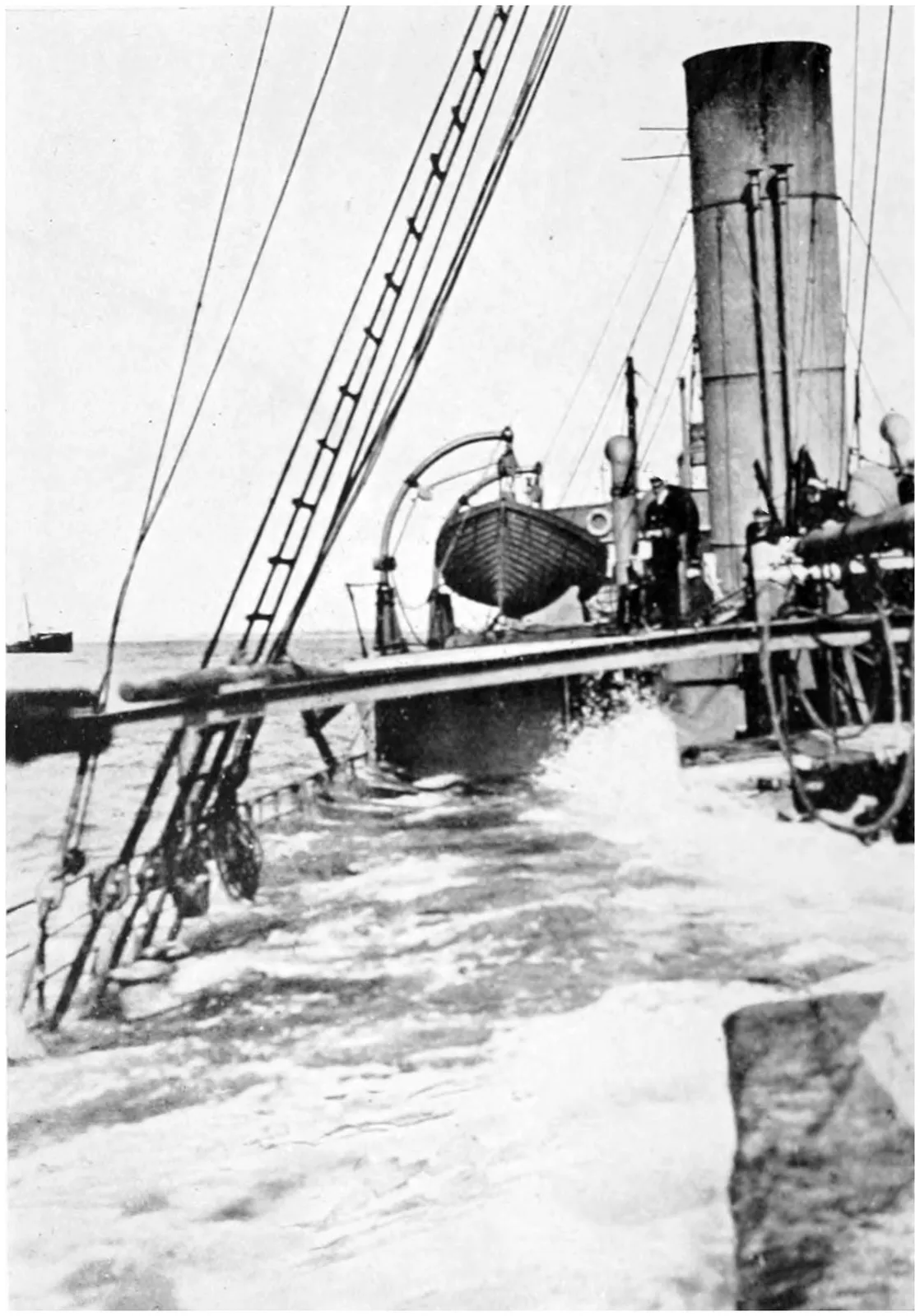
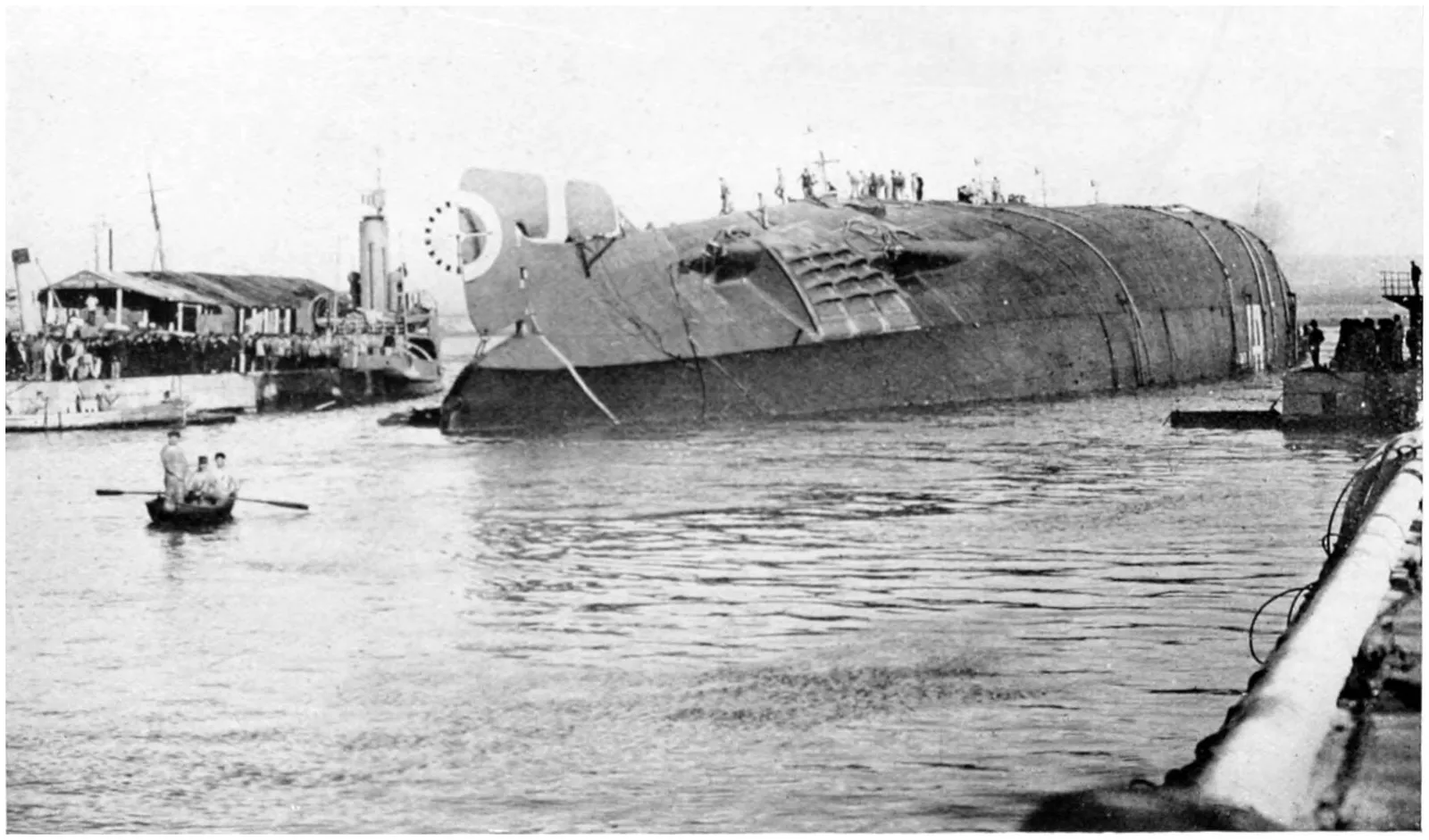
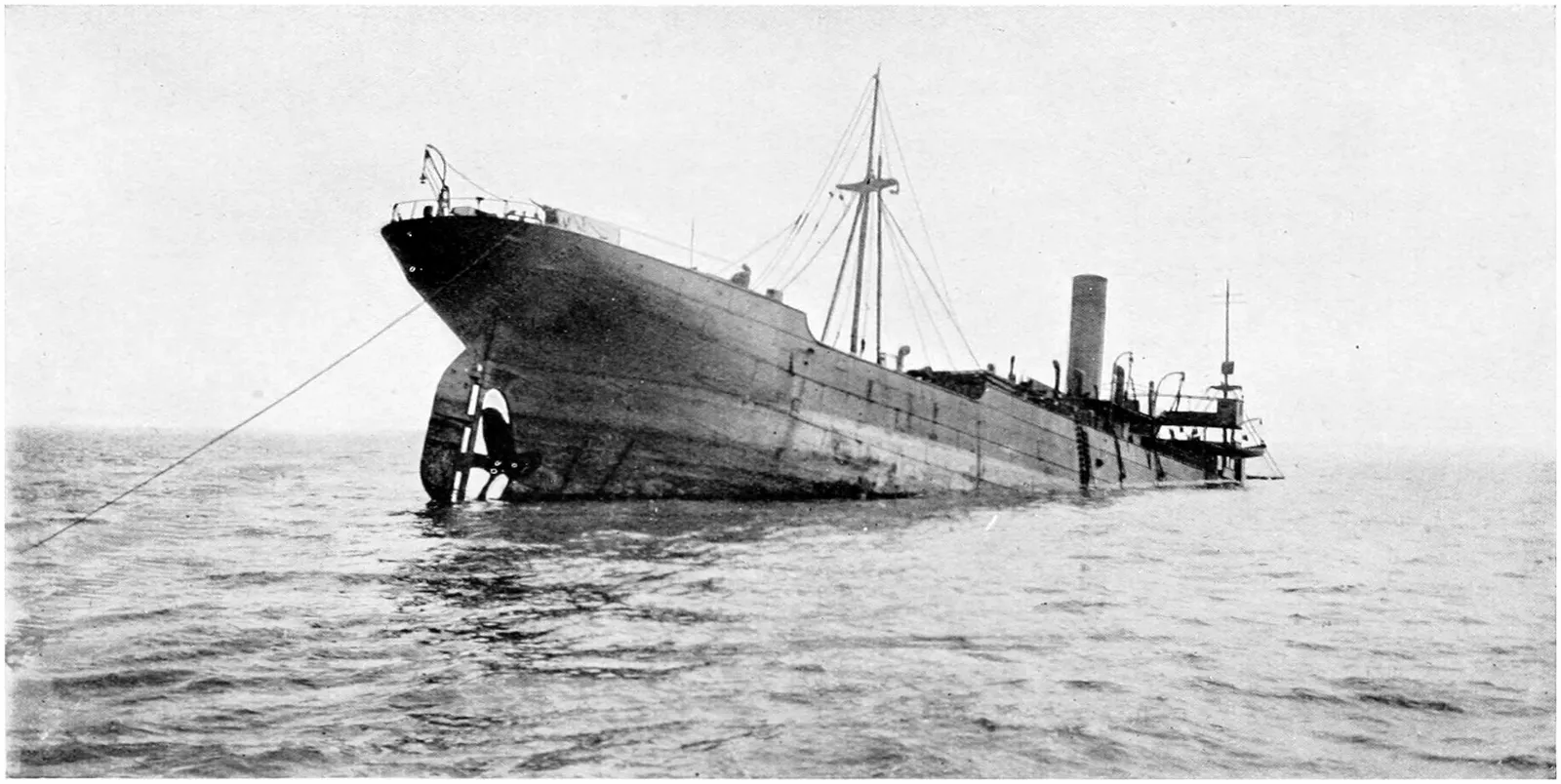
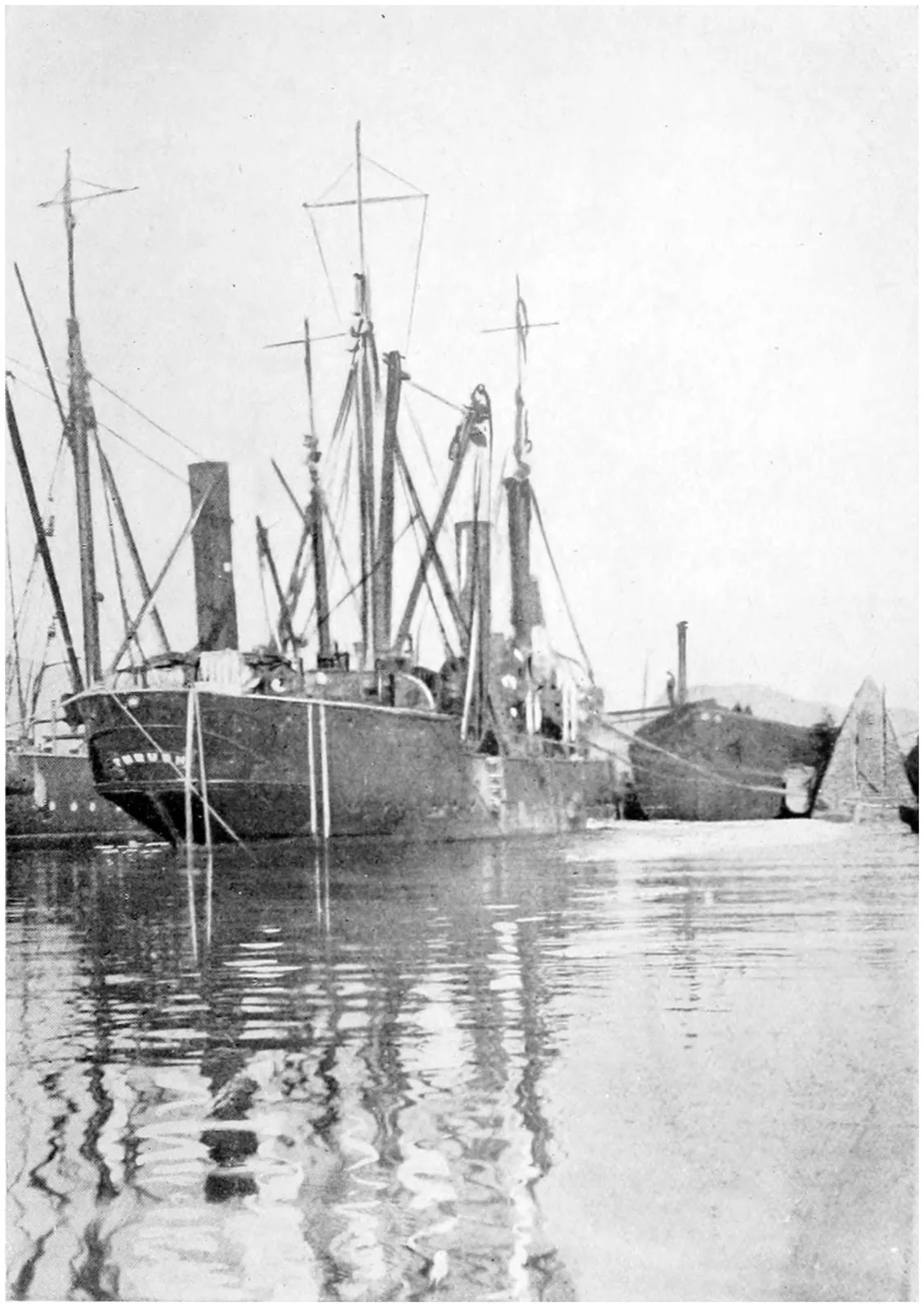
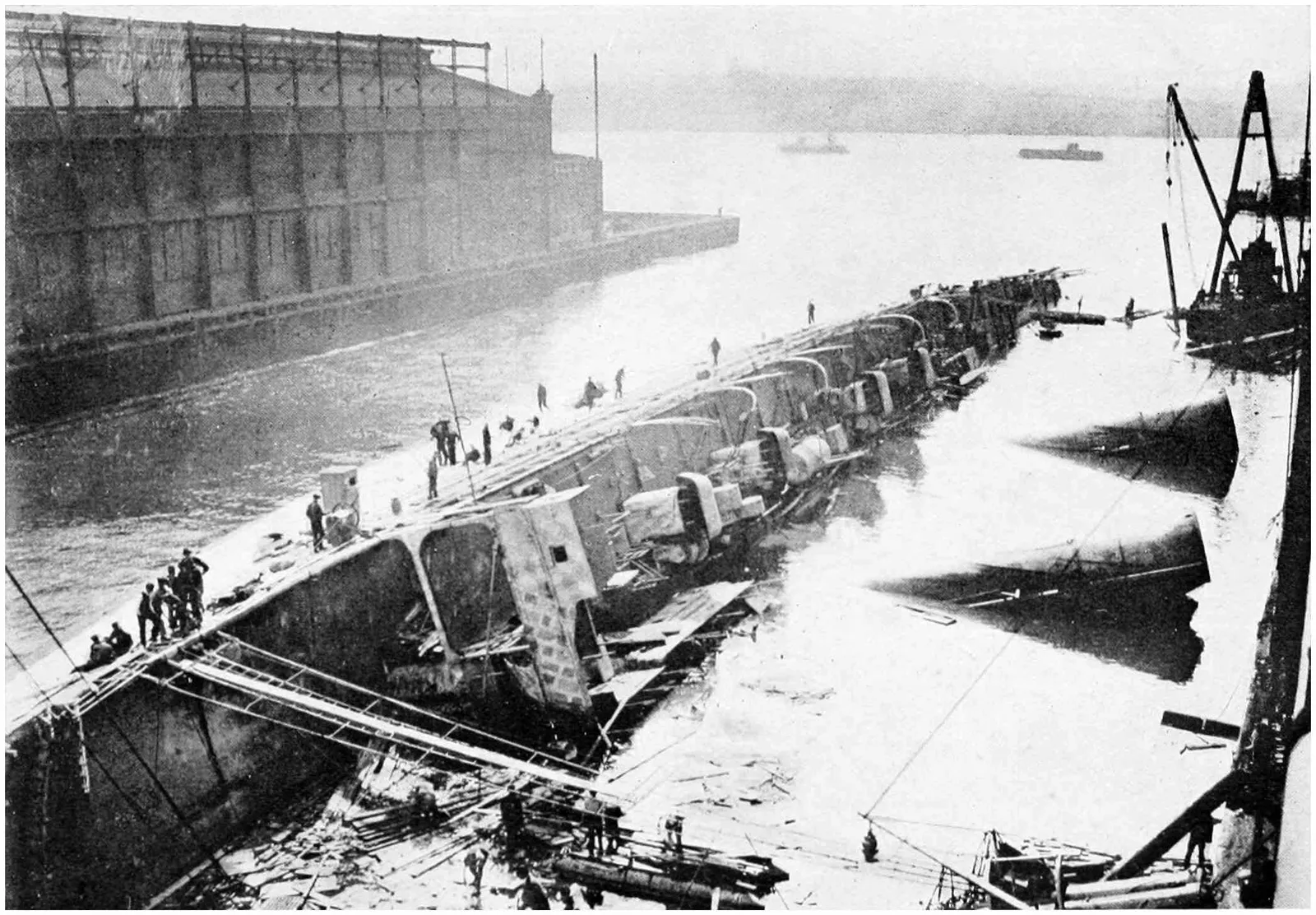
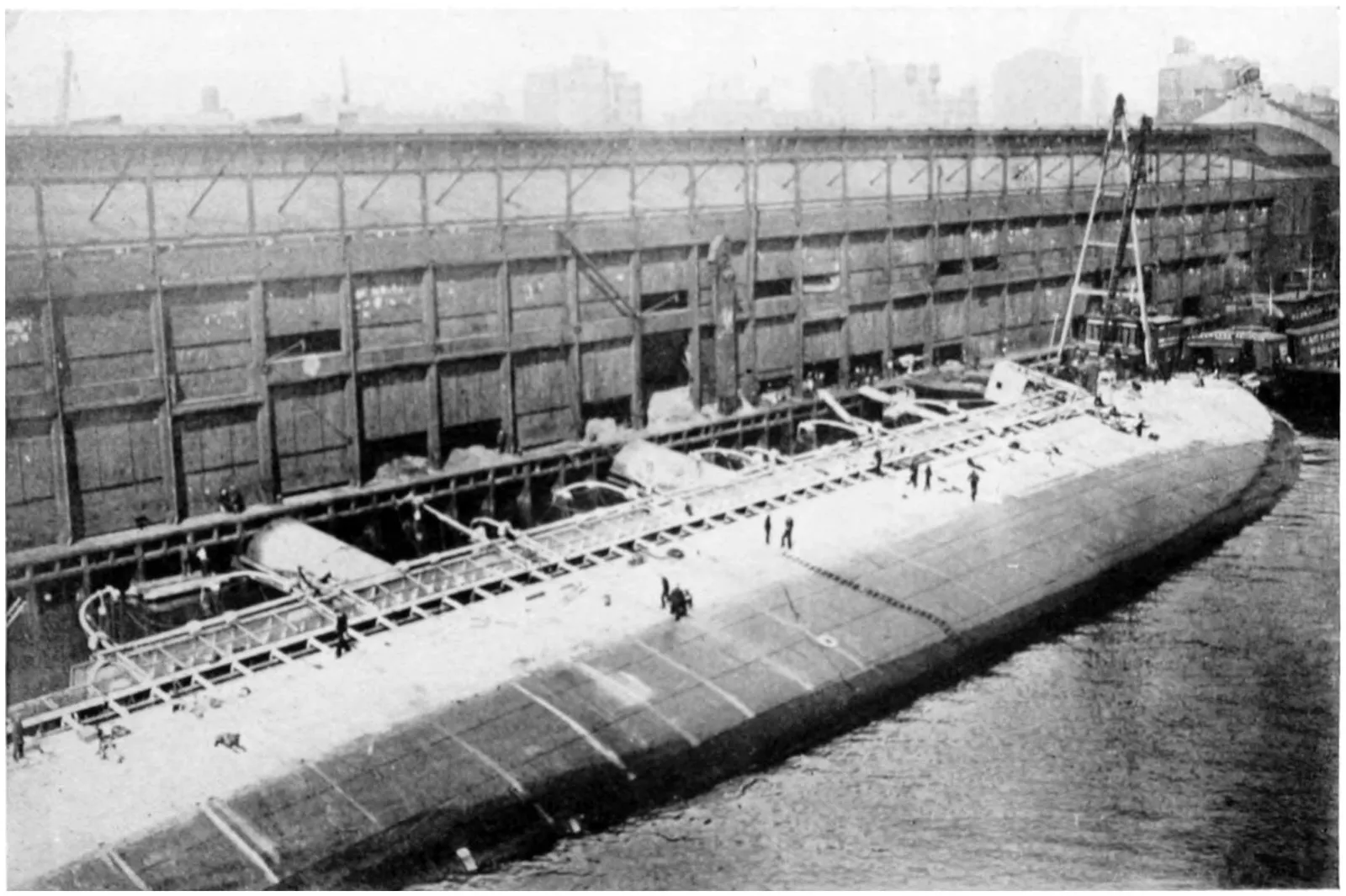
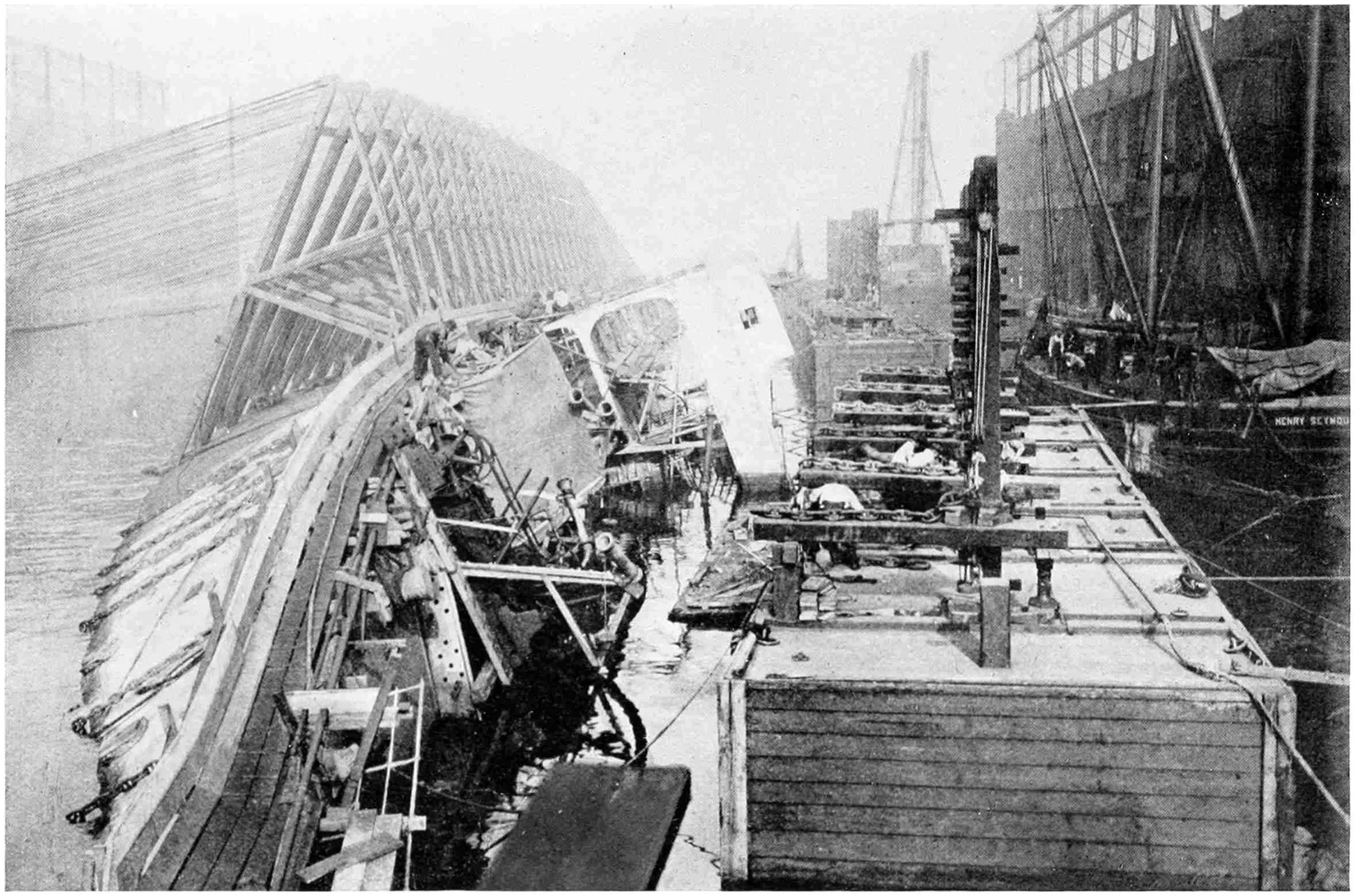
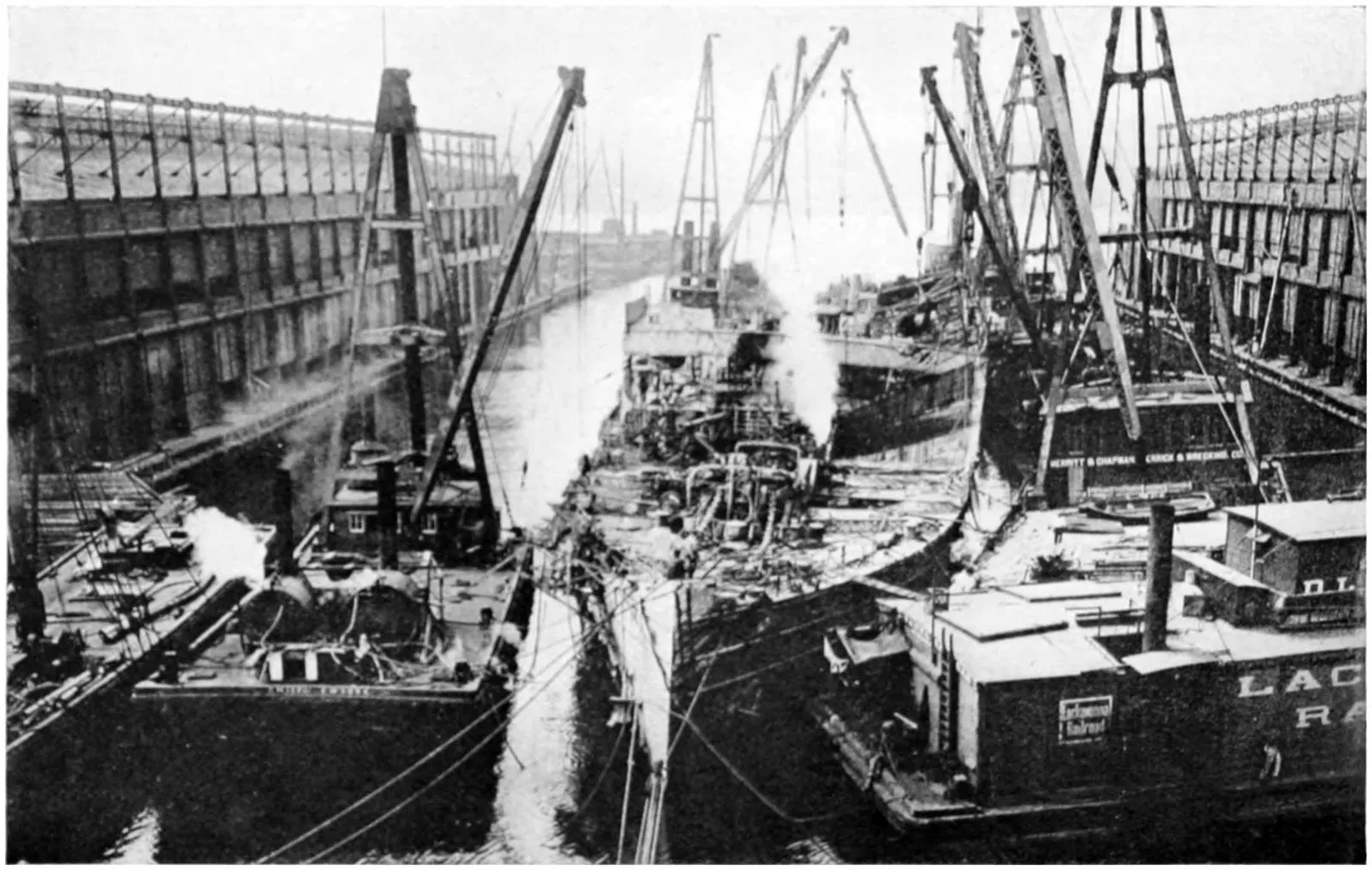
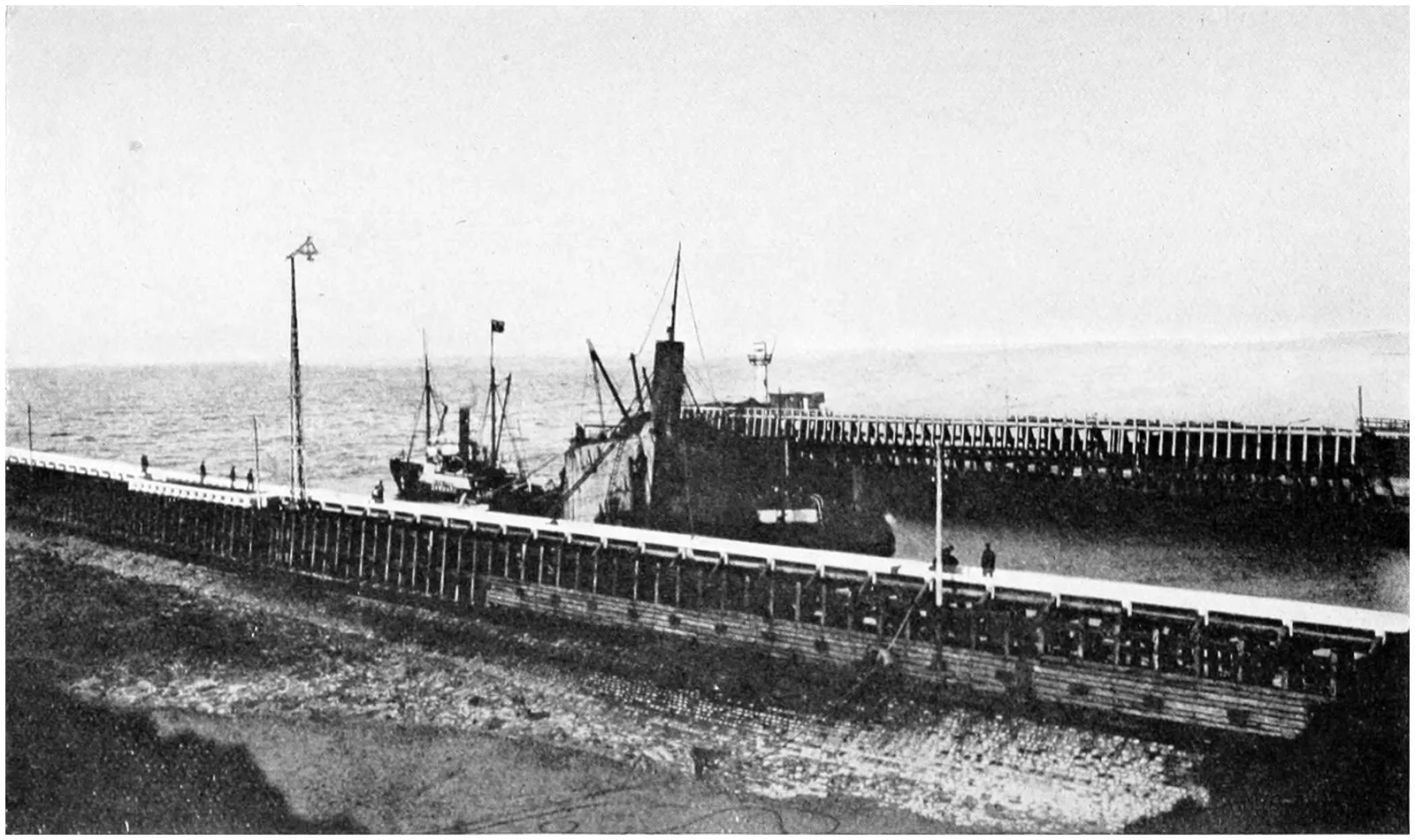
HOPELESS AS THE S.S. DEVONA’S POSITION SEEMED ON SEPTEMBER 15, 1917, THE
SALVORS MANAGED TO RAISE HER IN FOUR DAYS. VERY CLEVERLY THEY RIGGED
UP SOME WIRE MATTRESSES INTO WHICH THEY PUMPED HER CARGO OF WHEAT,
THUS DRAINING OFF THE WATER AND SAVING THE GRAIN
THE WONDERS OF SALVAGE
BY DAVID MASTERS
WITH FORTY-EIGHT ILLUSTRATIONS
FROM PHOTOGRAPHS
LONDON
JOHN LANE THE BODLEY HEAD LIMITED
First Published in 1924
MADE AND PRINTED IN GREAT BRITAIN BY MORRISON AND GIBB LTD., EDINBURGH
With eyes gazing fixedly ahead, the man,
tense and alert, sought to penetrate the
blackness. Squalls of rain swept down
and lashed his face, the flying spume of spray shot
up to intermingle with the rain, leaving a tang of salt
on his lips. The liner lurched and rolled through the
night, while thousands of souls aboard slumbered without
fear, placing implicit trust in this one man to whom
the pulse of the engines driving the ship was as familiar
as the pulse of his own heart. Rain and spray and
wind were part of his life, and he accepted them
without demur because he realized that the weather
was indifferent alike to praise and blame.
He half turned his head to glance at the ship’s
chronometer.
“Should be picking her up now,” he muttered.
Raising the night-glasses to his eyes, he concentrated
all his powers of vision on the murky gloom in
front of him. His glasses roved slowly from side to
side, then a point of light, so dim as to be almost imperceptible,
swung in the blackness and vanished.
For a minute he waited until the light reappeared,
then he breathed freely and rang down for the ship to
alter course, knowing that he was safe and that he had
justified the faith of the passengers who had trusted
him to navigate his vessel through the storm.
That point of light which meant so much to him
was the beam of a lighthouse, one of the many encircling
our coast. All round our shores they keep
sentinel night after night, through summer calm and
winter blizzard, waking to life as daylight fades and
dying as dawn steals over the seas. These lights,
which the city dweller on a brief visit to the sea watches
with such interest, are the friends of all who go down
to the sea in ships.
Our coasts are profoundly treacherous. Rocks,
shoals and quicksands abound everywhere, and are
mostly marked with lighthouses, lightships and buoys
which in the aggregate have cost millions of pounds.
No expense has been spared to indicate these hidden
dangers and make our seas safe for shipping. Yet, in
spite of all that human foresight can suggest, wrecks
still occur. Gales spring up and take their toll; fogs
steal on and drive ships blindly to their doom;
machinery breaks down and allows the seas to hurl the
helpless craft upon the cruel rocks.
Probably no coast in the world is so well lighted as
that of Great Britain, but although there are over 1700
lights acting as signposts of the sea, warning mariners
of their dangers, our rocky shores exact a grievous
toll of shipping year by year. It is estimated that the
average value of the ships and cargoes lost in British
waters amounts to about £5,000,000 annually, so the
wealth spilled out of the ships since the galleys of our
first invaders found a watery grave would, could it be
recovered, considerably lighten the burden of our
national debt. Unfortunately the greater part is lost
for ever, for the sea which has swallowed the ships
destroys them utterly in the course of time, and unless
they can be salved within a certain period they soon
become not worth salving. The action of the sea
water rots away the cargoes, rust gradually devours
the steel and iron carcass of the ship, and only those
two indestructible substances, gold and silver, the
white and red metals for which men have fought
and died throughout the ages, remain of the wealth
which was originally lost.
Men, however, have not been content to see fortunes
sink in the sea without making some effort to recover
them. They have pitted their wits against the strength
of the sea, risked their lives to wrest long-lost treasure
from the grasp of the ocean, and the story of their
thrilling deeds is one of the outstanding pages of human
endeavour.
Consider, for a moment, the wonder of a ship. She
is a marvellous structure of steel and iron, full of the
most intricate machinery, a structure weighing perhaps
thousands of tons. Of the manifold parts of which
she is composed, the wood fittings alone may be
buoyant. Only they may possess the power of floating
on the waves; all the other parts, from the smallest
screw and rivet to the mighty propeller shafts and hull
plates would, if they could, sink like stones to the
bottom of the sea. This enormous mass of metal,
which in its natural state must sink, is so cunningly
fashioned by man that it overcomes its natural inclination
to sink and is made to float. The huge
weight is supported by water, men toil in the bottom
of the ship 20 and 30 feet below the surface of
the sea and are oblivious of any danger. The water
on the outer side of the steel skin of the ship towers
20 and 30 feet above their heads, yet they sleep
and eat and work in perfect safety. So long as
the sea is prevented from washing over the sides of
the ship or entering through a breach in the hull the
vessel floats, would continue to float even were she
made of lead. In other words, she is buoyant. Only
when her buoyancy is destroyed does she sink. Then,
before she can float again, her buoyancy must be
restored.
This is the simple problem that is always confronting
the sea salvage expert. How can he restore the
buoyancy of the ship that meets with misfortune?
Simple as is the problem, it is seldom that the answer
is easy. To the salvor every wreck is a riddle. Tides
and currents make the riddle more complex. The
position in which the wreck is lying profoundly affects
the case. And, above all, operates the unknown
factor of the weather. Whatever the salvage expert
hopes to do, he always adds to himself “Weather
permitting!” He may be the cleverest man alive,
his plans of salvage may be the most brilliant ever
conceived, he may have the most expensive plant at
his disposal and all the money he seeks at his command,
yet he is helpless unless the weather be fair. Plans
may be put into operation, work may go smoothly,
everything may be within an ace of success—when the
tail of a gale may blow the plans to pieces, shatter the
work and rob the salvor of the success that seemed
within his grasp. It has happened before many times,
and it will happen many times again.
The men who get a living by trying to raise wrecks
are farseeing, sparing of words, patient where patience
is demanded, quick as a rapier thrust where quickness
is essential, capable of toiling until they drop if it be
necessary. Every contingency that it is possible to
think of they consider, but the weather is something
beyond their control. They pray for fine weather,
and fight against foul to the best of their ability; but
when the wind takes hold man and his endeavours
are as nothing.
Hard as some of the salvors have worked for their
successes, others have worked harder still for their
failures. Often and often they have striven strenuously
for weeks and months to salve a ship, only to
lose her in the end. The luck of the game is indicated
by a case which occurred a year or two ago. A vessel
went down on the summit of a rock jutting sheer
from the seabed. On all sides was water so deep
that she had but to slip to be irretrievably lost. The
salvors, hurrying to the scene, found her balanced
most precariously on a ledge. A glance told them
that, before they could make the slightest attempt
to salve the ship, they would have to strive their
utmost to secure her firmly in position on top of the
pinnacle of rock. They routed among their gear for
cables and anchors and, making the cables fast to the
ship, carried out the anchors in all directions in order
to tie her tightly into place.
Then they began to work against time, keeping a
keen eye on the sky and praying for fine weather,
knowing full well that if the weather held fair they
would save the ship and that the coming of bad weather
would seal her doom. Day after day they toiled like
giants, struggling with huge baulks of timber, shoring
up decks, strengthening bulkheads, patching breaches
in the hull. The weather favoured them. Day after
day it remained fine and enabled them to carry on
their operations quite unhampered. They had been
hard at it for nearly a month before the breeze began
to freshen in rather an ominous manner. They were
just beginning to anticipate rough weather when the
wind luckily died away and they breathed freely once
more.
They redoubled their efforts, and six weeks of
intense toil saw their work completed. The last
timber was bolted securely in place and the divers
came out of the wreck, announcing that all was ready
for pumping out on the morrow. The salvors turned
in for the night well pleased with their labours, conscious
that the next day would see them proceeding
to port with their prize.
But the weather, which had been kind to them so
long, was destined to cheat them at the very last.
That night it began to blow. The seas started to
rise and hammer at the ship. She began to stir
uneasily and to strain at her cables. The gale increased.
Under the continuous chafing, one cable
suddenly snapped. The breaking of that cable gave
the wreck more freedom to move under the hammer
blows of the sea. The waves battered at her incessantly
and one cable after another went like threads
of cotton until a billow, far mightier than the rest,
caught her up and swept her off the pinnacle into the
depths.
Imagine the feelings of the salvors when day dawned.
All their gear was gone, their labours lost when the
prize was within their grasp. They steamed slowly
round the spot and proceeded to port, hoping for
better luck next time. That was the only thing
they could do.
Men who spend their lives on salvage work are rather
apt to lead the casual inquirer to imagine that it is
the easiest job under the sun, whereas in reality the
task is beset with difficulties and bristles with risks.
But the sailormen in their matter-of-fact way forget
to mention the ever-present danger. They are inured
to it, just as people are habituated to living on the
slopes of a volcano that may erupt and overwhelm
them at any moment of the night or day. None the
less the salvors never forget the risk, nor leave it out
of their calculations, and for this reason fatal accidents
among them are rare. They know the strength of
the sea too well to attempt to take liberties with it,
for they have seen it pick up great 10,000 ton
ships and toss them on the rocks as though they were
cockle-shells; they have seen the strength of 70,000
horses in the engines of a ship struggling in vain
against the strength of the waves, and they know
better than to pit their power against the power of
the storm.
Thus they have a wholesome respect for wind and
wave. They use the strength of the sea to further
their own ends so long as the sea permits. At
other times they may stand by a wreck for weeks
while the sea seethes and the wind howls about the
ship they seek to save. A lull in the bad weather
will set them working frantically, and more than one
ship now afloat owes her existence to the accumulated
labour of a number of short spells of work undertaken
between the gales.
The salvage man must thus be infinitely patient
and possess a determination that will keep him at
work when most other men would give up in despair.
Above all must he be strong in hope. Without hope,
no man need seek to become a salvage expert, for
he would be foredoomed to failure. He must possess
not only physical courage that enables him to face
the dangers of his calling, but also that rarer mental
courage that enables him to snatch victory out of the
very jaws of defeat.
It is the men who possess this mental as well as
physical courage who perform the wonderful feats of
salvage that will never be forgotten, such as the recovery
off Gibraltar of the steamer Hypatia, which the
salvors brought to the surface after an infinity of
trouble. No sooner was she raised than she filled
and sank like a stone.
There was nothing for it but to do the work over
again, which the salvors managed to do. For the
second time the Hypatia was brought to the surface,
and once again she sank, seeming to mock the efforts
of her would-be preservers. Still they were not
beaten. With grim determination they made another
effort, and after a great fight managed to raise the
Hypatia once more. All in vain! For the third time
she sank.
Notwithstanding these three reverses, the salvors
would not give up the fight. Again the divers went
down, and their strenuous exertions ended in the
Hypatia seeing the light of day yet again. Not for
long were the salvors allowed to rest after their labours.
Down she went for the fourth time, while the sea
bubbled and boiled around.
Few men would have continued a fight which
appeared so hopeless. But the salvors would not
admit themselves beaten. Although Fate seemed to
be taunting them, they had the courage to take their
task in hand for the fifth time, and this time they
succeeded. Truly it can be said that no men more
fully earned their reward than these salvors who
triumphed after four defeats.
CHAPTER II
From earliest years our imaginations are fired
by the mere mention of treasure. Who has
not heard of that fabulous treasure of the
bloodthirsty pirate, Captain Kidd, whose booty still
lies hidden on some far-off island? Expedition after
expedition has been fitted out to find it, but the pirate
hid it so well that the hunters have failed in their
quest. Who has not marvelled at those mighty
hoards of gold stored away by the Incas of Peru, gold
which Pizarro looted from the Peruvian treasure-house
and carried back to Spain?
Treasure! The mere whisper works magic, conjuring
up pictures of gold and silver and piles of
glowing gems—rubies, emeralds, and diamonds galore,
gleaming with all the colours of the rainbow. So
fascinating is the idea of treasure that men gladly
risk their lives to go in search of it; nor is the magic
confined alone to the romantic. The keenest of
business men, who boast of their hard-headedness,
seem to lose their heads where treasure is concerned.
Eagerly they fling down the funds to prosecute the
most problematic searches, in return for the promise
of the most shadowy spoils.
These same business men will aver that they never
speculate, yet all treasure-hunting is speculative, and
if there is one form more speculative than another it
is that of searching for sunken treasure. Still, despite
its hazardous nature, there is always money forthcoming
to back deep-sea enterprises of this description.
True, success comes but seldom—failures are
the rule. Could a correct balance-sheet be made up
showing how much has been spent on hunting for the
world’s sunken treasure and how much has been
recovered, we should probably find that the money
expended was many times greater than the value of
all the treasure brought to the surface.
Few ideas could be more fascinating than that of
hauling up gold and silver from the bottom of the
sea, and it is this same fascination, with all the excitement
it brings in its train, which lures men on to
attempt to wrest many of these long-lost treasures
from the recesses of the ocean. Years sometimes are
spent in pondering ancient documents, hunting for
evidence of the exact locality of the vanished treasure,
seeking to sift rumour from actual fact. Further
years may be spent in making plans and special
apparatus for lifting the treasure, and, when the
hunter starts in real earnest, he finds at last that he
has spent years of his life and thousands of pounds
just for the privilege of stirring up the seabed.
Treasure-hunting is, in fact, something like taking a
ticket for a sweepstake. The chances may be ridiculously
small, but the prospect of winning a fortune
will always make the game popular.
Fate, indeed, seems to delight in playing tricks on
salvage men. While, on the one hand, it sometimes
leads them on to fit out ambitious expeditions costing
thousands of pounds, sends them journeying afar and
imposes the greatest hardships upon them without
bringing them any reward whatsoever; on the other
hand, it sometimes flings a fortune straight into the
lap of some lucky man when he is least expecting it.
Lord Leverhulme, in illustrating the vagaries of
Fate, related how an Australian firm once owned an
island in the Pacific, a rocky little place with a few
coco-nut trees that gave their crop of nuts which were
duly dried in the sun and turned into copra and coco-nut
oil. Their trading schooner used to visit the
island to load the copra, and on one of the trips the
captain happened to pick up a piece of rock and put it
aboard the ship. In due course that piece of rock
went back to Australia with the copra, and was used in
the office to keep the door open when the weather was
sultry.
The firm acquired their island to make money out
of it, but although the coco-nut trees brought them a
profit, they certainly did not bring them a fortune.
The question arose as to whether it was worth their
while retaining the island, and after due consideration
they sold their property to some one else, and
thought no more about it.
Entering their office one day, a professor from the
university chanced to kick against the stone that was
propping the door open. He stooped down, picked it
up, scrutinized it closely for a minute or two.
“Where did you get this?” he demanded.
“Oh, that’s a bit of rock our skipper brought back
from one of our islands,” was the reply.
The professor looked at the rock again. “Do you
know what it is?” he asked.
“Just a bit of stone,” came the answer.
“I don’t know,” said the professor, “but I think it’s
phosphate. I’d like to take it away and analyse it, if
you’ll allow me.”
Permission was, of course, granted, and the professor
walked away with that bit of rock which scores of
men had kicked against at the door. Taking it to his
laboratory, the scientist carefully analysed it. He
found it to be a sample of the richest phosphate in the
world. The original owners had bought the island as
a business proposition, but they failed to realize the
fortune that was theirs. That rocky island turned
out to be one mass of phosphate, worth about
£100,000,000—and they had let it go for a few
hundreds! Of all who had stumbled over that lucky
door-prop, the professor was the only one who had
the sense to see the fortune lying at his feet.
The counterpart of the professor who saw a fortune
in that neglected lump of rock was the diver who
heard the whisper of truth in a rumour. The work
of this diver took him to the coast of Galway, where
he was engaged on salvage work that was to last some
little time. He was a companionable sort of man and,
after finishing his spells of work, would adjourn to the
tap-room of the village inn to spend his evenings in
yarning with the fisherfolk.
For years a story had been current in the neighbourhood
that a Spanish galleon, one of the ships of the
Armada, had gone down in the vicinity. Those who
heard the yarn smiled. “It’s just a rumour,” they
remarked.
Whether it was merely a rumour, or something
more, the story had been told from father to son for
generations. So persistent a rumour was it that it
survived century after century, living in the traditions
of these simple Irish fisherfolk, passed on by word
of mouth in the little community, until it survived to
our own times. Most of the fishermen knew the yarn
of the sunken Spanish galleon, but perhaps the passage
of time had made many of them rather sceptical.
Anyway, one evening the diver was enjoying his
pipe and his beer and talking about his work, when
an old fisherman said to him:
“Why don’t ye thry for the galleon?”
“What galleon?” the diver inquired.
“Why, yon one wrecked just outside the bar,” the
fisherman answered. “Ye can walk about the seabed
in that suit of yours?”
“I do it every day,” the diver replied.
“Well, why don’t ye walk out and get the treasure?”
The diver smiled. “Show me the treasure, and
I’ll soon get it,” he said. “Where is it?”
Solemnly the fisherman looked at the diver. “My
father, he told me, and his grandfather, he told him.
A mighty ship from Spain it was, full of treasure,
that went down in a storm. They saw it from the
shore here.”
Puffing away at his pipe, the diver considered the
matter. The story in his judgment might easily be
true.
“Show me the spot, and we’ll share the treasure,
if there is any,” he said.
“All right,” the old fisherman agreed. “She’s
there all right. Sometimes we catch our gear in
her.”
Completing the task on which he was engaged, the
diver began his search for the sunken treasure. Day
after day he and the old fisherman went out in a
rowing-boat, threw a grapnel over the stern and
dragged it about the seabed in the hope of lighting
on the wreck. Many of the villagers laughed at them
and thought them crazy, but the two treasure-hunters
paid no heed. They just went ahead with their
monotonous task, buoyed up with the hope of the
treasure to come.
The end of the first week saw them as far off the
treasure as they had been on the first day. They
dragged on through another week with a like result.
A month of fruitless endeavour failed to rob them of
their faith in the truth of the old story of the wreck.
Week after week they searched the area in which the
wreck was supposed to lie, tugging placidly at the
oars, dragging the grapnel along the bottom.
One day the fisherman was rowing slowly along
when the diver felt his grapnel catch in something.
He gave the rope a sharp tug, then another, but the
grapnel held firmly.
“We’ve got her,” he said.
Marking the spot with a buoy, they rowed ashore
for the diving suit and air-pump, then they went back
to where the buoy floated on the surface. The diver
donned his suit; the fisherman screwed the helmet
securely into place, started to heave the handle of
the air-pump as the diver went over the side and
slid down the shot rope to the bottom. The ghost of
the galleon greeted his eyes, the skeleton of the ship
of long ago. For three centuries she had lain undisturbed
in her watery grave, slowly rotting away until
she had all but vanished. The diver climbed over
the rotten remnants of the hulk into what had once
been the hold of the ship. The place was full of
weed; fish fled at the approach of the strange monster
that was invading their domain; barnacles and sea-growth
flourished on the decaying timbers.
With the same patience that had enabled him to
locate the wreck, the diver searched the seabed until
at last he came on what appeared to be several small
barrels. He went up to them, tapped them. The
much talked-of treasure was his at last. Beneath
his fingers were solid stacks of Spanish doubloons,
from which the wood had long since perished, leaving
the coins still shaped like the barrels into which the
Spaniards had packed them when they set out on that
ill-fated expedition of theirs to conquer England.
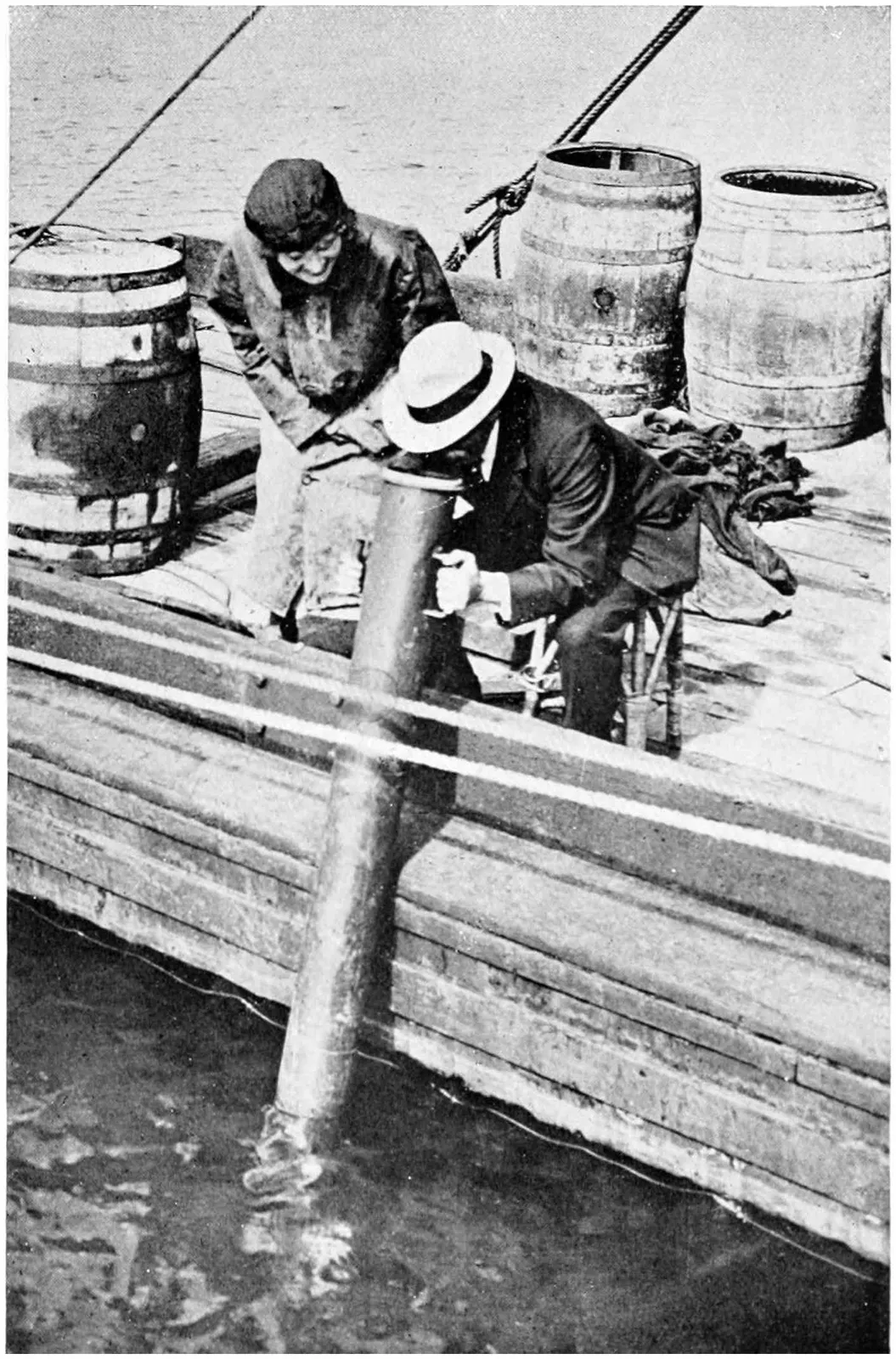
TREASURE HUNTERS EXAMINING THE BED OF TOBERMORY BAY IN THE ISLE OF
MULL THROUGH A SPECIAL INSTRUMENT INVENTED FOR THE PURPOSE
These two men, with a diving suit and rowing-boat,
found a greater treasure than has fallen to many a
powerfully-equipped expedition, and it is strange to
think that the fisherman who hauled the doubloons
up from the bottom was probably a direct descendant
of one of the Irish peasants who stood on the shore
on that wild Armada night in 1588 and watched the
mighty Spanish ship founder. The diver had the
good sense to realize that there might be something
in the old story, he spent weeks investigating it, and
he reaped a snug little fortune as his reward. Nor
did he squander the treasure that Fate flung his way.
The same good sense which enabled him to find it
also enabled him to keep it, for he turned his Spanish
doubloons into a row of houses which he called “Dollar
Row” in order to perpetuate his good luck.
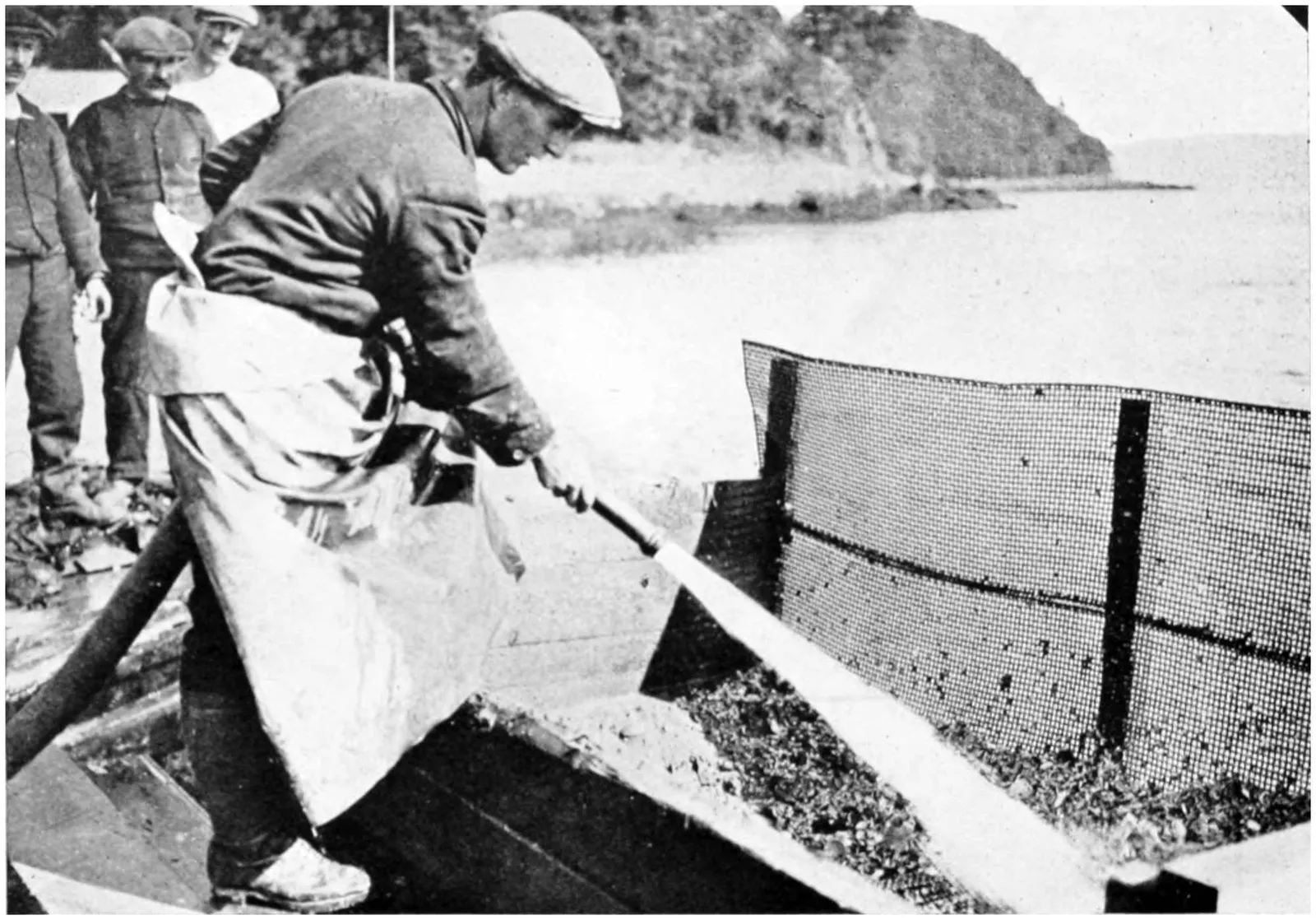
HARD AT WORK HUNTING THE TREASURE OF TOBERMORY. WASHING THE MUD AND SAND DREDGED UP PROM THE
BAY IN ORDER TO FIND THE SPANISH DOUBLOONS REPUTED TO BE LOST HERE OVER THREE CENTURIES AGO WHEN
WILD WEATHER HELPED DRAKE TO ROUT THE ARMADA
It is another tale of the Spanish Armada, a tale
which up to the present has not ended quite so happily,
that lures men to try their luck in the Bay of Tobermory
in the Isle of Mull just off the west coast of
Scotland. Somewhere beneath the waters of this
pleasant bay is averred to lie a treasure so prodigious
that it would make its discoverer a millionaire twice
over. Here, if tradition speaks truly, a man has the
chance of dragging from the seabed beautiful jewels
and wonderful golden cups, with Spanish doubloons
worth at least £2,000,000 which went down with the
Florencia.
Many who have studied the question believe that the
Florencia undoubtedly sank here, but an element of
doubt creeps in when it is known that the Spaniards
themselves swore that the Florencia returned after
the disastrous expedition. During the Great War
the British Government did its best to conceal the loss
of H.M.S. Audacious in order to deceive the Germans
as to the strength of our navy, and it may have been
the Spaniards, three centuries ago, who introduced
this practice. About this, nothing is known with
certainty. It all happened a long time ago, and the
years have tended to obscure the facts. Whether the
statement that the Florencia returned was true, or
whether it was a deliberate falsehood spread forth to
give her enemies the impression that Spain was still
strong in ships of the line, is an open question.
Whatever be the name of the vessel, the evidence
that a Spanish galleon actually did founder in Tobermory
Bay in 1588 seems fairly strong. Moreover, it
is backed up by material facts in the shape of a cannon,
some cannon balls, a weapon or two and a doubloon
that have been brought up from the bottom of the
bay by different treasure-hunters.
From what we can gather of that distant happening,
it appears that the Spaniards, sailing down the Scottish
coast in their galleon, and seeking perhaps to replenish
their water-casks, must have made a foray or two
ashore. During one of these they captured a Highland
chief, one Donald Glas M‘Lean, whom they held
prisoner aboard their ship. So bitter a blow was it
to the Scottish chieftain that, reckless of his own life,
he sought a terrible revenge. Waiting his opportunity
while the ship was anchored in Tobermory Bay, he
managed to enter the powder magazine. In a moment
or two his revenge was complete. The mighty galleon
blew up and the proud chief accompanied her crew of
nearly 500 Spaniards to their doom.
Many a tide has ebbed and flowed, many a storm
arisen and subsided since that catastrophe. Timbers
have decayed, and mud and sand have gradually
covered up the remains. The treasure by now may
be buried 20 or 30 feet at the bottom of the bay
and, unless some lucky chance leads an expedition to
hit on the exact spot, may remain buried there for
ever. Divers may have walked over the treasure
dozens of times without knowing that the gold and
silver they were seeking lay actually under their feet.
The Duke of Argyll, who possesses the right to salve
the treasure, has proved his belief in its existence by
spending considerable sums in hunting for it. In
addition he has given permission for several expeditions
to prosecute the search, and these expeditions,
in the aggregate, must have expended a deal of money.
The lack of success on the part of previous expeditions
seems in no wise to deter others from following in their
steps, and the last expedition to work in Tobermory
Bay reflected the great changes of modern life by
including a lady diver among its members.
Meanwhile the treasure of Tobermory Bay, which
has excited the minds of treasure-hunters for many a
generation, still awaits discovery.
CHAPTER III
Whatever doubts there be about the
treasure of Tobermory, there can be
none about the treasure of the Lutine,
for official records prove that when she came to grief
she must have carried bullion worth over £1,000,000.
H.M.S. Lutine was a frigate of thirty-two guns, one of
those wooden walls of Old England of which the poet
sings. Not always had she sailed under the British
flag. Time was when the tricolour of France broke
at her masthead and French sailors crowded her
decks, but Admiral Duncan captured her and brought
her home as a prize, and thereafter it was the white
ensign of England that flew at her peak and a captain
of the British Navy who commanded her.
In the early days of October, 1799, at which time
we were warring with Holland, H.M.S. Lutine was
lying at Yarmouth, while the British troops garrisoned
on the island of Texel off the Dutch coast were waiting
anxiously for their pay. The Lutine was commissioned
to carry the £140,000 due to the troops, and, hearing
that she was departing for the Continent, many
merchants sought permission to ship gold and silver
by her for the relief of the merchants of Hamburg,
who were financially embarrassed by the wars and
the ensuing depression of the money market. The
permission was readily granted, and 1000 bars of gold
and 500 bars of silver were taken to Yarmouth and
safely shipped aboard. In the ordinary course of
business, the owners of the bullion went to Lloyd’s
and effected an insurance for the sum of £900,000.
On October of the year stated, the Lutine weighed
anchor and sailed out of Yarmouth Roads on her
voyage to Hamburg. As she bowled across the North
Sea, the wind freshened and culminated that night in
a terrific gale which the Lutine, gallant ship as she
was, could not weather. The treacherous shoals off
the Dutch coast reached out for her, and the mighty
seas battered the life out of her and engulfed her. Of
all aboard, but one human soul survived to tell of the
wreck before he, too, succumbed from exhaustion.
The loss of the Lutine was a tremendous blow to
Lloyd’s. It meant that the underwriters had to find
the sum of £900,000 with which to meet the claims of
the insurers. Somehow they found the money and
met all claims, thus adding fresh lustre to the name of
Lloyd’s and helping to raise it to the position it occupies
to-day as the greatest and most powerful marine
insurance association in the whole world. In return
for their £900,000 the underwriters became possessed
of the treasure—or rather the right to recover it!
At that time, immediately after the calamity, when
salvage operations naturally stood the best chance of
success, the underwriters were prevented from doing
anything at all owing to our war with Holland, and
later on the Dutch Government made its position
clear about the matter by claiming the wreck and all
that was in it.
As the vessel lay, it was just possible to get to her
when the sea was calm and the tides were at their
lowest. It can be imagined that the Dutch fishermen
made the most of their opportunities. Their government
encouraged them by offering them one-third of
everything they recovered, so the fishers found it
profitable to leave their nets and spend their time
fishing in the Lutine. Although the bulk of the treasure
was beyond their reach, they managed during the
next couple of years to lay their hands on a good deal
of it. The Dutch Government received from the
wreck treasure to the value of £56,000, and of this
over £18,000 was paid to the salvors, while the rest
was minted into Dutch money.
The amount of treasure which passed into the
hands of the Netherlands Government during this
period was not necessarily all the treasure that was
taken out of the Lutine. It is possible, and indeed
probable, that much of the treasure recovered was
concealed by the fishermen salvors and used secretly
to swell their own private hoards; but, even assuming
that twice as much treasure was salved as was actually
declared, there would still be a vast treasure worth
over £1,000,000 remaining in the wreck.
A series of fierce storms wrought havoc with the wreck
and placed her quite beyond the reach of the fishermen,
who were at last forced to abandon their profitable
quest. For years the wreck was the plaything of the
storms, and not until Napoleon was safely imprisoned
on St. Helena did any one give a thought to the treasure
that lay amid the shifting sandbanks off the island of
Vlieland. Then a Dutchman, going to his government,
obtained a concession to salve the bullion on
condition that half of what he recovered went to the
government. For two or three years he fought the
sea and sand to get at the treasure. No sight of gold
or silver gladdened his eyes. Season after season, for
eight years in all, he did his utmost to recover the
fortune from the grasp of the sea, but without success.
At last, weary of the incessant combat, he gave up
the struggle and left the treasure to mock any other
adventurer who might happen along.
The underwriters at Lloyd’s, however, were not
content to see the treasure which had cost them such
a huge sum of money pass into the hands of a foreign
nation, and at their request the British Government
began to treat with that of Holland to induce them
to relinquish their title in the wreck. The ways of
diplomacy are often long and tedious, and this case was
no exception. Many years elapsed before an agreement
was arrived at and the Dutch gave up their
claims and allowed the legal title in the treasure to
pass to Lloyd’s, its rightful owners.
For well over half a century the Lutine bore the
brunt of the gales which afflict the Dutch coast,
spending their strength on the belt of islands and the
shifting sandbanks at the entrance to the Zuyder
Zee. She was utterly lost amid the sands. Then
came a terrific gale that blew for days, and the heaving
waters washed the sand away from the wreck and made
it possible to get at the treasure. For a period of
five years, from 1857 to 1861, salvage men toiled away,
and the result of their work was the recovery of
bullion to the value of just over £40,000.
Once the salvors heaved the bell of the Lutine clear
of the sea. It was brought to London and hung in
the main hall at Lloyd’s in the Royal Exchange.
Whenever there is any important announcement to
make to the underwriters about a ship being wrecked
or an overdue boat reaching port, the bell of the
Lutine is sounded to call the attention of all concerned.
Another time the salvors managed to bring up the
rudder of the Lutine, and this was made into a chair
and placed in the committee room at Lloyd’s.
For another quarter of a century the sand and sea
were left in undisputed possession of the wreck, then
a new expedition set out to wrest the treasure from
the encompassing sands. Right valiantly the salvors
fought for that fortune, but luck was against them.
Now and again they managed to bring up some of the
coins that were lost in the Lutine, but the amount
of treasure they recovered totalled considerably less
than £1000 in all. So they discontinued further
attempts and returned to England.
Since then more than one expedition has gone out
to try to win the remaining treasure from the wreck
of the Lutine. In the year 1908 the natives of Brightlingsea
were astonished by the sight of a weird object
that was anchored off the mouth of the river Colne.
So strange a thing they had never seen before, and
they puzzled their brains for an explanation of it.
The curious object which caused so much amazement
was a wonderful device for recovering the treasure of
the Lutine. It was a great steel tube with a little
iron ladder running down the inside of it. At one
end were gigantic hooks for hooking it to the side of
a salvage vessel, and at the other end was a steel
chamber with a series of watertight compartments
and air locks.
This marvellous contrivance, which took years to
construct, was designed to be sunk in an upright
position down to the wreck of the Lutine. It was
equipped with water ballast tanks to sink it into
place, and the steel chamber was furnished with
cutting edges, so that the weight would enable it
gradually to cut down through the sand until it
reached the wreck.
Divers were to descend the iron ladder in the inside
of the tube until they reached the submerged steel
chamber. Then they were to enter the air locks
where the water was kept back by compressed air,
and walk out into the wreck. The divers would then
communicate by telephone with the engineers in the
steel chamber and direct the powerful pumps that
were to suck away the sand until the treasure was
reached. Once the treasure was found, the divers
were merely to remove it to the steel chamber, whence
it could be transferred to the salvage steamer above
at their leisure. Excellent as the invention seemed,
it did not recover the treasure of the Lutine.
Three years later, in 1911, another expedition more
powerfully equipped than any of its predecessors
resumed the search which had been going on for over
a century. Notwithstanding the fact that the position
of the Lutine was fairly well known, the obliteration
of a landmark by a violent gale made it very difficult
for the salvage men to find the wreck. The divers
went down and searched the seabed vainly for a single
sign of the old frigate. Not a spar was to be seen,
not a rib of the hulk.
Captain Gardiner, who was in charge of the treasure-seekers,
was a man of resource. He realized full well
what had happened. The sand of the treacherous
banks had completely buried the Lutine, and before
he could make the slightest attempt to salve the
treasure he would have to locate her and dig her out
of her grave.
The problem of finding a wreck that lay buried deep
in the silt would prove too much for any ordinary
man, but Captain Gardiner was equal to the occasion.
Among his equipment were some of the most powerful
sand-pumps in existence, pumps capable of removing
nearly a thousand tons of sand an hour. Dropping
the end of one of these pumps to the seabed, he began
sucking up the sand at a prodigious rate, cutting a
deep channel right across the area in which the wreck
lay. Slowly the pumps of the salvage ship devoured
the sand and at last the salvors found the wreck
buried 36 feet deep under a bank. The finding of
the wreck was in itself a wonderful feat.
If only the other difficulties could have been overcome
as easily, the treasure by now would have been
won. But all the time the divers had to contend
with the most difficult set of currents in the world.
A strong tide, always running, plays incredible pranks
with the bottom hereabouts. The submerged sandbanks
are almost like cliffs some thirty feet high,
and the tide moulds them and remoulds them almost
day by day. A vessel at dawn may anchor in a deep
channel, and by night the tides in one of their playful
moods may have poured tons and tons of sand into
the channel, completely filling it and building up a
sandbank on the very spot where the channel existed
only a few hours previously.
It will be realized how difficult this made salvage
operations. The strong currents tended to wash the
sand back directly it was removed, and the salvors
were faced with what seemed like an endless struggle
with the sea. They did not shirk the struggle; they
went on dredging whenever the weather allowed, and
they fought the tides most brilliantly by dumping
the sand in such a position that it deflected the current
right across the wreck. Thus there was a continual
flow of water over the wreck to keep the site fairly
clear and prevent the sand settling.
Meanwhile, they literally sifted the bed of the sea
for traces of the elusive treasure. Every ton of sand
sucked up by the pumps was poured through a gigantic
sieve erected over the side of the salvage steamer.
The sieve was like a giant birdcage, with a small
mesh, and the men who watched the sand pouring
through were more than once gladdened by the sight
of a coin from the Lutine.
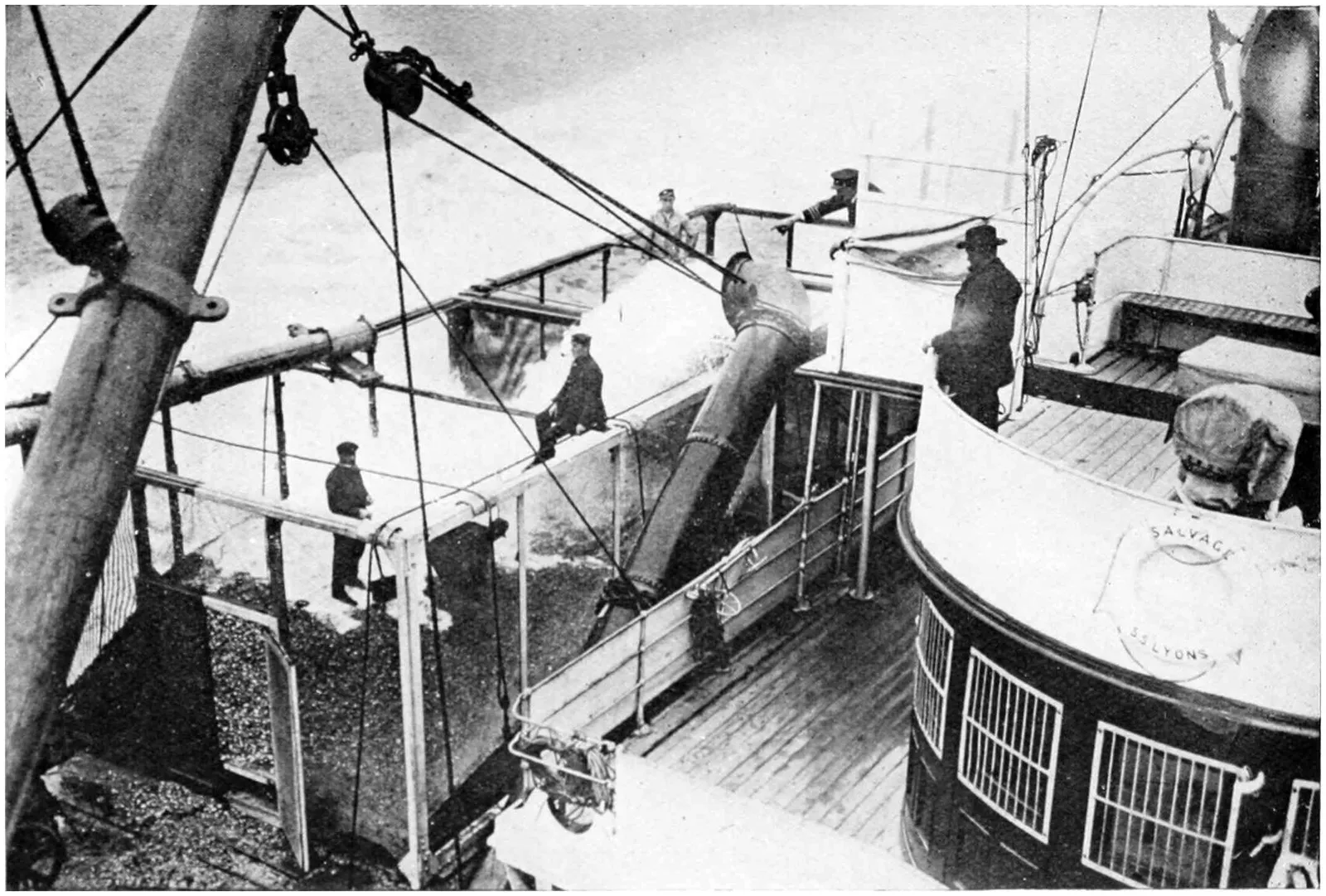
SEEKING THE TREASURE OF THE LUTINE. ONE OF THE HUGE PUMPS SUCKING UP THE SEABED AT A PRODIGIOUS RATE
AND POURING IT INTO THE GIANT CAGES WHICH SIFTED IT FOR TRACES OF THE LONG-LOST TREASURE
They were weeks battling with the tides before the
sand was cleared from inside the vessel and around
the hull, but the day came at last when the divers
went down to investigate the interior for the long-lost
treasure. Every one aboard was keyed up to
concert pitch. It seemed certain that the Lutine’s
treasure was to be lifted at last.
But the divers found the place in a sorry state.
Much of the wooden hull had, of course, been preserved
by the sand, but the magazine, in which the treasure
lay, had collapsed, and there was practically a solid
mass of iron five or six feet deep lying on top of the
bars of gold and silver. When the magazine collapsed,
hundreds of cannon balls had poured all over the place
and these had been rusted together by the action
of the water, locking up the treasure as securely as
though it had been in a steel safe.
The only hope of the salvors lay in blasting this
mass of rusted cannon balls to pieces and removing
them bit by bit. In no other manner could the
treasure be reached. Accordingly they set about
their task, and little by little blew away the first
layer. It was slow, tedious work, and all the time
the salvors were harassed by the thought that the
autumn gales might spring up and put an end to their
operations, undoing in a single night work which had
taken them months to accomplish.
Day by day they continued steadily with the blasting,
and they had just succeeded in blowing away the
second layer of rusted cannon balls when the dreaded
gales came on. Further work was impossible, and
sorrowfully the salvors left that exposed spot and
went to Amsterdam to lay up for the winter.
A little more time, and they might have succeeded
in their quest. There is evidence that they were
somewhere near the gold, for one of the pieces of rust
brought up bore the impression of a gold ingot, and
when this rust was treated with acid it yielded five
grains of the precious metal to prove that the gold
was quite close.
Ten divers and a powerful plant had been seeking
the Lutine’s treasure for nine months. A small
fortune had been spent on the operations. The
workers removed a veritable mountain from the seabed,
and they were rewarded with five grains of gold.
They had shifted a million tons of sand to find five
grains of gold! In this way does Fate taunt the deep-sea
treasure-hunter.
The following winter the wreck was buried under
5 feet of sand by the tides, and by now she is lost
once more, buried perhaps deeper than ever. The
exposed position and the strong tides have kept the
Lutine’s treasure safe for over a century. But whether
they will keep it safe for ever, no one can say.
It is a dozen years since I fingered one of the
silver coins salved from the Lutine, and wondered
whether the treasure was to be recovered at last.
Still the Lutine is not forgotten, and only a few months
ago I received from Lloyd’s a letter from an inquirer
in Vancouver who desired full details of the wreck,
with a view to carrying on further salvage operations.
I sent him the particulars he required, but so far I
have not heard of operations being started.
For over a century wind and wave have beaten the
men who sought to recover the wealth of gold and
silver that went down with the Lutine on that wild
October night. The fortune still lures men on to win
it, and, in spite of the many disappointments, a lucky
turn of the wind and tide, combined with improved
salvage appliances, may yet make some future treasure-hunter
a millionaire.
CHAPTER IV
Without the diver, treasure-hunting beneath
the waves would be impossible. The salvage
expert may make the most brilliant
plans, collect the most up-to-date and scientific plant
to assist him, but in the end it is the diver who carries
the work through, and upon the courage, determination
and skill of the diver the success of the expedition
depends. To dive to a depth of 5 fathoms, or
30 feet, is a task that the average man could
accomplish without much difficulty; most men, too,
would be able to reach a depth of 10 fathoms or
60 feet, if they were in decent physical condition.
But at 15 and 20 fathoms and over the body is called
upon to stand exceptional strains and so exceptional
men are necessary.
Quite apart from the many risks, deep diving is
very arduous, and seldom are men found with the
physique that will enable them to dive 100 feet and
over. The deep-sea diver must be trained like an
athlete, perfectly sound in wind and limb and heart,
and in tip-top physical condition. A fat diver stands
little chance of attaining great depths, so the finest
divers are generally on the slim side, men without an
ounce of superfluous fat and with muscles tough as
steel.
The physical strain placed on the body and heart
merely by diving to these great depths is not generally
realized. To ask the human body to undergo
pressures three, four and five times greater than
atmospheric pressure is expecting the body to undergo
strains three, four and five times greater than the
body was built to stand. It is like expecting a motor-car,
designed for a load of 30 cwt., to carry a load of
6 tons. We should not expect the car to do that.
Yet we not only call upon the human body to perform
similar feats, but the body actually does perform them
without collapsing.
The crack sea-diver is almost as difficult to find as
the swimmer who can conquer the English Channel.
When it comes to doing actual work at depths of 100
feet and over, the strain on the diver’s body is indeed
very much greater, for his exertions use up so much
oxygen that his heart is called upon to pump at an
increased speed in order to replace it. All the time,
of course, the diver is breathing compressed air, thus
the pressure of the sea on the outside of his body is
practically counterbalanced by the pressure of the
air inside his body. While the weight of the sea is
trying to crush him inwards, the compressed air is
pushing outwards, so the air pressure within equalizes
the water pressure without, and the diver is enabled
to work in perfect safety under a mass of water that
would crush an unprotected man flat.
We might liken the water pressure to six men who
are pushing hard against a door and striving to open
it, while the air pressure resembles six men pushing
against the other side of the door to keep it closed.
With both teams equally matched in strength, the
door remains quite unaffected by the contest if it be
solidly built of oak. But if it is a weak door, the
strain of the men pushing against it will probably
break it.
Breathing compressed air not only places a strain
on the lungs, but it tends to fill the body with an excess
of nitrogen. This nitrogen may easily form tiny
bubbles of gas, and these bubbles, if they reach the
heart, might cause the death of the diver or bring
on that dread paralysis known as diver’s palsy, a
disease which renders the lower part of the diver’s
body quite useless.
Strangely enough, it is not in going down that this
danger threatens the diver, but only in coming up.
If he comes up too suddenly, the excess of nitrogen
in the blood bubbles like the tiny bubbles in a siphon
of soda and at once his life is threatened. The bubbles
are due to the pressure of the water on the outside of
the body growing suddenly less than the pressure
of air inside the body, consequently the nitrogen seeks
to escape in bubbles just as the soda-water seeks to
escape when the key of the siphon is depressed. The
pressure inside the body cannot adjust itself quickly
enough to the lessening pressure outside, and these
bubbles are the result.
To avoid this risk, it is necessary for the diver
working at great depths to come up very slowly. He
may slide down the shot-rope to a depth of 120 feet
in a few seconds, but, should he stay longer than half
an hour at the bottom, he must not come up in less
than fifty-seven minutes if he would avert danger.
He may come up to 40 feet in eighty seconds, or at
the rate of a foot a second. Then he must rest and
exercise his legs and arms on the shot-rope for five
minutes before ascending another 10 feet to the
30-foot level. Here he must rest for a further period
of fifteen minutes, and do those exercises which
help to rid his muscles of their excess of nitrogen.
Ascending another 10 feet, which brings him to
within 10 feet of the surface, he is compelled to rest
for twenty-five minutes to allow the excess of nitrogen
to pass from his blood, after which he may rise to
the surface.
If a diver happened to remain an hour at a depth
of 200 feet, he would have to spend four hours in
coming to the surface to avoid any ill effects. The
exceptional diver who is able to reach this depth
should not, however, remain at the bottom for more
than twelve minutes. This is the safe time, and he
can then make the ascent to the surface in thirty-two
minutes.
Remarkable diving experiments were carried out by
the British Admiralty some years ago, during which
naval divers attained the record depth of 210 feet, a
record that was long unbeaten. As a result of these
experiments, tables were drawn up showing the time
that a man might remain in safety at certain depths,
and indicating the rates at which he could come to the
surface and the depths at which he must rest to allow
the pressure inside his body to adjust itself to the
pressure of the water outside. These tables are
followed the wide world over, and they have made
diving one of the safest of occupations, despite the
grave risks the diver is continually running.
Diving was, in fact, so dangerous that exceptional
precautions had to be taken, with the result that the
diver who walks about the bottom of the ocean to-day
may be far safer than a man walking across Piccadilly
Circus. The safety of the diver is most carefully
watched over, but no one can foretell when a motor
vehicle is going to run down some one crossing a busy
road.
Never was knight attired for the tourney more
carefully than the modern diver is clad before venturing
into the depths. It is cold working at the bottom
of the sea, and to guard against the cold the diver
dons warm woollen sweaters and socks, sometimes
wearing two or three sweaters and two or three pairs
of thick socks. When he is dressed in his woollies,
the diving dress is fastened about him just as the
armour was fastened on the knights of old. There is
a certain ritual about the performance which must be
obeyed. First of all the shoulder pads are carefully
tied on to take the weight of the head-dress, then an
assistant helps him into the rubber diving dress and
opens the tight cuffs for the diver to slip his hands
through. The diver sits down while the assistant
ties up the inner collar of the diving-dress and
adjusts the various screws that are to secure his
helmet. But before that is fastened into place the
feet are slipped into the boots, each with its 16 lb.
sole of lead.
Ever so carefully the diver’s helmet is put on, for
his life depends upon it being properly fastened. The
air-pipe must be carried from the back of his helmet
up under his arm to the front of his body where he
can reach it easily and yet not find it in his way. The
air-pumps and the valves in his helmet are most carefully
tested to see that they are working properly.
Then the diver gets on the ladder leading overboard
and a lead weight weighing 40 lb. is adjusted across
his breast and another similar weight is fastened over
his back to enable him to sink to the bottom. The
glass of his helmet is screwed up, the pump is set
going, the diver waves his hand to indicate that all
is in order, and the attendant after a final look round
gives the diver a smart tap on the top of the helmet
to inform him that he may go down.
Thenceforward the life of the diver is in the hands
of the attendant, who never lets go of the lifeline and
air-pipe until the diver comes to the surface again,
feeling the diver at the end of the pipe just as an angler
feels a fish at the end of a line, taking in the slack pipe
to prevent it fouling rocks and wreckage, paying it
out as the diver requires.
The coming of the submarine telephone has certainly
lessened the risks of the diver, for he can now talk to
the men in the boat and tell them what he wants and
how he feels. If anything goes wrong and his lines
become entangled, he can inform those at the surface,
who can quickly send down another diver to assist
him. In comparatively recent days it was necessary
to signal by means of the lifeline and air-pipe, a
certain number of pulls meaning certain things in
accordance with a code in use by all divers. When
a diver wished to convey a special message he had
to signal for a slate to be sent down, and on the
slate he would write what he wanted to convey. It
was a slow and cumbersome method which has
been rendered obsolete by the submarine telephone,
which was invented by that famous submarine
engineer, R. H. Davis, the head of Siebe, Gorman &
Company.
For ages men have dived for sponges and pearls,
remaining at most not more than a couple of minutes
at the bottom. The ancients were fully alive to the
advantages of an invention that would assist men to
remain under water for considerable periods, and they
were puzzling their heads about diving dresses centuries
ago. These early inventions, however, were very
crude, one being a sort of barrel with holes through
which the arms could be passed, another a metal
cylinder which covered the head down to the waist
where it fitted into leather breeches. Very strange
and wonderful they appear to modern eyes.
No less strange and decidedly more wonderful is
the up-to-date diving dress which has grown out of
the invention of Augustus Siebe in 1819. For eighteen
years Siebe experimented with his first type of diving
dress before he achieved, in 1837, the form of dress
which is closely followed to-day. Various people
have added improvements, but Siebe’s form of dress
is the one in common use, and the firm of Siebe,
Gorman & Company which he founded to supply his
diving dresses are to-day the greatest submarine
engineers in the world.
Inventors have for long been concerned with the
problem of a diving dress that will allow a diver to
go to any depth without danger. The greatest risk
of course, is that he will be crushed to death by the
pressure of the water, and to overcome this danger
more than one man has invented an all-metal diving
dress with flexible joints. In appearance these diving
dresses seem cumbersome, and the diver looks more
than ever like a knight in armour.
Another form of dress largely in use enables the
diver to descend in shallow water without relying
on the usual air-pipe and pump. In such dresses the
diver carries certain chemicals which not only purify
the air he is breathing, but also furnish him with
fresh oxygen. One chemical absorbs the poisonous
carbonic acid gas given off by the breath, and the
other chemical gives off fresh oxygen as the moisture
of the breath touches it. The smoke helmet which
enables men to enter a mine after a disaster, or a
building full of foul fumes, is equipped with the same
chemicals and made on the same principle as the
diving dress. Instead of completely covering the man,
however, this dress is made like a jacket reaching to
the waist, where it is securely buckled.
In this dress it was impossible to penetrate the
Redding pit, near Falkirk, from which five miners
were marvellously rescued after being entombed for
nine days, so several naval divers in regulation dress
risked their lives in an effort to penetrate the workings
to see if any other men still survived and to carry
stimulants to them. Divers, at best, have the appearance
of creatures from another world, and the effect
of a diver, with his lamp, emerging from the inky
water and coming suddenly on men who had been
immured for a fortnight without food and were at
their last gasp had to be carefully considered. Some
of the survivors might have attacked him in their
delirium and deprived their comrades of all chance
of succour.
To avoid so untoward an incident, the leading
diver carried with him a message for those men he
hoped to find: “This is a diver come to save you.
Don’t touch him, as he cannot speak to you. We are
driving a place for you. Don’t sit down near the
water, but keep clear of the damp. If any of your
mates are far through, turn their heads downhill and
that will help them until you are feeling stronger.
The diver cannot come up the hill out of the water
to help you, because his tools are too heavy. He
will come back regularly and feed you. You must
not drink more than half a cupful of beef tea each.
Wait and take a rest before you drink another half-cupful.
On this paper write who you are. You will
be got out soon.”
Alas, for human endeavour, that message never
reached the poor fellows for whom it was intended!
The great falls of roof choked the roads and proved
an insurmountable barrier. Raging, but exhausted,
the divers had to bow their heads in defeat.
So commonplace is the diving dress that it no longer
excites curiosity. Yet it remains one of the wonders
of modern civilization. Merely by utilizing the sap
of a tree, which we know as rubber, and fresh air,
men are now able to work and live at the bottom of
the sea.
CHAPTER V
It was in 1891 that the steamship Skyro pulled
out of the port of Cartagena, in southern
Spain, and set her course for London. The
coast of Spain glided by as she proceeded through the
blue seas of the Mediterranean, speaking Gibraltar as
she passed, and setting her nose north to skirt the
coast of Portugal. Oporto dropped far astern, and
the Portuguese coast changed to the western coast of
Spain as a fog quietly stole down and blanketed everything.
The fog was dense. Not a thing could be
seen, and the warning notes of the Skyro’s siren blared
monotonously as she felt her way blindly along. The
captain and officers stared anxiously ahead, hoping
that the fog would lift; but there was no sign of a
break around them, nothing but fog and the sound
of their siren to warn passing ships.
Of a sudden the ship staggered and halted. It was
as though a giant hand had reached up from the
depths of the sea and grasped her keel. The crew
were thrown higgledy-piggledy. There was an awful
rending sound as the Skyro swung onward. She had
struck the dreaded Mexiddo reef off Cape Finisterre,
and as she slid over the cruel rocks they literally tore
the bottom out of her. Slowly she carried on, while
that rending sound continued, and twenty minutes
after striking she slipped off the reef and plunged to
the bottom.
A few hours later the bell of the Lutine in the Royal
Exchange was clanging loudly. The underwriters
paused in their work. All voices were stilled, and the
scarlet-coated crier, mounting his rostrum, announced
in stentorian voice that the steamship Skyro had struck
the Mexiddo reef off Cape Finisterre and was a total
loss.
Then the bustle of business began again, but a little
knot of underwriters gathered together and started
to talk quietly. They were interested in the silver
bars that the Skyro carried.
“What about salvage?” one inquired.
Another, who joined the group, shook his head.
“Hopeless. She’s down in 25 fathoms, or more.”
“You never know,” said one man who was more
intimately concerned.
He was quite right. You never know. Men
manage sometimes to achieve the impossible.
Fuller information made the salvage seem more
remote than ever, for instead of being down in 25
fathoms, as had been supposed, she was several fathoms
deeper, and her keel, resting on the bottom, must have
been well over 30 fathoms from the surface. Nothing
had ever been salved from such a depth before, and it
seemed unlikely that any man could go to this depth
and survive the enormous pressure.
However, an expedition went out and fought to get
at the treasure, but the depth was too great, and at
last the salvors withdrew from the spot. Four years
passed and there came to the underwriters another
offer to attempt to salve the silver. The salvage
vessel anchored off the fringe of the reef that had
stripped the bottom out of the Skyro, and the diver
slid down the shot-rope to try to find out how the
wreck was lying and if possible to bring out the
precious bars. Before he could do anything of importance,
however, bad weather set in and drove
the salvors back to harbour. But the lesson learned
from that attempt was that, if the treasure were to
be recovered, more powerful diving gear would have
to be used.
The winter months were spent in obtaining much
more powerful gear from England, and the following
season, directly the fine weather set in, the treasure-hunters
repaired to the Mexiddo reef to try once more
to achieve the impossible. The diver feared nothing.
Brave as a lion, he took the shot-rope in his hands
and slid straight down to the deck of the Skyro, which
was 171 feet below the surface. Carefully and quietly
he surveyed the ship, seeking the cabin in which the
silver was stored. The deck had collapsed on top of
it, and the only way of getting to the treasure was
through the deck.
Angel Erostarbe, the diver, came to the surface
and reported what he had seen. Difficult as was the
task, it seemed to him by no means impossible. So
he dropped down the shot-rope again and again.
Gradually and with infinite patience he blasted away
the deck, fixing his charges and withdrawing while
they exploded.
So exposed was the wreck that at times he could
hardly keep his feet. Time after time dirty weather
came and prevented him from working at all. The
difficulties left him unmoved. He set his teeth and
stuck to his task. He was working at a record depth,
a depth which most experts considered was beyond
the reach of a diver at all. The diver did not worry
about this. All he thought about was getting at the
treasure.
To attain his end he practically blew the ship to
pieces, and his marvellous feats of endurance were
crowned by the recovery, in two seasons, of fifty-nine
bars of silver worth £10,000. It was a stupendous
feat which has never been equalled since. At times
he was actually working in 183 feet of water, so it
will be seen that he was an exceptional man. Toiling
at this depth—where his body was subjected to the
huge pressure of about 95 lb. to the square inch—left
its mark on him, and he was never the same man again.
His share of the treasure amounted to £500.
Compared with this, the recovery of the treasure
from the Oceana, when she was sunk in the Channel
in 1912 as the result of a collision, was a comparatively
simple matter, yet it was not without its difficulties.
The Oceana went down in 90 feet of water and only
her masts peeped above the surface when the salvors
arrived on the spot. Plans of the ship were obtained
from the owners and carefully studied so that once
the divers got aboard they would know exactly which
way to go.
It is difficult enough for the average man to find his
way about a strange liner when she is afloat, so it
can be imagined how difficult it must be for a diver
to wander about such a vessel when she is 90 feet
under water. All the time he is adventuring through
the saloons and other compartments, he is running
continual danger of his air-pipe catching on something
and tying him up. He may lose himself.
Doors may slam to with the current and imprison
him while cutting off his air supply. The men
manning the air-pumps will quickly find out that
something is wrong, but by the time assistance is
sent the imprisoned diver may easily be in a sorry
state.
The ordinary difficulties were intensified in the case
of the Oceana by the strong currents racing down the
Channel. So strong were they that even in favourable
weather it was only possible for the divers to work
for one hour a day when the tide was at its lowest.
To make matters worse, there was so much sand in
suspension that the divers could see nothing at all.
The electric lamps which it was hoped would help
them were quite useless. The divers were like blind
men, groping in the dark, feeling their way about the
ship and working by touch alone.
They blasted their way through two decks and,
stumbling along a passage, found the strong room.
Ingot by ingot, they took out the treasure and sent
it to the surface, where each bar was carefully checked
and marked off in the records as it was recovered.
If only all the treasure had been carried in the strong
room, the game of blind man’s buff on the part of
the divers would have been at an end. But a good
deal of the silver was stowed in the after hold, and
before the divers could get at it they had to force
their way through three decks. Ultimately all the
treasure, to the value of £700,000, that went down in
the Oceana was recovered and the treasure-hunters
sailed away in triumph with their spoil.
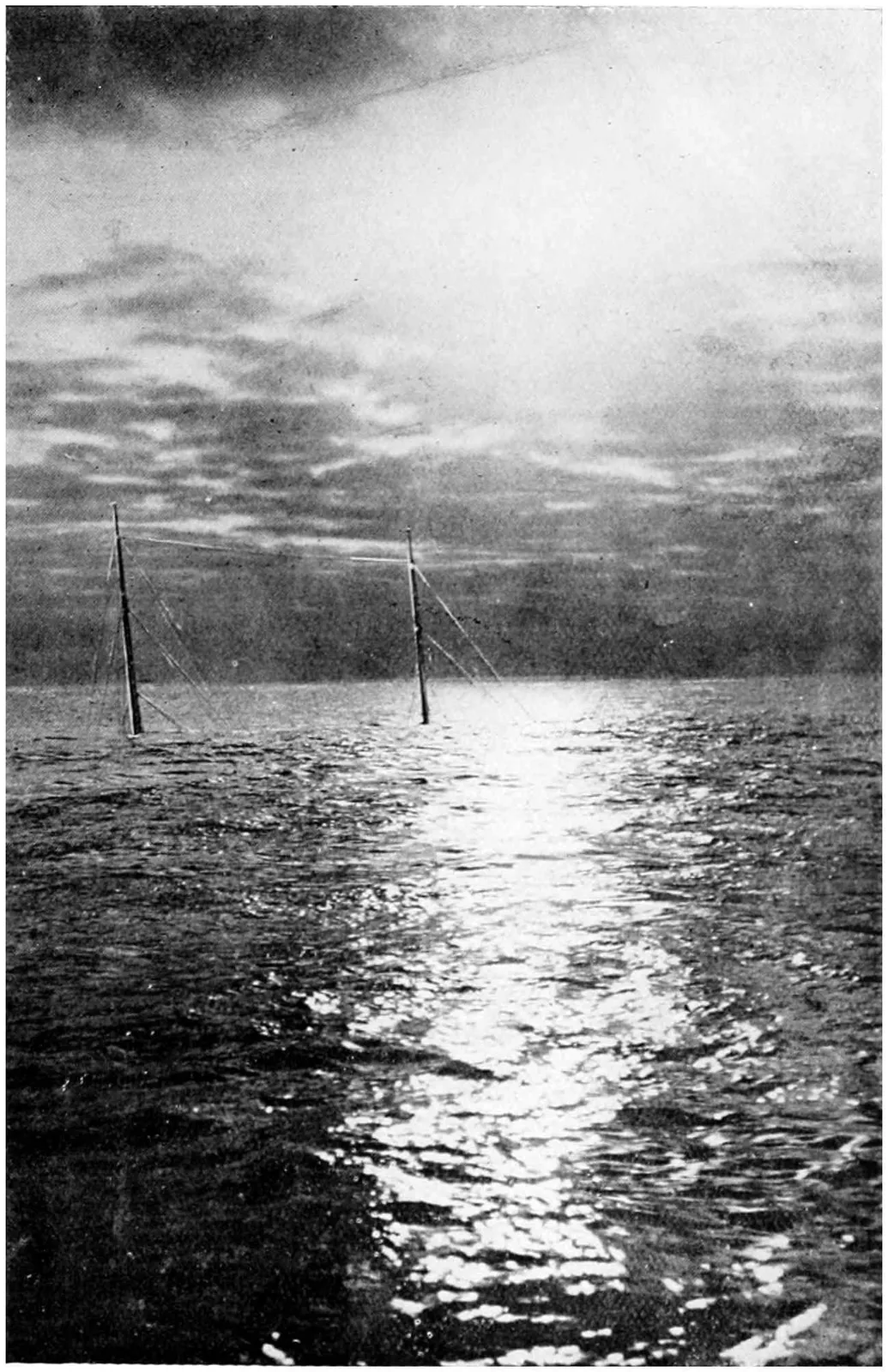
THE WRECK OF THE OCEANA WHICH SANK IN THE ENGLISH CHANNEL AS
THE RESULT OF A COLLISION. SHE HAD TREASURE ABOARD WORTH £700,000
The astonishing feat of Erostarbe was almost
equalled by Alexander Lambert, one of the finest
submarine workers who ever lived and the chief diver
of Siebe, Gorman & Company. He covered himself
with glory during the building of the Severn tunnel
when, owing to an error, a door was left open and the
workings were flooded. The water rose some forty
feet up the shaft leading to the workings, and it was
impossible to continue building the tunnel until this
door was closed.
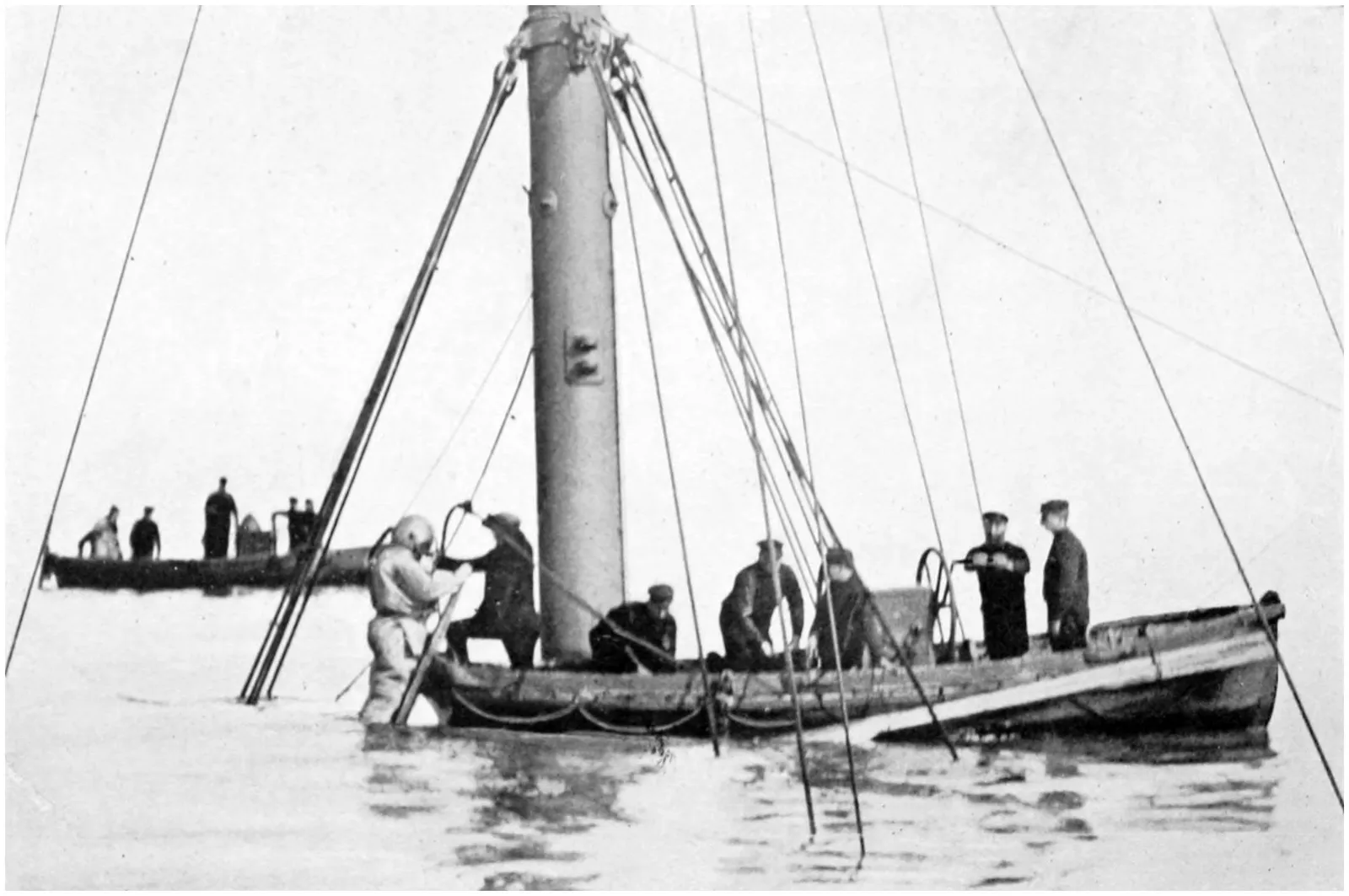
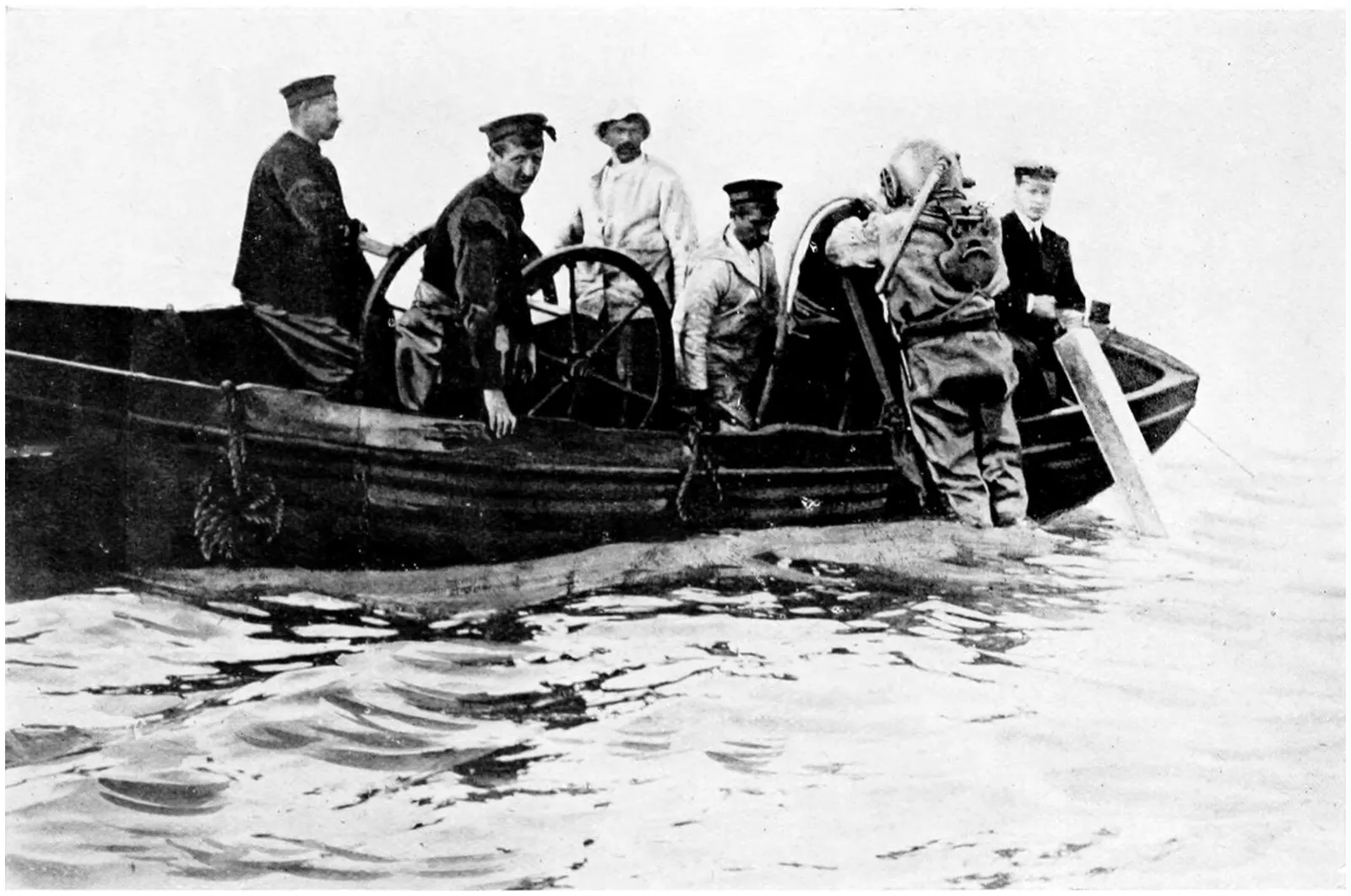
DIVERS GOING DOWN AFTER THE TREASURE OF THE OCEANA. NOTE THE DOUBLE-HANDED AIR PUMP WHICH THE TWO
ATTENDANTS ARE WORKING
Realizing that the only thing to be done was to
send down a diver to close the door, the engineers
called on Lambert to essay the task. Descending
the ladder of the shaft, Lambert disappeared under
water and made his way to the bottom, where not a
single ray of light could penetrate. Feeling round
the wall of the shaft, he found the opening to the
tunnel, and began slowly to venture along. But the
rush of water had worked tremendous havoc, and
the tunnel was strewn with debris which was most
difficult to negotiate. At any moment Lambert’s air-pipe
was in danger of being cut by some projecting
piece of the wreckage, and, in addition to the weight
of his dress, he was terribly hampered by the weight
of the 1200 feet of air-pipe which he was forced to
drag along after him as he stumbled about the
workings.
Hearing of Lambert’s baffling problems, Fluess, the
inventor of the diving dress which dispensed with
the air-pipe, volunteered to go down in his self-contained
dress and see what he could do. Fluess
was a clever inventor, but the only diving he had ever
done was in connection with his experiments on his
new type of dress. Besides being a clever inventor,
he proved himself a man of courage.
He arrived on the spot with his diving dress, and
studied the plans of the workings to find out which
way he had to turn when he got to the bottom of the
shaft. He thought it would then be just a question
of walking through the tunnel, finding the door and
closing it, little knowing that the place was in a
deplorable condition and beset with all sorts of
obstacles.
“Lambert had better go down first to take off my
life-line and tell me which way to go. He knows the
place a bit by now,” the inventor suggested.
Accordingly Lambert went down and waited 40 feet
under water in the inky blackness for the inventor.
Fluess made his way down the ladder in the centre
of the shaft, taking a firm hold of the rungs with his
hands and feeling for the next one with his foot.
As it happened, the ladder was short of the bottom
by some 10 feet, and they had forgotten to inform
him of this fact. Fluess, coming to the end, felt as
usual for the next rung. It was not there, so he
lowered himself one rung by his hands, expecting to
touch the bottom with his feet. His feet merely
churned in the dank water, so he went down rung by
rung until he was clinging to the last rung with his
hands. After vainly feeling with his feet for the
bottom, he let go his hold and dropped about 6 feet.
Some boards creaked and tipped ominously under
him as he landed, then he felt his way round until he
came to Lambert. The diver took off the inventor’s
life-line, and Fluess fared forth into those underground
workings some 200 feet beneath the surface
of the green fields above. It was a weird experience.
At first he tried to walk, and being without any guide
whatsoever he lost all sense of direction. Then he
tried for the sides of the tunnel, but there were ditches
and wreckage which brought him down so often that
he was forced back to the centre of the road. So he
went down on his hands and knees and began to
crawl along, feeling the sleepers of the tram-track
with his hands, using them as a guide. He came,
after many tribulations, to a place where the sides
and roof had fallen badly and very laboriously managed
to crawl over the heap of debris. After struggling
about the underground tunnel for an hour, he was
forced at length to turn back. Another and yet
another attempt he made, each time getting a little
farther along the tunnel.
“Why not let me try?” said Lambert at last.
“Very well,” said the inventor.
Lambert had never before used the new type of diving
dress, but that did not deter him. He got into it and
had a short trial dive one afternoon, and the next
morning went down the shaft to try in dead earnest
to close the sluice which was letting in the water.
The inventor went down too, and sat there waiting,
waiting, and wondering what had happened to Lambert,
and whether the new diving dress was going to
justify his hopes. The diver, meanwhile, was fighting
his way forward over the numerous obstacles in the
tunnel, crawling over the falls and squeezing between
the roof and the debris. It was nervy, risky work,
for he did not know whether another fall would come
and bury him or close the small exit, nor did he
know whether he could manage to find his way back
again. Under such difficult conditions, anything is
possible.
Nevertheless, he managed to get to the door that
had caused all the trouble. Feeling round, he found
one of the valves open and succeeded in closing it.
Then he investigated the door and found that before
he could close it he would have to take up a couple of
rails that were obstructing the entrance. Away
down in the bowels of the earth in that flooded tunnel,
far from help, relying upon his own strength and
courage alone, he struggled with the rails and managed
to get one free. The other baffled all his efforts, and
reluctantly he turned round and made his slow way
out of the tunnel, after being away for an hour and a
half.
He was drawn up with Fluess, and directly their
helmets were unscrewed the inventor turned to
Lambert.
“How far did you get?” he asked.
“Right up to the door,” said Lambert. “It’s
wedged open by two rails. I managed to get one
away, and to close one of the valves. I think, if I
take a crowbar along, I shall be able to manage it all
right.”
Sure enough, he went down and fought his way
along the flooded tunnel again. After a struggle, he
levered the other rail up and succeeded in passing
beyond the door to close another valve, afterwards
shutting the door that had caused all the trouble.
Before returning, he knew that one more valve must
be screwed up to keep the water back. The tips of
his fingers slid over the surface of the door like those
of a blind man until he found the valve, then he
screwed it round until it would screw no more.
He little knew, as he screwed away, that he was
screwing the valve open, but so it was. That valve,
instead of following the usual rule and screwing up
to the right, actually screwed up to the left. Whether
any one knew of this variation, or whether the engineers
forgot it in their fight to free the tunnel of water,
the fact remains that no one told Lambert, who unconsciously
screwed the valve open, with the result
that the tunnel took longer to pump out, because the
water still poured through this valve. Not until the
water was overcome was the mystery of the open
valve solved.
The diver who performed this brilliant feat salved
many fortunes from the seabed, and was perhaps
the greatest hunter of sunken treasure who ever
struggled into a diving dress. Even the experts,
however, thought little of his chances when he went
out to try to salve the treasure of the Alphonso XII.,
which was down in 160 feet of water off Point Gando
in the Grand Canary.
“Lambert has the job in hand,” said one.
“He can’t do it. She’s too deep for mortal man to
tackle!” came the reply.
Lambert dropped down to the deck of the Alphonso,
and knew that a fortune lay under his feet. He paced
the deck until he came to the exact spot beneath which
the treasure should lie. Then he began to investigate
the ship, but, skilled as he was, he would not face the
risk of getting lost in its interior, of fouling his lines
while he groped his way in the darkness along passages
and through cabins and saloons to the strong room.
To venture into the bowels of the ship would probably
mean that he was going to his death.
He summed up the situation. The treasure lay
beneath two decks. To tear a way through with
crowbars or to chop a way through with axes was
impossible. Every movement at that depth was
terribly exhausting, and he had to rest, in order to
recover, after doing the slightest thing. His only
means of getting the treasure was to blast a way
through with explosives, to harness explosives to do
the work and thus save his own energy.
He set to work and after tremendous trouble blew
through the top deck. Clearing the shattered pieces
away, he let himself down into the saloon, and began
his attack on the second deck. It, too, succumbed
to the mighty concussions of the explosives, and
Lambert dropped into another saloon. He looked
about him, and in the floor at the farther end he found
the entrance to the strong room. The trap-door
resisted his efforts, but in the end Lambert’s crowbar,
skilfully wielded, prised it up.
Lambert went into the treasure-room and saw the
little chests of treasure, each one of which contained a
fortune. He signalled to the surface, and a cable was
let down. The tremendous pressure hampered his
movements, made them seem slow and clumsy. Nevertheless,
he raised a chest full of treasure and managed
to slip a rope beneath it, then he secured it to the
hook hanging beside him. The signal was given, and
Lambert watched his first haul of the treasure mount
through the opening he had blasted in the ship. That
chest swinging on the end of the rope was full of gold
coin worth £10,000!
Every time he braved the depths to seek the treasure
he took his life in his hand, but he did what he set
out to do, and in the end he managed to send to the
surface seven boxes of treasure worth £70,000, leaving
another two boxes worth £20,000 to be recovered
at a later date. Lambert received £3500 as his share
in this deep-sea enterprise, in addition to his pay of
£40 a month and all found.
Thrilling as were these treasure hunts, the most
romantic story of all is that of the Hamilla Mitchell.
Here we have treasure and pirates and a desperate
chase all mixed up in the most approved adventure-story
style. Only, unlike a work of fiction, this story
happens to be true.
The Hamilla Mitchell came to grief on the Leuconna
Rock, near Shanghai, and carried down with her
£50,000 of specie. She was a total loss, and the
underwriters, after paying the insurance, considered
the question of trying to salve the treasure. They
instructed an expert to visit the scene and report on
the case. The expert in due course considered that
the case was hopeless, that the specie was lost for all
time, and that the wreck had gone down in such deep
water in so exposed a position that it was much too
dangerous for divers to work there—not a very
cheerful report for the underwriters to receive.
There, for a time, the matter rested. Then upon
the scene came a Captain Lodge with an offer to do
his best to recover the treasure. The underwriters,
unwilling to allow the specie of which they were the
owners to remain at the bottom of the sea, agreed
gladly to the proposal that was placed before them.
Captain Lodge considered the problem most profoundly.
He knew that what was lost would not be
won back easily, that the odds were, indeed, very
much against a single ounce of the precious metal ever
again seeing the light of day. This did not dismay
him. Securing the services of two clever divers,
named Ridyard and Penk, he made the trip to
Shanghai, taking out with him some special diving
apparatus—the finest and most powerful equipment
to be found in the world.
He wandered about Shanghai looking for a vessel
that would suit his purpose, and, coming across a
small sailing craft, chartered her and proceeded on
his quest for the wreck. Small as was the salvage
vessel, she was yet too large to take inshore among
the high rocks, and so the divers had to prosecute
their search from the small boat which they towed
behind. They searched here, they searched there,
dropping over the side of the boat in their cumbersome
dress, facing all the unknown perils of the unknown
depths. Now they were carefully exploring
a ledge perhaps only 20 feet deep, and a little later
they would be slipping down the face of a chasm that
plunged sheer into the sea for another 100 feet or more.
They did not spare themselves in that search, for at
times they penetrated to a depth of 160 feet.
They were investigating a ledge one day when a
dark mass loomed up at one end. They approached
it, to find the wreck at last, noting with satisfaction
that it was in a comparatively shallow depth which
made the prospect of salvage fairly easy. Their
jubilation was cut short, however, as they drew
nigh. It was the stern that held the treasure, and
the stern was missing!
Fate had once more been up to her tricks. The
Hamilla Mitchell had settled with her stern overhanging
deep water. Not for long did she remain
intact, for the gales soon broke off the unsupported
after end, which slipped off the ledge into the abyss,
where the divers managed to locate it in 156 feet of
water.
The never-ending lines of bubbles from their outlet
valves flowed upward to the surface as they slowly
explored the stern and prepared for their assault on
the treasure-room. It was a most dangerous as well
as a most difficult task to work in that treacherous
chasm. The currents were strong, the rocks were
sharp, and the possibilities of air lines being cut
or fatally fouled were not pleasant to dwell upon.
Nevertheless, they stuck to their task and eventually
Ridyard managed to break a way into the strong
room.
The sight which met his eyes as he gazed through
the windows of his copper helmet was like a scene
from some fairy tale. The light, filtering through to
that great depth, enveloped the hold in a sort of
twilight gloom, and all over the place he dimly saw
heaps of dollars scattered about. He stooped down
to the treasure chests, to find that woodboring worms
had eaten many of them quite away and the contents
of the boxes were spilled in all directions. He walked
about on a floor of solid gold; golden coins slipped
about under his leaden soles.
Anything more romantic would not be easy to find,
yet the romance did not appeal to Ridyard. He was
working against time, knowing that he would not be
able to stand the pressure for long. Every movement
was slow and difficult. The water was striving to
crush him; he was being saved from this terrible
fate solely by the continual flow of air coming down
the rubber pipe to his helmet.
Four times Ridyard underwent that ordeal of
getting into the treasure-room and working under the
enormous pressure until he was quite exhausted. On
the last occasion he surpassed his previous feats of
endurance and struggled doggedly on, loading up the
treasure and watching it disappear towards the
surface until he had sent up the contents of sixty-four
boxes.
Strong and fit as he was, he became thoroughly worn
out with the toil, so he signalled to those above and
made his way slowly to the surface. They dragged
him to the deck of the salvage craft and unscrewed
his helmet. His face was lined, his eyes were very
tired, and his body clamoured for moisture, although
he had been immersed in it for a long time. Not a
glance did he give to the treasure lying about, the
fortune at his feet did not interest him.
“Give me a drink,” he said. “I’m dying for a
drink of water.”
Penk nipped up a bucket and made his way to a
spring at the top of the island under which they were
working. Putting down his bucket to fill, he scanned
the horizon, as sailormen will. A sudden amazement
came over him. The sea was dotted with sails, all
making in the direction of the island.
Wasting no time, he picked up his precious pail of
water and ran down to the ship.
“What’s up?” asked Captain Lodge, as Ridyard
took his much-wanted drink.
“The sea’s full of junks, hundreds of them,” Penk
replied.
Taking his glasses, Captain Lodge quickly identified
the oncoming ships as the junks of Chinese pirates
who were making their way towards the island from
the farther side to avoid being seen. There was no
doubt in his mind as to what they were after. There
was but one thing in that quarter worth having, and
that was the treasure stored in the salvage craft. It
was obvious that the pirates had been watching operations
carefully. They had undoubtedly planned to
allow the divers to recover the treasure, then they
purposed stealing down upon the expedition unawares,
wiping it out and looting the gold.
The pirates were in overwhelming numbers, and
Captain Lodge realized instantly that the only thing
to do was to run for it. Slipping the anchor to save
the time required to haul it up, the salvors hoisted sail.
Gradually they gathered way and stole from under
the cover of the island. Directly the salvage craft
appeared in the open, the junks altered course and
started to pursue her.
Pity the poor salvors! The wind had practically
failed them, yet they could see some of the junks
bending to a lucky breeze and overhauling them. In
desperation they put out the big sweeps and toiled
like galley-slaves to force their craft through the water.
Ridyard, tired as he was, took his turn at the oars
to try to save the treasure he had salved at such risk.
So the salvage boat crept along, with the pirates slowly
gaining.
More exciting grew the chase. With anxious eyes
the salvors watched the distance between their own
craft and the Chinese junks growing gradually less.
Harder than ever they strained at the oars, dipping
them into the sea, throwing all their weight upon them,
pulling until the muscles of their arms ached and
their backs were nearly breaking.
It looked as though the salvors would lose their
lives as well as their treasure when the sails, which
had been flapping idly, began to swell. A puff of
wind stirred their flag, and a steady breeze began to
blow. It was none too soon. The salvage craft
started to gather way again and forge through the
water. Still the junks hung on. They were not
going to relinquish their prize without an effort.
The pirates continued to chase the salvage craft
right until sundown, when a friendly darkness hid
pursued from pursuers and enabled Captain Lodge to
shake off and lose the bloodthirsty Chinese pirates.
In the end he managed to make Shanghai in safety
with the rich treasure of £40,000 aboard, thus bringing
to a happy ending one of the most exciting treasure-hunts
ever known.
If Ridyard had not worked quite so hard and grown
quite so thirsty, and if Penk had not gone to fetch that
pail of water, the salvors would have remained in
ignorance of the approaching pirates and would have
met a tragic death at their hands.
That lucky drink of water saved a fortune of £40,000.
CHAPTER VI
For months at a time during the past few years,
a little ship may have been seen floating
around a particular spot just off the coast
of Donegal. Barges lay in her vicinity, barges laden
with incredible tangles of pipes and cables. Boats
pulled around from barge to ship, and fussy little
launches came from the coast, remained an hour or
two, and then departed. Occasionally a grim, grey
destroyer glided up, moored for a time, and then
steamed away. But the little ship remained, and
strangers in those parts wondered what she was doing
there.
That little ship was the salvage vessel Racer, engaged
in the greatest treasure-hunt of modern times.
Never before has there been such a treasure-hunt, for
it was a national treasure-hunt, carried out on behalf
of the British people by the British Navy, and backed
by the whole power of the nation.
When the White Star liner Laurentic left the shores
of England in January, 1917, she carried in her strong-room
gold and silver ingots to the value of about
£5,000,000 to settle some of Great Britain’s bills for
the munitions that were pouring out of the factories
in the United States. The Treasury was naturally
anxious for the specie to reach its destination as
quickly as possible, for that £5,000,000 was destined
for the pay envelopes of thousands of American factory
hands.
Many a time the Laurentic had made the passage
with saloons brilliantly lighted and crowded with
wealthy passengers, but never before had she borne
so much wealth as on this occasion. The advent of
war led to her conversion into an armed liner, and
those aboard were now fighting for the freedom of
the seas and civilization.
Northward she steamed through the Irish Sea
and at last began to breast the open Atlantic and point
westward to New York. Malin Head, on the north
coast of Ireland, loomed up and began to drop astern,
and just when it seemed that all would be well came
the blow that sent her to her doom. A violent explosion
shook her, made her lurch and shiver, and
many gallant fellows, watchful at their posts, were
instantly killed; many more were trapped and drowned
by the rush of water into the ship.
The survivors sprang to their emergency posts, while
the wireless operator sent out a call for help. The
captain realized that the Laurentic’s days were
numbered. Nothing could save her. The water
poured through the rent in her side. More and more
she heeled as the water gained. For a moment her
bows lifted clear of the sea, then she disappeared in
a swirl of foam, and the waves were strewn with
wreckage and bobbing heads. When the tragedy was
over, and the roll called, it was found that, of 475
officers and men aboard, 354 had gone to their last
long rest.
The loss of life, the destruction of the ship, the
sinking of the treasure, all were bitter blows. The
gallant sailors were beyond recall, the ship was sunk
for ever. As for the treasure, it was down in 120 feet
of water, on a coast so fully exposed to the Atlantic
gales that its recovery was an open question.
Prospecting for gold in the desert places of the
earth has its difficulties and its disappointments, but
what are these compared with the problems that
confront the men who seek to wrest from the mighty
ocean the gold it has swallowed? Unexpected dangers
often confront those who seek the precious metals in
the wild places of the earth, but the dangers of the
diver are continuous. He trusts his life to a frail
rubber pipe and a rubber suit, and directly the metal
helmet is screwed round his neck, and he sinks into the
depths, death starts to stalk him and does not give
up the chase until the diver is once more aboard the
salvage ship.
Some of the finest divers in the British Navy were
told off for the treasure-hunt. They were eventually
placed under the command of Commander Damant,
who had played so important a part in the diving
experiments carried out by the Admiralty a few years
ago, and who had himself attained the record depth
of 210 feet in August, 1906. The fact that the cleverest
diving expert in the British Navy was detailed for the
operation is proof that the Admiralty realized that the
recovery of the treasure would prove no easy task.
No one knew at the moment exactly how strenuous
the fight was going to be.
The first salvage craft, which was later replaced by
the Racer, went off to the Donegal coast and swept
the area in which the Laurentic had disappeared. The
salvors found the wreck in due course, and they had
the satisfaction of knowing that they were within
120 feet of a stupendous fortune of about £5,000,000.
A bare depth of 120 feet of water separated them from
the greatest treasure-trove of modern times, but the
treasure could not have been more secure had it been
resting beneath 120 feet of solid steel. Indeed, had
the treasure been so buried, instead of underneath
120 feet of water, it would probably have been recovered
very much sooner.
Despite difficult conditions, a certain optimism
prevailed that the treasure would soon be brought to
the surface. But the optimists reckoned without the
enemy. Somehow the Germans managed to find out
where the Laurentic was wrecked, and their submarines
quietly waited their opportunity and began to make
things hot for those engaged in the treasure-hunt.
One enemy submarine haunting the vicinity discreetly
vanished as a British torpedo boat came on
the scene. A day or two passed, and the torpedo
boat was called for urgent duty elsewhere. Meantime,
there had not been the slightest sign of the enemy
underwater craft, which had apparently recognized
that that particular spot was rather unhealthy and
therefore to be avoided.
Feeling fairly secure, the salvors, according to an
unofficial report, determined to get on with their
job. A diver donned his dress, his helmet was screwed
on, and the air-pumps began to heave as he dropped
down to resume operations. He had been down but
a short time when he felt himself plucked off his
feet by a mighty pull on his life-line and air-pipe. He
struggled to right himself, but it was quite useless.
An irresistible force dragged him upwards; then he
felt himself being drawn through the sea like a salmon
at the end of a line.
Something was running away with him. It was an
awful experience. He wondered what had happened
and how it would end. His senses began to reel; he
found a difficulty in breathing.
Somehow he managed to keep his head and act as
the emergency demanded, closing the valve by which
the air escaped from his helmet. A minute later he
broke the surface.
He could hear the seas slapping the top of his helmet
as he was dragged along at a smart pace. His heart
pounded, a terrible humming droned in his ears, but
he strove hard to retain his senses.
“What’s up?” he thought. “What on earth’s
happening?”
He had no chance of finding out. He was prisoner
in a metal helmet and a rubber suit. He knew he was
at the surface, because of the light that filtered through
the glass of his helmet and the seas that swished
against the copper. As he was dragged along, he had
a tendency to spin at the end of his line, which gave
him a dreadful sensation.
In a dazed sort of way the diver was wondering
how long the ordeal would last, when he suddenly
felt himself plucked clear of the water. The next
thing he remembers is something scorching his throat
and the cool air playing about his head. He looked
round and found he was lying on the deck of the salvage
vessel, and he thanked his lucky star that all was well.
Then he was placed in the recompression chamber
aboard, so that the dangers of being dragged hastily
from such a depth might be avoided, and the risk of
bubbles of nitrogen forming in the blood averted.
The air-pumps were set going to raise the pressure of
the air in the steel chamber to the same pressure as
that at which the diver had been working, and gradually
the pressure was reduced until it was the normal
atmospheric pressure and the diver was able to be
taken out.
While he was on the bottom, a German submarine
had stealthily approached the salvage vessel. Suddenly
it started to attack, and the salvage steamer
had to cut and run for it, dragging the unfortunate
diver in its wake. The attack was so unexpected
that there was no time to pull up the diver in accordance
with the rules. To pull him up in the ordinary
way would, as a matter of fact, have taken half an
hour. There was no alternative but to tow him
along willy-nilly and haul him aboard as they fled.
The experience might easily have cost the diver his
life, but the recompression chamber fortunately saved
him from any ill effects.
After this rather exciting episode, it was decided
that operations to recover the treasure would have
to be postponed until more peaceful times. The
treasure-seekers had their hands full in fighting the
stormy seas and powerful currents, not to mention
the great depth of water, without having to fight the
foe as well.
At the end of the war, the battle with wind and
wave for the treasure of the Laurentic was once more
resumed. So exposed was her position that for fully
half the year it was impossible for divers to work
there at all owing to the storms that raged. Even
in fine weather there were the currents to fight
against. And their strength at times was almost
incredible. They could swirl big boulders along the
seabed as though they were but pebbles.
More than one diver, during his career, has experienced
the sensation of being picked up like a
feather and dropped over the side of the wreck on
which he has been working. He might weigh roughly
160 lb. Slung over his back would be a 40-lb. weight,
across his chest would be a similar weight, while each
boot would be loaded with a leaden sole weighing
16 lb. Fully equipped he would turn the scale at
about 3 cwt., yet the current has simply played with
him as though he were thistledown. Its strength
has been such that he could not fight against it.
Consequently, he has been compelled to give up all
ideas of work and return to the surface. It is indicative
of what the salvors of the Laurentic had to contend
with in this respect.
Two years at the bottom of the Atlantic had wrought
a tremendous change in the once-proud liner. The
divers found her plates corroded with rust, girders
collapsing everywhere. The sheer weight of the water
above her was crushing her flat, squeezing her into a
shapeless mass just as you might crush a lily in your
hand. Moreover, she was full of silt and mud.
Strange fishes glided about her inky depths. Dread
conger eels of mighty girth lurked in the labyrinths
of the wreck.
In spite of the terrible condition to which the wreck
had been reduced, the divers finally managed to locate
the strong-room. The bubbles from their helmeted
heads flowed ceaselessly upward as the exhaust air
ascended to the surface. Slowly they made their
way forward towards some bars, dimly seen within
the recesses of the ship. They were in the treasure-room.
The gold and silver lay about them. Some of
the precious ingots barely peeped out of the silt.
The attendant on the salvage ship heard the telephone
buzz.
“Hallo!” he said.
“We’ve found the treasure,” said a voice from
under the sea. It was a squeaky voice, for, strangely
enough, talking in compressed air gives the voice a
high pitch, and at this depth it would be impossible
for a diver to whistle. The pressure of the air on his
lips would prevent him.
No time was lost in lowering cables, and one by one
the ingots began to speed to the surface. Then, all too
quickly, the signal was given for the divers to ascend,
and the treasure had to be left for another day.
That season ingots valued at £500,000 were recovered
from the strong-room, after superhuman labour on the
part of all concerned. So extremely arduous were the
conditions that our crack divers could only work two
spells of fifteen minutes’ duration each day. Half an
hour’s toil beneath the sea took as much out of them as
the ordinary day’s work takes out of the ordinary man.
Once more the winter gales played havoc with the
wreck, and next spring the divers found that the
treasure was lost under a mass of twisted plates and
girders. Imagine a street of lofty houses, then
imagine that all the buildings were pushed suddenly
down into the centre of the road, and you will arrive
at some faint idea of what the ship looked like. Great
girders were bent into all sorts of strange shapes;
iron bars thick as a man’s wrist were twisted into
fantastic curves.
The only way to get to the treasure now was to
blast a passage with explosives. The difficulties of
the task were increased by the necessity of hoisting
every bit of plate out of the wreck and towing it some
distance before dumping it, in order to make quite
certain that the plate would not again obstruct the
divers. The placing of the charges in the most
effective spots, and the withdrawal of the divers while
contacts were made and the charges exploded, took a
long time and entailed endless trouble. But the salvors
kept at it doggedly, and bit by bit they cut away
obstructing plates and girders weighing about 300 tons.
A DIVER GOING DOWN TO BLOW UP PART OF A WRECK TO GET AT THE TREASURE. THE CHARGE OF EXPLOSIVE, WEIGHING
50 LBS., IS CONTAINED IN THE LONG TIN OVER THE SIDE OF THE BOAT. SOMETIMES THE EXPLOSIVE IS PACKED IN A CANVAS
BAG THREE OR FOUR FEET LONG AND THREE OR FOUR INCHES ACROSS
Thus they opened up a way to the treasure, and
once more began to send ingots of the precious metal
to the surface. Things began to look rosy, and there
seemed the prospect of making a clean sweep of all
the bullion, when a terrific storm arose and stopped
operations. When the divers went down again they
found that more plates had folded down over the
treasure, as if deliberately to prevent its abstraction.
It was a dreadful disappointment, for very soon
afterwards the autumnal gales put an end to the hunt
for the season.
The next year the Racer was back again off the
Donegal coast, eager to resume the great treasure-hunt.
But it proved a terrible season. The weather
seemed to mock the hunters. For weeks at a time
work was impossible. As soon as one storm abated,
another sprang up.
Waiting with all the patience they could muster,
the divers at length got a chance of going down to the
wreck. What a change the gales had wrought! No
longer did the wreck bear any resemblance to a ship.
She was just a great mound of twisted metal, partially
buried in the silt. Plates and wreckage lay scattered
over the seabed in all directions, covering an acre
or two of space.
Once more the dangerous task of blowing away
obstructions was resumed. Carried out as expeditiously
as possible, it yet proved all too slow for those
engaged on the work. At long last they managed,
after prodigious efforts, to open up a path, only to
find the gold as far off as ever. It was buried many
feet deep in sand and mud, and to dig it out with
shovels was an impossibility, for the sea would wash
the sand in just as quickly as the divers shovelled it out.
Forty yards above them lay the Racer—a floating
workshop full of the most remarkable inventions that
scientists and engineers could devise to assist submarine
work. Aboard was a mighty 18-inch pump capable
of sucking up a mountain of sand an hour. The mouth
of this monster appeared from above. It was placed
in position by the divers, and they watched the silt
melting before it as if by magic, flowing up to the
surface to be dumped a little distance away.
It is no uncommon thing to find such a pump
sucking up chunks of rock weighing half a hundred-weight,
and even trying to remove bits of girder and
plate. But such objects, like deck planks, are rather
apt to stick in the bend, and then the monster chokes
and has to receive the attentions of the salvors.
Remarkable as was the work done by the gallant
divers, the results of the season’s work were fearfully
disappointing, for only seven bars of gold worth about
£10,000 in all were recovered. In no wise discouraged,
the treasure-hunters stole back to the old spot the
following spring to try their luck again. The gales
of the winter had torn great plates from the wreckage
as though they were merely sheets of brown paper and
dropped them yards away; the decks that had once
resounded to the laughter of beautiful women were
laid down flat with the seabed. Twisted and rusted
iron lay for hundred of yards around. Looking for
a needle in a haystack were an easy task compared
with finding the treasure amid all this tangled debris.
A long, keen search revealed what had once been
the strong-room. Great metal plates were piled over
it, necessitating blasting operations once more. The
divers toiled until the plates were cut and dragged
away. Then incredible quantities of silt had to be
eaten away by the sand-pump, the divers watching
closely and coming on a bar from time to time. By the
end of August, 1922, gold worth £150,000 had been
secured, and early one morning H.M.S. Wrestler
might have been seen slipping into Liverpool. Directly
she moored beside the quay, case after case was landed
from her and placed in a motor-lorry. Those cases—a
dozen in all—were full of gold which had been recovered
from the Laurentic, and each case represented
a small fortune.
All through the season of 1923 the divers carried on,
searching amid that chaos of rusted iron for the gold
and silver bars, wresting them one by one from their
hiding-places on the seabed. For seven seasons they
have fought the ocean for that mighty fortune of over
£5,000,000 and their heroic efforts have led to the
recovery of £4,750,000. Considering the depth in
which the Laurentic sank, and the perils and difficulties
besetting the workers, the results are beyond compare.
Never before has there been a treasure-hunt of such
magnitude, and how long this will last no one can say.
A big fortune of £250,000 still lies hidden just off the
coast of the Irish Free State, and, if the British Navy
fails to recover it for the British Treasury, it will be
for the simple reason that its recovery is humanly
impossible.
For every £100 won back from the depths, the
divers have received an award of 2s. 6d., so altogether
they have shared among themselves the sum of £5,937
a sum that has been well and truly earned. It says
much for the efficiency of the British Navy when it is
known that the whole of this perilous treasure-hunt
has been carried out without a single accident to any
of the divers engaged.
Many rumours have arisen of wonderful machines
being used to locate the treasure, of instruments with
the power to divine the presence of gold, of scientists
standing on the deck of the salvage vessel watching,
with bated breath, a needle oscillate round a dial
until it has indicated that the diver far below is in
the vicinity of the precious metal. These rumours,
however, have no foundation in fact, for the treasure
has been recovered solely by straightforward diving.
The estimates of the treasure sunk have also varied
from £3,000,000 to £8,000,000, but the figures given
here have been furnished me specially by the Admiralty,
and they are therefore strictly accurate.
CHAPTER VII
British salvage experts have performed extraordinary
feats; the American Navy has
produced divers excelling even our own;
but it has been left to the Italians to accomplish the
seemingly impossible. As a sheer feat of salvage,
the raising of the Leonardo da Vinci remains unsurpassed.
The night of August 2, 1916, will long be remembered
in Taranto, for just before midnight the whole
town was awakened by a tremendous explosion. The
people leapt from their beds and rushed towards the
harbour, to find searchlights sweeping the bay and
the finest battleship in the Italian Navy belching
forth flames and smoke. The Leonardo da Vinci was
doomed. In a moment 250 officers and men were
wiped out of existence, and although the survivors
fought most valiantly to quell the fire that enveloped
the ship their efforts were vain.
Suddenly the decks of the battleship canted beneath
them, shooting them like flies into the bay, and she
swung right over and sank upside-down in 36 feet of
water. The searchlights from the surrounding battleships
lit up the darkness. Round and round they
flashed, seeking the enemy who had dealt this mortal
blow; but there was no sign of a periscope, nothing
but the heads of the Italian sailors fighting for their
lives in the sea.
A time bomb, secretly introduced into one of the
magazines, had robbed the Allies of one of their most
powerful battleships. This loss of a first-class ship
of 24,000 tons, equipped with an armament of thirteen
12-inch guns, was a grave one to the Italian Navy,
and the question of salving her at once arose. Famous
foreign experts came on the scene, gazed on the
visible portion of the keel of the ship which had cost
£4,000,000, and shook their heads dubiously.
“Impossible!” they said. “The only thing to do
is to blow her to pieces.”
The eyes of the Italians flashed. Somehow, at
some time, they determined to salve the battleship.
It might be impossible during the war, owing to the
difficulty of getting material for the operations, but
in their own minds the honour of Italy would never
be satisfied until the ship which lay at the bottom of
Taranto bay once more floated on the seas.
The sinking of the Leonardo da Vinci was, indeed, a
great blow to the pride of the Italian Navy, and there
was a general desire on the part of the nation to wipe
out the stain and turn defeat into a triumph by refloating
the ship. The more difficult the task, the greater
the triumph; the more impossible it seemed to foreign
experts, the more determined were the Italians to
achieve it.
Throwing themselves heart and soul into the matter,
the officers of the Italian Naval Engineering Corps
studied the problem most carefully and formulated
several schemes, among them a plan to build around
the ship a floating dock which, when completely
pumped out, would automatically lift the wreck.
Shortage of steel and other materials at that time
made this plan impracticable. Then General Ferrati,
the chief of the Italian naval constructors, evolved a
plan to raise the ship by means of compressed air and
carry her upside-down to the dry dock at Taranto,
where she could be prepared for righting.
It must never be forgotten that the battleship was
upside-down, and that not only had she to be raised,
but she also had to be righted. Rivet by rivet and
plate by plate she had in the course of years been
built up by hundreds of men into one of the strongest
structures known. All the rivets and plates had been
welded into a compact mass of 24,000 tons which now
lay at the bottom of the sea. Afloat, she obeyed the
hand and brain of man, would go wherever he desired;
at his behest she turned to right or left, sped furiously
through the sea or stopped. Now she was immovable
as the mountains; to smash her to pieces would have
been a gigantic task, costing months of time, tons of
much-wanted explosives, and well over £100,000 in
money. The queer thing is that Ferrati proposed to
harness air to lift the sunken monster, just as though
she were an airship instead of a battleship. In such
ways do master-minds work.
So brilliantly conceived were Ferrati’s plans that
orders were at once given to put them into execution.
Divers went down to make a survey of the wreck,
which was so rent by the explosion that a vast hole
had been blown right through her from keel to top
deck. A further survey indicated that the huge
ship was literally digging her own grave. The weight
of the upside-down battleship was all resting on the
funnels and gun turrets, and these, owing to the
enormous pressure from above, were piercing a way
slowly but surely through the mud. Day by day
the ship sank lower and lower, until the whole of her
upper deck was completely buried and the greater
part of her hull at the stern had disappeared. In six
months the funnels cut down through a bed of mud
over 30 feet thick before they encountered a bed of
clay, which arrested the sinking of the ship.
THE ITALIANS BRINGING THE LEONARDO DA VINCI UPSIDE DOWN INTO DOCK AT TARANTO ON SEPTEMBER 17, 1919, AFTER
FIGHTING FOR OVER TWO YEARS TO RAISE HER FROM THE SEABED
No wonder the experts gave up hope. It really
seemed that nothing but a miracle could bring the
great vessel to the surface again. There she was,
upside-down, buried deep in the clinging mud, an
enormous, unwieldly mass that the biggest cranes ever
invented were powerless to lift. It is a comparatively
easy task to raise a weight of 10 tons from the seabed,
but it is quite a different proposition to lift a
mountain of metal weighing upwards of 20,000 tons.
THE UPSIDE-DOWN BATTLESHIP SAFELY DOCKED ON SEPTEMBER, 18, 1919, WITH THE GIANT PONTOONS WHICH HELPED TO
RAISE HER STILL LASHED TO HER SIDES
In no wise discouraged by the difficulties of the
problem, General Ferrati and his associate, Major
Gianelli, ordered large-sized models of the ship to be
built. These were accurately constructed down to
the smallest detail, with miniature engines, propellers
and guns; and every compartment was loaded to
represent the things on board the battleship when
she foundered.
A stranger might have laughed at the childishness
of the Italian officers who were apparently playing
with toy battleships. But things are not always
what they seem. Actually these same officers were
puzzling out the most abstruse problems, carrying out
remarkable experiments which enabled them to
determine how the ship should behave in certain
circumstances. As a result were evolved some intricate
calculations upon which depended the whole
operation of raising the ship.
The small part of the keel still showing above the
surface was used as a platform on which to build huts
for the salvage workers. Other huts were erected, in
due course, on platforms built up from the submerged
keel. The assembling of the plant for the work was
completed by the spring of 1917, when the people of
Taranto began to observe the figures of divers about
the wreck.
Those divers had no enviable time. They quickly
discovered that the explosion had liberated a quantity
of thick oil which clung to everything within the ship,
and as they went down it obscured the glass of their
helmets and rendered the men practically blind. As
if the oil were not sufficient handicap, there were
thick clouds of rust which fogged the water and added
to the discomfort of the divers. Yet the oil, despite
its drawbacks, proved something of a blessing, for it
adhered to hundreds of shells and protected them so
efficiently from the action of the sea that the Italians
were able to use them after salving them!
The recovery of the ammunition was the first step
to lightening the ship. Day after day shells were
hoisted out of the wreck and loaded into lighters. It
was dangerous work, but it became rather monotonous
to those engaged in it. Monotony, as is well known,
is apt to lead to carelessness, and carelessness in
handling shells may lead to terrible results. It is a
fine tribute to the carefulness of the men engaged on
the work to know that they salved nearly a thousand
12-inch shells, three thousand 4·7-inch shells, some
torpedoes, thousands of explosive charges and hundreds
of tons of other ammunition without a single mishap.
Meanwhile, a cable was laid from the power station
at Taranto right out to the wreck, a distance of a mile
and a half; and with the power thus furnished the
divers began drilling holes to take the rivets that were
to hold the patches over the great rents in the hull.
Slow and arduous work it was, and not without danger,
for it cost one man his life. The patches were lowered
into place, a layer of rubber was fitted betwixt the
hull and the edges of the patches to make them watertight,
then the patches were successfully bolted home.
More cables were carried out from the power station
to work the air compressors, and, as soon as the divers
had made a number of compartments watertight, the
salvors began to pump air into the sunken vessel. The
air which was pumped in naturally rose. It tried to
get away to the surface, but the keel of the battleship,
which had been most carefully repaired and made
airtight, prevented it from escaping.
The air was thus caught, as it were, in a trap. There
was no way out for it. It was not strong enough to
break through the bottom of the ship, but it was
strong enough to press down the water within. As
the volume of air increased, the belt which it formed
grew in depth until it had forced the water down for a
distance of 26 feet below the level of the sea outside,
and men were able to enter the bottom of the vessel
through an air-lock, work in security in this belt of
compressed air, and lighten the vessel by taking out
her stores and coals.
By the beginning of November, 1917, the salvors
occasionally felt the battleship stir slightly beneath
their feet. Despite the fact that she was buried
deeply in the mud, her bow was showing the slightest
of inclinations to rise. The engineer in charge noted
this with delight. Barely perceptible as was the
movement, it was more than sufficient to encourage
him to persevere.
Once more the thick oil cropped up to hamper
operations and increase the many difficulties. As
the water was forced down inside the vessel by the
compressed air, the oil was deposited on everything.
In most cases this did not matter much, but it was of
far-reaching importance when it came to searching for
leaks in the hull. The oil so obscured these places
that it was extremely difficult to locate them, yet
everything depended on their being discovered, for
had they been left unstopped they might have let out
the air and made it impossible to refloat the ship, or,
alternatively, let in the water at a critical time and
led to her sinking in such a position that she could
never be floated again. Fortunately, the Italian salvage
men were able to detect all the leaks and stop them
effectively, as the sequel amply proved.
AFTER FLOATING FOR TWO DAYS IN DOCK, THE BATTLESHIP WAS COAXED INTO POSITION UNTIL SHE SETTLED WITHOUT
ACCIDENT ON THE WONDERFUL TIMBER FRAMEWORK SHOWN HERE. IT WAS A FINE FEAT TO ACCOMPLISH
Critics of the operations pointed out that, should
the salvors succeed in floating the battleship upside-down,
there was not sufficient depth of water to allow
her to be taken across that mile and a half of sea to
dry dock. Even if they managed to get her to dry
dock, all their work would be wasted, for the battleship
floating upside-down would draw at least 50 feet of
water, and the dry dock at Taranto was only 40 feet
deep.
A REMARKABLE PHOTOGRAPH TAKEN FROM AN AIRSHIP OF THE UPSIDE-DOWN BATTLESHIP IN DRY DOCK
These difficulties were fully considered and plans
made for overcoming them. As it was an impossibility
to increase the depth of the dry dock, the only
way to solve this problem was to decrease the depth
of water that the battleship would draw. The engineer
accordingly proposed to detach the funnels, gun-turrets
and other top hamper from the deck of the
vessel.
So firmly embedded were these things in the mud,
that the feat of cutting them off appeared to be more
than mortal man could accomplish. It was, too,
pointed out that if divers tried to clear the mud away
from round the funnels, to enable them to work at
their task, the sea would quickly fill up the cavities
again. Yet another aspect of the problem was that
the mud pressing upwards against the deck of the
battleship was preventing her from sinking deeper,
and if the mud were removed the whole weight of the
Leonardo da Vinci would once more rest on her funnels
and turrets and drive them deeper still into the clay.
But the engineer, with a stroke of genius, made no
attempt to clear away the mud at all. Instead, he
tackled the job from inside the ship. Certain compartments
were pumped out and used as air-locks,
and in one turret the salvors succeeded, by the use of
compressed air, in lowering the water to a level of
56 feet below the surface of the sea.
The men who performed the mighty task of detaching
the turrets from the ship actually worked 20 feet
below the level of the mud. All around them outside
was 20 feet of thick black ooze, and above that the
illimitable ocean; yet the air we breathe, properly
compressed, held back the deadly waters and enabled
the men to work in safety. No wonder the experts say
we are only just beginning to discover the remarkable
power of compressed air as an aid to salving ships!
Throughout 1918, some 150 men laboured about
the ship to free her from her top hamper and masts.
Despite all difficulties, the gun-turrets, funnels and
other deck projections were detached from the ship
and specially prepared so that when the vessel was
raised they, too, could be brought to the surface. The
open spaces in the deck left by funnels and turrets
were covered in and made quite watertight, scores of
tons of cork being packed into the Leonardo da Vinci
to give her buoyancy.
Early in 1919 one or two tests showed that they
could raise the monster when the time was ripe. But
Major Gianelli, the engineer in charge, was taking no
chances. To make quite sure of lifting her, he caused
eight large pontoons to be fixed to her, each capable
of sustaining a load of 350 tons, so in all he obtained
from them the power to lift 2800 tons. These pontoons,
or camels as they are sometimes called in
salvage circles, are strong metal cylinders something
like big boilers or tanks. They are of the utmost
importance in salvage operations and figure in most
wreck-raising work. All were filled with water and
sunk into position exactly where their lifting power
was most wanted. The divers lashed them with
strong steel cables securely to the sides of the battleship,
and by the month of June the work on the
mammoth craft was all but complete.
Remained the problem of making it possible to tow
her to dry dock. Notwithstanding that all projections
had been cut away from her deck, she drew so
great a depth of water that it was obvious she would
foul the bottom before going any distance. To
obviate this danger, the Italians set dredgers to work
to cut a channel all the way from the wreck to the
gates of the dry dock. The making of this channel,
which was a mile and a half long, entailed the removal
of thousands of tons of mud, but the salvors regarded
this task as trivial compared with the work they had
accomplished on the overturned ship.
Then the dock itself required to be specially prepared,
for like all dry docks it was planned to take a
vessel upright and not upside-down. The chocks
down the centre of the dock, which normally support
the keel of a docked vessel, were quite useless so far
as the Leonardo da Vinci was concerned. So a forest of
timber began to spring up in the dry dock. Mighty
baulks of wood, 15 inches and more square, were built
up from the bottom of the dock. These followed the
outline of the ship so that the deck could be brought
exactly over them and allowed to sink into place upon
them. Other gigantic piles of timber were constructed
to support particular parts of the deck.
By September 17, 1919, all these preparations were
completed. The air compressors forced the water
out of the pontoons and out of the hull. Certain compartments
of the ship were filled with water in order
to balance her evenly—and then the keel, with the
great pontoons straining upwards, slowly arose out
of the sea. For a time a stern battle went on between
the mud which was gripping her and seeking to hold
her down and the air which was striving to lift her to
the surface. Then the air won. The battleship slipped
from the grip of the mud, leaving her guns and turrets
still embedded, and floated on the surface once more.
A UNIQUE PHOTOGRAPH OF THE LEONARDO DA VINCI AS SHE LAY IN THE BAY OF TARANTO WITH ALL THE SALVAGE CRAFT
AROUND HER JUST BEFORE SHE WAS TURNED OVER
A rapid survey was made to see that she was fit
for her journey, then the tugs took up their task and
began to tow her slowly along the channel between
the lines of buoys marking the passage. A stranger
spectacle than the towing of this upside-down battleship
was never before seen on the seas. The tugs
managed to keep the capsized leviathan right in the
centre of the channel, and by nightfall the vessel was
at the entrance to the dry dock, and was skilfully
manœuvred inside on the following day.
TOWING THE UPSIDE-DOWN BATTLESHIP OUT OF DOCK ON JANUARY 22, 1921 IN ORDER TO RIGHT HER
For two days she floated, held up by the compressed
air within her hull, and during this time certain adjustments
were made in the mighty timber frame that
was to support her. The water was now drawn off
from the dock and the Leonardo da Vinci settled down
comfortably on her timber framework.
Her settling down placed a huge strain on the
timbers, some having to bear the very great pressure
of 225 tons to the square inch. The calculations,
however, were so cleverly made, and the vast weight
was so evenly distributed, that the framework supported
her in perfect security. In itself this was
a remarkable achievement. The slightest miscalculation,
or one weak timber, might have brought about
the collapse of the whole structure, and the battleship
would have fallen, an absolute wreck, on the bed of
the dry dock.
For months men swarmed about the upturned
battleship, doing the final repairs that were necessary
before she could be righted. The conclusive test of
the Italians was nigh. Could they succeed in turning
the great mass of metal the right way up again? No
power known to man would suffice to right the vessel
on land. Before the task could be attempted it was
essential to place her once more in her element, the
sea. On land she was immovable, on the sea she
floated and could be more or less controlled by man,
but whether man could perform the miracle of turning
her right way up again, nobody knew.
The bottom of a ship, of course, has to be strongly
built to withstand the pressures to which it is subjected.
The deck, not having to stand the strain that
the bottom is called upon to bear, need not be built
so strongly. In this case the deck and the bottom
had changed places, and it was therefore of the utmost
importance that the deck should be strengthened to
withstand the increased pressures that would arise in
righting the ship.
Out in the bay the dredgers scooped a deep basin to
enable her to turn over without fouling the seabed,
and towards the end of January, 1921, the Leonardo da
Vinci was towed to the place where it was proposed
to right her. Four hundred tons of solid ballast had
been loaded into her, and the engineers made preparations
for pumping 7500 tons of water into certain
compartments on her starboard side. Being above
the centre of gravity, this weight would make her
so top-heavy that she was bound to overbalance and
thus turn right side up again.
UPRIGHT ONCE MORE AFTER BEING UPSIDE DOWN FOR FOUR YEARS. SHE RAISED A HUGE WAVE AS SHE SWUNG OVER,
AS MAY BE SEEN FROM THIS PHOTOGRAPH WHICH WAS TAKEN FROM AN AIRSHIP
There in the bay lay the still stricken leviathan.
The valves were opened to allow the sea to enter her
compartments, and the salvage men scrambled from
the upturned keel and pulled away from her in their
boats. The water began to flow in, and by the time
some 800 tons had entered she began to turn ever
so slowly. Soon, as the weight of water increased,
she swung over with a rush, raising a big wave as the
deck swept clear of the water. For a moment it
looked as though she would swing right over and
finish upside-down again. But the engineers had
worked out their calculations to such a nicety that
the battleship finally came to rest with a slight list,
just as they had foreseen.
THE LEONARDO DA VINCI READY TO GO INTO DRY DOCK AGAIN TO BE REFITTED. A BRILLIANT SALVAGE FEAT IS RECORDED
IN THESE REMARKABLE PHOTOGRAPHS WHICH ARE REPRODUCED BY COURTESY OF THE ITALIAN NAVAL ATTACHE
Across her deck, in big letters, was seen the motto
of the famous Leonardo da Vinci: “Every wrong
rights itself,” painted while the vessel was still upside-down
in dry dock. It was a happy thought, and a
pandemonium of cheering broke out as the legend
came into view to tell of the most remarkable salvage
feat ever accomplished.
The salving of the ship and her final righting took
four and a half years. It was a Herculean task, and
from first to last cost the Italian Government £135,000.
Unhappily, General Ferrati, who conceived the brilliant
plan, did not live to see it completed. He was succeeded
as director of operations by General Faruffini,
who in turn was succeeded by General Carpi, but
during the whole time Major Gianelli was in charge
of the work and to him is due the credit for carrying
out from beginning to end, and bringing to a triumphant
conclusion, the most wonderful salvage feat ever
performed by man.
CHAPTER VIII
Before the Great War the number of concerns
specializing in salvage work were so few
that probably all could be numbered on the
fingers of both hands. Sweden had a fine salvage unit
at Stockholm, a Danish company worked from Copenhagen,
Germany possessed a very powerful salvage
plant, while perhaps half a dozen salvage concerns
operated in British waters, the most important being
the Liverpool Salvage Association, the London Salvage
Association and the famous firm of Henry Ensor, at
Queenstown in Ireland.
In the number of marine salvage units she could
muster, Great Britain was thus particularly fortunate.
The dangers of our coasts have long been regarded
as a drawback, yet in time of crisis they proved a
blessing in disguise, for the yearly toll of wrecks on
our shores has provided fine experience for our salvage
experts and made them second to none in the world.
When the Germans hurled their challenge at
humanity, all the salvage concerns operating in Great
Britain were at once taken over by the Admiralty
and placed under the command of Commodore F. W.
Young. For long Commodore Young had acted as
chief salvage officer to the Liverpool Salvage Association,
and forty years’ experience of raising wrecks
had given him a knowledge of the subject that was
unique. Wandering round our shores in storm and
shine, fighting to get ships off the rocks, struggling
to save their cargoes, he learned to know our rugged
coast better than the average man knows the lines
on the palm of his hand. The reefs from which a ship
might never escape, the sandy bays that provided
shelter, the bars that lurked in wait for unwary ships,
all were known to him. His knowledge was such
that he was able to sum up the chances of a ship
directly he heard where she was wrecked.
Whatever blunders may have been made in appointing
other men to other commands, the First Lords
of the Admiralty made no mistake in selecting Commodore
Young to be Director of Naval Salvage.
Generals came and went, Admirals were moved up
and down, but this one man was in control of the
Admiralty Salvage Section throughout the whole war,
bearing the grave responsibilities of a most important
post from beginning to end.
The first work of the Admiralty Salvage Section
was purely naval. These were the men who laid the
mines to guard our harbours, and upon them devolved
the duty of laying down those long lanes of mighty
nets to protect our troopships hurrying from England
to France. When the Lion was so sorely stricken
at Jutland, it was one of the section’s salvage steamers
that helped her into port, and they were men of the
Salvage Section who patched her scars and made it
possible for her to limp home.
But the work of the Salvage Section changed completely
with the coming of the unrestricted campaign
of the German submarines. No longer was it purely
naval in character. Thenceforward it became general,
and the officers and men of the section had to stand
ready to save merchant vessels as well as warships.
So grave a menace was the enemy submarine
campaign that foreign shipowners refused to take the
risks of sending ships to Great Britain, for no underwriter
with any sense could be expected to insure
ships when the Germans were torpedoing merchantmen
at sight. Similarly no shipowner with any
sense would send a ship here that was uninsured,
for if his ship were torpedoed the whole loss would
fall on him. For this reason alone there was a likelihood
of diminishing supplies of food and munitions
coming to our ports.
The British Government rose to the situation by
becoming the biggest underwriting concern in the
world and insuring every ship entering and leaving
our ports. Great Britain accepted the responsibility
for all losses, and the shipowners knew they were
sure to get their money in the event of their ships
being sunk. As a further precaution, the system of
convoy was instituted, whereby half a dozen or a
dozen ships journeyed together under the escort of
some of our warships. An additional measure to
cope with the marauding submarines was to arm our
merchantmen so that they stood at least a chance of
beating off an attack.
Shrewd as were the German calculations of winning
the war by the submarine campaign, and nearly as
the enemy succeeded, they reckoned without our
Admiralty Salvage Section. While all the powers of
the British Admiralty were concentrated on destroying
the German underwater craft, the abilities of the
Naval Salvage Section were focused on repairing the
damage wrought by enemy torpedoes. From a comparatively
minor position, the Salvage Section sprang
into paramount importance. As the list of torpedoed
vessels grew day by day, so our salvage organization
was enlarged to grapple with the extra duties.
Directly a ship was torpedoed, the news was wirelessed
to Whitehall, and the nearest available naval
craft was ordered to stand by and render all the
assistance possible until a salvage steamer arrived
from the most convenient depot to take over. Salvage
steamers and depots were dotted at various ports
all round the coast, and as soon as particulars flashed
through to the Director of Salvage he detailed his
nearest available unit for the job. If a vessel still
floated, he despatched powerful tugs to tow her to
port; if she sank, he instructed a salvage officer to
report on her position immediately.
No time was wasted, for the loss of one tide might
easily have meant the total loss of the vessel. Within
a few minutes of the report coming to hand, the
Director dealt with the case and suggested how it
should be treated.
Commodore Sir Frederick Young’s calmness was
indeed amazing. I have vivid recollections of seeing
him in his room at Whitehall when the submarine
campaign was at its height. The newspapers were
full of the tales of sinking ships, people were talking
about it agitatedly, faces in the inner precincts of
Whitehall were grave and obviously concerned, but
the Director of Salvage remained quite unruffled.
As I sat talking with him, the news came through of
seven more ships being sunk; on top of it arrived
the information that one of the salvage ships herself
had been torpedoed in the Mediterranean. Yet the
Director of Salvage did not turn a hair.
He asked one of his officers the whereabouts of
another salvage craft.
The officer told him.
“Send her out to replace the ——,” and he mentioned
the name of the sunken salvage ship, which I
have long since forgotten.
He puffed quietly at his pipe, screwed a monocle
into his eye, and scanned the telegrams with their
bad news. Then he gave a few orders, and in a moment
or two the wires were humming with instructions to
various salvage units to hurry to the aid of the stricken
ships.
It was all done so quietly and simply, without one
sign of flurry or fuss on the part of the sturdy figure
clad in a simple blue serge suit such as thousands of
civilians wear to-day. Yet coming in and out and
waiting deferentially on his word were naval figures
resplendent in gold braid. The contrast emphasized
the simplicity of the man controlling this supreme
service. His unaffected ways and quiet manner
masked an amazing cleverness, for no man alive was
imbued with a greater genius for sea salvage work
than this modest man sitting composedly at his desk
by the pleasant window in Whitehall.
His big room was set off in the centre by a round
polished table containing a bowl of flowers. Photographs
of salvage ships dotted the walls, while various
charts of the British Isles stuck full of coloured flags
bristled with information to those able to read them.
Other charts were concealed beneath spring blinds
that sprang up at the touch of authority. By studying
these charts, the Commodore was able to tell at a
glance just how the situation stood, where ships were
sunk, where ships were beached, where his salvage
units were working. On a side-table was a big book
of charts that could only be lifted with an effort, and
another table contained a model ship showing the
standard patch.
Called into being by the war, the standard patch
certainly proved one of the greatest aids of the Salvage
Section, for many a ship that would have ended her
days at the bottom of the sea was brought safely into
port under the protection afforded by this invention.
The standard patch was formed of grooved timbers
fitting one into another, something like matchboards,
and in appearance it resembled the top of a gigantic
roll-top desk. Owing to its construction, it was
admirably adapted for fitting the curves of the hull
of a ship.
A TORPEDOED SHIP WHICH WAS SAVED BY BEING BEACHED
In fitting a standard patch, the size of the hole in
the hull was first ascertained, then the patch was
made, bolted into position, and the edges were made
watertight with cement. Many ships had to be
beached at the nearest spot in order to save them
from foundering, and the standard patch was then
fitted to enable them to reach port and undergo
permanent repairs. Other ships still remained afloat
after being torpedoed, and it was no uncommon sight
to see the ship’s carpenters constructing a standard
patch upon the deck. When the patch was finished,
it was lowered over the side, the bottom edge being
weighted to make it sink in an upright position, while
the divers guided it into place and secured it with
bolts and nuts.
THE STANDARD PATCH WHICH WAS FITTED OVER THE HOLE IN THE SHIP’S SIDE. AS MAY BE SEEN, EACH TIMBER WAS
BOLTED HOME AND THE EDGES WERE MADE WATERTIGHT WITH CEMENT. THESE PATCHES WERE OF GREAT SERVICE
IN DEFEATING THE GERMAN SUBMARINE CAMPAIGN
Despite its temporary character, the repair was
strong enough to enable the ship to journey to the
dock set aside for her reception. Yet many a ship
met various adventures on the way, and her journey
to port was rather a protracted affair. One such
case was that of a large vessel torpedoed by the
Germans. Luckily, she did not sink immediately.
Her bulkheads held and her captain was able to head
for the shore until she touched bottom and settled
down. Along came the salvage unit, and, ascertaining
the damage, worked desperately to fit a standard
patch. The patch was duly put on, the many bolts
screwed up, and the vessel pumped out and towed
off to port.
The salvage officers were congratulating themselves
on work well done when the unexpected happened.
There was a dull explosion and a giant
cascade against the side of the steamer. She had been
caught a second time by a German submarine! Her
nose was headed inshore and once more she touched
bottom.
Quickly as they could, the salvors tackled her, for
she was not the only ship on the sea receiving the
unwelcome attentions of the Germans, and the salvors
were in constant demand all along the coast. They
sized up the new damage, made another patch, drilled
the holes in the hull, fitted a felt bed for the patch to
rest against and screwed it tightly home. Then the
pumps were set going, the damaged hold was emptied
and her keel came up from the sandy bed in which
it had been resting.
The ship, which had survived two German torpedoes,
continued her interrupted journey, but she had only
been an hour or two on the way when another enemy
submarine got her. Whatever the salvage men said
and thought, they started to patch her up again, and
in time they had the thrice torpedoed vessel continuing
her slow journey to the dock where she was to be
repaired.
Before they could get her home, however, her
rescuers were compelled to beach her and struggle to
save one or two very urgent cases. They accordingly
put her ashore in a sheltered bay in the Isle of Wight
where they knew she would be quite safe until such
time as they could attend to her. She was months
making a short trip of a few miles round the south
coast, but she seemed to have as many lives as a cat,
and eventually reached dry dock where the damage
wrought by German torpedoes was properly repaired.
The remarks of the Germans must have been rather
interesting when they discovered that they were
torpedoing the same ship time after time. Probably
they thought it was some trick the British were playing
on them, some gigantic bluff to make them waste
torpedoes. Anyway, although they tried and tried
and tried again, the Admiralty salvage men, not to be
outdone, managed to save the ship from the clutches
of the Germans after all.
So long as the submarine campaign continued, it
was indeed a gigantic tussle between pumps and
patches and torpedoes. At first the torpedoes had it
all their own way, but pumps and patches in the
skilful hands of the Admiralty Salvage Section began
to rob the Germans of more and more of their prizes,
and they ultimately proved a most important factor
in bringing home to the foe that the game was not
worth the candle.
The demand for pumps of all types was tremendous.
Motor pumps, steam pumps, electric pumps—all were
required, and the pump-makers were kept busily
employed night and day. The war brought out the
good points of one pump known as the electric submersible
pump. Invented in pre-war days by an
electrical engineer named Macdonald, this invention
did not attract the notice it deserved, and in the
end the inventor sold out his rights and emigrated
to Canada. Since then his pump must have been very
successful financially, for one or two that happened
to be aboard a battleship at the battle of Jutland did
such wonderful service that the whole of the British
Navy was fitted with them.
Many had tried to solve the problem of an electric
pump, but generally they came to grief owing to the
current short-circuiting in the water. Macdonald
worked at the problem until he succeeded in overcoming
it, and the result was a drum-like pump with
the inner parts spinning at a high speed and forcing
the water upwards through the pipe. Instead of
fixing his pump at the top end of a suction pipe,
Macdonald placed his pump at the bottom end of a
pipe and dropped it into the water. The pump
weighed about half a ton, and owing to the fact that
it worked entirely under water, with water flowing
all round and through its bearings, it was not liable
to suffer loss of efficiency through air leakage. The
tendency of the pump to overheat owing to the speed
at which it worked was checked by the cold sea water
always passing through it. It was, in effect, a water-cooled
pump that was excellent for working at depths
a little beyond the reach of the ordinary pump.
THREE OF THE ELECTRIC PUMPS WHICH PROVED THEIR EFFICIENCY DURING THE WAR.
THEY REMAINED IN THE HOLD OF THE SUNKEN WESTMORELAND FOR THREE
MONTHS UNTIL SHE WAS RAISED. WORTH £3,000,000, SHE WAS BY FAR THE RICHEST
SALVAGE PRIZE OF THE WHOLE WAR
For touch-and-go cases the submersible pump was
much in demand by salvage officers, but for cases that
required long and steady pumping for days and perhaps
weeks the wonderful Gwynne pumps were not to be
excelled. Their extraordinary reliability is marvellous.
So long as you give them the steam to work with,
coupled with proper attention, they will do almost
anything that you ask of them. They will pump
steadily for days and even weeks without stopping,
throwing overboard the specified number of tons of
water an hour. They are, indeed, among the mechanical
marvels of the age, practically as perfect as any
machine is ever likely to be.
THE DAMAGE WROUGHT BY A GERMAN TORPEDO. A GOOD IDEA OF THE IMMENSITY
OF THE HOLE MAY BE GAINED BY COMPARING IT WITH THE LEGS OF THE MAN
STANDING ON THE SCAFFOLDING IN THE WRECKED ENGINE ROOM. DESPITE THE
DAMAGE, THE SHIP WAS SAVED
So sure are they, that salvage men will willingly
put to sea in a badly leaking ship and set out on a
voyage that may last a week or two. If the pumps
stopped, the ship might founder in two or three hours.
The men know it, but they do not worry. They have
implicit faith in the pump, and although merely the
power of the pump stands between them and death
they carry on quite unconcerned. And while the
water is finding its way into the breaches in the hull
of their ship the pumps are steadily throwing it over
the side.
As Henry Ensor, one of the cleverest salvage experts
alive, once remarked to me: “For a long voyage in
a leaking ship, give me the Gwynne.”
Pumps, indeed, played a big part in beating the
German submarine, and it was the submersible type
that figured in the case of the Westmoreland, for three
placed in the hold of this vessel were left submerged
for nearly three months and upon withdrawal worked
quite as well as when they were put down.
No richer prize than the Westmoreland fell to the
Salvage Section during the whole war, for ship and
cargo were worth about £3,000,000. The vessel was
steaming in the neighbourhood of St. Bees Head on
her way to Liverpool when an enemy submarine let
loose a torpedo. The missile ran true, and a moment
later a terrific explosion told the Germans they had
bagged their game. Whereat the attacking submarine,
knowing the sea thereabouts was likely to be well
patrolled for some little time to come, quietly slid off.
True as the torpedo ran, the Germans made a slight
miscalculation. Though trifling, it made all the difference
in the end. Instead of the torpedo hitting in
that vital spot amidships and destroying the engines,
it struck forward in No. 2 hold and tore an enormous
hole in the hull of the ship big enough to drop a small
house into. The heart of the ship, the engine-room,
was untouched, and the captain still retained the power
to drive his ship through the seas.
Slim destroyers slipped over the horizon and crowded
round the torpedoed vessel. Fortunately her bulkheads
held firm and, although the damage was such
that it looked as if the ship might founder at any
moment, the captain held his course in a valiant attempt
to reach port.
Slowly the bow of the ship sank lower and lower
in the water, until it seemed impossible for her longer
to remain afloat. At last a destroyer manœuvred
into position and took off captain and crew, and they
stood by to see the last of the ship. Instead of sinking,
however, she still hung there, and the captain and
crew returned to her in order to try once more to get
her to port. There was just a chance that they
might succeed, and the captain was not going to lose
that chance.
Engineers and stokers went below to give her steam,
and she limped lamely along, continuing to go down
by the head. As her bow went down, so her stern
came up until it was obvious that if she did not soon
sink she was bound to become unmanageable, for in a
short time her screws would be clear of the water
and churning the air instead of the sea. Heading her
for the beach while there was yet time, the captain
took her in until her propellers were right in the air
and her bow scraped the bottom, then he and the
crew were taken off and the Westmoreland quietly
settled down.
If only she had settled at high tide, the Westmoreland
might have proved an easy case for the Salvage Section
to deal with. But with the usual perversity of things,
she went down at low water, and as the tide rose, the
sea began to pour out of the broken hold along the
shelter deck and over the tops of the bulkheads into
all the other holds. Unluckily her bulkheads had
not been built right up to the top deck. Instead, they
reached only to the previous deck, the shelter deck,
and there was nothing to prevent the seas washing
the whole length of the shelter deck, which was just
what they did. The consequence was that the whole
ship filled with water, and at high tide she was quite
submerged, with her top deck 30 feet below the surface.
Commander Kay hastened to the spot and surveyed
the wreck. Quickly he saw that the only way of
raising the ship and getting her to port was to prevent
the seas from washing out of the damaged hold into
the sound holds. It appeared simple, but the men
who began to strive to carry out the scheme had
the struggle of their lives.
It was February, when the weather was just as bad
as it could be. The heavy seas and strong currents
effectually prevented any work being done for three
or four days a week, and on the other days it was only
possible to work for two or three hours at low tide.
Watching their opportunities, the divers scrambled
into the wreck and gradually timbered in a mighty
hole, 40 feet across, that was blown in the shelter
deck by the force of the explosion. The first step
in their struggle with the sea was looked upon as won.
Barely was the work completed when the sea,
frothing with fury, raged through the hole in the hull
and battered continuously at the underside of the
work until the timbering was reduced to matchwood.
I have already mentioned that salvage men are sparing
of words, and, if they said but little on this occasion,
no doubt what they said was to the point.
With that patience which is beyond all praise, they
resumed their efforts with a firm determination not
to be again cheated by the sea, so they used steel to
counter the force of the waves. Whenever tide and
weather served, they worked with might and main to
build watertight walls—or a steel trunkway, as the
salvors called it—from the shelter deck of the damaged
hold right up to the top deck in order to confine the
sea to that hold and prevent it from washing over
the tops of the other bulkheads. By then the salvors
realized that it was quite hopeless to attempt to patch
the hull of the ship to prevent the seas from entering,
for no temporary work could withstand the full force
of the Atlantic gales. Consequently, the divers concentrated
on building their trunkway, and in a month
it was completed and the water was effectually shut
off from washing into the other holds.
The salvors determined now to try to move the
ship to a more sheltered position where they would
be able to work for longer periods and with fewer
interruptions. Accordingly, pumps were set to work
pumping out the water in the sound holds, and in
time the Westmoreland swung clear of the bottom.
The tugs caught hold of her and towed her inshore
for a couple of miles, when she bumped the bottom
again and was allowed to settle. It was 2 miles to the
good, the water was much shallower, but even more
important was the additional shelter which made it
possible for the men to work more continuously.
So the divers toiled away with renewed vigour,
hauling the cargo out of the ship to lighten her, hoisting
out case after case of butter for which the people were
clamouring. It was, fortunately, none the worse for
its immersion, and I believe it duly reached the tables
of the people, who had no idea that they were eating
butter which had been at the bottom of the sea. If
the true story be told, there is little doubt that a
large quantity of food rescued from the clutches of
Neptune was duly eaten by the British people without
their being any the wiser. Necessity knows no law,
and when famine is looming nigh, as it was then, butter
that has been on the seabed is better than butterless
bread. In any case the butter ration was so small—but
two ounces a week—that no danger could possibly
accrue through eating it.
Tons and tons of timber props were built into the
ship to strengthen her in all directions. The problem
of patching the vessel was again considered, but the
weather was such as to render patching impracticable.
So the salvors allowed the waves to thunder in through
the gaping hole in her side, whence they gushed out
of the top of the ship in fountains of spray. There was
nothing else to be done in the circumstance. Had
the salvors succeeded in covering in that mighty
hole in the shelter deck strongly enough to keep back
the seas, the seas would have raged about inside
the damaged hold and smashed everything to pieces;
consequently it was much wiser to leave them an outlet.
The trunkway was a safety valve by which the seas
escaped after tearing through the gaping wound.
ONCE THE FORWARD HOLDS OF A SHIP FILL AND DRAG HER DOWN BY THE BOW SHE IS RENDERED HELPLESS. SHE MAY
STILL REMAIN AFLOAT, HER ENGINES MAY BE PERFECT, BUT HER CAPTAIN NO LONGER HAS ANY CONTROL OVER HER BECAUSE
HER PROPELLER IS OUT OF WATER
Fourteen weeks after work was first started, Commander
Kay decided that the time had come to make
the final lift and get the Westmoreland to dry dock.
The electric pumps were switched on and kept running
until the waterlogged holds were cleared, and the
torpedoed vessel rose off the sandy bottom and floated.
Then cropped up the vital matter of balance. For
weeks the divers had been fighting to rid the ship of
water, and now, paradoxically enough, they found
they had pumped out so much that her stern came up
clear of the surface, while her bow was barely clear
of the sand.
It was useless to attempt to tow her to port under
such conditions, for in a short while she would have
been digging her nose into the sand and sinking once
more. Before the journey could be essayed, it was
essential to balance her properly, and this could only
be done by leaving a sufficient weight of water in the
after holds to balance the water in the forward hold.
They had to trim the ship by using water as ballast.
Calmly they allowed the after holds to fill again,
then they set the pumps going until she rose on an
even keel. The stumpy tugs fastened on to her
and did not let her go until she was safely in dock.
Altogether the Admiralty Salvage Section during
the war salved nearly 500 ships, valued with their
cargoes at about £50,000,000. While the submarine
campaign continued, the British need for shipping
was so great that all salvage efforts were concentrated
on those ships that could be quickly salved and put
into commission again. The easiest cases were dealt
with first, and the more difficult cases were left until
there was a reasonable opportunity of coping with
them.
A careful list compiled by the Admiralty after the
war showed that there were 416 war wrecks lying in
less than 20 fathoms, or 120 feet, around the British
coast, and of these it was estimated that one in
ten might perhaps be raised. Actually 51 war
wrecks were salved after the Armistice, but as some
of these were lost in foreign parts the original estimate
was not so wide of the mark.
These wrecks, upon which the British Government
had paid out millions in insurance, were the property
of the State, but the chances of raising them were
accounted so slight that it was not considered policy
to spend further money on them. Well-known salvage
concerns, however, had no difficulty in obtaining permission
to salve any ship which they had a fancy to
raise. They had but to go to the shipping department
concerned in order to win a sympathetic hearing.
The terms of the contract were on the “no cure, no
pay” principle, which meant that any salvage firm
with the courage to risk a few thousand pounds in
trying to raise a particular wreck was quite at liberty
to do so. In return for the concession to work on
the wreck, they agreed to give the Government a
certain percentage of the value recovered, the percentage
being arrived at by mutual agreement. All
risk was consequently borne by the salvage concerns,
who lost their money in the event of failure and shared
their winnings with the Government if they were
successful.
The high cost of shipping at that period led to considerable
activity on the part of salvage concerns, for
if luck happened to be with them there was the
prospect of making a fortune out of one operation.
But a shipping slump without precedent in all history
quickly worked a tremendous revolution. Some new
ships halved their value in six months, second-hand
ships fell in price from £30 a ton to £7 or less a ton.
One great shipping firm had to set aside a fund of
half a million in order to write down the value of
their new ships directly they were launched, for their
new liners were worth more on the stocks than they
were in the water. The only way of making their
ships pay at all was to decrease their cost, and this
could only be done by sacrificing the money saved
and placed in reserve. In many cases shipowners
paid huge sums to shipbuilders in order to be released
from contracts, for they were able to buy new ships
at half the price similar ships would cost to build.
This remarkable change was brought about by the
great shipbuilding programmes forced on the Allies
by the submarine campaign. Not until after the
war was the full force of these programmes felt.
The new ships coming off the stocks made up the lost
tonnage in a few months. The seized German ships
helped to increase the slump, and the world found
itself richer by 11,000,000 tons of shipping than it
had been in 1914. The war had destroyed the markets,
the Continental nations had no longer any money
with which to buy goods, and the result was the most
dramatic change in history. Shipowners who a year
previously had been clamouring for ships at any price,
were compelled to let 8,000,000 tons of shipping lie idle.
Of course these conditions played havoc with
salvage concerns. The fortunes that might have been
locked up in war wrecks quietly vanished. It must
be borne in mind that enemy torpedoes in the first
place had done enormous damage to the sunken ships,
and what the torpedoes had left undone the storms
of the Armistice years had finished.
The immersion of a ship for a year or two in the
sea, with the consequent rust set up in the metal,
works sorry havoc, while sand and mud swirling about
in the engine-rooms tend not to improve the engines.
Every hour that a ship spends on the ocean bed she
deteriorates in value. Mud is silting into her, sand
and rust are gnawing away at her, the swell is shaking
her continuously. The sea soon finds out the weak
spots and hammers at them until the whole structure
collapses into a fantastic mass. It can be imagined
what some of the war wrecks were like after a thousand
days of such treatment. They were not worth salving,
for no salvage concern would risk thousands of pounds
just to recover a little scrap metal. These factors
eventually led to a cessation of salvage activity
around our shores.
For long after the Admiralty Salvage Section had
ceased to operate in home waters, one or two units
were working on the Belgian coast, struggling to
clear the harbours of Ostend and Zeebrugge from
the ships that British sailors had so gallantly sunk
in order to prevent the Germans from using them as
submarine bases. When the Vindictive went down
in her allotted place, she covered the British Navy
with glory. All the might of Germany, all the skill
of which she boasted, failed to move the sunken ship
from the spot where the British had placed her. The
Germans did their uttermost—for they were anxious
to use the harbour—but they were beaten.
The genius of the Admiralty Salvage Section,
Commodore Sir Frederick Young, studied the problem.
The Vindictive was not only full of cement, which had
set hard directly the water ran into it, but there were
also many mines aboard, and no one knew whether
all these mines had gone off or whether some of them
were still alive. Added to the problem of the Vindictive
was the fact that the Germans, in their retreat, had
sunk all sorts of craft in the harbour to bottle it up
completely, and ensure that the Belgians would never
use Ostend again without going to an awful amount of
trouble.
For months the divers of the Salvage Section were
struggling with the wrecks in Ostend, clearing the
channel, blowing tons of cement out of the Vindictive
in order to lighten her, cutting away hundreds of tons
of steel so that there should be so much the less to lift.
Mighty steel cables were passed under the Vindictive
by divers and attached to two lifting craft, one on
either side of the ship; two giant pontoons were
sunk into place and attached to the hull so that when
the time came they could be pumped out and their
power used to help lift the stricken ship off the bottom.
Some of the compartments in the wreck were made
watertight, and after about a year of strenuous toil
the task of lifting the structure was undertaken.
Pumps were set going, and as the tide rose the shattered
British warship came off the bottom and was moved
some distance before the falling tide baulked further
endeavours. The next day saw the operations carried
to a successful conclusion amid scenes of wildest
enthusiasm.
The raising of the Vindictive signalized the last days
of the Naval Salvage Section, but it was by no means
the least of the many triumphs that crowned it during
the war.
CHAPTER IX
During the days of the fateful German submarine
campaign, the divers of the Admiralty
Salvage Section played their part in many a
drama, ferreting out clues of vital importance, acting
as detectives of the deep. While the Untersee boats
of the Germans menaced our national existence and
ruthlessly committed many crimes against humanity,
the deep-sea detectives of the Salvage Section were
always on their track, studying their habits, learning
their methods, recovering from watery fastnesses
those sealed orders which Tirpitz and his staff would
have given anything to keep out of the hands of our
alert Admiralty.
More than one U-boat, struggling frantically to free
herself from the mighty nets in which she had become
entangled, found herself caught in a trap from which
there was no escaping. The guardians of the nets,
going their rounds, marked the agitation of the buoys
which told of a giant fish struggling below, and if the
prize could not be brought up and captured, a depth
charge soon put an end to its struggles.
Sometimes a submarine was found on the bottom
without any visible damage to the hull. An accident
to her machinery had rendered her helpless. The
Germans fought desperately to put things right. As
they grappled with the damaged machinery, they saw
death coming nearer and nearer. When it was obvious
that they could do nothing, that there was no escape
for them, many shot themselves to put an end to their
sufferings. Entering these steel tombs, the divers of
the Admiralty saw ghastly sights—shot Germans
lying about all over the place. In some cases it was
apparent that the trapped men had been driven mad
by their terror and had run amuck and fought each
other savagely before they died. They were pitiless
to others, but in the end the fear of death had
turned their brains and transformed them into
madmen.
Of all the submarine crimes which dishonoured the
name of Germany, one of the worst was the atrocity
of the Belgian Prince. It started with the sound of
guns and the whine of shells from which it was impossible
to flee, and as the wireless mast of the Belgian
Prince went overboard her captain rang down to the
engine-room and the ship heaved to. The U.44
approached warily, waiting to strike again at the least
sign of resistance, but seeing that the Belgian Prince
had frankly surrendered a collapsible boat put out
from the submarine, which was now lying idly on the
surface, and pulled off to the steamer. Captain and
crew of the steamer were ordered to take to their
boats and pull to the submarine, and, as they rowed to
the U.44 under armed escort, the Germans went down
below to open the sea-cocks of the vessel and place
bombs to blow the bottom out of her.
Their work completed, the boarding party of Germans
rowed back to the U.44. Paul Wagenfuhr,
the German captain, ordered the crew of the Belgian
Prince to line up on the deck of the submarine. They
were searched for arms, ordered to take their outer
clothes off, their lifebelts were taken from them, and
their boats destroyed with axes. Leaving the seamen
partially undressed still standing on the deck, the
Germans entered the conning tower of their boat and
shut it after them.
The crew of the Belgian Prince still stood as they
were ordered, wondering what was going to happen
to them, expecting that now their ship and boats
had been destroyed the Germans would take them
into the submarine.
Gradually the U.44 began to move on the surface of
the sea, and continued to forge ahead for about ten
minutes. Then suddenly, without warning, just as
darkness descended, the submarine dived, and the
forty-three helpless and defenceless men were thrown
into the water. For a time the air was rent with
their cries as they fought the eternal sea for their lives.
Then the darkness blotted out the sights and sounds,
and one by one they sank.
It was as deliberate and cold-blooded a murder as
was ever committed—the very epitome of that order
of the German Naval authorities to “destroy without
trace.” The destruction of the boats with axes to
cut off all means of escape, the deliberate taking away
of the lifebelts, the search for weapons, the order to
the men to take off their outer clothes, all were thought
out, were part of a settled policy on the part of Captain
Wagenfuhr, if not on the part of the German Higher
Command. All were easy to understand. Even the
object of depriving the crew of their clothes, which
is obscure to many, becomes plainer upon consideration.
Men carry papers and things in their pockets
which lead to identification. In taking their clothes
from the men, the Germans were also robbing them
of their identity, for if any of the poor victims happened
to be found clad only in their shirts floating
dead in the sea, there was practically nothing to
furnish a clue as to who they were, what ship they
belonged to, if they belonged to a ship at all.
But the Germans, in their hurried search of the
men, overlooked the fact that three of them wore
lifebelts concealed beneath their clothing, and these
three men, by the aid of their lifebelts, managed to
survive until they were picked up. So the world
learned of the German crime. But for these three
witnesses, nothing would have been known except
that the Belgian Prince had vanished with every soul
aboard.
Throughout August 1, 1917, the naval craft were
scouring the neighbourhood for a sign of the U-boat,
trying to get on its track. The sea was empty. Casting
farther and farther afield, one of our torpedo boats
sighted a periscope on the afternoon of the next day
nearly a hundred miles from the scene of the outrage.
Keen eyes at the other end of the periscope must have
detected the torpedo boat almost as soon as the
torpedo boat saw the periscope, for our naval gunners
had time to get in only a couple of rounds before the
periscope disappeared. Racing to the spot, the
torpedo boat dropped a depth charge. But she was
too late: the enemy was gone.
A torpedo fired at a cattle boat proceeding from
Ireland to England furnished the next clue to the
enemy submarine. The torpedo missed, and the
cattle boat, calling up patrol boats by wireless,
managed to escape.
The U-boat hunted warily, for Paul Wagenfuhr had
a definite mission to perform. His task was to lay a
minefield in the way of the cattle boats coming out of
Waterford harbour in order to interfere with the
regular traffic to England. The submarine was
equipped with a number of huge mines and special
mine-laying apparatus which enabled her to lay
these death-dealers while she herself was snugly out
of sight beneath the surface. Mostly the mine-laying
was done at night, and regularly about once a month a
U-boat would scatter her deadly cargo and pen the
shipping in harbour until the mines were swept up
and a passage cleared.
Hardly a ripple stirred the sea when darkness stole
down over Waterford on the evening of August 4.
The fisherfolk along the coast, gathering in the village
inn, spent an hour or two smoking and chatting over
the doings of the day. Some were still standing
before the doors of their cottages about midnight
when they were startled by the sound of a terrific
explosion at sea, a sound that reverberated over the
water in the absolute silence of the night. Then,
faintly, cries were heard.
The cries sent the fishermen speeding to the quay.
In a short time three fishing boats were speeding
over the sea, heading in the direction whence the
cries came. None knew what lay ahead of them, none
troubled even to ask. Death might be lurking for
them, but that aspect of the case did not concern
them. The sound of the explosion and the cries still
rang in their ears, betokening a disaster which sent
the fishermen on their swift errand of mercy to succour
whomsoever they could find.
Standing alert in the prows of their boats, the
fishermen scanned the sea for signs of wreckage.
From time to time they called, and listened vainly for
an answer. They were about 4 miles from shore when
a dark object loomed in the water, a faint cry answered
their calls. A minute later a man was dragged over
the side of one of the boats.
The stranger was in a bad state. It was obvious
he could not long survive. Heading about, the
fishermen landed the man as quickly as possible, but
stimulants liberally administered had little effect.
Just for a time he rallied and managed to gasp out
the information that he was a member of the crew of
the U.44, and that they were laying mines when a
tremendous explosion occurred and shot him up to
the surface. His end came suddenly soon afterwards.
The U.44, laying mines in the stilly night to deal
death and destruction to others, strayed unwittingly
into one of our minefields. One of her mines in floating
upwards after its release knocked against one of
ours, and the two exploded with such terrible force
that the stern of the submarine was practically blown
away and the men who manned her were drowned
like rats in a trap. Thus Nemesis overtook the
Germans.
By Monday, August 6, Commander G. Davis of
the Admiralty Salvage Section was recalled from
another salvage case with instructions to recover the
sunken U-boat. All that night the salvage officer and
his men laboured at getting the necessary gear aboard
the salvage ship, and at midnight on the Tuesday they
reached Waterford.
Early next day minesweepers were at work clearing
a passage for the salvage vessel. It was dangerous
to move in that area at all, as was manifested during
the morning when one of the minesweepers herself
struck a mine and foundered. Without waste of
time, Commander Davis tackled and raised the minesweeper
as a preliminary to the important task of
raising the U-boat.
The usual method of finding the wreck by dragging
the seabed with grapnels was adopted, and the submarine
was located in 90 feet of water, lying right
athwart the current which, owing to its strength in
this spot, did much to hamper future operations.
The Admiralty was particularly anxious to recover
not only the papers of the submarine, but also the
submarine itself. Given the German submarine, the
British naval experts could go over it at their leisure,
see exactly how German design was developing, browse
among the latest German improvements and pick to
pieces all the most recent German ideas. Not that
the British Admiralty lagged behind German design,
but it had the good sense not to despise the enemy
and to realize it might be possible to learn something
even from Germans.
To issue an order for the sunken submarine to be
brought into harbour was easy. A few words in code
tapped out on the wireless and the thing was done.
But the carrying out of the order was beset with
difficulties. Commander Davis decided to adopt one
of the best known methods of raising the wreck by
utilizing the lift of the tide to accomplish his purpose.
One of the outstanding things about salvage experts
is their uncanny ability for seizing on any power that
happens to be handy and compelling it to serve their
own ends. There is unlimited power in the rise and
fall of the tides, and the salvage men are clever enough
to harness this power to raise wrecks off the seabed.
They literally use the sea to rob the sea of its prey,
and the ways they follow are more or less those put
into practice by Commander Davis, who decided to
lift the submarine in a cradle of cables and carry her
ashore.
A mighty steel cable was taken from one salvage
boat to another, an end was secured on each boat,
and the cable was dropped until the loop of it dragged
on the bottom. Then this cable was swept under the
submarine and hauled along by the salvage boats
until they had dragged it into position right under
the wreck. Directly it was in place, the two ends were
buoyed, and the salvage men began juggling with
another cable. One by one the cables were worked
into position, and by the ninth day the salvage officer
had as many cables as he desired lying snugly under
the U-boat from end to end.
The tenth day brought a gale that made further
salvage operations impossible. Dirty weather continued
for twenty-four days before the gale blew
itself out. The salvors, desperately anxious as they
were to get on with the job, had perforce to cool their
heels ashore while the seas played battledore and
shuttlecock with the buoys at the ends of the cables.
On September 10, however, the day dawned fine,
and soon after daylight the sweepers were clearing
a passage out to the wreck—a task they had to perform
every day any work was undertaken. No sooner was
the passage swept than the salvors brought to the
spot one of those modern lifting vessels which helped
to perform many wonderful feats during the war.
In appearance the lifting craft is like a huge, flat
barge with a covered deck. Its hull contains a series
of great tanks, or watertight compartments, which
can quickly be flooded or emptied, just as the salvage
expert desires. As the tanks are flooded, so the craft
sinks lower and lower in the water, and as they are
pumped out so she rises again. When the tanks are
full, the lifting craft sits 4½ feet lower in the water,
and if she is then attached to a wreck and her tanks
be emptied she is capable of lifting a weight of 1200
tons from the seabed.
IN RAISING THE U-44 AND CARRYING HER TO PORT, COMMANDER DAVIS, R.N.R., THE NEAREST FIGURE ON THE LIFTING
VESSEL, ACCOMPLISHED A BRILLIANT FEAT. THE PHOTOGRAPH SHOWS THE U-BOAT JUST AFTER SHE WAS BROUGHT TO
PORT AND ALSO GIVES AN EXCELLENT IDEA OF WHAT A LIFTING VESSEL LOOKS LIKE
Say that the difference between low tide and high
tide is 16 feet. If the lifting craft be placed in position
over a wreck at low tide and pumped out, the cables
between the lifting craft and the wreck being made
taut, as the tide rises, so the lifting craft swings the
wreck off the seabed, and at high tide the wreck lies
slung under the lifting craft over 20 feet from the
bottom. She can then be towed inshore until she
grounds again.
HOISTING OUT THE DEADLY CARGO OF MINES FROM THE U-44
In other words, a vessel floating on the surface is
nearest to a submerged wreck at low water. If the tide
happen to rise and fall 20 feet, the vessel will be 20 feet
nearer the wreck at low tide than at high tide. By
filling their lifting craft with water the salvors can
bring it another 4½ feet nearer the wreck, and if they
then pump out the water tanks they can raise the
wreck 24½ feet from the bottom at the top of the tide,
provided they have craft capable of lifting a weight
as great as that of the wreck. Towing into shallower
water follows, as before described.
Commander Davis placed his lifting vessel in position
exactly over the wrecked submarine, and the
cables running under the wreck were brought up on
each side of the surface craft and securely fastened.
The tanks of the lifting craft were blown out with
compressed air and, as the tide began to rise, the lifting
craft rose with it and dragged the U-boat from her
bed 90 feet below the surface. Just before the tide
was at the full the salvors began to tow the lifting
craft with her burden inshore and succeeded in covering
a distance of three-quarters of a mile before the submarine
grounded again. Next day, at the top of the
tide, the performance was repeated, and the wreck
was carried inshore for another three-quarters of a
mile. In two days the salvors thus gained a mile
and a half, and the wreck now rested on the bottom,
about three miles from the beach.
The salvors, making the most of favourable conditions
after their enforced idleness, were toiling until
far into the night on the wreck. They feared a
recurrence of bad weather, and their fears were well-founded.
Wednesday brought in its train a strong
wind that increased in strength all the morning and
made work impossible. By the afternoon it was
blowing a gale, and so severe was the storm that one
of the salvage lighters was unable to withstand its
fury. She started to founder, and it was only with
the utmost difficulty and in the face of tremendous
risk that one of the salvage men managed to get
aboard and bring her safely to harbour.
The calm courage and confidence of the salvors
were things to marvel at. They knew beyond doubt
that live mines were aboard, and that these mines
were liable to go off at the slightest jar and blow them
all to pieces, yet they went about their jobs for hour
after hour, day after day, as though such things as
mines did not exist. Time after time the sea bumped
the submarine against the bottom and, every time
it happened, death in its most horrible form hovered
near them. Once the submarine dropped sheer from
the cables, and no one knows even now why they
were not all wiped off the face of the sea. There
was just one tense moment, then, as nothing happened
and their luck held good, they started to get the
submarine back into the slings again.
Another lifting craft was brought on the scene and,
picking up the wreck again, the salvors went ahead
with the work tide by tide. In their passage shorewards
they performed the extraordinary feat of
carrying the wreck over a bar of sand that rose steeply
for 14 feet—an operation requiring the greatest skill
and delicacy in adjusting the lifting cables. The nose
of the submarine had to be lifted inch by inch until
it attained an angle that enabled it to rise up the
slope without digging its bow into the sand. Had the
nose of the craft been lifted too high, she might easily
have slipped backward out of the cables supporting
her, and such a slip might not have ended so happily
as the previous one. However, Commander Davis
succeeded in negotiating this supreme difficulty surely
and safely, and his brilliant work was later rewarded
with the Distinguished Service Cross.
In the end, after making twenty-one lifts in twenty
days, the salvors beached the infamous U.44. She
proved a golden haul, for the mass of confidential
information recovered from her turned out to be of
the utmost importance. She had on board nine
mines, which were cautiously taken out by Commander
Davis and rendered innocuous, besides several torpedoes
and a big collection of shells.
Followed the grim and ghastly task of disinterring
the dead. On September 26, twenty-one bodies were
removed under the direction of a surgeon and carefully
searched. One by one the dead Germans were
sewn in canvas and weighted with firebars.
That evening the salvage ship, fitted for the occasion
with special platforms on which the bodies were
placed, steamed out to sea. At midnight she stopped.
The salvage men with bared heads stood solemnly
by while the chaplain read the burial service in grave,
sonorous tones. Then, very reverently, the dead were
committed to the deep and the cleansing sea closed
over them.
CHAPTER X
Although we live in an enlightened age,
superstition is still rife, and not many people
would care to dive for the first time in a submarine
bearing the unlucky number 13. Yet in spite
of the fact that sailors are generally credited with
being more superstitious than most people, no thought
of danger crossed the minds of the seventy-three men
who during the war stepped aboard the British submarine
K.13 in order to carry out her trials. She
was a wonderful craft, 334 feet long, just under 27
feet wide amidships, and as she lay at her moorings
she displaced 1880 tons.
Like her sister ships of the same type, she was one
of the fastest submarines afloat, capable on the
surface of overtaking most battleships in order to
send them to their doom, able to take her place with
the Grand Fleet and steam along with them at top
speed without being left behind. This wonderful
speed was attained by fitting her with steam turbines
in addition to the usual oil engines and electric motors.
Her stumpy funnels folded down when she was diving,
and the introduction of steam made it essential to fit
fairly big ventilators. In order to dive she could
take into her ballast tanks 800 tons of water in four
minutes, but with a big submarine over 100 yards
long, all divided into many compartments, diving
was a delicate operation that depended for its safety
upon all the men carrying out their duties instantly.
It was necessary that the crew should be quite conversant
with their craft and that there should be
perfect team work. But an absolutely new craft is
bound to present some strange features to her first
crew. In this case she was a new development in
submarine practice, and it was probably the fact that
the K.13 was unfamiliar that brought about the
ensuing disaster.
Built on the Clyde, she was taken along to the
Gareloch to be put through her paces. The Gareloch
was quiet, away from spying eyes, free of
the attentions of the unwelcome enemy submarine,
and here the K.13 carried out her surface trials
satisfactorily. The conning tower was closed, the
funnels were dropped back flush with the deck, and
orders were given to trim the boat for diving. The
watertight doors were shut and the sea began to
flow into the tanks. Then, as the craft submerged,
came disaster. A mighty rush of water swept into
the after part of the ship, drowning instantly the
thirty-one men on duty there, and carrying the K.13
stern downwards to the bottom. It was afterwards
discovered that in diving some of the ventilating
scuttles had been left open and these had flooded the
stern of the ship. It was a tragic oversight that in a
moment swept thirty-one men into eternity.
In the forward part of the K.13 forty-two men were
imprisoned, held fast on the seabed by the weight
of water in the ship. There was no trace of panic.
Nobody turned a hair. As quietly as though they
still floated serenely on the surface, they stood by and
carried out their commander’s orders.
For hours they strove to get the ship to move, to
lighten the tanks sufficiently to bring her to the
surface again. The ship remained fast. No trace
of movement was to be detected. The watertight
bulkhead across the centre of the vessel held death
at bay for the moment, but no one knew how long
it could withstand the terrific pressure. At the other
side of the bulkhead lay their dead companions, and
the hungry sea was waiting to engulf the living.
Death threatened them from all quarters, death from
drowning, death from asphyxiation owing to the
exhaustion of their air supply, death from starvation
even if the air held out. Hour by hour death came
nearer. They realized it only too well, but still they
remained cheerful.
When it was seen that all their efforts were useless,
Commander Godfrey Herbert, D.S.O., who was in
command, and Commander F. H. M. Goodhart, D.S.O.,
who was aboard to watch the behaviour of the vessel
before taking over the command of K.14, conferred
and agreed to try to get to the surface, 90 feet above
their heads, in order to obtain help. They knew
perfectly well that they were probably going to their
deaths, that the odds were so tremendously against
them that they were not worth considering. They
did not think of themselves; they thought only of the
forty men caught in that death-trap.
The one way of getting to the surface was through
the conning tower. But the terrific weight of the
water above closed the lid so tightly that the strongest
giant in the world could never lift it. To raise it
were beyond the strength of mere human beings. The
only way of accomplishing the feat was to let into the
conning tower compressed air until the pressure of the
air equalled the pressure of the sea, and as the air
burst a way upwards the gallant officers hoped to be
carried with it to the surface.
Quietly they entered the conning tower, and
partially flooded it. The compressed air was turned
on. Minute by minute the pressure increased, minute
by minute the officers waited, wondering if death or
life was to be theirs, whether their attempt was to
succeed or fail.
So great grew the pressure that the air could no
longer be kept within bounds. With incredible
strength it burst upwards and Commander Goodhart
was dashed violently against the steel sides of the
conning tower and killed instantly.
By the greatest good fortune Commander Herbert
missed the full force of that deadly upthrust of air.
Still he, too, was hurled upwards and, as the water
rushed in and the air gushed out, was carried clean
through the conning tower to the surface.
Already the disappearance of K.13 was arousing
anxiety up above, and a salvage craft had been called
to the spot. A couple of men in a boat, noticing the
figure of Commander Herbert as he came up in the
Gareloch, pulled quickly towards him and dragged
him over the side. He was almost dead with exhaustion,
and the wonder is that he ever survived that
terrible ordeal.
As soon as he was sufficiently recovered, he gave
an account of what had happened and told how the
men were trapped in the submarine. The urgency
of the case was obvious. It needed no stressing.
Then began one of the most thrilling salvage fights
in the history of the human race. It was a fight, not
for treasure, but for human life. It was a race against
time, a long tussle with death.
Divers dropped down the shot-ropes to the bed of
the Gareloch and began to search for the sunken submarine.
The light was none too good, owing to the
water being fogged with mud, but they were searching
only a short time when the dark hull of the submarine
loomed in front of them. They hurried up to it.
One drew an axe from his belt, hammered hard at the
side.
Answering knocks came from within, and those
waiting anxiously on the surface heaved a sigh of
relief as the divers telephoned up:
“We’ve found her. They’re still alive!”
Surveying the wreck, the divers discovered that
the bow of the submarine was about 20 feet higher
than the stern, which was already covered by a dozen
feet of mud. Wading in slime sometimes up to the
armpits, the divers worked their way round her, then
quickly sped to the surface and reported her position.
At once the experts summed up the situation. The
K.13 with her stern full of water, covered up aft by a
dozen feet of mud, was too heavy to raise bodily.
She was well over 3000 tons, and up to that time
nothing like this weight had ever been lifted from the
seabed. The only thing to be done, the sole hope of
saving the imprisoned men, was to strive to lift the
nose of the craft to the surface while leaving the stern
resting on the bottom. Nothing else was possible.
“The first thing to do is to get through supplies
of food and air to them,” the salvage officer remarked.
The divers slid down to the bottom and, disregarding
all thought of their own safety, laboured hard and
long to connect up with the entombed men. They
must have broken the endurance record of the world,
for one worked for over twelve hours continuously
on the seabed without taking food, without resting.
Time was too precious for them to waste a second.
They realized the risk, but they accepted it as gladly
as Commander Goodhart ran the risk which led to his
death. They worked until they were ill and dizzy,
floundering in the mud, wrestling with giant steel
cables.
Forty men were depending on them for their lives.
The thought nerved the divers to prodigious things.
It was essential to communicate with the imprisoned
men, to let them know that everything possible was
being done for them, to strive to sustain their spirits.
Commander Kay of the Salvage Section found the
way. Sending down a submarine flash lamp, he
instructed the divers to rig it up in front of the periscope.
By peering into this instrument the prisoners
were thus able to read the messages that were flashed
to them in Morse Code, and were made to understand
that they were not entirely cut off from the world
after all. With many a struggle, the divers managed
to open a valve in the hull and to attach a pipe through
which food such as Bovril, bottles of hot soup and
chocolate, as well as life-giving air, were passed from
the surface. All this entailed long hours of endeavour.
The coolness of the men in the submarine was
almost unbelievable.
“Send us down a pack of cards to while away the
time!” one shouted up the pipe.
The cards were procured and sent down, and these
British seamen played cards while Death peeped over
their shoulders.
Up to then the men had been carefully conserving
their supplies of compressed air, not knowing how long
they would need them to keep alive. Now that air
was being pumped from the surface, they were able to
use what was left of their own supplies to blow all the
oil out of the forward tanks. This lightened their
craft considerably.
After a terrific struggle, the divers managed to fix
mighty steel cables under the nose of the submarine.
Salvage craft and lifting vessels strained away. For a
time they made no impression. Then slowly the grip
of the mud began to relax and the bow of the submarine,
lightened by the blowing out of the oil tanks,
began to rise nearer and nearer the surface until,
about midnight, it broke clear into view.
It was a weird sight. Great arc lamps lit the scene,
and under their glare the salvage men attacked the
steel hull of the K.13 with oxy-acetylene blow-pipes.
Every one was desperately anxious, afraid that the
submarine might slip. Under the intense heat of the
blow-pipes, the steel grew soft and melted. Gradually,
laboriously, the salvors burned their way through the
stout outer plates.
HISTORY REVEALS NO MORE THRILLING RESCUE THAN THAT OF THE SURVIVORS OF
THE K.13 AFTER SHE HAD BEEN AT THE BOTTOM FOR TWO AND A HALF DAYS.
THIS RARE PHOTOGRAPH SHOWS THE BOW OF THE K.13 AFTER IT HAD BEEN HAULED
TO THE SURFACE TO ENABLE THE MEN TO BE CUT OUT
They now made an onslaught on the inner hull,
directing the flame on the steel shell. The metal
glowed and flowed. A rush of air leaped upwards
from the interior of the vessel and blew out the roaring
flame of the blow-pipe.
“Get us some matches!” the divers called to those
above.
Under their very noses a hand from inside the ship
suddenly slid through the hole in the metal, the fingers
holding up a box of matches.
“Here you are,” said a cheery voice, and the divers
knew that all was well.
Another period of strenuous endeavour and the hole
in the metal was big enough for a man to squeeze
through. Then, as the forty prisoners were helped and
carried to freedom, the cheers of the salvage men
echoed to the shore.
Never will men be nearer death than those saved from
the K.13. For fifty-seven hours they were imprisoned
in the sunken submarine at the bottom of the sea, for
two and a half days they lived with death at their
elbows, not knowing when the end would come. Their
ordeal has never been equalled, and their rescue is one
of the most thrilling deeds in the annals of sea salvage.
Barely were they rescued when a storm arose. The
cables holding up the K.13 snapped asunder, and the
submarine plunged again to the bottom. The men
had been cut out not a moment too soon.
In due course followed the salvage of the unlucky
K.13. It was effected solely by the use of compressed
air, which was pumped down one pipe into a compartment
until it had driven all the water away through
another pipe to the surface. In this way she was
pumped out compartment by compartment, but even
when all the water was expelled she still stuck in the
mud. For two or three days the salvors strove to
drag her from the clinging mud, but not until she was
freed of the overlying silt by sand-pumps did she bob
to the surface just like a cork. Proving little the
worse for her adventure, she was put into commission
again under another number, so the unlucky K.13
vanished for ever from the British Naval Lists.
CHAPTER XI
Quite as thrilling as the experience of the men
who went down in the K.13 was the adventure
which befell the crew of an American
submarine, the S.5, and it is doubtful if any popular
novelist, with all his imagination and powers of
invention, ever thought out a more remarkable situation
than that in which these American sailors found
themselves.
The American submarine concerned had been
travelling on the surface, when the commander gave
the order to prepare to dive. Down she went, and for
a time glided unseen in the depths. Then her commander
got ready to bring her up once more.
Of a sudden something went wrong. The air failed
to blow out the forward tanks. The men felt the
floor slip away under their feet as they rose. They
were thrown on their backs, on their faces, rolling sideways
in all directions. There was no shock, not the
slightest jar. The submarine just swung like a pendulum,
and when the officers and men managed to
disentangle themselves from the various positions
into which they had been thrown, they found the
bulkheads had changed places with the floor of their
craft.
The submarine was actually hanging perpendicularly,
bow downward, with just the end of the stern
showing above the surface. It was a terrible plight to
be in, and every man aboard recognized at once that he
was face to face with death. Their only hope was that
a vessel would sight them and manage to rescue them
before their air gave out, yet there was so little of the
stern peeping above the surface of the sea that the
odds against it being noticed were tremendous.
Most submarines nowadays are equipped with a
portable telephone which can be floated to the surface,
where it is supported by a buoy. This telephone
was designed for just such an emergency, and the
commander quickly uncoiled the cable and sent the
telephone floating upward.
Followed a most nerve-racking experience. For
hour after hour they swung about under the sea,
rocking this way and that, spinning sometimes like
a top, ringing on the telephone at regular intervals,
and waiting tensely for the sound of a voice to tell
them that they were found. All day they waited
without any reply. Air was being used up every
minute, and death by suffocation was not pleasant to
think upon. Even worse was the thought that at
any moment the submarine might cease to swing,
and would plunge to the bottom like a stone, fracture
her plates and wipe them all out in a few seconds.
Twenty-four hours passed. All through the darkness
of night until dawn those insistent signals went
up to the telephone and a sailor waited tensely for
an answering voice. None came.
Another day of suspense began. The men were
like prisoners in a condemned cell, not knowing
whether they were going to their doom or whether a
reprieve was coming. All the time they were striving
to find out what was wrong, struggling to right their
craft again. The task was beyond them. Their
efforts were of no avail. Still they rocked and swung
like a pendulum in the broad Atlantic. It was a
nightmare situation. For men to remain so strong
and yet so helpless was maddening. So the dreadful
hours crept by.
An American transport, the General Goethals, was
steaming down to Panama when one of the men aboard
thought he heard the sound of a telephone bell.
“What’s that?” he said.
His companion looked at him, “What?”
“Sounded like a telephone,” said the first man.
His shipmate was about to retort when he, too,
heard the sound of the bell.
“There it is again,” said the first man.
“Sure!” answered the companion.
Other men came crowding up.
“What’s wrong?” they inquired.
“Didn’t you hear it?” asked the first man.
“What?”
“The telephone!”
At that moment the sound came to them again.
They looked at each other. Some wondered if they
were bewitched. They were far out on the open sea,
and it seemed impossible that a telephone bell could
be ringing there.
More and more men crowded round, and more and
more heard the bell. There was no mistaking it.
It was certainly a telephone bell. So plain was it,
so insistent, that at last the captain signalled down
to stop the engines.
Half a dozen seamen took their places in a boat.
Outwards it swung from the side of the ship and a
moment later sat with a splash in the sea. Rowing
in the direction of the mysterious sound, the sailors
at last sighted the buoy with the telephone attached.
The stern of the craft was barely visible.
Imagine the transports of those unfortunates when
voices hailed them cheerfully from above! They had
been swinging about in their awful predicament for
thirty-five hours when the telephone was picked up,
and air was running so short that they had only
enough to last them for an hour or two longer.
Instantly the men below made clear their peril.
The troopship flashed out her wireless call for help.
Not a ship within radius heard the call.
Then cropped up another of those strange tricks of
Fate. An American schoolboy, named Moore, keen
on wireless long before the wireless boom set in, was
experimenting with his home-made set when he
picked up the call. Proudly he sent out this message
of life and death on his own transmitter. The nearest
naval depot picked it up and destroyers with special
plant aboard were hurried at full speed to the rescue.
Meanwhile the captain of the transport had managed
with the greatest difficulty to get strong hawsers
round the submarine, lashing them tightly to his
transport in order to keep the stern of the submarine
above water. Then his engineers after a deal of
labour cut a small hole in the steel skin and began to
pump fresh air in to the prisoners.
This was the situation when the destroyers appeared
on the scene. Immediately they fixed more hawsers
round the submarine to prevent her from slipping to
the bottom, and with the special appliances at their
command they managed to cut through the rivets
and force out one of the plates of the up-ended craft.
One by one the twenty-seven men and their commanding
officer scrambled through to the open air
again, after being imprisoned for forty hours in that
crazy submarine swinging about under the sea. Thus
a telephone ringing in the open sea, where no telephone
could possibly be expected, and a boy playing with
his wireless set were instrumental in saving the lives
of an entire crew after a most terrible experience.
Not so fortunate were the crew of a British submarine
which, like the K.13, met with a mishap that sent her
plunging to the bottom. All were killed except one
man, who with his own lips afterwards related how he
had battled with death and won his way back to life
after one of the most amazing adventures that have
ever befallen man.
He happened to be in the engine-room when he
perceived the water pouring in through the conning
tower in one mighty cascade. In a flash he realized
that the boat was doomed. Rushing along the engine-room
he shouted at the top of his voice to warn his
comrades in the other parts of the ship. The sea swept
into the engine-room after him. In a moment the
floor was flooded.
Fast as he moved, the water was faster. Before he
could get out, he heard the sinister sound of the engine-room
door slamming. He turned and thrust his
shoulder against it. It would not budge. He was
trapped in the engine-room of a sunken submarine!
The rush of water had closed the bulkhead door, and
the space beyond was completely flooded, making it
impossible for the imprisoned man to move the door.
Even if he had succeeded in opening the door, it would
have been merely a matter of seconds before the
hungry sea drowned him.
He stood to compose his thoughts, to make up his
mind what to do. More than once he had imagined
himself trapped in just such a manner, and he was
well aware that if he could succeed in equalizing the
pressure of the air inside with the water outside he
might get out of the submarine and escape.
But to work things out in theory is much easier
than to carry them out in practice, especially if your
life depends on your doing everything exactly as it
should be done, when the least little slip means death.
The man reached out his hand to grasp a metal
lever. His fingers closed on it. He recoiled from a
severe electric shock. He touched something else,
and again felt the jolt of electricity. His knee knocked
against one of the engines and he felt a big shock in
his leg. Very gingerly he put his finger on another
metal object, and once more experienced the sensation
of electricity. Everything around him was charged
with electricity, and it was some time before he
realized that the flooding of the engine-room had
short-circuited the electric current.
Now another factor crept in to make the situation
still more desperate. The sea water, flooding the
electric batteries, began to set free chlorine gas. The
smell of it grew stronger, made him gasp. So to the
risks of drowning and suffocating was added the
danger of gas poisoning.
In like circumstances few men could have kept their
nerve. Most men would have abandoned themselves
to their fate, would have given up all hope in the face
of so many perils. But not this British sailor. With
all his strength he began to fight to get out of the
submarine, to put his theories into practice in order
to save his life. He must have possessed tremendous
will power, wonderful courage and determination.
He tried the torpedo hatch, to make quite sure that
the pressure above was such that he could not shift it.
He might have been pushing against Mount Everest
itself. Wasting no time, he set the bolt of the hatch
so that the merest touch would release it, then he
opened a valve to let in more water. As the water
flooded the compartment, the air in it was compressed
more and more. Higher and higher crept the water,
greater and greater became the pressure of the air
until he felt he could stand it no longer. He slipped
the bolt of the hatch, and as he felt it give to the
pressure he slipped a hand on the outside. A gust of
air swept out, held up the cover momentarily, then the
great metal lid slammed down again, crushing all
the fingers of the brave man’s hand.
Maimed though he was, his courage remained unshaken.
Giving up his idea of escaping by raising
the air pressure, he determined on the most desperate
expedient of all. He made up his mind to flood the
compartment completely, when the pressure of the
water inside and outside would be equal, and he could
open the hatch—if he were not drowned in the
attempt.
Opening more valves, he scrambled on top of the
engines and watched the water pouring in. It rose
to the hatch coamings, till only his face was above
the surface. Then with a quick heave of his shoulder
he pressed against the hatch. The imprisoned air
burst out and the water rushed in, sweeping over his
face and head. Holding his breath, he thrust again
at the hatch, which luckily passed the vertical and fell
backwards with a clang. Then he struck out desperately
towards the surface.
A destroyer steaming along saw a tiny patch of
white in the water. It was the face of the hero of
the submarine. He was to all intents lifeless, practically
dead. Wasting not a moment, they forced the
water from him and after a hard struggle succeeded in
bringing back to life one of the bravest men who
ever breathed.
Not without its amusing side was the adventure
which befell three unhappy men on an American
naval submarine. She was engaged in making a series
of cinematograph pictures, and orders were given to
prepare for a very rapid dive, known as a crash dive.
Two cinema men were still standing on the deck
with their cameras, and the commander was in the
top half of the conning tower, which was, of course,
open. To their consternation the boat began to
submerge. Realizing that there had been some misunderstanding,
and thinking only of saving his ship
and crew from a terrible disaster, the commander, who
had no time to enter the ship, shouted to the men to
close the hatch under his feet.
It was slammed not a moment too soon, and the
commander inside the conning tower was carried
beneath the surface. His first thought was to escape.
He scrambled upwards towards the opening. Something
stopped him, held him fast, kept him a prisoner.
What had happened was that a projection in the
conning tower had caught in his open pocket and was
holding him down.
Struggling desperately, and swallowing a deal of
water, he managed to tear himself free and kick up to
the top. Gulping in the fresh air, he looked around
him. One cinema man was swimming strongly some
little distance away. Of the other, there was no trace.
Just as the commander was beginning to give the
other man up for lost, the submarine herself reappeared.
The commander gazed at her in astonishment, hardly
believing his own eyes. With her came the half-drowned
cinema man, his arms thrown round his camera and
the wireless mast, and clinging to them like grim death.
“What the dickens did you go down with her for?”
asked the amazed officer, when he was taken aboard.
“I couldn’t swim a stroke, so I thought it safer to
stick to the ship,” explained the camera man naively.
Luckily for him the crew instantly saw that something
was wrong and brought the boat up at once.
So recently as the last days of October, 1923, two
American seamen, Henry Breault and Lawrence
Brown, were immured for thirty hours in a submarine
at the bottom of a bay near the Panama
Canal. Breault most heroically dashed into the ship
as she was sinking to see if he could assist anybody
who happened to be within. He found Brown asleep
in the torpedo-room, and they just succeeded in closing
the door when the O.5 went down in 40 feet of water.
There was not a morsel of food aboard, not a drop
of drinking water. First the lights failed, then the
batteries exploded and caused a fire which blazed
furiously for some time.
Meantime, a third man, Charles Butler, caught in
the engine-room, took refuge in an air pocket, stripped
off his clothes and made for the hatchway. Emulating
the plucky fellow who escaped from the British
submarine, he thrust open the hatch. So enormous
was the pressure that he was blown right out of the
water, breaking the surface like a leaping salmon.
He was soon picked up, after being at the bottom for
eight minutes.
In three hours the other two prisoners heard the
knocks of a diver and knew that attempts were being
made to rescue them. Nine hours later they felt the
submarine begin to move upward. For a little time
she continued to rise, then their hopes were dashed
by a sharp snapping sound and they felt their craft
fall with a bump to the bottom again.
The ticking of the clock for hour after hour, the
dreadful dragging of the hands round the face of it
nearly drove them distracted. They could not bear
to watch it longer. There they sat, wondering, hoping.
Another sixteen hours passed before they felt the
submarine again begin to rise, moving so slowly that
both men were consumed with anxiety. The maddening
clock ticked on as the craft was wound up. Water
splashed on the deck, the pent-up air gushed out, footsteps
sounded and they knew deliverance was at hand.
Breault pushed open the hatch and both men stood
blinking blindly in the dazzling sunshine.
Their heads reeled. So sick and ill were they
owing to the sudden change of pressure that grave
danger was only averted by quickly placing them
under the same pressure in another submarine, and
then slowly reducing the pressure in accordance with
the recognized diving practice. Thus they came
unscathed through their dreadful trial.
The K.5 during battle practice with the British
Fleet in 1921 sank in such deep water that no attempt
was made to recover her. But the American naval
experts, when a similar disaster overtook the submarine
F.4 at Honolulu in March, 1915, were so
anxious to find out what had happened that they
determined to do their utmost to retrieve the sunken
craft.
Going out for a practice spin, the F.4 quietly submerged
and was never seen again. Boats were soon
in search of her, and the result of dragging operations
led to her discovery on the bottom outside Honolulu
harbour in just over 50 fathoms, or 304 feet, of water.
Unhesitatingly the greatest salvage experts in the
world would have pronounced her lost beyond recovery.
She was 100 feet deeper than the British
record dive of 210 feet, a depth which no other divers
in the world had ever reached, and she was far deeper
than any craft hitherto lifted from the seabed.
The experts of the American Navy, aware of these
and other facts, knew that they desired to achieve
the impossible, but instead of admitting that it could
not be done they straightway set about doing it. A
big rise and fall in the tide would have been of tremendous
assistance to them, but at Honolulu the tide
rises and falls only 18 inches. It was of no help to
them at all. So they made their plans to haul her
up bodily by winches and tow her into shallower
water until she grounded; while for the last stage
of the journey into the harbour they placed their
faith in six pontoons, each sheathed in a jacket of
timber 4 inches thick to prevent the cables from
cutting it. This stout timber casing successfully protected
the pontoons from all damage when they were
brought into play. Nor was it unnecessary, for, incredible
as it may seen, the chafing of the submarine
during a sudden gale quickly wore through the mighty
steel cables as she rubbed them against the bottom.
It was in connection with the cables that the
greatest diving feat in all history was accomplished.
The cables were swept underneath the submarine by
surface craft in the usual way. But the salvors
could not be sure that the cables were exactly where
they ought to be. With cables too near the bow
and the stern, the submarine would just fold up as
she was lifted and break her back, the two halves,
falling apart, probably defying recovery. Even if
they could be raised, the damage would be so great
that all traces of the original accident would be destroyed
and the experts could never learn why the
submarine had foundered.
The one way of finding out whether the cables were
properly in place was to send down divers to see.
A diver in Lake Huron in the ’nineties, trying to
recover sunken treasure, was crushed to pulp at a
depth of 198 feet; even a diving bell, operating later
on the same wreck, was unable to withstand the
pressure, consequently it seemed like sentencing a
man to death to order him to dive to a depth of 304
feet. However, the cleverest diving expert in the
American Navy pondered over the matter and, in
the light of recent experiments, considered it could
be done provided all the rules were most rigidly
observed. The finest divers in the American Navy,
men who had been specially trained, were thereupon
sent to Honolulu to carry out this gigantic task.
The leading diver struggled into his suit. For
aught he knew, he would never come up alive; the
enormous pressure of the water might squeeze his
unprotected legs and body and arms until it had
squeezed all the blood in his body through his eyes
and ears and nose and mouth. He knew that the
metal helmet protected his head from the sea pressure,
which was the reason why the nip of the sea drives all
the blood in the body up to the head. But he smiled
cheerfully as his helmet was screwed into place.
A few moments later he was sliding down the shot-rope.
Down and down he went, the sea pressing
heavier and heavier on his body. Up on the surface
the air pumps heaved quickly to pass down to him
the air that would prevent him from being squeezed
to death.
Reaching the wreck at last, he found the pressure
so enormous that it was almost impossible for him to
lift his hand in the water. To move at all was really
like pushing his way through some solid substance.
Nevertheless, he managed to survey the wreck and
was slowly drawn up again to safety, after spending
ten minutes at the bottom.
Several times he and his fellow divers penetrated
to these startling depths to see that adjustments were
properly made. Then, just when everything seemed
all right, the sense of impending tragedy gripped the
watchers on the surface. They had drawn up one
gallant diver to 200 feet, when he found that his lines
were entangled and that he was stuck fast. It was a
fearful situation. For a diver to be caught at this
great depth is almost certain death.
Relays of divers were sent down to his aid, and for
two hours they struggled and fought to release their
comrade who was dangling there at death’s door
200 feet below the surface of the sea. In the end they
disentangled him, and he was drawn up in a most
critical state. Double pneumonia struck him down,
and for months his life was despaired of. Eventually
a fine constitution and tireless nursing enabled him
to pull round and regain his lost health. But it was
a desperately close shave. That any man could reach
this depth and still live is little short of a miracle.
Eventually the ill-fated F.4 was towed into harbour.
In raising her according to plan, the American Navy
broke three records. By attaining the incredible
depth of 304 feet, the American divers wrested the
diving record from the British Navy; that unfortunate
diver who was forced to remain at 200 feet
for two hours, without fatal results or permanent
injury, created another record; and their third record
was achieved by lifting the submarine from the
greatest depth at which any wreck has ever been
raised. It is impossible to praise the divers and
salvage officers too highly for these magnificent feats.
If the American Navy has robbed the British Navy
of the diving record, the British Salvage Section still
has a few more records left. For instance, when a
German submarine was put down in 190 feet of water
off our rocky northern coast, the British Admiralty
calmly ordered the Salvage Section to bring the
submarine to port.
In the face of a definite order of this sort, there
was nothing to be said. The Director of Salvage
hastened to the spot, and sent divers down to survey
the wreck and if possible recover the papers. They
found an arm protruding from the partly-closed
conning tower, the fingers, stiffened by death, clutching
as in a vice some of the secret orders which the
commander was endeavouring to cast away when he
saw that capture or destruction was inevitable. Before
he could rid himself of the papers, the submarine
plunged to her doom and the cover of the conning
tower slammed down on his arm.
With an effort, the divers unlocked those clammy
fingers and took the papers. Then they managed to
raise the lid of the conning tower and enter the ship,
although it was practically at the limit of the depth
at which divers can possibly work. Their submarine
lamps lit the gloom of the interior, and a search
brought to light the log and other papers, which were
sent post haste to the Admiralty.
The order to take the wreck to port was much more
difficult to obey. She was down on such a rocky coast
in such a position that lifting her in the ordinary way
was quite out of the question. Commodore Young
thereupon decided to do what had never been done
with a craft of this size since the world began, that is,
raise her from the depths by sheer mechanical power.
The cables were swept underneath, and divers saw that
they were properly in place. Then the powerful
machinery installed in the salvage ships began to work,
and slowly but surely the great steel cables, thicker
than a man’s wrist, were wound up until the U-boat
was within a few feet of the surface. It was an extraordinary
feat to lift this wrecked submarine, weighing
nearly 1000 tons—practically four times the weight
of the American F.4—from a depth of 190 feet by the
sheer power of machinery.
The salvors crowned this remarkable effort by
carrying the submarine in her cradle of slings nearly
40 miles round the coast, which was another record
the British Salvage Section made that month. Just
as they got her to the mouth of the harbour, she slipped
from the slings and went to the bottom again. Picking
her up once more, the salvage men towed her into
dock so that the submarine experts could dissect her.
Another astonishing feat performed by British
salvage men was the raising of a collier that sank
right in the fairway at Rosyth. The danger of other
ships striking her and piling up was so great that her
removal became imperative. To pick her up in the
approved style by sweeping cables under her and
using lifting craft to swing her clear of the bottom was
the obvious way of clearing the channel. But she was
a dead weight of 3000 tons, or about 1000 tons heavier
than the heaviest wreck raised by such methods.
If her cargo had been bales of cotton or something
easy to handle, divers would have gone down and
removed part of her burden in order to lighten her.
But coal is about the worst thing in the world to
deal with under water. Consequently the salvors
tackled the job with a brace of lifting craft, which
enabled them to master 2400 tons, and a couple of
mighty pontoons, which provided the power to lift
the remainder. Everything was fixed, and as the
tide rose the salvors managed to drag the wreck out
of the way of other ships, and eventually, after a
terrific fight lasting a considerable time, succeeded
in beaching her.
Commodore Sir Frederick Young also mastered a
weight of about 3000 tons in lifting Captain Fryatt’s
ship, the Brussels, at Ostend, and these two feats
performed by British salvage experts constitute a
world’s record for the greatest deadweight ever raised
in recent times from the bottom of the sea.
CHAPTER XII
The resources of the salvage experts in fighting
for the life of a ship are amazing. They will
cheerfully run the gravest risks, do the most
extraordinary things to get her into port. But that
they, whose avowed aim in life is to save ships, should
deliberately sink them, savours of something akin to
madness. Yet occasions arise when prompt decisions
have to be made, when the salvage officer is literally
between the devil and the deep sea. An outbreak
of fire aboard a ship places him in this quandary.
Damage to a ship by water can be remedied, but
fire, once it gets a hold, consumes ship and cargo.
Of two evils, the salvage man chooses the lesser,
and if there is no other way of combating the fire
he will calmly sink the ship as a preliminary to
saving her.
A GIANT OIL TANKER WHICH BLAZED FOR DAYS, BLOTTING OUT THE HEAVENS WITH DENSE CLOUDS OF SMOKE. THE
SALVAGE MEN WERE EVENTUALLY COMPELLED TO SINK HER TO PUT OUT THE FIRE
More than once during the war British salvage
officers had hot times with burning ships, and one of
their most thrilling adventures sprang from a collision
between two oil tankers called the War Knight and the
O. B. Jennings. A big convoy of ships was proceeding
along the English Channel in the early hours of March
24, 1918. It was pitch dark, and the ships with their
attendant destroyers were steaming at full speed
without lights in order to dodge the attentions of
German submarines. Too late the officers on the
War Knight saw a dark shape appear immediately
in their course. A moment afterwards came a terrific
impact. The bow of the War Knight cut into the side
of the O. B. Jennings, bursting one of the mighty tanks
full of naphtha. It flashed into one gigantic flame
which instantly blotted out most of the crew of the
War Knight, and in a minute or two a Niagara of
naphtha from the fractured tank was setting the whole
sea ablaze. The one or two men still alive on the
flaming War Knight frantically hurled themselves
overboard, to meet a terrible end in the fiery sea. It
was an awful sight.
The fire leaped to the skies, while the men of the
O. B. Jennings, in that moment’s respite before the
blazing naphtha floated round to the other side of their
ship, rushed to their boats and got away. But Captain
Nordstrom and his officers stuck to their ship, though
she was belching flames and every moment her other
tanks threatened to explode and blow her sky high.
Then a British destroyer speeded into the full glare
of the light, and one by one the little band of heroes
jumped to safety. The captain, leaping last, slipped
between the two vessels to what seemed certain death,
and for a space it seemed that he, too, was to lose his
life, but the prompt measures of the British sailors
eventually led to his rescue.
By now the two ships were blazing like funeral
pyres in a sea of flames. Great billows of smoke
rolled from the stricken tankers in the dawn, blotting
out the heavens, looking almost solid enough to stand
on. With incredible pluck a naval officer, watching
his opportunity, plunged into the inferno aboard the
War Knight and made fast a mighty steel towing
hawser. Jumping back to his ship, he took in tow the
flaming tanker which had now drifted right into one of
our minefields. It was a gallant piece of work. British
mines were all around him, waiting to blow him to
pieces, but regardless of danger he kept his course.
Once a big explosion shook the stricken vessel as she
struck a mine. Luckily, the ship towing her escaped,
and the salvage officer, seeing at last that it was not
possible to prevent the tanker from burning out,
decided to sink her by gunfire on a sandy bottom where
there was at least the prospect of salving her later on.
Never again, however, did the War Knight sail the
seas. She proved a total loss.
A STRIKING PHOTOGRAPH, TAKEN FROM THE AIR, OF THE CAMOUFLAGED TROOPSHIP
ONWARD LYING ON HER SIDE BY FOLKESTONE QUAY AFTER SHE HAD BEEN SCUTTLED TO
PUT OUT A FIRE. THE SALVAGE SHIP IS ANCHORED JUST OFF THE ENDS OF HER FUNNELS,
WHILE THE RAILWAY LINES ON THE QUAY ARE SEEN IN THE FOREGROUND, THE UPRIGHT
PILES OF THE QUAY ITSELF HAVING THE APPEARANCE OF THE SLEEPERS OF A RAILWAY
TRACK
The O. B. Jennings was also taken in tow and brought
to Sandown Bay in safety. Day after day the fire
continued to rage in her, vast clouds of smoke continued
to foul the heavens. Nothing could quench
the flames, and at the end of ten days the Admiralty
salvage officer gave instructions for a torpedo boat
to shell the tanker until she sank.
THE ONWARD WITH HER FUNNELS CUT OFF AND DECK HOUSES REMOVED. NOTE ONE OF HER PROPELLERS JUST SHOWING
ABOVE THE WATER AND ALSO THE LIFTING CRAFT BETWEEN HER AND THE SALVAGE STEAMER
It was a desperate remedy, but it proved a brilliant
solution of the puzzling problem. As she went down,
the sea just overwhelmed the fire and allowed the
salvage men to tackle the wreck. Divers tapped the
undamaged tanks of the ship, pumps were connected
up and 8000 tons of oil taken from the sunken vessel.
Then the places where the shells had pierced the hull
were repaired and the O. B. Jennings was pumped out
and floated into dock.
A patch was put on her wound, and she set out for
the United States; but, as ill-luck would have it, she
was caught by another German submarine less than
100 miles from New York and sent to the bottom for
good, so all the efforts of the British salvage men were
wasted in the end. That collision cost Great Britain
just £1,000,000.
Another outstanding case where the ship was deliberately
scuttled in order to put out a fire was
that of the troopship Onward, which carried many
thousands of troops to France. She was lying about
midnight at the quay at Folkestone when flames
suddenly burst from her, owing, it is thought, to a
thermit bomb secreted by a spy. She blazed up
furiously, threatening destruction to the whole quay
and endangering our communications with France.
The destruction of the quay at that time would have
been a disaster compared with which the loss of the
steamer was as nothing, so quickly the decision was
made to sink the Onward by opening her sea-cocks.
This was done, and the fire went out in a venomous
hiss as the sea swept in.
Unluckily, in sinking, the ship turned over on her
side, and before she could be raised she had to be
set upright. As she lay, she was preventing a much-wanted
berth of the quay from being used, so the
Salvage Section was given a month to get her out of
the way.
Masts, funnels and various cabins were cut off the
upright deck to clear the vessel of all her top hamper.
Then the salvors, toiling night and day, built enormously
strong tripods out of huge baulks of timber
on the quay. By the time these were finished, lifting
vessels were brought on the spot and moored close
to the overturned ship. Cables were taken from the
lifting vessels down under the keel of the ship and
attached to the visible upper side of the hull, so the
lifting craft, in straining upward, would tend to pull
her over. Other cables were made fast to the deck
and carried across the tops of the tripods on the quay.
FIVE RAILWAY ENGINES HAULING THE OVERTURNED TROOPSHIP UPRIGHT. THIS EXTRAORDINARY TUG OF WAR BETWEEN A
WRECK AND RAILWAY LOCOMOTIVES IS UNIQUE IN THE HISTORY OF THE WORLD
Then came the touch of genius on the part of the
Director of Salvage which makes the case unique.
Five powerful railway locomotives steamed on to the
quay and came to a stop by the sunken ship. The
ends of the cables were made fast to the locomotives,
and there followed one of the strangest tugs of war in
the world between railway engines and a sunken ship.
The five railway engines began to pull, and they
pulled and hauled and strained away until they
dragged the Onward upright. Pumping out soon
followed, and within a month the scuttled troopship
was raised and in dry dock. It was a difficult and
novel feat, admirably performed.
PUMPING OUT THE SUNKEN TROOPSHIP IN ORDER TO RAISE HER AFTER SHE HAD BEEN PULLED UPRIGHT BY THE RAILWAY ENGINES
It was by no means the first overturned ship that
Commodore Sir Frederick Young had dealt with, for
some years ago he righted and raised H.M.S. Gladiator
after the St. Paul, of the American Line, had crashed
into her during a blinding snowstorm on April 25, 1908,
and sunk her in the Solent. The British Admiralty
called in the assistance of the Liverpool Salvage
Association, who sent Captain F. W. Young, as he was
in those days, to deal with the case.
Up to that time it was as gigantic a task as any one
had ever undertaken. There the cruiser lay on her
side, 6000 tons of dead weight, on the sandy bed of
the Solent, a fifty-foot hole ripped in her hull, several
of her boiler rooms exposed to the sea, her grey plates
just showing above the water.
The salvage expert was not a bit dismayed. He
began to lighten the ship in every possible way. Her
guns were taken out and salved. Then uncouth divers
got busy with pneumatic chisels and cut off the funnels
and ventilators and other deck fittings. Every hole
in the deck was covered with wood and made watertight.
Only the gash in her side, where the thick
armour plates had folded down like tinfoil, was left
open, and this in turn was dealt with by the divers,
who carefully blasted away the ragged plates to
prevent them from impeding the righting of the
ship.
Seven enormous pontoons, each 50 feet long, were
made and lashed to the wreck. Two strong tripods
were built up from the side of the hull, so that cables
attached to the ends of the masts could be carried
over them and hauled on by a couple of tugs when
the time came to right the ship. The cables from
the masts ran straight up in the air to the tops of the
tripods, and when tugs began pulling, the tendency
was to drag the ship over into an upright position.
Inch by inch the Gladiator was turned after a terrific
struggle, helped by 280 tons of iron which the salvors
piled on the keel to press it down while the tugs were
hauling up. The fight was severe, and even when she
was righted her upper deck was still several feet under
water, so the salvors determined to cover it with a huge
coffer-dam built of strong planks. This coffer-dam
looked like a great deck-house built up from the sides
of the ship, and as it was made watertight and pumped
out, it helped to pull the vessel to the surface.
By courtesy of the Merritt & Chapman Wrecking Company
A VERY STRIKING VIEW OF THE OVERTURNED LINER ST. PAUL, WHICH PROVIDED SOME DIFFICULT PROBLEMS FOR THE
AMERICAN SALVAGE EXPERTS
Five months of strenuous work saw the pumps
conquering the sea. The cruiser rose sluggishly, the
tugs caught hold of her, and nightfall saw the little
procession creeping into Portsmouth harbour. The
cost of raising the wrecked cruiser was £50,500, and
ultimately the Admiralty sold her to the shipbreakers
for £15,125.
By courtesy of the Merritt & Chapman Wrecking Company
TEN YEARS TO THE VERY DAY AFTER THE LINER ST. PAUL SANK H.M.S. GLADIATOR IN THE SOLENT, SHE HERSELF TURNED
OVER AND SANK AT HER QUAY IN NEW YORK. SAILORS MAY BE SEEN MAKING A PROMENADE OF HER HULL THE NEXT DAY
The end of the Gladiator was the beginning of a
dramatic sequel, a sequel so remarkable that it borders
almost on the uncanny, raising once more the question
whether there is anything in those legends of ghostly
ships, like the Flying Dutchman, flitting about the
seas until they are avenged or their long quest is over.
For year after year the St. Paul sped along the sea
lanes between America and England, thrusting through
fog and shine and storm. Then the Great War demanded
her conversion into a troopship, and early
in the spring of 1918 the work was completed.
On April 25, 1918, ten years to the very day that
she sank the Gladiator, the tugs were manœuvring
her beside her quay in New York when she slowly
began to heel over. Men gazed on her with amazement
as she heeled more and more. Her masts
touched the quay and crumpled like twigs, and as
they smashed she went down on her side, even as the
Gladiator had gone down in the Solent. In a short
time 2000 tons of liquid mud gushed through her
open portholes, which had now taken the place of her
keel, and the salvage experts of the Merritt and
Chapman Wrecking Company found her settled comfortably
in a dozen feet of mud between the two
quays. Why she sank is still a mystery.
Mr. R. E. Chapman, the salvage engineer, had a
most difficult problem to tackle. He had to grapple
with a dead weight of 13,000 tons in a space so circumscribed
that there was hardly room for the salvage
craft to move. He did not worry. He set his squads
of divers to work cutting away funnels and all the
tackle from the top deck, as was done to the Gladiator,
and when they had finished he sent them into the
bowels of the ship in pairs in order to close all the
open portholes that were buried many feet in the mud
and over 50 feet below the surface of the harbour.
It was inky black down below; they had no lights,
because lights would not have penetrated the gloom,
so they relied on their fingers instead of their eyes,
and by using powerful hose to wash away the mud
they managed to close over 500 openings in the ship.
One particularly clever piece of work was the making
of a steel plate to fit over an opening around which
were seventeen bolt holes. To get the bolt holes in
the plate directly opposite the bolt holes in the ship
seems almost an impossibility, but the diver solved
the problem by taking down a sheet of lead which
he hammered all round the opening until he had
made a pattern with every bolt hole exactly in its
place. From this pattern the steel plate was made,
and it fitted perfectly!
Bulkheads to a ship afloat are an undisguised blessing,
but the salvors found them a decided drawback
on the sunken St. Paul. The bulkheads effectually
stopped the flow of water from one end of the ship
to the other, and before pumping could start it was
imperative that the water should flow freely to the
pumps throughout the whole length of the ship. It
meant breaking through the bulkheads. The divers
blasted through one or two with explosives, but the
damage was such that the salvors decided to cut
holes through the remainder with the electric torch.
Among the modern miracles that are little understood
may be ranked that of creating a flame hot
enough to melt metal immersed deep in the sea.
Plunge a lighted match into water and the flame goes
out; sink a blazing ship in the sea and the fire is
conquered; yet the divers working on the St. Paul
not only made a flame burn under the sea, but they
also melted and cut holes through strong steel plates.
This marvel was worked by combining electricity
and gas. The end of the torch was shaped like a
cup, and the gas, driven at a high pressure through
the pipe from the surface, reduced all the water
within this cup to steam. Set in the centre of the
cup was the electric terminal, and by holding it close
to the metal plate to be cut an electric arc was formed
with the terrific temperature of 6700 degrees! Under
it the metal flowed like wax, and the divers were
able to cut a dozen round drainage holes through the
bulkheads. So blinding was the glare from the torch
that even the muddy water was insufficient to stop it,
and the divers were compelled to fit masks over their
helmets in order to protect their eyes.
Meantime the men had been busy outside the ship,
and there arose a long line of twenty-one legs, built of
steel girders, all along the overturned hull. Shaped
like the letter “A,” 30 feet high, they presented a
remarkable spectacle, and to gaze under their whole
length was like staring at the under-framing of some
mighty bridge.
Dredging a deep trench at the bottom of the next
quay, the salvors sank twenty-one giant blocks of
concrete, burying them with 15 feet of clay to make
them immovable, and from these blocks they carried
strong steel cables over the tops of the legs, and back
to twenty-one steam winches set on the quay. When
the time was ripe all the winches started to haul on
the great legs, which began to lever the liner over.
Powerful pontoons and wonderful floating derricks
lent their aid, and after a ding-dong struggle lasting
a week the liner came over sufficiently for the salvors
to put in hand the final phase of the operations. Just
as the Gladiator was floated at last by building a large
coffer-dam over the deck, so the St. Paul was encased
in a coffer-dam from end to end. Came a day when the
pumps were set going, and the liner floated once more.
By courtesy of the Merritt & Chapman Wrecking Company
THE WONDERFUL MAZE OF STEEL LEVERS OR LEGS, SHAPED LIKE THE LETTER “A,” 30 FEET HIGH, ERECTED ON THE OVERTURNED
HULL OF THE LINER. BY HAULING ON THESE LEGS WITH STEEL CABLES THE SALVORS MANAGED TO DRAG THE
ST. PAUL UPRIGHT
By courtesy of the Merritt & Chapman Wrecking Company
AN EXCELLENT VIEW OF THE ST. PAUL AFTER SHE WAS RAISED, SURROUNDED BY THE MAMMOTH FLOATING DERRICKS WHICH
PLAYED SO IMPORTANT A PART IN THE SALVAGE OPERATIONS
Salvage men are used to so much that they will
tackle almost anything; but even salvage men would
not tackle the 200 tons of decayed meat in one of the
refrigerators of the liner. So horrible was the stench
that they positively refused to go anywhere near.
Money would not tempt them to the task. Eventually
the trouble was overcome by a diver, who went
into the refrigerating chamber fully equipped and was
thus able to remove the carcasses without suffering
from the offensive smell. It was a happy way out
of the difficulty.
While the experts will dwell upon the brilliant feat
performed by the salvors in righting and raising the
St. Paul, the average person will think of the strangeness
of the case. That the liner should sink without
cause on the tenth anniversary of the day that she
sank the warship, that she should overturn like the
warship, that pontoons, coffer-dams and legs erected
on the hull should play so important a part in both
cases, are all links in a chain of remarkable coincidences,
the final link of which is provided by the fact that the
salvage operations on liner and warship each took five
months to complete. These are the incidents which
make the case of the St. Paul so noteworthy.
The blizzard which caused the collision between the
St. Paul and the Gladiator cost Great Britain a considerable
sum, but not so much as the fog which led
to the wreck of H.M.S. Montagu on the Shutter Rock
at Lundy Island. The British Admiralty spared no
effort or expense to get the battleship off, but after
spending £85,000 in salvage work the navy had to
confess itself beaten. So the proud battleship which
cost over £1,000,000 was sold for the trifling sum of
£4250 and was broken up for the sake of the metal she
contained.
But for the genius of Commodore Young, the dreadnought
Britannia might have met with a similar fate.
Returning from a sweep of the North Sea during the
war to her anchorage in the Firth of Forth, she was
thrown by a heavy squall hard on the rocky island of
Inchkeith. Tugs and torpedo boats failed to move
her, and when Commodore Young came on the spot
he found the rocks had not only pierced her bottom,
but had also fractured her double bottom. Hopeless
though her position seemed to others, the Director of
Salvage considered it possible to refloat her.
All her stores, ammunition and coals were hauled out
to lighten her. Still she sat tight, held firmly in the
grip of the rocks. So a poultice of cement was fixed
over the fractured plates in the second bottom to
enable the engine-room to be pumped out, after which
were made many connections leading into the flooded
bottom. The air-pumps were linked up and set going,
and as the air was driven into the flooded bottom it
formed a belt which increased in depth until it expelled
all the water through the holes made by the rocks.
Directly the salvors felt the battleship stir, they
towed her off the rocks into dry dock, where the damage
was quickly repaired. Duty called her later to the
Mediterranean, where she was caught by a German
torpedo and this time sent to the bottom for good.
CHAPTER XIII
Of the many remarkable salvage feats performed
during the war, that concerning the
s.s. Araby is of more than passing interest.
Driven ashore on the French coast on December 21,
1916, owing to an accident to her steering gear, she
was towed off two days later and by Christmas Eve
arrived at Boulogne. The tugs were shepherding
the cripple into harbour when trouble overtook her
once more. The towing hawsers parted, and she was
swept by the strong tide broadside across the harbour
mouth, her bow being jammed against the end of one
quay and her stern against the end of the other quay.
The excitement was intense, for she was blocking
our most important port of entry into France. To
make matters worse, the tide was almost at the full,
and unless she were got off at once it was obvious
that her days were numbered. As the tide fell she
was sure to ground at the bow and stern, and a deep
channel between the quays left nothing to support her
amidships, so she would be lucky not to break her
back.
HOW THE ARABY BLOCKED THE ENTRANCE TO BOULOGNE HARBOUR
AS THE TIDE FELL, THE ARABY BROKE HER BACK. THIS PHOTOGRAPH CLEARLY SHOWS THE FRACTURE BETWEEN THE
BOW AND THE STERN WHICH LED TO HER FALLING COMPLETELY IN HALVES
Despite the utmost efforts, the Araby remained
wedged between the two quays, and as the tide ebbed,
her huge cargo of oats began to make its weight felt.
Slowly she sagged in the middle until her keel was
unable longer to support the strain. She broke her
back and settled down right across the fairway, doing
very effectively to Boulogne what the British Navy
so gloriously succeeded in doing to Ostend and
Zeebrugge.
It was a desperate case, calling for prompt measures,
for somehow, anyhow, Boulogne harbour had to be
cleared, and that quickly. Its urgency led to the
happy co-operation of army and navy, so while the
divers were jettisoning the cargo, in order to lighten
the ship, Lieutenant-Colonel R. V. Jellicoe, D.S.O., of
the Royal Engineers, was planning to make history by
salving the first ship with the aid of ferro-concrete.
Never before had anything like this been suggested.
It seemed an impossible sort of dream.
The engineer was determined to prove that the
seemingly impossible was possible. So on each side
of the fracture, which was amidships, wooden moulds
were deftly built up in the form of bulkheads stretching
right across the inside of the ship. Cement and
gravel were carefully mixed in certain proportions
laid down by the engineer, and into these moulds the
concrete was thrown. It set as hard as rock, forming
two watertight walls shutting off the bow and stern
of the ship, and leaving the fracture between them
open to the sea.
The rapidity with which the work was carried out
was so remarkable that by January 11, just eighteen
days after the Araby was wrecked, the flooded compartments
were being pumped out. To the joy of the
salvors the rising tide lifted the ship clear of the bottom,
and clever manœuvring enabled Captain H. Pomeroy,
the salvage officer, to clear the harbour entrance and
haul the ship into position practically parallel with the
quay. By the end of the day she had been worked
some little distance up the harbour and ships could
pass in and out. The falling tide let her down again
in the middle of the channel, but although she still
interfered with traffic the salvors had carried the work
a big step forward.
The hauling and the towing, however, had subjected
her to a tremendous strain, as a result of which the
crack across her keel began to extend up each side of
her hull. This necessitated two strenuous days being
spent in strengthening her, before she could again be
pumped out and lifted a little farther into the harbour.
Again she grounded at the fall of the tide, and once
more as the tide rose she was lifted higher up the
harbour. Throughout it was only possible to keep her
afloat by continuous pumping, and once the pumps
stopped she soon sank under the inrush of water.
BOTH HALVES OF THE ARABY BEACHED IN BOULOGNE HARBOUR, WHERE THEY LAY FOR MANY MONTHS
During these operations the crack had been creeping
higher and higher up the hull under the alternating
strains to which she was subjected. The mighty
steel plates were rent and wrenched open until the
greatest calamity of all overtook her and she broke
right in two. She just fell apart, as a sliced apple
falls apart, and sank to the bottom.
TOWING THE STERN OF THE ARABY BACK TO ENGLAND. THE SIGHT OF HALF A SHIP AFLOAT AT SEA IS SELDOM SEEN
Such a disaster would daunt most men, who would
probably decide that the only thing to be done in so
parlous a case was to finish the job by blowing the
ends to smithereens and then to dredge up the pieces
and throw them on the scrap heap. But the men
tackling the case were in no wise disconcerted. If the
problem had been complicated in one way, it had been
simplified in another. For one thing, a ship breaking
in halves required more delicate handling than one
broken in halves, because the salvors would naturally
try to prevent the worst from happening. Once the
worst had happened, the salvors could go ahead without
any thoughts of impending disaster. So, wasting
no time, Captain Pomeroy brought some giant pontoons
into play. Each was capable of lifting a weight
of 800 tons, and by their aid, after a tremendous
tussle, the two ends were lifted and beached out of
the way of traffic in the inner harbour.
For weeks the tide washed in and out of them,
leaving behind a foul sediment, and the remains of
the Araby gradually became part of the landscape of
Boulogne harbour—two ends of a broken ship, rusted
and scarred, with the boilers in the engine-room
exposed to sea and air. A year passed, during which
the German submarine campaign kept the Salvage
Section busy day and night, then the Araby was found
to be interfering once more with our war activities.
It was essential to extend the landing-place for flying
boats and seaplanes at Boulogne, and the only available
space was the strip of beach occupied by the two
ends of the Araby.
In July, 1918, the frequenters of the harbour saw
figures again at work on the wreck. The job of preparing
the two ends to enable them to put to sea was
carried forward with vigour. Then, unwittingly, came
one of those tragedies which are fortunately rare in the
annals of salvage. The ends still contained quantities
of oats quite spoiled by the action of the sea. Grain
in these conditions gives off fumes so poisonous that
any one caught in them is instantly gassed and killed.
Generally the fumes are kept down by spraying with
chemicals, a procedure adopted during these operations.
One of the divers, however, penetrated too deeply
into the hold without his diving dress and somehow
got into a foul pocket of this gas. Almost at once
he was overcome and fell in a state of collapse. No
sooner had he fallen than his mate was also stricken
by the fumes and rolled over unconscious.
THIS TORPEDOED SHIP WAS THE FIRST IN THE WORLD TO BE PATCHED WITH CONCRETE. THE TIMBER FRAMEWORK COVERING
THE HOLE IN THE HULL FORMS THE MOULD INTO WHICH THE CONCRETE WAS POURED
Followed one of the gallant deeds which add fame
to Britain’s name. Discovering that the two men
were in difficulties, and knowing full well the deadly
danger that lurked below, a salvor lowered himself
in an attempt to rescue them. Instantly the gas
attacked him, and he, too, went down. By the time
the three men were hauled out they were all dead.
THE CONCRETE PATCH FROM THE INSIDE OF THE SHIP, SHOWING HOW THE CONCRETE WAS REINFORCED WITH STEEL RODS
Marred as it was by this sad tragedy, the work
aboard the Araby was pushed ahead with unabated
zeal. The concrete bulkheads, erected as described
under the direction of Lieutenant-Colonel Jellicoe
some fifteen months earlier, remained solid walls,
impervious to the encroachments of the sea. So the
Admiralty salvage officer completed arrangements for
removing the remains of the Araby, and about the
middle of July powerful tugs were hauling on the after
end of the ship. At high tide they succeeded in
towing the end off the beach into deep water, and the
sailors of the Dover patrol later witnessed the strange
sight of half a ship floating serenely to England. They
were more astonished a few days later to see the other
half being towed across.
In this wonderful way did a soldier, forsaking his
own element, assist to salve a ship that broke in two,
and so brilliantly successful was his work that he
was “lent” to the Admiralty Salvage Section. On
another occasion his genius was exercised upon a steamer
which had a vast hole blown in her hull by a torpedo.
Taking the case in hand, the soldier salvage officer
determined to prove that ferro-concrete used under
expert supervision would unite perfectly with the
steel hull and make the ship as tight and sound as
she had ever been. That concrete ships were possible
was already proved, for there were one or two afloat
to confound the sceptic, but the patching of a steel
ship with concrete was not generally considered
feasible.
However, the engineer set to work, and under his
supervision divers built a huge mould over the gaping
wound. The engineer himself donned a diving dress
and went to the bottom to inspect the work and see
that everything had been carried out to make the
experiment successful. The concrete, reinforced with
steel rods, was rammed into the mould, where it set
almost as hard as the iron with which its edges were
solidly united. Concrete piers were moulded inside
the ship to strengthen the back of the patch and
enable it to sustain the force of the waves, and when
the vessel was pumped out and floated officials of the
seamen’s union, calling to inspect it, expressed their
approval by certifying the ship as fit to go anywhere.
It was an amazing new departure in salvage that
proved an unqualified success. It was probably the
first ship to be patched with concrete, although it
was rumoured that the German cruiser Goeben, which
gave us so much trouble in the Mediterranean, was
also patched up with that material.
HOW THE CONCRETE PATCH WAS STRENGTHENED WITH CONCRETE PIERS ON THE INSIDE OF THE SHIP TO WITHSTAND
THE HAMMERING OF THE SEA
The Araby, however, was by no means the first ship
to be salved in halves, for years ago Mr. Tom Armit,
one of the cleverest salvage experts who ever tackled
a wreck, undertook to recover the s.s. Montgomery
which had sunk and broken in two in the river Garonne.
Under his instructions divers timbered in the open
ends of the vessel to make them watertight, and eventually
each end was pumped out and raised. They were
afterwards taken to dock and joined together again
without the ship being one whit the worse for her
adventure.
A VIEW OF THE CONCRETE PATCH IN THE SHIP’S SIDE AFTER SHE HAD BEEN PUMPED OUT
Equally remarkable was the salvage of the steamer
Milwaukee which, going ashore on the rocks near
Aberdeen during her maiden voyage in 1898, was
held so securely that there was no hope of ever towing
her off again. The salvors who were called in to deal
with the case recognized this in a flash, but, gifted
with a vivid imagination, they determined on an
extraordinary experiment. It was the bow of the
ship that was caught by the rocks, but all the valuable
machinery was in the afterpart. Unable to save the
ship whole, they made up their minds to try to save
the half that mattered, planning to operate on the
vessel just as a surgeon operates on a man, but,
instead of using scalpels, they sought to cut with
dynamite. A belt of dynamite cartridges was fastened
round the ship just forward of the engine-room bulkhead.
The brainy salvage men pressed the button.
Scarcely had the sound of the explosion reached their
ears when they saw the ship break in two and the
stern slide into the sea.
They had reason to be proud of their success, for
it requires courage as well as imagination to operate
on a ship in this manner. Eventually they towed
the stern of the Milwaukee back to the Tyne, and in
due course another bow was built and spliced on to
the stern, thus making a new ship of her.
This noteworthy instance of ship surgery was
duplicated in the case of the Atlantic liner Seuvic
which went ashore on the Stag Rocks on the ragged
Cornish coast. The untiring efforts of the salvors
failed to move her, so they calmly cut her in two
with dynamite and brought the after end to port,
where she was made whole again!
Those who get a living by marine salvage need be
resourceful, masters of a hundred tricks to win ships
from the grip of the sea. When the liner City of Paris
came to grief on the same cruel coast, the jagged
rocks cut right up through her hull and held her so
tightly that her position from the first appeared hopeless.
It seemed that she was destined to remain
there hard and fast until the sea had battered her to
pieces.
Whatever the underwriters thought, there was one
enterprising salvage man who was prepared to match
his skill against the strength of the sea. Offering to
salve the ship on the “no cure, no pay” principle,
he set his divers to work and little by little they blew
away the rocks that transfixed the ship. It was a
ticklish operation. Too strong a charge of dynamite
would have injured the hull and made the case worse
than ever; too weak a charge would have failed to
remove the rock, so it was necessary to wed judgment
with caution in this work. Bit by bit the rocks were
blasted away and in the end the City of Paris was
patched and floated. She was taken into Falmouth
harbour for repairs, and when she again took the
seas she was known as the Philadelphia.
That feat, performed a good many years ago,
was equalled by Commander Cunningham of the
Salvage and Towage Company when the Furness
Withy steamer Norton ran ashore on Zogria Island
off the coast of Greece a year or two ago. The
rocks threatened to tear the whole bottom out of the
ship if an attempt were made to tow her off, so the
salvage expert, seeing there was no other way back
to the sea, decided to blow the age-old rocks from
beneath the bilges of the steamer. He set to work,
and, using extraordinary judgment in placing the
dynamite and gauging the power of the charges,
succeeded in eight strenuous days in pulverizing the
imprisoning rocks without doing any further injury
to the steamer. At the top of the tide the tugs and
salvage craft towed her into deep water and finally
took her to port.
She was a rich prize, worth with her cargo some
£330,000. The repairs to the steamer cost about
£20,000, and the salvors by their fine work earned an
award of £22,000. This seems a large sum for the
salvors to make in so short a time, but it must be
borne in mind that such prizes do not often come
along, and the upkeep of a salvage steamer and her
trained crew may easily run to £150 or more a week,
without reckoning the cost of the steamer and plant,
so it is plain that a big capital is required to keep a
salvage unit in continual commission. In other words,
although the award was good, taken in conjunction
with the capital employed and the risk run, it was
not by any means excessive.
CHAPTER XIV
A ship cast ashore always reminds me of a
hospital ward and the men and women who
are deprived by illness of the power to carry
on the struggle of life. The ship, too, is a cripple, driven
out of her element, unable to carry on the duties for
which she was created, and this is why my curiosity
in a case is always tinged with a little sadness. To
the salvage expert, however, the beached ship is
merely a problem, and his mind, like that of the
physician, is wholly occupied in effecting a cure.
If straightforward towing will not get the ship off,
he will try other means. He may set a gang of men
digging a deep trench round the keel of the vessel
at low tide, and as the tide rises the water, flowing
into this trench, will give her just enough buoyancy
under her keel to enable the tugs to do the rest. Or
he may try a trick that was tried very effectively on
one occasion during the war when a whole convoy of
ships grounded during a fog. The salvage officer,
when his tugs failed to shift them, set torpedo boats
thrashing round at a high speed and the wash they
created lifted the grounded ships sufficiently for the
tugs to get them off. It was a simple, yet clever,
solution to the problem.
But there may be factors in the case which make
these methods useless, as happened when the s.s.
Timbo was thrown ashore in Carnarvon Bay in 1921.
She drifted at the mercy of a terrific gale, which was
blowing dead on the shore. Lifeboats that put out
to succour her were swamped by the enormous seas,
and more than one brave man lost his life that
stormy day before the Timbo, absolutely helpless,
was driven right across the bay. Just when tide
and tempest were at their height, she was caught up
by a tremendous wave and thrown heavily ashore.
That tide happened to be exceptionally high, and
when Mr. Henry Ensor came on the scene he found
a strip of shingle just 100 feet wide separated her
from the sea when the tide was at the full. There she
lay, broadside on to the ocean, and over 30 yards
beyond the reach of the largest comber that rolled up
the beach. She was indeed out of her element, so
much so that 30 yards or 30 miles would have made no
difference to the average city-dweller, for to him the
problem of getting her back would have been insuperable.
BY DIGGING A DEEP TRENCH ROUND THIS WRECK, THE SALVORS
MANAGED TO TOW HER OFF INTO DEEP WATER
To tow her off on a beach like that was not to be
thought of, for if tugs had been set to work they
would merely have added to the difficulties. Directly
they began to haul, the stony beach would have
heaped up under the weight of the steamer, and the
more they pulled, the deeper the wreck would have
burrowed into the beach.
By courtesy of H. Ensor & Sons
THE TIMBO, CAST ASHORE A HUNDRED FEET ABOVE HIGH WATER MARK, WHERE SHE WAS THROWN DURING A TERRIFIC GALE.
SALVORS PROPPING UP HER BILGES TO PREVENT HER FROM FALLING OVER BEFORE THEY STARTED THEIR STERN STRUGGLE IN THE
DARK
The first thing the salvage expert did was to put
timbers under the bilges of the steamer to prop her
upright and prevent her from falling on her side.
Then, using lifting jacks, he gradually raised her and
placed launchways beneath her keel to prevent her
from burrowing into the shingle when the tugs started
to pull her off. This work was completed just before
the highest tide there was likely to be for some time,
and rather than miss this tide the salvors started to
get the steamer back into the sea in the dark.
Inch by inch they hauled that steamer across the
intervening shingle until half the space was covered,
until the seas lapped the launchways, splashed the
keel. It was a tremendous fight. The tugs were
hauling to their last pound. Slowly the launchways
disappeared into the water and at last the salvors felt
the Timbo tremble. Another long, strong pull and
the steamer rose to the swell. Success had crowned
the efforts of the salvage specialist.
Refloating the Timbo was a fine piece of work, just
as was the raising of the steamship Fleswick with compressed
air by the same expert, many years ago. But
in raising the Silurus, Mr. Ensor accomplished a feat
that ranks with the finest wreck-raising feats ever
accomplished. The Silurus was a dredger, one of
the most powerful ever constructed. Built for duty
in the port of Bombay, she was completed about
eighteen months after the outbreak of war. As it
was considered far too risky to attempt to tow her out
to India at that time, she was taken to the Gareloch,
where enemy submarines were not likely to penetrate,
and anchored until such days as peace returned.
She had been serenely sheltered in that haven
on the Scottish coast for nearly a year, when dirty
weather sprang up. In the ensuing gale, she dragged
her anchors and was driven hard ashore. Had she
remained upright, a tug might have remedied the
matter in a simple fashion when the tide rose again.
But unluckily she grounded on a very steep shore,
which shelved away rapidly, and as the tide dropped
she capsized and buried her funnel so deeply in the
mud that she was all but upside-down. The top of
the tower carrying the dredging buckets was thrust
into the bottom of the Gareloch, and while the tower
tended to pull her over, once she had overturned, it
no doubt prevented her from finishing with her keel
right in the air.
As in the cases of the Onward and the liner St. Paul,
the problem was to right the ship before she could
be pumped out and raised. But with the Silurus,
the difficulties were increased by the top hamper,
consisting of the tower with the dredging buckets.
By courtesy of H. Ensor & Sons
THE CAPSIZED DREDGER SILURUS, WITH TIMBER FRAMING ERECTED ON HER HULL TO PREVENT THE STEEL ROPES FROM
CUTTING RIGHT THROUGH HER
By courtesy of H. Ensor & Sons
THE WONDERFUL TANGLE OF WIRE ROPES AND GREAT BLOCKS THAT WERE USED TO PULL THE SILURUS ON TO AN EVEN KEEL
AGAIN
Mr. Ensor, as unlike a miracle-worker as any one
could imagine, went to the Gareloch and quietly
looked over the sunken dredger. She was a big
problem, but not too big for him to tackle. Moreover,
he had the courage to back his ability with his own
money. Calmly he offered to salve the vessel on the
usual “no cure, no pay” principle. It meant risking
quite a fortune, but this did not worry him.
Then he began to get out his plan for righting the
vessel, the intricate calculations such a plan involves
being not only amazing, but perfectly incomprehensible
to the average man who is not possessed
of engineering ability. He calculated on obtaining
1000 tons of lift by pumping compressed air into
some of the compartments of the overturned vessel,
and looked to pontoons attached to the tower and other
parts of the structure to aid him in his plans. But,
for the real work of pulling the ship over, he determined
to rely on the power of steam-engines operating
on the shore and hauling on a series of giant steel
cables attached all along the ship.
The risk of pulling the ship to pieces in a job like
this is so great that the novice would drag the ship
apart far quicker and easier than he would drag it
upright. If a cable were placed round the hull and
a powerful steam-engine given full play ashore, that
cable would crumple up the steel plates and gradually
cut through them like a wire through a cheese, instead
of moving the ship. These were the risks that had to
be avoided.
Divers started to strengthen the ship with gigantic
logs, 12 and 14 inches square, in order to withstand
the terrific strain. A huge, strong frame of similar
logs, protected by steel grooves, was fixed to the hull,
to prevent the cables from cutting the ship to pieces.
It was slow work, for the salvors could only devote
time to the wreck when there were no important war
jobs to claim their attention. However, they managed
to get in a day now and again, preparing for the great
tug-of-war, upon which depended a fortune. Materials
were not easy to obtain owing to the demand for
munitions at the Front, so the salvors had to make
shift with anything that would serve their purpose.
The divers, who set to work with hacksaws to cut
holes through the steel plates for the passage of some
of the cables, were greatly handicapped by the rust
and mud, which made the water so cloudy that the
work was difficult to see. Yet they stuck to their
job and slowly, monotonously ate a way with their
saws through the metal. Then they took up the task
of preparing the seabed for the ship to come over on.
She was practically lying on a submerged hill, and
about a thousand yards of the seabed had to be
removed to make a flat table on which the ship could
rest in safety without slipping over again. All this
took time as well as money.
Then it was necessary to find something ashore that
would withstand the pull of the ship when the tug-of-war
started, something that would be absolutely
immovable while nearly 2000 tons was dragging on
the ends of the hawsers. The salvage expert tackled
this difficulty by getting four old boilers, sinking them
into pits dug down to the rock, and filling them and
the space about them with concrete, thus making them
as solid as the rock on which they stood. These
boilers were in this way turned into four bollards,
each capable of resisting a pull of 200 tons. Then a
propeller shaft, 12 inches in diameter, was cut into
suitable lengths and from it eighteen more bollards
were made and set hard in concrete, each bollard being
capable of withstanding a pull of 100 tons. These
were placed at various intervals on the shore opposite
the wreck, and by the time they were ready the salvors
began to juggle with some 10 miles of steel cable, from
6 inches up to 8½ inches in circumference, that had
been specially made by Bullivant, whose cables have
dragged many a ship back into her element while
making a snug sum for the salvors.
If there is any special work to be done, any heavy
weight to be lifted, the salvage expert the world over
knows he is safe with Bullivant’s cable, that it will
not break at the psychological moment and let him
down. Some of these cables made of twisted strands
of steel wire are 12 inches round—as thick as a man’s
leg at the calf—and they will support without breaking
a weight of 320 tons: 320 tons could dangle from this
cable in the air and a man could stand under it in
perfect safety.
The largest hempen ropes made for salvage work
are up to 24 inches round, even 25 inches on occasion,
so it can be imagined how difficult they are to
handle. If 1 foot of a 25-inch rope were cut off, it
would be more than most men could lift, for it would
weigh 146 lb. A short length of 15 feet would weigh
practically a ton. A rope of this size will withstand
a pull of 125 tons, against the 320 tons of a 12-inch
steel rope. It might be thought that a rope half the
size would support half the weight, but a peculiarity
about hempen ropes is that, while a rope of 4 inches will
support 4 tons, if you treble the size of the rope to
12 inches you increase the breaking strain by more
than sevenfold to 29 tons; double the size of the rope
again to 24 inches and it will support just four times
the weight of the 12-inch rope, or 115 tons. Similarly,
the bigger the wire rope, the bigger the load it will
take in proportion. Whereas a 4-inch steel cable will
support 35 tons, an 8-inch cable will carry 150 tons,
or nearly five times as much, while a 12-inch cable
will support 320 tons, or nearly four times as much as
the 6-inch cable, which takes 88 tons.
By courtesy of H. Ensor & Sons
THE SILURUS RAISED, WITH THE PONTOONS, WHICH PROVED OF THE UTMOST ASSISTANCE, FLOATING NEAR BY
Few people know that such wonderful ropes exist,
but the salvage expert has full knowledge of where to
get them when he requires them, as he did in the case
of the Silurus. The ropes were all fixed in place
on the edge of the Gareloch, two batteries of boilers
were set up to supply the power, but before they could
be used it was necessary to arrange a series of signals
owing to the fact that the boilers were out of sight
of each other. For one lot to haul faster than the
other would have been fatal. It was absolutely
essential that each rope took its share of the load and
that all were hauled on at the same time. As showing
how carefully everything must be considered in so
important a case, the salvors even worked out how
much efficiency they would lose through friction when
hauling on the ropes. They left nothing at all to
chance.
Giant wire ropes were lashed round some of the top
gear to prevent it breaking away when the ship came
over, a big trench was cut for one set of ropes to work
in, as only by cutting the trench was it possible here to
get a direct pull on the ship, and at last the signal
was given to haul away.
Slowly the Silurus came up, her funnel was tugged
from beneath 10 feet of mud. The hauling went on
until the pontoons were clear of the water, until they
were no longer a help but a hindrance, so the salvors
cut through the wire lashings with blowpipes and
freed them from the ship. Adjustments were made
and the next haul set the Silurus on a fairly even keel.
Despite the strain to which she had been subjected,
the salvor made all his calculations so carefully that
she was not in the least damaged by the operations.
Over £56,000 was spent by the salvor on these operations,
but he won his tug-of-war with flying colours, and
the award he received was the reward of sheer merit.
As already mentioned, the divers used hacksaws
to cut holes in the hull under water. In other cases
they may bring into play a range of pneumatic tools—hammers,
chisels, and drills worked by compressed
air, which is pumped through a pipe from a boat on the
surface. The hammer and chisel will deliver hundreds
of blows a minute, each blow doing an almost imperceptible
amount of work, but the hundreds of blows
tell in the end. An air-driven drill, in spite of the disadvantages
of working under water, will cut a hole an
inch in diameter through a plate or girder an inch
thick in one minute.
Frequently, it is desired to remove some submerged
rock which interferes with navigation, and for this
purpose pneumatic drills are often brought into play
to make the holes for the charges of dynamite. The
diver proceeds by drilling a series of holes, inserting
his cartridges, after which he stops up the top of the
hole with a special stopping in order to drive the
force of the explosion downward. Then he withdraws
to the surface and the boat removes to a distance
before the dynamite is exploded.
Sometimes, however, when it is desired to deepen a
rocky channel, a powerful rock-cutter weighing several
tons is brought into play. This tool is shaped like a
pencil and the nose is fitted with a specially hardened
cutter. It is raised to a height and allowed to drop
upon the rock, which it gradually pulverizes and breaks
up, the rock-dredger coming along and completing
the work.
Another method followed in the deepening of the
channel of the Clyde was to use diamond drills for
boring the holes for the explosives. The famous
Enderslie Rock which caused all the trouble was revealed
one day about the middle of the nineteenth
century through the keel of a steamer coming into
contact with it. Up till that time nobody knew of its
existence, but when this steamer damaged herself the
authorities started investigations. They found a bed
of rock just over 900 feet long by 320 feet wide, which
menaced the bigger ships that were beginning to
navigate the river. The only way of making shipping
safe was to deepen the channel by removing the rock.
Accordingly it was attacked by men working in a
diving bell who began blasting it away with gunpowder.
By 1869, after working on it for five years and spending
£16,000, half the channel was deepened to 14 feet,
the other half remaining at 8 feet.
Eleven years later the rock was again attacked, this
time by diamond drills worked by steam-engines.
Five years of continuous work saw the rock removed
to a depth of 20 feet over the whole channel. This
improvement, which entailed the blasting away of
over 100,000 tons of rock, cost £70,000, so the
Enderslie Rock, upon which the Clyde authorities
spent in all a sum of £86,000, proved rather an
expensive obstruction to find in the river. But it
was no mean feat to remove it, as was done, without
in any way interfering with the traffic.
CHAPTER XV
There have been few pluckier fights for a ship
than that waged over a great, camouflaged
merchantman torpedoed by the Germans
off the Cornish coast during the war. She was badly
holed, but her captain bravely stuck to her and managed
to beach her near Bude.
Hastening to her aid, the salvage officer found her
on a beach exposed to the full force of the Atlantic.
With wind and sea rapidly rising, it was obvious
that nothing could prevent her from going to pieces.
The rollers were battering her, shaking and straining
her ominously, seeking to finish what the German
torpedo had begun.
So desperate was her situation that her one chance
lay in reaching a more sheltered spot. The salvage
officer looked at the sky, saw the wind blowing the
crests off the waves, then he got busy. Working at
pressure, he and his men managed to set a few baulks
of timber within the ship to strengthen the damaged
hull, and as the tide rose his tugs and salvage vessel
started to haul her off the beach. He knew she was
in a sinking condition, that she might go down before
he could get her to a place of safety, but against this
risk was her certain loss if she remained where she was.
Then began his struggle to beat the coming gale.
The steamer was quite unmanageable, so he set two
tugs hauling away in front, while he hung on behind
with the salvage vessel, making his ship play the part
of a rudder to the damaged craft. Along the coast
northward the little procession made its way. The
pumps were working continuously, throwing out tons
of water, but they could not conquer the inrush. The
captain and crew were still aboard, fighting hard to
keep down the water. But all their efforts were
useless. Gradually the ship sank lower and lower in the
seas, and by the time they had reached Hartland
Point—one of the most dangerous spots on that exposed
coast—her end seemed but a matter of minutes. Her
decks were practically awash. Heavy seas rolled
right over them, and it became imperative to take off
the men aboard. A dozen attempts were made in
those heaving seas before the crew were rescued, and
as the last man left he cast off the towing hawsers.
Only the Ranger, that famous salvage ship, hung on,
still straining at the stern of the sinking steamer. A
man stood by to slip the cable as she foundered, and
the rescued crew crowded round to see her go, all
waiting tensely for the end.
THE SHIP WHICH WAS GIVEN UP FOR LOST, AFTER HER MEN HAD BEEN RESCUED WITH DIFFICULTY. THE TUGS, TO
AVOID BEING DRAGGED DOWN BY THE FOUNDERING VESSEL, CAST OFF THEIR HAWSERS, BUT THE SALVAGE STEAMER
STILL HUNG ON TO THE STERN AND 7 GALLANT MEN GAMBLED WITH DEATH IN A LAST EFFORT TO SALVE HER
For a few moments the salvage officer watched the
torpedoed ship. A few miles along the coast was
Clovelly and safety. He wondered if he could make
it in spite of everything, if there was yet a chance of
snatching a victory over wind and wave, not to
mention the Germans. After a close scrutiny of the
ship, he determined to try.
IN THE FACE OF INCREDIBLE DIFFICULTIES THE SALVAGE MEN TRIUMPHANTLY BEACHED THE SINKING STEAMER AT CLOVELLY
Turning to his men, he called for volunteers to help
him make one last attempt. Half a dozen men
stepped forward. All knew the odds were against
them, that a watery grave probably awaited them.
Yet none hesitated.
Watching their opportunity, they brought their
boat alongside the sinking ship and scrambled aboard.
Then they took up the fight again. By great good
fortune she had a donkey-engine on her upper deck,
and the salvors succeeded in starting it up and getting
the pumps working again. That donkey-engine
proved their salvation, just enabled her to keep afloat.
But it was touch and go all the time.
These seven gallant men in the end brought the
ship to Clovelly harbour and put her ashore on that
stony beach right under the picturesque village. She
was nicely sheltered, and the salvors were able to fit
her with a standard patch before taking her to dry
dock. Thus the salvors wrested a victory out of
the very jaws of defeat.
Several successful dramatists have staged a thrilling
fight between divers, many a novelist penned vivid
descriptions of similar encounters to make the hearts
of his readers beat a little faster. Yet such struggles
between real divers in the depths of the sea are so rare
that it is doubtful if more than one authentic case exists.
This historic fight between divers took place at the
bottom of the Solent during the recovery of some
of the relics from the Royal George. The two divers,
Jones and Girvan, were keen men, proud of their
skill as submarine workers, each a little jealous of
the other. One day Jones came across a cannon
buried in the sand and, being unable to deal with it,
marked it for a future occasion. Divers as a rule are
extremely chivalrous. They would scorn to take a
mean advantage, and they would never think of breaking
the rule that what one finds, the finder salves.
Whether Girvan, coming on the cannon, thought it
a new find that he was entitled to salve, or whether
he deliberately made up his mind to try to salve the
other diver’s find, is not known. All we know is that
Jones, who had been working some little distance
away, came on Girvan trying to get out the cannon.
Naturally, Jones was indignant, and indicated to
Girvan by energetic dumb show that the latter had
no right to deal with the piece.
Girvan was by no means inclined to relinquish the
cannon, and further remonstrances were followed up
by blows. The divers began a rough and tumble
fight at the bottom of the sea, striking at each other
savagely with their fists. They were by no means
equally matched, for Jones was much the smaller
man of the two. Realizing that the encounter might
cost him his life, he took the first opportunity of
trying to get to the surface. Reaching the shot-rope,
he went up it about 5 or 6 feet, closely pursued by
Girvan who, grabbing his legs, did his utmost to pull
him down again. The divers fought desperately in
their rage, Jones to get away from those clutching
hands that gripped his legs, Girvan to drag him to
the seabed again, and that dramatic fight reached
its climax in the greatest disaster that can overtake
a diver. The glass of Girvan’s helmet was smashed
by a blow, and as the water swept in it seemed that
his end was nigh.
Luckily, however, the men on the surface, unable
to explain the violent agitation of the lines and feeling
that something serious must be wrong, dragged both
men to the top. Girvan’s smashed helmet told its
own tale and set them working frantically to pull him
round. He was at his last gasp. Another minute
and they would have been too late. He was removed
to hospital, where his splendid physique, coupled with
excellent nursing, enabled him to pull round. Those
two divers who fought that strange fight at the bottom
of the Solent came to the conclusion that it did not
pay for divers to disagree, so they ended their differences
by becoming the staunchest of friends.
Other attendants in tropic waters, feeling a strange
dragging at the lines, have also drawn the divers to
the surface without loss of time, to find them in the
clutches of the deadly octopus, whose horrible tentacles
have been coiling round the divers, striving to draw
them within reach of the deadly beak that would go
through the rubber diving dress as though it were
paper. There, on the deck of the diving vessel, they
have had to fight desperately to free the divers from
the grip of the loathsome creature, only succeeding in
the end by chopping and hacking away the encircling
tentacles. As recently as the spring of 1924, when
I happened to be in the South of France, a diver
at Marseilles had to be rescued from an octopus in
this thrilling manner.
The octopus, or squid, is, indeed, the greatest
danger that the diver has to face beneath the surface
of the sea so far as the denizens of the deep are concerned.
Those squids occasionally found round the
British coast are too small to threaten the diver, but
in warmer waters, where the squid attains a huge
size, he will rapidly attack any unlucky diver who
unconsciously ventures too near his deep-sea lair.
The habits of fish are rather quaint. Should they
be near the surface when a shadow falls on the water,
a flick of the tail sends them disappearing into the
depths. But undersea they are as inquisitive as
cows. When fish see a diver standing still on the
bottom, they find something about him too fascinating
to withstand. Perhaps it is his form, perhaps the long
line of bubbles flowing continually from the exhaust
valve of his helmet. Whatever it is, they are drawn
to the strange creature, and their fishy mouths suck
at arms and legs and body in an effort to find out
whether the diver is good to eat. The least movement
sends them speeding away. The bigger fish are
just as inquisitive, and just as easily scared. The
diver needs only to open his air valve to let a little
air escape in order to frighten them out of their fishy
wits. Even the shark, the so-called tiger of the seas,
is not generally feared by divers, for he is as scared
by a sudden escape of air from the valve as are the
smaller fish.
Yet the shark is fearfully inquisitive, and will come
back again and again to see what the strange figure
is doing. Sometimes, indeed, the same shark becomes
such a confounded nuisance, and the diver wastes
so much time in scaring him away, that he is forced
to put an end to the intrusion by slaying the monster.
One diver, who had been worried day after day by
the same shark, was compelled to signal to the surface
for a knife. He then calmly held out his hand
as bait, just as you hold out a bone to a dog, and as
the monster turned to snap the delicacy, he stabbed
it to death. Slipping a noose round the body of the
fish, he sent it to the surface so that it would not
attract other unwelcome visitors—for the scent of
death in the sea is carried far afield by the invisible
currents and soon brings the sea creatures swarming
round—and was then able to resume his work in peace.
As already mentioned, it is often difficult for divers
to see owing to the sand and mud suspended in the
water, especially near the mouths of big rivers. A
few feet down, and the light is quite shut out by the
clouds of mud and sand floating about. Sometimes
the divers work up to their armpits in foul slime—I
recollect some years ago when a racing yacht was
recovered from underneath 20 feet of mud—at other
times the mud is so deep and thick that they spread-eagle
themselves on its surface and manage to work
in this recumbent attitude.
But when the diver gets to a hard bottom he is
not handicapped in this way, and in sunnier climes
and seas he can easily see at a depth of 100 feet.
The sea-growths around Great Britain are not to
be compared in size and colouring with the lovely
tropic growths of coral and fern-like weed found in
the warmer waters. Out, for instance, in the Pacific
the depths of some of the lagoons are just like Fairyland:
filmy forests of ribbons and ferns, inhabited by
fish of the most gorgeous and dazzling colours, butterflies
of the deep. This submarine scenery, in its way,
is as beautiful as anything to be found on earth.
More than one salvage man in the past has made a
snug fortune salving ships on the distant coasts of
South America and the Pacific, often in the most
simple manner by patching and pumping. Until
comparatively recently the salvage man, if he wanted
to lift a vessel, generally bought up a couple of old
hulks and used these for slinging the wreck inshore.
By the time the wreck was beached, the hulks were
about smashed to pieces.
The principle of lifting a ship by means of a coffer-dam
has already been indicated. It was a principle
of which Mr. Tom Armit was a brilliant exponent.
He raised several ships this way, building timbers all
round to extend the hull upward, and then timbering
all this over, virtually adding another deck to the
ship. This coffer-dam, covering the whole ship, was
made watertight, and, as it was pumped out, the
added buoyancy refloated the ship. If leaks happened
to manifest in the coffer-dam during pumping
operations, the salvors calmly fed spun oakum into
the water which carried it into the leak and soon
stopped it!
On occasions during a collision at sea, mattresses
and clothes have been thrown into the water, which
has carried them to the leak, where they have become
wedged, enabling the sailors aboard ship to tackle
the damage from the inside. Collision mats are
specially made for such emergencies so that they
may be lowered over the hole, the pressure of the
water holding them tightly against the side of the ship
and enabling the carpenter to get to work on the
inside as the inrush of water is stopped. Another
salvor’s trick is to stretch a tarpaulin over the hole
to hold back the water. It is but temporary, yet it
enables him to gain time to get timbers in place inside
so that the pumps can then deal with the water that
finds its way in. There are also special patches that
may be pushed through the hole in the hull from the
inside of the ship and opened out like an umbrella,
after which they are drawn tightly against the hull by
screwing up from the inside.
Pontoons alone have raised more than one little
wreck in the manner already described. Other small
ships have been raised by filling their holds with air-tight
bags which, upon being blown up, have striven
to rise to the surface, carrying the wreck with them,
much to the delight of the salvors.
Vickers, the great armament firm, have their own
patent system of raising wrecks by means of canvas
containers. An American concern has a submarine
machine, something like an army tank in appearance,
for drilling holes in the hull of a sunken ship. These
holes are drilled in line and large hooks are inserted,
to which are attached strong, air-tight containers,
one to each hook. The intention is to drill holes along
each side of the hull of a wreck, attach the air bags,
blow them up and lift the craft.
Whether the plates composing the hull of a ship are
strong enough to support the entire weight of a ship
in this way, or whether they would collapse under the
strain of raising the ship from the bottom remains to
be seen. It must be borne in mind that the backbone
of a ship is the keel, that the whole ship is built
up from the keel, which is its strongest part, the
foundation of the ship. The inventors of this new
system propose to lift the dead weight of the ship from
the seabed, but hitherto salvors who have accomplished
these feats have always swept their cables
under the keel of the vessel to avoid the risk of
pulling her to pieces.
Before the War there existed at least one special
lifting craft, consisting of two steamers linked together
by strong girders. These twin craft were brought
into position so that the wreck lay between them,
cables were fixed under the wreck, and the lifting
craft picked up the sunken ship as the tide rose,
steamed away with it until it grounded again, when
the operation would be repeated next tide.
The salvors have several ingenious ways of getting
cables into position. Sometimes two tugs towing
cables between them sweep them under the wreck.
At other times the end is let down to a diver who digs
or scrapes a hole under the keel and forces the cable
through; another rope is then let down from above,
the diver attaches it to the end of the cable, which is
drawn to the surface and attached to the lifting craft.
A quicker method of forcing a hole under the keel is
to use a powerful pump which, directed by the diver,
rapidly drives a way under the wreck for the lifting
cable.
It was while using a pump for this purpose on the
wreck of the Intrepid on the Belgian seaboard that a
most amazing adventure befell a diver of the Salvage
Section. The wreck was buried 20 feet in clay and
mud, and the diver by skilful use of the pump dug his
way down to the keel. He was standing at the bottom
of this pit when it caved in on top of him. He was
buried alive, held as in a vice under a dozen feet of
mud and clay, the weight of which doubled him up.
Luckily he still retained his hold of the pump, and
after a desperate struggle managed to direct the jet
of water on to himself until he loosened one arm. As
the water softened the clay, he worked the other arm
free, then little by little his legs. Wrapping them
round a wire, he directed the pump upwards and
inch by inch wriggled and burrowed his way through
that dozen feet of clay to the surface. His air-pipe
was hopelessly entangled, so he was compelled to cut
it before he could be hauled up to safety. No diver
would care to undergo such an experience a second
time.
Comedy so seldom plays a part in diving adventures
that a case which occurred some years ago is worth
recording. Divers had been at work for some time
hauling the cargo out of a submerged wreck, when
one of them, upon being drawn up, displayed quite
exceptional signs of exhaustion. A sleep soon put him
right, and he resumed work next day.
Again he showed signs of acute fatigue, which passed
away after a night’s rest. The following morning he
went down as usual, and this time when he came up
he was quite unable to stand. He collapsed on the
deck, while those aboard crowded round, very concerned
about his safety.
Hastily unscrewing his helmet, one of the salvors
sniffed in a puzzled sort of way. A familiar smell
came to his nostrils. He sniffed once more, the others
looking at him queerly.
“What’s wrong?”
“Whisky!” muttered the kneeling man, thinking
his sense of smell must have betrayed him.
They all sniffed in unison, and the smell was unmistakable.
“He’s drunk!” said the first man.
The idea was preposterous!
“But how——?” queried another.
That was the question which baffled them. How
was it possible for a diver to get drunk under water?
The mystery would have delighted Sherlock Holmes.
There were cases of whisky in the wreck at the bottom
of the sea, but the diver would be drowned if he
attempted to drink it. He was imprisoned in his
suit. So how?
Not a word did they say to the drowsy diver, but
when he went down the following day another diver
discreetly followed. He saw the first diver take a
bottle of whisky and proceed to a cabin. Instantly
the mystery was cleared up. The exhaust air from
his helmet, collecting here, had formed an air pocket,
and the diver, poking his helmet out of the water,
calmly unscrewed the glass front and took a good pull
at the bottle. In this ingenious manner did he manage
to get drunk under water!
For recovering metal objects, such as anchors
accidentally lost in dock, there is the electric magnet.
Among other inventions for seeing on the seabed and
recovering lost treasure is the hydroscope of the
Italian, Cavaliere Pino. The hydroscope is a floating
chamber, from which depends a series of steel pipes
that may be extended or shortened at will, just like
a telescope. The pipes terminate in a chamber with
observation windows made of stout glass, and a man
sitting here can observe the whole seabed round about,
provided the water is clear, while the hydroscope is
being slowly towed along on the surface.
WHEN A SHIP OVERTURNS ON QUICKSANDS, THE SALVORS ERECT GREAT LEGS ON
THE HULL, AS SHOWN HERE, AND TAKE STRONG STEEL CABLES FROM THE
MASTS OF THE WRECK OVER THE TOPS OF THESE LEGS AND HAUL ON THEM
UNTIL THEY DRAG THE SHIP UPRIGHT
The hydroscope has done some good work, and by
its aid one wreck was raised in five hours after salvors
who had been working on it for months had declared
that the craft was lost for ever. It was this Italian
invention that the Japanese used in clearing the
sunken Russian fleet from the bottom of Port Arthur
after the termination of the Russo-Japanese War in
1905. A similar invention worked out by a Mr.
Williamson has resulted in some extraordinary underwater
cinema films being secured.
The War led to a big development in the use of
compressed air for raising wrecks, divers sealing up
all the apertures in the tops of the wrecks with concrete
to imprison the compressed air, which was then
pumped into the ship until enough water was expelled
to enable her to float. The War also hatched a crop
of cranky salvage ideas that gave some of the salvage
experts one or two happy moments.
One such moment was just after the War, when an
American walked into one of the British shipping
departments and requested to be allowed to salve a
ship in order to demonstrate the efficiency of his new
method. The officer to whom the stranger went was
courteous, listening attentively to the American’s
demand, and inquiring at last which ship of the few
hundreds sunk round our coasts he would like to
demonstrate on.
“Any one!” said the American. “I don’t mind.
The bigger the better. What about the Lusitania?”
“She’s rather deep,” it was suggested.
“That doesn’t matter. It makes no difference to
me what the depth is,” came the easy reply.
The officer put a few questions, and then learned
that the stranger designed to use a submarine, which
was to fire torpedoes right through the Lusitania,
each torpedo carrying with it a steel cable. These
were to be picked up at the other side and taken to
the surface, and then the wreck was to be dragged
bodily out of the depths!
That scheme to salve a ship by first of all smashing
a series of holes through her hull with torpedoes did
not commend itself to the British expert. It was,
indeed, quite impracticable.
None the less, there are people who still wonder if
it will ever be possible to salve the Lusitania, which
was torpedoed off the Irish coast on May 7, 1915.
From time to time the matter keeps cropping up.
Those who are curious on the subject may be interested
to know that the chances of raising the Lusitania
are so small as to be almost negligible. The sheer
weight of the sea quickly obliterates man’s handiwork,
and the Lusitania probably ceased to be a ship years
ago. It is extremely likely that the tremendous
pressure to which she was subjected at the depth of
288 feet long ago crushed her flat. Proposals have
been made to try to salve the valuable 30-ton safe
from the strong-room of the liner, but personally I
should not care to back such an enterprise.
The marvellous endurance of divers in going to
great depths has been touched on in previous chapters,
but perhaps the strangest task ever given to a diver
was that of saving a cathedral. Some years ago,
Winchester Cathedral was in such grave danger of
collapsing that it became necessary to underpin the
walls and strengthen the foundations. The whole
cathedral stood upon a water-logged peat bog, the
ancient builders upon reaching water having laid logs
of beech to take their foundations. The modern
architect, Mr. T. G. Jackson, and his engineering
collaborator, Mr. Francis Fox, knew that to pump
the water out would be practically to pump the
cathedral to destruction, for the drift of the water was
bound to carry the silt and gravel away from other
portions of the building to where the pumps were
working, and so bring about the collapse of the famous
edifice.
After careful study of the difficulties, the engineer
called in one of the crack divers of Siebe, Gorman &
Company to carry out his plan. It was found that the
beech logs put in by the ancient builders at water-level
were resting on 6 feet of clay, which in turn
covered a depth of just over 8 feet of peat, this in turn
resting on a bed of gravel. To save the cathedral
it was essential to excavate all the clay and peat down
to the gravel, and replace it with concrete up to the
foundations of the building.
The walls of the cathedral, properly supported,
were treated in small sections of about 5 feet. The
clay was dug out, then the diver entered the hole and,
working in absolute darkness, removed the peat down
to the level of the gravel. Bags of dry concrete were
lowered to him and packed in tightly, a layer at a time,
the diver splitting them open and spreading the
contents evenly. In this way the hole was completely
filled. The water soon turned the concrete into a
rock-like mass, upon which the masons were able to
build solidly right up to the foundations, from which
the beech trees were carefully removed. Nothing
like it was ever attempted before, so Winchester can
boast that its cathedral is the only one in the world
that has been given a solid foundation by a diver.
Just as the torpedoing of the Lusitania by the
Germans stirred the whole world, so the sinking of the
American flagship Maine in Havana harbour on
February 18, 1898, stirred the people of the United
States and led to the war with Spain. A giant explosion
in the middle of the night carried the American
battleship to the bottom with 266 officers and men,
and it was asserted that the Spaniards had deliberately
blown her up. The result was a war in which Spain
lost Cuba and the Philippines.
Long years afterwards, in 1910, Congress voted a
sum of £60,000 and the work of investigating the
wrecked battleship was put in hand. Tackling their
task in a most masterly manner, the engineers decided
to enclose the whole wreck in one huge coffer-dam
built of steel piles driven down through the mud until
they were embedded 13 feet in the solid clay. As the
wreck lay in 37 feet of water, with 20 feet of mud below
that, the piles would emerge 5 feet above the surface
of the sea, providing a wall too high for the water to
wash over.
Knowing full well that they would find it difficult to
create a plain circle of piles round the ship to withstand
the pressure of the sea, the engineers decided to build
what really amounted to a series of gigantic barrels,
standing on end in the sea with their sides touching.
These barrels, twenty-two in number, varied between
40 feet and 50 feet across. The staves of the barrels
were formed by the steel piles which were made to
interlock as they were driven in side by side, and
where the barrels, or caissions, touched, further piles
were driven to enclose the space and strengthen the
junction.
For months the hammer-blows of the pile drivers
resounded over the harbour, and at last the coffer-dam—a
most marvellous piece of work—was finished and
filled with dredged clay. Within a year the salvage
operations were completed at a cost of £135,000. The
experts watched with keen eyes as the pumps lowered
the water within the coffer-dam and the wreck slowly
emerged from the slime. There the battleship lay,
a twisted mass of metal, and, before patching up the
afterpart and taking it out on March 16, 1912, to bury
in the broad Atlantic, the specialists held their inquest,
striving to discover whether the explosion that sank
her was caused from inside or outside.
Such a thing after a ship has been at the bottom
for over twelve years is almost impossible to determine.
It was said that the explosion came from outside,
but the doubt will always exist that the Spanish
American War may have been due to a grave error on
the part of America, and that the Maine instead of
being blown up by the Spaniards, was destroyed by
the spontaneous combustion of the explosives in her
magazines, just as French, Japanese and British
warships have been destroyed in the same accidental
manner.
A RECORD OF THE AMAZING
DISCOVERIES IN EGYPT, ASSYRIA,
TROY, CRETE AND ELSEWHERE
With Twenty-nine Illustrations in half-tone. Second Edition.Crown 8vo.6s. 6d. net.
SOME PRESS OPINIONS
Daily Telegraph.—“A most useful and popularly written introduction
to one of the great subjects before the world to-day. It is
a stupendous and inspiring story.”
Sunday Times.—“A most fascinating book. Mr. Masters tells
the story of these pioneer excavators in a remarkably vivid way.
The numerous photographs add considerably to the value of his
book. Mr. Masters has done his work very well indeed.”
Daily News.—“A book that will equally delight the grown-ups
and the small fry.”
New Statesman.—“An imaginative boy, into whose hands this
book chanced to fall, would in all probability start digging up the
garden within a week. Mr. Masters adds to the learning of a
scholar the enthusiasm of a schoolboy. The book may confidently
be recommended to readers of all ages.”
Evening Standard.—“There is adventure and romance sufficient
to satisfy the most eager spirit in the pursuit of the science of
excavation.”
Times Literary Supplement.—“Pleasant and readable.”
Graphic.—“It enables the reader to capture the thrill of the
romance of digging up the world’s history....”
Review of Reviews.—“Tales of treasure trove and adventure
are always attractive, and Mr. Masters has made good use of the
innumerable romantic adventures of archæologists.”
Cassell’s Weekly.—“A most entrancing book.... We turn
over the pages with eagerness, and everywhere we find something
that attracts us.”
Illustrated London News.—“A useful and pleasant book.”
Guardian.—“A quite delightful survey of the history of excavation.”
Near East.—“It is a difficulty to overpraise this elegant little
picture-story in the space at our disposal. The little book is really
a champagne to the most jaded mind. The story is so simply told;
the author’s gentle enthusiasm is irresistible; his shop-window is
full of jewels; you should not pass it by.”
Glasgow Herald.—“The task which Mr. Masters has set before
him he has splendidly accomplished. No school library should be
without this book....”
Sphere.—“Popular and readable.”
Gentlewoman.—“A book of pure delight.”
Contemporary Review.—“A book that will interest all those on
whom the lure of discovery has taken hold.”
Public Opinion.—“A handy book on this subject should find a
large market.”
Scotsman.—“Told in a popular form that should render it comprehensible
to a wide audience.”
Court Journal.—“A book that fathers can read and discuss
with their growing sons.”
Education.—“Admirably fitted for prizes for intelligent
students.”
Egyptian Gazette.—“So much interest and value to the great
public.”
JOHN LANE THE BODLEY HEAD LTD., VIGO ST., W. 1
Punctuation, hyphenation, and spelling were made
consistent when a predominant preference was found
in the original book; otherwise they were not changed.
Simple typographical errors were corrected; unbalanced
quotation marks were remedied when the change was
obvious, and otherwise left unbalanced.
Illustrations in this eBook have been positioned
between paragraphs and outside quotations. In versions
of this eBook that support hyperlinks, the page
references in the List of Illustrations lead to the
corresponding illustrations.
The index was not checked for proper alphabetization
or correct page references.