Everybody knows the effects of the action of light,
without, however, understanding precisely what constitutes
light itself. Any formal definition would rather
puzzle than help the student; we must therefore content
ourselves with saying that light is that effect of
force which causes us to perceive external objects.
A man who was blind from his birth, and upon whom
the operation for cataract had been successfully performed,
had accustomed himself for a long time to imagine
the nature of those unknown phenomena that his
affliction had prevented him from observing. He had
arranged in his mind the various definitions that had
been given to him as to the nature of light, and having
combined them, he fancied he had acquired some notion
of what the sense of vision really meant. But what
was the astonishment of the surgeon who had restored
to him his fifth sense, when he asked him to give his
opinion upon the effects of light, to see him take up a
lump of sugar and reply that it was under that form
that he had imagined it to himself.
74As for us who have the happiness of possessing the
sense of sight, we know this mysterious agent more by
the enjoyment that we have derived from it, than from
any analysis we have made of its nature. It is an endless
chain that connects us with the entire universe; a
bond that laughs at distance and spans the abysses of
space. By means of light we can appreciate the beauties
of hue and form, and by its power we touch as it
were the inaccessible. It constitutes the most intimate
connexion between ourselves and external objects—a
connexion that seems even to alter our temper, disposition,
and character, according to the variations of its
intensity. The dull and foggy days of winter, those
days when sleet and rain struggle in the atmosphere,
spread like a veil over us, and throw a shadow upon
our life. The return of the bright spring sun, the reappearance
of light and blue sky, on the contrary, open
up our hearts and minds, gay nature enchants us once
more, and a feeling of fresh happiness prepares us for
the coming glories of the newly risen year.
This intimate connexion between the light of heaven
and the human mind, hallowed as it is by our desire to
rise towards the Source of all light, might be made the
subject of many eloquent pages; and it would be an
interesting and useful task to show the gradual progress
of mankind from those ancient people who trembled
at the approach of darkness, and who fervently
saluted the dawn with prayers and praises, down to the
philosophers of the present age, who investigate its
effects with so much reverential joy. But we must
cease paying any more attention to the superficial action
of this marvellous force which in these latter days
has become, in the hands of man, the source of so
many illusions and the origin of a complete world of
rich and brilliant pictures, but which after all only exist
in the imagination.
75It was believed for a long time that light was a compact
mass of tiny particles emitted by luminous bodies,
which struck our eyes and so produced the phenomenon
of vision. These particles or molecules were naturally
thought to be extremely minute, and the objects illuminated
by them were supposed to throw them off as
if they were endowed with elasticity. Under this hypothesis,
light was a material body. The illustrious
Newton was the first propagator of this theory; the
last was M. Biot, a French philosopher, lately dead.
The undulatory theory has now-a-days completely
superseded the corpuscular hypothesis. It was first
started about the year 1660 by the Dutch philosopher
Huyghens, who has left behind him numerous treatises
on optics, and the properties of light, as well as a curious
account of the inhabitants of the other members of
the solar system, including a minute description of the
various planetary manners and customs. At the beginning
of the present century, Fresnel showed, by the
most brilliant discoveries the superiority of this theory,
and shortly after Arago confirmed him in his demonstrations.
According to the undulatory hypothesis,
light is not a mass of molecules emitted by a luminous
body, but simply the vibration of an elastic fluid which
is conceived to fill the whole of space. A comparative
example may assist you in understanding this theory
more clearly. If you throw a stone into a smooth
piece of water, there will form around the point where
the stone fell, a series of circular undulations, starting
from the centre and gradually enlarging themselves.
If a loud noise is suddenly heard, the same effect is
produced round the point from whence the sound proceeds.
A series of waves are formed which spread not
only horizontally, as on the surface of the water disturbed
by the stone, but in every direction. In fact,
in the case of sounds, the waves are so many gradually
76increasing spheres. In the case of light, when a luminous
body is placed in space, the ether which surrounds
it is thrown into a state of vibration, and the motion is
immediately propagated in all directions, with extreme
velocity. It is these undulations that produce upon our
eyes the sensation of light. We may therefore say that
light, like sound, is movement, while darkness, like silence,
is absolute rest.
Many people still believe that light is propagated instantaneously,
and cannot bring themselves to imagine
that we do not see a flame the moment we light it, but
only an instant after. I have myself spoken to well-educated
people possessed of good judgment and a certain
amount of elementary knowledge, who could never
bring themselves to believe that we see the stars, not as
they now exist, but as they appeared at the particular
moment when the luminous wave by which we are enabled
to perceive them left their surface, and which only
reaches us after travelling through space a certain number
of years, days, or hours, according to their distance.
It is extremely useful and interesting to form a correct
idea upon the way in which light is propagated.
The determination of the prodigious quickness with
which the waves of light move through space, says
Arago, is undoubtedly one of the happiest results of
modern astronomy. The ancients believed that it moved
with infinite velocity, and their view of the subject was
not, like so many of the questions relating to physics, a
mere opinion without proof; for Aristotle, in mentioning
it, brings forward the apparently instantaneous
transmission of daylight. This notion was disputed by
Alhazen, in his Treatise on Optics, but only by meta-physical
weapons, which were again opposed by several
very worthless arguments, by his commentator, Porta,
although he admitted the immateriality of light. Galileo
seems to have been the first amongst modern philosophers
77who endeavoured to determine the velocity of
light by experiment. In the first of his dialogues, Delle
Scienze Nuove, he announces by the mouth of Salviati,
one of the speakers present, the ingenious means he
had employed, and which he thought quite sufficient to
solve the question. Two observers with lights were
placed at the distance of one mile from each other; one
of them extinguished his light, and the other as soon as
he perceived it extinguished his. But as the first observer
saw the second light disappear the instant he
had extinguished his own, Galileo concluded that light
was propagated instantaneously through a distance double
that which separated the two observers. Certain
analogous experiments that were made by the members
of the Academy Del Cimento, but at three times the
distance, led to precisely the same conclusions.
These attempted proofs seem at first sight to be absurd,
when we think of the vastness of the problem to
be solved; but we must judge these experiments with
less severity, when we consider that almost at the same
epoch, men of such well-deserved repute as Lord Bacon
believed that the velocity of light, like that of sound,
was sensibly altered by the force and direction of the
wind.
Descartes, whose theories upon light had so much
analogy with those known under the name of the undulatory
hypothesis, believed that light was transmitted
instantaneously throughout any distance, and endeavours
to prove his position by proofs that he thought he
had obtained whilst observing an eclipse of the moon.
It must be acknowledged, however, that his very ingenious
train of reasoning proves that whether the transmission
of light is instantaneous or not, it is at least too
considerable to be determined by experiments made on
the earth, like those of Galileo, and which he vainly
hoped would have solved the question.
78The frequent occultations of the first satellite of Jupiter,
the discovery of which was almost consequent
upon that of lenses, furnished Römer with the first
means of demonstrating that light was propagated by
perceptible degrees.
In tracing out the history of human knowledge, says
Dr. Lardner, we have frequently to point out with some
little surprise, joined to a feeling of profound humility,
the important part played by chance in the advancement
of science. In searching zealously after mere trifles
which, when found, are of no consequence, we frequently
lay our hands on inestimable treasures. The frequency
of this fact impresses the mind with the notion that some
secret and unceasing power exists, in accordance with
which human knowledge and science are continually
progressing. It is in physical, as in moral philosophy.
In our ignorance—like the dog mentioned by Æsop,
which, seeing in the water the reflection of the prey it
held in its mouth, dropped the substance and tried to
seize the shadow—we are continually searching after
trifles; but, more fortunate than the animal of whom
we have been speaking, the shadow that we try to seize
is often transformed into a rich treasure. We can say
with every confidence that “the Providence which
shapes our ends,” knows our wants better than we do
ourselves, and bestows on us the things we ought to have
asked for instead of those we have asked for. We shall
find a very simple proof of this in the history of the
discovery of the velocity of light.
A short time after the invention of the telescope and
the consequent discovery of Jupiter’s satellites, Römer,
a celebrated Danish astronomer, was engaged in a series
of observations, the object of which was to determine
the time which one of these bodies took to revolve
round its planet. The method employed by Römer was
to observe the successive occultations of the satellite,
79and to notice the interval that elapsed between each of
them. But it at last happened that the interval between
the two occultations, which was about forty-five
hours, became prolonged by periods of 8, 13, and 16
minutes, during that half of the year when the earth
was receding from the planet, while it became proportionally
cut short during the rest of the year. Römer
was struck by a happy idea; he suspected instantly
that the moment when he remarked the disappearance
of the satellite was not always coincident with the instant
when it really took place, but that it sometimes
appeared to happen later—that is to say, after an interval
of time sufficiently long to allow the light that
had left the satellite immediately after its disappearance,
to reach the eye of the observer. Hence it became
evident that the farther off the earth was from the
satellite, the longer was the interval of time between its
disappearance and that of the arrival of the last portions
of its light upon the earth; but that the moment of the
disappearance of the satellite is that of the commencement
of the occultation, and that the moment of the
arrival of the last portions of light is that when the
commencement of the occultation is observed.
It was thus that Römer explained the difference between
the calculated and observed time of the occultation,
and he saw that he was on the threshold of a
great discovery. In a word, he saw that light propagated
itself through space with a certain velocity, and
that the fact we have just mentioned furnished the precise
means of measuring it.
Thus the occultation of the satellite was retarded one
second for every 185,000 miles that the earth is
distant from Jupiter; the reason being, that a ray of
light takes a second to travel this distance, or, in other
words, because the velocity of light is at the rate of
185,000 miles per second.
80It must be remembered when considering this subject,
that in any system of undulations or vibrations, no
matter through what medium they are propagated, their
movement is simply a change of form, and not a transmission
of matter. The waves which spread round a
central point when a stone is thrown into the water,
give one the idea that the water which forms the wave
really moves towards the observer. But it is not so, as
may be readily proved by placing on the surface a floating
body, which we shall find is but little, if at all, influenced
by the undulations of the water. The appearance
of rolling waves given on the stage by means of a painted
cloth, to which an undulatory motion is given, is an instance
of this apparent movement. In the case of the
floating body, which would follow the movements of the
water, we shall find that wave after wave rolls to the
shore, in the same way as the painted marks on the
imitation sea keep their place, although the cloth itself
undulates. The waves of the sea even appear to the eye
to be endowed with a progressive motion, but an instant’s
observation will convince us of our error; for if such
were the case, every object floating on the ocean would
be gradually carried on shore. A vessel floating on the
waves is not carried along by them, at least not until it
reaches within a few yards of the shore, where the
water is really in motion; but out in the open sea a
floating body will alternately rise on their crests, and
fall into the valleys that separate them. The same
effect may be observed with any object floating on the
water. If, however, in addition to being in a state of
undulation the sea is really in motion from the effects
of a current, or from any other cause, the floating
object will of course be carried along by it—in fact, the
two movements are quite independent of each other,
and may take place in similar or contrary directions.
It is very important that we should be able to distinguish
81at an early period the exact difference between
true movement and mere undulation; and we must remember
that although the waves of light are propagated
at the rate of 185,000 miles a second, still there
is no transmission of any material substance at this
marvellous rate. The same observation applies to
sonorous vibrations transmitted through the air.
Thus we are constrained to admit peaceably the truth
of the undulatory hypothesis as compared with the corpuscular
theory. I say peaceably, because I am forcibly
reminded by the contrast I have made between the two
theories of an anecdote related of one of the greatest
monsters who ever walked this earth, but who was afterwards
struck down in the midst of his power by the
hand of a weak girl. I allude to the infamous Marat,
who one day presented himself at the house of Dr.
Charles, a celebrated natural philosopher, of the time of
the first French Republic, in order to advance certain
notions of his own against the optical principles that
Newton has left behind in his Principia, and other
works—also, to oppose certain theories connected with
electrical science. Dr. Charles, who did not approve of
Marat’s wild notions, undertook to convince him of his
errors. But instead of discussing the matter peaceably,
Marat allowed himself to be carried away by his temper,
which was naturally very violent. Every argument advanced
by his antagonist seemed to increase his rage,
until at last he lost all control over himself, drew his
small sword, and rushed upon his opponent. The doctor,
who was unarmed, had to exercise all his powers to prevent
himself from being wounded, and being much more
stoutly built than Marat, he at last succeeded in throwing
him down, and wresting his sword from him, which he
immediately took care to break. Whether it was the
violence of the fall, the shame he felt at being doubly
beaten, or the effects of his fit of passion, does not
82appear, but Marat fainted. Assistance was called, and
he was carried home to his house, his offence against all
the laws of propriety being forgiven by his more talented
and better-tempered adversary.
There are many persons, no doubt, whom we should
astonish, and possibly enrage, by asserting positively
that we could cause darkness by means of light, that
silence could be produced by sound, or cold by heat.
These are daring paradoxes, and at first sight appear
almost as reasonable as that of Anaxagoras, a Greek
philosopher, who asserted that snow was black. But as
I hope that most of my readers do not possess the
passionate temper of the French tribune, I will confide
to them a little secret that will make these paradoxes
plain. It is called by natural philosophers the theory
of interference.
The experiments connected with this subject are
exceedingly difficult to perform, and require the aid of
apparatus far beyond the reach of the ordinary student.
It is a case where theory and description are much easier
than practice.
If a ray of electric light is thrown upon a screen, it is
possible to direct another ray upon the same spot in
such a manner that they will extinguish each other
mutually. The reason of this phenomenon may be
understood, if we remember that light is caused by
undulatory movement, and that by opposing two series
of waves to each other in such a manner that their
vibrations coming in contact produce rest, we can easily
see how the waves of light of one ray may be stopped
by those of a second.
Going back to our illustration of the eddies on a
pool of water, it is easy to prove that by throwing
a second stone into the water we form another series
of undulations; which are mutually destroyed when
they encounter each other. It is the same with the
83peculiar fluid which, existing throughout space, is
thrown in a state of undulation by incandescent bodies;
by opposing one set of waves to another we obtain rest
as a result.
This fact was first observed by Grimaldi in 1665, and
Dr. Thomas Young was the first to offer an explanation.
Fresnel used it with great success at the beginning of
the century to demonstrate the truth of the undulatory
theory, by showing that it could not be explained by
any other.
CHAPTER II. THE SOLAR SPECTRUM.
84
The white light that the glorious orb of day spreads
over the face of nature is the original source of all those
brilliant and sombre colours with which the works of
the Creator are beautified. To the rays of the sun we
owe not only the whiteness of the lily, but the scarlet of
the field poppy, the modest blue of the timid violet, the
splendour of the peacock’s plumage, the cool green of
the meadows, and the purple and gold of the distant
mountains. For, as we have hinted before, this white
light, which seems of itself so destitute of colour, is
productive of every hue that the eye of man is capable
of appreciating.
It may seem that I am bestowing too much praise
upon our own sun; but if you are surprised that I
should seek to exalt this brilliant globe of ever-burning
fire, I must ask you to recollect, that though the starry
heavens are full of suns as vast and important as ours,
and possibly affording brilliant colourless light to worlds
full of inhabitants, there are others that give forth rays
that are far from being white. Some are as green as
emeralds, others are as blue as sapphires, while others
give out a warm light like a ruby or topaz. The worlds
which surround these can only receive light of a certain
colour, or at any rate they are restricted to a few shades
and hues. Imagine living in a world where everything
85was always couleur de rose, or in which the inhabitants
were continually looking blue! A residence in either
of them for a short time would undoubtedly cause us to
appreciate the relative value of our own little sun, small
as it is in comparison with some of the mighty orbs
floating about in space.
The fact that the light of the sun is the source of all
the changing hues to be found on the surface of the
earth season after season was first discovered by Newton,
and his experiments are easily repeated with a very few
and inexpensive appliances.
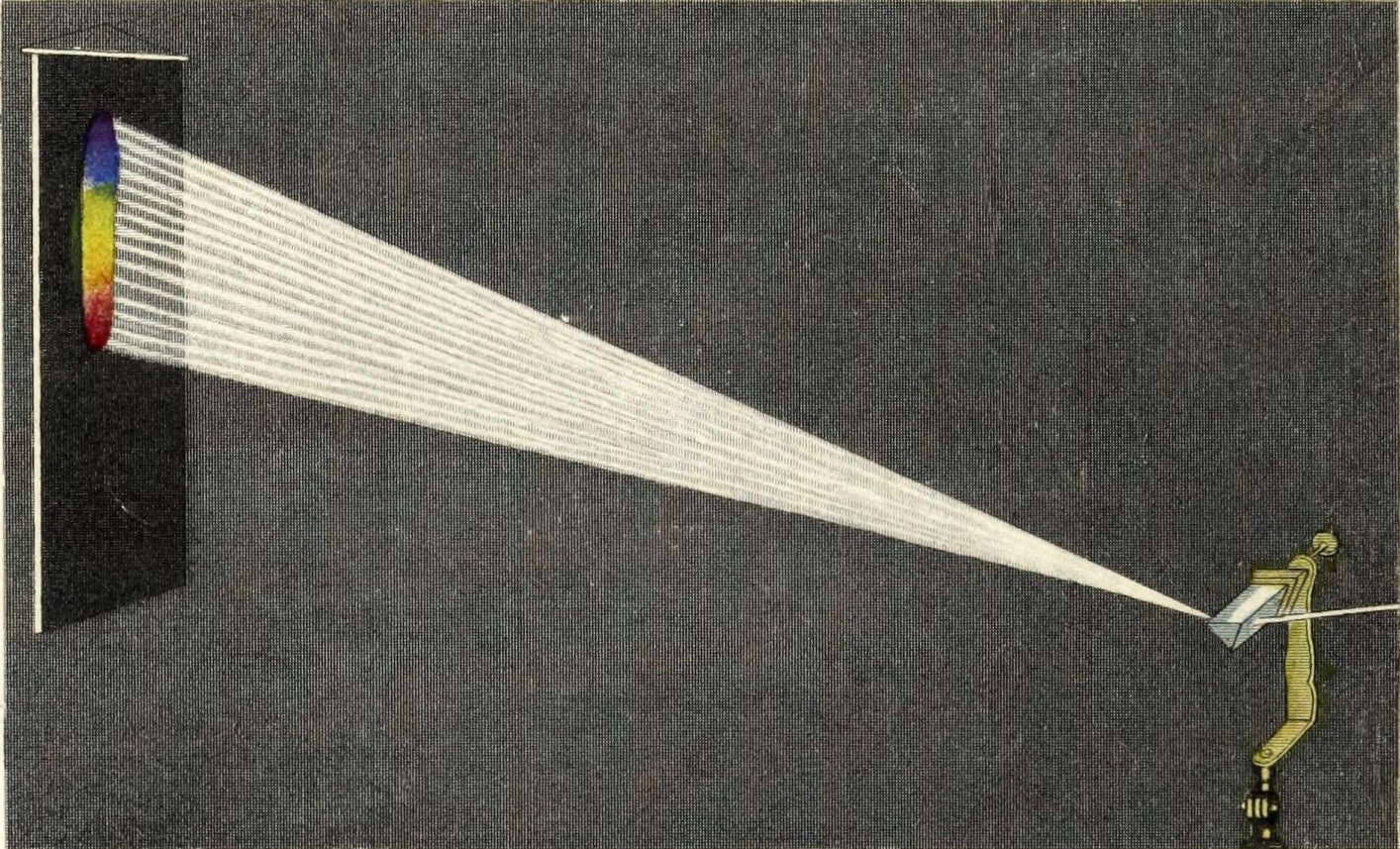
A small round hole is made in the window-shutter of
a room, facing the sun, and the pencil of light proceeding
from it is allowed to fall upon the surface of a three-sided
prism, held in a horizontal position, and placed
at a distance of a few inches from the aperture (fig. 5,
Frontispiece). The pencil of light does not pass through
the prism as if it were a plate of glass with parallel
sides, but in virtue of the laws of refraction, of which
we have already spoken, it is turned out of its natural
course, and is thrown upon the wall in the direction indicated
in the figure. The pencil of light is not only
turned aside, but it is also widened out into a band
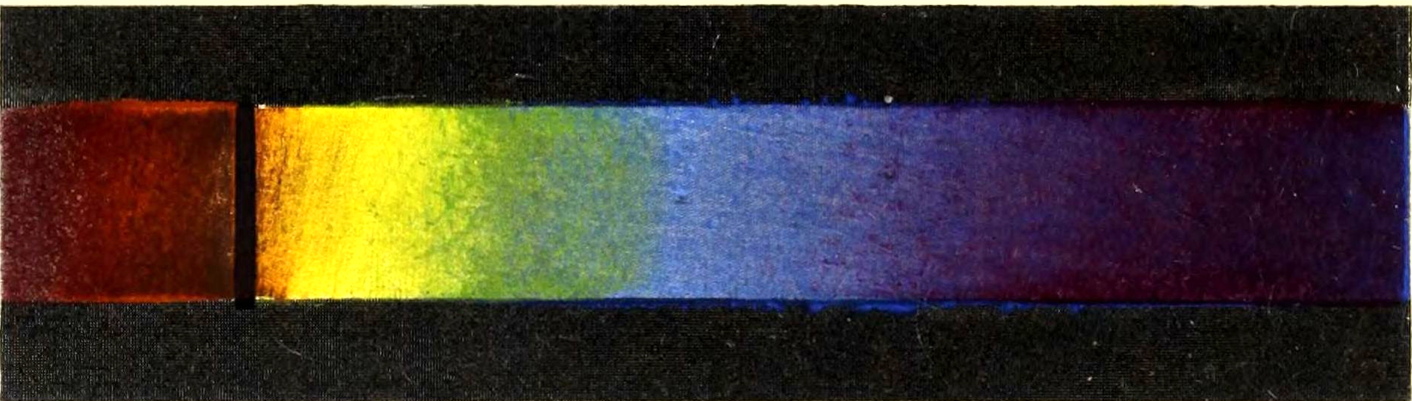
which is truly painted with all the colours of the rainbow,
every tone and hue being of the most marvellous
brilliancy. This long coloured stripe, which constitutes
one of the most beautiful sights that the science of
optics can afford us, is known to scientific men by the
name of the solar spectrum.
Before going into the causes that produce these
colours, let us first examine their number and position.
Beginning at the top, we shall find that they run in the
following order:—Violet, indigo, blue, green, yellow,
orange, red. The red being lowest is called the least
refrangible of them all; or, in other words, in passing
through the prism it was bent less out of its course than
86its companions. Violet, being at the top, is of course
the most refrangible. The cause of the separation of
the colours of white light is consequently only the effect
of their individual character. They were, so to speak,
so many streams flowing together until an unexpected
deviation in their course caused them to separate. This
change in the direction of their flow brought out their
personal individuality, and they at once became completely
disunited.
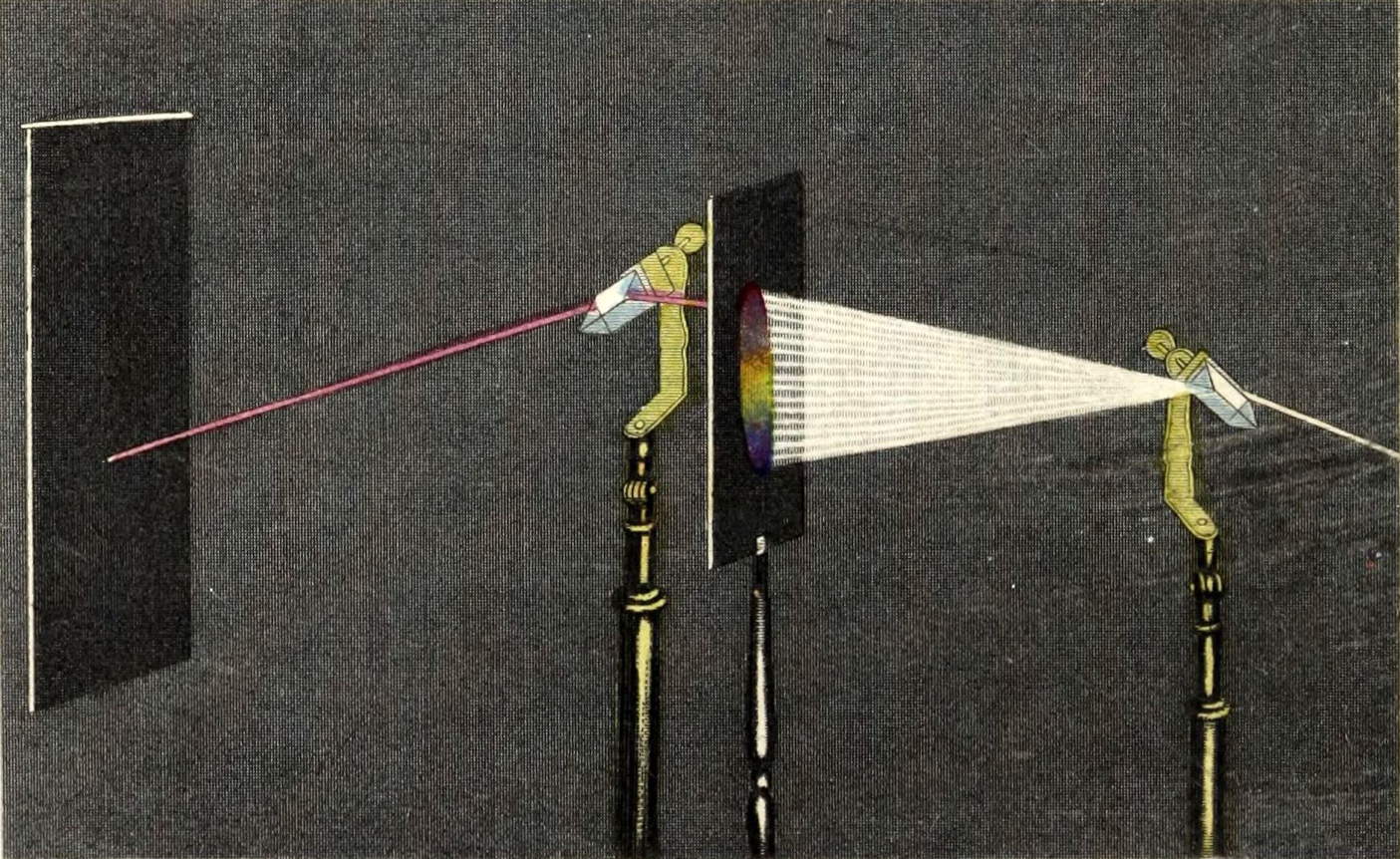
Every single tint in the prismatic spectrum is simple,
and cannot be decomposed. This may be shown by
passing any of them through another prism, when it
will be found that no change will take place in the
colour or size of the pencil. Hence those worlds already
spoken of, whose light of day is red, blue, or green,
never see any colours but these. (Fig. 6, Frontispiece).
It is just as easy to reunite the colours into which
white light is decomposed, by applying a second prism
in a reversed position to the pencil of coloured light, as
it is to separate them in the first instance. The method
of accomplishing this is shown in fig. 7, Frontispiece.
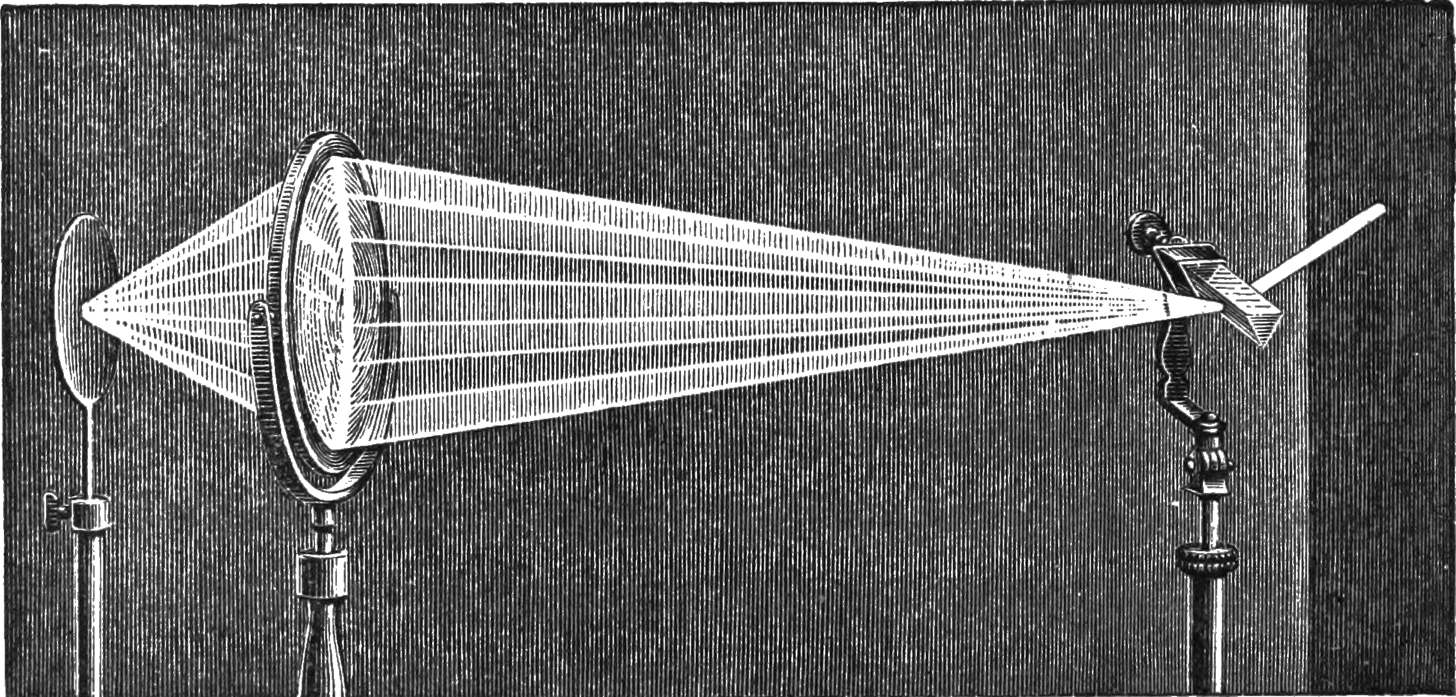
Fig. 8.—The Recomposition of Light.
Another experiment in the same direction consists in
87reuniting the colours by causing them to pass through
a double convex lens, behind which is placed a screen
of ground glass, or a card (fig. 8). By advancing and
withdrawing this screen we can easily find the exact
spot where the rays reunite, and form a dazzling spot
of white light. This point is called the focus, from a
Latin word, signifying “fire-place,” a term which will
put the student in mind of the frequently repeated experiment
of burning a piece of paper with an ordinary magnifying-glass.
Instead of using a lens, you can, if you please, employ
a concave mirror, using the ground glass or cardboard
screen, as before. The colours reflected by the
mirror unite at its focus, and produce a brilliant white
spot in just as conclusive a manner as in the other experiment.
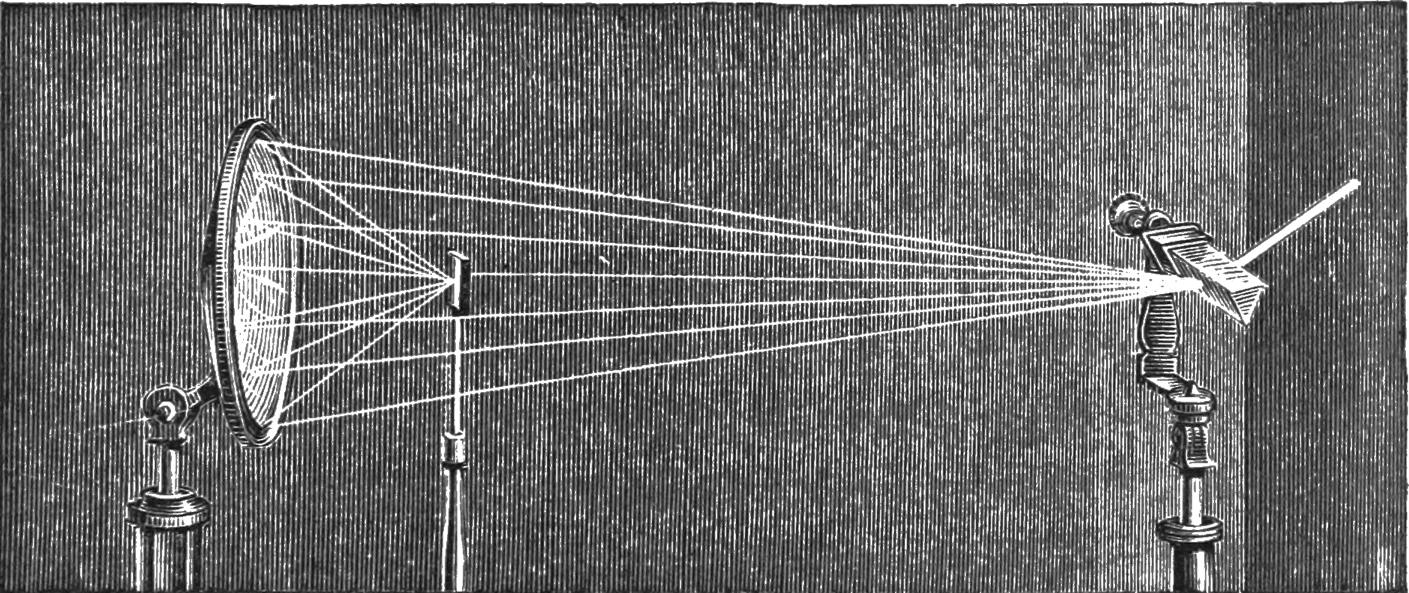
Fig. 9.—Recomposition of Light by means of a Concave Mirror.
A fourth experiment, which is somewhat more difficult
for the student to accomplish, consists in causing
every one of the seven different colours to be reflected
from a separate mirror.
The mirrors in this case are concave, and are so
mounted as to be capable of being moved in any direction.
By directing each of the seven rays, one by one,
upon the same point, you may observe the gradual decomposition
88of the coloured light. The effect obtained
by adding the last colour to the mixture is quite magical,
the white circle being produced from two brilliantly-coloured
spots.
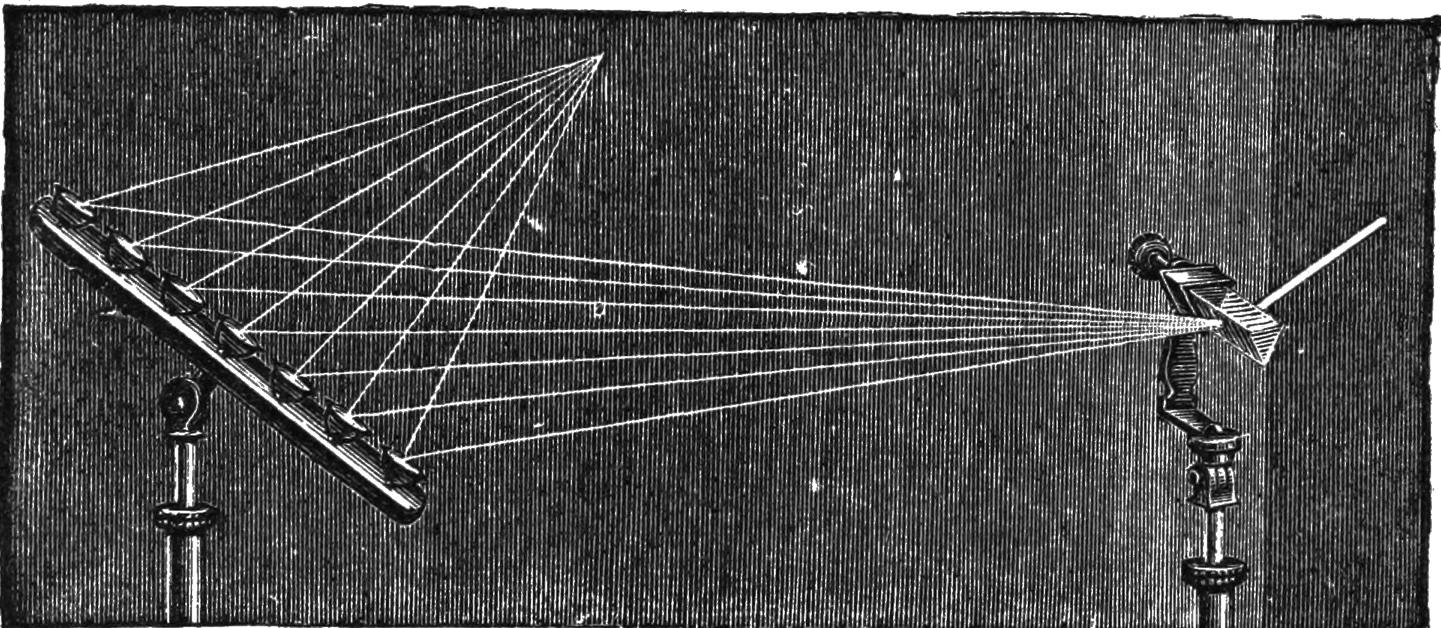
Fig. 10.—Recomposition of Light by means of a number of Mirrors.
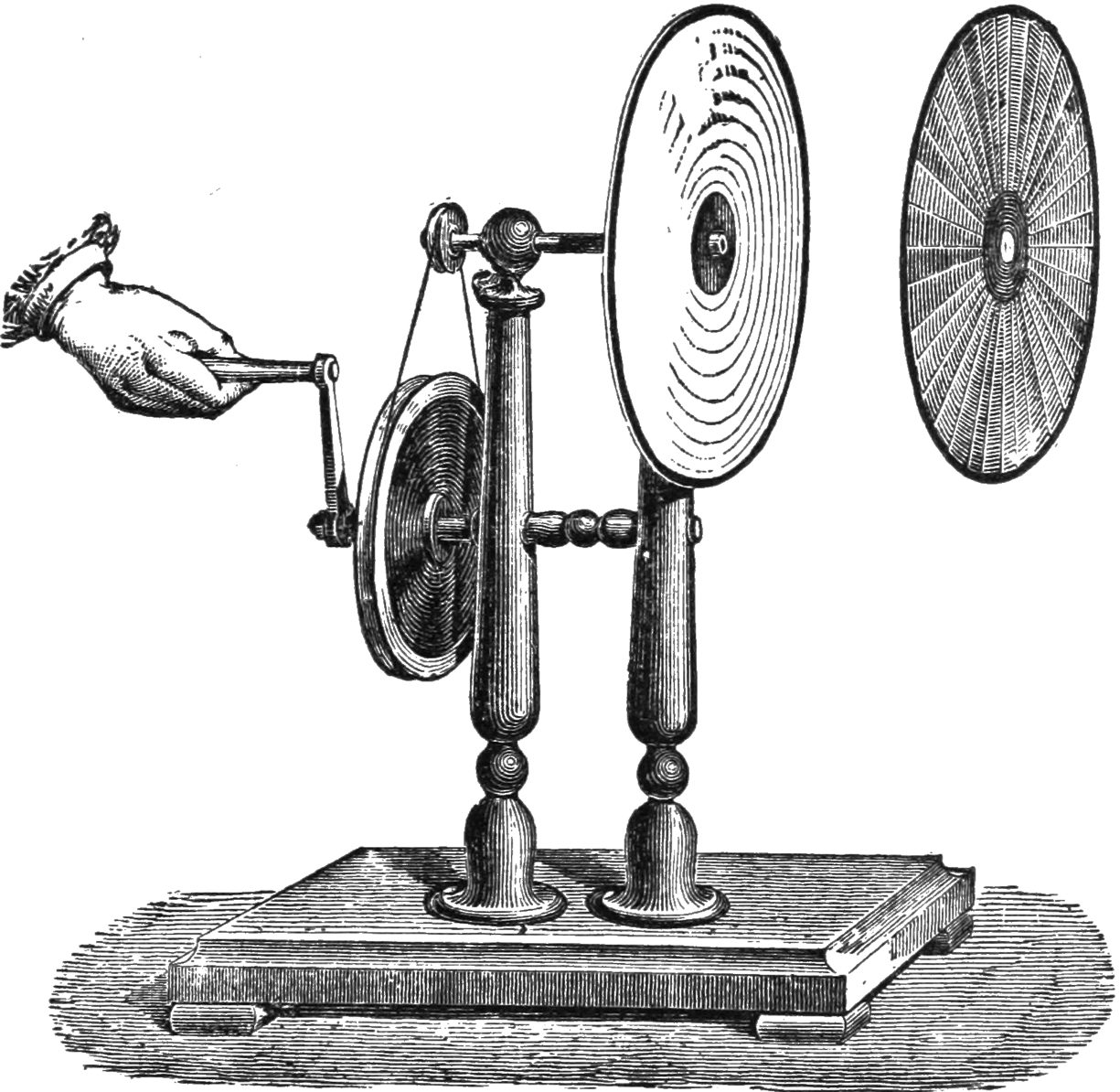
A fifth experiment, first devised by Newton, is also
within the reach of the student. On a disc of cardboard
the centre and border of which have been previously
painted black, are pasted seven strips of paper, painted
as nearly as possible of the same colour as the components
of the spectrum—or if the student is anything
of an artist he may paint the disc in imitation of the
spectrum, carefully shading off the tints into each other.
If the disc be now rapidly rotated the colours will disappear,
and a greyish hue will be seen, which will approach
more closely to white, the nearer the colours on
the disc are to those of the spectrum. This experiment
is not precisely the same in principle as the preceding
ones, for it is evident that the colours on the disc do
not mix, but only the impressions they form upon the
retina. We have already said that such impressions
remain on the eye for one-tenth of a second or there-abouts;
the disc must therefore revolve at least ten
times a second, or the effect will not be perceived.
From these experiments it follows that the colours
89with which all natural substances are clothed, ought not
to be looked upon as belonging to them absolutely, but
only as a property dependent on the reflection and
absorption of light from their surfaces. The leaves of
plants, for instance, must not be regarded as being
really green in themselves, but as being capable of absorbing
certain portions of light, and reflecting others.
Grown in the dark, the green substance contained in the
plant and its leaves becomes white, and no longer possesses
the property of absorbing red light, and reflecting
green. A green leaf placed in red light becomes almost
black, from its power of absorbing light of that
colour; in the blue it reflects a much greater proportion
of the coloured ray. A very striking experiment may
be performed with a substance known to chemists as the
90iodide of mercury. If a little of this salt, which is of a
brilliant red, be placed in a watch-glass, and heated over
a spirit-lamp, it will gradually sublime, and a card held
over it will be covered with a number of light yellow
crystals. In this case no change of composition has
taken place, but simply a change in the power the salt
possesses of reflecting some rays and absorbing others.
By simply scratching the surface of the card with a
pointed piece of wood, the yellow crystals become transformed
once more into the red variety; not only this,
the transformation gradually spreads, like a red cloud,
over the whole of the deposit. There are some other
salts known to chemists which possess the property of
dichroism, or double colour. The double cyanide of
platinum and barium, for instance, appears violet when
viewed in one direction, and yellow in another. Change
of temperature is often sufficient to change the colour of
bodies—white oxide of zinc, for example, becomes bright
yellow when heated. Such instances might be supplied
ad infinitum, but enough has been said to prove that
colour, after all, is only an appearance, and not an essential
property of bodies.
We have already spoken of complementary colours,
or those which it is necessary to add together in order to
produce white light. Blue, for instance, is complementary
to orange, red to green, violet to yellow, and vice
versa. But it is not by the aid of the palette that this
can be proved, for in the case of coloured pigments the
arrangement of their atoms interferes in some way with
the success of the experiment, and it is only by means
of the colours of the spectrum that such recompositions
can be effected.
Although most philosophers consider that there are
seven colours in the spectrum, there are others who do
not admit it, but assert that there are really only three,
red, yellow and blue—which by the superposition of
91their edges produce the intermediate hues of green and
orange. Perhaps it would be nearer to the truth to say
that the spectrum is composed of an infinite number of
colours of different hues.
We have already stated that every one of these
colours is indecomposable, and that there are certain
worlds illuminated by a single colour only, instead of
possessing the infinite number of tints enjoyed by the
inhabitants of the solar system. An idea of this effect
can easily be gained in a very simple but surprising
manner by inserting panes of glass of different colours
in the hole of the shutter of a dark room. If the light
is yellow, you will find that all those objects that are
capable of reflecting yellow light are coloured by it,
while those which are bright red or blue become almost
black by absorbing the only light present. If we could
procure an object which was perfectly complementary
in colour to the yellow glass, it would appear perfectly
black. The same experiment may be repeated with
the other colours. After remaining in this coloured
light for some time, if you suddenly pass out into daylight
the complementary colour will tinge everything
around you.
Instead of using a room into which coloured light
only is admitted, lamps burning with a coloured flame
may be employed. Brewster mentions the following
experiment, which is a very striking one:—Fill a spirit-lamp
with alcohol in which has been dissolved as much
common salt as the spirit will take up; on being lit it
will be found to burn with a livid yellow flame. A
room lighted entirely with one or two lamps of this
kind will form a laboratory for some very singular experiments.
It should, if possible, be hung with pictures
in water and oil colours, and the persons present ought
to wear nothing but the brightest colours, and the table
be ornamented with the gayest of flowers. The room
92being first lighted with ordinary daylight, the lamps
above mentioned should be brought in, and the daylight
carefully excluded, when an astonishing metamorphosis
will take place. The spectators will be hardly
able to recognise each other; the furniture of the room,
and every other object contained in it, will reflect but a
single colour. The flowers will lose their brilliant
tints, the paintings will appear as if they were drawn
in Indian ink. The brightest purple, the purest lilac,
the richest blue, the liveliest green, will be converted
into a monotonous yellow. The same change will take
place in the countenances of those present; a livid
paleness will spread over their faces, whether young or
old, and those who are naturally of an olive complexion
will hardly appear changed at all. Every one will
laugh at the appearance of his neighbour’s face, without
thinking that he is just as great a subject of laughter to
them. If, in the midst of the amusement caused by this
experiment, the light of day is admitted at one end of
the room, the other end being still lighted with the
salt-lamp, every one will appear to be half-illuminated
with the livid colour which has caused so much surprise,
the other portion of their figure and clothes being of
the natural hue. One cheek, for instance, will appear
animated with its usual brilliancy, while the other will
be that of a corpse; one side of a lady’s dress will be
brilliant blue or green, as the case may be, the other a
colour that it would puzzle an artist to give a name to.
The experiment may be varied by admitting the white
light through several small holes in the shutter of the
room, every luminous spot painting the place where it
falls in its natural colours, and the yellow spectators
will become spotted with the most singular tints and
hues. If a magic lantern is used to throw on the walls
of the room and the clothes of the company any luminous
figures, such as those of flowers or animals, they
93will be coloured with these figures in the tint of the
wall or fabric upon which they fall, yellowish colours
of course escaping the transformation. If nitrate of
strontia be substituted for the salt, a crimson tint will
be spread over everything. In fact, a lamp prepared
in this way will form a source of endless amusement.
It is not necessary to use alcohol for the purpose;
wood-spirit or methylated alcohol will serve the purpose
equally well. If a lamp is not to be had, a few pieces
of cotton-wool, tied on wires and dipped in the salted
spirit, will do almost as well.
CHAPTER III. OTHER CAUSES OF COLOUR.
94
The colours of the spectrum are to the sense of sight
what the tones of the gamut are to the sense of hearing.
On the one hand, the differences in the lengths
of the sonorous waves constitute the variety of note perceptible
by the ear; on the other, the differences in the
lengths of the luminous waves constitute the variety of
colour perceptible by the eye. By and by, we shall
learn both the length and rapidity of these vibrations,
but it will be as well first to describe the experiments
made in this direction by the immortal Newton
himself.
Every one has, doubtless, at one period of his life,
amused himself with blowing soap-bubbles by means of
a tobacco-pipe and a little lather—a sufficiently childish
amusement, you will possibly say, but one narrowly
connected with the most intricate secrets of the science
of optics. These little globes, so fragile that they disappear
in a breath, hardly seem worthy of the attention
of a thinker, and still less the examination of a philosopher;
but it is nevertheless true that Newton made experiments
on the colours shown on the surface of these
apparently insignificant objects which ended in the
most brilliant discoveries, just as on seeing an apple fall
he began a train of thought which only terminated in
the enunciation of the hypothesis of the earth’s power
of gravity.
95All transparent substances, whether liquid, solid, or
gaseous, become coloured with the most brilliant hues
as soon as they are reduced to plates of extreme thinness.
In the soap-bubble it is the oleaginous particles
floating on the surface which thus become coloured, but
Newton showed that thin plates of air were similarly
capable of showing colour, and that the thinner the
plates were the more brilliant were the tints. We may
see this in the soap-bubble, which becomes more beautiful
as it gets larger and thinner. By placing a convex
lens of large size on a flat plate of glass, Newton
observed that rings of different colours were formed
round the spot where the two pieces of glass touched.
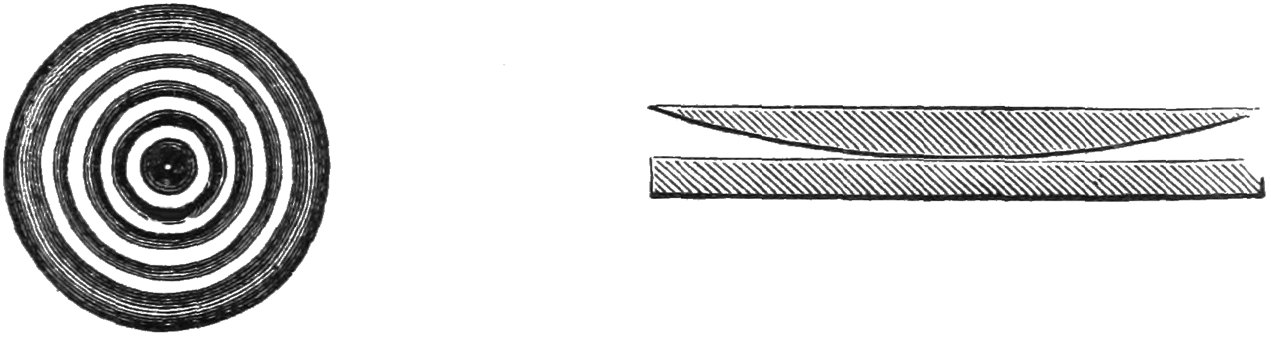
By measuring the convexity of the lens and the diameter
of the various rings, Newton was enabled to tell to
a minute fraction the exact thickness of the plate of
air corresponding to the different colours. The glasses
being placed in position, a ray of a particular colour—red,
for instance—was thrown upon the surface. The
result was a black spot at the point where the two surfaces
touched, and surrounding it at various distances
were several rings alternately red and black. Calculating
the thickness of the plates of air at the part
where the dark rings made their appearance, Newton
found that their dimensions were in the proportion of
the even numbers two, four, six, eight, &c.; while the
red rings showed figures corresponding to the odd numbers.
Although trammelled by the corpuscular theory,
Newton’s deductions from these experiments show that
96they can only be accounted for by the undulatory hypothesis.
Thus the thickness of the plate of air at the first
red ring is that of the red wave, the thickness at the
second that of two red waves, and so on; so that in order
to arrive at the thickness of the red wave we need
only measure the distance between the portions of the
glasses where the first red ring occurs.
This experiment, was applied to the measurement of
all the waves. Whenever they were reflected on the
glasses a parallel series of rings was formed, but it was
found that the first ring was more or less distant from
the central spot, according to the colour used. The red
ring was the largest; the orange, yellow, green, blue,
indigo, and violet, following in the same sequence as in
the spectrum. The word “thickness” seems hardly fit
to apply to dimensions arrived at by Newton in his experiments,
so infinitely small do they appear to be, yet
their correctness has never been impugned, although
the experiments have been repeated by the philosophers
of all countries. The waves of red light are so small
that 40,000 of them go to an inch, and those of violet
light situated at the other end of the spectrum are still
smaller, measuring only the 60,000th part of an inch.
The waves of the other colours are between these two,
while the wave of white light, which is a mixture of
them all, is just half-way between the two.
Thus was the physical cause of the various hues of
colour discovered by this great man, revealing as it does
the singular and mysterious analogy between sound and
light. The rays of light, like the waves of sound, produce
a different effect, according to their length, by
causing quicker or slower pulsations in the nerves of
sight, just as musical sounds vibrate upon the drum of
the ear with different velocities.
This is not all, for the relationship between sound and
light does not cease here: we have as yet only spoken
of the size of the undulations, and have only shown
97how their dimensions are connected with the sensation
of colour; but there are other things to be considered,
for on investigation we find that not only do the different
coloured waves vary in the length of their undulations,
but also in the number that take place in a given
time.
The perception of sound is produced by the action of
the drum of the ear, which vibrates sympathetically
with the pulsations of the air that have been originated
by the vibrations of the sounding body; and the perception
of light is produced in a similar manner by the
vibrations originating in a luminous body, and propagating
themselves through the luminous ether until
they reach the nerves of sight. The number of these
pulsations taking place in the eye has been accurately
determined in the following manner. Let us suppose
that we are looking at a coloured object—let us say, a
red railway signal-lamp; from the lamp to our eye there
flows a continuous line of luminous undulations; these
undulations enter the eye and become depicted on the
retina. For every wave that passes through the pupil,
there is a separate and corresponding vibration of the
optic nerve, and the number of these vibrations that
take place in the course of a second can be easily calculated
if we know the velocity of light and the breadth
of the waves. We have before found that light travels
at the rate of 185,000 miles per second; it therefore
follows, that a series of undulations 185,000 miles long
pass through the pupil every second; consequently the
number of vibrations per second is arrived at by calculating
how many waves measuring the 40,000th of
an inch—that being the length of a wave of red light—are
contained in 185,000 miles. The following table,
showing the number of waves passing into the eye
per second for the different colours, will interest the
student:—
98
| Extreme red |
458,000,000,000,000 waves per second. |
| Red |
477,000,000,000,000 " |
| Orange |
506,000,000,000,000 " |
| Yellow |
535,000,000,000,000 " |
| Green |
577,000,000,000,000 " |
| Blue |
622,000,000,000,000 " |
| Indigo |
658,000,000,000,000 " |
| Violet |
699,000,000,000,000 " |
| Extreme violet |
727,000,000,000,000 " |
Whatever theory we may adopt to explain the phenomena
of light, we arrive at conclusions that strike
the mind with astonishment and admiration. According
to the corpuscular hypothesis, it was supposed that
the molecules of light were endowed with the power of
attraction and repulsion, that they possessed poles and
centres of gravity like the earth, and that they had
other physical properties that could only be given to
ponderable matter. Starting with these notions, it is
difficult to divest oneself of the idea of sensible size, or
to induce the mind to conceive particles so extremely
small as those of light would necessarily be if the theory
of emission were accepted. If a particle of light weighed
a grain, it would produce by means of its enormous velocity
the effects of a cannon-ball weighing 120 lbs.,
travelling at the rate of 300 yards per second. How
infinitely small would be these particles, seeing that the
most delicate optical instruments are submitted to their
action for years without being injured!
If we are astonished at the extreme smallness and
prodigious rapidity of the luminous molecules whose
existence is necessitated by the corpuscular theory, the
numerical results of the undulatory hypothesis are not
less surprising. The extreme smallness of the distance
between the waves, and the inconceivable quickness of
their undulations, although both are easily calculated,
must raise in the mind of the student feelings of the
utmost wonder and admiration.
99Colour, then, simply results from the difference in
the rate of vibration of the rays, as Professor Tyndall
observes in his lectures on the “Analogy between Sight
and Sound,” the impression of red being produced by
waves that undulate a third less rapidly than those
which produce the sensation of violet.
CHAPTER IV. LUMINOUS, CALORIFIC, CHEMICAL, AND MAGNETIC PROPERTIES OF THE SPECTRUM.
100
The solar spectrum may be compared to a battle-field
with an army drawn up upon it ready for action. In
the centre we find the luminous rays, on one side the
light troops which produce chemical effect, and on the
other the heating rays, which may be compared to squadrons
of heavy cavalry. Close by the light brigade are
the magnetic rays, which are a corps of skirmishers,
sometimes appearing, and at others hiding themselves
from view in a very mysterious manner.
But to drop metaphor, we shall find on examination
of the spectrum that the three great forces—heat, light,
and chemical effect—are regularly distributed over three
different portions of this wonderful band of colour.
Before Fraunhofer the intensity of the light of different
parts of the spectrum remained undetermined
with any degree of accuracy; but this philosopher, by
the use of a very delicate photometer, obtained the results
given below.
The maximum of luminous effect is situated just at
the junction of the yellow and orange. Taking this
spot as its starting-point, it gradually decreases on each
side until it ceases altogether at the extreme red and
violet.
With respect to the calorific portion of the spectrum
101it was for a long time supposed that the heat-giving
properties of any part were in direct proportion to the
amount of its luminous effect; but Sir John Herschel
proved by a long series of experiments that the heat of
the spectrum gradually increased from the extreme
violet to the extreme red, and that passing this point it
still further increased until it attained its maximum at
a point where not a single ray of light existed. From
these grand experiments he adduced the important conclusion,
that in solar light there existed invisible rays,
which produced heat, and which possessed even a less
degree of refrangibility than the extreme red rays. Sir
John Herschel then tried, but unsuccessfully, to determine
the exact refrangibility of the invisible heat
rays.
Sir Henry Englefield compared these results, and
obtained the following figures:——
| Blue |
56 deg. Fahr. |
| Green |
58 " |
| Yellow |
62 " |
| Red |
72 " |
| Beyond the red |
79 " |
Bérard obtained similar results, but he at first found
that the maximum of heat was just at the end of the
extreme red, and that beyond it the air was only about
one-fifth warmer than the ordinary temperature. Sir
John Herschel attributed these discordant results to
Bérard having used a thermometer with too large a
bulb; he accordingly repeated his experiments with
other instruments with long narrow bulbs, and arrived
at similar results to those obtained by the English
philosopher.
We will now pass on to the physical properties of the
other end of the spectrum. Towards the end of the last
century, Scheele, a Swedish philosopher, remarked that
102chloride of silver was blackened more quickly by the
violet portion of the spectrum than by any other. In
1801, Ritter of Genoa, in repeating certain experiments
made by Herschel, found that a much stronger blackening
effect was produced at a point beyond the violet,
and that the discoloration was produced with less intensity
by the violet and still less so by the blue, the
change gradually decreasing till the red ray was reached.
He also found that when slightly blackened chloride of
silver was exposed to the effects of the red rays, or
even in the space beyond, its colour was restored to it.
From these facts he drew the conclusion that in the
solar spectrum there existed two kinds of rays, one at
the red extremity, which favoured oxygenation; the
other, at the blue end, which possessed the contrary
properties. He also found that when phosphorus was
placed in the invisible rays beyond the red, it gave off
fumes of oxide, which were immediately extinguished
when it was transferred to the other end.
On repeating the experiment with chloride of silver,
Lubeck found that the tint varied according to the
colour in which it was placed. Beyond or in the violet
ray it became brownish red, in the blue it became
bluish or bluish grey, in the yellow it remained white,
or became slightly yellow and reddish in or beyond the
red ray. When he used prisms of flint glass, the chloride
of silver was discoloured beyond the visible limits
of the spectrum.
Without being aware of Ritter’s experiments, Dr.
Wollaston obtained the same results by acting on
chloride of silver with violet light. In continuing his
researches he discovered that gum guaiacum was also
influenced by the chemical rays of light.
The magnetic influence supposed to be exerted by the
solar rays still remains without positive proof, although
numbers of philosophers have experimented in this
103direction. More than fifty years ago Dr. Morichini
announced that the violet rays of the solar spectrum
possessed the property of magnetizing steel needles
that were previously free from magnetism. He produced
this effect by concentrating the violet rays upon
one-half of each needle with a convex lens, taking care
to keep the other half concealed beneath a screen.
After having continued this experiment for more than
an hour, the needles were found to be quite magnetic.
Dr. Somerville tested Morichini’s experiments by
covering one-half of an unmagnetized needle an inch
long with a piece of paper, and exposing the uncovered
half to the violet rays of the spectrum, and found that
the needle became magnetic in the course of a couple
of hours, the exposed end being the north pole. The
indigo rays produced almost the same effect, but the
blue and green rays were much less powerful. When
the needle was exposed to the yellow, orange, red, and
invisible rays beyond the red, no magnetic effect was
produced, although the experiment was continued for
three days. Pieces of chronometer and watch springs
were submitted to the same influences with a similar
result; but when the violet rays were concentrated upon
the needles and pieces of spring with a lens, the time
necessary for magnetizing them was greatly reduced.
Baumgartner of Vienna and Christie of Woolwich
also repeated these experiments. The latter philosopher
found that when a needle of magnetized steel, copper,
or even glass, vibrated by force of torsion in the rays
of the sun, the arc of vibration diminished much more
quickly than when the experiment was conducted in the
shade. The sun’s rays appeared to have the greatest
effect upon the magnetized needle. From these results
Christie concluded that the solar rays were capable of
exerting a certain amount of magnetic influence.
These experiments were afterwards fully confirmed
104by those of Barlocci and Zantedeschi. The former
found that a natural magnet which was capable of supporting
a pound weight, had its power almost doubled
by exposure to strong sunlight for four-and-twenty
hours. Zantedeschi exposed a magnet which would
carry fifteen ounces to the sun for three days, and increased
its power two and a half times. These experiments
seem almost to decide the fact of the power of
white and violet light to induce magnetic force; but a
series of researches by a philosopher who without doubt
is greater than any of those already mentioned, seems
to throw some doubt on the facts we have related above.
Before concluding, we must add a few more facts relating
to the existence of invisible rays at both ends of
the spectrum. “The visible portion of the spectrum,”
says Dr. Tyndall, in one of his Royal Institution lectures,
“simply marks an interval of radiant action, the
rays existing in which bear such a relation to our visual
organs, as to be capable of exciting in them the sensation
of light. Beyond this interval, in both directions,
right and left, the radiant action continues to exercise
itself, but the rays emitted are dark, in consequence of
their exerting no influence on our eye. Those that exist
beyond the red ray are capable of producing heat,
while those that are beyond the violet excite chemical
action. These invisible violet rays can be actually
made perceptible to the eye, or, in other words, the undulations
or waves proceeding from this end of the
spectrum can be made to strike against certain substances
and induce luminous vibrations, so as to connect
the dark space beyond the violet with a brilliantly illuminated
band. I have here a substance capable of
effecting this change. The lower half of this sheet of
paper has been moistened with a solution of sulphate
of quinine, the other half being left in its ordinary
condition. I will now hold the paper in such a manner
that the line that separates the prepared half from the
105other shall cut the spectrum in two halves horizontally.
The upper half will remain unaltered and may be
readily compared with the lower half, upon which you
will see the spectrum prolonged beyond its ordinary
limits. The effect produced is the addition of a splendid
band of fluorescent light, which extends over a space of
several inches, which but an instant before was a dark
mass. I withdraw the prepared paper, and the light
disappears; I replace it, and the light shines forth once
more; showing us in the most brilliant way that the
visible limits of the ordinary spectrum are not the limits
of radiant action.
“I plunge a pencil into the solution of sulphate of
quinine, and I pass it over the paper. You see that
wherever the solution falls, the light bursts forth. The
existence of these rays has been known for a long time.
Young was familiar with them, and subjected them to
experiment; but it is to Professor Stokes that we are
indebted for a complete series of researches on this subject.
It was he who first made those invisible rays
visible, as we have done.”
In the same way the Professor proceeded to show that
the heat rays were invisible by passing a beam of sunlight
through a solution of iodine in spirits of wine,
which, although it completely stopped all light, allowed
the heat rays to pass uninterruptedly. By collecting
these invisible rays into a focus by means of a lens,
Dr. Tyndall was enabled to ignite various combustible
bodies.
Thus we see the reason why certain rays produce
certain effects on the eye, each particular degree of refraction
causing a different set of vibrations, resulting
in a different sensation for every part of the spectrum,
and reproducing the effect of various colours on the
optic nerve. In the following chapters we shall conclude
our account of the different colours in the spectrum
and of the laws of light.
CHAPTER V. THE LAWS OF REFLECTION.—MIRRORS.
106
When a ray of light falls obliquely on any polished
surface, as that of a mirror, a piece of water, a plate
of burnished metal, or any other reflecting substance,
the ray, like an elastic ball, is immediately projected in
a contrary direction to that in which it fell. Moreover,
the direction in which it is reflected is at right angles
to the surface, and in the same plane as that of the ray
in the first instance. This experiment may be tried
very easily, and will show the reason for the two following
laws.
1. The angle of incidence is equal to the angle of reflection,
and vice versâ.
2. Reflection can only take place in one direction—in
that of the incident rays, both of which are always
in a plane perpendicular to the reflecting surface.
The following figure will assist the student in performing
experiments on the reflection of light from flat
surfaces.
The ray A B falling obliquely on the horizontal
mirror, is reflected upwards at the same angle in the
direction B C. This may be proved geometrically by
placing a graduated circle in a vertical position in the
plane A B C, when we shall find that the angle A B D
formed by A B (the incident ray) with the perpendicular
D B is equal to the angle formed by this perpendicular
line and the reflecting ray B C. You may also prove
107in the same way that these three lines are all in the
same vertical plane.
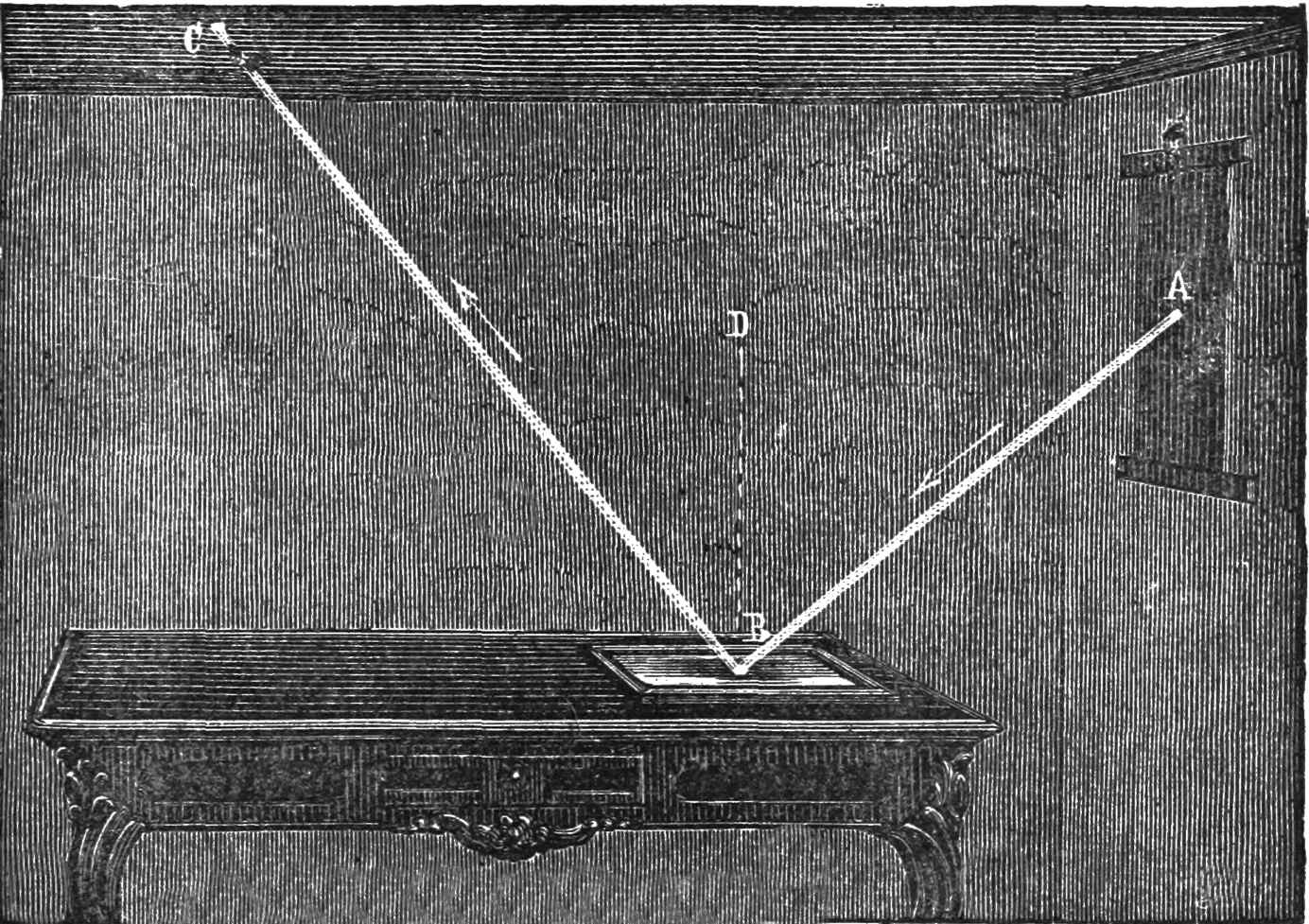
Fig. 13.—Reflection from Plane Surfaces.
Let us now examine the effects of light reflected
from plane surfaces. We must first, however, notice a
certain optical illusion to which we are continually
falling a prey, almost without our knowledge. We
always fancy objects to be in reality in the place where
we see them, and, in spite of our having already enumerated
a large number of these deceptions, we must
still add one more to the list. In reality we rarely see
objects in the place where they really are; for if by
the effect of reflection, refraction, or any other cause,
the rays of light are made to deviate from their course,
we no longer see the object from which they proceed in
its real position, but in the direction taken by the luminous
pencil at the moment of entering the eye.
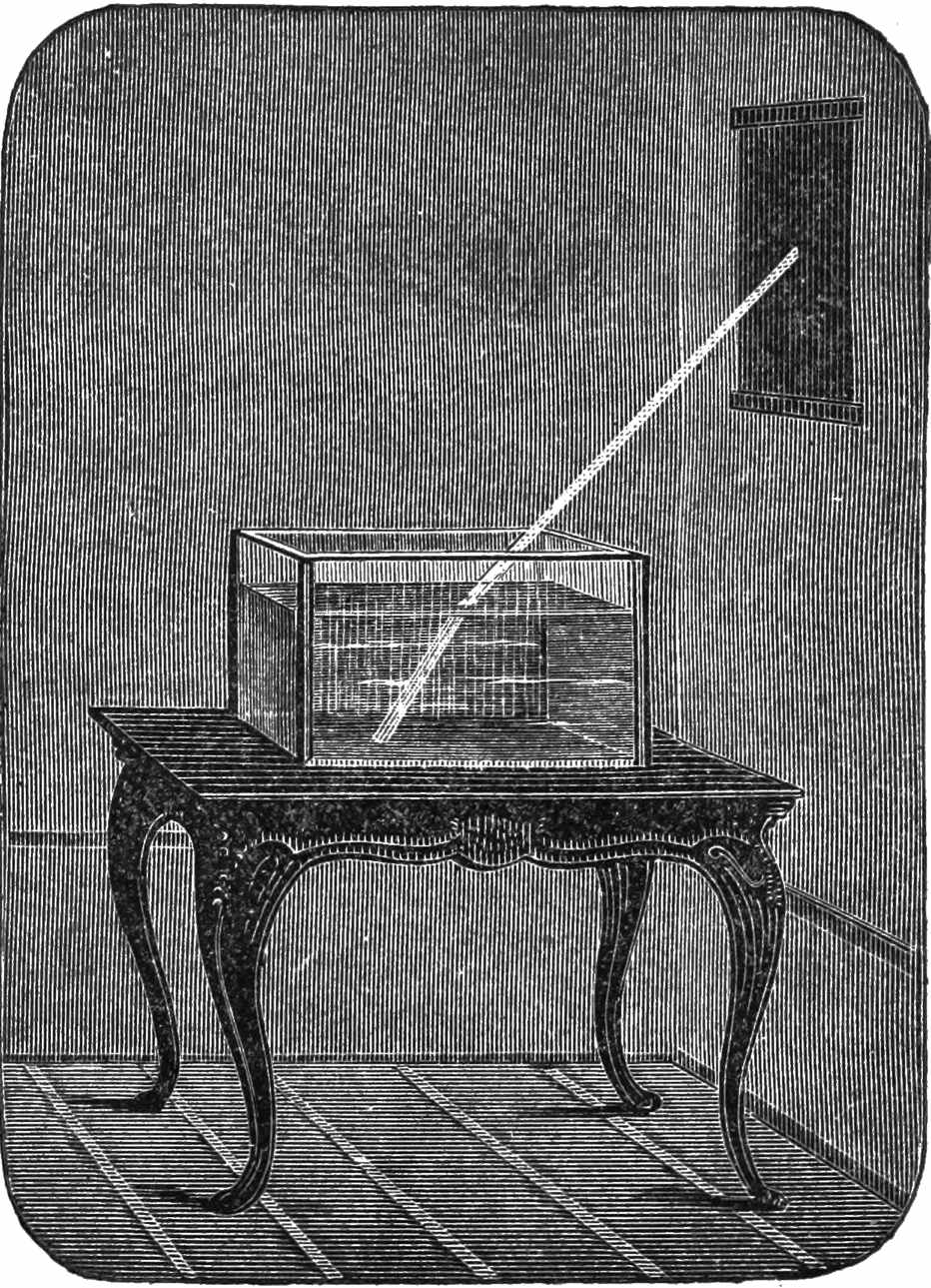
Fig. 15.—Experimental Proof of Refraction.
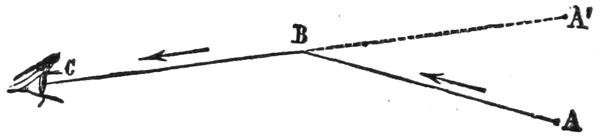
For instance, if the ray A B is bent during its passage
to the eye at B, and consequently reaches it in the
108direction B C, it is at A´, and not at A, that we shall see
the object from which it proceeds. Every ray of light
which passes out of a medium of a certain density into
another of a different density is bent from its primary
course, or, in scientific language, it is refracted. The
experiments we made in a former chapter on the
properties of the prism are founded on this principle.
109The law may be easily illustrated by allowing a ray of
light to fall upon the surface of a vessel of water, as
shown in the preceding figure.
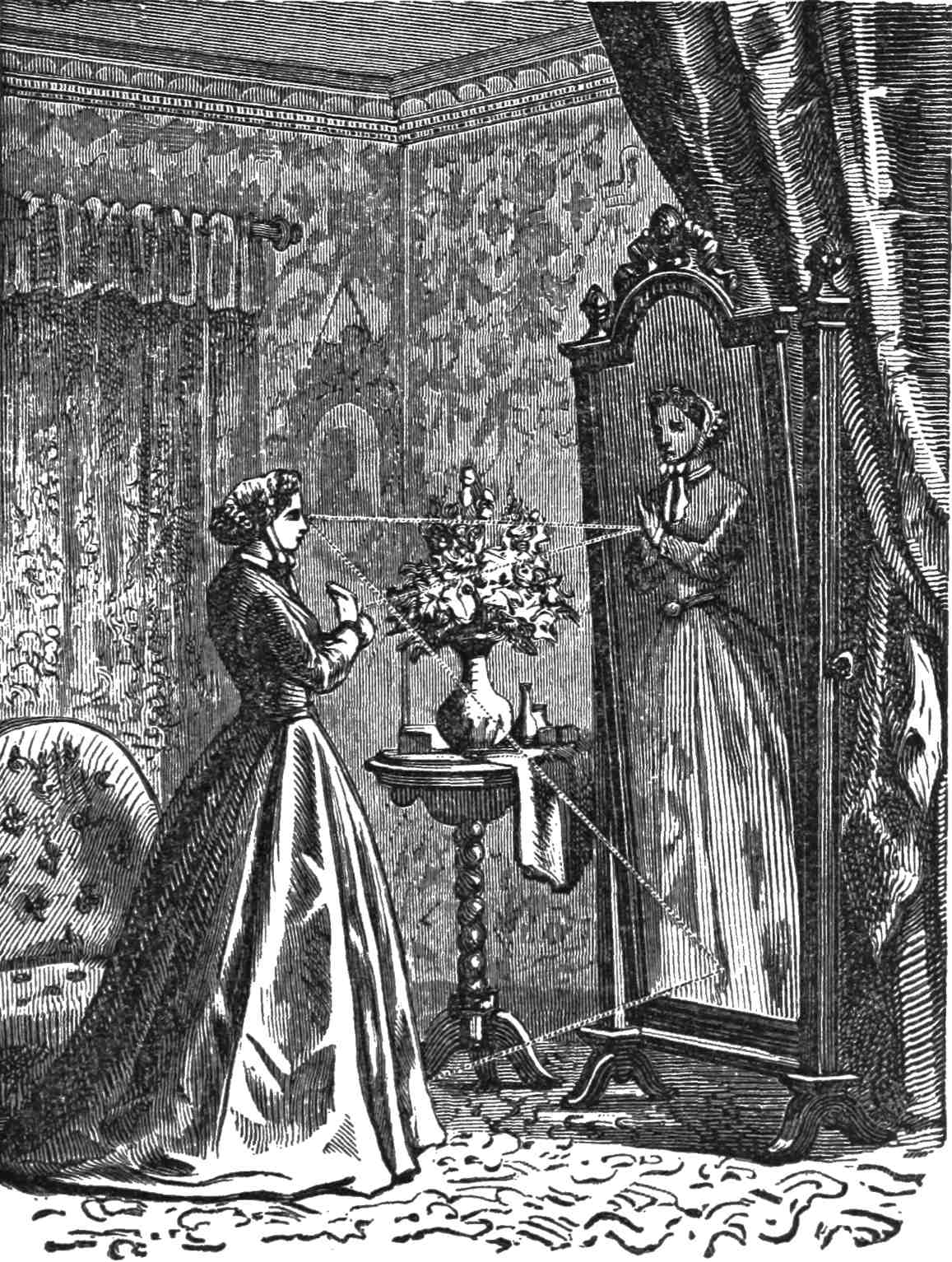
Fig. 16.—The Effects of Plane Mirrors.
The light of the stars and planets undergoes a similar
deviation when passing in its course through the earth’s
atmosphere; and at the moment we see the rising of
the sun, the moon, or a star, they are in reality still
below the horizon. Our eyes consequently are still
deceiving us, no matter what part of the domain of optics
we may enter.
110There are two kinds of mirrors—plane and curved.
We will first examine the properties of the former sort,
being those which are ordinarily applied to the usages
of every-day life.
Fig. 17.—Reflection from the Surface of Water.
In the figure in the preceding page we have a young
lady looking at her reflection in a tall cheval glass.
Every point upon the surface of her clothes and face is
reflected back to her eye from the surface of the tin
amalgam which has been applied to the back of the mirror
by the looking-glass maker, for the purpose of rendering
the image of the object more brilliant than if the
glass alone were used. The rays which proceed from
every one of these points strike upon the surface of this
metallic layer, are stopped by its opacity, and are reflected
back to the eye at an angle equal to that at which
they strike the surface. The image seen by the eye is
formed, consequently, by the reflection of every one of
111these rays; and as we always see objects in the direction
taken by the luminous ray at the moment it enters
the eye, we fancy we see objects before us that are
really behind, or on each side of us. For instance, the
ray starting from the left foot of the young lady in the
figure is reflected from the point indicated on the surface
of the glass, but the eye does not stop here, but
sees the foot at an equal distance beyond the mirror.
The same thing takes place, not only with glass, but
with all substances having polished surfaces. Still water,
which to all intents and purposes has a polished surface,
reflects the objects within its range as perfectly as
a mirror.
The preceding observations apply to all plane reflecting
surfaces; but there are other sorts of mirrors,
whose effects are of a more interesting nature, and
which we must hasten to describe—we allude to those
whose surfaces are either convex or concave.
Curved mirrors are made of a great variety of shapes,
but for the present we shall only describe those which
are spherical. Spherical mirrors may of course be
either concave or convex.
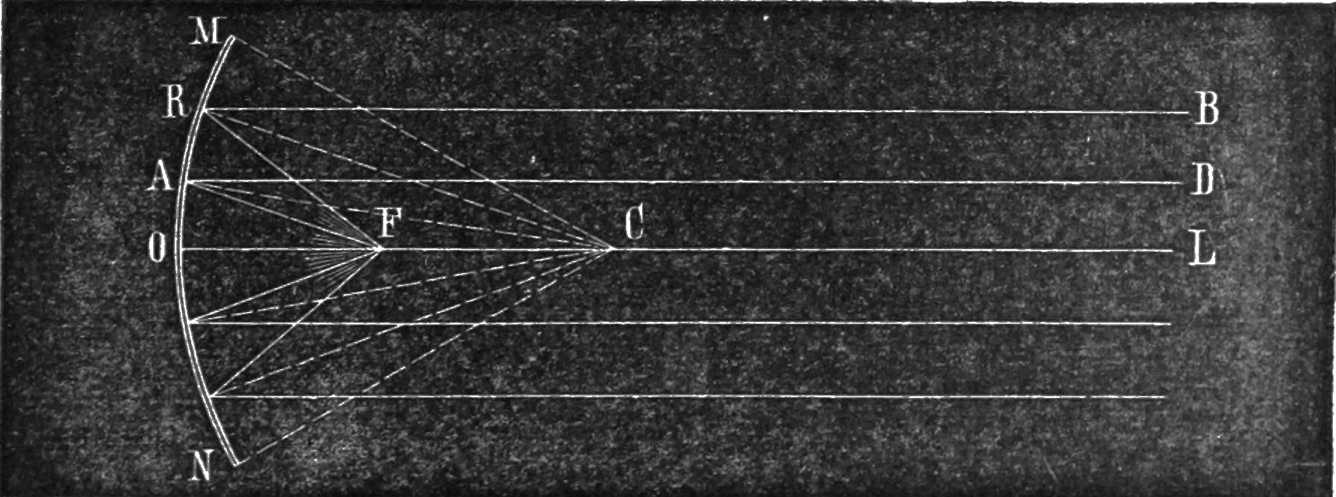
Suppose the arc M N (fig. 18) to be movable round
the point O, this revolution will describe the surface of
the mirror. The central point C of the hollow sphere
112of which the mirror forms part, is called the centre of
curvature, the line O L the principal axis. By remembering
these very simple definitions, we shall be able
to understand the action of these mirrors without the
slightest difficulty.
To understand how the rays of light are reflected
from the surface of the mirror N M at the point F, which
is called the focus, we have only to consider the mirror
as consisting of an infinite number of facets, all inclined
towards that particular point, and forming by reason of
their immense numbers a regular spherical surface. In
considering the mirror from this point of view, we can
immediately see that, on account of the inclination of
the supposed facets, the rays that they receive are all
reflected back again at the same point; and it may be
proved geometrically, that when the incident rays are
parallel the focus will be situated somewhere on the line
O C, its position depending on the curvature of the
mirror.
If, therefore, we receive on a spherical mirror a pencil
of sunlight, the rays which compose it may be regarded
as parallel, the sun being at so great a distance from the
earth; it follows that these rays will all be reflected
together in a particular point, viz., at F, and if any
object be placed there it will be illuminated with great
brilliancy. The laws governing the reflection of heat
being nearly similar to those regulating the action of
light, the rays reflected from a burning body will ignite
any inflammable substance placed at the point F. The
focus for parallel rays is called the principal focus of a
mirror. Having described the effects of parallel rays,
let us now see what happens when the source of light is
close to the mirror. If it is placed at a very small
distance, the luminous rays are divergent instead of
parallel, and their meeting point becomes changed in
accordance with the laws laid down at the beginning of
113this chapter. That is to say, the focus will approach
more or less to the centre of curvature C, according as
the source of light is placed nearer to or further from the
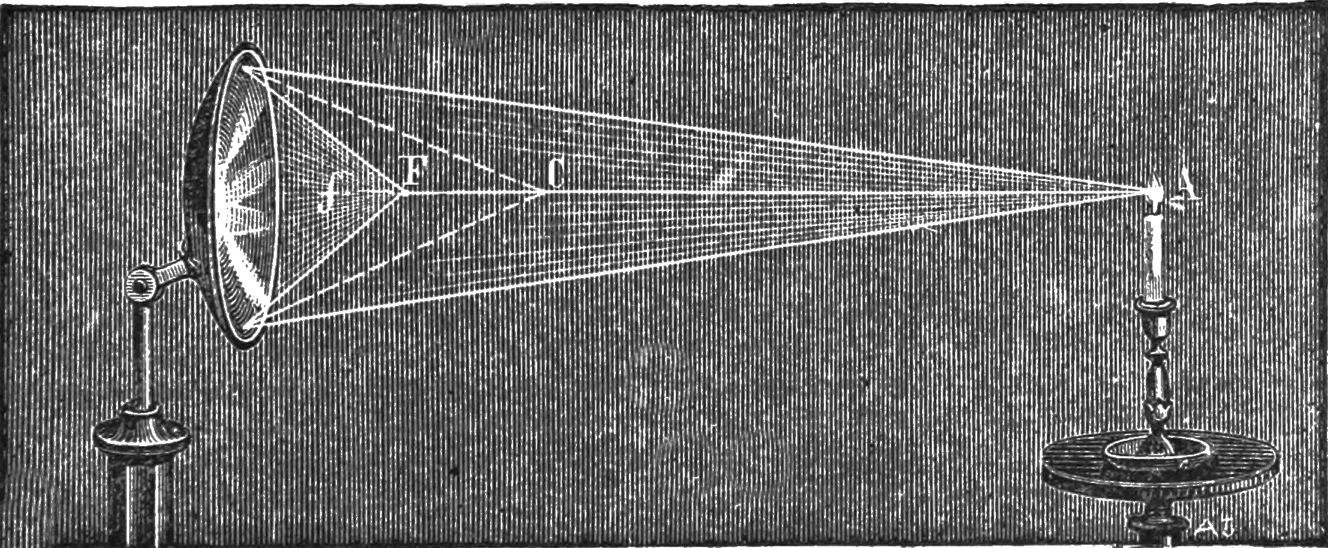
mirror; consequently, in the case of the candle in fig. 19,
instead of uniting at F, the rays will meet at f, a
point situated somewhat nearer the mirror than the
principal focus. If, instead of placing the light at A, we
place it at f, we shall find the rays will be concentrated
at the point A. Thus the foci are consequently related
to each other, and are hence called conjugate foci. It
will be readily seen that a spherical mirror may have an
infinite number of conjugate foci, according to the distance
of the source of light. It is also clear, that if we
cause the light to approach the mirror, the focus will
also approach it.
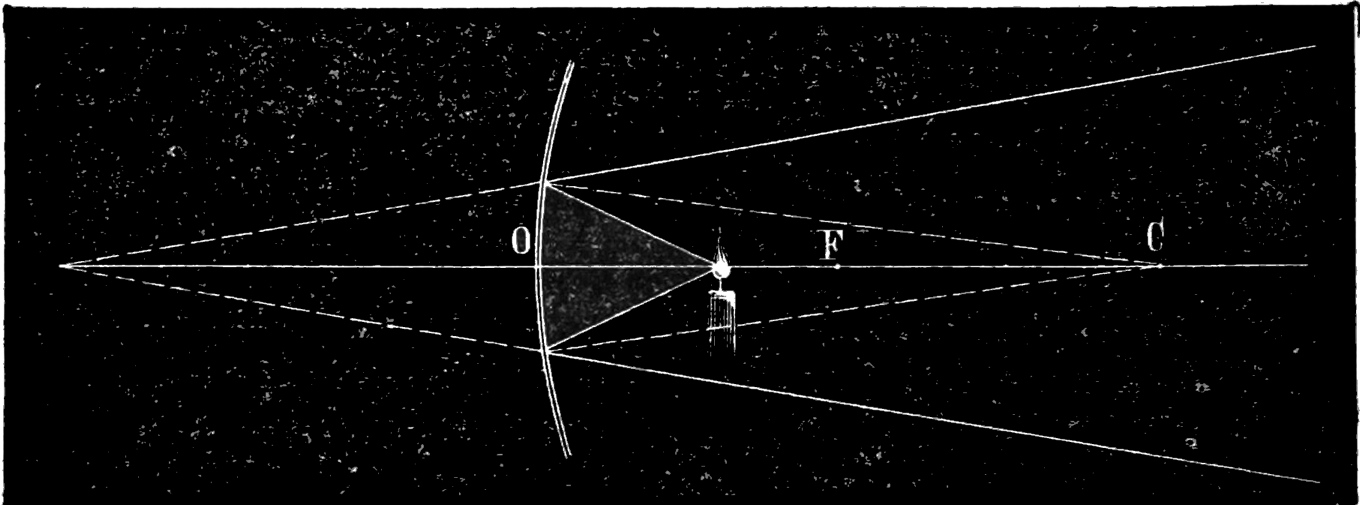
Continuing our experiment, we shall find that when
the candle passes the principal focus so as to be between
it and the mirror, the reflected rays first become parallel
and then divergent, and cannot consequently produce
any focus beyond the mirror, but are reflected in the
way shown in fig. 20.
In experimenting on the plane mirror, we imagined
we saw the object at a certain distance behind it; the
same thing happens when we see ourselves reflected in
114a concave mirror, and the particular point at which we
suppose we see our reflection is called the virtual focus.
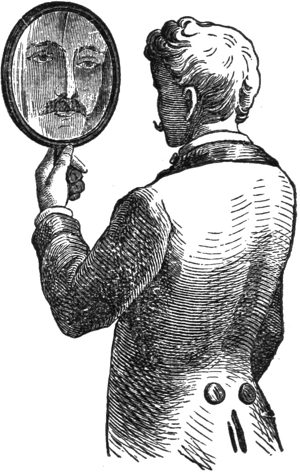
If instead of a candle we place our head before a
concave mirror, we shall see ourselves magnified as in
fig. 21.
We shall easily see how this happens by tracing the
paths of the rays in fig. 22.
115
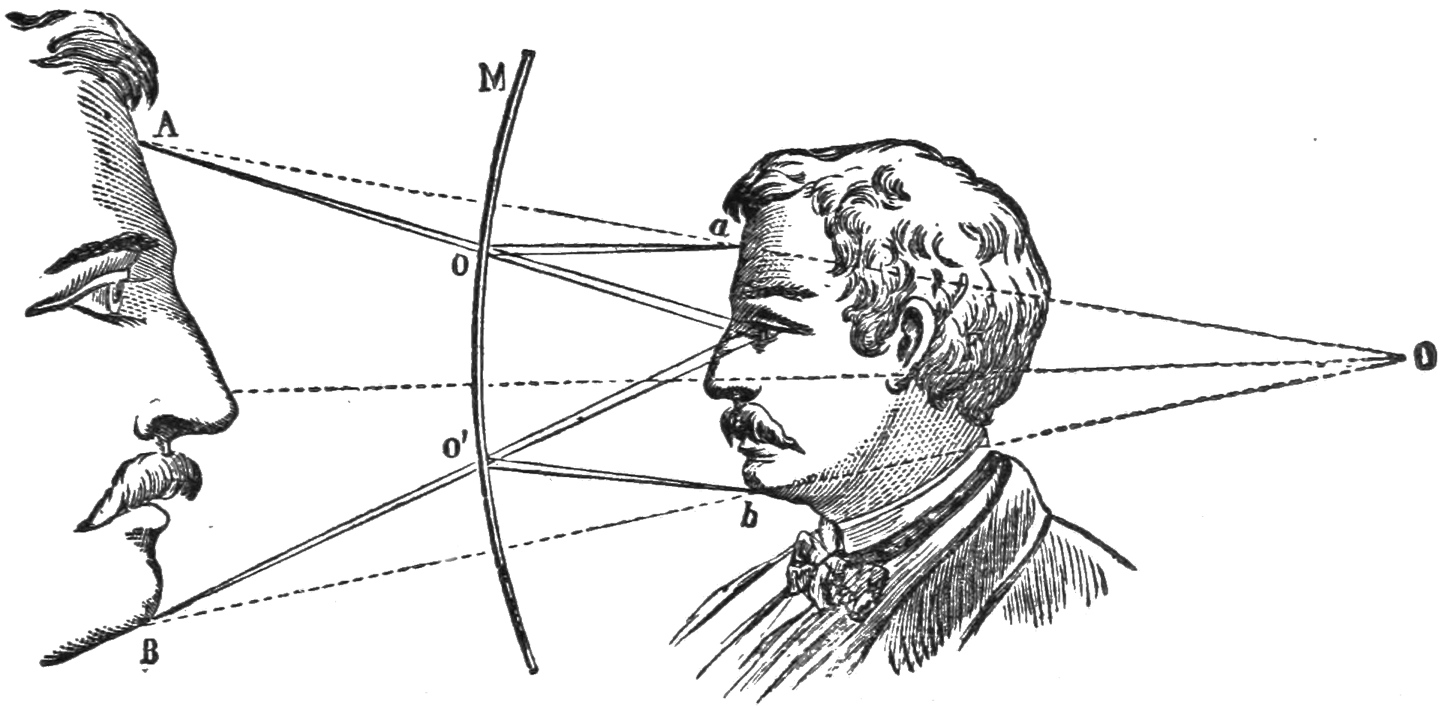
Fig. 22.—Magnifying effect of Concave Mirrors.
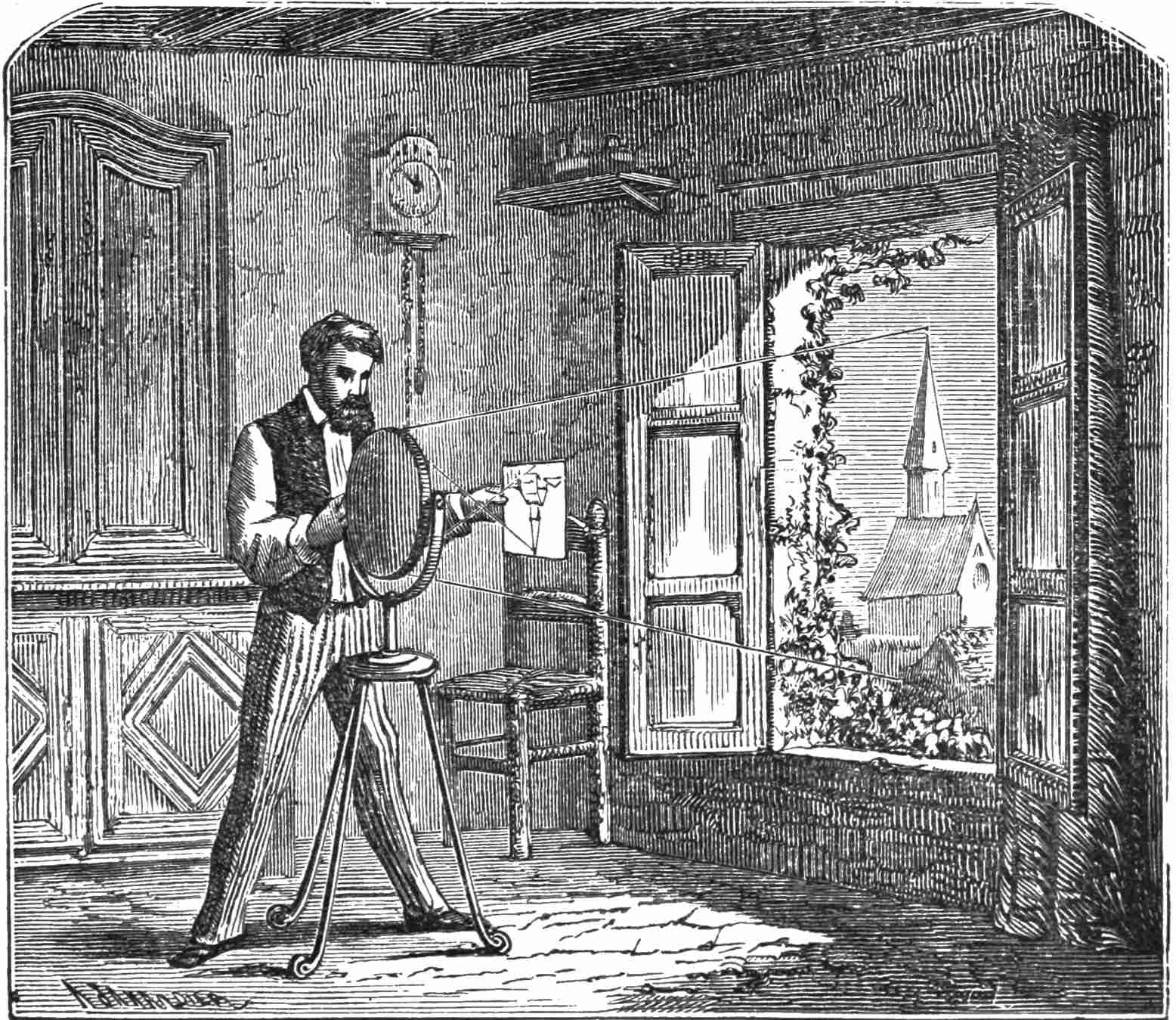
Fig. 23.—The Reversal of real Images.
The rays, for instance, which proceed from the forehead
at the point a are reflected from the point o to the
116eye in such a way as to appear to proceed from a point
beyond the mirror, A. In the same manner the rays reflected
from the chin appear to take their origin from
the point B. If, on the other hand, we place ourselves
at a distance from the principal focus, we shall produce
a reversed and diminished image of our face. This
image is not illusory, like the preceding ones, but is
real, and may be received upon a screen, as shown in
fig. 23.
We may easily follow the path of the rays as shown
in the figure, and we shall see that the rays forming
the images of the church-tower and the terrace below,
cross at a certain point.
Convex mirrors produce precisely opposite effects, and
give a diminished image instead of a magnified one, as
may be perceived on examining fig. 24.
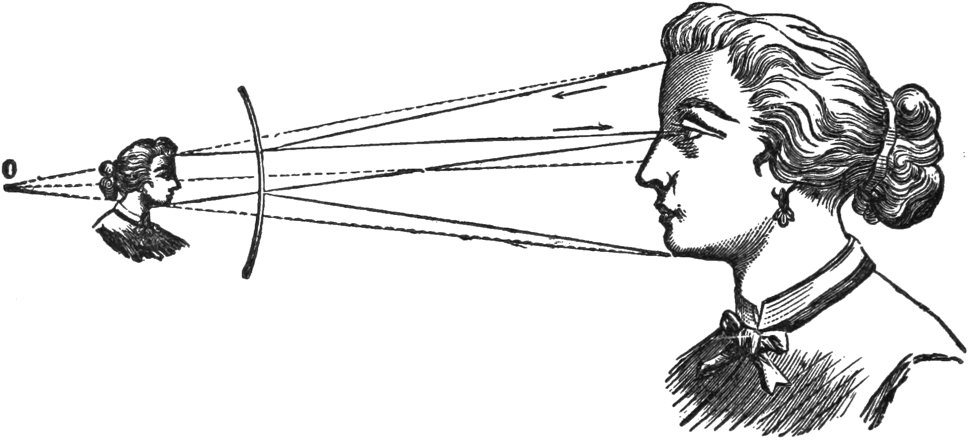
Fig. 24.—Diminishing power of Convex Mirrors.
CHAPTER VI. METALLIC BURNING MIRRORS.
117
The classical student will remember that Archimedes
burned the fleet of Marcellus, by means of burning-glasses,
from the heights of the fortifications of his
native city of Syracuse. Unfortunately, any account of
the system of catoptrics, or the science of reflections,
employed by the ancient Syracusan in their construction
is lost to us, and many modern writers have
gone so far as to doubt the fact altogether. The
knowledge of the properties, however, of concave
mirrors which we have just been acquiring, will enable
us to form a pretty good guess as to the means adopted
by Archimedes for the destruction of the enemy’s fleet.
The ancients, not having the means of either casting or
grinding such enormous mirrors, must have constructed
them of a large number of small ones, so arranged
that the images of the sun reflected by them would all
fall in the same place, or nearly so. In this case, the
larger the number of mirrors, the greater would be the
burning effect. In order to explain the reflection of
rays incident upon the surface of concave mirrors, we
supposed them to consist of an immense number of
plane mirrors placed in a curve, so that the reflected
rays might all meet in one point; but on examining
into the history of burning mirrors, we find that the
plan has been adopted in reality in a great number of
118instances. We have also said, that the reflection of the
heating rays was governed by similar laws to those
influencing the rays of light; consequently, by directing
a pencil of sunlight upon the surface of a concave
mirror, we obtain the maximum of light and heat at
the focal point.
Many modern writers give the ancients too little
credit for their knowledge of optical principles, and
late investigations seem to prove that the old school of
philosophers were much more learned in these matters
than has been generally supposed. The discovery of a
rock crystal double convex lens in an Egyptian tomb of
great antiquity is an instance of this. Descartes wrote
a little treatise to prove that the stories related of the
burning mirrors of Archimedes were pure fabrications,
although many Latin authors have described them both as
being used by that philosopher and in more modern
times; Dion, for instance, who lived in the early part
of the sixth century, states that at the siege of Constantinople,
Proclus burnt the fleet of Vitalian with
mirrors of brass; but the opinion of Descartes seemed
to outweigh all other testimony. Buffon, who wished
to sift the matter thoroughly, constructed for himself,
after many previous experiments on the laws of reflection,
a series of mirrors that closely imitated those
ascribed to Archimedes. His first memoir, “On the
Invention of Mirrors capable of burning at a great Distance,”
was published in the Transactions of the French
Academy of Sciences for 1747. A few years later he
combated both theoretically and practically the opinion
of Descartes, in a memoir containing an account of an
immense number of experiments. Before speaking of
the extraordinary effects of burning mirrors, it will be
as well to do justice to the predecessors of the learned
naturalist we have just mentioned, by quoting a passage
from the works of Father Kircher, who, 128 years previously,
119experimented in this direction with great patience
and perseverance, and tried to prove that the
stories related of Archimedes were true. “The larger
the surface of a mirror,” says this philosopher (who, like
Huyghens, was a practised astronomer), “the more light
it reflects from the objects opposite to it. If it is only
a foot square, it will throw a square foot of light upon
any wall or screen placed before it. Experiment shows
that this light is composed of an infinite number of rays
reflected from different points on the surface of the mirror.
Direct the rays from a second mirror upon the
same place as those from the first, and the light and
heat will clearly be doubled. They will become trebled
if you direct the rays from a third mirror upon the
same spot, and so on ad infinitum. In order to prove
that the intensity of the light and heat is in direct proportion
to the number of reflecting surfaces employed,
I took five mirrors, and found that on exposing them to
the sun I obtained with only one, less heat and light
than if I used direct sunlight. With two the light and
heat increased considerably; three gave as much heat
as an ordinary fire, and four gave me a still greater
effect. I therefore concluded that by multiplying these
plane mirrors, I not only obtained greater effects than
those got by using parabolic, hyperbolic or elliptical mirrors,
but that I could use them upon objects at a much
greater distance. With five mirrors I could obtain
these effects at a distance of 100 feet, but what terrible
phenomena would have taken place had I used one
thousand instead of five?” He ends by begging mathematicians
to experiment in this direction with greater
care than they had hitherto done.
After Kircher we may cite as an experimentalist with
these terrible instruments the French philosopher Villette,
who constructed several mirrors, in direct imitation
of those of Archimedes, for Louis XIV. and other
120sovereigns. The Journal des Savants for 1679 gives
an account of his principal metallic burning mirror in
the most eulogistic terms, adding an instance of ignorance
which is singularly quaint and curious. It is of
the fourth and most perfect of Villette’s mirrors that
the Journal des Savants speaks, the first having been
bought by Tavernier, and presented to the Shah of
Persia, who considered it as one of the rarest and most
precious curiosities that he possessed: the second was
sold to the King of Denmark, and the third was given
by M. Villette to Louis XIV., from whom he received
the praises and rewards that were due to his talent and
perseverance. “It was thirty-four inches in diameter,
and vitrified flints and bricks almost instantaneously,
no matter how large they were. It consumed the greenest
wood, burning it to ashes in an instant, and fused
the most refractory metals with equal ease and quickness.
Steel, no matter how hard, resisted its power no
more than other metals, and melted so quickly that one
part burnt away in inconceivably brilliant sparks, some
of them forming stars as large as a franc piece, leaving
a flowing mass of metal behind. The last made by
Villette was still more powerful, being larger and more
carefully made. It was forty-four inches in diameter,
and three inches and a line deep. Its burning point, or
focus, was situated at a distance of three feet seven
inches from the surface, and was apparently as large as
a five-sou piece; and it was at this spot, where the rays
of light and heat were concentrated into so small a
space, that the wonderful effects of its violent power
became manifest, the spot of light being of such brilliancy
that the eyes could no more withstand its brightness
than that of the sun. Besides the property of
burning which it possessed in so wonderful a degree, it
was capable of exhibiting other effects just as curious
as those already related. It had the power of sending
121the images of objects to a distance of fifteen feet or
more, so that a man looking at himself in this mirror
with a stick or sword in his hand, saw the image of them
suspended in the air, apparently ready to strike the observer.
On seeing such an effect for the first time, the
observer could hardly fail to experience the greatest
surprise, and even fear; and it is stated that the king
having placed himself, sword in hand, before one of
these mirrors, in order to observe the effect, was surprised
to find himself face to face with an armed hand
apparently directed against him. When he advanced,
the hand seemed to spring forward to meet him. The
king could not conceal his surprise and fright, and afterwards
felt so ashamed at being terrified with a mere
shadow that he ordered the mirror to be taken away,
and could never be prevailed upon to look into it again.”
The Journal des Savants then goes on quaintly to remark
on the various startling effects produced by these
mirrors, winding up by stating that its powers of reflection
were so great, that at night the light of a torch or
flambeau was reflected so perfectly that an observer
placed at four hundred feet distant could read the smallest
print.
It also mentions a curious piece of superstition on
the authority of a scientific writer of the name of Robertson,
who states that it happened at Liége. In reading
the accounts of these experiments we can see how
easily the minds of individuals were affected in those
days by the wonderful. It happened while one of Villette’s
mirrors was at Liége, that the latter end of the
summer was somewhat rainy, and great fears were entertained
that a bad harvest and dear bread would be
the result. Certain evil-minded people, who had taken
a fancy to the mirror and wished to possess it by unfair
means, spread the report that the continual rain was
entirely caused by its action on the clouds and sun, and
122that the coming famine must be laid upon the shoulders
of its owner and inventor. This absurd idea took such
forcible possession of the minds of the populace of
Liége, that great mobs collected together, uttering all
kinds of maledictions against the mirror and its inventor,
and at last became so violent that they attacked
Villette’s house with the intention of smashing his great
work, and administering to the unfortunate philosopher
the chastisement they supposed he deserved. Happily,
however, for M. Villette and his mirror, Liége was
governed in those days by the Prince Bishop of Cologne,
who was a man of great enlightenment. He
put the crowds round M. Villette’s to flight by armed
force, but he found that the conviction that all the coming
mischief would result from the unlucky mirror was
so strong, that he was obliged to issue a pastoral peremptorily
declaring that the idea had originated with a
number of malicious people, who spared no pains to
propagate it for their own bad purposes, and that it
was a mischievous and dangerous error to ascribe to
a mirror a power which only belonged to the Almighty.
In 1747, Buffon performed many extraordinary experiments
with burning mirrors, which were more surprising
than any that had hitherto been described.
They were mostly performed at the Jardin des Plantes,
at Paris, of which institution Buffon was director; and
many of them are worth describing.
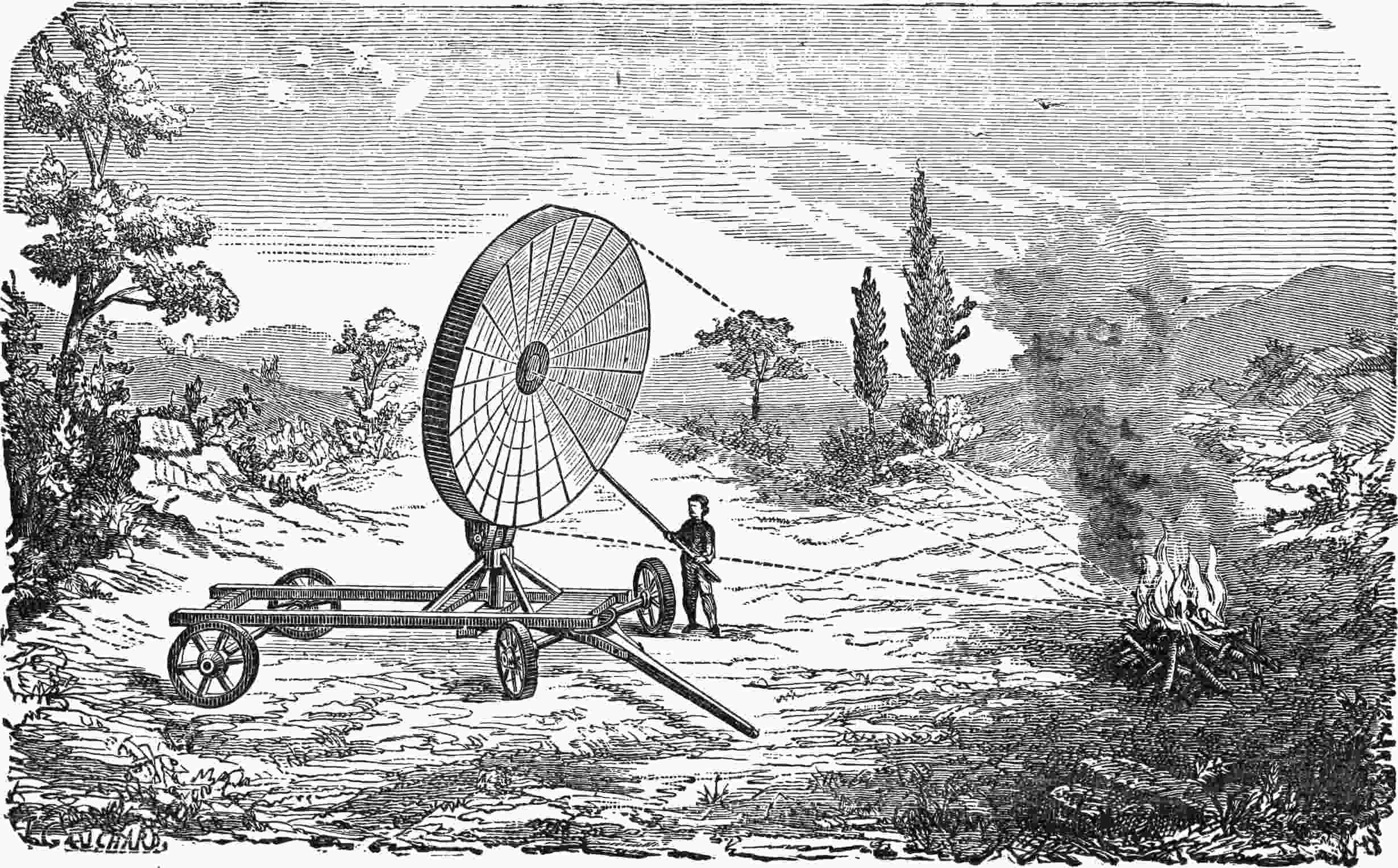
On the 3rd of April, at about two o’clock in the afternoon,
the great mirror was mounted on its stand, and
was found to be capable of setting a plank of wood on
fire at a distance of 138 feet, when 128 glasses were
used, although the light was weak at the time, and the
sun was covered with mist. In pursuing these experiments
great care had to be taken to prevent the by-standers
placing themselves within range of its terrible
power, for several were nearly blinded by looking
125at the brilliant focal point of the instrument. The
next day, at eleven in the forenoon, although the sun
was still covered with mist and fleecy clouds they were
able to produce such a heat at 150 feet distant, with
154 glasses, that a pitched plank began to smoulder
and would have burnt into flame had not the sun disappeared
at that particular moment. On the fifth of
April, at three in the afternoon, with the light much in
the same weak condition as it was on the other days,
they succeeded in igniting at 150 feet distant, a heap of
shavings of deal mixed with charcoal and sulphur,
in less than a minute and a half, with 154 glasses.
When, however, the sun shone with its natural power,
a few seconds were sufficient to effect these results.
On the 10th, when the sun was shining pretty powerfully,
a pitched pine plank was easily fired with 128
glasses, at 150 feet distant. In this case the ignition
was very sudden, and extended over the whole of the
radiant spot forming the focus, which at the distance
named measured 16 inches in diameter. The same day
at half-past two, a pitched elm plank covered in some
places with chopped wood, was set fire to with extreme
rapidity, and burnt with such violence that it had to
be dipped in water before it could be put out. In
this experiment 148 glasses were used, at a distance of
150 feet.
On the 11th of April, the burning point was fixed at
20 feet distant from the mirror, and combustible substances
were easily burnt with only 12 glasses. With
21 glasses a half-burnt elm plank was set fire to, and
with 45 a piece of tin weighing six pounds was almost
immediately melted. Silver sheet was fused, and an
iron plate was made red-hot with 117 glasses. In
giving an account of these interesting experiments,
Buffon expresses his conviction that at 50 feet it would
have been easy to have melted metals if all the glasses
126of the mirrors had been used. When used at that distance,
the burning spot was six to seven inches in
diameter. He also noticed that when metals were
melted, part of them were dissipated in brilliant vapour,
which was so thick as to cast a shadow on the ground,
although it seemed to be as bright as the sun itself.
When the sun was at its full strength, and all the
glasses were brought into requisition, wood was set on
fire at a distance of over 200 feet, and metals and minerals
were fused at 40 and 50 feet. Hence the possibility
of making and using these mirrors as Archimedes
was said to have done, was proved practically by the
great naturalist. Fig. 25 represents a burning mirror
in action.
Robertson, an English philosopher, residing in France
during the days of the first Republic, reconstructed
the mirrors described by historians as being used by
Archimedes, and the results he obtained were thought
sufficiently important by the Council of the Department
of Ourthe to merit an attentive examination by two
members of their body, who reported in favour of their
being used as instruments of war.
It would be possible to pursue this subject still further,
and give an account of numerous experiments
made on burning mirrors by various philosophers, but
we must not forget that it is light and heat that we
have more especially to deal with in the present work.
Already we have possibly strayed from our path a little
too far, but the two influences are so closely connected
with each other that it is almost impossible to speak of
them separately when reflection is in question.
CHAPTER VII. LENSES.
127
The word lens is derived from the Latin name of the
seed of the Ervum lens, or ordinary lentil. When eating
this wholesome vegetable, almost every one has noticed
that its shape is exactly that of a double convex
lens, as represented in the following figure:—
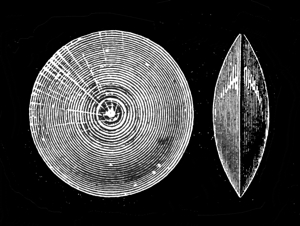
Fig. 26.—Double Convex Lens.
Perhaps it would be more correct if we were to say that
a double convex lens is like a lentil, rather than turn
the comparison the other way, seeing that this little
seed has given its name not only to the particular-shaped
glass depicted above, but also to some five others
more or less analogous to it.
In fig. 27 we have the different forms of lenses
128shown in section. The first is the double convex lens,
the second the plano-convex, the third and sixth the
concavo-convex, the fourth the double concave, and the
fifth the plano-concave. A crossed lens is a double
convex lens whose one side is more convex than the
other. The third lens is also called meniscus.
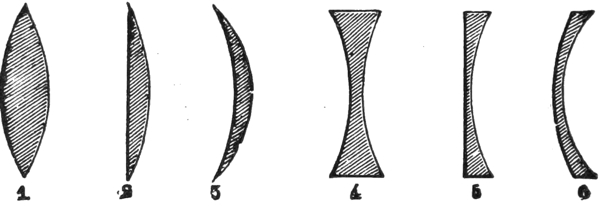
Fig. 27.—Forms of Lenses.
The properties of the first, second, and third are
similar; that is to say, they cause parallel rays of light
passing through them to converge at a certain point,
called their focus; while the three others have a divergent
action on rays passing through them. By examining
the path of the rays through these lenses, we
shall find that the first three magnify objects seen
through them, while the latter have the contrary effect.
As in the case of the curved mirrors, the rays falling
on the surface of a convex lens may be either parallel,
divergent, or convergent. In the case of parallel rays,
as depicted in the following figure, they are represented
as meeting at a point beyond the lens, which is called
the sidereal focus, or the focus for parallel rays. It is
generally found by causing the image of the sun or of
some distant object to be thrown by the lens upon a
screen, or by knowing the curvature of the faces, and
the refractive power of the glass.
Every ray on striking the surface of the lens is refracted
inwards, until it meets with its companions at
129the focus F, in accordance with the law of refraction,
by which a ray of light passing from one transparent
medium, such as air, to another which in this instance
is glass, becomes refracted or bent in proportion to the
relative density of the two mediæ. The nearer the ray
passes to the edge of the lens, the more it is refracted,
the angle of incidence being greater; the ray through
the exact centre being uninfluenced by the form of the
glass. Hence they all meet in a single point. Figs.
29 and 30 show the path of the rays when they are
divergent and convergent.
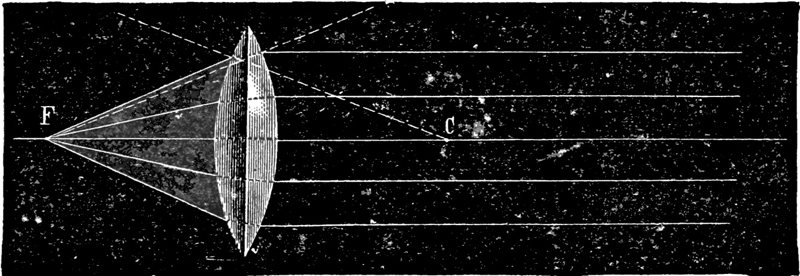
Fig. 28.—Path of a Ray through a Convex Lens.
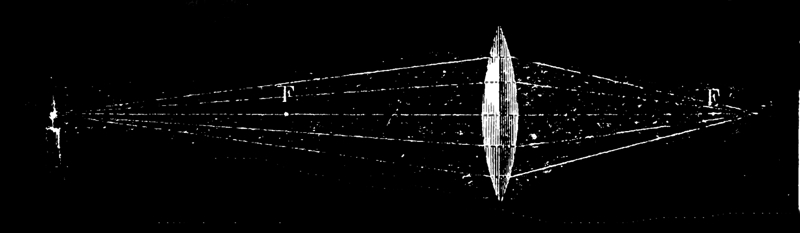
Fig. 29.—Path of divergent Rays through a Convex Lens.
If the rays of light are not parallel, as in the case
of the source of light being near the lens, they do not
converge so rapidly as when they proceed from a distant
object, consequently the focus for near objects is
longer in proportion to their distance. In fig. 29 for
130instance, if a candle be placed as shown, and a screen
on the other side of the lens, a point will be found
where the image of the candle is seen upon it in a reversed
position. The distance between these two
points is always relative, and they are called conjugate
foci. Thus, the candle may change places with the
screen with a similar effect, as long as the exact position
of the two points is preserved. If the candle is placed
farther off, we must diminish the distance between the
screen and the lens, and vice versâ. In fact, the nearer
the object, the longer the focus; the farther it is off,
the shorter the focus. Half an hour’s experiment
with a double convex lens, a piece of white cardboard,
and a small candle, will teach the student more about
the properties of convex lenses than a chapter of explanation.
A common magnifying-glass, or even an
old spectacle lens, will serve the purpose of more expensive
instruments.
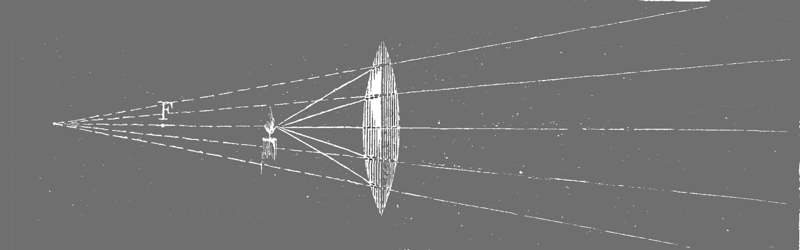
We now proceed to speak of the images formed
by lenses. In fig. 31 we have a flower placed on one
side of a lens. As it is not at an infinite distance, the
rays sent out by its various parts are convergent, and
not parallel, consequently they do not meet at the
sidereal focus, but at a point beyond it, according to the
rule already laid down. The rays proceeding from the
exact centre of the flower striking the lens exactly in
131the middle at right angles, suffer no change, the others
being refracted in proportion to their angles of incidence.
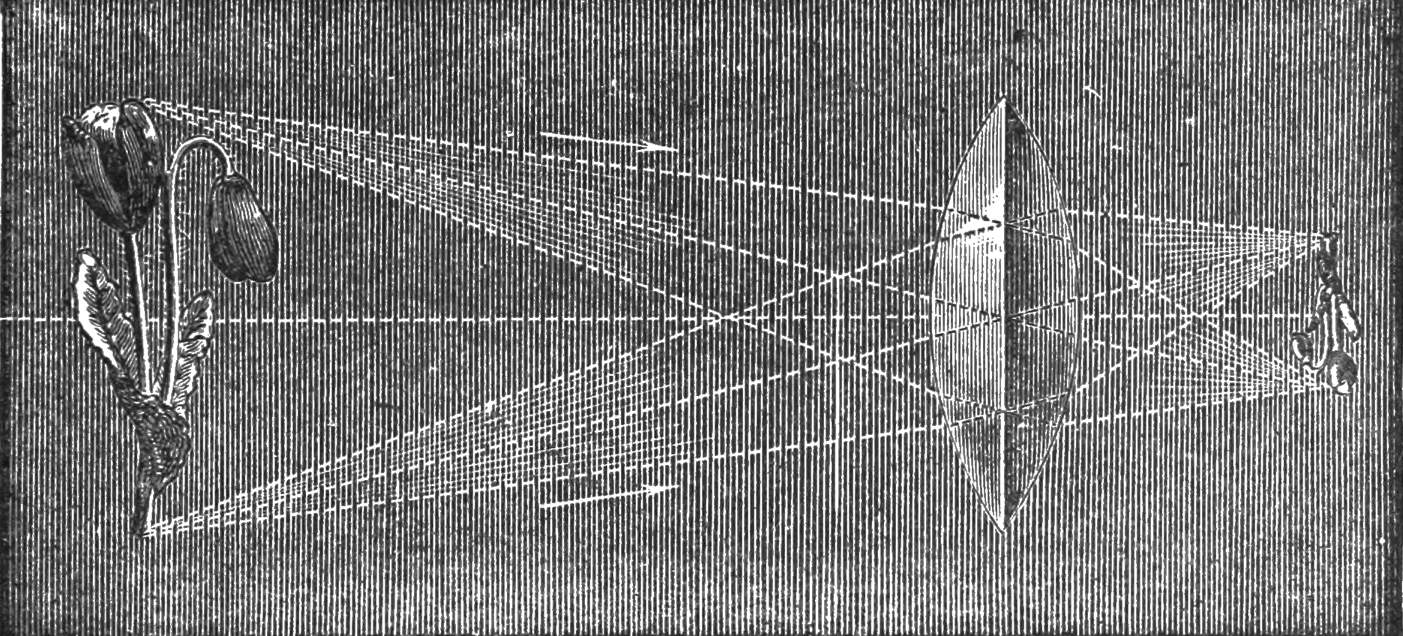
Fig. 31.—Images formed by Convex Lenses.
The rays proceeding from the flower cross each other
at a certain point: hence the image on the screen is
reversed. The dimensions of the image will depend on
the distance of the object from the lens. This is a fact
we meet with every day, when using an opera-glass or
a telescope. Images formed by convex lenses upon a
screen are called by opticians real images, in contradistinction
to those which are the result of mere reflection,
as in the case of plane mirrors. These latter are known
as virtual images and are produced by convex lenses
as well as by plain reflecting surfaces. In fig. 32, for
instance, the unreversed image of the insect seen by the
eye is not a real image, but a virtual one,—a fact that
might be easily proved by placing a screen in the position
of the eye, when it would be found that no image
would be formed.
When using an ordinary magnifying-glass we see the
virtual image of the object we are looking at, but in the
case of a telescope or opera-glass we see the real image
of the object, formed by the large lens in front, and
132reversed again by the arrangement of small lenses next
to the eye.
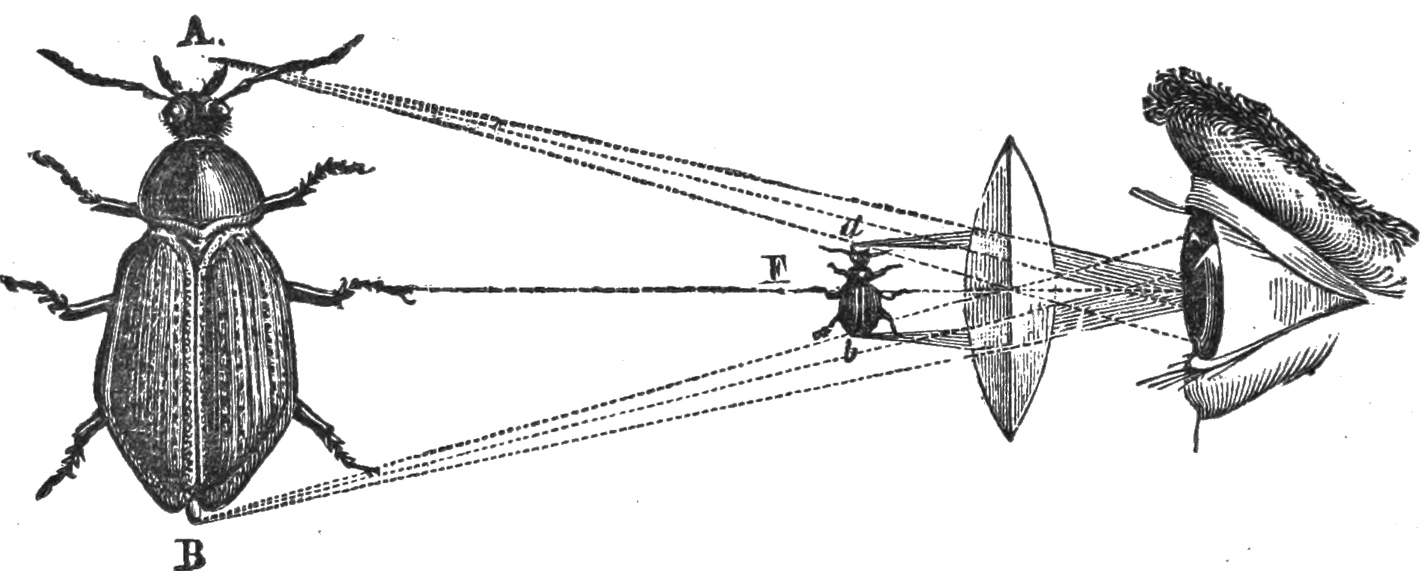
Fig. 32.—Magnifying Property of Convex Lenses.
Double concave lenses produce effects which are just
the reverse of those we have been considering. Instead
of increasing in thickness from the edges to the centre,
they follow the contrary plan, and increase from the
centre to the edges. Consequently, instead of the rays
meeting at the focus, they diverge from each other, and
gradually spread out, as shown in fig. 33.
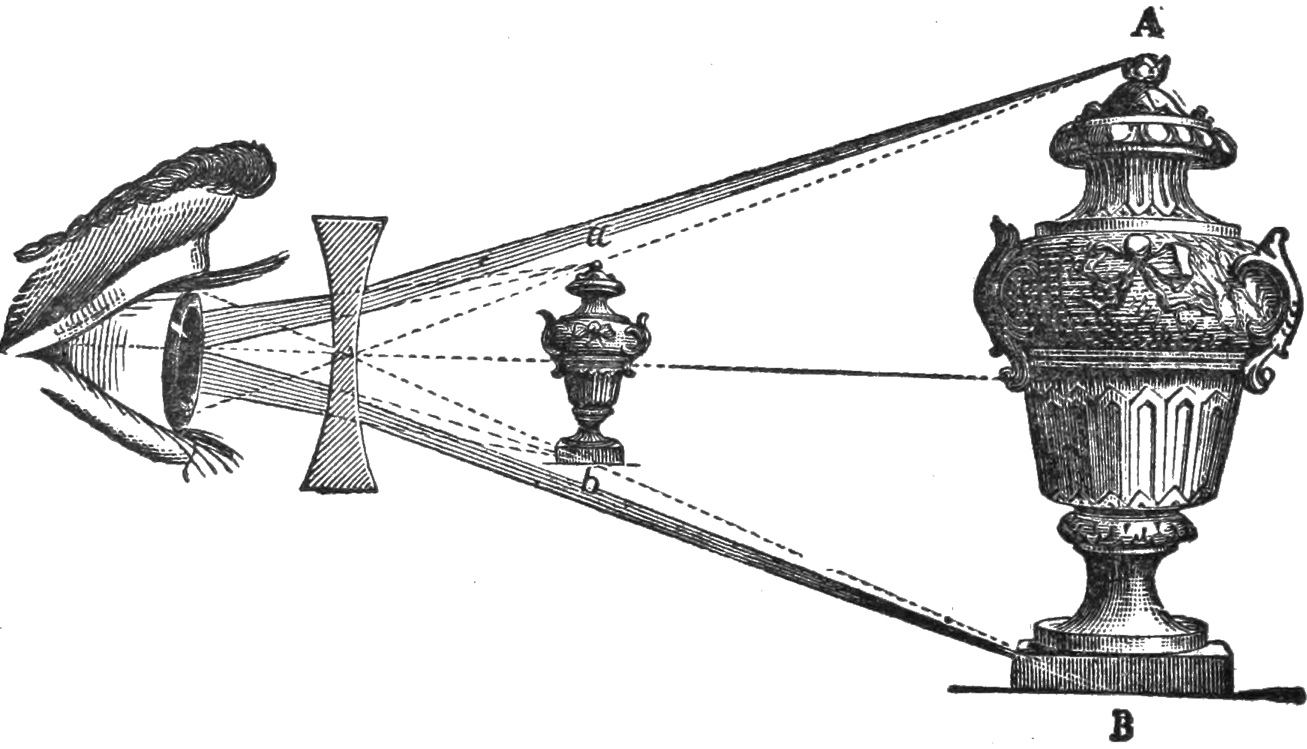
Fig. 33.—Diminishing Effect of Concave Lenses.
The above figure shows the path of the rays proceeding
from the vase, and meeting the eye at such an angle
135that the virtual image is greatly diminished. Concave
lenses, as the student has no doubt already guessed, do
not give real images.
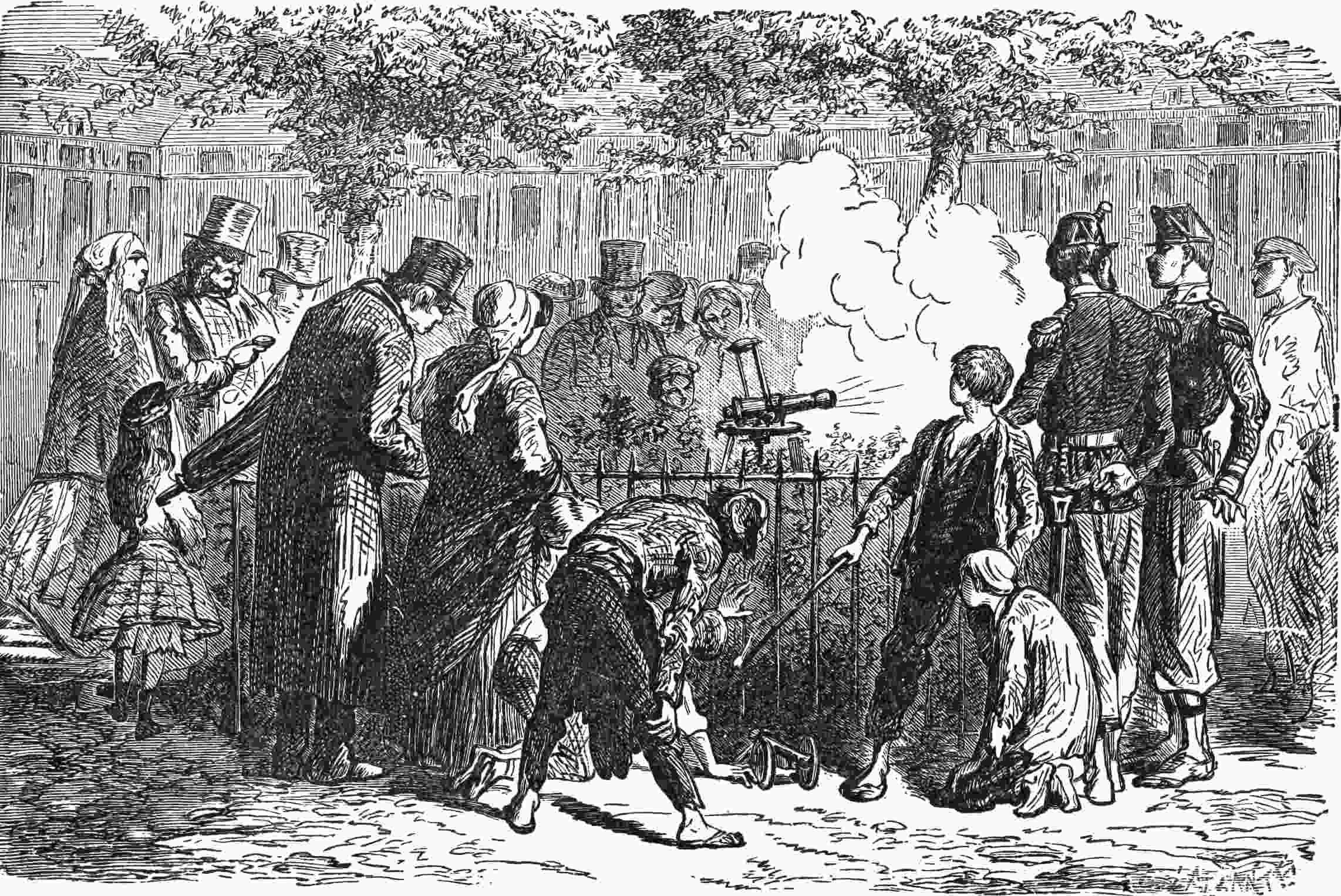
Fig. 34.—Cannon of the Palais Royal.
The effects produced by the action of concave mirrors
may be produced with just as much facility by convex
lenses. If a body is placed in a focus of a lens which
receives the direct rays of the sun, the heat as well as
the light will be concentrated at one point; and if the
object is combustible, it will take fire sooner or later,
according to the size of the lens. All the experiments
mentioned by Buffon as being produced by a concave
mirror are equally obtainable with a concave lens.
When of sufficient diameter, the most refractory metals,
such as platinum or iridium, may be melted and dissipated
into vapour. Before lucifer matches and vesuvians
were as common as they are now, it was not at
all unusual to find smokers carrying a small burning-glass
and a piece of tinder, for the purpose of lighting
their pipes or cigars; and there hardly exists a boy who
has not lighted a bonfire in the fields or playground by
means of an old spectacle lens or telescope glass.
Amongst other applications of this property of lenses
may be mentioned that of causing guns to fire at a
certain time, by arranging a small burning-glass above
the touch-hole. In the Gardens of the Palais Royal, at
Paris, there is such a gun, so arranged that on sunny
days it fires exactly at noon, or, in other words, at the
moment the sun comes to the meridian. Every fine
day towards twelve o’clock, crowds of Parisians who
have nothing to do may be seen bending their steps
towards the Palais Royal to set their watches by the
gun, which they believe to be superior as a time-keeper
to the finest chronometer in the world. There they
stand, most of them old fellows with a scar or two about
their faces, showing that they have nobly won the rest
they appear to enjoy so innocently and calmly with
136watch in hand, leaning against the railings, and waiting
with impatience the moment when true solar noon is
indicated by the sharp report of the little piece. Their
belief in the correctness of solar time is something
astonishing; and if a bystander were to insinuate, no
matter how delicately, that solar time varied slightly
every now and then, he would either receive a smile of
pitying contempt, or else he would be called out upon
the spot. Fig. 34 gives a pretty view of the celebrated
cannon of the Palais Royal.
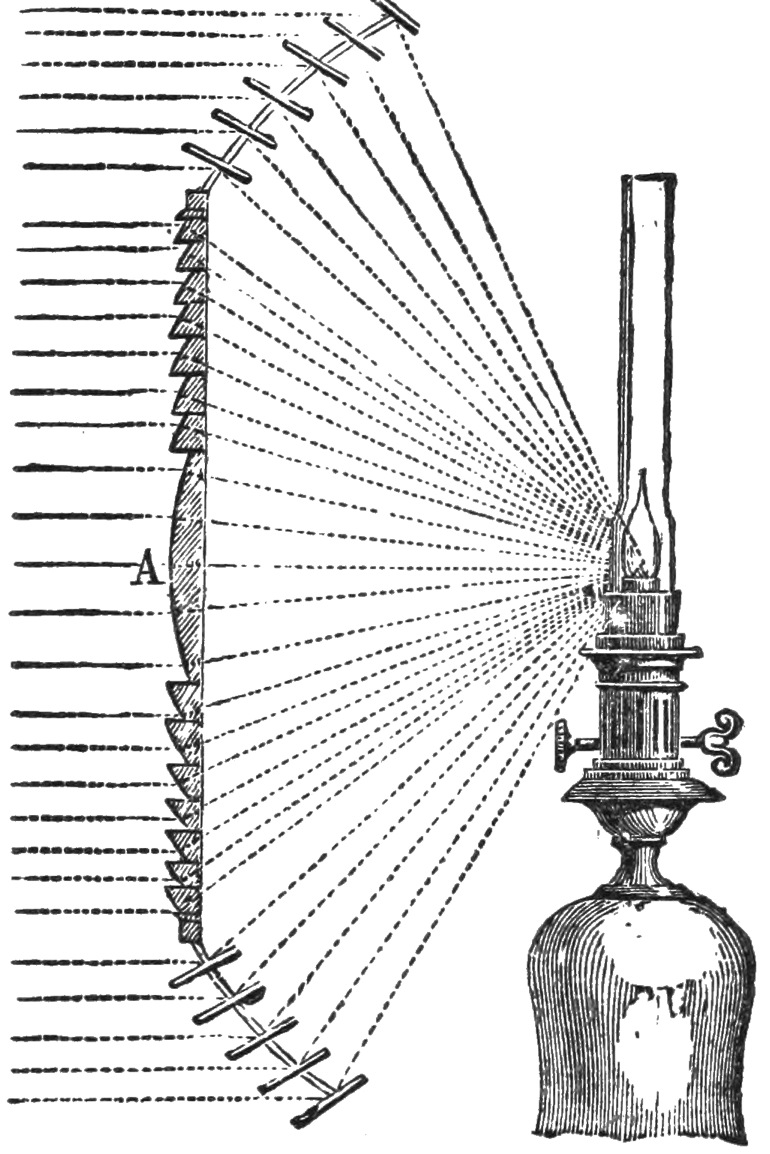
Fig. 35.—Fresnel’s Lighthouse Apparatus.
We now come to another application of the refracting
power of lenses, in the way of concentrating rays,
which is infinitely more valuable to humanity than
either of those we have just mentioned; we mean the
construction of enormous refracting apparatuses for
lighthouse purposes. The first lighthouse of which we
137have any record is that which was erected on the island
of Pharos, by Ptolemy Philadelphus, in the year 470
of the foundation of Rome. This was merely a tower,
upon the top of which fires were kept burning at night;
but as the world progressed, the blazing tar-barrel or
wood fire gave place to the carefully-constructed lamp
and silvered reflector apparatus, which are fast disappearing
in their turn before the electric or Drummond light
and the refracting apparatus constructed by Fresnel,
who was the first to endeavour to abolish the old-fashioned
and inefficient metallic mirror from the
lanterns of lighthouses. Fig. 35 shows a section of
Fresnel’s apparatus. A is a plano-convex lens of about
a foot in diameter, whose focus corresponds with those
of the concentric lenticular rings of glass which surround
it, and which are seen more plainly in fig. 36.
These rings, which are ground and polished with the
greatest accuracy, are somewhat in the shape of an
ordinary quoit, and are equivalent to a plano-convex
lens with the centre portion cut out. This arrangement
is so powerful that the distance at which a light provided
with it can be seen is only limited by bad weather,
the state of the atmosphere and the distance of the
horizon. It is common for such lights to be seen at a
distance of between fifty and sixty miles. The apparatus
is mostly arranged in the form of an octagon,
and is generally provided with additional reflecting
mirrors at those parts above the light which are out of
the range of the lenses. The light shining fully in eight
directions at one time, can scarcely be missed by any
ship within range; but in order to guard against any
possibility of accident, the optical apparatus is often
made to revolve by clockwork, so that every point of
the ocean is illuminated in turn. By using coloured
glasses, or by causing the light to disappear at distinct
intervals, different lighthouses may be identified by
138ships that are out of their reckoning. Fig. 36 represents
the interior of the lantern of a first-class lighthouse,
showing the arrangement of the lenticular rings
round the central lens. If ever the student should
pass through Havre, he should not miss the opportunity
of seeing this noble apparatus, which is one of
the finest ever manufactured.
140
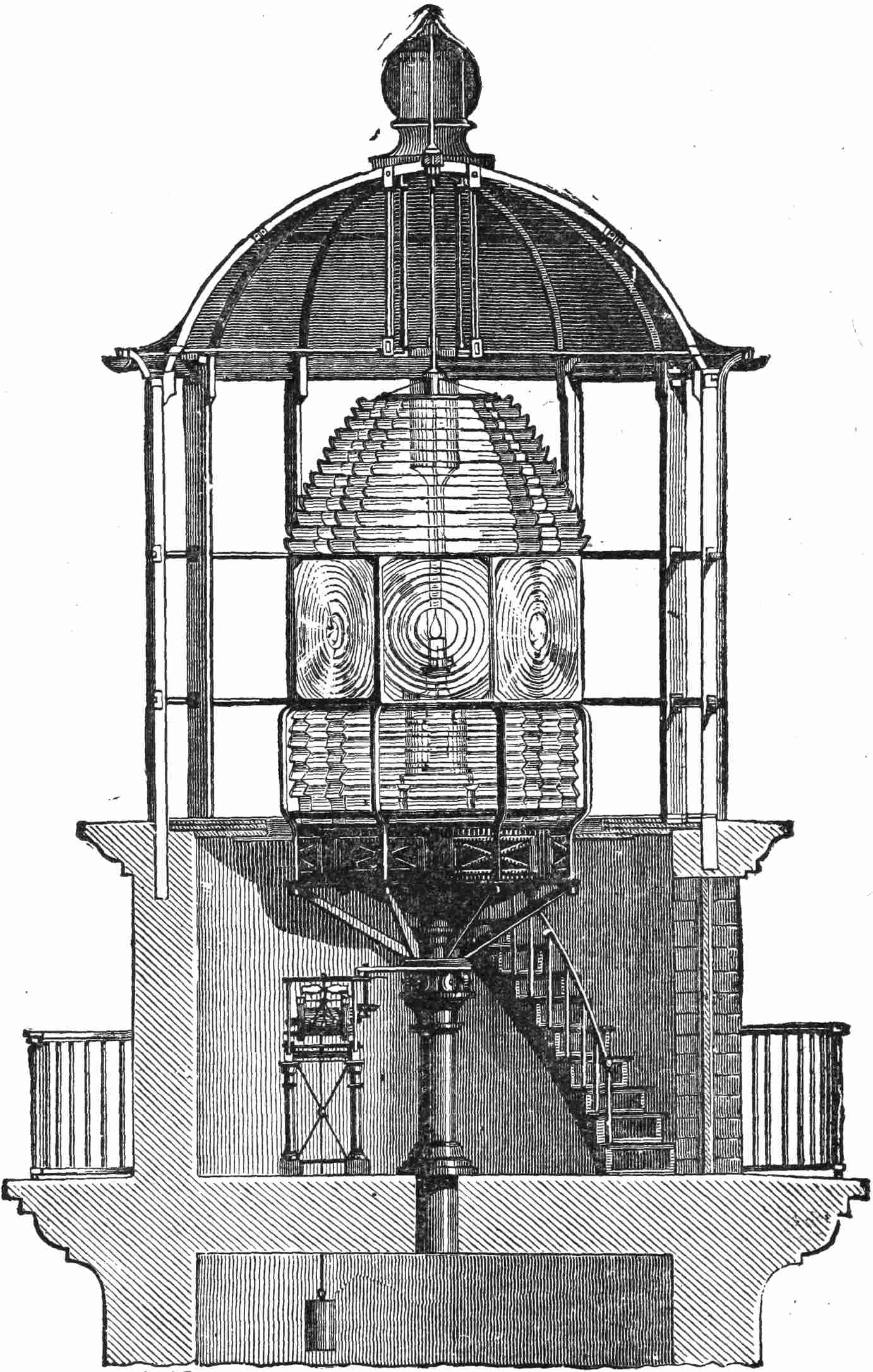
Fig. 36.—Lantern of a First-class Lighthouse.
CHAPTER VIII. OPTICAL INSTRUMENTS.—THE SIMPLE AND COMPOUND MICROSCOPE. THE SOLAR AND PHOTO-ELECTRIC MICROSCOPE.
141
The lenses and mirrors whose properties we have
been considering in the previous chapters, have been
combined in different ways for the purpose of examining
objects too small or too distant to be perceived by
the human eye. To instruments used for the former
purpose the name of microscope has been given, from
two Greek words signifying small and to see. In like
manner the name of telescope is also derived from two
Greek words, meaning distant and to see. Besides
these two classes of optical instruments, others have
been devised to facilitate the depicting of natural
objects, either by means of the pencil or of photography,
or to amuse the eye by optical illusions. Thus
we have the camera obscura, the camera lucida, the
magic lantern, the phantasmagoria, and numberless
other instruments of the same sort, most of which will
be described in the latter part of this book.
There are two sorts of microscopes, the simple and
the compound; the one consisting of a single convex
lens, and the other of several combinations of both
convex and concave lenses.
When speaking of convex lenses, we described the
properties of the ordinary magnifying-glass, or simple
142microscope. The uses of this instrument are almost too
well known to need description. It is used by old
people, the lenses of whose eyes have become flattened
by old age, by watchmakers for examining the minute
portions of their work, by jewellers for the same purpose,
and by most people for examining maps, engravings,
and photographs. Simple microscopes are
generally mounted in horn, ivory, or metal handles for
convenience’ sake. Some simple microscopes consist
of two or more lenses mounted together in order to increase
the magnifying power. The student must distinguish
between several lenses mounted together in
this way, and the true compound microscope, which is a
comparatively complicated optical arrangement, as we
shall see presently. When two single lenses are thus
mounted together, the power of the combination is equal
to the powers of each added together.
There is good reason for supposing that the simple
microscope is a comparatively ancient invention. Seneca,
who lived in the first century, declares that in his
time it was well known that, when writing was looked
at through a globe full of water, it appeared larger and
blacker. In the eighth century we find the use of magnifying
spectacles for old people common in most countries,
and yet it was only at the beginning of the seventeenth
century that a true optical instrument, in the
form of a telescope, was invented. It only needed the
placing of two magnifying glasses in a line to discover
the principle of the telescope, but nearly a thousand
years elapsed after the first introduction of these glasses
before an accident rendered the principle evident.
In fig. 37 we see the commonest form of microscope
in the hands of an observer; and by examining the
following figure and tracing out the path of the rays,
we shall easily discover the principles on which its
action depends.
143
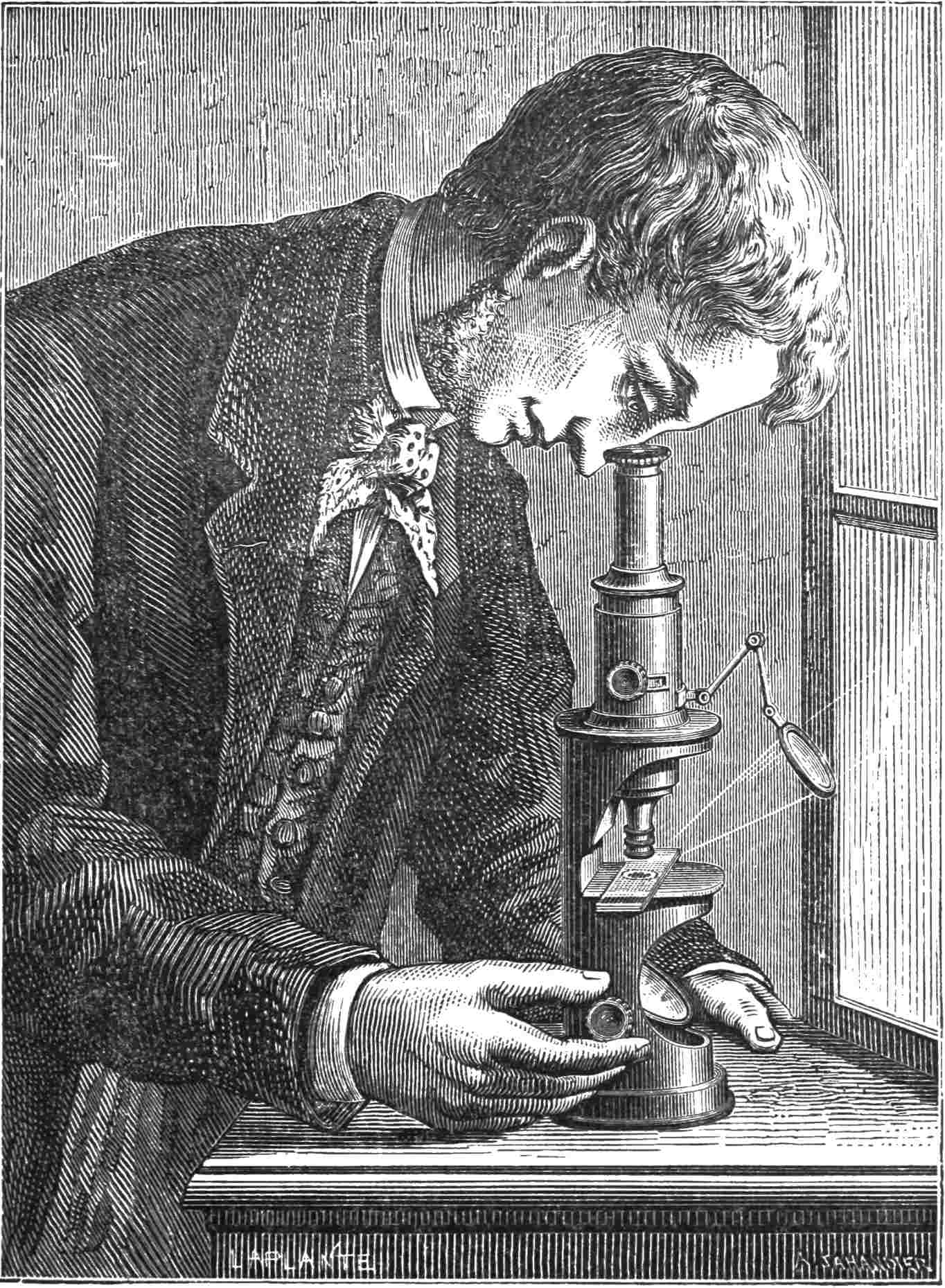
Fig. 37.—The Compound Microscope.
The object to be looked at is placed at a (fig. 38), on
a piece of thin glass usually called a slide. A small
converging lens placed at b collects the rays proceeding
from the object, and transmits them as far as c d, where
they come under the influence of a second converging
144lens B, which causes them to spread out still more before
they reach the eye. Consequently we not only
see the image of the object magnified
by the lens b, but still more enlarged
by the action of the lens B,
and appearing considerably enlarged
at C D. The lens placed in front of
the object is called the objective or
object-glass; that placed nearest the
eye, the eye-piece. These names
apply equally to the similar lenses
used in telescopes and other optical
instruments. The instrument shown
in fig. 38 is the simplest possible
compound microscope, and is very
rarely used. The eye-piece is generally
constructed of two lenses, and
the object-glass of as many as eight;
the object in multiplying the lenses
being, not only to increase the magnifying
power, but to decrease certain
defects inherent in all lenses
whose surfaces are parts of spheres.
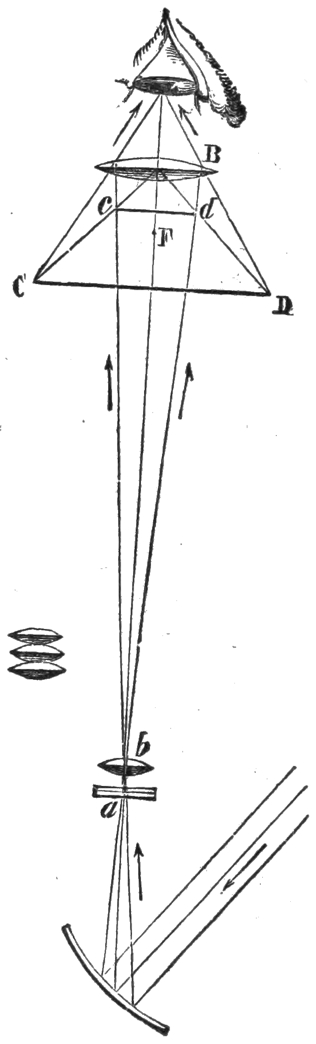
Fig. 38.—The Theory of the Compound Microscope.
The amplification depends mainly
upon the power of the objective,
but different eye-pieces are also used
to increase the apparent size of the
objects to be examined. Thanks to
the investigations of modern philosophers, we are enabled
to magnify objects to 2,000 times their diameter
with perfect distinctness; that is to say, the surface of
the object appears to occupy 4,000,000 times its natural
extent. Under such a power a hair would appear
about six inches thick, a fine needle would look like a
street post, and a grain of sand like a mass of rock.
Although it is possible to employ compound microscopes
145of such a high magnifying power in the investigation
of certain classes of objects, all ordinary preparations
are best seen under a power of 500 or 600 diameters.
It would be utterly impossible to give our readers the
slightest idea of the benefits conferred on the human
race by this marvellous instrument. Suffice it to say,
that no naturalist or surgeon ever attempts the most
simple investigation into the structure of any body
without the aid of the microscope. It has already
shown us that a world of creatures exists which, although
invisible to the eye of man, are possessed of wonderful
forms, colour, and beauty of structure, and is daily
adding to our knowledge in this direction. We can
hardly submit any substances to this marvellous instrument
without discovering animal or vegetable life of the
most vivid character. A drop of scum from the surface
of a stagnant pool is instantly seen to be peopled with
animal and vegetable life, when submitted to microscopic
examination. At one moment a rolling ball glistening
like glass slowly revolves past our view; then a little
fellow like a piece of spiral spring screws his way along,
backing when he meets with an obstacle; or a shuttle-shaped
vegetable, apparently made of glass, with green
balls inside him, slowly works his way from side to side,
or, possibly, a mad battledore-shaped being dashes past
at an inconceivable rate.
As it is indispensable that the object should be well
lighted, a concave mirror is placed below it to reflect
the rays of light from a lamp or white cloud, through the
object when it is transparent. When it is opaque, it is
illuminated by the rays of light being concentrated
upon it by means of a convex lens. The name microscope
appears by common consent to be applied more particularly
to the compound instrument, the epithet of
magnifier or magnifying-glass being kept for simple
146microscopes, although they are all, strictly speaking,
microscopes.
In the ordinary compound microscope, it is only
possible for one person to see the object to be examined
at once; for popular exhibitions of microscopic objects
the reflecting microscope has been devised, by means of
which the images of the objects to be looked at are
thrown upon a screen. The principle of this instrument
is the same as that of the magic lantern and phantasmagoria,
of which we shall speak presently. Fig. 39
(see next page) represents the photo-electric microscope,
so called from the objects being reflected by the electric
light.
The jars seen on the ground are the cells of a voltaic
battery, by which the electricity is generated. The
luminous rays starting from the incandescent charcoal
points are reflected through the tube and its lenses by
the reflector placed at the back of the instrument, and
are concentrated upon the object to be magnified. The
image thus produced passes through a second system of
converging lenses, and is projected upon the screen
magnified some millions of times according to the power
of the object-glass employed.
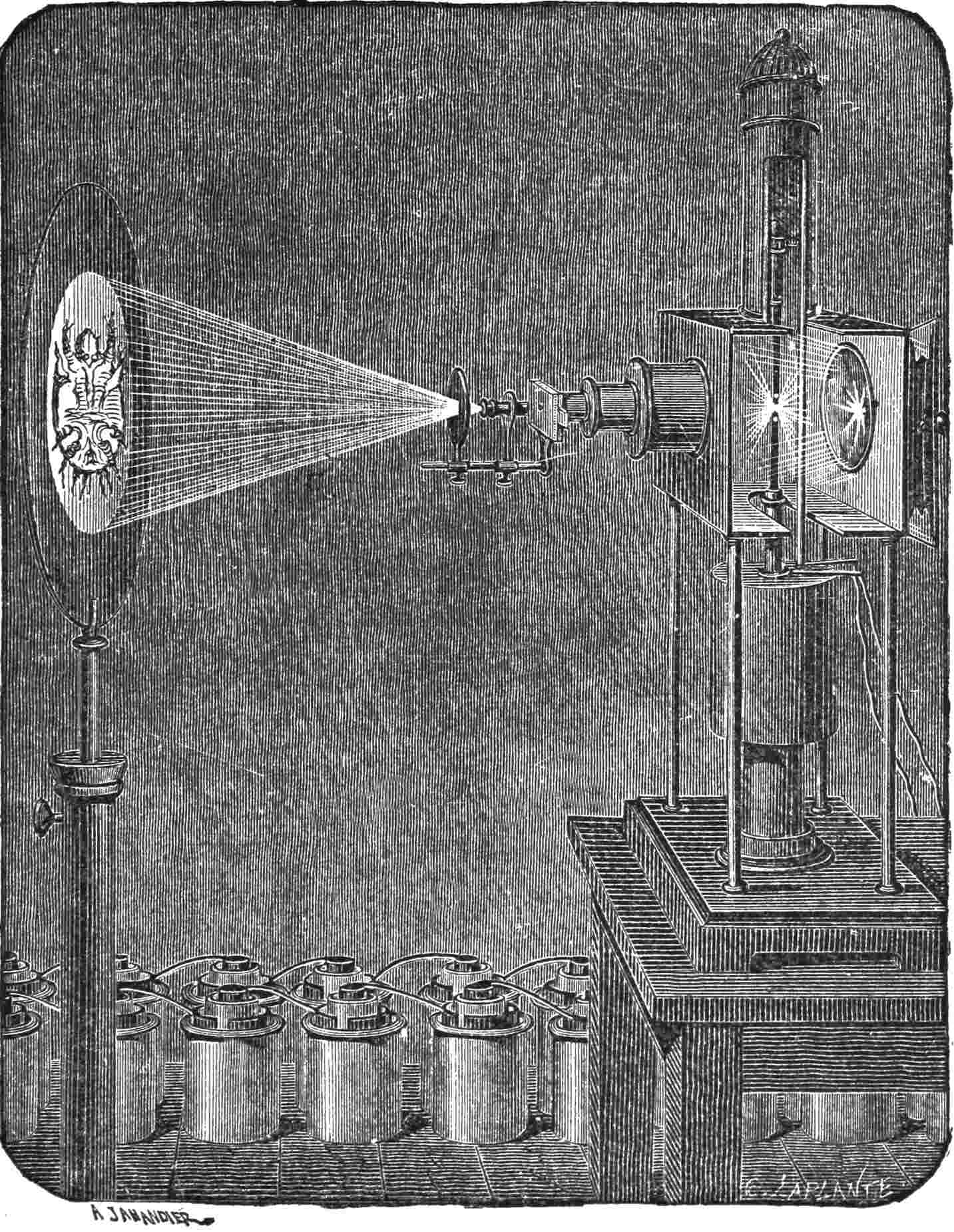
Fig. 39.—Photo-Electric Microscope.
“The experiments made with the photo-electric microscopes,”
says M. Ganot, “are amongst the most curious
and pleasing to be found in the whole range of physical
science. With this instrument it is possible to show the
smallest objects magnified almost indefinitely to an unlimited
number of spectators. A human hair will appear
as large as a broomstick, an ordinary flea will look the
size of a sheep, and the tiny cheese mite, as well as the
smallest animalcules, will be visible in all their beauty of
form and colour as clearly as if they were seen with the
naked eye. One of the most remarkable experiments to
be made with this instrument is that which shows the
circulation of the blood. The tail of a live tadpole
147is inserted between two plates of glass, or on an instrument
specially made for the purpose, and placed in the
microscope armed with a somewhat low power. The
spectator immediately perceives upon the screen a mass
of rivers and rivulets, all flowing with the red corpuscles
forming the blood of the animal, and rushing through
148its veins and arteries with inconceivable rapidity.
Another interesting experiment consists in dissolving a
small quantity of sal-ammoniac in warm water, and
passing a small portion of the solution across a warm
glass slide. When placed in the microscope the water
gradually evaporates, leaving behind a mass of feathery
crystals, whose growth may be watched atom by atom,
each crystalline molecule grouping itself around the
others in forms resembling a mass of fern-leaves.”
The apparatus we have been describing is sometimes
illuminated with the rays of the sun, as in the following
figure.
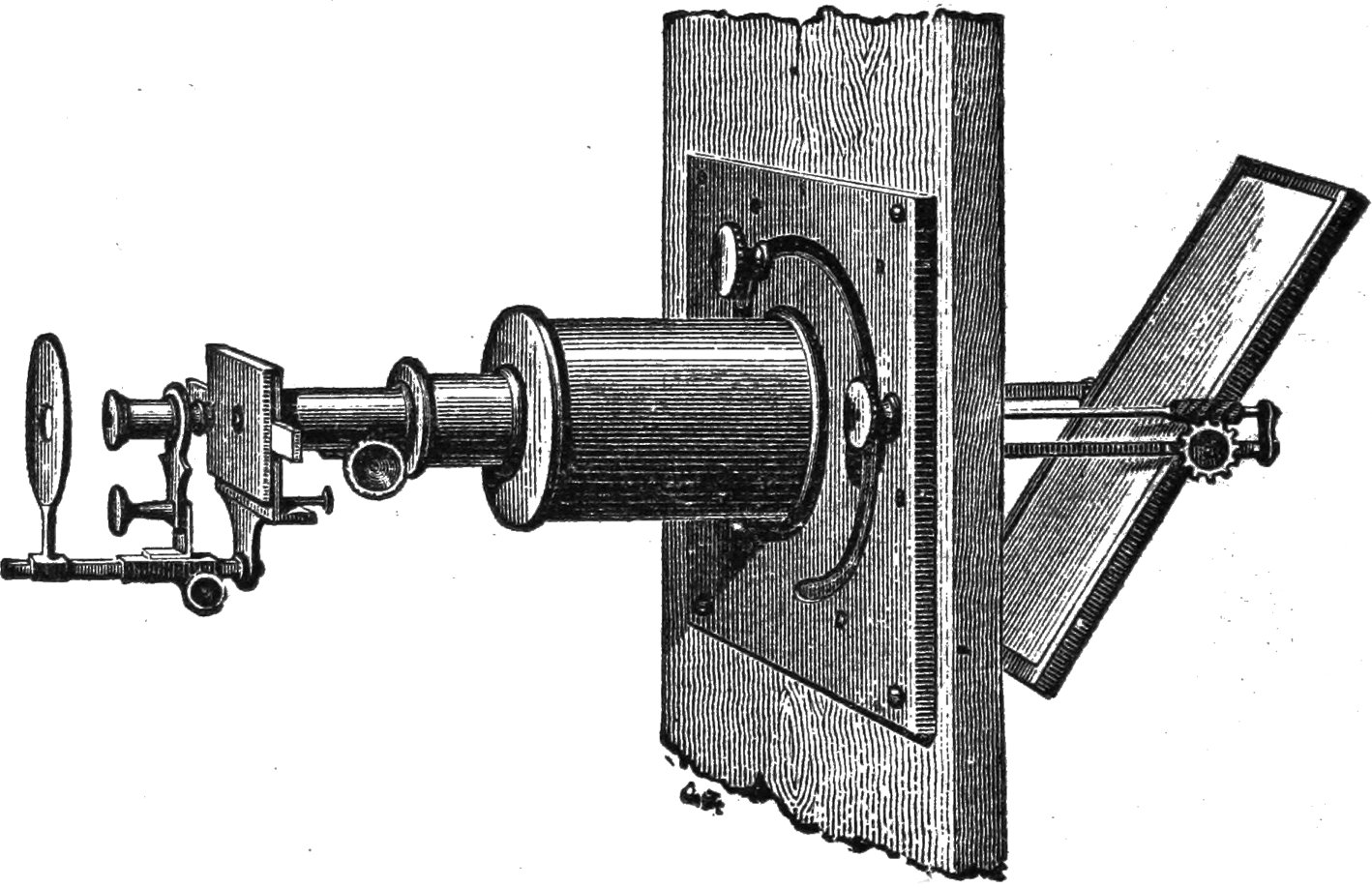
Fig. 40.—Solar Microscope.
It is then called the solar microscope, and exhibits
objects with great beauty and clearness. The use of the
sun’s rays, however, has, in our own country at least,
been entirely superseded by the electric and lime light.
The latter method of illumination, which consists in
projecting a stream of oxygen and hydrogen upon a
ball of lime, is cheaper and more certain than the electric
149light, although the latter is possibly the more brilliant
of the two. The construction of the solar microscope
differs but little from the instrument already
described, and may be readily understood from the
foregoing figure. The large mirror is placed outside
the window of the room in which the microscope stands,
so that the solar rays are reflected upon the surface of
a series of convergent lenses, and from thence on to
another mirror, from which it is again reflected through
the microscope. As the position of the sun is constantly
changing, it is necessary to connect the outside mirror
with a train of clockwork. It may be mentioned that
an instrument of this kind, for reflecting the sun’s rays,
is called a heliostat.
The student will, no doubt, at once perceive that if
we concentrate the light of the sun upon an object, we
shall also concentrate the heat, and either melt or consume
it. A screen is therefore used in such cases,
which will allow the light to pass while holding back
the rays of heat. A solution of alum is found to answer
the purpose admirably.
CHAPTER IX. THE TELESCOPES OF GALILEO, GREGORY, NEWTON, HERSCHEL, LORD ROSSE, AND FOUCAULT.
150
If history has failed to furnish us with the name of
the inventor of the microscope, we have very exact information
as to the first experimenters upon the powers
of the telescope.
“In the archives of the Hague,” says Arago, “we
find documents, by the aid of which Van Swieten and
Moll have come to a decisive conclusion as to the first
and true inventor of the telescope.”
We read in these documents that a spectacle-maker
of Middleburg, named John Lippershey, addressed a
petition to the States-General on October 2, 1606, in
which he asked leave to take out a patent, which should
constitute him the only maker of this instrument, or
which should confer upon him an annual pension, on
the condition of not manufacturing them for other nations.
The petition qualifies the instrument as serving
to see distinct objects, as had already been explained
to the members of the States-General.
On the 4th of October, 1608, the States-General
appointed a deputy from each province to experiment
on the new instrument, which was placed on a tower of
the palace belonging to the Stadtholder. Huggard
says that the first telescopes experimented on were a
foot and a half in length.
151On the 6th of October, the commission declared the
instrument of Lippershey to be useful to the nation, but
demanded that it should be made for two eyes instead
of one.
On the 9th of December, Lippershey, having announced
that he had solved the problem, Van Dorth,
Magnus, and Van der Au were ordered to verify the
fact, which they did by making a very favourable report
on the 11th of the same month. The binocular
instrument was therefore found to answer.
In reading the extracts from the archives of the
Hague, given by Moll, we may remark with great pleasure
the promptitude with which the commissioners of
the States-General examined Lippershey’s instruments.
But their satisfaction soon gave way to displeasure,
when they found a large number of opticians making
these instruments, and selling them to foreigners, like
so much spice from the East Indies. Later on one feels
indignant at finding the commissioners of the States-General
to be so wanting in proper feeling as to decide
that the telescope must be considered imperfect until it
could be used with both eyes, without either winking or
seeing the reflection of the pupils in the eye-pieces.
Consequently, instead of being permitted to expend his
talent on perfecting the optical powers of the single
telescope, Lippershey saw himself condemned to waste
his time upon the double instrument. The States-General
finished by giving Lippershey 900 florins; but
they refused him a patent, on the ground that it was
already notorious that other opticians had commenced
the manufacture of similar instruments.
Amongst others who were rivals of Lippershey, we
must mention John Adrian Metius, the son of Adrian
Metius, of Amsterdam, who discovered that the nearest
relation of the circumference of a circle to its diameter
was 355 to 113. He addressed a letter to the States-General
152on the 17th of October, 1608, conceived in the
following terms:—
“After two years’ labour and thought I have succeeded
in making an instrument, by the aid of which objects
which are too distant to be visible by the eye, are seen
plainly. The one I show, although constructed out of
bad materials, and simply as an experiment, is, in the
judgment of the Stadtholder and of several other persons,
as good as the one lately presented to the States-General
by a citizen of Middleburg. I am sure of improving
it still further in the course of time, and I beg
to ask for a patent by which any person who is not
already in possession of this invention will be forbidden,
under pain of a heavy fine and confiscation, to make or
sell similar instruments for twenty-two years.”
The States-General refused to grant the patent in
this case also, but enjoined Metius to perfect his instrument,
reserving to themselves the power to reward him
in the future if they thought fit.
In Italy, Galileo is generally supposed to have discovered
independently the method of making a telescope
on the principle of the Dutch philosophers, about the
beginning of 1609, having received a very imperfect
account of these instruments somewhere about that
time. It may be remarked that in his letter to the
chiefs of the Venetian Republic, giving an account of
the properties of these new instruments, Galileo states
that, if necessary, they could be made specially for the
use of the navy and army belonging to the state. But
secrecy was useless, for telescopes were already made
and sold in Holland at a cheap rate. Besides, Galileo
makes no allusion to the labours of his Dutch predecessors,
either in a prior letter handed down to us by
Venturi, or in the decree of the Venetian Senate, dated
August 5, 1609.
The Italian commentators are in error when they
153attribute the second discovery of the telescope to the
knowledge that Galileo possessed of the laws of refraction,
and that it was by deductions therefrom that he
was enabled to construct his first instruments.
Huyghens says, in his Treatise on Dioptrics, “I will
unhesitatingly place that man above all mortals, who,
by the aid of his own reflections and without the aid of
accident, first succeeded in constructing a telescope.”
“Let us see,” says Arago, when speaking on this
subject, “if Lippershey and John Adrian Metius were
men of unparalleled powers.”
Hieronymus Saturnus tells us that an unknown man
of genius called upon Lippershey, and ordered from him
a number of convex and concave lenses. At the time
agreed upon the man returned, and chose two, one convex
and the other concave, and, placing them one before
his eye and the other at some distance from it, drew
them backwards and forwards, without giving any explanation
of his manœuvres, paid the optician, and left
the place. As soon as he was gone, Lippershey began
immediately to imitate the experiments of the stranger,
and soon found that distant objects were brought apparently
nearer, when the lenses were placed in certain
positions. He next fastened them to the ends of a tube,
and lost no time in presenting the new instrument to
Prince Maurice of Nassau.
According to another version, Lippershey’s children
were playing in their father’s shop, and were looking
through two lenses, one convex and the other concave,
when they found to their surprise that the vane on the
clock-tower of Middleburg Church was greatly magnified
and apparently brought nearer. The surprise expressed
by the children having awakened the attention
of Lippershey, he tried the experiment of fixing the
lenses on a piece of board; afterwards he tried it again
by fixing them at the ends of two pieces of tube, sliding
154in each other, and succeeded in making the first telescope
on record.
The principal documents from which the above facts
touching Lippershey have been extracted, are to be
found in a memoir on the subject by Olbers, printed in
Schumacher’s Astronomical Annual for 1843.
It was said in the time of Galileo that he had in his
possession a telescope by the aid of which he could see
the birds flying at Fiesole from the window of his palace
in Florence. This story does not in the least detract
from the merit of the illustrious astronomer, who not
only constructed a telescope for himself, but was the
first to direct it heavenwards, and that too by purely
theoretical researches; for in spite of all the documents
adduced above, there is little or no proof that he had
ever seen or heard of the Dutchman’s telescope. It is
only right, therefore, that the instrument constructed
on this principle should be called the Galilean telescope.
He afterwards increased its power from four to
thirty times, beyond which he could not get with the
means at his command. With his imperfect instruments
Galileo discovered the satellites of Jupiter, the mountains
of the moon, and the spots on the sun, and earned
for himself the name of Lynceus, who according to the
ancients was one of the Argonauts, possessed of the
power of seeing through a wall. Towards the end of
his life, when the old man was blind, and the Academy
of the Lincei treated his hypotheses with disdain, he
would laugh sadly at the name bestowed on him, and
the obstinate Academy. Fig. 41 (see next page)
shows the path of the rays in a Galilean telescope. The
object-glass O is double convex, and the eye-piece o bi-concave.
The image is formed between these lenses,
and the eye appears to see it at that point. The States-General
complained of being obliged to shut one eye
when looking through a telescope, but in 1671 a good
155Capuchin monk, whose name was Cherubino, placed two
telescopes together, little thinking that the moderns
would imitate him in that very worldly instrument, the
opera-glass.
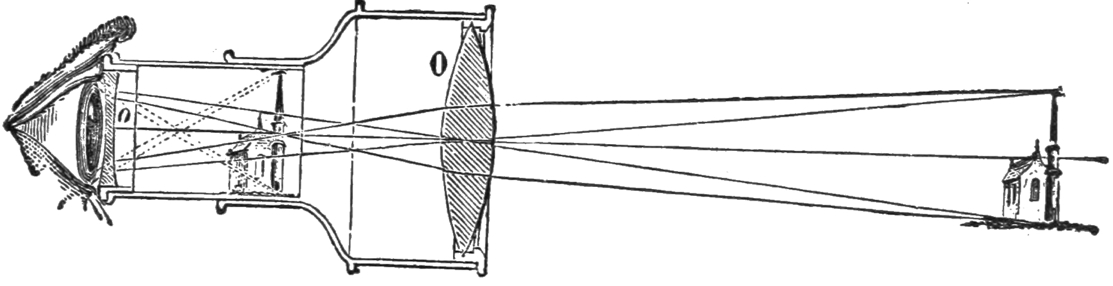
Fig. 41.—The Galilean Telescope.
Everybody has noticed that when objects are close to
us they appear larger than when they are at a distance;
it accordingly amounts to the same thing whether, in
speaking of the power of telescopes, we say they magnify
twice, four times, or a hundred times, or that they
are brought within half, a quarter, or a hundredth of
their distance. Thus there is a telescope at Lord Rosse’s
Observatory, at Parsonstown in Ireland, which is the
finest yet constructed. Its highest magnifying power
is 6,000, therefore every object we look at with it is
brought within the 6,000th of its distance from us.
Looking at the moon, for instance, we know that our
satellite is distant some 240,000 miles from us; we
have, therefore, only to divide that number by 6,000 to
find that by means of this wonderful instrument the
moon is brought within 40 miles of the earth. This
statement, however, is not strictly true, for it supposes
the whole of the apparatus used to be theoretically perfect.
Kepler, whose great name is now-a-days always associated
with that of Galileo, but who during their life-time
was somewhat his rival, substituted for the single
lens forming the eye-piece a combination consisting of
two convex lenses, in order to obtain a larger field for
156observation than that given by the single bi-concave.
This combination is commonly known as the astronomical
eye-piece. It reverses the object looked at, but
for astronomical purposes this defect is of no consequence.
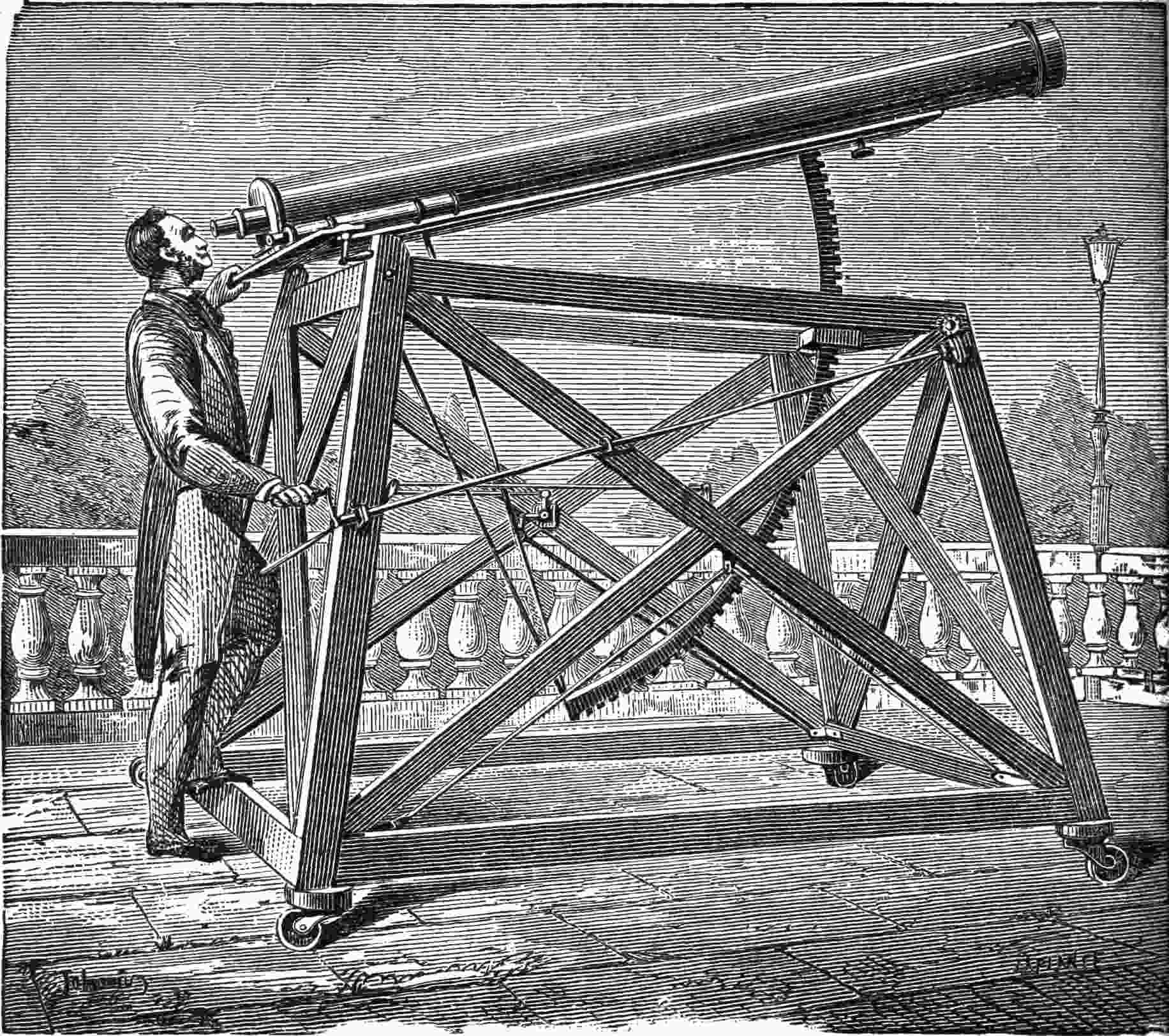
Fig. 42.—The Astronomical Telescope.
The instrument shown in the above figure represents
an astronomical telescope reduced to its simplest
form.
Fixed parallel to the axis of the larger telescope is
157the finder, a small telescope of low power and large
field, used for finding celestial objects not easily visible
to the naked eye. It is so arranged, that when the
object is found and carried to its centre, it is also in the
centre of the field of the larger instrument. The handle
and the two toothed wheels serve to raise or lower the
telescope, which is movable on the horizontal axis,
which supports it in front, so that it may be directed to
any part of the heavens the observer may desire.
The following figure shows the arrangement of the
lenses, and the path of the rays through them, in telescopes
of this form.
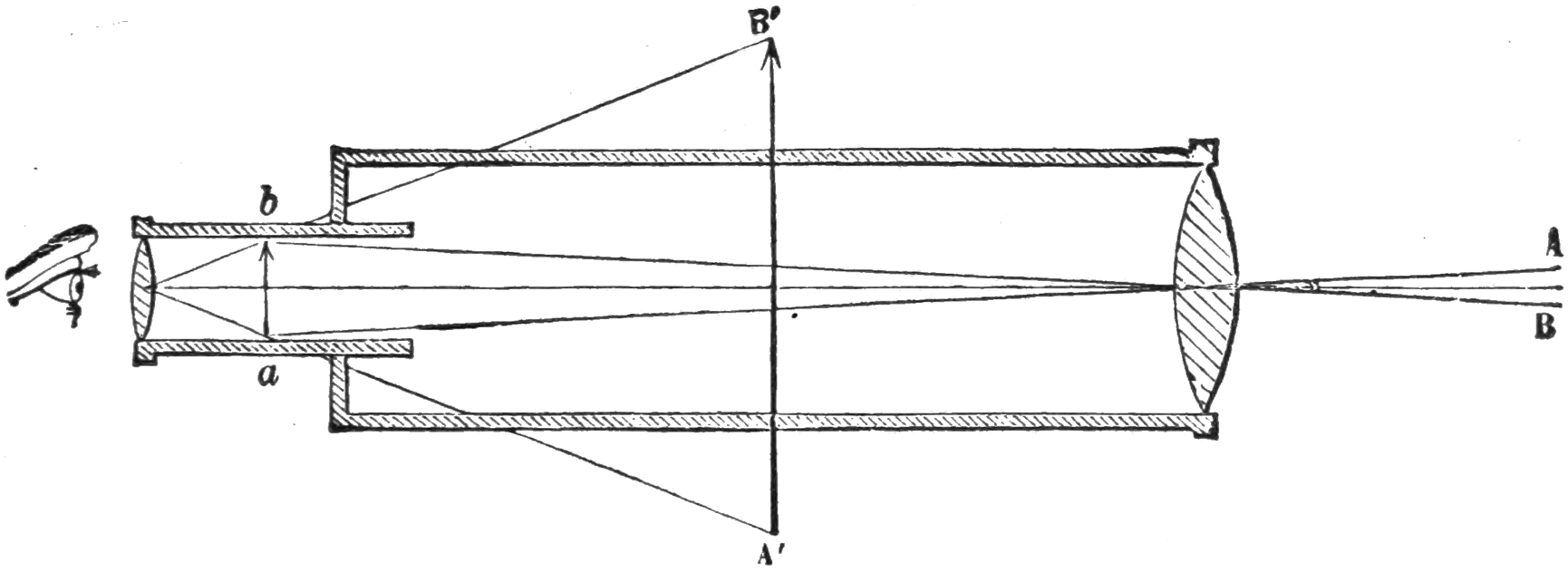
Fig. 43.—Section of an Astronomical Telescope.
The convex lens which serves as an object-glass, gives
at a b a reversed image of the star A B. The small convex
lens which acts the part of an eye-piece, enlarged
this reversed image without changing its position, and
causes it to be seen in the line A´ B´. This eye-piece is
fixed at the extremity of a tube, which is smaller than
that containing the object-glass, and slides easily backwards
and forwards from the spot where the image a b
is found. The latter is an indispensable condition, for
it is rare to meet two persons whose eyes are of the
same focus; besides, the image a b will fall at a different
158spot for objects at different distances: thus, if you are
looking at the moon, and suddenly turn the instrument
on to a distant nebula, you will find that the eye-piece
requires adjusting. In showing ordinary observers an
object in the telescope, it is well to insist on their moving
the eye-piece backwards and forwards until distinct
vision is obtained, for it often happens that people will
say they see an object quite distinctly, when it is in
reality misty, and will generally refuse to allow the
focus to be altered. It is very singular how human
vanity or complaisance will step in when some persons
are looking through a telescope. They seem to think
that there is some disgrace or rudeness involved in their
not being able to see what their predecessors at the
instrument have seen. Poor John Leech leaves us an
amusing instance of this in a comic cut inserted in
one of the early numbers of our old friend Punch. A
gentleman is endeavouring to show a lady a distant
steamboat through a telescope, but she has it accidentally
pointed at two swans that are swimming on
the margin of the lake below; consequently when he
asks her if she sees the steamer, she replies that
“she sees it most distinctly, and there are two of
them,” a pretty good proof that the instrument was
not only pointed at the wrong object, but was out of
focus as well.
In constructing a telescope similar to the one described
above, the object-glass ought to be of considerable
diameter and of long focus; the eye-piece, on the
contrary, should be comparatively small and of short
focus. A little consideration will show the reason of
this. An object-glass of long focus will form a large
image at the point a b, and the eye-piece of short focus
will magnify this image more than another lens of less
convexity. It is, however, on the size, length of focus,
and perfection of workmanship of the objective that the
159excellence of the telescope depends; large object-glasses
are consequently rare, and are only to be found in observatories
of the first class. The object-glass of the
large telescope at the Observatory at Paris is nearly
fifteen inches in diameter, and the highest magnifying
power capable of being employed with it is 3,000. The
Observatory of Pulkowa, near St. Petersburg, possesses
a similar instrument, and the Observatory at Chicago,
United States, a still larger one, measuring between
eighteen and nineteen inches in diameter. But the
largest of all is an objective in the possession of Mr.
Buckingham, an amateur astronomer, who has an observatory
near London, which is twenty inches in diameter,
and twenty-eight feet in focal length.
The eye-pieces of astronomical telescopes are of different
powers, and are changed according to the class
of object to be observed. Thus, in taking a general
view of the moon, a low power would be used. If you
wished to examine any particular mountain, you would
raise the magnifying power by inserting a stronger eye-piece.
The power used also depends on the state of the
atmosphere. For instance, on warm evenings, when the
air is charged with moisture, the tremulousness of the
atmosphere is so great, that it is often only possible to
use the very lowest power. By combining four convex
lenses together, we obtain what is called a terrestrial or
erecting eye-piece, which has the property of re-reversing
the image formed by the objective. The eye-pieces of
all telescopes for use on land or at sea are made on this
principle. The same effect may be obtained, as we have
already shown in fig. 41, by using a concave lens, but
in this the field of view is much diminished.
Hitherto we have only spoken of refracting telescopes
or those instruments provided with a convex object-glass,
to collect and refract the rays of light given off
by the object we are desirous of examining; but there is
160another and very important class of instruments, in
which the object-glass is replaced by a reflecting mirror.
The first reflecting telescope was invented by Dr. Gregory,
an English philosopher, about 1650. It consisted
of a brass tube, at the lower extremity of which
was fixed a concave mirror made of metal, and provided
with a hole in its centre for the insertion of the small
tube containing the eye-glass. Towards the other
end of the telescope was placed a second and smaller
mirror, which reflected the image formed by the large
mirror, through the eye-piece to the eye. The following
figure will show the path of the rays in the Gregorian
telescope.
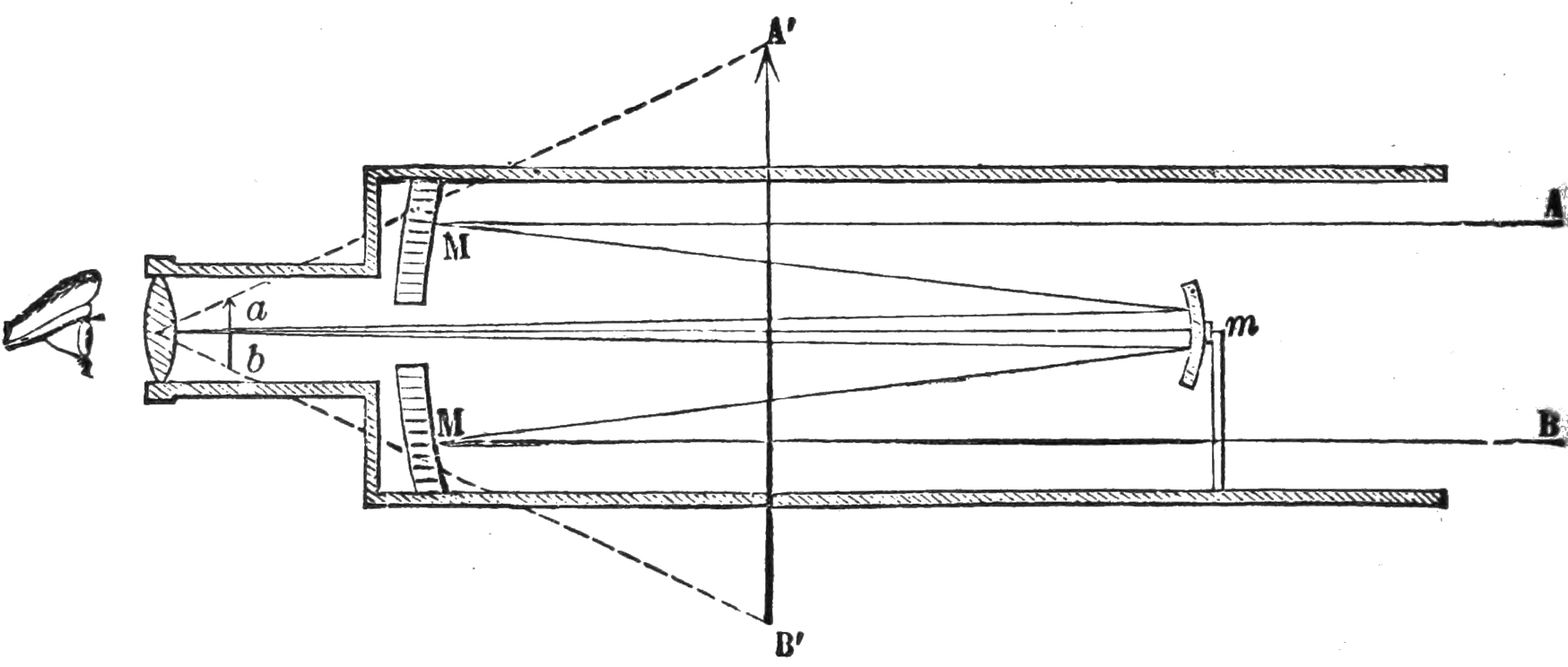
Fig. 44.—Section of the Gregorian Telescope.
The rays A B, proceeding from the object at which
the instrument is pointed, are first reflected from the
surface of the principal mirror M M on to the small
mirror m, whence they proceed to form a magnified
image at a b, which is then again enlarged by the eye-piece
appearing to the eye as if placed at A´ B´. The
focus in the Gregorian is altered, not by sliding the
eye-piece backwards and forwards but by moving the
mirror m, which is provided with a long screw, to which
is attached a handle. At first sight a reflecting telescope
161has the appearance of a very stumpy-looking refracting
instrument, but one instant’s examination will
show the observer that the usual object-glass is absent
at the end of the tube. In fig. 45 we have a Gregorian
telescope, mounted on a tripod stand.
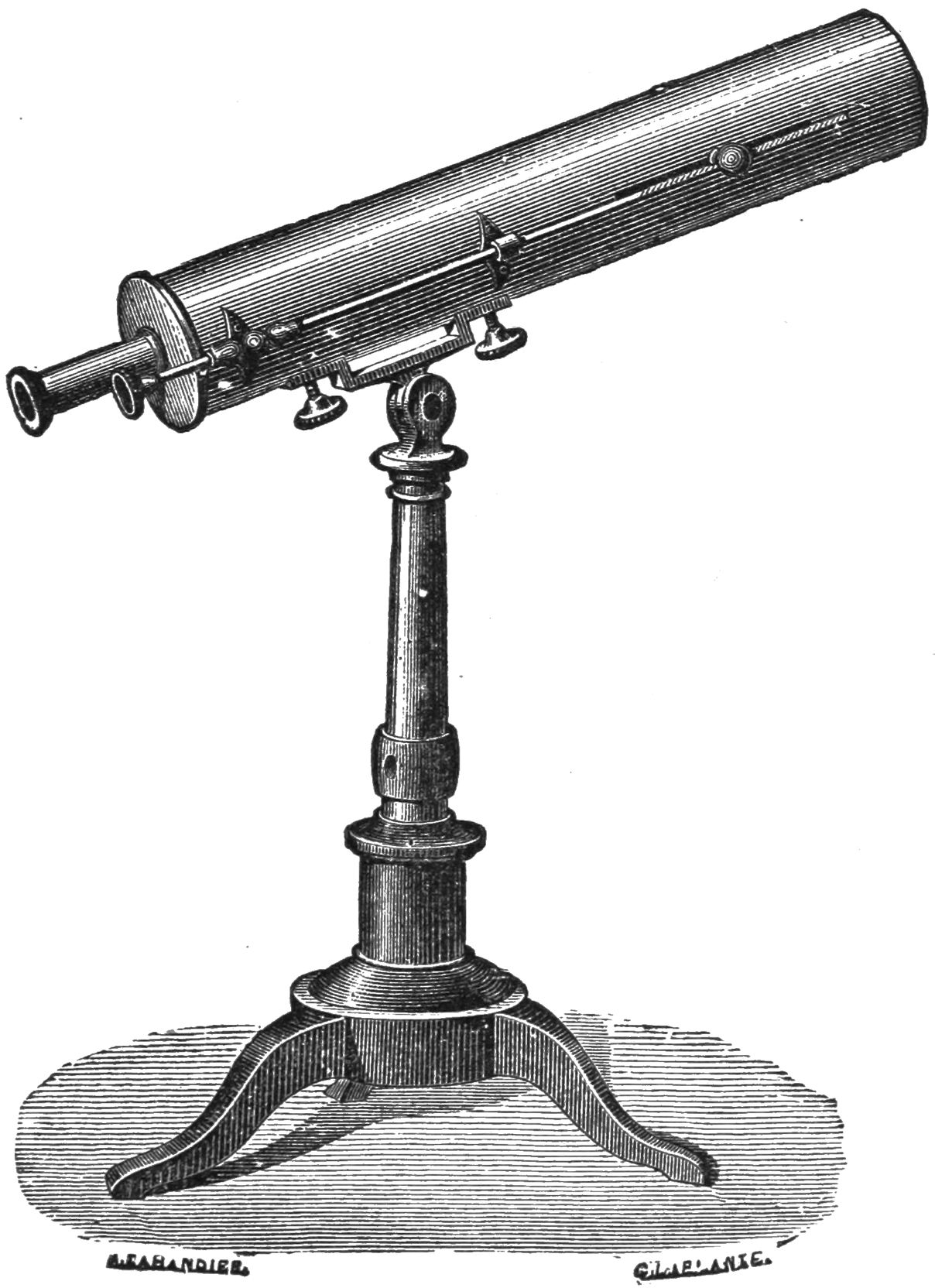
Fig. 45.—Gregorian Telescope.
Whilst experimenting on the Gregorian telescope,
Newton made certain improvements in its construction,
which we shall proceed to describe. A glance at fig. 46
162will show that the path of the rays is much more
simple than in the instrument we have just noticed.
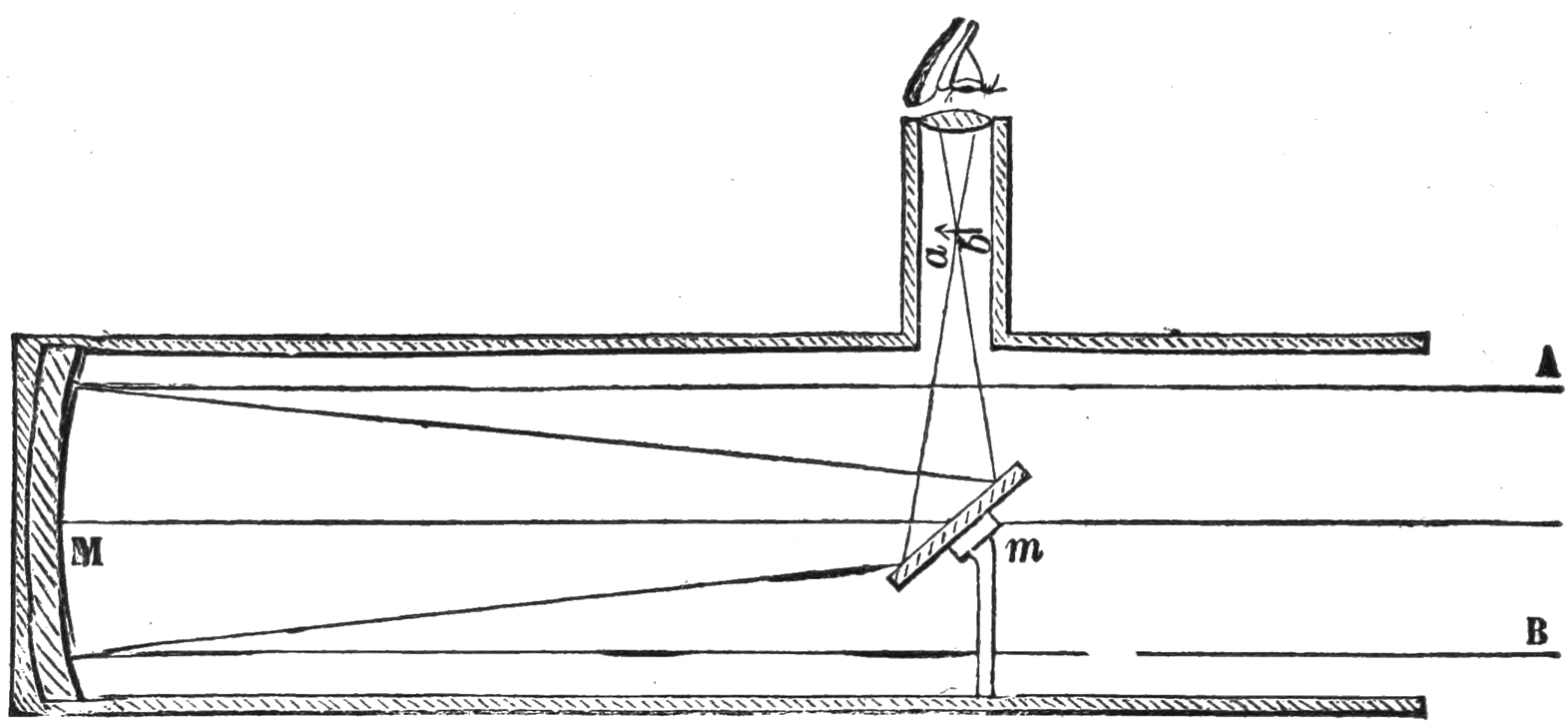
Fig. 46.—Section of a Newtonian Telescope.
The rays of light A B are first reflected from the
concave mirror M on to the surface of the small plane
mirror m, which is placed at an angle of 45°, and reflects
them as far as the point A´ B´, where they form
the image to be magnified by the eye-glass. It is
therefore at the side of the instrument, and not at the
end, as hitherto, that the observer is placed, and at
right angles to the path of the rays. Observers looking
at an object through a Newtonian telescope for the
first time are generally sufficiently astonished to find
that there is really no difficulty after all in seeing round
a corner. We shall presently return to the subject of
Newtonian telescopes, which were abandoned by astronomers
for many years, until they were brought into
use again by M. Foucault, a distinguished French philosopher.
Towards the end of the last century Sir William
Herschel invented and constructed the reflecting telescope
which bears his name. His great object was to
avoid the loss of light consequent on the double reflection
which took place in all instruments constructed up
163to that time, and he succeeded at last in making a telescope
in which the observer looked directly through the
eye-piece at the image formed by the mirror, which was
inclined in such a manner that the rays were reflected
to the lower edge of the open end of the tube. In
using this kind of telescope the observer is placed with
his back to the object he wishes to examine, a position
that is even more astonishing to those unaccustomed to
the use of a Herschellian telescope than the one assumed
when employing an instrument of the Newtonian construction.
This position has the defect of causing a
small portion of the rays proceeding from the object to
be intercepted by the head of the observer, but the
amount of light lost is so small in comparison to the
size of the mirror that in practice it amounts to nothing.
The dimensions of the telescope constructed by Herschel
were enormous for that day. It measured 40 feet
long, and the mirror was 4 feet in diameter. It was
supported by a complicated system of scaffolding, pulleys,
and cords, and was capable of magnifying an object
6,000 times. It was by means of this splendid instrument
that Sir William Herschel made those wonderful
discoveries in astronomy which are inseparably associated
with his name. With it he discovered the planet
Uranus, many of the double stars, and a large number
of nebulæ, which up to that time were unknown. His
son, Sir John Herschel, inherits his father’s talents as
an astronomer, and has enriched science with numberless
observations and discoveries of the greatest importance
made with this fine instrument. Fig. 47 shows
the construction of the Herschellian telescope, and the
path of the rays may be easily followed by the student
without any help from us.
The vulgar, ever prone to make mountains out of
molehills, magnified the power of Sir William Herschel’s
telescope beyond all bounds. Stories were circulated
164about his having given a dinner in the interior of the
tube to a select party of friends, but as the diameter
of the telescope was only a little more than 4 feet, the
entertainment, to say the least of it, would have proved
somewhat inconvenient to the guests. Another story,
which was credited by great numbers of people, was
that he had discovered inhabitants in the moon, but that
he hesitated to make the matter public for fear he should
be prosecuted for spreading atheistical notions. In fact,
the tales told of Sir William Herschel’s telescope were
endless, and caused the astronomer great inconvenience
by attracting crowds of idle people to the neighbourhood
of Slough, where he vainly endeavoured to carry
on his investigations in peace and quietness. It was in
vain that these silly assertions were disproved again
and again. Having once believed them, people were
slow to reject them, and the story of the dinner was
told over and over again for many years.
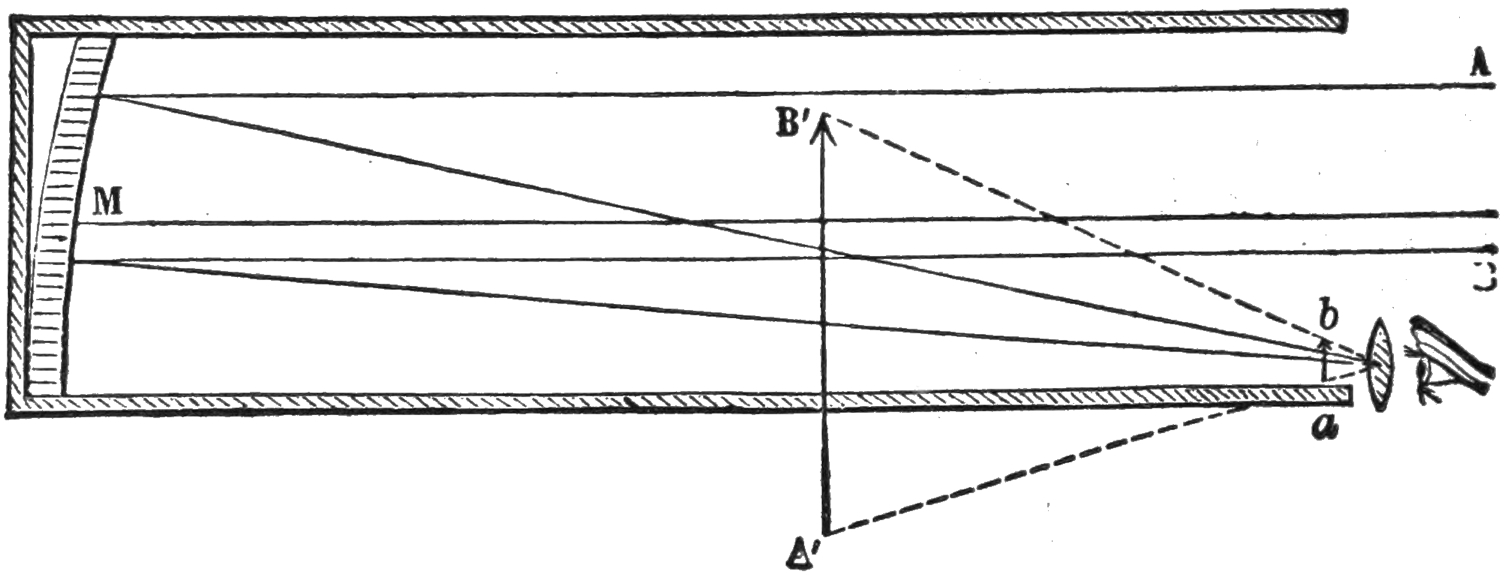
Fig. 47.—The Herschellian Telescope.
The instrument above described is one of those known
as front view telescopes, on account of the image of the
star being reflected from the surface of the mirror,
which was placed obliquely at the bottom of the tube
in front of the observer, who examined it by means of
the eye-piece without any other reflection taking place,
165thereby effecting a saving of light, which fully compensated
for any loss caused by the mirror being placed
askew. The concave mirror made by Herschel alone
weighed a ton, to say nothing of the enormous tube and
its fittings. Herschel had consequently to invent a
special apparatus for holding and moving this gigantic
instrument. The moving gear consisted of a mass of
beams, pulleys and cords, reminding one more of the
rigging of a ship than of a philosophical instrument.
The apparatus for moving the telescope appeared so
complicated to the casual observer, although in reality
it was very simple, that it doubtless contributed in no
small degree to the propagation of the fanciful stories
we have already spoken of.
The performances of this splendid instrument hardly
came up to the expectations of those who saw it in progress.
Herschel, it is true, was enabled by its means
to use a power of from 3 to 6,000, but he could only
use these amplifications on a few objects—the planets,
for instance, giving so little light under a high power
as to become indistinct and misty. In 1802 Baron von
Zach, in his Monthly Astronomical Compendium, went
so far as to say that this colossal instrument was not of
the slightest utility, that no discovery had ever been
made with it, and that it ought to be considered merely
as an optical curiosity. Subsequent events, however,
proved very conclusively that Baron von Zach was utterly
wrong in his statements and prophecies.
The telescope constructed by Herschel, although
very wonderful for the day in which it was made, has
long since been eclipsed by that belonging to Lord Rosse,
and erected by his late father at Birr Castle, near
Parsonstown in Ireland. It is superior to Herschel’s
instrument both in point of size, and workmanship.
The late Lord Rosse, not fearing that his dignity
would be compromised by such an act, went boldly to
166work, and learned to polish mirrors like an ordinary
workman, the consequence of which was that he could
bestow unusual pains upon the finishing of the speculum.
His Lordship not only learnt the mere handicraft of
speculum polishing, but went deeply into the engineering
difficulties of the operation, and succeeded in inventing
many improvements for diminishing labour and rendering
the form of the surface more perfect. The
specula ground and polished under Lord Rosse’s method
are almost entirely free from what is called spherical
aberration,—that is to say, all rays proceeding from
a single point of light, such as a star, are collected into
a single point instead of being scattered in a round
mass. This freedom from spherical aberration is of
course necessary to produce perfectly distinct images.
In his Life of Newton Sir David Brewster calls it one
of the most marvellous combinations of art and science
yet seen in the world.
The tube of Lord Rosse’s instrument is 55 feet long,
and weighs 6½ tons. In form it may be compared to
the chimney of a steamboat of enormous size. At one
end it terminates in a kind of square box, within which
is contained the mirror, whose diameter is 6 feet, and
which weighs nearly 4 tons. The weight of the whole
apparatus is consequently nearly 10½ tons, or four
times as much as Herschel’s. It is erected on an
oblong mass of masonry, 75 feet in length from north
to south, between two solid walls nearly 50 feet high,
which serve as supports for the mechanism intended to
move this enormous tube in all directions. To the
walls are also fixed movable staircases with platforms
that can be brought up to the eye-piece with the greatest
facility, no matter in what position the telescope
may be placed. This noble instrument has penetrated
space to a distance perfectly unattempted before its existence,
and has resolved numerous nebulæ into masses
167of stars that until then were supposed to be mere
clouds of luminous matter. The exact forms of other
nebulæ have also been accurately determined by this
telescope, which fully deserves the glowing eulogium
passed upon it by the Duke of Argyle in his presidential
address at the meeting of the British Association
at Glasgow, in 1855. “This instrument,” said his
Grace, “in extending the range of astronomical science
as it has done, has been the means of throwing certain
doubts upon the laws that govern the motions of the
heavenly bodies, and render it possible that certain of
the far-distant nebulæ are regulated in their movements
by other laws than those to which the members of our
own system are subjected.”
The clearness with which this telescope exhibits every
object within its range is so great that the most distant
nebulæ are seen with as great distinctness as the nearest
planet. On directing it towards the moon, which is
only distant from us about 240,000 miles, the surface
of our satellite may be explored with a facility almost
as great as that with which we examine the details of a
landscape with an ordinary telescope.
Maedler, a German astronomer, who has measured
nearly every mountain and valley on the moon’s surface
with the greatest exactitude, stated some years before
Lord Rosse’s telescope was perfected that if a monument
as large as one of the Pyramids existed on the
surface of the moon it could have been readily distinguished
by the instruments then in use. With Lord
Rosse’s telescope we can see the surface of our satellite
so much enlarged that a space 220 feet square could be
readily perceived by a good observer. This enormous
eye, measuring 6 feet in diameter, would hardly show
us a lunar elephant; but it is certain that if a troop of
buffaloes, or animals analogous to them, crossed the
field of vision, they would undoubtedly be perceptible.
168Masses of troops marching backwards and forwards
would also be plainly visible, and we may assert with
something like absolute certainty that there are neither
towns nor villages in the moon, nor any buildings as
large as St. Paul’s of London or the colossal railway
stations of that metropolis.
This telescope, as we have said before, is the largest
hitherto constructed, and cost its noble constructor
more than 25,000l. It must also be recollected that it
was not a mere scientific toy belonging to an amateur
philosopher, but a real working instrument in the
possession of a true man of science, who did work with
it that will render his name famous while civilization
lasts. The present Lord Rosse seems worthy in every
way of his father’s great name, and has already enriched
astronomical science with numerous valuable
observations.
We shall finish this chapter by a description of the
Newtonian telescope constructed by M. Léon Foucault.
The mirror, instead of being made of speculum metal,
which is an alloy of tin and copper, is made of glass
from the famous manufactory of St. Gobain. The first
rough grinding having been finished, it passed into the
workshops of M. Secrétan, the optician to the Paris
Observatory, to receive its final polish and finishing
touches from the hand of M. Foucault himself, the most
careful optical tests being applied to it before the commencement
of each operation.
The glass mirror having reached the degree of perfection
desired, was then silvered on its concave surface
by being plunged into a bath of nitrate of silver,
dissolved in water, and mixed with certain proportions
of gum galbanum, nitrate of ammonia, and oil of cloves.
Half an hour in this bath was sufficient for the deposition
of a film of silver of sufficient thickness to bear
polishing. When finished, the mirror was found to
169reflect 92 per cent. of the light incident on its surface,
the loss in the case of achromatic object-glasses and
metal specula being 20 and 35 per cent. respectively.
The substitution of a parabolic glass mirror for the
ordinary metal speculum offers the triple advantage of
greater lightness, increased distinctness, and more
170brilliant images. Fig. 48 represents the large silvered
glass telescope constructed under M. Foucault’s
direction for the observatory at Marseilles. It measures
32 inches in diameter, and has a focal length of a little
more than 16 feet, and is put in motion by clockwork of
a very perfect description, so that when once pointed at
a star or planet it follows the object, which would otherwise
disappear on account of the rotation of the earth.
The path taken by the rays is precisely the same as in
Newton’s telescope, the eye-piece being placed at the side
of the tube, which is provided with a movable platform
and staircase for the observer.
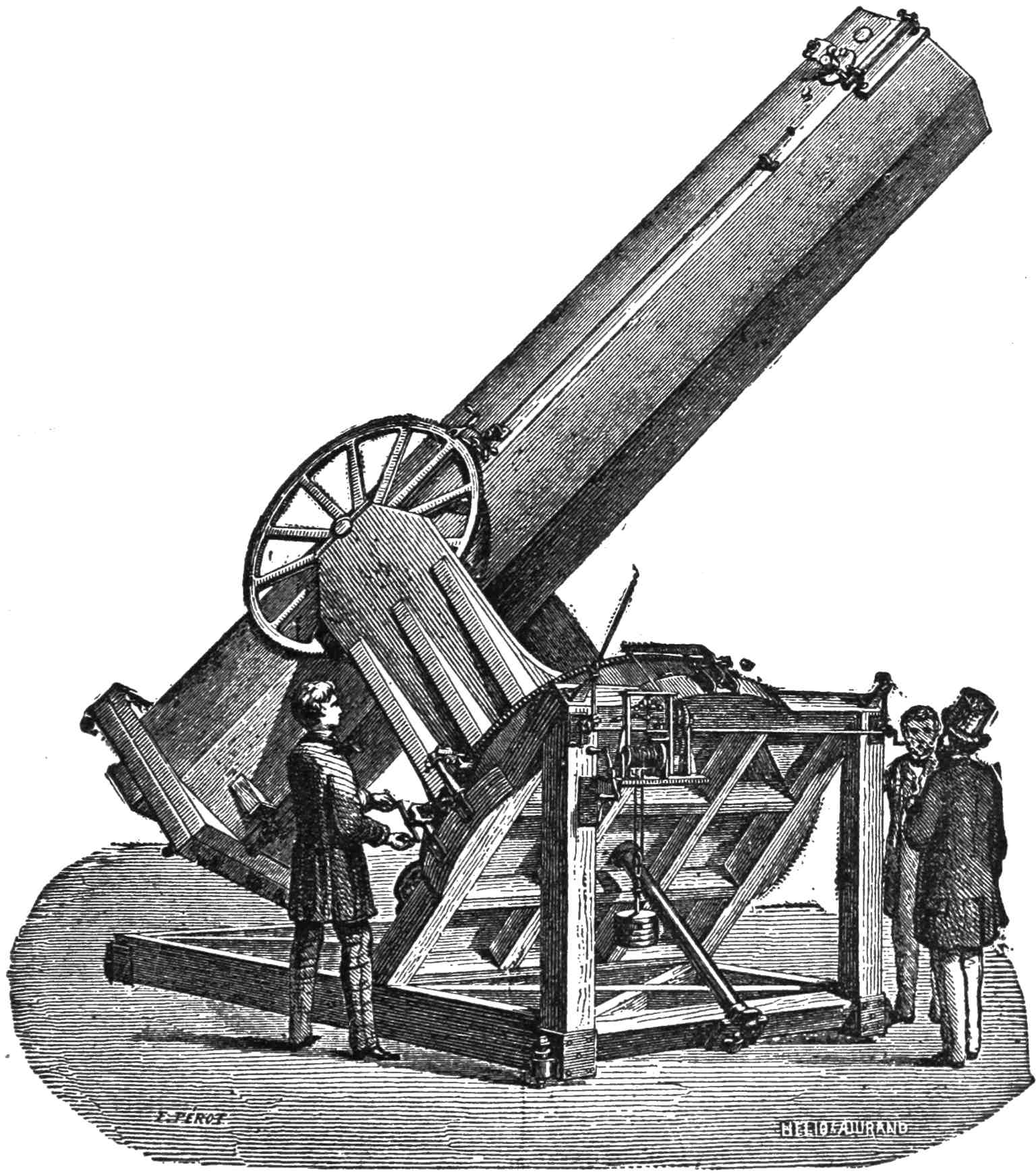
Fig. 48.—Foucault’s Large Telescope.
The optician to whose talent in his art this fine instrument
is due, has recently executed several small
telescopes upon the same model, at such a price as to
bring them within the reach of amateurs with slender
purses. The principal part of these telescopes, one of
which is represented in fig. 49, (see next page), is the
mirror, which is about 4 inches in diameter, and 24
inches’ focal length. The body, which is cylindrical, is
made of brass, and revolves on two pivots placed horizontally
at about one-third of its length from the bottom.
The bearings on which the pivots move consist of two
upright standards of metal, which are connected at the
bottom, and revolve on a pin in the middle of the plate
of the tripod stand. They are made of such a height
that the lower portion of the instrument may pass between
them, when it is necessary to observe objects in
the zenith. By the turn of a screw the whole of the
upper portion of the instrument may be dismounted and
fixed on a lower standard, so that the observer may work
sitting down if necessary. The body of the telescope
is provided with a finder. One of the great advantages
of this form of instrument is that it can be used for
observations on the zenith without giving the observer
those unpleasant cricks in the neck so inseparable from
171the use of ordinary telescopes in a nearly upright condition.
The mirror will bear a power of 220 diameters,
and shows the mountains of the moon, the phases of
Mercury and Venus, Saturn and his ring, Jupiter and
172his satellites, and a large number of double stars and
nebulæ. It is provided with a set of eye-pieces, so that
any power almost from 50 to 220 diameters may be
used at will. The figure on the opposite page will give
the amateur a good idea of the form and size of this
instrument.
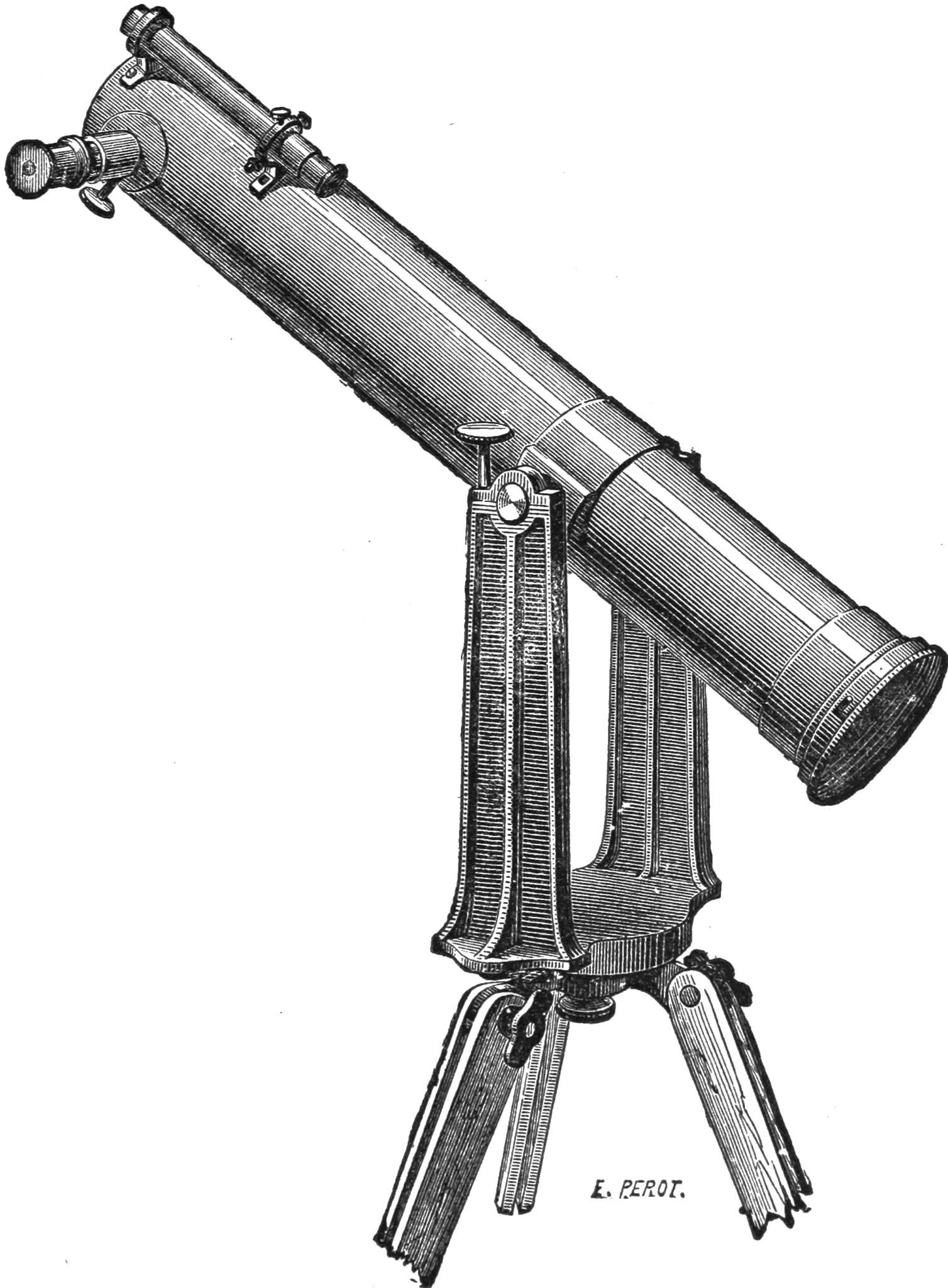
Fig. 49.—Foucault’s Small Telescope.
173PART III.
NATURAL MAGIC.