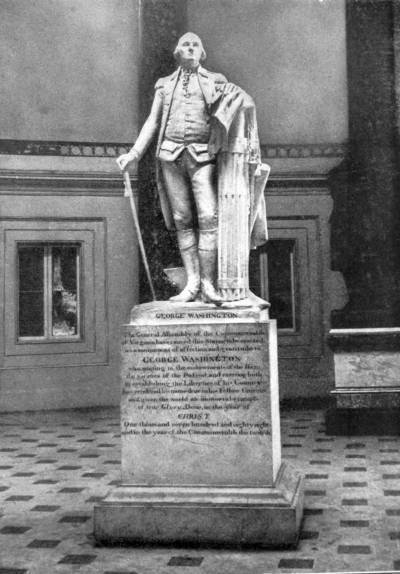
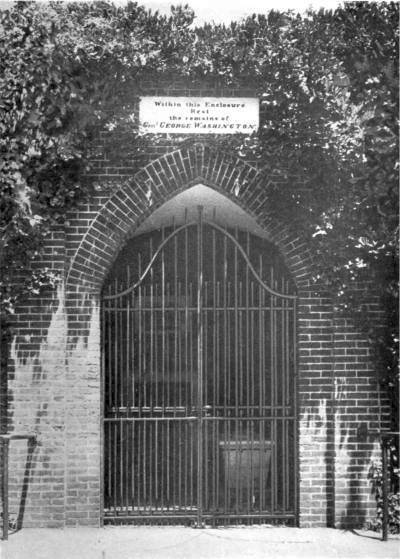
In order to appreciate the difficulties which Washington had to
overcome, and therefore to make any just estimate of his character,
his patriotism and his services in the cause of political liberty, the
conditions in which he worked must be understood. It must not be
assumed that he had a united country, a solid backing, and that there
was unanimous patriotism sustaining him. To do so would not only be
untrue, but it would belittle the almost superhuman task which gave
birth to American government, and made possible the final organization
through Abraham Lincoln of a land of the free, able to sustain its
freedom against all the struggling masteries of the world. To suppose
that Washington did his revolutionary work in the midst of reliable
patriotism is as erroneous as to suppose that Lincoln did his
nation-saving task in the midst of a unanimous North.
There was no such thing as patriotism at the time of Washington,
according to the usual definition of patriotism, because there was no
geographical territory holding a united people, for whom or for which
to feel a national patriotism.
American patriotism, therefore, began in the patriotism for human
rights, not thus making “a man without a country,” as patriotism for
humanity has been sometimes defined alike by extreme pacifists and
extreme militarists, but in the fact that American democracy and
humanity are synonymous terms, in all they can mean for the rights of
man.
There was then no political country to be patriotic for. There were
only colonies. Patrick Henry’s cry, so pathetic in its divine need,
and so little true for his fellows as shown in 1861, “I am not a
Virginian, I am an American,” rang through the congress at
Philadelphia with the thrill of a new vision of human faith, but it
was almost a century, through an age of desperate reconstruction,
before it could be even approximately called true; before American
democracy and humanity could face the warring world, the King-made
world, with one meaning, one service and one moral law.
John Adams, of indisputable authority, tells us that more than a third
of the property owners and men of affairs, were opposed to the
revolution throughout the war.
Lecky, in his history of England, declares that an examination of the
correspondence of the revolution at any period shows that, “in the
middle colonies at least, those who really desired to throw off the
English rule were a small and not very respectable minority. The great
mass were indifferent, half-hearted, engrossed with their private
interests or occupations, prepared to risk nothing till they could
clearly foresee the issue of the contest. In almost every part of the
States—even in New England itself—there were large bodies of devoted
royalists.”
After the war more than a hundred thousand, it is estimated, of
irreconciliable royalists were expelled from the colonies.
When General Gage evacuated Boston, more than a thousand royalists
from that immediate territory went with him to Halifax, Nova Scotia,
so that our American grandmothers, even a hundred years later, when
exasperated, would exclaim against their tormentor, with much of the
ancient vehemence, “You go to Halifax!”
If we want to appreciate Washington and to understand his wonderful
service for mankind, we must understand the difficulties and
obstacles he had to overcome. The “Spirit of ’76” belonged at first to
only a few inspired souls, who had a wonderful vision of human rights
for a new world. Right was might with them and their might-right won
the great cause as the immortal “Spirit of ’76.”
General Washington’s description of the conditions are vividly
portrayed in a letter to Joseph Reed, from Cambridge, dated November
28, 1775:
“Such a dearth of public spirit, and such a want of virtue, such stock
jobbing and such fertility in all the low arts to obtain advantages of
one kind or another in this great change of military arrangement I
never saw before, and pray God’s mercy that I may never be witness to
again. What will be the end of these manœuvers is beyond my scan. I
tremble at the prospect. We have been till this time enlisting about
three thousand five hundred men. To engage these I have been obliged
to allow furloughs as far as fifty men to a regiment, and the
officers, I am persuaded, indulge as many more. The Connecticut troops
will not be prevailed upon to stay longer than their term, saving
those who have enlisted for the next campaign and are mostly on a
furlough; and such a mercenary spirit pervades the whole that I should
not be at all surprised at any disaster that may happen. In short
after the last of this month our lines will be so weakened that the
Minute Men and Militia must be called in for their defense; and these
being under no kind of government themselves, will destroy the little
subordination I have been laboring to establish, and run me into one
evil whilst I am endeavoring to avoid another; but the less must be
chosen. Could I have foreseen what I have experienced, and am likely
to experience, no consideration upon earth would have induced me to
accept the command.”
At the meeting of the colonies in congress at Philadelphia in 1774,
George the Third saw that it was a conquest of wills and he exclaimed,
“The die is cast, the colonies must either submit or triumph.” But
even when the British government was sending Hessian mercenaries over
against the colonies, a thing regarded as a supreme outrage by those
opposed to England, it was almost impossible to get together enough
American patriotism to adopt a declaration of independence.
John Adams says that a large section of Congress regarded such a
declaration with both terror and disgust. To those who have believed
that a unanimous patriotism made only a little severe fighting
necessary, backed by some clever generalship, there can be no proper
appreciation of the great American achievement.
Then, as now, the prosperous did not want their prosperity disturbed
by any change. They didn’t want to lose their business, not to speak
of their lives, by going into an army. But there had been a generation
of people pouring into the colonies from the poverty-devastations of
English misgovernment in Scotland and Ireland. They had never had any
chance to protest against their wrongs in the old country, but
fortune, or fate, or Providence, had banished them across the ocean
directly into an opportunity to express their sentiments with guns,
and they took the opportunity. They flocked to the recruiting stations
of Washington’s army.
But so unsafe were business transactions with the party fighting Great
Britain that the revolution was coming to the gates of despair because
of the impossibility of getting military supplies and army equipments.
There was fast growing a vision of collapse unless there was received
the encouraging help of a foreign power. France in almost unceasing
war with England was the only hope, and France could have no interest
unless the colonies were fighting for separation from England, instead
of against a tax on tea, as it bore the appearance, at the beginning,
from a foreign point of view. France wanted to know what the colonies
were fighting for. France wanted a bill of particulars. This brought
American interests to a crisis. France had no interest in a mere
family fuss. The French government could have no interest unless it
was for something that lessened the power of England.
Under the early troubles, a peace party among the business interests
was fast coming into power. Against this the commoners were aflame
with the patriotic pamphlets of Thomas Paine and Thomas Jefferson, the
eloquence of Patrick Henry, the statesmanship of John Adams, and the
work of the powerful-minded few who saw the sublime vision of American
freedom. At last they were enabled to pass the Declaration of
Independence, and France began, at first secretly and then openly, to
give encouragement through money-loans, supplies, and volunteers.
Burgoyne’s surrender in October, 1777, showed that America could be
successful with France’s help, and early in the next year France
recognized the independence of the colonies. They soon made the cause
of America their own, and sent over not only necessary supplies but
soldiers and ships. Known budgets of expenses, used in aid of the
Colonies, exceed $500,000,000, not a cent of which was ever returned
or asked for. Though there was the political interest to humble
England, yet France was at heart a profound lover of human freedom and
political liberty. Despite the implacable enemies of republican
government in Europe, France has successfully kept the dead-lines
across which “they shall not pass.” The moral debt which human liberty
owes to France can never be paid except as it is paid to humanity,
and, to that social justice, is dedicated the meaning of America.
The English parliament, becoming suddenly aware of the growing power
in the American subjects, now conceded every right asked for by the
colonists, and enacted those rights into law. But it was too late. The
middle-class mass of property owners and business men began to see the
vision of an American republic and the tide swelled toward success. As
the cutting off of supplies from the colonies had been the chief cause
of American weakness, England tried to prevent supplies being sent to
America, with the result that Denmark, Sweden, Russia and Holland
declared an armed neutrality to enforce their right to sell military
supplies to America. The dispute led to a war with Holland in 1780, so
that by the close of that year Great Britain had not a friend on earth
and was confronted by the united armies and navies of France, Spain,
Holland and America. At the same time there was rebellion in India
against the English rule, insurrections in Ireland, and so deep the
discontent in England itself that a London mob was able for several
days to make itself master of the city. The English lost control of
the sea before the close of 1780, and on October 19, 1781, Cornwallis
surrendered his army to Washington, from which historic hour a
world-champion of the rights of man over the divine rights of kings
was born in the Western world.
The difficulties which Washington had encountered and overcome in
Virginia previous to the French and Indian war were in full exercise
throughout New England at the opening of the Revolutionary War. They
could act together in small, free groups for a particular object of
their will, but to obey superior officers and to sacrifice their own
private judgment to higher authority, which was so necessary in war
and such a war as this, was utterly repugnant to their dispositions.
That subserviency to authority was the very reason they were opposing
the idea of taxation without representation, and why should they be
required to do the very thing they were fighting against! That
quandary and query has been the puzzle of every mind unable to see the
vision of means necessary to future results. It is the blindness
always of the fanatical pacifist who would sacrifice nothing for
peace, and of the non-resistant doctrine that right and moral law have
no need for material might in a material world.
The colonists had never known of anything but local patriotism. They
seemed to be unable to distinguish between English king-made authority
and American people-made authority, notwithstanding how much had been
discussed the relations of representation and taxation. That
difficulty has always existed concerning American militarism. It
almost defeated Lincoln during the Civil War. It almost delivered the
Union to Secession. If democratic militarism cannot be different from
dynastic militarism, then American freedom and human liberty will be
lost in the next American or world war.
The colonist would fight with the heroism he displayed in Indian
warfare, but when the enemy was driven away from his neighborhood, it
was the duty of the next neighborhood to take care of itself. Besides,
the New Englander with a home had the same idea as the Virginian
soldier twenty years before, and this was that, when he wanted to go
home, why shouldn’t he! He was not a deserter, and in no sense a
coward, but the discipline of army service was mere enslavement and
any compulsion was despotism. To understand the making up of an
efficient army under such circumstances is the only measure to
estimate the greatness of Washington and the debt to him of the
liberty-loving world.
Curtis, in his history of American Commonwealth, says, “Washington
overcame these difficulties by dint of a patience and a selflessness
almost without parallel in history, which gradually communicated
itself to his fellow countrymen. In seven years he created a
continental army which ended the war at Yorktown.”
Washington had to write many letters, endeavoring to spur up the
really patriotic leaders to consistent work for the cause. In his
letter to Joseph Reed he was almost in despair over the indifference
of people from whom he expected the most patriotic service.
“It grieves me,” he wrote, “to see so little of that patriotic spirit
which I was taught to believe characteristic of this people.” But this
did not mean that the so-called “spirit of ’76” was not strong among
them. Washington needed so much of the patriotic spirit that a little
would not be any, and, to half-heal the wounds of a friend, was not
very friendly to the cause, nor a sufficient friendship toward the
needs of Washington’s work for America.
Ten years later, when Washington had matured, through the mind-making
experiences of revolutionary times, he wrote to John Jay, saying,
“Experience has taught us that men will not adopt and carry into
execution measures the best calculated for their own good without the
intervention of coercive power.” This meant that human society
requires law, and the right of law is devoid of appreciation or
application unless it is clothed with the might to keep its forms and
values true.
Lecky says, “The common saying that you cannot make people virtuous by
law is a dangerous half-truth. The virtue innate in a people may be
utterly destroyed by bad institutions, for ‘the virtue,’ as Jay wrote
to Washington, ‘like the other resources of a country, can only be
drawn to a point by strong circumstances ably managed, or strong
governments ably administered.’”
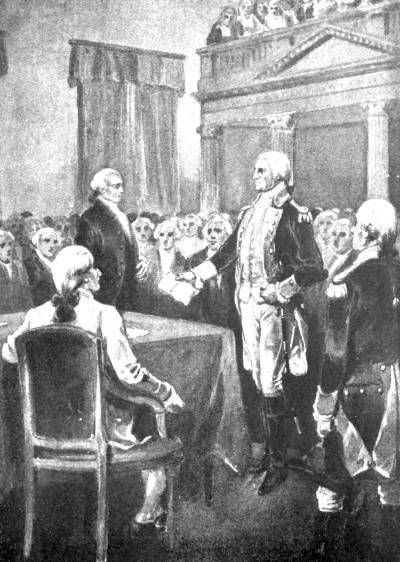
When it came to a question of who should be commander-in-chief of all
the armies, the disruptions and jealousies of the sections seemed
dangerously near wrecking any united action, which obviously must be
fatal to any independence more than they then had from Great Britain.
The Southern leaders were unanimous for Washington, and, with the
efficiency of shrewd politicians, supported measures largely
according to the pressure they brought to bear in the cause of having
Washington for the commander-in-chief. But this support did not bring
together any antagonism, because it was not made by any faction of
admirers or supporters. Washington himself, though present, refused to
lend any aid to the presentation of his own name.
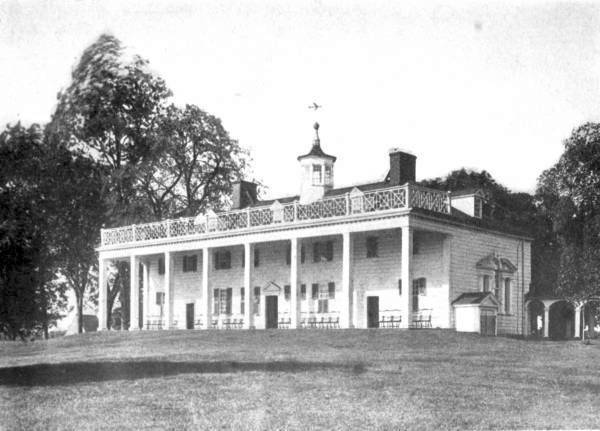
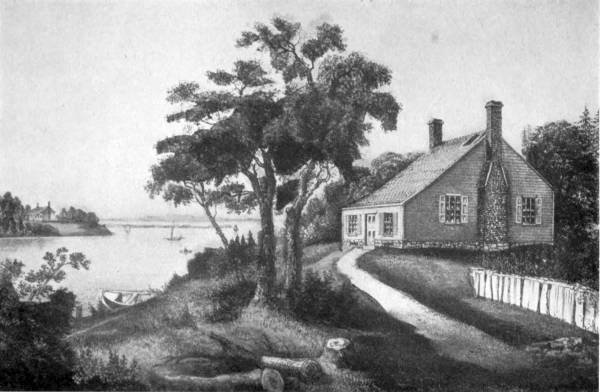
Mount Vernon—Washington’s Residence, Virginia.
It was John Adams, the whole-souled patriot from Massachusetts who was
the leader in advocating the selection of Washington. In his diary,
during these consequential times, Adams wrote, “I had no hesitation to
declare that I had but one gentleman in my mind for that important
command, and that was a gentleman from Virginia, who was among us, and
very well known to us; a gentleman whose skilled experience as an
officer, whose independent fortune, great talents, and excellent
universal character would command the approbation of all America, and
unite the cordial exertions of all the colonies better than any other
person in the Union.”
There were many men who were able leaders, and who had already made
great sacrifices in the cause of liberty, who believed with their
friends that they were entitled to be selected for the head of the
Army. Nevertheless, when the nomination was made, the election by
ballot was unanimous for Washington.
The salary of Commander-in-Chief had been set at five hundred dollars
a month, but Washington in his address of acceptance, while declaring
that no salary could have been made large enough to tempt him from the
comforts and business interests of his home, said he would accept no
salary, but would keep an exact account of his expenses, which they
would no doubt refund to him.
“There is something charming to me,” said John Adams, who became the
second president of the United States, when writing at the time to a
friend, “in the conduct of Washington, a gentleman of one of the first
fortunes upon the continent, leaving his delicious retirement, his
family and friends, sacrificing his ease, and hazarding all in the
cause of his country. His views are noble and disinterested.”
Washington now wrote to his half-brother, Augustine Washington, a
characteristic letter.
“I am now to bid adieu to you, and to every kind of domestic ease for
a while. I am embarked on a wide ocean, boundless in its prospect, and
in which, perhaps, no safe harbor is to be found. I have been called
upon by the unanimous voice of the Colonies to take command of the
Continental army; an honor I neither sought after nor desired, as I am
thoroughly convinced it requires great abilities, and much more
experience than I am master of.”
But he added his belief that the Divine Providence, which had called
him into such a dangerous duty, was wisely ordering the affairs of
men, and would enable him in due course of time to perform all his
tasks justly and with success.
What that task was through the revolutionary war can be appreciated
only in the details of events that require volumes of description in
telling. One cannot read it through with its ignoble intrigues,
unpatriotic dissentions, and dangerous rivalries without feeling that
Washington combined great manhood, great leadership, great
statesmanship and great generalship, and that no other man of less
character and genius than that could ever have welded together such
discordant and diversified elements into a means sufficient to achieve
the independence and liberty of America.