Greatness of mind, valued as worth while in historical characters, has
always been characterized by simplicity and sympathy, especially as
interested in children and in those without means for the needs of
life. Lincoln said pityingly of the poor that the Lord surely loved
them because he had made so many.
That Lincoln understood children and could talk to them is shown in
his visit to Five Points Mission, then the most miserable spot in all
the poverty-stricken sections of New York City. No one knows why he
went there, alone and unannounced. Perhaps, knowing what was the
lowest possible poverty in the frontier forests, he wanted to see what
it was in the midst of the greatest wealth in America.
The manager of the Mission, seeing a stranger, in the rear of the
house, who had been such an earnest listener to their exercises, asked
him if he would like to speak a few words to the children.
We can hardly imagine his feelings as he arose to speak to those
suffering little ones, so like his own hard childhood and yet subject
to such different causes and conditions.
Feeling that he had used up his time, after speaking a few minutes, he
stopped but they urged him to go on. Several times he ended his talk,
but every time they cried out so persistently for him to go on that he
spoke to them long over time.
No one knew who he was, but so impressive had been what he said that
one of the teachers caught him at the door, begging to know his name.
He replied simply, “Abraham Lincoln of Illinois.”
Adversity only made Lincoln stronger. In the midst of defeat he was at
his best. In the midst of great moral success, in the profound trials
of his country, his heart was mild and gentle as a child, and his eyes
misty with supreme dreams of beauty and peace to lessen the suffering
of humanity.
Once when Lincoln was speaking for Fremont, a brazen voice in the
audience roared out above his own, “Is it true, Mr. Lincoln, that you
came into the state barefoot and driving a yoke of oxen?”
The interruption had come in the midst of his strongest argument and
was intended to throw him off of his subject.
His reply came back with a bound that it was true and he believed he
could prove it by at least a dozen men in the audience more
respectable than the speaker. Then he seemed inspired by the question
into a vision of this country as the home of the free and the land of
opportunity.
In a great burst of eloquence, that carried the people with him, he
showed how oppression had injured the oppressor as much as the
oppressed, even as slavery had injured the master as it did the slave.
“We will speak for freedom and against slavery,” he said, “as long as
the Constitution of our country guarantees free speech, until
everywhere on this wide land the sun shall shine, and the rain shall
fall, and the wind shall blow upon no man who goes forth to unrequited
toil.”
This was before he had spoken in New York, where his speech at the
Cooper Institute awoke the people of the Eastern States to realize
that an intellectual political giant had at last come out of the West.
Lincoln’s long struggle to know and to be worth while culminated at
last in a political career. The good opinion of associates grew into
the favorable friendship of his neighbors and that confidence widened
to the community, then to the political district and so on.
In this age when thousands of dollars, and, in some instances, many
hundred thousands of dollars used for campaign expenses is a common
occurrence, it is interesting to read how Lincoln managed such things.
He was elected four times to the Illinois legislature. One time the
Whigs made up two hundred dollars to pay his campaign expenses. After
the election he returned one hundred and ninety-nine dollars and
twenty-five cents, to be given back to the subscribers, in which he
explained, “I did not need the money. I made the canvass on my own
horse; my entertainment, being at the house of friends, cost me
nothing; and my only outlay was seventy-five cents for a barrel of
cider, which some farm hands insisted I should treat them to.”
The history of Lincoln’s political battles belongs to those who would
comment on his part in public affairs. We are interested here in a
moral consideration of what built him up to a life used in the
preservation of his nation, the intimate personal interests of his
wonderful story, and how he stands as an ideal character of American
manhood.
It is therefore sufficient for us to pass over the great political
struggles that proved him to be the “Giant of the West,” and begin
with him on the way to the White House.
Lincoln was not exactly as the prophet without honor in his own
country, for he was beloved wherever he was known, but his neighbors
were struck with surprise when he was nominated to be President of the
United States.
One fine old gentleman, recently settled in Springfield from England,
who had brought his old country ideas of propriety with him, was
covered with astonishment.
“What!” he exclaimed, “Abe Lincoln nominated for President of the
United States! A man that buys a ten-cent beefsteak for his breakfast,
and carries it home himself! How is it possible!”
Lincoln’s vision of himself, expressed during a debate with Douglas,
was not much more hopeful. Ponder over these words in which Lincoln
with mingled humor, pathos and insight contrasted his own appearance
with that of his adversary in the famous debates:
“There is still another disadvantage under which we labor.... It
arises out of the relative positions of the two persons who stand
before the State as candidates for the Senate. Senator Douglas is of
world-wide renown. All the anxious politicians of his party ... have
been looking upon him as certainly, at no distant day, to be the
President of the United States. They have seen in his round, jolly,
fruitful face, post offices, land offices, marshalships and Cabinet
appointments, chargeships and foreign missions, bursting and sprouting
out in wonderful exuberance, ready to be laid hold of by their greedy
hands. On the contrary, nobody has ever expected me to be President.
In my poor lean, lank face nobody has ever seen that any cabbages were
sprouting out. These are disadvantages all, taken together, that the
Republicans labor under. We have to fight this battle upon principle
and upon principle alone.”
But the people were in earnest. It was realized by all that the
fundamental interests of American progress were in the midst of a
great crisis. They needed a reliable man and Lincoln was that man.
Campaign songs are usually very flat reading after the campaign is
over, but they were then the carriers of the enthusiasm for a great
cause.
The song sung in the state nominating-convention at Springfield,
Illinois, had for its first verse and chorus the following lines:
“Hark! Hark! a signal gun is heard,
Just beyond the fort;
The good old Ship of State, my boys,
Is coming into port,
With shattered sails and anchors gone,
I fear the rogues will strand her;
She carries now a sorry crew,
And needs a new commander.
“Our Lincoln is the man!
Our Lincoln is the man!
With a sturdy mate
From the Pine-Tree State,
Our Lincoln is the man!”
Reference to a few of his speeches, made before his election to the
presidency, will give a clear idea of his political Americanism, to
which was entrusted the definition and the destiny of the greatest
democracy in the world.
The Illinois legislature of 1854, by the union of Whigs and
Know-Nothings, indorsed him for senator and sent a committee to notify
him. The Know-Nothings were especially strong on the slogan of
“America for Americans,” and wanted to shut out immigration.
In the reply to the delegation or committee of notification, he said,
“Who are the native Americans? Do they not wear the breech-clout and
carry a tomahawk! Gentlemen, your principle is wrong. It is not
American. For instance, I had an Irishman named Patrick working my
garden. One morning I went out to see how Pat was getting along.
“‘Mr. Lincoln,’ he said, ‘what d’ye think of these Know-Nothing
fellers?’ I explained their ideas and asked him if he had been born in
America.”
“‘Faith, to be sure,’ Pat replied, ‘I wanted to be, very much, but me
mother wouldn’t let me. It’s no fault of mine.’”
Lincoln and Pat thus together believed that every baby, born anywhere
on earth, is a good American until its mind is moulded into some
man-made shape.
Referring to the thirteen original colonies and what they stood for,
he said, “These communities by their representatives in old
Independence Hall said to the world of men: ‘We hold these truths to
be self-evident, that all men are created equal; that they are endowed
by their Creator with certain inalienable rights; that among these are
life, liberty, and the pursuit of happiness.’ This was their lofty and
wise and noble understanding of the justice of the Creator to his
creatures. In their enlightened belief nothing stamped with the Divine
image and likeness was sent into the world to be trodden on and
degraded and imbruted by its fellows. They grasped not only the race
of men then living, but they reached forward and seized upon the
farthest posterity. They created a beacon to guide their children and
their children’s children, and the countless myriads who should
inhabit the earth in other ages.”
Among the many familiar quotations from these great speeches that made
him known to the nation may be mentioned a few that should never be
forgotten.
“Let none falter who believes he is right.”
“Let us have faith that right makes might.”
“Freedom is the last, best hope of earth.”
“Disenthrall ourselves, then we shall save ourselves.”
“Come what will, I’ll keep my faith with friend and foe.”
“For those who like that sort of thing, that is the sort of thing they
like.”
“I do not think much of a man who is not wiser today than he was
yesterday.”
“No man is good enough to govern another without the other’s
consent.”
“Would you undertake to disprove a proposition in Euclid by calling
Euclid a liar!”
“Familiarize yourself with the chains of bondage and you prepare your
own limbs to wear them.”
In pioneer days it was very common for individuals to conclude any
personal controversy by resort to the settlement of “fist and skull,”
and, on the far frontier of the Wild West, the convincing evidence
that brought peace was often the quickest and most skillful use of the
gun.
We are now in that pioneer day and wild-west age of nations whose
“fist and skull” arguments and wild-west “gun-play” must end. This is
what Lincoln thought of it in the midst of the Civil War. It was
written to the Springfield convention.
“Peace does not appear so distant as it did. I hope it will come soon
and come to stay; and so come as to be worth the keeping in all future
time. It will then have been proved that among freemen there can be no
successful appeal from the ballot to the bullet, and that they who
take such an appeal are sure to lose their case and pay the cost.”
It is interesting here, as he came up out of the darkness into the
dawn of his supreme humanity, to know what the greatest men of his
times thought of him, when that great day of human service closed
down over him, in the martyrdom of assassination. It is not eulogy,
but an estimate of values in a personality, and as appreciation of
righteousness exalting a man into an ideal of his age.
Lord Beaconsfield, addressing the House of Commons, said, “In the life
of Lincoln there is something so homely and so innocent that it takes
the subject, as it were, out of the pomp of history, and out of the
ceremonial of diplomacy. It touches the heart of nations, and appeals
to the domestic sentiments of mankind.”
John Stuart Mill, one of the most distinguished philosophers of the
last century, speaks in his writings of Lincoln as “The great citizen
who afforded so noble an example of the qualities befitting the first
magistrate of a free people, and who, in the most trying
circumstances, won the admiration of all who appreciate uprightness
and love freedom.”
D’Aubigne, the historian of the Reformation, wrote,
“While not venturing to compare him to the great sacrifice of
Golgotha, which gave liberty to the captive, is it not just to recall
the word of the apostle John (I John 3:16): ‘Hereby perceive we the
love of God, because he laid down his life for us: and we ought to lay
down our lives for the brethren.’ Among the legacies which Lincoln
leaves to us, we shall all regard as the most precious his spirit of
equity, of moderation, and of peace, according to which he will still
preside, if I may so speak, over the destinies of your great nation.”
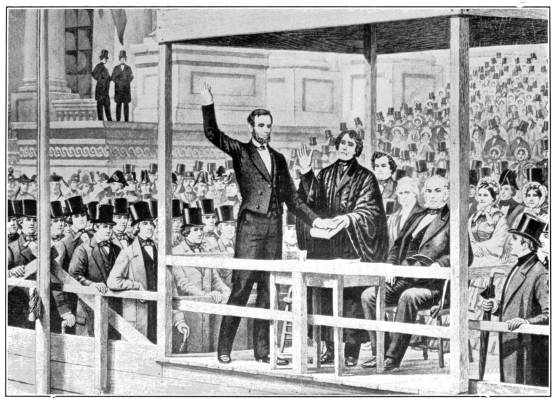
As we all now know, there was never a more fearless man than Abraham
Lincoln, but so bitter and so threatening were his enemies that it was
believed by his friends that the Presidency should not be endangered
by taking any chances as to his assassination on the way to
Washington, for his inauguration. Open boasts were widely made that he
would never be inaugurated. Assassination was especially threatened if
he should pass through Baltimore, and it was thought best by the
managers of his transportation that it should not be known when he
passed through Baltimore.
Evidence was uncovered that a band of sworn assassins, headed by a man
calling himself Orsini, was to throw the train from the track
somewhere between Philadelphia and Baltimore, and then do their
monstrous deed. If this failed, they were to mingle with the crowds
about the carriage and at the first chance assassinate him, by
discharging pistols at him and then throwing hand grenades. In the
confusion they expected to make their escape to a vessel awaiting them
in the harbor.
The plot was defeated by the managers of the journey sending Lincoln
back to Philadelphia from Harrisburg, while all who might be watching
him as spies for the plotters thought him to be asleep in a Harrisburg
hotel. At Philadelphia he was placed on board a night train for
Washington, where he arrived safely the next morning.
It was here at Baltimore, where there was such opposition to the
preservation of the Union, that a delegation was some time later sent
to Lincoln, demanding that no more troops pass through Maryland.
Lincoln replied that the troops had to go to their destination, and,
since they could neither go under nor over Maryland, they would have
to go through it. Another delegation demanded that all hostilities
should cease, and the controversy be left in the hands of Congress,
otherwise seventy-five thousand men would oppose any more troops going
through Maryland.
President Lincoln assured them that hostilities would not cease until
the rebellion was ended, and that he supposed they had room on the
soil of Maryland to bury seventy-five thousand men.
This unequivocal language ended such conferences and deputations.
These stupendous difficulties crowding upon Lincoln in the opening of
the war, the opposition of powerful men, and the chaos into which the
country had been thrown by the slavery agitation are subjects for
political history, and were the trying out of the great soul which
seemed to have been built up for that purpose from every experience in
the living of men.
General Scott had charge of the inaugural ceremonies and the baffled
conspirators, scattered by the police, left their hideous work to be
done for a no less monstrous purpose four years later.
Lincoln, in his speeches before the beginning of the war, cleared the
public mind as to the fundamental issues and made it plain that the
first sublime task was to save the Union. In a vague manner all men
knew that the establishment of a national slave-labor absolutism in
the South meant the development of an aristocratic slave-made
oligarchy that would cause perpetual war, or, otherwise, bring about
the slave-holding mastery of America. Perhaps no clearer illustration
of his mission, as he saw it, is in evidence than may be taken from
one of the many characteristic incidents. While en route to Washington
for his first inauguration the train conveying Mr. Lincoln came to a
temporary stop at Dunkirk, N. Y., and an old farmer in the crowd
surrounding the train shouted:
“Mr. Lincoln, what are you going to do when you get to Washington?”
Reaching for one of the little flags that decorated the train, he held
it aloft and said:
“By the help of Almighty God and the assistance of the loyal people of
this country I am going to uphold and defend the Stars and Stripes.”
The preservation of the Union, regardless of all the turmoil and
clamor on other issues, was the one clear-sighted object of Lincoln.
It is quite true that up to the beginning of the war there was little
sentiment in the North for the abolition of slavery. It was the
beginning of war that crystalized resentment against slave-holding
power, because it was thus capable of destroying the union in the
furtherance of its own dominion. But never was a nation more divided
into mutually injurious confusions. It is always so in democracies
where every one thinks, talks and acts. Authority was regarded as
tyrannical and Lincoln soon became widely berated as a despot. But
his patience and devotion never swerved. He had already experienced
the life-long lessons of holding true. The situation is well
represented in the way General McClellan treated Lincoln. He began to
show contempt for his commander-in-chief by causing Lincoln to wait
outside like any other caller, and once he went to bed ignoring
Lincoln’s call.
General McClellan seemed to believe himself so much greater than
Lincoln that he more and more publicly ignored the President. When the
mistreatment became notorious, Lincoln replied, “I will hold
McClellan’s horse if he will only bring success.”
“On to Richmond,” was the cry of the nation, but McClellan remained
preparing in what was bitterly called “masterly inactivity.”
Lincoln said one day sadly, “McClellan is a great engineer, but his
special talent is for a stationary engine.”
One of the popular songs of the time, reflecting the bitterness of the
seemingly interminable delay, has for its first and last stanzas the
following:
“All quiet along the Potomac, they say,
Except now and then a stray picket
Is shot, as he walks on his beat, to and fro,
By a rifleman hid in the thicket.
“His musket falls slack; his face, dark and grim,
Grows gentle with memories tender,
As he mutters a prayer for the children asleep,
For their mother, may Heaven defend her.”
Washington’s struggle and patience against adversities and confusions,
through his long career as leader in the making of the Union, was
doubtless an ever present example and consolation to Lincoln in the no
less stupendous task of preserving the Union.
Laboulaye, the French Statesman says, “History shows us the victory of
force and stratagem much more than of justice, moderation and honesty.
It is too often only the apotheosis of triumphant selfishness. There
are noble and great exceptions; happy those who can increase the
number, and thus bequeath a noble and beneficent example to posterity.
Mr. Lincoln is among these. He would willingly have repeated, after
Franklin, that ‘falsehood and artifice are the practice of fools, who
have not wit enough to be honest.’ All his private and all his
political life was inspired and directed by his profound faith in the
omnipotence of virtue.”
Great minds always see a ridiculous aspect in the midst of every human
crisis, even as Franklin did in the signing of the Declaration of
Independence when he said, “We must all hang together or we will all
hang separately.”
The President on a certain occasion was feeling very ill and he sent
for the doctor, who came and told him that he had a very mild form of
smallpox.
“Is it contagious?” he asked.
“Yes, very contagious,” replied the doctor.
A visitor was present who was very anxious to be appointed to a
certain office. On hearing what the doctor said, the visitor hastily
arose.
“Don’t be in a hurry, sir,” said Lincoln, as if very well intentioned
toward him.
“Thank you, sir, I’ll call again,” said the retreating office seeker,
as he vanished through the door.
“Some people,” said Lincoln, laughing at the hurried exit of his
friend, “do not take kindly to my Emancipation Proclamation, but now I
am happy to believe I have something that everybody can take.”
Once, when Charles Sumner called upon him, he found Lincoln blacking
his boots.
“Why, Mr. President,” he exclaimed, “do you black your own boots?”
With a vigorous rub of the brush, the President replied,
“Whose boots did you think I blacked?”
The way Lincoln answered unjustified people is illustrated in his
response to a delegation asking the appointment of a certain man to be
commissioner to the Sandwich Islands. After praising his
qualifications for the place, they urged the plea of his bad health.
The President said, “Gentlemen, I am sorry to say that there are eight
other applicants for that place, and they are all sicker than your
man.”
Lincoln, in the great receptions, often heard flattering remarks that
had been made short so as to be delivered quickly. But his apt replies
were always equal to the remark. On one occasion, as the handshakers
came by, an elderly gentleman from Buffalo said, “Up our way we
believe in God and Abraham Lincoln.” To which the President replied as
he took the next hand, “My friend, you are more than half right.”
Somewhat similar is a noble reply of Lincoln to some over-zealous
religious friends which has become justly famous. A clergyman, heading
a delegation with one of the many immature and injudicious appeals,
said sadly, “I hope, Mr. Lincoln, that the Lord is on our side.”
“I am not at all troubled about that,” was the instant reply, “for I
know that the Lord is always on the side of right. But it is my
constant anxiety and prayer that this nation and I should be on the
Lord’s side.”