THE FIRST OF THE TRIBESMEN
"They seem to be terribly excited about something,
and many of them are running back and
forth," said Harry, from his perch on the wagon
top.
George made his way back again in time to
see a half dozen of the savages dart off into the
bush to the left. They were from two to three
miles distant when first discovered, so that it was
difficult to make out their movements distinctly.
The Professor could not see them clearly, so
that he also took a position on the top of the wagon.
"Do you see any movement to the left of their
camp?"
After gazing a while, Harry answered: "It
seems that another party is coming up." In a
moment more he continued: "Yes, and they appear
to be waiting in ambush for them."
George Mayfield and Harry Crandall, together
with an aged Professor, had been wrecked on an
island, one year before the opening event in this
chapter. They were attached to a ship training
school that met with disaster in mid-Pacific, and
when cast ashore had nothing whatever except the
clothing they wore.
By extraordinary energy they began an investigation
of the surroundings and discovered many
things which not only excited their intense curiosity,
but learned that the island was inhabited by
one or more tribes of savages. In this helpless
state, with no means of defense, and compelled to
depend on nature for a supply of food and clothing,
they were truly in a pitiful state.
The Professor was a man of profound learning,
and knowing that such a condition must be met in
a manner which would enable them to cope with
the situation, gradually turned the attention of
the boys to producing things of use, first making
the articles most needed in their impoverished condition,
and afterwards adding some wonderful
things which enabled them to become bold enough
to attempt the exploration of the island.
A brief review of the situation was this: The
first consideration was food. A number of vegetables
were found, some of them well known, but
in a wild state, as well as nuts and fruit. Barley
was one of the cereals early discovered, and from
that bread was made. Then ramie, a well-known
fiber, was found in the early days of their occupation,
as well as flax, and a wild species of hemp.
They were surprised to find various ores, clay
and slate, and with these began a series of experimental
work which was wonderful in its character,
as every part of the work had to be carried on
with the most primitive sort of tools and appliances.
Among the first adventures in the field of making
the useful necessities was the construction of
a water wheel; the building of a sawmill, from
which lumber was turned out to make their dwelling;
a loom was put up which enabled them to
weave clothing; and, finally, a wagon, which arose
from the desire to utilize a herd of yaks, which
they succeeded in capturing.
Before the present adventure a number of useful
articles and tools had been made, among which
might be mentioned a lathe, a foundry, in which
they turned out articles in iron and brass, and
this gave them an opportunity to make first a few
pistols, and lastly, several guns, with which the
present expedition was equipped.
All these things interested the boys, and they
took delight in every part of it, and it gave them
satisfaction to see the results of their work on
every hand. But that which attracted them more
intensely were the series of exploits which brought
to light the hidden mysteries of the island, and
which caused them to name it "Wonder Island."
Four exploring trips had been made by land,
and one by sea in a boat which had been specially
built for the purpose, and this vessel was wrecked
shortly after they had discovered the location of
the savages. In the previous expeditions they saw
mysterious lights, and had evidences of human
beings by the camp fires used by them.
The first crude boat turned out was left at the
foot of a high falls in a river to the south of their
home, and after the return the boys set out to
get the boat. It was missing, and recovered several
months afterwards, but to their surprise, when
found, it had two oars and rope that were placed
there by some one.
On returning from one of the trips their flagpole
and staff, which was put up on a high point,
called Observation Hill, was missing. Later on a
gruesome skeleton was found on the seashore not
far from Observation Hill, and the wrecked portions
of a boat, and to this may be added the discovery
of a lifeboat, similar to their own, among
debris on South river, fully ten miles inland,
which must have come from the interior.
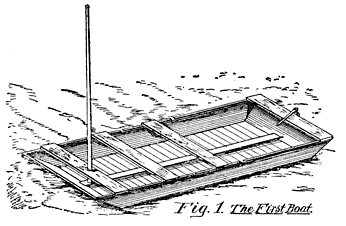 Fig. 1. The First Boat.
In this boat was found, accidentally, a note written by
a captive in distress, showing that some of
the party had been taken by the inhabitants of
the island, and this occurrence determined
them the more to put themselves in condition to
aid the captives.
The last important development grew out of the
finding of a cave, or a series of caverns, not far
from their home, which contained numerous skeletons
and a vast amount of treasure, showing that
it was a pirates' cave, but up to this time it had
not been fully investigated in view of the more
serious need of haste to relieve those who were in
the hands of the savages.
Shortly before leaving on the present expedition,
and after returning from the expedition by
sea, which had wrecked the boat, they were surprised
to find a man at their home, who had entirely
lost his memory. This happened six weeks
before the occurrence in the opening page, and
during that time he had not uttered a single word,
and seemed to be entirely unconscious of his surroundings.
He was evidently a cultured man, but how he
came to the island, or in what manner his faculties
were lost, they could get no clue. He had proven
himself to be harmless, and in many ways he was
of great service to them, and was now with the
party, this being the fifth day of the journey, and
the distance from their home was from sixty to
seventy miles.
It should not be forgotten to mention Red Angel.
Over eight months before a baby orang-outan
had been captured. He had grown rapidly,
and George, the elder of the two boys, had
taken a special delight in teaching or training
him, and the result was that the imitative quality
of the animal made him useful to the party in
many ways. Angel was with them also, and was
the only amusing element in their days of stress
and tension.
The condition before them at this time was one
of intense interest. For the first time since their
arrival, savages had been seen. From the first
view it was apparent that the party sighted were
on the point of meeting a hostile tribe, and while
it was their intention to journey west to the large
stream called by them West River, it was concluded
to remain at the present camping place
until they could more fully observe the attitude
of the natives.
During two days previous the route had been
through a dense forest, and they emerged from
this only a few hours before, their object being
to make their way to the river, as in the vicinity
of the stream there was not much wood, and the
land was covered with comparatively little underbrush.
They felt that with the strongly built
wagon, which had been purposely made with a
large, thick body, it would be more serviceable to
them as a means of defense than the woods, because
the forest would serve as places of concealment
for their enemies, while adding nothing to
their security.
The strange man, who, in the absence of his true
name, was called John, noting the different ones
climbing to the wagon top, also made his way there,
and gazed in the direction pointed out by Harry.
He glanced toward the savages, and then looked
wonderingly at the boys and the Professor. He
did not appear at all disturbed, nor did he venture
to indicate by any sign that he understood or
comprehended any danger.
And Angel, too, took a hand in the sights. He
was beside George, and the latter pointed out the
savages, but if he knew what George meant his
face and actions did not show it. How little we
know of the workings of the human mind, and how
should we know more of what passed in the mind
of that animal as he listlessly viewed the scene
which so much interested the others? We shall
see, later on, how Angel profited by the lesson
which they tried to teach him.
"They seem to be fighting; at any rate, I can see
them going toward each other, and others running
wildly about."
"Our better plan would be," said the Professor,
"to go up nearer. In that way we may be able
to take advantage of their quarrel."
This seemed to appeal to the boys, and they
were down instantly. The yaks had been unyoked,
prior to this, but they were now hitched up in a
hurried manner, and the wagon moved forward.
A word now as to the equipment of the wagon.
It had been made with unusually high sides, and
was of thick boards, so that they did not fear the
arrows which, undoubtedly, were the only form of
missiles which would be hurled against them.
Within were ten guns, each with a barrel twenty
inches long, and a three-eighths of an inch bore.
All were muzzle-loaders, as they had no facilities
for making breech-loaders, so that it would be
impossible to fire rapidly, after the first ten shots;
but they counted on being able to hold out against
a pretty strong force of savages, armed as they
were.
The wagon went forward slowly, and was kept as
much as possible within the sheltering range of the
underbrush. All were in the vehicle, as its height
gave them a better view, and in case of a surprise
all would be guarded and safe.
It was somewhat of a relief to note that directly
ahead of them was a small stream, one of the
tributaries of the West, and before reaching the
open area near the river, the Professor directed
the wagon toward a clump of brush, behind which
the yaks were tethered.
They were thus in a position where they had
an ample water supply, and the Professor remarked,
that in campaigning two things were essential,
one was food and the other water, and of
the two water was of most value for a short period,
at least. The yaks needed it, and as that was
their means of transportation, every consideration
must be given them.
"As we are now campaigning in earnest, we
must have some system, and a thorough understanding
of what is to be done," said the Professor.
"A thorough watch must be kept at all times
day and night. We must not separate, but keep
closely together, and in watching just as much
care must be taken of our rear and our flanks. We
do not know from which direction these people
are likely to spring up. Remember, from our experiences
night before last, this is territory over
which they travel."
It should be stated that in the night referred to
a band of the savages had passed their camp,
going in the direction in which the wagon had
taken, and they were of the impression that those
discovered to the south of the stream were the
ones who had come so near finding them.
"There is also another matter that should be
considered. While we do not anticipate any disaster
to our party, still we should at all times make
provision for any separation, should such a thing
take place. I estimate that we are now directly
south of the mouth of West River, and that the
sea to the north is from fifteen to twenty miles
away. Now, let it be understood that in case we
are defeated, or by any chance there should be
any separation, the place of retreat will be toward
the location of the wrecked boat, which is near the
mouth of the river."
The great difficulty was to impart this to John.
He was interested, in a peculiar sort of way, in the
proceedings, and the Professor undertook to make
the situation, as just explained, clear to him. For
this purpose he made a chart to show the tributary
stream on which they were encamped, flowing into
the West River, and its course to the sea,
and by pointing out the spot to the west of the
river mouth, where the wrecked boat was landed,
he hoped the course could be fully understood.
This explanation seemed to be comprehended by
him, but of this there could be no assurance.
Meanwhile they had not for a moment forgotten
to keep in sight the warring factions, for now that
they were much closer the character of the meeting
could not be misunderstood.
"Look at them," cried George; "the other tribe
seems to be victorious. They are coming this
way." Such seemed to be the case. The retreating
forces were coming directly toward the wagon,
and the situation now began to take on a very
grave aspect.
"What shall we do, Professor, if they come
on to us?"
"We are here on a peaceful mission, and should
fight only in self-defense," was his reply. This
did not exactly suit the spirit of the boys, but they
deferred to the wisdom of their friend.
It was plain that the tribe first seen was defeated
and was being driven back to the river,
and the Professor advised them to prepare for
any emergency. The camp was not more than
one hundred and fifty feet from the edge of the
river, and they had a plain, open view before them.
Beyond the river was a bare shore, the shrubbery
did not grow near the water, so that there
was an open space of fully three hundred feet or
more on the other shore, thus giving them ample
time to note and act, whatever the circumstances
might be. The Professor hoped that the pursued
might deviate from their path and bring them to
the river below their camp, but in this he was disappointed,
as the first of the savages made his
appearance from the brush directly across the
river, soon followed by a dozen or more, all in
precipitous retreat.
They now had the first close view of the savages.
They were almost wholly naked, and had more the
appearance of the North American Indians than
of the South Sea Islanders, which their fancy had
pictured them to be. Each carried a short spear
and a bow, and the Professor called attention to
the apparent lack of arrows, as the bows were
strung on their backs, and they carried the spears
as though they depended on them for protection.
"I think they have been beaten because they are
out of ammunition. It will not take them long,
however, to make up a supply, and it is possible
that is what they purpose doing."
The victorious party now came in view. Without
waiting the defeated party dashed through the
stream not two hundred feet below the wagon, and
before they had fairly landed, espied the wagon.
The surprise at seeing it was almost paralyzing to
them for the instant. They sheered off down the
stream, gesticulating wildly.
The pursuers crossed the stream higher up, and,
therefore, nearer the wagon. "Watch the party
which has just crossed, so we can see what their
course will be."
"They are circling around behind us."
As they did so the victors emerged from the
stream and made direct toward the location of the
Professor and his party. Here was a situation
not counted on. The wise savages had calculated
on this chance to arrest the pursuers, and they
showed wisdom in the move.
"Now, boys, we must stop them, but do not shoot
to kill at the first shot. Before anything is done
I will try to stop them by peaceful methods."
The Professor, with a gun in his hand, suddenly
stepped out from the brush, and held up a hand.
It may well be imagined that an apparition was
as startling to them as it had been to the others.
They stopped for a moment, and then with a
whoop, fitted arrows to their bows, and darted forward.
The Professor stepped back, and calmly
said: "Now, boys, shoot low, and don't get excited."
At the word, and before the savages had gone
twenty feet, the boys and John leveled their pieces,
and a volley rang out. Several were seen to fall,
but were only wounded, as they were at once taken
in charge by their companions. The moment the
first round was fired, the Professor ordered the
relay guns to be grasped. But the savages,
stunned by this change of affairs, did not wait
for the second shot, but rushed back to the stream
as fast as they could go, with the three wounded
men.
But where were the other savages? Had they
seen the result of the fight? The Professor hoped
that the result would be such as to win them over.
They lurked at a distance beyond the wagon, and
as the Professor advanced toward them and held
up a hand, they continued to retreat. He beckoned
to them; but in spite of all efforts they refused
to come near.
TWO SAVAGE ATTACKS
To all intents and purposes they had two
foes, one in front and the other in the rear. They
possessed a fine position, however, due to the Professor's
foresight. The river was close enough to
get the needed water for themselves and their
yaks, and the thick clump of bushes, on the river
side of the wagon, afforded protection for the animals,
while the wagon itself served as an admirable
fort.
They could not believe that the band which had
been driven across, and which was now at their
rear, would attack them, and it seemed that the
present danger of a night attack might be expected
from the pursuing party. Indeed, the actions of
that tribe, after the attack, led the Professor to
believe that they must expect a fight during the
night.
The wagon was now brought up close alongside
the clump, and with their bolos a considerable
space of the densest part of the brush was cut
away, so as to form a retreat for the yaks, and
thus assure them from harm by any attacks with
arrows or spears. Before dark, Harry and John
went to the river several times to bring water
for the cattle and for their own uses, and with
the extra boards which the Professor had wisely
brought along, the principal portion of the space
below the wagon body was closed up.
When all had been arranged for defense all felt
satisfied they could withstand a hundred savages
armed with spears and arrows. One thing had to
be considered, and that was, whether or not those
people poisoned their arrows, as many races in
southern islands do.
As a further precautionary measure, all protecting
bushes within two hundred feet of the wagon
were cleared away, so as to afford an open view
in all directions.
Darkness set in, and the eternal stillness all
about was oppressive. Two watched while the
other two slept. John appeared in his element. At
the least sign of disturbance in any quarter, his
hand was up, and to further attract attention his
hand would be laid upon the arm of his fellow
watcher.
Thus passed away the first half of the night,
and then for the first time Angel began to grow
restless. George, who was asleep at this time,
was awakened, as he interpreted Angel's actions
with greater facility than the others.
"I am sure from his actions that something is
coming near us. See, he is motioning toward the
forest side and not toward the river." It did seem
as though his perturbations came whenever
George pointed toward the woods.
To the watchers, there was no sound to alarm
them, for fully a half hour, when John slowly
moved his hand over to George, as he peered out
to the north, and as he laid his hand on his arm,
arose and silently moved out to the end of the
wagon, and slipped to the ground. George tried
to restrain him, and immediately woke the Professor,
to whom he related the circumstance.
There was, indeed, a movement in their front,
at the margin of the clearing. Forms appeared
here and there, but the utmost quiet was observed.
Suddenly the report of a gun rang out, and with a
shriek, a form was seen to bound upwardly and
fall, just as a shower of arrows fell against the
wagon.
The shot came from John's gun, and he had
fired from a position fully fifty feet away from
the wagon, and this is what disconcerted them.
They were expecting the defense to come from the
wagon, and here was a shot, away from it,
and it undoubtedly appeared to them that there
must be a number of them defending it, to enable
them to put watchers so far from the wagon.
"That was a shrewd action on the part of John,
although it was a hazardous one, in case they had
determined to rush us. But the die is cast, and
we must now fight it out."
John came back to the wagon, and took up the
other gun mechanically. The Professor patted
him on the back, as he again stole out. This time
he boldly marched toward the fringe of the clearing,
and the Professor urged Harry to run after
and detain him, but he did not heed.
He remained there a full hour before any sign
was made by him, but at the end of that time he
came back, and by signs indicated that the savages
were back again.
"Which band do you think has attacked us?"
"It looks to me as though the fellows who were
pursued are the ones; what is that John has
brought back?"
He held something in his hand. It was an arrow
and a cap, the latter of which had blood on it.
This was determined when a light was struck in
the little compartment below the wagon top.
"Do you think it is possible they could have gotten
these arrows since we saw them to-day?"
"They undoubtedly manufacture them with
great facility, and the lack of them this afternoon
would be no indication that they would be without
them to-night."
John's intimation was right. They were seen
beyond question, and without waiting for the initial
shot, as before, they bounded across the open
space, and the command was given to fire. The
result of the shots was plainly seen. The rush
ceased, and before the Professor could give the
command for the second shot they reached the
brush, and the ammunition was saved.
When morning broke, three forms were recognized
lying in the clearing, but there was no sign
of the savages beyond. John, without waiting for
the word, moved toward them, and taking their
weapons and searching their scanty clothing,
took something from each, and brought them to
the wagon.
The trophies brought by John were two pocket
knives of English or American manufacture, and
other small trinkets, such as any traveler might
carry.
"This is interesting," said the Professor, as he
looked over the articles. "How is it possible they
got these articles unless from white people?"
When Harry and John went to the river for
water, the first thing that caught Harry's eye
was an arrow, which he carried back with him to
the wagon and handed to the Professor.
"I think," said he, "there is another body lying
over at the edge of the clearing, the one that John
shot at the first attack."
The boys went over, after keeping a careful lookout
as they advanced. They secured his cap and
the bow and arrow. When they returned the Professor
looked up, and announced that he had no
doubt they had been attacked by both of the
parties.
"Why do you think so?" asked George.
"For several reasons: First, the headdress of
the two bands differs, as you can see by comparing
the one you have just brought in, as well as the
peculiar differences shown in the arrows. This
is one you found near the river this morning, and
was no doubt dropped by one of them at the time
they attacked us, and it is exactly similar to the
one you have just brought in. You will also
notice that the three that were shot in the last
attack have the arrows and headdress different
from the others."
It thus appeared that by force of circumstances
they had been thrown into the paths of these two
warring factions, and had become the enemy of
both.
But now something must be done to carry out
the determination to rescue their fellows. How
to reach the savages was the problem. They had
shown hostility from the first. It was evident
they were far from the usual habitations of the
tribes. They must have their villages farther to
the south and probably west of the present location.
The only course was to go forward, in the hope
that friendly relations might still be established,
notwithstanding the unfortunate circumstances of
the night.
During the entire day there was not a sign of
either of the parties. The Professor gave his
views by stating that if they went forward at
once the chances of getting into favorable communication
would be improved, and if they could
capture one of them it would go far toward putting
them on the right track.
They remained another night at the river, and
early in the morning the stream was crossed and
the course of the wagon directed to the south. In
less than half an hour they came upon the scene
of the fight between the two tribes which took
place the day before.
Here it was made plain that the two tribes had
different weapons and dissimilar articles of clothing,
and numerous odds and ends were gathered
in the hope that some clue might be discovered as
to the white people who were, no doubt, on the
island.
Nothing of value in this direction was picked up,
although there was confirmative evidence that the
savages had in their possession trinkets which
were taken from captives, and which made the
necessity of their journey still more opportune.
Directly to the front of them was a forest, and
to the right an incline, rather free from wood,
and the course was changed in order to gain the
elevation. This was reached about four in the
afternoon, and in another hour they were at the
crest of the hill. This gave them an unobstructed
view to the south and west, and there, in the distance,
was made out what appeared to be huts, or
evidences of human habitations.
The first care was to select a camping spot,
which was as much in the open as possible, and
the utmost care exercised to guard against surprises.
But what had become of the savages in the
rear? It was impossible to obliterate the tracks
of the wagon, so they might be easily followed.
"I believe the hostile attitude of the two warring
parties is, after all, a factor in our favor, because
if both try to follow us they are bound to again
come into contact with each other, so we may
be free from that worry."
"Isn't it likely that one or the other may send
messengers to the village, if what we see beyond
is any evidence, and thereby bring all of them
against us?" Harry ventured to ask.
"That is a probability I have been considering,
and our only course is to resist their attacks, and,
as I have stated, endeavor to capture one of them,
so we can establish communications."
Camp was made for the night, but there was
no disturbance, and there was a visible relief in
the minds of all as morning approached and no
signs of an enemy in either quarter.
The yaks were hitched up shortly after breakfast,
and the long, sloping descent began. Angel
was ahead swinging from tree to tree, and before
they had proceeded a mile began chattering from
the tree top, in his peculiar way betokening alarm.
George ran up, called him down, and started
forward. Angel followed, chattering more vigorously,
and when George turned in another direction
he ceased, thus showing conclusively the direction
of the alarm, and it was well they profited by
it, for now within fifteen minutes the savages were
plainly seen.
They came forward, fully fifty or more, working
their way cautiously along, and, no doubt,
fully aware of the location of the wagon and its
occupants. The crucial time had come, and
George rushed back to the wagon, but before he
had fully reached it a scouting party well in advance
of the main body came within hailing distance.
The Professor, as before, walked out from the
wagon, and held up his hand as a token of peace,
but to this they made no response, but continued
their cautious forward movement, creeping from
one vantage point to the next, and the wagon was
then turned so that its rear end was toward the
oncoming savages.
Harry was directed to drive the team toward a
cluster of bush at the right, and they were urged
forward with all haste. The yak is a fast-moving
animal, and started forward on a run, soon gaining
the shelter selected. It should be stated that
when the team, which had been named Jack and
Jill, was first broken in, the animals were taught
to be driven by means of lines, and this was now
of great service to them.
With their bolos they cut out a space at one
side of the undergrowth, into which the yaks were
driven and thus afforded protection, and the guns
were taken out and arranged in order to enable
them to be readily handled.
Before all preparations had been completed the
main body came up, and all breathlessly awaited
the attack. They halted several hundred feet
away, and the Professor sought by means of signs
to indicate his peaceful intent, but this did not
have the least effect, as arrangement for an assault
was manifested by the preparations which
were now plainly perceptible.
The Professor retreated to the wagon, and his
cautioning words were: "Do not fire excitedly or
wildly, and be careful not to fire at too long range.
Furthermore, shoot the leaders, or those who appear
to take the lead. Another thing, fire and
reload. Do not take the loaded guns which are in
reserve, because we may need them later on, at
a more critical time. These will be very serviceable
if they attempt to rush us. In that event we
shall have six guns and two pistols to meet them
with."
Contrary to expectations no immediate attempt
was made to attack, and the Professor again tried
to attract them by signs. For a time no further
hostile movement was made, and it began to look
as though his efforts would win; but suddenly,
with a concerted movement, the bows were swung
upward, and arrows began to fall dangerously
near.
As no movement was made on the part of the
Professor and his party, the savages mistook its
meaning, and a charge was made. "Now deliberately
pick your man and fire." No sooner had the
order been given before all fired, and four fell, two
of them being, without doubt, the chiefs, as the
howling was beyond all description.
A second volley was not necessary. The two
wounded men were surrounded and carried off.
The others lay where they fell, and after a short
pause another rush was made, this time much
nearer to the wagon. It was fortunate that the
pause was long enough to enable them to reload.
On they came, and when within seventy-five feet,
the Professor gave the order for another volley.
At this distance there was no excuse for a miss.
The leader was a powerful specimen, with a distinctive
badge, and the Professor announced that
he intended to use him as a mark, and he was the
first to fall, together with three more.
Thus, at two shots, one-fifth of their fighting
force was disabled. "Now let us charge," said the
Professor, and John divining the meaning was
the first to leap from the wagon. The main body
of the savages broke for cover, but several, more
venturesome than the rest, sought to carry away
the wounded chief. When one of them turned to
discharge his arrow, John raised his gun to his
shoulder, as each of them had taken one of the
reserve guns, but before he could fire, the native
turned and followed his companions, leaving the
chief to his fate.
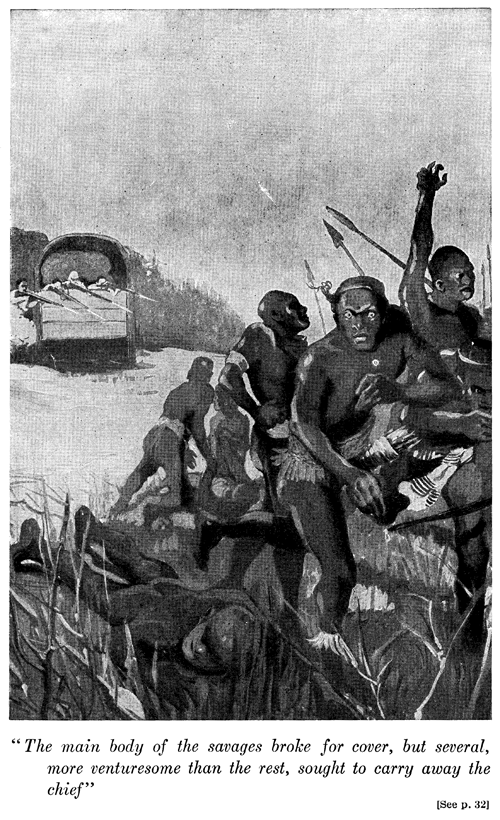 "The main body of the savages broke for cover, but several,
more venturesome than the rest, sought to carry away the
chief"
"The main body of the savages broke for cover, but several,
more venturesome than the rest, sought to carry away the
chief"
[See p. 32]
The rush with the newly loaded guns was accompanied
by shouts on the part of the boys, who
were instructed to do so by the Professor. "Don't
go far beyond the chief," was his order; "we need
him, and you must not venture into an ambush."
The boys did not dare to go far beyond the
wounded man, and the Professor, with the aid of
John, had now come up to him, and together
forced him to accompany him back to the wagon.
He was wounded in both legs, the shot having
passed through the kneecap of one leg and through
the tendon of the other, thus completely putting
him out of action.
When the boys returned from the charge they
assisted in conveying him to the wagon, and the
Professor at once applied bandages to his limbs.
This was getting an opportunity, at close range,
to view one of their enemies.
The shot proved to be a glancing one, so that
the bullet was still in the tendon of the right leg.
When the Professor applied the bandages the savage
was surprised at the proceeding. He evidently
expected different treatment, and glanced
at his captors in amazement. During the first few
minutes of these interesting details, the boys had
entirely forgotten the savages, and the Professor
called out a warning not to rest too securely.
When the natives saw that the pursuit was not
kept up they halted and slowly and cautiously,
returned. It was evident that they were preparing
for another fight. The wagon top was removed
at one side, and the chief hoisted up and seated
in plain view of his fellows, while the Professor
directed the boys how to secure him in that position.
The entire band now appeared at the edge of
the wood, not two hundred feet away, evidently
with the view to another attack. All the guns
had now been reloaded, and with the chief with
them they had no fear of an attack with arrows.
The Professor placed himself before the chief,
and by motions endeavored to inform the chief
that if his men made any attack on them he would
forfeit his life. The chief understood, and in a
peculiar guttural tongue informed his men of the
danger he was in.
Without further incident they disappeared, and
now began the effort to instil and extract information.
He was entirely naked except a distinctive
headdress and a breech cloth, of very peculiar
workmanship. The color of his skin was not
black, like the negro, but rather copper-colored,
like the Indian, thus confirming the impression
which was first obtained the night before.
A THIRD ATTACKING TRIBE
There was no common ground on which to
start the mute conversation, and the only replies
volunteered by him were occasional grunts. Not
a groan escaped his lips when the Professor sought
to remove the bullet, but he sat there stoically,
and bore it without a sign. The boys could not
help but admire his heroic mien throughout the
trying hour, and when the bullet was finally cut
out and the wound carefully bound up, it looked as
though he tried to thank the Professor for the
service.
During the remainder of the afternoon the Professor
persisted in the effort to gain some information,
but not the slightest glimpse of intelligence
was extracted.
Finally George said: "I wonder if he has anything
in those pouches? We found some things
in the others, you remember." This was a hint
not to be overlooked. A search was made, and
among numerous trinkets was a photograph of a
dozen or more young men, and with a shout George
recognized it as one which had been taken on
shipboard several weeks before the explosion on
board the Investigator, and which sent her to the
bottom.
George and Harry were both in the picture, and
were pointed out. Here was the very thing which
was needed as a connecting link in their interview
with the chief. With the picture before him the
chief was requested to look at George and then
at the picture, and so in the case of Harry. The
chief saw, and recognized the similarity, and his
eyes opened in astonishment. This was a most
remarkable discovery.
When the Professor pointed to the others in
the picture, and then to the chief, the latter seemed
for the first time to comprehend, but he slowly
shook his head and grunted, or made use of his
own language to indicate that he had no knowledge
of them. The boys were fairly wild with
delight.
"Why not hunt the pockets of the other fellows?"
shouted out Harry, as he scrambled over
the tailboard. About a hundred and fifty feet beyond
were the two who had fallen at the first
fire, and they were searched, but nothing in any
way connecting them with their companions was
revealed, and later they went over the contents
of the chief's pockets with greater care.
An American coin, a matchbox, and several
other articles, which were apparently the relics
of stickpins, were all that had any appreciable
value. There was nothing on any of the articles
which had a name or even the initials to give them
a clue. As they were returning to the wagon
Harry picked up a small silver match safe, and on
this were the initials "J L V." "Who is J L V?
Did you know of anyone by that name?"
"I don't remember anyone by that name. The
name is not an unusual one to begin with a V."
The Professor did not recall anyone by that
name. The box was handed around, and when
John saw it, he started as though he had been
struck. He reached for it and almost grasped it
from the Professor's hand, and turned it over and
over, and glanced at the initials, and then looked
at the Professor, and then at the boys, and his
eyes ceased their wanderings as he gazed at the
chief.
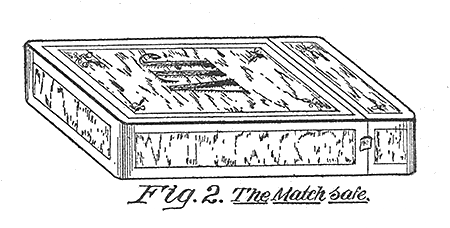 Fig. 2. The match safe.
Could it be possible that his name was John L.
V.? Was that his match safe? What a wonderful
possibility lay in these two happenings which
came so close together!
The chief, too, looked at the match safe, and
when the Professor pointed to John and then
directed the captive's attention to the match safe,
he did it with the view of ascertaining whether
or not he had ever seen John. But to all these
questionings the savage shook his head and
grunted a plain negative.
A careful watch had been kept during the entire
day, in the hope that the savages would reappear,
and that the treatment of the chief would be such
as to predispose him in their favor, and thus open
the way to obtain such information as would be
of service in aiding their companions.
As night approached preparations were made to
guard against any night attack, and the prisoner
was securely bound to prevent him from obtaining
any of the weapons. One singular thing about all
of the headgear and other articles of wear was
the profusion of human hair, which was worked
into many of the garments or formed a prominent
decorative feature.
George was the first to notice this peculiarity.
"Why is it that most savage tribes take human
hair or scalp their victims?"
"The North American Indian was noted for the
custom of taking the scalp of his enemies. It
probably grew out of the desire to use the locks
for the purpose of decorations, just as you see in
the case before you. In olden times it was the
custom of the vanquished to indicate submission
by plucking out a handful of hair and offering it
to the victim as a token of submission, but whether
this grew out of the custom of scalping, or whether
the latter was an outgrowth of the hair token, is
not known."
"What interests me is, why they should take a
portion of the skin if they wanted the hair simply
for decoration?"
"Principally because that was the easiest way
to keep the lock intact. Spencer, in his 'Evolution
of Ceremonial Forms of Government,' relates some
curious things growing out of this custom of taking
tribute of hair. Thus, the habit of stroking
the mustache, a custom prevalent among Spanish
courtiers, arose from this habit. The stroking
was done in the presence of ladies and superiors
to indicate submission, or as an evidence of inferiority."
"Why is it that these savages pay more attention
to their headgear than any other part of their
clothing?"
"The savage regards the head as the most important
part of the body. It is also the portion
which is first seen by an enemy or recognized by
a friend, hence he considers it a necessity to properly
attire it for the purpose of inculcating fear
in one, or admiration in the other. Vanity in the
lower order of people leads them to excesses in the
matter of dress or ornamentation, just the same
as with many civilized people."
Long before morning dawned Angel grew restless,
and could not be quieted by George. The latter
believed that the savages had returned, if the
actions of Angel were any indications; but as the
sun came up and a careful scrutiny was made,
nothing alarming was in sight.
An early breakfast was prepared, and the yaks
yoked up, preliminary to a start for the south.
With a chief in their hands they felt safer in
their position than before, and were now in a
condition to treat with the natives.
Hardly had the wagon started before Harry
ran up in haste and excitedly whispered: "I
see them coming; look to the south." Not far beyond
was a mass of them coming up hurriedly, less
than a half mile away, and a stealthy movement
among the shrubbery in the immediate vicinity
showed the presence of the advance scouts which
Angel had undoubtedly scented an hour before.
The yaks were headed to the north, to give them
ample opportunity to employ their weapons, and
the chief was placed at the tailboard of the wagon,
in full view of the pursuers, in the hope that his
people would heed the warning given the day before.
This seemed to have no effect in the warlike
attitude of the attacking party.
"What I fear most is the possible attempt to surround
us; to prevent that it is better to drive the
team forward at a pretty rapid rate."
The yaks were urged along, and their motion
considerably accelerated by the shrieks and howls
of the demons, as they brandished their arrows
and spears. Thus far not an arrow had been
loosened, and the fire of the party in the wagon
was reserved.
As the wagon surged forward the din increased,
and soon a shower of arrows fell among them,
none taking effect, because accurate aim was not
possible while they were in motion. And now a
concerted movement was apparent to surround the
wagon. Over one hundred warriors were counted,
and among them certain chiefs, recognized by
their distinctive headdress.
"Go for the river, Harry," was the Professor's
injunction.
The yaks were now beyond all control. Several
of the arrows found their marks in the poor animals,
and they were now vying with the foremost
savages in making speed. Eventually the
flanks of the attacking party outran the team, and
the Professor made his way to the front, leaving
George and John to take care of the rear.
When one of the prominent chiefs, who was leading
the flanking party, presented a fair target, the
Professor shot, and had the satisfaction of seeing
him fall, and this temporarily checked the pursuit
on that side. Grasping Harry's gun, he fired into
the party on the opposite side, with good effect.
The opening shot by the Professor was a signal for
George and John.
And now began one of the most exciting running
duels between the contending forces. The
Professor knew that if the river could be reached
they would have only one side to defend, but they
were fully three miles or more from the crossing
point of the stream, and to make matters worse,
the team was beyond control, and was traveling
to the northwest, whereas the direct course to the
river was to the north or northeast.
There was no help for it. They must keep cool,
and reserve their fire. After each shot the
weapon of each would be reloaded, so that they
always had a reserve force of guns. The arrows
came spasmodically, and only a few of them from
the trailing members of the band came near. The
danger was from those who were attempting to
encircle the wagon.
John was requested by sign to go to the forward
end, and he promptly responded, and at every
shot one of the pursuers went down. The main
object was to keep them away from the team a
sufficient distance to prevent injury to the yaks,
and this required the greatest energy and watchfulness.
The attacking party began to have a wholesome
fear of the guns, and kept at a distance, which
prevented them from effectively using the arrows.
This pace was kept up for two miles, and the
effect was now apparent on the poor animals.
Harry noticed it, but he kept up a brave front,
and did his share in the firing.
But now there was increased activity in the
ranks of the enemy. Most of the advance party
had gathered at a clump of bush ahead, and partly
to the right, and Harry made every effort to divert
the team to the left; but they were blind to the
urging, and too excited to heed the tugging of
Harry.
The Professor divined the purpose of the remarkable
quiet on the part of the savages, and
called to George to come to the forward end in
anticipation of a rush, en masse, from the shelter
of the brush. By some instinct the yaks turned
to the left before the danger point was reached,
but the band nevertheless rushed forward in rage,
and to the gratification of our party, they were so
close together that aiming for the thick of the
pursuers was sufficient to assure a mark for each
shot.
They did not heed the fallen, or wait to care for
them, but rushed on and endeavored to head off
the yaks. Those in the wagon did not notice that
before them, and close at hand, lay a broad river.
Harry was the first to announce it with a shout,
when he saw the party in the lead halt, and move
to the rear.
"What stream is this?" exclaimed George, excitedly.
"This must be the West River."
"And see, there is another stream to the right."
What a lucky circumstance that the team had
made its way to the forks of the two rivers, and
that they were now protected by the streams on
both flanks. It was also fortunate for them that
the team was by this time so completely worn out,
that as they were going out along the narrow
tongue of land, and the danger from their foes
was growing less, that Harry carefully crept
along the wagon pole to the heads of the animals
and by quieting words soon restored them, and
succeeded in bringing them under control before
the shores were reached.
Both animals had been wounded, and the first
care of the Professor was to relieve them. One
of the arrows still hung in the side of Jill, and
when the wounds were dressed they did not seem
any the worse for their experience, but they were
very tired, and inflamed with the excitement.
The peninsula within which they lay was not
more than fifty feet wide where the wagon was
halted, and two hundred feet away its width was
not over one hundred feet, so it will be seen they
were in a position which could be easily defended.
There was plenty of provision on hand, but the
matter of ammunition was the immediate cause of
alarm. At least thirty rounds had been fired in
the running fight, and the first thing was to take
stock of this necessary article.
Only eight rounds were left, for the guns, and
twenty for the pistols, but as they were now safe
from further attack this was not such a calamity as
they expected.
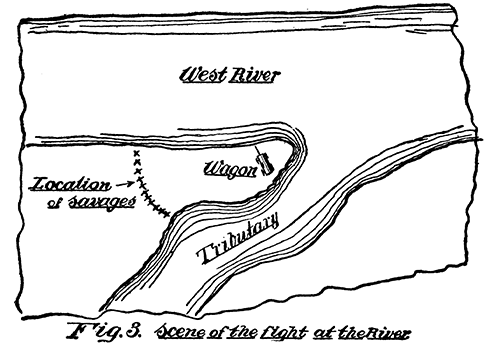 Fig. 3. Scene of the fight at the River.
Their captive was mute during the entire skirmish,
and it was a remarkable exhibition of a savage
trait for the pursuers to disregard the condition
of one of their chiefs, by firing on him while in
that condition. How many were killed or disabled
they had no means of knowing, but many must
have fallen, for when they lined up across the
tongue of land behind them the number had considerably
diminished.
"It seems as though they intend to make a siege
of it," was Harry's comment, as he noticed them
preparing a fire.
The wagon was drawn up so that its broadside
was toward the enemy, and the boards which had
been carried, let down so as to form a screen for
the part below the body. This afforded a safe
place for the yaks, if perchance during the night
the attacking party should get near enough by
stealth to use their arrows.
As night approached there was an evident movement
on the part of the besiegers, which could not
be understood, until it was noticed that they had
taken a much closer position. This was considered
most annoying, and with a view to giving
them another lesson, a few shots were fired into
the thickest groups. This was answered by howls
of anger, as they rushed back beyond the line of
their former camp fire.
"They will learn a good lesson if they keep
after us much longer. They have a wholesome
fear of us now, and if our ammunition holds out,
we can wipe out the whole lot," was George's grim
comment after the last incident.
"Fear is certainly a wonderful thing in this
world," commented the Professor; "without it the
entire history of the world would have to be
changed and rewritten."
"Why do you think so?"
"If you stop to consider the element of fear you
will see that it is at the bottom of almost every
human aspiration. Why does a man work to lay
up a store for a rainy day? Why does he toil
day after day, and often lose his life in the effort?
What prompts the mother to guard her infant in
the face of every danger? You may say it is love,
but behind that love is fear which prompts the
action."
During the night, when John and Harry were
on guard, John quietly stole from the wagon, and
as stealthily as a savage moved out over the
ground toward the Indian encampment. Heretofore
there had been a protest against his doing so,
but in this case Harry did not offer any objections.
On his return Harry noticed several objects
which he carried back and was surprised to see
they were the peculiar headdresses worn by the
attacking party. It was a matter of wonder to
him that John should make a prize of these things,
but when the Professor was called, and he noticed
them, his face lighted up, and nodding his head,
said: "Well, this is a wonderful piece of information."
"What is it?"
"How stupid I have been, not to recognize that
before."
"What is the matter with the headgears that
John brought in?"
"Look at the topknot of the fellow we have in
the wagon."
The moonlight was sufficiently clear to enable
Harry to distinguish a pronounced difference.
"So another tribe that our captive does not belong
to has been pursuing us?"
This news was of so much importance that
Harry waked up George, although it was not his
hour for the watch.
"What do you think, George, the fellow we have
does not belong to the attacking party." George
was too sleepy to comprehend the intelligence at
once.
"How do you know it?"
"John has just brought in several of the headdresses,
and they are entirely unlike the one the
chief has."
The utter disregard of the savages for the chief
was now explained.
When morning came the Professor turned to
the boys, and remarked: "I have still further information
to impart this morning."
"What is it?" was the query of both.
"Last night when I made an examination of the
articles John brought in, I was under the impression
that our pursuers were the other tribe that
we first met north of the river. On more carefully
looking them over I find that our late enemies
are an entirely different tribe, so that we must
count on three distinct people in our further explorations."
THE ESCAPE. ENCOUNTERING ANOTHER HOSTILE TRIBE
The boys did not know how to receive this news;
whether it complicated the situation or really offered
an easier solution. The annoying thing was
that the natives were at war with each other, and,
apparently, all were at war with them.
The Professor commended John for his intuition,
or whatever it may be called, in enabling
them to gain this information. In his mute way
he made a place for himself in the hearts of all.
His wonderful ability with the gun, his caution
and prudence, and the remarkable calmness and
ease that characterized all his actions in the most
trying periods, were such commendable traits that
the boys could not help but show him their admiration
in every way, and he knew and seemed to
appreciate this.
Every day some new phase of his character
would present itself, and the Professor, ever alert
to note any symptoms, quietly told the boys that
there was every evidence that he was now in the
making of a dual self.
"What do you mean by that?"
"It is a term applied to one who has lost memory
of his past, and in that condition has begun
life anew and gone on for years in the new or
dual existence, and perhaps ended his life in the
dual personality. In many cases, however, returning
consciousness, which came just as suddenly as
they were deprived of it, caused them to forget
all that had taken place during the first period."
"Under those conditions which is the real man
or individual, the memory he first started out with
or the memory he got afterwards?"
"You have asked a strong, leading question,
George, and it may never be answered satisfactorily.
Supposing a man should live a period of
thirty years, and then have memory entirely obliterated,
and should exist the residue of thirty
years more as another person, there would be as
much reason in calling one as normal as the other;
but on the other hand, if, during the latter period,
memory should return, and he would be rehabilitated
into his former self, I am of the opinion that
the first period would be the normal one."
"You seem to think that is what makes the
person?"
"What else is there to man but memory? Is it
the flesh, or blood and bones? Animals have those
also. Memory is the greatest faculty in man, and
it has been argued that what is called the divine
spirit is merely the ability to recollect."
"But animals recollect, and would you call them
divine for that reason?"
"No; for the reason that the lower orders of
living creatures, as we term them, do not remember
all things, but only certain features of events,
and do not, except within a very limited range,
reason from one phase to another. Man is called
divine by his own kind because he has done things
so far above what the brute has accomplished that
it is regarded as a divine attribute. But he has
done these things because he was endowed with a
memory which enabled him to retain a consciousness
of things, and to follow up the stored knowledge,
or the accumulated essences of events which
materialized in his remarkable works. Would it
make any difference if the being which does these
wonderful things should be in the form of a dog
or a horse? If Red Angel could remember all
that is told him, and could thereby do the next
day what he had learned the day before, he would
compare favorably with many human beings who
possess our forms, and are called human beings."
No attack was made that night, and the next
morning all were relieved at the rest afforded
them. The savages had too much respect to venture
near the camp, and a consultation was held as
to a wise course to follow. The captive was of no
use to them, but it would have been inhuman to
turn him adrift, so that he should fall into the
hands of the besieging party. Eventually he
might be of service to them.
The main river to the west of them was fully
two hundred feet broad, and the stream which
bounded the other side of their position was, at
its mouth, over a hundred and fifty feet in width,
and it appeared to be entirely too deep to attempt
fording.
No doubt the savages knew this, and counted
on an easy capture when their provisions should
give out. Thus the second day neared its close,
and near evening there was an evident addition
to the besieging force. A close watch was kept
during the night, but no attempt made to force the
situation.
This inaction became most monotonous. It was
exceedingly trying, and the condition after the
third day was now made plain; that they intended
to starve them into submission.
During the early part of the evening, the Professor,
realizing that something must be done, decided
on a novel plan to relieve them of the savages.
If, by any possibility, they could get some
logs, sufficient to build a raft to help sustain the
wagon, he believed the yaks would be able to swim
the river and thus take the rafted wagon with
them.
The boys, when the idea was broached, were
heartily in favor of the scheme. Harry looked at
John. "I only wish we could make our desires
known to him."
The Professor took John by the hand, and led
him to the brink of the river, and then pointing
to the stream and to the wagon, and motioning in
the direction across the river, he seemed to comprehend
the meaning.
When they returned to the wagon, the Professor
said to Harry: "Do you think you and John could
cross the stream to the north of us, and find sufficient
poles and driftwood for the purpose?"
Harry jumped at the opportunity. The moon
was shining, but was occasionally hidden by
clouds. Motioning to John they took their guns
and bolos, and at the instance of the Professor, a
quantity of rope. Some driftwood had caught at
the shore to their left, and this was recovered,
and from that a small raft was built sufficient to
carry both across the narrowest stream.
To the north of them, less than a quarter of a
mile away, was a quantity of small timber, and the
Professor suggested that it would be advisable to
go a considerable distance so the cutting of the
logs would not be heard by their watchers.
They pushed the raft silently across the water,
and drew it up for safety, and then stole down
to the water's edge to make their way beyond the
sight of the savages on the opposite side. All
along the shore advantage was taken of every piece
of wood available to serve as a floating structure,
and when the wood was reached a few of convenient
size were selected and cut up into lengths
which would enable them to be readily rolled down
to the river.
This work occupied them until midnight, and
four large trees were thus prepared and lashed
together, and one, wading in the water along the
beach, using a pole, the other, with the rope,
they held it within poling distance of the shore. In
this manner the logs and detached pieces were
floated down to the mouth of the stream, and
having tied the small raft to the stern, it was
finally poled across and landed at the water's edge
not far from the wagon.
It was fortunate that the water was shallow
and that the beach was shelving at this point, as
it materially aided in effecting the launching. The
moon went down before four o'clock that morning,
and the yaks were yoked up and led to the river.
When Harry returned he was surprised at what
he saw in their camp. The Professor and George
had been at work also. Several uprights had been
put up on the side of the wagon facing the besiegers,
and over this had been stretched an old
canvas and parts of such goods as could be dispensed
with, so as to imitate the wagon, as nearly
as possible.
Their ramie fiber top was of a light yellowish
color, which looked bright in the moonlight. This
had been removed and stored in the wagon, so
that when the wagon was driven away the sham
arrangement did not disclose the disappearance of
the vehicle.
The wagon was driven into the water nearly hub
deep, and two of the largest logs were then floated
in under the axles, and the smaller ones lashed inside,
so that the sustaining power of the combined
logs, together with the wooden portion of the
wagon and body, would be sufficient to sustain their
weights.
Harry worked liked a hero, and took personal
charge of the handling of the team, which was
his especial delight. His presence near the yaks
always gave them confidence, and on this occasion
he took his position on the pole between them and
near the yoke, and thus gently urged them forward.
For twenty-five feet or more the wheels kept
on the ground, but soon thereafter the wheels were
free, and they were delighted to find that the timbers
did not permit the body to go down very low
into the water, and this saved their bedding from
becoming soaked.
The yaks performed their work nobly. Some
months before they had forded the South River,
at the time the flagpole for Observation Hill was
cut, so they had ample reason to believe that they
would be dependable under these circumstances.
It did not require much urging on the part of
Harry, and the opposite bank was soon reached,
and the cattle scrambled up the beach, but were
stopped before the wagon emerged from the water
so the logs could be cut adrift.
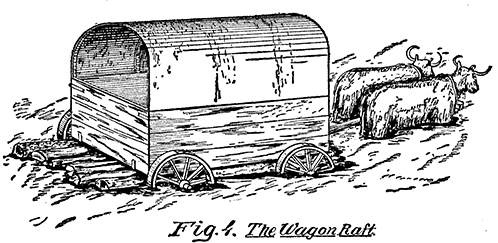 Fig. 4. The Wagon Raft.
The passage was made without a single mishap,
and all wondered why this plan had not been
thought of before.
"Let us move on into the interior a short distance,
so as to deceive them as to our direction.
It is conceivable that they may have boats of some
kind which they have sent for, and we should,
therefore, try to put them off the track."
All were now tired and needed rest. They had
not slept a moment during the night, and it was
not yet daylight. Beyond was an elevation, toward
which the Professor directed them. There
the wagon could be concealed, and from that point
they would also have a view of the future movements
of their enemies.
When the sun arose the savages could be seen
standing guard over the sham wagon, at their old
camp ground, and the boys enjoyed this bit of
humor in the extreme. "I feel so jolly at the trick
that I want to go down to the river and laugh
at them," exclaimed George.
Up to nine o'clock there was no indication that
the ruse had been discovered. The Professor was
in his happiest mood at the good imitation, and
John had an unmistakable smile, and, as the boys'
laughter grew more boisterous, he broke into a
laugh that actually startled them.
It was no less amusing to the captive. Beyond
question it pleased him, but whether on account
of his own safety or because of the ludicrous attitude
of the besiegers, was beyond their comprehension.
In his short captivity he had taken a fancy
to the Professor, on whom he kept his eyes constantly.
It was evident that more than the usual
interest was displayed in watching his movements.
From the first there was no sulkiness in the chief,
nor did he exhibit any moroseness, or anything
which indicated a spirit of revenge.
The kind and simple act of binding his wounds
and making him comfortable seemed to amend for
everything. Occasionally the Professor would go
to him, and examine the wound, and sometimes pat
him on the back—actions which he seemed to understand.
No doubt the Professor had a motive
in all this, as we shall probably see. The boys
knew that he understood human nature in all its
aspects, and that in this, as in other things, they
felt he was merely preparing the way to utilize
him in the future.
They were now on the western shore of West
River, and when they had their full share of
laughter at the deluded enemies, preparations
were made for a start. But where to? Directly
to the east were the three hostile tribes, and that
direction was impossible. The Professor attempted
another conversation with the chief. As
all were preparing for the start, he pointed to
the north, and at this the chief shook his head to
indicate disapproval. When he motioned toward
the south it was even a more vigorous negative.
Here was a dilemma. What did he mean by
such peculiar actions?
The start was delayed to give them an opportunity
to discuss the evident meaning of their
captive. While this was going on Harry's attention
was directed to their old camp. Their late
enemies had discovered the ruse, and were now
rushing to beat down the pretended wagon.
"See the party on the north side of the river.
I suppose that is a scouting party and they found
out our little joke," and George again burst into
laughter at the scene.
The chief was interested now. The party from
the north came into view, and after passing up
the river for a quarter of a mile or more, dashed
across, and came back on the same side of the
stream that the late besiegers occupied.
"See, they are fighting each other. What does
it all mean?"
"It simply means," answered the Professor,
"that the other tribe, or one of the other tribes
on the island, sent for reinforcements, and are
now taking a hand."
The chief was consulted and asked by signs
whether the attacking party from the north side
was his own people, and he shook his head in
the negative. This proved, beyond doubt, that
at least three different people inhabited the island
to the south and southeast.
"What puzzles me," said the Professor, "is the
fact that our chief opposes our traveling to the
north and to the south as well."
"Do you think there are any tribes on this side
of the river?"
"That is the only inference I can draw from
his actions."
A battle was in progress in the underbrush beyond
the river. The attacking forces were numerically
superior, and within an hour had driven
their opponents far to the south, and the successful
tribe could be plainly seen, as they searched
the hills to find the bodies of victims, and to
gather the trophies of their victory.
"We might as well go north on our way home,
as directly to the east," was the final remark of
the Professor.
The boys were actually startled at this sudden
announcement. But when he pointed out that
their ammunition was very low, owing to the
fierce resistance which they had to make, the wisdom
of the course appealed to them.
"I am glad to go," was Harry's immediate response,
"because when we come back next time
we'll have something that will give the whole lot
a better argument than we offered them this time."
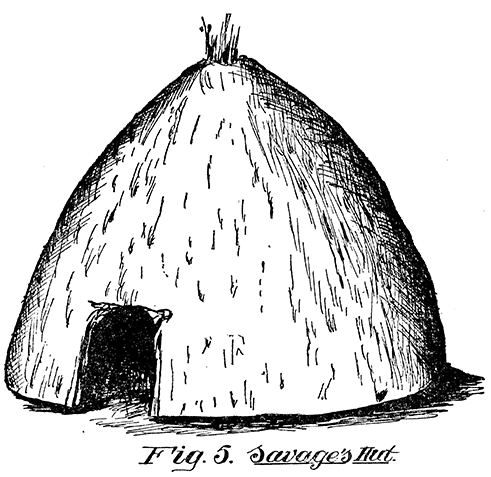 Fig. 5. Savage's Hut.
The yaks started for the north, and the chief's
eyes gave a warning look, which they did not
heed at that time. They afterwards remembered
how portentous that look was. All that day, over
broken ground, and a rough, hilly country, the
team laboriously made its way. The best that
could be done over such a country was two and
a half miles an hour.
Late in the afternoon the party were startled
on coming in sight of numerous small huts, and
a larger hut at one side of the cluster of smaller
ones. The approach was so unexpected that in
spite of their efforts, the team could not be turned
around before their approach was heralded
throughout the tribal village.
Here was the first view of the homes of the
natives. The huts were very crude, and were devoid
of windows, all of them built round with more
or less pointed or conical tops.
"Those huts don't look like the ones we saw
to the south on the day we had our first fight,"
was George's opinion.
"You are correct in that, and if you notice, the
people look differently, as well. What is that?
I believe they have firearms." The Professor's
brow gathered, as he said this, because now, that
the alarm had been given, the warriors were running
to and fro, and among them were several
who carried guns.
The wagon was hurriedly put into a posture
of defense, and the cattle protected as best they
could. They approached cautiously, and the Professor
walked forward and held out his hand in
token of friendliness. They withdrew a short
distance for consultation. This gave the party an
opportunity to study the new people.
The first thing noticed was the entire difference
in the clothing worn. The other tribes had
nothing but the breech clout, but these had other
garments, and their skin was darker in color.
"I am afraid we shall have trouble in a fight
with these people, because their guns are first-class
make," said Harry.
"You need have no fear of their guns," answered
the Professor.
The boys looked at him wonderingly, as he continued:
"They may have had ammunition in the
past, but it is evident that they have none now.
See how the fellows who have the guns carry
them. They use them like spears."
They finally turned from their conference, and
without a word or sign opened hostilities with a
volley of arrows. The gage of battle had been
thrown down. It was fortunate that the warriors
were few in comparison with their last enemies.
Not more than twenty were counted as they were
waiting for the result of the consultation.
This challenge could not well be misunderstood,
and the Professor gave the word to fire. Every
shot took effect, and the result was a startling
one for the savages. Without waiting for the
second round they broke and fled, rushing down
past the large hut and through the village, gathering,
as they went, the women and children
which had previously grouped together to witness
the fight. This was too much for the boys,
who rushed down after them, followed by John
and the Professor, until the large hut was
reached.
THE RESCUE OF THE CAPTIVE BOYS
The boys were chattering and whooping as
they ran, to the immense amusement of the Professor.
They had converted themselves into regular
American Indians for the occasion, and tried
to imitate the yells of the savages who had attacked
them the previous day.
Passing the large hut which stood in the foreground,
the boys imagined they heard a cry from
within. Possibly it was a lure, and the Professor
advised them not to be too rash.
"Here we are; inside the hut; hurrah for the
United States." The boys looked at each other
in amazement. The Professor, too, was puzzled.
Cautiously approaching the opening, the Professor
called out: "Who is there!"
Instantly came the cry from two voices: "We
are American boys who were captured by the
savages." Nothing more was needed for the impetuosity
of George and Harry. With the bolos
the enclosure was soon cut away, and they rushed
in, but the Professor and John remained outside.
In one corner, and tied to stanchions which
had been driven in the ground, were two boys,
badly emaciated, and covered with filth and rags.
When the ropes that bound them were cut away
and assisted to rise they were too weak to stand
without support.
"We are so hungry."
"How long have you been here?" asked Harry,
excitedly.
"We don't know, but more than two weeks. We
were captured by another tribe and in the last
fight were taken from the ones who first captured
us."
"Come out into the light," and Harry and
George each put his arms around one of the boys,
and as they came out looked at the Professor
and John in astonishment too strong for words.
In the excitement they broke down and wept,
and well they might. Our boys were touched beyond
description, and John went up to them and
put his arms around them, and this act so affected
Harry and George that they too joined the boys
in tears that could not be kept back.
The Professor was moved, as he turned away
to hide his feelings, but he recovered, and with a
great show of unconcern, exclaimed: "Back to
the wagon, as quickly as possible." This brought
them to a realization of their position, and
Harry and George almost carried the boys toward
the wagon, while John and the Professor lingered
behind.
He had anticipated the return of the savages,
and surmising that a still larger force might be
within calling distance, did not consider it prudent
to tarry long at that spot. It was well that
they did not remain, as the rescued boys informed
the Professor that the main body was beyond the
ridge, and not more than several miles away unless
they were on the warpath.
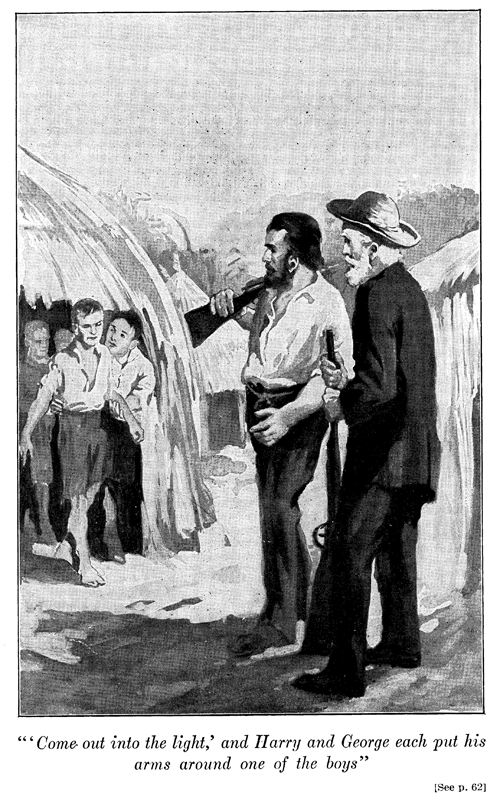 "'Come out into the light,' and Harry and George each put his
arms around one of the boys"
"'Come out into the light,' and Harry and George each put his
arms around one of the boys"
[See p. 62]
There was no time for many words. When the
poor boys reached the wagon another surprise
was in store for them, as they gazed on the
wounded chief, who was bound in the wagon.
The savages did not go far beyond the village,
and this was observed by the Professor, and was
the moving cause of his sharp order when the
boys were brought out. While Harry and John
were engaged in turning the team around, George
hurriedly set food before the famished boys, and
they were cautioned against taking too much.
They were really almost starved, and their appearance
plainly showed the treatment they had
received.
The Professor called out: "They are coming;
have all the guns ready." Before they had fully
taken all of the food the boys begged to be allowed
to assist in the defense, and George was thoughtful
enough to recognize the fact that the guns they
had were not like the breech-loaders, and without
wasting time told the boys how they were manipulated.
"Where did you get these funny-looking guns?"
asked one of the boys.
"We made them," was the reply, and the boys
looked at each other and gasped in surprise.
Beyond, the savages were gathering, and moving
forwardly, evidently with a view of attacking.
The Professor turned to the boys and asked them
whether the natives had guns, and they answered
that when they were captured they saw a half
dozen old weapons, but had never used them, as,
apparently, there was no ammunition. Where the
savages obtained them was a mystery. They believed
the weapons were used as charms, to aid
them against their enemies, and that belief gained
ground from the fact that thus far the tribes, in
whose territory they now were, had been victorious
in every battle that had been fought for the
past year.
This was indeed interesting news, and probably
the actions of the wounded chief, in appearing
to discourage the trip to the north, had some
relation to this belief.
The gathering warriors could be seen plainly,
coming over the hill, beyond the village, and gathered
in a mass near the hut from which the boys
had been taken. A conference was in progress,
which did not appear to be harmonious, but eventually
the party moved forward and divided into
three sections, with the view of enveloping the
position of the Professor and his party.
"They will attempt to surround us, and we shall
now have to attack them by assaulting one party
at a time. As suggested in our previous encounters,
the five guns must always be kept as a reserve
for the last emergency. Fire and then reload,
and we should attack one of the parties at
a time, so the greatest execution at any one point
will be most likely to cause the greatest effect.
Fire with the utmost care and deliberation.
Three will fire at a time, and then, after an interval,
three more can fire, first at one party and then
at the next. Such a course will be most likely
to throw them into confusion. Furthermore, care
should be taken that all do not fire at the same
individual. The one on my left should aim at
the one in the party to the left, and the one firing
on my right should select some one in the group
to the right of the center, while the center of our
firing squad will aim at the center of their band."
These precautions were necessary with the new
recruits. The two firing squads were arranged in
this order: The Professor, with George and one
of the boys at his sides, and John with Harry and
the other boy assisting him.
The position of the wagon was a strong one, as
it was flanked near both ends by large trees,
and it was fortunate that no large trees grew
near them, the position having been selected with
the object of defense in view; but they were liable
to attack from all sides, which made the position
more difficult.
The two flanking parties made their way carefully
around, and at a signal, a rush was made.
The Professor ordered the first volley, and three
fell. This immediately checked the attacking
party on that side, but the other did not stop, and
after deliberately holding their fire until they
came up much nearer, a fair target was obtained,
and the order to fire was repeated.
The Professor had anticipated a rush from
the center party, but the terrible effect of the two
rounds had demoralized them. The reserve guns
were ready had it been necessary, and without
waiting for the renewal of an attack the guns
were reloaded, and Harry and George took it upon
themselves to load the boys' guns during the interim.
The besieged played a waiting game. With ten
shots at their command they felt sure of being
able to withstand anything but a rush, and even
in that case, they had the bolos and the spears all
within reach. It was an extremely hazardous, but
not the most dangerous, position, since six fighting
men, in a safe position, could not be easily
overcome, as the Professor explained, and this
gave all the boys the greatest confidence.
The flanking parties withdrew, and joined the
others, taking with them the wounded. Two
hours of quiet reigned. The night, which was now
approaching, was the most dangerous period, and
they appreciated the insecurity of the position
to withstand a night attack.
The river was to their right, and not more than
two miles away, and the boys saw the Professor
frequently look in that direction. "I believe," he
finally said, "we can better afford to take the risk
of a daylight trip to the river, than to remain here
another minute. The lesson we gave is rankling
within them, and they will attack us with different
tactics the next time."
The yokes were still on the yaks, and it was
the work of moments only to bring them to the
pole and when the ring had been slipped on
Harry had them in motion down the hill. The
Professor and John dismounted, and stood guard,
and Harry was told to move directly toward the
river and pass to the right of a hill, which appeared
to have a precipitous side, which was not
more than a half mile away.
The parting injunction of the Professor was:
"Go on without stopping until you reach the clump
of trees before you and just beyond the little
stream in your path. That will give you a good
view of every approach."
The wagon went down the hill at a rapid pace.
The Professor and John kept a vigilant watch on
their enemies, and it was not long before the disappearance
of the wagon was noted, and then the
utmost excitement prevailed. It was evident that
there was no concerted movement among them.
There was an aimless running to and fro, but the
two stood there, guns in hand, and that no doubt
disconcerted the natives, who evidently believed
that the wagon had been removed to a more advantageous
position.
The inaction did not continue long, for it was
now noticed that parties of two and three stole
out from the shelter of the huts, some going to
the north and others to the south, with a view
of surrounding and spying the new position. The
wagon was beyond the sight of their position on
the hill, and after John had looked inquiringly at
the Professor several times, both began a forward
movement after the wagon, and by proceeding at
a rapid pace discerned it in the distance.
After crossing the little stream referred to by
the Professor, both halted, in order to scour the
country behind them. John clutched the Professor
by the sleeve and pointed to several moving
figures to their left, cautiously moving up the
hill to the position previously occupied by the
wagon.
This was a great relief, as it was evident the
savages had no idea that the wagon was in full
retreat toward the river. Moving cautiously
from tree to tree the Professor and John traveled
as rapidly as possible in the direction of the
wagon, and the boys were commended for their
forethought in keeping the wagon in a hidden
position while awaiting their arrival.
"It looks as though we had outwitted them, at
any rate for the time being, and it will keep them
back long enough to enable us to get a good start,
so hurry on as fast as possible. Make for the
side of the hill which I pointed out before. If
they discover our absence, and can gather their
forces we may be able to use the precipitous side
of the hill as a protection. But remember, the
river is our objective point."
No urging was needed. On the way the second
stream or running brook was crossed. Harry
called to one of the boys: "Get some of the
copper kettles from the wagon and get some
water. If we are held up at the hill the yaks
will need it, as well as ourselves." George and
the boys recognized the importance of it, and weak
as the two rescued boys were, they dragged the
filled kettles to the wagon, and George fastened
the wooden covers on them.
Within ten minutes more the hill was reached.
It was not high nor difficult to mount, and at one
point it seemed to spring up into a peak, the
southern side of the point presenting a steep outline.
The boys saw that on the side facing the
river, which was less than a mile away, the precipitous
portion was formed by a wall of peculiar
brownish-gray rock.
Behind this rocky fortress the wagon was
driven, and the first care of Harry was to water
the animals, as they had not been allowed to
quench their thirst on the way. They waited an
hour or more for the appearance of the Professor
and John. George went out on a quest back
over the trail which they had just made, and almost
reached the stream before he caught sight of
them lurking through the trees and shrubbery.
They were relieved to know that the wagon
was in safety, and after the stream was crossed
the three delayed no longer, but hurried rapidly
forward and soon reached the wagon, to the great
relief of Harry and the boys.
"Let us haste to the river," was the Professor's
hurried order, as he came up, and the yaks were
at once urged forward, but as he passed the
rocky wall, he cried out: "Wait, let us examine
this first."
The boys knew that if, in such an emergency, he
could call a halt, the appearance of the rock would
reveal something that might be of value. The action
of the Professor attracted the attention of
John at once, and he turned to the wall and glanced
along its face in an inquiring manner, and as
he did so wandered along the rocky outline in a
curious manner.
While the Professor was engaged in examining
the formation John came back hurriedly into
sight, in considerable agitation, and running up
to Harry, grasped him by the arm and led him
back. Harry followed, intensely interested, and
the other boys also noted the movement and
rushed over to the narrow trail which they had
taken.
As they rounded a corner John and Harry had
disappeared, and George was astounded. In a
moment more Harry ran back and cried out: "Tell
the Professor to come, quickly."
He appeared, as the unusual sight of the boys
running after John had already attracted his attention,
and when the boys reached the second
turn and saw the Professor coming up, the latter
was curious to know what the commotion meant.
"It means," answered Harry, "that we have
found another cave."
The entrance was to the left, and was so hidden
by shrubbery that only the utmost scrutiny
enabled them to distinguish it.
They gazed at each other in astonishment.
George was the first to speak: "Why wouldn't
this be a good place to hide?"
There was no answer, but John heard, and immediately
shook his head, and the Professor, not
noticing this motion of John during his intent
examination of the entrance, turned around and
said: "We must leave this place as quickly as
possible."
This startled all of them into activity at once,
and they made a rush for the team, with John in
the lead. Without a moment's loss of time, the
way was made down the hill, and the Professor
and John took up their positions as rear guards.
"Drive directly to the open space at the bank
to the left, and unhitch the team."
The boys heard and started forward, urging
them along as fast as the condition of the ground
would permit, and within fifteen minutes had the
team ranged behind the wagon in a manner similar
to their previous training for the purposes of
defense.
"I think one of you boys and George had better
go back and assist in case they are pursuing," and
Ralph, the stronger of the two, volunteered, and
after taking a new supply of ammunition, followed
back in time to see a number of lurking
savages on the hill beyond the last stream.
The escape had been discovered, and the savages
collecting their forces were in full pursuit.
In an incredibly short space of time the shelving
path along the rocky wall, adjacent the cave, was
filled with warriors, who could now plainly see
the wagon at the brink of the river, and the Professor
and John soon appeared and urged haste
back to the wagon.
Ralph ventured the opinion that while there
might be fifty or more in the party, he was sure
that a still greater number were available, and
when Tom, the other boy, was appealed to, replied
that there must be considerably more than one
hundred, if not a hundred and fifty in the tribe
who might be mustered to attack them.
When the wagon was reached all were cautioned
not to waste any ammunition, as they had but
little to spare. The savages came up and took
position far beyond the range of the guns, and
the open space afforded them a much better protection
than would have been available, even at
the hill.
It was evident, however, to George and Harry,
that John and the Professor had some other reason
for urging the sudden departure from the mouth
of the cave. Neither could have seen the savages
approaching from that point, and they noticed
the two looking at each other when the savages
made their appearance in front of the cave.
There was no time for questionings now.
Would they attempt an attack? It was past midday,
and hunger had been forgotten. While both
of the rescued boys had kept within the wagon as
much as possible during their flight from the hills,
they were very weak, and had been given food in
small quantities, so as to accustom their contracted
stomachs to the stimulating action of the nutriment.
Within an hour new parties approached from
the rear. Reinforcements were coming, and they
probably intended to delay the attack until the
entire force was available. This looked very serious
indeed, but through all the Professor was
grave and dignified, and showed no evidences of
being unduly disturbed at the gathering clans.
"What we need fear more than anything else
now is a night attack," was the Professor's comment,
as he watched their movements.
Ralph stepped up to the Professor, and said:
"I do not think they will venture to do so, because
I do not remember that they have ever attempted
to do so at night. The tribe that captured us always
made night sorties, but these people never
did, and for that reason I do not believe they will
attempt it now."
The Professor thanked Ralph for the information.
THE TALE OF THE RESCUED BOYS
Night set in without a sign of attack. The
heavens were filled with stars, but there was no
moon, and this afforded a cover for both parties.
And now, when they were at last quiet for the
first time since the release of the boys from their
loathsome captivity, all were eager to hear their
history.
Harry and John had both learned during the
snatches of conversation that they were able to
take advantage of, that Ralph and Tom were
companions on the ill-fated Investigator, when she
went down. They were not remembered at the
hut, and neither of the boys recalled the others,
because the emaciated condition of the two was
such as to make recognition impossible, and Ralph
and Tom were too much excited to know or care
who had delivered them, but they recognized the
Professor before it dawned on them that the two
boys were their former companions.
But let us listen to the tale as Ralph told it:
"We were on the after part of the ship at the
time the explosion took place. It was between
nine and ten at night. The explosion seemed to
break the ship in two, and an officer, a seaman,
and three of my companions, including Tom here,
launched one of the boats, and when it was apparent
that the vessel was sinking, the officer ordered
the boat away. We saw two of the lifeboats, and
made for the nearest one, when the wave from
the sinking ship nearly overturned us. Soon after
a heavy fog covered everything, and when that
disappeared a high wind arose, and the sea became
choppy and the froth was blown over us so that
all became drenched."
"All that tallies exactly with our experience,"
remarked George.
"Instead of decreasing the wind grew more
furious during the following day, and Tom and
myself became very ill and helpless. When I recovered
consciousness there was only Tom and
another companion in sight, and neither of them
knew what happened, or how the others disappeared.
We were lashed to the boat, and just
before I became unconscious I remembered that
the seaman gave me some biscuits and canned
meat, as well as a flask of water, and those I
found beside me when I awoke. During the night
Tom also awoke and began to rave, and I tried
to quiet him, and after making a number of trials
found the locker and gave him some stimulating
medicines, which you will remember were put up
and in the use of which we were instructed. Our
other companion died of exposure the fourth
day."
"Weren't the others lashed to the boat?"
"I don't remember. How many days we were
washed by the sea I do not know, but it must have
been fully a week, and we were both entirely exhausted,
when something happened to our boat,
and everything appeared motionless, but still I
could hear a terrific roaring sound. When I regained
my senses, I recognized Tom bending over
me, and the first words I remember were: 'I
thought you would never come to again.' I
learned that we had been cast ashore the night
before, and we could see the wrecked parts of our
lifeboat strewn all about, as the winds had died
down, but the sea was still running high."
Harry looked at him eagerly: "Didn't you save
your boat or any part of it?" And George was
almost at the limit of nervous tension as he leaned
forward and waited for the reply.
"No; our boat was crushed beyond all hope of
recovery. We did not find any of the food stored
in it, and when we were able to leave the beach
on which we were thrown, we saw that not fifty
feet to the left of us was the first of a series of
rocky projections running to the west, against
which we were no doubt landed when carried up
by the immense breaker."
"Have you any idea where you landed—that is,
on what part of the island?" was the Professor's
first question.
"I haven't the slightest idea, for reasons which
you will now learn."
"But," broke in Tom, "don't forget to relate
what we saw the first day, before we had gotten
a half mile from the shore."
"Yes; I was coming to that. We were both
hungry, and we wandered first along the seashore,
and then finding nothing that would answer
for food, went inland, and noticed all about
us different kinds of vegetables, none of which
we recognized, and finally some berries. We were
so hungry that we ate and ate as fast as we could
gather them, and felt much better for a time; but
along in the afternoon, we heard voices, and soon
a number of savages came in sight. We were
paralyzed with fear. They were almost entirely
naked, and what gave us the greatest fright was
the appearance of a captive they were dragging
along, with his hands bound behind him."
"Was it a white man?"
"We did not know it at the time, but we afterwards
learned, as I will tell you, that he was a
white man, and that he was taken over to the
main camp to be offered up as a sacrifice."
"Did you recognize the particular tribe that had
the captive?"
"Not at that time, because we did not know
that each tribe had its own distinctive dress. But
later on we learned which tribe it was."
The Professor drew up the mattress and
brought out two different articles of headgear
that had been taken four days before. "Do you
recognize either of these?"
The boys started. "Yes; this belongs to the
tribe that first captured us. See that row of
shells, and this colored band. That is the principal
distinguishing feature aside from the hair.
This hair is a dark brown, and all of the tribe
wear that kind because their bitterest enemies
have that kind of hair, and they seem to take a
delight in slaying an enemy solely for the purpose
of getting the hair necessary to make up the head
ornament with."
"I noticed that the hair of the people who are
around us now is very black and curly."
"Yes; this other headdress is made principally
from the hair of our enemies outside. Where did
you get it?"
"We captured it," answered the Professor, "in
one of the fights we had several days ago."
"At the time you captured the chief here?"
"Yes. And while we are on the subject, I wish
you would see if you recognize the headdress of
the chief we have here."
Ralph looked it over, and to the surprise of
all announced that he had never seen that kind
before.
"How many tribes do you think are on the
island?" was George's question.
"Probably a half dozen or more. Our means
for learning these things were very limited, although
we have had a close acquaintance with
them for the past six months."
"Before you go on with your story I want to
ask a question or two," said the Professor, as he
glanced at John. "Did you ever come across a
large river, like this one, and which flowed in
a different direction, say, to the east?"
Neither of the boys remembered such a stream.
"Have you ever been near the range of mountains
which we can see to the east of us?"
"Oh, yes; we were taken way down west of
those mountains. After seeing the captors a safe
distance away, we started in an opposite direction,
and found ourselves on a little stream of
water, and picked out a resting place on one
shore among the bush where a little overhanging
hill offered some shelter. Before night both of
us became very ill, and had taken to vomiting,
and then imagined that the berries had poisoned
us. For two days we lay there, almost too weak
to move, and afraid to venture out, on account
of the savages. We found nuts and ate sparingly
at first, as our stomachs were too weak to permit
us to take much at a time. Then we found some
things like sweet potatoes, and Tom had a box
of matches which was a great boon to us."
"Well, that is better than we had when we
landed," and George laughed at the reminiscence.
"In our wanderings we lost all trace of time,
of distance and of direction. We knew that the
sun came from the east and set in the west, and
we knew that the shadow of the sun was thrown
to the north at noon, but it didn't make much difference
to us which way we went."
George couldn't help interrupting: "Why,
don't you know we are south of the equator, and
that at noon the sun throws its shadow to the
south?"
"In our condition we didn't stop to consider any
of those things. We were mostly hungry, and
tired with wandering. We thought the proper
thing would be to go north, and so we traveled in
that direction. As it now turns out we went to
the south, and marched right into the heart of
the occupied part of the island. For months we
evaded capture. On one occasion we stumbled on
the camp of a lot of savages who were sacrificing
a victim."
"Was he a white man?"
"We did not know, and could not stop to inquire,
but it is more than probable that it was a
captive from some other tribe, as that is a common
and universal practice. They never spare
a captive. In our own case, we knew what to
expect, and our only salvation was that the time
for these sacrifices took place only at certain
periods, or to commemorate events at which the
offering is made to their gods at special seasons
of the year. Of course we did not know when that
particular period would come in our case, but we
knew what captivity meant, and we often wished
to be put out of our suspense."
The Professor here interrupted: "The matter
of commemorating certain events or circumstances
is something which comes down through the history
of all peoples from the most ancient periods.
In the case of the Israelites, it is said that they
brought out the brazen serpent, which Moses commanded
to be kept in the ark for a memory, and
offered before it. Dixon, in his 'History of the
Church of England,' states that it was the universal
custom in the early period of the church
to demand memories to be celebrated, and Spenser's
tales refer to the commemorations by
'Their memories, their singing and their gifts.'
But proceed, Ralph."
"After several months of hunted life we became
expert at eluding our enemies, but we were
hungry and starving many a time, and once we
were so much reduced to the starvation point that
we boldly but stealthily entered a village in order
to capture food, and escaped. About two months
ago we were unfortunate enough to wander between
two conflicting forces, and in the attempt
to escape, were finally taken by the victors and
conducted to their village in grand style. From
our appearance it was probably difficult to judge
whether we were white or black, but as we had
the freedom of a small space adjoining our hut,
and were encamped by the running stream, where
water was handy, we had an opportunity to take
a bath, which so changed our appearance that
the natives could hardly believe we were the same
captives they had taken two days before. We
since learned that this alteration in our appearance
is what caused them to postpone the sacrifice.
They are intensely superstitious, and could
not understand why the transformation had been
made. Then the round silver match box which
Tom incautiously exhibited, excited their curiosity,
and its glitter attracted them, so that everything
we had was taken away, particularly the
buttons which we had about us."
"That," remarked the Professor, "is also a trait
common with all savages, to regard all articles
which have a luster, as a charm. The Druids, in
ancient times, used balls of crystal as part of their
superstitious worship, and even in the present
day, in our own civilized country, we have plenty
of people who have an idea that hypnotism can
be brought about by gazing at a brightly polished
sphere. It can be seen how much these articles
are prized by a low order of people, because of
the varied colors which are formed at the different
parts of the globular surface. It is for the
same reason that the eye becomes the most attractive
part of the human form, and why some
are actually overcome by a piercing glance, or
subdued by the genial beams of a kindly eye."
"But I have little more to add to the tale. We
were kindly treated by those people, and given
a greater share of liberty as time wore on, and
when the watchfulness was not so keen we took
the first opportunity offered, to escape, and after
wandering about from place to place, often without
food, we were almost ready to return and
throw ourselves on their mercy. For fully a
month we kept out of their way, and when we saw
them coming, and knew what a struggle we would
have to elude them without food, we boldly
marched into the midst of the warriors, only to
find that we had been hiding from an entirely
different tribe of savages. The knowledge of this
made us desperate, but we were hungry, and we
had read of instances where men had acted boldly
when in great danger from enemies; so that we concealed
our fears, and demanded something to eat.
Catching sight of a roast fowl we took it from
the spit on which it was hanging, and began to
eat it without asking leave, and with an air of
superiority that simply stunned them. The chief
came forward; dangling from a chain on his neck
was a watch. Tom went toward him, looked at it
and quietly took it in his hand, without a protest.
As he pressed the stem the case flew open, and
the chief started back in wonder and surprise.
This performance so new and startling to him was
a fortunate occurrence for us. Tom saw the effect
of his action, and then wound the watch.
When he put the timepiece to the ear of the chief,
he became frightened and tore the chain from
his neck in terror. The ticking timepiece was then
carried around to the assembled warriors, who exhibited
the same fear at its 'talking.' An ample
supply of food was then instantly set before us,
and Tom went up to the chief, and tried to tell
him what the instrument was for, and turned the
hands to midday to show how it would tell the
time of day. He finally put the chain around the
savage's neck, which the latter permitted."
"Did the watch have any mark by which it
could be identified?"
"Nothing but the initials 'J L V' on the inside
of the case."
"J L V," cried Harry and George in unison, as
they looked at John. Ralph and Tom in turn
stared at the boys in amazement.
"Do you know whose watch it is?" asked Tom.
"Not positively; but we believe it belongs to
John here," said Harry, as he delved down in his
pocket and brought out the silver match safe he
had found after the attack at the river.
When he held it up Ralph glanced at it, and
declared that the monogram was a perfect copy
of the one on the watch.
This was, indeed, getting interesting to the Professor,
as he motioned to Ralph to proceed.
"We were with this tribe nearly two weeks, and
were treated like brothers. Bows and arrows
were given us, and we became a part of their
fighting force, but, unfortunately, they were a
small and weak tribe, and when several weeks
ago the devils around us pounced down upon us,
half of them were killed and we were made prisoners.
The others who were captured with us
were sacrificed last week, and our turn would undoubtedly
have been the next, as we had been
captured fighting against them."
This narrative greatly impressed the boys, and
it showed what suffering they had undergone, and
they could not help but contrast their lot with that
of their unfortunate companions.
The story made clear another thing: That
there must have been another boatload of their
wrecked ship on the island.
THE ESCAPE IN THE NIGHT
The waiting savages showed no disposition to
attack under cover of darkness. Everything was
quiet, and with reinforcements no doubt would
resume the aggressive in the morning. It was
approaching midnight and no one had retired.
All were too busy listening and retailing stories
to think of sleep.
But they now had to consider the important
things connected with their immediate security.
Various plans were suggested, but none seemed
to meet the conditions, and the Professor suggested
that it might be well to make a careful reconnoiter
of the enemy before deciding on a
course. Harry and the Professor took up the
guns, and John, divining the object, grasped one
of the guns and held back both. He disappeared
from the wagon on the side facing the river, and
then slowly worked his way around toward the
encircling band.
When he had gone less than a hundred feet toward
a point directly abreast of the wagon, so
that he was moving at right angles to the shore
line, he disappeared, and they could readily understand
how his crouching attitude would enable
him to approach closely without being recognized.
He was absent more than a half hour, and although
the watchers in the wagon kept up a vigilant
guard in every direction, John reappeared,
and was almost at the wagon before he was noticed.
He had returned by way of the north bank
of the stream, and entered the wagon on the same
side from which he had left.
As stated previously, the extreme height of the
wagon bed enabled them to make a small closet-like
enclosure, which would not expose any light,
and to this place the Professor drew John, and
lighting the lamp the latter showed by signs that
no savages were in the immediate vicinity.
The Professor by signs motioned that they
should take up their flight along the bed of the
stream, and to this John gave his immediate approval.
The boys were informed of the decision,
and all consented. It would certainly take them
nearer home, and delay would mean only waste
of ammunition, and if a fight was necessary they
were as well able to defend themselves by night
as by day.
As silently as possible the yaks were put in
marching order, and John, without a word, started
off ahead, keeping well to the left, and at a considerable
distance from the river bed, and thus
acted as a scout for the party.
To their astonishment their progress was not
opposed, and for more than an hour the quiet
movement was kept up. Before them was a mass
of undergrowth, which seemed to come nearer the
river than at any other place on their route, and
John approached the wagon and signaled a halt.
The Professor went forward, and without a
word John started for the underbrush, the Professor
following. They passed entirely through
without any signs of the savages, and as they returned
and emerged from the other side, John
tried to give the Professor some advice, but the
darkness prevented him from grasping his ideas.
As a last resort John went up to a small tree and
made the motions of cutting it down, and it at once
dawned on him that a raft should be built, and
this so impressed the Professor as a wise course
that they hurriedly returned to the wagon.
"Boys, get the bolos at once, and drive the
wagon forward until I tell you to stop. Harry
and George follow John, and cut poles for a raft.
We must cross the stream. While you are doing
this I will examine the river bank and find the
best place to launch our raft."
"What," exclaimed Ralph, "are you going to
make a raft large enough to float the wagon on?"
"No," said Harry, "but we intend to make the
wagon a part of the raft," and he hurriedly told
them how they had forded the stream before.
Before they had an opportunity to cut many of
the poles the Professor appeared with the welcome
information that he had found an immense
pile of driftwood not far below, and this was communicated
to John as best they could and the
Professor took him by the arm and led him to
the river bank and sent Harry up to bring down
the team.
The accumulated mass was a fortune to them,
as the wood was comparatively dry, and singling
out the most available pieces, the material was
ready within a half hour, and the shallowest shelving
part of the beach selected for the launching.
It was singular that during all these proceedings
not the least sign was heard of their pursuers.
It could not be possible that they had
given up the chase, but it seemed so. The party
now consisted of six, and Harry had doubts of
the sufficiency of the floating timbers to sustain
them, but this fear was dispelled as the noble
yaks slowly drew the wagon forward, and it was
found that it floated.
By repeated urging the stream was soon
crossed, and when the wagon had been denuded
of the logs, they were in as good condition as before
to go on. As on the previous occasion, they
pushed out from the river, as fast as the darkness
would permit, and soon came to gently ascending
land, and finally the underbrush appeared, when
the Professor called a halt.
"This will take us far enough from the view
of the savages, and we must make camp and get
some rest for the morrow may be a trying day."
As nearly as could be determined it was two
o'clock in the morning and the watches were appointed
so that two would be on guard, for an hour
at each watch. The morning came too soon for
all of them. It had been a strenuous time for all
and a particularly joyous one for the two boys.
An early start was not necessary. They were
about a quarter of a mile from the river, and as
the light broke were surprised to find that the
camp was selected at a peculiarly secluded spot.
Their first subject of conversation was concerning
the natives. They were nowhere in sight, but
shortly afterwards John pointed to the right, and
there plainly seen were the entire tribe waiting
along the shore of a tributary which flowed into
the stream from the west.
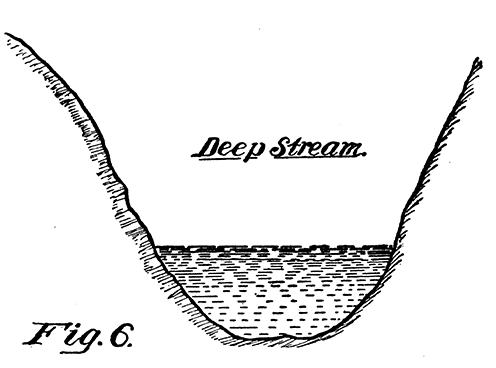 Fig. 6. Deep Stream
"It is now plain to me why they were fooled,"
and the Professor laughed at the situation. They
evidently knew that sooner or later the wagon
must make its appearance and attempt to ford the
stream, and that would be their opportunity.
"They are certainly smart in some things, and
particularly with regard to the character of the
streams. That tributary is very deep and they
counted on that giving us trouble."
"Why do you know it is a deep and not a
shallow stream?"
"The conformation of the shores indicate that.
It can generally be determined in this way: If
the sides of the ground near the shore are steep,
it is pretty sure to make a contracted channel, and
that means depth. On the other hand, if the beach
is sloping the stream may be wide, but is always
shallow at that point. See the steep sides running
close down to the mouth?"
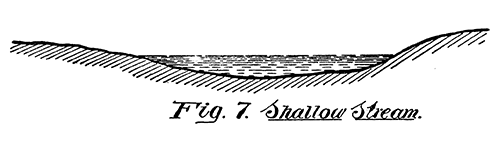 Fig. 7. Shallow Stream.
The savages did not wait long for the supposed
appearance of the wagon, but the scouting parties
cautiously spread out and moved up the stream.
They passed through the thick undergrowth where
John and the Professor had passed the night before
and were, apparently, nonplussed at the disappearance.
This recalled the former experience farther up
the river, and all had a merry laugh at the discomfiture.
They saw the tracks of the wagon, and it
ceased at the undergrowth, and this was the puzzling
feature to them, but in time the tracks were
followed up leading to the river bank, and the
evidences of the driftwood all about was sufficient
information to them to stop all further pursuit.
"What should we do if they attempt to cross?"
was George's inquiry.
"That would be our chance to go for them,"
responded Harry.
They remained on the bank for two hours, constantly
looking across for signs of the retreating
wagon, and then slowly filtered back through the
woods beyond.
"Isn't this the place we saw the lights during
our first trip to the river?" asked Harry.
"No," answered the Professor; "we were fully
six or eight miles north of this point, but it might
be some tribes are found that far down the river."
Breakfast had been forgotten in the interesting
watching of their enemies, and when they had
fully disappeared from view the party had an
opportunity for the first time in a whole week to
get a sample of cooked food.
"I am sorry to say," said George, "that we
haven't any fresh meat, and the best we can do
is coffee and corned beef."
Harry and John had their guns in an instant,
and started out on the quest for food.
"Where did you get the coffee and corned beef?"
asked Ralph.
"We put up the beef ourselves, and there is
plenty of this kind of coffee on the island."
"But you have sugar, too."
"Yes; we made that and also have plenty of
honey."
This was surprising information for the boys.
"But how did you make the guns? Where did
you get the iron?"
"We dug it out of the ground and put up our
own foundry, and have a water wheel and a machine
shop."
All this was said with a show of pardonable
pride; and he continued: "Wait until you see
where we live and how we have things fixed up."
The shots which were plainly heard indicated
something good to eat, and before the hunters arrived
the stove was removed from the wagon, and
George had a good fire started.
A woodchuck and two pheasants were the
trophies. What a feast they made. The chief
was now inclined to be more communicative. The
neat trick of crossing the river was a most enjoyable
spectacle for him, and he tried to exhibit
his delight. Ralph and Tom didn't have much use
for him; as they were no doubt thinking of the
miseries that the islanders had given them, and
the Professor smiled as he appreciated their feelings.
The disposition of the warrior was a leading
subject of discussion, and some favored letting
him go, but he was not in a condition to travel,
and they were now fully ten miles or more from
the point where he was captured. Humanity
prompted them to take him with them rather than
set him adrift in his condition, which might mean
exposure to his enemies, and as a result the subject
was dropped.
Red Angel was a source of wonder to the boys.
He had so many attractive ways, and it was the
first time that either had been thrown into close
association with such an animal, and besides Angel
was not an ordinary orang. He had been educated,
and it amused the boys to see how much
intelligence he exhibited when he was told to do
certain things.
After the meal the march was taken up, and
Harry, ever solicitous for his team, as he called
them, was anxious to get water for them. He was
assured that during the day they would without
doubt cross some of the streams which they had
previously found in that section of the country.
While thus moving along Ralph and Tom were
inexpressively happy at their liberty. Weak as
they were they frequently got out of the wagon,
trudging along, running races with Angel, and
jolly as boys out of school.
And this gives the first opportunity to describe
them. Ralph was tall, and strongly built, but his
emaciated frame did not show his full strength.
Tom, on the other hand, was shorter and bulkier,
so that the two boys were really the counterparts
physically, of Harry and George, respectively.
Both were educated fully up to their years like
the average youths who had graduated from the
high school.
Tom was the most observant of the two, and in
that respect resembled George, and as they moved
through the forest and over the table land, he
would frequently stop and look around, and finally
went to the Professor and said: "This part of the
island looks very familiar to me." Then calling
to Tom, he continued: "Isn't this the place we
traveled through after we were wrecked?"
Tom looked about him, and finally answered:
"It does look familiar like. We came from that
direction." And he pointed to the north.
"If that is the case you landed on the island
fifty miles west of our position, and it is a remarkable
thing that we never ran across your
tracks," answered the Professor.
The wagon was driven forward slowly, because
there was now no need for haste. The part of
the country through which they were passing was
free from savages, so there was no anxiety from
that source, and the Professor, as well as the boys,
took delight in examining the country through
which they passed, and in trying to discover new
vegetables and fruit, as well as learning all about
the mineral resources of the different sections.
Before night they came to a small stream, which
was an admirable camping spot, and the yaks
fairly reveled in the sweet, fresh water. There
was no hesitancy in building a fire for the evening
meal, and the hunting bags showed a good supply
of game. That evening sitting under the great
southern dome, with its glittering stars, the Professor
had a most attentive audience when the
various questions were brought up for discussion.
To those who are fairly observant, the heavens
in southern latitudes cannot fail to attract attention
because of the different arrangement of the
stars. People living in the northern hemisphere
have never seen the southern cross, nor the great
fixed stars, Canopus or Achernar; and those below
the equator have never viewed the polar star, and
do not know the beauty of the brilliant star Vega.
The most intent listener, on all occasions of this
kind, was George. "Tell us, Professor, how the
mariner knows the direction of the south pole
when there is no south polar star to show him?"
"Practically the same method is used as in the
northern hemisphere. The north polar star does
not in itself indicate which is north, but it is one
of the points used in connection with another star
which points out the direction.
"In the northern hemisphere there is a star
called Alpheratz and another called Zaph, which
are in direct line with the polar star. The two
first stars named are exactly on what is called
the equinoctial line. But the southern hemisphere
of the heavens does not have a polar star to indicate
the south, so that if you will now look directly
above us you will notice two very bright stars.
One of them is the fixed star Sirius, the most
brilliant in the heavens; the other is Canopus,
and a line along these two stars would go around
the celestial sphere and point to the poles."
"But suppose we should be on the sea, and would
not have anything else to guide us, what would
there be to show which way is north and which
direction south?"
"Sirius is easily distinguished, because it is,
apparently, the largest of all the fixed stars. It
cannot be mistaken. By taking that as a starting
point, and following with the eye along past Canopus,
you will be looking to the south pole."
"Isn't Sirius called the Dog Star? And hasn't
it some connection with the dog days?"
"Yes; in the remote ages of the world, when
every man was his own astronomer, the rising
and setting of this star was watched with deep
solicitude. The astronomers of Egypt determined
the length of the year by the number of its risings.
It foretold to them the rising of the Nile, which
they called Siris, and admonished them when to
sow. At that season of the year Sirius rises with
the sun, and owing to its intense brilliancy, the
ancients supposed that it blended its heat with
the sun and thus was the cause of the intense
heat; hence during that time were called dog
days. At present what are so designated are
the days between the 3d of July to the 11th of
August."
THE CATARACT AND ITS MARVELS
The tramp through the forest was a leisurely
one, as constant stops were made to examine the
country. The rescued boys were wonderfully recuperated
by the influence of two days of good
food and the peace of mind and contentment that
had come into their lives after a stormy and hazardous
fourteen months' struggle.
Ralph brought in several specimens of fruit and
vegetables, of the kind they had seen the natives
use, and one specimen which had a long, tapering
root. "Here is something they always had on
hand," he remarked as he handed it to the Professor.
"That would be a valuable addition to our vegetable
diet. It is a species of Salsify, or vegetable
oyster, and by some called Goat's beard, on account
of the peculiar top."
"I should like to know what this is. It seems
to me that we saw plants of the same kind down
near the South River." George produced a plant
with beautiful large leaves at the end of each
stem, which grew in clusters.
The Professor smiled. "You have at last found
the real rubber tree. This was taken from one
of the small trees, but they grow to considerable
height, and many of the trees yield about eight
gallons of milk, when first cut, which produces
two pounds of rubber.
"But," continued the Professor, "I have something
here that is more of a curiosity than anything
else." He drew forth a stem with a number
of leaves, and peculiarly marked. "Do you notice
anything odd about this?"
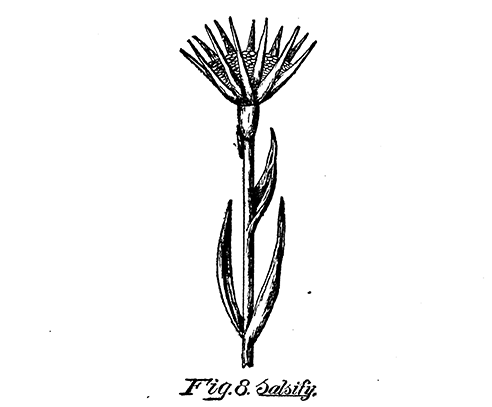 Fig. 8. Salsify.
All of them examined it intently, and finally
Tom remarked: "Why don't you remember, Ralph,
we saw these branches in the savage huts frequently,
but I have no idea what they used them
for."
"This is the carricature plant. If you will look
closely the outline of human faces can be seen.
Look at this leaf, the resemblance is plain. Among
the savages these leaves are plucked as charms,
and the more distinctly they are marked the more
potent they consider them. It is something like the
ideas of many people about the four-leaved clovers.
So civilized people are not so very far above
the savages, after all."
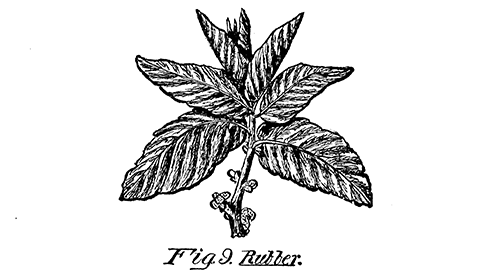 Fig. 9. Rubber.
In the afternoon of the third day they approached
the vicinity of the Cataract, and Harry
and George were wild to make their way forward,
so the yaks were constantly urged to go on, and
it frequently made traveling difficult for those
who were walking. Ralph and Tom were kept in
the wagon, but insisted that the Professor and
John should take their places there, and would not
listen to their protestations.
About three o'clock Observation Hill was sighted,
and there, proudly floating, was the flag. When
the attention of the boys was called to it they almost
wept for joy at the sight.
"Oh, how good it feels to see that old flag again,"
was Tom's comment, as he tried to brush away
something that looked like a tear. "How far are
we away now?"
"Not more than two miles from home, but the
hill is three-quarters of a mile farther."
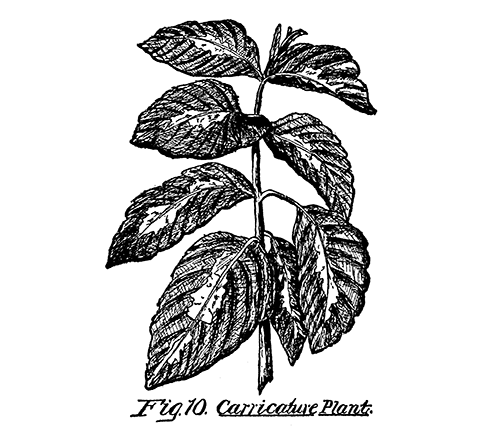 Fig. 10. Carricature Plant.
Angel was in his element now, as the home was
sighted, and he danced and capered, just as George
did. The Professor and John were in the wagon,
and Harry asked the Professor to take the reins,
and before any of them knew what he was about
was out of the wagon and on a run down the hill,
followed by George and Angel.
Ralph and Tom followed suit, and they made a
procession that gave great pleasure to the Professor,
as he saw their joyous spirits exhibiting
themselves.
John's eyes lighted up, and the Professor noted
the look of pleasure on his face. It was so good
to see the steady increase in the developing intelligence.
When they left two weeks before John
was listless, and often entirely without any indications
of what was going on all about him. The
only characteristics were shown at intervals, where
he would, probably, recall something, or instinctively
be brought into contact with a former phase
of his life; but now those periods seemed to be
vanishing, and he became a more normal being
at all times, without showing the marked eccentricities.
The boys reached the home, and Harry opened
the door, and stood ready to receive and welcome
their new companions.
When the wagon came up John and the Professor
marched up, and the latter approached with
the deference of a courtier, and John, noting the
attitude of the Professor, made a like obeisance,
and this act, so gracefully performed, was such
a wonderful and startling thing that the boys
were completely stunned. After making a show
of welcome to the Professor, they walked over
to John and offered him a welcome that was most
touching to him.
The Professor and the boys now felt that they
could not, in their future conversations, make any
allusion to him, as there was an evident dawning
of his intellect, and nothing must be said to attract
his attention to it by discussing his condition.
Angel was in the rafters for a moment only,
and then down and darted into the kitchen. Not
for a moment did he rest content at any spot until
he had investigated every corner. Wasn't that
a boyish trait? When the whole house had been
exhausted, he was over at the water wheel, and
the boys followed, but they did not take in every
arm and blade of the wheel, as he did. Then to
the shop, and always leading the boys, who were
after him with shouts of merriment.
"Oh, isn't this wonderful!" exclaimed Tom.
"What a glorious time you must have had in building
these things? And just to think of it, we
were so near you, and in misery all the time;"
and he said it in such a regretful manner that it
drew forth the sympathy of all.
Nothing in the world could have hindered John
and the Professor from following up and witnessing
the scene. Angel didn't try to run the sawmill,
or to turn the lathe, but he did the next best
thing, he jumped on the grindstone and sent it
spinning while running over the top, a trick he
had learned and which was one of the ways he
had to help out George and Harry when at work.
If you should argue from now until you get to
the end of this book that Angel did not know
what he was doing during these exhibitions, and
that it was only the act of an animal, it would not
have convinced the boys. From the shop they visited
the laboratory, and here the boys got their
first real shock, as they saw the skeletons which
had been taken from the cave.
It was all so remarkable to them that they did
not know what to say or think. Here was intelligence
directed from the first. How different had
they utilized the intervening time. It was a momentous
lesson, they were smart enough to appreciate
what they saw and learned.
"I am so happy to know that we have been permitted
to become a member of your family," said
Ralph, as he grasped the Professor's hand. "All
this around here is certainly worth seeing, and it
makes me long to take a hand and help, and I know
that Tom feels that way, too."
Before the Professor could reply George stepped
up and put his arm around the Professor. "If
you boys only knew how beautiful he has been, and
how patiently he has urged us to carry out this
work, you would almost wish, as has been our
desire many times, never to leave this place; but—of
course, we—we want to see home—and," and
the tears came, and Ralph and Harry and Tom
broke down and wept, and they turned away from
each other to hide their emotions.
When they turned and tried to be very brave
again, the Professor, who was not ashamed of the
tears which fell, smiled through them, and his
voice rang out with a cheer that made every face
bright, as he said: "The most satisfying thing
in life is appreciation. My boys have been heroes.
I have done nothing; it is their work. I have felt
ashamed, sometimes, to know how little has been
the work of my hands. Occasionally they have
been directed, but it is because they wanted to
know so many things and the reasons for everything
they started out to do. You can see, therefore,
that if they had not possessed the spirit
to accomplish these things, the little that I have
tried to impart to them would have been of no use.
I merely allude to this to show you that it is not
knowledge or information that makes the world
move or induces men to progress, but it is the
spirit which takes hold of and utilizes the intelligence."
The new additions to the family now necessitated
an entire rearrangement of their quarters.
The house, which had been built up in sections, so
to speak, contained three rooms, one, the original
portion, being now the store room, to which was
added a living room and a kitchen.
Commenting on this, and with all together, to
get some understanding of the plans, the Professor
outlined his views: "We have been putting
up our structures here in the way usually followed
in all rural communities, where there is
plenty of room, by first erecting a little shanty,
and then adding another room to that, and a little
lean-to on the other side, and as the family grows,
enclosing the lean-to to make another room, and
then adding to that, and so on, until the whole
mass makes a more or less picturesque structure,
and a fine thing for artists to rave over. But the
interior comfort is quite another thing. We should
change that in this civilized community, and put
up a building that will be not only comfortable
and adapted for our necessities, but also artistic,
and it will cost us no more than to do it in a
slovenly, inartistic way. I imagine we can make
good terms with the carpenter and the bricklayer
and the decorator so as to reduce the cost as much
as possible;" and all enjoyed the Professor's little
joke.
It was Harry's turn to offer a few suggestions:
"We have about everything we need now, except
food. The barley is all gone—"
"What, all that we left in the bin?" asked George.
"Something has gotten into it and carried it all
away."
"We shall have to investigate that the first
thing," suggested the Professor. "Fortunately we
haven't threshed out one of the stacks, and that
will give us plenty of exercise for a day."
"What, have you a stack of barley here?" was
Tom's eager question.
"Oh, yes," replied George, "and we make the
finest kind of bread. I am sorry we can't offer
any to-day."
It was so long since they had tasted bread that
its name was almost forgotten.
All returned to the house. The Chief was still
there, and he looked at the group in a curious way.
Everything in sight attracted his curiosity, and
the Professor tried to make him feel at home in
his new surroundings. His wounds were progressing
favorably, and he was now able to stand on one
leg without much pain. At the suggestion of the
Professor, Harry made a pair of crutches, which
were brought in early the next morning, and he
took them and imitated the act of walking with
one of his legs raised up. This was a novel proceeding
for the savage, and after they had been offered
to him several times the Professor urged
him to try them.
Comprehending what was wanted he struggled
to his feet and reached for them. When they were
adjusted he leaned forward for the first step, and
a look of surprise came over him. It was a revelation
to his poor untutored mind. It lighted up
into an expression he had never exhibited before,
and he thus received the first lesson on the route to
civilization.
It was amusing to see him make one attempt
after the other, and before night he could travel
about fairly well. What must have been his
thoughts as he saw the busy workshops and the
surroundings of the home to which he had been
so unwillingly brought? At every opportunity the
Professor cultivated his acquaintance. As time
wore on he became communicative in his way, but
it was difficult to bring things to his mind and
comprehend the language used.
He was first taught to name certain things, such
as the different foods; and it did not take long to
learn what "Yes" and "No" meant, and when
handed anything particularly appetizing it was
finally associated in his mind with "good." Thus
step by step he acquired a small vocabulary of
words.
The first task in the morning was the threshing
out of barley. Chief, as he was called, witnessed
the task, and picked up and fondled one of the
flails, like a child caressing a new toy, but he
did not have the remotest idea what the threshing
of the barley meant until the beaten straw had
been removed and the golden grain was winnowed
out.
And there was another thing that interested him
immensely, and that was the grist mill, composed
of the two stones, and when the water wheel was
set in motion and the upper stone began to whirr,
he stood with mouth and eyes open, and watched
the meal running from the spout like one entranced.
Usually these people are too stolid to
pay attention to such things, but his intense interest
was so pronounced that it attracted all who
witnessed it.
He followed every step in the preparation of the
flour and in the making of the bread, and when
the loaves were finally deposited on the table, it
was some time before he could gain sufficient composure
to taste it. When he did so eventually the
amount he ate was enough commendation of its
quality to satisfy the most egotistic baker.
Tom became the constant companion of Harry
in the workshop, as he was a lover of the mechanical
arts. Ralph had the spirit of adventure, and
was the counterpart of George, who liked to investigate.
These two became the animated question
marks of the party. On every subject they took a
leading part.
The second evening George brought out his
home-made violin. This was the occasion for another
surprise. Red Angel was at the feet of
George in an instant. Tom could not keep his
hands still, as he had also learned to play the instrument,
and ventured to suggest that he would
like to assist in building a bass viol, and not to
be outdone Ralph offered to construct a flute.
The violin that evening was another link in the
chain which was to eventually convert a savage
into an instrument of untold value to the people
of that island. At first Chief could not understand
it. He tried to see where the wailing noise came
from and pressed closer and closer to George as
he played. When George played another tune in
quick time he became animated, and slow, plaintive
music seemed to subdue him.
"Do you know," said the Professor, "that what
we call music does not appear as such to savages.
Noise and sound are not distinguished by them.
The beating of their crude tom toms is the only
thing that appeals to their ears. That is simply
noise. Rhythm and time are recognized, principally
because all their music is associated by some
act of dancing."
"I have often wondered why it is that dancing
is such a universal custom?" ventured Tom.
"Among all ancient peoples it formed the integral
part of religious ceremonies, and is even to-day
practiced by many of the eastern Christians
in that manner. It was the custom of the Jews
from their first historical account, as shown in the
account given in Exodus, where Miriam the prophetess,
sister of Moses, took a timbrel in her hand
and went out with the other women with timbrels
and dances. The Hebrews had a regular chorus
in the Temple, with dancing performers of women;
and the dance was adopted as a fitting close to
the feast of the Tabernacle, when the rulers of the
synagogues, the doctors of the schools, and even
the members of the Sanhedrin, accompanied the sacred
music with their voices, and leaped and danced
with torches in their hands until morning."
"Do you think the savages even in these western
islands use the dance as a religious ceremony?"
"All tribes in the Island of the Pacific, and I
might say, over the entire world, associate these
dances with religion, with war, and with some festive
commemoration of events. I dare say that you
boys have witnessed some of those rites."
Ralph responded to this: "We saw that happen
on the occasion the victims were sacrificed by the
savages who captured us, as I related in my story
the other day. The other tribe also had a dance,
but it was so entirely different that we both noticed
it at the time."
"Your observation was correct. As in clothing,
and in the matter of decorations, so different peoples
show their dancing characteristics by different
traits. This is true of all civilized people as well.
Of these, the best known, which I might mention,
are the tarantella of the Neapolitans, the bolero
and fandango of the Spaniards, the mazurka
and cracovienna of Poland, the cosack of Russia,
the redowa of Bohemia, the quadrille and cotillion
of France, the waltz, polka and gallopade
of Germany, the reel and sword dance of Scotland,
the minuet and hornpipe of England, the jig of
Ireland, and the last to capture America is the
tango."
THE WORK AT THE CATARACT. MAKING WEAPONS
The directing hand of the Professor, assisted
by John, who was present everywhere when work
was to be done, was manifested when the hour for
retiring came. There was an abundance of clean,
sweet straw, and the boys temporarily took up
their quarters in the shop, while the Professor,
John and Chief occupied the living room.
All this had been arranged for by John, so that
when they went to bed that night happy and contented,
it was to take a rest that was free from
troubles and worries, and it was a welcome relief
after two weeks of wandering, coupled with the
most exciting adventures.
The boys had hardly quieted themselves for
the night, when a peculiar scratching and scraping
noise appeared at their door. They intently listened
for a while, and George quietly slipped to
the door. He heard a familiar sound from without.
Red Angel was there, and next morning the
Professor laughingly said that it is likely he did
not relish the company in the house, as he came
down to the door after the boys left, and by his
peculiar style of talk said he wanted to get out.
In the morning the Professor called the working
force together, and suggested that as good living
was a necessity, and could also be made a
pleasure, they should so divide the different occupations
as to make each feel that he had some
special responsibility.
He pointed out four things which were essential
to their welfare. First to replenish their store
of vegetables; second, to secure game or meat of
some kind; third, the cultivation of the garden;
and fourth, the manufacture of clothing, of which
all stood in need.
When John came to their home he was supplied
with practically all of the surplus goods on hand,
and a new stock of ramie fiber had not been prepared
since that. The boys' clothing had been supplemented
by the goods taken from the wagon top,
and while heavy garments were not required, it
was noticed that the articles first made from the
ramie were growing threadbare.
Footwear was really of more immediate necessity
than clothing. Ralph and Tom had no shoes
whatever, as the only ones they had were taken
away when first captured. It is singular how hard
the feet can become when deprived of protection.
Throughout Africa, where the natives never wear
them from the cradle to the grave, the soles of the
feet become hard and bony, and thus enable them
to travel over any kind of surface without injury.
It was fortunate that they had three tanned
hides, and when John looked at the denuded feet
of the boys, and at his own condition, the sight of
the hides was enough to set him to work. The
first thing that engaged his attention was the making
of a set of lasts, and then the ramie fiber was
twisted for threads; after which he sought out the
lumber pile to make pegs, and selected some of
the dried shellbark hickory for this purpose. Thus
he imposed one very needed duty on himself.
At George's suggestion a new stock of the ramie
fiber ought to be supplied, and he, with Ralph,
took the yaks, and their guns, in order to do double
duty, to bring in a new quantity, and at the same
time supply the table with game. As they were
leaving the Professor called out: "If you go near
the ledge of iron ore bring in a few hundred
pounds, and also some clay. You ought to take the
picks and shovels along."
Harry and Tom went across the river to visit the
garden, which was now overrun with weeds, and
the entire day was spent in putting that in order,
as they hoped within a few weeks more to commence
gathering supplies from that source. The
garden had been started before they sailed away
on the voyage which ended so disastrously to their
vessel.
While all this was going on it must not be
thought that the determination to again visit the
enemy's country had been relaxed. Before going
on another trip preparations must be made, and
they did not intend to run short of ammunition
the second time.
With that object in view, the moment the present
need for food and clothing was provided for
it was agreed that all efforts should be made in
the direction of preparing weapons and ammunition.
There was still a good supply of copper at
hand, as well as lead, which had been previously
extracted.
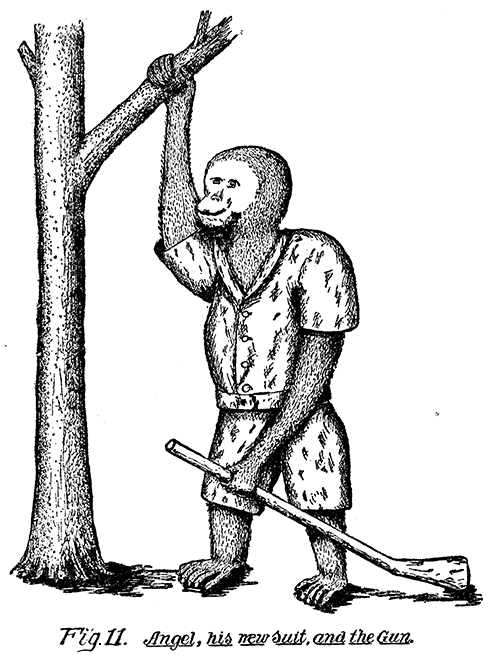 Fig. 11. Angel, his new suit, and the Gun.
Thus the party put in several days of ardent
work in the directions indicated. One morning,
while the garment-making was in progress, Angel
appeared wearing one of George's discarded jackets.
He strutted around in the most comical way,
admiring himself, and, apparently, enjoying the
sensation of being clad. It was amusing to see
him hunch his shoulders as he looked at the jacket.
George laughed, and so did Angel. "Well, we
must make you a suit sure." Everyone, even to the
Professor, took a part in the proceeding, but John
couldn't see a way to fit him with a pair of shoes.
As usual, whenever opportunity offered, the
Professor was out prospecting in the hills. When
he returned several samples of new minerals were
deposited in the laboratory, and when the party
gathered there that evening Ralph was the first
to notice a reddish ore which had been found during
the day.
"What is that, Professor?"
"It is a very fine sample of Cinnabar."
"I never heard of it before. What is it used
for?"
"It is the ore from which quicksilver, or mercury,
is extracted."
"Wouldn't it be fun to make a looking glass?"
"It is used for that purpose, but we have use for
it in making a thermometer, as well as a barometer,"
answered the Professor.
"Will it be much trouble to take the quicksilver
out of the ore?"
"No, it is a very simple process. Metallic mercury
is easily volatilized, and separated from the
gangue, at temperatures far below redness. Our
closed retort would be admirable for the purpose."
"Do you mean by volatilizing that it is put into
a steam?"
"Volatilizing means to convert it into a gas,
and this gas, on coming into contact with a cooling
surface, is converted into a mercury, which we
have in a liquid state, and is called the metallic
mercury."
"Are there other kinds besides metallic mercury?"
"Oh, yes; it may be in the form of a nitrate, a
sulphate, a chloride or an iodide. The chloride is
very poisonous, and is known as corrosive sublimate.
It would be just the thing to rid the stable
of the rodents that took the barley."
One morning the Professor called the boys together
and informed them that it had been the
custom to take a certain day each week for hunting
or other recreation, and suggested that they
continue the practice.
"I should like to go over to Observation Hill and
see the flag you made," said Ralph. All agreed to
this heartily, and the merry party set out, after
being fully equipped, as was always the custom.
Red Angel formed one of the party, of course, and
in lieu of a gun, George had made a stick in imitation
of one. He was immensely proud of
this acquisition, and actually hugged it when it was
presented to him. From that time forward it was
his constant companion.
When the Hill was reached, Angel made for the
pole, and with his gun in hand, scrambled to the
top, giving out his peculiar chuckling noise, which
indicated delight.
"Why the gun doesn't seem to make any difference
in his climbing," exclaimed Tom.
They scanned the broad sea, and who shall say
what their thoughts were as they silently stood
there. For some reason when they started to
go down the hill they were not so jolly as when
going up. Their course was directed to the east,
but just why no one knew. It seemed as though
they were simply drifting, each with his own
thoughts; but Harry soon banished their reveries.
"Let us follow the beach down to South River,"
he suddenly exclaimed, and all were glad that something
had been said or suggested. It was so easy
to turn them from gravity to cheerfulness, and
probably Harry was trying some of the Professor's
medicine on the boys.
At every step of the way, and in every action,
the boys now realized that the work of the Professor
had been imprinted on them. Tom and
Ralph went along glancing superficially at the various
objects, but it was entirely different with
Harry and George. Every depression, and each
succeeding elevation, or clump of trees, or any
object beyond the ordinary, was closely scrutinized
by them.
This course soon became noticeable to the boys,
and called forth a comment from Tom. "Yes, we
are always hunting for something. That was a
trait which the dear old Professor taught us, and
it would surprise you to know how many things
we found out by that quality. We have always
since found it a pleasure in doing so."
Ralph reflected a moment, and he replied: "I
can now see where we made many mistakes during
the past year by not adopting that plan."
They passed to the east around the bend, and
then followed the small bay which indented the
shore, and finally moved out along the peninsula,
which terminated in a cape east of the mouth of
South River.
"I have often thought," observed Harry, "since
we have lived here that it would be a good plan
to name the different capes and bays, just as we
did with the rivers and streams."
"Good idea," answered Tom; "but I think we
ought to make a survey of the place. Have you
never done that?"
"No; but we talked of it several times. Let us
get the Professor to help us with that on our next
holiday trip."
From the cape where they now stood an unobstructed
view was had to the south. To the southwest
were the mountains, beyond which Ralph and
Tom had their bitter experiences. An explanation
was made of the course of South River, the
mouth of which was plainly visible; the story was
told of their trip up the stream with the first boat
which had been built by them; how, after they left
it at the foot of the high Falls, ten miles inland,
it had disappeared when they went for it; the recovery
of the boat at the beach to their left, some
months afterwards, when it contained strange oars
and ropes; their second trip to the Falls, and the
finding of the Investigator's lifeboat; and their
hunting experience in the forest below the river,
and the discovery of the huts.
All this made a wonderful impression on the
boys. The story of the lifeboat was the most remarkable
to their minds, because it brought up
the first recollections of some inklings which they
had heard about other castaways.
"Don't you remember, Tom, when the second
tribe got us, we saw some trinkets, and a few
pocket knives, and when we tried to find out about
them they removed them?"
"Yes, and Illoga, the Chief, I am now sure, tried
to tell me about them, because in the effort he held
up four fingers, which we couldn't make out. Don't
you remember? I think they took the knives
away, because they were afraid we would take
them. Didn't you ever notice how jealous they
always were of their own property?"
The party now went inland, and devoted the rest
of the day to hunting, and brought home a splendid
lot of game.
That evening the foregoing conversation was
related to the Professor, who remarked: "If there
is one thing savages and all low orders of people
are noted for, it is the tenacity in retaining their
property. Of course, that is not an uncommon
trait with all people, but it is particularly well
developed in the savage. One phase of this came
to my attention some years ago, when a merchant
told me that the poor people of India bought more
locks than all the rest of the world combined. He
further stated that in the principal cities there
immense stores could be found which handled nothing
but locks. Those statements were so remarkable
to me that I inquired the reason, and learned
that every native, although he may have trinkets
worth less than a dollar, would invariably have a
lock, worth half as much or more, to keep it
securely."
"We have been thinking over the plan of surveying
this part of the island and giving names to the
main points; what do you think of the idea?" asked
George.
"The plan has my hearty approval."
"It occurred to us that on our next holiday we
could devote the day to that purpose."
The Professor burst into a fit of laughter, to
the surprise of all. That didn't seem to be very
comical to them, and they looked inquiringly, as
they joined in the laughter.
"So you are going to do work on your holidays
hereafter." And he laughed again.
"Well, that wouldn't be work; it would be fun;"
and, after reflecting a moment, Tom continued:
"Probably it wouldn't be fun to do it every day,
right along."
"I think you have struck the keynote of the
whole subject of recreation. The word comes
from re-create. It means the refreshment of the
strength and spirits by some diversion. The great
difficulty with most people is that the recreation
they take is really a burden to them; when, therefore,
you can take a holiday, where you accomplish
something, and make fun out of that, you
have solved the greatest problem of civilized
life."
"Well if we are to survey the island we ought
to have an instrument for the purpose."
"That is not necessary. It would be much better
to have a theodolite, but it will take some time
and very careful work to turn out such an instrument."
"In what way is the instrument so much more
useful than without, and how can we do surveying
without it?"
"It does two very important things: First, the
telescope, which is a part of it, enables the observer
to see much farther and with greater accuracy;
and, secondly, it has a graduated scale in
degrees which shows the angles. Without these
two important qualities we should be compelled to
run our lines for short distances only at each
sighting, and at each observation it would be necessary
to provide a means to get the exact angle
with reference to the last line projected. Those
features, together with the compass, make the instrument
an important requisite for correct surveying."
The boat house was one of the places last to
visit, because there was so much to do in the
various directions that they had little time to devote
to the marine end of their various enterprises.
Harry suggested that sailing would be a
most desirable outing at different periods, and all
consented to the task of rigging out the lifeboat.
The Chief was now so interested in everything
he saw that he indicated a desire to take a hand.
The Professor was delighted at this beyond measure.
He was gradually acquiring the language,
as a child would, and his troublesome leg was healing
rapidly. The one fear was that, as they had
no means of confining him, he might take the first
opportunity to leave them, and this was an occasion
of more than one talk; but all agreed that
no serious consequences would result from his
desertion, since it was the belief that he would not
attempt to bring his tribe against them.
The only possible danger from his returning
was the likelihood that sooner or later his captivity
and the knowledge of their location on the
island would find its way from tribe to tribe, and
in that way at least two of the tribes with which
they had come into contact might seek revenge.
Chief went to the boat sheds for the first time,
after the events above related, and the one thing
which caught his eye was the lifeboat. He started
at first, and then made his way toward it, and
looked at the Professor, whose eye was quick to
note the movement. He was asked if he knew
anything about it, and answered affirmatively, but
when he was questioned whether his tribe had
possession of it at any time, no intelligent response
was made, as he evidently misunderstood
what was asked.
One of the first weapons which they constructed,
after iron had been recovered from the ore, was
a bolo, and a number were subsequently manufactured.
To this they added several spears. All
weapons were kept out of Chief's reach, and the
boys were cautioned against permitting him to
learn the mechanism and use of the guns. He
always looked longingly at the bolos, from the time
he had witnessed their dextrous use.
On this occasion the Professor handed him one
of the spears, and he was not only pleased but
appeared to be extremely gratified at the act.
He balanced it in his hand, and held it up in the
attitude of throwing it. When they were returning
to the shop, Chief balanced the spear, and
without the slightest effort threw it fully fifty feet
against a tree, striking a light portion of the bark
which he had evidently aimed for. This was the
signal for applause and clapping of hands.
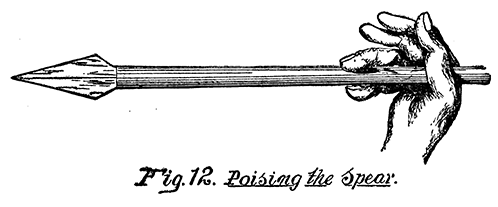 Fig. 12. Poising the Spear.
Harry ran for the spear and returned it to Chief,
and all ranged up alongside to witness his performances.
The boys secured spears, also, and
made the attempt to throw them, but they fell far
short. When Harry attempted to make the trial,
Chief seized it, and took his hand, and showed
how to hold it to make an effective throw.
The trick consisted in grasping the stem tightly
between the thumb and edge of the palm, with the
little finger below the stem. The boys watched
the proceedings with interest, but could not understand
why that method of doing it was most
effective.
The Professor came to the rescue. "The throwing
of the javelin, the proper term for all weapons
of this character, was an interesting thing from
the earliest times. The lighter weapons are thrown
by grasping them between the thumb and the two
first fingers; but the heavy ones like this need a
firmer grasp, and on account of their weight are
not so easily kept in a horizontal position when
in the act of impelling it forwardly. When, however,
the spear is grasped in the manner shown
you, the little finger, and the next finger to it,
both act to guide the stem, and by practice they
can be thrown with great accuracy."
This javelin-throwing match was the means of
bringing the Chief and the boys nearer together
than anything else that had transpired, and it
began to make them take an interest in him, which
was not the case theretofore. What really affected
Chief more than anything else was the confidence
imposed in him some days after, when
Harry gave him one of the bolos. It was almost
touching to see the joy he expressed. The Professor
thought it would be a stroke of policy to
have the present come from the boys.
Although he was still limping and unable to move
around with any celerity he was out using the bolo
at every opportunity. Here was an opportunity,
as the Professor explained, to show how intelligent
direction would not only be serviceable to the
Chief himself, but that its possession would turn
its use into channels that would be of value to him.
The gift made him particularly grateful, and so
several days afterwards Harry and Tom, by a concerted
arrangement, took the yaks, and the truck
which had been previously made to haul in the
flagpole, and, motioning to Chief, set off for the
woods. A fair-sized tree was selected, and the
boys, without a word to indicate that they wanted
him to assist, began to cut down the tree.
He looked on wistfully for a time, and then
edged his way over and made a motion to take
Harry's place, to which he assented. It was now
impossible for Harry to regain his place at the
tree, and when it fell he acted and looked like a
conqueror, and Harry patted him on the back as
a token of his good work. A section of the butt
of the tree was cut off, and loaded on the truck, and
dragged to the sawmill. The end had to be squared
off, and Chief insisted on doing this, the use of
the exceedingly novel tool being the greatest pleasure,
evidently, that he had ever enjoyed.
The fixing of it to the reciprocating saw frame
was a marvel to him, and when he saw the boards
cut off his joy knew no bounds. The proceedings at
the sawmill delighted the Professor. "I have always
contended, as heretofore expressed, that the
same motive which prompts us to do things with
pleasure is to know that we are doing things which
produce results."
And then Harry did another graceful thing.
He turned up a number of brass balls which he
gave to Chief. If there is one thing a savage
loves better than another, it is something round.
That is why beads are so attractive, and buttons,
and small trinkets of that kind. They are like
children in this respect. Put a cube and a ball,
both of the same material, before a child, and he
will usually select the ball. It is a psychological
phase which has never been explained; and the
same test has been made with monkeys.
UNAWARES IN THE ENEMY'S COUNTRY
During the evening, while engaged in their
usual discussions the surveying implement was
brought up, and it was understood that a crude
instrument should be made, so that it would be
ready within the next week.
While speaking on the subject of laying off the
segments into degrees, the former matter of observing
the heavens was alluded to, and Ralph
inquired why all calculations of the heavens were
made by degrees.
"Because degrees mean angles and not measurements.
Positions or distances are determined
by angles and by measurements in miles."
"But in looking at the stars how can mariners
tell where they are, simply by getting the angles?"
"That is a matter which can be calculated with
such accuracy on the high seas that the distance
can be determined with absolute certainty to
within three or four miles. Furthermore, when
the moon is shining, a mariner, even without an
instrument, will be able to make a pretty accurate
determination, if the moon is in sight."
"This is interesting information, and I would
like to know how it is done."
"Simply by noting how far the moon is from
some fixed star. It is difficult to explain this
without making a drawing of the heavens or drawing
a map which shows the positions of the fixed
stars, and the two sketches (Figs. 13 and 14) that
I have drawn out will, I hope, make it clear to
you. The first figure (13) is a map of the sky
for the northern hemisphere, and the second
drawing (Fig. 14) of the southern hemisphere,
where we are.
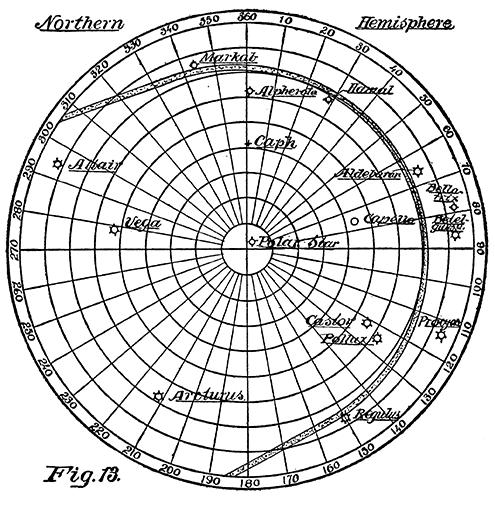 Northern Hemisphere. Fig. 13.
"On the maps I have shown the fixed stars and
named them, those of the first magnitude being the
largest, those of the second magnitude a little
smaller, and so on, but I have not by any means
indicated all of the second and third magnitude
owing to their great number."
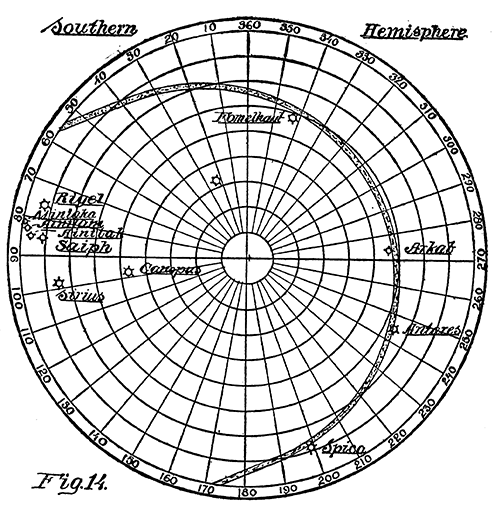 Southern Hemisphere. Fig. 14.
There had always been a secret grief in the
hearts of Harry and George at the loss of the
boat at the mouth of South River, and the Professor
joined in their wish to recover it at the first
opportunity. Harry again alluded to it on
this occasion, and it was decided that such a trip
would be a welcome change.
The trip could be made in the wagon, and by
consent the four agreed to undertake the journey
and bring it back.
"I have often thought it might be done by taking
the lifeboat," was George's idea, "and we could
fix it up there and sail it back."
"It does not seem to me that would be practical,
because it is too much damaged to repair in such
a way as to make it safe for such a journey, and
if that plan should be adopted all of us should go,
and we cannot leave for the length of time necessary
to repair it."
"Then we had better take the team. Do you
think, Professor, we could haul it back?"
"If you can load it there will be no difficulty
in that particular."
It was decided to start the following morning,
and a supply of provisions was stored in the
wagon, and before starting the Professor made
the following suggestions:
"When you get there the top must be removed—that
is the bows and covering——"
"Why, we haven't any covering to it now. We
had to use it up for clothing."
"I had forgotten all about that. I supposed the
top had been taken off when we took it out to haul
in the supplies. That being the case the boat,
when it is loaded in, upside down, will make a
splendid top for you for camping purposes."
"How long will it take to make the trip?" inquired
Tom.
"Not to exceed five or six days, because we
know every step of the way, and we can push
along pretty lively."
The start was not made until about ten o'clock,
and Angel was on hand with his inevitable gun.
They did not forget the usual accompaniments of
such trips, namely, guns and ammunition, together
with the spears and bolos.
"This is certainly a jolly lark," sang out Ralph,
as they neared the forest. He and Tom had fully
recovered from their weakened condition, and were
able to take their part in any of the work which
was necessary.
"Which way shall we take?" asked George.
"The road directly through the forest, for the
reason it is much better than the route near the
sea."
The four young spirits made wonderful progress
toward the goal, as they had a light load,
and every minute seemed to be precious. What
hunting was done was on the route itself, and they
had mutually agreed that there should not be any
wandering on the part of either.
The first night the camp was made on the banks
of the Cataract, well within the woods, and not
far from the scene of their first exploits with the
two bears.
"I wish we could come across more of the same
kinds of bears that we met in these woods," said
George.
"But the forests south of South River are the
places for the animals. Didn't George tell you
about our hunting there?"
"No," answered Ralph; "but I want to go there
when we get back."
During the first night Angel was restless, as
usual in the woods at the merest sound, and
George tried to find out the cause of the uneasiness.
"Wasn't it near here that the wildcat attacked
us?" asked George.
"I believe you are right. Possibly he has
scented another one."
"Suppose we take a peep out," Ralph whispered;
and taking their guns, they stole down from the
wagon.
They silently stood by the wagon, peering
around in the darkness.
"They will be up in the trees," said Harry.
"Wait—I see something; look up to the right, a
little to the left of the opening through to the
sky."
"Two balls of fire could be distinctly noticed.
"That is one of them, if it isn't something
larger. What shall we do?"
"Ralph, you and I will aim and fire at it, and if
it makes a dive for us George and Tom can take
the next shot. Get in the wagon quietly, and
prepare."
"Now, ready, aim, fire!" Something came down
from the tree faster than an ordinary descent.
"Get into the wagon, quickly," and suiting the
action to the word, they leaped up quickly.
"Don't shoot, George, until you see something
definite to shoot at."
Something went crashing through the underbrush,
and Angel, who was their monitor, increased
his alarm.
"I believe it is making for us."
The boys who had shot were now prepared with
the newly loaded guns and awaited the attack, but
beyond the plain movement of the leaves, and what
appeared to be breaking twigs, nothing could be
discerned, until George almost screamed, as he
saw the object above them, high in the branches.
"Here is a chance for a shot?" And Harry and
Ralph both aimed and fired at the same moment,
and the animal came down with a crash and landed
near the wagon, but was up in an instant, and
appeared to spring out through the forest.
Angel quieted down, and this gave George assurance
that they were rid of the animal.
The second day was not filled with stirring
events, and they went along with considerable
speed, and judging from their former estimates
the distance traveled during the two days must
have brought them fully forty or fifty miles from
home, so they counted on being able to reach the
location of the boat some time during the following
day.
Before noon of the day they sighted the West
River, but they reached it at an unfamiliar point.
George and Harry looked at each other in surprise.
"It does seem to me," said Harry, "that
we must have made some miscalculation in coming
from the woods. If I am not mistaken we are
miles south of the place we ought to have aimed
for."
Beyond question the direction was to the north,
and the team was headed for that direction, their
route being near the river, as the ground was
much smoother, and speed was thus made.
"What is this?" asked Ralph in consternation.
"Here are tracks."
The trails were examined, and Harry solved the
question by the assertion that it was the tracks
made by their own wagon when they escaped from
the savages on the other side of the river.
"What idiots we have been to expose ourselves
to the savages."
"We must leave the river bed now, or we may be
discovered," was George's answer, and the yaks
were guided to a higher elevation, and urged forward
at a higher speed.
Selecting a secluded spot the noonday halt was
made, and a hurried luncheon provided, but before
they were ready for a start, Angel, who was
in the branches of a tree, began his chatter, which
caused George to spring toward the direction of
the tree.
"Come down, Angel; come down!" This was
always heeded by the animal, and it was plain
that the direction of the approaching danger was
from the north.
Springing to a small, low-branching tree, he
crawled up, and Angel followed and looked to
the north, and the sight that greeted him was sufficient
to cause a hasty descent, and he ran toward
the wagon and met the boys, who were coming
toward him.
"What is it?" asked all in excitement.
"Savages."
"And if I am not mistaken, they are the same
tribe that had Ralph and Tom."
The two boys almost paled at the words. Ralph
made his way back to the wagon on a run. "If
they attempt to take me again, I will never surrender."
"Are they coming this way?"
"Yes; and they are not a quarter of a mile
away."
The yaks were unyoked, and had not been
hitched up, so they were led behind the wagon,
following out the plan previously adopted, as it
would have been useless to attempt to avoid them.
"Shall we attack them the moment they approach?"
"I believe," answered Ralph "that is our only
hope."
"How many could you see in the party?"
"About a dozen."
The wagon had been camped behind a clump of
shrubbery, not over twenty feet from the small
rivulet, and to the north of them the stream made
a slight turn, so that the party appeared in view
to the watchers as soon as they reached the wagon,
and Ralph was the first to recognize their late
enemies.
To the surprise of the boys, the savages stopped,
not a thousand feet away, but on the opposite side
of the stream, and built a fire preparatory to
cooking some game which had fallen into their
hands.
"Well, this is interesting. They are going to
have some luncheon, too. Wouldn't this be a good
time to slip away?"
"I am afraid," answered Tom, "that it would
be a dangerous business. The creaking of that
rear wheel would put them on our track at once.
Couldn't we grease the wheel?" Tom was very
much in earnest now.
As quietly as possible the wheel was removed,
and some very good butter, the only thing available,
was used to ease it up, and the wheel was
gotten back in quick time.
Unfortunately the wagon tongue pointed toward
the river, the very direction which they dared
not go, for fear of exposing their presence, so they
had to push the wagon back, by their combined
energy, and as noiselessly as it could be done
the team was yoked on and slowly moved south,
and after traveling a quarter of a mile or more,
directed toward the river, and then northwardly,
thus making a wide circle in the effort to avoid
their camp.
"I'd much rather shoot them than to run away,"
was Tom's opinion of the situation. "The dirty
rascals; they are known to be the meanest set on
the island, and we oughtn't show them any mercy."
By this time the boys were worked up into a
fighting fever.
"I think we can lick the whole lot of them, and
for my part, I am willing to wait here and take a
shot at them; what do you say?" Ralph was
really mad at the demons, as he called them.
The boys looked at each other. Harry was the
only one who seemed to have the situation well
in hand from a true hunter's standpoint. "If we
stay here you will certainly get an opportunity,
or I am very much mistaken."
"Why do you say so?" asked Tom.
"For the plain and simple reason that they will
cross our tracks in all probability, and that will
mean an easy trail."
"But how will they know which way to go after
us? They may go down to the river."
"Well, they wouldn't be such idiots as to go in
the opposite direction that the footprints of the
yaks plainly show."
The boys had not thought of that.
"And then there is another thing, that just
occurred to me. If they follow our tracks from
the camping spot they will know we have made the
detour in order to avoid them, and that will make
them only the more anxious to make our closer
acquaintance."
Harry had hardly stopped speaking before the
voices of their enemies were discernible.
THE RUSE TO ESCAPE THEIR PURSUERS
The wagon was now driven behind the densest
chapparal of trees, unyoked, and tethered behind
the wagon, and two of the boys took up a concealed
position with a pair of extra guns, at each side.
Harry, who had, by common consent, assumed
the command, now made the following observations
as to their course: "Remember the Professor's
instructions, to keep cool and not to fire until
you are perfectly sure the shot will count. And
by all means don't use the reserve guns, except
as a last extremity. The moment you fire, retire
out of sight, and reload, and we should try and
fire in separate volleys. Two shots at a time, unless
they attempt a rush, will, probably, be more
effective, than if all fire at the same time."
In a short time the band appeared, and it was
well that they had no idea of the distance the
boys had traveled, as they came along rapidly,
following the plainly made tracks of the wagon.
"Now, ready boys; Tom and I will give them the
first shot, and you may fire the moment I give
the command. Ready, Tom; fire."
Both shots took effect, and the astonishment of
the savages, was exhilarating to the boys.
George and Ralph could hardly restrain themselves.
The warriors were in the open, and had
little brush to serve as a shield. For a moment
they were entirely at a loss to know which way
to go.
"Give them a shot," whispered Harry, and as
the two guns spoke, two more fell, both wounded.
Without waiting for another shot the rest of them
broke for the rear, and the boys appeared in the
opening.
This was not necessary, as the depletion of the
fighting force was a sufficient argument for them
to retreat.
"Hitch up the team as quickly as possible," and
George and Ralph did not wait to witness the
flight. Harry and Tom remained on guard.
"Move the wagon to the north, and stop at
every good place of concealment, and we will
remain as a rear guard. We have no assurance
that they will not follow up the attack."
After the wagon had gone on some distance, the
two boys slowly effected a retreat in the trail of
the wagon. Only eight savages had been left
after the two fires.
During one of the temporary stops Harry observed:
"When they retreated we saw eight of
them, and there are now only six following.
What do you suppose that means?"
"Those people are regular devils, and it is my
opinion that there is another force of them near,
and the others have gone to bring reinforcements."
"Run to the wagon quickly and tell them to
force the yaks forwardly as fast as possible.
Wait just a moment." And Harry looked to the
north and continued: "Do you see the two large
trees in the distance, a little to the left? Tell
them to drive for that with the utmost speed,
and await our coming."
Tom was off, and imparted the information, and
Harry kept on retreating, while the scouting party
approached very cautiously, the apparent object
being to keep within sight of the trail.
When Tom returned Harry said: "I suppose
we had better give them another shot, to hold them
off as far as possible. At the next place of concealment,
let us wait for them, until they are near
enough."
The savages were now very wary, and did not
attempt to come within gunshot distance of the
place of concealment for some time, but when they
had approached sufficiently near both fired, only
one being wounded.
Without waiting to determine the results of the
last volley, the boys made a rush for the next
available place of concealment, and as the wagon
was now in sight they selected another object far
beyond the present position of the wagon, and
Tom was off to inform the boys at the wagon.
Thus, by a succession of marches, the wagon
was placed fully a mile beyond the pursuers, and
when the last stretch was made Harry made the
following suggestion:
"As we have now kept up our course for fully
three miles in this direction, tell the boys to turn
abruptly to the east, and, if possible, take the
wagon over a trail which they cannot follow.
Select some object beyond so we will know where
the line of retreat is, and I will keep them at
bay. In this way we may be able to throw them
off the track."
The team had made the last stop at the crossing
of one of the little streams, and he had the ingenuity,
after Tom imparted the last information
to him, to drive the team to the west, for a distance,
and then turn it abruptly to the east, and
by making his way over the most rugged surfaces
he could find, so effaced the tracks that it was
hoped they could not find the traces.
When Tom returned, Harry had another ruse:
"They are not following the wagon trail now, as
they are after us. Now let us direct our course
to the west, so that we will not go on the trail
which the wagon had made, and occasionally show
ourselves, so they will follow, and when we have
taken them sufficiently far from the course of the
wagon we must depend on our own tricks to evade
them."
This plan was put into immediate execution, and
by the time the two had gone a quarter of a mile
beyond the turn which the wagon had made, they
turned eastwardly, in the direction of the wagon,
keeping well out of sight, and it was a relief to see
them finally pass along the trail far beyond the
turning point which they had made, and this was
evidence that they had been outwitted.
Harry and Tom now sprinted for the direction
of the wagon, and a course was laid for the northeast,
as they did not want to go too far from the
mouth of the river where the boat lay.
They calculated the distance to travel at about
eight miles before reaching the river. The only
fear now was, would their pursuers keep up the
hunt until the sea came in sight? If they did it
meant another fight, or a retreat, with the only
hope of securing the boat gone.
"We have a ticklish task before us. We must
cross the river before we get to the location of
the boat, and if they are anywhere in the neighborhood,
our tracks will surely be seen," and
Harry was at a loss what suggestion to make in
such an emergency.
"It seems to me," ventured George, "that one
should take the rear, as a guard, the one front
keeping within supporting distance of the wagon
at all times. In this way we will not run into the
party, and we shall then know whether they are
still trailing us."
This seemed the proper thing to do, and it was
followed at once, Harry taking the rear guard and
Ralph acting as advance scout.
Fully three miles was covered, before the sun
admonished them that a camp must be made for
the night. The selection of a suitable place was
a matter of great concern, as may be imagined.
They went on and on, ever in the search for a
suitable place, and it was beginning to grow dusk
before their minds could agree as to a safe place.
Probably they passed a dozen spots more suitable
than the one finally selected, but it was that
much nearer the river, and that was some satisfaction.
The utmost care was taken to put the wagon and
the yaks in a protected position, and all that night
two were on duty. Angel, during the entire time,
was quiet, and did not scent the approach of an
enemy.
Early in the morning a hurried meal was prepared,
and while the preliminary steps were taken
for a departure Harry and Tom made a scouting
tour to the southwest for nearly a half mile, and
returned satisfied that they had temporarily, at
least, thrown them off the track.
It was a surprise to find the river within a half
mile of their last camping place. If they had
known this they would have pushed on and attempted
the crossing during the night. But there
was no help for it now.
"How far do you think we are from the mouth
of the river, Harry?"
"This part is unfamiliar to me, but it is no doubt
south of the point where we crossed it on our
way home."
"Do you think we ought to cross here or go
down still farther?"
Ralph and Tom both urged an immediate crossing,
for the reason that as the savages were not
in sight, they might as well take advantage of the
situation, whereas if they continued down the
river, they might again come across the tribe, and
which would by this time be materially reinforced.
This seemed the part of wisdom, and the work
of getting out the raft timbers was vigorously
proceeded with, and within an hour the yaks were
driven into the water, and the wagon floated.
The wagon had hardly left the shore before
Ralph cried out: "See the devils coming. They
reached the clearing, but out of gunshot, and the
boys smiled at their discomfiture, and when the
opposite bank was reached the boys halted the
wagon, removed the logs, and sat down to witness
the chagrin of the natives.
"I wonder what they think of themselves by this
time," said Ralph as he heartily laughed.
The savages had been reinforced, as was apparent,
for more than thirty were plainly visible, and
their tactics in following up the wagon was now
apparent.
"Let us give them another little shock." All
eyes were now on Harry, as he continued: "I
suggest that we get into the wagon and move
into the interior, hiding the wagon in a safe place
beyond, and then return to this mass of brush
here, where we will be entirely concealed. As this
is not more than thirty feet from shore we will
be in good position to watch the crossing and attack
them if they attempt to venture across."
The plan was adopted with alacrity, and seating
themselves in the vehicle, they waved a salute to
the party and started off as fast as the team
could be urged on.
Instantly there was commotion in the ranks of
their enemies. They rushed down to the bank,
and engaged in an animated conversation.
The boys carefully crawled back to the brush,
and witnessed the evident attempt to decide on a
course to pursue.
"Do you think they will cross?"
"I wish they would try it," answered Ralph.
"Oh, wouldn't that give us a chance at them!"
"I do believe they are going to try it."
Two of the warriors started for the water, and
plunged in, and the boys looked at each other in
surprise.
"Ralph, do you think all of those fellows will
try it?"
"No, indeed; those fellows don't like water, and
if our experience in crossing the river, when they
took us back with them, is any indication, they
have very few who can swim."
"But the difficulty is that they can raft across."
"That is just the reason why I thought a little
surprise of this kind might make them think better
of it, and not try it."
"You must remember," answered Tom, "they
live on this side of the river, and they are bound
to get across some time."
"I know that, but their rafts are no doubt miles
up the river."
It was now plain why they determined to follow
up our party. Their own territory had been invaded,
and this came to all of the boys with a
shock. The getting of the boat was now a most
hazardous operation.
They saw the two savages swim from the shore,
and remained quiet until they came within thirty
feet of the shore.
"Now," said Harry, "the moment they start to
wade, let us make a rush for the bank, and we
will have them at our mercy."
Each of the warriors carried a spear, but no
other weapon, but those on the opposite shore had
bows, as well.
The surprise and consternation on the faces of
the savages, when the party appeared, was too
remarkable to describe. Their first action was to
turn, but Ralph cried out: "Hola, hola," and Tom
laughed as he now remembered the savage word
for "stop."
They did "hola," but for a moment only, and
then diving down in the water, attempted to make
their escape.
The boys were now on the brink of the stream,
and not more than twenty feet away from the
struggling men. "Hola, hola," shrieked Ralph
and Tom in concert, as they aimed their guns at
them.
"That devil in front is the fellow we want to
get. He is the meanest of the entire outfit. Oh,
yes, you remember me, don't you?" Ralph continued,
talking to the savage. "I have a notion to
bore a hole through you."
The savage raised himself, and evidently believing
his hour had come, did, as all savages do,
poised his spear, as he raised himself out of the
water, and attempted to throw it. But before he
could execute the movement, a shot from Harry
threw him back into the water and his spear disappeared.
During this commotion the other savage dived,
and he must have been an expert, because the boys
shot three times before he showed any evidence
of being hit, and then it was only a wound.
The boys ran back to their place of concealment
to get the reserve guns, and during that period
the wounded one floated out into the stream and
the boys made no further effort to reach him.
The chief, as Ralph called him, was undoubtedly
struck in a vital spot, as he disappeared and reappeared,
while slowly floating down with the current.
The boys retreated behind their shelter, and sat
down to rest and recover from the excitement of
the last fifteen minutes.
Meanwhile, what were the savages beyond doing?
Consternation seemed to seize them. They
ran back and forth, and shouted to their companions
in peril, and Ralph and Tom both tried
to make out the meaning of the warning cries,
but were not sufficiently versed in their jargon to
comprehend.
"Well, boys, we have kicked up a pretty serious
muss, and we might as well give up the boat."
Tom, who seemed to have some very good ideas,
suggested a plan that had considerable merit, and
they were now considering it.
"My scheme is this: Let us now make a show
of retreating into the interior to the west, covering
our tracks as best we can. Then turn to the
north, for a mile or two, and go back to the river
and cross, and then make for home as fast as we
can travel."
"That is a first-class plan," was Harry's reply;
"but I think two of us should remain here in order
to keep up a show. We can exhibit ourselves at
intervals, while the wagon is proceeding on its
way, and the moment the wagon reaches the river,
those with it can get the floats ready, so that when
the scouts reach the wagon it will be ready to
cross."
Ralph and Harry volunteered to act as the rear
guard, and the wagon went forward, making a
wide detour to the north and finally veered around
to the east, reaching the river fully a mile below.
Fortunately, a lot of driftwood was in convenient
reach, and the spot was hidden by a bend in the
stream, so that it was not at all likely the savages
would see them from their low position at
the river bank.
The wagon was on the brink of the stream, and
the logs ready, still the boys in the rear did not
appear.
"Don't you think I had better go back and let
the boys know we are ready?"
"Yes, Tom, and tell them to hurry."
The fact was that the providential pile of driftwood
made the task an easy one for the boys, and
Ralph and Harry were only too much relieved at
the news to wait a moment longer than was necessary.
The savages were still on the opposite bank.
Was it likely they were inactive? Harry did not
think so, as they noted parties disappear at various
times, and again others came up, thus indicating
there was some movement on foot.
"Before we start now, it would be a capital idea
for all of us to show ourselves, and then make
a cautious break for the wagon."
Without exposing themselves too ostentatiously,
the start was made directly to the rear, and then,
as they left the river in the rear, and beyond the
sight of their pursuers, turned to the north, and
relieved George of the great tension of single-handed
guarding the wagon.
Without waiting for any explanations the yaks
were driven in, and the opposite shore reached.
Quickly denuding the wagon of the raft timbers,
the trail was taken up for home but they were
too hungry for words.
"We can't stop to set up the stove and arrange
our kitchen now. Let us take such things as we
can find, and eat on the way."
Harry's advice was followed. And now they
recognized the country through which they were
going. It was almost the same trail over which
they had traveled twice before, and it went through
the roughest part of the island, and when they
made the first trip with the team they had to go
south to get into a part of the country which was
better suited for easy traveling.
"The trouble is we cannot safely go south now,
as it will bring us too close to the savages, and
we shall have to bear up with this bad ground
until to-morrow noon, at least."
By night fully fifteen miles had been covered,
but it was a terrible strain on the poor animals,
and not any the less wearing on the wagon. The
ground was broken up into little hillocks, and
studded with vegetable growth in such dense tufts,
that constant detours had to be made to get around
them.
When evening approached it was with a feeling
of the greatest relief, and they certainly craved
the rest. A careful watch was kept up during the
entire night. They had, of course, no means of
knowing whether the savages had discovered the
ruse, but there could be no question about the determination
to revenge the death of their chief
and of the others who had fallen during the day.
As soon as it was light enough to see, and without
waiting for the preparation of a breakfast, in
the usual way, the trip was continued, and the
western edge of the forest did not come near
until near evening. They had eluded their pursuers,
and felt happy, and Ralph could not help
expressing his satisfaction over and over, at finishing
the chief who had treated them so vilely
while in captivity.
Shortly after noon of the following day they
reached home, and related their adventures.
The Professor was not surprised at their failure
to bring the boat back. He was a little disappointed,
but they were certainly in a better position
to build a boat now than when the old one
was undertaken.
THE PROBLEM ABOUT THE CAVE
That evening they all had a jolly time in the
living room, with music and stories, and it was
a great contrast to the strenuous times of the
past six days of absence.
"We got lost once," said George, "when we
struck the river at least eight or nine miles too
far south. I tried to make out the direction by
the two stars you spoke about, but I am afraid
there will be several more lessons necessary before
I can get it in my mind."
"Couldn't you see the moon?" asked the Professor.
"Yes, but that didn't help me any."
"Get the map we drew the other night, and
we'll try and make it plainer. Now, if you can
imagine the moon making a silver streak along
the heavens, it would pass along such a route
that the following fixed stars would be in its path.
Note them carefully, as follows: Hamel, Aldebaran,
Pollux, Regulus, Spica, Antares, Arkat,
Fomelhaut, and Markab."
"But how can we distinguish one of the fixed
stars from the others? That is a matter which
has always puzzled me."
"Because of the company it keeps. Isn't that
like we judge people?"
"I don't understand what you mean."
"Each fixed star is set in the heavens with certain
others stars arranged about it in such a way
that it cannot be mistaken."
Angel's antics now attracted the attention of
the company. He had been on the floor while
the music was being performed, but disappeared
shortly afterwards. He had his gun, and dodged
from one chair to the next, and sighted his gun,
and bounded away, as though attacking and running
from an imaginary enemy.
This exhibition was a perfect mimicry of the
boys' attitude during the previous week. The
comical manner in which he fought and eluded
the enemy brought out roars of laughter, but this
did not affect him in the least; he sprang to the
rafters, and began to chatter in imitation of the
way he had warned the boys, and then sprang
down and hid behind a chair.
But the acme of his exhibition was reached
when he mounted the table and simulated the
rocking motion of the wagon crossing the stream.
George simply hugged him, and Angel joined in
the laughter.
But the boys wanted to know about John and
Chief. John was there to welcome their return,
and Chief came up soon after, and held out a
welcoming hand, as he had seen the others do. Of
course, he had no idea what the party went away
for, nor did he comprehend the failure to bring
the boat back. His education had not yet advanced
to such a state as would have made an explanation
of that kind understandable.
But John seemed to realize the story, and his
eyes often glistened as they had not done before.
On all these occasions the Professor was ever on
the alert to notice his symptoms.
During the following day, in conversation with
the boys, he said: "There is every indication that
John is beginning to make an individuality entirely
apart from his former surroundings."
"But if he does not recall any of his former life,
how is it that he goes ahead and does things which
he must have learned before he reached his present
condition?"
"That is plainly a manual act. For instance, I
remember when the saw was put into his hand, the
manner of holding it, and his act in starting the
saw at the edge of the board, was a physical recollection
of the former manner of doing certain
things. It was so in the handling of the gun, and
the adroit manner in which he stalked the savages,
all go to show that certain things which are associated
with purely physical acts are just as aptly
done now as when in his other state."
"How is Chief getting along?"
"He is often an enigma to me. Each day he
learns something new, and really seems to seek
the information. Most of the time he has been
helping John, but he always looks suspiciously at
him. I can account for it in one way only. He
has never seen John talk, and this may be a puzzle
to him, and accounts for the strange looks he always
gives him."
From the day that Chief saw the tree turned
into lumber the mysteries of the workshop
charmed him. This penchant was taken advantage
of by the Professor, and when the day following
the departure of the boys, the Professor
started up the grindstone and ground one of the
tools he edged up to it at once, and when the
Professor reached for his bolo and put its edge on
the stone, and finally showed him the result, he
was as much excited as though he had discovered a
lurking enemy.
He used the grindstone day after day in the
same manner, and when it was noticed how he delighted
in it, the Professor took one of the tools
which had been ground and used it on a fine stone,
to show how much keener the edge was made.
The saw was a marvel, and he tried it until he
learned its use, and a line was drawn across the
board, and when he failed to guide it the Professor
smilingly corrected him, and he could not be
induced to lay it aside until he had mastered the
art of sawing along the line.
In the evening George again brought out the
maps of the heavens and asked why he had made
the band which was traced in curves on the two
hemispheres.
"They show the course of the moon through the
heavens, and in order to get the position, the
mariner measures the degrees between the moon
and the nearest fixed star."
"But if he hasn't any instrument to measure
degrees, how can he tell how to make the calculation?"
"In that case he simply takes the yardstick of
the heavens out of its box, and uses that as a
measure."
"I never heard of such a thing before. Where
is the box?"
"In the constellation Orion, which contains the
most beautiful cluster of stars in the heavens, and
is visible all over the inhabitable world, are four
stars which form a parallelogram. See them on
the map? Betelguese and Rigel, at the extreme
opposite corners, are of the first magnitude, and
the others that form the other corners are Bellatrix
of the second and Saiph of the third magnitude.
Two of the stars are in the northern and
two in the southern hemisphere. Within the
parallelogram thus formed, you will note three
very bright stars in a line. These are exactly one
degree apart, and is the yardstick the heavens are
measured with."
Harry announced one morning that they had a
new calf, and there was a rush of the boys down
to the cattle range to welcome the newcomer.
They had a fine herd, and seemed to be domesticated.
From the time they acquired the first, of
these animals there was always an abundance of
milk, and that meant butter, a thing which was
very welcome to Ralph and Tom.
Chief also enjoyed the luxury, but it was a remarkable
thing that the savages had not anywhere
in their observations utilized the herds which
ranged to the north of them, and undoubtedly
existed in the southern portions of the island.
There was always plenty of beef on hand, and
plenty of game was available whenever they had
occasion to go for it, and their larder was well
supplied with the wild vegetables, although they
had to go considerable distances for them at times;
but now that the garden was coming in they did
not apprehend so much trouble in that direction.
There was one thing which none of them could
understand in Chief. He would be seen frequently
going over toward the forest, in the direction of
the clay banks. He never tried to do this by
stealth, but the Professor was anxious to ascertain
the reason for it.
One day while he was on his way to the same
quarter, Harry took his gun, as though on a little
hunting trip, and followed him cautiously. Chief
made his way directly to the clay bank, and Harry,
on the opposite bank, sat down to watch him.
It will be remembered that in making their first
experiments a considerable amount of clay had
been dug out, for use in making the brick and the
retorts required for the metallurgical processes.
Chief took out a considerable quantity, and after
selecting the amount which suited his fancy, sat
down and ate it. Harry was almost disgusted at
the sight, and made his way back hurriedly.
The Professor and the others were waiting.
"What do you suppose he was after? Clay!
And he ate it!"
This remarkable proceeding could hardly be
credited by the boys.
"Ate it!" exclaimed George. "I think you
must be mistaken."
Ralph looked at Tom, and immediately answered:
"That is just what they did with that
stuff we saw that the first savages had; don't you
remember, Tom?"
"I never stopped to inquire; but I know they
had something that looked like clay mud. I wonder
if that was eaten by them?"
"That is not so remarkable," observed the Professor.
"It is a custom in many parts of the
world."
"Where?"
"In Eastern Asia, in Java, in the Himalaya
Mountains, in northern Europe, particularly the
remote regions of Sweden, in Finland, as well as
in many parts of South America, particularly in
Brazil, Peru and Bolivia, and many instances are
known of this habit among the savages of the
Pacific islands."
"Can they live on the clay for any length of
time?"
"Humboldt, the great geologist, relates cases of
tribes in South America which live for at least
three months at a time on this substance, without
any apparent ill effect, but from all the analyses
made there does not seem to be anything nutritious
in it. I am not surprised that Chief should
have a knowledge of it."
Chief returned after an hour, apparently well
satisfied with himself.
Since their return Harry and George had many
times thought and talked about the cave. They
debated whether or not to advise the boys of its
existence, but could not satisfy themselves of the
proper course to pursue. They were not selfishly
considering the entire possession of the treasure.
In fact they were too generous for that, but the
boys would know sooner or later, and it was a
question whether to disclose it now or later on.
In this dilemma they called on the Professor.
"I know just how you feel about it," was the Professor's
comment, "and I am not competent to
advise you. It is your own property, and you
may dispose of it as you wish."
"But it isn't our property. Without you it
would never have been discovered, and we shall
refuse to take it unless you share with us" exclaimed
George.
"No, Professor, I can never consent to that
disposition of it," was Harry's determined expression,
"and for my part nothing shall be done in
the matter without you agree with us on the course
to follow."
The Professor reflected a while, and then answered:
"As for myself I have very little need
for it, and there is no one near or dear to me that
I would willingly leave it to." With his head
bowed, he became silent, and then continued, in
a most eager manner: "I had entirely forgotten.
I have some who are near and dear to me; I
ought to remember them, after all, and as you insist
on it, you will pardon me, I know, if I consent
to take a portion of it, at least."
"It must be divided into thirds. I am sure
there is enough there to make a great many people
happy."
"Weren't you boys happy before you acquired
this treasure?"
"Yes; as happy as we could be in our condition."
"Do you think the treasure in the cave would
make you any happier than you have been?"
"Well, if we ever get out of here we can use it
to good advantage."
"That is the whole secret of happiness with
wealth—the knowledge of how to use it."
When they left the Professor the boys wondered
why at first he declared that he had no one that
he cared to leave the money to, and then suddenly
remembered that he did have some whom he cared
for. The Professor was as much a mystery to
them as many of the things which had come to
them during their sojourn on the island. This
was, in fact, the only information that they had
ever gleaned from him concerning his home, his
family, or his friends, and that was very meager
at the most.
The boys were anxious to revisit the cave, and
the Professor was pleased at their determination,
but advised them to make the visit themselves,
and to endeavor to find out the full extent of the
subterranean windings, and also suggested that
they should try to make a working chart of it for
their own information.
It was a little difficult now, since the close association
had grown up between Harry and Tom,
on the one hand, and George and Ralph on the
other, to find a suitable excuse for the absence
of Harry and George, but the Professor arranged
this without creating suspicion on their part.
"I think Ralph is a mighty fine fellow, and we
get along splendidly, and I don't think I ever met
a pair of more unselfish boys," said George, as
they walked up the hill.
"That is my opinion, too. Tom is a most wholesouled
fellow, and we find so much that is likeable
in each other, that I tell you I do not feel
like being so niggardly as to keep the knowledge
of the cave and the treasure away from them;
and I feel the more about it that way when I think
of the terrible suffering they have gone through."
"Just my idea, exactly. How much do you
really think there is in the cave? I mean, what
do you think it is worth in money?"
"I am sure the Professor knows. It would be
awfully interesting to know. Isn't it funny the
Professor never said anything about the worth
of it?"
"Yes, he did. Don't you remember, just before
we left on the big trip he wanted to know whether
we cared to take the risks among the savages,
when we had so much treasure in sight?"
"Yes, but that didn't indicate whether there was
a thousand or a million there."
When they reached the entrance to the cave,
they sat down and talked over the matter again.
The lamps were left unlighted, and they made no
effort to enter it.
"I have half a notion to go back and talk to the
Professor, and bring the boys over." George
looked at Harry inquiringly.
"Do you really mean it?" asked Harry.
"I do."
"Look over there; see who is coming," said
George, with a laugh.
Red Angel was on the way with his gun. "You
little rascal! How did you find out we were over
here?" He didn't answer, but he went up to
George and looked up into his face, as though
he didn't quite understand that kind of a greeting.
The boys picked up the lamps and went back
to the house, and the Professor was surprised
at the early return, but he did not make any mention
of it to either of the boys, and nothing more
was said about it during that day or evening.
THE ACCIDENT TO JOHN AND THE RESTORATION OF
MEMORY
The island yielded an abundance of nuts of
various descriptions, the most prolific being the
Brazil nut, which grows in the form of a large
sphere, from three to four inches in diameter, the
shell being very hard, like the cocoanut, and when
broken open is found to be filled with the segmentally
formed nuts which we all know.
This was gathered in large quantities, and was
the principal source of oil which was used for the
lamps, as they had no other means of illumination.
To people in the habit of using the lighter mineral
oils, and electricity, this was certainly primitive
enough. The difficulty, however, with the gathering
of the nuts was this: Unless gathered at a
certain time it is almost impossible to express the
oil, and if kept for any length of time, particularly
in an unripe state, they would become very
rancid.
George pondered over this for some time, and
asked the Professor the cause of it. In response,
he said: "Nature has a very peculiar way of
protecting her products. It is the same with nuts,
as it is with potatoes and fruit. Have you ever
noticed how unripe fruit withers, when taken from
the tree, and that potatoes shrivel up when they
are dug up before fully matured?"
"That is the trouble with the whole batch of
potatoes we now have."
"Unripe fruit and vegetables have an exterior
coating which is porous and pervious to water
when it is unripe. But when it fully ripens this
coating is chemically changed into a thin, impervious
coating of a cork-like structure, through which
water cannot pass, and as a result potatoes, and
fruit, will keep through an entire winter and become
mellower and better as time goes on."
The colony was dependent for its supply of eggs
on the numerous flocks of prairie chickens which
were found in the abounding fields of grain, particularly
barley. It was no trick to bag a half
dozen of these birds at a shot, on account of their
numbers, and, as before related, while Angel never
ate any of them, he was the most persistent
gatherer because the beautiful oval eggs attracted
him, and George's cakes always appealed to his
fancy.
The difficulty with Angel was he did not discriminate
between the good and the bad eggs, and
George was desirous of knowing how to distinguish
between the fresh and spoilt ones.
As usual, the Professor was appealed to and
he gave a standard rule for determining this: "As
Angel brings in the eggs put them in a pail of
water, and select only those which fall to the
bottom and rest on the side. An egg several
weeks old will remain at the bottom, but the large
end will be much higher than the small end. If
it is several months old the large end will be uppermost,
with the small end pointing down; and if
it is thoroughly rotten it will float at the top of
the water, with the pointed side down."
"That is a very curious way of finding it out.
I would like to know why the egg acts in that
manner?"
"After an egg is laid, a chemical change begins
to take place, and more or less gas is formed.
This gas finds its way to the large end, and as the
decomposition increases the egg becomes lighter
at the heavy end, and finally enough gas is evolved
to bring it to the surface."
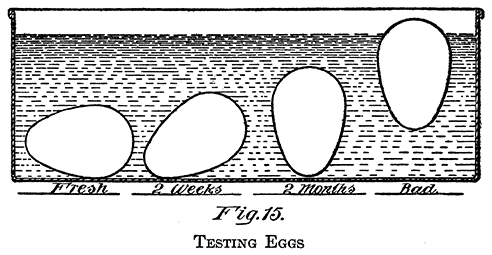 Fig. 15. Testing Eggs
The most important work on hand was the construction
of the addition to their home. After
considering the matter in all its details, it was
concluded to put up a building entirely separate
from the other structures, to contain four rooms,
one of them to be large and utilized as a common
living room, and the others as sleeping apartments.
The material had been taken out for the building,
and the Professor, John, George and Ralph
were engaged at this work, while Harry and Tom
were engaged in the machine shop and were busy
in turning out the barrels for new guns, as well as
preparing the ammunition.
The tools in the machine shop were not numerous
enough to advantageously utilize more of them
there, and the building was now very important
to them, as the four boys were compelled to sleep
in the shop, for want of room in the house.
The joist had all been laid for the lower floor
and the studding now being put up and the upper
joist laid on preparatory to erecting the rafters.
John was an expert in building, and was really
the directing hand at the various steps in the operation.
While engaged in the drawing up of the
rafters, one of the floor pieces gave way, and
John was precipitated to the floor below, striking
as he fell one of the lower joist, which cut a terrible
gash in his head and rendered him unconscious.
The Professor rushed over to the fallen man,
and the boys were on the spot to render assistance.
Chief, who was also an interested worker,
was the first to grasp him with his powerful arms,
and disdaining the assistance of the others, carried
him to the house and gently laid him down, as
the Professor directed.
Without a word he rushed for the jar of water
and brought it to the Professor, who bathed his
wounds, but the blow was so severe that he exhibited
no signs of returning consciousness.
Harry and Tom rushed over to the house in
consternation, and exhibited the greatest grief.
"Do you think he has been badly hurt? Do you
think it is fatal?"
"It is still too early to determine that. See this
wound? It was a terrible blow. As it is, directly
above the ear, it may not be as serious as if he
had been struck forward nearer the temples."
During the entire day John lay there, breathing
with some degree of regularity, but with a greatly
accelerated pulse, and the Professor was constantly
watching this phase of the case.
There was little sleep that night. All were too
anxious to retire. Chief was on hand without a
moment's intermission. George prepared the
meals, but the native never left the room even for
the purpose of taking refreshment, and it was
really pathetic to see this exhibition of sympathy,
which was constantly alluded to by the Professor.
"The Chief has in him the making of a man.
The surest indication of a real human trait is
just what he is showing. The lower man is the
less he cares for his fellows."
During the night the fever was close to the
danger point, and the Professor never left his side.
As the day advanced the fever abated, and his
breathing became more normal. Before noon
there was a marked change. On the day of the
accident, and during the night, John lay there
motionless, and, aside from his regular breathing
and a few periods of spasmodic twitchings, there
was nothing to indicate that he was living.
But he now became restless, and occasionally
opened his eyes, and all stood intently watching
him. All through this period his face was pale
and drawn, but a color began to come, and he
turned his head from side to side, and the intervals
between the openings of the eyelids became
shorter. At first the eyes gave a glassy stare,
but now at each recurring stare the eyeballs would
turn and search the room, and although he would
gaze in the faces of the watchers, the look did
not indicate recognition.
Suddenly he opened his eyes wide, and grasping
the covers drew himself forward and upward
slowly, turning his head around from side to side.
The Professor held out his hand, as a warning
not to disturb him. He sat up and gazed first
at one and then at the other.
What a wonderful difference was exhibited in
the eye. It was bright and lustrous, and every
glance betokened a question. Not a word was
spoken. It was so tense that the boys appeared
to be hypnotized. When he had fully taken in
his surrounding, he grasped the Professor's hand,
and said: "Where am I? Who are you?" Without
another word he sank back on the pillow exhausted,
and the Professor leaned over him and
quietly said: "You are yourself again; and we
are your friends."
"Friends; friends," he muttered to himself.
"Yes; yes, I remember," and his eyes closed, his
limbs relaxed, and he passed off into a quiet sleep.
The boys filed out of the room, and the Professor,
with a smile, despite the tears that fell,
walked out without saying a word, nor did the
boys ask any more questions. The Chief never
moved, but kept his eyes on John, and he did not
even heed Angel, who came down from the rafters
quietly, and passed out the door, and stood beside
George, and leaned his head against him,
as the boys began to whisper to each other.
The boys had witnessed a scene which it falls
to the lot of few to experience. The awakening of
the faculty of remembrance is one of the greatest
mysteries of human existence.
John slept for three hours, and there was no
thought of work or play. Barring the occasional
visits of the Professor to see the patient, they
were together. It was one of the most remarkable
events in their lives.
"Isn't it singular," asked George, "that he has
never been able to talk since he has been with
us?"
"The medical term applied to the loss of that
faculty is called aphasia. The function of speech
seems to have its seat in a portion of the left side
of the brain, and when that portion is diseased or
injured, it affects the speech in many ways. Sometimes
the sufferer knows what he wants to say, but
cannot utter the word; at other times he will say
the wrong thing, knowing that he is doing so, but
utterly unable to prevent it; it also shows several
other phases where the sentences become disjointed,
or meaningless, not due to lack of intelligence."
"Has no way been discovered whereby the diseased
part can be cured?"
"Operations have been performed with remarkable
results, but not with uniform success. In
some cases where the speech center is destroyed, a
new brain center has been developed, and the lost
power of speech recovered."
"I cannot understand Chief's intense interest in
John," said Tom.
"That is a peculiar thing. The savage, no
doubt, considers him demented, and it is a singular
thing that people of low intellectual order
among many people, believe the insane person is
exalted, and are sometimes treated as deities."
Before noon the patient began to move about
uneasily, and soon thereafter awoke. The moment
his eyes opened he looked at the Professor,
who said: "You are so much better. Are you
hungry?"
In anticipation of this event the Professor had
asked the boys to prepare some delicacies for him
the moment he awoke.
As he had eaten nothing since the morning of
the day before he replied affirmatively, and after
he had eaten and the wound in his head was
dressed, he began a series of questionings on every
conceivable subject.
"We are on an island, and there are a number
of tribes here, with incessant tribal warfares between
them, and it appears that the principal occasion
of the wars is due to the possession of the
captives which they take from the toll of the sea.
I was one of several unfortunates shipwrecked
here over a year ago, during one of the worst
storms that I ever saw at sea."
"It was undoubtedly the one which we experienced,
although we were the occupants of a ship
which had an explosion, and we were left adrift
when this storm was brewing. But I must advise
you to remain quiet for the day, until you regain
your strength, and we can then tell our story, and
we shall be glad to learn yours."
It was a joy to all to know that John had recovered
his memory, and Harry was anxious to
present the match box, to see whether it was his,
but the Professor advised against exciting him
in the least until the following day.
The Professor had not even asked his name, as
he wished all to be present when the revelations
were made. During the most of the day John
slept. It appeared as though nature had exhausted
herself in bringing about the cure. The
wound, however, was a most serious one, and the
Professor knew that the utmost care must be taken
with a fractured skull, to prevent the setting in
of complications which might injuriously affect
the brain.
"Do not feel any alarm about him now," was
the Professor's injunction; "he is not at this time
in a serious condition, and I believe his remarkable
constitution will pull him through without any
further trouble. In the meantime, let us proceed
with our work, and give him ample time to recover
without any sort of harassment."
All returned to their duties with more cheerful
hearts. It seemed as though something had been
lifted from their minds. The second day after the
event following the restoration of his reason, John
would not be left in quiet any longer.
He sat up in his couch, and looked over the
boys, as he greeted them heartily.
"Do you remember me?" asked Harry, as he
held his hand.
"Yes, I remember all of you, but I cannot remember
how you came to me, or how I met you,
or where. I know that we went together on a
journey, and I saw some things that made me
think of things in the past. I don't remember
ever having been in this place before."
"Don't you remember the shop, and the water
wheel, and the building of the house?" asked the
Professor.
He looked around in a bewildered way, before
answering: "The shop and the building? Where—when
was that?"
"At the time you fell from the building, four
days ago?"
"Fell from the building—what building?"
"What do you remember about the trip we
made?" continued the Professor.
"I remember that we had a glorious fight, yes,
several of them, and I remember some brave boys,
the noblest fellows I ever saw—and you are the
boys—I can remember you well—I never saw
braver men in battle; and I also remember seeing
something which you gave me," and he searched
his pockets, and looked around to try and remember
what it was. "Probably, that was a fancy
only—let me see," and he stroked his forehead,
as if trying to recall it.
Harry reached down in his pocket and drew
forth the match safe and held it before him. "Is
this what you mean?"
He grasped it, and eagerly exclaimed: "Yes;
that is what I mean."
"Are those the initials of your name, and is
your first name John?"
"Yes; John Lewis Varney. But who are you,
and how did you come here?"
"My name is Harry Crandall, and this is the
Professor who was with us on the schoolship Investigator
when she went to the bottom of the
sea, following an explosion."
"The Investigator that was to have sailed from
New York in September"—and he looked around,
"September, last year?" he asked inquiringly.
"Yes," answered the Professor; "and this is
George Mayfield, and here are Ralph Wharton and
Tom Chambers. Do you remember we rescued
them on the trip?"
He looked to the floor for a moment, and then
slowly said: "I recall that also, but I do not
remember how we got away from the savages."
At that moment his eyes fell on Chief, who had
witnessed this remarkable scene, and he started
up and leaned forward, and spoke to the Chief in
his own language. This effect on the savage was
electrical, who rushed up to the couch and clutched
John's hand. Then turning to the others, John
continued: "Uraso knows me, but I doubt
whether he recognized me in this bearded appearance,
because when our acquaintance began
my face was smoothly shaven, and I had an entirely
different attire from what I acquired later
on."
"We are all intensely interested in knowing
your history, and how you came here; but first
tell us what you knew about the Investigator.
You seemed to know about the sailing date."
"I was booked to sail in her as one of the instructors,
but a serious illness, contracted in
Africa, from the previous visit there, prevented
me from accepting the berth, and she sailed without
me."
"Isn't that a singular coincidence," exclaimed
Ralph. "My uncle told me that one of his tutors
at college, by the name of Varney, would be on the
ship, and that is one of the reasons he so strongly
urged me to sign for the trip."
"Your name—what was his name?"
"Stratton; James Stratton?"
"Jim Stratton, the big, healthy, jolly boy!
Everybody liked him. And you are his nephew?"
Then turning to Chief the Professor asked:
"Do you remember when and how we captured
him?" John looked and tried to recall the incident.
"No, I do not now think of anything which
is familiar, nor do I remember seeing him until
a moment ago."
"But if you are not too much exhausted, we
would be interested in the history."
"I do not suppose that my history, previous to
reaching the island, would be very interesting, but
as you have asked it I will briefly relate it."
JOHN'S WONDERFUL STORY
"I was born on the Atlantic seacoast in a small
New England town. My parents were the richest
people in the community, and it was their ambition,
as it was mine, to finish my education at one of
the great universities there; but shortly after
my entrance as a student the entire fortune of
my parents was swept away, and I was compelled
to seek employment.
"I was provided with a place in a commercial
house in which my guardian was interested, and
the only consideration shown me during the six
months I remained there was the amount of work
they could get out of me. Like many other boys
I ran away, and took a position on a sailing vessel.
This was the turning point in my career.
"I was fortunate enough to fall into the hands
of a captain who was, undoubtedly, an exception
to his class, but he had in early years been a
pedagogue, and seeing the disposition on my part
to make a constant use of his library, of which
he had a most wonderful store, he took me from
the drudgery, which was my early lot, and made
me his assistant.
"I was a good penman, and before long I was
entrusted with the position of recording and entry
clerk for the ship, and I took charge of the log,
and did things of that kind under his supervision
during the long trip to Chinese waters.
"The trip among the western islands occupied
two years, and I became an expert skipper as time
went on, and many, many hours he and I sat up
together and perused the wonderful books he had,
and discussed a wide range of subjects which the
readings suggested. It was a feast for me, and it
was such a pleasure to him, which I know was
real and unaffected.
"Three years after my sudden disappearance
from New Bedford the ship sailed into the harbor,
and the first one to greet us was a beautiful girl,
the daughter of the captain, and the first most
graceful act of his was to bring her over to me,
and I was presented to her.
"I do not know how I ever passed the days of
the following two weeks. Everything was a dream
to me after I saw her, and I often imagined that
the captain knew what my symptoms were. One
day he called me to the cabin and said: 'John,
how do you feel about signing for another term of
three years?' My heart was so full that I answered:
'Why for three years? Make it for as
long as I live.' The captain smiled and stroked
his beard for a while, and then his countenance
changed, and he said, 'John, you know I am blunt
and open in all my dealings, and you haven't been
treating me in that way.'
"That was the only time in the entire three
years he had ever upbraided me, or found any
fault, and I was so dumbfounded that I did not
know how to answer, and when I recovered and
inquired in what manner I had offended him, he
replied, 'I did not say you had offended me. But
you love Harriet, and I know you do, and you
have been trying to hide it from me.'
"How had he learned that she and I loved each
other from the moment we first met, and that we
saw each other at every opportunity, and made
mutual confessions of love? I started to apologize,
but he began to smile again, and I knew it
was not so serious. 'Yes,' he continued, 'I have
charged Harriet with it, and she confessed, so it
will not be necessary for you to defend yourself.'
"We were in port for three months, and Harriet
told her father that she could not bear to have us
both go away, and before the ship sailed we were
married, a fine suite of rooms was set aside for our
use, and I became the first mate of the ship, as
well as the first mate of the most beautiful woman
in the world.
"Thus I passed a year of the happiest days that it
was ever given man to enjoy. Together we gleaned
the library for our recreation, and with music and
song, it was one continual revel of bliss. But one
day we steamed into a plague-infected port, where
quarantine regulations in those days were not the
best, and before we could take the proper precautions
the captain and my wife were stricken.
"The terrible story that followed, the days of
ravings, and finally the death of my wife, are too
tragic to repeat in detail. The captain recovered,
and, singularly, I escaped, and as soon as he had
partially recovered I ordered the ship to sail away
from that accursed place.
"When the captain recovered he was a changed
man. His daughter was the only thing to him
in the world, and her happiness had been the greatest
delight and pleasure. But now he rarely appeared
at meals, and the handling of the ship
devolved on me. I could not rouse him sufficiently
to learn what course to take or what disposition to
make of much of the cargo.
"Two months after the sad event he called me
to his cabin, and he was lying down, weak and
emaciated. 'I have asked you to come because
there are some things I want to place in your
hands. I have no further use for them, as the
effect of the plague has never left me, and I am
glad of it.
"'You may break the seal of this when I am
dead.' This was most heartrending, coming from
a man I loved better than any one in the world excepting
my wife. He died that night, in silence,
and without a soul near him.
"We were then on the broad sea, west of Australia,
and before the funeral services were to
take place I opened the sealed package, and I
learned that the ship and cargo, together with
all securities and funds in the hands of his bankers,
were willed to me, and I was enjoined to commit
his body to the sea.
"I changed the course of the ship to the nearest
port, and sought the United States Consul, in order
to register the papers, and to establish, by the
record there, the new ownership of the vessel.
"When I returned to the ship something seemed
to prevent me from going aboard. It was such a
weird and ghastly feeling that I did not rebel
against the warning. Indeed, I was relieved that
the indescribable something, which men sometimes
in that condition feel, turned me away. The only
thing that remained close to my heart were the
things that my loved one wore, and those things
she treasured, and the store of books.
"All those I had removed, but I could never go
aboard that ship again. I advertised the ship for
sale, and it soon found a purchaser, and I was a
wanderer on the face of the earth. My parents
were both dead, and I had no brothers or sisters
living.
"Where should I go, or what pursuit should I
follow? I went through India, listlessly, and from
a Mediterranean port sailed for England—anywhere.
But we landed at Gibraltar. There I saw
a troop of smart English on the way to Africa.
I was imbued with the spirit of adventure, and
I offered to join, but was refused, as I was not
a subject of the Queen. But later I knew how to
correct that, and I sailed with the next detachment
to the south, and for two years I took part in
the Matabela campaign, where the fighting was
more bitter and relentless than in any colonial
contest England had ever engaged in. I was severely
wounded, and sent to England at the close
of my term of service and received an honorable
discharge. In the meantime I learned that all the
funds from the proceeds of the ship had been swallowed
up in a bank disaster, where they had been
deposited, and I was left with nothing but the
little I had saved.
"My discharge finally served the purpose of securing
me a position as a tutor to a young lord,
and through him I later on obtained a berth as
instructor in a well-known institution. But this
was too tame for me. I went to Greece and entered
the army, and fought through two campaigns
against the Turks, and when the war ended I took
the first ship and sailed for New York.
"Within a day after landing in that city I joined
the army and was sent west, where, within six
months, it landed me in a campaign under General
Crook against the Apaches of the Southwest,
and was present at the capture of Geronimo, the
most bloodthirsty devil that was ever permitted to
live. From there we went to the north, and we
had a repetition of the experiences against the
most skilled warriors on the American continent,
the Siouxs and the Arapahoes.
"When my enlistment expired I had earned a
lieutenancy, but I had tired of the turmoil of the
past six years, and returned east and then accepted
a position as Professor of Philosophy in the
college where Jim Stratton was a student.
"I was always fond of tools, and the machine
shop on board our vessel was a constant source
of enjoyment, and before I sold it I had become
so proficient in the use of tools that I could make
anything in wood or iron.
"I enjoyed teaching, but the life was not free
enough for me, and after five years of that drudging
life I sailed for Europe, and again visited India,
going to all the great ruins; then to the scenes
of the vast exploring fields of the Archeological
Societies, in Arabia, on the plains of Babylon, and
in Syria. From there I turned to Egypt, the land
of the greatest mysteries on earth. I went up the
Nile far beyond Khartoum, and tried to interest
myself in some of the interesting things that men
are constantly bringing to light, and which go to
show the great antiquity of men. I joined a caravan
to traverse the White and the Blue Nile, and
to go over the trails made by Baker and Livingstone
and Stanley.
"Here, at last, seemed to be my work. It had
enough of the charm in it on account of the hazard
which accompanied us on every step, and this for
the first time put me on my mettle to learn to
dig out the hidden secrets, which caused it to be
called the 'Dark Continent.'
"Am I tiring you? Well, then, in company with
another adventurous spirit we traversed the most
remote parts of that vast interior and met with
adventures which may some time interest you.
Thus four years were spent, without seeing civilization,
and in a region where men hunted men for
the pleasure of it.
"I was hunting them, too, but it was not living
men, but those who had died thousands and thousands
of years ago. But that terrible sickness,
the jungle fever, took hold of us, and when we
emerged from the forests, and found our way to
the nearest settlement my companion died, and I
was again thrown back on the world.
"As soon as I could travel I sailed for New
York, and the first man I met was dear Jim Stratton,
who insisted that I must take a position as
archeologist in the college with which I was formerly
connected, but this I declined, and seeing
me in an emaciated condition suggested that the
position of professor of philosophy in the ship
training school would be the very place to give
me the benefit of sea air and employment—the
latter, particularly, because he knew how I had
always been a fiend for work, and that I must
be busy at something.
"I accepted, but a month before the ship sailed
I was taken down with another serious attack, with
complications of diseases, and recovered a week
after the Investigator sailed. I took the train for
the west, expecting to take advantage of the mild
climate of California during the winter, and when
I reached San Francisco I was greeted at the
hotel by an old acquaintance who invited me to his
room for a talk on a very important matter.
"It turned out that he and a friend, who had
considerable money, were about to purchase either
a good, strong sailing vessel, or a small steamer,
which was to go in quest of buried treasure
which the chart had indicated, this treasure being
the freights of many of the Castilian ships of
the seventeenth and eighteenth centuries, and in
certain places the hoards of the buccaneers that
infested the western seas.
"Here was an opportunity to recuperate, and it
had plenty of action in it to suit me, and I joined.
We sailed from the port in the latter part of December,
about the time you were passing through
the Straits of Magellan.
"We had a fast sailer and a staunch boat, but
my friend was unwise in the choice of the sailing
master, but this did not hamper us much during
the ordinary course of sailing, but in a short time
he with several others of the crew attacked us and
attempted to capture the ship. In the battle which
followed my friend was killed, and his friend dangerously
wounded. This was the condition of affairs
when the terrible monsoon struck the vessel.
"That terrible sea and the danger to the ship
settled all difficulties. The master was too full
of drink to take charge of the ship, and the mate
was not much better. I took command, and for
four days we maneuvered the ship to keep it from
foundering; at the end of that time the master
recovered momentarily, and, securing possession
of a revolver, cleared the deck and prevented us
from handling it.
"He resisted every effort to capture him, and as
a last resort I was compelled to shoot him. This
was a signal, notwithstanding our perilous condition,
for the intimate associates of the master to
range themselves against us, for we now had only
four men against the seven who were in league.
"I did not want to take human life, and I refrained
from this last step, and as the ship was
bare of sails and we were in position to control
the tiller we passed two days and a night, with
only a few crackers for food, and almost exhausted
from the strain.
"Night was approaching, and with not a star in
sight, and in no condition to take any reckonings,
we made up our minds that we must somehow fight
our way through one more night before giving
up. The mainmast was a wreck; the shrouds on
the port side having been torn from the gunwale
the second day of the storm, and the entire deck
was one mass of debris and wreckage.
"It was a dangerous thing to move along from
one part of the deck to the other, as this loose
accumulation of material, at each successive lurch,
would be tossed first one way and then the other.
This was one thing that kept the villains at bay,
but it prevented us as well as themselves from
getting any food.
"In desperation I took my revolver, and, at the
risk of my life, at every step, forced my way to
the pantry and found some food. Before I reached
the bridge the roar of the breakers fell upon me,
but the darkness was now too intense to enable
me to see anything, and I knew that our next great
catastrophe would be the rocks.
"I never reached the bridge again, for the vessel
struck, and with a terrific grating sound it
moved toward land, and then a giant hand seemed
to lift it upwardly, and I knew no more. When
I awoke, which must have been along noon of
the following day, I saw one of the sailors dead,
not fifty feet away, and the master of the ship
was close beside me, with an indescribable mass
of wreckage all about.
"When I had recovered sufficiently to judge of
my surrounding, I went over to the master and to
the sailor, and saw that their pockets had been
rifled, and I instinctively put my hand to my
pockets, to find that everything, my watch, this
match box, which was a present from my wife, my
knife and everything in my pockets were gone.
"From this I knew that such of my companions
as had been saved had gone off, without making
any attempt to ascertain whether I was alive or
not, and had taken my things besides.
"I had my clothing, which was still wet, but I
was glad to be alive. That seems singular, doesn't
it, when I had thrown myself time and again
right into the jaws of death! I saw a barren
shore, but found plenty to eat as I advanced into
the interior. I went to the south and southeast
for the first day, and soon saw the first signs of
human habitations.
"Then I came across a tribe of savages who
were sacrificing some human victims. It dawned
on me that it might have been some of my companions,
and a spirit of revenge possessed me.
But I had no weapons, but relying on my experience
in eluding savages, I crawled up to the village,
during the height of the orgy, and slew one
of the warriors, and took his weapons, as well as
his headdress.
"But I was discovered and brought the entire
tribe down on me. I avoided them, doubled on
my tracks, and ran into another branch of what
proved to be the same tribe, as the headdress
plainly showed me. I again avoided capture, and
in going through the hills discovered a cave, in
which I took refuge.
"To my surprise the cave was tenanted by a
certain class of savages, and I had reason to believe
that it was the abode of the medicine men
of the tribe, or the Hoodoos, because the warriors
avoided it as they would a pestilence. I found
some wonderful things in that cave, in which I
secluded myself as best I could to avoid detection
from those within.
"But I needed food, and one night stole out,
only to learn that they had known of my entrance
into the cave, and was driven back again, and
making my way into the interior, how far I do
not know, lay down exhausted, and, on awakening,
not knowing which way to go, heard the voices
of the savages, and in going in the opposite direction
was surprised to see a streak of light ahead.
"Approaching near the entrance, waiting there
for hours, and not seeing or hearing them, cautiously
crept out, and found that the sun had
risen several hours before, but that the opening
was to the western side of the hill and I had entered
it on the eastern side."
"Won't you tell us, John, how you knew it was
to the west, and that it was morning?" The boys
looked at George a little queerly, and so did the
Professor, and he quickly divined the reason, and
continued: "Pardon me, Mr. Varney, but we have
been in habit of calling you John so long that I
forgot myself."
"You have been calling me John? How did you
find out my name?"
"We simply took that as the most convenient
name; but please go on and forgive me for interrupting."
"No apology is necessary. I hope you will know
me as John only. But you asked me a question.
I examined the moss, which in the southern hemisphere
grows more abundantly on the south side
of the tree; just as in the north it grows only on
the north side. As to the sun, if it had been afternoon
it would have been to the west of the hill and
not to east of it.
"Having emerged from the cave in the vicinity
of the last village another flight was necessary,
and I turned to the south, reaching a large stream
in my wanderings, and, in order to avoid capture,
swam it in the night. I still had the bows and a
dozen arrows, together with a crude hatchet, which
was taken from the warrior.
"The flight was continued to the south, and thus
I lived from day to day for over three months,
occasionally seeing the various tribes. Then for
a period of two months more I was hunted over
the entire southern portion of the island, and
finally driven into the mountain. Between six and
seven months after the shipwreck, in a moment of
carelessness, I was taken by a tribe in the south,
and held in confinement for over a month, when I
was to be offered up as a sacrifice.
"On the day appointed there was a terrible uproar
in camp, and I could see that a neighboring
tribe had attacked, and escaped, only to be captured
by the successful invaders. This was the
tribe that Osaga, here, was a member of. Again
escaping I secured one of their spears and a bow
with some arrows, and fought my first captors
with such determination that Osaga's people became
my friends and I was given limited liberty,
and began to learn the language.
"Before long the two most powerful tribes
united and attacked us, and defeated Osaga's people,
and I escaped to the mountains. This was
fully eleven or twelve months after being cast
ashore, and on the last day they were in sight I
can remember going down a steep precipice. The
only recollection of my former self came day before
yesterday when I awoke from a refreshing
sleep."
CHIEF AND THE POISON PLANT
John was visibly exhausted from the effort he
had made, and soon passed off into a quiet sleep.
During the evening the Professor suggested that
they might retire to the shop, so that he would
not be disturbed, but John insisted that it was so
good to hear their voices again, and would like to
have them all present.
Harry and George kept them interested a great
portion of the time with stories of their adventures.
They told about the bear fight for the possession
of the honey; the shooting of the wild animals
in South Forest, the making of the flag, the
capture of the yaks, the flagpole incident, the fight
between the bulls, and the amusing affair connected
with the removal of the yaks to their new home.
This latter occurrence is what amused John the
most, and suggested that probably if they had
adopted some of the hitches which sailors used
the yaks could have been controlled more easily.
This interested George.
"Won't you please tell us something about the
hitches and knots which the sailors make?"
"They have a great many forms, each designed
for some particular purpose, and if you get a
rope I will try and give you some of the principal
ones. Get a piece long enough so that the knots
and hitches can be kept for future reference."
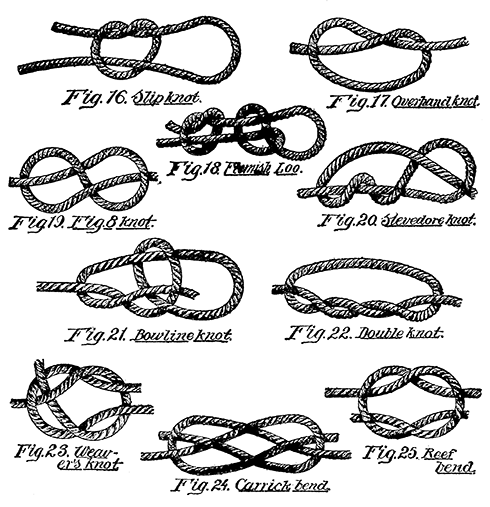 Fig. 16. Slip knot. Fig. 17. Overhand knot. Fig. 18. Flemish Loo. Fig. 20. Stevedore knot. Fig. 21. Bowline knot.
Fig. 22. Double knot. Fig. 23. Weaver's knot. Fig. 24. Carrick bend. Fig. 25. Reef bend.
Fig. 16. Slip knot. Fig. 17. Overhand knot. Fig. 18. Flemish Loo. Fig. 20. Stevedore knot. Fig. 21. Bowline knot.
Fig. 22. Double knot. Fig. 23. Weaver's knot. Fig. 24. Carrick bend. Fig. 25. Reef bend.
He then proceeded to make the knots, and continued:
"The seven knots (Figs. 16 to 22, inclusive)
are made at the ends of the rope, as you will
notice, and are the forms used to attach the rope
to an object. In the next three forms two ropes
are attached to each other, and are usually called
'bends' (Figs. 23, 24, 25).
"Then, in addition to that, the sailor has several
ways of attaching the rope by a hitch around a
standard, or other object. Look at these two
forms (Figs. 26, 27). Look at the boat knot, where
the hitch is made in the rope itself; and the sheet
bend toggle, where the ends of two ropes are attached
together to a standard or cleat. And now
I am making what are called hitches, and the
three forms (Figs. 28, 29, 30) are the best examples."
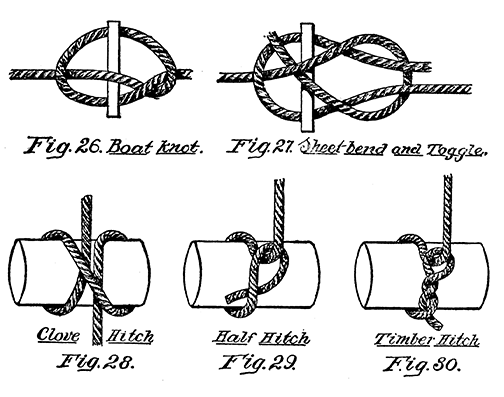 Fig. 26. Boat Knot. Fig. 27. Sheet bend and Toggle.
Clove Hitch Fig. 28. Half Hitch Fig. 29. Timber Hitch Fig. 30.
Thus the conversation drifted from one subject
to another, covering a variety of interesting topics.
George reminded the Professor that he had
not yet explained to them what the spectroscope
was, and its uses. He laughingly responded:
"That instrument is one of the most wonderful
in all the ranges of human discoveries. By its
means the elements of substances are determined,
and the composition of the heavenly bodies are ascertained."
"In what way is it done?"
"Simply by using light as the agency."
"Is it like a telescope?"
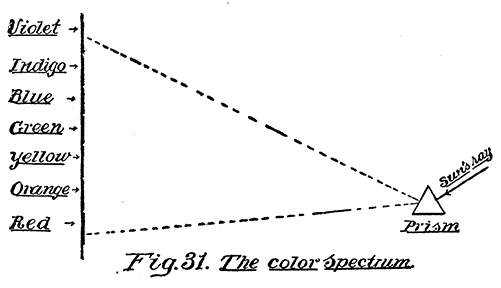 Fig. 31. The color Spectrum.
"No; entirely different. It depends wholly on
one thing, and that is the breaking up or dividing
the light that comes from an object. Let me make
this a little plainer. If a ray of sunlight is allowed
to pass through an orifice into a darkened
room, and in the transit through the opening it
goes through a prism, or three-sided piece of glass,
the light produced on the opposite wall will show
the seven colors of which sunlight is composed.
The drawing (Fig. 31) shows how this is arranged.
Now iron shows these colors differently arranged,
aluminum in another way, and so on with all different
substances, and the light projected from
each is called its spectrum, its particular analysis."
John's recital during the day had produced a
powerful impression on all, as well it might. It
shows what wonderful trials men can endure.
Ralph and Tom were frequently affected by it,
and at times could not prevent tears from coming.
They recalled their own sufferings.
The Professor thanked John that evening for
his story, and said: "We must not tax the patient
with any more talk to-night. We have
learned a lesson of perseverance and trials. The
history of man is always profitable, and we are
thankful for the news it gives us of the people here
but you must be patient and wait a more opportune
time to hear our story, and then we can advise
with each other as to our future course."
The boys were early in conference with each
other after they left John, because there were some
interesting things to them in John's story, which
needed clearing up.
"Did you hear what he said about that cave?"
was Ralph's first question.
"Yes; and I think I know where that cave is?"
answered Harry.
"Where?" asked Tom and George in a breath.
"Right at the camp where we found you."
"Oh, you mean that cave we found at the hillside
after we started for the river?"
"Don't you recall that John took me around to
the mouth of the cave, and when we said that we
might use that to hide in, he shook his head, and
moved away?"
"I thought the Professor acted queerly about it,
too, because he urged us away from the place."
All remembered the circumstance, and they also
recalled that the Professor gave a vague reply
when they asked him the reason why.
George cast a scrutinizing glance at Harry, who
waited for him to speak. "Harry, do you think
he found any treasure in that cave?"
Ralph and Tom now opened their eyes in wonder.
Was that what he meant when he said there
was something wonderful there? Harry looked at
the boys for a moment, in the intensity of the
situation, and said: "And we have also found a
cave." But the eyes of George caught Harry,
who suddenly stopped, because he recalled their
agreement not to divulge it to the boys until the
matter was mentioned to him.
"Where is it?" exclaimed Tom, eagerly.
"Not far from here."
"Will it be much trouble to visit it?"
"No; and we shall probably do so some day."
An island full of bitter and vindictive savages,
and a handful of men to meet them. It looked,
indeed, like a hopeless task. John's story left many
things unsaid; many things that they longed to
know. Who were Wright and Walters, whose
names were in the note found in the Investigator's
lifeboat, and who was Will, the writer of the
note?
The Professor was just as anxious as the boys
to have those matters cleared up, but he knew it
would be unwise to tax his strength with a further
recital, and the inevitable questions which
would be propounded, and it was well that his injunctions
were followed, because he was not yet
well by any means, and the further news which
they awaited was postponed.
In the evening Ralph had the flute, but the bass
viol was not yet ready, so that the two instruments
gave a little diversion to the day of excitement
and wonder.
John's illness did not now interfere with the
work on the house. It was pushed forward with
the greatest energy, the roof and sides enclosed,
and they were now nearly ready for occupying it,
by the time John was again able to be about.
Shortly after they had made the first samples
of glass, some months before, the trip to the west
had postponed the work in that direction, and the
Professor, with the aid of George, turned out the
first samples of glass, which they intended to use
in the new building.
"Why can't we have a looking-glass? It would
be such fun to set up several of them."
"I think we have sufficient mercury for the purpose,"
answered the Professor; so calling in Ralph
they set to work, under the Professor's direction,
to make some mirrors.
"The principal thing in mirrors is to get a white
reflecting surface. Silver and mercury are metals
which lend themselves to that use. If you polish
anything bright enough it will serve as a mirror,
but the whiter the surface is the better."
"Then why wouldn't white paper be the best?"
"It would if you could get a fine polish on its
surface, but the finest surface on the densest paper
is not as smooth as the polished surface of the metals."
"What is the best way to make the mirror?"
"The most available plan for us to follow is to
make an amalgam of tin and mercury."
"But what do you mean by an amalgam?"
"It means the combination of mercury, or quicksilver,
with any other metal."
"Will it be difficult to combine tin and mercury,
so as to make an amalgam?"
"That is one of the simplest things in the arts.
Tin and mercury unite by merely rubbing them
together; see how easily they combine to form just
such a surface as you want."
"Isn't that fine? But as that shines so nicely,
what is the need of putting a glass over it?"
"Simply to protect the amalgamated surface."
The largest piece of glass thus far made was
sixteen by twenty-four inches, and the boys selected
the most perfect pane, and in a short time a very
good mirror had been turned out.
"It has occurred to me that it would be good policy
to make a number of small mirrors, say six
inches square. They would be a valuable asset to
us in our next expedition."
This opened the eyes of the boys to the commercial
utility of the work they were engaged in for
the first time. George rushed over and brought
Tom and Harry to the laboratory, and exhibited
the mirrors, and explained that they intended to
make a number of small ones to take with them.
"That is a capital idea. Won't the natives go
wild over them?"
They were at work at once, first cutting up some
of the glass the requisite size, and before the afternoon
closed they had several small ones in addition
to the large one.
The large one was carried over to the living
room, and when it was brought in and hung against
the wall John's face lighted up, when they told him
of the work required to turn out the glass, and to
make the amalgam.
"What a glorious opportunity you boys are having.
How anxious I am to get up and help you.
What a splendid mirror that is. You surprise
me with the character of your work."
"We are going to have real windows in the new
house."
At this instant Chief appeared at the door, and
as he moved forward in front of the glass he
started back in fright as his own image appeared
to him. All of them laughed, and as he was now
at one side of the mirror he could not see himself.
But Harry mischievously turned it, and then it
dawned on the Chief that it was simply a perfect
representation of himself.
All savages know of the glistening qualities of
surfaces, but few of them, as was the case with
Chief, had ever seen any made with the white
amalgam, which, of course, made a perfect counterfeit
resemblance.
But Harry delighted him beyond measure when
he presented one of the small mirrors, and George
took a piece of the ramie cloth and folded it around
the mirror, a proceeding Chief could not understand
until John showed him it was for the purpose
of preserving it.
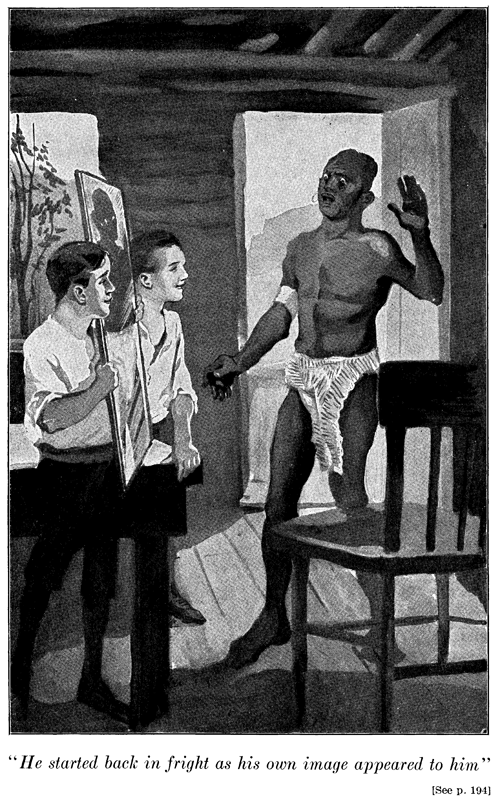 "He started back in fright as his own image appeared to him"
[See p. 194]
He kept it in the cover religiously from that day
forward, except at such times as he was employed
in examining it.
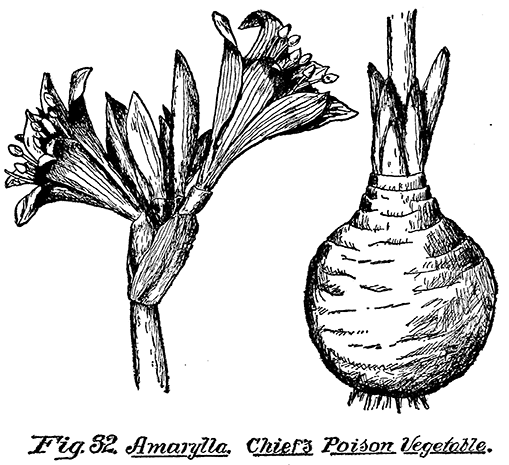 Fig. 32. Amarylla. Chief's Poison Vegetable.
When Chief appeared it was not noticed that he
carried a curious looking bulb, and when he sat
down to experiment the mirror several of
them fell from the pouch or pocket which was put
in the garment which had been provided for him.
The Professor saw the bulbs and picked up one
of them and glanced about the room, and then
looked at John in a questioning way. The boys
noted this. Nothing was said at the time, but as
the Professor passed out George followed him.
"What was that bulb you picked up?"
"It is the root of the plant called Amarylla,
and it is in the juice of this plant that certain
savages dip their arrow-heads for poisoning
them."
This information was not a little startling and
disquieting to George, who rushed back and quietly
called out the boys. "Do you know what Chief
has been doing? Did you see the peculiar bulbs
he had? The Professor picked up one of them,
and what do you suppose it is? It is the root from
which they make the poisons for arrow-heads."
Harry could not believe that the savage had any
designs on them. "I suppose he will bear watching,
so let us see what he intends to do with
them!"
When Chief had admired himself sufficiently he
took the bulbs to the kitchen and placed them in
the oven, as the boys called it, and when George
came in he was smiling, as he thought, in a very
peculiar way. George did not disturb the bulbs,
and when the meal was brought in Chief was on
hand and went to the kitchen. He soon returned
with the roasted bulbs and deposited them at the
table.
The boys looked at the Professor, and he and
John exchanged smiling glances, and both of them
took the bulbs and began the meal with them in
the most nonchalant manner. The boys could not
understand the Professor's defiant manner in eating
a poisonous bulb, and George cried out: "Didn't
you say that the bulb was poisonous?"
"Yes, it is, for some things."
"Well, how can it be poisonous for some things
and not for others. Don't the savages use the
poisons of the arrows to kill people with?"
"Certainly; but it is used in that case as a blood
poison. A blood poison is not necessarily a stomach
poison. In truth, there are few poisons that
are fatal to both the blood and stomach."
Chief had been slyly preparing this treat for
them, as savages like the root, and all regarded it
a welcome change, and it was that peculiar look
which George wrongly interpreted. How often the
motives of people are misjudged in the same manner,
and without a more pronounced reason than
Chief had!
When the meal was announced Angel, as usual,
was the first to appear, and when he caught sight
of his reflection in the mirror he thought one of
his friends had come to visit him. It did not seem
to startle him in the least, but like all children
tried to look behind it.
The wall prevented that, so when George handed
him one of the small ones, and he put his hand
behind the mirror, the vacancy there is what
alarmed him. When he did finally comprehend
what it was, it so attracted him that he could not
partake of the meal, but sat entranced before it.
After the meal he took the mirror to the rafters,
and found a hiding place for it, and they
would often notice him with it, but from that time
forward he never brought it down into the room.
A SURPRISING TRIP TO THE CAVE
The house was completed and partly furnished.
New bedding was prepared for the bedrooms, the
Chief installed in one, and the other two reserved
for John and the Professor. The new living room,
which was commodious, served as a dining room,
and a door was cut through from the old kitchen
to the new dining parlor.
The other rooms in the original building were
reserved for the boys. John was now fully recovered,
and felt like beginning his task anew, although
he did not recall any of the previous work
which he was engaged in. Chief was progressing
well in his education, and the constant source of
wonder to all was that he did not take the advantage
his liberty gave him to leave them.
One day John had a long conversation with him
on the subject, and afterwards the boys were curious
to know the result of the interview; but the
result of the talk was not, apparently, satisfactory
to John, and the subject was not pressed. He was
entirely well, and took a keen interest in everything
around him, and participated in the work.
Each new phase had some special attraction, and
as the days passed less anxiety was felt on this
score.
In one of the evening conferences it was finally
decided to make the preparations for a trip to the
portion of the island where the savages had their
homes. This meant a good supply of weapons and
ammunition.
The following circumstances determined them on
this course:
The Professor, addressing John, on this occasion,
said: "We were intensely interested in the
review of your experiences on the island; but there
are several things which we are anxious to know
about, and in some particulars you may be able to
supply the missing links. We have not yet shown
you the message which we found in the Investigator's
lifeboat, so that if you will get it, Harry,
you may be able to tell us something about it."
This was the little slip of paper which had on
it the following inscription: "We cannot hold out
much longer. Wright and Walters were captured
yesterday. Will."
Harry handed it to him, and he looked at it for
some time. "I do not know who Wright and Will
are, but Walters was one of the crew of the sailing
vessel that we took from San Francisco."
"Had you any knowledge of any of the boats of
the Investigator being on the west side of the
mountains during the time you were in that neighborhood?"
"No; during my stay with the tribe to which
Chief belonged I tried in every way to ascertain
something about the fate of my companions. Only
once during that time did I get any sort of knowledge
on that point. When I tried to describe the
men, all denied any knowledge of them; but pointed
to the youths of the village, and I could not
understand what they meant. That is now made
plain to me, as, undoubtedly, they meant the ones
referred to were boys."
"And, now, there is another thing I want to
know from Ralph and Tom. Did either of you
have a photograph of some of the boys on the
ship?"
George found the photograph which they had
taken from one of the warriors in the second day's
fight.
Ralph and Tom both declared that it was the first
time they had ever seen the photograph, and on
closer examination it was seen that while Harry
and George were shown on the picture, neither of
the other boys' features were there.
"Did either of you boys know of any of those
mentioned in the message?"
"I knew a Will, but I do not remember his last
name. I do not think Wright was the name of
anyone on shipboard. I am sure he was not one
of the boys," was Ralph's answer.
This information pointed to two things clearly:
That there were other boys, belonging to their
ship, castaway on the island, and that at least
one of the crew of John's vessel might be found.
It also assured them of the certain knowledge
that there were others, either wandering about, or
sharing the captivity mentioned in the message.
"I should state here," continued John, "I was
informed by one of the chiefs that their disposition
to the shipwrecked mariners had been, in the
past, a friendly one, but that some time previously,
how far back I do not know, a crew had
been saved, and instead of rewarding them for the
service, had murdered one of the chiefs and committed
such excesses, that in self-protection they
slaughtered them, and, thereafter, took prisoners
only in order to use them for their sacrifices."
The plans for the forthcoming expedition were
now fully discussed in every detail. The first
proposal was to build a vessel of sufficient size
to accommodate the party, but to this John offered
the same objection which they had theretofore
found so potent when the last trip was undertaken.
It would take too long, and when they
reached the savages it would be necessary to make
a trip or trips inland.
The situation now was entirely different. There
was no longer a question in their minds as to the
existence of savages, and, furthermore, they knew
the location, and the knowledge of John was positive
on another point: They were not located
near the sea, and the most powerful tribes were
far inland.
All these facts compelled them to undertake the
journey overland. The wagon was the only means
to transport their supplies, and as all except the
Professor, were vigorous, they would be far better
able to cope with the savages in that way
than by the sea route.
Now let us see what was necessary for the
purposes of defense. They had a force of six
men, as Chief was not considered one of the
force, notwithstanding his friendly attitude. They
had ten guns, and Ralph and Tom had been
engaged for weeks in turning out additional gun
barrels, for which the stocks had not yet been
prepared.
John suggested that twenty-five of the guns
would be ample for almost any force that might be
brought against them, and that provision should
be made so that while in defense, each could carry
two guns, by having one of them strapped on the
back.
Ammunition was of more importance, really,
than guns. They had learned this at the last encounter,
and it was lack of this that eventually
forced them to retreat.
On that basis, namely, of twenty-five guns, ten
rounds would mean two hundred and fifty shells,
and it was then considered that the most important
thing would be to utilize the time of two for
the purpose of making the shells. This was the
most laborious process, as every step had to be
done by hand, the dies being in the form of separate
punches, held and driven by hand, as they had
no such thing as a press for manipulating the
dies.
One morning Harry said: "I know it isn't the
proper thing to suggest it while we are all so
busy making the preparations for the expedition,
but I think we ought to make a trip to the cave
before we start."
Neither of them objected to the proposal, and
George went to the Professor, and told him that
he and Harry had conferred on the subject of
the cave, and with his permission they would take
the boys there.
The Professor's assent was given with a smile
of pleasure, and several lamps were put into condition
for the event. All was excitement now with
the young spirits, and the Professor assisted them
in the preparations.
It did not take long to reach the mouth of the
cavern, and lighting the lamps, descended slowly.
Neither George nor Harry had informed the boys
of the treasure within the cave, nor of the skeletons
which were discovered, although, when the
boys had asked the source of the skeletons in
the laboratory enough of an evasive answer was
given to make them suspect the source, and this
was confirmed when Harry told them, days before,
that they had also discovered a cave.
They descended the steps, and made their way
along the passage leading to the first recess. As
the chamber came into view the boys were entranced
at the sight. It was a novelty to them.
It was the first time they had ever witnessed
such a thing.
To Harry and George it was no longer a thing
to marvel at. They were veterans in the exploring
field.
"This makes a fellow feel queer in here," exclaimed
Tom, as he glanced around at the magnificent
stalactites.
"Did we tell you," replied George, "about the
mysterious thing that happened to us the second
time we came in?"
"No; what was it?"
"We entered from the other opening by the
sea."
"Another opening? Do you mean that this cave
has two openings just like the one John spoke
about?"
"Yes; but this is a mighty long one, and it had
a lot of water in it twice when we visited it, but I
don't think we shall find any here now."
"Why not?"
"Because we have not had much rain for the
past month."
"But you forgot about the mystery."
"That's so; we went in from the other end and
had gone up nearly to where the water began,
when we put one of the lights on a ledge, and went
forward with the other, and when we had gone
about a hundred feet, it disappeared, and we have
never found it to this day."
"That does seem odd. Do you think it was
taken by some one?"
"Well, we could not possibly account for it in
any other way but that it fell off the ledge by some
accident. How that could be possible I don't
know, as George declared he had placed it in a
secure position."
By this time they had reached the recess, and
George suggested that the entire cave should be
examined, and Ralph was somewhat in the lead.
Everywhere was the universal whiteness of the
calcareous deposit. As they reached the vicinity
of the chests, where the copper vessels were, they
formed a striking contrast to the whiteness all
around.
"What are those things there?" asked Tom,
stepping back in surprise, pointing to the vessels.
Ralph peered forward, to get a better view. "It
looks like kettles of some kind."
Harry passed the boys and walking up to one
of the kettles, overturned it, and as a shower of
the coins slid out, and rolled about, they were
amazed beyond all description.
Ralph was the first to recover, and he picked
up some of the coins: "Didn't you know about
these? I believe they are gold; look, Tom. Did
you ever see anything like this?"
Tom was stupefied. "I don't wonder that men
will risk their lives to get treasure like this. Here
we didn't hunt for it and we found it."
"Yes, but Harry and George knew all about it;
didn't you?"
And the boys laughed an assent.
"Why don't you take it out of here?"
"Well, it seems to be pretty safe in this place;
and if we should have been attacked by the
natives, we should have a place of retreat and have
our treasure with us."
After putting the coins carefully back, Harry
said: "Probably we may be able to discover
something else." And he moved forwardly to the
right, with Tom following close, and the boys
pressing up to see what else might be found.
There, at the place where the Professor had deposited
them in a row were the five skeletons,
and they presented such a ghastly sight that they
shrank back in horror.
"We found these in a little different position
when we first arrived."
"In what way?"
"They were in all sorts of positions in front of
the recess, and some of them had the knives still
sticking in their ribs, and one or two, one of
which the Professor has, had a big bullet in the
skull, which we took out and can show you."
"Where did you find these?"
"Right in front of the place where the treasure
was found."
"Well, did they have a fight, do you think, for
the possession of the treasure?"
"Undoubtedly."
"Now, let us go around to the other side of the
cave."
It will be remembered that in the other portion
of the cave the skeletons and the treasure, as well
as the weapons, were left just as they were found
by the boys, because they had never informed the
Professor of their secret visit to the cave, when
they discovered the chained captives and the
skeletons about them.
The party passed around the first projecting
wall which separated the two large chambers, and
as they were moving along something sounded in
the second chamber ahead. The boys stopped
suddenly. In a moment more the same peculiar
dull and ominous sound was continued, and it
seemed to be very near.
The boys looked at each other in amazement.
During all of the previous visits there had never
been the slightest sound within the cavern.
"Possibly," said Harry, "it may be running
water."
"It doesn't sound like water to me. I will—"
but Harry did not have an opportunity to say
anything more, as a terrific roar, like a cannon
shot, rang out, and the boys were simply petrified.
"What do you think that was?" whispered
George. They drew close together, and spoke in
whispers.
"This will never do," declared Harry. "If
there is anything in this place we might as well
know it now as later. Will you join me in the
hunt?"
And the boys responded with one assent. "Let
us go to the second chamber. Come on, boys."
And they bravely stalked down the corridor.
When the chamber was reached a hollow laugh
greeted them, followed by two hearty laughs.
The Professor and John had entered the opening
at the sea end, and hurriedly made their way to
the second chamber, where they awaited the coming
of the boys.
The boys were intensely relieved, and the Professor
was so happy to see the determined and
resolute spirit they manifested, that he complimented
them highly.
John was no less profuse in his commendations.
"I want to say, that men can be brave when they
know what they have to fight, and who their enemies
are; but it takes the stoutest heart to go
forth and defend yourself, or assume the offensive
against an unseen and an unknown enemy."
THE WONDERFUL PORTABLE FORT
On the return of the party to their home that
evening the events of the day were discussed to
the exclusion of everything else, and now was
the opportunity for the boys to learn something
about the other cave, of which John had given
a meager account.
"Would you object to telling us what the wonderful
things were which you saw in the cave at
the western part of the island?" was Tom's inquiry.
"Not in the least. The ship on which we sailed
from San Francisco contained the charts of several
caves, one of which was that of the cave I
referred to. I saw the treasure there with my
own eyes, and I can direct you to it, because, notwithstanding
the stress of my surroundings, I
took the bearings, on the following day, and it
will not be difficult to locate it."
"Did you remember the circumstances of the
visit to the place where we were being pursued by
the savages?"
John looked at the Professor, and then at the
boys. "I do not remember such an occurrence,"
he answered.
"But I would like to ask the Professor a question,"
exclaimed George. "What was it that made
you give us that quick advice to leave the mouth
of the cave when we wanted it as a hiding place?"
"I saw from the carefully hidden, but trodden,
path, that some one must have used it as a place
of refuge, and concluded that as it was so near
the village it might have been some of the clans
of the tribe, either as a place of concealment from
their enemies, in case of attack, or by some of the
so-called religious communities which many of the
tribes have."
"In what way did you discover that this cave
had been charted?"
"First by the peculiarity, that it had two entrances,
on opposite sides of a hill, and secondly,
by the singular internal arrangement, which stated
that within the corridors and the chambers constituted
a cross, and the treasures were to be found
at the extremities of the cross limbs, within the
two large chambers."
"Then you knew of the existence of this island,
before you sailed?"
"No; the chart merely described the characteristics
of the caverns, but stated they were located
on islands in the South Seas."
"Do you think our cave here is one of
them?"
"I do not think so, as I do not recall any description
which would fit this cave, except the two entrances,
and that is not uncommon."
"The chart stated that there was another cave
fifteen leagues to the southeast of that cave, which
also contained treasure, and that was the principal
reason why I traveled in that direction, and
thus found myself in the savage-inhabited part of
the island."
"Fifteen leagues? How far would that be?"
"Forty-five miles."
Nothing more was needed as a stimulus for the
boys. They had truly been thrown on an island
of wonder.
"Why is it," asked Ralph, "that so much of the
treasure of the world was hidden in these out-of-the-way
places by the pirates?"
"I imagine," replied John, "that they didn't have
much confidence in the rest of the world. The
manner in which they got most of the money was
by acts of piracy on the high seas, and it was
necessary to hide the proceeds of the robberies
as fast as acquired, because if they should be
captured, its possession would at once seal their
doom. These hidden treasures are distributed
over every part of the world. As to the other
part of your question, the vast hoards of gold
and silver so distributed, formed a very small
part of the wealth of the old world. It is not
known how vast a sum Pizarro took from the Inca
in Peru, but it is estimated variously at from
twelve to twenty tons."
The boys opened their eyes in astonishment.
"How much would that be worth in money?"
"Counting it at the present value of gold, every
pennyweight would be worth a dollar."
"Let me see; twenty pennyweights in an ounce,
and twelve ounces in a pound; that would be two
hundred and forty dollars in a pound."
"That is right."
"And then twenty tons would be 40,000 pounds.
And multiplying that by 240 would make $9,600,000.
My, what a lot of money!"
"Cortez, at about the same time, conquered
Mexico, and secured a much greater amount. All
over the western hemisphere, from northern Mexico
down to Peru, untold millions of gold and
silver were looted by the Spanish and Portuguese
navigators, and taken to Europe, and it is estimated
that as much more was disposed of in these
hidden recesses, and those who deposited them
were swept off the seas, and all knowledge of the
caches were lost."
"During what times was most of this money
deposited?"
"The pirates which infested the coasts of Spanish
America and the West Indies, flourished in the
seventeenth and eighteenth centuries. Originally
the French and English during the wars against
Spain used the expedition against her ships, as
acts of war, but later on, after peace was established
in Europe, the buccaneers continued in
their depredations, and it was made unlawful by
all the great nations."
From that day there was no cessation on the
part of the entire working force to prepare the
necessary ammunition required for a campaign
against the savages. It should be stated that
by this time Chief had learned many things, and
John took particular pains to teach him daily,
until he could pronounce many words very distinctly,
and understood the meaning of them.
It was surprising to see how quickly his mind
grasped the association of a verb with some name,
and the simplest and most common verbs of action
were taught. In this way it became apparent
that all should be cautious about talking of the
proposed expedition in his presence. Nevertheless
all were anxious to enlist him in the enterprise.
He never inquired about the gun barrels, and
curiously enough seemed to take no interest in
any of the weapons but the spears and arrows.
He was a fine archer. This was demonstrated on
several occasions, the only difficulty being that
the bows which the boys had were too small.
Chief selected his own branches, for the bows,
and showed the boys how to hold the arrows,
and the distance he could propel them was marvelous.
They were not by any manner of means
a match, by comparison, with the guns, but they
would be dangerous missiles if attacked in the
open, and of this fact the boys had learned several
lessons.
The wagon, which was constructed before the
first trip across the island, had been through some
tough places, and the wheels and axles were in
bad condition. These needed replacing, and that
was a task which would occupy some time.
One day, at the evening meal, the boys asked
about Chief. He had not been noticed by anyone
since noon.
He was usually at work with Harry, who was
asked concerning him.
"The last I saw of him was right after lunch,
and he was going in the direction of the clay
bank. As he was in the habit of going there
quite frequently I paid no attention to him."
"Did he have anything with him, that you
noticed?"
"Nothing but the bolo and the bow and arrows
that he always took."
"Possibly he is on some mission," replied the
Professor. "It does not seem likely that he has
determined to desert us; but it may be he has
grown tired of this existence. It is a curious phase
of these matters, however, which, I believe, will
apply in his case, that when he goes back he will
find his old life a very disquieting one to him, and
I predict he will be here again within a month."
"By that time we will be on our way toward
his section, and I hope we shall have the opportunity
of meeting him," responded John.
What required more attention than any part
of the equipment, aside from the ammunition, was
the structure of the wagon. This had to be a
fort for them, and so arranged that it could be
put up to meet an attack from any quarter.
But this, unfortunately, left the yaks exposed to
the assaults of the spears and arrows, and John
suggested a novel addition to the wagon equipment.
"My idea is this: As we are all pretty strong,
excepting the Professor, to stand the march on
foot, I would convert our wagon into a vehicle
which would carry the fort with us, and this fort,
whenever we camped, could be set up so that the
yaks would be inside, and thus protected as well
as ourselves.
"To effect this the more readily, my plan would
be to make three sections of boards, in the form of
a fence, each section to be six feet high and ten
feet long. These should be either folded together
in the middle lengthwise, so they could be nested
together and swung below the axles between the
wheels, and set up to form a square at one side
of the wagon.
"One side of the wagon body could be made to
be let down, so as to form a protection below the
body of the wagon. Within that enclosure the
yaks could be stationed, if we should be attacked,
and for the purpose of defense, four of us would
be within the enclosure and two in the wagon to
protect it from that side.
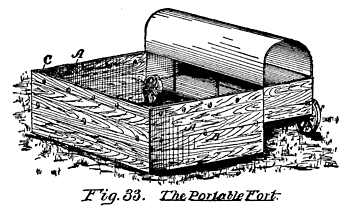 Fig. 33. The Portable Fort.
"The sketch which I have made shows these
features, in which you will see (Fig. 33), the side
boards (A) hinged along the middle line, as at
B. These would be held at the outer corners by
posts C. In the sketch the side board of the
wagon body has been let down, so access can be
had to the wagon."
The plan, so ingeniously contrived, pleased the
fancy of the boys.
"I imagine," said Harry, "this will be the first
time people ever carried their fort with them.
It will be fun to meet the savages with that kind
of an outfit."
"You must not think, however," continued John,
"that this is all we shall need. We must take in
the wagon sufficient food for the yaks to withstand
a siege, so that with our own provisions,
guns and ammunition, we shall have a pretty good
load."
"How heavy will the three sections of fence
weigh?"
"I estimate that, as we shall want the boards
made of good wood, the weight will be thirty
pounds per cubic foot, and as all the boards will
take fourteen cubic feet of lumber, the total
weight, including the posts, can be brought within
450 pounds, and I do not think our other material
will weigh much over 500 more."
"That would not be a hard load," observed the
Professor, "as we have often hauled a ton, but it
would be well to make a new set of wheels, and
we can then take with us an extra wheel for the
front and rear."
"I think we should take tools along also," said
Tom, "because we can always make our own repairs,
in that event."
"I am glad you referred to that. It is certainly
a suggestion in the right direction. Are
there any more observations from any of the other
army engineers?"
"I may be wrong," answered Harry, "but it
seems to me that one of the folding fences should
be put on each side of the wagon body, and the
third under the wagon."
"What is your reason for that?" asked Tom.
"Because we may want to put up the fort in a
big hurry some time, and by having them at the
three places, and have it understood who are to
take out each section, it would be the work of a
few moments only to set it up, because each set
of workers could handle his section without interference
from the others."
"That is really a stroke of genius. Certainly,
that is the sensible way," responded John.
"It is simply another illustration," added the
Professor, "how men, looking at things from different
standpoints, will see the defects in each
other's work. That is the story of every great
invention."
These conferences were of the greatest value to
the boys. It pointed out how men, through force
of circumstances, were compelled to devise things
for their need.
George had been an intent listener during these
discussions. "It does seem that the old statement,
'that necessity is the mother of invention,'
is true."
The Professor turned to him smilingly, as he
replied: "That may be so in very many eases,
it is true, but I imagine that in the vast majority
of instances the necessity was in the mind of the
inventor to get some money. The thought of that
requirement was a more vivid thing to him than
the real need of the article as an economic necessity."
"Do you really think that is the case?"
"If my memory is not at fault, the people of
England howled with derision when the first locomotive
was built; the men who put out the first
sewing machine had their stores broken into and
the machines smashed; and the telephone when
first installed was considered simply as a plaything
and curiosity, and not as a useful improvement.
It has been the history of every age and
of most of the great inventions. After the inventions
were completed, and their value shown, the
merchant and the manufacturer created the demand,
and then the articles became a necessity,
and not before. For this reason I think the proverb
should be amended to say that 'the necessity
of the inventor is the mother of invention.'"
Before starting on the trip the matter of clothing
had to be attended to. A quantity of ramie
had been cut, and put in water, for the purpose
of rotting the woody fiber, and this was taken
out of the water as fast as it was ready, and
cleaned and combed, and at times worked up into
threads, which were placed in the loom, and a
coarse cloth thus woven.
This was, necessarily, a slow process, and consumed
considerable time. This, together with
the making of the percussion caps, was the tedious
part of all the preparations. Every energy
was put forth to get the different things required.
Harry and Tom had made up the fort, and John
suggested the idea of having a drill exercise in
setting it up, so that the work could be performed
without interference.
During the day, when the posts and the fastenings
were all ready, the wagon was brought out
and the yaks yoked up. The elements of the fort
were attached to the wagon, in the manner that
they were to be transported. As there were three
sections of the fort, one on each side of the wagon
body and one below the axles, it was provided
that the six should form three divisions; the Professor
and Ralph, John and Tom, and Harry and
George the couples for setting up the fort.
As Harry and George were the most familiar
with the animals, and knew better than the others
how to handle them, it was made a part of their
duty, when the signal was given, to unyoke and
turn the yaks to the proper place at the side of
the wagon.
While this was being done, the Professor and
Ralph were to detach the section on the side of the
wagon where the fort was to be set up, and carry
it out at right angles and at the forward end of
the wagon. At the same time John and Tom
would take the section on the opposite side of the
wagon and carry it around to form the end of the
fort.
This would then give Harry and George the
opportunity to take the part below the wagon and
erect it at the rear angle of the wagon, while
Tom and Ralph were getting the posts for the
outer ends of the fort.
When all was ready, the signal was given, and
the various divisions sprang to their allotted
work. They marveled at the celerity with which
the fort was put up.
"I see a serious defect in the arrangement at
one point," said Tom.
"What is that?" was the question from all.
"You see we have the fort ready, but it is adapted
for one side of the wagon only. It may be most
important to have it arranged so that either side
of the wagon can be used for the fort."
"A fine suggestion," answered John. "That
change can be made by having both sides of the
body so they can be let down."
George also had a good suggestion to make.
"According to the calculations we have fourteen
cubic feet of material, and it is light wood, at
that. Why couldn't the fort be utilized as a
raft, so as to save the cutting of green timber,
which is so heavy?"
"Well," said the Professor, smiling, "we are
developing this at an immense rate. The new
idea is the starting point for an invention to so
arrange the sections as to make them act as floats.
Here is a great opportunity for the genius."
Tom and Harry conferred on this subject for
some time, and after luncheon, announced the
plan: "It is fortunate that the axles of our
wheels project. It will be an easy matter to take
the sections from the sides of the body and attach
one edge of each section to the projecting ends
of the axles, and then the two posts can be used
as braces to run up from the outer edges on the
sections to the upper edges of the body. The
third section can be left under the axles where it
now is."
John was delighted at the simple solution of
this problem.
"I really believe," said Tom, "that we can adjust
the sections in that way while the wagon is
moving, as it can be attached without any difficulty."
It is wonderful how one improvement marks
the advance stride for the next. Invention is
really nothing but a step by step movement; a
little addition here, another accretion there, and
so on, so that invention has been shown to be,
not a matter of quantity, but of quality. The
mere bending of a wire, if it produces a new and
useful result, is just as much entitled to the dignity
of an invention, as a room full of intricate
mechanism.
TRAILING A WARRING PARTY OF NATIVES
"Professor, won't you tell us what the difference
is between weight and gravity? We have
been discussing that matter this afternoon."
"Gravity is a force by virtue of which all bodies
tend to approach each other constantly; and weight
is the measure of the effect of gravity acting upon
a body. The two are often confounded."
"Now, the next thing we want to know is, does
gravity act in all directions?"
"Yes; and the attraction of one body for another
is in proportion to its mass—that is to say,
if two bodies, one weighing one and the other two
pounds, should be hung near each other, the heavy
object would pull the lighter one twice the distance
it would itself move."
"Do you mean to say that everything on earth
attracts everything else? I thought it was only
the earth that had the power to attract."
"The earth is no different from any other object
in that particular, but on account of its immense
size everything goes toward it and its motion
toward the small object is not noticed."
"Is there any way that such a statement could
be proved?"
"I suggest one plan: select two walls, close together,
or two tall trees, and run a wire across,
as I show in the sketch (Fig. 32). From that
cross wire, A, suspend three objects by cords, B,
C, D. The cord B is exactly midway between the
two walls, and the other cords C, D, and so attached
that the objects at their lower ends hang close to
the walls. It will be found that the cords C, D are
farther apart at their lower ends than at the upper
ends, and that the cord B is exactly plumb, as it
is affected equally by the attraction of the opposite
walls."
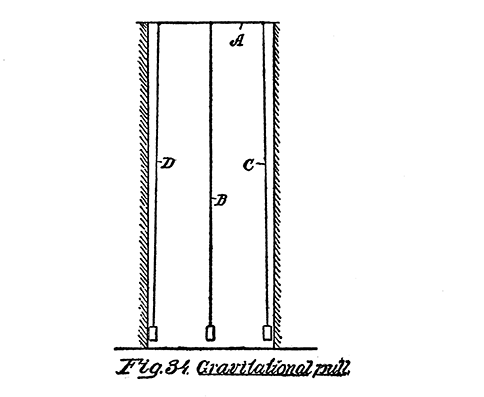 Fig. 34. Gravitational pull.
The new raft attachment was completed, and
Harry made the suggestion that it ought to be put
to a practical test, and that a good place to do
this would be below the cataract, where it was
wide and deep enough to float.
The drill was affected for attaching the sections,
as shown in the drawing (Fig. 35), in which
A represents the section under the axles, and B, C
the two side sections, attached at their inner edges
to the ends of the axles, and with the posts D serving
as braces.
The yaks seemed to know their business instinctively,
and moved down into the water slowly,
and the improvised raft not only prevented the
body from sinking into the water very low, but it
had a wonderful steadying effect, because the side
sections served as wings to prevent lateral swaying.
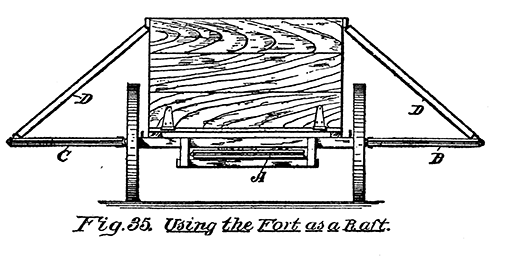 Fig. 35. Using the Fort as a Raft.
The crossing and the return were made without
accident, and the sections returned and fixed in
place, and the wagon was now completed for the
journey.
A considerable quantity of the barley flour was
ground, and both honey and cane sugar taken in
the vessels which had been recovered from the
cave. The ammunition was stored in four boxes at
convenient places within the body, and the little
metal stove, with the cooking utensils, located near
the rear end, where they could be conveniently
taken out and returned.
The three sleeping mattresses were stored in
the bottom of the body, near the forward end, and
as the sides of the body were three feet high, it
can be understood that there was an abundance of
room for them, and for the other things which
were carried along for their convenience and comfort.
Everything was bustle and rush. Angel was as
busy as the rest. It was his joy to carry things
to the wagon, at George's behest, and when the
hour for starting came, and the house was about
to be locked, he rushed into the room, before George
could close it, and mount to the rafters.
George followed his movements without a word.
He was back in an instant with the little mirror
which George had given him some weeks before.
It was the only time he had taken it down or
brought it within sight of those around him.
With this treasure in his hand he scrambled to
the wagon, and found a secure place in the top
bows of the wagon, and then hung on the rear
bow and waited for the start. He loved these
jaunts in the wagon, and they had been frequently
made during the past four weeks, but he had never
taken the mirror. How did he know that they
were going for a journey?
With a good-by to their herd, the jolly party of
boys began the trail through the forests, this time
not for the love of adventure, or to learn what
they had about them, but to relieve their fellows
and to be of service to the benighted people who
were their neighbors.
As in former times, the Professor cautioned
them against haste during the initial portion of
the journey, and until they became accustomed to
the rough part of the work. Much of the time
during the first few days could be devoted to hunting,
so as to get a good supply of food, which,
later on, might be of great service to them.
The course decided on was to go directly west,
and after entering the forest to move southwardly
until the South River was reached, and thus
pass the falls. Ralph and George had never been
in that section of the island, and all were desirous
of again visiting the spot where so many of
their experiences had taken place, and in a region
that gave them the most startling surprises and
mysteries, some of which were not yet unraveled.
Shortly after the noonday hour the roaring of
the falling water was distinctly heard, and the
boys hurried forward to see it, followed by the
wagon.
"Here is the place we found the lifeboat—the
one we have at Cataract—right across the river,
near that tree. A little farther up we'll show you
where we put our boat—that is the one we started
out with to explore the river, and the one which
disappeared."
While passing up toward the falls, John stopped
suddenly at a mass of the driftwood, and called
to Tom, who was nearest, "Pull that log over; I
want to see what this is."
Tom obeyed at once, and while he held up the
log indicated, John, after considerable exertion,
drew forth a smaller log, which had evidently been
cut off with some dull tool, and when Harry came
to the rescue the entire log was extricated, and all
saw a piece of rope attached, and the indication
at two places where evidently it had been in scraping
contact with some other timbers.
"Did you see the rope?" asked the Professor,
"before the log attracted you?"
"No; the end of the log could not have been
broken off in that manner, and when it was drawn
out the rope followed."
"It is the same kind of rope we found on our
boat at the beach. The boat, as you remember,
was left by us a little above this place."
"I do not remember ever having been here before,"
answered John.
They had forgotten that John visited the place
before he had recovered his memory.
The log was evidence that some one above the
falls used it as a raft, and from its position could
not have been there many months, and probably
was washed there at the time of the last severe
rains about ten weeks previously.
John removed the rope, and put it in the wagon,
and the boys noted the approving manner of the
Professor as he did this.
They passed up around the falls, and camped
for the night on the bank of the river. In the
morning the stream was followed for ten miles,
and the Professor stated that, owing to the rough
character of the country adjacent to the stream, it
would be advisable to leave the valley and pass
to the right.
During one of the previous trips they were compelled
to do this, but that brought them to a dense
forest, which was almost impenetrable in many
places, and they had to avoid this also.
Before evening this forest appeared in view, and
a halt was called for the purpose of reconnoitering
the position, and to ascertain if it could not be
avoided. John and Ralph made a long trip to the
north, and it was found that it extended in that
direction too far to make the long detour.
"As the forest will be a very trying course to
take, I suggest that we turn directly south and
either cross the river or investigate the country
on the other side in the direction of the mountains.
We have never gone there, and it is likely the
country is not as rough, and what little wood is
in that neighborhood may not impede us much."
The suggestion was followed, and before night
they again encamped on the shore of South River.
"Before taking the team across let us make an
investigation for several miles, at least to see
the traveling conditions, and if Ralph will accompany
me, it will be no difficulty to get back in time
for a fairly early start."
Ralph was only too willing to accompany John,
and a raft was improvised for the occasion, and
they plunged into the rising ground beyond. As
they advanced it was apparent that the surface
was much better than at any part of the journey
from the falls, and the return journey was made
as quickly as possible.
After crossing, the river was followed for a time,
and then the rising ground was considered more
favorable, and good time was made during the
day. At the end of the second day the encampment
was made for the night by the side of a little
stream which flowed from the mountains to the
left of their course.
During the previous nights Angel was quiet,
but as darkness set in his uneasiness gave George
sufficient information to indicate some trouble, and
the boys attributed it to the presence of the wild
animals, which they knew abounded on the south
side of the stream.
Two were delegated to watch during the night,
and at recurring intervals Angel manifested alarm.
From midnight until the break of day he was constantly
awake, and showed his alarm, but when it
was daylight a hurried survey of the immediate
locality betrayed no signs of an enemy.
Within a mile of their camp they came across a
camp fire, around which was strewn the bones
which were left from the feast. The Professor
and John were up in an instant and carefully examined
the litter surrounding the fire, as well as
the indications of footprints. The latter were
unmistakable at many places, and both announced
that the savages had been there, beyond question.
This meant the appointment of a scouting party
for the advance of the team, and John took this
duty on himself, stipulating that the different
boys should alternately accompany him, and thus
adapt themselves to the serious work that scouting
meant.
Harry was the first detailed to go with him, and
at intervals he would go back and signal the team
to follow, so that they made fair time along the
immediate vicinity of the stream, and thus progressed
with some speed, in what now appeared
to be the country where the savages lurked.
In the march John found numerous marks of
the savages, and before noon was halted at the
remains of a fire still glowing, that the savages
had quitted not an hour before.
"How many do you think are in the party?"
"Not more than a half dozen."
"It seems to me we ought to stop a day, so they
could get ahead of us, or we might run into them."
"I am making every effort to catch up with
them. We are out to meet the savages, and the
sooner we get a chance at them the better it will
be."
Harry had not taken that view of it, and concluded
John's plan was the proper thing to follow
out.
"I think myself it would be better to meet a half
dozen than the whole tribe." But that, even, was
not John's purpose.
When they reached the wagon, after the glowing
camp fire had been discovered, John hurriedly
gave his views: "The band is in our immediate
vicinity. If we hurry up we can catch up with
them before night. I have trailed them now for
three hours. I will continue the pursuit as fast
as possible, and it would be well to follow me as
fast as the yaks can be driven through the brush.
We must meet them and capture them before they
reach their main band, so that we can get such
information as they may have for our guidance."
John, Harry and Ralph now plunged forward,
so that the two boys would enable him to make
a chain of information back to the wagon, and
it was understood that the moment they were
sighted, the wagon was to be hurried forward to
the spot selected by John.
It was not anticipated that the band would be
numerous enough to require them to establish their
traveling fort, and the sole object was to capture
one or more of the savages in the first engagement.
For some reason John did not report sighting
them during the entire afternoon, and they were
again compelled to camp without getting a sight
of the enemy. On this occasion the fort was put
up, but no attempt was made to light a fire.
As soon as darkness set in, John motioned to
Tom to follow him, and together they quietly made
their way to the southwest, in the direction of the
trail they had followed during the day.
Within an hour both returned, and announced
that the camp had been discovered to the front
and right of their position, and George and Tom
went in that direction, after being cautioned by
John to observe the strictest care not to disturb
them by approaching too close.
The Professor and John had a long conference
as to the wisest course under the circumstances.
"I am of the opinion that we should never allow
them to leave that camp," was John's observation,
"because we are in a much better position to
dictate to them during the hours of darkness, if
we surround them."
"My only doubts about that plan maybe summed
up as follows: We can easily defeat them in a
hand-to-hand fight; but we do not want to slaughter
them. If we can make them captives we shall
have a strong lever to work with in treating with
the main band. In the night time it is always
a hazardous enterprise, and we cannot afford to
risk the lives of the boys."
"Then," John responded, "let us wait until
morning, and before the sun is up we can surround
their position, and when it is light enough
to see approach them from the six quarters and
demand surrender."
"I like that suggestion better than the other.
It looks like a safe plan, and it will prevent needless
bloodshed, without risking the lives of any,
unless they show a bitter fight."
When the two boys returned the decision to surround
the camp before daybreak was announced,
and the night was a long, long period of anxiety
to them. They had no fear of the results, nor
would either hesitate for a moment to engage in
it, because all had become seasoned with the perils
of the past year.
It was the unexpected, the exhilaration of knowing
that they had the strength to attack the savages,
that made them restless and to long for the
morning hours.
The first appearance of the slightest gray in
the east was the signal for preparation.
John led the way. As they were starting, John
said: "This is a most important step, because if
we succeed we may be able to dictate to at least
one tribe, and that tribe the most powerful and
vindictive on the island. When we approach
within a certain distance the Professor, Harry and
Tom will remain at the spot selected, and you,
Ralph and George must follow me. In order
that you may know the plans fully, I will state
that together we three will turn to the left and
make a detour through the woods around their position,
and I will leave Ralph at one point in the
circle, and with George follow around to a point
exactly opposite this place, when he will go on
around the camp toward your direction.
"When you think we have about reached the
positions indicated, Harry will take up his position
to the left of the Professor, in the circle, and
Tom to the right, so that our respective positions
will be in this order: First, the Professor, then in
order to the left, Harry, Ralph, myself, George
and Tom.
"Each has two guns, and I have also the pistol.
The signal will be the firing of the pistol. The
moment you hear that all must rush forward in
the direction of the camp, and I will endeavor to
reach the open so as to attract them first and
demand their surrender. After you have shown
yourselves, do not advance until I give the word,
but have your guns ready in case they attempt to
make any resistance."
The party stole forward carefully, and the Professor
with the two boys waited a sufficient time
to be sure they had selected the proper places in
the circle, when Ralph appeared, and held up his
hand in token of silence, and all he said was:
"Back to the wagon as quickly as possible."
The "Capture and Pursuit" will relate some of
the most thrilling scenes in the entire history of
Wonder Island, following the adventure here related.
Archeological. Pertaining to the study of man, or of relics.
Attributed. To describe as belonging to; to refer, as an effect to a cause.
Amalgam. The unity of any metal with mercury.
Accretion. To add to; an addition.
Antiquity. Ancient. In olden times.
Anticipation. The looking forward to the future.
Analysis. To separate; to find out the principal parts.
Aphasia. The term used to define the loss of memory.
Abruptly. To cut off short; at once; speedily.
Admonished. Warned; advised beforehand.
Alacrity. Quickly; without delay.
Animated. Lively, or quickened action.
Attribute. A quality; as a kind act.
Aspiration. A desire; a wish for another condition or state.
Benighted. Not advanced, or civilized.
Bolero. A Spanish dance illustrative of the passion of love.
Brandished. A motion of the arms or body; the menacing motion of a weapon.
Caches. A hidden or concealed spot.
Castilian. Pertaining to the Spanish.
Calcareous. Lime formation.
Celerity. With speed.
Celestial. Pertaining to the heavens.
Cereal. Any edible grass, seed or grain.
Chaparral. A thick tangle of shrubbery or brush.
Cotillion. A square dance for four couples.
Cosack. A Russian dance.
Contracted. Made smaller; reduced, compass.
Conformation. In the same form; in the like manner.
Concerted. By agreement; all together.
Confirmation. A proven fact or thing.
Consternation. Awe inspiring; fearful.
Constellation. An arbitrary assemblage or group of stars, or a portion of the heavens occupied by such group.
Complication. Mixed up; without an intelligent or designed arrangement.
Coincidence. One thing happening with another.
Commodious. Ample in size. Very large.
Contend. To argue in favor of.
Corrosive sublimate. A deadly poison; sulphid of mercury.
Crouching. A low-bending attitude.
Cracovienna. A graceful Polish dance.
Crucial. The test; trying; decisive.
Derision. To make the object of mockery or ridicule.
Devolved. To throw the burden on. To assume the responsibility.
Decomposition. To change; to put into its original form.
Depletion. To take away from. To lessen.
Denuded. To uncover.
Disposition. To make the arrangements for.
Discerned. Discovered; noticed.
Discomfiture. Being beaten.
Discarded. Thrown away; to dispense with.
Diversion. To do something different; otherwise.
Disclose. To show; to inform concerning.
Disseminated. To spread broadcast.
Disdain. To look down upon.
Disjointed. Not in good condition; all awry.
Divined. Understood; having knowledge of.
Disquieting. Not at ease.
Domesticated. Tamed; not wild, or in a wild state.
Economic. Pertaining to the means or methods of living well.
Effective. Well organized. Strong.
Egotistic. Having a good opinion of one's self.
Exhilarating. Joyful; brightening; happy condition.
Elude. To evade; to circumvent.
Enigma. Concealed; difficult to comprehend.
Emaciated. Thin from want of food.
Emergency. The appointed time for a difficult matter.
Equinoctial. Referring to the time when the sun passes the celestial equator.
Eventually. Finally; when a certain time has arrived.
Extricated. To rescue from.
Factions. Parties; tribes; clans.
Faculty. That quality or attribute of the mind or body, like intelligence or strength.
Fandango. A Spanish dance in triple time.
Facility. Ease; without difficulty.
Fixed star. A heavenly body, supposedly like our sun, around which certain planets revolve.
Flanking. Going around; at the sides.
Foundering. To sink, or to plunge downwardly.
Gangue. The dross matter in ore.
Gallopade. A brisk German dance in rapid measure.
Geologist. One who studies the structure of the earth.
Genial. A pleasant disposition.
Gravity. The attraction of mass for mass.
Guttural. A sound issuing forth from the lower part of the throat.
Guardian. An individual appointed to care for the person of a minor.
Harassment. To cause difficulties, troubles or worries.
Hemisphere. One half of a globe.
Heralded. To advertise; to notify; to inform.
Hornpipe. A very lively English country dance for one person.
Horizontal. A line at right angles to the center of the earth. The surface of water is horizontal.
Hoodoos. Coined from the cry "hoo" of a child, and the Scotch word "doo," meaning the cry of the dove. The general meaning now being low characters.
Hypnotism. That quality which enables certain persons from influencing others by some power of the mind.
Impervious. Of such a character that water will not go through.
Imbued. To instill in; to convince.
Impenetrable. So that it cannot be passed through or into.
Intricate. Not easily solved. Difficult to understand.
Installed. Set up; put into order. Built up.
Interpreted. Made plain. To decipher a foreign tongue.
Inevitable. Bound to come to pass; the natural course of events.
Incessant. Continually; without stopping.
Indescribable. Difficult to explain or set forth.
Inflamed. To become heated; usually applied to a wound in the process of healing.
Intuition. The condition of the mind where conditions are easily understood without explanations.
Inaction. Not active; not disposed to take part.
Integral. The principal element. A part of. Constituting a completed whole.
Impetuosity. Being prompt; quick.
Iodide. A compound or salt in which iodine is used.
Jungle fever. A malarial or intermittent fever, well known in Africa and India.
Jig. A light gay dance with a very lively music.
Lashed. Beaten with a whip.
Loathsome. Exciting extreme aversion or disgust.
Matured. Complete in the mind; a perfect plant, flower, fruit.
Magnitude. Largeness; immensity.
Mazurka. A lively round dance resembling the polka, intended for four or eight couples, based on the Polish national dance.
Merge. To assimilate; to go into; to come together.
Mechanically. Done with precision; partaking of mechanism.
Metallurgical. Pertaining to the study of minerals.
Minuet. A stately dance in triple measure, dating from the 17th century.
Mimicry. To imitate in a comical way.
Morose. Not a happy or bright disposition.
Monotonous. Without change; in one tone; a continual similarity.
Momentarily. For the instant; immediately.
Monsoon. A terrible wind that blows in the southern hemisphere at regular intervals.
Negative. No; the opposite of yes; not decisive.
Nitrate. A salt of nitric acid.
Nonchalant. A state of mind indicating lack of interest.
Nonplussed. Confused or disconcerted.
Numerically. Considered from the standpoint of numbers.
Nutritious. Anything that has the quality of sustaining life, as a food.
Obeisance. An act of courtesy.
Obliterate. To wipe out; to destroy.
Orgy. Wild or wanton revelry.
Ostentatiously. Open; to be readily seen.
Quadrille. A square dance for four couples, dating from the 18th century.
Quarantine. A system of police and medical regulations, established at frontiers and ports.
Pathetic. Arousing tender emotions.
Parallelogram. A figure longer than its width, with the two opposite sides parallel with each other.
Petrified. Turned into stone, literally; seemingly rigid.
Ostentatiously. Having the appearance of doing certain things.
Perturbations. Disturbances. Worried.
Perchance. By the way; a chance happening.
Piracy. On the high seas an act of robbery, or unlawful taking of goods.
Physics. The science of energy. That which treats of the phenomena of all matter.
Posture. Position; condition.
Portentous. Important; making a show; greater than ordinary.
Propounded. An offer; a question.
Proficient. Ability; well equipped.
Precipitated. Thrown down; settlings; coming from above.
Primitive. The first; original way of doing a thing.
Prolific. Many; a great variety.
Providential. Very fortunate; a happening of great value or importance at the right time.
Protestations. To assert earnestly.
Precipitous. Quick action; doing without waiting.
Predisposed. Having the desire beforehand; a set opinion.
Precautionary. Acting slowly and wisely; taking advantage of something ahead of the time to act.
Psychological. Pertaining to the science of the human soul and its operations.
Ramie. A fibrous plant, used in making fabrics of various kinds.
Rankling. A feeling of resentment.
Restrain. To hold back; trying to prevent action.
Reminiscence. Recalling matters; remembrance of things in the past.
Recuperated. Physically better; recovery from illness.
Redowa. A round dance that originated in Bohemia; the music of which is in quick, triple time.
Reciprocating. Going back and forth. The piston rod of an engine reciprocates.
Remote. Far away; a long time ago.
Relentless. Determination which cannot be stayed.
Restoration. To bring back; to recover health.
Rodent. Animals of the rat variety.
Sanhedrin. A Jewish council and tribunal, in existence until about A. D. 425. The Great Sanhedrin had 71 priests, scribes and elders.
Scrutiny. Examination; visual investigation; glance.
Segmental. Pertaining to a three-sided body; or one portion of an orange, as an illustration, wherein one of the split-up parts is called a segment.
Secluded. Hidden; carefully kept out of sight.
Shrouds. One of the stout ropes, often made of wire, that are stretched from the mast-head of a vessel to the sides or to the rims of a top, serving as a means of ascent and as lateral stays for the mast.
Spasmodic. Not regular; in fits.
Sortie. A term applied to rushing tactics in battle.
Spectrum. The term applied to the scientific division of the light rays projected from an object.
Stoically. A brave exhibition during pain, or when unfortunate; bearing up bravely.
Strenuous. Vigorous; working diligently.
Stipulate. Making an arrangement; a contract, or parts of an agreement.
Stupefied. Rendered dumb or speechless for a time.
Stanchion. A standard, post, or other upright.
Sulphate. A metal having sulphur as its principal element in combination.
Superficially. On the surface; not well considered.
Tarantella. A lively Neapolitan dance in triplets for one couple.
Tension. Stretched; a mind under stress.
Tendon. The strong band or cord of connective tissue forming the connections of the fleshy portions of the muscle.
Temporary. For the time being only; for a little while.
Terminated. Ended; the stopping of a certain thing.
Tenacity. Strong; fixed in purpose.
Theodolite. A portable instrument for measuring horizontal and vertical lines. It comprises a telescope and a graduated circle, showing degrees.
Toggle. A pin or short rod, properly attached in the middle as to a chain or rope, and designed to hold something by being passed through a hole or eye.
Traversed. Gone over; traveled over that area.
Transit. Passed; going by.
Trophy. Something captured; usually applied to spoils in war.
Tribute. A compliment; a reward.
Tributary. Something which applies as a smaller to a greater; as a small stream which flows into a greater.
Veered. Changed in direction; going aside.
Vindictive. Bitter; hostile; with a desire for revenge.
Volatilized. Changed from a solid into a gas.
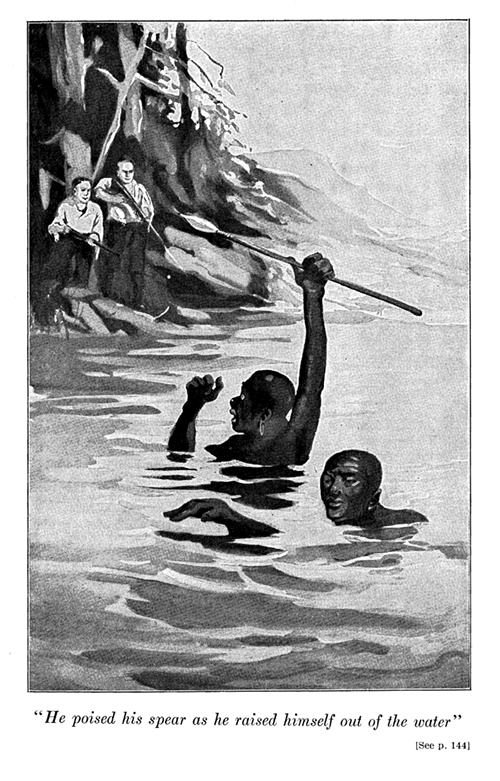 "He poised his spear as he raised himself out of the water"
 N Y B Co.