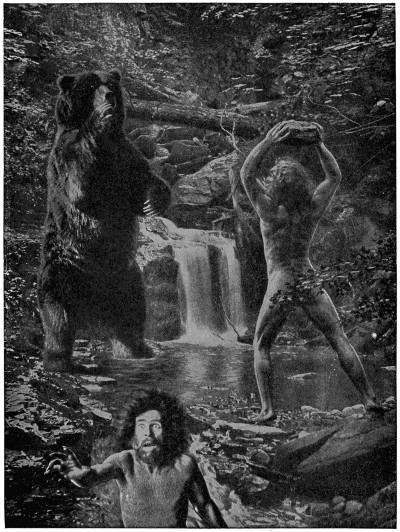
A naked savage found himself in the greatest danger. A wild beast, hungry
and fierce, was about to attack him. Escape was impossible. Retreat was cut off.
He must fight for his life—but how?
Should he bite, scratch or kick? Should he strike with his fist? These were
the natural defenses of his body, but what were they against the teeth, the claws
and the tremendous muscles of his enemy? Should he wrench a dead branch from
a tree and use it for a club? That would bring him within striking distance to be
torn to pieces before he could deal a second blow.
There was but a moment in which to act. Swiftly he seized a jagged fragment
of rock from the ground and hurled it with all his force at the blazing eyes before
him; then another, and another, until the beast, dazed and bleeding from the unexpected
blows, fell back and gave him a chance to escape. He knew that he had
saved his life, but there was something else which his dull brain failed to realize.
He had invented arms and ammunition!
In other words, he had needed to strike a harder blow than the blow of his fist,
at a greater distance than the length of his arm, and his brain showed him how to
do it. After all, what is a modern rifle but a device which man has made with his
brain permitting him to strike an enormously hard blow at a wonderful distance?
Firearms are really but a more perfect form of stone-throwing, and this early Cave
Man took the first step that has led down the ages to the present-day arms and
ammunition.
This strange story of a development that has been taking place slowly through
thousands and thousands of years, so that today you are able to take a swift shot
at distant game instead of merely throwing stones.
The Cave Man and his descendants learned the valuable lesson of stone-throwing,
and it made hunters of them, not big-game hunters—that was far too
risky; but once in a while a lucky throw might bring down a bird or a rabbit for
food. And so it went on for centuries, perhaps. Early mankind was rather slow of
thought.
At last, however, there appeared a great inventor—the Edison of his day.
He took the second step.
We do not know his name. Possibly he did not even have a name, but in some
way he hit upon a scheme for throwing stones farther, harder and straighter than
any of his ancestors.
The men and women in the Cave Colony suddenly found that one bright-eyed
young fellow, with a little straighter forehead than the others, was beating them all
at hunting. During weeks he had been going away mysteriously, for hours each
day. Now, whenever he left the camp he was sure to bring home game, while the
other men would straggle back for the most part empty-handed.
Was it witchcraft? They decided to investigate.
[76]
The First Missile
The Cave Man of prehistoric times unconsciously invented arms and ammunition.
Accordingly, one morning several of them followed at a careful distance as he
sought the shore of a stream where water-fowl might be found. Parting the leaves,
they saw him pick up a pebble from the bank and then, to their surprise, take off his
girdle of skin and place the stone in its center, holding both ends with his right hand.
Stranger still, he whirled the girdle twice around his head, then released one
end so that the leather strip flew out and the stone shot straight at a bird in the water.
The mystery was solved. They had seen the first slingman in action.
The new plan worked with great success, and a little practice made expert
marksmen. We know that most of the early races used it for hunting and in war.
We find it shown in pictures made many thousands of years ago in ancient Egypt
and Assyria. We find it in the Roman army where the slingman was called a
“funditor.”
We find it in the Bible where it is written of the tribe of Benjamin: “Among all
these people there were seven hundred chosen men left-handed; every one could sling
a stone at an hair breadth and not miss.” Surely, too, you remember the story of
David and Goliath when the young shepherd “prevailed over the Philistine with
a sling and with a stone.”
Today shepherds tending their flocks upon these same hills of Syria may be
seen practicing with slings like those of David. Yes, and slings were used in European
armies until nearly a hundred years after America was discovered.
Yet they had their drawbacks. A stone slung might kill a bird or even a man,
but it was not very effective against big game.
What was wanted was a missile to pierce a thick hide.
Man had begun to make spears for use in a pinch, but would you like to tackle
a husky bear or a well-horned stag with only a spear for a weapon?
No more did our undressed ancestors. The invention of the greatly desired
arm probably came about in a most curious way.
Long ages ago man had learned to make fire by patiently rubbing two sticks
together, or by twirling a round one between his hands with its point resting upon a
flat piece of wood.
In this way it could be made to smoke, and finally set fire to a tuft of dried
moss, from which he might get a flame for cooking. This was such hard work that
he bethought him to twist a string of sinew about the upright spindle and cause it
to twirl by pulling alternately at the two string ends, as some savage races still do.
From this it was a simple step to fasten the ends of the two strings to a bent piece
of wood, another great advantage, since now but one hand was needed to twirl the
spindle, and the other could hold it in place. This was the “bow-drill” which also
is used to this day.
But bent wood is apt to be springy. Suppose that while one were bearing on
pretty hard with a well-tightened string, in order to bring fire quickly, the point
of the spindle should slip from its block. Naturally, it would fly away with some
force if the position were just right.
This must have happened many times, and each time but once the fire-maker
may have muttered something under his breath, gone after his spindle, and then
settled down stupidly to his work. He had had a golden chance to make a great
discovery, but didn’t realize it.
[78]
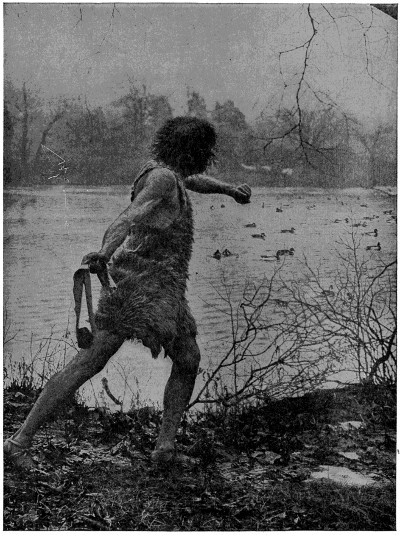
The Sling Man in Action
Practice developed some wonderful marksmen among the users of this primitive weapon.
But, so it has been suggested, there was one man who stopped short when he
lost his spindle, for a red-hot idea shot suddenly through his brain.
He forgot all about his fire-blocks while he sat stock still and thought.
Once or twice he chuckled to himself softly. Thereupon he arose and began to
experiment.
He chose a longer, springier piece of wood, bent it into a bow, and strung it with
a longer thong. He placed the end of a straight stick against the thong, drew it
strongly back and released it.
The shaft whizzed away with force enough to delight him, and, lo, there was the
first bow-and-arrow!
After that it was merely a matter of improvement. The arrow-end was apt
to slip from the string until some one thought to notch it. Its head struck with such
force that the early hunter decided to give it a sharp point, shaped from a flake of
flint, in order that it might drive deep into the body of a deer or bear.
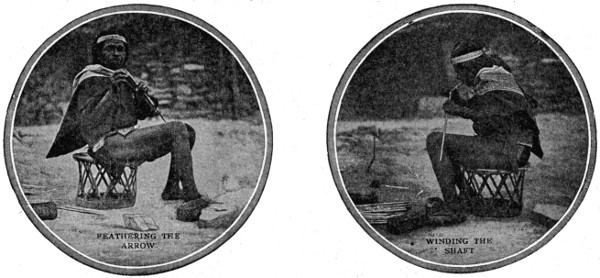
But, most of all, it must fly true and straight to its mark. Who of all these simple
people first learned to feather its shaft? Was it some one who had watched the
swift, sure-footed spring of a bushy-tailed squirrel from branch to branch? Possibly,
for the principle is the same. At all events with its feathers and its piercing point
the arrow became the most deadly of all missiles, and continued to be until long
after the invention of firearms.
It is interesting to see how many different forms of bow were used. The English
had a six-foot “long bow” made of yew or ash, in a single straight piece, that shot
arrows the length of a man’s arm. The Indians had bows only forty inches on the
average, since a short bow was easier to handle in thick forests. They used various
kinds of wood, horn or even bone, such as the ribs of large animals. These they
generally backed with sinew.
Sometimes they cut spiral strips from the curving horns of a mountain sheep,
and steamed them straight. Then they glued these strips together into a wonderfully
tough and springy bow. Once in a while they even took the whole horns of some
young sheep, that had not curved too much, and used the pair just as they grew.
In this case each horn made one-half of the bow, and the piece of skull between was
shaped down into a handle. This gave the shape of a “Cupid’s Bow,” but it could
shoot to kill.
[80]
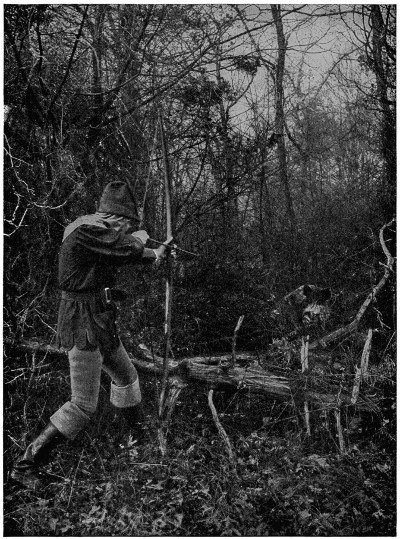
The “Long Bow” in Sherwood Forest
One of Robin Hood’s famous band encounters a savage tusker at close range.
The arrows were quite as important, and their making became a great industry
with every race. This was because so many must be carried for each hunt or battle.
Who is not familiar with the chipped flint arrow-heads that the farmer so often
turns up with his plow as a relic of the period when Americans were red-skinned
instead of white? These arrow-heads have generally a shoulder where the arrow
was set into the shaft, there to be bound tightly with sinew or fiber. Many of them
are also barbed to hold the flesh.
But the age of machinery was coming on. Once in a while there were glimpses
of more powerful and complicated devices to be seen among these simple arms.
A new weapon now came about through warfare. Man has been a savage
fighting animal through pretty much all his history, but while he tried to kill the
other fellow, he objected to being killed himself.
Therefore he took to wearing armor. During the Middle Ages he piled on more
and more, until at last one of the knights could hardly walk, and it took a strong
horse to carry him. When such a one fell, he went over with a crash like a tin-peddler’s
wagon, and had to be picked up again by some of his men. Such armor
would turn most of the arrows. Hence invention got at work again and produced
the cross-bow and its bolt. We have already learned how the tough skin of animals
brought about the bow; now we see that man’s artificial iron skin caused the invention
of the cross-bow.
What was the cross-bow? It was the first real hand-shooting machine. It
was another big step toward the day of the rifle. The idea was simple enough.
Wooden bows had already been made as strong as the strongest man could pull,
and they wished for still stronger ones—steel ones. How could they pull them?
At first they mounted them upon a wooden frame and rested one end on the shoulder
for a brace. Then they took to pressing the other end against the ground, and using
both hands. Next, it was a bright idea to put a stirrup on this end, in order to hold
it with the foot.
Still they were not satisfied. “Stronger, stronger!” they clamored; “give us
bows which will kill the enemy farther away than he can shoot at us! If we cannot
set such bows with both arms let us try our backs!” So they fastened “belt-claws” to
their stout girdles and tugged the bow strings into place with their back and leg muscles.
“Stronger, stronger again, for now the enemy has learned to use belt-claws
and he can shoot as far as we. Let us try mechanics!”
So they attached levers, pulleys, ratchets and windlasses, until at last they
reached the size of the great siege cross-bows, weighing eighteen pounds. These
sometimes needed a force of twelve hundred pounds to draw back the string to its
catch, but how they could shoot!
Human muscle seemed to have reached its limit, mechanics seemed to have
reached its limit, but still the world clamored, “Stronger, stronger! How shall we
kill our enemy farther away than he can kill us?” For answer, man unlocked one
of the secrets of Nature and took out a terrible force. It was a force of chemistry.
[82]
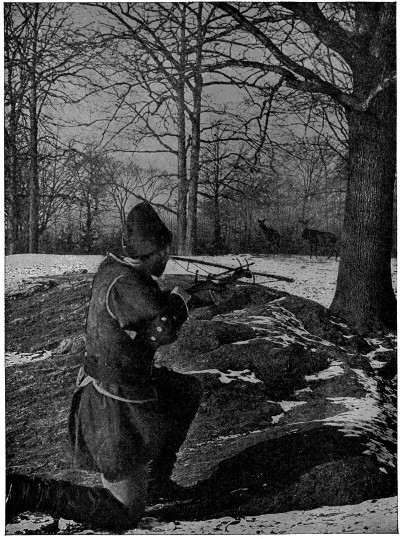
Deer-Stalking with the Cross-Bow
This compact arm with its small bolt and great power was popular with many sportsmen.
Who first discovered the power of gunpowder? Probably the Chinese, although
all authorities do not agree. Strange, is it not, that a race still using cross-bows
in its army should have known of explosives long before the Christian Era, and
perhaps as far back as the time of Moses? Here is a passage from their ancient
Gentoo Code of Laws: “The magistrate shall not make war with any deceitful
machine, or with poisoned weapons, or with cannons or guns, or any kind of firearms.”
But China might as well have been Mars before the age of travel. Our
civilization had to work out the problem for itself.
It all began through playing with fire. It was desired to throw fire on an
enemy’s buildings or his ships, and so destroy them. Burning torches were thrown
by machines, made of cords and springs, over a city wall, and it became a great study
to find the best burning compound with which to cover these torches. One was
needed which would blaze with a great flame and was hard to put out.
Hence the early chemists made all possible mixtures of pitch, resin, naphtha,
sulphur, saltpeter, etc.; “Greek fire” was one of the most famous.
Many of these were made in the monasteries. The monks were pretty much
the only people in those days with time for study, and two of these shaven-headed
scientists now had a chance to enter history. Roger Bacon was the first. One
night he was working his diabolical mixture in the stone-walled laboratory, and
watched, by the flickering lights, the progress of a certain interesting combination
for which he had used pure instead of impure saltpeter.
Suddenly there was an explosion, shattering the chemical apparatus and probably
alarming the whole building. “Good gracious!” we can imagine some of the startled
brothers saying, “whatever is he up to now! Does he want to kill us all?” That
explosion proved the new combination was not fitted for use as a thrown fire; it
also showed the existence of terrible forces far beyond the power of all bow-springs,
even those made of steel.
Roger Bacon thus discovered what was practically gunpowder, as far back as
the thirteenth century, and left writings in which he recorded mixing 11.2 parts of
the saltpeter, 29.4 of charcoal, and 29 of sulphur. This was the formula developed
as the result of his investigations.
Berthold Schwartz, a monk of Freiburg, studied Bacon’s works and carried on
dangerous experiments of his own, so that he is ranked with Bacon for the honor.
He was also the first one to rouse the interest of Europe in the great discovery.
And then began the first crude, clumsy efforts at gunmaking. Firearms were
born.
Hand bombards and culverins were among the early types. Some of these
were so heavy that a forked support had to be driven into the ground, and two men
were needed, one to hold and aim, the other to prime and fire. How does that strike
you for a duck-shooting proposition? Of course such a clumsy arrangement could
only be used in war.
Improvements kept coming, however. Guns were lightened and bettered in
shape. Somebody thought of putting a flash pan for the powder, by the side of the
touch-hole, and now it was decided to fasten the slow-match, in a movable cock,
upon the barrel and ignite it with a trigger. These matches were fuses of some
slow-burning fiber, like tow, which would keep a spark for a considerable time.
Formerly they had to be carried separately, but the new arrangement was a great
convenience and made the matchlock. The cock, being curved like a snake, was
called the “serpentine.”
[84]
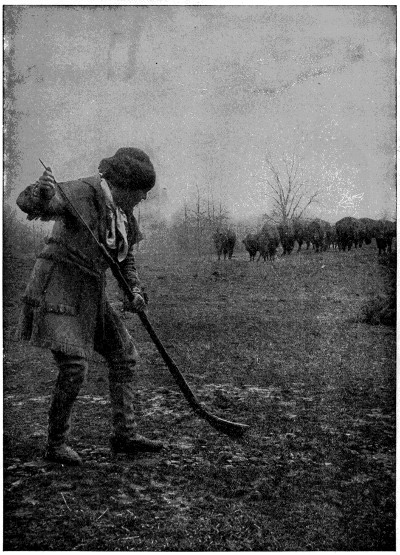
An Unexpected Meeting
The “Kentucky Rifle” with its flint-lock was accurate, but had to be muzzle-charged.
Everybody knows what the flint-lock was like. You simply fastened a flake
of flint in the cock and snapped it against a steel plate. This struck off sparks which
fell into the flash-pan and fired the charge.
It was so practical that it became the form of gun for all uses; thus gunmaking
began to be a big industry. Invented early in the seventeenth century, it was used
by the hunters and soldiers of the next two hundred years. Old people remember
when flint-locks were plentiful everywhere. In fact, they are still being manufactured
and are sold in some parts of Africa and the Orient. One factory in Birmingham,
England, is said to produce about twelve hundred weekly, and Belgium shares in
their manufacture. Some of the Arabs use them to this day in the form of strange-looking
guns with long, slender muzzles and very light, curved stocks.
Primers were tried in different forms called “detonators,” but the familiar little
copper cap was the most popular. No need to describe them. Millions are still
made to be used on old-fashioned nipple guns, even in this day of fixed ammunition.

The First Remington Rifle
Then came another great development, the breech-loader.
Breech-loaders were hardly new. King Henry VIII of England, he of the many
wives, had a match-lock arquebus of this type dated 1537. Henry IV of France
even invented one for his army, and others worked a little on the idea from time to
time. But it was not until fixed ammunition came into use that the breech-loader
really came to stay—and that was only the other day. You remember that the
Civil War began with muzzle-loaders and ended with breech-loaders.
Houiller, the French gunsmith, hit on the great idea of the cartridge. If you
were going to use powder, ball and percussion primer, to get your game, why not
put them all into a neat, handy, gas-tight case? Simple enough, when you come
to think of it, like most great ideas. But it required good brain-stuff to do that
thinking.
Two men, a smith and his son, both named Eliphalet Remington, in 1816, were
working busily one day at their forge in beautiful Ilion Gorge, when, so tradition
says, the son asked his father for money to buy a rifle, and met with a refusal.
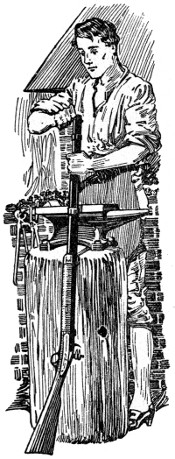
Young Remington at
Work on Rifle
The boy set his wits to work. Looking around the forge, he picked up enough
scrap iron to make a gun barrel, and with this set to work to make a rifle for himself.
At that time gun barrels were made, not by drilling the bore out of a solid rod
of metal, but by shaping a thick, oblong sheet of metal around a rod the size of the
bore, and lapwelding the edges. When the rod was withdrawn, there was your
barrel.
It took him several weeks to work out this job and get it right, but he succeeded.
He had no tools to cut the rifling. There was a gunsmith in Utica, and he walked
there, fifteen miles over the hills, to have his barrel finished. The gunsmith was so
impressed by the boy and his accomplishment that, after rifling the barrel, he fitted
it with a lock. Then when Remington fitted on a wooden
stock his weapon was ready.
This was the first Remington rifle, and it proved a
surprisingly good one.
Neighbors tried it, and wanted guns like it. Remington
made them. The first rifle—or one exactly like
the first one, at least—that Remington made is still in
Ilion, the property of Walter Green. Before long the
demand was so brisk that Remington would take as many
barrels as he could carry over to the Utica gunsmith to
be rifled, bringing back a load that had been left
there on a previous trip, a journey of thirty miles on
foot.
When a new business grows at that rate, of course,
it soon needs power. So, later, in 1816, the two Remingtons
went “up the creek,” building a shop three miles
from home, at Ilion Gulph, which was part of the father’s
farm. That was the actual beginning of the plant and
the industry of which the centennial was celebrated in
1916. During its early years this shop made anything
in its line that could be sold in the neighborhood—rifles,
shotguns, crowbars, pickaxes, farm tools. The power
was taken from a water wheel in Steele’s Creek, and the
first grindstones for smoothing down the welded edges
in gun barrels were cut from a red sandstone ledge up
the gorge.
Guns sold better than all other products. Orders
came from greater distances. By and by shipments were
made on the new Erie Canal. For a while, as packages
were small, they were taken to the canal bridge, a board
lifted from the floor, and the package dropped onto a
boat as it passed under. There was no bill of lading.
Remington took down the name of the boat and notified
his customer by mail, so the latter would know which craft was bringing his
guns.
When the trade had extended into all the surrounding counties, however, the
new business needed another prime essential of industry—transportation facilities.
Shipments were growing larger, and materials like grindstones, bought outside, had
to be brought from the canal to Ilion Gulph. In 1828, therefore, the elder Remington
bought a large farm in Ilion proper, and there, on the canal, the present plant was
started. This was also the beginning of Ilion, for at that period the place was nothing
more than a country corner. In 1828 the elder Remington met his death through
accident and the business was carried on by his son, who brought water for several
power wheels from Steele’s Creek, built a house to live in, and installed in his wooden
shop quite a collection of machinery for gunmaking—the list names a big
tilt hammer, several trip hammers, boring and rifling machines, grindstones, and
so on.
Not so many years before that, in England, James Watt was complaining about
the difficulty of boring a six-inch cylinder for his steam engine with sufficient accuracy
to make it a commercial success. No matter how he packed the piston with cork,
oiled rags and old hats, the irregularities in the cylinder let the steam escape, and
it was believed that neither the tools nor the
workmen existed for making a steam engine
with sufficient precision. When a young
manufacturer named Wilkinson invented a
guide for the boring tool, and machined cylinders
of fifty inches diameter so accurately
that, as Watt testified, they did not err the
thickness of an old shilling in any part, it
seemed as though the last refinement in machinery
had been achieved. That was not
very accurate by present-day standards of the thousandth part of an inch, for a
shilling is about one-sixteenth of an inch in thickness.
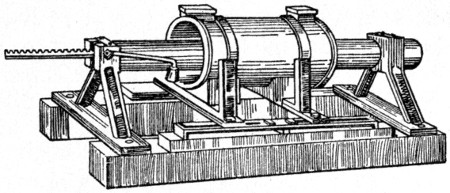
Old Boring Tool
Remington was right in the thick of development with a gunmaking plant,
of course, for as his business grew he had to invent and adapt machines to increase
output. The lap-welded barrel was standard until 1850, and he got together a battery
of trip hammers for forging and welding his barrels. Finer dimensions became a
factor in his business when the output grew large enough to warrant carrying a
stock of spare parts for his customers, and so he
improved those parts in ways that gave at least the
beginnings of interchangeability.
Materials were very crude. There was no
buying of foundry iron by analysis, no high carbon
steels, no fancy tool steels—nor any “efficiency experts”
with their stop watches and scientific speed-and-feed
tables. Iron was secured by sending
teams around the neighborhood to pick up scrap,
and when the scrap iron was all cleaned up, fresh
metal was brought from ore beds in Oneida County.
Coal was scarce, and charcoal made the chief fuel,
burnt in the hills round about Ilion.
And the world was fairly swarming with inventors!
That was long before invention became a
research department full of engineers. The individual
inventor, with a queer-shaped factory
process, carried on by a head and a rough model in
his carpet-bag, had a chance to influence industry.
Few of the useful contrivances had been invented
yet, and almost any one of these chaps might be a
genius. So, from the very first, Remington was interested
in inventors. He was an inventor himself! His pioneer spirit was so strong
that Ilion became a place of pilgrimage for men with ideas. Inventors came from
everywhere, and Remington listened to them all. Some brought models, others
drawings, still others a bare idea, and a few, of course, had just a plain “bug.”
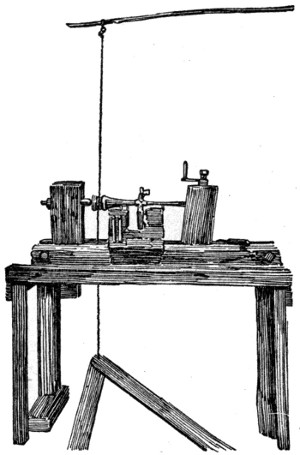
Pole Lathe of 1800
The first government contract came in 1845. War with Mexico loomed up on
the horizon. William Jencks had invented a carbine, and Uncle Sam wanted several
thousand guns made in a hurry under the patent. A contract had been let to Ames
& Co., of Springfield, Mass., and they had made special machinery for the job.
Remington took over the contract and the machinery, added to his power, secured
by putting in another water race, erected the building now known as the “Old
Armory,” and made the carbines.
In 1850 the art of gunmaking began to improve radically. The old lap-welded
barrel gave way to the barrel drilled from solid steel. This was accomplished for
the first time in America at the Remington plant, in making Harper’s Ferry muskets.
Then followed the drilling of small-bore barrels from solid steel, the drilling of
doubled-barrel shotguns from one piece of steel, the drilling of fluid steel and nickel
steel barrels, all done for the first time in this country at the Ilion shops. Three-barrel
guns were also made from one piece of steel, two bores for shot and the third
rifled for a bullet. A customer wanted some special barrels with nine bores in a
single piece of steel. These were made at Ilion, and the Remington plant soon
became noted for its ability to bore almost anything in the shape of a gun, from the
tiniest squirrel calibers up to boat guns weighing sixty pounds or more, which were
really small caliber cannon.
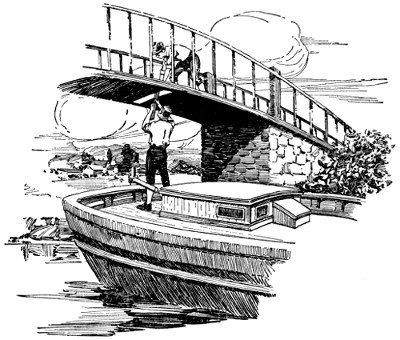
Shipping Remingtons in the Early Days
Between the time when Remington made his first rifle at Ilion Gulph and the
outbreak of the Civil War, most of the basic things in machine tools had been adapted
to general production—the slide-rest lathe, planer, shaper, drill press, steam hammer,
taps and dies, the vernier caliper that enabled a mechanic at the bench to measure
to one-thousandth of an inch, and so on.
When Fort Sumter was fired upon, Uncle Sam turned to the Remington plant,
among others, for help out of his dilemma of “unpreparedness.” The first contract
was given for 5,000 Harper’s Ferry rifles, and it took two years to complete it. Five
thousand Harper’s Ferry muskets came in to be changed so that bayonet or sabre
could be attached, and this particular job was finished in two weeks, every man and
boy in Ilion working at it. There was a big contract for army revolvers, and that
had to be taken care of by starting a separate plant in Utica, which ran until the
end of the war, when its machinery and tools were moved to Ilion. Steam power
was now installed, and the plant, increased by new buildings and machinery, ran
day and night.
[89]
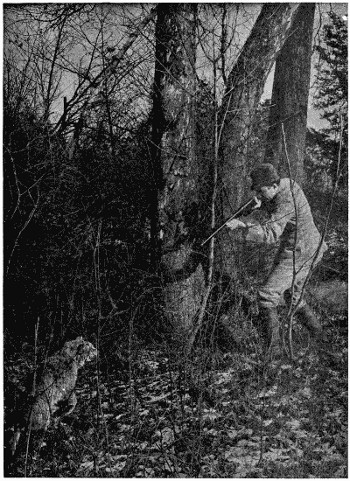
Master of the Situation
The modern sportsman with his automatic rifle is prepared for all emergencies.
In 1863, the Remington breech-loading rifle was perfected, and proved to be so
great an improvement over previous inventions in military arms that an order for
10,000 of them was obtained from our government. The Ilion plant being taxed
to its utmost capacity, the contract was transferred to the Savage Arms Company,
of Middletown, Conn., which completed the job in 1864.
 |
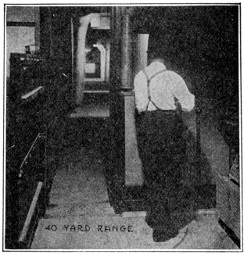 |
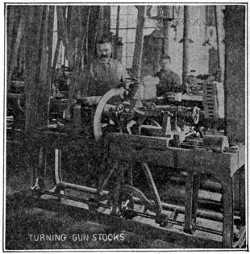
| Illustrations by courtesy of the Winchester Repeating Arms Co. |
The tools and fixtures used in making Remington breech-loading rifles for the
United States were brought back from Connecticut in 1866, and an inventive genius
named John Rider was set to work, with a staff of the best mechanics obtainable,
to develop this gun still further. He devised the famous system of a dropping breech
block, backed up by the hammer.
Uncle Sam had a great number of muzzle-loading Springfield rifles left from the
Civil War. By the Berdan system, these were turned into breech-loaders at the
Ilion plant, the breech being cut out of the barrel and a breech-block inserted,
swinging upward and forward. Spain had 10,000 muskets to modernize by the
same system, and the breech-block attachments were made at Ilion.
The Berdan system, with a slight alteration, was the foundation of the Allen
gun, made by the United States government for the army until superseded by the
Krag-Jorgensen.
The repeating rifle now seemed an interesting possibility and large sums were
spent in developing a weapon of this type. It did not prove to have merit, however.
Then James P. Lee designed the first military rifle with the bolt type of cartridge
chamber, the parent of the military rifle of today. The model was made at Ilion,
but another type of bolt gun, the Keene, seemed to offer still greater possibilities
at the moment, and the plant was being prepared to manufacture this. The Lee
gun was taken up at Bridgeport, but not made successfully, and finally, as the Keene
gun had not met expectations, falling short of government tests, the Lee type was
brought back to Ilion, tools worked out and manufacture undertaken in quantities.
It afterwards became the basis for the famous British army rifle, the Lee-Metford.
[91]
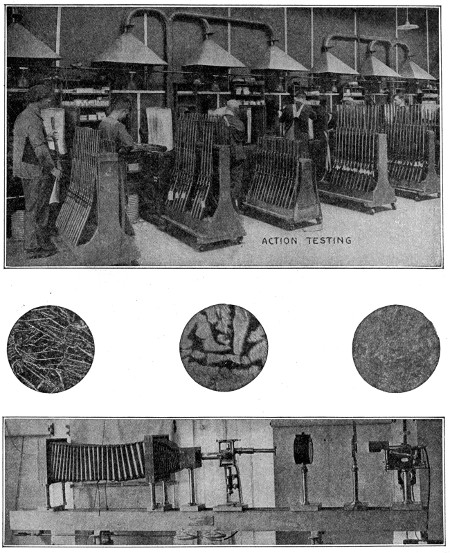
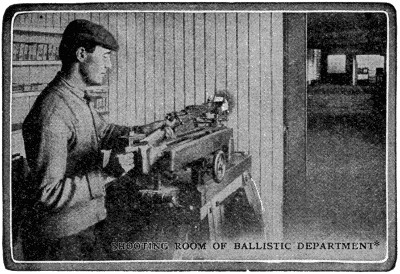
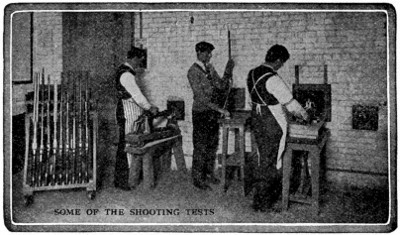
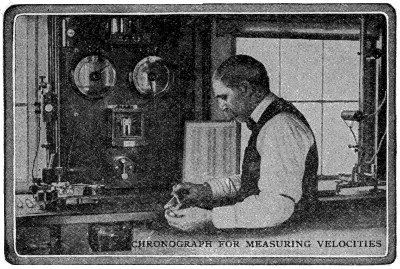
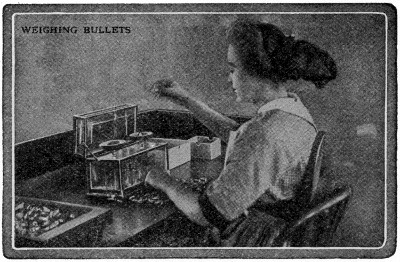
Extreme Care in Testing is Necessary to Accuracy of Aim in the Finished Product
Illustrations by courtesy of the Winchester Repeating Arms Co.
At this period the plant made many other interesting guns. The Whitmore
double-barrel breech-loading shotgun was designed, and later developed into the
Remington breech-loading shotgun. Eliott hammerless breech-loading pistols with
one, two, four and five barrels, discharged by a revolving firing pin, were made in
large quantities, as well as a single-barrel Eliott magazine pistol. The Eliott magazine
pump rifle was perfected in Ilion, but afterwards made in New England. Vernier
and wind gauge sights, attachable to any rifle, were made, and novelties like the
“gun cane,” which had the appearance of a walking-stick, but was a perfect firearm,
carried as a protection against robbery.
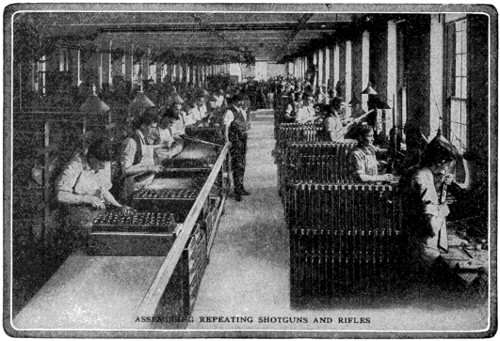
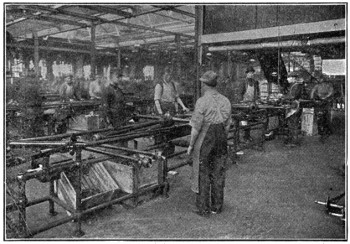
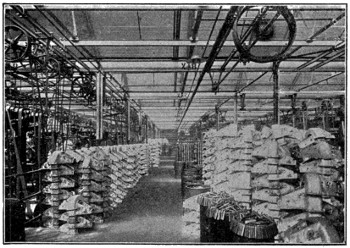
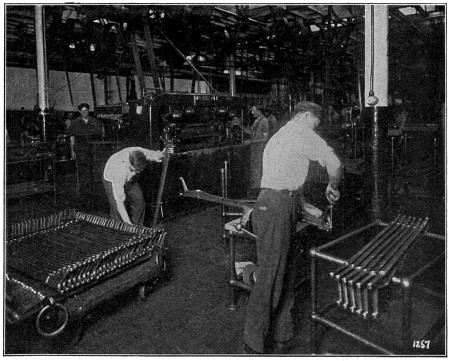
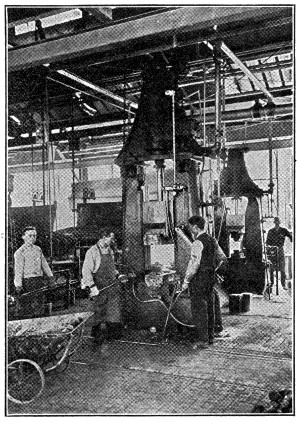
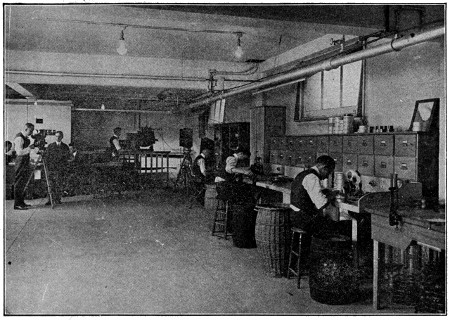
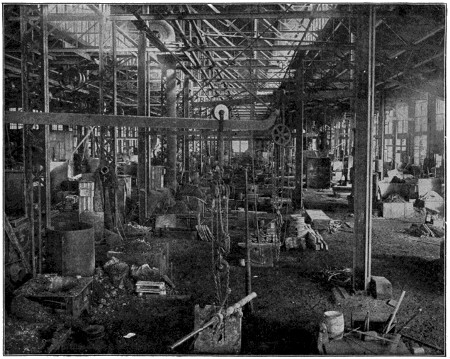
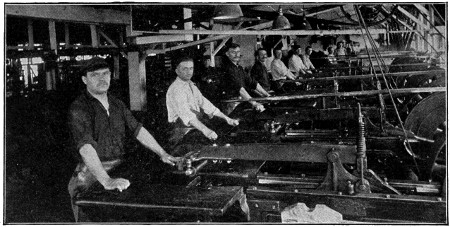
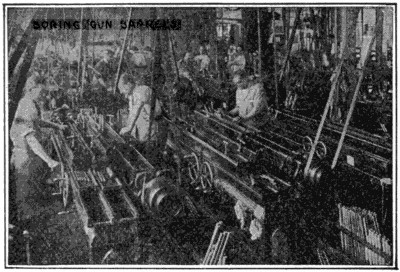
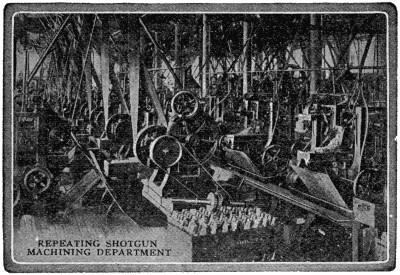
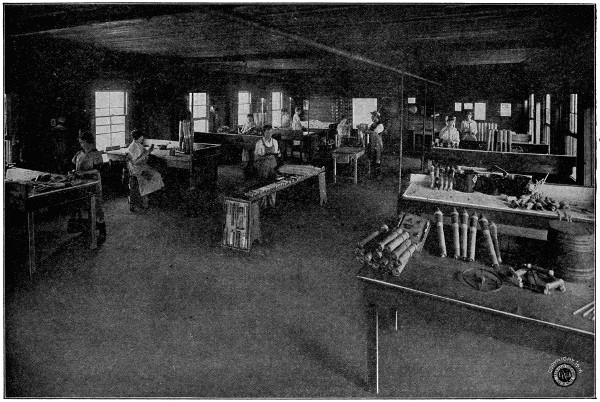
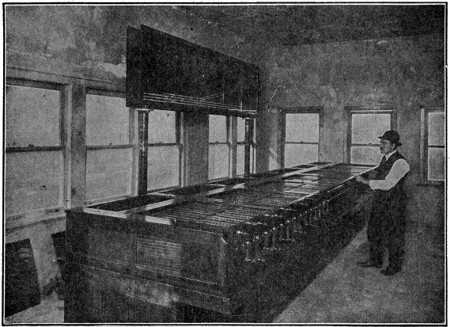
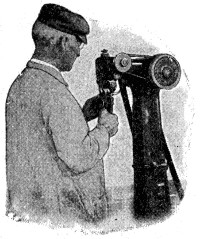
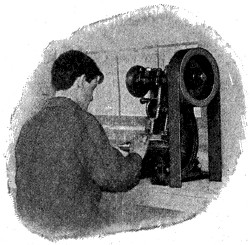
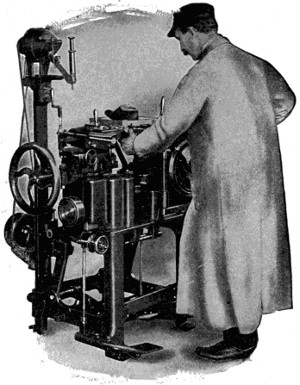
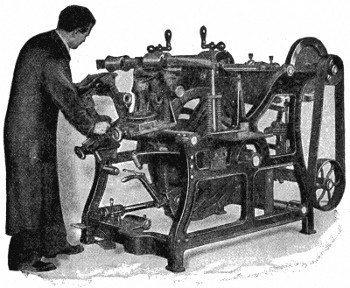
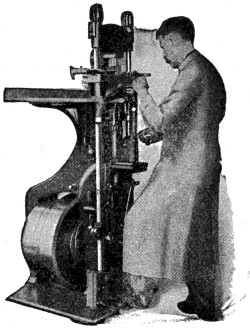
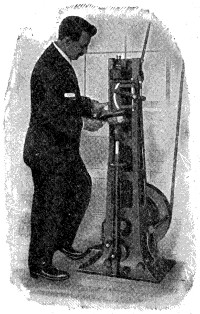
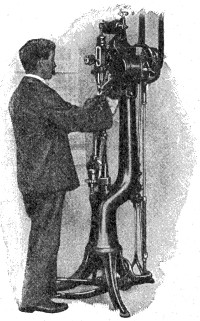
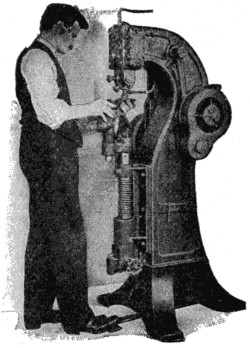
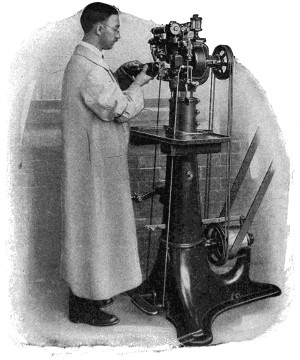
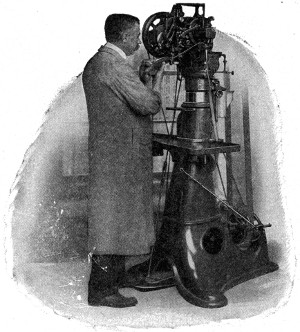
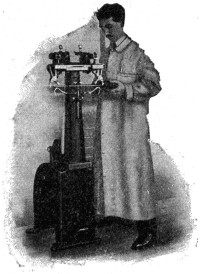
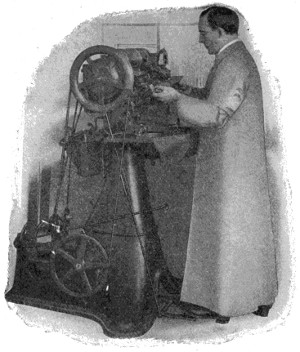
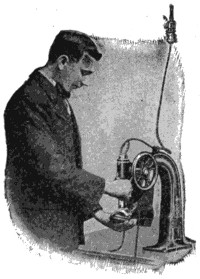
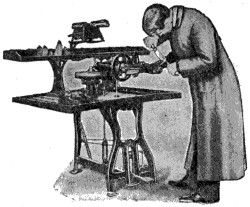
One of the most important features is, of course, the making of barrels. The
machines for drilling and boring are the best that money can buy, and the operatives
the most skilful to be found anywhere. Care at this stage reduces the necessity
for straightening later. Every point is given the minutest attention. In drilling
22-calibers, for example, the length of the hole must be from 100 to 125 times the
diameter of the drill.
Improvements have made it possible to drill harder steel than formerly. This
reduces the weight of the gun, and is important to the man who carries it.
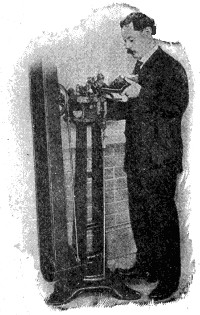
The boring is an especially delicate task. In choke-boring your shotgun, for
example, the final reamer took off only 2⁄1000 of an inch. Think of such a gossamer
thread of metal! But it insures accuracy. No pains can be too great for that.
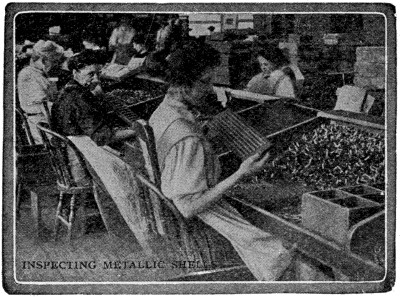
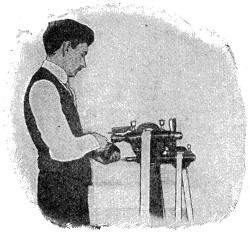
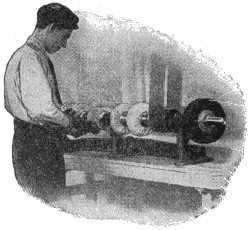
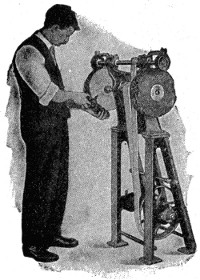
This exquisite painstaking will be seen still more in the barrel-inspection department,
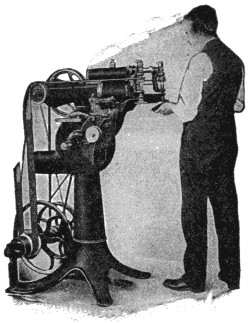
to which we will go now. In passing, we must not forget the grinding shop,
where is, perhaps, the finest battery of grinding machines in the United States; or
the polishers running at the dizzy speed of 1,500 to 1,700 revolutions per minute
and making the inside of the barrel shine like glass. This high polish is important,
for it resists rust and prevents leading.
[93]
That is the atmosphere of the whole
place. Every action has its reason. There
is not an unnecessary motion made by any
one, and there is not one necessary thing
omitted, whatever the cost or trouble.
Courtesy of the Winchester Repeating Arms Co.
It is no easy matter to secure a pass
to the Bridgeport plant. Its great advantage
over other concerns lies, to a
large degree, in the exclusive machinery
that has been developed at so much pains
and expense and the secrets of which are
so carefully guarded. In our case, however,
there will be nothing to hinder us
from getting a few general impressions, provided we do not go into mechanical details
too closely.
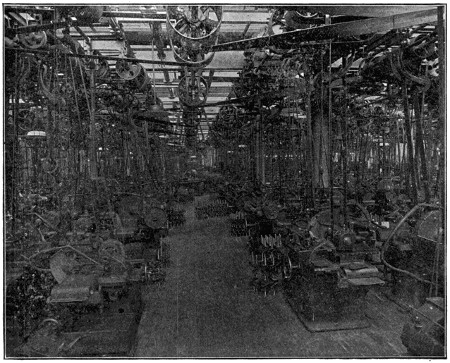
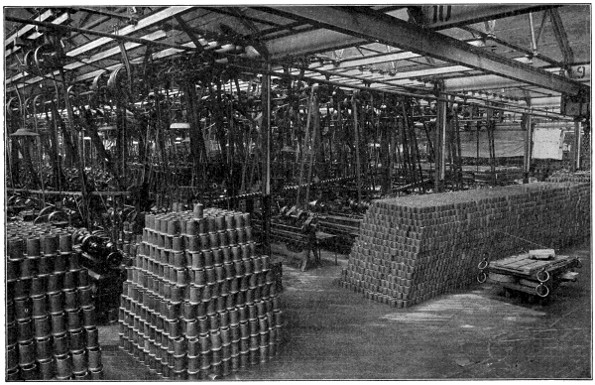
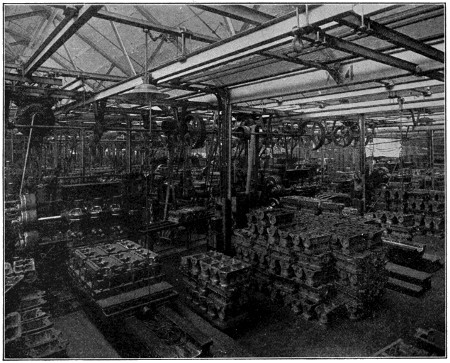
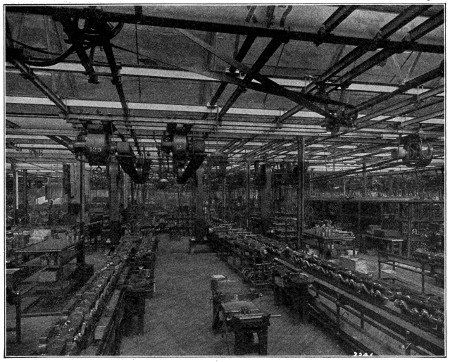
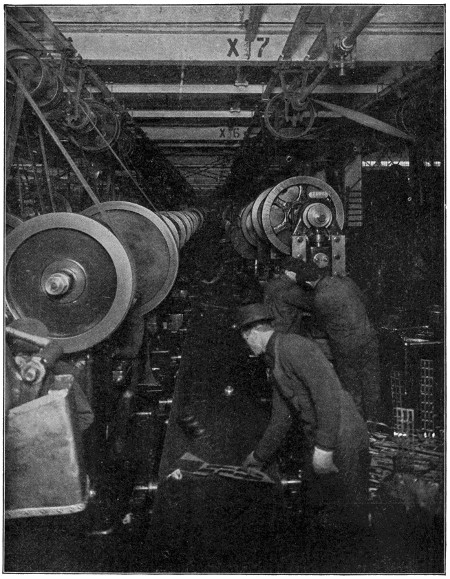
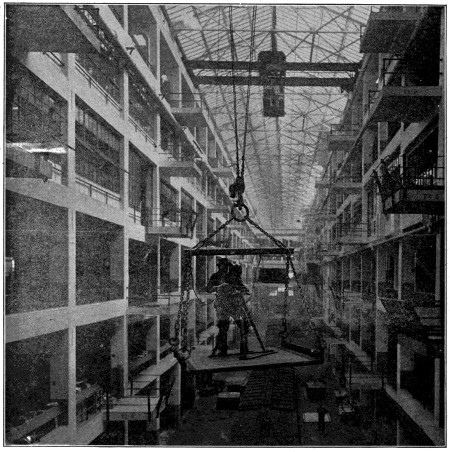
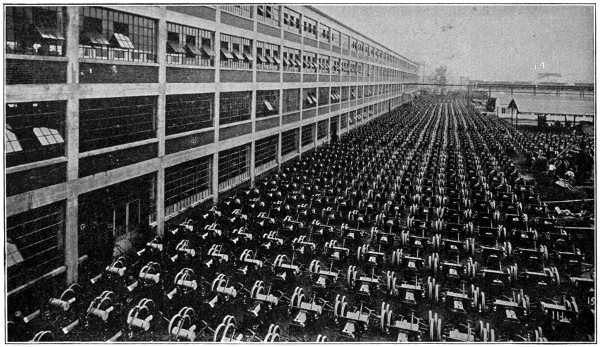
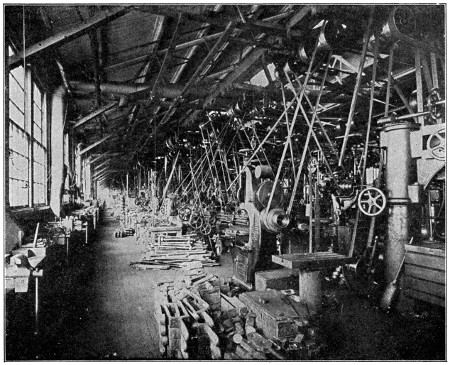
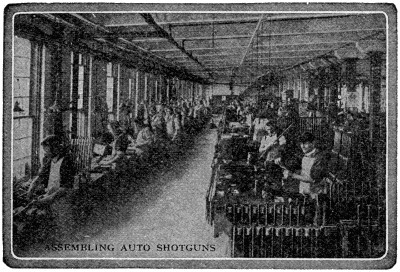
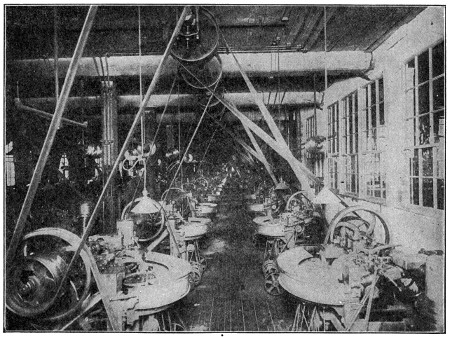
The very size of the great manufactory is impressive—sixteen acres of floor
space, crowded with machinery and resounding with activity. In building after
building, floor above floor, the sight is similar: the long rows of busy machines, the
whirling network of shafts and belts above, the intent operatives, and the steady
clicking of innumerable parts blended into a softened widespread sound. It seems
absolutely endless; it is a matter of hours to go through the plant. Stop at one
of the machines and see the speed and accuracy with which it turns out its product;
then calculate the entire number of machines and you will begin to gain a little idea
as to what the total output of this vast institution must be.
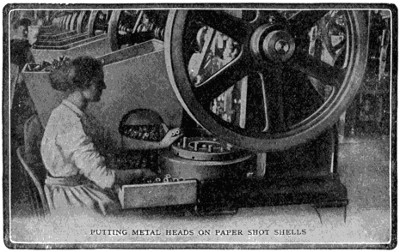
More than once you will find yourself wondering whether there can be guns
enough in the world, or fingers enough to press their triggers, to use such a tremendous
production of ammunition. But there are, and the demand is steadily increasing.
This old world is a pretty big place after all.
[95]
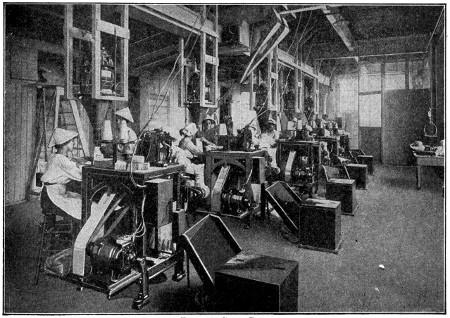
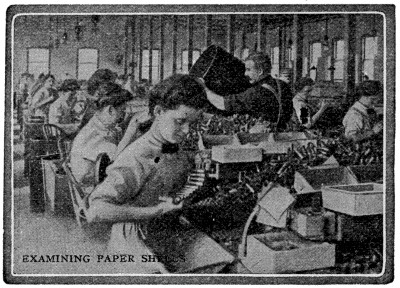
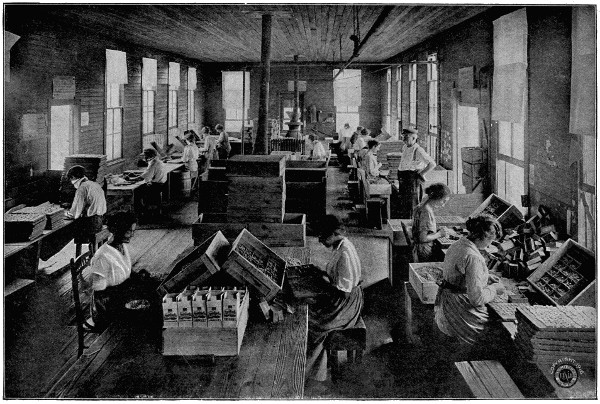
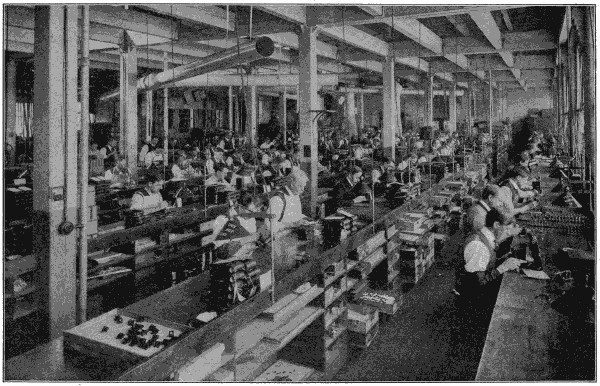
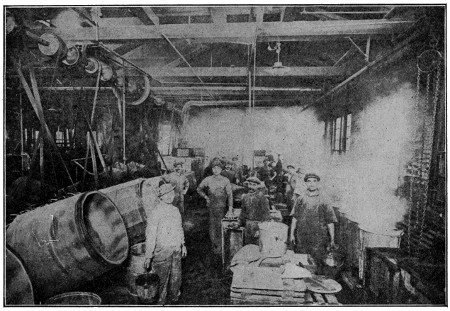
Operatives, girls in many cases, handle the most terrible compounds. We
stop, for example, where they are making primers to go in the head of your loaded
shell, in order that it may not miss fire when the bunch of quail whirrs suddenly
into the air from the sheltering grasses. That grayish, pasty mass is wet fulminate
of mercury. Suppose it should dry a trifle too rapidly. It would be the last thing
you ever did suppose, for there is force enough in that double handful to blow its
surroundings into fragments. You edge away a little, and no wonder, but the girl
who handles it shows no fear as she deftly but carefully presses it into molds which
separate it into the proper sizes for primers. She knows that in its present moist
condition it cannot explode.
Or, perhaps, we may be watching one of the many loading machines. There
is a certain suggestiveness in the way the machines are separated by partitions. The
man in charge takes a small carrier of powder from a case in the outside wall and
shuts the door, then carefully empties it into the reservoir of his machine, and
watches alertly while it packs the proper portions into the waiting shells. He looks
like a careful man, and needs to be. You do not stand too close.
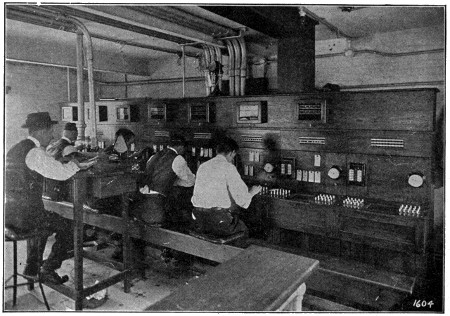
The empty carrier then passes through a little door at the side of the building,
and drops into the yawning mouth of an automatic tube. In the twinkling of an
eye it appears in front of the operator in one of the distributing stations, where it is
refilled and returned to its proper loading machine, in order to keep the machine
going at a perfectly uniform rate; while at the same time it allows but a minimum
amount of powder to remain in the building at any moment. Each machine has
but just sufficient powder in its hopper to run until a new supply can reach it.
Greater precaution than this cannot be imagined, illustrating as it does, that no
effort has been spared to protect the lives of the operators.
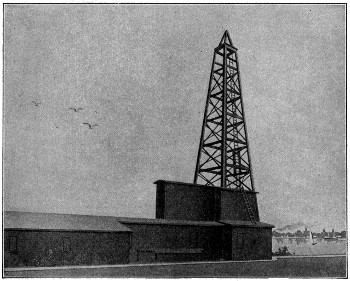
Artesian wells are named after the French Province of Artais, where they appear
to have been first used on an extensive scale.
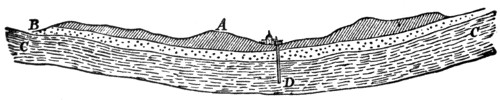
Artesian Well (D) in the London Basin
They are perpendicular borings into the ground through which water rises to
the surface of the soil, producing a constant flow or stream. As a location is chosen
where the source of supply is higher
than the mouth of the boring, the
water rises to the opening at the
top. They are generally sunk in
valley plains and districts where
the formation of the ground is such
that that below the surface is bent
into basin-shaped curves. The rain falling on the outcrops of these saturates the
whole porous bed, so that when the bore reaches it the water by hydraulic pressure
rushes up towards the level of the highest portion of the strata.
The supply is sometimes so abundant as to be used extensively as a moving
power, and in arid regions for fertilizing the ground, to which purpose artesian springs
have been applied from a very remote period. Thus many artesian wells have been
sunk in the Algerian Sahara which have proved an immense boon to the district.
The same has been done in the arid region of the United States. The water of most
of these is potable, but a few are a little saline, though not to such an extent as to
influence vegetation.
The hollows in which London and Paris lie are both perforated in many places
by borings of this nature. At London they were first sunk only to the sand, but
more recently into the chalk. One of the most celebrated artesian wells is that of
Grenelle near Paris, 1,798 feet deep, completed in 1841, after eight years’ work.
One at Rochefort, France, is 2,765 feet deep; at Columbus, Ohio, 2,775; at Pesth,
Hungary, 3,182, and at St. Louis, Mo., 3,8431⁄2. Artesian borings have been made
in West Queensland 4,000 feet deep. At Schladebach, in Prussia, there is one nearly
a mile deep.
As the temperature of water from great depths is invariably higher than that
at the surface, artesian wells have been made to supply warm water for heating
manufactories, greenhouses, hospitals, fishponds, etc. The petroleum wells of
America are of the same technical description. These wells are now made with
larger diameters than formerly, and altogether their construction has been rendered
much more easy in modern times.
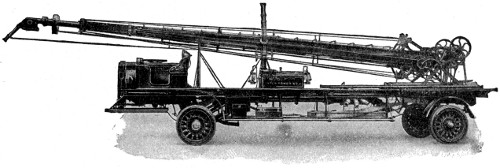
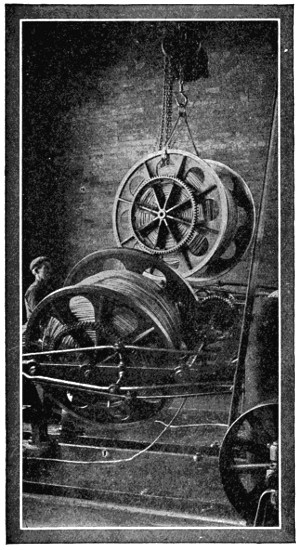
Boring in the earth or rock for mining, geologic or engineering purposes is
effected by means of augers, drills or jumpers, sometimes wrought by hand, but
now usually by machinery, driven by steam or frequently by compressed air.
In ordinary mining practice a bore-hole is usually commenced by digging a small
pit about six feet deep, over which is set up a shear-legs with pulley, etc. The boring
rods are from ten to twenty feet in length, capable of being jointed together by box
and screw, and having a chisel inserted at the lower end. A lever is employed to
raise the bore-rods, to which a slight twisting motion is given at each stroke, when
the rock at the bottom of the hole is broken by the repeated percussion of the cutting
tool. Various methods are employed to clear out the triturated rock.
The work is much quickened by the substitution of steam power, water power,
or even horse power for manual labor. Of the many forms of boring machines now
in use may be mentioned the diamond boring machine, invented by Leschot, a
Swiss engineer. In this the cutting tool is of a tubular form, and receives a uniform
rotatory motion, the result being the production of a cylindrical core from the rock
of the same size as the bore or caliber of the tube. The boring bit is a steel thimble
about four inches in length, having two rows of Brazilian black diamonds firmly
embedded therein, the edges projecting slightly. The diamond teeth are the only
parts which come in contact with the rock, and their hardness is such that an enormous
length can be bored with but little appreciable wear.
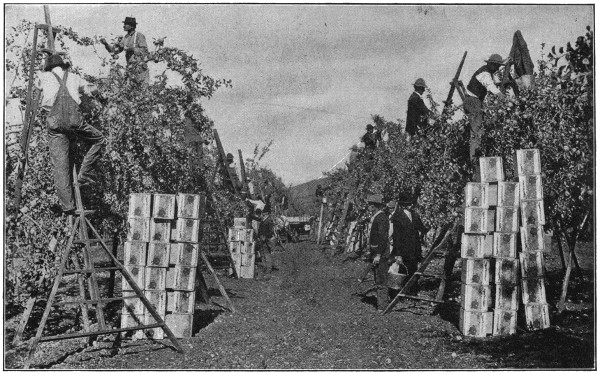
Besides the dried dates which we are accustomed to seeing in this country, they
are used extensively by the natives of Northern Africa and of some countries of Asia.
It consists of an external pericarp, separable into three portions, and covering a
seed which is hard and horny in consequence of the nature of the albumen in which
the embryo plant is buried.
Next to the cocoanut tree, the date is unquestionably the most interesting and
useful of the palm tribe. Its stem shoots up to the height of fifty or sixty feet without
branch or division, and of nearly the same thickness throughout its length. From
the summit it throws out a magnificent crown of large feather-shaped leaves and a
number of spadices, each of which in the female plant bears a bunch of from 180 to
200 dates, each bunch weighing from twenty to twenty-five pounds.
The fruit is eaten fresh or dried. Cakes of dates pounded and kneaded together
are the food of the Arabs who traverse the deserts. A liquor resembling wine is made
from dates by fermentation.
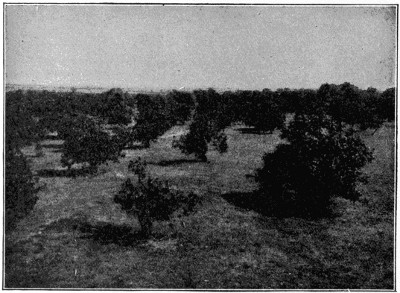
Persia, Palestine, Arabia and the north of Africa are best adapted for the culture
of the date-tree, and its fruit is in these countries an important article of food. It is
now being introduced into California.




 , used in this country to signify a dollar, is supposed to date from
the time of the pillar dollar in Spain. This was known as the “Piece of Eight”
(meaning eight reals), the curve being a partial representation of the figure 8. The
two vertical strokes are thought to represent the Pillars of Hercules, which were
stamped upon the coin itself.
, used in this country to signify a dollar, is supposed to date from
the time of the pillar dollar in Spain. This was known as the “Piece of Eight”
(meaning eight reals), the curve being a partial representation of the figure 8. The
two vertical strokes are thought to represent the Pillars of Hercules, which were
stamped upon the coin itself.