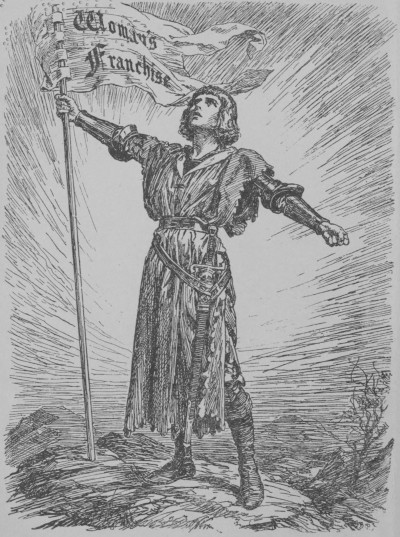
"It consists of an influx—whence or why none can tell—of
a wave of vitality. It is as if from the central heart of
life a ray broke suddenly upon the world, inspiring men
to feel deeply, to live greatly, to do nobly. It makes men.
It is not made by men."
Without belittling the importance of the wave of
enthusiasm for women's enfranchisement which
swept over the English-speaking world in 1916,
it is impossible to disguise the fact that we in
England won our battle at the exact moment we
did in consequence of the absolute necessity under
which the Government laboured of producing a new
parliamentary register and a new voting qualification
for men. For this meant that a real reform
of the representation of the people was required; and
the previous stages of our political struggle had
demonstrated that when once the franchise question
was dealt with by Parliament it would be impossible
any longer to neglect the claims of women.
It will be remembered that so long ago as 1892
Mr. A. J. Balfour had said in a suffrage debate in
Parliament:
"If any further alteration of the franchise is
brought forward as a practical measure, this question
[the enfranchisement of women] will again
arise, menacing and ripe for solution, and it will
not be possible for this House to set it aside as a
mere speculative plan advocated by a group of
faddists. Then you will have to deal with the
problem of women's suffrage, and deal with it in a
complete fashion."
The moment which Mr. Balfour foresaw in 1892
had arrived in 1916. The situation was briefly
thus: The old register for the whole United Kingdom,
unrevised by the express direction of the Government
since the outbreak of the world war, contained
the names of rather over eight million men, of whom
almost seven millions voted as "occupiers" or
householders. There were other qualifications, such
as the lodger, freehold, and University franchises;
but they only accounted, between them, for about a
million voters in the three kingdoms. "Occupation"
was, therefore, by far the most important
of the qualifications for the exercise of the parliamentary
franchise. To qualify as an "occupier"
it was, however, necessary to prove the unbroken
occupation of the qualifying premises for twelve
months previous to the last 15th of July. This
obviously necessitated in some cases continuous
residence for nearly two years. From August, 1914,
onwards at least five millions of men, either actual
or potential voters, had volunteered for the Navy
or Army, or had moved, in obedience to national
demands, to munition areas, or other places where
they were required. Consequently very large numbers
had ceased to be "occupiers" in the sense
legally required to enable them to become, or remain,
voters.
The Government and the country were therefore,
in the third year of the war, face to face with the
impossible position that if circumstances necessitated
an appeal to the country there was in existence
no register of voters which could in any sense be
looked upon as representative of the manhood of
the nation. The elderly, the infirm, the shirker, the
crank, who had remained at home evading military
service, and "the conscientious objector," would
remain on the old and obsolete register in full
numerical strength; the young manhood of the
nation who were fighting for it in the Navy, or the
Air Service, or on the dreary swamps of Flanders,
or the tremendous battlefields round Ypres or on
the Somme, would in large proportion have forfeited
their parliamentary votes in consequence of
the services they were rendering to their country.
It was an intolerable situation. By-elections which
from time to time took place illustrated the extraordinarily
non-representative character of the old
register. Candidates and agents reported the existence
of street after street in which only a handful
of voters remained. It would have been impossible
to dissolve on such a register, and even if it had been
possible, Mr. Asquith had himself declared that a
Parliament elected on such a register would be
"lacking in moral sanction."
It will be remembered that the House elected in
1910 had passed an Act limiting the duration of all
future Parliaments to five years. If there had been
no war the dissolution must therefore have taken
place by 1915; but as a General Election, except
on sheer necessity, could not be contemplated during
the war, the operation of the five years' limit was
more than once suspended by legislation. This,
however, was only postponing the problem, and
did not afford any solution of it.
Mr. Asquith's first War Cabinet had suddenly
collapsed in May, 1915, and had been succeeded by
the first Coalition Government. Mr. Asquith remained
Prime Minister, but among his colleagues
were now found representatives of the three chief
parties—Liberal, Conservative, and Labour. Mr.
Redmond, as leader of the Irish Nationalists, was
also asked to join it, but declined to do so. The
changes involved in this reconstitution of the
Government were in several ways favourable to the
suffrage movement: not a few of our most bigoted
opponents were among the Liberals who were shed
by Mr. Asquith when he formed his Coalition Government,
whilst among his new colleagues were now
to be found convinced suffragists, such as Mr. A. J.
Balfour, Mr. Bonar Law, Lord Robert Cecil, Lord
Lytton, Lord Selborne, Mr. Arthur Henderson, etc.
The formation of the coalition was favourable to
us in another sense. Party discipline and party
passion had always been inimical to our movement.
"Yes, I am your friend, but I am not prepared to
break up my party in order to support you," said
one party leader. "Yes, I am your friend, but I
tell you frankly, you must not count on my vote if
the success of women's suffrage would mean the
withdrawal from public life of my leader, Mr.
Asquith," said another. I had been accustomed
to say of the two chief parties, Liberal and Conservative,
that from the suffrage point of view the
first was an army without generals, and the second
was generals without an army. The Coalition gave
us the immense advantage of bringing these two
indispensable elements of success together, and
parliamentary suffragists became equally strong
in both officers and men. The commander-in-chief,
Mr. Asquith, was still our opponent, but, as described
in the last chapter, we began to see signs that even
he was prepared to recognize that he was beaten,
and to ask for an armistice.
When 1916 arrived no solution of the franchise
problem had been found; the creation of a new
register before a General Election could be held
was generally recognized as necessary, but there
were no signs of agreement upon the principles on
which it should be based. The end of the war
seemed as far off as ever. Compulsory military
service for men had been adopted, and this strengthened
the demand for manhood suffrage on the very
reasonable ground that if a man could be compelled
to offer his life for his country, he should at least
have some influence, as a voter, in controlling the
policy which might cause such a sacrifice to be
called for.
Contemporaneously with these events and new
developments, Sir Edward Carson and a group of
his parliamentary supporters were urging with
considerable vigour that there should be a new
franchise based on military service. In a sense he
had a strong position, for it was an obvious absurdity
that men offering their lives for their country should
incidentally to the fulfilment of that service be
struck off the parliamentary register, while every
waster and do-nothing who managed to stay at
home maintaining his occupation franchise would
have the vote. We made some unsuccessful efforts
to induce Sir Edward Carson so to define his definition
of "service" as to include the services of
women. Meanwhile, there was a great deal of discussion
socially and in the Press about the possibility
of basing the vote on national service of some
kind.
On May 4th, 1916, we addressed a careful letter to
Mr. Asquith on the points raised by the obsolete
register and the necessity for a new one, and also
for a new qualification for the franchise. We
said that nothing was farther from our intention than
to press our claim at such a moment if the Government
was contemplating legislation simply to replace
on the register those men who had lost their qualification
in consequence of their service in the Navy
or Army, or in munition areas in parts of the country
other than those where they had formerly resided.
But we stated that if the Government intended
to meet the situation by altering the whole basis of
the parliamentary franchise and founding it on
national service, whether naval, military, or industrial,
we should then use our utmost endeavours
to induce a favourable consideration at the same
time of the national services of women. After
referring to some of the very important work of
women during the war, we added:
"When the Government deals with the franchise,
an opportunity will present itself of dealing with it
on wider lines than by the simple removal of what
may be called the accidental disqualification of a
large body of the best men in the country, and we
trust that you may include in your Bill clauses which
would remove the disabilities under which women
now labour. An agreed Bill on these lines would,
we are confident, receive a very wide measure of
support throughout the country. Our movement
has received very great accessions of strength during
recent months, former opponents now declaring
themselves on our side, or, at any rate, withdrawing
their opposition. The change of tone in the Press
is most marked.... The view has been widely
expressed in a great variety of organs of public
opinion that the continued exclusion of women from
representation will ... be an impossibility after
the war."
Mr. Asquith replied almost immediately.
"10, Downing Street,
"Whitehall, S.W.,
"May 7th, 1916.
"Dear Mrs. Fawcett,
"I have received your letter of the 4th.
I need not assure you how deeply my colleagues
and I recognize and appreciate the magnificent
contribution which the women of the United Kingdom
have made to the maintenance of our country's
cause.
"No such legislation as you refer to is at present
in contemplation; but if, and when, it should become
necessary to undertake it, you may be certain that
the considerations set out in your letter will be fully
and impartially weighed without any prejudgment
from the controversies of the past.
"Yours very faithfully,
"H. H. Asquith."
This reply was, we considered, very much more
encouraging than any previous letter which we had
received from Mr. Asquith. There were some
suffragists who did not fail to point out that it
promised us nothing. This we did not dispute,
but we felt, all the same, that the letter indicated
that the turn of the tide in the suffrage direction was
taking effect, and that vessels which had long been
high and dry on the sandbanks of prejudice were
beginning to be floated, and would soon swing round.
On May 7th, Mr. Asquith had said in his letter,
"no such legislation as you refer to is at present
in contemplation." Nevertheless, it was plain two
weeks later from the Prime Minister's replies to
questions in the House that this attitude had already
been abandoned. The Government then began a
series of futile efforts to deal with the problems
presented by the situation just described by means
of "Special Register" Bills. None of these plans
secured the support of the House of Commons.
Mr. Asquith shrank from the thorough-going method
of solving the problem by introducing a Reform
Bill which should frankly provide a new basis for
the suffrage. Such a course, he said, would bring the
House "face to face with another most formidable
proposition," the question of women's suffrage.
Sir Edward Carson was meanwhile pressing for a
new franchise giving the vote to all sailors, soldiers,
and airmen, on the ground of their services. The
comment of the Press on this was: "It is clear
that the Bill cannot include the soldiers and exclude
the women." The hesitation and reluctance of the
Government to face the facts went on all through
July. It was the same attitude which had caused
the fiasco of the Government Bill in January, 1913
when an attempt had been made to pass a Reform
Bill at the tail-end of a Session already thirteen
months long by calling it a Registration Bill. On
July 12th, 1916, Mr. Asquith said that the Government,
not having been able to find any practical and
non-controversial solution of the registration question,
proposed that the House itself should settle
the matter. This was not a popular method of
proceeding, but the proposition was wrapped up
with Mr. Asquith's well-known skill as a master of
parliamentary oratory; and though the House
grumbled it was not in revolt. A week later, however,
the same theme was expounded with much less
than the Prime Minister's tact by Mr. Herbert
Samuel, another well-known antisuffragist, who
enraged the House of Commons by saying in effect
the same thing as Mr. Asquith, but in a manner
which made it plain, even to the wayfaring man,
that it was because the difficulty was insoluble that
the Government requested the House of Commons
to solve it. He set forth all the difficulties. Something
had got to be done; the old register was useless;
a new register on the old basis would be nearly as
bad, since it would disfranchise our fighting men;
and therefore the House would have to take up the
difficult controversial points of women's suffrage,
plural voting, adult suffrage, and redistribution.
The indignation of the House on being told bluntly
that the problem was handed to them to solve because
it was insoluble caused it to reject the Government
proposal; the matter was thrown back by the
House to the Cabinet, who were told to do their own
job; they therefore began another period of "lengthy
consideration."
In the previous spring a leading member of our
Executive Committee, Miss Rathbone, now President
of the N.U.S.E.C.,[7] had formed a consultative
committee of constitutional women's suffrage
societies, representative of twenty different organizations.
This consultative committee sought and
obtained early in August an interview with Lord
Robert Cecil and Mr. Bonar Law. The deputation
urged the necessity for the enfranchisement of
women in time for them to take part in the election
of the Parliament which would have to deal with
the problems of reconstruction after the war; they
also repeated that if the new register simply replaced
on the roll of voters those men who had forfeited
their vote in consequence of their patriotic services,
we should not, during the war, raise the question
of women's suffrage at all; but if the whole basis of
the suffrage were changed we should press the consideration
of women's claims with all the strength at
our command. Mr. Bonar Law expressed satisfaction
with this attitude, but asked if the suffrage societies
would stand aside if the period of residence required
of future male voters was reduced from twelve months
to three. The reply was in the negative, because
this change would in reality be equivalent to a new
suffrage, and would add many thousands of men to
the roll of voters. Lord Robert Cecil warmly
supported this view, and said that the reduction
in the qualifying period would constitute a long
step towards manhood suffrage, and would seriously
injure the position of women if nothing were done
for them at the same time.
We were getting now very near the keep of the
antisuffrage fortress. We heard of very prolonged
and ardent discussions in the Cabinet on our question,
during which the protagonists on our side were
Mr. Lloyd George, Lord Robert Cecil, and Mr.
Arthur Henderson, representing severally the
Liberal, Conservative, and Labour Parties. Mr.
Asquith and other antisuffragists clung to the position
of simply replacing on the parliamentary register
those men who had forfeited their vote through
ceasing to be occupiers. This, however, was but
rumour. What we knew as a positive fact was
that the makeshift proposals brought by the
Government before Parliament were rejected one
after another. August 13th and 14th, 1916, were
days of first-rate importance in the history of our
movement. On the 13th the Observer, the well-known
Conservative Sunday paper, up to that time
a determined opponent of women's enfranchisement,
contained an editorial completely and thoroughly
withdrawing its opposition. Among other excellent
things the editor, Mr. Garvin, wrote: "Time was
when I thought that men alone maintained the
State. Now I know that men alone never could
have maintained it, and that henceforth the modern
State must be dependent on men and women alike
for the progressive strength and vitality of its whole
organization."
On the 14th Mr. Asquith, introducing yet another
Special Register Bill, announced in the House of
Commons a similar change of view. After acknowledging
in a very handsome way the great national
value of the services rendered by women to their
country during the war, saying that these had been
as effective as those of any other part of the population,
he added:
"It is true they cannot fight in the sense of going
out with rifles and so forth, but they fill our munition
factories; they have aided in the most effective
way in the prosecution of the war. What is more—and
this is a point which makes a special appeal
to me—they say, when the war comes to an end,
and when these abnormal, and of course to a large
extent transient, conditions have to be revised,
and when the process of industrial reconstruction
has to be set on foot, have not the women a special
claim to be heard on the many questions which will
arise directly affecting their interests, and possibly
meaning for them large displacements of labour?
I cannot think that this House will deny that, and
I say quite frankly that I cannot deny that claim."
We anxiously scanned these words, looking for
loopholes from which the Prime Minister might
escape from giving his support in future to the
principle of women's suffrage; but we found none.
This speech in effect made the Liberal Party into a
Suffrage Party; it therefore indicated an enormous
advance in the parliamentary history of our movement.
Our future course at the time was not all quite
such plain sailing as it may appear now to those who
only look back upon it. The skill of the parliamentary
leader consists in providing steps or ladders from
which his followers can advance from a more backward
to a less backward position without personal
humiliation, and without calling for moral courage
as great as Mr. Garvin had shown when, in the
leading article already quoted, he said in so many
words, "I formerly thought so-and-so, and so-and-so;
I was wrong." There were, accordingly, conferences
within the precincts of the House of Commons between
representatives of the suffrage societies and
our leading parliamentary supporters on such points
as the most we could safely ask for, and the least we
could be induced to accept. At these conferences
Sir John Simon took a very leading part. When he
was present we felt we had as our ally a man of an
extraordinarily alert intelligence, capable at once of
appreciating our point of view, and with unequalled
readiness in showing how it could be carried out.
I remember his coming in late at one of these conferences
in a committee-room of the House of Commons;
we had been expounding a particular point
to a group of M.P.'s who seemed neither to understand
its significance nor capable of offering any
suggestion as to its realization. The atmosphere
changed directly Sir John Simon took his seat at
the table. "Yes, I see the importance of your
point," he said at once; "and you can give effect to
it," he added, taking the current Special Register Bill
in his hand, "by an amendment in line 5, clause 2.
I will speak to the Prime Minister about it this
evening." It was an immense relief to our anxieties
to have a man of this practical and capable type
working for us. On August 22nd he handed in to
the clerk at the table of the House of Commons the
following resolution; it never materialized, but it
indicated the line which an important group of our
friends in the House were taking, and the general
agreement that had been arrived at by the great
majority of suffrage societies:
"That, in the opinion of the House, the Parliament
to deal with industrial and social reconstruction
after the war should be elected on a wide and simple
franchise exercised by both men and women, and
therefore legislation establishing such franchise is
urgently required and should be passed during the
war."
From this point onwards it is no exaggeration to
say that Sir John Simon was, from a parliamentary
point of view, the organizer of victory. The only
real obstacle which now confronted us was the
plausible plea that, however desirable women's
suffrage was in itself, it was not the time during the
most gigantic war in history to raise this great
question of constitutional reform. It was our business
to show that now was the time when such a
reform was not only desirable, but absolutely necessary.
The new register and the new qualification
were needed without delay unless millions of the
best men in the country were to be disfranchised on
account of their national services. Women should
be included in the new register on the grounds given
by Mr. Asquith in the speech just quoted. When
we were attacked, as we were, by antisuffragists
for our lack of patriotism for raising our question
during the war, we had an easy answer. We had
not raised it. It had raised itself as a consequence
of the war and of the peculiar character of the qualification
laid down by former Parliaments for the
occupation franchise.
It was some time, however, before the Government
itself grasped the situation from this point of view.
Before Parliament adjourned for a short vacation
in August, 1916, Mr. Walter Long, a typical English
country gentleman, then Colonial Secretary, a
Conservative and antisuffragist, made it clear that
he too had withdrawn his opposition to the enfranchisement
of women. It was to him we owed the
suggestion that the whole question of the parliamentary
register and the qualifications for voting should
be referred to a non-party conference, consisting of
members of both Houses of Parliament, and presided
over by the Speaker of the House of Commons.
He said, after reciting the difficulties of the situation:
"It is our duty, one and all ... to set ourselves
to find a solution which will be a lasting settlement
of a very old and difficult problem." Mr. Asquith
concurred, and, answering by anticipation those
who argued that it was unpatriotic during the war
to be considering questions of franchise reform,
said that it was "eminently desirable" that those
not actually absorbed in the conduct of the war
should work out a general agreement as regards
these difficult questions of parliamentary reform.
The Electoral Reform Conference, with the Speaker
as chairman, was appointed in October, 1916, on
the reassembling of both Houses after the recess.
Of course it was not only women's suffrage which
it was asked to consider, but the whole franchise
question, including adult suffrage, plural voting,
proportional representation, etc. The Speaker,
Mr. J. Lowther, had a high reputation for fairness,
for great personal tact and courtesy, for humour,
and all which it stands for in the management of
men, but he was believed to be a strong antisuffragist.
The question of women was not emphasized in
Parliament when the conference was appointed, but
there can be no doubt that it was the real motive
power which had created it. The members of the
conference were of all parties and of both Houses,
and, according to the Speaker's knowledge and
belief, suffragists and antisuffragists were given an
equal number of representatives on it. I always
said that it was an illustration of the intense strength
and vitality of our movement that, though the
conference was proposed by one antisuffragist
(Mr. Long), supported by another (Mr. Asquith),
and presided over by a third (the Speaker), yet,
as a result of its deliberations, some measure of
women's enfranchisement was recommended by a
large majority of its members. The conference,
in fact, provided one of those ladders, referred to
on a previous page, which enable men to escape
gracefully from an untenable position. It held its
first meeting on October 12th, 1916. Sir John
Simon was a member of it, and a remarkably skilful
leader on our side. He was ably supported by Mr.
(now Sir) W. H. Dickinson, Mr. Aneurin Williams,
Sir William Bull (Conservative), and Mr. Goldstone
(Labour). The deliberations were kept absolutely
secret. The N.U.W.S.S. asked to be allowed to give
evidence. The request was declined. We then
drew up a memorandum emphasizing the chief
points on which we had desired to give evidence.
A copy of this was sent to every member of the
conference. A large number of resolutions from
political associations, town councils, women's societies,
trade unions, trade and labour councils, etc.,
supporting the claims of women to representation
were also sent to the Speaker as chairman of the
conference. The report was not published until
January 28th, 1917. But the mere existence of
the conference began to influence the action of Parliament
much earlier than this. On November
12th, the last of the Government's Special Register
Bills was withdrawn. The Bill was condemned by
the House because the Speaker ruled all widening
amendments out of order, and as the House desired
widening amendments the Bill collapsed.
In the interval, before the conference had reported,
the whirligig of time brought about another Cabinet
crisis, which was eminently favourable to us.
Mr. Asquith's Government fell, and in mid-December
Mr. Lloyd George became Prime Minister. On
Christmas Day, 1916, I received a letter from a
very important public man, who told me that now
was the psychological moment for taking a forward
step in the direction of the immediate enfranchisement
of women. He had angered me by assuming
that, because we had not rioted, and had throughout
the war only sought to serve our country, we had
done nothing. So I told him in outline what we had
done, and why we had done it. He replied: "I
am going to read your letter at the Prime Minister's
to-morrow." On December 27th I heard from him
again. "I talked for some time last night with the
Prime Minister, who is very keen on the subject
[of women's suffrage], and very practical too." After
this I knew our victory in the immediate future
was secured, however the Speaker's conference
reported.
It was at first questioned whether the Cabinet
crisis and the formation of a new Government
would not mean the suspension of the work of the
Speaker's conference. But in answer to a specific
enquiry the new Prime Minister emphatically expressed
his desire that the conference should continue
its labours. After three and a half months' work
the report of the conference was placed in Mr. Lloyd
George's hands. It unanimously recommended thirty-three
very drastic reforms in the franchise, the most
important of which were to base the parliamentary
franchise for men on residence and not on "occupation,"
the adoption of proportional representation,
and a great simplification of the Local Government
Register. On women's suffrage the conference
was not unanimous, but by a majority, which we
were privately assured was considerable, it recommended
that some form of women's suffrage should
be conferred.[8] This was hailed with almost universal
enthusiasm by the Press. There was a
general chorus of approbation and congratulation.
The changes in the franchise for men amounted
in effect almost to manhood suffrage; but the suffrage
for women which was recommended amounted
practically to household suffrage for women, with
a higher age limit than that fixed for men. For
purposes of the franchise women were to be reckoned
as "householders," not only when they were so in
their own right, but also when they were the wives
of householders. There was some outcry against
this on the part of ardent suffragists as being derogatory
to the independence of women. While understanding
this objection, I did not share it; I felt, on
the contrary, that it marked an important advance
in that it recognized in a practical political form a
universally accepted and most valuable social fact—namely,
the partnership of the wife and mother
in the home. We did object to, and strongly protested
against, the absurdly high age limit for women
(thirty to thirty-five) suggested by the Speaker's
conference, especially on the ground that a very
large proportion of the women working industrially
would be thereby disfranchised. It is only fair,
however, to mention the motive which had prompted
this recommendation. One main objection of the
antisuffragists to our enfranchisement was that the
number of women in this country was about one
and a half million in excess of the number of men.
It was therefore plausible, although fallacious, to
say that women's suffrage would result in making
over the government of the country to women.
What was desired by the friends of women's suffrage
in the Speaker's conference was accordingly the
creation of a constituency in which women, though
substantially represented, would not be in a majority.
The changes in the representation of men would,
it was believed, raise the number of men on the
register from eight to ten millions; while the number
of women enfranchised, as householders and wives
of householders, would not, as it was thought, be
more than six or seven millions. This, it was
correctly anticipated, the House of Commons would
accept with practical unanimity, whilst the fate of a
wider franchise would be, to say the least, doubtful.
The thirty years age limit for women was quite indefensible
logically; but it was practically convenient
in getting rid of a bogie whose unreality a few
years' experience would probably prove by demonstration.
We remembered Disraeli's dictum,
"England is not governed by logic, but by Parliament."
A similar but more objectionable method of reducing
mechanically the number of women voters had
been adopted in Norway in 1907, and had lasted for six
years, after which women were placed on the register
on terms exactly the same as those for men. Events
in the Session of 1919 show that it is very unlikely
that the higher age limit for women will be maintained
in Great Britain for so long a time. It may
here be mentioned that the actual numbers both
of men and women enfranchised by the Reform
Act of 1918 turned out to be larger than had been
calculated when the Bill was before Parliament.
On the first register compiled in 1918 there were
over 7,000,000 women, and the official figures of the
number of men and women on the revised register
published in 1919 were: men electors, 12,913,160;
women, 8,479,156.
From the date of the presentation of the report
of the Speaker's conference our parliamentary success
went forward rapidly, smoothly, and without
check. On March 29th the Prime Minister received
a great deputation of women war workers, organized
by the N.U.W.S.S., representing every possible
form of active service by which women had worked
for their country during the war. The deputation
also had the support of between thirty and forty
women's organizations, including nearly all the existing
suffrage societies, besides such well-known bodies
as the British Women's Temperance Association, the
National Union of Women Workers, the National
Organization of Girls' Clubs, and the Women's
Co-operative Guild, etc. It had been the intention
of this deputation to ask the Prime Minister to
introduce without delay legislation based on the
recommendations of the Speaker's conference. But
we found ourselves in the joyful position of being
a day after the fair; for on the previous evening in
the House of Commons Mr. Asquith had moved
a resolution calling for the early introduction of a
Bill on these lines. The whole debate which followed
had dealt, not exclusively, but very nearly so, with
the question of the enfranchisement of women.
Mr. Asquith had again emphasized his conversion,
had compared himself with Stesichorus, who had
been smitten with blindness for insulting Helen of
Troy, adding, "Some of my friends may think that,
like him, my eyes, which for years in this matter
have been clouded by fallacies and sealed by illusions,
at last have been opened to the truth." In the
debate which followed every leader of every party,
Conservative, Liberal, Labour, and Irish Nationalist,
supported the enfranchisement of women, thus foreshadowing
the Agreed Bill for which the N.U.W.S.S.
had asked in the previous May. Mr. Lloyd George,
the new Prime Minister, took an important part in
the debate, speaking with all his accustomed vigour
and fervour on our side. The opposition was almost
non-existent, and Mr. Asquith's motion was agreed
to by 341 votes to 62. The practical unanimity
of the House was reflected by a similar unanimity
in the Press (the three Posts, however, see p. 79,
still holding the antisuffrage fort). The general tone
was well expressed in the Daily Telegraph, which
said:
"The conference decided by a majority in
favour of the principle of women's suffrage. The
work of women during the war, the new position
to which they are called in the whole industrial life
of the country, are considerations which have
effected a sweeping change in general opinion on
this great matter; and it is by this time fairly plain
that a measure of women's suffrage must be included
in any reform legislation which is seriously meant."
It will therefore be easily understood that our
deputation was of a very cheerful and congratulatory
character on both sides. We were, however, able
to make clear certain points on which doubts had
been expressed. We explained that the support
of the suffrage societies was dependent on our
enfranchisement being made an integral part of the
Bill from the first; we were determined not to sanction
its being introduced by amendment. Mr.
Lloyd George told us he had already instructed
the parliamentary draughtsman to draw the Bill
on the lines we wished. He also explained that the
Bill was not to be a Government Bill, but a House
of Commons Bill; it would be introduced and guided
throughout its passage in the House by a member
of the Government, and would be pushed through
by Government machinery, but Members would be
free to vote as they pleased in both Houses on the
women's clauses. We spoke against the high age
limit for women, and said if the Government found it
possible to modify this, or otherwise to improve upon
the recommendations of the Speaker's conference
in a democratic direction, we should be gratified;
but, at the same time, our chief concern was for the
safety of the whole scheme. We emphasized this,
showing how greatly we preferred an imperfect Bill
which could pass to the most perfect measure in
the world which could not. The Prime Minister
smilingly signified his assent to these views. We
desired only to press for such improvements as were
consistent with the safety of the whole Bill.
As the debates went on, and the House of Commons
majority for women's suffrage became more and more
overwhelming—the Second Reading being carried
by 329 votes to 40, and the majorities in Committee
on Clause IV., the women's clause, 385 to 55, or 7
to 1, with a majority within each party into which
the House was divided; and, again, on the last
trial of strength, 214 to 17—we felt the ground was
sufficiently solid beneath our feet to attempt an
improvement in the Bill. We therefore urged the
Government to apply to women local government
electors the same principle which had already been
adopted by the House in regard to the parliamentary
vote—namely, to admit to the register not only those
women who were qualified in their own right, but also
the wives of men similarly qualified. The great
importance of this reform had been urged upon us
by a member of our Executive Committee, now
President of the N.U.S.E.C., Miss Eleanor Rathbone,
herself a member of the City Council of Liverpool,
and possessing very great experience of local
government matters. The Labour Party gave the
proposal its hearty support. But at first it was
resisted by Sir George Cave, who had charge of the
Reform Bill in the House of Commons. A joint
deputation of women's societies and the Labour
Party was organized on November 14th, but still
Sir George Cave held out no hope that the Government
would accept the amendment. There were
vigorous protests in the House against this attitude;
and our societies and other bodies bombarded
the leader of the House and the Minister in charge
of the Bill with letters and telegrams, urging the
Government to accept for local government the
principle they had already adopted for the parliamentary
register. This had an excellent effect,
and gave us a foretaste of the advantages of possessing,
though at that time only in prospect, real political
power. On November 20th the Government
withdrew its opposition, and the amendment we had
urged unsuccessfully on November 14th was agreed
to without a division. The Report Stage of the Bill
was concluded on December 7th, and the Third
Reading was taken the same evening without a
division.
The next stage of our battle had to be fought in
the House of Lords, where we had far more formidable
opponents than in the House of Commons.
Lord Curzon, the leader of the House and chief
representative of the Government, was also President
of the National Society for Opposing Woman Suffrage.
He was an eloquent and polished speaker,
not beloved, but certainly powerful. We had tried
to get a personal interview with him, but without
success. His intended line in regard to the women's
clause in the Reform Bill was absolutely unknown
to us. He remained a member of the Government;
perhaps, we reflected, it was to save his face and
prevent his resignation that, as Mr. Lloyd George
had told us, the Reform Bill was not a Government
but a House of Commons Bill. Then there was
Lord Bryce, from some points of view an even more
formidable opponent, with all his prestige as an
historian and a successful diplomatist. Lord
Balfour of Burleigh was another redoubtable antagonist.
We were told no man in the Upper House
had more influence upon the predominant party
in it. Then there was a group of well-known peers,
representing both political parties, who were certain
to oppose any sort of enfranchisement of women—Lord
Loreburn, Lord Finlay, Lord Halsbury (these
three were Lord Chancellors or ex-Lord Chancellors),
Lord Weardale, Lord Lansdowne, and Lord Chaplin.
But we had powerful friends, too, among whom
should be mentioned the two Archbishops, the
Bishop of London, Lord Selborne, Lord Lytton,
Lord Burnham, Lord Milner, Lord Grey, Lord
Haldane, and Lord Courtney. The Second Reading
of the Bill went through without a division in the
House of Lords on December 17th, but not without
very hostile speeches from Lord Bryce and the aged
Lord Halsbury, who carried his ninety-three years
very vigorously. On comparing the two groups,
our friends and our opponents, in the House of Lords
we were cheered to see that our friends carried away
the palm for youth. In so aged an assembly as the
House of Lords this was a distinct advantage: very
few peers are young enough to run the risk of rashness.
The real fight in the Lords began when
committee stage was reached, on January 8th, 1918.
As a preliminary step the antisuffragists moved the
elimination from the Bill of all clauses which had
not been unanimously recommended by the Speaker's
conference. This was aimed at Clause IV., which
enfranchised women, but was opposed by the
Government and withdrawn. Then came the more
direct attack, the deletion of the parliamentary
franchise from Clause IV. This gave rise to a full-dress
debate, lasting three days. On the second
of these—January 10th—we received, and looked
upon it as a good omen, the joyful news of the passage
through the American House of Representatives of
the Federal Amendment on Women's Suffrage with
the necessary two-thirds majority. The House of
Lords was crowded, and excitement and expectation
were very keen on both sides. On the suffrage
side the speech of Lord Selborne was particularly
memorable, first-rate in manner, matter, and
method. It produced a deep impression. In the
small space allotted to ladies other than peeresses
on the floor of the House suffragists and antisuffragists
were penned up together, and every shaft from
either side told with profound effect. Before we were
conducted to our seats in the House of Lords, Mrs.
Humphry Ward had asked me, in the event of the
suffrage clause being carried, if I would support her
in trying to get it submitted to a referendum. Of
course my reply was in the negative. I told her
that, so far as my experience went, the referendum
was one of those instruments of government which
was most respected where it was least known, and
that I agreed with the Prime Minister in regarding
it as an expensive method of denying justice; and I
asked her why she had not used her influence to get
the referendum considered by the Speaker's conference.
Having missed that opportunity, I thought
there was little or no chance of raising the question
at this, almost the last, stage of the Bill.
As the debate went on the suffragists became
more and more confident. Our whip had been sent
out signed by Lord Aberconway and Earl Grey.
The first had been a suffragist from his youth up,
the son of one of our oldest and stanchest friends,
Mrs. Priscilla McLaren, sister of John Bright. The
second was the great-grandson of the Earl Grey who
had carried the first great Reform Bill in 1832.
At last Lord Curzon rose to close the debate.
The story went the round in suffrage circles that
when this moment was reached a group of suffrage
women who were waiting for news in one of the
committee rooms of the House of Lords saw the
door open and a policeman's head put in. He said:
"Lord Curzon is up, ladies. But 'e wont do you
ladies no 'arm."
Lord Curzon opened his remarks with what may
be best described as the standardized antisuffrage
speech: the pattern and method were familiar to
all of us. His mistrust and apprehension were as
great as they had ever been, and were expressed in
his usual language. Then came a slight pause, and
Lord Curzon said:
"Now, my Lords, I ask you to contemplate what
may happen if, over this matter, we come into collision
with the House of Commons.... Your Lordships
may vote as you please. You can cut this
clause out of the Bill. You have a perfect right to
do so. But if you think that by killing the clause you
can also save the Bill, I believe you to be mistaken.
Nothing, to my mind, is more certain ... than that,
if your Lordships cut this clause out of the Bill, as you
may perhaps be going to do, the House of Commons
will return the Bill to you with the clause reinserted.
Will you be prepared to put it back? Will you
be content, if you eliminate the clause, with this
vigorous protest you have made, and will you then
be prepared to give way? Or, if you do not give
way, are you prepared to embark upon a conflict
with a majority of 350 in the House of Commons,
of whom nearly 150 belong to the party to which
most of your Lordships also belong?"
Lord Curzon concluded by saying that he could
not vote either way upon the amendment before
the House, because he could not take upon himself
the responsibility of "precipitating a conflict from
which your Lordships would not emerge with credit."
The effect of this speech was intensely dramatic.
The antisuffragists were white with rage; the
suffragists were flushed by the certainty of victory.
To Lord Aberconway, who was standing at the bar
quite near me, I said, "What will our majority
be?" He replied, "Quite thirty." The division
which followed showed that it was rather more than
double this number, for the figures were: For the
clause, 134; against it, 71. Both Archbishops and
the other twelve Bishops present voted for the
clause. Only twelve antisuffrage peers followed
Lord Curzon's example and abstained from voting.
If Lord Curzon and his twelve followers had voted
against the clause, it would still have been carried
by a substantial majority.
The Royal Assent was given to the Bill on February
6th, 1918.
Thus ended our parliamentary struggle, which
had lasted since John Stuart Mill moved a women's
suffrage amendment to the Reform Bill of 1867.
The real source of our victory lay in the enormous
majorities by which the suffrage clauses had been
carried in the House of Commons, and to the fact
that every political party into which that House was
divided showed a majority for the principle of
women's suffrage. People used to talk about our
fifty years' struggle as fifty years in the wilderness,
and offer their sympathy upon the length of time
we had had to work for our cause. But there was
no call for commiseration. We had had a joyful
and happy time, marked by victory in some phase
or other of our movement all along. We had won
municipal suffrage and all local government suffrages.
Municipal offices had been opened. Women had
been elected to be mayors in important boroughs.
The education of girls had been enormously improved;
the Universities had been opened; the
medical profession had admitted women to its
ranks; nearly all the learned societies had followed
suit. Women were no longer treated either socially
or legally as if they were helpless children—"milk-white
lambs, bleating for man's protection," as one
of our poets had called them; a fair share of the
responsibilities of capable citizenship was within
their reach. To those who were heard to groan
from time to time over the fifty years it took us to
win household suffrage for women we could justly
reply that the time we had taken to win household
suffrage for women had been just two years less than
the time men had taken to cover the same ground.
For, taking 1832 as their starting-point with the
Reform Bill of that year, it had occupied them
fifty-two years before they won household suffrage
for themselves, and they started with the advantage
of about one million of voters already in existence,
and with the further and much greater advantage of
the tradition of seven hundred years of freedom
and self-government. We had no such advantages;
we had not one vote between us; "we could not get
the vote because we had not got the franchise," as
Punch put it, and in lieu of the tradition of centuries
of freedom behind us, we had the exactly opposite
tradition of unbroken subjection and subordination.
The best men and women in each succeeding generation
helped and encouraged our movement from the
days of Mary Wollstonecraft onwards. We were
winning all the time, and never had any cause for
despondency.
Our movement goes on all the more surely and
rapidly now that we have what all men have found
essential to freedom, the power to control the
Government and by our vote help to decide by what
type of men the country shall be governed.
Very little now remains to be said. The N.U.W.S.S.
has changed its name and extended its objects as
described in the following chapter. I am in hearty
sympathy with this development, but I felt that my
years entitled me in the future to a less strenuous
existence. I therefore resigned my presidency of
the union, and it was a matter of sincere satisfaction
to me that my old friend and colleague,
Miss Eleanor Rathbone, was elected as my successor.