THE MAKING OF AIRCRAFT—OPTICAL INSTRUMENTS—IN THE SHIPYARDS
The Making of Aircraft
The production of aircraft, undertaken in this country on a large scale
only since the outbreak of the war, has fallen more naturally into the
hands of women. The work is for the most part light, and the new
factories, often erected in open country, are bright, airy, and largely
free from the noise of machinery. Added to these special attractions to
the woman worker, there is apparently a distinct appeal to the youth of
both sexes and to women of all ages in anything connected with the art of
flying.
It is no secret that our output of aircraft is steadily increasing, and
that during 1917 it has been doubled. In one factory in London, the output
has been trebled within three months; in Lancashire, there are instances
in which it has been doubled, and other areas show an improved production
varying from 25 to 50 per cent. Yet the increased demand for labour for
this work has always been immediately answered, and there is a steady flow
into the factories of the best type of women workers from every class of
society. Here and there, one already meets a woman who, during the short
period of the war, has risen to be manager or partner in an aircraft
factory. Unconsciously, such a one emphasizes the fact that the mastery of
the element of the future is likely to be an affair of both the sexes.
A visit to any aeroplane factory repeats the hint, and reveals the
extraordinary versatility of skill latent in women, which can well be
applied to this form of industry. ‘Women must have been cabin’d,
cribbed, and confined before the war’, said a foreman in taking me over
his shop in an aircraft works. ‘Look what they can do at this kind of job,
and yet many of them are ladies, from homes where they sat about and were
waited upon.’ The wonder of it cannot fail to impress a visitor, since
only four years ago women were allowed to undertake in aircraft
construction merely those parts which convention deemed suitable for
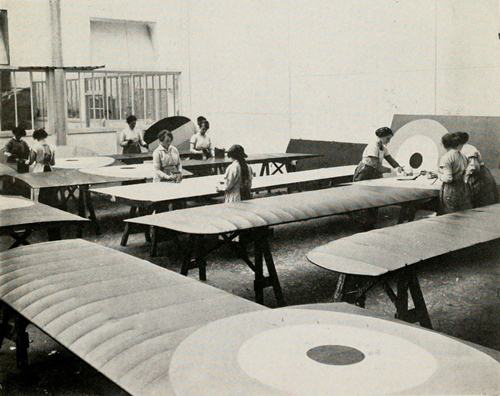
feminine fingers: such processes, for instance, as the sewing of the wings
by hand, or by machine, or the painting of the woodwork.
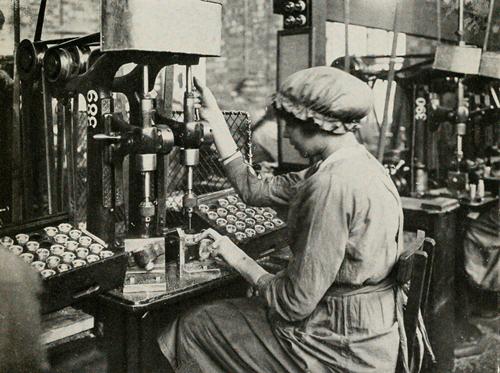
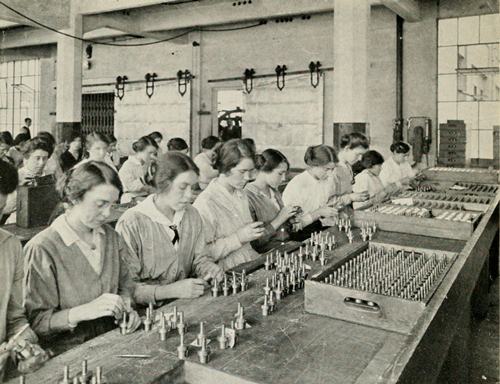
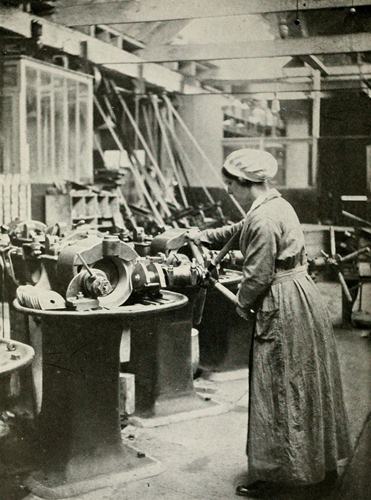
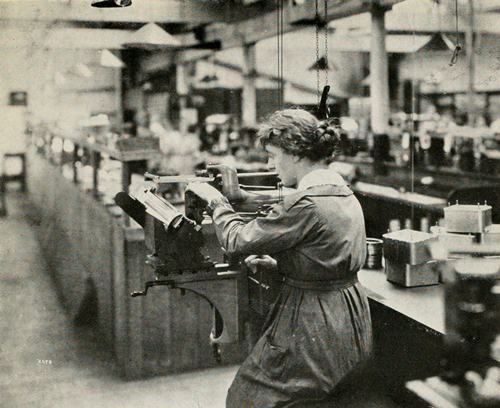
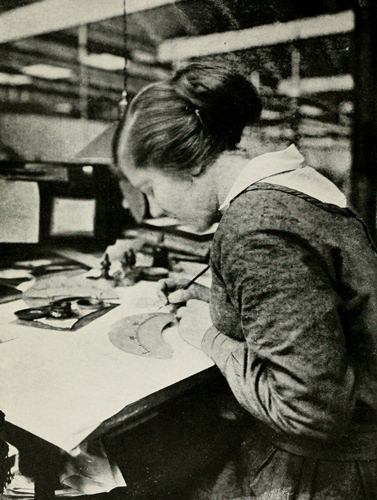
ENGRAVING METAL PARTS FOR COMPASSES
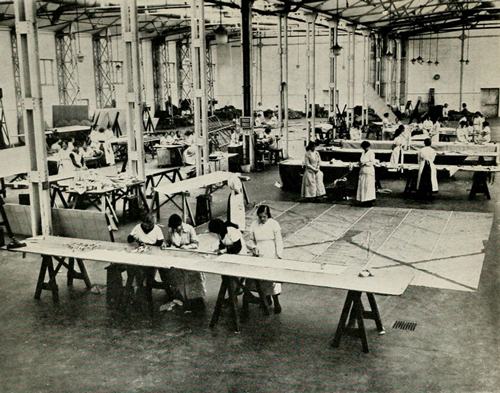
COLOURING AEROPLANE PLANES
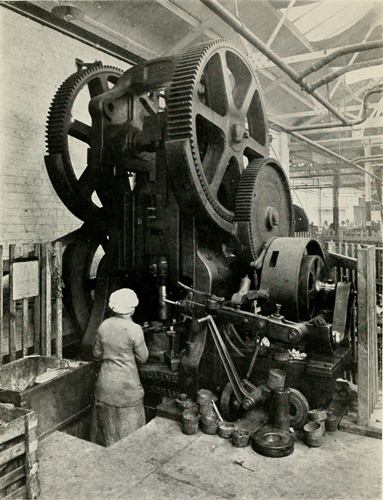
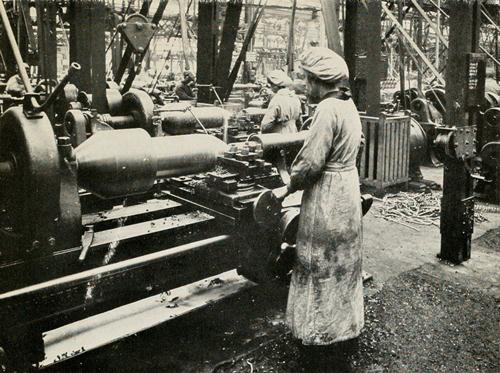
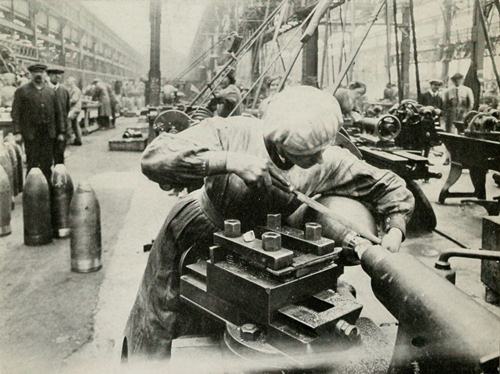
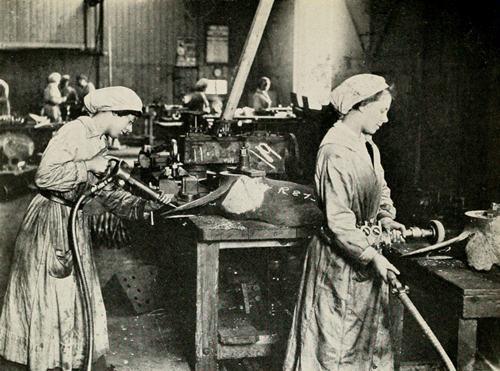
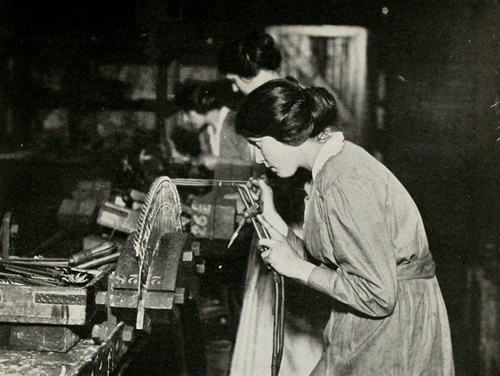
CHIPPING AND GRINDING BLADES OF CAST IRON PROPELLER WITH PORTABLE TOOLS
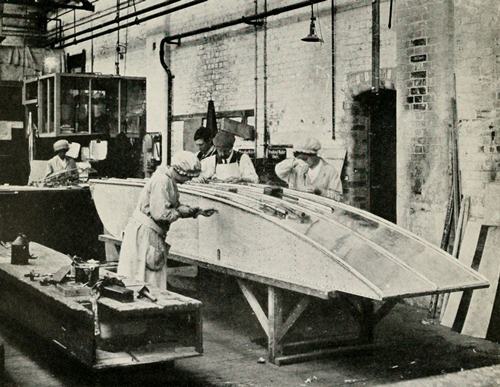
WOMAN ACTING AS MATE TO JOINER. MAKING SEA-PLANE FLOATS
To-day, they undertake almost every other process both at the carpenter’s
bench and in the engineering shop, and the chief impression you carry away
from a stroll through such a factory is that the women are thoroughly at
home in the work. The operations are often so clean that the workers’
overalls and caps of the daintiest shades of pink, blue, white, and
heliotrope, remain fresh; the material for aeroplane parts is usually so
light that the handling of it presents no difficulty to a slip of a girl.
When within the works, the visitor is constantly stimulated to the thought
that the hand which rocks the cradle should obviously be the one to make
the air-machine.
One expects, of course, women’s familiarity with the occupation in the
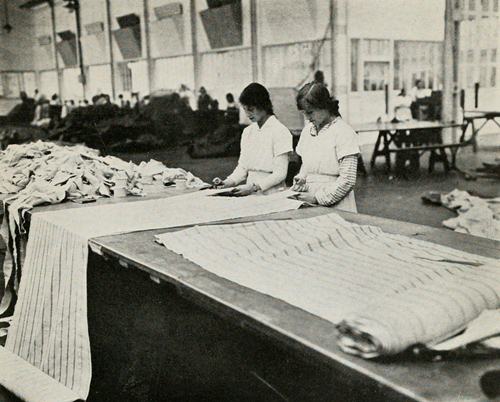
room where the fine Irish linen is cut out and fashioned into wings. One
is not surprised at the facility with which the measuring and cutting out
are accomplished, and, maybe, an emotion of admiration arises, similar to
that evoked by the contemplation of old tapestries, when one watches the
hand-sewing of a seam in a wing of some 10 feet in length. Not a stitch of
the button-holing of such a seam deviates by a hairbreadth from its
fellows. Such work has, however, been women’s province through the ages.
But a new sensation is awakened in the carpenter’s shop where women are
working with dexterity at the bench, handling woodwork like the men, now
dealing with delicate wooden ribs, or again, fashioning propellers out of
mahogany or walnut with such nicety that there is not the slightest
deviation between the dimensions of a pair. In the room where the linen is
stretched over the wooden ribs, I have seen women working with tiny
hammers, giving fairy blows that never miss their mark on tiny nails.
It is with fascination that a visitor stands by be-goggled women as they
undertake the welding of metal joints by the oxy-acetylene process. Here,
conscientiousness is a vital quality in the operator, since an undetected
flaw in the weld, as a works foreman recently remarked, ‘might easily send
an airman to Kingdom Come’. For this process, women of education are more
often selected.
It is with awe that you watch the women at work on the metal parts of the
aeroplane, drilling, grinding, boring, milling on the machine, or
soldering tiny aluminum parts for the fuselage, and in each process
gauging and re-gauging, measuring and re-measuring. Women also work on
aero-engines, and help in the manufacture of the magneto, the very heart
of the machine. They even undertake special processes, which before the
war were only entrusted to a select body of men. I stood one day, for
example, watching a woman splicing steel rope, a process undertaken in
pre-war days by sailors. She was working with extraordinary speed and
unconcern, and had learned the job in three or four days. Before then, she
told me, she had been her employer’s cook.
But the most alluring scene of all is the assembling of aircraft. The
infinite number of separate parts are now ready; they have been tested by
factory overlookers and retested by Government inspectors. The greatest
care is taken in these examinations: it is the only possible insurance of
the lives of the brave youths on their journey above the clouds. All the
workers know this, and the seriousness of the job is reflected on their
faces. But now all the parts are ready and to hand in the Erecting shop.
Then wings and propeller are added to body, the engine and
leather-upholstered seats introduced, the electric apparatus fitted up,
the compass, ammunition box and other instruments and weapons placed in
position.
The aeroplane is at length complete, and stands in the hangar like some
great bird, with outstretched pinions, awaiting its first flight into the
Unknown. Women undertake every process of this assembling, and have
acquired familiarity with all the parts. This was put to the test recently
in a certain works when a woman operator was directed to dismantle a
machine. Without hesitation, she stripped the complex network of the
structural stay-wires and the control wires, and then re-assembled them,
correct in every particular, at the first attempt.
Optical Instruments
Of the many industries developed by the war, the production of optical
instruments offers a striking example of rapid progress. Before 1914, the
optical glass industry of Europe was largely in the hands of Germany and
Austria, and the outbreak of hostilities meant the total closing of that
market to the Allies. The lack of optical instruments thus occasioned was
at first a source of grave national peril, since optical glass provides,
as it were, eyes for both Navy and Army. The eyes of the guns are the
range-finder, the director, the sighting telescope, periscope, prism
binoculars, and other instruments for observing fire and correcting the
aim; the tank would be blind without its periscope, and observations are
made from aircraft by means of photographic cameras and lenses.
At sea, the tale is repeated; the submarine requires at least one eye, and
the submarine chaser needs many, while, by means of optical instruments,
the naval gunner can fire at a target which is about 15 to 20 miles away.
The very health of the army depends, in great measure, on optical glass,
since the Royal Army Medical Corps fights malaria and other diseases due
to parasites, which must be magnified by a microscope a thousand times
before they can be identified. Hence, the solution of the problem of
optical munitions was a vital matter in the early days of the war.
With characteristic energy, Great Britain set to work and soon restored a
languishing trade. The task was enormous; the industry had to be revived
from its very foundations. The production of the peculiar types of glass
required for optical instruments in itself presented a formidable
obstacle, even its principal ingredient, a special quality of sand, being
formerly derived mainly from Fontainebleau and Belgium. But by widespread
investigation efficient substitutes were soon discovered, the problem of
mixing the ingredients was at length solved, formulæ for special glasses
devised, and we are now producing large quantities of optical glass of
perfect quality. The production of the raw material was, however, only a
first step in obtaining an adequate supply of optical instruments.
Numbers of delicate processes stand between the rough glass and the
finished implement. The glass must be cut, ground, and curved exactly to
the requisite design, which in itself takes many days of high mathematical
computation; it must be smoothed and polished, cleaned with meticulous
care, and adjusted to a nicety in the particular instrument for which it
is fashioned. The difficulties and pitfalls are incalculable; from start
to finish the glass obeys no fixed laws, but answers only to the skilled
handling of the scientist and craftsman. ‘Optical glass is the mule of
materials’, comments a recent writer with sincerity.
The absence of requisite labour for what was practically a new industry
was a serious menace, and it is to the credit of Englishwomen that, as
soon as the need for their services in this direction was made known, they
stepped without hesitation into this unfamiliar and highly skilled
industry. Their success therein is remarkable, and many, from such
callings as high-class domestic service, kindergarten instruction, music
teaching, blouse and dressmaking, have achieved a wonderful record in the
delicate and highly technical processes of lens-smoothing and polishing
and in the production of prisms of faultless polish and cut.
There is, I take it, no more interesting munitions development than in
factories where these lenses and prisms are produced. The work is so fine
and so delicate that one feels it might be more suitably transferred for
manipulation to elves, or fairy folk, who might undertake the various
processes standing at a large-sized toad-stool. But with the stern reality
of war upon us, willing feminine fingers have had to be trained to handle
these lenses, the smallest of which, when ranged in trays, resemble a
collection of dewdrops, and the largest of which would easily fill the
port-hole of an ocean-liner.
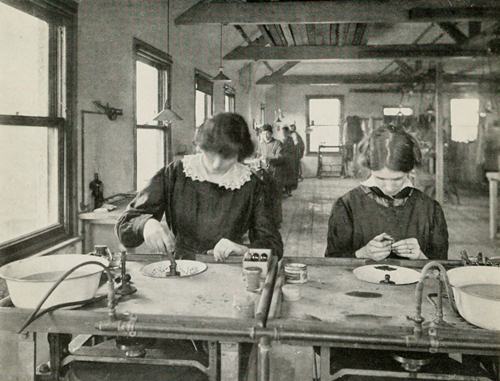
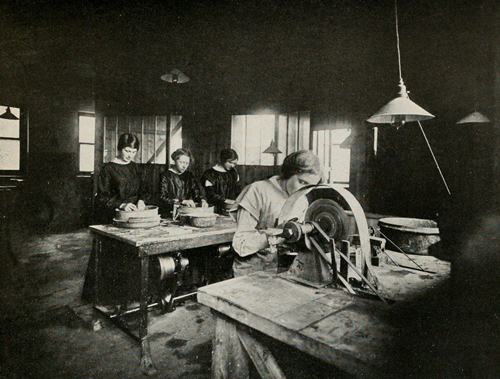
Optical glass when it comes into the workshop has the appearance of small
blocks of rough ice of a greyish hue. These blocks are roughly sliced and
cut into shape by a rotating metal disk charged with diamond dust. The
prisms and lenses in their initial stage are then handed on to women, who
complete the work on their surfaces. Each process has its particular lure
for the interested visitor. You may watch the slices of glass being shaped
into prisms by handwork against the tool; you may follow these embryo
prisms through the various processes of smoothing and polishing until a
small magnifying prism is obtained for use in a magnetic compass, or until
a large prism is completed suitable for a submarine periscope. You may
follow the creation of a lens from the roughing and grinding of the glass
slices with emery, or carborundum, until the approximate shape is given,
or you may follow a later process of sticking the smaller lenses on to
pitch, so that they may form a single surface for smoothing and polishing.
Again, you may watch the superlatively difficult operation of centring a
lens. This task is necessary to ensure the polished surfaces of the lens
running perfectly true and it requires a skilled touch and a trained eye
to undertake it satisfactorily.
In a shop in a certain optical munitions factory I met the first woman who
worked a centring machine in that area. She was formerly a housemaid, and
told me that, at first, all the men had discouraged her from the job and
had said it was ‘impossible for a woman to do such work’. But she ‘stuck
it’—so she said—and in a few weeks, to her own surprise and the men’s
dismay, this peculiarly skilled job became familiar to her. ‘Now I feel I
am doing something,’ she said in triumph. This sentiment was echoed by
another worker in that factory who was accomplishing the surprising task
of ‘chamfering’, or putting a tiny bevel onto the edge of a lens.
The large lenses measure only 2 inches in diameter; the smaller ones are
about the size of a threepenny bit, and every operation, whether grinding,
trueing, smoothing, polishing, or centring, must be accomplished with the
utmost care. Even the final process in the manufacture of the lens or
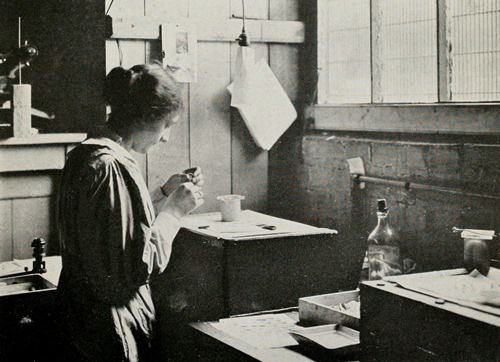
prism, ‘wiping off’, is fraught with responsibility to the operator.
‘Wiping off,’ or cleaning the lens, can only be done with a silken duster,
for the finished glass, like a dainty lady, will tolerate the touch of
nothing coarse.
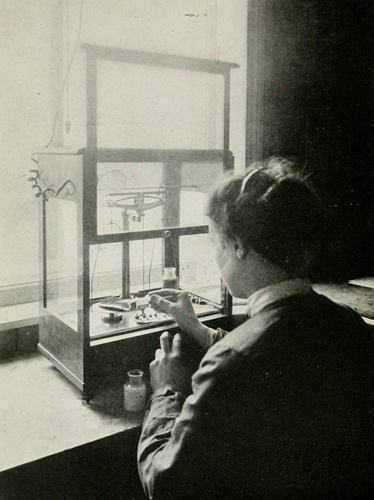
In cases where the glass is graticulated, or marked with fine lines for
measurement purposes, the task of ‘wiping off’ is of extraordinary
difficulty; in the opinion of at least one foreman with whom I have
discussed this question, the operation is only perfectly successful when
performed by a girl’s fingers. It is of supreme importance that no speck
of dirt or hint of grease from a finger-mark be left on the glass when
finally adjusted, or the instrument would become a source of danger to the
user. No wonder that the feeling of the optical instrument workshop
expresses itself in the words: ‘Cleanliness is more than godliness at this
job.’
The completed glass at length reaches the stage where it is set in its
instrument, be it periscope, dial-sight, telescope, and so on. Although
the most exact measurements have been observed both in the metal part and
on the glass, small adjustments are necessary; for the fit must be so
perfect that even if the metal case suffers shell-shock, the glass must
still not rattle. But it is the metal alone which is submitted to
alteration, and it is wonderful how women have been able to obtain
sufficient dexterity to make these infinitesimal changes in the metal
parts. One can see a mere girl undertaking such a task by giving the metal
three or four delicate strokes from a file so fine that it would not hurt
a baby’s skin. Meantime, the lens or prism is finally examined (also by
women) for size, scratches, and other imperfections, and is then
re-cleaned. Girls and women take a full share in the production of the
metal parts for the optical instruments and also assemble, or collect the
parts, for the adjustment of the glass, but so far they do not generally
adjust or test the completed instrument.
The operations used in the production of optical instruments for war
purposes are, of course, similar to those required in the manufacture of
implements used in peace-time, such as opera-glasses, telescopes,
microscopes, surveying instruments, photographic and cinematograph
apparatus, &c., and it is expected that women who have entered the new
war-time industry will happily find themselves, when peace dawns, in
possession of a permanent means of livelihood in a skilled occupation.
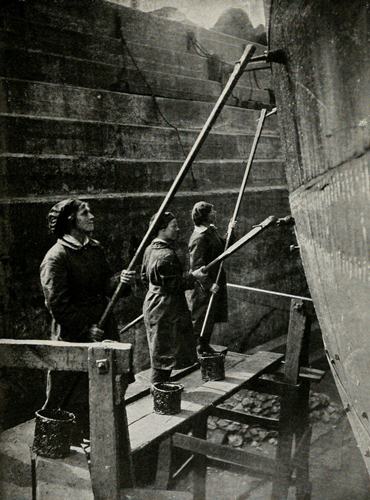
In the Shipyards
‘Ships, ships, and still ships’: such is the main need of the Allies in
this, the fourth year of the war. To answer this demand, every dockyard in
the country is working at the highest pressure. Into this work, strange as
it may seem to those familiar with the rough-and-tumble life of a
shipyard, women have penetrated and have so far surmounted all obstacles
in the tasks to which they have been allocated.
At first, dilution in shipyards was looked upon as a hazardous experiment.
The work is mostly heavy and clumsy, and the type of men undertaking it,
splendid fellows enough in their physique and general outlook, are mainly
accustomed to dealings with the boisterous elements and with men comrades
of their own pattern. Their attitude towards women, it was feared, would
make for trouble immediately that the other sex was introduced as
fellow-workers. Even the most optimistic amongst shipbuilders were aghast
at the idea of women working shoulder to shoulder with men on board ship.
Yet here and there a pioneer employer has arisen, and the experiment has
been tried. It is succeeding unquestionably.
I have been into the shipyards and seen the amazing sight and am convinced
of its expediency, at all events as a war-time measure. Special care must,
of course, be taken in the planning and the supervision of women’s work on
board ship, but given the right type of inspectress, charge hand, and
workers, there is no reason why women should not, in increasing numbers,
fill the gaps in the shipyards, as in the factories. The women chosen to
undertake such tasks are well aware of the service they are rendering to
the nation at this juncture, and to the women workers the first day on
board ship is one of supreme happiness. ‘They are so excited when they
actually get on board,’ said a dockyard inspectress to me recently ‘that
they forget all about the difficulties and objections to the work.’ It is
well that this is so, for it is not too easy for the novice to move about
below, even on a big battleship.
I was taken over one where the women were working. It was in a big yard
crammed with shipping of every kind—so full that one could echo the words
of the old Elizabethan, who said of a crowd: ‘There was not room for a
snail to put out its horns.’ A stiff breeze was blowing, and the sea
beyond ran full and blue. The great battleship along the dock lay serene
and stately, bearing, as it were, with grim humour the meddlesome tappings
and chippings of impertinent human beings, who presumed to furbish her up.
There were men on the conning-tower, busy with paint-pots, and there was a
tangle of ropes and pots on the upper decks where the guns were biding
their time. Men were calling lustily to each other, and were darting here
and there as brisk and wholesome as the breeze.
‘We go down here,’ said the inspectress, pointing to a ladder as steep as
the side of a house. She bounded down with the ease of an antelope.
Another ladder, and yet another. The inspectress seemed to have forgotten
their steep incline and I was left, a helpless landlubber, cautiously
descending step by step. When I joined her in the engine-room she was
already deep in conversation with one of her staff. And then I noticed the
secret aid to her agility. All the women aboard ship were dressed in
trouser suits. The suits, of blue drill for the supervisors, and of a
similar material in brown for the labourers, were made with a short tunic,
and the trousers were buckled securely at the ankle. A tight-fitting cap
to match completed the smart workmanlike costume which permits of perfect
freedom of movement in confined places. Without such a costume it would be
hardly possible for women to work on board.
The women workers on this particular battleship were engaged in renewing
electric wires and fittings, a job which requires a good deal of care and
accuracy. On the lower deck, they were fitting up new cables and were
perched in high places, here ‘sweating in’ a distribution box, there
marking off the position for the wires. Others were drilling holes, others
again were ‘tapping’, or making a thread in the holes. In the engine-room
the women were busy stripping worn-out electric wiring and were working by
the light of tall candles, as merry as a party preparing a Christmas tree.
Everywhere the women were working in pairs, an arrangement found
especially advisable on board. Behind a small iron door we found one
couple working on a fire-control in a nook where the entrance of a single
visitor caused bad overcrowding. ‘These are my mice’, said the
inspectress; ‘they always get away into the cupboard-jobs, and very well
they work there too. But we have to maintain a strict discipline on board,
far stricter than anything known in the factories.’
No talking, I was informed, is allowed in that dockyard, during the
working hours on board, between the sailors or men labourers and the women
and there is constant supervision of the women employed. These work on
board in parties of 20-22, each party being under the care of a charge
hand. When the staff included three charge hands for supervision on board,
an inspectress was appointed for this special branch of the work. The
system seems to work well, and I noticed how the men and women had
evidently accepted each other as comrades. Coming into a secluded gangway
a man-labourer, who had finished his job, was unconcernedly shaving before
a square of mirror, while two or three women just beyond went on, just as
unconcernedly, tap, tapping at the electric fittings. There was no
chaffing, no ‘larking’, between the men and women, but a sense of
comradeship, such as one notices in a Co-education School.
The women on electric-wiring receive, in that dockyard, one month’s
instruction on dummy bulk-heads before going on board; their
instructors—expert men—accompany them to the number of two to every
party of twenty or so, and remain with them for ten to twelve months.
After that, the women are able to work without an instructor, and I was an
eyewitness to this arrangement on a cargo vessel, where electric wiring
was also being undertaken.
Besides the work on board, women in dockyards are employed in the various
engineering shops where almost every description of construction and
repair work for vessels is undertaken. I have seen numbers of women at
work in such an electrical department, winding armatures, making parts for
firing-gear, polishing, or buffing and repairing electrical apparatus, &c.
The work in such a repair section is full of interest and variety. From
day to day the operators receive consignments of electrical apparatus
damaged on board by the elements, or worse. Great dispatch is needed, and
the women work with the utmost zeal and efficiency. I noticed them
undertaking such varying operations as lackering guards for lamps and
radiator fronts, repairing junction and section boxes, fire-control
instruments, automatic searchlights, &c., and they were turning out their
work, the foreman said, just like men. In the constructional department,
women are now employed in making bulkhead pieces, or metal-work of various
kinds, in oxy-acetylene welding, and occasionally in the foundry.
When it is recollected that before the war only elderly women—the
grandmothers—were, generally speaking, employed in the dockyards, and
those only on such ornamental tasks as flag-making or upholstery for
yachts, it is hardly credible that the granddaughters are now working
successfully on intricate processes and even at jobs where physical
strength is a qualification. ‘We can hardly believe our eyes,’ said a
foreman recently, ‘when we see the heavy stuff brought to and from the
shops in motor lorries driven by girls. Before the war it was all carted
by horses and men. The girls do the job all right though, and the only
thing they ever complain about is that their toes get cold.’ ‘They don’t
now’, said a strapping young woman-driver, overhearing the conversation.
‘We’ve got hot-water tins.’ Then, in a low voice, for my ears alone, ‘I
love my work, it’s ever so interesting.’
It is this note that one finds above all, amongst the women in the
dockyards. The spirit of the sea, the almost forgotten heritage of an
island population, has been stirred once more, and the sight of the good
ships in harbour thrills the woman-worker, as the man, with a sense of
independence, freedom, and love for ‘this England, ... this precious stone
set in the silver sea’.
No wonder that Englishwomen find their work in the dockyards ‘ever so
interesting’.
CUTTING FRAYED-EDGED TAPE
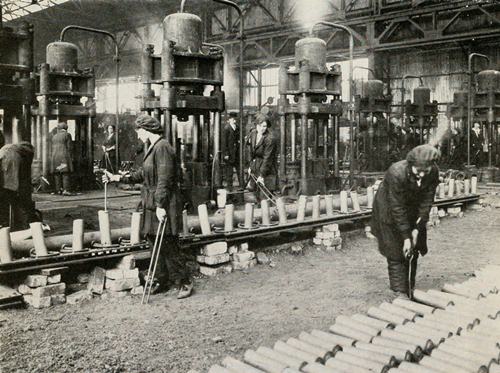
BRAZING TURBINE ROTOR SEGMENT
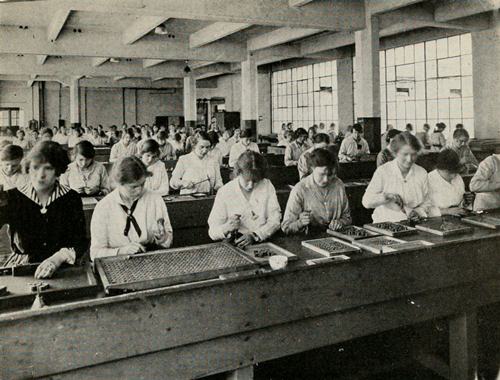
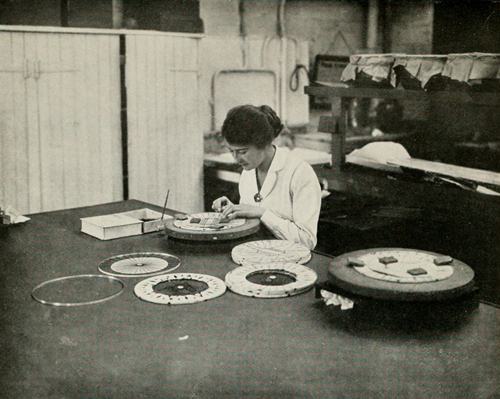
MOUNTING CARDS FOR DRY COMPASSES
TREADLE POLISHING-MACHINES, FOR SMOOTHING LENSES