Flick Wilder was stretched on his back on the shadowy couch, hands
under his head, legs crossed, and one foot pointed toward the
skylight, against which the reflections of the opposite hotel cast
a blurred glamour.
“Hello; you here?” said Tootles, in surprise.
“Mostly.”
“Sober?”
“Alas!”
“What are you mooning there on your back for?” said Tootles,
turning on the pink and yellow lights.
“I’m laughing over a new joke,” said Wilder, in anything but an
hilarious tone.
“Good Lord, Flick,” said Tootles, stopping short: “don’t tell me
you are in the glums, too?”
“Who’re you talking to?” said Wilder, as though the question
deserved no answer.
“Fellow down the hall.”
“The high-life gink who is moving into the corner studio?”
“No; O’Leary—fellow next to Lady Vere De Vere,” said Tootles, thus
characterizing Miss Inga Sonderson, who had impressed him with her
haughty aloofness.
“Oh!” Wilder slowly drew himself up and looked inquiringly at
Tootles. “What time?”
“Dinner-time, naturally.”
“Art,” said Wilder severely, “there are some sacred words which you
ought to respect.”
“I was just thinking how lovely it would be to sit down before a
large, juicy beefsteak,” said Tootles incorrigibly. “You know the
kind, browned on the outside, rare inside, melting in the mouth.”
Wilder flung a slipper across the room that missed Tootles’ head
and clattered among the paint-brushes.
“Well, Literature, supposing there is an ice-box, is there anything
in it?”
“You’re forgetting your English accent, Tootles,” said Wilder, as
he bustled, whistling, over to the window-box.
“My word—so I am!” said Tootles, following and peering over his
shoulder.
Wilder drew forth half a bottle of milk, an open tin of potted ham
and several portions of bread.
“The sardines,” he said, “are for our Christmas dinner.”
“Don’t let’s overeat,” said Tootles seriously, trying to coax forth
a smile. “Flick, the stomach must be empty when the brain is full.”
They sat down at the table, facing each other.
“What! No finger-bowls?” said Tootles facetiously, drumming a march
on the table.
“Art, it’s no use,” said Wilder, shaking his head. “It’s a bum
night. Damn Christmas anyhow!”
“Ah, but wait until Santa Claus comes,” said Tootles brightly.
At this moment, as though in answer, there came two sharp raps on
the door that set the glass to rattling.
“Who’s that?” said Wilder, startled at the coincidence.
“Santa Claus,” said Tootles. “Well, come in if you’re good looking.”
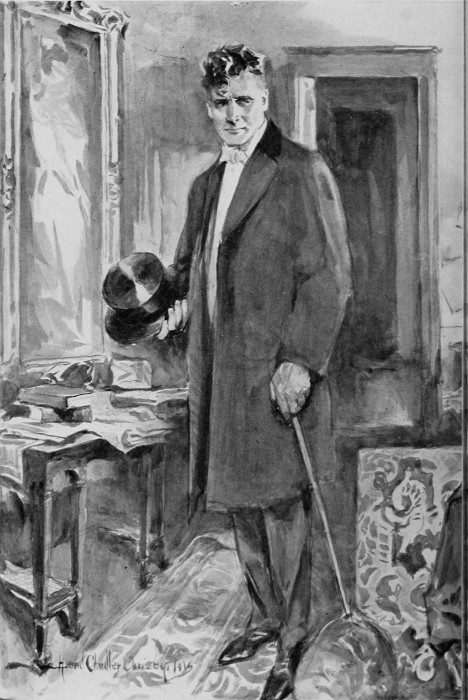
The door opened immediately, and King O’Leary’s broad shoulders
loomed out of the dusk. He stood there in his flannel shirt and
loose tie, at ease from a long acquaintance with the freemasonry
of men, peering in at the oddities of the studio, which seemed to
amuse him immensely. Then he saluted, with the curious, fluttering
salute of the English private, and exclaimed:
“Hello, neighbors! Am I butting in?”
“Not at all,” said Tootles cheerily. “What can we do for you?” He
waved a hand toward Wilder, adding: “My collaborator, the Hope of
Literature, Mr. Flick Wilder.”
“Glad to know you,” said the new arrival, shaking hands heartily,
as though he were indeed delighted at the opportunity. “My name’s
O’Leary.” And he added, grinning expectantly, “What do you
collaborate in?”
“In the studio, of course,” said Tootles. “I pay the rent, and he
occupies it.”
Wilder at once transferred this to his memorandum-book with an
appreciative nod.
“Gentlemen, this place has sort of gotten on my nerves to-night,”
said O’Leary, by way of explanation. “Christmas usually does,
whether I’m in Singapore, Manila, or hoofing it up the Roo Royale.
If I’m butting in, kick me out, but if you fellows have got it as
bad as I have, what do you say to pooling our misery and grubbing
together. It strikes me that’s better than chewing the cud in our
corners.”
Wilder looked at Tootles, who said with gravity, in his best
English manner:
“Your idea interests me strangely; but the fact is—well, we’ve
been out so much in society lately that we thought we’d enjoy a
quiet little supper at home—” King O’Leary glanced at the table;
perceiving which, Tootles hastened to add, “No, that isn’t for the
canary; that is just the hors d’œuvres.”
“Strapped?”
“That is a vulgar way of expressing the same idea.”
“Stranger treats the crowd,” said O’Leary with an easy authority.
“That’s the rule of the game wherever I have played. I’m asking
you. Happen to have a little swelling in the pocket just at
present. When it’s empty, which will be soon enough, why—your
turn. How about it, neighbors? Suppose we look each other over and
size it up?”
Half an hour later they deployed from the Arcade and set out for
Healy’s, grimly determined on revelry and the conquest of the
glums. Unfortunately, the Christmas crowds were still about them,
homeward bound.
“They might get home at a decent hour,” said Flick, indignantly.
“No turkeys to-night,” said Tootles. “I’m against it. My word!
The thought of all those birds, plucked and skinned, thousands
and thousands”—he reflected a moment—“no, hundreds of
thousands—think of it—hundreds of thousands of turkeys!”
“Confound them, they look happy,” said Flick, blowing the snow from
his nostrils. “Well, anyhow, they’ll all be ill to-morrow!”
King O’Leary squared his shoulders and looked straight ahead,
but he found a moment, as they were crossing the newsboys at the
subway, to slip surreptitiously a shiny quarter into the fist of a
pursuing urchin.
“No public stuff,” he said, as he entered by the bar entrance. “A
quiet corner where men can lounge and spin a yarn as they like.
Here’s a seat. Shove in.” He glanced at the rough-hewn crowd by the
rail, and said grimly: “Mighty grateful to you fellows. Suppose I’d
have had to pick up with one of those guys.”
They slipped into a padded nook with high backs, tucked away from
the whirl of mirrors and the regimented bottles beyond the black,
curved backs, and derbies pushed over the ears.
“What’ll it be?”
“No turkey,” said Tootles.
“And no cranberry sauce,” added Flick.
“No, no—forget all that!”
But at this moment, as though the spirit of the holiday were bent
on pursuing them like a tantalizing imp, a stableman, affably
inclined, saluted the room in his departure.
“Well, and good luck to youse all. A foine Christmas!”
“How about a steak?” said Tootles hastily.
“That hits me, and we’ll have it planked,” said O’Leary.
“Better look at the tax,” said Flick, in a burst of friendliness.
“Rot! We’ll make a night of it!” said King O’Leary, with the
gesture of a millionaire toward Schnapps, the veteran waiter, who
grinned down at them from his gobbler head.
“My word! If I ordered that, they’d make me show the goods,” said
Tootles, in admiration. “Have you found a gold mine?”
“Hardly that.”
“Been away quite a bit, haven’t you?”
“Yep; just back.” He paused, and noting the curiosity written on
the faces of his guests, said: “Suppose it’s up to me to give an
account of myself.” Schnapps was back with a bottle. O’Leary poured
out his glass of whisky, taking it neat, with a look of surprise at
Tootles’ refusal. “Water-wagon? Always have been? Well, don’t know
but what you have the advantage. Will say this, though, cottoned
right up to you, boy, over there in that elevator. You got the
first laugh out of me in a long blue day, and that’s more than I
thought any one could do. Here’s to you! Kind of reckon we’ll hit
it off. You’ll find me a different sort day after to-morrow—right
there with the repartee and the jollying stuff. How!” He emptied
the glass and pushed it away. “I say, we might as well start fair.
I’m apt to get pretty down—not violent—just down. Savvy?”
“I’ve handled them before,” said Tootles cheerily, with a glance of
tribute to Flick. “Go as far as you like. This is free soil.”
“What made you turn around there in the hall and wish me luck?”
said King O’Leary slowly.
“Don’t know. Kind of felt how you felt, I suppose.”
“You hit it, all right. But that’s something we won’t talk about.
Well, lads, I suppose you’re curious about me, same as I am about
you. If I were to tell you all the scrapes I’ve been in and out
of in thirty-seven years, we’d be sitting here at Easter. If any
one should ask me what I did, suppose I’d have to answer—just
circulate.
“That’s what I’ve been doing—for I’ve been doing everything,
and some of it is worth the telling, as you’ll hear if we get
to chumming. If you ask me what I like, I’d rather beat the box
than eat. Don’t know anything about it, but just can’t help
playing—natural ear. When I get short of funds, I wander in
anywhere, café or vaudeville, and whip up the old pianner—All
right, Schnapps, don’t annoy the bottle—Trouble with me, I suppose
is, I got to roaming early. A habit now. Am never long in one spot
before something comes tugging around at my shirt sleeve and I
get to dreaming of fast expresses, or sailing into blue seas, or
Piccadilly on Saturday night, or the little dog-sleds up in Alasky
or something far-off and similar. Times there are when I think
I’ve come to the point of driving a stake. Suppose it’ll strike me
some time. I ain’t quite as restless as I used to be, but just at
present, why, say—if you were to suggest skipping down to Coentes
Slip and shipping for Honolulu or Madagascar, I’d beat you to it.”
“Do you feel that way?” said Flick, opening his eyes with delight.
“Shake! You’re my long-lost brother.”
“However, we’re not shipping before the mast,” said Tootles
anxiously, who saw the dinner arriving with relief. “We’re eating a
nice, ripe, juicy steak with friend Santa Claus.”
“Where have you come from now?” said Flick, waking up.
“Had a try at Alasky, sunk it all in a bum mine and a phony
partner,” said O’Leary. “Got as far as Kansas City and got trimmed
by a pickpocket while I snoozed. Boys, I certainly was up against
it there. Had to take a job as a coachman. Mighty little I had
to go on, but luck was with me. Usually is, wherever I tumble.
The horses were a couple of baa-lambs that an infant could have
harnessed, let alone driven. That was all right, I bluffed through
that. But the old lady was a terror. The old man had struck it
sudden, and she was wallowing in that carriage. She was fierce. She
was a fat woman, and she swore like a mule-driver. I tell you, that
month was something awful. I stood it until she drove down to the
bank and paid me off, jabbing me in the back with her parasol and
swearing directions under her breath. I’ve stood a good deal in my
little canters around this globe, but I can’t stand being sworn at
by a fat woman on a public street.”
“What did you do?” said Tootles, adding a curling strip of brown
potatoes, smothered onions, and splashes of beans, peas, and
carrots to each plate.
“With fifty dollars tucked away, I laid for her until out she came
with a final poke in the ribs. Then I hauled in my horses, took
off my livery, made her a bow, and handed it over to her with the
reins, right there in the main street. By jingo, it was worth it to
see her face!”
“What’s the queerest job you ever landed?” said Flick, savoring the
steak with gratitude.
“Queerest?” said O’Leary, scratching his head and seeming to return
over a long and grotesque line. “I’ve done some funny things in my
time.”
“Tell you what I did over in Chattanooga—in red-hot midsummer,
too,” said Flick, in a burst of confidence. “I was a dog-catcher.”
“That certainly is going down for it,” said O’Leary, grinning. “But
I’ve got you beat. I subbed in a face-parlor.”
“A what?”
“Painted out black eyes and that sort of thing. Fact—out in
Chicago.”
“My word!” said Tootles, overjoyed to see a beam of good humor
breaking through the clouds. “I wonder that I associate with such
persons.”
“Leaving out the dog-catcher,” said O’Leary, falling with gusto
to the attack of his heaped-up plate, “I do believe, with the
exception of preaching and tooth-extracting, I’ve tried them all.
I’ve run a country paper. There’s a story there I’ll give you
some day. Lord! I even taught school in the Philippines to the
pesky heathen. Have mined for gold, silver, copper, diamonds,
and zinc, from Cripple Creek to Kimberley. I’ve traded and sold
everything from a thousand cattle to peddling collar-buttons at the
Queen’s Jubilee. I’ve been a bartender in Paree, and into a peck
of trouble, too. I’ve run a steam laundry in Porto Ricky and had
the whole danged business washed away in a hurricane. I’ve dipped
into a few spring revolutions in South Americky, and I rode out
with Jameson in the raid that kicked out the whole African mess.
Got in and out of Kimberley, and joined the Rough Riders with
Teddy—here’s to him! Never was much of a sailor, but I’ve seen
my time before the mast through the Southern seas (that’s how I
appreciated your nautical terms, boy) when I stowed away for Chiny
and Calcutta. Lord, where haven’t I been?”
“O’Leary, you’re either a hell of a big liar or a regular fellow,”
said Flick, cheerfully, “and either way, I’m for you.”
“Maybe I’m blowing too much,” said O’Leary quietly. “But it’s sort
o’ whistling in the wind to keep your courage up. However, I’ve
laid my cards on the table. That’s me. Well, this is starting good
enough to keep it going. What do you say to taking in a show?
There’s something in the line of vaudeville over at the Colonial?”
“Is there so much money in the world?” said Tootles doubtfully.
“Boy, a taxi!” said King O’Leary, pounding on the table gorgeously.
“I’m beginning to feel like the Fourth of July,” said Flick, who
gave in completely with this last display of magnificence.
“That’s what we’ll make it,” said King O’Leary. “Schnapps, steal
the change. Come on.”
The visit to the theater was the undoing of all the good work
accomplished, nor could the result have been foreseen. The
orchestra was comfortably filled with an indiscriminate scattering
of transients, plainly marooned, and the three friends, being
resolved to laughter, applauded the opening numbers with such
zest that they woke up the torpid house and had the entertainers
gratefully aiming their shafts in the direction of their box for
the pure joy of rousing King O’Leary’s soul-filling, rumbling
laughter, to hear which was infection itself. The outer world, the
season, and the calendar had been shut away as they roared over
the grotesque tumbles and trippings of a comic acrobat who gyrated
fearfully on a bicycle the size of a house, when the curtain went
down and up again on the Lovibond Sisters. “Sweet Singers from the
South,” who, according to the program, “would introduce sentimental
favorites.”
All their mirth vanished. They waited glumly through “Annie
Laurie,” and fidgeted as the quartet quavered into “Way Down Upon
the Suwanee River,” but when “My Old Kentucky Home” began, with
moonlight effects on the back drop and cowbells tinkling, O’Leary
got up suddenly and said:
“Hell! Let’s beat it.”
They emerged glumly on the sidewalk, while Flick swore copiously
for the crowd and led the way down the avenue to Campeau’s, where
they found a table in a noisy gathering thundered over by a dynamic
orchestra.
“O’Leary, it’s no use,” said Flick; “we can’t get away from it.”
“Guess you’re right.”
They stayed there a long while, passing into the confidential
stage, while Tootles consumed large quantities of ginger ale and
sought desperately to stem the rising tide, which came rolling
in blackly. They had yielded to their depression, reveling in
it. While King O’Leary listened, jerking at his fingers, Flick
reminisced of forgotten days in a little Western town, of white
Christmases when the relations gathered in jingling sleighs and the
table was crowned with a wild turkey at one end and a crackling pig
at the other.
“With a roast apple in his snout, and a ribbon—a blue—no, a pink
ribbon decorating his ornery little tail. King, I can taste that
pig yet—fact—good pig—good old pig! What did we use to call
him? Can’t remember.” He went off into a foggy search, dipping his
finger in a puddle of water on the table and seeking to reconstruct
it in the shape of his remembered idol. “Looked like that—just so.
There’s the tail—see? We used to fight to get that tail, Lem,
Minnie, and me—” He suddenly looked up, as though conscious of
O’Leary’s staring silence. “I say, did you used to have pig—roast
pig? No? Well, what sort of Christmas did you have?”
“There was only one that counted,” said King O’Leary, frowning
stubbornly, “and that, son, we won’t talk about.”
“Why not?” said Flick indignantly. He added, as though in his
clouded brain he had found the answer, “Secret sorrow—that it?”
“Call it that.”
The news seemed further to depress Flick. He contemplated the
shining plate with deep commiseration, shaking his head.
“All right. Sorry—mighty sorry. Felt that right off about you.
Fact! Shake—shake hands.”
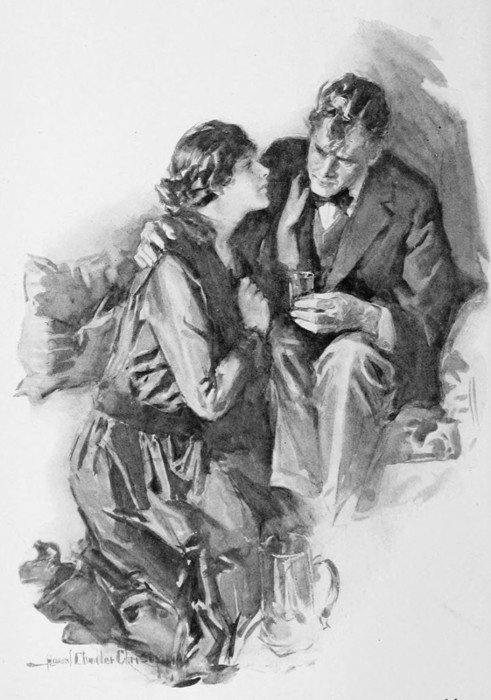
Tootles watched Flick, a little maudlin, silently offer his hand
to King O’Leary, who took it glumly and abruptly arose as though
shaking off a leaden weight, saying:
“Well, I’ve had enough of this place. Beat it again.”
They began to wander, east and west, up-town and down-town, seeking
memory’s oblivion, finding it always dogging their heels—a rapid,
confused passage through lighted restaurants and noisy cafés,
with momentary junctions in casual parties. They ended up in an
all-night restaurant, where King O’Leary took possession of the
piano, Tootles conducting the orchestra, while Flick, with pompous
dignity, singled out the fattest and oldest ladies and made them a
bow, saying with terrific dignity:
“Madam, will you accord me the honor of this dance? No? I am
sorry—very sorry, but thank you, thank you perfectly jus’ same.”
Tootles, finally, in the wee hours, coaxed them back to the Arcade
(after many a slip), and woke up Sassafras, whose fee for such
gala performances was half a dollar. But on the threshold of the
elevator King O’Leary suddenly remembered the alarming ascent of
the afternoon and hastily imparted the information to Flick, saying:
“Wouldn’t have it harm a hair of your head, not a hair. Understand?
Like you, boy. No harm!”
“Must be careful, very careful,” said Flick solemnly. “Won’t stand
great strain, see? That’s the idea.”
“I see,” said King O’Leary, “but how?”
“That’s it. How?”
“Six—all six at once—too much. Dangerous,” said King O’Leary
sadly. “And, son, I wouldn’t have ’em harm a hair of your head, not
a hair.”
“I’ve got idea,” said Flick, all at once. “No strain—you’ll
see—coax elevator.”
Tootles, who always remained in the picture, solemnly led King
O’Leary into the elevator, saying in a soothing manner,
“It’s all right, King; we all trust Flick.”
Wilder was so touched by this burst of confidence that he
momentarily forgot his happy thought. But all at once, as they
waited anxiously and expectantly, he woke up and said firmly:
“Up one!”
The elevator groaned and lumbered to the first floor.
“What now?” said Tootles.
“Out!”
The three filed forth.
“Down!”
He led the way down to the ground floor, while they followed him,
mystified, and into the elevator again.
“Up two!” said Flick, with the gleam of a field-marshal in his
eyes. “Out! Down!”
A third time they entered the elevator, mounted to the third floor
and solemnly, like the King of France and all his men, descended
three flights and again rose to the fourth. Again at the bottom,
Flick condescended to explain:
“One flight at time—see? No strain. Always be kind to
elevators—see? Coax elevators.”
“Absolutely,” said King O’Leary, with the dignity of an archbishop.
Tootles, inwardly convulsed, maintained a grave face, assuming the
tense gravity of his two friends, mounting to the fifth floor and
carefully descending the long stone flights, his hands on King
O’Leary’s shoulders, whose hands in turn reposed on Flick’s scrawny
back, which stiffened with the sense of responsibility of a chosen
leader. They waited solemnly for Sassafras, standing in dusky line,
for all the world like a vat, a walking-stick, and a peanut, until
the elevator sank, gleaming, to the level. Then they entered, rose
to the sixth floor, and congratulated Flick.
Back in the windy corridor, with two dusky spots of light overhead
and empty milk-bottles before the doors, King O’Leary was seized
with a new emotion, an overflowing love of mankind, and a longing
to cheer blighted existences.
“Poor things,—poor miserable things!” he said, contemplating the
row of shadowy doors. “No Christmas cheer.”
“No peace on earth, no good-will to men,” said Flick, seeing the
idea and almost moved to tears.
“Son, we never thought—did we?—never thought of that.”
“Never,” said Flick.
“We must.”
“Absolutely,” said Flick, who had been struck by the word, and he
frowned and asked, “What should we think?”
“We should think—” began King O’Leary, and stopped, lost in
conjecture. He repeated: “We should think,” and turned, looking to
Flick for relief. “I say, what was the thing—the thing I told you
we should think about?”
Wilder, thus appealed to, shook his head mournfully, and Tootles
had visions of crowning the last two hours’ labors with the
blissful prospect of getting them safely into the studio and to
bed, when, as luck would have it, King O’Leary’s foot came in
contact with a milk bottle. The rolling sound revived his memory.
“We must cheer—bring cheer—bring presents,” said King
O’Leary, getting at length to his thought. “Every one must have
presents—Christmas presents.”
Tootles here interposed hastily, with the irritation of the sober
pilot who sees the harbor of rest escaping.
“To-morrow. Good idea! To-morrow we’ll get presents for them
all—fine—but to-morrow! Now bedtime.”
This ending was unfortunate, as Tootles felt the moment he had
uttered it.
“Never bedtime,” said Flick indignantly.
“Presents—now—Christmas Eve—Santa Claus,” said King O’Leary,
with equal firmness. “Go right down—now.”
“All right, then; go and get them,” said Tootles, in despair, and,
at the end of his patience, he entered the studio and shut the
door. “Well, they’ll come back in about a week, I suppose,” he said
angrily. “Three o’clock! Lord! I’ve got to get some sleep.”
But to his surprise, in about half an hour he heard them returning,
having accomplished the upper trip by the same gradual process. He
peered cautiously out and perceived them laden with paper bags,
solemnly and reverently passing from door to door and placing
before each one orange, one hazel nut, and one raisin. They entered
with the satisfied serenity of good Samaritans, and, perceiving
Tootles in pajamas, were immediately struck by the same idea.
“We must put the child to bed,” said King O’Leary.
“Absolutely. Christmas eve. Children should be asleep—all
children.”
They addressed him affectionately, lifted him up tenderly, and
placed him in bed (Tootles was wise enough to submit), tucked him
in solicitously, and chuckling over some plotted joke, got out
three stockings, which they hung up with difficulty and filled from
the bags.
Tootles, peeping over the coverlet, laughed to himself at their
grotesque efforts and air of concentrated seriousness, waiting
until they had fallen asleep on the couches. He arose, listened to
the heavy breathing a moment, and, being of an economical trend,
passed into the hall to collect the oranges. At O’Leary’s door he
perceived the end of an envelope and drew it forth.
“That’s queer,” he said to himself, examining it. “It’s neither a
bill nor an advertisement.” This in itself, was an event in the
Arcade. “How strange!”
He placed it between his teeth and continued on his mission. But
as he reached the further end of the hall, fronting Broadway, he
perceived, to his amazement, that the oranges which should be
there had disappeared. He stopped, with ear on edge, listening
for a sound, but no sound returned. Then he went along on tiptoe,
vastly intrigued. There was the door of Lorenzo P. Drinkwater,
counsellor-at-law. But there was no sign of any one’s being up.
Neither there, nor at the next, which bore the names of Miss Belle
Shaler and Miss Pansy Hartmann, with the placard:
Out for lunch. Leave messages with elevator-man.
Miss Angelica Quirley’s room was likewise dark, as was the next
of Miss Millie Brewster. But opposite, through the foggy glass
door inscribed “Aristide Jean-Marie Cornelius” a faint blur was
showing—a telltale streak of yellow under the door.
“By Jove, it’s the baron!” he said to himself, and he remained a
long moment, stock-still, in surprise. “Wonder if the poor devil is
actually hungry. Well, if he is—” He yielded to the good impulse,
softly placed three oranges in line, and withdrew on tiptoe.
Back in the studio, he took the letter from his lips, scanned it
curiously, and then inserted it in the stocking which was King
O’Leary’s by right of a desperate scrawl. He approached the two
sleepers, drew a blanket over each and stood a moment studying the
new friend who had dropped in on their existence as though he had
fallen like the rain-drip through the skylight, drawing his own
conclusions, neither judge nor sinner but wise young philosopher.
King O’Leary lay with his head on an outstretched arm, which showed
the green tracings of a tattoo, the shock of hair well off the
clear and friendly forehead, the face flushed and contracted in
a painful frown, as though still under the fever of tormenting
recollections.
“Not the sort that bats for nothing,” thought Tootles. “The kind
that drinks to forget. Wonder what the deuce is back of it all, old
boy. Well, you wouldn’t make a bad Santa Claus at that!”
He put out the lights slowly, one by one—the great green Chinese
dragon floating in mid-air, where it had swallowed a bulb which
gleamed through its belly; the twin yellow shades on either
side of the door, held up by brass statues of Liberty, sadly
tarnished—until only the four yellow eyes of the owls remained
glowing out of the upper darkness. Then he cautiously withdrew the
electric button from Flick’s relaxed fingers and extinguishing
these in turn, tiptoed over and went gratefully to bed.