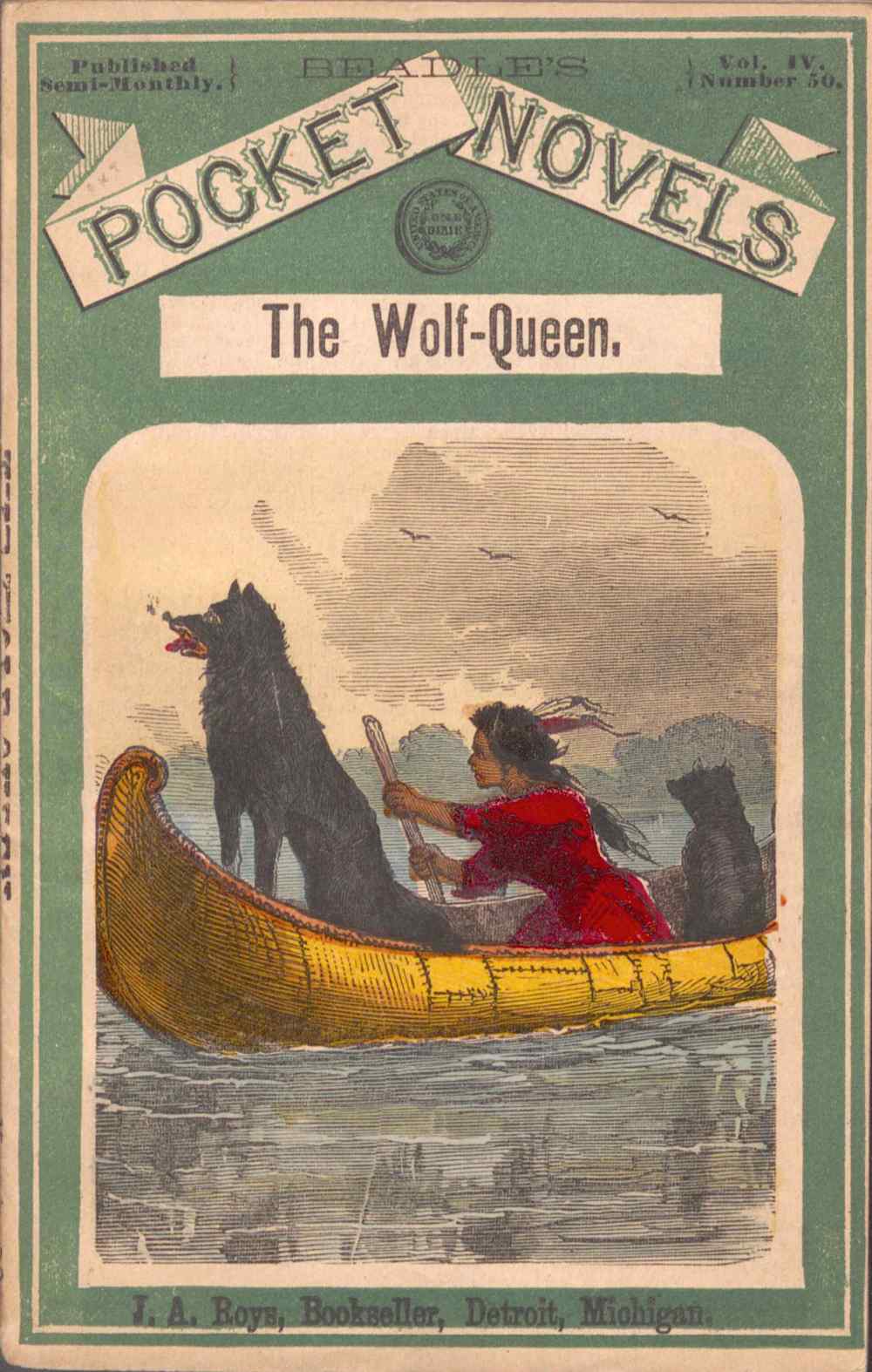
The sun was sinking, a great fiery ball, in the leaden west,
at the close of an autumn day, in the year 1804, when a solitary
canoe descended the Scioto, then vastly swollen by recent
rains.
The single occupant of the tiny bark was a youth of two
and twenty summers, clad in buck-skin. His beardless face
gave him an extremely womanish expression. Its smooth
surface was yet untanned by the rays of the sun, which fairness
of skin proclaimed him a novice in backwoods life.
He plied the oars deftly and noiselessly, and kept in the
middle of the stream. Ever and anon he glanced upward at
the ragged cliffs that hung over the murky and turbulent waters
like the hand of doom. But, at last, he passed beyond
the precipitous banks, and gained the mouth of the Scioto’s
nosiest tributary.
Here he rested upon his oars a moment, as if to decide a
mental debate, then ran his canoe up the new stream, toward
the left bank of which he presently steered.
“So far without accident,” he murmured in an audible
tone, not before glancing furtively around. “Simon Kenton
may be a great hunter; but he is a sorry prophet. What!
did he think I would wait until he returned from the hazardous
expedition he is about to undertake, and leave Eudora the
while in Jim Girty’s hands? And when, in the ebullition of
anger, as I will admit—I called him a lunatic, and told him
that I would rescue the girl without the aid of his potent
arm, he said, with a sneer I shall never forget: ‘Go, rash
boy, and meet the reward for spurning the counsels of your
elders. Go to the death prepared for you by the Wolf-Queen.’”
“The Wolf-Queen!” the young man continued, after a
sneer for the prophecy of the king of backwoodsmen. “If
such a creature exists, I want to meet her; and I have no
reason for doubting her existence, for Simon Kenton says he
once trembled in her presence. And Simon Kenton never
lies. I will pit my strength against the Amazon, and her
wolfish guard. Though rash and young in the ways of the
woods, Mayne Fairfax is not a coward, else why came he
from cultivated Virginia to the dark death-paths of Ohio?
No; I—My God!”
The exclamation was called into being by the terrible sight
that suddenly burst upon the young hunter’s vision.
Scarce the distance of a hundred yards up-stream, a canoe
shot from the bush-fringed bank, and bore down upon the
young Virginian.
In the center of the bark stood the very person he had
lately expressed a desire to meet—the dreaded Wolf-Queen—dreaded
alike by Indians and whites.
She towered six feet above her moccasins, and her frame
seemed built of iron. She wore a frock of tanned doe-skin,
the fringes of which touched her knees. The leggins which
fitted her nether limbs to a fault, were composed of panther
skins, secured to the moccasins by painted strips of deer-hide.
Over all these garments she wore a long, dark robe whose
ample folds disappeared in the canoe, and lent a royal aspect
to its strange wearer. Her head was surrounded by a dress,
composed of white heron-feathers, and among her raven
locks, which streamed over her shoulders, and covered her
beaded bosom, were curiously, but not distastily, woven the
gaudy feathers of the North American oriole.
The features, more than the dress of the singular being so
suddenly encountered on the swollen stream, commanded the
hunter’s attention.
They belonged to a woman in the noon, or summer of life.
Here and there a wrinkle was to be seen, and a sadly strange
beauty pervaded her countenance. But the eyes—those faithful
indexes of the human heart—proclaimed their possessor—a
white woman—mad!
Yes, the unmistakable fire of insanity blazed fiercely in those
baleful orbs, and told the single beholder that she was a perfect
demon, when the paroxysm of lunacy swayed her.
But she was not alone.
On either side of her stood a huge black wolf, while at her
feet sat a monster gray one. A collar of deer-skin, elaborately
beaded, encircled the necks of the fierce brutes, and from
their shaggy backs the muddy water dripped.
The sight was enough to blanch the boldest cheek, and
Mayne Fairfax could not repress a shriek of terror. It bubbled
to his lips unsummoned.
He now had ocular proof that the dreadful Wolf-Queen
was not a myth.
The canoe and its terrible freight approached with an impetus
received from the swift waters. No oars were needed
to keep it in the center of the stream—a swift current did this
service for the Wolf-Queen, who stood erect in the bark,
clutching a drawn bow.
Mayne Fairfax’s presence of mind soon returned. He
griped his rifle, but ere it struck his shoulder the twang of a
bow-string smote his ears, and a barbed shaft buried itself in
his right breast. Instantaneously a faintness stole over him,
but the courageous hunter repressed it, as the canoe of the
Amazon grated against his.
He would not die without a struggle, and therefore seized
his rifle for the second time, for the purpose of braining his
antagonist.
At that moment the gray wolf left his post.
The clubbed rifle dropped into the canoe, as the wolf buried
his fangs in the hunter’s throat, and the brave fellow staggered
back, trying to tear the mad animal from his breast.
In that terrible moment Simon Kenton’s last words burst
doomfully and prophetically upon his mind!
But his end was not yet.
For in the fateful moment that followed the lupine attack,
the sharp report of a rifle rent the air; the wolf relinquished
his hold with a groan, and fell at Mayne Fairfax’s feet—dead!
The Wolf-Queen turned toward the shore, and saw a great
coonskin cap surmounting a clump of prickly pears. Instantly
a cry, but half earthly, escaped her lips, and a minute later
she was flying down the stream, vainly trying to stanch the
crimson tide that flowed from the gray wolf’s heart; while at
her feet crouched the black monsters, drinking the warm
blood of their lifeless companion.
The young hunter’s canoe began to drift toward the Scioto,
and upon its gory bottom, as motionless as a corpse, lay Mayne
Fairfax.
Suddenly the pear bushes parted, and a backwoods giant,
bearing a long but deadly-looking rifle sprung into the stream,
and intercepted the drifting canoe.
He looked over the side, and shook his head doubtingly.
“Poor lad! poor lad!” he murmured, with rough but genuine
indications of sorrow. “I’m afraid he’s going to cross the
river.”
Then, standing in the water in the middle of the tributary,
he stanched the blood that poured from the lacerated throat,
which he bound with the soft linings of his grotesque cap.
“There!” he cried, surveying his work. “That doctoring
will do until I reach home. This young chap must not die.
He’s too brave to perish in the springtime of his life. I wonder
what brought him alone to these parts!”
Then with the interrogative still quivering his lips, he
towed the boat ashore, moored it to a clump of alder bushes,
and raising the unconscious youth in his arms, darted away
into the great forest, where strange fortunes and adventures
awaited him and the human burden he bore.
CHAPTER II . THE HERMIT AND HIS CAVE.
Now and then a groan parted the lips of the unconscious
Virginian, as the giant rapidly bore him through the wood,
throughout the recesses of which the somber shades of night
were gathering.
At length the surface of the ground grew hilly, and the
giant approached so near the Scioto that the swash of the
waters against its new banks could be distinctly heard. He
followed the course of the stream for some distance, when he
turned aside, and darted into a small ravine once the bed of
a tributary of the Scioto. In the banks of the ravine were
just discernible several gloomy apertures, into one of which
the backwoodsman disappeared.
Five steps from the orifice brought him to a strong oaken
door, seemingly imbedded in the limestone rock, and a short
fumbling in the gloom above his head threw wide the portal.
Dark as the night without was the gloom beyond the stone
threshold; but a joyful bark greeted the giant’s ears, and a
dog sprung forward to greet him.
“Home again, Wolf,” said the man, securing the door.
“And I’ve brought you a friend—a friend as near dead, I
should judge, as you get them, for, with an arrow sticking
near through one, and the awfulest torn throat you ever saw,
things must look dangerous.”
The speaker moved forward, and, without the aid of a light,
tenderly placed Mayne Fairfax upon a couch, deep with soft
dressed skins. Then he ignited a tiny pile of bark films,
which soon communicated a warmth to a heap of sticks, which
blazed and crackled with some fury.
“Here, Wolf, quit smelling around the patient,” cried the
giant, turning to his charge. “I’m the doctor in this case,
and I’m about to see what can be done. May be he isn’t so
badly hurt as I opine. That arrow,” he continued, after a
long silence, during which he had critically examined the
hunter’s wounds, “that arrow must be pulled through. I’m
not much of a surgeon, but I reckon as how I have managed
some pretty dangerous cases. Here goes! If that arrow
ain’t taken out, a certain young man will never shoulder a
rifle again.”
A protuberance on the young hunter’s back told the giant
that the arrow had nearly gone through the body, and delicately,
yet firmly, the rude surgeon set to work. His keen
hunting-knife first severed the shaft; then made the incision,
and the remainder of the shaft was withdrawn. Then some
astringent liniment was rubbed on and into the wounds, which
were covered with strong adhesive plasters.
As this operation was completed, Mayne Fairfax groaned
and opened his eyes.
His first inquiry regarded his situation.
“You’re in the home of Bill Hewitt,” answered the giant,
“and he has just pulled the arrow of that madwoman from
your body. Luckily, as I have discovered, it struck no vital
part. The deviation of an inch, either to the right or the
left, would have rendered my surgical operations unnecessary.
So you may begin to believe in special providences.”
Fairfax tried to answer, but the condition of his throat,
torn by the jaws of the gray wolf, baffled him.
“I’ll dress your breathing apparatus right now,” said Hewitt,
“and then I opine you can chatter away like a parrot.”
The young hunter never winced under the pain occasioned
by the dressing of his throat.
“It’s best for you to stay down for a few days,” said Hewitt,
after completing the operation. “Exertion of body may
irritate your breast wound, and end in something disagreeable.
I’ll stay with you all the time, for I don’t go visiting much in
these parts, nor these times. Now just lay still, but talk to
me while I get supper for two; tell me all about yourself,
and what brought you alone away down here. Boy, you look
like a Virginian.”
“I am a Virginian,” answered Fairfax, watching the giant’s
backwoods culinary operations. “My name is Fairfax.”
“Fairfax!” cried the backwoodsman, quickly turning upon
the speaker. “What Fairfax?”
“The son of Ronald Fairfax, of Roanoke.”
“I knew him,” said the giant.
“That is singular. When did you leave Virginia?”
“So you’ve got to questioning before you’re half through
with your story, eh?” cried Hewitt, with a strange smile.
“Well, I’ll tell you; but you must go on with your tale; and
perhaps I’ll tell you mine, some day. Perhaps, I say, and
some day. I left Rockbridge county a matter of twenty-one
years ago.”
“Three months since I stood in my father’s house,” resumed
young Fairfax, whose countenance told that he would have
questioned his preserver further; “and were it not for the
existence of that accursed renegade, Jim Girty, I would be
there this night.”
“Yes, curse Jim Girty, boy,” muttered Hewitt. “Oh that
curses could kill.”
“Yes, yes,” hissed Mayne Fairfax, and his nervous hands
closed in silent anger. “Near Rockbridge county the family
of Nicholas Morriston rather rashly dwelt alone in the wilderness.
The father was a hotheaded man, who lived in
fancied security, while Indian raids were being made all
around him. One night, poor fellow, he paid dearly for his
rashness, for often had I entreated him to remove his family
to a place of safety. One night, I say, when too late to fly,
he paid the penalty attached to stubbornness. But not only
did he suffer, but every member of his family, save one, fell
beneath the swoop of the white hawk.”
“The red hawks, you mean,” interrupted Hewitt.
“No, no. The destroying band was led by Jim Girty,
whose evil passions had been inflamed by the beauty, the innocence
and grace of Eudora Morriston.”
“I anticipate the remainder of your narrative, boy,” suddenly
interrupted the giant hermit. “Eudora Morriston is
now Jim Girty’s prisoner, and it is she whom you seek in the
land of the dread Wolf-Queen and her tribe.”
“Yes. By tarrying, perhaps months, in Chillicothe, I
might have secured the assistance of the renowned Simon
Kenton; but the thought of Eudora’s situation—growing
more precarious every day—caused me to spurn the great hunter’s
offer, and, alone, I swore to rescue her or perish in the
attempt.”
“You’re a brave boy, a brave boy!” cried the giant, admiringly.
“I had a little boy once—a tiny fellow with golden
hair, and the prettiest eyes you ever saw. But where he
is now, God knows. You love Eudora Morriston?”
A flush suffused Mayne Fairfax’s temples.
“Yes, but she knows it not. I never breathed aught to
her of my passion.”
For a long time the hunter was silent, and the outward
workings of his countenance, told of mental struggles in the
mysterious unseen.
“I loved once—a long while ago,” he said, at length, fixing
his gaze upon the reclining hunter. “But I don’t think
I love anybody now, save my boy—wherever he is—and Wolf,
here,” and he stroked the mastiff’s shaggy hide. “These
hands,” he quickly continued, stretching forth his broad palms,
“are red with the gore of a fellow-creature, whose skin was
as fair as yours, my boy. With the brand of Cain upon my
brow, I fled Virginia—fled between two days, and here I am,
a cave-hermit, on the verge of fifty years, with a giant’s frame,
unracked by disease; but with hair and beard almost as
white as driven snow.
“Yes, yes,” he continued, as though the young hunter had
put a question, “it is a terrible thing to kill a fellow-creature
in the first heat of passion; but I will not tell you aught further
of that dark night, now. Boy, from that day to this I
have not taken a human life—nor ever will I, not even the
life of an Indian. I will assist you to recover the sweet creature
you seek—together we will snatch her, unharmed, from
the fangs of the white wolf—Jim Girty; but into whatever
precarious situations we may fall, remember, boy, that these
hands shed no human blood. These fists are enough for a
score of red-skins. They have proved themselves thus in
times gone by. But here, our supper is ready. I’ll prop
you up with these skins, and you can make out to eat, I
hope.”
The repast proved quite nutritious to Mayne Fairfax, and
not a word passed between the twain until it had ended, and
the still smoking remains thrown to Wolf.
“Boy, did you ever hear your father speak of William
Hewitt?” suddenly questioned the giant.
“Never to my knowledge,” answered the young man.
“Strange, when we knew each other so well,” soliloquized
the hermit, in a semi-audible tone. “But, perhaps, he would
have his heirs remain ignorant of that dark night, as well he
might. But, my boy, I’d give my right arm, nay, my very
life, to know what became of him—my boy.”
“I will make every inquiry when I return,” said Fairfax.
“But how shall I know the result of your inquiries?”
“I will return and make them known to you.”
“How can I reward you?” cried Hewitt, grasping the
young man’s hands.
“Say nothing about that. I am already rewarded. But—what
was that?”
“My door-bell,” said the giant, with a smile, as he rose to
his feet and hastened to the mouth of the cave.
A minute later Fairfax heard the massive oaken door
open and close, and a confused murmur of voices approaching
him.
“Boy,” suddenly said the giant, leading a tall and athletic
young Indian into the mellow light of the fire, “here is the
only visitor I have. The Bible says that it is not good for
man to be alone always, so I picked up a companion. This
is Oonalooska, the bravest young warrior of his tribe.”
Mayne Fairfax stretched forth his hand, and the young
brave pressed it with no small degree of feeling.
“So the madwoman struck the white hunter?” said Oonalooska,
half interrogatively, still retaining Fairfax’s hand.
“Yes; her shaft pierced my breast, and her wolf tore my
throat.”
“She will be like a great storm now,” returned the Shawnee,
“because one of her wolves is dead. Oonalooska fears
for the Pale Flower in the Shawnee village.”
“Then she is there!” cried the young hunter, with eagerness.
“Yes,” answered Oonalooska, “she is under the fiery eyes
of the White Wolf, and unless he guards her well, Alaska
will tear her from him, and put her to the torture.”
“No, no!” cried Mayne Fairfax. “Hewitt, I feel strong
enough to go and rescue her.”
“You’re as weak as a kitten,” said the giant, with a smile
for the young hunter’s futile effort to rise. “We will send
Oonalooska back to the village, and he shall report affairs for
us. It will be a terrible conflict if affairs reach such a climax
between Girty and Alaska, the Wolf-Queen; but Girty
may still possess the strange influence he has held over her in
days gone by. I am certain that a crisis will not be reached
in the Shawnee village for some time.”
“But send Oonalooska thither at once,” cried Fairfax,
“and tell him to tell Eudora that a friend seeks her rescue.
And, Shawnee,” here he addressed Oonalooska, “if you can
save the Pale Flower at once, do so, and convey her hither.”
“Oonalooska will not sleep,” was the reply; “but to overcome
the White Wolf and Alaska he must have the cunning
of his white friends.”
“I cannot leave this young man until his sores are healed,”
said Hewitt. “But that will not be long. Then we will
baffle Jim Girty, and you, who hate him, can send him to
Watchemenetoc.”
The Indian’s eyes flashed at the hermit’s last sentence, and
a minute later Oonalooska was gone.
CHAPTER III . JIM GIRTY AND HIS PRISONER.
James Girty was one of a quartette of brothers to which
the notorious Simon belonged. He became the prisoner of
the Indians early in Braddock’s ill-fated campaign, when he
was in his fourteenth year, and was adopted by the Shawnees.
Growing to manhood, he loved the life and customs of the
red rovers of the trackless forests, and hated all whom they
hated. His passions were as fiery as Simon’s, but for some
unaccountable reasons, he has not figured as conspicuously on
the page of history.
Simon Girty, notwithstanding his multitudinous crimes, possessed
a few good qualities; but James possessed not one.
Simon often pleaded for the life of a prisoner, James never;
and his countenance was the incarnation of all that is repulsive.
At the opening of our romance he had attained his sixty-ninth
year, notwithstanding which he still possessed a giant’s
frame and a giant’s strength.
So well did he bear the burden of his years, that he looked
beneath fifty, and scarce a gray hair was visible upon his head.
His eyes still flashed the fire of manhood’s prime, from beneath
long, midnight lashes, and not a crow’s foot furrowed
his forehead. His face was covered by splotches of red hair,
through which cutaneous eruptions, caused by his dissolute
habits, were constantly making their appearance. When not
influenced by wine, he was not quarrelsome; but for many
years he had drawn scarce a single sober breath. He was an
unerring marksman, and his influence over the Indians was
unbounded.
While hunting in Virginia he encountered Eudora Morriston,
whose beauty fanned the fires of his evil nature; and, as
Mayne Fairfax has already related, he swooped down upon
the happy home, at the head of a band of Shawnees, massacred
every one of its inmates, save the beautiful girl, whom
he bore to the Indian village, and placed under the guardianship
of two of the most pliant of his red tools.
Bright and translucently beautiful upon the Shawnee village
broke the morn that followed the transaction of the
events related in the foregoing chapters.
James, or as he was commonly called, Jim Girty, would
have slumbered late, had he not been startled from his sleep
by the grip of a human hand upon his arm. He opened his
baleful eyes, and beheld a middle-aged savage bending over
him. The first streaks of morning but illy dispersed the
gloom of his lodge, and the renegade sprung to his feet, with
the oath, never absent from his lips.
“Alaska is a storm!” cried the Indian, springing from
Girty’s side, and throwing aside the curtain of skins that
served for a door. “See! she goes to the lodge of the Pale
Flower. Her wolves will kill the guards, and tear to pieces
the White Wolf’s prisoner. Last night the Lone Man shot
Alaska’s gray wolf, and she will now have the blood of the
white captive for it.”
Astounded at the sight to which the savage directed his
gaze—the Wolf-Queen, guarded by a dozen terrible wolves,
and followed by near a hundred Indians, advancing toward
the lodge where dwelt his prisoner, guarded by but ten braves—Jim
Girty jerked his rifle from its pins over his couch,
and bounded to the scene.
He seemed to fly over the ground, and threw himself between
Eudora’s guards, as the foremost wolves were preparing
for the combat.
“Back!” he yelled, fixing his gaze upon Alaska. “Why
does Alaska seek the life of my prisoner?”
“Ha! ha! ha!” laughed the madwoman, long and loud.
“’Tis for the White Wolf to question, but for Alaska to answer.
Last night Alaska met a young pale-faced hunter on
the little stream. She pierced him with her shaft, but he was
brave. He would use his rifle as a club. Alaska’s gray wolf—the
only snow wolf of Alaska’s band—sought the hunter’s
throat, when the Lone Man, concealed by many bushes, shot
Lupino. Now lies he cold and dead in Alaska’s wigwam.
She must have blood for his, and that blood must flow from
the Pale Flower’s heart.”
She finished, and stepped forward, while her grip tightened
on the long-bladed knife that glittered in the first beams
of the sun.
Girty’s rifle shot to his shoulder.
He did not dare shoot the Wolf-Queen, for she knew not
the value of life, and her death at his hands would soon be
followed by his, by the claws and fangs of her wolves.
He directed his weapon at the head of her favorite wolf—a
monster black fellow, around whose neck was a wide beaded
collar, and over the shaggy back dropped a rich mantle.
“If Alaska does not stay her hand,” he cried, “the White
Wolf will have Leperto’s blood!”
The Wolf-Queen suddenly paused, and glanced from Girty
to the threatened wolf. Indecision ruled her form, and Girty
was on the eve of triumph, when an old Indian, bent with
more than three-score years and ten, stepped to Alaska’s
side.
His eyes flashed with a fire seldom seen in the orbs of age,
when his gaze fell upon the renegade.
“Let the White Wolf shoot Leperto,” he cried, addressing
the madwoman. “Old Miantomah will give her another.
Let the Pale Flower die for the act of the Lone Man, and if
the White Wolf resists, let Alaska’s wolves, his brothers, tear
him to pieces.”
Miantomah exercised a weird influence over the Wolf-Queen,
and, inspired by his words, she spoke to her wolves.
The mad animals fixed their eyes upon Girty, and crawled
forward.
It was a critical moment.
“Shall an old, empty-headed man rule a mad-woman with
his forked tongue?” cried Girty, appealing to the crowd of
warriors. “Let the White Wolf’s brothers gather around
him. He has led them to victory, and will they now desert
him for a crack-headed squaw?”
“No!” cried Oonalooska, drawing his tomahawk, and
springing to Girty’s side. “Oonalooska is not a squaw.
Warriors, follow him!”
His action electrified the warriors, and, a moment later, all,
save a dozen, surrounded Girty, and displayed a hollow square
glistening with knives, to the Wolf-Queen.
“Back to your wigwam now, and bury your dead!” cried
Girty, in triumph.
Alaska regarded him in silence.
He repeated the command.
“Alaska moves not hence without the Pale Flower’s
blood,” she at length replied. “Her braves are on the war-path,
and at their head, marches the great Tecumseh, against
whom the White Wolf dare not stand. They will return ere
yon ball of fire again rises over the hills. Then, let the
White Wolf fear, then will Alaska have the Pale Flower’s
heart. Here she will remain until Tecumseh comes,” and
she seated herself upon the ground, in the midst of her
wolves.
At the mention of Tecumseh’s name, Girty’s guard exchanged
looks of fear. The great chief was on ill terms with
the renegade, and, fearing to incur the anger of Tecumseh,
several braves deserted Girty, and went over to the mad-woman.
“Be firm!” cried Girty, lowering upon the disaffection.
“They who stand by me shall be rewarded, and Tecumseh
will act justly when he comes.”
This retained a goodly portion of his guard.
The long hours wore away, both parties longing, yet fearing,
for the night.
Oonalooska knew that Tecumseh would favor the Wolf-Queen,
and, with a determined resolve in his heart, he stepped
into the lodge, where knelt a trembling girl, praying
to her God for deliverance.
He touched her arm.
She looked up, her eyes bathed in pearly tears.
“Let the Pale Flower tremble not,” whispered the young
brave. “Tecumseh will not return till midnight, and ere he
comes Oonalooska will save the White Wolf’s captive. The
young hunter lives in the lodge of the great Lone Man.”
Then he turned away, without noticing the look of gratitude
Eudora bestowed upon him.
Oh, for the night!
What had it in store for Eudora Morriston—life or death?
CHAPTER IV . THE EVENTS OF THAT NIGHT.
Slowly the hours of that beautiful autumn day wore
away, and the shades of evening seemed a century in making
their appearance.
The squaws of the “town” brought a repast to Girty and
his band; but Alaska dispatched several warriors to her own
wigwam, the capacious larder of which was soon empty for
the benefit of herself and wolves.
The terrible animals never took their eyes from Girty,
whose distasteful form blocked the doorway of Eudora’s
lodge.
“Never fear, girl,” he said, one time, turning upon his
prisoner, who sat listlessly upon her couch of skins. “The
wolves shan’t eat you. I have great influence over Tecumseh,
and the chief will quickly drive the crazy woman to her wigwam.”
A better dissembler than “Jim” Girty never trod the woods
of Ohio. He knew that the great Shawnee chieftain lived in
superstitious awe of the Wolf-Queen, and that, upon his return,
his prisoner would be given over to the fangs of the
wolves. And while he spoke to Eudora he was plotting to
get her beyond the village before Tecumseh returned.
The young girl deigned no reply to his words, but in silence
set to work to arrange the disheveled locks which hung
over her shoulders.
She was very beautiful—the possessor of a symmetrical form
faultless in the minutest particular, large, black eyes, lustrous
beneath raven lashes, and a wealth of raven hair, which enhanced
her transcendent loveliness. She wore the coronet of
her seventeenth year, though weeping for the fate of her parents
and golden-haired sisters, mercilessly butchered in her
sight, caused her to look beyond her years.
The words of Oonalooska shot a cheering ray of hope into
her heart, and caused that guiltless organ to beat for joy.
“The young hunter lives,” he had said; but what “young
hunter” did he mean? Quite a number of “young hunters”
had been enraptured by her beauty, though none had she
ever bade hope for the dimpled hand that could send an arrow
unerringly to the target, and direct the bullet with an accuracy
unequaled by many well-known frontiersmen of those
“dark and bloody days.”
Among her admirers, Mayne Fairfax had called oftenest at
her home, now a heap of ashes, and she had evinced a partiality
for his companionship, which had driven the others
from the field.
Was he the “young hunter” who sought her in the Indian
village?
Her rapid heart-beats proclaimed that she hoped so.
The afternoon was nearing its close when Girty summoned
Oonalooska to his side.
The young brave obeyed with alacrity, and was surprised
to hear the renegade make the following proposition:
“Tecumseh must not meet the Pale Flower in the lodge,”
said Girty, in a low tone, that it might not reach the ears of
Alaska, who was within common earshot. “The chief hates
me, but he also fears me. Without a second thought he
would deliver the white-faced girl to Alaska. To-morrow he
will decide otherwise. Not far from this lodge dwell the
exiled Mingoes, on whose grounds no hostile warrior dares to
tread. To-night, then, will not Oonalooska guide the Pale
Flower thither, and guard her until the White Wolf commands
their return?”
Eagerly Oonalooska promised to grant Girty’s request, and
the plans for the escape were quickly formed.
While the plot was discussed by the warrior and the renegade,
dark clouds were creeping from the west, and soon the
whole sky was overcast—which harbingered a storm. Through
a rift in the opaque masses, the dying rays of the sun fell
upon the Shawnee village, and when night prevailed Girty
threw a cordon of braves around Eudora’s lodge. Alaska
witnessed the precautionary movement, but instead of encircling
the cordon with her braves, she moved nearer the aperture
of the wigwam, which she made discernible by torches,
thrust into the yielding earth.
Girty thought it best to keep Eudora ignorant of the destination
he intended for her; but told Oonalooska to say that
he would conduct her to a place of safety, beyond the reach
of all her enemies.
The night was the incarnation of gloom, and every waning
moment brought Tecumseh and his braves nearer the village.
The chief had promised to return upon that particular night,
and he had never broken his word. In the rear of the wigwam
Girty had placed several braves upon whom he could
rely, and, as the first peal of thunder reverberated through the
forest, and far down the Scioto, Oonalooska’s keen knife gashed
the thin bark in the rear of Eudora’s couch.
A peal of thunder in autumn always startled the Shawnees,
and, believing it the harbinger of Tecumseh’s approach, the
most timid glided over to the Wolf-Queen.
Girty did not murmur at their late disaffection, for he knew
that Alaska would not move till the arrival of the giant chief.
“Oonalooska is ready,” whispered the brave, turning from
the perforated bark to the maiden, whose eyes had witnessed
the operation.
“Then let us hasten,” she said in tremulous accents, “lest
Tecumseh’s arrival doom me to the teeth of the mad-woman’s
wolves.”
Tenderly, noiselessly, Oonalooska lifted Eudora in his arms,
and glided through the slit, and past the posted guards in the
rear of the wigwam. Once beyond the confines of the village,
he walked rapidly, experiencing no difficulty in picking
his way rightly in the cimmerian gloom.
Presently he entered the forest, and when he had placed a
hill between himself and the village, he paused, and drew a
torch from beneath his wolf-skin robe.
“Oonalooska does not possess the eyes of the owl,” he said,
with a smile, as he ignited a wisp of bark films with the flints.
“The wood is dark, and unless fire guides Oonalooska, he may
wander to the Mingoes, whither the White Wolf has sent
him.”
“But may not Oonalooska’s torch encounter Tecumseh?”
asked Eudora, who feared the worst.
“No; the great chief and his braves will cross the creek
into the lodges. Oonalooska must have fire. It will keep
the wolves away.”
The mere mention of the wolves sent an icy shudder to
Eudora’s heart. From the jaws of the ravenous animals she
had first been snatched by the chivalrous red-man, who was
once more bearing her through the labyrinthine recesses of
the Scioto forest.
The hermit home of William, or, as he called himself,
“Bill,” Hewitt, was about fourteen miles from the Shawnee
village, and Oonalooska rapidly traversed the dreary miles.
The crisp leaves gave forth a weird sound, as the Indian’s
moccasined feet touched them, and the great drops of rain
that pattered down through the giant, leafless trees, added to
the ghostliness of the moment. Sure enough, the wolves
struck the trail, and, at last, Oonalooska saw many a pair of
fiery eyes far in his rear.
He felt Eudora shudder as a chorus of yells smote her ear;
but he assured her that they would reach the hermit’s cave
in safety, when he knew that the issue was doubtful.
At length the warrior uttered a light cry, as he gained the
summit of a knoll, from which he indistinctly heard the roar
of a little cataract that poured its waters into the Scioto.
“The Pale Flower is near the Lone Man’s lodge,” said the
Shawnee, and he dashed down the knoll, the foot of which
he reached as the foremost wolf poked his head over the
summit.
Once or twice he was forced to turn and beat the band off
with his torch, and, at last, almost exhausted, he dashed into
the limestone corridor of Hewitt’s home.
He had not time to give the signal—the jerking of a deer-thong
in the darkness overhead—for the wolves were snapping
at his lovely burden, and while his lips uttered a peculiar
whoop, he turned and sent one giant fellow to the
ground with his torch. The weapon struck the animal in the
mouth, and, the great tusk closing on it, it was jerked from
his hand.
He shrieked again as his right hand throttled the leader of
the lupine band, and hurled him senseless among his companions.
The dying torch lent a terribly tragic view to the
scene. Pale as death, Eudora reclined upon the left arm of
the Indian, as single-handed he fought the bloodthirsty gang,
and her lips parted with a joyful cry, as the strong door was
burst open, and she found herself borne into a warm apartment.
With clubbed rifle, the giant hermit sprung among the
wolves, and before him they divided and scattered like sheep.
They had encountered the invincible before.
“Fly, cowards!” cried Hewitt, as he reëntered the cave,
to find Eudora kneeling before the couch of her wounded lover.
He had thrown one arm around her neck, and his lips
were whispering something in her ears—probably the story
of tender passion.
“We will have the whole Shawnee nation to fight now,”
said Hewitt, when Eudora had related her trials while in the
hands of Girty. “And ere morn Tecumseh will be at our
door. The wolves of Alaska will track Eudora hither, and
then for the conflict. It must be near dawn now.”
As he finished he drew aside a skin, that hung against the
wall, and disappeared in a dark passage.
Oonalooska awaited his return in silence, while Fairfax and
Eudora conversed in low whispers.
Suddenly the skin flew aside, and Hewitt sprung into the
cave.
His long beard was filled with tiny particles of decayed
wood, and sparks of fire seemed to dart from his dark orbs.
But his voice was as calm as a midsummer day.
“Fifty-three braves are nearing us,” he said. “They are
headed by Tecumseh and Alaska, who is surrounded by her
accursed wolves. Jim Girty is not with them.”
Oonalooska’s expression remained immobile, and Eudora
threw a look at her wounded lover, but her lips uttered nothing.
Her dark eyes shot a mingled look of determination
and defiance toward the door.
All at once a tomahawk struck the oaken planks, and a
terrible yell followed.
It was the war-whoop of Tecumseh!
Leperto, the petted wolf, answered it with a dismal howl.
CHAPTER V . THE MYSTERIOUS DEATH-SHOTS.
Let us witness the return of Tecumseh, and follow the
great chief and the Wolf-Queen to the hermit’s cave.
Jim Girty did not desert his post, when he found the wigwam
tenantless. On the contrary, he told his band to increase
their vigilance, and remained immobile in the doorway
of the lodge. He knew when Oonalooska disappeared with
his prisoner, and he breathed freer than he had done for long
hours. A run of three hours would bring the young brave
to the homes of the exiled Mingoes, across the threshold of
which, even Tecumseh, with all his greatness, dared not step,
upon other than a friendly mission.
He felt that he could conciliate Tecumseh, and that, when
the spasm of frenzy, that now ruled Alaska’s heart, passed
away, he could command Oonalooska to return with the captive.
The storm, which proved of brief duration, did no damage
to the village, and midnight brought Tecumseh.
Several braves deserted Alaska to greet the returning band,
and presently the mighty Shawnee, with angry countenance,
faced the white-faced renegade.
Jim Girty had learned to read his chieftain’s face, and in
the ghostly glare of the torches, he read thereon an unsuccessful
expedition. Tecumseh was in a fit mood to wreak
vengeance on any man who owned a white skin.
With drawn tomahawk he paused before the renegade, and
shouted, as his eyes drank in the whole scene:
“White Wolf, deliver the Pale Flower to Alaska!”
“The White Wolf will obey his chief,” answered Girty,
shooting the mad-woman a singular look. “Let Tecumseh
enter the lodge, and lead the captive to the Wolf-Queen.”
As he finished, he stepped aside, and Tecumseh sprung into
the lodge.
One loud yell parted the chief’s lips as his eyes fell upon
the untenanted couch, and a moment later his brawny hand
closed on Girty’s throat.
“White Wolf’s tongue is forked!” he cried. “Let him
tell Tecumseh where the Pale Flower is, or die!”
“The White Wolf knows not,” gasped the white liar.
“She has been stolen while we watched.”
The chief’s grip relaxed, and, at his command, Girty was
bound, and a guard placed over him.
Alaska could scarcely be restrained from throwing her
wolves upon the prostrate renegade.
A brief examination revealed the gash in the bark, and instantly
the braves were called. One was missing—Oonalooska,
the son of Okalona, the aged Medicine of the Shawnees. He
was the traitor, and, if captured, his doom would be a terrible
one, and speedy.
Tecumseh’s blood boiled in his dark veins, and his angry
passions were stirred to their depths. All fatigue incurred by
the recent war-expedition, instantly left him, and he called
around him a band of picked warriors. Alaska panted to
pursue the traitor, and his companion, and throwing herself
at the head of the party, she placed her wolves upon Oonalooska’s
trail, and away they went, through the forest, toward
the hermit’s cave.
The renegade was not permitted to accompany the pursuing
party; instead, he found himself under the vigilant eyes
of five braves, who bore him to his lodge, and threw themselves
around it.
He knew that his captivity would not last beyond the return
of Tecumseh, over whom, when calm, he held some
influence.
The war-whoop of Tecumseh and the dismal howl of Leperto,
that ushered in the clear, frosty autumn morning, was
answered by a savage growl from the hermit’s canine companion,
who yearned to encounter the mad-woman’s wolves.
No human answer following the blow delivered by Tecumseh’s
tomahawk, the chief bestowed a second upon the door,
and shouted:
“Tecumseh, the war-chief of the Shawnees, demands the
person of Oonalooska, the red traitor, and the Pale Flower.
Let the Lone Man speak!”
The hermit’s answer was not long delayed.
“Is Tecumseh an empty fool, that he should seek the blood
of the Pale Flower, snatched from her home by the lying
White Wolf? If he is not, let him return to his lodge, the
greatest chief of the Shawnee nation.”
“The Wolf-Queen seeks the Pale Flower. Tecumseh
wants the traitor Oonalooska,” was the reply.
“Then let Tecumseh take them!” was the defiant reply,
at which a second war-cry smote the air, and the Shawnee
drew back from the portals.
“Tecumseh will take them!” he cried, “and beside Oonalooska
shall burn the Lone Man of the woods.”
“No, no!” shrieked mad Alaska. “The Lone Man shot
Lupino. He shall die by the teeth of Alaska’s wolves.”
“So be it,” answered Tecumseh, and in a loud tone he
commanded his warriors to heap fagots against the door of
the cave.
The command was obeyed with alacrity, and Tecumseh
and several of his favorite chiefs drew back to witness the
work of burning out the besieged whites. Near him stood
the Wolf-Queen, amid her wolfish guard, and the terrible
light of anticipated vengeance danced in her eyes.
The work went on without interruption for many minutes,
during which period the golden god of day lazily scaled the
oriental horizon, and threw his warm beams upon the swarthy
band.
Suddenly the sharp report of a rifle rent the gentle breeze
that flitted through the woods, and the stalwart chief, whose
shoulder touched Tecumseh, staggered back with a bloody,
crushed temple.
Instantly the braves left their work, and gathered around
the stricken chief. Whence came the deadly missile? An
examination showed that the ball had been fired from an
elevated position, and the leafless top of every tree was scanned
with vengeful eyes. But the mysterious slayer remained
undiscovered.
“Back!” shouted Tecumseh, after a prolonged search, and
the warriors returned to the cave. “Haste with the
work! Tecumseh yearns to see the traitor, and the Lone
Man die.”
At length the last gathered bough was thrust into the
mouth of the cave, and Tecumseh turned to Nethoto, a chief
not below his august self in prowess, when a second rifle report
smote his ears; and Nethoto staggered back—dead!
Horror-stricken, Tecumseh shrunk aghast from the work
of death, and for the first time in all his life displayed a
frightened face to his braves.
He felt that his turn would come next, and instantly, as if
in confirmation of that mental conclusion, a voice rung
throughout the forest.
“Let Tecumseh hasten to his lodge, else he never steps
upon another war-trail!”
The savages gazed wildly around as the tones fell upon
their ears, and then looked at their chief, who seemed to have
grown into a statue—so motionless and pale he stood.
Alaska was the first to break the silence.
“Ha! ha! ha!” she laughed, as she caught one of her
wolves, and threw him upon the dead body of Nethoto.
“The Great Spirit slays Nethoto, who once struck Alaska
with a whip. Let Tecumseh return to the village; but
Alaska and her wolves will stay. They will enter the Lone
Man’s cave and devour him. The Great Spirit loves Alaska
and her wolves. Ha! ha! ha!” and she clapped her hands
with glee to see the wolves tear Nethoto to pieces.
Tecumseh knew not how to act. He feared the Wolf-Queen,
in awe of whom his warriors stood, and at his bidding
they would remain. If he stayed, death would soon enter his
heart.
The Wolf-Queen did not notice his indecision. With fiendish
delight she was throwing wolf after wolf upon the dead
chief.
All at once her brutal actions came to an abrupt termination.
A third shot echoed throughout the wood, and Leperto, the
king of the wolves, sprung back from the corpse—a corpse
himself.
A heart-chilling shriek welled from Alaska’s throat, as she
sprung forward and pressed the dead wolf to her bosom. A
moment she gazed wildly around, as if searching for the mysterious
slayer, and then, with an indescribable horror of countenance,
she darted from the tragic spot, followed by her
wolves, Tecumseh and his braves.
It was the first time that Tecumseh ever turned his back
upon the foe.
Convulsively to her heart the crazy queen pressed Leperto.
She tried to stanch his crimson tide with her long tresses, but
it seemed to flow the faster, and her trail was one of gore.
“Not long will Tecumseh remain in his beaded lodge,”
hissed the great chief to a plumed Indian, at whose side he
ran. “He will return, and hunger shall drive the pale ones,
with the red traitor, from the hole in the ground, and the
blood of Sagasto and Nethoto shall be poured upon their
heads.”
The mad-woman thought of nothing but her dead wolf;
but very soon other and more terrible thoughts would rule her
shattered brain.
CHAPTER VI . OUT OF THE CAVE TO DOOM.
During the brief siege described in the foregoing chapter,
but two persons occupied the cave. These were Mayne Fairfax
and the beautiful Eudora Morriston.
The young hunter reclined on the couch, and Eudora sat
beside him, holding one of his hands in hers.
“I wonder how this will end, Mayne,” she said, gazing into
his deep eyes, that never grew weary of gazing into her face.
“I do not know, Eudora,” replied the hunter; “but I feel
that the end is not far distant. The capitulation of the hermit’s
fort, in my mind, is but a question of time. If Tecumseh
can not burn the door, he can starve us out. But hark,
girl! That sounded like a rifle shot.”
“And that shriek, Mayne!” cried the girl. “An Indian
has fallen beneath the Lone Man’s rifle. Perhaps it was Tecumseh?”
“No, no, Eudora. Hewitt did not fire that shot. He sheds
the blood of no fellow-man. If an Indian fell, it was beneath
Oonalooska’s aim. Listen! That was the voice of Tecumseh.”
The conversation ceased, and in the silence that followed
the lovers heard the second shot, that sent Nethoto to the
earth.
“Another!” cried Eudora. “Where do the shots come
from, Mayne?”
“From the top of a giant oak,” answered the young hunter.
“Yon subterranean passage ends beneath the trunk of a
great, hollow tree. Inside, steps lead to the top of the giant,
from whence Oonalooska is smiting the red men.”
“What a singular man the hermit is!” cried Eudora, as
the faint tones of the Wolf-Queen—faint to the cave listeners—came
from the wood. “He is a mystery to the savages.
Girty hates, but fears him, and, to Tecumseh, he is an enigma.
I—”
“The third shot!” interrupted Mayne, and a minute later
the giant hermit stepped into the cave.
“Our enemies are routed,” he said, bestowing a smile upon
the lovers. “Beneath Oonalooska’s rifle fell two chiefs and
Leperto.”
“Alaska’s wolf,” said Eudora, turning to Fairfax. “The
poor woman will be inconsolable now.”
“Oonalooska wanted to shoot the queen, but I covered the
flint with my hand in time to save her life. I could not witness
the killing of that poor mad-woman, though if we ever
fall into her hands we will receive no mercy.”
“Her wolves tore Oonalooska’s venison once,” hissed the
chief, who stood beside the hermit, and he added, in an undertone.
“Some day when Lone Man is abroad, Oonalooska’s
flint will not be covered by a pale hand.”
“Do you think our enemies will return?” asked the young
Virginian, looking into the hermit’s face.
“Yes. Already I believe that Tecumseh’s spies lurk in the
vicinity, and, ere long, the chief will return with a large
force, which can not be successfully resisted. I know Tecumseh
as few men know him. I have watched him grow to
manhood, unforgiving and vindictive.”
“In view of our situation, then, what do you propose?”
questioned Fairfax, with eagerness.
“Flight—to Chillicothe,” was the reply.
“Not by day?”
“No; to the contrary. We are not far from the river,
which I believe will not be guarded to-night. From this
cave leads a passage which terminates not a great ways from
the river. That passage I have never had occasion to use,
having never, until this day, been besieged. Above the termination
of that passage, the crust has not been broken. We
will use that to-night, and near dawn, no accidents intervening,
we will be beyond danger. My boy, can you crawl to
the opening of the passage? Thence we will assist you to
the boat.”
“Yes,” cried Fairfax, rising with a mighty effort, that sent
a thousand painful arrows throughout his frame, “I feel strong
again—the events of the last twenty-four hours have made
me a giant.”
Hewitt shook his head doubtingly, and faintly smiled, as a
sense of giddiness forced the young hunter upon the couch
again.
“Tecumseh will not return before nightfall,” continued the
hermit, after a brief silence, “and while they besiege the cave,
we will be flying up the river to Chillicothe—which, for us,
means safety.”
Then the strange man drew a repast from his store, and
the victuals were discussed with a relish, and conversation in
which they tried to forget their perilous situation.
Slowly the day waned, and, at length, a growl from the
mastiff, who lay at the brush-burdened door, told the hunted
that an Indian was near.
Then Oonalooska disappeared in the subterranean passage,
already used during the progress of our romance; but presently
returned with the information that several spies were in
the wood, at the mouth of the cave.
The hour for escape had arrived.
“I’ve lived in this hole in the ground for eighteen years,”
said the hermit, taking a mournful survey of the cave, whose
walls were lined with the skins of all animals, “and you may
think that it goes hard with me to leave it. But if I stay here
now, Alaska’s wolves will drink Hewitt blood. I want to
live till I can see my boy again, and—” here he turned away,
and muttered in an undertone: “Yes, I’d like to see her, too.
I could forgive her now; but, oh, God! will I ever meet my
wife on earth more?”
A great tear dewed his tawny cheek, and a tremor crossed
his giant frame, as he turned to the trio.
“Well, we’re ready now,” he said, calm again. “Here,
girl, take the extra rifle. I’ve heard tell as how you can use
it.”
“I can and will, if I must,” said Eudora, proudly, as she
took the proffered firearm.
The hermit stepped to the further end of the cave, and revealed
a gloomy passage, by throwing aside a wolf-skin that
concealed it.
“Lead off, Oona,” he said, addressing the Indian. “Wolf
and I’ll bring up the rear.”
The Indian dropped upon all fours, and entered the
passage; and the dog bounded in, in advance of his master.
“Good-by, old home,” said the hermit, taking a last look
at the apartment. “Mebbe I’ll come back again, and mebbe
I won’t, that’s all.”
The curtain fell and the cave was tenantless.
The underground corridor seemed interminable; but, at
last, Oonalooska paused. The end was reached.
It was the noiseless work of a few moments to admit an
invigorating current of night-air into the gloomy way, and the
Shawnee emerged upon terra firma.
“Now for the river,” whispered Hewitt, throwing himself
in advance of the party.
The night was dark around, though many stars twinkled
in the blue overhead.
Eudora trod in the hermit’s tracks, and her lover leaned
upon the arm of Oonalooska.
At length they stood upon the right bank of the Scioto.
It was lined with thick clumps of weeping willows, the leaves
of which touched the dark water, causing many faint ripples,
that fell ominously upon the ears of the hunted quartette.
The hermit glided from his companions, and, after a long
absence, returned with the startling information that his boat
was gone!
Mayne Fairfax’s groan of despair was stifled by Hewitt’s
hand, and in his ear were breathed these words:
“We are within thirty feet of a gang of red-skins.”
The hermit turned to Oonalooska, when a grunt from his
dog startled every one.
Instantaneously the tramp of many feet smote the ears of
the imperiled ones, and a circle of Indians seemed to rise
from the earth.
“Spare all!” was heard the voice of Jim Girty, as he rushed
forward, at the head of the main band.
He met the man he feared—the strong hermit—in whose
arms he was but a child.
Hewitt raised the renegade above his head, and tossed him
far out into the Scioto. Oonalooska fought nobly, and would
have escaped had he not stumbled over a prostrate Indian,
and been seized before he could rise. Mayne Fairfax,
weak from his wounds, did not resist, and he and Eudora,
who fought valiantly with clubbed rifle, were made prisoners.
It cost the Shawnees a Herculean struggle to secure the
hermit and it was not until the entire band rushed upon him
en masse , that he became a captive.
At the conclusion of the victory, a chief sent a shrill whoop
through the forest.
“Why shout the Shawnees?” asked the hermit, with a
nonchalance which, under the circumstances was truly wonderful.
“Manitowoc calls Tecumseh,” was the reply. “The
great chief and Alaska are at the Lone Man’s hole in the
ground.”
The reply sent an indescribable feeling to the prisoners’
hearts, and no wonder.
All—with, perhaps, a single exception—felt that they
had marched from the cave to doom.
CHAPTER VII . ALASKA IN HER FRENZY.
The shrill whoop was answered by the glare of a multitude
of torches, and the rushing sound of many feet.
All the prisoners, save Oonalooska, were unbound, but
closely guarded. The swarthy Shawnee stood proudly erect,
with his hands tied upon his back, and his nether limbs bound
by tried deer-thongs. He looked defiance at his captors, in
whose faces he read the terrible doom. Tecumseh would speak
for him when he arrived.
Suddenly the great chief halted before the circle, and a
shout of triumph parted his red lips as his eyes fell upon
Oonalooska. The captive calmly returned that vengeful
look, and something like a sarcastic smile, played with his
lips.
A step behind Tecumseh towered Alaska, the Wolf-Queen,
and a wild cry rose from her throat, as she discovered Eudora,
standing beside the hermit, who seemed her mighty protector.
The next moment she flung her torch to the earth, and
caught up one of her mad black wolves. Her eyes flashed
their fire upon the maiden, as she executed a forward step,
with the snarling animal poised above her head. Her mad
intention could not be mistaken. She had long been in the
habit of hurling her animals upon the objects of her vengeance,
and the white, glistening teeth were instantly buried
in that with which they came in contact.
Now for Eudora’s delicate flesh were these dread fangs intended,
and before the maid could shrink, the wolf went hissing
through the air. A shriek parted the girl’s pale lips, as
the giant hermit threw himself before her, and his great hand
shot forward, to close on the animal’s throat.
The Indians shrunk back, amazed at the dexterity and fearlessness
displayed by the hermit, whose teeth were gritted, and
whose eyes glared at the Wolf-Queen, as he throttled her pet
at arm’s length.
Not a sound disturbed the scene, save the frantic gasps for
fleeting breath made by the dying wolf. Even Alaska stared
aghast, unable to move, and the remainder of her wolfish
guard crouched at her feet, and quietly watched the death of
their companion.
At length a shudder passed over the animal’s frame, and the
hermit tossed him at Alaska’s feet.
That action aroused the queen.
Quick as thought she stooped and seized a second wolf,
when Tecumseh threw himself between her and the hermit.
“The Lone Man will kill all Alaska’s children,” he said,
gazing straight into her eyes. “If she would save the rest, let
her give him over to Tecumseh, and he shall die in the great
lodge.”
A change suddenly became visible in the mad-woman’s
eyes, and she dropped the wolf she had raised.
“Ha! ha! ha!” she laughed, “the Lone Man shall be
torn to pieces by Alaska’s children in the great lodge, and the
Pale Flower and her lover shall die there, too. But, ho! ho!
who have we here? The White Wolf, ha! ha! ha!” and her
eyes fell upon the renegade, who had just emerged, dripping,
from the river.
Tecumseh turned upon him.
“The White Wolf is faithful,” he said. “He has captured
the white ones, and the red traitor,” and he added in a tone
unheard by Alaska, “Tecumseh will keep his promise.”
A moment later the whites were bound, and Tecumseh ordered
the return to the village. As the band started forward
the hermit called the chief to his side.
“The young white hunter is weak,” he said, nodding to
Mayne Fairfax, who tottered along like a drunken man. “He
fell beneath Alaska’s wolf and arrow. The Lone Man would
support the young hunter.”
Tecumseh owned a heart susceptible of pity, and he commanded
the hands of the hermit to be made free.
“Now let the Lone Man support the young hunter,” he
said, returning to the head of his band, and Mayne Fairfax
acknowledged the Indian’s kindness in audible tones, as he
stepped to Hewitt’s side, and leaned upon his strong arm.
During that midnight march the Shawnees taunted Oonalooska
with the fate in store for him. He maintained a taciturnity
for a long time, when a remark from Tecumseh drew
forth the words that bubbled to his lips.
The chief called his red prisoner the son of a sorcerer, for
against the father of Oonalooska, Tecumseh had long borne
a silent hatred.
The words stung Oonalooska to the quick.
“If Oonalooska’s father does talk with Watchemenetocs,
he never gave a poor Pale Flower a head as empty as the hollow
of his hand—he never made a prisoner a devil!”
A flash of rage overspread Tecumseh’s face, and he wheeled
with uplifted tomahawk.
“Strike!” hissed Oonalooska, shooting him a glance of resignation.
“Oonalooska is ready to enter the great lodge
among the stars. Yes, yes, Tecumseh’s father struck a squaw,
and made her a—”
He suddenly paused, for the eyes of Alaska fell upon him.
“Tecumseh will not strike the traitor!” said the great Indian,
suddenly lowering the hatchet, and becoming wonderfully
calm. “He will see him die in the village—not by fire,
no, not by fire, for Tecumseh never burns an enemy.”
Again the march was resumed, with Tecumseh thoughtful,
at the head of the band.
By degrees Oonalooska approached the hermit, and at
length walked at his side.
“Oona,” said Hewitt, in the lowest of whispers, “when
struck Tecumseh’s father a white-face?”
“Many, oh, so many moons ago, when the ground was
white with feathers that fell from great birds in the clouds,”
was the figurative answer, as softly uttered as the question
had been.
“Where is the pale-face now?”
“She walks with her wolves,” was the reply, and the
speaker bestowed a look upon Alaska, whose tranquil, almost
thoughtful countenance breathed not of insanity.
Hewitt raised his eyes to a contemplation of her face, vividly
revealed by the glare of the torch borne by the brave in
advance of her.
The workings of his countenance told that memory was
busy, and, as he turned his eyes from the lunatic, his lips
parted.
“So like, yet so unlike,” he murmured. “Oh, my God, can
it be?—no, no, I will not think thus, and yet those lips—those
lips—God, why did I fly my home that fearful night?” he
suddenly interrupted himself, and a moment later he groaned.
“But my boy—my Edgar. Oh Heaven, does he live? Oonalooska!”
The Indian touched the hermit’s arm significantly.
“Oona, whence came poor mad Alaska?”
Oonalooska started at the hermit’s tone.
“From the great land beyond the northern Kiskepila Sepe,[1]”
he answered.
“From Virginia,” murmured Hewitt, “the land where I
was happy once. Oona?”
“Hush!” whispered the captive brave as a shout burst from
the vanguard. “The Shawnees are near their lodges.”
A moment later, the prisoners gained the summit of a
high knoll, and, in the center of the valley that turned away
from its foot, nestled the Indian village, upon which the day
was breaking.
Suddenly Alaska turned upon the hermit.
“Ha! ha! ha!” she laughed, pointing toward the village.
“Yonder the Lone Man and his friends will feel the fangs of
Alaska’s children.”
Never before, in the broad light of noon, had Hewitt been
so near the mad-woman, and as her eyes fell upon him he
started back, exclaiming:
“My God! dispel my dreadful doubts. More like one,
once beloved by me, she grows!”
And the queen laughed more discordantly at his words,
whose import she did not comprehend.
CHAPTER VIII . JIM GIRTY TRIUMPHS.
Jim Girty, the renegade, lowered fierce looks upon the
hermit, as the band marched toward the village, and once or
twice his fingers clutched his tomahawk, whose keen edge he
would fain have buried in the giant’s brain. But he dared not
strike, for Hewitt was Tecumseh’s prisoner, and he bided his
time for vengeance.
When Tecumseh returned to his lodge, after the destructive,
mysterious shots, Girty effected a reconciliation with him,
and was released. The renegade at once entered into the
plans of the chief for the recapture of the whites, and led a
band of braves to the banks of the Scioto to cut off their escape
in that direction. For he knew that the hermit would
never inhabit a cave without more than one avenue of escape,
and his belief was verified, as the reader has witnessed.
Before departing on his mission, he had exacted from Tecumseh
an oath to the effect that Eudora, if recaptured, should
not be delivered over to the Wolf-Queen; but, on the contrary,
should remain his prisoner, as before.
On the confines of the Indian “town” great numbers of
women and children greeted the triumphant band, but Tecumseh
would not permit a single birch to be applied to the persons
of his prisoners.
Straight to the council-house marched the august chief
and an imperative wave of the hand summoned the warriors
to their accustomed positions.
Alaska followed, but paused without the line of braves, and
fixed her eyes upon Tecumseh.
“The white-faces and the red traitor shall be tried at
once,” said the chief, striding to the center of the structure.
“The Pale Flower is White Chief’s prisoner. Now let Tecumseh’s
chiefs speak.”
For a moment silence reigned, and then the renegade
strode from his position.
His baleful eyes flashed hatred upon the prisoners, who
stood bound, near the center post of the council-house,
and his words sounded like icy drops falling upon red-hot
iron.
“The White Chief speaks for death,” he cried, “for death
at the stake! The pale-faces and the red-skinned traitor have
slain two of Tecumseh’s bravest chiefs. Shall they long escape
the doom they merit? I will claim my prisoner,” and
he strode toward Eudora. “Ha! girl!” he hissed, in her
ear, as his great hand closed on her delicate arm, “you never
dreamed that I am in league with powers not of earth. All
the powers of heaven and hell can not baffle Jim Girty. You
are mine—mine—mine! That word is sweeter to me than
wildwood honey.”
“One word with her before we part,” said Mayne Fairfax,
smothering his rage, and stepping towards Eudora. “If
God permits devils to triumph, then we never meet again.
Eudora—”
The captive turned, but ere Fairfax could execute another
step nearer her, Girty’s arm shot from his shoulder, and the
young hunter went to the earth like a stricken statue.
“There! weakling!” cried the brute, darting a fierce look
upon his fallen foe. “I’ll teach you how to interfere in
other people’s business. Lay still there, or I’ll kick you to
pieces.”
And again grasping Eudora’s arm, he hurried her toward
the further end of the council-house.
The blow worked the hermit into a terrible passion, and
had his hands then been free, the renegade would have paid
dearly for the insult. Even mad Alaska did not witness the
scene without emotion, for she suddenly stooped and raised
one of her wolves above her head. But a look from Tecumseh,
to whom she looked as though for authority, subdued her
passion, and the animal was returned to his companions.
After a while, Mayne Fairfax regained his senses, and
drew himself to his feet, by the aid of Hewitt’s garments.
“Oh, if I were free, boy!” whispered the giant, “I would
walk across this council-house and choke that devil to death
But his time is coming. Hark! a new arrival!” and the hermit
listened to the shouts nearing them from beyond the collection
of lodges.
The shouts rapidly increased in distinctness, and presently
the new-comers burst upon the sight of all.
The party consisted of three half-naked braves, and Tecumseh’s
famous brother, the Prophet.
Through his devilish incantations, Laulewasikaw swayed
the Indian mind to no common degree, and, sooner than disobey
his commands, the Shawnees would have plucked their
eyes from their sockets, or severed their most useful members.
His arrival was quite unexpected, and Tecumseh’s countenance
told that he would rather that Laulewasikaw were at
that time in his lodge at Greenville.
The Prophet advanced to the center of the house, and
greeted the warriors assembled, then strode to Tecumseh, with
whom he conversed for a short time in low tones. It was
plainly manifest that the conversation was not agreeable to
Tecumseh, for Laulewasikaw suddenly turned from him and
sought Jim Girty.
“The council must proceed!” cried Tecumseh, intending,
if possible, to prevent a conversation between his brother and
the renegade. “The pale-faces must die, and the braves
know that Tecumseh burns no prisoners at the tree. What,
then, shall be their doom?”
After a moment of deathly silence, several chiefs arose and
declared for crawling the gantlet, which punishment found
favor in the eyes of Tecumseh.
“We will hear from Laulewasikaw, our Prophet,” said the
renegade. “He will talk with the Manitou.”
Tecumseh frowned at this, but he dared not cross the path
of his brother, the red sorcerer.
The Prophet left Girty’s side and walked to the middle
ground. His single eye threw fierce glances at the three
prisoners, calmly awaiting their doom, and he knew that they
were in his power. His sorcery could doom them to any
death desirable.
He drew a small bundle of sticks, tied with deer-thongs,
beneath his long robe, and spread them upon the ground,
each the distance of several inches from its neighbors. Then
after mumbling some gibberish with upturned face, and hands
crossed upon his breast, he applied fire to the first stick. It
burned freely, and was soon consumed. Another and another
followed it to an ashy state, until every stick, save one, was
consumed, and the last stubbornly refused to burn!
All eyes were centered upon the Prophet, during this heathenish
specimen of his sorcery, and around the lips of Tecumseh
played a smile of contempt.
In the great Shawnee’s mind there always existed a disbelief
in sorcery, and at times he was outspoken against the
black arts his brother practiced. But, in a convocation of his
chiefs and warriors, he never dared to declaim against Laulewasikaw.
After several efforts—persistent ones they seemed to all
save the prisoners—to fire the last and stubborn stick, the
Prophet rose to his feet.
“The great Prophet of the Manitou will speak the doom
of the pale lips, and their brother, the red traitor. The Manitou
speaks through Laulewasikaw: ‘The skin must be torn
from their bodies, when the Manitou’s lights appear, and then
they must burn!’”
This terrible doom sent a thrill to every heart beneath the
roof of the council-house, and drew a shriek from Eudora’s
bloodless lips.
“My God!” cried Fairfax with pallid cheeks—for well
might that sentence, which even Tecumseh could not affect,
drive the color from the bravest face. “Flayed alive, and then
burned!”
All knew that such a doom had resulted from Laulewasikaw’s
brief conversation with the renegade.
Tecumseh made an effort to throw it aside. He argued eloquently
against its brutality, but all to no effect. He reminded
his braves that since he became a chief no prisoner had
died at the stake, and to sustain his honour, he hoped that
their votes would sustain him.
Briefly, sneeringly, and bitterly Laulewasikaw replied:
“Dared the Shawnees disobey the commands of the Great
Spirit? If so, let them abide the consequences, which would
prove swift and terrible.”
Seeing himself defeated, Tecumseh turned his back upon
his brother, and commanded the voting to proceed.
The sole ballot, a great club, upon which were carved many
devices intelligible only to the savage mind, was handed to the
nearest warrior. Around the circle it swiftly passed. Those
who decided for death by crawling the gantlet, struck the
earth once with the club; those who decided for the dreadful
doom pronounced by the sorcerer, bestowed two blows upon
terra-firma.
Our friends held their breath as the club went round the living,
doomful circle, and ere it returned to him who first handed
it, they read the decision.
Nearly twenty braves had the manhood to sustain Tecumseh’s
honor; but the others, slaves to the prophet’s cunning,
decided the vote.
Flayed alive and then burned!
The result was hailed with gleeful shouts by the concourse
of squaws assembled beyond the circle of warriors.
“To the strong lodge with the prisoners!” commanded Tecumseh,
vainly trying to bridle his rage. “Great Spirit, know
that Tecumseh does not sanction the work of Watchemenetoc.”
Among the braves who sprung forward to obey his command
was the renegade, who did not attempt to conceal his
triumph.
“I hold the best hand, now,” he hissed, as he paused before
the giant hermit. “I’ll blunt the keen edge of my knife,
and it will tear the covering from your heart.”
The hermit gritted his teeth, and something like a tremor
passed over his frame. It was the tremor attesting the gathering
of his Samsonian strength. The next moment, his bonds
burst with a sharp noise, and his fingers griped Jim Girty’s
throat!
Tighter and tighter grew the terrible grip; Girty’s eyes
stared wildly at his foe, his tongue protruded from his throat,
and his color changed to a sickly hue.
Tecumseh smiled at Hewitt’s action, and looked for Alaska;
but she and her wolves stood not among the throng of
women.
For some moments the savages gazed upon the scene spellbound,
when, with sudden impulse, they sprung at the giant.
A score of hands grasped his arm, and, unresisting, he let
Girty slide from his grip to the earth, where he lay blackened
and motionless.
The next moment they were being hurried toward the
prison-lodge, there to await their dreadful doom.
“I guess I’ve choked that devil to death,” whispered Hewitt
to the weak young hunter, whom he supported at his side.
“But I guess, too, that we’re in for it to-night, unless something
mighty uncommon turns up. I thought that mad-woman
would do something for us; but I reckon that she sees
revenge in the fate proclaimed for us by the man she hates.
Oh! I’d like to know who she is; but I guess that I will
never know now.”
A few minutes later, the door of the strong hut closed behind
them.
CHAPTER IX . ONE OF ALASKA’S WHIMS.
While the Shawnee council was deciding the doom of the
three hunters, Alaska silently left the spot, and sought her
wigwam. Her countenance bore but few traces of insanity.
The wild fire of lunacy had grown dim in her eyes, and a
casual observer would have believed her possessed of sanity.
From a cache beneath several strips of bark, comprising a
portion of the floor of her lodge, she drew some large pieces
of illy-cooked venison which she fed to her wolves that
crowded around, eager for their daily repast.
“Ah! my children!” she cried, as piece after piece of venison
dropped into the red mouths; “the White Chief would
cheat you out of the meat of the pale-faces, and Oonalooska,
the red traitor. Shall he do it? The giant slew Lupino,
your brother, and now he is among our lodges. Hist!” and
springing to her feet, she bounded to the door of the wigwam.
“The council is ended, and the red-men conduct the three
pale men to the strong lodge. But, ha! ha! ha! why leans
the White Chief on the shoulder of Laulewasikaw? He walks
as though he were drunk with the fire-water of the pale-faces
in Chillicothe. And the White Lily walks beside Kalaska, to
the White Chief’s lodge. Why is all this? Alaska’s ears
must hear it!” and from the lodge she bounded toward the
party who were just leaving the council-house.
“Whose fingers closed on White Chief’s throat?” she demanded
of the Prophet, when her eye—once more fired with
insanity—fell upon the renegade’s throat.
“The giant pale-face,” answered the sorcerer. “He dies to-night.”
“Yes, curse him!” hissed Jim Girty, placing his hand on
his throat, which still bore the marks of Hewitt’s fingers, “I’ll
file teeth in my knife, and by Heaven! I’ll saw his skin off
by inches! Then I’ll throw him to Alaska’s wolves.”
The renegade’s words did not please the mad queen.
“When the White Chief throws the Lone Man to Alaska’s
children, his flesh would be cold,” she said. “They shall not
touch him after the White Chief’s knife has robbed him of
his skin. They shall tear his throat, and the throats, too, of
the young hunter and Oonalooska.”
“Curse her mad whims!” grated Girty, motioning the
Prophet to resume his march.
Alaska did not follow, but turned on her heel and resought
her lodge.
“The White Chief must keep his eyes on Alaska,” said
Laulewasikaw, “or she will have her wolves upon the Shawnees’
prisoners, and his knife will not touch their flesh.”
“I will watch the mad she-devil,” hissed the renegade.
“When night comes, I will throw a guard around her wigwam,
and she shall be my prisoner until the bones of the
hated three become ashes beneath the stake.”
“But who will be so brave as to guard Alaska and her
wolves?” asked the Prophet.
The question nonplussed the renegade.
“Ah! the White Chief is puzzled!” said Laulewasikaw;
“but the Great Prophet of the Shawnees can cut the sinews.
In his paint-bag he carries the juice of a leaf that kills.”
The eyes of the renegade lighted up with a new, fierce
fire, and he bade the Prophet keep silent until some future
time.
The remainder of the distance to the renegade’s lodge was
traversed in silence, and again Eudora found herself beneath
Jim Girty’s roof.
“My throat feels better, now,” he said. “Oh, curse that
giant villain; his hand seemed a mighty vice moved by some
infernal machinery, and I saw every star that ever glittered
in the sky since the creation. Now let Laulewasikaw speak
of the leaf that kills.”
Thus spoke the renegade when the twain found themselves
in a lodge, belonging, by the right of erection, to the
Prophet. Several guards had been stationed by Eudora’s
prison, rendering her escape impossible.
Before the Prophet answered Girty, he drew a bunch of
leaves from his medicine-pouch, and bruised them between
two small, flat stones. A greenish liquid exuded from the
leaves, and into this the Indian dipped his finger.
“Long ago Laulewasikaw discovered the juice that kills,”
said the Prophet, looking up at Girty, who had watched his
movements with feverish impatience. “Now let the White
Chief and a trusty brave go to Alaska’s lodge, and let him
throw to her wolves venison drunk with the juice of Watchemenetoc’s
plant. Without her wolves, Alaska can do nothing.”
“I fear not the mad queen,” said Girty; “but her
wolves.”
“Has the White Chief a brave in his band who is not
afraid to enter Alaska’s lodge?”
“Yes,” said Girty, quickly. “Newaska is welcome to
Alaska’s lodge. Her wolves wag their tails when he approaches.”
“Ah! he shall go!” cried the Prophet. “When the sun
goes down he must go to the queen’s lodge, and awhile after
he has sat down in the midst of her children, we will take
the prisoners to the forest.”
“I will seek Newaska at once,” cried the renegade, springing
to his feet. “My hour of triumph over all I hate is at
hand, and once more Jim Girty will be enemyless!”
The Prophet remained in the lodge, and a short time
after the renegade’s departure, a young brave entered the
structure.
It was Newaska, the young warrior deputed to poison
Alaska’s wolves.
For a number of years the young Shawnee had been a
favorite of the Wolf-Queen’s; often he had slept in her double
lodge, and caressed the lupine gang whose fangs were harmless
playthings to him. But, by and by Jim Girty drew him
into his band of merciless braves, and Newaska became the
renegade’s most pliant tool.
To the Prophet, by the poisoner, the White Chief sent
several pieces of venison, into which the sorcerer infused a
quantity of the juice of the deadly nightshade.
“Now,” said he, “Newaska will throw the venison to
Alaska’s children, and step from her lodge.”
“When does it send them on the trail of death?” asked
the young brave, thrusting the meat into a pouch beneath his
robe.
“Before Newaska can repeat the names of the chiefs of
his nation,” was the reply. “He must get Alaska beyond
his sight before he feeds her children.”
“Newaska will work like the serpent,” said the brave, and
glided from the Prophet’s lodge.
Meanwhile the day passed quickly to the doomed prisoners in
the strong lodge. They saw no hope with cheering lay ahead.
Oonalooska was sullen and silent; and, weakened by the
scenes through which he had passed within the last twenty-four
hours, and his wounds irritated by fatigue, Mayne Fairfax
slumbered.
The hermit’s spirits did not desert him. Now and then
he would walk to the heavy oaken door, shaped and hung by
Girty’s hands, whence he would shower defiant words upon
his guards.
“I say,” he cried once, “did I choke the white devil to
death?”
“No,” answer the only guard who replied to him; “the
White Chief is in the Prophet’s lodge.”
“Still at his old trade!” returned Hewitt, “plotting
chief. I want another chance at him to-night, and I hope
and pray that I may get it.”
“The pale giant should sing his death-song,” said the
guard. “The great light of the Manitou nears the hills, and
when the lesser lights come forth, we will lead the three to
the trees.”
“Where’s Tecumseh?”
“Tecumseh sits in his lodge. He has spoken against the
great Prophet, and the Manitou is angry with him. He
can not save the enemies of the Shawnees from being skinned
and burned.”
Hewitt knew that, and turned from the door.
In silence another hour passed, and through the crevices
our three friends saw the light fade, and the stars come
forth.
Suddenly many feet approached the prison, and the
door was thrown open. A band of four-score warriors,
headed by Jim Girty, greeted the eyes of the trio, and soon
they were marching to the already blackened trees, at
which more than one brave life had gone out amid flames.
“See!” cried Girty, thrusting into the hermit’s face, a blade
which he had converted into a saw. “Didn’t I say that I
would saw your skin off? By heaven! I’m going to do
more than that! You shall eat that weakling’s heart;” and
the brute’s hand pointed at Mayne Fairfax.
“Courage, boy, courage!” whispered the hermit, as the
renegade returned to the head of the band. “If they just
free my hands a moment, I’ll rid the world of a devil. I’ll
make sure work of him, this time.”
“I fear not death!” answered the young man. “But the
thought that I must leave Eudora in the hands of that demon.
Oh, it is terrible!”
As the band hurried through the village Hewitt noticed
the absence of the women and children, who always showed
themselves on such occasions.
Regarding their absence he questioned a Shawnee, who
walked at his side.
“The squaws are at the trees,” was the reply, “and there,
too, stand all the warriors, waiting to see the captives die.”
The band was near Alaska’s lodge, when, suddenly, the
yelp of a wolf, quickly followed by a human voice, half-shriek—half-groan,
fell distinctly upon the ears of all.
“That means something,” whispered Hewitt to the young
hunter, and in the darkness Oonalooska’s finger pressed the
giant’s shoulder.
The strange cry caused the renegade to start, and he and
the Prophet exchanged fearful glances.
A moment later the captives were hurried forward on a
run!
CHAPTER X . THE FATE OF WELL-LAID PLANS.
“Newaska is welcome to Alaska’s lodge,” and the mad
queen smiled as she led the young sub-chief to a couch of
skins. “A moon has faded since he darkened Alaska’s door
and her children have looked a long time for him in vain.
See how glad they are to meet him!”
The brave stroked the shaggy backs of the animals that
gathered around, manifesting signs of joy at his return, and
the Wolf-Queen looked admiringly on.
“When do the pale-faces die?” asked Alaska.
“When the Manitou trims his fires,” replied Newaska.
“The White Chief has promised to tell Alaska when the
hour comes.”
“The White chief is a serpent,” hissed the mad-woman.
“If he could, he would deceive Alaska, but she will triumph
over him at last. Newaska, whence came the giant hunter?”
“From his hole in the ground, as Alaska well knows,”
was the reply.
“Alaska knows that, but whence came he to his hole in
the earth?”
“Newaska knows not. Why does Alaska ask?”
The queen pressed her hands against her temples, and for
a long time was silent, while the light of reason illumined her
countenance.
It surprised Newaska.
“Oh, once Alaska’s head was not sore,” she said, expressing
insanity in her feeble way. “A long time—many moons ago,
she saw eyes as black as the big hermit’s. Alaska had a little
boy once. But see! dark shadows flit apast Alaska’s door.”
Thus suddenly interrupting herself, she drew aside the curtain
of skins that served for a door, and beheld a gang of women
and children hurrying toward the northern confines of the
village.
“Whither go the squaws and young warriors of the Shawnees?”
she asked, turning suddenly upon Newaska. “Do they
seek the stakes?”
“No,” answered the Shawnee, “they go to the wood to cut
boughs for their fires. Did Alaska not notice that each squaw,
and even the young Shawnees, bore a knife?”
“Alaska’s eyes were not shut,” the Wolf-Queen replied,
not satisfied—as her manner indicated—with Newaska’s artful
answer. “Alaska will go abroad—for the White Chief may
forget to tell me when they lead the captives to the
trees.”
“Let Alaska remain,” cried the deputed poisoner, springing
to his feet and grasping the mad queen’s arm. “If Alaska
will retire to her sleeping room, Newaska will go and discover
when they lead the prisoners forth. The White Chief
would be angry, were our queen to seek him ere he put on his
torture dress. Will Alaska obey Newaska?”
“Yes,” was the reply, and the fire in her eyes suddenly
went out.
“Alaska will remain in her sleeping-room till Newaska returns.
He can take her wolves with him if he chooses. They
will follow Newaska.”
“Newaska will take the wolves,” said the brave, as Alaska
disappeared beyond the skin partition that divided the two
apartments. “But first he will put a collar on Letheto.”
The treacherous red-skin possessed the Wolf-Queen’s entire
confidence, and, under pretext of collaring Letheto, he prepared
for his work.
He first stepped to the door and heard the tramp of the
band that bore the doomed captives to the fatal trees that
crowned the hills above the “town.”
“Newaska must to work,” he muttered, “and when the
White Chief passes the wigwam he will join him.”
He drew the meat from his pouch, and threw it before the
mad queen’s wolves. With one accord, the lupine band
dashed for it, and one of the largest secured it. The effect
began immediately, for the wolf retired to one corner of the
room and laid down. Another piece of meat quickly followed
the first, and a second wolf slunk from the gang, never
to rejoin it again.
Not a sound came from the apartment to which Alaska
had retired, and the prisoner congratulated himself on his
success.
“Here, Letheto,” he called to the fiercest of the wolves,
extending a hunk of the poisoned venison to the monster
creature. “Newaska—”
There was a sudden parting of the curtains, and the wolves
mistress appeared!
“Why tarries Newaska in Alaska’s lodge?” she demanded,
gazing upon the savage’s fearful face, revealed by the light
thrown out from the dying fire in the center of the lodge.
“Ha! he fears Alaska’s wolves. Does he not know that no
hand save Alaska’s shall give them meat?”
Before an answer could be framed, a terrible light shot from
the mad queen’s distended eyes, and her bony hand closed on
the prisoner’s throat.
A cry, half-shriek, half-groan, welled from Newaska’s heart,
as the fingers tightened on his throat, and he felt himself
hurled back.
The next moment several heavy weights fell upon him;
he felt dreadful fangs pulling at his throat; then sense left
him; he gasped once or twice, a tremor crept over his frame,
and life was ended for Newaska.
Alaska tried to save the young chief when it was too late—when
Letheto’s sharp teeth had severed his jugulars, for it
seemed that not until then did she recognize his danger.
“See!” she cried, as she tore the wolves from the inanimate
but still warm body, “he killed two of Alaska’s children!
He killed them with his meat! Oh, why did the Great Spirit
permit this? Alaska never harmed Newaska! When he
became one of White Chief’s braves, she did not say no.
White Chief! Oh, he did this—he, the child of Watchemenetoc.”
As she finished, she caught the two dead wolves in her
arms, and darted from the lodge.
Beyond its portals she paused, and a minute later was about
to dart toward the renegade’s lodge, when voices came to her
ears from the hills to her right.
“They are at the trees!” she cried. “White Chief’s knife
shall not strip the captives’ skins off. Alaska’s head is hot
now, and her wolves must drink of the white man’s blood.”
The last sentence was uttered while she bounded from the
village, followed by the nine remaining wolves of her once
invincible band.
“Strip the white louts!” commenced Jim Girty, furious
with hellish anticipation, as he halted on one of the wooded
hills crowned by a large concourse of women and children,
whose whetted knives and repulsive faces told how eager they
were to dye their hands in the captives’ blood.
To the waists our three friends were hurriedly stripped, and
bound to as many trees.
The squaws had built several large fires, which lent a tragic
coloring that is indescribable to the nocturnal scene, and
it was with great difficulty on the part of Girty and the Prophet,
that they could be restrained from rushing upon the
prisoners in a body and hacking them to pieces. But the
renegade threw a line of warriors between them and the trees,
and impatiently awaited the completion of the stripping process.
“Now!” he shouted, with fiendish glee, springing forward
at last with the saw-blade flashing above his head, “I will
skin the Giant devil, and then the Shawnees can torture the
red traitor, and the weakling!”
Hewitt regarded the renegade with a calm look, as he strode
forward, hissing his triumph from between clenched teeth.
“I told you so, you giant white dog. Now for a square
inch of your accursed hide.”
The ragged blade descended; it had touched Hewitt’s
breast, and was red with his blood, when a shout greeted the
renegade’s ears.
“Alaska!”
A frightful oath, that would have shamed devils, shot from
Jim Girty’s lips, and, as he turned with crimsoned blade, he
saw the crowd making way for the mad queen, clothed in a
passion born in Pandemonium.
He turned to the Prophet with a mute appeal for aid, but
Laulewasikaw shrunk from the crazy woman, and hid himself
behind a tree.
The Shawnees had never beheld Alaska in such a frenzy
and, with shrieks, they fled from her, as though she were living
contagion.
Even the bravest warrior fled like a frightened deer, and
the forest resounded with flying footsteps.
Jim Girty could not fly. The sight of the mad-woman
riveted him to the spot, and his knees smote one another,
even as Belshazzar’s smote at his doom on the palace
walls.
Suddenly at his feet Alaska threw the poisoned wolves,
and fastened her gaze upon his icy face, where cold sweatdrops
were forming.
“The White Chief sent Newaska with poisoned meat to
Alaska’s lodge!” she hissed. “There lies Newaska’s work!
The red snake lies in Alaska’s wigwam, with great holes in
his throat.”
As she spoke, she neared Girty, holding a writhing wolf
above her head.
“Letheto’s fangs shall kiss each other in White Chief’s
throat!” she continued, and the wolf was lowered.
With his eyes starting from their sockets, Girty, devoid of
volition, awaited his doom.
The wolf’s hot breath almost scorched his face, and, as the
jaws flew open to close on his throat, Tecumseh sprung to
Alaska’s side.
The renegade drew a breath of relief.
“Alaska must not slay the White Chief,” said the sachem,
calmly meeting the fiery gaze she shot at him.
“Why?”
“Long ago he snatched Tecumseh’s son from the waves
of the Scioto.”
Almost instantly the frenzy abated, which was a wonderful
proof of the influence Tecumseh possessed over poor,
mad Alaska.
“Alaska loves Tecumseh,” she said; “but the captives?”
and her eyes fell upon the trio at the trees.
Tecumseh’s gaze followed the mad queen’s, but he said
nothing.
“Let them be Alaska’s prisoners,” suddenly cried the
Wolf-Queen. “Let them return to the strong lodge, and
when Alaska has mourned for her two children, killed by
Newaska, she will deal with them.”
“Thus it shall be,” said Tecumseh, and, at his command,
the three prisoners were taken from the stakes.
Theirs was a miraculous escape, and Hewitt saw a kind
light in Tecumseh’s eyes, as he turned toward the village.
Unknown to the renegade, Tecumseh and his body-guard
of tried braves had glided into the forest, for the purpose, if
it were possible, to save the captives from the terrible death,
so against his feelings.
“We’re free, yet prisoners, boy,” whispered Hewitt to Fairfax,
as he walked along. “But so long as that Jim Girty
lives our lives hang on threads. I wish he’d let Tecumseh’s
little greaser drown, and then Alaska would have killed
him. Did the devils tear your linen off when they stripped
me?”
“Yes; but I don’t mind it,” said Mayne, with a smile.
“Our escape drives my hurts from my mind. I am saved
for Eudora yet.”
The hermit sighed audibly, and called Tecumseh to his
side.
He pointed to our hero’s wound.
“It shall be dressed,” said the chief, and he threw his
blanket over Mayne’s shoulders, for the night-air was chilling.
Alaska witnessed the humane action.
“The young hunter shall go to Alaska’s lodge,” she said,
springing to Mayne’s side. “She will cure him, and make
him fat for her wolves.”
A shiver crept to the young man’s heart.
“Don’t say no, boy,” whispered Hewitt. “Good’ll come
of it. Go with the poor creature, and mebbe she’ll
change her mind, and make you her boy. Crazy people
take strange notions sometimes.”
CHAPTER XI . THE MOLES ON THE SHOULDER.
When Alaska rekindled the fire in her lodge, a horrible
sight met Mayne Fairfax’s gaze.
Stiff and bloody, in one corner of the first apartment, lay
Newaska, a terrible example of the vengeance of the wolf.
His eyes, pregnant with the stare of death, were wide extended,
and the lifeless balls seemed bursting from their sockets.
“Ha! ha! ha!” laughed the mad-woman, pointing to the
ghastly corpse. “Newaska was loved by Alaska: but he
worked for the White Chief, and her children tore the great
veins in his throat.”
Her own senses—if any that mad-woman possessed—disgusted
at the horrible sight, Alaska covered the corpse with
several robes, and threw more boughs on the fire.
It was now near the silent midnight hour, and not a sound
telling of the recent turmoil, came to the Wolf-Queen’s lodge,
which, while she replenished the fire, the young man took occasion
to notice. It was large and commodious, that is, in
the eye of the Indian. The birchen walls were covered with
gaudy skins, fantastically arranged, and the natural floor was
hidden by thick mats, formed by Alaska’s hands. In one
corner of the first apartment lay the stiff form of Leperto,
slain by the mysterious shot from Hewitt’s cave, and over it
stood a wolf as sentry. The guard showed his teeth as Fairfax
entered the lodge, and each one of Alaska’s children—strange
progeny for a mad-woman!—seemed eager to bury
their fangs in the young hunter’s flesh.
Mayne Fairfax realized the danger he was in.
Now the Wolf-Queen was calm and seemingly lucid; but
he knew not how soon the spasm of lunacy would take possession
of her injured brain, and the consequences of that
spasm he knew would be dreadful, for he was completely in
her power.
For some minutes the mad queen busied herself with the
fire, when all at once she turned, and, grasping Fairfax’s arm
hurried him into the inner apartment.
“Let the young pale-face recline upon the wild skins,” said
Alaska, pointing to a couch, deep with finely tanned skins, and
as soft as down. “Let him rest his limbs until Alaska brings
him the meat of the deer, and puts good herbs on his wounds.”
Without a word Fairfax obeyed, and the Wolf-Queen glided
from the chamber.
Beyond the partition the young hunter heard her bustling
about, now and then speaking a command to the wolves, that
seemed inclined to be obstreperous.
At length she returned, and placed some smoking venison
before the hunter upon a strip of bark. In a wooden vessel
she bore some steaming gruel, which seemed to infuse strength
in the hunter’s frame. Mayne Fairfax sat up on the edge of
the couch as he discussed the repast, and from him the eyes
of the queen were never drawn.
“Now,” said Alaska, as the hungry hunter drained the
wooden bowl, “Alaska will dress the white-face’s wounds.”
That his wounds needed attention Fairfax well knew, for
they pained him exceedingly, and falling back upon the couch
he motioned to the queen to proceed.
Instantly she rose and left the apartment, but soon returned,
bearing a cup, containing many kinds of bruised herbs.
Kneeling over the hunter she drew aside his hunting-shirt,
and displayed the bandages the hermit had placed over the
wound made by her barbed shaft.
“Ha! ha! ha!” laughed the queen. “Alaska’s shaft struck
deep! and the young hunter was very near Kajai Manitou,
when the Lone Man shot Lupino.”
As she spoke she continued to display the white flesh of
the hunter, and suddenly, as the hunting garments crept over
his right shoulder, she sprung to her feet with a guttural cry,
and stared at the member just exposed to view.
Mayne Fairfax looked up at her in amazement, and while
he could not fathom her strange action and emotion—for her
frame quivered like an aspen’s leaf—he divined the object at
which she stared.
That object was nothing but three little moles upon the
hunter’s shoulder!
Alaska gazed upon these spots for a moment, when she
darted from the lodge, leaving Fairfax at the mercy of her
wolves!
She directed her steps toward Tecumseh’s lodge, in which
she found the mighty Shawnee partaking of some venison.
He started upon the sudden entrance of the queen, and, almost
frightened at her wild look, sprung to his feet.
Without speaking, Alaska clutched his arms, and pointed
toward her lodge.
“She has given the young white hunter to the wolves,” was
Tecumseh’s mental ejaculation; and, a moment later, the red
and white twain were flying toward Alaska’s lodge.
The appearance of their queen frightened the wolves from
a meditated attack upon the wounded hunter, and, drawing
Tecumseh into the inner room, Alaska pointed to the three
moles on the shoulder.
The chief looked at it a moment, and then turned to Alaska
with an inquiring look.
“Ha! ha! ha! Long ago Alaska had a little boy,” said
the mad queen. “Oh, it was long, long ago; how long
Alaska don’t know. Oh, what hurts poor Alaska’s head?”
and she covered her temples with her bony, bloodless hands.
Memory would return to the poor woman, but, unaccompanied
by reason, it seemed of little account.
“Yes, yes,” she cried, throwing herself before Fairfax, and
fastening her dark eyes on the three spots. “Alaska had a
little boy once, and he had three marks on his shoulder, just
like these,” and her finger touched the birth marks. “Oh,
it was many, many moons ago, when Alaska had no wolves.
But the Great Spirit has given Alaska her little boy again,
and he shall become a Shawnee—he shall not die. He shall
be King of the Wolves!”
While she spoke, Tecumseh glided from the lodge, and resought
his own.
“The white hunter may be Alaska’s boy,” he muttered,
“for Puekeshinwa, Tecumseh’s father, spoke thus many
snows ago. Then he will not die.”
Mayne Fairfax listened a long time to Alaska’s words, before
he spoke.
He knew well his parentage—that he was the child of
Ronald Fairfax. His first recollections were of Fairfax
manor, and he, of course, believed himself to be a Fairfax.
The moles on his shoulder he believed to be mere accidental
counterparts of those on the person of a child loved by
Alaska before her days of lunacy—and he resolved not to
gainsay the mad queen, for the moles might prove the means
of saving his life, and perhaps instrumental in the rescue of
Eudora, and the prisoners of the strong lodge.
“The white hunter is Alaska’s little boy,” he said, smiling
at the oddity of his own words, “and he will be King
of the Wolves. Let Alaska haste to make him well, and he
will tame all the wolves in the great forests, and become
their White King.”
“And will Alaska’s child hate the White Chief?” she
asked, with great eagerness.
“Yes,” answered Mayne, and he continued, inaudibly,
“God knows my heart spoke then.”
His words brought a laugh to Alaska’s lips, and continually
calling him her “little boy,” she applied bruised and
emollient herbs to his wounds, and the young Virginian, assured
of his safety, so far as the mad queen’s protection went,
received new strength. With such a potent protector as she,
white nor Indian would not dare seek his life.
But he was soon to be divested of that consoling thought.
After his wounds were dressed, young Fairfax fell back
on the couch, and was soon enjoying the sweetest sleep he
had known for many hours.
Once, between midnight and dawn, Alaska’s face looked
down upon his, upon which a stray moonbeam fell, bathing
its paleness in indescribable beauty.
“Yes, yes,” she murmured, turning reluctantly away, “Co
Hago, the King of the Wolves, is Alaska’s little boy, and he
who touches a hair of his head shall go to Watchemenetoc
from the jaws of her wolves. How good the Great Spirit
was to send Alaska her boy! For many moons poor Alaska
thought that Newaska was her son, but now she knows that
her pappoose had a skin as white as the water-flowers, and
little brown spots on his arm. Guard him well, Letheto,”
she said, bestowing a look upon the gaunt brute that lay at
the entrance of the apartment, where the young hunter
slept. “He is your king, now—your king, I say; and if the
children of Watchemenetoc walk over you to his heart—if you
sleep at his door—Alaska will throw you to your brethren,
and they shall devour your heart.”
The animal threw a glance upward, as though he understood
her, and resumed his vigil.
A kind spirit was ruling Alaska now, and, for once in
many hours, Mayne Fairfax slumbered without fear of molestation,
though in the jaws of death.
CHAPTER XII . NOT YET! NOT YET!
When the door of the strong lodge again closed on Oonalooska
and the hermit, the former thrust something into the
latter’s hands.
The fingers clutched it with eagerness. It was the hilt of
a long-bladed knife!
“Where did you get this, chief?” asked the hermit, in a
low tone, which, to the listening guards beyond the wall, was
a confused murmur.
“When Alaska took the young white hunter to her lodge,
Okolona’s hand thrust the knife into his son’s fingers. Ah!
big hunter, the old Medicine loves his boy!”
“And I thank God for that love,” fervently responded
Hewitt. “With this knife we can cut the thick bark above
our heads, and the caged birds will be free again. Oonalooska,
we must first get beyond the Shawnees’ lodge, before
we can help the young hunter and the girl.”
The Indian acknowledged the giant’s argument.
“Then let us escape to-night, and before another moon
we will return and rescue our friends. Alaska will not harm
that chap till his wounds have healed, and they will not heal
for two moons to come.”
“Oonalooska and the Lone Man must lie in the strong
lodge until another darkness,” replied the Indian.
“Why?” disappointedly questioned Hewitt.
“Tecumseh’s braves will not sleep to-night. They stand
around this lodge, and when another darkness comes they will
not guard so well. Oonalooska knows this, for he has been
a guard himself.”
Against his impatience, the hermit acquiesced in the
Shawnee’s words, and, hiding the knife, they threw themselves
upon the ground and went to sleep.
To say that Jim Girty was chagrined over the unexpected
drift of affairs, would not express the state of his mind.
He was furious—almost beside himself with rage. He appreciated
Tecumseh’s interference, which saved his life, and
he knew that the chief had canceled the debt he owed him.
Now Tecumseh owed him nothing, and vice versa. Though
thrown again upon his own resources, he did not despair of
ultimate success. In all his life his plots had never entirely
failed, and whenever his feet touched the sands of the gulf of
adversity, he always hoped for, plotted for, a brighter finale.
To the renegade every cloud had a silver lining, which
sometimes his short-sightedness would not permit him to
see.
He was angry at Laulewasikaw for the loss of Newaska,
his trustiest brave, his keenest spy, and when the Prophet
would enter his tent that night, after the scene in the wood,
he waved him back.
“Let Laulewasikaw return to his lodge on the Miami,” he
said. “The White Chief is inconsolable for the loss of Newaska,
who would still have lived, had the Prophet not
come.”
The words that flowed from the renegade’s lips, seemed
steeped in gall, and when he had finished, the Prophet, whose
sensibilities ofttimes a single word could wound, drew back
from Girty, and fastened his dark orbs upon his face, pale
with rage, in the soft starlight.
“Laulewasikaw has served the White Chief and well,” he
said slowly, uttering every syllable distinctly. “He will serve
him no longer. Henceforth let the White Chief shut his
mouth to the great Prophet. Laulewasikaw could tell the
Shawnees that the Great Spirit demanded the White Chief’s
heart, and they would take it. But the Prophet turns not
upon the adder that he has warmed in his bosom. If it can
be guilty of ingratitude, Laulewasikaw spurns it,” and without
another word, he turned away, and sought Greenville.
“Go!” hissed Girty, “I can git along without you. I
know you took me to your lodge when you found me drunk
and freezing to death, thirty odd years ago, but I’ve paid
you, old devil, for that. I gave you a barrel of whisky which
more than canceled that debt. Yes, yes, old fellow, we’re
square.”
Finished speaking, he passed the guards and entered the
lodge where, for a moment, he listened to the regular breathings
of a slumbering person, beyond a partition of skins.
“I’ve half a mind to—,” and he suddenly rose from his
couch, and stepped toward the curtains. “No,” and he paused
as abruptly as he had risen, “if I can’t eucher all my enemies,
both red and white, then I’ll have recourse to the
knife. I might kill her now, and beat them to-morrow.
Then I’d be in a pretty fix, wouldn’t I? I’ve always
come out best in the end,” and with this he resought his
couch.
Nothing of interest transpired in the Shawnee village the
day that followed the night of thrilling scenes. Jim Girty
moved about among the lodges as though nothing unusual
had occurred; but Tecumseh’s warriors noticed that he kept
quite a distance from the Wolf-Queen’s wigwam. He feared
that the sight of his repulsive form would throw the mad-woman
into a frenzy, which might result fatally to him.
Around the strong lodge stood Tecumseh’s trustiest braves—men
whom he dared not approach—and he must seek the
hearts of the prisoners, if he sought them at all, by proxy.
He tried to fathom Tecumseh’s feelings toward him, but,
while the chief spoke friendly, Girty noticed something lurking
behind his manner—something indicative of hatred.
The interview was not prolonged, for so soon as he had felt
the chief’s heart, he returned to his lodge.
“I have it at last!” and a minute later he darted from his
wigwam, much to the surprise of the guards. “I will make
mad the hearts of Nethoto and Sagasto’s squaws, and by heaven!
they will tear the captives from Alaska. Tecumseh
dare not interfere, then,” and with this new idea from his internal
prompter, he hurried toward the lodges of the widowed
squaws.
To the hermit and Oonalooska the night seemed a long
while coming.
They sat in the demi-gloom of the prison cabin, and watched
the rise and fall of the god of day. True to the Shawnee’s
words, the savages relaxed their vigilance, and long ere
the shades of night fell, a portion of the guard were withdrawn,
which action left but three on duty.
“Now for freedom, Oona,” said Hewitt, feeling about in the
gloom till his hand touched the savage, who was listening to
the conversation of the guards without the hut. “The Indians
are recounting their brave deeds, eh? Well, they’ll get
to fighting over them after a while; but we’ll not stay to
hear the thumps.”
The Shawnee turned from the door, and a minute later,
standing upon the giant hermit’s shoulders, he was cutting a
hole in the bark above their heads.
To the noisy guard the knife made no noise, and at length
Oonalooska sprung to the ground.
Hewitt looked up, and saw the stars through the aperture.
“Now, Oona,” he said, clambering toward the perforated
roof, “I’ll go first, and you may follow.”
The escape from the cabin was effected without discovery,
and the twain moved off in the brilliant starlight.
“I’d like to take the boy with us,” whispered the hermit;
“but he could never be rescued from that mad-woman and
her wolves. By and by we’ll come back, Oona, and catch the
boy out o’ her fingers somewhere. I tell you ’twould be impossible
to take him from the animal’s jaws.”
“Alaska’s children have sharp teeth,” responded Oonalooska,
in the low tone that characterized the hermit’s words,
“and they know how to use them. When the Lone Man
and Oonalooska return, Okalona will get the boy to the edge
of the Shawnees’ town.”
Across spots where no shadows fell, the twain were forced
to crawl on all-fours, and at length found themselves near the
confines of the village.
“Let’s rise now,” whispered Hewitt; “that long crawl has
cramped me, and my legs feel as heavy as stones.”
The brave whispered approvingly, and Hewitt sprung to
his feet. “Free at last!” he uttered, in an audible tone, for
they were fully thirty feet from the nearest lodge, and in
the shade.
The next instant the Indian grasped his arm, and pulled
him to the earth.
“What’s up, Oona? I—”
The sight that greeted the hermit’s vision promptly terminated
the sentence he was framing.
In the starlight just upon the edge of the shade, as though
they had suddenly risen from the earth, stood Alaska and a
gigantic wolf.
Her appearance, so sudden, so unexpected, and at such a
time and place, startled the hermit, and he grasped the Indian’s
hand, mutely appealing for a solution of the mystery.
Oonalooska was calm.
“Alaska has been to the forest,” he said. “See, her arms
are full of plants. They are for the hunter’s wounds. She
never gathers plants when the sun is in the sky. The sun
dries their sap, and beneath the stars it runs like water.”
“Has she seen us?” queried the hermit.
“She stopped when the Lone Man said ‘Free at last!’” responded
the Indian. “Oonalooska saw Letheto prick up his
long ears. She sees us now!”
“Then we are hers,” said Hewitt, with despair in his tones.
“No, no,” returned the Indian. “When Oonalooska was
a boy, his father taught him to throw the knife. He has not
forgotten those lessons. He will throw the knife into Alaska’s
heart; then we can frighten Letheto away.”
When the Indian finished he caught the knife by the tip
of the dagger-like blade, and drew back for the death-blow.
The mad queen stood scarce twenty feet from them, with
her eyes fixed upon their forms. But she could not note
their actions, for the shade in which they crouched was too
gloomy to be minutely penetrated by the naked eye.
Strange emotions swayed the hermit’s form while he gazed
upon Alaska, and listened to Oonalooska’s plan for their escape.
One blow would insure their freedom, and rid them
of the greatest foe they possessed; but Hewitt vowed that
that blow should not be given.
Therefore, when the Indian’s muscles flew to the work of
speeding the knife to Alaska’s heart, Hewitt’s hand closed
around his wrist.
“What means the white man?” questioned Oonalooska,
throwing a strange look into the giant’s eyes. “Is his head
cracked?”
“No, no,” he answered, calmly. “Long ago the Lone Man
loved a woman who looked like poor Alaska; but she has
long been absent from him. Oonalooska shall not throw the
knife. If he would escape, let him glide away. I will become
her prisoner. Perhaps—yes, yes, she may be—”
He said no more, for the Wolf Queen was approaching them.
“Oonalooska pities the Lone Man,” said the Indian. “He
will remain with him, though his path leads from freedom to
the stake.”
They rose to their feet, and, with a word to the wolf, Alaska
sprung forward.
“Ha! ha! ha!” she laughed, not in anger, but in triumph,
“the Great Spirit has guided Oonalooska and the Lone Man
to Alaska. The Great Spirit is good to poor Alaska; he
guided her little boy to her lodge, and she is happy once
more. She will take the pale-face and red-skin back to
the strong lodge.”
At her bidding, our friends turned toward their prison
again.
As they walked through the rays of the morn that had just
clambered over the eastern hills, Hewitt studied the face of
the Wolf-Queen. The scrutiny took him back to the days of
his youth, and, in vision, he saw the face that he had kissed
at the altar.
The Indian walked along, dogged and sullen.
When they reached the prison, the guards stared aghast at
the scene, and Alaska harshly upbraided them for their negligence.
And when the twain found themselves once more
beyond the threshold of the hut, an Indian looked down upon
them from the hole in the roof!
Alaska slowly returned to her lodge, seemingly unconscious
of her work.
“Beaten by a crazy woman!” hissed a man, as he stepped
from the shadow of a lodge not far from the prison structure.
“Oh, if I had known that Alaska was abroad—but then—then
all her wolves were not with her! Curse her tricks! I
wish they were dead! But I’ve arranged things for your digestion,
my beaten chappies!” and his eyes fell upon the prison
lodge. “I’ve inflamed the vengeful passions of the widowed
squaws, and at any hour they may take you from your
prison and tear your hearts out. I’ll begin on you, and finish
on Alaska and the weakling. Oh, I’m a devil, I am!”
And with a fiendish expression darkening his face, he
sneaked toward his own lodge.
CHAPTER XIII . THE BAFFLED RENEGADE.
Jim Girty, the renegade, was elate with anticipated triumph
when he left the lodge of the widowed squaws.
He had succeeded in inflaming their revengeful passions
and their fingers itched to clutch the captives’ throats.
“When Tecumseh sleeps, we will come to the strong lodge,
bind his braves, take the captives into the dark woods, and
burn them with fire,” cried the stalwart Amasqua, one of the
stricken chief’s squaws. “We will do more.”
“What will Amasqua and her women do?” asked Girty.
“We will tear the white weakling from Alaska’s wolves,
and burn him with the other captives.”
“Amasqua and her women must be wary,” said the renegade,
“Alaska’s children bite.”
“We will first transfix them with arrows.”
“Ah!” ejaculated Girty, “then Amasqua can take the
white lout’s heart.”
Thus was the plot for the violent death of our three male
friends concocted, and it is not to be wondered that the renegade
returned to his lodge with heart elate.
During the short interval that elapsed between his return
and dawn, he slept but little, and when the first streak of day
penetrated the village he sprung from his couch.
After glancing into Eudora’s apartment, and finding her
still asleep, he set to work cleaning his rifle.
“I may need the gun,” he said in an undertone, “and now
above all times it should be cleaned. Tecumseh says
that weak lout is Alaska’s child. Who’d have thought
that crazy hag would take such an outlandish notion? Her
boy! So am I, then, and I know that I am old enough to
be her father. Curse the weakling! If he hadn’t come into
these parts, I’d ’a’ been enjoying myself with the girl—after
the Indian fashion she would have been my wife. And
then that crazy hag would not be against me. Oh! curse
that boy!”
As he uttered the imprecation, he dashed a fierce look toward
Alaska’s lodge, plainly visible from his own.
“If the lout would show himself now, I’d shoot him,” hissed
Girty, “ay, and none could tell whence the shot came, for
all save my guards still sleep. Why don’t he take an airing?
I wish—Ha! have I no more than to wish?”
As if intent upon the gratification of the renegade’s desires,
Mayne Fairfax parted the curtains of Alaska’s lodge, and
stepped beyond the threshold, where he paused to enjoy the
beauties of the morning.
“It’s your last airing, my boy,” hissed Girty, quickly
throwing the different parts of his rifle into their proper
places, while the fiendish light of revenge lit up his countenance
with a lividness as horrible as unnatural. “I’ll forestall
the mad squaws in a portion of their work!”
Stepping aside, that he might not be perceived by his intended
victim, Girty rammed a bullet home, and again returned
to the curtain.
Unsuspicious of danger, our young hero still stood before
Alaska’s lodge. His keen eyes seemed to be employed in surveying
the village, no doubt for future action.
With a muttered oath the renegade drew his gun to his
shoulder, and his eye glanced along the freshly-polished
barrel.
“Shall I take him atween the eyes or through the heart?”
he asked, self-communingly. “I want to make a dead shot—I
want to keep up my reputation as such, and if I fire at his
heart I might fail. I can see his forehead; his accursed
heart is hidden.”
Then he elevated the gun just the least degree, and threw
all his energies into the drawing of the “bead” upon Fairfax’s
forehead.
“Now—here—you—go!” muttered Girty, and his finger
pressed the trigger.
The last word still quivered his lips when something
sprung past him, and the rifle was knocked from his grasp.
“Hell and Furies!” yelled Girty, darting to his feet, and
clutching the swan-like throat of the girl who fearlessly confronted
him. “You’re a she-wolf, and, curse you, I’ve a
mind to throttle you!”
She could not speak, but her look was indicative of triumph
over the brute.
At length he released her, and, shorn of her strength by
his vice-like grip, Eudora fell to the ground.
“Back!” cried Girty to the guards, who were crowding
into the lodge. “Warriors never desert their posts. I will
attend to the girl. Back! I say.”
Overawed by the renegade’s manner, the Indians slunk
away, and Girty, still crimson with rage, lifted Eudora
from the earth, and rudely tossed her back into her chamber.
“There! curse you, live or die, I care not which!” he
hissed. “If I have choked you to death, I’m sure that I
don’t care; but I guess you’ll worry it through, for a woman
is as hard to kill as a cat.”
He continued to gaze awhile upon Eudora, who lay motionless
upon her couch, admirably counterfeiting death.
Then he strode from the lodge, pausing a moment to say to
one of the guards:
“If the white girl steps upon the trail of death, bear her
beyond the village, and throw her body to the fishes in the
swift stream.”
The Indians exchanged startled glances, and listened at the
door, as the renegade walked away.
No sound came to their ears.
One ventured to peep into the captive’s apartment.
Eudora still lay motionless, without a sign of returning life.
Had the renegade’s grip proved fatal?
“Who fired at Alaska’s boy?” asked the Wolf-Queen, when
Mayne Fairfax sought her lodge, after Girty’s shot.
His face indicated that his young life had been attempted.
“I know not,” he answered. “The ball almost touched
my cheek.”
“Who would shoot Co Hago, but the White Chief?” cried
Alaska, springing to his side. “Whence came the ball?”
Fairfax stepped to the opening, and indicated the path of
the renegade’s bullet.
“Yes, yes; the White Chief fired the lead at Co Hago,”
she said, “but why did he not hit him? White Chief never
misses. He has the eye of an eagle.”
“Providence turned the ball aside,” said Fairfax.
Alaska stared at the young hunter, unable to comprehend
his words.
“The Great Spirit saved Co Hago,” he said, that she might
understand him.
“The Great Spirit?” she said, in a low tone, drawing him
back into the lodge. “A long time ago, when Alaska’s head
and heart were not sore, she sung songs to the Great Spirit,
beside a little stream where the birds warbled their happy
hymns.”
“When was that, mother?” asked Mayne, anxious to
fathom the story of her life, before insanity swayed her
mind.
A smile illumined her face at the word “mother,” and she
imprinted a kiss on the Virginian’s forehead.
“Alaska was a little girl when she sung with the birds by
the great tree, split by the Great Spirit’s fiery ax.”
“How singular!” mused Mayne Fairfax. “Not far from
my home, where once a cabin stood, stands a great lightning-riven
oak. Can it be that this poor mad-woman once lived
so near Fairfax manor?”
The crazy queen watched him narrowly, as he communed
with himself.
“Did Alaska—my mother, dwell near the riven oak? Why
did my mother come to the Shawnees?”
“Alas! Alaska forgets every thing save the big tree and
her boy,” said the woman. “Some day the Great Spirit will
chase the pain from this head, as the Shawnees chase the
deer from their coverts.”
The young hunter was almost satisfied that Alaska, in the
days of sanity, had dwelt near his own home; but her chaotic
mind refused her the recollection he coveted.
Again and again he questioned her; but, learning nothing,
at last gave up in despair.
He hoped that the “some day” to which she referred with
prophetic mien, would soon arrive, and he prayed that he
might witness its arrival.
He felt deeply interested in that insane woman!
During the day he busied himself in forming the acquaintance
of Alaska’s wolves. At first the animals were inclined
to shyness and war; but their queen drew them to Mayne
Fairfax’s side, and at last they acknowledged their king—coming
at his beck and call.
“After three more sleeps,” said Alaska, when the shades of
night were gently falling around the village, “Co Hago will be
proclaimed King of the Wolves, in the presence of the entire
Shawnee nation. Then he can come and go when and
where he pleases, and none—not even the hated White Chief—dare
cross his path.”
“Then,” murmured our hero, “I can work, and I will
snatch my friends from their perilous situations, upon my
life.”
He retired early to the inner apartment, and an hour later
a hand roused him from slumber.
He started to his feet and confronted Alaska.
“Hist!” she cried with finger upon lip.
A chorus of yells penetrated the lodge.
“The mad squaws seek the captives’ lives!” cried Alaska,
seizing Mayne’s arm, and darting from the wigwam. “Alaska
will let them burn the prisoners, for the blood of Nethoto
and Sagasto cry aloud from the forest.”
As she uttered the last words she sprung forward in the direction
from whence floated the hell of mad cries.
Had her hand not encircled the hunter’s wrist, he would
have experienced great difficulty in keeping beside her.
With every bound the yells grew more distinct, and presently
they found a response from the wolves that trotted at Alaska’s
heels.
CHAPTER XIV . SQUAW VENGEANCE, AND SQUAW RAGE.
Mayne Fairfax and his red companion soon gained the
immediate neighborhood of the exciting scene that was being
enacted.
On the southern side of the village square, and before the
door of the prison lodge, surged a crowd of women with disheveled
tresses, and hands full of clubs, hatchets, and knives.
Against the door of the hut stood Tecumseh, with flashing
eyes and drawn tomahawk; and confronting the chief were
two gaunt hags—perfect furies in looks and contour—demanding
the surrender to them and their supporters, of the two
prisoners.
A short distance from the sachem stood Jim Girty, smiling
upon the vengeful work of his hands.
Tecumseh maintained a firm and dignified bearing, though
a close observer might have noticed sighs of trepidation, as
his piercing eye took in the scene.
The leaders of the mob were the squaws, or Indian wives,
of the chiefs Sagasto and Nethoto, slain by Oonalooska at the
hermit’s cave. The mad women could not bide the time set
apart by Tecumseh for the execution of the prisoners. Their
hideous cries for blood, roused the village from slumber, and at
the head of a motley crowd, composed of warriors, women,
and children, they started to the prison-house. But Tecumseh,
having been awakened, met them at the door, and refused
them admittance.
He had recourse to many arguments to induce the rioters to
return to their respective lodges, and wait till the coming day
for the death of their prisoners; but they fell upon deaf ears.
“The squaws of Nethoto and Sagasto love Tecumseh,” spoke
Nethoto’s wife. “They would not harm a hair of his head;
but, unless he gives the pale-face and the red traitor to them,
there may be no Tecumseh—the leader’s lodge may be empty
to-morrow.”
Tecumseh saw the angry look that accompanied those
threatening words. Everywhere knives glittered, and he realized
that he had bloodthirsty women to deal with, not
men.
“The squaws are very mad,” said Girty, stealing to Tecumseh’s
side. “They will have the prisoners, though they walk
over Tecumseh. Why bid them wait till day, and die? Let
Tecumseh glide to his beaded lodge, if he would not see the
prisoners die.”
“Tecumseh will go,” answered the chief. “He would not
witness the work of the mad women. White Wolf, do not
let them burn the prisoners. Tecumseh will have no such
work within sound of his lodge. If they must burn, let them
be carried to the wood.”
The chief threw a parting look at the mad squaws, and
glided through the crowd to his lodge. As he left the throng,
Jim Girty threw himself before the door of the hut, and his
strong voice rent the air:
“Tecumseh has listened to the words of Amasqua,” he said.
“The pale-face and red traitor must not die in the village.
Let them be borne to the wood.”
His speech was received with yells of satisfaction, and the
renegade tore Tecumseh’s wampum from the door of the hut.
Throwing himself against the barrier, he forced himself into
the structure, and a minute later the hermit and his red companion
found themselves in the hands of the most furious
band of humans that ever surrounded a prisoner.
“To the wood! the dark wood!” was the import of the
chorus of vengeful yells that floated heavenward, and away
toward the gloomy tarn the twain were hurried.
Alaska and Mayne Fairfax followed in the rear of the band.
Many a lowering glance was thrown at the young hunter, and
had it not been for the presence of his strong protector and
her guard of brutes, he would soon have stood at the prisoners’
side.
Mayne Fairfax kept from the sight of Oonalooska and the
hermit. He did not wish them to know that he was a forced
witness to their doom, and a refusal to accompany his mad
mother might have proved his death-warrant.
The wood was soon reached, and two lithe trees selected
for the death-stakes.
Jim Girty was now beside himself with fiendish triumph,
and his stentorian voice rung loud and clear above the yells
of the red-skins.
He insulted Hewitt in every way that suggested itself to
his devilish mind. He struck him with his open hand, spit
in his face, and plucked out a handful of his beautiful beard!
Hewitt stood his indignities without a murmur, but a sarcastic
smile lurked around his lips. Failing to draw a groan from
the hermit, the renegade turned to Oonalooska, but was obliged
to desist with the same result.
“To the trees!” he said at last, and the hands of the prisoners
were momentarily unbound, that they might be fastened
to the saplings.
As the hermit felt his hands spring from the thongs, he
darted a look at Oonalooska, and his lips parted to utter a
single word, which drew a spark of fire from the young brave’s
eyes.
The next instant the twain sprung forward, and, before the
mob could recover from its surprise, Oonalooska had snatched
the tomahawk from Amasqua, and Jim Girty staggered to the
earth beneath Hewitt’s clenched hand. Then, having driven the
Indians back a goodly space, by their unexpected movements,
the twain turned, and darted through the forest with the speed
of the deer.
To pursue by sight was utterly useless, for the captives had
disappeared in an instant, and Jim Girty, who was the first
to recover his senses, darted to Alaska’s side.
“The white-face and the red traitor who shot Alaska’s
wolves have escaped,” he cried, pointing in the direction of
the trail of the twain. “Let Alaska throw her children upon
the trail, that her enemies may die.”
“Do not, my mother,” cried Fairfax, laying his hand upon
Alaska’s arm, before she had a chance to reply to the renegade.
“If the Lone Man and Oonalooska die, Alaska’s child
will not become King of the Wolves.”
The Wolf-Queen looked down upon the face upturned to
her—the face of, as she believed, her son, and Fairfax discovered
that he held an unbounded influence over that mad-woman.
“Alaska’s wolves shall scent no trail to-night,” she said,
addressing him, and then she turned to Girty, and the mad,
clamoring clique that surrounded him. “The captives may
fly,” she said, with teeth firm-set, as her dark eyes fell upon
the renegade, thence wandering to the bloodthirsty band.
“Alaska hears the words of her son, and the wolves strike
not a pale-face trail to-night. If the White Wolf and Amasqua
would catch the lost birds, they must find them without
Alaska’s children. Alaska and her white son, who soon will
be a Shawnee and King of the Wolves, will return to her
lodge.”
The queen made a retiring motion, when Girty turned to
the band.
“Shall the Shawnees’ captives escape by the words of a
white-livered dog?” he hissed, pointing to young Fairfax.
“The weakling rules Alaska, and he is turning her against
her people. Shall the Shawnees tamely submit to this? If
so, let them not touch the white-faced dog!”
His words drew yells from the lips of the baffled band,
and, with glittering blade, Amasqua, Nethoto’s vengeful wife,
stepped forward.
“Would Amasqua meet Ogita?” cried the Wolf-Queen, suddenly
catching up one of her wolves, and raising him on high.
The mad widow paused, and, still holding the wolf aloft,
Alaska retrograded toward the village, her eyes shooting defiance
at the mob. Close to her side moved the young Virginian,
inwardly rejoicing at the double escape, but not forgetful
of his own imminent danger.
Slowly Alaska retreated, and slowly her enemies followed,
afraid to raise a hand.
Jim Girty quivered with rage, in the spasm of which he
would have shot the mad queen of the wolves; but the hermit
had snatched his rifle from his grip, and not a savage had
borne his from the village. He dared not raise his hand to
hurl a hatchet at the lunatic, for such a movement would
bring the wolf to his throat; and the renegade feared the
queen’s wolves as he feared unnatural death.
For Fairfax’s intercession, he would have the man’s
blood, and he now saw that that hour had not arrived.
The mad squaws, too, were afraid to raise a hand against
the passioned queen, and dark were the plots against her
and her “son” that then found birth in their bosoms.
Step by step Alaska retreated, with seven gaunt wolves
covering her track, and, as she and the hunter glided into the
double lodge, a chorus of baffled cries smote the air of night,
and fell faintly upon listening ears far up the moonlit Scioto.
CHAPTER XV . A LEAF FROM THE HERMIT’S LIFE.
The hermit and his red companion guided their steps toward
the river, whose banks they were not long reaching;
and, at last, somewhat fatigued, they ensconced themselves under
a shelving ledge, secure from the observation of foes on
land and water.
The hour of their greatest peril approached—that both
men knew, and as they lay there waiting, Hewitt told the Indian
the story of his past—a story which the brave and devoted
savage was entitled to hear, that the white might be
justified in his eyes.
“The Lone Man will tell Oonalooska all,” said Hewitt, answering
to the expectant look in his companion’s eyes, as an
expression of pain flitted across his face. He brushed something,
very much like a translucent pearl, from his bronzed
cheek, and began:
“Many years ago the Lone Man dwelt beyond the Kiskepila
Sepe, in the great State, called by the whites Virginia. He
was young then; though white his hair now, he is not old.
When he grew to manhood he took a beautiful white maiden
to his heart, and, in time, she gave the Lone Man a laughing
little boy.”
Here emotion overcame the strong man, and, for many moments,
his face was buried in his great hands.
“The Lone Man sighs for his boy,” he said at length.
“Often the Lone Man left his wife and little one, and journeyed
to the great city of Richmond. He never thought that
a snake was creeping into his wigwam.
“One night the Lone Man returned to his lodge, and saw
two shadows beyond the window. A great storm passed over
his heart, his head burned with a strong fire, and he crept
forward. From behind a giant oak that spread its branches
over his cabin, the Lone Man saw another seated beside his
wife, who rocked the cradle where slept his little boy. The
strange white man was a hunter, and one arm he had thrown
around the neck of Agnes.
“Hotter and hotter grew the Lone Man’s head, and when
the hunter’s lips—unbearded, for he seemed no more than a
beautiful boy—touched the rosy cheeks of Agnes, his rifle
flew to his shoulder, and the young hunter fell across the
cradle, with a bullet in his brain.
“The Lone Man waited not to charge his wife with her unfaithfulness.
He darted into the forest with her shriek ringing
in his ears, and he swore, until death, to dwell alone in
the great wood. He crossed the Kiskepila Sepe, and found
the cave near the Scioto, where he has since dwelt alone.
Since that dark night the Lone Man’s hand has never drunk
the blood of man, and until death it never drinks it. Oonalooska,
the Lone Man’s heart bleeds to meet his boy; but he
will never cross the eagle river again. Among the woods of
the Ohio he will die. But when the young hunter goes back
to Virginia, he will hunt for the hermit’s child and wife, and
tell him what become of them.
“Now, Oonalooska knows why the Lone Man sought the
forests of Ohio.”
For a long time the Indian was silent.
“Oonalooska would know what became of the Lone Man’s
squaw and pappoose,” he said, at length. “The Shawnee believes
that they are not in the lodge of the Great Spirit.”
“I pray that they are not,” said the hermit, fervently. “I
curse the impulse that led me to shoot the young hunter without
giving him a chance for his life. Perhaps Agnes was not
to blame. Oh, to think that a moment of calm inquiry might
have prevented my being a murderer,” and a groan of agony
burst from the hermit’s heart, as he buried his face in his
palms.
“Oona, when came Alaska to the lodges of the Shawnees?”
asked the cave man when he, at length, raised his head to the
chief.
“When the snows of four winters rested upon Oonalooska’s
head,” was the reply.
“How many winters has Oonalooska seen?”
The Shawnee designated twenty-five, by counting his fingers.
“How singular!” murmured the hermit, lowering his head.
“Twenty-one years ago my hands were dyed with human
blood, and twenty-one years ago Alaska came to the Shawnees!
Oh, the resemblance she bears to Agnes! Heaven,
solve the terrible enigma!”
He questioned the Shawnee no further regarding the Wolf-Queen;
but both lapsed into silence as they awaited the passing
of the day. Their work was to be done by night alone.
The afternoon was well spent, when the dip of oars assailed
their ears. Oonalooska glided from the hermit’s side.
More distinct grew the plash of oars, and presently six
canoes, loaded to the water with painted braves, flitted past
the Shawnee’s line of vision.
In the prow of the foremost canoe stood Tecumseh.
“Tecumseh is on the war-path,” said Oonalooska, returning
to the hermit. “The White Wolf is not with him. The
Lone Man and Oonalooska must tear the pale-faces from his
people before the great chief returns.”
The hermit saw the truth of the Indian’s words, and
promptly acknowledged it. Tecumseh had never been outwitted
by a white man.
At length night came, and the twain left the ledge.
They glided to the opening through which they had emerged
from the cave, and reëntered the deserted home. It
had been pillaged by the savages; but the couple discovered
some jerked meat that satisfied their hunger, and from a secret
cache Hewitt drew two rifles and a quantity of ammunition.
Thus equipped they were leaving the deserted home, when
from one of the subterranean passages an animal bounded.
It was the hermit’s dog.
“Wolf, old fellow, with us again,” cried Hewitt, patting
the animal’s shaggy back. “You shall go with us. Mebbe
we’ll need your nose and teeth.”
Leaving the cave, they hurried toward the Indian village,
and ensconced themselves in a thicket that commanded a tolerable
view of Tecumseh’s home.
From that thicket soon arose the hoot of an owl, three
times repeated; then all was still as the night.
CHAPTER XVI . THE KING OF THE WOLVES.
Gradually the shades of night fell around the Indian
town, and, unattended by human escort, a form emerged from
Alaska’s lodge.
The step proclaimed the person a white, but the costume
an Indian. A great blanket covered the body, the nether
limbs were inclosed in close-fitting leggins, and a circlet of
feathers surrounded the head. At the person’s feet trotted a
large wolf, which ever and anon ran before its master, and
gazed up into his face with a puzzled expression.
The solitary walker was Mayne Fairfax, now Co Hago,
King of the Wolves!
He had left Alaska’s lodge, with her knowledge and consent,
for a stroll—not an unpremeditated one—through the village.
He had declined Tecumseh’s invitation to tread with
him the war-trail, on the pretense that his wounds unfitted
him for service, when his wounds had ceased from troubling.
He had cause for remaining in the Shawnee town.
The night was well advanced when he left his “mother’s”
lodge, and his footsteps tended toward that portion of the
“town” wherein was situated Eudora’s prison.
The night was not intensely dark, for the stars threw shadows,
and Fairfax kept in the darkest spots as he approached
the place well marked by him the preceding day. When quite
near the lodge, he dropped upon all fours, and glided forward
in that manner.
At last the wigwam loomed up between him and the golden
worlds that almost dazzled his eyes when he looked aloft.
Instead of two figures before Eudora’s lodge, three greeted his
vision. The third figure was gigantic in its proportions, and
easily recognized as the renegade, Jim Girty!
Fearful of his intentions, the renegade had added himself
to the guard of the prison lodge.
An expression of dismay enthroned itself upon the young
Virginian’s face, as his eyes fell upon Girty, and he gazed
at the man a long time, before he gave utterance to his
thoughts.
“I am baffled for to-night,” he murmured. “Jim Girty
fears me, and guards his prisoner the closer. I must bide my
time. He will relax his vigilance some time, his guards will
sleep some night, when I shall tear Eudora from them. Can
I wait until they sleep? No, no, I will not wait, for the
renegade nightly changes his sentries. I must seek subtle assistance;
but where shall I look for that? I am a Shawnee
now; will not a brother aid me? Shall a mean, white dog
baffle the King of the Wolves?” and a smile played with the
young man’s lips, as he mentioned his title. “No, I swear
he shall not. I wonder if Hewitt and Oonalooska will return
to assist me?”
With this muttered interrogation, Fairfax retraced his
steps, attended by his solitary guard.
It was near midnight, for the beautiful constellation of
Cygnus had gained the meridian, and, in all its magnificence,
was slowly sinking toward the western horizon.
Suddenly the hoot of the great horned night-owl came dismally
distinct from the densely-wooded knoll to the right
of the village.
The Wolf-King paused, and his companion pricked up his
long, ashen ears.
Thrice that doleful hoot was repeated, and, as the last
echo died away in the recesses of the forest, Fairfax wheeled
and walked rapidly toward the spot.
What to him was the hoot of an owl?
CHAPTER XVII . THE CONFERENCE ON THE KNOLL.
For many minutes silence reigned between the two
watchers upon the knoll, when the hermit suddenly laid his
cold hand on Oonalooska’s bare arm.
“What sees the Lone Man?” questioned the Shawnee.
“An Indian; look yonder!” and Hewitt directed Oonalooska’s
gaze to the right of the spot they occupied.
The full-orbed goddess of the night was slowly scaling the
eastern horizon, and against her disk, in striking bas-relief,
appeared the form of a man. He stood in a listening attitude,
but not alone, for beside him stood a huge animal,
resembling in the mellow light, a wolf. The twain were
scarce twenty feet from the white man and his red companion!
“It must be Okalona,” whispered Oonalooska, after surveying
the man before them, “for he came at Oonalooska’s
owl hoot.”
A second note rose from Oonalooska’s throat and he whispered:
“White hunter.”
The person addressed turned abruptly upon the chief.
“Who calls?” he cried.
“Oonalooska,” was the response, and the eyes of the
King of the Wolves fell upon the Shawnee.
“Back Letheto!” he cried, striking the wolf at his side,
slowly advancing upon Oonalooska, who awaited him, with a
ready knife.
“White hunter is welcome,” said Oonalooska with a smile.
“Let the chief lead him to the Lone Man.”
The Shawnee guided Fairfax forward, and they soon stood
before the hermit.
“Boy!” cried Hewitt, springing to his feet, and griped
the young man’s hand. “Have you turned Shawnee, too?”
“Yes,” answered Fairfax, glancing at the animal crouched
at his feet. “I am the son of Alaska, a Shawnee, and the
King of the Wolves.”
“Adopted, with the freedom to go and come?” said Hewitt.
“Yes, in every sense, a Shawnee.”
Then, in brief mention, Fairfax related his adventures in
the Shawnee village, since his capture, and when he had finished
the hermit spoke.
“It is strange that that mad-woman should recognize you
as her son by the mole on your shoulder,” he said; “but,
we must not talk of that now. You must be in her lodge
before dawn, and day is not far distant. We must talk fast.
In the shape of Okalona, the Medicine-man of the Shawnees,
you will find a valuable assistant. He hates Tecumseh and
Girty, and they hate him. Go to him to-morrow. Tell
him that you were sent to his lodge by his son, and all will
be well. He deals in drugs that put men to sleep.”
“And in leaves that send men to the Manitou’s lodge,”
said Oonalooska, as he drew his necklace of bear-claws over
his head. “Take this to Okalona,” the chief continued, extending
the necklace to the young man, “and say that Oonalooska
says: ‘Help the pale-face, for Oonalooska’s heart.’”
“Work swiftly but surely, boy, and when darkness comes
again meet us here. If your plans promise success, Oonalooska
and I will enter the town, and, all together, we will do
a work that will never be forgotten by the Shawnee nation.”
Mayne Fairfax’s heart beat with joy.
“I will work surely,” he said. “With the freedom of the
village, nothing prevents success.”
Having listened to the sage advice, Mayne Fairfax turned
to go, when the hermit wrung the young man’s hands, and
watched him disappear beyond the brow of the knoll. He
walked through the silent street of the Shawnee town, and
into the double lodge, untouched by Alaska’s wolves. Already
the animals knew their “king.” In their midst reclined
Alaska fast asleep, and Fairfax gained the inner
apartment without disturbing her.
CHAPTER XVIII . SIMON GIRTY IN HIS WAR-PAINT.
Jim Girty had deserted the braves who guarded the prison
lodge for the purpose of assassinating Mayne Fairfax; but
the absence of the young man had, for the present, thwarted
his diabolical plans.
After seeing Mayne reënter the double wigwam, he walked
to his own lodge, and threw himself upon an uncleanly
couch of skins, and fell into a deep slumber.
The young white hunter slept till the golden day-god crept
over the eastern hills, when he was waked by Alaska. The
queen seemed in the possession of all her senses, and talked
reasonably, while Mayne discussed the repast she had prepared.
It was one of her lucid intervals, if her moments of
calmness can be termed thus.
“Mother,” he said, rising from the remains of the feast,
“the Wolf-King would seek the lodge of Okolona, but he
knows not which way to look for it.”
Silently Alaska approached the door, and pointed to a wigwam
covered with skins of different hues, fantastically arranged.
The young man, still clad as a Shawnee brave, left the
lodge, and a wolf followed, and trotted at his heels.
But few braves were astir, as Fairfax walked toward the
lodge of the old Medicine, in whose presence he soon found
himself.
Okolona was bent beneath the burden of eighty winters,
his hair was long and rivaled the snow in spotless beauty;
but his face could not boast of a single wrinkle. Notwithstanding
his physical condition, his limbs owned prodigious
strength, and in his eyes the vestiges of golden manhood still
remained—reluctant to leave one who trod the war-path when
the Shawnee nation was a child.
As we have said, the Medicine had incurred the hatred of
Tecumseh and Jim Girty; but the twain dared not to lift
their hands against the old man, because he dealt in strange
poisons, and was terrible revengeful.
As Mayne entered the lodge, the interior of which was ornamented
with ghastly, grinning skulls, a smile played with
Okolona’s lips, and when the young man threw his son’s bear-claw
necklace into his hands, he embraced him, and his old
lips murmured:
“My son, my Oonalooska!”
“Oonalooska says to his father, the Medicine of the Shawnees,
‘Help the pale prisoner,’” said Fairfax, and the old
man’s eyes flashed with strange fire.
“Okolona will help Co Hago,” quickly returned the old Indian.
“He would tear the pale Flower from the White
Wolf?”
“Yes.”
“Let Co Hago draw nearer Okolona, and listen to the
great Medicine’s words.”
Mayne moved nearer the Medicine, who sat up on his couch;
but before the red lips parted, a loud whoop penetrated the
lodge.
In an instant Okolona was on his feet.
He approached the opening, seemed to take a quick survey
of the village, and returned.
“Did Co Hago hear the loud cry?”
“Yes,” answered Fairfax, looking curiously into the old
man’s face.
“The brother of White Wolf has returned,” said Okolona.
“He has been many moons from the Shawnees’ lodges. Okolona
had hoped that he was with Watchemenetoc.”
Mayne Fairfax’s heart beat tumultuously in his fearful bosom.
Simon Girty had arrived!
The young man had heard much of the cruelty of this
monster, the terror of defenseless homes; but his eyes had
never beheld him.
Burdened with curiosity he stepped to the opening, and exposed
his entire form to gratify his sight. A band of Indians
were filing through the village, toward the council-house.
At its head strode a gigantic man, hideously painted
and plumed. His forehead was bound by a cloth, through
which blood oozed, and he trailed a long rifle at his side.
His eagle eye took in every thing at a glance, and he seemed
to be hunting a victim, to appease the anger that sat enthroned
upon his countenance.
This man Mayne Fairfax knew to be the dreaded Simon
Girty; and he involuntarily shrunk from his line of vision.
His action was completed too late, for the eyes of Simon
Girty fell upon him, and, with a loud yell, he left the van of
the band, and darted toward the lodge.
Instantly Okolona, who had witnessed the action of Girty
over Mayne’s shoulder, threw himself in the door of skins, for
the purpose of protecting his guest.
“Back!” he cried, as the painted renegade paused before
him, with clubbed rifle. “Co Hago is a Shawnee. He is
the son of Alaska.”
“He is a white-livered hound!” shrieked Simon Girty.
“Stand aside, old man, or I’ll send you hellwards.”
Okolona replied with a withering look, and James Girty
sprung to his brother’s side.
“Kill the old dog!” he whispered in Simon’s ear, and the
butt of the rifle descended with crushing force.
Okolona saw the action, and received the blow on his arm;
but the member could not resist the stroke, and he sunk to
the earth a limp lump of senseless and bleeding humanity.
With drawn knife, and uttering a fierce oath, Jim Girty
darted forward to complete the work his brother had begun,
when a blow, administered by Mayne, with a hatchet
hastily snatched from a corner of the lodge, sent him to terra
firma.
Then the young man caught up the wolf, and faced Simon.
“Simon Girty,” he cried, determined to sell his life dearly,
if sell it he must, “another step will bring my wolf’s teeth in
contact with your throat. I am a Shawnee now; as such acknowledged
by Tecumseh, who is able to punish the bravest
man who harms one of his people.”
“If you be Shawnee, curse you!” cried Girty, mechanically
shrinking from the flashing eyes of the upreared wolf.
“But I must have a white victim. The whites have torn my
head open, and I must have white blood.”
He turned and took in the village at a glance, as his brother
scrambled to his feet.
At that moment Miantomah, a deposed chief, and a bitter
enemy of Jim Girty, stepped to his side, and pointed to the
prison lodge.
“In yonder lodge dwells a pale-face captive,” said Miantomah.
“Let the White Chief have her blood.”
Simon Girty darted forward, his wicked eyes fastened upon
Eudora’s lodge.
“She’s mine!” yelled James, throwing himself before his
mad brother. “Simon, that girl is mine! Touch her upon
your peril!”
The command was disregarded with an oath, and the enraged
Simon threw his brother from him, and continued his
vengeful bounds toward the prison lodge.
Jim Girty was soon on his feet, and his first action was to
snatch a rifle from the nearest brave, and level it at his
brother!
“Die! Simon Girty!” he hissed, as his sight flitted along
the glistening barrel.
Instantly a sharp report rent the morning air, and, with a
shriek, Simon Girty dropped his rifle, and fell forward to the
earth, where he lay motionless.
CHAPTER XIX . A CHANGE IN AFFAIRS.
Jim Girty neither felt nor expressed contrition for his fratricidal
deed. With folded arms he gazed calmly, almost triumphantly,
upon his fallen brother, whom he believed dead—pierced
through the head by his ball.
“I’ll teach you, Simon Girty, how to disobey me!” he at
length hissed, in the silence that reigned after the commission
of the dark crime. “You are my brother, but I care not for
that, though I know that for this act I must fly the Shawnee
nation before Tecumseh comes back. Ha! by heavens! did
he move?”
He thought he detected a movement indicative of returning
life in his brother Simon, and, throwing his rifle above his
head, he strode forward with the intention of completing the
deed of blood.
But the movement—the convulsive action of Simon’s arm—had
been noticed by the savages, and several sprung to his
side far in advance of his impetuous brother.
The foremost Shawnee, a chief of no mean distinction,
jerked the renegade to his feet, and the eyelids parted, to display
eyes wandering, like lost comets, in their gory sockets.
With clubbed rifle, Jim Girty reached the spot to be hurled
to the earth by an Indian, and a moment later he found himself
being swiftly borne to the prison lodge, his limbs bound
with deer-sinews.
He knew that Simon’s heart, like his own, possessed no
brotherly feeling, and that when the painted renegade came
to his senses, he would wreak his vengeance upon his own
lovely captive and himself.
On the damp floor of the prison-house Jim Girty found
bitter food for reflection, and, with fate against him, he plotted
not only his own escape, but the freedom of Eudora Morriston.
He possessed many friends in the Shawnee nation;
but not so numerous an array as his brother boasted of. For
a long time the brothers had vacillated between friendship
and strife, and James possessed secret friends who seemed to
be active partisans of Simon. His brother was never beyond
the vision of his red spies; and what James lacked in strength
he gained in cunning.
When he heard his guard leave the prison house, he rolled
himself to the door, and applied his lips to the crevice between
the portal and sill.
“Who guards the White Wolf?” he asked in a low tone.
“Giangomah, the Black Whirlwind.”
Girty’s heart gave an exultant throb.
Giangomah had long been his secret friend.
“Who guards with Giangomah?”
“The Black Whirlwind is alone,” was the reply.
“Where is the White Shawnee?”
“He is in his lodge with a crazed head. He will know
nothing till to-morrow.”
Jim Girty could not repress an ejaculation of joy.
“Then to-night Giangomah will help the White Wolf to
escape,” he said.
“Yes.”
“Good! The White Wolf and Giangomah will take the
Pale Flower, and fly to the neutral Mingoes.”
“Giangomah is ready,” responded the chief. “When the
stars come out, he will glide to the Pale Flower’s lodge, and
kill her guards. Then he will bear her to the White Wolf,
and we will fly to the neutral tribe. There the White Shawnee
and Tecumseh dare not enter to harm us.”
“No!” cried Girty. “Among the Mingoes the Pale Flower
shall become the White Wolf’s squaw, and woe unto the
White Shawnee[2] when he crosses his path!”
In his lodge Simon Girty raved like a maniac. The ball
fired from his brother’s rifle, had plowed a furrow along his
temple, and deprived him of reason. Yet his return to a
rational state was but a question of time, two days at the
furthest; and then he would rise to vengeance against his
brother, and his white prisoner.
But let us return to Mayne Fairfax and the old Medicine.
Simon Girty’s blow broke the old man’s arm, and rendered
him unconscious. Mayne Fairfax dragged him into the
interior of the medicine lodge, and soon restored him to reason.
“The White Shawnee broke Okalona’s arm,” said the aged
Indian, examining the injured member; “but the old Medicine
is far from the lodge of the Manitou. He will help the
King of the Wolves baffle the White Wolf and his brother.
Let Co Hago speak, while he binds Okalona’s arm.”
The old man threw himself upon his couch, while Mayne
proceeded to dress the arm according to the instructions of
its owner.
In time, the young man told the old Medicine that he desired
the liberation of Eudora, and Okalona said that the coming
night should witness her freedom.
“When darkness comes Co Hago can go and bring Oonalooska
and the Lone Man to Okalona’s lodge,” said the Medicine,
in conclusion, having been reticent regarding the course
of liberation he intended to adopt.
No more opportune time than the coming night suggested
itself to the young hunter, and the sudden change of affairs
caused the fates to appear propitious. With Jim Girty a doomed
man in the strong prison-house, and Simon a temporary maniac,
Tecumseh absent, and Alaska, the mad queen, calm and
unsuspecting, what better time could he have wished?
From Okalona’s lodge he returned to the double wigwam,
from the door of which, Alaska had witnessed the startling
scenes just narrated.
“Co Hago is worthy to be king of the wolves,” she cried,
throwing her arms around Mayne’s neck. “Alaska saw him
face the White Shawnee; but she did not go to his side with
her children, for she saw that he would fight nobly, and conquer
the bad white brothers.”
Mayne smiled at her words, and entered the lodge.
She followed, and threw herself upon the couch.
“Does Alaska know the Lone Man?” asked the young hunter,
recollecting the emotion and singular words of the hermit
when he parted with him on the knoll, the preceding night.
“The Lone Man is as a star to Alaska,” was the strange reply;
“she can see him, but her arms are too short.”
The reply furnished food for the young man’s reflection.
It was evident to him, at least, that Alaska had known
Hewitt in times when insanity was a stranger to her poor
brain; but now, memory served her not—memory had deserted
her with reason; but at intervals, as the reader has seen in
the course of our romance, memory revisited her; but these
visits were as fleeting as a sunbeam.
Again and again Mayne questioned her regarding the hermit,
and her replies served to strengthen his belief, as given
above. Perhaps she was the hermit’s wife, at least he thought
that Hewitt half believed and feared thus, and an inward
monitor told him that the coming night would behold the
lifting of mystery’s curtain.
But he never dreamed the true and terrible revealment of
that mystery.
He remained in the double wigwam until the dawn of twilight,
when he left it unquestioned by Alaska.
Instead of making his way toward the knoll, where Oonalooska
and the hermit awaited, with mingled anxiety and impatience,
his appearance, he sauntered toward Eudora’s prison.
Before the door sat the two guards, indulging one of their
passions by gambling with little pebbles, after the sportive
manner of American children, in the game called “Hull-gull
handful.” The Indians were oblivious to all surrounding objects,
and therefore the young man glided to the rear of the
lodge unnoticed.
In a few words he acquainted Eudora with the plans, so
far as he knew them, of rescue, and the maiden clasped her
hands and prayed for the success of the attempt.
It made Mayne Fairfax happy to fill her heart with hope,
and, elate with anticipated triumph, he left her, and hurried
toward the knoll.
A few minutes later he stood before the twain, and without
accident the trio gained the old Medicine’s lodge.
CHAPTER XX . THE BLOODY MEETING.
The flying moments seemed endless to Eudora Morriston, who
sat in her lodge waiting for the coming of her rescuers.
Hour after hour flitted past, and the fearful captive listened
in vain for her lover’s step. The two guards, tired of
gambling, stood like statues before the birchen portals of the
strong wigwam, their ears catching every sound, and their vigilant
eyes noting every dark form that crossed their line of
vision.
At last a footfall greeted her ear but it was not her lover’s.
His well-known tread she could not mistake for another’s,
and, wondering who approached she moved to the door, and
peered through a crevice upon the scenes beneath the stars.
She saw the form of an Indian nearing the guards. He made no pretensions
to stealth, for he walked erect, and when near the lodge, one of the
guards demanded his mission.
“I am Giangomah, the Black Whirlwind,” he answered, with
much pomposity. “I have a message for the ear of Chabaro.”
Chabaro hastened eagerly forward, but Giangomah waved
him back.
“Let Chabaro not desert his post,” he said, advancing, with
his right hand hidden from sight, in an unsuspicious manner.
The guard resumed his post.
Eudora’s heart beat high, for she doubted not that Giangomah
was Mayne’s red friend sent by him to deliver her.
Giangomah walked to Chabaro, and placed his lips to the
listening ear. Then, with the unexampled rapidity of thought,
his hand flew from beneath his blanket, and a knife glided
noiselessly into the guard’s side. Not a groan, not a gasp, escaped
the lips of the stricken Shawnee, and while he was sliding
from Giangomah’s grip, the second sentinel felt a hand upon
his throat. Useless, on the sentry’s part, was the brief struggle
that followed, for Giangomah’s gory knife cleft his heart,
and he sunk to the earth—dead.
Seeing the action, Eudora burst the door open, and stepped
beyond the threshold.
“I am here, Giangomah,” she said. “Oh, how brave you are!”
The savage was taken aback by her action, but soon recovered
his composure. He stood the dead savage against the
lodge, and, taking Eudora’s hand, hurried from the scene.
Believing that she was being conducted to her lover, the
girl did not speak, as she was being hurried through the village,
and suddenly Giangomah paused before the prison hut.
Then Eudora, wondering at the halt executed in such a
strange place, was about to question the chief, when a figure
crept from the shade of the building. It was habited in Indian
costume, and she was about to whisper her lover’s name,
when the figure revealed itself. Jim Girty!
Involuntarily a shriek bubbled to her lips; but the Renegade
stifled it with his hand, ere it grew into life.
“Girl, I am saving your life,” he whispered, in her ear.
“When my brother comes to his senses he will kill you and
me, too. We must fly to the Mingoes.”
“Never, Jim Girty,” said Eudora, firmly. “Murderer of
my parents, I will not fly with you, even though it be to a
place of safety. Help!”
Loud and clear that cry rung through the Indian village,
and an instant later the tramp of feet was heard.
Maddened beyond control, the renegade drew his hatchet,
and caught Eudora’s arm as the weapon was raised above his
head.
There was the flash of murder in his blood-shot eyes, and
he grated his fiendish intention through clenched teeth.
“Girl, they are here!” he cried, as hurrying forms loomed
up between him and the gray lodges. “My brother’s captive
you become—but a captive reft of life!”
The tomahawk trembled on the eve of a deadly descent,
when a dark, limp object left the hands of the foremost of
the advancing band, and the renegade was hurled back by
the stroke.
“Mine!” cried a plumed person, springing to Eudora, and
drawing her to his heart.
It was Mayne Fairfax!
“No words!” cried the hermit, seizing the young man’s
arm. “The river! the river! Her cry has roused some
braves!”
The young hunter caught the girl in his arms, and turned
to the right, to behold a dozen forms sweeping down upon
them.
“Save your lives!” cried Eudora, seeing the imminent danger.
“They dare not harm me, and your second attempt at
rescue will prove successful.”
“Never!” cried Fairfax, throwing himself before Eudora,
while he drew a hatchet from his belt. “We can not escape
if we would. If captured, instant and disgraceful death
await us. We will fight!”
The last word still trembled on Mayne’s lips when the
Medicine’s rifle cracked, and the foremost savage sunk to the
earth, where he writhed in the agonies of death. Okolona’s
shot was answered by Oonalooska’s rifle, and a second Shawnee’s
life went out in death. Then the band closed around
the little party, who drew nearer Eudora, for the purpose of
shielding her from the blows that fell on every side like
rain.
Jim Girty had gained his feet, and was foremost in the
conflict. If he could drive his hatchet to Eudora’s brain he
could seek safety in flight, and thus avoid his brother’s vengeance.
The white party, being armed with guns, kept the savages
at arm’s length, for the Indians fought with tomahawks and
knives, which now and then were hurled at the brave defenders.
Every moment added to the numbers of the Indians, and
the extermination of the defenders was but a question of time,
in their eyes.
Never was such a gallant fight made in Shawnee village.
Suddenly a yell very near the combatants rent the air,
and a dark object came whirling through the atmosphere,
and fell upon the breast of a stalwart Shawnee.
It was a wolf!
Another quickly followed. Its claws laid bare the renegade’s
cheek, as it whizzed past his head, to fall upon a brave,
in his rear.
The Wolf-Queen had taken part in the battle!
The noise of the strife roused her from refreshing slumber.
A glance proved Fairfax’s couch empty, and with her
wolfish guard yelling at her heels, for already they scented
Indian blood, she bounded toward the startling scene.
Her wild eye fell upon Fairfax, shielding Eudora with his
form, and her wolves were sent into the midst of her enemies.
Jim Girty shrieked with pain, at the work of the wolf’s
claws, and, with an oath, he darted upon Alaska, whose eye
caught his action.
“Curse you, mad woman!” he hissed. “No longer shall
you baffle me!” and, as she sent the fourth wolf from her
hands, his hatchet went whizzing through the air.
The renegade saw the mad queen stagger forward, as the
wolf’s teeth sunk into his own throat, and he fell to the earth
insensible, with the mad animal drinking his blood.
Scarce had the battle between Alaska and the renegade
ended, when a loud whoop broke from the forest that crowned
the hills that bounded the village on the north, and down
among the lodges swarmed a large band of savages, with Tecumseh
at their head.
Like a whirlwind the great sachem of the Shawnees sprung
among the combatants, and his voice was distinctly heard
above the din of conflict:
“Back!” he cried, thrusting the foremost brave from him.
“Back, warriors! Tecumseh speaks!” and his tomahawk
towered threateningly above his head.
His command, freighted with mystery to his warriors, was
instantly obeyed; and he threw himself between the brave
little band and the battled red-skins.
“Tecumseh returns from the war-path with many scalps!”
he said, addressing the Indians. “A pale-face saved Tecumseh’s
life when a mad white squaw sought it, and Tecumseh
swore to free every white prisoner in the Shawnee village.
If the red-men want blood, let them take Tecumseh’s.”
A loud shout greeted the conclusion of the chief’s speech,
and he turned to the hermit:
“The pale-faces are free,” he said. “Tecumseh’s tongue
is not forked.”
Hewitt, covered with wounds, grasped the Sachem’s hand.
“The Lone Man will never forget Tecumseh,” he said, and
then he glided to the side of the Wolf-Queen.
“Must my doubts remain undissipated?” he cried, as he
knelt over the mad one.
No.
A convulsion passed over the woman’s frame, and her lids
unclosed.
Instantly the hermit noticed a great change—a new light—in
her eyes.
Reason, so long lost, had returned!
“Oh, God! I thank thee for this moment!” he cried, as
her eyes fell upon him. “I shall know all now!”
CHAPTER XXI . THE LIGHT OF OTHER DAYS.
Yes, at last, reason had resumed its throne, and Alaska
was no longer the “mad queen of the Shawnees.”
Torches enabled her to gaze long and deeply into the hermit’s
face, before her lips parted to utter his name:
“William!”
He started, and bent nearer her face.
The renegade’s hatchet had brought reason back to its own,
even as a blow had hurled that peerless queen from her
throne.
She had forgotten the wild life she had led; and when her
eyes fell upon her wolves, a shudder crept over her frame,
and she motioned for the animals to be removed from her
sight.
“Oh! William, I am so glad that you have returned,” she
continued. “He did not die—my brother, whom some bad
man shot through the window of our cabin.”
The hermit’s face lighted up into a joyful smile, and he
murmured:
“Her brother! Oh, God, I thank thee that I am not a
murderer!”
“Where is my boy—my Edgar?” and her eyes wandered
around, as though they were searching for a particular object.
At length they fell upon Mayne.
“Edgar!” she cried, stretching forth her hands. “Come
to me.”
Unable to speak, the young hunter advanced.
“William, this is our boy,” she said, taking our hero’s
hands, and looking up at Hewitt. “Long I waited for your
return, William; but you came not. At last I resolved to go
to Richmond, where I thought you were detained. I took
our boy—a little babe—to Ronald Fairfax, and told him to
keep him till I should return. Then, all alone, I plunged
into the wilderness, but soon the Shawnees circled around me,
and I was a prisoner. While they were conducting me to
the village I tried to escape, but a chief struck me with his
tomahawk, and then all was dark. Oh, William, how long
have I been in darkness? You are so old now, and our Edgar
a man!”
“For twenty years, Agnes, you have lived among the
Shawnees, reft of reason,” whispered Hewitt.
A shudder crept to the woman’s heart.
“Twenty years a maniac! My God!” she cried. “Oh,
William, speak not to me of that time. I would forget it.
Let us leave this horrid place.”
Almost unassisted, she gained her feet, and Tecumseh bade
the hermit conduct her to his beaded lodge, while the chief
chivalrously occupied a meaner one near by.
The hours of that night were sacred to the reunited trio;
and beyond earshot a band of warriors encircled the beaded
wigwam.
Tecumseh would keep his vow.
During the late war-expedition the knife of a vengeful mother
struck at his heart; but the intervention of a white prisoner,
whom he liberated, saved his life.
When the Indians saw the whites beyond the portals of
the chief’s lodge, they returned to the bloody spot for the
purpose of attending to the wounded and the dead.
The wolves had deserted Jim Girty, and during the absence
of Tecumseh’s band, one of his spies had borne his insensible
form to the river, where they entered a boat, and the
spy rowed away. After much suffering the renegade recovered,
and remained from the sight of his brother Simon
the remainder of his life.
While the savages were attending to the wounded, a groan
rose from a dark form on the earth. It grew into a death-song.
“Oonalooska is near the great waters! Oonalooska’s dream
was from spirit land! Now let Oonalooska die, for he has
seen the Lone Man find his long-lost squaw and pappoose.
Oonalooska is not afraid to die. Tecumseh can not torture
him now, ha! ha! ha!” and thus, stoically—proud of having
cheated his enemies, the soul of the bravest chief of the Shawnee
tribe stepped upon the “trail of death.”
When morning came Tecumseh tenderly bade the whites
farewell, and a band of trusty warriors escorted them to Chillicothe.
Thence they set out for Virginia, and Edgar Hewitt—Mayne
Fairfax no longer—presented his long-lost parents to those
who had been a father and mother to him from childhood to
manly years.
A month after the happy reunion in the wood, Edgar wedded
the beautiful girl who had led him to a father and a
mother in the wilderness, and not far from Fairfax Manor
arose a stately mansion, where the quartette peacefully and
pleasantly passed the remaining days of life.
To this day eleven miles south of Chillicothe on the Portsmouth
road is still to be seen the cave occupied by the hermit
for many years, and over it stands a monument, erected to his
memory by the people of Ross county, Ohio.
The subsequent life of Tecumseh, and his brother, the
Prophet, are too well known to be rehearsed here. Often, in
disguise, the great chief visited the home of the Hewitts, whose
salt he ate with welcome; but suddenly his visits ceased—he
lay dead before Colonel Johnson.
A few years subsequent to the incidents related in the foregoing
pages, Simon Girty met the doom he richly deserved.
In Proctor’s defeat he was literally ground to atoms by Johnson’s
mounted men. James, too, fell beneath the arm of
white avengers; while Giangomah, his tool, fell beside his
chief at the battle of the Thames.
After his son’s death, Okolona, the old Medicine, fled to the
neutral Mingoes, where he died a natural death. It was upon
his ears, that Eudora’s shriek first fell, while he and the rescuing
party stood, horror-stricken, before the empty lodge, and
its murdered guards.
And now, reader, having seen mystery unraveled, the actions
of wicked men result in good, and the triumph of right, in a
startling drama of the forest, we lay aside the pen, hoping
soon to renew it for the record of other scenes.
THE END.
THE ILLUMINATED DIME
POCKET NOVELS!
PUBLISHED SEMI-MONTHLY.
Comprising the best works only of the most popular living writers in the field
of American Romance. Each issue a complete novel, with illuminated cover,
rivaling in effect the popular chromo,
AND YET SOLD AT THE STANDARD PRICE, TEN CENTS.
Incomparably the most beautiful and attractive series, and the most delightful
reading, ever presented to the popular reading public.
Distancing all rivalry, equally in their beauty and intrinsic excellence as romances,
this new series will quickly take the lead in public favor, and be regarded
as the Paragon Novels!
NOW READY, AND IN PRESS.
No. 1—Hawkeye Harry, the Young Trapper Ranger. By Oll Coomes.
No. 26—The Black Ship. By John S. Warner.
No. 2—Dead Shot; or, The White Vulture. By Albert W. Aiken.
No. 27—Single Eye, the Scourge. By Warren St. John.
No. 3—The Boy Miners; or The Enchanted Island. By Edward S. Ellis.
No. 28—Indian Jim. A Tale of the Minnesota Massacre. By Edward S. Ellis.
No. 4—Blue Dick; or, The Yellow Chief’s Vengeance. By Capt. Mayne Reid.
No. 29—The Scout. By Warren St. John.
No. 5—Nat Wolfe; or, The Gold-Hunters. By Mrs. M. V. Victor.
No. 30.—Eagle Eye. By W. J. Hamilton.
No. 6—The White Tracker; or, The Panther of the Plains. By Edward S. Ellis.
No. 31—The Mystic Canoe. A Romance of a Hundred Years Ago. By Edward S. Ellis.
No. 7—The Outlaw’s Wife; or, The Valley Ranche. By Mrs. Ann S. Stephens.
No. 32—The Golden Harpoon; or, Lost Among the Floes. By Roger Starbuck.
No. 8—The Tall Trapper; or, The Flower of the Blackfeet. By Albert W. Aiken.
No. 33—The Scalp King. By Lieut. Ned Hunter.
No. 9—Lightning Jo, the Terror of the Santa Fe Trail. By Capt. Adams.
No. 34—Old Lute, the Indian-fighter; or, The Den in the Hills. By E. W. Archer.
No. 10—The Inland Pirate. A Tale of the Mississippi. By Captain Mayne Reid.
No. 35—Rainbolt, the Ranger; or, The Ærial Demon of the Mountain. By Oll Coomes.
No. 11—The Boy Ranger; or, The Heiress of the Golden Horn. By Oll Coomes.
No. 36—The Boy Pioneer. By Edward S. Ellis.
No. 12—Bess, the Trapper. A Tale of the Far South-west. By Edward S. Ellis.
No. 37—Carson, the Guide; or, the Perils of the Frontier. By Lieut. J. H. Randolph.
No. 13—The French Spy; or, The Fall of Montreal. By W. J. Hamilton.
No. 38—The Heart Eater; or, The Prophet of the Hollow Hill. By Harry Hazard.
No. 14—Long Shot; or, The Dwarf Guide. By Capt. Comstock.
No. 39—Wetzel, the Scout; or, The Captives of the Wilderness. By Boynton Belknap, M. D.
No. 15—The Gunmaker of the Border. By James L. Bowen.
No. 41—Wild Nat, the Trapper. By Paul Prescott.
No. 16—Red Hand; or, The Channel Scourge. By A. G. Piper.
No. 42—Lynx-cap; or, The Sioux Track. By Paul Bibbs.
No. 17—Ben, the Trapper; or, The Mountain Demon. By Maj. Lewis W. Carson.
No. 43—The White Outlaw, or, The Bandit Brigand. By Harry Hazard.
No. 18—Wild Raven, the Ranger; or, The Missing Guide. By Oll Coomes.
No. 44—The Dog Trailer. By Frederick Dewey.
No. 19—The Specter Chief; or, The Indian’s Revenge. By Seelin Robins.
No. 45—The Elk King. By Capt. Chas. Howard.
No. 20—The B’ar-Killer; or, The Long Trail. By Capt. Comstock.
No. 46—Adrian, the Pilot. By Col. Prentiss Ingraham.
No. 21—Wild Nat; or, The Cedar Swamp Brigade. By Wm. R. Eyster.
No. 47—The Man-hunter. By Maro O. Rolfe.
No. 22—Indian Jo, the Guide. By Lewis W. Carson.
No. 48—The Phantom Tracker. By Frederick Dewey. Ready.
No. 23—Old Kent, the Ranger. By Edward S. Ellis.
No. 49—Moccasin Bill. By Paul Bibbs. Ready May 9th.
No. 24—The One-Eyed Trapper. By Capt. Comstock.
No. 50—The Wolf Queen. By Captain Charles Howard. Ready.
No. 25—Godbold, the Spy. A Tale of Arnold’s Treason. By N. C. Iron.
No. 51—Tom Hawk, the Trailer. By Lewis Jay Swift. Ready June 6th.
☞ Beadle’s Dime Pocket Novels are always in print and for sale by all newsdealers; or will be sent,
post-paid, to any address: single numbers, ten cents; six months (13 Nos.) $1.25; one year (26 Nos.) $2.50.
Address,
BEADLE AND ADAMS, Publishers, 98 William Street, New York.
FOOTNOTES:
[1] The Shawnees called the Ohio river Kiskepila Sepe, i. e., Eagle river.
[2] Simon Girty was often called the White Shawnee by the Indians.
Transcriber’s Notes
The Table of Contents at the beginning of the book was created by
the transcriber.
Inconsistencies in hyphenation such as “mad-woman”/“madwoman”
have been maintained.
Minor punctuation and spelling errors have been silently corrected
and, except for those changes noted below, all misspellings in the
text, especially in dialogue, and inconsistent or archaic usage,
have been retained.
Page 89: “He made no pretentions” changed to “He made no pretensions”.