Next morning at breakfast I said:
"How was it, Tom, that when we were buying
our outfit at Leavenworth we forgot to get
a compass? That is a pretty useful thing in travelling
across the prairie, where there is no road or
trail to follow?"
"Well," replied Tom, "it would be handy to
have a compass, but we haven't got one and so
we'll have to do the next best thing, and thank the
Lord I have a good watch to run our course by."
"What!" I exclaimed. "Do you mean that you
can tell the points of the compass by a watch?"
And Jack chimed in: "I never heard of the like."
"If you live long enough, young fellows, you
may find out that there are some other things
you never heard of. Look here, I'll explain to
you how it's done," and Tom pulled his big silver
watch out of his pocket, opened it, and put
it on the table.
"You turn the watch so that the hour-hand
points to the sun; then measure just half-way to
the figure twelve on the dial in the shortest direction,
and that will be south. Of course, the opposite
point will be north, and you can tell east or
west.
"If you get it firmly fixed in your mind that,
with the hour-hand of a watch pointing to the
sun, half-way between that and the figure twelve
in the shortest direction on the dial is south, you
can always get the points of the compass when
the sun is shining."
"Whoever taught you that watch trick, Tom?"
I asked.
"First Lieutenant James E. B. Stuart, late of
G Company, First Cavalry, and now an officer in
the rebel army, learnt me that once when I was
out on a scout with him in the mountains and we
got lost," answered Tom. "It was cloudy and we
wandered about in every direction except the right
one, as lost men will do. After a while the sun
came out for a little while and I saw Jeb halt,
take out his watch, and look at the sun. Then he
said: 'Now, I have got it. The trail is off in this
direction,' pointing with his right hand, while he
held the watch in the left. Then he called to me:
'Come here, sergeant, and I will show you how to
tell north and south by a watch. It may be useful
to you some day.' And then he explained it
to me, and many's the time it has been useful."
By the time we had everything packed up
after breakfast and the team strung out, the
sun was up and we started north.
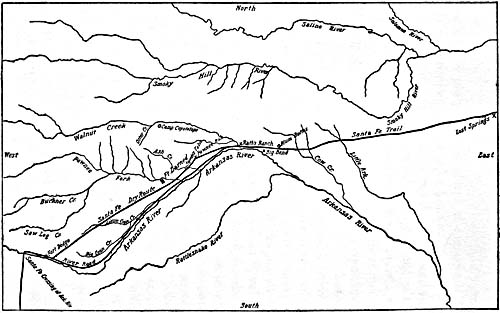
Where Old Fort Larned Stood
We ran a fairly straight line, bearing a little to
the west, to the head of Ash Creek, which we
found here to be only a prairie hollow destitute
of water and timber. Before reaching Ash Creek
we had begun to see plenty of buffalo in every
direction except toward Fort Larned.
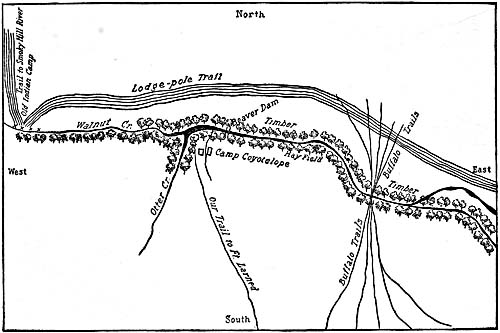
On reaching the high prairie north of Ash Creek
we could see away to the north the distant line
of timber that marked the course of Walnut
Creek. A heavy body of timber was seen right
ahead, and in line with our course, that Tom
rightly conjectured was at the mouth of the little
creek emptying into the Walnut, where French
Dave had told him we would find a suitable location
for a winter camp. Toward this we directed
our course.
It was but little past noon when we reached
the edge of the timber near the junction of the
little branch and Walnut Creek, and we found
here an ideal spot for our purpose—a snug camp
and good hunting and trapping ground.
"We'll camp here for the night," said Tom as
he dismounted, "an' to-morrow we'll look the
neighborhood over thoroughly an' decide where
to pitch our permanent layout."
As we had found no water on the road we had
made this drive from Pawnee Fork without our
usual halt for noon and decided to have our dinner
and supper in one about the middle of the
afternoon. After turning out the stock, bringing
wood and water, and pitching the tent, while
Tom was preparing the meal, Jack and I separately
rambled off to do a little exploring of our
immediate neighborhood. In doing so I found a
prairie ravine, not far from our camp, in which
there was considerable standing water at a distance
of about three hundred yards from the timber
on Walnut Creek. I wondered at this water,
but on following the ravine down to the creek I
discovered a beaver dam built across the creek,
in which a number of the dome-shaped huts were
standing, and saw other evidences of the presence
of a populous colony of these industrious animals.
The water I had seen up the ravine was backwater
caused by the dam.
At Tom's call of "grub pile" I hurried back to
camp to acquaint my comrades with my discovery,
only to learn that Jack had found the
beaver dam before I had and, having rushed back
to the wagon, was now busy getting out our steel
traps preparatory to setting them for beaver.
As we sat around the mess-chest eating, Tom,
between mouthfuls, explained his ideas about the
establishing of our winter camp.
"This big timber here is in the right place to
shelter us from the northwest winds. We must
also remember that we've got to protect ourselves
and stock against a surprise by hostile Injuns. I
ain't looking for trouble of that kind, but it's
always best to be prepared for such emergencies.
So I think it'll be best to move out to the bank
of that ravine Peck spoke about, say two or three
hundred yards from the timber, which will still
furnish us good protection from the northwesters.
In case of hostilities the water in the ravine can't
be cut off from us. Into the banks of that ravine
we'll dig our dugouts—one for ourselves, on one
side, and a stable for the stock on the other side,
opposite and facing each other. We'll cut and
split some slabs in the timber and lay a sort of
a floor across the ravine, for a gangway, and it'll
be as handy as a pocket in a shirt.
"Now, Peck, while Jack goes to set his traps
for beaver, suppose you saddle up Black Prince
and go out and kill a buffalo calf or yearling and
bring in a quarter or so of fresh meat. And, as
there's plenty of time yet before night, while
you're at it you may as well make a complete
circuit of the camp, say about a mile or two out,
and see if there's anybody or any sign of anybody
in this neighborhood besides ourselves."
"Tom," I said, "I believe it would be better
for me to go out and kill a yearling first and bring
in some meat and then take a ride around the
country afterward; for if I kill the yearling first
and leave the carcass till I make the circuit of the
camp the wolves will get away with the meat
before I get back to it; and if I make the round
first before killing our meat I'll be scaring all
the near buffalo away."
"You're right," replied the old man; "do as
you say. I'm glad to see that you do a little
thinking of your own once in a while."
"And I believe I can kill two birds with one
stone," I continued, "by taking some strychnine
along and baiting the remains of the yearling
after I cut off the hind quarters, and in the morning
I'll have a few coyotes to skin to give us a
start in business."
"That's a good idea, too; but don't fool away
too much time, for I want you to make that round
of the neighborhood before night."
As I got our package of strychnine out of the
wagon, opened it, and took out one of the phials
to put in my pocket, Tom suggested:
"You'd better open that bottle here an' put
in a little water to dissolve the crystals; you'll
find it's easier to handle in liquid than in crystals,
and also more savin'."
Tom's suggestion was a good one and I did as
he advised. Then hanging the hatchet and field-glass
to my saddle, I mounted and rode away.
Crossing the creek just below the beaver dam,
where Jack was already looking out locations for
his traps, I rode through the timber to look for
the most convenient band of buffalo, and espied
one that suited my purpose about a mile down
the prairie bottom, strung out in single file on the
trail, coming in to the creek for water.
Recrossing the creek so as to keep out of their
sight behind the timber, I rode down to a point
that would intercept them and prepared to await
my game. The place I had chosen to wait for
them was an old buffalo crossing, the converging
trails, deeply worn in the banks on either side,
showing that it was much used. They would have
to pass me here, and, again recrossing the creek
to the north side, I rode down into the timber,
tied my horse behind some bushes, and returned
afoot to the crossing, being careful not to give the
buffalo my wind.
Soon they passed me, went on down, drank, and
climbed the hills on the other side of the stream.
As the young cattle filed past me I selected a
yearling and, as he came opposite, shot him, and
he dropped dead in the trail. The rest gave a
jump or two and went on. I cut off the hind quarters
and with some trouble put them on Prince.
Then stripping back the skin from the fore
quarters, I applied my solution of strychnine, a
few drops here and there over the meat and entrails,
and left them for wolf bait.
Having left my meat at camp, I rode away on
my scout, reaching camp again about sunset.
Just after we finished supper the howling of
a pack of coyotes—which we seldom noticed—prompted
me to exclaim:
"Make the most of your time, my lads, for if
you happen to scent that bait I put out for you
I'll be skinning some of you in the morning."
The howling and barking of wolves was such
familiar music to us that it seldom provoked remark,
for we had scarcely passed a night since
entering the buffalo range that we had not been
serenaded by the shrill, discordant notes of the
coyote, varied occasionally by the deeper bass of
the big, gray buffalo wolves, or "lobos," as the
Mexicans call them.
Next morning Jack and I hurried through the
work of watering and changing the animals to
fresh grass, while Tom prepared breakfast. We
were impatient to be off, and after the meal, taking
our rifles in addition to revolvers, we started
out to our respective tasks, Jack afoot and I on
Black Prince.
As I approached my wolf baits I disturbed a
couple of coyotes—probably late comers that had
but recently found the carcass, for they certainly
gave no evidence of the effects of strychnine as
they loped off on the prairie a little way and there
sat on their haunches licking their chops and
watching me as though reluctant to leave their
feast.
I tied Prince a few rods away from the bait, of
which but little remained, while I walked about
through the tall grass, looking up the dead wolves,
three of which I noticed lying by the bait before
dismounting. On looking about I found five more,
at varying distances from the carcass, none of
them more than a hundred yards away. Some of
them were still warm.
I put down the rifle, drew my knife, and went
to work. Having had considerable experience in
skinning wolves, I was quite expert at it and soon
had the eight pelts stripped off the dead coyotes
and rolled up together ready for tying on behind
my saddle.
The process of skinning was simple. I turned
the wolf on his back and with the point of my
knife split the skin from the point of the chin
down the throat and belly to the root of the tail;
then split the inside of each leg from the foot to
an intersection of the first, or belly cut; then
stripped back the skin from belly, legs, and sides.
The tail was then slipped off the bone whole, without
splitting, in this way: strip the skin of the tail
away from the bone for about an inch at the root;
then slip a split stick over the bone, take an end
of the stick in each hand, clamping the bone
tightly, and give a jerk toward the end of the
tail. The bone slips out of its skin as if it were
greased.
When it came to tying the skins on behind the
saddle, Prince objected very strongly, and I was
compelled to blindfold him before I could accomplish
the job. After I had mounted, Prince was
still nervous, but by coaxing and talking kindly
to him I soon got him reconciled to carrying the
burden.
When I reached camp I found Jack jubilating
over three fine beavers which he had carried up
from the creek. He was grumbling because he
had not put out more traps.
"Time enough," said Tom consolingly. "We've
now found out that there's plenty of 'em there and
can wait awhile. Their fur'll be getting heavier
an' better all the time."
He and Jack were finishing skinning the third
one as I dismounted and threw down my batch
of coyote pelts.
"How many did you get?" asked Jack.
"Only eight," I replied. "If I'd had time to
have killed and poisoned three or four buffalo in
different directions out around camp I'd 'a' got as
many as the horse could carry."
"Time enough for the wolves, too, by and by,"
said Tom.
"Now, men," said Tom after we had discussed
beaver and how to catch them, "while you were
out I went over to the ravine and found a good
place for our dugouts and measured and staked
off the ground where we'll dig 'em. After dinner
we can move camp over there close to the work.
And while I'm getting the grub ready you two
can water the horses and mules and be a-making
a lot of little pins to peg your skins down to dry."
After dinner we moved camp close to the bank
of the ravine, where Tom had marked out the
ground for our winter quarters. On the opposite
bank he had staked out a site for a larger dugout
for a stable. The ravine here was narrow, and
by a good jump we could clear the water that
occupied its bottom. On top of the banks the
ground for some distance around was smooth
and level, bearing no other vegetation but the
short, nutritious buffalo-grass.
Pitching our tent in a convenient place for our
work, we turned out the stock, picketing the gray
mare and Prince. Tom was to ride the "buckskin"
bronco to look for a hay-field.
Jack and I soon had our coyote and beaver pelts
stretched and pegged down on a smooth piece of
ground.
"I'll try to get back," said Tom as he mounted
Vinegar, "in time for you men to go and put out
your baits for the night; and in the meantime,
while you're resting, you may as well get out the
pick and shovel and turn yourselves loose on them
dugouts, just to see if you've forgot how to work.
You'd better begin on the horses' stable and we'll
try to finish that up first, for if a 'norther' should
catch us the stock'd be in a bad fix for shelter,
while our tent'd shelter us, all right."
In a couple of hours Tom returned, reporting
that he had found, in a bend of the creek just
below us, a large bottom that would afford us all
the hay we would want.
"Now, men," he said as he unsaddled and
turned out the bronco, "we've got lots to do
that's pressing us, and, as the wolf poisoning and
beaver trapping ain't pressing and won't suffer
any loss by waiting a few days, I've been thinking
that we'd better let the pelts go for a while and
put in all our time at haymaking and digging till
we get everything made snug for cold weather."
Tom's suggestion seemed so reasonable that we
agreed with him and decided to let the pelts alone
for a while.
Tom got his scythe out of the wagon and
"hung" it and then went down to the timber to
make a couple of wooden hay-forks. When he
had returned from the timber with his wooden
forks he remarked as he sat down and began
whittling the prongs to points and otherwise
smoothing them up with his knife:
"While I was at it I cut a lot of poles for a hay
frame to put on top of the wagon-box to haul
hay on; and I also cut some poles to lay on the
ground under our freight when we unload the
wagon."
Later in the day we unloaded the wagon, piling
the contents on the poles inside the sideboards,
which we had taken off together, leaving the
bows on them. After the goods were thus piled
up the wagon-sheet was stretched over the bows
and securely tied down and the load was thus
protected from the weather.
Tired and very hungry after our hard day's
work, we devoured our supper and, after agreeing
to devote the next day to digging and haymaking,
were soon sound asleep.
After breakfast next morning Tom shouldered
the scythe and his rifle and set out for the hay-field.
When we had cleared away the breakfast
dishes Jack chose the pick-and-shovel work and
was soon making the dirt fly out of the hole on
the other side of the ravine, while I set to making
a hay frame of crossed poles on top of the wagon-box,
notched and lashed together and held in
place by strips of rawhide cut from the skin on
the yearling buffalo quarters. Now and then
on the still morning air, although about a mile
away, we could hear the "whick-whack" as Tom
whetted his scythe.
At nine o'clock Jack went to the hay-field to
help Tom, while I put on the dinner, to which I
called them by flag at noon. In the afternoon
they returned to their haymaking, and by evening
they had a nice lot of hay in cocks which
would do to haul and stack next day. After finishing
the hay frame I worked at digging in the
dugout.
Buffalo were to be seen on the prairie all about
us, and now and then a few antelope made their
appearance, but we were too busy to spare the
time to go out and kill any. Flocks of water-fowl—wild
geese, brants, ducks, and sand-hill
cranes—were seen and heard flying over and
sometimes alighted in the pond formed by the
beaver dam, and also seemed to come down at a
point several miles down the creek, which indicated
that there was a body of water there.
In the evening when the men had returned
from the hay-field we all stood for a while looking
down the valley and remarking on the appearance
of civilization imparted to the scene by the distant
flat dotted over with cocks of hay. But in the
morning at daylight, on again looking in that direction,
we were filled with indignation to see that
during the night a herd of buffalo had preempted
our hay-field and had trampled, horned, and scattered
all the nice cocks in every direction, and
were now bedded on the ground, probably chewing
their cuds in total indifference to our rights after
almost destroying the previous day's work of our
haymakers.
"I'll make wolf bait of one of 'em for spite, so
I will," said Jack as he seized a rifle and started
down the hollow to get a shot.
"Don't kill more'n one, Jack, just enough to
scare them off," suggested Tom as the irate Irishman
sneaked off down the ravine, "for we don't
want our hay ground littered up with dead buffalo
and dead wolf carcasses."
For some minutes Tom and I stood watching
the buffalo to see what the Irishman would do for
them. They were all lying down in apparent perfect
contentment except one large bull. We kept
our eyes on the big bull and after a time saw the
huge beast drop, and immediately afterward the
report of the rifle reached our ears. The rest of
the buffalo jumped to their feet in alarm at the
sound of the shot, but, instead of running away,
stood staring at the timber from whence Jack had
fired; and had he desired to do so he could probably
have remained in concealment and shot
several more, for the buffalo do not readily take
the hint of danger till they can see the enemy.
Presently we saw the herd stampede, and at the
same time our Irishman made his appearance,
running out of the timber shouting and firing
another shot over them to give them a good scare.
"Our hay's ruined entirely," he said as he put
away his rifle and sat down to breakfast, "scattered
all about and tramped over. Even what we
left in the windrows is all horned and tossed about.
We may be able to rake up some of it, but it'll
be hardly worth the effort. But I took me satisfaction
out of that big fellow—I got a good broadside
shot at him and must have shot him through
the heart, for he dropped in his tracks. Peck had
better go down there this evening and put some
poison on the carcass, and be taking a few wolf
pelts, too, while we're a-haymaking."
"Well," said Tom, "we'll have to stand these
night-prowling buffalo off some way, and I think
the best way will be for Peck to mount one of the
horses just before night and ride 'round the neighborhood
and drive off any herds that seem to be
heading toward our hay-field. I wouldn't kill
any more of them at present, for we can't spare
the time to do much wolf skinning, but just stampede
them and stand them off for a few days till
we get our hay cut and hauled; then you may go
for them, and the wolves, too. We don't often
have occasion to take the hide off a buffalo, but
I've been thinking it would be a good scheme to
skin a few of the first ones we kill till we get hides
enough to lay over the timbers on top of our dugouts
before we throw the dirt on, to keep the fine
dirt from sifting down on the inside; so, Peck,
you may as well take the hide off this one and
bring it up to camp when you go down there to
poison the meat for wolf bait.
"While Jack and I are mowing to-day you can
look out a suitable place along up the ravine here
above camp where we can make a crossing, and
dig down the banks a little, throwing the dirt into
the hollow so's we can cross the wagon over; and
while we're hauling hay we'll just leave the wagon
over on the other side of the draw. We'll stack
the hay, as we haul it, on the bank, close up to
the stable so's it'll be handy.
"And, mind you, that at no time and under no
circumstances must the camp guard leave camp."
"Have you seen any fresh signs, Tom, that
make you think there's Indians about?" I asked.
Camp of the Wolf Hunters
"Not a thing, but I want to keep you 'minded
with the idea that in this country 'eternal vigilance
is the price of life, liberty, and the pursuit
of happiness,' as the Bible says. We know how
tricky Injuns are, and, although we've seen no
fresh signs, a prowling party is likely to drop onto
us any time; and just think what a fix we'd be in
if they should happen to get into our camp and all
hands away. How completely they'd have the
drop on us! I'm not scared of them, nor trying
to scare you, but we've got to keep our eyes
peeled and be prepared all the time."
"All right," I replied with an air of more confidence
than I really felt, "I guess Found and I
will be able to take care of camp."
"Of course," continued Tom reassuringly, "all
Injuns ain't hostile, but we've got to keep on the
safe side; and if a party of them approaches our
camp at any time, even if they profess to be
friendly, we must stand them off and never allow
more than a few—just what we feel sure we can
handle—to come into camp at a time; and even
then, always keep your eyes on them and your
arms and cartridges handy."
Leaving me with these cheerful subjects for
thought, the two men proceeded to their work.
After they left I moved our horses and mules
across the ravine where the dog and I could guard
them on one side, while on the other the two haymakers
would be some protection. During the
forenoon I worked at the banks of the gulch, a
little above our tent, to make a crossing for the
wagon.
In searching for the place for a crossing for the
wagon I discovered a little spring of water trickling
out of the bank a few steps above our dugouts.
It was only a weak vein, but by digging a
pit under it, in which we planted an empty barrel,
we made a reservoir that furnished us an abundance
of good water.
The discovery and improvement of this little
spring made our camp an ideal one. At first we
had expected to use backwater from the beaver
dam, but we soon realized that the trash from our
camp might render this water unfit for drinking
and cooking; and but for finding the spring we
should have been obliged to carry water from the
creek, which would have been laborious and inconvenient.
When an occasional rain or melting snow flushed
out the trash in the ravine we could use that water
for our stock for a few days, but at other times
we watered them at the creek.
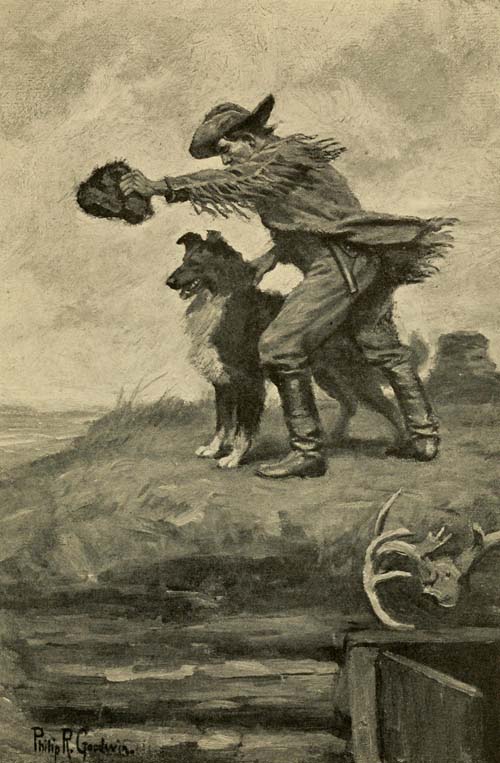
I felt more confidence in the protection afforded
by our shepherd dog than in all the measures we
were taking for the safety of our outfit. With the
natural instinct of his breed, Found spent most
of his time out with the stock, always selecting a
position on some elevation between our animals
and camp where he could see all that was going
on in our neighborhood; and I was satisfied that
neither friend nor foe could approach without his
giving notice.
At noon when the men came in to dinner they
reported that they had raked up a good load of the
hay that had been scattered, and in the afternoon
they took the mules and wagon with them and
Tom brought the first load to camp on returning
in the evening, while Jack remained and began
skinning the dead buffalo. When I joined him
we soon stripped the hide off, applied the strychnine
to the carcass, and left it for the wolves.
"First come, first served, will be the rule here
to-night," I remarked as we started to camp.
"The first wolves to reach the bait will probably
get laid out before they have time to get half
a feed, while those that come later may not get
strychnine enough to give them a bellyache."
"How many do you expect to find in the morning?"
asked Jack.
"Oh, about eight or ten for the first night will
be a pretty fair haul; but by to-morrow night I'll
poison the bait again, and by that time it ought
to catch more—maybe as many as twelve or fifteen—for
the scent of the dead buffalo will then
attract them from a greater distance."
I did even better than I anticipated, for next
morning I found thirteen dead wolves lying around
the bait awaiting my skinning knife. Jack remained
in camp until I had skinned the wolves,
brought in the pelts and pegged them down to
dry, after which he took the team and went out
to the hay-field where Tom was mowing.
The dead buffalo only lasted for three nights'
baiting, by which time I had taken nearly fifty
pelts, some big gray wolves but mostly coyotes and
little yellow foxes. We killed no more buffalo for
wolf baits until the more important work was done.
Our haymakers were now making a good showing,
bringing in and stacking a load at noon and
another at night, and in a week we had stacked
as much hay as we should need.
While doing duty as camp guard, I had put in
all my spare time throwing dirt out of our stable
dugout and had the excavation about completed.
While Jack and I were doing a little trimming up
inside and cutting a doorway through the wall of
dirt on the side next the ravine, Tom had gone
into the timber and cut and split a lot of poles
and slabs to support the roof of dirt.
First putting a small log, twenty-four feet long,
on the brink of each side of the excavation, to
serve as "plates" to rest the roof timbers on, we
then laid twelve-foot slabs and poles across from
side to side, as closely as they would fit, covering
the larger crevices with brush.
"Now," said Tom, stepping back to take an
observation of our work when we had reached
this point, "ef we had buffalo-skins enough to
cover it, to keep the fine dirt from sifting through,
we'd be ready to go to throwing the dirt on an'
soon have the horses' stable finished up so's we
could go to work on our own quarters."
"Well, we can soon get them," I replied. "In
the morning Jack and I will go out and kill a few
buffalo and bring in the hides, and by to-morrow
night we can have this dugout about completed."
Next morning the Irishman and I saddled up
and started out to secure the hides. We could
have killed what we needed out of the first band
we struck, but, as I wished to use the carcasses
for wolf baits, we decided to distribute the baits
at different points about the camp and not less
than a mile from it.
We killed and skinned six bulls, making a complete
circuit of our camp, and by noon had returned
with the hides.
After dinner we spread enough of them over the
roof timbers to completely cover them and then
set to work shovelling on the dirt, making quite
a mound of it. This finished our stable, except
for the mangers and feed-boxes inside and making
a door of some kind to close up the opening we
had cut through the bank. This last Tom made
next day by a frame of poles on which was tacked
a buffalo-hide. This door was hung on rawhide
hinges.
"Now, men," said the old man as we topped
out the dirt roof and smoothed it up, "we've a
snug shelter here for our stock in case of need,
but, of course, we won't put 'em into it till we
have to. As long as it's fair they'll do better out
on the buffalo-grass, as they've been doing. Our
stable, hay, an' grain will be our reserve for
stormy weather or when the grass is covered with
snow. We must still work hard till we get our
own winter quarters finished up, an' then let the
weather turn loose—we'll be ready for it."
Toward evening I made the round of the buffalo
carcasses and poisoned them for the night's catch
of wolves.
As we gathered around the supper table in the
evening I suggested:
"As I expect a big job of wolf skinning in the
morning, I guess I'll need help, and maybe I had
as well take Jack along with me and be breaking
him in."
"All right," replied the Irishman, "if Tom says
so, I'm your huckleberry. How many skins are
you going to get this haul?"
"Well, I don't know, but, putting it low, I ought
to find at least five or six around each bait, and
maybe twice that many, so you see, skinning,
bringing in, and pegging down thirty-five or forty
wolf pelts is no small job."
"Well, it'll take the two of you the whole forenoon,"
said Tom ruefully, "but the wolfskins
must be taken care of—that's what we're here for.
Still, I'm mighty anxious to get the other dugout
done, so I guess you'd better not kill any more
buffalo for bait unless we need some more of their
skins to cover our dugout. These six will keep
you a-poisoning and a-skinning for at least three
or four days to come, and all of that time there'll
not be much done on the dugout, for part of my
time'll be taken up doing the cooking an' camp
work. But go ahead with your wolf killing, for
every pelt cured is as good as six bits or a dollar
in pocket at the least calculation."
After an early breakfast next morning Jack
and I mounted and started. We found fully as
big a job as I had anticipated, for the night's
catch yielded us over fifty wolfskins. It took us
most of the morning, brisk work, to get them all
gathered in, and our horses were so well loaded
with the hides that we had to walk and lead them
back to camp. Jack proved an apt pupil at wolf
skinning and soon could snatch a hide off as
quickly as I.
When we reached camp with our loads we found
that Tom, with his usual foresight, had whittled
us out a good lot of pegs, which greatly assisted
us in disposing of the pelts, and we soon had them
stretched and pegged down, flesh side up, on a
smooth piece of ground near the tent where we
had already started a drying yard.
Each evening, while there was anything left
for a wolf bait of the buffalo we had recently
killed, I made the round, poisoning the flesh, and
next morning Jack and I visited the baits, skinned
the dead wolves, brought in the pelts, and pegged
them down. This generally "spoiled" the forenoon,
while the afternoon would be spent in digging
our dugout; but, as our winter quarters were
to be only about half the size of the stable, we
soon had the new excavation finished.
After putting the roof timbers on our dugout
we placed the stove in its corner, put on the extra
joints of pipe provided for the purpose, extending
it up through an opening in the slabs, and plastered
a lot of mud around the pipe to prevent it
setting fire to the timbers. Then spreading buffalo-hides
over the timbers, we heaped up the
earth on it, as we had on the other one, and our
winter residence was ready for its furniture and
tenants.
Our ten-foot-square room was rather cramped
quarters to hold us and all that we had designed
to put in it, and we found it necessary still to use
the tent to store such of our plunder as would not
need protection from the cold.
Without giving any reason, Tom insisted on
moving the tent up as close against the rear side
of the pile of dirt that constituted the roof of our
dugout as we could get it. I suspected then that
this was one of his strategic plans, and a few days
later my surmise was verified when we found him
at work digging a tunnel from the dugout room
to the centre of the tent. By this underground
connection we could go from one place to the other
without being exposed and, if necessary, could
use the tent as a lookout station.
On the evening that we moved into the dugout,
as we sat down to our first meal in winter quarters,
Tom remarked with evident satisfaction:
"Now, men, we've got things in shape so
that we're ready for a cold snap, snow-storm, or
norther ef one chances to come this way. From
now on we can take it easier. There will be a lot
of trimming an' tidying up to do about camp yet
for several days, an' while I'm putting on the finishing
touches you two can light out and go to
poisoning wolves an' trapping beaver or hunting
any other game that you can find. You ought to
explore the neighborhood for ten or twelve miles
around in every direction. It's about time, too,
for one of us to take a trip over to the fort to
get our mail an' find out what's going on in the
world."
"Well, Tom, what are the orders for to-morrow?"
said I.
"Why, you an' Jack had better go out an' kill a
few more buffalo for baits an' Jack can set his
traps for some more beaver. You might both of
you ride up or down the creek for a few miles now
and then, to learn the country like an' maybe
pick up an antelope or some wild geese or ducks,
to make a change in our bill of fare. An' about
to-morrow or next day or the day after, when I
get things pretty well shaped up about camp, I
think I'll ride over to the fort an' get our mail
an' see what's going on in the United States."
"In a little while," remarked Jack, "if our luck
holds out, we'll be gettin' a big lot of wolfskins
dried. How are we going to stow 'em away to
take care of 'em till spring?"
"Well," replied Tom, "in a few days I'll rig up
a lever to press 'em with, an' then as fast as we
get a hundred or so dried we'll put fifty of 'em in
a pile, press 'em down tight, an' tie 'em in bales
with rawhide strips an' then store the bales away
in the tent."